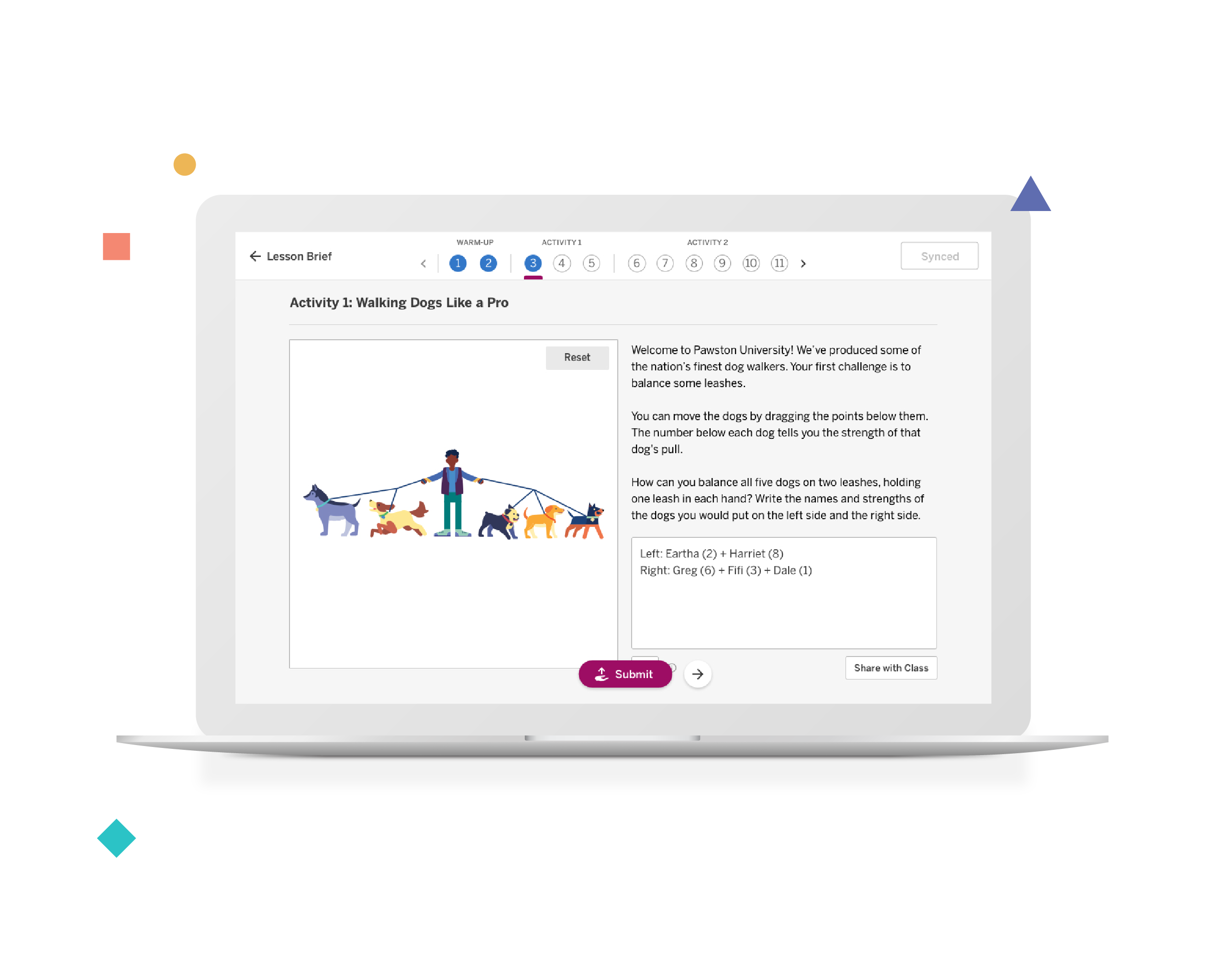
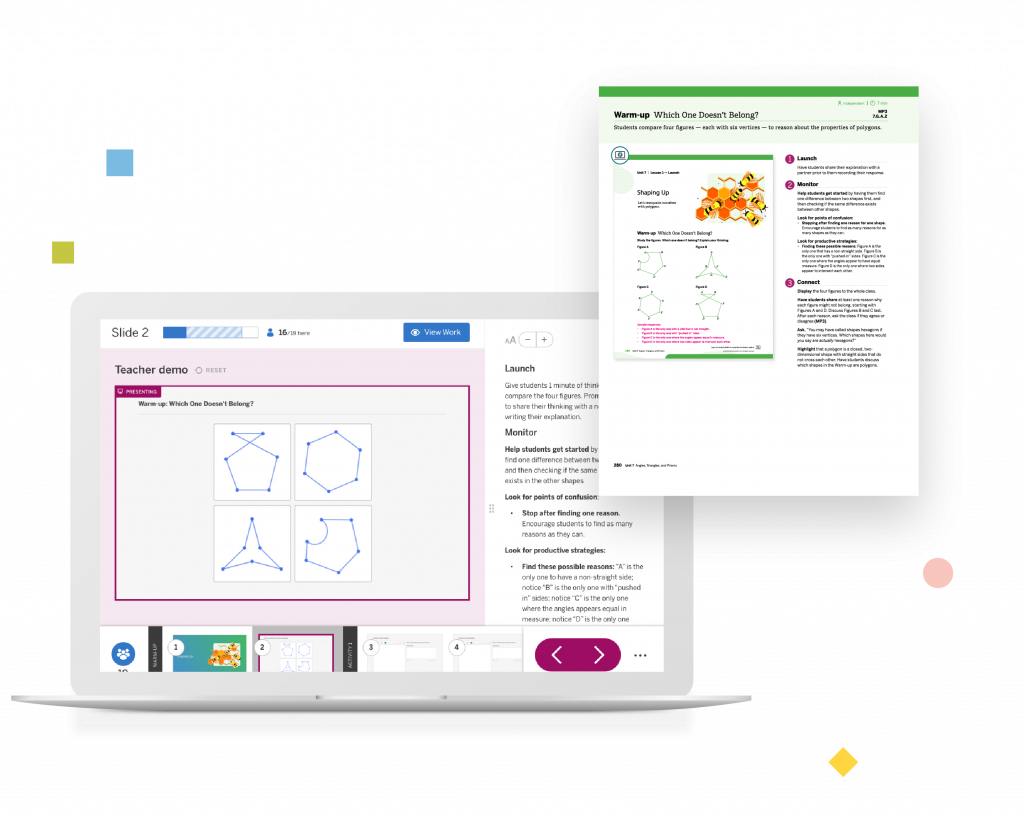
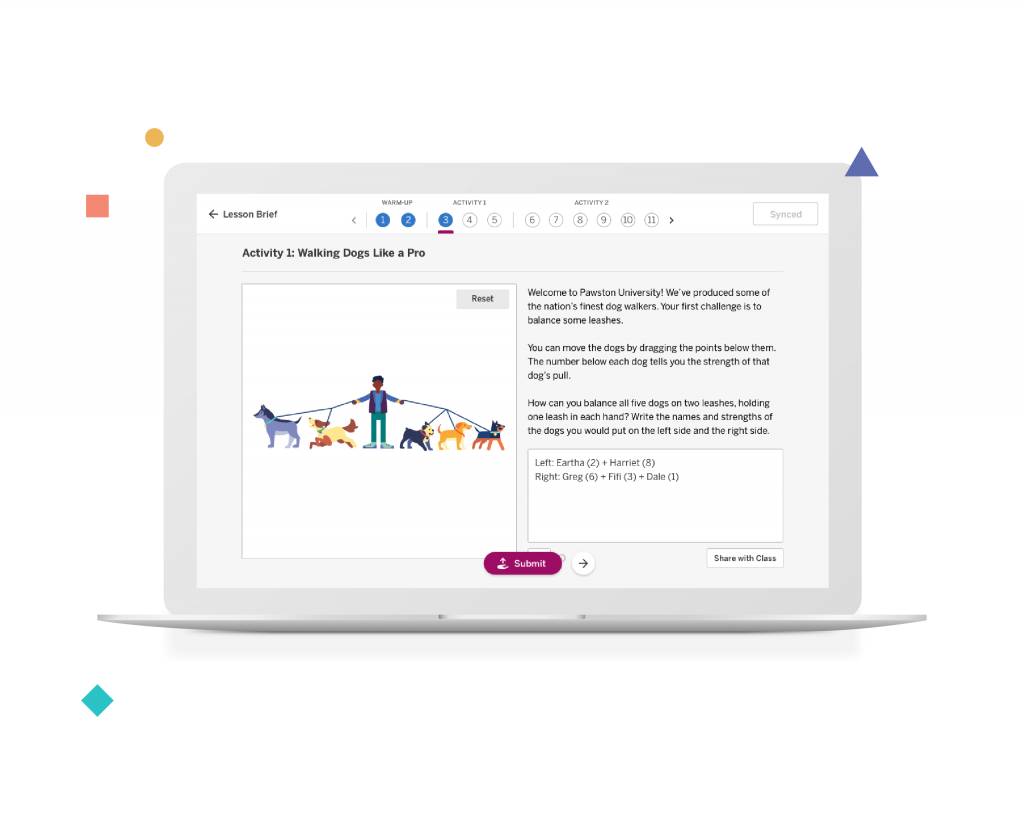
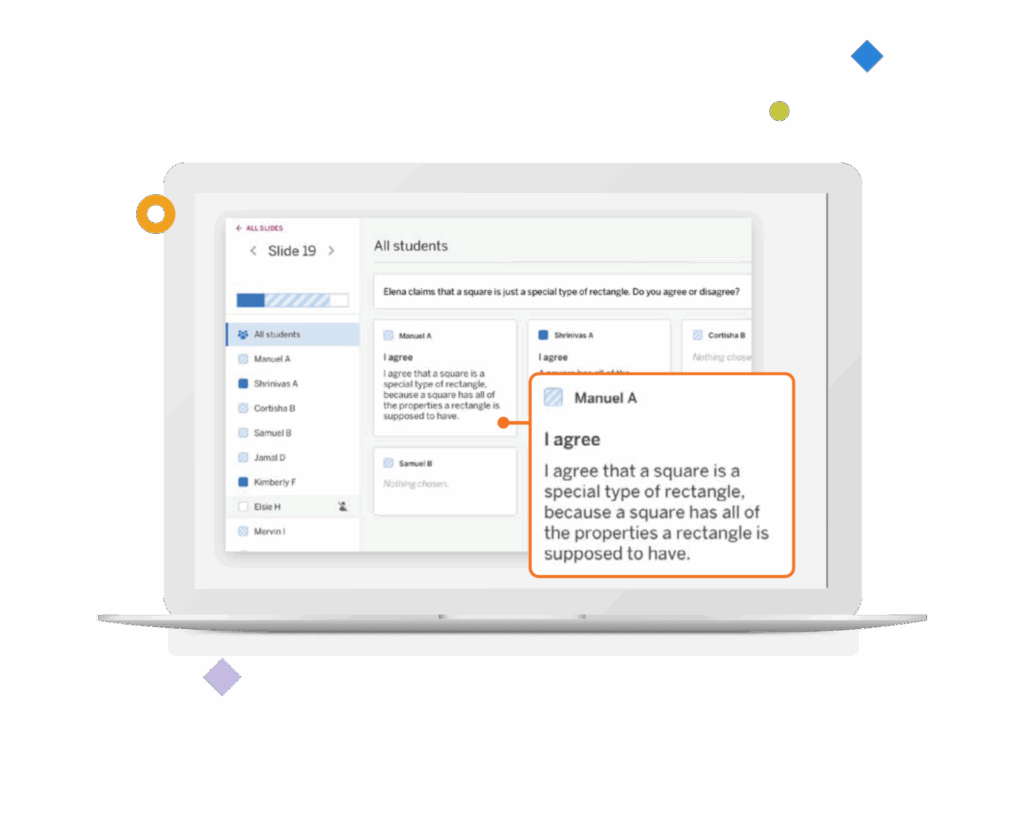
What my wedding taught me about choosing curriculum

The right curriculum choice isn’t only about the product—it’s about who’s by your side from start to finish. Here’s how one district found that with Amplify CKLA.

By Kelly Pruitt, Instructional Facilitator, Peninsula School District | May 28, 2026

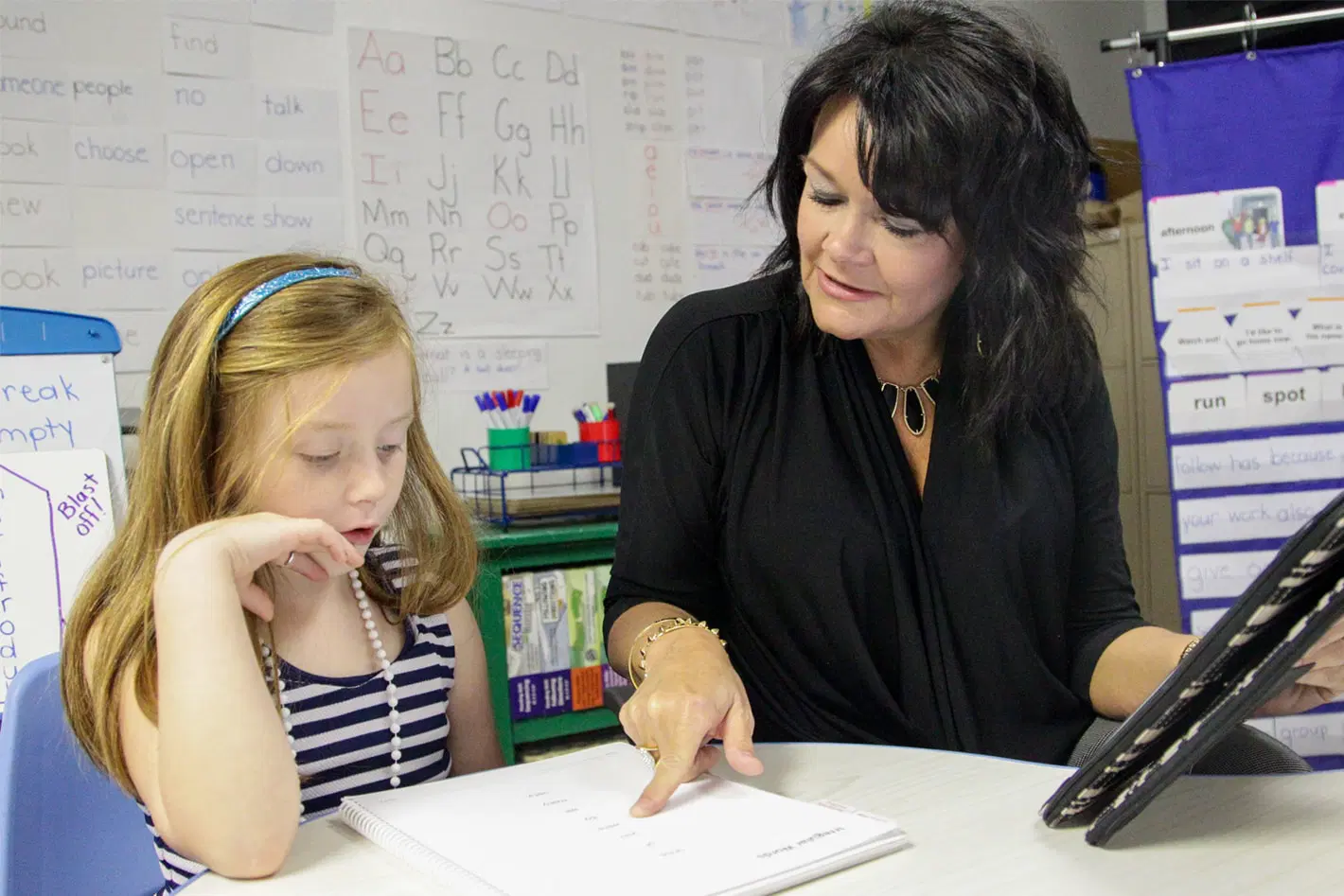
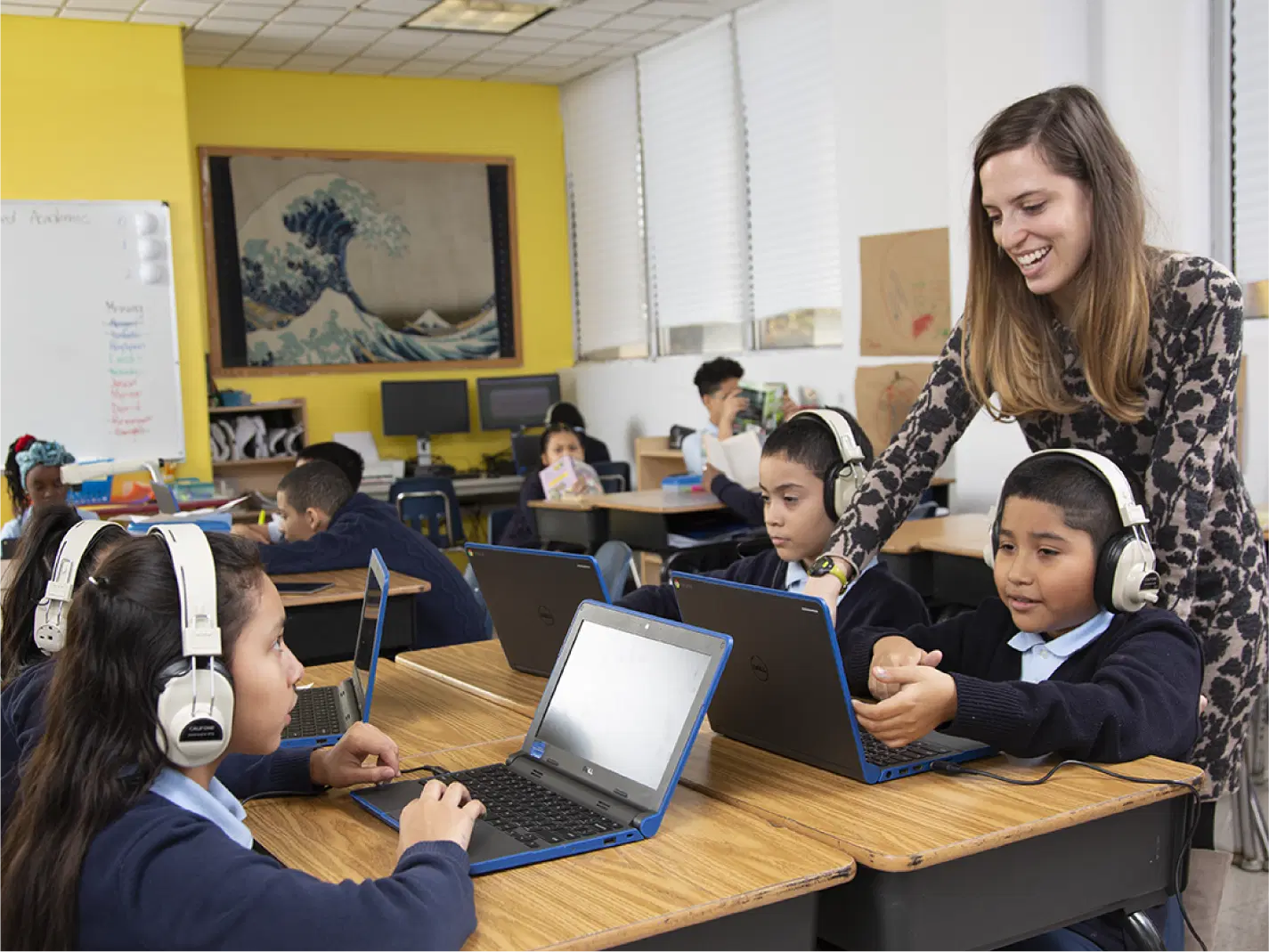
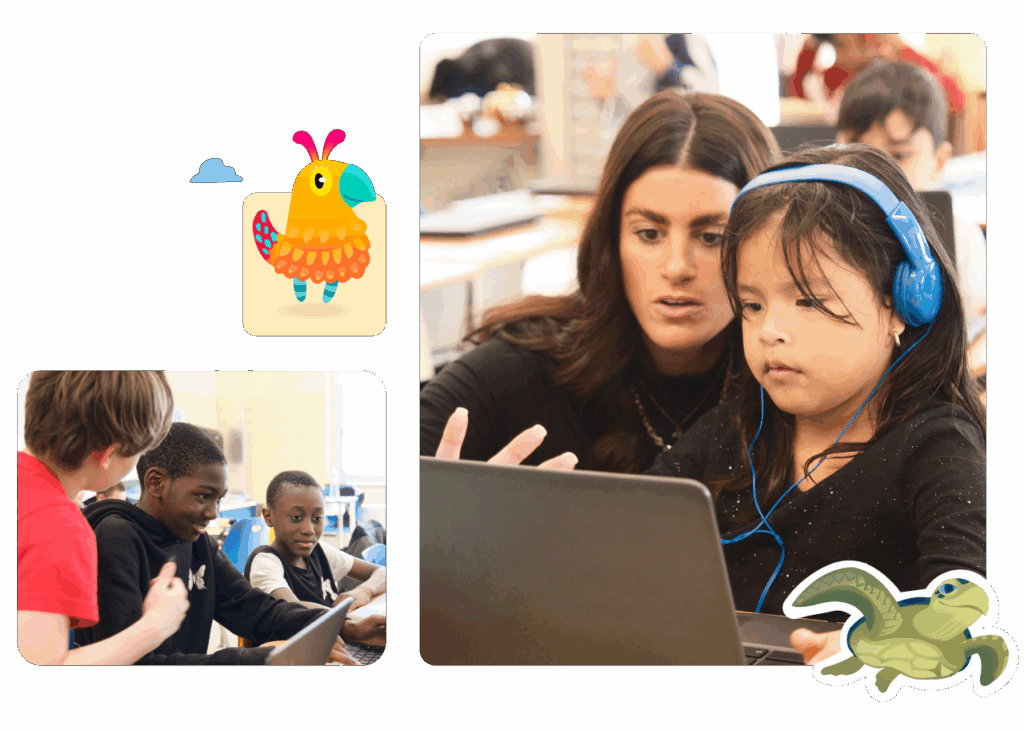
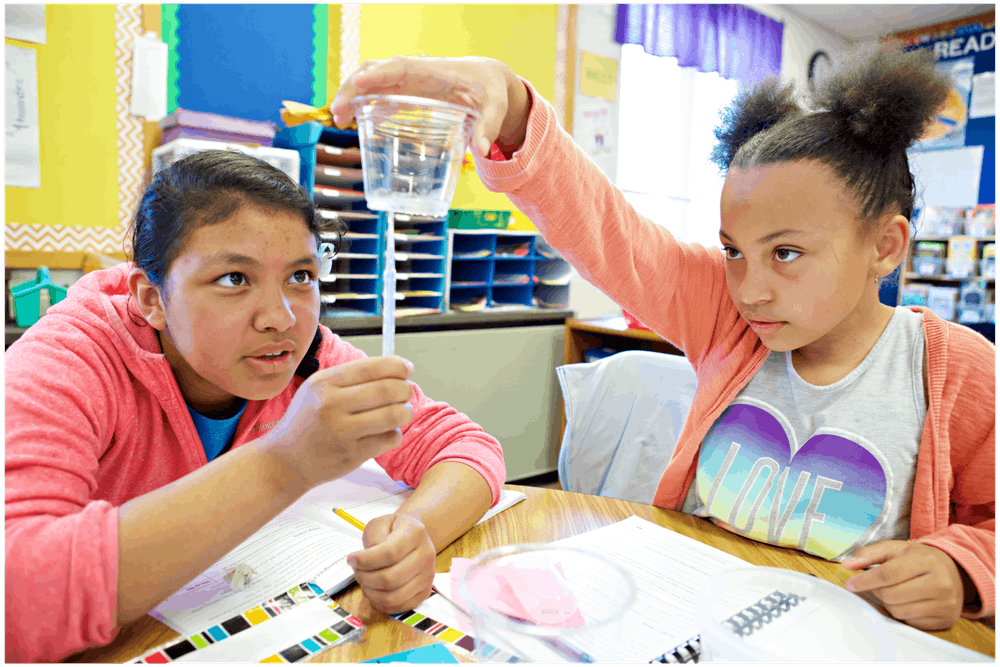
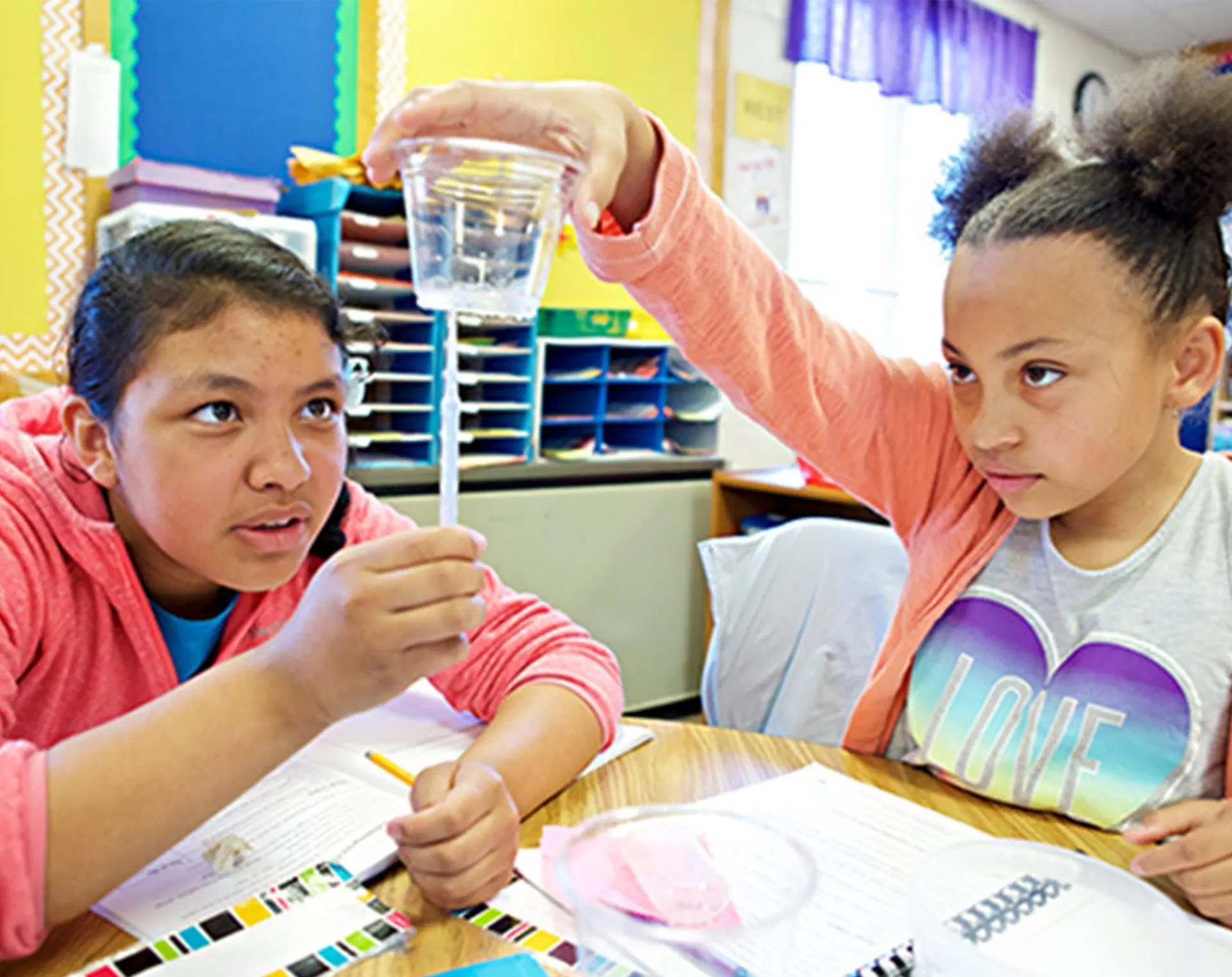
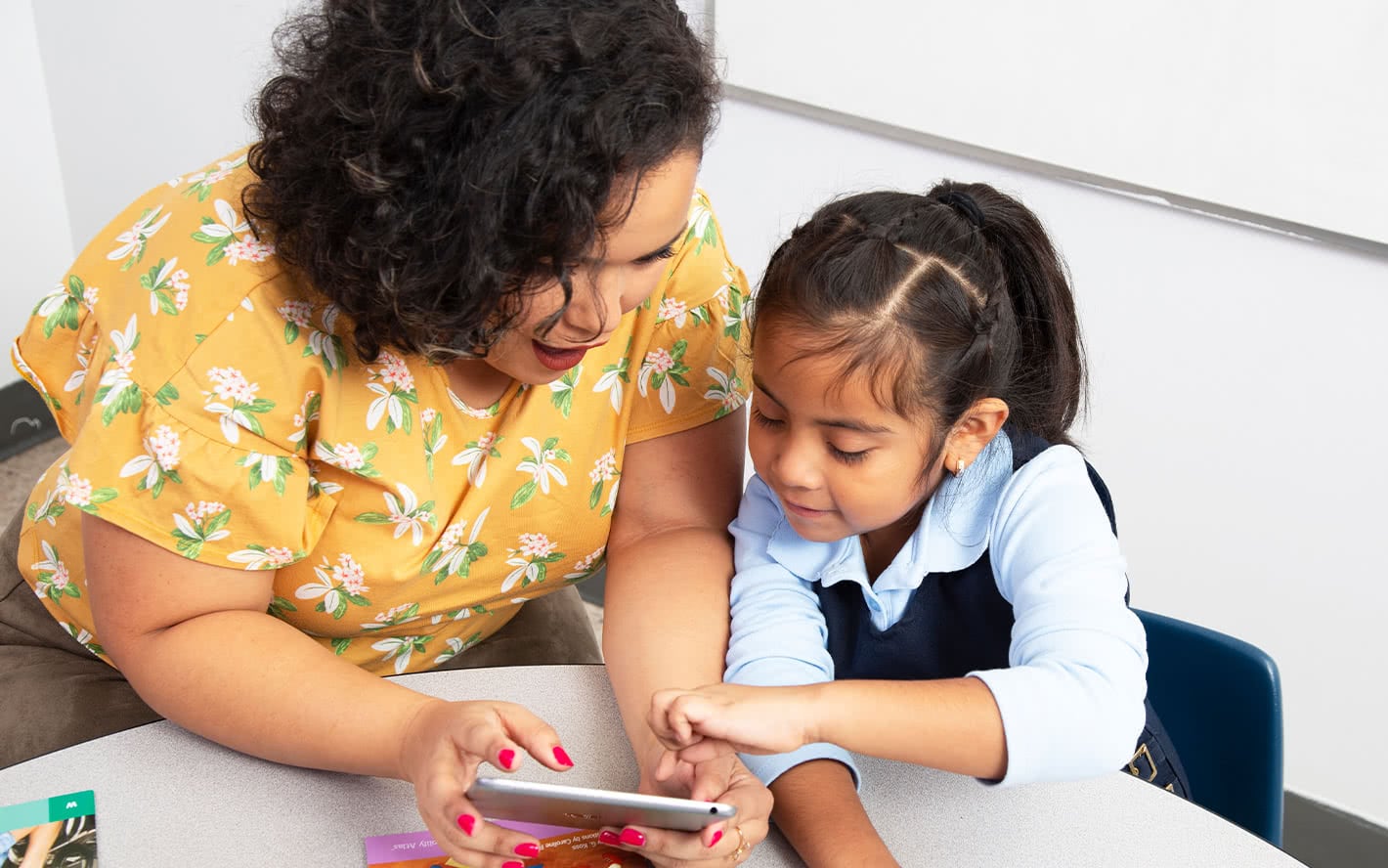
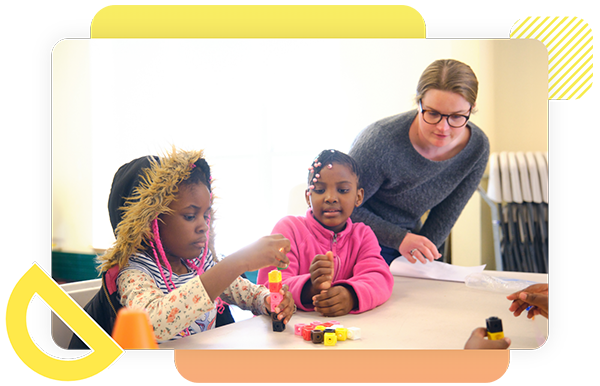
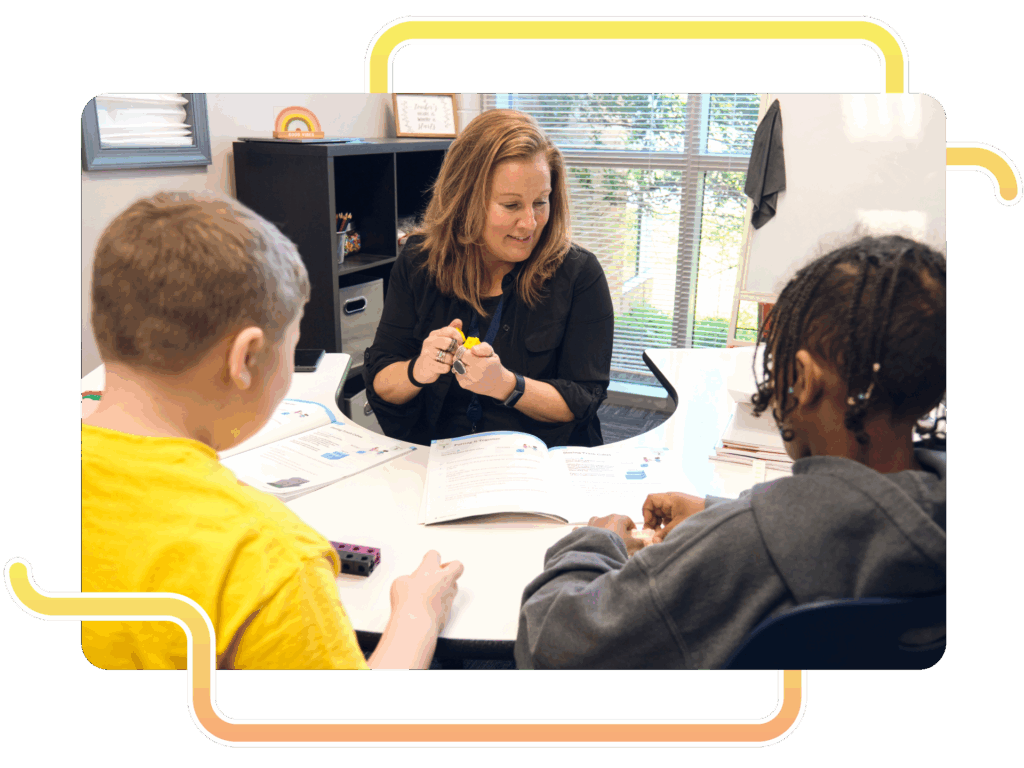
A teacher leans over a group of elementary students who are working together at a classroom table under a "CKLA Skills" sign, guiding them through successful CKLA implementation.

Supporting multilingual & English language learners

Multilingual/English learners (ML/ELs) bring unique strengths to classrooms, enriching the learning experiences for all.

At Amplify, we empower educators with tools that honor the strengths and capabilities of ML/ELs. Our curriculum and assessments meet students where they are and help them develop their skills, propelling them on their learning journeys.

Amplify supports ML/ELs across all subjects, from English language arts to math and science. For students who speak Spanish, we also provide a comprehensive biliteracy suite.

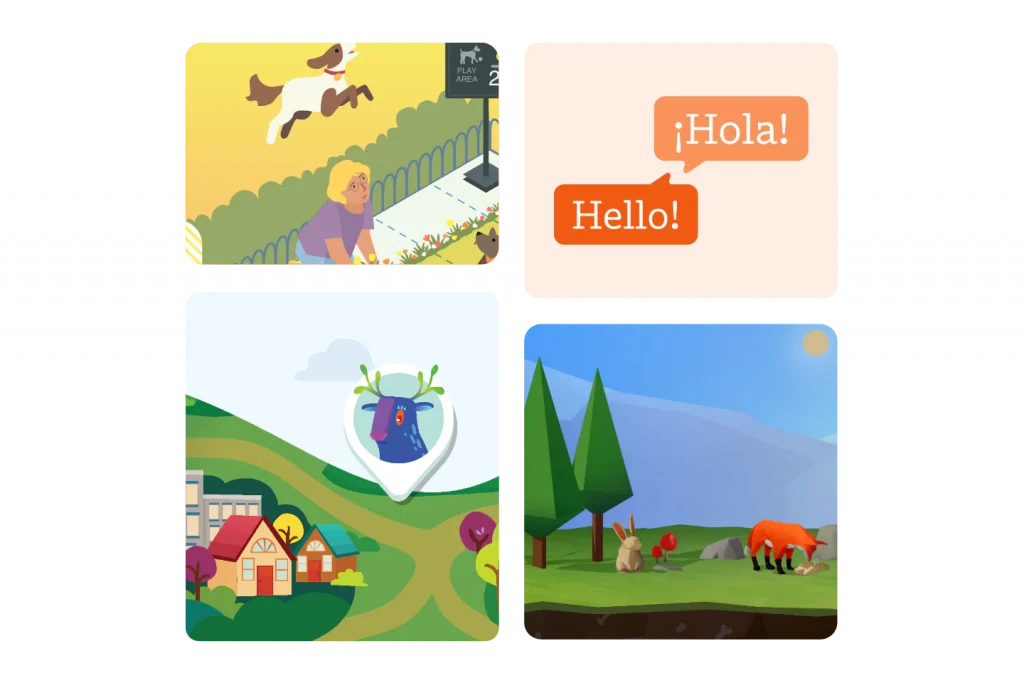
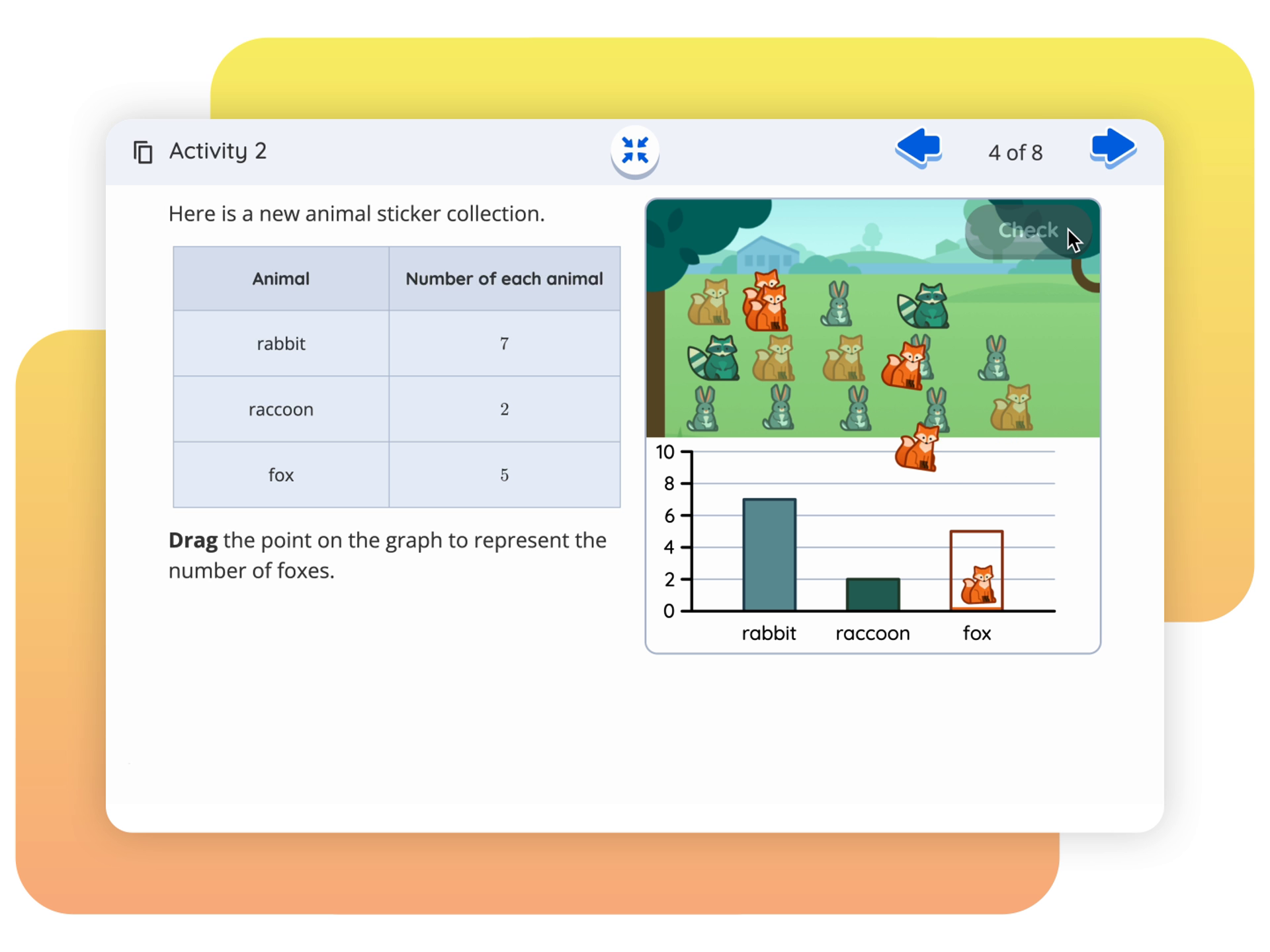
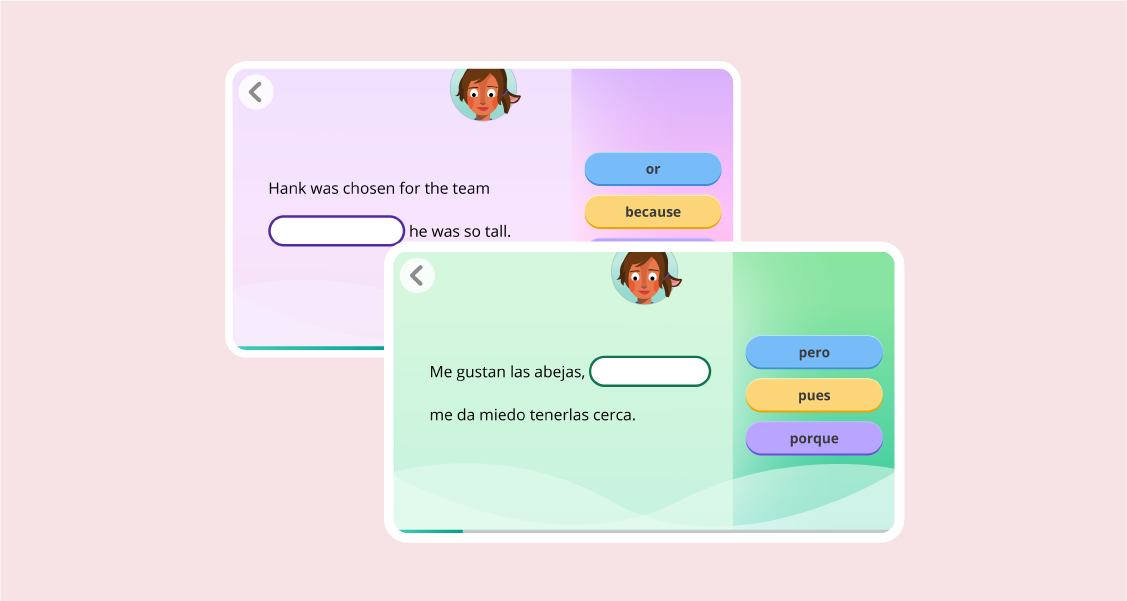
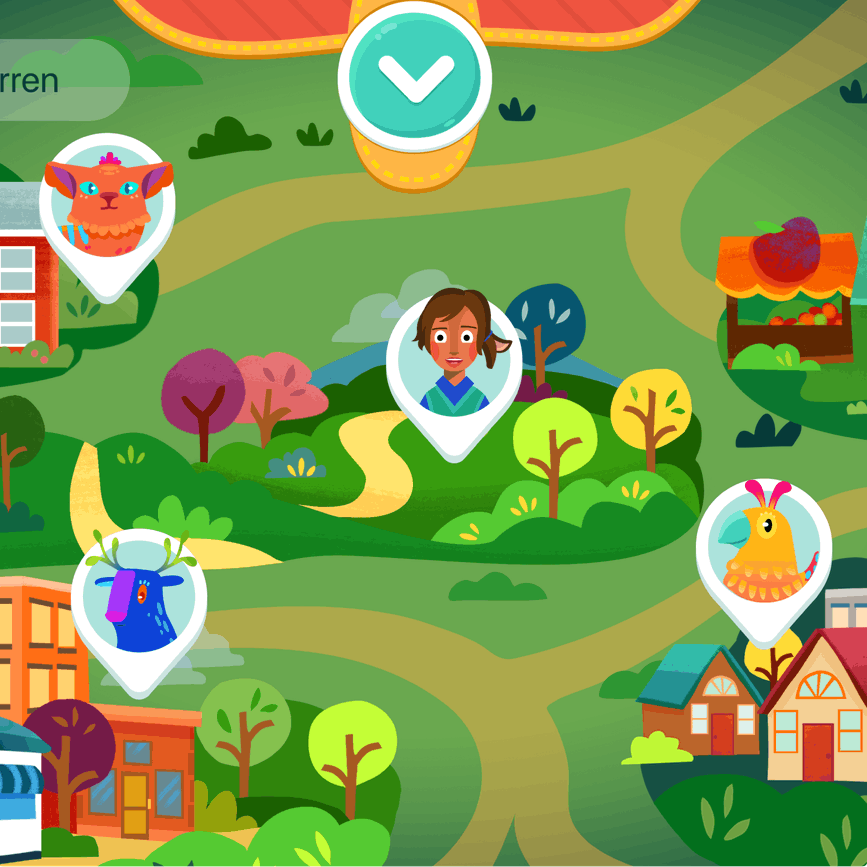
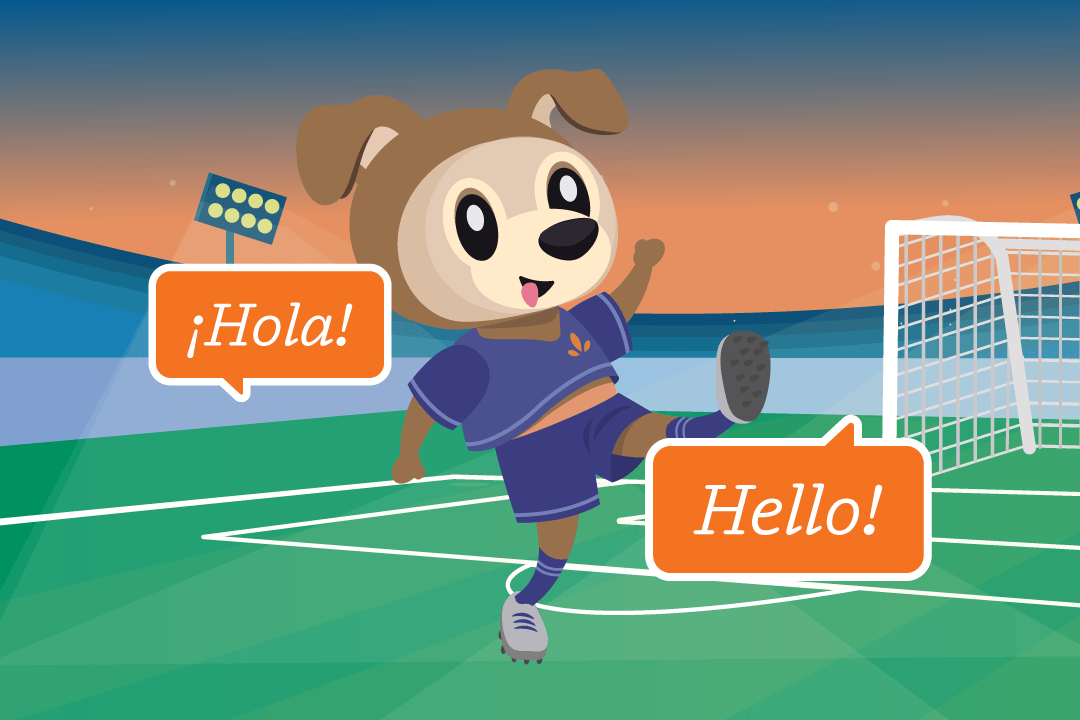
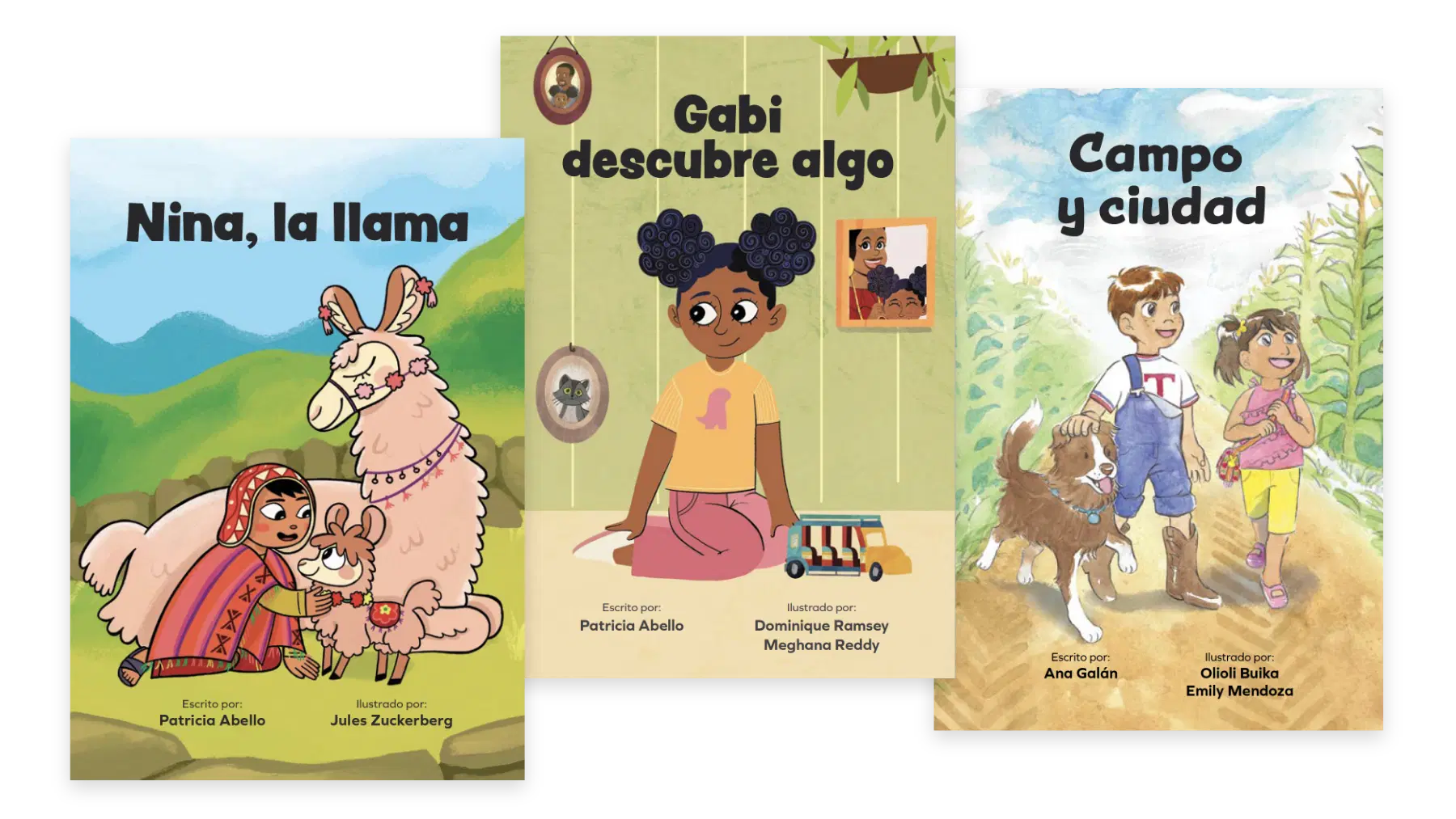
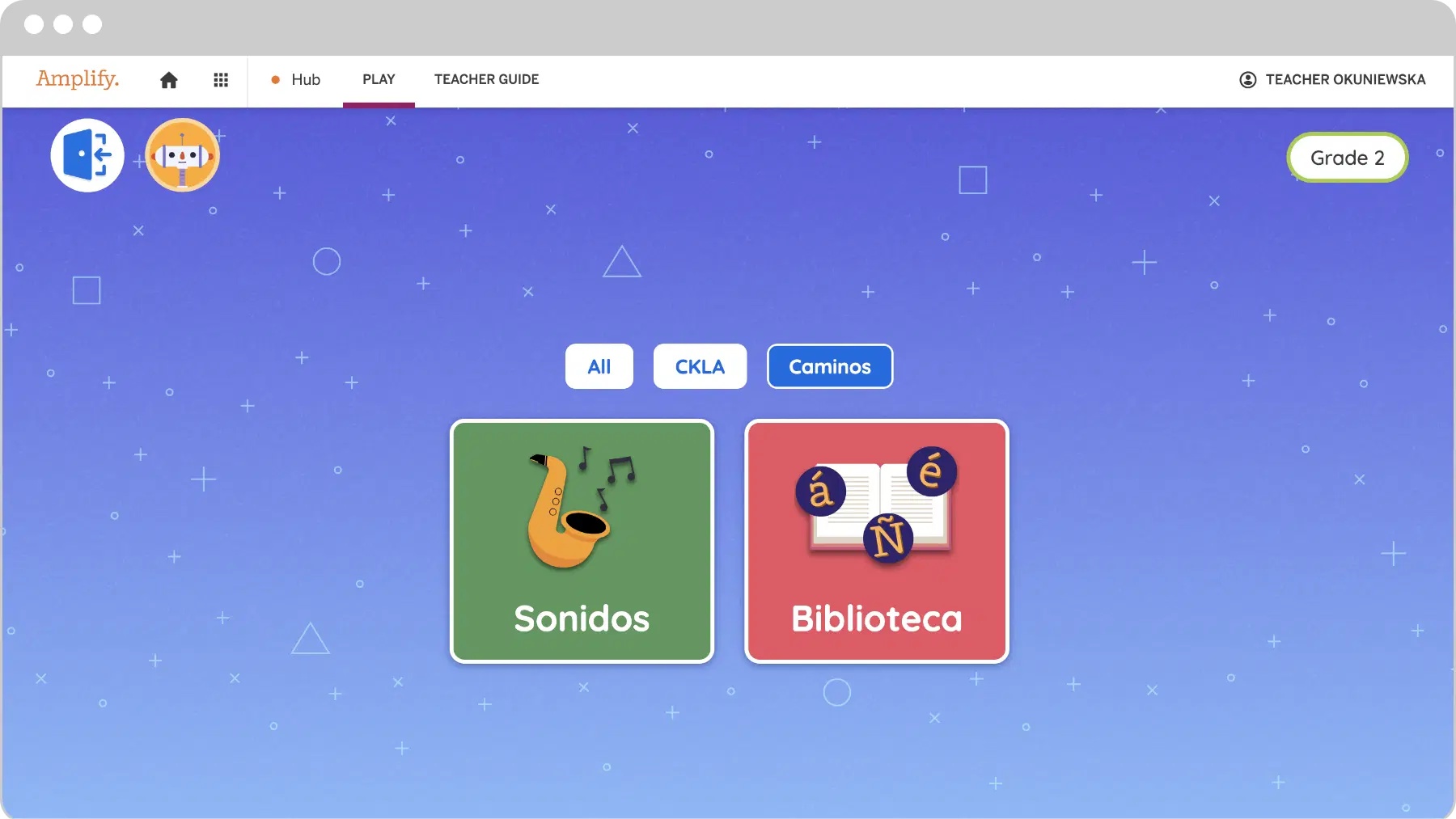
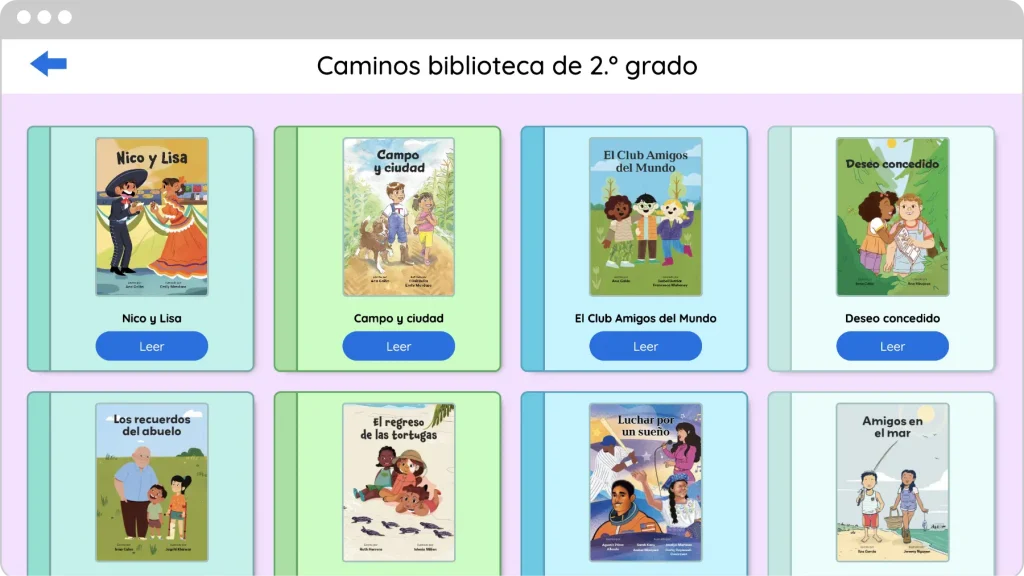
Four vibrant illustrations feature a goat, greeting phrases in Spanish and English, a map with an animal icon, and a fox with rabbits in a forest—perfect for engaging multilanguage & English language learners.
Illustration of a robot character, nine book covers above, and a tablet displaying an e-book page. A pink character stands on a stool holding a book, promoting a reading program for English language learners. Stars decorate the background.

Amplify CKLA core literacy curriculum for grades K–5

Amplify Core Knowledge Language Arts (CKLA) is a K–5 core curriculum built on the science of how students learn to read and write. Amplify CKLA supports ML/ELs in a variety of ways.

Image of a lesson page titled "Introducing the Read-Aloud," focused on speaking and listening skills. The highlighted section emphasizes "Speaking and Listening," seamlessly integrating into the literacy curriculum to support multilanguage & English language learners.

Scaffolding at five levels of proficiency

In addition to core instruction, Amplify CKLA provides lesson supports for Entering/Emerging, Transitioning/ Expanding, and Bridging levels.

An open workbook on writing skills, featuring instructions on creating paragraphs and checking understanding for literacy curriculum, with icons and a

Lesson differentiation

Lessons include Support and Challenge suggestions that provide assistance or opportunities for more advanced work toward the goal of the lesson. These resources are suitable for all learners, including ML/ELs.

A computer screen displays a multilanguage phonics learning app, ideal for English language learners, featuring an astronaut illustration and a play button for the sound "/a/".

Phonological awareness and phonics supports

The digital Sound Library easily facilitates sound development through videos showing mouth movements and songs that help students practice articulating new sounds with catchy lyrics.

A group of young children, including multilanguage and English language learners, sit cross-legged on a classroom floor, some with hands raised, appearing engaged and attentive.

Frequent oral language development opportunities

Amplify CKLA boosts language development with complex read-alouds, interactive discussion, writing activities, and explicit teaching of academic and domain vocabulary.

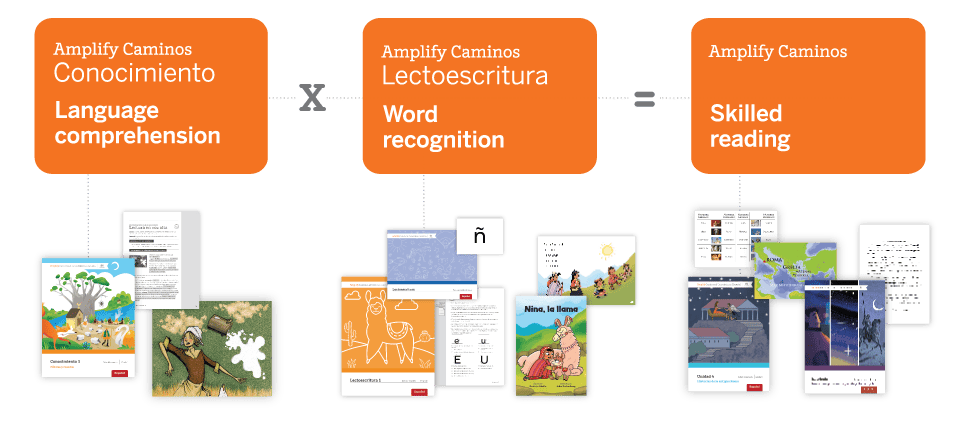
Amplify CKLA pairs with Amplify Caminos, its companion K–5 Spanish literacy program that supports biliteracy instruction.

Language Studio, an English Language Development companion program for Amplify CKLA

Language Studio, Amplify CKLA’s dedicated K–5 English language development companion program, offers daily 30-minute lessons to help ML/ELs practice reading, writing, speaking, and listening skills. Aligned to the World-Class Instructional Design and Assessment (WIDA) framework, Language Studio previews and reinforces language and content from core instruction, so that ML/ELs of all proficiency levels are able to access grade-level content as they develop academic English.

Four illustrated educational book covers are shown, each with different cultural and historical themes, titled "Language Studio Volumes 1-4" from Amplify Core Knowledge Language Arts—perfect for multilanguage and English language learners.
A young girl sits at a desk reading a book, while two other children are in the background—one using a laptop. The scene supports multilanguage and English language learners as they engage with different resources.

Interactive language development

Language Studio provides opportunities for classroom discussions, oral presentations, and writing tasks, promoting comprehension and learning by connecting with students’ cultural and linguistic backgrounds.

A worksheet labeled "Features of Academic Language," ideal for multilanguage and English language learners, with highlighted text: "Draw and Write," "Offer and Support Opinion," and "Tier 3 Domain-specific words.

Explicit vocabulary instruction

Interactive vocabulary and academic language support is provided before each lesson to deepen students’ understanding of text.

Two schoolgirls in green uniforms, English language learners, look at a notebook together in a multilanguage classroom—one holding a pencil box and pointing at the book.

Multimodal comprehension support

Students can preview content, interact with physical materials, compare text types, receive explicit grammar instruction, and have access to extensive vocabulary exercises.

A language proficiency assessment chart for multilanguage and English language learners, listing evaluation criteria and descriptors across five proficiency levels from entering to bridging.

Skill proficiency monitoring

Language Studio facilitates evaluation with an understanding of what students should produce at each level.

A person holds a tablet displaying educational progress, featuring profile images of two students labeled

mCLASS DIBELS 8th Edition literacy assessment for grades K–8

mCLASS® is an all-in-one system for Science of Reading-based universal screening, dyslexia screening, and progress monitoring for grades K–8. Powered by DIBELS 8th Edition, mCLASS provides valuable data on your ML/ELs’ literacy in English, helping you build a robust system of tiered supports. With a single tool, you can access the data and instructional support you need for each student’s literacy development, from phonics to comprehension, catering to all readers, from beginner to advanced.

A laptop screen displays a table showing the beginning-of-year assessment scores for four Grade 1 multilanguage and English language learners across three goal areas: Composite, LNF, and PSF.

Screening and reporting

mCLASS’s one-minute measures and dyslexia screening identify risk as early as possible, providing you with the right data to make informed decisions.

A laptop screen displays an educational platform with a lesson plan on decoding complex word patterns for Grade 3 English language learners under the "Instruction" tab, supporting multilanguage development.

Language considerations

mCLASS provides specific language guidance, offers ML/EL instructional strategies, and considers each student’s unique language background, never penalizing for language variety, accent, or articulation, and extending this understanding into small-group practices.

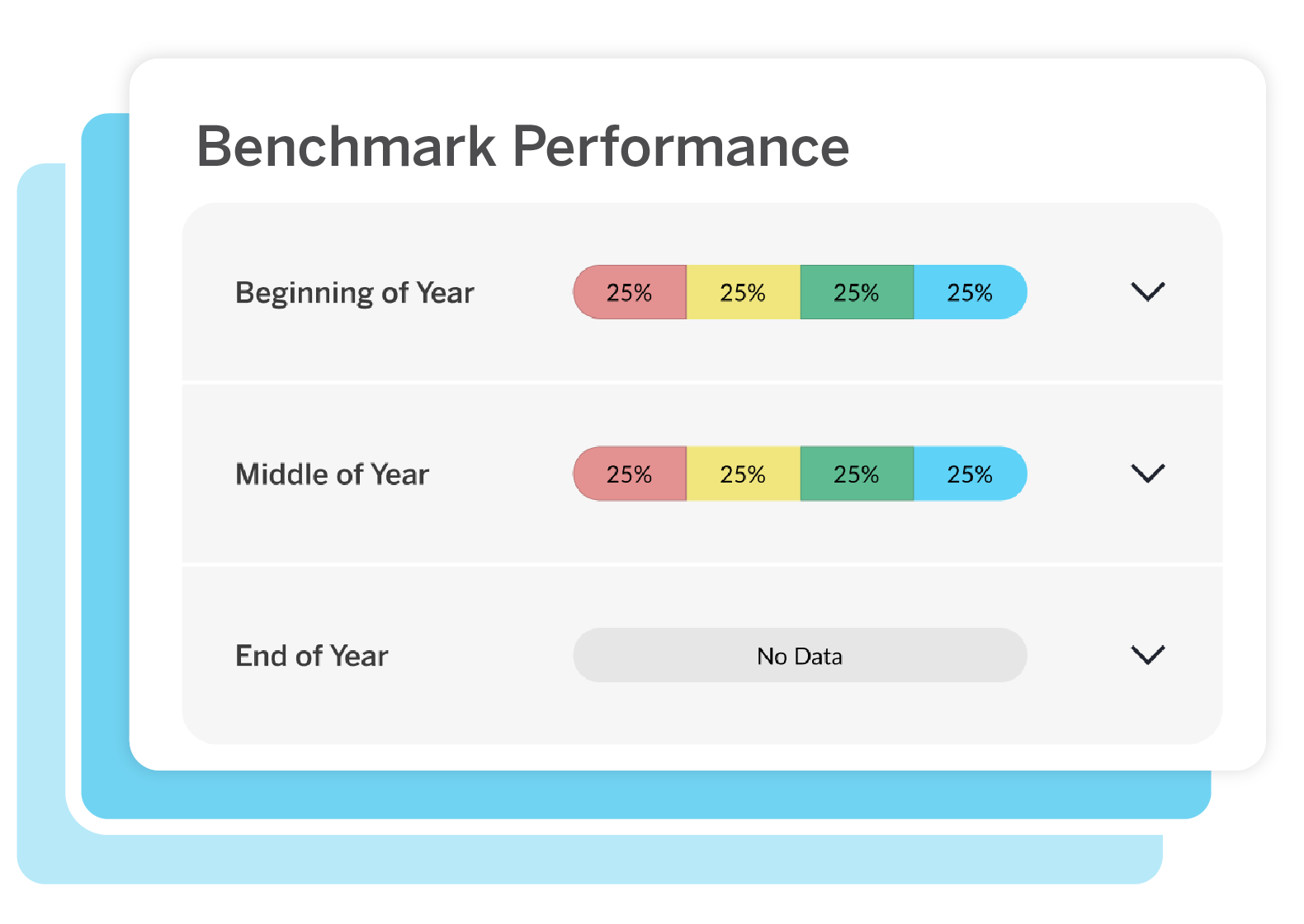
A computer screen displays a dashboard with student assessment data, including charts and tables comparing performance across different benchmarks for multilanguage and English language learners.

Performance and reporting transparency

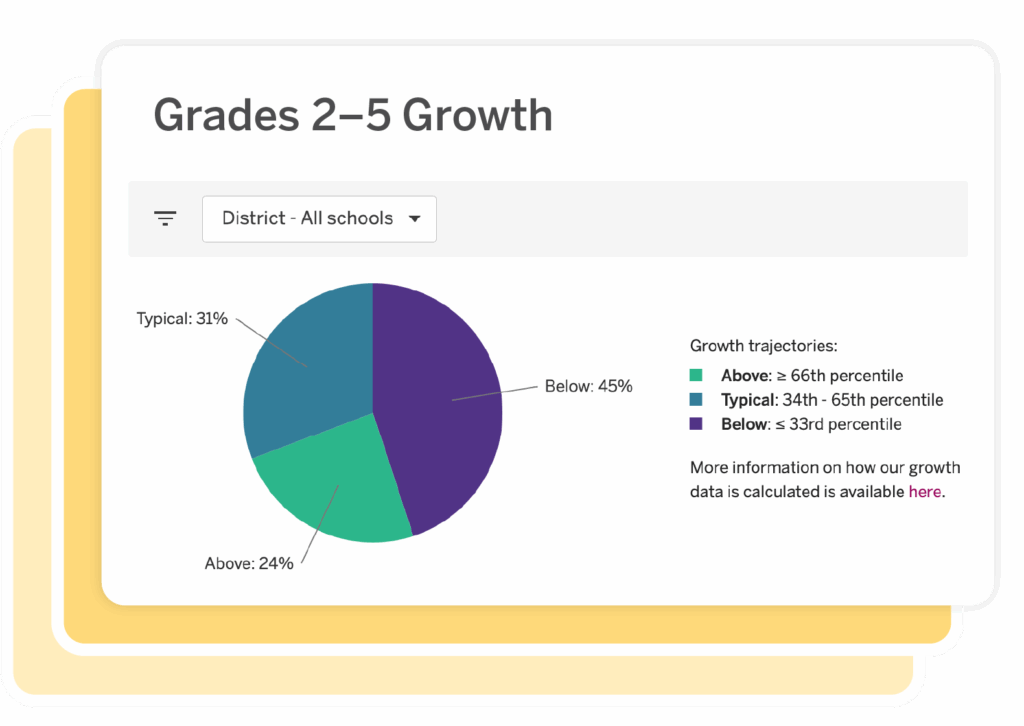
Understand student performance through direct observation and detailed reports which offer growth insights, including district-wide student achievement data that can be filtered by EL status, Home Language, or English Proficiency status.

mCLASS pairs with mCLASS Lectura, an authentic Spanish literacy assessment for K–8 that measures key foundational skills and supports Spanish-speaking bilingual students.

mCLASS Intervention for grades K–6

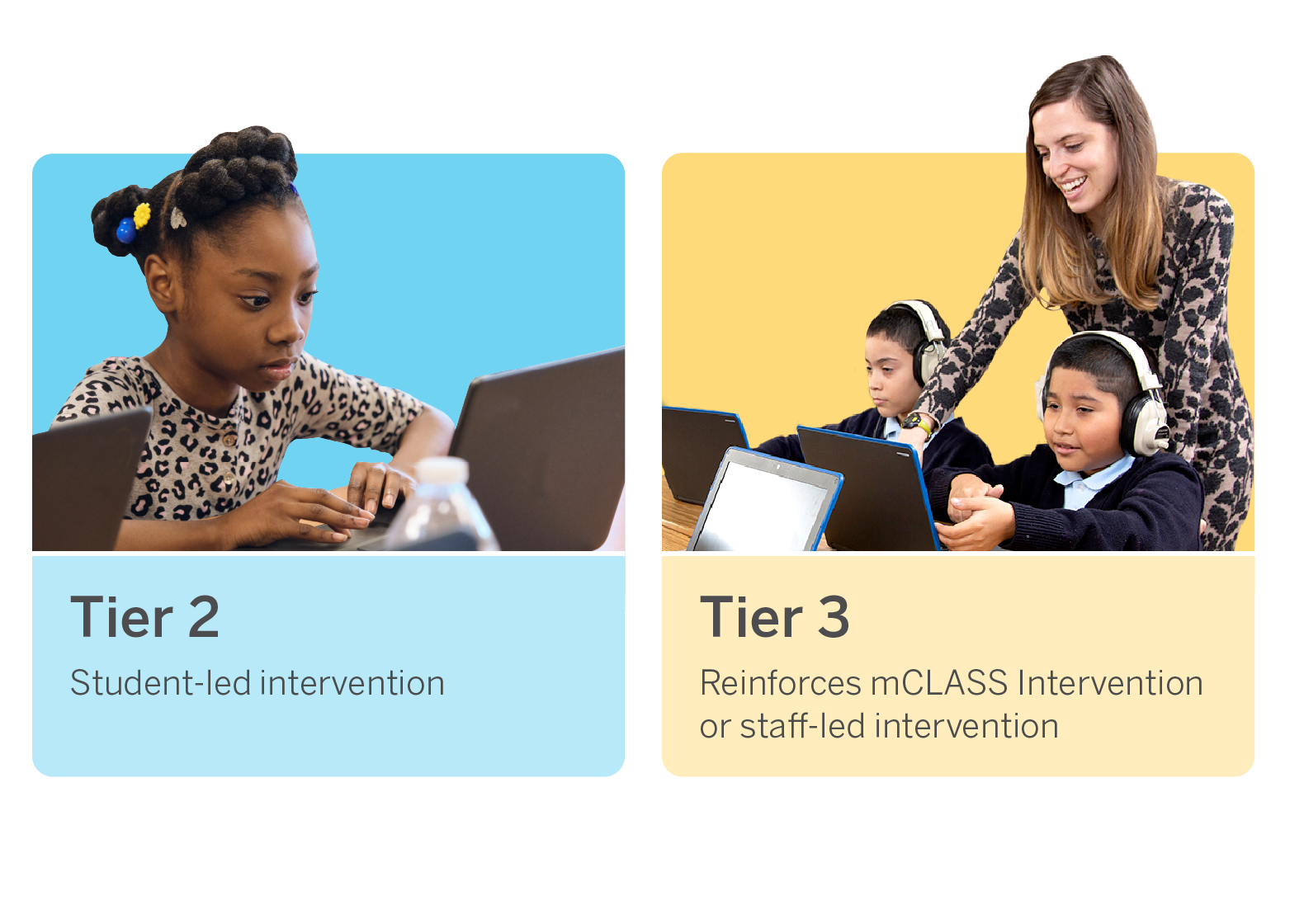
mCLASS Intervention is our K–6 reading intervention program, designed to support you in providing effective Tier 2 and 3 instruction and getting readers on track. mCLASS Intervention does the heavy lifting of data analysis and lesson planning for you. This lets you focus on what you do best: teaching the skills each student needs to become a confident reader.

Infographic showing a 10-day cycle: measure skills, group multilanguage and English language learners, generate lessons, teach students, and provide practice, all arranged in a circular flow.
A worksheet page titled "Introduce a" with instructional text, a letter grid activity, support tips, and a section labeled “Challenge,” overlaid by the text “Multimodal learner resources” for multilanguage and English language learners.

Effective lessons with built-in support

Lessons are equipped with best practices and guidance targeting language and literacy development for ML/ELs. The program also includes materials and resources that make content accessible to Spanish-speaking students.

A lesson plan shows students, skills, and Day 1 activities for a 10-day Blending and Regular Words set—ideal for multilanguage and English language learners—involving sounding out, blends, and a word race game.

Structured small groups

Once groups are formed, mCLASS Intervention determines the ideal focus for each group and automatically prepares two weeks of targeted lessons.

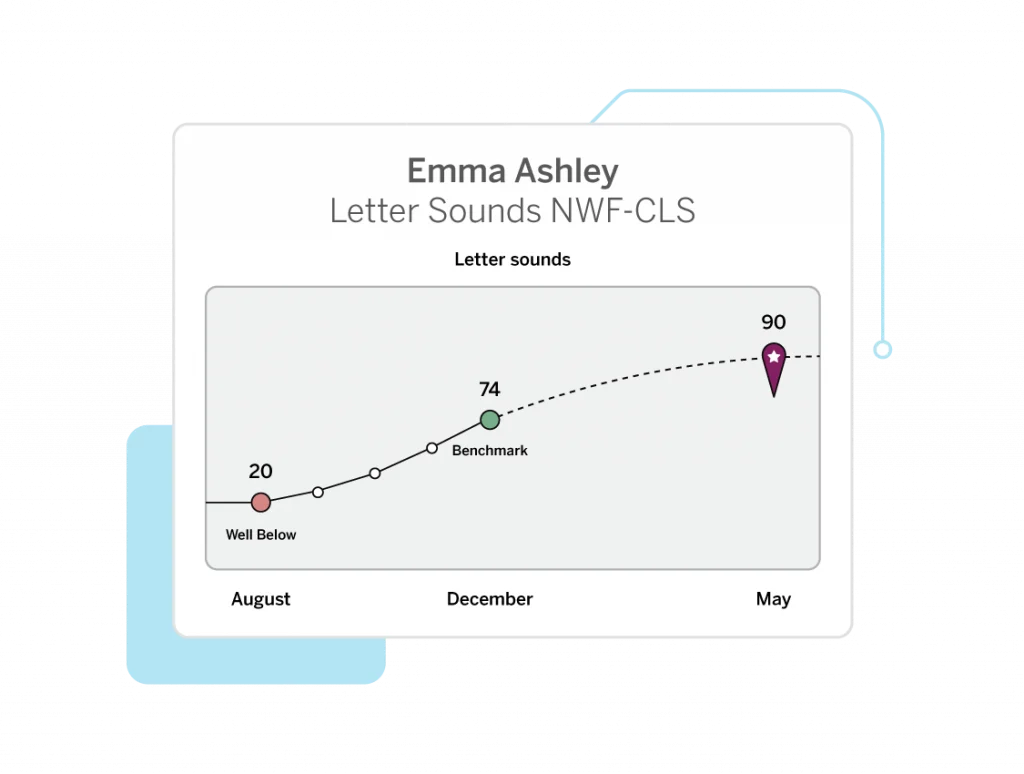
A line graph showing Emma Ashley's letter sounds scores: 20 in August, 74 in December (benchmark), and projected to reach 90 in May—demonstrating strong progress for multilanguage and English language learners.

Keeps you updated on student progress

Track student growth with reliable progress-monitoring tools and reporting that provides a clear view of each student’s progress.

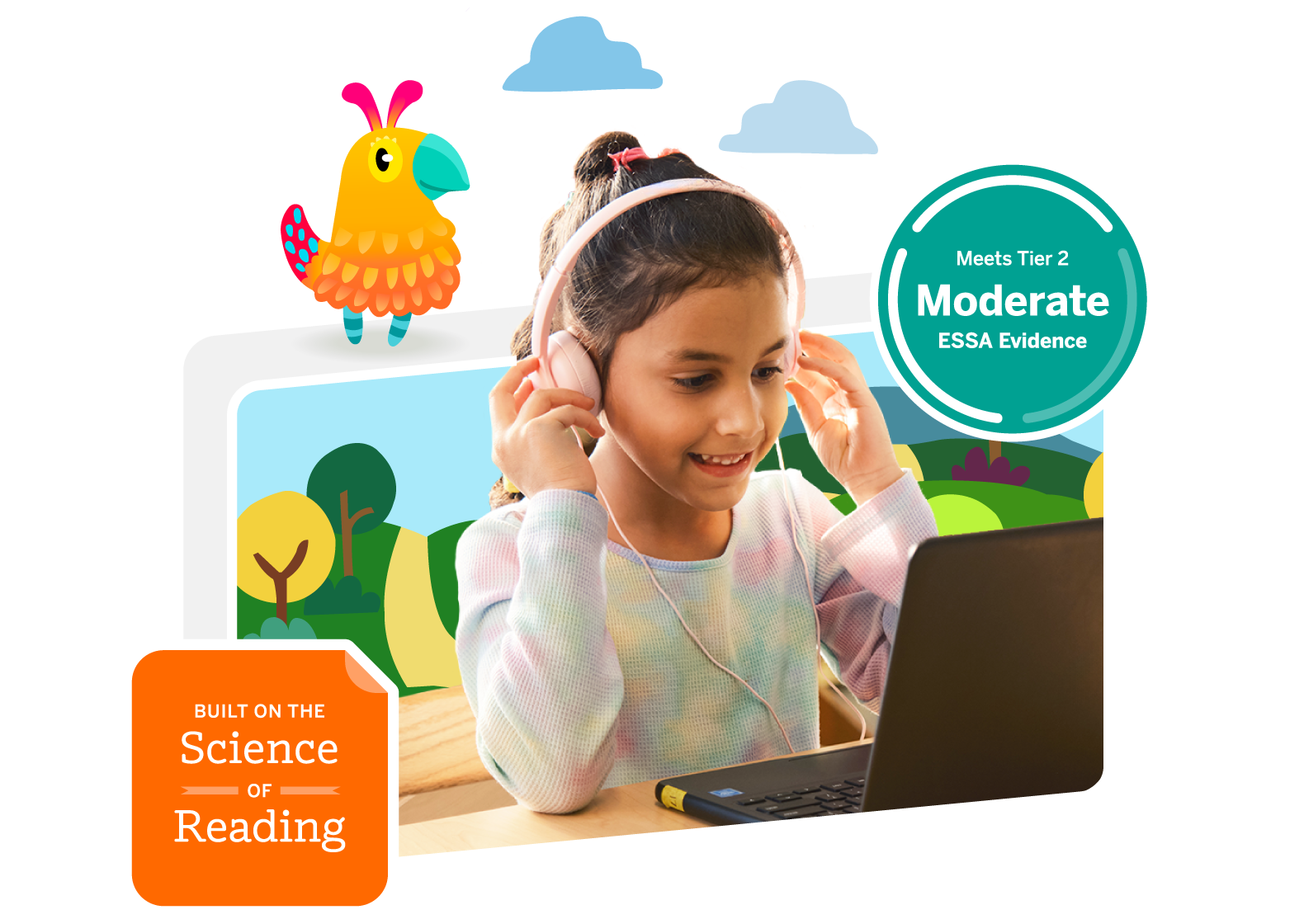
A young girl with headphones uses a laptop, sitting in front of a colorful, illustrated background with trees, clouds, a bird, and Science of Reading and ESSA Evidence badges—perfect for multilanguage and English language learners.

Boost Reading personalized reading program for grades K–5

A key component of Amplify’s early literacy suite, Boost Reading is a personalized learning program for K–5 that offers comprehensive targeted practice, built-in benchmark assessments, and powerful reporting. Boost Reading provides practice in the full progression of key phonics and comprehension skills critical to literacy development.

Boost Reading works. Results of a year-long study show that students in grades K–5—including ML/ELs—who used Boost Reading for 30 minutes a week significantly outperformed their peers.

A computer screen displays a sentence highlighting the words "Mateo" and "he," with arrows connecting them—helpful for multilanguage and English language learners. A "Done" button and an illustrated face are also visible.

Systematic instruction in foundational skills and comprehension

Reinforce core instruction with explicit practice in phonics and phonological awareness. Boost Reading is the only program that focuses on comprehension processes—what readers do while reading that allows them to make sense of text—which is especially beneficial for ML/EL students.

A laptop screen displays a cartoon mouth, a person’s face above it, and four toast-shaped buttons below—ideal for multilanguage practice and engaging English language learners.

Mouth formation modeling for articulation support

Boost Reading includes specific scaffolds and supports—such as a modeling of mouth formations for articulation—that are proven to be beneficial for ML/ELs.

A colorful educational game screen supports English language learners and multilanguage skills, showing a creature on a log labeled "stamp" with four word choices: sand, stand, stamp, and champ. A waterfall and plants are in the background.

Vocabulary practice

Targeted morphology practice for independent vocabulary building and explicit instruction with Tier 2 vocabulary words are proven to be supportive for ML/ELs.

Boost Reading pairs with Boost Lectura, a Spanish literacy program for K–2 that provides students with personalized practice to develop Spanish literacy skills.

Want to learn more about Amplify’s elementary biliteracy suite?

Fill out this form, and we’ll be in touch with you shortly.

Amplify ELA core literacy curriculum for grades 6–8

With Amplify ELA, students learn to tackle any complex text and make observations, grapple with interesting ideas, and find relevance for themselves. Amplify ELA is a grade 6–8 English language arts program designed to bridge language gaps and enhance learning for ML/ELs. With integrated supports in every lesson, Amplify ELA empowers educators to deliver grade-level content while maintaining rigorous standards, thus reducing barriers to language acquisition and boosting student success.

A tablet showcases an educational lesson interface about butterflies, alongside a book titled "Amplify ELA: Summer of the Mariposas," surrounded by illustrated butterflies, enriching the literacy curriculum and engaging multilanguage & English language learners.
A tablet screen displays a digital reading and writing assignment with text excerpts on the left and character trait questions on the right, designed to support multilanguage and English language learners.

Built-in scaffolds

Background documents (in English and Spanish) establish context and support comprehension before students begin to read. Features such as audio assessments, read-aloud, and Reveal words ensure that all students have the opportunity to engage with and understand grade-level materials.

A worksheet with a writing prompt about "Summer of the Mariposas," designed to support multilanguage and English language learners as they describe a character and explain her traits using evidence from the story.

Differentiated writing prompts

Simplified language, sentence starters, word banks, and visual cues offer the necessary levels of support to help students meet their writing goals.

A book titled "Mysteries & Investigation Multi-Language Glossary" with glossary cards for English-French and English-Vietnamese translations of the phrase "a wealth of," ideal for multilanguage study and English language learners.

Multi-language glossaries

Available in 11 languages—English, Arabic, Chinese, French, Haitian Creole, Portuguese, Russian, Spanish, Tagalog, Urdu, and Vietnamese—these glossaries support vocabulary development and comprehension.

Amplify Desmos Math core curriculum for grades K–12

Amplify Desmos Math is a curiosity-driven K–12 program that builds students’ lifelong math proficiency. Every lesson in Amplify Desmos Math includes opportunities for all students to develop mathematical language as they experience the content, while providing intentional support for ML/ELs. We purposefully progress language development from lesson to lesson and across units by supporting students in making their arguments and explanations stronger, clearer, and more precise.

A text box suggests encouraging multilanguage and English language learners to paraphrase peers’ ideas, building connections and using unit vocabulary, with an emphasis on speaking and listening skills.

Multilingual/English learner support

Supports for ML/ELs are called out at intentional points within each lesson. These specific, targeted suggestions support ML/ELs with modifications that increase access to a task, or through development of contextual or mathematical language (both of which can be supportive of all learners). ML/EL supports may also be attached to Math Language Routines.

A text box explaining MLR7: Compare and Connect, with prompts for students—including multilanguage and English language learners—to analyze, compare, and connect different problem-solving strategies.

Math Language Routines (MLRs)

Math Language Routines are used within lessons to highlight student-developed language and ideas, cultivate conversation, support mathematical sense-making, and promote metacognition. Tips for facilitating MLRs are included when they would be helpful within lessons.

A white box lists today’s goals for a lesson on parallelograms, including area calculation and encouraging multilanguage & English language learners to use mathematical language in writing, speaking, and listening.

Language goals and vocabulary

Language goals attend to the mathematics students are learning, and are written through the lens of one (or more) of four language modalities: reading, writing, speaking, and listening. Units and lessons start by surfacing students’ language for new concepts, then building connections between their language and the new vocabulary for that unit. This honors the language assets that students bring into their learning.

Amplify Science core curriculum for grades
K–8

Amplify Science is a curiosity-driven science curriculum that empowers students to Do, Talk, Read, Write, and Visualize like scientists. Through phenomena-based, literacy-rich, and interactive learning experiences, it develops students into critical thinkers who will gain the skills they need to solve real problems in their communities and the world. For students who need additional support, Amplify Science provides specialized instructional approaches, activities, and resources that take into account English learners’ level of language proficiency.

A teacher and three children, all English language learners, interact enthusiastically around a table with a colorful project in a classroom setting. The lively discussion enhances their literacy curriculum experience, fostering both creativity and understanding.
A document page titled "Patterns of Earth and Sky" is shown, with a highlighted overlay listing printable resources for multilanguage and English language learners, such as objectives, compilations, and glossaries.

Instructional design built on five key principles

Amplify Science leverages background knowledge, capitalizes on student knowledge of language, provides explicit instruction about the language of science, gives students opportunities with scaffolded practice, and enables students to access science content and express science knowledge through a multimodal approach.

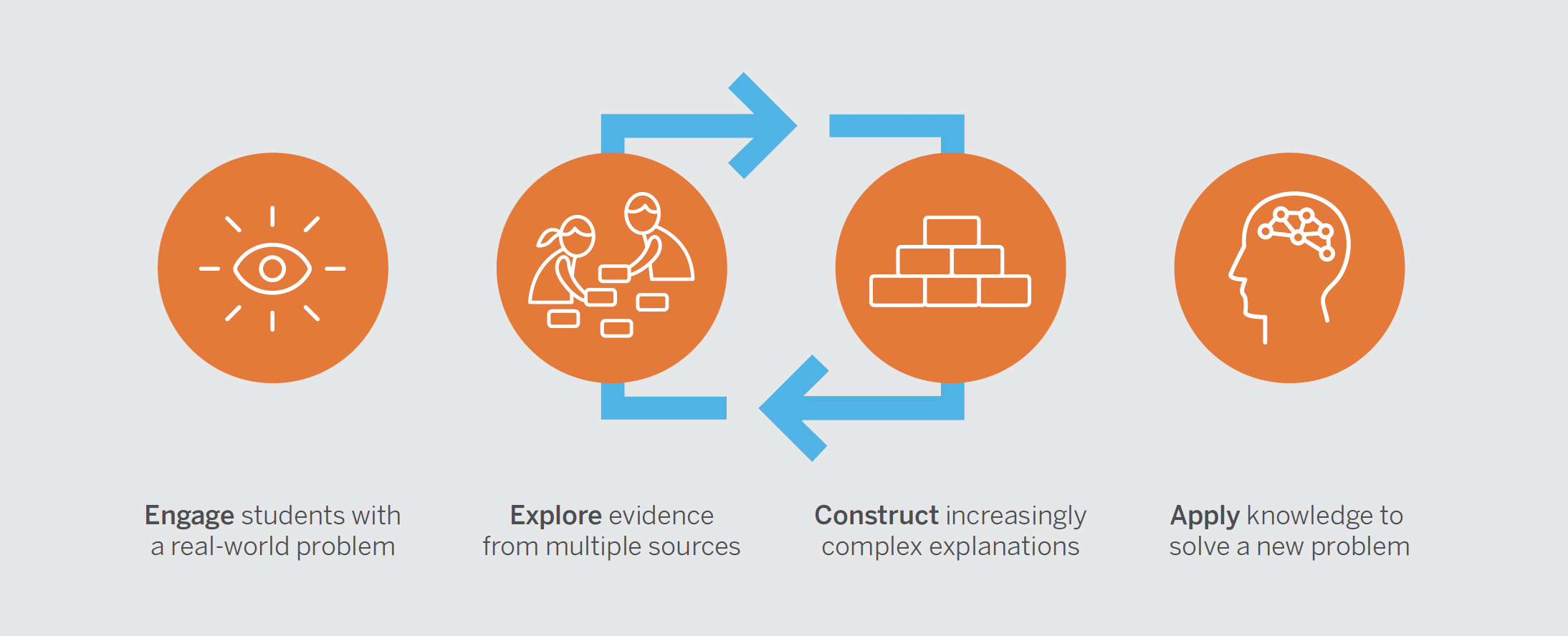
A blue square with two arrows forming a loop, next to the words: Do, Talk, Read, Write, Visualize—ideal for multilanguage and English language learners.

Do, Talk, Read, Write, Visualize instructional model

Our multimodal instructional approach caters to diverse learning needs and promotes active engagement for all learners.

A webpage section titled "Differentiation" discusses teaching strategies for diverse learners, including multilanguage and English language learners, with a sidebar listing various digital resources and lesson materials.

Honoring multilingualism

Amplify Science honors multilingualism as students are invited to share in their native language at strategic points in instruction. Teacher-led instruction on cognates and a multilingual glossary in 10 languages offer additional support.

Cover of a Spanish-language science booklet titled "Patrones de la Tierra y del cielo," ideal for multilanguage and English language learners, featuring a space illustration and an orange "Cuaderno de investigación" button at the bottom.

Spanish instructional materials

Carefully translated materials use academic Spanish, with attention to consistency and grade-level appropriate language, to support language development.

A biliteracy suite grounded in the Science of Reading

Discover a suite of Spanish literacy curriculum and assessment programs designed to build confident readers with Amplify CaminosmCLASS Lectura, and Boost Lectura. Amplify’s biliteracy suite includes assessment, core instruction, and personalized learning built on the Science of Reading.

Explore more programs in Amplify’s literacy and biliteracy suites.

All of the programs in our literacy suite and our biliteracy suite are designed to support and complement each other. Learn more about our related programs:

Welcome to the Baltimore Tutoring Project!

Baltimore City Schools and Amplify have partnered to provide virtual reading tutoring services. Amplify Tutoring aligns with the mission of Amplify in extending the reach of classroom teachers and supporting rigorous and riveting learning experiences for students. The purpose of this high impact tutoring is to support and accelerate student achievement in foundational literacy skills in order to address unfinished learning and achievement gaps. Classroom teachers teach foundational literacy skills in whole group and small group settings; Amplify tutoring is one way to support teachers in meeting the needs of their students by providing additional opportunities for struggling students to work in small groups with a tutor. 

Two students using a laptop in a classroom with "amplify" and "baltimore city public schools" logos displayed.

Welcome, Baltimore Educators!

We’ve created this website with resources that will help ensure the success of your high-impact tutoring program.

Log In to Amplify Tutoring

Logging in with a personal device

  1. If you’re already logged into Clever, go to tutor.amplify.com and click Log In with Clever. You will be taken directly to Amplify Tutoring.
  2. If you’re NOT logged into Clever, go to tutor.amplify.com and click Log In with Clever.
  3. Scan the Clever badge OR enter your school name and your Clever username and password and click Log in
Young girl with headphones using a laptop for online learning, interacting with a school login page.
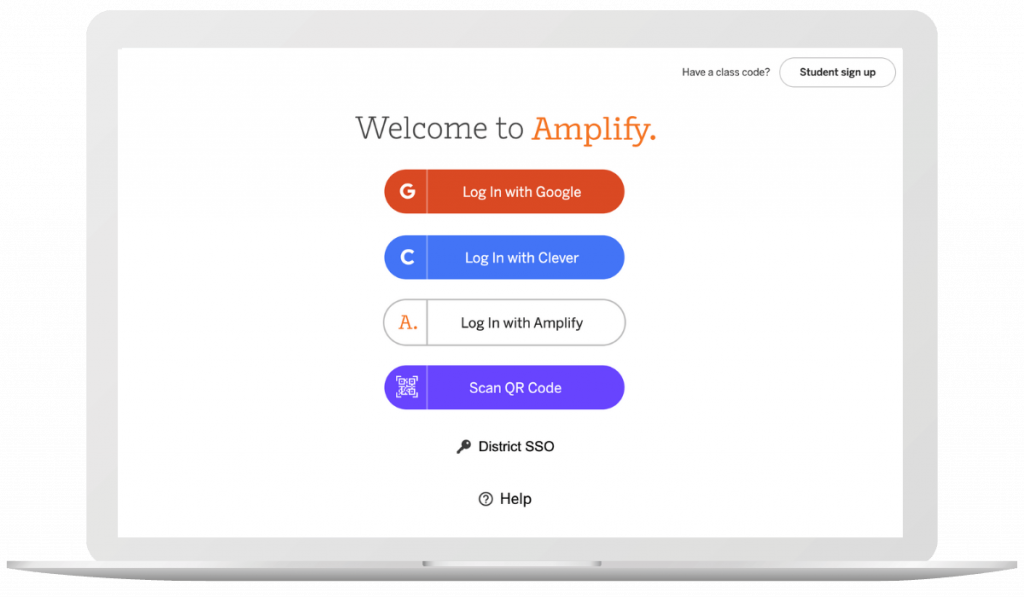
Screenshot of a login page with options to log in with google, clever, amplify, and a qr code, highlighted by a red arrow pointing at the "log in with amplify" button.

Logging in with a shared device

  1. If you’re using a shared device, go to tutor.amplify.com and click Log In with Amplify.
  2. Enter your Amplify Reading username and password.
  3. Click Log in.

Logging in for the first time

After you log in for the first time, scroll down to complete the welcome tutorial.

Illustration of a computer monitor displaying a page labeled "abc" with a welcoming message, "welcome to the new blackboard!" above it.

Join a Tutoring Session

  1. After you log in, click your class.
  2. Click Blackboard Collaborate and then click Join session.
  3. In the list that displays, click your class name to join the scheduled session. Note: You can only join a session at the time it is scheduled. If the scheduled session isn’t in progress, you will see “Room disabled” under Blackboard Collaborate.
  4. If you’re joining for the first time, click Allow to give your browser permission to use the microphone and camera. Check to make sure each is working.
  5. To stop seeing onscreen instructions: click Later under Start Tutorial, then click X on the next prompt.

You should now be able to see and hear your tutor and the other students in your session.

Screenshot of an online education platform interface labeled "rmeyer tutoring grade 1 - test" with a menu on the left and a large red arrow pointing to "attendence.

Test Session Audio and Video

A minimalistic user interface of an online platform displayed on a laptop screen, showing a welcome message and options for uploading content and checking audio.
  1. To test audio and video, you must first join a session. Audio and video settings can only be tested in a session.
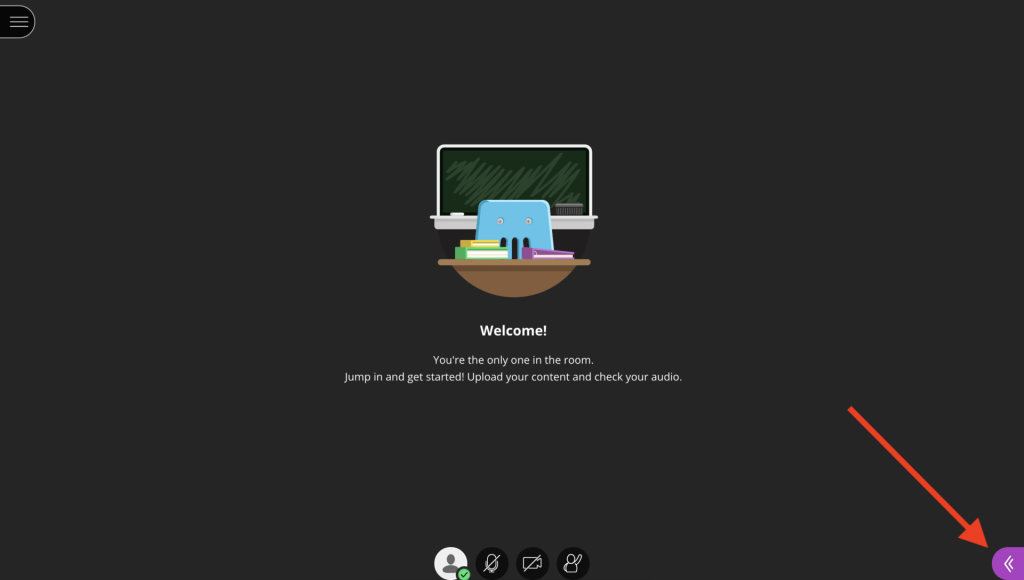
  2. Open the Collaborate panel by clicking the purple icon in the lower-right corner of the page.
  3. Click the My Settings icon in the panel that opens.
  4. Click Set up your camera and microphone.
  5. Test your microphone, and grant permission to your microphone if asked.
  6. Test your camera, and grant permission to your camera if asked.

Your tutor and the other students in your session should now be able to see and hear you.

Clearing cache and cookies

Here are instructions to clearing cache and cookies

Download PDF

Two women, one middle-aged and one younger, working together on a laptop in a library, with two other people in the background.

Webinars

View our latest webinars for more information

Amplify Tutoring – Scheduling Training Session for School POCs

https://youtu.be/H-3PZHVNBRY

Watch now

Amplify Tutoring Identifying Students Training

https://youtu.be/3eKSWtsMgQ4

Watch now

Student-friendly resources

Student log-in instructions

Here is a PDF of student log-in instructions

Download PDF

Two young girls, smiling and looking at a tablet together in a colorful classroom, engaged in an online reading program.

Additional resources

Three colleagues, one holding a laptop and another holding a tablet, discuss work in front of a wall covered in colorful sticky notes.

Amplify family letter

Here is an Amplify family letter for your use.

Download PDF

Student inventory of devices

How to obtain an additional inventory of student devices PDF

Download PDF

Boost Reading classroom of learning children reading program
An adult sits on a couch using a laptop while a child next to them does homework in a notebook.

Family Letter- Pivoting to Remote Learning

Here is an Amplify Family Letter- Pivoting to Remote Learning for your use.

Download PDF

Connect, Reflect, Share!

Una mujer ayuda a dos estudiantes con una computadora portátil en un salón de clases. Un estudiante escribe en un cuaderno mientras el otro mira la pantalla. Los carteles adornan la pared detrás de ellos.

Complete this optional Google form to share highlights from tutoring. We would love to capture and share your a-ha moments, the practices/strategies/resources you have found helpful, and/or celebrations of your students’ growth as readers and your development as a tutor!

Please use the form below to alert us of issues and concerns. We will look at trends, solutions, and reach out to schools if needed.

Contact us for support

Want to learn more?

Visit our main tutoring page for more information

Visit site

mCLASS® with DIBELS® 8th Edition is Washington approved!

mCLASS DIBELS 8th Edition and mCLASS Rapid Automatic Naming (RAN) helps teachers identify COVID-related learning loss and literacy needs firsthand through a quick five-minute assessment that can be done virtually or in person. What’s more, it helps teachers take immediate instructional action that’s right for each and every student.

Now that mCLASS has been approved by the Washington Department of Education and the Dyslexia Advisory Council, every district can confidently address student needs and meet the state’s dyslexia legislation.

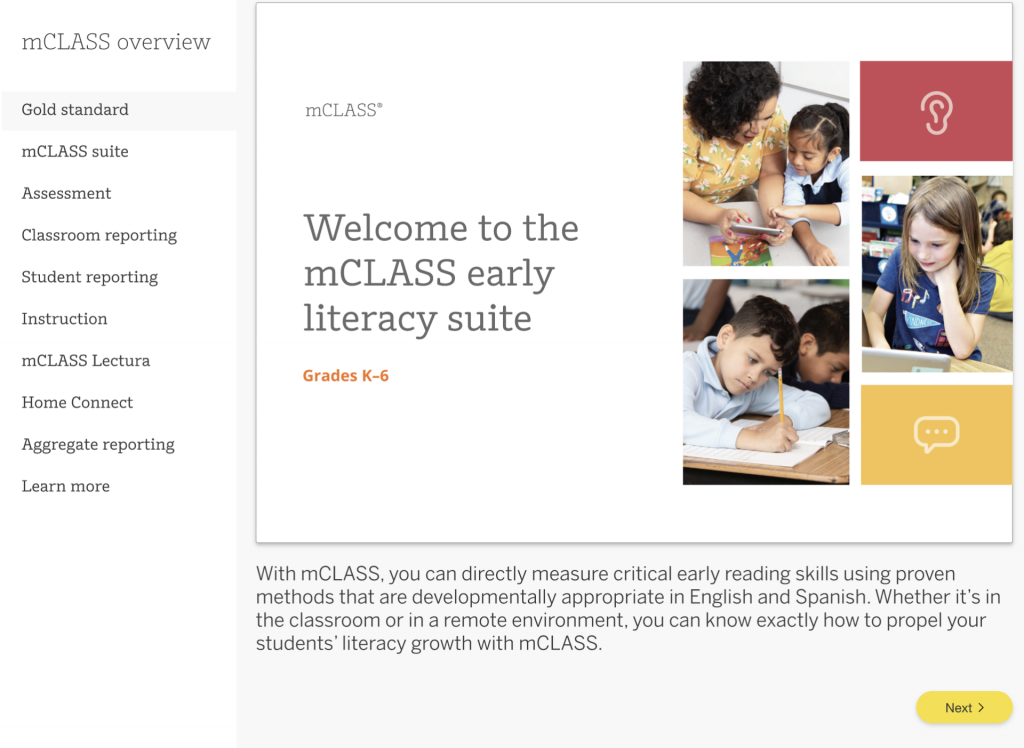
A teacher helps a young student with a tablet; below, a girl listens attentively. Icons of a book and a puzzle piece appear on colored backgrounds.

What is mCLASS?

mCLASS® DIBELS® 8th Edition and mCLASS RAN is an integrated, gold standard literacy system for grades K–6.

The mCLASS comprehensive system includes efficient one-minute measures, a built-in Enhanced Early Learning Measures screener, teacher-led and student-driven instruction, intervention, and robust reports for teachers and administrators.

With mCLASS, you can say goodbye to cobbling together tools and second guessing the results of other screeners.

A girl sits at a desk reading and writing, with educational words in the background; text highlights mCLASS as a gold standard in early literacy.

University of Oregon

Together with the University of Oregon (U of O), we have made the DIBELS® (Dynamic Indicators of Basic Early Literacy Skills) assessment that you know and love more powerful and user-friendly than ever before.

As the only licensed provider of the digital DIBELS 8th Edition assessment, we make it faster and easier to understand where every student is in their early literacy journey. As an all-in-one universal and dyslexia screener, DIBELS 8th edition gives teachers actionable data with targeted instructional recommendations to ensure all students’ reading needs are met. To learn more about DIBELS 8th edition as a screener for reading difficulties, download the University of Oregon’s “Dyslexia Screening and DIBELS 8th Edition” whitepaper.

Why mCLASS?

It’s a single solution that meets all of the state’s requirements for Early Screening of Dyslexia.

  • It’s a universal early literacy and dyslexia screener with Enhanced Early Learning Measures and a diagnostic tool in one.
  • It allows for real-time assessment and instant scoring as well as offline assessment capabilities.
  • It includes explicit literacy instruction and intervention strategies based on student performance.
  • It’s flexible and can be implemented in a variety of scenarios, including in-person, remote, and hybrid learning environments.
  • It includes a variety of parent notification resources and at-home reading strategies.
  • It’s continually enhanced with new features and regular updates that are made available to our entire user community.
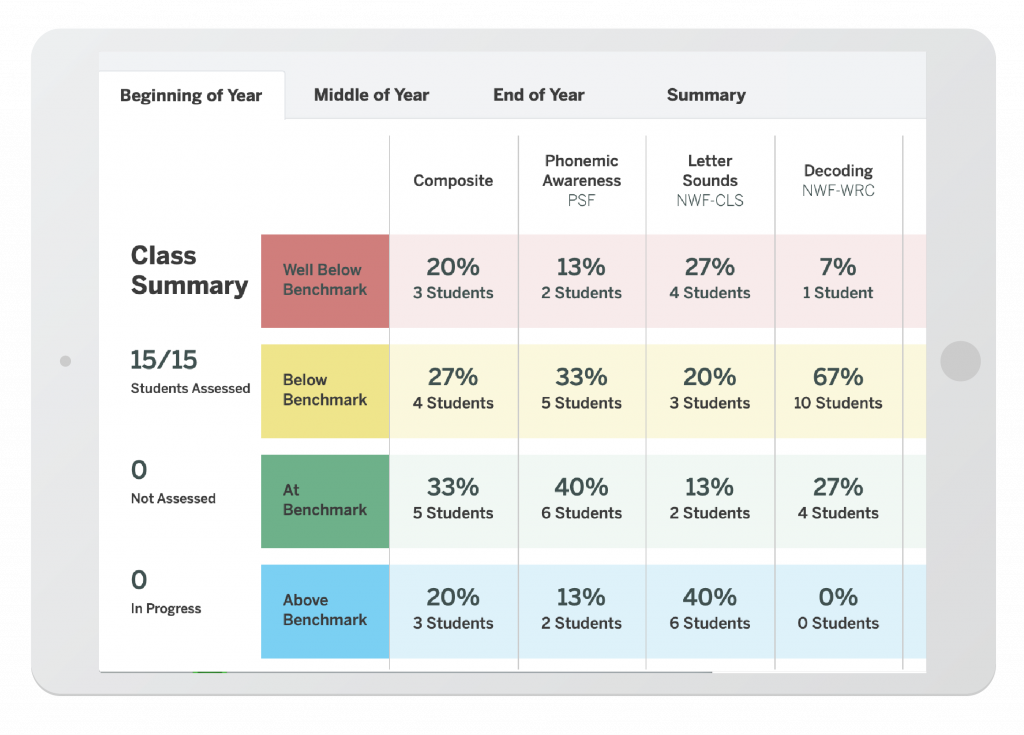
Tablet displaying a student performance table. Columns for assessment times; rows for performance levels. Percentages and student counts are provided in each assessment area and level.

Instant data and action

Quick and actionable reports provide detailed insight into students’ reading development across foundational literacy skills for classroom teachers and literacy specialists, principals and district leaders, and parents and guardians at home.

What’s more, mCLASS® DIBELS® 8th Edition and mCLASS RAN gives you instant results and clear next instructional steps for each and every student.

Enhanced Early Learning Measures

Early intervention is critical. That’s why we help you meet state dyslexia legislation with one single powerful tool—no additional assessment system required.

Our additional measures in vocabulary, spelling, and rapid automatic naming (RAN) address the full range of skills associated with dyslexia risk and help identify students at varying levels of risk for reading difficulties, including dyslexia.

A young man with a beard, wearing a yellow hoodie, is working on a laptop at a desk beside a bookshelf with a fishbowl and soccer ball.

Assess anywhere

mCLASS has created a collection of resources to help you plan for a variety of assessment scenarios.

Whether your school is engaged in in-person, hybrid, or remote instruction, we know how important it is for teachers and administrators to have a full (and firsthand!) picture of every student’s literacy development.

Personalized practice

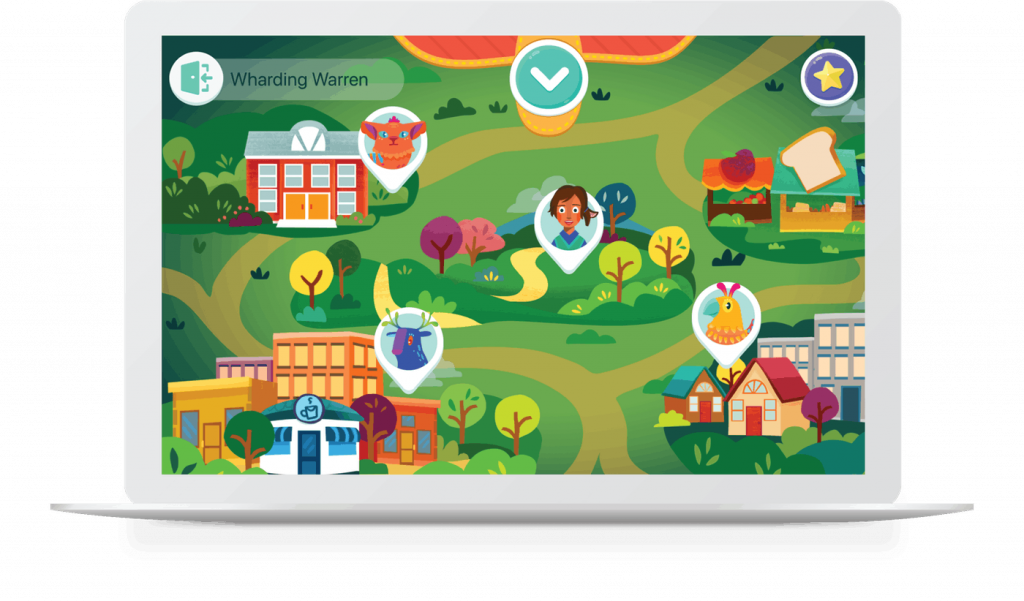
Boost Reading (formerly Amplify Reading) is the practice and remediation companion to mCLASS. At its heart, there are three main areas that make Boost Reading a unique and essential supplemental learning program.

  • The program meets all students where they are with powerful individualized instruction and practice.
  • Age-appropriate narratives create a learning experience that leaps off the screen.
  • Research shows Boost Reading improves student performance–particularly among English Learners–reducing the overall percentage of students at risk of reading difficulty.
Young girl with curly hair sits indoors, looking at a tablet device with a focused expression.

Funding

Schools may utilize LAP Funds, Early Literacy Grants, or federal CARES Act funds to purchase assessments to meet Washington’s screening legislation.

Get in touch

Ready to discuss how mCLASS can support your specific needs? Please contact your Amplify Account Executive:

Alicia O’Neil

Senior Account Executive

(425) 890-6103

aoneil@amplify.com

Erin Elfving-Strayhan

Senior Account Executive

(971) 291-9854

estrayan@amplify.com

Kristen Rockstroh

Account Executive

(480) 639-8367

krockstroh@amplify.com

mCLASS for Missouri

To view this protected page, enter the password below:


Universal screening built on the Science of Reading

Based on over 30 years of research, mCLASS® is the universal K–6 assessment and intervention suite for early literacy that helps every child learn to read confidently.

  • Teenage boy with red hair using a tablet for an mCLASS early literacy assessment in a classroom setting, focused intently on the screen.
  • A teacher sitting around a table with three students.
  • A teacher and a student using a tablet.
  • Students listening at an assembly

What is mCLASS?

mCLASS, powered by DIBELS® 8th Edition, offers teacher-administered literacy assessments and intervention for grades K–6.

When you use mCLASS, you can be assured your students are getting the best the Science of Reading has to offer. Our assessments have been built on decades of research in curriculum-based measurement science, delivering a proven approach that screens for at-risk students and provides deep insight into individual students’ reading development.

What educators say

“With mCLASS, the focus is on instruction. Teams work together to collaborate and share ideas and get excited about using each other’s ideas. And students are involved in looking at their own data too—they are involved in their own plan for growth.”

Linda

Principal, Colorado

What educators say

“There is no time to waste in a teacher’s day, and mCLASS is a quick and accurate assessment of a student’s reading strengths and weaknesses.”

Nita

Reading coach, Oklahoma

What educators say

“The reports are invaluable. One-click reports are useful and make it easy. I’m able to make adjustments and focus on the at-risk students in need—at the moment of need.”

Launa

DIBELS coordinator, Utah

Image of DIBELS 8th edition logo

Based on decades of leading literacy research

We partner with experts at the University of Oregon’s Center on Teaching and Learning, a recognized leader in early literacy assessment.

The University of Oregon are the creators of DIBELS® (Dynamic Indicators of Basic Early Literacy Skills) and mCLASS is the only licensed digital provider of the research-based DIBELS 8th Edition assessment. See more of our research.

Our approach

The comprehensive mCLASS system includes efficient DIBELS 8th Edition’s one-minute measures, a built-in dyslexia screener, intervention, and robust reports for teachers and administrators. It’s all you’ll need to monitor and support every student in your classroom.

Save hours of time

As the only digital provider of DIBELS 8th Edition’s one-minute measures, mCLASS eliminates the manual assessment process— saving you hours of time and giving you instant results and clear next steps for each student. Learn more about mCLASS’S efficient measures.

A laptop screen displaying a student education management system, highlighting a student profile with performance graphs and assignments.
Spreadsheet from mCLASS foundational literacy assessment, with rows of names and columns of categories, displaying individual scores and performance levels like "below benchmark" and "well above.

Catch at-risk students early.

Early intervention is critical. mCLASS offers universal and dyslexia screening in a single powerful tool—no additional assessment system required. Your most vulnerable readers are identified at the earliest levels. Learn more about mCLASS’s dyslexia screening.

Connect student data to personalized learning.

mCLASS connects with Boost Reading (formerly known as Amplify Reading), a K–5 student-driven literacy program that provides both remediation and enrichment for all students, leveraging the power of compelling storytelling to engage students in personalized reading instruction and practice. Learn more about Boost Reading.

Boost Reading - reading curriculum how it works image
A teacher instructing a classroom of students

Better data means better instruction.

mCLASS lets you know exactly which aspect of a skill a student is struggling with, and then gives you effective lesson plans for each student powered by reliable universal screening based on one-minute measures. Learn more about mCLASS reporting.

We’re making an impact

2,000,000

students

120,000+

teachers

1,200+

districts

6,000+

schools

What’s included

mCLASS provides benchmark and progress-monitoring assessments for grades K–6. Its ecosystem of elementary reading resources works to target skill gaps and provide the right instruction at the right time.

A laptop screen displaying the mCLASS assessment dashboard for Grade 1 reading. The screen shows scores for five students, with indicators for "Passed" or "Well Below" next to each name.

DIBELS 8th Edition

mCLASS is powered by DIBELS 8th Edition, enabling you to automate scoring and receive instant targeted instructional recommendations. DIBELS 8th Edition measures:

  • Phonemic awareness
  • Phonics
  • Fluency
  • Vocabulary
  • Comprehension

Data you can trust

mCLASS’s teacher-administered assessment provides you with valid and reliable data that allows you to make informed decisions on instruction. Our assessments follow a  one-on-one observational model.

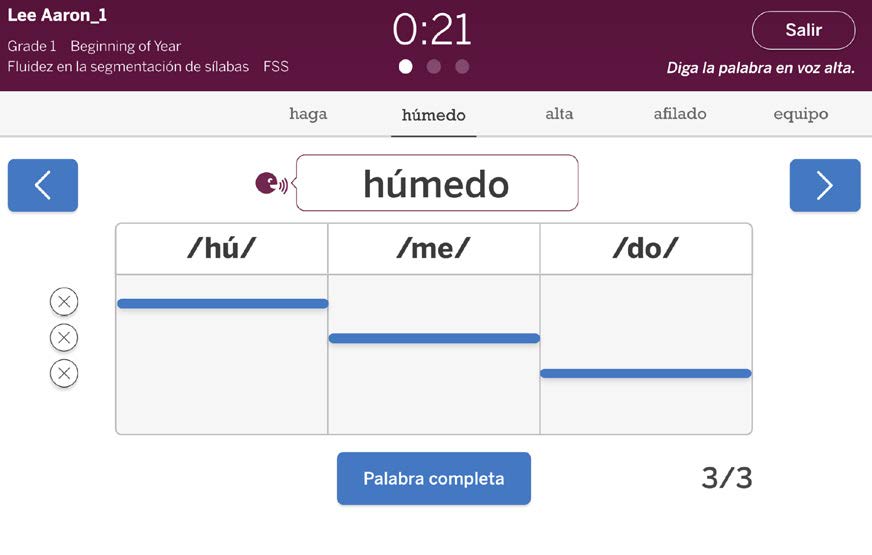
Pantalla de tableta que muestra instrucciones para una evaluación de la fluidez sin palabras, incluido el tiempo, indicaciones para la siguiente letra y pautas de interrupción. Un botón "Salir" es visible en la esquina superior derecha.
Two digital devices displaying educational software interfaces, one shows class performance statistics and the other showcases a foundational literacy assessment tool.

Comprehensive literacy assessment

mCLASS provides benchmark assessments, ongoing progress monitoring, and voice recognition technology to comprehensively support each student’s literacy development.

  • Foundational skills assessments
  • Comprehension assessments
  • Dyslexia screening assessments

Valid and reliable reporting

mCLASS gives educators detailed insight into your students’ reading development across foundational literacy skills. It provides a wealth of valuable reporting information for everyone—from classroom teachers and literacy specialists to principals and district leaders and parents and guardians at home.

  • Skill-based reporting view for each student
  • Real-time growth reports for each student
  • Class summary reports
  • School and district reports
  • Parent and guardian reports
mCLASS's reporting dashboard
A digital tablet displaying a detailed beginning-of-year academic schedule with various subjects including mCLASS Early Literacy assessments and teacher names.

Embedded dyslexia screening

Included at no additional cost, mCLASS’s DIBELS 8th Edition measures are validated to provide information about dyslexia risk. mCLASS also offers supplemental measures to screen for risk related to dyslexia.

  • Vocabulary
  • Encoding
  • Rapid Automatized Naming (RAN)

Easy to use, targeted lessons

mCLASS provides targeted instruction in all the critical foundational reading skills by automatically analyzing data to place students in skill-based groups with targeted activities.

A laptop screen displays an educational software interface with tabs labeled Benchmark, Progress, Instruction, and Home Connect. The current view shows activities related to Grade 1 under Advanced Decoding skills.
A teacher assisting a young girl with her reading in a classroom, surrounded by educational posters and materials.

Seamless student intervention

mCLASS connects to mCLASS Intervention, a proven companion intervention program that provides the analytical tools and resources educators need to make targeted, staff-led intervention a daily reality throughout the school year.

guide icon

Dyslexia Fact vs. Fiction

Can you separate dyslexia fact from fiction?

Download our e-book

Explore more programs

Our programs are designed to support and complement one another. Learn more about our related programs.

Exciting updates are coming for Boost Reading!

To view this protected page, enter the password below:


mCLASS® with DIBELS® 8th Edition is Oregon approved!

mCLASS with DIBELS 8th Edition and mCLASS Rapid Automatic Naming (RAN) helps teachers identify COVID-related learning loss and literacy needs firsthand through a quick, five-minute assessment that can be done virtually or in person. What’s more, it helps teachers take immediate instructional action that’s right for each and every student.

A teacher helps a young student with a tablet; below, a girl listens attentively. Icons of a book and a puzzle piece appear on colored backgrounds.

What is mCLASS?

mCLASS® with DIBELS® 8th Edition and mCLASS RAN is an integrated, gold standard literacy system for grades K–6.

The mCLASS comprehensive system includes efficient one-minute measures, a built-in Enhanced Early Learning Measures screener, teacher-led and student-driven instruction, intervention, and robust reports for teachers and administrators.

With mCLASS, you can say goodbye to cobbling together tools and second guessing the results of other screeners.

A girl sits at a desk reading and writing, with educational words in the background; text highlights mCLASS as a gold standard in early literacy.

University of Oregon

Together with the University of Oregon, we have made the DIBELS® (Dynamic Indicators of Basic Early Literacy Skills) assessment that you know and love more powerful and user-friendly than ever before.

As the only licensed provider of the digital DIBELS 8th Edition assessment, we make it faster and easier to understand where every student is in their early literacy journey.

Why mCLASS?

It’s a single solution that meets all of the state’s requirements for Early Screening of Dyslexia.

  • It’s a universal early literacy screener, dyslexia screener, and a diagnostic tool in one.
  • It allows for real-time assessment and instant scoring as well as offline assessment capabilities.
  • It includes explicit literacy instruction and intervention strategies based on student performance.
  • It’s flexible and can be implemented in a variety of scenarios, including in-person, remote, and hybrid learning environments.
  • It includes a variety of parent notification resources and at-home reading strategies.
  • It’s continually enhanced with new features and regular updates that are made available to our entire user community.

Amplify Reading is the proven, adaptive skills practice and remediation companion for mCLASS. Try it for free for the remainder of the school year with a no-cost trial.

Request a free trial today!
Tablet displaying a student performance table. Columns for assessment times; rows for performance levels. Percentages and student counts are provided in each assessment area and level.

Instant data and action

Quick and actionable reports provide detailed insight into students’ reading development across foundational literacy skills for classroom teachers and literacy specialists, principals and district leaders, and parents and guardians at home.

What’s more, mCLASS® with DIBELS® 8th Edition and mCLASS RAN gives you instant results and clear next instructional steps for each and every student.

Dyslexia screener

Early intervention is critical. That’s why we help you meet state dyslexia legislation with one single powerful tool—no additional assessment system required.

Our additional measures in vocabulary, spelling, and rapid automatic naming (RAN) address the full range of skills associated with dyslexia risk and help identify students at varying levels of risk for reading difficulties, including dyslexia.

A child sits at a desk using a laptop. Next to the desk is a bookshelf with books, a fishbowl, and a soccer ball.

Assess anywhere

mCLASS has created a collection of resources to help you plan for a variety of assessment scenarios.

Whether your school is engaged in in-person, hybrid, or remote instruction, we know how important it is for teachers and administrators to have a full (and firsthand!) picture of every student’s literacy development.

Personalized practice

Amplify Reading is the practice and remediation companion to mCLASS. At its heart, there are three main areas that make Amplify Reading a unique and essential supplemental learning program.

  • The program meets all students where they are with powerful individualized instruction and practice.
  • Age-appropriate narratives create a learning experience that leaps off the screen.
  • Research shows Amplify Reading improves student performance–particularly among English Learners–reducing the overall percentage of students at risk of reading difficulty.

A young girl with curly hair sits indoors, looking at a tablet device with a focused expression.

Funding

Schools may utilize Early Literacy Grants or federal CARES Act funds to purchase assessments to meet Oregon’s screening legislation.

Get in touch

Ready to discuss how mCLASS can support your specific needs? A brief 30-minute call is all we need to determine if mCLASS with DIBELS 8th Edition is the right fit for you.

Simply fill out the form below and we’ll be in touch.

A middle-aged man with short brown hair wearing a light blue button-up shirt, smiling at the camera against a plain white background.

Patric Momsen

District Manager

A man with short dark hair wearing a dark blazer and light-colored collared shirt, smiling at the camera against a plain white background.

Jonathan Cohen

Account Executive

A man with short dark hair smiles at the camera. The photo is in black and white with a blurred outdoor background.

Immanuel Moon

Field Manager

Welcome, Arizona educators!

The Arizona Department of Education just released its first-ever list of approved universal literacy screeners. According to the state, these screeners “shall be used by schools in the 2020-2021 school year to meet the requirements of both the Move On When Reading (MOWR) legislation and the dyslexia screening legislation.”
 
We’re excited to announce that mCLASS® with DIBELS® 8th Edition and mCLASS RAN is on that list.

A teacher shows a tablet to a young student at a table; below, a girl listens in class. Two squares feature icons of a book and a puzzle piece on colored backgrounds.

Why mCLASS?

mCLASS® with DIBELS® 8th Edition and mCLASS RAN is a single solution that meets all of the requirements of the law.

  • It’s a universal early literacy screenerdyslexia screener, and diagnostic tool in one.
  • It includes immediate and actionable literacy instruction and intervention strategies based on student performance.
  • It’s flexible and can be implemented in a variety of scenarios, including in-person, remote, and hybrid learning environments.
  • It allows for non-paper assessment and scoring as well as offline assessment capabilities.
  • It includes a variety of parent notification resources and at-home reading strategies.
A timeline with milestones from 2000 to 2018 shows Amplify’s focus on literacy, with a large play button in the center and the text: "We have been laser-focused on literacy for two decades.

Funding

Schools may utilize Move On When Reading (MOWR)Early Literacy Grants, or federal CARES Act funds to purchase assessments to meet both MOWR legislation and the dyslexia screening legislation (A.R.S §15-701 and A.R.S. §15-4704).
 
Visit our CARES Act resource hub or download this CARES Act flyer to learn more.

Young girl with curly hair sits indoors, looking at a tablet device with a focused expression.

More than a test

mCLASS is an integrated, gold standard literacy system that closes the knowing-doing gap. By combining assessment, reporting, and instruction in one, it eliminates the need for cobbled together tools.

  • Data gathered through efficient one-minute measures is made available to teachers instantly.
  • Easy-to-read reports make teachers aware of potential reading difficulties as well as observed patterns.
  • Ready-to-teach literacy instruction and intervention strategies help teachers target specific skill deficits immediately.

Remote learning

mCLASS has created a collection of resources to help you plan for a variety of scenarios for the 2020–2021 school year.
 
Whether your school is engaged in in-person, hybrid, or remote instruction, we know how important it is for teachers and administrators to have a full picture of every student’s literacy development.
 
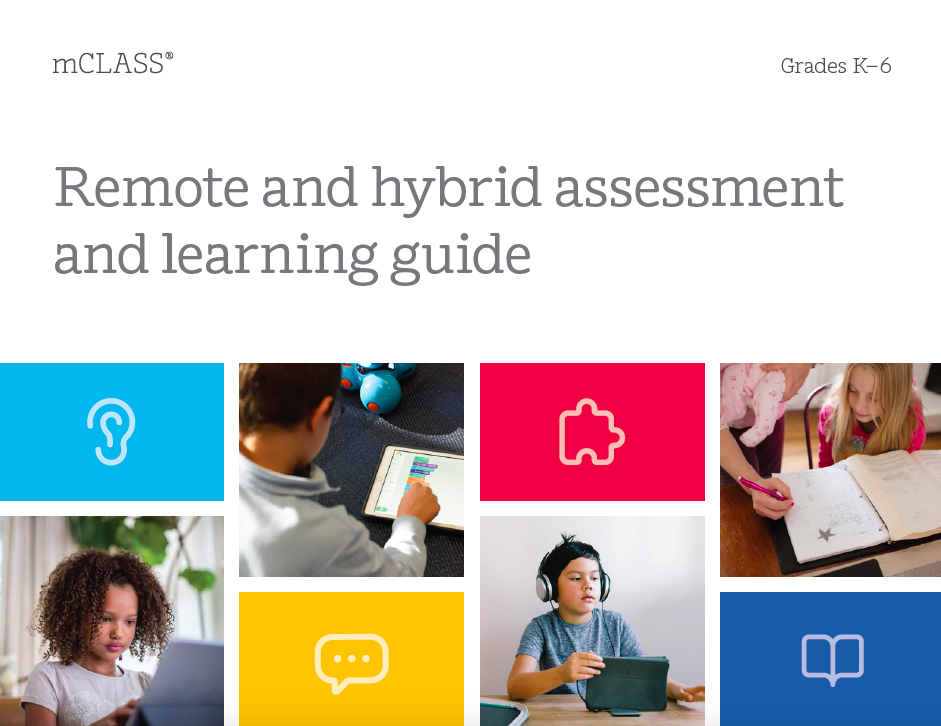
Download our Remote and Hybrid Learning Guide to learn more.

A person sitting at a desk using a laptop, with a bookshelf containing books, a fish tank, and a soccer ball nearby.

Personalized practice

Amplify Reading is the practice and remediation companion to mCLASS.
 
At its heart, there are three main areas that make Amplify Reading a unique and essential supplemental learning program for the 2020-2021 school year.

  • The program meets all students where they are with powerful individualized instruction and practice.
  • Age-appropriate narratives create a learning experience that leaps off the screen.
  • Research shows Amplify Reading improves student performance–particularly among English Learners–reducing the overall percentage of students at risk of reading difficulty.

Get in touch

Ready to discuss how mCLASS can support your specific needs? A brief 30-minute call is all we need to determine if mCLASS with DIBELS 8th Edition is the right fit for you.
 
Simply fill out the form below and we’ll be in touch.

Man with a trimmed beard and shaved head, wearing a dark suit, blue shirt, and orange tie, posing against a plain white background.

Tommy Gearhart

Senior Account Executive

A woman with shoulder-length brown hair smiles in front of a brick wall.

Laina Armbruster

Account Executive

A smiling man in a jacket is shown in a black-and-white portrait with a blurred outdoor background.

Laina Armbruster

Field Manager

Request a meeting

Join our User Research Community!

Help shape Amplify products.

Educators and students are at the center of what we do. That’s why we test our products with real users, visit classrooms across the country, and gather ideas and feedback from educators like you! This is how we ensure that we’re developing new products that meet your needs, as well as continuously improving our existing products to better support your classrooms.

That’s where our User Research Community comes in. This is a group of valued educators we look to for their expertise! They regularly participate in research and feedback opportunities and share their insights with our Product teams.

We hope you’ll consider joining Amplify’s User Research Community. When we have a study that’s a good fit for you, our team will reach out with details and next steps.

A person is using a tablet, immersed in progress and analytics data graphics on a white and orange backdrop, reminiscent of tools often employed by school administrators.

Why participate in user research?

Make an impact

Help influence and improve Amplify products by sharing your feedback and ideas

Get sneak peeks

Learn about new products and features that Amplify teams are working on

Connect with us

Share your thoughts and feedback directly with Amplify product development teams

Enjoy thank-you gifts

Receive incentives as a thank you for your time

What to expect

When you sign up to join the Amplify User Research Community, we’ll ask you some questions that will help us match you with research studies. When an opportunity sounds like a good fit, we’ll send you an email and share the details up front, such as study topic, research format, time commitment, and compensation. Then, you can decide if you’d like to participate.

A person in a shirt and tie, possibly a school administrator, reviews documents at a desk. Inset is an image of the "User Research Community Questionnaire," perhaps focusing on insights from K-12 teachers.
Three people from the research community collaborate with digital devices, including a tablet and a laptop, fervently discussing their findings.

Frequently asked questions

We’re looking for all types of educators to join our User Research Community: new Amplify users, power users, and everyone in between. We’re also looking for people who don’t use our products. If you work in a school setting or support schools, we want to hear from you. Here are some of the people we’d love to connect with:

  • Classroom teachers (PreK–12)
  • Biliteracy teachers
  • Special education teachers
  • Interventionists
  • Coaches
  • Curriculum directors
  • School administrators
  • District administrations
  • Parents and caregivers

We have a separate research program for K–12 students. Learn more about our Playtesting program below.

Amplify runs a variety of research studies, and we’ll include the details of the study in our email. When you participate in one of our studies, you might be invited to:

  • Talk to a researcher in a video call: Share your experiences with a specific product.
  • Share your screen: Show us how you use Amplify’s products, try out a prototype, or test new features.
  • Complete a survey: Answer questions about your current practices and/or preferences.
  • Host a school visit: Have a few Amplify employees visit your classroom to observe our programs in action.
  • Participate in a long-form study: These studies may involve a small commitment for several days or over a few weeks. You may be asked to review new materials or designs or to try something out in your classroom. Our researchers may ask you to respond to questions or take notes based on your experience using a product.

The information you provide will only be used to match you with suitable research studies and won’t be shared or sold to external parties. All data is stored on a secure server. See our Privacy Policy for more detail.

Amplify’s goal is to design welcoming product experiences. To do this well, it’s important for us to get feedback from everyone. We collect demographic information to help ensure that study participants represent the educators, students, and school environments we serve. All questions are optional and your information is kept confidential in accordance with our Privacy Policy.

You can opt out at any time by clicking unsubscribe in any of our research emails.

We typically offer e-gift cards as a way of saying thank you to those who participate in our research studies. We’ll include the exact details of the thank-you gift in the email invitation for the session. If your session is eligible for a thank-you gift card, you should receive it within five business days after completing your session. Please note that not all study participants will receive a thank-you gift.

Amplify Playtesting Program

A fun and empowering experience for kids

Students in our Playtesting Program provide feedback on new Amplify games and features as they’re being developed. Our researchers work one-on-one with students for 30 minutes at a time, inviting them to interact with new games and designs and gathering their feedback. We then integrate that feedback directly into our product development. It’s a chance for students to share their thoughts and ideas and have a real impact on the programs we’re building.

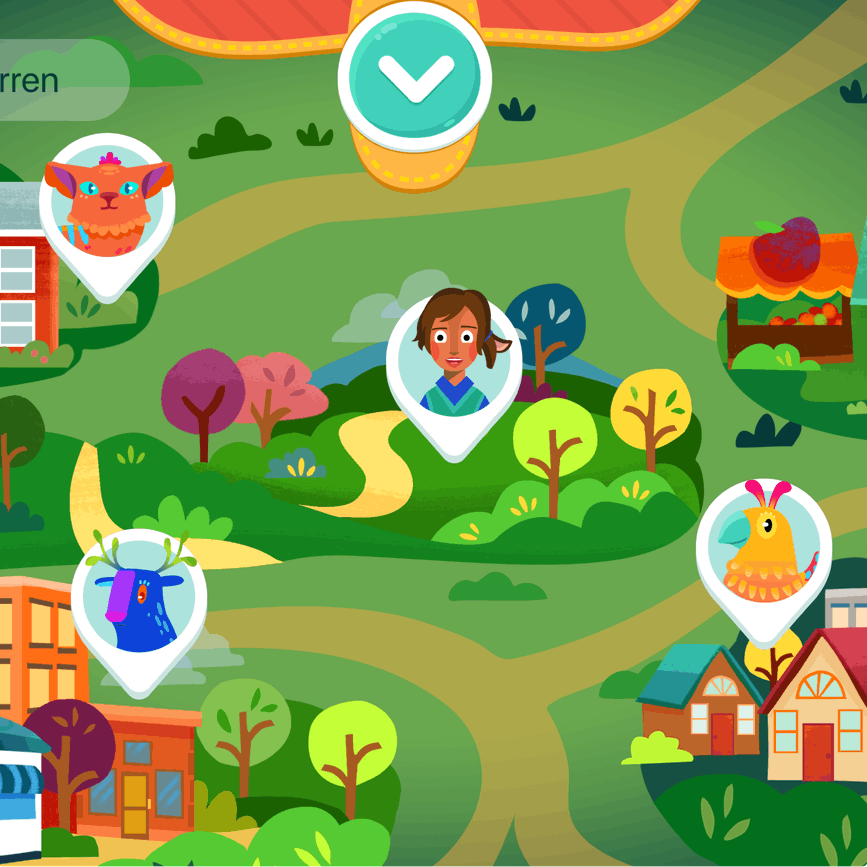
A girl wearing headphones smiles while using a laptop, surrounded by illustrations of a building and a house. A colorful creature dances nearby, reminiscent of the creative tools K-12 teachers use to inspire young minds.

Who can participate?
Any students in kindergarten through grade 12 this school year can be part of our playtesting program, with parental permission.

What are the perks?
Aside from a fun time and a sneak peek at what’s in development, all students receive a $20 Amazon gift card for participating in a playtesting session.

When, where, and how do kids participate?
When playtesting needs arise, our User Research team will reach out to parents/caregivers to schedule a Google Meet session at a time that’s convenient for you and your child.

How can I sign my child up?
To enroll your student, please fill out this consent form. Your child will then be added to our playtesting program database. When a playtesting opportunity arises that we think would be a good fit, we’ll reach out!

Prepare Professional Development (PD)

Learning experiences to prepare for literacy and math instructional shifts

The following literacy and math sessions can help any educator—regardless of the program used—enhance their instructional practices.

  • Science of Reading sessions offering research-backed strategies to deepen understanding and improve student outcomes.
  • Problem-based approach to math sessions that empower educators to facilitate meaningful learning experiences and develop critical thinking skills.
  • Multiliterate learner sessions enable educators to make a meaningful impact on students’ literacy development.
Two women are seated at a table with laptops and papers, engaging in a discussion about program implementation in a classroom or meeting setting.

Professional learning journey

Four connected circular icons illustrating a business process: idea generation, planning, execution, and achievement, depicted with relevant symbols.
Prepare Begin Practice Advance
Learning sessions will help shift literacy and math instruction in areas such as the Science of Reading and/or problem-based approaches to math. Program-aligned packages will support those who are new to Amplify programs. Program-aligned packages will support those who have experience using Amplify programs. Offerings will support advanced implementation, build capacity for instructional leaders, certify in-house trainers to deliver Launch sessions, and more.
“Gain the literacy knowledge and skills you need to thrive and help your students thrive. Through these sessions, you’ll understand typical literacy development and how to describe and address literacy difficulties.”

—Susan Lambert, Chief Academic Officer, Elementary Humanities

Host, Science of Reading: The Podcast

Science of Reading learning experiences

Listening to students read is magic. But knowing how to get them reading? That’s science.

Making the shift to the Science of Reading is no small feat, but participating in professional development sessions can help you make this change seamlessly.

Amplify Science of Reading sessions offer flexible, professional learning experiences for teachers that incorporate engaging activities grounded in what science tells us about literacy development.

Two women smiling and looking at a laptop in a classroom. One woman is wearing a striped shirt and the other a black top. Classroom decor is visible in the background.

Build your knowledge of the Science of Reading

Virtual | 90-minute session

This introductory session provides educators with a foundational overview of what the Science of Reading means and what it tells us about how to teach using evidence-based reading practices.

Participants will learn to:

  • Define the Science of Reading by examining evidence-based research.
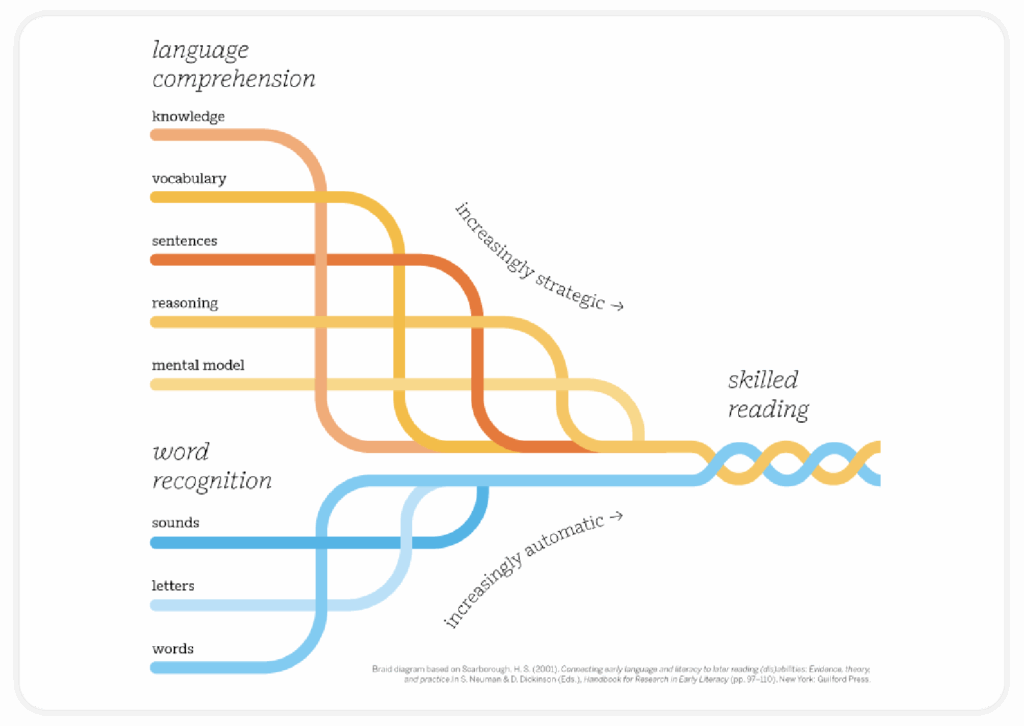
  • Explain how two frameworks, the Simple View of Reading and the Reading Rope, work in tandem to guide effective literacy instruction.
  • Identify instructional principles aligned to the Science of Reading.
Three people stand in front of a whiteboard with colorful sticky notes, engaging in professional development for teachers as they discuss ideas and collaborate using a tablet and a laptop.

Deepen your knowledge of the Science of Reading

On-site or virtual | 3-hour session

This session will build a base of common knowledge about the Reading Rope and support educators in identifying effective instruction grounded in the Science of Reading.

Participants will learn to:

  • Identify the strands in the Reading Rope.
  • Describe how each strand plays an important role in developing skilled readers and writers.
  • Identify key look-fors in effective Science of Reading instruction.

Science of Reading: The Learning Lab online course

This series of three self-paced online courses, crafted by literacy expert Susan Lambert and built around International Dyslexia Association (IDA) Knowledge and Practice Standards, guides you through the essential Science of Reading skills and knowledge needed to teach students to read proficiently, as well as advanced strategies for aiding struggling readers. Each course builds on the last, equipping you with the tools and confidence to make a lasting impact on your students’ literacy journeys.

Benefit from flexible learning on an interactive platform spanning 20–25 hours of instruction. Each course is accessible for 12 months. Upon completion, you’ll be provided with a downloadable certificate, validating your new expertise in the Science of Reading.

A boy kneels and reads a book near stacked books, while a girl stands with folded arms; both observe a mobile with colorful shapes and letters, reflecting elements of classroom instruction inspired by the Science of Reading.

Foundations to the Science of Reading

This course offers a comprehensive overview of research in the field. Each of the eight modules contains three lessons covering the foundations of literacy acquisition.

Explore the scope and sequence of Foundations to the Science of Reading with a  Pacing Guide.

Access the free Preview Pass for this course.

A child points at large outlined letters on a board with a pointer stick, next to a stack of books—capturing an engaging moment in classroom instruction.

Advanced topics in the Science of Reading: Assessment and reading difficulties

The second course is aimed at providing an in-depth examination of assessments, a deeper understanding of reading difficulties, and familiarity with pertinent legal frameworks for educators, all of which influence instructional decision-making.

Explore the scope and sequence of Advanced topics in the Science of Reading with our Pacing Guide

Access the free Preview Pass for this course.

Three people in lab coats stand around a lab table with test tubes and a flask, engaging in classroom instruction as they discuss and gesture to each other.

Coming soon!
Applied structured literacy

The final course in the series is designed to review key concepts and knowledge from previous coursework, explore fundamental aspects of structured literacy within lessons, observe and analyze structured literacy instruction in action, and investigate how data informs instructional decisions.

[Available June 2025]

“Amplify’s Science of Reading online course builds background knowledge on how students read, then goes deeper to give you strategies that correlate with current research that can be implemented into your classroom right away. The course opened my thinking to new ways of teaching and I can’t wait to try it with students! If you want to walk away feeling successful with helping kids read, take this course! ”

Allie Appel

Coach, WI

New

Supporting multiliterate learner sessions

Unlock the magic of teaching multiliterate learners with evidence-based literacy practices. Making the shift to effectively support diverse readers in multiple languages is no small feat, but our professional development sessions are here to guide you effortlessly.

Empower your teaching with these engaging sessions, and make a meaningful impact on your multiliterate students’ literacy development.

Two children are seated at a small table in a classroom. Engaged in classroom instruction, the girl is writing in a notebook while the boy reads a book. Colorful storage bins are visible in the background, enhancing the learning environment

Build your knowledge of multiliterate learners

Virtual | 90-minute session

This session provides educators with a foundational overview of how to teach multiliterate learners using evidence-based literacy practices.

Contact us to request a quote.

A young boy in a striped shirt sits at a desk, focused on writing in a notebook with a pencil. Surrounding him are classroom supplies and papers, exemplifying the effective program implementation strategies from professional learning sessions.

Deepen your knowledge of multiliterate learners

On-site or virtual | 3-hour session

This session will build an understanding of how the brain learns to read in multiple languages, as well as how to leverage cross-linguistic transfer, and align instruction to best practices for multiliterate learners.

Contact us to request a quote.

Problem-based approach to math instruction sessions

Elevate educational experiences by placing students’ ideas at the core of math lessons through problem-based learning. These sessions offer flexible professional learning experiences, allowing you to gain firsthand experience with a problem-based approach as a learner. You then learn to integrate this approach seamlessly into your teaching practices, bringing renewed energy to your math classroom.

A woman sits indoors, smiling while using a tablet. Wearing a blue lanyard and casual clothing, she appears engaged in professional learning; the background shows blurred people and chairs.

Build your knowledge of a problem-based approach

Virtual | 90-minute session

This session provides you with a foundational overview of what an engaging problem-based approach in math entails for K–5 students.

During this session you’ll learn to:

  • Explain how a problem-based approach to math brings delight to both teaching and learning and builds lasting student understanding.
  • Identify actionable strategies for using a problem-based approach in a math classroom.

Contact us to request a quote.

Deepen your knowledge of a problem-based approach

On-site or virtual | 3-hour session

This session provides you with hands-on experience facilitating problem-solving in math, leaving you with an increased understanding of how to teach conceptual understanding, procedural skill and fluency, and applications of math.

During this session you’ll learn to:

  • Explain how a problem-based approach to math brings delight to both teaching and learning and builds lasting student understanding.
  • Identify actionable strategies for using a problem-based approach in a math classroom.
  • Connect your current teaching practice to a problem-based approach, and choose a next step to implement a more problem-based approach.

Contact us to request a quote.

Get in touch with a PD expert

We’re here to provide answers and guidance as you explore your PD options. Fill out the form to connect with us and discover how Amplify PD can enhance your educational journey.

Boost Reading sample site

To view this protected page, enter the password below:


Welcome, New York City Educators!

Welcome! This site contains supporting resources for the New York City Department of Education’s Amplify Science adoption for grades K–8.

What’s new?

A person wearing safety goggles examines a glass of water. The background includes illustrations of space exploration, a rocket, a polar bear, and weather symbols such as clouds and raindrops.

Assessment Videos for Leaders

See overview of the new Amplify NYC Benchmarks here.

Archived PD Supports

Professional learning recordings

  • Click here to access the professional learning recordings and materials.
  • Would you like to purchase school based professional learning? Contact Michael Kasloff and Carly Kriss at mkasloff@amplify.com and ckriss@amplify.com.

Archived professional learning resources

Responsive Classroom Resources

Amplify Science supports creating a responsive classroom environment. Click below to explore resources to help aid your responsive launch.

E komo mai, Hawai’i review committees!

Aloha Hawai’i teachers and educators,

We’re excited to be part of your review process for curriculum, assessment, and professional learning.

Amplify programs are designed to make a difference—and the results are undeniable. Explore our unique research-based approaches built right into these high-quality instructional materials that are aligned to Hawai’i State Department of Education standards.

With great respect for what you do, mahalo.

The Hawai’i Amplify team

Illustrated stickers of a pineapple, coral, sea turtle, whale, fish, and hibiscus flower arranged on a transparent background—perfect for Indiana elementary schools exploring nature themes with Amplify Science.
Illustration of a bear on a rock overlooking a campsite in a valley with mountains, trees, tents, and people; includes an EdReports review badge in the lower right corner.

Amplify CKLA

Using a fundamentally different approach to language arts, Amplify Core Knowledge Language Arts (CKLA) is a PreK–5 program that sequences deep content knowledge with research-based foundational skills. Amplify CKLA met expectations and received all-green ratings from EdReports. Read the review on EdReports.

Amplify ELA

Amplify ELA is the only program truly designed to support middle school students at this critical developmental moment. We ensure that skills are taught, standards are covered, and the test is prepped—all while bringing texts to life and differentiating instruction. Read the review on EdReports.

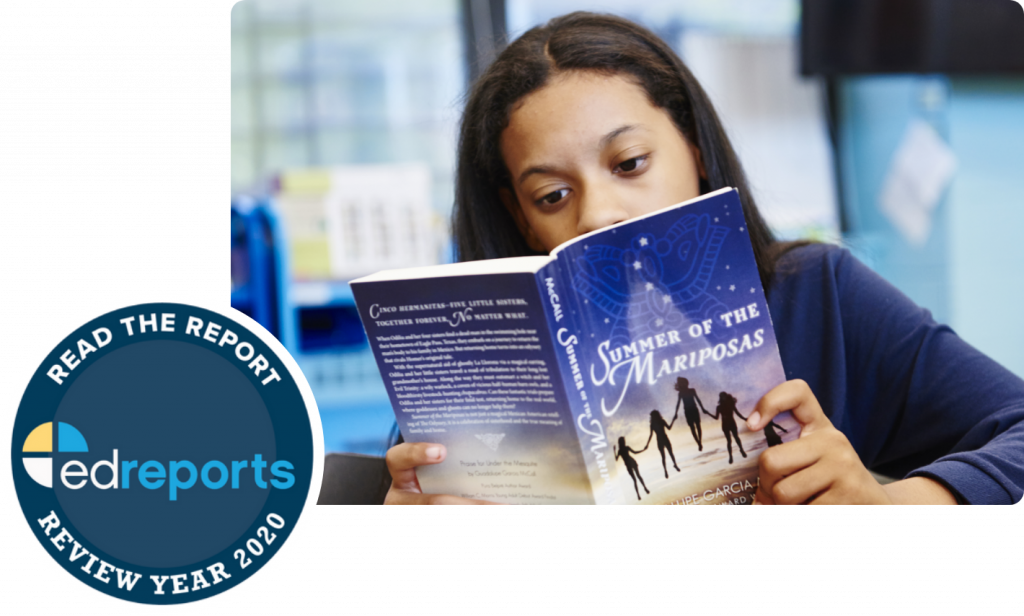
A girl, an Indiana teacher's inspiration, is reading "Summer of the Mariposas" with an EdReports sticker beside her, labeled "Read the Report, Review Year 2020," capturing a moment that echoes through Indiana elementary schools.
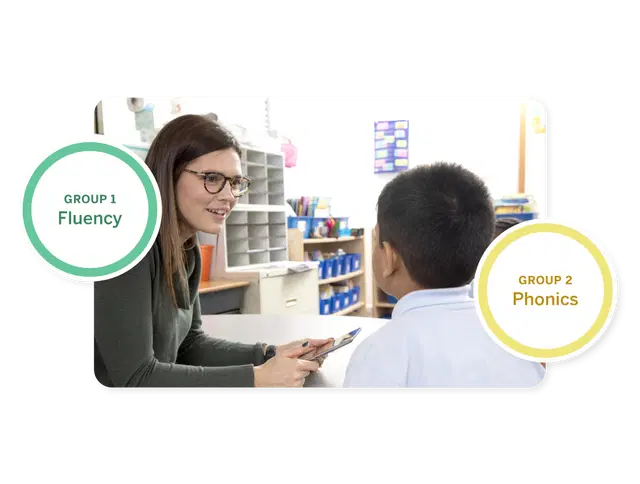
A teacher with glasses assessing a young student's reading fluency using a tablet in a classroom; visual diagram explaining the relationship between data, instruction, and Amplify mCLASS reading assessment.

mCLASS Dibels 8th Edition

mCLASS® is an all-in-one system for universal screening, dyslexia screening, progress monitoring, and instruction for grades K–6 based on the Science of Reading. Powered by DIBELS® 8th Edition, mCLASS helps you measure and strengthen the foundational skills that all students need to become confident readers.

Science of Reading professional development

Build your knowledge of the Science of Reading.

Virtual | 90-minute session

This introductory session provides educators with a foundational overview of what the Science of Reading means and what it tells us about how to teach using evidence-based reading practices.

Participants will learn to:

  • Define the Science of Reading by examining evidence-based research.
  • Explain how two frameworks, the Simple View of Reading and the Reading Rope, work in tandem to guide effective literacy instruction.
  • Identify instructional principles aligned to the Science of Reading.
Two women smiling and looking at a laptop in a classroom. One woman is wearing a striped shirt and the other a black top. Classroom decor is visible in the background.
Three people stand in front of a whiteboard with colorful sticky notes, engaging in professional development for teachers as they discuss ideas and collaborate using a tablet and a laptop.

Deepen your knowledge of the Science of Reading.

On-site or virtual | 3-hour session

This session will build a base of common knowledge about the Reading Rope and support educators in identifying effective instruction grounded in the Science of Reading.

Participants will learn to:

  • Identify the strands in the Reading Rope.
  • Describe how each strand plays an important role in developing skilled readers and writers.
  • Identify key look-fors in effective Science of Reading instruction.

Science of Reading: The Learning Lab online courses

This series of three self-paced online courses, crafted by literacy expert Susan Lambert and built around International Dyslexia Association (IDA) Knowledge and Practice Standards, guides you through the essential Science of Reading skills and knowledge needed to teach students to read proficiently. It also offers advanced strategies to aid struggling readers. Each course builds on the last, equipping you with the tools and confidence to make a lasting impact on your students’ literacy journeys.

Benefit from flexible learning on an interactive platform—each course spans 20–25 hours of instruction and is accessible for 12 months. Upon completion, you’ll be provided with a downloadable certificate, validating your new expertise in the Science of Reading.

Three adults, two women and one man, engage in professional development for teachers using computers in a library setting.

Contact us

Support is always available. Our team is dedicated to helping you every step of the way. Contact your dedicated Hawai’i representative here for program access, samples, and additional information.

Laina Armbruster

Senior Account Executive, Hawai’i
Email: larmbruster@amplify.com
Phone: (602) 791-4135

A woman with long brown hair, wearing a dark blouse and a necklace, smiles at the camera against a plain light background—an inspiring Indiana teacher recognized for her use of Amplify Science in the classroom.

Ready to learn more?

Fill out this form, and we’ll be in touch with you shortly.

Early literacy assessment & intervention, grounded in the Science of Teaching Reading

mCLASS Texas is an all-in one system of universal screening, dyslexia screening, progress monitoring, and instruction for grades K–6, all built on the Science of Teaching Reading. Powered by DIBELS® 8th Edition, mCLASS Texas helps you measure and strengthen the foundational skills that all students need to become confident readers.

What is mCLASS Texas?

mCLASS Texas, the only digital provider of DIBELS 8th edition assessments, provides universal screening, dyslexia screening and progress monitoring to assess your students’ reading trajectory and determine what skills they still need to develop.

You’ll observe students as they form sounds or read words and text. Then, mCLASS Texas instantly scores and analyzes student response patterns to provide you with diagnostic data and instructional focus for each student and group.

With mCLASS Texas, you’ll have everything you need to support every type of learner in your classroom, including advanced learners, multilingual/English learners, and students with signs of dyslexia.

What educators say

“If you’re trying to shift the balance and move into the Science of Reading, mCLASS is going to give you a great way to group kids by skill.”

Angela

Lufkin Independent School District, Director of Early Childhood Education

What educators say

“Getting the human brain to read is very complex, and mCLASS has helped me problem-solve with my PLC and the strategies I’m using in the classroom.”

Anne

Teacher, Wake County School District, Oakview Elementary School

What educators say

“One of the things that I think the data dashboard has really helped us to do is to work smarter not harder.”

Natalie

Supervisor of Elementary Ed, K-12 Instructional Technology and K-12 ELL, Metuchen School District

Image of DIBELS 8th edition logo

Research-based DIBELS 8th Edition assessments

Developed in partnership with the University of Oregon, mCLASS DIBELS 8th Edition is founded on the strongest-ever research base for predicting reading proficiency, including identifying those at risk for dyslexia.

For more than 30 years, the University of Oregon has led the research behind DIBELS (Dynamic Indicators of Basic Early Literacy Skills). mCLASS is the only licensed digital provider of the evidence-based DIBELS 8th Edition assessment. See more of our research.

Our approach

mCLASS Texas provides rich data to help you match your students’ precise needs with instruction based on the Science of Teaching Reading. The program enables you to monitor effectiveness and make timely decisions, providing students or classrooms with extra support.

Grounded in the Science of Teaching Reading

From phonics to fluency and comprehension, mCLASS Texas assesses the skills that are most critical for students to become successful readers. Once students are assessed, you’ll have the data you need to drive instructional decisions at the classroom, school, and district level.

  • Data you can trust, with teacher-administered assessments
  • Skill-level data aligned with the Science of Teaching Reading
  • Data-driven instructional recommendations to support intervention, remediation, and enrichment
An adult and a young child sit at a table, looking at a tablet together. A label in the corner reads, "Built on the Science of Reading.
Profile card for a student named Jenny Perez, Grade 1 BOY, showing a score of 36 correct letter sounds per minute on a colorful performance scale.

Precise, trustworthy data through direct observation

Our approach to assessment is focused on providing you with immediate insights you can trust. Through direct observation of students and detailed reports, including assessment transcripts and diagnostic error patterns, you’ll have total transparency into each student’s performance.

Instant analysis and next steps

With mCLASS Texas, you can interpret and act on data in real time with instant instructional guidance based on benchmark and progress-monitoring results. In one click, teachers can access differentiated skill-based groups and targeted resources to develop students’ foundational literacy skills.

A teacher and a student sitting at a desk in a classroom. The teacher is holding cards and discussing with the student. Two labels read

A complete picture of English and Spanish biliteracy

Amplify’s Spanish language assessment, mCLASS Lectura Texas, works in tandem with mCLASS Texas DIBELS 8th Edition’s English assessments to highlight areas of growth as students develop into bilingual readers. mCLASS Lectura Texas provides complete parity with English mCLASS Texas assessments in grade coverage (K–6), skill coverage, instructional tools, and reporting.

Need evidence-based Tier 2 and 3 instruction?

Explore mCLASS Intervention.

Learn more

What’s included

The mCLASS Texas program includes quick assessments of critical reading skills, real-time reporting, and data-driven instructional recommendations.

A digital interface displays reminders for a reading assessment, including timing instructions and prompts for student responses. A purple background highlights the three reminder cards and navigation buttons.

Efficient one-minute measures

DIBELS 8th Edition’s predictive one-minute assessments of phonemic awareness, phonics, fluency, and comprehension are proven to identify risk as early as possible.

  • Phonological awareness
  • Alphabetic principle/phonics
  • Reading fluency
  • Reading accuracy
  • Reading comprehension

Early detection of dyslexia symptoms

With mCLASS Texas, you can efficiently screen students and assess the full range of skills linked to dyslexia risk factors at the same time. mCLASS DIBELS 8th Edition and mCLASS Lectura Texas are both validated as dyslexia screeners for English and Spanish, with additional Vocabulary, Spelling, RAN, and Language Comprehension measures available at no additional cost.

Learn more about mCLASS’s dyslexia screening.

A teacher sits at a table with a young student using a tablet, while two student portraits are shown in circular frames on either side of the main image.

Progress monitoring and goal setting

To help you target the right skills and areas of instruction, mCLASS Texas recommends progress-monitoring measures and automatically sets meaningful, attainable goals for each student. Our Zones of Growth goal-setting framework examines your student’s DIBELS scores to predict the rate of growth they need to reach end-of-year goals.

  • Automatic progress monitoring recommendations
  • Customizable goals
  • Semester and full-year growth reports

Differentiated instruction for all students

Our library of more than 500 evidence-based activities makes it easy to plan lessons that reinforce your core instruction. The embedded professional development supports consider the varied language backgrounds of all students and provide cross-linguistic transfer and language variety guidance to inform phonological awareness instruction.

One-of-a-kind dual language reporting

When you use mCLASS DIBELS 8th Edition with mCLASS Lectura Texas, you can identify and develop students’ English and Spanish literacy skills regardless of your own Spanish-language proficiency. The dual language report shows you a side-by-side view of students’ assessment results and provides you with instructional guidance based on the data.

Educator and caregiver reports

Easy-to-use reports, ranging from classroom to school and district level, help you evaluate each student’s reading skills over time and pinpoint exactly when a change in instruction is needed.

To reinforce learning at home, the Home Connect feature provides letters to caregivers about their child’s reading development in English and Spanish, and includes activities for reinforcement at home or on the go.

Learn more about mCLASS reporting.

Three labeled graphics with Texas icons read: "Amplify ELAR TEXAS," "Boost Reading TEXAS," and "mCLASS TEXAS," each in black and orange text.

Instructional alignment across all tiers

Amplify’s early literacy system ensures that you have all the core, intervention, and personalized instruction you need to support each stage of a student’s literacy journey. mCLASS Texas data drives placement into mCLASS Intervention and Boost Reading Texas personalized learning. It also recommends core instruction resources within the Amplify ELAR Texas core curriculum based on the skills in which students need additional practice.

Exciting news! mCLASS Texas and mCLASS Lectura Texas K–2 are FREE for the 2025–26 school year!

Explore more programs based on the Science of Reading.

Learn more about Amplify’s Texas literacy suite at texas.amplify.com.

Welcome to the Amplify CKLA 3rd Edition program review site!

We’re excited to share everything you need to review Amplify CKLA 3rd Edition, our K–5 core literacy program. On this site, you’ll find a range of materials, including Teacher Guides, Activity Books, and Student Readers, organized by grade and unit.

Please note that the files on this site are static representations of the high-quality materials you’ll receive with your purchase.

We hope you find the site helpful! If you have any questions, please reach out to your Amplify representative.

Reviewer resources

Access key materials designed to support your review of Amplify CKLA 3rd Edition.

Kindergarten

Explore all available resources for Kindergarten, organized by strand and unit.

Knowledge Strand

Unit 1: Star Light, Star Bright: Nursery Rhymes and Fables

Unit 2: See, Hear, Smell, Taste, Touch: The Five Senses

Unit 3: Underdogs and Heroes: Stories

Unit 4: See How They Grow: Plants

Unit 5: Moo, Cluck, Oink: Farms

Unit 6: Deep Roots: Introduction to Native American Cultures

Unit 7: All Around the World: Geography

Unit 8 (Choice): Royal Tales: Monarchs

Unit 8 (Choice): National Icons: Presidents and American Symbols

Unit 9 (Choice): Our Planet: Taking Care of the Earth

Unit 9 (Choice): Rain and Rainbows: Seasons and Weather

Unit 10: Shaped by Nature: Art and the World Around Us

Skills Strand

Unit 1

Unit 2

Unit 3

Unit 4

Unit 5

Unit 6

Unit 7

Unit 8

Unit 9

Unit 10

Ancillary Components


Grade 1

Explore all available resources for Grade 1, organized by strand and unit.

Knowledge Strand

Unit 1: The Moral of the Story: Fables and Tales

Unit 2: From Nose to Toes: How Your Body Works

Unit 3: Common Threads: Different Lands, Similar Stories

Unit 4: Reach for the Stars: Astronomy

Unit 5: Charting the World: Geography

Unit 6: A World of Homes: Animals and Habitats

Unit 7: A New Nation: American Independence

Unit 8 (Choice): Once Upon a Time: Fairy Tales

Unit 8 (Choice): Our Planet: The History of the Earth

Unit 9 (Choice): From Babylon to the Nile: Early World Civilizations

Unit 9 (Choice): Early Americas: Maya, Aztec, and Inca

Unit 10: Adventure Stories: Tales from the Edge

Skills Strand

Unit 1

Unit 2

Unit 3

Unit 4

Unit 5

Unit 6

Unit 7

Ancillary Components


Grade 2

Explore all available resources for Grade 2, organized by strand and unit.

Knowledge Strand

Unit 1: Fortunes and Feats: Fairy Tales and Tall Tales

Unit 2: The Birthplace of Democracy: Ancient Greece

Unit 3: Legends and Heroes: Greek Myths

Unit 4: Our Planet: Cycles in Nature

Unit 5: Butterflies, Bees, and Beetles: Insects

Unit 6: A House Divided: The American Civil War

Unit 7: Sounds and Stanzas: Poetry

Unit 8 (Choice): Journeys to America: Immigration

Unit 8 (Choice): Making a Difference: Creating Change

Unit 9 (Choice): Building Blocks: All About Nutrition

Unit 9 (Choice): Early Asian Civilizations: India and China

Unit 10: Taking Flight: The Age of Aviation

Skills Strand

Unit 1

Unit 2

Unit 3

Unit 4

Unit 5

Unit 6

Ancillary Components


Grade 3

Explore all available resources for Grade 3, organized by unit.

Core Units

Unit 1: Timeless Tales: Classic Stories

Unit 2: Fur, Fins, and Feathers: Animal Classification

Unit 3: Rhythm and Rhyme: Poetry

Unit 4: Rise and Fall: Ancient Rome

Unit 5: Our Solar System and Beyond: Astronomy

Unit 6: Regions and Cultures: Native Americans

Unit 7 (Choice): Novel Study: Charlotte’s Web

Unit 7 (Choice): Novel Study: Stella Díaz Has Something to Say

Unit 8 (Choice): Systems and Senses: The Human Body

Unit 8 (Choice): From Glow to Echo: Light and Sound

Unit 9: From Blues to Bebop: All That Jazz


Supplemental Skills

Grade 3 Skills resources are included in core classroom kits, although the instruction isn’t required for Grade 3 standards coverage.

Unit 1

Unit 2

Unit 3

Unit 4


Grade 4

Explore all available resources for Grade 4, organized by unit.

Unit 1: My Story, My Voice: Personal Narratives

Unit 2: Knights and Castles: Europe’s Middle Ages

Unit 3: Meaning and Metaphor: Poetry

Unit 4: Eureka! Student Inventor

Unit 5: Our Planet: Geology

Unit 6: Road to Independence: The American Revolution

Unit 7 (Choice): Novel Study: From the Mixed-Up Files of Mrs. Basil E. Frankweiler

Unit 7 (Choice): Novel Study: The Season of Styx Malone

Unit 8 (Choice): Crafting Stories: A World of Tales

Unit 8 (Choice): Adventure on the High Seas: Treasure Island

Unit 9: Inspiration and Ingenuity: American Innovation

Grade 5

Explore all available resources for Grade 5, organized by unit.

Unit 1: In My Own Words: Personal Narratives

Unit 2: Early Americas: Maya, Aztec, and Inca

Unit 3: Visions in Verse: Poetry

Unit 4: A Knight’s Tale: Don Quixote

Unit 5: The Deep Blue World: Oceans

Unit 6: Cultures and Histories: Native Americans

Unit 7 (Choice): Novel Study: The Phantom Tollbooth

Unit 7 (Choice): Novel Study: The Science of Breakable Things

Unit 8 (Choice): Arts and Culture: The Renaissance

Unit 8 (Choice): Through the Forest: A Midsummer Night’s Dream

Unit 9: Building Up the World: Global Architecture


Digital platform

Amplify CKLA’s all-in-one platform offers essential tools that streamline instruction for teachers and engage students with meaningful content. Teachers can plan and deliver lessons efficiently, while students can access assignments, assessments, and fun practice games.

A digital interface showing an assessment report on a monitor and a multiple-choice question on a tablet screen. Both screens display educational content from Amplify's assessment tools, providing personalized learning for multilingual learners.

Presentation Screens
Deliver interactive lessons with ready-made, customizable slides for every lesson.

Auto-scored digital assessments
Assess vocabulary, comprehension, and knowledge development at the end of each K–2 Knowledge and 3–5 Integrated Unit.

Standards-based reports
Identify strengths and growth areas for individuals, small groups, or your entire class. Interactive dashboards offer detailed results from assessments and activities.

Skill-building practice games
Engage students with interactive games that reinforce concepts and make learning fun. Powered by Boost Reading™, these games align with lessons and provide real-time feedback.

eReader
Students access texts, take notes, and use audio-enabled eReaders to enhance their reading experience.

Sound Library
Students watch articulation videos and listen to songs for each sound to support phonological awareness.

Vocab App
Helps students in Grades 3–5 practice Amplify CKLA Tier 2 vocabulary words with fun, interactive games.

Intervention Toolkit
Offers user-friendly resources designed to aid educators in identifying and addressing deficiencies in students’ foundation skills.

Hello, California teachers and leaders!

We’re excited to support California (CA) schools implementing literacy assessment tools that will both screen students for risk of reading difficulties (including dyslexia), while also gaining critical information about how to support learning.

The CA legislature enacted SB 114 in 2023 (Education Code (EC) 53008) to require the early identification of reading difficulties, including dyslexia, for students in kindergarten through grade 2. This requirement will help educators identify students at risk for reading difficulties so they can provide timely, targeted support to help every student succeed.

Log in to access your mCLASS® program and hundreds of resources at learning.amplify.com.

Need help logging in? Visit our Teacher Central site for help and instructions on navigating the platform.

Want advice and answers from the Amplify team?

A teacher sits at a table holding a tablet, speaking with a young student in a classroom. Text reads "Group 1 Fluency" and "Group 2 Phonics.
A teacher shows a book to two young students while another teacher speaks with a student; icons of an ear and a speech bubble are included.

Introduction to mCLASS DIBELS 8th Edition

mCLASS DIBELS® 8th Edition is an all-in-one system of evidence-based literacy and reading difficulties screening, progress monitoring, and instruction for grades K–6. Amplify’s Spanish language assessment, mCLASS Lectura, works in tandem with DIBELS 8th Edition’s English assessments to help teachers understand where their Spanish-speaking students are on their English and Spanish literacy paths.

Please visit our technical onboarding website for information regarding enrollment and licensing.

Access information here regarding what types of permissions teachers, principals, and district administrators need to assess students and access data in mCLASS.

California Screening for Risk of Reading Difficulties legislation

According to EC 53008(e) and (f), LEAs must screen all students in kindergarten and grades 1 and 2 at least once each school year.

EC 53008(e) also states that when determining the right time during the school year to administer state-approved screening instruments, an LEA must consider whether students “have received sufficient instruction in foundational reading skills to support a valid assessment.” This section further notes that this requirement does not “restrict LEAs from providing pupils additional screenings or diagnostic evaluations, as appropriate.”

Amplify’s recommendations for selecting mCLASS benchmark window dates is as follows:

Schedule three benchmark assessments per year:

  • Beginning of year (BOY, Benchmark 1): Months 1–3
  • Middle of year (MOY, Benchmark 2): Months 4–6
  • End of year (EOY, Benchmark 3): Months 7–9

The following are suggested dates using as an example a Sept.–June school calendar:

  • September (BOY)
  • January (MOY)
  • May (EOY)

For instructions on setting mCLASS Benchmark Windows within the platform, refer to this help article.

Students enrolled after screening occurs:

When you have a late-enrolling student who needs to be screened for reading difficulties within 45 days of enrollment due to legislative requirements, you will likely follow one of the following example approaches:

If your next scheduled benchmark window falls within the required 45-day window, you can wait and screen the student during that regular assessment period along with all other students.

If your benchmark window recently closed and you don’t have strict benchmarks enabled in your mCLASS platform, you can still assess the student using that same benchmark assessment.

  • This gives you the most comprehensive picture of where the student stands. The assessment will be administered in the same manner it was during the window. NOTE: This could create an incongruent aggregate data set that does not reflect the same instructional time period for all students being screened.

Conduct progress monitoring using the same measures that would have been required at your most recent benchmark assessment for the student’s grade level and time of year.

  • This approach helps you quickly identify the student’s current skill set and plan appropriate next steps for instruction while screening for reading difficulties as required by law. NOTE: Home Connect Letters will not be available for a student who only has progress-monitoring data.

We know that every situation is unique. If you’re unsure which option works best for your specific circumstances, reach out to Emily Lutrick.

Access the mCLASS DIBELS 8th Edition materials here.

Access both mCLASS DIBELS 8th Edition and mCLASS Lectura materials by navigating to learning.amplify.com/pdlibrary. NOTE: Login is required.

  1. Select Explore Programs, then mCLASS.
  2. Choose Assessment materials: mCLASS Lectura or mCLASS DIBELS 8.

Home Connect letters: Information and translations

EC 53008(k) states that an LEA must make student results from screening assessments available to parents or guardians “in a timely manner, but no more than 45 calendar days from the date the assessment was administered.” The results must include information about how to interpret the results, as well as the next steps.

mCLASS and mCLASS Lectura Home Connect letters will support districts in meeting this legislative requirement. Did you know you can generate In addition to English, these letters are available for California schools in the following languages: Armenian, Cantonese, Filipino, Hmong, Japanese, Korean, Mandarin, Punjabi, Russian, Ukrainian, and Vietnamese. Learn more here!

The notifications an LEA provides to parents/guardians regarding the screening must also comply with California translation requirements in EC 48985(a). If you need resources to support this requirement, please contact Emily Lutrick.

You can now access several enhancements to Home Connect letters. Based on feedback from California educators:

  • mCLASS DIBELSHome Connect letters will be available in several additional translated languages for teachers to download and share with caregivers.
  • mCLASS Lectura Home Connect letters will now be able to be downloadable via batch download!
An adult woman shows a tablet to a young girl seated beside her in a classroom with a whiteboard in the background.
A collage featuring students and teachers working together, an illustration of a duck, a green teacup, and the word "cup" on a yellow background.

Reporting

mCLASS gives you detailed insight into your students’ reading development across foundational literacy skills, empowering educators with instructional recommendations specific to each student’s unique needs.

Access the mCLASS Reporting Guide to find a wealth of valuable reporting information that mCLASS provides for everyone—from classroom teachers and literacy specialists to principals and district leaders, as well as parents and guardians at home.

Resources

To learn more about California’s K–2 screening requirements, please see the CDE FAQ for more. Check out Amplify for the most up-to-date information and to access further resources related to our programs, such as:

Square podcast cover for "Science of Reading: The Podcast" with an open book, abstract shapes, and the word "Amplify" on a yellow background.

Professional learning opportunities

Coming soon!

Meet the team

Rachel Scott

Vice President, PD Service Delivery
rscott@amplify.com

Local representatives

California account executives
amplify.com/mclass-dyslexia-screener-ca/

Emily Lutrick

Director, Assessment & Intervention Adoption Strategy
elutrick@amplify.com

Need more help?

Log in at learning.amplify.com, and select the gray chat button in the bottom-right corner to chat live with our Support team.

Our Help Center contains searchable articles and resources to answer many of your questions.

If you have other questions or need additional assistance, please contact our Support team.

Welcome, Central Kitsap, to Amplify Desmos Math!

Amplify Desmos Math K-5 thoughtfully combines conceptual understanding, procedural fluency, and application. Each lesson is designed to tell a story by posing problems that invite a variety of approaches before guiding students to synthesize their understanding of the learning goals.

Scroll to learn more about the program and explore sample materials.

About the program

We believe in math that motivates. Our structured approach to problem-based learning builds on students’ curiosity to develop lasting grade-level understandings for all students. 

The program motivates students with interesting problems they are eager to solve. Teachers can spend more time where it’s most impactful: creating a collaborative classroom of learners.

A powerful suite of math resources

Amplify Desmos Math combines the best of problem-based lessons, intervention, personalized practice, and assessments into a coherent and engaging experience for both students and teachers.  Feel free to explore our grade-level ancillary samplers to learn more about assessment and reporting, intervention, and differentiation:

Grade K Ancillary Sampler

Grade 1 Ancillary Sampler

Grade 2 Ancillary Sampler

Grade 3 Ancillary Sampler

Grade 4 Ancillary Sampler

Grade 5 Ancillary Sampler

A digital interface displays a math screener report on the left and a math problem involving division, alongside a visual representation of students lined up on the right, integrating rich math resources from Amplify Desmos Math.

Assessment

mCLASS® Assessments, along with daily formative checks, measure not only what students know, but how they think. The asset-based assessment system provides teachers with targeted, actionable insights, linked to core and intervention resources. Visit our mClass Math site to learn more.

Two side-by-side math activities for children: on the left, a caterpillar-themed block challenge, and on the right, a worksheet for finding pairs that sum to 10. These exercises are fantastic ways to amplify children's engagement with math concepts.

Core instruction

Amplify Desmos Math lessons pair problems students are eager to solve with clear instructional moves for teachers. With low-floor, high-ceiling tasks every student can actively participate and be a part of the math community. Unit- and lesson-level core assessments give teachers data at their fingertips to guide and differentiate instruction.

A math lesson screen shows a toy sinking 5 meters into a pool. A textbox asks how many centimeters that is, with space for an answer and a "Try again" button. An avatar explains the question, using Desmos math tools to amplify understanding.

Differentiation

Boost Personalized Learning activities help students access grade-level math through engaging, independent digital practice. Responsive Feedback adjusts to students’ work, providing item-level adaptivity to further support their learning and offer personalized differentiation. Visit our Boost Math site to learn more. 

Two pages from a New York math textbook on determining coordinates after a rotation. Includes sections on modeled review, guided practice, and teacher's notes, with diagrams and examples that amplify the learning experience.

Embedded intervention

Integrated resources like Mini-Lessons, Fluency Practice, and Math Adventures provide targeted intervention on a specific concept or skill connected to the daily lesson. Extensions are also available to stretch students’ understanding.

Multilingual Learners

To support multilingual/English learners, Amplify Desmos Math incorporates research-based Math Language Routines (MLRs) by providing language modality strategies like sentence frames where appropriate, both in the teacher language provided for each task and in the differentiation support section found throughout the program. For further information on math language development, please see pg. 82 of the Amplify Desmos Math Program Guide.

A male teacher in a red shirt explaining a lesson to a focused young female student in a classroom. other students are in the background.

Review Resources

To support your review of Amplify Desmos Math here are links to important K-5 review resources:

Two women in an office setting are smiling while looking at a tablet. Various educational icons surround the image.

K-5 sample materials

Click the links in the drop-down sections below to explore sample materials from each grade.  To see sample student responses, please click on the Teacher Edition pages and scroll to “Sample Student Work” (first one is about 30 pages in) or click on Intervention and Extension resources.   

For helpful navigation tips and more program information, download the Amplify Desmos Math Program Guide.

You can also watch a product expert walk through a lesson and the available program components.

Digital educational material showing an activity named "Hamster Homes" involving tube length and platform heights for a hamster cage. Includes a diagram with platforms measuring 9 inches.
Screenshot of a kindergarten curriculum outline featuring units like Math in Our World, Numbers 1-10, Positions and Shapes, Understanding Addition, Making 10, and Shapes All Around Us. This comprehensive program utilizes New York Math standards to build foundational skills.
Program structure

Get to know the content and structure of Kindergarten Amplify Desmos Math.

Cover of Amplify Desmos Math Grade K Teacher Edition featuring three children playing with math-related objects and a group of rabbits sitting nearby, aligning with the engaging curriculum seen in New York math classrooms.
Teacher Edition pages

Planning and instructional guidance is visual, organized, and easy-to-follow. To help you review the program, we have included samples from a complete sub-unit on this site: Unit 2, Sub-Unit 1: Counting and Comparing Objects.

Educational activity screen displaying a blue backpack with icons, dot groups on the left, and a grid background. Prompt reads, "Look inside the backpack. Then choose the group with the same number of dots." A great tool to amplify Desmos math learning in line with New York math standards.
Digital experience

Explore our digital experience! Every lesson in Amplify Desmos Math has student print materials and digital recommendations.

Cover of "Amplify Desmos Math: Student Edition Kindergarten," featuring an illustration of three children playing with math-related toys. A group of small white animals, possibly hamsters, play nearby. The scene brilliantly captures the joy of New York math exploration for young learners.
Student Edition pages

Motivate students with mathematics that is both rigorous and delightful.

Cover of "Amplify Desmos Math Grade K Centers Resources" featuring a large, stylized red and pink "C" on a light pink background with simple geometric designs. This distinctive cover complements New York math curriculums with its engaging visual elements.
Centers Resources

Engaging, hands-on games for students to play collaboratively to strengthen their understanding of key skills and concepts.

Cover of "Amplify Desmos Math: Grade K." The title is displayed with a geometric "I" illustration in the center. Subtitle reads "Intervention and Extension Resources" on a pink and white background, ideal for New York math standards.
Intervention and Extension Resources

Additional resources to reinforce and extend key concepts, including Mini-Lessons and Extensions.

A digital activity screen, crafted in the style of Amplify Desmos Math, shows two paths with different quantities of mushrooms. The user is prompted to choose the path with more mushrooms. A bear is on the left side of the screen.

In this lesson, students apply their understanding of how to compare groups of images as they determine which group has more or fewer and then compare their strategies by guiding a bear through a path that has more mushrooms than the other.

Grade 1 math curriculum overview displaying six units with instructional and assessment days: counting, addition, subtraction, numbers to 10, comparing numbers, measuring length, and geometry—aligned with the New York Math standards.
Program structure

Get to know the content and structure of Grade 1 Amplify Desmos Math.

Children interact with math activities on a large tablet while observing fish illustrations. The text reads "Amplify Desmos Math Grade 1 Teacher Edition, aligned with New York Math standards.
Teacher Edition pages

Planning and instructional guidance is visual, organized, and easy-to-follow. To help you review the program, we have included samples from a complete sub-unit on this site: Unit 2, Sub-Unit 1: Story Problems in Maui.

A digital math exercise, amplified by Desmos Math, showcases a story problem about adding kalo plants with three illustrations and a filled-out number sentence 3 + 4 = 7. A "Check" button is present. This tool aligns perfectly with New York math standards.
Digital experience

Explore our digital experience! Every lesson in Amplify Desmos Math has student print materials and digital recommendations.

Illustration of three children engaged in math activities from the "Amplify Desmos Math: Student Edition 1" textbook. One child holds a number card, while the others manipulate counters and images, experiencing an exciting approach inspired by New York math techniques.
Student Edition pages

Motivate students with mathematics that is both rigorous and delightful.

Cover of "Amplify Desmos Math Centers Resources" for Grade 1, featuring a yellow and white 3D letter "C" on a light background.
Centers Resources

Engaging, hands-on games for students to play collaboratively to strengthen their understanding of key skills and concepts.

Cover of "Amplify Desmos Math, Grade 1: Intervention and Extension Resources" depicting a large, blocky number one and a yellow-themed design. Ideal for enhancing New York math curriculum.
Intervention and Extension Resources

Additional resources to reinforce and extend key concepts, including Mini-Lessons and Extensions.

An educational game screen, inspired by New York math standards, shows a subtraction problem, "4 - 1," with a frog moving along numbered lily pads to reveal the answer "3.

In this lesson, students find differences when subtracting 1 and 2 from the same number by helping a frog reach a lily pad where it can eat a bug.

A curriculum overview for Grade 2 in New York Math displaying 8 units, including topics like comparisons, addition, subtraction, and geometric shapes, with details on the number of instructional and assessment days. This plan integrates resources from Amplify Desmos Math to enrich learning experiences.
Program structure

Get to know the content and structure of Grade 2 Amplify Desmos Math.

Cover of the "Amplify Desmos Math" Grade 2 Teacher Edition, showcasing children measuring with rulers and a poster displaying a mathematical equation, set against whimsical scenery with a colorful dragon. Perfect for New York math classrooms.
Teacher Edition pages

Planning and instructional guidance is visual, organized, and easy-to-follow. To help you review the program, we have included samples from a complete sub-unit on this site: Unit 2, Sub-Unit 1: Adding and Subtracting.

Activity screen displaying a task to estimate the number of animals in an aquarium, featuring a bar chart for goldfish, frogs, and shrimp. Utilizing Desmos math tools, an illustration of an aquarium with various animals is also included to amplify learning.
Digital experience

Explore our digital experience! Every lesson in Amplify Desmos Math has student print materials and digital recommendations.

Cover of "Amplify Desmos Math Student Edition 2" showing three children performing a New York math activity with blocks and measurements.
Student Edition pages

Motivate students with mathematics that is both rigorous and delightful.

Cover of an educational book titled "Amplify Desmos Math Grade 2 Centers Resources" featuring a green "C" on a light green background, perfect for enhancing New York math education.
Centers Resources

Engaging, hands-on games for students to play collaboratively to strengthen their understanding of key skills and concepts.

Cover of "Amplify Desmos Math Grade 2: Intervention and Extension Resources" featuring a green numeral 1 on a light green background, aligning with the New York math standards.
Intervention and Extension Resources

Additional resources to reinforce and extend key concepts, including Mini-Lessons and Extensions.

An educational activity where users must select the block with the correct number to make a total of 10 using the given block numbers. The UI, inspired by New York math standards, features a caterpillar and two tree stumps to amplify engagement with Desmos Math tools.

Students continue to develop fluency by finding the number that makes 10 by helping a millipede reach its favorite food – a clump of leaves!

An educational curriculum outline for Grade 3 with seven units covering various mathematics topics, including multiplication, shapes, fractions, and measurement. Suggested instructional days are provided. The New York Math approach ensures a thorough understanding of each concept.
Program structure

Get to know the content and structure of Grade 3 Amplify Desmos Math.

Cover of a "Grade 3 Amplify Desmos Math Teacher Edition" book, featuring a cutaway building with diverse students and a teacher working on New York math problems and organizing materials.
Teacher Edition pages

Planning and instructional guidance is visual, organized, and easy-to-follow. To help you review the program, we have included samples from a complete sub-unit on this site: Unit 2, Sub-Unit 1: Concepts of Area Measurement.

Educational software displays a challenge to determine the area of an unpainted wall. The wall features a door and window with given dimensions, and a mouse pointer hovers near the question, amplifying the student's engagement.
Digital experience

Explore our digital experience! Every lesson in Amplify Desmos Math has student print materials and digital recommendations.

Cover of "Amplify Desmos Math Student Edition 3" showcasing illustrated children engaged in various mathematical activities inside a glass house structure, reflecting the dynamic energy of New York math.
Student Edition pages

Motivate students with mathematics that is both rigorous and delightful.

Cover of the Amplify Desmos Math Grade 3 Centers Resources book, featuring a 3D letter "C" in blue and white on a minimalistic background, perfect for aligning with New York math standards.
Centers Resources

Engaging, hands-on games for students to play collaboratively to strengthen their understanding of key skills and concepts.

Cover of an "Amplify Cover of the "Amplify Desmos Math" Grade 3 book featuring intervention and extension resources, with a blue geometric "I" on a light blue background, aligning with New York Math standards.
Intervention and Extension Resources

Additional resources to reinforce and extend key concepts, including Mini-Lessons and Extensions.

A page titled "Activity 2" features a table showing counts of rabbits, raccoons, and foxes, an image of animal stickers, and a bar graph representing the number of each animal, designed to amplify your New York math lesson with engaging visual data.

Students compare data represented on bar graphs with different scales by using animal stickers to create scaled bar graphs.

A course outline for Algebra 1 with 8 units, each detailing the number of instructional and optional days. The total suggested instructional days are 144 and 28 optional days, aligning with New York Math standards.
Program structure

Get to know the content and structure of Grade 4 Amplify Desmos Math.

Cover of "Amplify Desmos Math: Teacher Edition Grade 4" showing children learning New York Math outdoors, using large mathematical tools and numbers, with one child in a wheelchair.
Teacher Edition pages

Planning and instructional guidance is visual, organized, and easy-to-follow. To help you review the program, we have included samples from a complete sub-unit on this site: Unit 2, Sub-Unit 1: Size and Location of Fractions.

Educational screen showing an interactive activity from Amplify Desmos Math where a user drags a point to cut a log into quarters. The progress is 2 out of 10.
Digital experience

Explore our digital experience! Every lesson in Amplify Desmos Math has student print materials and digital recommendations.

Cover of "Amplify Desmos Math, Student Edition, Grade 4," showcasing students collaborating on math problems involving shapes and numbers against a vibrant backdrop that blends cityscapes and natural scenery, capturing the essence of New York math learning.
Student Edition pages

Motivate students with mathematics that is both rigorous and delightful.

Cover of the "Amplify Desmos Math" Grade 4 Centers Resources book, featuring a large, stylized blue letter "C" on a light blue background. This essential resource for New York math educators ensures engaging and effective instruction.
Centers Resources

Engaging, hands-on games for students to play collaboratively to strengthen their understanding of key skills and concepts.

Cover of "Amplify Desmos Math, Grade 4: Intervention and Extension Resources," featuring a geometric illustration and a blue and orange color scheme inspired by New York math standards.
Intervention and Extension Resources

Additional resources to reinforce and extend key concepts, including Mini-Lessons and Extensions.

Interactive educational activity asking users to determine platform heights using a 3-inch tube. The interface, inspired by Desmos math tools, features a dragging function and feedback system with a checkbox and "Try another" option, amplifying the learning experience.

Students choose tube lengths to connect to platform heights for hamster homes, identifying possible heights using what they know about multiples.

A Grade 5 curriculum scope and sequence chart with units covering volume, fractions, multiplication, shapes, place value, and measurement. Each unit lists instructional and assessment days to amplify Desmos Math activities.
Program structure

Get to know the content and structure of Grade 5 Amplify Desmos Math.

Illustration of three students engaging with various math activities outdoors and around large blocks. Text at the top reads "Amplify Desmos Math, Grade 5, Teacher Edition" - a perfect resource for New York math educators.
Teacher Edition pages

Planning and instructional guidance is visual, organized, and easy-to-follow. To help you review the program, we have included samples from a complete sub-unit on this site: Unit 2, Sub-Unit 1: Fractions as Quotients.

A digital activity prompt showing a scenic landscape with bamboo shoots and a panda. Using Desmos math tools, the task is to estimate the length where the third bamboo shoot should be placed for the panda to reach a leaf. This exercise is designed to amplify your understanding of spatial reasoning.
Digital experience

Explore our digital experience! Every lesson in Amplify Desmos Math has student print materials and digital recommendations.

Cover of "Amplify Desmos Math: Student Edition, Grade 5" featuring students engaged in various mathematical activities outside, such as block building, measuring, and gardening—a perfect resource aligning with New York math standards.
Student Edition pages

Motivate students with mathematics that is both rigorous and delightful.

Cover image of "Amplify Desmos Math Grade 5 Centers Resources" featuring a large purple letter C on a light purple background, showcasing the innovative approach of Amplify Desmos Math that's making waves in New York math education.
Centers Resources

Engaging, hands-on games for students to play collaboratively to strengthen their understanding of key skills and concepts.

Cover of "Amplify Desmos Math Grade 5: Intervention and Extension Resources," featuring a large, stylized number five in purple against a light purple background with minimal geometric patterns, ideal for New York math curriculum support.
Intervention and Extension Resources

Additional resources to reinforce and extend key concepts, including Mini-Lessons and Extensions.

An interactive screen showing an activity about decomposing a figure into prisms, with a touch of Desmos Math integration. The user is asked to drag points to demonstrate the decomposition. Two prism illustrations are displayed, offering a glimpse of New York Math's approach.

Students decompose a figure into rectangular prisms and determine the volume of the figure by adding the volumes of the individual prisms.

Contact Us

If you have any questions throughout your review process or need additional samples, please don’t hesitate to contact:

Alicia O’Neil

Account Executive

425-890-6103

aoneil@amplify.com

Request additional samples

Ready to learn more? Connect with an Amplify Desmos Math expert to request additional program samples.

Oregon ELA State Review for 6–8

To view this protected page, enter the password below:


Professional development for core programs

Amplify professional development provides learning experiences that intentionally develop the knowledge and skills you need for effective and self-sustaining implementation.

Learn and apply impactful instructional techniques and develop a deeper understanding of your Amplify program(s) by investing in professional development.

Amplify professional development has been vetted by Rivet Education’s team through a rigorous three-step process and is listed in the Professional Learning Partner Guide.

A man writes at a desk; adjacent images include a math graph with weights labeled 5 and 8, and an open book with stars above it.

About Amplify core programs

Amplify’s programs help you teach inspiring lessons that develop student brilliance through robust scaffolding and differentiated instruction.

Literacy

  • Amplify Core Knowledge Language Arts (CKLA) 2nd Edition and 3rd Edition
  • Amplify Caminos 1st and 3rd Edition
  • Amplify ELA 2nd Edition

STEM

  • Amplify Math
  • Amplify Desmos Math* (for Grades PreK–5, 6–Algebra 1, or high school)
  • Amplify Science (for Grades K–5 or 6–8)

Contact your account executive for extended PD catalog options or quotes.

*Amplify Desmos Math is our new K–12 program (English and Spanish) using a problem-based approach for deep conceptual understanding. Contact us for available packages.

About Amplify professional development (PD)

Take a systemic approach to drive lasting change. Partner with us to create a learning plan that enhances implementation, instruction, and student impact.

At each phase of your journey, packages include different types of learning experiences strategically bundled for multiple touchpoints throughout the year.

Four circular icons in a row showing a lightbulb, pencil, whiteboard, and podium, connected by arrows in a cycle, representing stages of a process.
Prepare
Begin
Practice
Advance


Shift literacy and math instruction and deepen understanding of research-based practices to support new program implementation.


Build the foundational knowledge and skills necessary to begin teaching with your Amplify program(s).


Refine instructional skills, expand knowledge of your Amplify program(s), and explore more advanced instructional strategies.


Deepen understanding of content and pedagogy and build-in house capacity to support a robust, sustainable implementation.

Click to learn more:

Review this page to learn more about the Begin and Practice packages.


Click to learn more:

Session types within packages

LAUNCH STRENGTHEN COACH
Beginning of the year
Mid-year, end of the year Mid-year, end of the year
Three people work together at a computer in a classroom; one woman points at the monitor while the others watch attentively.
Two people sit at a table reviewing documents together against a yellow background. An icon of a barbell is displayed in the top left corner.
Two women sit side by side at a table, each with a laptop. One woman points at the other’s screen as they focus on the display against a plain blue background.
Introduce programs and support implementation Target specific instructional practices

Explore the Strengthen sessions for your:

Tailored learning for specific needs

Begin packages

You’re ready to shift to evidence-based practices in your first year with Amplify programs. Let us support your educators with professional development that builds new skills and knowledge.

Choose from flexible on-site, hybrid, or virtual packages which include:

  • One Launch session to introduce Amplify programs and support strong implementation.
  • One Strengthen session to deepen understanding of the program.
  • One Coach session to elevate instructional practice and meet specific needs.
  • Suggested add-ons are available.

Each package supports up to 30 participants in similar grade bands.

On-site 15 package

Three people stand in front of a whiteboard with colorful sticky notes, discussing content on a tablet. A graphic indicates "Begin: On-site package" and "15 hours.

Participate in 15 hours of program-aligned professional development across three sessions for up to 30 participants. Build understanding of research-based practices and develop knowledge through curated Launch, Strengthen, and Coach sessions.

Begin: On-site 15 package

Session type Modality/duration What’s included
Launch (1) On-site, 6-hr. Initial training for teachers
Strengthen (1) On-site, 3-hr. Program-specific Strengthen session (selected based on your needs) for Core Literacy and STEM programs.
Coach (1) On-site, 6-hr. Coach session
Suggested enhancements
Launch add-on On-site or virtual, 3-hr. Program overview for leaders
Launch add-on Virtual, 1 hr. Amplify CKLA Grade 3–5 Skills supplement training for teachers

Begin: Launch: Initial training for teachers

Amplify Caminos 3rd Edition, Amplify CKLA/Caminos 3rd Edition biliteracy, and Amplify Desmos Math high school sessions are available July 2026.

On-site, 6 hours

Initial training sessions are designed for educators who are new to our program. In our initial training session, educators are oriented to the key components of their program(s), including learning how to navigate, teach, and monitor student progress, while exploring content and program resources. Participants will leave the session with the foundational knowledge and skills necessary to begin teaching with the program.

Session options: Amplify CKLA (2nd and 3rd Edition), Amplify Caminos (1st and 3rd Edition), Amplify CKLA 2nd Edition/Caminos 1st Edition biliteracy, Amplify CKLA 3rd Edition/Caminos 3rd Edition biliteracy, Amplify ELA 2nd Edition, Amplify Math (Grades 6–A1), Amplify Desmos Math (Grades PreK–5, 6–A1, or high school), Amplify Science (Grades K–5 or 6–8)

Audience: Teachers, instructional staff (maximum 30 participants)

Launch add-on

Suggested enhancement: Program overview for leaders

Amplify Caminos 3rd Edition sessions are available July 2026.

On-site or virtual, 3 hours

The program overview for leaders session supports district and school-level instructional leaders in effectively coordinating the implementation of the program. Leaders will learn the foundational elements of the program, build an understanding of the key teacher and student practices to look for in classrooms, and develop an implementation plan.

Session options: Amplify CKLA (2nd and 3rd Edition), Amplify Caminos (1st and 3rd Edition), Amplify CKLA 2nd Edition/Caminos 1st Edition biliteracy, Amplify CKLA 3rd Edition/Caminos 3rd Edition biliteracy, Amplify ELA 2nd Edition, Amplify Math (Grades 6–A1), Amplify Desmos Math (Grades K–5, 6–A1, or high school), Amplify Science (Grades K–5 or 6–8)

Audience: Leaders (maximum 30 participants)

Available July 2026

Suggested enhancement: Launch add-on: Amplify CKLA Grade 3–5 Skills supplement training for teachers

Grades 4 and 5 available July 2026

Virtual, 1 hour

Learn how to implement Amplify CKLA Grades 3–5 Skills in the classroom. Learn the foundational elements of Amplify CKLA Grades 3–5 Skills, including becoming familiar with materials and key lesson components.

Note:

  • Grade 3 Skills is included in the purchase of Amplify CKLA 2nd Edition, while Grade 4 Skills and Grade 5 Skills can be added on.
  • Grades 3–5 Skills are included with the purchase of Amplify CKLA 3rd Edition.

Session options: Amplify CKLA 2nd Edition (Grades 3–5) or Amplify CKLA 3rd Edition (Grades 3–5)

Audience: Teachers, instructional staff (maximum 30 participants)

Strengthen: Program-specific sessions

Strengthen your Amplify implementation with program-specific sessions that support personalized learning and practice in your classroom.

To explore the core Strengthen sessions, select your program:

Amplify will partner closely with you to select the appropriate session(s) that will deepen educators’ understanding of Amplify program(s) and equip them with the tools they need to improve students’ learning outcomes. Each package includes one Strengthen session. Additional sessions can be added as Enhancements.

Coach: Customized support

Amplify Caminos 3rd Edition, Amplify CKLA/Caminos 3rd Edition biliteracy, and Amplify Desmos Math high school sessions are available July 2026.

On-site, 6 hours

Coaching sessions focus on building internal school and district capacity and leadership excellence. Coaching is customized to meet a school or district’s needs and can include model lessons, observations, walk-throughs, and/or co-planning.

Session options: Amplify CKLA (2nd and 3rd Edition), Amplify Caminos (1st and 3rd Edition), Amplify CKLA 2nd Edition/Caminos 1st Edition biliteracy, Amplify CKLA 3rd Edition/Caminos 3rd Edition biliteracy, Amplify ELA 2nd Edition, Amplify Math (Grades 6–A1), Amplify Desmos Math (Grades K–5, 6–A1, or high school), Amplify Science (Grades K–5 or 6–8)

Audience: Individual teachers, grade-level teams, PLCs,
and/or instructional leaders (maximum 30 participants)

Hybrid 15 on-site package

Two women smiling and looking at a computer screen in an office setting; text reads "Begin: Hybrid package" and "15 hours.

Participate in 15 hours of program-aligned professional development across three sessions for up to 30 participants. Build understanding of research-based practices and develop knowledge through curated Launch, Strengthen, and Coach sessions.

Begin: Hybrid 15 on-site package

Session type Modality/duration What’s included
Launch (1) On-site, 6-hr. Initial training for teachers
Strengthen (1) Virtual, 3-hr. Program-specific Strengthen session (selected based on your needs) for Core Literacy and STEM programs.
Coach (1) On-site, 6-hr. Coach session
Suggested enhancements
Launch add-on On-site or virtual, 3-hr. Program overview for leaders
Launch add-on Virtual, 1 hr. Amplify CKLA Grade 3–5 Skills supplement training for teachers

Begin: Launch: Initial training for teachers

Amplify Caminos 3rd Edition, Amplify CKLA/Caminos 3rd Edition biliteracy, and Amplify Desmos Math high school sessions are available July 2026.

On-site, 6 hours

Initial training sessions are designed for educators who are new users. In our initial training session, educators are oriented to the key components of the program, including learning how to navigate, teach, and monitor student progress, while exploring content and program resources. Participants will leave the session with the foundational knowledge and skills necessary to begin teaching with the program.

Session options: Amplify CKLA (2nd and 3rd Edition), Amplify Caminos (1st and 3rd Edition), Amplify CKLA 2nd Edition/Caminos 1st Edition biliteracy, Amplify CKLA 3rd Edition/Caminos 3rd Edition biliteracy, Amplify ELA 2nd Edition, Amplify Math (Grades 6–A1), Amplify Desmos Math (Grades K–5, 6–A1, or high school), Amplify Science (Grades K–5 or 6–8)

Audience: Teachers, instructional staff (maximum 30 participants)

Launch add-on

Suggested enhancement: Program overview for leaders

Amplify Caminos 3rd Edition sessions are available July 2026.

On-site or virtual, 3 hours

The program overview for leaders session supports district and school-level instructional leaders in effectively coordinating the implementation of the program. Leaders will learn the foundational elements of the program, build an understanding of the key teacher and student practices to look for in classrooms, and develop an implementation plan.

Session options: Amplify CKLA (2nd Edition), Amplify Caminos (1st and 3rd Edition), Amplify CKLA 2nd Edition/Caminos 1st Edition biliteracy, Amplify ELA 2nd Edition, Amplify Math (Grades 6–A1), Amplify Desmos Math (Grades K–5 or 6–A1), Amplify Science (Grades K–5 or 6–8)

Audience: Leaders (maximum 30 participants)

Launch add-on

Suggested enhancement: Amplify CKLA Grade 3–5 Skills supplement training for teachers

Virtual, 1 hour

Learn how to implement Amplify CKLA Grades 3–5 Skills in the classroom. Learn the foundational elements of Amplify CKLA Grades 3–5 Skills, including becoming familiar with materials and key lesson components.

Notes:

  • Grade 3 Skills is included in the purchase of Amplify CKLA 2nd Edition, while Grade 4 Skills and Grade 5 Skills can be added on.
  • Grades 3–5 Skills are included with the purchase of Amplify CKLA 3rd Edition.

Session options: Amplify CKLA 2nd Edition (Grades 3–5)

Audience: Teachers, instructional staff (maximum 30 participants)

Strengthen: Program-specific sessions

Strengthen your Amplify implementation with program-specific sessions that support personalized learning and practice in your classroom.

To explore the available core Strengthen sessions, select your program:

Amplify will closely partner with you to select the appropriate session(s) that will deepen educators’ understanding of Amplify program(s) and equip them with the tools they need to improve students’ learning outcomes. Each package includes one Strengthen session. Additional sessions can be added as Enhancements.

Coach session: Customized support

Amplify Caminos 3rd Edition, Amplify CKLA/Caminos 3rd Edition biliteracy, and Amplify Desmos Math high school sessions are available July 2026.

On-site, 6 hours

Coaching sessions focus on building internal school and district capacity and leadership excellence. Coaching is customized to meet a school or district’s needs and can include model lessons, observations, walk-throughs, and/or co-planning.

Session options: Amplify CKLA (2nd and 3rd Edition), Amplify Caminos (1st Edition), Amplify CKLA 2nd Edition/Caminos 1st Edition biliteracy, Amplify CKLA 3rd Edition/Caminos 3rd Edition biliteracy, Amplify ELA 2nd Edition, Amplify Math (Grades 6–A1), Amplify Desmos Math (Grades K–5, 6–A1, or high school), Amplify Science (Grades K–5 or 6–8)

Audience: Individual teachers, grade-level teams, PLCs, and/or instructional leaders (maximum 30 participants)

Hybrid 10 package

Two women smile while looking at a computer monitor in an office. A graphic overlay reads “Begin: Hybrid package” and “10 hours,” with icons for power, fitness, and communication.

Participate in 10 hours of program-aligned professional development across three sessions for up to 30 participants. Build understanding of research-based practices and develop knowledge through curated Launch, Strengthen, and Coach sessions.

Begin: Hybrid 10 package

Session type Modality/duration What’s included
Launch (1) On-site, 3-hr. Program overview for teachers
Strengthen (1) Virtual, 1-hr. Program-specific Strengthen Focus session (selected based on your needs) for Core Literacy and STEM programs.
Coach (1) On-site, 6-hr. Coach session
Suggested enhancements
Launch add-on On-site or virtual,
3-hr.
Program overview for leaders
Launch add-on Virtual, 1 hr. Amplify CKLA Grade 3–5 Skills supplement training for teachers

Begin: Launch: Program overview for teachers

Amplify Caminos 3rd Edition, Amplify CKLA/Caminos 3rd Edition biliteracy, and Amplify Desmos Math high school sessions are available July 2026.

On-site, 3 hours

Program overview sessions provide a basic introduction for educators who are new users of the program. In a program overview session, educators learn how to get started with the key features and materials of the program.

Session options: Amplify CKLA (2nd and 3rd Edition), Amplify Caminos (1st Edition), Amplify CKLA 2nd Edition/Caminos 1st Edition biliteracy, Amplify CKLA 3rd Edition/Caminos 3rd Edition biliteracy, Amplify ELA 2nd Edition, Amplify Math (Grades 6–A1), Amplify Desmos Math (Grades PreK–5, 6–A1, or high school), Amplify Science (Grades K–5 or 6–8)

Audience: Teachers, instructional staff (maximum 30 participants)

Launch add-on

Suggested enhancement: Program overview for leaders

Amplify Caminos 3rd Edition sessions are available July 2026.

On-site or virtual, 3 hours

The program overview for leaders session supports district and school-level instructional leaders in effectively supporting the implementation of the program. Leaders will learn the foundational elements of the program, build an understanding of the key teacher and student practices to look for in classrooms, and develop an implementation plan.

Session options: Amplify CKLA (2nd and 3rd Edition), Amplify Caminos (1st Edition), Amplify CKLA 2nd Edition/Caminos 1st Edition biliteracy, Amplify CKLA 3rd Edition/Caminos 3rd Edition biliteracy (Grades PreK–5), Amplify ELA 2nd Edition (Grades 6–8), Amplify Math (Grades 6–A1), Amplify Desmos Math (Grades K–5, 6–A1, or high school), Amplify Science (Grades K–5 or 6–8)

Audience: Leaders (maximum 30 participants)

Launch add-on

Suggested enhancement: Amplify CKLA Grade 3–5 Skills supplement training for teachers

Virtual, 1 hour

Learn how to implement Amplify CKLA Grades 3–5 Skills in the classroom. Learn the foundational elements of Amplify CKLA Grades 3–5 Skills, including becoming familiar with materials and key lesson components.

Note:

  • Grade 3 Skills is included in the purchase of Amplify CKLA 2nd Edition, while Grade 4 Skills and Grade 5 Skills can be added on.
  • Grades 3–5 Skills are included with the purchase of Amplify CKLA 3rd Edition.

Session options: Amplify CKLA 2nd Edition (Grades 3–5)

Audience: Teachers, instructional staff (maximum 30 participants)

Strengthen: Program-specific sessions

Strengthen your Amplify implementation with program-specific sessions that support personalized learning and practice in your classroom.

To explore the available core Strengthen sessions, select your program:

Amplify will closely partner with you to select the appropriate session(s) that will deepen educators’ understanding of your Amplify program(s) and equip them with the tools they need to improve students’ learning outcomes. Each package includes one Strengthen session. Additional sessions can be added as Enhancements.

Coach session: Customized support

Amplify Caminos 3rd Edition, Amplify CKLA/Caminos 3rd Edition biliteracy, and Amplify Desmos Math high school sessions are available July 2026.

On-site, 6 hours

Coaching sessions focus on building internal school and district capacity and leadership excellence. Coaching is customized to meet a school or district’s needs and can include model lessons, observations, walk-throughs, and/or co-planning.

Session options: Amplify CKLA (2nd and 3rd Edition), Amplify Caminos (1st and 3rd Edition), Amplify CKLA 2nd Edition/Caminos 1st Edition biliteracy, Amplify CKLA 3rd Edition/Caminos 3rd Edition biliteracy, Amplify ELA 2nd Edition, Amplify Math (Grades 6–A1), Amplify Desmos Math (Grades K–5, 6–A1, or high school), Amplify Science (Grades K–5 or 6–8)

Audience: Individual teachers, grade-level teams, PLCs,
and/or instructional leaders (maximum 30 participants)

Hybrid 15 virtual package

A person points at a laptop screen displaying an online training module. Icons and text indicate the start of a virtual package with a duration of 15 hours.

Participate in 15 hours of program-aligned professional development across three sessions for up to 30 participants. Build understanding of research-based practices and develop knowledge through curated Launch, Strengthen, and Coach sessions.

Begin: Hybrid 15 virtual package

Session type Modality/duration What’s included
Launch (1) Virtual, 6-hr.
(2 half-days)
Initial training for teachers
Strengthen (1) Virtual, 3-hr. Program-specific Strengthen session (selected based on your needs) for Core Literacy and STEM programs.
Coach (1) On-site, 6-hr. Coach session
Suggested enhancements
Launch add-on On-site or virtual, 3-hr. Program overview for leaders
Launch add-on Virtual, 1 hr. Amplify CKLA Grade 3–5 Skills supplement training for teachers

Begin: Launch: Initial training for teachers

Amplify Caminos 3rd Edition, Amplify CKLA/Caminos 3rd Edition biliteracy, and Amplify Desmos Math high school sessions are available July 2026.

Virtual, 6 hours (2 half-days)

Initial training sessions are designed for educators who are new to our program. In our initial training session, educators are oriented to the key components of their program(s), including learning how to navigate, teach, and monitor student progress, while exploring content and program resources. Participants will leave the session with the foundational knowledge and skills necessary to begin teaching with the program.

Session options: Amplify CKLA (2nd and 3rd Edition), Amplify Caminos (1st and 3rd Edition), Amplify CKLA 2nd Edition/Caminos 1st Edition biliteracy, Amplify CKLA 3rd Edition/Caminos 3rd Edition biliteracy, Amplify ELA 2nd Edition, Amplify Math (Grades 6–A1), Amplify Desmos Math (Grades K–5, 6–A1, or high school), Amplify Science (Grades K–5 or 6–8)

Audience: Teachers, instructional staff (maximum 30 participants)

Launch add-on

Suggested enhancement: Program overview for leaders

Amplify Caminos 3rd Edition sessions are available July 2026.

On-site or virtual, 3 hours

The program overview for leaders session supports district and school-level instructional leaders in effectively supporting the implementation of the program. Leaders will learn the foundational elements of the program, build an understanding of the key teacher and student practices to look for in classrooms, and develop an implementation plan.

Session options: Amplify CKLA (2nd and 3rd Edition), Amplify Caminos (1st Edition), Amplify CKLA 2nd Edition/Caminos 1st Edition biliteracy, Amplify CKLA 3rd Edition/Caminos 3rd Edition biliteracy, Amplify ELA 2nd Edition, Amplify Math (Grades 6–A1), Amplify Desmos Math (Grades K–5, 6–A1, or high school), Amplify Science (Grades K–5 or 6–8)

Audience: Leaders (maximum 30 participants)

Launch add-on

Suggested enhancement: Amplify CKLA Grade 3–5 Skills supplement training for teachers

Virtual, 1 hour

Learn how to implement Amplify CKLA Grades 3–5 Skills in the classroom. Learn the foundational elements of Amplify CKLA Grades 3–5 Skills, including becoming familiar with materials and key lesson components.

Note:

  • Grade 3 Skills is included in the purchase of Amplify CKLA 2nd Edition, while Grade 4 Skills and Grade 5 Skills can be added on.
  • Grades 3–5 Skills are included with the purchase of Amplify CKLA 3rd Edition.

Session options: Amplify CKLA 2nd Edition (Grades 3–5)

Audience: Teachers, instructional staff (maximum 30 participants)

Strengthen: Program-specific sessions

Strengthen your Amplify implementation with program-specific sessions that support personalized learning and practice in your classroom.

To explore the available core Strengthen sessions, select your program:

Amplify will closely partner with you to select the appropriate session(s) that will deepen educators’ understanding of Amplify program(s) and equip them with the tools they need to improve students’ learning outcomes. Each package includes one Strengthen session. Additional sessions can be added as Enhancements.

Coach session: Customized support

Amplify Caminos 3rd Edition, Amplify CKLA/Caminos 3rd Edition biliteracy, and Amplify Desmos Math high school sessions are available July 2026.

On-site, 6 hours

Coaching sessions focus on building internal school and district capacity and leadership excellence. Coaching is customized to meet a school or district’s needs and can include model lessons, observations, walk-throughs, and/or co-planning.

Session options: Amplify CKLA (2nd and 3rd Edition), Amplify Caminos (1st and 3rd Edition), Amplify CKLA 2nd Edition/Caminos 1st Edition biliteracy, Amplify CKLA 3rd Edition/Caminos 3rd Edition biliteracy, Amplify ELA 2nd Edition, Amplify Math (Grades 6–A1), Amplify Desmos Math (Grades K–5, 6–A1, or high school), Amplify Science (Grades K–5 or 6–8)

Audience: Individual teachers, grade-level teams, PLCs, and/or instructional leaders (maximum 30 participants)

Virtual 7 package

A person points at a laptop screen displaying an educational webpage; icons and text indicate the start of a virtual package lasting 7 hours.

Participate in 7 hours of program-aligned professional development across three sessions for up to 30 participants. Build understanding of research-based practices and develop knowledge through curated Launch, Strengthen, and Coach sessions.

Begin: Virtual 7 package

Session type Modality/duration What’s included
Launch (1) Virtual, 3-hr. Program overview for teachers
Strengthen (1) Virtual, 1-hr. Program-specific Strengthen Focus session (selected based on your needs) for Core Literacy and STEM programs.
Coach (1) Virtual, 3-hr. Coach session
Suggested enhancements
Launch add-on On-site or virtual, 3-hr. Program overview for leaders
Launch add-on Virtual, 1 hr. Amplify CKLA Grade 3–5 Skills supplement training for teachers

Begin: Launch: Program overview for teachers

Amplify Caminos 3rd Edition, Amplify CKLA/Caminos 3rd Edition biliteracy, and Amplify Desmos Math high school sessions are available July 2026.

Virtual, 3 hours

Program overview sessions provide a basic introduction for educators who are new users of the program. In a program overview session, educators learn how to get started with the key features and materials of the program.

Session options: Amplify CKLA (2nd and 3rd Edition), Amplify Caminos (1st and 3rd Edition), Amplify CKLA 2nd Edition/Caminos 1st Edition biliteracy, Amplify CKLA 3rd Edition/Caminos 3rd Edition biliteracy, Amplify ELA 2nd Edition, Amplify Math (Grades 6–A1), Amplify Desmos Math (Grades PreK, K–5, 6–A1, or high school), Amplify Science (Grades K–5 or 6–8)

Audience: Teachers, instructional staff (maximum 30 participants)

Launch add-on

Suggested enhancement: Launch add-on: Program overview for leaders

Amplify Caminos 3rd Edition sessions are available July 2026.

On-site or virtual, 3 hours

The program overview for leaders session supports district and school-level instructional leaders in effectively coordinating the implementation of the program. Leaders will learn the foundational elements of the program, build an understanding of the key teacher and student practices to look for in classrooms, and develop an implementation plan.

Session options: Amplify CKLA (2nd and 3rd Edition), Amplify Caminos (1st and 3rd Edition), Amplify CKLA 2nd Edition/Caminos 1st Edition biliteracy, Amplify CKLA 3rd Edition/Caminos 3rd Edition biliteracy, Amplify ELA 2nd Edition, Amplify Math (Grades 6–A1), Amplify Desmos Math (Grades K–5, 6–A1, or high school), Amplify Science (Grades K–5 or 6–8)

Audience: Leaders (maximum 30 participants)

Launch add-on

Suggested enhancement: Amplify CKLA Grade 3–5 Skills supplement training for teachers

Virtual, 1 hour

Learn how to implement Amplify CKLA Grades 3–5 Skills in the classroom. Learn the foundational elements of Amplify CKLA Grades 3–5 Skills, including becoming familiar with materials and key lesson components.

Note:

  • Grade 3 Skills is included in the purchase of Amplify CKLA 2nd Edition, while Grade 4 Skills and Grade 5 Skills can be added on.
  • Grades 3–5 Skills are included with the purchase of Amplify CKLA 3rd Edition.

Session options: Amplify CKLA 2nd Edition (Grades 3–5)

Audience: Teachers, instructional staff (maximum 30 participants)

Strengthen: Program-specific sessions

Strengthen your Amplify implementation with program-specific sessions that support personalized learning and practice in your classroom.

To explore the available core Strengthen sessions, select your program:

Amplify will closely partner with you to select the appropriate session(s) that will deepen educators’ understanding of your Amplify program(s) and equip them with the tools they need to improve students’ learning outcomes. Each package includes one Strengthen session. Additional sessions can be added as Enhancements.

Coach session: Customized support

Amplify Caminos 3rd Edition, Amplify CKLA/Caminos 3rd Edition biliteracy, and Amplify Desmos Math high school sessions are available July 2026.

Virtual, 3 hours

Coaching sessions focus on building internal school and district capacity and leadership excellence. Coaching is customized to meet a school or district’s needs and can include model lessons, observations, walk-throughs, and/or co-planning.

Session options: Amplify CKLA (2nd and 3rd Edition), Amplify Caminos (1st and 3rd Edition), Amplify CKLA 2nd Edition/Caminos 1st Edition biliteracy, Amplify CKLA 3rd Edition/Caminos 3rd Edition biliteracy, Amplify ELA 2nd Edition, Amplify Math (Grades 6–A1), Amplify Desmos Math (Grades K–5, 6–A1, or high school), Amplify Science (Grades K–5 or 6–8)

Audience: Individual teachers, grade-level teams, PLCs,
and/or instructional leaders (maximum 30 participants)

Practice packages

You’re familiar with Amplify programs and ready to deepen your knowledge and implementation. Let us support your educators with professional development that emphasizes continuous improvement and enhanced understanding.

Choose from flexible on-site, hybrid, or virtual packages:

  • One Strengthen session to deepen understanding of the program, expand practice, and drive student outcomes
  • Two Coach sessions to elevate instructional practice and meet specific needs

Each package supports up to 30 participants in similar grade bands.

On-site 15 package

Three people discuss work while looking at a tablet in front of a whiteboard with colorful sticky notes. A "Practice: On-site package" label and "15 hours" badge are displayed.

Participate in 15 hours of program-aligned professional development across three sessions for up to 30 participants. Build understanding of research-based practices and develop knowledge through curated Strengthen and Coach sessions.

Practice: On-site 15 package

Session type Modality/duration What’s included
Strengthen (1) On-site, 3-hr. Program-specific Strengthen session (selected based on your needs) for Core Literacy and STEM programs.
Coach (2) On-site, 6-hr. Coach session
Suggested enhancements
Launch substitution Virtual, 1-hr. NEW: Amplify Caminos 1st–3rd Ed. transition training for teachers
Launch substitution Virtual, 1-hr. NEW: Amplify CKLA 2nd Ed/Caminos 1st Ed to Amplify CKLA 3rd Ed/Caminos 3rd Ed transition training for teachers
Launch add-on Virtual, 1-hr. Amplify CKLA 3–5 Skills supplement training for teachers
Launch substitution
Virtual, 1-hr. Amplify CKLA 2nd–3rd Edition transition training for teachers
Launch add-on Virtual, 1-hr. Language Studio for CKLA 3rd Edition session

Strengthen: Program-specific sessions

Strengthen your Amplify implementation with program-specific sessions that support personalized learning and practice in your classroom.

To explore the available core Strengthen sessions, select your program:

Amplify will closely partner with you to select the appropriate session(s) that will deepen educators’ understanding of Amplify program(s) and equip them with the tools they need to improve students’ learning outcomes. Each package includes one Strengthen session. Additional sessions can be added as Enhancements.

Coach session: Customized support

Amplify CKLA, Amplify Caminos 3rd Edition, and Amplify Desmos Math K–5 and 6–A1 are available July 2026.

On-site, 6 hours

Coaching sessions focus on building internal school and district capacity and leadership excellence. Coaching is customized to meet a school or district’s needs and can include model lessons, observations, walk-throughs, and/or co-planning.

Session options: Amplify CKLA (2nd and 3rd Edition), Amplify Caminos (1st and 3rd Edition), Amplify CKLA 2nd Edition/Caminos 1st Edition biliteracy, Amplify CKLA 3rd Edition/Caminos 3rd Edition biliteracy, Amplify ELA 2nd Edition, Amplify Math (Grades 6–A1), Amplify Desmos Math (Grades K–5, 6–A1, or high school), Amplify Science (Grades K–5 or 6–8)

Audience: Individual teachers, grade-level teams, PLCs, and/or instructional leaders (maximum 30 participants)

Available July 2026

Suggested enhancement: Launch substitution: Amplify Caminos 1st and 3rd Edition transition training for teachers

Virtual, 1 hour

Participants will get an overview of the similarities and differences between Amplify Caminos 1st and 3rd Editions, including becoming familiar with changes in materials; the digital platform; and key lesson, assessment, and reporting components.

Session options: Amplify Caminos 1st Edition (Grades K–2 or 3–5)

Audience: Teachers, instructional staff (maximum 30 participants)

Available July 2026

Suggested enhancement: Launch substitution: Amplify CKLA 2nd Edition/Caminos 1st Edition to Amplify CKLA 3rd Edition/Caminos 3rd Edition transition training for teachers

Virtual, 1 hour

Participants will get an overview of the similarities and differences between Amplify Caminos 1st and 3rd Editions, including becoming familiar with changes in materials; the digital platform; and key lesson, assessment, and reporting components.

Session options: Amplify CKLA 2nd Edition/Amplify Caminos 1st Edition (Grades K–2 or 3–5)

Audience: Teachers, instructional staff (maximum 30 participants)

Launch add-on

Suggested enhancement: Amplify CKLA Grade 3–5 Skills supplement training for teachers

Virtual, 1 hour

Learn how to implement Amplify CKLA Grades 3–5 Skills in the classroom. Learn the foundational elements of Amplify CKLA Grades 3–5 Skills, including becoming familiar with materials and key lesson components.

Note:

  • Grade 3 Skills is included in the purchase of Amplify CKLA 2nd Edition, while Grade 4 Skills and Grade 5 Skills can be added on.
  • Grades 3–5 Skills are included with the purchase of Amplify CKLA 3rd Edition.

Session options: Amplify CKLA 2nd Edition (Grades 3–5)

Audience: Teachers, instructional staff (maximum 30 participants)

Launch substitution

Suggested enhancement: Launch substitution: Amplify CKLA 2nd Edition to 3rd Edition transition training for teachers

Virtual, 1 hour

Ideal substitution for CKLA 2nd Edition Launch sessions
Participants will get an overview of the similarities and differences between Amplify CKLA 2nd Edition and Amplify CKLA 3rd Edition, including becoming familiar with changes in materials; the digital platform; and key lesson, assessment, and reporting components.

Session options: Amplify CKLA 2nd Edition (Grades K–2 or 3–5)

Audience: Teachers, instructional staff (maximum 30 participants)

Launch add-on

Suggested enhancement: Launch add-on: Language Studio companion training for teachers

On-site and virtual, 3 hour

Ideal add-on for Amplify CKLA (2nd Edition or 3rd Edition) Launch sessions
Participants will be able to summarize the key features of Language Studio. During this session they will connect key segments of Language Studio to ELD instructional best practices, identify the segments of Language Studio, and plan and practice a Language Studio lesson.

Session options: Amplify CKLA 2nd or 3rd Edition (Grades K–2 or 3–5)

Audience: Teachers, instructional staff (maximum 30 participants)

Hybrid 15 package

Two women look at a computer screen and smile in an office setting. Text reads "Practice: Hybrid package" and "15 hours" with icons on the left side.

Participate in 15 hours of program-aligned professional development across three sessions for up to 30 participants. Build understanding of research-based practices and develop knowledge through curated Strengthen and Coach sessions.

Practice: Hybrid 15 package

Session type Modality/duration What’s included
Strengthen (1) Virtual, 3-hr. Program-specific Strengthen session (selected based on your needs) for Core Literacy and STEM programs.
Coach (2) On-site, 6-hr. Coach session
Suggested enhancements
Launch substitution Virtual, 1-hr. NEW: Amplify Caminos 1st and 3rd Ed. transition training for teachers
Launch substitution Virtual, 1-hr. NEW: Amplify CKLA 2nd Ed./Caminos 1st Ed. to Amplify CKLA 3rd Ed./Caminos 3rd Ed. transition training for teachers
Launch add-on Virtual, 1-hr. Amplify CKLA Grade 3–5 Skills supplement training for teachers
Launch substitution Virtual, 1-hr. Amplify CKLA 2nd Edition to 3rd Edition transition training for teachers
Launch add-on Virtual, 1-hr. Language Studio for CKLA 3rd Edition session

Strengthen: Program-specific sessions

Strengthen your Amplify implementation with program-specific sessions that support personalized learning and practice in your classroom.

To explore the available core Strengthen sessions, select your program:

Amplify will closely partner with you to select the appropriate session(s) that will deepen educators’ understanding of your Amplify program(s) and equip them with the tools they need to improve students’ learning outcomes. Each package includes one Strengthen session. Additional sessions can be added as Enhancements.

Coach session: Customized support

Amplify CKLA 3rd Edition and Amplify Desmos Math K–5 and 6–A1 sessions are available July 2026.

On-site, 6 hours

Coaching sessions focus on building internal school and district capacity and leadership excellence. Coaching is customized to meet a school or district’s needs and can include model lessons, observations, walk-throughs, and/or co-planning.

Session options: Amplify CKLA (2nd and 3rd Edition), Amplify Caminos (1st Edition), Amplify CKLA 2nd Edition/Caminos 1st Edition biliteracy, Amplify ELA 2nd Edition, Amplify Math (Grades 6–A1), Amplify Desmos Math (Grades K–5, 6–A1, or high school), Amplify Science (Grades K–5 or 6–8)

Audience: Individual teachers, grade-level teams, PLCs,
and/or instructional leaders (maximum 30 participants)

Available July 2026

Suggested enhancement: Launch substitution: Amplify Caminos 1st and 3rd Edition transition training for teachers

Virtual, 1 hour

Participants will get an overview of the similarities and differences between Amplify Caminos 1st and 3rd Editions, including becoming familiar with changes in materials; the digital platform; and key lesson, assessment, and reporting components.

Session options: Amplify Caminos 1st Edition (Grades K–2 or 3–5)

Audience: Teachers, instructional staff (maximum 30 participants)

Available July 2026

Suggested enhancement: Launch substitution: Amplify CKLA 2nd Edition/Caminos 1st Edition to Amplify CKLA 3rd Edition/Caminos 3rd Edition transition training for teachers

Virtual, 1 hour

Participants will get an overview of the similarities and differences between Amplify Caminos 1st and 3rd Editions, including becoming familiar with changes in materials; the digital platform; and key lesson, assessment, and reporting components.

Session options: Amplify CKLA 2nd Edition/Amplify Caminos 1st Edition (Grades K–2 or 3–5)

Audience: Teachers, instructional staff (maximum 30 participants)

Launch add-on

Suggested enhancement: Amplify CKLA Grade 3–5 Skills supplement training for teachers

Virtual, 1 hour

Learn how to implement Amplify CKLA Grades 3–5 Skills in the classroom. Learn the foundational elements of Amplify CKLA Grades 3–5 Skills, including becoming familiar with materials and key lesson components.

Note:

  • Grade 3 Skills is included in the purchase of Amplify CKLA 2nd Edition, while Grade 4 Skills and Grade 5 Skills can be added on.
  • Grades 3–5 Skills are included with the purchase of Amplify CKLA 3rd Edition.

Session options: Amplify CKLA 2nd Edition (Grades 3–5)

Audience: Teachers, instructional staff (maximum 30 participants)

Launch substitution

Suggested enhancement: Amplify CKLA 2nd Edition to 3rd Edition transition training for teachers

Virtual, 1 hour

Ideal substitution for CKLA 2nd Edition Launch sessions
Participants will get an overview of the similarities and differences between Amplify CKLA 2nd Edition and Amplify CKLA 3rd Edition, including becoming familiar with changes in materials; the digital platform; and key lesson, assessment, and reporting components.

Session options: Amplify CKLA 2nd Edition (Grades 3–5)

Audience: Teachers, instructional staff (maximum 30 participants)

Launch add-on

Suggested enhancement: Launch add-on: Language Studio companion training for teachers

On-site and virtual, 3 hours

Ideal add-on for Amplify CKLA (2nd Edition or 3rd Edition) Launch sessions
Participants will be able to summarize the key features of Language Studio. During this session they will connect key segments of Language Studio to ELD instructional best practices, identify the segments of Language Studio, and plan and practice a Language Studio lesson.

Session options: Amplify CKLA 2nd or 3rd Edition (Grades K–2 or 3–5)

Audience: Teachers, instructional staff (maximum 30 participants)

Hybrid 13 package

Two women work together at a computer in an office, smiling, with a graphic indicating "Practice: Hybrid package" and "13 hours.

Participate in 13 hours of program-aligned professional development across three sessions for up to 30 participants. Build understanding of research-based practices and develop knowledge through curated Strengthen and Coach sessions.

Practice: Hybrid 13 package

Session type Modality/duration What’s included
Strengthen (1) Virtual, 1-hr. Program-specific Strengthen Focus session (selected based on your needs) for Core Literacy and STEM programs.
Coach (2) On-site, 6-hr. Coach session
Suggested enhancements
Launch substitution Virtual, 1-hr. NEW: Amplify Caminos 1st and 3rd Ed. transition training for teachers
Launch substitution Virtual, 1-hr. NEW: Amplify CKLA 2nd Ed./Caminos 1st Ed. to Amplify CKLA 3rd Ed./Caminos 3rd Ed. transition training for teachers
Launch add-on Virtual, 1-hr. Amplify CKLA Grade 3–5 Skills supplement training for teachers
Launch substitution Virtual, 1-hr. Amplify CKLA 2nd Edition to 3rd Edition transition training for teachers

Strengthen: Program-specific sessions

Strengthen your Amplify implementation with program-specific sessions that support personalized learning and practice in your classroom.

To explore the available core Strengthen sessions, select your program:

Amplify will closely partner with you to select the appropriate session(s) that will deepen educators’ understanding of Amplify program(s) and equip them with the tools they need to improve students’ learning outcomes. Each package includes one Strengthen session. Additional sessions can be added as Enhancements.

Coach session: Customized support

Amplify CKLA; Amplify Caminos 3rd Edition; and Amplify Desmos Math K–5, 6–A1, and high school are available July 2026.

On-site, 6 hours

Coaching sessions focus on building internal school and district capacity and leadership excellence. Coaching is customized to meet a school or district’s needs and can include model lessons, observations, walk-throughs, and/or co-planning.

Session options: Amplify CKLA (2nd and 3rd Edition), Amplify Caminos (1st Edition), Amplify CKLA 2nd Edition/Caminos 1st Edition biliteracy, Amplify ELA 2nd Edition, Amplify Math (Grades 6–A1), Amplify Desmos Math (Grades K–5, 6–A1, or high school), Amplify Science (Grades K–5 or 6–8)

Audience: Individual teachers, grade-level teams, PLCs, and/or instructional leaders (maximum 30 participants)

Available July 2026

Suggested enhancement: Launch substitution: Amplify Caminos 1st and 3rd Edition transition training for teachers

Virtual, 1 hour

Participants will get an overview of the similarities and differences between Amplify Caminos 1st and 3rd Editions, including becoming familiar with changes in materials; the digital platform; and key lesson, assessment, and reporting components.

Session options: Amplify Caminos 1st Edition (Grades K–2 or 3–5)

Audience: Teachers, instructional staff (maximum 30 participants)

Available July 2026

Suggested enhancement: Launch substitution: Amplify CKLA 2nd Edition/Caminos 1st Edition to Amplify CKLA 3rd Edition/Caminos 3rd Edition transition training for teachers

Virtual, 1 hour

Participants will get an overview of the similarities and differences between Amplify Caminos 1st 3rd Editions, including becoming familiar with changes in materials; the digital platform; and key lesson, assessment, and reporting components.

Session options: Amplify CKLA 2nd Edition/Amplify Caminos 1st Edition (Grades K–2 or 3–5)

Audience: Teachers, instructional staff (maximum 30 participants)

Launch add-on

Suggested enhancement: Amplify CKLA Grade 3–5 Skills supplement training for teachers

Virtual, 1 hour

Learn how to implement Amplify CKLA Grades 3–5 Skills in the classroom. Learn the foundational elements of Amplify CKLA Grades 3–5 Skills, including becoming familiar with materials and key lesson components.

Note:

  • Grade 3 Skills is included in the purchase of Amplify CKLA 2nd Edition, while Grade 4 Skills and Grade 5 Skills can be added on.
  • Grades 3–5 Skills are included with the purchase of Amplify CKLA 3rd Edition.

Session options: Amplify CKLA 2nd Edition (Grades 3–5)

Audience: Teachers, instructional staff (maximum 30 participants)

Launch substitution

Suggested enhancement: Amplify CKLA 2nd Edition to 3rd Edition transition training for teachers

Virtual, 1 hour

Ideal substitution for CKLA 2nd Edition Launch sessions
Participants will get an overview of the similarities and differences between Amplify CKLA 2nd Edition and Amplify CKLA 3rd Edition, including becoming familiar with changes in materials; the digital platform; and key lesson, assessment, and reporting components.

Session options: Amplify CKLA 3rd Edition (Grades 3–5)

Audience: Teachers, instructional staff (maximum 30 participants)

Virtual 9 package

A person points at a laptop screen displaying an educational program. Text indicates "Practice: Virtual package" and "9 hours" of activity. Icons for learning and fitness are shown on the side.

Participate in 9 hours of program-aligned professional development across three sessions for up to 30 participants. Build understanding of research-based practices and develop knowledge through curated Strengthen and Coach sessions.

Practice: Virtual 9 package

Session type Modality/duration What’s included
Strengthen (1) Virtual, 3-hr. Program-specific Strengthen session (selected based on your needs) for Core Literacy and STEM programs.
Coach (2) Virtual, 3-hr. Coach session
Suggested enhancements
Launch substitution Virtual, 1-hr. NEW: Amplify Caminos 1st and 3rd Ed. transition training for teachers
Launch substitution Virtual, 1-hr. NEW: Amplify CKLA 2nd Ed./Caminos 1st Ed. to Amplify CKLA 3rd Ed./Caminos 3rd Ed. transition training for teachers
Launch add-on Virtual, 1-hr. Amplify CKLA Grade 3–5 Skills supplement training for teachers
Launch substitution Virtual, 1-hr. Amplify CKLA 2nd Edition to 3rd Edition transition training for teachers

Strengthen: Program-specific sessions

Strengthen your Amplify implementation with program-specific sessions that support personalized learning and practice in your classroom.

To explore the available core Strengthen sessions, select your program:

Amplify will closely partner with you to select the appropriate session(s) that will deepen educators’ understanding of your Amplify program(s) and equip them with the tools they need to improve students’ learning outcomes. Each package includes one Strengthen session. Additional sessions can be added as Enhancements.

Coach session: Customized support

Amplify CKLA; Amplify Caminos 3rd Edition; and Amplify Desmos Math K–5, 6–A1, and high school are available July 2026.

On-site, 6 hours

Coaching sessions focus on building internal school and district capacity and leadership excellence. Coaching is customized to meet a school or district’s needs and can include model lessons, observations, walk-throughs, and/or co-planning.

Session options: Amplify CKLA (2nd and 3rd Edition), Amplify Caminos (1st Edition), Amplify CKLA 2nd Edition/Caminos 1st Edition biliteracy, Amplify ELA 2nd Edition, Amplify Math (Grades 6–A1), Amplify Desmos Math (Grades K–5, 6–A1, or high school), Amplify Science (Grades K–5 or 6–8)

Audience: Individual teachers, grade-level teams, PLCs, and/or instructional leaders (maximum 30 participants)

Available July 2026

Suggested enhancement: Launch substitution: Amplify CKLA 2nd Edition/Caminos 1st Edition to Amplify CKLA 3rd Edition/Caminos 3rd Edition transition training for teachers

Virtual, 1 hour

Participants will get an overview of the similarities and differences between Amplify Caminos 1st and 3rd Editions, including becoming familiar with changes in materials; the digital platform; and key lesson, assessment, and reporting components.

Session options: Amplify Caminos 1st Edition (Grades K–2 or 3–5)

Audience: Teachers, instructional staff (maximum 30 participants)

Available July 2026

Suggested enhancement: Launch substitution: Amplify CKLA 2nd Edition/Caminos 1st Edition to Amplify CKLA 3rd Edition/Caminos 3rd Edition transition training for teachers

Virtual, 1 hour

Participants will get an overview of the similarities and differences between Amplify Caminos 1st and 3rd Editions, including becoming familiar with changes in materials; the digital platform; and key lesson, assessment, and reporting components.

Session options: Amplify CKLA 2nd Edition/Amplify Caminos 1st Edition (Grades K–2 or 3–5)

Audience: Teachers, instructional staff (maximum 30 participants)

Launch add-on

Suggested enhancement: Amplify CKLA Grade 3–5 Skills supplement training for teachers

Virtual, 1 hour

Learn how to implement Amplify CKLA Grades 3–5 Skills in the classroom. Learn the foundational elements of Amplify CKLA Grades 3–5 Skills, including becoming familiar with materials and key lesson components.

Note:

  • Grade 3 Skills is included in the purchase of Amplify CKLA 2nd Edition, while Grade 4 Skills and Grade 5 Skills can be added on.
  • Grades 3–5 Skills are included with the purchase of Amplify CKLA 3rd Edition.

Session options: Amplify CKLA 2nd Edition (Grades 3–5)

Audience: Teachers, instructional staff (maximum 30 participants)

Launch substitution

Suggested enhancement: Amplify CKLA 2nd Edition to 3rd Edition transition training for teachers

Virtual, 1 hour

Ideal substitution for Amplify CKLA 2nd Edition Launch sessions
Participants will get an overview of the similarities and differences between Amplify CKLA 2nd Edition and Amplify CKLA 3rd Edition, including becoming familiar with changes in materials; the digital platform; and key lesson, assessment, and reporting components.

Session options: Amplify CKLA 3rd Edition (Grades 3–5)

Audience: Teachers, instructional staff (maximum 30 participants)

Enhancement options

Want to extend learning for teachers and leaders? Have a unique need that you’d like to address? Seeking more targeted coaching options? Our package enhancements allow you to tailor your PD experience to meet the needs of your staff, whether they’re new or returning to the program.

Enhancements can be purchased for all teachers/leaders or a subset of educators.

General enhancement offerings

Session name On-site,
6-hr.
On-site,
3-hr.
Virtual,
6-hr.
(2 half days)
Virtual,
3-hr. 
Virtual,
1-hr.
Leadership Launch session       A large, light peach-colored checkmark on a transparent background.  
Leadership Strengthen session A large, light peach-colored checkmark on a transparent background. A large, light peach-colored checkmark on a transparent background. A large, light peach-colored checkmark on a transparent background. A large, light peach-colored checkmark on a transparent background.  
Launch (Practice) session for teachers and leaders   A large, light peach-colored checkmark on a transparent background.   A large, light peach-colored checkmark on a transparent background. A large, light peach-colored checkmark on a transparent background.
Strengthen session for teachers and leaders   A large, light peach-colored checkmark on a transparent background.   A large, light peach-colored checkmark on a transparent background. A large, light peach-colored checkmark on a transparent background.
Coach session for teachers and leaders A large, light peach-colored checkmark on a transparent background. A large, light peach-colored checkmark on a transparent background.   A large, light peach-colored checkmark on a transparent background.  
Amplify CKLA Grade 3–5 Skills supplement training for teachers         A large, light peach-colored checkmark on a transparent background.
Launch add-on: Language Studio companion training for K–2 or 3–5 teachers   A large, light peach-colored checkmark on a transparent background.   A large, light peach-colored checkmark on a transparent background.  
Launch substitution: Amplify CKLA 2nd Edition to 3rd Edition transition         A large, light peach-colored checkmark on a transparent background.

Launch add-on

Suggested enhancement: Launch add-on: Amplify CKLA Grade 3–5 Skills supplement training for teachers

Virtual, 1 hour

Learn how to implement Amplify CKLA Grades 35 Skills in the classroom. Learn the foundational elements of Amplify CKLA Grades 35 Skills, including becoming familiar with materials and key lesson components.

Note:

  • Grade 3 Skills is included in the purchase of Amplify CKLA 2nd Edition, while Grade 4 Skills and Grade 5 Skills can be added on.
  • Grades 3–5 Skills are included with the purchase of Amplify CKLA 3rd Edition.

Session options: Amplify CKLA 2nd Edition (Grades 3–5)

Audience: Teachers, instructional staff (maximum 30 participants)

Launch add-on

Suggested enhancement: Language Studio companion training for teachers

On-site and virtual, 3 hours

Ideal add-on for Amplify CKLA (2nd or 3rd Edition) Launch sessions

Participants will be able to summarize the key features of Language Studio. During this session, they will connect key segments of Language Studio to ELD instructional best practices, identify the segments of Language Studio, and plan and practice a Language Studio lesson.

Session options: Amplify CKLA 2nd or 3rd Edition (Grades K–2 or 3–5)

Audience: Teachers, instructional staff (maximum 30 participants)

Launch substitution

Suggested enhancement: Amplify CKLA 2nd Edition to 3rd Edition transition training for teachers

Virtual, 1 hour

Ideal substitution for CKLA 2nd Edition Launch sessions
Participants will get an overview of the similarities and differences between Amplify CKLA 2nd Edition and Amplify CKLA 3rd Edition, including becoming familiar with changes in materials; the digital platform; and key lesson, assessment, and reporting components.

Session options: Amplify CKLA 3rd Edition (Grades 3–5)

Audience: Teachers, instructional staff (maximum 30 participants)

Biliteracy packages

Biliteracy packages for Amplify CKLA and Amplify Caminos

We also offer several of the core Amplify CKLA sessions for our biliteracy and Spanish immersion programs. These specialized sessions support educators teaching with both Amplify CKLA and Amplify Caminos programs, facilitated in English, Spanish, or both languages as appropriate.

Contact your account executive for extended PD catalog options or quotes.

Companion programs

Additional sessions are available for Amplify CKLA’s companion programs (Writing Studio and Language Studio).

Get in touch with a PD expert.

Prepare for the new school year with your student!

We’re excited to welcome you and your student to Amplify for the new school year, and to provide exceptional learning opportunities through our programs. We’ve assembled the following resources and guides for you to reference to ensure your student has the most productive experience with our platform and curriculum throughout the year. Select your Amplify program below to get started!

Para la versión en español, haga clic aquí.

A teacher helps a young girl with headphones use a laptop, while two boys collaborate at another computer; cartoon bird and turtle graphics decorate the image, highlighting engaging amplify curriculum resources & guides.

Select a program below:

Welcome, caregivers!

We hope you enjoy learning more about Amplify Science and what students are learning in science this year.

Para acceder a este sitio en español haga clic aquí.

Collage of educational settings: top left, two young girls using laptop in library; bottom right, middle school science project display on tablet; bottom left, two boys with tablet discussing.

What is Amplify Science?

Amplify Science is an engaging curriculum for grades K–8 designed by experts at UC Berkeley’s Lawrence Hall of Science. As you look through the program, you may notice that it looks different from any science curriculum you’ve seen before. That’s because in  recent years, science teaching has moved away from fact-based lessons, such as those that require memorization, and toward deep learning, where students actively investigate and figure out real-world problems. This shift in science teaching and learning is reflected in new national science standards (the Next Generation Science Standards) and—you guessed it—in Amplify Science.

Watch the video below for a more detailed overview of the Next Generation Science Standards.

Back-to-school night with Amplify Science

Would you like to learn more about Amplify Science? We hosted our own back-to-school night for caregivers to provide an overview of the program your student is using at home.

Amplify Science K-5: Click here to watch the recording

Amplify Science 6-8: Click here to watch the recording

Getting started

While Amplify Science lessons are designed to be done in the classroom with peers, there are some activities that students can complete at home with your support. To make it as easy as possible to do these activities at home, ask your child’s teacher to provide the following resources:

  • Lesson Overview. Activities your student will complete at home are all part of larger lessons. The full lesson would be very difficult to complete at home, but the lesson overview will give you some context for the purpose of a given individual activity. 
  • Lesson Guide. This will provide step-by-step instructions if you want to guide your student through the specific activity in the lesson..
  • Investigation Notebook pages. Your student will use these to record their observations from the activity.

To help your student get up and running with digital access to Amplify Science, download our student navigational guide.

We recommend reviewing this Protecting Kids Online article by the Federal Trade Commission addressing digital safety.

Materials overview

Amplify Science integrates the latest best practices in science teaching and learning. Students will have numerous opportunities to use hands-on materials, engage with readings, develop evidence-based scientific written arguments, and explore digital applications.

Illustration of educational steps with icons: "manos a la labora" with goggles and flask, "lectura" with a schoolbook, "redacción" with notebook and pen,

Watch the video below for a brief overview of the Amplify Science approach and program structure.

A powerful partnership

Amplify Science is the result of a collaboration between the science education experts at University of California, Berkeley’s Lawrence Hall of Science (LHS) and Amplify. The team of science, math, engineering, and literacy experts at LHS developed the content of the program, while Amplify’s team of designers and engineers developed the tools and components that bring the lessons to life for students.

Click here for more information on the Lawrence Hall of Science.

Explore grade-level resources.

Where to go for help

Whether you have questions about your technology or want to know more about the program, Amplify’s Support Team is here to help!

Contact Support via telephone at (833) 97-Care-8 (833-972-2738) or caregiver@amplify.com.

Our support hours are Monday – Friday, 7 am – 9 PM ET, and Sunday, 10 – 6 ET.

mCLASS®

Starting in 2025–2026, California Education Code Section 53008 requires LEAs to annually screen K-2 students for reading difficulties, including dyslexia, using CDE-approved instruments. LAUSD implements the Reading Difficulties Risk Screener through mCLASS DIBELS 8th Edition and mCLASS Lectura.

These research-backed assessments provide real-time insights into literacy development, enabling educators to identify at-risk learners, differentiate instruction, and implement targeted interventions. This ensures state compliance while reinforcing LAUSD’s commitment to evidence-based literacy instruction for all students.

Click here to go back to the LAUSD homepage.

A teacher helping a student use mCLASS on a tablet

Getting Started

One Amplify app for everything.

Educators can log into Schoology, using their LAUSD Single Sign-On (SSO), to access the Amplify app. One click into the Amplify app takes you to the Educator Home page and into the mCLASS Portal.

White letter "a" with a modern design on an orange background.

Attention iOS device users:

You must sync your device before upgrading your iOS version. If you update your iOS version before syncing, all unsynced mCLASS data will be lost since any Apple-related software updates clear Safari’s cache memory. If your device prompts you to upgrade your iOS version, tap cancel or close to decline and then sync your assessments. We encourage you to follow best practices and sync your assessment data regularly. Establishing a regular sync routine helps ensure that your assessment data isn’t lost due to device changes, software updates, or any unforeseen issues.

  • DIBELS 8 Help Guide
  • mCLASS Classes and Groups Help – Refer to our mCLASS Help system for instructions on using Amplify’s enrollment tools for administrators and other staff with school-wide or system access. If you need to help teachers administer mCLASS or assist substitute teachers with assessing a class, you can add yourself to a class. You can also create student groups to organize students within classes or to share students across classes with other staff.

mCLASS Instruction

How mCLASS® Instruction works

All schools in LAUSD have access to mCLASS® Instruction, which can help you use your benchmark data to individualize instruction for each student. You can access the following tools at Amplify Home > My Assessments > DIBELS 8th Edition (in the upper-left corner you will see an Instruction button). View our Instruction webcast for overviews of the tools.

  • mCLASS® Item-Level Advisor automatically highlights important patterns, offering detailed analysis and suggesting next steps for targeted instruction.
  • mCLASS® Small-Group Advisor uses results to create optimal groups of students with similar needs and selects targeted instructional activities at the appropriate level.
  • mCLASS® Home Connect® allows you to easily provide parents with progress reports and specific activities to help bolster students’ learning at home.

Student Online Assessments

How to enable the mCLASS Student Online Assessments Video

Online Assessments:

  • MAZE Online (required for DIBELS 8 composite)
  • Spelling Online (available in Spanish)- In the Spelling assessment, students hear a target word and use letter tiles to spell the word. These words include the phoneme-grapheme correspondences that students at each grade level are expected to learn over the course of a year based upon the scopes and sequences of published reading and spelling curricula. The final score is the number of words spelled correctly, with partial credit provided for correct spelling sequences within a word. This makes the Spelling measure more sensitive to students’ actual spelling skills, giving more information about their progress.
  • Vocabulary Online (available in Spanish)- In the Vocabulary assessment, students demonstrate their knowledge of grade-specific words, as well as their skill at deriving meaning from context. The assessment covers words that are high utility (i.e. Tier 2) and content specific (i.e. Tier 3). Depending on grade level, students may be asked to answer questions about the word, to fill in a blank correctly with the word, or to match the word with its definition.

Progress Monitoring

DIBELS 8 Progress Monitoring

  • Progress monitoring materials are included in the DIBELS 8 benchmark booklets.

Amplify Science – Prince George

To view this protected page, enter the password below:


Welcome, New York City Educators!

Welcome! This site contains supporting resources for the New York City Public Schools Amplify Science implementation for grades K–8.

Resources for Getting Started

Click here for support for getting started with Amplify Science for New York City — including login support, materials lists, program overviews and more!

What’s new?

A person wearing safety goggles examines a glass of water. The background includes illustrations of space exploration, a rocket, a polar bear, and weather symbols such as clouds and raindrops.

Assessment Videos for Leaders

See overview of the new Amplify NYC Benchmarks here.

Archived PD Supports

Professional learning recordings

  • Click here to access the professional learning recordings and materials.
  • Would you like to purchase school based professional learning? Contact Michael Kasloff and Carly Kriss at mkasloff@amplify.com and ckriss@amplify.com.

Archived professional learning resources

Responsive Classroom Resources

Amplify Science supports creating a responsive classroom environment. Click below to explore resources to help aid your responsive launch.

Strengthening critical thinking with a content-first approach: How Amplify CKLA is closing gaps in an elementary classroom

In my first-grade classroom, we’ve been studying early world civilizations. My students and I have pretended to hop in our time machines and travel back—first to ancient Mesopotamia, then to ancient Egypt. We’ve written our names on clay tablets in cuneiform and learned what it means for a religion to be polytheistic. We’ve compared and contrasted early farming systems and places of worship. As I prepared to read aloud another lesson a few days ago, I mentioned to the class that it was the eleventh lesson in the unit of study, prompting widened eyes and a chorus of “Already!?

I teach eighteen six- and seven-year olds in a Title I school, where half of the students are low-income, 75% are non-white, and over half are multilingual/English learners or speak another language at home. In my job, I’m honored to empower students who schools and society have not always served well. I became a teacher to help end that inequity—to close the knowledge gap and ensure that low-income, non-white, and immigrant children receive the tools they need to build a bright future. A growing body of research tells us that a strong base of content knowledge is essential for student growth and success in literacy. We also know that students who come from low-income backgrounds are less likely to come to school possessing the academic background knowledge of their peers, presumably because they have more limited opportunities to come across this type of knowledge at home. For this reason, I’m grateful that around a year and a half ago, my district adopted the knowledge-based literacy curriculum CKLA.

Scenes from a knowledge-based curriculum

What does knowledge-based learning look like in practice? Here’s one powerful example of how a knowledge-forward lesson helped my students succeed in practicing an important literacy skill. We were reading about Howard Carter, the British archaeologist who wanted to locate Tutenkhaman’s tomb. The lesson lends itself well to one of our state’s curriculum standards for the quarter: to make and confirm predictions about nonfiction text. Part one of the Read-Aloud ends on a cliffhanger: After a years-long search with no success, encountering dead ends and tomb robbers, Carter uncovers a hidden door marked with a royal seal.

“A prediction,” I explained, “is a careful guess about what you think might happen, based on the clues you already know. Think about what you know from the story, and predict what Carter might find behind the door.” We quickly reviewed some of the main points as I scribed on chart paper: Carter had been searching for Tutenkhaman’s tomb for six years, pharaohs were often buried with treasure or gold, the door they found was in the last possible place to look in the Valley of the Kings. I handed out papers I’d prepared with sentence frames for students to record or dictate their ideas. We hadn’t yet spent much time this year explicitly practicing prediction-making—in fact, I wondered how many of my students even knew what the word prediction meant—but I could see the wheels already turning behind most of my students’ eyes as they wiggled with excitement, envisioning gold, ghosts, King Tut’s tomb, or a pile of bones.

“Maybe nothing,” one student—a six-year-old who speaks primarily Spanish at home—told me with a shrug as I helped him write down his ideas. “Maybe the tomb robbers took it all.”

How to improve critical thinking—with knowledge

Even though my students might or might not have been familiar with the literacy skill of making and confirming predictions, the rich and meaty Read-Aloud set them up for success. It was rife with topics of interest to many a six- or seven-year-old—exploration, tomb robbers, golden treasure, mummies—which kept them engaged. And it included plenty of details through which they could actually draw a meaningful inference about what Carter might have found. I had to explain only once that a prediction should be based on information you already have—not a random guess—and every one of my eighteen students successfully generated a plausible idea.

This is the magic of a knowledge-based curriculum. It levels gaps in learning by generating a rich, shared base of content knowledge that supports the development of key literacy skills. My students were successful in plausibly guessing what might happen next in the story because they had a strong grasp of the information about Howard Carter. I might have chosen to teach an entire mini-lesson on prediction-making first and then asked my students to apply the skill to a less thoughtfully selected text, or to an independently selected book on their own, but if they weren’t already familiar with the topics it covered, my guess is that they would have been far less successful.

The curriculum standards for literacy in both the Common Core and Virginia (my school’s state) emphasize critical thinking skills and specific comprehension strategies, such as inferencing, over content knowledge. This is understandable: Students must learn to make meaning of a text in front of them, not just read the words on the page. But as Natalie Wexler puts it, “The ability to think critically…is inextricably linked to how much knowledge you have about the situation at hand” (The Knowledge Gap, 39). How could my students make a prediction about a future event in a text if they didn’t understand the textual clues they were given in the first place? Especially given that students from low-income homes are likely to possess less background knowledge about the curriculum they will encounter in school, a focus on teaching skills in isolation can contribute to a far-from-level playing field.

Teaching “comprehension skills” first and then expecting students to apply them is common practice in the method of literacy instruction frequently referred to as balanced literacy. Though the conversation about literacy is, thankfully, moving toward a research-backed approach focused on the Science of Reading, we still have a long way to go. While student teaching during my education master’s program less than three years ago, I was encouraged to teach mini-lessons on topics such as “finding the main idea” and “using topic headings to understand,” which students would then practice with independently selected texts. This approach is not supported by research as a best practice—and it assumes a shared base of cultural knowledge. In that way, it entrenches inequality by privileging students who may already possess more background knowledge, allowing our most vulnerable learners to fall even further behind.

By contrast, a knowledge-based curriculum creates that base together, giving all students a better chance at success. My own experience confirms the research. CKLA empowers my students to take ownership of their learning, expand their vocabularies, make connections, and passionately engage. I’m grateful to use an evidence-based curriculum designed to ensure that every student—including those too often left behind by our schools and other institutions—can learn to read.

More to explore

Welcome, Indiana Department of Education!

Amplify CKLA 3rd Edition builds on the principles and instruction of previous editions to provide better-than-ever support for teaching and learning. The focus continues on delivering evidence-based instruction across a system of multi-tiered supports aligned with the Science of Reading and Writing.

We’re excited to share this site, where you’ll find a range of materials and literacy tools including Reviewer Resources and Teaching Materials (Teacher Guides, Activity Books, and Student Readers) organized by grade and unit.

We welcome your thoughts and questions!

An astronaut floats in space near the Moon, with a speech bubble displaying

Reviewer resources

Overview and program resources:

Alignment and scope and sequence:

Curriculum maps by grade:

Kindergarten

Explore all available resources for Kindergarten, organized by strand and unit.

Knowledge Strand

Unit 1: Star Light, Star Bright: Nursery Rhymes and Fables

Unit 2: See, Hear, Smell, Taste, Touch: The Five Senses

Unit 3: Underdogs and Heroes: Stories

Unit 4: See How They Grow: Plants

Unit 5: Moo, Cluck, Oink: Farms

Unit 6: Deep Roots: Introduction to Native American Cultures

Unit 7: All Around the World: Geography

Unit 8 (Choice): Royal Tales: Monarchs

Unit 8 (Choice): National Icons: Presidents and American Symbols

Unit 9 (Choice): Our Planet: Taking Care of the Earth

Unit 9 (Choice): Rain and Rainbows: Seasons and Weather

Unit 10: Shaped by Nature: Art and the World Around Us

Skills Strand

Unit 1

Unit 2

Unit 3

Unit 4

Unit 5

Unit 6

Unit 7

Unit 8

Unit 9

Unit 10

Ancillary Components

Grade 1

Explore all available resources for Grade 1, organized by strand and unit.

Knowledge Strand

Unit 1: The Moral of the Story: Fables and Tales

Unit 2: From Nose to Toes: How Your Body Works

Unit 3: Common Threads: Different Lands, Similar Stories

Unit 4: Reach for the Stars: Astronomy

Unit 5: Charting the World: Geography

Unit 6: A World of Homes: Animals and Habitats

Unit 7: A New Nation: American Independence

Unit 8 (Choice): Once Upon a Time: Fairy Tales

Unit 8 (Choice): Our Planet: The History of the Earth

Unit 9 (Choice): From Babylon to the Nile: Early World Civilizations

Unit 9 (Choice): Early Americas: Maya, Aztec, and Inca

Unit 10: Adventure Stories: Tales from the Edge

Skills Strand

Unit 1

Unit 2

Unit 3

Unit 4

Unit 5

Unit 6

Unit 7

Ancillary Components

Grade 2

Explore all available resources for Grade 2, organized by strand and unit.

Knowledge Strand

Unit 1: Fortunes and Feats: Fairy Tales and Tall Tales

Unit 2: The Birthplace of Democracy: Ancient Greece

Unit 3: Legends and Heroes: Greek Myths

Unit 4: Our Planet: Cycles in Nature

Unit 5: Butterflies, Bees, and Beetles: Insects

Unit 6: A House Divided: The American Civil War

Unit 7: Sounds and Stanzas: Poetry

Unit 8 (Choice): Journeys to America: Immigration

Unit 8 (Choice): Making a Difference: Creating Change

Unit 9 (Choice): Building Blocks: All About Nutrition

Unit 9 (Choice): Early Asian Civilizations: India and China

Unit 10: Taking Flight: The Age of Aviation

Skills Strand

Unit 1

Unit 2

Unit 3

Unit 4

Unit 5

Unit 6

Ancillary Components


Grade 3

Explore all available resources for Grade 3, organized by unit.

Core Units

Explore all available resources for Grade 3, organized by unit.

Unit 1: Timeless Tales: Classic Stories

Unit 2: Fur, Fins, and Feathers: Animal Classification

Unit 3: Rhythm and Rhyme: Poetry

Unit 4: Rise and Fall: Ancient Rome

Unit 5: Our Solar System and Beyond: Astronomy

Unit 6: Regions and Cultures: Native Americans

Unit 7 (Choice): Novel Study: Charlotte’s Web

Unit 7 (Choice): Novel Study: Stella Díaz Has Something to Say

Unit 8 (Choice): Systems and Senses: The Human Body

Unit 8 (Choice): From Glow to Echo: Light and Sound

Unit 9: From Blues to Bebop: All That Jazz

Ancillary Components

Supplemental Skills Units

Grade 3 Skills resources are included in core classroom kits, although the instruction isn’t required for Grade 3 standards coverage.

Unit 1

Unit 2

Unit 3

Unit 4


Grade 4

Explore all available resources for Grade 4, organized by unit.

Unit 1: My Story, My Voice: Personal Narratives

Unit 2: Knights and Castles: Europe’s Middle Ages

Unit 3: Meaning and Metaphor: Poetry

Unit 4: Eureka! Student Inventor

Unit 5: Our Planet: Geology

Unit 6: Road to Independence: The American Revolution

Unit 7 (Choice): Novel Study: From the Mixed-Up Files of Mrs. Basil E. Frankweiler

Unit 7 (Choice): Novel Study: The Season of Styx Malone

Unit 8 (Choice): Crafting Stories: A World of Tales

Unit 8 (Choice): Adventure on the High Seas: Treasure Island

Unit 9: Inspiration and Ingenuity: American Innovation

Ancillary Components

Grade 5

Explore all available resources for Grade 5, organized by unit.

Unit 1: In My Own Words: Personal Narratives

Unit 2: Early Americas: Maya, Aztec, and Inca

Unit 3: Visions in Verse: Poetry

Unit 4: A Knight’s Tale: Don Quixote

Unit 5: The Deep Blue World: Oceans

Unit 6: Cultures and Histories: Native Americans

Unit 7 (Choice): Novel Study: The Phantom Tollbooth

Unit 7 (Choice): Novel Study: The Science of Breakable Things

Unit 8 (Choice): Arts and Culture: The Renaissance

Unit 8 (Choice): Through the Forest: A Midsummer Night’s Dream

Unit 9: Building Up the World: Global Architecture

Ancillary Components

Digital platform

In the 2025-26 school year, Amplify CKLA’s all-in-one platform will offer essential tools that streamline instruction for teachers and engage students with meaningful content. Teachers can plan and deliver lessons efficiently, while students can access assignments, assessments, and fun practice games.

A digital interface showing an assessment report on a monitor and a multiple-choice question on a tablet screen. Both screens display educational content from Amplify's assessment tools, providing personalized learning for multilingual learners.

Presentation Screens
Deliver interactive lessons with ready-made, customizable slides for every lesson.

Auto-scored digital assessments
Assess vocabulary, comprehension, and knowledge development at the end of each K–2 Knowledge and 3–5 Integrated Unit.

Standards-based reports
Identify strengths and growth areas for individuals, small groups, or your entire class. Interactive dashboards offer detailed results from assessments and activities.

Skill-building practice games
Engage students with interactive games that reinforce concepts and make learning fun. Powered by Boost Reading™, these games align with lessons and provide real-time feedback.

eReader
Students access texts, take notes, and use audio-enabled eReaders to enhance their reading experience.

Sound Library
Students watch articulation videos and listen to songs for each sound to support phonological awareness.

Vocab App
Helps students in Grades 3-5 practice Amplify CKLA Tier 2 vocabulary words with fun, interactive games.

Intervention Toolkit
Offers user-friendly resources designed to aid educators in identifying and addressing deficiencies in students’ foundation skills.

Program support resources

Additional program resource documents:

Welcome to the Amplify CKLA 3rd Edition program review site!

To view this protected page, enter the password below:


Our research and case studies

Our programs benefit millions of students every day using methods that are evidence-based, ESSA-aligned, and showing efficacy in a variety of contexts. All Amplify programs meet the criteria for ESSA Tiers I–IV, demonstrating statistically significant and positive results for learners. All Amplify programs are eligible for ESSER funding.

Ready to learn more?

Fill out this form, and we’ll be in touch with you shortly.

Welcome, Idaho K-8 Science Reviewers!

Thank you for taking the time to review Amplify Science. On this site, you’ll find all the resources you need to learn more about this engaging and robust NGSS program. Below, you will also have the opportunity experience our program firsthand with a demo account to access the digital platform.

Amplify Science for grades K–8 has been rated all-green by EdReports. Read the review on EdReports.

Collage of educational settings: top left, two young girls using laptop in library; bottom right, middle school science project display on tablet; bottom left, two boys with tablet discussing.

Overview

With Amplify Science, students don’t just passively learn about science concepts. Instead, they take on the roles of scientists and engineers to actively investigate and make sense of real-world phenomena. They do this through a blend of cohesive and compelling storylines, hands-on investigations, collaborative discussions, literacy-rich activities, and interactive digital tools.

Listen to these educators share how the program empowers students to think, read, write, and argue like real scientists and engineers every day.

Grades K–5

Grades 6–8

Amplify Science Grades K-5 Tour for Idaho Educators

Amplify Science Grades 6-8 Tour for Idaho Evaluators

Program structure

Our cyclical lesson design ensures students receive multiple exposures to concepts through a variety of modalities. As they progress through the lessons within a unit, students build and deepen their understanding, increasing their ability to develop and refine complex explanations of the unit’s phenomenon. It’s this proven program structure and lesson design that enables Amplify Science to teach less, but achieve more.

Rather than asking teachers to wade through unnecessary content, we designed our program to address 100 percent of the NGSS and Idaho Standards in fewer days than other programs:

  • In just 120 lessons at grades 6–8
  • In just 66 lessons at grades K–2
  • In just 88 lessons at grades 3–5
A four-step process diagram with icons: spark a real-world problem, explore sources, explain and elaborate, and evaluate claims, all linking to engage with cohesive storylines.

Unit types

Each unit delivers three-dimensional learning experiences and engages students in gathering evidence from a rich collection of sources, while also emphasizing a particular science and engineering practice.

A laptop and two screens display educational content about ecosystems, featuring illustrated plants, animals, and experiments with colorful liquids.
Two young students sit at a classroom table, one holding up a clear cup of water while the other observes closely. Papers and pencils are spread out on the table.

Investigation units

Investigation units focus on the process of strategically developing investigations and gathering data to answer questions. Students are first asked to consider questions about what happens in the natural world and why, and are then involved in designing and conducting investigations that produce data to help answer those questions.

Two children play an educational board game at a table with worksheets, plastic cubes, and small containers of colored items.

Modeling units

Modeling units provide extra support to students engaging in the practice of modeling. Students use physical models, investigate with computer models, and create their own diagrams to help them visualize what might be happening on the nanoscale.

Two children sitting at a table with laptops are talking to each other in a classroom setting, with books and baskets in the background.

Engineering Design units

Engineering design units provide opportunities for students to solve complex problems by applying science principles to the design of functional solutions, and iteratively testing those solutions to determine how well they meet preset criteria.

Several open textbooks and notebooks are spread out on a table as a person writes in one of the notebooks with a pencil.

Argumentation units

Argumentation units are introduced at grade 3 and provide students with regular opportunities to explore and discuss available evidence, time and support to consider how evidence may be leveraged in support of claims, and independence that increases as they mount written arguments in support of their claims.

A person points to a photo in a textbook about coral reefs, with a laptop and notebook open on the desk.

Launch units

Launch units are the first units taught in each year of Amplify Science. The goal of the Launch unit is to introduce students to norms, routines, and practices that will be built on throughout the year, including argumentation, active reading, and using the program’s technology. For example, rather than taking the time to explain the process of active reading in every unit in a given year, it is explained thoroughly in the Launch unit, thereby preparing students to read actively in all subsequent units.

Three students at a classroom table examine a sealed plastic bag with food inside, while one looks surprised; another student stands in the background.

Core units

Core units establish the context of the unit by introducing students to a real-world problem. As students move through lessons in a Core unit, they figure out the unit’s anchoring phenomenon, gain an understanding of the unit’s disciplinary core ideas and science and engineering practices, and make linkages across topics through the crosscutting concepts. Each Core unit culminates with a Science Seminar and final writing activity.

Four students sit at a table using laptops, focused on their screens in a classroom setting with one student in the background.

Engineering Internship units

Engineering Internship units invite students to design solutions for real-world problems as interns for a fictional company called Futura. Students figure out how to help those in need, from tsunami victims in Sri Lanka to premature babies, through the application of engineering practices. In the process, they apply and deepen their learning from Core units.

Idaho Science Standards Alignment

Amplify Science was built from the ground up to fully embrace the instructional shifts outlined in A Framework for K-12 Science Education (2012), the same framework on which Idaho Science Content Standards were founded. Most grade levels’ respective set of Amplify Science units therefore fully address the necessary Idaho Science Content Standards (see correlation). Grade 1 teachers should plan to also use the companion mini-lesson provided below to achieve full standards coverage for their grade.

Grade 1 Companion

Standard: 1-LS-1.3 Use classification supported by evidence to differentiate between living and non-living things.

Recommended placement: Following Lesson 1.1 of the Animal and Plant Defenses unit.

Resources: Classroom Slides

Science (K-2) Evaluation Form

Science (3-5) Evaluation Form

Science (Middle School Physical Science) Evaluation Form

Science (Middle School Life Science) Evaluation Form

Science Evaluation Form Middle School Earth and Space Science

A boy sits on the floor reading a book to a girl beside him in a classroom setting.
A butterfly flies above potted plants next to a watering can and a caterpillar on a milkweed plant under sunlight in a grassy field.

Needs of Plants and Animals

Domains: Life Science, Earth and Space Science, Engineering Design

Unit type: Investigation

Student role: Scientists

Phenomenon: There are no monarch caterpillars in the Mariposa Grove community garden since vegetables were planted.  

A hand pulls a white string attached to a pegboard with rubber bands and a white ball hanging from the center.

Pushes and Pulls

Domains: Physical Science, Engineering Design

Unit type: Engineering design

Student role: Pinball engineers

Phenomenon: Pinball machines allow people to control the direction and strength of forces on a ball.  

Silhouette of a playground structure and toy train against a blue sky with clouds and two large yellow suns.

Sunlight and Weather

Domains: Earth and Space Science, Life Science, Engineering Design

Unit type: Modeling

Student role: Weather scientists

Phenomenon: Students at Carver Elementary School are too cold during morning recess, while students at Woodland Elementary School are too hot during afternoon recess.  

Illustration of sea turtles swimming among underwater plants, with a shark and another turtle visible in the background.

Animal and Plant Defenses

Domain: Life Science

Unit type: Modeling

Student role: Marine scientists

Phenomenon: Spruce the Sea Turtle lives in an aquarium and will soon be released back into the ocean, where she will survive despite ocean predators.  

A hand holds a flashlight and shines it through a transparent sheet with an image, projecting the image onto a wall in a dark room.

Light and Sound

Domains: Physical Science, Engineering Design

Unit type: Engineering design

Student role: Light and sound engineers

Phenomenon: A puppet show company uses light and sound to depict realistic scenes in puppet shows.  

A split illustration shows a cityscape at night with a crescent moon and stars on the left, and a cityscape during the day with the sun, clouds, and an airplane on the right.

Spinning Earth

Domain: Earth and Space Science

Unit type: Investigation

Student role: Sky scientists

Phenomenon: The sky looks different to Sai and his grandma when they talk on the phone.  

A grey elephant uses its trunk to pick apples from a tree, with a few apples still hanging on the branches and a small sprout growing nearby.

Plant and Animal Relationships

Domains: Life Science, Engineering Design

Unit type: Investigation

Student role: Plant scientists

Phenomenon: No new chalta trees are growing in the fictional Bengal Tiger Reserve in India.  

A hand picks up a red bean from a table scattered with more red beans, spilled white liquid, a cup, and a wooden stick.

Properties of Materials

Domains: Physical Science, Engineering Design

Unit type: Engineering design

Student role: Glue engineers

Phenomenon: Different glue recipes result in glues that have different properties.  

A building labeled "Recreation Center" stands near a cliff edge with a blue flag, surrounded by trees and overlooking a beach and water.

Changing Landforms

Domain: Earth and Space Science

Unit type: Modeling

Student role: Geologists

Phenomenon: The cliff that Oceanside Recreation Center is situated on appears to be receding over time.  

Illustration of a high-speed train traveling on an elevated track with a green landscape and blue sky in the background.

Balancing Forces

Domain: Physical Science

Unit type: Modeling

Student role: Engineers

Phenomenon: The town of Faraday is getting a new train that floats above its tracks.  

A group of wolves stands in the foreground, with a bear, elk, and several birds visible in a grassy, hilly landscape with scattered trees.

Inheritance and Traits

strong>Domain: Life Science

Unit type: Investigation

Student role: Wildlife biologists

Phenomenon: An adopted wolf in Graystone National Park (“Wolf 44”) has some traits that appear similar to one wolf pack in the park and other traits that appear to be similar to a different wolf pack. 

A small bird stands on soil, looking closely at a yellow snail, with green blades of grass on the left and a blue sky background.

Environments and Survival

Domains: Life Science, Engineering Design

Unit type: Engineering design

Student role: Biomimicry engineers

Phenomenon: Over the last 10 years, a population of grove snails has changed: The number of grove snails with yellow shells has decreased, while the number of snails with banded shells has increased.  

An orangutan hangs from a vine in a dense green forest with the sun visible in the background.

Weather and Climate

Domains: Earth and Space Science, Engineering Design

Unit type: Argumentation

Student role: Meteorologists

Phenomenon: Three different islands, each a contender for becoming an Orangutan reserve, experience different weather patterns.  

Illustration of city buildings at night with illuminated windows, a full moon, visible stars, and a silhouetted figure in one window.

Energy Conversions

Domains: Physical Science, Earth and Space Science, Engineering Design

Unit type: Engineering design

Student role: System engineers

Phenomenon: The fictional town of Ergstown experiences frequent blackouts.  

A streetlamp illuminates a cricket, which is watched by a gecko. Yellow arrows indicate the flow of light from the lamp to the cricket and then to the gecko’s eye.

Vision and Light

Domain: Physical Science, Life Science, Engineering Design

Unit type: Investigation

Student role: Conservation biologists

Phenomenon: The population of Tokay geckos in a rain forest in the Philippines has decreased since the installation of new highway lights.  

Two dolphins swimming underwater, facing each other against a blue background.

Waves, Energy, and Information

Domains: Physical Science, Life Science, Earth and Space Science, Engineering Design

Unit type: Modeling

Student role: Marine scientists

Phenomenon: Mother dolphins in the fictional Blue Bay National Park seem to be communicating with their calves when they are separated at a distance underwater.

Earth orbits the Sun in space, with dotted blue lines showing the orbital path and a white arrow indicating Earth's rotation direction.

Patterns of Earth and Sky

Domains: Physical Science, Earth and Space Science

Unit type: Investigation

Student role: Astronomers

Phenomenon: An ancient artifact depicts what we see in the sky at different times — the sun during the daytime and different stars during the nighttime — but it is missing a piece.  

Illustration of layered red and brown rocky cliffs beside a flowing blue river under a partly cloudy sky.

Earth’s Features

Domain: Earth and Space Science

Unit type: Argumentation

Student role: Geologists

Phenomenon: A mysterious fossil is discovered in a canyon within the fictional Desert Rocks National Park.  

Red blood cells scattered across a dynamic, abstract red and white background.

Modeling Matter

Domain: Physical Science

Unit type: Modeling

Student role: Food scientists

Phenomenon: Chromatography is a process for separating mixtures. Some solids dissolve in a salad dressing while others do not. Oil and vinegar appear to separate when mixed in a salad dressing.  

Illustration of wind carrying airborne particles over a coastal hill, with arrows indicating the movement up and over the hill toward the sea.

The Earth System

Domains: Earth and Space Science, Physical Science, Engineering Design

Unit type: Engineering Design

Student role: Water resource engineers

Phenomenon: East Ferris, a city on one side of the fictional Ferris Island, is experiencing a water shortage, while West Ferris is not. 

Illustration of a cheetah standing near plants, looking at a sloth hanging from a tree branch, with various foliage and mushrooms in the scene.

Ecosystem Restoration

Domains:Physical Science, Life Science, Earth and Space Science, Engineering Design

Unit type: Argumentation

Student role: Ecologists

Phenomenon: The jaguars, sloths, and cecropia trees in a reforested section of a Costa Rican rain forest are not growing and thriving.  

A rover stands on a rocky, reddish terrain with visible tire tracks leading to it; distant hills are seen under a hazy sky.

Geology on Mars

Domain: Earth and Space Science

Unit type: Launch

Student role: Planetary geologists

Phenomenon: Analyzing data about landforms on Mars can provide evidence that Mars may have once been habitable.  

Illustration of a city skyline at night with a large full moon, a few stars in the sky, and a bridge on the left side.

Earth, Moon, and Sun

Domains: Earth and Space Science, Physical Science

Unit type: Core

Student role: Astronomers

Phenomenon: An astrophotographer can only take pictures of specific features on the Moon at certain times.  

Illustration of a person wearing a red hat and winter coat with fur hood, eyes closed and arms crossed, surrounded by large orange circles.

Thermal Energy

Domain: Physical Science

Unit type: Core

Student role: Thermal scientists

Phenomenon: One of two proposed heating systems for Riverdale School will best heat the school.  

Abstract digital artwork featuring a large yellow sun with blue and orange rays over a colorful landscape with green hills and red horizon.

Ocean, Atmosphere, and Climate

Domains: Earth and Space Science, Physical Science

Unit type: Core

Student role: Climatologists

Phenomenon: During El Niño years, the air temperature in Christchurch, New Zealand is cooler than usual.  

Illustration of clouds above a small town with fields and mountains, showing wind patterns and atmospheric movement in the sky.

Weather Patterns

Domains: Earth and Space Science, Physical Science

Unit type: Core

Student role: Forensic meteorologists

Phenomenon: In recent years, rainstorms in Galetown have been unusually severe.  

An underwater scene with a large whale, several turtles, jellyfish, and fish swimming surrounded by shafts of light.

Populations and Resources

Domains: Life Science, Earth and Space Science

Unit type: Core

Student role: Biologists

Phenomenon: The size of the moon jelly population in Glacier Sea has increased.  

Low-poly illustration of a forest with trees, mushrooms, a rabbit, and a fox catching another animal under a blue sky with mountains and the sun in the background.

Matter and Energy in Ecosystems

Domains: Life Science, Earth and Space Science, Physical Science

Unit type: Core

Student role: Ecologists

Phenomenon: The biodome ecosystem has collapsed.

Illustration of six spiders with different colored bodies and legs arranged in a chart-like formation on a dark background.

Traits and Reproduction

Domain: Life Science

Unit type: Core

Student role: Biomedical students

Phenomenon: Darwin’s bark spider offspring have different silk flexibility traits, even though they have the same parents.  

Abstract digital artwork featuring vibrant colors, geometric shapes, a yellow human silhouette, and various patterns layered together.

Microbiome

Domain: Life Science

Unit type: Launch

Student role: Microbiological researchers

Phenomenon: The presence of 100 trillion microorganisms living on and in the human body may keep the body healthy.  

Illustration of a person receiving an oral examination with a tongue depressor and light, featuring abstract colorful shapes and an eye chart in the background.

Metabolism

Domain: Life Science

Unit type: Core

Student role: Medical researchers

Phenomenon: Elisa, a young patient, feels tired all the time. 

A spacecraft approaches a large modular space station with blue solar panels, orbiting in outer space against a black background.

Force and Motion

Domain: Physical Science

Unit type: Core

Student role: Physicists

Phenomenon: The asteroid sample-collecting pod failed to dock at the space station as planned.

Green geometric background with a hexagonal badge displaying a parachute, ruler, letter A, stacked layers, bandage, and a folded paper icon.

Force and Motion Engineering Internship

Domains: Engineering Design, Physical Science

Unit type: Engineering internship

Student role: Mechanical engineering interns

Phenomenon: Designing emergency supply delivery pods with different structures can maintain the integrity of the supply pods and their contents.  

Two prehistoric aquatic reptiles with long snouts swim near the shore of a tropical landscape with rocks, plants, and an island in the distance.

Plate Motion

Domain: Earth and Space Science

Unit type: Core

Student role: Geologists

Phenomenon: Mesosaurus fossils have been found on continents separated by thousands of kilometers of ocean, even though the Mesosaurus species once lived all together.  

Illustration of a volcanic landscape with mountains, trees, an ocean, and a cross-section showing tectonic plates beneath the surface.

Rock Transformations

Domain: Earth and Space Science

Unit type: Core

Student role: Geologists

Phenomenon: Rock samples from the Great Plains and from the Rocky Mountains — regions hundreds of miles apart — look very different, but have surprisingly similar mineral compositions.  

Four low-poly dinosaurs, three green and one yellow, are walking in a row on grass with rocks and red spots on their bodies under a blue sky.

Natural Selection

Domains: Life Science, Earth and Space Science

Unit type: Core

Student role: Biologists

Phenomenon: The newt population in Oregon State Park has become more poisonous over time.  

Two large tortoises are near a river; one is on the riverbank reaching for leaves on a tree, while the other is on the opposite bank among grass and trees.

Evolutionary History

Domains: Life Science, Earth and Space Science

Unit type: Core

Student role: Paleontologists

Phenomenon: A mystery fossil at the Natural History Museum has similarities with both wolves and whales.    

Two people stand atop rocky terrain littered with electronic devices; inset illustrations show a boot, a person with electronics in a vest, and a radio.

Harnessing Human Energy

Domains: Physical Science, Earth and Space Science, Engineering Design

Unit type: Launch

Student role: Energy scientists

Phenomenon: Rescue workers can use their own human kinetic energy to power the electrical devices they use during rescue missions.  

An orange popsicle melting in four stages from solid to almost fully liquid, set against a plain background.

Phase Change

Domains: Physical Science, Earth and Space Science

Unit type: Core

Student role: Chemists

Phenomenon: A methane lake on Titan no longer appears in images taken by a space probe two years apart.  

Green graphic with icons showing a swaddled baby, a thermometer, layers of blankets, a medical symbol, and a heat source within a hexagonal frame.

Phase Change Engineering Internship

Domains: Engineering Design, Physical Science

Unit type: Engineering internship

Student role: Chemical engineering interns

Phenomenon: Designing portable baby incubators with different combinations of phase change materials can keep babies at a healthy temperature.  

Digital illustration showing red and blue molecule-like circles on a blue background, with a boundary dividing two differently shaded sides.

Chemical Reactions

Domains: Physical Science, Life Science, Earth and Space Science

Unit type: Core

Student role: Forensic chemists

Phenomenon: A mysterious brown substance has been detected in the tap water of Westfield.  

Illustration of people riding a roller coaster on a blue day, with arms raised as the car descends a tall loop against a sky with clouds.

Magnetic Fields

Domain: Physical Science

Unit type: Core

Student role: Physicists

Phenomenon: During a test launch, a spacecraft traveled much faster than expected.  

Illustration of the Earth with arrows representing radiation or energy entering the atmosphere from space over the Asia-Pacific region.

Light Waves

Domains: Physical Science, Life Science, Earth and Space Science

Unit type: Core

Student role: Spectroscopists

Phenomenon: The rate of skin cancer is higher in Australia than in other parts of the world.  

An illustrated polar bear stands on a small piece of floating ice in the ocean, with icebergs and an orange sun in the background.

Earth’s Changing Climate

Domains: Earth and Space Science, Life Science

Unit type: Core

Student role: Climatologists

Phenomenon: The ice on Earth’s surface is melting.

Hexagonal badge with icons including a wrench, building, sun, molecules, construction materials, screwdriver, paint bucket, and a letter T, all on a geometric blue background.

Earth’s Changing Climate Engineering Internship

Domains: Earth and Space Science, Engineering Design

Unit type: Engineering internship

Student role: Civil engineers

Phenomenon: Designing rooftops with different modifications can reduce a city’s impact on climate change.  

Access program

In addition to the grade-level sample boxes that we provided, we’ve also created custom demo accounts just for Idaho reviewers.

To access the digital portion of the program, click the link below, select “Log In with Amplify,” and then refer to the Start here digital access flyer for your personalized login credentials.

A spiral-bound teacher’s guide and a laptop displaying a digital curriculum, both titled “Balancing Forces: Investigating Floating Trains” from Amplify Science.

Resources

Screenshot of a language learning interface showing a spanish word "húmedo" broken into phonetic parts, with a timer set at 21 seconds.

mCLASS in NYC

This website is designed to help you take this critical step: better understanding your students and helping them grow as confident, lifelong readers through the use of mCLASS DIBELS 8th Ed and mCLASS Lectura.

Support students and prepare for MOY 2025-26!

Screenshot of an educational platform's dashboard titled 'welcome, teacher hartman!' featuring options for boost reading, math, and other learning modules.

Support student progress and prep for MOY:

  • School leaders – get to know the new mCLASS Admin Reports.
  • Reach out to Lauren to set up any refresher PD before beginning BOY.
  • Discuss a plan for ensuring assessment fidelity.
  • Ensure you have the materials and access you need. Check out the Support section of the website for more.

Interested in Boost Reading and Boost Lectura this year? Reach out to mkasloff@amplify.com.

Implementing mCLASS and mCLASS Lectura

A teacher and a young student engage in conversation at a desk, with the teacher holding a tablet and pointing towards it.

Piloting mCLASS® and Boost Reading

Pilot educator,

Thank you for taking the time to sample Amplify’s universal and dyslexia screener with personalized instruction. Making this important shift shows your commitment and dedication to your students. We truly appreciate the work you’re doing and are here to help you along the way.

This website is designed to set you up for success as you take this critical step to better understand your students and help them grow as confident, life-long readers. 

Thank you for all you do,

—The Amplify team

Getting started

Ensure you’ve completed the following before launching your pilot programs:

  • Participate in pilot training | Participant Notebook
  • Log in to mCLASS® and Boost Reading via learning.amplify.com to confirm your classes are set up as intended.
  • Talk with your pilot team about your benchmark dates and pilot goals.

Note: If you’re piloting mCLASS Intervention, you can review this Participant Notebook and access your program at learning.amplify.com.

Once you’ve completed these steps, you’re ready to review the following implementation guidance for information about what to do before, after, and between benchmarks. Note that some recommendations are indicated as “Optional” to help narrow the focus of your pilot experience to the most critical elements of the mCLASS suite.

Screenshot of an educational platform's dashboard titled 'welcome, teacher hartman!' featuring options for boost reading, math, and other learning modules.

Implementing mCLASS and Boost Reading

View student reports and instructional recommendations

Class and student reports

Launch Boost Reading with students (after first benchmark)

Using Boost Reading with mCLASS

Communicate assessment results with families (Optional)

Home Connect

Use mCLASS Intervention with Tier 2–3 students (Note: Only applicable if your school or district added this program to your pilot.)

mCLASS Intervention Hub

Biliteracy considerations

(Note: Only applicable if your school or district is also piloting or using mCLASS Lectura with Boost Lectura)

Integrate Boost Reading and Boost Lectura into your classroom routine

Implementation Recommendations

Analyze dual language reports

mCLASS Suite Reporting Guide (pages 34-36)

How to get help

Amplify Support

Welcome, Indiana!

To view this protected page, enter the password below:


Power up with
Amplify Science!

You’re the heart and soul of the meaningful learning experiences delivered through Amplify Science, so we’ve curated this page with resources designed to supercharge your Amplify Science journey. Get started on a path of discovery, inspiration, and enhanced learning with Amplify Science.

Two women standing in a classroom, smiling while looking at a tablet together. Classroom decorations and supplies are visible in the background.
A man in a dress shirt and tie sits at a desk, looking at papers and writing, with bookshelves and office supplies in the background. Colorful doodle accents frame the image.

Enriching Science webinars

Ready to transform your science lessons with collaborative, effective, and engaging methods? Our science webinars are just what you need!

Amplify Science classroom showcase

Explore our collection of Classroom Walls and hands-on activities in photos from educators like you around the country.

A teacher engages with young students at a table while one child in a green headscarf raises her arms in excitement next to a colorful structure.
Two boys work together on a laptop in a classroom while a woman observes. Decorative school supply graphics frame the image.

Downloadable STEM resources

Check out our collection of activities, posters, and guides designed to enhance teaching and learning in your classroom.

Collection of monthly newsletters

Have you missed the latest edition of the Amplify Science monthly newsletter? Easily locate and reference past newsletters in our archive.

Woman sitting at a table indoors, smiling while using a tablet, with abstract yellow and purple graphics decorating the image.
Two boys sit at a desk using a laptop in a classroom. Insets show a close-up of sewing, and a child in rain boots splashing in water.

Join our engaging Facebook community

In our Amplify Science Facebook community, educators share advice, ideas, encouragement, and concrete examples from their own experiences with the curriculum. Join to find out how your colleagues are making the program their own and keeping students engaged!

Turning students into scientists

Check out our Success Stories page to hear from real Amplify Science teachers and students.

Do, Talk, Read, Write students out-perform their peers in science content knowledge

Grounded in research and proven effective

UC Berkeley’s Lawrence Hall of Science (the authors behind Amplify Science) developed the Do, Talk, Read, Write, Visualize approach, which gold-standard research shows is highly effective—and our own efficacy research is pretty exciting, too!

“It is so fun and encouraging to hear students engaged in conversation and building their ideas off of one another. [Students] finding the confidence to challenge one another and use evidence to support their thinking is so fun to watch and listen to as well. Amplify Science has been a great resource to incorporate into my classroom.”

—Sarah Loess, IL

“When Amplify first came in, I was overwhelmed and, honestly, a little skeptical. It's proven itself to be a strong curriculum that guides students to thinking and communicating as scientists. ”

—Christy Flynn, LA

“I love the Science Seminars! Seeing my students in action and applying their knowledge and hard work to something new is fantastic! I always invite my admin as well as district staff to observe. Even my lowest readers and writers have a true chance to shine!”

—Ryan Renee Rudkin, CA

Explore Amplify CKLA K–5 Phonics

Thank you for reviewing the top-rated Amplify CKLA for grades K-3 phonics instruction. Built on the Science of Reading, Amplify Core Knowledge Language Arts (CKLA) is a highly-effective, foundational phonics program that will give NYC teachers unmatched support in delivering systematic, explicit, and research-based phonics instruction.

Amplify CKLA is systematic – built on a scope and sequence of sound-spelling patterns to ensure all students have access to the same instruction – and Amplify CKLA is explicit – delivering instruction with learning goals that are clear to teachers and students. Beginning with phonological awareness and progressing through phonemic awareness and phonics instruction, Amplify CKLA comprehensively covers foundational skills.

As you explore the Amplify CKLA Grades K-3 phonics materials, you will see high-quality instructional support needed for every child to master the 44 sounds and 150 sound-spellings of the English language by the end of third grade.

Illustration of a suspension bridge connecting a cityscape with both modern high-rises and traditional buildings in the foreground.
Laptop screen displaying a login page for "amplify" with multiple sign-in options including google, clever, a qr code, and district sso.

Access your demo account

To explore the Amplify CKLA Skills digital experience and Boost Reading K-3, visit learning.amplify.com and select Log in with Amplify; using the credentials provided here:

  • Username: t.nyc-ckla-skills@tryamplify.net 
  • Password: AmplifyNumber1

Click here for demo login and Amplify CKLA navigation support.

Principles of Amplify CKLA phonics instruction

Amplify CKLA phonics instruction ensures students learn to read words automatically and achieve complete coverage of the Reading Standards for Foundational Skills in the Common Core State Standards.

Explicit instruction in the spelling patterns of the English language transitions students from spending excess mental energy on decoding (learning to read) to fluent automaticity so they can focus on comprehension and analysis (reading to learn).

Amplify CKLA designs reading experiences to maximize practice in newly taught sound spellings, which is achieved in three ways:

  1. Organization of Instruction: CKLA teaches the most frequent sound spellings first in order to maximize the words students can read and move them into engaging, well-written, decodable texts halfway through Kindergarten. 
  2. Systematic Coverage: Students who master both the Basic and Advanced Code taught in CKLA Skills will have all the decoding skills necessary to succeed. Lessons teach print and phonological awareness, sound-letter patterns (or sound spellings), decoding and encoding, writing mechanics, and writing structure and processes for 60 minutes each day.
  3. Decodable Readers: CKLA Decodable Readers are uniquely designed to provide intensive practice with the CKLA code while engaging students with authentic, compelling, and varied stories.  
Educational timeline chart showing foundational skills development by year from kindergarten to grade 3, categorized into print concepts, phonological awareness, and phonics and word recognition.
Cover of "amplify core knowledge language arts" teacher guide for grade 3 featuring a simple, stylized illustration of a ribbon badge.

Grade 3 phonics support

In grades K-2, Amplify CKLA Skills offers explicit and systematic foundational skills and language instruction. Explicitly teaching foundational skills from the early grades is essential to helping students master the code and learn to read words automatically and effortlessly. 

In grade 3, CKLA recognizes that instructional needs will vary widely, particularly for students with gaps in code knowledge and fluency. Through a more integrated language arts approach, students have daily opportunities for ​explicit, teacher-led phonics instruction as they transition to developing and applying literacy skills and deepening background knowledge. 

By the end of grade 2, Amplify CKLA has covered all basic and advanced code, while grade 3 provides differentiated instruction and assessment resources to best support all students in becoming fluent, automatic readers:

  • Unit 1 instruction reviews the phonics instruction from the previous year
  • The Assessment and Remediation Guide provides hundreds of activities and assessments to determine the ideal instructional path for each student
  • Fluency Packet supplements instruction with additional text selections and opportunities for students to practice reading with fluency and expression (prosody)
  • Spelling Cards support decoding and encoding lessons 
  • Individual Code Chart gives students practice recording the consonant and vowel sound-spelling correspondences they’ve learned

If selected, Amplify would welcome the opportunity to partner with the New York City DOE on updating our program with a standalone skills program for grade 3.

The Amplify CKLA digital experience

Amplify CKLA offers an easy to use and interactive teaching and learning experience for grades K-3 that supports teachers with ready-made and student friendly lesson presentation slides.

Everything needed to teach the lesson is included within the slides that teachers project and students access. Students engage directly with the slides via embedded Activity Pages. Students can respond in multiple ways, including drawing, writing, typing, audio recording, or uploading pictures. They can even engage with the sound library, with fun songs and videos that develop phonological awareness and the eReader library of decodable texts.

The digital experience makes instruction easier, more immersive, and flexible for both students and teachers!

Illustration of diverse children jumping rope in a park with a bridge in the background, displayed on a digital tablet.
Eight illustrated book covers depicting diverse themes and characters, including family moments, job hunting, sports, and personal adventures.

Instruction for students from all walks of life

Our goal is to make education, and thereby the world, more accessible to all students, regardless of background.

As part of our commitment to creating richer and more wide-ranging curricula, Amplify CKLA K-2 Skills Readers have been designed to increase student engagement and students’ sense of connection with the decodable stories and their characters. Stories with human characters introduce students to individuals with a broad range of identity factors, including socio-economic status, age, ability, race, ethnicity, country or origin, religion and more.  Other decodable stories have fantastical creatures to bring more excitement and whimsy to the tale. These readers reflect New York City classrooms, giving students windows and mirrors while they practice and apply their skills with 100% decodable texts.

Learn more about the decodable readers here. 

View the Amplify CKLA K-3 alignment to NYC Culturally Responsive-Sustaining Education Framework..

The power of Amplify CKLA + Boost Reading

Boost Reading is a student-driven skill practice program that pairs with Amplify CKLA, to provide differentiated, digital instruction in both foundational skills and comprehension strategies. Because Boost Reading is built on the same approach to reading as Amplify CKLA and shares an aligned scope and sequence, students are able to extend their learning from the core program, at their own pace. 

In Boost Reading, students enter a captivating narrative where each storyline requires them to apply foundational skills to navigate a series of games. Each game focuses on a specific skill learned in CKLA, allowing students to practice that skill to mastery. Progression from game to game is based on individual student learning needs—a personalized path where they gain expertise by unlocking new quests at just the right time. This path ensures that each student gets the amount of practice they need to master foundational skills.

Embedded benchmark and progress-monitoring assessments give educators actionable data insights on how their students are progressing through their literacy journey. Easy-to-use reports provide proficiency, growth and risk data individually and in aggregate to further drive classroom instruction.

In a recent study, students who used Boost Reading outperformed non-Boost students on all DIBELS 8th Edition measures.

Explore the Boost Reading teacher and student experience:

  • Visit learning.amplify.com and select Log in using the same Amplify credentials provided in the demo access section above:
    • Username:t.nyc-ckla-skills@tryamplify.net 
    • Password:AmplifyNumber1
  • Select the Reading icon; this will open the program without data as your class has not yet played Boost Reading. Select Explore Demo in the pop up.
  • In the navigation bar, choose the grade band and experience (Educator or Student) you wish to demo.
  • The Educator experience will show you the Teacher Dashboard with sample student data and a recommended guided tour.
  • The Student experience will bring you to a start screen; simply select PLAY to begin.
A tablet screen displaying a children's educational game, focusing on spelling the word "farm," with cartoon-style graphics and a female character.
Silhouette of a city skyline with various building outlines against a black background.

Welcome, Minnesota educators!

Thank you for taking the time to review Amplify’s CKLA resources for K–5.

Amplify Core Knowledge Language Arts® (CKLA) is an effective core literacy resource for students in grades K–5. CKLA was developed in partnership with the Core Knowledge Foundation and was specifically designed to help teachers implement proven evidence-based instructional practices. CKLA is all green on EdReports- read the full review on EdReports.org.

Click here for correlations to the Minnesota Learning Standards.

Illustration featuring diverse cultural and historical elements like an african woman, an egyptian sphinx, a space rocket, and urban and natural landscapes under a starry sky.

Virtual presentations

Amplify CKLA for Grades K–2

Amplify CKLA for Grades 3–5

About CKLA

Amplify CKLA is a core ELA program for grades K–5 that delivers:

  • A combination of explicit foundational skills with meaningful knowledge-building.
  • Embedded support and differentiation that get all students reading grade-level texts together.
  • Opportunities for students to see the strengths and experiences that all people share while celebrating each others’ unique identities and experiences.
  • Authentic Spanish language arts instruction with Amplify Caminos.

How it Works

Amplify CKLA teaches both foundational skills and background knowledge in grades K–2 and combines them in 3–5.

  • In grades K–2, students complete one full lesson that builds foundational reading skills and one full lesson that builds background knowledge.
  • In grades 3–5, students complete one integrated lesson combining skills and knowledge with increasingly complex texts, close reading, and a greater emphasis on writing

What students Explore

Amplify CKLA builds knowledge coherently across subjects and grades.

Students make connections from year to year by exploring grade-appropriate subject-area knowledge and vocabulary in history, science, literature, and the arts while learning to read, write, and think creatively and for themselves.

What students read

Amplify CKLA puts a variety of texts in the hands of students every day to build and strengthen background knowledge and vocabulary, listening and reading comprehension, and decoding and fluency skills.

A comprehensive approach to literacy instruction requires students to have a wide range of text experiences, including reading, listening, discussing, and writing. Check out our text complexity guide to learn more by clicking here. Most questions, tasks, and assignments in CKLA materials are text-dependent. See how we use questioning and analysis skills to help students understand text in CKLA here.

More than that, we ensure the texts students read represent the world around them. With a diverse range of authors, topics, and characters, all students have ample access to both windows and mirrors. Our texts include the following:

  • Authentic books
  • Authentic text passages
  • Student Readers
  • Novel Guides (grades 3–5)

Download a list of K-5 student texts.

Six children's book covers arranged in two rows, featuring colorful illustrations of animals, people, and nature. Titles include "Rain Player," "A More Perfect Union," and "The Busy Body Book.

Supports LETRS

Amplify CKLA aligns with the instructional principles recommended by LETRS.

  • Structured: Concepts are taught through consistent routines.
  • Sequential: Concepts are taught in a logical, well-planned sequence.
  • Systematic: Phonemes are taught from simplest to most complex.
  • Explicit: Decoding and encoding concepts are taught directly and explicitly.
  • Multi-sensory: Instruction is delivered through visual, auditory, and kinesthetic-tactile pathways.
  • Cumulative: Concepts are applied in decodable, connected texts with constant review and reinforcement.

A comprehensive and cohesive solution

A strong literacy program is more than a reading program or an assessment tool: it combines curriculum, instruction, regular practice, intervention, and assessments.

Amplify has brought these components together in our early literacy curriculum suite to ensure you have what you need for multi-tiered support.

Infographic describing a cycle of K–5 literacy solutions: mCLASS screening, Amplify CKLA instruction, digital and staff-led interventions, and professional development within an early literacy suite grounded in the science of reading.

Trial Access

Ready to explore on your own? Follow the instructions below to access your demo account.

Explore CKLA’s digital site:

Go to my.amplify.com
Select Log in with Amplify
Teacher login: t1.mde-mn@demo.tryamplify.net
Password: Amplify1-mde-mn
Select the CKLA icon and your desired grade level

Screenshot of the CKLA curriculum webpage displaying a list of materials, including Activity Book, Teacher Guide, Answer Key, and other educational resources.

Additional Resources

Check out the information below to learn more about Amplify CKLA and see how Amplify CKLA is impacting classrooms all over the country.

State-approved | Grades 6–8 and Algebra 1

Amplify Math for Idaho

Dear Idaho math educators,

We’re honored that you’re reviewing Amplify Math for use with your middle school students.

We’re confident you’ll find this Idaho-approved program to be a powerful tool for getting all your students talking and thinking about math concepts together.

On this site, you’ll find a variety of resources to guide you in your review, including demo account access. We look forward to meeting you and showing you what makes this program so unique.

Yvonne Rhode and Kristen Rockstroh
Idaho Account Executives

A miniature yellow van with luggage on top is parked next to a small stop sign, with a blurred, colorful vehicle in the background. Text reads: "Your literacy journey stops here!.

Virtual Caravan Stop

Amplify Math isn’t your traditional core math program. It’s different to make a difference—and the results are simply undeniable. Watch our virtual caravan presentations to the right and learn about the research-based approaches built right into this high-quality solution. Plus, see how Amplify Math brings student-centered learning to life for students in grades 6–8.

What it is

Amplify Math is a brand-new program based on the highly-rated Illustrative Mathematics curriculum IM K–12 Math™️.

It’s designed around the idea that a core math curriculum needs to serve 100 percent of students in accessing grade-level math every day. To that end, Amplify Math delivers:

  • Engaging, discourse-rich math lessons that are easier to teach.
  • Flexible, social problem-solving experiences both online and off.
  • Real-time insights, data, and reporting that inform instruction.
amplify math middle schoolers in classroom

How it works

Amplify Math delivers the instructional power of student-centered learning packaged in a lesson format that is easy and manageable. With easy-to-follow instructional supports, implementing a problem-based program becomes more effective and enjoyable for both you and your students. Paired with our digital experience, math class becomes fun and dynamic, with plenty of opportunities for students to talk through their reasoning, work with their peers, and gain new understandings.

A laptop displays geometric shapes in a teaching demo. Nearby, a separate document with text and diagrams is visible.

Featuring Desmos and more

Desmos digital lessons

Digital lessons should be powerful in their ability to surface student thinking and spark interesting and productive discussions. We’ve partnered with Desmos to bring this vision to life with our complete library of social, collaborative lessons powered by Desmos technology.

A laptop displays an educational program with a rocket simulation on the left and a graph of rocket launch trajectories versus time on the right.

Engaging student experience

Relevant content and interactive math tools create an intuitive and engaging student experience. Plus, working together in real time allows them to see that communicating their ideas and learning from each other are important parts of math class.

A diagram on a tablet screen shows a person holding multiple leashes, each attached to a different colored dog. Text describes a walking challenge activity.

Visibility into student thinking

Imagine having more visibility into your students’ mathematical thinking. Now imagine students have access to this same information. With Amplify Math’s collaborative lesson interface and teacher dashboard, students can’t hide. What’s more, they have visibility into the thinking of their peers—exposing them to a wider variety of approaches to solving the same problem.

A computer screen shows a student response interface, displaying a comment explaining why a square is a type of rectangle.

Pre-requisite skill building

Power-ups provide just-in-time support to help student strengthen pre-requisite skills before engaging in whole-class activities. Power-ups ensure all students have a chance to experience success in the day’s lesson even if they might be several years behind. Not teaching online? They’re available in the Teacher Edition, too.

A laptop screen displays a grid of class members' names with checkmarks and X symbols, indicating progress or completion status in an online learning platform.

Ready-to-teach lesson slides

Every lesson of Amplify Math includes ready-to-teach lesson slides complete with step-by-step teaching notes, suggested student and teacher responses, options for differentiating instruction, links to useful resources, and tips for supporting students through common trouble-spots. Teacher can also customize their lesson slides, adding their own flavor, flair, and favorite problems—enabling them to truly make the lesson their own.

A laptop screen displays an educational interface with a colorful geometric shape, shape options to choose from, and instructional text on the right side.

Presentation sync and student pacing

Being able to control what slides students see and when gives teachers the ability to control the pace of the lesson to suite the needs of the class. When Presentation Sync is turned on, students can access all the slides in the lesson. When it’s off, it ensures students’ screens follow the teacher’s. Teachers can also set a range of slides, which allows students to work at their own pace within the unlocked slides only.

A laptop displays an educational interface with a decimal lesson, pop-up notification, and navigation bar showing multiple open slides at the bottom.

Standards-level reports

Not only do our reports show progress toward standards mastery, they include detail on how students performed against the standard in the past and how many more encounters are yet to come. This feature alone helps teachers prioritize instruction and intervene with additional resources when necessary.

A computer screen displays a New York math skills tracking interface, highlighting standard 6.EE.C.9, with progress indicators and a class average score of 74% shown in a yellow pie chart.

Focus on math identify

Helping students develop strong, healthy, and flexible math identities is a cornerstone of Amplify Math. Throughout the program, students are taught that they themselves are mathematicians, that today’s math was largely shaped by a diverse range of mathematicians who deserve to be learned about, and that learning is never finished.

Illustration of a laptop displaying various colorful icons and graphics representing diverse professions and historical figures on its screen, emphasizing illustrative mathematics and desmos math concepts through its displayed content.

Access demo

Ready to explore the program? Follow these simple instructions to access our program digitally.

  • Watch the video to the right or use this document to learn how to navigate our print and digital components.
  • Click the Access demo button.
  • Select Log in with Amplify.
  • Enter the login credentials found on the unique login flyer provided. If no login flyer was provided, use the following credentials:
    • Username: t1.idahomath8@demo.tryamplify.net
    • Password: Amplify1-idahomath8
  • Click on any of the six units to explore.

Contact us

Support is always within reach. Our team is dedicated to supporting districts across Idaho and can be reached at any time by emailing HelloIdaho@amplify.com or by calling us directly.

Woman with long, wavy brown hair wearing a navy blazer and bright pink blouse, smiling at the camera against a dark gray background.

Yvonne Rhode

Sr. Account Executive

Districts over 4,700 students

(480) 673-0019

yrohde@amplify.com

Portrait of a smiling woman with blonde hair, wearing a pink and white gingham shirt and stud earrings.

Kristen Rockstroh, M.Ed.

Account Executive

Districts under 4,700 students

(480) 639-8367

krockstroh@amplify.com

Smiling woman with shoulder-length brown hair stands in front of a tree, wearing a white top.

Fawn Nguyen

Math Specialist

(805) 328-1115

fnguyen@amplify.com

A middle-aged man with glasses, a mustache, and a goatee, wearing a light gray shirt and a black tie, posed against a plain white background.

Francis Ogata

Math Specialist

(916) 521-1467

fogata@amplify.com

Welcome, New York City educators!

To view this protected page, enter the password below:


Welcome, Jefferson County, to Amplify Science!

Thank you for taking the time to review Amplify’s K–8 science programs for Jefferson County Public Schools. This site will allow your committees to easily access grade-level teacher and student resources digitally, and experience all that our high-quality instructional materials have to offer.

Collage of educational scenes: top left, children in a library; top right, edreports logo; bottom left, students with a tablet; bottom right, a scientific diagram on a tablet.

Contact us

Want to speak to your Amplify representative for Jefferson County Public Schools?  Please contact…

Portrait of a smiling man with short hair, wearing a plaid shirt, against a white background.

Monty Lammers

Senior Account Executive

(719) 964-4501

mlammers@amplify.com

Overview

Developed by UC Berkeley’s Lawrence Hall of Science, our program features:

  • phenomena-based approach where students construct a complex understanding of each unit’s anchor phenomenon.
  • A blend of cohesive storylines, hands-on investigations, rich discussions, literacy-rich activities, and digital tools.
  • Newly crafted units, chapters, lessons, and activities designed to deliver true 3-dimensional learning.
  • An instructional design that supports all learners in accessing all standards.

Hear what these educators have to say about the program. >

Explore your grade

Access the Science Digital Platform

Get started by watching this class share what they’re figuring out with Amplify Science. >

Select a grade level below to learn more about how we make rich learning accessible to all students at every grade.

Grades TK–2 Grades 3–5
Grade TK Grade 3
Grade K Grade 4
Grade 1 Grade 5
Grade 2  

Boost Reading pilot for mCLASS® and Acadience™ Reading schools

Hooray! We’re thrilled you’re considering giving Boost Reading a try! This site contains all the resources you’ll need to learn more about the program and get started with your pilot. We’re confident you’re going to love how Boost Reading puts your mCLASS and Acadience Reading data to work.

Colorful cartoon animals and objects surround a circular portal with a purple glowing ring, featuring silhouetted figures in its center.

Resources to support your pilot

What is Boost Reading?

Boost Reading is a digital reading program that complements ELA programs with adaptive and targeted practice in foundational reading skills. While it can be used on its own, Boost Reading also integrates with mCLASS and Acadience Reading, which means that you get extra benefits like automatic rostering and placement in the program based on a student’s mCLASS composite score. From that point forward, the program takes every student on a personalized journey that addresses gaps and bolsters foundational skills at a pace that supports their individual development.

A laptop and tablet displaying mClass with Boost Reading software, featuring fun, colorful graphics of a school and nature scene on the laptop, and a user interface for progress tracking on the tablet.
Digital progress report showing reading skills for Taylor in Grade 2. Trouble spots highlighted for decoding VC and CVC words. Progress bars and teacher options visible.

How do I get started with Boost Reading?

Good news! Boost Reading has already been enabled within your mCLASS and Acadience Reading accounts. To get started with the program, you’ve got only two steps left: adjusting your student login settings and setting up your student devices. The resource below will walk you through how to do both.

Note: Boost Reading works on most classroom devices, including Windows Devices with Windows 7+, Chromebooks with Chrome OS, and Mac devices with OS 10.11+ or iOS 11+.

What else can you tell me about Boost Reading?

As students engage in skill practice, their paths through the game world adapt to meet their unique learning needs. Boost Reading includes more than 40 standards-aligned games that build language, foundational skills, and comprehension skills, while also developing:

  • Phonological awareness
  • Phonics
  • Vocabulary
  • Text analysis
  • Comprehension
  • Microcomprehension (i.e., the smaller aspects of comprehension that make up the reader’s mental model of a text)

Some additional resources that you might find helpful:

Laptop displaying a screen with various colorful educational app icons arranged in a grid on a green chalkboard background.

For questions, please contact your Amplify representative

Robert “Bob” McCarty
Senior Account Executive
Email: rmccarty@amplify.com
Phone: (435) 655-1731

Boost Reading pilot for mCLASS®schools

Hooray! We’re thrilled you’re considering giving Boost Reading a try! This site contains all the resources you’ll need to learn more about the program and get started with your pilot. We’re confident you’re going to love how Boost Reading puts your mCLASS data to work.

Colorful cartoon animals and objects surround a circular portal with a purple glowing ring, featuring silhouetted figures in its center.

Resources to support your pilot

What is Boost Reading?

Boost Reading is a digital reading program that complements ELA programs with adaptive and targeted practice in foundational reading skills. While it can be used on its own, Boost Reading also integrates with mCLASS, which means that you get extra benefits like automatic rostering and placement in the program based on a student’s mCLASS composite score. From that point forward, the program takes every student on a personalized journey that addresses gaps and bolsters foundational skills at a pace that supports their individual development.

A laptop and tablet displaying mClass with Boost Reading software, featuring fun, colorful graphics of a school and nature scene on the laptop, and a user interface for progress tracking on the tablet.
Digital progress report showing reading skills for Taylor in Grade 2. Trouble spots highlighted for decoding VC and CVC words. Progress bars and teacher options visible.

How do I get started with Boost Reading?

Good news! Boost Reading has already been enabled within your mCLASS accounts. To get started with the program, you’ve got only two steps left: adjusting your student login settings and setting up your student devices. The resource below will walk you through how to do both.

Note: Boost Reading works on most classroom devices, including Windows Devices with Windows 7+, Chromebooks with Chrome OS, and Mac devices with OS 10.11+ or iOS 11+.

What else can you tell me about Boost Reading?

As students engage in skill practice, their paths through the game world adapt to meet their unique learning needs. Boost Reading includes more than 40 standards-aligned games that build language, foundational skills, and comprehension skills, while also developing:

  • Phonological awareness
  • Phonics
  • Vocabulary
  • Text analysis
  • Comprehension
  • Microcomprehension (i.e., the smaller aspects of comprehension that make up the reader’s mental model of a text)

Some additional resources that you might find helpful:

Una pantalla de computadora portátil que muestra una cuadrícula de íconos de juegos educativos, incluidos títulos como "Word Slide", "Field Observer", "Grumpy Goblins" y "Curioso Crossing".

For questions, please contact your Amplify representatives:

Dianne Lee
California Sales Director
dilee@amplify.com
(949) 246-2083

Christina Lugo
Pilot Coordinator – Statewide
clugo@amplify.com
(949) 838-7600

JoAnna Chocooj
Pilot Coordinator – Northern California
jchocooj@amplify.com
(707) 290-1728

Brooke Johnson
Pilot Coordinator – Southern California
bjohnson@amplify.com
(858) 349-2134

Boost Reading pilot for mCLASS® schools

Hooray! We’re thrilled you’re considering giving Boost Reading a try! This site contains all the resources you’ll need to learn more about the program and get started with your pilot. We’re confident you’re going to love how Boost Reading puts your mCLASS data to work.

Colorful cartoon animals and objects surround a circular portal with a purple glowing ring, featuring silhouetted figures in its center.

Resources to support your pilot

What is Boost Reading?

Boost Reading is a digital reading program that complements ELA programs with adaptive and targeted practice in foundational reading skills. While it can be used on its own,Boost Reading also integrates with mCLASS, which means that you get extra benefits like automatic rostering and placement in the program based on a student’s mCLASS composite score. From that point forward, the program takes every student on a personalized journey that addresses gaps and bolsters foundational skills at a pace that supports their individual development.

A laptop and tablet displaying mClass with Boost Reading software, featuring fun, colorful graphics of a school and nature scene on the laptop, and a user interface for progress tracking on the tablet.
Digital progress report showing reading skills for Taylor in Grade 2. Trouble spots highlighted for decoding VC and CVC words. Progress bars and teacher options visible.

How do I get started with Boost Reading?

Good news! Boost Reading has already been enabled within your mCLASS account. To get started with the program, you’ve got only two steps left: adjusting your student login settings and setting up your student devices. The resource below will walk you through how to do both.

Note: Boost Reading works on most classroom devices, including Windows Devices with Windows 7+, Chromebooks with Chrome OS, and Mac devices with OS 10.11+ or iOS 11+.

What else can you tell me about Boost Reading?

As students engage in skill practice, their paths through the game world adapt to meet their unique learning needs. Boost Reading includes more than 40 standards-aligned games that build language, foundational skills, and comprehension skills, while also developing:

  • Phonological awareness
  • Phonics
  • Vocabulary
  • Text analysis
  • Comprehension
  • Microcomprehension (i.e., the smaller aspects of comprehension that make up the reader’s mental model of a text)

Some additional resources that you might find helpful:

Laptop displaying a screen with various colorful educational app icons arranged in a grid on a green chalkboard background.

For questions, please contact your Amplify representatives

Monty Lammers
Senior Account Executive
Email: mlammers@amplify.com
Phone: (719) 964-4501

Welcome, Texas educators!

mCLASS® Texas Edition has been selected as the Texas Education Agency (TEA)–approved alternative free Reading Diagnostic Tool for Kindergarten and as one of the free options for grades 1–2, as legislated by HB3.

mCLASS Texas Edition provides a full K–6 assessment solution, enabling you to leverage and connect valuable student data from the beginning of their literacy journey to later grades, reflecting a reliable and valid view of every student’s progression.

Introducing mCLASS Lectura!  This revolutionary Spanish assessment ensures complete parity between English and Spanish-speaking students.  

*For mCLASS Texas Edition customers who have already opted into the program, please visit our onboarding site to learn how to get started. 

A teacher sits at a table with three young students, holding a tablet. Phonetic symbols /r/, /d/, and /e/ appear around them.
Flowchart showing five components of a reading program: assessment suite, core instruction, skill boosting, intervention, and professional development, arranged in sequential steps.

What is mCLASS Texas Edition?

mCLASS Texas Edition is an integrated, gold standard literacy system that offers teacher-administered assessment and holistic instruction for grades K–6. Teachers often complain about the need to cobble together a number of different tools. They don’t trust their screener so they use something else to monitor progress.

The mCLASS comprehensive system includes efficient one-minute measures, a built-in dyslexia screener, teacher-led and student-driven instruction, intervention, and robust reports for teachers and administrators. It’s all you’ll need to monitor and support every type of student learner in your classroom.

We’re excited to introduce mCLASS Lectura! mCLASS Lectura works with mCLASS’s DIBELS 8th Edition to deliver universal and dyslexia screening in both languages. This powerful tool is the only assessment to offer a dual language instructional report that shows how a student is reading in each language.

Built for Texas educators

TEA has established a bold vision for teaching and learning by:

  1. Enabling universal, multidimensional assessment.
  2. Supporting differentiated instruction based on diagnostics.
  3. Making the resulting data useful for teachers and parents.

mCLASS Texas Edition is built on decades of research at the Center on Teaching and Learning at the University of Oregon, a national center for early childhood assessment and instruction. The measures are already in use in hundreds of districts in Texas.

CLICK HERE to explore a walkthrough of mCLASS Texas Edition and mCLASS Lectura (or click the image to the right).

A promotional graphic for mclass literacy suite describing benefits for grades k-6, featuring text and images of children engaging in classroom activities.
Tablet displaying a student performance table. Columns for assessment times; rows for performance levels. Percentages and student counts are provided in each assessment area and level.

mCLASS® Texas Edition and mCLASS Lectura Reporting

Quick and actionable reports provide detailed insight into students’ reading development across foundational literacy skills for classroom teachers and literacy specialists, principals and district leaders, and parents and guardians at home.

mCLASS Texas Edition gives you instant results and clear next steps for each student. 

When mCLASS Texas Edition is used in tandem with the brand new, mCLASS Lectura, educators will have access to a dual language instructional report that shows how a student is reading in each language.

Personalized learning for every student

Boost Reading (formerly Amplify Reading) is a K–8 student-driven literacy program that provides both remediation and enrichment for all students, leveraging the power of compelling storytelling to engage students in personalized reading instruction and practice.

At its heart, there are 3 main areas that make Boost Reading a unique supplemental learning program:

  • The program meets all students where they are with powerful individualized instruction and practice
  • Age-appropriate narratives create a learning experience that leaps off the screen
  • Research shows Boost Reading improves student performance–particularly among English Learners–reducing the overall percentage of students at risk of reading difficulty.
A laptop screen displays a colorful cartoon map with various buildings and character icons, including a school, store, and several avatars on a green landscape.
A screen shows a syllable segmentation exercise for "húmedo," with a timer at the top reading 0:21 and a "Salir" button.

Introducing mCLASS Lectura: Dual Language assessment and instruction for K-6!

Here’s what mCLASS Lectura delivers to help teachers know what instruction to prioritize:

  • An authentic dual language assessment that works in tandem with mCLASS Texas Edition to deliver universal and dyslexia screening in both languages.
  • The only assessment to offer a dual language instructional report that shows how a student is reading in each language.  This helps the teacher tailor instructional recommendations for each student based on the identified transferable skills from one language to another.
  • Complete parity between English and Spanish solutions at all levels, with full coverage of the key foundational skills required by Texas

Click here to learn more about mCLASS Lectura.

Dyslexia screening: Catch at-risk students early

Early intervention is critical. mCLASS Texas with DIBELS 8th Edition aligns to the state’s rigorous requirements around dyslexia screening as outlined in the Texas Dyslexia Handbook.

Check out mCLASS Texas measures for DIBELS and Lectura here.

Get universal and dyslexia screening in one single powerful tool—no additional assessment system required.

Emergency Rules Related to Dyslexia Screening are available that address the 2019-20 school year kindergarten end-of-year dyslexia screening and have implications for the 2020/2021 school year 1st grade BOY administration of Commissioner-approved or LEA designated reading instrument. This new screening requirement applies to 1st grade students who were not screened for dyslexia at EOY of their kindergarten year.

Download our dyslexia toolkit to learn more.

Icons of a red open book, yellow puzzle piece, blue ear, and blue eye on a black background.
A smiling girl with dark hair in pigtails sits at a desk, looking to the side. She is wearing a light blue shirt and has an open book in front of her.

mCLASS Texas Alignment with the Texas Essential Knowledge and Skills (TEKS)

mCLASS Texas Edition includes multiple measures. In English, it includes DIBELS 8th Edition and screeners of vocabulary, spelling, and oral language. In Spanish, it includes IDEL, screeners of vocabulary, oral language, and spelling. 

Curious about required kindergarten beginning-of-year measures for ECDS Texas? Check out more details here!

Complete K–6 solution

Amplify also provides additional top-rated literacy programs that connect with mCLASS Texas Edition to give educators a robust, comprehensive package that covers all of their instructional needs. 

  • mCLASS Intervention is a staff-led reading intervention for K–6 that performs data analysis and lesson sequencing with Tier 2 and Tier 3 small-group intervention to get struggling readers back on track.
  • Text Reading and Comprehension (TRC) for K–6 provides teachers with additional comprehension measures within the mCLASS platform, featuring a digital reading record and connected book sets.
  • mCLASS Math offers universal screening and progress monitoring with diagnostic interviews to provide a rich view of at-risk students and gauge the effectiveness of math instruction.
Young student in blue shirt writing in a notebook while sitting at a desk in a classroom, looking forward with focus.
Yellow speech bubble with three dots inside, indicating a message or conversation in progress.

Frequently asked questions

Interested in learning more? Read this FAQ we’ve put together based on questions we’ve received about mCLASS Texas Edition.

Remote and hybrid assessment and learning guide

mCLASS® Texas Edition has created a collection of resources to help users plan for a variety of scenarios for the 2020–2021 school year.

*The TEA has offered a a one-time waiver to school districts for the 2020-2021 school year. They continue to encourage LEAs to adopt a kindergarten screener, as districts will still need to meet dyslexia screening requirements for grades K and 1 for the 2020–21 school year.

Cover of a remote and hybrid learning guide showing application icons, and images of diverse students engaged with digital devices.

Contact your Texas representative

Looking to speak directly with an mCLASS Texas Edition representative? Get in touch with the mCLASS Texas team to learn more about using the program:

Email: texas@amplify.com

Professional portrait of a smiling man wearing a dark suit jacket and white shirt, set against a black background.

Raymundo Rodriguez, M.Ed.

Vice President, South Central

Portrait of a woman with white hair, smiling, wearing a black blazer against a light brown background.

Marty Pitts

Senior Account Executive

A woman with shoulder-length blonde hair, wearing a black blazer and a silver necklace, smiles at the camera against a light background.

Mindi Jones

District Manager, South Central

Portrait of a smiling woman with long brown hair, wearing a red top and earrings, set against a white background.

Carla Small

Senior Account Executive

Woman with long black hair, wearing hoop earrings and a red top, smiling at the camera with a blurred indoor background.

Mary Brown

Senior Account Executive

Smiling woman with short blonde hair wearing a dark top, posed against a light-colored, textured background.

Katie Gentry-Funk

Senior Account Executive

Man with short dark hair wearing a blue suit jacket and white shirt, facing the camera and smiling slightly, standing in front of a neutral background.

Hector Gomez

Account Executive

Smiling man with short dark hair and a beard, wearing a red textured sweater, standing in an outdoor setting with buildings in the background.

Mark Ramos

Account Executive, Inside Sales

A person with short, brown hair wearing a maroon shirt and black cardigan is shown in a circular portrait with a blurred nature background.

Melanie Ferry

Senior Account Executive, Inside Sales

Smiling woman with long brown hair, wearing a black shirt and hoop earrings, against a gray background.

Kelley Simpson

Account Executive, Inside Sales

Opt in today

Fill out the form to sign up for mCLASS/mCLASS Lectura! If you have any questions as you complete the form, you can reach our Texas team at texas@amplify.com.

Flowchart outlining steps to utilize mCLASS Texas Edition: opt in, determine programs, enroll staff and students, receive materials, attend training, and utilize the edition.

Boost Reading for mCLASS® partners

We’re thrilled you’re considering giving Boost Reading a try! This site contains all the resources you’ll need to learn more about the program and to get started using it to support remote learning or classroom instruction. We’re confident you’re going to love how Boost Reading puts your mCLASS data to work.

Colorful cartoon animals and objects surround a circular portal with a purple glowing ring, featuring silhouetted figures in its center.

Resources to support your use of the program

What is Boost Reading?

Boost Reading is a digital reading program that complements ELA programs with adaptive and targeted practice in foundational reading skills. While it can be used on its own, Boost Reading also integrates with mCLASS, which means that you get extra benefits like automatic rostering and placement in the program based on a student’s mCLASS composite score. From that point forward, the program takes every student on a personalized journey that addresses gaps and bolsters foundational skills at a pace that supports their individual development.

A laptop and tablet displaying mClass with Boost Reading software, featuring fun, colorful graphics of a school and nature scene on the laptop, and a user interface for progress tracking on the tablet.
Digital progress report showing reading skills for Taylor in Grade 2. Trouble spots highlighted for decoding VC and CVC words. Progress bars and teacher options visible.

How do I get started with Boost Reading?

Good news! Boost Reading has already been enabled within your mCLASS account. To get started with the program, you’ve got only two steps left: adjusting your student login settings and setting up your student devices. The resource below will walk you through how to do both.

After students start playing, you can check on their progress via your teacher dashboard.

How do I get families started with Boost Reading?

We will be releasing more resources to support at-home usage of Boost Reading, as well as communication between educators, students and parents/guardians. To start, you can direct parents to the following video and letters for an overview of the program and how to get started.

When and how to use Boost Reading
We recommend students use the program independently for 30-45 minutes a week. This implementation model has led to student growth, especially for dual language learners.

Students will need access to one of the following devices: Windows Devices with Windows 7+, Chromebooks with Chrome OS, and Mac devices with OS 10.11+ or iOS 11+.

Una pantalla de computadora portátil que muestra una cuadrícula de íconos de juegos educativos, incluidos títulos como "Word Slide", "Field Observer", "Grumpy Goblins" y "Curioso Crossing".

What else can you tell me about Boost Reading?

Review the resources below to dive deeper into what makes Boost Reading such a unique and powerful companion to mCLASS.

Join our Facebook group Science of Reading: The Community to discuss the latest in reading research and instructional practices.

Where to get support

Intercom chat

Our Intercom feature gives you the ability to chat with customer support, technical support, and pedagogical support teams in real time directly from the digital platform. This ensures that issues that arise in the classroom can be addressed as quickly as possible. Support teams can be reached from 7 a.m. to 10 p.m. EDT, Monday through Friday.

Interface of an educational website on animal and plant defenses, featuring chapter tiles with illustrations, and a chat support window labeled 'Hi Teacher' offering new conversation options.

Email

Our customer support, technical support, and pedagogical support teams can be reached by email at help@amplify.com from 7 a.m. to 10 p.m. EDT, Monday through Friday.

A brightly lit open office space with people working at desks, using computers. Plants are placed around the room, and a large screen is visible on the wall.

Welcome, Utah K-8 reviewers!

To view this protected page, enter the password below:


¡Prepárese para el nuevo año escolar con su estudiante!

Nos complace darle la bienvenida a usted y a su estudiante a Amplify este nuevo año escolar y brindarles oportunidades de aprendizaje excepcionales a través de nuestros programas. Hemos reunido los siguientes recursos y guías para que usted pueda consultarlos y garantizar que su estudiante tenga la experiencia más productiva con nuestra plataforma y plan de estudios durante todo el año. ¡Seleccione su programa Amplify a continuación para comenzar!

For the English version, please click here.

A teacher helps a young girl with headphones use a laptop, while two boys work together on another laptop; cartoon bird and turtle stickers decorate the image, highlighting efforts to ampliar el plan de estudios through engaging technology in the classroom.

Welcome, Ellensburg, to Amplify Desmos Math!

Amplify Desmos Math K-5 thoughtfully combines conceptual understanding, procedural fluency, and application. Each lesson is designed to tell a story by posing problems that invite a variety of approaches before guiding students to synthesize their understanding of the learning goals.

Scroll to learn more about the program and explore sample materials.

About the program

We believe in math that motivates. Our structured approach to problem-based learning builds on students’ curiosity to develop lasting grade-level understandings for all students. 

The program motivates students with interesting problems they are eager to solve. Teachers can spend more time where it’s most impactful: creating a collaborative classroom of learners.

A powerful suite of math resources

Amplify Desmos Math combines the best of problem-based lessons, intervention, personalized practice, and assessments into a coherent and engaging experience for both students and teachers.  Feel free to explore our grade-level ancillary samplers to learn more about assessment and reporting, intervention, and differentiation:

Grade K Ancillary Sampler

Grade 1 Ancillary Sampler

Grade 2 Ancillary Sampler

Grade 3 Ancillary Sampler

Grade 4 Ancillary Sampler

Grade 5 Ancillary Sampler

A laptop displays a math problem with illustrated students and a virtual keyboard. Behind it, a chart shows percentages for a Math 2 Beginning-of-Year Screener assessment.

Assessment

mCLASS® Assessments, along with daily formative checks, measure not only what students know, but how they think. The asset-based assessment system provides teachers with targeted, actionable insights, linked to core and intervention resources. Visit our mClass Math site to learn more.

Two side-by-side math activities for children: on the left, a caterpillar-themed block challenge, and on the right, a worksheet for finding pairs that sum to 10. These exercises are fantastic ways to amplify children's engagement with math concepts.

Core instruction

Amplify Desmos Math lessons pair problems students are eager to solve with clear instructional moves for teachers. With low-floor, high-ceiling tasks every student can actively participate and be a part of the math community. Unit- and lesson-level core assessments give teachers data at their fingertips to guide and differentiate instruction.

A math lesson screen shows a toy sinking 5 meters into a pool. A textbox asks how many centimeters that is, with space for an answer and a "Try again" button. An avatar explains the question, using Desmos math tools to amplify understanding.

Differentiation

Personalized Learning activities help students access grade-level math through engaging, independent digital practice. Responsive Feedback adjusts to students’ work, providing item-level adaptivity to further support their learning and offer personalized differentiation. Visit our Boost Math site to learn more. 

Two pages from a New York math textbook on determining coordinates after a rotation. Includes sections on modeled review, guided practice, and teacher's notes, with diagrams and examples that amplify the learning experience.

Embedded intervention

Integrated resources like Mini-Lessons, Fluency Practice, and Math Adventures provide targeted intervention on a specific concept or skill connected to the daily lesson. Extensions are also available to stretch students’ understanding.

Multilingual Learners

To support multilingual/English learners, Amplify Desmos Math incorporates research-based Math Language Routines (MLRs) by providing language modality strategies like sentence frames where appropriate, both in the teacher language provided for each task and in the differentiation support section found throughout the program. For further information on math language development, please see pg. 82 of the Amplify Desmos Math Program Guide.

Una profesora con un polo rojo ayuda a una estudiante con cabello largo y rizado que está leyendo un libro en su escritorio en un salón de clases. En la pared detrás de ellos se exhiben carteles con temas educativos.

Review Resources

To support your review of Amplify Desmos Math here are links to important K-5 review resources:

Two women in an office setting are smiling while looking at a tablet. Various educational icons surround the image.

K-5 sample materials

Click the links in the drop-down sections below to explore sample materials from each grade.  To see sample student responses, please click on the Teacher Edition pages and scroll to “Sample Student Work” (first one is about 30 pages in) or click on Intervention and Extension resources.   

For helpful navigation tips and more program information, download the Amplify Desmos Math Program Guide.

You can also watch a product expert walk through a lesson and the available program components.

Digital educational material showing an activity named "Hamster Homes" involving tube length and platform heights for a hamster cage. Includes a diagram with platforms measuring 9 inches.
Screenshot of a kindergarten curriculum outline featuring units like Math in Our World, Numbers 1-10, Positions and Shapes, Understanding Addition, Making 10, and Shapes All Around Us. This comprehensive program utilizes New York Math standards to build foundational skills.
Program structure

Get to know the content and structure of Kindergarten Amplify Desmos Math.

Cover of Amplify Desmos Math Grade K Teacher Edition featuring three children playing with math-related objects and a group of rabbits sitting nearby, aligning with the engaging curriculum seen in New York math classrooms.
Teacher Edition pages

Planning and instructional guidance is visual, organized, and easy-to-follow. To help you review the program, we have included samples from a complete sub-unit on this site: Unit 2, Sub-Unit 1: Counting and Comparing Objects.

Educational activity screen displaying a blue backpack with icons, dot groups on the left, and a grid background. Prompt reads, "Look inside the backpack. Then choose the group with the same number of dots." A great tool to amplify Desmos math learning in line with New York math standards.
Digital experience

Explore our digital experience! Every lesson in Amplify Desmos Math has student print materials and digital recommendations.

Cover of "Amplify Desmos Math: Student Edition Kindergarten," featuring an illustration of three children playing with math-related toys. A group of small white animals, possibly hamsters, play nearby. The scene brilliantly captures the joy of New York math exploration for young learners.
Student Edition pages

Motivate students with mathematics that is both rigorous and delightful.

Cover of "Amplify Desmos Math Grade K Centers Resources" featuring a large, stylized red and pink "C" on a light pink background with simple geometric designs. This distinctive cover complements New York math curriculums with its engaging visual elements.
Centers Resources

Engaging, hands-on games for students to play collaboratively to strengthen their understanding of key skills and concepts.

Cover of "Amplify Desmos Math: Grade K." The title is displayed with a geometric "I" illustration in the center. Subtitle reads "Intervention and Extension Resources" on a pink and white background, ideal for New York math standards.
Intervention and Extension Resources

Additional resources to reinforce and extend key concepts, including Mini-Lessons and Extensions.

A digital activity screen, crafted in the style of Amplify Desmos Math, shows two paths with different quantities of mushrooms. The user is prompted to choose the path with more mushrooms. A bear is on the left side of the screen.

In this lesson, students apply their understanding of how to compare groups of images as they determine which group has more or fewer and then compare their strategies by guiding a bear through a path that has more mushrooms than the other.

Grade 1 math curriculum overview displaying six units with instructional and assessment days: counting, addition, subtraction, numbers to 10, comparing numbers, measuring length, and geometry—aligned with the New York Math standards.
Program structure

Get to know the content and structure of Grade 1 Amplify Desmos Math.

Children interact with math activities on a large tablet while observing fish illustrations. The text reads "Amplify Desmos Math Grade 1 Teacher Edition, aligned with New York Math standards.
Teacher Edition pages

Planning and instructional guidance is visual, organized, and easy-to-follow. To help you review the program, we have included samples from a complete sub-unit on this site: Unit 2, Sub-Unit 1: Story Problems in Maui.

A digital math exercise, amplified by Desmos Math, showcases a story problem about adding kalo plants with three illustrations and a filled-out number sentence 3 + 4 = 7. A "Check" button is present. This tool aligns perfectly with New York math standards.
Digital experience

Explore our digital experience! Every lesson in Amplify Desmos Math has student print materials and digital recommendations.

Illustration of three children engaged in math activities from the "Amplify Desmos Math: Student Edition 1" textbook. One child holds a number card, while the others manipulate counters and images, experiencing an exciting approach inspired by New York math techniques.
Student Edition pages

Motivate students with mathematics that is both rigorous and delightful.

Cover of "Amplify Desmos Math Centers Resources" for Grade 1, featuring a yellow and white 3D letter "C" on a light background.
Centers Resources

Engaging, hands-on games for students to play collaboratively to strengthen their understanding of key skills and concepts.

Cover of "Amplify Desmos Math, Grade 1: Intervention and Extension Resources" depicting a large, blocky number one and a yellow-themed design. Ideal for enhancing New York math curriculum.
Intervention and Extension Resources

Additional resources to reinforce and extend key concepts, including Mini-Lessons and Extensions.

An educational game screen, inspired by New York math standards, shows a subtraction problem, "4 - 1," with a frog moving along numbered lily pads to reveal the answer "3.

In this lesson, students find differences when subtracting 1 and 2 from the same number by helping a frog reach a lily pad where it can eat a bug.

A curriculum overview for Grade 2 in New York Math displaying 8 units, including topics like comparisons, addition, subtraction, and geometric shapes, with details on the number of instructional and assessment days. This plan integrates resources from Amplify Desmos Math to enrich learning experiences.
Program structure

Get to know the content and structure of Grade 2 Amplify Desmos Math.

Cover of the "Amplify Desmos Math" Grade 2 Teacher Edition, showcasing children measuring with rulers and a poster displaying a mathematical equation, set against whimsical scenery with a colorful dragon. Perfect for New York math classrooms.
Teacher Edition pages

Planning and instructional guidance is visual, organized, and easy-to-follow. To help you review the program, we have included samples from a complete sub-unit on this site: Unit 2, Sub-Unit 1: Adding and Subtracting.

Activity screen displaying a task to estimate the number of animals in an aquarium, featuring a bar chart for goldfish, frogs, and shrimp. Utilizing Desmos math tools, an illustration of an aquarium with various animals is also included to amplify learning.
Digital experience

Explore our digital experience! Every lesson in Amplify Desmos Math has student print materials and digital recommendations.

Cover of "Amplify Desmos Math Student Edition 2" showing three children performing a New York math activity with blocks and measurements.
Student Edition pages

Motivate students with mathematics that is both rigorous and delightful.

Cover of an educational book titled "Amplify Desmos Math Grade 2 Centers Resources" featuring a green "C" on a light green background, perfect for enhancing New York math education.
Centers Resources

Engaging, hands-on games for students to play collaboratively to strengthen their understanding of key skills and concepts.

Cover of "Amplify Desmos Math Grade 2: Intervention and Extension Resources" featuring a green numeral 1 on a light green background, aligning with the New York math standards.
Intervention and Extension Resources

Additional resources to reinforce and extend key concepts, including Mini-Lessons and Extensions.

An educational activity where users must select the block with the correct number to make a total of 10 using the given block numbers. The UI, inspired by New York math standards, features a caterpillar and two tree stumps to amplify engagement with Desmos Math tools.

In this lesson, students find differences when subtracting 1 and 2 from the same number by helping a frog reach a lily pad where it can eat a bug.

An educational curriculum outline for Grade 3 with seven units covering various mathematics topics, including multiplication, shapes, fractions, and measurement. Suggested instructional days are provided. The New York Math approach ensures a thorough understanding of each concept.
Program structure

Get to know the content and structure of Grade 3 Amplify Desmos Math.

Cover of a "Grade 3 Amplify Desmos Math Teacher Edition" book, featuring a cutaway building with diverse students and a teacher working on New York math problems and organizing materials.
Teacher Edition pages

Planning and instructional guidance is visual, organized, and easy-to-follow. To help you review the program, we have included samples from a complete sub-unit on this site: Unit 2, Sub-Unit 1: Concepts of Area Measurement.

Educational software displays a challenge to determine the area of an unpainted wall. The wall features a door and window with given dimensions, and a mouse pointer hovers near the question, amplifying the student's engagement.
Digital experience

Explore our digital experience! Every lesson in Amplify Desmos Math has student print materials and digital recommendations.

Cover of "Amplify Desmos Math Student Edition 3" showcasing illustrated children engaged in various mathematical activities inside a glass house structure, reflecting the dynamic energy of New York math.
Student Edition pages

Motivate students with mathematics that is both rigorous and delightful.

Cover of the Amplify Desmos Math Grade 3 Centers Resources book, featuring a 3D letter "C" in blue and white on a minimalistic background, perfect for aligning with New York math standards.
Centers Resources

Engaging, hands-on games for students to play collaboratively to strengthen their understanding of key skills and concepts.

Cover of an "Amplify Cover of the "Amplify Desmos Math" Grade 3 book featuring intervention and extension resources, with a blue geometric "I" on a light blue background, aligning with New York Math standards.
Intervention and Extension Resources

Additional resources to reinforce and extend key concepts, including Mini-Lessons and Extensions.

A page titled "Activity 2" features a table showing counts of rabbits, raccoons, and foxes, an image of animal stickers, and a bar graph representing the number of each animal, designed to amplify your New York math lesson with engaging visual data.

Students compare data represented on bar graphs with different scales by using animal stickers to create scaled bar graphs.

A course outline for Algebra 1 with 8 units, each detailing the number of instructional and optional days. The total suggested instructional days are 144 and 28 optional days, aligning with New York Math standards.
Program structure

Get to know the content and structure of Grade 4 Amplify Desmos Math.

Cover of "Amplify Desmos Math: Teacher Edition Grade 4" showing children learning New York Math outdoors, using large mathematical tools and numbers, with one child in a wheelchair.
Teacher Edition pages

Planning and instructional guidance is visual, organized, and easy-to-follow. To help you review the program, we have included samples from a complete sub-unit on this site: Unit 2, Sub-Unit 1: Size and Location of Fractions.

Educational screen showing an interactive activity from Amplify Desmos Math where a user drags a point to cut a log into quarters. The progress is 2 out of 10.
Digital experience

Explore our digital experience! Every lesson in Amplify Desmos Math has student print materials and digital recommendations.

Cover of "Amplify Desmos Math, Student Edition, Grade 4," showcasing students collaborating on math problems involving shapes and numbers against a vibrant backdrop that blends cityscapes and natural scenery, capturing the essence of New York math learning.
Student Edition pages

Motivate students with mathematics that is both rigorous and delightful.

Cover of the "Amplify Desmos Math" Grade 4 Centers Resources book, featuring a large, stylized blue letter "C" on a light blue background. This essential resource for New York math educators ensures engaging and effective instruction.
Centers Resources

Engaging, hands-on games for students to play collaboratively to strengthen their understanding of key skills and concepts.

Cover of "Amplify Desmos Math, Grade 4: Intervention and Extension Resources," featuring a geometric illustration and a blue and orange color scheme inspired by New York math standards.
Intervention and Extension Resources

Additional resources to reinforce and extend key concepts, including Mini-Lessons and Extensions.

Interactive educational activity asking users to determine platform heights using a 3-inch tube. The interface, inspired by Desmos math tools, features a dragging function and feedback system with a checkbox and "Try another" option, amplifying the learning experience.

Students choose tube lengths to connect to platform heights for hamster homes, identifying possible heights using what they know about multiples.

A Grade 5 curriculum scope and sequence chart with units covering volume, fractions, multiplication, shapes, place value, and measurement. Each unit lists instructional and assessment days to amplify Desmos Math activities.
Program structure

Get to know the content and structure of Grade 5 Amplify Desmos Math.

Illustration of three students engaging with various math activities outdoors and around large blocks. Text at the top reads "Amplify Desmos Math, Grade 5, Teacher Edition" - a perfect resource for New York math educators.
Teacher Edition pages

Planning and instructional guidance is visual, organized, and easy-to-follow. To help you review the program, we have included samples from a complete sub-unit on this site: Unit 2, Sub-Unit 1: Fractions as Quotients.

A digital activity prompt showing a scenic landscape with bamboo shoots and a panda. Using Desmos math tools, the task is to estimate the length where the third bamboo shoot should be placed for the panda to reach a leaf. This exercise is designed to amplify your understanding of spatial reasoning.
Digital experience

Explore our digital experience! Every lesson in Amplify Desmos Math has student print materials and digital recommendations.

Cover of "Amplify Desmos Math: Student Edition, Grade 5" featuring students engaged in various mathematical activities outside, such as block building, measuring, and gardening—a perfect resource aligning with New York math standards.
Student Edition pages

Motivate students with mathematics that is both rigorous and delightful.

Cover image of "Amplify Desmos Math Grade 5 Centers Resources" featuring a large purple letter C on a light purple background, showcasing the innovative approach of Amplify Desmos Math that's making waves in New York math education.
Centers Resources

Engaging, hands-on games for students to play collaboratively to strengthen their understanding of key skills and concepts.

Cover of "Amplify Desmos Math Grade 5: Intervention and Extension Resources," featuring a large, stylized number five in purple against a light purple background with minimal geometric patterns, ideal for New York math curriculum support.
Intervention and Extension Resources

Additional resources to reinforce and extend key concepts, including Mini-Lessons and Extensions.

An interactive screen showing an activity about decomposing a figure into prisms, with a touch of Desmos Math integration. The user is asked to drag points to demonstrate the decomposition. Two prism illustrations are displayed, offering a glimpse of New York Math's approach.

Students decompose a figure into rectangular prisms and determine the volume of the figure by adding the volumes of the individual prisms.

Contact Us

If you have any questions throughout your review process or need additional samples, please don’t hesitate to contact:

Alicia O’Neil

Account Executive

425-890-6103

aoneil@amplify.com

Request additional samples

Ready to learn more? Connect with an Amplify Desmos Math expert to request additional program samples.

Amplify Tutor Hiring

To view this protected page, enter the password below:


Amplify Desmos Math receives all-green ratings from EdReports!  EXPLORE The program

Graphic with the number "25" in orange, blue, and yellow shapes above the text "Building great learning experiences with teachers since 2000.

Helping teachers celebrate and develop student thinking

Teaching is always challenging, often exhausting, and sometimes exhilarating. At Amplify, we want teachers to experience more exhilarationmore great classroom moments, more great days when you’re reminded why you became a teacher. We create high-quality programs that make it easier for you to teach inspiring, impactful lessons that celebrate and develop the brilliance of your students.

LEARN MORE ABOUT AMPLIFY PROGRAMS

A cohesive literacy suite built on the Science of Reading

The Amplify CKLA core curriculum, mCLASS® assessment and intervention, and Boost Reading personalized learning programs are your answer to “How can I best align my classroom to the Science of Reading?” Our programs help you build a strong Multi-Tiered System of Supports (MTSS) and a seamless literacy instructional model to meet the needs of every student learning to read.

LEARN MORE 

A teacher helps two children read at a table. The words "Built on the Science of Reading" are displayed in the top right corner.

All of our programs at your fingertips  EXPLORE PROGRAMS

Portada del podcast con el título "Science of Reading: The Podcast" y la palabra "Amplify". Presenta un libro abierto y formas abstractas sobre un fondo amarillo.

Podcasts that support professional learning

With more than six million downloads, the award-winning Science of Reading: The Podcast delivers the latest insights from researchers and practitioners in early reading. And don’t miss the new Beyond My Years podcast, where longtime educators share their biggest victories, teacher tips, and educational insights with newer teachers.

What educators say

“It’s so good. Our kids deserve this kind of material. Our teachers deserve this type of material.”

Amplify ELA state reviewer

California

What educators say

“From the start, and in every encounter since, I have been overwhelmed by the professionalism and customer focus all Amplify employees have demonstrated. Not only are the curriculum products extraordinary, but they are also backed by extraordinary people.”

Teacher

Montana

What educators say

“Amplify deserves a medal for being one of the few companies that actually explains enrollment and access processes clearly, while providing continued support. Thanks for being organized and caring toward your customers!”

Technology teaching and learning support specialist

Ohio

We are making an impact around the globe.

6

continents

50

U.S. states and D.C.

8,000+

school districts in the U.S.

18,000,000+

students and teachers worldwide

Our programs

A pioneer in K–12 education since 2000, Amplify delivers next-generation curriculum and assessment on an intuitive, integrated platform that includes thousands of free lessons. Across all programs and services, we equip educators with powerful tools to understand and respond to the needs of every learner.

Meet the team

Our common purpose drives us to work across disciplines to develop next-generation solutions for the classroom. Meet some of our team members.

MEET THE TEAM

People sit at desks in an office

Amplify your career.

Join our team!

Apply now

News

Teacher and young student looking at a tablet together in a classroom setting.

New data: early literacy readiness reaches post-pandemic high, but slowing momentum requires urgent focus on foundational skills

Read more

Students learning Boost Reading lesson

Slow but steady progress: new Amplify data show why middle-of-year literacy screening matters

With just 57% of K–2 readers on track and year-over-year gains flattening, the latest research brief underscores the urgency of data-driven instruction

Read more

Explore our blog.

Check out our expansive library of articles on teaching and learning in STEM and literacy.

Read now
chat bubble icon for support

Contact sales.

Fill out our simple form to get in touch with one of our helpful sales representatives. We look forward to hearing from you!

Get in touch

support icon

Get support.

Our support team is here to provide technical and instructional support by phone, live chat, or email.

Get help now

School year 2026–2027 requirements

iPad® 7+
Description: 1024 x 788 or higher, 32GB or higher
Operating system: iPadOS 18+
Browser: Safari 18+
PC
Description: 1.4 GHz dual core or greater, 1024 x 768 or higher, 4GB of RAM or higher
Operating system: Windows: 10+
Browser: Chrome (latest 2 versions)
Chromebook
Description: 1.4 GHz dual core or greater, 1024 x 768 or higher, 4GB of RAM or higher
Operating system: Chrome OS
Browser: Chrome (latest 2 versions)
Mac®
Description: 1.4 GHz dual core or greater, 1024 x 768 or higher, 4GB of RAM or higher
Operating system: macOS 15+
Browser: Safari 15+, Chrome (latest 2 versions)
iPadiPad Air® 4
iPad 8+
Chromebook™Acer Chromebook 314
Samsung Chromebook 4
Dell™ Chromebook 3120
HP Chromebook x360
MacMacBook Pro®
MacBook Air®
Interactive BoardA Google certified EDLA device, such as the SMART RX Series

The following devices are not supported due to known sub-optimal performance from older hardware or complicated settings:

MicrosoftSurface Tablet®

School year 2025–2026 requirements

iPad® 7+
Description: 1024 x 788 or higher, 32GB or higher
Operating system: iPadOS 17+
Browser: Safari 17+
PC
Description: 1.4 GHz dual core or greater, 1024 x 768 or higher, 4GB of RAM or higher
Operating system: Windows: 10+
Browser: Chrome (latest 2 versions)
Chromebook
Description: 1.4 GHz dual core or greater, 1024 x 768 or higher, 4GB of RAM or higher
Operating system: Chrome OS
Browser: Chrome (latest 2 versions)
Mac®
Description: 1.4 GHz dual core or greater, 1024 x 768 or higher, 4GB of RAM or higher
Operating system: macOS 14+
Browser: Safari 15+, Chrome (latest 2 versions)
iPadiPad Air® 4
iPad 8+
Chromebook™Acer Chromebook 314
Samsung Chromebook 4
Dell™ Chromebook 3120
HP Chromebook x360
MacMacBook Pro®
MacBook Air®
iMac®
Interactive BoardA Google certified EDLA device, such as the SMART RX Series

The following devices are not supported due to known sub-optimal performance from older hardware or complicated settings:

MicrosoftSurface Tablet®

We will provide active support of our applications on the following devices for the full school year listed below.

Device final support year

iPad 62024–2025
iPad Air 32025–2026
iPad 52022–2023
iPad Air 22021–2022
iPad 22018/2019
iPad 32018/2019
iPad 42018/2019

Network environment

MINIMUM

REQUIREMENTS
User devices:Connect to Amplify servers via ports 80 and 443.
Latency:No more than 165 ms during peak utilization.
Connection speed:2 mbps per device during peak usage (10 mbps recommended). Boost Reading requires a connection speed of 10 mbps per user for optimal performance.
URLs:For the complete list of URLs to allow, please visit https://amplify.com/allowlist/.

Requirements

mCLASS assessments are optimized for most touchscreen devices using Chrome™ or Safari® web browsers. The teacher-led, observational assessments are best conducted using touchscreen but will function using a laptop and mouse as well. Please check our device support lifecycles and purchase recommendations lists below prior to purchasing.

Boost Close Reading is currently not supported on iPads.

Due to its smaller screen, the iPad Mini is not supported.

Amplify curriculum applications require the ability to project from the teacher’s device.

Boost Reading Benchmark uses speech recognition software to analyze students’ oral reading. For the most accurate results, use a wired dual-ear headset with a boom microphone that extends in front of the student’s mouth. Avoid headsets with active noise cancellation (ANC) unless that feature can be disabled. Bluetooth headsets are currently incompatible with our speech recognition technology and should not be used.

iPhone 13 and later running iOS 17+ and Safari
Galaxy 11 and later running Android 15+ and Chrome

At Amplify, we believe Pennsylvania students and teachers deserve high quality instructional materials.

That’s why we partner with schools across the Keystone State to meet their core curriculum, assessment, and intervention goals. With solutions grounded in research and evidence-based practices, Amplify is leading the way with rigorous and relevant learning experiences.

Select a program below to learn more.

Illustration of Pennsylvania featuring cows, a barn, city skyline, groundhog, pretzel, chocolate bar, Liberty Bell, and a train on a green landscape.
Group of diverse middle school students working on laptops and discussing in classroom.

Amplify Desmos Math (K–12)

Amplify Desmos Math is a comprehensive K–12 math suite that has everything in one place: benchmark and progress monitoring, core instruction, integrated personal learning, embedded intervention, and more. This structured, problem-based approach builds on students’ curiosity while strategically developing math fluency and lasting grade-level understanding. The program delivers:

  • Engaging, discourse-rich math lessons that fuel classroom conversations and drive the learning process.
  • Comprehensive integrated resources, including print and digital, along with manipulatives and Centers Kits in K–5.
  • Real-time insights, data, and reporting that inform instruction and celebrate student thinking.

Flexible, social problem-solving experiences

Digital lessons should be able to bring student thinking to the surface and spark productive discussions. We bring this vision to life with interactive social, collaborative lessons powered by Desmos technology.

A teacher using a tablet interacts with a young student in a classroom, with educational posters in the background.

mCLASS early literacy assessment and intervention (K–8)

Effective universal screening and progress monitoring means that every student is an individual and targeted instruction should become a reality, not a dream. 

mCLASS® is the gold-standard K–8 assessment and intervention suite for early literacy that helps every child learn to read confidently.

  • Universal screening presented in one-minute measures shows where your students are, who is at risk, and where to target instruction.
  • Dyslexia screening identifies students who are at risk for reading difficulties without needing an additional assessment system
  • Elimination of manual assessment process gives you instant results and clear next steps for each student.
  • Progress monitoring allows you to quickly adjust to student needs, based on how they are responding to instruction.

The power of mCLASS

Based on decades of leading literacy research, mCLASS lets you know exactly which part of a skill a student is struggling with, then gives you effective next steps and lesson plans.

Watch how mCLASS can help teachers:

  • Save hours of time.
  • Catch at-risk students earlier.
  • Connect data to personalized learning.
Several students listening attentively

Amplify Core Knowledge Language Arts (PreK–5)

High-quality, content-rich instruction should combine multisensory phonics instruction with knowledge-rich texts and interactive multimedia resources.

Built on the Science of Reading, Amplify Core Knowledge Language Arts® (CKLA) sequences deep content knowledge with research-based foundational skills.

  • Explicit, systematic foundational skills lessons are easy to teach and exciting to learn.
  • Deep knowledge-building across units and grades helps access complex text, so real comprehension can happen.
  • Rich, authentic texts with engaging topics and immersive learning support students wherever they are.

Students love CKLA. But don’t just take our word for it.

Amplify CKLA is impactful for teachers, administrators, families, and most of all—students! Hear what students think about Amplify CKLA.

A young girl focuses on a laptop with a stack of books, a colorful creature, and autumn leaves in a stylized graphic.

Boost Reading (K–5)

Authentic personalized learning should be developmentally appropriate, grounded in research, and truly adaptive.

Boost Reading is a personalized, digital supplemental reading tool for grades K–5 featuring:

  • Research-based approach to critical literacy skill development that is proven to accelerate reading growth in just 30 minutes per week.
  • Captivating storylines and games with powerful individualized reading instruction and practice to bridge learning gaps while learning independently.
  • Actionable data that offers deeper insights into student performance and needs.

Boost Reading keeps all students playing and motivated to learn.

Boost Reading includes age-appropriate storylines that excite students’ curiosity. Regardless of their reading ability, students are placed in a year-long storyline that is developmentally appropriate for them. As students grow, so do the immersive worlds around them.

A student reading "Summer of the Mariposas"

Amplify ELA (6–8)

Amplify ELA is the only program truly designed to support middle school students at this critical developmental moment. We ensure that skills are taught, standards are covered, and the test is prepped – all while bringing texts to life and differentiating instruction.

  • Rich, complex text and research-based instruction at the center of every lesson to build the vocabulary, knowledge, and skills needed in middle school, high school, and beyond.
  • Multiple points of entry and differentiated support allow every student, regardless of fluency or ability, to engage deeply in the same curriculum.
  • Immersive digital apps that offer engaging interactive experiences where students work with key skills in brand new ways.

We are the program for middle schoolers.

Let’s face it– middle school students are different from high school students. That’s why they deserve a program of their own.

A futuristic cityscape with a figure in a red hood looking at a large digital billboard displaying a "wanted for unlawful reading" alert.

Boost Close Reading (6–8)

Middle school students need to exercise their close reading skills in order to deeply comprehend across the curriculum. Based on a riveting storyline designed especially for middle schoolers, Boost Close Reading helps students find deeper meaning in a digital journey like no other.

  • Inspire engagement via high-interest storytelling, choose-your-own adventure experiences, and skill-building features.
  • Explore topics like claim, evidence, reasoning, word choice, and tone in both literary and informational texts.
  • Detailed teacher dashboards display student progress, performance, and usage information, offering easy-to-access insights on areas of strength and weakness.

Fight the machines and save the world.

Before the machines took over, humans could fend for themselves. Now humanity is trapped. And their only hope? You.

A badge for EdReports Review Year 2023, two students at a computer, two students discussing with a tablet, and an educational diagram of a spider on a screen.

Amplify Science Pennsylvania (K–8)

Amplify Science Pennsylvania is a proven K–8 curriculum that develops critical thinkers who are prepared to solve problems in their communities and beyond. It features:

  • Phenomena-based exploration and three-dimensional learning where students take on the roles of scientists and engineers to solve real-world problems.
  • Immersive hands-on activities that teach students how to gather evidence, ask questions, and develop and defend claims.
  • Literacy-rich science instruction that enables young scientists to become excellent readers, writers, and speakers.
  • Custom lessons specifically designed to meet Pennsylvania’s STEELS standards.
Bar chart comparing science content knowledge: Do-Talk-Read-Write approach at 51.5% and Business-as-usual approach at 36.6%.

Do, Talk, Read, Write students outperform their peers.

Bar graph comparing middle school science vocabulary, showing 48.6% for the Do-Talk-Read-Write approach with Amplify Science and 22.5% for the Business-as-usual approach.

English language learners who use Do, Talk, Read, Write outperform their ELL peers.

Bar chart compares middle school science learning progression outcomes before and after a unit, showing similar distributions with the highest value at category 3 in both cases, illustrating the impact of Amplify Science instruction.

Do, Talk, Read, Write increases learning outcomes.

Get Support

Get support

Do you use already use an Amplify program in Pennsylvania? Our support team is here to provide technical and instructional support by phone, live chat, or email.

Get help now

Contact us

A woman with long brown hair and glasses wearing a light blue sweater, smiling at the camera against a gray background.

Julie Couch

District Enrollment <1800 students

A woman with long blonde hair and blue eyes is smiling at the camera, wearing a black top, in a well-lit indoor setting.

Jen Mee

Western PA

A smiling person with shoulder-length gray hair, wearing a peach-colored scarf and a gray sweater, stands against a plain white background. This image captures the essence of Pennsylvania teachers who are dedicated to enriching Science programs for elementary students.

Monica Vincent

Southeast PA

A man with curly brown hair and a beard, smiling broadly, wearing a suit, dress shirt, and floral tie, standing outdoors with trees and grass in the background.

Keenan Zambelli

Northeast & Central PA

Create transformation that lasts.

Embarking on educational change takes heart, intention, and determination. It also requires proven strategies and practical tools. With data, resources, and countless stories of successful implementations to guide us, we can take the first step toward true transformation together.

A woman with long dark hair is smiling while sitting at a desk in a classroom. Children in the foreground look toward her. The wall has colorful paper decorations.
Three women sit at a table in a library, engaged in conversation with notebooks and pens in front of them.

Principles for Educational Change Management

Whether you’re looking for transformative change in math, literacy, or science instruction, some essential principles apply across the board. As a teacher, administrator, or community leader, you’ll find these guiding principles can help you manage your new curriculum implementation and help each student reach their potential.

Corey Beil, Instructional Interventionist
“This goes out to the interventionists, coaches, and administrators … support your staff. Lead staff trainings, provide push-in support, model and co-teach so that the staff will see that this is not ‘just another initiative.’ Remember, this is the start of a long, powerful journey. Take small steps, do them well, then use data to move on to the next small step.”

— Corey Beil, Instructional Interventionist

Quakertown Community School District, PA

Leading instructional shifts across all disciplines

Two women review material on a tablet next to a document titled "Literacy Change Management Playbook," featuring a flowchart illustrating k-12 education concepts and the implementation of high-quality instruction materials.

Make the shift to the Science of Reading.

Learn the key steps that will drive the success you need.

learn more

Two pages of a math change management playbook for grades K–12, featuring a cover with teachers and a sample interior page with illustrations of children and math concepts for effective curriculum implementation.

Change in math is different.

Managing change in math doesn’t have to mean starting over. It starts with a few simple shifts.

learn more

Cover and inside page of a document titled "Science Change Management Playbook," featuring photos of adults and children engaged in educational activities with high-quality instruction materials for k-12 education.

Be a science inspiration.

Intentional shifts help transform students into concerned global citizens ready to take on the world. Find out how.

learn more

Let data guide your transformation.

The right data at the right time is crucial in planning lasting instructional change. With specific metrics to guide your implementation, you’ll know exactly how to monitor your progress. Download our literacy assessment infographic as a model for the key data questions to ask at critical points in the school year.

Two people sitting at a table in a bright room, engaging in a discussion with papers and a laptop in front of them.

Achieve implementation success.

Ready to navigate educational implementation with confidence? The following resources will help you discover practical strategies for decision-making, managing change, and engaging stakeholders.

A PDF page titled "The implementation journey" showing five steps, with step one, "Set the vision," highlighted and described in detail at the bottom—ideal for guiding new curriculum in schools or supporting k-12 education initiatives.

Discover five steps to successful implementation.

Balancing decision-making, data collection, and transparent communication doesn’t have to be overwhelming. Discover the five essential steps to making implementation manageable.

learn more

Cover page of a PDF titled "Transforming Leadership: Leveraging Implementation for Impact," showing a woman smiling and talking to others in a meeting room, highlighting the importance of high-quality instruction materials in curriculum implementation.

Think like a leader.

Strategic leadership requires more than sharp management skills. Find out how the leadership brain model can help you, as a district leader, connect initiatives with your broader vision.

learn more

Cover of a PDF titled “Transforming leadership: Leveraging implementation for impact,” featuring two children working together at a laptop, highlighting the importance of curriculum implementation in K-12 education.

Turn plans into results.

Educational change requires intentional effort. Key leadership imperatives can provide the framework you need for effective implementation.

learn more

Woman with wavy, shoulder-length hair and glasses, wearing a black blazer over a patterned top, smiling in front of a plain light-colored background—dedicated to supporting K-12 education and effective curriculum implementation.

What district leaders are saying

“In the past we’ve adopted a resource and we’ve left it to the teachers and the buildings to use and to put into practice. I was determined that we needed to do more than just that for both our teachers and our students. That is really where…the leadership brain concept has come into play. [It] provided the framework and key questions that I needed so that I could reflect, process, and determine what was next throughout the first year of implementation.”

—Lori Riehle, Assistant Director of Curriculum, Northwest Local School District, OH

Woman with long brown hair wearing a patterned jacket and black top stands in front of a beige siding wall, reflecting the confidence seen in leaders of K-12 education and curriculum implementation, looking directly at the camera.

What district leaders are saying

“Through the guidance and collaboration of the Amplify Team, our stakeholders participated in thoughtful conversations, relevant hands-on learning, and the development of clear guidelines for moving forward [with Amplify CKLA]. This process led to the creation of our district commitments, which, together with the six leadership imperatives, remain central to the progress we continue to make today.”

—Kristina Tucker, Coordinator of English Language Arts and Social Studies, Richland School District, WA

Woman with wavy brown hair wearing a brightly patterned blouse, large round earrings, and a necklace, smiling at the camera against a white background—perfect for illustrating curriculum implementation in schools.

What district leaders are saying

“[My advice to other leaders is to] stop trying to fix everything at once. Dig deep with systematic analysis to find your one high leverage problem; then build your entire system around solving it. You can have all the coaching and support in the world, but if you’re not focused on the right problem, those systems won’t translate to classroom impact.”

—Susan Rawlings, Assistant Principal, Charleston County School District, SC

Educational leaders share their success.

Find out how educational leaders have transformed their districts through successful implementation, revealing the commitment and strategic approach that led to real academic improvements.

A document titled "Building sustainable implementation" by Amplify, detailing Richland School District's approach to collaborative commitments for k-12 education, with an orange "PDF" label on the top right.

Change needs commitment.

Change is achievable when everyone commits to the process. See how one district turned collaboration into a successful implementation of Amplify CKLA.

learn more

A document titled "From system to classrooms" discusses Charleston County School District’s efforts to improve teacher resources and support, featuring a Q&A with a district leader. An orange "PDF" label is overlaid.

Existing strengths need focused direction.

Strong district foundations require intentional focus. Learn how systematic analysis helped one district turn comprehensive resources into meaningful impact for teachers.

learn more

A PDF titled "From solo leadership to distributed ownership" explores how a school district engaged stakeholders for sustainable curriculum implementation. Amplify logo appears at the bottom.

Shared responsibility transforms implementation.

Managing implementation alone limits success. Discover how one district leader used stakeholder mapping to create shared leadership and building-level ownership.

learn more

Cover page of a PDF titled "Driving impact through implementation science," featuring a simple line drawing of a head and an orange label reading "PDF." Ideal for those seeking high-quality instruction materials in K-12 education.

See implementation in action.

Learn how one district achieved positive test results across grades 1–5 within their first year of adopting Amplify CKLA.

learn more

Cover page of a PDF titled "Driving impact through implementation science," featuring an outline of Washington state, with the Richland School District highlighted and a focus on curriculum implementation in schools.

Strategic change delivers results.

Results happen when change is managed strategically. Check out how one district turned thoughtful planning into successful Amplify CKLA adoption.

learn more

Cover page of a PDF titled "Driving impact through implementation science," featuring a line drawing and orange banner reading "District Success Story." Highlights high-quality instruction materials in K-12 education. Amplify logo at the bottom.

Curriculum evaluation leads to confident decisions.

Explore how one district implemented Amplify CKLA (after piloting seven different programs!) and achieved powerful kindergarten reading gains.

learn more

Cover page of a PDF titled "Driving impact through implementation science," featuring an outline of South Carolina and highlighting Charleston County School District's curriculum implementation and teacher resources.

Regular communication fosters growth.

Structured coaching support transforms implementation outcomes. Find out how regular communication helped one district achieve consistency and sustained student growth with Amplify CKLA.

learn more

Cover page of a PDF titled "Driving impact through implementation science," featuring an outline map and text about Knox County Schools' academic achievement using Amplify CKLA's high-quality instruction materials.

Preparation creates lasting results.

Comprehensive training creates the foundation for sustained success. Read about how strategic summer preparation and ongoing professional learning helped one county achieve significant academic improvements.

learn more

Welcome to Amplify Science!

Amplify Science is a highly engaging, phenomena-based program for grades K–8 that integrates the latest practices in science teaching and learning, as well as interactive digital tools and hands-on activities, to teach students how to think, read, write, and argue like real scientists and engineers.

A badge for EdReports Review Year 2023, two students at a computer, two students discussing with a tablet, and an educational diagram of a spider on a screen.

About the program

Four students work together at a classroom table, examining an object and looking at papers, with a colorful board game and school supplies visible.

Each unit of Amplify Science engages students in a relevant, real-world problem where they investigate scientific phenomena, engage in collaboration and discussion, and develop models or explanations in order to arrive at solutions.

The program includes hands-on activities, print materials, and powerful digital tools to support online and offline teaching and learning. Highly adaptable and user-friendly, the program gives schools and individual teachers flexibility based on their technology resources and preferences.

Two students conduct a water experiment in a classroom. One holds a cup while the other observes. Books and papers are on the table.
Two students sit at a classroom table, working together on an open workbook with charts and graphs, while other students are seen in the background.

In every unit, students take on the role of scientists or engineers—marine biologists, geologists, water resource engineers, and more—to solve a real-world problem. These engaging roles and problems provide relevant contexts through which students investigate phenomena.

A powerful partnership

The logo for The Lawrence Hall of Science, University of California, Berkeley, features blue text on a light background and is recognized by educators using Amplify Science for middle school science programs.

Amplify Science was developed by the science education experts at UC Berkeley’s Lawrence Hall of Science and the digital learning team at Amplify. As the Hall’s first curriculum designed to address the new science standards, Amplify Science reflects state-of-the-art practices in science teaching and learning.

Amplify Science is rooted in the Lawrence Hall of Science’s Do, Talk, Read, Write, Visualize model of learning. This research-based approach presents students with multiple modalities through which to explore the curriculum.

K–5 sample

Illustration of a sleek futuristic train on an elevated track with a blue sky and green hills in the background.

In Balancing Forces, students are challenged to figure out how a floating train works in order to explain it to the citizens of the fictional city Faraday.

  • Learn more about phenomena and the student roles of scientists and engineers across all units in grades K–5.
  • Learn more about the Student Books written exclusively for Amplify Science for grades K–5.
  • Learn more about the program structure of Amplify Science for grades K–5.

Hear from teachers about why they love Amplify Science:

6–8 sample

Abstract artwork featuring colorful shapes on a blue and yellow background with hexagons and triangular patterns.

Metabolism (Grade 6/Life Science)

Inhabiting the role of medical students in a hospital, students are able to draw the connections between the large-scale, macro-level experiences of the body and the micro-level processes that make the body function as they first diagnose a patient and then analyze the metabolism of world-class athletes.

  • Learn more about phenomena and the student roles of scientists and engineers across all units in grades 6–8.
  • Learn more about the digital simulations in grades 4–8 of Amplify Science.
  • Learn more about the program structure of Amplify Science for grades 6–8.

Hear from teachers about why they love Amplify Science:

Learn more

Ready to learn more?

Fill out the form to talk with a program expert, request a physical sample, or simply receive additional educational emails about Amplify Science.

Welcome, Arkansas educators!

We are excited to introduce Amplify Core Knowledge Language Arts (CKLA) 3rd Edition, now an Arkansas-approved HQIM core literacy program within Amplify’s literacy suite. For more than a decade, Amplify CKLA has transformed classrooms nationwide with its intentional knowledge building and systematic skills instruction.

Rest assured that Amplify CKLA 2nd Edition remains a robust, trusted option, and our high-quality professional development and ever-growing PD Library of resources continue to be available to all CKLA partners.

Whether you’re continuing with the 2nd edition or exploring the 3rd, you’ve chosen a proven and research-based curriculum designed for lasting impact.  Together, let’s write the next chapter in the Science of Reading.

A correlation of the Arkansas English Language Arts Standards to Amplify CKLA 3rd Edition is now available!

An astronaut in space extending a hand toward the camera, with the moon in the background and a speech bubble containing “/oo/.”.

Amplify ckla servers

150,000+

Classrooms

4,000,000+

students

50+

us states and d.c.

Our approach

Improve outcomes with a program built on decades of research, that meets the strongest ESSA Tier I criteria.

A diagram showing the simple view of reading by combining language comprehension and word recognition at various levels, leading to expert reading.

Grounded in the Science of Reading

As the original Science of Reading program, Amplify CKLA puts research into action with explicit, systematic foundational skills instruction and a proven knowledge-building sequence. In collaboration with education experts and practitioners, we provide powerful resources that deliver real results.

Background knowledge drives results for Arkansas students

Amplify CKLA follows the Core Knowledge Sequence, a content-specific, cumulative, and coherent approach to knowledge building. This approach improves reading scores and closes achievement gaps by establishing a robust knowledge base that strengthens comprehension.

In Amplify CKLA 3rd Edition, we’ve enriched our Knowledge Sequence with a wider range of perspectives and high-quality texts in new and enhanced units.

A diagram shows the steps for learning a sound: hear /a/, say the sound, read "c-a-t," and write "cat" with a pencil, featuring a cartoon cat image.

Build foundational skills for long-term success.

Students progress from simple to complex skill development, starting with phonological and phonemic awareness. Instruction in Grades K–2 explicitly teaches the 150 spellings for the 44 sounds of English, following an intentional progression to ensure student success.

In our 3rd Edition, we’ve added dedicated Grade 3 foundational skills instruction that can either support core lessons or function as an intervention, based on student needs.

Daily writing deepens learning.

Grounded in the Science of Writing—the research on how kids learn to write—instruction is explicit, daily, and woven into the curriculum’s rich content. It covers both transcription (handwriting and spelling) and composition (organizing ideas into narratives) with high-impact activities like sentence-level combining and expanding, and pre-writing exercises. Writing and reading instruction are integrated, so students simultaneously strengthen their communication skills, comprehension, and confidence.

A young boy sits at a desk in a classroom, writing in a notebook with a pencil, while other students are visible in the background.
A laptop displays a children's story titled "Seth's Sled." Surrounding it are five book covers, including "Duke Ellington" and "Patricia's Vision.

High-quality texts

Amplify CKLA students are immersed in a variety of texts—complex read-alouds, decodable chapter books, trade books, and content-rich readers—that reflect varying experiences and backgrounds, and connect to learning goals.

Readers are 100% decodable for Grades K–2, empowering students to directly apply what they’ve learned. Novel Study units for Grades 3–5 offer a mix of contemporary and classic literature, and Culminating Research Units in every grade include a set of authentic texts and trade books.

Reach all learners with differentiated support.

Scaffolds and challenges, developed in collaboration with education experts, make content available to every student—including multilingual and English learners. With strategies embedded right in the curriculum, teachers can deliver in-the-moment, individualized instruction to meet all student needs.

For a dedicated English language development program aligned to Amplify CKLA, explore Language Studio.

Four children sit cross-legged on a classroom rug, two with hands raised. They appear engaged and attentive, with posters and shelves visible in the background.

What’s included

The comprehensive resources in Amplify CKLA 3rd Edition support effective literacy instruction in every classroom.

A laptop displaying an assessment report is surrounded by books, an astronaut illustration, and a large moon graphic on a white background.
A collection of educational materials, including spiral notebooks, textbooks, a lesson plan, and a laptop displaying an educational screen with the title "Let's Explore.

Easy-to-use teacher materials

Amplify CKLA teachers are empowered to deliver effective instruction with the following print and digital resources:

  • Teacher Guides (K–5)
  • Assessment Guides (K–5)
  • Authentic texts and trade books (K–5)
  • Knowledge Image Cards (K–2)
  • Knowledge Flip Books (K–2, digital)
  • Ready-made and customizable Presentation Screens (K–5, digital)
  • Remediation and intervention resources (K–5)
  • On-demand professional development (K–5, digital)

Immersive Amplify CKLA student resources

Amplify CKLA students stay engaged with the following print and digital resources:

  • Decodable readers (K–2)
  • Student Readers and novels (3–5)
  • Student Activity Books (K–5)
  • Poet’s Journal and Writer’s Journal (3–5)
  • eReaders (K–5, digital)
  • Sound Library featuring articulation videos and songs (K–2, digital)
  • Skill-building practice games (K–5)
A collage shows a poetry workbook, an open book with a dog illustration, a butterfly, and a laptop displaying a digital poem.
Six children's and young adult book covers arranged in two rows, featuring titles about animals, exploration, and adventure.

Rich literary experiences

The high-quality texts in Amplify CKLA foster students’ curiosity, reflect the wide variety of their backgrounds and experiences, and help them learn to read with confidence.

  • Trade Book Collections (K–5) inspire student research in each grade’s Culminating Research Unit.
  • Classic and contemporary literature (3–5) delights students in Novel Study Units.
  • Increasingly complex Student Readers (K–5) develop students’ literacy across grades.

Hands-on phonics materials

Multisensory phonics and foundational skills resources engage students with fun, varied approaches that promote mastery and build independence.

  • Chaining Folders and Small Letter Cards (K)
  • Read-Aloud Big Books (K–1)
  • Large Letter Cards (K–2)
  • Sound Cards (K–2)
  • Image Cards (K–3)
  • Blending Picture Cards (K)
  • Consonant and Vowel Code Posters and Spelling Cards (1–2)
  • Sound Library (K–2, digital)
A digital learning interface displays vowel sounds, word-building activities, and phonics flashcards, with an illustrated brown weasel on the right.

All-in-one digital platform

Our comprehensive platform simplifies your day-to-day tasks and makes it easier to plan and deliver lessons.

  • Ready-made and customizable Presentation Screens
  • Auto-scored digital assessments
  • Standards-based reporting
  • Assignable skill-building games
  • Sound Library
  • eReaders

Professional Development

We look forward to working alongside our Arkansas partners to build a strong foundation in Amplify CKLA. Our dedicated professional development team will continue collaborating with the ADE to provide job-embedded, on-site support that aligns with the Arkansas ELA standards and the Science of Reading.

Explore Amplify’s Effective PD Solutions

Two women sit indoors at a table; one is focused on her work while the other is smiling. Papers and a water bottle are visible in the foreground.
A circular flow chart titled

A true Science of Reading early literacy suite for Grades K–5

Amplify has combined the critical elements of a Science of Reading system: assessment, core curriculum, personalized learning, and intervention. Based on 20 years of experience with the Science of Reading, this complete system saves you time and aligns your literacy practices.

  • Assess with mCLASS®: A universal and dyslexia screener, powered by DIBELS® 8th Edition
  • Instruct with Amplify CKLA: Core curriculum to build foundational skills and knowledge
  • Practice with Boost Reading: Personalized learning program to extend and reinforce core
  • Intervene with mCLASS Intervention: Staff-led Tier 2 and 3 intervention for intensive support

Language Studio: Multilingual and English learner support

Language Studio is Amplify CKLA’s dedicated K–5 program for multilingual and English learners. Through daily 30-minute lessons, it strengthens reading, writing, speaking, and listening skills while reinforcing core instruction. This tailored support empowers students to confidently access grade-level content as they develop academic English.

A young girl immerses herself in the science of reading at a classroom desk, surrounded by peers and diverse educational materials.

Explore more programs in Amplify’s literacy and biliteracy suite.

All of the programs in our literacy suite and our biliteracy suite are designed to support and complement each other. Learn more about our related programs:

Get a demo

Fill out this form and your Account Executive Paige Benoy will contact you to set up a demo, send samples, or answer questions about Amplify CKLA.

A woman with straight blonde hair smiles outdoors, standing in front of steps and greenery. She is wearing a patterned top.

Paige Benoy
Arkansas Account Executive
pbenoy@amplify.com

Illustration of a woman with architectural plans, a child reading a book, and sketches of diverse people, symbolizing creativity and learning.

Welcome, Florida K–5 educators!

Amplify Core Knowledge Language Arts (CKLA) Florida is the program built on the latest Science of Reading research. Using a fundamentally different approach to language arts, Amplify CKLA Florida sequences deep content knowledge with research-based foundational skills.

Amplify CKLA Florida Program Guide

Built on the science of reading

The cornerstones of reading comprehension in Florida assert that foundational instruction matters; knowledge matters; and curriculum matters. Amplify CKLA Florida is built on the Science of Reading. To support you before your review, we put together a Science of Reading Toolkit that will provide some insight into the research behind the Science of Reading. It will also show why we designed Amplify CKLA for Florida educators to mirror this critical research.

Promotional graphic for "science of reading: the podcast" featuring text alongside colorful, diagonal lines with education-related words.
Illustration depicting two overlapping learning curves labeled "knowledge" and "skills," with stages like "vocabulary," "connections," and "words" leading to integration in an online language arts curriculum.

Foundational instruction matters

Amplify CKLA Florida’s first design principle is a research-based, explicit, and systematic approach to foundational skills that gets real results.

  • Explicit.
  • Learning isn’t left to chance. All 44 sounds and their 150 spellings in the English language are taught, practiced, and mastered, with ample opportunity for students to encounter each sound-spelling in diverse settings.
  • Sequential.
  • By moving in a sequence from easier to more complex in phonics and foundational reading skills, students master concepts before moving forward and gradually become more independent.
  • Rewarding
  • Learning to read should be fun. Decodable chapter books that feature dynamic plots and characters make kids want to read more. The engaging stories feature children who discover fossils, a grandmother who flies hang gliders, and more.

Knowledge matters

Amplify CKLA Florida’s second design principle is that reading comprehension depends more on relevant background knowledge than on mastery of reading strategies. Knowledge builds on knowledge.

Our approach to building background knowledge is based on three pillars often overlooked in other programs. It is:

  • Content-specific.
    Clearly outlined content objectives are specific and support the development of knowledge in history, science, literature, culture, and the arts.
  • Cumulative.
    Topics and vocabulary connect within and across grades, allowing students to extend knowledge and revisit topics in increasing depth in later grades.
  • Coherent.
    When curriculum is fragmentary and disconnected, students face repetitions as well as gaps that can hinder learning. An intentional design ensures the curriculum fits together as a whole.
  • Amplify and ReadWorks have partnered to provide Amplify CKLA Florida classrooms a way to expand knowledge in connected yet varied ways.
    • ReadWorks
      • Login Credentials for ReadWorks
        Username:  t.floridackla@tryamplify.net
        Password: FLReviewer
Three children looking at an open book

Curriculum matters

Amplify CKLA was built on the science of reading research to meet the all standards in a vertically and horizontally aligned, coherent, and cumulative knowledge-based curriculum. To encourage a broader view of literacy, our intentional design embraces history, art, science, music and other disciplines to ensure that all West Virginia students have a level playing field. 

What’s included

Amplify CKLA provides engaging print and multimedia materials—accessible from anywhere—that are designed to provide a robust, literacy-rich foundation in every classroom.

Proven high-quality teacher materials

Teacher supports include research-based lessons that integrate foundational literacy skills and cross-curricular content knowledge.

A collection of colorful educational books, including a shakespeare activity book and various teacher's guides, displayed with subjects like language arts and skills.
A laptop displaying a cartoon of a character running along a path, next to images of a historical architectural drawing and a person practicing calligraphy.

Student materials

Engaging student resources include dynamic decodable chapter books and content-rich, cross-curricular Readers.

Digital resources

Access the program’s online resources anywhere, anytime, from any device.

  • Digital Hub
  • Knowledge Builder animated videos (example from Grade 2)
  • Sound Library songs and videos (examples from Kindergarten)
  • eReader
  • Vocabulary App
  • Recorded Read-Alouds
  • Professional development website
  • Real-time program support via email, live chat, and phone
Screen capture of the amplify ckla portal home page displaying vibrant icons for theater, sounds, and library, with a welcoming message "hello student!" for a 2nd grader.
Close-up of a woman's lower face speaking, with a speech bubble saying "let's say it together!" and abstract shapes in the background.

Hands-on phonics materials

Multisensory phonics and foundational skills resources give students the opportunity to practice key skills using diverse, fun approaches that build independence.

  • Large and Small Letter Cards
  • Spelling Cards
  • Chaining Folders
  • Digital Big Books

Florida Resources

Woman in a floral shirt using a tablet, surrounded by graphical elements including flowers, a feather, and a dinosaur skull.

Professional learning

Amplify employs a national cohort of more than 50 ELA facilitators, all of whom have experience as former classroom teachers and many of whom are former school and/or district leaders. Our professional learning team has decades of experience working with large districts across the nation. Amplify has experience supporting district launches over multiple years and has partnered with districts of all sizes nationwide. We partner deeply with districts and tailor professional learning to their unique needs.

Amplify CKLA Florida Implementation Guide

Two women are seated at a desk, smiling and working together on a project with a laptop and notebook in an office setting.

WV CKLA

To view this protected page, enter the password below:


High-impact, evidence-based programs that help students make gap-closing gains in reading and math

Amplify Tutoring engages students and drives measurable academic gains. We partner with districts to ensure that children become confident, proficient readers and mathematical thinkers.

A student and an adult sit at a table, both looking at a laptop screen. The background features blue and yellow geometric shapes with a star icon.

About Amplify Tutoring

Grounded in evidence-based practices and taught by caring, consistent tutors, our high-impact tutoring programs use high-quality instructional materials and data-driven mCLASS® products to support and engage students.

  • Personalized, data-driven instruction
  • Research-backed solutions tailored to support your Multi-Tiered System of Supports (MTSS) framework
  • Customizable—before, during, or after school; year-long, semester-long, and summer programming
  • Comprehensive, hands-on program management and staffing support

Amplify Literacy Tutoring supports K–6 readers through engaging, systematic instruction aligned to the Science of Reading and driven by mCLASS DIBELS® data.

Amplify Math Tutoring accelerates student achievement in grades 3–5 and builds students’ confidence in speaking, writing, and thinking mathematically.

More than a program: a true partner

Hear directly from district leaders and educators who’ve experienced the Amplify Tutoring difference. In these candid conversations, they share how we partner to deliver solutions for schools, gains for students, and support for teachers.

What district leaders and teachers are saying

“Students’ enthusiasm for Amplify Tutoring is evident! From the moment they sit down for their session, you can see how motivated and engaged they are while working with their tutor and peers. … It is very helpful that the tutors provide real-time feedback to students, and it has allowed them to be more confident and committed to their own learning paths.”

—Jennifer Quartano, Teacher, NYC Public Schools

What district leaders and teachers are saying

“There has been an increase in many students’ scores. The students are always excited to participate and the small group instruction truly is making a difference … I am passionate about reaching students who require support. This initiative was very much needed in our school. Thank you, Amplify Tutoring!”

—Denise Bishop, Assistant Principal, Prince George’s County Public Schools

What district leaders and teachers are saying

“I appreciate the support and quick response we have received from Amplify Tutoring this year. We have seen lots of growth with our fourth graders with phonics, decoding, vocabulary, and comprehension that we likely would not have seen without the program!”

—Heather Wasburn, Instructional Coach, Springfield City Schools

Bar chart showing that students with 2–3 literacy tutoring sessions per week outperform national growth norms across grades K–5, compared to students not in tutoring.
Bar chart showing percent correct in performing multi-digit arithmetic for Grades 3, 4, and 5 before and after Amplify Math Tutoring; scores improved in Grades 4 and 5 after tutoring.

Our impact

Amplify Tutoring accelerates learning for students who need it most. Students in Amplify Tutoring are more likely to achieve outsized academic gains than similarly at-risk peers in the same schools who are not enrolled in the program.

A hexagonal badge labeled "National Student Support Accelerator Tutoring Program Design, Amplify Tutoring 2024-2027," recognizing high impact tutoring programs that boost reading competency.

Amplify Tutoring has been awarded the National Student Support Accelerator (NSSA) Tutoring Program Design Badge by Stanford University!

Learn more

Reliable, easy-to-read data

With valid and reliable mCLASS assessments and real-time reporting always within reach, everyone involved in a child’s learning journey—from teachers and tutors to school leaders and families—can support student growth.

  • Teachers have visibility into students’ data and all tutoring lesson content.
  • School and district administrators receive regular tutoring attendance and progress-monitoring reports.
  • Caregivers receive Home Connect letters and activities to help their child practice foundational skills at home.
Screenshot of mCLASS Home Connect dashboard displaying reading assessment data, scores, and activity details with charts and text descriptions.

High-quality instructional materials that power Amplify Literacy Tutoring

Amplify Literacy Tutoring includes high-quality resources to support students’ growth.

Targeted lessons generated by precise data

mCLASS Intervention is a research-backed, ESSA rated program that targets instruction based on students’ mCLASS DIBELS 8th Edition assessment results. With engaging lessons aligned to the Science of Reading that adapt based on students’ progress monitoring results, mCLASS Intervention streamlines time-consuming data analysis for teachers and makes sure that tutoring focuses on the literacy skills students need.

A line graph displays students' letter-sound fluency scores from June to May, showing progress toward a custom goal of 90, with benchmark and performance data points.
A screenshot of the mCLASS Reading assessment dashboard showing student scores, benchmarks, and assessment categories for Bolton Grade 1.

Transparency into student performance

mCLASS DIBELS 8th Edition is our nationally normed benchmarking and progress monitoring assessment tool to measure students’ foundational literacy skills. Students take the benchmark assessment three times a year and progress monitoring occurs every 7–10 lessons in between.

Proven impact for students who need it most

Boost Reading delivers targeted, adaptive practice that meets students where they are, while teachers get simple and meaningful insights into student progress. The program consistently moves students toward grade-level proficiency with just 30 minutes of use per week. Students can continue learning through Boost Reading between tutoring sessions or at home.

High-quality instructional materials that power Amplify Math Tutoring

Amplify Math Tutoring includes high-quality resources to support students’ growth.

Intervention Mini-Lessons aligned to core instruction

Amplify Desmos Math Mini-Lessons provide targeted intervention for students who require additional support or need more time. These lessons are aligned to the most critical topics throughout a unit; they enhance conceptual understanding while improving procedural fluency and application.

Two overlapping math worksheets on a white background with blue and orange squares; worksheets show graphs, equations, and instructional text about graph rotations.

Valuable insights into student mathematical thinking

mCLASS Math is our benchmarking and progress monitoring assessment tool. Students take the benchmark assessment three times a year; progress monitoring occurs every 7–10 lessons in between.

Personalized practice—anytime and at home

Fact fluency practice provides students with regular practice beyond rote memorization. The program is used during tutoring sessions and is available on non-tutoring days. Students also have access to Boost Math’s independent learning activities, to continue practicing between tutoring sessions or at home.

A woman and a boy sit at a table, looking at a tablet together. The background includes blue and orange graphic elements with a clipboard icon.

Consultation and collaboration

Amplify Tutoring tailors our support for educators, schools, districts, caregivers, and state-level leaders, helping to realize the promise of high-impact tutoring programs. Through collaborative partnerships at every level, Amplify Tutoring engages communities in driving academic improvement and boosting attendance.

Our services can include:

Program design consultation: Amplify Tutoring offers expert program design consultation services to help schools and districts create effective and scalable high-impact tutoring programs.

Tailored onboarding: We provide customized training sessions for school, district, and state leaders, ensuring that Amplify Tutoring services are integrated smoothly into existing systems.

Ongoing professional development and coaching: Our program management includes continuous training, coaching support, and office hours with pedagogical experts to fortify the program’s success and adaptability.

Caregiver engagement: We offer resources and support for families and caregivers, including tips for at-home support, helping them stay informed and involved in their child’s progress.

Seamless communication and support: We provide transparent communication and engage all stakeholders—district and school leaders, teachers, caregivers, and students—to keep everyone aligned and informed.

Data reporting: We provide detailed reports and analytics to district and school leaders, giving them the power to monitor progress, make data-driven decisions, and celebrate successes.

Amplify Tutoring is part of a connected early literacy and math suite.

Our literacy and math suite programs are designed to support and complement each other in a Multi-Tiered System of Supports (MTSS). Learn more about our related programs.

Welcome to mCLASS® for grades K–8!

On this site, you’ll find resources to guide you in your review.

About the program

mCLASS offers teacher-administered assessment, intervention, and personalized instruction for grades K–8. Know exactly how to monitor and support every student in your classroom with features like:

  • Precise one-minute measures based on over three decades of predictive data.
  • Universal and dyslexia screening in one tool.
  • Instruction that highlights observed patterns and recommends activities.
  • Robust reports for teachers, specialists, administrators, and parents.

Hear from educators like you

Hear from teachers, administrators, and students across the country who are using mCLASS in their classrooms right now.

Resources to support your review

Download the resources below before you review the program to better understand the program structure, components, digital resources, and more.

Dyslexia screening: Catch at-risk students early

Early intervention is critical. With mCLASS, educators can provide universal and dyslexia screening through one single powerful tool—no additional assessment system required.

Download our dyslexia toolkit to learn more.

An adult and a young girl sit at a table looking at a smartphone together, with children's books on the table in front of them.

Assessment measurement videos

mCLASS’s teacher-administered assessment provides for streamlined data collection, emphasizing measures of the most important skills. The measures are administered in the manner that is most appropriate for the developmental stage of the child as well as the skills being assessed. 

Phonemic Segmentation Fluency (PSF)

The student produces sounds to isolate first sounds or fully segments sounds in spoken words.

Word Reading Fluency (WRF)

Standardized, individually administered assessment that provides a measure of Alphabetic Principle and Reading Fluency skills. The student reads individual words aloud from a word list printed on a sheet of paper for one minute.

Oral Reading Fluency (ORF)

Students are tasked with verbally repeating what they hear, and thus teachers have deeper diagnostic data about their oral language abilities and errors.

Nonsense Word Fluency (NWF)

This test assesses students’ skills in decoding one-syllable nonsense words by associating the most common sound with each letter and blending those sounds to decode whole words.

Letter Naming Fluency (LNF)

A standardized, individually administered test that provides a measure of risk. Students are presented with a page of upper- and lower-case letters arranged in a random order and are asked to name as many letters as they can.

Request a walkthrough

If you’d like to review the full program or speak to a product expert for more information, fill out the form below and we’ll be in touch.

A teacher holding a tablet talks to a smiling student in a classroom. Other students are seated and working at tables in the background.

Slow and steady progress at middle-of-year highlights the urgency of data-driven instruction.

Slow and steady progress at middle-of-year highlights the urgency of data-driven instruction.

To view this protected page, enter the password below:


Amplify CKLA

To view this protected page, enter the password below:


New York

To view this protected page, enter the password below:


3 images of students learning, along with the LAUSD logo

Hello, LAUSD!

You’ve known Amplify as a publisher of high-quality instructional materials and assessments. We continue to launch product enhancements and new resources that will help you and your staff ensure continuity of learning anywhere.

All Amplify products: Amplify CKLA® and Caminos, mCLASS®, mCLASS Intervention, Boost Reading and Boost Lectura, and Amplify Science can be accessed via Schoology or Clever using your LAUSD Single Sign-On (SSO).

Learn more:

Want advice and answers from the Amplify team?

Amplify Help Library

When you have a question about Amplify curriculum, we suggest you check out our Help Library as your first stop. It’s packed with answers to FAQs and tips for navigating and using Amplify. The search tool there will help you find the answer you need quickly.

Learn more

Amplify on Schoology

LAUSD educators can access all Amplify products from one app on Schoology. Gain instant access to digital materials, resources, and community support from the Amplify team and fellow LAUSD educators.

Learn more

Contact us

Monday through Friday, 7 a.m.–7 p.m. EST
(800) 823-1969
help@amplify.com

For Questions and Support

Portrait of a smiling woman with shoulder-length wavy hair, wearing a black top against a dark background.

Shalonda Johnson
Customer Success Manager
shajohnson@amplify.com
213-310-0107

A woman with blonde, wavy hair and gold earrings smiles at the camera, standing outdoors against a blurred brick background in Los Angeles.

Janie Bomgaars
Customer Success Manager
jbomgaars@amplify.com
949-303-6091

Professional Development Support

Man with dark hair, beard, and glasses wearing a pink and blue plaid shirt, posing in front of a plain blue-gray background—perfect for an LAUSD educator using the Amplify curriculum in Los Angeles.

Brandon Fried
Director of Customer Success & Development
bfried@amplify.com
737-710-4112

For Sales Inquiries

Woman with long brown hair and glasses smiling, wearing a light pink blazer and brown top, standing outdoors with a blurred green background, ready to support LAUSD students in navigating the Amplify curriculum.

Michelle Land
Lead Strategic Account Specialist
mland@amplify.com
703-214-4085

Texas ELAR Literacy Adoption

To view this protected page, enter the password below:


The next chapter in the Science of Reading

Introducing Amplify CKLA 3rd Edition, a K–5 core literacy program within Amplify’s literacy suite. For more than a decade, Amplify CKLA has transformed classrooms nationwide with its intentional knowledge building and systematic skills instruction. Available for the 2025–2026 school year, the 3rd Edition builds on this successful foundation to better support all students in becoming confident readers, writers, and thinkers. Together, let’s write the next chapter in the Science of Reading.

An astronaut floats in space near the Moon, with a speech bubble displaying

Amplify CKLA serves

150,000+

Classrooms

4,000,000+

Students

50

U.S. States and D.C.

Our approach

Improve outcomes with a program built on a decade of research, and that meets the strongest ESSA Tier I criteria.

Diagram illustrating the Simple View of Reading model, depicting language comprehension and word recognition pathways converging into skilled reading, with processes becoming increasingly strategic and automatic—a foundational concept in literacy curriculum for elementary education.

Grounded in the Science of Reading

As the original Science of Reading program, Amplify CKLA puts research into action with explicit, systematic foundational skills instruction and a proven knowledge-building sequence. In collaboration with education experts and practitioners, we provide powerful resources that deliver real results.

Background knowledge drives results

Amplify CKLA follows the Core Knowledge Sequence, a content-specific, cumulative, and coherent approach to knowledge building. This approach improves reading scores and closes achievement gaps by establishing a robust knowledge base that strengthens comprehension.

In Amplify CKLA 3rd Edition, we’ve enriched our Knowledge Sequence with a wider range of perspectives and high-quality texts in new and enhanced units.

An infographic showing the steps to pronounce

Build foundational skills for long-term success.

Students progress from simple to complex skill development starting with phonological and phonemic awareness. Instruction in Grades K–2 explicitly teaches the 150 spellings for the 44 sounds of English, following an intentional progression to ensure student success.

In our 3rd Edition, we’ve added dedicated Grades 3–5 foundational skills instruction that can either support core lessons or function as an intervention, based on student needs.

Daily writing deepens learning.

Grounded in the Science of Writing—the research on how kids learn to write—instruction is explicit, daily, and woven into the curriculum’s rich content. It covers both transcription (handwriting and spelling) and composition (organizing ideas into narratives) with high-impact activities like sentence-level combining and expanding, and pre-writing exercises. Writing and reading instruction are integrated so students simultaneously strengthen their communication skills, comprehension, and confidence.

A child in a green shirt smiles while writing in a notebook at a classroom desk, engaged in their k–5 literacy curriculum, with another student visible in the background.
An open laptop displaying a children's story titled

High-quality, diverse texts

Amplify CKLA students are immersed in a variety of texts—complex read-alouds, decodable chapter books, trade books, and content-rich readers—that reflect varied experiences and connect to learning goals.

Readers are 100% decodable for Grades K–2, empowering students to directly apply what they’ve learned. Novel Study units for Grades 3–5 offer a mix of contemporary and classic literature, and Culminating Research Units in every grade include a set of authentic texts and trade books.

Reach all learners with differentiated support.

Scaffolds and challenges, developed in collaboration with education experts, make content available to every student—including multilingual and English learners. With strategies embedded right in the curriculum, teachers can deliver in-the-moment, individualized instruction to meet all student needs.

For a dedicated English language development program aligned to Amplify CKLA, explore Language Studio.

Children sit on the floor in a classroom, some raising their hands, smiling and engaged. The lively atmosphere reflects the effectiveness of the k–5 literacy curriculum being implemented.

What’s included

The comprehensive resources in Amplify CKLA 3rd Edition support effective literacy instruction in every classroom.

Image of a laptop displaying an assessment report, surrounded by books about astronomy, an illustration of the moon, and a
Various educational materials, including textbooks, workbooks, a picture book, documents, and a laptop displaying a slide titled

Easy-to-use teacher materials

Amplify CKLA teachers are empowered to deliver effective instruction with the following print and digital resources:

  • Teacher Guides (K–5)
  • Assessment Guides (K–5)
  • Authentic texts and trade books (K–5)
  • Knowledge Image Cards (K–2)
  • Knowledge Flip Books (K–2, digital)
  • Ready-made and customizable Presentation Screens (K–5, digital)
  • Remediation and intervention resources (K–5)
  • On-demand professional development (K–5, digital)

Immersive Amplify CKLA student resources

Amplify CKLA students stay engaged with the following print and digital resources:

  • Decodable readers (K–2)
  • Student Readers and novels (3–5)
  • Student Activity Books (K–5)
  • Poet’s Journal and Writer’s Journal (3–5)
  • eReaders (K–5, digital)
  • Sound Library featuring articulation videos and songs (K–2, digital)
  • Assignable Practice Games (K–5)
An open laptop displaying a poem and a person, alongside two educational booklets and a green butterfly, depicts the essence of a rich core knowledge language arts curriculum. The background includes simple graphic elements enhancing the scene.
A collection of six book covers including

Rich literary experiences

All of the high-quality, diverse texts in Amplify CKLA connect to the curriculum, fostering your students’ curiosity and helping them learn to read with confidence.

  • Trade Book Collections (K–5) inspire student research in each grade’s Culminating Research Unit.
  • Classic and contemporary literature (3–5) delight students in Novel Study Units.
  • Increasingly complex Student Readers (K–5) develop students’ literacy across grades.

Hands-on phonics materials

Multisensory phonics and foundational skills resources engage students with fun, varied approaches that promote mastery and build independence.

  • Chaining Folders and Small Letter Cards (K)
  • Read-Aloud Big Books (K–1)
  • Large Letter Cards (K–2)
  • Sound Cards (K–2)
  • Image Cards (K–3)
  • Blending Picture Cards (K)
  • Consonant and Vowel Code Posters and Spelling Cards (1–2)
  • Sound Library (K–2, digital)
Image includes various vowel sounds and combinations on flashcards and worksheets, along with a playful illustrated mammal, all part of a comprehensive literacy curriculum for elementary students.

All-in-one digital platform

Our comprehensive platform simplifies your day-to-day tasks and makes it easier to plan and deliver lessons.

  • Ready-made and customizable Presentation Screens
  • Auto-scored digital assessments
  • Standards-based reporting
  • Assignable Practice Games
  • Sound Library
  • eReaders

Professional Development

Move beyond traditional program training with Amplify’s digital PD Library, designed to fully support your shift to the Science of Reading and Amplify CKLA. Deepen your understanding with:

  • Program and planning resources
  • Model lesson videos from real classrooms
  • Guidance on using Amplify’s literacy suite to provide multi-tiered support
Two women are seated at a table with papers and a laptop. One woman is working on the literacy curriculum for elementary grades, while the other is smiling.

Ready to continue your learning journey?

We also offer live, tailored professional learning sessions by expert partners to expand your Science of Reading expertise, strengthen implementation, and improve student outcomes.

“Teachers love the ease of implementing the program, and students have fun while learning. Growth is evident in our data, and we have the support of Amplify experts who are available to answer questions and provide top-notch professional development.”

Bridget Vaughan, District K–8 Coordinator of ELA and Literacy

Quincy Public Schools, Massachusetts

A circular flow chart titled

A true Science of Reading early literacy suite for Grades K–5

Amplify has combined the critical elements of a Science of Reading system: assessment, core curriculum, personalized learning, and intervention. Based on 20 years of experience with the Science of Reading, this complete system saves you time and aligns your literacy practices.

  • Assess with mCLASS®: A universal and dyslexia screener, powered by DIBELS 8th Edition
  • Instruct with Amplify CKLA: Core curriculum to build foundational skills and knowledge
  • Practice with Boost Reading™: Personalized learning program to extend and reinforce core
  • Intervene with mCLASS Intervention: Staff-led Tier 2 and 3 intervention for intensive support
“There were other programs that claimed to be [based on the] Science of Reading, but no other vendor provided the suite of products together. We did not want to be picking from here, picking from there. [Amplify’s literacy suite] met our needs, because it aligned and provided us the best suite of products, hands down.”

Nicole Peterson, Principal, Midway Middle School

Sampson County Schools, North Carolina

Language Studio: Multilingual and English language learner support

Language Studio is Amplify CKLA’s dedicated K–5 program for multilingual and English language learners. Through daily 30-minute lessons, it strengthens reading, writing, speaking, and listening skills while reinforcing core instruction. This tailored support empowers students to confidently access grade-level content as they develop academic English.

A young girl immerses herself in the science of reading at a classroom desk, surrounded by peers and diverse educational materials.

Explore more programs in Amplify’s literacy and biliteracy suite.

All of the programs in our literacy suite and our biliteracy suite are designed to support and complement each other. Learn more about our related programs:

A digital reading intervention that delivers growth across every tier of instruction

Boost Reading is a student-led K–5 digital intervention, built on the Science of Reading, that delivers systematic instruction. Students receive targeted, adaptive practice that meets them where they are, while teachers get simple and meaningful insights into student progress without extra work. Fully aligned to Amplify CKLA and mCLASS®, Boost Reading brings powerful support to every tier of instruction. Para la versión en español, haga clic aquí.

A young girl wearing headphones smiles while using a laptop, with colorful graphics and badges indicating "Moderate ESSA Evidence" and "Built on the Science of Reading," highlighting a K–5 personalized reading curriculum.

Proven impact for students who need it most

Boost Reading meets ESSA’s Moderate (Tier 2) Evidence criteria and consistently moves students who score below and well-below benchmark toward benchmark with just 30 minutes of use per week. Boost Reading provides extra support to students (including multilingual/English learners and students with dyslexia) struggling with reading, with practice that builds a strong foundation for future reading success from the ground up. Learn more about the program’s impact on the Boost Reading research page.

Nearly 65% of kindergarten students who started the year at risk and used Boost Reading reached benchmark by the end of the year, compared to 48% of the comparison group.

Learn more

English language learners who started the year below benchmark were 43% more likely to finish the year on track compared to those who did not use Boost Reading.
“My students love the program, and they don’t even realize they are learning some tough concepts. Their reading scores are improving even since the beginning of the year.”

Amber

Junior High ELA teacher, California

Critical to MTSS with differentiated support for every learner

Boost Reading adapts automatically, so students practice the right skills at the right moment. Tier 2 students get meaningful independent intervention support, while Tier 3 students receive additional skill reinforcement between their staff-led sessions with mCLASS Intervention. Boost Reading follows the same foundational skills sequence as Amplify CKLA, which means that students practice skills unique to them, making Boost Reading an effective part of a Multi-Tiered System of Support (MTSS).

Split image: On the left, a girl uses a laptop with the label “Tier 2 Student-led intervention” featuring a K–5 personalized reading curriculum. On the right, a teacher assists two boys with laptops, labeled “Tier 3 staff-led intervention.”.

Data you can actually use in your classroom

Boost Reading shows you exactly what you need to know about student progress, through simple growth reporting on the Teacher Dashboard. See who’s improving, who needs support, and which skills to target next without having to spend time digging through complicated data.

Aligned to Amplify CKLA and mCLASS DIBELS 8th Edition

Boost Reading follows Amplify CKLA’s scope and sequence, making it easy to integrate into your daily routines by reinforcing the same skills you’re already teaching. It uses mCLASS DIBELS® 8th Edition data to provide targeted support and placement, giving teachers a clear view of how students progress across all instructional tiers.

Three text boxes display the names of K–5 literacy resources: "Boost Reading," "Amplify CKLA," and "mCLASS," with the words "Boost," "Amplify," and "mCLASS" in orange font.
Oso de dibujos animados jugando al fútbol, pateando una pelota con la etiqueta "ma", con burbujas de discurso que dicen "¡hola!" en español e inglés, al lado de una portería con un letrero "Currículo de lectura personalizado para jardín de infantes a 5.º grado".

Closing the gap for
K–2 multilingual/English learners

Boost Reading’s Spanish literacy partner, Boost Lectura, strengthens early literacy for Spanish-speaking multilingual/English learners. When used together, the two programs give teachers side-by-side insight into skill progression in Spanish and English, helping accelerate learning across both languages.

Boost Reading efficacy study

Closing the literacy gap for K–5 students

Download now

What’s included

A dashboard section titled "Trouble Spots" lists students under "Early Decoding" by skill, showing names and resource links for decoding and spelling word skills from a K–5 personalized reading curriculum.

Pinpoint the skills that need your attention

The Trouble Spots section makes it easy to see which students are struggling and what skills they need to work on. Printable, ready-to-teach lessons allow you to pull together small groups in minutes.

Watch your students grow

Never miss a moment of your students’ literacy development, with monthly growth reporting! You’ll be able to track how students are developing skills month over month, and see their reading trajectory unfold.

Line graph titled "Monthly Growth" shows three risk categories—At Risk, Some Risk, Minimal Risk—from September to January. Visualize student progress using this K–5 personalized reading curriculum as your supplemental reading curriculum.
A chart compares Student 1, who demonstrates mastery in decoding blends, with Student 2, who needs targeted practice and reinforcement to decode words with blends using a K–5 personalized reading curriculum.

A program that grows with your students

Boost Reading continuously tailors instruction based on individual student performance. That means scaffolding foundational skills while building proficiency, one engaging activity at a time. There’s no stalled practice, and you’ll see steady progress across key reading skills.

Benchmark and growth assessments

Boost Reading combines built-in benchmark assessments with monthly skill scans to give teachers a holistic view of progress from the beginning of the year to the end of the year. The monthly skill scans act as check-ins between benchmark windows, so you’ll always know where students stand with a complete picture of their learning.

A chart titled "Benchmark Performance" shows equal 25% scores for four categories at the beginning and middle of the year when using a K–5 personalized reading curriculum; no data is available for end of year.
A flow chart shows language comprehension and word recognition strands merging into skilled reading, highlighting progression from basic to advanced skills—a clear visual for any K–5 literacy resource.

Science of Reading scope and sequence

Boost Reading introduces skills in the order research shows students learn best. Phonological awareness builds into phonics, vocabulary, and comprehension for a solid foundation and confident readers.

Administrator and caregiver reports

Administrators and caregivers are welcomed into the student reading journey with data on program usage, reading progress, and skill mastery.

Pie chart titled "Grades 2–5 Growth" shows 45% below, 31% typical, and 24% above. Legend explains growth percentiles for a K–5 personalized reading curriculum: above, typical, below.
Insignia de premio con el texto "Premios de excelencia en tecnología y aprendizaje 2023, regreso a clases, ganador del plan de estudios de lectura personalizado K-5".

Award-winning technology that drives student growth

Learn more

Explore more programs based on the Science of Reading.

All of the programs in our literacy suite are designed to support and complement each other. Learn more about our related programs:

Welcome, New York City families!

We’re excited to welcome you and your student to the Amplify Caminos Lectoescritura program for the new school year, and to provide your student with exceptional learning opportunities through our program. We’ve assembled the following resources and guides to help you support your student and enable them to have the most productive experience with our platform throughout the year.

Para la versión en español, haga clic aquí.

What is Amplify Caminos Lectoescritura?

Amplify Caminos Lectoescritura is a comprehensive K–2 foundational skills program that empowers young learners to become confident, fluent readers.

Rooted in the Science of Reading, the program is built from the ground up to honor the authentic structures and nuances of the language. Rather than simply translating English phonics rules, Amplify Caminos Lectoescritura provides a culturally authentic, research-based progression designed to set early learners on the path to lifelong reading success.

Getting started

There are a few ways you can support the student in your care:

  • If possible, read with them daily; even 15 minutes of reading together each day can create a huge impact.
  • Read sections of the text aloud together. If your student struggles, you might try reading the text to them with expression, and then have them read it aloud back to you.
  • Find moments to discuss what they are reading and discovering in class. Examples of questions you could ask: What stood out to you from what you read today? Were any sentences or words confusing? What was your takeaway from the author’s passage? What do you think the writer was trying to communicate? Do you agree with the writer’s ideas or descriptions? What connections can you make between what you are reading and your own life or other issues you’ve heard about?
  • Listen to your student read their written responses or have them share with a friend over video chat.
  • Review this Protecting Kids Online article by the Federal Trade Commission addressing digital safety.

Logging in

Grade K–2 students

K–2 students will be able to log in with Shared Credentials created and provided by the teacher.

On each student device, go to learning.amplify.com.

Select “Log in,” then enter shared login credentials or select “Scan QR code” for QR code login. Students will be directed to Student Home, where they’ll be able to change their avatar and click on a mood emoji of the day! At Student Home, there will be an easy redirect link to the Student Hub.

Note: Shared student logins provide K–2 students using the Amplify Caminos Hub and students who aren’t yet enrolled by their school or district a way to access Amplify’s digital programs.

Materials overview

Some of Amplify Caminos Lectoescritura’s digital curriculum may be accessible to your student at home, if internet access is available. Contact your student’s teacher for login information.

Student Readers

Amplify Caminos is a Spanish Language Arts (SLA) program, so the student readers are in Spanish and align to the Spanish code that is taught in Amplify Caminos Lectoescritura. Those readers would only be available to teachers and students who are implementing Caminos Lectoescritura in their SLA or Dual Language classroom.

Student Readers are uniquely designed to provide students with intensive practice while they read simple but authentic stories.

Student Readers are chapter books designed for kindergarten to second grade students to practice the sounds and spelling patterns they’ve just learned, along with commonly used Spanish words. This helps them understand what they read while enjoying engaging stories with interesting characters.

alt="Three book covers in Spanish, featuring colorful illustrations of children with animals in varied settings: a llama, a dog, and both rural and urban backgrounds, ideal for the Core Knowledge Language Arts curriculum."

Student Activity Books

As part of the daily lessons, these activity pages ask students to respond to the text they’ve read and apply skills and knowledge. They also include assessments (to which teachers have access) that track students’ skills development.

Illustration of a llama and desert elements on an orange background in the Amplify CKLA educational material, adjacent to a page teaching letter formation and number writing.

Caminos Hub for students

Students access multimedia resources and engage in a new digital experience on the Caminos Hub. They can access the Hub at home, in the classroom, and on the go, making it ideal for remote learning. It’s also compatible with laptops, Chromebooks, tablets, and desktops—we’ve even optimized it for mobile devices.

A digital educational interface shows two options: "sonidos" with a saxophone icon and "biblioteca" an open book icon, under the label "caminos" for grade 2.

Sonidos for Grades K–2

The Sonidos Library contains audio recordings of phonemes. Teachers can incorporate the Sonidos Library materials at any point into existing activities, at the start of skills lessons, or as a review to bring a sense of fun into the classroom.
The sounds in the library are organized by unit, and you can find the sounds for each unit by going through the tabs at the top of the screen. Each tab contains cards for each sound, on which you can play a recording of the sound by selecting the speaker icon.

Screenshot of an Amplify CKLA language learning app displaying vowel sounds with corresponding images: tree, ring, and sheep, labeled in Spanish, with a

Biblioteca

The Hub eReader is an easy way for kids to connect to the entire Caminos Lectoescritura library of readers. A simple table of contents makes it easy to navigate longer books. Amplify Caminos Lectoescritura e-books include the full set of Grade K–2 Student Readers.

Grid of eight illustrated book covers titled "caminos biblioteca de 2º grado," each depicting children in various settings, with "leer" buttons below each cover, part of the Core

Have a question about Amplify Caminos Lectoescritura? 

Visit our help library to search for articles with answers to your program questions. 

For additional curriculum support, please contact your student’s teacher.

The next chapter in the Science of Reading

Introducing Amplify CKLA 3rd Edition, a K–5 core literacy program within Amplify’s literacy suite. For more than a decade, Amplify CKLA has transformed classrooms nationwide with its intentional knowledge building and systematic skills instruction. Available for the 2025–2026 school year, the 3rd Edition builds on this successful foundation to better support all students in becoming confident readers, writers, and thinkers. Together, let’s write the next chapter in the Science of Reading.

An astronaut floats in space near the Moon, with a speech bubble displaying

Amplify CKLA serves

150,000+

Classrooms

4,000,000+

Students

50

U.S. States and D.C.

Our approach

Improve outcomes with a program built on a decade of research, and that meets the strongest ESSA Tier I criteria.

Diagram illustrating the Simple View of Reading model, depicting language comprehension and word recognition pathways converging into skilled reading, with processes becoming increasingly strategic and automatic—a foundational concept in literacy curriculum for elementary education.

Grounded in the Science of Reading

As the original Science of Reading program, Amplify CKLA puts research into action with explicit, systematic foundational skills instruction and a proven knowledge-building sequence. In collaboration with education experts and practitioners, we provide powerful resources that deliver real results.

Background knowledge drives results

Amplify CKLA follows the Core Knowledge Sequence, a content-specific, cumulative, and coherent approach to knowledge building. This approach improves reading scores and closes achievement gaps by establishing a robust knowledge base that strengthens comprehension.

In Amplify CKLA 3rd Edition, we’ve enriched our Knowledge Sequence with a wider range of perspectives and high-quality texts in new and enhanced units.

An infographic showing the steps to pronounce

Build foundational skills for long-term success.

Students progress from simple to complex skill development starting with phonological and phonemic awareness. Instruction in Grades K–2 explicitly teaches the 150 spellings for the 44 sounds of English, following an intentional progression to ensure student success.

In our 3rd Edition, we’ve added dedicated Grades 3–5 foundational skills instruction that can either support core lessons or function as an intervention, based on student needs.

Daily writing deepens learning.

Grounded in the Science of Writing—the research on how kids learn to write—instruction is explicit, daily, and woven into the curriculum’s rich content. It covers both transcription (handwriting and spelling) and composition (organizing ideas into narratives) with high-impact activities like sentence-level combining and expanding, and pre-writing exercises. Writing and reading instruction are integrated so students simultaneously strengthen their communication skills, comprehension, and confidence.

A child in a green shirt smiles while writing in a notebook at a classroom desk, engaged in their k–5 literacy curriculum, with another student visible in the background.
An open laptop displaying a children's story titled

High-quality, diverse texts

Amplify CKLA students are immersed in a variety of texts—complex read-alouds, decodable chapter books, trade books, and content-rich readers—that reflect varied experiences and connect to learning goals.

Readers are 100% decodable for Grades K–2, empowering students to directly apply what they’ve learned. Novel Study units for Grades 3–5 offer a mix of contemporary and classic literature, and Culminating Research Units in every grade include a set of authentic texts and trade books.

Reach all learners with differentiated support.

Scaffolds and challenges, developed in collaboration with education experts, make content available to every student—including multilingual and English learners. With strategies embedded right in the curriculum, teachers can deliver in-the-moment, individualized instruction to meet all student needs.

For a dedicated English language development program aligned to Amplify CKLA, explore Language Studio.

Children sit on the floor in a classroom, some raising their hands, smiling and engaged. The lively atmosphere reflects the effectiveness of the k–5 literacy curriculum being implemented.

What’s included

The comprehensive resources in Amplify CKLA 3rd Edition support effective literacy instruction in every classroom.

Image of a laptop displaying an assessment report, surrounded by books about astronomy, an illustration of the moon, and a
Various educational materials, including textbooks, workbooks, a picture book, documents, and a laptop displaying a slide titled

Easy-to-use teacher materials

Amplify CKLA teachers are empowered to deliver effective instruction with the following print and digital resources:

  • Teacher Guides (K–5)
  • Assessment Guides (K–5)
  • Authentic texts and trade books (K–5)
  • Knowledge Image Cards (K–2)
  • Knowledge Flip Books (K–2, digital)
  • Ready-made and customizable Presentation Screens (K–5, digital)
  • Remediation and intervention resources (K–5)
  • On-demand professional development (K–5, digital)

Immersive Amplify CKLA student resources

Amplify CKLA students stay engaged with the following print and digital resources:

  • Decodable readers (K–2)
  • Student Readers and novels (3–5)
  • Student Activity Books (K–5)
  • Poet’s Journal and Writer’s Journal (3–5)
  • eReaders (K–5, digital)
  • Sound Library featuring articulation videos and songs (K–2, digital)
  • Assignable Practice Games (K–5)
An open laptop displaying a poem and a person, alongside two educational booklets and a green butterfly, depicts the essence of a rich core knowledge language arts curriculum. The background includes simple graphic elements enhancing the scene.
A collection of six book covers including

Rich literary experiences

All of the high-quality, diverse texts in Amplify CKLA connect to the curriculum, fostering your students’ curiosity and helping them learn to read with confidence.

  • Trade Book Collections (K–5) inspire student research in each grade’s Culminating Research Unit.
  • Classic and contemporary literature (3–5) delight students in Novel Study Units.
  • Increasingly complex Student Readers (K–5) develop students’ literacy across grades.

Hands-on phonics materials

Multisensory phonics and foundational skills resources engage students with fun, varied approaches that promote mastery and build independence.

  • Chaining Folders and Small Letter Cards (K)
  • Read-Aloud Big Books (K–1)
  • Large Letter Cards (K–2)
  • Sound Cards (K–2)
  • Image Cards (K–3)
  • Blending Picture Cards (K)
  • Consonant and Vowel Code Posters and Spelling Cards (1–2)
  • Sound Library (K–2, digital)
Image includes various vowel sounds and combinations on flashcards and worksheets, along with a playful illustrated mammal, all part of a comprehensive literacy curriculum for elementary students.

All-in-one digital platform

Our comprehensive platform simplifies your day-to-day tasks and makes it easier to plan and deliver lessons.

  • Ready-made and customizable Presentation Screens
  • Auto-scored digital assessments
  • Standards-based reporting
  • Assignable Practice Games
  • Sound Library
  • eReaders

Professional Development

Move beyond traditional program training with Amplify’s digital PD Library, designed to fully support your shift to the Science of Reading and Amplify CKLA. Deepen your understanding with:

  • Program and planning resources
  • Model lesson videos from real classrooms
  • Guidance on using Amplify’s literacy suite to provide multi-tiered support
Two women are seated at a table with papers and a laptop. One woman is working on the literacy curriculum for elementary grades, while the other is smiling.
“Teachers love the ease of implementing the program, and students have fun while learning. Growth is evident in our data, and we have the support of Amplify experts who are available to answer questions and provide top-notch professional development.”

Bridget Vaughan, District K–8 Coordinator of ELA and Literacy

Quincy Public Schools, Massachusetts

A circular flow chart titled

A true Science of Reading early literacy suite for Grades K–5

Amplify has combined the critical elements of a Science of Reading system: assessment, core curriculum, personalized learning, and intervention. Based on 20 years of experience with the Science of Reading, this complete system saves you time and aligns your literacy practices.

  • Assess with mCLASS®: A universal and dyslexia screener, powered by DIBELS 8th Edition
  • Instruct with Amplify CKLA: Core curriculum to build foundational skills and knowledge
  • Practice with Boost Reading™: Personalized learning program to extend and reinforce core
  • Intervene with mCLASS Intervention: Staff-led Tier 2 and 3 intervention for intensive support
“There were other programs that claimed to be [based on the] Science of Reading, but no other vendor provided the suite of products together. We did not want to be picking from here, picking from there. [Amplify’s literacy suite] met our needs, because it aligned and provided us the best suite of products, hands down.”

Nicole Peterson, Principal, Midway Middle School

Sampson County Schools, North Carolina

Language Studio: Multilingual and English language learner support

Language Studio is Amplify CKLA’s dedicated K–5 program for multilingual and English language learners. Through daily 30-minute lessons, it strengthens reading, writing, speaking, and listening skills while reinforcing core instruction. This tailored support empowers students to confidently access grade-level content as they develop academic English.

A young girl immerses herself in the science of reading at a classroom desk, surrounded by peers and diverse educational materials.

Explore more programs in Amplify’s literacy and biliteracy suite.

All of the programs in our literacy suite and our biliteracy suite are designed to support and complement each other. Learn more about our related programs:

Program pg template redesign -AI

To view this protected page, enter the password below:


S5-05. Math technology & hacks for math anxiety: research-based tips for caregivers

A blue graphic with text reading "Math Teacher Lounge" in multicolored letters and "Amplify." at the bottom, with abstract geometric shapes and lines as decoration.

We’ve been very lucky to have so many prolific and brilliant researchers on this season of Math Teacher Lounge, and our next guest is no exception.

Listen as we sit down with Dr. Marjorie Schaeffer to discuss what causes math anxiety, math hacks, and how the right math technology can make an incredible impact in children and caregivers coping with math anxiety.

Listen today and don’t forget to grab your MTL study guide to track your learning and make the most of this episode!

Download Transcript

Marjorie Schaeffer (00:00):

I think the most important thing we know from literature right now is that high math-anxious parents, when they interact with their children, their children learn less math over the course of the school year.

Bethany Lockhart Johnson (00:12):

Welcome back to Math Teacher Lounge. I’m Bethany Lockhart Johnson.

Dan Meyer (00:15):

And I’m Dan Meyer.

Bethany Lockhart Johnson (00:16):

We’re onto Episode 5, Dan, of our series on math anxiety. And I wanna say it feels so lovely to imagine all of these people out there doing work to help combat math anxiety. I dunno, it just makes me feel excited about the possibilities. This work is out there; it’s happening! Kids and teachers and caregivers are being impacted by these conversations. Not just — I mean, I don’t just mean the conversations we’re having on Math Teacher Lounge, but I mean, that these researchers are doing. Like, yes, we can change this!

Dan Meyer (00:53):

This is great. Yeah. We have people who are extremely smart, who have dedicated their professional lives to studying math anxiety and resolving it. And each of them that we’ve chatted with — they share lots of ideas in common, but I’ve loved how they each have their own different flavor or take or area of emphasis on a problem that hits everybody everywhere. It’s in your home, with kids and caregivers. It’s in schools. It’s in our places of teacher preparation and professional learning. Every place is a place where we can focus on resolving issues of math anxiety. It’s exciting.

Bethany Lockhart Johnson (01:26):

Yeah, I feel like … if there could be a course in — we all know that our teacher prep programs, in MOST teacher prep programs, there’s not nearly enough math methods or time to cover <laugh> — it’s like ready, set, go! And depending on who your mentor teacher is or what your math methods course … I mean, it can totally shape the way that you are prepared or really not prepared for going out there to teach math! And so I love that we’re having these conversations.

Dan Meyer (01:55):

What I love about today’s conversation is, one, it’s got a little bit of a technology flavor, so there’s that. But I also love, it’s got one of my favorite features about change, which is that it focuses on change to action, change to routine, rather than change to belief. Rather than saying like, “OK, everybody! Everybody stop thinking bad beliefs about math and transmitting them to your kids!” Instead, it says, “What we’ll do is just, hey, we’ll set that aside for a second and we’re gonna do a certain thing every day and watch as those actions make your beliefs change.” That to me is extremely cool. And I think it has a higher likelihood of success than just, like, me telling parents, “Hey, stop thinking these thoughts!”

Bethany Lockhart Johnson (02:37):

“Ready, set, stop being anxious!”

Dan Meyer (02:39):

Exactly. Exactly. So it’s an exciting conversation we’re gonna have here.

Bethany Lockhart Johnson (02:43):

Right. So it’s not a, you know, “wave the wand and all of a sudden, you’re not anxious about math anymore.” But these incremental changes, these incremental conversations, this validation, can really, really impact change. I’m with you on it, Dan. I hear what you’re saying.

Dan Meyer (03:01):

To help us talk through all of these ideas and more, we’re joined by Dr. Marjorie Schaeffer, Assistant Professor of Psychology at St. Mary’s College in Indiana.

Bethany Lockhart Johnson (03:10):

Enjoy. <Jaunty music> So, yes, Dan, we are so excited to welcome Marjorie Schaeffer. She’s Assistant Professor of Psychology at St. Mary’s College. Dr. Schaeffer, we’re so excited you’re here. Hello!

Marjorie Schaeffer (03:28):

Thank you so much for inviting me.

Dan Meyer (03:29):

Yeah. We are super-lucky to have had so many prolific and brilliant researchers about math anxiety on our show. You’ll be no exception. And every time, we love to find out about how you came to study math anxiety, which winds up being a really interesting glimpse into your backstory bio. So tell us, what is the route by which you came toward studying math anxiety?

Marjorie Schaeffer (03:51):

Oh, I love that question. I’m really interested in how the attitudes and beliefs of parents and teachers influence children, especially around math. And I actually became interested in this idea in college, when no Child Left Behind was actually first starting to be implemented in schools with high-stakes standardized testing. So much so that I actually did my thesis on this thinking about, “Do children understand the importance of high-stakes testing? Do they have anxiety around that idea?” And so that was really my first foray into the anxiety literature. And that was kind of the entry point into math anxiety for me.

Dan Meyer (04:28):

So you started by studying a very high-stakes assessment, like our students connecting with this. And the assessment is once per year. And classroom instruction is every day. So how did you move from the assessments to the everyday instruction?

Marjorie Schaeffer (04:44):

That’s a great question. So, after college, I actually taught kindergarten. And so from that, I saw the day-to-day impact of instruction and the day-to-day impact of children’s individual attitudes and beliefs. And so I really became interested in thinking about, “How do we understand why some children are really successful from the instruction happening in classrooms and why other children need a little bit more support?” And so math anxiety was one way for me to really think about the individual differences I saw in my kindergarten classroom.

Dan Meyer (05:18):

It feels like you headed … you went farther upstream, is what it feels like. Where assessment … there’s like some kind of anxiety around assessment, let’s say. And then you ventured farther up the stream to classroom instruction and then still farther into kids’ homes. It seems like your research invokes a lot of curiosity about the sources of a kind of amorphous, flowing phenomenon called math anxiety. And I’d love to hear a bit about what you know about how caregivers transfer, transmit — whatever the word is — math anxiety to their kids.

Marjorie Schaeffer (05:55):

For parents … we think that the attitudes and beliefs of parents matter. And we see that for lots of areas, not just math anxiety. But I think math anxiety, we see that really clearly. And so, we can think about it both in terms of what kind of input parents provide. So, how do families talk about math with their children? What kind of support do they provide around homework? And those are ones that I think are a little obvious. But we can also think about the offhanded comments that parents say to children when they’re talking about math generally. Right? So, we see lots of memes going around, talking about how hard math homework is. And so, I think when parents say offhanded comments like, “I’m not a math person,” or “We’re just bad at math,” that communicates values to children. I think the most important thing we know from literature right now is that high math-anxious parents, when they interact with their children, their children learn less math over the course of the school year. And this specific mechanism by which that happens is still an area for a lot of research. And so some people think it’s about input. So maybe if I’m math anxious, I’m avoiding math. And so, when I have an option to read a picture book that has math content, I focus on the colors instead. And so, my child is actually getting less math than other children. We can also think it’s about these messages that are provided. So, when I talk about math, I send the message to my child, it’s not for them, and therefore the child wants to engage in it less. And some of my work looks at things like expectations and values. So, thinking about, “Do math-anxious families actually value math less than other families unintentionally?” And so, we have some support for this idea that they expect less of their children. And so maybe when they struggle, they respond in different ways than a family who’s lower in math anxiety.

Bethany Lockhart Johnson (07:53):

This is so fascinating to me. I also was a kindergarten teacher. And I remember a mom who just … she had such like palpable math anxiety. And during one of our conversations, she was talking about these homework sessions with her daughter. And I may have mentioned this on the podcast before. But she was talking about how every night they would sit together and they would do all this math. They’d do, like, extra math together. And it always ended in tears. And despite her math anxiety, she didn’t want her daughter to experience the math anxiety that she did. So she was trying to pile it on, so her daughter was more proficient and comfortable. And instead, it was perpetuating this anxiety about it. And so, it’s a phenomenon then, right? Even if a parent is saying, like you said, maybe completely unwilling, this mother was actually trying to do the opposite. She was trying to help, you know, imbue the love and comfort with math. Right?

Marjorie Schaeffer (09:01):

Absolutely. This is why I think in my research, it’s really important that we find low-stakes, low-stress ways for high math-anxious families to do math. They absolutely can support their children in doing math. But they need a little support. We want it to be a fun, low-stakes environment, right? So maybe that’s the connection back to high-stakes testing, that I want children to have fun math experiences.

Dan Meyer (09:28):

Yeah. This is challenging, because it feels like the more caregivers know about math anxiety, and its pernicious effects on students, and how easily transmitted it is, one could become quite anxious about math anxiety. And, you know, no one makes great decisions when they’re anxious. So if I’m recalling our various episodes we’ve done, we’ve heard from people say, “Well, you need to validate students’ math anxiety. This is not something to just ignore or brush past. But also, not validate it in a way that says, you know, ‘This is OK and generational and inevitable.’” Which presents parents with a very thin path to follow, it seems like. So I love what you’re saying about how we gotta just de-stress the whole process.

Bethany Lockhart Johnson (10:11):

You’re avoiding the whole, “I wasn’t a math person either” kind of thing. <laugh>

Dan Meyer (10:15):

Right, right, right. Yeah. So I’d love to know more. We’re excited about the technology that you have studied and helped develop, presumably, called Bedtime Math, anapp for caregivers. And I’d love to know more about what that is and what it offers parents who know enough about math to know that they don’t want to transmit math anxiety to their children, but also want to support. So what does that offer them?

Marjorie Schaeffer (10:39):

So Bedtime Math is an app. It’s freely available on iTunes or the Apple Store or Google Play. And what it’s designed to do is to provide a nightly topical passage. So one of my favorites is the one about Groundhogs Day. And so it talks a little bit about the history of Groundhogs Day, and then it asks math-related follow-up questions. So starting at a preschool level, going through late fifth grade. And it’s really meant for parents to pick the one that meets their children where they are. And so the preschool-level question asks children to pretend to be a groundhog and walk to the left and walk to the right. So a skill that families might not think about as being math, but we actually think that IS part of understanding math. Understanding left and right directionality. And then the next question can ask questions like, “If it took the groundhog three seconds to climb out of the hole, and then two more seconds to see its shadow, how much time did it take all together?” So a simple addition problem, but it’s phrased in a fun way. And so the hope is that for high math-anxious families, these interactions are fun and playful. They don’t look like fights over homework. They’re just conversations that families can have around topics that are naturally interesting to children. And our hope is that when families have lots of these positive low-stakes interactions, they actually can see that we can talk about math in unstressful ways. In lots of ways, right? We can also do this at the grocery store. We can also do this while we’re cooking in the kitchen. It doesn’t just have to be fights over homework.

Bethany Lockhart Johnson (12:14):

And I actually have the Bedtime Math — one of the Bedtime Math books. And I was so excited to find out that there’s an app. And I think one of the things that I loved about the book is that these are invitations, right? They’re exactly that. Low pressure <laugh>, and they’re invitations to have a conversation. And if we were just to tell parents, “Oh, just count!” or, “Hey, just count wherever you go!” You know? No. It’s, in a way, I think, like you said, it’s retraining the parents on what math could look like. Like, “Oh, I didn’t even think we could just kind of have this conversation and we’re actually doing math together.”

Marjorie Schaeffer (12:55):

Yes, absolutely. I absolutely agree. We want it to be fun and playful and not stressful. And we want it to also be things that are meaningful to children’s lives. So these are topics children are interested in. It’s not that we are using flashcards or making children practice math facts over and over again. These are things children should wanna do that can naturally fit into a child’s routine. So almost all families read books before bed, and what we hope is that math can also be a part of the nighttime routine.

Dan Meyer (13:27):

There’s something really subtle here going on that I just wanna name and ask a question about. First of all, it’s cool that you started with studying high-stakes stuff and now you are developing low-stakes stuff. And I’m really curious what makes a thing low-stakes? Like, a few things I’m hearing from you is that there’s, like … I have a small child that I read literature to on a nightly basis. And I feel very anxiety-free doing that. And it’s almost as though, because each of the — tasks is the wrong word for this, but experiences — involve some reading, it puts me, the parent, in a mode that is comfortable and familiar to me. I’m curious: Are there other, as you design, what, one per day for a year? All these different experiences. What are some of the principles that you lean on that help make a thing low-stakes for kids and for parents?

Marjorie Schaeffer (14:17):

Yeah, that’s a great question. So one thing we wanted to be really intentional about is that our app doesn’t look like a lot of traditional apps. There isn’t noises that go off. You don’t enter an answer. And so one of the things that we thought made it low-stakes is that while there is a right or wrong answer — there is a correct answer — we aren’t giving children upsetting feedback. Instead, what we wanna encourage families to do is, if you struggle to remember how many seconds it took the groundhog to come out of the hole, you can work through that with a parent. So it doesn’t feel like you’re getting negative feedback; you’re being told you’re bad at math; you did it wrong. Instead, you’re just getting natural support moving forward. And so that’s one thing we wanted to be really intentional about, was that it wasn’t going to be a negative experience for children. And we are trying to build on all of the positive interactions families are having around nightly book reading. So many ways this can look very similar. You get to read another story that’s topical and hopefully interesting. And then do these little questions together. And so for a lot of families, their children don’t actually really look at the question. It almost feels like the parent is just asking them on their own. Like, they just came up with it. They just wanted to know what would happen to the groundhog. If there were three more groundhogs? How many groundhogs would we have all together? Not like it’s gonna be like homework or other parts.

Dan Meyer (15:38):

So my understanding is that there isn’t a blank into which people type a number in, press “submit” for evaluation, receive the red X, the green check. That’s a key part of the design here.

Marjorie Schaeffer (15:50):

Yes, absolutely. And for research purposes, we would’ve loved to know what families were saying. But we think it’s really important that it’s fun, interactive, that families are working together to get to the right answer, that it’s not a test for children.

Bethany Lockhart Johnson (16:03):

In your research, when you were — maybe you could walk us through the study a little bit. But I’m also curious if you heard from parents that it was carrying over beyond the bedtime routine. Because I would imagine, if I am building these skills and reading these questions and learning that I could talk to my kid like this about math in a fun way, that’s gonna happen then, like you said, when I’m in the grocery store. Or when I’m waiting in line for at the bank. Or whatever, you know? People go into banks now still, right?

Marjorie Schaeffer (16:35):

Yeah, absolutely. So in our study, we recruited almost 600 families and we randomly assigned them. So they had an equal chance of getting both our math app and what we call our control app. And that’s really just a math app without the math. We think of it as a reading control app. And that’s because we wanna make sure that families are having a similar experience, that it’s not just that having high-quality, fun interactions with your child is actually impacting children’s math achievement. And so what we then did is followed those children over the course of early elementary school. And so we worked with them in schools in the fall and spring of first, second, and third grade, really to look at their math learning. And so what we find is that children of high math-anxious adults, when they have the reading app, so what we think of as what’s happening in the real world, we see that really classic gap between children of high math-anxious adults and children of low math-anxious adults. So if you have a high math-anxious parent, you’re learning about three months less math over the course of first grade. But for children who receive this math app, we see this gap as closed. Those children look no different than a low math-anxious parent. And so that’s leading us to think that we’ve helped families talk about math in fundamentally different ways. We did a little bit of just talking to families to see a little bit about what might be going on. And a lot of families do report exactly what you’re describing, where they say this did help them talk about math in different ways they were doing it other times.

Dan Meyer (18:10):

That’s a really extraordinary study design. I don’t know … I love that you folks gave the control group not nothing. Like it’s possible that just parents and kids bonding over a thing regularly would be enough to provoke some kind of academic gain. But you gave the control group a thing that had them interacting socially, bonding, and still this large common gap between high-anxious and low-anxious parents, their kids shrunk together. Is that what I’m gathering here?

Marjorie Schaeffer (18:41):

Yeah, absolutely. So we’re basically seeing we can no longer, when we look at children’s data, say that parents’ math anxiety explains individual differences. So these children look really similar. They’re learning more than children who has a high math-anxious parent and just got our reading control app.

Dan Meyer (19:01):

just diving into the study a little bit more here, what is the time commitment? Or, did you guide parents to say, “All right, we’re gonna do this do this delightful story about a badger for an hour”? Or did people do it for five minutes? And what was the time commitment, roughly, for people?

Marjorie Schaeffer (19:17):

So we tell families to do it however they see fit. Because it is an app, we are able to get some sense of how long, and we are talking about three to six minutes for many families. For a lot of families, they’re reading a paragraph, the paragraph and a half, and then answering one or two questions. They’re not going through every possible question. They’re just doing a little bit, really meeting their kids where they are.

Dan Meyer (19:39):

Roughly how many times per week was that?

Marjorie Schaeffer (19:41):

So we asked families to do it as much as it fit. But we’re seeing about two and a half on average in the first year. And so families are fitting it in a couple of nights a week. It’s not every night.

Bethany Lockhart Johnson (19:52):

So what it sounds like you’re saying is what really was powerful about this app is that it was the space and time and prompts between the caregiver and the child, that chance to really sit down and have some of these meaningful and positive math interactions. How did it shift those relationships?

Marjorie Schaeffer (20:12):

So one of the things I think that makes the app effective is the changing of expectations. After a year, families are really using the app a lot less. And I think that’s OK, that they have found other ways to incorporate math into their lives. And we find that we don’t see an impact on their math anxiety, that they aren’t becoming less math anxious from this experience. Which I think makes sense, because they have had a lifetime of math anxiety. But we do see a change in parents’ expectations and value of math. So they expect their children will be better at math, and they also report that math is more important in their children’s lives. And so I think that’s an important part of it, which is, we can change these values for families, even if we aren’t able to change the math anxiety of the adults in children’s lives.

Bethany Lockhart Johnson (21:01):

I want to for a second before — because I’m loving this idea of the app, and I’m excited to find out more ways to cultivate these conversations in my home and also share this with other folks. Because even folks who don’t even maybe realize they have math anxiety … like you said, so often it’s unconscious. So often we’re putting these little snippets into our everyday conversation, like, “Oh yeah, I’m not a math person.” And we don’t even realize how much is impacting our kiddos and ourselves, right? So I am really curious: What do you think … in your research, what were some other takeaways that you feel like are really strategies that we can think about for combating math anxiety in general?

Marjorie Schaeffer (21:47):

So I’m particularly interested in thinking about how math-anxious adults can help tone down their anxiety so that they can have high-quality interactions with their children, that they interact with. And so one of the big takeaways for my research, I think, is that math-anxious families can help their children with math. They just need support. And so I think there are lots of ways for that support to look like. One, I think it can be an app, but I also think reading a little bit about math can be really helpful. So it’s not new. So the first time you aren’t thinking about some of these ideas is as your child has their homework open in front of you. And so you can process your own feelings separately before you have to do it with a child. I also think reminding parents that math is everywhere and that math is actually lots of things that we all love to do. Math isn’t just calculus. Not that calculus isn’t wonderful. But that math is measuring, math is counting ducks at the park. Math is talking about how many times did I go down this slide. And talking about math in this way, I think reminds families that they are great at that. That even if maybe they’ve had bad math experiences before, they can do math. Especially the way their preschool or early childhood, early elementary school student needs them to. And I think that can then set the foundation for being really successful later.

Dan Meyer (23:13):

So is your research then, your subsequent studies, your line of inquiry, is moving more towards how to support parents, then? Is that what I’m hearing?

Marjorie Schaeffer (23:22):

Yeah. So I’m really interested in both understanding how the math anxiety of parents and teachers influences children. And so math anxiety is really common and we know that it’s particularly common in early elementary school teachers. And so it’s very likely that children are interacting with a highly math-anxious adult. And so I’m really interested in thinking about how we can support those individuals in doing it. And so both, I think, things like Bedtime Math, which provide fun, unscripted ways to do that, but I’m also interested in the teacher equivalent. So, thinking about whether having things like a math coach can help teachers have more positive experiences with math. So if you see someone else play math games with your students, can that help you do it as well?

Dan Meyer (24:09):

It makes me wonder a lot about an app for teachers or an app for parents, one that’s not designed to be co-consumed with kids and their parents. But what that would look like … yeah, that’s really interesting.

Bethany Lockhart Johnson (24:21):

If we have a parent who, let’s say they have a third grader, fourth grader, fifth grader, or a middle schooler, right? Outside of early education. And they say, “OK, but what do I do? I’m with my kiddo; I don’t remember this math.” And they’re realizing that their anxiety may be influencing their kiddos’ disposition of mathematics, Or maybe they’re just in the midst of the battle <laugh>. What would you say to those folks, especially if it’s math that maybe they’re not comfortable with?

Marjorie Schaeffer (24:56):

One, I think we should like tone down the stress, right? Remind ourselves that it’s homework and homework feels really high-stakes, but these other outcomes are really high-stakes too, right? And so I’m really interested in the idea that can we help parents feel more comfortable about math by watching their own children teach it to them. So what’s a concept that the fourth grader actually feels really good about? And can they remind their parent how to do it? Can, together, they problem-solve the math homework? And so it’s not just on the parent to give the child the right answer. We know that’s a recipe for communicating some negative things about math. But instead, help the parent-child pair figure it out together. So what are some resources we can do? Can we look it up on the internet together? Can we write an email to the teacher together? Can we think about what are other problems that maybe we know how to do, and therefore we can use that same model here? So I want parents to feel like they are not solely responsible for it. That they can help figure it out with their child together. And so it’s a fun interaction.

Bethany Lockhart Johnson (26:02):

I love that. I love that.

Dan Meyer (26:03):

Yeah. Yeah. That’s wonderful. Yeah. A conviction that I have, and I think it’s true, is that any math that we’re learning at middle school, the attraction can be dialed down to a degree that a very small child, or a parent who has a very small child’s understanding of math, can appreciate. So instead of calculation, estimation. Instead of proof, just make a claim about something. And it makes me wonder about a companion to the work that’s happening in schools that parents feel inadequate to support, that students might not want to teach their parents. But which they could both, on a daily basis, say, “Here’s a way we can engage in this at a level that is comfortable to both of us.” Just dreaming out loud here. No question asked. No response needed. I just love your work. And made me wonder about that. Can you let me know your thoughts about technology? It is very rare that we have someone on the call who is an academic and very well-versed in research, but who also is published not just in in papers and textbooks, but also in digital media. It’s consumed by lots of people. So I am trusting that you have opinions about how math looks in technology. And I wonder if you’d offer some thoughts about how it goes, right? How it goes wrong from your own eyes.

Marjorie Schaeffer (27:14):

OK. That’s a great question. I think that we need more research. I first wanna say that I think that technology has really exploded in the last few years. How children have access to technology and screen times has really changed. And what we need is high-quality research happening. That said, I think that all of the things we know from child-development research still apply to technology. And so we know that children learn best when they are engaging in interactions with their parents. And so when families can use technology together, or at least can talk about what’s happening, it can be really effective. I also think technology, especially math apps, are best at teaching concrete skills with very clear answers. So I think practicing math facts is a great use of technology. So I love that Sushi math app where you solve multiplication problems and then get to quickly pull the sushi off the cart, right? But for higher-level questions, where we’re thinking about word problems or where what we’re helping to teach students is complex thinking, apps have a harder time doing that. Because students can often figure out the answer without engaging in the thinking that we are hoping that they’ll learn. And so I think technology absolutely has a piece. I think technology is helpful for parents. I think the logistics of helping parents live their lives is a good reason to use technology. But I think we need to be conscious of what it’s replacing. And so I think a world in which we think fourth graders can learn math only from apps is not realistic. But absolutely apps can be a great supplement to what’s already happening in the classroom.

Dan Meyer (28:56):

Yeah, that’s super-helpful. We have done a lot of work in digital curriculum here at Amplify, and often face the question on a daily basis, “Should this math be digital or on paper? Should we have the students stand up and talk or type something?” And those decisions are way too crucial and way more sensitive than a lot of the app-based education gives credit to. So appreciate your perspective there.

Marjorie Schaeffer (29:22):

OK. And I don’t think there’s one answer, or one answer for all classrooms. I think it’s like always a balancing act. I do think that one of the reasons our work is successful is because the parent-child interaction. And we want parents to learn from these experiences. And I think the same thing is true for for teachers.

Bethany Lockhart Johnson (29:41):

Dr. Schaeffer, thank you so much for being with us today and for sharing about your research, and again, for inviting us to reconsider ways that we can develop a more positive relationship with math. And that parent or caregiver or teacher relationship with a child, we’re seeing just how incredibly impactful that is. And I really appreciate your work and your voice on this. Thank you so much for your time.

Dan Meyer (30:07):

Thank you.

Marjorie Schaeffer (30:08):

Thank you for having me.

Bethany Lockhart Johnson (30:12):

Thank you again, Dr. Schaeffer, and thank you all for listening to our conversation. You can check out the show notes for more on Dr. Schaeffer’s work and to see a link to the app that we shared about Bedtime Math.

Dan Meyer (30:25):

Please keep in touch with us on Facebook at Math Teacher Lounge Community, and on Twitter at MTLShow.

Bethany Lockhart Johnson (30:32):

We would love to hear … you’ve been listening to this series; we’re dipping our toe into all these aspects of math anxiety. Is there something that you’re still wondering about? Something you wanna share about your own story with math anxiety?

Dan Meyer (30:43):

And if you haven’t already, if this is your first exposure to the Math Teacher Lounge podcast, please subscribe to Math Teacher Lounge, wherever you get your fine podcast products. And if you like what you’re hearing, please rate us! Leave us a review. You’ll help more listeners find the show.

Bethany Lockhart Johnson (31:01):

And let a friend know. But you know, it’s, it’s nice and cozy here in the Lounge, right? There’s no pressure. We’re hanging out. It’s all about learning. We’re learning together. We’re glad you’re here and we want others in your community to join us in the Lounge as well. You can find more information on all of Amplify’s shows at our podcast hub. Go to amplifycom.wpengine.com/hub. Next time on Math Teacher Lounge, we’re gonna be chatting about where we are today that we weren’t a few months ago in this topic.

Dan Meyer (31:31):

We’ll be chatting about this last series about math anxiety, and trading our favorite insights and observations from the run of the season.

Bethany Lockhart Johnson (31:41):

I just love this series, Dan. And thanks, all, for listening. We really appreciate having you in the Lounge.

Stay connected!

Join our community and get new episodes every other Tuesday!

We’ll also share new and exciting free resources for your classroom every month.

What Marjorie Schaeffer says about math

“We want it to be a fun, low-stakes environment, especially in high-stakes scenarios like testing. We want children to have fun math experiences.”

– Marjorie Schaeffer

Assistant Professor of Psychology at Saint Mary’s College

Meet the guest

Marjorie Schaeffer is an assistant professor of psychological sciences at Saint Mary’s College. She received her Ph.D in developmental psychology from the University of Chicago. Marjorie is interested in the role parents and teachers play in the development of children’s math attitudes and performance. She is specifically interested in the impact of expectations and anxiety and on children’s academic performance. Her work has been published in outlets including ScienceJournal of Experimental Psychology: General, and Developmental Science.

A laptop displaying a Facebook group page for "Math Teacher Lounge Community," featuring profile photos, a group banner, and geometric shapes in the image background.

About Math Teacher Lounge

Math Teacher Lounge is a biweekly podcast created specifically for K–12 math educators. In each episode co-hosts Bethany Lockhart Johnson (@lockhartedu) and Dan Meyer (@ddmeyer) chat with guests, taking a deep dive into the math and educational topics you care about.

Join the Math Teacher Lounge Facebook group to continue the conversation, view exclusive content, interact with fellow educators, participate in giveaways, and more!

Math Teacher Lounge

Math Teacher Lounge is a biweekly podcast created specifically for K–12 math educators. In each episode, co-hosts Bethany Lockhart Johnson (@lockhartedu) and Dan Meyer (@ddmeyer) chat with expert guests, taking a deep dive into the math and educational topics you care about.

Join the Math Teacher Lounge Facebook group to continue the conversation, view exclusive content, interact with fellow educators, participate in giveaways, and more!

Button icon for listening to "Science Connections" on Apple Podcasts, featuring a purple background with a white podcast symbol. A white rectangular button with a green Spotify logo on the left and the text "Listen on Spotify" in black font to the right. Button with the Overcast app logo and text that reads "Listen in Overcast" for educational insights.
A button with an orange RSS icon and the text "Subscribe via RSS" on a white background, perfect for staying updated on the latest in science of reading training. Listen on iHeartRadio logo with a heart-shaped icon and text. Listen on Google Podcasts" text next to the Google Podcasts logo, featuring a series of vertical, multicolored bars arranged in a diamond pattern.

Stay connected

Join our community to connect with thousands of other math educators—and be the first to hear when new episodes drop!

We’ll also share new free resources for your classroom every month!

Current episode

A smartphone screen displays a Math Teacher Lounge graphic by Amplify, featuring geometric shapes and a play button below the image—perfect for discovering new math teacher resources.

S5-05. Math technology & hacks for math anxiety: research-based tips for caregivers

We’ve been very lucky to have so many prolific and brilliant researchers on this season of Math Teacher Lounge, and our next guest is no exception.

Listen as we sit down with Dr. Marjorie Schaeffer to discuss what causes math anxiety, math hacks, and how the right math technology can make an incredible impact in children and caregivers coping with math anxiety.

Listen today and don’t forget to grab your MTL study guide to track your learning and make the most of this episode!

Enjoy this episode >

Available episodes

Listen to our available episodes below!

Season 5

Listen to Season 5!

Portrait of a woman with long dark hair, wearing a light gray sweater, smiling in front of a blurred outdoor background, with graphic elements framing the photo—perfect for math teacher resources or a welcoming math teacher lounge.

Season 5, Episode 04.

Coaching tips for managing math anxiety in teachers

So far this season, we’ve investigated math anxiety in students and its causes with passionate researchers and curriculum experts, including one from Sesame Workshop! In this episode, we hear from Dr. Heidi Sabnani, consultant, coach, and co-host of Math 4 All, as she gives us research-based tips for teachers who are facing math anxiety themselves! Listen as we discuss Heidi’s own math anxiety and journey through math, the effects teacher math anxiety can have on instruction, and practices educators can implement right away for overcoming math anxiety.

A person with short dark hair, wearing a dark blazer and white top, smiles at the camera against a blue background with graphic elements, evoking the inviting atmosphere of a math teacher lounge and highlighting useful math teacher resources.

Season 5, Episode 03.

Cultivating a joy of learning with Sesame Workshop

In this episode, listen as we chat with Dr. Rosemarie Truglio, senior vice president of curriculum and content for Sesame Workshop! Continuing our theme of math anxiety this season, we sat down with Dr. Truglio to chat about Sesame Street and her thoughts on how to spread a growth mindset to young children and put them on course to academic achievement and long-term success.

A woman with straight, shoulder-length light brown hair smiles at the camera, framed by a circular graphic with geometric accents on a white background—perfect for a math teacher lounge or sharing math teacher resources.

Season 5, Episode 02.

Uncovering the causes of math anxiety

We’re continuing our season theme of math anxiety, going beyond the basics, diving deeper into what causes it, and how we can help students move forward. In this episode, we talk to Dr. Erin Maloney from the University of Ottawa to better understand what’s actually happening in the brain when a person experiences math anxiety, and how we can take steps to shift student mindsets in a positive direction.

Investigating math anxiety in the classroom

A man with glasses, a beard, and a receding hairline wearing a suit and tie, pictured inside a circular frame with simple graphic accents—perfect for representing math teacher resources or the math teacher lounge.

Season 5, Episode 01.

Investigating math anxiety in the classroom

This season, we’ll be talking all about math anxiety: what it is, what causes it, and what we can do to prevent or ease this anxiety in the math classroom. To launch this very important theme, in this episode, we sit down with Dr. Gerardo Ramirez, associate professor of educational psychology at Ball State University.
As someone who’s been studying math anxiety for more than a decade, he had some interesting research and advice to share on why math anxiety affects so many students (and adults), and tips for how to start reducing it.

Download Transcript

Winter Wrap-Up episodes

Listen to the Winter Wrap-Up!

Ideas to build math fluency

An older person with short gray hair and glasses, wearing a blue sweater, is outdoors with greenery and a fence in the background.

Winter Wrap-Up, Episode 03.

Ideas to build math fluency

In this episode, we sit down with Dr. Valerie Henry to talk about math fluency and what that means for students. Listen as we dig into the research, hear Val’s three-part definition of fluency, and explore her five principles for developing it.

Download Transcript

Mathematizing Children’s Literature

Two people appear in separate circular frames; the woman is smiling and wearing headphones, while the man stands in front of bookshelves, perhaps discussing Mathematizing Children’s Literature.

Winter Wrap-Up, Episode 02.

Mathematizing Children’s Literature

While we’re hard at work producing the exciting fifth season of Math Teacher Lounge: The Podcast, we’re continuing to share some of our favorite conversations from our first four seasons. This time around, we’re revisiting our popular episode that connected literacy and math!
In this episode, we sit down with Allison Hintz and Antony Smith, authors of Mathematizing Children’s Literature, to talk about what would happen if we were to approach children’s literature, and life, through a math lens–and how we can apply those same techniques to classroom teaching!

Download Transcript

Problem solving and facilitating classroom discussions

Three women are pictured separately in circular frames, each smiling and facing the camera, against a white background with overlapping pastel shapes—perfect for highlighting math teacher lounge discussions or sharing essential math teacher resources.

Winter Wrap-Up, Episode 01.

Problem solving and facilitating classroom discussions

In this episode, In this episode, hosts Bethany Lockhart Johnson and Dan Meyer are looking back at the amazing speakers and conversations from past episodes and sharing some of their favorites!
First up: A season 2 double feature of The Power of Problem-Solving with Fawn Nguyen and Facilitating Classroom Discussions with authors Christy Hermann Thompson and Kassia Omohundro Wedekind.
Fawn is a specialist on Amplify’s advanced math team, and is a former math teacher and math coach—so she knows her stuff! You’ll hear about her five criteria for good problem-solving problems, and the power and importance of exposing all students to problem solving.
Then, we’ll move into Bethany and Dan’s conversation with Christy and Kassia to learn how hands-down conversations allow students to become better listeners and the steps you can take to implement hands-down conversations in your classroom.

Download Transcript

Season 4

Listen to Season 4!

Cultivating mathematical joy

A woman with curly hair and glasses smiles outdoors; a man with short dark hair smiles indoors in front of a blurred math teacher lounge, highlighting valuable math teacher resources.

Season 4, Episode 05.

Cultivating mathematical joy

In this episode, Bethany and Dan explore mathematical joy while visiting a math teacher conference in Southern California. During this program, Dan describes his attempts to cultivate mathematical joy in his own school-aged kids.

Download Transcript

Dear Math

Season 4, Episode 04.

Dear Math

In this episode, Bethany and Dan chat with Sarah Strong and Gigi Butterfield, authors of Dear Math: Why Kids Hate Math and What Teachers Can Do About It. Listen in as they chat about their experiences with finding joy in math, and how their passion helped them tell the stories of other students’ journeys to find (or not find!) joy in math.

Download Transcript

LIVE from NCTM with Bethany and Dan

A woman with curly hair and glasses smiles outdoors; a man with short dark hair smiles indoors in front of a blurred math teacher lounge, highlighting valuable math teacher resources.

Season 4, Episode 03.

LIVE from NCTM with Bethany and Dan

In this episode, co-hosts Bethany Lockhart Johnson and Dan Meyer are LIVE with more than one hundred Math Teacher Lounge listeners at the recent National Council of Teachers of Mathematics conference. Listen in as they answer the pressing question: Who is the best teacher in film or television?

Download Transcript

Bethany and Dan share their math biographies

A woman with curly hair and glasses smiles outdoors; a man with short dark hair smiles indoors in front of a blurred math teacher lounge, highlighting valuable math teacher resources.

Season 4, Episode 02.

Bethany and Dan share their math biographies

In this episode, co-hosts Bethany Lockhart Johnson and Dan Meyer get personal and share their “math bios”—their early experiences with math and how those experiences turned them into the educators they are today.

Download Transcript

Joyful math teaching with Kanchan Kant

Portrait of a woman with long dark hair, wearing a blue top and navy blazer, set against a white background with a circular blue accent—a welcoming image perfect for the math teacher lounge or websites offering math teacher resources.

Season 4, Episode 01.

Joyful math teaching with Kanchan Kant

In this episode, Kanchan Kant joins Bethany Lockhart Johnson and Dan Meyer to discuss the key, early investment she makes at the start of the school year to ensure her math teaching will be joyful for herself and for her students for the rest of the year.

Download Transcript

Season 3

Listen to Season 3!

Dan and Bethany Take on Twitter!

A woman with curly hair and glasses smiles outdoors; a man with short dark hair smiles indoors in front of a blurred math teacher lounge, highlighting valuable math teacher resources.

Season 6, Episode 06.

Dan and Bethany Take on Twitter!

In this episode, Bethany and Dan take a look at several tweets that caught the most fire on Twitter during the 2021-2022 school year. The pair answer questions about viral teaching methods, the best teaching advice you can give in three words, and if students should use pencils or pens in class. Join them as they take on those questions and several others in a fast-paced episode.

Download Transcript

Developing an asset orientation with Lani Horn

Season 3, Episode 05.

Developing an asset orientation with Lani Horn

In this episode, math education professor Lani Horn shares with us what it means to have an asset orientation towards students, contrasting it with a deficit orientation, and helping Bethany and Dan understand the many ways students experience one or the other. Their conversation hit both high notes and low notes and included a challenge that Bethany and Dan both found extremely valuable for helping a teacher develop an asset orientation towards their students.

Download Transcript

Ideas to build math fluency with Valerie Henry, Graham Fletcher, and Tracy Zager

Season 3, Episode 04.

Ideas to build math fluency with Valerie Henry, Graham Fletcher, and Tracy Zager

In this episode, Bethany and Dan are joined by three guests to better understand fluency and how to make its approach fun. Dr. Val Henry shares her three-part definition of fluency and her five principles for developing it. Additionally, Tracy Zager and Graham Fletcher join Bethany and Dan to better understand fluency through a lens of equity and using multimedia as a tool.

Download Transcript

Math professional learning experiences with Elham Kazemi

A woman with long dark hair and streaks of gray smiles at the camera, wearing a black top and necklace, with a blurred green and pink outdoor background—ideal for sharing in a math teacher lounge or featuring math teacher resources.

Season 4, Episode 03.

Math professional learning experiences with Elham Kazemi

In this episode, Bethany Lockhart Johnson and Dan Meyer chat with Elham Kazemi to explore how to look at teaching as a collaborative experiment. Moving more toward analyzing student thinking and how that contributes to teaching itself, leaves more space for one’s own understanding of math to grow throughout your career. When one revises their teaching based on the data we’re collecting from students and peers, this allows us to be both teachers and learners forever.

Download Transcript

Mathematizing Children’s Literature with Allison Hintz and Antony Smith

Two circular frames featuring close-up portraits; a smiling woman with a microphone on the left, and Juan Vivas of SpaceX, smiling in a bookstore surrounded by children’s literature, on the right.

Season 3, Episode 02.

Mathematizing Children’s Literature with Allison Hintz and Antony Smith

In this episodeMathematizing Children’s Literature authors Allison Hintz and Antony Smith join Bethany Lockhart Johnson and Dan Meyer to discuss what would happen if we were to approach children’s literature, and life, through a math lens – and how we can apply those techniques to classroom teaching.

Download Transcript

Making math viral with Howie Hua

Portrait of a smiling Asian man in a suit, identified as Juan Vivas, a SpaceX engineer, with a blurred office building background.

Season 4, Episode 01.

Making math viral with Howie Hua

In this episode, Howie Hua (you may know him from his viral TikTok videos) joins Bethany Lockhart Johnson and Dan Meyer to discuss making math accessible for students through multiple social media platforms, creating an engaging space for students to share their ideas.

Download Transcript

Season 2

Watch Season 2!

Math potluck favorites

Bethany Lockhart Johnson and Dan Meyer are hosting a Math Teacher Lounge potluck. Instead of bringing a casserole (or a store-bought item passed off as homemade), Bethany and Dan are bringing you a cornucopia of math topics. Be sure to join our Facebook group (facebook.com/groups/mathteacherlounge) as we will be announcing some exciting changes in the new year!

Watch now

The power of problem solving with Fawn Nguyen

Rio School District Teacher on Special Assignment and Amplify Math advisor Fawn Nguyen joins Bethany and Dan to discuss the power of problem solving. Hear from Fawn about:

  • Her five criteria for good problem solving problems.
  • How problem solving should involve all students.
  • The power of exposing all students to problem solving.
  • And much more!

Watch now

Hands Down, Speak Out | Facilitating classroom discussions

Authors Christy Hermann Thompson and Kassia Omohundro Wedekind chat with Bethany and Dan about facilitating student conversations in the math and literacy classrooms. Watch the video to learn how hands down conversations allow students to become better listeners and learn about steps you can take to implement hands down conversations in your classroom.

Be sure to head over to our Facebook group to participate in our book club study with Christy and Kassia.

Watch now

An asset-based return to school | Math teaching ideas

A lot of great learning occurred over the last school year. Watch Bethany and Dan’s conversation with math educators (Zak Champagne, Natali I. Gaxiola, Howie Hua, Janaki Nagarajan, Brian Shay, and Dolores Torres) to hear what learning, practices, and ideas they want to bring with them to the 2021-2022 school year.

Watch now

Season 1

Watch Season 1!

Episode 6, Segment 1: Math in public with Molly Daley and Chris Nho

Where is the most unusual place you have seen math in the last year? In this segment of Math Teacher Lounge, Public Math’s Molly Daley (@mdaley15) and Chris Nho (@nhoskee) join Bethany Lockhart and Dan Meyer to discuss all the unique places one can find math, including a laundromat, to elicit and invite math conversations.

Learn more about Public Math by visiting public-math.org.

Watch now

Episode 6, Segment 2: Math in public with Molly Daley and Chris Nho

Molly Daley and Chris Nho are back in the lounge to answer this question. In this segment they join Bethany and Dan for a mathematizing public places game. Watch the video to join in the game and see how you can spot and make sense of math in public spaces.

Learn more about Public Math by visiting public-math.org.

Watch now

Episode 6, Segment 3: Math in public with Omo Moses

MathTalk’s CEO Omo Moses enters the Math Teacher Lounge to chat with Bethany Lockhart Johnson and Dan Meyer. Watch their conversation to learn about how communities can create positive math experiences for all.

Episode 5: Slow reveal in an 8th grade classroom

In the latest segment of the Math Teacher Lounge series, Dan Meyer (@ddmeyer) substitute teaches an 8th grade class. Students interact with a few activities authored by Dan using the slow reveal described first in the Power of Data Science segment.

Curious how Dan found his way to this class? Our Math Teacher Lounge Facebook group made it happen! Join the group today and catch up on previous segments and stay in-the-know with all things MTL.

Watch now

Episode 4, Segment 1: Wrong and brilliant

Is there a different and better way to teach rightness and wrongness in math class? In this segment, Bethany and Dan use a Desmos activity to discuss how wrong and brilliant answers can reveal student understanding and inform your instruction.

Watch now

Episode 4, Segment 2: Wrong and brilliant with Mandy Jansen

University of Delaware professor and author Mandy Jansen (@mandymathed) joins Bethany Lockhart Johnson and Dan Meyer to continue the discussion around wrong and brilliant and the idea of rough draft math.

Watch now

Episode 4, Segment 3: Wrong and brilliant with Megan Franke

The conversation around wrong and brilliant in the classroom concludes with UCLA Professor Megan Franke (@meganlfranke). Professor Franke discusses with Bethany (@lockhartedu) and Dan (@ddmeyer) the amazing things students are doing in math (in a pandemic!) and more.

Watch now

Episode 3: The power of data science with Jenna Laib

Curious how data science can reveal profound noticings in your math class? Special guest Jenna Laib joins Bethany Lockhart Johnson and Dan Meyer to discuss this and the power of data science in the classroom.

Watch now

Episode 2: Effective and ineffective technology in the math classroom

Bethany Lockhart Johnson and Dan Meyer discuss technology in the math classroom with the following special guests: Idil Abdulkadir, Robert Berry, Lauren Carr, Steve Leinwand, Francis Su, and Theresa Wills.

Watch now

Episode 1: Welcome to MTL, let’s talk distance learning!

In this episode, Bethany and Dan talk distance learning. You’ll learn a little about what’s in store for series subscribers, listen to your hosts figure out the topic du jour by playing a game, and hear from Idil Abdulkadir as the group discusses real vs. fake Zoom norms.

Watch now

About your hosts

Learn more about your hosts!

A person with short curly hair and glasses smiles at the camera, wearing a black and white patterned top, with greenery in the background.

Bethany Lockhart Johnson

Bethany Lockhart Johnson is an elementary school educator and author. Prior to serving as a multiple-subject teacher, she taught theater and dance, and now loves incorporating movement and creative play into her classroom. Bethany is committed to helping students find joy in discovering their identities as mathematicians. In addition to her role as a full-time classroom teacher, Bethany is a Student Achievement Partners California Core Advocate and is active in national and local mathematics organizations. Bethany is a member of the Illustrative Mathematics Elementary Curriculum Steering Committee and serves as a consultant, creating materials to support families during distance learning.

A man with dark hair and a white shirt smiling, shown inside a circular frame with a book icon and abstract design elements.

Dan Meyer

Dan Meyer taught high school math to students who didn’t like high school math. He has advocated for better math instruction on CNN, Good Morning America, Everyday With Rachel Ray, and TED.com. He earned his doctorate from Stanford University in math education and is currently the Dean of Research at Desmos, where he explores the future of math, technology, and learning. Dan has worked with teachers internationally and in all 50 United States and was named one of Tech & Learning’s 30 Leaders of the Future.

Follow us on social media!

Check out our social media!

A laptop screen displays the Amplify Education Facebook page, showing location details, page stats, and a post with a child holding a tablet. The Facebook logo appears next to the laptop.

Facebook groups

Join in the Math Teacher Lounge conversation by joining our Facebook group or by checking out our Facebook community group!

Instagram profile page for amplify.education is displayed on a smartphone screen, showing the profile name, description, and several orange highlight icons. Instagram logo is on the left.

Instagram

Join in the Math Teacher Lounge conversation by following us on Instagram @Amplify.education.

A smartphone screen displays the Amplify Twitter profile, featuring the profile name, bio, and orange banner, with the Twitter logo to the left.

Twitter

Join in the Math Teacher Lounge conversation by following us @MTLShow.

A smartphone screen displays the Desmos Classroom Twitter profile, showing the profile banner with diverse cartoon students and educational tools.

Desmos Classroom

Desmos Classroom is a teaching and learning platform offering a collection of free digital lessons and lesson building tools. Learn more about Desmos Classroom on Twitter and on Facebook.

Welcome, Idaho SMART educators and schools!

In alignment with the Idaho Department of Education’s K–3 Idaho SMART Project, mCLASS DIBELS 8th Edition has been selected to support the initiative’s goals. This selection reinforces Idaho’s commitment to ensuring every child reads proficiently by the end of third grade using evidence-based practices grounded in the Science of Reading.

Log in to access your mCLASS program and hundreds of resources at learning.amplify.com.

What’s new?

Want advice and answers from the Amplify team?

A teacher sits at a table with three young students, holding a tablet. Colorful cards above them display phonetic symbols: /e/, /d/, and /r/.

About mCLASS in Idaho

mCLASS DIBELS 8th Edition will enable the early identification of students requiring additional reading support, providing the data and insights needed to build the strong literacy foundations envisioned in Idaho’s SMART Project through its collaborative work with leadership, district/building coaches, and educators.

mCLASS in Idaho is committed to providing literacy instruction for all by:

  • Aligning core curriculum, instruction, and assessments with the Science of Reading.
  • Providing appropriate literacy interventions to address the varying needs and challenges of reading development.
  • Implementing practices based on the Science of Reading in every classroom, every day.
  • Providing aligned resources to parents, guardians, and family members.

mCLASS is built on decades of research from the Center on Teaching and Learning at the University of Oregon, a national center for early childhood assessment and instruction. The measures are already in use in many districts in Idaho. The additional mCLASS suite includes reporting, grouping, lessons, and caregiver support.

Interested in more information? Watch the recording of the Idaho Department of Education’s overview of what is being offered to educators.

Transform your assessment and instructional skills with mCLASS DIBELS 8th Edition training.

Ready to master one of education’s most powerful assessment tools? Join our comprehensive mCLASS DIBELS 8th Edition training sessions and unlock the full potential of data-driven instruction!

You’ll gain:

  • Complete mastery of mCLASS essentials, from administration to scoring.
  • Confidence in using standardized assessment guidelines.
  • Expertise in leveraging powerful mCLASS reports and lessons.
  • Proven strategies to accelerate student outcomes through data-driven decisions.

Perfect for: Teachers, reading specialists, interventionists, and administrators who want to maximize student growth through precise assessment and targeted instruction.

Walk away ready to: Immediately implement what you’ve learned and start making a measurable impact on student reading achievement in your classroom or school.

Explore the abundant learning opportunities available for Idaho teachers and leaders below, including session recordings, training resources, and more. Don’t miss this opportunity to elevate your assessment expertise and drive real results for your students!

Interest Survey

Interested in hearing more and determining your school or district’s eligibility? Complete the interest survey below.

What to expect next: 

  • An email from Amplify will be sent to schedule professional development based on your survey responses
  • Idaho SMART Project will verify school eligibility
  • Once approved, an Amplify representative will reach out to your technical contact and yourself and provide information on completing the Digital Onboarding
  • Schools or districts will then share roster data with Amplify 

Register now—limited spots available!

Support your implementation with our half-day virtual mCLASS DIBELS 8th Edition training sessions offered throughout the 2025–26 school year. Various session topics will be offered at strategic times to support teachers at critical times. Sessions will be conducted via Zoom, providing a convenient online format for districts seeking flexible professional development without full-site commitments.

mCLASS DIBELS 8th Edition initial training (3 hrs)

Participants will dive into the essentials of mCLASS DIBELS 8th Edition and leave ready to administer and score the assessment to collect data using standardized guidelines.

Register now!


mCLASS DIBELS 8th Edition: Creating a data-driven culture for teachers (3 hrs)

What’s next? Dive deep into mCLASS DIBELS 8th Edition reports and instructional recommendations to drive stronger student outcomes in your classroom. You will leave ready to leverage mCLASS progress monitoring and grouping tools to support a robust MTSS program.

Sessions coming soon.

mCLASS DIBELS 8th Edition: Administration and reporting training for leaders (3 hrs)

Prepare to implement mCLASS with your school or district. Determine systems-level actions that will ensure assessment fidelity and leave ready to leverage key admin reports to support data-informed decision making.

Sessions coming soon.


mCLASS DIBELS 8th Edition: Creating a data-driven culture for leaders (3 hrs)

Cultivate a school-wide culture of data-driven practices. Use mCLASS reports to drill into key school-level data and leave with a systems-level action plan to drive stronger student and teacher outcomes.

Sessions coming soon.

Looking for additional training? No problem. Reach out to your local Account Executive to explore our flexible training alternatives that work with your district’s unique schedule.

Coming soon!

Training resources

A teacher reads with two children while another teacher converses with a student; icons of an ear and a speech bubble are shown.

Explore the complete professional development library and the Amplify webinar library.

View the mCLASS DIBELS 8th Edition Benchmark Scoring in action:

Learn about additional assessment measures (RAN, Spelling, Vocabulary, Oral Language).

Explore more programs.

Flowchart showing five steps: mCLASS Assessment, Amplify CKLA, Boost Reading, mCLASS Intervention, and Science of Reading professional development in a circular progression.

Amplify’s proven suite of assessment, instruction, and intervention is the gold standard in early literacy. Our programs are designed to enable students to build robust foundational skills and grow at all reading levels. Unlock the full suite and learn more about our related programs today!

Contact us!

Yvonne Rhode
Senior Account Executive
yrohde@amplify.com

Skyler Dario
Account Executive
sdario@amplify.com

Partner with Amplify to power Georgia classrooms.

Georgia educators are leading the way for every learner, from the first sounds of reading to real‑world problem solving. Amplify is your partner with research‑based programs, actionable data, and on‑the‑ground support for administrators, teachers, and coaches.

Together, we’ll help students grow and get ready for what’s next.

A collage featuring children learning outdoors, a teacher and student with a laptop, two girls doing an Amplify Science activity, and an illustration of green plants with white flowers.
Illustration of a bear on a rock overlooking a campsite in a valley with mountains, trees, tents, and people; includes an EdReports review badge in the lower right corner.

Amplify CKLA

Using a fundamentally different approach to language arts, Amplify Core Knowledge Language Arts® (CKLA) is a PreK–5 program that sequences deep content knowledge with research-based foundational skills. Amplify CKLA met expectations and received all-green ratings from EdReports, making it an exceptional choice for Georgia schools. Read the review on EdReports.

Explore Amplify CKLA

Amplify ELA

Amplify ELA is designed to support middle school students at this critical developmental moment. We ensure that skills are taught, standards are covered, and the test is prepped, all while bringing texts to life and differentiating instruction. Read the review on EdReports.

Explore Amplify ELA

A girl, an Indiana teacher's inspiration, is reading "Summer of the Mariposas" with an EdReports sticker beside her, labeled "Read the Report, Review Year 2020," capturing a moment that echoes through Indiana elementary schools.
Two students wearing safety goggles conduct a science experiment together, pouring liquid between plastic cups over a blue tray on a classroom table.

Amplify Science

Amplify Science empowers Georgia students to think, read, and write like real scientists and engineers. Amplify Science K–8 received all-green ratings in EdReports’ review of national science curricula. Read the review on EdReports.

Explore Amplify Science

Amplify Desmos Math

Amplify Desmos Math is a new, curiosity-driven program for grades K–12 that builds lifelong math proficiency. Through a structured approach to problem-based learning, Amplify Desmos Math helps teachers create a collaborative math community with students at its center. Grades 6–8 courses rated perfect scores on EdReports. Read the review on EdReports.

Explore Amplify Desmos Math

Two girls sit at a table with open books, one making hand gestures while smiling, the other looking at her and giving a thumbs up. Behind them are shelves filled with books, capturing the lively atmosphere of a math classroom.
A woman shows a tablet to a boy sitting at a desk; the boy is smiling and looking at a sheet of printed text, exploring nuevas formas de ampliar el plan de estudios.

mCLASS

With Amplify’s trusted assessment system, teachers can simplify their understanding of student thinking and skills in literacy and math. mCLASS® analyzes student results, highlighting each student’s strengths and identifying areas that need more focus. With the small group recommendations and instructional activities mCLASS provides, teachers have more time for other priorities and students quickly receive the support they need.

Explore mCLASS Math

Explore mCLASS DIBELS 8th Edition

Boost Learning

It’s your digital assistant instruction—extending and complementing core instruction, addressing remediation needs, and constantly adapting activities for each student’s unique needs. Teachers spend less time planning and more time ensuring that every student’s specific needs are met—with customizable resources that help differentiate when and how it matters most. Boost Learning is personalized instruction and intervention for every student.

Explore Boost Reading Grades K–5

Explore Boost Math

A young girl in a leopard print shirt works on a laptop at a classroom desk, with other students and desks visible in the background.
Illustration of a girl running, surrounded by a turtle, soccer ball, book, bee, stars, and a circular scene of a toucan and a pyramid, with "¡Hola!" written above.

Spanish literacy resources

Discover a suite of Spanish literacy curriculum and assessment programs designed to build confident readers with mCLASS® Lectura, Amplify Caminos, and Boost Lectura. Amplify’s biliteracy suite includes assessment, core instruction, and personalized learning built on the Science of Reading.

Explore mCLASS Lectura

Explore Amplify Caminos

Explore Boost Lectura

Request a demo, samples, and more.

Support is always available. Our team is dedicated to helping you every step of the way. Contact your dedicated Georgia representative for program access, samples, and additional information.

A woman with straight, shoulder-length blonde hair and light skin, wearing a blue top, smiles at the camera against a neutral background, reflecting the professional spirit of the Georgia Department of Education.

Iliana Gonzalez

ilgonzalez@amplify.com

A man with short gray hair and a goatee, wearing a gray collared shirt, standing in front of a white background.

Sean McFall

smcfall@amplify.com

Dual language assessment and instruction for K–6

mCLASS Lectura Texas is a universal screener for K–6 built on modern Spanish literacy research. Delivering complete parity between English and Spanish reading assessments, the program supports educators in accelerating reading growth for Spanish-speaking students.

Collage de escenas educativas: la parte superior izquierda muestra el dibujo de un ojo, la parte superior derecha tiene un ícono de voz, las imágenes inferiores muestran a estudiantes aprendiendo con maestros y libros, y logotipos centrales de plataformas digitales.

What experts say

“It’s incredibly important we attend to the Spanish language alongside English in assessment practices, to make sure we’re not underestimating the ability of a really significant percentage of our nation’s school population.”

Lillian Durán, Ph.D.

Co-Developer, mCLASS Lectura; Associate Dean for Academic Affairs, University of Oregon College of Education

Informational graphic highlighting the University of Oregon’s Center on Teaching and Learning and Dr. Lillian Durán’s validation of a universal screener in partnership with Amplify.

Built by leading biliteracy experts

The mCLASS Lectura Texas universal screener was co-developed with the Center on Teaching and Learning at the University of Oregon. The assessment was validated by Amplify in partnership with Lillian Durán of the University of Oregon.

The development of mCLASS Lectura Texas also involved a team of nationally recognized experts representing a range of regions (Mexico, Central America, South America, and the Caribbean), along with focus groups featuring classroom teachers, special education teachers, specialists, and administrators.

Our approach

Aligned to the Science of Teaching Reading, mCLASS Lectura Texas enables teachers to connect with their students through observational assessment and in the language most comfortable to them. When used in tandem with mCLASS Texas Edition, the program helps you achieve complete parity between English and Spanish literacy skills.

Complete parity between English and Spanish

mCLASS Lectura Texas is an authentic Spanish assessment that integrates seamlessly with mCLASS Texas Edition. It offers consistent reporting across both English and Spanish assessments and provides specialized dual-language reporting.

A laptop displays a table comparing English and Spanish reading assessment scores across categories, with benchmarks and below benchmark results highlighted.

Listen to your students read in both languages, one-on-one.

mCLASS Lectura Texas provides teacher-administered assessments in Spanish that deliver accurate and reliable measurements of each student’s literacy progress. 

Built from the latest research in Spanish literacy development

mCLASS Lectura Texas is a high-quality assessment that accounts for the major differences between English and Spanish, not simply a direct translation or transadaptation between the two languages. 

Screenshot of a language learning app segmenting the Spanish word "húmedo" into syllables: /hú/, /me/, /do/. A timer shows 0:21, and progress is displayed as 3 out of 3.
A curved computer screen displaying a presentation slide on phonological awareness in bilinguals, with text, two bar graphs, and an assessment in Spanish.

Transfer skills in one language to the other.

By providing teachers with insights into the skill areas in which their students are proficient in their native language, the program helps multilingual/English learners build on their strengths and make connections. Educators also receive guidance on the cross-linguistic transfer of critical skills in both languages.

What’s included

mCLASS Lectura Texas includes one-minute measures validated for universal and dyslexia screening, and provides dual language reports for teachers and administrators.

Captura de pantalla del software mclass que muestra los resultados de las evaluaciones comparativas de los estudiantes en un gráfico con categorías para el comienzo, la mitad y el final del año.

Comprehensive Spanish literacy measures in mCLASS Lectura Texas

mCLASS Lectura Texas is validated to assess for all key foundational skills for K–6, including:

  • Letter Naming.
  • Phonological Awareness.
  • Alphabetic Principle.
  • Fluency.
  • Comprehension.

Reports in English and Spanish

mCLASS Lectura Texas analyzes Spanish literacy and English literacy development side by side, enabling you to see where kids are in both languages.

Dual-monitor setup displaying a Spanish literacy educational software interface, mCLASS Lectura, with text descriptions and interactive elements.
Screenshot of a digital presentation slide titled "Identificar y leer palabras con los diptongos ia, io, ie" from a Spanish literacy course, featuring text and instructional icons.

Instructional activities to build Spanish literacy skills

With mCLASS Lectura Texas, educators get hundreds of step-by-step instructional activities for small groups or individual students and receive effective activities to target the Spanish literacy skills with which students need the most support.

Comprehensive reporting

mCLASS Lectura Texas provides reporting for everyone. This is available at all levels, from classroom teachers and literacy specialists to principles and district leaders, as well as parents and guardians at home.

A laptop screen displaying a student performance spreadsheet with various metrics including grades, benchmarks, and mCLASS Lectura assessment rates for several students.
Tablet screen displaying a student's assessment summary for fluency in syllable sounds. The student, Oksana Maslova, scored 32 syllables per minute on 08/25/2021.

Detailed assessment data

mCLASS Lectura Texas provides transcripts of every assessment and identifies error patterns to help educators make instructional decisions for students on the skills they need to work on the most. The program also includes letters with student assessment results and analysis to send home or to use as a basis for discussion at conferences.

Exciting news! mCLASS Texas and mCLASS Lectura Texas K–2 are FREE for the 2025–26 school year!

Explore more programs based in the Science of Teaching Reading.

Learn more about the Amplify Texas biliteracy suite at texas.amplify.com.

Supporting Catholic schools to inspire students and improve outcomes with high-quality programs

At Amplify, we understand the unique mission of Catholic schools—to educate the whole child through academic excellence, faith formation, and a commitment to lifelong learning. Our research-backed curriculum in literacy, science, and math supports Catholic school educators in delivering rigorous and engaging instruction that empowers students to thrive.

Smiling student in a green shirt sits at a desk and gives two thumbs up in a classroom setting.
Illustration of a bear on a rock overlooking a mountain landscape with a badge overlay reading "read the report EdReports review year 2011.

Amplify CKLA

Using a fundamentally different approach to language arts, Amplify Core Knowledge Language Arts (CKLA) is a PreK–5 program that sequences deep content knowledge with research-based foundational skills. Amplify CKLA met expectations and received all-green ratings from EdReports. Read the review on EdReports.

Amplify ELA

Amplify ELA is truly designed to support middle school students at this critical developmental moment. We ensure that skills are taught, standards are covered, and the test is prepped—all while bringing texts to life and differentiating instruction. Read the review on EdReports.

A girl, an Indiana teacher's inspiration, is reading "Summer of the Mariposas" with an EdReports sticker beside her, labeled "Read the Report, Review Year 2020," capturing a moment that echoes through Indiana elementary schools.
Two students wearing safety goggles conduct a science experiment together, pouring liquid between plastic cups over a blue tray on a classroom table.

Amplify Science

Amplify Science empowers Catholic school students to think, read, and write like real scientists and engineers. Amplify Science K–8 received all-green ratings in EdReports’ review of national science curricula. Read the review on EdReports.

Amplify Desmos Math

Amplify Desmos Math is a new, curiosity-driven program for grades K–12 that builds lifelong math proficiency. Through a structured approach to problem-based learning, Amplify Desmos Math helps teachers create a collaborative math community with students at its center. Courses in grades 6–8 received perfect scores on EdReports. Read the review.

Two girls sit at a table with open books, one making hand gestures while smiling, the other looking at her and giving a thumbs up. Behind them are shelves filled with books, capturing the lively atmosphere of a math classroom.
A young girl in a yellow sweater wearing headphones uses a laptop. Colorful cartoon graphics and badges about reading science and ESSA evidence are displayed.

Assessment and intervention

We understand that Catholic schools are dedicated to nurturing the whole child—academically, spiritually, and socially. That’s why our assessment and intervention programs provide educators with the tools they need to identify learning gaps early, personalize instruction, and ensure that every student reaches their full potential.

Equip your teachers with powerful insights.

Our research-backed assessment and intervention solutions help Catholic school educators:

  • Pinpoint student needs with precision:
    Quickly identify students who need extra support and tailor instruction accordingly.
  • Provide data-driven support:
    Ensure every child receives the right intervention while maintaining the values of Catholic education.
  • Engage students in meaningful learning:
    Use interactive and evidence-based strategies to strengthen foundational skills in literacy.
  • Monitor progress and strengthen outcomes:
    Track student growth over time with real-time data that informs instruction and intervention.

A teacher speaks to three young students in a classroom. Floating signs show phonetic symbols “/e/,” “/d/,” and “/r/,” plus a badge stating "Built on the Science of Reading.
Three people standing and collaborating with digital tablets in front of a whiteboard covered with colorful sticky notes.

A powerful pedagogical approach for Catholic schools

Join the growing number of Catholic schools using Amplify to ensure that every student receives the support they need to succeed. All Amplify programs include services such as:

  • Guidance for developing lesson plans and intervention plans.
  • Information on where to locate standards and other planning materials.
  • Recommendations and tips for day-to-day teaching with Amplify programs.
  • Support with administering and interpreting assessment data and more.

Support is always available.

Our team is dedicated to helping you every step of the way.

Science of Reading professional development for Maine educators

Hello, Maine educators,

We’re excited to be part of your Science of Reading journey!

The following professional learning sessions are designed to support all educators—regardless of the program used—in enhancing their instructional practices. These Science of Reading courses offer research-based strategies to deepen understanding that supports students’ reading development. All are approved by the Maine Department of Education.

Two women are seated at a table with laptops and papers, engaging in a discussion about program implementation in a classroom or meeting setting.
Two women smiling and looking at a laptop in a classroom. One woman is wearing a striped shirt and the other a black top. Classroom decor is visible in the background.

Build your knowledge of the Science of Reading

Virtual | 90-minute session

This introductory session provides educators with a foundational overview of what the Science of Reading means and what it tells us about how to use evidence-based reading practices in the classroom.

Participants will learn to:

  • Define the Science of Reading, examining evidence-based research.
  • Explain how two frameworks, the Simple View of Reading and the Reading Rope, work in tandem to guide effective literacy instruction.
  • Identify instructional principles aligned to the Science of Reading.

Deepen your knowledge of the Science of Reading

On-site or virtual | 3-hour session

This session will build a base of common knowledge about the Reading Rope and support educators in identifying effective instruction grounded in the Science of Reading.

Participants will learn to:

  • Identify the strands in the Reading Rope.
  • Describe how each strand plays an important role in developing skilled readers and writers.
  • Identify key look-fors in effective Science of Reading instruction.
Three people stand in front of a whiteboard with colorful sticky notes, engaging in professional development for teachers as they discuss ideas and collaborate using a tablet and a laptop.
Three adults, two women and one man, engage in professional development for teachers using computers in a library setting.

Science of Reading: The Learning Lab online courses

This series of three self-paced online courses, crafted by literacy expert Susan Lambert and built around the International Dyslexia Association (IDA)’s Knowledge and Practice Standards, guides you through the essential Science of Reading knowledge and skills needed to teach students to read proficiently; the series also offers advanced strategies for aiding struggling readers. Each course builds on the last, equipping you with the tools and confidence to make a lasting impact on your students’ literacy journeys.

Benefit from flexible learning on an interactive platform. Each course spans 20 to 25 hours of instruction and is accessible for 12 months. Upon completion, you’ll receive a downloadable certificate, validating your expertise in the Science of Reading.

Contact us

Support is always available. Our team is dedicated to helping you every step of the way. Contact your dedicated representative here for program access, samples, and additional information.

Ali Weis

Lead Account Executive,
Northern Northeast
Email: aweis@amplify.com
Phone: (480) 510-6703

A woman with straight blonde hair wearing a green sweater stands outdoors, smiling at the camera with a blurred natural background.

Ready to learn more?

Fill out this form, and we’ll be in touch with you shortly.

¡El futuro es bilingüe! | The future is bilingual!

Promote biliteracy with Amplify Caminos, a K–5 Spanish language arts curriculum that helps teachers inspire students as they become confident readers, writers, and thinkers in Spanish. The program combines rich content knowledge with systematic foundational skills instruction that is grounded in the Science of Reading and supports multiple teaching models. Para la versión en español, haga clic aquí.

A girl runs joyfully surrounded by a turtle, a soccer ball, an open book, and tropical scenery with a toucan and ancient ruins, with "¡Hola!" written above.

Cultivating biliteracy pathways

Amplify Caminos is designed to support any biliteracy model, including English as a Second Language (ESL), transitional bilingual programs, dual language strands, and Spanish immersion programs. Combined with its English language partner, Amplify Core Knowledge Language Arts (CKLA), Amplify Caminos provides a comprehensive biliteracy solution.

Our approach

Grounded in the Science of Reading and following biliteracy principles, Amplify Caminos combines rich, varied content knowledge with systematic foundational skills instruction to deliver a research-based biliteracy curriculum

Leveraging the Science of Reading

At the heart of the Science of Reading is the Simple View of Reading, a formula describing how skilled reading requires both language comprehension and word recognition. Amplify Caminos is built on this model, with powerful resources that drive real results.

A diagram showing "Language comprehension" and "Word recognition" factors combining to result in "Skilled reading," with associated Amplify Caminos educational materials illustrated below each term.
A four-step diagram shows language learning: starting with sounds, building to phonemes and syllables, cracking the code, and growing in complexity, using "piñata" as an example.

Developing foundational skills explicitly and systematically

Amplify Caminos instruction is based on how the Spanish language works. Students learn vowel sounds and common sounds before blending them to form syllables and words. Less frequent consonants and other complex elements are presented later, with an intentional progression that sets students up for success.

Building background knowledge drives results

Students dig deeper and make connections across content areas to build a robust knowledge base for comprehending complex texts. Amplify Caminos and Amplify CKLA follow the Core Knowledge Sequence—a content-specific, cumulative, and coherent approach to building knowledge—with parallel topics to support research-based and supportive Tier 1 instruction in Spanish and English.

Explore how Core Knowledge curriculum improves reading scores and eliminates achievement gaps.

Three circles show stages of science education: plants in kindergarten, ecology with birds in grade 3, and layered rock formations for geology in grade 4.
Five illustrated children's books with colorful covers, featuring titles in Spanish and cartoon characters including a llama, children, dancers, and a large cactus.

Culturally relevant and challenging texts

Students learn about diverse topics and genres while better understanding themselves and the world with a variety of texts. Authentic Spanish literature, including original decodables by Latino and Hispanic authors, and transadapted texts connect knowledge topics and foundational skills instruction to provide a rich learning experience.

Being bilingual is a superpower

Bilingualism is a cognitive strength: Research attributes it to increased attention, improved working memory, greater awareness of language, and more. Honor the unique skills, strengths, and needs of your multilingual learners with Amplify Caminos and Amplify CKLA.

What’s included

Amplify Caminos features engaging print and multimedia materials—accessible from anywhere—designed to provide a robust literacy-rich foundation in every classroom.

A laptop screen displays a kindergarten daily instruction webpage in Spanish, showing lesson categories with colorful illustrated thumbnails.

High-quality teacher materials

Amplify Caminos teachers effectively deliver instruction with print and digital resources, including:

  • Teacher resources and on-demand professional development.
  • Teacher Guides with embedded differentiation.
  • Formal and informal assessments.
  • Ready-made and customizable lesson slides.
  • Bilingual Connections to support cross-linguistic transfer.

Immersive student resources

Amplify Caminos students stay engaged with a variety of print and digital resources, including:

  • Original decodables and read-aloud Big Books (K–2), Student Readers (3–5), and authentic Spanish literature anthologies (4–5).
  • Poet’s Journal and Writer’s Journal (write-in Student Readers for Grades 4–5).
  • Student Activity Books with embedded assessments.
  • Research units for independent research built around a trade book.
  • Multisensory phonics materials:
    • Letter Cards (K–2)
    • Syllable Cards (K–2)
    • Image Cards (K–3)
    • Plus, digital anchor charts and a Sound Library.
A collage of illustrated Spanish-language educational book covers and pages, featuring a knight, a rabbit, and children playing, alongside Spanish text excerpts.
An open ebook on a tablet displays Spanish text about animals, accompanied by photos of a caterpillar, birds, a jaguar, raccoons, a polar bear, and a fox.

Robust digital experience

Like Amplify CKLA, Amplify Caminos is proud to be a premier high-quality instructional material (HQIM) offering in elementary language arts, with rich and research-based content—including an expanding library of engaging digital materials—that helps you authentically support, challenge, and engage your students. From digital Teacher Guides to lesson projectables, we provide all the tools needed to successfully deliver every lesson.

Explore more programs based on the Science of Reading

All of the programs in our literacy suite are designed to support and complement each other. Learn more about our related programs:

Welcome Reviewers, to Amplify Desmos Math!

Amplify Desmos Math thoughtfully combines conceptual understanding, procedural fluency, and application. Each lesson is designed to tell a story by posing problems that invite a variety of approaches before guiding students to synthesize their understanding of the learning goals.

Scroll to learn more about the program and explore sample materials.

About the program

We believe in math that motivates. Our structured approach to problem-based learning builds on students’ curiosity to develop lasting grade-level understandings for all students. 

The program thoughtfully combines conceptual understanding, fluency, and application, motivating students with interesting problems they are eager to solve. Teachers can spend more time where it’s most impactful: creating a collaborative classroom of learners.

A powerful suite of math resources

Amplify Desmos Math combines the best of problem-based lessons, intervention, personalized practice, and assessments into a coherent and engaging experience for both students and teachers.

A digital interface displays a math screener report on the left and a math problem involving division, alongside a visual representation of students lined up on the right, integrating rich math resources from Amplify Desmos Math.

Screening and progress monitoring

mCLASS® Assessments, along with daily formative checks, measure not only what students know, but also how they think. The asset-based assessment system provides teachers with targeted, actionable insights, linked to core instruction and intervention resources.

Two side-by-side math activities for children: on the left, a caterpillar-themed block challenge, and on the right, a worksheet for finding pairs that sum to 10. These exercises are fantastic ways to amplify children's engagement with math concepts.

Core instruction

Amplify Desmos Math lessons provide a structured approach to problem-based learning, helping teachers create a collaborative math community with students at its center. Each lesson systematically builds on students’ curiosity to develop lasting grade-level understandings for all students.

Two pages from a New York math textbook on determining coordinates after a rotation. Includes sections on modeled review, guided practice, and teacher's notes, with diagrams and examples that amplify the learning experience.

Differentiation and intervention

Integrated resources like Mini-Lessons, Fluency Practice, and Math Adventures provide targeted intervention on a specific concept or skill connected to daily instruction. Extensions are also available to stretch students’ understanding.
Boost™ Personalized Learning activities help students access grade-level math through engaging, independent digital practice. Responsive Feedback™ adjusts to students’ work, providing item-level adaptivity to further support their learning.

Two pages from a New York math textbook on determining coordinates after a rotation. Includes sections on modeled review, guided practice, and teacher's notes, with diagrams and examples that amplify the learning experience.

An approach that supports teachers

Clear, step-by-step instructional moves help teachers plan and teach student-centered lessons that use student thinking to differentiate instruction and guide to grade-level understanding. They include:

  • Guidance on what to listen for and how to respond.
  • Clear learning objectives to keep learning on track for each activity and lesson.
  • Daily reinforcement activities to provide direct instruction when needed.

A structured approach to problem-based learning

Problem-based learning asks students to make sense of and think strategically about mathematically interesting problems. This approach allows students’ ideas to take
center stage, so they are active and engaged in their learning process. Teachers are able to hear and respond to student thinking in real time, guiding and differentiating instruction right in the moment.

Moving from “I do, We do, You do” to “You do, We do, I do”
Lessons begin by activating student’s prior knowledge and curiosity, inviting them to explore the math, collaborate, and refine their thinking. By focusing on developing student thinking first, teachers can better connect ideas, guide learning, and synthesize learning objectives.

Lessons that are rigorous and delightful

Every lesson in Amplify Desmos Math is designed to put students at the center of their learning. Utilizing research-based best practices, students engage in meaningful work based on rich problems and real-world experiences.

Two young girls build with colorful blocks at a table while an adult woman observes and assists them in a classroom setting.

Warm-Up

Lessons begin by inviting every student to contribute to the mathematical discussion. Instructional routines are often used to build fluency, set the context, activate prior knowledge, or highlight a strategy that may be helpful in the lesson. 

Rich learning activities

Math knowledge is built through experiences and meaningful interactions. Students notice, wonder, explore, calculate, predict, measure, explain their thinking, use math to settle disputes, create challenges for their classmates, and more. Teachers serve as a guide, using a Launch, Monitor, Connect framework:

  • Launch: Teachers offer a short introduction to the problem or challenge
  • Monitor: As students work individually, in pairs, or in groups, teachers ask questions and provide support to move student thinking closer to the intended math goal.
  • Connect: Teachers connect student ideas to the Key Takeaway of the activity to help students synthesize and solidify the big ideas.

Synthesis

Teachers ensure that students end the lesson with accurate and enduring understandings of the math goal through synthesis of student ideas, explicit instruction, and reflection.

A short Show What You Know assessment allows students to show what they know about the learning goals of the lesson and reveal what they are still learning.

Differentiation and practice

Lasting understanding requires reinforcement. Every lesson offers Lesson Practice instructional recommendations to Support, Strengthen, and Stretch learning.

Two side-by-side math activities for children: on the left, a caterpillar-themed block challenge, and on the right, a worksheet for finding pairs that sum to 10. These exercises are fantastic ways to amplify children's engagement with math concepts.

Print for every lesson with engaging digital experiences

Whether in print or digital form, engaging interactions enable students and teachers to openly exchange ideas. Each lesson includes student print materials, interactive teacher Presentation Screens, and digital resources for practice and differentiation. Some lessons also use manipulatives or provide options for students to use devices individually or in pairs. Device recommendations for student use are age-appropriate, with more frequent usage in middle and high school.

Demo access

Please login to the digital platform to experience our full program as part of your review. In order to access the digital platform, you’ll need to log into using your unique login credentials below.

  • Click the orange button below to access the platform.
  • Click “Log in with Amplify.”
  • Enter the username and password:
    • Username:
    • Password:
  • View the video for helpful platform navigation tips.

Assessments

By starting with what students already know, Amplify Desmos Math helps build a strong foundation for success to guide and support future learning. Teachers are empowered to transform every classroom into an engaged math community that invites, values, and develops student thinking. With explicit guidance on what to look for and how to respond, teachers can effectively support students as they develop their understanding.

Open math workbook showing an End-of-Unit Assessment with multiple-choice and written response questions on fractions and equivalent values.

Program assessments

A variety of performance data in Amplify Desmos Math provides evidence of student learning while helping students bolster their skills and understanding.

Unit-Level Assessments

Our embedded unit assessments offer key insights into students’ conceptual understanding of math. These assessments provide regular, actionable information about how students are thinking about and processing math, with both auto-scoring and in-depth rubrics that help teachers anticipate and respond to students’ learning needs.

Lesson-Level Assessments

Amplify Desmos Math lessons are centered around sense-making and in-the-moment feedback. Daily moments of assessment provide valuable evidence of learning for both the teacher and student.

Data and reporting

Amplify Desmos Math provides teachers and administrators with unified reporting and insights so that educators have visibility into what students know about grade-level math—and can plan instruction accordingly for the whole class, small groups, and individual students.

A table displays students' performance levels across various items, with a detailed score distribution for a specific assessment shown in a separate overlay. Geometric design elements accented the background, providing an engaging visual touch ideal for any math classroom using Amplify Desmos Math.

Assessment reports

Reporting functionality integrates unit assessments, lesson assessments, personalized learning, Benchmark assessments, and Progress Monitoring for a comprehensive look at student learning.

Our reports show proficiency and growth by domain, cluster, standard, and priority concept using performance data from unit assessments. Then our reports highlight areas of potential student need to allow teachers to modify their instruction and target differentiated support.

At-a-glance views of unit-level assessment results inform your instructional planning, and you can also drill down to item-level analysis.

Standards reports

Our standards report allows you to monitor proficiency at the class and individual student levels. Proficiency and growth are shown by domain, cluster, standard, and priority concepts. Areas of potential student need are highlighted to allow teachers to modify their instruction and target differentiated support.

Administrator reports

Amplify Desmos Math provides a complete picture of student, class, and district performance, allowing administrators to implement instructional and intervention plans.

  • Track student, class, and district performance with usage, completion, and assessment data.
  • Accurately group students and classes with the Benchmark and Progress Monitoring data of mCLASS Assessments and allow teachers to reliably implement and track the progress of Tier 2 and Tier 3 intervention.
  • Provide one data-driven solution that educators can rely on for high-quality math instruction.

Differentiation and intervention

Amplify Desmos Math views differentiation as an ongoing process where teachers are both reactive and proactive to student needs, ensuring that all students have clear pathways to proficiency. Through rich data and teacher support, Amplify Desmos Math uses flexible categories of intervention and enrichment that adjust daily according to student thinking.

In-the-moment differentiation supports are available for every lesson, both digitally and in the print Teacher Edition.

A teacher sits at a table with two students, using small objects and a workbook to provide individualized instruction during a Boost Math lesson in a classroom with large windows.
A table showing differentiation teacher moves with examples of representing groups in different ways, support prompts, and a stretch question about patterns with more teams.

In-lesson differentiation

Within every lesson activity, teachers can use the suggestions in the Differentiation Teacher Moves table to provide in-the-moment instructional support while students are engaged in the work of the lesson. This table can help teachers anticipate the ways students may approach the activity, and provides prompts that they can use during the lesson to Support, Strengthen, and Stretch individual students in their thinking. Teachers are provided with clear student actions and understanding to look for, each matched with immediately usable suggestions for how to respond to the student thinking illustrated in each row of the table. In addition to using these suggestions in the moment as teachers monitor student work, teachers can review the Differentiation table in advance to help them anticipate how students are likely to approach the activity.

Differentiation: Beyond the Lesson

Teachers are provided with recommendations for resources to use with each group of students needing support, strengthening, and stretching after each lesson. Support, Strengthen, and Stretch resources include:

  • Mini-Lessons: 15-minute, small-group direct instruction lessons targeted to a specific concept or skill
  • Item Banks: Space for teachers to create practice and assessments by using filters and searching for standards, summative-style items, and more
  • Fluency Practice: Adaptive, personalized practice built out for basic operations and more
  • Centers (K–5): Lesson-embedded routines and practice for students that are vertically aligned across grade levels
  • Extensions: Lesson-embedded Teacher Moves including possible stretch questions and activities for students
  • Lesson Practice: Additional practice problems support every lesson
  • Math Adventures: Strategy-based math games where students engage with math concepts and practice skills in a fun digital environment
Two pages from a math workbook on determining coordinates after a rotation, with diagrams, problem sets, and instructional text, displayed on a yellow and gray background.
A classroom teaching guide displays strategies for discussing pre-image and image in math, goals for a parallelogram lesson, and tips for supporting multilingual learners.

Multilingual/English Learner supports

Supports for multilingual/English learners (ML/ELs) are called out at intentiSupports for multilingual/English learners (ML/ELs) are called out at intentional points within each lesson. These suggested supports are specific, targeted actions that are beneficial for ML/ELs. They often describe a modification to increase access to the task or provide support with contextual or mathematical language development that can often be helpful to all learners. ML/EL supports may also be attached to Math Language Routines.onal points within each lesson. These suggested supports are specific, targeted actions that are beneficial for ML/ELs. They often describe a modification to increase access to the task or provide support with contextual or mathematical language development that can often be helpful to all learners. ML/EL supports may also be attached to Math Language Routines.

Math Language Development

Every lesson in Amplify Desmos Math includes opportunities for all students to develop mathematical language as they experience the content. Amplify Desmos Math purposefully progresses language development from lesson to lesson and across units by supporting students in making their arguments and explanations stronger, clearer, and more precise. This systematic approach to the development of math language can be broken down into the following four categories of support:

  • Vocabulary: Units and lessons start by surfacing students’ language for new concepts, then building connections between their language and the new vocabulary for that unit.
  • Language goals: Language goals attend to the mathematics students are learning, and are written through the lens of one or more of four language modalities: reading, writing, speaking, and listening.
  • Math Language Routines: Math Language Routines are used within lessons to highlight student-developed language and ideas, cultivate conversation, support mathematical sense-making, and promote meta-cognition.
  • Multilingual/English learner supports: Supports for multilingual/English learners (ML/ELs) are called out at intentional points within each lesson.
Two girls sit at a table with open books, one making hand gestures while smiling, the other looking at her and giving a thumbs up. Behind them are shelves filled with books, capturing the lively atmosphere of a math classroom.
Digital educational material showing an activity named "Hamster Homes" involving tube length and platform heights for a hamster cage. Includes a diagram with platforms measuring 9 inches.

K-5 sample materials

Click the links in the drop-down sections below to explore sample materials from each grade. For a full program review, please login to the digital platform or request physical samples.

For helpful navigation tips and more program information, download the Amplify Desmos Math Program Guide.

You can also watch a product expert walk through a lesson and the available program components.

Cover of Amplify Desmos Math Grade K Teacher Edition featuring three children playing with math-related objects and a group of rabbits sitting nearby, aligning with the engaging curriculum seen in New York math classrooms.

Teacher Edition

Planning and instructional guidance is visual, organized, and easy-to-follow. To help you preview the program, we have included samples from a complete sub-unit on this site: Unit 2, Sub-Unit 2: Counting and Comparing Images.

Cover of "Amplify Desmos Math: Student Edition Kindergarten," featuring an illustration of three children playing with math-related toys. A group of small white animals, possibly hamsters, play nearby. The scene brilliantly captures the joy of New York math exploration for young learners.

Student Edition

Motivate students with mathematics that is both rigorous and delightful. To help you preview the program, we have included samples from a complete sub-unit on this site: Unit 2, Sub-Unit 2: Counting and Comparing Images.

Cover of "Amplify Desmos Math Grade K Centers Resources" featuring a large, stylized red and pink "C" on a light pink background with simple geometric designs. This distinctive cover complements New York math curriculums with its engaging visual elements.

Ancillary sampler

Included in the ancillary sampler are examples from the program Assessment Resources, Intervention and Extension Resources, Centers Resources, Additional Practice, and Math Language Development Resources.

A digital activity screen, crafted in the style of Amplify Desmos Math, shows two paths with different quantities of mushrooms. The user is prompted to choose the path with more mushrooms. A bear is on the left side of the screen.

In this lesson, students apply their understanding of how to compare groups of images as they determine which group has more or fewer and then compare their strategies by guiding a bear through a path that has more mushrooms than the other.

Children interact with math activities on a large tablet while observing fish illustrations. The text reads "Amplify Desmos Math Grade 1 Teacher Edition, aligned with New York Math standards.

Skills Unit 2 Teacher Guide

Planning and instructional guidance is visual, organized, and easy-to-follow. To help you preview the program, we have included samples from a complete sub-unit on this site: Unit 1, Sub-Unit 1: Adding and Subtracting Within 10.

Illustration of three children engaged in math activities from the "Amplify Desmos Math: Student Edition 1" textbook. One child holds a number card, while the others manipulate counters and images, experiencing an exciting approach inspired by New York math techniques.

Student Edition

Motivate students with mathematics that is both rigorous and delightful. To help you preview the program, we have included samples from a complete sub-unit on this site: Unit 1, Sub-Unit 1: Adding and Subtracting Within 10.

Cover of "Amplify Desmos Math Centers Resources" for Grade 1, featuring a yellow and white 3D letter "C" on a light background.

Ancillary sampler

Included in the ancillary sampler are examples from the program Assessment Resources, Intervention and Extension Resources, Centers Resources, Additional Practice, and Math Language Development Resources.

An educational game screen, inspired by New York math standards, shows a subtraction problem, "4 - 1," with a frog moving along numbered lily pads to reveal the answer "3.

In this lesson, students find differences when subtracting 1 and 2 from the same number by helping a frog reach a lily pad where it can eat a bug.

Cover of the "Amplify Desmos Math" Grade 2 Teacher Edition, showcasing children measuring with rulers and a poster displaying a mathematical equation, set against whimsical scenery with a colorful dragon. Perfect for New York math classrooms.

Teacher Edition

Planning and instructional guidance is visual, organized, and easy-to-follow. To help you review the program, we have included samples from a complete sub-unit on this site: Unit 1, Sub-Unit 1: Adding and Subtracting.

Cover of "Amplify Desmos Math Student Edition 2" showing three children performing a New York math activity with blocks and measurements.

Student Edition

Motivate students with mathematics that is both rigorous and delightful. To help you preview the program, we have included samples from a complete sub-unit on this site: Unit 1, Sub-Unit 1: Adding and Subtracting.

Cover of an educational book titled "Amplify Desmos Math Grade 2 Centers Resources" featuring a green "C" on a light green background, perfect for enhancing New York math education.

Ancillary sampler

Included in the ancillary sampler are examples from the program Assessment Resources, Intervention and Extension Resources, Centers Resources, Additional Practice, and Math Language Development Resources.

An educational activity where users must select the block with the correct number to make a total of 10 using the given block numbers. The UI, inspired by New York math standards, features a caterpillar and two tree stumps to amplify engagement with Desmos Math tools.

Students continue to develop fluency by finding the number that makes 10 by helping a millipede reach its favorite food – a clump of leaves!

Cover of a "Grade 3 Amplify Desmos Math Teacher Edition" book, featuring a cutaway building with diverse students and a teacher working on New York math problems and organizing materials.

Teacher Edition

Planning and instructional guidance is visual, organized, and easy-to-follow. To help you review the program, we have included samples from a complete sub-unit on this site: Unit 1, Sub-Unit 3: Data on Scaled Graphs.

Cover of "Amplify Desmos Math Student Edition 3" showcasing illustrated children engaged in various mathematical activities inside a glass house structure, reflecting the dynamic energy of New York math.

Student Edition

Motivate students with mathematics that is both rigorous and delightful. To help you preview the program, we have included samples from a complete sub-unit on this site: Unit 1, Sub-Unit 3: Data on Scaled Graphs.

Cover of the Amplify Desmos Math Grade 3 Centers Resources book, featuring a 3D letter "C" in blue and white on a minimalistic background, perfect for aligning with New York math standards.

Ancillary sampler

Included in the ancillary sampler are examples from the program Assessment Resources, Intervention and Extension Resources, Centers Resources, Additional Practice, and Math Language Development Resources.

A page titled "Activity 2" features a table showing counts of rabbits, raccoons, and foxes, an image of animal stickers, and a bar graph representing the number of each animal, designed to amplify your New York math lesson with engaging visual data.

Students compare data represented on bar graphs with different scales by using animal stickers to create scaled bar graphs.

Cover of "Amplify Desmos Math: Teacher Edition Grade 4" showing children learning New York Math outdoors, using large mathematical tools and numbers, with one child in a wheelchair.

Teacher Edition

Planning and instructional guidance is visual, organized, and easy-to-follow. To help you review the program, we have included samples from a complete sub-unit on this site: Unit 1, Sub-Unit 2: Using Factors and Multiples.

Cover of "Amplify Desmos Math: Teacher Edition Grade 4" showing children learning New York Math outdoors, using large mathematical tools and numbers, with one child in a wheelchair.

Student Edition

Motivate students with mathematics that is both rigorous and delightful. To help you preview the program, we have included samples from a complete sub-unit on this site: Unit 1, Sub-Unit 2: Using Factors and Multiples.

Cover of the "Amplify Desmos Math" Grade 4 Centers Resources book, featuring a large, stylized blue letter "C" on a light blue background. This essential resource for New York math educators ensures engaging and effective instruction.

Ancillary sampler

Included in the ancillary sampler are examples from the program Assessment Resources, Intervention and Extension Resources, Centers Resources, Additional Practice, and Math Language Development Resources.

Interactive educational activity asking users to determine platform heights using a 3-inch tube. The interface, inspired by Desmos math tools, features a dragging function and feedback system with a checkbox and "Try another" option, amplifying the learning experience.

Students choose tube lengths to connect to platform heights for hamster homes, identifying possible heights using what they know about multiples.

Illustration of three students engaging with various math activities outdoors and around large blocks. Text at the top reads "Amplify Desmos Math, Grade 5, Teacher Edition" - a perfect resource for New York math educators.

Teacher Edition

Planning and instructional guidance is visual, organized, and easy-to-follow. To help you review the program, we have included samples from a complete sub-unit on this site: Unit 1, Sub-Unit 3: Volume of Solid Figures.

Cover of "Amplify Desmos Math: Student Edition, Grade 5" featuring students engaged in various mathematical activities outside, such as block building, measuring, and gardening—a perfect resource aligning with New York math standards.

Student Edition

Motivate students with mathematics that is both rigorous and delightful. To help you preview the program, we have included samples from a complete sub-unit on this site: Unit 1, Sub-Unit 3: Volume of Solid Figures.

Cover image of "Amplify Desmos Math Grade 5 Centers Resources" featuring a large purple letter C on a light purple background, showcasing the innovative approach of Amplify Desmos Math that's making waves in New York math education.

Ancillary sampler

Included in the ancillary sampler are examples from the program Assessment Resources, Intervention and Extension Resources, Centers Resources, Additional Practice, and Math Language Development Resources.

An interactive screen showing an activity about decomposing a figure into prisms, with a touch of Desmos Math integration. The user is asked to drag points to demonstrate the decomposition. Two prism illustrations are displayed, offering a glimpse of New York Math's approach.

Students decompose a figure into rectangular prisms and determine the volume of the figure by adding the volumes of the individual prisms.

6-A1 sample materials

Click the links in the drop-down sections below to explore sample materials from each grade. For a full program review, please login to the digital platform or request physical samples. 

For helpful navigation tips and more program information, download the Amplify Desmos Math Program Guide.

You can also watch a product expert walk through a lesson and the available program components.

A laptop displays a math warm-up activity with shapes and a scale, in front of two Amplify Desmos Math teacher edition books for grades 1 and 7.
Cover of the Grade 6 Amplify Desmos Math Teacher Edition, showcasing students engaging in various mathematical activities around a balance scale with variables, inspired by New York math educational standards.

Teacher Edition

Planning and instructional guidance is visual, organized, and easy-to-follow. To help you preview the program, we have included samples from a complete sub-unit on this site: Unit 6, Sub-Unit 1: Solving Equations.

Cover of “Amplify Desmos Math, Student Edition, Grade 6” featuring an illustration of children engaging in various New York math-related activities outdoors.

Student Edition

Motivate students with mathematics that is both rigorous and delightful. To help you preview the program, we have included samples from a complete sub-unit on this site: Unit 6, Sub-Unit 1: Solving Equations.

Cover image of "Amplify Desmos Math" for Grade 6, featuring a 3D pink letter "I" and the text "Intervention and Extension Resources." This New York math edition supports students with comprehensive resources.

Ancillary sampler

Included in the ancillary sampler are examples from the program Assessment Resources, Intervention and Extension Resources, Additional Practice, and Math Language Development Resources.

A digital math activity shows foxes on a seesaw balanced with 18-pound weights. A multiple-choice question and text box ask for the weight of a fox in pounds.

Students use equations and tape diagrams to represent seesaw situations and to determine unknown animal weights, helping them make connections between diagrams that represent equations of the form `x+p=q` or `px=q`.

Cover image of "Amplify Desmos Math Teacher Edition Grade 7" featuring an illustration of students engaging in math-related activities with geometric shapes and construction elements against a New York cityscape background.

Teacher Edition

Planning and instructional guidance is visual, organized, and easy-to-follow. To help you preview the program, we have included samples from a complete sub-unit on this site: Unit 6, Sub-Unit 3: Inequalities.

Cover of "Amplify Desmos Math, Student Edition, Grade 7" showing students engaged in math activities against a cityscape reminiscent of New York, with purple geometric structures and a crane in the background.

Student Edition

Motivate students with mathematics that is both rigorous and delightful. To help you preview the program, we have included samples from a complete sub-unit on this site: Unit 6, Sub-Unit 3: Inequalities.

Cover of "Amplify Desmos Math: Grade 7 – Intervention and Extension Resources" featuring a stylized 3D "I" on a light purple background, ideal for both New York math and national curricula.

Ancillary sampler

Included in the ancillary sampler are examples from the program Assessment Resources, Intervention and Extension Resources, Additional Practice, and Math Language Development Resources.

A digital math activity screen shows a character above a number line and a box with the inequality "x > -10" entered. A cursor points to the "Edit my response" button.

Students solve inequalities with positive and negative coefficients to solve a variety of challenges featuring a fictional sheep who eats grass according to an inequality.

Illustration of children engaging in learning activities outdoors near a large slide. The title "Amplify Desmos Math Grade 8 Teacher Edition" is shown at the top, highlighting its relevance to New York math curriculum standards.

Teacher Edition

Planning and instructional guidance is visual, organized, and easy-to-follow. To help you preview the program, we have included samples from a complete sub-unit on this site: Unit 6, Sub-Unit 2: Analyzing Numerical Data.

Cover of the "Amplify Desmos Math" Student Edition for Grade 8, featuring students engaging in various mathematical activities in a stylized outdoor New York setting.

Student Edition

Motivate students with mathematics that is both rigorous and delightful. To help you preview the program, we have included samples from a complete sub-unit on this site: Unit 6, Sub-Unit 2: Analyzing Numerical Data.

Cover of "Amplify Desmos Math Grade 8: Intervention and Extension Resources" featuring a stylized "I" on a gray background, tailored for New York math standards.

Ancillary sampler

Included in the ancillary sampler are examples from the program Assessment Resources, Intervention and Extension Resources, Additional Practice, and Math Language Development Resources.

A graph plots four robot colors by height and eye distance; on the right, matching colored robots stand side by side, labeled Red, Purple, Blue, and Green.

Students connect points on a scatter plot with individuals in a population and rows of data in a table. The analysis of scatter plots continues with data about the eye distances and heights of robots.

Cover of "Amplify Desmos Math: Algebra 1, Teacher Edition" featuring diverse characters engaged in mathematical activities, with a graph and a bridge in the background, illustrating the vibrant energy of New York math.

Teacher Edition

Planning and instructional guidance is visual, organized, and easy-to-follow. To help you preview the program, we have included samples from two complete sub-units on this site: Unit 2, Sub-Units 1–2: One-Variable Equations and Multi-Variable Equations.

Cover of "Amplify Desmos Math" Student Edition A1, featuring an illustration of diverse characters engaging in New York math activities against a backdrop of graphs and mathematical concepts.

Student Edition

Motivate students with mathematics that is both rigorous and delightful. To help you preview the program, we have included samples from two complete sub-units on this site: Unit 2, Sub-Units 1–2: One-Variable Equations and Multi-Variable Equations.

Cover of an Amplify Desmos Math Algebra 1 ancillary sampler, featuring students interacting with graphs and mathematical models, including a rocket and a parabola.

Ancillary sampler

Included in the ancillary sampler are examples from the program Assessment Resources, Intervention and Extension Resources, Additional Practice, and Math Language Development Resources.

A math activity screen shows a cartoon snail, purple blocks, and a table comparing blocks and a math equation; a cursor hovers over the "Edit my response" button.

Students represent the solutions of a situation using a table, a graph, and multiple forms of an equation to identify multiple combinations of blocks that can help Shelley the Snail cross a gap.

Welcome, Chicago educators!

Dear Chicago teachers and educators,

Teaching is always challenging, often exhausting, and sometimes exhilarating. At Amplify, we want Chicago teachers to experience more exhilaration—more great classroom moments, more great days when you’re reminded why you became a teacher. We create high-quality programs that make it easier for you to teach inspiring, impactful lessons that celebrate and develop the brilliance of your students.

Thank you for taking the time to explore Amplify’s impactful programs, and thank you for what you do every day!

With great respect,

The Chicago Amplify team

A child writes in class, another student is focused on work, a cartoon taxi appears, and a theater marquee reads "Chicago" at night—capturing the vibrant energy found in Indiana elementary schools.
Two girls sit at a table with open books, one making hand gestures while smiling, the other looking at her and giving a thumbs up. Behind them are shelves filled with books, capturing the lively atmosphere of a math classroom.

Amplify Desmos Math

Amplify Desmos Math is a curiosity-driven program for grades K–12 that builds lifelong math proficiency. Through a structured approach to problem-based learning, Amplify Desmos Math helps teachers create a collaborative math community with students at its center. Grades 6–8 courses rated perfect scores on EdReports. Read the review on EdReports.

mCLASS

We’re excited to introduce Amplify’s new mCLASS Math! Now, teachers can turn insights into action across literacy and math with a powerful assessment duo of Amplify’s trusted mCLASS DIBELS® 8th Edition and mCLASS® Math.

A teacher assists students wearing headphones as they work on laptops, using mCLASS Math for math progress monitoring in a classroom setting.
Illustration of a bear on a rock overlooking a mountain landscape with a badge overlay reading "read the report EdReports review year 2011.

Amplify CKLA

Using a fundamentally different approach to language arts, Amplify Core Knowledge Language Arts (CKLA) is a PreK–5 program that sequences deep content knowledge with research-based foundational skills. Amplify CKLA met expectations and received all-green ratings from EdReports. Read the review on EdReports.

Amplify ELA

Amplify ELA is the only program truly designed to support middle school students at this critical developmental moment. We ensure that skills are taught, standards are covered, and the test is prepped—all while bringing texts to life and differentiating instruction. Read the review on EdReports.

A girl, an Indiana teacher's inspiration, is reading "Summer of the Mariposas" with an EdReports sticker beside her, labeled "Read the Report, Review Year 2020," capturing a moment that echoes through Indiana elementary schools.
Two students wearing safety goggles doing a science experiment with liquids in an Amplify education laboratory setting. Text overlay: "Read the report EdReports review year 2023.

Amplify Science

Amplify Science empowers Chicago students to think, read, and write like real scientists and engineers. Amplify Science K–8 received all-green ratings in EdReports’ review of national science curricula. Read the review on EdReports.

Amplify Classroom and free resources

Amplify Classroom provides free, high-quality lessons for math, science, and literacy. Discover captivating lessons, virtual manipulatives, powerful teaching tools, and more!

Three people stand discussing ideas, holding a tablet and a laptop, in front of a whiteboard covered with colorful sticky notes.

High-quality professional development

The Chicago professional development (PD) team provides ongoing learning experiences over multiple years, incrementally developing the knowledge and skills teachers need for effective, long-term implementation. All PD is tailored and supported by our team of former educators and leaders.

Contact us

Support is always available. Our team is dedicated to helping you every step of the way. Contact your dedicated Chicago representative here for program access, samples, and additional information.

A bald man with a trimmed beard, wearing a light blue shirt and a gray blazer, smiles at the camera against a plain white background—reflecting the professionalism often seen in Indiana Department of Education leaders.

Michael Kasloff

Senior Regional Vice President
mkasloff@amplify.com

Woman with straight, light brown hair wearing a blue top and geometric necklace, smiling at the camera against a plain white background, representing Amplify Science.

Stacey Phillips

Senior Strategic Account Executive
stphillips@amplify.com

A woman with shoulder-length blonde hair, wearing a dark blazer and white shirt, smiles at the camera against a plain light background, embodying the professionalism of an Indiana teacher dedicated to excellence in elementary schools.

Cynthia Cyr

Sales Associate
ccyr@amplify.com

research hub line art for desmos math

Our research

Amplify Desmos Math

Amplify Desmos Math is a curiosity-driven K–12 program that builds students’ lifelong math proficiency. Our structured, problem-based approach builds on students’ curiosity while strategically developing math fluency and lasting grade-level understanding.

Efficacy

Pdf cover with title "The Effect of Desmos Middle School on Mathematics Achievement in Nine States," labeled as an education research study from March 2023 by WestEd.

The Effect of Desmos Math Curriculum on Middle School Mathematics Achievement in Nine States

Read more

Research base

A cover page for an Amplify Desmos Math PDF titled "Foundational research," featuring two women working together at a desk with a laptop and papers.

Amplify Desmos Math: The research behind the K–12 math program

Read more

District success stories

Cover page of a PDF titled "Making the shift to more student-centered math instruction" with an outline of Illinois and a marked location for Decatur Classical Elementary School.

Decatur Classical Elementary School, Illinois: Kindergarten through grade 2 proficiency grows 34% with Amplify Desmos Math in one year.

Read more

Cover page of a PDF document titled "Supporting teachers in successful implementation" by Amplify, focused on a school district's approach to math education.

Crane Elementary School District, Arizona: 5 schools earn all possible math growth points using Amplify Desmos Math.

Read more

Cover page of a PDF titled "Anchoring math instruction in shared values" by Amplify Desmos Math, featuring a simple outline map with a location marker and an orange label reading "District Success Story.

Superior School District, Wisconsin: Achieving 5.2% growth in middle school with Amplify Desmos Math

Read more

Ready to learn more?

Fill out this form, and we’ll be in touch shortly.

A line drawing of a spilled liquid with a smartphone partially submerged in it.

Explore more of our research.

Learn more about the research behind our programs.