What is mCLASS?

mCLASS is a best-in-class assessment platform that houses a suite of proven, gold-standard assessment measures and tools that can be flexibly combined to meet the unique literacy needs of both teachers and students across grades K–6, including:

  • Universal screening
  • Diagnostic assessment
  • Dyslexia screening
  • Text Reading and Comprehension (a.k.a. running records via mCLASS: Reading 3D)
  • Progress monitoring
  • Dual language reporting
  • Targeted teacher-led instruction

What is the DIBELS 8th Edition assessment?

Developed by the University of Oregon, the DIBELS 8th Edition is the latest version of the DIBELS® (Dynamic Indicators of Basic Early Literacy Skills) assessment.

With this latest version, the University of Oregon Center on Teaching and Learning (UO CTL) made significant efforts to ensure measures would meet state-level screening requirements for universal screening, diagnostic assessment, and dyslexia screening. To support this, measures were updated based on the latest research to meet increased standards of reliability and validity. In addition, adaptive procedures and discontinue rules focus on the assessment of priority skills and prevent over-testing.

Summary of changes:

  • Consistent measures within grades will provide improved growth measurement.
  • All subtests have been revised to be grade-specific and to increase in difficulty, covering a full progression of skills and minimizing floor and ceiling effects. This provides the opportunity for students to demonstrate what they know and further pinpoint what they don’t know.
  • Phoneme Segmentation Fluency replaces First Sound Fluency. The expanded coverage minimizes floor effect and provides information about difficulty in Phonemic Awareness skills without the additional First Sound Fluency measure.
  • A new subtest, Word Reading Fluency, helps identify students with poor sight word reading skills that other subtests miss.
  • For all measures, the basic scoring procedures remain the same. For Nonsense Word Fluency, credit is given for recording words as whole words even if the student misses in the first attempt.
  • Oral Reading Fluency is now only one passage, instead of three. Retell has been removed. Thus, Oral Reading Fluency assessment will take a third of the time.

Assessment measures by grade

DIBELS measures at each grade level 
Measure Grade K Grade 1 Grade 2 Grade 3 Grades 4–6
Letter naming fluency A large, light peach-colored checkmark on a transparent background. A large, light peach-colored checkmark on a transparent background.      
Phonemic segmentation fluency A large, light peach-colored checkmark on a transparent background. A large, light peach-colored checkmark on a transparent background.      
Nonsense word fluency A large, light peach-colored checkmark on a transparent background. A large, light peach-colored checkmark on a transparent background. A large, light peach-colored checkmark on a transparent background. A large, light peach-colored checkmark on a transparent background.  
Word reading fluency A large, light peach-colored checkmark on a transparent background. A large, light peach-colored checkmark on a transparent background. A large, light peach-colored checkmark on a transparent background. A large, light peach-colored checkmark on a transparent background. A large, light peach-colored checkmark on a transparent background.
Oral reading fluency   A large, light peach-colored checkmark on a transparent background. A large, light peach-colored checkmark on a transparent background. A large, light peach-colored checkmark on a transparent background. A large, light peach-colored checkmark on a transparent background.
Maze (basic comprehension)     A large, light peach-colored checkmark on a transparent background. A large, light peach-colored checkmark on a transparent background. A large, light peach-colored checkmark on a transparent background.
Amplify measures at each grade level
Oral language A large, light peach-colored checkmark on a transparent background. A large, light peach-colored checkmark on a transparent background. A large, light peach-colored checkmark on a transparent background. A large, light peach-colored checkmark on a transparent background.  
Vocabulary A large, light peach-colored checkmark on a transparent background. A large, light peach-colored checkmark on a transparent background. A large, light peach-colored checkmark on a transparent background. A large, light peach-colored checkmark on a transparent background. A large, light peach-colored checkmark on a transparent background.

Assessment measures sample videos

DIBELS 8th Edition measure: Phonemic Segmentation Fluency (PSF)

DIBELS 8th Edition measure: Nonsense Word Fluency (NWF)

DIBELS 8th Edition measure: Letter Naming Fluency (LNF)

DIBELS 8th Edition measure: Word Reading Fluency (WRF)

DIBELS 8th Edition measure: Oral Reading Fluency (ORF)

What makes mCLASS with DIBELS 8th Edition different?

mCLASS with DIBELS 8th Edition combines the power of the mCLASS assessment platform and the effectiveness of the DIBELS 8th Edition assessment measures. As a result – educators are empowered with the latest and greatest assessment tool.

More than a test, mCLASS with DIBELS 8th Edition is an integrated system that closes the knowing-doing gap by helping teachers take immediate instructional action that’s right for each and every student.

Assessment systems must enable and compel educators to answer not just the “What” questions, but also the “So What” and “Now What” questions. These are the questions that are essential in transforming classroom instruction, and the questions that mCLASS with DIBELS 8th Edition helps teachers answer with confidence.

What makes mCLASS with DIBELS 8th Edition different?

  1. It gives teachers access to the latest digital version of the DIBELS assessment. Amplify is the only licensed provider of the digital DIBELS 8th Edition assessment. As such, our solution is the only one to enhance the DIBELS 8th Edition assessment with the power, reliability, and quickness of the mCLASS system.
  2. It makes it faster and easier to understand where every student is in their early literacy journey. By combining 1:1 observational diagnostic assessments, dyslexia screening, progress monitoring, instant scoring, rigorous reporting, automatic student grouping, and targeted instruction all in one place, it reduces the instructional delays associated with manual scoring, manual data analysis, and manual lesson planning.
  3. It brings more equity to the classroom. When used in conjunction with mCLASS Lectura, teachers have access to dual language reports that highlight a student’s strengths and weaknesses in both English and Spanish.
  4. It makes every instructional minute count. In addition to one-minute measures that quickly gauge student progress toward reading proficiency, it leverages a teacher’s most powerful instructional tool — their own 1:1 observations.
  5. It drives growth more efficiently. Rather than relying on broad composite scores alone, granular data and in-depth insights for every student help teachers pinpoint exact skill gaps and areas of unfinished learning, making whole-group, small-group, and 1:1 instruction more targeted and effective.
  6. It saves teachers time. Instant reports, automatic student groups, and ready-to-teach lessons mean teachers spend less time cobbling together materials and more time working directly with students and responding to their needs.

How does mCLASS with DIBELS 8th Edition support screening for dyslexia risk?

DIBELS 8th Edition measures have been updated based on the latest research. They now offer stronger measures of processing speed, phonological awareness, and alphabetic principles for dyslexia screening purposes.

To support this, a new subtest in Word Reading Fluency was introduced and revisions were made to Letter Naming Fluency, Phonemic Segmentation Fluency, and Nonsense Fluency subtests to improve their ability to screen for deficits commonly associated with dyslexia risk, such as phonological awareness, rapid naming ability, and alphabetic principle. These measures provide early warning signs for neurological processing difficulties that contribute to risk for dyslexia (Wolf & Bowers, 1999; Denckla & Rudel, 1974).

Moreover, measures in Oral Language and Vocabulary are included to provide additional information to help evaluate additional risk areas associated with dyslexia risk.

How does mCLASS with DIBELS 8th Edition support the use of running records?

Track your students’ reading progress from every angle with the Text Reading and Comprehension (TRC) assessment. When TRC is paired with the DIBELS 8th Edition assessment, classroom teachers unlock the ability to record reading behaviors through running digital records. Available in English and Spanish, it measures reading comprehension and provides insight into how each student finds meaning in text.

A laptop screen displays an educational progress report for a student named Jon Smith, showing reading levels and benchmarks in three categories: BOY, MOY, and EOY.

Measures include:

  • Lesson plans for whole class, small-group, and one-on-one instruction.
  • Small-group advisor, which organizes students into groups based on strengths and gaps.
  • Item-level advisor, which drills deep into student responses to uncover patterns, strengths, and gaps.
  • Instructional resources for each student’s parent/guardian(s).

How does mCLASS with DIBELS 8th Edition turn data into instant action?

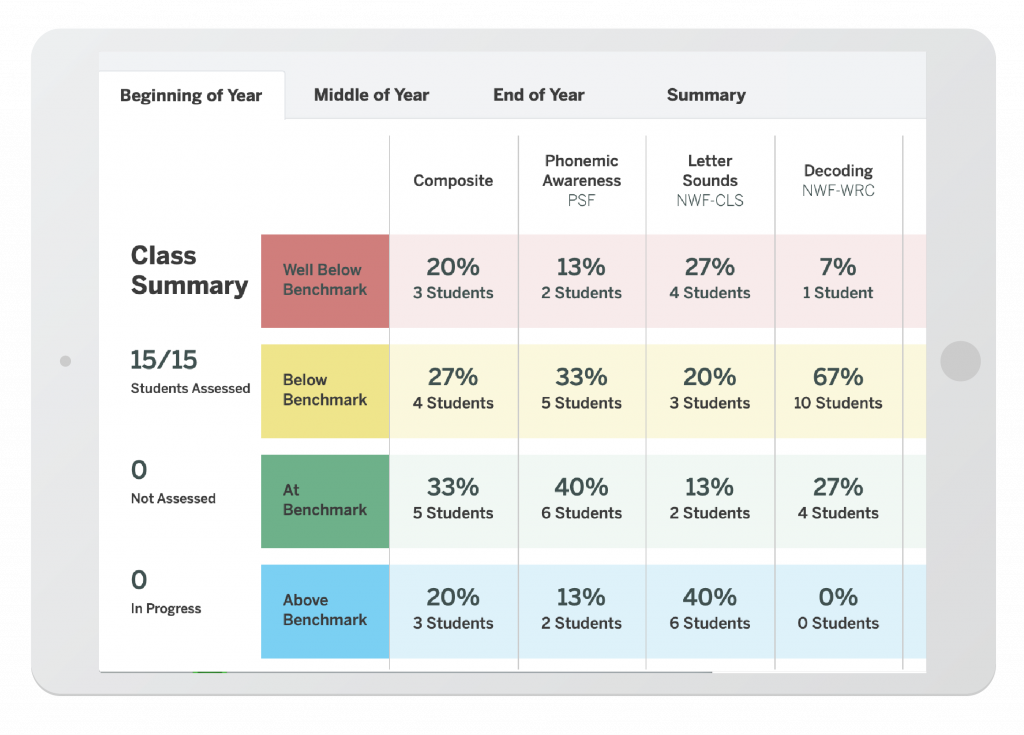
mCLASS with DIBELS 8th Edition gives you instant results and clear next steps for each student.

Quick and actionable reports provide detailed insight into students’ reading development across foundational literacy skills for teachers, specialists, administrators, and caregivers.

A tablet screen displays a student assessment summary table with color-coded categories for phonemic awareness, letter sounds, and decoding, comparing results from beginning to end of year.

Diagnostic assessment

mCLASS with DIBELS 8th Edition analyzes individual student response data through a proprietary scoring algorithm that pinpoints a student’s specific area(s) of growth and improvement, providing classroom teachers in-depth insight into a students’ instructional needs.

Ready-to-teach instruction

Immediately following the analysis of individual student responses, mCLASS with DIBELS 8th Edition provides an in-depth diagnostic report complete with suggested next steps, also known as “mCLASS Instruction.”

mCLASS Instruction evaluates each student’s responses on each individual subtest and instantly:

  • Provides a list of specific needs by student, such as struggling with medial vowel sounds or difficulty reading words with consonant blends.
  • Groups students automatically based on similar discrete skill needs, not simply composite scores like other assessment tools.
  • Recommends a variety of ready-to-teach lessons that specifically target each individual student’s areas of need or common areas of need for small-group instruction.

Classroom skill and benchmark summary

The Classroom Skill Summary report is a dashboard showing benchmark performance on each skill. Teachers can use it to determine which skill areas need instructional focus at a classroom level.

The Classroom Benchmark Summary report is a classroom-wide view of overall reading performance. Teachers can use this report to determine if composite scores improved, declined, or remained the same each semester.

Detailed benchmark performance

Teachers can see each student’s performance during the current school year, on each subtest as well as the overall composite. The benchmark goal displays below the subtest name when applicable. The ability to sort the columns in this report gives teachers more flexibility to analyze data the way they prefer.

Dyslexia screening

Identify students who are at risk for reading difficulties, including dyslexia, based on their results from foundational skills measures and additional measures as needed by local policies.

Progress monitoring summary

See which subtests have been assessed since the most recent benchmark assessment, how students performed on the three most recent progress monitoring assessments for each measure, and which students have not been progress monitored since the benchmark assessment.

Goal setting tool

The Zones of Growth (ZoG) analysis uses a rich set of national data to determine student goals for the next benchmark period. Teachers can use the Goal Setting Tool to view these recommended goals or modify the default goals for individual students as they see fit, if the default goal is too challenging or not challenging enough.

Growth outcomes

Teachers and interventionists can see each student’s actual growth achieved and how it compares to the goal that was set for the student.

Caregiver supports

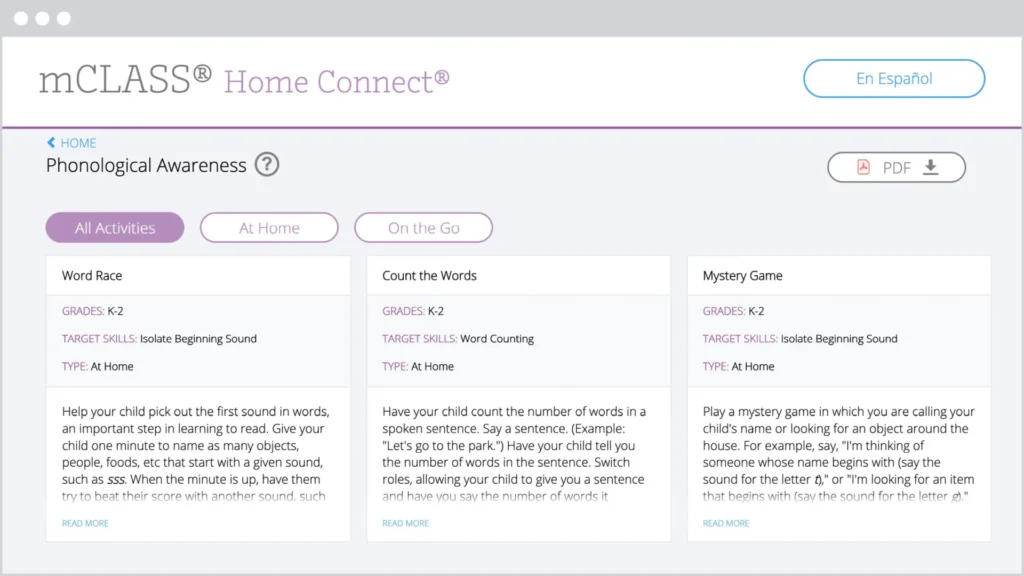
The mCLASS Home Connect website houses literacy resources for parents and caregivers, including at-home lessons organized by skill. Our mCLASS parent/caregiver letters in English and Spanish ensure that families know how to best support their child.

Screenshot of the mCLASS Home Connect webpage showing three phonological awareness activities for grades K-2 with brief descriptions and a PDF download button.

Self-guided tour

Our self-guided tour is a great way to orient yourself to the organization of our mCLASS platform. Click the button below to get started.

A webpage titled "mCLASS overview" featuring text about the mCLASS early literacy suite for grades K-6. The page includes photos of children engaged in reading activities and navigation options on the left.

Demo access

Follow the instructions below to login to your demo account.

  • Click the mCLASS Demo button below.
  • Select Log in with Amplify.
  • Enter the username: d8demoD
  • Enter the password: 1234
  • Click the Reading tile.

 
Once you are logged in:

  • Find the Class/Group dropdown field and select Grade 1.
  • Right above the Class Summary, click Beginning of Year or Middle of Year and explore the data.
  • Scroll down to the class list. Each column within the class list is sortable by clicking the double arrow in the column header.
  • Click on any score to see the measure transcript.
  • Click on a student’s name to see historical data and progress monitoring graphs.

After exploring the Benchmark tab in the purple bar:

  • Click on the Instruction tab.
  • If you don’t see groups, click Updated recommendations.
  • Explore freely! The Groups, Students, and All Activities tabs have rich information.
  • Click the Progress tab.
  • Click on Home Connect to see a sample of our caregiver letters.

New Mexico educators: Welcome to Amplify Science 6–8!

To view this protected page, enter the password below:


What is mCLASS?

mCLASS is a best-in-class assessment platform that houses a suite of proven, gold-standard assessment measures and tools that can be flexibly combined to meet the unique literacy needs of both teachers and students across grades K–6, including:

  • Universal screening
  • Diagnostic assessment
  • Dyslexia screening
  • Text Reading and Comprehension (a.k.a. running records via mCLASS: Reading 3D)
  • Progress monitoring
  • Dual language reporting
  • Targeted teacher-led instruction

What is the DIBELS 8th Edition assessment?

Developed by the University of Oregon, the DIBELS 8th Edition is the latest version of the DIBELS® (Dynamic Indicators of Basic Early Literacy Skills) assessment.

With this latest version, the University of Oregon Center on Teaching and Learning (UO CTL) made significant efforts to ensure measures would meet state-level screening requirements for universal screening, diagnostic assessment, and dyslexia screening. To support this, measures were updated based on the latest research to meet increased standards of reliability and validity. In addition, adaptive procedures and discontinue rules focus on the assessment of priority skills and prevent over-testing.

Summary of changes:

  • Consistent measures within grades will provide improved growth measurement.
  • All subtests have been revised to be grade-specific and to increase in difficulty, covering a full progression of skills and minimizing floor and ceiling effects. This provides the opportunity for students to demonstrate what they know and further pinpoint what they don’t know.
  • Phoneme Segmentation Fluency replaces First Sound Fluency. The expanded coverage minimizes floor effect and provides information about difficulty in Phonemic Awareness skills without the additional First Sound Fluency measure.
  • A new subtest, Word Reading Fluency, helps identify students with poor sight word reading skills that other subtests miss.
  • For all measures, the basic scoring procedures remain the same. For Nonsense Word Fluency, credit is given for recording words as whole words even if the student misses in the first attempt.
  • Oral Reading Fluency is now only one passage, instead of three. Retell has been removed. Thus, Oral Reading Fluency assessment will take a third of the time.

Assessment measures by grade

DIBELS measures at each grade level 
Measure Grade K Grade 1 Grade 2 Grade 3 Grades 4–6
Letter naming fluency A large, light peach-colored checkmark on a transparent background. A large, light peach-colored checkmark on a transparent background.      
Phonemic segmentation fluency A large, light peach-colored checkmark on a transparent background. A large, light peach-colored checkmark on a transparent background.      
Nonsense word fluency A large, light peach-colored checkmark on a transparent background. A large, light peach-colored checkmark on a transparent background. A large, light peach-colored checkmark on a transparent background. A large, light peach-colored checkmark on a transparent background.  
Word reading fluency A large, light peach-colored checkmark on a transparent background. A large, light peach-colored checkmark on a transparent background. A large, light peach-colored checkmark on a transparent background. A large, light peach-colored checkmark on a transparent background. A large, light peach-colored checkmark on a transparent background.
Oral reading fluency   A large, light peach-colored checkmark on a transparent background. A large, light peach-colored checkmark on a transparent background. A large, light peach-colored checkmark on a transparent background. A large, light peach-colored checkmark on a transparent background.
Maze (basic comprehension)     A large, light peach-colored checkmark on a transparent background. A large, light peach-colored checkmark on a transparent background. A large, light peach-colored checkmark on a transparent background.
Amplify measures at each grade level
Oral language A large, light peach-colored checkmark on a transparent background. A large, light peach-colored checkmark on a transparent background. A large, light peach-colored checkmark on a transparent background. A large, light peach-colored checkmark on a transparent background.  
Vocabulary A large, light peach-colored checkmark on a transparent background. A large, light peach-colored checkmark on a transparent background. A large, light peach-colored checkmark on a transparent background. A large, light peach-colored checkmark on a transparent background. A large, light peach-colored checkmark on a transparent background.

Assessment measures sample videos

DIBELS 8th Edition measure: Phonemic Segmentation Fluency (PSF)

DIBELS 8th Edition measure: Nonsense Word Fluency (NWF)

DIBELS 8th Edition measure: Letter Naming Fluency (LNF)

DIBELS 8th Edition measure: Word Reading Fluency (WRF)

DIBELS 8th Edition measure: Oral Reading Fluency (ORF)

What makes mCLASS with DIBELS 8th Edition different?

mCLASS with DIBELS 8th Edition combines the power of the mCLASS assessment platform and the effectiveness of the DIBELS 8th Edition assessment measures. As a result – educators are empowered with the latest and greatest assessment tool.

More than a test, mCLASS with DIBELS 8th Edition is an integrated system that closes the knowing-doing gap by helping teachers take immediate instructional action that’s right for each and every student.

Assessment systems must enable and compel educators to answer not just the “What” questions, but also the “So What” and “Now What” questions. These are the questions that are essential in transforming classroom instruction, and the questions that mCLASS with DIBELS 8th Edition helps teachers answer with confidence.

What makes mCLASS with DIBELS 8th Edition different?

  1. It gives teachers access to the latest digital version of the DIBELS assessment. Amplify is the only licensed provider of the digital DIBELS 8th Edition assessment. As such, our solution is the only one to enhance the DIBELS 8th Edition assessment with the power, reliability, and quickness of the mCLASS system.
  2. It makes it faster and easier to understand where every student is in their early literacy journey. By combining 1:1 observational diagnostic assessments, dyslexia screening, progress monitoring, instant scoring, rigorous reporting, automatic student grouping, and targeted instruction all in one place, it reduces the instructional delays associated with manual scoring, manual data analysis, and manual lesson planning.
  3. It brings more equity to the classroom. When used in conjunction with mCLASS Lectura, teachers have access to dual language reports that highlight a student’s strengths and weaknesses in both English and Spanish.
  4. It makes every instructional minute count. In addition to one-minute measures that quickly gauge student progress toward reading proficiency, it leverages a teacher’s most powerful instructional tool — their own 1:1 observations.
  5. It drives growth more efficiently. Rather than relying on broad composite scores alone, granular data and in-depth insights for every student help teachers pinpoint exact skill gaps and areas of unfinished learning, making whole-group, small-group, and 1:1 instruction more targeted and effective.
  6. It saves teachers time. Instant reports, automatic student groups, and ready-to-teach lessons mean teachers spend less time cobbling together materials and more time working directly with students and responding to their needs.

How does mCLASS with DIBELS 8th Edition support screening for dyslexia risk?

DIBELS 8th Edition measures have been updated based on the latest research. They now offer stronger measures of processing speed, phonological awareness, and alphabetic principles for dyslexia screening purposes.

To support this, a new subtest in Word Reading Fluency was introduced and revisions were made to Letter Naming Fluency, Phonemic Segmentation Fluency, and Nonsense Fluency subtests to improve their ability to screen for deficits commonly associated with dyslexia risk, such as phonological awareness, rapid naming ability, and alphabetic principle. These measures provide early warning signs for neurological processing difficulties that contribute to risk for dyslexia (Wolf & Bowers, 1999; Denckla & Rudel, 1974).

Moreover, measures in Oral Language and Vocabulary are included to provide additional information to help evaluate additional risk areas associated with dyslexia risk.

How does mCLASS with DIBELS 8th Edition support the use of running records?

Track your students’ reading progress from every angle with the Text Reading and Comprehension (TRC) assessment. When TRC is paired with the DIBELS 8th Edition assessment, classroom teachers unlock the ability to record reading behaviors through running digital records. Available in English and Spanish, it measures reading comprehension and provides insight into how each student finds meaning in text.

A laptop screen displays a student reading assessment report with benchmark levels, progress data, and color-coded reading categories for Jon Smith in the mCLASS platform.

Measures include:

  • Lesson plans for whole class, small-group, and one-on-one instruction.
  • Small-group advisor, which organizes students into groups based on strengths and gaps.
  • Item-level advisor, which drills deep into student responses to uncover patterns, strengths, and gaps.
  • Instructional resources for each student’s parent/guardian(s).

How does mCLASS with DIBELS 8th Edition turn data into instant action?

mCLASS with DIBELS 8th Edition gives you instant results and clear next steps for each student.

Quick and actionable reports provide detailed insight into students’ reading development across foundational literacy skills for teachers, specialists, administrators, and caregivers.

Tablet displaying a student performance table. Columns for assessment times; rows for performance levels. Percentages and student counts are provided in each assessment area and level.

Diagnostic assessment

mCLASS with DIBELS 8th Edition analyzes individual student response data through a proprietary scoring algorithm that pinpoints a student’s specific area(s) of growth and improvement, providing classroom teachers in-depth insight into a students’ instructional needs.

Ready-to-teach instruction

Immediately following the analysis of individual student responses, mCLASS with DIBELS 8th Edition provides an in-depth diagnostic report complete with suggested next steps, also known as “mCLASS Instruction.”

mCLASS Instruction evaluates each student’s responses on each individual subtest and instantly:

  • Provides a list of specific needs by student, such as struggling with medial vowel sounds or difficulty reading words with consonant blends.
  • Groups students automatically based on similar discrete skill needs, not simply composite scores like other assessment tools.
  • Recommends a variety of ready-to-teach lessons that specifically target each individual student’s areas of need or common areas of need for small-group instruction.

Classroom skill and benchmark summary

The Classroom Skill Summary report is a dashboard showing benchmark performance on each skill. Teachers can use it to determine which skill areas need instructional focus at a classroom level.

The Classroom Benchmark Summary report is a classroom-wide view of overall reading performance. Teachers can use this report to determine if composite scores improved, declined, or remained the same each semester.

Detailed benchmark performance

Teachers can see each student’s performance during the current school year, on each subtest as well as the overall composite. The benchmark goal displays below the subtest name when applicable. The ability to sort the columns in this report gives teachers more flexibility to analyze data the way they prefer.

Dyslexia screening

Identify students who are at risk for reading difficulties, including dyslexia, based on their results from foundational skills measures and additional measures as needed by local policies.

Progress monitoring summary

See which subtests have been assessed since the most recent benchmark assessment, how students performed on the three most recent progress monitoring assessments for each measure, and which students have not been progress monitored since the benchmark assessment.

Goal setting tool

The Zones of Growth (ZoG) analysis uses a rich set of national data to determine student goals for the next benchmark period. Teachers can use the Goal Setting Tool to view these recommended goals or modify the default goals for individual students as they see fit, if the default goal is too challenging or not challenging enough.

Growth outcomes

Teachers and interventionists can see each student’s actual growth achieved and how it compares to the goal that was set for the student.

Caregiver supports

The mCLASS Home Connect website houses literacy resources for parents and caregivers, including at-home lessons organized by skill. Our mCLASS parent/caregiver letters in English and Spanish ensure that families know how to best support their child.

Screenshot of the mclass home connect website showing educational activities in three categories: word race, count the ways, and mystery game, with navigation options at the top.

Self-guided tour

Our self-guided tour is a great way to orient yourself to the organization of our mCLASS platform. Click the button below to get started.

A webpage titled "mCLASS overview" featuring text about the mCLASS early literacy suite for grades K-6. The page includes photos of children engaged in reading activities and navigation options on the left.

Demo access

Follow the instructions below to login to your demo account.

  • Click the mCLASS Demo button below.
  • Select Log in with Amplify.
  • Enter the username: d8demoD
  • Enter the password: 1234
  • Click the Reading tile.

 
Once you are logged in:

  • Find the Class/Group dropdown field and select Grade 1.
  • Right above the Class Summary, click Beginning of Year or Middle of Year and explore the data.
  • Scroll down to the class list. Each column within the class list is sortable by clicking the double arrow in the column header.
  • Click on any score to see the measure transcript.
  • Click on a student’s name to see historical data and progress monitoring graphs.

After exploring the Benchmark tab in the purple bar:

  • Click on the Instruction tab.
  • If you don’t see groups, click Updated recommendations.
  • Explore freely! The Groups, Students, and All Activities tabs have rich information.
  • Click the Progress tab.
  • Click on Home Connect to see a sample of our caregiver letters.
What is mCLASS?

mCLASS is a best-in-class assessment platform that houses a suite of proven, gold-standard assessment measures and tools that can be flexibly combined to meet the unique literacy needs of both teachers and students across grades K–6, including:

  • Universal screening
  • Diagnostic assessment
  • Dyslexia screening
  • Progress monitoring
  • Dual language reporting
  • Quick 1-minute assessment measures
  • Real-time results, instant analysis, automatic student grouping
  • Targeted teacher-led instruction with ready-to-use mini-lessons

What is the DIBELS 8th Edition assessment?

Developed by the University of Oregon, the DIBELS 8th Edition is the latest version of the DIBELS® (Dynamic Indicators of Basic Early Literacy Skills) assessment.

With this latest version, the University of Oregon Center on Teaching and Learning (UO CTL) made significant efforts to ensure measures would meet state-level screening requirements for universal screening, diagnostic assessment, and dyslexia screening. To support this, measures were updated based on the latest research to meet increased standards of reliability and validity. In addition, adaptive procedures and discontinue rules focus assessment on priority skills and prevent over-testing.

Summary of changes:

  • Consistent measures within grades will provide improved growth measurement.
  • All subtests have been revised to be grade-specific and to increase in difficulty, covering a full progression of skills and minimizing floor and ceiling effects. This provides the opportunity for students to demonstrate what they know and further pinpoint what they don’t know.
  • Phoneme Segmentation Fluency replaces First Sound Fluency. The expanded coverage minimizes floor effect and provides information about difficulty in PA skills without the additional FSF measure.
  • A new subtest, Word Reading Fluency, helps identify students with poor sight word reading skills that other subtests miss.
  • For all measures, the basic scoring procedures remain the same. For NWF, credit is given for recording words as whole words even if the student misses in the first attempt.
  • Oral Reading Fluency is now only one passage, instead of three. Retell has been removed. Thus, ORF assessment will take a third of the time.

Assessment measures by grade

DIBELS measures at each grade level 
Measure Grade K Grade 1 Grade 2 Grade 3
Letter naming fluency A large, light peach-colored checkmark on a transparent background. A large, light peach-colored checkmark on a transparent background.    
Phonemic segmentation fluency A large, light peach-colored checkmark on a transparent background. A large, light peach-colored checkmark on a transparent background.    
Nonsense word fluency A large, light peach-colored checkmark on a transparent background. A large, light peach-colored checkmark on a transparent background. A large, light peach-colored checkmark on a transparent background. A large, light peach-colored checkmark on a transparent background.
Word reading fluency A large, light peach-colored checkmark on a transparent background. A large, light peach-colored checkmark on a transparent background. A large, light peach-colored checkmark on a transparent background. A large, light peach-colored checkmark on a transparent background.
Oral reading fluency   A large, light peach-colored checkmark on a transparent background. A large, light peach-colored checkmark on a transparent background. A large, light peach-colored checkmark on a transparent background.
Maze (basic comprehension)     A large, light peach-colored checkmark on a transparent background. A large, light peach-colored checkmark on a transparent background.
Amplify measures at each grade level
Oral language A large, light peach-colored checkmark on a transparent background. A large, light peach-colored checkmark on a transparent background. A large, light peach-colored checkmark on a transparent background. A large, light peach-colored checkmark on a transparent background.
Vocabulary A large, light peach-colored checkmark on a transparent background. A large, light peach-colored checkmark on a transparent background. A large, light peach-colored checkmark on a transparent background. A large, light peach-colored checkmark on a transparent background.

Assessment measures sample videos

DIBELS 8th Edition measure: Phonemic Segmentation Fluency (PSF)

DIBELS 8th Edition measure: Nonsense Word Fluency (NWF)

DIBELS 8th Edition measure: Letter Naming Fluency (LNF)

DIBELS 8th Edition measure: Word Reading Fluency (WRF)

DIBELS 8th Edition measure: Oral Reading Fluency (ORF)

How is mCLASS with DIBELS 8th Edition different?

mCLASS with DIBELS 8th Edition combines the power of the mCLASS assessment platform and the effectiveness of the DIBELS 8th Edition assessment measures. As a result – educators across the state are empowered with the latest and greatest assessment tool.

More than a test, mCLASS with DIBELS 8th Edition is an integrated system that closes the knowing-doing gap by helping teachers take immediate instructional action that’s right for each and every student.

Assessment systems must enable and compel educators to answer not just the “What” questions, but also the “So What” and “Now What” questions. These are the questions that are essential in transforming classroom instruction, and the questions that mCLASS with DIBELS 8th Edition helps teachers answer with confidence.

How is mCLASS with DIBELS 8th Edition different?

  1. It gives teachers access to the latest digital version of the DIBELS assessment. Amplify is the only licensed provider of the digital DIBELS 8th Edition assessment. As such, our solution is the only one to enhance the DIBELS 8th Edition assessment with the power, reliability, and quickness of the mCLASS system.
  2. It makes it faster and easier to understand where every student is in their early literacy journey. By combining 1:1 observational diagnostic assessments, dyslexia screening, progress monitoring, instant scoring, rigorous reporting, automatic student grouping, and targeted instruction all in one place, it reduces the instructional delays associated with manual scoring, manual data analysis, and manual lesson planning.
  3. It brings more equity to the classroom. When used in conjunction with mCLASS Lectura, teachers have access to dual language reports that highlight a student’s strengths and weaknesses in both English and Spanish.
  4. It makes every instructional minute count. In addition to one-minute measures that quickly gauge student progress toward reading proficiency, it leverages a teacher’s most powerful instructional tool — their own 1:1 observations.
  5. It drives growth more efficiently. Rather than relying on broad composite scores alone, granular data and in-depth insights for every student help teachers pinpoint exact skill gaps and areas of unfinished learning, making whole-group, small-group, and 1:1 instruction more targeted and effective.
  6. It saves teachers time. Instant reports, automatic student groups, and ready-to-teach lessons mean teachers spend less time cobbling together materials and more time working directly with students and responding to their needs.

How does mCLASS with DIBELS 8th Edition support screening for dyslexia risk?

DIBELS 8th Edition measures have been updated based on the latest research. They now offer stronger measures of processing speed, phonological awareness, and alphabetic principles for dyslexia screening purposes.

To support this, a new subtest in Word Reading Fluency was introduced and revisions were made to Letter Naming Fluency, Phonemic Segmentation Fluency, and Nonsense Fluency subtests to improve their ability to screen for deficits commonly associated with dyslexia risk, such as phonological awareness, rapid naming ability, and alphabetic principle. These measures provide early warning signs for neurological processing difficulties that contribute to risk for dyslexia (Wolf & Bowers, 1999; Denckla & Rudel, 1974).

Moreover, measures in Oral Language and Vocabulary are included to provide additional information to help evaluate additional risk areas associated with dyslexia risk.

How does mCLASS with DIBELS 8th Edition turn data into instant action?

mCLASS with DIBELS 8th Edition gives you instant results and clear next steps for each student.

Quick and actionable reports provide detailed insight into students’ reading development across foundational literacy skills for teachers, specialists, administrators, and caregivers.

Chart comparing student assessment performance across the year in categories: beginning, middle, and end, with a breakout box summarizing results by percentage and student count.

Diagnostic assessment

mCLASS with DIBELS 8th Edition analyzes individual student response data through a innovative scoring algorithm that leverages an item-level evaluation of individual student responses in order to provide deeper insights into specific student weaknesses and areas of improvement.

Ready-to-teach instruction

Immediately following the analysis of individual student responses, mCLASS with DIBELS 8th Edition provides an in-depth diagnostic report complete with suggested next steps, also known as “mCLASS Instruction.”

mCLASS Instruction evaluates each student’s responses on each individual subtest and instantly:

  • Provides a list of specific needs by student, such as struggling with medial vowel sounds or difficulty reading words with consonant blends.
  • Groups students automatically based on similar discrete skill needs, not simply composite scores like other assessment tools.
  • Recommends a variety of ready-to-teach lessons that specifically target each individual student’s areas of need or common areas of need for small-group instruction.

Classroom skill and benchmark summary

The Classroom Skill Summary report is a dashboard showing benchmark performance on each skill. Teachers can use it to determine which skill areas need instructional focus at a classroom level.

The Classroom Benchmark Summary report is a classroom-wide view of overall reading performance. Teachers can use this report to determine if composite scores improved, declined, or remained the same each semester.

Detailed benchmark performance

Teachers can see each student’s performance during the current school year, on each subtest as well as the overall composite. The benchmark goal displays below the subtest name when applicable. The ability to sort the columns in this report gives teachers more flexibility to analyze data the way they prefer.

Dyslexia screening

Identify students who are at risk for reading difficulties, including dyslexia, based on their results from foundational skills measures and additional measures as needed by local policies.

Progress monitoring summary

See which subtests have been assessed since the most recent benchmark assessment, how students performed on the three most recent progress monitoring assessments for each measure, and which students have not been progress monitored since the benchmark assessment.

Goal setting tool

The Zones of Growth (ZoG) analysis uses a rich set of national data to determine student goals for the next benchmark period. Teachers can use the Goal Setting Tool to view these recommended goals or modify the default goals for individual students as they see fit, if the default goal is too challenging or not challenging enough.

Growth outcomes

Teachers and interventionists can see each student’s actual growth achieved and how it compares to the goal that was set for the student.

Caregiver supports

The mCLASS Home Connect website houses literacy resources for parents and caregivers, including at-home lessons organized by skill. Our mCLASS parent/caregiver letters in English and Spanish ensure that families know how to best support their child.

Screenshot of the mclass home awareness webpage displaying educational games and activities for children, categorized by setting and skill level.

Explore our self-guided tour

Our self-guided tour is a great way to orient yourself to the organization of our mCLASS platform. Click the button below to get started.

mCLASS self-guided tour

Our programs

At Amplify, we support teachers in delivering inspiring, impactful lessons that celebrate and develop the thinking of all their students. See how we build inclusive, high-quality programs.

Amplify Science professional development

Amplify Science blends hands-on investigations, literacy-rich activities, and interactive digital tools to empower students to think, read, write, and argue like real scientists and engineers. We’ve created a wide suite of professional development offerings that will help you meet your unique needs this school year. Find out more below!

Professional Learning Partner Guide Certified Provider

Amplify CKLA, ELA, and Science professional development has been vetted by Rivet Education’s team through a rigorous three-step process and is listed in the Professional Learning Partner Guide.

Three women sitting at a table using a tablet to discuss stimulus funding for schools in a professional meeting.

Plan your professional development

We’re excited to partner with you on your Amplify journey. Flexible professional development pathways have been designed to meet your needs.

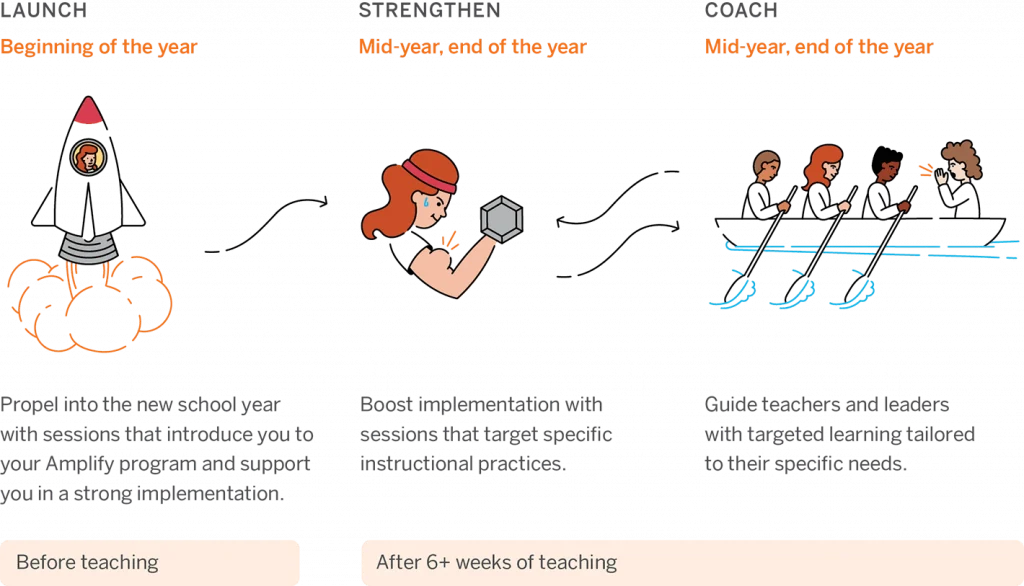
Illustration of three educational phases: a teacher launches a rocket, another reads a book, and four individuals discuss in a meeting setting.

Recommended Professional Development Plan

Our team has curated a recommended professional learning path from initial launch to continuous support. Use the Professional Development Planning Guide below to discuss the plan that best meets your school or district needs with your Account Executive.

Sessions overview

AudienceTitleDurationModalityAvailable
Foundations
K–5 instructional leadersAdministrators’ program overviewHalf dayOnsite/Remote6/2022
Administrators’ program overview for interactive classroomHalf dayOnsite/Remote6/2022
K–5 teachersInitial training1 day onsite
or 2 half days
remote
Onsite/RemoteYes*
Program overviewHalf dayOnsite/RemoteYes
Initial training for Interactive Classroom1 day onsite
or 2 half days
remote
Onsite/Remote6/2022
Program overview for Interactive ClassroomHalf dayOnsite/RemoteYes
6–8 instructional leadersAdministrators’ program overviewHalf dayOnsite/RemoteYes
6–8 teachersInitial training1 day onsite
or 2 half days
remote
Onsite/Remote6/2022
Program overviewHalf dayOnsite/RemoteYes
Strengthening
K–5 instructional leadersStrengthening consultation session60 min.Remote6/2022
Strengthening consultation package3 1-hour sessionsRemote6/2022
K–5 teachersGuided unit internalizationHalf dayOnsite/RemoteYes
Strengthening consultation session60 min.Remote6/2022
Strengthening consultation package3 1-hour sessionsRemote6/2022
6–8 instructional leadersStrengthening consultation session60 min.Remote6/2022
Strengthening consultation package3 1-hour sessionsRemote6/2022
6–8 teachersGuided unit internalizationHalf dayOnsite/RemoteYes
Strengthening consultation session60 min.Remote 6/2022
Strengthening consultation package3 1-hour sessionsRemote 6/2022
Coaching
K–5 instructional leadersJob-Embedded Coaching (JEC)1 dayOnsiteYes
K–5 teachersJob-Embedded Coaching (JEC)1 dayOnsite/RemoteYes
6–8 instructional leadersJob-Embedded Coaching (JEC)1 dayOnsiteYes
6–8 teachersJob-Embedded Coaching (JEC)1 dayOnsite/RemoteYes

Note for all workshops:  Any single three-hour offering can be repeated on the same day with different audiences to make one full-day session.

*When delivered remotely, this full-day initial training session (6 hours) is split into two half-day sessions (3 hours each). Part 1 and Part 2 may be scheduled consecutively on the same day or on different days, ideally within ~2 weeks. The same participants should attend both sessions in order to receive all content. This flexible scheduling opportunity for remote sessions will be available starting 6/2022.

Launch sessions

For teachers

Initial training

1 day onsite (6 hours) or 2 half days remote (6 hours)*
Grade band: K–5 / 6–8
Grade level: K, 1, 2, 3, 4, 5, 6, 7, 8

In the first half of this session, participants learn the essentials necessary to implement Amplify Science with success. They learn to navigate the digital Amplify Science platform and become familiar with planning resources and strategies. Through a model lesson and guided reflection, participants build an understanding of the instructional approach to teaching and learning. In the second half of this session, participants dig deeper into unit resources to start planning for instruction for their first grade-level unit.

When delivered as a grade band session, Part 1 will feature an exemplar from the following units:

  • K–5 workshops feature an exemplar from the grade 4 unit Energy Conversions.
  • 6–8 workshops feature an exemplar from the Metabolism Core unit.

When delivered as a grade level session, Part 1 features the following units:

  • K: Needs of Plants and Animals
  • 1: Animal and Plant Defenses
  • 2: Plant and Animal Relationships
  • 3: Balancing Forces
  • 4: Energy Conversions
  • 5: Patterns of Earth and Sky

6–8 workshops feature one of the following units:

  • Metabolism
  • Ocean, Atmosphere, and Climate
  • Phase Change

Available starting 6/2022.

Audience:
 Teachers (administrators welcome), maximum 30 participants
Modality: Onsite/Remote

*When delivered remotely, this full-day initial training session (6 hours) is split into two half-day sessions (3 hours each). Part 1 and Part 2 may be scheduled consecutively on the same day or on different days, ideally within two weeks. The same participants should attend both sessions in order to receive all content. This flexible scheduling opportunity for remote sessions will be available starting 6/2022.

Initial training for Interactive Classroom

1 day onsite (6 hours) or 2 half days remote (6 hours)*
Grade band: K–5
Grade level: K, 1, 2, 3, 4, 5, 6, 7, 8

In the first half of this session, participants learn to navigate with Amplify Science Interactive Classroom and prepare to start teaching. The session opens with a model lesson that introduces the functionality of the Interactive Classroom interface and highlights the Amplify Science instructional approach. Next, participants experience a guided navigation walkthrough that prepares them to use the full suite of Interactive Classroom features with their students. The session closes with time to reflect on implementation and a walkthrough of additional resources available to support further professional learning. In the second half of this session, participants dig deeper into unit resources to start planning for instruction for their first grade-level unit.

When delivered as a grade band session, Part 1 will feature an exemplar from the grade 4 unit Energy Conversions.

When delivered as a grade level session, Part 1 features the following units:

  • K: Needs of Plants and Animals
  • 1: Animal and Plant Defenses
  • 2: Plant and Animal Relationships
  • 3: Balancing Forces
  • 4: Energy Conversions
  • 5: Patterns of Earth and Sky

Audience: Teachers (administrators welcome), maximum 30 participants
Modality: Onsite/Remote

*When delivered remotely, this full-day initial training session (6 hours) is split into two half-day sessions (3 hours each). Part 1 and Part 2 may be scheduled consecutively on the same day or on different days, ideally within two weeks. The same participants should attend both sessions in order to receive all content. This flexible scheduling opportunity for remote sessions will be available starting 6/2022.

Program overview

Half day (3 hours)
Grade band: K–5 / 6–8
Grade level: 6, 7, 8

In this session, participants learn the essentials necessary to implement Amplify Science with success. They learn to navigate the digital Amplify Science platform and become familiar with planning resources and strategies. Through a model lesson and guided reflection, participants build an understanding of the instructional approach to teaching and learning.

When delivered as a grade band session, an exemplar will be featured from the following units:

  • K–5 workshops feature an exemplar from the grade 4 unit Energy Conversions.
  • 6–8 workshops feature an exemplar from Metabolism.

When delivered as a grade level session, the following units will be featured:

  • K: Needs of Plants and Animals
  • 1: Animal and Plant Defenses
  • 2: Plant and Animal Relationships
  • 3: Balancing Forces
  • 4: Energy Conversions
  • 5: Patterns of Earth and Sky

6–8 workshops feature one of the following units:

  • Metabolism
  • Ocean, Atmosphere, and Climate
  • Phase Change

Audience: Teachers (administrators welcome), maximum 30 participants
Modality: Onsite/Remote

Program overview for Interactive Classroom

Half day (3 hours)
Grand band: K–5
Grade level: K, 1, 2, 3, 4, 5

In this session, participants learn to navigate with Amplify Science Interactive Classroom and prepare to start teaching. The session opens with a model lesson that introduces the functionality of the Interactive Classroom interface and highlights the Amplify Science instructional approach. Next, participants experience a guided navigation walkthrough that prepares them to use the full suite of Interactive Classroom features with their students. The session closes with time to reflect on implementation and a walkthrough of additional resources available to support further professional learning.

When delivered as a grade band session, the workshop features an exemplar from the Grade 4 unit Energy Conversions.

When delivered as a grade level session, the workshop features the following units:

  • K: Needs of Plants and Animals
  • 1: Animal and Plant Defenses
  • 2: Plant and Animal Relationships
  • 3: Balancing Forces
  • 4: Energy Conversions
  • 5: Patterns of Earth and Sky

Audience: Teachers (administrators welcome), maximum 30 participants
Modality: Onsite/Remote

For instructional leaders

Administrators’ program overview

Half day (3 hours)
Grade band: K–5 / 6–8

In this session, instructional leaders become familiar with the principles of phenomenon-based teaching and learning, and experience the instructional approach of Amplify Science units. Leaders consider their essential role supporting teachers and students with the implementation of a new science curriculum.

Available starting 6/2022.

Audience: Administrators, department chairs, coaches, maximum 30 participants
Modality: Onsite/Remote

Administrators’ program overview for Interactive Classroom

Half day (3 hours)
Grade band: K-5

In this session, instructional leaders become familiar with the functionality of Amplify Science with Interactive Classroom and are introduced to the instructional approach of Amplify Science units. Leaders consider their essential role supporting teachers and students with the implementation of a new science curriculum.

Available starting 6/2022.

Audience: Administrators, department chairs, coaches, maximum 30 participants
Modality: Onsite/Remote

Strengthening sessions

For teachers

Guided unit internalization

Half day (3 hours)
Grade band: K–5 / 6–8
Grade level: K, 1, 2, 3, 4, 5, 6, 7, 8
Prerequisite: Initial training or program overview

In this session, participants leverage a planning protocol to internalize an upcoming unit. They apply their understanding of how students engage in three-dimensional learning throughout the unit to plan for the diverse needs of their classrooms and students.

Audience: Teachers (administrators welcome), maximum 30 participants
Modality: Onsite/Remote

Strengthening consultation session

60-minute session
Grade band: K–5 / 6–8
Grade level: K, 1, 2, 3, 4, 5, 6, 7, 8
Prerequisite: Initial training or program overview

This 60-minute session focuses on a specific topic that will deepen teachers understanding of Amplify Science. An Amplify facilitator will align with the school or district leadership team in advance on the topic (chosen from a menu of options) that will best meet teachers unique options.

Topics include supporting diverse learners (for K–8 teachers), Classwork/My Work/Assign/Reporting (for 6–8 teachers), and planning an Amplify Science lesson (for K–8 teachers).

Available starting 6/2022.

Audience: Teachers, maximum 30 participants
Modality: Remote

Strengthening consultation package

3 1-hour sessions
Grade band: K–5 / 6–8
Grade level: K, 1, 2, 3, 4, 5, 6, 7, 8
Prerequisite: Initial training or program overview

This package consists of three 60-minute sessions that can be delivered on the same day or on different days. Each session will focus on a specific topic that will deepen teachers understanding of Amplify Science. An Amplify facilitator will align with the school or district’s leadership team in advance on the topic from a menu of options that will best meet teachers unique needs.

Available starting 6/2022.

Audience: Teachers, maximum 30 participants
Modality: Remote

For instructional leaders

Strengthening consultation session

60-minute session
Grade band: K–5 / 6–8
Grade level: K, 1, 2, 3, 4, 5, 6, 7, 8
Prerequisite: Administrators’ program overview

These 60 minute sessions will focus on a specific topic that will deepen instructional leaders’ understanding in Amplify Science and equip them in driving towards stronger student outcomes. An Amplify facilitator will align with the school or district’s leadership team in advance on the topic from a menu of options that will best meet instructional leaders’ unique needs.

Topics include data analysis with Admin Reports (for 6-8 leaders), and Amplify Science classroom look-fors (for K-8 leaders).

Available starting 6/2022.

Audience: Administrators, department chairs, coaches, maximum 30 participants
Modality: Remote

Strengthening consultation package

3 1-hour sessions
Grade band: K–5 / 6–8
Prerequisite: Administrators’ program overview

This package consists of three 60-minute sessions that can be delivered on the same day or on different days. Each session will focus on a specific topic that will deepen leaders’ understanding of Amplify Science. An Amplify facilitator will align with the school or district’s leadership team in advance on the topic from a menu of options that will best meet leaders’ unique needs.

Available starting 6/2022.

Audience: Administrators, department chairs, coaches, maximum 30 participants
Modality: Remote

Coaching sessions

For teachers

Job-Embedded Coaching (JEC) services: Teachers

1 day (6 hours)
Grade band: K–5 / 6–8
Grade level: K, 1, 2, 3, 4, 5, 6, 7, 8
Prerequisite: Initial training or program overview

Strengthen your implementation of Amplify Science with a coaching onsite visit for your teachers. An Amplify Science Professional Learning Specialist can visit classrooms for observation and debriefs with focused feedback and/or facilitate PLC or grade-level meetings to support teachers with planning decisions. The flexible coaching design allows for a collaborative and personalized approach to support effective program implementation.

Audience: Teachers, maximum 30 participants
Modality: Onsite/Remote

For instructional leaders

Job-Embedded Coaching (JEC): Administrators

1 day (6 hours)
Grade band: K–5 / 6–8
Prerequisite: Administrators’ program overview

In our Coaching sessions, instructional leaders engage in facilitated Professional Learning Walks (PLW)—non-evaluative classroom observations of Amplify Science classrooms that focus on building capacity to identify indicators of strong implementation of the program. Classroom look-fors focus on the use of instructional resources (material access/use and the Classroom Wall), instructional delivery (unpacking the unit phenomena and multimodal instruction), and monitoring of instruction (supporting all learners and use of the Assessment System). Leaders collaboratively analyze collected data in order to identify strengths and areas for growth specific to the implementation of Amplify Science for their teaching teams. Leaders leave with an action plan for supporting their teachers based on the analysis and reflection from the PLW.

Audience: Administrators, department chairs, coaches, maximum 30 participants
Modality: Onsite

Pricing

We offer the following pricing for training sessions and packages:

Session typePricing
2 consecutive full day onsite sessions$4,800
1-day onsite session$3,200
1-day remote session (2 half days)$1,500
1-day remote coaching session$1,200
Half-day onsite session$2,500
Half-day remote session$750
60-minute remote session$350
3 1-hour remote sessions$1,000
Customized Amplify Science onsite or remote packagesPrice will vary

Please note that the prices are general ranges and may be subject to change.

Contact

Amplify welcomes the opportunity to partner with schools and districts to design professional development plans and answer your questions.

If you would like to order any of our professional development services, please contact your local Amplify sales representative or call (800) 823-1969.

Welcome, caregivers!

We hope you enjoy learning more about Amplify Science and what students are learning in science this year.

Para acceder a este sitio en español haga clic aquí.

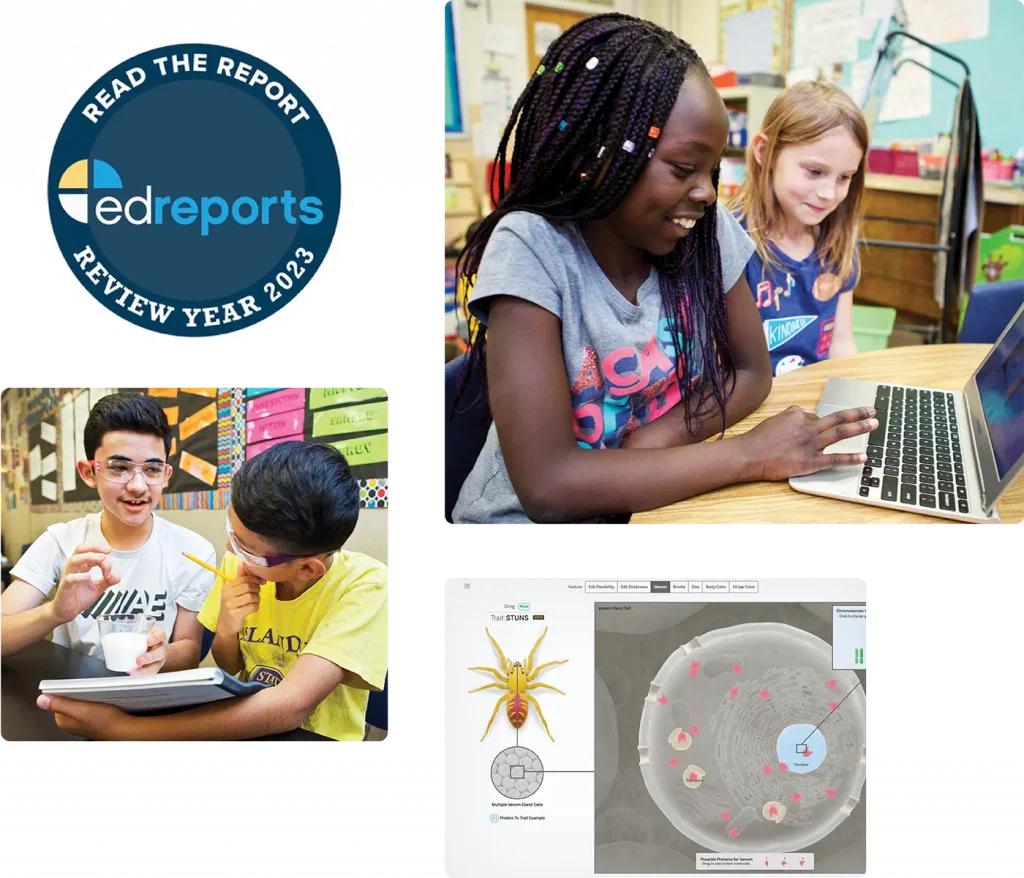
Collage of educational settings: top left, two young girls using laptop in library; bottom right, middle school science project display on tablet; bottom left, two boys with tablet discussing.

What is Amplify Science?

Amplify Science is an engaging curriculum for grades K–8 designed by experts at UC Berkeley’s Lawrence Hall of Science. As you look through the program, you may notice that it looks different from any science curriculum you’ve seen before. That’s because in  recent years, science teaching has moved away from fact-based lessons, such as those that require memorization, and toward deep learning, where students actively investigate and figure out real-world problems. This shift in science teaching and learning is reflected in new national science standards (the Next Generation Science Standards) and—you guessed it—in Amplify Science.

Watch the video below for a more detailed overview of the Next Generation Science Standards.

Back-to-school night with Amplify Science

Would you like to learn more about Amplify Science? We hosted our own back-to-school night for caregivers to provide an overview of the program your student is using at home.

Amplify Science K-5: Click here to watch the recording

Amplify Science 6-8: Click here to watch the recording

Getting started

While Amplify Science lessons are designed to be done in the classroom with peers, there are some activities that students can complete at home with your support. To make it as easy as possible to do these activities at home, ask your child’s teacher to provide the following resources:

  • Lesson Overview. Activities your student will complete at home are all part of larger lessons. The full lesson would be very difficult to complete at home, but the lesson overview will give you some context for the purpose of a given individual activity. 
  • Lesson Guide. This will provide step-by-step instructions if you want to guide your student through the specific activity in the lesson..
  • Investigation Notebook pages. Your student will use these to record their observations from the activity.

To help your student get up and running with digital access to Amplify Science, download our student navigational guide.

We recommend reviewing this Protecting Kids Online article by the Federal Trade Commission addressing digital safety.

Materials overview

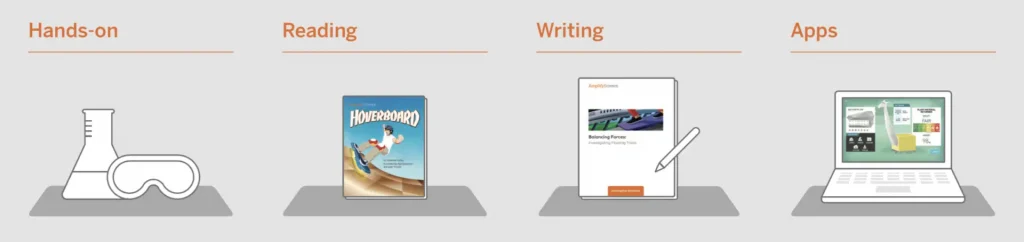
Amplify Science integrates the latest best practices in science teaching and learning. Students will have numerous opportunities to use hands-on materials, engage with readings, develop evidence-based scientific written arguments, and explore digital applications.

Illustration of educational steps with icons: "manos a la labora" with goggles and flask, "lectura" with a schoolbook, "redacción" with notebook and pen,

Watch the video below for a brief overview of the Amplify Science approach and program structure.

A powerful partnership

Amplify Science is the result of a collaboration between the science education experts at University of California, Berkeley’s Lawrence Hall of Science (LHS) and Amplify. The team of science, math, engineering, and literacy experts at LHS developed the content of the program, while Amplify’s team of designers and engineers developed the tools and components that bring the lessons to life for students.

Click here for more information on the Lawrence Hall of Science.

Explore grade-level resources.

Where to go for help

Whether you have questions about your technology or want to know more about the program, Amplify’s Support Team is here to help!

Contact Support via telephone at (833) 97-Care-8 (833-972-2738) or caregiver@amplify.com.

Our support hours are Monday – Friday, 7 am – 9 PM ET, and Sunday, 10 – 6 ET.

DPS leaders, welcome to Amplify Science!

Here you’ll find information about enrollment and licensing, materials and shipping logistics, professional learning resources, and more.

Program introduction

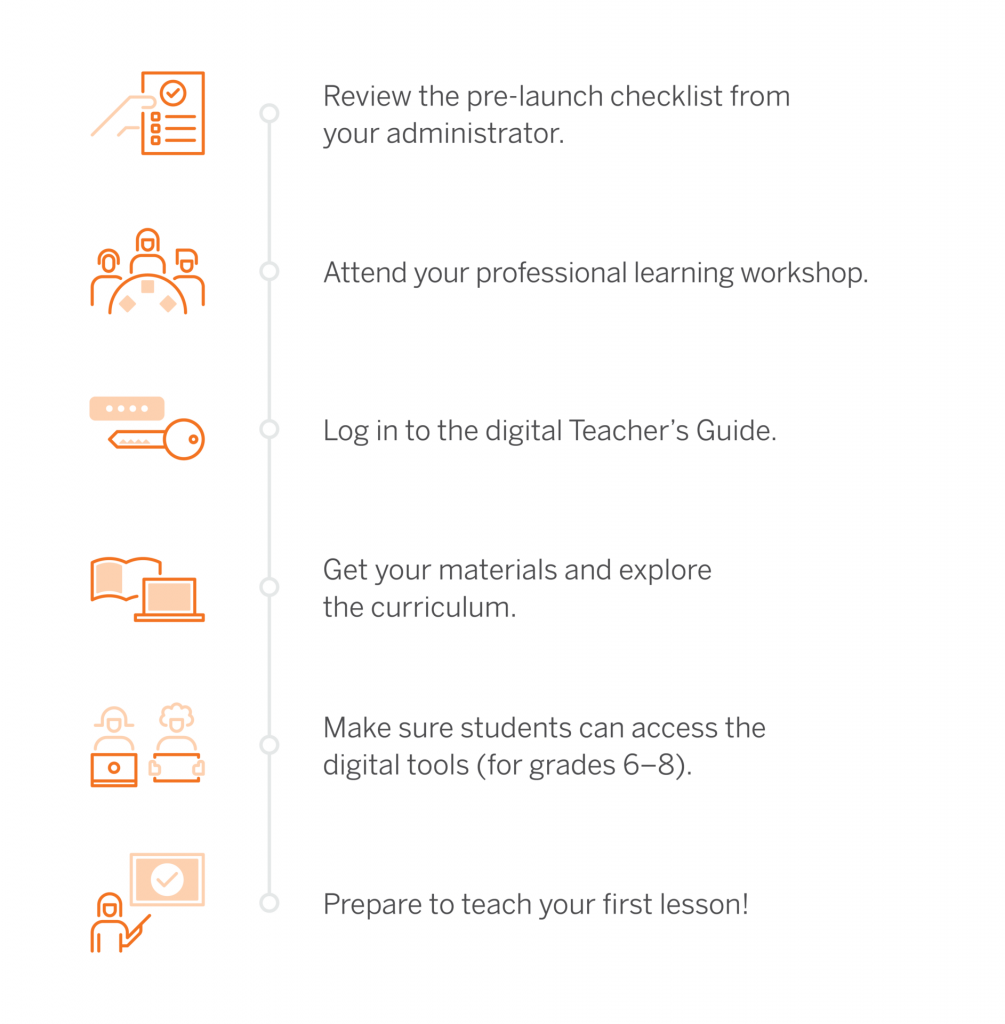
Onboarding: What to expect

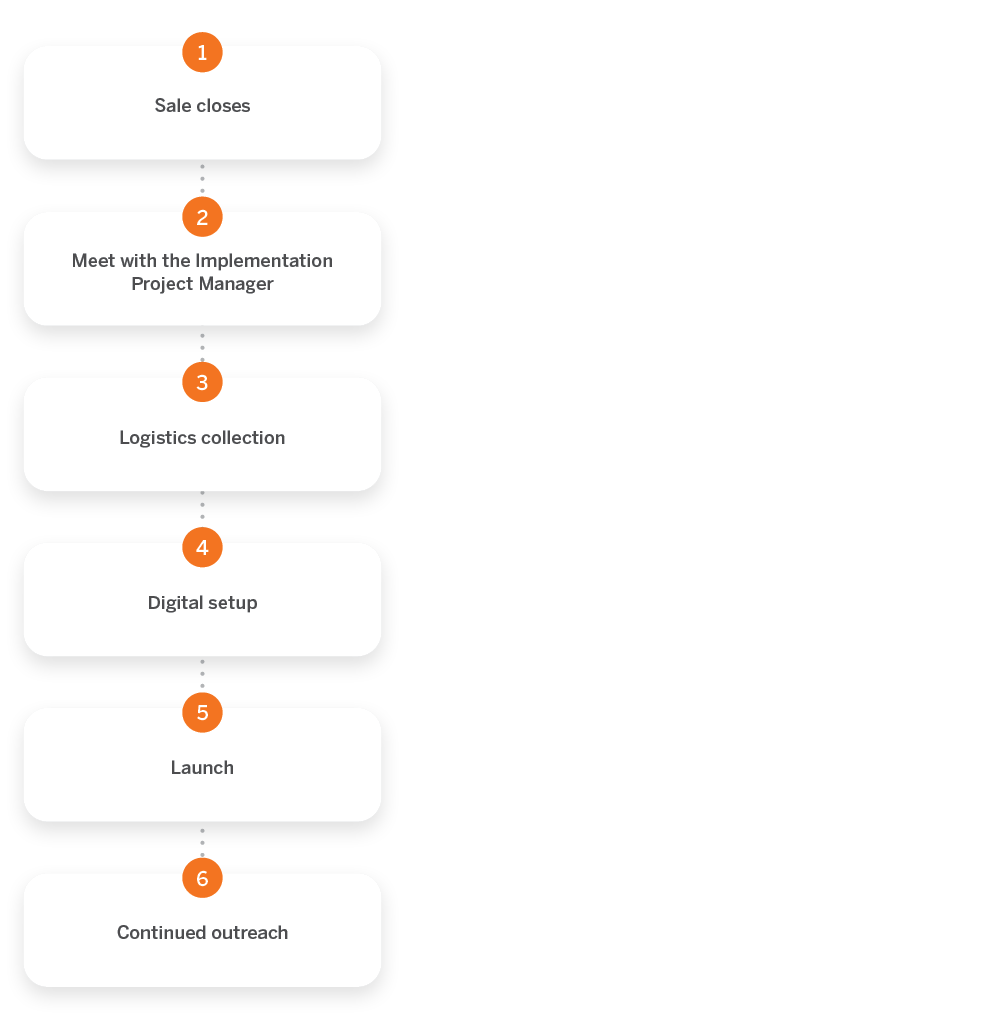
Welcome to Amplify Science! To help you know what’s coming next, we created the following visual that outlines the steps of the onboarding process. You can use it as a reference.

Technology requirements and guidelines

To ensure that your hardware and network meet the minimum technical requirements for optimal performance and support of your digital curriculum products, please see Amplify’s customer requirements page.

To ensure access to Amplify Science, add the URLs on this page to the corresponding district or school-level filters.

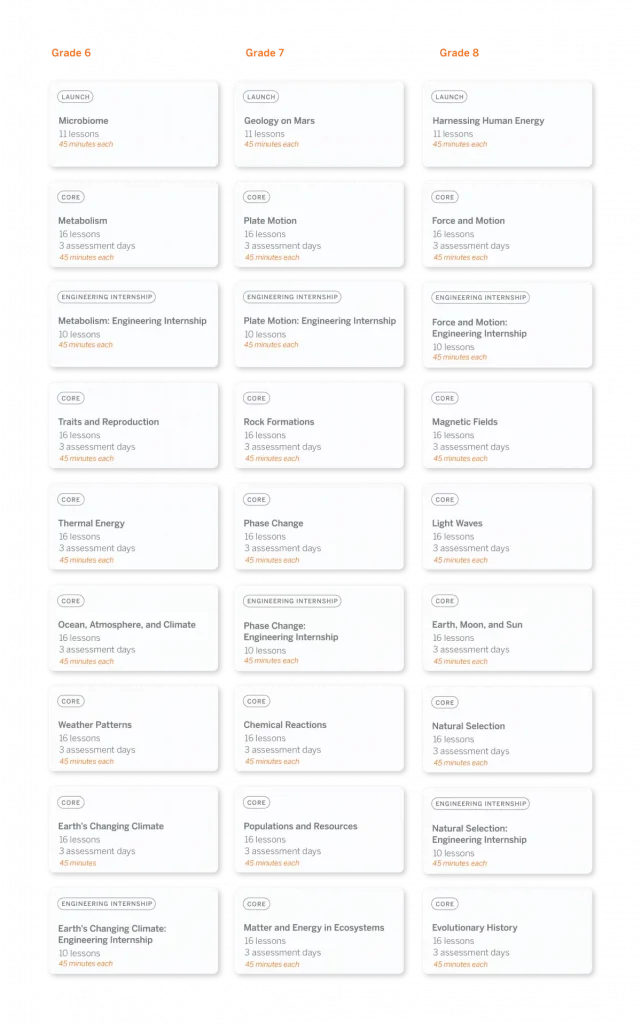
DPS scope and sequence (K–5)

DPS scope and sequence (6–8)

Amplify Science Program Guide

Getting started

The Amplify Science Program Guide details information about the program, including its authorship, development, themes, and more. It serves as a resource for finding out more about the program’s structure, components, supports, how it meets standards, and flexibility.

Navigate through the links below to access more information about the program and to explore resources that can help with your implementation:

Digging deeper

The sections below provide more details on the program’s approach and pedagogy:

Join our community.

Our Amplify Science Facebook group is a community of Amplify Science educators from across the country. It’s a space to share best practices, ideas, and support on everything from implementation to instruction. Join today.

Looking for help?

Powerful (and free!) pedagogical support

Amplify provides a unique kind of support you won’t find from other publishers. We have developed an educational support team of former teachers and administrators who provide pedagogical support for every Amplify curriculum, assessment, and intervention program. This service is completely free for all educators who are using our programs and includes:

  • Guidance for developing lesson plans and intervention plans
  • Information on where to locate standards and other planning materials
  • Recommendations and tips for day-to-day teaching with Amplify programs
  • Support with administering and interpreting assessment data and more

To reach our pedagogical team, use our live chat within your program, call (800) 823-1969, or email edsupport@amplify.com

Timely technical and program support

Our technical and program support is included and available from 7 a.m. to 7 p.m. ET, Monday through Friday, through a variety of channels, including a live chat program that enables teachers to get immediate help in the middle of the school day.

For your most urgent questions:

  • Use our live chat within your program
  • Call our toll-free number: (800) 823-1969

For less urgent questions:

Teachers, welcome to Amplify Science!

Here you’ll learn more about the program, download a pre-launch checklist, and read about how to get help when planning and delivering instruction.

Program introduction

Onboarding: What to expect

Welcome to Amplify Science! To help you know what’s coming next, we created the following visual that outlines the steps of the onboarding process. You can use it as a reference.

Pre-launch checklist

To ensure your first day using Amplify Science in the classroom is as seamless and smooth as possible, we recommend reviewing the following checklist at least two weeks ahead of time.

Onboarding videos

To start using Amplify Science quickly in your classroom, check out the following onboarding videos. They cover what you need to know to get started fast, from unpacking materials to logging in and navigating the digital Teacher’s Guide.

What’s online?

Program pacing

Planning strategies

How to log in and navigate

Introduction to Classwork (grades 6–8)

Unpacking your first hands-on materials kit

The following videos give you a quick look into our Amplify Science classroom kits. For each grade level, we have a video for the first unit in the scope and sequence, and we show you how to unpack the kits for all the units.

Join our community.

Our Amplify Science Facebook group is a community of Amplify Science educators from across the country. It’s a space to share best practices, ideas, and support on everything from implementation to instruction. Join today.

Looking for help?

Powerful (and free!) pedagogical support

Amplify provides a unique kind of support you won’t find from other publishers. We have developed an educational support team of former teachers and administrators who provide pedagogical support for every Amplify curriculum, assessment, and intervention program. This service is completely free for all educators who are using our programs and includes:

  • Guidance for developing lesson plans and intervention plans
  • Information on where to locate standards and other planning materials
  • Recommendations and tips for day-to-day teaching with Amplify programs
  • Support with administering and interpreting assessment data and more

To reach our pedagogical team, use our live chat within your program, call (800) 823-1969, or email edsupport@amplify.com

Timely technical and program support

Our technical and program support is included and available from 7 a.m. to 7 p.m. ET, Monday through Friday, through a variety of channels, including a live chat program that enables teachers to get immediate help in the middle of the school day.

For your most urgent questions:

  • Use our live chat within your program
  • Call our toll-free number: (800) 823-1969

For less urgent questions:

Amplify customer support hub

Quickly find support for every step of your journey, whether you’re new to our programs or a long-time partner. Our support hub offers personalized, responsive assistance to drive strong implementation and boost student outcomes.

Round-the-clock help resources

Access comprehensive support anytime, anywhere with our 24/7 Help Center. Find articles, answers, and quick links with ease in this collection of resources.

For system status updates, click on Amplify System Status.

Screenshot of the Amplify Help Center homepage, featuring a search bar, program links on the left, article categories in the center, and quick links on the right for easy access to customer support.

Need immediate assistance?

Whether you have a free account or your district has purchased an Amplify program, we’re here to help.

Request Support.

Free account users and customers can open a case for assistance.

Submit a support request

Full program customer support

Phone support

Speak directly with our knowledgeable agents.

Call: +1 (800) 823-1969 

Hours:
Monday through Friday
7 a.m. — 7 p.m. ET

Live chat

Connect instantly inside your program(s).

Log in at learning.amplify.com and click the chat button in the bottom right corner.

Continuous support along your journey

Personalized assistance

Our team helps with purchasing, order fulfillment, enrollment, and more.

Orange flowchart with stages of a project: purchase, customer support outreach, pd and materials, digital setup, launch, continued outreach, and ongoing support from cs partners.

From purchase to implementation

Collaborate with our sales team to explore programs tailored to your unique needs.

Connect with a product expert

Smooth ordering and payment

Enjoy seamless purchasing with our dedicated team. For quick help, visit our payment support site or contact your account executive.

VISIT PAYMENT SUPPORT

Ongoing success and growth

After processing your purchase, our specialized teams guide you through onboarding, professional development, materials delivery, digital setup, and implementation launch.

Discover the tools to transform teaching.

Continued learning and growth

Learn with us:
Join our free online webinars and events to explore thought leadership and gain insights. Stay informed about the latest in education.

Elevate your practice:​​
Explore paid professional development to enhance your skills and integrate our programs effectively. Our resources are tailored to support your success.

Your voice matters!

A laptop and a smartphone display an orange screen with the word "Amplify." in white text, highlighting tools that enhance student outcomes.

Join our lively Facebook communities to connect with fellow educators, share insights, and be part of a network advocating for student success and innovative education.

Welcome, reviewers!

Thank you for taking the time to review Amplify ELA for grades 6–8. With Amplify ELA, we enable teachers to foster skills through texts and develop their students’ ability to build meaning through reading. Students dive into complex texts to make observations, grapple with interesting ideas, and find relevance for themselves.

Amplify ELA offers middle school teachers rich texts, opportunities to form better connections with their students through powerful differentiation and assessment tools, and step-by-step instructional guides and resources that save them time and simplify their days.

Illustration of a woman with long hair and earrings, eyes closed in a serene pose, surrounded by plants and butterflies.

Overview

This site will allow you to experience our blended program, with access to the Amplify ELA print materials, digital curriculum, and resources to support your review. Our blended model enables teachers to design instruction based on their classroom needs and resources. Our engaging print edition highlights the many digital experiences teachers can share with students through classroom projections. Teachers can make choices about when their students use devices while providing 100-percent standards coverage and without compromising learning.

Amplify ELA’s embedded, easy-to-find features include:

  • Full standards coverage. Standards are clearly labeled in each lesson overview, so teachers can save time planning and get back to what they love—teaching.
  • Six levels of differentiation. Based on each student’s needs and the performance measures within Amplify ELA reports, a teacher can choose the differentiation level that’s right for everyone.
  • Assessments. Teachers benefit from uninterrupted instructional time and a continuously updated picture of each student’s progress with key skills and standards.
  • Powerful feedback tools. Comprehensive tools help teachers maximize both the quantity and quality of feedback.
  • Robust reporting. Our reporting app offers information on student progress to help inform instructional decisions.

Digital program

The content and instruction in Amplify ELA’s digital program mirror the content provided in the print Teacher Edition and Student Edition, though the digital program offers more opportunity to engage students through the use of multimedia and a variety of learning apps. Teachers will find embedded apps to help with scoring, providing student feedback, and reporting on the digital platform, accessible whether students or working with devices or in print.

Visit learning.amplify.com/ela-trial to review Amplify ELA’s digital program.

Grade 6 print samples

Three stacked educational book covers titled "Amplify ELA: Mysteries & Investigations" with illustrations of detective-themed elements and characters.

6B: Mysteries & Investigations:

Educational material cover for "the titanic collection" featuring a collage of the titanic, an iceberg, a ship's captain, and various themed illustrations.

6F: The Titanic Collection

Grade 7 print samples

Grade 8 print samples

Collage of illustrations featuring a mix of science fiction and historical figures, including a central image of a man with pointed ears and high hair. text labels include "amplify ela" and "science & science fiction".

8C: Science & Science Fiction

Collage of illustrations depicting various aspects of the space race, including an astronaut, a rocket in space, and mission control personnel.

8F: The Space Race Collection

Resources

Inspiring the next generation of Oklahoma scientists, engineers, and curious citizens

Amplify Science is an engaging new core curriculum designed for three-dimensional, phenomena-based learning.

A powerful partnership

Amplify Science was developed by the science education experts at UC Berkeley’s Lawrence Hall of Science and the digital learning team at Amplify.

Instructional model

The Amplify Science program is rooted in the proven, research-based pedagogy of Do, Talk, Read, Write, Visualize. Here’s how each element works:

DO
First-hand investigations are an important part of any science classroom, and Amplify Science has students getting hands-on in every unit—from building models of protein molecules to experimenting with electrical systems.

TALK
Student-to-student discourse and full-class discussions are an integral part of the program. Students are provided with numerous opportunities to engage in meaningful oral scientific argumentation, all while fostering a collaborative classroom environment.

READ
Students read scientific articles, focusing their reading activities on searching for evidence related to their investigation and, importantly, on asking and recording questions as they read through fascinating texts on 21st-century topics.

WRITE
Following real-world practices, students write scientific arguments based on evidence they’ve collected, making clear their reasoning about how a given piece of evidence connects to one of several claims.

VISUALIZE
By manipulating digital simulations and using modeling tools to craft visualizations of their thinking— just as real scientists and engineers do—students take their learning far beyond the confines of what they can physically see in the classroom in an exciting and authentic way.

Oklahoma Instructional Samplers

Video: Oklahoma Spotlight on All Learners (SPED, G & T, EL, DEI)

Resources to support your review

Remote and hybrid learning support

Oklahoma Spotlight Video: Remote and Hybrid Learning

Amplify has launched a new remote learning solution called Amplify Science @Home. Intended to make extended remote learning and hybrid learning easier, Amplify Science@Home includes two useful options for continuing instruction: @Home Videos and @Home Units. 

Amplify Science @Home Videos are recordings of real Amplify Science teachers teaching the lessons. For those teachers who are unable to meet synchronously with their students, the recorded lessons are a great way to keep their students on track and engaged with Amplify Science while at home. These videos will be produced for all K–5 units, and for the first four units of each 6–8 grade level. Their release will be rolling, beginning in August 2021.   

Amplify Science@Home Units are modified versions of Amplify Science units, strategically designed to highlight key activities from the program. The @Home Units take significantly less instructional time than the complete Amplify Science program and allow students to engage with science at home. @Home Units will be developed for all Amplify Science K–8 units. Each @Home unit includes:

  • Teacher overviews explaining how to use the materials, including suggestions for enhancing the @Home Units if synchronous learning or in-class time with students is available.
  • Overviews to send home to families.

Student materials are available in two formats:

  • @Home Slides (PDF/PPT) + Student Sheets (PDF) for students with access to technology at home.
  • Downloadable @Home Packets (PDF) for students without access to technology at home.

Download the remote and hybrid learning guide.

What’s included

Flexible resources that work seamlessly together
Oklahoma Spotlight Video: Instructional Resources: More than a textbook!

Science articles
The middle school science articles serve as sources for evidence collection and were authored by science and literacy experts at the Lawrence Hall of Science.

Student Investigation Notebooks
Available for every unit, the Student Investigation Notebooks provide space for students to:

  • record data.
  • reflect on ideas from texts and investigations.
  • construct explanations and arguments.

Available with full-color article compilations for middle school units.

Digital student experience
Students access the digital simulations and modeling tools, as well as lesson activities and assessments, through the digital student experience. Students can interact with the digital student experience as they:

  • conduct hands-on investigations.
  • engage in active reading and writing activities.
  • participate in discussions.
  • record observations.
  • craft end-of-unit scientific arguments.

Oklahoma Spotlight Video: Spotlight on Simulations

Teacher’s Guides
Available digitally and in print, the Teacher’s Guides contain all of the information teachers need to facilitate classroom instruction, including:

  • Classroom Slides.
  • detailed lesson plans.
  • unit and chapter overview documentation.
  • differentiation strategies.
  • standards alignments.
  • in-context professional development.

Oklahoma Spotlight Video: Classroom Slides

Hands-on materials kits
Hands-on learning is at the heart of Amplify Science. Each unit kit contains:

  • consumable and non-consumable hands-on materials.
  • print classroom display materials.
  • premium print materials for student use (sorting cards, maps, etc).

Scope and sequence

GRADE

UNITS

Kindergarten

  • Needs of Plants and Animals
  • Pushes and Pulls
  • Sunlight and Water

Grade 1

  • Animal and Plant Defenses
  • Light and Sound
  • Spinning Earth

Grade 2

  • Plant and Animal Relationships
  • Properties of Materials
  • Changing Landforms

Grade 3

  • Balancing Forces
  • Inheritance and Traits
  • Environments and Survival
  • Weather and Climate

Grade 4

  • Energy Conversions
  • Vision and Light
  • Earth’s Features
  • Waves, Energy, and Information

Grade 5

  • Patterns of Earth and Sky
  • Modeling Matter
  • The Earth System
  • Ecosystem Restoration

GRADE

UNITS

Grade 6

  • Launch: Microbiome
  • Metabolism
  • Plate Motion
  • Plate Motion Engineering Internship
  • Rock Transformations
  • Ocean, Atmosphere, and Climate
  • Weather Patterns
  • Thermal Energy
  • Phase Change

Grade 7

  • Launch: Harnessing Human Energy
  • Chemical Reactions
  • Populations and Resources
  • Matter Energy and Ecosystems
  • Earth’s Changing Climate
  • Earth’s Changing Climate Engineering Internship
  • Magnetic Fields

Grade 8

  • Launch: Geology on Mars
  • Force and Motion
  • Force and Motion Engineering Internship
  • Light Waves
  • Earth, Moon, and Sun
  • Traits and Reproduction
  • Natural Selection
  • Evolutionary History

Oklahoma Academic Standards for Science coverage

Amplify Science was designed from the ground up to meet the Next Generation Science Standards (NGSS), and the Oklahoma Academic Standards for Science (OASS) are closely aligned to the NGSS at K–8. The guidance below is meant to provide support for integrating additional activities that support full coverage of the OASS. You can view the full K–8 OASS correlation here.

Organized by grade level, each section below will outline:

  • additional activities that support 100% alignment to the Oklahoma Academic Standards for Science; 
  • the standard being addressed with the activities; 
  • the recommended placement of the activities within a specific Amplify Science unit; and 
  • PDFs of any accompanying materials that are necessary to implement the activities. 

Standard: 1.ESS3.1: Communicate solutions that will reduce the impact of humans on the land, water, air, and/or other living things in the local environment.

Recommended placement: Animal and Plant Defenses unit, Chapter 1

MaterialsThe Student Book Investigating Monarchs from the unit Needs of Plants and Animals

Investigating Monarchs emphasizes the needs of monarch caterpillars and butterflies and shows what happens when these animals are not able to meet their needs. The book first introduces the life cycle of monarchs, explaining that monarch caterpillars must eat milkweed to survive and change into butterflies. Their summer habitat must have milkweed. The butterflies then migrate a long distance, from the United States to a forest in the mountains of Mexico, where they take shelter in the trees. Their winter habitat must have trees. Scientists discovered that the monarch population in Mexico was greatly reduced because people were cutting down the trees. The forest was then protected, but the monarch population did not recover as expected. Scientists in the United States found evidence that this was because fields with milkweed are being replaced by farms and buildings. This book could be read with the class either before or after Chapter 1 of the Animal and Plant Defenses unit, which focuses on what plants and animals need to do to survive. Students could be asked to reflect on what the monarchs need to survive (including food and shelter), and how human activities impacted the monarchs’ ability to meet those needs. After reading the book, students could brainstorm ideas for how to reduce the impact of humans on the local environment.

Standard: MS-PS4-2: Develop and use a model to describe that waves are reflected, absorbed, or transmitted through various materials.

Recommended placement: Metabolism unit, Lesson 3.3, addition to Activity 5 

Materials“What Eyes Can See” science article

As students investigate metabolism and the body systems, the article “What Eyes Can See” should be assigned to deepen their understanding of information processing and sense receptors and connect that understanding to the emerging idea of the interaction of waves with various materials. The article explores how the only thing we can really see is light. Light travels from a light source to the eye, passing through some materials and bouncing off others. Tiny organs inside the eye called rods and cones absorb energy from light, making vision possible. These interactions between light and materials determine our visible world. 

Instructions:

Download the PDF “What Eyes Can See” above and remind students of the Active Reading guidelines. Before students read the article, invite them to share prior experiences. For example, “Have you ever had an experience where something looked different in one kind of light than in another kind of light? Or where something seemed to appear or disappear when the light changed?”

Standard: MS-PS3-1: Construct and interpret graphical displays of data to describe the relationships of kinetic energy to the mass of an object and to the speed of an object.

Recommended placement: Harnessing Human Energy unit, Lesson 1.4, after Activity 4 

MaterialsForce and Motion simulationActivity instructions and copymasters

In this activity, students use the Force and Motion Simulation to investigate the relationship between kinetic energy, mass, and velocity. 

Instructions

Download the PDF linked above for the Lesson Guide and copymasters needed for the activity. Note that this investigation is typically implemented during the Force and Motion unit. This means the Lesson Guide will contain some incongruous labeling (e.g., unit name), as well as instructions that are out of context and unnecessary for the purposes of addressing this standard at grade 7. We suggest skipping to step 4 of the Instructional Guide to avoid some of this. Your students will get additional exposure to this activity, and indeed the standard as a whole, when they get to the Force and Motion unit in grade 8.

Standards:

  • MS-PS2-3: Ask questions about data to determine the factors that affect the strength of electric and magnetic forces.
  • MS-PS2-5: Conduct an investigation and evaluate the experimental design to provide evidence that fields exist between objects exerting forces on each other even though the objects are not in contact.

Recommended placementForce and Motion unit, after Lesson 1.5 

MaterialsFlextension PDF

This hands-on activity builds on and reinforces students’ understanding of forces that act at a distance, with a focus on electrostatic force. Students explore electrostatic forces, prompted by a set of challenges that they try to accomplish. Next, students generate scientific questions based on their observations. Electrostatic force is less predictable and consistent than magnetic force, and investigating it can be both challenging and intriguing. The purpose of this lesson is for students to gain firsthand experience with electrostatic force and to gain experience generating scientific questions based on observations. You might choose to include this Flextension if you would like your students to have more exposure to electrostatic force, and if you would like to challenge your students to explore and ask questions about a challenging type of force. 

Instructions:

Download the PDF linked above for a detailed Lesson Guide and the copymasters associated with the activity. Note that this activity is typically implemented as an add-on Flextension during the Magnetic Fields unit. This means that you will see some information that is out of context (e.g., placement information, unit title), but the activity itself also works for the purposes of the Force and Motion unit. If you have any questions, please reach out to our support team via the chat icon in your account or help@amplify.com

Explore the Digital Teacher’s Guide

When you’re ready to review, click the orange button below and use your provided login credentials to access the Amplify Science Digital Teacher’s Guide.

To help familiarize yourself with navigating the digital Teacher’s Guide, watch our navigational guide videos:

Grades K–5:

Grades 6–8:

Looking for help?

Powerful (and free!) pedagogical support

Amplify provides a unique kind of support you won’t find from other publishers. We’ve developed an educational support team of former teachers and administrators who provide pedagogical support for every Amplify curriculum, assessment, and intervention program. This service is completely free for all educators who are using our programs and includes:

  • Guidance for developing lesson plans and intervention plans.
  • Information on where to locate standards and other planning materials.
  • Recommendations and tips for day-to-day teaching with Amplify programs.
  • Support with administering and interpreting assessment data and more.

To reach our pedagogical team, use our live chat within your program, call              (800) 823-1969, or email edsupport@amplify.com

Timely technical and program support

Our technical and program support is included and available from 7 a.m. to 7 p.m. ET, Monday through Friday, through a variety of channels, including a live chat program that enables teachers to get immediate help in the middle of the school day.

For your most urgent questions:

  • Use our live chat within your program.
  • Call our toll-free number: (800) 823-1969.

For less urgent questions:

Contact us

Contact your Oklahoma representative:
Julie Godfrey
Account Executive
jgodfrey@amplify.com
(817) 360-0527

Inspiring the next generation of Oklahoma scientists, engineers, and curious citizens

Amplify Science is an engaging K–8 core curriculum designed for three-dimensional and phenomena-based learning.

View the Tulsa Selection Rubric with evidence from Amplify Science.

Collage showing students engaged in classroom science activities and two scientific illustrations: a cheetah in foliage and a diagram of clouds and raindrops above a hill.

21st Century Science for Oklahoma

Click your grade-level for a one-stop review resource:

Topic-specific resources to support your review

Oklahoma Academic Standards for Science coverage

Amplify Science was designed from the ground up to meet the Next Generation Science Standards (NGSS), and the Oklahoma Academic Standards for Science (OASS) are closely aligned to the NGSS at K–8. The guidance below is meant to provide support for integrating additional activities that support full coverage of the OASS. You can view the full K–8 OASS correlation here.

Organized by grade level, each section below will outline:

  • additional activities that support 100% alignment to the Oklahoma Academic Standards for Science; 
  • the standard being addressed with the activities; 
  • the recommended placement of the activities within a specific Amplify Science unit; and 
  • PDFs of any accompanying materials that are necessary to implement the activities. 

Standard: 1.ESS3.1: Communicate solutions that will reduce the impact of humans on the land, water, air, and/or other living things in the local environment.

Recommended placementAnimal and Plant Defenses unit, Chapter 1

MaterialsThe Student Book Investigating Monarchs from the unit Needs of Plants and Animals

Investigating Monarchs emphasizes the needs of monarch caterpillars and butterflies and shows what happens when these animals are not able to meet their needs. The book first introduces the life cycle of monarchs, explaining that monarch caterpillars must eat milkweed to survive and change into butterflies. Their summer habitat must have milkweed. The butterflies then migrate a long distance, from the United States to a forest in the mountains of Mexico, where they take shelter in the trees. Their winter habitat must have trees. Scientists discovered that the monarch population in Mexico was greatly reduced because people were cutting down the trees. The forest was then protected, but the monarch population did not recover as expected. Scientists in the United States found evidence that this was because fields with milkweed are being replaced by farms and buildings. This book could be read with the class either before or after Chapter 1 of the Animal and Plant Defenses unit, which focuses on what plants and animals need to do to survive. Students could be asked to reflect on what the monarchs need to survive (including food and shelter), and how human activities impacted the monarchs’ ability to meet those needs. After reading the book, students could brainstorm ideas for how to reduce the impact of humans on the local environment.

Standard: MS-PS4-2: Develop and use a model to describe that waves are reflected, absorbed, or transmitted through various materials.

Recommended placementMetabolism unit, Lesson 3.3, addition to Activity 5 

Materials“What Eyes Can See” science article

As students investigate metabolism and the body systems, the article “What Eyes Can See” should be assigned to deepen their understanding of information processing and sense receptors and connect that understanding to the emerging idea of the interaction of waves with various materials. The article explores how the only thing we can really see is light. Light travels from a light source to the eye, passing through some materials and bouncing off others. Tiny organs inside the eye called rods and cones absorb energy from light, making vision possible. These interactions between light and materials determine our visible world. 

Instructions:

Download the PDF “What Eyes Can See” above and remind students of the Active Reading Guidelines. Before students read the article, invite them to share prior experiences. For example, “Have you ever had an experience where something looked different in one kind of light than in another kind of light? Or where something seemed to appear or disappear when the light changed?”

Standard: MS-PS3-1: Construct and interpret graphical displays of data to describe the relationships of kinetic energy to the mass of an object and to the speed of an object.

Recommended placementHarnessing Human Energy unit, Lesson 1.4, after Activity 4 

MaterialsForce and Motion SimulationActivity instructions and copymasters

In this activity, students use the Force and Motion Simulation to investigate the relationship between kinetic energy, mass, and velocity. 

Instructions

Download the PDF linked above for the Lesson Guide and copymasters needed for the activity. Note that this investigation is typically implemented during the Force and Motion unit. This means the Lesson Guide will contain some incongruous labeling (e.g., unit name), as well as instructions that are out of context and unnecessary for the purposes of addressing this standard at grade 7. We suggest skipping to step 4 of the Instructional Guide to avoid some of this. Your students will get additional exposure to this activity, and indeed the standard as a whole, when they get to the Force and Motion unit in grade 8.

Standards:

  • MS-PS2-3: Ask questions about data to determine the factors that affect the strength of electric and magnetic forces.
  • MS-PS2-5: Conduct an investigation and evaluate the experimental design to provide evidence that fields exist between objects exerting forces on each other even though the objects are not in contact.

Recommended placementForce and Motion unit, after Lesson 1.5 

MaterialsFlextension PDF

This hands-on activity builds on and reinforces students’ understanding of forces that act at a distance, with a focus on electrostatic force. Students explore electrostatic forces, prompted by a set of challenges that they try to accomplish. Next, students generate scientific questions based on their observations. Electrostatic force is less predictable and consistent than magnetic force, and investigating it can be both challenging and intriguing. The purpose of this lesson is for students to gain firsthand experience with electrostatic force and to gain experience generating scientific questions based on observations. You might choose to include this Flextension if you would like your students to have more exposure to electrostatic force, and if you would like to challenge your students to explore and ask questions about a challenging type of force. 

Instructions:

Download the PDF linked above for a detailed Lesson Guide and the copymasters associated with the activity. Note that this activity is typically implemented as an add-on Flextension during the Magnetic Fields unit. This means that you will see some information that is out of context (e.g., placement information, unit title), but the activity itself also works for the purposes of the Force and Motion unit. If you have any questions, please reach out to our support team via the chat icon in your account or help@amplify.com

What comes with the program?

Flexible resources that work seamlessly together

Science articles
The middle school science articles serve as sources for evidence collection and were authored by science and literacy experts at the Lawrence Hall of Science.

Student Investigation Notebooks
Available for every unit, the Student Investigation Notebooks provide space for students to:

  • record data
  • reflect on ideas from texts and investigations
  • construct explanations and arguments

Available with full-color article compilations for middle school units.

Collection of educational books from 'amplify science' on topics including ocean atmosphere, matter and energy ecosystems, and insect interactions, displayed in various angles.

Digital student experience
Students access the digital simulations and modeling tools, as well as lesson activities and assessments, through the digital student experience. Students can interact with the digital student experience as they:

  • conduct hands-on investigations
  • engage in active reading and writing activities
  • participate in discussions
  • record observations
  • craft end-of-unit scientific arguments
A digital illustration showcasing a laptop and a tablet displaying complex data analysis software interfaces with graphs and heatmaps.

Teacher’s Guides
Available digitally and in print, the Teacher’s Guides contain all of the information teachers need to facilitate classroom instruction, including:

  • Classroom Slides
  • detailed lesson plans
  • unit and chapter overview documentation
  • differentiation strategies
  • standards alignments
  • in-context professional development
A laptop displaying the Geology on Mars webpage sits beside a book titled "Geology on Mars," both featuring the same cover image of Mars and a spacecraft, perfect for enhancing three-dimensional learning in any science classroom.

Hands-on materials kits
Hands-on learning is at the heart of Amplify Science. Each unit kit contains:

  • consumable and non-consumable hands-on materials
  • print classroom display materials
  • premium print materials for student use (sorting cards, maps, etc.)
A perforated rectangular board, three small containers with different powders, a black battery holder with red wires, and three colored alligator clips are arranged on a white background.

Scope and sequence

Grade Units

Kindergarten

  • Needs of Plants and Animals
  • Pushes and Pulls
  • Sunlight and Water

Grade 1

  • Animal and Plant Defenses
  • Light and Sound
  • Spinning Earth

Grade 2

  • Plant and Animal Relationships
  • Properties of Materials
  • Changing Landforms

Grade 3

  • Balancing Forces
  • Inheritance and Traits
  • Environments and Survival
  • Weather and Climate

Grade 4

  • Energy Conversions
  • Vision and Light
  • Earth’s Features
  • Waves, Energy, and Information

Grade 5

  • Patterns of Earth and Sky
  • Modeling Matter
  • The Earth System
  • Ecosystem Restoration
Grade Units

Grade 6

  • Launch: Microbiome
  • Metabolism
  • Plate Motion
  • Plate Motion Engineering Internship
  • Rock Transformations
  • Ocean, Atmosphere, and Climate
  • Weather Patterns
  • Thermal Energy
  • Phase Change

Grade 7

  • Launch: Harnessing Human Energy
  • Chemical Reactions
  • Populations and Resources
  • Matter Energy and Ecosystems
  • Earth’s Changing Climate
  • Earth’s Changing Climate Engineering Internship
  • Magnetic Fields

Grade 8

  • Launch: Geology on Mars
  • Force and Motion
  • Force and Motion Engineering Internship
  • Light Waves
  • Earth, Moon, and Sun
  • Traits and Reproduction
  • Natural Selection
  • Evolutionary History

Spanish resources

All Spanish materials have parity with their English counterparts and are of the highest quality. The Amplify Science curriculum was not only based on the latest research and approaches to teaching and learning, but was extensively field tested throughout the country prior to release.  The same rigor in terms of scientific accuracy, rich content and language, and literacy development was used in the creation of the Amplify Science Spanish materials. Furthermore, the Spanish instructional materials were carefully translated using academic Spanish, paying particular attention to consistency and the use of grade-level appropriate language in order to support language development.

In Amplify Science, each unit’s glossary contains all content-area vocabulary words in Spanish, French, Portuguese, Russian, Mandarin, Vietnamese, Haitian-Creole, Tagalog, Arabic, and Urdu. In addition, Spanish materials that are available in three useful formats:

  • First, the Teacher Spanish license gives teachers access to a button that enables them to toggle back and forth between seeing Spanish and English in their Amplify Science accounts. When in Spanish mode, teachers can:
    • Download PDFs of all classroom wall materials, copymasters, assessments, and more 
    • Use Spanish projections in class 
    • See all model teacher talk in Spanish
    • Access digital versions of the student books and articles in Spanish 
  • Second, Spanish Print Kits provide hard-copy, translated versions of all student-facing materials such as student books, copymasters, print materials, assessments, and notebooks.
  •  Last, Student Spanish Licenses are available. These allow students to access Spanish versions of all student resources including lesson instructions, science articles, vocabulary, assessments, and simulations. Audio in videos, as well as in the read aloud functionality of articles and assessments, is also translated. When their students have the Spanish licenses, teachers can assign students to a particular language, or they can choose to give students the ability to toggle between English and Spanish as needed. 

Family and caregiver resources

Learn more about how Amplify Science supports families and caregivers by visiting our Hubs:

English

Spanish

Remote and hybrid learning support

Amplify has launched a new remote learning solution called Amplify Science@Home. Intended to make extended remote learning and hybrid learning easier, Amplify Science@Home includes two useful options for continuing instruction: @Home Videos and @Home Units. 

Amplify Science @Home Videos are recordings of real Amplify Science teachers teaching the lessons. For those teachers who are unable to meet synchronously with their students, the recorded lessons are a great way to keep their students on track and engaged with Amplify Science while at home. These videos will be produced for all K–5 units, and for the first four units of each 6–8 grade level. Their release will be rolling, beginning in August.   

Amplify Science@Home Units are modified versions of Amplify Science units, strategically designed to highlight key activities from the program. The @Home Units take significantly less instructional time than the complete Amplify Science program and allow students to engage with science at home. @Home Units will be developed for all Amplify Science K–8 units. Each @Home unit includes:

  • Teacher overviews explaining how to use the materials, including suggestions for enhancing the @Home Units if synchronous learning or in-class time with students is available.
  • Overviews to send home to families.

Student materials are available in two formats:

  • @Home Slides (PDF/PPT) + Student Sheets (PDF) for students with access to technology at home.
  • Downloadable @Home Packets (PDF) for students without access to technology at home.

Download the Remote and hybrid learning guide.

Explore the full curriculum

When you’re ready to review, click the orange button below and use the following login credentials to access the Amplify Science Digital Teacher’s Guide.

Username: t.okscience@tryamplify.net
Password: Amplify1okscience

To help familiarize yourself with navigating the digital Teacher’s Guide, watch our navigational guide videos:

Grades K–5:

Grades 6–8:

Looking for help?

Powerful (and free!) pedagogical support

Amplify provides a unique kind of support you won’t find from other publishers. We have developed an educational support team of former teachers and administrators who provide pedagogical support for every Amplify curriculum, assessment, and intervention program. This service is completely free for all educators who are using our programs and includes:

  • Guidance for developing lesson plans and intervention plans
  • Information on where to locate standards and other planning materials
  • Recommendations and tips for day-to-day teaching with Amplify programs
  • Support with administering and interpreting assessment data and more

To reach our pedagogical team, use our live chat within your program, call (800) 823-1969, or email edsupport@amplify.com

Timely technical and program support

Our technical and program support is included and available from 7 a.m. to 7 p.m. ET, Monday through Friday, through a variety of channels, including a live chat program that enables teachers to get immediate help in the middle of the school day.

For your most urgent questions:

  • Use our live chat within your program
  • Call our toll-free number: (800) 823-1969

For less urgent questions:

Contact us

Contact your Tulsa representative:
Meghan Ramsey
Strategic Accounts Specialist
mramsey@amplify.com
(940) 595-1601

Amplify Science professional development

Amplify Science blends hands-on investigations, literacy-rich activities, and interactive digital tools to empower students to think, read, write, and argue like real scientists and engineers. We’ve created a wide suite of professional development offerings that will help you meet your unique needs this school year. Find out more below!

Professional Learning Partner Guide Certified Provider

Amplify CKLA, ELA, and Science professional development has been vetted by Rivet Education’s team through a rigorous three-step process and is listed in the Professional Learning Partner Guide.

Three women sitting at a table using a tablet to discuss stimulus funding for schools in a professional meeting.

Plan your professional development

We’re excited to partner with you on your Amplify journey. Flexible professional development pathways have been designed to meet your needs.

Illustration of three educational phases: a teacher launches a rocket, another reads a book, and four individuals discuss in a meeting setting.

Recommended professional development plan

Our team has curated a recommended professional learning path from initial launch to continuous support. Use the Professional Development Planning Guide below to discuss the plan that best meets your school or district needs with your Account Executive.

Sessions overview

Recommended sessions are highlighted below.
Audience Title Duration Modality Available
Launch
K–5 instructional leaders Administrators’ program overview Half day Onsite/Remote Yes^
TK teachers Transitional kindergarten program overview Half day Onsite/Remote Yes
K–5 teachers Initial training 1 day onsite
or 2 days
remote
Onsite/Remote Yes*^
K–5 teachers Program overview Half day Onsite/Remote Yes
Interactive Classroom consultation 90 min. Remote Yes
6–8 instructional leaders Administrators’ program overview Half day Onsite/Remote Yes
6–8 teachers Initial training 1 day onsite
or 2 days
remote
Onsite/Remote Yes*
6–8 teachers Program overview Half day Onsite/Remote Yes
Strengthen
K–5 instructional leaders Strengthening consultation session 60 min. Remote 6/2022
Strengthening consultation package 3 1-hour sessions Remote 6/2022
K–5 teachers Guided unit internalization Half day Onsite/Remote Yes
K–5 teachers The Assessment System Half day Onsite/Remote Yes
Supporting all learners with complex texts Half day Onsite/Remote Yes
Writing in science Half day Onsite/Remote Yes
Supporting English learners Half day Onsite/Remote Yes
Strengthening consultation session 60 min. Remote 6/2022
Strengthening consultation package 3 1-hour sessions Remote 6/2022
6–8 instructional leaders Strengthening consultation session 60 min. Remote 6/2022
Strengthening consultation package 3 1-hour sessions Remote 6/2022
6–8 teachers Guided unit internalization Half day Onsite/Remote Yes
6–8 teachers The Assessment System Half day Onsite/Remote Yes
Supporting all learners with complex texts Half day Onsite/Remote Yes
Writing in science Half day Onsite/Remote Yes
Supporting English learners Half day Onsite/Remote Yes
Engineering Internships Half day Onsite/Remote Yes
Science Seminar Half day Onsite/Remote Yes
Strengthening consultation session 60 min. Remote  6/2022
Strengthening consultation package 3 1-hour sessions Remote  6/2022
Coach
K–5 instructional leaders Job-Embedded Coaching (JEC) 1 day Onsite Yes
K–5 teachers Job-Embedded Coaching (JEC) 1 day Onsite/Remote Yes
6–8 instructional leaders Job-Embedded Coaching (JEC) 1 day Onsite Yes
6–8 teachers Job-Embedded Coaching (JEC) 1 day Onsite/Remote Yes
Note for all workshops:  Any single three-hour offering can be repeated on the same day with different audiences to make one full-day session.
*When delivered remotely, this full-day initial training session (6 hours) is split into two half-day sessions (3 hours each). Part 1 and Part 2 may be scheduled consecutively on the same day or on different days, ideally within ~2 weeks. The same participants should attend both sessions in order to receive all content. This flexible scheduling opportunity for remote sessions will be available starting 6/2022.

^Session will be available for IC customers after June 1, 2022.

Launch

For teachers

Initial training

1 day onsite (6 hours) or 2 half days remote (6 hours)*
Grade band: K–1 / K–5 / 6–8
Grade level: K, 1, 2, 3, 4, 5, 6, 7, 8

In the first half of this session, participants learn the essentials necessary to implement Amplify Science with success. They learn to navigate the digital Amplify Science platform and become familiar with planning resources and strategies. Through a model lesson and guided reflection, participants build an understanding of the instructional approach to teaching and learning. In the second half of this session, participants dig deeper into unit resources to start planning for instruction for their first grade-level unit.

When delivered as a grade band session, Part 1 will feature an exemplar from the following units:

  • K–1 workshops feature an exemplar from the grade 1 unit Animal and Plant Defenses.
  • K–5 workshops feature an exemplar from the grade 4 unit Energy Conversions.
  • 6–8 workshops feature an exemplar from the Metabolism Core unit.

When delivered as a grade level session, Part 1 features the following units:

  • K: Needs of Plants and Animals
  • 1: Animal and Plant Defenses
  • 2: Plant and Animal Relationships
  • 3: Balancing Forces
  • 4: Energy Conversions
  • 5: Patterns of Earth and Sky

6–8 workshops feature one of the following units:

  • Metabolism
  • Plate Motion
  • Force and Motion

Interactive Classroom customers: Select K-5 grade band or K, 1, 2, 3, 4, 5 grade level sessions (available starting 6/2022)

Audience: Teachers (administrators welcome), maximum 30 participants
Modality: Onsite/Remote

*When delivered remotely, this full-day initial training session (6 hours) is split into two half-day sessions (3 hours each). Part 1 and Part 2 may be scheduled consecutively on the same day or on different days, ideally within two weeks. The same participants should attend both sessions in order to receive all content. This flexible scheduling opportunity for remote sessions will be available starting 6/2022.

Interactive Classroom consultation

90 minutes
Grade band: K–5
Prerequisite: Initial training or program overview

In this remote consultation session, participants prepare to leverage Amplify Science’s new K-5 Interactive Classroom experience. The session includes a walkthrough of new digital features available to teachers and an opportunity for participants to experience these enhancements through modeled activities from an exemplar K-5 unit. The session closes with time for participants to explore the digital features and ask questions to support their planning.

*This session is designed for experienced Amplify Science users who are new to adding Interactive Classroom.

Audience: Teachers, maximum 30 participants
Modality: Remote

Program overview

Half day (3 hours)
Grand band: K–1, K–5, 6–8
Grade level: K, 1, 2, 3, 4, 5, 6, 7, 8

In this session, participants learn the essentials necessary to implement Amplify Science with success. They learn to navigate the digital Amplify Science platform and become familiar with planning resources and strategies. Through a model lesson and guided reflection, participants build an understanding of the instructional approach to teaching and learning.

When delivered as a grade band session, an exemplar will be featured from the following units:

  • K–1 workshops feature an exemplar from the grade 1 unit Animal and Plant Defenses.
  • K–5 workshops feature an exemplar from the grade 4 unit Energy Conversions.
  • 6–8 workshops feature an exemplar from Metabolism.

When delivered as a grade level session, the following units will be featured:

  • K: Needs of Plants and Animals
  • 1: Animal and Plant Defenses
  • 2: Plant and Animal Relationships
  • 3: Balancing Forces
  • 4: Energy Conversions
  • 5: Patterns of Earth and Sky

6–8 workshops feature one of the following units:

  • Metabolism
  • Plate Motion
  • Force and Motion

Interactive Classroom customers: Select K-5 grade band or K, 1, 2, 3, 4, 5 grade level sessions

Audience: Teachers (administrators welcome), maximum 30 participants
Modality: Onsite/Remote

Transitional kindergarten program overview

Half day (3 hours)
Grade level: TK

In this session, participants dive into exploring and planning for the first TK unit, Wondering About Noises in Trees. They engage with model activities, experience key instructional routines, and plan how they’ll implement this flexible curriculum in their classrooms. Participants collaborate to build a deep understanding of the TK instructional approach and structure. They will leave ready to start instruction in their classrooms, and take away a suite of additional resources to support their preparation for other TK units.

Audience: Teachers (administrators welcome), maximum 30 participants
Modality: Onsite/Remotewelcome), maximum 30 participants
Modality: Onsite/Remote

For instructional leaders

Administrators’ program overview

Half day (3 hours)
Grade band: K–5 / 6–8

In this session, instructional leaders become familiar with the principles of phenomenon-based teaching and learning, and experience the instructional approach of Amplify Science units. Leaders consider their essential role supporting teachers and students with the implementation of a new science curriculum.

Interactive Classroom customers: Select K-5 grade band session (available starting 6/2022)

Audience: Administrators, department chairs, coaches, maximum 30 participants
Modality: Onsite/Remote

Strengthen

For teachers

The Assessment System

Half day (3 hours)
Grade band: K–5 / 6–8
Prerequisite: Initial training or program overview

In this session, participants learn about the structure and purpose of the varied formative and summative opportunities in the Amplify Science Assessment System. Participants experience and analyze a sample formative assessment, deepen their understanding of unit learning progressions, and acquire strategies for collecting, analyzing, and responding to student assessment data. Collaborative reflections and discussions support participants’ understanding of the relationships among different types of assessments and their unit’s learning goals.

Audience: Teachers (administrators welcome), maximum 30 participants
Modality: Onsite/Remote

Supporting all learners with complex texts

Half day (3 hours)
Grade band: K–5 / 6–8
Prerequisite: Initial training or program overview

In this session, participants learn strategies to support all students as they access the complex texts in Amplify Science units. They explore the connections among the ways professional scientists read and how Amplify Science lessons build students’ capacity as science readers. The workshop includes a model reading sequence, collaborative problem-solving around common student reading challenges, and planning time for upcoming reading lessons in participants’ units.

Audience: Teachers (administrators welcome), maximum 30 participants
Modality: Onsite/Remote

Writing in science

Half day (3 hours)
Grade band: K–5 / 6–8
Prerequisite: Initial training or program overview

K–5: In this session, participants develop an understanding of how the Amplify Science writing approach supports students to engage in science practices, make sense of science ideas, and develop as writers. Participants experience an example multimodal instructional sequence that demonstrates the connections among informal daily writing and the more structured formal scientific explanations and arguments students write in each Amplify Science unit. They dig into resources for analyzing student writing then apply their learning to plan for supporting student writing in their unit.

6-8: In this session, participants develop an understanding of how the Amplify Science writing approach supports students to engage in science practices, make sense of science ideas, and develop as writers. Participants experience an example instructional sequence that demonstrates the varied purposes for frequent small, informal writing opportunities in multimodal science instruction, then they analyze how each core unit’s culminating Science Seminar experience works as a scaffold to support students as they write sophisticated scientific arguments. The session closes with a guided reflection on strategies for supporting student writing.

Audience: Teachers (administrators welcome), maximum 30 participants
Modality: Onsite/Remote

Supporting English learners

Half day (3 hours)
Grade band: K–5 / 6–8
Prerequisite: Initial training or program overview

In this session, participants explore strategies to support English learners’ ability to do, talk, read, write, visualize, and construct arguments like scientists. By engaging in model activities, participants deepen their knowledge of the critical role that language and literacy play in developing scientific understanding. Participants become familiar with the research-based principles underlying the embedded supports and strategies in Amplify Science, which aid in students’ development of disciplinary literacy in science.

Audience: Teachers (administrators welcome), maximum 30 participants
Modality: Onsite/Remote

Guided unit internalization

Half day (3 hours)
Grade band: K–5 / 6–8
Grade level: TK, K, 1, 2, 3, 4, 5, 6, 7, 8
Prerequisite: Initial training or program overview

In this session, participants leverage a planning protocol to internalize an upcoming unit. They apply their understanding of how students engage in three-dimensional learning throughout the unit to plan for the diverse needs of their classrooms and students.

Audience: Teachers (administrators welcome), maximum 30 participants
Modality: Onsite/Remote

Engineering Internships

Half day (3 hours)
Grade level: 6, 7, 8
Prerequisite: Initial training or program overview

In this session, participants explore and plan for the first Engineering Internship of their grade-level course. Participants are oriented to the Futura Workspace and other digital tools used with students in the internship experience. Participants also dive deeper into how students apply science concepts from core units to construct design solutions, learning engineering concepts and practices throughout the process.

Workshop will feature one of the following units:

  • Metabolism Engineering Internship
  • Plate Motion Engineering Internship
  • Force and Motion Engineering Internship

Audience: Teachers (administrators welcome), maximum 30 participants
Modality: Onsite/Remote

Science Seminar

Half day (3 hours)
Grade band: 6–8
Prerequisite: Initial training or program overview

This session focuses on the culminating Science Seminar sequence at the end of the grades 6–8 core units, in which students apply the conceptual understanding built throughout the unit to engage in argumentation about a unique but related phenomenon. Participants experience a Science Seminar sequence from an exemplar unit as students do, then dive into a unit at their grade level to internalize the Science Seminar sequence and plan for instruction.

Audience: Teachers (administrators welcome), maximum 30 participants
Modality: Onsite/Remote

Strengthening consultation session

60-minute session
Grade band: K–5 / 6–8
Grade level: K, 1, 2, 3, 4, 5, 6, 7, 8
Prerequisite: Initial training or program overview

This 60-minute session focuses on a specific topic that will deepen teachers understanding of Amplify Science. An Amplify facilitator will align with the school or district leadership team in advance on the topic (chosen from a menu of options) that will best meet teachers’ unique options.

Topics include:

  • Supporting Diverse Learners: Exploring the resources (for K–8 teachers)
  • Supporting Diverse Learners: Leveraging and Building upon Embedded Supports A: Teacher modeling and student discourse (for K–8 teachers)
  • Supporting Diverse Learners: Leveraging and Building upon Embedded Supports B: Multimodal instruction
  • Planning an Amplify Science lesson (for K–8 teachers)
  • Unit kits and materials prep (for K–5 teachers)
  • Grading with Amplify Science (for K–8 teachers)
  • Analyzing Student Work (for K–8 teachers)

Available starting 6/2022.

Audience: Teachers, maximum 30 participants
Modality: Remote

Strengthening consultation package

3 1-hour sessions
Grade band:K–5 / 6–8
Grade level:K, 1, 2, 3, 4, 5, 6, 7, 8
Prerequisite:Initial training or program overview

This package consists of three 60-minute sessions that can be delivered on the same day or on different days. Each session will focus on a specific topic that will deepen teachers understanding of Amplify Science. An Amplify facilitator will align with the school or district’s leadership team in advance on the topic from a menu of options that will best meet teachers’ unique needs.

Available starting 6/2022.

Audience:Teachers, maximum 30 participants
Modality: Remote

For instructional leaders

Strengthening consultation session

60-minute session
Grade band: K–5 / 6–8
Grade level: K, 1, 2, 3, 4, 5, 6, 7, 8
Prerequisite: Administrators’ program overview

These 60 minute sessions will focus on a specific topic that will deepen instructional leaders’ understanding in Amplify Science and equip them in driving towards stronger student outcomes. An Amplify facilitator will align with the school or district’s leadership team in advance on the topic from a menu of options that will best meet instructional leaders’ unique needs.

Topic available for summer 2022: Amplify Science classroom look-fors (for K-8 leaders).

Available starting 6/2022.

Audience: Administrators, department chairs, coaches, maximum 30 participants
Modality: Remote

Strengthening consultation package

3 1-hour sessions
Grade band: K–5 / 6–8
Prerequisite: Administrators’ program overview

This package consists of three 60-minute sessions that can be delivered on the same day or on different days. Each session will focus on a specific topic that will deepen leaders’ understanding of Amplify Science. An Amplify facilitator will align with the school or district’s leadership team in advance on the topic from a menu of options that will best meet leaders’ unique needs.

Available starting 6/2022.

Audience: Administrators, department chairs, coaches, maximum 30 participants
Modality: Remote

Coach

For teachers

Job-Embedded Coaching (JEC) services: Teachers

1 day (6 hours)
Grade band: K–5 / 6–8
Grade level: K, 1, 2, 3, 4, 5, 6, 7, 8
Prerequisite: Initial training or program overview

Strengthen your implementation of Amplify Science with a coaching onsite visit for your teachers. An Amplify Science Professional Learning Specialist can visit classrooms for observation and debriefs with focused feedback and/or facilitate PLC or grade-level meetings to support teachers with planning decisions. The flexible coaching design allows for a collaborative and personalized approach to support effective program implementation.

Audience: Teachers, maximum 30 participants
Modality: Onsite/Remote

For instructional leaders

Job-Embedded Coaching (JEC): Administrators

1 day (6 hours)
Grade band: K–5 / 6–8
Prerequisite: Administrators’ program overview

In our Coaching sessions, instructional leaders engage in facilitated Professional Learning Walks (PLW)—non-evaluative classroom observations of Amplify Science classrooms that focus on building capacity to identify indicators of strong implementation of the program. Classroom look-fors focus on the use of instructional resources (material access/use and the Classroom Wall), instructional delivery (unpacking the unit phenomena and multimodal instruction), and monitoring of instruction (supporting all learners and use of the Assessment System). Leaders collaboratively analyze collected data in order to identify strengths and areas for growth specific to the implementation of Amplify Science for their teaching teams. Leaders leave with an action plan for supporting their teachers based on the analysis and reflection from the PLW.

Audience: Administrators, department chairs, coaches, maximum 30 participants
Modality: Onsite

Pricing

We offer the following pricing for training sessions and packages:

Session typePricing
2 consecutive full day onsite sessions$4,800
1-day onsite session$3,200
1-day remote session (2 half days)$1,500
1-day remote coaching session$1,200
Half-day onsite session$2,500
Half-day remote session$750
90-minute remote session$500
60-minute remote session$350
3 1-hour remote sessions$1,000
Customized Amplify Science onsite or remote packagesPrice will vary

Please note that the prices are general ranges and may be subject to change.

Contact

Amplify welcomes the opportunity to partner with schools and districts to design professional development plans and answer your questions.

If you would like to order any of our professional development services, please contact your local Amplify sales representative or call (800) 823-1969.

Amplify Science

Amplify Science is Chicago Public Schools’ recommended K–8 core science instructional material. Looking for support ordering? Contact ScienceCPS@amplify.com or (855) 559-5757.

A powerful partnership

Amplify Science was developed by the science education experts at UC Berkeley’s Lawrence Hall of Science and the digital learning team at Amplify.

Learn more about the Lawrence Hall of Science.

Looking for pricing or ordering support? Email scienceCPS@amplify.com or call (855) 559-5757.

What sets Amplify Science apart?

  • Authored by the industry-leading science curriculum team at U.C. Berkeley’s Lawrence Hall of Science, who have 50 years of experience in K–12 science education and who will continue to enhance and update the program for years to come
  • New curriculum built to meet 100% of the Next Generation Science Standards
  • State-of-the-art, highly engaging curriculum that invites students to take on the role of a scientist or engineer in every unit to solve relevant real-world problems
  • Flexible, truly blended program that combines comprehensive print components and compelling online content with hands-on learning in every unit
  • Robust teacher support for ease of use by a wide range of teachers in diverse classroom contexts, with carefully crafted lessons, standards alignment, differentiation strategies, and ELL supports throughout the program
  • Embedded assessments throughout the program, including both formative and summative assessments for every grade level

Grades K–5 overview

Each unit focuses on a specific learning goal in the form of an overarching unit question. Rather than following linear steps in an experiment, the program leaves room for students to make connections across concepts and make their own discoveries. In this way, Amplify Science replicates the realities and ambiguities of scientific research and thinking.

Learn more about the program structure
Download the K–5 unit sequence
NGSS correlations
Hear from K–5 teachers

Amplify Science blends physical materials with a suite of digital tools, presenting students with the resources they need to investigate real-world problems, and empowering and supporting teachers as they lead instruction and gain insight into student growth and progress.

  • Student Investigation Notebooks for every unit allow students to interact with content while taking notes, answering questions, and conducting investigations. Review a sample from the Grade 2 Plant and Animal Relationships unit.
  • Student Books enhance science topics and allow students to practice reading within the science content area.
  • Instructional materials for teachers. The Amplify Science curriculum website hosts all lesson content, media, digital simulations, and more, and is the primary tool “open” for teachers during class time. You can view complete unit samples by accessing the curriculum at the bottom of this page.
  • Robust digital simulations (grades 4–5) and digital applications, developed exclusively for the Amplify Science program. Supported devices include: iPad 3+, Chromebook, Windows PC, and MacBook.
  • Unit kits for each unit in the program including consumable and nonconsumable hands-on materials, printed classroom display materials, and the students books.
  • Embedded formative and summative assessments are meant to support and guide student instruction.

View an on-demand webinar.

Grades 6–8 overview

Each unit focuses on a specific learning goal in the form of an overarching unit question. Rather than following linear steps in an experiment, the program leaves room for students to make connections across concepts and make their own discoveries. In this way, Amplify Science replicates the realities and ambiguities of scientific research and thinking.

Beginning in school year 2018-19, Chicago Public Schools recommends that schools follow the integrated scope and sequence for middle school science. The decision to shift from discipline-specific to integrated science was informed by a group of 30 CPS middle school science teachers who served on an Advisory Team during school year 2017-18 as well as guidance from other state and national committees with expertise in implementing the Next Generation Science Standards. Amplify’s 6–8 curriculum and CPS’ 2018-19 REACH Performance Tasks align to the integrated scope and sequence.

Learn about the program structure
Download the 6–8 unit sequence
NGSS correlations
Learn about the flexible, blended program

Amplify Science blends physical materials with a suite of digital tools, presenting students with the resources they need to investigate real-world problems, and empowering and supporting teachers as they lead instruction and gain insight into student growth and progress.

  • Student Investigation Notebooks for every unit allow students to interact with content while taking notes, answering questions, and conducting investigations. Review a sample from Metabolism.
  • Instructional materials for teachers. The Amplify Science curriculum website hosts all lesson content, media, digital simulations, and more, and is the primary tool “open” for teachers during class time. You can view complete unit samples by accessing the curriculum at the bottom of this page.
  • Robust digital simulations and digital applications, developed exclusively for the Amplify Science program. Supported devices include: iPad 3+, Chromebook, Windows PC, and MacBook.
  • Unit kits for each unit in the program including consumable and nonconsumable hands-on materials, and printed classroom display materials.
  • Embedded formative and summative assessments are meant to support and guide student instruction.

View an on-demand webinar.

Science and literacy

The Amplify Science program capitalizes on the wealth of opportunities provided by science to learn about the world via reading and writing, and on the strong link between science and literacy practices. It is a core science program designed for three-dimensional learning and can also be considered a supplementary literacy program because it addresses the Common Core Standards for English Language Arts (ELA) related to disciplinary literacy.

Through its integration of literacy practices authentic to science, Amplify Science addresses the ELA Anchor Standards as well as the standards for Reading Informational Text, Writing, Listening/Speaking, and Language that are related to acquiring and using academic vocabulary. (Less discipline-specific reading standards, such as the “Reading: Foundational Skills” and “Reading: Literature,” fall outside the purview of the Amplify Science program. Please see each unit’s Overview of Standards and Goals for a list of which Common Core ELA standards are addressed in the program.)

The focus of literacy instruction in Amplify Science is on increasing students’ facility with reading informational text, engaging in scientific discussions, and writing scientific explanations and arguments. The program takes into account the specific needs of young students as they are learning to read, write, and discuss science concepts, but does not take full responsibility for teaching basic skills such as phonemic awareness, phonics, reading fluency, or writing mechanics.

Learn more

Access and equity

Diversity in the science and engineering classroom is an asset. It offers countless opportunities for creativity and innovation and opens the door to multiple perspectives and cross-cultural understanding. Historically, however, certain groups of students — including ethnically diverse students, English learners, standard English learners, students with disabilities, girls and young women, foster children and youth, and students experiencing poverty — have not had equitable opportunities for intellectually stimulating, language-rich, and culturally relevant science and engineering education. The vision of the new standards is “all standards, all students.” Amplify Science is designed to fulfill this vision by providing quality and supportive materials for teachers so that every student — regardless of their background, where they live, the language they speak at home, or their learning characteristics — has access to and benefits from deep and engaging science and engineering learning opportunities. Two overarching conceptual frameworks informed Amplify Science’s approach to ensuring access and equity for all students: Universal Design for Learning and Culturally and Linguistically Responsive Teaching.

Learn more

Start your review

Amplify Science is not a textbook. Each lesson in the program consists of a sequence of activities that engage students with a variety of materials, including scientific texts, hands-on materials, digital simulations, engaging media, formative and summative assessments, and so much more. Learn more about the grades K–8 program by reviewing the following pages:

Looking for support ordering?
ScienceCPS@amplify.com
(855) 559-5757

Winter Professional Learning Schedule for Chicago Public Schools

Ready to look inside Amplify Science?

Elk Grove Science K5

To view this protected page, enter the password below:


Thank you for attending Amplify’s Impact Forum in Brooklyn!

We look forward to working with all the attending districts as you bring your change ideas back to your district.

if you have any questions, please email us at cfer@amplify.com.

Tools for Literacy Classrooms

Doug Lemov and Colleen Driggs

View videos

View presentation

Using Improvement Science

Sharon Greenberg

View presentation

Early Education and the Brain: Making Novel Connections

Bruce McCandliss

View presentation

The Case of Curriculum

Robert Pondiscio

View presentation

Getting Clear About the Goal: What Is Third-Grade Reading?

Elfrieda “Freddy” Hiebert

View presentation

The Now, Days 1 and 2

Rebecca Goldberg, Alison Fuller, and Macharva Housley (Bellwether Education Partners)

View presentation

Administrators, welcome to mCLASS!

Here you’ll find information about enrollment and licensing, technical requirements, professional learning resources, and more.

A young girl with curly hair smiling and holding a stylus and tablet, with colorful abstract shapes in the background.

Onboarding: What to expect

Welcome to mCLASS! There are six basic steps to onboarding. Use this visual as a reference, but also know that our dedicated implementation team will be there to support you during the entire process.

Vertical flowchart showing six sequential steps for a project, starting with "sale closes," and concluding with "continued outreach." steps are connected by dotted lines.

Technology requirements and guidelines

To ensure that your hardware and network meet the minimum technical requirements for performance and support of mCLASS, please see Amplify’s customer requirements page.

You’ll also want to add the URLs on this page to the corresponding district- or school-level filters so that your teachers and students can access their mCLASS materials.

Data sharing agreement

Partnering with Amplify through our data sharing program deepens learning outcomes and gives you the performance analysis you need to make impactful decisions within your district or school. By signing our data sharing agreement, your district will help us to better understand student performance as it relates to your state’s standards. It also allows us to compare results with the curriculum-embedded assessments and state-level assessments. These analyses will help you identify the areas where your teachers and students are excelling or may be experiencing challenges.

Stay tuned for additional updates.

Enrollment and licensing overview

During the enrollment and licensing call, your Amplify implementation partner will walk you through the enrollment process. We recommend exploring the enrollment web tool ahead of the call for suggestions on which enrollment method may be best for your district.

The following guides provide additional information about enrollment methods and the data sharing process.

Button with text "2021 Enrollment methods" and "Download PDF" in orange border. There is an icon of a document with a downward arrow.
A white and orange button with an icon of a document and downward arrow, labeled "Data sharing overview." Below it, there is a link saying "Download PDF".

You can also reference the mCLASS Enrollment Help collection for additional information.

Preparing for your materials

If you have ordered printed assessment kits, you or the materials coordinator at your school or district will receive a shipping logistics survey to ensure a smooth delivery. It is critical that this survey be completed prior to the shipment of materials. If your school or district has not received a survey, reach out to your Amplify implementation manager.

What’s included in the kits?

Below you will find a list of the print materials included in each mCLASS kit.

DIBELS 8th Edition

The mCLASS DIBELS® 8th Edition kits are grade-specific and contain the student materials for assessment with mCLASS software. K–6 (Kits for each grade sold separately):

  • How to Get Started with mCLASS one sheet
  • Student Benchmark Assessment materials
  • Student Progress Monitoring Assessment materials
  • Assessment Administration and Scoring manual

Maze administration:

  • Maze for grades 2–6 is typically administered online to a group of students, each on their own computer or device. No printed materials are needed.
  • If your school does not have sufficient student devices or if your students are not yet ready for online assessment, you may administer Maze with paper and pencil and enter the scores manually. Get more information.

Materials for additional assessments in the mCLASS suite

For customers who use Text Reading and Comprehension (TRC), IDEL®, TRC Spanish, mCLASS® Math, and/or Intervention, we provide the following:

TRC Atlas Benchmark kit

  • 76 leveled readers covering levels A–Z (both fiction and nonfiction)
  • Tabs to organize books by level grouping
  • Information pamphlet

mCLASS: Math

Kindergarten and grade 1 combination kit

  • Activities Guide
  • Counting chips
  • Screening and Progress Monitoring student materials

Grade 2 kit

  • Activities Guide
  • Counting chips
  • Screening and Progress Monitoring Teacher Guide and answer key
  • Screening and Progress Monitoring forms 1–10

Grade 3 kit

  • Activities Guide
  • Screening and Progress Monitoring teacher guide and answer key
  • Screening and Progress Monitoring forms 1–10

Multi-grade kit, including K–3

  • All materials listed above

IDEL

IDEL Multi-grade kit (K–3):

  • Kit includes K–3 student and teacher materials

TRC Spanish

TRC Spanish Benchmark kit (K–3)

  • 20 leveled readers covering Descrubriendo la Lectura (DLL) levels 1–24 (both fiction and nonfiction)
  • Information pamphlet
  • 16 additional texts available online via the mCLASS home training page

Intervention

K–3 and 4–6 kits (sold separately)

  • Printed cards
  • Puppet
  • Whiteboard
  • Sticker book
  • 25 resealable bags
  • Magnifying glass
  • Burst® binder
  • Burst messenger bag
  • User Guides
  • Accordion file
  • Burst posters
  • Light blue carrying case (includes double-tipped markers, dry erase markers, counting chips, and sand timers)
  • Assessment books

Announcements

Use stimulus funding to drive transformation
Learn about ESSER I, II, and III funding (or CARES, CRRSA, and ARP) and how to use these funds to help with learning recovery and acceleration. Districts have significant flexibility in how to use the ESSER money, with ESSER II and III specifying that some of the funds should be used to address unfinished learning. All Amplify programs and services meet the criteria for the funding. Get more information about funding and timelines.

Next steps: How do I support my teachers?

Logging in to mCLASS Home
mCLASS Home is where you will access mCLASS Reporting, Instruction, and other helpful resources. Teachers can log in by navigating to mclass.amplify.com.

Setting up your assessment device
Assessments are administered using the mCLASS app. The mCLASS app is installed by creating a shortcut from your school’s preferred web browser on the desktop or home screen of a teacher’s device. Share this link with teachers for best practices specific to their device’s operating system.

Professional development
We partner with every district to make sure the mCLASS rollout meets their unique needs. Check out our professional development site to get a better understanding of what our team has to offer.

Contact us

Powerful (and free!) pedagogical support
Amplify provides a unique kind of support you won’t find from other publishers. We’ve developed an educational support team of former teachers and administrators who provide pedagogical support at no cost to educators using our programs. This free service includes:

  • Support with administering and interpreting assessment data and more.
  • Guidance for developing lesson plans and intervention plans.
  • Recommendations and tips for day-to-day teaching with mCLASS.

To reach our pedagogical team, click the orange icon while logged into mCLASS to get immediate help, call (866) 629-2446, or email edsupport@amplify.com.

Timely technical and program support
Our Customer Care and Support team is available Monday through Friday, 7 a.m. to 9 p.m. ET, and Sunday, 10 a.m. to 6 p.m. ET, through a variety of channels:

  • Live chat: Click the orange icon while logged into mCLASS to get immediate help in the middle of the school day.
  • Phone: Call our toll-free number: (800) 823-1969.
  • Email: Send an email to help@amplify.com.

Join our community
Our mCLASS Facebook group is a community of mCLASS educators from across the country. It’s a space to share best practices, ideas, and support on everything from implementation to instruction. Join today.

Science or literacy instruction? You don’t have to choose!

We often think of literacy and science as academic opposites. (“Physics for Poets,” anyone?)

But scientists can’t do their jobs without reading, writing, listening, and communicating. 

That’s why thoughtful science instruction is literacy-rich science instruction.

Language and literacy in science education: why it makes sense

All scientists use literacy skills in order to obtain, evaluate, and communicate information about the natural world. They use oral and written explanations and arguments to share their ideas. Scientists rely on claims, evidence, and reasoning—just like anyone who needs to communicate or convince.

“Science needs literacy, and literacy needs content. So these two subjects are a natural fit,” says Rebecca Abbott, professional learning lead for the Learning Design Group at UC Berkeley’s Lawrence Hall of Science.

They’re a natural fit—and when they converge, they enhance each other. 

Science and literacy integration helps students:

  • Understand that reading and communicating are crucial to science.
  • Develop ways of thinking that support the scientific approach. 
  • Refine sense-making skills that are key to both disciplines.
  • Find a great reason to read—that is, to keep up with the latest scientific studies and discoveries!

Look ahead at the standards that guide instruction in grades 6–8. You’ll see that in several ways and places, literacy and science are integrated. That is, certain Common Core ELA standards intersect with the Next Generation Science Standards (NGSS). 

To cite just a few examples, the Common Core requires students to be able to:

  • Cite text evidence to support analysis of science/technical texts. (RST6-8.1)
  • Follow a multistep procedure. (as in an experiment) (RST6-8.3)
  • Integrate quantitative information expressed both in words and visually. (RST6-8.7)

But we can start earlier than that. And we should. So what about science and literacy in the elementary classroom? Grades K–5 provide the opportunity to lay the groundwork for those skills—even for teachers not fully grounded in science instruction. 

Integrating literacy and science: Challenges and solutions

How to integrate science and literacy? 

Abbott acknowledges that science and literacy integration can seem challenging for educators. She notes that many elementary schools understandably prioritize ELA and require substantial literacy blocks. The common mindset: “If I teach literacy, I don’t have much time for science.” 

The solution? A mindset shift from “either/or” to “both/and.” 

What does that look like? Well, what if we were simply to combine literacy and science? What if, for example, we dedicate some of those literacy blocks to reading science-related texts? 

Unfortunately, that approach—while a fine activity—doesn’t meet the larger goals. It’s incidental, so it doesn’t get students engaged in deep knowledge- and vocabulary-building over time. And it doesn’t get students deeply involved in figuring out a scientific phenomenon. 

A “both/and” approach doesn’t just connect science and literacy—it prioritizes them both at the same time, so that they reinforce each other. 

A literacy-rich science classroom 

In an ideal scenario, a school or system could make a top-down change so that literacy is infused into subjects across the school day.

But there are other ways to “use literacy in the service of science,” says Abbott. For example, students in an elementary science classroom could explore why it’s daytime where they are but night somewhere else. As they build explanations, they can consider the word “because” and its relationship to the concept of cause and effect. 

Similarly, elementary students can learn new vocabulary in service of scientific concepts. In this video, you’ll see kids using Amplify Science learn the word “disperse” as they learn how seeds travel.

And all along, they’re communicating, using evidence-based argumentation, and building background knowledge through text. 

For the teacher, it’s less about delivering scientific information and more about helping students use and develop literacy skills to figure science out. 

Amplify Science is designed to deliver exactly that experience. Read this brochure to find out more about literacy-rich science instruction.

Learning disabilities and their emotional impact

Welcome back to Science of Reading: The Podcast! How can we as educators better understand what the process of being diagnosed with a learning disability looks and feels like for children? Beyond that, what does it feel like to go through school undiagnosed and how does that impact how students relate to themselves, their peers, and school in general?

Find your child’s interests, or your student’s strengths … pursue those and give them opportunities to let those feed their soul.

Dr. Sheila Clonan, Psychologist and founding Board Member of The Reading League

This episode features Dr. Sheila Clonan discussing her work with identifying learning disabilities (particularly dyslexia) in children. Dr. Clonan also explores the mental and emotional effects of learning to read with dyslexia and how it impacts behavior and self-concept, providing two insightful analogies that illustrate what it feels like for students who aren’t given explicit instruction but are still expected to know how to read. She then ends the episode with practical advice for educators and parents on how to support and encourage children.

Listen below!

For more wisdom and research on the best ways to teach reading, subscribe to Science of Reading: The Podcast.

Learning to read digitally vs. in print

Welcome back to Science of Reading: The Podcast!

We often assume children are digital natives, but research shows that many are not being taught to use technology even when they’re surrounded by it. And though some students prefer to read digitally, research has demonstrated that this doesn’t necessarily mean they’re reading more effectively. How can we, as educators, best utilize the strengths of both technology and print to build strong foundational skills in reading?

As we saw in this pandemic, reading digitally is not going anywhere … and, in fact, is what made learning even a possibility the past year and a half.

—Dr. Lauren Trakhman, Professor, University of Maryland, College Park

In this episode, Susan Lambert sits down with Lauren Trakhman and Patricia Alexander, professors from the Department of Human Development and Quantitative Methodology within the College of Education at the University of Maryland, College Park, to discuss their research on the effectiveness of teaching reading in print vs. digitally.

Their conversation explores the ways in which teaching reading in print remains vital even in a digital world. Trakhman and Alexander also explain why it’s important to avoid making assumptions about students’ abilities to use technology and how that can be a detriment to reading success. Lastly, they discuss strategies for using technology to boost children’s foundational skills.

Listen below!

For more wisdom, research, and practices on the best ways to teach reading, subscribe to Science of Reading: The Podcast.

Bringing joy to learning in the science classroom

As we prepare for an exciting new season of Science Connections: The Podcast, we’re looking back at past seasons and sharing some of the amazing conversations we’ve had so far.

We’re so grateful to our 15 guests whose insight, expertise, and generosity have made our podcast (if we may!) one of the best science podcasts out there.

If you’re new here, welcome! In Amplify’s Science Connections: The Podcast, host Eric Cross talks to educators, scientists, and subject matter experts about ways to best support and inspire the next generation of 21st-century scientists.

Get ready for season 3, with all-new topics and speakers, premiering in March!

Our first featured throwback episode, Bringing community and joy to the learning process in K–8 science instruction, features physicist Dr. Desiré Whitmore!

First, meet Dr. Whitmore

Dr. Whitmore has nicknamed herself “Laserchick.” It’s a reference to the focus of her postdoc work at UC Berkeley, where she designed and built attosecond lasers. (These laser pulses, which emit x-ray light, are the fastest ever measured).

She later became a professor of laser and photonics technology at Irvine Valley College, as well as a science curriculum specialist for Amplify. She’s now senior physics educator in the Teacher Institute at the ExplOratorium in San Francisco.

There, she works to support middle and high school science teachers in teaching through inquiry. On a given day, she says, her role may include “making fudge or blowing darts with marshmallows across the room.”

But it all began with bubbles—the ones she’d blow as a child with her beloved great-grandmother. She was also the kind of kid who would do experiments in the microwave or take apart the vacuum cleaner. “I was always asking questions,” she says.

“Everything we do is science”—and more.

Here are some key takeaways from Dr. Whitmore’s conversation with Eric Cross.

  • Let students do their thing. Whitmore and Cross talked about students who didn’t hew to the letter of the assignment—and actually went beyond. That’s more than okay.

I think it’s amazing when we can realize as teachers that no, our job is not to just enforce rules on our students. Our job is to help students achieve more learning.

—Dr. Desiré Whitmore
  • Representation truly matters. Dr. Whitmore, who is Black, recalls a chemistry teacher she had in high school who was also Black. “He looked like me and spoke the way I spoke,” she says. He also recognized that she knew a lot about chemistry, and half-jokingly encouraged her to teach the class sometimes. In Whitmore’s experience, representation like that can supersede content knowledge.
  • Science is everything and everywhere. “Science is something that everyone in the world should and does do,” says Whitmore. She sees part of her job as “helping people understand that everything we do is science.”
  • Show scientists as real people. Whitmore recalls a time when an eighth-grader she’d known growing up was thrilled to recognize her in an Amplify Science video. The student knew her as a “regular human” who likes “Star Trek” and “Star Wars,” but now also sees her as a scientist. “That really brought home for me the importance of my work,” she says.
  • Put teachers in students’ shoes. As part of professional development, Cross and Whitmore agree that it’s important for teachers to remember how it feels to have a question—to not know. “That helps me be in the position of my students emotionally,” says Cross.

Perhaps that’s the most powerful way for teachers to connect with their future scientists: “To experience science as a learner,” says Whitmore.

Additional resources

Inquiry-based learning: 3 tips for science teachers
New professional development series for science educators
Celebrate student scientists with classroom posters, activities, and a special giveaway!

Identifying math anxiety

Can you do long division in your head and calculate tips in your sleep? Or does the mere thought of arithmetic keep you up at night?

If you fall into the latter camp, you’re not alone.

Math anxiety is real—and an established body of research proves it. In fact, data shows that math anxiety affects at least 20% of students.

And its effects can be damaging in both the immediate and long term. It can bring down student performance both in and beyond math, and in and outside the classroom.

Fortunately, we’re also learning how teachers can help students manage math anxiety—and succeed wherever it’s holding them back.

We explored this topic on a recent episode of Math Teacher Lounge, our biweekly podcast created specifically for K–12 math educators. This season is all about recognizing and reducing math anxiety in students, with each episode featuring experts and educators who share their insights and strategies around this critical subject.

Dr. Gerardo Ramirez, associate professor of educational psychology at Ball State University, has been studying math anxiety for more than a decade. He joined podcast hosts Bethany Lockhart Johnson and Dan Meyer to share his insights.

So let’s take a look at what math anxiety is—and is not. We’ll also explore what impact it has on learning, and what we can do about it.

What is math anxiety?

Math anxiety is more than just finding math challenging, or feeling like you’re “not a math person.” Dr. Ramirez offers this definition: “[Math anxiety] is a fear or apprehension in situations that might involve math or situations that you perceive as involving math. Anything from tests to homework to paying a tip at a restaurant.”

Math anxiety may cause sweating, rapid heartbeat, shortness of breath, and other physical symptoms of anxiety.

But while math anxiety has some similarities with other forms of anxiety, it’s exclusive to math-related tasks, and comes with a unique set of characteristics and influences.

Math anxiety can lead sufferers to deliberately avoid math. And this avoidance can not only result in a student not learning math, but also limiting their academic success, career options, and even  social experiences and connections. This can look like anything from getting poor grades in math class, to tension with family members over doing math homework.

Parents and teachers can suffer from math anxiety, too. In fact, some research suggests that when teachers have math anxiety, it’s more likely that some of their students will, too.

What causes math anxiety?

It’s not correlated to high or low skill or performance in math. Students who generally don’t do well in math can experience math anxiety because they assume they’ll do poorly every time. Students who have been pressured to be high-achieving experience math anxiety because they’re worried they won’t meet expectations.

Other triggers may include:

  • Pressure. Pressure from parents or peers to do well in math can create anxiety, especially if the person feels that their worth or future success is tied to their math abilities.
  • Negative past experiences. Someone who has struggled with math or gotten negative feedback about their math skills might develop math anxiety. They may start to avoid or fear math, making it even harder to approach and improve.
  • Learning style. Different people have different learning styles. When someone’s learning style doesn’t match the way math is taught in their class or school, they may struggle and develop anxiety.
  • Cultural factors. When students hear things like, “Boys are better at math,” it can increase math anxiety in girls who may absorb the notion that they are already destined to underachieve.

Math anxiety and working memory

Dr. Ramirez has researched the important relationship between math anxiety and working memory.

Working memory refers to the ability to hold and manipulate information in short-term memory. People with math anxiety often have poorer working memory capacity when it comes to math-related tasks. This is thought to be due to the cognitive load created by anxiety, which can interfere with the ability to manage information in working memory.

The result? A negative feedback loop. Poor working memory can lead to further math anxiety, and increased anxiety can further impair working memory.

However, it’s important to note that not all individuals with math anxiety experience a decline in working memory capacity. Some may have average or above-average working memory capacity but still experience math anxiety. In such cases, the anxiety may be related to negative beliefs about one’s ability to perform math tasks, rather than an actual cognitive deficit.

What we can do about math anxiety

Even though math anxiety is a distinct type of anxiety, interventions such as cognitive behavioral therapy, exposure therapy, and mindfulness approaches have been shown to be effective in reducing it.

It starts, says Dr. Ramirez, with normalizing the anxiety.

“If you’re a student and you’re struggling with math and I tell you, ‘Yeah, it’s hard, it’s OK to struggle with math,’ that makes you feel seen. And that’s gonna lead you to want to ask me more for help, because I’m someone who understands you,” says Dr. Ramirez. “And that’s a great opportunity.”

Learn more

Start your 30-day free trial of Desmos Math 6–A1.

Free professional learning opportunities for math educators

We hope you’ll take some time this summer to refresh your energy—and your math teaching skills and knowledge. We’re here to help with these professional learning opportunities for math teachers.  

Culled from our trove of blog posts and webinars, we’ve compiled a list of math teacher resources covering topics from technology in the math classroom to math anxiety and more. We hope your down time and your math time add up to a great summer! 

Diving into math curriculum

As math teachers, you work every day to celebrate student brilliance, build deep conceptual understanding, and create the conditions for every student to be successful. Find out how Amplify Desmos Math can help with these resources. 

Desmos Classroom

This four-part webinar series will give you the tools you need to go from platform novice to skilled Desmos Classroom whiz.

What amazing math looks like

How can you help students both learn math and love math? Examine what amazing math looks like for both educators and students in this webinar series that explores the importance of focus, engagement, and collaboration. Start with our special kickoff webinar presented by math expert Dan Meyer, host of Math Teacher Lounge, then binge-watch our webinars on next-level math engagement! 

Desmos Math 6–A1

Learn about the EdReports process for evaluating high-quality instructional materials (including Desmos Math 6–8) in a post from our blog, then check out our info session and Step Ahead webinars to learn more about the program—and see it through the eyes of math students!

Creating a math community 

As any mathematician knows, there’s strength in numbers! The following posts, all from the Amplify blog, will help you build a culture of collaboration and community in your math classrooms. 

Summer is one of those good things that must come to an end. But when it does, we hope these resources will have helped you feel more prepared than ever for a magical year of math! 

Pseudoscience examples for critical thinking skills

MIRACLE HAIR GROWTH! 

Quantum hair activation technology: This groundbreaking innovation goes beyond conventional science, delving into the realm of quantum energy to stimulate hair growth at the subatomic level. Blended with rare botanicals from ancient civilizations for luster and shine. Limited-time offer: Act now and receive a vial of stardust-infused hair serum!

Effective product…or pseudoscience? We’ll bet you guessed it. (Sorry, no stardust serum for you!)

While this hair product itself sounds like junk, reading about it can be a valuable experience for science students.

Teaching your students to identify pseudoscience in the world around them helps them learn to protect themselves from false claims that can be money-wasting at best, dangerous at worst.

And as they learn to discern, they also develop lifelong critical thinking skills!

We say knowledge is power but it’s not enough to know things, and there’s too much to know. Being able to think and not fall for someone’s bunk is my goal for my students.

—Melanie Trecek-King, biology professor and guest in Science Connections podcast Season 3, Episode 5: Thinking is power

Let’s explore how educators can use examples of pseudoscience to develop critical thinking skills—and incorporate NGSS (Next Generation Science Standards) science and engineering practices into their approach.

What’s the difference between science and pseudoscience?

Science is grounded in empirical evidence, rigorous testing, and the scientific method. Pseudoscience presents itself as scientific but lacks the fundamental elements of genuine scientific inquiry: evidence, peer review, and the capacity to generate accurate predictions.

Though pseudoscience may make vague claims, it has clear characteristics. When something is pseudoscience, it:

  1. Can’t be proven wrong: Makes claims that are unobservable or too vague.
  2. Professes “proof” without presenting actual evidence: Presents only anecdotal evidence, if any.
  3. Uses technobabble: See: “Quantum hair activation technology.”

For more characteristics of pseudoscience, check out Melanie Trecek-King’s episode of Science Connections!

To be sure, not all pseudoscience is harmful—pursuits and activities such as aromatherapy and astrology can be positive experiences in people’s lives—it just should not be defined as or considered science.

How addressing pseudoscience encourages critical thinking

When you teach students to identify pseudoscience, you are teaching them to use an evidence- and research-based approach when analyzing claims. Which is…science!

You are also:

  • Teaching them to engage in thoughtful and educational argument/debate.
  • Encouraging them to use their knowledge of science in the real world.
  • Creating real-world impact.

When students learn to identify pseudoscience—faulty products, myths, and disprovable “discoveries”—they’ll be prepared and informed when making real-world decisions.

Critical thinking exercises inspired by pseudoscience

We’ve talked about “miracle” hair growth treatments, which are more commonly targeted to adults. Students may have more commonly encountered claims about or ads for alkaline water or detox diets, conspiracy theories and instances of science denial, astrology, and more. These examples offer great opportunities to discuss how to determine the difference between science and pseudoscience.

Suggested activities:

  • Pseudoscience Sherlock: Ask students to find examples of pseudoscience in real life via social media, products sold in stores, or on the internet. Tell them to pay close attention to “articles” that are really ads.
  • Pseudoscience lab: Prompt students to back up their claim that a given example represents pseudoscience with evidence: e.g., lack of empirical evidence, controlled experiments, or unbiased sample; absence of peer-reviewed research; reliance on anecdotes; hyperbolic and unprovable claims.
  • Snake oil! Ask students to practice identifying pseudoscience by creating their own advertisements, commercials, or news segments for fake products or scientific “advancements.”
  • Spread the word: Ask students to create flyers, PSAs, or articles on how to identify the characteristics of pseudoscience.

Other activities that incorporate the NGSS while also sniffing out pseudoscience:

  • Asking questions: Encourage students to ask probing questions about pseudoscientific claims. How does this claim defy our current understanding of the natural world? What empirical evidence is missing?
  • Developing and using models: Have students create models that illustrate the differences between a pseudoscientific claim and a well-established scientific concept. This visual representation supports understanding and critical analysis.
  • Engaging in argument from evidence: Arrange debates where students argue for or against a pseudoscientific claim using evidence-based reasoning. This practice sharpens their ability to critically evaluate information.
  • Obtaining, evaluating, and communicating information: Ask students to research the history and impact of a specific pseudoscientific belief. Have them present their findings, highlighting how critical thinking could have prevented widespread acceptance of the claim.

Using examples of pseudoscience in your science classroom can help students learn to not only think like scientists, but navigate the real world, too.

Bertha Vasquez, former teacher and current director of education at the Center for Inquiry, has used these approaches with her students. As she shared on Season 3, Episode 6 of Science Connections: “I guarantee you that those students, when they walked into a store with their parents and they saw a product [with] a money-back guarantee [that] cures way too many things, and it’s based on ‘ancient plant wisdom’ and has ‘scientific’ language on the box, they may go, ‘Mom, I think these people are trying to sell you some pseudoscience.’”

More to explore

The importance of reading fluency in effective literacy instruction

There’s a difference between the ability to sound out words on a page and the ability to truly understand their meaning. That difference? Reading fluency. 

Fluency is one of the five foundational reading skills. (The other four, as you likely know, are  phonological awareness, phonics, vocabulary, and comprehension.) Fluency connects readers not just to words, but to emotions and expressions, characters and connotations. And it’s also where reading really starts to foster joy. 

In this post, we’ll explore what fluency is, why it matters, and how to successfully incorporate it into your literacy instruction. 

Defining fluency

The International Literacy Association defines reading fluency as “reasonably accurate reading, at an appropriate rate, with suitable expression, that leads to accurate and deep comprehension and motivation to read.” 

In other words, fluency is not just reading fast. And it goes beyond merely decoding words, to developing a deep understanding of what they’re trying to say. Fluency allows readers to connect ideas, recognize patterns, and infer meanings. 

“I call fluency the bridge to comprehension,” says Kent State literary education professor Tim Rasinski, discussing the topic on Amplify’s Science of Reading: The Podcast

Why fluency in reading matters

Rasinski is also director of Kent State’s award-winning reading clinic, and in his podcast episode, he describes encountering students as old as grade 5 who have decoding skills, but not fluency. “[These students] can sound words out, but if you were to hear them read orally, it would be slow, laborious reading in a monotone,” he says. According to Rasinski, these students aren’t getting “much joy and satisfaction, or even comprehension” from their reading. 

While oral expression in reading is not the ultimate goal, it is an indicator. “The way you read orally reflects the way you read silently,” Rasinski says. “Most of us would say when we read silently we ‘hear’ ourselves with our internal voice.” 

When readers develop fluency, they also develop: 

  • Comprehension. As decoding becomes more effortless, readers can focus on understanding meaning. Fluent readers recognize words automatically, allowing them to dedicate cognitive resources to complex sentence structures and connections among ideas. They grasp both main points and nuances. All told, they get what they’re reading. 
  • Confidence. Fluent readers are more likely to feel accomplished, proud, and motivated with regards to their reading abilities. And it’s a virtuous cycle: As their confidence grows, they’re more likely to engage in and enjoy reading—and continue to improve. 
  • Vocabulary. Fluency plays a significant role in vocabulary acquisition and language development. Fluent readers encounter a larger variety of words in context. This exposure enhances their language and communication skills across academic topics and life experiences. 
  • Academic success. Fluency helps students read to learn. As students advance through school, fluency becomes increasingly important for comprehension and analysis of more advanced and content-rich texts.
  • Emotional connection. Fluency enables readers to connect with the characters, emotions, experiences, and implications in a given text. That’s what makes reading immersive and enjoyable—in the moment and for a lifetime. 

The fluency journey: learning and assessment

The Science of Reading tells us that foundational reading skills must be taught explicitly and systematically, and fluency is no exception. Developing reading fluency is a gradual process that requires consistent practice and exposure to different types of texts. There are several stages and skills that support the development of reading fluency. 

  • Fluency starts with accuracy in decoding. As students practice and improve their phonics skills, they can accurately recognize and decode more and more words. This helps them move from laborious reading toward more efficient reading.
  • Speed comes as a result of accuracy. As students become more accurate in decoding, they can read words more quickly. Accuracy helps reduce the time it takes to identify and process each word, allowing for a smoother and faster reading experience.
  • Fluency practice helps with automaticity. And the more students develop both accuracy and speed, the more they develop automaticity. 

As you may know, there’s a tool called Oral Reading Fluency (ORF) that reading professionals use as a quick-read thermometer of sorts to measure reading speed and accuracy. It’s a simple assessment, measuring how many words a student reads correctly in an unpracticed passage. It’s considered one of the best indicators of a student’s reading progress. 

“It works! It has validity. It gives us good, useful information,” says researcher, educational consultant, and author Dr. Jan Hasbrouck on Science of Reading: The Podcast. That’s why it’s widely used—but, she adds, it’s also widely misunderstood. 

It is a reliable and helpful measure of fluency in terms of reading rate and accuracy, she says. At the same time, “It was unfortunate to put the label ‘fluency’ on it,” she says. “We reading teachers think of fluency as something much more multifaceted and complex that at minimum includes prosody, or expression. It is accuracy, rate, expression, metacognition, background knowledge—it’s all of this stuff that really experienced reading teachers think of as fluency.” 

Fluency best practices for literary instruction

Automaticity frees up cognitive space for comprehension, but fluency isn’t just about reading fast—it’s also about making meaning, which is where prosody comes in. 

Prosody refers to the rhythm, intonation, and expression used by someone reading aloud. 

But it’s not just for the natural performers in the classroom. Prosody can be influenced. How do we help students develop that external, and internal, prosodic voice? 

Through targeted read-aloud practice. By explicitly teaching students about prosody and providing systematic practice opportunities, educators can nurture fluency and comprehension simultaneously—a connection to overall reading success that is well-supported by evidence-based research. 

Some fluency strategies include: 

  • Reader’s Theater in the classroom: Students don’t have to be skilled actors to take on roles and read from scripts. Theater activities allow them to practice recognition and expressions of drama and emotion as they bring the lines to life. 
  • Assisted reading: When students read aloud simultaneously with a more fluent reader, they practice their own skills while also hearing someone else make meaning of the same text. This can also take the form of choral reading, i.e., students reading aloud as a group, focusing on using appropriate intonation and expression. Reading together allows them to practice prosody in a supportive and collaborative environment.
  • Consistent reinforcement and rewards: Rasinski works with students on snippets of text, first with prosody modeled by teachers, then practiced alone and together (repeated reading), then performed for each other or even parents or other adults who offer praise. This regular practice helps boost the confidence and motivation that assists students in developing fluency. “We want children to experience reading success every single day,” says Rasinski. 

More to explore

Collaborative learning strategies in math

Why is collaborative learning important?

Just ask this third grader: “It is important to work together, because when you work together you can get smarter by other people’s ideas.”

That just about sums it up!

Let’s take a closer look at what math looks like in a collaborative classroom, why collaboration matters, and how teachers can build a culture of collaboration for their K–8 math students.

What is collaborative learning in mathematics education?

Kristin Gray, executive director of Amplify’s math suite, is a veteran math teacher. (The answer above came from one of her very astute third graders.) And according to her, collaboration in math is so much more than just kids chatting. Gray paints a picture of collaborative math learning in elementary math and beyond as kids who are:

  • Grouped around a table, not isolated at separate desks.
  • Engaging in animated conversation.
  • Explaining their thinking and justifying their answers.
  • Comparing their various approaches.
  • Connecting math to their own lived experiences.
  • Connecting their ideas to the ideas of others.

Taken together, collaboration supports connections—among experiences, math concepts, and others’ ideas and experiences.

Collaboration means making the time and space to take these widely varied things that each student brings uniquely to our math classroom and bring them out in a really safe and collaborative culture.

– Kristin Gray, executive director of Amplify’s math suite

Why is collaborative learning important in math?

Substantial research shows that collaborative learning promotes active learning, critical thinking, communication skills, social development, a positive learning environment, deeper understanding of concepts, and preparation for real-life situations.

Gray cites a few findings in particular:

  • 2014 NCTM study found that mathematical conversations and discourse among students—at all grade and ability levels—helps build a shared understanding of mathematical ideas.
  • Hope A. Walter’s article “Beyond Turn and Talk: Creating discourse” (Teaching Children Mathematics, 2018) asserted that meaningful math discourse supports metacognition and teaches students how to discuss, debate, and reevaluate mathematical situations in a respectful manner .
  • 2018 NCTM study found that when students have the chance to analyze and compare each other’s approaches, any sense of hierarchy in the classroom is reduced and replaced with a classroom culture that values input from all students.

Hands-on math activities and more: Components of a collaborative classroom

What conditions best set up a math class for collaboration?

Above all, students need hands-on activities that truly engage—or, in Gray’s words, “tasks worth talking about.” Teachers should emphasize the importance of the process of getting to the answer, encouraging the sharing of “rough draft ideas” that students can develop together. Gray also recommends stopping the groups’ conversations before they’re done, so that they can reflect on what they’re doing rather than just report what they did.

Other resources:

Problem-based learning offers a powerful approach to collaborative learning in math. Our guide around making the shift to problem-based learning through Learning Labs will walk teachers through what problem-based learning is, why it’s critical to math instruction, and how to support the shift to this approach through Learning Labs. A tried-and-true STEM strategy that Gray has often used with teachers, Learning Labs break the typical mold of siloed professional development days by encouraging collaborative professional learning within the classroom!

Desmos Classroom lessons

Desmos Classroom activities let students share their thinking with each other. The teacher dashboard provides educators a window into this thinking in real time, as well as a powerful toolkit to turn those ideas into still more productive conversations and effective learning. Check out all the Featured Collections Desmos Classroom has to offer.

More to explore

Strengthening critical thinking with a content-first approach: How Amplify CKLA is closing gaps in an elementary classroom

In my first-grade classroom, we’ve been studying early world civilizations. My students and I have pretended to hop in our time machines and travel back—first to ancient Mesopotamia, then to ancient Egypt. We’ve written our names on clay tablets in cuneiform and learned what it means for a religion to be polytheistic. We’ve compared and contrasted early farming systems and places of worship. As I prepared to read aloud another lesson a few days ago, I mentioned to the class that it was the eleventh lesson in the unit of study, prompting widened eyes and a chorus of “Already!?

I teach eighteen six- and seven-year olds in a Title I school, where half of the students are low-income, 75% are non-white, and over half are multilingual/English learners or speak another language at home. In my job, I’m honored to empower students who schools and society have not always served well. I became a teacher to help end that inequity—to close the knowledge gap and ensure that low-income, non-white, and immigrant children receive the tools they need to build a bright future. A growing body of research tells us that a strong base of content knowledge is essential for student growth and success in literacy. We also know that students who come from low-income backgrounds are less likely to come to school possessing the academic background knowledge of their peers, presumably because they have more limited opportunities to come across this type of knowledge at home. For this reason, I’m grateful that around a year and a half ago, my district adopted the knowledge-based literacy curriculum CKLA.

Scenes from a knowledge-based curriculum

What does knowledge-based learning look like in practice? Here’s one powerful example of how a knowledge-forward lesson helped my students succeed in practicing an important literacy skill. We were reading about Howard Carter, the British archaeologist who wanted to locate Tutenkhaman’s tomb. The lesson lends itself well to one of our state’s curriculum standards for the quarter: to make and confirm predictions about nonfiction text. Part one of the Read-Aloud ends on a cliffhanger: After a years-long search with no success, encountering dead ends and tomb robbers, Carter uncovers a hidden door marked with a royal seal.

“A prediction,” I explained, “is a careful guess about what you think might happen, based on the clues you already know. Think about what you know from the story, and predict what Carter might find behind the door.” We quickly reviewed some of the main points as I scribed on chart paper: Carter had been searching for Tutenkhaman’s tomb for six years, pharaohs were often buried with treasure or gold, the door they found was in the last possible place to look in the Valley of the Kings. I handed out papers I’d prepared with sentence frames for students to record or dictate their ideas. We hadn’t yet spent much time this year explicitly practicing prediction-making—in fact, I wondered how many of my students even knew what the word prediction meant—but I could see the wheels already turning behind most of my students’ eyes as they wiggled with excitement, envisioning gold, ghosts, King Tut’s tomb, or a pile of bones.

“Maybe nothing,” one student—a six-year-old who speaks primarily Spanish at home—told me with a shrug as I helped him write down his ideas. “Maybe the tomb robbers took it all.”

How to improve critical thinking—with knowledge

Even though my students might or might not have been familiar with the literacy skill of making and confirming predictions, the rich and meaty Read-Aloud set them up for success. It was rife with topics of interest to many a six- or seven-year-old—exploration, tomb robbers, golden treasure, mummies—which kept them engaged. And it included plenty of details through which they could actually draw a meaningful inference about what Carter might have found. I had to explain only once that a prediction should be based on information you already have—not a random guess—and every one of my eighteen students successfully generated a plausible idea.

This is the magic of a knowledge-based curriculum. It levels gaps in learning by generating a rich, shared base of content knowledge that supports the development of key literacy skills. My students were successful in plausibly guessing what might happen next in the story because they had a strong grasp of the information about Howard Carter. I might have chosen to teach an entire mini-lesson on prediction-making first and then asked my students to apply the skill to a less thoughtfully selected text, or to an independently selected book on their own, but if they weren’t already familiar with the topics it covered, my guess is that they would have been far less successful.

The curriculum standards for literacy in both the Common Core and Virginia (my school’s state) emphasize critical thinking skills and specific comprehension strategies, such as inferencing, over content knowledge. This is understandable: Students must learn to make meaning of a text in front of them, not just read the words on the page. But as Natalie Wexler puts it, “The ability to think critically…is inextricably linked to how much knowledge you have about the situation at hand” (The Knowledge Gap, 39). How could my students make a prediction about a future event in a text if they didn’t understand the textual clues they were given in the first place? Especially given that students from low-income homes are likely to possess less background knowledge about the curriculum they will encounter in school, a focus on teaching skills in isolation can contribute to a far-from-level playing field.

Teaching “comprehension skills” first and then expecting students to apply them is common practice in the method of literacy instruction frequently referred to as balanced literacy. Though the conversation about literacy is, thankfully, moving toward a research-backed approach focused on the Science of Reading, we still have a long way to go. While student teaching during my education master’s program less than three years ago, I was encouraged to teach mini-lessons on topics such as “finding the main idea” and “using topic headings to understand,” which students would then practice with independently selected texts. This approach is not supported by research as a best practice—and it assumes a shared base of cultural knowledge. In that way, it entrenches inequality by privileging students who may already possess more background knowledge, allowing our most vulnerable learners to fall even further behind.

By contrast, a knowledge-based curriculum creates that base together, giving all students a better chance at success. My own experience confirms the research. CKLA empowers my students to take ownership of their learning, expand their vocabularies, make connections, and passionately engage. I’m grateful to use an evidence-based curriculum designed to ensure that every student—including those too often left behind by our schools and other institutions—can learn to read.

More to explore

Don’t miss the finale of Math Teacher Lounge

Just like certain functions and number sequences, even the most successful podcasts reach a natural end. And that’s true of Math Teacher Lounge. After six seasons and more than 40 episodes, co-hosts Bethany Lockhart Johnson and Dan Meyer are heading off to work on other exciting projects.

So let’s take a look at the podcast’s farewell episode, as well as some highlights from earlier seasons.

Highlights from this math podcast

On the final episode of Math Teacher Lounge, our hosts walk through the past ten episodes on math fluency. They highlight key conversations on defining and assessing fluency, fluency development in a bilingual math classroom setting, and the potential pitfalls of relying too heavily on so-called fake fluency.

“I think every guest has answered a question that we’ve had about fluency and then also opened up new areas of investigation for us,” says Dan. “Whether that’s thinking about community more deeply through fluency or assessment or classroom practices, all these different folks offered us a glimpse into their expertise and then pointed at paths towards more learning.”

Spanning six seasons, the podcast has reached thousands of educators while exploring a wide range of topics including the joy of math, math anxiety, and (of course) math fluency. Guests have included Amplify’s Jason Zimba, Reach Capital’s Jennifer Carolan, and Baltimore County Public Schools’s John W. Staley, Ph.D.

Some of the most popular episodes included:

Investigating math anxiety in the classroom (S5E1) with Gerardo Ramirez, Ph.D., associate professor of educational psychology at Ball State University. Ramirez helped our hosts and listeners understand what math anxiety is and is not, what impact it has on learning, and what we can do about it.

Building math fluency through games (S6E7) with University of Louisville professor Jennifer Bay-Williams, Ph.D., who—in a special live recording at NCTM 2023—showed how games can bring both fluency and joy into the math classroom.

Cultivating a joy of learning with Sesame Workshop (S5E3) with Dr. Rosemarie Truglio, senior vice president of curriculum and content for Sesame Workshop. Dr. Truglio shared how to cultivate a growth mindset in young children and point them toward academic achievement and long-term success.

Professional development—and more—to look forward to

Bethany and Dan will continue working on a host of other exciting projects, including webinars and conference appearances. On March 12, Dan will also participate in the Amplify 2024 Math Symposium: a free, virtual, five-hour event that will help educators strengthen math instruction, bolster student agency, and build math proficiency for life.

The following key Math Symposium sessions (featuring your favorite Math Teacher Lounge guests and host Dan Meyer) will help you learn even more about those popular topics in math:

Dan Meyer

How to Invite Students into More Effective Math Learning | 3:15 p.m. EDT

Gerardo Ramirez Ball State University

How Student’s Personal Narratives Shape Math Learning | 12:15 p.m. EDT

Jennifer Bay-Williams University of Louisville

Bringing Math to Life: How Games Build Fluency and Engagement | 1:00 p.m. EDT

Akimi Gibson Sesame Workshop

Developing Young Children’s Identities and Competencies as Mathematicians | 4:00 p.m. EDT

Check out the full agenda and sign up today. All sessions will be recorded and attendees will receive a certificate of attendance.

The power of data-driven instruction for reading success

Words tell stories—and so do numbers. Even though reading can take us to magical places and spark immeasurable wonder, it’s data that can best guide literacy instruction (and instructors) toward delivering reading success.

Amplify’s Executive Director of Learning Science Danielle Damico, Ph.D., notes in this webinar that educators and districts can, understandably, get stuck in out-of-date beliefs. One common one is that reading is a natural process, the product of variables we can’t change in schools. But data shows the opposite—and provides immense opportunity.

Data is at the heart of what we now call the Science of Reading—a term for the decades of data now available on how kids learn to read and write, and how to best teach them. In making the shift to instruction grounded in the Science of Reading, educators can make effective use of this data to change not only literacy practices, but lives.

If you’ve been following the Science of Reading movement, you likely know the power of making that shift. But whether you’ve been following it for years or are just learning about it, there are some questions you’ll need to explore. What data do you need to make your case to your school or district? And what data will help you monitor implementation—and future success?

Using data to make your case for the Science of Reading

When making the shift to instruction grounded in the Science of Reading, you need to build buy-in among key stakeholders. Your most powerful tool in this endeavor? Data.

If your screening data shows that 20% or more of your students require intervention, it’s time to make the shift. That key performance metric is sometimes all you need, but other indicators can include high error rates among students reading decodable words, fluency below grade-level, words-per-minute scores, or struggles in identifying base words with a prefix or suffix.

Your teaching materials are also a source of data. When you conduct an audit of their content and approach, do you notice—for example—a lack of direct connection between phonics lessons and texts? Emphasis on visual strategies for decoding? Few decodable texts in the first place? These clues (or even red flags) could point to materials that are not grounded in the explicit, systematic instruction recommended by the Science of Reading.

The same may be true of your shared or inherited instructional practices. Is reading typically taught through isolated topics or generic skills (like “find the main idea”) that are disconnected from knowledge domains? Those approaches to reading could contribute to low performance data—and could help you make your case as you champion a shift to data-driven instruction.

What does data-driven instruction look like—in implementation and beyond?

Science-based reading instruction reduces the need for intervention and allows students to move forward as capable, confident readers. Once you’ve begun to implement data-driven instruction, you’ll need to collect key information to make sure you get—and stay—on the right track for all of your students.

Among the eight core principles of the Science of Reading, universal screening and progress monitoring are two that are absolutely necessary to ensure that all students receive the right instruction. It’s also important that your universal screener measures phonemic awareness, phonics, fluency, vocabulary, and comprehension.

It’s important to monitor improvement in foundational literacy skills and decline in the number of students requiring literacy intervention as well. Collecting qualitative insights regarding classroom practices and tracking their alignment with Science of Reading principles forms a crucial part of the data landscape during this instructional shift.

And finally, as Danielle Damico notes, implementation data can help you:

  • Confirm that your program has indeed been implemented.
  • Ensure that student learning is meeting key goals.
  • Distinguish between an ineffective program and an effective program not being implemented as designed.
  • Determine opportunities for professional development and coaching.

To take a deeper dive into all the data that can help you champion, navigate, and succeed in this shift, download our ebook The Story That Data Tells: Using Data to Chart Your Course With the Science of Reading and explore our webinar What Does Data Tell Us? Building Buy-In and Determining Areas of Need With Data.

Change management with the Science of Reading: Data is your compass

We know how children learn to read, and we know how to teach children to read—all thanks to the Science of Reading. That’s why it’s so important to use literacy programs grounded in data. But we also know that the process of shifting to data-supported literacy instruction is a whole science unto itself!

Fortunately, we know not only how to use data to drive instruction, but also how to use it to manage and drive successful educational change. In this post, we’ll explore the role data can play in implementing a new curriculum, which data to study at each phase of integration, and which assessments you can use to capture the data you need.

The power of data-based instruction and change management

“The Science of Reading represents a big shift in what folks are doing,” says Sara Thornton, a reading interventionist with Denver Public Schools in Colorado.

It’s a shift at the teacher level, it’s a shift at the school level, and it’s a shift at the district level. It takes a whole system.

—Sara Thornton

That’s why data is crucial.

To successfully navigate this seismic a shift, you need to anchor yourself in all kinds of data: literacy data, professional practice data, implementation data, and student performance data.

This data allows you to personalize instruction, track development, and evaluate your teaching strategies at the classroom level—and your implementation at the school or district level. It also guides decision-making, ensuring that your new curriculum is not just well-intended, but well-executed and effective.

Using data to drive instruction, implementation, and more

Here we’ll give you a glimpse at the types of data that can guide you through each stage of change.

Stage 1: Exploration. This is where stakeholders gather information, make the case for change, and begin to build buy-in.

To guide your efforts, you’ll need to collect the following types of data:

  • Baseline literacy data that shows where students are starting from, specifically in these foundational skills: phonemic awareness, phonics, fluency, vocabulary, and comprehension.
  • Professional practice data to help you gauge educators’ current methods and understanding around the Science of Reading. This data can come from knowledge surveys, classroom observation forms, and more.
  • Resource analysis data to help you understand the instructional tools you’ll need, in the context of relevant budget constraints.

Stage 2: Adoption. At this stage, you and your teams will evaluate, purchase, and pilot programs aligned with Science of Reading standards. We recommend tracking the following essential data measures alongside rubric-based resource evaluations:

  • Literacy skill acquisition data such as unit tests, universal screening assessments, and formative daily/weekly assessments that will help you gauge the effectiveness of your piloted program.
  • Stakeholder feedback that reflects the school community’s response to the program such as surveys; interviews; and conversations with teachers, family members, and district-level educators.
  • Usage data, which is readily available in curricular resources with digital components, e.g. How are teachers and students using the program? How often do they log on, access given resources, etc.?

Stage 3: Initial implementation. Here, the newly adopted resources are in place and teachers begin to shift their practices. The right data in this phase will help you monitor the fidelity of implementation and track student growth. The following types of data are key:

  • Instructional practice and delivery data such as lesson plan analyses, observation, usage logs, and more to show how classrooms are applying the new curriculum and practices.
  • Student performance outcomes to measure student mastery. Data types include formative and summative unit assessments and progress monitoring.

Stages 4–5: Full operation, innovation, and sustainability. Here’s where you see the Science of Reading come to fruition, and where you build systems to maintain student growth. The data collected in earlier stages remains essential for guiding you through these final phases. It will serve as a touchstone as you gather and analyze additional data to help you make regular adjustments and modifications to your programs. We recommend continuing to monitor student progress, deepen your growing knowledge base—and celebrate how far your whole community has come.

More to explore

For more information, check out our comprehensive guides to literacy change management and the data that will guide you!

5 strategies to transform your math classroom

Want to shift your math teaching practices this year, but not sure where to start? That’s a good problem to have! 

You can boost your instruction this fall with problem-based learning, technology in the math classroom, and more—all in ways that put students at the center. 

“All students need the opportunity to feel like they can figure out mathematics,” says Jennifer Bay-Williams, Ph.D., an author and professor of mathematics education at University of Louisville. “That’s where they develop a math identity, [the idea] that they can do math. And they start feeling like, ‘I can figure this out.’” 

Bay-Williams spoke at our 2024 Math Symposium, along with other thought leaders and expert educators. Keep reading to see how their key takeaways can help you shift your math instruction this school year!

Center student ideas in a collaborative math classroom

Amplify Math Suite Executive Director Kristin Gray had great tips for teachers looking to center student ideas in the classroom. Simply put, it’s all about helping them make several types of connections. These can include any of the following: 

  • Connecting students’ classroom math experiences to real life
  • Connecting math ideas to one another
  • Connecting their ideas to the ideas of their classmates 

How do teachers foster these important connections? That’s where problem-based lessons come in. Rather than teaching a concept or formula in isolation, then having students practice it, try inviting students to collaborate on a real-life problem that will lead them to that math idea. (For example, you might ask them to work on designing a small traffic or subway system that requires developing ideas about distance, rate, and time.)

As a result, students build problem-solving skills collaboratively, feel their ideas are valued, develop their own ways to make math make sense, and learn from and with each other. Teachers also get to know and appreciate the different backgrounds and styles students bring to the classroom, opening up new opportunities for engagement—and connection. 

Reimagine student engagement

No matter how engaging you are as a teacher, it’s typically students who drive engagement—and that’s actually good news. You don’t have to reinvent the wheel or do somersaults to get their attention. In fact, a lot of engagement comes from creating routine and familiar opportunities for connection. And it can also come from allowing students to make mistakes. 

“We want all students to have an entry point into [math] tasks,” notes Amplify STEM Product Specialist James Oliver. “Those students that seem to always feel like they don’t fit or don’t have the identity in that math classroom, we want them to immediately have successes and have their curiosities tested.” Successes—and productive failures. “What we’ve learned is, you are not firing any synapses, nothing’s happening if you’re just getting it immediately correct.”

Nurture student curiosity

Which is better: letting students dive into a box of LEGO pieces to see what happens, or providing a step-by-step guide to building the airplane? 

It’s actually a tie. In both structured and loose approaches, the key is to spark curiosity and communication. “If we want them to be mathematicians, we should let them talk about math,” says Amplify Director of 6–12 Core Math Curriculum Kurt Salisbury, Ph.D. Here’s his 3D approach:

DISCOVER
Discovering the relationships among mathematical ideas is a key part of mathematical thinking. 

DESCRIBE
Students communicate their mathematical thinking by describing the processes, procedures, or relationships needed to work with a concept or pattern. 

DEVELOP
When students develop a strategy they can apply to a variety of contexts, their math thinking gets validation and purpose.  

So whether you lean into a more structured approach or prefer to let kids figure the LEGOS out themselves, small mindset changes like these can create more space for your students to discover, describe, and develop as mathematicians.

Make math fluency fun 

As with someone fluent in a language, someone fluent in math is able to think and calculate mathematically without struggle or effort—that is, with fluidity. 

In order to think and calculate fluently, students need to build a toolbox of strategies—and games are a great way to do that. 

While you’re making the learning fun, students are absorbing tools they’ll use throughout their lives. “When we ensure that every student has access to a range of strategies, and has regular opportunities to choose among those strategies, that’s what games do for us.” says Bay-Williams.

Elevate student voices 

When student thinking isn’t explicitly invited into the classroom, students may begin to narrow their focus, providing merely what they think their teacher wants to hear. But given genuine invitations to share, students are more likely to follow their thought process wherever it leads them, taking a more organic approach to problem-solving.

“Taking a step back as a teacher, and inviting students to take a step forward, [activates] students getting started with finding the answer,” says Stephanie Blair, vice president of Desmos Coaching. “And all of them might take a different step forward, which is okay.”

It’s time for math that does more for students

“All students need the opportunity to feel like they can figure out mathematics,” says Bay-Williams. We need to connect with our students, nurture their curiosity and comfort with math, and welcome their unique ways of thinking.

We hope the thought leaders and speakers from our Math Symposium have inspired you to do just that!

Understanding dyslexia and the power of early intervention

What do Albert Einstein, Whoopi Goldberg, and Percy Jackson have in common? 

A diagnosis (albeit retroactive or speculative) of dyslexia. 

Fortunately, our understanding of the condition has progressed since the days of Einstein—and it’s also more accurate than it’s portrayed in The Olympians. (Percy’s challenges in that beloved series are said to result from his brain being “hard-wired” for ancient Greek, which is…not really a thing.) 

So what do we know now? “You can screen early, and you can intervene just as early,” says Emily Lutrick, a preK–5 curriculum and dyslexia coordinator with almost 20 years of experience in education (and a guest on Science of Reading: The Podcast). 

Let’s take a look at more of what we know about what dyslexia is (and is not), what students with these challenges struggle with, and the importance—and power—of early intervention.

What is dyslexia?

Dyslexia is a neurological condition that affects the way a person’s brain processes written and spoken language—and thus their ability to read, write, and spell. It shows up as difficulties in accurate and fluent word recognition, spelling, and decoding. 

More precisely, people with dyslexia often experience challenges in phonological awareness. They may struggle to break down words into their component sounds and to recognize the relationships between letters and sounds. These difficulties can make reading and writing laborious, and can—understandably—bring down a student’s performance and confidence. It’s a lifelong condition that requires (and responds to) specific research-based interventions.

In the United States, the National Institutes of Health (NIH) estimates that about 15–20% of the population has symptoms indicating a risk of dyslexia or reading difficulty. The condition occurs across different cultures, languages, generations, and socioeconomic backgrounds.

Common misconceptions about dyslexia

Dyslexia is not a result of laziness, poor teaching, or lack of effort (or of being a demi-god).

Let’s debunk some other misconceptions

  • Dyslexia is not a visual problem that causes readers to mix up letters like “b” and “d.” People with dyslexia struggle to match letters to sounds. (Confusing letters is actually common—lots of kids do it, and then move past it, as they learn to read.)
  • We don’t have to wait for students to “fail” in order to identify signs of dyslexia. Some clues and signs may emerge even before students start school, such as a delay in learning tasks like tying shoes and telling time, or difficulties with self-expression; following directions; or learning the alphabet, rhymes, or times tables.
  • Students with dyslexia do not just need more time to learn to read. Dyslexia is not something outgrown. Students who are at risk of developing dyslexia need consistent, high-quality, research-based instruction. 
  • People with dyslexia are slower / not as smart. On the contrary, people with dyslexia are able to think as quickly and creatively as others, and are just as intelligent.
  • Students with dyslexia need to use different materials than everyone else. Students with dyslexia can actually succeed using the same texts and curricula as their peers!
  • Students with dyslexia do have the potential to read at grade level when they have access to early intervention, targeted supports, and a flexible curriculum. In fact, a study at the University of Washington showed that only eight weeks of specialized instruction strengthened neural circuitry—and improved reading performance.

Types of dyslexia

Dyslexia is also not a one-size-fits-all condition. Some common types include:

  • Phonological dyslexia: This type of dyslexia primarily affects a person’s ability to decode words and recognize the sounds associated with letters and letter combinations.
  • Surface dyslexia: Students with surface dyslexia may struggle with irregular words that do not follow common phonetic rules but be able to read more regular words accurately.
  • Rapid naming deficit: This type of dyslexia is characterized by difficulty in rapidly naming familiar objects, colors, or symbols.
  • Double deficit dyslexia: Individuals with double deficit dyslexia exhibit both phonological and rapid naming deficits.

The importance of early intervention

Early intervention is key to helping students with dyslexia reach their full potential. Research has shown that identifying and addressing the condition in the earliest possible stages of education can significantly improve student reading and writing abilities—and so much more.

Early intervention generally focuses on building foundational skills such as phonemic awareness, phonics, decoding, and reading fluency. It might include specialized instruction, assistive technology, and modifications to classroom materials and assessments. 

Intervention has an emotional and social impact, too. Dyslexia can bring down a student’s confidence and even keep them on the social sidelines. By identifying and addressing dyslexia early, teachers can provide their students with access to emotional support and opportunities to catch and keep up with their peers, which helps them remain part of the classroom community. 

Screening for dyslexia

Before intervention comes identification. That’s why mCLASS® includes built-in dyslexia screening, with reliable tools such as: 

  • Phonological Awareness Assessment: Assesses a student’s ability to recognize and manipulate sounds in words.
  • Rapid Automatized Naming (RAN) Test: Evaluates how quickly a student can name. 

And before all that, it’s important that teachers be the first eyes and ears. They may ask caregivers about any family history of reading difficulties, as the condition often has a genetic component. Lutrick watches for students who might be struggling to read fluently or think meta-cognitively about text. ”You know that they’ve got the ability but something is just blocking them,” she says

One diagnostic tack she takes: Asking them to try to decode nonsense words. “For a child who is struggling and at risk of reading difficulty, every word may be a nonsense word,” she says. “Do they have the skills necessary to break it down? If not, I would like to try to help them fill those gaps as quickly as I can.” (mCLASS also includes a Nonsense Word Fluency assessment.)

And it’s possible to intervene even before that, as podcast host Susan Lambert notes: “If we are not already doing systematic and explicit phonics in kindergarten and first grade, there is a possibility that we wouldn’t identify those kids.” 

Lutrick also points out that dyslexia can be disguised in many different ways. “Look at every student and see if there is something behind the mask,” she says. “We need to task ourselves to really look at every individual student as if each one of them is critically important, which we all believe, or we wouldn’t be in this profession.”

More to explore

Small district, big change: Patrick County’s journey with the Science of Reading

In rural southwest Virginia, Patrick County Public Schools—a small district with big ambitions—has redefined early literacy through a transformative approach to reading instruction.

Teachers and leaders are shifting long-held instructional practices and embracing a Science of Reading-based framework. With the dedication of instructional coaches like Sara Vernon and Callie Wheeler, this district is building classrooms full of proficient readers and shaping a new culture of reading.

This commitment to reimagining literacy instruction has earned Patrick County Public Schools the Science of Reading Star Awards District Captain award—a testament to the district’s vision for improved student reading outcomes.

Before: Reading instruction challenges

Before this shift, reading instruction in Patrick County matched familiar approaches across the country, grounded in programs like Jan Richardson, Lucy Calkins, and Fountas and Pinnell. Educators like Wheeler and Vernon initially relied on balanced literacy and whole language techniques, believing that increased exposure to texts alone could help children learn to read.

However, especially during the pandemic, they began to see students struggle—including, in Wheeler’s case, her own child—and begain to wonder if there might be a better way.

Vernon and Wheeler found their approaches lacking—until they found each other. When their paths crossed in Patrick County, they realized a shared need to re-evaluate their instructional approaches. Conversations with colleagues and research into the Science of Reading framework opened their eyes to new possibilities, sparking a commitment to overhaul literacy instruction in the district.

Building a coalition for change

Vernon and Wheeler were not alone in their vision. District leaders and teachers became eager collaborators. Together, they built a coalition for change, advocating for professional development and resources to support a district-wide implementation of evidence-based practices grounded in the Science of Reading.

Recognizing the need for expert training, they secured ESSER funds to attend the Plain Talk about Literacy and Learning Conference, which deepened their understanding of structured, evidence-based reading practices. This journey transformed not only Vernon and Wheeler’s methods but also those of their colleagues, building a strong foundation for the new approach.

Embracing Science of Reading-based best practices

With district support, Vernon and Wheeler led the selection and adoption of Amplify’s CKLA curriculum, which aligns with the Science of Reading. To extend teachers’ understanding, they offered podcast studies, professional development sessions on the research behind reading instruction, and LETRS (Language Essentials for Teachers of Reading and Spelling) training.

Teachers throughout the district quickly saw the benefits, with kindergarten students making tangible reading progress. The new curriculum emphasizes background knowledge, foundational skills, and a diagnostic approach that ensures each student’s needs are met.

Teachers previously grounded in balanced literacy practices began to embrace the change. Many began to see that teaching phonics and sound-first strategies brought faster and more meaningful progress in reading.

As Wheeler explained, they wanted teachers to fully understand the research behind CKLA and the Science of Reading—empowering them to support students more effectively.

Sustaining a culture of literacy and growth

Today, Patrick County is witnessing an inspiring literacy transformation. Continuous feedback sessions, classroom observations, and data-driven discussions are all part of an evolving system where educators feel encouraged to explore new ideas and take calculated risks.

The district’s openness to change and the collaborative spirit among teachers have been instrumental in creating a culture where educators feel empowered to enhance student learning outcomes.

Reflecting on their achievements, Vernon and Wheeler emphasize the profound impact of this district-wide change. As their assistant superintendent put it: “The worst thing we could ever do is to know that what we were doing wasn’t working and not change.”

Patrick County’s journey is a testament to what’s possible in even the smallest districts when leaders and teachers commit to bold, research-based reforms that truly put students first.

Amplify Typography

H1 / Amplify Regular

H2 / Amplify Regular

H3 / Amplify Regular

H4 / Amplify Regular

H5 / Amplify Regular
H6 / Amplify Regular

Paragraphs

Default styling ( landing page )

Blocquotes

Lorem ipsum dolor sit amet, consectetur adipiscing elit, sed do eiusmod tempor incididunt ut labore et dolore magna aliqua. Ut enim ad minim veniam, quis nostrud exercitation ullamco laboris nisi ut aliquip ex ea commodo consequat. Duis aute irure dolor in reprehenderit in voluptate velit esse cillum dolore eu fugiat nulla pariatur. Excepteur sint occaecat cupidatat non proident, sunt in culpa qui officia deserunt mollit anim id est laborum.

Lorem ipsum dolor sit amet

Lorem ipsum dolor sit amet, consectetur adipiscing elit, sed do eiusmod tempor incididunt ut labore et dolore magna aliqua. Ut enim ad minim veniam, quis nostrud exercitation ullamco laboris nisi ut aliquip ex ea commodo consequat. Duis aute irure dolor in reprehenderit in voluptate velit esse cillum dolore eu fugiat nulla pariatur. Excepteur sint occaecat cupidatat non proident, sunt in culpa qui officia deserunt mollit anim id est laborum.

Lorem ipsum dolor sit amet

Lorem ipsum dolor sit amet, consectetur adipiscing elit, sed do eiusmod tempor incididunt ut labore et dolore magna aliqua. Ut enim ad minim veniam, quis nostrud exercitation ullamco laboris nisi ut aliquip ex ea commodo consequat. Duis aute irure dolor in reprehenderit in voluptate velit esse cillum dolore eu fugiat nulla pariatur. Excepteur sint occaecat cupidatat non proident, sunt in culpa qui officia deserunt mollit anim id est laborum.

Quote captions

Lorem ipsum dolor sit amet, consectetur adipiscing elit, sed do eiusmod tempor incididunt ut labore et dolore magna aliqua. Ut enim ad minim veniam, quis nostrud exercitation ullamco laboris nisi ut aliquip ex ea commodo consequat. Duis aute irure dolor in reprehenderit in voluptate velit esse cillum dolore eu fugiat nulla pariatur. Excepteur sint occaecat cupidatat non proident, sunt in culpa qui officia deserunt mollit anim id est laborum.

Quote captions

Spaces

Small (default spacing 30px)

Lorem ipsum is placeholder text commonly used in the graphic, print, and publishing industries for previewing layouts and visual mockups. Lorem ipsum is placeholder text commonly used in the graphic, print, and publishing industries for previewing layouts and visual mockups. 

Lorem ipsum is placeholder text commonly used in the graphic, print, and publishing industries for previewing layouts and visual mockups. Lorem ipsum is placeholder text commonly used in the graphic, print, and publishing industries for previewing layouts and visual mockups.

  • Lorem ipsum is placeholder text commonly used in the graphic, print, and publishing industries for previewing layouts and visual mockups.

Medium (50px spacing)

Lorem ipsum is placeholder text commonly used in the graphic, print, and publishing industries for previewing layouts and visual mockups. Lorem ipsum is placeholder text commonly used in the graphic, print, and publishing industries for previewing layouts and visual mockups. 

  • Lorem ipsum is placeholder text commonly used in the graphic, print, and publishing industries for previewing layouts and visual mockups. 
  • Lorem ipsum is placeholder text commonly used in the graphic, print, and publishing industries for previewing layouts and visual mockups.

Lorem ipsum is placeholder text commonly used in the graphic, print, and publishing industries for previewing layouts and visual mockups.

Large (80px spacing)

Lorem ipsum is placeholder text commonly used in the graphic, print, and publishing industries for previewing layouts and visual mockups.

  • Lorem ipsum is placeholder text commonly used in the graphic, print, and publishing industries for previewing layouts and visual mockups. 
  • Lorem ipsum is placeholder text commonly used in the graphic, print, and publishing industries for previewing layouts and visual mockups. 

Lorem ipsum is placeholder text commonly used in the graphic, print, and publishing industries for previewing layouts and visual mockups.

Without spacing

Lorem ipsum is placeholder text commonly used in the graphic, print, and publishing industries for previewing layouts and visual mockups.

  • Lorem ipsum is placeholder text commonly used in the graphic, print, and publishing industries for previewing layouts and visual mockups. 
  • Lorem ipsum is placeholder text commonly used in the graphic, print, and publishing industries for previewing layouts and visual mockups. 
  • Lorem ipsum is placeholder text commonly used in the graphic, print, and publishing industries for previewing layouts and visual mockups. 

Lorem ipsum is placeholder text commonly used in the graphic, print, and publishing industries for previewing layouts and visual mockups. Lorem ipsum is placeholder text commonly used in the graphic, print, and publishing industries for previewing layouts and visual mockups.

Lists

  • K
  • 1
  • 2
  • 3
  • 4
  • 5
  • detailed lesson plans.
  • unit and chapter overview documentation.
    • differentiation strategies.
    • standards alignments.
  • in-context professional development.
  • Illuminate
  • SchoolCity
  • Otus
    • detailed lesson plans.
    • unit and chapter overview documentation.
    • differentiation strategies.
  • Course 1: Foundations to the Science of Reading
  • Course 2: Advanced Topics in the Science of Reading: Assessment and Reading Difficulties
  • Course 3: Applied Structured Literacy

Custom Benton-Sans font

  • Data you can trust, with teacher-administered assessments
  • Skill-level data aligned with the Science of Reading
  • Data-driven instructional recommendations to support intervention, remediation, and enrichment
  1. detailed lesson plans.
  2. unit and chapter overview documentation.
  3. differentiation strategies.
    • standards alignments.
    • in-context professional development.
  • CKLA Program Guide
  • Text complexity in CKLA
  • Trade books in CKLA
  • Assessments in CKLA
  • Remote and hybrid learning with CKLA
  • CKLA Scopes and Sequences
    • Grade K Skills and Knowledge
    • Grade 1 Skills and Knowledge
    • Grade 2 Skills and Knowledge
    • Grade 3 Integrated
    • Grade 4 Integrated
    • Grade 5 Integrated
  • Click the CKLA Student Hub button below.
  • Select Log in with Amplify.
  • Enter the student username and password found on the login flyer PDF provided to you.
    • Click the CKLA Student Hub icon.
    • Select a grade level.
  • Illuminate
  • SchoolCity
  • Otus
    • detailed lesson plans.
    • unit and chapter overview documentation.
    • differentiation strategies.

Tables

Which services are right for me?

1. Materials and implementation support

2. Full-service

3. Consultancies

Professional development Coaching and training

Tutoring materials High-quality instructional materials and nationally normed reading assessments


Program management


Amplify tutors


Option two

Option three


Prepare

Begin

Practice

Advance


Program-agnostic sessions will set up educators for success in areas such as the Science of Reading and/or problem-based approaches to math.


Program-aligned packages will support those who are new to Amplify’s programs.


Program-aligned packages will support those who have experience using Amplify’s programs.


Offerings will support advanced implementation, build capacity for instructional leaders, certify in-house trainers to deliver Launch sessions, and more.

Image with lightbox

Lorem ipsum dolor sit amet, consectetur adipiscing elit, sed do eiusmod tempor incididunt ut labore et dolore magna aliqua. Ut enim ad minim veniam, quis nostrud exercitation ullamco laboris nisi ut aliquip ex ea commodo consequat. Duis aute irure dolor in reprehenderit in voluptate velit esse cillum dolore eu fugiat nulla pariatur. Excepteur sint occaecat cupidatat non proident, sunt in culpa qui officia deserunt mollit anim id est laborum.

YouTube Video with lightbox

Lorem ipsum dolor sit amet, consectetur adipiscing elit, sed do eiusmod tempor incididunt ut labore et dolore magna aliqua. Ut enim ad minim veniam, quis nostrud exercitation ullamco laboris nisi ut aliquip ex ea commodo consequat. Duis aute irure dolor in reprehenderit in voluptate velit esse cillum dolore eu fugiat nulla pariatur. Excepteur sint occaecat cupidatat non proident, sunt in culpa qui officia deserunt mollit anim id est laborum.

CTA link with a modal

Inherit font

Lorem ipsum dolor sit amet, consectetur adipiscing elit, sed do eiusmod tempor incididunt ut labore et dolore magna aliqua. Ut enim ad minim veniam, quis nostrud exercitation ullamco laboris nisi ut aliquip ex ea commodo consequat. Duis aute irure dolor in reprehenderit in voluptate velit esse cillum dolore eu fugiat nulla pariatur. Excepteur sint occaecat cupidatat non proident, sunt in culpa qui officia deserunt mollit anim id est laborum.

Amplify font

Lorem ipsum dolor sit amet, consectetur adipiscing elit, sed do eiusmod tempor incididunt ut labore et dolore magna aliqua. Ut enim ad minim veniam, quis nostrud exercitation ullamco laboris nisi ut aliquip ex ea commodo consequat. Duis aute irure dolor in reprehenderit in voluptate velit esse cillum dolore eu fugiat nulla pariatur. Excepteur sint occaecat cupidatat non proident, sunt in culpa qui officia deserunt mollit anim id est laborum.

Article styling

Inherit font

Lorem ipsum dolor sit amet, consectetur adipiscing elit, sed do eiusmod tempor incididunt ut labore et dolore magna aliqua. Ut enim ad minim veniam, quis nostrud exercitation ullamco laboris nisi ut aliquip ex ea commodo consequat. Duis aute irure dolor in reprehenderit in voluptate velit esse cillum dolore eu fugiat nulla pariatur. Excepteur sint occaecat cupidatat non proident, sunt in culpa qui officia deserunt mollit anim id est laborum.

Amplify font

Lorem ipsum dolor sit amet, consectetur adipiscing elit, sed do eiusmod tempor incididunt ut labore et dolore magna aliqua. Ut enim ad minim veniam, quis nostrud exercitation ullamco laboris nisi ut aliquip ex ea commodo consequat. Duis aute irure dolor in reprehenderit in voluptate velit esse cillum dolore eu fugiat nulla pariatur. Excepteur sint occaecat cupifidatat non proident, sunt in culpa qui officia deserunt mollit anim id est laborum.

Secondary text

Secondary text (captions) / Benton Sans Regular

Labels

LABELS / Benton Sans Medium

Lists

Unordered

  • Item 1
  • Item 2
  • Item 3
    • Item 3.1
    • Item 3.2
      • Item 3.2.1
    • Item 3.3
  • Item 4

Ordered

  1. Item 1
  2. Item 2
  3. Item 3
    • Item 3.1
    • Item 3.2
      • Item 3.2.1
    • Item 3.3
  4. Item 4

Links

Call to Action Link

Primary link

Secondary link

Open modal (get in touch)

Primary link

Link secondary

open modal

Lorem ipsum text-link dolor sit amet, consectetur adipiscing elit, sed do eiusmod tempor incididunt ut labore et dolore magna aliqua. Ut enim ad minim veniam, quis nostrud exercitation ullamco laboris nisi ut aliquip ex ea commodo consequat. Duis aute irure dolor in reprehenderit in voluptate velit esse cillum dolore eu fugiat nulla pariatur. Excepteur sint occaecat cupidatat non proident, sunt in culpa qui officia deserunt mollit anim id est laborum.

Amplify Buttons

Various Sizes

Various Shapes

Various Colours

Disabled State

Background option

Various Icons

Various Types

Link

Layouts

Two columns 50/50

Lorem ipsum dolor sit amet, consectetur adipiscing elit, sed do eiusmod tempor incididunt ut labore et dolore magna aliqua. Ut enim ad minim veniam, quis nostrud exercitation ullamco laboris nisi ut aliquip ex ea commodo consequat. Duis aute irure dolor in reprehenderit in voluptate velit esse cillum dolore eu fugiat nulla pariatur. Excepteur sint occaecat cupidatat non proident, sunt in culpa qui officia deserunt mollit anim id est laborum.

Lorem ipsum dolor sit amet, consectetur adipiscing elit, sed do eiusmod tempor incididunt ut labore et dolore magna aliqua. Ut enim ad minim veniam, quis nostrud exercitation ullamco laboris nisi ut aliquip ex ea commodo consequat. Duis aute irure dolor in reprehenderit in voluptate velit esse cillum dolore eu fugiat nulla pariatur. Excepteur sint occaecat cupidatat non proident, sunt in culpa qui officia deserunt mollit anim id est laborum.

Two columns 75/25

Lorem ipsum dolor sit amet, consectetur adipiscing elit, sed do eiusmod tempor incididunt ut labore et dolore magna aliqua. Ut enim ad minim veniam, quis nostrud exercitation ullamco laboris nisi ut aliquip ex ea commodo consequat. Duis aute irure dolor in reprehenderit in voluptate velit esse cillum dolore eu fugiat nulla pariatur. Excepteur sint occaecat cupidatat non proident, sunt in culpa qui officia deserunt mollit anim id est laborum.

Lorem ipsum dolor sit amet, consectetur adipiscing elit, sed do eiusmod tempor incididunt ut labore et dolore magna aliqua. Ut enim ad minim.

Three columns 33/33/33

Lorem ipsum dolor sit amet, consectetur adipiscing elit, sed do eiusmod tempor incididunt ut labore et dolore magna aliqua. Ut enim ad minim veniam, quis nostrud exercitation ullamco laboris nisi ut aliquip ex ea commodo consequat. Duis aute irure dolor in reprehenderit in voluptate velit esse cillum dolore eu fugiat nulla pariatur. Excepteur sint occaecat cupidatat non proident, sunt in culpa qui officia deserunt mollit anim id est laborum.

Lorem ipsum dolor sit amet, consectetur adipiscing elit, sed do eiusmod tempor incididunt ut labore et dolore magna aliqua. Ut enim ad minim veniam, quis nostrud exercitation ullamco laboris nisi ut aliquip ex ea commodo consequat. Duis aute irure dolor in reprehenderit in voluptate velit esse cillum dolore eu fugiat nulla pariatur. Excepteur sint occaecat cupidatat non proident, sunt in culpa qui officia deserunt mollit anim id est laborum.

Lorem ipsum dolor sit amet, consectetur adipiscing elit, sed do eiusmod tempor incididunt ut labore et dolore magna aliqua. Ut enim ad minim veniam, quis nostrud exercitation ullamco laboris nisi ut aliquip ex ea commodo consequat. Duis aute irure dolor in reprehenderit in voluptate velit esse cillum dolore eu fugiat nulla pariatur. Excepteur sint occaecat cupidatat non proident, sunt in culpa qui officia deserunt mollit anim id est laborum.

Three columns 25/50/25

Lorem ipsum dolor sit amet, consectetur adipiscing elit, sed do eiusmod tempor incididunt ut labore et dolore magna aliqua. Ut enim ad minim veniam, quis nostrud exercitation ullamco laboris nisi ut aliquip ex ea

Lorem ipsum dolor sit amet, consectetur adipiscing elit, sed do eiusmod tempor incididunt ut labore et dolore magna aliqua. Ut enim ad minim veniam, quis nostrud exercitation ullamco laboris nisi ut aliquip ex ea commodo consequat. Duis aute irure dolor in reprehenderit in voluptate velit esse cillum dolore eu fugiat nulla pariatur. Excepteur sint occaecat cupidatat non proident, sunt in culpa qui officia deserunt mollit anim id est laborum.

Lorem ipsum dolor sit amet, consectetur adipiscing elit, sed do eiusmod tempor incididunt ut labore et dolore magna aliqua. Ut enim ad minim veniam, quis nostrud exercitation ullamco laboris nisi ut aliquip ex

Amplify Divider

Utah: Get Boost Reading with EISP Grant Funding

Boost Reading is available through the Early Intervention Software Program (EISP) grant funded by the Utah State Board of Education. Boost Reading helps K–5 educators meet the needs of every reader with personalized literacy instruction based in the Science of Reading.

Amplify CKLA students who start the year below-benchmark are 34% more likely to meet the benchmark by the end of the year with Boost Reading, compared to students who did not use Boost Reading.

A collage displaying a colorful bird, a young girl using a laptop with a butterfly sticker, and a scene with an adult and child. Text reads, "Built on the Science of Reading.

What is boost reading?

Program at a glance

Boost Reading is a research-based, standards aligned program that supports students along an adaptive path of increasingly complicated texts and literary concepts. Students find these games embedded in an engaging narrative world that grows as they do, whether they are learning foundational skills or mastering close reading with our solution for reading comprehension.

Colorful educational timeline with four phases: Foundations, Learning to Read, Reading to Learn, and Reading to Understand Deeply, each with related illustrations and text.
  • Benchmark and progress-monitoring assessments to give you insight into student growth and areas for improvement
  • Adaptive technology that provides engaging learning experiences unique to each reader’s needs
  • Growth and proficiency reports for individual students and the whole class
  • Targeted lesson plans and a teacher guide aligned to the Science of Reading

How does Boost Reading work with Amplify CKLA?

Boost Reading is an adaptive K–5 personalized learning program, grounded in the Science of Reading, that directly aligns to the Amplify CKLA Skills Strand. The program provides explicit and systematic practice in language, decoding, vocabulary, and comprehension, while also reinforcing knowledge topics.

  • Boost Reading and Amplify CKLA share the same pedagogy and sequencing of foundational skills. This powerful alignment strengthens and reinforces your core instruction by targeting critical skill gaps.
    • After the placement assessment, students begin with phonological awareness and then more specifically phonemic awareness.
    • Students move to decoding and encoding words that they just learned.
    • Student then engage in reading rich texts to practice their skills.
    • And finally, students receive explicit personalized instruction in the comprehension process.
  • Boost Reading builds on the skills students learn in Amplify CKLAreinforcing instruction based on student need and deepening understanding.
  • Advanced reporting in Boost Reading’s easy-to-use Teacher Dashboard allows you to see classroom-level insights along with individual areas of strengths and trouble spots.
  • Boost Reading is adaptive and student-led. It fits into any classroom model, allowing for full independent practice with minimal interruptions while you work with other students.

Our approach

Proven efficacy

In just 30 minutes of use per week, Boost Reading is proven to improve results on all DIBELS 8th Edition measures and increase the number of students on track for reading success in grades K–5, meeting ESSA’s Moderate (Tier 2) Evidence criteria. Nearly 65% of Boost Reading kindergarten students who started the year “at-risk” ended the year at benchmark or above. Dive into our recent efficacy study on the Boost Reading research page.

Targeted, systematic reading practice for all

The highly adaptive technology creates individual skill maps for each student, whether they’re reading below, at, or above grade level, providing simultaneous remediation and advancement in different skill domains. The program is an effective component of your classroom’s remediation and intervention solutions, with explicit instruction for all students, including those with dyslexia or in special education classes.

Program resources

How to bring Boost Reading to your district with EISP grant funding

Bring Boost Reading to Your District

Step 1: Contact Bob McCarty (rmmcarty@amplify.com) to request a quote. Licensing options are below. 

Option 1: Site licenses are available for school enrollments of 1-250 or 251-500.  

Option 2: Individual student licenses are also available if you are looking to utilize Boost Reading with a select group of students. 

Step 2: Send your Purchase Order and Quote to incomingpo@amplify.com and rmccarty@amplify.com. Amplify will return an invoice at your earliest request once the purchase is complete. 

Step 3: Please download this Student Data Privacy Agreement, UT-NDPA-V1, with additional terms specific to Amplify products purchased with EISP funds. Return an executed copy to Bob McCarty, and retain a copy for your records. If you have any questions please reach out to privacy@amplify.com.

Step 4: Submit your EISP (Early Interactive Software Provider) K-3 Early Literacy Software application and other required documentation to the USBE. Local grant administrators should have received notice that the applications are available in Utah Grants. Include your Amplify invoice and an executed copy of the DPA with your reimbursement request.

Request more information

If you are interested in learning more about bringing Boost Reading to your classrooms, please contact:

Bob McCarty

Senior Account Executive, Amplify

rmccarty@amplify.com

435-655-1731

Leslie Adams

Sales Associate

leadams@amplify.com

435-590-8566

Welcome, Ohio Department of Education and Workforce!

Amplify CKLA 3rd Edition builds on the principles and instruction of previous editions to provide better-than-ever support for teaching and learning. The focus continues on delivering evidence-based instruction across a system of multi-tiered supports aligned with the Science of Reading and Writing.

We’re excited to share this site, where you’ll find a range of materials and literacy tools including Reviewer Resources and Teaching Materials (Teacher Guides, Activity Books, and Student Readers) organized by grade and unit.

We welcome your thoughts and questions!

Reviewer resources

Alignment and scope and sequence

Core Comprehensive English Language Arts:

Core Foundational Skills:

Curriculum maps

Core Comprehensive English Language Arts:

Core Foundational Skills:

Kindergarten

Explore all available resources for Kindergarten, organized by strand and unit.

Core Comprehensive English Language Arts

Unit 1: Star Light, Star Bright: Nursery Rhymes and Fables

Unit 2: See, Hear, Smell, Taste, Touch: The Five Senses

Unit 3: Underdogs and Heroes: Stories

Unit 4: See How They Grow: Plants

Unit 5: Moo, Cluck, Oink: Farms

Unit 6: Deep Roots: Introduction to Native American Cultures

Unit 7: All Around the World: Geography

Unit 8 (Choice): Royal Tales: Monarchs

Unit 8 (Choice): National Icons: Presidents and American Symbols

Unit 9 (Choice): Our Planet: Taking Care of the Earth

Unit 9 (Choice): Rain and Rainbows: Seasons and Weather

Unit 10: Shaped by Nature: Art and the World Around Us

Core Foundational Skills

Unit 1

Unit 2

Unit 3

Unit 4

Unit 5

Unit 6

Unit 7

Unit 8

Unit 9

Unit 10

Ancillary Components


Grade 1

Explore all available resources for Grade 1, organized by strand and unit.

Core Comprehensive English Language Arts

Unit 1: The Moral of the Story: Fables and Tales

Unit 2: From Nose to Toes: How Your Body Works

Unit 3: Common Threads: Different Lands, Similar Stories

Unit 4: Reach for the Stars: Astronomy

Unit 5: Charting the World: Geography

Unit 6: A World of Homes: Animals and Habitats

Unit 7: A New Nation: American Independence

Unit 8 (Choice): Once Upon a Time: Fairy Tales

Unit 8 (Choice): Our Planet: The History of the Earth

Unit 9 (Choice): From Babylon to the Nile: Early World Civilizations

Unit 9 (Choice): Early Americas: Maya, Aztec, and Inca

Unit 10: Adventure Stories: Tales from the Edge

Core Foundational Skills

Unit 1

Unit 2

Unit 3

Unit 4

Unit 5

Unit 6

Unit 7

Ancillary Components


Grade 2

Explore all available resources for Grade 2, organized by strand and unit.

Core Comprehensive English Language Arts

Unit 1: Fortunes and Feats: Fairy Tales and Tall Tales

Unit 2: The Birthplace of Democracy: Ancient Greece

Unit 3: Legends and Heroes: Greek Myths

Unit 4: Our Planet: Cycles in Nature

Unit 5: Butterflies, Bees, and Beetles: Insects

Unit 6: A House Divided: The American Civil War

Unit 7: Sounds and Stanzas: Poetry

Unit 8 (Choice): Journeys to America: Immigration

Unit 8 (Choice): Making a Difference: Creating Change

Unit 9 (Choice): Building Blocks: All About Nutrition

Unit 9 (Choice): Early Asian Civilizations: India and China

Unit 10: Taking Flight: The Age of Aviation

Core Foundational Skills

Unit 1

Unit 2

Unit 3

Unit 4

Unit 5

Unit 6

Ancillary Components


Grade 3

Explore all available resources for Grade 3, organized by unit.

Core Comprehensive English Language Arts

Unit 1: Timeless Tales: Classic Stories

Unit 2: Fur, Fins, and Feathers: Animal Classification

Unit 3: Rhythm and Rhyme: Poetry

Unit 4: Rise and Fall: Ancient Rome

Unit 5: Our Solar System and Beyond: Astronomy

Unit 6: Regions and Cultures: Native Americans

Unit 7 (Choice): Novel Study: Charlotte’s Web

Unit 7 (Choice): Novel Study: Stella Díaz Has Something to Say

Unit 8 (Choice): Systems and Senses: The Human Body

Unit 8 (Choice): From Glow to Echo: Light and Sound

Unit 9: From Blues to Bebop: All That Jazz

Ancillary Components

Supplemental Skills Units

Grade 3 Supplemental Skills units are included in core classroom kits, although the instruction isn’t required for Grade 3 standards coverage.

Unit 1

Unit 2

Unit 3

Unit 4


Grade 4 Core Comprehensive ELA

Explore all available resources for Grade 4, organized by unit.

Unit 1: My Story, My Voice: Personal Narratives

Unit 2: Knights and Castles: Europe’s Middle Ages

Unit 3: Meaning and Metaphor: Poetry

Unit 4: Eureka! Student Inventor

Unit 5: Our Planet: Geology

Unit 6: Road to Independence: The American Revolution

Unit 7 (Choice): Novel Study: From the Mixed-Up Files of Mrs. Basil E. Frankweiler

Unit 7 (Choice): Novel Study: The Season of Styx Malone

Unit 8 (Choice): Crafting Stories: A World of Tales

Unit 8 (Choice): Adventure on the High Seas: Treasure Island

Unit 9: Inspiration and Ingenuity: American Innovation

Ancillary Components

Grade 5 Core Comprehensive ELA

Explore all available resources for Grade 5, organized by unit.

Unit 1: In My Own Words: Personal Narratives

Unit 2: Early Americas: Maya, Aztec, and Inca

Unit 3: Visions in Verse: Poetry

Unit 4: A Knight’s Tale: Don Quixote

Unit 5: The Deep Blue World: Oceans

Unit 6: Cultures and Histories: Native Americans

Unit 7 (Choice): Novel Study: The Phantom Tollbooth

Unit 7 (Choice): Novel Study: The Science of Breakable Things

Unit 8 (Choice): Arts and Culture: The Renaissance

Unit 8 (Choice): Through the Forest: A Midsummer Night’s Dream

Unit 9: Building Up the World: Global Architecture

Ancillary Components

Digital platform

In the 2025-26 school year, Amplify CKLA’s all-in-one platform will offer essential tools that streamline instruction for teachers and engage students with meaningful content. Teachers can plan and deliver lessons efficiently, while students can access assignments, assessments, and fun practice games.

Presentation Screens
Deliver interactive lessons with ready-made, customizable slides for every lesson.

Auto-scored digital assessments
Assess vocabulary, comprehension, and knowledge development at the end of each K–2 Knowledge and 3–5 Integrated Unit.

Standards-based reports
Identify strengths and growth areas for individuals, small groups, or your entire class. Interactive dashboards offer detailed results from assessments and activities.

Skill-building practice games
Engage students with interactive games that reinforce concepts and make learning fun. Powered by Boost Reading™, these games align with lessons and provide real-time feedback.

eReader
Students access texts, take notes, and use audio-enabled eReaders to enhance their reading experience.

Sound Library
Students watch articulation videos and listen to songs for each sound to support phonological awareness.

Vocab App
Helps students in Grades 3-5 practice Amplify CKLA Tier 2 vocabulary words with fun, interactive games.

Intervention Toolkit
Offers user-friendly resources designed to aid educators in identifying and addressing deficiencies in students’ foundation skills.

Program support resources

Additional program resource documents:

Amplify Desmos Math for the Archdiocese of Miami

Welcome Catholic school educators, 

Amplify Desmos Math thoughtfully combines conceptual understanding, procedural fluency, and application. Each math lesson is designed to tell a story by posing problems that invite a variety of approaches before guiding students to synthesize their understanding of the learning goals.

What is Amplify Desmos Math?

Amplify Desmos Math supports teachers in building students’ lifelong math proficiency. The program:

  • Supports social classrooms, invites mathematical creativity, and evokes wonder, creating a welcoming learning space where students are empowered to see themselves and their classmates as having brilliant mathematical ideas.
  • Provides teachers with clear, step-by-step moves to build systematically from students’ prior knowledge to grade-level learning.
  • Connects students to each other’s thinking and to an understanding that they can use math to make sense of the world.
  • Enables access to grade-level understanding for every student, every day.

A powerful suite of math resources

Amplify Desmos Math combines the best of problem-based lessons, intervention, personalized practice, and assessments into a coherent and engaging experience for both students and teachers.

Data informs instruction. Comprehensive student profiles provide full data on students’ assets and skills, empowering teachers to provide just-in-time scaffolds throughout core instruction and targeted intervention when needed.

Ready to Explore?

Ready to explore as a teacher? Follow these instructions:

Ready to explore as a student? Follow these instructions:

Educational software interface featuring a New York math problem about measuring platform heights using a 9-inch tube, illustrated with a playful, colorful design.

Experience Amplify Desmos Math

Click the links below to explore our interactive digital lessons, where you’ll also find print Teacher Edition and Student Edition pages for each lesson.

For helpful navigation tips and more program information, download our Grades K–5 and Grades 6–Algebra 1 program guides.

You can also watch a product expert walk through a lesson and the available program components with a lesson walkthrough video.

Personalized learning and support

Amplify Desmos Math includes digital, adaptive practice that provides the personalized support a student needs to access grade-level math every day. Personalized Learning activities target a skill or concept aligned to the day’s core lesson, with each student receiving personalized scaffolds based on what they already know. This technology complements daily learning and provides another layer of support to the in-lesson differentiation and instructional guidance provided to teachers. Click here to try a Boost Personalized Learning activity. More activities coming soon!

The Fluency Practice of Amplify Desmos Math uses an evidence-based approach to memory retention—spaced repetition—for the basic operations. Students around the world have answered more than 120 million multiplication questions within our application. Try it now! 

Educational software on a laptop screen showing a student activity to complete a bar graph by categorizing dragonflies, designed for the New York math curriculum.

Contact us

Support is always available. Our team is dedicated to helping you every step of the way. Contact your dedicated Florida representative here for program access, samples, and additional information.

A smiling man with short hair wears a green polo shirt against a plain background, exuding the kind of confidence that comes from teaching an inspiring math lesson.

Jeff Rutter

Field Manager
Miami-Dade and Monroe Counties
jrutter@amplify.com
(727) 407-5801

A smiling person with long blonde hair wears a textured blue top against a plain background, embodying the essence of personalized learning.

Amanda Shelley

Account Executive
Broward County Schools
ashelley@amplify.com
(321)-693-3518

A man with short, dark hair and a full beard smiles confidently. He is wearing a pink patterned shirt and a green jacket, reminiscent of an engaging math lesson. The light gray background subtly complements his dynamic style.

Tom Gantt

District Manager
Miami Resident
tgantt@amplify.com
(305)-546-2979

Piloting Boost Lectura

Pilot educator,

Thank you for taking the time to sample Boost Lectura – Amplify’s new personalized Spanish literacy instruction program for students in grades K–2. Making this important shift shows your commitment and dedication to your students. We truly appreciate the work you’re doing and are here to help you along the way.

This website is designed to set you up for success as you take this critical step to help your students grow as confident, life-long readers. 

Thank you for all you do,

—The Amplify team

Getting started

Ensure you’ve completed the following before launching your pilot program:

  • Participated in pilot training | Participant Notebook
  • Logged into Boost Lectura via learning.amplify.com and confirmed your classes are set up as intended
  • Talked with your pilot team about your pilot schedule and goals

Then review the following implementation guidance for what to do before, during and towards the end of your pilot. Note that some recommendations are indicated as “Optional” to help narrow the focus of your pilot experience to the most critical elements of Boost Lectura.

Screenshot of an educational platform's dashboard titled 'welcome, teacher hartman!' featuring options for boost reading, math, and other learning modules.

Implementing Boost Lectura

Prepare for student placement into the program

Student Placement Overview

Develop your plan for integrating Boost Lectura into your classroom routine

Implementation Model and Usage Recommendations

Preview the student experience

Introduction to Boost Lectura

Access the Demo Tool

Weekly: Review, encourage and celebrate usage

Classroom Insights

Printable Engagement Resources

Monthly: Review performance data

Understanding Trouble Spots

Caregiver Reports

(Note: Only applicable if your school or district is also piloting or using mCLASS Lectura with Boost Lectura)

Integrate Boost Reading and Boost Lectura into your classroom routine

Implementation Recommendations


How to get help

Amplify Support

Frequently Asked Questions

Boost Lectura FAQs

Welcome, Arizona educators!

Dear Arizona educator,

Thank you for your interest in Amplify’s core, assessment, intervention, and supplemental programs. Amplify’s resources are different to make a difference—and the results are undeniable. Explore our unique, research-based approaches built right into our high-quality instructional materials. If you have any questions, please don’t hesitate to reach out.

With great respect for what you do,

The Arizona Amplify team

Simple illustration of Arizona with a star marking a location, two green cacti, sun, and clouds in the background.

Early Literacy Suite

Based on 20 years of experience with the Science of Reading, Amplify’s early literacy suite combines the crucial elements of core curriculum, intervention, and personalized learning. Our programs ensure that all educators have what they need to support every student within an aligned system based on research and effective practices. Amplify CKLA received all-green ratings from EdReports. Read the review on EdReports.

Illustration of a bear on a rock overlooking a campsite in a valley with mountains, trees, tents, and people; includes an EdReports review badge in the lower right corner.
Collage image featuring a girl with a crown looking at a sunset, a boy reading about the Amplify ELA program, and the "read the report review year 2020 edreports" logo

Amplify ELA

Amplify ELA is a blended curriculum designed specifically for grades 6–8. At the heart of every lesson is the text. We enable teachers to teach skills texts and develop their students’ muscles for building meaning through reading. With Amplify ELA, students learn to attack any complex text and make observations, grapple with interesting ideas, and find relevance for themselves. Rated all green by EdReports, Amplify ELA earned perfect scores across all gateways. Read the review on EdReports.

Amplify Science

Amplify Science empowers students to think, read, and write like real scientists and engineers. Amplify Science K–8 received all-green ratings in EdReports’ review of national middle-school science curricula. Read the review on EdReports.

Two students wearing safety goggles conduct a science experiment together, pouring liquid between plastic cups over a blue tray on a classroom table.
A laptop displaying a graph on a webpage labeled "Robots" sits next to two textbooks titled "Amplify Desmos Math," one being the teacher edition and the other for grade 6, exemplifying student-centered instruction through math technology.

Amplify Desmos Math

Meet Amplify Desmos Math. Our structured approach to problem-based learning systematically builds on students’ curiosity to develop lasting grade-level understanding.

Contact us

Support is always available. Our team is dedicated to helping you and can be reached at any time by emailing or calling us directly.

A man with a beard and short hair, wearing a striped suit, blue shirt, and orange tie, poses against a plain white background.

Tommy Gearhart

Senior Account Executive

(505) 206-7661

tgearhart@amplify.com

A woman with long, wavy brown hair, wearing a dark blazer and a bright pink blouse, smiles at the camera against a plain gray background.

Yvonne Rohde

Senior Account Executive

(480) 673-0019

yrohde@amplify.com

A woman with straight dark brown hair and light skin smiles at the camera, wearing a black top and gold earrings, in front of a white brick wall.

Laina Armbruster

Account Executive

(602) 791-4135

larmbruster@amplify.com

Amplify Desmos Math high school (AGA, Integrated 1–3)

Welcome to Amplify Desmos Math! Below, you’ll find links to sample lessons, scope and sequence, and more information about our AGA and Integrated high school math programs.

Algebra 1, Geometry, Algebra 2, and Integrated 1 are available for Beta implementations and pilots in 2025–26. Integrated 2–3 will be available for the 2026–27 school year.

A collage of educational software screens, featuring Desmos Math with vibrant graphs and animations, amplifies mathematical comparisons alongside engaging plant growth simulations. Perfect for educators in New York math classrooms seeking dynamic learning tools.

About the program

Our structured approach to problem-based learning builds on students’ curiosity to develop lasting grade-level understandings for all students.  The program thoughtfully combines conceptual understanding, fluency, and application, motivating students with interesting problems they are eager to solve. Teachers can spend more time where it’s most impactful: creating a collaborative classroom of learners.

Screenshot of an educational activity page using Amplify Desmos Math to present a function machine and a table for calculating outputs of ( h(x) = f(x + 2) ) with given inputs for ( x ), offering an engaging approach to New York math standards.
The geometry activity screen features a circle with intersecting lines and a shaded area. Instructions prompt users to explore Sam's construction and determine if a square was formed, all enhanced by the innovative tools of Amplify Desmos Math.

Structured approach to problem-based learning

  • Easy-to-follow instructional guidance
  • Robust assessments and reports
image of Amplify Desmos Math

Math that motivates

  • Powerful teacher-facilitation supports and tools
  • Students talking and building from each other’s ideas 
  • Every lesson has compatible print and digital materials for a collaborative classroom
Screenshot of a design challenge interface from Amplify Desmos Math, featuring overlapping purple circles. The left shows 3 circles, and the right displays 5. Task: match the two designs as if solving a New York math puzzle.

Student thinking is made evident

  • Curiosity-driven lessons that motivate students with interesting problems they are eager to solve
  • Explicit guidance for teachers on what to look for and how to respond
  • Technology that provides Responsive Feedback and is designed to reveal mathematical thinking
A chart titled "Scope and Sequence" for Algebra 1, Geometry, and Algebra 2, with colorful units and topics, overlaid by an illustration of lab equipment with a gauge and liquid.

Scope and sequence

Click the link below to view the program scope and sequence.

Preview lessons

Check out the links below to explore our interactive digital lessons. Download a navigation guide for tips on navigating the print and digital program components.

A laptop showcases a mathematical graph using Desmos Math, amplifying the learning experience. Behind it lie two papers with printed graphs and text, reflecting a bustling New York math classroom environment.

Looking for help?

Support is always within reach. Our team is dedicated to supporting you throughout your review and can be reached at any time by emailing or calling us directly.

  • Live chat: Click the orange icon while logged in to get immediate help.
  • Phone: Call our toll-free number: (800) 823-1969.
  • Email: Send an email to help@amplify.com. In the message body, please include your name and question. Provide as much detail as possible, so we can more quickly help you find a solution.

Ready to learn more?

Amplify Desmos Math for Washoe County

To view this protected page, enter the password below:


mCLASS® with DIBELS® 8th Edition is Washington approved!

mCLASS DIBELS 8th Edition and mCLASS Rapid Automatic Naming (RAN) helps teachers identify COVID-related learning loss and literacy needs firsthand through a quick five-minute assessment that can be done virtually or in person. What’s more, it helps teachers take immediate instructional action that’s right for each and every student.

Now that mCLASS has been approved by the Washington Department of Education and the Dyslexia Advisory Council, every district can confidently address student needs and meet the state’s dyslexia legislation.

A teacher helps a young student with a tablet; below, a girl listens attentively. Icons of a book and a puzzle piece appear on colored backgrounds.

What is mCLASS?

mCLASS® DIBELS® 8th Edition and mCLASS RAN is an integrated, gold standard literacy system for grades K–6.

The mCLASS comprehensive system includes efficient one-minute measures, a built-in Enhanced Early Learning Measures screener, teacher-led and student-driven instruction, intervention, and robust reports for teachers and administrators.

With mCLASS, you can say goodbye to cobbling together tools and second guessing the results of other screeners.

A girl sits at a desk reading and writing, with educational words in the background; text highlights mCLASS as a gold standard in early literacy.

University of Oregon

Together with the University of Oregon (U of O), we have made the DIBELS® (Dynamic Indicators of Basic Early Literacy Skills) assessment that you know and love more powerful and user-friendly than ever before.

As the only licensed provider of the digital DIBELS 8th Edition assessment, we make it faster and easier to understand where every student is in their early literacy journey. As an all-in-one universal and dyslexia screener, DIBELS 8th edition gives teachers actionable data with targeted instructional recommendations to ensure all students’ reading needs are met. To learn more about DIBELS 8th edition as a screener for reading difficulties, download the University of Oregon’s “Dyslexia Screening and DIBELS 8th Edition” whitepaper.

Why mCLASS?

It’s a single solution that meets all of the state’s requirements for Early Screening of Dyslexia.

  • It’s a universal early literacy and dyslexia screener with Enhanced Early Learning Measures and a diagnostic tool in one.
  • It allows for real-time assessment and instant scoring as well as offline assessment capabilities.
  • It includes explicit literacy instruction and intervention strategies based on student performance.
  • It’s flexible and can be implemented in a variety of scenarios, including in-person, remote, and hybrid learning environments.
  • It includes a variety of parent notification resources and at-home reading strategies.
  • It’s continually enhanced with new features and regular updates that are made available to our entire user community.
Tablet displaying a student performance table. Columns for assessment times; rows for performance levels. Percentages and student counts are provided in each assessment area and level.

Instant data and action

Quick and actionable reports provide detailed insight into students’ reading development across foundational literacy skills for classroom teachers and literacy specialists, principals and district leaders, and parents and guardians at home.

What’s more, mCLASS® DIBELS® 8th Edition and mCLASS RAN gives you instant results and clear next instructional steps for each and every student.

Enhanced Early Learning Measures

Early intervention is critical. That’s why we help you meet state dyslexia legislation with one single powerful tool—no additional assessment system required.

Our additional measures in vocabulary, spelling, and rapid automatic naming (RAN) address the full range of skills associated with dyslexia risk and help identify students at varying levels of risk for reading difficulties, including dyslexia.

A young man with a beard, wearing a yellow hoodie, is working on a laptop at a desk beside a bookshelf with a fishbowl and soccer ball.

Assess anywhere

mCLASS has created a collection of resources to help you plan for a variety of assessment scenarios.

Whether your school is engaged in in-person, hybrid, or remote instruction, we know how important it is for teachers and administrators to have a full (and firsthand!) picture of every student’s literacy development.

Personalized practice

Boost Reading (formerly Amplify Reading) is the practice and remediation companion to mCLASS. At its heart, there are three main areas that make Boost Reading a unique and essential supplemental learning program.

  • The program meets all students where they are with powerful individualized instruction and practice.
  • Age-appropriate narratives create a learning experience that leaps off the screen.
  • Research shows Boost Reading improves student performance–particularly among English Learners–reducing the overall percentage of students at risk of reading difficulty.
Young girl with curly hair sits indoors, looking at a tablet device with a focused expression.

Funding

Schools may utilize LAP Funds, Early Literacy Grants, or federal CARES Act funds to purchase assessments to meet Washington’s screening legislation.

Get in touch

Ready to discuss how mCLASS can support your specific needs? Please contact your Amplify Account Executive:

Alicia O’Neil

Senior Account Executive

(425) 890-6103

aoneil@amplify.com

Erin Elfving-Strayhan

Senior Account Executive

(971) 291-9854

estrayan@amplify.com

Kristen Rockstroh

Account Executive

(480) 639-8367

krockstroh@amplify.com

Welcome, Arizona educators!

The Arizona Department of Education just released its first-ever list of approved universal literacy screeners. According to the state, these screeners “shall be used by schools in the 2020-2021 school year to meet the requirements of both the Move On When Reading (MOWR) legislation and the dyslexia screening legislation.”
 
We’re excited to announce that mCLASS® with DIBELS® 8th Edition and mCLASS RAN is on that list.

A teacher shows a tablet to a young student at a table; below, a girl listens in class. Two squares feature icons of a book and a puzzle piece on colored backgrounds.

Why mCLASS?

mCLASS® with DIBELS® 8th Edition and mCLASS RAN is a single solution that meets all of the requirements of the law.

  • It’s a universal early literacy screenerdyslexia screener, and diagnostic tool in one.
  • It includes immediate and actionable literacy instruction and intervention strategies based on student performance.
  • It’s flexible and can be implemented in a variety of scenarios, including in-person, remote, and hybrid learning environments.
  • It allows for non-paper assessment and scoring as well as offline assessment capabilities.
  • It includes a variety of parent notification resources and at-home reading strategies.
A timeline with milestones from 2000 to 2018 shows Amplify’s focus on literacy, with a large play button in the center and the text: "We have been laser-focused on literacy for two decades.

Funding

Schools may utilize Move On When Reading (MOWR)Early Literacy Grants, or federal CARES Act funds to purchase assessments to meet both MOWR legislation and the dyslexia screening legislation (A.R.S §15-701 and A.R.S. §15-4704).
 
Visit our CARES Act resource hub or download this CARES Act flyer to learn more.

Young girl with curly hair sits indoors, looking at a tablet device with a focused expression.

More than a test

mCLASS is an integrated, gold standard literacy system that closes the knowing-doing gap. By combining assessment, reporting, and instruction in one, it eliminates the need for cobbled together tools.

  • Data gathered through efficient one-minute measures is made available to teachers instantly.
  • Easy-to-read reports make teachers aware of potential reading difficulties as well as observed patterns.
  • Ready-to-teach literacy instruction and intervention strategies help teachers target specific skill deficits immediately.

Remote learning

mCLASS has created a collection of resources to help you plan for a variety of scenarios for the 2020–2021 school year.
 
Whether your school is engaged in in-person, hybrid, or remote instruction, we know how important it is for teachers and administrators to have a full picture of every student’s literacy development.
 
Download our Remote and Hybrid Learning Guide to learn more.

A person sitting at a desk using a laptop, with a bookshelf containing books, a fish tank, and a soccer ball nearby.

Personalized practice

Amplify Reading is the practice and remediation companion to mCLASS.
 
At its heart, there are three main areas that make Amplify Reading a unique and essential supplemental learning program for the 2020-2021 school year.

  • The program meets all students where they are with powerful individualized instruction and practice.
  • Age-appropriate narratives create a learning experience that leaps off the screen.
  • Research shows Amplify Reading improves student performance–particularly among English Learners–reducing the overall percentage of students at risk of reading difficulty.

Get in touch

Ready to discuss how mCLASS can support your specific needs? A brief 30-minute call is all we need to determine if mCLASS with DIBELS 8th Edition is the right fit for you.
 
Simply fill out the form below and we’ll be in touch.

Man with a trimmed beard and shaved head, wearing a dark suit, blue shirt, and orange tie, posing against a plain white background.

Tommy Gearhart

Senior Account Executive

A woman with shoulder-length brown hair smiles in front of a brick wall.

Laina Armbruster

Account Executive

A smiling man in a jacket is shown in a black-and-white portrait with a blurred outdoor background.

Laina Armbruster

Field Manager

Request a meeting

Welcome to Grade 7

Look below to learn more about our Matter and Energy in Ecosystems unit and to find select lessons and instructional materials related to the teaching and learning of this disciplinary core idea.

Collage of four images: underwater digital art, two students conducting a science experiment, hands constructing a structure from red straws, and an abstract painting of colorful figures.

About this unit

Matter and Energy in Ecosystems is the last of nine units taught at this grade level. During this unit, students take on the role of ecologists and figure out why a sealed biodome mysteriously crashed despite following the advice of experts.

This video explains just a few of the topics students learn about throughout the entire year.

Before diving into the lessons below, use review this guide to get a big picture understanding of how this unit is organized, the key questions that guide learning, and how the storyline develops across chapters.
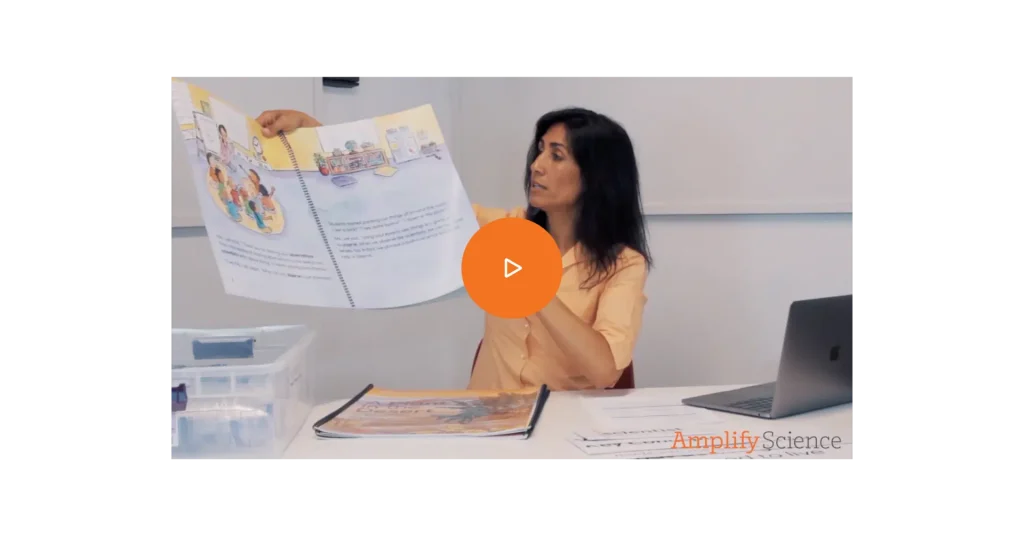
Lessons about Ecosystems

Amplify Science California is a multi-modal program, not a traditional textbook. Therefore, multiple components are utilized in the teaching and learning of the NGSS standards.

This video explains the instructional materials used to teach.

Scroll down to find select lessons and instructional materials used in teaching Ecosystems. Below each description, you’ll find links to download the PDFs your committee requested.

A spiral-bound teacher’s guide and a laptop displaying an online curriculum titled “Matter and Energy in Ecosystems: Biodome Collapse” from Amplify Science.
Teacher’s Reference Guide

Available digitally and in print, our unit-specific reference guides are chock full of helpful resources, including scientific background knowledge, planning information and resources, color-coded 3-D Statements, detailed lesson plans, tips for delivering instruction, and differentiation strategies.

A laptop displays a PowerPoint presentation in presenter view, with slides about observing objects in plastic containers and related sensory instructions.
Classroom Slides

These customizable PowerPoints are available for every lesson of the program and make delivering instruction a snap with visual prompts, colorful activity instructions, investigation set-up videos and animations, and suggested teacher talk in the notes section of each slide.

Assorted craft supplies including a bottle of rubbing alcohol, plastic containers, colorful beads, small dropper bottles, plastic cups, and clear plastic spoons on a white background.
Materials Kits

Our kits include enough non-consumable materials to support 200 student uses. In other words, you have enough materials to support all five periods and small groups of 4-5 students each. Plus, our unit-specific kits mean you just grab the tub you need and then put it all back with ease.

Educational graphic depicting the energy flow in an ecosystem, showing sun, producers, consumers, and decomposers with corresponding actions like eat, cycle, and decompose.
Simulations and Practice Tools

Our digital Simulations and Practice Tools are powerful resources for exploration, data collection, and student collaboration. They allow students the ability to explore scientific concepts that might otherwise be invisible or impossible to see with the naked eye.

Collection of educational books from 'amplify science' on topics including ocean atmosphere, matter and energy ecosystems, and insect interactions, displayed in various angles.
Consumable Notebooks

Available for every unit, our Student Investigation Notebooks contain instructions for activities and space for students to record data and observations, reflect on ideas from texts and investigations, and construct explanations and arguments.

Notebook for this unit

Cover of a science textbook showing a girl doing an experiment, surrounded by animals, jellyfish, a rocket, and scientific symbols, with the title "Amplify Science.
Student Edition Hardcover

This durable Student Edition is grade-level specific and contains all of the articles that students refer to throughout the year. Districts may choose to pair these traditional student texts with our digital student experience or new 2-volume consumable notebook set.

Line drawing of a person using a laptop, with headphones and a line illustration of a rocket launching above their head, symbolizing creativity or inspiration in Boost Reading.
Coming Soon

Unlike other publishers, we don’t make you wait until your next adoption to get the latest and greatest from Amplify. We’re always launching new and exciting features. What’s more, we’ll push them out to you even after you adopt us!

See what’s coming for 2020-2021

In addition to reviewing the “printed” resources above, we invite you to explore our program digitally.

  • Click the orange button below to access the platform.
  • Choose Teacher to continue.
  • Select Grade 7 from the drop-down menu.
  • Click on the Matter and Energy in Ecosystems unit to find your program materials.

Navigating a Core Unit

Core units introduce a real-world problem and support students as they figure out the anchoring phenomenon and gain an understanding of the unit’s DCIs, SEPs, and CCCs.

Navigating Classwork and Reporting

Classwork is our new online grading tool that gives you quick and easy access to unreviewed work, student portfolios of work, and automatically generated differentiation groups.

Welcome to Grade 5

BACK TO MAIN TK–5 PAGE

Amplify Science California is so effective you can cover 100% of the NGSS in half the time of other programs.

You can breathe a sigh of relief knowing all you need is:

  • 88 days per year
  • 2-3 lessons per week
  • 45 minutes per lesson
Four science-themed images: hand holding a globe and white sphere, two kids doing an experiment, a night sky with constellations, and a hand watering plants in clear containers.
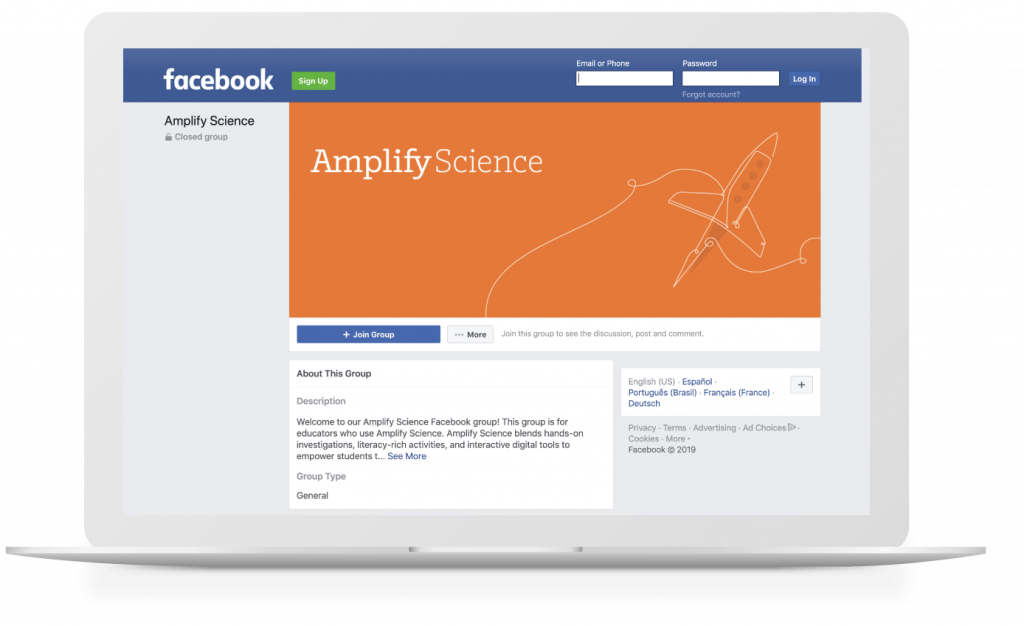
What students learn

When you’re ready:

  • Find a summary of each unit below including each unit’s student role and anchor phenomenon.
  • Click on the orange “See how the unit works” link to download a helpful Unit Guide. These guides make great companions to busy reviewers looking for a big-picture understanding of how each unit works.
Illustration of the Earth orbiting the Sun. The Earth's orbital path is indicated by a dashed blue line and a white arrow showing its direction. The background is a star-filled space.

Unit 1

Patterns of Earth and Sky

Student role: Astronomers

Phenomenon: An ancient artifact depicts what we see in the sky at different times of the day, but it appears to be missing a piece.

See how this unit works

Red and white capsules scattered on a vibrant red and white background.

Unit 2

Modeling Matter

Student role: Food scientists

Phenomenon: Some ingredients dissolve in a salad dressing while others, like oil and vinegar, appear to separate.

See how this unit works

Illustration of a pixelated green mountain cliff deconstructing into a digital grid, with red dots floating over a tranquil sea and flying white birds.

Unit 3

The Earth System

Student role: Water resource engineers

Phenomenon: East Ferris, a city on one side of the fictional Ferris Island, is experiencing a water shortage, while West Ferris is not.

See how this unit works

Illustration of a jungle scene featuring a cheetah and a sloth among dense green foliage and various colorful plants.

Unit 4

Ecosystem Restoration

Student role: Ecologists

Phenomenon: The jaguars, sloths, and cecropia trees in a reforested section of a Costa Rican rain forest are not growing or thriving.

See how this unit works

How teachers teach

When you’re ready:

  • Scroll down and take a closer look at your classroom resources.
  • Click on the orange links below each component to see grade-specific samples.
A laptop displays a PowerPoint presentation in presenter view, with slides about observing objects in plastic containers and related sensory instructions.

Classroom Slides

These customizable PowerPoints are available for every lesson of the program and make delivering instruction a snap with visual prompts, colorful activity instructions, investigation set-up videos and animations, and suggested teacher talk in the notes section of each slide.

Video introduction to Classroom Slides

Sample Classroom Slides

Sample Classroom Slides (Spanish)

A spiral-bound teacher's guide titled "Modeling Matter: The Chemistry of Food" is shown next to a laptop displaying related digital content.

Teacher’s Reference Guide

Available digitally and in print, our unit-specific reference guides are chock full of helpful resources, including scientific background knowledge, planning information and resources, color-coded 3-D Statements, detailed lesson plans, tips for delivering instruction, and differentiation strategies.

Login to platform below to access

Assorted household and craft items including food products, plastic utensils, cups, red fabric, cotton balls, popsicle sticks, ping pong balls, and various containers arranged on a white background.

Materials Kits

Our kits include enough non-consumable materials to support a class of 36 students and enough consumable items to support 72 students. In other words, each kit can last two years! Plus, our unit-specific kits mean you just grab the tub you need and then put it all back with ease.

List of investigations by unit

List of materials by unit

Two children's books titled "Beber las lágrimas de Cleopatra" and "Drinking Cleopatra's Tears" feature an illustration of a girl drinking water outside, with a house in the background.

Student Books

Our award-winning Student Books include content-rich nonfiction and informational texts designed to introduce concepts and also deepen understanding. Books are read to, with, and by students with ample scaffolding and support provided by the teacher in whole-class, small-groups, and student pairs.
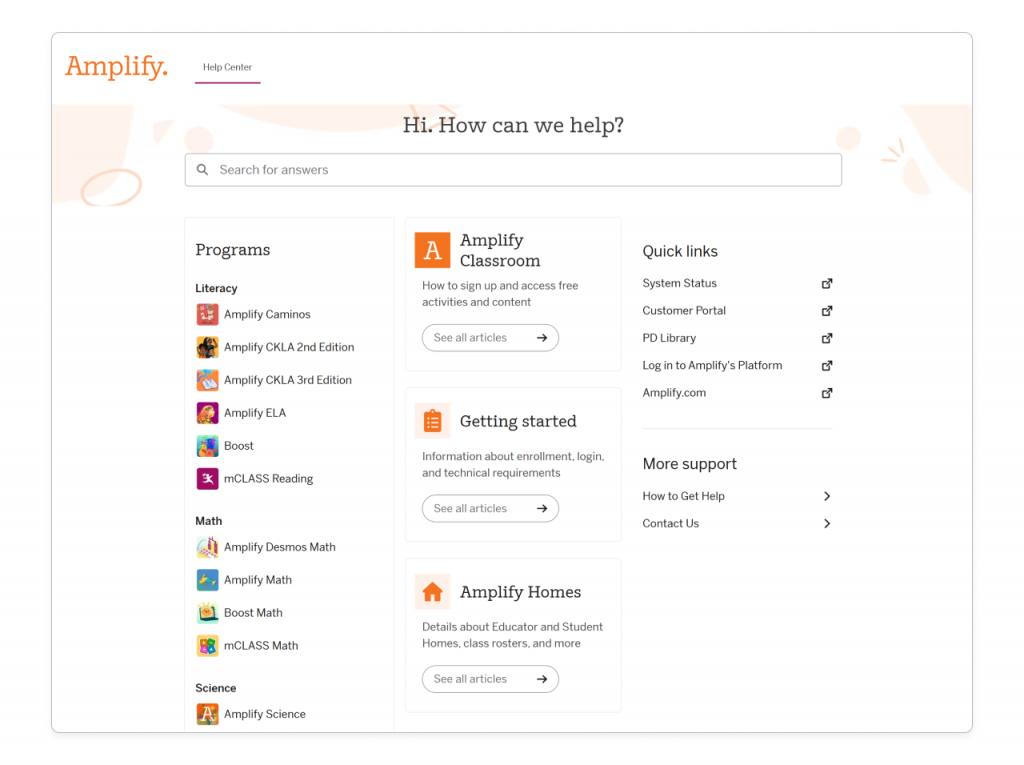
List of Student Books by unit

Sample Student Book

Sample Student Book (Spanish)

A computer screen displays an illustration of four plants under sunlight, each emitting colored streams and coins, with soil and roots visible below.

Practice Tools

Our digital Simulations and Practice Tools are powerful resources for exploration and data collection, and allow students the ability to explore scientific concepts that might otherwise be invisible or impossible to see with the naked eye.

Video overview of digital tools

List of digital tools by unit

Device calendars by unit

Two Amplify Science investigation notebooks, one in Spanish and one in English, both featuring an illustrated landscape of a mountain, water, and sky on the covers.

Consumable Notebooks

Available for every unit, our Student Investigation Notebooks contain instructions for activities and space for students to record data and observations, reflect on ideas from texts and investigations, and construct explanations and arguments.
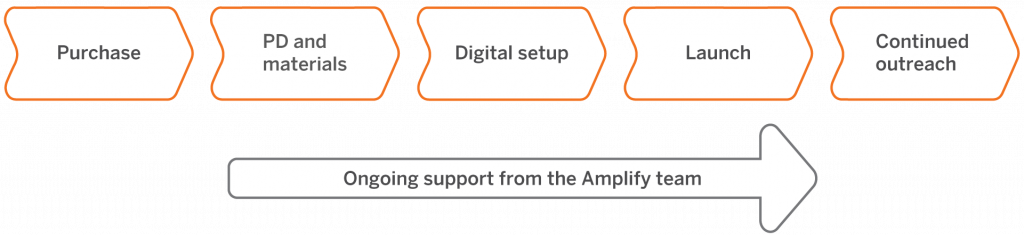
Sample Student Investigation Notebook

Sample Student Investigation Notebook (Spanish)

A man wearing glasses and a maroon shirt smiles at the camera on a laptop screen with the words "MYSTERY doug" and a speech bubble saying "Doug.

Mystery Science

Our exclusive partnership with Mystery Science means you get our NGSS core curriculum plus two years of free access to Mystery Doug and his extensive library of captivating videos that deepen students’ understanding of each unit’s phenomenon.

Mystery Science lesson alignment

A person with headphones works on a laptop; a line from their head transforms into a rocket, symbolizing imagination, innovation, and the foundational skills essential for multilingual learners.


Coming Soon

Unlike other publishers, we don’t make you wait until your next adoption to get the latest and greatest from Amplify. We’re always launching new and exciting features. What’s more, we’ll push them out to you even after you adopt us!

See what’s coming for 2020-2021

Welcome to Grade 4

BACK TO MAIN TK–5 PAGE

Amplify Science California is so effective you can cover 100% of the NGSS in half the time of other programs.

You can breathe a sigh of relief knowing all you need is:

  • 88 days per year
  • 2-3 lessons per week
  • 45 minutes per lesson
Students engage in various science experiments, including testing conductivity with a lamp, playing with slime, examining objects, and using sand trays.

What students learn

When you’re ready:

  • Find a summary of each unit below including each unit’s student role and anchor phenomenon.
  • Click on the orange “See how the unit works” link to download a helpful Unit Guide. These guides make great companions to busy reviewers looking for a big-picture understanding of how each unit works.
Illustration of a nighttime cityscape with illuminated windows and streetlights, a visible moon, and stars in the sky. A solitary figure stands out in one of the windows.

Unit 1

Energy Conversions


Student role: System engineers


Phenomenon: The fictional town of Ergstown experiences frequent blackouts. Their electrical system seems to be failing.

See how this unit works

A gecko prepares to catch a cricket under a streetlight at night. The yellow arrows illustrate the lamplight hitting the cricket and reflecting in the gecko's eyes.

Unit 2

Vision and Light


Student role: Conservation biologists

Phenomenon: The population of Tokay geckos in a rain forest in the Philippines has decreased since the installation of new highway lights.

See how this unit works

Illustration of a rocky coastline with angular cliffs in reddish tones on the left and a body of blue water below.

Unit 3

Earth’s Features


Student role: Geologists


Phenomenon: A mysterious fossil is discovered in a canyon within the fictional Desert Rocks National Park.

See how this unit works

Two dolphins swim underwater in a blue-tinged environment, facing each other, and one appears to open its mouth slightly.

Unit 4

Waves, Energy, and Information

Student role: Marine scientists


Phenomenon: Mother dolphins in the fictional Blue Bay National Park communicate with their calves despite the distance between them.

See how this unit works

How teachers teach

When you’re ready:

  • Scroll down and take a closer look at your classroom resources.
  • Click on the orange links below each component to see grade-specific samples.
A laptop displays a PowerPoint presentation in presenter view, with slides about observing objects in plastic containers and related sensory instructions.

Classroom Slides

These customizable PowerPoints are available for every lesson of the program and make delivering instruction a snap with visual prompts, colorful activity instructions, investigation set-up videos and animations, and suggested teacher talk in the notes section of each slide.

Video introduction to Classroom Slides

Sample Classroom Slides

Sample Classroom Slides (Spanish)

A computer screen displays an educational website titled "Earth's Features" with chapters and illustrations of canyons; a printed teacher’s guide is shown beside it.

Teacher’s Reference Guide

Available digitally and in print, our unit-specific reference guides are chock full of helpful resources, including scientific background knowledge, planning information and resources, color-coded 3-D Statements, detailed lesson plans, tips for delivering instruction, and differentiation strategies.

Login to platform below to access

A variety of craft materials arranged on a white surface, including cardboard sheets, plastic cups, yarn, binder clips, pink balls, yellow pom-poms, and other assorted supplies.

Materials Kits

Our kits include enough non-consumable materials to support a class of 36 students and enough consumable items to support 72 students. In other words, each kit can last two years! Plus, our unit-specific kits mean you just grab the tub you need and then put it all back with ease.

List of investigations by unit

List of materials by unit

Two book covers titled "¡Apagón!" and "BLACKOUT!" show a dark city street with headlights from a car illuminating the scene at night.

Student Books

Our award-winning Student Books include content-rich nonfiction and informational texts designed to introduce concepts and also deepen understanding. Books are read to, with, and by students with ample scaffolding and support provided by the teacher in whole-class, small-groups, and student pairs.

List of Student Books by unit

Systems

Energy Past and Present

Sunlight and Showers

Blackout!

It’s All Energy

A laptop displays a diagram showing the upper river, floodplain, and river delta with labeled cross-sections above a landscape map of a river flowing to the sea.

Simulations and Practice Tools

Our digital Simulations and Practice Tools are powerful resources for exploration and data collection, and allow students the ability to explore scientific concepts that might otherwise be invisible or impossible to see with the naked eye.

Video overview of digital tools

Device calendars by unit

List of digital tools by unit

Two science workbooks, one in Spanish and one in English, titled "Energy Conversions: Blackout in Ergstown" with white covers and orange labels at the bottom.

Consumable Notebooks

Available for every unit, our Student Investigation Notebooks contain instructions for activities and space for students to record data and observations, reflect on ideas from texts and investigations, and construct explanations and arguments.

Sample Student Investigation Notebook

Sample Student Investigation Notebook (Spanish)

A man wearing glasses and a maroon shirt smiles at the camera on a laptop screen with the words "MYSTERY doug" and a speech bubble saying "Doug.

Mystery Science

Our exclusive partnership with Mystery Science means you get our NGSS core curriculum plus two years of free access to Mystery Doug and his extensive library of captivating videos that deepen students’ understanding of each unit’s phenomenon.

Mystery Science lesson alignment

A person with headphones works on a laptop; a line from their head transforms into a rocket, symbolizing imagination, innovation, and the foundational skills essential for multilingual learners.


Coming Soon

Unlike other publishers, we don’t make you wait until your next adoption to get the latest and greatest from Amplify. We’re always launching new and exciting features. What’s more, we’ll push them out to you even after you adopt us!

See what’s coming for 2020-2021

Welcome, California Reviewers for 6–8!

BACK TO WELCOME PAGE

We’re so honored you’re considering Amplify Science California—the #1 most adopted NGSS curriculum across the state.

  • It meets 100% of the NGSS.
  • It has demonstrated effectiveness across all student groups.
  • It helps students make the shift from learning about to figuring out scientific concepts.
  • It empowers students to think, read, write, and argue like real scientists and engineers each and every day.
  • It can flexibly adapt to remote and hybrid learning scenarios.
A person wearing safety goggles examines a glass of water. The background includes illustrations of space exploration, a rocket, a polar bear, and weather symbols such as clouds and raindrops.

Overview

Developed by UC Berkeley’s Lawrence Hall of Science, our program features:

  • phenomena-based approach where students construct a complex understanding of each unit’s anchor phenomenon.
  • A blend of cohesive storylines, hands-on investigations, rich discussions, literacy-rich activities, and digital tools.
  • Newly crafted units, chapters, lessons, and activities designed to deliver true 3-dimensional learning.
  • An instructional design that supports all learners in accessing all standards.

Hear what these educators have to say about the program. >

Explore your grade

Get started by watching this class share what they’re figuring out with Amplify Science. >

Select a grade level below to learn more about how we make rich learning accessible to all students at every grade.

Grades 6–8 Integrated

Grades 6–8 Domain

S3-01. Making math viral with Howie Hua

Promotional image for "math teacher lounge, season 3 episode 1," featuring a smiling man named Howie Hua, described as a Fresno State mathematics lecturer and math podcast host.

In this episode Howie Hua (you may know him from his viral TikTok videos) joins Bethany Lockhart Johnson and Dan Meyer to discuss making math accessible for students through multiple social media platforms, creating an engaging space for students to share their ideas.

Explore more from Math Teacher Lounge by visiting our main page

Download Transcript

Stay connected!

Join our community and get new episodes every other Tuesday!

We’ll also share new and exciting free resources for your classroom every month.

What Howie Hua says about math

“I think that the beauty in math is found in the process, not the final answer.”

– Howie Hua

Mathematics Lecturer, Fresno State

Meet the guest

Howie Hua is a math instructor at Fresno State University who teaches math to future elementary school teachers. He is passionate about finding ways to humanize the math classroom, listening to how students think about math, and building mathematical confidence in students. In 2019, Howie was named Outstanding Lecturer for the College of Science and Math at his university. Outside of school, Howie likes to play piano, go on walks, make math memes, and make math explainer videos.

Portrait of a smiling Asian man in a suit, identified as Juan Vivas, a SpaceX engineer, with a blurred office building background.
A graphic with the text "Math Teacher Lounge with Bethany Lockhart Johnson and Dan Meyer" on colored overlapping circles.

About Math Teacher Lounge: The podcast

Math Teacher Lounge is a biweekly podcast created specifically for K–12 math educators. In each episode co-hosts Bethany Lockhart Johnson (@lockhartedu) and Dan Meyer (@ddmeyer) chat with guests, taking a deep dive into the math and educational topics you care about.

Join the Math Teacher Lounge Facebook group to continue the conversation, view exclusive content, interact with fellow educators, participate in giveaways, and more!

Welcome to your Amplify Science California pilot!

We’re thrilled to welcome you to the Amplify family, and we look forward to making your experience with Amplify Science California successful from day one.

On this site, you’ll find resources, tips, videos, and other helpful information designed to support you throughout your pilot experience.

Collage of three images showing children engaged in various activities: two boys with a book, two girls using straws, and a group watching intently. Connected by abstract lines and circles.
A woman sits at a table, using a laptop and a textbook. She is in a classroom with shelves of educational supplies in the background.

Tips for getting started successfully

It takes time to learn any new program and get used to its patterns and flow—time that you aren’t always afforded in a pilot situation. Based on our work with thousands of pilot teachers who are now happy users, we can tell you with 100% confidence that it gets easier. In no time, you’ll be preparing and delivering all your lessons with ease.

Until you become comfortable with the organization of each unit and how one lesson flows into the next, the following resources will be key in helping you prepare to teach your first unit.

Unit Guide

These short and sweet guides provide a big picture overview of each unit’s phenomenon and storyline, the key questions that guide learning, and how the storyline develops from chapter to chapter. We even spoil the big reveal at the end by pointing out ahead of time what students figure out throughout the unit.

Ready to download? Navigate to your grade level using the menu bar above, scroll to the Unit Types section, and then download the appropriate Unit Guide(s).

Cover and inner pages of a unit guide titled "Patterns of Earth and Sky" for Grade 5, featuring text explanations and images related to science concepts.
Laptop screen displaying an educational website with a lesson on "tortoise parts" featuring a colorful turtle graphic on the header.

Lesson Overview

Reading this short summary is a great way to get a quick snapshot of the learning that will take place during the day ahead. It includes a short description of the lesson, student learning objectives, and an at-a-glance list of activities.

Where to find it? Log into the digital Teacher’s Guide and navigate to the lesson you want to teach by following this click path: Grade Level > Unit > Chapter > Lesson. Next, scroll to the Lesson Brief section and click Overview. This same information is also found in your printed Teacher’s Reference Guide.

Material and preparation tips

Also found in the Lesson Brief section of your digital Teacher’s Guide and printed Teacher’s Reference Guide is a complete list of materials that you’ll need to gather as well as step-by-step lesson preparation tips organized by:

  • Before the Day of the Lesson
  • Immediately Before the Lesson
  • At the End of the Day
A laptop screen displays the Amplify Science platform, showing a lesson plan titled Materials and Preparation with text boxes detailing teaching steps and preparation tips.
A screenshot of an academic paper about "animal and plant defenses" showing a table of contents with 30 statements, organized into lessons and chapters.

3-D Statements

Color-coded for easy readability and quick scanning, our 3-D Statements can be found at point-of-use for every unit and lesson, making it easy to pinpoint the exact SEPs, DCIs, and CCCs that will be targeted on any given day.

Where to find them? Log into the digital Teacher’s Guide and navigate to any Unit Guide or Lesson Brief and click the expandable box called 3-D Statements. A complete list of 3-D Statements can also be found in the back of any printed Teacher’s Reference Guide.

Coherence Flowcharts

These are another great tool for helping you visualize the flow of a unit and the connections between the questions that drive students’ experiences and:

  • The evidence they gather
  • The solutions they figure out
  • The new questions they generate

Where to find them? Log into the digital Teacher’s Guide, navigate to your desired unit, scroll to the Unit Guide, and look in the Printable Resources section.

Amplify Science California supports you every step of the way on your journey to the California NGSS.

Support is always within reach

Your role as a pilot teacher is important. Your district is counting on you not only to evaluate how Amplify Science California works in your classroom, but also to pick a reliable and supportive long-term partner. We feel confident that we’re that partner, and we look forward to proving that to you during your pilot experience.

Just as it will be when you become a customer, support during your pilot will always be within reach through the following channels.

Pilot support coordinator

Your dedicated pilot support coordinator has extensive experience delivering training, rostering students, answering both pedagogical and technical questions, and delivering demonstration lessons. Said another way, he or she is here to help. So, don’t hesitate to reach out.

Who is my pilot support coordinator? Look for his or her contact information in the pilot support brochure that you received during your pilot implementation training.

Amplify Science California supports you every step of the way on your journey to the California NGSS.
Interface of an educational website on animal and plant defenses, featuring chapter tiles with illustrations, and a chat support window labeled 'Hi Teacher' offering new conversation options.

Intercom chat

In addition to traditional lines of communication, our Intercom feature gives you the ability to chat with our customer support, technical support, and pedagogical support teams in real time directly from the digital platform. This ensures that issues that arise in the classroom can be addressed as quickly as possible.

Support teams can be reached from 4 a.m. to 4 p.m. PST, Monday through Friday.

Email

Our customer support, technical support, and pedagogical support teams can also be reached by email at help@amplify.com.

Support teams can be reached from 4 a.m. to 4 p.m. PST, Monday through Friday.

Open-plan office with people working at desks, multiple computer monitors, plants, and bright natural light from large windows.

Welcome to Amplify Science!

On this site, you’ll find resources to guide you in your review.

When you’re ready to explore the digital Teacher’s Guide, click the “Review now” button below.

About the program

A boy reads a book titled "Gary's Seed Journal," surrounded by illustrated elements like a globe, trees, and clouds. Upper left shows an illustration of a dinosaur skull.

In every unit of Amplify Science, students take on the roles of scientists and engineers to figure out real-world phenomena. Students actively investigate compelling questions by finding and evaluating evidence, then developing convincing arguments. These engaging roles and phenomena bring science to life in your classroom—read more about them here.

The program is built from the ground up for new science standards and three-dimensional learning. The Next Generation Science Standards have raised the bar in science education. We set out to create a science program that educators can leverage to bring three-dimensional learning to life for their students. 

A boy reads a book titled "Gary's Seed Journal," surrounded by illustrated elements like a globe, trees, and clouds. Upper left shows an illustration of a dinosaur skull.
Two children smiling at a laptop, surrounded by illustrations of animals like an elephant, sloth, and birds.

Amplify Science was developed by the science education experts at UC Berkeley’s Lawrence Hall of Science and the digital learning team at Amplify. As the Hall’s first curriculum designed to address the new science standards, Amplify Science reflects state-of-the-art practices in science teaching and learning. Learn more about the Lawrence Hall of Science.

The program is backed by gold-standard research. Amplify Science is rooted in the Lawrence Hall of Science’s Do, Talk, Read, Write, Visualize model of learning. This research-based approach presents students with multiple modalities through which to explore the curriculum. Read more about our exciting efficacy research.

Do, Talk, Read, Write students out-perform their peers in science content knowledge

Engaging instruction

Two children wearing safety goggles use plastic spoons to stir substances in clear cups, conducting a science experiment at a table.

Hands-on learning is an essential part of Amplify Science and is integrated into every unit through hands-on investigations that are critical to achieving the unit’s learning goals. Learn more about these investigations here.

Each unit of Amplify Science K–5 includes five or six unique Student Books written by the Lawrence Hall of Science specifically for the program. The books in each unit include one book for approximately every five days of instruction and one reference book that students draw upon throughout the unit. Learn more about the Amplify Science Student Books.

A selection of colorful science-themed books and handbooks with illustrated and photographic covers, arranged diagonally on a green background.
Assorted educational workbooks on a green surface, featuring titles such as "Ecosystem Restoration" and "Balancing Forces" by Amplify Science, with illustrated covers.

In the Student Investigation Notebooks, students record data and observations, make drawings, and complete writing tasks. Each notebook also includes scaffolding supports for reading and writing activities.

Students have access to a variety of digital tools to enrich their learning throughout the Amplify Science K–5 program, including digital modeling tools, videos, images, and powerful digital simulations (beginning in grade 3). Learn more about digital simulations in Amplify Science.

Four laptop screens display different digital interfaces: a farm simulation, a creature viewer, a block-based coding interface, and a data analysis chart on a green background.
Spiral-bound teacher's guide in front of a laptop displaying a digital science curriculum about balancing forces and floating trains, titled "Amplify Science: Balancing Forces.

Every unit of Amplify Science includes a comprehensive Teacher’s Guide containing lesson plans, differentiation strategies, and other instructional supports and resources at the unit, lesson, and individual activity levels. Begin your review by exploring the digital Teacher’s Guide.

Spending time on science should be about the science. Get there faster with Classroom Slides. Every lesson in Amplify Science K–5 comes with a downloadable and editable PowerPoint file to help guide teachers and their students through the lesson with engaging, clearly sequenced, and easy-to-follow images, videos, questions, and instructions. Learn more about Classroom Slides.

Digital collage of various devices displaying educational content about earth’s energy system, including graphs and text explanations.

Review now

You can review all of Amplify Science online by clicking the orange button below.

If you’ve received physical materials, watch the video below for a guide on reviewing your sample. If you’d like to review print materials and have not been sent any, please contact your Amplify representative.

When you explore the digital Teacher’s Guide, a quick guided tour will familiarize you with navigation of the program and its features. You may want to download and reference these additional resources as you review:

Questions come up during your review? Email help@amplify.com and mention that you are a reviewer in the subject of the email.

A closer look at grades 6–8

Amplify Science California is based on the latest research on teaching and learning and helps teachers deliver rigorous and riveting lessons through hands-on investigations, literacy-rich activities, and interactive digital tools that empower students to think, read, write, and argue like real scientists.

In the 6–8 classroom, this looks like students:

  • Collecting evidence from a variety of sources.
  • Making sense of evidence in a variety of ways.
  • Formulating convincing scientific arguments.

Is your school implementing the domain model? Click here.

Collage of four images showing children engaged in educational activities such as conducting experiments and crafting in a classroom setting.
A four-step process diagram with icons: spark a real-world problem, explore sources, explain and elaborate, and evaluate claims, all linking to engage with cohesive storylines.

Program structure

Our cyclical lesson design ensures students receive multiple exposures to concepts through a variety of modalities. As they progress through the lessons within a unit, students build and deepen their understanding, increasing their ability to develop and refine complex explanations of the unit’s phenomenon.

It’s this proven program structure and lesson design that enables Amplify Science California to teach less, but achieve more. Rather than asking teachers to wade through unnecessary content, we designed our 6–8 program to address 100% of the California NGSS in fewer lessons than other programs.

Scope and sequence

Every year our grades 6–8 sequence consists of 9 units, with each unit containing 10–19 lessons. Lessons are written to last a minimum of 45-minutes, though teachers can expand or contract the timing to meet their needs.

Chart displaying educational science topics for grades 6 to 8, categorized by grade level, duration in days, and number of classes. Includes subjects like microbiome, geology, and natural selection.

Unit types

Each unit delivers three-dimensional learning experiences and engages students in gathering evidence from a rich collection of sources, while also serving a unique purpose.

In grades 6–8, there are three types of units:

  • One unit is a launch unit.
  • Three units are core units.
  • Two units are engineering internships.
Launch units

Launch units are the first units taught in each year of Amplify Science California. The goal of the Launch unit is to introduce students to norms, routines, and practices that will be built on throughout the year, including argumentation, active reading, and using the program’s technology. For example, rather than taking the time to explain the process of active reading in every unit in a given year, it is explained thoroughly in the Launch unit, thereby preparing students to read actively in all subsequent units.

Core units

Core units establish the context of the unit by introducing students to a real-world problem. As students move through lessons in a Core unit, they figure out the unit’s anchoring phenomenon, gain an understanding of the unit’s disciplinary core ideas and science and engineering practices, and make linkages across topics through the crosscutting concepts. Each Core unit culminates with a Science Seminar and final writing activity.

Engineering Internship units

Engineering Internship units invite students to design solutions for real-world problems as interns for a fictional company called Futura. Students figure out how to help those in need, from tsunami victims in Sri Lanka to premature babies, through the application of engineering practices. In the process, they apply and deepen their learning from Core units.

Units at a glance

Abstract art with vibrant colors featuring a yellow silhouette of a person holding a book against a background of geometric shapes, swirling patterns, and bold textures.
Microbiome

Domain: Life Science

Unit type: Launch

Student role: Microbiological researchers

Phenomenon: The presence of 100 trillion microorganisms living on and in the human body may keep the body healthy.  

Abstract artwork of a person's side profile with geometric shapes and colorful patterns flowing from the head, holding a small sledgehammer. A vision chart is visible in the corner.
Metabolism

Domain: Life Science

Unit type: Core

Student role: Medical researchers

Phenomenon: Elisa, a young patient, feels tired all the time.  

Download unit guide

Orange abstract background with hexagonal shapes featuring icons of a bar chart, plant, safety vest, test tube, peach, and stethoscope.
Metabolism Engineering Internship

Domains: Life Science, Engineering Design

Unit type: Engineering internship

Student role: Food engineers

Phenomenon: Designing health bars with different molecular compositions can effectively meet the metabolic needs of patients or rescue workers.  

Imagen que muestra un gráfico de arañas de diferentes colores con patrones distintos de patas y cuerpo, incluidas variaciones de color marrón, amarillo y azul. El fondo es una superficie oscura y texturizada.
Traits and Reproduction

Domain: Life Science

Unit type: Core

Student role: Biomedical students

Phenomenon: Darwin’s bark spider offspring have different silk flexibility traits, even though they have the same parents.  
Download unit guide

Illustration of a person in a red hat and fur-lined coat with eyes closed, surrounded by large orange circles on a dark background.
Thermal Energy

Domain: Physical Science

Unit type: Core

Student role: Thermal scientists

Phenomenon: One of two proposed heating systems for Riverdale School will best heat the school. 

Download unit guide

Abstract artwork depicting a bright sun with blue and orange swirling patterns next to green hills under a sky with shades of blue, orange, and red.
Ocean, Atmosphere, and Climate

Domains: Earth and Space Science, Physical Science

Unit type: Core

Student role: Climatologists

Phenomenon: During El Niño years, the air temperature in Christchurch, New Zealand is cooler than usual.  

An illustration from the Weather Patterns unit
Weather Patterns

Domains: Earth and Space Science, Physical Science

Unit type: Core

Student role: Forensic meteorologists

Phenomenon: In recent years, rainstorms in Galetown have been unusually severe.  

Download unit guide

An illustration from the Earth's Changing Climate unit
Earth’s Changing Climate

Domains: Earth and Space Science, Life Science

Unit type: Core

Student role: Climatologists

Phenomenon: The ice on Earth’s surface is melting.  

Download unit guide

Abstract geometric design in shades of blue and purple featuring a hexagon with icons of a building, wrench, molecules, sun, paint can, and screwdriver.
Earth’s Changing Climate Engineering Internship

Domains: Earth and Space Science, Engineering Design

Unit type: Engineering internship

Student role: Civil engineers

Phenomenon: Designing rooftops with different modifications can reduce a city’s impact on climate change.  

A barren, rocky desert landscape with rover tracks leading to a distant vehicle on a hill under a hazy sky.
Geology on Mars

Domain: Earth and Space Science

Unit type: Launch

Student role: Planetary geologists

Phenomenon: Analyzing data about landforms on Mars can provide evidence that Mars may have once been habitable. 

Two prehistoric reptiles with long snouts and tails are near the shore, one on land and one in water, with plants, rocks, and an island in the background.
Plate Motion

Domain: Earth and Space Science

Unit type: Core

Student role: Geologists

Phenomenon: Mesosaurus fossils have been found on continents separated by thousands of kilometers of ocean, even though the Mesosaurus species once lived all together.  

Download unit guide

Geometric design featuring a telescope, mountain, sound waves, and cosmic elements on a purple hexagonal background.
Plate Motion Engineering Internship

Domains: Earth and Space Science, Engineering Design

Unit type: Engineering internship

Student role: Mechanical engineering interns

Phenomenon: Patterns in earthquake data can be used to design an effective tsunami warning system.  

Illustration of a cross-section of Earth showing a volcano near the ocean. Trees, mountains, and clouds are visible above, with subterranean layers below.
Rock Transformations

Domain: Earth and Space Science

Unit type: Core

Student role: Geologists

Phenomenon: Rock samples from the Great Plains and from the Rocky Mountains — regions hundreds of miles apart — look very different, but have surprisingly similar mineral compositions.  

Download unit guide

Ilustración que muestra las etapas de fusión de una paleta de naranja: entera, parcialmente derretida, más derretida y casi derretida por completo, con palitos de madera, sobre un fondo morado.
Phase Change

Domains: Physical Science, Earth and Space Science

Unit type: Core

Student role: Chemists

Phenomenon: A methane lake on Titan no longer appears in images taken by a space probe two years apart

Download unit guide

Green geometric background with a hexagonal emblem containing a parachute icon, ruler, bandage, and stacked layers on a gradient pattern.
Force and Motion Engineering Internship

Domains: Engineering Design, Physical Science

Unit type: Engineering internship

Student role: Mechanical engineering interns

Phenomenon: Designing emergency supply delivery pods with different structures can maintain the integrity of the supply pods and their contents.  

An illustration from the Chemical Reactions unit
Chemical Reactions

Domains: Physical Science, Life Science, Earth and Space Science

Unit type: Core

Student role: Forensic chemists

Phenomenon: A mysterious brown substance has been detected in the tap water of Westfield.  

Download unit guide

An illustration of a whale with jellyfish and turtles from Amplify Science
Populations and Resources

Domains: Life Science, Earth and Space Science

Unit type: Core

Student role: Biologists

Phenomenon: The size of the moon jelly population in Glacier Sea has increased. 

Download unit guide

Low-poly landscape with trees and mushrooms. A fox sniffs the ground, a rabbit sits nearby, and mountains and sun are in the background.
Matter and Energy in Ecosystems

Domains: Life Science, Earth and Space Science, Physical Science

Unit type: Core

Student role: Ecologists

Phenomenon: The biodome ecosystem has collapsed.  

Download unit guide

Two people climbing rocky terrain; illustrations show a hiking boot and a belt with gear.
Harnessing Human Energy

Domains: Physical Science, Earth and Space Science, Engineering Design

Unit type: Launch

Student role: Energy scientists

Phenomenon: Rescue workers can use their own human kinetic energy to power the electrical devices they use during rescue missions.  

Illustration of a futuristic space station with large solar panels, orbiting in deep space, emitting a blue glow from its propulsion system.
Force and Motion

Domain: Physical Science

Unit type: Core

Student role: Physicists

Phenomenon: The asteroid sample-collecting pod failed to dock at the space station as planned.

Download unit guide

Green geometric graphic featuring icons: a baby, thermometer, layers, medical alert, and a flame.
Phase Change Engineering Internship

Domains: Engineering Design, Physical Science

Unit type: Engineering internship

Student role: Chemical engineering interns

Phenomenon: Designing portable baby incubators with different combinations of phase change materials can keep babies at a healthy temperature.  

Illustration of a roller coaster filled with people, hands raised, going down a steep track against a bright blue sky with clouds.
Magnetic Fields

Domain: Physical Science

Unit type: Core

Student role: Physicists

Phenomenon: During a test launch, a spacecraft traveled much faster than expected.  

An illustration from the Light Waves unit
Light Waves

Domains: Physical Science, Life Science, Earth and Space Science

Unit type: Core

Student role: Spectroscopists

Phenomenon: The rate of skin cancer is higher in Australia than in other parts of the world.

Download unit guide

A city skyline at night with a prominent full moon, stars in the sky, and a bridge silhouette on the left.
Earth, Moon, and Sun

Domains: Earth and Space Science, Physical Science

Unit type: Core

Student role: Astronomers

Phenomenon: An astrophotographer can only take pictures of specific features on the Moon at certain times.  

Download unit guide

Four low-poly dinosaurs with missing body sections are standing in a row; one is yellow, and the others are green. They have purple spikes and red patches on their bodies.
Natural Selection

Domains: Life Science, Earth and Space Science

Unit type: Core

Student role: Biologists

Phenomenon: The newt population in Oregon State Park has become more poisonous over time.  

Download unit guide

Red geometric background with icons including a mosquito, DNA strand, bar chart, and world map inside a hexagon.
Natural Selection Engineering Internship

Domains: Engineering Design, Life Science

Unit type: Engineering internship

Student role: Clinical engineers

Phenomenon: Designing malaria treatment plans that use different combinations of drugs can reduce drug resistance development while helping malaria patients.  

Two giant tortoises with long necks stand near water; one tortoise feeds on leaves from a tree while the other is near dense vegetation.
Evolutionary History

Domains: Life Science, Earth and Space Science

Unit type: Core

Student role: Paleontologists

Phenomenon: A mystery fossil at the Natural History Museum has similarities with both wolves and whales.    

Download unit guide

Welcome to your Amplify Science pilot!

We’re thrilled to welcome you to the Amplify family, and we look forward to making your experience with Amplify Science successful from day one.

On this site, you’ll find resources, tips, videos, and other helpful information designed to support you throughout your pilot experience.

A woman sitting at a desk in a classroom, using a laptop and reviewing a spiral notebook with papers scattered around.

Tips for getting started successfully

It takes time to learn any new program and get used to its patterns and flow—time that you aren’t always afforded in a pilot situation. Based on our work with thousands of pilot teachers who are now happy users, we can tell you with 100% confidence that it gets easier. In no time, you’ll be preparing and delivering all your lessons with ease.

Until you become comfortable with the organization of each unit and how one lesson flows into the next, the following resources will be key in helping you prepare to teach your first unit.

Laptop screen displaying an educational website with a lesson on "tortoise parts" featuring a colorful turtle graphic on the header.

Lesson Overview

Reading this short summary is a great way to get a quick snapshot of the learning that will take place during the day ahead. It includes a short description of the lesson, student learning objectives, and an at-a-glance list of activities.

Where to find it? Log into the digital Teacher’s Guide and navigate to the lesson you want to teach by following this click path: Grade Level > Unit > Chapter > Lesson. Next, scroll to the Lesson Brief section and click Overview. This same information is also found in your printed Teacher’s Reference Guide.

Material and preparation tips

Also found in the Lesson Brief section of your digital Teacher’s Guide and printed Teacher’s Reference Guide is a complete list of materials that you’ll need to gather as well as step-by-step lesson preparation tips organized by:

  • Before the Day of the Lesson
  • Immediately Before the Lesson
  • At the End of the Day
Laptop displaying an educational science website with various navigation tabs and text content visible on the screen.
A screenshot of an academic paper about "animal and plant defenses" showing a table of contents with 30 statements, organized into lessons and chapters.

3-D Statements

Color-coded for easy readability and quick scanning, our 3-D Statements can be found at point-of-use for every unit and lesson, making it easy to pinpoint the exact SEPs, DCIs, and CCCs that will be targeted on any given day.

Where to find them? Log into the digital Teacher’s Guide and navigate to any Unit Guide or Lesson Brief and click the expandable box called 3-D Statements. A complete list of 3-D Statements can also be found in the back of any printed Teacher’s Reference Guide.

Coherence Flowcharts

These are another great tool for helping you visualize the flow of a unit and the connections between the questions that drive students’ experiences and:

  • The evidence they gather
  • The solutions they figure out
  • The new questions they generate

Where to find them? Log into the digital Teacher’s Guide, navigate to your desired unit, scroll to the Unit Guide, and look in the Printable Resources section.

Flowchart outlining animal and plant defenses with sections for unit title, typical defenses, and steps in educational exploration, set on a white background with blue and orange accents.
Amplify Science California supports you every step of the way on your journey to the California NGSS.

Support is always within reach

Your role as a pilot teacher is important. Your district is counting on you not only to evaluate how Amplify Science works in your classroom, but also to pick a reliable and supportive long-term partner. We feel confident that we’re that partner, and we look forward to proving that to you during your pilot experience.

Just as it will be when you become a customer, support during your pilot will always be within reach through the following channels.

Pilot support coordinator

Your dedicated pilot support coordinator has extensive experience delivering training, rostering students, answering both pedagogical and technical questions, and delivering demonstration lessons. Said another way, he or she is here to help. So, don’t hesitate to reach out.

Who is my pilot support coordinator? Look for his or her contact information in the pilot support brochure that you received during your pilot implementation training.

Amplify Science California supports you every step of the way on your journey to the California NGSS.

Intercom chat

In addition to traditional lines of communication, our Intercom feature gives you the ability to chat with our customer support, technical support, and pedagogical support teams in real time directly from the digital platform. This ensures that issues that arise in the classroom can be addressed as quickly as possible.

Support teams can be reached from 4 a.m. to 4 p.m. PST, Monday through Friday.

Email

Our customer support, technical support, and pedagogical support teams can also be reached by email at help@amplify.com.

Support teams can be reached from 7 a.m. to 7 p.m. EST, Monday through Friday.

Amplify Desmos Math
for New York

Welcome to Amplify Desmos Math, a powerful new core program from Amplify and Desmos Classroom built for NYC teachers and students.

Amplify Desmos Math is built on four core tenets:

  • Math can motivate students.
  • A structured approach to problem-based learning can best tend to all aspects of rigor.
  • Student thinking is valuable and visible.
  • Students can catch up while keeping up with grade-level math.
A worksheet and two digital screens display a math activity involving tables and blocks, with one screen showing a challenge hidden behind a red curtain.

What if your students asked to do more math?

Amplify Desmos Math lessons are powerful in their ability to elicit student thinking and spark interesting, productive discussions.

The lessons pose problems that invite a variety of approaches with their dynamic and interactive learning experiences on devices, as well as experiences on paper that are flexible, creative, and engaging.

As students work online, they interact with visuals and simulations that show their thinking and decisions. When appropriate, students see other students’ responses and engage in collaborative math discussions.

A Responsive Feedback feature responds to student thinking by showing the mathematical meaning behind it. This is more powerful than simply evaluating thinking as right or wrong, because it motivates and engages students in the learning process.

A grid-based puzzle showing a green ball at (-8, -8) and a yellow star at (5, 6); user is prompted to enter coordinates to reach the star.

In this Grade 6 activity, students internalize the coordinate plane by plotting points to navigate the marble through the maze to collect the star.

A blank coordinate grid is shown next to a list of coordinate pairs to plot, ranging from (–2, –9) to (3, –3). Instructions are to plot and connect each pair in order.

This prepares students to accurately and efficiently plot points with positive and negative coordinates on grids with different scales and explain the relationship between ordered pairs that differ only by the signs of the coordinates.

A yellow submarine with floats and anchors must be adjusted to reach and collect a star positioned at -3 units in the water. A table and "Check My Work" button appear to the right.

In this Grade 7 activity, students explore positive and negative integer operations using the up and down movement of a submarine.

Screenshot of a math problem asking for the new temperature in Beijing after it drops 5°C from –2°C, with a text box and a "Submit" button for the answer.

Students are then prepared apply this understanding in a variety of word problem contexts.

A math activity interface showing four lanes with turtles, labeled 1 to 4, on a track. A prompt asks to write an equation for the turtle in lane 4 to control its movement.

In this Grade 8 activity, students create rate, distance, and time equations based on turtle races.

A blank graph with cost in dollars on the y-axis and blueberries in pounds on the x-axis, labeled for a problem about blueberry pricing.

This prepares students to understand that a graph representing a proportional relationship is a line through (0, 0) and (1, k). They also begin to see connections between a context and features of a corresponding graph, equation, and table.

Data at your fingertips on the road to mastery

Digital assessment report with tabs for Reports, WAT, and Admin Reports. Displays classes, units, assessments, and scoring details for high and low-performing items, including raw scores.

1

Pre-Unit Checks show the range of student mastery for the entire class and identify strengths and needs by standard.

Two overlapping cards detail a math unit overview and learning goals, focusing on equivalent ratios and proportional relationships in tables, equations, and graphs.

2

In each unit, lessons are designed and sequenced to help students fully master critical standards and build computational fluency. Each lesson is part of a carefully constructed instructional sequence that scaffolds students’ cognitive mathematical development.

A math problem prompt is displayed above, with a table comparing orange and pineapple juice recipes below. Another box describes "7.2 Practice Day 1" learning goals.

3

Daily practice problems and frequent practice days reinforce concepts and build fluency.

Screenshot of an assessment report and instructions for Assessment Form A, highlighting score distribution, student performance, and requirements like blank paper and a calculator.

4

End-of-Unit Assessments and reporting analysis pinpoint students requiring remediation with specific standards and concepts.

Facilitate a collaborative, connected classroom community.

The powerful teacher facilitation tools in Amplify Desmos Math give teachers insight into student thinking in real time. Teachers can select student work to display and discuss quickly and easily, leading to better questions that guide more productive discussions.

Amplify Desmos Math helps guide the learning process by connecting students to each other and to an understanding that they can use math to make sense of the world. Students learn and collaborate in every lesson. Whether using print, digital, or a mix of both, students stay connected to each other’s ideas and thinking, fueling classroom conversations and a shared understanding of math.

A screenshot of a classroom management app displaying progress for 13 students across multiple pizza-making activities, with checkmarks indicating completed tasks.
An illustrated Amplify Desmos Math textbook and a computer screen showing a digital math activity about making pizza ingredients.

Standards alignment

Amplify Desmos Math is customized specifically to meet the New York State Next Generation Math Learning Standards. Within each document below, you’ll find direct links to lessons and activities where each individual standard is addressed.

Grade 6 correlation
Grade 7 correlation
Grade 8 correlation

The program is also aligned with the expectations outlined in the New York City Department of Education Definition of Culturally Responsive-Sustaining Education and the New York State Culturally Responsive-Sustaining Education Framework. Download the CR-SE alignment.

Digital review

Ready to explore the program? To log in, click the orange “Review now” button below, select “Log in with Amplify” and use the following login credentials:

Username: t.nycadmsample-01@tryamplify.net

Password: AmplifyNumber1

To review Algebra 1 content from Desmos Math 6–A1, which serves as the foundation for Amplify Desmos Math, click this link after logging in using the credentials above.

Two illustrated math textbooks labeled Amplify Desmos Math for grades 7 and 8, shown above a laptop displaying a digital balance scale activity.
Two women in an office setting look at a computer monitor together, both appearing focused and engaged. One is seated while the other stands beside her.

Support

Throughout your review, you can reach our support team by email or phone. We are available any time over:

Live chat: Click the orange icon while logged in to get immediate help.

Phone: Call our toll-free number: (888)-960-0380.

Email: Send an email to help@amplify.com. In the message body, please include your name and question. Provide as much detail as possible, so we can help you find a solution.

Crack the code with literacy skills instruction that works.

The Amplify CKLA Skills program helps establish strong reading foundations in your K–2 classrooms. Students practice reading and communicating every day. Their literacy skills grow alongside their confidence.

Amplify CKLA Skills is grounded in Science of Reading research and was the first foundational skills program to earn all-green scores on EdReports. Read the review.

Online educational content with unit overview and illustrated activity book for kids featuring playful animals.

Perfect for any literacy block.

Use the powerful foundational literacy skills in Amplify CKLA Skills to supplement your core English Language Arts (ELA) program with focused lessons that fit any literacy block.

Interested in the full curriculum, including knowledge building? Explore the comprehensive Amplify CKLA program.

“Amplify CKLA Skills helped us have systematic phonics so that we could make sure we were doing the direct teaching that our students needed. We’re seeing that, over time, we don’t have to fill in those gaps because they’re not actually created in the first place.”

Heidi

Academic Director, Exceed Charter School

Our approach

Starting with sounds, students practice their phonemic awareness, handwriting skills, vocabulary, spelling, and grammar. They become aware of the connection between reading and writing, building confidence along the way.

Teacher assisting four young students with reading tasks at a table in a classroom with educational posters on the wall.
Illustration showing the progression: start with sound "a," build to phoneme "/ae/," then crack the code with sounds schwa, /u/, /i/, growing in complexity. Word "bake" highlighted.

Explicit, systematic instruction that works for students and teachers

Amplify CKLA Skills’ research-based scope and sequence progresses from simple to more complex skill development, starting with phonological and phonemic awareness. Instruction guides you in explicitly teaching the 150 spellings for the 44 sounds of English, with an intentional progression and review of skills to set your students up for success.

Daily 60-minute lessons cover all skills standards.

Instruction includes print and phonological awareness, sound-letter patterns, decoding and encoding, writing mechanics, and writing structure and processes. Ready-made presentation slides help you effectively deliver each lesson.

image of foundational literacy skills by year for CKLA Skills
Four illustrated book covers: various animals at a zoo, a woman and child walking, two girls at a market, and a cat with a mask and sack. Titles: "The Green Fern Zoo," "The Job Hunt," "Kay and Martez," "The Cat Bandit.

Decodable readers help students crack the code.

Amplify CKLA readers are 100 percent decodable, which means they include only words with letter-sound correspondences that have been explicitly taught. The readers are colorful fiction and nonfiction chapter books that kids love! In Grades K–1, visual supports such as underlined and bolded text scaffold students, while Big Book versions may be used for teacher modeling. Readers are also available as audio-enhanced e-books.

Learn more about the decodable readers here.

Amplify CKLA Skills was the first foundational skills program to earn all-green scores on EdReports.

Read the review

What’s included

Amplify CKLA Skills includes engaging print and digital materials for comprehensive and effective learning.

Two children are sitting on the floor, reading books. One wears a red shirt, the other a colorful sweater. Other children are seated in the background.
A tablet displaying a presentation titled "Let's Focus on Skills" with an illustration of books and icons. Behind it, partially visible screens with text and a graduation cap illustration.

High-quality teacher materials

Amplify CKLA Skills teachers effectively deliver instruction with print and digital resources, including:

  • Teacher Guides with embedded differentiation.
  • Formal and informal assessments.
  • Ready-made and customizable lesson slides.
  • Teacher resources and on-demand professional development.

Immersive student resources

Amplify CKLA Skills students stay engaged with a variety of print and digital resources, including:

  • Original decodables and read-aloud Big Books.
  • Student Activity Books with embedded assessments.
  • A digital Sound Library with recordings, animated videos, and fun karaoke-style songs.
Educational materials with activities: a worksheet about "The Sweet Shop," a Skills booklet with a bicycle cover, Snap Shots reading material, and a digital phonics interface with a cartoon character.
Person wearing an orange shirt speaking. Speech bubble in upper right corner reads, "Let's say it together!" Green section at bottom shows two stylized letter "O"s.

Hands-on phonics materials

Multisensory phonics and foundational skills resources help students practice key skills using fun, varied approaches that build independence.

  • Chaining Folder (K)
  • Letter Cards (K–1)
  • Spelling Cards (2)
  • Syllable Cards (K–2)
  • Image Cards (K–3)
  • Blending Picture Cards (K)
  • Consonant and Vowel Code Flip Books (1–2)
  • Exclusive digital Sound Library

Robust digital experience

Amplify CKLA Skills teacher and student resources are available through a digital experience platform that enhances instruction and saves you time. With everything you need in one place, you can effectively plan lessons, present content, and review student work.

  • Ready-made yet customizable lesson presentation slide decks
  • Dynamic live-review student tool
  • Interactive and student-friendly experience
  • LMS integration
  • Recorded Read-Alouds
  • Professional development website
  • Real-time program support via email, live chat, and phone

Explore more programs based on the Science of Reading.

Our literacy suite programs are designed to support and complement each other. Learn more about our related programs.

Steps for Interviewing

Amplify Professional Learning Specialist Applicants

Congratulations on being invited to interview for the Professional Learning Specialist role!

Please take these three steps in order to schedule and prepare for your interview.

Step 1: Review the PLS Flipbook
Step 2: Schedule your Interview
Step 3: Prepare for your Interview

Interviews for Cohort 1 will take place from March 30th – April 10th. Interviews for Cohort 2 will take place from April 27th – May 8th.

A group of four people sitting at a table in a meeting room, using laptops. One person laughs while others work. An analog clock on the wall shows the time.

Step 1: Review the PLS Flipbook

Amplify Professional Learning Specialists (PLS) will be responsible for facilitating high-quality professional development (PD) to teachers and school leaders, ensuring educators feel confident taking steps to implement our programs and ultimately drive student success. 

Please read the PLS flipbook to ensure you have a clear understanding of the role and ensure this is the right fit for you. These details are captured in pages 16 – 33 of the flipbook.

Several key PLS responsibilities are highlighted below:

  • Delivering remote and onsite professional development for approximately 30-40 educators per session during the summer season (May – September 2026), possibly longer.
  • Must be available to be scheduled during normal school hours (Monday–Friday) in all U.S. time zones.
  • Must be available an average of three days per week on Monday through Friday from July 13–August 21. Three consecutive days is strongly recommended as it will potentially lead to more onsite delivery opportunities.
  • PLSs who are current educators and returning to full-time roles at school/districts must have a return to work date after August 21st.
  • Traveling via car, plane, and/or public transportation, sometimes with minimal advance notice and including overnight stay at hotels.   
  • Paying all travel-related expenses in advance, with reimbursements being processed 2-3 weeks following submission of the expense reimbursement requests.

Please reach out to pls_hiring@amplify.com if you have additional questions.

Step 2: Schedule Your Interview

Our second round of interviews will take place between April 27th – May 8th. We do not have any earlier interviews available, all available slots are shown on the calendars linked below.  

Please schedule an interview for the specific role for which you have applied: 

  • Literacy or STEM Candidates: schedule a 30 minute interview by clicking here: “PLS Interviews: May 2026” 
  • Bilingual Candidates: schedule a 45 minute interview by clicking here: “Bilingual PLS Interviews: May 2026” only. You do not need to sign up for a separate 30 minute interview.
  • Once you have scheduled your interview, you should receive a confirmation email from Calendly.  If you do not receive this email, please reach out to PLS_hiring@amplify.com for support.

If you need to reschedule your interview, you may do so directly by clicking the reschedule link in the confirmation email from Calendly to select a new interview option during the current interview window.  Once you have rescheduled, you will receive a new confirmation email and updated calendar invitation. Please do not sign up for more than one interview.

We ask that you only reschedule if absolutely necessary and request at least 24 hours notice prior to your interview day/time.

Step 3: Prepare for Interview

Prior to your scheduled interview, prepare your interview activity! Please view the video to the right for help preparing. 

  • Guidance for the task can be found here: PLS Performance Task Guidance Document
  • You should come ready to share your screen via Google Meet and present the provided activity in under 5 minutes.
  • Talking points are included for each screen to guide your presentation.
  • During your interview we will be looking for proficiency with the following tech skills: independently sharing screen, speech matching animation, and moving from screen to screen with ease.
Two people stand in an office, with one person pointing at a laptop screen while the other looks on. Papers and a window are visible in the background.

Offer, Onboarding, and Training

  • Qualified candidates will receive an offer via email.  The offer will include your product placement and regional assignment.
  • If you accept the offer, our partner contracting agency will reach out to you to provide the necessary documentation to begin the onboarding process. This will include a background check. You will also need to provide college transcripts, please begin gathering these items.
  • Once you have completed the onboarding process with our partner contracting agency, you will begin your official Amplify PLS onboarding process on May 11th for Cohort 1 or June 15th for Cohort 2. A majority of onboarding will be remote, with one in person training on June 6th – 7th for Cohort 1 and July 8th – 9th for Cohort 2. More details to come!
  • Once you are certified, our PD Operations team will begin to schedule you for PD engagements within your region and across the country!

Info Session

Get more details from PD staff members about the PLS role, regional placement, the onboarding process, and ongoing support.

We will address the most common questions we receive:

  1. What is the role of a PLS?
  2. Where will I deliver sessions?  What content will I deliver?
  3. How will onboarding work?
  4. How will I be supported?

Thursday, April 23rd at 5pm EST. Zoom link here.

The cohort 1 information session recording can be watched here.

Passcode: @N+4hmfi

FAQ

PLS FAQ

Hear from our Professional Learning Specialists

“I have been able to connect with teachers and support them in their implementation of Amplify products. I especially love coaching opportunities where I have time to see teachers in action, model lessons for them, and debrief and problem solve what is going on in their classrooms. I would have loved that opportunity when I was in the classroom.”

Amy Wiktor

Professional Learning Specialist

Hear from our Professional Learning Specialists

“I feel like I have learned so much about the Science of Reading, facilitation, and am inspired by the positive contribution I can make to both teachers and students. I am putting something positive back into the world and spreading kindness every day! Very fulfilling.”

Jennifer Piehl

Professional Learning Specialist

Hear from our Professional Learning Specialists

“I’ve had a lot of new experiences and love the networking involved throughout the Amplify community. Seeing new places in different parts of the country has been incredible, as well! Plus, the work environment has been the most positive, uplifting, and motivational workplace I’ve ever been a part of! ”

Justin Suder-Grose

Professional Learning Specialist

Thank you for your interest!

Contact us with questions at pls_hiring@amplify.com

Resources for teachers: Bring the world to students with knowledge!

The Science of Reading shows that literacy develops best on a foundation of knowledge. In other words, the more you know, the easier and faster you learn!

The Amplify CKLA literacy curriculum intentionally builds students’ background and academic knowledge—along with comprehension strategies—that fuel their capacity to understand texts, answer questions, and grapple with ideas.

Explore resources for teachers from educators across the country who are bringing Amplify CKLA Knowledge Domains to life in their classrooms!

Children sit on a classroom rug, guided by the literacy curriculum, as a pirate character stands on a beach. Two cacti in a desert add to the scene, and two children interact at a table with resources for teachers.

Kindergarten

In kindergarten, students develop phonemic awareness with storybook characters like Zack and Ann Chang; draw a chart to identify different smells; learn about the Lenape, Wampanoag, and Lakota Sioux; and pay homage to classic nursery rhymes by jumping a candlestick.

An illustration featuring a green, one-eyed character with a hat in front of a farm scene with fields, a barn, a bird, and a pig. A red book lies open on the ground, suggesting an engaging literacy curriculum that brings stories to life.

Domain 1: Nursery Rhymes and Fables

To celebrate the end of the Nursery Rhymes and Fables unit, students participated in a Nursery Rhyme Olympics.

Credit: Kelly O’Connor, Huber Street Elementary School, NJ

BONUS VIDEO: Watch this video to see Nursery Rhyme Olympics in action!

Domain 2: The Five Senses

As a special activity for the Five Senses unit, students explored their sense of taste with a pop-up farmers market.

Credit: Debbie Braaten, Abraham Lincoln Elementary School, OH

BONUS VIDEO: Hear how Jamie Vannoy, a teacher in Wirt County, WV, plans a braille activity for this unit!

Domain 3: Stories

Kindergarteners worked in groups to construct houses using straw, sticks, and bricks to commemorate the reading of “The Three Little Pigs.”

Credit: Manal Abuhouran, Clarendon Elementary School, NJ

Domain 4: Plants

To apply their learning, students at Superior Elementary planted grass seeds at the beginning of the Plants unit, then cared for and observed the grass daily to ensure it flourished.

Credit: Emma Fynbu, Superior Elementary School, NE

Domain 5: Farms

To celebrate the Farms unit, students visited a local farm to study the equipment and farm animals!

Credit: Kirsten Tingley, Cumberland Valley School District, PA

Domain 6: Native Americans

To showcase their knowledge, students created a gallery walk that displays information about the Lakota Sioux, Wampanoag, and Lenape tribes.

Credit: Dalphne Harrison, Aldine ISD, TX

Domain 7: Kings and Queens

To mark the end of the Kings and Queens unit, this class hosted a royal tea party in the cafeteria, featuring cloaks and handmade crowns.

Credit: Chrystal Wise, Malvern School District, AR

Domain 8: Seasons and Weather

Teach your students more about seasons and weather: Invite your local meteorologist to visit, like this classroom did!

Credit: Chrystal Wise, Malvern School District, AR

Domain 9: Columbus and the Pilgrims

Students create illustrations of Columbus’s journey to present their knowledge for this unit!

Credit: Mandy Collins, Fayette County Public Schools, TN

Domain 10: Colonial Towns and Townspeople

As you wrap up this unit, take inspiration from this school: Make shop signs and tables to create your own colonial town!

Credit: Andrea Gatten, Propel Schools, PA

Domain 11: Taking Care of the Earth

We love this culminating activity! Students create awareness for a cause by creating persuasive signs, videos, and a class petition. This multimedia display shows them embracing the values of environmental stewardship.

Credit: Heather Keating, Gulliver Prep, FL

Domain 12: Presidents and American Symbols

To close the Presidents and American Symbols Domain, hold a sample election in your classroom! Create a voting booth, ballot box, ballot cards, election music, campaign posters, stickers, balloons, and confetti! Before announcing the winner, discuss the importance of voting, the voting process, what a campaign looks like, and what to look for in a great leader.

Credit: Andrea Gatten, Propel Schools, PA

Grade 1

In Grade 1, students sing about a fabulous fox, learn to tell the difference between fairy tale heroes and villains, write an opinion statement about the worst part of going to the moon, and learn ancient Egyptian techniques for mummifying an apple.

A person dressed as a pirate examines a large skull near a globe, reminiscent of resources for teachers planning an engaging activity. The background shows mountains and a body of water.

Domain 1: Fables and Stories

To celebrate the Fables and Stories domain, students participated in a “wolf in sheep’s clothing” race while teachers dressed as fable characters.

Credit: Brittany Sachs, Monon Trail Elementary School, IN

BONUS VIDEO: Hear how Brittany planned a Fable Olympics for her Grade 1 students!

Domain 2: The Human Body

To showcase their knowledge of the topic, students participated in a “hospital day.” The classroom was transformed to look like different operating rooms. Stations included blending and segmenting CVC words with Band-Aids, a Tricky Words eye exam, sentence writing, an X-ray light table, food sorting according to the food pyramid, and an operation game!

Credit: Erin Chester, Thompson Crossing Elementary School, IN

BONUS VIDEO: Erin explains how she planned the activity, and shows us snippets of the culminating activity in action.

Domain 3: Different Lands, Similar Stories

Take inspiration from this classroom and have your students create a Thumbelina floral craft to round out the unit’s celebration of folktales.

Credit: Elizabeth Sillies, Three Rivers Local School District, OH

Domain 4: Early World Civilizations

Looking for a culminating activity for this domain? Plan an ancient Egypt day filled with crafts and activities, including pyramid-making, writing in hieroglyphics, trying Egyptian food, and mask-making.

Credit: Camy Stirling, Brevard Academy, NC

BONUS VIDEO: Watch this short video about how to make pyramid-making easy in your classroom!

Domain 5: Early American Civilizations

Students can apply their learning about early American civilizations by creating their very own Moctezuma headdresses.

Credit: Emmett J. Hoops, Moriah Central School, NY

Domain 6: Astronomy

A surefire way to ignite your students’ excitement about astronomy is to create a moon phase Oreo chart!

Credit: Shelby Varchmin, Fred Wild Elementary School, FL

BONUS IDEA: Have your class send postcards to space through the Club for the Future program.

Domain 7: The History of the Earth

Students channeled their inner geologists during this unit and dug for rocks.

Credit: Ronda Scott, Dixon Public Schools, IL

Domain 8: Animals and Habitats

Students can express their creativity by drawing animals, plants, and environments on rocks, then sorting by habitats or comparing by Venn diagram.

BONUS: Check out these students’ creative and colorful dioramas that were showcased at the end of this unit!

Credit: Christine Thomas, The School District of Palm Beach County, FL

Domain 9: Fairy Tales

To wrap up the Fairy Tales unit, sharpen your students’ drama skills by having them act out their favorite stories.

Credit: Elizabeth Sillies, Three Rivers Local School District, OH

Domain 10: A New Nation: American Independence

Posters beautifully summarize the learning from a unit. Pair students up to create and present to their classmates!

Credit: Tracy Hatch Gagnon, Holy Name Parish School, MA

Domain 11: Frontier Explorers

Students can celebrate this unit by hosting a Pioneer Day and making Daniel Boone hats!

Credit: Shelby Varchmin, Fred Wild Elementary School, FL

Grade 2

In Grade 2, students thrill to the crimes of the Cat Bandit, assemble books about ancient Chinese culture, write their own Greek myths, and learn the story of the people who escaped to freedom from slavery by “follow[ing] the Drinking Gourd.”

Cartoon wizard with a white beard and star-patterned hat holding a small dragon, standing in front of a house in a desert setting. A large feather quill, perfect for drafting a literacy curriculum, is in the foreground.

Domain 1: Fairy Tales and Tall Tales

To celebrate the end of the Fairy Tales and Stories Unit, encourage students to showcase their favorite stories by crafting paper collages and clay figures.

Credit: Jessica Berg, Arlington Public Schools, VA

Domain 2: Early Asian Civilizations

Second-grade teachers worked together to create an amazing dragon at the end of their Early Asian Civilizations Unit. Each student created a scale for their grade-level dragon!

Credit: Emma Bridgeforth, Windsor Elementary School, WI

BONUS: This class at Windber Elementary, PA, celebrated this unit by hosting a Chinese New Year dragon parade.

Domain 3: The Ancient Greek Civilization

This class had a great time becoming world travelers and celebrating all the knowledge gained throughout the Ancient Greek Civilization domain. The students started their day getting their passport stamped. After entering ancient Greece, they engaged in many centers. They built the Parthenon and Athena’s throne, wrote facts about Sparta, created locks for Pandora’s box, built a harp for Apollo, and played vocabulary games. In addition to centers, the students learned that they all qualified for the Olympics, and were led by teachers on a victory walk as the entire school cheered for them!

BONUS: Take inspiration from this Louisiana educator and plan a potato Olympics day with your students!

Credit: Terri Hart, Jefferson Parish Public School District, LA

Domain 4: Greek Myths

Students wrote and shared their very own Greek myths, made props, and dressed in togas to celebrate this unit!

Credit: Chelsey Steinmetz, Cornell Elementary School, WI

Domain 5: The War of 1812

Bring a battle to life by having students create boats out of foil and other common household materials to participate in a boat race!

Credit: Jerica Falevai, Pacific Heritage Academy, UT

Domain 6: Cycles in Nature

To bring the Cycles in Nature unit to life, students learned how to make their own greenhouses and watched lima beans germinate and sprout.

Credit: Amber Taylor, Corbin Primary School, KY

Domain 7: Westward Expansion

To commemorate the end of this domain, this class had two grandparents come to the classroom to bake bread, make trail mix, and pan for gold.

BONUS: In another classroom, students made people, animals, and their very own pioneer wagons out of paper.

Credit: Jennifer Murphy, John E. Bryan Elementary School, AL

Domain 8: Insects

These students celebrated all the knowledge they gained by researching and writing about an insect, then using household items to build a model of their chosen insect!

Credit: Tamara Gore, Harrison Hill Elementary School, IN

Domain 9: The U.S. Civil War

Have your students showcase their knowledge of the U.S. Civil War by creating posters of important historical figures of the time!

Credit: Heather Griffin, Rochester School District, NH

Domain 10: The Human Body

We love this culminating activity! Students made digestive-system models out of air-dry clay and traced themselves on large paper to make a life-size model of the body systems!

Credit: Olga Cabrera, Aldine ISD, TX

Domain 11: Immigration

Students participated in an Ellis Island simulation in their classrooms at the end of the Immigration Unit, and even created their own passports!

Credit: Sandra Garcia, Austin Independent School District, TX

Domain 12: Fighting for a Cause

To wrap up this unit and showcase their knowledge, students created VIP books about important historical figures!

Credit: Meghan Scheffler, Community Unit School District 300, IL

Grade 3

In Grade 3, students write a newspaper story about the invention of the telephone, go on a digital quest with Viking explorers, reflect on the stars with astronomy lab notes, and learn the secret to writing an excellent narrative ending.

Illustration of a person in ancient Roman attire with a large bird flying over a mountainous landscape, perfect for enhancing any literacy curriculum or activity plan. This image serves as an engaging resource for teachers to illustrate historical contexts vividly.

Domain 1: Classic Tales: The Wind in the Willows

To immerse themselves in the Classic Tales domain, students hosted a party inspired by classic literary celebrations.

Credit: Laurie Valente, Secaucus Public School District, NJ

Domain 2: Animal Classification

A great way to shift perspective and get students to apply their knowledge? Transform your classroom into a vibrant “rainforest café” that showcases students’ published writing. Each student can create an informational piece about a specific vertebrate, learning how to introduce a topic, group related information, and support it with facts and details. They turn their writing, complete with text features, into restaurant-style menus! Dressed as rainforest and safari guides, students can present their work to other students and staff, answering questions about their animal and its classification.

Credit: Nicole Desmond, Riverside School District 96, IL

BONUS: To celebrate the Light and Sound unit as well as all units about animals in grades K–4, take a cue from Windber Elementary and plan an animal-themed glow show with your students!

Domain 3: Human Body

Get crafty in this unit by having students make body parts out of household supplies: a pipe cleaner becomes the spinal cord, noodles represent the vertebrae, and gummy Life Savers turn into cartilage. You can also make X-rays by tracing hands and wrists on construction paper. Students can color around the bones with a dark crayon, then use vegetable oil and a Q-tip to “paint” the bones. When held up to a light, the project resembles an X-ray!

Credit: Crystal Chwatek, Muhlenberg Elementary Center, PA

Domain 4: The Ancient Roman Civilization

Have your students put their knowledge of ancient Roman civilization to the test: Challenge them to use packing peanuts to build iconic Roman landmarks.

Credit: Melissa Vasquez, Eureka City Schools,CA

Domain 5: Light and Sound

To celebrate the Light and Sound unit, your students can make colorful suncatchers and witness the science of light and color in action.

Credit: Stephanie Schuettpelz, Marion Elementary School, WI

BONUS VIDEO: Watch how another teacher plans a black light party for this unit!

Domain 6: The Viking Age

CKLA students love Vikings! In this classroom, students made paper swords before participating in a special ceremony.

Credit: Kerri Lintl, Merrimac Community School, WI

Domain 7: Astronomy

As a culminating activity for the Astronomy unit, an Oreo moon phase exercise really motivates students to apply their knowledge.

Credit: Stephanie Schuettpelz, Marion Elementary School, WI

Domain 8: Native Americans

Flex your students’ creativity at the end of the Native Americans unit by having them gather natural materials and creating Native American shelters!

Credit: Alisa Byrd Fesmire, Roane County Schools, TN

BONUS VIDEO: Hear how a teacher in Wisconsin plans a basket-weaving activity for her students during this unit!

Domain 9: Early Explorations of North America

To help your students visualize North American exploration, they can draw maps of the studied expeditions and use yarn to show the various routes!

Credit: Maria Woytko-Morris, Manitou Springs School District, CO

Domain 10: Colonial America

Take inspiration from this classroom and set up a colonial town where students can barter goods and work as apprentices at the general store, blacksmith, tailor shop, and cobbler shop.

Credit: Heidi Graci, Sporting Hill Elementary School, PA

Domain 11: Ecology

For this unit, these students practiced their speaking and listening skills by presenting about an endangered animal to the rest of the class.

Credit: Stephanie Schuettpelz, Marion Elementary School, WI

Grade 4

In Grade 4, students take part in a dramatic invention competition judged by Thomas Edison, George Washington Carver, and Hedy Lamarr; use writing to investigate the function of a mysterious contraption; become poets; and bring their reading skills to bear on the classic novel Treasure Island.

Illustration of a woman holding architectural blueprints, standing in front of a medieval village landscape with scattered huts, fields, and a river. Two closed books titled "Resources for Teachers" float in the top right corner.

Domain 1: Personal Narratives

To celebrate the Personal Narratives domain, students created posters using information about their names.

Credit: Daphne Long, Steele Elementary School, AL

BONUS VIDEO: Hear how an educator in New York plans an engaging culminating activity for the Personal Narratives unit!

Domain 2: Empires in the Middle Ages

Flex your students’ creativity: Have them create their very own shields and write a paragraph describing them.

Credit: Elisabeth Freligh, Spring Hill Elementary School, AK

BONUS VIDEO: See how students in Minnesota participated in a stained glass art project to celebrate the Middle Ages.

Domain 3: Poetry

Empower students to apply their knowledge of this writing discipline with poetry journals.

Credit: Elizabeth Sillies, Three Rivers Local School District, OH

Domain 4: Eureka! Student Inventor

Encourage students to showcase their innovation at an Invention Showcase! Here, they pitched their ideas using the slides they created and the models they made.

Credit: Daniella Cucunato, Merchantville School District, NJ

Domain 5: Geology

Geology offers great opportunities to facilitate hands-on learning! Students can examine rocks and fossils, or bust geodes to supplement their lessons.

Credit: Spring Choate, Overton County Schools, TN

Domain 6: Contemporary Fiction

Students can take their favorite stories off the page in this unit! For example, lead students in a craft activity creating their own house inspired by The House on Mango Street.

Credit: Lara Andree, Aldine ISD, TX

Domain 7: American Revolution

Work a STEM activity into this Knowledge Domain by inviting students to recreate the Boston Tea Party with sticks and items of various weights.

Credit: Maureen Elliott, West Irondequoit CSD, NY

Domain 8: Treasure Island

To celebrate the end of the Treasure Island domain collaboratively, students can build their very own map sections and put them together.

Credit: Daphne Long, Steele Elementary, AL

Grade 5

In Grade 5, students learn about villanelles and Mayan codices, read and perform Shakespeare’s “A Midsummer Night’s Dream,” use their writing skills to teach a robot about human emotions, and solve a scientific mystery involving ancient fossils.

A woman in a pink dress stands near an ancient pyramid with a night forest and river in the background, symbolizing the timeless resources for teachers that bridge history and nature.

Domain 1: Personal Narratives

Have your students refine their personal narratives into graphic stories to celebrate the end of this unit.

Credit: Anna Barba, Arlington Traditional School, VA

BONUS VIDEO: Hear how a teacher plans name posters for her students to wrap up this domain.

Domain 2: Early American Civilizations

To celebrate this unit, have your students create codices and Mayan mythical character sculptures using clay!

Credit: Anita Trolese, TASIS Portugal

Domain 3: Poetry

Transform your classroom into a poetry café where students share their work with the rest of the class.

Credit: K.D. Meucci, Bethel Park School District, PA

Domain 4: Adventures of Don Quixote

These students are an inspiration! To celebrate they reenacted scenes from Adventures of Don Quixote by choosing a chapter, summarizing its plot, writing scripts, and acting out their chapter for their classmates. They even chose their own backdrops and props to help embody the characters.

Credit: Riley Montgomery, Hamilton Local School District, OH

Domain 5: The Renaissance

The arts and the Renaissance go hand in hand, so have your students get creative and create their own Leonardo da Vinci portraits.

Credit: Windber Elementary, PA

Domain 6: The Reformation

Immerse your students in the Reformation era by having them make stamps and write out some text as a great way to mimic the effect of the printing press!

Credit: Jessica Kingery, Jefferson City School District, MO

Domain 7: A Midsummer Night’s Dream

Turn your classroom into a theater for this unit and have your students read the play using character cards and donkey headbands.

Credit: Daphne Long, Steele Elementary, AL

Domain 8: Native Americans

A successful extension project for the ​​Native Americans unit is personal totem poles! Have your students determine their own personal totems, write paragraphs to explain totem poles and why they selected their own personal totems, and use a template to create their own totem pole.

Credit: Kristin Rea, Cicero School District 99, IL

Domain 9: Chemical Matter

A great way to bring knowledge to life in this unit? Make fossils out of clay molds!

Credit: Teresa Karney, Reese Public Schools, MI

Want to learn more about our Science of Reading literacy curriculum?

Uncover student thinking with a complete K-8 math assessment system

Expect more from your assessments with mCLASS® Math, a complete K–8 benchmark and progress monitoring assessment system that shows how students performed, reveals their math thinking, and provides teachers with recommendations to drive grade-level success.

Explore mCLASS samples

About the program

mCLASS Math is a digital assessment system designed to evaluate student performance and growth against grade-level expectations throughout the year. The program empowers educators and students with:

  • Valid, reliable, and research-based assessments that take less time, so you can measure student proficiency and growth without taking time away from instruction.
  • Valuable insights into student math thinking that move beyond right or wrong answers, revealing students’ processes so you can accelerate grade-level learning by building on what they already know.
  • Data that drives instruction, turning assessment results into clear next steps for differentiation and intervention—all aligned with your core math program and MTSS framework.

mCLASS Math is available for grades K–5 in the 2025–26 school year and for grades K–8 in the 2026–27 school year.

Access deeper insights into students’ understanding

Traditional assessments focus only on right or wrong answers. mCLASS Math goes deeper, revealing how students think about grade-level math and what they already understand.

This asset-based approach recognizes that every student has their own ways of thinking. Their individual strengths, experiences, understandings, and strategies—or assets, as we collectively refer to them—inform the robust data that powers mCLASS Math. By focusing on what students already know and where they need support, teachers can confidently build on each target area for growth and accelerate grade-level learning with confidence.

A student completing math assessment that highlights their strengths.

Traditional assessments

mCLASS Math’s asset-based assessments

Focus on student deficits Highlight what students already know and how they think to build on their strengths
Require lengthy assessments with separate questions to address each skill Efficiently gather multiple data points per item, reducing assessment time
Judge answers solely as correct or incorrect Reveal students’ thinking and understanding behind their answers
Provide data disconnected from core instruction and intervention Deliver data-driven recommendations aligned with core instruction and MTSS

mCLASS Benchmark Assessments

  • Digitally administered to the whole class three times a year (BOY, MOY, EOY) to measure growth against grade-level expectations
  • Provide real-time visibility into student work and responses
  • Diagnostic and screening tools to identify strengths and areas for Tier 2 and Tier 3 interventions
  • Flag potential risk of dyscalculia for early support

mCLASS Progress Monitoring

  • Quick, targeted assessments administered between benchmarks
  • Track student performance in specific skills and concepts over time
  • Inform instructional adjustments with in-the-moment recommendations
  • Ensure interventions are effective to keep students on track

Instructional supports for Tiers 1–3

Support, Strengthen, and Stretch model: Flexible framework for effective differentiation and intervention

  • Mini-Lessons: 15-minute teacher-led interventions to build grade-level proficiency in small groups
  • Centers: collaborative, hands-on activities for concept reinforcement (grades K–5)
  • Fluency Practice: adaptive digital practice to build number sense and procedural fluency
  • Item Bank: customizable practice and assessments filtered by standards and skills
  • Extensions: student-choice activities to challenge and extend learning
Image of teacher with students on laptops taking digital math tests

A research-backed approach

mCLASS Math assessments provide valid, reliable measures of student proficiency and thinking, offering clear insight into growth and performance against grade-level expectations.

Developed by a team of researchers, mCLASS Math has undergone rigorous psychometric validity studies and is backed by the latest iteration of curriculum-based measurement tools and a state-of-the-art approach for efficiently assessing students’ mathematical thinking. 

Additionally, K–5 progress monitoring and 6–8 benchmark assessments are part of ongoing national field trials, reflecting our commitment to continuous improvement and evidence-based design. Learn more.

Data that informs instruction

mCLASS Math transforms each student’s assessment results into clear, actionable next steps, empowering teachers to provide timely scaffolds and targeted instruction where they’re needed most. Integrated insights align with your core math program and MTSS framework, making it easy to differentiate and support every learner with confidence.

One integrated math solution

Amplify’s comprehensive math suite, Amplify Desmos Math, provides seamless alignment to help teachers capitalize on strengths, foster deep investment, and build agency for all students.

Everything is in one place—with screening and progress monitoring, core instruction, integrated personalized learning, and embedded intervention teachers can trust.

Maximize assessment impact with mCLASS PD.

Amplify offers focused professional development to help educators leverage mCLASS Math data effectively. Gain strategies to enhance instruction, drive student success, and fully utilize assessment insights.

Ready to learn more about mCLASS Math?

Fill out this form and we’ll be in touch with you shortly.

Amplify Classroom

Amplify Classroom is a free teaching and learning platform that places student engagement at the center of instruction.

Amplify Classroom features free lessons, lesson-
building tools, sharing features, and more. Built by
math educators, the platform makes differentiation
easier for teachers, enabling them to personalize individual student instruction in real-time.

Create your teacher account
at classroom.amplify.com.

Explore more programs.

Amplify programs are designed to support and complement each other. Learn more about our related programs.

Leading the way in high-quality, next-generation curriculum and assessments

Amplify collaborates with educators to create learning experiences that are rigorous and riveting for all students. Amplify creates K–12 core and supplemental curriculum, assessment, and intervention programs for today’s students.

Minimalist line drawing of a person sitting with their head in their hands, with a larger abstract shape above representing a crocodile head.
Orange map of the united states showing all states with borders without labels on a transparent background.

Our impact

A pioneer in K–12 education since 2000, Amplify delivers next-generation curriculum and assessment on an intuitive, integrated platform that includes thousands of free lessons. Today, Amplify serves 18 million students and teachers worldwide. Read about our purpose and commitment.

Leadership

Amplify’s executive team includes proven leaders from the fields of education, technology, business, and media.

Three people collaborate at a whiteboard, discussing and writing notes.

Our team

We are passionate about the work we do at Amplify. If you want to help make schools great places to teach and exciting places to learn, please get in touch.

A purpose-driven culture

At Amplify, we are dedicated to ensuring that all students and teachers have access to the highest quality instructional materials. This purpose informs everything we do every day. To this end, we hire and develop people with the broadest range of talents, life stories, and experiences, and together we build a cohesive, purpose-driven team.

Office space with people working at desks with computers. Bright lighting, white walls, and large windows.
Children sitting at a table, reading books with colorful illustrations.

Our programs

Our captivating core and supplemental programs in ELA, math, and science support teachers in engaging all their students in rigorous learning and inspiring them to think deeply, creatively, and for themselves. Our formative assessment products help teachers provide the targeted instruction students need to build a strong foundation in early reading and math.

A continuous line drawing of three people sitting at a table, appearing to look at or discuss something on the tabletop.

Careers

We’re looking for innovators and optimists to join us in developing next-generation curriculum and assessment programs for K–12 schools.

Who we are

Remote first. Brooklyn based. In person sometimes. Amplify is powered by a collaborative team of education, technology, and creative professionals who develop next-generation programs that inspire teachers and students to do their best work.  Apply for one of our open positions.

A simple line drawing of a magnifying glass and large circle, connected by a continuous, looping line on a plain white background.

People and culture

Amplify is a purpose-driven community where cross-functional teams work together to create high-quality programs.

Share our view.

With headquarters in Brooklyn’s DUMBO neighborhood, we’re at the center of New York’s thriving tech and creative community.

View of the Manhattan Bridge framed between two brick buildings under a blue sky with clouds.
Two men stand in an office, one in a blue shirt and the other in a red-checked shirt, looking at computer monitors and appearing engaged in conversation.

Get inspired.

We take an agile approach that enables us to adapt our programs to the needs of teachers and students. Collaboration helps us stay innovative.

Meet the team.

Our common purpose drives us to work across disciplines to develop next-generation solutions for the classroom. Meet some of our team members.

Image showing headshots of thirteen diverse adults, each smiling, against a neutral background.
Three people smiling, each in a circular frame on a light grey background.

Leadership

Amplify’s leadership includes executives and board members from the fields of education, technology, design, business, and media.

Hiring practices

We hire and develop people with the broadest range of talents, life stories, and experiences, and together we build a cohesive team. We follow fair hiring practices and create an environment where team members feel valued, empowered, and heard.

A man in a yellow shirt works on a laptop at a desk in an office with other people in the background.

Amplify workplace awards

What we offer

Amplify employees report feeling engaged and eager to come to work every day. They’re motivated by our mission of improving the lives of teachers and students. And learning isn’t just for the students we serve—we are dedicated to providing our employees opportunities for ongoing growth. Explore our benefits in detail.

A simple line drawing shows an apple on the left and three overlapping rectangles on the right, connected by a looping continuous line on a plain background.
An orange outline of a heart with a solid orange dot on the lower right curve.

Full benefits

Our health insurance options include health, dental, and vision coverage for spouses, domestic partners, and children—effective on your date of hire. We make a generous contribution to all employee HSA plans, which can be used to cover eligible health expenses. We offer unlimited paid time off, a 401(k) plan with an employer match, long- and short-term disability, and employer-sponsored employee life insurance. We offer paid parental leave, backup childcare and backup eldercare. On top of all that, we also provide our full-time employees with a robust voluntary benefits program that includes coverage options for everyone in the family, including pets.

Simple orange outline of a lightbulb with three small lines above it, symbolizing an idea or inspiration, on a white background.

Opportunities for inspiration

Amplify believes in the importance of supporting charitable nonprofits in the communities where we live and work. We encourage employees to support organizations that promote the welfare of children and families in the areas of education, health, and social services. One way for employees to give back is through our Volunteer Time Off program, which allows employees to take 16 hours each year to contribute to an eligible charitable or nonprofit organization.

An orange outline of a graduation cap with a tassel hanging down and ending in a filled orange circle.

Tuition reimbursement

Full-time employees who are enrolled in an accredited college or university course related to their areas of work are eligible to receive tuition reimbursement.

We’re hiring.

Want to use your talents to make a real difference—and have fun doing it? Come join us.

View open positions

Math Teacher Lounge Podcast

Math Teacher Lounge is a biweekly podcast created specifically for K–12 math teachers. In each episode, co-hosts Bethany Lockhart Johnson (@lockhartedu) and Dan Meyer (@ddmeyer) chat with expert guests, taking a deep dive into the math and educational topics you care about.

Looking for more free math content? Let student ideas take center stage with Amplify Classroom, a highly interactive teaching and learning platform with hundreds of free K–12 lessons, virtual manipulatives, and teaching tools.

Button icon for listening to "Science Connections" on Apple Podcasts, featuring a purple background with a white podcast symbol. A white rectangular button with a green Spotify logo on the left and the text "Listen on Spotify" in black font to the right.
 

Meet our hosts:
Bethany Lockhart Johnson and Dan Meyer

Bethany Lockhart Johnson is an elementary school educator and author. Prior to serving as a multiple-subject teacher, she taught theater and dance, and now loves incorporating movement and creative play into her classroom. Bethany is committed to helping students find joy in discovering their identities as mathematicians. In addition to her role as a full-time classroom teacher, Bethany is a Student Achievement Partners California Core Advocate and is active in national and local mathematics organizations. Bethany is a member of the Illustrative Mathematics Elementary Curriculum Steering Committee and serves as a consultant, creating materials to support families during distance learning.

Dan Meyer taught high school math to students who didn’t like high school math. He has advocated for better math instruction on CNN, Good Morning America, Everyday With Rachel Ray, and TED.com. He earned his doctorate from Stanford University in math education and is currently the Dean of Research at Desmos, where he explores the future of math, technology, and learning. Dan has worked with teachers internationally and in all 50 United States and was named one of Tech & Learning’s 30 Leaders of the Future. To hear more from Dan, check out his blog.

Desmos Math 6–A1 is available now for Texas classrooms!

Brought to you by the team behind Desmos Classroom activities, Desmos Math 6–A1 is available for grades 6–8 now, with Algebra 1 units rolling out over the course of the 2022–2023 school year.

Illustration of two students hiking and looking at a map, with a texas-shaped logo and text stating "aligned to the TEKS!" in a Desmos Math speech bubble.

What’s Desmos Math
6–A1?

Laptop screen displaying an illustrative mathematics pattern on a grid in a graphics editing software interface, with annotations and tool icons visible.

TEKS-aligned lessons that help students express their brilliance every day

Every student is brilliant, but not every student feels brilliant in math class. We designed our program to put students’ ideas at its center. Our lessons pose problems that invite a variety of approaches, and our technology helps teachers celebrate and develop all of that interesting thinking in their classrooms.

A blend of paper and technology meets the needs of Texas classrooms

Leveraging our expertise in technology, pedagogy, and design, we based Desmos Math 6–A1 on the top-rated programs from Illustrative Mathematics® and Open Up Resources to create dynamic and interactive digital learning experiences, offered alongside flexible and creative print activities.

Tablet displaying a colorful sketch of a beach with waves and shells, next to illustrative mathematics worksheets and a pen, on an educational website.
Computer screen displaying a colorful educational program for teaching operations with polynomials, featuring various interactive modules and Illustrative Mathematics exercises.

Powerful facilitation tools for teachers

Our student-centered lessons empower students to explore new ideas, and our teacher dashboard helps teachers bridge those ideas together. Whether teachers are observing student learning on our lesson summary page or guiding productive discussions with our conversation toolkit, our facilitation tools make teaching more effective and more fun.

Built-in resources support Texas teachers and students

Desmos Math 6–A1 provides powerful resources teachers need to prepare their students for STAAR and beyond. Better yet, students are provided with an opportunity to practice with the same tools they’ll use on the STAAR exam!

Illustration showing "Texas resources" including a cowboy hat and boots, surrounded by icons for illustrative mathematics, STAAR review, templates, and coaching guides.
Screenshot of an educational webpage section titled "Dinopops: Graphs of Proportional Relationships," highlighting Common Core standards and learning goals, with an arrow pointing to standards. This section is part

TEKS objectives are identified for each lesson at point of use

Both ‘Addressing’ and ‘Building Towards’ TEKS are identified making it easy for teachers to see exactly what students are learning and what is ahead.

What are people saying?

“I have been a teacher for 23 years and this is the most engaged I have seen students in a mathematics classroom.”

Rebecca Moore

Math Coach, Naugatuck, CT

What are people saying?

“If you’re teaching math and not utilizing Desmos, you may as well be climbing a mountain with your hands tied behind your back.”

Mike Del Greco

Math Teacher, Sudbury, MA

What are people saying?

“Every lesson that I preview, I fall in love a little more ❤ thank you for this work and thank you for reflecting and listening to the feedback!”

Jenny Ainslie

Secondary Math Facilitator, Orange County, NC

Try a warm-up activity from Desmos Math 6-A1

Students’ ideas are the engine of our lessons. Their sketches power simulations and their mathematical thinking powers classroom conversations. In this lesson about functions, teachers help students make connections between scenarios and the graphs that represent them. Interact with a warm-up activity below!

Want to learn more?

Request more information

Contact us

What are the results?

We surveyed 70 teachers and 1,500 students who piloted our program, asking them to compare it to their prior program. Here’s what they shared with us…

Map of the USA with marked locations across all states, illustrated in a clear vector style with blue pins and a multicolored background inspired by illustrative mathematics.
DM6-A1_CurriculumMigration_Chart-StudentsLearn-Update

Students learn more math

We design student-centered lessons that promote mathematical curiosity and student engagement, building on the coherence and rigor of the Illustrative Mathematics program. Each unit includes student notes, skill practices, and rich assessments to help students show what they know and can do.

The result: Students and teachers in the pilot both said that students learned more with Desmos Math 6–A1 than with their prior program.

Students enjoy math more

We help students experience the need for new mathematical ideas, and our interactive feedback shows them the value of their own thinking.

The result: Teachers in the pilot said their students were more engaged using Desmos Math 6–A1 than in their prior program, and students reported enjoying math class more.

DM6-A1_CurriculumMigration_Chart-StudentsEnjoy-Update
DM6-A1_CurriculumMigration_Chart

Teachers enjoy teaching more

We pair your entire teaching team with a dedicated coach who will support your team’s onboarding and instruction throughout the year. Additionally, we offer just-in-time lesson preview emails, unit overview webinars, and other supports to help your team succeed.

The result: Teachers in the pilot felt better supported with Desmos Math 6–A1 than with their prior program.

Questions?

Please reach out to
texas@amplify.com

Contact us

NO PURCHASE NECESSARY. A PURCHASE DOES NOT INCREASE YOUR CHANCES OF WINNING. VOID WHERE RESTRICTED OR PROHIBITED BY LAW.

These Terms and Conditions (the “T&Cs”) apply to each sweepstakes offered by Amplify Education, Inc. (the “Sponsor”) on a webpage, email, or other document that links to these T&Cs (the “Entry Page”). For detailed rules for each sweepstakes, please review the sweepstakes rules on the Entry Page (such rules, the “Sweepstakes Rules”). These Terms and Conditions, together with the Sweepstakes Rules, will comprise the “Official Rules” for the sweepstakes.

To enter

Fill out the entry form on the Entry Page. Limit of one (1) entry per person using only one (1) email address for each drawing conducted during the sweepstakes period. Eligibility of individual entries will be at the sole discretion of the Sponsor, for any reason or for no reason, though specific reasons for disqualification may include use of inappropriate language. Entries generated by script, macro, mechanical or other automated means and entries by any means which subvert the entry process are void. Multiple entries received from any person in excess of the stated limitation will be void. Sponsor is not responsible for incomplete, lost, late, stolen, misdirected, damaged, illegible entries, for address changes of entrants, or for malfunctions of electronic or telephone equipment, computer hardware or software, failure of any entry to be received on account of technical problems or traffic congestion on the Internet, or any combination thereof, including any injury or damage to any entrant’s or any other person’s computer or other property related to or resulting from participation in the sweepstakes, or for other problems related to electronic entries. All entries become the property of Sponsor and will not be returned.

Eligibility

In addition to any eligibility restrictions contained in the Sweepstakes Rules, each sweepstakes is open only to individual legal residents of the states of the United States or the District of Columbia, except for residents of Rhode Island, who are at least 13 years of age or older as of the time of entry.

  • Minors – Parents and Guardians: An eligible person under the age of majority in such person’s jurisdiction must have his/her parent’s or legal guardian’s consent to enter this sweepstakes. The parent(s) or legal guardian(s) of an entrant under the legal age of majority in his/her jurisdiction of residence (a) will ensure that the entrant in respect of whom they agree to the Official Rules will comply with the Official Rules; and (b) warrants that he/she agrees to the Official Rules and gives the consents contained herein, including permission for his/her child/ward to participate in this sweepstakes. The parents(s) or legal guardian(s) of each such entrant agrees to indemnify the Released Parties (as defined below) for and against: (i) any claims made by the entrant, his or her legal guardian(s), or any member of his or her family against the Released Parties in connection with this sweepstakes; and (ii) any losses (including any liability) caused by any conduct of the entrant that is inconsistent with the Official Rules.
  • Teachers/School Personnel: By entering this sweepstakes, you represent and warrant that your participation in this sweepstakes complies with your school, institution, school board and school district policies. Any entry submitted in violation of such policies may result in disqualification. Verification: Amplify reserves the right to verify an individual’s eligibility, compliance with applicable policies in the case of teachers and school personnel and, if applicable, a parent’s or legal guardian’s consent to enter the sweepstakes by requesting proof of identity, compliance, or eligibility in the form acceptable to Amplify. Failure to provide such proof may result in disqualification, such that entrant will no longer be eligible to participate in the sweepstakes and will have no recourse or other opportunity to submit an entry.
  • Entrant: In the event of a dispute regarding any entry, the entry will be deemed made by the authorized account holder of the e-mail address submitted at the time of entry (i.e., the natural person who is assigned to an email address by an Internet access provider, online service provider or other organization responsible for assigning email addresses for the domain associated with the submitted e-mail address).
  • Ineligibility: Employees of Amplify, its advertising and promotion agencies, its contest administration agents, and each of Amplify’s and such agencies’ respective parent companies, subsidiaries and affiliates (all of the foregoing, the “Sweepstakes Entities”), and such employees’ immediate family and household members, are not eligible.

Drawing

Winners will be selected on the date(s) specified in the Sweepstakes Rules (the “Drawing Dates”). Each winner be selected in a random drawing, from all eligible entries received since the beginning of the sweepstakes period or the prior Drawing Date, as applicable. Winner does not need to be present to win. The drawing(s) will be conducted by Sponsor or its designee, the judge of the sweepstakes, whose decisions are final and binding on all matters relating to the sweepstakes. Winner will be required to sign and return an affidavit of eligibility/liability and publicity release, or the prize will be forfeited and an alternate winner selected.

Prize and odds of winning

The Prizes and number to be awarded are specified in the Sweepstakes Rules. Odds of winning depend on the number of eligible entries received. Prizes will be awarded. No prize substitutions, upgrades or cash equivalents, except at the sole discretion of the Sponsor if an advertised prize becomes unavailable. Prizes are non-transferable. All taxes, if any, associated with the prize are the winner’s sole responsibility.

General

By entering, entrants agree to: (1) release the Sponsor, its agents, and any platforms used to conduct the sweepstakes, such as Facebook, Twitter, or others (each, a “Platform” and together with Sponsor and its agents, the “Released Parties”), from all liability, injuries, loss and/or damage of any kind arising from their participation in the sweepstakes and the acceptance, possession and use/misuse of any prize; (2) to be bound by the Official Rules and the decisions of the judge; and (3) to be contacted by Sponsor by mail, telephone and/or email regarding the sweepstakes. The sweepstakes is in no way sponsored, endorsed or administered by, or associated with, any Platforms used to promote it. By accepting a prize, winner consents to the use of his/her name and likeness for advertising and promotional purposes without additional compensation in all media worldwide (except where prohibited by law). The sweepstakes is subject to all applicable federal, state and local laws and regulations. If for any reason the sweepstakes is not capable of running as planned, including due to an infection by computer virus, bugs, tampering, unauthorized intervention, fraud, technical failures, or any other causes which corrupt or affect the administration, security, fairness, integrity, or proper conduct of this sweepstakes, Sponsor and its agents reserve the right, at their sole discretion, to modify, suspend or terminate the sweepstakes, and select the winner from all eligible entries received prior to the termination and/or to disqualify any individual who is responsible or who tampers with the entry process. This sweepstakes is governed by the laws of the State of New York, with venue in New York County, New York, and all claims must be resolved in the state or federal courts in New York County, New York.

Removal for future mailings

To have your name and address removed from Sponsor’s future mailings, please select the unsubscribe link in any email you receive from Sponsor. Sponsor will process your request within 60 days.

Winner’s name

For the name of the winner, email mail@amplify.com or send a stamped, self-addressed envelope to be postmarked within 15 days and received within 30 days of the relevant Drawing Date to: Amplify, Marketing Department, Winner’s Name, 55 Washington Street, Suite 800, Brooklyn, NY 11201.

Sponsor

Amplify Education, Inc., 55 Washington Street, Suite 800, Brooklyn, New York 11201.

Season 1, Episode 9

Advancing together as educators, starring LaTonya Goffney, Ed.D.

On this episode of Beyond My Years, Ana Torres picks up every nugget of wisdom she can from LaTonya M. Goffney, Ed.D., superintendent of schools for the Aldine Independent School District in Texas. LaTonya shares her journey through many different roles in education before she ended up in an educational leadership role. She stresses the importance of building a teaching community, including finding teacher mentorship, having people advocating for you, and valuing the work you do. LaTonya notes that if it weren’t for those that believed in her and encouraged her to strive for more, she never would have ventured to apply for the opportunities she did. She goes on to share one of her most valuable lessons: As you grow in education, you need to make sure you’re looking behind you and pulling other people up. She concludes with tips for connecting with other educators, learning from each other constantly, and continuing to grow. Taking all those lessons back to the classroom, Eric and Ana discuss pursuing professional growth opportunities, embracing your power as an educator, and focusing on excellence where you are.

Meet Our Guest(s):

Una persona con cabello largo y oscuro, vestida con una chaqueta gris y una camisa blanca, sonríe para un retrato.

LaTonya M. Goffney, Ed.D

Dr. Goffney is the superintendent of schools for Aldine Independent School District. She has significantly improved student achievement by focusing on literacy, early childhood education, and community collaboration. Her leadership and commitment to education have earned her numerous accolades, including the TASB Superintendent of the Year in 2017 and being chosen as a finalist for the 2020 AASA Superintendent Award. She actively participates in various education organizations, including the Texas School Alliance, the Texas Association of Black School Educators, and Chiefs for Change. Dr. Goffney currently serves as president of the National Alliance of Black School Educators. She holds a bachelor’s degree in history, a master’s in educational administration, and a doctorate in educational leadership from Sam Houston State University.

Meet our host, Ana Torres.

Ana has been an educator for 30 years, working in both the K–8 and higher education sectors. She served as an administrator and instructor at various public and private colleges and universities and as a bilingual and dual language teacher, dual language math and reading interventionist, dual language instructional coach, assistant principal, and principal in K–8 schools. Ana is currently the bilingual and multilingual specialist on Amplify’s product specialist team, and delivers literacy and biliteracy presentations across the nation. Ana’s passion and advocacy for biliteracy and multiculturalism has led her to educate leaders, teachers, and parents about the positive impact of bilingualism and biliteracy in our world.

A woman with long dark hair and hoop earrings smiles at the camera while wearing a black blazer, standing outdoors—ready to discuss classroom challenges or share insights on her teacher podcast.
A man with short, closely-cropped hair and a trimmed beard smiles at the camera against a light gray background, ready to inspire diverse learners in the math classroom.

Meet our Classroom Insider, Eric Cross.

Eric Cross is a middle school science teacher who hopes to someday be a lifelong educator, like the guests on Beyond My Years! In each episode, Eric connects with host Ana Torres to discuss her guests’ best insights gleaned from their long and rewarding careers in the classroom. Then, Eric talks about bringing some of their wisdom into his current classroom and busy life.

Quotes

“When you have a passion for people and you have a purpose for making a difference, and if you’re open to learning, anything is possible. And that’s what my life has demonstrated in education.”

—LaTonya Goffney, Ed.D.

“You’ve got to have a mentor or sponsor who tells you that you can. There’s no doubt in my mind, if I had not had mentors and people who believed in me, that I would not have attempted. I wouldn’t have applied. I wouldn’t have done it.”

—LaTonya Goffney, Ed.D.

“The best way to get the next job is to do a good job where you are.”

—LaTonya Goffney, Ed.D.

“All of us in education, we are responsible for lifting as we rise. So as you rise in a number of years, or you rise and are able to do different positions, you have to reach back and make sure that you’re pulling people behind you.”

—LaTonya Goffney, Ed.D.

“Public education is the profession that makes all other professions possible.”

—LaTonya Goffney, Ed.D.

“We can’t just be siloed. We can’t just go in our classrooms, close the door, and not be helpers one to another.”

—LaTonya Goffney, Ed.D.

TEA announces additional innovative learning solutions for K-12 English and Spanish and K-5 science to support schools across Texas

AUSTIN, Texas—October 5, 2020—The Texas Education Agency today announced the next set of instructional materials—covering K-12 English Language Arts and Reading (ELAR), K-5 Spanish Language Arts and Reading (SLAR), and K-5 Science—that will be made available to school systems through the Texas Home Learning 3.0 (THL 3.0) initiative. Like other THL 3.0 offerings, these instructional materials are optional, digitized, customized for Texas, and aligned to Texas Essential Knowledge and Skills (TEKS)—the state standards for what students should know and be able to do.

TEA has partnered with Amplify for K-8 ELAR and K-5 SLAR, Odell Education for 9-12 ELAR, and Great Minds for K-5 Science to develop and deliver this next set of high-quality resources including TEKS-aligned unit and lesson plans. Additional materials will be released on a continuous basis. Before release, all THL 3.0 instructional materials undergo a rigorous review that includes Texas teacher feedback to confirm alignment with TEKS and quality standards. Additional THL 3.0 instructional materials for other subjects and grade levels will be announced over the coming weeks.

“As the pandemic continues to disrupt public education across our state, TEA is committed to supporting schools with effective distance learning resources,” said Texas Education Commissioner Mike Morath.

Amplify’s K-5 Texas Elementary Literacy Program for ELAR and SLAR and 6-8 Amplify ELAR Texas are TEKS-aligned language arts curriculum designed to support Texas learners in the classroom, at home, or wherever learning takes place. Built on the science of teaching reading, the K-5 Amplify Texas Elementary Literacy Program combines foundational skills with content knowledge—so that learning to read and reading to learn develop together. The 6-8 Amplify ELAR Texas program is a TEKS-aligned, blended language arts curriculum that places text at the center of every lesson. Designed specifically for Texas middle schools, this flexible program supports digital, print, and hybrid classrooms.

“We are thrilled to partner with TEA to provide Texas teachers and students with the highest quality reading and language arts programs that align to TEKS standards,” said Larry Berger, chief executive officer of Amplify. “Amplify’s flexible core and supplemental materials will support Texas educators and students whether learning is happening at home, in school, or some of each.”

Odell Education’s Texas High School Literacy Program, which covers 9-12 ELAR, is an innovative program created specifically for Texas high school students and educators. It is designed to support seamless learning in a variety of contexts. The program empowers teachers and students through dynamic activities centered on rich texts and topics as they develop TEKS-aligned literacy skills, habits, and knowledge.

“We are thrilled to partner with Texas educators to develop an exciting new literacy program for the high school students in Texas,” says Odell Education CEO Judson Odell. “Thanks to the tremendous commitment of the Texas Education Agency, Texas high schoolers will have a flexible program for this year and beyond that fosters the literacy they need to thrive wherever their path may lead them.”

Great Minds’ K-5 PhD Science TEKS Edition is a phenomenon-based program in which teachers facilitate the learning, but students own it. In every module, students explore authentic phenomena to build an enduring understanding of core science concepts through hands-on investigations and evidence-based learning. And now it is being adapted to align with the TEKS and, in partnership with TEA through its Texas Home Learning initiative, will be available as an open education resource for all schools and districts in the state.

“Science education should start early, and it should be comprehensive,” says Pam Goodner, Great Minds Chief Academic Officer for Science. “Texas recognizes that students need coherent instruction that builds knowledge from lesson to lesson to develop deep scientific understanding. PhD Science TEKS Edition will deliver what the state is seeking to help students act as scientists to observe, model, investigate, and understand the world around them.”

THL 3.0 is a comprehensive initiative to support school systems, teachers, parents, and students during the public health crisis and beyond with high-quality instructional materials, technology solutions, and professional development resources. TEA previously announced that it will offer all Texas school systems a world-class Learning Management System (LMS) from PowerSchool’s Schoology for two years at no cost. Nearly 400 Texas school systems have already signed up, with another 200 currently engaging with the Schoology team.

For more information on Texas Home Learning 3.0, please click here.

The Texas Education Agency news release is available here.

Amplify Reading named 2020 CODiE Award Finalist for Best Game-Based Curriculum Solution

Brooklyn, NY (April 20, 2020) — Amplify, a publisher of next-generation curriculum and assessment programs, today announced that Amplify Reading has been named a 2020 SIIA CODiE Award finalist in the Best Game-Based Curriculum Solution category. Award finalists represent applications, products, and services from developers of educational software, digital content, online learning services, and related technologies across the Pre-K–12 and higher education sectors.

Amplify Reading is a state-of-the-art supplemental digital literacy program that combines captivating storytelling, the latest literacy research, and sophisticated adaptivity to provide students with the exact instruction they need when they need it. Research has shown that the program enables students to make better-than-expected progress, reduces students’ risk for reading difficulty, and helps close achievement gaps for English learners.

Amplify Reading offers 50+ research-based games, each mapped to specific skills and standards that augment educators’ core instruction. The program also features an in-product companion called a Curioso who grows as younger students acquire skills. For older students, Amplify Reading immerses pre-teens in an interactive graphic novel where they join a rebel group to take on the machines and fight for the right to read again.

“It’s an honor to be named a finalist in the 2020 SIIA CODiE Awards,” said Melissa Ulan, senior vice president and general manager, supplementals, at Amplify. “We are thrilled to receive this recognition of Amplify Reading as an innovative and highly engaging program that helps students become strong and confident readers.”

For more than 30 years, the SIIA CODiE Awards are the premier awards for the software and information industries, recognizing product innovation and excellence. The awards are organized by industry categories in education technology and business technology. Amplify Reading was honored as one of 157 finalists across the 37 education technology categories.

The SIIA CODiE Awards are the industry’s only peer-reviewed awards program. Educators and administrators serve as judges and conduct the first-round review of all education nominees. Their scores determine the SIIA CODiE Award finalists, and SIIA members then vote on the finalist products. The scores from both rounds are tabulated to select the winners.

CODiE Award winners in education technology will be announced online May 19, 2020.

Details about the finalists can be found here.

About Amplify

A pioneer in K–12 education since 2000, Amplify is leading the way in next-generation curriculum and assessment. Our captivating core and supplemental programs in ELA, math, and science engage all students in rigorous learning and inspire them to think deeply, creatively, and for themselves. Our formative assessment products turn data into practical instructional support to help all students build a strong foundation in early reading and math. All of our programs provide teachers with powerful tools that help them understand and respond to the needs of every student. Today, Amplify serves five million students in all 50 states. For more information, visit amplify.com.

About the SIIA CODiE™ Awards

The SIIA CODiE Awards is the only peer-reviewed program to showcase business and education technology’s finest products and services. Since 1986, thousands of products, services and solutions have been recognized for achieving excellence. For more information, visit https://www.siia.net/codie.  

About Software and Information Industry Association (SIIA)

SIIA is an umbrella association representing 800+ technology, data and media companies globally. Industry leaders work through SIIA’s divisions to address issues and challenges that impact their industry segments with the goal of driving innovation and growth for the industry and each member company.  This is accomplished through in-person and online business development opportunities, peer networking, corporate education, intellectual property protection and government relations. For more information, visit siia.net.

Jason Zimba joins Amplify as Chief Academic Officer of STEM

BROOKLYN, NY (January 11, 2022) — Amplify, a publisher of next-generation curriculum and assessment programs, announced today the appointment of Jason Zimba, Ph.D., as chief academic officer of STEM. Zimba, who most recently founded Student Achievement Partners, a nonprofit organization dedicated to helping teachers and school leaders implement equitable, high-quality, college- and career-ready standards, has spent his career as a researcher, educator, and advocate for high-quality curriculum and instruction for all students.

Over the last 30 years, Zimba has participated in numerous endeavors related to the advancement of excellent STEM education for all students, including his work with Engage New York Math, Illustrative Math and the Next Generation Science Standards. In 2019, Zimba created Math Milestones, a nonprofit subsidiary of Student Achievement Partners, that provides educators with a carefully crafted set of tasks that make mathematics learning easy and accessible to diverse communities, including Black students, English learners, and students in poverty. He also worked with the nonprofit Learning Heroes on a series of resources to inspire and equip parents with information to help their children succeed in school.

“Jason has been one of the most influential and incisive voices about math and science education in the last 20 years, and we could not be happier that Jason has joined the Amplify team,” said Amplify Chief Executive Officer Larry Berger. ”Jason’s immense expertise in STEM education will help us create the next generation of high-quality math and science programs that engage all students in the beauty and rigor of STEM subjects.”

“I’m thrilled to be joining the passionate and talented Amplify team,” stated Zimba. “In the past two years educators have gone above and beyond for their students, and they deserve all the support we can provide. I look forward to working with my math and science colleagues to deliver excellent and innovative tools for teachers.”

A Rhodes scholarship recipient and former professor of physics and mathematics, Zimba holds a bachelor’s degree from Williams College, with a double major in mathematics and astrophysics; a master’s degree in mathematics from the University of Oxford; and a doctorate in mathematical physics from the University of California at Berkeley. He has worked as a researcher and educator, teaching mathematics and physics to university and high school students, and incarcerated adults. Zimba is also the author of the book “Force and Motion: An Illustrated Guide to Newton’s Laws,” which presents the laws not only in mathematical form but also visually. This unique approach allows students to appreciate the conceptual underpinnings of each law before moving on to qualitative descriptions of motion and, finally, to the equations and their solutions. Finally, as the first person in his family to attend college, Zimba has a deep commitment to giving all students access to a high-quality education and the opportunity to excel in STEM and other fields.

###

About Amplify
A pioneer in K–12 education since 2000, Amplify is leading the way in next-generation curriculum and assessment. Our core and supplemental programs in ELA, math, and science engage all students in rigorous learning and inspire them to think deeply, creatively, and for themselves. Our formative assessment products turn data into practical instructional support to help all students build a strong foundation in early reading and math. All of our programs provide teachers with powerful tools that help them understand and respond to the needs of every student. Today, Amplify serves ten million students in all 50 states. For more information, visit amplify.com.

Amplify Awards Assemblywoman Blanca Rubio (D-West Covina) with the 2025 Leader in Education Award

BROOKLYN, NY (January 30, 2025) – Amplify, a publisher of next-generation curriculum and assessment programs, today awarded California Assemblywoman Blanca Rubio the 2025 Leader in Education Award. This annual award honors and recognizes legislators who have demonstrated dedication and creativity in improving learning opportunities for all students.

Since her election to California’s 48th district in 2016, Assemblywoman Rubio has made education a cornerstone of her legislative work, with a particular focus on improving early literacy and reading outcomes for California students. Her multi-year effort to advance evidence-based literacy instruction culminated in September with the passage of Assembly Bill 1454 (AB 1454), which she led in partnership with Assembly Speaker Robert Rivas (D-Salinas) and Assemblymember Al Muratsuchi (D-Torrance), Chair of the Assembly Education Committee. 

AB 1454 represents a comprehensive approach to ensuring California’s children learn to read proficiently and on schedule, including:

  • Robust training in evidence-based practices, such as Evidence-Based Literacy Instructional (EBLI), which emphasize explicit and systematic phonics instruction, phonetic awareness, and fluency development
  • Updated guidance for the adoption of ELAD/ELD instructional materials for grades K–8 
  • Ensuring that both current and future instructional materials are also grounded in evidence-based literacy practices

“I’m honored to be recognized with the 2025 Leader in Education award,” said Rubio. “Education has been foundational to my own success; it is the pathway for the success of countless others, and because of this, it is a cornerstone of my work in the Assembly.  I couldn’t be prouder of what we’ve accomplished with AB 1454. This legislation represents years of partnership with educators, advocates, and legislative leaders who share the vision that every child deserves to learn to read well and on time. This recognition belongs to everyone who helped make this reform a reality. ”

Rubio’s successful advocacy for the Bill garnered support from a broad coalition committed to California’s literary excellence. Her commitment to improving student reading outcomes across California comes at a critical time, when focused efforts are needed to ensure all students reach their full reading potential and achieve academic success.

“Reading is foundational to student success across every subject, yet too many students in California and across the country lack critical reading skills,” said Amplify CEO Larry Berger. “Assemblywoman Rubio’s leadership demonstrates what’s possible when policymakers prioritize evidence-based practices.”

Rubio received the award earlier today at an event in Brooklyn, New York.

About Amplify

A pioneer in K–12 education since 2000, Amplify delivers next-generation curriculum and assessment on an intuitive, integrated platform that includes thousands of free lessons. Our high-quality programs in ELA, math, and science engage students in rigorous learning that inspires them to think deeply, creatively, and independently. Our formative assessment tools help teachers identify the instruction each student needs to build a strong foundation in reading and math. Across all programs and services, we equip educators with powerful tools to understand and respond to the needs of every learner. Today, Amplify serves more than 18 million students and teachers across all 50 states and on 6 continents worldwide. For more information, visit Amplify.com.

Media Contact: Kristine Frech; media@amplify.com

Amplify Education welcomes executive Paul Griffin

Brooklyn, NY (February 24, 2020) — Amplify, a publisher of next-generation curriculum and assessment programs, announced today the appointment of Paul Griffin as vice president of strategic urban initiatives. In Griffin’s new role, he will partner with sales managers across Amplify and work with large urban accounts and superintendents. Griffin previously served as head of national partnerships at Lexia Learning and director of urban initiatives at Houghton Mifflin, where he built relationships with key urban school districts and decision-makers across the nation.

“Amplify is thrilled to welcome Paul Griffin to the company,” said Rita Schaefer, senior vice president and national sales manager at Amplify. “Paul’s extensive K–12 experience, strong record of success, and long-standing ties within the industry will allow us to deliver the dynamic opportunities that educators and students across the country deserve.”

At Lexia Learning, Griffin worked with sales teams and district administrators to bring learning solutions to schools nationwide; at Houghton Mifflin he was the organization’s trusted liaison to member districts of the Council of Great City Schools. He has a long history of participation with nationally recognized organizations such as the Council of Urban Boards of Education (CUBE), The School Superintendents Association (AASA), the National Alliance of Black School Educators (NABSE), and the Association of Latino Administrators and Superintendents (ALAS).

Griffin is a former advisory board member of the National League of Cities, Youth, Education and Families Institute. He holds The President’s Award from the National Alliance of Black School Educators, the organization’s highest honor, as well as the California Alliance of African American Educators’ Corporate Leadership Award. He has been listed in Ebony Magazine’s 100 most influential Black Americans. Griffin continues to have a strong interest in increasing educational excellence across the country.

About Amplify

A pioneer in K–12 education since 2000, Amplify is leading the way in next-generation curriculum and assessment. Our captivating core and supplemental programs in ELA, math, and science engage all students in rigorous learning and inspire them to think deeply, creatively, and for themselves. Our formative assessment products turn data into practical instructional support to help all students build a strong foundation in early reading and math. All of our programs provide teachers with powerful tools that help them understand and respond to the needs of every student. Today, Amplify serves five million students in all 50 states. For more information, visit amplify.com.

Contact: media@amplify.com 

California approves Amplify Science for grades K–8

New York, NY – (November 15, 2018) Amplify, a company that creates next-generation curriculum and assessment programs, announced today that its science curriculum has been approved by the California State Board of Education and can now be purchased and implemented in classrooms across the state.   

Developed in partnership with UC Berkeley’s Lawrence Hall of Science, Amplify Science puts students in the roles of scientists and engineers every day, engaging them in understanding and explaining compelling real-world phenomena. Educators who adopt Amplify Science receive a comprehensive curriculum complete with detailed lesson plans, embedded formative assessments, hands-on activities, digital simulations, and robust teacher supports.

Amplify Science was built from the ground up to address California’s Next Generation Science Standards, as well as several California Common Core State Standards for ELA and math. The developers brought together experts in science and literacy education to ensure the program meets the high standards set by the California Framework for Science Education.  

“We are eager to begin talking to science educators across the state about our curriculum, which was created for California teachers and students by experts in California,” said Steven Zavari, senior vice president and general manager, science curriculum, at Amplify. “Our pedagogy invites students to explore phenomena with the purpose of solving authentic problems. We want to create a generation of students who think like scientists and engineers, and who will become the innovators and informed citizens that California needs.”  

Amplify Science is currently in use by more than one million students after launching in spring 2017. In addition to being adopted in California, Amplify Science has also been adopted by the New York City Department of Education, Chicago Public Schools, Denver Public Schools, San Francisco Unified, the KIPP charter network, and hundreds of districts across the country.

For more information about Amplify Science, visit www.amplify.com/programs/amplify-science.

About Amplify

A pioneer in K–12 education since 2000, Amplify is leading the way in next-generation curriculum and assessment. Our captivating core and supplemental programs in ELA, math, and science engage all students in rigorous learning and inspire them to think deeply, creatively, and for themselves. Our formative assessment products turn data into practical instructional support to help all students build a strong foundation in early reading and math. All of our programs provide teachers with powerful tools that help them understand and respond to the needs of every student. Today, Amplify serves four million students in all 50 states. For more information, visit amplify.com.

Contact: media@amplify.com

Amplify’s mCLASS®DIBELS® 8th Edition and mCLASS Lectura selected as the early literacy assessment tool for Colorado schools

Brooklyn, NY (February 10, 2023) — Amplify, a publisher of next-generation curriculum and assessment programs, announced today that the Colorado Department of Education (CDE) has selected mCLASS DIBELS 8th Edition and the corresponding Spanish-language assessment, mCLASS Lectura, as its K–3 interim and diagnostic assessment. The 2012 Colorado Reading to Ensure Academic Development (READ) Act provides the state with the structure and resources to ensure Colorado’s students are reading at grade level by the time they enter the fourth grade. mCLASS will serve as the state’s READ Early Learning Assessment Tool (ELAT), providing educators with immediate access to the kind of data and analysis they need in order to support their students and provide for intervention where appropriate.

“Amplify is honored to partner with CDE on this important literacy initiative,” said Krista Curran, senior vice president of state partnerships at Amplify. “When teachers are provided with a reliable diagnostic tool, they are equipped with the data to better understand how to support all students in becoming confident readers. Having the kind of data, analysis, and instruction that mCLASS offers in English and Spanish is not only nice to have but also absolutely essential.”

CDE implemented a rigorous review process for this selection. The selection committee for this solicitation included educators and assessment professionals from several districts in Colorado as well as representatives from the Dyslexia Working Group.

mCLASS offers complete parity across languages, reporting, and robust instructional guidance. After each administration of the assessment to students, educators receive granular diagnostic observations, instant targeted groups and lessons for each. With this implementation, CDE educators can be certain they will retain access to all historical and longitudinal data from previous versions of mCLASS.

mCLASS with DIBELS 8th Edition is an integrated literacy system based on the Science of Reading and validated for universal screening, progress monitoring, and screening for risk of dyslexia. DIBELS (Dynamic Indicators of Basic Early Literacy Skills), which is automated through the collection of data through the mCLASS platform, is a widely-used series of short tests developed by the University of Oregon that assess K–8 literacy. DIBELS is an observational assessment collected by teachers interacting with students one-on-one, either live or over video. The assessment is typically administered three times per year (beginning, middle, and end of year), and is used to identify reading difficulty, monitor progress, and inform instruction, especially for struggling readers.

About Amplify

A pioneer in K–12 education since 2000, Amplify is leading the way in next-generation curriculum and assessment. Our core and supplemental programs in ELA, math, and science engage all students in rigorous learning and inspire them to think deeply, creatively, and for themselves. Our formative assessment products help teachers identify the targeted instruction students need to build a strong foundation in early reading and math. All of our programs and services provide educators with powerful tools that help them understand and respond to the needs of every student. Today, Amplify serves more than 10 million students in all 50 states. For more information, visit amplify.com.

Media Contact
Kristine Frech
media@amplify.com

New study provides evidence that assessing multilingual students in their home languages can improve educational outcomes

BROOKLYN, NY (June 27, 2024) – Amplify, a publisher of next-generation curriculum and assessment programs, today released a first-of-its-kind research brief that demonstrates the benefits of dual-language assessment in early literacy. The brief summarized a new study of 21,000 K–3 Spanish-speaking multilingual learners (MLs) who have Spanish literacy data from mCLASS® Lectura assessments and English literacy data from mCLASS DIBELS® 8th Edition assessments from the beginning, middle, and end of the 2023-2024 school year.

Findings reveal that using only English-language assessments for early literacy can lead to a higher rate of misidentifying Spanish-speaking MLs as at-risk for reading difficulties, underscoring the importance of comprehensive dual-language assessments that help educators better understand their students’ early literacy skills.

Currently, the industry relies on English-only approaches to assessment that not only underestimate a multilingual student’s reading comprehension ability, but may also give educators incomplete information to guide instructional planning for multilingual students.

“For too long, the industry has relied on an early literacy assessment standard for MLs that is, in many ways, flawed,” said Susan Lambert, chief academic officer of Elementary Humanities at Amplify. “It’s time to begin assessing MLs in English and their home language to understand their early literacy needs better and ultimately improve their educational outcomes.”

A dual-language approach for early literacy assessment has powerful implications, including:

  • Providing more accurate information about whether students need intervention
  • Giving educators a more complete understanding of students’ literacy skills, including which skills they possess in each language
  • Helping educators support students’ language development needs with more precision

“Although the availability of universal screening assessments for Spanish-speaking MLs has increased in recent years, it’s still not where it needs to be,” said Kajal Patel Below, vice president of biliteracy at Amplify. “Our hope is that this study will shed light on the extent to which the identification of reading intervention support varies for MLs when assessed in both their home language and in English.”

About Amplify

A pioneer in K–12 education since 2000, Amplify is leading the way in next-generation curriculum and assessment. Our core and supplemental programs in ELA, math and science engage all students in rigorous learning and inspire them to think deeply, creatively and for themselves. Our formative assessment products help teachers identify the targeted instruction students need to build a strong foundation in early reading and math. All of our programs and services provide educators with powerful tools that help them understand and respond to the needs of every student. Today, Amplify serves more than 15 million students in all 50 states and on six continents. For more information, visit Amplify.com.

Media Contact: Kristine Frech; media@amplify.com

Season 1, Episode 11

Building an education network to make change, starring A. Simone McQuaige

Today on Beyond My Years, host Ana Torres absorbs wisdom from A. Simone McQuaige, winner of the Amplify Science of Reading Star Awards 2024 Changemaker Award. Simone teaches Ana about what it takes to support wider change across an entire district, and about the common traits she sees in all seasoned educators. She also shares stories about how her mother tried to convince her not to become a teacher, about learning to be calm and reflect, and about how she thinks about her legacy as an educator. Taking all those lessons back to the classroom, Ana and Classroom Insider Eric Cross discuss creating a teacher network, building buy-in, and leading student-designed projects.

Persona sonriente con gafas y un collar, sobre un fondo de estrellas, manzanas y libros.

Meet Our Guest(s):

A woman with short, side-parted hair and glasses is smiling at the camera. She is wearing a black top and a beaded necklace, with a neutral background behind her.

A. Simone McQuaige

A. Simone McQuaige has dedicated 34 years to education within the Prince George’s County Public School (PGCPS) system. A proud alumna of PGCPS, she began her career as an elementary school teacher. She has since had various leadership roles, including mentor teacher, reading specialist, and Reading/English Language Arts Instructional Specialist, as well as serving as an adjunct professor. She is the Supervisor of Reading/English Language Arts, K–5, and she leads the Elementary Literacy Support Team in the Office of Curriculum and Instruction.

In 2024, Simone was honored with Amplify’s Changemaker Science of Reading Star Award.

Meet our host, Ana Torres.

Ana has been an educator for 30 years, working in both the K–8 and higher education sectors. She served as an administrator and instructor at various public and private colleges and universities and as a bilingual and dual language teacher, dual language math and reading interventionist, dual language instructional coach, assistant principal, and principal in K–8 schools. Ana is currently the bilingual and multilingual specialist on Amplify’s product specialist team, and delivers literacy and biliteracy presentations across the nation. Ana’s passion and advocacy for biliteracy and multiculturalism has led her to educate leaders, teachers, and parents about the positive impact of bilingualism and biliteracy in our world.

A woman with long dark hair and hoop earrings smiles at the camera while wearing a black blazer, standing outdoors—ready to discuss classroom challenges or share insights on her teacher podcast.
A man with short, closely-cropped hair and a trimmed beard smiles at the camera against a light gray background, ready to inspire diverse learners in the math classroom.

Meet our Classroom Insider, Eric Cross.

Eric Cross is a middle school science teacher who hopes to someday be a lifelong educator, like the guests on Beyond My Years! In each episode, Eric connects with host Ana Torres to discuss her guests’ best insights gleaned from their long and rewarding careers in the classroom. Then, Eric talks about bringing some of their wisdom into his current classroom and busy life.

Quotes

“I want future me to be grateful for past me.”

—Eric Cross

“There are a lot of lessons to be learned from ‘back in the day.’ It doesn’t mean we always had it right. We were learning along the way and we recognize that our students are not the same students that were sitting in front of us ‘back in the day.’”

—A. Simone McQuaige

“Seasoned teachers are often looked at as the ones with all the answers, and they may not truly have all the answers, but they’ve lived experiences that I think a lot of new teachers could learn from.”

—A. Simone McQuaige

“When you look at a lot of the seasoned teachers who’ve been in the profession for quite some time, there’s a calmness about them. And you work effectively when you’re in that calm space.”

—A. Simone McQuaige

“One of the things that I’ve learned over the years is you cannot make change by yourself.”

—A. Simone McQuaige

“We’re talking about the kind of professional development that people have time to invest in learning, and where teachers are treated as the professionals they are.”

—A. Simone McQuaige

“When you think about legacy, you’re thinking about what things you can put in place that are going to support the generations in the future. And that means you are investing in the people around you now that will be in the field to make those decisions.”

—A. Simone McQuaige

“All of us kind of feel like there’s work undone … it’s never ever finished. But I think you get to a point where you just feel that you have given your entire heart.”

—A. Simone McQuaige

Season 2, Episode 9

Embodying your passion, purpose, and personal values as an educator, starring Daniela Anello

Ana is joined by Daniela Anello, CEO of DC Bilingual Public Charter School, to discuss how educators can create environments in which they can be their whole selves. Daniela tells her own story of identifying her values as a teacher and claiming the sense of purpose she wanted to bring into her own classroom; she then lays out how she works to incorporate them on a day-to-day basis. She also explains why it’s important for teachers to take chances, make mistakes, and try again—behaviors that should be modeled for students. Ana is then joined by our Classroom Insider, middle school science teacher Eric Cross, who delves into the importance of “being yourself on purpose” when you teach.

Meet Our Guest(s):

Woman with long brown hair, wearing gold earrings and a blue shirt, smiling at the camera against a plain gray background, radiating the passion of a teacher.

Daniela Anello

Daniela Anella, CEO, leads the strategic vision, implementation and growth of DC Bilingual both academically and operationally. Under her leadership, DC Bilingual received the National Blue Ribbon School Award in 2024 for Educational Excellence. This is her 16th year at the school; she’s also served as literacy coach, resident principal, interim principal, and head of school.

Daniela sits on multiple boards and councils, including the State Early Childhood Development Coordinating Council (SECDCC), the My School DC Common Lottery Board, the National Charter Collaborative Board, and others. She is a graduate of the New Leaders Emerging Leaders program and the Aspiring Principals Program. She earned her Literary Specialist Master of Arts at Teachers College, Columbia University, and a bachelor of arts in elementary education and teaching at SUNY Geneseo.

Meet our host, Ana Torres.

Ana has been an educator for 30 years, working in both the K–8 and higher education sectors. She served as an administrator and instructor at various public and private colleges and universities and as a bilingual and dual language teacher, dual language math and reading interventionist, dual language instructional coach, assistant principal, and principal in K–8 schools. Ana is currently the Senior Biliteracy and Multilingual Product Specialist at Amplify, and delivers literacy and biliteracy presentations across the nation. Ana’s passion and advocacy for biliteracy and support for all students from all walks of life has led her to educate leaders, teachers, and parents about the positive impact of bilingualism and biliteracy in our world.

A woman with long dark hair and hoop earrings smiles at the camera while wearing a black blazer, standing outdoors—ready to discuss classroom challenges or share insights on her teacher podcast.
A man with short, closely-cropped hair and a trimmed beard smiles at the camera against a light gray background, ready to inspire diverse learners in the math classroom.

Meet our Classroom Insider, Eric Cross.

Eric Cross is a middle school science teacher who hopes to someday be a lifelong educator, like the guests on Beyond My Years! In each episode, Eric connects with host Ana Torres to discuss her guests’ best insights, gleaned from their long and rewarding careers in the classroom. Then, Eric talks about bringing some of their wisdom into his current classroom and busy life.

Quotes

“I needed to be in a place where I could be my full self, demonstrating all of the identities that make me who I am.”

—Daniela Anello

“The first step is recognizing your own identity and your own values and the aspects of you that you want to see reflected in the place that you're going to pour your love and heart into.”

—Daniela Anello

“Change and improvement happen over time.”

—Daniela Anello

“Go where you’re going to grow.”

—Eric Cross

“If I'm in an environment where I can't be my authentic self, and I know what that is and I know what I value, then it might be time for me to go somewhere where I can flourish.”

—Eric Cross

“A system is not a person. If you build something on a person, then when that person leaves or gets burned out, your system falls apart.”

—Eric Cross

Season 5, Episode 7

Discerning the role of AI in education

Join us for our summer mini-series where we’ll be talking about artificial intelligence (AI): what it is, how it is already being used in education, and how it will continue to transform education in the future. In this kickoff episode, we sat down with Jennifer Carolan, general partner at Reach Capital, to chat about the current state of AI in education technology.
As a former teacher and current leading-edge education technology entrepreneur, Jennifer has so much to share on how, if done correctly, AI will become a partner with educators and a tool for fostering social learning opportunities.

A middle-aged woman with blonde hair smiling, enclosed in a circular frame against a patterned background with triangle and math teacher shapes.

Meet Our Guest(s):

Portrait of a smiling woman with blonde hair, wearing a light blue top, framed by a circular border with small graphic elements—perfect for a math teacher or host of an engaging math podcast.

Jennifer Carolan

Jennifer Carolan is co-founder and general partner at Reach Capital, a venture capital fund that supports entrepreneurs bringing leading-edge technology to education. She started her career as a classroom teacher in Chicago, where she taught for seven years in traditional district schools. She moved to Silicon Valley in 2000 to attend Stanford University and used her teaching experience to support edtech founders at the NewSchools Venture Fund. She co-created and taught the popular course Innovations In Teaching at Stanford University and co-founded her first fund NewSchools Seed Fund in 2011. She co-founded Reach Capital in 2015. Reach is an education technology fund based in San Francisco. They are currently investing in Reach 4— a $215 million fund focused on education technologies designed to improve access to opportunity.

Meet our hosts: Bethany Lockhart Johnson and Dan Meyer

Bethany Lockhart Johnson is an elementary school educator and author. Prior to serving as a multiple-subject teacher, she taught theater and dance, and now loves incorporating movement and creative play into her classroom. Bethany is committed to helping students find joy in discovering their identities as mathematicians. In addition to her role as a full-time classroom teacher, Bethany is a Student Achievement Partners California Core Advocate and is active in national and local mathematics organizations. Bethany is a member of the Illustrative Mathematics Elementary Curriculum Steering Committee and serves as a consultant, creating materials to support families during distance learning.

Dan Meyer taught high school math to students who didn’t like high school math. He has advocated for better math instruction on CNN, Good Morning America, Everyday With Rachel Ray, and TED.com. He earned his doctorate from Stanford University in math education and is currently the Dean of Research at Desmos, where he explores the future of math, technology, and learning. Dan has worked with teachers internationally and in all 50 United States and was named one of Tech & Learning’s 30 Leaders of the Future.

Two people smiling at the camera, each in a separate circular frame, with geometric shapes decorating the background—perfect for a math teacher lounge or highlighting fresh math teacher resources.

Quotes

“The pace of change and the evolution is happening at such a rapid clip that it's hard to say where things are gonna be in five years. That said, I'm a believer that learning is inherently social and that there are these sort of biological realities of us as human beings that technology really isn't gonna change.”

—Jennifer Carolan

Stay connected!

Amplify launches custom speech recognition technology using AI to power next-generation voice-enabled learning

Brooklyn, NY – Amplify, a publisher of next-generation curriculum and assessment programs, announced the development of a custom Automatic Speech Recognition (ASR) system designed to power voice-enabled education products.

The Amplify ASR system converts spoken language into written text, enabling users to interact with educational software using voice command while providing detailed feedback on pronunciation, prosody, and more. The technology supports multiple applications, including reading assessment, conversational tutoring, digital activity input, and classroom monitoring. Amplify’s ASR application will also compare student speech to target texts and identify areas where teachers can provide additional support for reading fluency and comprehension.

“Voice interaction is becoming increasingly important for young students using educational software, and we’re seeing tremendous potential for growth in this area,” said Amplify’s Chief Product Officer, Alexandra Walsh. “By developing our own ASR solution, we can test, refine, and deliver voice-enabled features that directly support student learning outcomes while meeting our high standards for safety, accountability, fairness, and efficacy.”

The Amplify ASR application will support Amplify’s voice-interactive instructional programs for the 2025-2026 school year across four key categories:

1. Reading assessment and practice, focusing on phonics, automaticity, and prosody

2. Conversational tutoring systems

3. Voice input for digital activities and assessments

4. Classroom monitoring tools that provide teacher feedback and student insights

The Amplify ASR application will initially replace Soapbox’s ASR functionality in Amplify’s mCLASS Literacy and Boost Reading programs, with plans for organization-wide expansion.

About Amplify

A pioneer in K–12 education since 2000, Amplify is leading the way in next-generation curriculum and assessment. Our core and supplemental programs in ELA, math and science engage all students in rigorous learning and inspire them to think deeply, creatively and for themselves. Our formative assessment products help teachers identify the targeted instruction students need to build a strong foundation in early reading and math. All of our programs and services provide educators with powerful tools that help them understand and respond to the needs of every student. Today, Amplify serves more than 15 million students in all 50 states and on six continents. For more information, visit Amplify.com.

Media Contact: Kristine Frech; media@amplify.com

Amplify’s mCLASS® Texas Edition chosen to support Texas’ youngest learners

Brooklyn, NY (April 27, 2020) — Amplify, a publisher of next-generation curriculum and assessment programs, announced today that mCLASS® Texas Edition has been selected as the Texas Education Agency (TEA)-approved alternative free Reading Diagnostic Tool for Kindergarten and as one of the free options for grades 1–2, as legislated by HB3.

mCLASS Texas Edition provides a full K–6 assessment solution, enabling Texas educators to leverage and connect valuable student data from the beginning of a student’s literacy journey to later grades, reflecting a reliable and valid view of every student’s progression.

“Amplify is honored to partner with TEA,” said Krista Curran, senior vice president & general manager, assessment and intervention at Amplify. “mCLASS Texas Edition helps educators in the state of Texas know how to support their students’ journey in becoming confident readers.”

In addition to English assessments, mCLASS Texas Edition provides screening and diagnostic assessments for Spanish literacy, with Spanish assessment and instruction tools that are unique to Spanish language development and support biliteracy development in dual language settings. 

mCLASS Texas Edition includes:

  • Efficient one-minute DIBELS® 8th Edition and IDEL (Spanish) measures, plus additional Amplify-developed measures that fulfill TEA’s Language and Literacy requirements
  • Engaging, personalized instruction to provide remediation and enrichment for all students
  • A built-in dyslexia screener with a risk indicator that clearly shows at-risk students and meets the state’s K–1 requirements
  • Instruction that highlights observed patterns from students’ assessment results and recommends activities to target skill deficits
  • Robust classroom and administrator-level reports that give instant results and clear next steps for each student

Amplify is offering a free demo of mCLASS Texas Edition, along with live weekly webinars covering topics such as: Getting Started with mCLASS Texas, Data and Reporting, Dyslexia Measures, and Grouping and Instruction.

About Amplify

A pioneer in K–12 education since 2000, Amplify is leading the way in next-generation curriculum and assessment. Our captivating core and supplemental programs in ELA, math, and science engage all students in rigorous learning and inspire them to think deeply, creatively, and for themselves. Our formative assessment products turn data into practical instructional support to help all students build a strong foundation in early reading and math. All of our programs provide teachers with powerful tools that help them understand and respond to the needs of every student. Today, Amplify serves more than five million students in all 50 states. 

For more information, visit amplify.com.

Contact: media@amplify.com