Showing results for blue state blessed

Welcome to Amplify Science 6–8!

Amplify Science is an engaging core curriculum designed for three-dimensional, phenomena-based learning.

With Amplify Science, Detroit students don’t just passively learn about science concepts. Instead, they take on the role of scientists and engineers to actively investigate and figure out real-world phenomena. They do this through a blend of cohesive and compelling storylines, hands-on investigations, collaborative discussions, literacy-rich activities, and interactive digital tools.

What is Amplify Science?

The Lawrence Hall of Science

Developed by the science education experts at UC Berkeley’s Lawrence Hall of Science and the digital learning team at Amplify, our program features:

  • phenomena-based approach where students construct a complex understanding of each unit’s anchor phenomenon.
  • A blend of cohesive storylines, hands-on investigations, rich discussions, literacy-rich activities, and digital tools.
  • Carefully crafted units, chapters, lessons, and activities designed to deliver true three-dimensional learning.
  • An instructional design that supports all learners in accessing all standards.

Proven to work

WestEd Randomized
Control Trial for Grade 1

Read More

WestEd Randomized
Control Trial for Grade 7

Read More

Amplify Science NE
Grades K–5

Read More

Instructional model

The Amplify Science program is rooted in the proven, research-based pedagogy of Do, Talk, Read, Write, Visualize. Here’s how each element works:

Do

First-hand investigations are an important part of any science classroom, and Amplify Science has students getting hands-on in every unit—from building models of protein molecules to experimenting with electrical systems.

Talk

Student-to-student discourse and full-class discussions are an integral part of the program. Students are provided with numerous opportunities to engage in meaningful oral scientific argumentation, all while fostering a collaborative classroom environment.

Read

Students read scientific articles, focusing their reading activities on searching for evidence related to their investigation and, importantly, on asking and recording questions as they read through fascinating texts on 21st-century topics.

Write

Following real-world practices, students write scientific arguments based on evidence they’ve collected, making clear their reasoning about how a given piece of evidence connects to one of several claims.

Visualize

By manipulating digital simulations and using modeling tools to craft visualizations of their thinking— just as real scientists and engineers
do—students take their learning far beyond the confines of what they can physically see in the classroom in an exciting and authentic way.

Program structure

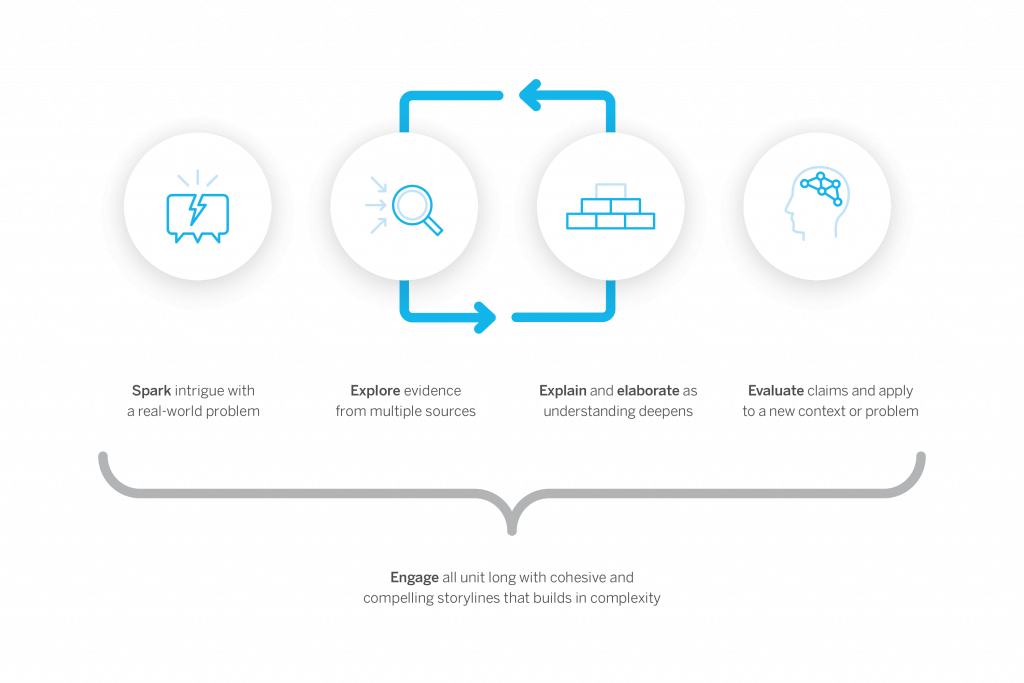
Our cyclical lesson design ensures students receive multiple exposures to concepts through a variety of modalities. As they progress through the lessons within a unit, students build and deepen their understanding, increasing their ability to develop and refine complex explanations of the unit’s phenomenon.

It’s this proven program structure and lesson design that enables Amplify Science to address 100% of the Next Generation Science Standards (NGSS) and support students in mastering the Pennsylvania Science Standards.

Flowchart depicting a critical thinking process with four circular nodes connected by arrows, each node representing a step: posing a real-world problem, exploring evidence, elaborating concepts, and evaluating claims.

Unit types

While every unit delivers three-dimensional learning experiences and engages students in gathering evidence from a rich collection of sources, each unit also serves a unique instructional purpose.

In grades 6–8:

  • One unit is a launch unit.
  • Three units are core units.
  • Two units are engineering internships.

Launch units are the first units taught in each year of Amplify Science. The goal of the Launch unit is to introduce students to norms, routines, and practices that will be built on throughout the year, including argumentation, active reading, and using the program’s technology. For example, rather than taking the time to explain the process of active reading in every unit in a given year, it is explained thoroughly in the Launch unit, thereby preparing students to read actively in all subsequent units.

Core units establish the context of the unit by introducing students to a real-world problem. As students move through lessons in a Core unit, they figure out the unit’s anchoring phenomenon, gain an understanding of the unit’s disciplinary core ideas and science and engineering practices, and make linkages across topics through the crosscutting concepts. Each Core unit culminates with a Science Seminar and final writing activity.

Engineering Internship units invite students to design solutions for real-world problems as interns for a fictional company called Futura. Students figure out how to help those in need, from tsunami victims in Sri Lanka to premature babies, through the application of engineering practices. In the process, they apply and deepen their learning from Core units.

Unit sequence

Our lessons follow a structure that is grounded in regular routines while still being flexible enough to allow for a variety of learning experiences.

In fact, our multi-modal instruction offers more opportunities for students to construct meaning, and practice and apply concepts than any other program. What’s more, our modular design means our units can be flexibly arranged to support your instructional goals.

Three columns listing education curriculum topics for grades 6, 7, and 8, focusing on science themes such as microbiomes, mars geology, and harnessing human energy.

Program components

Available digitally and in print, our unit-specific reference guides are chock-full of helpful resources, including scientific background knowledge, planning information and resources, color-coded 3D Statements, detailed lesson plans, tips for delivering instruction, and differentiation strategies.

Amplify Science TG

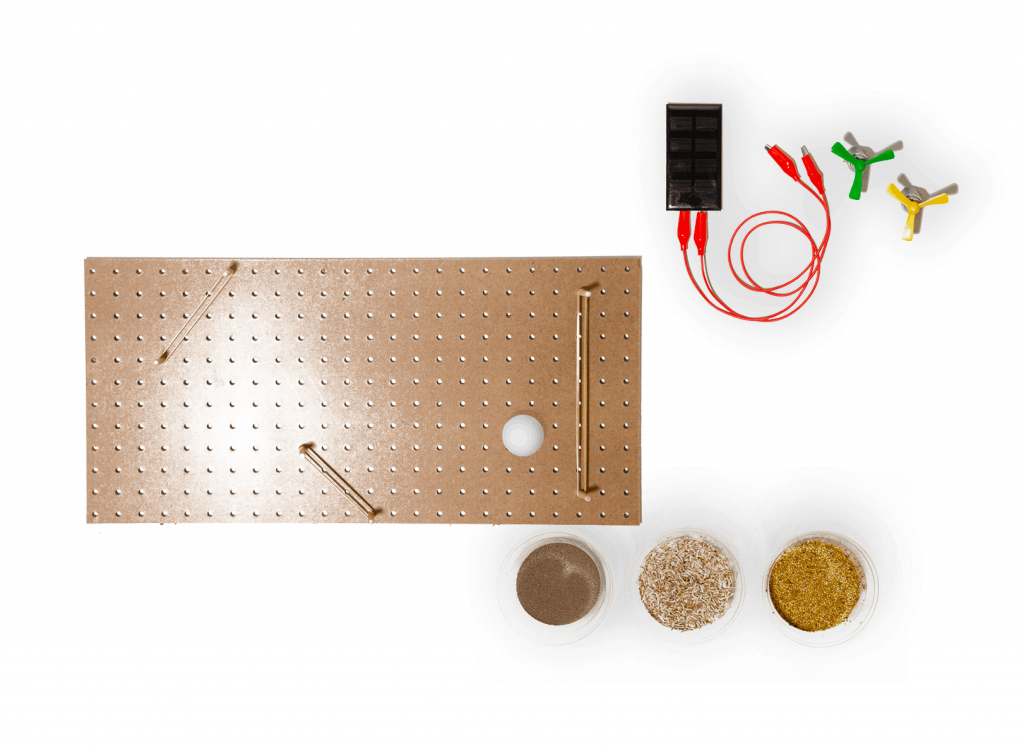
Hands-on learning is an essential part of Amplify Science, and is integrated into every unit. Students actively participate in science, playing the roles of scientists and engineers as they gather evidence, think critically, solve problems, and develop and defend claims about the world around them. Every unit includes hands-on investigations that are critical to achieving the unit’s learning goals.

A young person wearing gloves looks through a microscope at a table with laboratory supplies, including bottles, slides, and a tray, against a plain blue background.

More hands-on with Flextensions:
Hands-on Flextensions are additional, optional investigations that are included at logical points in the learning progression and give students an opportunity to dig deeper if time permits. These activities offer teachers flexibility to choose to dedicate more time to hands-on learning. Materials referenced in Hands-on Flextension activities will either be included in the unit kit or are easily sourced. Supporting resources such as student worksheets will be included as downloadable PDF files.

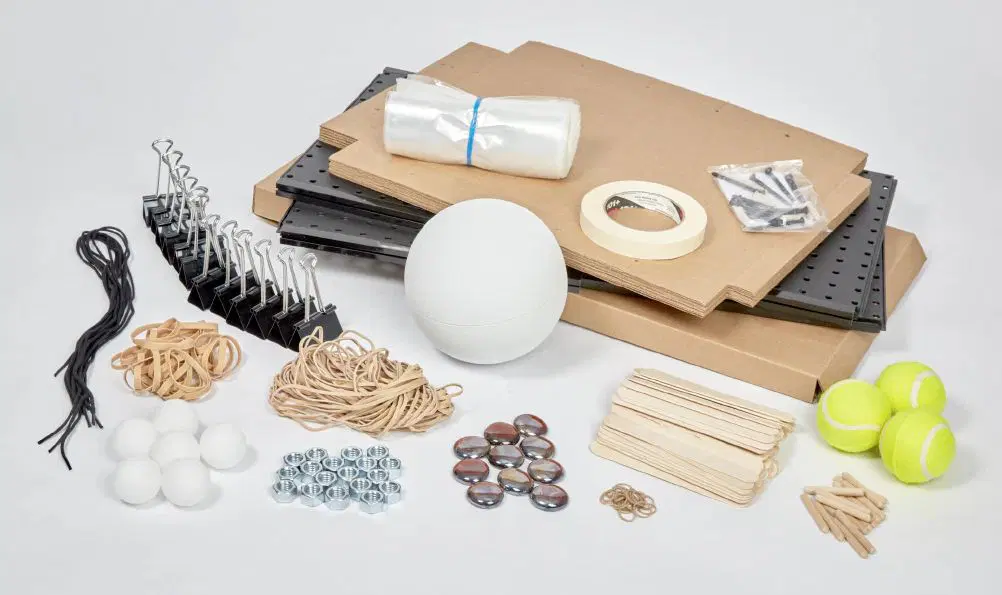
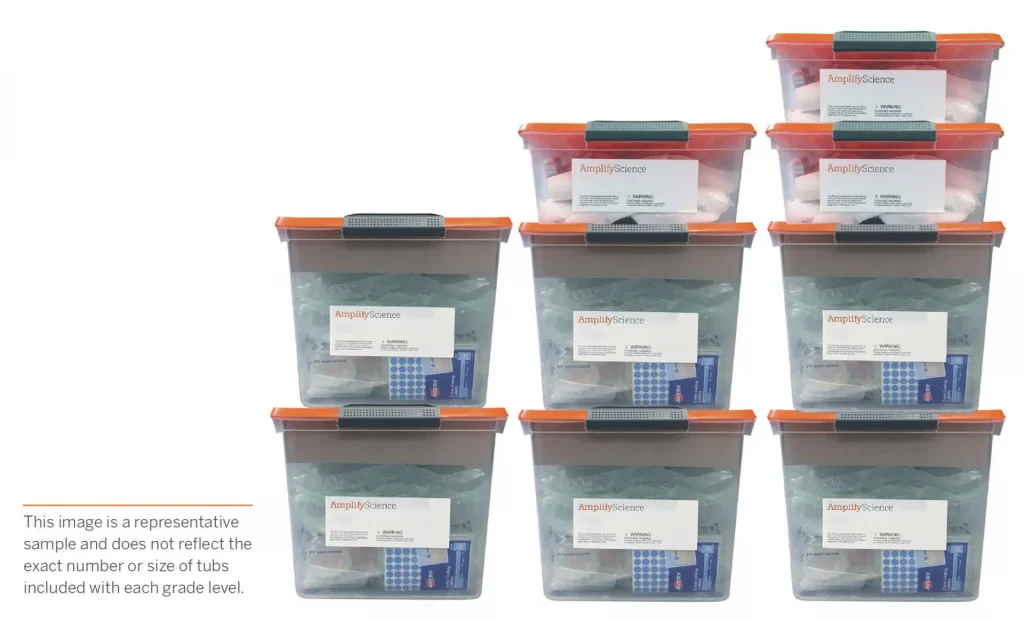
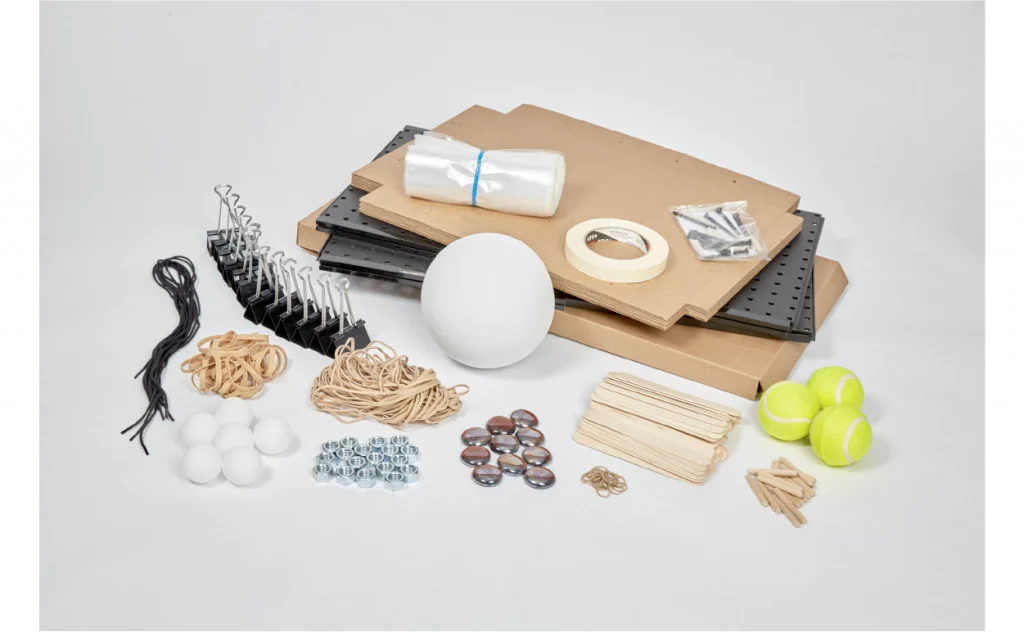
Our kits include enough materials to support 200 student uses. In other words, teachers can easily support all five periods and small groups of 4-5 students each. Plus, our unit-specific kits mean teachers just grab the tub they need and then put it all back with ease.

Assorted office and household items displayed on a white background, including rubber bands, binder clips, cardboard, and sports balls.

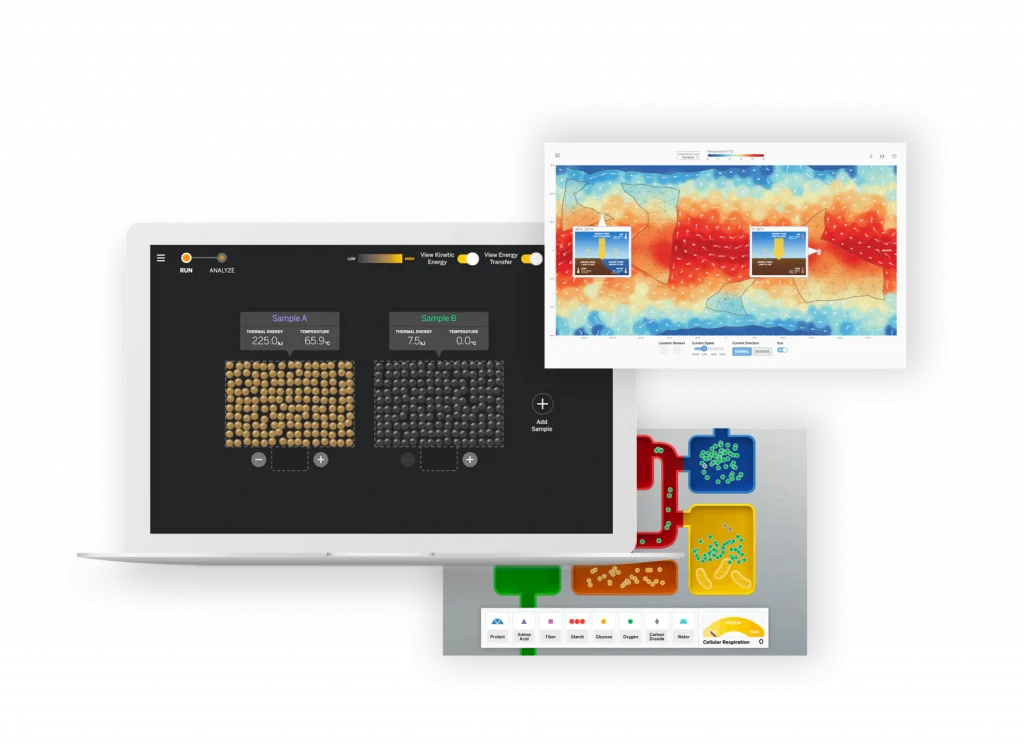
Our digital Simulations and Practice Tools are powerful resources for exploration, data collection, and student collaboration. They allow students the ability to explore scientific concepts that might otherwise be invisible or impossible to see with the naked eye.

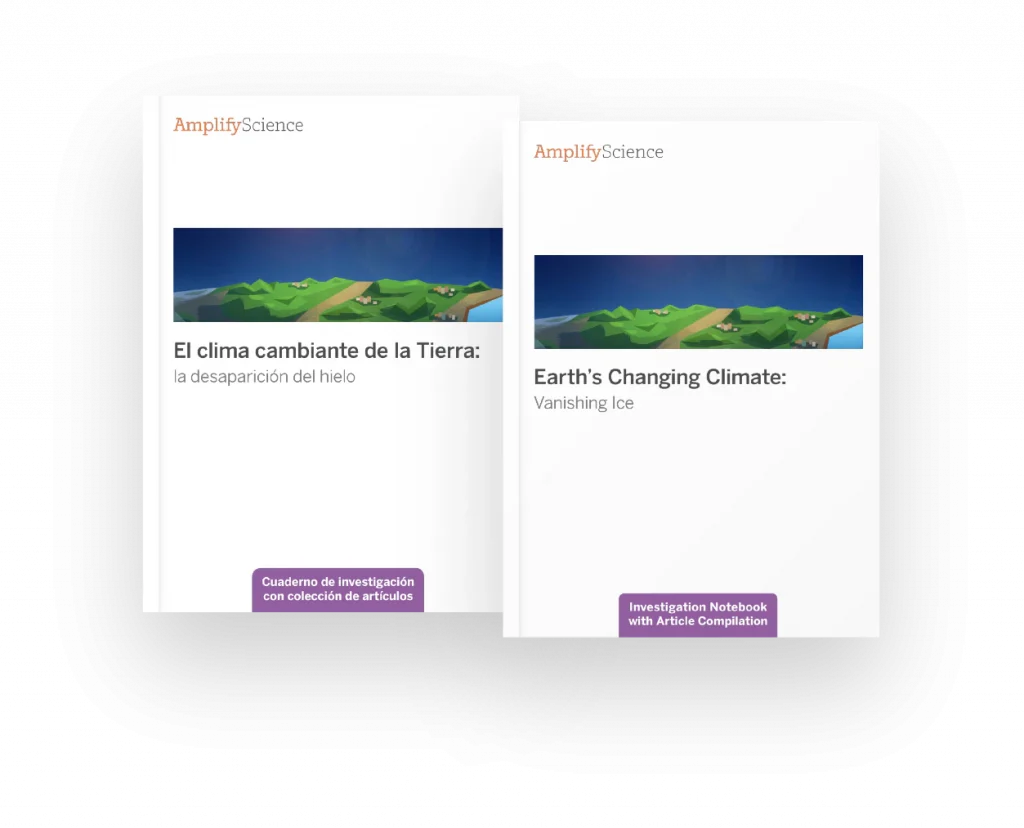
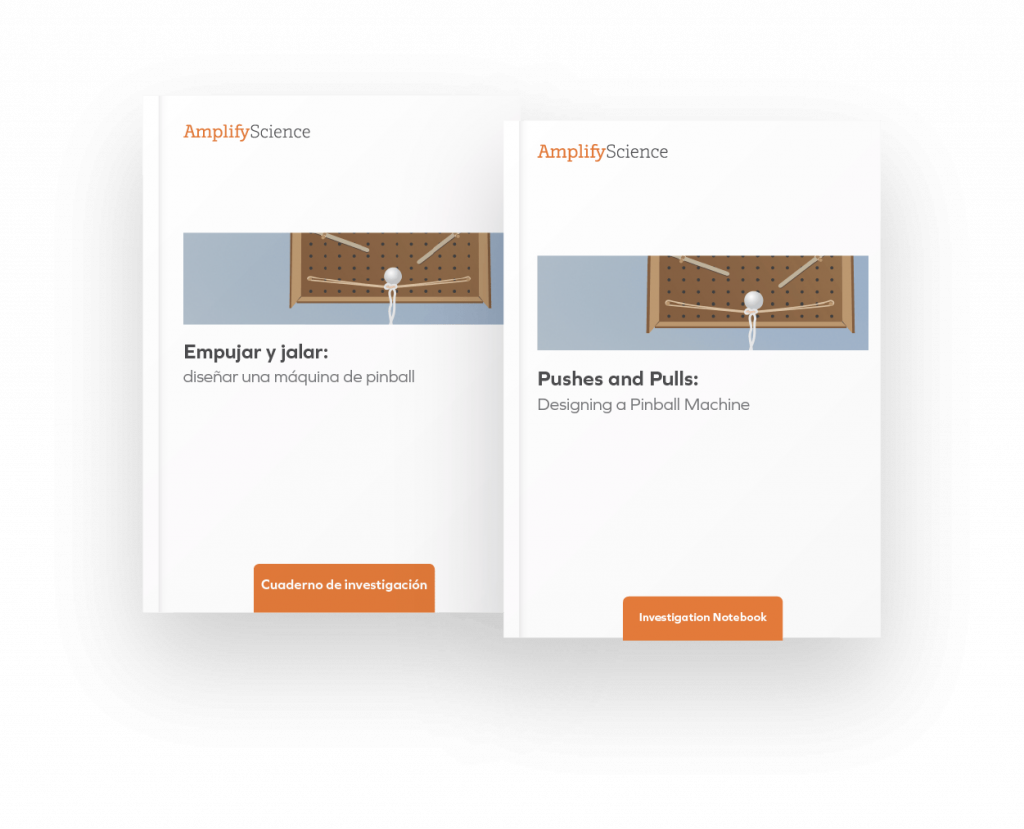
Available for every unit, our Student Investigation Notebooks contain instructions for activities and space for students to record data and observations, reflect on ideas from texts and investigations, and construct explanations and arguments.

In grades 6–8, one copy of the Student Investigation Notebook is included in each unit’s materials kit for use as a blackline master. Each notebook is also available as a downloadable PDF on the Unit Guide page of the digital Teacher’s Guide.

Two booklets titled "El clima cambiante de la Tierra: la desaparición del hielo" and "Earth’s Changing Climate: Vanishing Ice" with landscape illustrations on the covers.

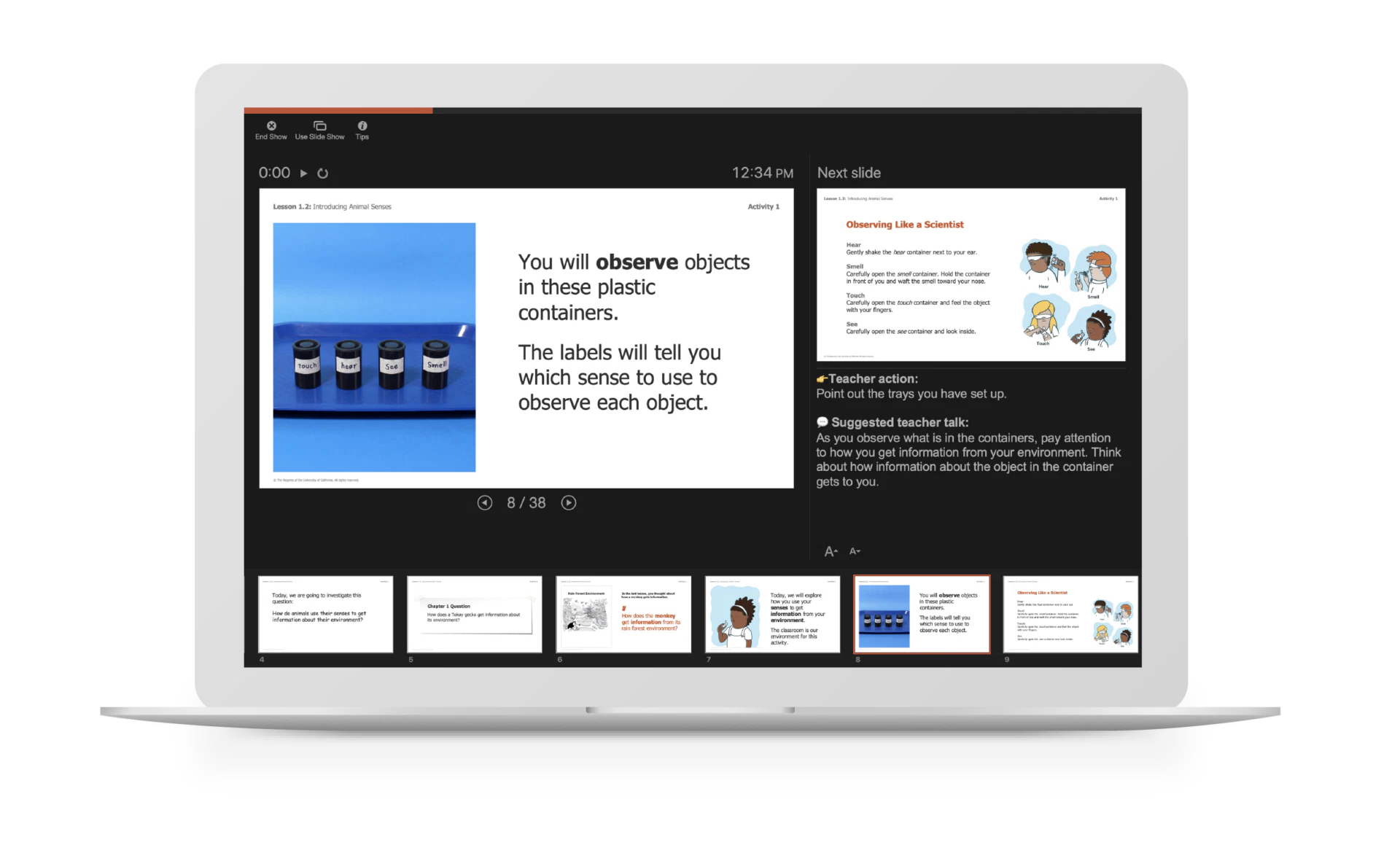
These customizable PowerPoints are available for every lesson of the program and make delivering instruction a snap with visual prompts, colorful activity instructions, investigation set-up videos and animations, and suggested teacher talk in the notes section of each slide.

Amplify Science Classroom Slides

Explore your print samples

With your Amplify Science print samples, you’ll find unit-specific Teacher’s References Guides and Student Investigation Notebooks for each grade level.

A note about the Teacher’s Reference Guides:

It’s important that your committee sees the full breadth and depth of our instruction. For that reason, we provided a copy of each of our unit-specific Teacher Reference Guides.

Rest assured that teachers do not use these robust reference guides for day-to-day teaching. For that, we have a hands-free TG!

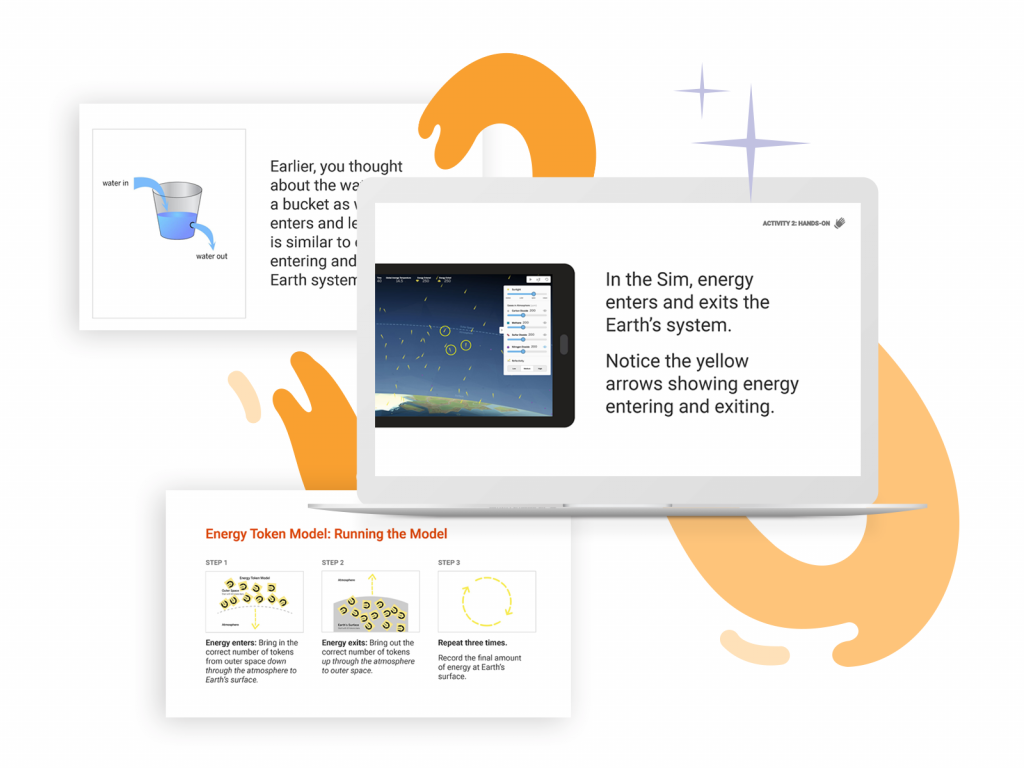
Three laptop screens displaying educational content on earth's energy system, including diagrams and text annotations.
  • Teacher Reference Guide: Unlike a typical TG that requires a series of supplemental books to support it, our encyclopedic reference guide is chock-full of everything a teacher needs to fully implement our program and the NGSS.
  • Ready-to-Teach Lesson Slides: For daily instruction, teachers need their hands free. That’s why we created ready-to-teach lesson slides for every single lesson. What’s more, they are editable and include suggested teacher talk and point-of-use differentiation and other instructional tips. Click to learn more.

A note about the Materials Kits:

Hands-on learning is at the heart of Amplify Science, and is integrated into every unit. In order to make hands-on learning more manageable for busy teachers, Amplify Science materials are organized into unit-specific kits.

Stacked storage bins with labels, arranged neatly; caption notes they are a sample and may not reflect actual quantities or sizes.

Our unit-specific kits:

  • Include more materials — We give teachers enough materials to support 200 student uses.
  • Are more manageable — Unlike other programs that require large groups of students to share limited sets of materials, our kits include enough to support small groups of 4–5 students.
  • Include supportive videos — Each hands-on activity provides clear instructions for the teacher, with more complex activities supported by video demonstrations and illustrations.

At your request, we did not include our materials kits with our submissions samples. However, we did provide grade-specific lists of all materials included in each kit, which you can also find with the links below.

Access your digital samples

Explore as a teacher

Follow these instructions to explore the Amplify Science digital platform as a teacher.

  • Click the Access Amplify Science Platform button below and bookmark it.
  • Select Log in with Amplify.
  • Enter the username: t1.dps68sci@demo.tryamplify.net
  • Enter the password: Amplify1-dps68sci
  • Click the Science icon.
  • Click on the Grade Menu in the top center of the screen and select any grade.
  • Select any unit.

To help familiarize yourself with navigating the digital platform, watch the below navigational video.

Spanish-language support

Amplify Science is committed to providing support to meet the needs of all learners, including multiple access points for Spanish-speaking students. Developed in conjunction with Spanish-language experts and classroom teachers, several components are available in Spanish across the Amplify Science curriculum.

Spanish-language materials include:

COMPONENTTEACHER/STUDENT
Student Investigation NotebooksStudent
Science articlesStudent
Video TranscriptsStudent
Digital simulation translation keysStudent
Printed classroom materials
Unit and chapter questions, key concepts, vocabulary cards, etc.
Teacher
CopymastersTeacher
AssessmentsTeacher
Digital student experience license
This license gives students access to the student resources in Spanish, including instructional text, articles, and assessments. Teachers can control student access to Spanish-language content through the digital Teacher’s Guide.
Teacher
Spanish teacher support license
This license includes teacher talk, projections, downloadable PDFs of all print resources, and video transcripts and closed captioning in Spanish.
Teacher

Explore as a student

Follow these instructions to explore the Amplify Science digital platform as a student.

  • Click the Access Amplify Science Platform button below and bookmark it.
  • Select Log in with Amplify.
  • Enter the username: s1.dpsscience@demo.tryamplify.net
  • Enter the password: Amplify1-dpsscience
  • Click the Science icon.
  • Click on the Grade Menu in the top center of the screen and select any grade.
  • Select any unit.

Resources to support your review

Amplify Science Overview

The Lawrence Hall of Science

Developed by the science education experts at UC Berkeley’s Lawrence Hall of Science and the digital learning team at Amplify, our program features:

  • phenomena-based approach where students construct a complex understanding of each unit’s anchor phenomenon.
  • A blend of cohesive storylines, hands-on investigations, rich discussions, literacy-rich activities, and digital tools.
  • Carefully crafted units, chapters, lessons, and activities designed to deliver true 3-dimensional learning.
  • An instructional design that supports all learners in accessing all standards.
The logo for The Lawrence Hall of Science, University of California, Berkeley, features blue text on a light background and is recognized by educators using Amplify Science for middle school science programs.

Instructional model

The Amplify Science program is rooted in the proven, research-based pedagogy of Do, Talk, Read, Write, Visualize. Here’s how each element works:

DO

First-hand investigations are an important part of any science classroom, and Amplify Science has students getting hands-on in every unit—from building models of protein molecules to experimenting with electrical systems.

TALK

Student-to-student discourse and full-class discussions are an integral part of the program. Students are provided with numerous opportunities to engage in meaningful oral scientific argumentation, all while fostering a collaborative classroom environment.

READ

Students read scientific articles, focusing their reading activities on searching for evidence related to their investigation and, importantly, on asking and recording questions as they read through fascinating texts on 21st-century topics.

WRITE

Following real-world practices, students write scientific arguments based on evidence they’ve collected, making clear their reasoning about how a given piece of evidence connects to one of several claims.

VISUALIZE

By manipulating digital simulations and using modeling tools to craft visualizations of their thinking— just as real scientists and engineers do—students take their learning far beyond the confines of what they can physically see in the classroom in an exciting and authentic way.

Program structure

Our cyclical lesson design ensures students receive multiple exposures to concepts through a variety of modalities. As they progress through the lessons within a unit, students build and deepen their understanding, increasing their ability to develop and refine complex explanations of the unit’s phenomenon.

It’s this proven program structure and lesson design that enables Amplify Science to address 100% of the NGSS, and support students in mastering the standards.

Graphic showing a research process with four steps: spark intrigue with a real-world problem, explore evidence, explain and elaborate, and evaluate claims, connected in a cycle with arrows.

Unit types

While every unit delivers three-dimensional learning experiences and engages students in gathering evidence from a rich collection of sources, each unit also emphasizes a particular science and engineering practice.

In grades K–2:

  • One unit emphasizes the practice of investigation.
  • One unit emphasizes the practice of modeling.
  • One unit emphasizes the practice of engineering design.

In grades 3–5, students experience the three unit types above, plus:

  • One additional unit that emphasizes the practice of argumentation.

Investigation units focus on the process of strategically developing investigations and gathering data to answer questions. Students are first asked to consider questions about what happens in the natural world and why, and are then involved in designing and conducting investigations that produce data to help answer those questions.

Modeling units provide extra support to students engaging in the practice of modeling. Students use physical models, investigate with computer models, and create their own diagrams to help them visualize what might be happening on the nanoscale.

Engineering design units provide opportunities for students to solve complex problems by applying science principles to the design of functional solutions, and iteratively testing those solutions to determine how well they meet preset criteria.

Argumentation units provide students with regular opportunities to explore and discuss available evidence, time and support to consider how evidence may be leveraged in support of claims, and independence that increases as they mount written arguments in support of their claims.

Unit sequence

Our lessons follow a structure that is grounded in regular routines while still being flexible enough to allow for a variety of learning experiences.

In fact, our multi-modal instruction offers more opportunities for students to construct meaning, and practice and apply concepts than any other program. What’s more, our modular design means our units can be flexibly arranged to support your instructional goals.

A chart showing science topics by grade: K covers plants, weather, and forces; 1 covers animals, sound, and Earth; 2 covers relationships, materials, and landforms; 3–5 cover energy, traits, systems, and climate.

Program components

Available digitally and in print, our unit-specific reference guides are chock full of helpful resources, including scientific background knowledge, planning information and resources, color-coded 3-D Statements, detailed lesson plans, tips for delivering instruction, and differentiation strategies.

Amplify Science TG

Hands-on learning is an essential part of Amplify Science, and is integrated into every unit. Students actively participate in science, playing the roles of scientists and engineers as they gather evidence, think critically, solve problems, and develop and defend claims about the world around them. Every unit includes hands-on investigations that are critical to achieving the unit’s learning goals.

Two children sit at a table blowing into plastic straws held together, likely making musical sounds, with containers and rubber bands on the table.

More hands-on with Flextensions:
Hands-on Flextensions are additional, optional investigations that are included at logical points in the learning progression and give students an opportunity to dig deeper if time permits. These activities offer teachers flexibility to choose to dedicate more time to hands-on learning. Materials referenced in Hands-on Flextension activities will either be included in the unit kit or are easily sourced. Supporting resources such as student worksheets will be included as downloadable PDF files.

Our kits include enough non-consumable materials to support a class of 36 students and enough consumable items to support 72 students. In other words, each kit can last two years! Plus, our unit-specific kits mean teachers just grab the tub they need for the unit and then put it all back with ease.

Amplify Science California supports 3-D learning with more materials than any other program.

Each unit of Amplify Science K–5 includes six unique Student Books written by the Lawrence Hall of Science specifically for the program. These content-rich nonfiction and informational texts provide opportunities for students to search for evidence relevant to their firsthand investigations, see science practices and dispositions modeled, extend their science knowledge, provide real world connections as they master reading-to-learn and close reading skills, and construct evidence-based arguments.

Important note:
Students in grades K–5 are never asked to read alone. Rather, books are read to, with, and by students with ample scaffolding and support provided by the teacher. Big Books are read aloud or together with the class to introduce ideas. Student Books allow for small-group reading and reading in pairs.

Illustrations of two children's book covers displayed on a tablet, titled "on dia ocupado en villa empuja" and "a busy day in pushville," showing a busy street scene.

Available for every unit, our Student Investigation Notebooks contain instructions for activities and space for students to record data and observations, reflect on ideas from texts and investigations, and construct explanations and arguments.

In grades K–5, one copy of the Student Investigation Notebook is included in each unit’s materials kit for use as a blackline master. Each notebook is also available as a downloadable PDF on the Unit Guide page of the digital Teacher’s Guide.

Amplify Science Student Investigation Notebooks

Amplify Science offers digital experience licenses that make elementary instruction more flexible for students and teachers, as well as providing additional means to engage in remote, hybrid, or in-person learning!

Student-facing digital lessons
With the digital experience, students can engage with digital lesson content in one cohesive experience. It’s the same content from Amplify science in a new, integrated format where students can interact with slides, Sims, modeling tools, videos, books, and more.

Ecosystem Restoration digital simulation

Digital student notebook pages
Students can draw, write, record audio, and insert images into their Investigation Notebook pages. Their work is automatically saved and delivered to you in real time. When students edit their work, those edits are immediately reflected on your teacher work review page. You can access student responses by clicking “View Work,” where you can see students’ Investigation Notebook pages from the lesson, updating live.

[IMAGE TO COME]

Assign in Amplify
The digital experience allows flexibility with optional features like scheduling assignments in advance and setting due dates. Teacher can use Scheduling to determine the date and time that the assignment appears in Student Home. They also have the flexibility to schedule when assignments appear and use dates to remove assignments from Student Home.

Assign in LMS
You can also assign lessons via our integrations with Google Classroom and Microsoft Teams, or by copying a lesson link and sharing it with students through the platform of your choice. The assignment link you send will provide students with direct access to the full lesson—slides, videos, digital tools, and worksheet activities—no student platform navigation required!

Teacher platform and presentation
Teacher-facing lesson content—including sample teacher talk, student responses, pedagogical support, and possible student responses—shows on a teacher’s private Teacher Guide tab. Students only see the lesson slides that are being presented.

Graphic depicting a teacher's device synced with a class presentation for K—5 students. The teacher's laptop displays an Amplify Science lesson on environments, which is mirrored on a larger screen for the class

Explore your print samples

With your Amplify Science print samples, you’ll find unit-specific Teacher’s References Guides, Student Investigation Notebooks, and sets of Student Books for each grade level.

A note about the Teacher’s Reference Guides:

It’s important that you see the full breadth and depth of our instruction. For that reason, we provide a copy of each of our unit-specific Teacher Reference Guides.

Rest assured that teachers do not use these robust reference guides for day-to-day teaching. For that, we have a hands-free TG!

A laptop screen shows an energy simulation, with surrounding text and diagrams explaining the Earth's system and energy flow.
  • Teacher Reference Guide: Unlike a typical TG that requires a series of supplemental books to support it, our encyclopedic reference guide is chock-full of everything a teacher needs to fully implement our program and the NGSS.
  • Ready-to-Teach Lesson Slides: For daily instruction, teachers need their hands free. That’s why we created ready-to-teach lesson slides for every single lesson. What’s more, they are editable and include suggested teacher talk and point-of-use differentiation and other instructional tips. Click to learn more.

A note about the Materials Kits:

Hands-on learning is at the heart of Amplify Science, and is integrated into every unit. In order to make hands-on learning more manageable for busy teachers, Amplify Science materials are organized into unit-specific kits.

Stacked storage bins with labels, arranged neatly; caption notes they are a sample and may not reflect actual quantities or sizes.

What’s different about Amplify’s unit-specific material kits?  They…

  • Include more materials — We give teachers enough non-consumable materials to support a class of 36 students and enough consumables to support 72 student uses. In other words, each kit will last two years.
  • Are more manageable — Unlike other programs that require large groups of students to share limited sets of materials, our kits include enough to support small groups of 4–5 students.
  • Include supportive videos — Each hands-on activity provides clear instructions for the teacher, with more complex activities supported by video demonstrations and illustrations.

Grade-specific lists of all materials included in each kit:

Access your digital samples

Explore as a teacher

When you’re ready to explore the teaching experience on your own, follow these instructions to access the Amplify Science digital teacher platform.

  • Click the Access Amplify Science Platform button below and bookmark the page.
  • Select Log in with Amplify.
  • Enter the username: t1.jeffersoncounty@demo.tryamplify.net
  • Enter the password: Amplify1-jeffersoncounty
  • Click on Science on the left hand side.
  • Click on the Program Menu in the top center of the screen and select any grade.
  • Select any unit.

To help familiarize yourself with navigating the digital platform,watch the below navigational video.

Explore as a student

When you’re ready to explore the student learning experience on your own, follow these instructions to access the Amplify Science digital student platform.

  • Click the Access Amplify Science Platform button below and bookmark the page.
  • Select Log in with Amplify.
  • Enter the username: s1.jeffersoncounty@demo.tryamplify.net
  • Enter the password: Amplify1-jeffersoncounty
  • Click the backpack icon on the top right.
  • Click Science K-5
  • Select any unit.

Resources to support your review

What’s New for Amplify Science 6–8!

Denver Public Schools (DPS), check out what’s new from Amplify Science 6-8!  The first part of this site will take you through the updates that have been made to Amplify Science. The second will be a refresher of Amplify Science for any new users in DPS. With Amplify Science, DPS students don’t just passively learn about science concepts. Instead, they take on the role of scientists and engineers to actively investigate and figure out real-world phenomena. With culturally sustaining pedagogy, Amplify Science strives to make sure every student feels included in the science classroom.

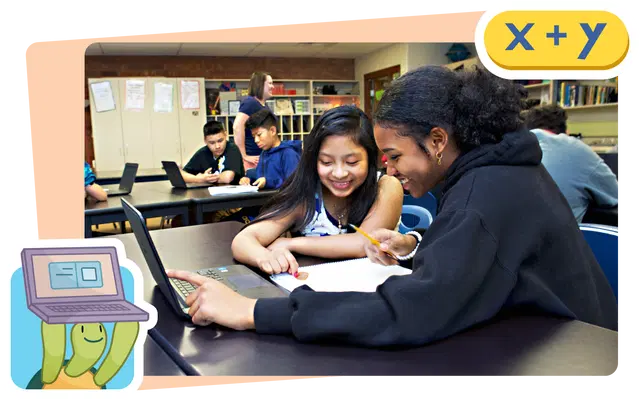
Two students collaborating on a project using a laptop in a classroom filled with other students working in the background.

Update: The Digital Experience

The digital experience allows students to engage with digital lessons and provides teachers with everything they need in one place—ready-to-use slides-based lessons, seamlessly integrated teacher prompts and guidance, robust PD resources, and more. It’s now easier and more engaging than ever to plan lessons, present digital content, and review student work. To learn more, click here.

Update: The PD Library

All professional development (PD) content is consolidated into the PD Library, a one-stop hub for all your self-paced PD needs. As a result, the “Professional Learning Resources” tile will no longer be available on the main Amplify Science Program Hub page. The rest of the non-PD content in the Program Hub will remain as is, including the on-demand resources.

Update: Educator & Student Home expansion

Educator and Student Home landing pages will now be available for all Amplify Science users. This Home page provides a central location to access all Amplify programs in one place and a customized stream based on your activity.

Your Amplify Science grades 6–8 students will no longer access My Work for assignments, scores, and teacher feedback. Instead, they’ll find it all on Student Home, the page they already land on when logging in to Amplify Science.

Keep in mind: Amplify Science middle school teachers will continue to have access to Classwork.

Update: Caregiver Hub

Throughout the school year, teachers can share the Amplify Science Caregiver Hub with students’ families. This site provides curriculum details, an overview of what caregivers can expect throughout the school year, and resources they can use with students at home.

What is Amplify Science?

The Lawrence Hall of Science

Developed by the science education experts at UC Berkeley’s Lawrence Hall of Science and the digital learning team at Amplify, our program features:

  • phenomena-based approach where students construct a complex understanding of each unit’s anchor phenomenon.
  • A blend of cohesive storylines, hands-on investigations, rich discussions, literacy-rich activities, and digital tools.
  • Carefully crafted units, chapters, lessons, and activities designed to deliver true three-dimensional learning.
  • An instructional design that supports all learners in accessing all standards.
Aerial view of the lawrence hall of science at the university of california, berkeley, showcasing the building and surrounding trees with a foggy city backdrop.

Proven to work

WestEd Randomized
Control Trial for Grade 1

Read More

WestEd Randomized
Control Trial for Grade 7

Read More

Amplify Science NE
Grades K–5

Read More

Instructional model

The Amplify Science program is rooted in the proven, research-based pedagogy of Do, Talk, Read, Write, Visualize. Here’s how each element works:

Do

First-hand investigations are an important part of any science classroom, and Amplify Science has students getting hands-on in every unit—from building models of protein molecules to experimenting with electrical systems.

Talk

Student-to-student discourse and full-class discussions are an integral part of the program. Students are provided with numerous opportunities to engage in meaningful oral scientific argumentation, all while fostering a collaborative classroom environment.

Read

Students read scientific articles, focusing their reading activities on searching for evidence related to their investigation and, importantly, on asking and recording questions as they read through fascinating texts on 21st-century topics.

Write

Following real-world practices, students write scientific arguments based on evidence they’ve collected, making clear their reasoning about how a given piece of evidence connects to one of several claims.

Visualize

By manipulating digital simulations and using modeling tools to craft visualizations of their thinking— just as real scientists and engineers
do—students take their learning far beyond the confines of what they can physically see in the classroom in an exciting and authentic way.

Program structure

Our cyclical lesson design ensures students receive multiple exposures to concepts through a variety of modalities. As they progress through the lessons within a unit, students build and deepen their understanding, increasing their ability to develop and refine complex explanations of the unit’s phenomenon.

It’s this proven program structure and lesson design that enables Amplify Science to address 100% of the Next Generation Science Standards (NGSS) and support students in mastering the Pennsylvania Science Standards.

Flowchart depicting a critical thinking process with four circular nodes connected by arrows, each node representing a step: posing a real-world problem, exploring evidence, elaborating concepts, and evaluating claims.

Unit types

While every unit delivers three-dimensional learning experiences and engages students in gathering evidence from a rich collection of sources, each unit also serves a unique instructional purpose.

In grades 6–8:

  • One unit is a launch unit.
  • Three units are core units.
  • Two units are engineering internships.

Launch units are the first units taught in each year of Amplify Science. The goal of the Launch unit is to introduce students to norms, routines, and practices that will be built on throughout the year, including argumentation, active reading, and using the program’s technology. For example, rather than taking the time to explain the process of active reading in every unit in a given year, it is explained thoroughly in the Launch unit, thereby preparing students to read actively in all subsequent units.

Core units establish the context of the unit by introducing students to a real-world problem. As students move through lessons in a Core unit, they figure out the unit’s anchoring phenomenon, gain an understanding of the unit’s disciplinary core ideas and science and engineering practices, and make linkages across topics through the crosscutting concepts. Each Core unit culminates with a Science Seminar and final writing activity.

Engineering Internship units invite students to design solutions for real-world problems as interns for a fictional company called Futura. Students figure out how to help those in need, from tsunami victims in Sri Lanka to premature babies, through the application of engineering practices. In the process, they apply and deepen their learning from Core units.

DPS Scope and Sequence

Our lessons follow a structure that is grounded in regular routines while still being flexible enough to allow for a variety of learning experiences.

In fact, our multi-modal instruction offers more opportunities for students to construct meaning, and practice and apply concepts than any other program. What’s more, our modular design means our units can be flexibly arranged to support your instructional goals.

Un gráfico que muestra los cursos de ciencias para los grados 6 a 8. Cada grado tiene una lista de clases categorizadas como Launch, GROW y GOAT, con el título de cada curso y la duración en minutos o días.

Program components

Available digitally and in print, our unit-specific reference guides are chock-full of helpful resources, including scientific background knowledge, planning information and resources, color-coded 3D Statements, detailed lesson plans, tips for delivering instruction, and differentiation strategies.

Amplify Science TG

Hands-on learning is an essential part of Amplify Science, and is integrated into every unit. Students actively participate in science, playing the roles of scientists and engineers as they gather evidence, think critically, solve problems, and develop and defend claims about the world around them. Every unit includes hands-on investigations that are critical to achieving the unit’s learning goals.

A young person wearing gloves looks through a microscope at a table with laboratory supplies, including bottles, slides, and a tray, against a plain blue background.

More hands-on with Flextensions:
Hands-on Flextensions are additional, optional investigations that are included at logical points in the learning progression and give students an opportunity to dig deeper if time permits. These activities offer teachers flexibility to choose to dedicate more time to hands-on learning. Materials referenced in Hands-on Flextension activities will either be included in the unit kit or are easily sourced. Supporting resources such as student worksheets will be included as downloadable PDF files.

Our kits include enough materials to support 200 student uses. In other words, teachers can easily support all five periods and small groups of 4-5 students each. Plus, our unit-specific kits mean teachers just grab the tub they need and then put it all back with ease.

Assorted office and household items displayed on a white background, including rubber bands, binder clips, cardboard, and sports balls.

Our digital Simulations and Practice Tools are powerful resources for exploration, data collection, and student collaboration. They allow students the ability to explore scientific concepts that might otherwise be invisible or impossible to see with the naked eye.

Available for every unit, our Student Investigation Notebooks contain instructions for activities and space for students to record data and observations, reflect on ideas from texts and investigations, and construct explanations and arguments.

In grades 6–8, one copy of the Student Investigation Notebook is included in each unit’s materials kit for use as a blackline master. Each notebook is also available as a downloadable PDF on the Unit Guide page of the digital Teacher’s Guide.

Two booklets titled "El clima cambiante de la Tierra: la desaparición del hielo" and "Earth’s Changing Climate: Vanishing Ice" with landscape illustrations on the covers.

These customizable PowerPoints are available for every lesson of the program and make delivering instruction a snap with visual prompts, colorful activity instructions, investigation set-up videos and animations, and suggested teacher talk in the notes section of each slide.

Amplify Science Classroom Slides

Explore your print samples

With your Amplify Science print samples, you’ll find unit-specific Teacher’s References Guides, Student Investigation Notebooks, and sets of Student Books for each grade level.

A note about the Teacher Reference Guides:

It’s important that you see the full breadth and depth of our instruction. For that reason, we provide a copy of each of our unit-specific Teacher Reference Guides.

Rest assured that teachers do not use these robust reference guides for day-to-day teaching. For that, we have a hands-free Teacher’s Guide!

Three laptop screens displaying educational content on earth's energy system, including diagrams and text annotations.
  • Teacher Reference Guide: Unlike a typical TG that requires a series of supplemental books to support it, our encyclopedic reference guide is chock-full of everything a teacher needs to fully implement our program and the NGSS.
  • Ready-to-Teach Lesson Slides: For daily instruction, teachers need their hands free. That’s why we created ready-to-teach lesson slides for every single lesson. What’s more, they are editable and include suggested teacher talk and point-of-use differentiation and other instructional tips. Click to learn more.

A note about the Materials Kits:

Hands-on learning is at the heart of Amplify Science, and is integrated into every unit. In order to make hands-on learning more manageable for busy teachers, Amplify Science materials are organized into unit-specific kits.

Stacked storage bins with labels, arranged neatly; caption notes they are a sample and may not reflect actual quantities or sizes.

Our unit-specific kits:

  • Include more materials — We give teachers enough materials to support 200 student uses.
  • Are more manageable — Unlike other programs that require large groups of students to share limited sets of materials, our kits include enough to support small groups of 4–5 students.
  • Include supportive videos — Each hands-on activity provides clear instructions for the teacher, with more complex activities supported by video demonstrations and illustrations.

At your request, we did not include our materials kits with our submissions samples. However, we did provide grade-specific lists of all materials included in each kit, which you can also find with the links below.

Access your digital samples

Explore as a teacher

Follow these instructions to explore the Amplify Science digital platform as a teacher.

  • Click the Access Amplify Science Platform button below and bookmark it.
  • Select Log in with Amplify.
  • Enter the username: t1.dps68sci@demo.tryamplify.net
  • Enter the password: Amplify1-dps68sci
  • Click the Science icon.
  • Click on the Grade Menu in the top center of the screen and select any grade.
  • Select any unit.

To help familiarize yourself with navigating the digital platform, watch the below navigational video.

Spanish-language support

Amplify Science is committed to providing support to meet the needs of all learners, including multiple access points for Spanish-speaking students. Developed in conjunction with Spanish-language experts and classroom teachers, several components are available in Spanish across the Amplify Science curriculum.

Spanish-language materials include:

COMPONENTTEACHER/STUDENT
Student Investigation NotebooksStudent
Science articlesStudent
Video TranscriptsStudent
Digital simulation translation keysStudent
Printed classroom materials
Unit and chapter questions, key concepts, vocabulary cards, etc.
Teacher
CopymastersTeacher
AssessmentsTeacher
Digital student experience license
This license gives students access to the student resources in Spanish, including instructional text, articles, and assessments. Teachers can control student access to Spanish-language content through the digital Teacher’s Guide.
Teacher
Spanish teacher support license
This license includes teacher talk, projections, downloadable PDFs of all print resources, and video transcripts and closed captioning in Spanish.
Teacher

Resources to support your review

Contact Us

If you have any further questions as your review Amplify Science, please contact:

Senior Account Executive

719-964-4501

mlammers@amplify.com

Welcome to Amplify Science Pennsylvania
(K–5)!

Amplify Science is an engaging core curriculum designed for three-dimensional, phenomena-based learning.

With Amplify Science, Pennsylvania students shift from learning about to figuring out science through authentic three-dimensional (3D) learning and phenomena-based exploration. In each unit, students take on the role of a scientist or engineer to investigate a real-world problem. This prepares them to become critical thinkers who can solve problems in their communities and beyond.

Four children gather around a classroom table, engaging with their Amplify Science project, as notebooks and papers are spread out in front of them—an inspiring scene supported by Pennsylvania teachers.

What is Amplify Science Pennsylvania?

Customized lessons for Pennsylvania

Amplify Science Pennsylvania (K–5) combines our nationally recognized, proven curriculum with custom lessons specifically designed to ensure you are meeting Pennsylvania’s STEELS standards.

A digital interface displays six science lessons from Amplify Science, with "Ancient Water Purification" in Lesson 2.9 highlighted as a PA STEELS Custom Lesson. Each lesson features a simple sky and mountain graphic, perfect for Science programs for elementary.

The Lawrence Hall of Science

Developed by the science education experts at UC Berkeley’s Lawrence Hall of Science and the digital learning team at Amplify, our program features:

  • phenomena-based approach in which students construct a complex understanding of each unit’s anchor phenomenon.
  • A blend of cohesive storylines, hands-on investigations, rich discussions, literacy-rich activities, and digital tools.
  • Carefully crafted units, chapters, lessons, and activities designed to deliver true three-dimensional learning.
  • An instructional design that supports all learners in accessing all standards.
Aerial view of the lawrence hall of science at the university of california, berkeley, showcasing the building and surrounding trees with a foggy city backdrop.

Proven to work

A pdf cover from wested titled "learning and literacy development together: initial results from a curriculum study," featuring an adult helping children with schoolwork in a classroom.

WestEd Randomized
Control Trial for Grade 1

Read More

Pdf cover titled "curriculum materials designed for the next generation science standards: initial results from gold standard research trials", published by wested.

WestEd Randomized
Control Trial for Grade 7

Read More

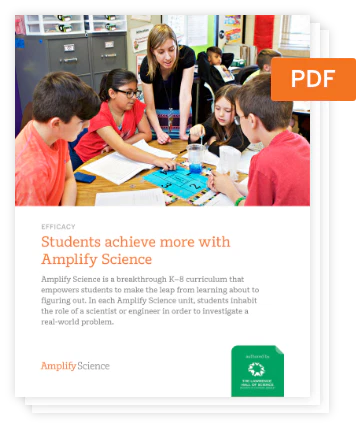
A teacher and students engage in a science activity around a table. The text promotes the Amplify Science K–8 curriculum, highlighting its focus on hands-on learning and real-world problem-solving.

Amplify Science Pennsylvania NE
Grades K–5

Read More

Instructional model

The Amplify Science Pennsylvania program is rooted in the proven, research-based pedagogy of Do, Talk, Read, Write, Visualize. Here’s how each element works:

Do

Firsthand investigations are an important part of any science classroom, and Amplify Science Pennsylvania has students getting hands-on in every unit—from building models of protein molecules to experimenting with electrical systems.

Talk

Student-to-student discourse and full-class discussions are an integral part of the program. Students are provided with numerous opportunities to engage in meaningful oral scientific argumentation, all while fostering a collaborative classroom environment.

Read

Students read scientific articles, focusing their reading activities on searching for evidence related to their investigation and on asking and recording questions as they read through fascinating texts on 21st-century topics.

Write

Following real-world practices, students write scientific arguments based on evidence they’ve collected, making clear their reasoning about how a given piece of evidence connects to one of several claims.

Visualize

By manipulating digital simulations and using modeling tools to craft visualizations of their thinking— just as real scientists and engineers
do—students take their learning far beyond the confines of what they can physically see in the classroom in an exciting and authentic way.

Program structure

Our cyclical lesson design ensures that students receive multiple exposures to concepts through a variety of modalities. As they progress through the lessons within a unit, students build and deepen their understanding, increasing their ability to develop and refine complex explanations of the unit’s phenomenon.

It’s this proven program structure and lesson design that enables Amplify Science Pennsylvania to address 100% of the Next Generation Science Standards (NGSS) and support students in mastering the Pennsylvania Science Standards.

Flowchart depicting a critical thinking process with four circular nodes connected by arrows, each node representing a step: posing a real-world problem, exploring evidence, elaborating concepts, and evaluating claims.

Unit types

While every unit delivers three-dimensional learning experiences and engages students in gathering evidence from a rich collection of sources, each unit also emphasizes a particular science and engineering practice.

In grades K–2:

  • One unit emphasizes the practice of investigation.
  • One unit emphasizes the practice of modeling.
  • One unit emphasizes the practice of engineering design.

In grades 3–5, students experience the three unit types above, plus:

One additional unit that emphasizes the practice of argumentation.

Investigation units focus on the process of strategically developing investigations and gathering data to answer questions. Students are first asked to consider questions about what happens in the natural world and why, and are then involved in designing and conducting investigations that produce data to help answer those questions.

Modeling units provide extra support to students engaging in the practice of modeling. Students use physical models, investigate with computer models, and create their own diagrams to help them visualize what might be happening on the nanoscale.

Engineering design units provide opportunities for students to solve complex problems by applying science principles to the design of functional solutions, and iteratively testing those solutions to determine how well they meet preset criteria.

Argumentation units provide students with regular opportunities to explore and discuss available evidence, time and support to consider how evidence may be leveraged in support of claims, and independence that increases as they mount written arguments in support of their claims.

Unit sequence

Our lessons follow a structure that is grounded in regular routines while still being flexible enough to allow for a variety of learning experiences.

In fact, our multimodal instruction offers more opportunities for students to construct meaning, and practice and apply concepts, than any other program. What’s more, our modular design means our units can be flexibly arranged to support your instructional goals.

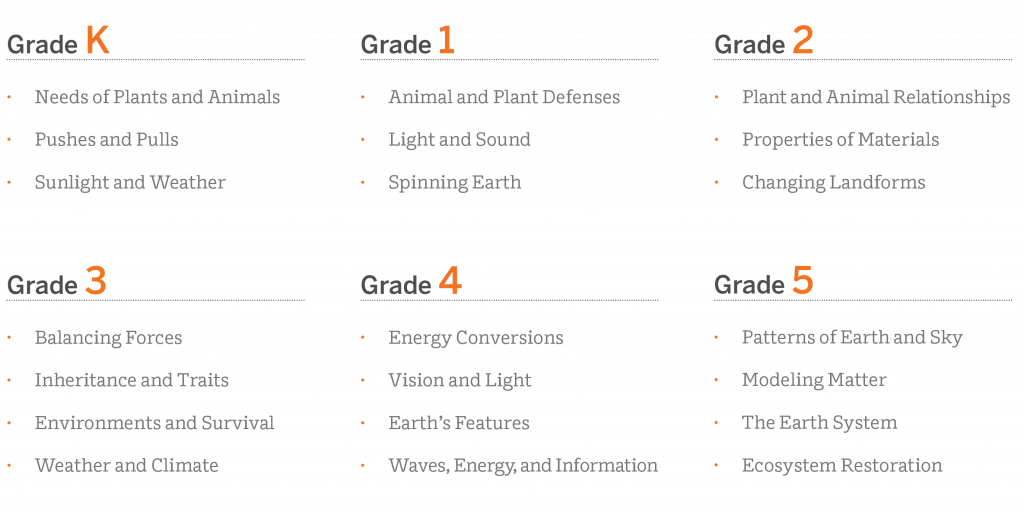
Chart outlining science curriculum by grade, from kindergarten through grade 5, listing topics such as

Program components

Available digitally and in print, our unit-specific reference guides are chock-full of helpful resources, including scientific background knowledge, planning information and resources, color-coded 3D Statements, detailed lesson plans, tips for delivering instruction, and differentiation strategies.

Amplify Science TG

Hands-on learning is an essential part of Amplify Science Pennsylvania and is integrated into every unit. Students actively participate in science, playing the roles of scientists and engineers as they gather evidence, think critically, solve problems, and develop and defend claims about the world around them. Every unit includes hands-on investigations that are critical to achieving the unit’s learning goals.

Two children sit at a table blowing into plastic straws held together, likely making musical sounds, with containers and rubber bands on the table.

More hands-on with Flextensions:
Hands-on Flextensions are additional, optional investigations that are included at logical points in the learning progression and give students an opportunity to dig deeper if time permits. These activities offer teachers flexibility to choose to dedicate more time to hands-on learning. Materials referenced in Hands-on Flextension activities will either be included in the unit kit or are easily sourced. Supporting resources such as student worksheets will be included as downloadable PDF files.

Our kits include enough non-consumable materials to support a class of 36 students and enough consumable items to support 72 students. In other words, each kit can last two years! Plus, our unit-specific kits mean teachers just grab the tub they need for the unit and then put it all back with ease.

Assorted office and household items displayed on a white background, including rubber bands, binder clips, cardboard, and sports balls.

Each unit of Amplify Science Pennsylvania (K–5) includes six unique Student Books written by educators at the Lawrence Hall of Science specifically for the program. These content-rich nonfiction and informational texts provide opportunities for students to search for evidence relevant to their firsthand investigations, see science practices and dispositions modeled, extend their science knowledge, provide real-world connections as they master reading-to-learn and close reading skills, and construct evidence-based arguments.

Important note:
Students in grades K–5 are never asked to read alone. Rather, books are read to, with, and by students with ample scaffolding and support provided by the teacher. Big Books are read aloud or together with the class to introduce ideas. Student Books allow for small-group reading and reading in pairs.

Two children's books, one in Spanish "Un día ocupado en Villa Empuja" and one in English "A Busy Day in Pushville," both illustrated by Anthony Lewis and depicting a busy town scene.

Available for every unit, our Student Investigation Notebooks contain instructions for activities and space for students to record data and observations, reflect on ideas from texts and investigations, and construct explanations and arguments.

In grades K–5, one copy of the Student Investigation Notebook is included in each unit’s materials kit for use as a blackline master. Each notebook is also available as a downloadable PDF on the Unit Guide page of the digital Teacher’s Guide.

Amplify Science Student Investigation Notebooks

Amplify Science Pennsylvania offers digital experience licenses that make elementary instruction more flexible for students and teachers and provide additional means to engage in remote, hybrid, or in-person learning!

Student-facing digital lessons
With the digital experience, students can engage with digital lesson content in one cohesive experience. It’s the same content from Amplify Science Pennsylvania in a new, integrated format, in which students can interact with slides, Sims, modeling tools, videos, books, and more.

Ecosystem Restoration digital simulation

Digital student notebook pages
Students can draw, write, record audio, and insert images into their Investigation Notebook pages. Their work is automatically saved and delivered to you in real time. When students edit their work, those edits are immediately reflected on your teacher work review page. You can access student responses by clicking “View Work,” where you can see students’ Investigation Notebook pages from the lesson, updating live.

Assign in Amplify
The digital experience allows flexibility with optional features such as scheduling assignments in advance and setting due dates. You can use Scheduling to determine the date and time that the assignment appears in Student Home. You also have the flexibility to schedule when assignments appear and to use dates to remove assignments from Student Home.

Assign in LMS
You can also assign lessons via our integrations with learning management systems (LMS) such as Google Classroom and Microsoft Teams, or by copying a lesson link and sharing it with students through the platform of your choice. The assignment link you send will provide students with direct access to the full lesson—slides, videos, digital tools, and worksheet activities—no student platform navigation required!

Teacher platform and presentation
Teacher-facing lesson content—including sample teacher talk, student responses, pedagogical support, and possible student responses—shows on a teacher’s private Teacher Guide tab. Students only see the lesson slides that are being presented.

Graphic depicting a teacher's device synced with a class presentation for K—5 students. The teacher's laptop displays an Amplify Science lesson on environments, which is mirrored on a larger screen for the class

Explore your print samples

With your Amplify Science Pennsylvania print samples, you’ll find unit-specific Teacher’s References Guides, Student Investigation Notebooks, and sets of Student Books for each grade level.

A note about the Teacher Reference Guides:

It’s important that you see the full breadth and depth of our instruction. For that reason, we provide a copy of each of our unit-specific Teacher Reference Guides.

Teachers do not use these robust reference guides for day-to-day teaching. For that, we have a hands-free Teacher’s Guide!

Three laptop screens displaying educational content on earth's energy system, including diagrams and text annotations.
  • Teacher’s Reference Guide: Unlike a typical Teacher’s Guide that requires a series of supplemental books to support it, our encyclopedic reference guide is chock-full of everything a teacher needs to fully implement our program and the NGSS.
  • Ready-to-Teach Lesson Slides: For daily instruction, teachers need their hands free. That’s why we created ready-to-teach lesson slides for every single lesson. What’s more, the slides are editable and include suggested teacher talk and point-of-use differentiation and other instructional tips. Click to learn more.

A note about the Materials Kits:

Hands-on learning is at the heart of Amplify Science Pennsylvania, and is integrated into every unit. To make hands-on learning more manageable for busy teachers, Amplify Science Pennsylvania materials are organized into unit-specific kits.

Stacked storage bins with labels, arranged neatly; caption notes they are a sample and may not reflect actual quantities or sizes.

What’s different about Amplify’s unit-specific material kits?

  • They include more materials. We give teachers enough non-consumable materials to support a class of 36 students and enough consumables to support 72 student uses. In other words, each kit will last two years.
  • They’re more manageable. Unlike other programs that require large groups of students to share limited sets of materials, our kits include enough to support small groups of four to five students.
  • They include supportive videos. Each hands-on activity provides clear instructions for the teacher, with more complex activities supported by video demonstrations and illustrations.

Grade-specific lists of all materials included in each kit:

Spanish-language support

Amplify Science Pennsylvania is committed to providing support to meet the needs of all learners, including multiple access points for Spanish-speaking students. Developed in conjunction with Spanish-language experts and classroom teachers, several components are available in Spanish across the Amplify Science Pennsylvania curriculum.

Spanish-language materials include:

COMPONENT TEACHER/STUDENT
Student Investigation Notebooks Student
Student Books Student
Printed classroom materials
Unit and chapter questions, key concepts, vocabulary cards, etc.
Teacher and student
Copymasters Teacher
Assessments Teacher
Spanish teacher support license
This license includes teacher talk, projections, and downloadable PDFs of all print materials in Spanish.
Teacher

Resources to support your review

Contact us

Support is always available. Our team is dedicated to helping you every step of the way.

Contact your dedicated Pennsylvania representative.

A woman with long brown hair and glasses wearing a light blue sweater, smiling at the camera against a gray background.

Julie Couch

District Enrollment
<1800 students

A person with long blonde hair, wearing a lace scarf, smiles in a sunlit outdoor setting, reminiscent of the excitement Pennsylvania teachers bring to Amplify Science programs for elementary students.

Laura Soeder

Western PA

A smiling person with shoulder-length gray hair, wearing a peach-colored scarf and a gray sweater, stands against a plain white background. This image captures the essence of Pennsylvania teachers who are dedicated to enriching Science programs for elementary students.

Monica Vincent

Southeast PA

A man with curly brown hair and a beard, smiling broadly, wearing a suit, dress shirt, and floral tie, standing outdoors with trees and grass in the background.

Keenan Zambelli

Northeast & Central PA

Survey

We’re interested in learning more about you. Please fill out this survey!

Program overview

Boost Lectura is a high-quality, personalized Spanish literacy foundational skills program that complements Amplify Reading to build reading proficiency in both English and Spanish for grades K–2.

Student field study experience

Note: This is an early subset of the program experience. Some content may be appropriate for some students, but difficult for others. This is feedback we want to hear. The designs are also still in progress, with many aspects yet to be featured. Please email Aya Bukres with all suggestions!

Field study books and games

Below is a list of books and games (with associated skills) by grade level. Students will access these games and books through Quests.

Note: Books do not include voice-over at this time.

Kindergarten Books

¿Qué pasa con la gallina Tina?¿Qué puedes hacer con los 5 sentidos?¿Por qué croan las ranas?
Un festín de saboresUn ¡pop! en tiempoLos aluxes
El efecto mariposaLas estaciones del año

Kindergarten Games

Game NameBig IdeaSkill that will be practiced
Son sabrosónPhonological AwarenessRhyming
Alfa y betoPhonological AwarenessBlending
Jugando andoPhonological AwarenessSegmentation
Tragaletras exigentesPhonicsLetter-sound correspondences
Tragaletras gruñonesPhonicsLetter combinations
Tragaletras comelonesPhonicsReview of letter-sound correspondences and letter combinations
Investiga la escenaComprehension ProcessesGap-filling Inferences

Grade 1 Books

La leyenda de la colibríLa capibara: Un animal amigableMi ruidoso cuerpo
El zorro y el huaychaoDeseos al sol

Grade 1 Games

Game NameBig IdeaSkill that will be practiced
Alfa y betoPhonological AwarenessBlending
Jugando andoPhonological AwarenessSegmentation
Tragaletras exigentesPhonicsLetter-sound correspondences
Tragaletras gruñonesPhonicsLetter combinations
Tragaletras comelonesPhonicsReview of letter-sound correspondences and letter combinations
Silabalón: la copaPhonicsSyllable decoding
¿Aquí o alla?Phonics & Word RecognitionDecoding words with
y, g, and c
¿Esta o aquella?Phonics & Word RecognitionDecoding words with different graphemes to represent the same phoneme
¡Abra palabra!Phonics & Word RecognitionDecoding – syllable manipulation
Quita y ponPhonics & Word RecognitionDecoding – syllable manipulation
¡Conéctalo!Comprehension ProcessesUsing connectives
Investiga la escenaComprehension ProcessesGap-filling inferences

Grade 2 Books

La despedidaLa verdadera fortunaLa fascinante Ruta de la Seda
Bernardo de GálvezHormigas amigas

Grade 2 Games

Game NameBig IdeaSkill that will be practiced
¿Aquí o alla?Phonics & Word RecognitionDecoding words with y, g, and c
¿Esta o aquella?Phonics & Word RecognitionDecoding words with different graphemes to represent the same phoneme
¡Abra palabra!Phonics & Word RecognitionDecoding – syllable manipulation
Quita y ponPhonics & Word RecognitionDecoding – syllable manipulation
¡Conéctalo!Comprehension ProcessesUsing connectives
Investiga la escenaComprehension ProcessesGap-filling inferences

Consider using Boost Lectura during the following times:

  • Small group or center time
  • Choice time
  • During intervention blocks
  • After school
  • At home
  • Remote learning

Getting your students online

Amplify login page with options to log in using Google, Clever, Amplify, QR code, District SSO, or get help; a rocket illustration is on the left.

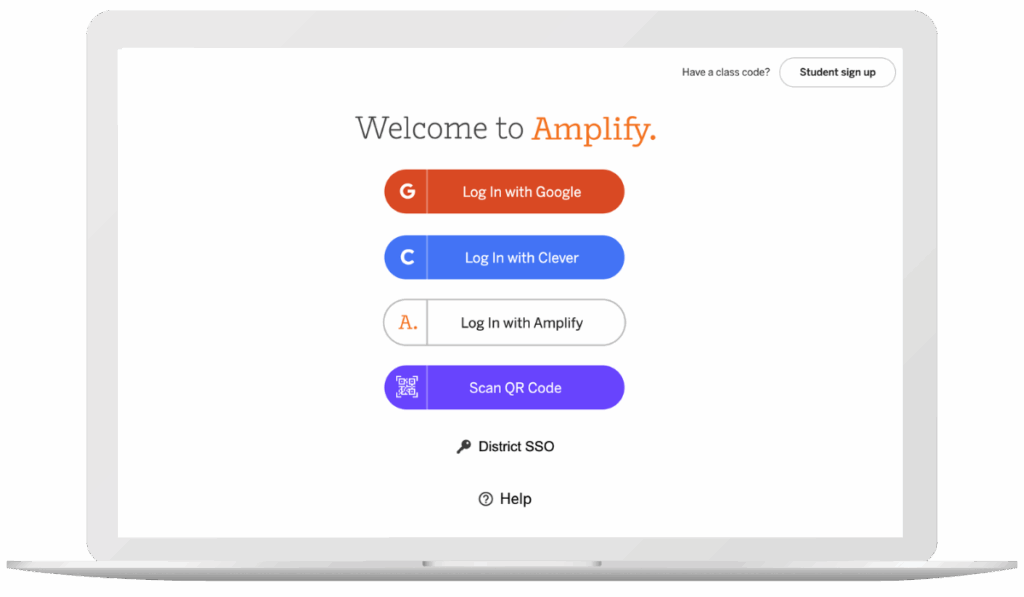
Instruct students to navigate to learning.amplify.com, and log in using the method you typically use when logging into Boost Reading.

A screen displays the question "Where are you headed?" with options "Reading" and "Lectura," and a purple "Go!" button at the bottom.

Find and click on the icon for Boost Lectura, as shown above.

At this time, students can begin playing games or reading books by clicking on “Iniciar.”

A large button labeled "INICIAR" is displayed in the center of a colorful, illustrated town map background.

Having students play games in Quests

Select a game from the list to play!

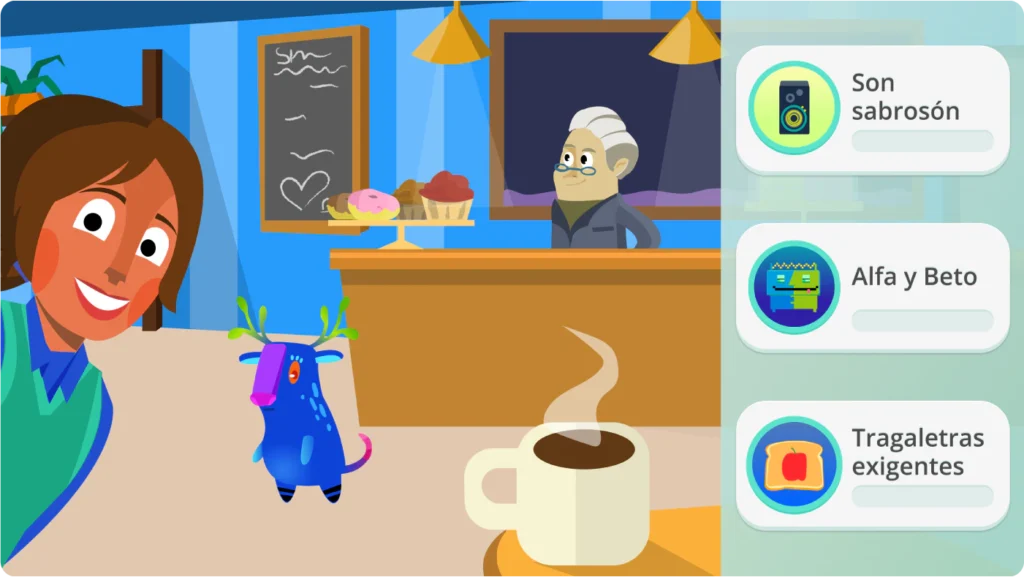
A woman smiles in a café with a blue creature beside her, a barista behind the counter, pastries on display, and three app icons with Spanish text on the right.

Students can play games in Quests by selecting the curioso icon.

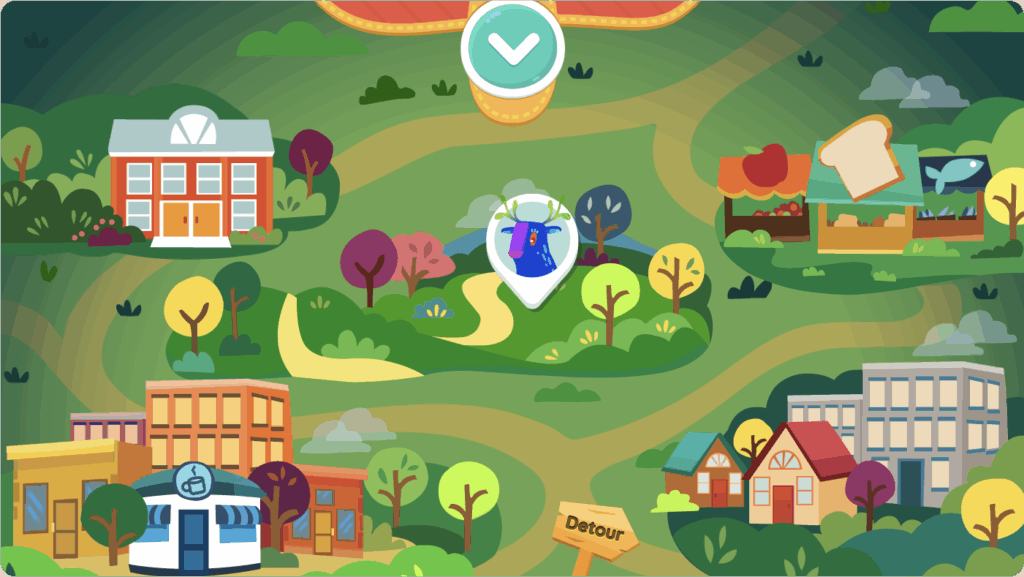
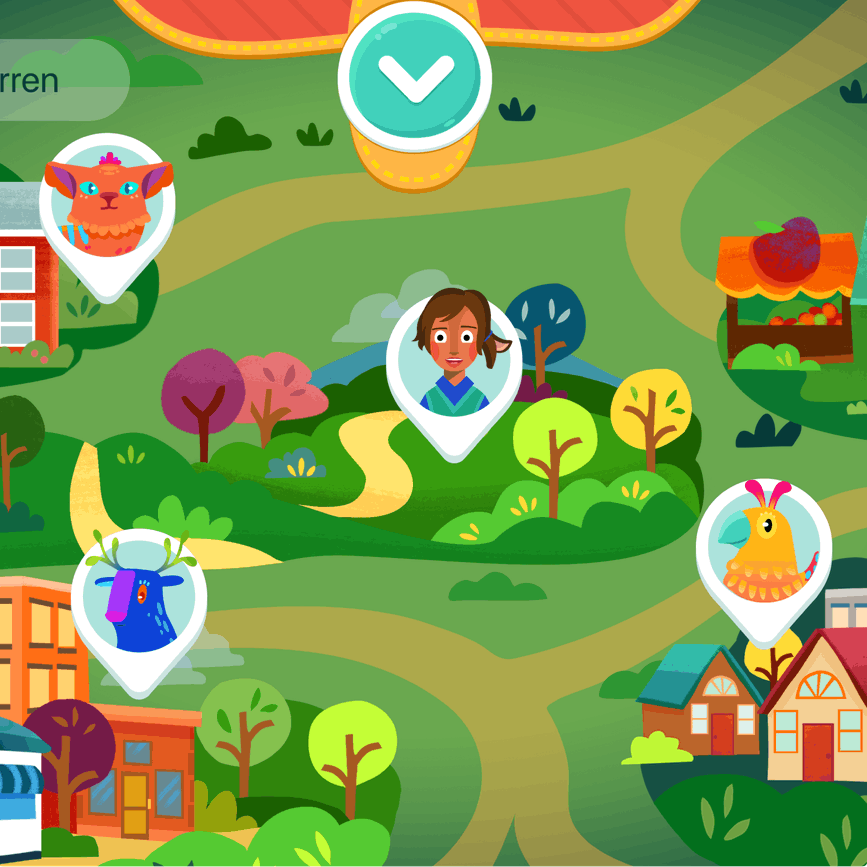
A cartoon map shows various buildings, trees, and winding paths with a "Detour" sign and a blue character in the center marked by a location pin.

Students should hear quest narratives in Spanish.

The Automatic Placement Tool (APT)

The Automatic Placement Tool will be served when students first log in and choose the Lectura product. The Experience should take about 15–20 minutes total.

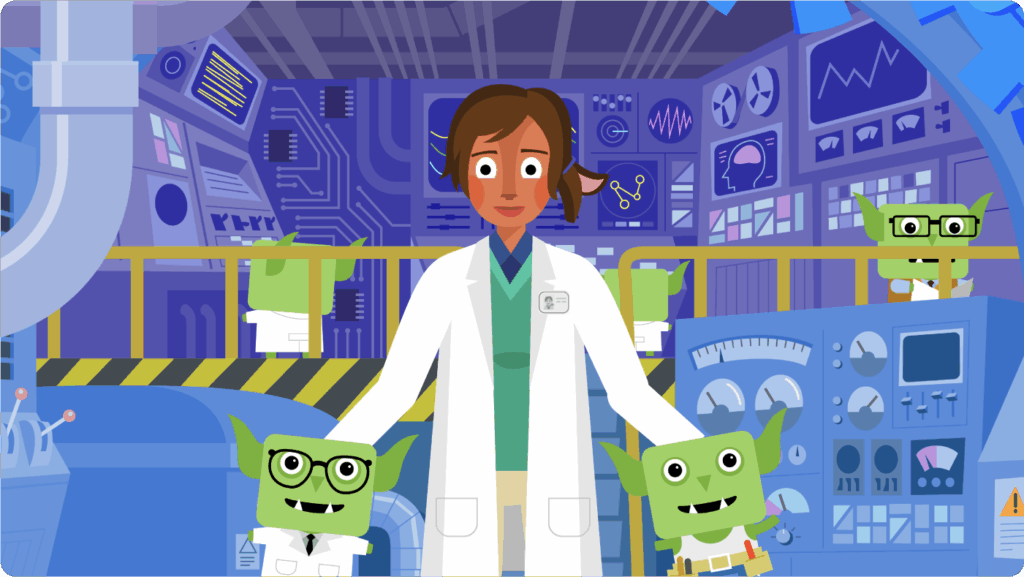
Students are greeted with a comical animation explaining we need their help with answering a few questions.

A concerned scientist stands in a control room surrounded by green goblin-like creatures, some using tools and wearing glasses, with a background of technological equipment.

Students are guided through a few short activities measuring different skills domains.

A digital quiz in Spanish asks, "¿Qué sílaba hace este sonido?" with a sound icon and three answer choices: "al," "en," and "ir.

Students receive closure to their experience via another short animation.

A scientist in a lab coat stands in a futuristic control room, surrounded by four small green creatures also wearing lab coats.

    Troubleshooting guide

    Please check to ensure “cookies” are accepted on your device.
    If you still receive an error message or blank screen when accessing an Amplify page, please email Aya Bukres.

    Please email Aya Bukres to confirm your login credentials.

    Professional development for core programs

    Amplify professional development provides learning experiences that intentionally develop the knowledge and skills you need for effective and self-sustaining implementation.

    Learn and apply impactful instructional techniques and develop a deeper understanding of your Amplify program(s) by investing in professional development.

    Amplify professional development has been vetted by Rivet Education’s team through a rigorous three-step process and is listed in the Professional Learning Partner Guide.

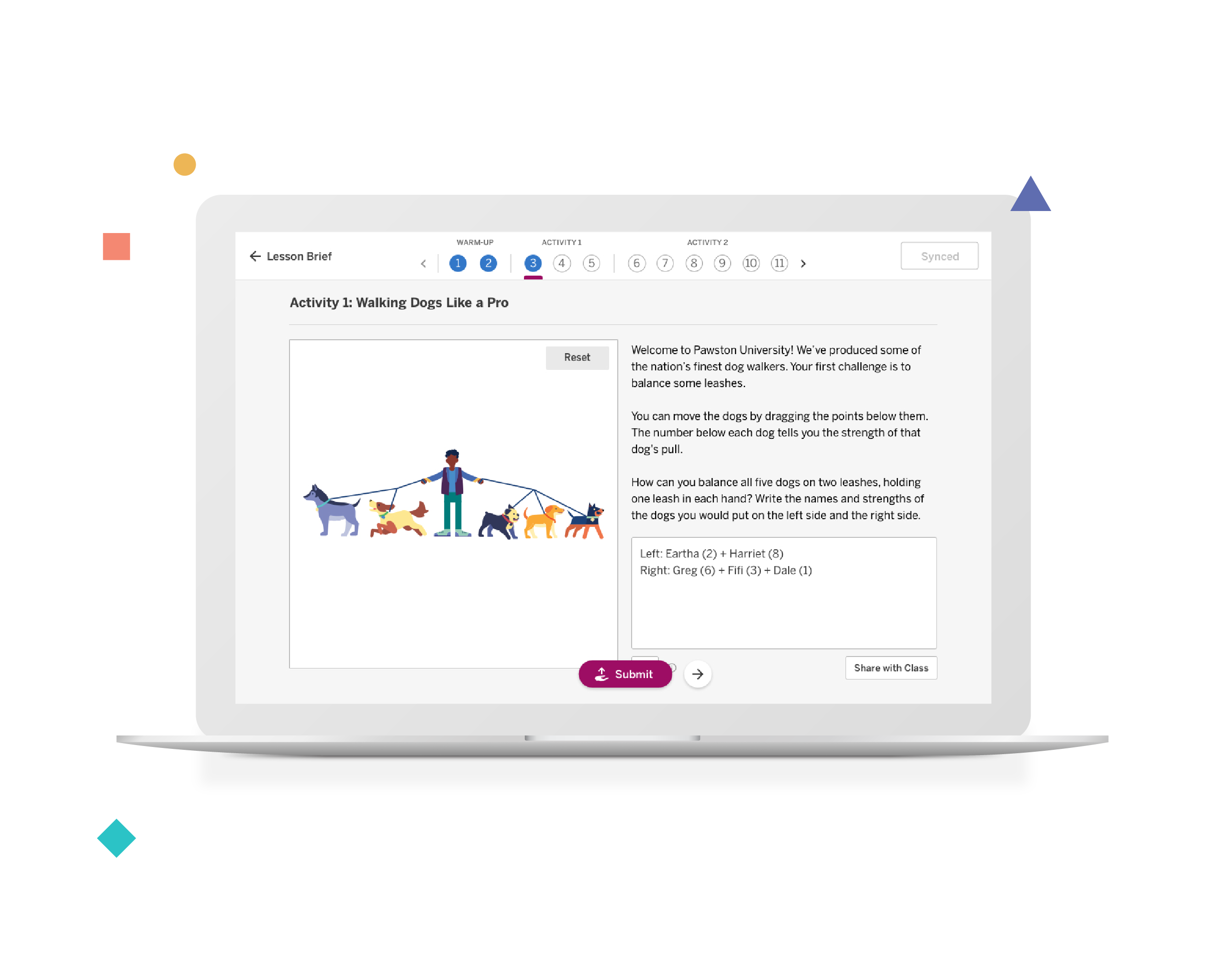
    A man writes at a desk; adjacent images include a math graph with weights labeled 5 and 8, and an open book with stars above it.

    About Amplify core programs

    Amplify’s programs help you teach inspiring lessons that develop student brilliance through robust scaffolding and differentiated instruction.

    Literacy

    • Amplify Core Knowledge Language Arts (CKLA) 2nd Edition and 3rd Edition
    • Amplify Caminos 1st Edition
    • Amplify ELA 2nd Edition

    STEM

    • Amplify Math
    • Amplify Desmos Math* (for Grades PreK–5, 6–Algebra 1, or high school)
    • Amplify Science (for Grades K–5 or 6–8)

    Contact your account executive for extended PD catalog options or quotes.

    *Amplify Desmos Math is our new K–12 program (English and Spanish) using a problem-based approach for deep conceptual understanding. Contact us for available packages.

    About Amplify professional development (PD)

    Take a systemic approach to drive lasting change. Partner with us to create a learning plan that enhances implementation, instruction, and student impact.

    At each phase of your journey, packages include different types of learning experiences strategically bundled for multiple touchpoints throughout the year.

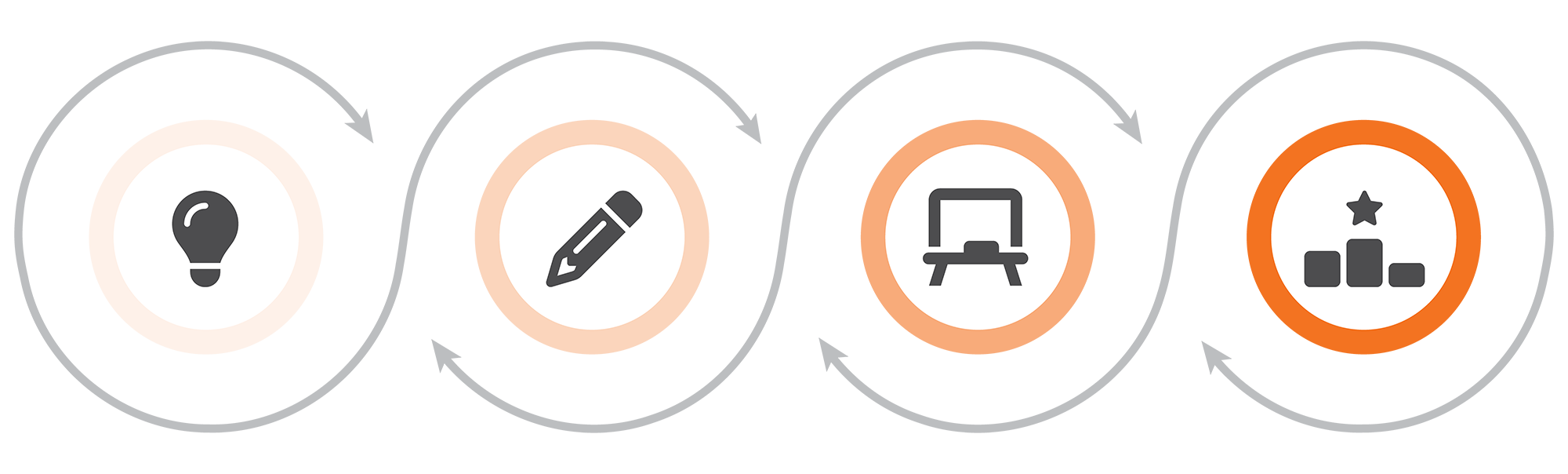
    Four circular icons in a row showing a lightbulb, pencil, whiteboard, and podium, connected by arrows in a cycle, representing stages of a process.
    Prepare
    Begin
    Practice
    Advance


    Shift literacy and math instruction and deepen understanding of research-based practices to support new program implementation.


    Build the foundational knowledge and skills necessary to begin teaching with your Amplify program(s).


    Refine instructional skills, expand knowledge of your Amplify program(s), and explore more advanced instructional strategies.


    Deepen understanding of content and pedagogy and build-in house capacity to support a robust, sustainable implementation.

    Click to learn more:

    Review this page to learn more about the Begin and Practice packages.


    Click to learn more:

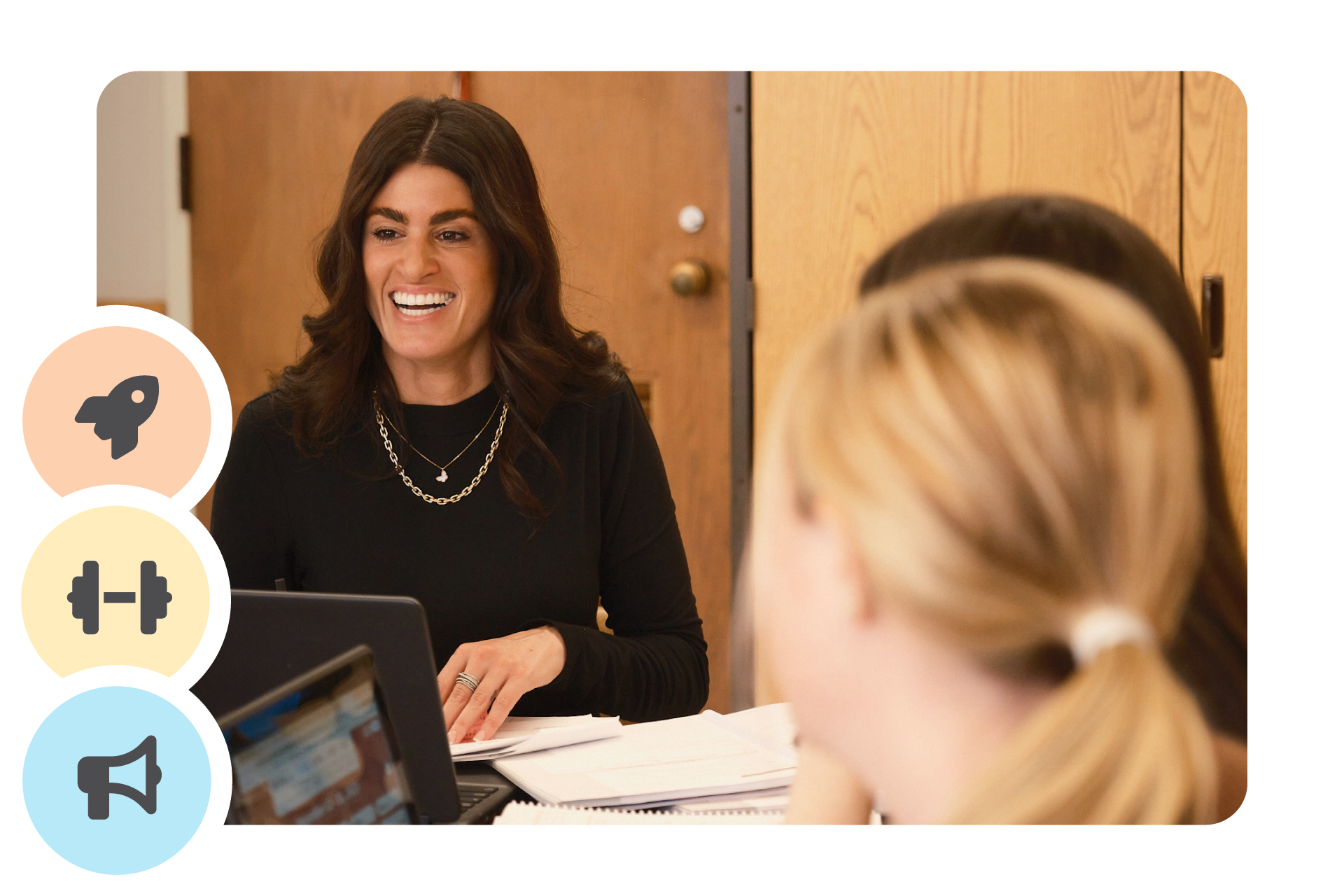
    Session types within packages

    LAUNCH STRENGTHEN COACH
    Beginning of the year
    Mid-year, end of the year Mid-year, end of the year
    Three people work together at a computer in a classroom; one woman points at the monitor while the others watch attentively.
    Two people sit at a table reviewing documents together against a yellow background. An icon of a barbell is displayed in the top left corner.
    Two women sit side by side at a table, each with a laptop. One woman points at the other’s screen as they focus on the display against a plain blue background.
    Introduce programs and support implementation Target specific instructional practices

    Explore the Strengthen sessions for your:

    Tailored learning for specific needs

    Begin packages

    You’re ready to shift to evidence-based practices in your first year with Amplify programs. Let us support your educators with professional development that builds new skills and knowledge.

    Choose from flexible on-site, hybrid, or virtual packages which include:

    • One Launch session to introduce Amplify programs and support strong implementation.
    • One Strengthen session to deepen understanding of the program.
    • One Coach session to elevate instructional practice and meet specific needs.
    • Suggested add-ons are available.

    Each package supports up to 30 participants in similar grade bands.

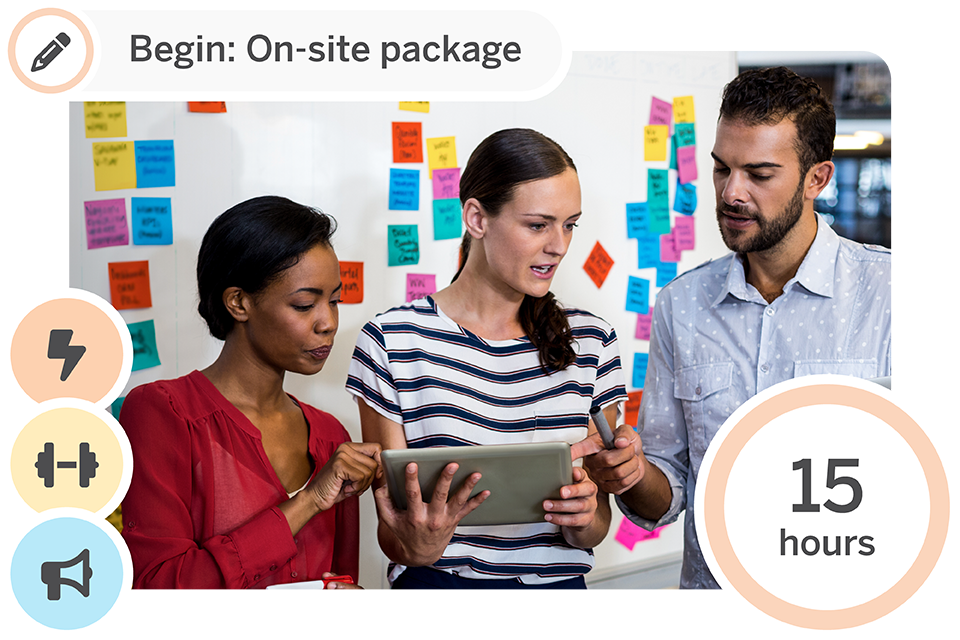
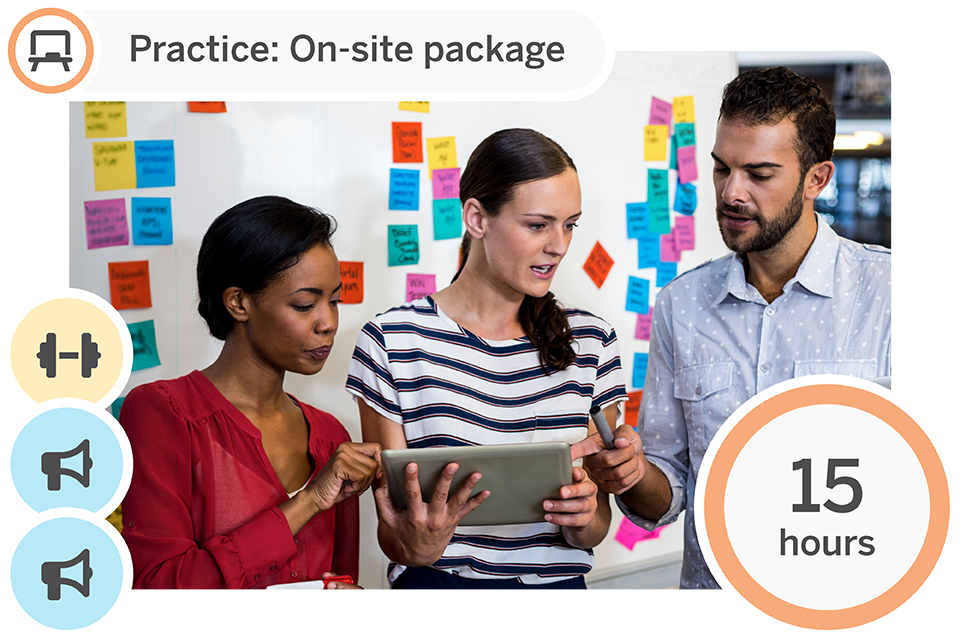
    On-site 15 package

    Three people stand in front of a whiteboard with colorful sticky notes, discussing content on a tablet. A graphic indicates "Begin: On-site package" and "15 hours.

    Participate in 15 hours of program-aligned professional development across three sessions for up to 30 participants. Build understanding of research-based practices and develop knowledge through curated Launch, Strengthen, and Coach sessions.

    Begin: On-site 15 package

    Session type Modality/duration What’s included
    Launch (1) On-site, 6-hr. Initial training for teachers
    Strengthen (1) On-site, 3-hr. Program-specific Strengthen session (selected based on your needs) for Core Literacy and STEM programs.
    Coach (1) On-site, 6-hr. Coach session
    Suggested enhancements
    Launch add-on On-site or virtual, 3-hr. Program overview for leaders

    Launch: Initial training for teachers

    On-site, 6 hours

    Initial training sessions are designed for educators who are new to our program. In our initial training session, educators are oriented to the key components of their program(s), including learning how to navigate, teach, and monitor student progress, while exploring content and program resources. Participants will leave the session with the foundational knowledge and skills necessary to begin teaching with the program.

    Session options: Amplify CKLA (2nd Edition or 3rd Edition), Amplify Caminos (1st Edition or 3rd Edition), Amplify CKLA 2nd Edition/Caminos 1st Edition biliteracy, Amplify CKLA 3rd Edition/Caminos 3rd Edition biliteracy, Amplify ELA 2nd Edition, Amplify Math, Amplify Desmos Math (Grades PreK–5, 6–A1, or high school), Amplify Science (Grades K–5 or 6–8)

    Audience: Teachers, instructional staff (maximum 30 participants)

    Launch add-on

    Suggested enhancement: Launch add-on: Program overview for leaders

    On-site or virtual, 3 hours

    The program overview for leaders session supports district and school-level instructional leaders in effectively coordinating the implementation of the program. Leaders will learn the foundational elements of the program, build an understanding of the key teacher and student practices to look for in classrooms, and develop an implementation plan.

    Session options: Amplify CKLA (2nd Edition or 3rd Edition), Amplify Caminos (1st Edition or 3rd Edition), Amplify CKLA 2nd Edition/Caminos 1st Edition biliteracy, Amplify CKLA 3rd Edition/Caminos 3rd Edition biliteracy, Amplify ELA 2nd Edition, Amplify Math, Amplify Desmos Math (Grades PreK, K–5, 6–A1, or high school), Amplify Science (Grades K–5 or 6–8)

    Audience: Leaders (maximum 30 participants)

    Strengthen: Program-specific sessions

    Strengthen your Amplify implementation with program-specific sessions that support personalized learning and practice in your classroom.

    To explore the core Strengthen sessions, select your program:

    Amplify will partner closely with you to select the appropriate session(s) that will deepen educators’ understanding of Amplify program(s) and equip them with the tools they need to improve students’ learning outcomes. Each package includes one Strengthen session. Additional sessions can be added as Enhancements.

    Coach: Customized support

    On-site, 6 hours

    Coaching sessions focus on building internal school and district capacity and leadership excellence. Coaching is customized to meet a school or district’s needs and can include model lessons, observations, walk-throughs, and/or co-planning.

    Session options: Amplify CKLA (2nd Edition or 3rd Edition), Amplify Caminos (1st Edition or 3rd Edition), Amplify CKLA 2nd Edition/Caminos 1st Edition biliteracy, Amplify CKLA 3rd Edition/Caminos 3rd Edition biliteracy, Amplify ELA 2nd Edition, Amplify Math, Amplify Desmos Math (Grades PreK–5, 6–A1, or high school), Amplify Science (Grades K–5 or 6–8)

    Audience: Individual teachers, grade-level teams, PLCs,
    and/or instructional leaders (maximum 30 participants)

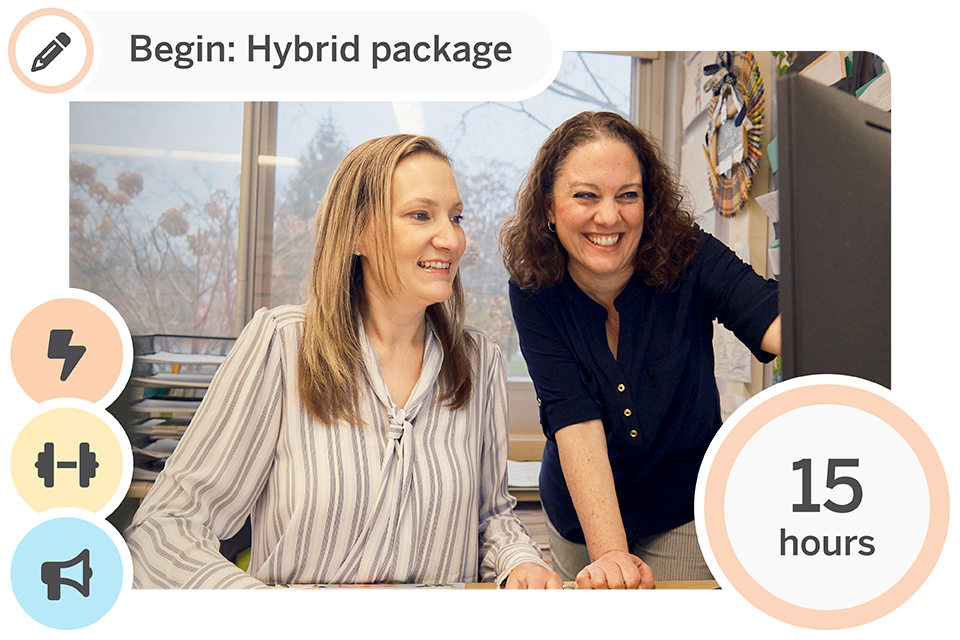
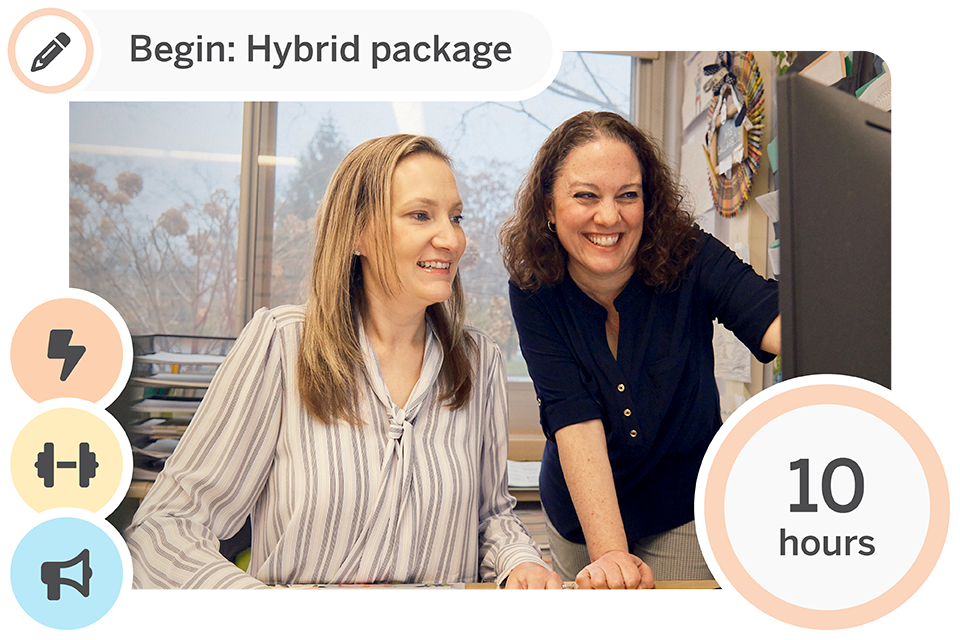
    Hybrid 15 on-site package

    Two women smiling and looking at a computer screen in an office setting; text reads "Begin: Hybrid package" and "15 hours.

    Participate in 15 hours of program-aligned professional development across three sessions for up to 30 participants. Build understanding of research-based practices and develop knowledge through curated Launch, Strengthen, and Coach sessions.

    Begin: Hybrid 15 on-site package

    Session type Modality/duration What’s included
    Launch (1) On-site, 6-hr. Initial training for teachers
    Strengthen (1) Virtual, 3-hr. Program-specific Strengthen session (selected based on your needs) for Core Literacy and STEM programs.
    Coach (1) On-site, 6-hr. Coach session
    Suggested enhancements
    Launch add-on On-site or virtual, 3-hr. Program overview for leaders

    Launch: Initial training for teachers

    On-site, 6 hours

    Initial training sessions are designed for educators who are new users. In our initial training session, educators are oriented to the key components of the program, including learning how to navigate, teach, and monitor student progress, while exploring content and program resources. Participants will leave the session with the foundational knowledge and skills necessary to begin teaching with the program.

    Session options: Amplify CKLA (2nd Edition or 3rd Edition), Amplify Caminos (1st Edition or 3rd Edition), Amplify CKLA 2nd Edition/Caminos 1st Edition biliteracy, Amplify CKLA 3rd Edition/Caminos 3rd Edition biliteracy, Amplify ELA 2nd Edition, Amplify Math, Amplify Desmos Math (Grades PreK–5, 6–A1, or high school), Amplify Science (Grades K–5 or 6–8)

    Audience: Teachers, instructional staff (maximum 30 participants)

    Launch add-on

    Suggested enhancement: Launch add-on: Program overview for leaders

    On-site or virtual, 3 hours

    The program overview for leaders session supports district and school-level instructional leaders in effectively coordinating the implementation of the program. Leaders will learn the foundational elements of the program, build an understanding of the key teacher and student practices to look for in classrooms, and develop an implementation plan.

    Session options: Amplify CKLA (2nd Edition or 3rd Edition), Amplify Caminos (1st Edition or 3rd Edition), Amplify CKLA 2nd Edition/Caminos 1st Edition biliteracy, Amplify CKLA 3rd Edition/Caminos 3rd Edition biliteracy, Amplify ELA 2nd Edition, Amplify Math, Amplify Desmos Math (Grades K–5 or 6–A1), Amplify Science (Grades K–5 or 6–8)

    Audience: Leaders (maximum 30 participants)

    Strengthen: Program-specific sessions

    Strengthen your Amplify implementation with program-specific sessions that support personalized learning and practice in your classroom.

    To explore the available core Strengthen sessions, select your program:

    Amplify will closely partner with you to select the appropriate session(s) that will deepen educators’ understanding of Amplify program(s) and equip them with the tools they need to improve students’ learning outcomes. Each package includes one Strengthen session. Additional sessions can be added as Enhancements.

    Coach session: Customized support

    On-site, 6 hours

    Coaching sessions focus on building internal school and district capacity and leadership excellence. Coaching is customized to meet a school or district’s needs and can include model lessons, observations, walk-throughs, and/or co-planning.

    Session options: Amplify CKLA (2nd Edition or 3rd Edition), Amplify Caminos (1st Edition or 3rd Edition), Amplify CKLA 2nd Edition/Caminos 1st Edition biliteracy, Amplify CKLA 3rd Edition/Caminos 3rd Edition biliteracy, Amplify ELA 2nd Edition, Amplify Math, Amplify Desmos Math (Grades PreK–5, 6–A1, or high school), Amplify Science (Grades K–5 or 6–8)

    Audience: Individual teachers, grade-level teams, PLCs, and/or instructional leaders (maximum 30 participants)

    Hybrid 10 package

    Two women smile while looking at a computer monitor in an office. A graphic overlay reads “Begin: Hybrid package” and “10 hours,” with icons for power, fitness, and communication.

    Participate in 10 hours of program-aligned professional development across three sessions for up to 30 participants. Build understanding of research-based practices and develop knowledge through curated Launch, Strengthen, and Coach sessions.

    Begin: Hybrid 10 package

    Session type Modality/duration What’s included
    Launch (1) On-site, 3-hr. Program overview for teachers
    Strengthen (1) Virtual, 1-hr. Program-specific Strengthen Focus session (selected based on your needs) for Core Literacy and STEM programs.
    Coach (1) On-site, 6-hr. Coach session
    Suggested enhancements
    Launch add-on On-site or virtual,
    3-hr.
    Program overview for leaders

    Launch: Program overview for teachers

    On-site, 3 hours

    Program overview sessions provide a basic introduction for educators who are new users of the program. In a program overview session, educators learn how to get started with the key features and materials of the program.

    Session options: Amplify CKLA (2nd Edition or 3rd Edition), Amplify Caminos (1st Edition or 3rd Edition), Amplify CKLA 2nd Edition/Caminos 1st Edition biliteracy, Amplify CKLA 3rd Edition/Caminos 3rd Edition biliteracy, Amplify ELA 2nd Edition, Amplify Math, Amplify Desmos Math (Grades PreK–5, 6–A1, or high school), Amplify Science (Grades K–5 or 6–8)

    Audience: Teachers, instructional staff (maximum 30 participants)

    Launch add-on

    Suggested enhancement: Launch add-on: Program overview for leaders

    On-site or virtual, 3 hours

    The program overview for leaders session supports district and school-level instructional leaders in effectively supporting the implementation of the program. Leaders will learn the foundational elements of the program, build an understanding of the key teacher and student practices to look for in classrooms, and develop an implementation plan.

    Session options: Amplify CKLA (2nd Edition or 3rd Edition), Amplify Caminos (1st Edition or 3rd Edition), Amplify CKLA 2nd Edition/Caminos 1st Edition biliteracy, Amplify CKLA 3rd Edition/Caminos 3rd Edition biliteracy, Amplify ELA 2nd Edition, Amplify Math, Amplify Desmos Math (Grades K–5 or 6–A1), Amplify Science (Grades K–5 or 6–8)

    Audience: Leaders (maximum 30 participants)

    Strengthen: Program-specific sessions

    Strengthen your Amplify implementation with program-specific sessions that support personalized learning and practice in your classroom.

    To explore the available core Strengthen sessions, select your program:

    Amplify will closely partner with you to select the appropriate session(s) that will deepen educators’ understanding of your Amplify program(s) and equip them with the tools they need to improve students’ learning outcomes. Each package includes one Strengthen session. Additional sessions can be added as Enhancements.

    Coach session: Customized support

    On-site, 6 hours

    Coaching sessions focus on building internal school and district capacity and leadership excellence. Coaching is customized to meet a school or district’s needs and can include model lessons, observations, walk-throughs, and/or co-planning.

    Session options: Amplify CKLA (2nd Edition or 3rd Edition), Amplify Caminos (1st Edition or 3rd Edition), Amplify CKLA 2nd Edition/Caminos 1st Edition biliteracy, Amplify CKLA 3rd Edition/Caminos 3rd Edition biliteracy, Amplify ELA 2nd Edition, Amplify Math, Amplify Desmos Math (Grades PreK–5, 6–A1, or high school), Amplify Science (Grades K–5 or 6–8)

    Audience: Individual teachers, grade-level teams, PLCs,
    and/or instructional leaders (maximum 30 participants)

    Hybrid 15 virtual package

    A person points at a laptop screen displaying an online training module. Icons and text indicate the start of a virtual package with a duration of 15 hours.

    Participate in 15 hours of program-aligned professional development across three sessions for up to 30 participants. Build understanding of research-based practices and develop knowledge through curated Launch, Strengthen, and Coach sessions.

    Begin: Hybrid 15 virtual package

    Session type Modality/duration What’s included
    Launch (1) Virtual, 6-hr.
    (2 half-days)
    Initial training for teachers
    Strengthen (1) Virtual, 3-hr. Program-specific Strengthen session (selected based on your needs) for Core Literacy and STEM programs.
    Coach (1) On-site, 6-hr. Coach session
    Suggested enhancements
    Launch add-on On-site or virtual, 3-hr. Program overview for leaders

    Launch: Initial training for teachers

    Virtual, 6 hours (2 half-days)

    Initial training sessions are designed for educators who are new to our program. In our initial training session, educators are oriented to the key components of their program(s), including learning how to navigate, teach, and monitor student progress, while exploring content and program resources. Participants will leave the session with the foundational knowledge and skills necessary to begin teaching with the program.

    Session options: Amplify CKLA (2nd Edition or 3rd Edition), Amplify Caminos (1st Edition or 3rd Edition), Amplify CKLA 2nd Edition/Caminos 1st Edition biliteracy, Amplify CKLA 3rd Edition/Caminos 3rd Edition biliteracy, Amplify ELA 2nd Edition, Amplify Math, Amplify Desmos Math (Grades PreK–5, 6–A1, or high school), Amplify Science (Grades K–5 or 6–8)

    Audience: Teachers, instructional staff (maximum 30 participants)

    Launch add-on

    Suggested enhancement: Launch add-on: Program overview for leaders

    On-site or virtual, 3 hours

    The program overview for leaders session supports district and school-level instructional leaders in effectively supporting the implementation of the program. Leaders will learn the foundational elements of the program, build an understanding of the key teacher and student practices to look for in classrooms, and develop an implementation plan.

    Session options: Amplify CKLA (2nd Edition or 3rd Edition), Amplify Caminos (1st Edition or 3rd Edition), Amplify CKLA 2nd Edition/Caminos 1st Edition biliteracy, Amplify CKLA 3rd Edition/Caminos 3rd Edition biliteracy, Amplify ELA 2nd Edition, Amplify Math, Amplify Desmos Math (Grades K–5 or 6–A1), Amplify Science (Grades K–5 or 6–8)

    Audience: Leaders (maximum 30 participants)

    Strengthen: Program-specific sessions

    Strengthen your Amplify implementation with program-specific sessions that support personalized learning and practice in your classroom.

    To explore the available core Strengthen sessions, select your program:

    Amplify will closely partner with you to select the appropriate session(s) that will deepen educators’ understanding of Amplify program(s) and equip them with the tools they need to improve students’ learning outcomes. Each package includes one Strengthen session. Additional sessions can be added as Enhancements.

    Coach session: Customized support

    On-site, 6 hours

    Coaching sessions focus on building internal school and district capacity and leadership excellence. Coaching is customized to meet a school or district’s needs and can include model lessons, observations, walk-throughs, and/or co-planning.

    Session options: Amplify CKLA (2nd Edition or 3rd Edition), Amplify Caminos (1st Edition or 3rd Edition), Amplify CKLA 2nd Edition/Caminos 1st Edition biliteracy, Amplify CKLA 3rd Edition/Caminos 3rd Edition biliteracy, Amplify ELA 2nd Edition, Amplify Math, Amplify Desmos Math (Grades PreK–5, 6–A1, or high school), Amplify Science (Grades K–5 or 6–8)

    Audience: Individual teachers, grade-level teams, PLCs, and/or instructional leaders (maximum 30 participants)

    Virtual 7 package

    A person points at a laptop screen displaying an educational webpage; icons and text indicate the start of a virtual package lasting 7 hours.

    Participate in 7 hours of program-aligned professional development across three sessions for up to 30 participants. Build understanding of research-based practices and develop knowledge through curated Launch, Strengthen, and Coach sessions.

    Begin: Virtual 7 package

    Session type Modality/duration What’s included
    Launch (1) Virtual, 3-hr. Program overview for teachers
    Strengthen (1) Virtual, 1-hr. Program-specific Strengthen Focus session (selected based on your needs) for Core Literacy and STEM programs.
    Coach (1) Virtual, 3-hr. Coach session
    Suggested enhancements
    Launch add-on On-site or virtual, 3-hr. Program overview for leaders

    Launch: Program overview for teachers

    Virtual, 3 hours

    Program overview sessions provide a basic introduction for educators who are new users of the program. In a program overview session, educators learn how to get started with the key features and materials of the program.

    Session options: Amplify CKLA (2nd Edition or 3rd Edition), Amplify Caminos (1st Edition or 3rd Edition), Amplify CKLA 2nd Edition/Caminos 1st Edition biliteracy, Amplify CKLA 3rd Edition/Caminos 3rd Edition biliteracy, Amplify ELA 2nd Edition, Amplify Math, Amplify Desmos Math (Grades PreK–5, 6–A1, or high school), Amplify Science (Grades K–5 or 6–8)

    Audience: Teachers, instructional staff (maximum 30 participants)

    Launch add-on

    Suggested enhancement: Launch add-on: Program overview for leaders

    On-site or virtual, 3 hours

    The program overview for leaders session supports district and school-level instructional leaders in effectively coordinating the implementation of the program. Leaders will learn the foundational elements of the program, build an understanding of the key teacher and student practices to look for in classrooms, and develop an implementation plan.

    Session options: Amplify CKLA (2nd Edition or 3rd Edition), Amplify Caminos (1st Edition or 3rd Edition), Amplify CKLA 2nd Edition/Caminos 1st Edition biliteracy, Amplify CKLA 3rd Edition/Caminos 3rd Edition biliteracy, Amplify ELA 2nd Edition, Amplify Math, Amplify Desmos Math (Grades K–5 or 6–A1), Amplify Science (Grades K–5 or 6–8)

    Audience: Leaders (maximum 30 participants)

    Strengthen: Program-specific sessions

    Strengthen your Amplify implementation with program-specific sessions that support personalized learning and practice in your classroom.

    To explore the available core Strengthen sessions, select your program:

    Amplify will closely partner with you to select the appropriate session(s) that will deepen educators’ understanding of your Amplify program(s) and equip them with the tools they need to improve students’ learning outcomes. Each package includes one Strengthen session. Additional sessions can be added as Enhancements.

    Coach session: Customized support

    Virtual, 3 hours

    Coaching sessions focus on building internal school and district capacity and leadership excellence. Coaching is customized to meet a school or district’s needs and can include model lessons, observations, walk-throughs, and/or co-planning.

    Session options: Amplify CKLA (2nd Edition or 3rd Edition), Amplify Caminos (1st Edition or 3rd Edition), Amplify CKLA 2nd Edition/Caminos 1st Edition biliteracy, Amplify CKLA 3rd Edition/Caminos 3rd Edition biliteracy, Amplify ELA 2nd Edition, Amplify Math, Amplify Desmos Math (Grades PreK–5, 6–A1, or high school), Amplify Science (Grades K–5 or 6–8)

    Audience: Individual teachers, grade-level teams, PLCs,
    and/or instructional leaders (maximum 30 participants)

    Practice packages

    You’re familiar with Amplify programs and ready to deepen your knowledge and implementation. Let us support your educators with professional development that emphasizes continuous improvement and enhanced understanding.

    Choose from flexible on-site, hybrid, or virtual packages:

    • One Strengthen session to deepen understanding of the program, expand practice, and drive student outcomes
    • Two Coach sessions to elevate instructional practice and meet specific needs

    Each package supports up to 30 participants in similar grade bands.

    On-site 15 package

    Three people discuss work while looking at a tablet in front of a whiteboard with colorful sticky notes. A "Practice: On-site package" label and "15 hours" badge are displayed.

    Participate in 15 hours of program-aligned professional development across three sessions for up to 30 participants. Build understanding of research-based practices and develop knowledge through curated Strengthen and Coach sessions.

    Practice: On-site 15 package

    Session type Modality/duration What’s included
    Strengthen (1) On-site, 3-hr. Program-specific Strengthen session (selected based on your needs) for Core Literacy and STEM programs.
    Coach (2) On-site, 6-hr. Coach session
    Suggested enhancements
    Launch add-on Virtual, 1-hr. Amplify CKLA (2nd Edition) Grade 3 Skills supplement training for teachers
    Launch add-on Virtual, 1-hr. Amplify CKLA (3rd Edition) Grade 3 Skills supplement training for teachers
    Launch substitution
    Virtual, 1-hr. Amplify CKLA 2nd Edition to 3rd Edition transition training for teachers
    Launch add-on Virtual, 1-hr. Language Studio for CKLA 3rd Edition

    Strengthen: Program-specific sessions

    Strengthen your Amplify implementation with program-specific sessions that support personalized learning and practice in your classroom.

    To explore the available core Strengthen sessions, select your program:

    Amplify will closely partner with you to select the appropriate session(s) that will deepen educators’ understanding of Amplify program(s) and equip them with the tools they need to improve students’ learning outcomes. Each package includes one Strengthen session. Additional sessions can be added as Enhancements.

    Coach session: Customized support

    On-site, 6 hours

    Coaching sessions focus on building internal school and district capacity and leadership excellence. Coaching is customized to meet a school or district’s needs and can include model lessons, observations, walk-throughs, and/or co-planning.

    Session options: Amplify CKLA (2nd Edition or 3rd Edition), Amplify Caminos 1st Edition, or Amplify CKLA 2nd Edition/Caminos 1st Edition biliteracy, Amplify ELA 2nd Edition, Amplify Math, Amplify Desmos Math (Grades PreK–5, 6–A1, or high school), Amplify Science (Grades K–5 or 6–8)

    Audience: Individual teachers, grade-level teams, PLCs, and/or instructional leaders (maximum 30 participants)

    Launch add-on

    Suggested enhancement: Launch add-on: Amplify CKLA (2nd Edition) Grade 3 Skills supplement training for teachers

    Virtual, 1 hour

    Ideal add-on to Launch sessions
    Participants will get an overview of how to implement Amplify CKLA 2nd Edition Grade 3 Skills in their classrooms. Learn the foundational elements of Amplify CKLA 2nd Edition Grade 3 Skills, including becoming familiar with materials and key lesson components.

    Session options: Amplify CKLA 2nd Edition (Grades 3–5)

    Audience: Teachers, instructional staff (maximum 30 participants)

    New

    Suggested enhancement: Launch add-on: Amplify CKLA (3rd Edition) Grade 3 Skills supplement training for teachers

    Virtual, 1 hour

    Ideal add-on to Launch sessions
    Participants will get an overview of how to implement Amplify CKLA 3rd Edition Grade 3 Skills in their classrooms. Learn the foundational elements of Amplify CKLA 3rd Edition Grade 3 Skills, including becoming familiar with materials and key lesson components.

    Session options: Amplify CKLA 3rd Edition

    Audience: Grade 3–5 teachers, instructional staff (maximum 30 participants)

    Launch substitution

    Suggested enhancement: Launch substitution: Amplify CKLA 2nd Edition to 3rd Edition transition training for teachers

    Virtual, 1 hour

    Ideal substitution for CKLA 2nd Edition Launch sessions
    Participants will get an overview of the similarities and differences between Amplify CKLA 2nd Edition and Amplify CKLA 3rd Edition, including becoming familiar with changes in materials; the digital platform; and key lesson, assessment, and reporting components.

    Session options: Amplify CKLA 3rd Edition

    Audience: Grade 3–5 teachers, instructional staff (maximum 30 participants)

    Launch add-on

    Suggested enhancement: Launch add-on: Language Studio companion training for K–2 or 3–5 teachers

    On-site and virtual, 3 hour

    Ideal add-on for program session name(s)
    Participants will be able to summarize the key features of Language Studio. During this session they will connect key segments of Language Studio to ELD instructional best practice, identify the segments of Language Studio, and plan and practice a Language Studio lesson.

    Session options: Amplify CKLA (2nd Edition or 3rd Edition)

    Audience: Teachers, instructional staff (maximum 30 participants)

    Hybrid 15 package

    Two women look at a computer screen and smile in an office setting. Text reads "Practice: Hybrid package" and "15 hours" with icons on the left side.

    Participate in 15 hours of program-aligned professional development across three sessions for up to 30 participants. Build understanding of research-based practices and develop knowledge through curated Strengthen and Coach sessions.

    Practice: Hybrid 15 package

    Session type Modality/duration What’s included
    Strengthen (1) Virtual, 3-hr. Program-specific Strengthen session (selected based on your needs) for Core Literacy and STEM programs.
    Coach (2) On-site, 6-hr. Coach session
    Suggested enhancements
    Launch add-on Virtual, 1-hr. Amplify CKLA (2nd Edition) Grade 3 Skills supplement training for teachers
    Launch add-on Virtual, 1-hr. Amplify CKLA (3rd Edition) Grade 3 Skills supplement training for teachers
    Launch substitution Virtual, 1-hr. Amplify CKLA 2nd Edition to 3rd Edition transition training for teachers
    Launch add-on Virtual, 1-hr. Language Studio for CKLA 3rd Edition

    Strengthen: Program-specific sessions

    Strengthen your Amplify implementation with program-specific sessions that support personalized learning and practice in your classroom.

    To explore the available core Strengthen sessions, select your program:

    Amplify will closely partner with you to select the appropriate session(s) that will deepen educators’ understanding of your Amplify program(s) and equip them with the tools they need to improve students’ learning outcomes. Each package includes one Strengthen session. Additional sessions can be added as Enhancements.

    Coach session: Customized support

    On-site, 6 hours

    Coaching sessions focus on building internal school and district capacity and leadership excellence. Coaching is customized to meet a school or district’s needs and can include model lessons, observations, walk-throughs, and/or co-planning.

    Session options: Amplify CKLA (2nd Edition or 3rd Edition), Amplify Caminos 1st Edition, or Amplify CKLA 2nd Edition/Caminos 1st Edition biliteracy, Amplify ELA 2nd Edition, Amplify Math, Amplify Desmos Math (Grades PreK–5, 6–A1, or high school), Amplify Science (Grades K–5 or 6–8)

    Audience: Individual teachers, grade-level teams, PLCs,
    and/or instructional leaders (maximum 30 participants)

    Launch add-on

    Suggested enhancement: Launch add-on: Amplify CKLA (2nd Edition) Grade 3 Skills supplement for teachers

    Virtual, 1 hour

    Ideal add-on to Launch sessions
    Participants will get an overview of how to implement Amplify CKLA 2nd Edition Grade 3 Skills in their classrooms. Learn the foundational elements of Amplify CKLA 2nd Edition Grade 3 Skills, including becoming familiar with materials and key lesson components.

    Session options: Amplify CKLA 2nd Edition

    Audience: Grade 3–5 teachers, instructional staff (maximum 30 participants)

    New

    Suggested enhancement: Launch add-on: Amplify CKLA (3rd Edition) Grade 3 Skills supplement for teachers

    Virtual, 1 hour

    Ideal add-on to Launch sessions
    Participants will get an overview of how to implement Amplify CKLA 3rd Edition Grade 3 Skills in their classrooms. Learn the foundational elements of Amplify CKLA 3rd Edition Grade 3 Skills, including becoming familiar with materials and key lesson components.

    Session options: Amplify CKLA 3rd Edition

    Audience: Grade 3–5 teachers, instructional staff (maximum 30 participants)

    Launch substitution

    Suggested enhancement: Launch substitution: Amplify CKLA 2nd Edition to 3rd Edition transition training for teachers

    Virtual, 1 hour

    Ideal substitution for CKLA 2nd Edition Launch sessions
    Participants will get an overview of the similarities and differences between Amplify CKLA 2nd Edition and Amplify CKLA 3rd Edition, including becoming familiar with changes in materials; the digital platform; and key lesson, assessment, and reporting components.

    Session options: Amplify CKLA 3rd Edition

    Audience: Grade 3–5 teachers, instructional staff (maximum 30 participants)

    Launch add-on

    Suggested enhancement: Launch add-on: Language Studio companion training for K–2 or 3–5 teachers

    On-site and virtual, 3 hours

    Ideal add-on for Amplify CKLA (2nd Edition or 3rd Edition) Launch sessions
    Participants will be able to summarize the key features of Language Studio. During this session they will connect key segments of Language Studio to ELD instructional best practice, identify the segments of Language Studio, and plan and practice a Language Studio lesson.

    Session options: Amplify CKLA (2nd Edition or 3rd Edition)

    Audience: Teachers, instructional staff (maximum 30 participants)

    Hybrid 13 package

    Two women work together at a computer in an office, smiling, with a graphic indicating "Practice: Hybrid package" and "13 hours.

    Participate in 13 hours of program-aligned professional development across three sessions for up to 30 participants. Build understanding of research-based practices and develop knowledge through curated Strengthen and Coach sessions.

    Practice: Hybrid 13 package

    Session type Modality/duration What’s included
    Strengthen (1) Virtual, 1-hr. Program-specific Strengthen Focus session (selected based on your needs) for Core Literacy and STEM programs.
    Coach (2) On-site, 6-hr. Coach session
    Suggested enhancements
    Launch add-on Virtual, 1-hr. Amplify CKLA (2nd Edition) Grade 3 Skills supplement training for teachers
    Launch add-on Virtual, 1-hr. Amplify CKLA (3rd Edition) Grade 3 Skills supplement training for teachers
    Launch substitution Virtual, 1-hr. Amplify CKLA 2nd Edition to 3rd Edition transition training for teachers

    Strengthen: Program-specific sessions

    Strengthen your Amplify implementation with program-specific sessions that support personalized learning and practice in your classroom.

    To explore the available core Strengthen sessions, select your program:

    Amplify will closely partner with you to select the appropriate session(s) that will deepen educators’ understanding of Amplify program(s) and equip them with the tools they need to improve students’ learning outcomes. Each package includes one Strengthen session. Additional sessions can be added as Enhancements.

    Coach session: Customized support

    On-site, 6 hours

    Coaching sessions focus on building internal school and district capacity and leadership excellence. Coaching is customized to meet a school or district’s needs and can include model lessons, observations, walk-throughs, and/or co-planning.

    Session options: Amplify CKLA (2nd Edition or 3rd Edition), Amplify Caminos 1st Edition, or Amplify CKLA 2nd Edition/Caminos 1st Edition biliteracy, Amplify ELA 2nd Edition, Amplify Math, Amplify Desmos Math (Grades PreK–5, 6–A1, or high school), Amplify Science (Grades K–5 or 6–8)

    Audience: Individual teachers, grade-level teams, PLCs, and/or instructional leaders (maximum 30 participants)

    Launch Add-on

    Suggested enhancement: Launch add-on: Amplify CKLA (2nd Edition) Grade 3 Skills supplement training for teachers

    Virtual, 1 hour

    Ideal add-on to Launch sessions
    Participants will get an overview of how to implement Amplify CKLA 2nd Edition Grade 3 Skills in their classrooms. Learn the foundational elements of Amplify CKLA 2nd Edition Grade 3 Skills, including becoming familiar with materials and key lesson components.

    Session options: Amplify CKLA 2nd Edition

    Audience: Grade 3–5 teachers, instructional staff (maximum 30 participants)

    New

    Suggested enhancement: Launch add-on: Amplify CKLA (3rd Edition) Grade 3–5 Skills supplement training for teachers

    Virtual, 1 hour

    Ideal substitution for CKLA 2nd Edition Launch sessions
    Participants will get an overview of how to implement Amplify CKLA 3rd Edition Grade 3 Skills in their classrooms. Learn the foundational elements of Amplify CKLA 3rd Edition Grade 3 Skills, including becoming familiar with materials and key lesson components.

    Session options: Amplify CKLA 3rd Edition

    Audience: Grade 3–5 teachers, instructional staff (maximum 30 participants)

    Launch substitution

    Suggested enhancement: Launch substitution: Amplify CKLA 2nd Edition to 3rd Edition transition training for teachers

    Virtual, 1 hour

    Ideal substitution for CKLA 2nd Edition Launch sessions
    Participants will get an overview of the similarities and differences between Amplify CKLA 2nd Edition and Amplify CKLA 3rd Edition, including becoming familiar with changes in materials; the digital platform; and key lesson, assessment, and reporting components.

    Session options: Amplify CKLA 3rd Edition

    Audience: Grade 3–5 teachers, instructional staff (maximum 30 participants)

    Virtual 9 package

    A person points at a laptop screen displaying an educational program. Text indicates "Practice: Virtual package" and "9 hours" of activity. Icons for learning and fitness are shown on the side.

    Participate in 9 hours of program-aligned professional development across three sessions for up to 30 participants. Build understanding of research-based practices and develop knowledge through curated Strengthen and Coach sessions.

    Practice: Virtual 9 package

    Session type Modality/duration What’s included
    Strengthen (1) Virtual, 3-hr. Program-specific Strengthen session (selected based on your needs) for Core Literacy and STEM programs.
    Coach (2) Virtual, 3-hr. Coach session
    Suggested enhancements
    Launch add-on Virtual, 1-hr. Amplify CKLA (2nd Edition) Grade 3 Skills supplement training for teachers
    Launch add-on Virtual, 1-hr. Amplify CKLA (3rd Edition) Grade 3 Skills supplement training for teachers
    Launch substitution Virtual, 1-hr. Amplify CKLA 2nd Edition to 3rd Edition transition training for teachers

    Strengthen: Program-specific sessions

    Strengthen your Amplify implementation with program-specific sessions that support personalized learning and practice in your classroom.

    To explore the available core Strengthen sessions, select your program:

    Amplify will closely partner with you to select the appropriate session(s) that will deepen educators’ understanding of your Amplify program(s) and equip them with the tools they need to improve students’ learning outcomes. Each package includes one Strengthen session. Additional sessions can be added as Enhancements.

    Coach session: Customized support

    On-site, 6 hours

    Coaching sessions focus on building internal school and district capacity and leadership excellence. Coaching is customized to meet a school or district’s needs and can include model lessons, observations, walk-throughs, and/or co-planning.

    Session options: Amplify CKLA (2nd Edition or 3rd Edition), Amplify Caminos 1st Edition, or Amplify CKLA 2nd Edition/Caminos 1st Edition biliteracy, Amplify ELA 2nd Edition, Amplify Math, Amplify Desmos Math (Grades PreK–5, 6–A1, or high school), Amplify Science (Grades K–5 or 6–8)

    Audience: Individual teachers, grade-level teams, PLCs, and/or instructional leaders (maximum 30 participants)

    Launch Add-on

    Suggested enhancement: Launch add-on: Amplify CKLA (2nd Edition) Grade 3 Skills supplement training for teachers

    Virtual, 1 hour

    Ideal add-on to Launch sessions
    Participants will get an overview of how to implement Amplify CKLA 2nd Edition Grade 3 Skills in their classrooms. Learn the foundational elements of Amplify CKLA 2nd Edition Grade 3 Skills, including becoming familiar with materials and key lesson components.

    Session options: Amplify CKLA 2nd Edition (Grades 3–5)

    Audience: Teachers, instructional staff (maximum 30 participants)

    New

    Suggested enhancement: Launch add-on: Amplify CKLA (3rd Edition) Grade 3–5 Skills supplement training for teachers

    Virtual, 1 hour

    Ideal add-on to Launch sessions
    Participants will get an overview of how to implement Amplify CKLA 3rd Edition Grade 3 Skills in their classrooms. Learn the foundational elements of Amplify CKLA 3rd Edition Grade 3 Skills, including becoming familiar with materials and key lesson components.

    Session options: Amplify CKLA 3rd Edition

    Audience: Grade 3–5 teachers, instructional staff (maximum 30 participants)

    Launch substitution

    Suggested enhancement: Launch substitution: Amplify CKLA 2nd Edition to 3rd Edition transition training for teachers

    Virtual, 1 hour

    Ideal substitution for CKLA 2nd Edition Launch sessions
    Participants will get an overview of the similarities and differences between Amplify CKLA 2nd Edition and Amplify CKLA 3rd Edition, including becoming familiar with changes in materials; the digital platform; and key lesson, assessment, and reporting components.

    Session options: Amplify CKLA 3rd Edition

    Audience: Grade 3–5 teachers, instructional staff (maximum 30 participants)

    Enhancement options

    Want to extend learning for teachers and leaders? Have a unique need that you’d like to address? Seeking more targeted coaching options? Our package enhancements allow you to tailor your PD experience to meet the needs of your staff, whether they’re new or returning to the program.

    Enhancements can be purchased for all teachers/leaders or a subset of educators.

    General enhancement offerings

    Session name On-site,
    6-hr.
    On-site,
    3-hr.
    Virtual,
    6-hr.
    (2 half days)
    Virtual,
    3-hr. 
    Virtual,
    1-hr.
    Leadership Launch session       A large, light peach-colored checkmark on a transparent background.  
    Leadership Strengthen session A large, light peach-colored checkmark on a transparent background. A large, light peach-colored checkmark on a transparent background. A large, light peach-colored checkmark on a transparent background. A large, light peach-colored checkmark on a transparent background.  
    Launch (Practice) session for teachers and leaders   A large, light peach-colored checkmark on a transparent background.   A large, light peach-colored checkmark on a transparent background. A large, light peach-colored checkmark on a transparent background.
    Strengthen session for teachers and leaders   A large, light peach-colored checkmark on a transparent background.   A large, light peach-colored checkmark on a transparent background. A large, light peach-colored checkmark on a transparent background.
    Coach session for teachers and leaders A large, light peach-colored checkmark on a transparent background. A large, light peach-colored checkmark on a transparent background.   A large, light peach-colored checkmark on a transparent background.  
    Amplify CKLA (2nd Edition) Grade 3 Skills supplement training for teachers         A large, light peach-colored checkmark on a transparent background.
    Amplify CKLA (3rd Edition) Grade 3 Skills supplement training for teachers         A large, light peach-colored checkmark on a transparent background.
    Language Studio companion training for teachers         A large, light peach-colored checkmark on a transparent background.
    Launch substitution: Amplify CKLA 2nd Edition to 3rd Edition transition   A large, light peach-colored checkmark on a transparent background.   A large, light peach-colored checkmark on a transparent background.   

    Suggested enhancement: Amplify CKLA (2nd Edition) Grade 3 Skills supplement training for teachers

    Virtual, 1 hour

    Ideal add-on to Launch sessions
    Participants will get an overview of how to implement Amplify CKLA 2nd Edition Grade 3 Skills in their classrooms. Learn the foundational elements of Amplify CKLA 2nd Edition Grade 3 Skills, including becoming familiar with materials and key lesson components.

    Session options: Amplify CKLA 2nd Edition

    Audience: Grade 3–5 teachers, instructional staff (maximum 30 participants)

    New

    Suggested enhancement: Amplify CKLA (3rd Edition) Grade 3 Skills supplement training for teachers

    Virtual, 1 hour

    Ideal add-on to Launch sessions
    Participants will get an overview of how to implement Amplify CKLA 3rd Edition Grade 3 Skills in their classrooms. Learn the foundational elements of Amplify CKLA 3rd Edition Grade 3 Skills, including becoming familiar with materials and key lesson components.

    Session options: Amplify CKLA 3rd Edition

    Audience: Grade 3–5 teachers, instructional staff (maximum 30 participants)

    Launch Add-on

    Suggested enhancement: Language Studio companion training for K–2 or 3–5 teachers

    On-site and virtual, 3 hours

    Ideal add-on for program session name(s)
    Participants will be able to summarize the key features of Language Studio. During this session they will connect key segments of Language Studio to ELD instructional best practice, Identify the segments of Language Studio, and plan and practice a Language Studio lesson.

    Session options: Amplify CKLA (2nd Edition or 3rd Edition)

    Audience: Teachers, instructional staff (maximum 30 participants)

    Launch substitution

    Amplify CKLA 2nd Edition to 3rd Edition transition training for teachers

    Virtual, 1 hour

    Ideal substitution for CKLA 2nd Edition Launch sessions
    Participants will get an overview of the similarities and differences between Amplify CKLA 2nd Edition and Amplify CKLA 3rd Edition, including becoming familiar with changes in materials; the digital platform; and key lesson, assessment, and reporting components.

    Session options: Amplify CKLA 3rd Edition

    Audience: Grade 3–5 teachers, instructional staff (maximum 30 participants)

    Biliteracy packages

    Biliteracy packages for Amplify CKLA and Amplify Caminos

    We also offer several of the core Amplify CKLA sessions for our biliteracy and Spanish immersion programs. These specialized sessions support educators teaching with both Amplify CKLA and Amplify Caminos programs, facilitated in English, Spanish, or both languages as appropriate.

    Contact your account executive for extended PD catalog options or quotes.

    Companion programs

    Additional sessions are available for Amplify CKLA’s companion programs (Writing Studio and Language Studio).

    To learn more about enhancing your Amplify experience by purchasing companion programs and/or accompanying PD sessions, please contact your account executive.
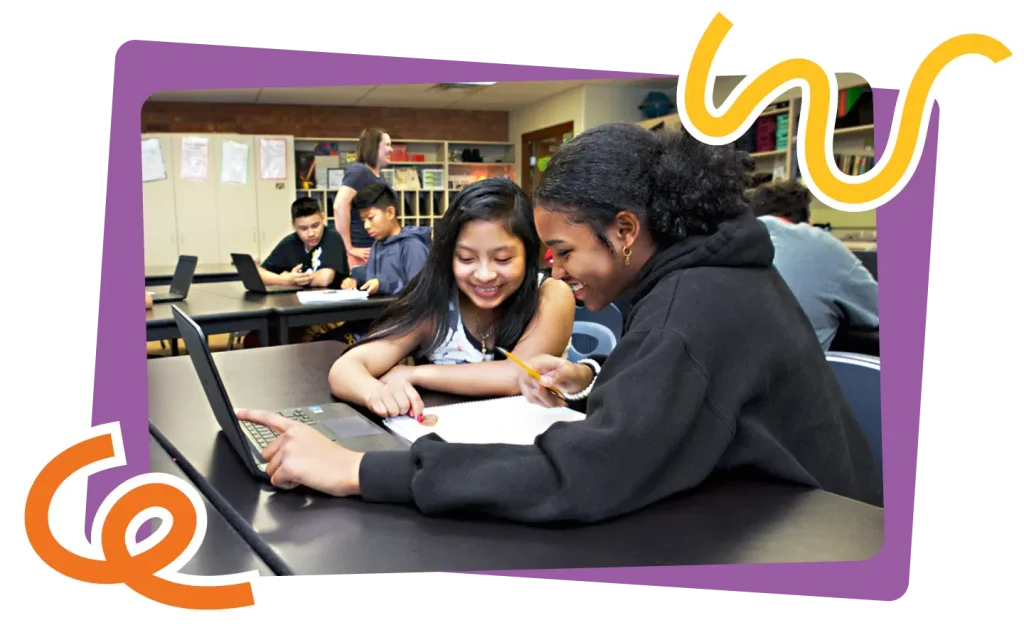
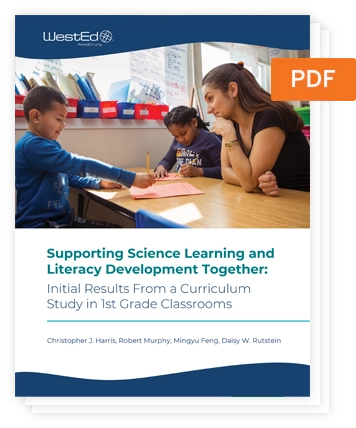
    Get in touch with a PD expert.

    Amplify Science Overview Video

    Amplify Science 6–8 Form F Citation Video

    Spanish Resources

    List of Amplify Science Spanish resources designed to support multilingual/English learner classrooms and all multilingual models.

    NM Form F Correlations

    Access your digital samples

    For your digital review of Amplify Science 6–8, follow these steps:

    • Locate your Digital Review Flyer in the binder included with your print samples
    • Click the “Log in to 6-8 Amplify Science” button below
    • Enter the unique credentials found on your Digital Review Flyer
    • Start exploring!

    Don’t forget to view the Amplify Science 6–8 Form F Citation Video above for navigation tips!

    Technical Requirements & Support

    Technical Requirements for Amplify Science 

    For technical/digital support, contact:

    Violet Wanta, VP Product Core Platform
    Cell Phone: 203-980-2076
    Email: vwanta@amplify.com

    Program Knowledge & Additional Support

    For program questions or additional support, contact:

     Matt Reed, VP Science
     Cell Phone: 347-668-4537
     Email: mreed@amplify.com

    Updates to Boost Reading Texas and Boost Lectura Texas!

    Boost Reading Texas and Boost Lectura Texas are introducing enhancements for the next school year. Explore the following improvements designed to save you time, extend your reach, and support your efforts to deliver the learning experiences your students deserve.

    A young girl wearing headphones sits at a desk using a laptop, with cartoon backgrounds and a blue animated character above her, helping boost reading skills in a fun and engaging way.

    Recent updates

    Teacher Dashboard updates (January 2026)

    In January 2026, we updated the Boost Reading Texas, Boost Lectura Texas, and Biliteracy Teacher Dashboards with new reporting options, to streamline and strengthen intervention support for your students.

    Updates to the dashboards include:

    • The new Skill View in the Trouble Spots section.
    • Enhanced Monthly Growth reporting, which now shows trends in Performance, Growth, and Risk of Reading Difficulty (for Boost Reading).
    • Enhanced benchmark reporting.
    • Improved Skill Placement reporting.

    Check out more information on these specific updates and view our walkthrough videos.

    Side-by-side screenshots show a “Trouble Spots” dashboard, listing student groups by skill to boost reading skills, with names and resource links under “Early Decoding,” “Phonological Awareness,” and “Letter Combinations.”.

    The Trouble Spots section of the Teacher Dashboard can now be viewed by Skill and/or Student.

    Noteworthy features

    PD Library

    You’ll find plenty of professional development (PD) resources in the PD Library to ensure that your Boost Reading Texas and Boost Lectura Texas implementation runs smoothly. When logged into Boost Reading Texas or Boost Lectura Texas, you can access the PD Library by selecting the PD Library button on the left navigation bar.

    Updates to Boost Reading and Boost Lectura!

    Boost Reading and Boost Lectura are introducing enhancements for the next school year. Explore the following improvements designed to save you time, extend your reach, and support your efforts to deliver the learning experiences your students deserve.

    A young girl wearing headphones sits at a desk using a laptop, with cartoon backgrounds and a blue animated character above her, helping boost reading skills in a fun and engaging way.

    Recent updates

    Teacher Dashboard updates (January 2026)

    In January 2026, we updated the Boost Reading, Boost Lectura, and Biliteracy Teacher Dashboards with new reporting options, to streamline and strengthen intervention support for your students.

    Updates to the dashboards include:

    • The new Skill View in the Trouble Spots section.
    • Enhanced Monthly Growth reporting, which now shows trends in Performance, Growth, and Risk of Reading Difficulty (for Boost Reading).
    • Enhanced benchmark reporting.
    • Improved Skill Placement reporting.

    Check out more information on these specific updates and view our walkthrough videos.

    Side-by-side screenshots show a “Trouble Spots” dashboard, listing student groups by skill to boost reading skills, with names and resource links under “Early Decoding,” “Phonological Awareness,” and “Letter Combinations.”.

    The Trouble Spots section of the Teacher Dashboard can now be viewed by Skill and/or Student.

    Noteworthy features

    PD Library

    You’ll find plenty of professional development (PD) resources in the PD Library to ensure that your Boost Reading and Boost Lectura implementation runs smoothly. When logged into Boost Reading or Boost Lectura, you can access the PD Library by selecting the PD Library button on the left navigation bar.

    What is Amplify CKLA?

    Amplify CKLA is a core ELA program for grades PK–5 that delivers:

    • A unique research-based approach truly built on the Science of Reading.
    • A combination of explicit foundational skills with meaningful knowledge-building.
    • Embedded support and differentiation that gets all students reading grade-level texts together.
    • Opportunities for students to see the strengths and experiences that all people share while also celebrating each others’ unique identities and experiences.
    A colorful rope diagram shows strands for language comprehension and word recognition, with images of reading and phonics materials near respective strands.

    How does Amplify CKLA work?

    Daily instruction

    Grade PreK: Developmentally appropriate foundational knowledge

    Our PreK program delivers developmentally appropriate instruction and activities that do more than lay the groundwork for foundational skills—they offer content knowledge, incorporating research that shows true literacy requires background knowledge in history, science, art, and literature. Amplify CKLA PreK easily fits into any class routine, with 45 minutes of interactive instruction designed to accommodate full-day or half-day schedules.

    Grades K–2: Dedicated knowledge-building and explicit skills instruction
    Every day, students in Grades K–2 complete one full lesson that explicitly and systematically builds foundational reading skills in the Skills Strand, as well as one full lesson that builds robust background knowledge to access complex text in the Knowledge Strand. Through learning in each of these strands, students develop the early literacy skills necessary to help them become confident readers and build the context to understand what they’re reading.

    Grades 3–5: Integrated instruction
    In Grades 3–5, Knowledge and Skills are integrated in one set of instructional materials. Lessons begin to combine skills and knowledge with increasingly complex texts, close reading, and a greater writing emphasis. Students can then use their skills to go on their own independent reading adventures.

    Formative and summative assessments

    A young boy in a light blue shirt writes in a notebook at his desk in a classroom, with other students working nearby.

    Amplify CKLA features a progression of moment-by-moment assessments to benchmark assessments. Assessment and feedback give teachers the information they need to differentiate instruction effectively.

    Checks for Understanding
    Each lesson segment incorporates checks for understanding to increase engagement and to let teachers make real-time adjustments to their instruction.

    Formative Assessment
    Each lesson goal is tied to a formative assessment opportunity, allowing teachers to see which students need more support with a benchmark.

    Mid- and End-of-Unit Assessments
    Mid-Unit and End-of-Unit Assessments provide valuable information on the skills and content students have mastered. Digital end-of-unit assessments are available on a variety of platforms.

    Benchmark and Placement Assessments
    Benchmark and Placement Assessments help teachers set goals and monitor the growth of each student, providing a baseline at the beginning of the year and ensuring students are advancing toward grade-level objectives.

    Download our CKLA Assessment Sampler

    What makes Amplify CKLA different?

    Integration with mCLASS DIBELS 8

    Amplify CKLA is the only core ELA program that integrates with mCLASS DIBELS 8th Edition.

    The CKLA Connect feature matches your students with targeted CKLA lessons based on their mCLASS DIBELS 8th Edition assessment data. In other words, it aligns your assessments more closely with your core curriculum while recommending effective differentiated instruction.

    Download this guide to connecting mCLASS DIBELS 8 with Amplify CKLA

    A digital dashboard displays lesson plans for CKLA Connect and a group labeled "Letter Sound Knowledge" with two students, showing progress and learning needs.

    Built on the Science of Reading

    Built out of the latest research in the Science of Reading, Amplify CKLA delivers explicit instruction in foundational knowledge in PreK, both foundational literacy skills (systematic phonics, decoding, and fluency) and background knowledge in grades K–2, and an integrated approach to explicit instruction in grades 3–5.

    Review this Science of Reading toolkit to learn more about the Science of Reading best practices integrated throughout CKLA.

    Explicit systematic skills instruction

    Great reading instruction starts with helping kids develop great decoding skills. By building a solid foundation of phonological awareness and phonics, reading the words on the page becomes automatic so that comprehension and critical thinking can happen. Our instruction is supported by:

    • Step-by-step lessons with multisensory approaches, clear lesson objectives, and embedded formative assessments.
    • Decodable books and student readers with ebook and audiobook versions that feature interesting plots and relatable characters.
    • An engaging sound library with fun songs and videos that develop phonological awareness.
    • An interactive Vocab App featuring engaging activities with immediate feedback and automated, customized instruction based on student performance.

    Coherent knowledge instruction

    Students build grade-appropriate subject-area knowledge and vocabulary in history, science, literature, and the arts while learning to read, write, and think creatively and for themselves. Our instruction is supported by:

    • Knowledge builders that provide a quick overview of each domain with its key ideas.
    • Interactive Read-Alouds designed to build knowledge and vocabulary.
    • Content-rich anchor texts that support students as they tackle increasingly complex text and sharpen their analytical skills.
    • Social and emotional learning paired with lessons in civic responsibility.
    Illustration montage featuring scenes of learning: a cartoon character with books, two people shoveling snow under the stars, and an astronaut on a lunar landscape, with educational interfaces.

    Embedded differentiation for all learners

    Amplify CKLA provides built-in differentiation strategies in every lesson for all students, including supports for English language learners and Standard English learners.

    • Access supports for ELLs: Integrated ELD supports in each lesson segment for English learners and Standard English learners are specific to students’ mastery of the lesson’s objectives.
    • Support and Challenge for all learners: Lessons include Support and Challenge suggestions that provide assistance or opportunities for more advanced work toward the goal of the lesson. These supports are suitable for all learners, including ELLs.
    • 30 minutes of Additional Support in every Skills lesson: In the Skills Strand, every lesson concludes with an Additional Support section of recommendations for 30 minutes of extended instruction and activities, directly aligned to the skills taught in the lesson to assist students who need more support in mastering the lesson’s objectives.
    • Intervention Toolkit: The Intervention Toolkit provides easy-to-use resources to assist teachers in filling gaps in students’ foundational skills. Teachers will find of hundreds of activities to support phonics, fluency, comprehension, handwriting, and other key skills.

    Designated ELD with Language Studio

    Amplify CKLA’s designated English Language Development (ELD) component—Language Studio—helps English learners preview and revisit key content within core instruction, building a foundation of academic vocabulary and background knowledge. Core instruction lessons include point-of-use supports for English learners and Support and Challenge strategies for all learners.

    Young boy with his hands over his mouth, looking up in wonder, beside a diagram labeled "language studio" with educational elements.

    This carefully developed program follows the CKLA Knowledge domains, previewing and reinforcing skills and content from core instruction using instruction specifically built for English learners. The program is also designed around frequent formative assessment, including assessment of language proficiency, giving you effective ways to guide and support your English learners.

    Language Studio supports teachers and English learners through the following:

    • 30 minutes of instruction with lesson segments are carefully designed around Content Knowledge, Meaning Making, Language Development, Effective Expression, and Foundational Skills.
    • Every Language Studio lesson accompanies a core lesson, helping English learners deepen domain and academic vocabulary that will help them access core content.
    • Culminating tasks support core projects and target the same skills as primary instruction.

    Writing emphasis with Writing Studio

    With Writing Studio, students in Grades K-5 focus deeply on the three key text types informative, narrative, and opinion–while applying both the skills and knowledge from the core program.

    Writing Studio supports students through:

    • Expanding on core writing instruction to develop analytical thinking through writing.
    • Lessons that focus on writing standards, providing intensive focus and application to strengthen skills.
    • Opportunities to apply knowledge in new contexts and deepen comprehension through writing.
    • Scaffolded writing projects to help all students find success within the stages of the writing process.
    Covers of four "Writing Studio Teacher Guide" books for different grades, featuring educational icons in orange, purple, blue, and teal color schemes.

    Writing Studio lessons:

    • Allow teachers to differentiate through Support and Challenge prompts for students at all levels, and Access Supports for ELLs.
    • Spark creativity with authentic writing projects that call on students to engage deeply with rich topics and sources.
    • Implement careful design and provide rubrics so that students’ writing skills can visibly grow throughout the year.

    A culminating project in each grade asks students to apply their knowledge and understanding of text types and to select the appropriate text type for a final piece of writing.

    Personalized practice with Boost Reading

    Boost Reading is the student-driven skill practice program within CKLA, providing differentiated, digital instruction in both foundational skills and comprehension strategies. Because Boost Reading is built on the same approach to reading as CKLA, students are able to extend their learning from the core program further, at their own pace.

    Amplify CKLA and Boost Reading reinforce each other through:

    • An aligned scope and sequence and instructional approach: In both programs, students get instruction and practice in phonological awareness and phonics, with the most common, least ambiguous spellings first.
    • Consistent vocabulary words: Many Amplify CKLA words are taught and practiced in Boost Reading vocabulary games.
    • Complementary texts: Fiction and nonfiction books within Boost Reading reinforce Amplify CKLA knowledge domains.
    • Seamless integrations between platforms: Students can easily access Boost Reading directly from the Amplify CKLA Student Hub.
    Educational website interface showing icons for theater, sounds, library, and activities with a greeting "hello student!" and a grade level indicator.

    Ready-to-go slides and all-in-one platform

    The slides-based Amplify CKLA digital experience enhances instruction while saving you time. Everything you need is all in one place, making it easier than ever to plan lessons, present digital content, and review student work.

    • Simplify planning and instruction: Teachers have access to ready-to-use and customizable lesson presentation slides, complete with all the prompts from the print Teacher Guide embedded in the teacher view. As teachers deliver each lesson, students can engage with the content in one cohesive
      experience—through Activity Books, slides, digital components, videos, Student Readers, and more.
    • Interactive student activities: Through the Student Home, students can easily access digital lessons with slides, Activity Pages, ebooks, videos, and other interactive resources from one simple dashboard.
    • Your teacher command center: You’re provided with the tools you need to ensure a productive digital experience that’s personalized to meet your students’ needs. This includes a teacher home from which to launch and track lessons, LMS integrations such as Google Classroom and Microsoft Teams, and other customizations based on classroom needs.
    • Get real-time insights into your students’ work: The innovative live review tool enables you to keep an eye on students drawing, recording audio, uploading and capturing images, and typing or writing in pre-placed text boxes in their Activity Pages.

    Navigating the program

    Digital navigation walkthrough

    Physical materials walkthrough

    Sample materials

    Demo access

    A laptop screen displays the Amplify login page with options to log in using Google, Clever, Amplify, QR code, or District SSO. Help and sign-up links are also visible.

    Follow the instructions below to access your demo account.

    • Click the CKLA Demo button below.         s1.mcps2024@demo.tryamplify.net
      • Enter the password: Amplify1-mcps2024
      • Click the desired program on the left side of the page.

    Additional resources

    Amplify CKLA review resources:

    Amplify CKLA for Anchorage

    To view this protected page, enter the password below:


    Buffalo Consultancy

    To view this protected page, enter the password below:


    Amplify CKLA and ELA Elementary Language Arts Curriculum Adoption

    To view this protected page, enter the password below:


    Screen and intervene faster with mCLASS DIBELS 8th Edition.

    California educators, did you know mCLASS® DIBELS® 8th Edition is the industry’s first all-in-one universal and dyslexia screener? This means with just one screener, you’ll gain a complete picture of your students’ grade-level reading abilities and dyslexia risk factors. Our gold-standard assessment identifies students who need more support, then recommends targeted instruction they’ll love.

    About the program

    mCLASS offers teacher-administered assessment, intervention, and personalized instruction for grades K–6. Know exactly how to monitor and support every student in your classroom, with features like:

    • Precise one-minute measures based on over three decades of predictive data.
    • Universal and dyslexia screening in one tool.
    • Instruction that highlights observed patterns and recommends activities.
    • Robust reports for teachers, specialists, administrators, and parents.
    A table shows class summary performance metrics in various literacy skills for beginning, middle, and end of the year, categorized into Well Below Benchmark, Below Benchmark, At Benchmark, and Above Benchmark.

    The right measures at the right time

    With mCLASS DIBELS 8th Edition, you’ll assess students based on grade-specific curriculum and instructional standards, in accordance with International Dyslexia Association (IDA) guidelines.

    mCLASS DIBELS 8th Edition offers one-minute, easy-to-administer measures of processing speed, phonological awareness, alphabetic principle, and word reading.

    DIBELS® 8th Edition subtest alignment with IDA Guidelines
    Dyslexia Screening AreamCLASS DIBELS 8th Edition MeasureGrade KGrade 1Grade 2Grade 3Grade 4–6
    Rapid naming abilityLetter Naming Fluency (LNF)A large, light peach-colored checkmark on a transparent background.A large, light peach-colored checkmark on a transparent background.
    Phonological awarenessPhoneme Segmentation Fluency (PSF)A large, light peach-colored checkmark on a transparent background.A large, light peach-colored checkmark on a transparent background.
    Alphabetic principleNonsense Word Fluency (NWF)A large, light peach-colored checkmark on a transparent background.A large, light peach-colored checkmark on a transparent background.A large, light peach-colored checkmark on a transparent background.A large, light peach-colored checkmark on a transparent background.
    Word readingWord Reading Fluency (WRF)A large, light peach-colored checkmark on a transparent background.A large, light peach-colored checkmark on a transparent background.A large, light peach-colored checkmark on a transparent background.A large, light peach-colored checkmark on a transparent background.
    Word readingOral Reading Fluency (ORF)A large, light peach-colored checkmark on a transparent background.A large, light peach-colored checkmark on a transparent background.A large, light peach-colored checkmark on a transparent background.A large, light peach-colored checkmark on a transparent background.
    ComprehensionMazeA large, light peach-colored checkmark on a transparent background.A large, light peach-colored checkmark on a transparent background.A large, light peach-colored checkmark on a transparent background.

    Validated as a universal screener and a dyslexia screener

    Strong reliability and validity evidence shows that DIBELS 8th Edition can effectively assess students in key skills linked to both dyslexia and broader reading difficulty. The research supporting DIBELS 8th Edition, conducted by the University of Oregon, is rigorous, meets high technical standards, and empowers educators to make well-informed decisions.

    Read the DIBELS 8th Edition Dyslexia White Paper.

    A document cover titled "Dyslexia Screening and DIBELS 8th Edition" by Christopher Ives, Gina Biancarosa, Hank Fien, and Patrick Kennedy from the University of Oregon College of Education. The cover has a PDF icon.

    A complete system for data-based decision making

    A circular flowchart with images of people tutoring, a line graph, a report card, and a score indicating "Composite Goal 330, Well Below" at the center.

    mCLASS DIBELS 8th Edition provides rich data that helps you make informed instructional decisions and seek out further dyslexia screening evaluation if needed:

    1. Assess skills: mCLASS DIBELS 8th Edition and optional dyslexia screenings in Rapid Automatized Naming (RAN), Spelling, Vocabulary, and Oral Language accurately assess students’ abilities.
    2. Identify risk: The DIBELS 8 composite score shows each student’s risk level, with ‘Well Below Benchmark’ indicating a need for intensive support. Students who are also ‘Well Below Benchmark’ in RAN and/or Spelling have an additional Risk Indicator icon next to their name.
    3. Provide instruction: The mCLASS Instruction feature analyzes student error patterns to key dyslexia-related subtests, then recommends small groups and explicit, multi-sensory activities for reinforcing skills.
    4. Progress monitor: mCLASS includes progress-monitoring measures to track student growth in letter sounds, alphabetic principle, word reading, oral reading fluency, and comprehension, so that informed instructional decisions can be made.
    5. Adapt instruction: mCLASS displays indicators based on progress monitoring performance that indicate when a change in instruction may be needed. It also updates instruction recommendations using the latest data.

    Differentiated literacy instruction

    mCLASS DIBELS 8th Edition lays the groundwork for a strong Multi-Tiered System of Supports (MTSS).

    In addition to identifying students with symptoms of dyslexia, mCLASS DIBELS 8th Edition data recommends early intervention, personalized instruction, and core instruction within Amplify’s early literacy suite. Based on the Science of Reading, Amplify’s early literacy suite programs follow an explicit and systematic structure, build knowledge, and instruct on all of the foundational skills essential to literacy development.

    Diagram showcasing "Science of Reading Skill Development" with three branches: "Universal and Dyslexia screening," "Core instruction," "Personalized learning," and "Intervention," with accompanying photos of people interacting.

    Bilingual dyslexia screening

    By assessing with mCLASS DIBELS 8th Edition and its Spanish counterpart, mCLASS Lectura, you’ll know with confidence whether a student truly shows signs of dyslexia or is experiencing difficulties learning a new language.

    When used together, mCLASS DIBELS 8th Edition and mCLASS Lectura feature a Dual Language Report that analyzes dyslexia screening results in both languages. The report also details how each student can leverage their strengths from one language to support growth in the other.

    Student named Marisol Mejía is shown with her English and Spanish literacy scores. English scores are mostly Well Below and Below benchmark; Spanish scores are mostly at Benchmark except for one below.

    Equal skill coverage in English and Spanish

    Dyslexia screening areasEnglish measureSpanish measureDescription*
    Letter Naming and RANLetter Naming Fluency (LNF)Fluidez en nombrar letras (FNL)Grades K–1: Naming letters in print. 1 minute, 1:1 administration.
    Phonological Awareness
    (Segmentation)
    Phonemic Segmentation Fluency (PSF)Fluidez en la segmentación de sílabas (FSF) & Fluidez en la segmentación de fonemas (FSF)Grades K–1: Hearing and using sounds or syllables in spoken words. 1 minute, 1:1 administration.
    Phonological awareness (Elision)¿Qué queda? (QQ)Grades K–2: Produce the part of a word that remains after deleting a syllable or phoneme. 1 minute, 1:1 administration.
    Letter-Sound KnowledgeNonsense Word Fluency Correct Letter Sounds (NWF-CLS)Fluidez en los sonidos de letras (FSL)English: Grades K–3: Identify letter-sound correspondences in the context of pseudo-words. Spanish: Grades K-1: Identify letter-sounds in isolation. 1 minute, 1:1 administration.
    Letter-Sound Knowledge (Receptive)Fluidez en los sonidos de las letras K-Inicio (FSL K-Inicio)Grade K: Identify (point to) which letter makes a certain sound. Untimed, 1:1 administration
    DecodingNonsense Word Fluency Words Recoded Correctly (NWF-WRC)Fluidez en los sonidos de las sílabas (LSS)English: Grades K–3: Decode orthographically regular pseudo-words
    Spanish: Grades K-1: Decode orthographically regular syllables 1 minute, 1:1 administration
    Word ReadingWord-Reading Fluency (WRF)Fluidez en la lectura de palabras (FEP)Grades K–3: Reading common words easily, quickly and correctly.1 minute, 1:1 administration.
    FluencyOral Reading Fluency (ORF)Fluidez en la lectura oral (FLO)Grades 1–6: Reading connected text with accuracy and automaticity. 1 minute, 1:1 administration.
    Reading ComprehensionMaze¿Cuál palabra? (CP)Grades 2–6:  Understanding meaning from texts. 3 minutes, group administration.
    VocabularyVocabularyVocabularioGrades K–3: Knowledge of grade-specific words. 15 minutes, group administration.
    EncodingSpellingOrtografíaGrades K–3: Arranging letters correctly to spell words with grade appropriate features
    15 minutes, group administration.
    RAN (Numbers)Rapid Automatized NamingGrades K–3: Correctly and quickly naming visual symbols, such as numbers. 3-4 minutes, 1:1 administration.
    Language ComprehensionOral LanguageLenguaje oralGrades K–2: Demonstrate the ability to use words and phrases acquired through conversations, reading and being read to, and responding to texts. 5 minutes, 1:1 administration.
    *Students can be assessed using off-grade measures when information on specific skills is needed.

    Dyslexia resources for families

    Families play a crucial role in helping children overcome reading challenges. mCLASS DIBELS 8th Edition and mCLASS Lectura provide a Home Connect letter after each dyslexia screening to explain the results in family-friendly language, recommend activities, and direct families to a free website for additional at-home support.

    A woman helps a young girl work on a computer in a classroom setting. Both are smiling and focused on the screen. Background has soft shapes in yellow and blue.

    Developmentally appropriate

    Computer-based assessments that require students to complete tasks silently or independently may over-identify students for intervention services, especially young learners who are still developing focus and attention abilities.

    mCLASS requires students to actively demonstrate their proficiency in producing letter sounds, forming words, and reading texts. This approach to assessment aligns with IDA guidelines for effective screening of reading challenges. By choosing mCLASS for dyslexia screening, you’ll gain accurate information about a student’s risk for dyslexia, and gain the capability to monitor every student’s path to reading proficiency.

    Additional resources

    Demo access

    Watch the navigation video above and then follow the instructions below to access your demo account.

    • Click the mCLASS Demo button below.
    • Select Log in with Amplify.
    • Enter this username and password:
      • Username: mflores1800
      • Password: 1234
    • For more demo teacher logins and for detailed navigation instructions, please click here and start at page 1.
    • Click the mCLASS Demo button below.
    • Select Log in with Amplify.
    • Enter the username and password for each particular grade:
      • Grade K username / password: mfloresk / matthew-k
      • Grade 1 username / password: mflores1807 / matthew-1
      • Grade 2 username / password: mflores1808 / matthew-2
    • For more demo student logins and for detailed navigation instructions, please click here and scroll to page 17.

    Questions?

    For questions about mCLASS or the CA RFP review, please contact:

    Erin King
    Sales Director, CA
    (512) 736-3162
    eking@amplify.com

    and CC: proposals@amplify.com

    What is mCLASS?

    mCLASS is a best-in-class assessment platform that houses a suite of proven, gold-standard assessment measures and tools that can be flexibly combined to meet the unique literacy needs of both teachers and students across grades K–6, including:

    • Universal screening
    • Diagnostic assessment
    • Text Reading and Comprehension (a.k.a. running records via Amplify Atlas Español)
    • Dyslexia screening
    • Progress monitoring
    • Dual language reporting
    • Targeted teacher-led instruction

    What is the Lectura assessment?

    The Lectura assessment is a brand-new interim and diagnostic assessment that consists of measures based on the latest research of how Spanish literacy develops.

    Co-developed with the Center on Teaching and Learning at the University of Oregon (UO CTL) and validated in partnership with Dr. Lillian Durán, the Lectura assessment was created to provide educators with a high-quality, evidence-based tool to support understanding of Spanish-speaking students’ biliteracy development, specifically foundational Spanish reading skills, which includes measures of phonological awareness, alphabetic understanding and decoding, reading fluency, and reading comprehension.

    The measures in Lectura were written from the ground-up to assess students’ literacy development based on how Spanish literacy develops. Measures explicitly account for the syllabic and morphological structures of Spanish, and connected text was written and calibrated with respect to syntactical, lexical, and grammatical rules of Spanish. For example, phonological awareness is measured using syllable segmentation, and letter sounds and syllable reading are included in the decoding subtests for greater face-validity (in lieu of pseudowords). Word choice reflects the multisyllabic word complexity and variety of Spanish, driven by how decoding skills develop in Spanish. As such, Lectura provides instructionally actionable data for all students, including those scoring below the benchmark and those who meet or exceed the benchmark.

    The Lectura assessment measures were purposefully designed, developed, field tested, and evaluated to address limitations that educators of Spanish speaking students have experienced in assessments. Specifically in these ways:

    • Assessment measures based on current research on how Spanish literacy is developed
    • Culturally responsive word choice and content reflecting the regional diversity of Spanish
    • Technical adequacy established through rigorous study
    • A sample size and geographic diversity reflecting the broad population of Spanish speakers across the U.S.
    • Complete parity with English solutions (instructional tools, skill coverage)

    Assessment measures by grade

    Lectura measures at each grade level 
    Measure Grade K Grade 1 Grade 2 Grade 3 Grades 4–6
    Fluidez en nombrar letras A large, light peach-colored checkmark on a transparent background.    
    Fluidez en la segmentación de sílabas      
    ¿Qué queda? A large, light peach-colored checkmark on a transparent background. A large, light peach-colored checkmark on a transparent background. A large, light peach-colored checkmark on a transparent background.    
    Fluidez en los sonidos de letras      
    Fluidez en los sonidos de sílabas      
    Fluidez en las palabras
    Fluidez en la lectura oral  
    ¿Cuál palabra?   A large, light peach-colored checkmark on a transparent background.
    Amplify measures at each grade level
    Oral Language Español    
    Vocabulario

    Assessment measures sample videos

    Please note that the videos below are intended for illustrative purposes only. Performance levels in mCLASS Lectura have yet to be finalized.

    mCLASS Lectura measure: Fluidez en nombrar letras (FNL)

    Students are asked to identify as many uppercase and lowercase letter names as they can in one minute.

    mCLASS Lectura measure: Fluidez en los sonidos de letras (FSL)

    Students are asked to identify the sounds of as many uppercase and lowercase letters as they can in one minute.

    mCLASS Lectura measure: Fluidez en los sonidos de sílabas (LSS)

    Students are presented with a page of printed orthographically regular Spanish syllables and asked to read as many syllables as they can in one minute.

    mCLASS Lectura measure: Fluidez en la lectura oral (FLO)

    Students are presented with an authentically written informational or narrative passage of Spanish connected text and asked to read as much of the passage as they can in one minute.

    mCLASS Lectura measure: ¿Qué Queda? (QQ)

    Students are presented with a word orally and then the examiner omits part of the word (i.e., compound word part, syllable, or phoneme). Students are asked to identify what word remains after the word part has been elided.

    What makes mCLASS Lectura different?

    mCLASS Lectura combines the power of the mCLASS assessment platform and the effectiveness of the Lectura assessment measures. As a result – educators are empowered with latest and greatest assessment tool.

    More than a test, mCLASS Lectura is an integrated system that closes the knowing-doing gap by helping teachers take immediate instructional action that’s right for each and every student. What’s more, it addresses the classroom inequities Spanish-speaking students face along their early literacy journeys.

    Spanish-speaking students have been underserved and misclassified for decades. With mCLASS Lectura, teachers of Spanish-speaking students finally have access to the same robust assessment tools that have been available to teachers of English-speaking students for years.

    Plus! When mCLASS Lectura and DIBELS 8th Edition are used together, teachers are empowered with a more holistic view of their Spanish-speaking students abilities in both English and Spanish, making instructional next steps more targeted and effective.

    What makes mCLASS Lectura different?

    1. It gives teachers access to authentic Spanish measures. Amplify is the only provider of the Lectura assessment. Rather than a direct translation of an English assessment, our solution is the only one to provide teachers a research-based, authentic Spanish assessment that is both valid and reliable.
    2. It makes it faster and easier to understand where every student is in their early literacy journey. By combining 1:1 observational diagnostic assessments, dyslexia screening, progress monitoring, instant scoring, rigorous reporting, automatic student grouping, and targeted instruction all in one place, it reduces the instructional delays associated with manual scoring, manual data analysis, and manual lesson planning.
    3. It brings more equity to the classroom. When used in conjunction with mCLASS DIBELS 8th Edition, teachers have access to Dual Language Reports that highlight a students strengths and weaknesses in both English and Spanish.
    4. It makes every instructional minute count. In addition to one-minute measures that quickly gauge student progress toward reading proficiency, it leverages a teacher’s most powerful instructional tool — their own 1:1 observations.
    5. It drives growth more efficiently. Rather than relying on broad composite scores alone, granular data and in-depth insights for every student help teachers pinpoint exact skill gaps and areas of unfinished learning, making whole-group, small-group, and 1:1 instruction more targeted and effective.
    6. It saves teachers time. Instant reports, automatic student groups, and ready-to-teach lessons mean teachers spend less time cobbling together materials and more time working directly with students and responding to their needs.

    Assessment systems must enable and compel educators to answer not just the “What?” questions, but also the “So What?” and “Now What?” questions. These are the questions that are essential in transforming classroom instruction, and the questions that mCLASS Lectura helps teachers answer with confidence.

    How does mCLASS Lectura support screening for dyslexia risk?

    mCLASS Lectura subtests have been specifically designed and validated to screen for dyslexia risks.

    mCLASS Lectura was specifically developed to ensure the measure is able to meet state-level screening requirements for both dyslexia and universal reading screening. The research and development of Lectura was designed with this use in mind to accurately identify reading difficulties, including difficulties related to risk for dyslexia.

    How does mCLASS Lectura support the use of running records?

    Track your students’ reading progress from every angle with the Text Reading and Comprehension (TRC) assessment. When TRC is paired with the Lectura assessment, classroom teachers unlock the ability to record reading behaviors through running digital records. Available in English and Spanish, it measures reading comprehension and provides insight into how each student finds meaning in text.

    A digital interface showing a step-by-step guide in Spanish for a language and oral class. The guide includes sections on content and organization with expandable details for each step.

    How does mCLASS Lectura turn data into instant action?

    mCLASS Lectura gives you instant results and clear next steps for each student.

    Quick and actionable reports provide detailed insight into students’ reading development across foundational literacy skills for teachers, specialists, administrators, and caregivers.

    Screenshot of an educational software dashboard displaying student progress, with tabs for instruction and home connection in dual language.

    Diagnostic assessment

    mCLASS Lectura analyzes individual student response data through a proprietary scoring algorithm that pinpoints a student’s specific area(s) of growth and improvement, providing classroom teachers in-depth insight into a students’ instructional needs.

    Ready-to-teach instruction

    Immediately following the analysis of individual student responses, mCLASS Lectura provides an in-depth diagnostic report complete with suggested next steps, also known as “mCLASS Instruction.”

    mCLASS Instruction evaluates each student’s responses on each individual subtest and instantly:

    • Provides a list of specific needs by student, such as struggling with medial vowel sounds or difficulty reading words with consonant blends.
    • Groups students automatically based on similar discrete skill needs, not simply composite scores like other assessment tools.
    • Recommends a variety of ready-to-teach lessons that specifically target each individual student’s areas of need or common areas of need for small-group instruction.

    Classroom skill and benchmark summary

    The Classroom Skill Summary report is a dashboard showing benchmark performance on each skill. Teachers can use it to determine which skill areas need instructional focus at a classroom level.

    The Classroom Benchmark Summary report is a classroom-wide view of overall reading performance. Teachers can use this report to determine if composite scores improved, declined, or remained the same each semester.

    Detailed benchmark performance

    Teachers can see each student’s performance during the current school year, on each subtest as well as the overall composite. The benchmark goal displays below the subtest name when applicable. The ability to sort the columns in this report gives teachers more flexibility to analyze data the way they prefer.

    Dual language reports

    When mCLASS Lectura and mCLASS with DIBELS 8th Edition are used together, teachers will receive an asset-based picture of a student’s biliteracy and instructional guidance on how to leverage literacy skills in one language to support literacy skill development in the second language.

    • Side-by-side view of foundational literacy skills in English and Spanish
    • Explicit guidance to teachers to support asset-based instruction using cross-linguistic transfer strategies
    Screenshot of a student's mCLASS Lectura literacy skills evaluation report detailing progress in English and Spanish reading abilities, with charts and textual information.

    Progress monitoring summary

    See which subtests have been assessed since the most recent benchmark assessment, how students performed on the three most recent progress monitoring assessments for each measure, and which students have not been progress monitored since the benchmark assessment.

    Caregiver supports

    The mCLASS Home Connect letter provides parent and caregivers information in English or Spanish about the student’s literacy and guidance on how to support their child at home.

    Screenshot of a digital document showing a student's performance evaluation, with text, tables, and color-coded performance ratings.

    Beaver County School District

    To view this protected page, enter the password below:


    Welcome!

    Amplify Science: California Edition is an immersive and engaging core curriculum authored by UC Berkeley’s Lawrence Hall of Science and built specifically for the NGSS.

    K–8 Integrated Course Model

    Grades 6–8 Integrated Model

    Grades 6–8 Discipline Specific Model

    What is mCLASS?

    mCLASS is a best-in-class assessment platform that houses a suite of proven, gold-standard assessment measures and tools that can be flexibly combined to meet the unique literacy needs of both teachers and students across grades K–6, including:

    • Universal screening
    • Diagnostic assessment
    • Text Reading and Comprehension (a.k.a. running records via Amplify Atlas Español)
    • Dyslexia screening
    • Progress monitoring
    • Dual language reporting
    • Targeted teacher-led instruction

    What is the Lectura assessment?

    The Lectura assessment is a brand-new interim and diagnostic assessment that consists of measures based on the latest research of how Spanish literacy develops.

    Co-developed with the Center on Teaching and Learning at the University of Oregon (UO CTL) and validated in partnership with Dr. Lillian Durán, the Lectura assessment was created to provide educators with a high-quality, evidence-based tool to support understanding of Spanish-speaking students’ biliteracy development, specifically foundational Spanish reading skills, which includes measures of phonological awareness, alphabetic understanding and decoding, reading fluency, and reading comprehension.

    The measures in Lectura were written from the ground-up to assess students’ literacy development based on how Spanish literacy develops. Measures explicitly account for the syllabic and morphological structures of Spanish, and connected text was written and calibrated with respect to syntactical, lexical, and grammatical rules of Spanish. For example, phonological awareness is measured using syllable segmentation, and letter sounds and syllable reading are included in the decoding subtests for greater face-validity (in lieu of pseudowords). Word choice reflects the multisyllabic word complexity and variety of Spanish, driven by how decoding skills develop in Spanish. As such, Lectura provides instructionally actionable data for all students, including those scoring below the benchmark and those who meet or exceed the benchmark.

    The Lectura assessment measures were purposefully designed, developed, field tested, and evaluated to address limitations that educators of Spanish speaking students have experienced in assessments. Specifically in these ways:

    • Assessment measures based on current research on how Spanish literacy is developed
    • Culturally responsive word choice and content reflecting the regional diversity of Spanish
    • Technical adequacy established through rigorous study
    • A sample size and geographic diversity reflecting the broad population of Spanish speakers across the U.S.
    • Complete parity with English solutions (instructional tools, skill coverage)

    Assessment measures by grade

    Lectura measures at each grade level 
    Measure Grade K Grade 1 Grade 2 Grade 3 Grades 4–6
    Fluidez en nombrar letras A large, light peach-colored checkmark on a transparent background. A large, light peach-colored checkmark on a transparent background. A large, light peach-colored checkmark on a transparent background.    
    Fluidez en la segmentación de sílabas A large, light peach-colored checkmark on a transparent background. A large, light peach-colored checkmark on a transparent background.      
    ¿Qué queda? A large, light peach-colored checkmark on a transparent background. A large, light peach-colored checkmark on a transparent background. A large, light peach-colored checkmark on a transparent background.    
    Fluidez en los sonidos de letras A large, light peach-colored checkmark on a transparent background. A large, light peach-colored checkmark on a transparent background.      
    Fluidez en los sonidos de sílabas A large, light peach-colored checkmark on a transparent background. A large, light peach-colored checkmark on a transparent background.      
    Fluidez en las palabras A large, light peach-colored checkmark on a transparent background. A large, light peach-colored checkmark on a transparent background. A large, light peach-colored checkmark on a transparent background. A large, light peach-colored checkmark on a transparent background. A large, light peach-colored checkmark on a transparent background.
    Fluidez en la lectura oral   A large, light peach-colored checkmark on a transparent background. A large, light peach-colored checkmark on a transparent background. A large, light peach-colored checkmark on a transparent background. A large, light peach-colored checkmark on a transparent background.
    ¿Cuál palabra?   A large, light peach-colored checkmark on a transparent background. A large, light peach-colored checkmark on a transparent background. A large, light peach-colored checkmark on a transparent background. A large, light peach-colored checkmark on a transparent background.
    Amplify measures at each grade level
    Oral Language Español A large, light peach-colored checkmark on a transparent background. A large, light peach-colored checkmark on a transparent background. A large, light peach-colored checkmark on a transparent background.    
    Vocabulario A large, light peach-colored checkmark on a transparent background. A large, light peach-colored checkmark on a transparent background. A large, light peach-colored checkmark on a transparent background. A large, light peach-colored checkmark on a transparent background. A large, light peach-colored checkmark on a transparent background.

    Assessment measures sample videos

    Please note that the videos below are intended for illustrative purposes only. Performance levels in mCLASS Lectura have yet to be finalized.

    mCLASS Lectura measure: Fluidez en nombrar letras (FNL)

    Students are asked to identify as many uppercase and lowercase letter names as they can in one minute.

    mCLASS Lectura measure: Fluidez en los sonidos de letras (FSL)

    Students are asked to identify the sounds of as many uppercase and lowercase letters as they can in one minute.

    mCLASS Lectura measure: Fluidez en los sonidos de sílabas (LSS)

    Students are presented with a page of printed orthographically regular Spanish syllables and asked to read as many syllables as they can in one minute.

    mCLASS Lectura measure: Fluidez en la lectura oral (FLO)

    Students are presented with an authentically written informational or narrative passage of Spanish connected text and asked to read as much of the passage as they can in one minute.

    mCLASS Lectura measure: ¿Qué Queda? (QQ)

    Students are presented with a word orally and then the examiner omits part of the word (i.e., compound word part, syllable, or phoneme). Students are asked to identify what word remains after the word part has been elided.

    What makes mCLASS Lectura different?

    mCLASS Lectura combines the power of the mCLASS assessment platform and the effectiveness of the Lectura assessment measures. As a result – educators are empowered with latest and greatest assessment tool.

    More than a test, mCLASS Lectura is an integrated system that closes the knowing-doing gap by helping teachers take immediate instructional action that’s right for each and every student. What’s more, it addresses the classroom inequities Spanish-speaking students face along their early literacy journeys.

    Spanish-speaking students have been underserved and misclassified for decades. With mCLASS Lectura, teachers of Spanish-speaking students finally have access to the same robust assessment tools that have been available to teachers of English-speaking students for years.

    Plus! When mCLASS Lectura and DIBELS 8th Edition are used together, teachers are empowered with a more holistic view of their Spanish-speaking students abilities in both English and Spanish, making instructional next steps more targeted and effective.

    What makes mCLASS Lectura different?

    1. It gives teachers access to authentic Spanish measures. Amplify is the only provider of the Lectura assessment. Rather than a direct translation of an English assessment, our solution is the only one to provide teachers a research-based, authentic Spanish assessment that is both valid and reliable.
    2. It makes it faster and easier to understand where every student is in their early literacy journey. By combining 1:1 observational diagnostic assessments, dyslexia screening, progress monitoring, instant scoring, rigorous reporting, automatic student grouping, and targeted instruction all in one place, it reduces the instructional delays associated with manual scoring, manual data analysis, and manual lesson planning.
    3. It brings more equity to the classroom. When used in conjunction with mCLASS DIBELS 8th Edition, teachers have access to Dual Language Reports that highlight a students strengths and weaknesses in both English and Spanish.
    4. It makes every instructional minute count. In addition to one-minute measures that quickly gauge student progress toward reading proficiency, it leverages a teacher’s most powerful instructional tool — their own 1:1 observations.
    5. It drives growth more efficiently. Rather than relying on broad composite scores alone, granular data and in-depth insights for every student help teachers pinpoint exact skill gaps and areas of unfinished learning, making whole-group, small-group, and 1:1 instruction more targeted and effective.
    6. It saves teachers time. Instant reports, automatic student groups, and ready-to-teach lessons mean teachers spend less time cobbling together materials and more time working directly with students and responding to their needs.

    Assessment systems must enable and compel educators to answer not just the “What?” questions, but also the “So What?” and “Now What?” questions. These are the questions that are essential in transforming classroom instruction, and the questions that mCLASS Lectura helps teachers answer with confidence.

    How does mCLASS Lectura support screening for dyslexia risk?

    mCLASS Lectura subtests have been specifically designed and validated to screen for dyslexia risks.

    mCLASS Lectura was specifically developed to ensure the measure is able to meet state-level screening requirements for both dyslexia and universal reading screening. The research and development of Lectura was designed with this use in mind to accurately identify reading difficulties, including difficulties related to risk for dyslexia.

    How does mCLASS Lectura support the use of running records?

    Track your students’ reading progress from every angle with the Text Reading and Comprehension (TRC) assessment. When TRC is paired with the Lectura assessment, classroom teachers unlock the ability to record reading behaviors through running digital records. Available in English and Spanish, it measures reading comprehension and provides insight into how each student finds meaning in text.

    Screenshot of a website feedback form with sections titled

    How does mCLASS Lectura turn data into instant action?

    mCLASS Lectura gives you instant results and clear next steps for each student.

    Quick and actionable reports provide detailed insight into students’ reading development across foundational literacy skills for teachers, specialists, administrators, and caregivers.

    Screenshot of an educational software dashboard displaying student progress, with tabs for instruction and home connection in dual language.

    Diagnostic assessment

    mCLASS Lectura analyzes individual student response data through a proprietary scoring algorithm that pinpoints a student’s specific area(s) of growth and improvement, providing classroom teachers in-depth insight into a students’ instructional needs.

    Ready-to-teach instruction

    Immediately following the analysis of individual student responses, mCLASS Lectura provides an in-depth diagnostic report complete with suggested next steps, also known as “mCLASS Instruction.”

    mCLASS Instruction evaluates each student’s responses on each individual subtest and instantly:

    • Provides a list of specific needs by student, such as struggling with medial vowel sounds or difficulty reading words with consonant blends.
    • Groups students automatically based on similar discrete skill needs, not simply composite scores like other assessment tools.
    • Recommends a variety of ready-to-teach lessons that specifically target each individual student’s areas of need or common areas of need for small-group instruction.

    Classroom skill and benchmark summary

    The Classroom Skill Summary report is a dashboard showing benchmark performance on each skill. Teachers can use it to determine which skill areas need instructional focus at a classroom level.

    The Classroom Benchmark Summary report is a classroom-wide view of overall reading performance. Teachers can use this report to determine if composite scores improved, declined, or remained the same each semester.

    Detailed benchmark performance

    Teachers can see each student’s performance during the current school year, on each subtest as well as the overall composite. The benchmark goal displays below the subtest name when applicable. The ability to sort the columns in this report gives teachers more flexibility to analyze data the way they prefer.

    Dual language reports

    When mCLASS Lectura and mCLASS with DIBELS 8th Edition are used together, teachers will receive an asset-based picture of a student’s biliteracy and instructional guidance on how to leverage literacy skills in one language to support literacy skill development in the second language.

    • Side-by-side view of foundational literacy skills in English and Spanish
    • Explicit guidance to teachers to support asset-based instruction using cross-linguistic transfer strategies
    Screenshot of a student's mCLASS Lectura literacy skills evaluation report detailing progress in English and Spanish reading abilities, with charts and textual information.

    Progress monitoring summary

    See which subtests have been assessed since the most recent benchmark assessment, how students performed on the three most recent progress monitoring assessments for each measure, and which students have not been progress monitored since the benchmark assessment.

    Caregiver supports

    The mCLASS Home Connect letter provides parent and caregivers information in English or Spanish about the student’s literacy and guidance on how to support their child at home.

    A student evaluation report for Gabriel Archuleta showing categories, descriptions, progress charts, and comments on reading abilities and areas for growth.

    Clickable demo

    Our clickable demo is a great way to orient yourself to the organization of our mCLASS platform and the mCLASS Lectura assessment. Click the button below to get started.

    Amplify Lectura clickable demo

    Here you will find 10 interactive screens:

    • Screen 2: Scroll down to the class list. Find Gabriel Archulata. Click on his score for “Decodificación”.
    • Screen 3: Explore Gabriel’s measure transcript. Then click on the gray arrow to the far right to advance to the next screen.
    • Screen 4: Click on the “Instruction” tab.
    • Screen 5: Scroll down to “Decoding Group 4” and click “See Activities”.
    • Screen 6: Click on the first activity called “Identificar y leer palabras con los dígrafos ch y ll.”
    • Screen 7: Click on the gray arrow to the far right to advance to the next screen.
    • Screen 8: Explore the detailed “Student” tab and then click the “Dual Language” tab.
    • Screen 9: Scroll down to the section about Gabriel’s phonological awareness skills. Click on the link called “Cross-Linguistic Transfer: Phonological Awareness”.
    • Screen 10: Click on the gray arrow to the far right to advance to the next screen. Explore the “Home Connect” letter.

    Amplify Science

    A new core curriculum designed from the ground up for the NGSS.

    Preview the Student Books and Student Investigation Notebooks

    Grades 6–8 Integrated Model

    NGSS Benchmark Assessments

    The Amplify NGSS Benchmark Assessments were authored by Amplify and were not developed as part of the Amplify Science program or created by the Lawrence Hall of Science.

    About the program

    mCLASS offers teacher-administered assessment, intervention, and personalized instruction for grades K–6. Know exactly how to monitor and support every student in your classroom, with features like:

    • Precise one-minute measures based on over three decades of predictive data.
    • Universal and Reading Difficulties screening in one tool.
    • Instruction that highlights observed patterns and recommends activities.
    • Robust reports for teachers, specialists, administrators, and parents.
    Table displaying student reading assessment data by skill area and benchmark status, based on universal screening, with percentages and student counts for each category across the year.

    The right measures at the right time

    With mCLASS DIBELS 8th Edition, you’ll assess students based on grade-specific curriculum and instructional standards, in accordance with International Dyslexia Association (IDA) guidelines.

    mCLASS DIBELS 8th Edition offers one-minute, easy-to-administer measures of processing speed, phonological awareness, alphabetic principle, and word reading.

    DIBELS® 8th Edition subtest alignment with SB 114 requirements
    RDRP Screening AreamCLASS DIBELS 8th Edition MeasureGrade KGrade 1Grade 2Grade 3Grade 4–6
    Rapid naming abilityLetter Naming Fluency (LNF)A large, light peach-colored checkmark on a transparent background.A large, light peach-colored checkmark on a transparent background.
    Phonological awarenessPhoneme Segmentation Fluency (PSF)A large, light peach-colored checkmark on a transparent background.A large, light peach-colored checkmark on a transparent background.
    Alphabetic principleNonsense Word Fluency (NWF)A large, light peach-colored checkmark on a transparent background.A large, light peach-colored checkmark on a transparent background.A large, light peach-colored checkmark on a transparent background.A large, light peach-colored checkmark on a transparent background.
    Word readingWord Reading Fluency (WRF)A large, light peach-colored checkmark on a transparent background.A large, light peach-colored checkmark on a transparent background.A large, light peach-colored checkmark on a transparent background.A large, light peach-colored checkmark on a transparent background.
    Word readingOral Reading Fluency (ORF)A large, light peach-colored checkmark on a transparent background.A large, light peach-colored checkmark on a transparent background.A large, light peach-colored checkmark on a transparent background.A large, light peach-colored checkmark on a transparent background.
    ComprehensionMazeA large, light peach-colored checkmark on a transparent background.A large, light peach-colored checkmark on a transparent background.A large, light peach-colored checkmark on a transparent background.
    Language ComprehensionOral LanguageA large, light peach-colored checkmark on a transparent background.A large, light peach-colored checkmark on a transparent background.A large, light peach-colored checkmark on a transparent background.
    VocabularyVocabularyA large, light peach-colored checkmark on a transparent background.A large, light peach-colored checkmark on a transparent background.A large, light peach-colored checkmark on a transparent background.A large, light peach-colored checkmark on a transparent background.
    RANRapid Automatized Naming (Numbers)A large, light peach-colored checkmark on a transparent background.A large, light peach-colored checkmark on a transparent background.A large, light peach-colored checkmark on a transparent background.A large, light peach-colored checkmark on a transparent background.
    EncodingSpellingOPTIONAL

    Validated as a universal screener and a dyslexia screener

    Strong reliability and validity evidence shows that DIBELS 8th Edition can effectively assess students in key skills linked to both dyslexia and broader reading difficulty. The research supporting DIBELS 8th Edition, conducted by the University of Oregon, is rigorous, meets high technical standards, and empowers educators to make well-informed decisions.

    Read the DIBELS 8th Edition Dyslexia White Paper.

    A document cover titled "Dyslexia Screening and DIBELS 8th Edition" by Christopher Ives, Gina Biancarosa, Hank Fien, and Patrick Kennedy from the University of Oregon College of Education. The cover has a PDF icon.

    A complete system for data-based decision making

    A flowchart illustrating a cyclical process: assess skills, identify risk, provide personalized instruction, progress monitor, and adjust instruction. Features images of people, charts, and a dyslexia assessment screen for comprehensive analysis.

    mCLASS DIBELS 8th Edition provides rich data that helps you make informed instructional decisions and seek out further dyslexia screening evaluation if needed:

    1. Assess skills: mCLASS DIBELS 8th Edition and optional dyslexia screenings in Rapid Automatized Naming (RAN), Spelling, Vocabulary, and Oral Language accurately assess students’ abilities.
    2. Identify risk: The DIBELS 8 composite score shows each student’s risk level, with ‘Well Below Benchmark’ indicating a need for intensive support. Students who are also ‘Well Below Benchmark’ in RAN and/or Spelling have an additional Risk Indicator icon next to their name.
    3. Provide instruction: The mCLASS Instruction feature analyzes student error patterns to key dyslexia-related subtests, then recommends small groups and explicit, multi-sensory activities for reinforcing skills.
    4. Progress monitor: mCLASS includes progress-monitoring measures to track student growth in letter sounds, alphabetic principle, word reading, oral reading fluency, and comprehension, so that informed instructional decisions can be made.
    5. Adapt instruction: mCLASS displays indicators based on progress monitoring performance that indicate when a change in instruction may be needed. It also updates instruction recommendations using the latest data.

    Differentiated literacy instruction

    mCLASS DIBELS 8th Edition lays the groundwork for a strong Multi-Tiered System of Supports (MTSS).

    In addition to identifying students with symptoms of dyslexia, mCLASS DIBELS 8th Edition data recommends early intervention, personalized instruction, and core instruction within Amplify’s early literacy suite. Based on the Science of Reading, Amplify’s early literacy suite programs follow an explicit and systematic structure, build knowledge, and instruct on all of the foundational skills essential to literacy development.

    Diagram showcasing "Science of Reading Skill Development" with three branches: "Universal and Dyslexia screening," "Core instruction," "Personalized learning," and "Intervention," with accompanying photos of people interacting.

    Bilingual Reading Difficulties screening

    By assessing with mCLASS DIBELS 8th Edition and its Spanish counterpart, mCLASS Lectura, you’ll know with confidence whether a student truly shows signs of of reading difficulties or is experiencing difficulties learning a new language.

    When used together, mCLASS DIBELS 8th Edition and mCLASS Lectura feature a Dual Language Report that analyzes Reading Difficulties screening results in both languages. The report also details how each student can leverage their strengths from one language to support growth in the other.

    Student named Marisol Mejía is shown with her English and Spanish literacy scores. English scores are mostly Well Below and Below benchmark; Spanish scores are mostly at Benchmark except for one below.

    Equal skill coverage in English and Spanish

    mCLASS Lectura subtest alignment with SB114

    RDRP screening areasEnglish measureSpanish measureDescription*
    Letter Naming and RANLetter Naming Fluency (LNF)Fluidez in nombrar letras (FNL)Grades K–1: Naming letters in print. 1 minute, 1:1 administration.
    Phonological Awareness (Segmentation)Phonemic Segmentation Fluency (PSF)Fluidez en la segmentación de sílabas (FSS) & Fluidez en la segmentación de fonemas (FSF)Grades K–1: Hearing and using sounds or syllables in spoken words. 1 minute, 1:1 administration.
    Phonological Awareness (Elision) –¿Qué queda? (QQ)Grades K–2: Produce the part of a word that remains after deleting a syllable or phoneme. 1 minute, 1:1 administration.
    Letter Sound Correspondence KnowledgeNonsense Word Fluency Correct Letter Sounds(NWF-CLS)Fluidez en los sonidos de letras (FSL)English: Grades K–3: Identify letter-sound correspondences in the context of pseudo-words. Spanish: Grades K-1: Identify letter-sounds in isolation. 1 minute, 1:1 administration.
    Letter-Sound Knowledge (Receptive) –Fluidez en los sonidos de las letras K-Inicio (FSL K-Inicio)Grade K: Identify (point to) which letter makes a certain sound. Untimed, 1:1 administration.
    DecodingNonsense Word Fluency Words Recoded Correctly (NWF-WRC)Fluidez en los sonidos de las sílabas (FSL)Grades K–3: Identify letter-sound correspondences in the context of pseudo-words. Spanish: Grades K–1: Identify letter-sounds in isolation. 1 minute, 1:1 administration.
    Word ReadingWord-Reading Fluency (WRF)Fluidez en las palabras (FEP)Grades K–3: Reading common words easily, quickly and correctly.1 minute, 1:1 administration.
    FluencyOral Reading Fluency (ORF)Fluidez en la lectura oral (FLO)Grades 1–6: Reading connected text with accuracy and automaticity. 1 minute, 1:1 administration.
    Reading ComprehensionMaze¿Cuál palabra? (CP)Grades 2–6:  Understanding meaning from texts. 3 minutes, group administration.
    VocabularyVocabularyVocabularioGrades K–3: Arranging letters correctly to spell words with grade appropriate features. 15 minutes, group administration.
    EncodingSpellingOrtografíaGrades K–3: Arranging letters correctly to spell words with grade-appropriate features.
    15 minutes, group administration.
    RAN (Numbers)Rapid Automatized NamingGrades K–3: Correctly and quickly naming visual symbols, such as numbers. 1-2 minutes, 1:1 administration.
    Language ComprehensionOral LanguageLenguaje oralGrades K–2: Demonstrate the ability to use words and phrases acquired through conversations, reading and being read to, and responding to texts. 5 minutes, 1:1 administration.

    *Students can be assessed using off-grade measures when information on specific skills is needed.

    Resources for families

    Welcome California Caregivers! Please click here to learn more about mCLASS assessments. 

    Families play a crucial role in helping children overcome reading challenges. mCLASS DIBELS 8th Edition and mCLASS Lectura provide a Home Connect letter after each screening to explain the results in family-friendly language, recommend activities, and direct families to a free website for additional at-home support.

    A woman helps a young girl work on a computer in a classroom setting. Both are smiling and focused on the screen. Background has soft shapes in yellow and blue.

    Developmentally appropriate

    Computer-based assessments that require students to complete tasks silently or independently may over-identify students for intervention services, especially young learners who are still developing focus and attention abilities.

    mCLASS requires students to actively demonstrate their proficiency in producing letter sounds, forming words, and reading texts. This approach to assessment aligns with IDA guidelines for effective screening of reading challenges. By choosing mCLASS for universal screening, you’ll gain accurate information about a student’s risk for reading difficulties, and gain the capability to monitor every student’s path to reading proficiency.

    Additional resources

    mCLASS Resources

    Dyslexia Resources

    Multilingual and English learners Resources

    Your California team

    Looking to speak directly with your local representative?
    Get in touch with a California team member to learn more about our early literacy suite or request a demo account.

    Dan Pier
    Vice President, West
    (415) 203-4810
    dpier@amplify.com

    Erin King
    Sales Director, CA
    (512) 736-3162
    eking@amplify.com

    NORTHERN CA
    Wendy Garcia
    Senior Account Executive
    (510) 368-7666
    wgarcia@amplify.com

    BAY AREA
    Lance Burbank
    Account Executive
    (415) 830-5348
    lburbank@amplify.com

    CENTRAL VALLEY and CENTRAL COAST
    Demitri Gonos
    Senior Account Executive
    (559) 355-3244
    dgonos@amplify.com

    VENTURA and L.A. COUNTY
    Jeff Sorenson
    Associate Account Executive
    (310) 902-1407
    jsorenson@amplify.com

    ORANGE and L.A. COUNTY
    Lauren Sherman
    Senior Account Executive
    (949) 397-5766
    lsherman@amplify.com

    SAN BERNARDINO and L.A. COUNTY
    Michael Gruber
    Senior Account Executive
    (951) 520-6542
    migruber@amplify.com

    RIVERSIDE AND L.A. COUNTY 
    Brian Roy
    Senior Account Executive
    (818)967-1674
    broy@amplify.com

    SAN DIEGO COUNTY
    Kirk Van Wagoner
    Senior Account Executive
    (760) 696-0709
    kvanwagoner@amplify.com

    BUTTE, DEL NORTE, HUMBOLDT, and SHASTA COUNTY and DISTRICTS UNDER 2250 ENROLLMENT
    Kevin Mauser 
    Lead Account Executive
    (815) 534-0148
    kmauser@amplify.com

    What is Amplify Science?

    The Lawrence Hall of Science

    Developed by the science education experts at UC Berkeley’s Lawrence Hall of Science and the digital learning team at Amplify, our program features:

    • phenomena-based approach where students construct a complex understanding of each unit’s anchor phenomenon.
    • A blend of cohesive storylines, hands-on investigations, rich discussions, literacy-rich activities, and digital tools.
    • Carefully crafted units, chapters, lessons, and activities designed to deliver true 3-dimensional learning.
    • An instructional design that supports all learners in accessing all standards.
    Aerial view of the lawrence hall of science at the university of california, berkeley, showcasing the building and surrounding trees with a foggy city backdrop.

    Proven to work

    A pdf cover from wested titled "learning and literacy development together: initial results from a curriculum study," featuring an adult helping children with schoolwork in a classroom.

    WestEd Randomized
    Control Trial for Grade 1

    Read More

    Pdf cover titled "curriculum materials designed for the next generation science standards: initial results from gold standard research trials", published by wested.

    WestEd Randomized
    Control Trial for Grade 7

    Read More

    A teacher and students engage in a science activity around a table. The text promotes the Amplify Science K–8 curriculum, highlighting its focus on hands-on learning and real-world problem-solving.

    Amplify Science NE
    Grades K–5

    Read More

    Instructional model

    The Amplify Science program is rooted in the proven, research-based pedagogy of Do, Talk, Read, Write, Visualize. Here’s how each element works:

    Do

    First-hand investigations are an important part of any science classroom, and Amplify Science has students getting hands-on in every unit—from building models of protein molecules to experimenting with electrical systems.

    Talk

    Student-to-student discourse and full-class discussions are an integral part of the program. Students are provided with numerous opportunities to engage in meaningful oral scientific argumentation, all while fostering a collaborative classroom environment.

    Read

    Students read scientific articles, focusing their reading activities on searching for evidence related to their investigation and, importantly, on asking and recording questions as they read through fascinating texts on 21st-century topics.

    Write

    Following real-world practices, students write scientific arguments based on evidence they’ve collected, making clear their reasoning about how a given piece of evidence connects to one of several claims.

    Visualize

    By manipulating digital simulations and using modeling tools to craft visualizations of their thinking— just as real scientists and engineers do—students take their learning far beyond the confines of what they can physically see in the classroom in an exciting and authentic way.

    Program structure

    Our cyclical lesson design ensures students receive multiple exposures to concepts through a variety of modalities. As they progress through the lessons within a unit, students build and deepen their understanding, increasing their ability to develop and refine complex explanations of the unit’s phenomenon.

    It’s this proven program structure and lesson design that enables Amplify Science to address 100% of the NGSS, and support students in mastering the Utah Science Standards.

    Flowchart depicting a critical thinking process with four circular nodes connected by arrows, each node representing a step: posing a real-world problem, exploring evidence, elaborating concepts, and evaluating claims.

    Unit types

    While every unit delivers three-dimensional learning experiences and engages students in gathering evidence from a rich collection of sources, each unit also serves a unique instructional purpose.

    In grades 6–8:

    • One unit is a launch unit.
    • Three units are core units.
    • Two units are engineering internships.

    Launch units are the first units taught in each year of Amplify Science. The goal of the Launch unit is to introduce students to norms, routines, and practices that will be built on throughout the year, including argumentation, active reading, and using the program’s technology. For example, rather than taking the time to explain the process of active reading in every unit in a given year, it is explained thoroughly in the Launch unit, thereby preparing students to read actively in all subsequent units.

    Core units establish the context of the unit by introducing students to a real-world problem. As students move through lessons in a Core unit, they figure out the unit’s anchoring phenomenon, gain an understanding of the unit’s disciplinary core ideas and science and engineering practices, and make linkages across topics through the crosscutting concepts. Each Core unit culminates with a Science Seminar and final writing activity.

    Engineering Internship units invite students to design solutions for real-world problems as interns for a fictional company called Futura. Students figure out how to help those in need, from tsunami victims in Sri Lanka to premature babies, through the application of engineering practices. In the process, they apply and deepen their learning from Core units.

    Unit sequence

    Our lessons follow a structure that is grounded in regular routines while still being flexible enough to allow for a variety of learning experiences.

    In fact, our multi-modal instruction offers more opportunities for students to construct meaning, and practice and apply concepts than any other program. What’s more, our modular design means our units can be flexibly arranged to support your instructional goals.

    Three columns listing education curriculum topics for grades 6, 7, and 8, focusing on science themes such as microbiomes, mars geology, and harnessing human energy.

    Program components

    Available digitally and in print, our unit-specific reference guides are chock full of helpful resources, including scientific background knowledge, planning information and resources, color-coded 3D Statements, detailed lesson plans, tips for delivering instruction, and differentiation strategies.

    Amplify Science TG

    Hands-on learning is an essential part of Amplify Science, and is integrated into every unit. Students actively participate in science, playing the roles of scientists and engineers as they gather evidence, think critically, solve problems, and develop and defend claims about the world around them. Every unit includes hands-on investigations that are critical to achieving the unit’s learning goals.

    A young person wearing gloves looks through a microscope at a table with laboratory supplies, including bottles, slides, and a tray, against a plain blue background.

    More hands-on with Flextensions:
    Hands-on Flextensions are additional, optional investigations that are included at logical points in the learning progression and give students an opportunity to dig deeper if time permits. These activities offer teachers flexibility to choose to dedicate more time to hands-on learning. Materials referenced in Hands-on Flextension activities will either be included in the unit kit or are easily sourced. Supporting resources such as student worksheets will be included as downloadable PDF files.

    Our kits include enough materials to support 200 student uses. In other words, teachers can easily support all five periods and small groups of 4-5 students each. Plus, our unit-specific kits mean teachers just grab the tub they need and then put it all back with ease.

    Our digital Simulations and Practice Tools are powerful resources for exploration, data collection, and student collaboration. They allow students the ability to explore scientific concepts that might otherwise be invisible or impossible to see with the naked eye.

    Available for every unit, our Student Investigation Notebooks contain instructions for activities and space for students to record data and observations, reflect on ideas from texts and investigations, and construct explanations and arguments.

    In grades 6–8, one copy of the Student Investigation Notebook is included in each unit’s materials kit for use as a blackline master. Each notebook is also available as a downloadable PDF on the Unit Guide page of the digital Teacher’s Guide.

    Two booklets titled "El clima cambiante de la Tierra: la desaparición del hielo" and "Earth’s Changing Climate: Vanishing Ice" with landscape illustrations on the covers.

    These customizable PowerPoints are available for every lesson of the program and make delivering instruction a snap with visual prompts, colorful activity instructions, investigation set-up videos and animations, and suggested teacher talk in the notes section of each slide.

    A laptop displays a PowerPoint presentation in presenter view, with slides about observing objects in plastic containers and related sensory instructions.

    Explore your print samples

    With your Amplify Science print samples, you’ll find unit-specific Teacher’s References Guides and Student Investigation Notebooks for each grade level.

    A note about the Teacher’s Reference Guides:

    It’s important that your committee sees the full breadth and depth of our instruction. For that reason, we provided a copy of each of our unit-specific Teacher Reference Guides.

    Rest assured that teachers do not use these robust reference guides for day-to-day teaching. For that, we have a hands-free TG!

    Three laptop screens displaying educational content on earth's energy system, including diagrams and text annotations.
    • Teacher Reference Guide: Unlike a typical TG that requires a series of supplemental books to support it, our encyclopedic reference guide is chock-full of everything a teacher needs to fully implement our program and the NGSS.
    • Ready-to-Teach Lesson Slides: For daily instruction, teachers need their hands free. That’s why we created ready-to-teach lesson slides for every single lesson. What’s more, they are editable and include suggested teacher talk and point-of-use differentiation and other instructional tips. Click to learn more.

    A note about the Materials Kits:

    Hands-on learning is at the heart of Amplify Science, and is integrated into every unit. In order to make hands-on learning more manageable for busy teachers, Amplify Science materials are organized into unit-specific kits.

    Stacked storage bins with labels, arranged neatly; caption notes they are a sample and may not reflect actual quantities or sizes.

    Our unit-specific kits:

    • Include more materials — We give teachers enough materials to support 200 student uses.
    • Are more manageable — Unlike other programs that require large groups of students to share limited sets of materials, our kits include enough to support small groups of 4–5 students.
    • Include supportive videos — Each hands-on activity provides clear instructions for the teacher, with more complex activities supported by video demonstrations and illustrations.

    At your request, we did not include our materials kits with our submissions samples. However, we did provide grade-specific lists of all materials included in each kit, which you can also find with the links below.

    Access your digital samples

    Explore as a teacher

    Follow these instructions to explore the Amplify Science digital platform as a teacher.

    • Click the Access Amplify Science Platform button below and bookmark it.
    • Select Log in with Amplify.
    • Enter the username: t.msscienceut@tryamplify.net
    • Enter the password: AmplifyNumber1
    • Click the Science icon.
    • Click on the Grade Menu in the top center of the screen and select any grade.
    • Select any unit.

    To help familiarize yourself with navigating the digital platform, watch the below navigational video.

    Explore as a student

    Follow these instructions to explore the Amplify Science digital platform as a student.

    • Click the Access Amplify Science Platform button below and bookmark it.
    • Select Log in with Amplify.
    • Enter the username: s.msscienceut@tryamplify.net
    • Enter the password: AmplifyNumber1
    • Click the Science icon.
    • Click on the Grade Menu in the top center of the screen and select any grade.
    • Select any unit.

    Resources to support your review

    New Mexico educators: Welcome to Amplify Science 6–8!

    To view this protected page, enter the password below:


    Learning to read is not innate. It needs to be taught intentionally and systematically—and science tells us how. The vast and growing body of research on early literacy is referred to as the Science of Reading. It draws on extensive research in cognitive science, linguistics, and neuroscience. It emphasizes the systematic teaching of foundational skills—such as phonics, phonological awareness, and decoding—in building vocabulary and comprehension. In other words, it deconstructs the processes behind how children learn to read, and provides evidence for the instructional practices and early literacy resources that can get them there.

    Read more 

    The Science of Reading refers to the pedagogy and practices proven by extensive research to effectively teach children how to read. It places a strong emphasis on both components of the Simple View of Reading, demonstrating that systematic and explicit instruction in phonics and and intentionally sequenced knowledge building are critical to reading success.

    In a balanced literacy environment, learning happens through reading and writing immersion, where the need for explicit instruction in phonics is recognized but is not the primary focus.

    The key difference between the approaches lies in their emphasis on foundational reading skills and a coherent approach to building language comprehension.

    A balanced literacy approach typically includes a combination of whole language approaches (emphasizing meaning and context) and phonics instruction. Balanced literacy instruction is designed to be flexible and open to interpretation by the instructor. It may include the three-cueing system, which encourages students to rely on syntactic and semantic clues in a text to read an unfamiliar word, rather than decoding (Does it look right? Does it sound right? Does it make sense?). Balanced literacy practitioners may also use leveled reading to differentiate instruction, which can can limit vocabulary exposure, hinder in-depth comprehension skills, and further widen achievement gaps.

    Balanced literacy has long been a popular approach to reading instruction, with educators appreciating its openness to variation. But advocates for the Science of Reading argue that an evidence-based approach aligned with known cognitive processes and a focus on foundational skills and language comprehension provides the most solid foundation for reading instruction—for confident and struggling readers alike.

    Read more

    According to our friends at The Reading League, the Science of Reading is important not because it gives us an effective way to teach reading, but because it gives us the most effective way to teach reading.

    “The Science of Reading is critical because it emphasizes evidence-based instruction. Decades of scientific research on reading have consistently shown the most effective ways to teach reading. The Science of Reading incorporates this research, which includes phonemic awareness, phonics, fluency, vocabulary, and comprehension.”

    The Reading League also takes it to the next level: What happens when all children have access to the most effective early literacy and reading education? “We believe in a future where a collective focus on applying the Science of Reading through teacher and leader preparation, classroom application, and community engagement will elevate and transform every community, every nation, through the power of literacy.”

    The Science of Reading has identified five foundational reading skills that are considered crucial for early reading development. One of those skills is phonics. In other words, the Science of Reading has established that phonics are crucial, but the Science of Reading is not the same as phonics.

    Phonics instruction helps students learn how to sound out and blend letters to read words accurately. As we know from the Simple View of Reading, two fundamental skills are required for reading with comprehension:

    1. Decoding—the ability to recognize written words (via phonics)
    2. Language comprehension—understanding what words mean

    And the Science of Reading also reminds us that students do not have to learn phonics or decoding before knowledge comes into the equation. “The background knowledge that children bring to a text is also a contributor to language comprehension,” says Sonia Cabell, Ph.D., associate professor at Florida State University’s School of Teacher Education, on Science of Reading: The Podcast.

    The Science of Reading is an evolving field built on decades of high-quality, evidence-based research that continually integrates new insights gathered from cognitive neuroscience, psychology, and linguistics. These ongoing studies constantly refine our understanding of how the human brain processes language and learning, enabling more personalized and effective teaching strategies that can adapt to the wide-ranging learning needs of students.

    Like other sciences such as medicine, astronomy, or engineering – new advancements in reading technology allow us to understand how the brain works and refine our practices. Every scientific advancement in this field of reading science deepens our comprehension of reading-related challenges like dyslexia and informs the development of evidence-based interventions. We don’t believe that the Science of Reading can be reduced to a fad or trend. Rather, it is a continually evolving, enduringly effective discipline, grounded in rigorous research and driven by the quest for better comprehension of how we read and learn.

    Assessment grounded in the Science of Reading can help identify children at risk of dyslexia at the earliest possible moments, creating the widest opportunity for intervention.

    People with dyslexia often experience challenges in phonological awareness. They may struggle to break down words into their component sounds and to recognize the relationships between letters and sounds. Systematic and explicit instruction in phonics and phonological awareness can help individuals with dyslexia develop necessary phonological skills. This evidence-based instruction can also help students who have difficulty with decoding.

    Further, evidence-based comprehension instruction, including explicit instruction in vocabulary and comprehension strategies, can support students with dyslexia in understanding and making meaning from text.

    Download our free dyslexia toolkit

    The Science of Reading can be integrated with a Multi-Tiered System of Supports (MTSS) to provide comprehensive and targeted reading instruction for all students. The Science of Reading aligns with a tiered model by providing evidence-based practices for instruction at each tier. An MTSS includes universal screening to identify students at risk of reading difficulties; the Science of Reading can also guide the selection of screening measures to assess specific foundational skills. Aligning the Science of Reading with an MTSS framework can also enhance instructional practices and interventions, ensure data-driven decision making, and help meet the needs of all students.

    Read more

    Integrating the Science of Reading and the Science of Writing strengthens our approach to teaching literacy. Reading and writing are interdependent. Understanding how sentences are built not only contributes to better reading comprehension, it also helps writers develop clear, logical text. As students grow as readers, they also grow as writers, leading to a comprehensive literacy education. Clear thinking and effective writing are crucial for expressing ideas. By fostering both skills, teachers better support students in becoming confident readers and writers, prepared for academic challenges and beyond.

    One of the research-based frameworks used in the Science of Reading is the Simple View of Reading. According to the Simple View, two cognitive capacities are needed for proficient reading: (1) understanding the language (comprehension) and (2) recognizing words in print (decoding). A true Science of Reading program is designed from the start for students to build these skills, in a developmentally appropriate way.

    It will also emphasize the importance of knowledge building by exposing students to a diverse array of new topics spanning history, science, and literature, organized intentionally and coherently within and across grades. Deep and intentionally sequenced knowledge domains will help build a student’s vocabulary and understanding of complex texts. And it will include instruction in  all five foundational skills: phonics, phonemic awareness, vocabulary, fluency, and comprehension.

    Download our free ebookScience of Reading: Making the Shift, which includes a checklist of what to look for in a curriculum based on the Science of Reading. Learn more from our friends at The Reading League.

    Actually, we have a full literacy suite built on the Science of Reading! It includes:

    • mCLASS® assessment, powered by DIBELS® 8th Edition, a gold-standard universal and dyslexia screener, plus a progress monitoring tool, all in one.
    • Amplify Core Knowledge Language Arts (CKLA), which provides explicit, systematic foundational skills instruction combined with intentional knowledge building.
    • Boost Reading, a highly adaptive personalized reading program that reinforces the core curriculum and supports enrichment, remediation, and intervention for each student in your classroom.
    • mCLASS Intervention, a staff-led intervention program targeted to Tiers 2 and 3, made easy with automatic data-driven grouping and sequenced explicit, systematic skills lesson plans to support at-risk students.

    Reading requires deliberate, systematic attention—and so does shifting to the Science of Reading in your school or district. It requires not only the right curriculum, but also all-new mindsets, metrics, and more. Reflecting years of experience supporting real educators, our resources will walk you through the process of change management in your community—and show you why the shift is worth it. View our Science of Reading change management playbook.

    What is mCLASS?

    mCLASS is a best-in-class assessment platform that houses a suite of proven, gold-standard assessment measures and tools that can be flexibly combined to meet the unique literacy needs of both teachers and students across grades K–6, including:

    • Universal screening
    • Diagnostic assessment
    • Text Reading and Comprehension (a.k.a. running records via Amplify Atlas Español)
    • Dyslexia screening
    • Progress monitoring
    • Dual language reporting
    • Targeted teacher-led instruction

    What is the Lectura assessment?

    The Lectura assessment is a brand-new interim and diagnostic assessment that consists of measures based on the latest research of how Spanish literacy develops.

    Co-developed with the Center on Teaching and Learning at the University of Oregon (UO CTL) and validated in partnership with Dr. Lillian Durán, the Lectura assessment was created to provide educators with a high-quality, evidence-based tool to support understanding of Spanish-speaking students’ biliteracy development, specifically foundational Spanish reading skills, which includes measures of phonological awareness, alphabetic understanding and decoding, reading fluency, and reading comprehension.

    The measures in Lectura were written from the ground-up to assess students’ literacy development based on how Spanish literacy develops. Measures explicitly account for the syllabic and morphological structures of Spanish, and connected text was written and calibrated with respect to syntactical, lexical, and grammatical rules of Spanish. For example, phonological awareness is measured using syllable segmentation, and letter sounds and syllable reading are included in the decoding subtests for greater face-validity (in lieu of pseudowords). Word choice reflects the multisyllabic word complexity and variety of Spanish, driven by how decoding skills develop in Spanish. As such, Lectura provides instructionally actionable data for all students, including those scoring below the benchmark and those who meet or exceed the benchmark.

    The Lectura assessment measures were purposefully designed, developed, field tested, and evaluated to address limitations that educators of Spanish speaking students have experienced in assessments. Specifically in these ways:

    • Assessment measures based on current research on how Spanish literacy is developed
    • Culturally responsive word choice and content reflecting the regional diversity of Spanish
    • Technical adequacy established through rigorous study
    • A sample size and geographic diversity reflecting the broad population of Spanish speakers across the U.S.
    • Complete parity with English solutions (instructional tools, skill coverage)

    Assessment measures by grade

    Lectura measures at each grade level 
    Measure Grade K Grade 1 Grade 2 Grade 3 Grades 4–6
    Fluidez en nombrar letras A large, light peach-colored checkmark on a transparent background. A large, light peach-colored checkmark on a transparent background. A large, light peach-colored checkmark on a transparent background.    
    Fluidez en la segmentación de sílabas A large, light peach-colored checkmark on a transparent background. A large, light peach-colored checkmark on a transparent background.      
    ¿Qué queda? A large, light peach-colored checkmark on a transparent background. A large, light peach-colored checkmark on a transparent background. A large, light peach-colored checkmark on a transparent background.    
    Fluidez en los sonidos de letras A large, light peach-colored checkmark on a transparent background. A large, light peach-colored checkmark on a transparent background.      
    Fluidez en los sonidos de sílabas A large, light peach-colored checkmark on a transparent background. A large, light peach-colored checkmark on a transparent background.      
    Fluidez en las palabras A large, light peach-colored checkmark on a transparent background. A large, light peach-colored checkmark on a transparent background. A large, light peach-colored checkmark on a transparent background. A large, light peach-colored checkmark on a transparent background. A large, light peach-colored checkmark on a transparent background.
    Fluidez en la lectura oral   A large, light peach-colored checkmark on a transparent background. A large, light peach-colored checkmark on a transparent background. A large, light peach-colored checkmark on a transparent background. A large, light peach-colored checkmark on a transparent background.
    ¿Cuál palabra?   A large, light peach-colored checkmark on a transparent background. A large, light peach-colored checkmark on a transparent background. A large, light peach-colored checkmark on a transparent background. A large, light peach-colored checkmark on a transparent background.
    Amplify measures at each grade level
    Oral Language Español A large, light peach-colored checkmark on a transparent background. A large, light peach-colored checkmark on a transparent background. A large, light peach-colored checkmark on a transparent background.    
    Vocabulario A large, light peach-colored checkmark on a transparent background. A large, light peach-colored checkmark on a transparent background. A large, light peach-colored checkmark on a transparent background. A large, light peach-colored checkmark on a transparent background. A large, light peach-colored checkmark on a transparent background.

    Assessment measures sample videos

    Please note that the videos below are intended for illustrative purposes only. Performance levels in mCLASS Lectura have yet to be finalized.

    mCLASS Lectura measure: Fluidez en nombrar letras (FNL)

    Students are asked to identify as many uppercase and lowercase letter names as they can in one minute.

    mCLASS Lectura measure: Fluidez en los sonidos de letras (FSL)

    Students are asked to identify the sounds of as many uppercase and lowercase letters as they can in one minute.

    mCLASS Lectura measure: Fluidez en los sonidos de sílabas (LSS)

    Students are presented with a page of printed orthographically regular Spanish syllables and asked to read as many syllables as they can in one minute.

    mCLASS Lectura measure: Fluidez en la lectura oral (FLO)

    Students are presented with an authentically written informational or narrative passage of Spanish connected text and asked to read as much of the passage as they can in one minute.

    mCLASS Lectura measure: ¿Qué Queda? (QQ)

    Students are presented with a word orally and then the examiner omits part of the word (i.e., compound word part, syllable, or phoneme). Students are asked to identify what word remains after the word part has been elided.

    What makes mCLASS Lectura different?

    mCLASS Lectura combines the power of the mCLASS assessment platform and the effectiveness of the Lectura assessment measures. As a result – educators are empowered with latest and greatest assessment tool.

    More than a test, mCLASS Lectura is an integrated system that closes the knowing-doing gap by helping teachers take immediate instructional action that’s right for each and every student. What’s more, it addresses the classroom inequities Spanish-speaking students face along their early literacy journeys.

    Spanish-speaking students have been underserved and misclassified for decades. With mCLASS Lectura, teachers of Spanish-speaking students finally have access to the same robust assessment tools that have been available to teachers of English-speaking students for years.

    Plus! When mCLASS Lectura and DIBELS 8th Edition are used together, teachers are empowered with a more holistic view of their Spanish-speaking students abilities in both English and Spanish, making instructional next steps more targeted and effective.

    What makes mCLASS Lectura different?

    1. It gives teachers access to authentic Spanish measures. Amplify is the only provider of the Lectura assessment. Rather than a direct translation of an English assessment, our solution is the only one to provide teachers a research-based, authentic Spanish assessment that is both valid and reliable.
    2. It makes it faster and easier to understand where every student is in their early literacy journey. By combining 1:1 observational diagnostic assessments, dyslexia screening, progress monitoring, instant scoring, rigorous reporting, automatic student grouping, and targeted instruction all in one place, it reduces the instructional delays associated with manual scoring, manual data analysis, and manual lesson planning.
    3. It brings more equity to the classroom. When used in conjunction with mCLASS DIBELS 8th Edition, teachers have access to Dual Language Reports that highlight a students strengths and weaknesses in both English and Spanish.
    4. It makes every instructional minute count. In addition to one-minute measures that quickly gauge student progress toward reading proficiency, it leverages a teacher’s most powerful instructional tool — their own 1:1 observations.
    5. It drives growth more efficiently. Rather than relying on broad composite scores alone, granular data and in-depth insights for every student help teachers pinpoint exact skill gaps and areas of unfinished learning, making whole-group, small-group, and 1:1 instruction more targeted and effective.
    6. It saves teachers time. Instant reports, automatic student groups, and ready-to-teach lessons mean teachers spend less time cobbling together materials and more time working directly with students and responding to their needs.

    Assessment systems must enable and compel educators to answer not just the “What?” questions, but also the “So What?” and “Now What?” questions. These are the questions that are essential in transforming classroom instruction, and the questions that mCLASS Lectura helps teachers answer with confidence.

    How does mCLASS Lectura support screening for dyslexia risk?

    mCLASS Lectura subtests have been specifically designed and validated to screen for dyslexia risks.

    mCLASS Lectura was specifically developed to ensure the measure is able to meet state-level screening requirements for both dyslexia and universal reading screening. The research and development of Lectura was designed with this use in mind to accurately identify reading difficulties, including difficulties related to risk for dyslexia.

    How does mCLASS Lectura support the use of running records?

    Track your students’ reading progress from every angle with the Text Reading and Comprehension (TRC) assessment. When TRC is paired with the Lectura assessment, classroom teachers unlock the ability to record reading behaviors through running digital records. Available in English and Spanish, it measures reading comprehension and provides insight into how each student finds meaning in text.

    Screenshot of a website feedback form with sections titled

    How does mCLASS Lectura turn data into instant action?

    mCLASS Lectura gives you instant results and clear next steps for each student.

    Quick and actionable reports provide detailed insight into students’ reading development across foundational literacy skills for teachers, specialists, administrators, and caregivers.

    Screenshot of an educational software dashboard displaying student progress, with tabs for instruction and home connection in dual language.

    Diagnostic assessment

    mCLASS Lectura analyzes individual student response data through a proprietary scoring algorithm that pinpoints a student’s specific area(s) of growth and improvement, providing classroom teachers in-depth insight into a students’ instructional needs.

    Ready-to-teach instruction

    Immediately following the analysis of individual student responses, mCLASS Lectura provides an in-depth diagnostic report complete with suggested next steps, also known as “mCLASS Instruction.”

    mCLASS Instruction evaluates each student’s responses on each individual subtest and instantly:

    • Provides a list of specific needs by student, such as struggling with medial vowel sounds or difficulty reading words with consonant blends.
    • Groups students automatically based on similar discrete skill needs, not simply composite scores like other assessment tools.
    • Recommends a variety of ready-to-teach lessons that specifically target each individual student’s areas of need or common areas of need for small-group instruction.

    Classroom skill and benchmark summary

    The Classroom Skill Summary report is a dashboard showing benchmark performance on each skill. Teachers can use it to determine which skill areas need instructional focus at a classroom level.

    The Classroom Benchmark Summary report is a classroom-wide view of overall reading performance. Teachers can use this report to determine if composite scores improved, declined, or remained the same each semester.

    Detailed benchmark performance

    Teachers can see each student’s performance during the current school year, on each subtest as well as the overall composite. The benchmark goal displays below the subtest name when applicable. The ability to sort the columns in this report gives teachers more flexibility to analyze data the way they prefer.

    Dual language reports

    When mCLASS Lectura and mCLASS with DIBELS 8th Edition are used together, teachers will receive an asset-based picture of a student’s biliteracy and instructional guidance on how to leverage literacy skills in one language to support literacy skill development in the second language.

    • Side-by-side view of foundational literacy skills in English and Spanish
    • Explicit guidance to teachers to support asset-based instruction using cross-linguistic transfer strategies
    Screenshot of a student's mCLASS Lectura literacy skills evaluation report detailing progress in English and Spanish reading abilities, with charts and textual information.

    Progress monitoring summary

    See which subtests have been assessed since the most recent benchmark assessment, how students performed on the three most recent progress monitoring assessments for each measure, and which students have not been progress monitored since the benchmark assessment.

    Caregiver supports

    The mCLASS Home Connect letter provides parent and caregivers information in English or Spanish about the student’s literacy and guidance on how to support their child at home.

    Screenshot of a digital document showing a student's performance evaluation, with text, tables, and color-coded performance ratings.

    Clickable demo

    Our clickable demo is a great way to orient yourself to the organization of our mCLASS platform and the mCLASS Lectura assessment. Click the button below to get started.

    Amplify Lectura clickable demo

    Here you will find 10 interactive screens:

    • Screen 2: Scroll down to the class list. Find Gabriel Archulata. Click on his score for “Decodificación”.
    • Screen 3: Explore Gabriel’s measure transcript. Then click on the gray arrow to the far right to advance to the next screen.
    • Screen 4: Click on the “Instruction” tab.
    • Screen 5: Scroll down to “Decoding Group 4” and click “See Activities”.
    • Screen 6: Click on the first activity called “Identificar y leer palabras con los dígrafos ch y ll.”
    • Screen 7: Click on the gray arrow to the far right to advance to the next screen.
    • Screen 8: Explore the detailed “Student” tab and then click the “Dual Language” tab.
    • Screen 9: Scroll down to the section about Gabriel’s phonological awareness skills. Click on the link called “Cross-Linguistic Transfer: Phonological Awareness”.
    • Screen 10: Click on the gray arrow to the far right to advance to the next screen. Explore the “Home Connect” letter.

    Welcome, North Carolina educators!

    To view this protected page, enter the password below:


    Welcome, Amplify Tutoring caregivers!

    Welcome to Amplify Tutoring! We’re excited to support your student with high-impact tutoring in both reading and/or math. Our program is grounded in research and designed to build confidence, strengthen foundational skills, and accelerate learning. We also provide tools and resources to help teachers and caregivers work together to create a strong culture of learning at home and at school. Para la versión en español, haga clic  aquí.

    An adult and a child wearing blue headphones smile and give each other a high five while sitting at a table with a laptop.

    What is high impact tutoring?

    High-impact tutoring is small-group, targeted instruction that can lead to significant learning gains. Amplify Tutoring achieves these gains through the following best practices:

    High-quality
    materials

    Tutors use high-quality reading and math lessons that are proven to work. You’ll see real progress and growth through your child’s individual data.

    Frequent and consistent high-impact
    tutoring sessions

    Tutors provide personalized attention in small groups. Our program is designed for students to participate in three or more 30-minute sessions per week.

    Supportive relationships and training

    Consistent tutor-student pairings support relationship-building and higher achievement. Tutors receive ongoing professional development.

    Amplify Tutoring provides your student with engaging and effective tutoring programming throughout the year.

    Minutes matter

    Every minute counts in helping your child learn and grow. To get the most out of tutoring, it’s important they come on time and attend regularly. Here are a few quick reminders:

    How you can help your child get the most from tutoring

    1. Communicate with your child’s teacher. If your child can’t make it to tutoring, just let the teacher or coordinator know so they can support them.
    2. Make tutoring days a priority. Try your best to make sure your child is at school on tutoring days. Every session helps them grow!
    3. Ask for the tutoring schedule. Reach out to your child’s teacher or the tutoring coordinator to find out the days and times for tutoring.
    4. Plan around tutoring time. If you can, schedule appointments and other activities at different times so your child doesn’t miss a session.

    Talking to your student about their Amplify Tutoring sessions

    Discuss tutoring with your student at home or while getting ready for the day. To support their learning, you may consider:

    Celebrating progress

    Ask:

    • What new reading skills or strategies have you learned?
    • How has your reading improved since starting tutoring?
    • Do you have any favorite books or activities in tutoring?

    Setting goals together

    Ask:

    • What reading skills would you like to improve in tutoring?
    • What goal would you like to achieve by the end of the tutoring program?
    • What steps can you take to help achieve those goals?
    • How can I help support your goals?

    Sharing your support

    Ask:

    • How can I help you with your reading or math?
    • Can we set aside time each day for you to practice your skills?
    • What was the most interesting part of your tutoring session? 
    • What do you feel proud of achieving in this week’s sessions? 
    • When did you feel really excited about what you were learning?

    Amplify Tutoring literacy support materials and resources

    Caregivers, please find materials and resources below that may be helpful to you and your student.

    mCLASS:

    • Schools participating in Amplify Tutoring use mCLASS assessment and mCLASS Intervention.
    • mCLASS assessment identifies reading risks and helps address student needs through targeted interventions such as high-impact tutoring.
    • Check the Understanding mCLASS guide for reading assessments, caregiver resources, and growth.
    • Explore the mCLASS caregiver hub in English and Spanish.
    • View the sample HomeConnect letter that highlights your student’s strengths and growth areas.
    • Visit the HomeConnect site which offers activities for your family to practice important literacy skills with your child. 

    Boost Reading:

    • Boost Reading provides personalized instruction based on the Science of Reading.
    • It complements your student’s high-impact tutoring, giving them a place to practice the same skills.
    • Explore Boost Reading caregiver resources.

    Note: All schools participating in Amplify Tutoring use mCLASS Intervention. Ask your student or their teacher about the implementation of Boost Reading.

    Amplify Tutoring math support materials and resources

    Caregivers, please find materials and resources below that may be helpful to you and your student. 

    Amplify Math Tutoring materials:

    Learn more about the mCLASS Math Assessment your student will take.

    • Schools participating in Amplify Math Tutoring use Amplify’s mCLASS math assessment, Amplify Desmos Math Mini-Lessons, and Amplify’s Fluency by Heart.
      • mCLASS assessment provides valuable insights into student math thinking. It shows how students think about grade-level math and what they already understand.
      • Amplify Desmos Math Mini-Lessons are the lessons tutors use to help guide your student through grade-level math concepts.
      • Amplify’s Fluency by Heart is the fact fluency program your student will use during tutoring. Students are encouraged to continue to practice their fact fluency through this program outside of tutoring, too!
    • Explore the Math Caregiver Hub in English and Spanish to learn more about Amplify Desmos Math!

    Tutoring impacts

    Amplify Tutoring works for students who need it most! In one large study of Amplify Tutoring in action, 70 percent of students who scored below benchmark and participated regularly in Amplify Tutoring made above-average growth. Tutored students were 22 percentage points more likely to make outsized growth than peers with a similar profile who did not receive high-impact tutoring at their school.

    By providing targeted support tailored to individual needs, Amplify Tutoring enables students to receive the assistance they need and deserve.

    See how Amplify Tutoring accelerates learning.

    Looking for help or more information?

    Visit amplify.com/tutoring to learn more about Amplify Tutoring.

    For additional support, please contact your student’s teacher.

    Thank you for everything you do to support your student’s learning!

    Welcome, North Carolina educators!

    To view this protected page, enter the password below:


    Exciting updates are coming for Boost Reading!

    To view this protected page, enter the password below:


    Amplify Science Resources for NYC (6-8)

    This page has been archived. For the latest information, please visit the NYC Resource Site.

    Welcome!

    As the 2021-2022 school year kicks into full gear, you’re likely thinking about making your classroom responsive to student needs due to the covid-19 pandemic.

    Got additional questions? Use Zoom to attend office hours with Adaliz Gonzalez, the DOE’s Middle School Science Lead on Thursdays from 3-4pm.

    Meeting ID: 852 2280 0969

    Passcode: 528986

    A powerful partnership

    Amplify Science was developed by the science education experts at UC Berkeley’s Lawrence Hall of Science and the digital learning team at Amplify.

    The word "Amplify" is written in large, orange letters with a period at the end on a light background.
    The logo for The Lawrence Hall of Science, University of California, Berkeley, features blue text on a light background and is recognized by educators using Amplify Science for middle school science programs.

    NYC Newsletters

    Educator Spotlight Submission

    Calling all NYC DOE educators! Do you know an educator who has gone above and beyond? Would you like to highlight your teaching experience for others? Submit nominations here to see them featured as a spotlight in a future edition of our monthly newsletter and on our Instagram pages!

    Introduction

    This page includes planning, implementation, and professional learning resources for NYC schools using Amplify Science. Please take a moment to familiarize yourself with the categories in the navigation bar on the left side of the page, so that you’ll be able to easily find what you need.

    Most New York City educators come here looking for specific information, but if you’re new to Amplify Science, we recommend you read through the program guide to learn a little about the program. 

    New to Amplify? – Start HERE!

    Teachers and Administrators 

    Step 1: Review the Amplify Science Overview Video.

    Step 2: Review the NYC Scope and sequence for 21-22 school year.

    Step 3: Review the Unpacking the Kit Videos listed below to understand what’s in your unit 1 kit.

    Step 4: Access your unique Log-in information to log-in to the Amplify Science Curriculum outlined below under Login support

    Step 5: Log into the platform and access our Program Hub.  Select Using this site for self study for a complete suite of training videos and resources for an initial orientation video series.

    Step 6: Log into the curriculum and begin studying the Unit Map and Teacher’s Guide resources and begin planning your first lesson. Print out the NYC Program Guide for essential program information.

    Step 7: Administrator’s ONLY – Review the new administrator orientation presentation for an overview of the program. Review other materials under Admin Resources

    NOTE: Should you need any additional guidance on how to get started with prep (or anything else!), please feel free to get in touch with our pedagogical support team. They are available Monday-Friday from 7AM-7PM EST. You can reach them via the chat icon in the lower right- hand corner of your screen when logged in, through email (help@amplify.com), or via phone (800-823-1969).

    Getting started resources

    Login Support

    Materials

    Unpacking your first Amplify Science classroom kit

    21-22 Login Update

    The temporary login credentials for fall ’21 have been deactivated. 

    Please make sure you check out the Getting started resources > Login Support below for instructions around teacher and student logins. If there are any issues, please confirm with your STARS programmer that your classes are assigned correctly and then contact our Amplify Help Desk at help@amplify.com or at 1-800-823-1969 for further assistance.

    Implementation resources

    21-22 NYC Scope and Sequence and Pacing Guide

    Use our NYC Field Trip List to plan an engaging field trip for your students!

    NYC Companion Lesson Guides 

    The format of the NYC Companion Lessons is similar to other Amplify Science lessons. Some companion lessons are designed to require more than a single class period to teach, so each lesson includes pacing suggestions. Science Background sections support teachers with the science content introduced in the lessons. For students’ written work, possible student responses are included at the end of each lesson guide.

    The Lesson Guides are available in the last section of each unit’s print Teacher’s Guide and can be downloaded from the tables in the downloads section below.

    NYC Companion Lesson Copymasters
    Each NYC Companion Lesson has an accompanying Copymaster (for creating student sheets) that can be copied and distributed to students or used as a visual reference. The NYC Companion Lessons require students to have physical copies of the student sheets. The copymasters are available to download as printable PDF files from the tables in the downloads section below.

    Grade 6 Lesson guides and Copymasters

    • Companion lesson: Insert after Lesson 2.2
    • Time frame: 60 minutes (can spread across multiple class periods)
    • NYSP–12SLS: PE: MS-PS3-6, DCI: PS3.B
    • Links (click to download):
    • Companion lesson: Insert after Lesson 3.3
    • Time frame: Two 45-minute class periods
    • NYSP–12SLS: PE: MS-PS2-3, MS-PS2-5, DCI: PS2.B
    • Links (click to download):
    • Companion lesson: Insert after Lesson 3.3 and after Investigating Non-Touching Forces
    • Time frame: 60 minutes (first and second reads can be spread across two class periods)
    • NYSP–12SLS: PE: MS-PS2-5, MS-PS2-3, DCI: PS2.B
    • Links (click to download):
    • Companion lesson: Insert after Lesson 2.5
    • Time frame: 105 minutes (can be spread across multiple class periods)
    • NYSP–12SLS: PE: MS-PS1-6, DCI: PS1.B
    • Links (click to download):
    • Companion lesson: Insert after Lesson 3.4
    • Time frame: 60 minutes (first and second reads can be spread across two class periods)
    • NYSP–12SLS: PE: MS-LS2-5, DCI: LS2.C, LS4.D
    • Links (click to download):
    • Companion lesson: Insert after Lesson 1.3
    • Time frame: 60 minutes (first and second reads can be spread across two class periods)
    • NYSP–12SLS: PE: MS-ESS2-4, DCI: ESS2.C
    • Links (click to download):
    • Companion lesson: Insert after Lesson 3.3*
    • Time frame: 90 minutes (can be spread across multiple class periods)
    • NYSP–12SLS: PE: MS-PS1-7, MS-ESS2-6, DCI: PS1.A, ESS2.C
    • Links (click to download):

    *Note: The homework assignment for Ocean, Atmosphere, and Climate Lesson 3.3 (reading the article “Deep Ocean Currents: Driven by Density”) should be assigned after the Investigating Deep Ocean Currents companion lesson rather than after Lesson 3.3.

    Grade 7 Lesson Guides and Copymasters

    • Companion lesson: Insert after Lesson 3.2
    • Time frame: 60 minutes (first and second reads can be spread across two class periods)
    • NYSP–12SLS: PE: MS-LS1-3, DCI: PS3.D, LS1.A
    • Links (click to download):
    • Companion lesson: Insert after Lesson 3.3 or later
    • Time frame: Three 45-minute class periods, each several days apart
    • NYSP–12SLS: PE: MS-LS1-8, DCI: LS1.D
    • Links (click to download):
    • Companion lesson: Insert after Lesson 3.5
    • Time frame: 60 minutes (first and second reads can be spread across two class periods)
    • NYSP–12SLS: PE: MS-LS1-6, MS-LS1-7, DCI: LS1.C, PS3.D
    • Links (click to download):
    • Companion lesson: Insert after Lesson 2.2
    • Time frame: 60 minutes (first and second reads can be spread across two class periods)
    • NYSP–12SLS: PE: MS-PS1-4, DCI: PS3.A
    • Links (click to download):
    • Companion lesson: Insert after Lesson 1.3
    • Time frame: 60 minutes
    • NYSP–12SLS: PE: MS-PS1-7, DCI: PS1.A
    • Links (click to download):
    • Companion lesson: Insert after Lesson 2.3, 2.4, or 2.5
    • Time frame: Two 45-minute class periods
    • NYSP–PE: MS-PS1-8, MS-PS1-2 DCI: PS1.A, PS1.B
    • Links (click to download):

    Grade 8 Lesson Guides and Copymaster

    • Companion lesson: Insert after Lesson 2.2
    • Time frame: 90 minutes (can be spread across multiple class periods)
    • NYSP–12SLS: PE: MS-PS3-2, MS-PS3-5
    • Links (click to download):

    NYC Companion Kits

    Materials needed to teach Amplify Science lessons are provided in a kit for each unit. While some materials used in the NYC Companion Lessons are also found in a unit’s kit, materials specific to the companion lessons are provided in NYC Companion Kits. The contents of each kit and any additional materials needed to teach the companion lessons are listed in the PDFs provided below. Please select your grade to view or download the list.

    NYC Student Editions (print)
    The NYC Student Editions are durable student references that compile all reading material required for a grade level, including the articles students read for NYC Companion Lessons. Students reading in the Student Edition should annotate the text directly with sticky notes to achieve the full benefits of Active Reading. The Active Reading approach was designed as an interactive process in which students highlight and annotate digital or hard copies of articles directly. Printable versions of the articles are available in the downloads section below.

    It is recommended that NYC teachers insert this additional lesson between Lessons 3.1 and 3.2 in order to have students complete a reading assignment in class along with an additional Sim activity.

    • Lesson: Earth, Moon and Sun: Modeling Seasons
    • Lesson Placement: Insert between Lessons 3.1 and 3.2*
    • Links (click to download):

    *If teaching this Modeling Seasons lesson, do not assign reading “The Endless Summer of the Arctic Tern” article for homework in Lesson 3.1. However, students should still model a lunar eclipse with the Modeling Tool for homework, as they will be revisiting and revising this model in Lesson 3.3.

    NYC Investigation Notebooks (for teacher download)

    * includes NYC Companion Lesson Copymaster(s)

    * includes NYC Companion Lesson Copymaster(s)

    • Geology on Mars
    • Earth, Moon, and Sun
    • Force and Motion
    • Engineering Internship: Force and Motion
    • Magnetic Fields*
    • Light Waves
    • Traits and Reproduction
    • Natural Selection
    • Evolutionary History

    * includes NYC Companion Lesson Copymaster(s)

    Admin resources

    Remote and hybrid learning resources

    In response to the shifts towards remote learning, Amplify has created resources for using our programs remotely. Please visit our Program Hub accessible via your Teacher Platform for all of our hybrid and remote learning supports which includes guidance for teachers and parents/guardians.

    Additionally, please see below where you’ll find the recordings from our recently held webinars on our remote learning resources and some best practices for implementing Amplify Science in a distance learning setting.

    Resource guides

    Professional learning opportunities

    Interested in attending training? Check out and sign up for this year’s PL offerings here!

    Election Day 21-22 PL

    Grade 6 Guided Planning Presentation and Webinar

    Grade 7 Guided Planning Presentation and Webinar

    Grade 8 Guided Planning Presentation and Webinar

    Grades 6-8 Unpacking Phenomena Presentation and Webinar

    All 2020-2021 PL session materials can be found below under Professional learning resources.

    Amplify Science Back-to-School Recorded Webinars – Amplify held a series of national office hours throughout the summer and fall to share information about our new resources to support remote and hybrid learning– including recommendations about what to prioritize from your curriculum and essential refresher topics, such as how to navigate your program and find the best planning resources. Feel free to watch all recorded sessions at your convenience.

    Archived Professional Learning Resources

    Winter 2022

    Spring 2021

    Winter 2021

    Fall 2020

    Summer 2020

    Summer 2019- Harnessing Human Energy and Thermal Energy

    Fall 2019- Population and Resources with Participant Notebook

    Winter 2022

    Spring 2021

    Winter 2021

    Fall 2020

    • Grade 7: Progress Builds & Embedded Assessments Webinar
    • Grade 7: Amplify Science Remote & Hybrid Resources Webinar

    Summer 2020

    Summer 2019 – Microbiome and Metabolism

    Fall 2019 – Phase Change with Participant Notebook

    Winter 2022

    Spring 2021

    Winter 2021

    Fall 2020

    • Grade 8: Progress Builds & Embedded Assessments Webinar
    • Grade 8: Amplify Science Remote & Hybrid Resources Webinar

    Summer 2020

    Summer 2019 –  Geology on Mars and Earth, Moon, Sun

    Fall 2019 – Force and Motion with Participant Notebook

    Caregiver resources

    Caregiver Hub

    Questions

    For general questions about the Amplify program (navigation, pedagogy, login), please reach out:

    Email – scihelp@amplify.com
    Phone – call toll-free at (800) 823-1969, Monday to Friday, 7 a.m.–7 p.m.  ET

    Amplify Chat – click the Amplify Chat icon within the individual teacher account

    About mCLASS in NC

    DPI is committed to providing literacy instruction for all by:

    • Aligning core curriculum, instruction, and assessments with Science of Reading.
    • Providing appropriate literacy interventions to address difficulty with reading development.
    • Implementing practices based on the Science of Reading in every classroom every day.
    • Providing aligned resources to parents, guardians and family members.

    mCLASS is built on decades of research at the Center on Teaching and Learning at the University of Oregon, a national center for early childhood assessment and instruction. The measures are already in use in many districts in North Carolina. With the additional mCLASS suite including reporting, grouping, lessons and caregiver support, DPI’s early literacy goals for North Carolina students will be met.

    North Carolina mCLASS DIBELS 8 requirements

    DIBELS 8th Edition fulfills legislative requirements for K-3 students with sub test measures for:

    • Phonemic awareness
    • Phonics
    • Fluency
    • Vocabulary
    • Comprehension

    For the above reasons, the state will begin using DIBELS 8 data for EVAAS purposes effective 2021-22 from MOY-EOY for Kindergarten, BOY-EOY for all 1-2 teachers, and BOG-EOG for grade 3.

    DIBELS measures at each grade level
    Measure Grade K Grade 1 Grade 2 Grade 3
    Letter naming fluency    
    Phonemic segmentation fluency    
    Nonsense word fluency
    Word reading fluency
    Oral reading fluency  
    Maze (basic comprehension)    
    Required additional measures at each grade level below 
    Oral language
    Vocabulary

    Amplify assessment invalidation process

    1. Teacher requests approval for an invalidation from a school-level administrator and provides a valid reason for requesting the invalidation.
    2. School-level administrators reach out to the district Read to Achieve (RtA) contact to approve the invalidation.
    3. District RtA contact approves the request and notifies the school-level administrator who notifies the teacher.
    4. Teacher invalidates assessment.

    Professional Learning

    Stay tuned for new registration links!

    Preparing for BOY:

    To support district, charter, and school leaders, Amplify will offer the following webinar(s) to help you prepare for a successful MOY administration using the mCLASS tools. The webinars will focus on navigating mCLASS, enrollment, required assessments, and other frequently asked questions. The webinars will be one hour in length; we will record the sessions and post them here.

    Register now!

    Preparing for MOY (Administrators and Enrollment)

    Preparing for BOY (Teachers) 

    North Carolina Online Course

    All of our monthly webinars will be linked in the online course. You will access the North Carolina Online Course to view previous webinars.

    1. When you open your course you will see a navigation panel along the left hand side. 
    2. At the top of this panel, you will see a small back arrow by the title mCLASS in North Carolina Initial Training. 
    3. Click on that back arrow to be taken to the beginning of the course with the introduction.
    4. When you land on that Introduction page along the left panel, you will see the welcome to the course. 
    5. Scroll down that left panel to the section titled Monthly Recorded Webinars, within that section you will see a link to the page where we are posting the webinars, click on the “this page” link.

    mCLASS DIBELS 8th Edition online course

    As part of the implementation of mCLASS with DIBELS 8th Edition for the 2023-24 school year, all North Carolina educators will have access to a self-paced online course as a support for a successful implementation and to serve as a resource throughout the school year.

    Learn how to:

    • Administer and score mCLASS with DIBELS 8th Edition Interpret student data Identify students’ instructional need Access skills-focused lessons.
    • Plan differentiated instruction.
    • Please contact your district for access information to the online course. Districts received the link for the course in the DPI memo. Please reach out to your DPI consultant for assistance.

    Monthly Webinar recordings will be placed on the Online Course site upon the completion of each session.

    In addition, PSUs may purchase additional remote or in-person training sessions. Amplify offers in-person training options pending:

    • agreement to Amplify’s Covid safety guidelines, and
    • confirmation of availability for the requested training date.

    Contact us for more information on additional PD.

    Reading Camp

    Overview

    The Excellent Public Schools Act of 2021 defines “Reading camp” as an additional educational program outside the instructional calendar that the local school administrative unit offers as a literacy intervention to:

    1. any third-grade student who does not demonstrate reading proficiency and
    2. any second-grade student who demonstrates difficulty with reading development. Local school administrative units may offer a reading camp as a literacy intervention to any first-grade student who demonstrates difficulty with reading development.

    Resources

    The resources below review the Summer Benchmark assessment, Reading Camp data, and explain enrollment for Reading Camp. 

    • School Level Reading Camp: Use this guide if your district is hosting Reading Camp at each individual school site 
    • District Level Reading Camp: Use this guide if your district is combining schools for Reading Camp
    • Reading Camp School: Use this guide if your district is combining schools for Reading Camp and have early start schools (Harnett and Orange Counties)
    • Charter schools
    • Wake County has been provided with its resources.
      • Reach out to your Customer Success Manager for questions

    Additional Support:

    To further support districts and charters with questions that may arise before or during Reading Camp, Amplify will offer a series of office hours. During these office hours, districts and charters can come with any questions they have surrounding Reading Camp to get answers live. Sessions will be held weekly, starting May 29th and ending on July 17th. Sessions will be 30 minutes in length.

    Office hours will be held every Thursday from 11:00 am to 11:30 am.
    Participants can join the call here.

    • May 29th
    • June 5th
    • June 12th
    • June 19th
    • June 26th
    • July 3rd
    • July 10th
    • July 17th

    Please note that this is not a presentation, but a chance to ask questions and receive specific support.

    Enrollment resources

    Each night, DPI extracts rostering files from Infinite Campus and sends them to Amplify. Changes in the enrollment system are captured in mCLASS the next day. As a reminder, no manual changes can take place in mCLASS.

    In order to be included in the staff file sent to mCLASS from Infinite Campus, staff members must have a Read to Achieve role assigned to them. It is also important to ensure staff members are active, have a district assignment (Navigation to verify district assignment: Search Staff > Census > Staff > District Assignments), and an email address associated with NCEdCloud; If a staff member receives a “user not found” message when attempting to log in to mCLASS via NCEdCloud, this means they do not have a staff record enrolled in mCLASS.

    Additional troubleshooting documents around enrollment can be found here.

    Infinite Campus Resources:

    mCLASS reporting

    mCLASS gives you instant results and clear next steps for each student. Quick and actionable reports provide detailed insight into students’ reading development across foundational literacy skills for teachers, specialists, administrators, and caregivers.

    View the mCLASS Reporting Guide to learn more.

    Charter Schools

    More information coming soon!

    Remote assessment

    We at Amplify and the team at the University of Oregon are here to provide continued guidance and support around collecting and using DIBELS® 8th Edition data.

    This guide offers recommendations for benchmark assessment with DIBELS as well as tips for interpreting benchmark data during our unpredictable school disruptions.

    North Carolina remote assessment guidance

    Service Hub

    Amplify Service Hub Now Live:
    The Service Hub is an online portal which allows district- and school-level administrators to create support tickets, check on ticket status, and view reports related to support cases. Educators who have an RtA Admin role have access to the Service Hub. You can access the Service Hub here. Log in with the SSO Login icon and search for North Carolina Public Schools. Your NCEdCloud credentials will enable you to access the Service Hub.

    Learn about navigating, viewing insights, and more in the

    Amplify Service Hub Overview.

    Spanish in NC

    mCLASS Lectura is available for all students enrolled in a Dual Language program. When mCLASS Lectura is used with D8 teachers have access to the dual language report. This report provides side-by-side data of the student’s performance in Spanish and English. 

    Then mCLASS suggests actual strategies and specific activities to promote cross-linguistic transfer for bilingual students.

    If you have students that would benefit from this assessment but are not enrolled in a dual language program, individual licenses can be purchased. Please reach out to your CSM and Jennifer Eason, your Account Executive, for more information.

    Science of Reading resources

    To continue your own professional learning around the Science of Reading, subscribe and join with your colleagues.

    Science of Reading: The Podcast delivers the latest insights from researchers and practitioners in early reading. Further your professional development with each episode by subscribing and downloading them now.

    Science of Reading: The Community is built for those committed to fostering conversation around the Science of Reading and implementing best practices in the classroom (including the virtual classroom).

    What does classroom instruction look like when it is based on Science of Reading practices? We’ve outlined a Science of Reading action plan to guide your evaluation in our new FREE ebook, Science of Reading: Making the shift.

    Caregiver supports

    The mCLASS Home Connect website houses literacy resources for parents and caregivers, including at-home lessons organized by skill to help students at home during remote learning. Our mCLASS parent/caregiver letters in English and Spanish ensure that families know how to best support their child.

    Screenshot of the mclass home connect website showing educational activities in three categories: word race, count the ways, and mystery game, with navigation options at the top.

    Support

    NCDPI has been provided with its own dedicated support line: +1 (888) 890-2505
    The current national support line will remain available and include the North Carolina option on the phone tree throughout the fall.

    FAQs

    Interested in learning more?

    Amplify and NC DPI are collaborating on this FAQ. Please continue to check back, as we are updating this based on questions we receive about mCLASS and the current NC implementation.

    FAQ Link

    Additional Amplify products

    Get in touch with us to learn more about bringing other high-quality Amplify programs to your school or district.

    Amplify Science

    A new NGSS-designed core curriculum for grades K–8

    Illustration of a futuristic space station with large solar panels, orbiting in deep space, emitting a blue glow from its propulsion system.

    Louisiana’s review of Amplify ELA for middle school

    To view this protected page, enter the password below:


    Program overview

    A woman assists another woman wearing a red headscarf as they look at a laptop.

    Amplify ELA is a hybrid curriculum designed specifically for grades 6–8. The heart of every lesson is the text. Each grade includes six units centered on literary or informational texts, delivered in several forms of media. Your classroom will also benefit from two or three immersive learning experiences called Quests and a dedicated Story Writing unit.

    • Full standards coverage: Standards are clearly labeled in each lesson overview, so teachers can save time planning and get back to what they love: teaching.
    • Five levels of differentiation: Based on each student’s needs and the performance measures within Amplify ELA reports, a teacher can choose the differentiation level that’s the right fit for everyone.
    • Embedded assessments: Teachers benefit from uninterrupted instructional time and a continuously updated picture of each student’s progress with key skills and standards.
    • Powerful feedback tools: Comprehensive tools help teachers maximize both the quantity and quality of feedback.
    • Robust reporting: Our reporting app offers information on student progress to help inform instructional decisions.
    • All in one place: Embedded teacher support, differentiation tools, student data, text and other curriculum features—they’re all right there.

    Materials

    Discover print and digital materials included in the program.

    Laptop displaying a webpage with a dark theme and an eyeball graphic, and a tablet showing colorful illustrations of historical and mythological figures.
    Student edition

    Available digitally and in print, the student materials guide middle schoolers through complex texts and writing by:

    • engaging students with high-quality narrative and informational texts, providing videos, audio supports, and digital experiences that capture their attention, and
    • keeping all of their writing in one place with the personal writing journal.
    Collage of historical and literary figures on left, and a laptop displaying a webpage about brain science on right, titled "amplify ela.
    Teacher edition

    Available digitally and in print, the Teacher edition contains all of the information teachers need to facilitate classroom instruction, including:

    • detailed lesson plans
    • video teacher tips embedded in the lesson
    • standards alignment and exit tickets
    • real-time differentiation strategies
    • robust reporting
    Laptop displaying an educational software titled "who killed edgar allan poe?" featuring interactive lesson interfaces with graphics and text.
    Interactive Quests

    Fun, week-long explorations where students practice analytical reading, writing, speaking, and listening skills, all while building a strong classroom community.

    Laptop displaying a library website with a search bar and book collections categorized under "adventures" and "fantasy".
    Digital library for independent reading

    Amplify Library: Our expansive digital library includes more than 650 fiction and nonfiction, classic, and contemporary titles.

    Resources

    Learn more about Amplify ELA and how we address the unique needs of middle school students.

    Cover of "program sample guide grades 6-8" featuring an illustrated native american girl with long hair, surrounded by plants and butterflies.

    Program sample guide

    Illustration of poseidon with a trident on the "table of contents" page for grades 6-8, featuring a dynamic blue wave design.

    Table of Contents

    A graphic design featuring a woman with a stern expression, surrounded by illustrations of plants, atop an orange geometric shape, titled "white paper middle school engagement.

    Four Principles of True
    Engagement in Middle School ELA

    Promotional poster for a webinar on critical thinking, featuring a stylized illustration of a person with a robotic face mask surrounded by butterflies and foliage.

    Empower students to become
    critical thinkers webinar recording

    Promotional image for a webinar titled "differentiation," featuring a stylized illustration of a zombie-like character holding an axe, with pink clouds in the background.

    Provide opportunities and supports
    for all students to work “up”
    webinar recording

    Graphic design for "webinar feedback" featuring a collage of a smiling woman, a bear, sun rays, and a car on a white background.

    Support feedback systems that
    develop strengths webinar
    recording

    Experts & presenters

    A middle-aged woman with blonde hair smiling at the camera against a plain white background.

    Deb Sabin
    Chief Academic Officer, Amplify ELA
    Deb Sabin leads Amplify’s curriculum development teams for ELA. Previously she was Director of Instruction and Training for The Writer’s Express. She’s been an ELA teacher in a variety of classrooms from alternative high schools to elite prep schools and international dual language programs.

    A smiling man in a dark blazer and light blue shirt against a white background.

    Jeff Dannemiller
    Product Specialists, Amplify
    Jeff works with educators across the country, helping them get the most out of their middle school students with reading, writing, and developing all the other skills necessary for high school and beyond.

    Contacts

    A smiling woman with shoulder-length blonde hair, wearing an orange blouse and gold earrings, against a light background.

    Chasity O’Quinn
    Account Executive for East Tennessee
    coquinn@amplify.com
    (865) 599-5101

    Portrait of a smiling woman with short brown hair, wearing glasses, a black blouse, and a pearl necklace against a maroon background.

    Ann Patterson
    Account Executive for West Tennessee
    apatterson@amplify.com
    (704) 813-7757

    A powerful partnership

    Amplify Science was developed by the science education experts at UC Berkeley’s Lawrence Hall of Science and the digital learning team at Amplify.

    Instructional model

    The Amplify Science program is rooted in the proven, research-based pedagogy of Do, Talk, Read, Write, Visualize. Here’s how each element works.

    DO
    First-hand investigations are an important part of any science classroom, and Amplify Science has students getting hands-on in every unit, from building models of protein molecules to experimenting with electrical systems.

    TALK
    Student-to-student discourse and full-class discussions are an integral part of the program. Students are provided with numerous opportunities to engage in meaningful oral scientific argumentation, all while fostering a collaborative classroom environment.

    READ
    Students read scientific articles, focusing their reading activities on searching for evidence related to their investigation and, importantly, on asking and recording questions as they read through fascinating texts on 21st-century topics.

    WRITE
    Following real-world practices, students write scientific arguments based on evidence they’ve collected, making clear their reasoning about how a given piece of evidence connects to one of several claims.

    VISUALIZE
    By manipulating digital simulations and using modeling tools to craft visualizations of their thinking— just as real scientists and engineers do—students take their learning far beyond the confines of what they can physically see in the classroom in an exciting and authentic way.

    Resources to support your review

    Remote and hybrid learning support

    A child sits at a desk using a laptop. Next to the desk is a bookshelf with books, a fishbowl, and a soccer ball.

    Amplify has launched a new remote learning solution called Amplify Science@Home. Intended to make extended remote learning and hybrid learning easier, Amplify Science@Home includes two useful options for continuing instruction: @Home Videos and @Home Units. 

    Amplify Science @Home Videos are recordings of real Amplify Science teachers teaching the lessons. For those teachers who are unable to meet synchronously with their students, the recorded lessons are a great way to keep their students on track and engaged with Amplify Science while at home. These videos will be produced for all K–5 units, and for the first four units of each 6–8 grade level. Their release will be rolling, beginning in August.   

    Amplify Science@Home Units are modified versions of Amplify Science units, strategically designed to highlight key activities from the program. The @Home Units take significantly less instructional time than the complete Amplify Science program and allow students to engage with science at home. @Home Units will be developed for all Amplify Science K–8 units. Each @Home Unit includes:

    • Teacher overviews explaining how to use the materials, including suggestions for enhancing the @Home Units if synchronous learning or in-class time with students is available.
    • Overviews to send home to families.

    Student materials are available in two formats:

    • @Home Slides (PDF/PPT) + Student Sheets (PDF) for students with access to technology at home.
    • Downloadable @Home Packets (PDF) for students without access to technology at home.

    Download the Remote and hybrid learning guide.

    What’s included:

    Flexible resources that work seamlessly together

    Science articles
    The middle school science articles serve as sources for evidence collection and were authored by science and literacy experts at the Lawrence Hall of Science.

    Amplify Science articles

    Student Investigation Notebooks
    Available for every unit, the Student Investigation Notebooks provide space for students to:

    • record data.
    • reflect on ideas from texts and investigations.
    • construct explanations and arguments.

    Available with full-color article compilations for middle school units.

    Louisiana-specific Materials

    Louisiana Companion Student Booklet

    Collection of educational books from 'amplify science' on topics including ocean atmosphere, matter and energy ecosystems, and insect interactions, displayed in various angles.

    Digital student experience
    Students access the digital simulations and modeling tools, as well as lesson activities and assessments, through the digital student experience. Students can interact with the digital student experience as they:

    • conduct hands-on investigations.
    • engage in active reading and writing activities.
    • participate in discussions.
    • record observations.
    • craft end-of-unit scientific arguments.
    A digital illustration showcasing a laptop and a tablet displaying complex data analysis software interfaces with graphs and heatmaps.

    Teacher’s Guides
    Available digitally and in print, the Teacher’s Guides contain all of the information teachers need to facilitate classroom instruction, including:

    • Louisiana Companion Teacher Booklet (6-8)
    • Classroom Slides 
    • detailed lesson plans.
    • unit and chapter overview documentation.
    • differentiation strategies.
    • standards alignments.
    • in-context professional development.
    A laptop displaying the Geology on Mars webpage sits beside a book titled "Geology on Mars," both featuring the same cover image of Mars and a spacecraft, perfect for enhancing three-dimensional learning in any science classroom.

    Hands-on materials kits
    Hands-on learning is at the heart of Amplify Science. Each unit kit contains:

    • consumable and non-consumable hands-on materials.
    • print classroom display materials.
    • premium print materials for student use (sorting cards, maps, etc.).
    A perforated rectangular board, three small containers with different powders, a black battery holder with red wires, and three colored alligator clips are arranged on a white background.

    Scope and sequence

    Amplify Science Louisiana K–5 Program Brochure

    GRADE

    UNITS

    Kindergarten

    • Needs of Plants and Animals
    • Pushes and Pulls
    • Sunlight and Water

    Grade 1

    • Animal and Plant Defenses
    • Light and Sound
    • Spinning Earth

    Grade 2

    • Plant and Animal Relationships
    • Properties of Materials
    • Changing Landforms

    Grade 3

    • Balancing Forces
    • Inheritance and Traits
    • Environments and Survival
    • Weather and Climate

    Grade 4

    • Energy Conversions
    • Vision and Light
    • Earth’s Features
    • Waves, Energy, and Information

    Grade 5

    • Patterns of Earth and Sky
    • Modeling Matter
    • The Earth System
    • Ecosystem Restoration

    GRADE

    UNITS

    Grade 6

    • Launch: Microbiome
    • Populations and Resources
      Additional instruction added: Human impact on Earth systems and Louisiana’s natural resources
    • Matter and Energy in Ecosystems
      Additional instruction added: Structure and properties of matter Structure and function of cells
    • Force and Motion
    • Engineering Internship: Force and Motion
    • Magnetic Fields
    • Earth, Moon, and Sun
    • Light Waves
      Additional instruction added: The function of the cell nucleus

    Grade 6 Louisiana  Resources

    • 5 Companion Lessons
    • Units with Companions Lessons: Populations and Resources; Matter and Energy in Ecosystems; Light Waves
    • Louisiana Companion Materials Kit

    Grade 7

    • Metabolism
    • Engineering Internship: Metabolism
    • Phase Change
    • Chemical Reactions
    • Traits and Reproduction
    • Ocean, Atmosphere, and Climate
    • Weather Patterns
    • Earth’s Changing Climate

    Grade 7 Louisiana  Resources

    • 8 Companion Lessons
    • Units with Companions Lessons: Phase ChangeTraits and ReproductionOcean, Atmosphere, and ClimateWeather PatternsEarth’s Changing Climate
    • Louisiana Companion Materials Kit, not needed in 7th grade

    Grade 8

    • Launch: Geology on Mars
    • Plate Motion
    • Engineering Internship: Plate Motion
    • Rock Transformations
    • Thermal Energy
    • Natural Selection
    • Engineering Internship: Natural Selection
    • Evolutionary History

    Grade 8 Louisiana Resources

    • 6 Companion Lessons
    • Unit with Companions Lessons: Plate MotionRock TransformationsThermal EnergyNatural Selection
    • Louisiana Companion Materials Kit

    Amplify and the Lawrence Hall of Science have created custom Amplify Science Louisiana materials for middle school students and teachers. The Louisiana edition of Amplify Science 6–8 differs from our national program in a few key ways:

    • Standards cited are Louisiana State Standards for Science (LSSS) instead of NGSS
    • A custom scope and sequence tailored to the LSSS is used
    • Louisiana Companion Lessons are included
    • Louisiana companion kits, which contain materials to accommodate the added companion lessons, are available for grades 6 and 8

    Explore the Digital Teacher’s Guide

    When you’re ready to review, click the orange button below and use your provided login credentials to access the Amplify Science Digital Teacher’s Guide.

    To help familiarize yourself with navigating the digital Teacher’s Guide, watch our navigational guide videos:

    Grades K–5:

    Grades 6-8

    Looking for help?

    Powerful (and free!) pedagogical support

    Amplify provides a unique kind of support you won’t find from other publishers. We have developed an educational support team of former teachers and administrators who provide pedagogical support for every Amplify curriculum, assessment, and intervention program. This service is completely free for all educators who are using our programs and includes:

    • Guidance for developing lesson plans and intervention plans.
    • Information on where to locate standards and other planning materials.
    • Recommendations and tips for day-to-day teaching with Amplify programs.
    • Support with administering and interpreting assessment data and more.

    To reach our pedagogical team, use our live chat within your program, call (800) 823-1969, or email edsupport@amplify.com

    Timely technical and program support

    Our technical and program support is included and available from 7 a.m. to 7 p.m. ET, Monday through Friday, through a variety of channels, including a live chat program that enables teachers to get immediate help in the middle of the school day.

    For your most urgent questions:

    • Use our live chat within your program.
    • Call our toll-free number: (800) 823-1969.

    For less urgent questions:

    Contact us

    Contact your Louisiana representative:
    Wayne Hebert
    whebert@amplify.com
    (337) 298-7833

    Review the digital teacher’s guide

    1. Sign in with this username and password:
    2. Click on the orange button below.
    3. Select “Log in with Amplify”.

    Username: t.LouisianaReview@tryamplify.net
    Password: AmplifyNumber1

    Navigational Guides

    Watch the video
    Get an overview of the program as a whole.

    Take the guided tour
    Click through to learn how to navigate around our program.

    Preview the Student Books and Investigation Notebooks

    Kindergarten

    Needs of Plants and Animals

    Pushes and Pulls

    Sunlight and Weather

    Grade 1

    Animal and Plant Defenses

    Light and Sound

    Spinning Earth

    Grade 2

    Plant and Animal Relationships

    Properties of Materials

    Changing Landforms

    Grade 3

    Balancing Forces

    Environments and Survival

    Inheritance and Traits

    Weather and Climate

    Grade 4

    Energy Conversions

    Earth’s Features

    Vision and Light

    Waves, Energy, and Information

    Grade 5

    Patterns of Earth and Sky

    Ecosystem Restoration

    The Earth System

    Modeling Matter

    Preview the Student Books and Investigation Notebooks

    Kindergarten

    Needs of Plants and Animals

    Pushes and Pulls

    Sunlight and Weather

    Grade 1

    Animal and Plant Defenses

    Light and Sound

    Spinning Earth

    Grade 2

    Plant and Animal Relationships

    Properties of Materials

    Changing Landforms

    Grade 3

    Balancing Forces

    Environments and Survival

    Inheritance and Traits

    Weather and Climate

    Grade 4

    Energy Conversions

    Earth’s Features

    Vision and Light

    Waves, Energy, and Information

    Grade 5

    Patterns of Earth and Sky

    Ecosystem Restoration

    The Earth System

    Modeling Matter

    Products available for TCLAS Decision 3B

    mCLASS® Texas Edition provides a full K–6 assessment solution, enabling you to leverage and connect valuable student data from the beginning of their literacy journey to later grades, reflecting a reliable and valid view of every student’s progression. Learn more

    Logotipo de mclass lectura con texto negro estilizado sobre un fondo transparente.

    Part of the new mCLASS Español suite, mCLASS Lectura K-6 is a full authentic dual language assessment and instruction solution which provides complete parity between English and Spanish-speaking students. Learn more

    Logo of amplify reading texas, featuring an orange outline of texas with a star, accompanied by the text in orange and gray.

    Amplify Reading is a K–8 student-driven literacy program that provides both remediation and enrichment for all students, leveraging the power of compelling storytelling to engage students in personalized reading instruction and practice. Learn more

    mCLASS intervention logo

    mCLASS® Intervention is a staff-led reading intervention for K–6 that performs data analysis and lesson sequencing with Tier 2 and Tier 3 small-group intervention to get struggling readers back on track. Learn More

    Amplify ELAR Texas 6-8 features multicultural literature and high-quality multimedia lessons grounded in the TEKS – and was designed for the way middle schoolers learn today. Learn more

    Form

    Fill out the form below to trigger the order process with Amplify.

    High Impact Tutoring: ESC Training of Trainers

    To view this protected page, enter the password below:


    Kindergarten

    Needs of Plants and Animals

    Pushes and Pulls

    Sunlight and Weather

    Grade 1

    Animal and Plant Defenses

    Light and Sound

    Spinning Earth

    Grade 2

    Plant and Animal Relationships

    Properties of Materials

    Changing Landforms

    Grade 3

    Balancing Forces

    Environments and Survival

    Inheritance and Traits

    Weather and Climate

    Grade 4

    Energy Conversions

    Earth’s Features

    Vision and Light

    Waves, Energy, and Information

    Grade 5

    Patterns of Earth and Sky

    Ecosystem Restoration

    The Earth System

    Modeling Matter

    Grade 6

    Grade 7

    Grade 8

    The High Impact Tutoring Implementation Workshop Series

    To view this protected page, enter the password below:


    Join our Amplify learning community!

    Looking to connect with fellow educators, share insights, and help shape the future of Amplify programs?

    Our Facebook groups encourage educators to collaborate, ask questions, and exchange experiences. Join one of these groups for valuable teacher-to-teacher conversations!

    You can also follow Amplify on FacebookXLinkedIn, and Instagram.

    Two women stand in a classroom, smiling as they look at a laptop together—sharing teaching tips and supporting each other in the education community.
    Screenshot of a Facebook group page titled "Science of Reading: The Community," where innovative educators and children are engaged at a table, highlighting group information and the spirit of a vibrant learning community.

    Science of Reading: The Community

    Join a vibrant community of educators passionate about early literacy! In Science of Reading: The Community, you’ll find discussions on the latest research, best practices, and classroom strategies for implementing the Science of Reading. Want even more expert insights? Subscribe to Science of Reading: The Podcast for conversations with top researchers and practitioners.

    Amplify Classroom Educators Facebook group

    Join a dynamic community of educators who are passionate about leveraging Amplify Classroom’s interactive tools and activities. In this group, members exchange ideas, share activities, discuss best practices, and explore innovative ways to deepen student understanding. Whether you’re looking for inspiration or collaboration, you’ll find it here!

    A Facebook group page titled "Amplify Classroom Educators" is displayed on a computer screen, showing join and share buttons—a dynamic learning community for innovative educators to connect teacher to teacher.
    Screenshot of a Facebook group page titled "Amplify Desmos Math," highlighting its cover image, name, and a visible "Join group" button—perfect for teacher to teacher sharing in an active education community.

    Amplify Desmos Math Facebook group

    This group is the go-to space for teachers, coaches, and educators using Amplify Desmos Math, mCLASS Math, and Boost Math. Connect with peers, ask questions, get answers, provide feedback, and stay informed on important updates.

    Amplify CKLA Facebook group

    Looking to enhance your reading instruction? Our Amplify CKLA Facebook group is a space where educators discuss strategies for teaching reading, writing, speaking, listening, and vocabulary. Ask questions, share insights, and connect with colleagues who are using Amplify CKLA to support literacy success.

    A Facebook group page titled "Amplify Core Knowledge Language Arts," featuring an astronaut and moon beside the Amplify CKLA logo—an education community where innovative educators connect teacher to teacher.
    Screenshot of the Amplify ELA Facebook group page for grades 6–8, highlighting the group name, member count, and a colorful banner—an active learning community where educators share teaching tips and support one another.

    Amplify ELA Facebook group

    Teaching middle school ELA comes with unique challenges and opportunities—let’s navigate them together! In the Amplify ELA Facebook group, educators swap teaching ideas, classroom successes, and concrete strategies for using Amplify ELA effectively. Join the group to gain insights from fellow teachers and share what’s working in your classroom!

    Boost Reading & mCLASS Facebook group

    This group is a collaborative space for educators and caregivers using Boost Reading and mCLASS®. Whether you have questions, need support, or want to share success stories, this is the place to connect. Join us to exchange ideas, get helpful tips, and learn how to create the best reading experience for your students.

    Screenshot of a Facebook group page titled "Boost Reading & mCLASS," featuring a colorful illustrated bird with "aw" and "er" sound cards. Innovative educators can join this vibrant learning community for valuable teaching tips.
    Screenshot of a Facebook group page titled "Amplify Science," featuring a cover photo of two children conducting a science experiment in class—a hub for sharing teaching tips and building an education community.

    Amplify Science Facebook group

    Engage with fellow science educators in the Amplify Science Facebook group! Discuss best practices for implementing Amplify Science, explore ideas on how to teach in three dimensions, and share strategies for meeting NGSS standards. Educators also post classroom success stories, providing inspiration and real-world applications of the curriculum.

    If you’re an Amplify Science instructional leader, the Lawerence Hall of Science encourages you to learn more and apply to join the exclusive, no-cost Instructional Leaders Community of Practice (ILCP).

    Connect with us—and educators everywhere.

    Our social media channels deliver a steady stream of news, insights, and conversations that support educators in connecting with each other and creating great learning experiences for students. Find Amplify on Facebook, X, LinkedIn, and Instagram!

    Blue lowercase "f" logo representing the Facebook social media platform on a white background, connecting innovative educators and fostering a vibrant education community. LinkedIn logo featuring a white "in" within a blue square, representing a global learning community for professionals. Instagram logo featuring a white camera outline inside a rounded square with a gradient background of pink, purple, and orange hues—a vibrant symbol connecting innovative educators and the education community.
    A laptop and a smartphone display an orange screen with the word "Amplify." written in white text, symbolizing a vibrant learning community for innovative educators.

    Contact sales

    Ready to learn more? Fill out this form and we’ll be in touch with you shortly.

    Top 10 Science of Reading podcasts to get you started

    Since 2019, Science of Reading: The Podcast has delivered the latest insights from researchers and practitioners in early reading. Hosted by Amplify’s Chief Academic Officer Susan Lambert, each episode welcomes a renowned leader in the education and literacy community, explores a timely topic related to the Science of Reading, and offers instructional advice to educators implementing evidence-based practices in their schools.

    New to the podcast? Here are 10 popular episodes to acquaint yourself with the Science of Reading. Listen, enjoy, and subscribe — we have new episodes every other Wednesday!

    S1-E1: Natalie Wexler on “The Knowledge Gap”

    Susan hosts Natalie Wexler for a deep dive into her latest book, The Knowledge Gap: The Hidden Cause of America’s Broken Education System—And How to Fix It, and a discussion of the lack of equity in reading education among students, the benefits of knowledge-rich curriculum inside and beyond the classroom, why it’s important to build background knowledge while teaching foundational skills, and why professional development doesn’t seem to be making a difference and how it can be improved.

    S1-E3: Emily Hanford on reporting on education and the Science of Reading

    Susan sits down with Emily Hanford, education reporter and host of the Education Post podcast, to examine the big takeaways from her experience reporting on dyslexia and the patterns that emerged in her investigation; why reading instruction isn’t more aligned with the Science of Reading; and the evolution of whole language, balanced literacy, and phonics instruction.

    S1-E8: Tim Shanahan on evidence-based literacy practices

    Reading expert Tim Shanahan discusses his view on teaching reading, including an explanation of the four crucial things you need to teach reading, and what it means to really do a “close read” in literature.

    S3-E1: Dr. Jane Oakhill on Scarborough’s Reading Rope

    Dive into the first episode of our Deconstructing the Rope series as Dr. Jane Oakhill, professor of experimental psychology at the University of Sussex, provides an overview of Scarborough’s Reading Rope. She also emphasizes the importance of inferencing in comprehension, why the Simple View of Reading is still relevant almost 40 years later, and how each element of the Rope comes together to deconstruct the complexity of reading.

    S3-E3: Dr. Louisa Moats on decoding

    Join Dr. Louisa Moats, President of Moats Associates Consulting, as she unwinds decoding, a strand of Scarborough’s Reading Rope. In the third episode of our Deconstructing the Rope series, Louisa highlights the significance of decoding in the Science of Reading and discusses the value of becoming students of our own language. She also explains the reciprocal relationship between decoding and encoding and why both are essential to provide effective phonics instruction to children in the classroom.

    S2-E7: Sonia Cabell on research, comprehension, and content-rich literacy instruction

    Join Sonia Cabell, Assistant Professor of Education at Florida State University, as she shares findings from her research trials on content-rich literacy curricula and whether activating students’ background knowledge alongside explicit phonics instruction is more effective than traditional approaches. She also explains what constitutes “compelling evidence” in the Science of Reading and why students need to interact with both written and spoken language while learning to read.

    S3-E5: Dr. Bruce McCandliss on sight recognition

    Join Dr. Bruce McCandliss, Professor at the Graduate School of Education of Stanford University, as he unwinds sight recognition, a strand of Scarborough’s Reading Rope. In the fifth episode of our series, Bruce explains the role of sight and word recognition in the Science of Reading and highlights the importance of the rapid integration of print, speech, and meaning. He also encourages listeners to be cognizant of the ever-changing technological learning environment while nurturing young readers and writers.

    S2-E1: Dr. LaTonya Goffney on a district-wide SoR adoption

    Join Dr. LaTonya Goffney, Superintendent of Schools for Aldine Independent School District in Texas, as she recounts her two-year journey with her team of district educators to adopt a new early literacy curriculum. Hear how they successfully challenged the traditional adoption process, studied the science of teaching reading, analyzed student data and experiences, and developed a district-wide set of beliefs and expectations.

    S3-E7: Maria Murray on The Reading League’s Defining Movement

    In this special episode, Dr. Maria Murray, President, and CEO of The Reading League analyze the intricacies of literacy instruction and shares common misconceptions that educators have about the Science of Reading. She also explains why the Science of Reading: A Defining Movement coalition was founded: the belief in a clear understanding of what the Science of Reading is and what it is not, in order to promote the proper use of instructional practices aligned with its findings.

    New professional development series for science educators

    New year’s resolutions generally don’t work—unless, experts say, they’re specific, measurable, and backed by science (like … getting more sleep so you feel more rested). So if you’ve resolved (or at least planned) to do more science professional development this year, we got you.

    Our new, free, on-demand professional development webinars are ready to be added to your calendar. Designed for the era of NGSS, they offer research-based ways for you to engage your students deeply in science this year. (But we hope you’ll find a way to get more sleep, too!)

    Phenomena-based science learning for next-level engagement

    The Next Generation Science Standards (NGSS) are designed to deliver this key shift: Students go from learning about to figuring out. Instead of delivering information, teachers invite students to explore the power of phenomena-based learning in science. By focusing first on real-life scenarios and thoughtful questions over abstract correct answers, this approach cultivates students’ voices and curiosity. It gets them to the right answers—but in a way that helps them think, read, write, and argue like real scientists and engineers.

    The NGSS also delivers three-dimensional science instruction. This means that each standard includes the following three dimensions:

    1. Science and Engineering Practices: the actual behaviors that scientists and engineers engage in as they investigate and create.
    2. Cross-cutting Concepts: concepts that appear across and link various domains of science. They include: Patterns, similarity, and diversity; cause and effect; scale, proportion, and quantity; systems and system models; energy and matter; structure and function; and stability and change.
    3. Disciplinary Core Ideas: The fundamental scientific ideas that make up the core content of the NGSS.

    A look at our webinars

    Featuring curriculum experts from UC Berkeley’s Lawrence Hall of Science, our webinars will  show you what these approaches look like in real classrooms.

    COURSE 1

    Establishing a Culture of Figuring Out in Your Next Generation Science Classroom

    Explore ways to cultivate curiosity and value student voices while utilizing the structures and content from phenomena-based, literacy-rich science curricula designed for the Next Generation Science Standards.

    Watch on demand now!

    COURSE 2

    Lead with Phenomena and the Three Dimensions Will Follow

    Reframe your K–8 science instruction by focusing on phenomena. Learn about the shift in science teaching and classroom practices toward one where students are figuring out, not learning about.

    Watch on demand now!

    COURSE 3

    Leveraging Science to Accelerate Learning

    Learn about an approach to teaching and learning science that not only meets state science standards, but can also be used to support accelerated student learning across all subject areas.

    Watch on demand now!

    Also:

    Tune into Science Connections:The Podcast.
    Learn more about the NGSS.
    Explore more Amplify webinars.
    Have a phenomenal 2023 in science!

    Identifying math anxiety

    Can you do long division in your head and calculate tips in your sleep? Or does the mere thought of arithmetic keep you up at night?

    If you fall into the latter camp, you’re not alone.

    Math anxiety is real—and an established body of research proves it. In fact, data shows that math anxiety affects at least 20% of students.

    And its effects can be damaging in both the immediate and long term. It can bring down student performance both in and beyond math, and in and outside the classroom.

    Fortunately, we’re also learning how teachers can help students manage math anxiety—and succeed wherever it’s holding them back.

    We explored this topic on a recent episode of Math Teacher Lounge, our biweekly podcast created specifically for K–12 math educators. This season is all about recognizing and reducing math anxiety in students, with each episode featuring experts and educators who share their insights and strategies around this critical subject.

    Dr. Gerardo Ramirez, associate professor of educational psychology at Ball State University, has been studying math anxiety for more than a decade. He joined podcast hosts Bethany Lockhart Johnson and Dan Meyer to share his insights.

    So let’s take a look at what math anxiety is—and is not. We’ll also explore what impact it has on learning, and what we can do about it.

    What is math anxiety?

    Math anxiety is more than just finding math challenging, or feeling like you’re “not a math person.” Dr. Ramirez offers this definition: “[Math anxiety] is a fear or apprehension in situations that might involve math or situations that you perceive as involving math. Anything from tests to homework to paying a tip at a restaurant.”

    Math anxiety may cause sweating, rapid heartbeat, shortness of breath, and other physical symptoms of anxiety.

    But while math anxiety has some similarities with other forms of anxiety, it’s exclusive to math-related tasks, and comes with a unique set of characteristics and influences.

    Math anxiety can lead sufferers to deliberately avoid math. And this avoidance can not only result in a student not learning math, but also limiting their academic success, career options, and even  social experiences and connections. This can look like anything from getting poor grades in math class, to tension with family members over doing math homework.

    Parents and teachers can suffer from math anxiety, too. In fact, some research suggests that when teachers have math anxiety, it’s more likely that some of their students will, too.

    What causes math anxiety?

    It’s not correlated to high or low skill or performance in math. Students who generally don’t do well in math can experience math anxiety because they assume they’ll do poorly every time. Students who have been pressured to be high-achieving experience math anxiety because they’re worried they won’t meet expectations.

    Other triggers may include:

    • Pressure. Pressure from parents or peers to do well in math can create anxiety, especially if the person feels that their worth or future success is tied to their math abilities.
    • Negative past experiences. Someone who has struggled with math or gotten negative feedback about their math skills might develop math anxiety. They may start to avoid or fear math, making it even harder to approach and improve.
    • Learning style. Different people have different learning styles. When someone’s learning style doesn’t match the way math is taught in their class or school, they may struggle and develop anxiety.
    • Cultural factors. When students hear things like, “Boys are better at math,” it can increase math anxiety in girls who may absorb the notion that they are already destined to underachieve.

    Math anxiety and working memory

    Dr. Ramirez has researched the important relationship between math anxiety and working memory.

    Working memory refers to the ability to hold and manipulate information in short-term memory. People with math anxiety often have poorer working memory capacity when it comes to math-related tasks. This is thought to be due to the cognitive load created by anxiety, which can interfere with the ability to manage information in working memory.

    The result? A negative feedback loop. Poor working memory can lead to further math anxiety, and increased anxiety can further impair working memory.

    However, it’s important to note that not all individuals with math anxiety experience a decline in working memory capacity. Some may have average or above-average working memory capacity but still experience math anxiety. In such cases, the anxiety may be related to negative beliefs about one’s ability to perform math tasks, rather than an actual cognitive deficit.

    What we can do about math anxiety

    Even though math anxiety is a distinct type of anxiety, interventions such as cognitive behavioral therapy, exposure therapy, and mindfulness approaches have been shown to be effective in reducing it.

    It starts, says Dr. Ramirez, with normalizing the anxiety.

    “If you’re a student and you’re struggling with math and I tell you, ‘Yeah, it’s hard, it’s OK to struggle with math,’ that makes you feel seen. And that’s gonna lead you to want to ask me more for help, because I’m someone who understands you,” says Dr. Ramirez. “And that’s a great opportunity.”

    Learn more

    Start your 30-day free trial of Desmos Math 6–A1.

    Instructional strategies for integrating literacy into your science classroom

    Do you ever feel like science is the underdog in your school or district? You’re not alone.

    But it doesn’t have to be that way. In fact, we know that science can overdeliver. That’s especially true when educators successfully integrate it with other subjects.

    You can dive into the power of integrating science and literacy with the latest season of Science Connections. Here’s a sneak peek at what we explore in the first few episodes of Season 3 of our podcast.

    Rooting for the underdog

    In what sense is science seen as an underdog? Just ask Eric Banilower and Courtney Plumley of Horizon Research, a consulting firm that supports educational improvement and policy development. Host Eric Cross interviews them in Season 3, Episode 1.

    As you know, an underdog is generally a weaker or less favored person or entity. Banilower and Plumley find that science instruction often fits that mold.

    One thing they found: elementary school teachers’ schedules allow for less instruction of science than math and ELA. They also note that when there’s a break in routine—a special assembly or early dismissal—science is often “the first thing to go,” says Plumley.

    They also note that instructors (like many others) are often expected to design their own curriculum.

    The conversation offers some solutions for shifting these practices, as well as supporting science instructors in general.

    “You don’t ask doctors to develop new treatments and tests. Their job is to get to know their patient, assess what’s going on, and then use research-based methods to develop a plan of action. That analogy [suggests] a scalable approach for raising…the quality of science education,” Banilower says.

    What is that approach? According to Banilower, “Giving teachers research-based, high-quality instructional materials that they can use to meet the needs of their students would allow them to focus on getting to know their students, seeing their strengths, [finding areas where they have] room for growth, and…help[ing] those students progress.”

    The power of integrating science and literacy into the science classroom

    Science does not need to stay in a silo. As we illuminate in Episodes 2 and 3, bringing literacy work into the science classroom can supercharge students’ work in both. (We also explore the topic in this blog post.)

    “We know we need to dramatically improve literacy rates in this country, and as we’ll show in the coming episodes, science can be a key ally in that goal,” says our host, Eric Cross.

    It goes the other way, too. Language development and literacy instruction can support science. “Win-win, folks,” says Cross.

    In Episode 2, senior science educator Dr. Susan Gomez Zwiep described how bilingual and multilingual students in her school accelerated their English speaking and learning when they were excited to discuss science phenomena.

    Indeed, she notes, the NGSS provides rich linguistic opportunities for students. We used to talk about language in science as all technical, but that’s changed. “Language is now developed through the science learning experiences,” says Gomez Zwiep.

    Two key approaches you can use:

    • Think of science lessons as a narrative. Gomez Zwiep suggests you ask yourself, “What’s the story arc of my science lesson? How are the science ideas building over time?”
    • Welcome language that’s comfortable and conversational for your students.  “This expansion of language, including non-standard dialects and even home language, is really important for letting students bring their whole selves into the classroom,” she says.

    More ways to enhance literacy in science 

    Don’t worry—you don’t need to take a second job. “It’s not that you have to become a reading specialist to integrate literacy into science,” says Douglas Fisher, Ph.D., professor and chair of educational leadership at San Diego State University. “It’s how our brains work.”

    It’s also how science works. “Science teachers and scientists do a lot of reading, writing, speaking, and listening and viewing. They use the five literacy processes all the time,” says Fisher, our guest on Episode 3.

    Some strategies Fisher offers:

    • Invite multiple aspects of literacy. Think: What role do speaking, listening, reading, writing, and viewing, play in your class? Provide opportunities for students to do those things each time you meet with them.
    • Read challenging texts. “Science is an ideal place to get students reading things that are hard for them. Doses of struggle are good for our brains,” Fisher says. “Complex texts that don’t give up their meanings easily allow students to reread the text, mark it, talk to peers about it, and answer questions with their groups.”
    • Get them writing, even in short bursts. “Writing is thinking,” he says. “While you are writing, your brain cannot do anything else.” So if your students understand a given concept, have them write about it.

    And that’s just the beginning. Tune in—and stay tuned—for more strategies for encouraging literacy integration in a science classroom.

    More ways to learn

    How comprehension fits into effective literacy instruction

    Many of us grew up doing a classroom activity called “reading comprehension,” in which we would read a short text about, let’s say, sea turtles, then answer multiple-choice questions designed to demonstrate how much of that reading we comprehended. The next time, the reading might’ve been about the history of jazz.

    Nothing against sea turtles or Dizzy Gillespie, but our approach to reading comprehension has evolved—and that’s thanks to the Science of Reading.

    Let’s take a look at what we know now about how comprehension works and how to make it part of the best possible literacy instruction.

    The role of comprehension in literacy instruction

    Comprehension is one of the five foundational skills in reading and one of the two key components of the Simple View of Reading.

    This framework lays out the two fundamental skills required for reading with comprehension:

    1. Decoding—the ability to recognize written words
    2. Language comprehension—understanding what words mean

    In other words, reading proficiency is a product of word recognition and language comprehension.

    The Reading Rope layers complexity onto this view, providing a visual metaphor of reading as a complex skill combining decoding skillslanguage comprehensionbackground knowledgevocabulary, and more.

    In this context, comprehension refers to the ability to understand and make meaning from written text. It involves not only accurately decoding and recognizing words, but also grasping the deeper meaning, intent, and implications of the text.

    Product vs. process: The missing link in comprehension

    Historically, comprehension instruction focused on the products of comprehension, rather than on the process. Students could demonstrate that they understood what they just read about sea turtles, but how did students understand it? What were their brains actually doing at the time? Answering those questions can help us better support students.

    To do that, let’s look at the students who are not the best comprehenders—even though they have solid word recognition, vocabulary, and background knowledge. What’s missing?

    After you read a piece of text, you’ll probably not recall its precise wording, but generally, you’ll remember the general idea. Doing so requires building a structure in your mind that researchers now call a “mental model.” The process of building a mental model is a sort of micro-comprehension.

    Weak comprehenders build weak models. So when asked to analyze a character or make a prediction, their answers are not as strong as those of more advanced comprehenders.

    We now know that students need four critical skills to improve their mental modeling/micro-comprehension—and thus their overall comprehension.

    1. Interpreting the usage of anaphoras (like she, him, them).
    2. Understanding the use of markers to signal ways that the text fits together — connectives (like sothoughwhenever), structure cues, and directions.
    3. Supplying gap-filling inferences. (Writers often make assumptions about what can be left unstated, and weaker readers who fail to make these gap-filling inferences wind up with gaps in their mental models.)
    4. Monitoring comprehension as they read. (When something doesn’t make sense, strong readers stop, re-read, and try to figure it out, while weaker readers just keep going, failing to notice that they don’t understand.)

    How background knowledge helps language comprehension

    The Science of Reading demonstrates the importance of systematic and explicit phonics instruction.

    But students do not have to learn phonics or decoding before knowledge comes into the equation.

    “The background knowledge that children bring to a text is also a contributor to language comprehension,” says Sonia Cabell, associate professor at Florida State University’s School of Teacher Education, on Science of Reading: The Podcast. Background knowledge serves as the scaffolding upon which readers build connections between new information and what they already know. Students with average reading ability and some background knowledge of a topic will generally comprehend a text on that topic as well as stronger readers who lack that knowledge.

    What we know about knowledge and comprehension should inform instruction. “I think most, if not every, theory of reading comprehension implicates knowledge,” says Cabell. “But that hasn’t necessarily been translated into all of our instructional approaches.”

    So, a central question is: How can we help build background knowledge—and thus comprehension?

    Broadly, we can work to use literacy curricula that intentionally and systematically builds knowledge as they go.

    We can also be “intentional throughout our day in building children’s knowledge,” says Cabell, offering the example of choosing books to read aloud. She suggests we ask not just “‘Do they have the background knowledge to understand something,’ but rather ‘Can what I’m reading aloud to them build background knowledge?’”

    Cabell also suggests being a little ambitious in your read-alouds: “Read aloud books a couple of grade levels above where [students are] reading right now, so that they’ll be able to engage with rich academic language.”

    Comprehension instruction in the classroom

    So, what does this type of comprehension instruction look like? Let’s explore a few science-informed examples:

    1. Systematically build the knowledge that will become background knowledge. Use a curriculum grounded in topics that build on one another. “When related concepts and vocabulary show up in texts, students are more likely to retain information and acquire new knowledge,” even into the next grades, education and literacy experts Barbara Davidson and David Liben say. “Knowledge sticks best when it has associated knowledge to attach to.”
    2. Present instruction that engages deeply with content. Research shows that students—and teachers, too—actually find this content-priority approach more rewarding than, in Davidson and Liben’s words “jumping around from topic to topic in order to practice some comprehension strategy or skill.”
    3. Support students in acquiring vocabulary related to content.  Presenting key words and concepts prior to reading equips students to comprehend the text more deeply. Spending more time on each topic helps students learn more topic-related words and more general academic vocabulary they’ll encounter in other texts.
    4. Use comprehension strategies in service of the content. While building knowledge systematically, teachers can use proven strategies—such as “chunking” and creating graphic organizers—to develop students’ skills for understanding other texts.
    5. Use discussions and writing to help students learn content. Invite students to share their interpretations, supporting them in articulating their thoughts and connecting with peers’ perspectives.
    6. Help students forge connections. Help students draw connections among lessons and units—and to their own experiences—as they grow their knowledge together.

    Comprehension goes beyond reading the words on a page. It involves actively engaging with the text, connecting ideas, drawing inferences, and relating the content to one’s own knowledge and experiences. By making sure students have the skills and knowledge they need to comprehend a text, we can help them comprehend the world.

    More to explore

    How teachers can address math anxiety

    How teachers can address math anxiety

    No one is born knowing the quadratic formula, or how to measure a triangle—math needs to be taught.

    Likewise, no one is born a “math person”—or not a math person. And no one is born with math anxiety.

    “Children don’t come with math anxiety,” says Dr. Rosemarie Truglio, senior vice president of curriculum and content for Sesame Workshop and a guest on Math Teacher Lounge. “Math anxiety is learned.” That’s actually good news because it means math anxiety can be unlearned, too. We can teach students (and even teachers) how to overcome it. In this post, we’ll cover some helpful learning strategies, teacher tips, and supports for caregivers.

    Anxiety in—and beyond—the math classroom

    First, let’s review what math anxiety is and is not.

    Math anxiety is more than just finding math challenging, or feeling like you’re not a math person. Dr. Gerardo Ramirez, associate professor of educational psychology at Ball State University, defines it as “a fear or apprehension in situations that might involve math or situations that you perceive as involving math. Anything from tests to homework to paying a tip at a restaurant.” Here’s what else we know:

    • Causes: Math anxiety is not correlated with high or low skill or performance. For students who’ve been pressured to excel, math anxiety comes with the fear of not meeting expectations. For students who historically haven’t done well in math, the anxiety comes with the assumption they’ll do poorly every time. Other triggers include a mismatch between learning and teaching styles that can lead to struggle, or false cultural messages like “girls aren’t good at math.”
    • Consequences: People who suffer from math anxiety may deliberately avoid math, the consequences of which are obvious and far-reaching: not learning math at all, thus limiting academic success, career options, and even social experiences and connections. (This webinar mentions real-life—and relatable—examples of adults affected by math anxiety.)
    • Prevalence: Math anxiety affects at least 20 percent of students, and parents and teachers can suffer from math anxiety, too. In fact, some research suggests that when teachers have math anxiety, it’s more likely that some of their students will as well. Luckily, those teachers and parents can also play a key role in helping students (and maybe even themselves) get more comfortable with math.

    Addressing math anxiety in the classroom

    Math anxiety can arise from the contexts and cultures in which students encounter math, so it makes sense that we can also create conditions that can help reduce it—and even prevent it from taking hold. Here are some key strategies for helping even the most math-anxious students thrive:

    • Invite explicit conversation about math anxiety. In this webinarMath Teacher Lounge podcast co-host Bethany Lockhart Jones recommends having open and direct conversations with all students about how doing math makes them feel. “The more you know about your students’ ‘math stories,’ the more you can help them,” she says.
    • Build a positive, supportive, and collaborative math community where different learning styles and incorrect answers—often fuel for math anxiety—are considered part of the learning process. Embracing and working from wrong answers encourages students to focus on the “how” of math. Students feel more comfortable asking questions, taking risks, and making mistakes (as well as learning from them).

    How do you build a supportive environment in your math classroom?

    • Cultivate a growth mindset. Create a culture where mistakes are not just acceptable, but inevitable—even welcomed. Encourage perseverance and persistence. Emphasize that being challenged by a math concept doesn’t mean a student is inherently bad at math or just can’t do it.  It means only that they can’t do it yet.
    • Encourage collaboration. Promote a culture of cooperation and teamwork by incorporating group activities, peer support, and class discussions into your lessons.
    • Play. Game-ifying problems and introducing friendly competition builds camaraderie and helps students find shared joy in math—a win-win!
    • Give students plenty of time. Alleviating the pressure of time constraints allows students to think more deeply, take brain breaks, make fewer rushed errors, and develop a sense of control and confidence. Here are some ways to build time into your math lessons:
      • Allow students ample time to think when you ask them questions.
      • Allow students to work on assignments in class with support and take them home to finish if they need more time.
      • Consider giving tests and quizzes in two parts and allowing students to complete them over multiple days.
    • Create a culture of revisions. Allowing students to revise homework assignments and tests/quizzes for partial credit will remind them that learning math is a process, not a mandate to get everything right the first time. This will help them deepen their understanding by learning from and correcting their errors—and remind them that mistakes are part of growth.
    • Use intentional language. The phrase “This is easy” might sound encouraging, but anxious students may hear it as “You should be able to do this.” Instead, use supportive, objective language such as “This problem is similar to when we…” or “Try using this strategy.”

    Addressing math anxiety at home

    Caregivers may be accustomed to reading to students at home, but sitting together and doing math? Probably less so. Some caregivers may even inadvertently perpetuate math anxiety—or the ideas that feed it—by repeating some of the associated stereotypes and misconceptions. (“Sorry, kiddo, grandpa’s not a math person.”)

    Teachers can address this by sending materials home to support caregivers in engaging kids in math. Math games, for example, offer a fun, accessible opportunity for home practice—and they can even be played at bedtime, along with story time.

    In general, teachers can also encourage caregivers to:

    • Use and point out their use of math in the real world wherever possible.
    • Help with math homework as much as possible.
    • Use intentional, positive phrasing about math—including about their own use of it.

    Teachers have the ability to reduce math anxiety and help students unlearn the stereotypes associated with it by building a positive math ecosystem. They can build a positive community in their math classroom, set caregivers up for success in supporting students at home, and even shine a light on their own relationship to math.

    To learn more, tune in to Season 5 of Math Teacher Lounge, dive into our math webinars, and read the rest of our math blog.

    Invest in high-quality professional development

    Amplify’s professional development provides a variety of learning experiences over multiple years to incrementally develop and apply the knowledge and skills needed for effective and self-sustaining implementation.

    Gain insights into effective instructional techniques, and develop a deeper understanding of your Amplify program(s) by investing in professional development.

    Two women sit at a table working on laptops, collaborating and reviewing documents, with icons on the left representing ideas, writing, computers, and achievement.
    Collage showing a digital science simulation, a teacher demonstrating science materials on video, and a PDF icon for a K–5 Amplify Science lesson planning template.

    The foundation for long-lasting and sustainable change

    Partner with members of our professional learning team to plan long-lasting and sustainable change for your school or district. Change is more likely to stick and get results with deliberate planning. We can support your through this journey to drive your professional improvement, enrich your instructional practice, and increase student impact.

    Professional learning journey

    Every school and district is unique. That’s why we offer flexible delivery options to best meet your specific needs and objectives.

    Our professional development programs come in packages or individual sessions, available both on-site and virtually, to help you get the most out of your Amplify program(s).

    You can also customize your learning experience by adding extra sessions, such as Science of Reading, supporting multiliterate learners, and a problem-based approach to math, to build on your base package.

    Screenshot of Amplify’s PD Library interface with a search bar, colorful resource cards, and highlighted sections: Amplify Caminos, Boost Biliteracy, and Amplify ELA.
    Four circular icons in a row showing a lightbulb, pencil, whiteboard, and podium, connected by arrows in a cycle, representing stages of a process.

    Prepare

    Begin

    Practice

    Advance
    Prepare learning experiences will help shift literacy and math instruction and deepen understanding of research-based practices to support new program implementation. Program-aligned packages will support those who are new to Amplify’s programs. You’ll build the foundational knowledge and skills necessary to begin teaching with your Amplify program(s).

    Program-aligned packages will support those who have experience using Amplify’s programs. You’ll refine instructional skills, expand knowledge of your Amplify program(s), and explore more advanced instructional strategies.

    Program-aligned offerings will support advanced implementation to deepen understanding of content and pedagogy and build-in house capacity to support a robust, sustainable implementation.

    Multi-program, suite packages

    Core program packages

    Literacy

    • Amplify CKLA
    • Amplify Caminos
    • Amplify ELA

    STEM

    • Amplify Math
    • Amplify Desmos Math (K–12)
    • Amplify Science


    Intervention program sessions

    • Boost Reading
    • Boost Lectura
    • Boost Close Reading
    • Boost Math

    Assessment program packages

    • mCLASS with DIBELS® 8th Edition
    • mCLASS Lectura
    • mCLASS Math

    mCLASS Intervention K–6 program sessions


    Empower teachers to continuously improve

    Professional development helps teachers stay motivated and inspired to grow professionally. Demonstrate your commitment to your staff by empowering them with professional development packages that include on-site or virtual Launch, Strengthen, or Coach sessions, all of which will orient you and your team to the full features of Amplify programs.

    You can also personalize your learning experience by adding enhancement sessions to base packages.

    A woman with long dark hair smiles while sitting at a table with two others, papers and laptops in front of them. Three circular icons are displayed on the left side.
    Three people work together at a computer in a classroom; one woman points at the monitor while the others watch attentively.

    Launch

    On-site and virtual Launch sessions introduce Amplify programs and support strong implementation. Self-paced, online courses are also available for select Amplify programs and include an on-demand subscription for 12-months.

    After learning about the program’s foundational principles and key features, you’ll practice administering it within a collaborative environment.

    Two people sit at a table reviewing documents together against a yellow background. An icon of a barbell is displayed in the top left corner.

    Strengthen

    On-site and virtual Strengthen sessions deepen understanding of the program. Session offerings are targeted and meant to take your practice—and your students’ learning—to the next level.

    Offered as part of core packages, as well as enhancements, Strengthen sessions are intended to effectively address your students’ needs. Examples include:

    • A focus on data analysis.
    • Examining student writing.
    • Targeted intervention instruction.
    Two women sit side by side at a table, each with a laptop. One woman points at the other’s screen as they focus on the display against a plain blue background.

    Coach

    On-site and virtual Coach sessions are tailored to elevate instructional practices and meet the unique needs of teachers and/or leaders.

    Partner with an Amplify coach who will support you in planning customized sessions leveraging our menu of supports, which can include:

    • Lesson modeling by an Amplify facilitator.
    • Classroom observations and debriefs.
    • Grade-level planning.

    Commit to sustainable change for long-term impact

    Learning may ebb and flow between phases depending on your teachers’ and leaders’ needs, experiences, and professional goals. Amplify professional development aims to continually grow, develop, and refine instructional practices to support student learning and achievement.

    A diagram shows categories about teaching, with “Grading and Assessment” highlighted and selected by a pointing hand cursor. Other categories include instruction, pedagogy, and remediation.
    Three overlapping squares with rounded corners, each containing a large question mark, are arranged on a light peach rectangular background.

    Frequently asked questions

    We value your partnership and aim to provide you with the highest quality learning experiences. Check out our frequently asked PD questions below, along with responses.

    Additional learning

    Once you become an Amplify customer, you’ll have access to many opportunities to continue learning how to get the most out of your Amplify program(s).

    To get a sense of our support, check out some of our free resources:

    Two educational course cards: one showing a teacher helping a student, titled "Instructional Moves to Support Motivation in Math Class," and another titled "Data and Dyslexia" with alphabet tiles.
    Two speech bubbles on a peach background, one saying "Hello!" in English and the other saying "¡Hola!" in Spanish.

    Biliteracy supports

    Facilitated in both English and Spanish, specialized biliteracy sessions should be scheduled for teachers using both curricula and/or assessments. Sessions are available to support the use of both Amplify CKLA and Amplify Caminos core programs or mCLASS DIBELS 8th Edition and Lectura assessment programs. Substitute a biliteracy session for the 6-hour initial training in your package, or add these sessions on to your package for your biliteracy teachers.

    Speak to our team to learn more!

    Order and payment support

    If you’re ready to submit your price quote, purchase order, or payment, visit our Ordering Support site for more information.

    Three documents labeled as purchase order form, invoice, and price quote, each displaying fields for product details, contact information, and amounts.
    Two podcast covers: "Beyond My Years" with colorful graphics and "Science of Reading: The Podcast" with book and sun illustrations; a badge reads "7M+ downloads.

    Community of collaboration

    Connect with fellow Science of Reading or science advocates in one of our public Facebook groups. Join a community or tune into one of our podcasts today:

    Amplify customers can join our exclusive, program-specific Facebook communities to ask pedagogical questions, share Amplify teaching hacks, and more!

    Get in touch with a PD expert

    How we build inclusive, high-quality programs

    At Amplify, we support teachers in delivering inspiring, impactful lessons that celebrate and develop the thinking of all their students. We build our inclusive, high-quality programs by partnering with editorial and accessibility experts.

    Editorial

    Amplify has a dedicated Editorial Team that partners with product teams, subject matter experts, and an internal advisory Editorial Board to ensure that our products meet Amplify’s high standards for quality and embody our purpose and commitment. Through multiple rounds of product review, the Editorial Team coordinates input from internal and external experts and advisors to ensure that Amplify’s materials are engaging, rigorous, and accurate. The Editorial Team also makes certain that all materials are age-appropriate for students and align with current or pending state, district, and other policies.

    Our approach to accessibility

    Amplify creates products that serve the needs of all learners, including those with disabilities. We refine our practices regularly and incorporate feedback from our users and accessibility experts.

    Amplify works with third-party experts in digital accessibility to help ensure that we build and maintain our products in accordance with the latest Web Content Accessibility Guidelines (WCAG) and other relevant legal requirements. How we do it:

    • Integrated accessibility practices: We embed accessibility considerations into our product development lifecycles. We also implement training and vendor management programs that support compliance with applicable standards, guidelines, and best practices.
    • Structured, accessible content: We create well-structured, easily navigable content that meets diverse user needs, including clear, readable text, properly labeled multimedia, and logical organization of information.
    • Development and testing for accessibility: We work with third-party experts to conduct assessments against accessibility standards and develop remediation plans if deficiencies are identified. Our internal quality assurance protocols include scenarios that test functionality for users with disabilities.
    • Comprehensive training and support: We provide continuous training and resources for team members involved in developing our products to help them understand and implement accessibility requirements. This includes training on the latest WCAG guidelines and updates on industry and legal standards.
    • Inclusive design patterns: We prioritize accessible design patterns to create interfaces that are intuitive for users.

    In addition, all student-facing print components are available in the National Instructional Materials Access Center (NIMAC) database, and all student-facing PDFs in Amplify curriculum are formatted to be compatible with screen readers.

    If you want to provide feedback about the accessibility of Amplify’s products or this website, or if you want to discuss accommodations to help you use our products or this website, please contact help@amplify.com or +1 (800) 823-1969 (hours: 7 a.m.–7 p.m. ET).

    Learn more about the impact of our programs.

    Amplify’s high-quality programs benefit millions of students every day using methods that are evidence-based, ESSA-aligned, and showing efficacy in a variety of contexts. Read more about our programs in the following case study and report.

    Case study: Making an impact with Aldine ISD

    Aldine Independent School District serves 62,000 students in Texas. Forty-two percent are English language learners, and more than 90 percent are economically disadvantaged. After two years of using Amplify’s early literacy suite, the number of Aldine ISD elementary students reading at or above grade level rose from 30 percent to 50 percent.

    Report: Advancing Spanish literacy with Boost Lectura

    Boost Lectura is proven to support Spanish literacy skills critical for reading development. Students who used Boost Lectura for 30–45 minutes a week outperformed their peers on universal screening assessments of Spanish literacy across grades K–2—and were more likely to meet or exceed benchmarks by the middle of the school year.

    Reading comprehension strategies grounded in science

    When we teach reading using what science (specifically the Science of Reading) tells us, we guide the brain to start recognizing and understanding those letters, syllables, and words. And the most effective reading comprehension strategies depend not only on explicit instruction, but on building background knowledge.

    Comprehension instruction: Breaking it down

    According to the Simple View of Reading, two cognitive capacities are required for proficient reading: (1) decoding, and (2) language comprehension.

    “Reading comprehension is the product, not the sum, of those two components,” says Dr. Jane Oakhill, professor of experimental psychology at the University of Sussex. “If one of them is zero, then overall reading ability is going to be zero.”

    As Oakhill explains further on Science of Reading: The Podcast, each component contains its own set of distinct skills and processes. It’s crucial to help students develop all of these capacities.

    Building mental models for new information

    Some readers are great at decoding but struggle with language comprehension. Why might that be—and how can you support them?

    Here’s some context: After you read this paragraph, you aren’t likely to recall the precise wording—but you will probably remember the idea. Researchers use the term mental model to describe the cognitive strategies for the structure you create in your mind to perform this feat of comprehension.

    Historically, educators have thought about the process of comprehension — everything that happens after each word is recognized — as a black box. But now we know that there are two levels of comprehension at work: comprehension processes and comprehension products.

    Comprehension processes are the steps you take to build a mental model of a text during reading. Comprehension products refer to the work you are able to do with that model after reading.

    Think of the process of building a mental model as a sort of micro-comprehension. Weaker comprehenders build weaker models, so they may struggle when asked to create a narrative text summary, identify a theme, put together predictions, or describe key details of a character’s evolving beliefs.

    By actively engaging with text, connecting prior knowledge, utilizing graphic organizers, receiving explicit instruction, and exploring new information, students can learn to build robust mental models that enhance their comprehension of the text. These mental models serve as frameworks for understanding, organizing, and synthesizing information, which then leads to improved comprehension, retention, and critical thinking.

    Researchers have identified as many as 17 comprehension processes that affect students’ ability to build and use their mental models. The following are a few of the comprehension processes that weak comprehenders most commonly struggle with, and that with practice, can be targeted for skill development and improved overall comprehension.

    • Anaphora (using pronouns to refer to an earlier word or phrase): Some readers struggle to process pronoun relationships (Megherbi & Ehrlich, 2005), identify antecedents, and answer questions that require resolution of anaphora (Yuill & Oakhill, 1988).
    • Gap-filling inference: When reading the sentence “Carla forgot her umbrella and got soaking wet,” more skilled readers will conclude that it rained. A lack of awareness of when and how to activate background knowledge to fill in gaps may hinder a student’s ability to make inferences and comprehend the text as a whole (Cain & Oakhill, 1999).
    • Marker words: Writers use connective words (e.g., sothough, and yet), structure cues (e.g., meanwhile), and predictive cues (e.g., “There are three reasons why…”) to signal ways that text fits together. Students with limited knowledge of the meaning and function of these words may struggle with the meaning of the text (Oakhill, et al., 2015).
    • Comprehension monitoring: When proficient readers encounter difficulty, they tend to stop, reread, and try to figure it out. Less proficient readers may just keep going or fail to recognize that what they’re reading doesn’t fit their mental model.

    Two strategies that you can employ in your classroom to guide students in comprehension strategy instruction:

    • Graphic organizers: Use graphic organizers such as concept maps, story maps, or Venn diagrams to help students learn to visually organize information and relationships within the text. Visualization enhances comprehension (Graesser, et al., 1994). As the text progresses, students can refer to and update their models.
    • Comprehension monitoring: Teach readers to monitor their comprehension while reading by pausing to reflect on their understanding, clarify confusing points, and adjust their reading strategies as needed. Monitoring comprehension helps good readers stay engaged and actively construct meaning from the text.

    How background knowledge powers comprehension

    The Science of Reading demonstrates the importance of systematic and explicit phonics instruction. But students don’t have to learn phonics or decoding before knowledge comes into the equation. In fact, the opposite might even be true.

    Let’s say you’re handed a passage of text describing part of a baseball game. You read the text, and then you’re asked to reenact that part of the game. Which is most likely to help you do so?

    1. Your ability to read
    2. Your knowledge of baseball
    3. Neither

    If you answered “2,” you’re batting 1,000. This example summarizes an influential 1988 study that concluded that the strongest predictor of comprehension was knowledge. In the study, which showed readers (with varying degrees of background knowledge about baseball) a passage describing a game, struggling readers comprehended as well as strong readers—as long as they had prior knowledge of baseball.

    “The background knowledge that children bring to a text is also a contributor to language comprehension,” says Sonia Cabell, Ph.D., an associate professor at Florida State University’s School of Teacher Education, on Science of Reading: The Podcast.

    In fact, background knowledge is the scaffolding upon which readers build connections between prior knowledge and new words. Students with average reading ability and some background knowledge of a topic will generally comprehend a text on that topic as well as stronger readers who lack that knowledge.

    But until recently, literacy instruction has typically focused on decontextualized skills—finding the main idea, making inferences—rather than on the content of texts and resources that students engage with. According to Cabell, what we know about knowledge and comprehension should inform instruction for the whole class. “I think most, if not every, theory of reading comprehension implicates knowledge,” she says. “But that hasn’t necessarily been translated into all of our instructional approaches.”

    How can we help build background knowledge while teaching reading? Here are some strategies backed by science.

    • Systematically build the knowledge that will become background knowledge. Use a curriculum grounded in topics that build on one another. “When related concepts and vocabulary show up in texts, students are more likely to retain information and acquire new knowledge,” say education and literacy experts Barbara Davidson and David Liben. According to them, this retention even continues into subsequent grades. “Knowledge sticks best when it has associated knowledge to attach to.”
    • Provide instruction that engages deeply with contentResearch shows that students—and teachers, too—actually find this content-priority approach more rewarding than, in Davidson and Liben’s words, “jumping around from topic to topic in order to practice some comprehension strategy or skill.”
    • Support students in acquiring vocabulary related to content. Presenting keywords and concepts prior to reading helps students comprehend text more deeply. Spending more time on each topic helps students learn more topic-related words and more general academic vocabulary they’ll encounter in other texts.
    • Use comprehension strategies in service of the content. While building knowledge systematically, teachers can use proven strategies—such as chunking and creating graphic organizers—to help students develop skills they can use to support their for understanding of important information.
    • Use discussions and writing to help students learn content. Invite students to share their interpretations, supporting their thought processes in their own words and connecting with peers’ perspectives.
    • Help students forge connections in small groups. Help students draw connections between reading lessons and units—and their own experiences—as they grow their knowledge base together.

    Every day, the Science of Reading has more to tell us about comprehension as a multifaceted skill that requires a combination of various strategies, tools, and techniques to unlock meaning from text. Because of this body of research, we know that when educators bring intentional and evidence-based practices into the classroom, students can enhance their ability to comprehend grade level text, analyze information critically, and engage with diverse subject areas. By nurturing students’ reading comprehension skills grounded in the Science of Reading, educators can empower students to become good readers who can navigate complex texts with confidence and understanding.

    Explore more

    The Amplify blog:

    Science of Reading: The Podcast

    Nurturing young children’s curiosity and wonder in the math classroom

    Based on my experience in math education, I find that many pedagogical structures or moves sound great in theory, but are often easier said than done. Because of the complexity, asking students to construct mathematical arguments has been one of those things for me. Fortunately, over the years, I have had the joy and privilege to work with Jody and Chepina, whose thinking around math argumentation is grounded in theory and paired with practical and actionable advice and structures. I am so excited for others to share in their deep thinking and look forward to seeing the impact their work will have in classrooms.

    —Kristin Gray, Executive Director, Math suite, Amplify

    Mathematical argumentation as an opportunity for curiosity

    Students bring curiosity and wonder to the classroom every day. When we’re attending to their ideas, we can find more opportunities for mathematical argumentation in our math lessons. Let’s look at how these opportunities arise in a first-grade classroom.

    The lesson and card sort activity

    The purpose of the lesson was for students to identify equivalent addition expressions by sorting cards, each with a different expression. Students quickly noticed that there is more than one way to get the same value. They could even begin to see the commutative property in action when shown cards with addends in opposite order: 4 + 3 = 3 + 4.

    While sorting addition expressions, rather than organizing the cards in piles by their value, one student named Jenna organized the cards in columns. This student-led creative modification to the card sort structure allowed for different noticings and wonderings to emerge. She started by creating a row across the top with cards showing one addend of 0. At first, she wasn’t consistent with the top card being 0 + x or x + 0, but over time changed them so that they were all 0 + x. Then she filled in the last column with expressions equal to 10. As she added cards, she started to change the order so that the first addend on the cards increased going down the column and the second addend decreased.

    Math lesson and card sort activity.

    As Jenna added each card to her organizational structure, the teacher asked where that card would go and how she knew. When asked about the 2 + 6 card, for example, Jenna said, “Because this is counting to 8, and this”—she pointed to a gap—“has to be 7, because [the 6 is] 2 less than 8. It fits here because these are all twos” (in the row). Jenna was coordinating several characteristics of rows and columns within the structure of the chart.

    As Jenna continued to fill in the chart, she noticed yet another pattern. Pointing to the step pattern, Jenna noticed that, “There is a stair step. The pattern keeps going. There’s one more way to make the total as it gets bigger.”

    Rows of flashcards with math lessons.

    We could state this conjecture more precisely as: “For any whole number n, there are n + 1 ways to add two whole numbers to get a sum of n.” Jenna was making sense of big math ideas and noticing structure embedded in arithmetic.

    Reflecting on the experience

    As we step back and reflect on what we experienced with Jenna, we wonder what could happen next. How might Jenna justify her thinking? She noticed the stair-step pattern and multiple ways to arrive at the total. What might she say if we asked her, “Why is that happening?” Or if we gave her a tool such as linking cubes and asked if she could use the cubes to show why that works? Are there other questions that could have nudged her to extend her thinking, such as, “Will that always work?” or “What numbers does it work for?” Is there a tool or representation that would help her continue her reasoning?

    We can also think about what might happen if we shared Jenna’s idea with the other students. How might they respond to Jenna’s noticing? Would her ideas lead others to see and use structure in similar ways? How would they make sense of her ideas? Perhaps this is an opportunity to engage students in each other’s ideas.

    Opportunities for curiosity

    The opportunity for Jenna and her classmates to make sense and explore their natural curiosity emerges from a classroom environment that’s playful and filled with wonder—where children are given time to explore and interact with materials and each other. We noticed that as Jenna progressed through the cards, she refined and added on to her thinking. This is evident in the first row of cards. She grouped cards with 0 as an addend, then began to sequence them, and later considered the positioning of the addends to 0 + x. As we might infer from the interaction of the teacher, there isn’t one right way to think about the task, nor one way for the teacher to encourage students to think about it. We hear the teacher ask Jenna to share her reasoning: It’s not a question posed to evaluate Jenna’s thinking, but rather to gain insight into her thinking—something the teacher is genuinely curious about.

    In addition to the classroom environment, the card sort also presented an open-ended opportunity. Students made sense of the sort in many different ways, some finding related pairs and starting to identify (not yet naming) the commutative property, others grouping problems with a common addend in piles. All students had access to the task and time to make sense of it.

    We share the story of Jenna as one of many instances where young children have shared their brilliance with us. Their wonder and curiosity inspired us to explore their ideas along with K–2 teachers. We saw students notice, wonder, conjecture, justify, and extend ideas that led to a deep understanding of key mathematical concepts while integrating mathematical argumentation.

    We share ideas like the brilliance from Jenna in our new book, Nurturing Math Curiosity with Learners in Grades K–2, where we also make connections among instructional routines, center, and card sorts. Our book also discusses supporting students in curious exploration, building on what they already bring to the classroom as a way to bring opportunities for mathematical argumentation into our lessons.

    Rumsey, C., & Guarino, J. (2024). Nurturing Math Curiosity with Learners in Grades K–2. Solution Tree. Bloomington, IN. ISBN: 9781960574367

    Explore more

    An open book on an orange background with origami planes and abstract illustrations of hands, light bulbs, and various doodles emerging from the pages.

    High-quality instructional materials in action

    What are high-quality instructional materials, and why do they matter? We’ve assembled resources for you to explore how to support your district or school in adopting a high-quality program.

    Why high-quality instructional materials?

    A growing body of research shows that, in addition to the influence of teachers, curriculum has a significant effect on student learning. Quality curriculum is also a great tool for teachers: It saves them time and enables them to focus on interacting with their students. See what the research says about high-quality instructional materials, or HQIM.

    A teacher in a red shirt and glasses reading a book to a young girl in a classroom, with High Quality Instructional Materials on the wall behind them.
    Two students engage in a science experiment in a classroom using high quality instructional materials, one holding a beaker above a petri dish as the other observes intently.

    Five fundamentals of HQIM in action

    Beyond all-green ratings from reviewers at EdReports.org or a Tier 1 designation from the Louisiana Department of Education, what does high-quality curriculum look like in real classrooms? How does it come to life for teachers and students? Here are five fundamentals of how we think about it at Amplify.

    DECIDE: 6 tips for a successful curriculum adoption

    Curriculum adoption is a complex process. You’ve got to evaluate multiple programs and build consensus among stakeholders—all while managing communication, scheduling, and people. Our new actionable guide with strategies from the field will help you keep your curriculum adoption process as smooth as possible.

    Two women in an office setting, smiling and working together with High Quality Instructional Materials, one using a laptop and the other writing in a notebook.

    What do high-quality materials look like in action?

    Every educator has a story about curriculum coming to life. We have stories, too, driven by our belief that all students deserve excellent curriculum. Check out our video and see what high-quality instructional materials mean to Amplify educators and staff.

    Read about our all-green programs on EdReports.org.

    See what the evaluators at EdReports have to say about Amplify’s high-quality curriculum.

    Two students in school uniforms writing in notebooks at their desks in an Amplify education classroom, with other classmates in the background.
    A woman in a blue shirt and glasses smiles while observing a young girl in a red headscarf playing with colorful blocks at a classroom table with High Quality Instructional Materials.

    District leaders as science champions

    The need to support science teaching and learning is more urgent than ever. Establishing science’s importance alongside ELA and mathematics will require leaders who champion it at the district leadership level. This guide will support you in leading these shifts, including evaluating and selecting high-quality instructional materials and creating the conditions for implementation success.

    Sparking literacy success in Tennessee

    Meet Kaleb.

    Not that long ago, he couldn’t read. And now he’s a confident, engaged reader who wants to write his own stories.

    What changed? Mr. Price, a caring educator, connected with Kaleb and joined him on his literacy journey.

    Like Mr. Price, you’re changing lives and creating new futures for kids every single day—and we’re here to help you do that.

    A woman with light brown hair, wearing a black top, white earrings, and a necklace, smiles in front of a blue background, embodying literacy success with her confident and approachable presence.
    “If a student is not proficient in reading by the end of third grade, it is highly unlikely that they will become a proficient reader. Impacting students at a much younger age, in earlier grades is where we see [the greatest] success.”

    Director, Project On Track

    Providing structured practice, support, and guidance that makes a difference

    When students struggle with reading, their relationships with their teachers become more important than ever—and so does the support, instruction, and guidance you give them.

    How can you take your students from not knowing the alphabet to decoding dozens of words in one school year? Research-backed intervention, remediation, and practice can certainly help. And so can Amplify.

    A middle-aged man with short brown hair and a beard, wearing a navy suit, white shirt, and striped tie, smiles in an indoor setting, radiating confidence often seen in champions of literacy success.
    “He’s able to read, and that’s something that sometimes we take for granted, but we have high illiteracy rates. He’s not going to be one of those [students]; he’s going to be a success story.”

    Assistant Principal

    Change lives forever with the Science of Reading

    In making the shift to the Science of Reading, you can give every teacher and student what they need, and guarantee reading and literacy success. 

    Think of how that would transform your school and district—and most importantly, your students’ lives.

    CKLA_TNLandingPage_ELSGraphic_111422-01

    Support every student with the only full Science of Reading-based literacy system

    The Science of Reading tells us that learning to read is not a natural or automatic process. You see this every day—with students like Kaleb. Students with dyslexia. Students who haven’t gotten the explicit instruction, support, and guidance needed to experience real literacy success and joy.

    To be powerful and effective, and to help all students achieve success, a literacy system needs to bring together assessment, curriculum, intervention, and personalized learning. And Amplify has done exactly that with the only full Science of Reading suite, made up of Amplify Core Knowledge Language ArtsmCLASS®, and Boost Reading (formerly known as Amplify Reading).

    Ready to take the next step?

    Get in touch with one of our program experts to request a sample or demo.

    Request a sample or demo!

    Amplify Typography

    H1 / Amplify Regular

    H2 / Amplify Regular

    H3 / Amplify Regular

    H4 / Amplify Regular

    H5 / Amplify Regular
    H6 / Amplify Regular

    Paragraphs

    Default styling ( landing page )

    Blocquotes

    Lorem ipsum dolor sit amet, consectetur adipiscing elit, sed do eiusmod tempor incididunt ut labore et dolore magna aliqua. Ut enim ad minim veniam, quis nostrud exercitation ullamco laboris nisi ut aliquip ex ea commodo consequat. Duis aute irure dolor in reprehenderit in voluptate velit esse cillum dolore eu fugiat nulla pariatur. Excepteur sint occaecat cupidatat non proident, sunt in culpa qui officia deserunt mollit anim id est laborum.

    Lorem ipsum dolor sit amet

    Lorem ipsum dolor sit amet, consectetur adipiscing elit, sed do eiusmod tempor incididunt ut labore et dolore magna aliqua. Ut enim ad minim veniam, quis nostrud exercitation ullamco laboris nisi ut aliquip ex ea commodo consequat. Duis aute irure dolor in reprehenderit in voluptate velit esse cillum dolore eu fugiat nulla pariatur. Excepteur sint occaecat cupidatat non proident, sunt in culpa qui officia deserunt mollit anim id est laborum.

    Lorem ipsum dolor sit amet

    Lorem ipsum dolor sit amet, consectetur adipiscing elit, sed do eiusmod tempor incididunt ut labore et dolore magna aliqua. Ut enim ad minim veniam, quis nostrud exercitation ullamco laboris nisi ut aliquip ex ea commodo consequat. Duis aute irure dolor in reprehenderit in voluptate velit esse cillum dolore eu fugiat nulla pariatur. Excepteur sint occaecat cupidatat non proident, sunt in culpa qui officia deserunt mollit anim id est laborum.

    Quote captions

    Lorem ipsum dolor sit amet, consectetur adipiscing elit, sed do eiusmod tempor incididunt ut labore et dolore magna aliqua. Ut enim ad minim veniam, quis nostrud exercitation ullamco laboris nisi ut aliquip ex ea commodo consequat. Duis aute irure dolor in reprehenderit in voluptate velit esse cillum dolore eu fugiat nulla pariatur. Excepteur sint occaecat cupidatat non proident, sunt in culpa qui officia deserunt mollit anim id est laborum.

    Quote captions

    Spaces

    Small (default spacing 30px)

    Lorem ipsum is placeholder text commonly used in the graphic, print, and publishing industries for previewing layouts and visual mockups. Lorem ipsum is placeholder text commonly used in the graphic, print, and publishing industries for previewing layouts and visual mockups. 

    Lorem ipsum is placeholder text commonly used in the graphic, print, and publishing industries for previewing layouts and visual mockups. Lorem ipsum is placeholder text commonly used in the graphic, print, and publishing industries for previewing layouts and visual mockups.

    • Lorem ipsum is placeholder text commonly used in the graphic, print, and publishing industries for previewing layouts and visual mockups.

    Medium (50px spacing)

    Lorem ipsum is placeholder text commonly used in the graphic, print, and publishing industries for previewing layouts and visual mockups. Lorem ipsum is placeholder text commonly used in the graphic, print, and publishing industries for previewing layouts and visual mockups. 

    • Lorem ipsum is placeholder text commonly used in the graphic, print, and publishing industries for previewing layouts and visual mockups. 
    • Lorem ipsum is placeholder text commonly used in the graphic, print, and publishing industries for previewing layouts and visual mockups.

    Lorem ipsum is placeholder text commonly used in the graphic, print, and publishing industries for previewing layouts and visual mockups.

    Large (80px spacing)

    Lorem ipsum is placeholder text commonly used in the graphic, print, and publishing industries for previewing layouts and visual mockups.

    • Lorem ipsum is placeholder text commonly used in the graphic, print, and publishing industries for previewing layouts and visual mockups. 
    • Lorem ipsum is placeholder text commonly used in the graphic, print, and publishing industries for previewing layouts and visual mockups. 

    Lorem ipsum is placeholder text commonly used in the graphic, print, and publishing industries for previewing layouts and visual mockups.

    Without spacing

    Lorem ipsum is placeholder text commonly used in the graphic, print, and publishing industries for previewing layouts and visual mockups.

    • Lorem ipsum is placeholder text commonly used in the graphic, print, and publishing industries for previewing layouts and visual mockups. 
    • Lorem ipsum is placeholder text commonly used in the graphic, print, and publishing industries for previewing layouts and visual mockups. 
    • Lorem ipsum is placeholder text commonly used in the graphic, print, and publishing industries for previewing layouts and visual mockups. 

    Lorem ipsum is placeholder text commonly used in the graphic, print, and publishing industries for previewing layouts and visual mockups. Lorem ipsum is placeholder text commonly used in the graphic, print, and publishing industries for previewing layouts and visual mockups.

    Lists

    • K
    • 1
    • 2
    • 3
    • 4
    • 5
    • detailed lesson plans.
    • unit and chapter overview documentation.
      • differentiation strategies.
      • standards alignments.
    • in-context professional development.
    • Illuminate
    • SchoolCity
    • Otus
      • detailed lesson plans.
      • unit and chapter overview documentation.
      • differentiation strategies.
    • Course 1: Foundations to the Science of Reading
    • Course 2: Advanced Topics in the Science of Reading: Assessment and Reading Difficulties
    • Course 3: Applied Structured Literacy

    Custom Benton-Sans font

    • Data you can trust, with teacher-administered assessments
    • Skill-level data aligned with the Science of Reading
    • Data-driven instructional recommendations to support intervention, remediation, and enrichment
    1. detailed lesson plans.
    2. unit and chapter overview documentation.
    3. differentiation strategies.
      • standards alignments.
      • in-context professional development.
    • CKLA Program Guide
    • Text complexity in CKLA
    • Trade books in CKLA
    • Assessments in CKLA
    • Remote and hybrid learning with CKLA
    • CKLA Scopes and Sequences
      • Grade K Skills and Knowledge
      • Grade 1 Skills and Knowledge
      • Grade 2 Skills and Knowledge
      • Grade 3 Integrated
      • Grade 4 Integrated
      • Grade 5 Integrated
    • Click the CKLA Student Hub button below.
    • Select Log in with Amplify.
    • Enter the student username and password found on the login flyer PDF provided to you.
      • Click the CKLA Student Hub icon.
      • Select a grade level.
    • Illuminate
    • SchoolCity
    • Otus
      • detailed lesson plans.
      • unit and chapter overview documentation.
      • differentiation strategies.

    Tables

    Which services are right for me?

    1. Materials and implementation support

    2. Full-service

    3. Consultancies

    Professional development Coaching and training

    Tutoring materials High-quality instructional materials and nationally normed reading assessments


    Program management


    Amplify tutors


    Option two

    Option three


    Prepare

    Begin

    Practice

    Advance


    Program-agnostic sessions will set up educators for success in areas such as the Science of Reading and/or problem-based approaches to math.


    Program-aligned packages will support those who are new to Amplify’s programs.


    Program-aligned packages will support those who have experience using Amplify’s programs.


    Offerings will support advanced implementation, build capacity for instructional leaders, certify in-house trainers to deliver Launch sessions, and more.

    Image with lightbox

    Lorem ipsum dolor sit amet, consectetur adipiscing elit, sed do eiusmod tempor incididunt ut labore et dolore magna aliqua. Ut enim ad minim veniam, quis nostrud exercitation ullamco laboris nisi ut aliquip ex ea commodo consequat. Duis aute irure dolor in reprehenderit in voluptate velit esse cillum dolore eu fugiat nulla pariatur. Excepteur sint occaecat cupidatat non proident, sunt in culpa qui officia deserunt mollit anim id est laborum.

    YouTube Video with lightbox

    Lorem ipsum dolor sit amet, consectetur adipiscing elit, sed do eiusmod tempor incididunt ut labore et dolore magna aliqua. Ut enim ad minim veniam, quis nostrud exercitation ullamco laboris nisi ut aliquip ex ea commodo consequat. Duis aute irure dolor in reprehenderit in voluptate velit esse cillum dolore eu fugiat nulla pariatur. Excepteur sint occaecat cupidatat non proident, sunt in culpa qui officia deserunt mollit anim id est laborum.

    CTA link with a modal

    Inherit font

    Lorem ipsum dolor sit amet, consectetur adipiscing elit, sed do eiusmod tempor incididunt ut labore et dolore magna aliqua. Ut enim ad minim veniam, quis nostrud exercitation ullamco laboris nisi ut aliquip ex ea commodo consequat. Duis aute irure dolor in reprehenderit in voluptate velit esse cillum dolore eu fugiat nulla pariatur. Excepteur sint occaecat cupidatat non proident, sunt in culpa qui officia deserunt mollit anim id est laborum.

    Amplify font

    Lorem ipsum dolor sit amet, consectetur adipiscing elit, sed do eiusmod tempor incididunt ut labore et dolore magna aliqua. Ut enim ad minim veniam, quis nostrud exercitation ullamco laboris nisi ut aliquip ex ea commodo consequat. Duis aute irure dolor in reprehenderit in voluptate velit esse cillum dolore eu fugiat nulla pariatur. Excepteur sint occaecat cupidatat non proident, sunt in culpa qui officia deserunt mollit anim id est laborum.

    Article styling

    Inherit font

    Lorem ipsum dolor sit amet, consectetur adipiscing elit, sed do eiusmod tempor incididunt ut labore et dolore magna aliqua. Ut enim ad minim veniam, quis nostrud exercitation ullamco laboris nisi ut aliquip ex ea commodo consequat. Duis aute irure dolor in reprehenderit in voluptate velit esse cillum dolore eu fugiat nulla pariatur. Excepteur sint occaecat cupidatat non proident, sunt in culpa qui officia deserunt mollit anim id est laborum.

    Amplify font

    Lorem ipsum dolor sit amet, consectetur adipiscing elit, sed do eiusmod tempor incididunt ut labore et dolore magna aliqua. Ut enim ad minim veniam, quis nostrud exercitation ullamco laboris nisi ut aliquip ex ea commodo consequat. Duis aute irure dolor in reprehenderit in voluptate velit esse cillum dolore eu fugiat nulla pariatur. Excepteur sint occaecat cupifidatat non proident, sunt in culpa qui officia deserunt mollit anim id est laborum.

    Secondary text

    Secondary text (captions) / Benton Sans Regular

    Labels

    LABELS / Benton Sans Medium

    Lists

    Unordered

    • Item 1
    • Item 2
    • Item 3
      • Item 3.1
      • Item 3.2
        • Item 3.2.1
      • Item 3.3
    • Item 4

    Ordered

    1. Item 1
    2. Item 2
    3. Item 3
      • Item 3.1
      • Item 3.2
        • Item 3.2.1
      • Item 3.3
    4. Item 4

    Links

    Call to Action Link

    Primary link

    Secondary link

    Open modal (get in touch)

    Primary link

    Link secondary

    open modal

    Lorem ipsum text-link dolor sit amet, consectetur adipiscing elit, sed do eiusmod tempor incididunt ut labore et dolore magna aliqua. Ut enim ad minim veniam, quis nostrud exercitation ullamco laboris nisi ut aliquip ex ea commodo consequat. Duis aute irure dolor in reprehenderit in voluptate velit esse cillum dolore eu fugiat nulla pariatur. Excepteur sint occaecat cupidatat non proident, sunt in culpa qui officia deserunt mollit anim id est laborum.

    Amplify Buttons

    Various Sizes

    Various Shapes

    Various Colours

    Disabled State

    Background option

    Various Icons

    Various Types

    Link

    Layouts

    Two columns 50/50

    Lorem ipsum dolor sit amet, consectetur adipiscing elit, sed do eiusmod tempor incididunt ut labore et dolore magna aliqua. Ut enim ad minim veniam, quis nostrud exercitation ullamco laboris nisi ut aliquip ex ea commodo consequat. Duis aute irure dolor in reprehenderit in voluptate velit esse cillum dolore eu fugiat nulla pariatur. Excepteur sint occaecat cupidatat non proident, sunt in culpa qui officia deserunt mollit anim id est laborum.

    Lorem ipsum dolor sit amet, consectetur adipiscing elit, sed do eiusmod tempor incididunt ut labore et dolore magna aliqua. Ut enim ad minim veniam, quis nostrud exercitation ullamco laboris nisi ut aliquip ex ea commodo consequat. Duis aute irure dolor in reprehenderit in voluptate velit esse cillum dolore eu fugiat nulla pariatur. Excepteur sint occaecat cupidatat non proident, sunt in culpa qui officia deserunt mollit anim id est laborum.

    Two columns 75/25

    Lorem ipsum dolor sit amet, consectetur adipiscing elit, sed do eiusmod tempor incididunt ut labore et dolore magna aliqua. Ut enim ad minim veniam, quis nostrud exercitation ullamco laboris nisi ut aliquip ex ea commodo consequat. Duis aute irure dolor in reprehenderit in voluptate velit esse cillum dolore eu fugiat nulla pariatur. Excepteur sint occaecat cupidatat non proident, sunt in culpa qui officia deserunt mollit anim id est laborum.

    Lorem ipsum dolor sit amet, consectetur adipiscing elit, sed do eiusmod tempor incididunt ut labore et dolore magna aliqua. Ut enim ad minim.

    Three columns 33/33/33

    Lorem ipsum dolor sit amet, consectetur adipiscing elit, sed do eiusmod tempor incididunt ut labore et dolore magna aliqua. Ut enim ad minim veniam, quis nostrud exercitation ullamco laboris nisi ut aliquip ex ea commodo consequat. Duis aute irure dolor in reprehenderit in voluptate velit esse cillum dolore eu fugiat nulla pariatur. Excepteur sint occaecat cupidatat non proident, sunt in culpa qui officia deserunt mollit anim id est laborum.

    Lorem ipsum dolor sit amet, consectetur adipiscing elit, sed do eiusmod tempor incididunt ut labore et dolore magna aliqua. Ut enim ad minim veniam, quis nostrud exercitation ullamco laboris nisi ut aliquip ex ea commodo consequat. Duis aute irure dolor in reprehenderit in voluptate velit esse cillum dolore eu fugiat nulla pariatur. Excepteur sint occaecat cupidatat non proident, sunt in culpa qui officia deserunt mollit anim id est laborum.

    Lorem ipsum dolor sit amet, consectetur adipiscing elit, sed do eiusmod tempor incididunt ut labore et dolore magna aliqua. Ut enim ad minim veniam, quis nostrud exercitation ullamco laboris nisi ut aliquip ex ea commodo consequat. Duis aute irure dolor in reprehenderit in voluptate velit esse cillum dolore eu fugiat nulla pariatur. Excepteur sint occaecat cupidatat non proident, sunt in culpa qui officia deserunt mollit anim id est laborum.

    Three columns 25/50/25

    Lorem ipsum dolor sit amet, consectetur adipiscing elit, sed do eiusmod tempor incididunt ut labore et dolore magna aliqua. Ut enim ad minim veniam, quis nostrud exercitation ullamco laboris nisi ut aliquip ex ea

    Lorem ipsum dolor sit amet, consectetur adipiscing elit, sed do eiusmod tempor incididunt ut labore et dolore magna aliqua. Ut enim ad minim veniam, quis nostrud exercitation ullamco laboris nisi ut aliquip ex ea commodo consequat. Duis aute irure dolor in reprehenderit in voluptate velit esse cillum dolore eu fugiat nulla pariatur. Excepteur sint occaecat cupidatat non proident, sunt in culpa qui officia deserunt mollit anim id est laborum.

    Lorem ipsum dolor sit amet, consectetur adipiscing elit, sed do eiusmod tempor incididunt ut labore et dolore magna aliqua. Ut enim ad minim veniam, quis nostrud exercitation ullamco laboris nisi ut aliquip ex

    Amplify Divider

    mCLASS® Lectura for SFUSD

    mCLASS® Lectura is the brand-new Spanish-language counterpart to the mCLASS® with DIBELS® 8th Edition comprehensive diagnostic assessment system. Its screening, diagnostic assessment, and progress monitoring measures gauge student progress toward reading proficiency, and helps identify students who may be at risk of future reading difficulties such as dyslexia.

    What is mCLASS?

    mCLASS is a best-in-class assessment platform that houses a suite of proven, gold-standard assessment measures and tools that can be flexibly combined to meet the unique literacy needs of both teachers and students across grades K–6, including:

    • Universal screening
    • Diagnostic assessment
    • Text Reading and Comprehension (a.k.a. running records via Amplify Atlas Español)
    • Dyslexia screening
    • Progress monitoring
    • Dual language reporting
    • Targeted teacher-led instruction

    What is the Lectura assessment?

    The Lectura assessment is a brand-new interim and diagnostic assessment that consists of measures based on the latest research of how Spanish literacy develops.

    Co-developed with the Center on Teaching and Learning at the University of Oregon (UO CTL) and validated in partnership with Dr. Lillian Durán, the Lectura assessment was created to provide educators with a high-quality, evidence-based tool to support understanding of Spanish-speaking students’ biliteracy development, specifically foundational Spanish reading skills, which includes measures of phonological awareness, alphabetic understanding and decoding, reading fluency, and reading comprehension.

    The measures in Lectura were written from the ground-up to assess students’ literacy development based on how Spanish literacy develops. Measures explicitly account for the syllabic and morphological structures of Spanish, and connected text was written and calibrated with respect to syntactical, lexical, and grammatical rules of Spanish. For example, phonological awareness is measured using syllable segmentation, and letter sounds and syllable reading are included in the decoding subtests for greater face-validity (in lieu of pseudowords). Word choice reflects the multisyllabic word complexity and variety of Spanish, driven by how decoding skills develop in Spanish. As such, Lectura provides instructionally actionable data for all students, including those scoring below the benchmark and those who meet or exceed the benchmark.

    The Lectura assessment measures were purposefully designed, developed, field tested, and evaluated to address limitations that educators of Spanish speaking students have experienced in assessments. Specifically in these ways:

    • Assessment measures based on current research on how Spanish literacy is developed
    • Culturally responsive word choice and content reflecting the regional diversity of Spanish
    • Technical adequacy established through rigorous study
    • A sample size and geographic diversity reflecting the broad population of Spanish speakers across the U.S.
    • Complete parity with English solutions (instructional tools, skill coverage)

    Assessment measures by grade

    Lectura measures at each grade level 

    Measure

    Grade K Grade 1 Grade 2 Grade 3 Grades 4–6
    Fluidez en nombrar letras An orange check mark icon on a white background. An orange check mark icon on a white background.    
    Fluidez en la segmentación de sílabas An orange check mark icon on a white background. An orange check mark icon on a white background.      
    ¿Qué queda?    
    Fluidez en los sonidos de letras An orange check mark icon on a white background. An orange check mark icon on a white background.      
    Fluidez en los sonidos de sílabas An orange check mark icon on a white background. An orange check mark icon on a white background.      
    Fluidez en las palabras An orange check mark icon on a white background. An orange check mark icon on a white background. An orange check mark icon on a white background. An orange check mark icon on a white background. An orange check mark icon on a white background.
    Fluidez en la lectura oral   An orange check mark icon on a white background. An orange check mark icon on a white background. An orange check mark icon on a white background. An orange check mark icon on a white background.
    ¿Cuál palabra?   An orange check mark icon on a white background. An orange check mark icon on a white background. An orange check mark icon on a white background.
    Amplify measures at each grade level
    Oral Language Español An orange check mark icon on a white background. An orange check mark icon on a white background. An orange check mark icon on a white background.    
    Vocabulario An orange check mark icon on a white background. An orange check mark icon on a white background. An orange check mark icon on a white background. An orange check mark icon on a white background. An orange check mark icon on a white background.

    Assessment measures sample videos

    Please note that the videos below are intended for illustrative purposes only. Performance levels in mCLASS Lectura have yet to be finalized.

    mCLASS Lectura measure: Fluidez en nombrar letras (FNL)

    Students are asked to identify as many uppercase and lowercase letter names as they can in one minute.

    mCLASS Lectura measure: Fluidez en los sonidos de letras (FSL)

    Students are asked to identify the sounds of as many uppercase and lowercase letters as they can in one minute.

    mCLASS Lectura measure: Fluidez en los sonidos de sílabas (LSS)

    Students are presented with a page of printed orthographically regular Spanish syllables and asked to read as many syllables as they can in one minute.

    mCLASS Lectura measure: Fluidez en la lectura oral (FLO)

    Students are presented with an authentically written informational or narrative passage of Spanish connected text and asked to read as much of the passage as they can in one minute.

    mCLASS Lectura measure: ¿Qué Queda? (QQ)

    Students are presented with a word orally and then the examiner omits part of the word (i.e., compound word part, syllable, or phoneme). Students are asked to identify what word remains after the word part has been elided.

    What makes mCLASS Lectura different?

    mCLASS Lectura combines the power of the mCLASS assessment platform and the effectiveness of the Lectura assessment measures. As a result – educators are empowered with latest and greatest assessment tool.

    More than a test, mCLASS Lectura is an integrated system that closes the knowing-doing gap by helping teachers take immediate instructional action that’s right for each and every student. What’s more, it addresses the classroom inequities Spanish-speaking students face along their early literacy journeys.

    Spanish-speaking students have been underserved and misclassified for decades. With mCLASS Lectura, teachers of Spanish-speaking students finally have access to the same robust assessment tools that have been available to teachers of English-speaking students for years.

    Plus! When mCLASS Lectura and DIBELS 8th Edition are used together, teachers are empowered with a more holistic view of their Spanish-speaking students abilities in both English and Spanish, making instructional next steps more targeted and effective.

    What makes mCLASS Lectura different?

    1. It gives teachers access to authentic Spanish measures. Amplify is the only provider of the Lectura assessment. Rather than a direct translation of an English assessment, our solution is the only one to provide teachers a research-based, authentic Spanish assessment that is both valid and reliable.
    2. It makes it faster and easier to understand where every student is in their early literacy journey. By combining 1:1 observational diagnostic assessments, dyslexia screening, progress monitoring, instant scoring, rigorous reporting, automatic student grouping, and targeted instruction all in one place, it reduces the instructional delays associated with manual scoring, manual data analysis, and manual lesson planning.
    3. It brings more equity to the classroom. When used in conjunction with mCLASS DIBELS 8th Edition, teachers have access to Dual Language Reports that highlight a students strengths and weaknesses in both English and Spanish.
    4. It makes every instructional minute count. In addition to one-minute measures that quickly gauge student progress toward reading proficiency, it leverages a teacher’s most powerful instructional tool — their own 1:1 observations.
    5. It drives growth more efficiently. Rather than relying on broad composite scores alone, granular data and in-depth insights for every student help teachers pinpoint exact skill gaps and areas of unfinished learning, making whole-group, small-group, and 1:1 instruction more targeted and effective.
    6. It saves teachers time. Instant reports, automatic student groups, and ready-to-teach lessons mean teachers spend less time cobbling together materials and more time working directly with students and responding to their needs.

    Assessment systems must enable and compel educators to answer not just the “What?” questions, but also the “So What?” and “Now What?” questions. These are the questions that are essential in transforming classroom instruction, and the questions that mCLASS Lectura helps teachers answer with confidence.

    How does mCLASS Lectura support screening for dyslexia risk?

    mCLASS Lectura subtests have been specifically designed and validated to screen for dyslexia risks.

    mCLASS Lectura was specifically developed to ensure the measure is able to meet state-level screening requirements for both dyslexia and universal reading screening. The research and development of Lectura was designed with this use in mind to accurately identify reading difficulties, including difficulties related to risk for dyslexia.

    How does mCLASS Lectura support the use of running records?

    Track your students’ reading progress from every angle with the Text Reading and Comprehension (TRC) assessment. When TRC is paired with the Lectura assessment, classroom teachers unlock the ability to record reading behaviors through running digital records. Available in English and Spanish, it measures reading comprehension and provides insight into how each student finds meaning in text.

    A digital interface showing a step-by-step guide in Spanish for a language and oral class. The guide includes sections on content and organization with expandable details for each step.

    How does mCLASS Lectura turn data into instant action?

    mCLASS Lectura gives you instant results and clear next steps for each student.

    Quick and actionable reports provide detailed insight into students’ reading development across foundational literacy skills for teachers, specialists, administrators, and caregivers.

    Screenshot of an educational software dashboard displaying student progress, with tabs for instruction and home connection in dual language.

    Diagnostic assessment

    mCLASS Lectura analyzes individual student response data through a proprietary scoring algorithm that pinpoints a student’s specific area(s) of growth and improvement, providing classroom teachers in-depth insight into a students’ instructional needs.

    Ready-to-teach instruction

    Immediately following the analysis of individual student responses, mCLASS Lectura provides an in-depth diagnostic report complete with suggested next steps, also known as “mCLASS Instruction.”

    mCLASS Instruction evaluates each student’s responses on each individual subtest and instantly:

    • Provides a list of specific needs by student, such as struggling with medial vowel sounds or difficulty reading words with consonant blends.
    • Groups students automatically based on similar discrete skill needs, not simply composite scores like other assessment tools.
    • Recommends a variety of ready-to-teach lessons that specifically target each individual student’s areas of need or common areas of need for small-group instruction.

    Classroom skill and benchmark summary

    The Classroom Skill Summary report is a dashboard showing benchmark performance on each skill. Teachers can use it to determine which skill areas need instructional focus at a classroom level.

    The Classroom Benchmark Summary report is a classroom-wide view of overall reading performance. Teachers can use this report to determine if composite scores improved, declined, or remained the same each semester.

    Detailed benchmark performance

    Teachers can see each student’s performance during the current school year, on each subtest as well as the overall composite. The benchmark goal displays below the subtest name when applicable. The ability to sort the columns in this report gives teachers more flexibility to analyze data the way they prefer.

    Dual language reports

    When mCLASS Lectura and mCLASS with DIBELS 8th Edition are used together, teachers will receive an asset-based picture of a student’s biliteracy and instructional guidance on how to leverage literacy skills in one language to support literacy skill development in the second language.

    • Side-by-side view of foundational literacy skills in English and Spanish
    • Explicit guidance to teachers to support asset-based instruction using cross-linguistic transfer strategies
    Screenshot of a student's mCLASS Lectura literacy skills evaluation report detailing progress in English and Spanish reading abilities, with charts and textual information.

    Progress monitoring summary

    See which subtests have been assessed since the most recent benchmark assessment, how students performed on the three most recent progress monitoring assessments for each measure, and which students have not been progress monitored since the benchmark assessment.

    Caregiver supports

    The mCLASS Home Connect letter provides parent and caregivers information in English or Spanish about the student’s literacy and guidance on how to support their child at home.

    Screenshot of a digital document showing a student's performance evaluation, with text, tables, and color-coded performance ratings.

    Clickable demo

    Our clickable demo is a great way to orient yourself to the organization of our mCLASS platform and the mCLASS Lectura assessment. Click the button below to get started.

    Screenshot of an educational software dashboard displaying student progress, with tabs for instruction and home connection in dual language.

    Here you will find 10 interactive screens:

    • Screen 2: Scroll down to the class list. Find Gabriel Archulata. Click on his score for “Decodificación”.
    • Screen 3: Explore Gabriel’s measure transcript. Then click on the gray arrow to the far right to advance to the next screen.
    • Screen 4: Click on the “Instruction” tab.
    • Screen 5: Scroll down to “Decoding Group 4” and click “See Activities”.
    • Screen 6: Click on the first activity called “Identificar y leer palabras con los dígrafos ch y ll.”
    • Screen 7: Click on the gray arrow to the far right to advance to the next screen.
    • Screen 8: Explore the detailed “Student” tab and then click the “Dual Language” tab.
    • Screen 9: Scroll down to the section about Gabriel’s phonological awareness skills. Click on the link called “Cross-Linguistic Transfer: Phonological Awareness”.
    • Screen 10: Click on the gray arrow to the far right to advance to the next screen. Explore the “Home Connect” letter.

    Utah: Get Boost Reading with EISP Grant Funding

    Boost Reading is available through the Early Intervention Software Program (EISP) grant funded by the Utah State Board of Education. Boost Reading helps K–5 educators meet the needs of every reader with personalized literacy instruction based in the Science of Reading.

    Amplify CKLA students who start the year below-benchmark are 34% more likely to meet the benchmark by the end of the year with Boost Reading, compared to students who did not use Boost Reading.

    A collage displaying a colorful bird, a young girl using a laptop with a butterfly sticker, and a scene with an adult and child. Text reads, "Built on the Science of Reading.

    What is boost reading?

    Program at a glance

    Boost Reading is a research-based, standards aligned program that supports students along an adaptive path of increasingly complicated texts and literary concepts. Students find these games embedded in an engaging narrative world that grows as they do, whether they are learning foundational skills or mastering close reading with our solution for reading comprehension.

    Colorful educational timeline with four phases: Foundations, Learning to Read, Reading to Learn, and Reading to Understand Deeply, each with related illustrations and text.
    • Benchmark and progress-monitoring assessments to give you insight into student growth and areas for improvement
    • Adaptive technology that provides engaging learning experiences unique to each reader’s needs
    • Growth and proficiency reports for individual students and the whole class
    • Targeted lesson plans and a teacher guide aligned to the Science of Reading

    How does Boost Reading work with Amplify CKLA?

    Boost Reading is an adaptive K–5 personalized learning program, grounded in the Science of Reading, that directly aligns to the Amplify CKLA Skills Strand. The program provides explicit and systematic practice in language, decoding, vocabulary, and comprehension, while also reinforcing knowledge topics.

    • Boost Reading and Amplify CKLA share the same pedagogy and sequencing of foundational skills. This powerful alignment strengthens and reinforces your core instruction by targeting critical skill gaps.
      • After the placement assessment, students begin with phonological awareness and then more specifically phonemic awareness.
      • Students move to decoding and encoding words that they just learned.
      • Student then engage in reading rich texts to practice their skills.
      • And finally, students receive explicit personalized instruction in the comprehension process.
    • Boost Reading builds on the skills students learn in Amplify CKLAreinforcing instruction based on student need and deepening understanding.
    • Advanced reporting in Boost Reading’s easy-to-use Teacher Dashboard allows you to see classroom-level insights along with individual areas of strengths and trouble spots.
    • Boost Reading is adaptive and student-led. It fits into any classroom model, allowing for full independent practice with minimal interruptions while you work with other students.

    Our approach

    Proven efficacy

    In just 30 minutes of use per week, Boost Reading is proven to improve results on all DIBELS 8th Edition measures and increase the number of students on track for reading success in grades K–5, meeting ESSA’s Moderate (Tier 2) Evidence criteria. Nearly 65% of Boost Reading kindergarten students who started the year “at-risk” ended the year at benchmark or above. Dive into our recent efficacy study on the Boost Reading research page.

    Targeted, systematic reading practice for all

    The highly adaptive technology creates individual skill maps for each student, whether they’re reading below, at, or above grade level, providing simultaneous remediation and advancement in different skill domains. The program is an effective component of your classroom’s remediation and intervention solutions, with explicit instruction for all students, including those with dyslexia or in special education classes.

    Program resources

    How to bring Boost Reading to your district with EISP grant funding

    Bring Boost Reading to Your District

    Step 1: Contact Bob McCarty (rmmcarty@amplify.com) to request a quote. Licensing options are below. 

    Option 1: Site licenses are available for school enrollments of 1-250 or 251-500.  

    Option 2: Individual student licenses are also available if you are looking to utilize Boost Reading with a select group of students. 

    Step 2: Send your Purchase Order and Quote to incomingpo@amplify.com and rmccarty@amplify.com. Amplify will return an invoice at your earliest request once the purchase is complete. 

    Step 3: Please download this Student Data Privacy Agreement, UT-NDPA-V1, with additional terms specific to Amplify products purchased with EISP funds. Return an executed copy to Bob McCarty, and retain a copy for your records. If you have any questions please reach out to privacy@amplify.com.

    Step 4: Submit your EISP (Early Interactive Software Provider) K-3 Early Literacy Software application and other required documentation to the USBE. Local grant administrators should have received notice that the applications are available in Utah Grants. Include your Amplify invoice and an executed copy of the DPA with your reimbursement request.

    Request more information

    If you are interested in learning more about bringing Boost Reading to your classrooms, please contact:

    Bob McCarty

    Senior Account Executive, Amplify

    rmccarty@amplify.com

    435-655-1731

    Leslie Adams

    Sales Associate

    leadams@amplify.com

    435-590-8566

    We are the program for Florida’s middle school students and teachers.

    We built Amplify ELA to help you make sure the standards are covered, the skills are taught, the test is prepped for, and your students are scaffolded and encouraged. What’s more, everything is done in the background. That way, you can spend your time bringing the text to life, making the classroom hum, and letting each student know you are paying attention to their growth.

    Astronaut in a space suit salutes while holding an American flag, standing amidst what appears to be splashes of liquid.

    Program overview

    Amplify ELA is a hybrid curriculum designed specifically for grades 6–8. The heart of every lesson is the text. Each grade includes six units centered on literary or informational texts, delivered in several forms of media. Your classroom will also benefit from two or three immersive learning experiences called Quests and a dedicated Story Writing unit.

    A woman assists another woman wearing a red headscarf as they look at a laptop.
    • Full standards coverage: Standards are clearly labeled in each lesson overview, so teachers can save time planning and get back to what they love: teaching.
    • Five levels of differentiation: Based on each student’s needs and the performance measures within Amplify ELA reports, a teacher can choose the differentiation level that’s the right fit for everyone.
    • Embedded assessments: Teachers benefit from uninterrupted instructional time and a continuously updated picture of each student’s progress with key skills and standards.
    • Powerful feedback tools: Comprehensive tools help teachers maximize both the quantity and quality of feedback.
    • Robust reporting: Our reporting app offers information on student progress to help inform instructional decisions.
    • All in one place: Embedded teacher support, differentiation tools, student data, text and other curriculum features—they’re all right there.

    Materials

    Discover print and digital materials included in the program.

    Una computadora portátil que muestra una página web con texto y una imagen de la portada de una publicación con varias ilustraciones artísticas. Un libro de texto estudiantil impreso titulado "Amplify ELA" está al lado de la computadora portátil.

    Student edition
    Available digitally and in print, the student materials guide middle schoolers through complex texts and writing by:

    • engaging students with high-quality narrative and informational texts, providing videos, audio supports, and digital experiences that capture their attention, and
    • keeping all of their writing in one place with the personal writing journal.

    Una colorida portada de libro con la etiqueta "Amplify ELA" está al lado de una computadora portátil abierta que muestra una página web titulada "Brain Science" que muestra diferentes artículos científicos.

    Teacher edition
    Available digitally and in print, the Teacher edition contains all of the information teachers need to facilitate classroom instruction, including:

    • detailed lesson plans
    • video teacher tips embedded in the lesson
    • LAF standards alignment and exit tickets
    • real-time differentiation strategies
    • robust reporting
    Imagen de una pantalla de computadora que muestra un curso educativo en línea titulado "¿Quién mató a Edgar Allan Poe?" con pantallas de lecciones diseñadas con un tema de detectives en blanco y negro.

    Interactive Quests
    Fun, week-long explorations where students practice analytical reading, writing, speaking, and listening skills, all while building a strong classroom community.

    La pantalla de una computadora portátil muestra la Biblioteca Amplify con pestañas para géneros como Aventura y Fantasía, que muestran libros como "El Mago de Oz" y "Frankenstein" en un diseño de cuadrícula.

    Digital library for independent reading
    Amplify Library: Our expansive digital library includes more than 650 fiction and nonfiction, classic, and contemporary titles.

    Resources

    Learn more about Amplify ELA and how we address the unique needs of middle school students.

    Program sample guide

    Table of Contents

    Four Principles of True Engagement in Middle School ELA

    Empower students to become critical thinkers webinar recording

    Provide opportunities and supports for all students to work “up” webinar recording

    Support feedback systems that develop strengths webinar recording

    Experts & presenters

    Una mujer de mediana edad con cabello rubio sonriendo a la cámara, vestida con una camisa negra y aretes de aro sobre un fondo blanco liso.

    Deb Sabin

    Chief Academic Officer, Amplify ELA

    Deb Sabin leads Amplify’s curriculum development teams for ELA. Previously she was Director of Instruction and Training for The Writer’s Express. She’s been an ELA teacher in a variety of classrooms from alternative high schools to elite prep schools and international dual language programs.

    Un hombre con cabello castaño corto sonríe a la cámara. Lleva una camisa azul con botones y una chaqueta oscura. El fondo es completamente blanco.

    Jeff Dannemiller

    Product Specialists, Amplify

    Jeff works with educators across the country, helping them get the most out of their middle school students with reading, writing, and developing all the other skills necessary for high school and beyond.

    Person smiling in front of a colorful mural with yellow and red geometric shapes.

    Dr. William McBride

    National Education Consultant

    Dr. Bill McBride is a well-known international speaker and educator. He has trained middle, high, and adult education teachers for over 30 years in literacy and student engagement. Some of his books include Building Literacy in Social Studies, If They Can Argue Well, They Can Write Well, Entertaining an Elephant, and two successful reading programs for secondary struggling readers. He has also been a contributing author on a number of state-adopted literature series for grades 6 through 12.

    Contacts

    A woman with blonde hair wearing a white blouse with floral embroidery, posing against a plain white background.

    Ronda Baggett
    rbaggett@amplify.com
    (347) 452-6988

    A woman with medium-length blonde hair and hoop earrings, wearing a white shirt and a beaded necklace, is looking directly at the camera against a plain background.

    Melinda Lyon
    mlyon@amplify.com
    (704) 813-7757

    A person with short gray hair smiles at the camera, wearing a green collared shirt against a plain background.

    Jeff Rutter
    jrutter@amplify.com
    (727) 512-8440

    The one-stop solution for New Jersey’s literacy mandates

    New Jersey now requires universal literacy screening and parent notifications. To meet these mandates, NJDOE’s Student Literacy Working Group fully recommends mCLASS DIBELS 8th Edition as the trusted solution to help schools.

    Some of the requirements of the New Jersey Department of Education’s Senate Bill 2644 include: 

    • Mandatory screenings: Schools must conduct literacy screenings for all K–3 students at least twice annually to assess reading proficiency levels.
    • Parental notification: Within 30 days of the screening period’s end, schools are required to inform parents or guardians of the results, including comparisons to grade-level norms and available intervention supports.

    mCLASS offers New Jersey all of the following, plus many more additional features to support students and teachers:

    • Universal screening
    • Dyslexia screening
    • Instant data analysis and reporting
    • Parental notification letter

    Request a demo from your dedicated New Jersey team!

    A simple line drawing of the state of New Jersey outline with the text "New Jersey" faintly in the background.

    What is mCLASS?

    mCLASS, the only digital provider of DIBELS 8th edition assessments, provides universal screening, dyslexia screening, and progress monitoring to assess your students’ reading proficiency levels and determine what skills they need to develop.

    You’ll observe students as they form sounds or read words and text. Then, mCLASS instantly scores and analyzes student response patterns to provide you with diagnostic data and instructional focus for each student and group.

    With mCLASS, you’ll have everything you need to support every type of learner in your classroom, including advanced learners, multilingual learners, and students with signs of dyslexia.

    Learn more about mCLASS.

    Table displaying student reading assessment data by skill area and benchmark status, based on universal screening, with percentages and student counts for each category across the year.

    About the program

    mCLASS offers teacher-administered assessment, intervention, and personalized instruction for grades K–6. Know exactly how to monitor and support every student in your classroom with features like:

    • Precise one-minute measures based on over three decades of predictive data.
    • Universal screening and dyslexia screening in one tool.
    • Instruction that highlights observed patterns and recommends activities.
    • Robust reports for teachers, specialists, administrators, and parents.

    Learn more about mCLASS.

    Support for your Spanish-speaking students.

    By combining mCLASS Lectura and mCLASS® DIBELS 8th Edition, you’ll be able to understand where your Spanish-speaking students are in their English and Spanish literacy paths.

    Learn more about mCLASS Lectura.

    A laptop displays a table comparing English and Spanish reading assessment scores across categories, with benchmarks and below benchmark results highlighted.

    NEW! mCLASS Math

    Expect more from your assessments with mCLASS Math, a brand-new benchmarking and progress-monitoring assessment system.

    Explore mCLASS® Math. 

    A tablet screen displays a mCLASS Math dashboard showing kindergarten students’ names with colored status dots under BOY, MOY, and EOY columns.

    Looking for high-quality instructional materials for literacy?

    Amplify CKLA 3rd edition is built on a decade of research focusing on background knowledge, foundational skills, and writing. Pair CKLA with mCLASS to align for a powerful early literacy suite.

    Learn more about CKLA 3rd edition.

    An astronaut floats in space near the Moon, with a speech bubble displaying
    mclass request a demo

    Request a demo

    If you’d like a demo, complete this form and your dedicated New Jersey team will be in touch.

    Our research and case studies

    Our programs benefit millions of students every day using methods that are evidence-based, ESSA-aligned, and showing efficacy in a variety of contexts. All Amplify programs meet the criteria for ESSA Tiers I–IV, demonstrating statistically significant and positive results for learners. All Amplify programs are eligible for ESSER funding.

    Ready to learn more?

    Fill out this form, and we’ll be in touch with you shortly.

    Welcome, Reviewers to Amplify Desmos Math California!

    Please select your grade levels below. On each site, you will find detailed information about the program’s development, a comprehensive overview of reviewer materials, and instructions on how to access the digital curriculum.

    Select the grade band you are reviewing:

    Welcome, New Mexico educators!

    Teaching is always challenging, often exhausting, and sometimes exhilarating. At Amplify, we want New Mexico teachers to experience more exhilaration—more great classroom moments, more great days when you’re reminded why you became a teacher. We create high-quality programs that make it easier for you to teach inspiring, impactful lessons that celebrate and develop the brilliance of your students.

    Thank you for taking the time to review Amplify’s high quality programs, and thank you for what you do every day!

    With great respect,

    Your New Mexico Amplify team

    Three students sit at a table in a classroom, smiling and looking at a laptop screen with notebooks open in front of them.
    Two students wearing safety goggles conduct a science experiment together, pouring liquid between plastic cups over a blue tray on a classroom table.

    Amplify Science

    Amplify is proud to announce that Amplify Science K–8 has been fully adopted by New Mexico Public Education Department (NMPED) and we’re excited to share it with you! Amplify Science empowers New Mexico students to think, read, and write like real scientists and engineers. Amplify Science K–8 received all-green ratings in EdReports’ review of national science curricula. Read the review on EdReports.

    Amplify Desmos Math

    Amplify Desmos Math is a new, curiosity-driven program for grades K–12 that builds lifelong math proficiency. Through a structured approach to problem-based learning, Amplify Desmos Math helps teachers create a collaborative math community with students at its center.

    Two girls sit at a table with open books, one making hand gestures while smiling, the other looking at her and giving a thumbs up. Behind them are shelves filled with books, capturing the lively atmosphere of a math classroom.
    A laptop displays a math subtraction activity with a frog, while two Amplify Desmos Math teacher edition books are shown in the background.

    mCLASS Math

    Expect more from your assessments with mCLASS® Math, a brand-new benchmarking and progress-monitoring assessment system.

    Amplify Tutoring

    Amplify Tutoring is an ESSER and Title funded, high-impact tutoring program that complements the efforts of K–6 students, educators and families in building reading proficiency and confidence.

    Explore ways to bring Amplify Tutoring to your students today!

    An adult and a child wearing headphones smile and give each other a high five while sitting at a table with a laptop.
    Illustration of a bear on a rock overlooking a campsite in a valley with mountains, trees, tents, and people; includes an EdReports review badge in the lower right corner.

    Amplify CKLA PreK–5

    Using a fundamentally different approach to language arts, Amplify Core Knowledge Language Arts® (CKLA) is a PreK–5 program that sequences deep content knowledge with research-based foundational skills. Amplify CKLA met expectations and received all-green ratings from EdReports. Read the review on EdReports.

    Amplify ELA 6–8

    Amplify ELA is the only program truly designed to support middle school students at this critical developmental moment. We ensure that skills are taught, standards are covered, and the test is prepped–all while bringing texts to life and differentiating instruction. Read the review on EdReports.

    A girl, an Indiana teacher's inspiration, is reading "Summer of the Mariposas" with an EdReports sticker beside her, labeled "Read the Report, Review Year 2020," capturing a moment that echoes through Indiana elementary schools.
    Three people stand discussing ideas, holding a tablet and a laptop, in front of a whiteboard covered with colorful sticky notes.

    High-Quality professional development

    Amplify’s South Central professional development (PD) team provides a variety of learning experience over multiple years to incrementally develop and apply the knowledge and skills needed for effective and self-sustaining implementation. All PD is tailored and is supported by a team of former educators and leaders.

    Contact us

    Support is always available. Our team is dedicated to supporting teachers and districts across New Mexico and can be reached at any time by email or phone.

    Smiling woman with short blonde hair wearing a dark top, posed against a light-colored, textured background.

    Katie Gentry-Funk

    Senior Account Executive
    Districts over 2,100 students
    (505) 301-7382
    kgentry-funk@amplify.com

    A woman with long blonde hair, wearing a black and white checkered top, smiling in front of a plain light background.

    Dana Blumberg

    Account Executive
    Districts under 2,100 students &
    Archdiocese of Santa Fe schools
    (847) 528-1822
    dblumberg@amplify.com

    Amplify Desmos Math for the Archdiocese of Miami

    Welcome Catholic school educators, 

    Amplify Desmos Math thoughtfully combines conceptual understanding, procedural fluency, and application. Each math lesson is designed to tell a story by posing problems that invite a variety of approaches before guiding students to synthesize their understanding of the learning goals.

    What is Amplify Desmos Math?

    Amplify Desmos Math supports teachers in building students’ lifelong math proficiency. The program:

    • Supports social classrooms, invites mathematical creativity, and evokes wonder, creating a welcoming learning space where students are empowered to see themselves and their classmates as having brilliant mathematical ideas.
    • Provides teachers with clear, step-by-step moves to build systematically from students’ prior knowledge to grade-level learning.
    • Connects students to each other’s thinking and to an understanding that they can use math to make sense of the world.
    • Enables access to grade-level understanding for every student, every day.

    A powerful suite of math resources

    Amplify Desmos Math combines the best of problem-based lessons, intervention, personalized practice, and assessments into a coherent and engaging experience for both students and teachers.

    Data informs instruction. Comprehensive student profiles provide full data on students’ assets and skills, empowering teachers to provide just-in-time scaffolds throughout core instruction and targeted intervention when needed.

    Ready to Explore?

    Ready to explore as a teacher? Follow these instructions:

    Ready to explore as a student? Follow these instructions:

    Educational software interface featuring a New York math problem about measuring platform heights using a 9-inch tube, illustrated with a playful, colorful design.

    Experience Amplify Desmos Math

    Click the links below to explore our interactive digital lessons, where you’ll also find print Teacher Edition and Student Edition pages for each lesson.

    For helpful navigation tips and more program information, download our Grades K–5 and Grades 6–Algebra 1 program guides.

    You can also watch a product expert walk through a lesson and the available program components with a lesson walkthrough video.

    Personalized learning and support

    Amplify Desmos Math includes digital, adaptive practice that provides the personalized support a student needs to access grade-level math every day. Personalized Learning activities target a skill or concept aligned to the day’s core lesson, with each student receiving personalized scaffolds based on what they already know. This technology complements daily learning and provides another layer of support to the in-lesson differentiation and instructional guidance provided to teachers. Click here to try a Boost Personalized Learning activity. More activities coming soon!

    The Fluency Practice of Amplify Desmos Math uses an evidence-based approach to memory retention—spaced repetition—for the basic operations. Students around the world have answered more than 120 million multiplication questions within our application. Try it now! 

    Educational software on a laptop screen showing a student activity to complete a bar graph by categorizing dragonflies, designed for the New York math curriculum.

    Contact us

    Support is always available. Our team is dedicated to helping you every step of the way. Contact your dedicated Florida representative here for program access, samples, and additional information.

    A smiling man with short hair wears a green polo shirt against a plain background, exuding the kind of confidence that comes from teaching an inspiring math lesson.

    Jeff Rutter

    Field Manager
    Miami-Dade and Monroe Counties
    jrutter@amplify.com
    (727) 407-5801

    A smiling person with long blonde hair wears a textured blue top against a plain background, embodying the essence of personalized learning.

    Amanda Shelley

    Account Executive
    Broward County Schools
    ashelley@amplify.com
    (321)-693-3518

    A man with short, dark hair and a full beard smiles confidently. He is wearing a pink patterned shirt and a green jacket, reminiscent of an engaging math lesson. The light gray background subtly complements his dynamic style.

    Tom Gantt

    District Manager
    Miami Resident
    tgantt@amplify.com
    (305)-546-2979

    HQIM for Indiana Reading League Presentation

    Implementation of High Quality Instructional Materials (HQIM) is the work of the entire vertical spine of districts. From the superintendent to the classroom teacher, all stakeholders need a deep understanding of the implementation journey and the curriculum.

    Presentation Overview

    Janise Lane and Robin McClellan, prior district leaders in both a large urban district and a small rural district, implemented HQIM for the past five years. They will share transparently about their HQIM implementation journey. The audience will leave with a better understanding of:

    • A shared vision for excellent literacy instruction.
    • Change management: Expectations, Engagement, Investment, Integrity.
    • Building the vertical spine of leadership.
    • Building and sustaining momentum.

    Additional Information

    Attendees will hear about the journey of two district leaders as they lead the adoption of high quality instructional materials.

    Janise and Robin will have a candid conversation about the successes experienced and challenges faced throughout the selection, adoption, and beginning stages of launching the use of HQIM.

    Attendees will develop leader and participant insight into how to build buy-in and lead change, how to build the capacity of their teams, how to leverage teachers as leaders, how to navigate challenging situations, and how to celebrate successes in ways that continue to move the work forward. Attendees will leave with skills and knowledge that is highly practical, actionable, and applicable to their own work in schools.

    Resources

    Use the QR code to get more resources such as Amplify’s Rivet PLPG, The Elements, and Curriculum Matters materials.

    Question Prompts

    Coherence and alignment – principals, supervisors must read and understand at least samples of the curriculum so the teachers know they are invested and can give actionable feedback.

    • 1. Tell us a little bit about your experience of bringing HQIM to your district.
      • State of the union – scores.
      • Tension in district between district leadership and school-based decision-making.
    • 2. Could you give a high level overview of the process of what they did to adopt: Change management, trust, and investment
      • Built a team
      • Communication of urgency for change – materials not aligned with brain science
      • Change management – why HQIM matters
    • 3. How do you build buy-in and coherence?
      • Brought together expert.
      • Brought together internal team of many stakeholder.
      • Invested deeply in learning.
        •  Edreports
        • Duke
    • 4. How do you leverage voice? Supporting leaders in strong implementation with systems of advocacy…
      • Surveys – staff, community.
      • Community visits.
      • Transparent communication: heard this and did this.
      • Celebrating growth in student work – pictures of what children before and after implementation along with quantitative – universal screening scores, etc.
      • Teacher voice more publicly i.e. Twitter (Katie Scotti).
      • Building capacity of teachers to become “lighthouses” – coaches also
      • Knowledge Matters.
    • 5. Advice – navigating problems of practice:
      • Don’t underestimate the power of the people in the schools –
      • Creating guardrail space – prioritize the most important 2 or 3 things that are major focus – come back.
      • Spiraled professional learning – not just a name to fancy up a presentation or school improvement plan – it is the rubber meets the road.
      • Coherence and alignment – principals, supervisors must read and understand at least samples of the curriculum so the teachers know they are invested and can give actionable feedback.

    Georgia Teachers and Leaders

    Get two years of mCLASS for the price of one! 

    mCLASS® is an all-in-one system for Science of Reading-based universal screening, dyslexia screening, progress monitoring, and instruction for grades K–3.  mCLASS® is state-approved for literacy. Powered by DIBELS® 8th Edition, mCLASS helps you measure and strengthen the foundational skills that all students need to become confident readers.

    Ready to learn more? Register below and learn more about our special offer for Georgia.

    Ready to learn more?

    This session will inform educators about how DIBELS 8th Edition measures and help them use this data to enhance their classroom instruction.

    Two young boys sit at desks in a classroom, focused on writing in notebooks with pencils.

    Introduction to mCLASS DIBELS 8th Edition

    How the program works

    mCLASS with DIBELS 8th Edition is an English universal screener and progress monitoring reading assessment tool. It measures foundational literacy skills, creates instant groups, and includes targeted teacher-led instructional plans.

    Precise one-minute measures based on predictive data allow mCLASS to provide individualized instruction.

    Universal and dyslexia screening in one validated assessment tool identifies your at-risk students at the earliest levels.

    Intuitive reporting for teachers and administrators supports data-driven decisions to achieve student growth.

    Receive the analytical tools and resources needed to deliver targeted, staff-led intervention to students.

    Explore more programs

    Unlock the power of our full literacy suite with programs designed to build robust foundational skills, enabling student growth at all reading levels. Learn more about our related programs here.

    A woman and a young girl sit together at a table while the woman points at an iPad screen. They appear to be engaging in a learning activity.

    mCLASS Intervention

    Follows a research-based, targeted skills progression and uses mCLASS benchmark and progress monitoring data to create groups and daily lesson plans for 10-day cycles.

    Learn more

    Two boys sitting at desks in a classroom talk to each other, with a paper cutout of a light bulb placed between them on the desk.

    Amplify CKLA

    Built on the Science of Reading, Amplify CKLA features an explicit, systematic approach that leverages multisensory instruction and provides equitable instruction for all.

    Learn more

    Students learning Boost Reading lesson

    Boost Reading

    Delivers adaptive instruction, practice, and intervention support through highly engaging games and activities, freeing educators up to work with small groups.

    Learn more

    Search page of Amplify's help center with a search bar and orange header.

    Amplify Help Library

    When you have a question about Amplify curriculum, we suggest you check out our Help Library as your first stop. It’s packed with answers to FAQs and tips for navigating and using Amplify. The search tool there will help you find the answer you need quickly.

    learn more

    Students in a classroom focus on reading and writing tasks. An orange badge with the text "Built on the Science of Reading" is displayed.

    Science of Reading

    All students—from bilingual learners to middle schoolers to your most confident young readers—benefit from the research-based, proven literacy instruction indicated by the Science of Reading.

    learn more

    Hello, Colorado teachers and leaders!

    We’re excited to continue to support Early Literacy Assessment Tool (ELAT) schools in Colorado.

    Stay in the know! Download the Amplify News Brief for important ELAT information on how Amplify is here to help you.

    Schools that participate in ELAT will receive the following mCLASS® tools and supports:

    A computer screen displays an educational dashboard with student names, assessment icons, and a detailed progress report for a student named Emma Ashley.

    Important information

    • New mCLASS DIBELS 8th Edition professional development sessions are now available! Register now for available sessions.
    • Each participating district will receive mCLASS DIBELS 8th Edition Assessment kits. One kit per grade is provided; K–3 will be shipped. Materials can also be downloaded for free. Click the mCLASS DIBELS 8th Edition materials section below for directions on downloading materials.
    A collage with two photos of teachers interacting with students and two graphic icons: an ear on blue and a speech bubble on yellow.

    Please visit our Technical Onboarding website for information regarding enrollment and licensing.

    Need help logging in? Visit our Teacher Central site for help and instructions on navigating the platform.

    Beginning-of-Year (BOY) Benchmark:

    • Select a two-week window within the first 30 calendar days of your school year.
    • Kindergarten consideration: HB15-1323 provides flexibility in the BOY benchmark window for kindergarten. The interim READ assessment (mCLASS DIBELS 8th Edition and/or mCLASS Lectura) may be administered within the first 60 calendar days to inform or replace the literacy component of the kindergarten school readiness assessment requirements (§22-7-1014 2(a)).
    • To make changes to your benchmark dates, please contact support.

    Middle-of-Year (MOY) Benchmark:

    • Select a two-week window between Dec. 1–Dec. 19 OR Jan. 5–Jan. 23. (Dates need to be before winter break OR after winter break.)
    • To make changes to your benchmark dates, please contact support.

    End-of-Year (EOY) Benchmark:

    • Select a two-week window between April 20–May 22.
    • To make changes to your benchmark dates, please contact support.

    Progress Monitoring:

    • Students scoring Well Below Benchmark must be progress monitored every 7–10 instructional days, and students scoring Below Benchmark must be progress monitored every 10–12 instructional days.

    Access the mCLASS DIBELS 8th Edition materials here.

    Access both mCLASS DIBELS 8th Edition and mCLASS Lectura materials by navigating to learning.amplify.com/pdlibrary. Note: Login required!

    1. Select Explore Programs, then mCLASS.
    2. Choose Assessment materials: mCLASS Lectura or mCLASS DIBELS 8th Edition.
    A collage features two illustrated icons (a puzzle piece and an eye) and two candid photos of children in a classroom setting, one girl smiling and another girl working at a table.

    Progress planning tools

    Amplify Progress Planning Tool for mCLASS DIBELS 8th Edition

    This tool utilizes data from mCLASS users across the nation to provide schools and districts with a meaningful comparative perspective for their progress during the school year.

    Hands typing on a laptop with a video call on-screen showing a smiling woman teaching or presenting.

    Amplify Tutoring in Colorado

    Learn about how Amplify Tutoring meets the Colorado Department of Education (CDE) High-Impact Tutoring Program (HITP) Grant requirements.

    To help schools and districts take advantage of CO HITP Grant funds, Amplify is hosting a series of informational sessions designed to provide an overview of Amplify Tutoring.

    Go to Amplify Tutoring site 

    Square graphic with "Science of Reading: The Podcast" text, an open book, geometric shapes, and the Amplify logo on a yellow and blue background.

    Additional Resources

    Check out Amplify for the most up-to-date information and resources provided by Amplify, such as:

    A search bar and header reading "Amplify. Advice and answers from the Amplify Team" are displayed at the top of a webpage with blank article boxes below.

    Amplify Help Library

    When you have a question about Amplify curriculum, we suggest you check out our Help Library as your first stop. It’s packed with answers to FAQ and tips for navigating and using Amplify. The search tool there will help you find the answer you need quickly.

    Learn more

    Three elementary students in a classroom sit at desks, reading books and writing in notebooks. A graphic in the center reads, "Built on the Science of Teaching Reading.

    Science of Reading

    Discover how the Science of Reading is for everyone! All students—from multilingual/English learners to middle schoolers to your most confident young readers—benefit from the research-based, proven literacy instruction indicated by the Science of Reading.

    Learn more

    Meet the team.

    Alexandra Ludtke

    Director, Customer Success

    ALUDTKE@amplify.com 

    Kim Ballentyne

    Professional Development Strategist

    kballentyne@amplify.com 

    CDE ELAT support

    elat@cde.state.co.us 

    Need more help?

    Log in at learning.amplify.com, and click the gray chat button in the bottom right corner to chat live with our support team.

    Our Help Center contains searchable articles and resources to answer many of your questions.

    If you need additional support, please contact our support team.

    Amplify Ambassador Program

    Educators like you do extraordinary things both in the classroom and beyond. The Amplify Ambassador Program brings together a vibrant community of changemakers shaping the future of education to elevate their voices as they advocate about their Amplify experience.

    Two women sit at a desk using laptops, one pointing at the other’s screen. Decorative graphics of hot air balloons and a planet are added around the image.

    What is the Amplify Ambassador Program?

    The Amplify Ambassador Program brings together inspiring educators from across the country to share insights, build connections, and help shape the future of Amplify programs.

    A woman and a boy read a book titled "What Lives in Antarctica?" at a table; two other adults are pictured in separate framed portraits on the right.

    Ambassadors are:

    • Experienced educators who use Amplify programs to create meaningful learning experiences.
    • Passionate collaborators who are eager to learn from and inspire colleagues.
    • Thought leaders who love to share their insights and best practices.

    As an Ambassador, you’ll receive:

    • Features on our website and opportunities to contribute to Amplify’s social media communities.
    • Opportunities to advise Amplify teams and influence future programs.
    • Personalized updates, special learning opportunities, and behind-the-scenes access from our team.
    • An honorarium in recognition of your time and contributions.
    • Incentives including exclusive Amplify swag.
    A blue puppet with googly eyes faces an open cardboard box, with a cartoon green caterpillar below.
    Two women with long blonde hair work together at a laptop; illustrations of a hamster in a wheel and an astronaut are in the corners.

    Ambassadors are asked to:

    • Share feedback and innovative ideas to help improve Amplify programs.
    • Participate in virtual presentations, publications, and share experiences with other educators over the course of the school year. 
    • Connect, collaborate, and build relationships with other Ambassadors and Amplify teams.
    • Attend quarterly virtual meetings.

    Ready to become an Amplify Ambassador?

    Apply now

    Have questions? Reach out to us at
    ambassadors@amplify.com.

    What our Ambassadors are saying

    “The Amplify Ambassador program is a great way to connect with the company. This is one of the many ways that Amplify shows their true commitment to student learning. They are asking for and value feedback from the users.”

    Allie Appel, Instructional Coach, School District of Arcadia, WI

    What our Ambassadors are saying

    “The Amplify Ambassador Program has provided the opportunity for me to network with like-minded and Amplify-inspired individuals! The Ambassador Program leaders make us feel involved and valued each step of the way while also encouraging us to participate in all of the possible activations!”

    Maria Fadden, PreK–8 Literacy Coach, Belle Plaine Public Schools, MN

    What our Ambassadors are saying

    “As an Amplify Ambassador, you have a unique opportunity to connect with other educators across the nation with one similar goal. Through this passionate network of teachers and leaders, you will be introduced to individuals who wish to impact and improve the high-quality instructional materials and effective teaching practices being used in classrooms, with an emphasis on developing more independent and confident thinkers and problem-solvers!”

    Katie Purse, Grade 3 Teacher, Seaford School District, DE

    Welcome to Amplify Desmos Math!

    To view this protected page, enter the password below:


    State review site for Georgia literacy

    To view this protected page, enter the password below:


    Welcome, Oregon educators!

    Thank you for taking the time to explore Amplify’s early literacy system for K–5.

    Our core curriculum, assessment, practice, and intervention solutions work in tandem to ensure classroom teachers have a multi-tiered literacy support system for every Oregon student.  All of Amplify’s early literacy resources can be used to support Oregon’s Early Literacy Success School District Grants, including our Science of Reading professional development offerings.  This website will provide you information about each grant-applicable resource and the Application Guidance document can assist you in applying for the grant.  The grant due date is January 8, 2024.

    Illustration of diverse children and animated creatures, with a large friendly robot, engaged in playful activities in a vibrant, imaginative setting.

    Literacy System Overview

    Strong core instruction is crucial–but in isolation, even that’s not enough. A truly effective literacy system needs to bring together assessment, core instruction, personalized practice, targeted intervention, and ongoing professional development.

    Together with leading experts in reading instruction, Amplify has built a proven early literacy system grounded in the latest reading research and designed to ensure every student receives the multi-tiered support they need to grow as a reader. Our partners include:

    • The University of Oregon
    • Core Knowledge Foundation
    • Recognized language, literacy, and biliteracy experts such as Dr. Lillian Durán, Dr. Desiree Pallais, Dr. Catherine Snow, and others.
    Flowchart showing a five-step educational process: 1. universal screening, 2. core instruction, 3. personalized learning, 4. intervention, 5. science of reading professional development.

    Assessment

    Not only should an assessment systems include universal screening, dyslexia screening, diagnostic assessments, and progress monitoring, it must also be easy and efficient to administer, and provide classroom teachers with actionable data that guides instruction.

    The mCLASS® Assessment System delivers all that and more!

    When the DIBELS® 8th Edition assessment is paired with:

    • The Text Reading and Comprehension (TRC) assessment, teachers unlock the ability to record reading behaviors through running digital records.
    • The Vocabulary, Encoding, and Rapid Automatized Naming (RAN) measures, teachers are empowered to screen for dyslexia risk.
    • mCLASS Lectura, teachers gain a holistic view of their students with biliteracy insights that support students in both English and Spanish.

    Ready to learn more? Click the buttons below to review mCLASS with DIBELS 8th Edition with TRC and mCLASS Lectura.

    Core instruction

    Core instruction should include explicit, systematic lessons in foundational skills and a coherent approach to building background knowledge, developing vocabulary, and reading complex text with confidence.

    With Amplify Core Knowledge Language Arts® (CKLA) and Amplify Caminos, all students have the opportunity to become strong readers, writers, speakers, and thinkers. Through a powerful combination of proven, evidence-based practices and engaging, interactive content, these core curricula enable students to develop a deep mastery of foundational skills as well as a robust knowledge base–both of which are necessary for accessing and comprehending complex texts.

    Ready to learn more? Click the buttons below to review Amplify CKLA and Amplify Caminos.

    Personalized practice

    Student needs are multidimensional, which is precisely why practice must be personalized and provide opportunities for remediation and acceleration across multiple dimensions.

    Through its integration with mCLASS and Amplify CKLA, Boost Reading’s adaptive personalized pathway makes practice more purposeful and productive. mCLASS automatically places students on an adaptive path within Boost Reading, which provides them the exact practice they need. That very practice follows the same approach and scope and sequence as Amplify CKLA, which further reinforces the core instruction.

    Ready to learn more? Click the button below to review Boost Reading.

    Targeted intervention

    Getting students caught up on reading skills requires more than just “extra help” in small groups. It requires data-informed instruction focused directly on the specific skills each group needs to learn next.

    mCLASS® Intervention is a staff-led reading intervention that does the heavy lifting of data analysis and lesson sequencing, freeing up teachers to teach the reading skills each student needs. mCLASS Intervention connects directly to mCLASS data, automatically groups students with similar needs, follows a research-based skills progression, includes ready-to-teach engaging lessons, and updates skill profiles and groups every ten days.

    Ready to learn more? Click the button below to review mCLASS Intervention.

    Science of Reading PD

    Interested in helping your district make the shift to the Science of Reading? If so, grant funds can also be used for professional development.  Amplify offers Science of Reading (SoR) professional development to districts that are ready to begin or progress their SoR journey. These synchronous and asynchronous courses will build and deepen teacher knowledge around SoR and give them practical tips for effective instruction.

    Ready to learn more? Click the button below to review our product-agnostic Science of Reading professional learning opportunities.

    Lastly, here are additional links to helpful Science of Reading resources:

    Your Oregon team

    Looking to speak directly with your local representative? Get in touch with an Oregon team member to learn more about our early literacy suite and how it can be used in applying for the Early Literacy Success School District Grants. See below to find your Amplify Account Executive.

    A smiling woman with blond hair, wearing a blue top and a light brown jacket, with autumn leaves in the background.

    Erin Elfving-Strayhan

    Account Executive

    Accounts above 3,000

    (971) 291-9854

    estrayhan@amplify.com

    Portrait of a smiling woman with blonde hair, wearing a pink and white gingham shirt and stud earrings.

    Kristen Rockstroh

    Account Executive

    Accounts 3,000 and below

    (480) 639-8367

    krockstroh@amplify.com

    Welcome, San Francisco Reviewers!

    To view this protected page, enter the password below:


    Welcome, Oregon educators!

    Thank you for taking the time to review Amplify’s K–8 science programs for Oregon. This site will allow your committees to easily access grade-level teacher and student resources digitally, and experience all that our high-quality instructional materials have to offer.

    Amplify Science for grades K–8 has been rated all-green by EdReports. Read the review on EdReports.

    Collage featuring the EdReports 2023 review badge, two students working together at a laptop, two students discussing over a tablet, and a digital diagram of a spider on a computer screen.

    Contact us

    Support is always within reach. Our team is dedicated to supporting districts across Oregon and can be reached at any time by emailing HelloOregon@amplify.com or by calling us directly.

    A woman with shoulder-length blonde hair, wearing a blue top and light brown jacket, smiles outdoors with leafy trees in the background.

    Erin Elfving-Strayhan

    Senior Account Executive

    Districts over 3,000 students

    (971) 291-9854

    estrayhan@amplify.com

    A woman with blonde hair and a light complexion smiles at the camera. She is wearing a checkered top and earrings against a plain background.

    Kristen Rockstroh, M.Ed.

    Account Executive

    Districts under 3,000 students

    (480) 639-8367

    krockstroh@amplify.com

    State-approved | Grades 6–8 and Algebra 1

    Amplify Math for Oregon

    Dear Oregon math educators,

    We’re honored that you’re reviewing Amplify Math for use with your middle school students.

    We’re confident you’ll find this Oregon-approved program to be a powerful tool for getting all your students talking and thinking about math concepts together.

    On this site, you’ll find a variety of resources to guide you in your review, including demo account access. We look forward to meeting you and showing you what makes this program so unique.

    Kristen Rockstroh
    Oregon Account Executive

    A miniature model of a yellow bus with a

    Virtual Caravan Stop

    Amplify Math isn’t your traditional core math program. It’s different to make a difference—and the results are simply undeniable. Watch our virtual caravan presentations to the right and learn about the research-based approaches built right into this high-quality solution. Plus, see how Amplify Math brings student-centered learning to life for students in grades 6–8.

    What it is

    Amplify Math is a brand-new program based on the highly-rated Illustrative Mathematics curriculum IM K–12 Math™️.

    It’s designed around the idea that a core math curriculum needs to serve 100 percent of students in accessing grade-level math every day. To that end, Amplify Math delivers:

    • Engaging, discourse-rich math lessons that are easier to teach.
    • Flexible, social problem-solving experiences both online and off.
    • Real-time insights, data, and reporting that inform instruction.
    amplify math middle schoolers in classroom

    How it works

    Amplify Math delivers the instructional power of student-centered learning packaged in a lesson format that is easy and manageable. With easy-to-follow instructional supports, implementing a problem-based program becomes more effective and enjoyable for both you and your students. Paired with our digital experience, math class becomes fun and dynamic, with plenty of opportunities for students to talk through their reasoning, work with their peers, and gain new understandings.

    A laptop displays geometric shapes in a teaching demo. Nearby, a separate document with text and diagrams is visible.

    Featuring Desmos and more

    Laptop screen displaying an educational graphic about "relationships of angles" on the Mathematics Curriculum platform named Amplify Math by Desmos.

    Desmos digital lessons

    Imagine having more visibility into your students’ mathematical thinking. Now imagine students have access to this same information. With Amplify Math’s collaborative lesson interface and teacher dashboard, students can’t hide. What’s more, they have visibility into the thinking of their peers—exposing them to a wider variety of approaches to solving the same problem.

    A computer screen shows a student response interface, displaying a comment explaining why a square is a type of rectangle.

    Engaging student experience

    Power-ups provide just-in-time support to help student strengthen pre-requisite skills before engaging in whole-class activities. Power-ups ensure all students have a chance to experience success in the day’s lesson even if they might be several years behind. Not teaching online? They’re available in the Teacher Edition, too.

    A laptop screen displays a grid of class members' names with checkmarks and X symbols, indicating progress or completion status in an online learning platform.

    Ready-to-teach lesson slides

    Every lesson of Amplify Math includes ready-to-teach lesson slides complete with step-by-step teaching notes, suggested student and teacher responses, options for differentiating instruction, links to useful resources, and tips for supporting students through common trouble-spots. Teacher can also customize their lesson slides, adding their own flavor, flair, and favorite problems—enabling them to truly make the lesson their own.

    A laptop screen displays an educational interface with a colorful geometric shape, shape options to choose from, and instructional text on the right side.

    Presentation sync and student pacing

    Being able to control what slides students see and when gives teachers the ability to control the pace of the lesson to suite the needs of the class. When Presentation Sync is turned on, students can access all the slides in the lesson. When it’s off, it ensures students’ screens follow the teacher’s. Teachers can also set a range of slides, which allows students to work at their own pace within the unlocked slides only.

    A laptop displays an educational interface with a decimal lesson, pop-up notification, and navigation bar showing multiple open slides at the bottom.

    Access demo

    Ready to explore the program? Follow these simple instructions to access our program digitally.

    • Watch the video to the right or use this document to learn how to navigate our print and digital components.
    • Click the Access demo button.
    • Select Log in with Amplify.
    • Enter this username: t.ormath@tryamplify.net
    • Enter this password: AmplifyNumber1
    • Select your grade level.
    • Explore any of the six units.

    Contact us

    Support is always within reach. Our team is dedicated to supporting districts across Oregon and can be reached at any time by emailing HelloOregon@amplify.com or by calling us directly.

    Kristen Rockstroh, M.Ed.

    Account Executive

    Districts under 4,700 students

    (480) 639-8367

    krockstroh@amplify.com

    Fawn Nguyen

    Math Specialist

    (805) 328-1115

    fnguyen@amplify.com

    Lynne Kraus

    Educational Consultant

    (503) 989-3533

    lkraus@amplify.com

    A woman with shoulder-length brown hair smiles in front of a tree, wearing a white top.

    Gregg Ritchie

    STEM Specialist

    (503) 312-7013

    gritchie@amplify.com

    Cassondra Kauppi

    STEM Specialist

    (503) 310-8798

    ckauppi@amplify.com

    State-approved | Grades 6–8 and Algebra 1

    Amplify Math for Idaho

    Dear Idaho math educators,

    We’re honored that you’re reviewing Amplify Math for use with your middle school students.

    We’re confident you’ll find this Idaho-approved program to be a powerful tool for getting all your students talking and thinking about math concepts together.

    On this site, you’ll find a variety of resources to guide you in your review, including demo account access. We look forward to meeting you and showing you what makes this program so unique.

    Yvonne Rhode and Kristen Rockstroh
    Idaho Account Executives

    A miniature yellow van with luggage on top is parked next to a small stop sign, with a blurred, colorful vehicle in the background. Text reads: "Your literacy journey stops here!.

    Virtual Caravan Stop

    Amplify Math isn’t your traditional core math program. It’s different to make a difference—and the results are simply undeniable. Watch our virtual caravan presentations to the right and learn about the research-based approaches built right into this high-quality solution. Plus, see how Amplify Math brings student-centered learning to life for students in grades 6–8.

    What it is

    Amplify Math is a brand-new program based on the highly-rated Illustrative Mathematics curriculum IM K–12 Math™️.

    It’s designed around the idea that a core math curriculum needs to serve 100 percent of students in accessing grade-level math every day. To that end, Amplify Math delivers:

    • Engaging, discourse-rich math lessons that are easier to teach.
    • Flexible, social problem-solving experiences both online and off.
    • Real-time insights, data, and reporting that inform instruction.
    amplify math middle schoolers in classroom

    How it works

    Amplify Math delivers the instructional power of student-centered learning packaged in a lesson format that is easy and manageable. With easy-to-follow instructional supports, implementing a problem-based program becomes more effective and enjoyable for both you and your students. Paired with our digital experience, math class becomes fun and dynamic, with plenty of opportunities for students to talk through their reasoning, work with their peers, and gain new understandings.

    A laptop displays geometric shapes in a teaching demo. Nearby, a separate document with text and diagrams is visible.

    Featuring Desmos and more

    Desmos digital lessons

    Digital lessons should be powerful in their ability to surface student thinking and spark interesting and productive discussions. We’ve partnered with Desmos to bring this vision to life with our complete library of social, collaborative lessons powered by Desmos technology.

    A laptop displays an educational program with a rocket simulation on the left and a graph of rocket launch trajectories versus time on the right.

    Engaging student experience

    Relevant content and interactive math tools create an intuitive and engaging student experience. Plus, working together in real time allows them to see that communicating their ideas and learning from each other are important parts of math class.

    A diagram on a tablet screen shows a person holding multiple leashes, each attached to a different colored dog. Text describes a walking challenge activity.

    Visibility into student thinking

    Imagine having more visibility into your students’ mathematical thinking. Now imagine students have access to this same information. With Amplify Math’s collaborative lesson interface and teacher dashboard, students can’t hide. What’s more, they have visibility into the thinking of their peers—exposing them to a wider variety of approaches to solving the same problem.

    A computer screen shows a student response interface, displaying a comment explaining why a square is a type of rectangle.

    Pre-requisite skill building

    Power-ups provide just-in-time support to help student strengthen pre-requisite skills before engaging in whole-class activities. Power-ups ensure all students have a chance to experience success in the day’s lesson even if they might be several years behind. Not teaching online? They’re available in the Teacher Edition, too.

    A laptop screen displays a grid of class members' names with checkmarks and X symbols, indicating progress or completion status in an online learning platform.

    Ready-to-teach lesson slides

    Every lesson of Amplify Math includes ready-to-teach lesson slides complete with step-by-step teaching notes, suggested student and teacher responses, options for differentiating instruction, links to useful resources, and tips for supporting students through common trouble-spots. Teacher can also customize their lesson slides, adding their own flavor, flair, and favorite problems—enabling them to truly make the lesson their own.

    A laptop screen displays an educational interface with a colorful geometric shape, shape options to choose from, and instructional text on the right side.

    Presentation sync and student pacing

    Being able to control what slides students see and when gives teachers the ability to control the pace of the lesson to suite the needs of the class. When Presentation Sync is turned on, students can access all the slides in the lesson. When it’s off, it ensures students’ screens follow the teacher’s. Teachers can also set a range of slides, which allows students to work at their own pace within the unlocked slides only.

    A laptop displays an educational interface with a decimal lesson, pop-up notification, and navigation bar showing multiple open slides at the bottom.

    Standards-level reports

    Not only do our reports show progress toward standards mastery, they include detail on how students performed against the standard in the past and how many more encounters are yet to come. This feature alone helps teachers prioritize instruction and intervene with additional resources when necessary.

    A computer screen displays a New York math skills tracking interface, highlighting standard 6.EE.C.9, with progress indicators and a class average score of 74% shown in a yellow pie chart.

    Focus on math identify

    Helping students develop strong, healthy, and flexible math identities is a cornerstone of Amplify Math. Throughout the program, students are taught that they themselves are mathematicians, that today’s math was largely shaped by a diverse range of mathematicians who deserve to be learned about, and that learning is never finished.

    Illustration of a laptop displaying various colorful icons and graphics representing diverse professions and historical figures on its screen, emphasizing illustrative mathematics and desmos math concepts through its displayed content.

    Access demo

    Ready to explore the program? Follow these simple instructions to access our program digitally.

    • Watch the video to the right or use this document to learn how to navigate our print and digital components.
    • Click the Access demo button.
    • Select Log in with Amplify.
    • Enter the login credentials found on the unique login flyer provided. If no login flyer was provided, use the following credentials:
      • Username: t1.idahomath8@demo.tryamplify.net
      • Password: Amplify1-idahomath8
    • Click on any of the six units to explore.

    Contact us

    Support is always within reach. Our team is dedicated to supporting districts across Idaho and can be reached at any time by emailing HelloIdaho@amplify.com or by calling us directly.

    Woman with long, wavy brown hair wearing a navy blazer and bright pink blouse, smiling at the camera against a dark gray background.

    Yvonne Rhode

    Sr. Account Executive

    Districts over 4,700 students

    (480) 673-0019

    yrohde@amplify.com

    Portrait of a smiling woman with blonde hair, wearing a pink and white gingham shirt and stud earrings.

    Kristen Rockstroh, M.Ed.

    Account Executive

    Districts under 4,700 students

    (480) 639-8367

    krockstroh@amplify.com

    Smiling woman with shoulder-length brown hair stands in front of a tree, wearing a white top.

    Fawn Nguyen

    Math Specialist

    (805) 328-1115

    fnguyen@amplify.com

    A middle-aged man with glasses, a mustache, and a goatee, wearing a light gray shirt and a black tie, posed against a plain white background.

    Francis Ogata

    Math Specialist

    (916) 521-1467

    fogata@amplify.com

    Welcome, Oakland Steering Committee!

    Thank you for considering Caminos Lectoescritura—our new authentic Spanish skills program for grades K–2.

    Within this site, you’ll find:

    • Large-grain resources: Program overview, research basis, and scope and sequence
    • Medium-grain resources: Program components and digital supports.
    • Small-grain resources: Digital navigation support and demo account access.
    A colorful illustration featuring a child playing guitar, a llama, an iguana, a parrot, and various mexican cultural elements like a cactus and papel picado, with the word "hola!" displayed.

    Large-grain resources

    Amplify Caminos is an authentic elementary Spanish language arts program, grounded in the Science of Reading and built from the ground up for the Spanish language.

    The Lectoescritura strand of Amplify Caminos provides explicit, systematic foundational skills instruction that was distinctly developed with the Spanish language in mind.

    A red circle with the Spanish letter "ñ" in white at the center, surrounded by white text fragments like //rr//, //ch//, //pa//, and //sa//.

    Medium-grain resources

    Amplify Caminos is not a direct translation of Amplify CKLA—the English language arts counterpart to Caminos.

    Instead, it features an instructional pathway, scope and sequence, and set of components that address the unique ways in which students learn the Spanish language—whether in the classroom or learning from home.

    Two students work on laptops in a classroom; next to them is an illustration of a cat on stage under a spotlight, and a speech bubble with the Spanish letter "ñ.

    Small-grain resources

    In addition to reviewing the printed resources shipped to the district, we’ve created a digital demo site for you to explore grade-level materials. Simply follow the steps below to get started.
     
    Step 1: Watch this video >
    This video provides a walkthrough of how to navigate our Teacher Resource site.

    Demo access

    Step 2: Explore the site

    • Click the orange button below to access the site.
    • Enter this username: t1.k5cklacaminos@demo.tryamplify.net
    • Enter this password: Amplify1-k5cklacaminos
    • When prompted, select your desired grade level.
    • Next, click the Daily Instruction link in the top right navigation bar.
    • Then, click the Español button above the navigation menu on the left side of the page.
    • Last, click on any Lectoescritura unit tile to explore the Teacher Guide, Student Activity Book, and Digital Materials for that unit.

    Contact us

    Support is always within reach. Our team is dedicated to supporting Oakland USD and can be reached at any time by emailing or calling us directly.

    Lisa Marinovich

    Senior Account Executive

    (831) 461-4187

    lmarinovich@amplify.com

    A woman with long dark hair, wearing a black top and hoop earrings, smiles in front of a blurred purple and blue background.

    Brycé Pesce

    Biliteracy Specialist

    (805) 345-6024

    bpesce@amplify.com

    Welcome to Amplify CKLA!

    To view this protected page, enter the password below:


    Welcome to Amplify ELA!

    To view this protected page, enter the password below:


    Welcome to Amplify CKLA!

    Amplify CKLA is the only Oregon-approved elementary ELA curriculum truly built on the Science of Reading.

    Not only that, it helps all teachers implement the Oregon English Language Arts and Literacy Standards by translating the science of reading into strong instructional resources. As a result, teachers can fully focus on their students and the kind of teaching they love.

    If this is your first stop on your virtual caravan, start with the video presentations below.

    Watched them already? Click here to skip ahead.

    Illustration featuring diverse cultural and historical elements like an african woman, an egyptian sphinx, a space rocket, and urban and natural landscapes under a starry sky.

    Virtual Caravan Stop

    Amplify CKLA for Grades K–2

    After watching the K–2 video below, scroll down to learn even more, download resources, and access a demo.

    Amplify CKLA for Grades 3–5

    After watching the 3–5 video below, scroll down to learn even more, download resources, and access a demo.

    What it is

    Amplify CKLA is a core ELA program for grades K–5 that delivers:

    • A unique research-based approach truly built on the Science of Reading.
    • A combination of explicit foundational skills with meaningful knowledge building.
    • Embedded support and differentiation that gets all students reading grade-level texts together.
    • Opportunities for students to see the strengths and experiences that all people share while also celebrating each others’ unique identities and experiences.
    • Equitable and authentic Spanish language arts instruction with Amplify Caminos.

    How it works

    Amplify CKLA teaches both foundational skills and background knowledge in K–2 and combines them in 3–5, as required by the science of reading.

    • In grades K–2, students complete one full lesson that builds foundational reading skills, as well as one full lesson that builds background knowledge.

    • In grades 3–5, student complete one integrated lesson that combines skills and knowledge with increasingly complex texts, close reading, and a greater writing emphasis.

    A flowchart showing word recognition and language comprehension strands intertwining to form skilled reading, with progression labeled as increasingly automatic and strategic.

    What students explore

    Amplify CKLA builds knowledge coherently across subjects and grades.

    Students make connections from year-to-year by exploring grade-appropriate subject-area knowledge and vocabulary in history, science, literature, and the arts while learning to read, write, and think creatively and for themselves.

    Illustration showing diverse cultural representations: two native american figures, a bear in a forest, and a medieval european woman, all set against colorful abstract backgrounds.

    What students read

    Amplify CKLA puts a variety of texts in the hands of students every day to build and strengthen background knowledge and vocabulary, listening and reading comprehension, and decoding and fluency skills.

    More than that, we ensure the texts students read represent the world around them. With a diverse range of authors, topics, and characters, all students have ample access to both windows and mirrors. Our texts include:

    • Authentic books.
    • Authentic text passages.
    • Student Readers.
    • Novel Guides (grades 3–5).
    Six children's book covers arranged in two rows, featuring colorful illustrations of animals, people, and nature. Titles include "Rain Player," "A More Perfect Union," and "The Busy Body Book.
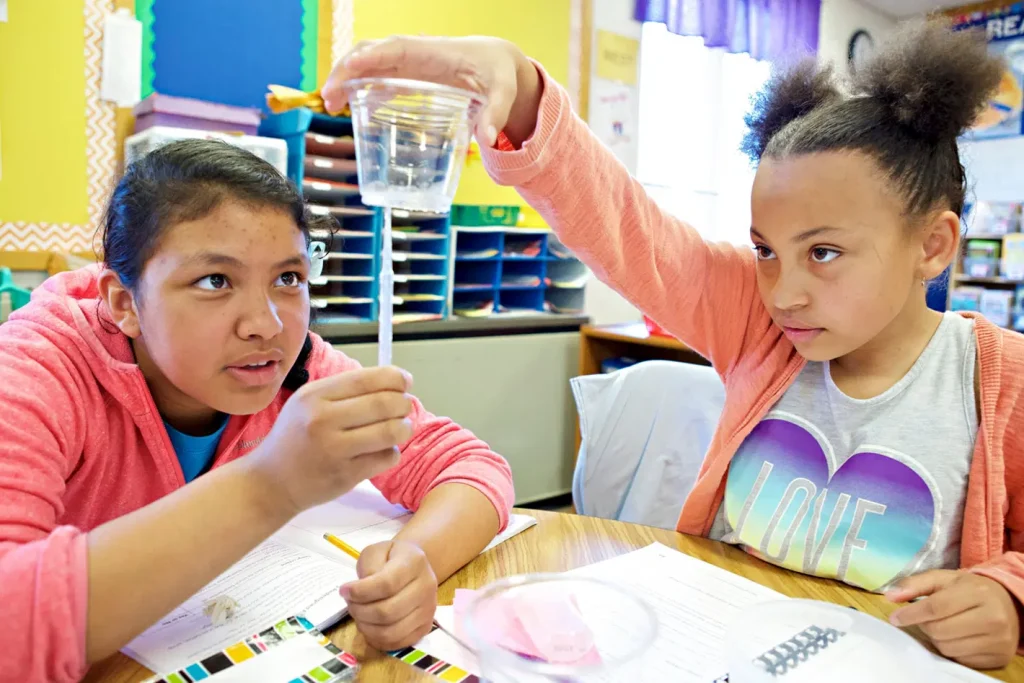
    Access and equity

    We believe we have a responsibility to provide literacy instruction that gives every student the same opportunity to succeed and excel.

    We know that early reading affects achievement throughout school and beyond—well into college and career. Yet most literacy programs continue to fall short of supporting early literacy success. That’s why we’re so proud that CKLA is helping close the reading gap between students within diverse communities.

    A boy with glasses smiles while reading a book, with illustrated objects like a telescope, gourd, and cartoon insect in the background.

    Built on the Science of Reading

    Watching students learn to read: magic. Knowing how they get there: science.

    As you consider your next core ELA program, it’s critically important to understand what the Science of Reading really means and what it tells us about how to teach more effectively. Unlike other programs, Amplify CKLA was built upon these insights and practices, making it easier for teachers to implement this proven approach.

    A girl runs outdoors holding a kite with colorful ribbons labeled knowledge, vocabulary, sentences, connections, gist, sounds, letters, and words.

    Supports Orton-Gillingham and LETRS

    Amplify CKLA aligns with the instructional principles recommended by Orton-Gillingham and LETRS.

    • Structured–Concepts are taught through consistent routines
    • Sequential–Concepts are taught in a logical, well-planned sequence
    • Systematic–Phonemes are taught from simplest to most complex
    • Explicit–Decoding and encoding concepts are taught directly and explicitly
    • Multi-sensory–Instruction is delivered through visual, auditory, and kinesthetic-tactile pathways
    • Cumulative–Concepts are applied in decodable, connected texts with constant review and reinforcement

    A comprehensive and cohesive solution

    A strong literacy program is not just about a reading program or an assessment tool: it brings together curriculum, instruction, regular practice, intervention, and assessments.

    Amplify has brought these components together in our early literacy suite of curriculum, ensure that you have what you need for multi-tiered support.

    Access demo

    Ready to explore on your own? Follow the instructions below to access your demo account.

    Explore the CKLA Teacher Resource Site

    First, watch the quick navigation video to the right. Then, click the “Access CKLA Teacher Resource Site” button to log in.

    • Click the CKLA Teacher Resource Site button
    • Select Log in with Amplify.
    • Enter this username: t.orcklak5@tryamplify.net
    • Enter this password: AmplifyNumber1
    • Select the desired grade level

    Contact us

    Looking to speak directly with your Oregon representative? Get in touch with a team member by emailing hellooregon@amplify.com or by calling us directly.

    Kristen Rockstroh

    Oregon Account Executive

    Districts under 4,500 students

    (480) 639-8367

    krockstroh@amplify.com

    Lynne Kraus

    Oregon Consultant

    (503) 989-3533

    lkraus@amplify.com

    Welcome to Amplify ELA!

    Amplify ELA is the only Oregon-approved ELA curriculum truly built for the needs of middle school teachers and students.

    Not only that, it helps all teachers implement the Oregon English Language Arts and Literacy Standards by delivering an instructional approach based on the Science of Engagement.

    If this is your first stop on your virtual caravan, start with the video presentation below.

    Watched it already? Click here to skip ahead.

    Illustration of a woman's profile with floral hair decorations, a group of diverse children reading, and an astronaut, with text "read the report: edreports review year 2019.

    Virtual Caravan Stop

    After watching the 6–8 video to the right, scroll down to learn even more, download resources, and access a demo.

    What it is

    Amplify ELA is a core program for grades 6–8 that delivers:

    • A unique research-based approach designed to get all students reading grade-level text together.
    • An instructional design that inspires students to read more deeply, write more vividly, and think more critically.
    • A rich combination of dynamic texts, lively discussions, and interactive Quests that truly engages middle schoolers and inspires them to participate in learning.

    How it works

    Amplify ELA lessons follow a structure that is grounded in regular routines, but that is flexible enough to allow for a variety of learning experiences.

    Need an abridged version of the curriculum? Our abridged lesson pathways ensure full coverage of the standards in just 100 days.

    What students explore

    Amplify ELA provides everything you need to deliver a full year’s worth of instruction.

    Each grade level of Amplify ELA consists of six multimedia units. Four or five of the units are focused on complex literary texts and one or two are collections based on primary source documents and research. Each grade also provides two or three immersive learning experiences called Quests, a dedicated story writing unit, and a poetry unit.

    Three educational book covers from amplify ela series, featuring illustrations of an astronaut, diverse children with books, and a poet surrounded by symbolic imagery.

    Built on the Science of Engagement

    Watching students mature into adolescents: inspiring. Knowing how to engage and motivate their changing brains: science.

    The middle school years are marked by a period of tremendous growth and change – physically, emotionally, and socially. Amplify ELA understands and embraces these changes, and delivers instruction specifically designed to tap into adolescents’ natural inclinations toward collaboration, exploration, and autonomy.

    Six levels of differentiation

    We believe all students are capable of reading grade level text together.

    Amplify ELA ensures all students have access to the same text. With six distinct levels of differentiation, every student is supported or challenged in a way that meets their unique needs. This includes ELLs at the Developing, Expanding, and Bridging levels as well as students needing substantial support or an extra challenge.

    Multiple overlapping open documents on a computer screen, featuring text editing interfaces with prompts for feedback and responses.

    Assessment

    Not only does Amplify ELA include captivating content. It also provides clear and actionable measurement data about student performance.

    Our embedded formative and summative assessment tools maximize teaching time, while allowing teachers to make confident, data driven decisions about the instruction and supports students need to grow continually as readers and writers.

    Access demo

    Ready to explore on your own? Follow the instructions below to access your demo account.

    Explore as a teacher

    First, watch the quick teacher navigation video to the right. Then, follow the instructions below to access your demo account.

    • Click the ELA Learning Platform button
    • Select Log in with Amplify
    • Enter this username: t.orela68@tryamplify.net
    • Enter this password: AmplifyNumber1
    • Select the desired grade level

    Explore as a student

    First, watch the quick student navigation video to the right. Then, follow the instructions below to access your demo account.

    • Click the ELA Learning Platform button
    • Select Log in with Amplify
    • Enter this username: s.orela68@tryamplify.net
    • Enter this password: AmplifyNumber1
    • Select the desired grade level

    Contact us

    Looking to speak directly with your Oregon representative? Get in touch with a team member by emailing hellooregon@amplify.com or by calling us directly.

    Kristen Rockstroh

    Oregon Account Executive

    Districts under 4,500 students

    (480) 639-8367

    krockstroh@amplify.com

    Lynne Kraus

    Oregon Consultant

    (503) 989-3533

    lkraus@amplify.com

    Boost Reading for Colorado

    To view this protected page, enter the password below:


    Welcome, Puyallup Review Committees!

    We’re so honored you’re considering Amplify Science to meet the needs of your district.This site is designed to support your committee members in conducting a thorough review of Amplify Science.
     
    Ready to get started? Click your grade level band to continue or scroll down to connect with a team member.

    Two students examining a container and taking notes, a girl looking through a microscope, and a digital display showing plant mortality and pest data.

    Your team

    Looking to speak directly with an Amplify Science representative? Get in touch with a team member to learn more about reviewing and using the program.


    Dan Pier Vice President, West

    Dan Pier

    Vice President, West

    (415) 203-4810

    dpier@amplify.com

    A middle-aged man with short brown hair wearing a light blue button-up shirt smiles at the camera against a plain white background.

    Patrick Momsen

    District Manager

    (541) 207-2148

    pmomsen@amplify.com

    Un hombre calvo con perilla y gafas sonríe levemente, lleva una camisa gris claro y una corbata oscura, sobre un fondo blanco liso.

    Francis Ogata

    Science Specialist

    (916) 521-1467

    fogata@amplify.com