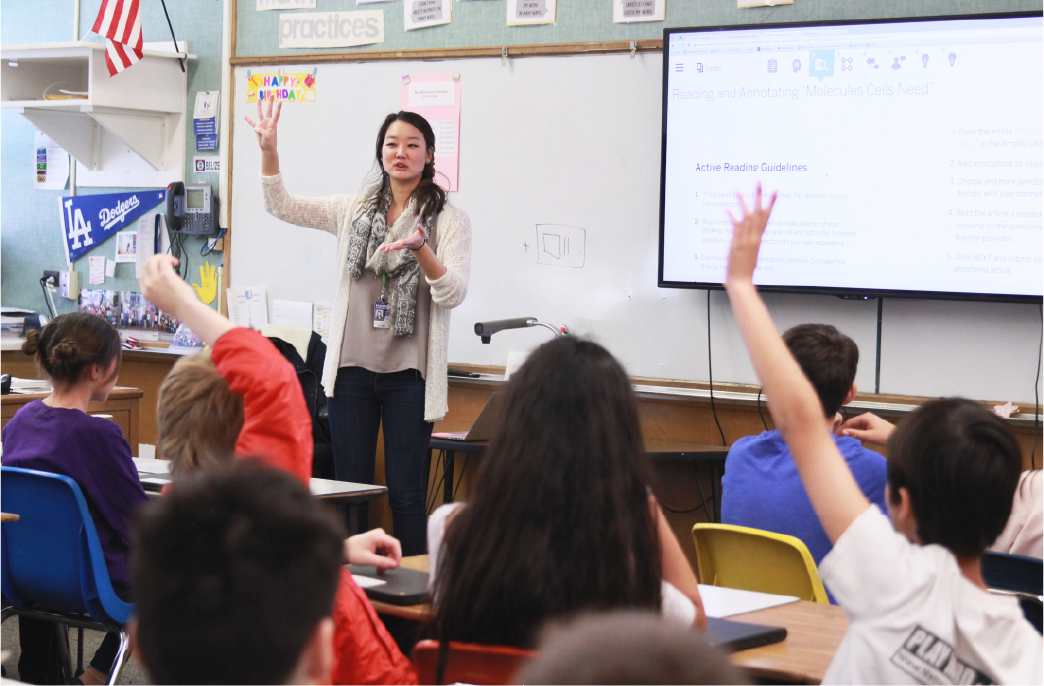
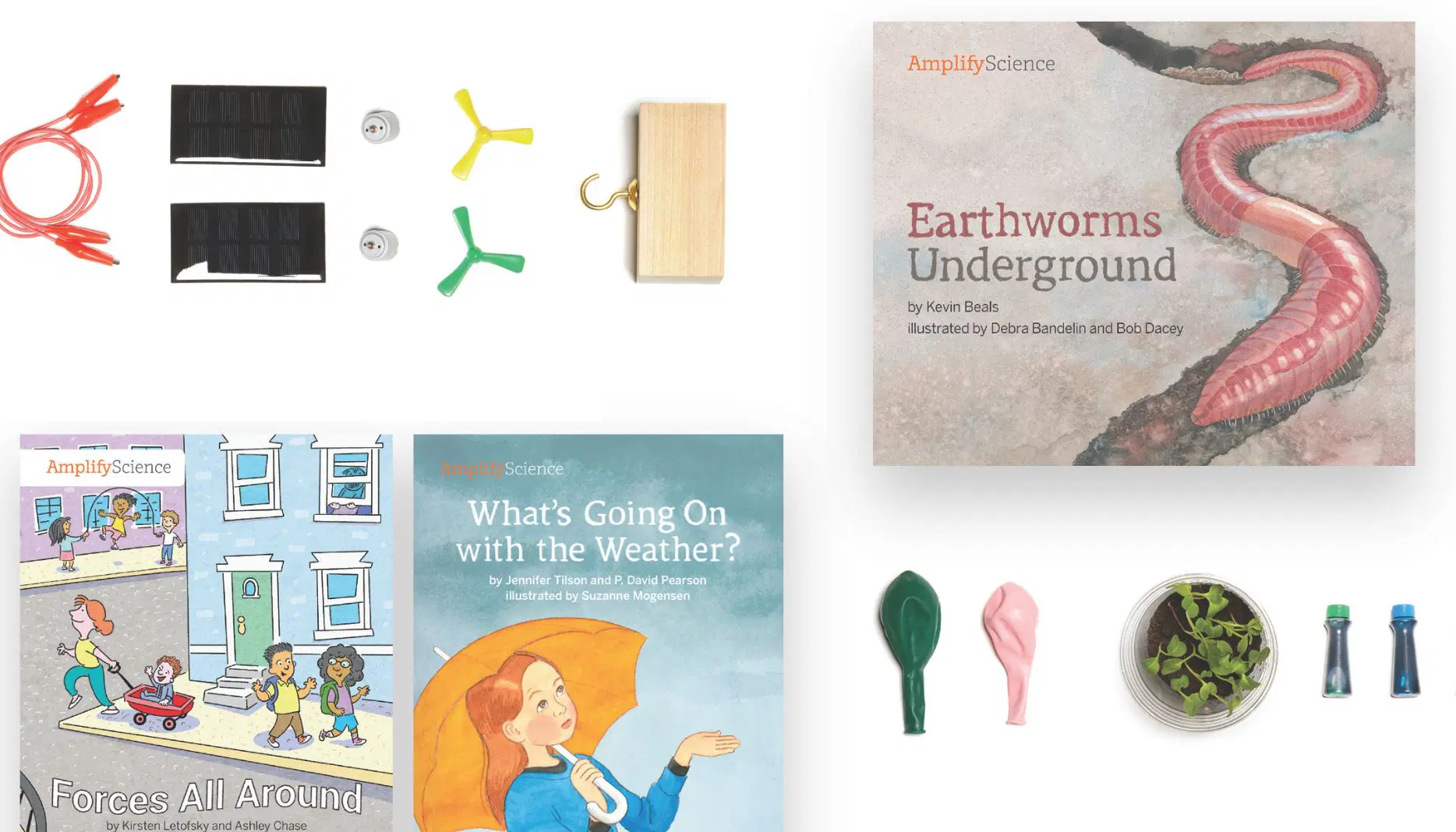
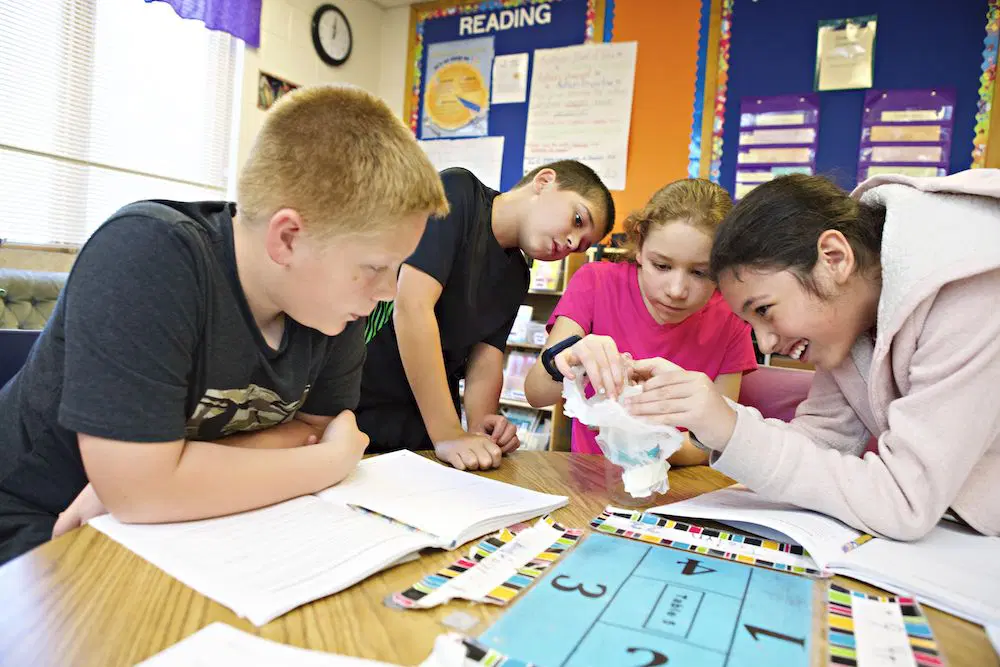
Welcome, Science Review Committees!

We’re so honored you’re considering Amplify Science to meet the needs of your district.This site is designed to support your committee members in conducting a thorough review of Amplify Science.
 
Ready to get started? Click your grade level band to continue or scroll down to connect with a team member.

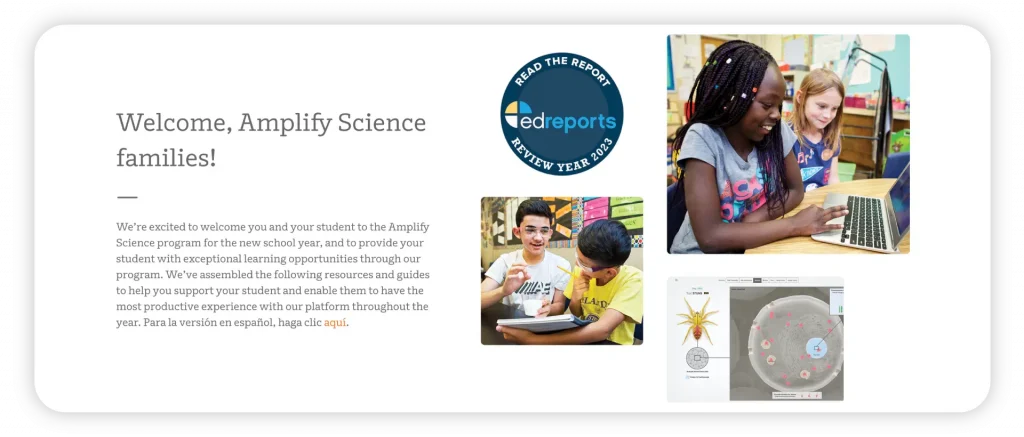
Two students examining a container and taking notes, a girl looking through a microscope, and a digital display showing plant mortality and pest data.

Your team

Looking to speak directly with an Amplify Science representative? Get in touch with a team member to learn more about reviewing and using the program.


A smiling man in a dark blazer and blue shirt, looking directly at the camera against a plain white background.

Dan Pier

Vice President, West

(415) 203-4810

dpier@amplify.com

Smiling man with short hair and a trimmed beard wearing a light blue collared shirt against a plain white background.

Robert “Bob” McCarty

Senior Account Executive

(435) 655-1731

rmccarty@amplify.com

A man with a bald head, glasses, and a goatee smiles slightly. He is wearing a light gray dress shirt and a dark gray tie, posed against a plain white background.

Francis Ogata

Science Specialist

(916) 521-1467

fogata@amplify.com

Welcome, Portland K–5 Science Reviewers!

Thank you for taking the time to review Amplify Science for grades K–5. On this site, you’ll find all the resources you need to learn more about this engaging and robust NGSS program. Plus, we make it easy to experience our program firsthand with a live demo account that features our interactive learning platform.

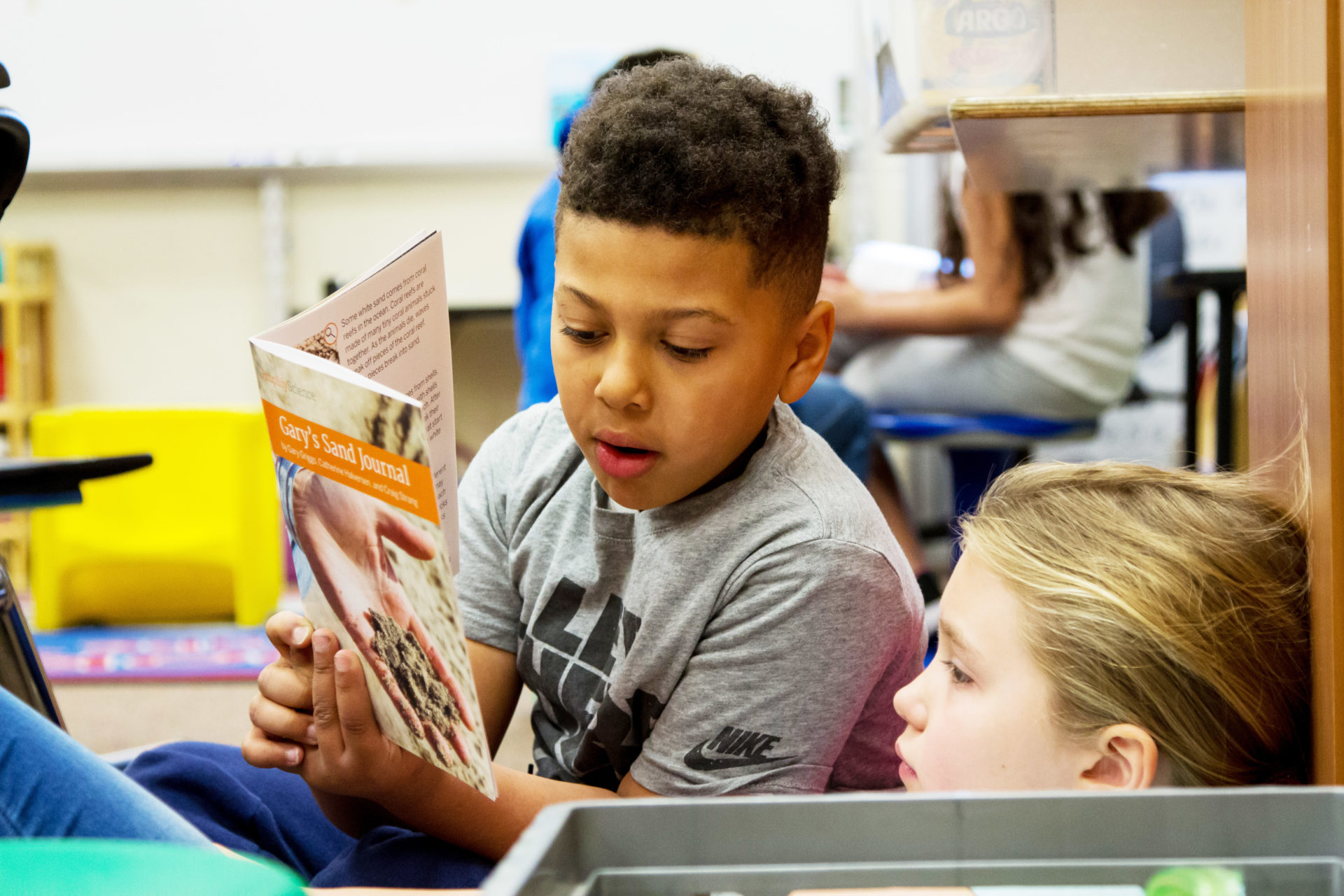
A boy reads a book titled "Gary's Seed Journal," surrounded by illustrated elements like a globe, trees, and clouds. Upper left shows an illustration of a dinosaur skull.

Review Materials

Teacher Reference Guides

It’s important that your committee sees the full breadth and depth of our instruction. For that reason, we provided a copy of each of our unit-specific Teacher Reference Guides. Before you panic, rest assured that teachers do not use these robust reference guides for day-to-day teaching. For that, we have a hands-free TG!

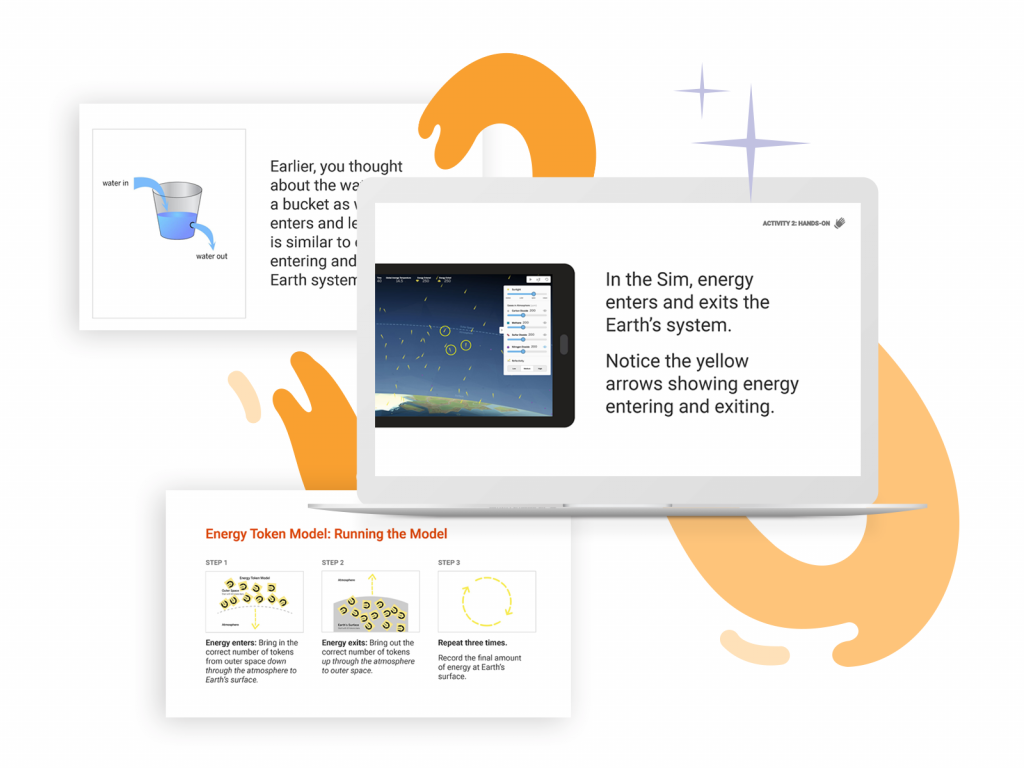
A laptop screen shows an energy simulation, with surrounding text and diagrams explaining the Earth's system and energy flow.
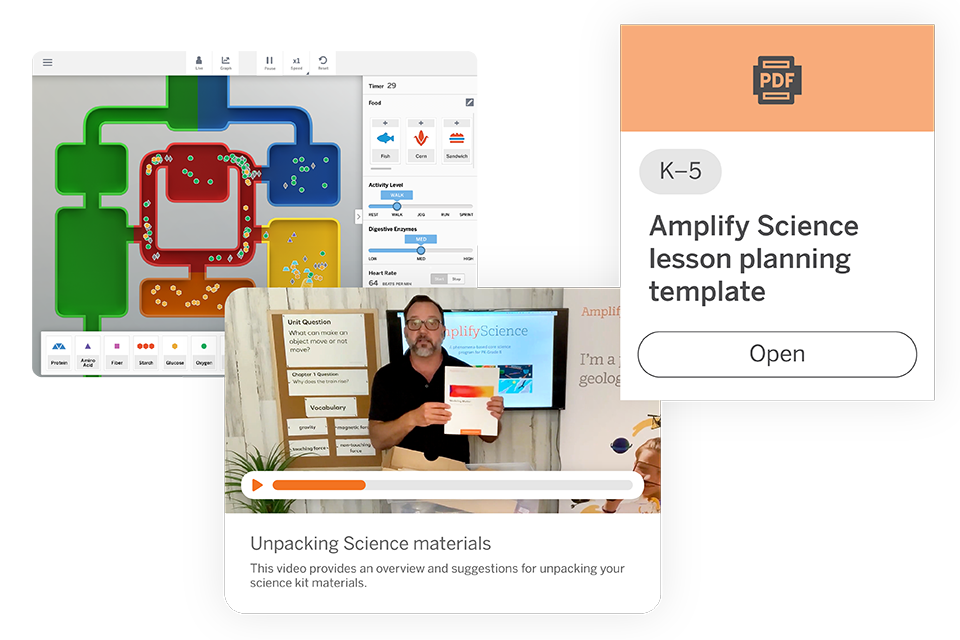
  • Teacher Reference Guide: Unlike a typical TG that requires a series of supplemental books to support it, our encyclopedic reference guide is chock-full of everything a teacher needs to fully implement our program and the NGSS.
  • Ready-to-Teach Lesson Slides: For daily instruction, teachers need their hands free. That’s why we created ready-to-teach lesson slides for every single lesson What’s more, they are editable and include suggested teacher talk and point-of-use differentiation and other instructional tips. Click to learn more.

Hands-on kits

Knowing how important hands-on learning is to your district, we provided your committee every kit included in our K–5 program. While it looks like a lot of materials to manage, our unit-specific kits enable teachers to grab the tub they need and then put it all back with ease. Plus, items needed for multiple units are duplicated and found in each tub.

Amplify Science hands-on kits

Our unit-specific kits:

  • Include more materials — We give you enough non-consumable materials to support a class of 36 students and enough consumables to support 72 student uses. In other words, each kit will last two years.
  • Are more manageable — Unlike other programs that require large groups of students to share limited sets of materials, our kits include enough to support small groups of 4–5 students.
  • Include supportive videos — Each hands-on activity provides clear instructions for the teacher, with more complex activities supported by video demonstrations and illustrations.

Overview

Developed by UC Berkeley’s Lawrence Hall of Science, our program features:

  • phenomena-based approach where students construct a more complex understanding of each unit’s anchor phenomenon.
  • A blend of cohesive storylines, hands-on investigations, rich discussions, literacy-rich activities, and digital tools.
  • Cohesive units, chapters, lessons, and activities designed to deliver true 3-dimensional learning.
  • An instructional design that supports all learners in accessing all standards.

Hands-on investigations

Classroom discussions

Vocabulary

Simulations and digital modeling tools

Program structure

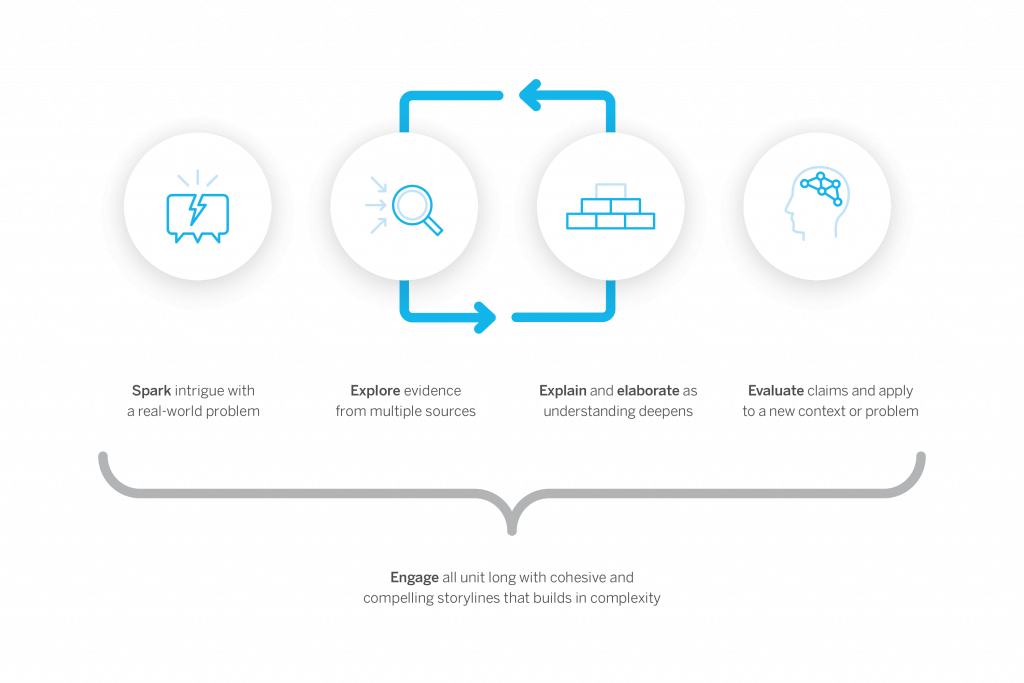
Our cyclical lesson design ensures students receive multiple exposures to concepts through a variety of modalities. As they progress through the lessons within a unit, students build and deepen their understanding, increasing their ability to develop and refine complex explanations of the unit’s phenomenon.

It’s this proven program structure and lesson design that enables Amplify Science to teach less, but achieve more. We designed our program to address 100% of the NGSS in just 66 days for grades K–2 and 88 days for grades 3–5.

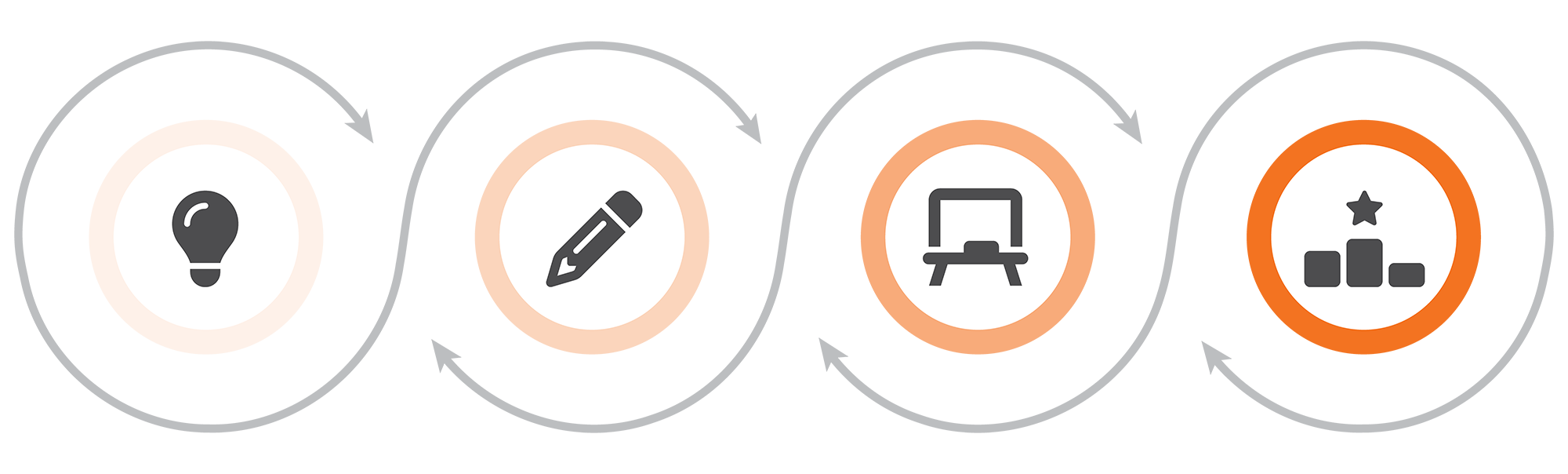
Graphic showing a research process with four steps: spark intrigue with a real-world problem, explore evidence, explain and elaborate, and evaluate claims, connected in a cycle with arrows.

Unit sequence

Our lessons follow a structure that is grounded in regular routines while still being flexible enough to allow for a variety of learning experiences.

In fact, our multi-modal instruction offers more opportunities for students to construct meaning, practice and apply concepts than any other program. What’s more, our modular design means our units can be flexibly arranged to support your instructional goals.

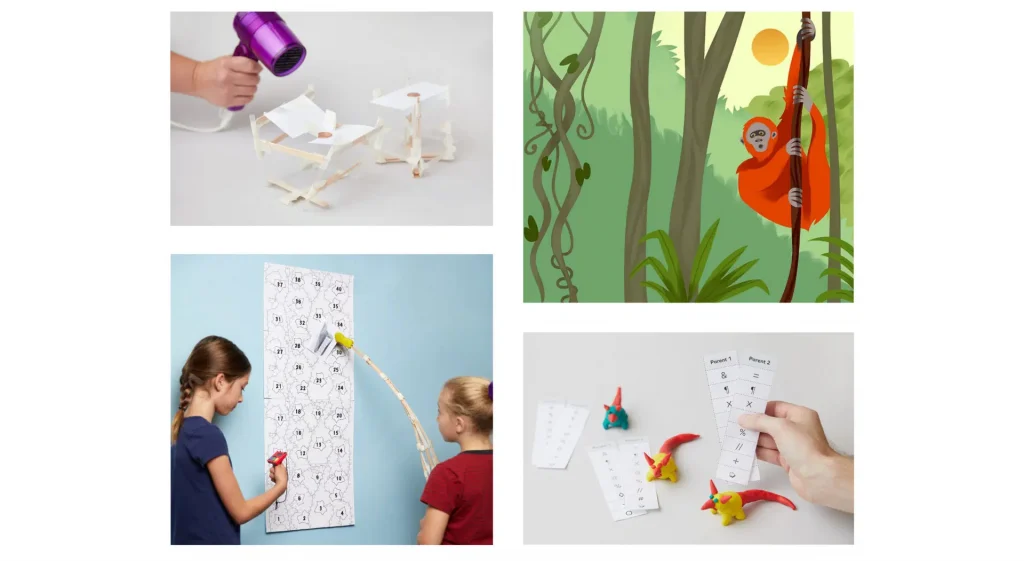
Four images: a hair dryer blowing on a stick structure; an illustration of an orangutan climbing; two children playing a wall-mounted game; and hands with toy dinosaurs sorting paper strips.
An illustration from Needs of Plants and Animals unit
Needs of Plants and Animals

Domains: Life Science, Earth and Space Science, Engineering Design

Unit type: Investigation

Student role: Scientists

Phenomenon: There are no monarch caterpillars in the Mariposa Grove community garden since vegetables were planted.  

An illustration from the Pushes and Pulls unit
Pushes and Pulls

Domains: Physical Science, Engineering Design

Unit type: Engineering design

Student role: Pinball engineers

Phenomenon: Pinball machines allow people to control the direction and strength of forces on a ball.

Silueta de una estructura de parque infantil contra un cielo azul con nubes y tres soles amarillos.
Sunlight and Weather

Domains: Earth and Space Science, Life Science, Engineering Design

Unit type: Modeling

Student role: Weather scientists

Phenomenon: Students at Carver Elementary School are too cold during morning recess, while students at Woodland Elementary School are too hot during afternoon recess.  

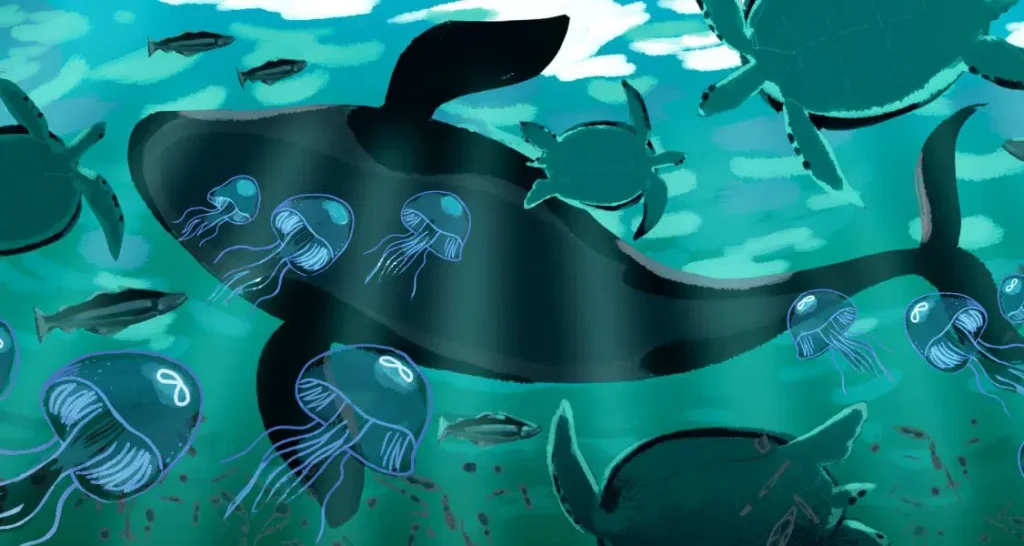
Illustration of sea turtles swimming among seaweed in the ocean, with a large shark in the background.
Animal and Plant Defenses

Domain: Life Science

Unit type: Modeling

Student role: Marine scientists

Phenomenon: Spruce the Sea Turtle lives in an aquarium and will soon be released back into the ocean, where she will survive despite ocean predators.  

An illustration from the Light and Sound unit
Light and Sound

Domains: Physical Science, Engineering Design

Unit type: Engineering design

Student role: Light and sound engineers

Phenomenon: A puppet show company uses light and sound to depict realistic scenes in puppet shows.

An illustration from the Spinning Earth unit
Spinning Earth

Domain: Earth and Space Science

Unit type: Investigation

Student role: Sky scientists

Phenomenon: The sky looks different to Sai and his grandma when they talk on the phone.

An elephant standing next to a tree uses its trunk to pick a fruit from a branch while more fruit hangs above.
Plant and Animal Relationships

Domains: Life Science, Engineering Design

Unit type: Investigation

Student role: Plant scientists

Phenomenon: No new chalta trees are growing in the fictional Bengal Tiger Reserve in India.

A hand holds a red bean on a table, while a wooden stick spreads white glue and scattered beans. Also on the table are a white cup and a yellow pen.
Properties of Materials

Domains: Physical Science, Engineering Design

Unit type: Engineering design

Student role: Glue engineers

Phenomenon: Different glue recipes result in glues that have different properties.

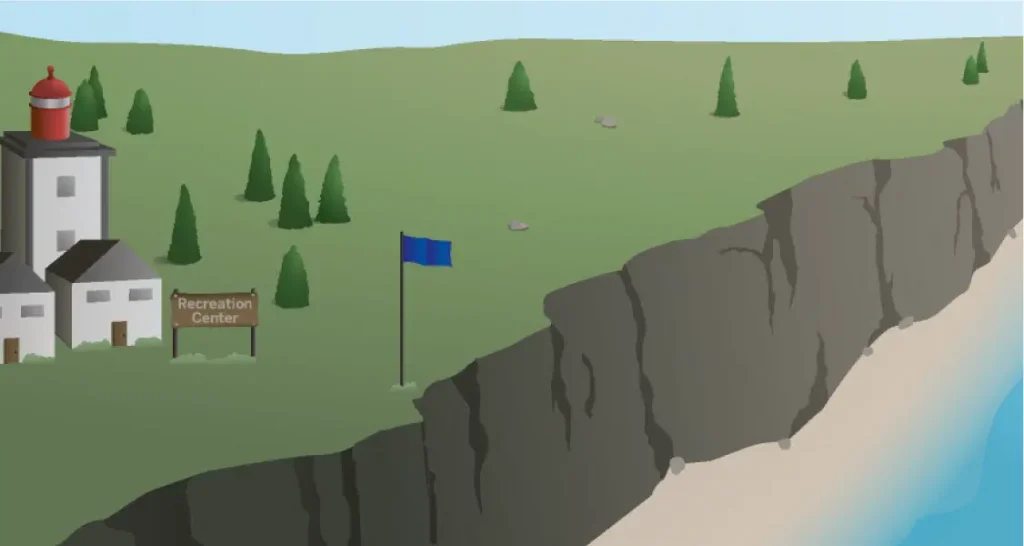
Ilustración de una costa con acantilados, un edificio de centro recreativo con un techo rojo y un letrero, árboles de hoja perenne, una bandera azul y una playa de arena debajo.
Changing Landforms

Domain: Earth and Space Science

Unit type: Modeling

Student role: Geologists

Phenomenon: The cliff that Oceanside Recreation Center is situated on appears to be receding over time.

Una ilustración de un tren de alta velocidad moderno y aerodinámico que viaja por una vía elevada con un paisaje verde de fondo.
Balancing Forces

Domain: Physical Science

Unit type: Modeling

Student role: Engineers

Phenomenon: The town of Faraday is getting a new train that floats above its tracks.  

An illustration from the Inheritance and Traits unit
Inheritance and Traits

Domain: Life Science

Unit type: Investigation

Student role: Wildlife biologists

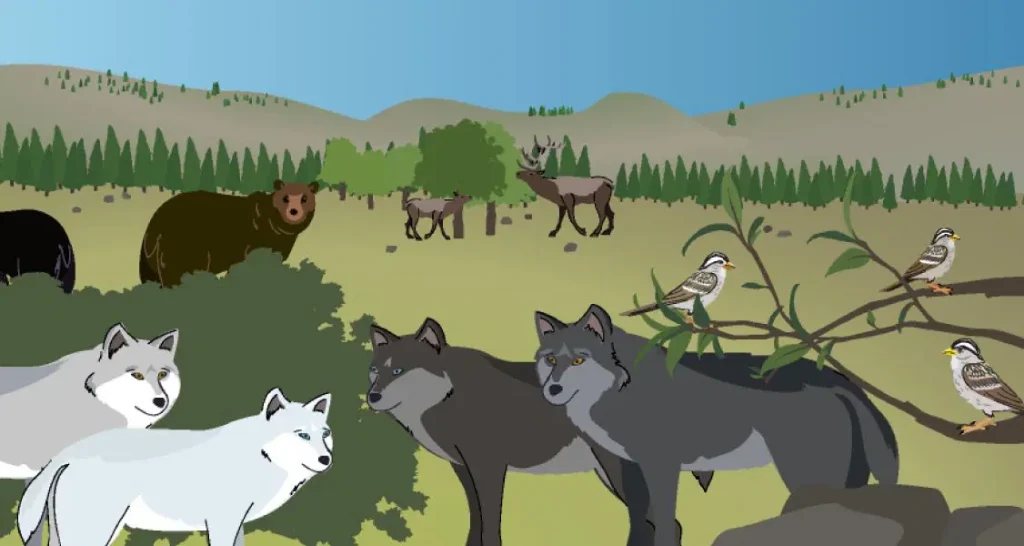
Phenomenon: An adopted wolf in Graystone National Park (“Wolf 44”) has some traits that appear similar to one wolf pack in the park and other traits that appear to be similar to a different wolf pack.

An illustration from the Environments and Survival unit
Environments and Survival

Domains: Life Science, Engineering Design

Unit type: Engineering design

Student role: Biomimicry engineers

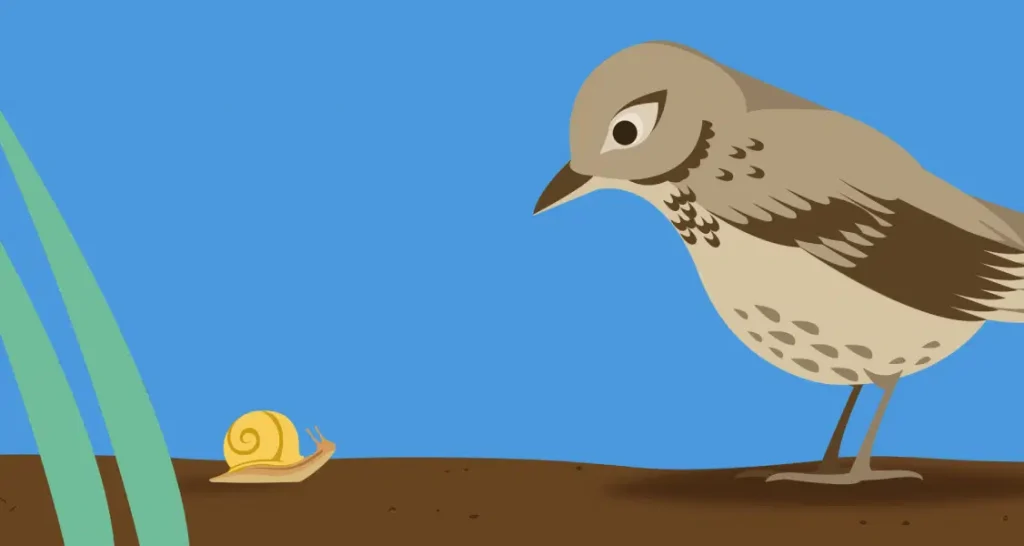
Phenomenon: Over the last 10 years, a population of grove snails has changed: The number of grove snails with yellow shells has decreased, while the number of snails with banded shells has increased.

An illustration from the Weather and Climate unit
Weather and Climate

Domains: Earth and Space Science, Engineering Design

Unit type: Argumentation

Student role: Meteorologists

Phenomenon: Three different islands, each a contender for becoming an Orangutan reserve, experience different weather patterns.

An illustration from the Energy Conversions unit
Energy Conversions

Domains: Physical Science, Earth and Space Science, Engineering Design

Unit type: Engineering design

Student role: System engineers

Phenomenon: The fictional town of Ergstown experiences frequent blackouts.

An illustration from the Vision and Light unit
Vision and Light

Domain: Physical Science, Life Science, Engineering Design

Unit type: Investigation

Student role: Conservation biologists

Phenomenon: The population of Tokay geckos in a rain forest in the Philippines has decreased since the installation of new highway lights.

An illustration from the Earth's Features unit
Earth’s Features

Domain: Earth and Space Science

Unit type: Argumentation

Student role: Geologists

Phenomenon: A mysterious fossil is discovered in a canyon within the fictional Desert Rocks National Park.

An illustration from the Waves, Energy, and Information unit
Waves, Energy, and Information

Domains: Physical Science, Life Science, Earth and Space Science, Engineering Design

Unit type: Modeling

Student role: Marine scientists

Phenomenon: Mother dolphins in the fictional Blue Bay National Park seem to be communicating with their calves when they are separated at a distance underwater.

An illustration from the Patterns of Earth and Sky unit
Patterns of Earth and Sky

Domains: Physical Science, Earth and Space Science

Unit type: Investigation

Student role: Astronomers

Phenomenon: An ancient artifact depicts what we see in the sky at different times — the sun during the daytime and different stars during the nighttime — but it is missing a piece.

An illustration from the Modeling Matter unit
Modeling Matter

Domain: Physical Science

Unit type: Modeling

Student role: Food scientists

Phenomenon: Chromatography is a process for separating mixtures. Some solids dissolve in a salad dressing while others do not. Oil and vinegar appear to separate when mixed in a salad dressing.

An illustration from the Earth System unit
The Earth System

Domains: Earth and Space Science, Physical Science, Engineering Design

Unit type: Engineering Design

Student role: Water resource engineers

Phenomenon: East Ferris, a city on one side of the fictional Ferris Island, is experiencing a water shortage, while West Ferris is not.

An illustration from the Ecosystem Restoration unit
Ecosystem Restoration

Domains:Physical Science, Life Science, Earth and Space Science, Engineering Design

Unit type: Argumentation

Student role: Ecologists

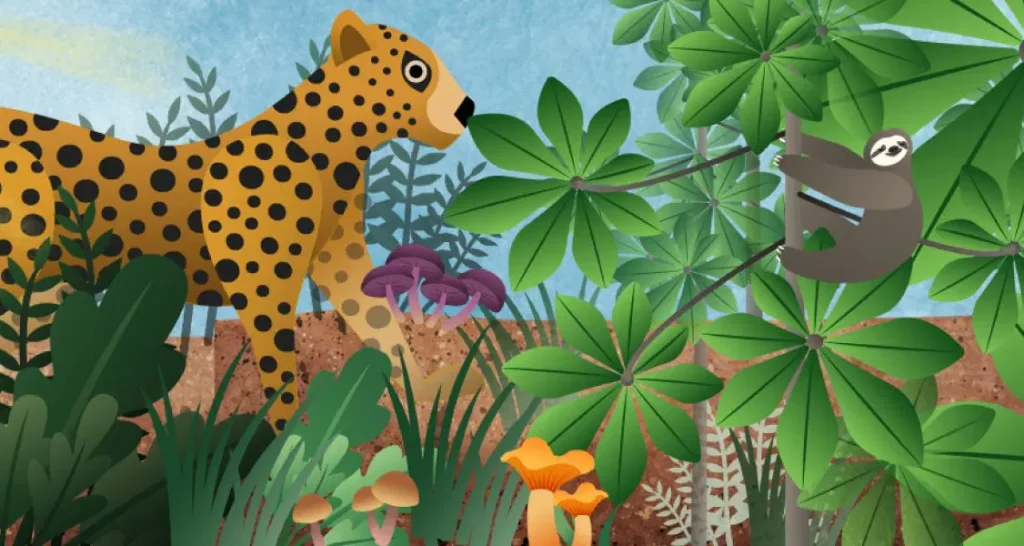
Phenomenon: The jaguars, sloths, and cecropia trees in a reforested section of a Costa Rican rain forest are not growing and thriving.

Access program

Watch the video to the right showing you how to navigate our digital platform. When you’re ready, follow the instructions below to log into our live demo account.

  • Click the orange button below to access the program digitally.
  • Choose the resources you’d like to review.
  • Pick your grade level from the drop-down menu.
  • Scroll down to find additional grade-level resources.

Contact us

A smiling woman with blond hair, wearing a blue top and a light brown jacket, with autumn leaves in the background.

Have questions? Please contact:

Erin Elfving-Strayhan
Senior Account Executive

971-291-9854
estrayhan@amplify.com

Welcome to Grade 8

BACK TO MAIN 6–8 PAGE

Amplify Science California is so effective you can cover 100% of the NGSS in fewer lessons than other programs.
 
Plus, you can breathe a sigh of relief knowing we give you enough materials to support 200 students. In fact, our material kits:

  • Support small groups of 4-5 students.
  • Make organization and finding materials easy.
  • Last longer with only one of the nine kits requiring refills.
Collage of four images: a spaceship in space, hands using a glue gun on crafts, a solar panel connected to bulbs, and an illustration of a person surfing with neon effects.

What students learn

When you’re ready:

  • Find a summary of each unit below including each unit’s student role and anchor phenomenon.
  • Click on the orange “See how the unit works” link to download a helpful Unit Guide. These guides make great companions to busy reviewers looking for a big-picture understanding of how each unit works.
An illustration from the Harnessing Human Energy unit

Unit 1

Harnessing Human Energy

Student role: Energy scientists

Phenomenon: Rescue workers can use their own human kinetic energy to power electrical devices used during rescue missions.

An illustration from the Force and Motion unit

Unit 2

Force and Motion

Student role: Physicists

Phenomenon: The asteroid sample-collecting pod collided with the docking station and failed to dock as planned.

See how this unit works

An illustration from the Force and Motion: Engineering Internship unit

Unit 3

Force and Motion Engineering Internship

Student role: Mechanical engineering interns

Phenomenon: Designing emergency supply delivery pods with different structures can better protect pods and their contents.

An illustration from the Magnetic Fields unit

Unit 4

Magnetic Fields

Student role: Physicists

Phenomenon: During its third magnetic spacecraft launcher test, a model spacecraft far exceeded its target speed.

An illustration from the Light Waves unit

Unit 5

Light Waves

Student role: Spectroscopists

Phenomenon: The rate of skin cancer in Australia is higher than other parts of the world despite getting the same or less sunlight.

See how this unit works

An illustration from the Earth, Moon, and Sun unit

Unit 6

Earth, Moon, and Sun

Student role: Astronomers

Phenomenon: Pictures of specific features on the Moon can only be taken by an astrophotographer at certain times.

See how this unit works

Cartoon image of a yellow dinosaur among green dinosaurs, all with meat and vegetables on their backs, standing in a grassy landscape.

Unit 7

Natural Selection

Student role: Biologists

Phenomenon: The rough-skinned newt population in Oregon State Park has become more poisonous over time.

See how this unit works

An illustration from the Natural Selection: Engineering Internship unit

Unit 8

Natural Selection Engineering Internship

Student role: Clinical engineers

Phenomenon: Designing malaria treatment plans that use different combinations of drugs can reduce drug resistance development.

An illustration from the Evolutionary History unit

Unit 9

Evolutionary History

Student role: Paleontologists

Phenomenon: A mystery fossil at the Natural History Museum has similarities with both wolves and whales.

See how this unit works

How teachers teach

When you’re ready:

  • Scroll down and take a closer look at your classroom resources.
  • Click on the orange links below each component to see grade-specific samples.
Most adopted curriculum for the NGSS California

Classroom Slides

These customizable PowerPoints are available for every lesson of the program and make delivering instruction a snap with visual prompts, colorful activity instructions, investigation set-up videos and animations, and suggested teacher talk in the notes section of each slide.

Video introduction to Classroom Slides

Sample Classroom Slides

An educational website open on a laptop displaying a lesson about “ force and motion: docking failure in space” alongside a teacher’s guide notebook.

Teacher’s Reference Guide

Available digitally and in print, our unit-specific reference guides are chock full of helpful resources, including scientific background knowledge, planning information and resources, color-coded 3-D Statements, detailed lesson plans, tips for delivering instruction, and differentiation strategies.

Login to platform below to access

Amplify Science California supports 3-D learning with more materials than any other program.

Materials Kits

Our kits include enough non-consumable materials to support 200 student uses. In other words, you have enough materials to support all five periods and small groups of 4-5 students each. Plus, our unit-specific kits mean you just grab the tub you need and then put it all back with ease.

List of investigations by unit

List of materials by unit

A digital simulation from Amplify Science

Simulations and Practice Tools

Our digital Simulations and Practice Tools are powerful resources for exploration, data collection, and student collaboration. They allow students the ability to explore scientific concepts that might otherwise be invisible or impossible to see with the naked eye.

Video overview of digital tools

List of digital tools by unit

Device calendars by unit

Open book displaying a bilingual spread about space docking failures, with illustrations of a spacecraft near the moon on a black background.

Consumable Notebooks

Available for every unit, our Student Investigation Notebooks contain instructions for activities and space for students to record data and observations, reflect on ideas from texts and investigations, and construct explanations and arguments.

Sample Student Investigation Notebook

Sample Student Investigation Notebook (Spanish)

Illustration on a textbook cover showing various science themes, including an astronaut, wildlife, and cells, titled

Student Edition Hardcover

This durable Student Edition is grade-level specific and contains all of the articles that students refer to throughout the year. Districts may choose to pair these traditional student texts with our digital student experience or new 2-volume consumable notebook set.

Line drawing of a person using a laptop, with headphones and a line illustration of a rocket launching above their head, symbolizing creativity or inspiration in Boost Reading.


Coming Soon

Unlike other publishers, we don’t make you wait until your next adoption to get the latest and greatest from Amplify. We’re always launching new and exciting features. What’s more, we’ll push them out to you even after you adopt us!

See what’s coming for 2020-2021

Navigating the program

  • Click the orange button below to access the platform.
  • Choose the resources you’d like to review.
  • Pick your grade level from the drop-down menu.
  • Scroll down to find additional grade-level resources.

Navigating a Launch Unit

Launch units are the first units taught in each year of the program. The goal of a Launch unit is to introduce students to norms, routines, and practices that will be built on throughout the year.

Navigating an Engineering Internship

Engineering Internship units invite students to design solutions for real-world problems as interns for a fictional company called Futura. In the process, they apply and deepen their learning from Core units.

Navigating a Core Unit

Core units introduce a real-world problem and support students as they figure out the anchoring phenomenon and gain an understanding of the unit’s DCIs, SEPs, and CCCs.

Navigating Classwork and Reporting

Classwork is our new online grading tool that gives you quick and easy access to unreviewed work, student portfolios of work, and automatically generated differentiation groups.

Welcome to Grade 4

BACK TO MAIN TK–5 PAGE

Amplify Science California is so effective you can cover 100% of the NGSS in half the time of other programs.

You can breathe a sigh of relief knowing all you need is:

  • 88 days per year
  • 2-3 lessons per week
  • 45 minutes per lesson
Students engage in various science experiments, including testing conductivity with a lamp, playing with slime, examining objects, and using sand trays.

What students learn

When you’re ready:

  • Find a summary of each unit below including each unit’s student role and anchor phenomenon.
  • Click on the orange “See how the unit works” link to download a helpful Unit Guide. These guides make great companions to busy reviewers looking for a big-picture understanding of how each unit works.
Illustration of a nighttime cityscape with illuminated windows and streetlights, a visible moon, and stars in the sky. A solitary figure stands out in one of the windows.

Unit 1

Energy Conversions


Student role: System engineers


Phenomenon: The fictional town of Ergstown experiences frequent blackouts. Their electrical system seems to be failing.

See how this unit works

A gecko prepares to catch a cricket under a streetlight at night. The yellow arrows illustrate the lamplight hitting the cricket and reflecting in the gecko's eyes.

Unit 2

Vision and Light


Student role: Conservation biologists

Phenomenon: The population of Tokay geckos in a rain forest in the Philippines has decreased since the installation of new highway lights.

See how this unit works

Illustration of a rocky coastline with angular cliffs in reddish tones on the left and a body of blue water below.

Unit 3

Earth’s Features


Student role: Geologists


Phenomenon: A mysterious fossil is discovered in a canyon within the fictional Desert Rocks National Park.

See how this unit works

Two dolphins swim underwater in a blue-tinged environment, facing each other, and one appears to open its mouth slightly.

Unit 4

Waves, Energy, and Information

Student role: Marine scientists


Phenomenon: Mother dolphins in the fictional Blue Bay National Park communicate with their calves despite the distance between them.

See how this unit works

How teachers teach

When you’re ready:

  • Scroll down and take a closer look at your classroom resources.
  • Click on the orange links below each component to see grade-specific samples.
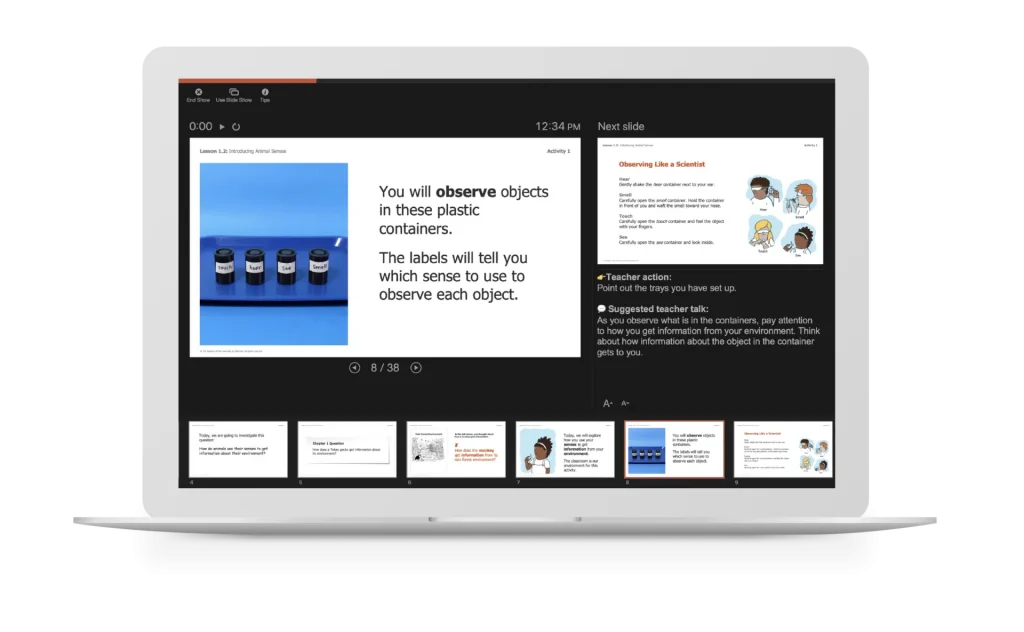
A laptop displays a PowerPoint presentation in presenter view, with slides about observing objects in plastic containers and related sensory instructions.

Classroom Slides

These customizable PowerPoints are available for every lesson of the program and make delivering instruction a snap with visual prompts, colorful activity instructions, investigation set-up videos and animations, and suggested teacher talk in the notes section of each slide.

Video introduction to Classroom Slides

Sample Classroom Slides

Sample Classroom Slides (Spanish)

A computer screen displays an educational website titled "Earth's Features" with chapters and illustrations of canyons; a printed teacher’s guide is shown beside it.

Teacher’s Reference Guide

Available digitally and in print, our unit-specific reference guides are chock full of helpful resources, including scientific background knowledge, planning information and resources, color-coded 3-D Statements, detailed lesson plans, tips for delivering instruction, and differentiation strategies.

Login to platform below to access

A variety of craft materials arranged on a white surface, including cardboard sheets, plastic cups, yarn, binder clips, pink balls, yellow pom-poms, and other assorted supplies.

Materials Kits

Our kits include enough non-consumable materials to support a class of 36 students and enough consumable items to support 72 students. In other words, each kit can last two years! Plus, our unit-specific kits mean you just grab the tub you need and then put it all back with ease.

List of investigations by unit

List of materials by unit

Two book covers titled "¡Apagón!" and "BLACKOUT!" show a dark city street with headlights from a car illuminating the scene at night.

Student Books

Our award-winning Student Books include content-rich nonfiction and informational texts designed to introduce concepts and also deepen understanding. Books are read to, with, and by students with ample scaffolding and support provided by the teacher in whole-class, small-groups, and student pairs.

List of Student Books by unit

Systems

Energy Past and Present

Sunlight and Showers

Blackout!

It’s All Energy

A laptop displays a diagram showing the upper river, floodplain, and river delta with labeled cross-sections above a landscape map of a river flowing to the sea.

Simulations and Practice Tools

Our digital Simulations and Practice Tools are powerful resources for exploration and data collection, and allow students the ability to explore scientific concepts that might otherwise be invisible or impossible to see with the naked eye.

Video overview of digital tools

Device calendars by unit

List of digital tools by unit

Two science workbooks, one in Spanish and one in English, titled "Energy Conversions: Blackout in Ergstown" with white covers and orange labels at the bottom.

Consumable Notebooks

Available for every unit, our Student Investigation Notebooks contain instructions for activities and space for students to record data and observations, reflect on ideas from texts and investigations, and construct explanations and arguments.

Sample Student Investigation Notebook

Sample Student Investigation Notebook (Spanish)

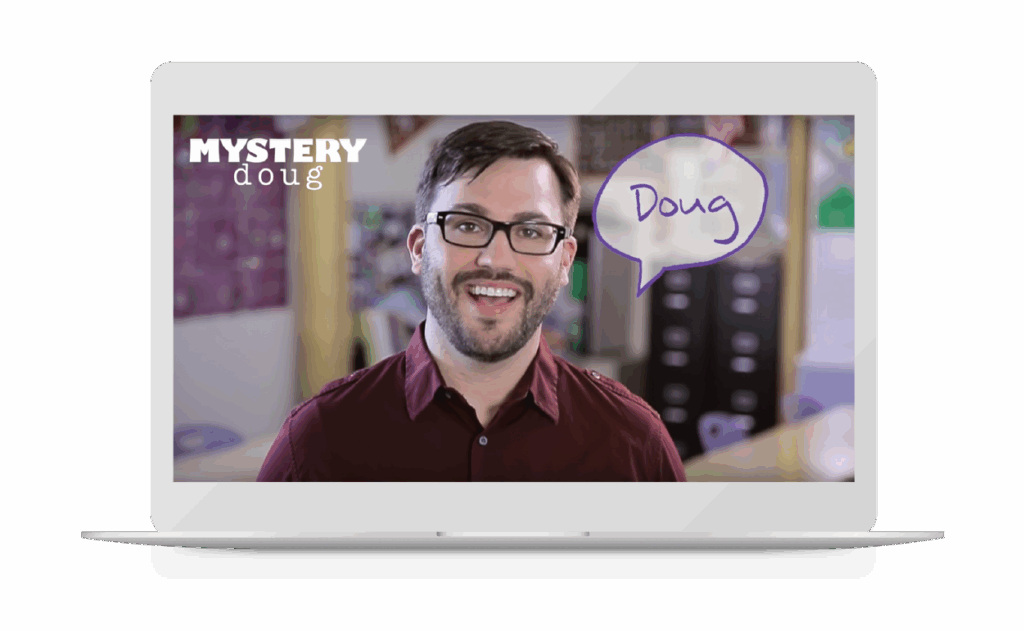
A man wearing glasses and a maroon shirt smiles at the camera on a laptop screen with the words "MYSTERY doug" and a speech bubble saying "Doug.

Mystery Science

Our exclusive partnership with Mystery Science means you get our NGSS core curriculum plus two years of free access to Mystery Doug and his extensive library of captivating videos that deepen students’ understanding of each unit’s phenomenon.

Mystery Science lesson alignment

A person with headphones works on a laptop; a line from their head transforms into a rocket, symbolizing imagination, innovation, and the foundational skills essential for multilingual learners.


Coming Soon

Unlike other publishers, we don’t make you wait until your next adoption to get the latest and greatest from Amplify. We’re always launching new and exciting features. What’s more, we’ll push them out to you even after you adopt us!

See what’s coming for 2020-2021

Welcome to Earth and Space Science

BACK TO MAIN 6–8 PAGE

Amplify Science California is so effective you can cover 100% of the NGSS in fewer lessons than other programs.
 
Plus, you can breathe a sigh of relief knowing we give you enough materials to support 200 students. In fact, our material kits:

  • Support small groups of 4-5 students.
  • Make organization and finding materials easy.
  • Last longer with only one of the nine kits requiring refills.
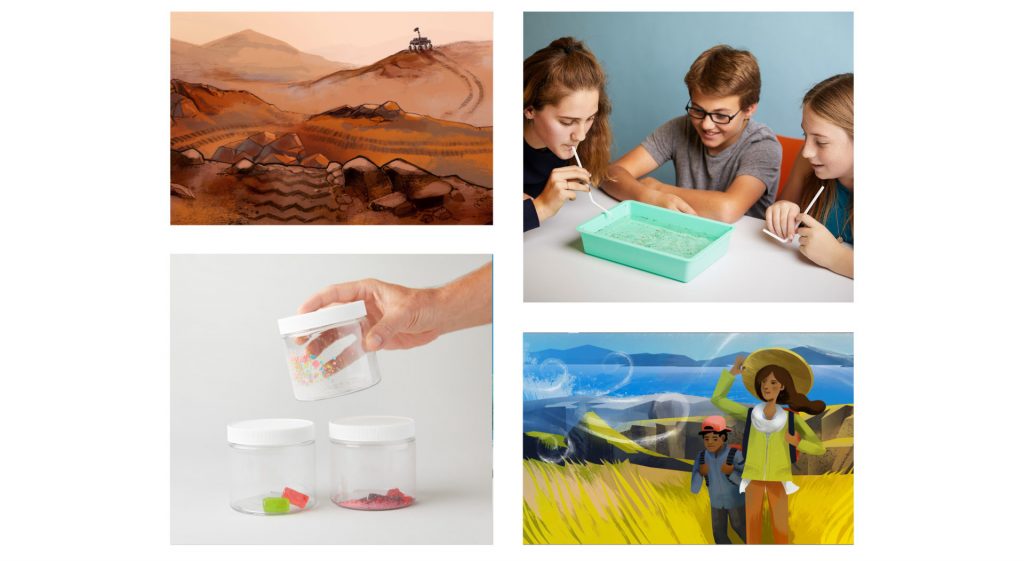
A collage of images: top left, digital art of a desert scene; top right, three kids doing a science experiment; bottom left, a hand holding a jar and two others beside; bottom right, digital art of a person and child in a field.

What students learn

When you’re ready:

  • Find a summary of each unit below including each unit’s student role and anchor phenomenon.
  • Click on the orange “See how the unit works” link to download a helpful Unit Guide. These guides make great companions to busy reviewers looking for a big-picture understanding of how each unit works.
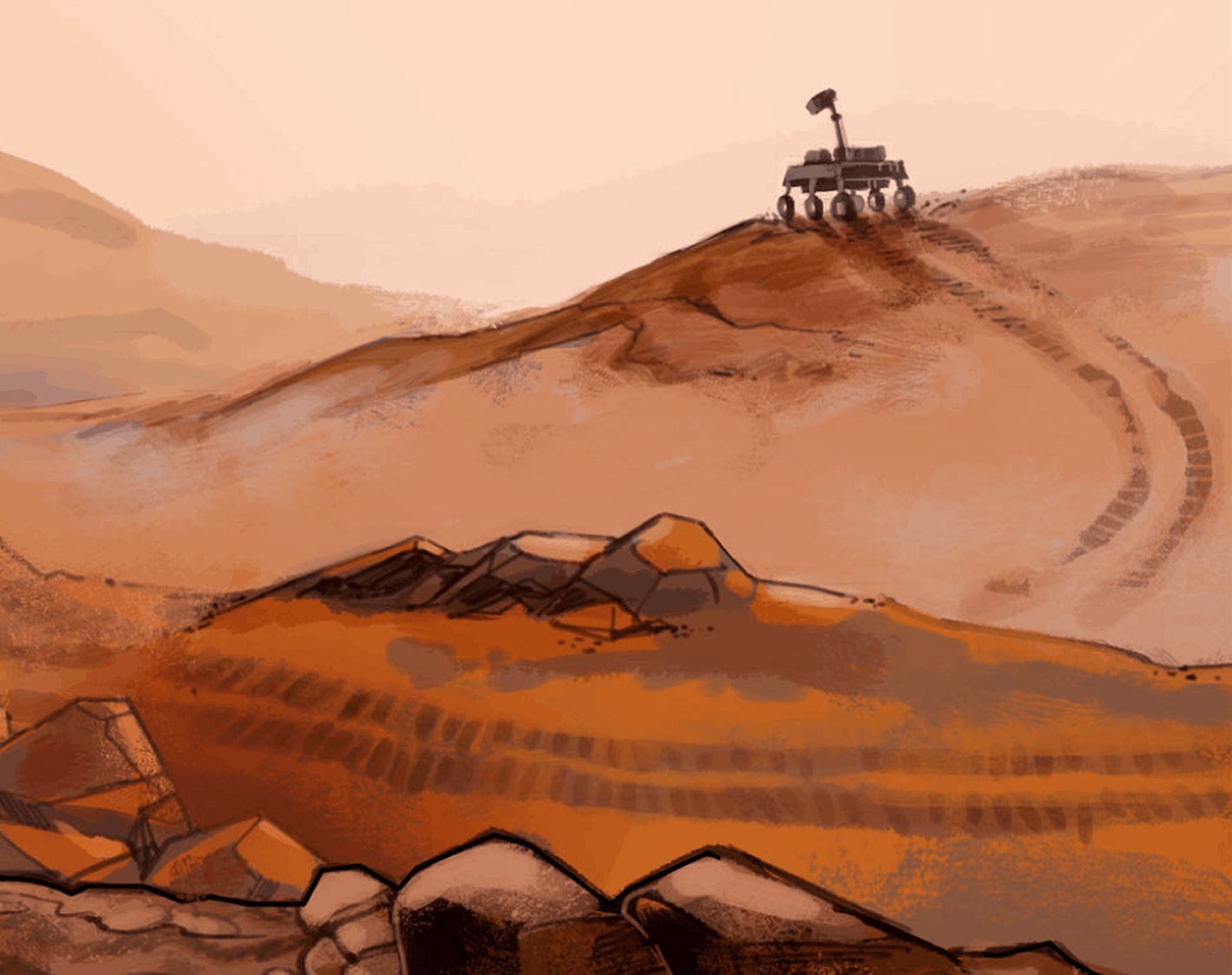
A barren, rocky desert landscape with rover tracks leading to a distant vehicle on a hill under a hazy sky.

Unit 1

Geology on Mars

Student role: Planetary geologists

Phenomenon: Analyzing data about landforms on Mars can provide evidence that Mars may have once been habitable.

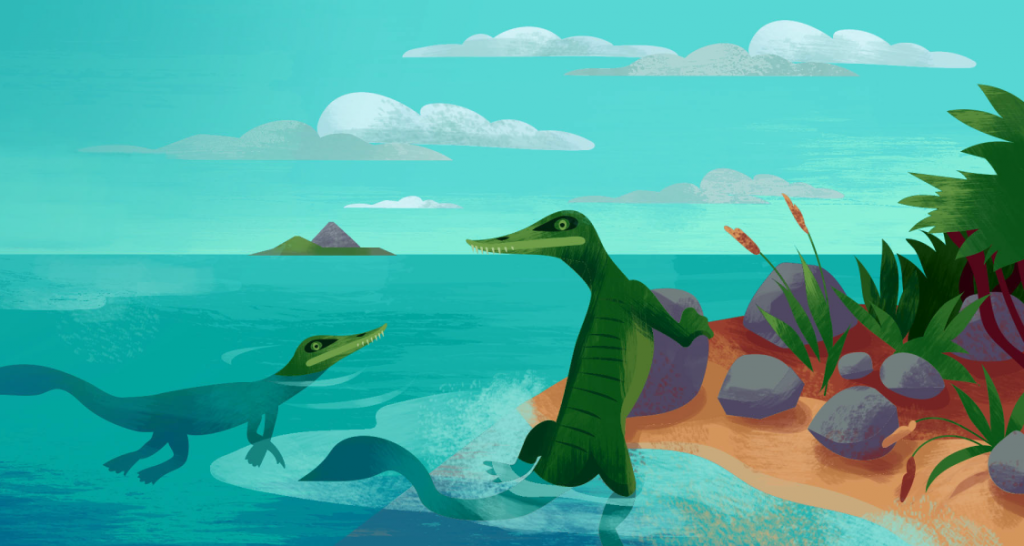
Two prehistoric reptiles with long snouts and tails are near the shore, one on land and one in water, with plants, rocks, and an island in the background.

Unit 2

Plate Motion

Student role: Geologists

Phenomenon: Mesosaurus fossils have been found on continents separated by thousands of kilometers of ocean.

See how this unit works

Geometric design featuring a telescope, mountain, sound waves, and cosmic elements on a purple hexagonal background.

Unit 3

Plate Motion Engineering Internship

Student role: Mechanical engineering interns

Phenomenon: Patterns in earthquake data can be used to design an effective tsunami warning system.

Illustration of a cross-section of Earth showing a volcano near the ocean. Trees, mountains, and clouds are visible above, with subterranean layers below.

Unit 4

Rock Transformations

Student role: Geologists


Phenomenon: Rock samples from different U.S. regions look different, but have similar mineral compositions.

See how this unit works

A city skyline at night with a prominent full moon, stars in the sky, and a bridge silhouette on the left.

Unit 5

Earth, Moon, and Sun

Student role: Astronomers

Phenomenon: Pictures of specific features on the Moon can only be taken by an astrophotographer at certain times.

See how this unit works

Abstract artwork depicting a bright sun with blue and orange swirling patterns next to green hills under a sky with shades of blue, orange, and red.

Unit 6

Ocean, Atmosphere, and Climate

Student role: Climatologists

Phenomenon: During El Niño years, the air temperature in Christchurch, New Zealand is cooler than usual.

Ilustración de un pueblo con casas, campos y montañas bajo un cielo nublado con olas de viento o lluvia.

Unit 7

Weather Patterns

Student role: Forensic meteorologists

Phenomenon: The strong storms in Galetown didn’t just begin. They have become more and more severe over the years.

See how this unit works

Un oso polar se encuentra sobre un pequeño témpano de hielo en el océano con un sol naranja en el cielo y lejanas montañas heladas al fondo.

Unit 8

Earth’s Changing Climate

Student role: Climatologists

Phenomenon: The ice on Earth’s surface is melting.

See how this unit works

Abstract geometric design in shades of blue and purple featuring a hexagon with icons of a building, wrench, molecules, sun, paint can, and screwdriver.

Unit 9

Earth’s Changing Climate Engineering Internship

Student role: Civil engineers

Phenomenon: Designing rooftops with different modifications can reduce a city’s impact on climate change.

How teachers teach

When you’re ready:

  • Scroll down and take a closer look at your classroom resources.
  • Click on the orange links below each component to see grade-specific samples.
A laptop displays a PowerPoint presentation in presenter view, with slides about observing objects in plastic containers and related sensory instructions.
Classroom Slides

These customizable PowerPoints are available for every lesson of the program and make delivering instruction a snap with visual prompts, colorful activity instructions, investigation set-up videos and animations, and suggested teacher talk in the notes section of each slide.

Video introduction to Classroom Slides

A printed teacher’s guide labeled “Plate Motion: Mystery of the Mesosaurus Fossils” is displayed next to a laptop showing the same curriculum’s digital interface.
Teacher’s Reference Guide

Available digitally and in print, our unit-specific reference guides are chock full of helpful resources, including scientific background knowledge, planning information and resources, color-coded 3-D Statements, detailed lesson plans, tips for delivering instruction, and differentiation strategies.

Login to platform below to access

Assorted rocks, plastic jars, stacks of clear plastic cups, wrapped candies, and scattered dice laid out on a white background.
Materials Kits

Our kits include enough non-consumable materials to support 200 student uses. In other words, you have enough materials to support all five periods and small groups of 4-5 students each. Plus, our unit-specific kits mean you just grab the tub you need and then put it all back with ease.

A laptop screen displaying a map with three ecosystem options, each illustrated by different animal icons and accompanied by relevant data lists.
Simulations and Practice Tools

Our digital Simulations and Practice Tools are powerful resources for exploration, data collection, and student collaboration. They allow students the ability to explore scientific concepts that might otherwise be invisible or impossible to see with the naked eye.

Video overview of digital tools

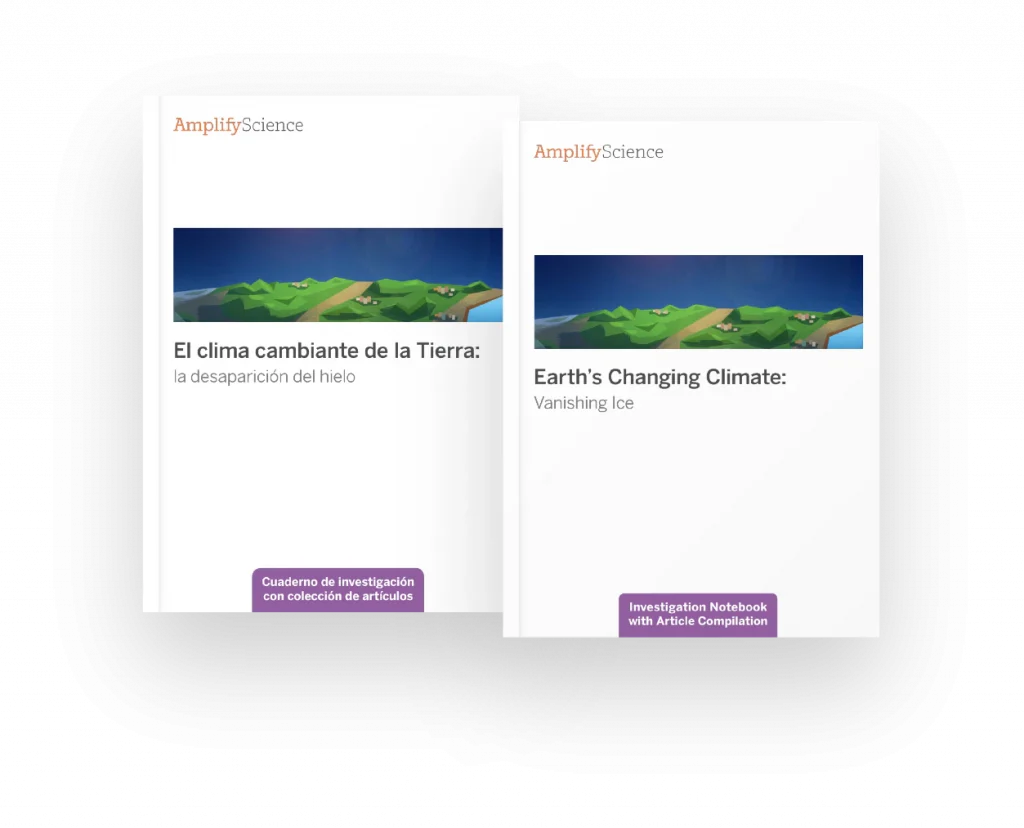
Two booklets titled "El clima cambiante de la Tierra: la desaparición del hielo" and "Earth’s Changing Climate: Vanishing Ice" with landscape illustrations on the covers.
Consumable Notebooks

Available for every unit, our Student Investigation Notebooks contain instructions for activities and space for students to record data and observations, reflect on ideas from texts and investigations, and construct explanations and arguments.

Cover of the "Amplify Science" Grade 8 textbook featuring illustrations of space, insects, technology, crowds, and scientific diagrams.
Student Edition Hardcover

This durable Student Edition is grade-level specific and contains all of the articles that students refer to throughout the year. Districts may choose to pair these traditional student texts with our digital student experience or new 2-volume consumable notebook set.

A person with headphones works on a laptop; a line from their head transforms into a rocket, symbolizing imagination, innovation, and the foundational skills essential for multilingual learners.
Coming Soon

Unlike other publishers, we don’t make you wait until your next adoption to get the latest and greatest from Amplify. We’re always launching new and exciting features. What’s more, we’ll push them out to you even after you adopt us!

See what’s coming for 2020-2021

Navigating the program

  • Click the orange button below to access the platform.
  • Choose the resources you’d like to review.
  • Pick your grade level from the drop-down menu.
  • Scroll down to find additional grade-level resources.

Navigating a Launch Unit

Launch units are the first units taught in each year of the program. The goal of a Launch unit is to introduce students to norms, routines, and practices that will be built on throughout the year.

Navigating an Engineering Internship

Engineering Internship units invite students to design solutions for real-world problems as interns for a fictional company called Futura. In the process, they apply and deepen their learning from Core units.

Navigating a Core Unit

Core units introduce a real-world problem and support students as they figure out the anchoring phenomenon and gain an understanding of the unit’s DCIs, SEPs, and CCCs.

Navigating Classwork and Reporting

Classwork is our new online grading tool that gives you quick and easy access to unreviewed work, student portfolios of work, and automatically generated differentiation groups.

Welcome, Tennessee educators!

Amplify Core Knowledge Language Arts (CKLA) is the Tennessee program built on the Science of Reading research. Using a fundamentally different approach to language arts, CKLA sequences deep content knowledge with research-based foundational skills.

Children attentively watch something; one child wears a blue shirt and others are visible in the background. Illustrations include reading, a city with a bridge, and a figure resembling Poseidon.

High quality instructional materials

Amplify Core Knowledge Language Arts (CKLA) has been approved by the state of Tennessee.

Outline map of tennessee with the state name superimposed in a simple font.

All-green on EdReports

EdReports, an independent curriculum review nonprofit, rates curriculum on three gateways: Text Quality, Building Knowledge, and Usability. Amplify CKLA earned a green rating in all three.

Read the review on EdReports.

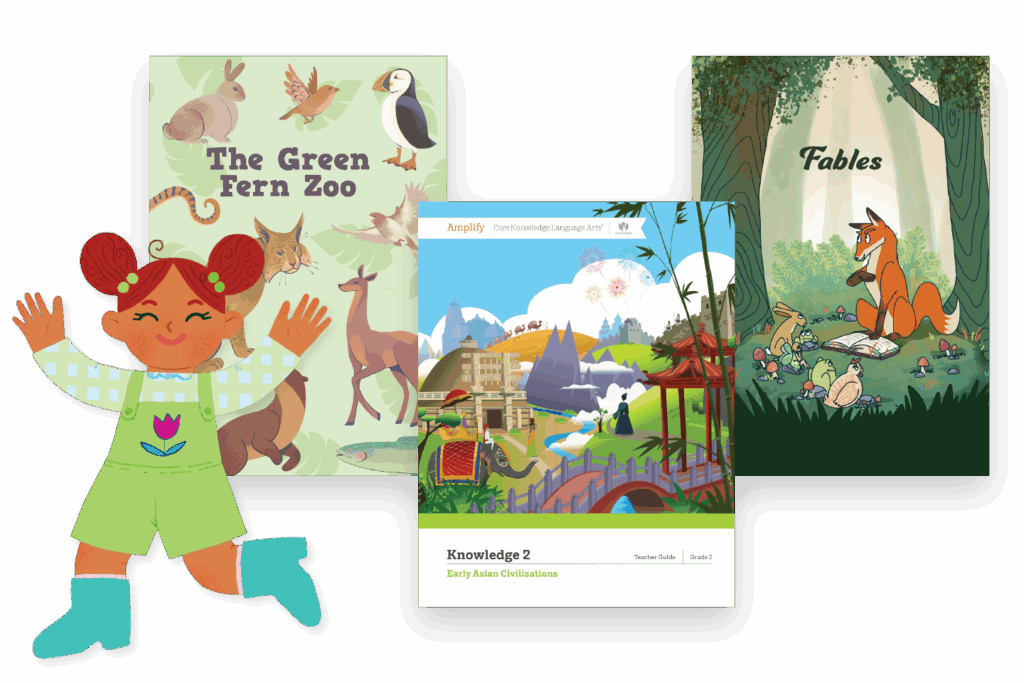
Illustration of a child dressed as a superhero surrounded by three colorful children's books titled "the green fern zoo," "CKLA fables," and an educational game interface.

Science of Reading

Tennessee has an initiative to get 75 percent of the state’s third graders proficient by 2025. This Science of Reading toolkit will provide some insight into the research behind the Science of Reading and tools to help you support your students as they become proficient readers.

Program overview

Amplify CKLA inspires curiosity and drives results, empowering all students with rich background knowledge. See what schools are saying about our knowledge-based curriculum.

Background Knowledge drives results for Tennessee students

Our approach to building background knowledge is based on three pillars often overlooked in other curricula. It is:

  • Content-specific.
    Clearly-outlined content objectives are specific and support the development of knowledge in history, science, literature, culture, and the arts.
  • Cumulative.
    Topics and vocabulary connect within and across grades, allowing students to extend knowledge and revisit topics in increasing depth in later grades.
  • Coherent.
    When curriculum is fragmentary and disconnected, students face repetitions as well as gaps that can hinder learning. An intentional
    design ensures the curriculum fits together as a whole.

Foundational skills instruction that makes a difference

Amplify CKLA’s second design principle is a research-based approach to foundational skills that gets real results.

  • Explicit.
    Learning isn’t left to chance. All 44 sounds and their 150 spellings in the English language are taught, practiced, and mastered, with ample opportunity to encounter each sound-spelling in diverse settings.
  • Sequential.
    By moving in a sequence from easier to more complex in phonics and foundational reading skills, students master concepts before moving forward and gradually become more independent
  • Rewarding.
    Learning to read should be fun. Decodabe chapter-books that feature dynamic plots and characters make kids want to read more. Engaging stories include children who discover fossils and a grandmother who flies hang gliders.
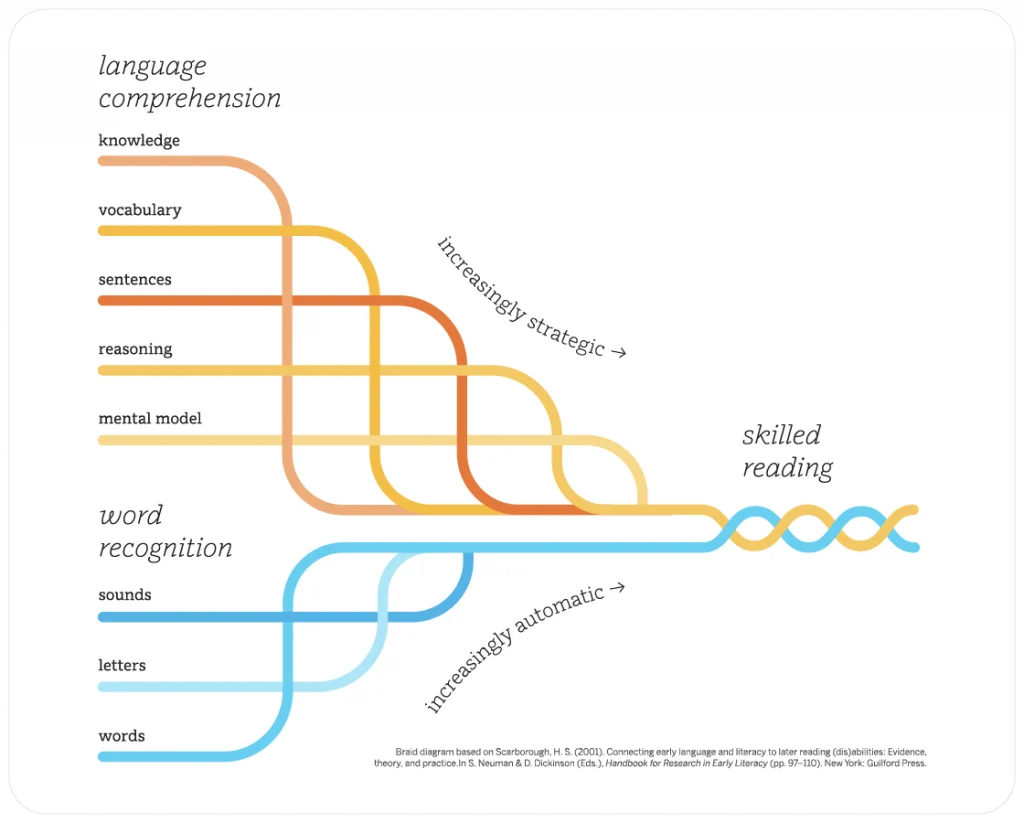
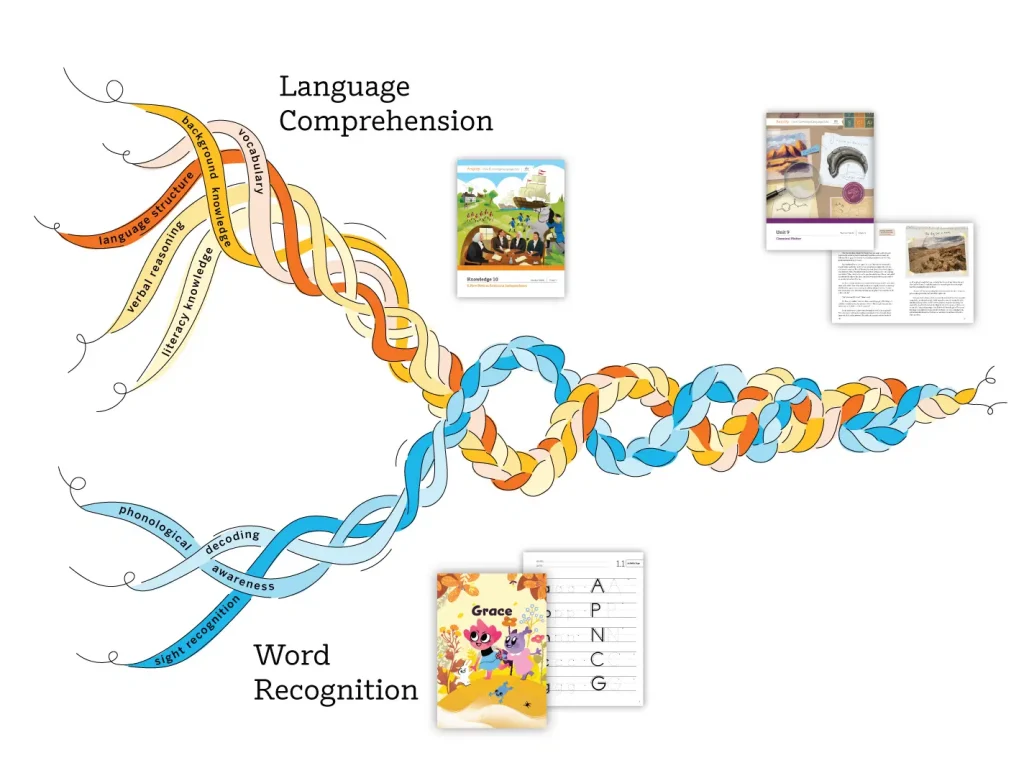
Illustration of two strands: one for language comprehension with components like knowledge and vocabulary, and another for word recognition with elements like sounds and letters, intertwining.

Materials

The program provides engaging print and multimedia materials designed to provide a robust literacy-rich foundation in every classroom.

Teacher Materials

Research-based lessons integrate foundational literacy skills and cross-curricular content knowledge.

  • Teacher Guides
  • Projectable lesson components
  • Quests for the Core for Grades 3–5 (immersive, problem-based learning)
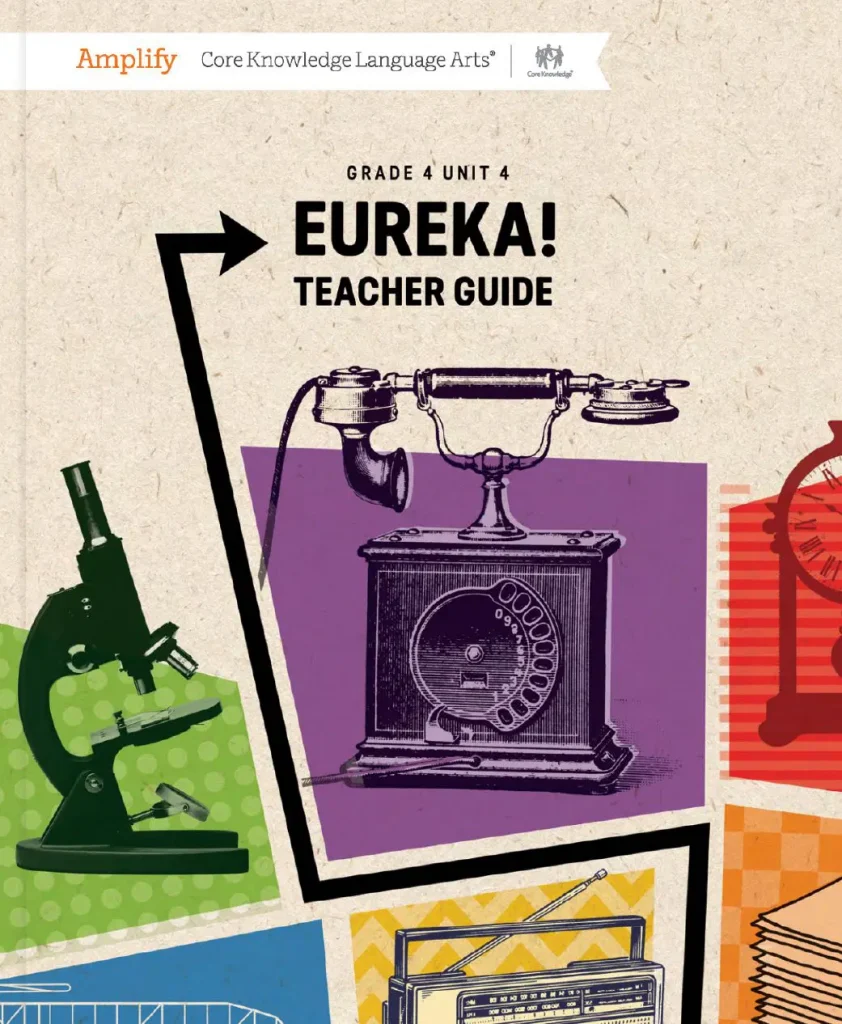
Grade 6 Unit 4 Eureka! Teacher Guide
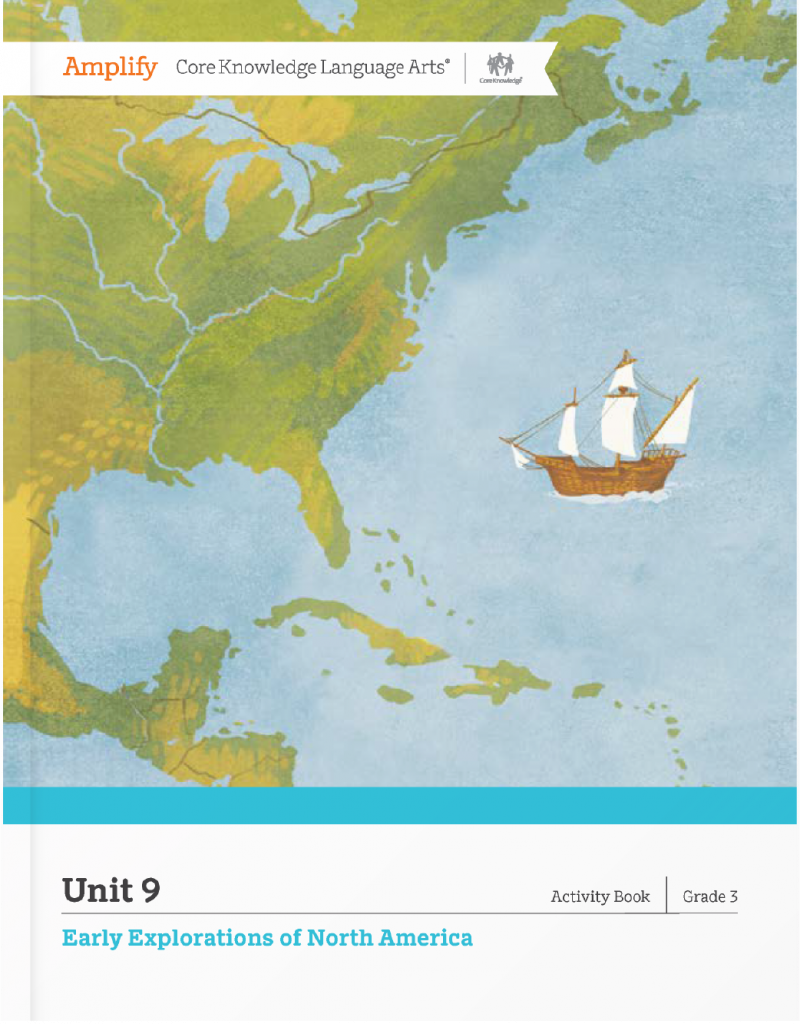
Cover of a Grade 3 activity book titled "Unit 9: Early Explorations of North America" featuring a map and a sailing ship.

Student materials

Engaging student resources include dynamic decodable chapter books and content-rich, cross-curricular Readers.

  • Student Readers
  • Activity Books
  • Formative Assessments
  • Poet’s Journal and Writer’s Journal (write-in Readers for Grades 4–5)

Multimedia resources

Access the program’s online resources anywhere, anytime, from any device.

  • Teacher and student materials
  • Knowledge Builder animated videos
  • Sound Library songs and videos
  • Differentiation and enrichment guides
  • Real-time program support via email, live chat, and phone
  • Professional learning videos, webinars, and self-driven modules
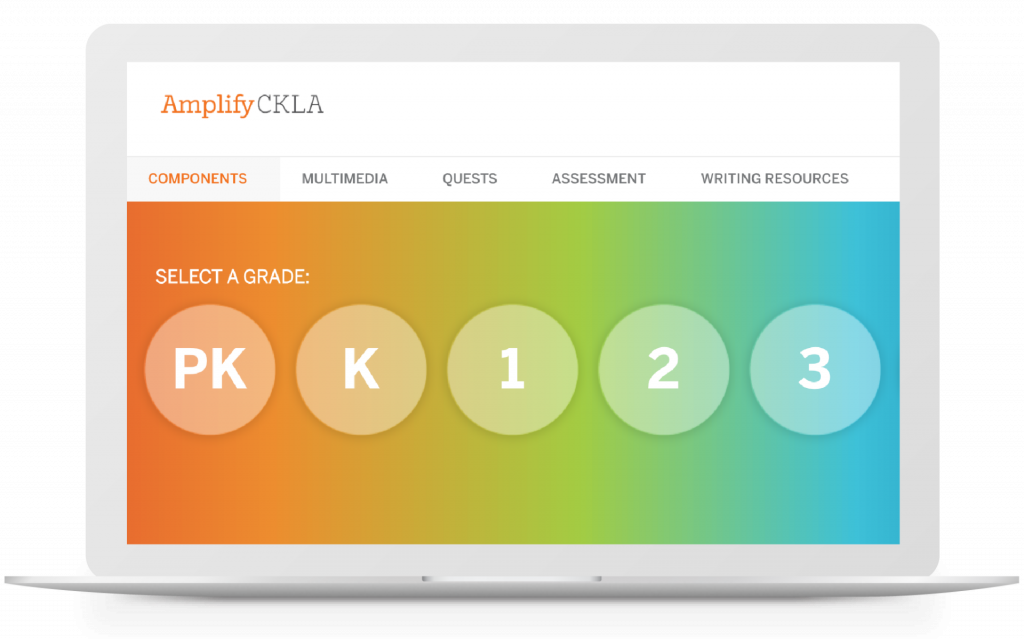
A laptop screen displays the Amplify CKLA website with options to select grades Pre-K to 3.
Illustration of educational items including a notebook, pencil, basketball, trophy, school bus, magnifying glass, graduation cap, light bulb, ribbon, globe, pencils, and laptop.

Hands-on phonics materials

Multisensory phonics and foundational skills resources give students the opportunity to practice key skills using diverse, fun approaches that build independence.

  • Big Books
  • Large and Small Letter Cards
  • Spelling Cards
  • Vowel and Consonant Code Flip Books
  • Chaining Folders
“This has been the single most powerful curriculum implementation I have seen in my 16 years of education. ”

Deanna Zarichansky

Assistant Principal, Trousdale County Elementary School, Hartsville, TN

Amplify CKLA In Action

Take a peek inside a classroom, spotlight experiences on knowledge and foundational skills and hear fellow educators and students discuss the power of Amplify CKLA

Contacts

A smiling woman with shoulder-length blonde hair, wearing an orange blouse and gold earrings, against a light background.

Chasity O’Quinn
Account Executive for East Tennessee
coquinn@amplify.com
(865) 599-5101

Portrait of a smiling woman with short brown hair, wearing glasses, a black blouse, and a pearl necklace against a maroon background.

Ann Patterson
Account Executive for West Tennessee
apatterson@amplify.com
(704) 813-7757

2025 WINNERS

Amplify Science of Reading Star Awards

The Amplify Science of Reading Star Awards honor educators, schools, and districts that have transformed their classrooms and empowered their students with the Science of Reading. These educators and leaders have gone above and beyond implementing Science of Reading principles—they have lit the path for students to pursue lifelong literacy.

Meet our 2025 Star Award winners and learn more about each of their Science of Reading journeys!

Three illustrated award ribbons: a yellow ribbon with a paper icon, an orange ribbon with a science of reading star, and a blue ribbon with a rocket symbol.

Meet the 2025 winners

Personalized Spanish literacy instruction ideal for every classroom

Boost Lectura is a program based on the Science of Reading built to accelerate Spanish literacy for K–2 students. Using captivating storylines and the latest research on how Spanish literacy develops, Boost Lectura engages students in powerful and personalized digital reading instruction, all backed with proven efficacy.

Science of Reading for emergent bilinguals

Grounded in Science of Reading methodology, Boost Lectura acknowledges the nuances of biliteracy and the Spanish language. The instruction design is based on how Spanish literacy develops, staying true to our core Science of Reading principle: Literacy instruction in each language must reflect its unique linguistic elements.

Learn more about our biliteracy principles.

We’re using critical components of biliteracy learning to bring fairness to classrooms.

Learn more

Developed with experts

Boost Lectura’s Spanish literacy curriculum was developed in partnership with Spanish literacy experts and educators from several Spanish-speaking regions who contributed valuable perspectives for the creation of authentic and relevant content.

Our approach

Students learning to read in Spanish deserve authentic, research-based instruction. Boost Lectura accomplishes this and complements Amplify’s comprehensive biliteracy assessment and curriculum programs. When used with Boost Reading, it’s the first personalized learning solution built on the Science of Reading for Spanish and English biliteracy development.

Authentic Spanish literacy instruction

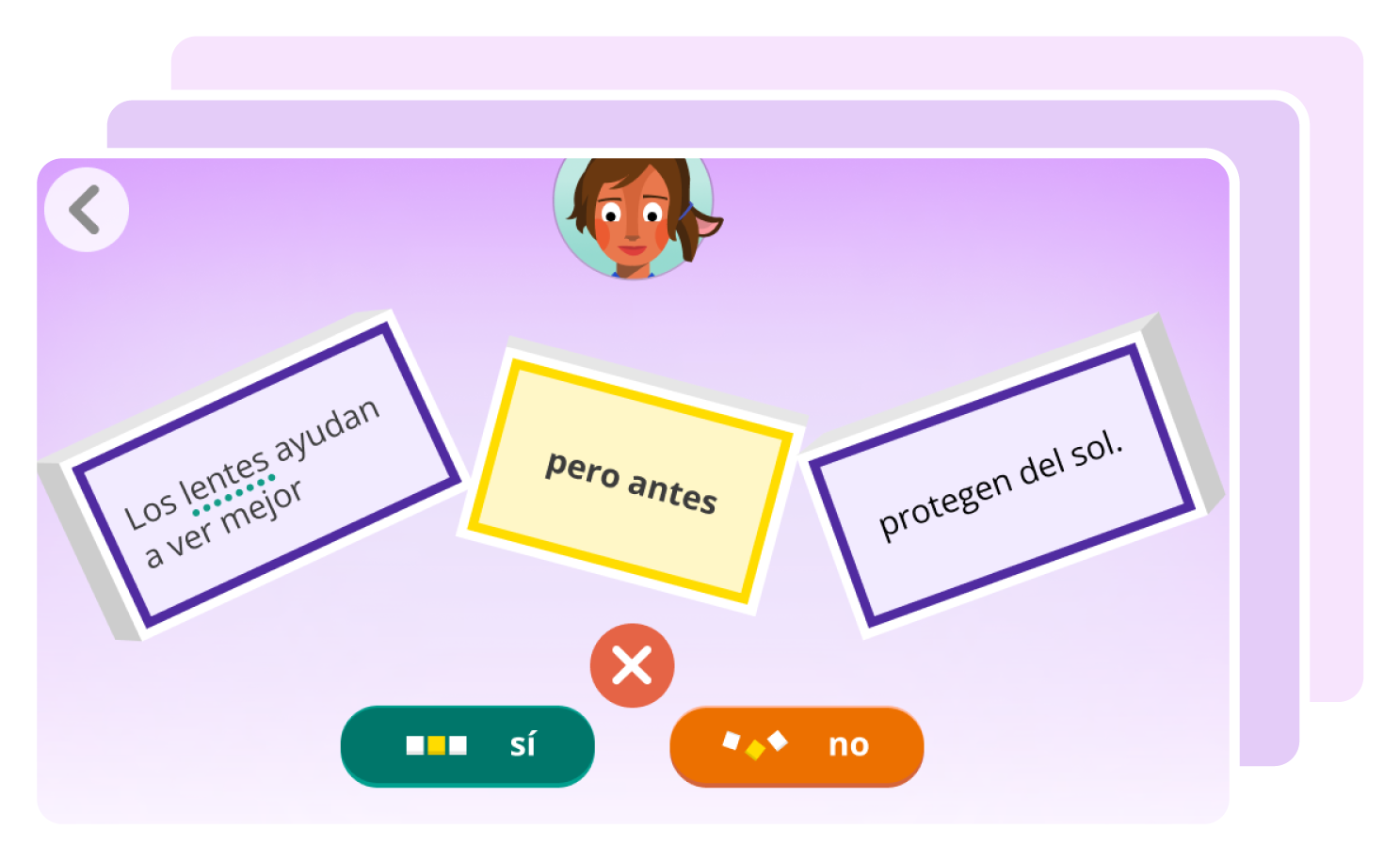
Boost Lectura focuses on the foundational skills that research indicates are not only critical for learning to read in Spanish, such as phonological awareness, letter-sound correspondences, decoding, and comprehension, but that are also transferable from Spanish to English. The program was built with expert guidance and research on how bilingual literacy (particularly Spanish and English biliteracy) develops.

Ideal for any classroom model

Without having to be proficient in Spanish, teachers have access to an evidence-based Spanish literacy scope and sequence with learning content targeted to individual student needs. Boost Lectura can be leveraged in any literacy learning model.

Spanish and English parity

Boost Lectura can be seamlessly paired with Boost Reading. When used together, the two programs build reading proficiency in both English and Spanish for students in grades K–2, as well as provide teachers with data insights on students’ skills progression in each language.

Comprehensive biliteracy suite

Boost Lectura integrates with Amplify’s full suite of biliteracy programs, including Amplify Caminos and mCLASS® Lectura. Through aligned instruction, these tools and materials provide educators with everything they need to screen, instruct, and provide practice in Spanish literacy.

Dive into Boost Lectura

Explore the powerful and engaging world of Spanish literacy learning.

Download now

What’s included

Powerful, rich instruction

Students will engage with targeted activities inside authentic and captivating storylines that honor the culture and experiences of Spanish-speaking communities. This impactful content is thoughtfully designed to grow their decoding skills, vocabulary, and reading comprehension.

Personalized skill coverage

Boost Lectura’s adaptive technology develops students’ individual skills maps to provide the right content at the exact right moment. Students will explore new quests, challenges, and games that simultaneously teach them the foundational literacy skills that will make them more confident Spanish readers.

Actionable data and insights for educators

The program delivers student- and class-level insights to help educators differentiate instruction, monitor growth across the entire classroom, provide targeted support without more testing, and access teacher-led instructional resources.

Side-by-side English and Spanish reports

When Boost Reading and Boost Lectura are used together, the programs provide educators with side-by-side data insights on students’ skills and progression in each language.

Explore more programs based in the Science of Reading.

We’re using critical components of biliteracy learning to bring fairness to classrooms.

California approves Amplify Science for grades K–8

New York, NY – (November 15, 2018) Amplify, a company that creates next-generation curriculum and assessment programs, announced today that its science curriculum has been approved by the California State Board of Education and can now be purchased and implemented in classrooms across the state.   

Developed in partnership with UC Berkeley’s Lawrence Hall of Science, Amplify Science puts students in the roles of scientists and engineers every day, engaging them in understanding and explaining compelling real-world phenomena. Educators who adopt Amplify Science receive a comprehensive curriculum complete with detailed lesson plans, embedded formative assessments, hands-on activities, digital simulations, and robust teacher supports.

Amplify Science was built from the ground up to address California’s Next Generation Science Standards, as well as several California Common Core State Standards for ELA and math. The developers brought together experts in science and literacy education to ensure the program meets the high standards set by the California Framework for Science Education.  

“We are eager to begin talking to science educators across the state about our curriculum, which was created for California teachers and students by experts in California,” said Steven Zavari, senior vice president and general manager, science curriculum, at Amplify. “Our pedagogy invites students to explore phenomena with the purpose of solving authentic problems. We want to create a generation of students who think like scientists and engineers, and who will become the innovators and informed citizens that California needs.”  

Amplify Science is currently in use by more than one million students after launching in spring 2017. In addition to being adopted in California, Amplify Science has also been adopted by the New York City Department of Education, Chicago Public Schools, Denver Public Schools, San Francisco Unified, the KIPP charter network, and hundreds of districts across the country.

For more information about Amplify Science, visit www.amplify.com/programs/amplify-science.

About Amplify

A pioneer in K–12 education since 2000, Amplify is leading the way in next-generation curriculum and assessment. Our captivating core and supplemental programs in ELA, math, and science engage all students in rigorous learning and inspire them to think deeply, creatively, and for themselves. Our formative assessment products turn data into practical instructional support to help all students build a strong foundation in early reading and math. All of our programs provide teachers with powerful tools that help them understand and respond to the needs of every student. Today, Amplify serves four million students in all 50 states. For more information, visit amplify.com.

Contact: media@amplify.com

New Mexico approves Amplify Science for grades K–8

Amplify, a company that creates next-generation curriculum and assessment programs, announced today that its science curriculum has been approved by the New Mexico Public Education Department and can now be purchased and implemented in classrooms across the state.   

Each grade level was evaluated by the Department and required to meet an average 90% score threshold in order to be adopted. Amplify Science exceeded expectations and was the only program to get a 100% on an individual grade level.

Developed in partnership with UC Berkeley’s Lawrence Hall of Science, Amplify Science puts students in the roles of scientists and engineers every day, engaging them in understanding and explaining compelling real-world phenomena. Educators who adopt Amplify Science receive a comprehensive curriculum complete with detailed lesson plans, embedded formative assessments, hands-on activities, digital simulations, and robust teacher supports.

“We are eager to begin talking to educators across New Mexico about our highly-rated program,” said Steven Zavari, senior vice president and general manager, science curriculum, at Amplify. “Our pedagogy invites students to explore phenomena with the purpose of solving authentic problems. We want to create a generation of students who think like scientists and engineers, and who will become the innovators and informed citizens that New Mexico needs.”  

Amplify Science is currently in use by more than one million students after launching in spring 2017. In addition to being adopted in California, Amplify Science has been adopted by the New York City Department of Education, Chicago Public Schools, Denver Public Schools, San Francisco Unified, the KIPP charter network, and hundreds of districts across the country.

For more information about Amplify Science, visit www.amplify.com/programs/amplify-science.

About Amplify

A pioneer in K–12 education since 2000, Amplify is leading the way in next-generation curriculum and assessment. Our captivating core and supplemental programs in ELA, math, and science engage all students in rigorous learning and inspire them to think deeply, creatively, and for themselves. Our formative assessment products turn data into practical instructional support to help all students build a strong foundation in early reading and math. All of our programs provide teachers with powerful tools that help them understand and respond to the needs of every student. Today, Amplify serves four million students in all 50 states. For more information, visit amplify.com.

Contact: media@amplify.com

Independent study finds that Amplify Science has significant positive impact on student learning

BROOKLYN, NY (January 26, 2022) — Amplify, a publisher of next-generation curriculum and assessment programs, announced today that a gold-standard independent study led by the nonprofit research, development, and service agency WestEd, and with funding support by the National Science Foundation, found promising evidence that the Amplify Science middle school curriculum has a significant positive impact on student learning.

WestEd researchers found that:

  • The estimated impact was statistically significant (p < 0.001) and corresponds to an effect size of 0.36. This impact is consistent with the average student using the Amplify Science curriculum moving up 14 percentiles compared to their peers who used other materials.
  • The results were similar across gender and racial groups, and for students with varying levels of math and literacy achievement.
  • More than 80 percent of teachers agreed that they and their students benefited from using Amplify Science curriculum.
  • Almost 90 percent of teachers reported that Amplify Science supported them in engaging students in science discourse.

The randomized controlled study focused on physical science for grade 7 and included 28 teachers and more than 1700 students across three districts that served diverse populations.

Amplify Science is the leading phenomena-based curriculum for grades PreK–8. The program blends hands-on investigations, literacy-rich activities, and interactive digital tools to empower students to think, read, write, and argue like real scientists and engineers. Amplify Science was developed by the science education experts at UC Berkeley’s Lawrence Hall of Science and the digital learning team at Amplify. As the Lawrence’s first curriculum designed to address three-dimensional science standards, Amplify Science reflects state-of-the-art practices in science teaching and learning. Each unit of Amplify Science engages students in a relevant, real-world problem where they investigate scientific phenomena, engage in collaboration and discussion, and develop models or explanations in order to arrive at solutions.

“Amplify Science delivers on our promise to improve student learning outcomes and set students up for success,” said Steven Zavari, senior vice president and general manager of STEM curriculum at Amplify. “With studies like this one, districts can look at real impacts on educators and students when selecting curriculum for core subjects.”

WestEd, a nonpartisan, nonprofit research, development, and service agency, works with education and other communities throughout the United States and abroad to promote excellence, achieve equity, and improve learning for children, youth, and adults.

“As more science programs are designed for the new science standards, it is increasingly important to have evidence of the impact on teaching and learning,” said Christopher Harris, senior director of science and engineering education research at WestEd. “The results are promising and show the potential effect that high-quality NGSS-designed programs can have in middle school classrooms.”

About Amplify
A pioneer in K–12 education since 2000, Amplify is leading the way in next-generation curriculum and assessment. Our core and supplemental programs in ELA, math, and science engage all students in rigorous learning and inspire them to think deeply, creatively, and for themselves. Our formative assessment products turn data into practical instructional support to help all students build a strong foundation in early reading and math. All of our programs provide teachers with powerful tools that help them understand and respond to the needs of every student. Today, Amplify serves ten million students in all 50 states. For more information, visit amplify.com.

Blog Archive

Explore our library of posts on teaching and learning topics in STEM and literacy.

A digital reading intervention that delivers growth across every tier of instruction

Boost Reading is a student-led K–5 digital intervention, built on the Science of Reading, that delivers systematic instruction. Students receive targeted, adaptive practice that meets them where they are, while teachers get simple and meaningful insights into student progress without extra work. Fully aligned to Amplify CKLA and mCLASS®, Boost Reading brings powerful support to every tier of instruction. Para la versión en español, haga clic aquí.

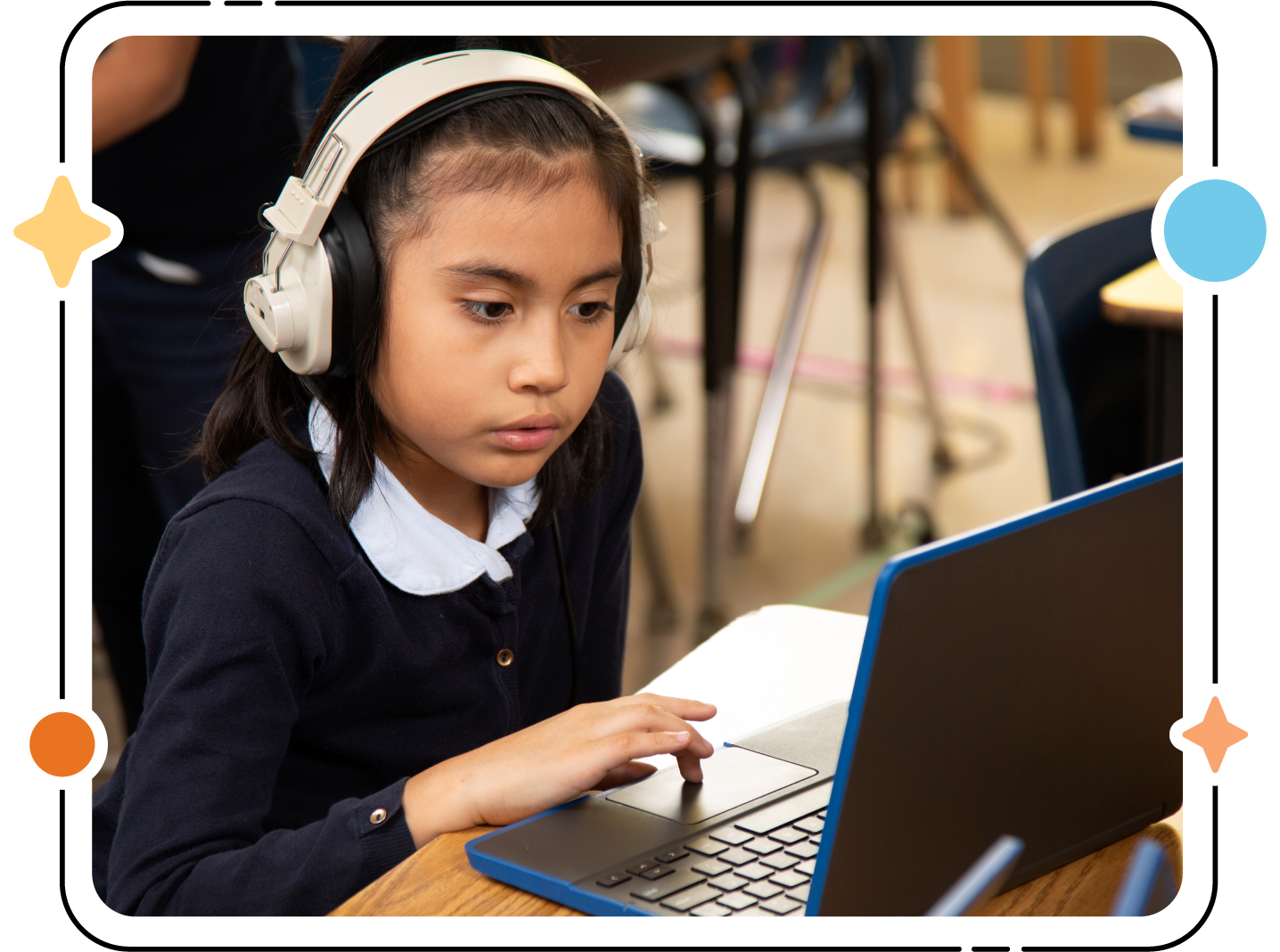
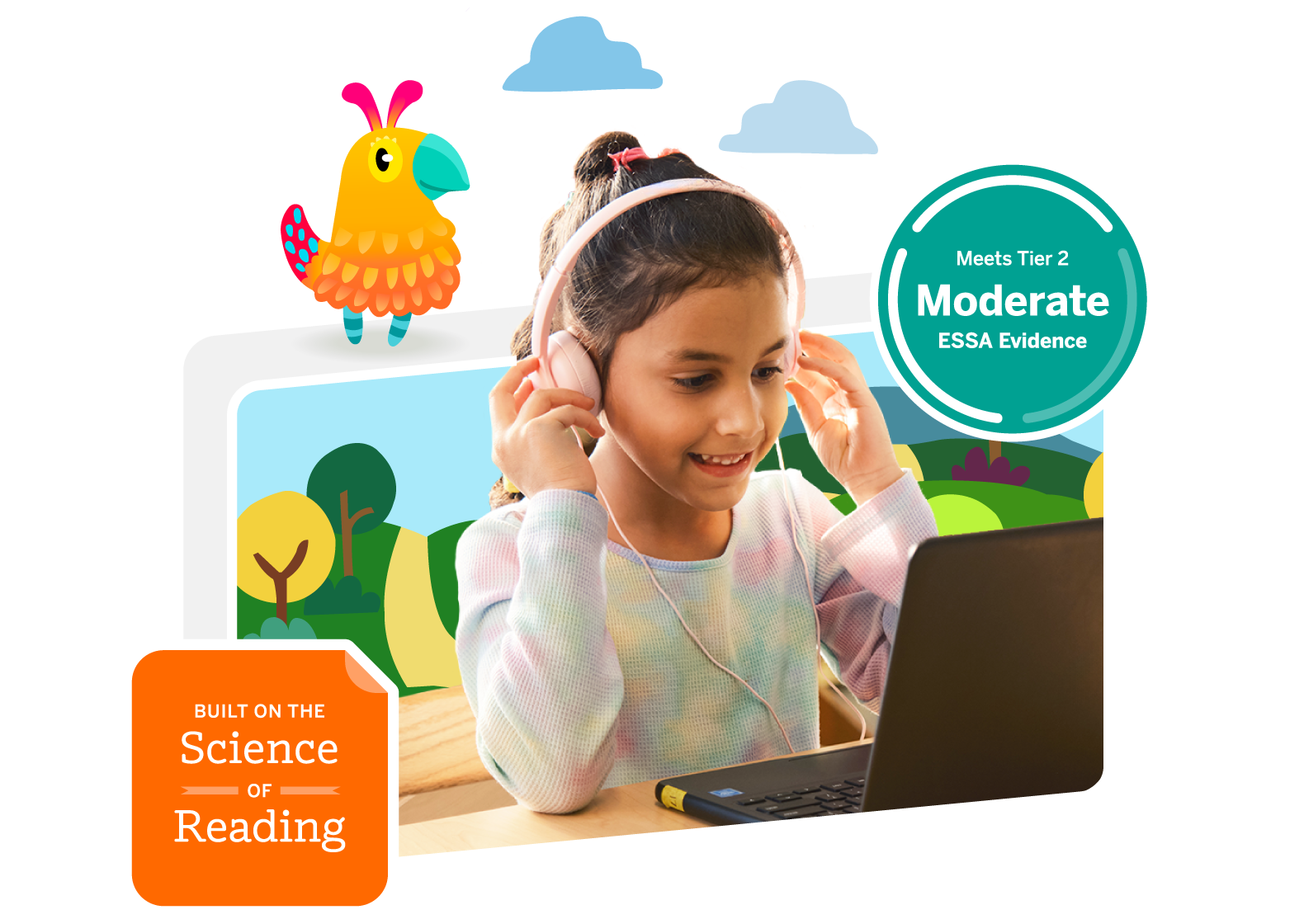
A young girl wearing headphones smiles while using a laptop, with colorful graphics and badges indicating "Moderate ESSA Evidence" and "Built on the Science of Reading," highlighting a K–5 personalized reading curriculum.

Proven impact for students who need it most

Boost Reading meets ESSA’s Moderate (Tier 2) Evidence criteria and consistently moves students who score below and well-below benchmark toward benchmark with just 30 minutes of use per week. Boost Reading provides extra support to students (including multilingual/English learners and students with dyslexia) struggling with reading, with practice that builds a strong foundation for future reading success from the ground up. Learn more about the program’s impact on the Boost Reading research page.

Nearly 65% of kindergarten students who started the year at risk and used Boost Reading reached benchmark by the end of the year, compared to 48% of the comparison group.

Learn more

English language learners who started the year below benchmark were 43% more likely to finish the year on track compared to those who did not use Boost Reading.
“My students love the program, and they don’t even realize they are learning some tough concepts. Their reading scores are improving even since the beginning of the year.”

Amber

Junior High ELA teacher, California

Critical to MTSS with differentiated support for every learner

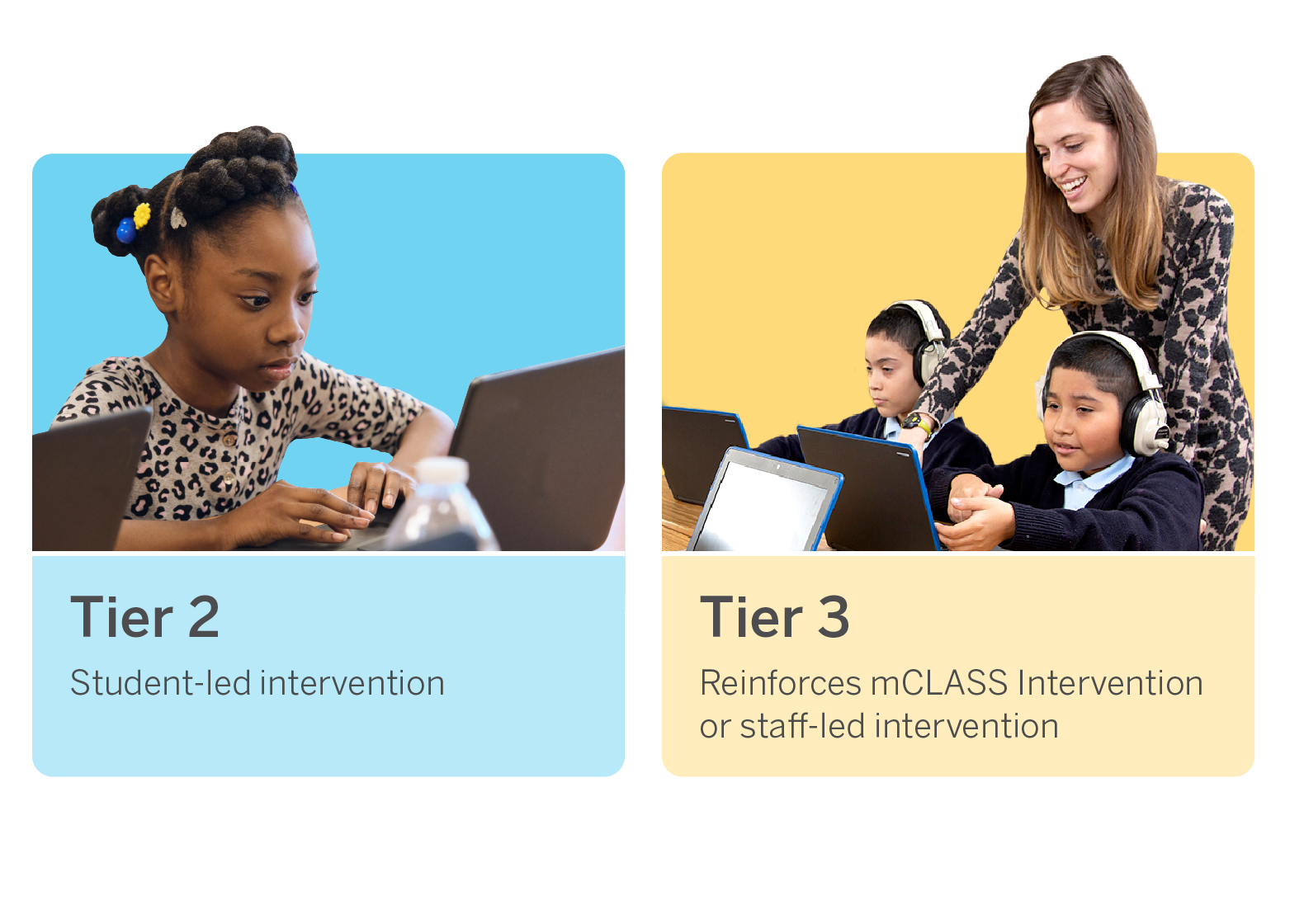
Boost Reading adapts automatically, so students practice the right skills at the right moment. Tier 2 students get meaningful independent intervention support, while Tier 3 students receive additional skill reinforcement between their staff-led sessions with mCLASS Intervention. Boost Reading follows the same foundational skills sequence as Amplify CKLA, which means that students practice skills unique to them, making Boost Reading an effective part of a Multi-Tiered System of Support (MTSS).

Split image: On the left, a girl uses a laptop with the label “Tier 2 Student-led intervention” featuring a K–5 personalized reading curriculum. On the right, a teacher assists two boys with laptops, labeled “Tier 3 staff-led intervention.”.

Data you can actually use in your classroom

Boost Reading shows you exactly what you need to know about student progress, through simple growth reporting on the Teacher Dashboard. See who’s improving, who needs support, and which skills to target next without having to spend time digging through complicated data.

Aligned to Amplify CKLA and mCLASS DIBELS 8th Edition

Boost Reading follows Amplify CKLA’s scope and sequence, making it easy to integrate into your daily routines by reinforcing the same skills you’re already teaching. It uses mCLASS DIBELS® 8th Edition data to provide targeted support and placement, giving teachers a clear view of how students progress across all instructional tiers.

Three text boxes display the names of K–5 literacy resources: "Boost Reading," "Amplify CKLA," and "mCLASS," with the words "Boost," "Amplify," and "mCLASS" in orange font.
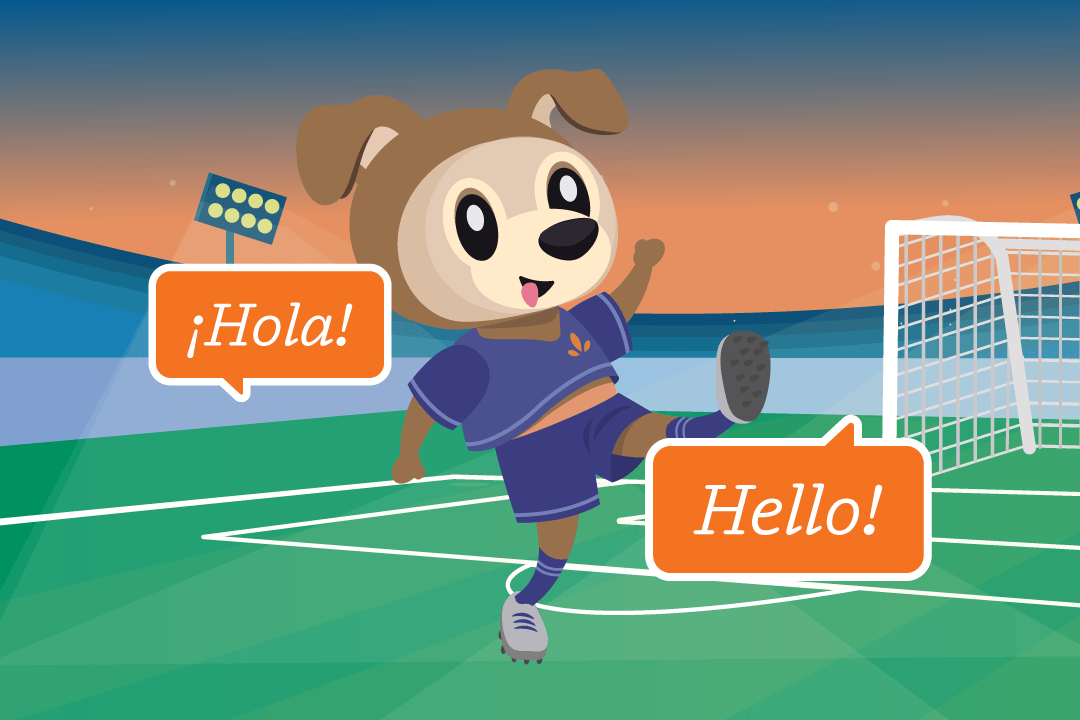
Oso de dibujos animados jugando al fútbol, pateando una pelota con la etiqueta "ma", con burbujas de discurso que dicen "¡hola!" en español e inglés, al lado de una portería con un letrero "Currículo de lectura personalizado para jardín de infantes a 5.º grado".

Closing the gap for
K–2 multilingual/English learners

Boost Reading’s Spanish literacy partner, Boost Lectura, strengthens early literacy for Spanish-speaking multilingual/English learners. When used together, the two programs give teachers side-by-side insight into skill progression in Spanish and English, helping accelerate learning across both languages.

Boost Reading efficacy study

Closing the literacy gap for K–5 students

Download now

What’s included

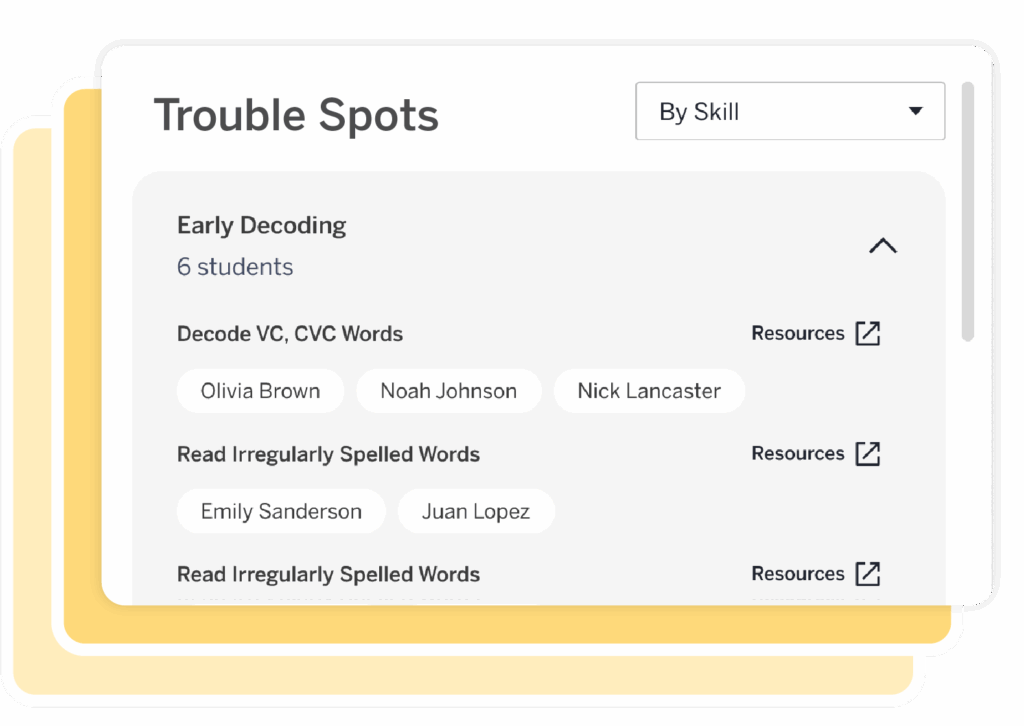
A dashboard section titled "Trouble Spots" lists students under "Early Decoding" by skill, showing names and resource links for decoding and spelling word skills from a K–5 personalized reading curriculum.

Pinpoint the skills that need your attention

The Trouble Spots section makes it easy to see which students are struggling and what skills they need to work on. Printable, ready-to-teach lessons allow you to pull together small groups in minutes.

Watch your students grow

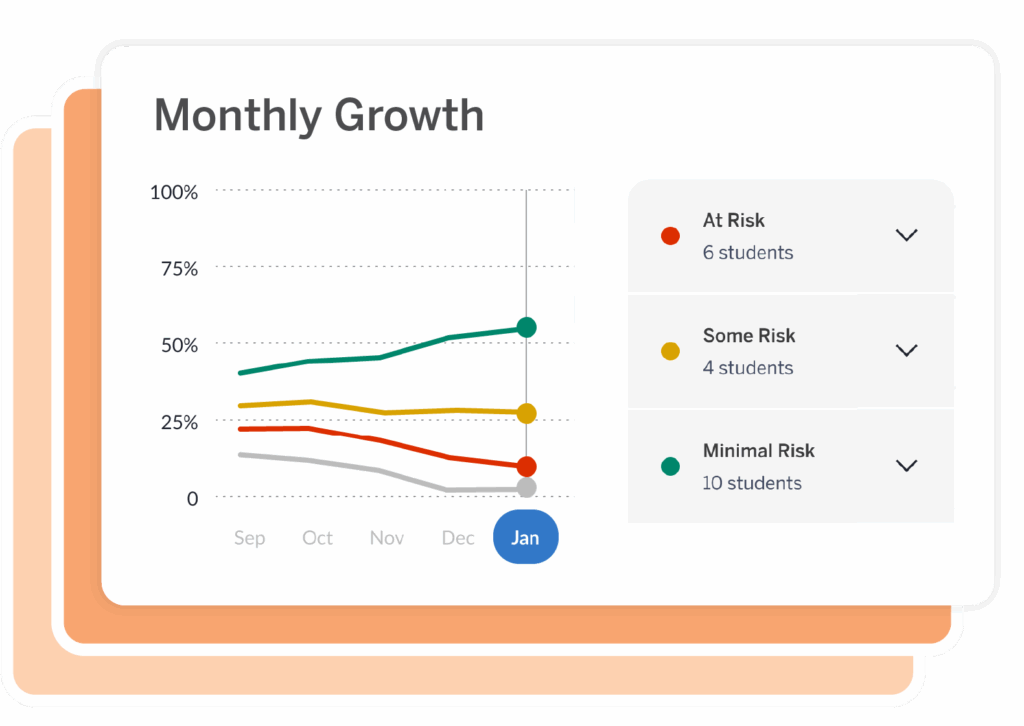
Never miss a moment of your students’ literacy development, with monthly growth reporting! You’ll be able to track how students are developing skills month over month, and see their reading trajectory unfold.

Line graph titled "Monthly Growth" shows three risk categories—At Risk, Some Risk, Minimal Risk—from September to January. Visualize student progress using this K–5 personalized reading curriculum as your supplemental reading curriculum.
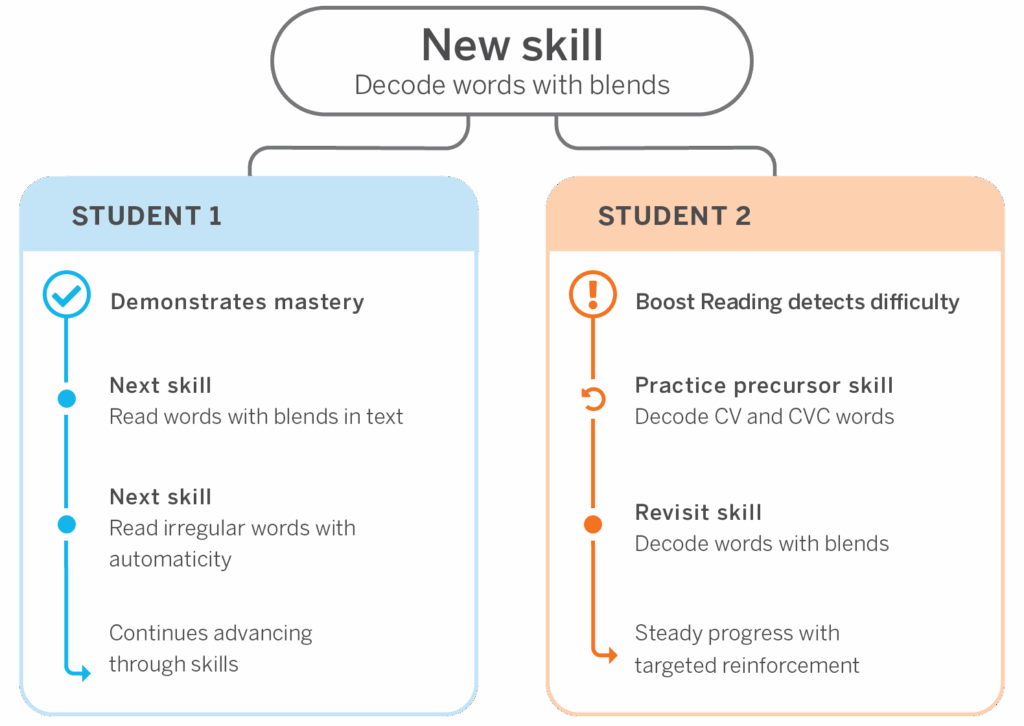
A chart compares Student 1, who demonstrates mastery in decoding blends, with Student 2, who needs targeted practice and reinforcement to decode words with blends using a K–5 personalized reading curriculum.

A program that grows with your students

Boost Reading continuously tailors instruction based on individual student performance. That means scaffolding foundational skills while building proficiency, one engaging activity at a time. There’s no stalled practice, and you’ll see steady progress across key reading skills.

Benchmark and growth assessments

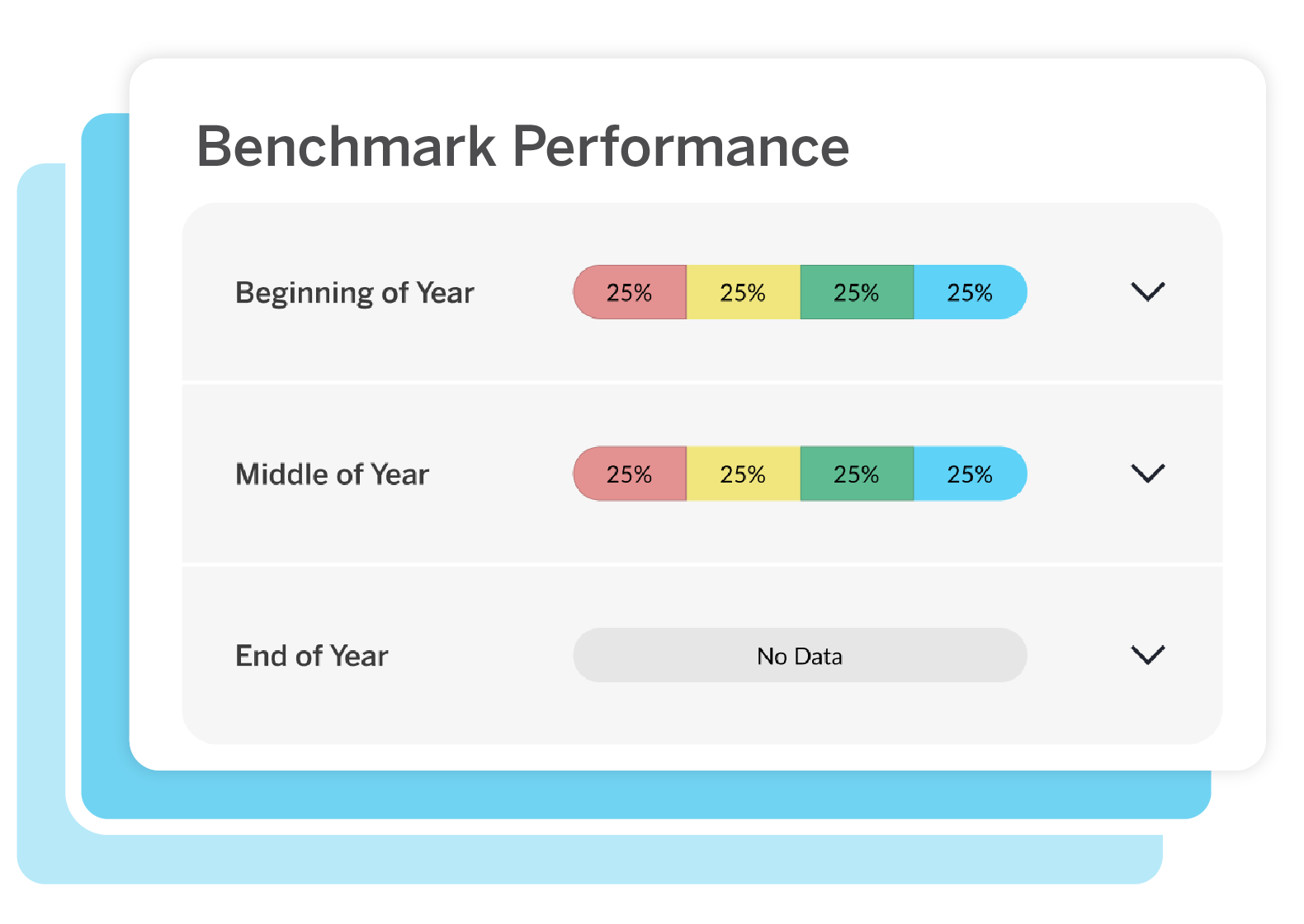
Boost Reading combines built-in benchmark assessments with monthly skill scans to give teachers a holistic view of progress from the beginning of the year to the end of the year. The monthly skill scans act as check-ins between benchmark windows, so you’ll always know where students stand with a complete picture of their learning.

A chart titled "Benchmark Performance" shows equal 25% scores for four categories at the beginning and middle of the year when using a K–5 personalized reading curriculum; no data is available for end of year.
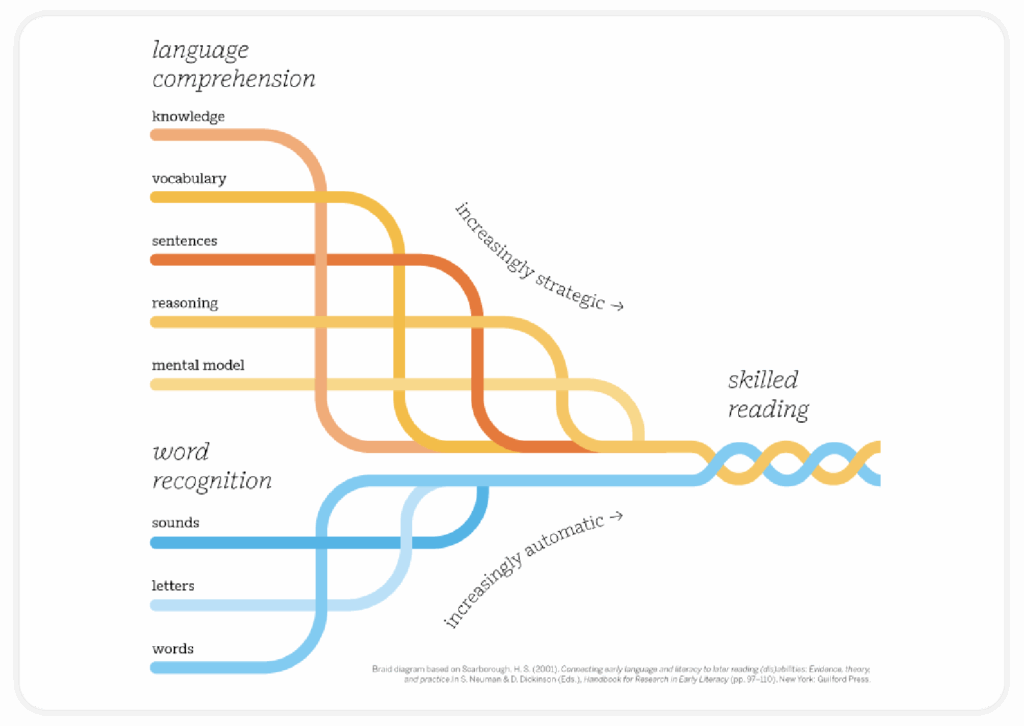
A flow chart shows language comprehension and word recognition strands merging into skilled reading, highlighting progression from basic to advanced skills—a clear visual for any K–5 literacy resource.

Science of Reading scope and sequence

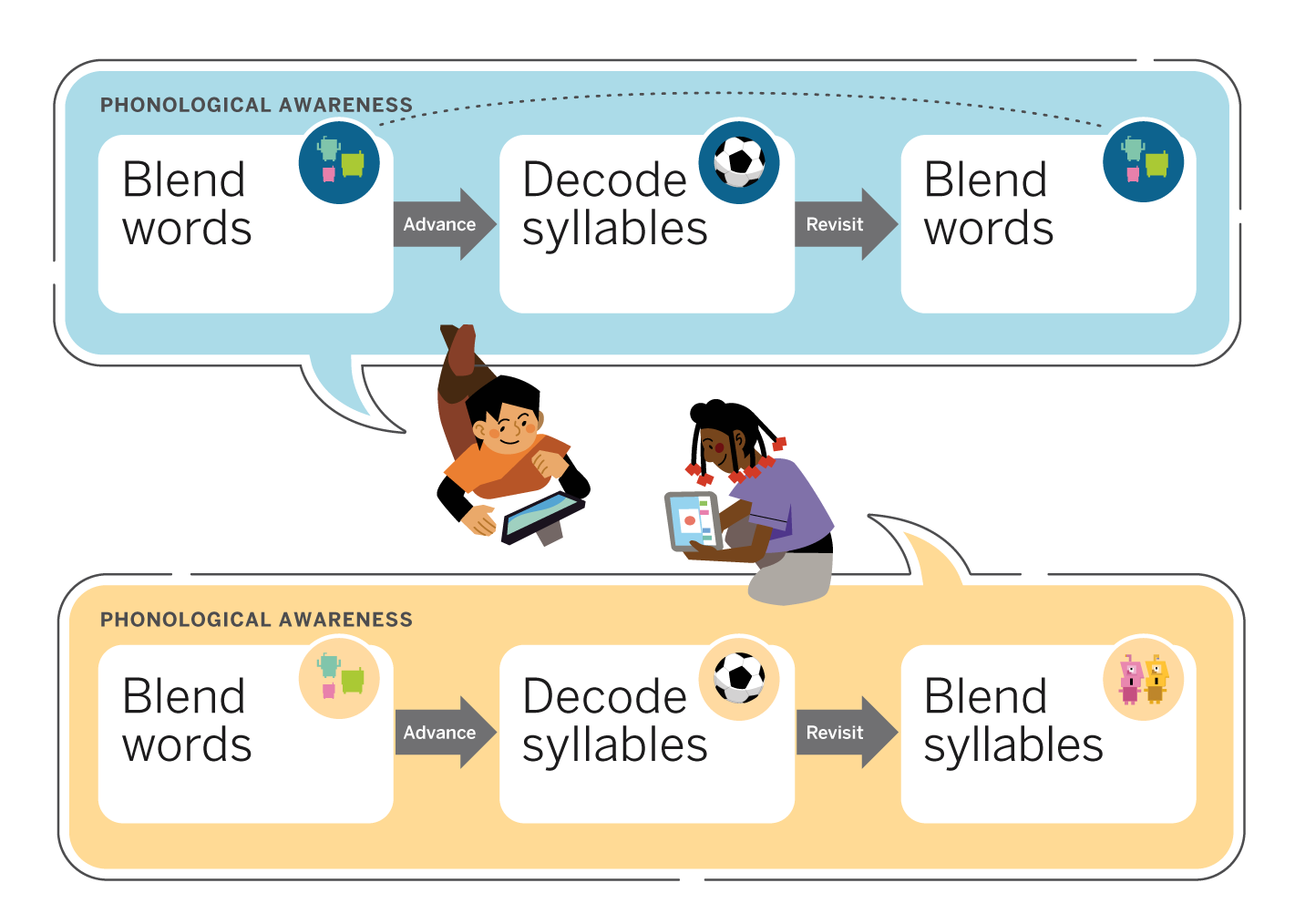
Boost Reading introduces skills in the order research shows students learn best. Phonological awareness builds into phonics, vocabulary, and comprehension for a solid foundation and confident readers.

Administrator and caregiver reports

Administrators and caregivers are welcomed into the student reading journey with data on program usage, reading progress, and skill mastery.

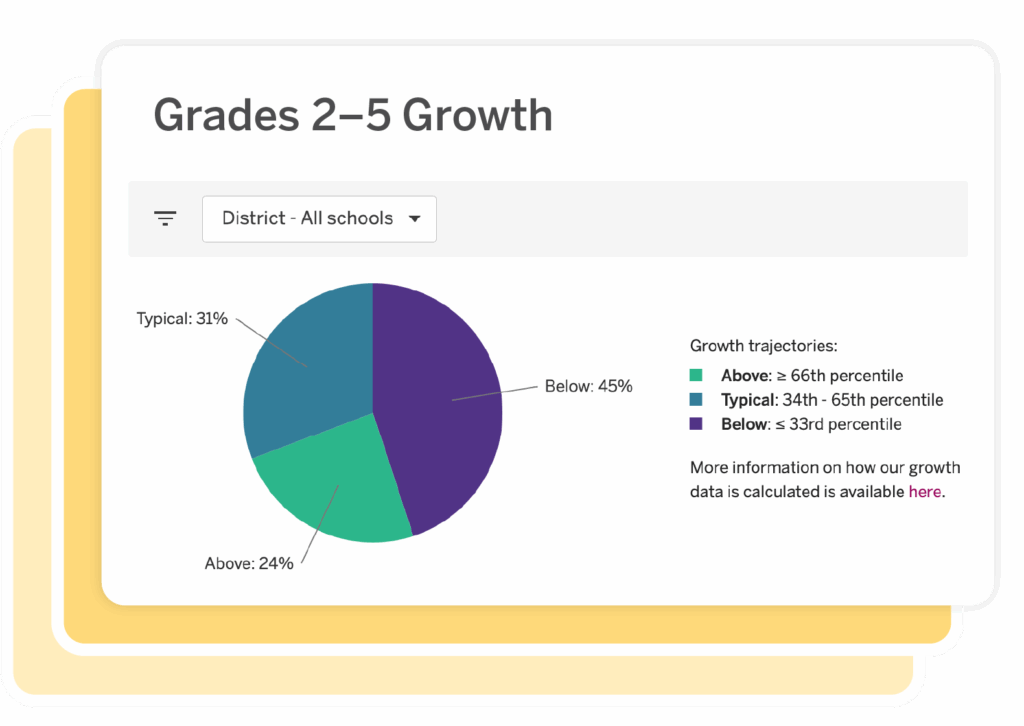
Pie chart titled "Grades 2–5 Growth" shows 45% below, 31% typical, and 24% above. Legend explains growth percentiles for a K–5 personalized reading curriculum: above, typical, below.
Insignia de premio con el texto "Premios de excelencia en tecnología y aprendizaje 2023, regreso a clases, ganador del plan de estudios de lectura personalizado K-5".

Award-winning technology that drives student growth

Learn more

Explore more programs based on the Science of Reading.

All of the programs in our literacy suite are designed to support and complement each other. Learn more about our related programs:

Exciting updates are coming for Amplify Science!

As you prepare for the upcoming school year, we’re making it easier than ever to support your students with Amplify Science. From time-saving tools to expanded instructional resources, these improvements will help you even more to engage students in rigorous, hands-on learning while streamlining your teaching experience.

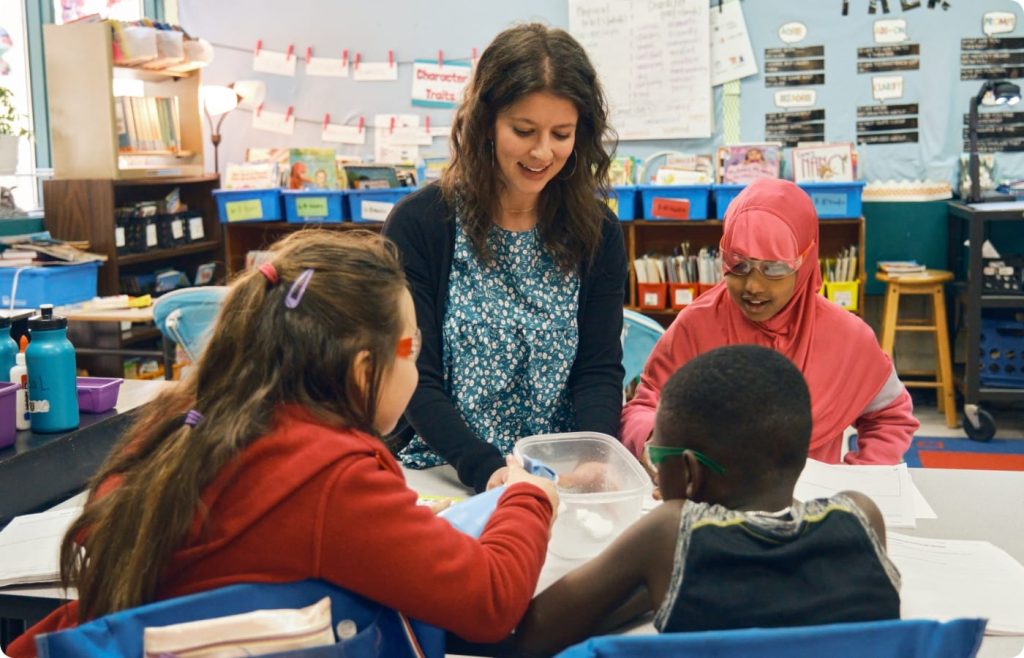
A teacher sits at a table with three young students in a classroom, engaging in an Amplify Science group activity with papers and a clear plastic container.

Updates

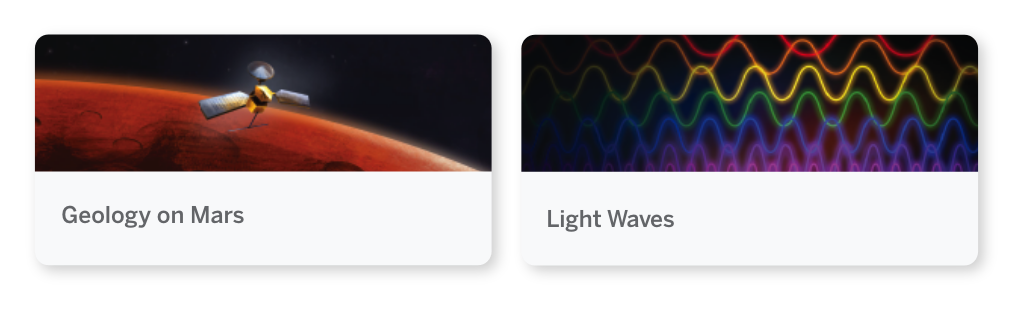
Geology on Mars and Light Waves updates

We’re committed to making sure our lessons align with current technology and resources, making improvements to keep our content relevant and accessible! With Google’s retirement of Google Mars, Lesson 1.2 of the Geology on Mars unit will be updated to instead feature a similar application from NASA. In addition, the hands-on activities in Lessons 1.2 and 2.1 of the Light Waves unit will be updated to support the use of LED flashlights rather than incandescents.

Split image: Left shows a satellite orbiting Mars labeled "Geology on Mars." Right shows colorful overlapping waves labeled "Light Waves.

Improved navigation for a seamless experience

We’re rolling out a more intuitive navigation experience, making it easier to find what you need:

  • A new sidebar menu allows for quick access to key educator resources like Content, the PD Library, and Apps.
  • The Apps menu is now organized by subject, for streamlined access to teaching tools.
A dashboard interface displays educator's programs, a recommendations section, and a stream of assigned classroom activities with dates and "See All" buttons.

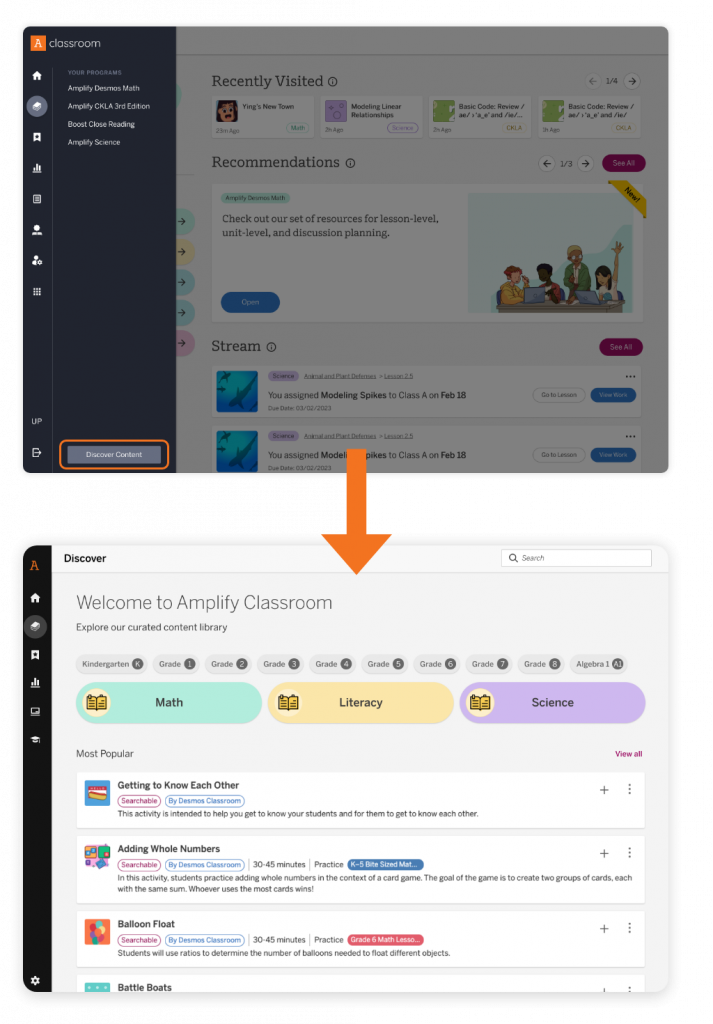
Discover free content

Explore a growing library of free math, science, and literacy content using the Discover button. You can even assign these activities to students through the digital platform, giving them more ways than ever to explore, engage, and learn!

Screenshot showing a user navigating from the Amplify Classroom dashboard to the Discover Content library, with interface elements for browsing educational resources by subject and grade.

Noteworthy features

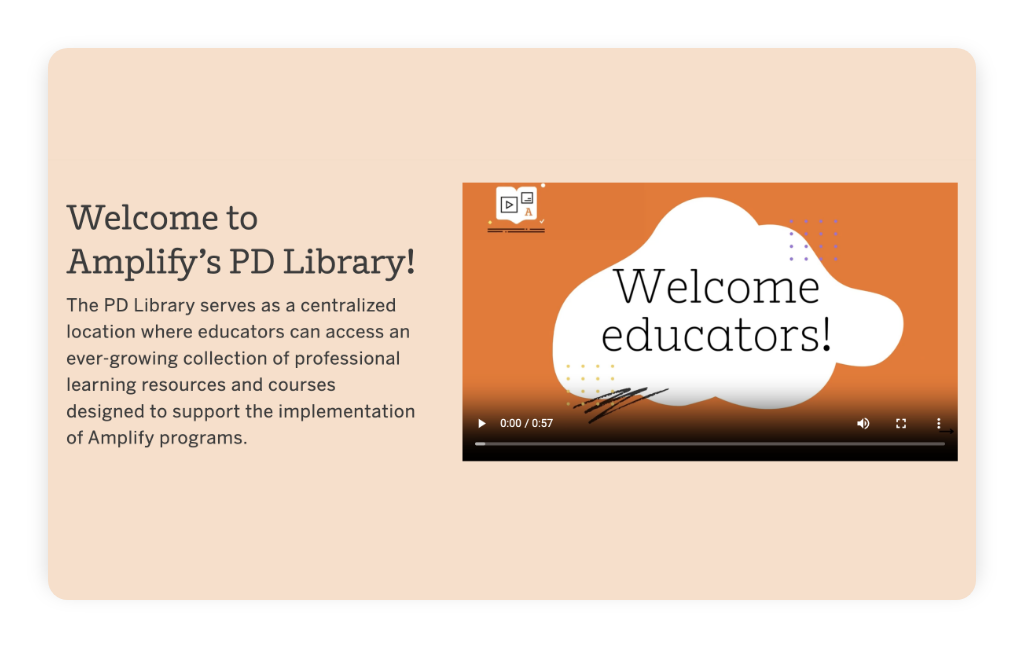
PD Library

Amplify Science’s PD Library is your go-to destination for self-paced professional development. Whether you’re new to Amplify Science or looking to deepen your expertise, you’ll find high-quality training and resources tailored to your needs.

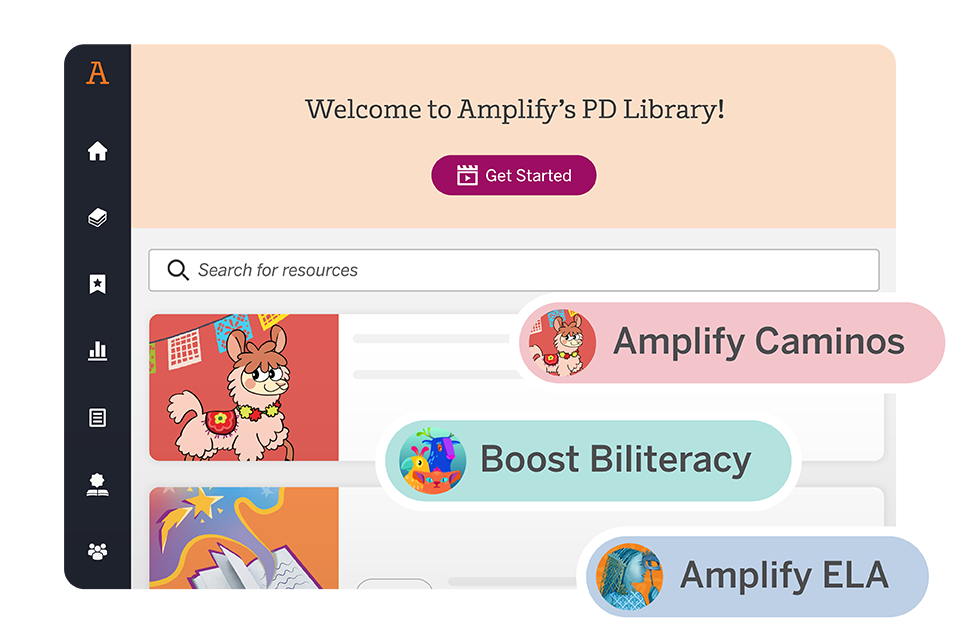
A welcome message for educators is displayed on an orange background next to text introducing Amplify’s PD Library and its professional learning resources for educators.

Caregiver Hub

Empower families to support student learning with the Amplify Science Caregiver Hub, a dedicated resource that provides curriculum overviews, background information, and helpful tools to extend learning beyond the classroom.

The digital experience

The digital experience is an add-on license for K–5 teachers and students that makes lesson planning and student engagement easier than ever. With ready-to-use slides-based lessons, integrated teacher prompts and guidance, interactive student opportunities, robust professional development resources, and more, this tool keeps everything in one place.

*Interested in using the digital experience? Contact your account representative to learn more.

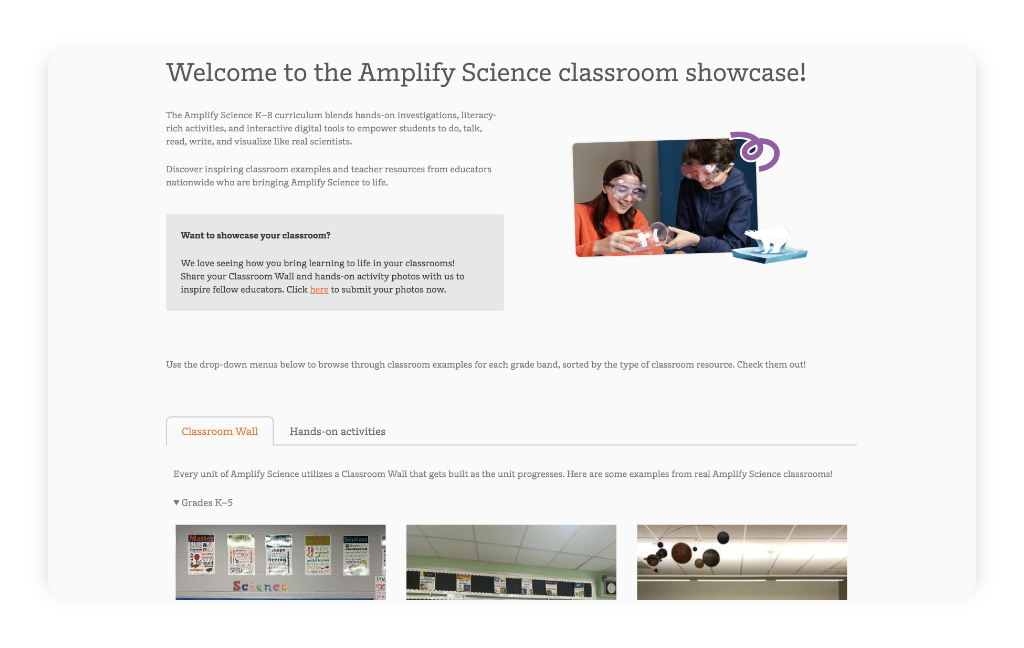
Amplify Science classroom showcase

Looking for inspiring classroom examples from educators nationwide who are bringing Amplify Science to life? Check out the Amplify Science classroom showcase!

Screenshot of the Amplify Science classroom showcase webpage, featuring a welcome message, navigation tabs, a photo of students, and options to view classroom walls or hands-on activities.

Bring the world to students with a proven PreK–5 literacy curriculum

Amplify Core Knowledge Language Arts (CKLA) is the leading early literacy curriculum grounded in the Science of Reading. By combining knowledge-building and research-based foundational skills, our instruction guides educators in developing strong readers, writers, and thinkers.

With a powerful online platform and a parallel Spanish language arts curriculum, Amplify CKLA provides a comprehensive solution for PreK–5 educators and students. Para la versión en español, haga clic aquí.

Background knowledge drives results

The Amplify CKLA PreK–5 literacy curriculum equips students with rich knowledge that intentionally builds to inspire curiosity and drive results. Explore research revealing the power of our knowledge-based curriculum including a study that meets qualifications for ESSA Tier I: Strong Evidence.

Amplify CKLA serves

38,000+

Classrooms

2,700,000+

Students

50

U.S. States and D.C.

Independently and rigorously reviewed

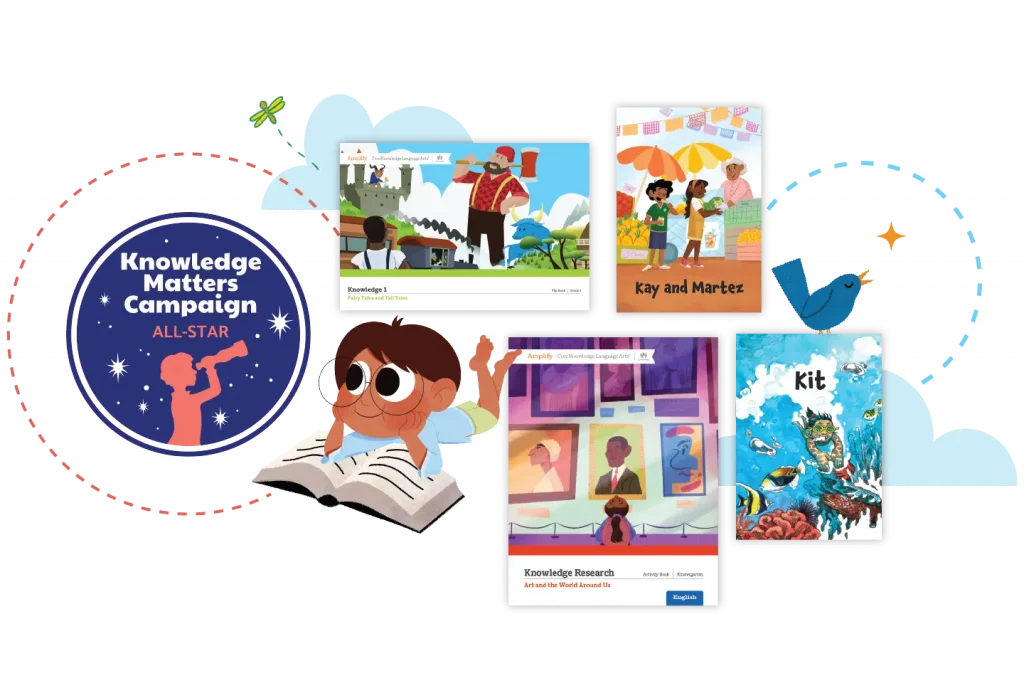
Amplify CKLA is among the few curricula that is both recognized by the Knowledge Matters Campaign—for its excellence in intentionally building knowledge—and rated all-green on EdReports, earning green scores across all gateways.

Read the review on EdReports.

Educational campaign collage featuring children engaging in reading and research, with posters and books displayed, emphasizing the "core knowledge language arts" campaign.

Our approach

Grounded in the Science of Reading and following the Core Knowledge approach, the Amplify CKLA PreK–5 curriculum combines rich, diverse content knowledge in history, science, literature, and the arts with systematic, research-based foundational skills instruction.

Grounded in the Science of Reading

As the first publisher to build a curriculum based on the Science of Reading, we put research into action with explicit systematic foundational skills instruction alongside a proven knowledge-building sequence. In collaboration with education experts and practitioners, we provide powerful resources that drive real results. Explore our Science of Reading success stories.

Diagram illustrating the interplay between language comprehension and word recognition in reading, as seen in early literacy stages. It highlights pathways through knowledge, vocabulary, and sentence understanding, reflecting principles from the CKLA reading program.
Diagrama ilustrativo que muestra la progresión de la alfabetización temprana desde sonidos básicos hasta fonemas complejos con círculos etiquetados y flechas de conexión.

Developing foundational skills with explicit, systematic instruction

Amplify CKLA’s research-based scope and sequence progresses from simple to more complex skill development, starting with phonological and phonemic awareness. Instruction guides you in explicitly teaching the 150 spellings for the 44 sounds of English, with an intentional progression and review of skills to set your students up for success.

Following a proven knowledge-building approach

Following the Core Knowledge Sequence–a content-specific, cumulative, and coherent approach to building knowledge–students dig deeper and make connections across content areas to build a robust knowledge base for comprehending complex texts. See how the Core Knowledge curriculum is proven to improve reading scores and eliminate achievement gaps.

Three connected circular diagrams showing educational progression: "plants in kindergarten" with colorful garden graphics, "ecology in grade 3" depicting nature and animals, and "K–5 literacy curriculum in grade

Built in partnership with the Core Knowledge Foundation

Amplify CKLA is the premier high-quality instructional materials offering for elementary language arts, built in partnership with the Core Knowledge Foundation to help students effectively develop deep content knowledge and foundational skills.

Learn more about the Core Knowledge Foundation

Cultivating biliteracy with parallel English and Spanish programs

Amplify Caminos is the perfect Spanish language arts partner to Amplify CKLA. The aligned programs combine rich content knowledge with systematic foundational skills instruction grounded in the Science of Reading that follows biliteracy principles, and supports multiple teaching models.

Learn more about Amplify Caminos

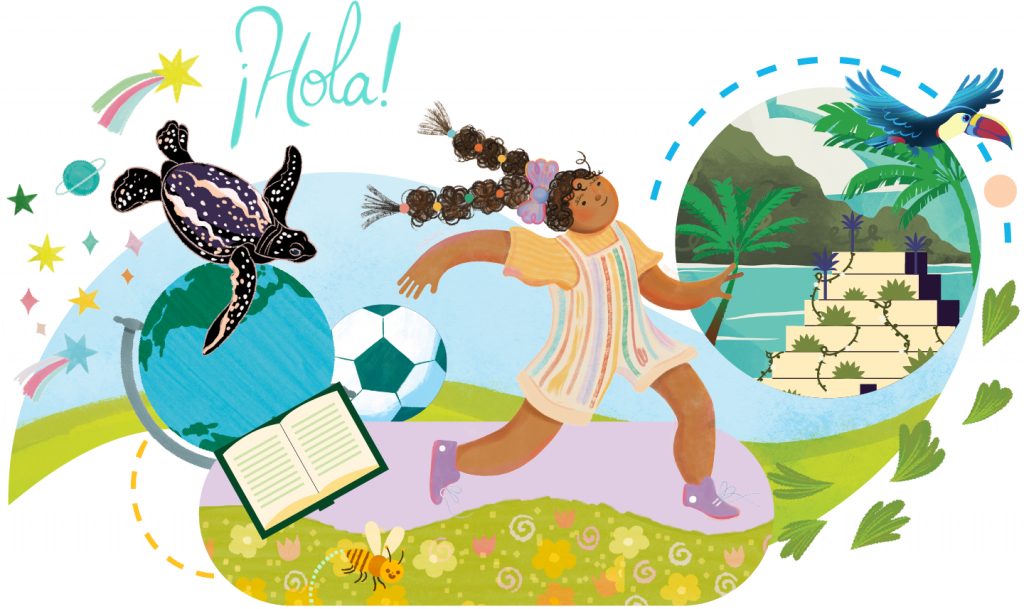
A girl runs joyfully surrounded by a turtle, a soccer ball, an open book, and tropical scenery with a toucan and ancient ruins, with "¡Hola!" written above.

Learning to read

Free guide with the latest research on the Science of Reading

Download now

What’s included

The program provides engaging print and multimedia materials designed to build a robust literacy-rich foundation in every classroom.

CoreELD and Companions

High-quality teacher materials

Amplify CKLA teachers effectively deliver instruction with print and digital resources, including:

  • Teacher Guides with embedded differentiation.
  • Formal and informal assessments.
  • Ready-made and customizable lesson slides.
  • Trade books and Novel Guides.
  • Teacher resources and on-demand professional development.

Immersive student resources

Amplify CKLA students stay engaged with a variety of print and digital resources, including:

  • Original decodables and read-aloud Big Books (K–2), Student Readers (3–5), and trade books (K–5).
  • Student Activity Books with embedded assessments (K–5).
  • Research units for independent research built around a trade book (K–5).
  • Poet’s Journal and Writer’s Journal (write-in student readers for Grades 4–5).
  • Quests for the Core to support immersive, problem-based learning in Grades 3–5.

Hands-on phonics materials

Multisensory phonics and foundational skills resources help students practice key skills using fun, varied approaches that build independence.

  • Chaining Folder (K)
  • Letter Cards (K–2)
  • Syllable Cards (K–2)
  • Image Cards (K–3)
  • Blending Picture Cards (K)
  • Consonant and Vowel Code Flip Books (1–2)
  • Exclusive digital Sound Library

Robust digital experience

Amplify CKLA teacher and student resources are available through a digital experience platform that enhances instruction and saves you time. With everything you need in one place, you can effectively plan lessons, present content, and review student work.

  • Ready-made yet customizable lesson presentation slide decks
  • Dynamic live-review student tool
  • Interactive and student-friendly experience
  • LMS integration
  • Knowledge Builder animated videos
  • Recorded Read-Alouds
  • Professional development website
  • Real-time program support via email, live chat, and phone
Four colorful educational books are displayed against a black background. Each cover has tools like pencils, papers, and letters representing various school subjects.

English Language Learner program

Language Studio, designed for Amplify CKLA, provides WIDA-aligned daily instruction for English Language Learners to deepen their academic English.

Writing explorations program

A unique companion for Amplify CKLA, Writing Studio provides a deep dive into informational, narrative, and opinion writing to build strong, passionate writers.

Covers of four "Writing Studio Teacher Guide" books for different grades, featuring educational icons in orange, purple, blue, and teal color schemes.

Explore more programs based on the Science of Reading.

All of the programs in our literacy suite are designed to support and complement each other. Learn more about our related programs:

Webinar: Science Connections: Accelerating Learning in Science with the Science of Reading

Webinar: Science Connections: Strengthening Science with the Science of Reading

Early literacy assessment & intervention, grounded in the Science of Teaching Reading

mCLASS Texas is an all-in one system of universal screening, dyslexia screening, progress monitoring, and instruction for grades K–6, all built on the Science of Teaching Reading. Powered by DIBELS® 8th Edition, mCLASS Texas helps you measure and strengthen the foundational skills that all students need to become confident readers.

What is mCLASS Texas?

mCLASS Texas, the only digital provider of DIBELS 8th edition assessments, provides universal screening, dyslexia screening and progress monitoring to assess your students’ reading trajectory and determine what skills they still need to develop.

You’ll observe students as they form sounds or read words and text. Then, mCLASS Texas instantly scores and analyzes student response patterns to provide you with diagnostic data and instructional focus for each student and group.

With mCLASS Texas, you’ll have everything you need to support every type of learner in your classroom, including advanced learners, multilingual/English learners, and students with signs of dyslexia.

What educators say

“If you’re trying to shift the balance and move into the Science of Reading, mCLASS is going to give you a great way to group kids by skill.”

Angela

Lufkin Independent School District, Director of Early Childhood Education

What educators say

“Getting the human brain to read is very complex, and mCLASS has helped me problem-solve with my PLC and the strategies I’m using in the classroom.”

Anne

Teacher, Wake County School District, Oakview Elementary School

What educators say

“One of the things that I think the data dashboard has really helped us to do is to work smarter not harder.”

Natalie

Supervisor of Elementary Ed, K-12 Instructional Technology and K-12 ELL, Metuchen School District

Image of DIBELS 8th edition logo

Research-based DIBELS 8th Edition assessments

Developed in partnership with the University of Oregon, mCLASS DIBELS 8th Edition is founded on the strongest-ever research base for predicting reading proficiency, including identifying those at risk for dyslexia.

For more than 30 years, the University of Oregon has led the research behind DIBELS (Dynamic Indicators of Basic Early Literacy Skills). mCLASS is the only licensed digital provider of the evidence-based DIBELS 8th Edition assessment. See more of our research.

Our approach

mCLASS Texas provides rich data to help you match your students’ precise needs with instruction based on the Science of Teaching Reading. The program enables you to monitor effectiveness and make timely decisions, providing students or classrooms with extra support.

Grounded in the Science of Teaching Reading

From phonics to fluency and comprehension, mCLASS Texas assesses the skills that are most critical for students to become successful readers. Once students are assessed, you’ll have the data you need to drive instructional decisions at the classroom, school, and district level.

  • Data you can trust, with teacher-administered assessments
  • Skill-level data aligned with the Science of Teaching Reading
  • Data-driven instructional recommendations to support intervention, remediation, and enrichment
An adult and a young child sit at a table, looking at a tablet together. A label in the corner reads, "Built on the Science of Reading.
Profile card for a student named Jenny Perez, Grade 1 BOY, showing a score of 36 correct letter sounds per minute on a colorful performance scale.

Precise, trustworthy data through direct observation

Our approach to assessment is focused on providing you with immediate insights you can trust. Through direct observation of students and detailed reports, including assessment transcripts and diagnostic error patterns, you’ll have total transparency into each student’s performance.

Instant analysis and next steps

With mCLASS Texas, you can interpret and act on data in real time with instant instructional guidance based on benchmark and progress-monitoring results. In one click, teachers can access differentiated skill-based groups and targeted resources to develop students’ foundational literacy skills.

A teacher and a student sitting at a desk in a classroom. The teacher is holding cards and discussing with the student. Two labels read

A complete picture of English and Spanish biliteracy

Amplify’s Spanish language assessment, mCLASS Lectura Texas, works in tandem with mCLASS Texas DIBELS 8th Edition’s English assessments to highlight areas of growth as students develop into bilingual readers. mCLASS Lectura Texas provides complete parity with English mCLASS Texas assessments in grade coverage (K–6), skill coverage, instructional tools, and reporting.

Need evidence-based Tier 2 and 3 instruction?

Explore mCLASS Intervention.

Learn more

What’s included

The mCLASS Texas program includes quick assessments of critical reading skills, real-time reporting, and data-driven instructional recommendations.

A digital interface displays reminders for a reading assessment, including timing instructions and prompts for student responses. A purple background highlights the three reminder cards and navigation buttons.

Efficient one-minute measures

DIBELS 8th Edition’s predictive one-minute assessments of phonemic awareness, phonics, fluency, and comprehension are proven to identify risk as early as possible.

  • Phonological awareness
  • Alphabetic principle/phonics
  • Reading fluency
  • Reading accuracy
  • Reading comprehension

Early detection of dyslexia symptoms

With mCLASS Texas, you can efficiently screen students and assess the full range of skills linked to dyslexia risk factors at the same time. mCLASS DIBELS 8th Edition and mCLASS Lectura Texas are both validated as dyslexia screeners for English and Spanish, with additional Vocabulary, Spelling, RAN, and Language Comprehension measures available at no additional cost.

Learn more about mCLASS’s dyslexia screening.

A teacher sits at a table with a young student using a tablet, while two student portraits are shown in circular frames on either side of the main image.

Progress monitoring and goal setting

To help you target the right skills and areas of instruction, mCLASS Texas recommends progress-monitoring measures and automatically sets meaningful, attainable goals for each student. Our Zones of Growth goal-setting framework examines your student’s DIBELS scores to predict the rate of growth they need to reach end-of-year goals.

  • Automatic progress monitoring recommendations
  • Customizable goals
  • Semester and full-year growth reports

Differentiated instruction for all students

Our library of more than 500 evidence-based activities makes it easy to plan lessons that reinforce your core instruction. The embedded professional development supports consider the varied language backgrounds of all students and provide cross-linguistic transfer and language variety guidance to inform phonological awareness instruction.

One-of-a-kind dual language reporting

When you use mCLASS DIBELS 8th Edition with mCLASS Lectura Texas, you can identify and develop students’ English and Spanish literacy skills regardless of your own Spanish-language proficiency. The dual language report shows you a side-by-side view of students’ assessment results and provides you with instructional guidance based on the data.

Educator and caregiver reports

Easy-to-use reports, ranging from classroom to school and district level, help you evaluate each student’s reading skills over time and pinpoint exactly when a change in instruction is needed.

To reinforce learning at home, the Home Connect feature provides letters to caregivers about their child’s reading development in English and Spanish, and includes activities for reinforcement at home or on the go.

Learn more about mCLASS reporting.

Three labeled graphics with Texas icons read: "Amplify ELAR TEXAS," "Boost Reading TEXAS," and "mCLASS TEXAS," each in black and orange text.

Instructional alignment across all tiers

Amplify’s early literacy system ensures that you have all the core, intervention, and personalized instruction you need to support each stage of a student’s literacy journey. mCLASS Texas data drives placement into mCLASS Intervention and Boost Reading Texas personalized learning. It also recommends core instruction resources within the Amplify ELAR Texas core curriculum based on the skills in which students need additional practice.

Exciting news! mCLASS Texas and mCLASS Lectura Texas K–2 are FREE for the 2025–26 school year!

Explore more programs based on the Science of Reading.

Learn more about Amplify’s Texas literacy suite at texas.amplify.com.

Reading and Writing: How the Simple Views can help you teach

The processes of learning to read and write are so complex, they’ve inspired an entire body of research called the Science of Reading (along with its newer cousin, the Science of Writing). Luckily, literacy experts have distilled these processes into their simplest components.

The result? Two models that help educators understand how students learn to read and write, and the best ways to teach them.

These frameworks—the Simple View of Reading and the Simple View of Writing—align with what reading research tells us about the brain’s processes for decoding, understanding, and creating text. Together, they can support your instructional practices and help all your students become proficient readers. Let’s take a closer look.

What is the Simple View of Reading?

The Simple View of Reading is a model that breaks the capacity to read into two main components:

  1. Decoding: The ability to recognize words in print, which includes phonics and phonemic awareness.
  2. Language comprehension: The ability to understand and interpret the meaning of those words.

It’s important to note that reading is not the sum of these parts—it’s the product. Reading success results from decoding multiplied by language comprehension. Both are crucial. If either one is weak or nonexistent, the ability to read with understanding collapses. Even if a student can decode every word on a page, they won’t truly be reading if they don’t understand what the words mean. Likewise, no matter how good their comprehension skills, if they can’t decode, they can’t access the text.

Are you curious for more detail? Explore the framework known as the Reading Rope, which breaks these components down further, showing how skills such as phonological awareness, vocabulary, and background knowledge intertwine to create skilled reading. Understanding these connections helps educators develop effective instruction and address specific gaps in literacy skills.

Why is the Simple View of Reading framework so powerful?

The Simple View of Reading gives teachers a clear roadmap.

Instead of wondering why a student is struggling with reading, we can look at their decoding and language comprehension skills separately. Are they having trouble sounding out words? That’s a decoding issue. Struggling to understand a story’s plot? That’s a language comprehension issue.

Once you know where the challenge lies, it’s easier to intervene and teach students effectively.

This model also aligns with the principles of structured literacy. By focusing on explicit, systematic instruction in both decoding and comprehension, educators can build a strong foundation for all learners and support everyone in accessing grade-level text.

The Simple View of Writing: A logical extension

Just as the components of reading can be broken down into two parts, so can writing. They are:

  1. Transcription: The physical act of writing, including handwriting, spelling, and typing.
  2. Composition: The ability to generate ideas, organize them, and express them effectively in written form.

Transcription ensures that students can physically put words on a page, while composition helps them turn those words into meaningful text. Writing success equals transcription multiplied by composition. A student may have great ideas (strong composition) but struggle to write them down (weak transcription), or they may write neatly but lack substance.

Putting it together: How these models transform literacy instruction

Reading and writing are closely intertwined. As students improve their decoding, their transcription often follows because both rely on an understanding of letters and sounds. Similarly, language comprehension and composition share a connection—when students build vocabulary and understanding through reading, they’re better equipped to express themselves in writing.

These models allow educators to:

  • Pinpoint needs. Are students struggling with spelling? Focus on transcription. Do they have difficulty understanding what they’ve read? Strengthen language comprehension.
  • Measure progress. These models provide clear benchmarks for assessing growth. Success in one area (like decoding) can lead to noticeable improvements in another (like comprehension).
  • Individualize support. No two students are the same. One child may need help with phonics, while another needs to build vocabulary. The Simple Views let teachers tailor instruction to each learner.

The Simple Views of Reading and Writing remind us that literacy is a combination of distinct yet interconnected skills. By breaking these processes into manageable parts, we can better understand how to help students thrive. And when we focus on both the mechanics and the meaning, we’re not just teaching kids to read and write—we’re giving them the tools to communicate, imagine, and succeed.

More to explore

Check out our infographic for a visual breakdown of these powerful frameworks and how they work together to support literacy success.

Plus:

Big gains but slow progress in reading readiness

A woman shows a young girl something on a smartphone while they sit together at a table in a classroom, exploring reading comprehension strategies.

Amplify’s end-of-year research brief for 2024–25 shows that the youngest learners have made the greatest progress with foundational reading skills in the last five years: more kindergarteners, first graders, and second graders are on track to learn to read and fewer are far behind than at any time since the pandemic.

Kindergarteners made the biggest strides in the knowledge and skills measured by elementary reading assessments, with 70% on track to learn to read—a 21-point improvement since the pandemic.

Post-pandemic slide

In 2020–21 (the year students returned to school after the pandemic shutdowns), only 55% of K–2 students were on track to learn to read by the end of the year.

The youngest cohort struggled the most, with only 49% of kindergarteners at or above benchmark.

More students on track to learn to read

But by the end of the 2024–25 school year, the overall picture of reading readiness was much brighter.

Our data shows a 13-point increase, with 68% of the youngest readers at or above benchmark.

First and second graders were also far ahead of where they were five years ago, with improvements of 14 and 8 points, respectively.

Progress slowing

While our 2024–25 end-of-year early reading data shows significant progress relative to 2020-21, the picture is less rosy when we compare it to last year:

  • Overall, the number of K–2 students at or above literacy benchmarks was only one percentage point higher at the end of 2024–25 than it was at the end of the previous school year.
  • Within that cohort, both kindergarten and first graders saw a 2% increase, but second graders only saw a 1% increase.

Fewer students far behind

Similarly, our data showed a significant drop in the number of young readers well below benchmark between the post-pandemic school year and the 2024–25 school year.

  • Kindergarteners, again, showed the most improvement, with the number of students far behind dropping from 38% in 2020–21 to 20% at the end of the 2024–25 school year.
  • Among first graders, we saw a 12-point decline in students who were not on track to learn to read compared to 2020–21
  • Second graders showed the least improvement, with a decline of six percentage points relative to 2020-21.

Improvements among this cohort followed a similar trend to those of the at-benchmark readers: a noticeable decline over five years, but a barely noticeable year-over-year improvement.

  • Only 1% fewer students across K–2 were far behind at the end of this year compared to the year before.

More improvement during the school year

Our data also revealed some good news about annual progress in early literacy development:

  • Across K–2, students showed a bigger improvement in reading readiness than they did in prior years.
  • By the end of the 2024–25 school year, 70% of kindergarten students were on track to learn to read, compared to 36% at the beginning of the year (the greatest improvement since 2020–21).
  • First graders had a 19% improvement by the end of the 2024–25 school year (70% on track by end of year) compared to 56% in 2021.
  • Second graders showed an 11-point increase in reading readiness from beginning to end of year (65% to 54%).

Putting the Science of Reading to work for students

“Grades K–2 remain critical years for literacy development,” said Susan Lambert, Chief Academic Officer of elementary humanities at Amplify and host of Science of Reading: The Podcast. “To support young readers, educators need data-driven insights into student reading development and instructional practices that are based in the Science of Reading.”

Research has shown that data-driven strategies and tools provide the best support for young learners’ future academic success. Here are a few of the ways teachers, administrators, and parents can put them into practice:

  • Administering elementary reading assessments three times a year, to monitor student risk level for reading challenges
  • Supporting students at risk for not learning to read by analyzing data from reading assessments and making informed decisions
  • Allocating extra classroom time and resources to help students who aren’t on track
  • Monitoring progress and making adjustments as needed
  • Ensuring that evidence-based reading instruction is offered at every grade level
  • Instilling a love of reading in and out of school, in partnership with caregivers and community

Let’s keep the conversation going! Join the discussion in our Amplify learning communities.

Dive into the findings in our End-of-Year Report.

More to explore

Science of Reading: The Podcast

Beyond My Years podcast

Science of Reading

Science of Reading: A New Teacher’s Guide ebook

Free K–8 science classroom resources

Fuel engagement and student agency with free K–8 science resources for teachers! Our resource library provides free activities, posters, and guides to elevate teaching and learning in your classroom—browse topics like how to facilitate a Science Seminar, Earth Day, science and literacy connections, and more.

Two students sit at a classroom table working together on an assignment, surrounded by papers and books, with colorful cartoon graphics decorating the photo.

Explore Amplify Science units and lesson overviews

Amplify K–8 Science provides comprehensive, standards-aligned science curriculum units and lesson plans for
grades K–8. Engage your students in hands-on investigations, literacy-rich activities, and interactive digital tools to cultivate scientific inquiry and critical thinking.

Ready to see more of Amplify Science?

Speak to a representative today.

Oklahoma ELA Review for grades K–5

Thank you for taking the time to review Amplify’s core ELA program for K–5.

Amplify Core Knowledge Language Arts (CKLA) is a cutting-edge and effective core ELA program for students in grades K–5. It was developed in partnership with the Core Knowledge Foundation, was specifically designed to help teachers implement Science of Reading principles, and features proven evidence-based instructional practices.

Getting started

On this site, you’ll find a variety of resources designed to support your review and evaluation of the program. Before you start scrolling, watch the video below to learn about CKLA.

Curriculum background

Pedagogical overview

In the video below, Amplify’s Chief Academic Officer Susan Lambert shares the big picture of Amplify CKLA, explaining why it was created and the impact it’s making across the country.

Program overview

In the video below, learn about CKLA’s structure and materials, as well the research behind the curriculum.

Program features

Built on the latest research in the Science of Reading, Amplify CKLA delivers explicit instruction in both foundational literacy skills (systematic phonics, decoding, and fluency) and background knowledge in grades K–2, with an integrated approach to explicit instruction in grades 3–5.

Review this Science of Reading toolkit to learn more about the Science of Reading best practices integrated throughout CKLA.

When students build a solid foundation of phonological awareness and phonics, reading words on the page becomes automatic so that comprehension and critical thinking can happen.

  • Step-by-step lessons with multisensory approaches, clear lesson objectives, and embedded formative assessments.
  • Decodable books and Student Readers with ebook and audiobook versions that feature engaging plots and relatable characters.
  • An engaging sound library with fun songs and videos that develop phonological awareness.
  • An interactive App featuring engaging activities with immediate feedback and automated, customized instruction based on student performance.

Students build grade-appropriate subject-area knowledge and vocabulary in history, science, literature, and the arts while learning to read, write, and think creatively and for themselves. Our instruction is supported by:

  • Knowledge Builders that provide a quick overview of each domain with its key ideas.
  • Interactive Read-Alouds designed to build knowledge and vocabulary.
  • Content-rich anchor texts that support students as they tackle increasingly complex text and sharpen their analytical skills.

Getting students caught up on reading skills requires more than just an extra mini-lesson here or there. It requires targeted and intensive instruction delivered in short bursts. Our intervention component:

  • Assesses and analyzes students’ areas of mastery and growth.
  • Automatically groups students with like needs.
  • Provides educators with ready-to-teach, research-based instructional progressions that last 10 days.
  • Progress monitors students, updates their skill profiles, and reforms groups for the next 10-day period.

Student-led reading practice should be purposeful and connected to the core. In addition to practicing skills directly tied to the skills they’ve been working on during ELA time, Amplify CKLA students have opportunities to interact with adaptive content that addresses their personal gaps and bolsters foundational skills at a pace that supports their individual development.

Our collection of 40+ adaptive games targets foundational reading skills and develops them in alignment with Science of Reading principles. Unlike other adaptive games, ours ensure students:

  • Practice the right skills at the right time. Our embedded placement tool ensures students receive the content and skill practice most appropriate for their current reading level. From there, students move through our curriculum along their own learning pathway, where they encounter personalized content tailored to their evolving skill and grade levels.
  • Progress along a pathway that adapts on multiple dimensions, not just one. For example, a student can work on early first-grade decoding in one game while building more advanced vocabulary knowledge in another.
  • Practice skills in tandem. For example, a student is never forced to master one skill area before proceeding to the next. Instead, we offer students the opportunity to work on multiple skills concurrently.
  • Feel supported with scaffolding, instruction, and practice that adapts based on student performance.
  • Stay engaged by giving them immediate and clear feedback. These results are never punitive. Instead, our always-positive feedback is delivered in the context of the game world and is designed to motivate students to keep trying.

From the printed page to the screen, we bring foundational skills and knowledge of the world to your young learners, and make the transition from classroom to home learning seamless.

Download the Amplify CKLA Components guide to see components by grade.

Download the Remote and hybrid learning guide to learn how we support in-person, remote, and hybrid instruction.

Digital experience overview

In the video below, learn about CKLA’s digital tools for teachers and students across both classroom and asynchronous environments.

Curriculum review

Digital navigation walkthrough

Physical materials walkthrough

Access the program

Explore as a teacher

Before logging in, watch this brief video on navigating the CKLA Teacher Resource Site.

Ready to explore as a teacher? Follow these instructions:

  • Click the CKLA Teacher Resource Site button below.
  • Select Log in with Amplify.
  • Enter the teacher username and password found on the login flyer PDF provided to you.
  • Click the CKLA Teacher Resource icon.
  • Select a grade level.

Explore as a student

Before logging in, watch this brief video on navigating the CKLA Student Hub.

Ready to explore as a student? Follow these instructions:

  • Click the CKLA Student Hub button below.
  • Select Log in with Amplify.
  • Enter the student username and password found on the login flyer PDF provided to you.
  • Click the CKLA Student Hub icon.
  • Select a grade level.

Check out these additional resources

Oklahoma submission resources:

CKLA review resources:

FL review ELA (state)

To view this protected page, enter the password below:


New Mexico K-5 ELA review: Amplify CKLA (English) and Caminos (Spanish)

Thank you for taking the time to review Amplify CKLA for New Mexico. Below you’ll find access to our print and digital materials as well as other resources to support your review and allow you to experience our program in both English and Spanish. Amplify CKLA is the only program designed and built on the science of reading addressing the structured literacy initiative in New Mexico.

Program overview presentation

Amplify CKLA is a cutting-edge and effective core ELA program for students in grades K–5. It was developed in partnership with the Core Knowledge Foundation and is specifically designed to help you implement structured literacy and Science of Reading best practices.

Online platform videos

Watch this video walkthrough of the CKLA Teacher Resource Site.

Watch this video walkthrough of the CKLA Student Hub.

Key program features

Amplify Caminos al Conocimiento Esencial, a Spanish language arts program for Grades K–5 that will inspire and engage your students to become confident readers, writers, and thinkers.

It is designed to support any biliteracy model, including English as a Second Language (ESL), transitional bilingual programs, dual language strands, and Spanish immersion programs.

When used in tandem with Amplify CKLA, Amplify Caminos provides a one-to-one English and Spanish solution.

Built out of the latest research in the Science of Reading, Amplify CKLA delivers explicit instruction in both foundational literacy skills (systematic phonics, decoding, and fluency) and background knowledge in grades K–2 with an integrated approach to explicit instruction in grades 3–5.

Review this Science of Reading Toolkit to learn more about the Science of Reading best practices integrated throughout CKLA.

Great reading instruction starts with helping kids develop great decoding skills. By building a solid foundation of phonological awareness and phonics, reading the words on the page becomes automatic so that comprehension and critical thinking can happen.

Our instruction is supported by:

  • Step-by-step lessons with multisensory approaches, clear lesson objectives, and embedded formative assessments.
  • Decodable books and student readers with ebook and audiobook versions that feature engaging plots and relatable characters.
  • An engaging sound library with fun songs and videos that develop phonological awareness.
  • An interactive Vocab App featuring engaging activities with immediate feedback and automated, customized instruction based on student performance.

Students build grade-appropriate subject-area knowledge and vocabulary in history, science, literature, and the arts while learning to read, write, and think creatively and for themselves.

Our instruction is supported by:

  • Knowledge builders that provide a quick overview of each domain with its key ideas.
  • Interactive read-alouds designed to build knowledge and vocabulary.
  • Content-rich anchor texts that support students as they tackle increasingly complex text and sharpen their analytical skills.
  • Social and emotional learning paired with lessons in civic responsibility.

From the printed page to the screen, we bring foundational skills and knowledge of the world to your young learners, and make the transition from classroom to home learning seamless.

Download the Amplify CKLA Components Guide to see components by grade.

Additional materials to support your review

Oregon ELA Review for Elementary (K–5)

To view this protected page, enter the password below:


Pasco County’s review of the B.E.S.T. program for middle schools, Amplify ELA Florida Edition

To view this protected page, enter the password below:


Review of the B.E.S.T. program for middle schools, Amplify ELA Florida Edition

To view this protected page, enter the password below:


What is Amplify Caminos?

Amplify Caminos is a core Spanish language arts program for grades K–5 that delivers:

  • Authentic instruction built from the ground up for the Spanish language.
  • A unique research-based approach truly built on the Science of Reading.
  • A combination of explicit foundational skills with meaningful knowledge-building.
  • Embedded support and differentiation that gets all students reading grade-level texts together.
  • Opportunities for students to see the strengths and experiences that all people share while also celebrating each others’ unique identities and experiences.
A diagram showing two strands labeled Language Comprehension and Word Recognition, intertwining into fluent reading, with examples of educational materials on both sides.

How does Amplify Caminos work?

Grades K–2: Dedicated knowledge-building and explicit skills instruction
Every day, students in Grades K–2 complete one full lesson that builds foundational reading skills in the Amplify Caminos Lectoescritura strand, as well as one full lesson that builds background knowledge in the Amplify Caminos Conocimiento strand. Through learning in each of these strands, students develop the early literacy skills necessary to help them become confident readers and build the context to understand what they’re reading.

Grades 3–5: Integrated instruction
In Grades 3–5, the Amplify Caminos Lectoescritura and Conocimiento strands are integrated in one set of instructional materials. Lessons begin to combine skills and knowledge with increasingly complex texts, close reading, and a greater writing emphasis. Students can then use their skills to go on their own independent reading adventures.

What makes Amplify Caminos different?

Built on the Science of Reading

Built out of the latest research in the Science of Reading, Amplify Caminos delivers explicit instruction in both foundational literacy skills (systematic phonics, decoding, and fluency) and background knowledge in grades K–2 with an integrated approach to explicit instruction in grades 3–5.

Explicit systematic skills instruction

The skills instruction in Amplify Caminos was distinctly developed with the Spanish language in mind. Its foundational lessons are specific to the language, rather than a direct translation from Amplify CKLA’s English skills instruction.

Reading instruction begins with the vowels first, then the most common consonants, and finally the least common consonants. Students will blend and segment sounds to form syllables, and syllables to form words.

Although Spanish has a highly predictable orthography, there are a few silent letters (h is always silent, u is silent after g or q), as well as letters that can make different sounds, depending on the letters that follow them. For that reason, syllables with these letters are taught somewhat later in the progression. The same is true for syllables with infrequently occurring consonants, such as z, k, x, and w.

Coherent knowledge instruction

While students are learning how to read, the Conocimiento strand gives them authentic and engaging reasons to read.

Amplify Caminos uses spiral learning to reinforce every student’s ability to develop skills like reading, writing, speaking, and listening in Spanish that can be transferred to English. As students engage with their lessons, they explore the similarities and differences in grammar, vocabulary, writing, and language use between Spanish and English. This bridge helps students learning two languages to strengthen their knowledge in both.

Through cross-curricular content, students explore units that relate to storytelling, science, and the history of our world in a holistic and thoughtful way. With these units, you’ll bring the world to your students, showing them how reading can become an exciting, rewarding, and useful part of their lives.

Embedded differentiation for all learners

Amplify Caminos provides built-in differentiation strategies and supports in every lesson.

  • Apoyo a la enseñanza y desafío: Support and Challenge suggestions in every lesson provide assistance or opportunities for more advanced work toward the goal of the lesson.
  • Notas culturales: These point-of-use notes provide additional information about the traditions, foods, holidays, word variations, and more from across the Spanish-speaking world.
  • Apoyo adicional: Every lesson in the Lectoescritura (Skills) Strand provides additional support activities suggested to reinforce foundational skills instruction. These activities can be given to any student who requires extra help, including students with special needs.

Commitment to equity

Illustration of two astronauts in space, a woman singing, a person sketching outdoors, a hot air balloon, and a landscape, all connected by flowing musical notes.

We believe we have a responsibility to provide literacy instruction that gives every student an equal opportunity to succeed and even excel. Amplify Caminos builds students’ knowledge about the world, helping them see people who resemble them and their familiar situations or experiences while also exposing them to people whose appearances, lives, beliefs, and backgrounds differ from their own.

In addition to teaching all students to crack the written code (which is vital for equity), the Amplify Caminos program helps students celebrate their own unique identities and experiences while also seeing the strengths and experiences we all share.

Amplify Caminos includes both transadaptations and authentic texts written by Latin American and Spanish authors. Authentic literature exposes students to a variety of text types and perspectives to deepen their knowledge of fascinating topics in social studies, science, literature, and the arts. Authentic texts support text-to-self, text-to-world, and text-to-text connections for readers.

Amplify Caminos Authentic Literature

Amplify Caminos is built on the conviction that equitable instruction is vital to an effective program. Decodable Student Readers celebrate students’ diverse experiences and feature individuals with a broad range of identity factors, including socio-economic status, age, ability, race, ethnicity, country of origin, and more.

Amplify Caminos Student Readers

How does Amplify Caminos integrate with the other parts of the literacy system?

Amplify Caminos + mCLASS® Lectura

Achieve complete parity between English and Spanish assessments with mCLASS Lectura for K–6. mCLASS Lectura allows teachers to connect with their Spanish-speaking students face-to-face, one-on-one, and in the language most comfortable to them. The result? Valid and reliable student data reports
available in both English and Spanish, enabling teachers to pinpoint where their Spanish-speaking or emergent bilingual students really are in their skill development and what instruction to prioritize.

Amplify Caminos + Boost Reading

Boost Reading is an engaging, adaptive digital program that extends the learning in Amplify Caminos. Boost Reading offers support to a large sub-group of English learners (ELs) through Spanish voice-over. Spanish voiceover instructions are available in vocabulary and sentence-level comprehension games so ELs can build their vocabulary, language, and critical comprehension skills before moving into analyzing complex texts

Language selection screen with options for English and Spanish, a cartoon girl waving and saying "¡Hola!", and sidebar menu items: Journal, Practice, and Settings.

Check out these additional resources

Caminos review resources:

Demo access

Ready to explore on your own? Follow the instructions linked below to access your demo accounts for Caminos and mCLASS Lectura.

Caminos login instructions

mCLASS Lectura login instructions

Amplify CKLA for Anchorage

To view this protected page, enter the password below:


What is Amplify CKLA?

Amplify CKLA is a core ELA program for grades K–5 that delivers:

  • A unique research-based approach truly built on the Science of Reading.
  • A combination of explicit foundational skills with meaningful knowledge-building.
  • Embedded support and differentiation that gets all students reading grade-level texts together.
  • Opportunities for students to see the strengths and experiences that all people share while also celebrating each others’ unique identities and experiences.
Reading rope showing knowledge-building and skill development strands, and the merging of language comprehension and word recognition

How does Amplify CKLA work?

Grades K–2: Dedicated knowledge-building and explicit skills instruction
Every day, students in Grades K–2 complete one full lesson that explicitly and systematically builds foundational reading skills in the Skills Strand, as well as one full lesson that builds robust background knowledge to access complex text in the Knowledge Strand. Through learning in each of these strands, students develop the early literacy skills necessary to help them become confident readers and build the context to understand what they’re reading.

Grades 3–5: Integrated instruction
In Grades 3–5, Knowledge and Skills are integrated in one set of instructional materials. Lessons begin to combine skills and knowledge with increasingly complex texts, close reading, and a greater writing emphasis. Students can then use their skills to go on their own independent reading adventures.

How does Amplify CKLA integrate with the other parts of the literacy system?

Amplify CKLA + mCLASS® with DIBELS® 8th Edition

Amplify CKLA integrates with your mCLASS assessment through the CKLA Connect feature, which matches your students with targeted CKLA lessons based on their mCLASS assessment data. In other words, it aligns your assessments more closely with your core curriculum while recommending effective differentiated instruction.

Screenshot of an educational platform. It shows lesson plans for a group on "Letter Sound Knowledge" under the heading "CKLA Connect." Group 2 has 2 students. Activities for phonics skills are listed below.

Amplify CKLA + Amplify Reading

Amplify Reading is the student-driven skill practice program within CKLA, providing differentiated, digital instruction in both foundational skills and comprehension strategies. Because Amplify Reading is built on the same approach to reading as CKLA, students are able to extend their learning from the core program further, at their own pace.

Amplify CKLA and Amplify Reading reinforce each other through:

  • An aligned scope and sequence and instructional approach: In both programs, students get instruction and practice in phonological awareness and phonics, with the most common, least ambiguous spellings first.
  • Consistent vocabulary words: Many Amplify CKLA words are taught and practiced in Amplify Reading vocabulary games.
  • Complementary texts: Fiction and nonfiction books within Amplify Reading reinforce Amplify CKLA knowledge domains.
  • Seamless integrations between platforms: Students can easily access Amplify Reading directly from the Amplify CKLA Student Hub.
Educational website interface showing icons for theater, sounds, library, and activities with a greeting "hello student!" and a grade level indicator.

What makes Amplify CKLA different?

Built on the Science of Reading

Built out of the latest research in the Science of Reading, Amplify CKLA delivers explicit instruction in both foundational literacy skills (systematic phonics, decoding, and fluency) and background knowledge in grades K–2 with an integrated approach to explicit instruction in grades 3–5.

Review this Science of Reading toolkit to learn more about the Science of Reading best practices integrated throughout CKLA.

Explicit systematic skills instruction

Great reading instruction starts with helping kids develop great decoding skills. By building a solid foundation of phonological awareness and phonics, reading the words on the page becomes automatic so that comprehension and critical thinking can happen. Our instruction is supported by:

  • Step-by-step lessons with multisensory approaches, clear lesson objectives, and embedded formative assessments.
  • Decodable books and student readers with ebook and audiobook versions that feature interesting plots and relatable characters.
  • An engaging sound library with fun songs and videos that develop phonological awareness.
  • An interactive Vocab App featuring engaging activities with immediate feedback and automated, customized instruction based on student performance.

Coherent knowledge instruction

Students build grade-appropriate subject-area knowledge and vocabulary in history, science, literature, and the arts while learning to read, write, and think creatively and for themselves. Our instruction is supported by:

  • Knowledge builders that provide a quick overview of each domain with its key ideas.
  • Interactive Read-Alouds designed to build knowledge and vocabulary.
  • Content-rich anchor texts that support students as they tackle increasingly complex text and sharpen their analytical skills.
  • Social and emotional learning paired with lessons in civic responsibility.
Illustration montage featuring scenes of learning: a cartoon character with books, two people shoveling snow under the stars, and an astronaut on a lunar landscape, with educational interfaces.

Embedded differentiation for all learners

Amplify CKLA provides built-in differentiation strategies in every lesson for all students, including supports for English learners and Standard English learners.

  • Access supports for ELs: Integrated ELD supports in each lesson segment
    for English learners and Standard English learners are specific to students’ mastery of the lesson’s objectives.
  • Support and Challenge for all learners: Lessons include Support and Challenge suggestions that provide assistance or opportunities for more advanced work toward the goal of the lesson. These supports are suitable for all learners, including ELs.
  • 30 minutes of Additional Support in every Skills lesson: In the Skills Strand, every lesson concludes with an Additional Support section of recommendations for 30 minutes of extended instruction and activities, directly aligned to the skills taught in the lesson to assist students who need more support in mastering the lesson’s objectives.
  • Intervention Toolkit: The Intervention Toolkit provides easy-to-use resources to assist teachers in filling gaps in students’ foundational skills. Teachers will find of hundreds of activities to support phonics, fluency, comprehension, handwriting, and other key skills.

Designated ELD

Amplify CKLA’s designated English Language Development (ELD) component—Language Studio—helps English learners preview and revisit key content within core instruction, building a foundation of academic vocabulary and background knowledge. Core instruction lessons include point-of-use supports for English learners and Support and Challenge strategies for all learners.

Young boy with his hands over his mouth, looking up in wonder, beside a diagram labeled "language studio" with educational elements.

This carefully developed program follows the CKLA Knowledge domains, previewing and reinforcing skills and content from core instruction using instruction specifically built for English learners. The program is also designed around frequent formative assessment, including assessment of language proficiency, giving you effective ways to guide and support your English learners.

Language Studio supports teachers and English learners through the following:

  • 30 minutes of instruction with lesson segments are carefully designed around Content Knowledge, Meaning Making, Language Development, Effective Expression, and Foundational Skills.
  • Every Language Studio lesson accompanies a core lesson, helping English learners deepen domain and academic vocabulary that will help them access core content.
  • Culminating tasks support core projects and target the same skills as primary instruction.

Ready-to-go slides and all-in-one platform

The slides-based Amplify CKLA digital experience enhances instruction while saving you time. Everything you need is all in one place, making it easier than ever to plan lessons, present digital content, and review student work.

  • Simplify planning and instruction: Teachers have access to ready-to-use and customizable lesson presentation slides, complete with all the prompts from the print Teacher Guide embedded in the teacher view. As teachers deliver each lesson, students can engage with the content in one cohesive
    experience—through Activity Books, slides, digital components, videos, Student Readers, and more.
  • Interactive student activities: Through the Student Home, students can easily access digital lessons with slides, Activity Pages, ebooks, videos, and other interactive resources from one simple dashboard.
  • Your teacher command center: You’re provided with the tools you need to ensure a productive digital experience that’s personalized to meet your students’ needs. This includes a teacher home from which to launch and track lessons, LMS integrations such as Google Classroom and Microsoft Teams, and other customizations based on classroom needs.
  • Get real-time insights into your students’ work: The innovative live review tool enables you to keep an eye on students drawing, recording audio, uploading and capturing images, and typing or writing in pre-placed text boxes in their Activity Pages.

Navigating the program

Digital navigation walkthrough

Physical materials walkthrough

Sample materials

Demo access

Laptop screen displaying a login page for "amplify" with multiple sign-in options including google, clever, a qr code, and district sso.

Follow the instructions below to access your demo account.

  • Click the CKLA Demo button below.
  • Select Log in with Amplify.
  • To explore as a teacher, enter this username: t1.alaskareads@demo.tryamplify.net
  • To explore as a student, enter this username: s1.alaskareads@demo.tryamplify.net
  • Enter the password: Amplify1-alaskareads
  • Click the Programs and apps menu
  • Select CKLA Teacher Resource Site
  • Select the desire grade level

Check out these additional resources

Amplify CKLA review resources:

What is Amplify Caminos?

Amplify Caminos is a core Spanish language arts program for grades TK–5 that delivers:

  • Authentic instruction built from the ground up for the Spanish language.
  • A unique research-based approach truly built on the Science of Reading.
  • A combination of explicit foundational skills with meaningful knowledge-building.
  • Embedded support and differentiation that gets all students reading grade-level texts together.
  • Opportunities for students to see the strengths and experiences that all people share while also celebrating each others’ unique identities and experiences.
Illustration depicting the flow of genetic information, represented by ribbons transitioning from dna to rna, connected to various educational images and diagrams.

How does Amplify Caminos work?

Grades K–2: Dedicated knowledge-building and explicit skills instruction
Every day, students in Grades K–2 complete one full lesson that builds foundational reading skills in the Amplify Caminos Lectoescritura strand, as well as one full lesson that builds background knowledge in the Amplify Caminos Conocimiento strand. Through learning in each of these strands, students develop the early literacy skills necessary to help them become confident readers and build the context to understand what they’re reading.

Grades 3–5: Integrated instruction
In Grades 3–5, the Amplify Caminos Lectoescritura and Conocimiento strands are integrated in one set of instructional materials. Lessons begin to combine skills and knowledge with increasingly complex texts, close reading, and a greater writing emphasis. Students can then use their skills to go on their own independent reading adventures.

What makes Amplify Caminos different?

Built on the Science of Reading

Built out of the latest research in the Science of Reading, Amplify Caminos delivers explicit instruction in both foundational literacy skills (systematic phonics, decoding, and fluency) and background knowledge in grades K–2 with an integrated approach to explicit instruction in grades 3–5.

Explicit systematic skills instruction

The skills instruction in Amplify Caminos was distinctly developed with the Spanish language in mind. Its foundational lessons are specific to the language, rather than a direct translation from Amplify CKLA’s English skills instruction.

Reading instruction begins with the vowels first, then the most common consonants, and finally the least common consonants. Students will blend and segment sounds to form syllables, and syllables to form words.

Although Spanish has a highly predictable orthography, there are a few silent letters (h is always silent, u is silent after g or q), as well as letters that can make different sounds, depending on the letters that follow them. For that reason, syllables with these letters are taught somewhat later in the progression. The same is true for syllables with infrequently occurring consonants, such as z, k, x, and w.

Coherent knowledge instruction

While students are learning how to read, the Conocimiento strand gives them authentic and engaging reasons to read.

Amplify Caminos uses spiral learning to reinforce every student’s ability to develop skills like reading, writing, speaking, and listening in Spanish that can be transferred to English. As students engage with their lessons, they explore the similarities and differences in grammar, vocabulary, writing, and language use between Spanish and English. This bridge helps students learning two languages to strengthen their knowledge in both.

Through cross-curricular content, students explore units that relate to storytelling, science, and the history of our world in a holistic and thoughtful way. With these units, you’ll bring the world to your students, showing them how reading can become an exciting, rewarding, and useful part of their lives.

A collage of illustrated book covers, including themes of Don Quixote, space exploration, and anthropomorphic animals in various scenarios, all enriched with Spanish language elements.

Embedded differentiation for all learners

Amplify Caminos provides built-in differentiation strategies and supports in every lesson.

  • Apoyo a la enseñanza y desafío: Support and Challenge suggestions in every lesson provide assistance or opportunities for more advanced work toward the goal of the lesson.
  • Notas culturales: These point-of-use notes provide additional information about the traditions, foods, holidays, word variations, and more from across the Spanish-speaking world.
  • Apoyo adicional: Every lesson in the Lectoescritura (Skills) Strand provides additional support activities suggested to reinforce foundational skills instruction. These activities can be given to any student who requires extra help, including students with special needs.

Commitment to equity

Illustration of diverse people engaged in different activities: a black woman listening to music, two astronauts in space, and a man reading a book by a plant.

We believe we have a responsibility to provide literacy instruction that gives every student an equal opportunity to succeed and even excel. Amplify Caminos builds students’ knowledge about the world, helping them see people who resemble them and their familiar situations or experiences while also exposing them to people whose appearances, lives, beliefs, and backgrounds differ from their own.

In addition to teaching all students to crack the written code (which is vital for fairness), the Amplify Caminos program helps students celebrate their own unique identities and experiences while also seeing the strengths and experiences we all share.

Amplify Caminos includes both transadaptations and authentic texts written by Latin American and Spanish authors. Authentic literature exposes students to a variety of text types and perspectives to deepen their knowledge of fascinating topics in social studies, science, literature, and the arts. Authentic texts support text-to-self, text-to-world, and text-to-text connections for readers.

Three children's book covers in Spanish are shown: "La Flor de Oro," "El conejo en la Luna," and "El secreto de las hormigas," each featuring illustrated artwork.

Amplify Caminos is built on the conviction that fairness in instruction is vital to an effective program. Decodable Student Readers celebrate students’ varied experiences and feature individuals with a broad range of identity factors, including socio-economic status, age, ability, race, ethnicity, country of origin, and more.

Five illustrated Spanish children's books are arranged together, featuring colorful covers with diverse characters and animals, including a llama, a cactus, and children.

How does Amplify Caminos integrate with the other parts of the literacy system?

Amplify Caminos + mCLASS® Lectura

Achieve complete parity between English and Spanish assessments with mCLASS Lectura for K–6. mCLASS Lectura allows teachers to connect with their Spanish-speaking students face-to-face, one-on-one, and in the language most comfortable to them. The result? Valid and reliable student data reports
available in both English and Spanish, enabling teachers to pinpoint where their Spanish-speaking or emergent bilingual students really are in their skill development and what instruction to prioritize.

Reading assessment validated for benchmark, progress monitoring, and dyslexia screening

Amplify Caminos + Amplify Reading

Amplify Reading is an engaging, adaptive digital program that extends the learning in Amplify Caminos. Amplify Reading offers support to a large sub-group of English learners (ELs) through Spanish voice-over. Spanish voiceover instructions are available in vocabulary and sentence-level comprehension games so ELs can build their vocabulary, language, and critical comprehension skills before moving into analyzing complex texts

Spanish Support

Check out these additional resources

Caminos review resources:

What is Amplify CKLA?

Amplify CKLA is a core ELA program for grades TK–5 that delivers:

  • A unique research-based approach truly built on the Science of Reading.
  • A combination of explicit foundational skills with meaningful knowledge-building.
  • Embedded support and differentiation that gets all students reading grade-level texts together.
  • Opportunities for students to see the strengths and experiences that all people share while also celebrating each others’ unique identities and experiences.
  • Equitable and authentic Spanish language arts instruction with Amplify Caminos.
Reading rope showing knowledge-building and skill development strands, and the merging of language comprehension and word recognition

How does Amplify CKLA work?

Grades K–2: Dedicated knowledge-building and explicit skills instruction
Every day, students in Grades K–2 complete one full lesson that explicitly and systematically builds foundational reading skills in the Skills Strand, as well as one full lesson that builds robust background knowledge to access complex text in the Knowledge Strand. Through learning in each of these strands, students develop the early literacy skills necessary to help them become confident readers and build the context to understand what they’re reading.

Grades 3–5: Integrated instruction
In Grades 3–5, Knowledge and Skills are integrated in one set of instructional materials. Lessons begin to combine skills and knowledge with increasingly complex texts, close reading, and a greater writing emphasis. Students can then use their skills to go on their own independent reading adventures.

What makes Amplify CKLA different?

Built on the Science of Reading

Built out of the latest research in the Science of Reading, Amplify CKLA delivers explicit instruction in both foundational literacy skills (systematic phonics, decoding, and fluency) and background knowledge in grades K–2 with an integrated approach to explicit instruction in grades 3–5.

Review this Science of Reading toolkit to learn more about the Science of Reading best practices integrated throughout CKLA.

Explicit systematic skills instruction

Great reading instruction starts with helping kids develop great decoding skills. By building a solid foundation of phonological awareness and phonics, reading the words on the page becomes automatic so that comprehension and critical thinking can happen. Our instruction is supported by:

  • Step-by-step lessons with multisensory approaches, clear lesson objectives, and embedded formative assessments.
  • Decodable books and student readers with ebook and audiobook versions that feature interesting plots and relatable characters.
  • An engaging sound library with fun songs and videos that develop phonological awareness.
  • An interactive Vocab App featuring engaging activities with immediate feedback and automated, customized instruction based on student performance.

Coherent knowledge instruction

Students build grade-appropriate subject-area knowledge and vocabulary in history, science, literature, and the arts while learning to read, write, and think creatively and for themselves. Our instruction is supported by:

  • Knowledge builders that provide a quick overview of each domain with its key ideas.
  • Interactive Read-Alouds designed to build knowledge and vocabulary.
  • Content-rich anchor texts that support students as they tackle increasingly complex text and sharpen their analytical skills.
  • Social and emotional learning paired with lessons in civic responsibility.
Illustration montage featuring scenes of learning: a cartoon character with books, two people shoveling snow under the stars, and an astronaut on a lunar landscape, with educational interfaces.

Embedded differentiation for all learners

Amplify CKLA provides built-in differentiation strategies in every lesson for all students, including supports for English learners and Standard English learners.

  • Access supports for ELs: Integrated ELD supports in each lesson segment
    for English learners and Standard English learners are specific to students’ mastery of the lesson’s objectives.
  • Support and Challenge for all learners: Lessons include Support and Challenge suggestions that provide assistance or opportunities for more advanced work toward the goal of the lesson. These supports are suitable for all learners, including ELs.
  • 30 minutes of Additional Support in every Skills lesson: In the Skills Strand, every lesson concludes with an Additional Support section of recommendations for 30 minutes of extended instruction and activities, directly aligned to the skills taught in the lesson to assist students who need more support in mastering the lesson’s objectives.
  • Intervention Toolkit: The Intervention Toolkit provides easy-to-use resources to assist teachers in filling gaps in students’ foundational skills. Teachers will find of hundreds of activities to support phonics, fluency, comprehension, handwriting, and other key skills.

Designated ELD

Amplify CKLA’s designated English Language Development (ELD) component—Language Studio— helps English learners preview and revisit key content within core instruction, building a foundation of academic vocabulary and background knowledge. Core instruction lessons include point-of-use supports for English learners and Support and Challenge strategies for all learners.

Young boy with his hands over his mouth, looking up in wonder, beside a diagram labeled

Built on the California ELA/ELD Framework, our carefully developed program follows the CKLA Knowledge domains, previewing and reinforcing skills and content from core instruction using instruction specifically built for English learners. The program is also designed around frequent formative assessment, including assessment of language proficiency, giving you effective ways to guide and support your English learners.

Language Studio supports teachers and English learners through the following:

  • 30 minutes of instruction with lesson segments are carefully designed around Content Knowledge, Meaning Making, Language Development, Effective Expression, and Foundational Skills.
  • Every Language Studio lesson accompanies a core lesson, helping English learners deepen domain and academic vocabulary that will help them access core content.
  • Culminating tasks support core projects and target the same skills as primary instruction.

Ready-to-go slides and all-in-one platform

The slides-based Amplify CKLA digital experience enhances instruction while saving you time. Everything you need is all in one place, making it easier than ever to plan lessons, present digital content, and review student work.

  • Simplify planning and instruction: Teachers have access to ready-to-use and customizable lesson presentation slides, complete with all the prompts from the print Teacher Guide embedded in the teacher view. As teachers deliver each lesson, students can engage with the content in one cohesive
    experience—through Activity Books, slides, digital components, videos, Student Readers, and more.
  • Interactive student activities: Through the Student Home, students can easily access digital lessons with slides, Activity Pages, ebooks, videos, and other interactive resources from one simple dashboard.
  • Your teacher command center: You’re provided with the tools you need to ensure a productive digital experience that’s personalized to meet your students’ needs. This includes a teacher home from which to launch and track lessons, LMS integrations such as Google Classroom and Microsoft Teams, and other customizations based on classroom needs.
  • Get real-time insights into your students’ work: The innovative live review tool enables you to keep an eye on students drawing, recording audio, uploading and capturing images, and typing or writing in pre-placed text boxes in their Activity Pages.

How does Amplify CKLA integrate with the other parts of the literacy system?

Amplify CKLA + mCLASS® with DIBELS® 8th Edition

Amplify CKLA integrates with your mCLASS assessment through the CKLA Connect feature, which matches your students with targeted CKLA lessons based on their mCLASS assessment data. In other words, it aligns your assessments more closely with your core curriculum while recommending effective differentiated instruction.

Screenshot of an educational platform. It shows lesson plans for a group on "Letter Sound Knowledge" under the heading "CKLA Connect." Group 2 has 2 students. Activities for phonics skills are listed below.

Amplify CKLA + Amplify Reading

Amplify Reading is the student-driven skill practice program within CKLA, providing differentiated, digital instruction in both foundational skills and comprehension strategies. Because Amplify Reading is built on the same approach to reading as CKLA, students are able to extend their learning from the core program further, at their own pace.

Amplify CKLA and Amplify Reading reinforce each other through:

  • An aligned scope and sequence and instructional approach: In both probrams, students get instruction and practice in phonological awareness and phonics, with the most common, least ambiguous spellings first.
  • Consistent vocabulary words: Many Amplify CKLA words are taught and practiced in Amplify Reading vocabulary games.
  • Complementary texts: Fiction and nonfiction books within Amplify Reading reinforce Amplify CKLA knowledge domains.
  • Seamless integrations between platforms: Students can easily access Amplify Reading directly from the Amplify CKLA Student Hub.
Educational website interface showing icons for theater, sounds, library, and activities with a greeting "hello student!" and a grade level indicator.

Navigating the program

Digital navigation walkthrough

Physical materials walkthrough

Check out these additional resources

Amplify CKLA review resources:

Welcome!

Amplify Science: California Edition is an immersive and engaging core curriculum authored by UC Berkeley’s Lawrence Hall of Science and built specifically for the NGSS.

K–8 Integrated Course Model

Grades 6–8 Integrated Model

Grades 6–8 Discipline Specific Model

Amplify Science

A new core curriculum designed from the ground up for the NGSS.

Preview the Student Books and Student Investigation Notebooks

Grades 6–8 Integrated Model

Spanish Student Books and Student Investigation Notebooks

Amplify Science

A new core curriculum designed from the ground up for the NGSS.

Preview the Student Books and Student Investigation Notebooks

Spanish Student Books and Student Investigation Notebooks

What is Amplify CKLA?

Amplify CKLA is a core ELA program for grades TK–5 that delivers:

  • A unique research-based approach truly built on the Science of Reading.
  • A combination of explicit foundational skills with meaningful knowledge-building.
  • Embedded support and differentiation that gets all students reading grade-level texts together.
  • Opportunities for students to see the strengths and experiences that all people share while also celebrating each others’ unique identities and experiences.
  • Authentic Spanish language arts instruction with Amplify Caminos.
A visual diagram shows strands for language comprehension and word recognition skills intertwining, with related educational materials pictured alongside each set of skills.

How does Amplify CKLA work?

Grades K–2: Dedicated knowledge-building and explicit skills instruction
Every day, students in Grades K–2 complete one full lesson that explicitly and systematically builds foundational reading skills in the Skills Strand, as well as one full lesson that builds robust background knowledge to access complex text in the Knowledge Strand. Through learning in each of these strands, students develop the early literacy skills necessary to help them become confident readers and build the context to understand what they’re reading.

Grades 3–5: Integrated instruction
In Grades 3–5, Knowledge and Skills are integrated in one set of instructional materials. Lessons begin to combine skills and knowledge with increasingly complex texts, close reading, and a greater writing emphasis. Students can then use their skills to go on their own independent reading adventures.

What makes Amplify CKLA different?

Built on the Science of Reading

Built out of the latest research in the Science of Reading, Amplify CKLA delivers explicit instruction in both foundational literacy skills (systematic phonics, decoding, and fluency) and background knowledge in grades K–2 with an integrated approach to explicit instruction in grades 3–5.

Review this Science of Reading toolkit to learn more about the Science of Reading best practices integrated throughout CKLA.

Explicit systematic skills instruction

Great reading instruction starts with helping kids develop great decoding skills. By building a solid foundation of phonological awareness and phonics, reading the words on the page becomes automatic so that comprehension and critical thinking can happen. Our instruction is supported by:

  • Step-by-step lessons with multisensory approaches, clear lesson objectives, and embedded formative assessments.
  • Decodable books and student readers with ebook and audiobook versions that feature interesting plots and relatable characters.
  • An engaging sound library with fun songs and videos that develop phonological awareness.
  • An interactive Vocab App featuring engaging activities with immediate feedback and automated, customized instruction based on student performance.

Coherent knowledge instruction

Students build grade-appropriate subject-area knowledge and vocabulary in history, science, literature, and the arts while learning to read, write, and think creatively and for themselves. Our instruction is supported by:

  • Knowledge builders that provide a quick overview of each domain with its key ideas.
  • Interactive Read-Alouds designed to build knowledge and vocabulary.
  • Content-rich anchor texts that support students as they tackle increasingly complex text and sharpen their analytical skills.
  • Social and emotional learning paired with lessons in civic responsibility.
Illustration montage featuring scenes of learning: a cartoon character with books, two people shoveling snow under the stars, and an astronaut on a lunar landscape, with educational interfaces.

Embedded differentiation for all learners

Amplify CKLA provides built-in differentiation strategies in every lesson for all students, including supports for English learners and Standard English learners.

  • Access supports for ELs: Integrated ELD supports in each lesson segment
    for English learners and Standard English learners are specific to students’ mastery of the lesson’s objectives.
  • Support and Challenge for all learners: Lessons include Support and Challenge suggestions that provide assistance or opportunities for more advanced work toward the goal of the lesson. These supports are suitable for all learners, including ELs.
  • 30 minutes of Additional Support in every Skills lesson: In the Skills Strand, every lesson concludes with an Additional Support section of recommendations for 30 minutes of extended instruction and activities, directly aligned to the skills taught in the lesson to assist students who need more support in mastering the lesson’s objectives.
  • Intervention Toolkit: The Intervention Toolkit provides easy-to-use resources to assist teachers in filling gaps in students’ foundational skills. Teachers will find of hundreds of activities to support phonics, fluency, comprehension, handwriting, and other key skills.

Designated ELD

Amplify CKLA’s designated English Language Development (ELD) component—Language Studio— helps English learners preview and revisit key content within core instruction, building a foundation of academic vocabulary and background knowledge. Core instruction lessons include point-of-use supports for English learners and Support and Challenge strategies for all learners.

Young boy with his hands over his mouth, looking up in wonder, beside a diagram labeled

Built on the California ELA/ELD Framework, our carefully developed program follows the CKLA Knowledge domains, previewing and reinforcing skills and content from core instruction using instruction specifically built for English learners. The program is also designed around frequent formative assessment, including assessment of language proficiency, giving you effective ways to guide and support your English learners.

Language Studio supports teachers and English learners through the following:

  • 30 minutes of instruction with lesson segments are carefully designed around Content Knowledge, Meaning Making, Language Development, Effective Expression, and Foundational Skills.
  • Every Language Studio lesson accompanies a core lesson, helping English learners deepen domain and academic vocabulary that will help them access core content.
  • Culminating tasks support core projects and target the same skills as primary instruction.

Ready-to-go slides and all-in-one platform

The slides-based Amplify CKLA digital experience enhances instruction while saving you time. Everything you need is all in one place, making it easier than ever to plan lessons, present digital content, and review student work.

  • Simplify planning and instruction: Teachers have access to ready-to-use and customizable lesson presentation slides, complete with all the prompts from the print Teacher Guide embedded in the teacher view. As teachers deliver each lesson, students can engage with the content in one cohesive
    experience—through Activity Books, slides, digital components, videos, Student Readers, and more.
  • Interactive student activities: Through the Student Home, students can easily access digital lessons with slides, Activity Pages, ebooks, videos, and other interactive resources from one simple dashboard.
  • Your teacher command center: You’re provided with the tools you need to ensure a productive digital experience that’s personalized to meet your students’ needs. This includes a teacher home from which to launch and track lessons, LMS integrations such as Google Classroom and Microsoft Teams, and other customizations based on classroom needs.
  • Get real-time insights into your students’ work: The innovative live review tool enables you to keep an eye on students drawing, recording audio, uploading and capturing images, and typing or writing in pre-placed text boxes in their Activity Pages.

How does Amplify CKLA integrate with the other parts of the literacy system?

Amplify CKLA + mCLASS® with DIBELS® 8th Edition

Amplify CKLA integrates with your mCLASS assessment through the CKLA Connect feature, which matches your students with targeted CKLA lessons based on their mCLASS assessment data. In other words, it aligns your assessments more closely with your core curriculum while recommending effective differentiated instruction.

A digital dashboard shows lesson summaries for CKLA Connect and a group of two students focusing on letter sound knowledge and related activities.

Amplify CKLA + Amplify Reading

Amplify Reading is the student-driven skill practice program within CKLA, providing differentiated, digital instruction in both foundational skills and comprehension strategies. Because Amplify Reading is built on the same approach to reading as CKLA, students are able to extend their learning from the core program further, at their own pace.

Amplify CKLA and Amplify Reading reinforce each other through:

  • An aligned scope and sequence and instructional approach: In both probrams, students get instruction and practice in phonological awareness and phonics, with the most common, least ambiguous spellings first.
  • Consistent vocabulary words: Many Amplify CKLA words are taught and practiced in Amplify Reading vocabulary games.
  • Complementary texts: Fiction and nonfiction books within Amplify Reading reinforce Amplify CKLA knowledge domains.
  • Seamless integrations between platforms: Students can easily access Amplify Reading directly from the Amplify CKLA Student Hub.
Screenshot of the CKLA Hub interface showing options for Theater, Sounds, Library, and Activities, with a note indicating access to Amplify Reading.

Navigating the program

Digital navigation walkthrough

Physical materials walkthrough

Sample materials

Demo access

A laptop screen displays the Amplify login page with options to log in using Google, Clever, Amplify, QR code, or District SSO.

Follow the instructions below to access your demo account.

  • Click the CKLA and Caminos Demo button below.
  • Select Log in with Amplify.
  • To explore as a teacher, enter this username: t1.westadackla@demo.tryamplify.net
  • To explore as a student, enter this username: s1.westadackla@demo.tryamplify.net
  • Enter the password: Amplify1-westadackla
  • Click the Programs and apps menu
  • Select CKLA Teacher Resource Site
  • Select the desire grade level
  • Use the toggle to switch between English (CKLA) and Spanish (Caminos) resources.

Note: Your demo account access expires on January 19, 2023.

Check out these additional resources

Amplify CKLA review resources:

What is Amplify Caminos?

Amplify Caminos is a core Spanish language arts program for grades TK–5 that delivers:

  • Authentic instruction built from the ground up for the Spanish language.
  • A unique research-based approach truly built on the Science of Reading.
  • A combination of explicit foundational skills with meaningful knowledge-building.
  • Embedded support and differentiation that gets all students reading grade-level texts together.
  • Opportunities for students to see the strengths and experiences that all people share while also celebrating each others’ unique identities and experiences.
Infographic illustrating reading development as two strands—language comprehension and word recognition—that intertwine to form skilled reading, progressing from basic to advanced abilities.

How does Amplify Caminos work?

Grades K–2: Dedicated knowledge-building and explicit skills instruction
Every day, students in Grades K–2 complete one full lesson that builds foundational reading skills in the Amplify Caminos Lectoescritura strand, as well as one full lesson that builds background knowledge in the Amplify Caminos Conocimiento strand. Through learning in each of these strands, students develop the early literacy skills necessary to help them become confident readers and build the context to understand what they’re reading.

Grades 3–5: Integrated instruction
In Grades 3–5, the Amplify Caminos Lectoescritura and Conocimiento strands are integrated in one set of instructional materials. Lessons begin to combine skills and knowledge with increasingly complex texts, close reading, and a greater writing emphasis. Students can then use their skills to go on their own independent reading adventures.

What makes Amplify Caminos different?

Built on the Science of Reading

Built out of the latest research in the Science of Reading, Amplify Caminos delivers explicit instruction in both foundational literacy skills (systematic phonics, decoding, and fluency) and background knowledge in grades K–2 with an integrated approach to explicit instruction in grades 3–5.

Explicit systematic skills instruction

The skills instruction in Amplify Caminos was distinctly developed with the Spanish language in mind. Its foundational lessons are specific to the language, rather than a direct translation from Amplify CKLA’s English skills instruction.

Reading instruction begins with the vowels first, then the most common consonants, and finally the least common consonants. Students will blend and segment sounds to form syllables, and syllables to form words.

Although Spanish has a highly predictable orthography, there are a few silent letters (h is always silent, u is silent after g or q), as well as letters that can make different sounds, depending on the letters that follow them. For that reason, syllables with these letters are taught somewhat later in the progression. The same is true for syllables with infrequently occurring consonants, such as z, k, x, and w.

Coherent knowledge instruction

While students are learning how to read, the Conocimiento strand gives them authentic and engaging reasons to read.

Amplify Caminos uses spiral learning to reinforce every student’s ability to develop skills like reading, writing, speaking, and listening in Spanish that can be transferred to English. As students engage with their lessons, they explore the similarities and differences in grammar, vocabulary, writing, and language use between Spanish and English. This bridge helps students learning two languages to strengthen their knowledge in both.

Through cross-curricular content, students explore units that relate to storytelling, science, and the history of our world in a holistic and thoughtful way. With these units, you’ll bring the world to your students, showing them how reading can become an exciting, rewarding, and useful part of their lives.

A collage of illustrated children's book pages in Spanish, featuring a knight, animals, and a group of children, with one page showing Spanish text.

Embedded differentiation for all learners

Amplify Caminos provides built-in differentiation strategies and supports in every lesson.

  • Apoyo a la enseñanza y desafío: Support and Challenge suggestions in every lesson provide assistance or opportunities for more advanced work toward the goal of the lesson.
  • Notas culturales: These point-of-use notes provide additional information about the traditions, foods, holidays, word variations, and more from across the Spanish-speaking world.
  • Apoyo adicional: Every lesson in the Lectoescritura (Skills) Strand provides additional support activities suggested to reinforce foundational skills instruction. These activities can be given to any student who requires extra help, including students with special needs.

Commitment to equity

Illustration of two astronauts in space, a woman singing, a child drawing, and people in a hot air balloon with a colorful, imaginative background.

We believe we have a responsibility to provide literacy instruction that gives every student an equal opportunity to succeed and even excel. Amplify Caminos builds students’ knowledge about the world, helping them see people who resemble them and their familiar situations or experiences while also exposing them to people whose appearances, lives, beliefs, and backgrounds differ from their own.

In addition to teaching all students to crack the written code (which is vital for equity), the Amplify Caminos program helps students celebrate their own unique identities and experiences while also seeing the strengths and experiences we all share.

Amplify Caminos includes both transadaptations and authentic texts written by Latin American and Spanish authors. Authentic literature exposes students to a variety of text types and perspectives to deepen their knowledge of fascinating topics in social studies, science, literature, and the arts. Authentic texts support text-to-self, text-to-world, and text-to-text connections for readers.

Three children's book covers in Spanish are shown: "La Flor de Oro," "El conejo en la Luna," and "El secreto de las hormigas," each with colorful illustrations.
  • Amplify Caminos is built on the conviction that equitable instruction is vital to an effective program. Decodable Student Readers celebrate students’ diverse experiences and feature individuals with a broad range of identity factors, including socio-economic status, age, ability, race, ethnicity, country of origin, and more.
Five colorful children's books in Spanish are displayed, featuring illustrated covers with diverse characters, a llama, and a giant cactus.

How does Amplify Caminos integrate with the other parts of the literacy system?

Amplify Caminos + mCLASS® Lectura

Achieve complete parity between English and Spanish assessments with mCLASS Lectura for K–6. mCLASS Lectura allows teachers to connect with their Spanish-speaking students face-to-face, one-on-one, and in the language most comfortable to them. The result? Valid and reliable student data reports
available in both English and Spanish, enabling teachers to pinpoint where their Spanish-speaking or emergent bilingual students really are in their skill development and what instruction to prioritize.

A laptop screen displays a slide titled "Lectura data-driven instructional cycle" with sections for Assessment, Reporting, and Instruction, each showing a sample screenshot.

Amplify Caminos + Amplify Reading

Amplify Reading is an engaging, adaptive digital program that extends the learning in Amplify Caminos. Amplify Reading offers support to a large sub-group of English learners (ELs) through Spanish voice-over. Spanish voiceover instructions are available in vocabulary and sentence-level comprehension games so ELs can build their vocabulary, language, and critical comprehension skills before moving into analyzing complex texts

A language selection screen with options for English and Spanish, featuring a waving girl saying "¡Hola!" in a speech bubble.

Sample materials

Demo access

A laptop screen displays the Amplify login page with options to log in using Google, Clever, Amplify, scan QR code, or use district SSO.

Follow the instructions below to access your demo account.

  • Click the CKLA and Caminos Demo button below.
  • Select Log in with Amplify.
  • To explore as a teacher, enter this username: t1.westadackla@demo.tryamplify.net
  • To explore as a student, enter this username: s1.westadackla@demo.tryamplify.net
  • Enter the password: Amplify1-westadackla
  • Click the Programs and apps menu
  • Select CKLA Teacher Resource Site
  • Select the desire grade level
  • Use the toggle to switch between English (CKLA) and Spanish (Caminos) resources.

Note: Your demo account access expires on January 19, 2023.

CKLA and Caminos Demo

Check out these additional resources

Caminos review resources:

Our programs

At Amplify, we support teachers in delivering inspiring, impactful lessons that celebrate and develop the thinking of all their students. See how we build inclusive, high-quality programs.

Hands-on and print materials (“kits”)

Amplify Science is a new phenomena-based science curriculum for grades K–8.

An illustration of a whale with jellyfish and turtles from Amplify Science

Hands-on and print materials (“kits”)

There is a box of materials associate with every unit of Amplify Science, containing a variety of hands-on activities and print materials that are called for in the various lessons in the unit. Each box, commonly called a “kit,” is associated with a given unit, and each teacher should ideally have their own kit for each unit.

Hands-on brochures

Within the kit there are two types of materials:

  1. Physical manipulatives
  2. Printed materials

The physical manipulatives are the hands-on items used in various lessons in the unit. For example, the Balancing Forces kit contains balloons, batteries, magnets, fasteners, rubber balls, and various other materials.

There are two types of physical manipulatives: consumables and nonconsumables. Nonconsumables are durable and, if cared for properly, can be used over the course of several years. Consumables are used up with each use and must be replenished.

There are also print materials in the kits, including:

  • Key concepts: Teachers designate an area of the classroom wall to post “Key Concept” printed cards. These cards contain short sentences that explicitly identify an important idea or concept learned in the unit. By posting that card to the wall, the classroom has a visual anchor – a physical representation of “what we’ve learned so far.”
  • Vocabulary wall: Like the Key Concepts, Vocabulary cards are provided in your unit’s kit. These, too, are posted to a designated area of the classroom wall, and more and more vocabulary cards are added to the wall as we progress through the unit.
  • Unit and Chapter Questions: Printed cards with the unit question and individual chapter questions are also provided in the kit. These cards help students to remember exactly what we are investigating over the course of the chapter, and ultimately, over the course of the unit.
  • Card Sets: Printed cards, specific to a unit, are in each kit (though not all units have Card Sets). Often, students are sorting these cards on their desks, ranking them, ordering them, etc. For example, in the Metabolism unit, students take “Evidence Cards,” each with a piece of evidence, and then rank and arrange the evidence cards from strong-> weak->irrelevant, thereby providing a visualization of their thinking and reasoning.

Welcome, Richmond City reviewers!

Thank you for taking the time to review Amplify ELA for middle school. The items below will allow you to experience our blended program with access to our print materials, digital curriculum, and resources to support your review.

Amplify ELA’s blended model enables teachers to design instruction based on their classroom needs and resources. Our engaging print edition highlights the many digital experiences teachers can share with students through classroom projections. Teachers can make choices about when their students use devices while providing 100% standards coverage and without compromising learning.

Digital program

The content and instruction in Amplify ELA’s digital program mirrors the content provided in the print Teacher Edition and Student Edition. However, the digital program offers more opportunity to engage students through the use of multimedia and a variety of learning apps. Teachers will also find embedded apps to help with scoring, providing student feedback, and reporting.

Visit learning.amplify.com/ela-v2 to review Amplify ELA’s digital program.

Grade 6 materials

Student Edition:

Grade 7 materials

Student Edition:

Grade 8 materials

Student Edition:

Resources

How comprehension fits into effective literacy instruction

Many of us grew up doing a classroom activity called “reading comprehension,” in which we would read a short text about, let’s say, sea turtles, then answer multiple-choice questions designed to demonstrate how much of that reading we comprehended. The next time, the reading might’ve been about the history of jazz.

Nothing against sea turtles or Dizzy Gillespie, but our approach to reading comprehension has evolved—and that’s thanks to the Science of Reading.

Let’s take a look at what we know now about how comprehension works and how to make it part of the best possible literacy instruction.

The role of comprehension in literacy instruction

Comprehension is one of the five foundational skills in reading and one of the two key components of the Simple View of Reading.

This framework lays out the two fundamental skills required for reading with comprehension:

  1. Decoding—the ability to recognize written words
  2. Language comprehension—understanding what words mean

In other words, reading proficiency is a product of word recognition and language comprehension.

The Reading Rope layers complexity onto this view, providing a visual metaphor of reading as a complex skill combining decoding skillslanguage comprehensionbackground knowledgevocabulary, and more.

In this context, comprehension refers to the ability to understand and make meaning from written text. It involves not only accurately decoding and recognizing words, but also grasping the deeper meaning, intent, and implications of the text.

Product vs. process: The missing link in comprehension

Historically, comprehension instruction focused on the products of comprehension, rather than on the process. Students could demonstrate that they understood what they just read about sea turtles, but how did students understand it? What were their brains actually doing at the time? Answering those questions can help us better support students.

To do that, let’s look at the students who are not the best comprehenders—even though they have solid word recognition, vocabulary, and background knowledge. What’s missing?

After you read a piece of text, you’ll probably not recall its precise wording, but generally, you’ll remember the general idea. Doing so requires building a structure in your mind that researchers now call a “mental model.” The process of building a mental model is a sort of micro-comprehension.

Weak comprehenders build weak models. So when asked to analyze a character or make a prediction, their answers are not as strong as those of more advanced comprehenders.

We now know that students need four critical skills to improve their mental modeling/micro-comprehension—and thus their overall comprehension.

  1. Interpreting the usage of anaphoras (like she, him, them).
  2. Understanding the use of markers to signal ways that the text fits together — connectives (like sothoughwhenever), structure cues, and directions.
  3. Supplying gap-filling inferences. (Writers often make assumptions about what can be left unstated, and weaker readers who fail to make these gap-filling inferences wind up with gaps in their mental models.)
  4. Monitoring comprehension as they read. (When something doesn’t make sense, strong readers stop, re-read, and try to figure it out, while weaker readers just keep going, failing to notice that they don’t understand.)

How background knowledge helps language comprehension

The Science of Reading demonstrates the importance of systematic and explicit phonics instruction.

But students do not have to learn phonics or decoding before knowledge comes into the equation.

“The background knowledge that children bring to a text is also a contributor to language comprehension,” says Sonia Cabell, associate professor at Florida State University’s School of Teacher Education, on Science of Reading: The Podcast. Background knowledge serves as the scaffolding upon which readers build connections between new information and what they already know. Students with average reading ability and some background knowledge of a topic will generally comprehend a text on that topic as well as stronger readers who lack that knowledge.

What we know about knowledge and comprehension should inform instruction. “I think most, if not every, theory of reading comprehension implicates knowledge,” says Cabell. “But that hasn’t necessarily been translated into all of our instructional approaches.”

So, a central question is: How can we help build background knowledge—and thus comprehension?

Broadly, we can work to use literacy curricula that intentionally and systematically builds knowledge as they go.

We can also be “intentional throughout our day in building children’s knowledge,” says Cabell, offering the example of choosing books to read aloud. She suggests we ask not just “‘Do they have the background knowledge to understand something,’ but rather ‘Can what I’m reading aloud to them build background knowledge?’”

Cabell also suggests being a little ambitious in your read-alouds: “Read aloud books a couple of grade levels above where [students are] reading right now, so that they’ll be able to engage with rich academic language.”

Comprehension instruction in the classroom

So, what does this type of comprehension instruction look like? Let’s explore a few science-informed examples:

  1. Systematically build the knowledge that will become background knowledge. Use a curriculum grounded in topics that build on one another. “When related concepts and vocabulary show up in texts, students are more likely to retain information and acquire new knowledge,” even into the next grades, education and literacy experts Barbara Davidson and David Liben say. “Knowledge sticks best when it has associated knowledge to attach to.”
  2. Present instruction that engages deeply with content. Research shows that students—and teachers, too—actually find this content-priority approach more rewarding than, in Davidson and Liben’s words “jumping around from topic to topic in order to practice some comprehension strategy or skill.”
  3. Support students in acquiring vocabulary related to content.  Presenting key words and concepts prior to reading equips students to comprehend the text more deeply. Spending more time on each topic helps students learn more topic-related words and more general academic vocabulary they’ll encounter in other texts.
  4. Use comprehension strategies in service of the content. While building knowledge systematically, teachers can use proven strategies—such as “chunking” and creating graphic organizers—to develop students’ skills for understanding other texts.
  5. Use discussions and writing to help students learn content. Invite students to share their interpretations, supporting them in articulating their thoughts and connecting with peers’ perspectives.
  6. Help students forge connections. Help students draw connections among lessons and units—and to their own experiences—as they grow their knowledge together.

Comprehension goes beyond reading the words on a page. It involves actively engaging with the text, connecting ideas, drawing inferences, and relating the content to one’s own knowledge and experiences. By making sure students have the skills and knowledge they need to comprehend a text, we can help them comprehend the world.

More to explore

Invest in high-quality professional development

Amplify’s professional development provides a variety of learning experiences over multiple years to incrementally develop and apply the knowledge and skills needed for effective and self-sustaining implementation.

Gain insights into effective instructional techniques, and develop a deeper understanding of your Amplify program(s) by investing in professional development.

Two women sit at a table working on laptops, collaborating and reviewing documents, with icons on the left representing ideas, writing, computers, and achievement.
Collage showing a digital science simulation, a teacher demonstrating science materials on video, and a PDF icon for a K–5 Amplify Science lesson planning template.

The foundation for long-lasting and sustainable change

Partner with members of our professional learning team to plan long-lasting and sustainable change for your school or district. Change is more likely to stick and get results with deliberate planning. We can support your through this journey to drive your professional improvement, enrich your instructional practice, and increase student impact.

Professional learning journey

Every school and district is unique. That’s why we offer flexible delivery options to best meet your specific needs and objectives.

Our professional development programs come in packages or individual sessions, available both on-site and virtually, to help you get the most out of your Amplify program(s).

You can also customize your learning experience by adding extra sessions, such as Science of Reading, supporting multiliterate learners, and a problem-based approach to math, to build on your base package.

Screenshot of Amplify’s PD Library interface with a search bar, colorful resource cards, and highlighted sections: Amplify Caminos, Boost Biliteracy, and Amplify ELA.
Four circular icons in a row showing a lightbulb, pencil, whiteboard, and podium, connected by arrows in a cycle, representing stages of a process.

Prepare

Begin

Practice

Advance
Prepare learning experiences will help shift literacy and math instruction and deepen understanding of research-based practices to support new program implementation. Program-aligned packages will support those who are new to Amplify’s programs. You’ll build the foundational knowledge and skills necessary to begin teaching with your Amplify program(s).

Program-aligned packages will support those who have experience using Amplify’s programs. You’ll refine instructional skills, expand knowledge of your Amplify program(s), and explore more advanced instructional strategies.

Program-aligned offerings will support advanced implementation to deepen understanding of content and pedagogy and build-in house capacity to support a robust, sustainable implementation.

Multi-program, suite packages

Core program packages

Literacy

  • Amplify CKLA
  • Amplify Caminos
  • Amplify ELA

STEM

  • Amplify Math
  • Amplify Desmos Math (K–12)
  • Amplify Science


Intervention program sessions

  • Boost Reading
  • Boost Lectura
  • Boost Close Reading
  • Boost Math

Assessment program packages

  • mCLASS with DIBELS® 8th Edition
  • mCLASS Lectura
  • mCLASS Math

mCLASS Intervention K–6 program sessions


Empower teachers to continuously improve

Professional development helps teachers stay motivated and inspired to grow professionally. Demonstrate your commitment to your staff by empowering them with professional development packages that include on-site or virtual Launch, Strengthen, or Coach sessions, all of which will orient you and your team to the full features of Amplify programs.

You can also personalize your learning experience by adding enhancement sessions to base packages.

A woman with long dark hair smiles while sitting at a table with two others, papers and laptops in front of them. Three circular icons are displayed on the left side.
Three people work together at a computer in a classroom; one woman points at the monitor while the others watch attentively.

Launch

On-site and virtual Launch sessions introduce Amplify programs and support strong implementation. Self-paced, online courses are also available for select Amplify programs and include an on-demand subscription for 12-months.

After learning about the program’s foundational principles and key features, you’ll practice administering it within a collaborative environment.

Two people sit at a table reviewing documents together against a yellow background. An icon of a barbell is displayed in the top left corner.

Strengthen

On-site and virtual Strengthen sessions deepen understanding of the program. Session offerings are targeted and meant to take your practice—and your students’ learning—to the next level.

Offered as part of core packages, as well as enhancements, Strengthen sessions are intended to effectively address your students’ needs. Examples include:

  • A focus on data analysis.
  • Examining student writing.
  • Targeted intervention instruction.
Two women sit side by side at a table, each with a laptop. One woman points at the other’s screen as they focus on the display against a plain blue background.

Coach

On-site and virtual Coach sessions are tailored to elevate instructional practices and meet the unique needs of teachers and/or leaders.

Partner with an Amplify coach who will support you in planning customized sessions leveraging our menu of supports, which can include:

  • Lesson modeling by an Amplify facilitator.
  • Classroom observations and debriefs.
  • Grade-level planning.

Commit to sustainable change for long-term impact

Learning may ebb and flow between phases depending on your teachers’ and leaders’ needs, experiences, and professional goals. Amplify professional development aims to continually grow, develop, and refine instructional practices to support student learning and achievement.

A diagram shows categories about teaching, with “Grading and Assessment” highlighted and selected by a pointing hand cursor. Other categories include instruction, pedagogy, and remediation.
Three overlapping squares with rounded corners, each containing a large question mark, are arranged on a light peach rectangular background.

Frequently asked questions

We value your partnership and aim to provide you with the highest quality learning experiences. Check out our frequently asked PD questions below, along with responses.

Additional learning

Once you become an Amplify customer, you’ll have access to many opportunities to continue learning how to get the most out of your Amplify program(s).

To get a sense of our support, check out some of our free resources:

Two educational course cards: one showing a teacher helping a student, titled "Instructional Moves to Support Motivation in Math Class," and another titled "Data and Dyslexia" with alphabet tiles.
Two speech bubbles on a peach background, one saying "Hello!" in English and the other saying "¡Hola!" in Spanish.

Biliteracy supports

Facilitated in both English and Spanish, specialized biliteracy sessions should be scheduled for teachers using both curricula and/or assessments. Sessions are available to support the use of both Amplify CKLA and Amplify Caminos core programs or mCLASS DIBELS 8th Edition and Lectura assessment programs. Substitute a biliteracy session for the 6-hour initial training in your package, or add these sessions on to your package for your biliteracy teachers.

Speak to our team to learn more!

Order and payment support

If you’re ready to submit your price quote, purchase order, or payment, visit our Ordering Support site for more information.

Three documents labeled as purchase order form, invoice, and price quote, each displaying fields for product details, contact information, and amounts.
Two podcast covers: "Beyond My Years" with colorful graphics and "Science of Reading: The Podcast" with book and sun illustrations; a badge reads "7M+ downloads.

Community of collaboration

Connect with fellow Science of Reading or science advocates in one of our public Facebook groups. Join a community or tune into one of our podcasts today:

Amplify customers can join our exclusive, program-specific Facebook communities to ask pedagogical questions, share Amplify teaching hacks, and more!

Get in touch with a PD expert

Top professional development picks for the summer

First priority for your summer? A bit of a break, and maybe a beach read. But summer is also the perfect time to prepare for the year ahead, and to invest in your professional growth.

During summer PD, you can take your time exploring the research-backed strategies essential to effective literacy instruction. There are lots of opportunities out there to dive deeper into everything from foundational skills and evidence-based practices to instruction based on the Science of Reading. Investing this time in your professional growth will help you not only align your methods with the most current research, but also equip you with tools to meet the individual needs of your students and create supportive learning environments in the fall.

Summer school for you: Teacher professional development

That said, we know you’d probably rather spend your summer building sandcastles than digging around for the right PD. That’s why we asked Amplify Ambassadors—educators like you—to share their top teaching resources and professional development picks for the summer. Keep reading to hear their excellent recommendations!

Danielle Hawkins, former principal of Newfane Central School District in New York, shares the value of professional development opportunities offered by Amplify for educators.

“To support the teachers I coach and deepen my knowledge of the Science of Reading, I joined the beta test of Amplify’s Science of Reading: The Learning Lab courses to monopolize on the flexibility that summer provides.”
—Miracle Foster, Literacy Coach, Armada Area Schools, Michigan

“If you haven’t listened to the Sold a Story or Knowledge Matters podcasts, they are great places to start! I purchased The Knowledge Gap and The Writing Revolution books before the school year was even over! I have Shifting the Balance in my cart as well.”
—Stephanie Schuettpelz, Teacher, Marion School District, Wisconsin

If you have a chance to participate in curriculum development, it’s a wonderful way to dig deeper and get to know different features of each unit better.

—Kim Eich, Grade 6 Teacher, Anoka Hennepin ISD #11, Minnesota

“Any online PD from The Reading League or Cox Campus is good. There are a TON of great podcasts out there, including Amplify’s Science of Reading podcast, and also Shanahan on Literacy, Melissa and Lori Love Literacy, and All for Literacy. Some great books are the Shifting the Balance books, The Knowledge GapSpeech to Print, or Structured Literacy Interventions with Spear-Swerling.”
—Lori Gray, Program Coordinator, Office of Student Learning, Yelm Community Schools, Washington

“A book study.”
—Carla Cruse, Teacher, Rock Falls Middle School, Illinois

Back to school for teachers: Webinars to get you ready

Join our Amplify experts as they walk you through all of your program essentials and share their guidance on everything from getting started in the new school year to leveling up your implementation. These series are for everyone—whether this is your first or fourth year with Amplify, you’ll walk away having learned something new. There will be a webinar for each of the following Amplify programs:

  • Amplify Science
  • mCLASS® DIBELS® 8th Edition and mCLASS Lectura
  • Amplify CKLA and Caminos
  • Amplify ELA
  • Boost Reading and Boost Lectura

Welcome, NYC reviewers!

To view this protected page, enter the password below:


Hello, Alaska teachers and leaders!

The Alaska Department of Education and Early Development (DEED) has selected Amplify’s mCLASS® DIBELS® 8th Edition as the statewide literacy screener to help with the early identification of students with required additional reading support.  mCLASS is a foundational literacy assessment based on the Science of Reading.

As the approved screening tool for the AK Reads Act, mCLASS DIBELS 8th Edition should be administered three times each school year. Together, Amplify and DEED will strategically and confidently support teachers and families to help students improve their reading skills with mCLASS DIBELS 8th Edition.

Log in to access your mCLASS program and hundreds of resources at learning.amplify.com.

Want advice and answers from the Amplify team?

Three classroom scenes: A teacher watches as a young girl writes on a whiteboard; children sit at desks drawing and writing, with teachers assisting them.

Introduction to mCLASS DIBELS 8th Edition

mCLASS DIBELS 8th Edition is an English universal screener and progress monitoring reading assessment tool. It measures foundational literacy skills, creates instant groups, and includes targeted teacher-led instructional plans.

Precise one-minute measures based on predictive data allow mCLASS to provide individualized instruction.

Intuitive reporting for teachers and administrators supports data-driven decisions to achieve student growth.

Universal and dyslexia screening in one validated assessment tool identifies your at-risk students at the earliest levels.

Receive the analytical tools and resources needed to deliver targeted, staff-led intervention to students.

Don’t miss out!

What’s new:

  • Download the 2025-26 EOY checklist, and be prepared to administer the end-of-year benchmark assessments.
  • New mCLASS DIBELS 8th Edition professional development sessions are now available! Register below for available sessions.
  • Click here to learn more about the Alaska mCLASS DIBELS 8th Edition Calibration Module. Anyone administering mCLASS assessments must complete the Alaska mCLASS DIBELS 8th Edition Calibration Module with a passing score.
  • Each participating district will receive mCLASS DIBELS 8th Edition Assessment kits. One kit, per grade, K-3 will be shipped. Materials can also be downloaded for free. If you would like to purchase additional kits, please email Kristen Rockstrah or Alicia O’Neil.

Technical onboarding

Visit our Technical Onboarding hub for information and resources to help guide you through setting up digital access to your Amplify products.

Enrolling with multiple Amplify programs?

For additional support in enrolling when using multiple Amplify programs, contact support.

Professional learning

There are many exciting learning opportunities available for Alaska teachers and leaders. Access session recordings, training resources, and more.

For more information, please reach out to your Amplify PD representative:

Erin Replogle
Professional Development Strategist, Literacy
ereplogle@amplify.com

About mCLASS DIBELS 8th Edition initial training

Districts have been registering for district-specific initial training. If you’re unable to make your district’s scheduled session, you can register for another district’s training.  Seats are limited in these sessions, so please sign up early if you are interested in attending.

In addition, anyone administering mCLASS assessments must complete the Alaska mCLASS DIBELS 8th Edition Calibration Module with a passing score.

Initial training

Initial mCLASS DIBELS 8th Edition training

New to mCLASS DIBELS 8th Edition? This session will prepare educators to administer the mCLASS DIBELS 8th Edition measures and help them use this data to enhance their classroom instruction.

April 1st & April 8th: 1 pm – 4 pm
April 6th: 8:30 am – 3:30 pm
April 11th: 8:30 am – 3:30 pm
April 15th: 8:30 am – 3:30 pm

Assessing with fidelity for teachers—1 hour

Already trained in mCLASS DIBELS 8th Edition but want to brush up on your administration practices? Join us for this 1-hour session to review assessment administration information and practice assessing students on PSF or NWF.

New sessions coming soon!

Strengthening

Creating a data-driven classroom for teachers—3 hours

This three-hour training session is geared toward teachers who have completed at least one mCLASS DIBELS 8th Edition benchmark administration and are ready to begin analyzing student data to make instructional decisions.

New sessions coming soon!

Progress monitoring to drive student outcomes for teachers—1 hour

This one-hour training session is geared toward teachers who have completed at least one mCLASS DIBELS 8th Edition benchmark administration and are ready to implement mCLASS progress monitoring and MTSS best practices to track student progress and accelerate growth.

New sessions coming soon!

Data conversations

Understanding and communicating mCLASS DIBELS 8th Edition results with stakeholders—1 hour

This session is designed to extend educators’ understanding of norm-referenced and criterion-referenced assessments, how they apply to their student’s mCLASS DIBELS 8th Edition results, and how to facilitate and support parent communication.

New sessions coming soon!

Instructional leaders

mCLASS DIBELS 8th Edition data walkthrough for leaders—1 hour

Cultivate a school-wide culture of data-driven practices. Use mCLASS reports to drill into key school-level data and leave with a systems-level action plan to drive stronger student and teacher outcomes.

New sessions coming soon!

mCLASS DIBELS 8 Reporting Basics for Leaders – 1 hour

Examine your school-level mCLASS benchmark assessment data to identify key levers for improving student outcomes

New sessions coming soon!

Professional development opportunities are added frequently.

*Please note that sessions require a minimum number of participants. Sessions that do not have sufficient registration may be canceled. Please encourage your colleagues and administrators to promote sessions you believe would be helpful to fellow educators.

Coming soon!

Access help articles, videos, and tutorials to support your mCLASS onboarding and implementation.

Benchmark and reporting

Table showing which Alaska mCLASS reading measures are assessed at each grade level, from kindergarten to grade 5, with checkmarks indicating assessed skills per grade.

Beginning-of-year (BOY): August 18, 2025—September 26, 2025
Middle-of-year (MOY): December 1, 2025–January 26, 2026
End-of-year (EOY): April 30, 2026–May 15, 2026

If you need to change your benchmark window, please contact support.

We at Amplify and the team at the University of Oregon are here to provide continued guidance and support around collecting and using mCLASS data.

mCLASS can be administered in many ways, including remotely. This site will give guidance on the options to best support your students in any learning environment.

A student wearing headphones looks at a laptop screen and uses the touchpad while seated at a desk in a classroom.

mCLASS gives you detailed insight into your students’ reading development across foundational literacy skills, empowering educators with instructional recommendations specific to each student’s unique needs.

Access the mCLASS Reporting Guide to find a wealth of valuable reporting information that mCLASS provides for everyone, from classroom teachers and literacy specialists to principals and district leaders, as well as parents and guardians at home.

In addition to the Reporting Guide, please view the following help and tutorial resources.

A measure should be invalidated, or deleted, when an interruption or mistake occurs that undermines the validity of the score. Examples include the following:

  • The wrong student was assessed.
  • There were interruptions, such as from intercom announcements or fire drills.
  • There were scoring errors that cannot easily be corrected.
Screenshot of an mCLASS dashboard showing class reading summary data, with student performance categorized by color-coded benchmark levels.

Explore more programs.

A flowchart showing five steps: mCLASS Assessment, Amplify CKLA, Boost Reading, mCLASS Intervention, and Science of Reading professional development.

We are the gold standard in early literacy. Our proven early literacy suite of assessment, instruction, and intervention is more powerful than ever. Unlock the power of our full literacy suite with programs designed to enable every student to build robust foundational skills and grow at all reading levels. Learn more about our related programs.

A woman and a young girl sit together at a table while the woman points at an iPad screen. They appear to be engaging in a learning activity.

mCLASS Intervention

Follow a research-based, targeted skills progression and use mCLASS benchmark and progress monitoring data to create groups and daily lesson plans for 10-day cycles.

Learn more

Two boys sitting at desks in a classroom talk to each other, with a paper cutout of a light bulb placed between them on the desk.

Amplify CKLA

Built on the Science of Reading, Amplify CKLA features an explicit, systematic approach that leverages multisensory instruction and provides instruction for students from all walks of life.

Learn more

Students learning Boost Reading lesson

Boost Reading

Delivers adaptive instruction, practice, and intervention support through highly engaging games and activities, freeing educators up to work with small groups.

Learn more

Students in a classroom focus on reading and writing tasks. An orange badge with the text "Built on the Science of Reading" is displayed.

Science of Reading

Discover how the Science of Reading is for everyone! All students—from multilingual/English learners to middle schoolers to your most confident young readers—benefit from the research-based, proven literacy instruction indicated by the Science of Reading.

Learn more

Need more help?

Log in at learning.amplify.com, and click the gray chat button in the bottom right corner to chat live with our support team.

Our Help Center contains searchable articles and resources to answer many of your questions.

Contact us at (877)-810-4919 for dedicated account support.

If you need additional support, please contact our support team.

Welcome, Arizona educators!

Thank you for taking the time to review Amplify’s complete early literacy system for PreK–5.

Our curriculum, assessment, practice, and intervention solutions work in tandem to ensure classroom teachers have what they need to provide multi-tiered literacy support to every student.

On this site, you’ll find a variety of resources designed to support your review and evaluation.  If you have any questions, please don’t hesitate to contact us.  Contact information is at the bottom of the page.

Illustration of diverse children and animated creatures, with a large friendly robot, engaged in playful activities in a vibrant, imaginative setting.

Complete literacy
system

Strong core instruction is crucial–but in isolation, even that’s not enough. A truly effective literacy system needs to bring together assessment, core instruction, personalized practice, targeted intervention, and ongoing professional development.

Together with leading experts in reading instruction, Amplify has built a proven early literacy system grounded in the latest reading research and designed to ensure every student receives the multi-tiered support they need to grow as a reader. Our partners include:

  • The University of Oregon
  • Core Knowledge Foundation
  • Recognized language, literacy, and biliteracy experts such as Dr. Lillian Durán, Dr. Desiree Pallais, Dr. Catherine Snow, and others.
Flowchart showing a five-step educational process: 1. universal screening, 2. core instruction, 3. personalized learning, 4. intervention, 5. science of reading professional development.

Assessment

Not only should an assessment systems include universal screening, dyslexia screening, diagnostic assessments, and progress monitoring, it must also be easy and efficient to administer, and provide classroom teachers with actionable data that guides instruction.

The mCLASS® Assessment System delivers all that and more!

When the DIBELS® 8th Edition assessment is paired with:

  • The Text Reading and Comprehension (TRC) assessment, teachers unlock the ability to record reading behaviors through running digital records.
  • The Vocabulary, Encoding, and Rapid Automatized Naming (RAN) measures, teachers are empowered to screen for dyslexia risk.
  • mCLASS Lectura, teachers gain a holistic view of their students with biliteracy insights that support students in both English and Spanish.

Ready to learn more? Click the buttons below to review mCLASS with DIBELS 8th Edition with TRC and mCLASS Lectura.

Core instruction

Core instruction should include explicit, systematic lessons in foundational skills and a coherent approach to building background knowledge, developing vocabulary, and reading complex text with confidence.

With Amplify Core Knowledge Language Arts® (CKLA) and Amplify Caminos, all students have the opportunity to become strong readers, writers, speakers, and thinkers. Through a powerful combination of proven, evidence-based practices and engaging, interactive content, these core curricula enable students to develop a deep mastery of foundational skills as well as a robust knowledge base–both of which are necessary for accessing and comprehending complex texts.

Ready to learn more? Click the buttons below to review Amplify CKLA and Amplify Caminos.

Personalized practice

Student needs are multidimensional, which is precisely why practice must be personalized and provide opportunities for remediation and acceleration across multiple dimensions.

Through its integration with mCLASS and Amplify CKLA, Boost Reading’s adaptive personalized pathway makes practice more purposeful and productive. mCLASS automatically places students on an adaptive path within Boost Reading, which provides them the exact practice they need. That very practice follows the same approach and scope and sequence as Amplify CKLA, which further reinforces the core instruction.

Ready to learn more? Click the button below to review Boost Reading.

Targeted intervention

Getting students caught up on reading skills requires more than just “extra help” in small groups. It requires data-informed instruction focused directly on the specific skills each group needs to learn next.

mCLASS® Intervention is a staff-led reading intervention that does the heavy lifting of data analysis and lesson sequencing, freeing up teachers to teach the reading skills each student needs. mCLASS Intervention connects directly to mCLASS data, automatically groups students with similar needs, follows a research-based skills progression, includes ready-to-teach engaging lessons, and updates skill profiles and groups every ten days.

Ready to learn more? Click the button below to review mCLASS Intervention.

Your Arizona team

Looking to speak directly with your local representative? Get in touch with an Arizona team member to learn more about our early literacy suite or request a demo account.

Tommy Gearhart

Senior Account Executive

(505) 206-7661

tgearhart@amplify.com

Yvonne Rohde

Senior Account Executive

(480) 673-0019

yrohde@amplify.com

Laina Armbruster

Account Executive

(602) 791-4135

larmbruster@amplify.com

Welcome, Alaska reviewers!

Thank you for taking the time to review Amplify’s complete early literacy system for PK–5.

Our curriculum, assessment, practice, and intervention solutions work in tandem to ensure classroom teachers have what they need to provide multi-tiered literacy support to every student.

On this site, you’ll find a variety of resources designed to support your review and evaluation, including links to sample materials, demo access, and additional materials.

Illustration of diverse children and animated creatures, with a large friendly robot, engaged in playful activities in a vibrant, imaginative setting.

Complete literacy system

Strong core instruction is crucial–but in isolation, even that’s not enough. A truly effective literacy system needs to bring together assessment, core instruction, personalized practice, targeted intervention, and ongoing professional development.

Together with leading experts in reading instruction, Amplify has built a proven early literacy system grounded in the latest reading research and designed to ensure every student receives the multi-tiered support they need to grow as a reader. Our partners include:

  • The University of Oregon
  • Core Knowledge Foundation
  • Recognized language, literacy, and biliteracy experts such as Dr. Lillian Durán, Dr. Desiree Pallais, Dr. Catherine Snow, and others.
Flowchart showing a five-step educational process: 1. universal screening, 2. core instruction, 3. personalized learning, 4. intervention, 5. science of reading professional development.

Assessment

mCLASS DIBELS 8th Edition is the adopted literacy screener for the state of Alaska!

The mCLASS® Assessment System includes everything Alaska educators need—universal screening, dyslexia screening, diagnostic assessments, and progress monitoring. Plus, it’s easy and efficient to administer, and provides classroom teachers with instant, actionable data that guides instruction.

When the DIBELS® 8th Edition assessment is paired with:

  • The Text Reading and Comprehension (TRC) assessment, teachers unlock the ability to record reading behaviors through running digital records.
  • The Vocabulary, Encoding, and Rapid Automatized Naming (RAN) measures, teachers are empowered to screen for dyslexia risk.
  • mCLASS Lectura, teachers gain a holistic view of their students with biliteracy insights that support students in both English and Spanish.

Ready to learn more? Click the button below to review mCLASS with DIBELS 8th Edition.

Core instruction

Amplify Core Knowledge Language Arts® (CKLA) is a state-approved core program!

Amplify CKLA is truly based in the Science of Reading. It includes explicit, systematic lessons in foundational skills and a coherent approach to building background knowledge, developing vocabulary, and reading complex text with confidence.

Through a powerful combination of proven, evidence-based practices and engaging, interactive content, Amplify CKLA ensures all students have the opportunity to become strong readers, writers, speakers, and thinkers.

Ready to learn more? Click the button below to review Amplify CKLA.

Personalized practice

Practice is nice. Practice that is adaptive and integrates with your assessment system and core ELA program is better!

Amplify Reading is an adaptive and personalized pathway that makes practice more purposeful and productive. It also fully integrates with the mCLASS DIBELS 8th Edition and Amplify CKLA.

  • mCLASS automatically places students on an adaptive path within Amplify Reading, which provides them the exact practice they need.
  • That very practice follows the same approach and scope and sequence as Amplify CKLA, which further reinforces the core instruction.

Ready to learn more? Click the button below to review Amplify Reading.

Targeted intervention

mCLASS® Intervention is a staff-led reading intervention that connects directly to mCLASS DIBELS 8th Edition data.

mCLASS Intervention automatically groups students with similar needs, follows a research-based skills progression, includes ready-to-teach engaging lessons, and updates skill profiles and groups every ten days. For busy teachers, that means more free time to teach the reading skills each student needs.

Ready to learn more? Click the button below to review mCLASS Intervention.

Digital curriculum access

Instructions for accessing program-specific demo accounts are provided within each of the review microsites referenced above.

Simply click on the program buttons above, navigate to the Access demo section of each page, and use the credentials provide there to log in.

Laptop screen displaying a login page for "amplify" with multiple sign-in options including google, clever, a qr code, and district sso.

Welcome, Puyallup Review Committees!

We’re so honored you’re considering Amplify Science to meet the needs of your district.This site is designed to support your committee members in conducting a thorough review of Amplify Science.
 
Ready to get started? Click your grade level band to continue or scroll down to connect with a team member.

Two students examining a container and taking notes, a girl looking through a microscope, and a digital display showing plant mortality and pest data.

Your team

Looking to speak directly with an Amplify Science representative? Get in touch with a team member to learn more about reviewing and using the program.


Dan Pier Vice President, West

Dan Pier

Vice President, West

(415) 203-4810

dpier@amplify.com

A middle-aged man with short brown hair wearing a light blue button-up shirt smiles at the camera against a plain white background.

Patrick Momsen

District Manager

(541) 207-2148

pmomsen@amplify.com

Un hombre calvo con perilla y gafas sonríe levemente, lleva una camisa gris claro y una corbata oscura, sobre un fondo blanco liso.

Francis Ogata

Science Specialist

(916) 521-1467

fogata@amplify.com

Welcome, Peoria Review Committees!

We’re so honored you’re considering Amplify Science to meet the needs of your district.This site is designed to support your committee members in conducting a thorough review of Amplify Science.
 
Ready to get started? Click your grade level band to continue or scroll down to connect with a team member.

Two students examining a container and taking notes, a girl looking through a microscope, and a digital display showing plant mortality and pest data.

Your team

Looking to speak directly with an Amplify Science representative? Get in touch with a team member to learn more about reviewing and using the program.


Dan Pier Vice President, West

Dan Pier

Vice President, West

(415) 203-4810

dpier@amplify.com

A man with a shaved head and short beard, wearing a gray pinstripe suit, blue shirt, and orange tie, smiling at the camera against a plain white background.

Tommy Gearhart

Senior Account Executive

(505) 206-7661

tgearhart@amplify.com

Portrait of a middle-aged man with a bald head, wearing glasses, a light gray shirt, and a dark tie, smiling against a white background.

Francis Ogata

Science Specialist

(916) 521-1467

fogata@amplify.com

Welcome, Cartwright Review Committee!

To view this protected page, enter the password below:


Welcome to Grade 6

BACK TO MAIN 6–8 PAGE

Amplify Science California is so effective you can cover 100% of the NGSS in half the time of other programs.

Plus, you can breathe a sigh of relief knowing we give you enough materials to support 200 students. In fact, our material kits:

  • Support small groups of 4-5 students.
  • Make organization and finding materials easy.
  • Last longer with only one of the nine kits requiring refills.
Collage showing children doing science activities: flying a paper plane, using a microscope, building models, and an illustration of a polar bear on melting ice.

What students learn

When you’re ready:

  • Find a summary of each unit below including each unit’s student role and anchor phenomenon.
  • Click on the orange “See how the unit works” link to download a helpful Unit Guide. These guides make great companions to busy reviewers looking for a big-picture understanding of how each unit works.
Abstract art with vibrant colors featuring a yellow silhouette of a person holding a book against a background of geometric shapes, swirling patterns, and bold textures.

Unit 1

Microbiome

Student role: Microbiological researchers

Phenomenon: The presence of 100 trillion microorganisms living on and in the human body keeps the body healthy.

Abstract artwork of a person's side profile with geometric shapes and colorful patterns flowing from the head, holding a small sledgehammer. A vision chart is visible in the corner.

Unit 2

Metabolism

Student role: Medical students

Phenomenon: Elisa, a teenager, is tired all the time. In fact, she can’t get through the day without feeling exhausted.

See how this unit works

Orange abstract background with hexagonal shapes featuring icons of a bar chart, plant, safety vest, test tube, peach, and stethoscope.

Unit 3

Spinning Earth

Student role: Sky scientists

Phenomenon: The sky looks different to Sai and his grandma when they talk on the phone at night.

An image showing a graphic of spiders of different colors with distinct leg and body patterns, including brown, yellow, and blue variations. The background is a dark, textured surface.

Unit 4

Traits and Reproduction

Student role: Biomedical students

Phenomenon: Darwin’s bark spider offspring have different silk flexibility traits, even though they have the same parents.

See how this unit works

Illustration of a person in a red hat and fur-lined coat with eyes closed, surrounded by large orange circles on a dark background.

Unit 5

Thermal Energy

Student role: Thermal scientists

Phenomenon: Riverdale School needs a new heating system. Only one of two proposed systems is the best choice.

See how this unit works

Abstract artwork depicting a bright sun with blue and orange swirling patterns next to green hills under a sky with shades of blue, orange, and red.

Unit 6

Ocean, Atmosphere, and Climate

Student role: Climatologists

Phenomenon: During El Niño years, the air temperature in Christchurch, New Zealand is cooler than usual.

Illustration of a village with houses, fields and mountains under a cloudy sky with waves of wind or rain.

Unit 7

Weather Patterns

Student role: Forensic meteorologists

Phenomenon: The strong storms in Galetown didn’t just begin. They have become more and more severe over the years.

See how this unit works

A polar bear stands on a small ice floe in the ocean with an orange sun in the sky and distant icy mountains in the background.

Unit 8

Earth’s Changing Climate

Student role: Climatologists

Phenomenon: The ice on Earth’s surface is melting.

See how this unit works

Abstract geometric design in shades of blue and purple featuring a hexagon with icons of a building, wrench, molecules, sun, paint can, and screwdriver.

Unit 9

Earth’s Changing Climate Engineering Internship

Student role: Civil engineers

Phenomenon: Designing rooftops with different modifications can reduce a city’s impact on climate change.

How teachers teach

When you’re ready:

  • Scroll down and take a closer look at your classroom resources.
  • Click on the orange links below each component to see grade-specific samples.
A laptop displays a PowerPoint presentation in presenter view, with slides about observing objects in plastic containers and related sensory instructions.

Classroom Slides

These customizable PowerPoints are available for every lesson of the program and make delivering instruction a snap with visual prompts, colorful activity instructions, investigation set-up videos and animations, and suggested teacher talk in the notes section of each slide.

Video introduction to Classroom Slides

Sample Classroom Slides

A printed teacher’s guide labeled “Plate Motion: Mystery of the Mesosaurus Fossils” is displayed next to a laptop showing the same curriculum’s digital interface.

Teacher’s Reference Guide

Available digitally and in print, our unit-specific reference guides are chock full of helpful resources, including scientific background knowledge, planning information and resources, color-coded 3-D Statements, detailed lesson plans, tips for delivering instruction, and differentiation strategies.

Login to platform below to access

Assorted laboratory supplies including beakers, measuring cylinders, test tubes, pipettes, thermometers, and chemical reagents on a white background.

Materials Kits

Our kits include enough non-consumable materials to support 200 student uses. In other words, you have enough materials to support all five periods and small groups of 4-5 students each. Plus, our unit-specific kits mean you just grab the tub you need and then put it all back with ease.

List of materials by unit

List of investigations by unit

A laptop screen displaying a map with three ecosystem options, each illustrated by different animal icons and accompanied by relevant data lists.

Simulations and Practice Tools

Our digital Simulations and Practice Tools are powerful resources for exploration, data collection, and student collaboration. They allow students the ability to explore scientific concepts that might otherwise be invisible or impossible to see with the naked eye.

Video overview of digital tools

List of digital tools by unit

Device calendars by unit

Two Amplify Science books titled "Metabolismo: hacer la diagnosis" and "Metabolism: Making the Diagnosis" with colorful artwork and purple labels at the bottom.

Consumable Notebooks

Available for every unit, our Student Investigation Notebooks contain instructions for activities and space for students to record data and observations, reflect on ideas from texts and investigations, and construct explanations and arguments.

Sample Student Investigation Notebook

Sample Student Investigation Notebook (Spanish)

Illustrated cover showing a polar bear on ice, various animals, and silhouettes of people running and biking; titled "Amplify Science California Student Edition Grade 6 Integrated.

Mystery Science

Our exclusive partnership with Mystery Science means you get our NGSS core curriculum plus two years of free access to Mystery Doug and his extensive library of captivating videos that deepen students’ understanding of each unit’s phenomenon.

A person with headphones works on a laptop; a line from their head transforms into a rocket, symbolizing imagination, innovation, and the foundational skills essential for multilingual learners.

Coming Soon

Unlike other publishers, we don’t make you wait until your next adoption to get the latest and greatest from Amplify. We’re always launching new and exciting features. What’s more, we’ll push them out to you even after you adopt us!

See what’s coming for 2020-2021

  • Click the orange button below to access the platform.
  • Choose the resources you’d like to review.
  • Pick your grade level from the drop-down menu.
  • Scroll down to find additional grade-level resources.

Navigating a Launch Unit

Launch units are the first units taught in each year of the program. The goal of a Launch unit is to introduce students to norms, routines, and practices that will be built on throughout the year.

Navigating an Engineering Internship

Engineering Internship units invite students to design solutions for real-world problems as interns for a fictional company called Futura. In the process, they apply and deepen their learning from Core units.

Navigating a Core Unit

Core units introduce a real-world problem and support students as they figure out the anchoring phenomenon and gain an understanding of the unit’s DCIs, SEPs, and CCCs.

Navigating Classwork and Reporting

Classwork is our new online grading tool that gives you quick and easy access to unreviewed work, student portfolios of work, and automatically generated differentiation groups.

Welcome, Lake Washington reviewers!

To view this protected page, enter the password below:


A Spanish and English literacy curriculum grounded in the Science of Reading

Discover a suite of Spanish literacy curriculum and assessment programs designed to build confident readers with mCLASS® LecturaAmplify Caminos, and Boost Lectura. Amplify’s biliteracy suite includes assessment, core instruction, and personalized learning built on the Science of Reading.

mCLASS Lectura assessment

mCLASS Lectura is a Science of Reading-based universal and dyslexia screener for K–6 that helps educators accelerate students’ literacy in Spanish. When combined with mCLASS DIBELS® 8th Edition, it’s the only assessment offering a dual language instructional report that enables teachers to identify skills students can transfer across languages.

Amplify Caminos core curriculum

When combined with Amplify Caminos, mCLASS Lectura helps you provide targeted whole-class instruction specific to your class’s or students’ risk levels and areas of growth for Spanish literacy.

Boost Lectura personalized learning

mCLASS Lectura drives placement into Boost Lectura, our personalized learning program, placing students on a skill map that meets them at their instructional level.

Amplify Caminos
core curriculum

Amplify Caminos is a K–5 Spanish language arts curriculum that helps teachers inspire students to become confident readers, writers, and thinkers in Spanish. Grounded in the Science of Reading and following biliteracy principles, the program combines rich content knowledge with systematic foundational skills instruction.

mCLASS Lectura assessment

Amplify Caminos provides strong core instruction in the same critical literacy skills measured in mCLASS Lectura, helping align your assessment and core instruction.

Boost Lectura personalized learning

Amplify Caminos and Boost Lectura are grounded in the same evidence-based Spanish literacy skills progression, reinforcing skill development through personalized practice.

Boost Lectura personalized learning

Boost Lectura is a K–2 personalized Spanish literacy program with proven efficacy that focuses on key accelerants of critical literacy skills. Boost Lectura offers a highly adaptive, student-led approach to personalized learning that’s instructive and engaging. Boost Lectura also fits in any classroom model, allowing for easy integration without disrupting routines.

mCLASS Lectura assessment

Boost Lectura uses mCLASS Lectura’s data for student placement, providing practice with the skills students need the most.

Amplify Caminos core curriculum

Boost Lectura expands on the learning experience from Amplify Caminos, delivering personalized practice to support foundational skill development.

Ready to learn more about our biliteracy suite?

Fill out this form, and we’ll be in touch with you shortly.

Built on principles that honor biliteracy

Biliteracy opens the door to rewarding learning opportunities for students. Amplify is committed to biliteracy development and empowering educators in fostering great teaching and learning experiences. Access our biliteracy and Science of Reading principles, the foundation of our biliteracy suite, for insights into how bilingual literacy develops.

Explore more programs based on the Science of Reading.

Our English early literacy suite programs are also designed to support and complement each other. Learn more about integrated programs below.

Science Strategies:Shifting From Learning About to Figuring Out

Wednesday, 4pm ET

Reimagine your science classroom with an edWebinar that brings science education to life. Led by Erika Gillette, Ed.D., and Isaac Stauffer, this session will explore how to shift from telling students about science to having them figure out real-world phenomena through investigation, discourse, and sensemaking. Attendees will leave with concrete strategies to launch phenomena-driven units, deepen student understanding, and build a culture of inquiry as the heartbeat of your classroom.

What’s included in our phenomena-based science curriculum for elementary schools

Amplify Science for grades K–5 is a phenomena-based science curriculum that is designed to give students engaging, realistic experiences that mirror how scientists and engineers actually work. To do this, the Lawrence Hall of Science and Amplify created an elementary program that includes compelling hands-on investigations, print resources, and digital modeling tools and simulations that work seamlessly together to enable students’ investigations and explorations.

Simulations and practice tools (grades 2+)

Developed exclusively for the Amplify Science program, these engaging digital tools:

  • show what might be impossible to see with the naked eye
  • serve as venues for exploration
  • enable data collection
  • allow students to explore scientific concepts

Student Investigation Notebooks

  • Available for every unit, the Student Investigation Notebooks provide space for students to:
  • construct explanations and arguments
  • record data
  • reflect on ideas from texts and investigations

Digital student experience

Students access the digital simulations and modeling tools, as well as lesson activities and assessments, through the digital student experience. Students can interact with the digital student experience as they:

  • craft end-of-unit scientific arguments
  • conduct hands-on investigations
  • engage in active reading and writing activities
  • participate in discussions
  • record observations

Student Books

  • Age-appropriate Student Books allow students to:
  • construct arguments and explanations
  • engage with content-rich texts
  • obtain evidence
  • develop research and close-reading skills

Easy-to-use lesson materials

mCLASS Intervention provides both print kit materials and a digital card app to help you streamline lesson preparation.

Progress monitoring

Standardized diagnostic probes allow educators to closely monitor progress.

Welcome, Idaho SMART educators and schools!

In alignment with the Idaho Department of Education’s K–3 Idaho SMART Project, mCLASS DIBELS 8th Edition has been selected to support the initiative’s goals. This selection reinforces Idaho’s commitment to ensuring every child reads proficiently by the end of third grade using evidence-based practices grounded in the Science of Reading.

Log in to access your mCLASS program and hundreds of resources at learning.amplify.com.

What’s new?

Want advice and answers from the Amplify team?

A teacher sits at a table with three young students, holding a tablet. Colorful cards above them display phonetic symbols: /e/, /d/, and /r/.

About mCLASS in Idaho

mCLASS DIBELS 8th Edition will enable the early identification of students requiring additional reading support, providing the data and insights needed to build the strong literacy foundations envisioned in Idaho’s SMART Project through its collaborative work with leadership, district/building coaches, and educators.

mCLASS in Idaho is committed to providing literacy instruction for all by:

  • Aligning core curriculum, instruction, and assessments with the Science of Reading.
  • Providing appropriate literacy interventions to address the varying needs and challenges of reading development.
  • Implementing practices based on the Science of Reading in every classroom, every day.
  • Providing aligned resources to parents, guardians, and family members.

mCLASS is built on decades of research from the Center on Teaching and Learning at the University of Oregon, a national center for early childhood assessment and instruction. The measures are already in use in many districts in Idaho. The additional mCLASS suite includes reporting, grouping, lessons, and caregiver support.

Interested in more information? Watch the recording of the Idaho Department of Education’s overview of what is being offered to educators.

Transform your assessment and instructional skills with mCLASS DIBELS 8th Edition training.

Ready to master one of education’s most powerful assessment tools? Join our comprehensive mCLASS DIBELS 8th Edition training sessions and unlock the full potential of data-driven instruction!

You’ll gain:

  • Complete mastery of mCLASS essentials, from administration to scoring.
  • Confidence in using standardized assessment guidelines.
  • Expertise in leveraging powerful mCLASS reports and lessons.
  • Proven strategies to accelerate student outcomes through data-driven decisions.

Perfect for: Teachers, reading specialists, interventionists, and administrators who want to maximize student growth through precise assessment and targeted instruction.

Walk away ready to: Immediately implement what you’ve learned and start making a measurable impact on student reading achievement in your classroom or school.

Explore the abundant learning opportunities available for Idaho teachers and leaders below, including session recordings, training resources, and more. Don’t miss this opportunity to elevate your assessment expertise and drive real results for your students!

Interest Survey

Interested in hearing more and determining your school or district’s eligibility? Complete the interest survey below.

What to expect next: 

  • An email from Amplify will be sent to schedule professional development based on your survey responses
  • Idaho SMART Project will verify school eligibility
  • Once approved, an Amplify representative will reach out to your technical contact and yourself and provide information on completing the Digital Onboarding
  • Schools or districts will then share roster data with Amplify 

Register now—limited spots available!

Support your implementation with our half-day virtual mCLASS DIBELS 8th Edition training sessions offered throughout the 2025–26 school year. Various session topics will be offered at strategic times to support teachers at critical times. Sessions will be conducted via Zoom, providing a convenient online format for districts seeking flexible professional development without full-site commitments.

mCLASS DIBELS 8th Edition initial training (3 hrs)

Participants will dive into the essentials of mCLASS DIBELS 8th Edition and leave ready to administer and score the assessment to collect data using standardized guidelines.

Register now!


mCLASS DIBELS 8th Edition: Creating a data-driven culture for teachers (3 hrs)

What’s next? Dive deep into mCLASS DIBELS 8th Edition reports and instructional recommendations to drive stronger student outcomes in your classroom. You will leave ready to leverage mCLASS progress monitoring and grouping tools to support a robust MTSS program.

Sessions coming soon.

mCLASS DIBELS 8th Edition: Administration and reporting training for leaders (3 hrs)

Prepare to implement mCLASS with your school or district. Determine systems-level actions that will ensure assessment fidelity and leave ready to leverage key admin reports to support data-informed decision making.

Sessions coming soon.


mCLASS DIBELS 8th Edition: Creating a data-driven culture for leaders (3 hrs)

Cultivate a school-wide culture of data-driven practices. Use mCLASS reports to drill into key school-level data and leave with a systems-level action plan to drive stronger student and teacher outcomes.

Sessions coming soon.

Looking for additional training? No problem. Reach out to your local Account Executive to explore our flexible training alternatives that work with your district’s unique schedule.

Coming soon!

Training resources

A teacher reads with two children while another teacher converses with a student; icons of an ear and a speech bubble are shown.

Explore the complete professional development library and the Amplify webinar library.

View the mCLASS DIBELS 8th Edition Benchmark Scoring in action:

Learn about additional assessment measures (RAN, Spelling, Vocabulary, Oral Language).

Explore more programs.

Flowchart showing five steps: mCLASS Assessment, Amplify CKLA, Boost Reading, mCLASS Intervention, and Science of Reading professional development in a circular progression.

Amplify’s proven suite of assessment, instruction, and intervention is the gold standard in early literacy. Our programs are designed to enable students to build robust foundational skills and grow at all reading levels. Unlock the full suite and learn more about our related programs today!

Contact us!

Yvonne Rhode
Senior Account Executive
yrohde@amplify.com

Skyler Dario
Account Executive
sdario@amplify.com

The early reading gender gap may be smaller than it seems.

Bar chart with three groups showing two bars each; values for young learners increase from beginning to end of year, reaching the highest literacy benchmarks at the end.

Amplify’s 2024–25 research brief on the latest end-of-year literacy data showed improvement in early literacy across grades K–2, with more young learners on track to learn to read and fewer far behind than at any time since the pandemic.

Compared to 2020–21, 8% more second graders, 14% more first graders, and 21% more kindergarteners were at or above benchmark.

We also found that while boys in grades K–2 score the same or better than girls of the same age in reading readiness at the beginning of the year, girls improved more during the school year, narrowing gaps and sometimes outperforming boys by end of year.

A complex picture of early readers

The data present a nuanced picture of gender disparities in early literacy.

Among K–2 students who were on track to learn to read at the end of the 2024–25 school year, boys began the year with the same or better early reading scores than girls.

Bar chart showing percent of male and female young learners in Grades K–2 on track for reading readiness in 2024–25, with scores increasing from beginning to end of year across all groups.

But in spite of this slim advantage, girls were ahead of boys by the end of kindergarten and first grade. Girls again narrowed the gap in second grade, but boys were still slightly ahead at the end of the year.

Similarities below the literacy benchmark

The story was similar for K–2 students at risk of not learning to read.

Across K–2, girls scored the same or better than boys, and the same trend emerged with students who were on track: During the year, girls showed more improvement than boys.

As a result, by the end of the year, fewer girls were at risk of not learning to read than boys.

Bar chart showing the percent of young learners in grades K–2 at risk of not learning to read at three points in the 2024–25 year, grouped by grade and gender, based on reading assessments.

Toward reading readiness

The latest end-of-year data show that student performance in early reading is at the highest levels since the lows of the pandemic five years ago. More students are on track for learning to read and fewer are far behind in grades K–2. But despite these successes, broad literacy trends across the United States remain a concern, as year-over-year progress across all early grades has slowed. As schools and districts align on priorities ahead of the new school year, they must take into account students who are learning to read. It’s important that schools and districts invest in a reliable universal screener, high-quality core curriculum, evidence-based interventions, and professional development.

“Grades K–2 remain critical years for literacy development,” said Susan Lambert, Chief Academic Officer of elementary humanities at Amplify and the host of Science of Reading: The Podcast. “To support young readers, educators need data-driven insights into student reading development and instructional practices that are based in the Science of Reading.”

Teachers and administrators can best support all students with data-driven strategies and tools for reaching literary benchmarks, including:

  • Administering elementary reading assessments three times a year to monitor student risk level for reading challenges.
  • Supporting students at risk for not learning to read by analyzing data from reading assessments and making informed decisions.
  • Allocating extra classroom time and resources to help students who aren’t on track.
  • Monitoring progress and making adjustments as needed.
  • Ensuring that evidence-based reading instruction is offered at every grade level.
  • Instilling a love of reading in and out of school, in partnership with caregivers and community.

How we gather data

Amplify mCLASS, our teacher-administered literary assessment and intervention suite for grades K–6, is powered by Dynamic Indicators of Basic Early Literacy Skills (DIBELS) 8th Edition—an observational assessment collected by teachers interacting with students one on one, either live or over video, typically administered three times a year (beginning, middle, and end of year).

At the end of the school year, our report highlights reading scores by comparing Amplify mCLASS with DIBELS benchmark data from the preceding six school years (2019–20 through 2024–25).

Our data represent approximately 250,000 students in a matched set of 1,400 schools in 43 states. The schools in the source data are slightly more likely to be in large urban metropolitan areas than the nation overall, but perform comparably to the much larger mCLASS national population.

Additional resources

Let’s keep the conversation going! Join the discussion in our Amplify learning communities.

Dive into the findings in our End-of-Year Report.

More to explore

Science of Reading: The Podcast

Beyond My Years podcast

Science of Reading

Science of Reading: A New Teacher’s Guide ebook

Introducing Amplify Classroom

Screenshot of the Amplify Classroom Discover page displaying subject filters, grade levels, a search bar, and a list of educational activities with descriptions and tags to support family engagement.

Feeling crunched for lesson-planning time? You’re not imagining it. A recent EdSurge report found that teachers get, on average, just 266 minutes of dedicated planning time a week—under an hour a day. And that’s before the meetings, paperwork, and “Got a minute?” queries start rolling in.

When teachers have so little space to craft high-quality interactive lessons, any tool that streamlines planning or teaching can make a huge difference.

Enter Amplify Classroom (formerly Desmos Classroom), launched for the 2025–26 school year and available for free! Already used by more than 300,000 teachers, this all-in-one platform brings together free resources for K–12 students; teacher guides and real-time teaching tools; and interactive lessons across math, literacy, and science—helping educators focus less on logistics and lesson plans and more on student engagement.

Interactive lessons that stick

Amplify Classroom’s free teaching resources go far beyond static worksheets or “entertaining” electronics. The platform’s library of more than 1,000 lessons features a wide range of free K–12 resources, including K–5 activities, middle school science explorations, and high school math challenges. Highlights include:

  • A grade 1 math activity called Leaping Lily Pads!, in which students help a purple frog hop toward a golden crown while making connections between subtracting 1 and subtracting 2—and practicing subtracting 2 and adding 2.
  • A grade 4 science activity called Food Chains, in which students create their own sequences of organisms, then line up those organisms to model how energy flows through an ecosystem, tracing that energy from start to finish.
  • Literacy practice that explores how the letter “y” sounds in words like myth.
  • Classic Desmos math challenges, like balancing raccoons on a seesaw against a 21-pound weight.
  • Hands-on Polypad manipulatives that let students experiment with tangrams, grids, and colorful geometric shapes.

These types of activities are not just engaging in the moment. They can also set the stage for lifelong math enjoyment. “I’ve been wary about making my kids not hate math,” says kindergarten teacher Martin Joyce. “No ‘drill-n-kill.’ [Now] they’re asking if they can do math on the computer before bed!”

What you can do with these free resources

Once you create a free teacher account, you can:

  • Teach more than 1,000 free interactive lessons across math, literacy, and science.
  • Customize any premade lesson or build your own with the drag-and-drop editor.
  • Monitor student thinking in real time with intuitive dashboards.
  • Share snapshots of student work—names optional—to prompt discussion and highlight ideas.
  • Control the pacing of lessons, pausing to dive deeper into a concept or syncing everyone to the same spot.

Here’s how it works in practice:

  1. Find a lesson. Browse by subject, grade level, or topic until you land on one that fits your plan for the day.
  2. Share it with your class. Assign the activity so students can join from their own devices.
  3. Teach and adapt in the moment. Use the dashboard to see student thinking in real time, highlight responses, and pace the lesson as you go.

Grade 5 teacher Traci Jackson saw how these K–5 activities boosted collaboration and learning in her class: “After an audible groan when the activity was paused, students made sense of ordered pairs through a purposeful Amplify Classroom experience. One student pair wrote without any prompting!”

More to explore

  • Explore Amplify Classroom, the free platform for grades K–12.
  • Learn how Amplify Classroom is supporting teachers across math, literacy, and science.
  • Find free professional learning resources for educators and free activities for students in our Problem-Based Learning Starter Pack.

Welcome, New York City reviewers!

Authored by UC Berkeley’s Lawrence Hall of Science, Amplify Science was designed from the ground up for the Next Generation Science Standards to teach students to think, read, write, and argue like real scientists and engineers. The program combines literacy-rich activities with hands-on learning and digital tools to engage students in exploring a compelling real-world phenomenon in every unit.

On this site, you will find easy-to-follow instructions and resources to support your review.

Resources to support your review

As you review the curriculum, the resources below will provide more information on our blended-learning program, standards alignment, and more:

Teacher account – grades 6–8

Click the orange button and choose “Teacher” to log in as a teacher.

When you are finished reviewing, sign out of the digital curriculum. Need help?

Learn more about our NGSS Benchmark Assessments.

Student account – grades 6–8

Click the orange button and choose “Student” to log in as a student.

When you are finished reviewing, sign out of the digital curriculum. Need help?

Amplify Science K–5 Review Toolkit

Simplify your science curriculum review journey with the Amplify Science Review Toolkit. Within this Toolkit, you’ll find program overview information, classroom videos, evaluation rubrics, and a free sample unit.

Don’t forget to check out our to the PA STEELS standards here.

A boy reads a book titled "Gary's Seed Journal," surrounded by illustrated elements like a globe, trees, and clouds. Upper left shows an illustration of a dinosaur skull.

What is Amplify Science?

A collaboration between the curriculum experts at UC Berkeley’s Lawrence Hall of Science and instructional technology experts at Amplify, Amplify Science is a comprehensive program that blends literacy-rich activities, hands-on investigations, and interactive digital tools. Amplify Science empowers students to think, read, write, and argue like 21st-century scientists and engineers. Highly adaptable and user-friendly, the program gives schools and individual teachers flexibility with their technology resources and preferences.

The program is backed by gold-standard research and is currently used by thousands of teachers across the US.

See Amplify Science in action

Amplify Science in Action: a week in the life (K–5)

What does a week in the life of an Amplify Science teacher look like? We asked Keneisha Charleston, a second-grade teacher from Chicago Public Schools, to talk through an example of what one week of using Amplify Science is like in her classroom.

In Amplify Science, students take on the role of a scientist or engineer to actively investigate compelling phenomena through engaging hands-on investigations, immersive digital simulations, comprehensive reading and writing activities, and lively classroom discussions.

See what Amplify Science looks like in a classroom with more topical videos:

Dig deeper into the curriculum

Amplify Science is rooted in the research-based Do, Talk, Read, Write, Visualize model of learning. Students engage with science and engineering practices, figure out disciplinary core ideas, and utilize and apply crosscutting concepts in multiple modalities across thoughtful, structured lessons, all centered around engaging anchor phenomena. Learn more about how a unique mix of activities and modalities provide students with multiple points of entry into the instruction.

Attend a webinar

Join the Lawrence Hall of Science for a series of free webinars! Curriculum experts will explore why embedded engineering and phenomena-based science instruction deliver results, with examples from Amplify Science.

Webinars are scheduled throughout the spring, and you can always sign to watch a recording if you’re unable to attend live.

Register for a webinar now!

Review rubrics

Using an evaluation rubric to review? Take a look at our filled-out TIME and EQuIP rubrics.

Test drive the program

Click submit to access a free sample unit from our elementary curriculum.

Use stimulus funding to drive Rhode Island transformation

Rhode Island districts have significant flexibility in how to use the ESSER money, with ESSER II and III specifying that some of the funds should be used to address unfinished learning. Given the enormous influx of resources flowing into K-12, now is the time to drive important, sustainable change in your district.

Rhode Island recognizes how imperative it is to provide high-quality curriculum to prepare students for college and career readiness. We’ve assembled resources so you can explore how to support your district or school in adopting a high-quality program.

All K-12 Amplify programs and services meet the criteria for funding. Contact Ali Weis, account executive to learn more. 

Amplify Science K–8

Amplify Science K–8 is a hands-on, phenomena-based curriculum that helps students make the shift from learning about to figuring out scientific concepts. With demonstrated unparalleled effectiveness across all student groups, Amplify Science empowers students to think, read, write, and argue like real scientists and engineers each and every day.

Developed by UC Berkeley’s Lawrence Hall of Science, our program features:

  • phenomena-based approach where students construct a more complex understanding of each unit’s anchor phenomenon.
  • A blend of cohesive storylines, hands-on investigations, rich discussions, literacy-rich activities, and digital tools.
  • Newly crafted units, chapters, lessons, and activities designed to deliver true 3-dimensional learning.

Hear what these educators have to say about the program, then click the orange button below to learn more.

Amplify Math K–12

amplify math middle schoolers in classroom

Amplify Math K–12 is a brand new program designed around the idea that a core math curriculum needs to serve 100 percent of students in accessing grade-level math every day. Powered by Desmos technology, Amplify Math delivers:

  • Engaging, discourse-rich math lessons that are easier to teach.
  • Flexible, social problem-solving experiences both online and off.
  • Real-time insights, data, and reporting that inform instruction.

Additional Amplify programs and resources

A pioneer in K–12 education since 2000, Amplify programs provide Rhode Island teachers with powerful tools that help them understand and respond to the needs of every student. View our entire suite of K-12 core and supplemental curriculum, assessment, and intervention solutions. Ready to learn even more? Contact Ali Weis, Account Executive.

Meet Ali

Hi, I’m Ali! I partner with Rhode Island school districts because I believe every student should have the opportunity for a rigorous, engaging, and impactful learning experience. For more information, please fill out the form below, and I’ll be in touch soon!

Ali Weis

Account Executive

aweis@amplify.com

(480) 510-6703

A smiling person with short blonde hair is wearing a blue top and a large, circular-link necklace, standing outdoors with trees and grass in the background.

Review of the B.E.S.T. program for Palm Beach middle schools, Amplify ELA Florida

To view this protected page, enter the password below:


English language arts curriculum for middle school

With Amplify ELA, students learn to tackle any complex text and make observations, grapple with interesting ideas, and find relevance for themselves.

Rated all-green on EdReports, Amplify ELA earned perfect scores across all gateways. Para la versión en español, haga clic aquí.

Access sample

Easy and adaptable to teach

With six levels of embedded differentiation and assessments, teachers can make sure students are gaining key skills while not interrupting instruction. Because the program does this work in the background, teachers have more time doing what they love.

Also, only Amplify offers the 100-Day Pathway, a built-in guide to covering required content for each grade level in just 100 days while allowing teachers to add supplemental lessons and activities.

Knowledge Matters in Middle School

Amplify ELA has been recognized by the Knowledge Matters Campaign as a high-quality, knowledge-building literacy curriculum.

The Campaign highlights Amplify ELA as a program that infuses wonder and excitement into every learning experience—forging connections across grade levels and providing comprehensive support for both students and educators.

Read more on Knowledge Matters.

Our approach

Through its engaging digital program, powerful differentiation and assessment tools, and step-by-step instructional guides, our curriculum responds directly to the challenges and opportunities faced by middle school students and teachers.

See the research behind the program.

We empower students to become critical thinkers.

With text always at the center, students are encouraged to make ideas and opinions about meaning for themselves. Rather than focusing on right or wrong answers, they develop ideas and opinions on relevant, real-world, texts.

A student sits at a desk reading a textbook in a classroom, part of the Amplify ELA program, with other students and educational posters visible in the background.
Two students sit at desks in a classroom, looking forward with laptops open in front of them. Classroom posters and a whiteboard are visible in the background.

We provide six levels of differentiated support.

Multiple entry points and six levels of embedded differentiated support allow every student, regardless of fluency or ability level, to engage with the same complex texts and curriculum.

We assess while you instruct.

Embedded assessments and reports provide insight into each student’s progress without having to interrupt daily instruction. With data being collected at every learning moment, teachers can respond to student needs faster than ever before.

A teacher in a red polo shirt helps a student with curly hair in a classroom, both looking at open textbooks; educational posters hang on the wall behind them.
A student using a laptop

Amplify your teaching with ELA PD!

Amplify ELA offers targeted professional development (PD) sessions designed to optimize teaching strategies, enhance student engagement, and ensure effective curriculum delivery. Gain insights and techniques to make the most of your instructional time.

Free download

Discover principles of true engagement in middle school ELA

Download

What’s included

Amplify ELA is a rigorous core curriculum that empowers teachers and engages middle school students.

Student Edition

Available digitally and in print, the student materials guide middle schoolers through complex texts and writing by:

  • Engaging students with high-quality narrative and informational texts.
  • Providing videos, audio supports, and digital experiences that capture their attention.
  • Keeping all of their writing in one place with a personal Writing Journal.

Teacher Edition

Available digitally and in print, the Teacher Edition contains all the information teachers need to facilitate classroom instruction, including:

  • Detailed lesson plans.
  • Video teacher tips embedded in the lesson.
  • Standards alignment and exit tickets.
  • Real-time differentiation strategies.
  • Robust reporting.

Interactive Quests

Quests are fun, week-long immersions into a specific, multilayered topic. They enable students to practice analytical reading, writing, speaking, and listening skills—all while building a strong classroom community.

Digital library for independent reading

The expansive Amplify Library includes more than 700 digital fiction, nonfiction, classic, and contemporary titles.

Amplify ELA makes teachers’ lives easier

Our program ensures that standards are covered, skills are taught, and students are prepared with proper scaffolding and encouragement.

  • Embedded differentiation to support all readers.
  • Informative and streamlined assessment system.
  • Robust reporting that tracks progress.
  • Powerful feedback tools.

Explore more programs

Our programs are designed to support and complement one another. Learn more about our related programs.

Welcome, Georgia educators!

To view this protected page, enter the password below:


Digital experience for Amplify Science

The Amplify Science digital experience unlocks a whole new level of engagement and impact. With the digital experience, everything you need is in one place, saving you time and making it easier than ever to plan lessons, present digital content, and review student work. Students engage with content in one access point, unlocking deep engagement through digital books, simulations, and practice tools.

Read the review on EdReports.

Streamline planning and supercharge instruction

Make lesson planning easier with slides-based lessons and integrated teacher guidance.

  • Educator Home helps you stay organized with quick access to your programs, recently taught lessons, student work, and upcoming assignments.
  • Ready-to-use and customizable presentation slides support lesson prep, planning, and instruction.
  • Embedded prompts within the digital slides offer additional support through suggested teacher talk, teacher actions, and embedded assessment opportunities.

Instant insight into student learning

View student thinking in real time with the live review tool embedded within every student experience lesson.

  • Keep an eye on all of your students as they write, record audio, draw, upload and capture images, and more.
  • Spot and correct common misconceptions as they’re happening.
  • Anonymously share student work with the entire class to spark productive discussions and praise students for their hard work.

Ignite student engagement

Student Home offers one intuitive access point for students to fully engage with classroom instruction. Students can:

  • Easily access all lessons from one simple dashboard.
  • Connect to student books, simulations (“sims”), and digital practice tools embedded at point of use.
  • Allow students to explore lesson slides through a self-paced or automatically navigated learning path, predetermined by the teacher.

Assign lessons your way with LMS integrations

The digital experience integrates with various LMSs, allowing you and your students to access Amplify Science with the software you’re already comfortable using.

  • Easily create and send assignments and specify due dates.
  • Tailor your digital experience to meet your classroom’s needs.

What is Amplify Caminos?

Amplify Caminos is a core Spanish language arts program for grades TK–5 that delivers:

  • Authentic instruction built from the ground up for the Spanish language.
  • A unique research-based approach truly built on the Science of Reading.
  • A combination of explicit foundational skills with meaningful knowledge-building.
  • Embedded support and differentiation that gets all students reading grade-level texts together.
  • Opportunities for students to see the strengths and experiences that all people share while also celebrating each others’ unique identities and experiences.
A diagram illustrates two processes, language comprehension and word recognition, integrating into reading comprehension with colorful braided strands and related educational materials.

How does Amplify Caminos work?

Daily instruction

Grades K–2: Dedicated knowledge-building and explicit skills instruction
Every day, students in Grades K–2 complete one full lesson that builds foundational reading skills in the Amplify Caminos Lectoescritura strand, as well as one full lesson that builds background knowledge in the Amplify Caminos Conocimiento strand. Through learning in each of these strands, students develop the early literacy skills necessary to help them become confident readers and build the context to understand what they’re reading.

Grades 3–5: Integrated instruction
In Grades 3–5, the Amplify Caminos Lectoescritura and Conocimiento strands are integrated in one set of instructional materials. Lessons begin to combine skills and knowledge with increasingly complex texts, close reading, and a greater writing emphasis. Students can then use their skills to go on their own independent reading adventures.

Formative and summative assessments

A young boy sitting at a desk writes in a notebook with a pencil; another student is seated beside him, also writing.

Amplify CKLA features a progression of moment-by-moment assessments to benchmark assessments. Assessment and feedback give teachers the information they need to differentiate instruction effectively.

Checks for Understanding
Each lesson segment incorporates checks for understanding to increase engagement and to let teachers make real-time adjustments to their instruction.

Formative Assessment
Each lesson goal is tied to a formative assessment opportunity, allowing teachers to see which students need more support with a benchmark.

Mid- and End-of-Unit Assessments
Mid-Unit and End-of-Unit Assessments provide valuable information on the skills and content students have mastered. Digital end-of-unit assessments are available on a variety of platforms.

Benchmark and Placement Assessments
Benchmark and Placement Assessments help teachers set goals and monitor the growth of each student, providing a baseline at the beginning of the year and ensuring students are advancing toward grade-level objectives.

What makes Amplify Caminos different?

Built on the Science of Reading

Built out of the latest research in the Science of Reading, Amplify Caminos delivers explicit instruction in both foundational literacy skills (systematic phonics, decoding, and fluency) and background knowledge in grades K–2 with an integrated approach to explicit instruction in grades 3–5.

Explicit systematic skills instruction

The skills instruction in Amplify Caminos was distinctly developed with the Spanish language in mind. Its foundational lessons are specific to the language, rather than a direct translation from Amplify CKLA’s English skills instruction.

Reading instruction begins with the vowels first, then the most common consonants, and finally the least common consonants. Students will blend and segment sounds to form syllables, and syllables to form words.

Although Spanish has a highly predictable orthography, there are a few silent letters (h is always silent, u is silent after g or q), as well as letters that can make different sounds, depending on the letters that follow them. For that reason, syllables with these letters are taught somewhat later in the progression. The same is true for syllables with infrequently occurring consonants, such as z, k, x, and w.

Coherent knowledge instruction

While students are learning how to read, the Conocimiento strand gives them authentic and engaging reasons to read.

Amplify Caminos uses spiral learning to reinforce every student’s ability to develop skills like reading, writing, speaking, and listening in Spanish that can be transferred to English. As students engage with their lessons, they explore the similarities and differences in grammar, vocabulary, writing, and language use between Spanish and English. This bridge helps students learning two languages to strengthen their knowledge in both.

A collage of Spanish-language educational book covers and pages featuring illustrated scenes, including a rabbit, a person observing stars, and children playing outside.

Through cross-curricular content, students explore units that relate to storytelling, science, and the history of our world in a holistic and thoughtful way. With these units, you’ll bring the world to your students, showing them how reading can become an exciting, rewarding, and useful part of their lives.

Commitment to equity and diversity

Amplify Caminos builds students’ knowledge about the world, helping them see people who resemble them and their familiar situations or experiences while also exposing them to people whose appearances, lives, beliefs, and backgrounds differ from their own.

In addition to teaching all students to crack the written code (which is vital for equity), the Amplify Caminos program helps students celebrate their own unique identities and experiences while also seeing the strengths and experiences we all share.

Two astronauts in space suits float above planets, a woman sings with musical notes, a hot air balloon with passengers flies, and a person sketches a landscape in a colorful, whimsical scene.

Amplify Caminos includes both transadaptations and authentic texts written by Latin American and Spanish authors.

Three Spanish-language children's books are displayed: "La flor de oro," "El conejo en la Luna," and "El secreto de las hormigas," each with illustrated covers.

Our decodable Student Readers celebrate students’ diverse experiences and feature individuals with a broad range of identity factors, including socio-economic status, age, ability, race, ethnicity, country of origin, and more.

Five colorful children's books in Spanish are displayed, featuring illustrated covers with diverse characters, a llama, and a giant cactus.

Our new Knowledge Research units carry forward Amplify Caminos’ powerful and proven instructional approach while also:

  • Adding more diversity. The rich topics and highly visual components featured in these units provide students with even more “windows and mirrors” and perspectives as they work to build knowledge.
  • Adding more authentic literature. Each new research unit revolves around a collection of high-interest authentic trade books that will spark more curiosity and inspire more inquiry.
  • Adding more flexibility. Units can be implemented for extended core instruction during flex periods, district-designated Pausing Points, or enrichment periods.
Three illustrations: children swimming in a pool, a diverse group of four people standing, and people caring for a tree surrounded by plants and glowing light.

Embedded differentiation for all learners

Amplify Caminos provides built-in differentiation strategies and supports in every lesson.

  • Apoyo a la enseñanza y desafío: Support and Challenge suggestions in every lesson provide assistance or opportunities for more advanced work toward the goal of the lesson.
  • Notas culturales: These point-of-use notes provide additional information about the traditions, foods, holidays, word variations, and more from across the Spanish-speaking world.
  • Apoyo adicional: Every lesson in the Lectoescritura (Skills) Strand provides additional support activities suggested to reinforce foundational skills instruction. These activities can be given to any student who requires extra help, including students with special needs.

Sample materials

Demo access

A laptop screen displays the Amplify login page with options to log in using Google, Clever, Amplify, QR code, District SSO, or get help.

Follow the instructions below to access your demo account.

  • Click the Caminos Demo button below.
  • Select Log in with Amplify.
  • To explore as a teacher, enter this username:

          t1.montgomery2024ela@demo.tryamplify.net

  • To explore as a student, enter this username:

          s1.montgomery2024ela@demo.tryamplify.net

  • Enter the password: Amplify1-montgomery2024ela
  • Click the Programs and apps menu
  • Select CKLA Teacher Resource Site
  • Select the desire grade level
  • Use the toggle to switch between English (CKLA) and Spanish (Caminos) resources.

Check out these additional resources

Caminos review resources:

DPS, welcome to Amplify Science!

Welcome! This site contains supporting resources designed for Denver Public Schools Amplify Science adoption for grades K–8.

Click the button below to preview the digital Teacher’s Guide, and check back for exciting updates to this site!

Illustration of three children, each in separate colorful vignettes, engaging in different activities: reading, conducting a science experiment, and using a tablet with educational graphics.
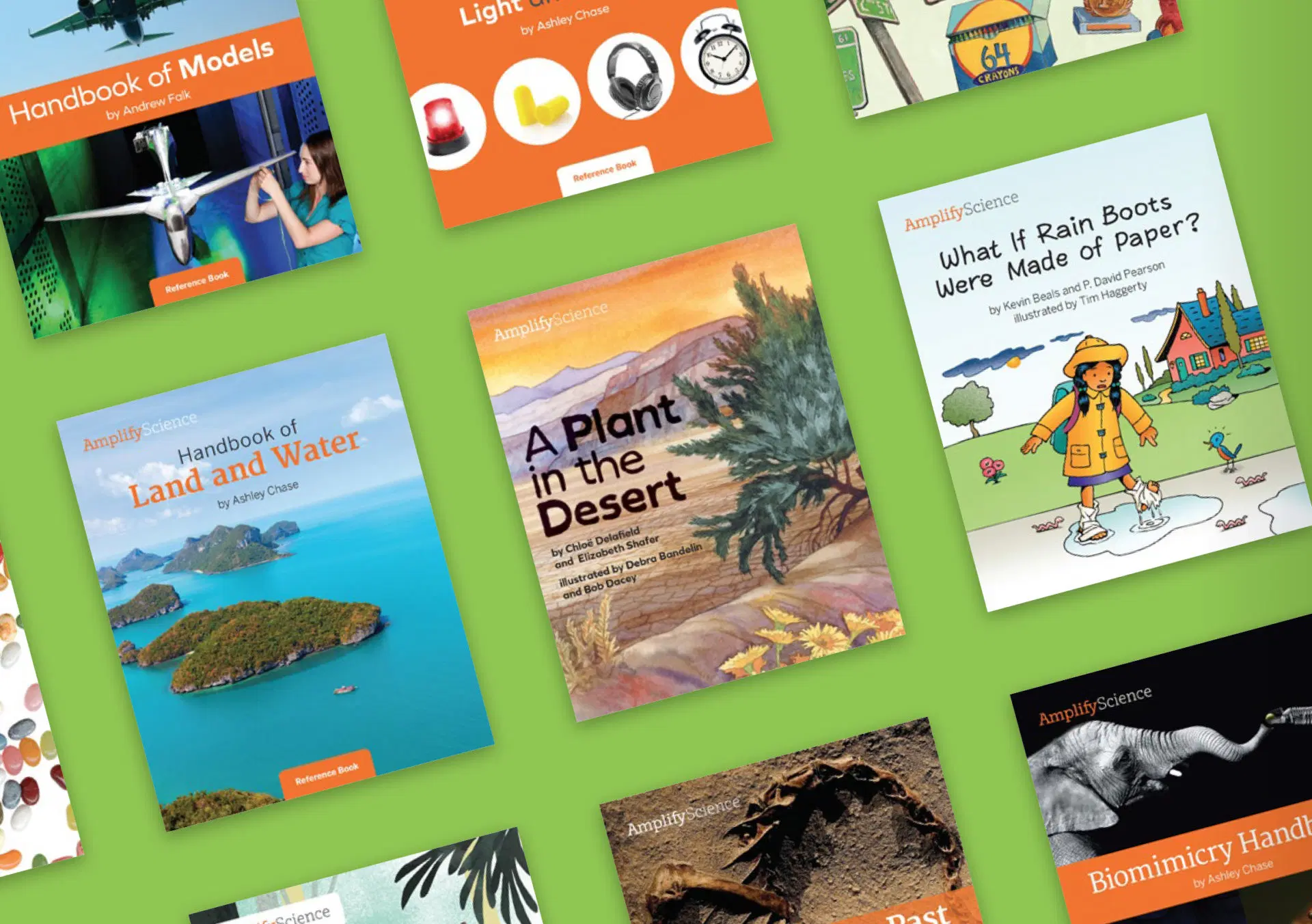
Let’s get started.

Click the button below to preview the digital Teacher’s Guide, and check back for exciting updates to this site!

To explore resources, select your role below:

News for educators

The world has turned upside down in the last few weeks, and we know it can be stressful to figure out how to adjust to this new reality, both personally and professionally. We at Amplify continue to be dedicated to supporting you as you transition to this unprecedented time of remote teaching and learning.

Join us! Click here for Remote Learning Office Hours to collaborate with others on remote learning resources, tools and solutions.

To help you prepare for (and implement) remote learning:

Go to amplify.com/remotelearning for more remote learning resources.

Go to freeresources.amplify.com for video lessons and Read-Alouds for grades K–5.

Amplify’s universal and dyslexia screening in one too

Measure what matters 

Table listing literacy skills assessed in the "screening area" and "mclass assessments," with check marks indicating coverage of specific skills like phonological awareness and reading fluency.

mCLASS® with DIBELS 8th Edition® provides a formative assessment solution that supports the identification of students at risk for reading difficulties, including difficulty related to dyslexia. DIBELS 8th Edition was developed by the University of Oregon with the primary focus of ensuring that the measures are able to meet state-level dyslexia screening requirements.

How mCLASS identifies students at risk of dyslexia

When screening for risk, nothing can replace the power of listening to a child read—listening to their strengths as a reader AND their struggles.

With mCLASS, teachers administer predictive one-minute assessment measures that involve listening to students interact with sounds, letters, words, and text while screening for reading difficulties.

Table showing academic performance metrics for grade 1 students at the beginning of the year, highlighted row for student jon bell with various scores.

Identifying at-risk students: What comes next?

Research and statistics about dyslexia in early literacy

90 percent of students who struggle in third grade will continue to struggle at the end of elementary school if they do not receive the intervention.

74 percent of students who are poor readers in third grade will be poor readers in ninth grade, and, in general, have a higher risk of academic failure and school dropout.

According to a 2015 National Assessment of Educational Progress study, only 35 percent of fourth-grade students were proficient in reading. Most of these children will spend the rest of their time in school trying to catch up

mClass solutions

mCLASS Instruction provides teachers with a single view of the personalized, blended instruction (teacher-led and online) that is available to support individual student or small-group needs in skill areas directly assessed in the mCLASS assessment.

Employ teacher-led instruction for whole classes, small-groups, and individual students, including activities created by Susan Hall, author of I’ve DIBEL’d, Now What, are provided for skill practice.

Additional instructional resources for comprehension include grade-level passages that provide more practice.

Get online student instruction and practice with Amplify Reading, which places students in a personalized instruction path based on mCLASS assessment data and adapts based on progress in the curriculum. Students engage with skills-based games as well as an eReader.

Receive rigorous, teacher-led intervention with mCLASS Intervention to address students most in need of support.

Teachers can download a letter with student assessment results to send home to parents and guardians, or use as a basis for discussion at conferences. Home Connect letters describe how the measures relate to skills development. Progress bars indicate the student’s performance on each measure.

Home Connect extends reporting to parents and guardians in a way that is easily understood and provides suggestions for positive action.

Dylexia Resources and Materials

Resources

Dyslexia toolkit

Cover of a "dyslexia toolkit" brochure with images of children engaged in various classroom activities including reading, writing, and working in groups, and a teacher leading a class.

View now

Dyslexia Screening and Dibels 8th edition

View now

Connecting the science of reading to assessment

Recorded on: Tuesday, February 4, 2020 at 2–3 p.m. ET
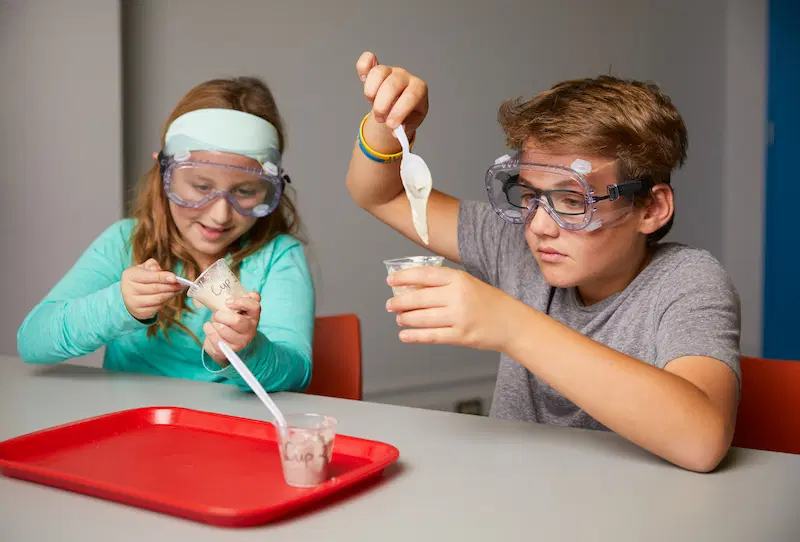
What exactly does the science of reading say about early literacy assessment? Hear from an expert on how to align assessment to the science of reading.

Register and watch now on demand

Science of Reading toolkit

Illustration of a person holding a book with colorful ribbons flowing out, symbolizing streams of knowledge, alongside text about using science reading insights.

View toolkit

Request a demo

mCLASS with Amplify Reading offers Amplify Reading’s engaging and adaptive instructional layer alongside mCLASS’s best-in-class literacy assessment. Simply complete the form to request a demo, and an Amplify sales representative will be in touch.

Welcome Amplify Science educators!

To view this protected page, enter the password below:


Spanish supports for Amplify Science

Amplify Science is committed to providing support to meet the needs of all learners, and includes multiple access points for Spanish-speaking students. Developed in conjunction with Spanish-language experts and classroom teachers, multiple components are available in Spanish across the Amplify Science curriculum.

Illustration of a village with houses, fields and mountains under a cloudy sky with waves of wind or rain.

Elementary school

COMPONENTTEACHER/STUDENT
Student Investigation NotebookStudent
Student BooksStudent
Big Books (Grades K–1)Teacher
Assessments and copymasters (included in the Unit Materials Notebook)Teacher
Printed classroom materials (Unit and chapter questions, key concepts, vocabulary cards, etc.)Teacher
COMPONENTTEACHER/STUDENT
Student Books with Spanish audio (delivered as part of the digital classroom library add-on license)Student
Unit Materials notebook, which is located on the Unit Guide and contains all copymasters, print assessments, app guides (i.e. instructions), and video transcripts.Teacher
ProjectionsTeacher
All model teacher talkTeacher
Downloadable PDFs of all print materialsTeacher
CopymastersTeacher
Videos, including closed captionsTeacher and student
Digital Apps (i.e. Sims, Modeling Tools, etc.)Teacher and student
Completed Argumentation Wall DiagramTeacher

Middle school

COMPONENT
TEACHER/STUDENT

Student Investigation Notebooks with Article Compilations

Student

Video transcripts and Digital simulation translation key Included in the Unit Materials Notebook

Teacher

Assessments and copymasters Included in the Unit Materials Notebook

Teacher

Printed classroom materials

Teacher

Unit and chapter questions, key concepts, vocabulary cards, etc.

Teacher

COMPONENT
TEACHER/STUDENT

Spanish Student Experience License. Includes access to:

  • Instructional text
  • Articles for download
  • Assessments
  • Videos with audio and closed captions

Student

Spanish Teacher Support License. Includes access to:

  • Unit Materials Notebook (located on the Unit Guide and contains all copymasters, print assessments, Active Reading Guidelines, app guides (i.e. instructions), and video transcripts)
  • Projections
  • All model teacher talk
  • Downloadable PDFs of all print materials
  • Copymasters
  • Videos, including closed captions
  • Digital Apps, on a rolling basis (i.e. Sims, Modeling Tools, etc.)
  • Student-view of lesson instructions
  • Completed Argumentation Wall Diagram

Teacher

Empowering multilingual learners

Welcome back to Science of Reading: The Podcast!

For most teachers, it’s no longer a question of if you’ll have a multilingual learner in your classroom, but rather a question of how many, and what languages they bring with them. While the Science of Reading can help all learners, its insights should be applied differently when students are learning a home language as well. The more we’re able to read, the more we’re able to learn.

—Dr. Elsa Cárdenas-Hagan

In this episode, Susan Lambert is joined by Dr. Elsa Cárdenas-Hagan to discuss the unique challenges and opportunities presented when teaching multilingual learners how to read. Dr. Cárdenas-Hagan is a bilingual speech-language pathologist and certified academic language therapist who serves as director of Valley Speech Language and Learning Center in Brownsville, Texas. In this episode, she discusses how teachers can make connections between students’ home languages and English in order to celebrate their language and give them new tools to better understand English. She also stresses the importance of teachers educating themselves on their students’ home languages so they can spot orthographic and phonological similarities and differences. She also highlights the importance of educator collaboration for student success.

Listen now!

For more wisdom and research on the best ways to teach reading, subscribe to Science of Reading: The Podcast.

Dyslexia and developmental trajectories

Welcome back to Science of Reading: The Podcast!

As educators, we’re often reminded of the importance of early intervention, but hear little about the science behind it. What happens when students aren’t identified as at-risk for reading difficulty early enough? What about when they are and receive intervention? And importantly, how does this all connect to dyslexia?

We want to make sure that we find everyone who is struggling with learning to read and make sure that everyone gets to experience the joy of learning to read.

 — Dr. Nadine Gaab

In this episode, Susan Lambert joins Dr. Nadine Gaab to discuss dyslexia and the developmental progression of the brain, and the behavior of students as they learn to read. Dr. Gaab, an Associate Professor of Education at the Harvard Graduate School of Education, focuses on both typical and atypical learning trajectories from infancy to adulthood, with a special emphasis on language and reading development and the role of the environment in shaping these trajectories. Dr. Gaab provides further insight into these developmental trajectories in this episode, especially as they relate to early intervention for at-risk students. She differentiates between early diagnosis of dyslexia versus early identification of at-risk students, adding nuance and complexity to the discussion of dyslexia by emphasizing the ways educators can ensure that all students experience the joy of learning to read.

Tune In Below!

For more wisdom and research on the best ways to teach reading, subscribe to Science of Reading: The Podcast.

National Reading Month: Making reading in elementary schools fun

Happy National Reading Month!

Of course, every month is reading month—and every day is reading day!

But March makes National Reading Month official, and we’d like to help you celebrate.

  • Brain Builders” is an animated video series you can share with your students to help them understand what the brain does in order to read—placing reading science in the hands (and brains!) of students.

Your kids will join Minh on his journey as his babysitter, Tamara, helps him cultivate a love for reading—while also learning a bit of cognitive science. The series includes 13 episodes that you won’t want to miss!

  • Reading Buddies” makes learning to read fun (with the help of a talking dog, of course). Created by a pair of performers during the COVID-19 quarantine, the show became a smash hit when The Reading League came on to help it grow.

The series is based on the Science of Reading—but that’s not why students like it! They get to follow and practice along with Dusty the Dog as his person, Dott, teaches him to read. All the while, the kids are learning the underlying components of skillful word reading such as phonological awareness, letter names/sounds, and blending sounds.

And for a little good old-fashioned coloring, we’ve also created this literary reference sheet for your students to bring alive with their own imaginations.

We hope you enjoy celebrating your kids’ brains and creativity!

More to read and learn

From Amplify’s Science of Reading: The Podcast:

Find out how “Reading Buddies” came to be (and managed to outpace “Sesame Street”)!

Meet Margaret Goldberg, co-founder of The Right to Read Project, to get her take on Brain Builders and the importance of the comprehension strand of the Science of Reading.

Request a free sample of CKLA.

The Science of Reading and the power of knowledge

The Science of Reading has shown repeatedly and definitively that background knowledge is much more than a nice-to-have when it comes to literacy. In fact, it’s a must. 

One recent independent study led by Sonia Q. Cabell, Ph.D., and Hyejin Hwang, Ph.D., conducted two trials of more than 1,200 kindergarten students. Reading comprehension tests revealed that students who used a knowledge-building curriculum, such as Amplify CKLA, showed statistically significant positive effects on both social studies knowledge and vocabulary, even over just one semester.   

So here’s what teachers need to know about the knowledge-building students require, starting early, to develop foundational literacy skills for life.

The power of knowledge and language comprehension, in action

Read the following passage. 

Start by putting your clay on the bat as close to the center as possible, then turn your wheel on at full speed. After adding water often enough to keep the clay glossy, adjust it until it’s barely wobbling, then cone it up and center it further. Cone down and then open the clay. Lower your wheel speed to halfway and start pulling the walls. Compress the floor, and then start shaping. When you’re happy with your shape, use your wire tool to remove it from the bat, and set it aside to start drying before you trim, glaze, and fire it.

If you were ever trained in pottery, you probably understood a lot of that. If you weren’t, you could likely read the words and sense the tone, but most of the content would not make sense (Cone up? Cone down?) or stick in your mind at all. 

That’s exactly how background knowledge powers reading comprehension.

The knowledge gap

Elementary students confront disparities in their background knowledge every day. Some have houses full of books and summers full of trips. One kid has a pet turtle, another celebrates Diwali, another grew up in the family restaurant. As you can probably imagine, they’d all get and retain a wide range of understanding from passages about, say, amphibians, alfredo sauce, and the Alps. 

Not all foundational literacy instruction is built to access the knowledge students bring to the classroom, or to grow the knowledge they need to understand what they’re reading. 

What’s more, having less background knowledge is correlated with socioeconomic status, with students who come from lower income families generally having less background knowledge than those who come from higher-income families. That’s how we know that knowledge is also a matter of fairness.

The role of writing instruction

Writing instruction grounded in the content of a knowledge-based curriculum can be a crucial contributor to knowledge-building, according to Wexler. It can help teachers:
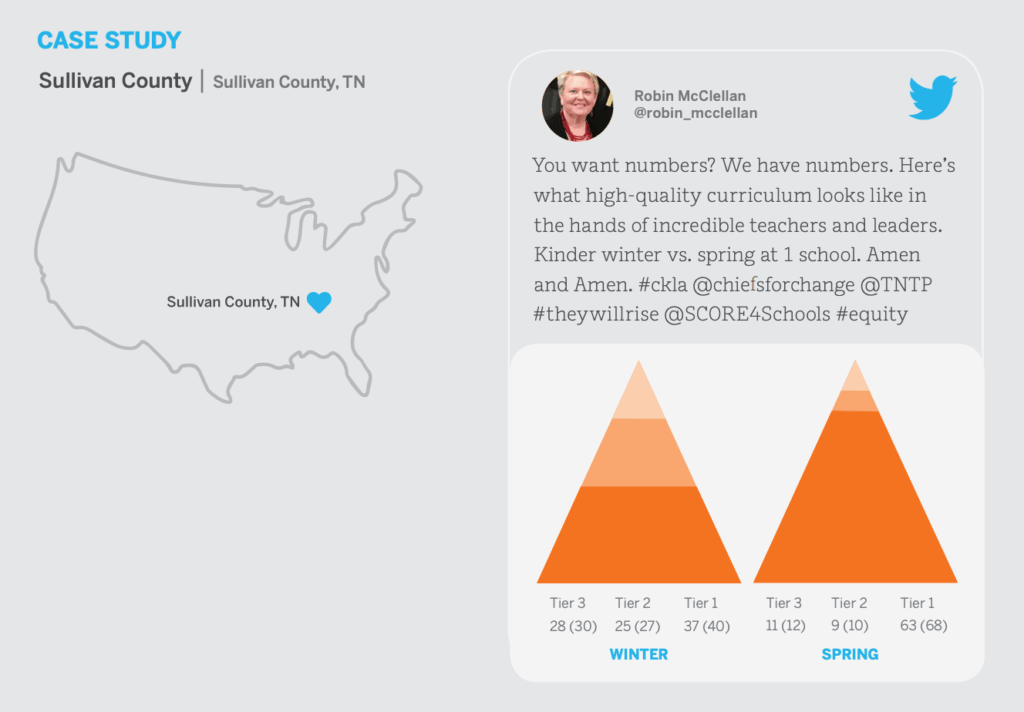
  • Identify which gaps in background knowledge are holding a given student back.
  • Instruct students at higher grade levels, even if students reach those levels with gaps in background knowledge.
  • Boost learning across subjects.
  • Improve the quality of student writing itself, because it’s grounded in a topic they can say something about. 
  • Foster comprehension by familiarizing students with the complex syntax of written language in their own writing. 

The power of knowledge to connect 

Big picture: Connecting to a student’s background knowledge can help unlock their full potential as a reader, writer, and member of the classroom and school community. 
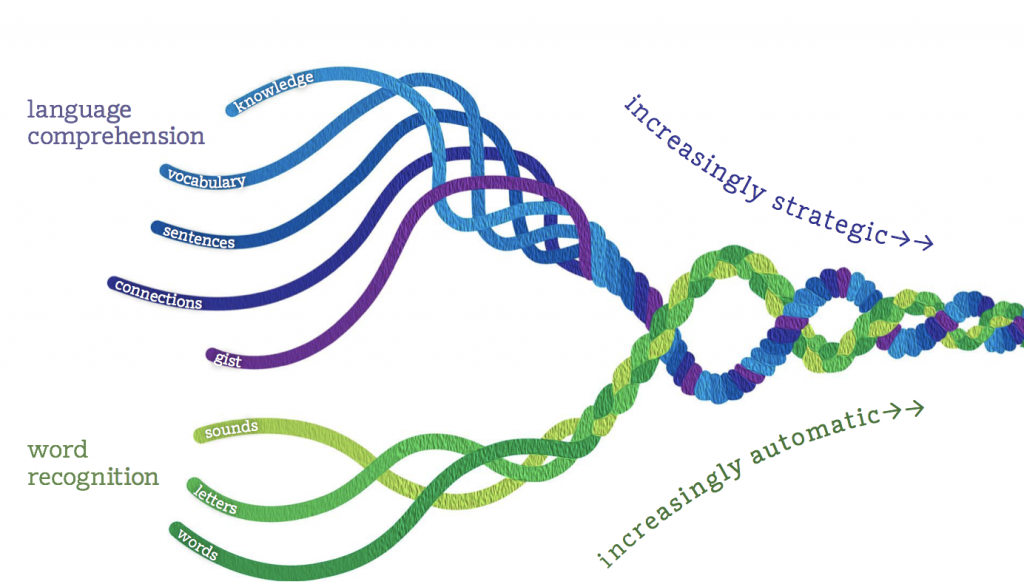
Allison Rice, elementary ELA curriculum coach for Kansas City Kansas Public Schools, tells this story about a girl in her class: “All through Unit 1 and halfway through Unit 2, she had not really participated or spoken in class, until they got to the lesson on Diwali. She celebrates Diwali. And all of a sudden, she had 1,000 things to contribute. Then her parents came in, they had never been into the school, and they finally felt welcomed and comfortable enough to come in and share about their culture, and the whole grade level had a huge party.” 

This student was able to use her culture—and her knowledge—to create community in her classroom. “Here’s this little girl,” says Rice, “who for the first time has felt seen and reflected.”

Literacy resources for teachers and more

Using formative assessment to support literacy

Learning to read is not linear. That’s because reading is not just one skill, but a bundle of skills, intertwined and supporting one another.

In the late 1990s, reading and literacy expert Hollis Scarborough helped us visualize this complex process by creating a model that’s now known as the Reading Rope. Grounded in the Science of Reading, this now-iconic model emphasizes the need for a comprehensive, deliberate approach to reading instruction. It’s an approach that recognizes the importance of building both reading skills and the background knowledge that makes them even stronger.

The Reading Rope model also connects educators to key strands of formative data that guide instruction and assessment.

With data and information that support the relationship between language comprehension and word recognition skills, teachers can devise reading comprehension strategies and get a better idea of where to focus their instruction. And thanks to the Science of Reading, this data can also help you track what students know, and where they need to go.

Let’s take a closer look to see how it all works.

Reading comprehension and more: The strands of the Reading Rope

The design of the Reading Rope shows that the two core components of reading are word recognition and language comprehension.

Word recognition encompasses the ability to accurately, effortlessly, and rapidly decode printed words. Phonological awareness, phonics, and sight word recognition contribute to this strand.

  • Phonological awareness is the ability to recognize and manipulate the individual sounds (phonemes) within spoken words. It includes skills such as identifying rhymes, segmenting words into syllables, and manipulating sounds within words. Phonological awareness provides the foundation for phonics instruction.
  • Phonics involves the systematic relationship between letters and the sounds they represent. It includes understanding letter-sound correspondences, decoding unfamiliar words by applying sound-symbol relationships, and blending sounds to form words. Phonics instruction gives students the tools to decode printed words.
  • Sight word recognition happens when students have had enough practice decoding words that they can automatically recognize and apply sound-spelling patterns across words. Automaticity in word recognition allows students to shift their focus from decoding to comprehending texts.

Language comprehension involves the understanding of spoken and written language. This includes vocabulary, grammar, syntax, and the ability to make inferences and draw conclusions. Language comprehension allows readers to extract meaning from and create meaning with text.

  • Vocabulary refers to the words one knows and understands, both orally and in writing. A robust vocabulary enhances comprehension and communication.
  • Grammar and syntax are the rules and structures that govern language. Understanding and applying grammatical rules help students comprehend and construct sentences, enhancing their ability to make meaning from and create meaning with text.
  • Inference skills involve the ability to draw conclusions, make predictions, and derive implicit meaning. With these skills, students are able to combine their background knowledge with information in the text to make guesses and reach conclusions.

The importance of knowledge

The Reading Rope affirms that readers use their existing knowledge and experiences to make sense of what they are reading. A student who brings relevant background knowledge to a text can understand it even better than a stronger reader who’s new to the topic.

Background knowledge also helps readers navigate unfamiliar vocabulary or concepts. When readers encounter words or ideas they already have some familiarity with, they can make connections and use contextual clues to determine meaning, which contributes to reading fluency and comprehension.

Intentionally building background and academic knowledge—coupled with comprehension strategies—fuels students’ capacity to understand texts, answer questions, and grapple with ideas.

As educators Barbara Davidson and David Liben write: “Although students’ independent reading is often at lower complexity levels at the beginning of a unit, as they acquire knowledge about the core topic they are generally able to read texts on their related topic at complexity levels greater than their diagnosed grade level.”

Putting it all together with formative assessment

There are a variety of ways to gather information about your students’ skills and knowledge, using the Reading Rope as your guide. Here are just a few examples that correspond to its strands:

Word recognition

  • Letters: See how students do with letter-sound correspondence tasks such as: matching graphemes to phonemes, writing letters that represent sounds, word-building activities, and sound sorts with word cards.
  • Words: Gauge students’ ability to apply sound-symbol correspondences by asking them to spell words with sound-spelling patterns they’ve already learned.

Language comprehension

  • Knowledge: How much are students learning about a topic overall? Keep asking—through pre-reading tasks, discussions, and checks for understanding.
  • Vocabulary: Track students’ vocabulary growth with word-mapping, context-clue, and word-brainstorming tasks.

Skilled reading

Here’s where it all comes together. Many formative assessment activities will help you discover what your students know about the skills they’re using as readers. Here, we’ll focus on the power of students speaking and writing about what they’re reading.

  • Speaking: As children learn to speak, they develop vocabulary and knowledge of sentence structure, both of which support reading comprehension. Simply giving students the opportunity to talk about a topic can provide insight into their oral language development.
  • Writing: Challenge students to write summaries, critiques, and analyses of texts to see what they’re comprehending from what they’re reading.

More to explore

Beyond prompts: How to teach writing for middle school student success

Writing is hard. Natalie Wexler, who co-wrote The Writing Revolution: A Guide to Advancing Thinking Through Writing in All Subjects and Grades, has described it as “the hardest thing we ask students to do.”

And writing is also hard to teach—perhaps especially to middle schoolers.

Writing education experts such as Steve Graham, Ph.D., say that, as important as writing is, it often gets less attention due to competing educational demands, like the need to teach subjects connected to high-stakes testing, the pressure to teach to a given test, and the siloing of writing as an independent skill untethered to content.

But writing is essential—not just as a means of expressing knowledge, but also as a means of building it. That’s why, when it comes to middle-school writing instruction, we need to go beyond just writing prompts. So how can teachers provide the strongest possible writing instruction for middle-school students? Keep reading.

Student writing: Why it matters

Learning to write makes you a better writer, but it also makes you a better reader—and a better learner.

In a meta-analysis of more than 100 studies, Steve Graham and Michael Hebert, Ph.D., found that writing about text improves comprehension and learning even more than reading alone, reading and rereading, or reading and discussing.

“Combining reading and writing is part of the Science of Reading,” writes literacy educator Tim Shanahan, Ph.D. “If you want better reading scores, the Science of Reading says do not neglect writing, nor dispatch it to someplace else in the curriculum. When you feel especially pressured to improve reading achievement, that is the time to embrace more tightly the combination of reading and writing.”

Shanahan also notes that readers who write and writers who read are best equipped to observe what authors do to convey meaning and what readers need in order to understand writing.

Current ELA standards recognize the interplay between reading and writing by articulating these goals: using writing to improve learning from text and using the reading of multiple texts to improve the writing of syntheses or reports.

Writing activities for middle school

Even with challenges and constraints, educators can find ways to engage students and transform their writing. When planning writing activities with your middle-school students, it’s important to keep them captivated, incorporate writing instruction throughout your lessons, and differentiate to meet the needs of all of your students. Here are some principles that will help:

  • Detach writing from getting it “right.” Seymour Papert theorized that students become better thinkers when they’re not attached to one outcome—not afraid to be “wrong.” Of course, sometimes there is a correct answer, but it’s the process of seeking it that counts. Offer writing assignments that encourage—and reward—risk-taking and creativity.
  • Integrate writing everywhere. Help students build both knowledge and writing skills by including writing exercises across subjects, including science.
  • Scaffold with sentence frames and modified prompts. Middle-school students often know what they want to say, but not how to say it, especially if they are multilingual learners. Sentence frames and modified prompts—such as “Tom convinces his friends to whitewash the fence by saying…”—can help with that. They reduce linguistic barriers, enabling students to produce writing and speech more complex than what they could have done on their own—and giving you a sense of their level of understanding.

Writing can be a powerful tool to help students deepen their comprehension of written text, expand their knowledge, and develop as communicators. Learn more about the best strategies and activities to use in your classroom. These will put you on the best path for helping your students thrive as writers, readers, communicators, and lifelong learners.

More to explore

Alert: Progress in early literacy is slowing.

The latest middle-of-school-year data from Amplify show that throughout the spring and fall of 2023, schools across the country made some progress increasing the number of K–2 students on track for learning to read. But that progress is slowing.

Between 2021–2022 and 2022–2023, the number of K–2 students on track for learning to read increased by four to five percent across all grades; however, between 2022–2023 and 2023–2024, the increase was only two percent in each grade. Yet this is not the time for slow progress, because literacy rates in the United States are already a concern. Only half of K–2 students are on track for learning to read, and three in ten students are far behind.

To address slowing gains, schools and districts need to act now to accelerate literacy outcomes.

Early reading: Why we need to act now

The decline is especially urgent for students in kindergarten through the second grade. That’s because of what comes next: third grade, known to be the make-or-break year for reading and future academic success. To put it bluntly, students who are not proficient in reading before entering fourth grade are much more likely than their peers to struggle in school, and they are much more likely to drop out.

“The data is clear—literacy rates at the earliest and most critical time for student development are slowing. Changing this course requires schools and districts to act now and review their approaches in all grades,” says Susan Lambert, chief academic officer of elementary humanities at Amplify. “Schools that deliver strong outcomes focus on building a solid foundation at the start and intervening quickly when students need extra support, rather than trying to play catch up later, when it can be more difficult.”

The good news: We know what to do.

When students receive science-based reading instructionliteracy outcomes improve.

Changing these outcomes requires that districts and schools review the processes and practices they have in place at all levels. Schools that deliver strong outcomes focus on getting students on track—and often ahead—in the earliest grades, because it’s easier to get students ahead from the beginning than to catch them up later.

Districts should:

  • Administer universal screening assessments three times per year to monitor levels of risk for reading difficulties.
  • Allocate staff to support students who are at risk, spending additional time in literacy instruction beyond grade-level instruction.
  • Regularly monitor progress for students who are at risk, making adjustments as needed.
  • Ensure that instructional staff gain knowledge about science-based reading instruction and implement high-quality core curriculum with fidelity.
  • Instill a love of reading and books during all school-based programs, with the support of caregivers and the community.

“The good news is that when students receive science-based reading instruction, outcomes improve,” Lambert continues. “And, when that instruction takes place in the earliest possible grades, research shows that most students can be taught to read at or approaching grade level.”

Read the full report.

More to explore