Showing results for louis squares

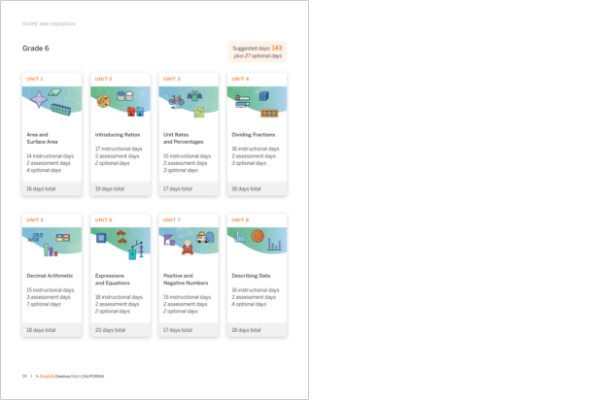
Grade 6

Unit 1: Area and Surface Area

Illustrative MathematicsDesmos Math 6–A1
Topic A: Reasoning to Find Area 
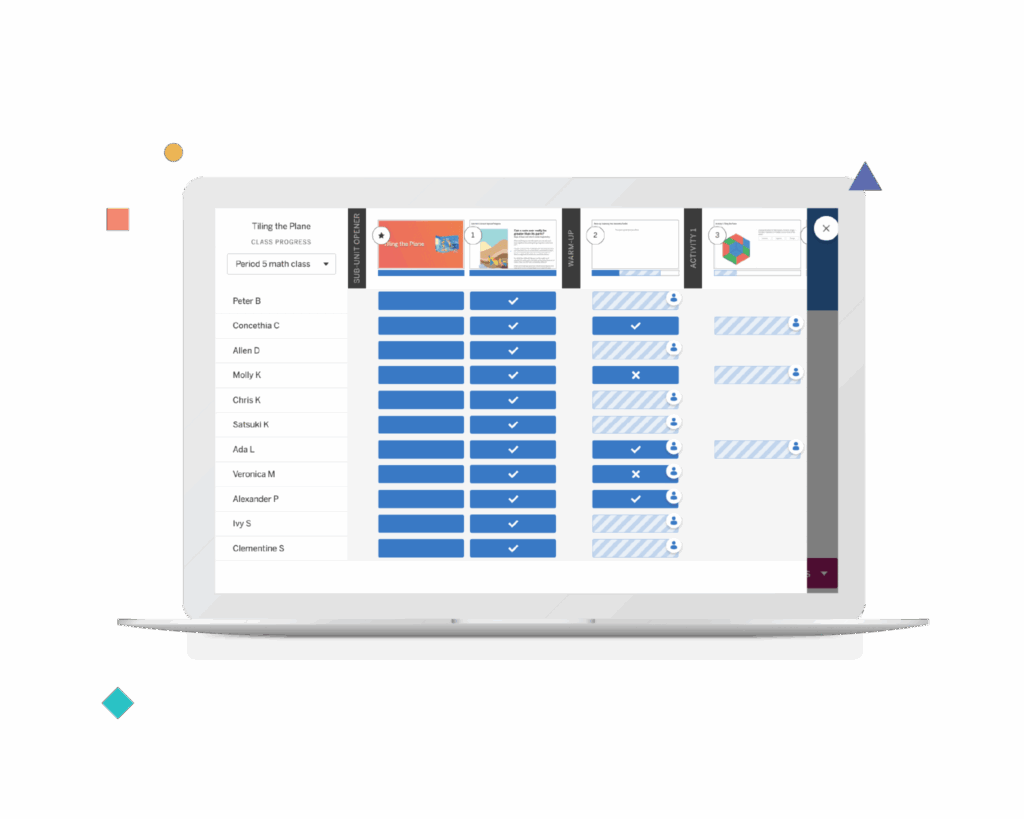
Lesson 1: Tiling the PlaneUnit 1
Lesson 1: Shapes on a Plane [Free lesson]
Lesson 2: Finding Area by Decomposing and Rearranging
Lesson 3: Reasoning to Find Area
Unit 1
Lesson 2: Letters
Topic 2: Parallelograms
Lesson 4: Parallelograms
Lesson 5: Bases and Heights of Parallelograms
Lesson 6: Area of Parallelograms
Unit 1
Lesson 3: Exploring Parallelograms (Print available) [Free lesson]
Lesson 4: Off the Grid
Topic 3: Triangles
Lesson 7: From Parallelograms to TrianglesUnit 1
Lesson 3: Exploring Parallelograms (Print available) [Free lesson]
Lesson 4: Off the Grid
Lesson 6: Triangles and Parallelograms
Lesson 8: Area of TrianglesUnit 1
Lesson 5: Exploring Triangles (Print available)
Lesson 9: Formula for the Area of a Triangle
Lesson 10: Bases and Heights of Triangles
Unit 1
Lesson 4: Off the Grid
Lesson 6: Triangles and Parallelograms
Topic 4: Polygons
Lesson 11: PolygonsUnit 1
Lesson 2: Letters
Lesson 8: Pile of Polygons
Practice Day 1 (Print available)
Unit 7
Lesson 11: Polygon Maker
Topic 5: Surface Area
Lesson 12: What is Surface Area?Unit 1
Lesson 9: Renata´s Stickers [Free lesson]
Lesson 13: PolyhedraUnit 1Lesson 10: Plenty of Polyhedra
Lesson 14: Nets and Surface AreaUnit 1
Lesson 10: Plenty of Polyhedra
Lesson 11: Nothing But Nets (Print available)
Lesson 13: Take It To Go
Lesson 15: More Nets, More Surface AreaUnit 1
Lesson 10: Plenty of Polyhedra
Lesson 11: Nothing But Nets (Print available)
Lesson 12: Face Value
Lesson 13: Take It To Go (Print available)
Practice Day 2 (Print available)
Lesson 16: Distinguishing Between Surface Area and Volume
Topic 6: Squares and Cubes 
Lesson 17: Squares and CubesUnit 6
Lesson 12: Squares and Cubes
Lesson 18: Surface Area of a Cube 
Topic 7: Let’s Put It to Work 
Lesson 19: Designing a TentUnit 1
Lesson 13: Take It To Go (Print available)

Unit 2: Introducing Ratios

Topic 1: Introducing Ratios
Lesson 1: Introducing Ratios and Ratio LanguageUnit 2Lesson 1: Pizza Maker [Free lesson]Lesson 2: Ratio Rounds (Print available)
Lesson 2: Representing Ratios with DiagramsUnit 2Lesson 1: Pizza Maker [Free lesson]Lesson 2: Ratio Rounds (Print available)Lesson 3: Rice Ratios (Print available)
Topic 2: Equivalent Ratios
Lesson 3: RecipesUnit 2Lesson 1: Pizza Maker [Free lesson]Lesson 3: Rice Ratios (Print available)
Lesson 4: Color MixturesUnit 2Lesson 7: Mixing Paint, Part 1Lesson 12: Mixing paint, Part 2
Lesson 5: Defining Equivalent RatiosUnit 2Lesson 3: Rice Ratios (Print available)Lesson 4: Fruit Lab [Free lesson]Lesson 11: Community LifePractice Day 1 (Print available)
Topic 3: Representing Equivalent ratios
Lesson 6: Introducing Double Number Line DiagramsUnit 2Lesson 5: Balancing Act
Lesson 7: Creating Double Line DiagramsUnit 2Lesson 5: Balancing ActLesson 6: Product prices (Print available)
Lesson 8: How Much for One?Unit 2Lesson 6: Product prices (Print available)
Lesson 9: Constant SpeedUnit 2Lesson 8: World Records (Print available)
Lesson 10: Comparing Situations by Examining RatiosUnit 2Lesson 7: Mixing Paint, Part 1 
Topic 4: Solving Ratio and Rate Problems
Lesson 11: Representing Ratios with TablesUnit 2Lesson 9: Disaster Preparation [Free lesson]
Lesson 12: Navigating a Table of Equivalent Ratios
Lesson 13: Tables and Double Line Diagrams
Unit 2Lesson 6: Product prices (Print available)Lesson 7: Mixing Paint, Part 1
Lesson 14: Solving Equivalent Ratio ProblemsUnit 2Lesson 6: Product prices (Print available)Lesson 7: Mixing Paint, Part 1Lesson 10: BalloonsLesson 11: Community Life (Print available)
Topic 5: Part-Part-Whole Ratios
Lesson 15: Part-Part-Whole RatiosUnit 2Lesson 12: Mixing paint, Part 2Lesson 13: City Planning
Lesson 16: Solving More Ratio ProblemsUnit 2Lesson 13: City PlanningLesson 14: Lunch Waste (Print available)
Topic 6: Let’s Put It to Work 
Lesson 17: A Fermi ProblemUnit 2Lesson 13: City PlanningLesson 14: Lunch Waste (Print available)Practice Day 2 (Print available)

Unit 3: Rates and Percentages

Topic 1: Units of Measurement 
Lesson 1: The Burj KhalifaUnit 3
Lesson 4: Model Trains
Topic 2: Unit Conversion
Lesson 2: Anchoring Units of MeasurementUnit 3
Lesson 1: Many Measurements (Print available) [Free lesson]
Lesson 3: Measuring with Different-Sized Units
Lesson 4: Converting Units
Unit 3
Lesson 2: Counting Classrooms
Lesson 3: Pen Pals
Topic 3: Rates
Lesson 5: Comparing Speeds and PricesUnit 2
Lesson 8: World Records (Print available) 

Unit 3
Lesson 4: Model Trains
Lesson 5: Soft Serve [Free lesson]
Lesson 6: Welcome to the Robot Factory
Lesson 6: Interpreting Rates
Lesson 7: Equivalent Ratios Have the Same Unit Rates
Unit 3
Lesson 4: Model Trains
Lesson 5: Soft Serve [Free lesson]
Lesson 8: More About Constant SpeedUnit 2
Lesson 8: World Records (Print available) 

Unit 3
Lesson 4: Model Trains
Lesson 9: Solving Rate ProblemsUnit 3
Lesson 7: More Soft Serve
Topic 4: Percentages
Lesson 10: What Are percentagesUnit 3
Lesson 8: Lucky Duckies [Free lesson]
Lesson 9: Bicycle Goals
Lesson 11: Percentages and Double Number LinesUnit 3
Lesson 9: Bicycle Goals
Lesson 10: What’s Missing? (Print available)
Lesson 12: Percentages and Tape DiagramsUnit 3
Lesson 10: What’s Missing? (Print available)
Lesson 13: Benchmark percentagesUnit 3
Lesson 8: Lucky Duckies [Free lesson]
Lesson 14: Solving Percentage Problems
Lesson 15: Finding This Percent of That
Lesson 16: Finding the Percentage
Unit 3
Lesson 10: What’s Missing? (Print available)
Lesson 11: Cost Breakdown
Lesson 12: More Bicycle Goals
Lesson 13: A Country as a Village
Topic 5: Let’s Put It to Work 
Lesson 17: Painting a RoomUnit 3
Lesson 13: A Country as a Village
Lesson 7: Equivalent Ratios Have the Same Unit RatesUnit 3
Lesson 4: Model Trains
Lesson 5: Soft Serve [Free lesson]

Unit 4: Dividing Fractions

Topic 1: Making Sense of Division 
Lesson 1: Size of Divisor and Size of Quotient
Lesson 2: Meanings of Division
Unit 4Lesson 1: Cookie Cutter
Lesson 3: Interpreting Division SituationsUnit 4Lesson 2: Making Connections (Print available)
Topic 2: Meanings of Fraction Division
Lesson 4: How Many Groups (Part 1)Unit 4Lesson 3: Flour Planner [Free lesson]Lesson 4: Flower Planters 
Lesson 5: How Many Groups (Part 2)Unit 4Lesson 5: Garden Bricks (Print available)
Lesson 6: Using Diagrams to Find the Number of GroupsUnit 4Lesson 5: Garden Bricks (Print available)Lesson 6: Fill the Gap [Free lesson]
Lesson 7: What Fraction of a Group?
Lesson 8: How Much in Each Group? (Part 1)
Lesson 9: How Much in Each Group? (Part 2)
Unit 4Lesson 8: Potting Soil
Topic 3: Algorithm for Fraction Division
Lesson 10: Dividing by Unit and Non-Unit FractionsUnit 4Lesson 7: Break It DownLesson 8: Potting SoilLesson 9: Division Challenges 
Lesson 11: Using an Algorithm to Divide FractionsUnit 4Lesson 9: Division ChallengesPractice Day
Topic 4: Fractions in Lengths, Areas, and Volumes
Lesson 12: Fractional LengthsUnit 4Lesson 11: Classroom Comparisons
Lesson 13: Rectangles with Fractional Side LengthsUnit 4Lesson 12: Puzzling Areas (Print available) [Free lesson]
Lesson 14: Fractional Lengths in Triangles and Prisms
Lesson 15: Volume of PrismsUnit 4Lesson 13: Volume Challenges
Topic 5: Let’s Put It to Work
Lesson 16: Solving Problems with FractionsUnit 4Lesson 10: Swap Meet (Print available)
Lesson 17: Fitting Boxes into BoxesUnit 4Lesson 14: Planter Planner (Print available)

Unit 5: Arithmetic in Base Ten

Topic 1: Warming Up to Decimals 
Lesson 1: Using Decimals in a Shopping ContextUnit 5Lesson 1: Dishing Out Decimals (Print available) [Free lesson]
Topic 2: Adding and Subtracting Decimals
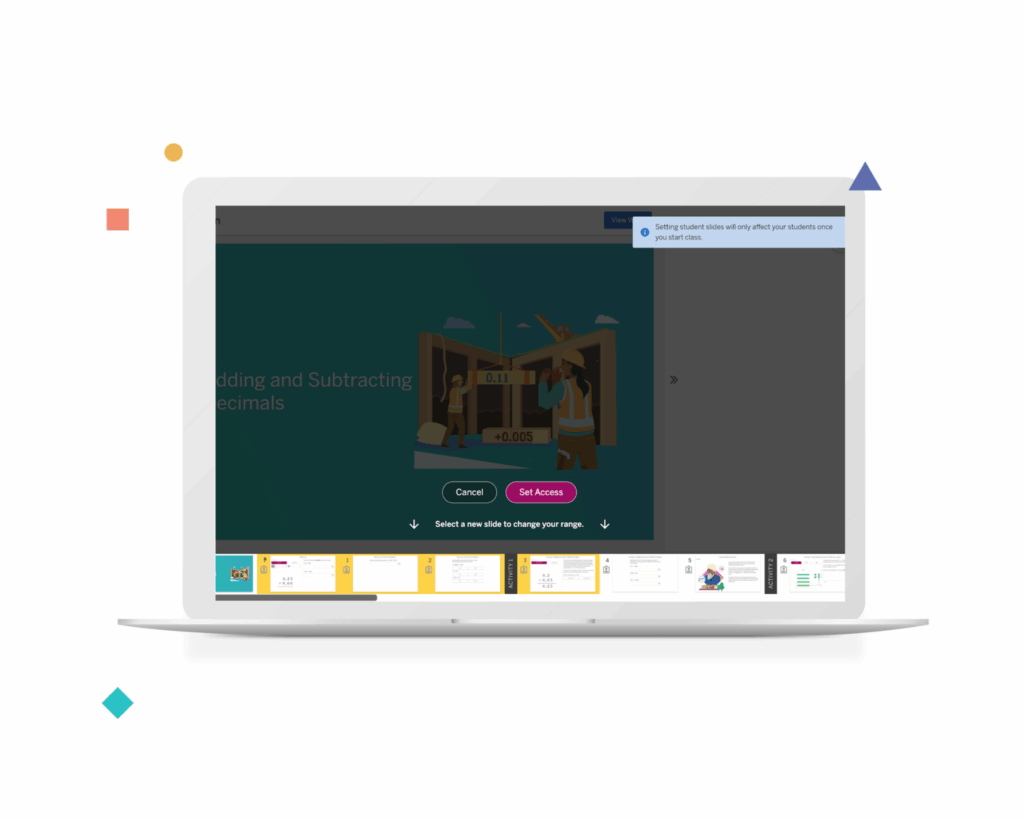
Lesson 2: Using Decimals to Represent Addition and SubtractionUnit 5Lesson 3: Fruit by the PoundLesson 4: Missing Digits
Lesson 3: Adding and Subtracting Decimals with Few Non-Zero DigitsUnit 5Lesson 4: Missing Digits
Lesson 4: Adding and Subtracting Decimals with Many Non-Zero Digits 
Topic 3: Multiplying Decimals
Lesson 5: Decimal Points in ProductsUnit 5Lesson 5: Decimal Multiplication
Lesson 6: Methods for Multiplying DecimalsUnit 5Lesson 5: Decimal MultiplicationLesson 6: Multiplying with AreasLesson 7: Multiplication methods (Print available)
Lesson 7: Using Diagrams to Represent MultiplicationUnit 5Lesson 5: Decimal MultiplicationLesson 6: Multiplying with Areas
Lesson 8: Calculating Products of DecimalsUnit 5Lesson 6: Multiplying with Areas
Topic 4: Dividing Decimals
Lesson 9: Using the Partial Quotients MethodUnit 5Lesson 8: Division Diagrams
Lesson 10: Using Long DivisionUnit 5Lesson 8: Division DiagramsLesson 9: Long Division Launch (Print available)Lesson 10: Return of the Long Division (Print available)
Lesson 11: Dividing Numbers That Result in Decimals
Lesson 12: Dividing Decimals by Whole Numbers
Lesson 13: Dividing Decimals by Decimals
Unit 5Lesson 9: Long Division Launch (Print available)Lesson 10: Return of the Long Division (Print available)
Topic 5: Let’s Put It to Work
Lesson 14: Using Operations on Decimals to Solve ProblemsUnit 5Lesson 11: Movie Time [Free lesson]
Lesson 15: Making and Measuring Boxes
Lesson 12: Dividing Decimals by Whole Numbers 
Lesson 13: Dividing Decimals by DecimalsUnit 5Lesson 9: Long Division Launch (Print available)Lesson 10: Return of the Long Division (Print available)

Unit 6: Expressions and Equations

Lesson 1: Tape Diagrams and Equations
Lesson 2: Truth and Equations
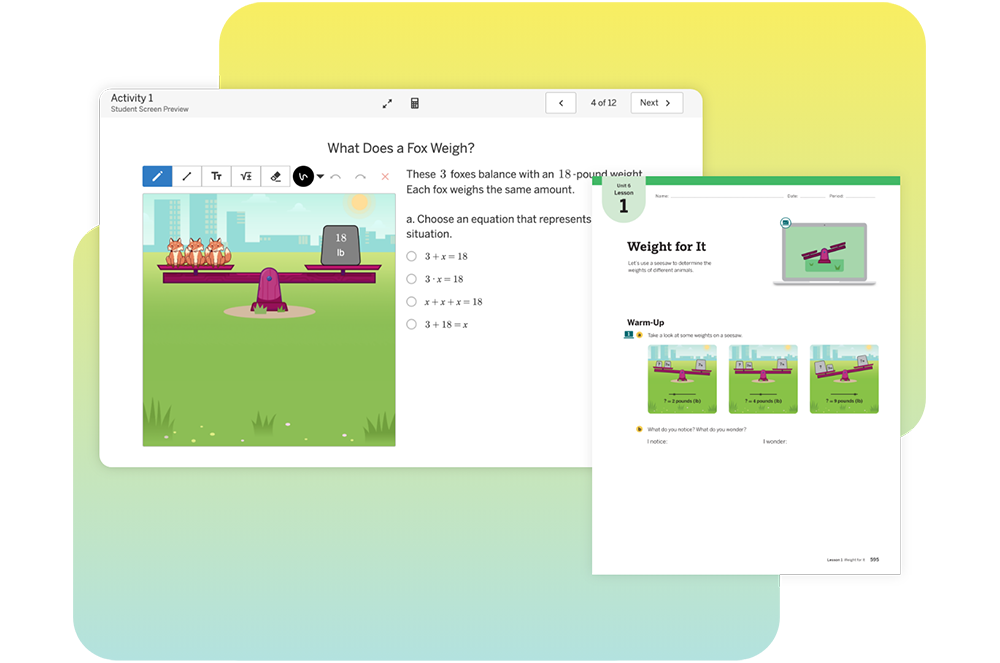
Unit 6Lesson 1: Weight for It [Free lesson]Lesson 2: Five Equations (Print available)
Lesson 3: Staying in BalanceUnit 6Lesson 1: Weight for It [Free lesson]Lesson 2: Five Equations (Print available)Lesson 3: Hanging Around
Lesson 4: Practice Solving Equations and Representing Situations with EquationsUnit 6Lesson 3: Hanging AroundLesson 4: Hanging It UpLesson 5: Swap and Solve (Print available)
Lesson 5: A New Way to Interpret a and bUnit 6Lesson 4: Hanging It UpLesson 5: Swap and Solve (Print available)
Topic 2: Equal and Equivalent
Lesson 6: Write Expressions Where Letters Stand for NumbersUnit 6Lesson 6: Vari-applesLesson 7: Border Tiles
Lesson 7: Revisit PercentagesUnit 3Lesson 10: What’s Missing?Lesson 11: Cost BreakdownLesson 12: More Bicycle Goals
Lesson 8: Equal and EquivalentUnit 6Lesson 1: Weight for It [Free lesson]Lesson 2: Five Equations (Print available)Lesson 3: Hanging AroundLesson 6: Vari-apples
Topic 9: The Distributive Property, Part 1Unit 6Lesson 8: Products and Sums [Free lesson]
Lesson 10: The Distributive Property, Part 2
Lesson 11: The Distributive Property, Part 3
Unit 6Lesson 8: Products and Sums [Free lesson]Lesson 9: Products, Sums, and Differences (Print available)
Topic 3: Expressions with Exponents
Lesson 12: Meaning of ExponentsUnit 6Lesson 10: PowersLesson 11: Exponent Expressions (Print available)
Lesson 13: Expressions with Exponents
Lesson 14: Evaluating Expressions with Exponents
Lesson 15: Equivalent Exponential Expressions
Unit 6Lesson 11: Exponent Expressions (Print available)Lesson 12: Squares and Cubes
Topic 4: Relationships Between Quantities 
Lesson 16: Two Related Quantities, Part 1
Lesson 17: Two Related Quantities, Part 2
Lesson 18: More Relationships
Unit 6Lesson 13: Turtles All the WayLesson 14: Representing RelationshipsLesson 15: Connecting Representations (Print available)
Topic 5: Let’s Put It to Work
Lesson 19: Tables, Equations, and Graphs, Oh My!Unit 6Lesson 16: Subway fares (Print available) [Free lesson]

Unit 7: Rational Numbers

Topic 1: Positive and Negative Numbers
Lesson 1: Positive and Negative NumbersUnit 7Lesson 1: Can You Dig In [Free lesson]Lesson 2: Digging Deeper
Lesson 2: Points on the Number LineUnit 7Lesson 2: Digging Deeper
Lesson 3: Comparing Positive and Negative Numbers
Lesson 4: Ordering Rational Numbers
Unit 7Lesson 3: Order in the Class (Print available) [Free lesson]
Lesson 5: Using Negative Numbers to make Sense of ContextsUnit 7 Lesson 4: Sub-Zero
Lesson 6: Absolute Value of Numbers
Lesson 7: Comparing Numbers and Distance from Zero
Unit 7Lesson 5: Distance on the Number Line
Topic 2: Inequalities
Lesson 8: Writing and Graphing InequalitiesUnit 7Lesson 13: Popcorn Possibilities
Lesson 9: Solutions of Inequalities
Lesson 10: Interpreting Inequalities
Unit 7Lesson 6: Tunnel Travel [Free lesson]Lesson 7: Comparing WeightsLesson 8: Shira´s Solutions
Topic 3: The Coordinate Plane
Lesson 11: Points on the Coordinate Plane
Lesson 12: Constructing the Coordinate Plane
Unit 7Lesson 9: Sand Dollar SearchLesson 10: The A-maze-ing Coordinate Plane
Lesson 13: Interpreting Points on a Coordinate PlaneUnit 7Lesson 9: Sand Dollar SearchLesson 10: The A-maze-ing Coordinate PlaneLesson 11: Polygon Maker
Lesson 14: Distances on a Coordinate PlaneUnit 7Lesson 11: Polygon MakerLesson 12: Graph Telephone (Print available)
Lesson 15: Shapes on the Coordinate PlaneUnit 1Lesson 1: Shapes on a Plane [Free lesson]Lesson 2: LettersLesson 5: Exploring Triangles (Print available)Lesson 6: Triangles and ParallelogramsUnit 7Lesson 3: Exploring Parallelograms (Print available)Lesson 11: Polygon MakerLesson 12: Graph Telephone (Print available)
Topic 4: Common Factors and Common Multiples
Lesson 16: Common FactorsUnit 5Lesson 15: Common factors
Lesson 17: Common MultiplesUnit 5Lesson 14: Common Multiples
Lesson 18: Using Common Multiples and Common FactorsUnit 5Lesson 14: Common MultiplesLesson 15: Common factorsPractice Day 2 (Print available)
Topic 5: Let’s Put It to Work
Lesson 19: Drawing on the Coordinate PlaneUnit 7Lesson 11: Polygon MakerLesson 12: Graph Telephone (Print available)

Unit 8: Data Sets and Distributions

Topic 1: Data, Variability, and Statistical Questions
Lesson 1: Got Data?
Lesson 2: Statistical Questions
Unit 8Lesson 1: Screen TimeLesson 2: Dot Plots
Topic 2: Dot Plots and Distributions
Lesson 3: Representing Data Graphically
Lesson 4: Dot Plots
Lesson 5: Using Dot Plots to Answer Statistical Questions
Unit 8Lesson 2: Dot PlotsLesson 3: Minimum Wage (Print available) [Free lesson]Lesson 4: Lots More Dots
Lesson 6: Interpreting Histograms
Lesson 7: Using Histograms to Answer Statistical Questions
Lesson 8: Describing Distributions on Histograms
Unit 8Lesson 5: The Plot Thickens [Free lesson]Lesson 6: DIY Histograms (Print available)
Topic 3: Measures of Center and Variability
Lesson 9: Mean
Lesson 10: Finding and Interpreting the Mean as a Balance Point
Unit 8Lesson 7: Snack Time
Lesson 11: Variability and MADUnit 8Lesson 8: Pop It!
Lesson 12: Using Mean and MAD to Make ComparisonsUnit 8Lesson 9: Hoops
Topic 4: Median and IQR
Lesson 13: MedianUnit 8Lesson 11: Toy Cars [Free lesson]Lesson 12: In the News
Lesson 14: Comparing Mean and MedianUnit 8Lesson 12: In the News
Lesson 15: Quartiles and Interquartile RangeUnit 8Lesson 13: Pumpkin Patch
Lesson 16: Box PlotsUnit 8Lesson 14: Car, Plane, Bus, or Train? (Print available)
Lesson 17: Using Box PlotsUnit 8Lesson 14: Car, Plane, Bus, or Train? (Print available)Lesson 15: Hollywood Part 2Lesson 16: Hollywood Part 3 (Print available)Practice Day 2 (Print available)
Topic 5: Let’s Put It to Work
Lesson 18: Using Data to Solve ProblemsUnit 8Lesson 16: Hollywood Part 3 (Print available)

Unit 9: Putting It All Together

Topic 1: Making Connections
Lesson 1: Fermi Problems
Lesson 2: In Our Class Were the World
Unit 3Lesson 13: A Country as a Village
Lesson 3: Rectangle MadnessUnit 5Lesson 14: Common MultiplesLesson 15: Common factors
Topic 2: Voting
Lesson 4: How Do We Choose?Unit 2Lesson 13: City PlanningLesson 14: Lunch Waste (Print available)
Lesson 5: More than Two ChoicesUnit 3Lesson 13: A Country as a Village
Lesson 6: Picking RepresentativesUnit 8Lesson 16: Hollywood Part 3 (Print available)

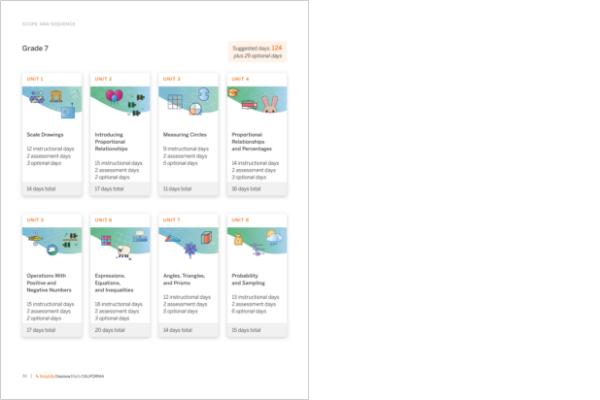
Grade 7

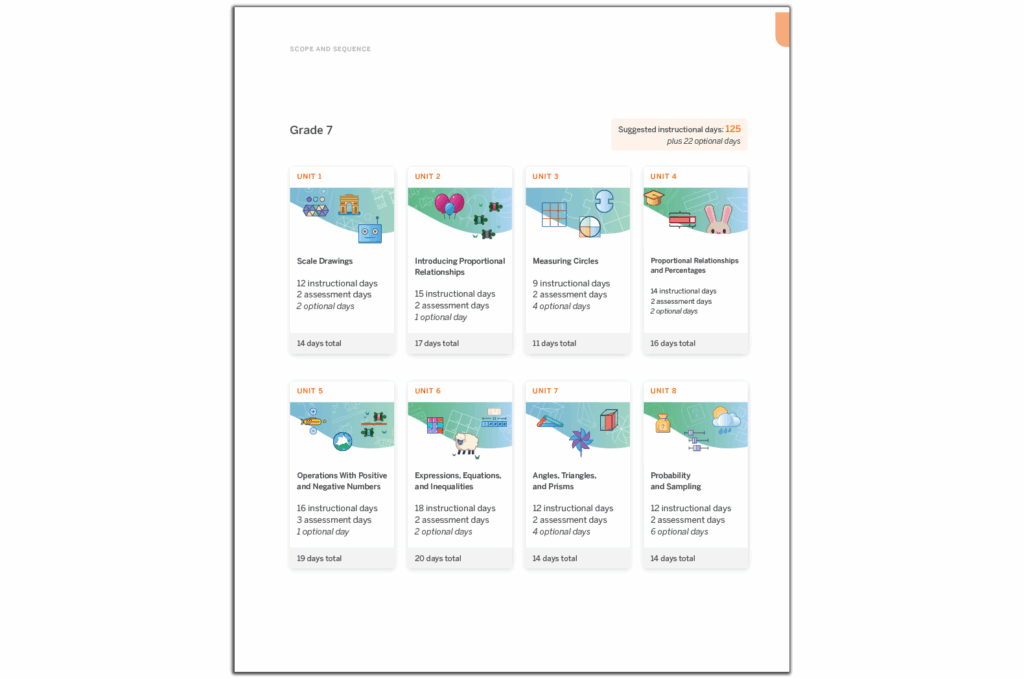
Unit 1: Scale Drawings

Illustrative MathematicsDesmos Math 6–A1
Topic 1: Scaled Copies 
Lesson 1: What are Scaled Copies?Unit 1Lesson 1: Scaling Machines [Free lesson]
Lesson 2: Corresponding Parts and Scale FactorsUnit 1Lesson 2: Scaling Robots Unit 3Lesson 1: Toothpicks
Lesson 3: Making Scaled Copies
Lesson 4: Scaled Relationship
Unit 1Lesson 3: Make It Scale Unit 4Lesson 3: Sticker Sizes
Lesson 5: The Size and the Scale FactorUnit 1Lesson 4: Scale Factor Challenges
Lesson 6: Scaling and AreaUnit 1Lesson 5: TilesPractice Day 1 (Print available)
Topic 2: Scale Drawings 
Lesson 7: Scale DrawingsUnit 1Lesson 6: Introducing ScaleLesson 7: Will It Fit? (Print available) [Free lesson]
Lesson 8: Scale Drawings and Maps 
Lesson 9: Creating Scale Drawings
Lesson 10: Changing Scales in Scale Drawings
Unit 1Lesson 8: Scaling StatesLesson 9: Scaling BuildingsLesson 10: Room Redesign (Print available)
Lesson 11: Scales without Units 
Lesson 12: Units in Scale DrawingsUnit 1Lesson 8: Scaling StatesLesson 9: Scaling BuildingsLesson 10: Room Redesign (Print available)Practice Day 2 (Print available)
Topic 3: Let’s Put It to Work
Lesson 13: Draw It to ScaleUnit 1Lesson 10: Room Redesign (Print available)

Unit 2: Introducing Proportional Relationships

Topic 1: Representing Proportional Relationships with Tables
Lesson 1: One of These Things Is Not Like the OthersUnit 2Lesson 1: Paint [Free lesson] 
Lesson 2: Introducing Proportional Relationships with TablesUnit 2Lesson 2: Balloon FloatLesson 3: Sugary Drinks (Print available)Lesson 4: Robot Factory
Lesson 3: More About Constant of ProportionalityUnit 2Lesson 3: Sugary Drinks (Print available)Unit 4Lesson 3: Sticker Sizes
Topic 2: Representing Proportional Relationships with Equations 
Lesson 4: Proportional Relationships with EquationsUnit 2Lesson 4: Robot FactoryLesson 5: SnapshotsLesson 6: Two and Two (Print available) [Free lesson]Lesson 7: All Kinds of Equations
Lesson 5: Two Equations for Each Relationship
Lesson 6: Using Equations to Solve Problems
Unit 2Lesson 6: Two and Two (Print available) [Free lesson]Lesson 7: All Kinds of EquationsPractice Day
Topic 3: Comparing Proportional and Nonproportional Relationships 
Lesson 7: Comparing Relationships with TablesUnit 2Lesson 2: Balloon FloatLesson 3: Sugary Drinks (Print available)Lesson 4: Robot Factory
Lesson 8: Comparing Relationships with EquationsUnit 2Lesson 4: Robot FactoryLesson 5: SnapshotsLesson 6: Two and Two (Print available) [Free lesson]Lesson 7: All Kinds of EquationsLesson 11: Four RepresentationsLesson 12: Water Efficiency
Lesson 9: Solving Problems About Proportional RelationshipsUnit 2Lesson 12: Water Efficiency
Topic 4: Representing Proportional Relationships with Graphs
Lesson 10: Introducing Graphs of Proportional Relationships
Lesson 11: Interpreting Graphs of Proportional Relationships
Lesson 12: Using Graphs to Compare Relationships
Lesson 13: Two Graphs for Each Relationship
Unit 2Lesson 8: Dino Pops [Free lesson]Lesson 9: Gallon ChallengeLesson 10: Three TurtlesLesson 11: Four RepresentationsLesson 12: Water Efficiency
Topic 5: Let’s Put It to Work
Lesson 14: For RepresentationsUnit 2Lesson 11: Four Representations (Print available)
Lesson 15: Using Water EfficiencyUnit 2Lesson 12: Water Efficiency

Unit 3: Measuring Circles

Topic 1: Circumference of a Circle 
Lesson 1: How Well Can You Measure?Unit 3Lesson 1: Toothpicks
Lesson 2: Exploring Circles
Lesson 3: Exploring Circumference
Lesson 4: Applying Circumference
Unit 3Lesson 2: Is It a Circle?Lesson 3: Measuring Around [Free lesson]
Lesson 5: Circumference and Wheels 
Topic 2: Area of a Circle
Lesson 6: Estimating AreasUnit 3Lesson 5: Area Strategies
Lesson 7: Exploring the Area of a Circle
Lesson 8: Relating Area to Circumference
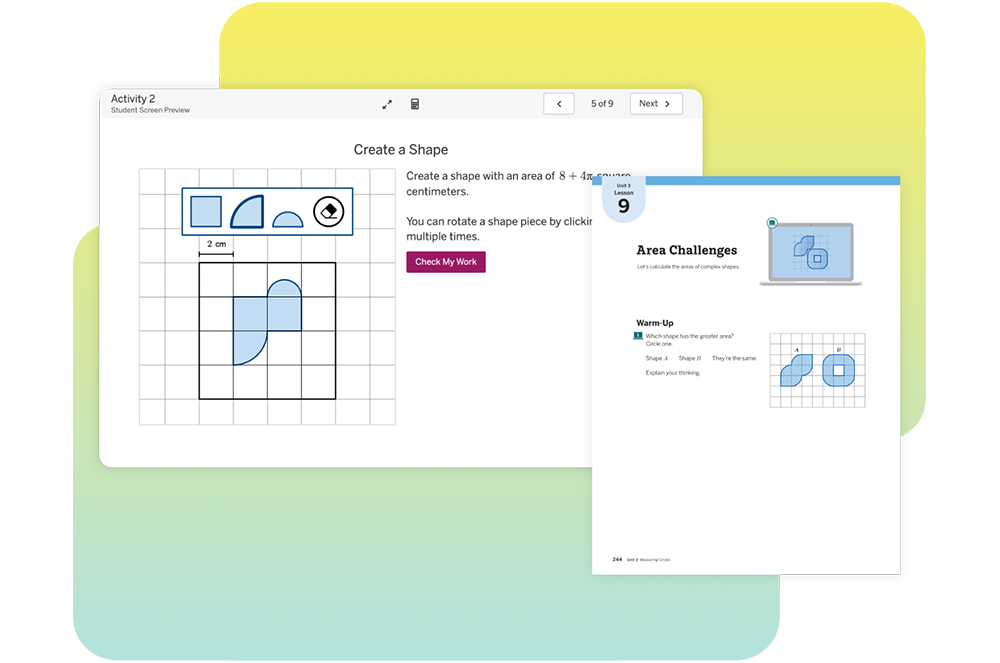
Unit 3Lesson 5: Area StrategiesLesson 6: Radius Squares (Print available)Lesson 7: Why Pi?Lesson 8: Area Challenges [Free lesson]Lesson 9: Circle vs. SquarePractice Day 2 (Print available)
Lesson 9: Applying Area of CirclesUnit 3Lesson 6: Radius Squares (Print available)
Topic 3: Let’s Put It to Work
Lesson 10: Distinguishing Circumference and AreaUnit 3Lesson 7: Why Pi?
Lesson 11: Stained-Glass WindowsUnit 3Lesson 5: Area StrategiesLesson 6: Radius Squares (Print available)

Unit 4: Proportional Relationships and Percentages

Topic 1: Proportional Relationships with Fractions 
Lesson 1: Lots of Flags
Lesson 2: Ratios and Rates with Fractions
Lesson 3: Revisiting Proportional Relationships
Lesson 4: Half as Much Again
Unit 4Lesson 1: Mosaics [Free lesson]Lesson 2: Peach Cobbler (Print available)Lesson 3: Sticker Sizes
Lesson 5: Say It with Decimals 
Topic 2: Percent Increase and Decrease 
Lesson 6: Increasing and DecreasingUnit 4Lesson 4: More and LessLesson 5: All the EquationsLesson 6: 100% (Print available)Lesson 7: Percent machines [Free lesson]Lesson 8: Tax and TipLesson 9: Minimum Wage (Print available)Lesson 10: Cost of College (Print available)Lesson 11: Bookcase BuilderLesson 12: Posing Percent Problems [Free lesson]
Lesson 7: One Hundred percentUnit 4Lesson 6: 100% (Print available)
Lesson 8: Percent Increase and Decrease with EquationsUnit 4Lesson 5: All the Equations
Lesson 9: More and Less than 1% 
Topic 3: Applying Percentages
Lesson 10: Tax and Tip
Lesson 11: Percentage Contexts
Unit 4Lesson 8: Tax and TipLesson 9: Minimum Wage (Print available)Lesson 10: Cost of College (Print available)Lesson 11: Bookcase BuilderLesson 12: Posing Percent Problems [Free lesson]
Lesson 12: Finding the PercentagesUnit 4Lesson 4: More and Less
Lesson 13: Measurement Error
Lesson 14: Percent Error
Lesson 15: Error Intervals
Unit 4Lesson 11: Bookcase Builder
Topic 4: Let’s Put It to Work 
Lesson 16: Posing Percent ProblemsUnit 4Lesson 8: Tax and TipLesson 9: Minimum Wage (Print available)Lesson 10: Cost of College (Print available)Lesson 11: Bookcase BuilderLesson 12: Posing Percent Problems [Free lesson]Practice Day

Unit 5: Rational Number Arithmetic

Topic 1: Interpreting Negative Numbers 
Lesson 1: Interpreting Negative NumbersUnit 5Lesson 1: Floats and Anchors [Free lesson]
Topic 2: Adding and Subtracting Rational Numbers
Lesson 2: Changing Temperatures
Lesson 3: Changing Elevation
Unit 5Lesson 2: More Floats and AnchorsLesson 3: BumpersLesson 4: Draw Your Own (Print available) [Free lesson]
Lesson 4: Money and Debts 
Lesson 5: Representing SubtractionUnit 5Lesson 5: Number Puzzles
Lesson 6: Subtracting Rational Numbers
Lesson 7: Adding and Subtracting to Solve Problems
Unit 5Lesson 3: BumpersLesson 4: Draw Your Own (Print available) [Free lesson]Lesson 5: Number PuzzlesLesson 10: Integer Puzzles [Free lesson]Lesson 11: Changing TemperaturesLesson 13: Solar Panels and More (Print available)Practice Day 1 (Print available)
Topic 3: Multiplying and Dividing Rational Numbers
Lesson 8: Position, Speed, and Direction
Lesson 9: Multiplying Rational Numbers
Lesson 10: Multiply!
Unit 5Lesson 7: Back in Time
Lesson 11: Dividing Rational NumbersUnit 5Lesson 8: Speeding Turtles
Lesson 12: Negative Rates 
Topic 4: Four Operations with Rational Numbers 
Lesson 13: Expressions with Rational NumbersUnit 5Lesson 9: Expressions (Print available)
Lesson 14: Solving Problems with Rational NumbersLesson 11: Changing Temperatures
Lesson 12: Arctic Ice Sea (Print available)
Lesson 13: Solar Panels and More (Print available)
Topic 5: Solving Equations When There Are Negative Numbers 
Lesson 15: Making and Measuring Boxes 
Lesson 16: Representing Contexts with Equations 
Topic 6: Let’s Put It to Work 
Lesson 17: The Stock market

Unit 6: Expressions, Equations, and Inequalities

Topic 1: Representing Situations of the Form px + q and p(+ q) = r
Lesson 1: Relationships Between Quantities
Unit 2 Lesson 1: Paint [Free lesson] Lesson 2: Balloon Float
Unit 4 Lesson 1: Mosaics [Free lesson] Lesson 2: Peach Cobbler (Print available)
Unit 6 Lesson 1: Toothpicks and Tiles
Lesson 2: Reasoning about Contexts with Tape Diagrams
Lesson 3: Reasoning about Equations with Tape Diagrams
Lesson 4: Reasoning about Equations and Tape Diagrams (Part 1)
Lesson 5: Reasoning about Equations and Tape Diagrams (Part 2)
Unit 6Lesson 2: Smudged ReceiptsLesson 3: EquationsLesson 4: Seeing Structure (Print available)
Lesson 6: Distinguishing between Two Types of SituationsUnit 6Lesson 6: Balancing EquationsLesson 7: Keeping It True (Print available)
Topic 2: Solving Equations of the Form px + q and p(+ q) = and Problems That lead to Those Equations 
Lesson 7: Reasoning about Solving Equations (Part 1)Unit 6Lesson 5: Balancing MovesLesson 6: Balancing EquationsLesson 7: Keeping It True (Print available) 
Lesson 8: Reasoning about Solving Equations (Part 2)Unit 6Lesson 5: Balancing MovesLesson 6: Balancing EquationsLesson 7: Keeping It True (Print available)Lesson 9: Always-Equal Machines
Topic 9 Dealing with Negative Numbers 
Lesson 10: Different Options for Solving One EquationUnit 6Lesson 7: Keeping It True (Print available)Lesson 9: Always-Equal MachinesLesson 10: Collect the Squares [Free lesson]Lesson 11: Equation Roundtable (Print available)
Lesson 11: Using Equations to Solve ProblemsUnit 6Lesson 12: Community Day (Print available)
Lesson 12: Solving Problems about Percent Increase or DecreaseUnit 4Lesson 10: Cost of College (Print available)
Topic 3: Inequalities 
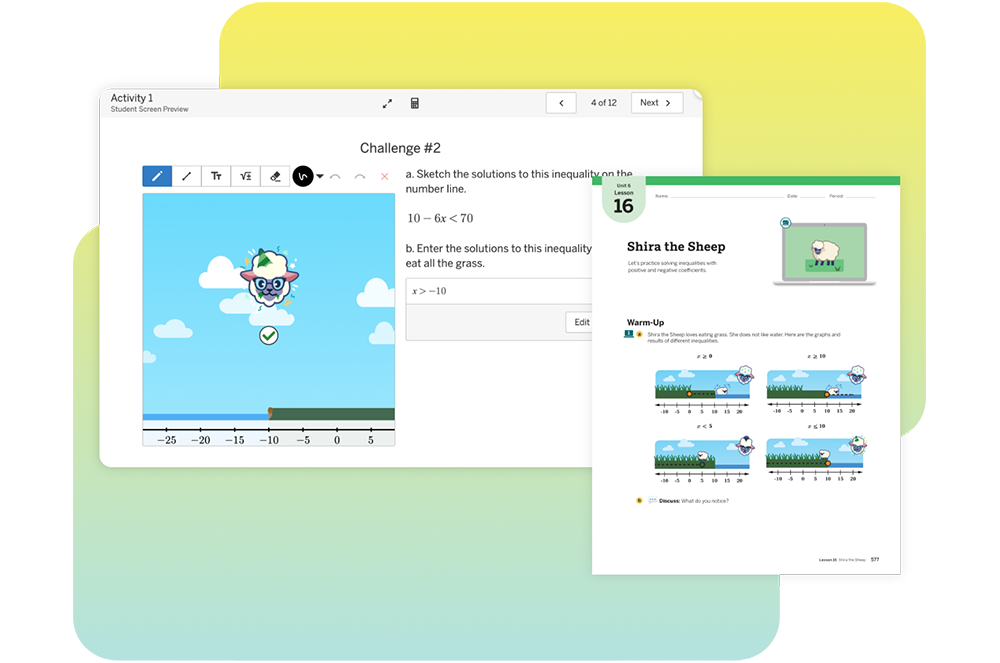
Lesson 13: Reintroducing InequalitiesUnit 6Lesson 13: I Saw the SignsLesson 15: BudgetingLesson 16: Shira the Sheep [Free lesson]
Lesson 14: Finding Solutions to Inequalities in Context
Lesson 15: Efficiency Solving Inequalities
Unit 6Lesson 14: Unbalanced HangersLesson 15 Budgeting (Print available)Lesson 16: Shira the Sheep [Free lesson]Lesson 17: Write Them and Solve Them (Print available)
Lesson 16: Interpreting Inequalities
Lesson 17: Modeling with Inequalities
Unit 6Lesson 16: Shira the Sheep [Free lesson]Lesson 17: Write Them and Solve Them (Print available)Practice Day 2 (Print available)
Topic 4: Writing Equivalent Expressions 
Lesson 18: Subtraction in Equivalent ExpressionsUnit 6Lesson 9: Always-Equal MachinesLesson 10: Collect the Squares [Free lesson]Lesson 11: Equation Roundtable (Print available) 
Lesson 19: Expanding and FactoringUnit 6Lesson 8: Factoring and Expanding (Print available)Lesson 11: Equation Roundtable (Print available)
Lesson 20: Combining Like Terms (Part 1)
Lesson 21: Combining Like Terms (Part 2)
Lesson 22: Combining Like Terms (Part 3)
Unit 6Lesson 2: Smudged ReceiptsLesson 6: Balancing EquationsLesson 8: Factoring and Expanding (Print available)Lesson 9: Always-Equal MachinesLesson 10: Collect the Squares [Free lesson]Lesson 11: Equation Roundtable (Print available)Practice Day 1 (Print available)
Topic 5: Let’s Put It to Work
Lesson 23: Applications of ExpressionsUnit 6Lesson 12: Community Day (Print available)

Unit 7: Angles, Triangles, and Prisms

Topic 1: Angle Relationships

Lesson 1:Relationships of Angles
Unit 7 Lesson 1: Pinwheels Lesson 2: Friendly Angles [Free lesson] Lesson 3: Angle Diagrams
Lesson 2: Adjacent Angles
Lesson 3: Nonadjacent Angles
Unit 7Lesson 2: Friendly Angles [Free lesson]Lesson 3: Angle Diagrams
Lesson 4: Solving for Unknown AnglesUnit 7Lesson 2: Friendly Angles [Free lesson]Lesson 3: Angle DiagramsLesson 4: Missing Measures (Print available)
Lesson 5: Using Equations to Solve for Unknown AnglesUnit 7Lesson 3: Angle DiagramsLesson 4: Missing Measures (Print available) [Free lesson]
Topic 2: Drawing Polygons with Given Conditions 
Lesson 6: Building Polygons (Part 1)
Lesson 7: Building Polygons (Part 2)
Unit 7Lesson 6: Is It Enough?
Lesson 8: Triangles with 3 Common MeasuresUnit 7Lesson 13: Popcorn Possibilities
Lesson 9: Drawing Triangles (Part 1)
Lesson 10: Drawing Triangles (Part 2)
Unit 7Lesson 5: Can You Build It? [Free lesson]Lesson 6: Is It Enough?Lesson 7: More Than OneLesson 8: Can You Draw It? (Print available)Practice Day 1 (Print available)
Topic 3: Solid Geometry
Lesson 11: Slicing SolidsUnit 7Lesson 9: Slicing Solids
Lesson 12: Volume of Right PrismsUnit 7Lesson 10: Simple Prisms
Lesson 13: Decomposing Bases for AreasUnit 7Lesson 11: More Complicated Prisms
Lesson 14: Surface Area of Right PrismsUnit 7Lesson 10: Simple PrismsLesson 11: More Complicated PrismsLesson 12: Surface Area Strategies (Print available)
Lesson 15: Distinguishing Volume and Surface Area
Lesson 16: Applying Volume and Surface AreaUnit 7Lesson 13: Popcorn Possibilities
Topic 4: Let’s Put It to Work
Lesson 17: Building Prisms

Unit 8: Probability and Sampling

Topic 1: Probabilities of Single Step Events
Lesson 1: Mystery Bags
Lesson 2: Chance Experiments
Lesson 3: What Are Probabilities?
Unit 8 Lesson 1: How Likely? (Print available) [Free lesson] Lesson 2: Prob-bear-bilities [Free lesson] Lesson 3: Mystery Bag
Lesson 4: Estimating Probabilities Through Repeated ExperimentsUnit 8Lesson 4: Spin ClassLesson 5: Is It Fair?Lesson 6: Fair Games
Lesson 5: More Estimating ProbabilitiesUnit 8Lesson 6: Fair GamesLesson 7: Weather or NotLesson 9: Car, Bike, or Train? (Print available)
Lesson 6: Estimating Probabilities Using SimulationUnit 8Lesson 6: Fair GamesLesson 7: Weather or NotLesson 8: Simulate ItLesson 9: Car, Bike, or Train? (Print available)
Topic 2: Probabilities of Multi-step Events
Lesson 7: Simulating Multi-step EventsUnit 8Lesson 7: Weather or NotLesson 8: Simulate ItLesson 9: Car, Bike, or Train? (Print available)
Lesson 8: Keeping Track of All Possible OutcomesUnit 8Lesson 4: Spin ClassLesson 5: Is It Fair?Lesson 6: Fair Games
Topic 9: Multi-step experiments
Lesson 10: Designing SimulationsUnit 8Lesson 7: Weather or NotLesson 8: Simulate ItLesson 9: Car, Bike, or Train? (Print available)
Topic 3: Sampling
Lesson 11: Comparing Groups
Lesson 12: Larger Populations
Lesson 13: What Makes a Good Sample?
Lesson 14: Sampling in a Fair Way
Unit 8Lesson 10: Crab Island [Free lesson]Lesson 11: Headlines
Topic 4: Using Samples
Lesson 15: Estimating Population Measures of Center
Lesson 16: Estimating Population Proportions
Unit 8 Lesson 9: Car, Bike, or Train? (Print available)Lesson 10: Crab Island [Free lesson]Lesson 11: HeadlinesLesson 12: Flower Power
Lesson 17: More about Sampling Variability
Lesson 18: Comparing Populations Using Samples
Lesson 19: Comparing Populations with Friends
Unit 8Lesson 9: Car, Bike, or Train? (Print available)Lesson 10: Crab Island [Free lesson]Lesson 13: Plots and SamplesLesson 14: School Newspaper (Print available)Lesson 15: Asthma Rates (Print available)
Topic 5: Let’s Put It to Work
Lesson 20: Memory TestUnit 8Lesson 14: School Newspaper (Print available)Lesson 15: Asthma Rates (Print available)

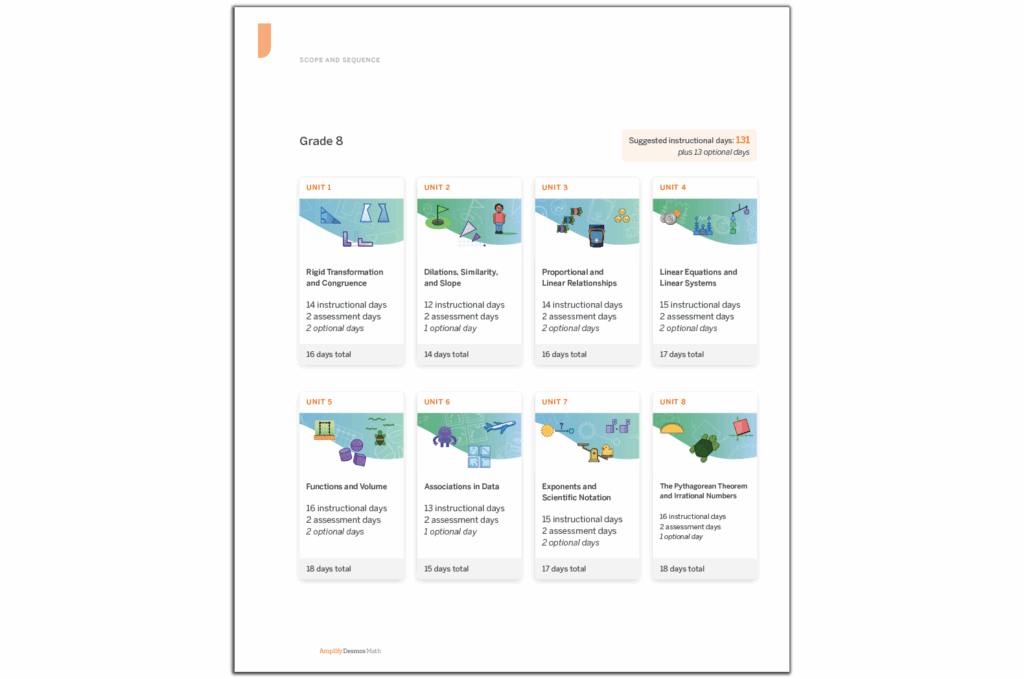
Grade 8

Unit 1: Rigid Transformations and Congruence

Illustrative MathematicsDesmos Math 6–A1
Topic 1: Rigid Transformations 
Lesson 1: Moving in the PlaneUnit 1Lesson 1: Transformers [Free lesson]
Lesson 2: Naming the MovesUnit 1Lesson 2: Spinning, Flipping, Sliding [Free lesson]
Lesson 3: Grid MovesUnit 1Lesson 3: Transformation GolfLesson 4: Moving Day (Print available) [Free lesson]Lesson 5: Getting CoordinatedUnit 3Lesson 6: Translations
Lesson 4: Making the MovesUnit 1Lesson 1: Transformers [Free lesson]Lesson 2: Spinning, Flipping, Sliding [Free lesson]Lesson 4: Moving Day (Print available) [Free lesson]Lesson 5: Getting Coordinated
Lesson 5: Coordinate MovesUnit 1Lesson 4: Moving Day (Print available) [Free lesson]Lesson 5: Getting Coordinated
Lesson 6: Describing TransformationsUnit 1Lesson 5: Getting CoordinatedLesson 6: Connecting the Dots [Free lesson]
Topic 2: Properties of Rigid Transformations 
Lesson 7: No Bending or StretchingUnit 1Lesson 7: No Bending, No Stretching
Lesson 8: Rotation PatternsUnit 1Lesson 1: Transformers [Free lesson]Lesson 2: Spinning, Flipping, Sliding [Free lesson]Lesson 4: Moving Day (Print available) [Free lesson]Lesson 5: Getting Coordinated
Lesson 9: Moves in Parallel
Lesson 10: Composing Figures
Unit 1 Lesson 10: Transforming Angles
Topic 3: Congruence 
Lesson 11: What is the Same?
Lesson 12: Congruent Polygons
Lesson 13: Congruence
Unit 1 Lesson 7: Are They the Same?Lesson 9: Are They Congruent?Practice Day (Print available)
Topic 4: Angles in a Triangle
Lesson 14: Alternate Interior Angles
Lesson 15: Adding the Angles in a Triangle
Unit 1 Lesson 11: Tearing It Up (Print available)
Lesson 16: Parallel Lines and the Angles in a TriangleUnit 1 Lesson 10: Transforming Angles
Topic 5: Let’s Put It to Work
Lesson 17: Rotate and TessellateLesson 13: Tessellate [Free lesson]

Unit 2: Dilations, Similarity, and Introducing Slope

Topic 1: Dilations
Lesson 1: Projecting and ScalingUnit 2Lesson 1: Sketchy Dilations [Free lesson]Lesson 2: Dilation Mini Golf (Print available) [Free lesson]
Lesson 2: Circular Grid
Lesson 3: Dilations with No Grid
Lesson 4: Dilations on a Square Grid
Lesson 5: More Dilations
Unit 2Lesson 1: Sketchy Dilations [Free lesson]Lesson 2: Dilation Mini Golf (Print available) [Free lesson]Lesson 3: Match My DilationLesson 4: Dilations on a Plane
Topic 2: Similarity 
Lesson 6: SimilarityUnit 2Lesson 5: Transformations Golf with DilationsLesson 6: Social Scavenger Hunt (Print available) [Free lesson]
Lesson 7: Similar Polygons 
Lesson 8: Similar Triangles
Lesson 9: Side Length Quotients in Similar Triangles
Unit 2Lesson 7: Are Angles Enough?Lesson 8: Shadows
Topic 3: Slope
Lesson 10: Meet SlopeUnit 2Lesson 9: Water SlideLesson 10: Points on a PlanePractice Day (Print available)Unit 3Lesson 3: PostersLesson 4: Stacking CupsLesson 5: Flags [Free lesson]Lesson 6: Translations Unit 4Lesson 8: When Are They the Same?
Lesson 11: Writing Equations of LinesUnit 3Lesson 3: PostersLesson 6: TranslationsLesson 10: SolutionsLesson 11: Pennies and Quarters Unit 4Lesson 3: Balanced MovesLesson 4: More Balanced Moves (Print available)
Lesson 12: Using Equations of LinesUnit 3Lesson 9: Coin Capture
Topic 4: Let’s Put It to Work
Lesson 13: The Shadow KnowsUnit 2Lesson 8: Shadows

Unit 3: Linear Relationships

Topic 1: Proportional Relationships 
Lesson 1: Understanding Proportional RelationshipsUnit 3Lesson 1: Turtle Time Trials [Free lesson]
Lesson 2: Graphs of Proportional RelationshipsUnit 3Lesson 1: Turtle Time Trials [Free lesson]Lesson 2: Water Tank Unit 5Lesson 4: Window Frames
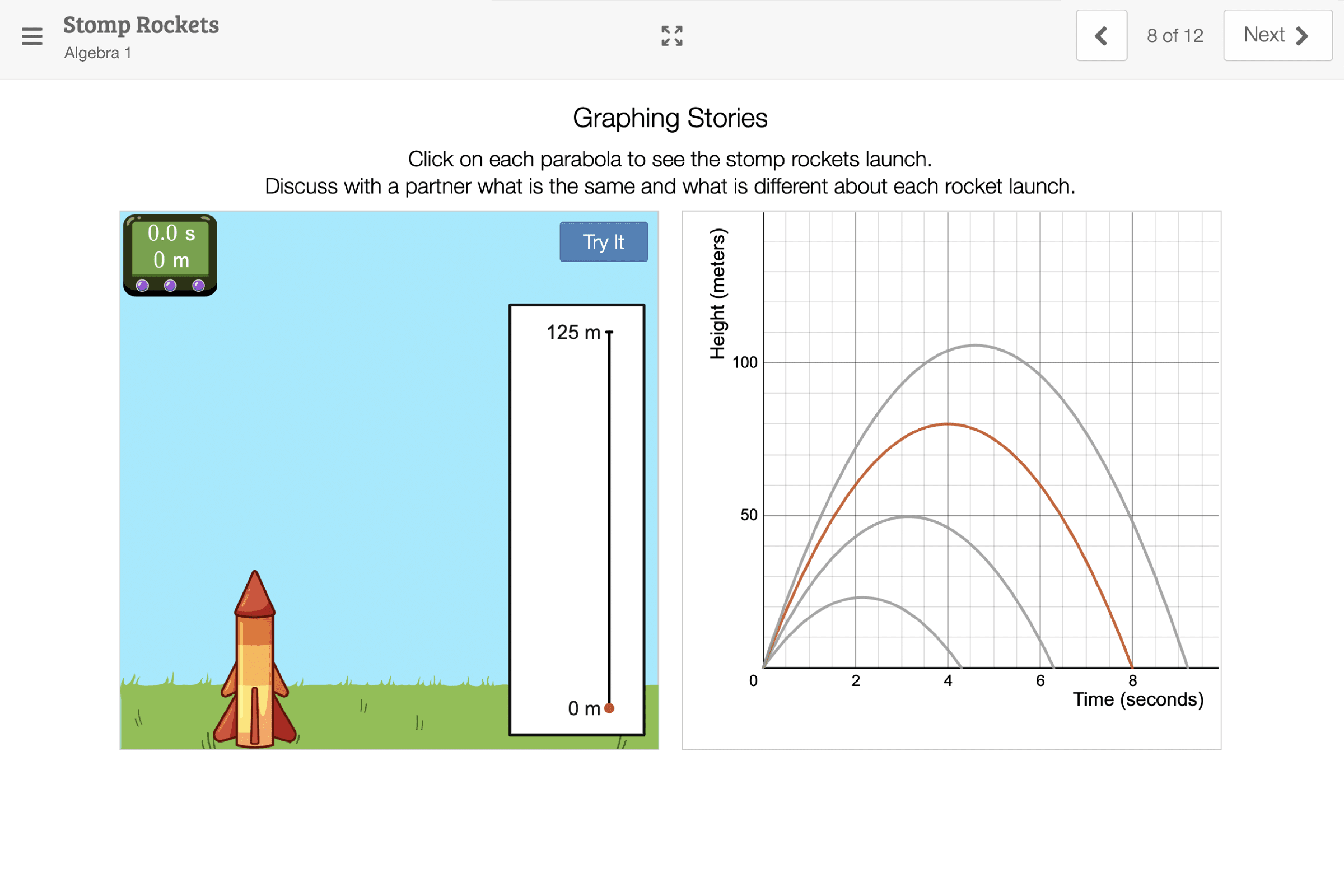
Lesson 3: Representing Proportional RelationshipsUnit 3Lesson 1: Turtle Time Trials [Free lesson] Unit 5Lesson 4: Window FramesLesson 6: Graphing StoriesLesson 7: Feel the Burn (Print available) [Free lesson]Lesson 8: Charge! (Print available)
Lesson 4: Comparing Proportional RelationshipsUnit 3Lesson 3: Posters
Topic 2: Representing Linear Relationships
Lesson 5: Introduction to Linear RelationshipsUnit 3Lesson 1: Turtle Time Trials [Free lesson]Lesson 4: Stacking CupsUnit 5Lesson 6: Graphing StoriesLesson 7: Feel the Burn (Print available) [Free lesson]Lesson 8: Charge! (Print available)
Lesson 6: More Linear RelationshipsUnit 5Lesson 6: Graphing StoriesLesson 7: Feel the Burn (Print available) [Free lesson]Lesson 8: Charge! (Print available)
Lesson 7: Representations of Linear RelationshipsUnit 3Lesson 5: Flags [Free lesson]Lesson 6: Graphing StoriesLesson 7: Feel the Burn (Print available) [Free lesson]Lesson 8: Charge! (Print available)
Lesson 8: Translating mx + bUnit 3Lesson 3: PostersLesson 6: Translations
Topic 3: Finding Slopes 
Lesson 9: Slopes Don’t Have to be PositiveUnit 3Lesson 5: Flags [Free lesson]Lesson 6: TranslationsLesson 7: Water CoolerLesson 8: Landing Planes
Lesson 10: Calculating SlopeUnit 3Lesson 7: Water CoolerLesson 8: Landing Planes
Lesson 11: Equations of All Kinds of LinesUnit 3Lesson 3: PostersLesson 4: Stacking CupsLesson 5: Flags [Free lesson]Lesson 6: Translations
Topic 4: Linear Equations 
Lesson 12: Solutions to Linear EquationsUnit 3Lesson 3: PostersLesson 6: TranslationsLesson 10: Solutions Unit 4Lesson 3: Balanced MovesLesson 4: More Balanced Moves (Print available)
Lesson 13: More Solutions to Linear EquationsUnit 3 Lesson 4: Stacking CupsLesson 5: Flags [Free lesson]Lesson 6: TranslationsLesson 7: Water CoolerLesson 10: Solutions
Topic 5: Let’s Put It to Work 
Lesson 14: Using Linear Relations to Solve ProblemsUnit 3 Lesson 11: Pennies and Quarters

Unit 4: Linear Equations and Linear Systems

Topic 1: Puzzle Problems 
Lesson 1: Number PuzzlesUnit 4Lesson 1: Number machines
Topic 2: Linear Equation in One Variable 
Lesson 2: Keeping the Equation BalancedUnit 4Lesson 2: Keep It Balanced
Lesson 3: Balanced MovesUnit 4Lesson 3: Balanced Moves
Lesson 4: More Balanced MovesUnit 4Lesson 4: More Balanced Moves (Print available)
Lesson 5: Solving Any Linear EquationUnit 4Lesson 4: More Balanced Moves (Print available)Lesson 5: Equation Roundtable (Print available) [Free lesson]Lesson 6: Strategic Solving (Print available)
Lesson 6: Strategic SolvingUnit 4Lesson 5: Equation Roundtable (Print available) [Free lesson]Lesson 6: Strategic Solving (Print available)
Lesson 7: All, Some, or No Solutions
Lesson 8: How many Solutions?
Unit 4Lesson 7: All, Some, or None?
Lesson 9: When Are They the SameUnit 4Lesson 8: When Are They the Same?
Topic 3: Systems of Linear Equations
Lesson 10: On or Off the Line?Unit 4Lesson 7: All, Some, or None?Lesson 8: When Are They the Same?Lesson 13: All, Some, or None? Part 2
Lesson 11: On Both of the Lines
Lesson 12: Systems of Equations
Lesson 13: Solving Systems of Equations
Unit 4 Lesson 9: On or Off the Line?Lesson 10: On Both LinesLesson 11: Make Them Balance [Free lesson]Lesson 12: Line Zapper [Free lesson]Lesson 13: All, Some, or None? Part 2Practice Day 2 (Print available)
Lesson 14: Solving More Systems 
Lesson 15: Writing Systems of EquationsUnit 4 Lesson 14: Strategic Solving, Part 2 (Print available)
Topic 4: Let’s Put It to Work 
Lesson 16: Posing Problems with Systems of EquationsUnit 4 Lesson 14: Strategic Solving, Part 2 (Print available)

Unit 5: Functions and Volume

Topic 1: Inputs and Outputs 
Lesson 1: Inputs and OutputsUnit 5Lesson 1: Turtle Crossing [Free lesson]Lesson 2: Guess My Rule [Free lesson]
Lesson 2: Introduction to FunctionsUnit 5Lesson 1: Turtle Crossing [Free lesson]Lesson 2: Guess My Rule [Free lesson]Lesson 3: Function or Not?
Topic 2: Representing and Interpreting Functions 
Lesson 3: Equations of FunctionsUnit 3Lesson 1: Turtle Time Trials [Free lesson] Unit 5Lesson 3: Function or Not?Lesson 4: Window Frames
Lesson 4: Tables, Equations, and Graphs of Functions
Lesson 5: More Graphs of Functions
Unit 5Lesson 4: Window FramesLesson 5: The Tortoise and the Hare [Free lesson]Lesson 6: Graphing StoriesLesson 7: Feel the Burn (Print available) [Free lesson]Lesson 8: Charge! (Print available)
Lesson 6: Even More Graphs of Functions 
Lesson 7: Connecting Representations of FunctionsUnit 5Lesson 7: Feel the Burn (Print available) [Free lesson]Lesson 8: (Print available)Charge!
Topic 3: Linear Functions and Rates of Change
Lesson 8: Linear FunctionsUnit 2Lesson 9: Water SlideLesson 10: Points on a PlaneUnit 3Lesson 4: Stacking CupsLesson 5: Flags [Free lesson]Lesson 6: Translations
Lesson 9: Linear ModelsUnit 5Lesson 3: PostersLesson 5: The Tortoise and the Hare [Free lesson]Lesson 6: Graphing StoriesLesson 7: Feel the Burn (Print available) [Free lesson]
Lesson 10: Piecewise Linear FunctionsUnit 5Lesson 9: Piecing It Together
Topic 4: Cylinder and Cones 
Lesson 11: Filling Containers 
Lesson 12: How Much Will Fit? 
Lesson 13: The Volume of a CylinderUnit 5Lesson 10: Volume LabLesson 11: Cylinders [Free lesson]Lesson 12: Scaling Cylinders
Lesson 14: Finding Cylinder DimensionsUnit 5Lesson 10: Volume LabLesson 11: Cylinders [Free lesson]Lesson 12: Scaling CylindersLesson 14: Missing Dimensions (Print available)
Lesson 15: The Volume of a ConeUnit 5Lesson 10: Volume LabLesson 13: Cones [Free lesson]Lesson 14: Missing Dimensions (Print available)
Lesson 16: Finding Cone DimensionsUnit 5Lesson 12: Scaling CylindersLesson 13: Cones [Free lesson]Lesson 14: Missing Dimensions (Print available)
Topic 5: Dimensions and Spheres 
Lesson 17: Scaling One DimensionUnit 5Lesson 12: Scaling Cylinders
Lesson 18: Scaling Two Dimensions 
Lesson 19: Estimating a Hemisphere 
Lesson 20: The Volume of a Sphere
Lesson 21: Cylinders, Cones, and Spheres
Unit 5Lesson 15: SpheresPractice Day 2 (Print available)
Topic 6: Let’s Put It to Work 
Lesson 22: Volume As a Function of …Unit 5Lesson 15: Spheres

Unit 6: Associations in Data

Topic 1: Does This Predict That? 
Lesson 1: Organizing DataUnit 6 Lesson 1: Click Battle
Lesson 2: Plotting DataUnit 6 Lesson 2: Wing Span
Topic 2: Associations in Numerical Data 
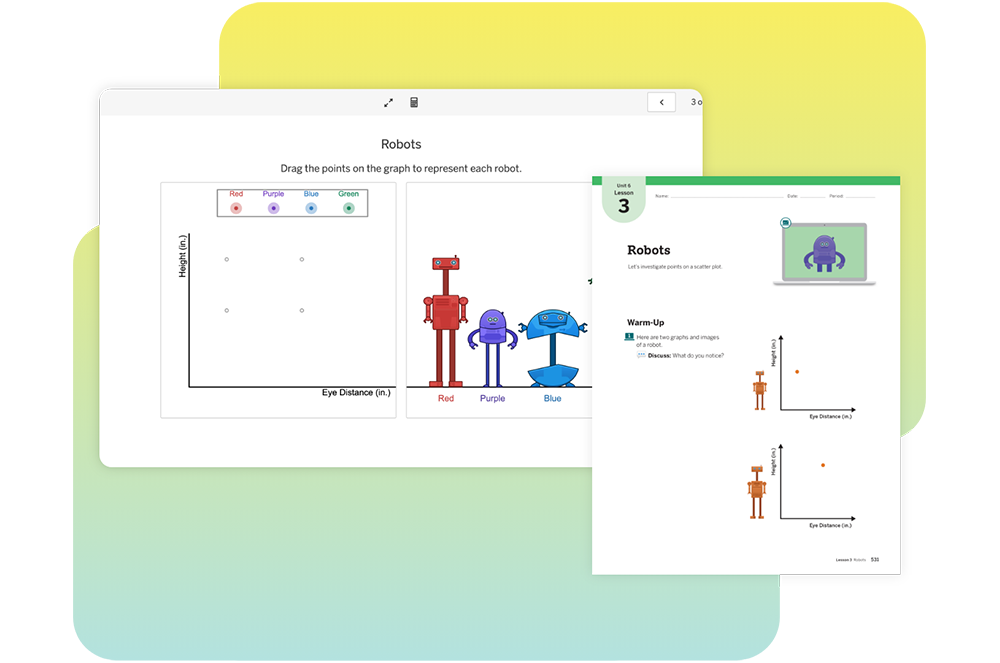
Lesson 3: What a Point in a Scatter Plot MeansUnit 6 Lesson 1: Click BattleLesson 2: Wing SpanLesson 3: Robots [Free lesson]Lesson 7: Scatter Plot City
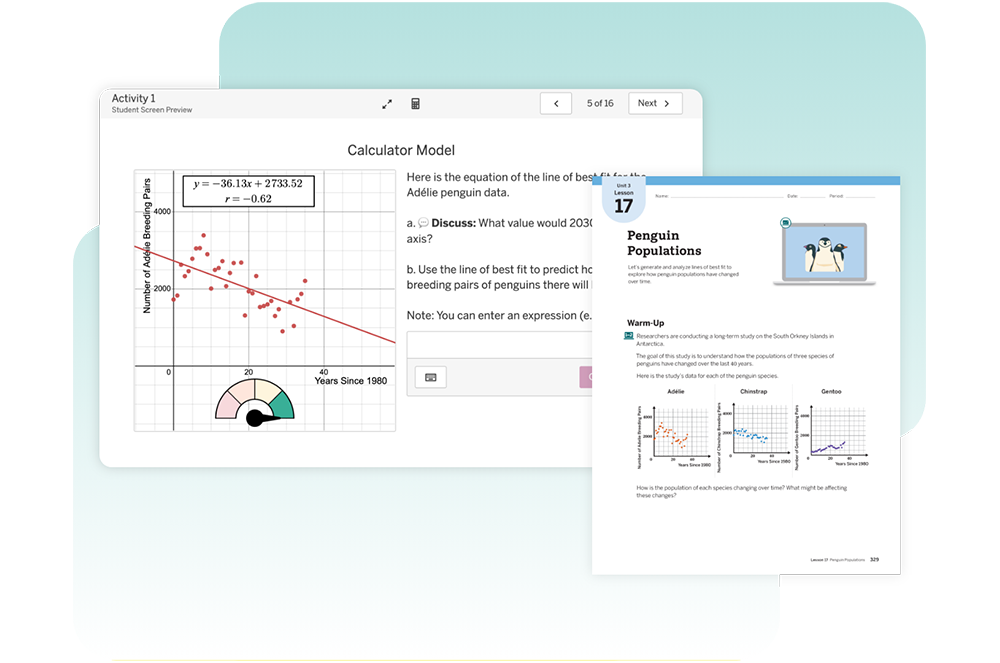
Lesson 4: Fitting a LineUnit 6 Lesson 4: Dapper Cats [Free lesson]Lesson 5: Fit Fights [Free lesson]Lesson 6: Interpreting SlopesLesson 8: Animal BrainsPractice Day 1 (Print available) [Free lesson]Practice Day 2 (Print available)
Lesson 5: Describing Trends in Scatter PlotsUnit 6 Lesson 1: Click BattleLesson 2: Wing SpanLesson 3: Robots [Free lesson]Lesson 7: Scatter Plot City(Print available)Practice Day 1 [Free lesson]
Lesson 6: The Slope of a Fitted LineUnit 6 Lesson 6: Interpreting SlopesLesson 7: Scatter Plot CityPractice Day 1 (Print available) [Free lesson]Practice Day 2 (Print available)
Lesson 7: Observing More patterns in Scatter PlotsUnit 6 Lesson 1: Click BattleLesson 2: Wing SpanLesson 3: Robots [Free lesson]Lesson 7: Scatter Plot City
Lesson 8: Analyzing Bivariate DataUnit 6Lesson 9: Tasty Fruit
Topic 3: Associations in Categorical data 
Lesson 9: Looking for AssociationsUnit 6Lesson 10: Finding Associations [Free lesson]Lesson 11: Federal BudgetsPractice Day 3 (Print available)
Lesson 10: Using Data Displays to Find associationsUnit 6Lesson 10: Finding Associations [Free lesson]Lesson 9: Tasty Fruit
Topic 4: Let’s Put It to Work
Lesson 11: Gone in 30 SecondsUnit 6Lesson 11: Federal Budgets

Unit 7: Exponents and Scientific Notation

Topic 1: Exponent Review 
Lesson 1: Exponent ReviewUnit 7 Lesson 1: Circles [Free lesson]Lesson 2: Combining Exponents
Topic 2: Exponent Rules 
Lesson 2: Multiplying Powers of 10
Lesson 3: Powers of Powers of 10
Lesson 4: Dividing Powers of 10
Unit 7 Lesson 3: Power Pairs (Print available) [Free lesson]Lesson 4: Rewriting Powers  
Lesson 5: Negative Exponents with Powers of 10Unit 7 Lesson 5: Zero and Negative ExponentsLesson 6: Write a Rule (Print available)Practice Day 1 (Print available)
Lesson 6: What about Other Bases? 
Lesson 7: Practice with Rational Bases
Lesson 8: Combining Bases 
Topic 3: Scientific Notation 
Lesson 9: Describing Large and Small Numbers using Powers of 10Unit 7 Lesson 7: Scales and Weights
Lesson 10: Representing Large Numbers on the Number Line
Lesson 11: Representing Small Numbers on the Number Line
Unit 7 Lesson 8: Point Zapper
Lesson 12: Applications of Arithmetic with Powers of 10Unit 7  Lesson 8: Point ZapperLesson 9: Use Your Powers
Lesson 13: Defining Scientific Notation
Lesson 14: Multiplying, Dividing, and Estimating with Scientific Notation
Unit 7 Lesson 10: Solar System [Free lesson]Lesson 11: Balance the Scales [Free lesson]Lesson 13: Star Power
Lesson 15: Adding and Subtracting with Scientific NotationUnit 7 Lesson 10: Solar System [Free lesson]Lesson 11: Balance the Scales [Free lesson]Lesson 12: City LightsLesson 13: Star Power
Topic 4: Let’s Put It to Work
Lesson 16: Is a Smartphone Smart Enough to Go to the Moon?Lesson 13: Star Power Practice Day 2 (Print available)

Unit 8: Pythagorean Theorem and Irrational Numbers

Topic 1: Side Lengths and Areas of Squares
Lesson 1: The Areas of Squares and Their Side LengthsUnit 8Lesson 1: Tilted Squares
Lesson 2: Side Lengths and AreasUnit 8Lesson 2: From Squares to RootsLesson 3: Between Squares
Lesson 3: Rational and Irrational Numbers
Lesson 4: Square Roots on the Number Line
Lesson 5: Reasoning about Square RootsUnit 8Lesson 2: From Squares to RootsLesson 3: Between SquaresLesson 4: Root Down [Free lesson]Practice Day 1 (Print available)
Topic 2: The Pythagorean Theorem
Lesson 6: Finding Side Lengths of TrianglesUnit 8Lesson 6: The Pythagorean TheoremLesson 7: Pictures to Prove ItLesson 8: Triangle-Tracing Turtle [Free lesson]
Lesson 7: A Proof of the Pythagorean TheoremUnit 8Lesson 7: Pictures to Prove It
Lesson 8: Finding Unknown Side LengthsUnit 8Lesson 11: Pond Hopper
Lesson 9: The ConverseUnit 8Lesson 9: Make It Right
Lesson 10: Applications of the Pythagorean TheoremUnit 8Lesson 10: Taco Truck [Free lesson]
Lesson 11: Finding Distances in the Coordinate PlaneUnit 8Lesson 11: Pond Hopper
Topic 3: Side Lengths and Volumes of Cubes
Lesson 12: Edge Lengths and Volumes
Lesson 13: Cube Roots
Unit 8Lesson 5: Filling Cubes
Topic 4: Decimal Representation of Rational and Irrational Numbers
Lesson 14: Decimal Representation of Rational and Numbers
Lesson 15: Infinite Decimal expansions
Unit 8Lesson 12: Fractions to DecimalsLesson 13: Decimals to Fractions
Topic 5: Let’s Put It to Work
Lesson 16: When Is the Same Size Not the Same Size?Unit 8Lesson 10: Taco Truck [Free lesson]

Unit 9: Putting It All Together

Topic 1: Tessellations
Lesson 1: Tessellations of the Plane
Lesson 2: Regular Tessellations
Lesson 3: Tessellating Polygons
Topic 2: The Weather
Lesson 4: What Influences Temperature?
Lesson 5: Plotting the Weather
Lesson 6: Using and Interpreting a Mathematical Model

Grade 6

Module 1: Ratios and Unit Rates

Eureka MathDesmos Math 6–A1
Topic A Representing and Reasoning About Ratios 
Lesson 1: Ratios
Lesson 2: Ratios
Unit 2
Lesson 1: Pizza Maker [Free lesson]
Lesson 2: Ratio Rounds (Print available)
Lesson 3: Equivalent Ratios
Lesson 4: Equivalent Ratios
Unit 2
Lesson 3: Rice Ratios
Lesson 4: Fruit Lab [Free lesson]
Lesson 5: Balancing Act
Lesson 7: Mixing Paint, Part 1
Lesson 8 World Records (Print available)
Lesson 11 Community Life (Print available)
Practice Day 1 (Print available)
Lesson 5: Solving Problems by Finding Equivalent Ratios
Lesson 6: Solving Problems by Finding Equivalent Ratios
Unit 2
Lesson 5 Balancing Act
 
Lesson 7: Associated Ratios and the Value of a Ratio
Lesson 8: Equivalent Ratios Defined Through the Value of a Ratio
Unit 2
Lesson 6: Product Prices (Print available)
Lesson 7: Mixing Paint, Part 1
Topic B Collections of Equivalent Ratios 
Lesson 9: Tables of Equivalent RatiosUnit 2
Lesson 6: Product Prices (Print available)
Lesson 7: Mixing Paint, Part 1
Lesson 10: The Structure of Ratio Tables-Additive and MultiplicativeUnit 2
Lesson 10: Balloons
Lesson 11: Community Life (Print available)
Lesson 11: Comparing Ratios Using Ratio TablesUnit 2
Lesson 10: Balloons
Lesson 12: From Ratio Tables to Double Number Line DiagramsUnit 2
Lesson 6: Product Prices (Print available)
Lesson 8: World Records (Print available)
Lesson 12: Mixing Paint, Part 2
Lesson 14: Lunch Waste (Print available)
Practice Day 2 (Print available)
Lesson 13: From Ratio Tables to Equations Using the Value of a Ratio 
Lesson 14: From Ratio Tables, Equations, and Double Number Line Diagrams to Plots on the Coordinate Plane 
Lesson 15: A Synthesis of Representations of Equivalent Ratio Collections 
Topic C Unit Rates 
Lesson 16: From Ratio to RatesUnit 2
Lesson 8: World Records (Print available)
 
Unit 3
Lesson 4: Model Trains
Lesson 5: Soft Serve [Free lesson]
Lesson 6: Welcome to the Robot Factory
Lesson 17: From Rates to Ratios 
Lesson 18: Finding a Rate by Dividing Two QuantitiesUnit 3
Lesson 4: Model Trains
Lesson 5: Soft Serve [Free lesson]
Lesson 6: Welcome to the Robot Factory
Lesson 7: More Soft Serve
Lesson 19: Comparison Shopping-Unit Price and Related Measurement Conversions
Lesson 20: Comparison Shopping-Unit Price and Related Measurement Conversions
Lesson 21: Getting the Job Done—Speed, Work, and Measurement Units
Lesson 22: Getting the Job Done—Speed, Work, and Measurement Units
Unit 3
Lesson 2: Counting Classrooms
Lesson 3: Pen Pals
Lesson 23: Problem-Solving Using Rates, Unit Rates, and Conversions.Unit 3
Lesson 13: A Country as a Village
Topic D Percent 
Lesson 24: Percent and Rates per 100Unit 3
Lesson 8: Lucky Duckies [Free lesson]
Lesson 9: Bicycle Goals
Lesson 25: A Fraction as a Percent 
Lesson 26: Percent of a Quantity.Unit 3
Lesson 10: What´s Missing? (Print available)
Lesson 11: Cost Breakdown
Lesson 27: Solving Percent Problems
Lesson 28: Solving Percent Problems
Lesson 29: Solving Percent Problems
Unit 3
Lesson 10: What´s Missing? (Print available)
Lesson 11: Cost Breakdown
Lesson 12: More Bicycle Goals
Lesson 13: A Country as a Village
Practice Day 2 (Print available)

Module 2: Arithmetic Operations Including Division of Fractions

Lesson 1: Interpreting Division of a Fraction by a Whole Number—Visual Models.Unit 4
Lesson 2: Making Connections (Print available)
Lesson 2: Interpreting Division of a Whole Number by a Fraction —Visual Models.Unit 4
Lesson 1: Cookie Cutter
Lesson 3: Flour Planner [Free lesson]
Lesson 4: Flower Planters
Lesson 5: Garden Bricks (Print available)
Lesson 3: Interpreting and Computing Division of a Fraction by a Fraction—More Models
Lesson 4: Interpreting and Computing Division of a Fraction by a Fraction—More Models
Unit 4
Lesson 5: Garden Bricks
Lesson 6: Fill the Gap [Free lesson]
Lesson 7: Break It Down
Lesson 8: Potting Soil
Lesson 9: Division Challenges
Lesson 10: Swap Meet (Print available)
Practice Day
Lesson 5: Creating Division Stories. 
Lesson 6: More Division Stories. 
Lesson 7: The Relationship Between Visual Fraction Models and Equations 
Lesson 8: Dividing Fractions and Mixed NumbersUnit 4
Lesson 5: Garden Bricks (Print available)
Lesson 6: Fill the Gap [Free lesson]
Topic B Multi-Digit Decimal Operations—Adding, Subtracting, and Multiplying
Lesson 9: Sums and Differences of DecimalsUnit 5
Lesson 2: Decimal Diagrams [Free lesson]
Lesson 3: Fruit by the Pound
Lesson 4: Missing Digits
Lesson 10: The Distributive Property and the Products of DecimalsUnit 5
Lesson 5: Decimal Multiplication
Lesson 6: Multiplying with Areas
Lesson 7: Multiplication Methods (Print available)
Lesson 11: Fraction Multiplication and the Products of DecimalsUnit 5
Lesson 7: Multiplication Methods (Print available)
Topic C Dividing Whole Numbers and Decimals
Lesson 12: Estimating Digits in a Quotient 
Lesson 13: Dividing Multi-Digit Numbers Using the AlgorithmUnit 5
Lesson 9: Long Division Launch
Practice Day 1 (Print available)
Practice Day 2 (Print available)
Lesson 14: The Division Algorithm—Converting Decimal Division into Whole Number Division Using Fractions. 
Lesson 15: The Division Algorithm—Converting Decimal Division into Whole Number Division Using Mental Math 
Topic D Number Theory—Thinking Logically About Multiplicative Arithmetic 
Lesson 16: Even and Odd Numbers 
Lesson 17: Divisibility Tests for 3 and 9 
Lesson 18: Least Common Multiple and Greatest Common FactorUnit 5
Lesson 14: Common Multiples
Lesson 15: Common Factors
Practice Day 2 (Print available)
Lesson 19: The Euclidean Algorithm as an Application of the Long Division Algorithm 

Module 3: Rational Numbers

Lesson 1: Positive and Negative Numbers on the Number Line—Opposite Direction and ValueUnit 7Lesson 2: Digging Deeper
Lesson 2: Real-World Positive and Negative Numbers and Zero.
Lesson 3: Real-World Positive and Negative Numbers and Zero.
Unit 7 Lesson 4: Sub-Zero
Lesson 4: The Opposite of a Number
Lesson 5: The Opposite of a Number’s Opposite
Lesson 6: Rational Numbers on the Number Line
Unit 7Lesson 2: Digging Deeper
Topic B Order and Absolute Value
Lesson 7: Ordering Integers and Other Rational Numbers
Lesson 8: Ordering Integers and Other Rational Numbers
Lesson 9: Comparing Integers and Other Rational Numbers
Unit 7Lesson 3: Order in the Class (Print available) [Free lesson]
Lesson 10: Writing and Interpreting Inequality Statements Involving Rational Numbers 
Lesson 11: Absolute Value—Magnitude and Distance
Lesson 12: The Relationship Between Absolute Value and Order
Unit 7Lesson 5: Distance on the Number Line
Lesson 13: Statements of Order in the Real World. 
Topic C Rational Numbers and the Coordinate Plane 
Lesson 14: Ordered Pairs
Lesson 15: Locating Ordered Pairs on the Coordinate Plane
Unit 7Lesson 9: Sand Dollar SearchLesson 10: The A-maze-ing Coordinate PlaneLesson 11: Polygon Maker
Lesson 16: Symmetry in the Coordinate Plane. 
Lesson 17: Drawing the Coordinate Plane and Points on the PlaneLesson 10: The A-maze-ing Coordinate Plane
Lesson 18: Distance on the Coordinate PlaneUnit 7Lesson 11: Polygon Maker
Lesson 19: Problem Solving and the Coordinate PlaneUnit 7Lesson 12: Graph Telephone (Print available)Practice Day 2 (Print available)

Module 4: Expressions and Equations

Topic A Relationships of the Operations 
Lesson 1: The Relationship of Addition and Subtraction 
Lesson 2: The Relationship of Multiplication and Division 
Lesson 3: The Relationship of Multiplication and Addition. 
Lesson 4: The Relationship of Division and Subtraction 
Topic B Special Notations of Operations 
Lesson 5: ExponentsUnit 6Lesson 10: PowersLesson 11: Exponent Expressions (Print available)Practice Day 2 (Print available)
Lesson 6: The Order of Operations 
Topic C Replacing Letters and Numbers 
Lesson 7: Replacing Letters with Numbers
Lesson 8: Replacing Numbers with Letters
Unit 6Lesson 7: Border TilesLesson 12: Squares and Cubes
Topic D Expanding, Factoring, and Distributing Expressions 
Lesson 9: Writing Addition and Subtraction ExpressionsUnit 6Lesson 6: Vari-applesLesson 8: Products and Sums [Free lesson]Lesson 9: Products, Sums, and Differences
Lesson 10: Writing and Expanding Multiplication Expressions
Lesson 11: Factoring Expressions
Lesson 12: Distributing Expressions
Unit 6Lesson 8: Products and Sums [Free lesson]Lesson 9: Products, Sums, and Differences
Lesson 13: Writing Division Expressions 
Lesson 14: Writing Division Expressions 
Topic E Expressing Operations in Algebraic Form 
Lesson 15: Read Expressions in Which Letters Stand for Numbers
Lesson 16: Write Expressions in Which Letters Stand for Numbers
Lesson 17: Write Expressions in Which Letters Stand for Numbers
Unit 6Lesson 6: Vari-applesLesson 7: Border Tiles
Topic F Writing and Evaluating Expressions and Formulas 
Lesson 18: Writing and Evaluating Expressions—Addition and Subtraction
Lesson 19: Substituting to Evaluate Addition and Subtraction Expressions
Lesson 20: Writing and Evaluating Expressions—Multiplication and Division
Lesson 21: Writing and Evaluating Expressions—Multiplication and Addition
Unit 6Lesson 7: Border TilesLesson 8: Products and Sums [Free lesson]Lesson 9: Products, Sums, and DifferencesLesson 12: Squares and Cubes
Lesson 22: Writing and Evaluating Expressions—ExponentsUnit 6Lesson 10: PowersLesson 11: Exponent Expressions (Print available)Lesson 12: Squares and CubesPractice Day 2 (Print available)
Topic G Solving Equations 
Lesson 23: True and False Number Sentences
Lesson 24: True and False Number Sentences
Unit 6Lesson 1: Weight for It [Free lesson]
Lesson 25: Finding Solutions to Make Equations TrueUnit 6Lesson 1: Weight for It [Free lesson]Lesson 2: Five Equations
Lesson 26: One-Step Equations—Addition and SubtractionUnit 6Lesson 1: Weight for It [Free lesson]Lesson 2: Five EquationsLesson 3: Hanging Around
Lesson 27: One-Step Equations—Multiplication and Division
Lesson 28: Two-Step Problems—All Operations
Lesson 29: Multi-Step Problems—All Operations
Unit 6Lesson 3: Hanging AroundLesson 4: Hanging It UpLesson 5: Swap and Solve
Topic H Applications of Equations 
Lesson 30: One-Step Problems in the Real World
Lesson 31: Problems in Mathematical TermsLesson Lesson 32: Multi-Step Problems in the Real World
Unit 6Lesson 3: Hanging AroundLesson 4: Hanging It UpLesson 5: Swap and SolvePractice Day 1 (Print available)
Lesson 33: From Equations to Inequalities
Lesson 34: Writing and Graphing Inequalities in Real-World Problems
Unit 7Lesson 6: Tunnel Travel [Free lesson]Lesson 7: Comparing WeightsLesson 8: Shira´s Solutions

Module 5: Area, Surface Area, and Volume Problems

Topic A: Area of Triangles, Quadrilaterals, and Polygons
Lesson 1: The Area of Parallelograms Through Rectangle FactsUnit 1Lesson 3: Exploring Parallelograms (Print available) [Free lesson]Lesson 4: Off the Grid
Lesson 2: The Area of Right Triangles
Lesson 3: The Area of Acute Triangles Using Height and Base
Unit 1Lesson 5: Exploring Triangles (Print available)Lesson 6: Triangles and ParallelogramsLesson 7: Off the Grid, Part 2
Lesson 4: The Area of All Triangles Using Height and BaseUnit 1Lesson 6: Triangles and ParallelogramsLesson 7: Off the Grid, Part 2
Lesson 5: The Area of Polygons Through Composition and DecompositionUnit 1Lesson 2: LettersLesson 8: Pile of PolygonsPractice Day 1 (Print available)
Lesson 6: Area in the Real World 
Topic B Polygons on the Coordinate Plane 
Lesson 7: Distance on the Coordinate PlaneUnit 1Lesson 8: Pile of Polygons
Lesson 8: Drawing Polygons in the Coordinate PlaneUnit 7Lesson 11: Polygon Maker
Lesson 9: Determining Perimeter and Area of Polygons on the Coordinate PlaneUnit 1Lesson 8: Pile of Polygons
Lesson 10: Distance, Perimeter, and Area in the Real World 
Topic C Volume of Right Rectangular Prisms 
Lesson 11: Volume with Fractional Edge Lengths and Unit CubesUnit 4Lesson 11: Classroom ComparisonsLesson 12: Puzzling Areas (Print available) [Free lesson]Lesson 13: Volume ChallengesLesson 14: Planter Planner (Print available)
Lesson 12: From Unit Cubes to the Formulas for Volume  
Lesson 13: The Formulas for Volume 
Lesson 14: Volume in the Real WorldUnit 4Lesson 14: Planter Planner (Print available)
Topic D Nets and Surface Area 
Lesson 15: Representing Three-Dimensional Figures Using Nets
Lesson 16: Constructing Nets
Lesson 17: From Nets to Surface Area
Unit 1Lesson 10: Plenty of PolyhedraLesson 11: Nothing But Nets (Print available)Lesson 13: Take It To Go (Print available)
Lesson 18: Determining Surface Area of Three-Dimensional FiguresUnit 1Lesson 9: Renata´s Stickers [Free lesson]Lesson 10: Plenty of PolyhedraLesson 11: Nothing But Nets (Print available)Lesson 13: Take It To Go (Print available)Practice Day 2 (Print available)
Lesson 19: Surface Area and Volume in the Real World 
Lesson 19a: Addendum Lesson for Modeling―Applying Surface Area and Volume to Aquariums 
Lesson 3: The Area of Acute Triangles Using Height and BaseUnit 1Lesson 5 Exploring TrianglesLesson 6 Triangles and ParallelogramsLesson 7 Off the Grid, Part 2

Module 6: Statistics

Topic A Understanding Distributions 
Lesson 1: Posing Statistical QuestionsUnit 8 Lesson 1: Screen TimeLesson 2: Dot Plots
Lesson 2: Displaying a Data Distribution
Lesson 3: Creating a Dot Plot
Unit 8 Lesson 2: Dot PlotsLesson 3: Minimum Wage (Print available) [Free lesson]Lesson 4: Lots More Dots
Lesson 4: Creating a Histogram
Lesson 5: Describing a Distribution Displayed in a Histogram
Unit 8Lesson 5: The Plot Thickens [Free lesson]Lesson 6: DIY Histograms (Print available)
Topic B Summarizing a Distribution That Is Approximately Symmetric Using the Mean and Mean Absolute Deviation 
Lesson 6: Describing the Center of a Distribution Using the Mean
Lesson 7: The Mean as a Balance Point
Unit 8Lesson 7: Snack Time
Lesson 8: Variability in a Data DistributionUnit 8Lesson 8: Pop It!
Topic 9: The Mean Absolute Deviation (MAD).Unit 8Lesson 9: Hoops
Lesson 10: Describing Distributions Using the Mean and MAD
Lesson 11: Describing Distributions Using the Mean and MAD
Unit 8Lesson 10 Hollywood Part 1Practice Day 1 (Print available)
Topic C Summarizing a Distribution That Is Skewed Using the Median and the Interquartile Range 
Lesson 12: Describing the Center of a Distribution Using the MedianUnit 8Lesson 11: Toy Cars [Free lesson]Lesson 12: In the News
Lesson 13: Describing Variability Using the Interquartile Range (IQR)Unit 8Lesson 13: Pumpkin Patch
Lesson 14: Summarizing a Distribution Using a Box Plot
Lesson 15: More Practice with Box Plots
Unit 8Lesson 14: Car, Plane, Bus, or Train? (Print available)
Lesson 16: Understanding Box PlotsUnit 8Lesson 14: Car, Plane, Bus, or Train? (Print available)Lesson 15: Hollywood Part 2Lesson 16: Hollywood Part 3 (Print available)Practice Day 2 (Print available)
Topic D Summarizing and Describing Distributions 
Lesson 17: Developing a Statistical Project 
Lesson 18: Connecting Graphical Representations and Numerical SummariesUnit 8Lesson 5: The Plot Thickens [Free lesson]
Lesson 19: Comparing Data DistributionsUnit 8Lesson 15: Hollywood Part 2
Lesson 20: Describing Center, Variability, and Shape of a Data Distribution from a Graphical Representation
Lesson 21: Summarizing a Data Distribution by Describing Center, Variability, and Shape
Unit 8Lesson 16: Hollywood Part 3 (Print available)
Lesson 22: Presenting a Summary of a Statistical Project 
Lesson 3: Creating a Dot PlotUnit 8Lesson 2 Dot PlotsLesson 3 Minimum Wage [Free lesson]Lesson 4 Lots More Dots

Grade 7

Module 1: Ratios and Proportional Relationships

Eureka MathDesmos Math 6–A1
Topic A Proportional Relationships 
Lesson 1: An Experience in Relationships as Measuring RateUnit 2
Lesson 1: Paint [Free lesson]
Lesson 2: Balloon Float
 
Unit 4
Lesson 1: Mosaics [Free lesson]
Lesson 2: Peach Cobbler (Print available)
Lesson 2: Proportional RelationshipsUnit 2  
Lesson 2: Balloon Float
Lesson 3: Sugary Drinks (Print available)
 
Unit 4
Lesson 3: Sticker Sizes
Lesson 3: Identifying Proportional and Non-Proportional Relationships in Tables
Lesson 4: Identifying Proportional and Non-Proportional Relationships in Tables
Unit 2
Lesson 2: Balloon Float
Lesson 3: Sugary Drinks (Print available)
Lesson 4: Robot Factory
Lesson 5: Identifying Proportional and Non-Proportional Relationships in Graphs
Lesson 6: Identifying Proportional and Non-Proportional Relationships in Graphs
Unit 2
Lesson 8: Dino Pops [Free lesson]
Lesson 9: Gallon Challenge
Lesson 10: Three Turtles
Lesson 11: Four Representations (Print available)
Lesson 12: Water Efficiency
Topic B Unit Rate and the Constant of Proportionality 
Lesson 7: Unit Rate as the Constant of ProportionalityUnit 2
Lesson 2: Balloon Float
Lesson 8: Representing Proportional Relationships with Equations
Lesson 9: Representing Proportional Relationships with Equations
Unit 2
Lesson 4: Robot Factory
Lesson 5: Snapshots
Lesson 6: Two and Two (Print available) [Free lesson]
Lesson 7: All Kinds of Equations
Lesson 10: Interpreting Graphs of Proportional RelationshipsUnit 2
Lesson 8: Dino Pops [Free lesson]
Lesson 9: Gallon Challenge
Lesson 10: Three Turtles
Lesson 11: Four Representations (Print available)
Lesson 12: Water Efficiency
Topic C Ratios and Rates Involving Fractions 
Lesson 11: Ratios of Fractions and Their Unit Rates
Lesson 12: Ratios of Fractions and Their Unit Rates
Unit 2
Lesson 3: Sugary Drinks (Print available)
Lesson 4: Robot Factory
Lesson 5: Snapshots
Lesson 6: Two and Two [Free lesson]
Lesson 13: Finding Equivalent Ratios Given the Total QuantityUnit 2  
Lesson 2: Balloon Float
Lesson 3: Sugary Drinks (Print available)
Lesson 14: Multi-Step Ratio Problems 
Lesson 15: Equations of Graphs of Proportional Relationships Involving FractionsUnit 2
Lesson 8: Dino Pops [Free lesson]
Lesson 9: Gallon Challenge
Lesson 10: Three Turtles
Lesson 11: Four Representations
Lesson 12: Water Efficiency
Topic D Ratios of Scale Drawings 
Lesson 16: Relating Scale Drawings to Ratios and RatesUnit 1
Lesson 1: Scaling Machines [Free lesson]
Lesson 17: The Unit Rate as the Scale FactorUnit 1
Lesson 2: Scaling Robots
Lesson 3: Make It Scale
Lesson 4: Scale Factor Challenges
Practice Day 1 (Print available)
Lesson 18: Computing Actual Lengths from a Scale DrawingUnit 1
Lesson 6: Introducing Scale
Lesson 7: Will It Fit? (Print available) [Free lesson]
Lesson 19: Computing Actual Areas from a Scale DrawingUnit 1
Lesson 5: Tiles
Lesson 6: Introducing Scale
Lesson 7: Will It Fit? (Print available) [Free lesson]
Lesson 8: Scaling States (Print available)
Lesson 20: An Exercise in Creating a Scale Drawing
Lesson 21: An Exercise in Changing Scales
Lesson 22: An Exercise in Changing Scales
Unit 1
Lesson 8: Scaling States (Print available)
Lesson 9: Scaling Buildings
Lesson 10: Room Redesign (Print available)
Practice Day 2 (Print available)

Module 2: Rational Numbers

Topic A Addition and Subtraction of Integers and Rational Numbers 
Lesson 1: Opposite Quantities Combine to Make ZeroUnit 5
Lesson 1: Floats and Anchors [Free lesson]
Lesson 2: Using the Number Line to Model the Addition of Integers
Lesson 3: Understanding Addition of Integers
Lesson 4: Efficiently Adding Integers and Other Rational Numbers
Lesson 5: Understanding Subtraction of Integers and Other Rational Numbers
Unit 5
Lesson 2: More Floats and Anchors
Lesson 4: Draw Your Own (Print available) [Free lesson]
Lesson 5: Number Puzzles
Lesson 10: Integer Puzzles [Free lesson]
Lesson 11: Changing Temperatures
Lesson 13: Solar Panels and More (Print available)
Lesson 6: The Distance Between Two Rational Numbers 
Lesson 7: Addition and Subtraction of Rational NumbersUnit 5
Lesson 3: Bumpers
Lesson 4: Draw Your Own (Print available) [Free lesson]
Lesson 5: Number Puzzles
Lesson 10; Integer Puzzles [Free lesson]
Lesson 11: Changing Temperatures
Lesson 13: Solar Panels and More (Print available)
Practice Day 1 (Print available)
Lesson 8: Applying the Properties of Operations to Add and Subtract Rational Numbers 
Lesson 9: Applying the Properties of Operations to Add and Subtract Rational Numbers 
Topic B Multiplication and Division of Integers and Rational Numbers 
Lesson 10: Understanding Multiplication of Integers
Lesson 11: Develop Rules for Multiplying Signed Numbers
Unit 5
Lesson 6: Floating in Groups
Lesson 7: Back in Time
Lesson 8: Speeding Turtles
Lesson 10: Integer Puzzles [Free lesson]
Practice Day 2 (Print available)
Lesson 12: Division of IntegersUnit 5
Lesson 8: Speeding Turtles
Lesson 13: Converting Between Fractions and Decimals Using Equivalent Fractions 
Lesson 14: Converting Rational Numbers to Decimals Using Long DivisionUnit 4
Lesson 13: Decimal Deep Dive (Print available)
Lesson 15: Multiplication and Division of Rational NumbersUnit 5
Lesson 8: Speeding Turtles
Lesson 10: Integer Puzzles [Free lesson]
Lesson 12: Arctic Sea Ice (Print available)
Lesson 13: Solar Panels and More (Print available)
Practice Day 2 (Print available)
Lesson 16: Applying the Properties of Operations to Multiply and Divide Rational Numbers 
Topic C Applying Operations with Rational Numbers to Expressions and Equations 
Lesson 17: Comparing Tape Diagram Solutions to Algebraic SolutionsUnit 6
Lesson 2: Smudged Receipts
Lesson 3: Equations
Lesson 4: Seeing Structure (Print available)
Lesson 18: Writing, Evaluating, and Finding Equivalent Expressions with Rational Numbers
Lesson 19: Writing, Evaluating, and Finding Equivalent Expressions with Rational Numbers
Unit 5
Lesson 9 Expressions
Lesson 20: Investments—Performing Operations with Rational Numbers
Lesson 21: If-Then Moves with Integer Number Cards
Lesson 22: Solving Equations Using Algebra
Lesson 23: Solving Equations Using Algebra
Unit 6
Lesson 3: Equations
Lesson 4: Seeing Structure (Print available)
Lesson 6: Balancing Equations
Lesson 7: Keeping It True (Print available)
Lesson 12: Community Day (Print available)
 
Unit 5
Lesson 3: Bumpers

Module 3: Expressions and Equations

Topic A Use Properties of Operations to Generate Equivalent Expressions 
Lesson 1: Generating Equivalent Expressions
Lesson 2: Generating Equivalent Expressions
Unit 5 Lesson 9: Expressions (Print available)Unit 6Lesson 9: Always-Equal MachinesLesson 11: Equation Roundtable (Print available)
Lesson 3: Writing Products as Sums and Sums as Products
Lesson 4: Writing Products as Sums and Sums as Products
Unit 6 Lesson 2: Smudged ReceiptsLesson 6: Balancing EquationsLesson 7: Keeping It True (Print available)Lesson 8: Factoring and ExpandingLesson 9: Always-Equal MachinesLesson 10: Collect the Squares [Free lesson]Lesson 11: Equation Roundtable (Print available)Lesson 12: Community Day (Print available)
Lesson 5: Using the Identity and Inverse to Write Equivalent Expressions 
Lesson 6: Collecting Rational Number Like Terms 
Topic B Solve Problems Using Expressions, Equations, and Inequalities 
Lesson 7: Understanding EquationsUnit 6Lesson 2: Smudged ReceiptsLesson 5: Balancing MovesLesson 6: Balancing Equations
Lesson 8: Using If-Then Moves in Solving Equations
Lesson 9: Using If-Then Moves in Solving Equations
Unit 6Lesson 2: Smudged ReceiptsLesson 6: Balancing EquationsLesson 7: Keeping It True (Print available)Lesson 8: Factoring and Expanding (Print available)Lesson 9: Always-Equal MachinesLesson 10: Collect the Squares [Free lesson]Lesson 11: Equation Roundtable (Print available)Lesson 12: Community Day (Print available)Practice Day 1 (Print available)
Lesson 10: Angle Problems and Solving EquationsUnit 7Lesson 2: Friendly Angles [Free lesson]Lesson 3: Angle DiagramsLesson 4: Missing Measures (Print available) [Free lesson]
Lesson 11: Angle Problems and Solving Equations 
Lesson 12: Properties of Inequalities
Lesson 13: Inequalities
Lesson 14: Solving Inequalities
Unit 6Lesson 14: Unbalanced HangersLesson 15: Budgeting (Print available)Lesson 16: Shira the Sheep [Free lesson]Lesson 17: Write Them and Solve Them (Print available)
Lesson 15: Graphing Solutions to InequalitiesUnit 6Lesson 13: I Saw the SignsPractice Day 2 (Print available)
Topic C Use Equations and Inequalities to Solve Geometry Problems 
Lesson 16: The Most Famous Ratio of AllUnit 3Lesson 2: Is It a Circle?Lesson 3: Measuring Around [Free lesson]
Lesson 17: The Area of a CircleUnit 3Lesson 5: Area StrategiesLesson 6: Radius Squares (Print available)Lesson 7: Why Pi? (Print available)Lesson 8: Area Challenges [Free lesson]Lesson 9: Circle vs. SquarePractice Day 2 (Print available)
Lesson 18: More Problems on Area and CircumferenceUnit 3Lesson 4: Perimeter ChallengesLesson 5: Area StrategiesLesson 6: Radius Squares (Print available)Lesson 7: Why Pi? (Print available)Lesson 8: Area Challenges [Free lesson]Lesson 9: Circle vs. Square
Lesson 19: Unknown Area Problems on the Coordinate Plane
Lesson 20: Composite Area Problems
Unit 3Lesson 4: Perimeter ChallengesPractice Day 2 (Print available)
Lesson 21: Surface Area
Lesson 22: Surface Area
Lesson 23: The Volume of a Right Prism
Lesson 24: The Volume of a Right Prism
Unit 7Lesson 10: Simple PrismsLesson 11: More Complicated Prisms Lesson 12: Surface Area Strategies (Print Available)Lesson 13: Popcorn PossibilitiesPractice Day 2 (Print available)
Lesson 25: Volume and Surface Area
Lesson 26: Volume and Surface Area
Unit 7Lesson 13: Popcorn PossibilitiesPractice Day 2

Module 4: Percent and Proportional Relationships

Topic A Finding the Whole 
Lesson 1: PercentUnit 4Lesson 1: Mosaics [Free lesson]Lesson 2: Peach Cobbler (Print available)Lesson 3: Sticker Sizes
Lesson 2: Part of a Whole as a PercentUnit 4Lesson 1: Mosaics [Free lesson]Lesson 2: Peach Cobbler (Print available)
Lesson 3: Comparing Quantities with PercentUnit 4Lesson 1: Mosaics [Free lesson]Lesson 2: Peach Cobbler (Print available)Lesson 3: Sticker Sizes
Lesson 4: Percent Increase and DecreaseUnit 4Lesson 4: More and LessLesson 5: All the EquationsLesson 6: 100% (Print available)Lesson 7: Percent machines [Free lesson]Lesson 8: Tax and TipLesson 9: Minimum Wage (Print available)Lesson 10: Cost of College (Print available)Lesson 11: Bookcase BuilderLesson 12: Posing Percent Problems [Free lesson]
Lesson 5: Finding One Hundred Percent Given Another Percent 
Lesson 6: Fluency with PercentsUnit 4Lesson 7: Percent machines [Free lesson]Lesson 8: Tax and TipLesson 9: Minimum Wage (Print available)Lesson 10: Cost of College (Print available)Lesson 11: Bookcase BuilderLesson 12: Posing Percent Problems [Free lesson]
Topic B Percent Problems Including More Than One Whole 
Lesson 7: Markup and Markdown ProblemsUnit 4Lesson 7: Percent machines [Free lesson]Lesson 8: Tax and TipLesson 9: Minimum Wage (Print available)Lesson 10: Cost of College (Print available)Lesson 11: Bookcase BuilderLesson 12: Posing Percent Problems [Free lesson]
Lesson 8: Percent Error Problems
Lesson 9: Problem Solving When the Percent Changes
Unit 4Lesson 4: More and LessLesson 5: All the EquationsLesson 6: 100% (Print available)Lesson 7: Percent machines [Free lesson]Lesson 8: Tax and TipLesson 9: Minimum Wage (Print available)Lesson 10: Cost of College (Print available)Lesson 11: Bookcase BuilderLesson 12: Posing Percent Problems [Free lesson]
Lesson 10: Simple Interest 
Lesson 11: Tax, Commissions, Fees, and Other Real-World Percent ApplicationsUnit 4Lesson 8: Tax and TipLesson 9: Minimum Wage (Print available)Lesson 10: Cost of College (Print available)Lesson 11: Bookcase BuilderLesson 12: Posing Percent Problems [Free lesson]Practice Day (Print available)
Topic C Scale Drawings 
Lesson 12: The Scale Factor as a Percent for a Scale Drawing 
Lesson 13: Changing ScalesUnit 1Lesson 1: Scaling Machines [Free lesson]Lesson 2: Scaling RobotsLesson 3: Make It ScaleLesson 4: Scale Factor ChallengesLesson 5: TilesLesson 6: Introducing ScaleLesson 7: Will It Fit? (Print available) [Free lesson]Lesson 8: Scaling States (Print available)Lesson 9: Scaling BuildingsLesson 10: Room Redesign (Print available)Practice Day 1 (Print available)Practice Day 2 (Print available) Unit 3Lesson 1 Toothpicks
Lesson 14: Computing Actual Lengths from a Scale DrawingUnit 1Lesson 6: Introducing ScaleLesson 7: Will It Fit? (Print available) [Free lesson]Lesson 8: Scaling States (Print available)Lesson 9: Scaling BuildingsLesson 10: Room Redesign (Print available) Unit 3Lesson 1: Toothpicks
Lesson 15: Solving Area Problems Using Scale DrawingsUnit 1Lesson 5: Tiles
Topic D Population, Mixture, and Counting Problems Involving Percents 
Lesson 16: Population ProblemsUnit 8Lesson 10: Crab Island [Free lesson]Lesson 11: Headlines
Lesson 17: Mixture Problems 
Lesson 18: Counting Problems 

Module 5: Statistics and Probability

Topic A Calculating and Interpreting Probabilities 
Lesson 1: Chance ExperimentsUnit 8Lesson 1: How Likely? (Print available) [Free lesson]Lesson 2: Prob-bear-bilities [Free lesson]Lesson 3: Mystery Bag
Lesson 2: Estimating Probabilities by Collecting Data
Lesson 3: Chance Experiments with Equally Likely Outcomes
Lesson 4: Calculating Probabilities for Chance Experiments with Equally Likely Outcomes
Unit 8Lesson 3: Mystery BagLesson 4: Spin ClassLesson 5: Is It Fair?Lesson 6: Fair Games
Lesson 5: Chance Experiments with Outcomes That Are Not Equally LikelyUnit 8Lesson 4: Spin ClassLesson 5: Is It Fair?Lesson 6: Fair GamesLesson 7: Weather or Not
Lesson 6: Using Tree Diagrams to Represent a Sample Space and to Calculate ProbabilitiesUnit 8Lesson 6: Fair GamesLesson 7: Weather or Not
Lesson 7: Calculating Probabilities of Compound EventsUnit 8Lesson 8: Simulate It! (Print available)Lesson 9: Car, Bike, or Train? (Print available)Practice Day 1 (Print available)
Topic B Estimating Probabilities 
Lesson 8: The Difference Between Theoretical Probabilities and Estimated Probabilities
Lesson 9: Comparing Estimated Probabilities to Probabilities Predicted by a Model
Unit 8Lesson 6: Fair GamesLesson 7: Weather or NotLesson 8: Simulate It! (Print available)Lesson 9: Car, Bike, or Train? (Print available)
Lesson 10: Conducting a Simulation to Estimate the Probability of an EventUnit 8Lesson 7: Weather or NotLesson 8: Simulate It! (Print available)Lesson 9: Car, Bike, or Train? (Print available)
Lesson 11: Conducting a Simulation to Estimate the Probability of an Event
Lesson 12: Applying Probability to Make Informed Decisions
Unit 8Lesson 7: Weather or NotLesson 8: Simulate It! (Print available)
Topic C Random Sampling and Estimating Population Characteristics 
Lesson 13: Populations, Samples, and Generalizing from a Sample to a PopulationUnit 8Lesson 9: Car, Bike, or Train? (Print available)Lesson 10: Crab Island [Free lesson]Lesson 11: HeadlinesLesson 12: Flower Power
Lesson 14: Selecting a Sample
Lesson 15: Random Sampling
Lesson 16: Methods for Selecting a Random Sample
Unit 8Lesson 10: Crab Island [Free lesson]Lesson 11: Headlines
Lesson 17: Sampling VariabilityUnit 8Lesson 9: Car, Bike, or Train? (Print available)Lesson 13: Plots and Samples
Lesson 18: Sampling Variability and the Effect of Sample Size
Lesson 19: Understanding Variability When Estimating a Population Proportion
Unit 8Lesson 9: Car, Bike, or Train? (Print available)Lesson 13: Plots and SamplesLesson 14: School Newspaper (Print available)
Lesson 20: Estimating a Population Proportion 
Topic D Comparing Populations 
Lesson 21: Why Worry About Sampling Variability?Unit 8Lesson 9: Car, Bike, or Train? (Print available)Lesson 13: Plots and SamplesLesson 14: School Newspaper (Print available)
Lesson 22: Using Sample Data to Compare the Means of Two or More Populations
Lesson 23: Using Sample Data to Compare the Means of Two or More Populations
Unit 8Lesson 9: Car, Bike, or Train? (Print available)Lesson 10: Crab Island [Free lesson]Lesson 13: Plots and SamplesLesson 14: School Newspaper (Print available)Lesson 15: Asthma Rates (Print available)

Module 6: Geometry

Topic A Unknown Angles 
Lesson 1: Complementary and Supplementary AnglesUnit 7Lesson 2: Friendly Angles [Free lesson]Lesson 3: Angle Diagrams
Lesson 2: Solving for Unknown Angles Using Equations
Lesson 3: Solving for Unknown Angles Using Equations
Lesson 4: Solving for Unknown Angles Using Equations
Unit 7Lesson 1: PinwheelsLesson 2: Friendly AnglesLesson 3: Angle DiagramsLesson 4: Missing Measures (Print available) [Free lesson]
Topic B Constructing Triangles 
Lesson 5: Identical TrianglesUnit 7Lesson 6: Is It Enough?Lesson 7: More Than One
Lesson 6: Drawing Geometric ShapesUnit 7Lesson 6: Is It Enough?Lesson 7: More Than OneLesson 8: Can You Draw It? (Print available)
Lesson 7: Drawing Parallelograms 
Lesson 8: Drawing TrianglesUnit 7Lesson 5: Can You Build It? [Free lesson]Lesson 6: Is It Enough?Lesson 7: More Than OneLesson 8: Can You Draw It? (Print available)Practice Day 1 (Print available)
Lesson 9: Conditions for a Unique Triangle―Three Sides and Two Sides and the Included
Lesson 10: Conditions for a Unique Triangle—Two Angles and a Given Side Angle
Unit 7Lesson 8: Can You Draw It? (Print available)
Lesson 11: Conditions on Measurements That Determine a TriangleUnit 7Lesson 5: Can You Build It? [Free lesson]Lesson 6: Is It Enough?Lesson 7: More Than OneLesson 8: Can You Draw It? (Print available)Practice Day 1 (Print available)
Lesson 12: Unique Triangles―Two Sides and a Non-Included Angle 
Lesson 13: Checking for Identical Triangles
Lesson 14: Checking for Identical Triangles
Unit 7Lesson 6: Is It Enough?Lesson 7: More Than OnePractice Day 1
Lesson 15: Using Unique Triangles to Solve Real-World and Mathematical Problems 
Topic C Slicing Solids 
Lesson 16: Slicing a Right Rectangular Prism with a Plane
Lesson 17: Slicing a Right Rectangular Pyramid with a Plane
Lesson 18: Slicing on an Angle
Unit 7Lesson 9: Slicing Solids
Lesson 19: Understanding Three-Dimensional Figures 
Topic D Problems Involving Area and Surface Area 
Lesson 20: Real-World Area ProblemsUnit 3Lesson 5: Area Strategies
Lesson 21: Mathematical Area ProblemsUnit 3Lesson 5: Area StrategiesLesson 6: Radius Squares (Print available)
Lesson 22: Area Problems with Circular RegionsUnit 3Lesson 5: Area StrategiesLesson 8: Area Challenges [Free lesson]
Lesson 23: Surface Area
Lesson 24: Surface Area
Unit 7Lesson 12: Surface Area Strategies (Print available)Lesson 13: Popcorn Possibilities
Topic E Problems Involving Volume 
Lesson 25: Volume of Right PrismsUnit 7Lesson 10: Simple PrismsLesson 11: More Complicated PrismsLesson 13: Popcorn Possibilities
Lesson 26: Volume of Composite Three-Dimensional ObjectsUnit 7Lesson 11: More Complicated Prisms
Lesson 27: Real-World Volume ProblemsUnit 7Lesson 13: Popcorn Possibilities

Grade 8

Module 1: Integer Exponents and Scientific Notation

Eureka MathDesmos Math 6–A1
Topic A Exponential Notation and Properties of Integer Exponents 
Lesson 1: Exponential NotationUnit 7 Lesson 1 Circles [Free lesson]Lesson 2 Combining Exponents
Lesson 2: Multiplication of Numbers in Exponential Form
Lesson 3: Numbers in Exponential Form Raised to a Power
Unit 7 Lesson 2 Combining ExponentsLesson 3 Power Pairs (Print available) [Free lesson]Lesson 4 Rewriting Powers
Lesson 4: Numbers Raised to the Zeroth Power
Lesson 5: Negative Exponents and the Laws of Exponents
Unit 7 Lesson 5 Zero and Negative ExponentsLesson 6 Write a Rule (Print available)Practice Day 1 (Print available)
Lesson 6: Proofs of Laws of Exponents 
Topic B Magnitude and Scientific Notation 
Lesson 7: MagnitudeUnit 7 Lesson 7 Scales and Weights
Lesson 8: Estimating QuantitiesUnit 7 Lesson 7: Scales and WeightsLesson 8: Point ZapperLesson 9: Use Your Powers
Lesson 9: Scientific Notation
Lesson 10: Operations with Numbers in Scientific Notation
Unit 7 Lesson 10: Solar System [Free lesson]Lesson 11: Balance the Scales [Free lesson]Lesson 13: Star Power
Lesson 11: Efficacy of Scientific NotationUnit 7 Lesson 13: Star Power
Lesson 12: Choice of Unit 
Lesson 13: Comparison of Numbers Written in Scientific Notation and Interpreting Scientific Notation Using TechnologyUnit 7  Lesson 13: Star Power Practice Day 2 (Print available)

Module 2: The Concept of Congruence

Topic A Definitions and Properties of the Basic Rigid Motions 
Lesson 1: Why Move Things Around?
Lesson 2: Definition of Translation and Three Basic Properties
Unit 1Lesson 1: Transformers [Free lesson]Lesson 2: Spinning, Flipping, Sliding [Free lesson]
Lesson 3: Translating LinesUnit 1Lesson 1: Transformers [Free lesson]Lesson 2: Spinning, Flipping, Sliding [Free lesson] Unit 3Lesson 6: Translations
Lesson 4: Definition of Reflection and Basic Properties
Lesson 5: Definition of Rotation and Basic Properties
Lesson 6: Rotations of 180 Degrees
Unit 1Lesson 1: Transformers [Free lesson]Lesson 2: Spinning, Flipping, Sliding [Free lesson]Lesson 4: Moving Day (Print available) [Free lesson]Lesson 5: Getting Coordinated
Topic B Sequencing the Basic Rigid Motions 
Lesson 7: Sequencing Translations
Lesson 8: Sequencing Reflections and Translations
Unit 1Lesson 3: Transformation GolfLesson 6: Connecting the Dots [Free lesson]
Lesson 9: Sequencing Rotations
Lesson 10: Sequences of Rigid Motions
Unit 1Lesson 3: Transformation GolfLesson 6: Connecting the Dots [Free lesson]Lesson 13: Tessellate [Free lesson]Practice Day
Topic C Congruence and Angle Relationships 
Lesson 11: Definition of Congruence and Some Basic PropertiesUnit 1 Lesson 7: Are They the Same?Lesson 8: No Bending, No StretchingLesson 9: Are They Congruent?Practice Day
Lesson 12: Angles Associated with Parallel LinesUnit 1 Lesson 10: Transforming Angles  
Lesson 13: Angle Sum of a TriangleUnit 1 Lesson 11: Tearing It Up (Print available)
Lesson 14: More on the Angles of a TriangleUnit 1 Lesson 11: Tearing It Up (Print available)Lesson 12: Puzzling It Out [Free lesson]
Topic D: The Pythagorean Theorem 
Lesson 15: Informal Proof of the Pythagorean TheoremUnit 8Lesson 7: Pictures to Prove It
Lesson 16: Applications of the Pythagorean TheoremUnit 8Lesson 10: Taco TruckPractice Day 2 (Print available)

Module 3: Similarity

Topic A Dilation 
Lesson 1: What Lies Behind “Same Shape”?Unit 2Lesson 1: Sketchy Dilations [Free lesson]Lesson 2: Dilation Mini Golf [Free lesson]
Lesson 2: Properties of Dilations
Lesson 3: Examples of Dilations
Unit 2Lesson 1: Sketchy Dilations [Free lesson]Lesson 2: Dilation Mini Golf [Free lesson]Lesson 3: Match My DilationLesson 4: Dilations on a Plane (Print available)
Lesson 4: Fundamental Theorem of Similarity
Lesson 5: First Consequences of FTS
Unit 2Lesson 5: Transformations Golf with DilationsLesson 6: Social Scavenger Hunt (Print available) [Free lesson]
Lesson 6: Dilations on the Coordinate PlaneUnit 8Lesson 4: Dilations on a Plane (Print available)
Lesson 7: Informal Proofs of Properties of Dilations 
Topic B Similar Figures 
Lesson 8: Similarity
Lesson 9: Basic Properties of Similarity
Unit 2Lesson 5: Transformations Golf with DilationsLesson 6: Social Scavenger Hunt (Print available) [Free lesson]
Lesson 10: Informal Proof of AA Criterion for SimilarityUnit 2Lesson 7: Are Angles Enough?
Lesson 11: More About Similar TrianglesUnit 2Lesson 7: Are Angles Enough?Lesson 8: Shadows
Lesson 12: Modeling Using SimilarityUnit 2Lesson 8: ShadowsLesson 9: Water SlideLesson 10: Points on a PlanePractice Day 
Topic C The Pythagorean Theorem 
Lesson 13: Proof of the Pythagorean TheoremUnit 8Lesson 6: The Pythagorean TheoremLesson 7: Pictures to Prove ItLesson 8: Triangle-Tracing Turtle [Free lesson]
Lesson 14: The Converse of the Pythagorean TheoremUnit 8 Lesson 9: Make It Right

Module 4: Linear Equations

Topic A Writing and Solving Linear Equations 
Lesson 1: Writing Equations Using Symbols 
Lesson 2: Linear and Nonlinear Expressions in x 
Lesson 3: Linear Equations in xUnit 4Lesson 3: Balanced MovesLesson 4: More Balanced Moves (Print available)
Lesson 4: Solving a Linear EquationUnit 4Lesson 3: Balanced MovesLesson 4: More Balanced MovesLesson 4: More Balanced Moves (Print available)Lesson 5: Equation Roundtable (Print available) [Free lesson]Lesson 6: Strategic Solving (Print available)
Lesson 5: Writing and Solving Linear EquationsUnit 3Lesson 1: Turtle Time Trials Unit 4Lesson 3: Balanced MovesLesson 4: More Balanced Moves (Print available)Lesson 5: Equation Roundtable (Print available) [Free lesson]Lesson 6: Strategic Solving (Print available)
Lesson 6: Solutions of a Linear EquationUnit 3Lesson 10: Solutions Unit 4Lesson 3: Balanced MovesLesson 4: More Balanced Moves (Print available)Lesson 5: Equation Roundtable (Print available) [Free lesson]Lesson 6: Strategic Solving (Print available)
Lesson 7: Classification of SolutionsUnit 4Lesson 7: All, Some, or None?
Lesson 8: Linear Equations in Disguise 
Lesson 9: An Application of Linear Equations 
Topic B Linear Equations in Two Variables and Their GraphsUnit 3Lesson 2: Water TankLesson 3: PostersLesson 4: Stacking CupsLesson 5: Flags [Free lesson]Lesson 6: Translations
Lesson 10: A Critical Look at Proportional RelationshipsUnit 3Lesson 1: Turtle Time Trials [Free lesson]Lesson 2: Water TankLesson 4: Stacking CupsLesson 5: Flags [Free lesson]Lesson 7: Water CoolerLesson 8: Landing PlanesLesson 9: Coin Capture
Lesson 11: Constant RateUnit 2Lesson 9: Water SlideLesson 10: Points on a PlanePractice Day  Unit 3Lesson 3: PostersLesson 4: Stacking CupsLesson 5: Flags [Free lesson]Lesson 6: Translations Unit 4Lesson 8: When Are They the Same?
Lesson 12: Linear Equations in Two VariablesUnit 3Lesson 3: PostersLesson 6: Translations Unit 4Lesson 3: Balanced MovesLesson 4: More Balanced Moves (Print available)
Lesson 13: The Graph of a Linear Equation in Two VariablesUnit 3 Lesson 4: Stacking CupsLesson 5: Flags [Free lesson]Lesson 6: TranslationsLesson 7: Water CoolerLesson 10: SolutionsLesson 11: Pennies and Quarters
Lesson 14: The Graph of a Linear Equation―Horizontal and Vertical LinesUnit 3 Lesson 9: Coin CapturePractice Day  [Free lesson]
Topic C Slope and Equations of Lines 
Lesson 15: The Slope of a Non-Vertical LineUnit 3Lesson 5: Flags [Free lesson]Lesson 6: TranslationsLesson 7: Water CoolerLesson 8: Landing Planes
Lesson 16: The Computation of the Slope of a Non-Vertical LineUnit 3Lesson 7: Water CoolerLesson 8: Landing Planes
Lesson 17: The Line Joining Two Distinct Points of the Graph 𝑦 = 𝑚x + 𝑏 Has Slope mUnit 3Lesson 7: Water Cooler
Lesson 18: There Is Only One Line Passing Through a Given Point with a Given SlopeUnit 3Lesson 5: Flags [Free lesson]Lesson 7: Water Cooler
Lesson 19: The Graph of a Linear Equation in Two Variables Is a LineUnit 3Lesson 4: Stacking CupsLesson 5: Flags [Free lesson]Lesson 6: Translations
Lesson 20: Every Line Is a Graph of a Linear EquationUnit 3Lesson 3: PostersLesson 4: Stacking CupsLesson 5: Flags [Free lesson]Lesson 6: Translations
Lesson 21: Some Facts About Graphs of Linear Equations in Two VariablesUnit 3Lesson 3: PostersLesson 6: TranslationsPractice Day 
Lesson 22: Constant Rates RevisitedUnit 2Lesson 9: Water SlideLesson 10: Points on a Plane Unit 3Lesson 1: Turtle Time Trials [Free lesson]Lesson 2: Water TankLesson 3: Posters
Lesson 23: The Defining Equation of a LineUnit 3Lesson 10: SolutionsLesson 11: Pennies and Quarters
Topic D Systems of Linear Equations and Their Solutions 
Lesson 24: Introduction to Simultaneous EquationsUnit 4Lesson 7: All, Some, or None?Lesson 8: When Are They the Same?Lesson 13: All, Some, or None? Part 2
Lesson 25: Geometric Interpretation of the Solutions of a Linear SystemUnit 4  Lesson 9: On or Off the Line?Lesson 10: On Both LinesLesson 11: Make Them Balance [Free lesson]Lesson 12: Line Zapper [Free lesson]Lesson 13: All, Some, or None? Part 2Practice Day 2 (Print available)
Lesson 26: Characterization of Parallel LinesUnit 3 Lesson 6: Translations
Lesson 27: Nature of Solutions of a System of Linear EquationsUnit 4  Lesson 9: On or Off the Line?
Lesson 28: Another Computational Method of Solving a Linear System 
Lesson 29: Word Problems 
Lesson 30: Conversion Between Celsius and Fahrenheit 
Topic E Pythagorean Theorem 
Lesson 31: System of Equations Leading to Pythagorean Triples 

Module 5: Examples of Functions from Geometry

Topic A Functions 
Lesson 1: The Concept of a FunctionUnit 5 Lesson 1: Turtle Crossing [Free lesson]Lesson 2: Guess My Rule [Free lesson]
Lesson 2: Formal Definition of a FunctionUnit 5 Lesson 1: Turtle Crossing [Free lesson]Lesson 2: Guess My Rule [Free lesson] Lesson 3: Function or Not?
Lesson 3: Linear Functions and ProportionalityUnit 3Lesson 1: Turtle Time Trials [Free lesson] Unit 5Lesson 4: Window Frames
Lesson 4: More Examples of FunctionsUnit 5Lesson 3: Function or Not?Lesson 4: Window Frames
Lesson 5: Graphs of Functions and EquationsUnit 5Lesson 4: Window FramesLesson 5: The Tortoise and the Hare [Free lesson]Lesson 6: Graphing StoriesLesson 7: Feel the Burn (Print available) [Free lesson]Lesson 8: Charge! (Print available)
Lesson 6: Graphs of Linear Functions and Rate of ChangeUnit 2Lesson 9: Water SlideLesson 10: Points on a Plane Unit 3Lesson 4: Stacking CupsLesson 5: Flags [Free lesson]Lesson 6: Translations
Lesson 7: Comparing Linear Functions and GraphsUnit 5Lesson 3: PostersLesson 5: The Tortoise and the Hare [Free lesson]Lesson 6: Graphing StoriesLesson 7: Feel the Burn (Print available) [Free lesson]
Lesson 8: Graphs of Simple Nonlinear Functions 
Topic B Volume 
Lesson 9: Examples of Functions from GeometryUnit 8Lesson 1: Tilted SquaresLesson 2: From Squares to Roots
Lesson 10: Volumes of Familiar Solids—Cones and CylindersUnit 5Lesson 10: Volume LabLesson 11: Cylinders [Free lesson]Lesson 12: Scaling CylindersLesson 13: Cones [Free lesson]Lesson 14: Missing Dimensions (Print available)
Lesson 11: Volume of a SphereUnit 5 Lesson 15: Spheres Practice Day 2 (Print available)

Module 6: Linear Functions

Topic A Linear Functions 
Lesson 1: Modeling Linear RelationshipsUnit 5 Lesson 6: Graphing StoriesLesson 7: Feel the Burn (Print available) [Free lesson]Lesson 8: Charge! (Print available)
Lesson 2: Interpreting Rate of Change and Initial ValueUnit 2Lesson 9: Water SlideLesson 10: Points on a Plane Unit 3Lesson 1: Turtle Time Trials [Free lesson]Lesson 2: Water TankLesson 3: PostersLesson 4: Stacking Cups
Lesson 3: Representations of a LineUnit 5Lesson 6: Graphing StoriesLesson 7: Feel the Burn (Print available) [Free lesson]Lesson 8: Charge! (Print available)
Lesson 4: Increasing and Decreasing Functions
Lesson 5: Increasing and Decreasing Functions
Unit 5Lesson 1: Turtle Crossing [Free lesson]Lesson 5: The Tortoise and the Hare [Free lesson]Lesson 6: Graphing Stories
Topic B Bivariate Numerical Data 
Lesson 6: Scatter Plots
Lesson 7: Patterns in Scatter Plots
Unit 6 Lesson 1: Click BattleLesson 2: Wing SpanLesson 3: Robots [Free lesson]Practice Day 1 (Print available) [Free lesson]
Lesson 8: Informally Fitting a LineUnit 6 Lesson 4: Dapper Cats [Free lesson]Lesson 5: Fit Fights [Free lesson]Lesson 6: Interpreting SlopesLesson 7: Scatter Plot CityLesson 8: Animal BrainsPractice Day 1 (Print available) [Free lesson]Practice Day 2 (Print available)
Lesson 9: Determining the Equation of a Line Fit to Data 
Topic C Linear and Nonlinear Models 
Lesson 10: Linear Models
Lesson 11: Using Linear Models in a Data Context
Unit 5 Lesson 4: Window FramesLesson 5: The Tortoise and the Hare [Free lesson]Lesson 6: Graphing StoriesUnit 6 Lesson 6: Interpreting SlopesLesson 8: Animal BrainsPractice Day 2 (Print available)
Lesson 12: Nonlinear Models in a Data Context 
Topic D Bivariate Categorical Data 
Lesson 13: Summarizing Bivariate Categorical Data in a Two-Way TableUnit 6 Lesson 9: Tasty Fruit
Lesson 14: Association Between Categorical VariablesUnit 6 Lesson 10: Finding Associations [Free lesson] Lesson 11: Federal Budgets Practice Day 3

Module 7: Introduction to Irrational Numbers Using Geometry

Topic A Square and Cube Roots 
Lesson 1: The Pythagorean TheoremUnit 8
Lesson 6: The Pythagorean Theorem
Lesson 2: Square RootsUnit 8
Lesson 2: From Squares to Roots
Lesson 3: Between Squares
Lesson 4: Root Down [Free lesson]
Lesson 3: Existence and Uniqueness of Square Roots and Cube RootsUnit 8
Lesson 5: Filling Cubes
Lesson 4: Simplifying Square RootsUnit 8
Lesson 2: From Squares to Roots
Lesson 3: Between Squares
Lesson 4: Root Down [Free lesson]
Practice Day 1 (Print available)
Lesson 5: Solving Equations with Radicals 
Topic B Decimal Expansions of Numbers 
Lesson 6: Finite and Infinite Decimals
Lesson 7: Infinite Decimals
Lesson 8: The Long Division Algorithm
Lesson 9: Decimal Expansions of Fractions, Part 1
Lesson 10: Converting Repeating Decimals to Fractions
Unit 8
Lesson 12: Fractions to Decimals
Lesson 13: Decimals to Fractions
Lesson 11: The Decimal Expansion of Some Irrational Numbers 
Lesson 12: Decimal Expansions of Fractions, Part 2 
Lesson 13: Comparing Irrational NumbersUnit 8
Lesson 14: Hit the Target
Lesson 14: Decimal Expansion of π 
Topic C The Pythagorean Theorem 
Lesson 15: Pythagorean Theorem, RevisitedUnit 8
Lesson 6: The Pythagorean Theorem
Lesson 7: Pictures to Prove It
Lesson 16: Converse of the Pythagorean TheoremUnit 8
Lesson 9: Make It Right
Lesson 17: Distance on the Coordinate PlaneUnit 8
Lesson 11: Pond Hopper
Lesson 18: Applications of the Pythagorean TheoremUnit 8
Lesson 10: Taco Truck [Free lesson]
Practice Day 2 (Print available)
Topic D Applications of Radicals and Roots 
Lesson 19: Cones and Spheres 
Lesson 20: Truncated Cones 
Lesson 21: Volume of Composite Solids 
Lesson 22: Average Rate of Change 
Lesson 23: Nonlinear Motion 

Grade 6

Unit 1: Area and Surface Area

Amplify MathDesmos Math 6–A1
Unit 1: Area and Surface AreaUnit 1: Area and Surface Area
Unit 7: Positive and Negative Numbers
Lesson 1: The TangramUnit 1
Lesson 1: Shapes on a Plane
Lesson 2: Exploring the TangramUnit 1
Lesson 2: Letters
Sub-Unit 1 : Area of Special Polygons
Lesson 3: Tilting the PlaneUnit 1
Lesson 1: Shapes on a Plane
Lesson 4: Compositing and Rearranging to Determine AreaUnit 1
Lesson 2: Letters
Lesson 5: Reasoning to Determine AreaUnit 1
Lesson 2: Letters
Lesson 6: ParallelogramsUnit 1
Lesson 3: Exploring Parallelograms (Print available)
Lesson 4: Off the Grid
Lesson 7: Bases and Heights of ParallelogramsUnit 1
Lesson 3: Exploring Parallelograms (Print available)
Lesson 4: Off the Grid
Lesson 8: Bases and Heights of ParallelogramsUnit 1
Lesson 3: Exploring Parallelograms (Print available)
Lesson 4: Off the Grid
Lesson 9: From Parallelograms to TrianglesUnit 1
Lesson 3: Exploring Parallelograms (Print available)
Lesson 4: Off the Grid
Lesson 6: Triangles and Parallelograms
Lesson 10: Bases and Heights of TrianglesUnit 1
Lesson 4: Off the Grid
Lesson 6: Triangles and Parallelograms
Lesson 11: Formula for the Area of a TriangleUnit 1
Lesson 5: Exploring Triangles (Print available)
Lesson 12: From Triangles to TrapezoidsUnit 1
Lesson 4: Off the Grid
Lesson 6: Triangles and Parallelograms
Lesson 13: PolygonsUnit 1
Lesson 2: Letters
Lesson 8: Pile of Polygons Practice Day 1 (Print available)

Unit 7
Lesson 11: Polygon Maker
Sub-Unit 2: Nets and Surface Area
Lesson 14: What is Surface Area?Unit 1
Lesson 9: Renata’s Stickers
Lesson 15: Nets and Surface Area of Rectangular PrismsUnit 1
Lesson 10: Plenty of Polyhedra
Lesson 11:Nothing but Nets(Print available)
Lesson 12: Face Value
Lesson 13: Take It To Go (Print available)
Lesson 16: Nets and Surface Area of PrismsUnit 1
Lesson 12: Face Value
Lesson 13: Take It To Go (Print available)
Lesson 17: Constructing a RhombicuboctahedronUnit 1
Lesson 13: Take It To Go (Print available)
Lesson 18: Simplifying Expressions for Squares and CubesUnit 1
Lesson 11: Exponent Expressions (Print available)
Lesson 12: Squares and Cubes
Lesson 19: Simplifying Expressions Even More Using ExponentsUnit 1
Lesson 11: Exponent Expressions (Print available)
Lesson 20: Designing a Suspended Tent 

Unit 2: Introducing Ratios

Amplify MathDesmos Math 6–A1
Unit 2: Introducing RatiosUnit 2: Introducing Ratios
Lesson 1: Fermi Problems 
Sub-Unit 1: What are Ratios?
Lesson 2: Introducing Ratios and Ratio LanguageUnit 2
Lesson 1: Pizza Maker
Lesson 2: Ratio Rounds (Print available)
Lesson 3: Representing Ratios with DiagramsUnit 2
Lesson 1: Pizza Maker
Lesson 2: Ratio Rounds (Print available)
Lesson 3:Rice Ratios (Print available)
Lesson 4: A Recipe for Purple Oobleck 
Lesson 5: Kapa Dyes 
Sub-Unit 2:Equivalent Ratios
Lesson 6: Defining Equivalent RatiosUnit 2
Lesson 3: Rice Ratios (Print available)
Lesson 4: Fruit Lab (Print available)
Lesson 11: Community Life (Print available)
Practice Day 1 (Print available)
Lesson 7: Representing Equivalent Ratios with Tables 
Lesson 8: Reasoning with Multiplication and Division (optional) 
Lesson 9: Common Factors 
Lesson 10: Common Multiples 
Lesson 11: Navigating a Table of Equivalent RatiosUnit 2
Lesson 6: Product Prices (Print available)
Lesson 7: Mixing Paint, Part 1
Lesson 12: Tables and Double Number Line DiagramsUnit 2
Lesson 6: Product Prices (Print available)
Lesson 7: Mixing Paint, Part 1
Lesson 13: Tempo and Double Number LinesUnit 2
Lesson 5: Balancing Act
Lesson 6: Product Prices (Print available)
Sub-Unit 3: Solving Ratio Problems 
Lesson 14: Solving Equivalent RatiosUnit 2
Lesson 6: Product Prices (Print available)
Lesson 7: Mixing Paint, Part 1
Lesson 10: Balloons
Lesson 11: Community Life (Print available)
Lesson 15: Part-Part-Whole RatiosUnit 2
Lesson 12 Mixing Paint, Part 2
Lesson 13: City Planning
Lesson 16: Comparing Ratios 
Lesson 17: More Comparing and Solving 
Lesson 18: Measuring with Different-Sized Units 
Lesson 20: More Fermi Problems 

Unit 3: Rates and Percentages

Amplify MathDesmos Math 6–A1
Unit 3: Rates and PercentagesUnit 2: Introducing Ratios
Unit 3: Unit Rates and percentages
Lesson 1: Choosing Representation for Student CouncilLaunch Lesson
Sub-Unit 1: Rates
Lesson 2: How Much for One?Unit 3
Lesson 4: Model Trains
Lesson 3: Constant Speed  
Lesson 4: Comparing SpeedsUnit 2
Lesson 8: World Records (Print available) 

Unit 3
Lesson 4: Model Trains
Lesson 5: Soft Serve
Lesson 6: Welcome to the Robot Factory
Lesson 5: Interpreting RatesUnit 3
Lesson 8: World Records (Print available) 

Unit 3
Lesson 4: Model Trains
Lesson 5: Soft Serve
Lesson 6: Welcome to the Robot Factory
Lesson 6: Comparing Rates 
Lesson 7: Solving Rate ProblemsUnit 3
Lesson 7: More Soft Serve
Sub-Unit 2: Percentages
Lesson 8: What Are percentages?Unit 3
Lesson 8: Lucky Duckies
Lesson 9: Bicycle Goals
Lesson 9: Determining Percentages 
Lesson 10: Benchmark PercentagesUnit 3
Lesson 7: Lucky Duckies
Lesson 11: Finding This Percent of ThatUnit 3
Lesson 10: What’s Missing? (Print available)
Lesson 11: Cost Breakdown
Lesson 12: More Bicycle Goals
Lesson 13: A Country as a Village
Lesson 12: This Percent of What 
Lesson 13: Solving Percentage ProblemsUnit 3
Lesson: 10: What’s Missing (Print available)
Lesson: 11: Cost Breakdown
Lesson: 12: More Bicycle Goals
Lesson: 13: A Country as a Village
Lesson 14: If Our Class Were the World 
Lesson 15: Voting for a School Mascot 

Unit 4: Dividing Fractions

Amplify MathDesmos Math 6–A1
Lesson 1: Seeing Fractions
Sub-Unit 1: Interpreting Division Scenarios
Lesson 3: Relating Multiplication and Division 
Lesson 4: Size of Divisor and Size of QuotientUnit 4
Lesson 1: Cookie Cutter
Sub-Unit 2: Division with Fractions
Lesson 5: How Many GroupsUnit 4
Lesson 3: Flour Planner
Lesson 4: Flower Planters
Lesson 4: Garden Bricks (Print available) 
Lesson 6: Using Diagrams to Find the Number of GroupsUnit 4
Lesson 5: Garden Bricks (Print available)
Lesson 6: Fill the Gap
Lesson 7: Dividing with Common DenominatorsUnit 4
Lesson 6: Fill the Gap
Lesson 8: How Much in Each Group? (Part 1)Unit 4
Lesson 8: Potting Soil
Lesson 9: How Much in Each Group? (Part 2)Unit 4
Lesson 8: Potting Soil
Lesson 10: Dividing by Unit and Non-Unit FractionsUnit 4
Lesson 7: Break It Down
Lesson 8: Potting Soil
Lesson 9: Division Challenges
Lesson 11: Using an Algorithm to Divide FractionsUnit 4
Lesson 9: Division Challenges Practice Day
Lesson 13: Fractional LengthsUnit 4
Lesson 12: Puzzling 
Lesson 14: Area with Fractional LengthsUnit 4
Lesson 9: Puzzling Area (Print available)
Lesson 15: Volume of PrismsUnit 4
Lesson 13: Volume Challenges (Print available)
Lesson 16: Fish Tanks Inside of Fish TanksUnit 4
Lesson 10: Swap Meet
Lesson 17: Now, Where Was That Bus?Unit 4
Lesson 10: Capstone

Unit 5: Arithmetic in Base Ten

Amplify MathDesmos Math 6–A1
Lesson 1: Precision and World Records 
Sub-Unit 1: Adding and Subtracting Decimals 
Lesson 2: Speaking of Decimals…Unit 5
Lesson 1: Dishing Out Decimals (Print available)
Lesson 3: Adding and Subtracting DecimalsUnit 5
Lesson 3: Fruit by the Pound
Lesson 4: Missing Digits
Lesson 4: X Games Medal ResultsUnit 5
Lesson 2: Decimal Diagrams
Sub-Unit 2: Multiplying Decimals
Lesson 5: Decimal Points in ProductsUnit 5
Lesson 5: Decimal Multiplication
Lesson 6: Methods for Multiplying DecimalsUnit 5
Lesson 5: Decimal Multiplication
Lesson 6: Multiplying with Areas
Lesson 7: Multiplication Methods (Print available)
Lesson 7: Using Diagrams to Represent MultiplicationUnit 5
Lesson 5: Decimal Multiplication
Lesson 6: Multiplying with Areas
Lesson 8: Calculating Products of DecimalsUnit 5
Lesson 6: Multiplying with Areas
Sub-Unit 3: Dividing Decimals
Lesson 9: Exploring Division 
Lesson 10: Using Long DivisionUnit 5
Lesson 8: Division Diagrams
Lesson 9: Long Division Launch (Print available)
Lesson 10: Return of the Long Division (Print available)
Lesson 11: Dividing Numbers That Result in DecimalsUnit 5
Lesson 9: Long Division Launch (Print available)
Lesson 10: Return of the Long Division (Print available)
Lesson 12: Using Related Expressions to Divide with Decimals 
Lesson 13: Dividing Multi-Digit DecimalsUnit 5
Lesson 9: Long Division Launch (Print available)
Lesson 10: Return of the Long Division (Print available)
Lesson 14: The So-called World’s Littlest Skyscraper

Unit 6: Expressions and Equations

Amplify MathDesmos Math 6–A1
Unit 6: Expressions and EquationsUnit 6: Expressions and Equations
Lesson 1: Detecting Counterfeit Coins
Sub-Unit 1: Expressions and Equations in One Variable
Lesson 2: Write Expressions Where Letters Stand for Numbers 
Lesson 3: Tape Diagrams and Equations 
Lesson 4: Truth and EquationsUnit 6
Lesson 1: Weight for It
Lesson 2: Five Equations (Print available)
Lesson 5: Staying in BalanceUnit 6
Lesson 1: Weight for It
Lesson 2: Five Equations (Print available)
Lesson 3: Hanging Around
Lesson 6: Staying in Balance with Variables 
Lesson 7: Practice Solving EquationsUnit 6
Lesson 3: Hanging Around
Lesson 4: Hanging It Up
Lesson 5: Swap and Solve (Print available)
Lesson 8: A New Way to Interpret a over bUnit 6
Lesson 4: Hanging It Up
Lesson 5: Swap and Solve (Print available)
Lesson 9: Revisiting Percentages
Sub-Unit 2: Equivalent Expressions
Lesson 10: Equal and Equivalent (Part 1)Unit 6
Lesson 1: Weight for It
Lesson 2: Five Equations (Print available)
Lesson 3: Hanging Around
Lesson 6: Vari-apples
Lesson 11: Equal and Equivalent (Part 2)Unit 6
Lesson 1: Weight for It
Lesson 2: Five Equations (Print available)
Lesson 3: Hanging Around
Lesson 6: Vari-apples
Lesson 12: The Distributive Property, Part 1Unit 6
Lesson 8: Products and Sums
Lesson 9: Products, Sums, and Differences (Print available)
Lesson 13: The Distributive Property, Part 2Unit 6
Lesson 8: Products and Sums
Lesson 9: Products, Sums, and Differences (Print available)
Lesson 14: Meaning of ExponentsUnit 6
Lesson 10: Powers
Lesson 11: Exponent Expressions (Print available)
Lesson 15: Evaluating Expressions with ExponentsUnit 6
Lesson 11: Exponent Expressions (Print available)
Lesson 12: Squares and Cubes
Lesson 16: Analyzing Exponential Expressions and EquationsUnit 6
Lesson 11: Exponent Expressions (Print available)
Lesson 12: Squares and Cubes
Sub-Unit 3: Relationships Between Quantities
Lesson 17: Two Related Quantities, Part 1Unit 6
Lesson 13: Turtles All the Way
Lesson 14: Representing Relationships
Lesson 15: Connecting Representations (Print available)
Lesson 18: Two Related Quantitites, Part 2Unit 6
Lesson 13: Turtles All the Way
Lesson 14: Representing Relationships
Lesson 15: Connecting Representations (Print available)
Lesson 19: Creating a Class Mobile 

Unit 7: Rational Numbers

Amplify MathDesmos Math 6–A1
Unit 7: Rational Numbers
Unit 1: Area and Surface Area
Unit 7: Positive and Negative Numbers
Lesson 1: How Far? Which Way?
Sub-unit 1: Negative Numbers and Absolute Value
Lesson 2: Positive and Negative NumbersUnit 7
Lesson 1: Can You Dig In
Lesson 2: Digging Deeper
Lesson 3: Points on the Number LineUnit 7
Lesson 2: Digging Deeper
Lesson 4: Comparing IntegersUnit 7
Lesson 3: Order in the Class (Print available)
Lesson 5: Comparing and Ordering Rational NumbersUnit 7 
Lesson 3: Order in the Class (Print available)
Lesson 6: Using Negative Numbers to Make Sense of Contexts>Unit 7
Lesson 4: Sub-Zero
Lesson 7: Absolute Value of NumbersUnit 7
Lesson 5: Distance on the Number Line
Lesson 8: Comparing Numbers and Distance from ZeroUnit 7
Lesson 5: Distance on the Number Line
Sub-Unit 2: Inequalities
Lesson 9: Writing Inequalities 
Lesson 10: Graphing Inequalities 
Lesson 11: Solutions to One or More InequalitiesUnit 7
Lesson 6: Tunnel Travel
Lesson 7: Comparing Weights
Lesson 8: Shira´s Solutions
Lesson 12: Interpreting InequalitiesUnit 7
Lesson 6: Tunnel Travel
Lesson 7: Comparing Weights
Lesson 8: Shira´s Solutions
Sub-Unit 3: The Coordinate Plane
Lesson 13: Extending the Coordinate Plane 
Lesson 14: Points on the Coordinate PlaneUnit 7
Lesson 9: Sand Dollar Search
Lesson 10: The A-maze-ing Coordinate Plane
Lesson 15: Interpreting Points on a Coordinate PlaneUnit 7
Lesson 9: Sand Dollar Search
Lesson 10: The A-maze-ing Coordinate Plane
Lesson 11: Polygon Maker
Lesson 16: Distances on a Coordinate PlaneUnit 7
Lesson 11: Polygon Maker
Lesson 12: Graph Telephone (Print available)
Lesson 17: Shapes on the Coordinate PlaneUnit 1
Lesson 1: Shapes on a Plane
Lesson 2: Letters
Lesson 5: Exploring Triangles (Print available)
Lesson 6: Triangles and Parallelograms

Unit 7
Lesson 3: Exploring Parallelograms (Print available)
Lesson 11: Polygon Maker
Lesson 12: Graph Telephone (Print available)
Lesson 18: Lost and Found Puzzles 
Lesson 19: Drawing on the Coordinate PlaneUnit 7
Lesson 11: Polygon Maker
Lesson 12: Graph Telephone (Print available)

Unit 8: Data Sets and Distributions

Amplify MathDesmos Math 6–A1
Unit 8: Data Sets and DistributionsUnit 8: Describing Data
Lesson 1: Plausible Variation or New Species?
Sub-Unit 1: Statistical Questions and Representing Data
Lesson 2: Statistical QuestionsUnit 8
Lesson 1: Screen Time
Lesson 2: Dot Plots
Lesson 3: Interpreting Dot PlotsUnit 8
Lesson 2: Dot Plots
Lesson 3: Minimum Wage (Print available)
Lesson 4: Lots More Dots
Lesson 4: USing Dot Plots to Answer Statistical QuestionsUnit 8
Lesson 2: Dot Plots
Lesson 3: Minimum Wage (Print available)
Lesson 4: Lots More Dots
Lesson 5: Interpreting HistogramsUnit 8
Lesson 5: The Plot Thickens
Lesson 6: DIY Histograms (Print available)
Lesson 6: Using Histograms to Answer Statistical QuestionsUnit 8
Lesson 5: The Plot Thickens
Lesson 6: DIY Histograms (Print available)
Lesson 7: Describing Distributions on HistogramsUnit 8
Lesson 5: The Plot Thickens
Lesson 6: DIY Histograms (Print available)
Sub-Unit 2: Measures of Center
Lesson 8: Mean as a Fair ShareUnit 8
Lesson 7: Snack Time
Lesson 9: Mean as a Balance PointUnit 8
Lesson 7: Snack Time
Lesson 10: MedianUnit 8
Lesson 11: Toy Cars
Lesson 12: In the News
Lesson 11: Comparing Mean and MedianUnit 8
Lesson 12: In the News
Sub-Unit 3: Measures of Variability
Lesson 12: Describing Variability 
Lesson 13: Variability and MAD 
Lesson 14: Variability and IQRUnit 8
Lesson 13: Pumpkin Patch
Lesson 15: Box PlotsUnit 8
Lesson 14: Car, Plane, Bus, or Train? (Print available)
Lesson 16: Comparing MAD and IQR 
Lesson 17: Asian Elephant Populations 

Grade 7

Unit 1: Scale Drawings

Amplify MathDesmos Math 6–A1
Unit 1: Scale DrawingsUnit 1: Scale Drawings
Unit 3: Measuring Circles
Unit 4: Proportional Relationships and Percentages
Lesson 1: Scale-y Shapes 
Sub-Unit 1: Scaled Copies 
Lesson 2: What are Scaled Copies?Unit 1
Lesson 1: Scaling Machines
Lesson 3: Corresponding Parts and Scale FactorsUnit 1
Lesson 2: Scaling Robots 
Unit 3
Lesson 1: Toothpicks
Lesson 4: Making Scaled CopiesUnit 1
Lesson 3: Make It Scale 
Unit 4
Lesson 3: Sticker Sizes
Lesson 5: The Size of the Scale FactorUnit 1
Lesson 4: Tiles
Lesson 6: Scaling and AreaUnit 1
Lesson 5: Tiles Practice Day 1 (Print available)
Sub-Unit 2: Scale Drawings 
Lesson 7: Scale DrawingsUnit 1
Lesson 6: Introducing Scale
Lesson 7: Will It Fit? (Print available)
Lesson 8: Creating Scale DrawingsUnit 1
Lesson 8: Scaling States
Lesson 9: Scaling Buildings
Lesson 10: Room Redesign (Print available)
Lesson 9: Scale Drawings and Maps 
Lesson 10: Changing Scale in Scale DrawingsUnit 1
Lesson 8: Scaling States
Lesson 9: Scaling Buildings
Lesson 10: Room Redesign (Print available)
Lesson 11: Scales without Units 
Lesson 12: Units in Scale DrawingsUnit 1
Lesson 8: Scaling States
Lesson 9: Scaling Buildings
Lesson 10: Room Redesign (Print available)Practice Day (Print available)
Lesson 13: Build Your Brand 

Unit 2: Introducing Proportional Relationships

Amplify MathDesmos Math 6–A1
Unit 2: Introducing Proportional RelationshipsUnit 2: Introducing Proportional Relationships
Unit 4: Proportional Relationships and Percentages
Lesson 1: Making Music 
Sub-Unit 1: Representing Proportional Relationships with Tables and Equations
Lesson 2: Introducing Proportional Relationships with TablesUnit 2
Lesson 2: Balloon Float
Lesson 3: Sugary Drinks (Print available)
Lesson 4: Robot Factory
Lesson 3: More About Constant of ProportionalityUnit 2
Lesson 3: Sugary Drinks (Print available)

Unit 4
Lesson 3: Sticker Sizes
Lesson 4: Comparing Relationships with TablesUnit 2
Lesson 4: Robot Factory
Lesson 5: Snapshots
Lesson 6: Two and Two (Print available)
Lesson 7: All Kinds of Equations
Lesson 5: Proportional Relationships and EquationsUnit 2
Lesson 4: Robot Factory
Lesson 5: Snapshots
Lesson 6: Two and Two (Print available)
Lesson 7: All Kinds of Equations
Lesson 6: Speed and Equations 
Lesson 7: Two Equations for Each RelationshipUnit 2
Lesson 4: Two and Two (Print available)
Lesson 5: Lesson 7: All Kinds of Equations
Lesson 8: Using Equations to Solve ProblemsUnit 2
Lesson 6: Two and Two (Print available)
Lesson 7: All Kinds of Equations
Lesson 9: Comparing Relationships with EquationsUnit 2
Lesson 4: Robot Factory
Lesson 5: Snapshots
Lesson 6: Two and Two (Print available)
Lesson 7: All Kinds of Equations
Lesson 11: Four Representations (Print available)
Lesson 12: Water Efficiency
Lesson 10: Solving Problems About Proportional RelationshipsUnit 2
Lesson 12: Water Efficiency
Sub-Unit 2: Representing Proportional Relationships with Graphs 
Lesson 11: Introducing Graphs of Proportional RelationshipsUnit 2
Lesson 8: Dino Pops
Lesson 9: Gallon Challenge
Lesson 10: Three Turtles
Lesson 11: Four Representations
Lesson 12: Water Efficiency
Lesson 12: Interpreting Graphs of Proportional RelationshipsUnit 2
Lesson 8: Dino Pops
Lesson 9: Gallon Challenge
Lesson 10: Three Turtles
Lesson 11: Four Representations
Lesson 12: Water Efficiency
Lesson 13: Using Graphs to Compare RelationshipsUnit 2
Lesson 8: Dino Pops
Lesson 9: Gallon Challenge
Lesson 10: Three Turtles
Lesson 11: Four Representations
Lesson 12: Water Efficiency
Lesson 14: Two Graphs for Each RelationshipUnit 2
Lesson 8: Dino Pops
Lesson 9: Gallon Challenge
Lesson 10: Three Turtles
Lesson 11: Four Representations
Lesson 12: Water Efficiency
Lesson 15: Four Ways to Tell One Story (Part 1) 
Lesson 16: Four Ways to Tell One Story (Part 2) 
Lesson 17: Welcoming Committee 

Unit 3: Measuring Circles

Amplify MathDesmos Math 6–A1
Unit 3: Measuring CirclesUnit 3: Measuring Circles
Lesson 1: The Wandering Goat 
Sub-unit 1: Circumference of a Circle 
Lesson 2: Exploring CirclesUnit 3
Lesson 2: Is it a Circle?
Lesson 3: Measuring Around
Lesson 3: How Well Can You Measure? 
Lesson 4: Exploring CircumferenceUnit 3
Lesson 2: Is It a Circle?
Lesson 3: Measuring Around
Lesson 5: Understanding π 
Lesson 6: Applying CircumferenceUnit 3
Lesson 2: Is It a Circle?
Lesson 3: Measuring Around
Lesson 7: Circumference and Wheels 
Sub-Unit 2: Area of a Circle
Lesson 8: Exploring the Area of a CircleUnit 3
Lesson 5: Area Strategies
Lesson 6: Radius Squares (Print available)
Lesson 7: Why Pi?
Lesson 8: Area Challenges
Lesson 9: Circle vs. Square
Practice Day 2 (Print available)
Lesson 9: Relating Area to CircumferenceUnit 3
Lesson 5: Area Strategies
Lesson 6: Radius Squares (Print available)
Lesson 7: Why Pi?
Lesson 8: Area Challenges
Lesson 9: Circle vs. Square
Practice Day 2 (Print available)
Lesson 10: Applying Area to CirclesUnit 3
Lesson 6:Radius Squares (Print available)
Lesson 11: Distinguishing Circumference and AreaUnit 3
Lesson 7: Why Pi?
Lesson 12: Capturing Space 

Unit 4: Proportional Relationships and Percentages

Amplify MathDesmos Math 6–A1
Unit 4: PercentagesUnit 4: Proportional Relationships and Percentages
Lesson 1: (Re)Presenting the United States 
Lesson 2: Understanding Percentages and Decimals 
Lesson 3: Percent Increase and DecreaseUnit 4Lesson 4: More or Less
Lesson 4: Determining 100%Unit 4Lesson 6: 100% (Print available)
Lesson 5: Determining Percent ChangeUnit 4Lesson 7: Percent Machines
Lesson 6: Percent Increase and Decrease With EquationsUnit 4Lesson 5: All the Equations
Lesson 7: Using Equations to Solve Percent ProblemsUnit 4Lesson 5: All the Equations
Sub-Unit 2: Applying Percentages 
Lesson 8: Tax and TipUnit 4
Lesson 8: Tax and Tip
Lesson 9: Minimum Wage (Print available)
Lesson 10: Cost of College (Print available)
Lesson 11: Bookcase Builder
Lesson 12: Posing Percent Problems
Lesson 9: Percent ContextsUnit 4
Lesson 8: Tax and Tip
Lesson 9: Minimum Wage (Print available)
Lesson 10: Cost of College (Print available)
Lesson 11: Bookcase Builder
Lesson 12: Posing Percent Problems
Lesson 10: Determining the PercentageUnit 4
Lesson 4: More and Less
Lesson 11: Measurement ErrorUnit 4
Lesson 11: Bookcase Builder
Lesson 12: Error IntervalsUnit 4
Lesson 11: Bookcase Builder
Lesson 13: Writing Better Headlines 

Unit 5: Rational Number Arithmetic

Amplify MathDesmos Math 6–A1
Unit 5: Rational Number ArithmeticUnit 5: Rational Number Artithmetics
Lesson 1: Target: Zero 
Sub-Unit 1: Adding and Subtracting Rational Numbers 
Lesson 2: Interpreting Negative Numbers
Lesson 3: Changing TemperaturesUnit 5
Lesson 2: More Floats and Anchors
Lesson 3: Bumpers
Lesson 4: Draw Your Own (Print available)
Lesson 4: Adding Rational Numbers 
Lesson 5: Money and Debts 
Lesson 6: Representing SubtractionUnit 5
Lesson 5: Number Puzzles
Lesson 7: Subtracting Rational Numbers (Part 1)Unit 5
Lesson 3: Bumpers
Lesson 4: Draw Your Own (Print available)
Lesson 5: Number Puzzles
Lesson 10: Integer Puzzles
Lesson 11: Changing Temperatures
Lesson 13: Solar Panels and More (Print available)
Lesson 8: Subtracting Rational Numbers (Part 2)Unit 5
Lesson 3: Bumpers
Lesson 4: Draw Your Own (Print available)
Lesson 5: Number Puzzles
Lesson 10: Integer Puzzles
Lesson 11: Changing Temperatures
Lesson 13: Solar Panels and More (Print available)
Lesson 9: Adding and Subtracting Rational NumbersUnit 5
Lesson 3: Bumpers
Lesson 4: Draw Your Own (Print available)
Lesson 5: Number Puzzles
Lesson 10: Integer Puzzles
Lesson 11: Changing Temperatures
Lesson 13: Solar Panels and More (Print available)Practice Day 1 (Print available)
Sub-Unit 2: Multiplying and Dividing Rational Numbers 
Lesson 10: Position, Speed, and TimeUnit 5
Lesson 7: Back in Time
Lesson 11: Multiplying Rational NumbersUnit 5
Lesson 7: Back in Time
Lesson 12: Multiply!Unit 5
Lesson 7: Back in Time
Lesson 13: Dividing Rational NumbersUnit 5
Lesson 7: Speeding Turtles
Lesson 14: Negative Rates 
Sub-Unit 3: Four Operations with Rational Numbers 
Lesson 15: Expressions with Rational NumbersUnit 5
Lesson 9: Expressions (Print available)
Lesson 16: Say It With Decimals 
Lesson 17: Solving Problems with Rational NumbersLesson 11: Changing Temperatures
Lesson 12: Arctic Ice Sea (Print available)
Lesson 13: Solar Panels and More (Print available)
Lesson 18: Solving Equations With Rational Numbers 
Lesson 19: Representing Contexts With Equations 
Lesson 20: Summiting Everest 

Unit 6: Expressions, Equations, and Inequalities

Amplify MathDesmos Math 6–A1
Unit 6: Expressions, Equations, and InequalitiesUnit 2: Introducing Proportional Relationships
Unit 4: Proportional Relationships and Percentages
Unit 6: Expressions, Equations, and Inequalities
Lesson 1: Keeping the Balance 
Lesson 2: Balanced and UnbalancedUnit 6
Lesson 1: Toothpicks and Tiles
Lesson 2: Balanced and UnbalancedUnit 6
Lesson 1: Toothpicks and Tiles
Lesson 3: Reasoning About Solving Equations (Part 1)Unit 6
Lesson 2: Smudged Receipts
Lesson 4: Reasoning About Solving Equations (Part 2)Unit 6
Lesson 2: Smudged Receipts
Lesson 3: Equations
Lesson 4: Seeing Structure (Print available)
Lesson 5: Dealing with Negative NumbersUnit 6
Lesson 2: Smudged Receipts
Lesson 3: Equations
Lesson 4: Seeing Structure (Print available)
Lesson 5: Dealing with Negative NumbersUnit 6
Lesson 8: Factoring and Expanding (Print available)
Lesson 16: Shira the Sheep
Lesson 6: Two Ways to Solve One EquationUnit 6
Lesson 4: Seeing Struction (Print available)
Lesson 7: Practice Solving EquationsUnit 6
Lesson 2: Smudged Receipts
Lesson 3: Equations
Lesson 4: Seeing Structure (Print available)
Sub-Unit 2: Solving Real-World Problems Using Two-Step Equations 
Lesson 8: Reasoning With Tape DiagramsUnit 6
Lesson 2: Smudged Receipts
Lesson 9: Reasoning About Equations and Tape Diagrams (Part 1)Unit 6
Lesson 2: Smudged Receipts
Lesson 10: Reasoning About Equations and Tape Diagrams (Part 2)Unit 6
Lesson 2: Smudged Receipts
Lesson 11: Using Equations to Solve ProblemsUnit 6
Lesson 2: Smudged Receipts
Lesson 3: Equations
Lesson 4: Seeing Structure (Print available) 
Lesson 12: Solving Percent Problems in New WaysUnit 6
Lesson 4: Seeing Structure (Print available)

Unit 4
Lesson 7: Percent MachinesPractice Day 1 (Print available)
Practice Day 2 (Print available)
Sub-Unit 3: Inequalities 
Lesson 13: Reintroducing InequalitiesUnit 6
Lesson 1: Toothpicks and Tiles
Lesson 14: Solving InequalitiesUnit 6
Lesson 5: Balancing Moves
Lesson 6: Balancing Equations
Lesson 13: I Saw the Signs
Lesson 15: Finding Solutions to Inequalities in ContextUnit 6
Lesson 13: I Saw the Signs
Practice Day 1 (Print available)
Lesson 16: Efficiently Solving InequalitiesUnit 6
Lesson 10: Collect the Squares
Lesson 17: Interpreting InequalitiesUnit 6
Lesson 13: I Saw the Signs
Lesson 14: Unbalanced Hangers
Lesson 15: Budgeting (Print available)
Lesson 18: Modeling With Inequalities 
Sub-Unit 4: Equivalent Expressions 
Lesson 19: Subtraction in Equivalent Expressions 

Unit 7: Angles, Triangles, and Prisms

Amplify MathDesmos Math 6–A1
Unit 7: Angles, Triangles, and PrismsUnit 7: Angles, Triangles, and Prisms
Lesson 1: Shaping Up 
Sub-Unit 1: Angle Relationships 
Lesson 2: Relationships of AnglesUnit 7
Lesson 1: Pinwheels
Lesson 2: Friendly Angles
Lesson 3: Angle Diagrams
Lesson 3: Supplementary and Complementary Angles (Part 1) 
Lesson 4: Supplementary and Complementary Angles (Part 2) 
Lesson 5: Vertical AnglesUnit 7
Lesson 2: Friendly Angles
Lesson 3: Angle Diagrams
Lesson 4: Missing Measures (Print available) [Free lesson]
Lesson 6: Using Equations to Solve for Unknown AnglesUnit 7
Lesson 3: Angle Diagrams
Lesson 4: Missing Measures (Print available) [Free lesson]
Lesson 7: Like Clockwork 
Sub-Unit 2: Drawing Polygons with Given Conditions 
Lesson 8: Building Polygons (Part 1)Unit 7
Lesson 6: Is It Enough?
Lesson 9: Building Polygons (Part 2)Unit 7
Lesson 6: Is It Enough?
Lesson 10: Triangles with Three Common MeasuresUnit 7
Lesson 13: Popcorn Possibilities
Lesson 11: Drawing Triangles (Part 1)Unit 7
Lesson 5: Can You Build It? [Free lesson]
Lesson 6: Is It Enough?
Lesson 7: More Than One
Lesson 8: Can You Draw It? (Print available)
Practice Day 1 (Print available)
Lesson 12: Drawing Triangles (Part 2)Unit 7
Lesson 5: Can You Build It? [Free lesson]
Lesson 6: Is It Enough?
Lesson 7: More Than One
Lesson 8: Can You Draw It? (Print available)
Practice Day 1 (Print available)
Sub-Unit 3: Solid Geometry
Lesson 13: Slicing SolidsUnit 7
Lesson 9: Slicing Solids
Lesson 14: Volume of Right PrismsUnit 7
Lesson 10: Simple Prisms
Lesson 15: Decomposing Bases for AreasUnit 7
Lesson 11: More Complicated Prisms
Lesson 16: Surface Area of Right PrismsUnit 7
Lesson 10: Simple Prisms
Lesson 11: More Complicated Prisms
Lesson 12: Surface Area Strategies (Print available)
Lesson 17: Distinguishing Volume and Surface Area
Lesson 18: Applying Volume and Surface AreaUnit 7
Lesson 13: Popcorn Possibilities

Unit 8: Probability and Sampling

Amplify MathDesmos Math 6–A1
Unit 8: Probability and SamplingUnit 8: Probability and Sampling
Lesson 1: The Invention of Fairness 
Lesson 2: Chance Experiments 
Lesson 3: What are Probabilities?Unit 8
Lesson 1: How Likely? (Print available)
Lesson 2: Prob-bear-bilities [Free lesson
Lesson 3: Mystery Bag
Lesson 4: Estimating Probabilities Through Repeated ExperimentsUnit 8
Lesson 4: Spin Class
Lesson 5: Is It Fair?
Lesson 6: Fair Games
Lesson 5: Code Breaking (Part 1)
Lesson 6: Code Breaking (Part 2)
Sub-Unit 2: Probabilities of Multi-Step Events
Lesson 7: Keeping Track of All Possible OutcomesUnit 8
Lesson 4: Spin Class
Lesson 5: Is it Fair?
Lesson 6: Fair Games
Lesson 8: Experiments With Multi-Step Events  
Lesson 9: Simulating Multi-Step Events 
Lesson 10: Designing Simulations 
Sub-Unit 3:Sampling
Lesson 11: Comparing Two PopulationsUnit 8
Lesson 10: Crab Island
Lesson 11: Headlines
Lesson 12: Larger PopulationsUnit 8
Lesson 10: Crab Island
Lesson 11: Headlines
Lesson 13: What Makes a Good Sample?Unit 8
Lesson 10: Crab Island
Lesson 11: Headlines
Lesson 14: Sampling in a Fair WayUnit 8
Lesson 10: Crab Island
Lesson 11: Headlines
Lesson 15: Estimating Population Measures of CenterUnit 8
Lesson 9: Car, Bike, or Train?
Lesson 10: Crab Island
Lesson 11: Headlines
Lesson 12: Flower Power
Lesson 16: Estimating Population ProportionsUnit 8
Lesson 9: Car, Bike, or Train?
Lesson 10: Crab Island
Lesson 11: Headlines
Lesson 12: Flower Power
Lesson 17: Presentation of Findings 

Grade 8

Unit 1: Rigid Transformations and Congruence

Amplify MathDesmos Math 6–A1
Unit 1: Rigid Transformations and CongruenceUnit 1: Rigid Transformations and Congruence
Unit 3: Proportional and Linear Relationships
Lesson 1: Tessellations 
Sub-Unit 1: Rigid Transformations 
Lesson 2: Moving in the PlaneUnit 1
Lesson 1: Transformers
Lesson 3: Symmetry and Reflection 
Lesson 4: Grid MovesUnit 1
Lesson 3: Transformation Golf
Lesson 4: Moving Day (Print available)
Lesson 5: Getting Coordinated

Unit 3
Lesson 6: Translations
Lesson 5: Making the MovesUnit 1
Lesson 1: Transformers
Lesson 2: Spinning, Flipping, Sliding
Lesson 4: Moving Day (Print available)
Lesson 5: Getting Coordinated
Lesson 6: Coordinate Moves (Part 1)Unit 1
Lesson 4: Moving Day (Print available)
Lesson 5: Getting Coordinated
Lesson 7: Coordinate Moves (Part 2)Unit 1
Lesson 4: Moving Day (Print available)
Lesson 5: Getting Coordinated
Lesson 6: Describing TransformationsUnit 1
Lesson 5: Getting Coordinated
Lesson 6: Connecting the Dots
Sub-Unit 2: Rigid Transformations and Congruence 
Lesson 9: No Bending or StretchingUnit 1
Lesson 7: No Bending, No Stretching
Lesson 10: What is the Same?Unit 1
Lesson 7: Are They the Same?
Lesson 9: Are They Congruent?
Lesson 11: Congruent PolygonsUnit 1
Lesson 7: Are They the Same?
Lesson 9: Are They Congruent?
Sub-Unit 4: Angles in a Triangle 
Lesson 13: Line Moves 
Lesson 14: Rotation Patterns 
Lesson 15: Alternate Interior AnglesUnit 1 
Lesson 11: Tearing It Up (Print available)
Lesson 16: Adding the Angles in a TriangleUnit 1
Lesson 11: Tearing It Up (Print available)
Lesson 17: Parallel Lines and the Angles in a TriangleUnit 1 
Lesson 10: Transforming Angles
Lesson 18: Creating a Border Pattern Using Transformations 

Unit 2: Dilations, Similarity, and Introducing Slope

Amplify MathDesmos Math 6–A1
Unit 2: Dilations and SimilarityUnit 2: Dilations and Similarity
Lesson 1: Projecting and Scaling 
Sub-Unit 1: Dilations
Lesson 2: Circular GridUnit 2
Lesson 1: Sketchy Dilations
Lesson 2: Dilation Mini Golf
Lesson 3: Match My Dilation
Lesson 4: Dilations on a Plane
Lesson 3: Dilations on a Plane 
Lesson 4: Dilations on a Square GridUnit 2
Lesson 1: Sketchy Dilations
Lesson 2: Dilation Mini Golf
Lesson 3: Match My Dilation
Lesson 4: Dilations on a Plane
Lesson 5: Dilations with CoordinatesUnit 2
Lesson 4: Dilations on a Plane
Sub-Unit 2: Similiarity
Lesson 6: SimilarityUnit 2
Lesson 5: Transformations Golf with Dilations
Lesson 6: Social Scavenger Hunt (Print available)
Lesson 7: Similar PolygonsUnit 2
Lesson 6: Social Scavenger Hunt (Print available)
Lesson 8: Similar TrianglesUnit 2
Lesson 7: Are Angles Enough?
Lesson 8: Shadows
Lesson 9: Ratios of Side Lengths in Similar Triangles
Lesson 12: Optical Illusions 

Unit 3: Linear Relationships

Amplify MathDesmos Math 6–A1
Unit 3: Proportional and Linear RelationshipsUnit 3: Proportional and Linear Relationships
Unit 4: Linear Equations and Linear Systems
Unit 5: Functions and Volume
Lesson 1: Visual Patterns 
Sub-Unit 1: Proportional Relationships 
Lesson 2: Proportional Relationships 
Lesson 3: Understanding Proportional RelationshipsUnit 3
Lesson 1: Turtle Time Trials
Lesson 4: Graphs of Proportional RelationshipsUnit 3
Lesson 1: Turtle Time Trials
Lesson 2: Water Tank 

Unit 5
Lesson 4: Window Frames
Lesson 5: Representing Proportional RelationshipsUnit 3
Lesson 1: Turtle Time Trials 
Unit 5
Lesson 4: Window Frames
Lesson 6: Graphing Stories
Lesson 7: Feel the Burn (Print available)
Lesson 8: Charge! (Print available)
Lesson 6: Comparing Proportional RelationshipsUnit 3
Lesson 3: Posters
Sub-Unit 2: Linear Relationships
Lesson 7: Introduction to Linear RelationshipsUnit 3
Lesson 1: Turtle Time Trials
Lesson 4: Stacking Cups

Unit 5
Lesson 6: Graphing Stories
Lesson 7: Feel the Burn (Print available)
Lesson 8: Charge! (Print available)
Lesson 8: Comparing Linear Relationships 
Lesson 9: More Linear RelationshipsUnit 5
Lesson 6: Graphing Stories
Lesson 7: Feel the Burn (Print available)
Lesson 8: Charge! (Print available)
Lesson 10: Representations of Linear RelationshipsUnit 3
Lesson 5: Flags
Lesson 6: Graphing Stories
Lesson 7: Feel the Burn (Print available)
Lesson 8: Charge! (Print available)
Lesson 11: Writing Equations for Lines Using Two Points 
Lesson 12: Translating mx + bUnit 3
Lesson 3: Posters
Lesson 6: Translations
Lesson 13: Slopes Don’t Have to be PositiveUnit 3
Lesson 5: Flags
Lesson 6: Translations
Lesson 7: Water Cooler
Lesson 8: Landing Planes
Lesson 10: Calculating SlopeUnit 3
Lesson 7: Water Cooler
Lesson 8: Landing Planes
Lesson 14: Writing Equations for Lines Using Two Points, Revisited 
Lesson 11: Equations of All Kinds of LinesUnit 3
Lesson 3: Posters
Lesson 4: Stacking Cups
Lesson 5: Flags
Lesson 6: Translations
Sub-Unit 3: Linear Equations 
Lesson 16: Solutions to Linear EquationsUnit 3
Lesson 3: Posters
Lesson 6: Translations
Lesson 10: Solutions

 Unit 4
Lesson 3: Balanced Moves
Lesson 4: More Balanced Moves (Print available)
Lesson 17: More Solutions to Linear EquationsUnit 3 
Lesson 4: Stacking Cups
Lesson 5: Flags
Lesson 6: Translations
Lesson 7: Water Cooler
Lesson 10: Solutions
Lesson 18: Coordinating Linear Relationships 
Lesson 19: Rogue Planes 

Unit 4: Linear Equations and Linear Systems

Amplify MathDesmos Math 6–A1
Unit 4: Linear Equations and Systems of Linear EquationsUnit 4: Linear Equations and Systems of Linear Equations
Lesson 1: Number PuzzlesUnit 4
Lesson 1: Number machines
Sub-Unit 1: Linear Equations in One Variable 
Lesson 2: Writing Expressions and Equations
Lesson 3: Keeping the BalanceUnit 4
Lesson 2: Keep It Balanced
Lesson 4: Balanced Moves (Part 1)Unit 4
Lesson 3: Balanced Moves
Lesson 5: Balanced Moves (Part 2)Unit 4
Lesson 4: More Balanced Moves (Print available)
Lesson 6: Solving Any Linear EquationsUnit 4
Lesson 4: More Balanced Moves (Print available)
Lesson 5: Equation Roundtable (Print available)
Lesson 6: Strategic Solving (Print available)
Lesson 7: How Many Solutions? (Part 1)Unit 4
Lesson 5: Equation Roundtable (Print available)
Lesson 8: How Many Solutions? (Part 2)Unit 4
Lesson 5: Equation Roundtable (Print available)
Lesson 9: Strategic Solving 
Lesson 10: When Are They the SameUnit 4
Lesson 8: When Are They the Same?
Sub-Unit 2: Systems of Linear Equations
Lesson 11: On or Off the Line?Unit 4
Lesson 9: On or Off the Line?
Lesson 12: On Both of the LinesUnit 4
Lesson 10: On Both Lines
Lesson 13: Systems of Linear EquationsUnit 4
Lesson 11: Make Them Balance
Lesson 14: Solving Systems of Equations (Part 1)Unit 4
Lesson 14: All, Some, or None? Part 2
Lesson 15: Solving Systems of Equations (Part 2)Unit 4
Lesson 12: All, Some, or None? Part 2
Lesson 16: Writing Systems of Linear EquationsUnit 4
Lesson 14: Strategic Solving, Part 2 (Print available)
Lesson 17: Pay Gaps 

Unit 5: Functions and Volume

Amplify MathDesmos Math 6–A1
Unit 5: Functions and VolumeUnit 2: Dilations, Similarity, and Introducing Slope
Unit 3:
Proportional and Linear Relationships
Unit 5:
Functions and Volume
Lesson 1: Pick a Pitch 
Sub-Unit 1: Representing and Interpreting Functions 
Lesson 2: Introduction to FunctionsUnit 5
Lesson 2: Guess My Rule
Lesson 3: Equations of FunctionsUnit 3
Lesson 4: Window Frames
Lesson 4: Graphs of Functions (Part 1)Unit 5
Lesson 3: Function or Not?
Lesson 5: Graphs of Functions (Part 2)Unit 5
Lesson 5: The Tortoise and the Hare
Lesson 6: Graphs of Functions (Part 3)Unit 5
Lesson 6: Graphing Stories
Lesson 7: Connecting Representations of FunctionsUnit 5
Lesson 7: Feel the Burn (Print available)Lesson 8: Charge! (Print available)
Lesson 8: Comparing Linear Functions 
Lesson 9: Modeling with Linear Functions 
Lesson 10: Piecewise Linear FunctionsUnit 5
Lesson 9: Piecing It Together
Sub-Unit 2: Cylinder, Cones, and Spheres 
Lesson 11: Filling Containers 
Lesson 12: The Volume of a CylinderUnit 5
Lesson 10: Volume LabLesson 11: Cylinders
Lesson 12: Scaling Cylinders
Lesson 13: Determining Dimensions of CylindersUnit 5
Lesson 14: Missing Dimensions (Print available)
Lesson 14: The Volume of a ConeUnit 5
Lesson 10: Volume LabLesson 13: Cones
Lesson 15: Determining Dimensions of ConesUnit 5
Lesson 12: Scaling Cylinders
Lesson 13: Cones
Lesson 14: Missing Dimensions (Print available)
Lesson 16: Estimating a Hemisphere 
Lesson 17: The Volume of a SphereUnit 5
Lesson 15: Spheres
Lesson 18: Cylinders, Cones and SpheresUnit 5
Lesson 15: Practice Day 2 (Print available)
Lesson 19: Scaling One Dimension 
Lesson 20: Scaling Two Dimensions 
Lesson 21: Packing Spheres 

Unit 6: Exponents and Scientific Notation

Amplify MathDesmos Math 6–A1
Unit 6: Exponents and Scientific NotationUnit 7: Exponents and Scienctific Notation
Lesson 1: Create a Sierpinski Triangle 
Sub-Unit 1: Exponent Rules 
Lesson 2: Reviewing ExponentsUnit 7
 Lesson 1: Circles
Lesson 2: Combining Exponents
Lesson 3: Multiplying PowersUnit 7 
Lesson 3: Power Pairs (Print available)
Lesson 4: Rewriting Powers
Lesson 4: Dividing PowersUnit 7 
Lesson 3: Power Pairs (Print available)
Lesson 4: Rewriting Powers
Lesson 5: Negative ExponentsUnit 7 
Lesson 5: Zero and Negative Exponents
Lesson 6: Powers of PowersUnit 7 
Lesson 3: Power Pairs (Print available)
Lesson 7: Different Bases, Same Exponent 
Lesson 8: Practice with Rational BasesUnit 7
Practice Day 1 (Print available)
Sub-Unit 2: Scientific Notation 
Lesson 9: Representing Large Numbers on the Number LineUnit 7
Lesson 8: Point Zapper
Lesson 10: Representing Small Numbers on the Number LineUnit 7
Lesson 8: Point Zapper
Lesson 11: Applications of Arthithmetic with Powers of 10Unit 7
Lesson 8: Point Zapper
Lesson 9: Use Your Powers
Lesson 12: Definition of Scientific NotationUnit 7
Lesson 10: Solar System
Lesson 11: Balance the Scale
Lesson 13: Star Power
Lesson 13: Multiplying, Dividing, and Estimating with Scientific NotationUnit 7
Lesson 11: Balance the Scale
Lesson 13: Star Power
Lesson 14: Adding and Subtracting with Scientific NotationUnit 7
Lesson 11: Balance the Scale
Lesson 12: City Lights
Lesson 13: Star Power
Lesson 15: Is a Smartphone Smart Enough to Go to the Moon? 

Unit 7: Irrationals and the Pythagorean Theorem

Practice Day 2 (Print available)

Amplify MathDesmos Math 6–A1
Unit 7: Irrationals and the Pythagorean TheoremUnit 8: The Pythagorean Theorem and Irrational Numbers
Lesson 1: Sliced Bread
Sub-Unit 1: Rational and Irrational Numbers
Lesson 2: The Square RootUnit 8
Lesson 2: From Squares to Roots
Lesson 3: The Ares of Squares and Their Side LengthsUnit 8
Lesson 1: Tilted Squares
Lesson 3: Between Squares
Lesson 4: Estimating Square RootsUnit 8
Lesson 3: Between Squares
Lesson 4: Root Down
Lesson 5: The Cube RootUnit 8
Lesson 5: Filling Cubes
Lesson 6: Rational and Irrational NumbersUnit 8
Lesson 14: Hit the Target
Lesson 7: Decimal Representations of Rational NumbersUnit 8
Lesson 12: Fractions to Decimals
Lesson 8: Converting Repeating Decimals Into FractionsUnit 8
Lesson 13: Decimals to Fractions
Sub-Unit 2: The Pythagorean Theorem
Lesson 9: Observing the Pythagorean TheoremUnit 8
Lesson 6: The Pythagorean Theorem
Lesson 10: Proving the Pythagorean TheoremUnit 8
Lesson 7: Pictures to Prove It
Lesson 11: Determining Unknown Side LengthsUnit 8
Lesson 8: Triangle-Tracing Turtle
Lesson 12: Converse of the Pythagorean TheoremUnit 8
Lesson 9: Make it Right
Lesson 13: Distances on the Coordinate Plane (Part 1)Unit 8
Lesson 11: Pond Hopper
Lesson 13: Distances on the Coordinate Plane (Part 1)Unit 8
Lesson 11: Pond Hopper
Lesson 14: Distances on the Coordinate Plane (Part 2)Unit 8
Lesson 11: Pond Hopper
Lesson 15: Applications of the Pythagorean TheoremUnit 8
Lesson 8: Triangle-Tracing Turtle
Lesson 10: Taco Truck
Lesson 16: Pythagorean Triples

Unit 8: Pythagorean Theorem and Irrational Numbers

Amplify MathDesmos Math 6–A1
Unit 8: Associations in DataUnit 6: Associations in Data
Lesson 1: Creating a Scatter PlotUnit 6
Lesson 1: Click Battle
Sub-Unit 1: Associations in Data
Lesson 2: Interpreting Points on a Scatter PlotUnit 6
Lesson 3: Robots
Lesson 3: Observing Patterns in a Scatter PlotUnit 6
Lesson 7: Scatter Plot City
Lesson 4: Fitting a Line to DataUnit 6
Lesson 4: Dapper Cats
Lesson 5: Fit Fights
Lesson 5: Using a Linear ModelUnit 6
Lesson 6: Interpreting Slopes
Lesson 6: Interpreting Slope and y-interceptUnit 6
Lesson 6: Interpreting Slopes
Lesson 7: Analyzing Bivariate DataUnit 6
Lesson 8: Animal Brains
Lesson 8: Looking for AssociationsUnit 6
Lesson 9: Tasty Fruit
Lesson 9: Using Data Displays to Find AssociationsUnit 6
Lesson 10: Finding Associations
Lesson 11: Federal Budgets

Grade 6

Chapter 2: Fractions and Decimals

Big IdeasAmplify Classroom
Lesson 2: Dividing FractionsUnit 4
Lesson 3: Flour Planner
Lesson 4: Adding and Subtracting DecimalsUnit 5
Lesson 1: Dishing Out Decimals
Lesson 2: Decimal Diagrams and Algorithms
Lesson 5: Multiplying DecimalsUnit 5
Lesson 1: Dishing Out Decimals
Lesson 6: Dividing Whole NumbersUnit 5
Lesson 13: Movie Time
Lesson 7: Dividing DecimalsUnit 5
Lesson 13: Movie Time

Chapter 3: Ratios and Rates

Lesson 1: RatiosUnit 2
Lesson 1: Pizza Maker
Lesson 4: Fruit Lab
Lesson 8: Products and SumsTake Away (coming soon!)
Lesson 3: Using Ratio TablesUnit 2
Lesson 10: Disaster Preparation
Lesson 4: Graphing Ratio RelationshipsUnit 2
Lesson 10: Disaster Preparation
Lesson 5: Rates and Unit RatesUnit 3
Lesson 6: Soft Serve
Lesson 6: Converting MeasuresUnit 3
Lesson 1: Many Measurements

Chapter 4: Percents

Lesson 1: Percent and FractionsUnit 3
Lesson 9: Lucky Duckies
Lesson 2: Percent and DecimalsUnit 5
Lesson 2: Decimal Diagrams and Algorithms

Chapter 5: Algebraic Expressions and Properties

Lesson 2: Writing ExpressionsUnit 6
Lesson 8: Products and SumsTake Away (coming soon!)
Lesson 3: Properties of Addition and MultiplicationUnit 6
Lesson 8: Products and SumsTake Away (coming soon!)
Lesson 4: The Distributive PropertyUnit 6
Lesson 8: Products and SumsTake Away (coming soon!)

Chapter 6: Equations

Lesson 1: Writing Equations in One VariableUnit 6
Lesson 1: Weight for It

Chapter 7: Area, Surface Area, and Volume

Lesson 1: Areas of ParallelogramsUnit 1
Lesson 3: Exploring Parallelograms
Exploring Parallelograms, Part 2
Lesson 5: Surface Area of prismsUnit 1
Lesson 10: Renata’s Stickers

Chapter 8: Integers, Number Lines, and the Coordinate Plane

Lesson 1: IntegersUnit 7
Lesson 1: Can You Dig It?
Lesson 2: Comparing and Ordering IntegersUnit 7
Lesson 4: Order in the Class
Lesson 3: Rational NumbersUnit 7
Lesson 4: Order in the Class
Lesson 7: Writing and Graphing InequalitiesUnit 7
Lesson 7: Tunnel Travels

Chapter 9: Statistical Measures

Lesson 1: Introduction to StatisticsUnit 8
Lesson 3: Minimum Wage
Lesson 2: MeanUnit 8
Lesson 11: Toy Cars
Lesson 3: Measures of CenterUnit 8
Lesson 11: Toy Cars
Lesson 4: Measures of VariationUnit 8
Lesson 11: Toy Cars

Chapter 10: Data Displays

Lesson 2: HistogramsUnit 8
Lesson 5: The Plot Thickens
Lesson 4: Choosing Appropriate MeasuresUnit 8
Lesson 3: Minimum Wage
Lesson 11: Toy Cars

Grade 7

Chapter 1: Adding and Subtracting Rational Numbers

Big IdeasAmplify Classroom
Lesson 1: Rational NumbersUnit 5
Lesson 1: Floats and Anchors
Lesson 2: Adding Integers
Lesson 4: Subtracting Integers
Unit 5
Lesson 4: Draw Your Own
Lesson 10: Integer Puzzles
Lesson 3: Adding Rational Numbers
Lesson 5: Subtracting Rational Numbers
Unit 5
Lesson 4: Draw Your Own
Lesson 10: Integer Puzzles

Chapter 2: Multiplying and Dividing Rational Numbers

Lesson 1: Multiplying IntegersUnit 5
Lesson 10: Integer Puzzles

Chapter 3: Expressions

Lesson 1: Algebraic ExpressionsUnit 6
Lesson 10: Collect the Squares
Lesson 2: Adding and Subtracting Linear ExpressionsUnit 6
Lesson 10: Collect the Squares
Lesson 3: The Distributive PropertyUnit 6
Lesson 10: Collect the Squares

Chapter 4: Equations and Inequalities

Lesson 1: Solving Equations Using Addition or Subtraction
Lesson 2: Solving Equations Using Multiplication or Division
Unit 6
Lesson 16: Shira the Sheep
Lesson 4: Writing and Graphing InequalitiesUnit 6
Lesson 16: Shira the Sheep
Lesson 5: Solving Inequalities Using Addition or Subtraction
Lesson 6: Solving Inequalities Using Multiplication or Division
Unit 6
Lesson 16: Shira the Sheep
Lesson 7: Solving Two-Step InequalitiesUnit 6
Lesson 16: Shira the Sheep

Chapter 5: Ratios and Proportions

Lesson 1: Ratio and Ratio TablesUnit 2
Lesson 1: Paint
Lesson 3: Identifying Proportional RelationshipsUnit 2
Lesson 6: Two and Two
Lesson 3: Measuring Around
Lesson 5: Graphs of Proportional RelationshipsUnit 2
Lesson 8: Dino Pops

Chapter 6: Percents

Lesson 1: Fraction, Decimals, and PercentsUnit 4
Lesson 1: Mosaics
 
Lesson 4: Percents of Increase and DecreaseUnit 4
Lesson 5: Percent Machines
Lesson 12: Posing Percent Problems (coming soon!)
Lesson 5: Discounts and MarkupsUnit 4
Lesson 5: Percent Machines
Lesson 12: Posing Percent Problems (coming soon!)

Chapter 7: Probability

Chapter 8: Statistics

Lesson 1: Samples and PopulationsUnit 8
Lesson 10: Crab Island
Lesson 2: Using Random Samples to Describe populationsUnit 8 
Lesson 10: Crab Island
Lesson 3: Comparing Populations
Lesson 4: Using Random Samples to Compare Populations
Unit 8
Lesson 10: Crab Island

Chapter 9: Geometric Shapes and Angles

Lesson 1: Circle and CircumferenceUnit 3
Lesson 3: Measuring Around
Lesson 2: Areas of CirclesUnit 3
Lesson 9: Area Challenges
Lesson 5: Finding Unknown Angle MeasuresUnit 7
Lesson 4: Missing Measures

Grade 8

Chapter 1: Equations

Big ideasAmplify Classroom
Lesson 2: Solving Multi-Step EquationsUnit 4
Lesson 5: Equation Roundtable
Lesson 3: Solving Equations with Variables on Both SidesUnit 4
Lesson 5: Equation Roundtable

Chapter 2: Transformations

Chapter 3: Angles and Triangles

Lesson 2: Angles and TrianglesUnit 1
Lesson 12: Puzzling It Out
Lesson 4: Using Similar TrianglesUnit 2
Lesson 1: Sketchy Dilations
Lesson 2: Dilation Mini Golf

Chapter 4: Graphing and Writing Linear Equations

Lesson 1: Graphing Linear EquationsUnit 3 Lesson 4: Flags
Lesson 2: Slope of a LineUnit 3 Lesson 4: Flags
Lesson 3: Graphing Proportional RelationshipsUnit 3
Lesson 1: Turtle Time Trials
Lesson 4: Graphing Linear Equations in Slope-Intercept FormUnit 3
Lesson 4: Flags

Chapter 5: Systems of Linear Equations

Lesson 1: Solving Systems of Linear Equations by GraphingUnit 4
Lesson 11: Make Them Balance
Lesson 12: Line Zapper

Chapter 6: Data Analysis and Displays

Lesson 1: Scatter PlotsUnit 6
Lesson 3: Robots
Lesson 2: Lines of FitUnit 6
Lesson 4: Dapper Cats
Lesson 3: Two-Way TablesUnit 6
Lesson 11: Finding Associations

Chapter 7: Functions

Lesson 1: Relations and FunctionsUnit 5
Lesson 1: Turtle Crossing
Lesson 2: Guess My Rule
Lesson 2: Representations of FunctionsUnit 5
Lesson 5: The Tortoise and the Hare

Chapter 8: Exponents and Scientific Notation

Lesson 1: ExponentsUnit 7
Lesson 3: Power Pairs
Lesson 2: Products of Powers PropertyUnit 7
Lesson 3: Power Pairs
Lesson 6: Scientific Notation
Lesson 7: Operations in Scientific Notation
Unit 7
Lesson 9: Specific and Scientific
Lesson 11: Balance the Scale

Chapter 9: Real Numbers and the Pythagorean Theorem

Lesson 1: Finding Square RootsUnit 8
Lesson 4: Root Down
Lesson 3: Finding Cube RootsUnit 8
Lesson 4: Root Down

Chapter 10: Volume and Similar Solids

Lesson 1: Volumes of CylindersUnit 5
Lesson 11: Cylinders
Lesson 2: Volumes of ConesUnit 5
Lesson 13: Cones

Algebra 1

Chapter 1: Solving Linear Equations

Lesson 1.1: Solving Simple EquationsWorking Backwards
Lesson 1.3: Solving Equations with Variables on Both SidesSolving Strategies
Same Position
Lesson 1.5: Rewriting Equations and FormulasSubway Seats
Various Variables

Chapter 2: Solving Linear Inequalities

Lesson 2.4: Solving Multi-Step InequalitiesPizza Delivery

Chapter 3: Graphing Linear Functions

Lesson 3.2: Linear FunctionsShelley the Snail
Lesson 3.5: Graphing Linear Equations in Slope Intercept FormFive Representations

Chapter 4: Writing Linear Functions

Lesson 4.4: Scatter Plots and Lines of FitCorrelation Coefficient
How Hot Is It?
City Slopes
Lesson 4.5: Analyzing Lines of FitPenguin Populations
Behind the Headlines
City Data
Residual Fruit
Lesson 4.6: Arithmetic SequencesMore Visual Patterns
Sequence Carnival
Lesson 4.7: Piecewise FunctionsPumpkin Prices

Chapter 5: Solving Systems of Linear Equations

Lesson 5.2: Solving Systems of Linear Equations by SubstitutionShape It Up
Lesson 5.4: Solving Special Systems of Linear EquationsLizard Lines
Lesson 5.7: Systems of Linear InequalitiesQuilts
Seeking Solutions

Chapter 6: Exponential Functions and Sequences

Lesson 6.3: Exponential FunctionsCarlos’s Fish
Lesson 6.6: Geometric SequencesMore Visual Patterns
Sequence Carnival

Chapter 8: Graphing Quadratic Functions

Lesson 8.1: Solving Systems of Linear Equations by SubstitutionCraft-a-Graph
Quadratic Visual Patterns
Lesson 8.4: Solving Special Systems of Linear EquationsOn the Fence
Stomp Rockets
Plenty of Parabolas
Robot Launch
Lesson 8.5: Systems of Linear InequalitiesParabola Zapper
Two for One
Shooting Stars
Lesson 8.6: Systems of Linear InequalitiesPlane, Train, and Automobile
Detroit’s Population, Part 1
Detroit’s Population, Part 2
Revisiting Visual Patterns, Part 1
Sorting Relationships

Chapter 9: Solving Quadratic Equations

Lesson 9.4: Solving Quadratic Equations by Completing the SquareSquare Tactic
Lesson 9.5: Solving Quadratic Equations Using the Quadratic FormulaStomp Rockets in Space

Chapter 10: Radical Functions and Equations

Lesson 10.4: Inverse of a FunctionChip the Robot

Chapter 11: Data Analysis and Displays

Lesson 11.1: Measures of Center and VariationFinding Desmo

Disclaimer

This document is for informational purposes only; references to third-party programs do not imply endorsement or affiliation, and all trademarks are the property of their respective owners.

Grade 6

Chapter 1: Numerical Expressions and Factors

Big IdeasDesmos Math 6–A1
Lesson 1: Powers and ExponentsUnit 6
Lesson 10: Powers
Lesson 11: Exponent Expressions (Print available)
Practice Day 2 (Print available)
Lesson 2: Order of OperationsUnit 6
Lesson 11: Exponent Expressions (Print available)
Lesson 3: Prime Factorization
Lesson 4: Greatest Common FactorUnit 5
Lesson 15: Common factors
Lesson 5: Least Common MultipleUnit 5
Lesson 14: Common Multiples
Practice Day 2 (Print available)

Chapter 2: Fractions and Decimals

Lesson 1: Multiplying FractionsUnit 4
Lesson 12: Puzzling Areas (Print available) [Free lesson]
Lesson 13: Volume Challenges
Lesson 14: Planter Planner (Print available)
Lesson 2: Dividing FractionsUnit 4
Lesson 1: Cookie Cutter
Lesson 2: Making Connections (Print available)
Lesson 3: Flour Planner [Free lesson]
Lesson 4: Flower Planters
Practice Day (Print available)
Lesson 3: Dividing Mixed NumbersUnit 4
Lesson 5: Garden Bricks (Print available)
Lesson 7: Break It Down
Lesson 8: Potting Soil
Lesson 9: Division Challenges
Lesson 14: Planter Planner (Print available)
Practice Day
Lesson 4: Adding and Subtracting DecimalsUnit 5
Lesson 1: Dishing Out Decimals (Print available) [Free lesson]
Lesson 2: Decimal Diagrams [Free lesson]
Lesson 3: Fruit by the Pound
Lesson 4: Missing Digits
Lesson 5: Decimal Multiplication
Lesson 12: Budget Vehicles (Print available)
Lesson 5: Multiplying DecimalsUnit 5
Lesson 1: Dishing Out Decimals (Print available) [Free lesson]
Lesson 2: Decimal Diagrams 
Lesson 3: Fruit by the Pound
Lesson 4: Missing Digits
Lesson 5: Decimal Multiplication
Lesson 12: Budget Vehicles (Print available)
Practice Day 1 (Print available)
Practice Day 2 (Print available)
Lesson 6: Dividing Whole NumbersUnit 5
Lesson 8: Division Diagrams
Lesson 9: Long Division Launch
Lesson 10: Return of the Long Division (Print available)
Lesson 11: Movie Time [Free lesson] 
Lesson 12: Budget Vehicles (Print available)
Lesson 7: Dividing DecimalsUnit 5
Lesson 8: Division Diagrams
Lesson 9: Long Division Launch
Lesson 10: Return of the Long Division (Print available)
Lesson 11: Movie Time [Free lesson] 
Lesson 12:(Print available) Budget Vehicles 
Practice Day 1 (Print available)
Practice Day 2 (Print available)

Chapter 3: Ratios and Rates

Chapter 4: Percents

Chapter 5: Algebraic Expressions and Properties

Chapter 6: Equations

Chapter 7: Area, Surface Area, and Volume

Chapter 8: Integers, Number Lines, and the Coordinate Plane

Chapter 9: Statistical Measures

Chapter 10: Data Displays

Grade 7

Chapter 1: Adding and Subtracting Rational Numbers

Chapter 2: Multiplying and Dividing Rational Numbers

Lesson 1: Multiplying IntegersUnit 5
Lesson 6: Floating in Groups
Lesson 7: Back in Time
Lesson 8: Speeding Turtles
Lesson 10: Integer Puzzles [Free lesson]
Practice Day 2 (Print available)
Lesson 2: Dividing IntegersUnit 5
Lesson 8: Speeding Turtles
Lesson 3: Converting Between Fractions and DecimalsUnit 4
Lesson 13: Decimal Deep Dive (Print available)
Lesson 4: Multiplying Rational NumbersUnit 5
Lesson 7: Back in Time
Lesson 5: Dividing Rational NumbersUnit 5
Lesson 8: Speeding Turtles

Chapter 3: Expressions

Chapter 4: Equations and Inequalities

Chapter 5: Ratios and Proportions

Chapter 6: Percents

Chapter 7: Probability

Chapter 8: Statistics

Chapter 9: Geometric Shapes and Angles

Chapter 10: Surface Area and Volume

Lesson 1: Surface Area of Prisms
Lesson 2: Surface Area of Cylinders
Lesson 3: Surface Area of Pyramids
Unit 7
Lesson 10: Simple Prisms
Lesson 11: More Complicated Prisms
Lesson 12: Surface Area Strategies (Print available)
Lesson 13: Popcorn Possibilities
Lesson 4: Volumes of Prisms
Lesson 5: Volumes of Pyramids
Unit 7
Lesson 10: Simple Prisms
Lesson 11: More Complicated Prisms
Lesson 13: Popcorn Possibilities
Practice Day 2 (Print available)
Lesson 6: Cross Sections of Three-Dimensional FiguresUnit 7
Lesson 9: Slicing Solids

Grade 8

Chapter 1: Equations

Chapter 2: Transformations

Chapter 3: Angles and Triangles

Chapter 4: Graphing and Writing Linear Equations

Chapter 5: Systems of Linear Equations

Lesson 1: Solving Systems of Linear Equations by GraphingUnit 4
Lesson 8: When Are They the Same?
Lesson 9: On or Off the Line?
Lesson 10: On Both Lines
Lesson 11: Make Them Balance [Free lesson]
Lesson 12: Line Zapper [Free lesson]
Practice Day 2 (Print available)
Lesson 2: Solving Systems of Linear Equations by Substitution
Lesson 3: Solving Systems of Linear Equations by Elimination 
Lesson 4: Solving Special Systems of Linear Equations 
Lesson 6: Scale Drawings

Chapter 6: Data Analysis and Displays

Chapter 7: Functions

Lesson 1: Relations and FunctionsUnit 5
Lesson 1: Turtle Crossing [Free lesson]
Lesson 2: Guess My Rule [Free lesson]
Lesson 2: Representations of FunctionsUnit 5
Lesson 3: Function or Not?
Lesson 5: The Tortoise and the Hare [Free lesson]
Lesson 3: Linear FunctionsUnit 5
Lesson 6: Graphing Stories
Lesson 7: Feel the Burn (Print available) [Free lesson]
Lesson 8: Charge! (Print available)
Lesson 4: Comparing Linear and Nonlinear FunctionsUnit 5
Lesson 4: Window Frames
Lesson 5: Analyzing and Sketching GraphsUnit 5  
Lesson 6: Graphing Stories

Chapter 8: Exponents and Scientific Notation

Chapter 9: Real Numbers and the Pythagorean Theorem

Lesson 1: Finding Square RootsUnit 8
Lesson 2: From Squares to Roots
Lesson 3: Between Squares
Lesson 4: Root Down [Free lesson]
Lesson 2: The Pythagorean Theorem
Lesson 3: Finding Cube RootsUnit 8
Lesson 2: From Squares to Roots
Lesson 3: Between Squares
Lesson 4: Root Down [Free lesson]
Lesson 4: Rational Numbers 
Lesson 5: Irrational NumbersUnit 8
Lesson 14: Hit the Target
Lesson 6: The Converse of the Pythagorean TheoremUnit 8
Lesson 9: Make It Right

Chapter 10: Volume and Similar Solids

Grade 6

Chapter 1: Use Positive Rational Numbers

enVision MathDesmos Math 6–A1
Lesson 1: Fluently Add, Subtract, and Multiply DecimalsUnit 5
Lesson 1: Dishing Out Decimals (Print available) [Free lesson]
Lesson 2: Decimal Diagrams [Free lesson]
Lesson 3: Fruit by the Pound
Lesson 4: Missing Digits
Lesson 5: Decimal Multiplication
Lesson 12: Budget Vehicles (Print available)
Practice Day 1 (Print available)
Lesson 2: Fluently Divide Whole Numbers and DecimalsUnit 5
Lesson 8: Division Diagrams
Lesson 9: Long Division Launch (Print available)
Lesson 10: Return of the Long Division (Print available)
Lesson 11: Movie Time [Free lesson]
Lesson 12: Budget Vehicles (Print available)
Practice Day 2
Lesson 3: Multiply FractionsUnit 4
Lesson 12: Puzzling Areas (Print available) [Free lesson]
Lesson 13: Volume Challenges
Lesson 14: Planter Planner (Print available)
Lesson 4: Understand Division with FractionsUnit 4
Lesson 1: Cookie Cutter
Lesson 2: Making Connections (Print available)
Lesson 3: Flour Planner [Free lesson]
Lesson 4: Flower Planters
Practice Day (Print available)
Lesson 5: Divide Fractions by fractionsUnit 4
Lesson 5: Garden Bricks (Print available)
Lesson 7: Break It Down
Lesson 8: Potting Soil
Lesson 9: Division Challenges
Lesson 14: Planter planner (Print available)
Practice Day (Print available)
Lesson 6: Divide Mixed NumbersUnit 4
Lesson 5 Garden Bricks (Print available)
Lesson 6 Fill the Gap [Free lesson]
Lesson 11 Classroom Comparisons
Lesson 7: Solve Problems with Rational NumbersLesson 3: Flour Planner [Free lesson]
Lesson 4: Flower Planters
Lesson 5: Garden Bricks (Print available)
Lesson 10: Swap Meet (Print available)

Chapter 2: Integers and Rational Numbers

Lesson 1: Understand IntegersUnit 7
Lesson 1: Can You Dig it In [Free lesson]
Lesson 4 Sub-Zero
Lesson 2: Represent Rational Numbers on the Number LineUnit 7
Lesson 2: Digging Deeper
Lesson 3: Order in the Class (Print available) [Free lesson]
Practice Day 1
Lesson 3: Absolute Values of Rational NumbersUnit 7
Lesson 5: Distance on the Number Line
Practice Day 1 (Print available)
Lesson 4: Represent Rational Numbers on the Coordinate Plane 
Lesson 5: Find Distances on the Coordinate Plane
Lesson 6: Represent Polygons on the Coordinate Plane
Unit 7
Lesson 11: Polygon Maker

Chapter 3: Numeric and Algebraic Expressions

Chapter 4: Represent and Solve Equations and Inequalities

Lesson 1: Understand Equations and SolutionsUnit 6
Lesson 1: Weight for It [Free lesson]
Lesson 3: Hanging Around
Lesson 13: Turtles All the Way
Lesson 2: Apply Properties of Equality
Lesson 3: Write and Solve Addition and Subtraction Equations
Lesson 4: Write and Solve Multiplication and Division Equations
Unit 6
Lesson 3: Hanging Around
Lesson 4: Hanging It Up
Lesson 5: Swap and Solve (Print available)
Practice Day 1 (Print Available)
Lesson 5: Write and Solve Equations with Rational NumbersUnit 6
Lesson 4; Hanging It Up
Lesson 5: Swap and Solve (Print available)
Lesson 6: Understand and Write InequalitiesUnit 7
Lesson 6: Tunnel Travel [Free lesson]
Lesson 7: Comparing Weights
Lesson 7: Solve InequalitiesUnit 7
Lesson 8: Shira’s Solutions
Lesson 8: Understand Dependent and Independent VariablesUnit 6
Lesson 13: Turtles All the Way
Lesson 9: Use Patterns to Write and Solve Equations
Lesson 10: Relate Tables, Graphs, and Equations
Unit 6
Lesson 13: Turtles All the Way
Lesson 14: Representing Relationships
Lesson 15: Connecting Representations (Print available)
Lesson 16: Subway Fares (Print available) [Free lesson]
Practice Day 2 (Print available)

Chapter 5: Understand and Use Ratio and Rate

Chapter 6: Understand and Use Percent

Lesson 1: Understand PercentUnit 3
Lesson 8: Lucky Duckies [Free lesson]
Lesson 2: Relate Fractions, Decimals, and PercentsUnit 5
Lesson 13: Grocery Prices (Print available)
Lesson 3: Represent Percents Greater Than 100 or Less than 1 
Lesson 4: Estimate to Find Percent 
Lesson 5: Find the Percent of a Number
Lesson 6: Find the Whole Given a Part and the Percent
Unit 3
Lesson 9: Bicycle Goals
Lesson 10: What’s Missing?
Lesson 11: Cost Breakdown
Lesson 12: More Bicycle Goals
Practice Day 2 (Print Available)

Chapter 7: Solve Area, Surface Area, and Volume Problems

Chapter 8: Display, Describe, and Summarize data

Grade 7

Chapter 1: Rational Number Operations

enVision MathDesmos Math 6–A1
Lesson 1: Relate Integers and Their OppositesUnit 5
Lesson 1: Floats and Anchors [Free lesson]
Lesson 2: Understand Rational NumbersUnit 4
Lesson 13: Decimal Deep Dive (Print available)
Lesson 3: Add Integers
Lesson 4: Subtract Integers
Unit 5
Lesson 2: More Floats and Anchors
Lesson 4: Draw Your Own (Print available) [Free lesson]
Lesson 5: Number Puzzles
Lesson 10: Integer Puzzles [Free lesson]
Lesson 11: Changing Temperatures
Lesson 13: Solar Panels and More (Print available)
Lesson 5: Add and Subtract Rational NumbersUnit 5
Lesson 3: Bumpers
Lesson 4: Draw Your Own (Print available) [Free lesson]
Lesson 5: Number Puzzles
Lesson 10: Integer Puzzles [Free lesson]
Lesson 11: Changing Temperatures
Lesson 13: Solar Panels and More (Print available)
Practice Day 1 (Print available)
Lesson 6: Multiply IntegersUnit 5
Lesson 6: Floating in Groups
Lesson 7: Back in Time
Lesson 8: Speeding Turtles
Lesson 10: Integer Puzzles [Free lesson]
Practice Day 2 (Print available)
Lesson 7: Multiply Rational NumbersUnit 5
Lesson 8: Speeding Turtles
Lesson 10: Integer Puzzles [Free lesson]
Lesson 12: Arctic Sea Ice (Print available)
Lesson 13: Solar Panels and More (Print available)
Practice Day 2 (Print available)
Lesson 8: Divide IntegersUnit 5
Lesson 8: Speeding Turtles
Lesson 9: Divide Rational NumbersUnit 5
Lesson 8: Speeding Turtles
Lesson 10: Integer Puzzles [Free lesson]
Lesson 12: Arctic Sea Ice (Print available)
Lesson 13: Solar Panels and More (Print available)
Practice Day 2 (Print available)
Lesson 10 Solve Problems with Rational NumbersUnit 5
Lesson 11: Changing Temperatures
Lesson 12: Arctic Sea Ice (Print available)
Lesson 13: Solar Panels and More (Print available)

Chapter 2: Analyze and Use Proportional Relationships

Lesson 1: Connect Ratios, Rates, and Unit Rates 
Lesson 2: Determine Unit Rates with Ratios of Fractions 
Lesson 3: Understand Proportional Relationships: Equivalent RatiosUnit 2
Lesson 1: Paint [Free lesson]
Lesson 2: Balloon Float
Lesson 4: Describe Proportional Relationships: Constant of ProportionalityUnit 2
Lesson 3: Sugary Drinks (Print available)
Lesson 4: Robot Factory
Lesson 5: Snapshots
Lesson 6: Two and Two (Print available) [Free lesson]
Lesson 7: All Kinds of Equations
Lesson 10: Three Turtles
Practice Day (Print available)
Unit 3
Lesson 1 Circumference of a Circle
Lesson 5: Graph Proportional RelationshipsUnit 2
Lesson 8: Dino Pops [Free lesson]
Lesson 9: Gallon Challenge
Lesson 10: Three Turtles
Lesson 11: Four Representations (Print available)
Lesson 6: Apply Proportional Reasoning to Solve ProblemsUnit 2
Lesson 11: Four Representations (Print available)
Lesson 12: Water Efficiency

Chapter 3: Analyze and Solve Percent Problems

Chapter 4: Generate Equivalent Expressions

Chapter 5: Solve Problems Using Equations and Inequalities

Chapter 6: Use Sampling to Draw Inferences About Populations

Chapter 7: Probability

Lesson 1: Understand Likelihood and ProbabilityUnit 8
Lesson 1 How Likely? (Print available) [Free lesson]
Lesson 2 Prob-bear-bilities [Free lesson]
Lesson 3 Mystery Bag
Lesson 2: Understand Theoretical Probability
Lesson 3: Understand Experimental Probability
Unit 8
Lesson 4: Spin Class
Lesson 5: Is It Fair?
Lesson 6: Fair Games
Lesson 4: Use Probability ModelsUnit 8
Lesson 6: Fair Games
Lesson 7: Weather or Not
Lesson 8: Simulate It
Lesson 9: Car, Bike, or Train? (Print available)
Lesson 5: Determine Outcomes of Compound EventsUnit 8
Lesson 9: Car, Bike, or Train? (Print available)
Lesson 6: Find Probabilities of Compound Events
Lesson 7: Simulate Compound Events
Unit 8
Lesson 8: Simulate It
Lesson 9: Car, Bike, or Train? (Print available)
Practice Day 1 (Print Available)

Chapter 8: Solve Problems Involving Geometry

Lesson 1: Solve Problems Involving Scale DrawingsUnit 1 Lesson 1: Scaling Machines [Free lesson] Lesson 2: Scaling Robots Lesson 3: Make It Scale Lesson 4: Scale Factor Challenges Lesson 5: Tiles Lesson 6: Introducing Scale Lesson 7: Will It Fit? [Free lesson] Lesson 8: Scaling States Lesson 9: Scaling Buildings Lesson 10: Room Redesign Practice Day 1 Practice Day 2   Unit 3 Lesson 1: Toothpicks   Unit 4 Lesson 3: Sticker Sizes
Lesson 2: Draw Geometric FiguresUnit 7
Lesson 6: Is It Enough?
Lesson 3: Draw Triangles with Given ConditionsUnit 7
Lesson 5: Can You Build It? [Free lesson]
Lesson 6: Is It Enough?
Lesson 7: More Than One
Lesson 8: Can You Draw It?
Practice Day 1
Lesson 4: Solve Problems Using Angle RelationshipsUnit 7
Lesson 1: Pinwheels
Lesson 2: Friendly Angles [Free lesson]
Lesson 3: Angle Diagrams
Lesson 4: Missing Measures [Free lesson]
Lesson 5: Solve Problems Involving Circumference of a CircleUnit 3
Lesson 2: Is It a Circle?
Lesson 3: Measuring Around [Free lesson]
Lesson 4: Perimeter Challenges
Practice Day 1 (Print available) [Free lesson]
Lesson 6: Solve Problems Involving Area of a CircleUnit 3
Lesson 5: Area Strategies
Lesson 6: Radius Squares
Lesson 7: Why Pi?
Lesson 8: Area Challenges [Free lesson]
Lesson 9: Circle vs. Square
Practice Day 2
Lesson 7: Describe Cross SectionsUnit 7
Lesson 9: Slicing Solids
Lesson 8: Solve Problems Involving Surface AreaUnit 7
Lesson 10: Simple Prisms
Lesson 11: More Complicated Prisms
Lesson 12: Surface Area Strategies
Lesson 13: Popcorn Possibilities
Lesson 9: Solve Problems Involving VolumeUnit 7
Lesson 10: Simple Prisms
Lesson 11: More Complicated Prisms
Lesson 13: Popcorn Possibilities
Practice Day 2

Grade 8

Chapter 1: Real Numbers

enVision MathDesmos Math 6–A1
Lesson 1: Rational Numbers as DecimalsUnit 8
Lesson 12: Fractions to Decimals
Lesson 13: Decimals to Fractions
Lesson 2: Understand Irrational NumbersUnit 8
Lesson 14: Hit the Target
Lesson 3: Compare and Order Real Numbers 
Lesson 4: Evaluate Square Roots and Cube RootsUnit 8
Lesson 2: From Squares to Roots
Lesson 3: Between Squares
Lesson 4: Root Down [Free lesson]
Lesson 5: Solve Equations Using Square Roots and Cube RootsUnit 8
Lesson 5: Filling Cubes
Practice Day 1 (Print available)
Lesson 6: Use Properties of Integer ExponentsUnit 7  
Lesson 2: Combining Exponents
Lesson 3: Power Pairs (Print available) [Free lesson]
Lesson 4: Rewriting Powers
Practice Day 1 (Print available)
Lesson 7: More Properties of Integer ExponentsUnit 7  
Lesson 5: Zero and Negative Exponents
Lesson 6: Write a Rule (Print available)
Lesson 8: Use Powers of 10 to Estimate QuotientsUnit 7  
Lesson 7: Scales and Weights
Lesson 8: Point Zapper
Lesson 9: Use Your Powers
Lesson 9: Understand Scientific NotationUnit 7  
Lesson 10: Solar System [Free lesson]
Lesson 11: Balance the Scales [Free lesson]
Lesson 13: Star Power
Practice Day 2 (Print available)

Chapter 2: Analyze and Solve Linear Equations

Lesson 1: Combine Like Terms to Solve EquationsUnit 4
Lesson 2: Keep It Balanced
Lesson 2: Solve Equations with Variables on Both SidesUnit 4
Lesson 3: Balanced Moves
Lesson 4: More Balanced Moves (Print available)
Lesson 3: Solve Multi-Step EquationsUnit 4
Lesson 3: Balanced Moves
Lesson 4: More Balanced Moves (Print available)
Lesson 5: Equation Roundtable (Print available) [Free lesson]
Lesson 6: Strategic Solving (Print available)
Lesson 4: Equations with No Solutions or Infinitely Many SolutionsUnit 4
Lesson 7: All, Some, or None?
Lesson 5: Compare Proportional RelationshipsUnit 3
Lesson 1: Turtle Time Trials [Free lesson]
Lesson 2: Water Tank
Lesson 3: Posters
Lesson 6: Connect proportional Relationships and SlopeUnit 2
Lesson 9: Water Slide
Lesson 10: Points on a Plane
Practice Day 
 
Unit 3
Lesson 2: Water Tank
Lesson 4: Stacking Cups
Lesson 5: Flags [Free lesson]
Lesson 7: Water Cooler
Lesson 8: Landing Planes
Lesson 9: Coin Capture
Lesson 7: Analyze Linear Equations: y = mxUnit 3
Lesson 3: Posters
Lesson 6: Translations
Lesson 8: Understand the y-intercept of a LineUnit 3
Lesson 5: Flags [Free lesson]
Lesson 6: Translations
Lesson 9: Analyze Linear Equations: y = mx + bUnit 3  
Lesson 6: Translations
Lesson 7: Water Cooler
Practice Day 

Chapter 3: Use Functions to Model Relationships

Lesson 1: Understand Relations and FunctionsUnit 5
Lesson 1: Turtle Crossing [Free lesson]
Lesson 2: Guess My Rule [Free lesson]
Lesson 2: Connect Representations of FunctionsUnit 5
Lesson 3: Function or Not?
Lesson 5: The Tortoise and the Hare [Free lesson]
Lesson 3: Compare Linear and Nonlinear FunctionsUnit 5
Lesson 4: Window Frames
Lesson 4: Construct Functions to Model Linear RelationshipsUnit 5
Lesson 6: Graphing Stories
Lesson 7: Feel the Burn (Print available) [Free lesson]
Lesson 8: Charge! (Print available)
Lesson 5: Intervals of Increase and DecreaseUnit 5
Lesson 1: Turtle Crossing [Free lesson]
Lesson 6: Graphing Stories
Lesson 6: Sketch Functions from Verbal DescriptionsUnit 5  
Lesson 6: Graphing Stories

Chapter 4: Investigate Bivariate Data

Lesson 1: Construct and Interpret Scatter PlotsUnit 6  
Lesson 1: Click Battle
Lesson 2: Wing Span
Lesson 3: Robots [Free lesson]
Practice Day 1 (Print available) [Free lesson]
Lesson 2: Analyze Linear AssociationUnit 6  
Lesson 4: Dapper Cats [Free lesson]
Lesson 5: Fit Fights [Free lesson]
Lesson 7: Scatter Plot City
Lesson 3: Use Linear Models to Make PredictionsUnit 6  
Lesson 6: Interpreting Slopes
Lesson 8: Animal Brains
Practice Day 2 (Print available)
Lesson 4: Interpret Two-Way Frequency TablesUnit 6
Lesson 9: Tasty Fruit
Lesson 5: Interpret Two-Way Relative Frequency TablesUnit 6
Lesson 10: Finding Associations [Free lesson]
Lesson 11: Federal Budgets
Practice Day 3

Chapter 5: Analyze and Solve Systems of Linear Equations

Chapter 6: Congruence and Similarity

Chapter 7: Understand and Apply the Pythagorean Theorem

Lesson 1: Understand the Pythagorean TheoremUnit 8
Lesson 6: The Pythagorean Theorem
Lesson 7: Pictures to Prove It
Lesson 8: Triangle-Tracing Turtle [Free lesson]
Lesson 2: Understand the Converse of the Pythagorean TheoremUnit 8
Lesson 9: Make It Right
Lesson 3: Apply the Pythagorean Theorem to Solve ProblemsUnit 8
Lesson 10: Taco Truck [Free lesson]
Practice Day 2 (Print available)
Lesson 4: Find Distance in the Coordinate PlaneUnit 8
Lesson 11: Pond Hopper

Chapter 8: Solve Problems Involving Surface Area and Volume

Lesson 1: Find Surface Area of Three-Dimensional Figures 
Lesson 2: Find Volume of CylindersUnit 5
Lesson 10: Volume Lab
Lesson 11: Cylinders [Free lesson]
Lesson 14: Missing Dimensions (Print available)
Lesson 3: Find Volume of ConesUnit 5
Lesson 13: Cones [Free lesson]
Lesson 14: Missing Dimensions (Print available)
Lesson 4: Find Volume of SpheresUnit 5
Lesson 15: Spheres
Practice Day 2 (Print available)

Eureka Math® crosswalk to Amplify Desmos Math free lessons

Grade 6

Module 1: Ratios and Unit Rates

Eureka MathAmplify Classroom
Topic A Representing and Reasoning About Ratios 
Lesson 3: Equivalent Ratios
Lesson 4: Equivalent Ratios
Unit 2
Lesson 4: Fruit Lab
Topic C Unit Rates 
Lesson 16: From Ratio to RatesUnit 3
Lesson 6: Soft Serve
Lesson 18: Finding a Rate by Dividing Two QuantitiesUnit 3
Lesson 6: Soft Serve
Lesson 24: Percent and Rates per 100Unit 3
Lesson 9: Lucky Duckies

Module 2: Arithmetic Operations Including Division of Fractions

Topic A Dividing Fractions by Fractions
Lesson 2: Interpreting Division of a Whole Number by a Fraction —Visual Models.Unit 4
Lesson 3: Flour Planner
Lesson 3: Interpreting and Computing Division of a Fraction by a Fraction—More Models
Lesson 4: Interpreting and Computing Division of a Fraction by a Fraction—More Models
Unit 4
Lesson 6: Fill the Gap
Lesson 8: Dividing Fractions and Mixed NumbersUnit 4
Lesson 6: Fill the Gap
Topic B Multi-Digit Decimal Operations—Adding, Subtracting, and Multiplying
Lesson 9: Sums and Differences of DecimalsUnit 5
Lesson 2: Decimal Diagrams and Algorithms

Module 3: Rational Numbers

Topic B Order and Absolute Value
Lesson 7: Ordering Integers and Other Rational Numbers
Lesson 8: Ordering Integers and Other Rational Numbers
Lesson 9: Comparing Integers and Other Rational Numbers
Unit 7Lesson 4: Order in the Class

Module 4: Expressions and Equations

Topic D Expanding, Factoring, and Distributing Expressions 
Lesson 9: The Relationship of Addition and SubtractionUnit 6
Lesson 8: Products and Sums
Take Away (coming soon!)
Lesson 10: Writing and Expanding Multiplication Expressions
Lesson 11: Factoring Expressions
Lesson 12: Distributing Expressions
Unit 6
Lesson 8: Products and Sums
Take Away (coming soon!)
Topic F Writing and Evaluating Expressions and Formulas 
Lesson 18: Writing and Evaluating Expressions—Addition and Subtraction
Lesson 19: Substituting to Evaluate Addition and Subtraction Expressions
Lesson 20: Writing and Evaluating Expressions—Multiplication and Division
Lesson 21: Writing and Evaluating Expressions—Multiplication and Addition
Unit 6
Lesson 8: Products and Sums
Take Away (coming soon!)
Topic G Solving Equations 
Lesson 23: True and False Number Sentences
Lesson 24: True and False Number Sentences
Unit 6
Lesson 1: Weight for It
Lesson 25: Finding Solutions to Make Equations TrueUnit 6
Lesson 1: Weight for It
Lesson 26: One-Step Equations—Addition and SubtractionUnit 6
Lesson 1: Weight for It
Topic H Applications of Equations 
Lesson 33: From Equations to Inequalities
Lesson 34: Writing and Graphing Inequalities in Real-World Problems
Unit 7
Lesson 7: Tunnel Travels

Module 5: Area, Surface Area, and Volume Problems

Topic A: Area of Triangles, Quadrilaterals, and Polygons
Lesson 1: The Area of Parallelograms Through Rectangle FactsUnit 1
Lesson 3: Exploring Parallelograms
Exploring Parallelograms, Part 2
Topic D Nets and Surface Area 
Lesson 18: Determining Surface Area of Three-Dimensional FiguresUnit 1
Lesson 10: Renata’s Stickers

Module 6: Statistics

Topic A Understanding Distributions 
Lesson 2: Displaying a Data Distribution
Lesson 3: Creating a Dot Plot
Unit 8
Lesson 3: Minimum Wage
Lesson 4: Creating a Histogram
Lesson 5: Describing a Distribution Displayed in a Histogram
Unit 8
Lesson 5: The Plot Thickens
Topic C Summarizing a Distribution That Is Skewed Using the Median and the Interquartile Range 
Lesson 12: Describing the Center of a Distribution Using the MedianUnit 8
Lesson 11: Toy Cars
Topic D Summarizing and Describing Distributions 
Lesson 18: Connecting Graphical Representations and Numerical SummariesUnit 8
Lesson 5: The Plot Thickens
Lesson 3: Creating a Dot PlotUnit 8
Lesson 3: Minimum Wage

Grade 7

Module 1: Ratios and Proportional Relationships

Eureka MathAmplify Classroom
Topic A Proportional Relationships 
Lesson 1: An Experience in Relationships as Measuring RateUnit 2
Lesson 1: Paint
 
Unit 4
Lesson 1: Mosaics
Lesson 5: Identifying Proportional and Non-Proportional Relationships in Graphs
Lesson 6: Identifying Proportional and Non-Proportional Relationships in Graphs
Unit 2
Lesson 8: Dino Pops
Topic B Unit Rate and the Constant of Proportionality 
Lesson 8: Representing Proportional Relationships with Equations
Lesson 9: Representing Proportional Relationships with Equations
Unit 2
Lesson 6: Two and Two
Lesson 10: Interpreting Graphs of Proportional RelationshipsUnit 2
Lesson 8: Dino Pops
Topic C Ratios and Rates Involving Fractions 
Lesson 11: Ratios of Fractions and Their Unit Rates
Lesson 12: Ratios of Fractions and Their Unit Rates
Unit 2
Lesson 6: Two and Two
Lesson 15: Equations of Graphs of Proportional Relationships Involving FractionsUnit 2
Lesson 8: Dino Pops
Topic D Ratios of Scale Drawings 
Lesson 16: Relating Scale Drawings to Ratios and RatesUnit 1
Lesson 1: Scaling Machines
Lesson 18: Computing Actual Lengths from a Scale DrawingUnit 1
Lesson 7: Will It Fit?
Lesson 19: Computing Actual Areas from a Scale DrawingUnit 1
Lesson 7: Will It Fit?

Module 2: Rational Numbers

Topic A Addition and Subtraction of Integers and Rational Numbers 
Lesson 1: Opposite Quantities Combine to Make ZeroUnit 5
Lesson 1: Floats and Anchors
Lesson 2: Using the Number Line to Model the Addition of Integers
Lesson 3: Understanding Addition of Integers
Lesson 4: Efficiently Adding Integers and Other Rational Numbers
Lesson 5: Understanding Subtraction of Integers and Other Rational Numbers
Unit 5
Lesson 4: Draw Your Own
Lesson 10: Integer Puzzles
Lesson 7: Addition and Subtraction of Rational NumbersUnit 5
Lesson 4: Draw Your Own
Lesson 10; Integer Puzzles
Topic B Multiplication and Division of Integers and Rational Numbers 
Lesson 10: Understanding Multiplication of Integers
Lesson 11: Develop Rules for Multiplying Signed Numbers
Unit 5
Lesson 10: Integer Puzzles
Lesson 15: Multiplication and Division of Rational NumbersUnit 5
Lesson 10: Integer Puzzles

Module 3: Expressions and Equations

Topic A Use Properties of Operations to Generate Equivalent Expressions 
Lesson 3: Writing Products as Sums and Sums as Products
Lesson 4: Writing Products as Sums and Sums as Products
Unit 6
Lesson 10: Collect the Squares
Topic B Solve Problems Using Expressions, Equations, and Inequalities 
Lesson 8: Using If-Then Moves in Solving Equations
Lesson 9: Using If-Then Moves in Solving Equations
Unit 6Lesson 10: Collect the Squares
Lesson 10: Angle Problems and Solving EquationsUnit 7
Lesson 2: Friendly Angles
Lesson 4: Missing Measures
Lesson 12: Properties of Inequalities
Lesson 13: Inequalities
Lesson 14: Solving Inequalities
Unit 6
Lesson 16: Shira the Sheep
Topic C Use Equations and Inequalities to Solve Geometry Problems 
Lesson 16: The Most Famous Ratio of AllUnit 3
Lesson 3: Measuring Around
Lesson 17: The Area of a CircleUnit 3
Lesson 9: Area Challenges
Lesson 18: More Problems on Area and CircumferenceUnit 3
Lesson 9: Area Challenges

Module 4: Percent and Proportional Relationships

Topic A Finding the Whole 
Lesson 1: PercentUnit 4
Lesson 1: Mosaics
Lesson 2: Part of a Whole as a PercentUnit 4
Lesson 1: Mosaics
Lesson 3: Comparing Quantities with PercentUnit 4
Lesson 1: Mosaics
Lesson 4: Percent Increase and DecreaseUnit 4
Lesson 5: Percent MachinesLesson 12: Posing Percent Problems(coming soon!)
Lesson 5: Finding One Hundred Percent Given Another Percent 
Lesson 6: Fluency with PercentsUnit 4
Lesson 5: Percent MachinesLesson 12: Posing Percent Problems(coming soon!)
Topic B Percent Problems Including More Than One Whole 
Lesson 7: Markup and Markdown ProblemsUnit 4
Lesson 5: Percent MachinesLesson 12: Posing Percent Problems(coming soon!)
Lesson 8: Percent Error Problems
Lesson 9: Problem Solving When the Percent Changes
Unit 4
Lesson 5: Percent MachinesLesson 12: Posing Percent Problems(coming soon!)
Lesson 10: Simple Interest 
Lesson 11: Tax, Commissions, Fees, and Other Real-World Percent ApplicationsUnit 4
Lesson 12: Posing Percent Problems
(coming soon!)
Topic C Scale Drawings 
Lesson 13: Changing ScalesUnit 1
Lesson 1: Scaling Machines
Lesson 7: Will It Fit?
Lesson 14: Computing Actual Lengths from a Scale DrawingUnit 1
Lesson 7: Will It Fit?
Topic D Population, Mixture, and Counting Problems Involving Percents 
Lesson 16: Population ProblemsUnit 8
Lesson 10: Crab Island

Module 5: Statistics and Probability

Topic A Calculating and Interpreting Probabilities 
Lesson 1: Chance ExperimentsUnit 8
Lesson 1: How Likely?
Lesson 2: Prob-bear-bilities
Topic C Random Sampling and Estimating Population Characteristics 
Lesson 13: Populations, Samples, and Generalizing from a Sample to a PopulationUnit 8
Lesson 10: Crab Island
Lesson 14: Selecting a Sample
Lesson 15: Random Sampling
Lesson 16: Methods for Selecting a Random Sample
Unit 8
Lesson 10: Crab Island
Topic D Comparing Populations 
Lesson 22: Using Sample Data to Compare the Means of Two or More Populations
Lesson 23: Using Sample Data to Compare the Means of Two or More Populations
Unit 8
Lesson 10: Crab Island

Module 6: Geometry

Topic A Unknown Angles 
Lesson 1: Complementary and Supplementary AnglesUnit 7
Lesson 2: Friendly Angles
Lesson 2: Solving for Unknown Angles Using Equations
Lesson 3: Solving for Unknown Angles Using Equations
Lesson 4: Solving for Unknown Angles Using Equations
Unit 7
Lesson 4: Missing Measures
Topic B Constructing Triangles 
Lesson 8: Drawing TrianglesUnit 7
Lesson 5: Can You Build It?
Lesson 11: Conditions on Measurements That Determine a TriangleUnit 7
Lesson 5: Can You Build It?
Topic D Problems Involving Area and Surface Area 
Lesson 22: Area Problems with Circular RegionsUnit 3
Lesson 9: Area Challenges

Grade 8

Module 1: Integer Exponents and Scientific Notation

Eureka MathAmplify Classroom
Topic A Exponential Notation and Properties of Integer Exponents 
Lesson 1: Exponential NotationUnit 7 
Lesson 1: Circles
Lesson 2: Multiplication of Numbers in Exponential Form
Lesson 3: Numbers in Exponential Form Raised to a Power
Unit 7 
Lesson 3: Power Pairs
Topic B Magnitude and Scientific Notation 
Lesson 9: Scientific Notation
Lesson 10: Operations with Numbers in Scientific Notation
Unit 7 
Lesson 9: Specific and Scientific
Lesson 11: Balance the Scale

Module 2: The Concept of Congruence

Topic A Definitions and Properties of the Basic Rigid Motions 
Lesson 1: Why Move Things Around?
Lesson 2: Definition of Translation and Three Basic Properties
Unit 1
Lesson 1: Transformers
Lesson 2: Spinning, Flipping, Sliding
Lesson 3: Translating LinesUnit 1
Lesson 1: Transformers
Lesson 2: Spinning, Flipping, Sliding
Lesson 4: Definition of Reflection and Basic Properties
Lesson 5: Definition of Rotation and Basic Properties
Lesson 6: Rotations of 180 Degrees
Unit 1
Lesson 1: Transformers
Lesson 2: Spinning, Flipping, Sliding
Lesson 4: Moving Day
Topic B Sequencing the Basic Rigid Motions 
Lesson 9: Sequencing Rotations
Lesson 10: Sequences of Rigid Motions
Unit 1
Lesson 13: Tessellate
Lesson 14: More on the Angles of a TriangleUnit 1 
Lesson 12: Puzzling It Out

Module 3: Similarity

Topic A Dilation 
Lesson 1: What Lies Behind “Same Shape”?Unit 2
Lesson 1: Sketchy Dilations
Lesson 2: Dilation Mini Golf
Lesson 2: Properties of Dilations
Lesson 3: Examples of Dilations
Unit 2
Lesson 1: Sketchy Dilations
Lesson 2: Dilation Mini Golf
Lesson 4: Fundamental Theorem of Similarity
Lesson 5: First Consequences of FTS
Unit 2
Lesson 6: Social Scavenger Hunt
Topic B Similar Figures 
Lesson 8: Similarity
Lesson 9: Basic Properties of Similarity
Unit 2
Lesson 6: Social Scavenger Hunt
Topic C The Pythagorean Theorem 
Lesson 13: Proof of the Pythagorean TheoremUnit 8
Lesson 8: Triangle-Tracing Turtle

Module 4: Linear Equations

Topic A Writing and Solving Linear Equations 
Lesson 4: Solving a Linear EquationUnit 4
Lesson 5: Equation Roundtable
Lesson 5: Writing and Solving Linear EquationsUnit 4
Lesson 5: Equation Roundtable
Lesson 6: Solutions of a Linear EquationUnit 4
Lesson 5: Equation Roundtable
Topic B Linear Equations in Two Variables and Their GraphsUnit 3
Lesson 4: Flags
Lesson 10: A Critical Look at Proportional RelationshipsUnit 3
Lesson 1: Turtle Time TrialsLesson 4: Flags
Lesson 11: Constant RateUnit 3
Lesson 4: Flags
Lesson 13: The Graph of a Linear Equation in Two VariablesUnit 3 
Lesson 4: Flags
Topic C Slope and Equations of Lines 
Lesson 15: The Slope of a Non-Vertical LineUnit 3
Lesson 4: Flags
Lesson 18: There Is Only One Line Passing Through a Given Point with a Given SlopeUnit 3
Lesson 4: Flags
Lesson 19: The Graph of a Linear Equation in Two Variables Is a LineUnit 3
Lesson 4: Flags
Lesson 20: Every Line Is a Graph of a Linear EquationUnit 3
Lesson 4: Flags
Lesson 22: Constant Rates RevisitedUnit 3
Lesson 1: Turtle Time Trials
Topic D Systems of Linear Equations and Their Solutions 
Lesson 25: Geometric Interpretation of the Solutions of a Linear SystemUnit 4  
Lesson 11: Make Them Balance
Lesson 12: Line Zapper

Module 5: Examples of Functions from Geometry

Topic A Functions 
Lesson 1: The Concept of a FunctionUnit 5
Lesson 1: Turtle Crossing
Lesson 2: Guess My Rule
Lesson 2: Formal Definition of a FunctionUnit 5
Lesson 1: Turtle Crossing
Lesson 2: Guess My Rule
Lesson 3: Linear Functions and ProportionalityUnit 3
Lesson 1: Turtle Time Trials
Lesson 5: Graphs of Functions and EquationsUnit 5
Lesson 5: The Tortoise and the Hare
Lesson 6: Graphs of Linear Functions and Rate of ChangeUnit 3
Lesson 4: Flags
Lesson 7: Comparing Linear Functions and GraphsUnit 5
Lesson 5: The Tortoise and the Hare
Topic B Volume 
Lesson 10: Volumes of Familiar Solids—Cones and CylindersUnit 5
Lesson 11: Cylinders

Module 6: Linear Functions

Topic A Linear Functions 
Lesson 2: Interpreting Rate of Change and Initial ValueUnit 3
Lesson 1: Turtle Time Trials
Lesson 4: Increasing and Decreasing Functions
Lesson 5: Increasing and Decreasing Functions
Unit 5
Lesson 1: Turtle CrossingLesson 5: The Tortoise and the Hare
Topic B Bivariate Numerical Data 
Lesson 6: Scatter Plots
Lesson 7: Patterns in Scatter Plots
Unit 6 
Lesson 3: Robots
Lesson 8: Informally Fitting a LineUnit 6
Lesson 4: Dapper Cats
Lesson 6: Find the Fit
Lesson 10: Linear Models
Lesson 11: Using Linear Models in a Data Context
Unit 5
Lesson 5: The Tortoise and the Hare
Topic D Bivariate Categorical Data 
Lesson 14: Association Between Categorical VariablesUnit 6
Lesson 11: Finding Associations

Module 7: Introduction to Irrational Numbers Using Geometry

Topic A Square and Cube Roots 
Lesson 2: Square RootsUnit 8
Lesson 4: Root Down
Lesson 4: Simplifying Square RootsUnit 8
Lesson 4: Root Down
Topic C The Pythagorean Theorem 
Lesson 18: Applications of the Pythagorean TheoremUnit 8
Lesson 10: Taco Truck

Algebra 1

Module 1: Relationships Between Quantities and Reasoning with Equations and Their Graphs

Topic A: Introduction to Functions Studied this Year—Graphing Stories

Lesson 1: Graphs of Piecewise FunctionsPumpkin Prices
Lesson 2: Graphs of Quadratic FunctionsRevisiting Visual Patterns, Part 1
Quadratic Visual Patterns

Topic C: Solving Equations and Inequalities

Lesson 10: True and False EquationsSame Position
Lesson 11: Solution Sets for Equations and InequalitiesWorking Backwards
Solving Strategies
Shelley the Snail
Lesson 19: Rearranging FormulasSubway Seats
Various Variables
Lesson 21: Solution Sets to Inequalities with Two VariablesPizza Delivery
Lesson 22 & Lesson 23: Solution Sets to Simultaneous Equations (and Inequalities)Shape It Up
Lizard Lines
Quilts
Seeking Solutions

Module 2: Descriptive Statistics

Topic D: Numerical Data on Two Variables

Lesson 14: Modeling Relationships with a LineCity Slopes
Residual Fruit
Penguin Populations
Lesson 19: Interpreting CorrelationCorrelation Coefficient
How Hot Is It?
Behind the Headlines
City Data

Module 3: Linear and Exponential Functions

Topic A: Linear and Exponential Sequences

Lesson 3: Arithmetic and Geometric SequencesSequence Carnival
More Visual Patterns
Lesson 5: The Power of Exponential GrowthCarlos’s Fish

Topic B: Describing Variability and Comparing Distributions

Lesson 4: Summarizing Deviations from the MeanFinding Desmo
Lesson 13: Interpreting the Graph of a FunctionCraft-a-Graph
Lesson 14: Linear and Exponential Models – Comparing Growth RatesDetroit’s Population, Part 1
Detroit’s Population, Part 2

Topic D: Using Functions and Graphs to Solve Problems

Lesson 21: Comparing Linear and Exponential Models AgainPlane, Train, and Automobile
Lesson 21: Comparing Linear and Exponential Models AgainCarlos’s Fish

Module 4: Polynomial and Quadratic Expressions, Equations, and Functions

Topic A: Quadratic Expressions, Equations, Functions, and Their Connection to Rectangles

Lesson 8: Exploring the Symmetry in Graphs of Quadratic FunctionsOn the Fence
Plenty of Parabolas
Robot Launch
Lesson 9: Graphing Quadratic Functions from Factored Form, 𝑓(𝑥)=𝑎(𝑥−𝑚)(𝑥−𝑛)Two for One
Parabola Zapper
Shooting Stars
Lesson 10: Interpreting Quadratic Functions from Graphs and TablesStomp Rockets

Topic B: Using Different Forms for Quadratic Functions

Lessons 11–12: Completing the SquareSquare Tactic
Lesson 15: Using the Quadratic FormulaStomp Rockets in Space

Topic C: Function Transformations and Modeling

Lesson 18: Graphing Cubic, Square Root, and Cube Root FunctionsSorting Relationships
Lesson 22: Comparing Quadratic, Square Root, and Cube Root Functions Represented in Different WaysSorting Relationships

Disclaimer

This document is for informational purposes only; references to third-party programs do not imply endorsement or affiliation, and all trademarks are the property of their respective owners.

Grade K

Unit 1: Count Sequence and Numbers to 5

Module 1: Represent Numbers to 5 with Objects

Lesson 1: Represent 1 and 2Connecting Cubes
Lesson 2: Represent 3 and 4Skye’s Style
Matching Groups
Designing Shoes With Skye

Unit 2: Count Sequence and Numbers to 10

Module 7: Represent Numbers 6 to 10 with Objects

Module 10: Compare Numbers to 10

Lesson 4: Compare Groups Within 10 by CountingMore, Fewer, or the Same
Fingers and Counters
Lesson 5: Compare Groups Within 10 by MatchingComparing Words
Forest Friends

Module 11: Add To and Take From Within 10

Module 12: Put Together and Take Apart Within 10

Lesson 3: Solve Put Together Problems Within 10How Many Objects in Pictures?
How Will You Count?
What Does It Mean to Add?
Lesson 4: Solve Take Apart Problems Within 10What Does It Mean to Subtract?
Lesson 5: Solve Word Problems Within 10The Bus Depot

Module 13: Ways to Make Numbers to 10

Lesson 4: Ways to Make 10Harry’s Hamster Wheel
Harry Explores Space
Lesson 5: Make 10 From a Given NumberShowing What We Know About 10
Lesson 1: Ways to Make 6 and 7Harry Explores the Ocean

Unit 3: Geometry

Module 14: Analyze and Compare Three-Dimensional Shapes

Module OpenerWhat’s That Shape?
Lesson 5: Build ShapesBuilding Solid Shapes

Module 15: Describe Position of Objects

Module 16: Analyze and Compare Two-Dimensional Shapes

Lesson 7: Compare Two-Dimensional and Three-Dimensional ShapesSo Much Sorting
What’s That Shape Called?
Another Shape

Unit 4: Number and Operations in Base Ten

Module 17: Place Value Foundations-Represent Numbers to 20

Lesson 3: Compose Ten Ones and Some More Ones to 19Investigate: Packing Snacks
Lesson 4: Represent Numbers to 20Getting Ready for the Game
How Many on the Field?
Pass, Shoot, Score

Module 18: Place Value Foundations-Represent Number to 20 with a Written Numeral

Lesson 1: Count and Write 11 to 14Jersey Jam!
Lesson 3: Count and Write 16-19People at the Park

Grade 1

Unit 1: Ways to Add and Subtract

Module 2: Subtraction Strategies

Lesson 2.1: Represent SubtractionPacking a Picnic
Lesson 2.2: Count BackWhat’s the Difference?
Lesson 2.3: Count on to SubtractLeaping Lily Pads!

Module 3: Properties of Operations

Lesson 3.6: Determin Equatl and Not EqualReplanting Huli

Module 4: Apply Addition and Subtraction Relationships

Lesson 4.2: Represent Related FactsSame Number, Different Ways
Lesson 4.3: Identify Related FactsKitten Coaster
Lesson 4.6: Solve for Unknow AddendTutu’s Garden in Maui

Module 5: Understand Add to and Take From Problems

Lesson 5.4: Solve Add To and Take From ProblemsA Community Working Together
Helping Others
Making 10

Module 6: Understand Put Together and Take Apart Problems

Lesson 6.3: Represent Addend and Unknown Problems with Objects and DrawingInvestigate: Let’s Grow!

Module 8: Data

Lesson: 8.2 Represent Data with Picture GraphsShapes Ying Saw

Unit 3: Numbers to 120

Module 10: Count and Represent Numbers

Lesson 10.4: Decompose Numbers in Different WaysInvestigate: Game Points
Lesson 10.5: Represent, Read, and Write Numbers from 100 to 110From Head to Claw
From Wing Tip to Wing Tip
Measuring More Wingspans
Lesson 10.5: Represent, Read, and Write Numbers from 110 to 120From Head to Claw
From Wing Tip to Wing Tip
Measuring More Wingspans

Unit 4: Addition and Subtractoin in Base Ten

Module 12: Understand Addition and Subtraction with Tens and Ones

Lesson 12.1: Representing Adding TensMeeting Yara
It’s a Match
From Park to Table
Lesson 12.3: Add and Subtract TensHow Many Cubes?
Boris’s Thimbles
How Many Tens?

Module 13: Two-Digita Addition and Subtraction

Lesson 13.1: Use Hundred Charts to Show Two-Digit Addtion and Subtraction.Investigate: Squashes at the Playground
Lesson 13.2: Understand and Explain Place Value AdditionTown Helpers
Making Squash Butter

Unit 6: Measurment

Module 16: Fraction Foundations

Lesson 16.1: TAke Apart Two-Dimensional ShapesFair and Square
Lesson 16.2: Identify Equal or Unequal PartsOne of the Parts, All of the Parts
Lesson 16.4: Partition Shapes into FourthsA Bigger Part

Grade 2

Unit 1: Numbers and Data

Module 1: Fluency for Addition and Subtraction Within 20

Lesson 1.5: Use the Make a Ten Strategy to AddExploring Within 10
Ways to Make 10

Module 1: Fluency for Addition and Subtraction Within 21

Lesson 1.6: Use a Tens Fact to SubtractExploring Within 10
Ways to Make 10

Module 2: Equal Groups

Lesson 2.1: Identify Even and Odd NumbersCan You Share?
Is It Even or Odd?
Lesson 2.2: Write Equations to Represent Even NumbersEverybody, Find A Partner!

Module 3: Data

Lesson 3.5: Draw bar graphs to Represent DataAwesome Aquariums

Unit 2: Place Value

Module 4: Understand Place Value

Lesson 4.1: Group Tens as HundredsWhat Makes a Hundred?
Lesson 4.2: Understand Three-Digit NumbersWhat’s the Value?
Lesson 4.4: Represent Numbers with Hundreds, Tens, and OnesMail Call!
What’s Your Name?

Module 5: Read, Write, and Show Numbers to 1000

Lesson 5.3: Different Ways to Write NumbersA New Representation
Lesson 5.4: Different Ways to Show NumbersAll the Ways!

Module 6: Use Place Value

Lesson 6.1: Count Within 1000Investigate
Turtle Hurdle
Lesson 6.5: Use Symbols to Compare NumbersTime to Line Up!

Unit 3: Money and Time

Module 7: Coins

Lesson 7.1: Relate Place Value to CoinsInvestigate
Lesson 7.2 Identify and Find Value of CoinsDiscovering Coins (Part 1)
Lesson 7.3: Compute the Value of Coin CombinationsHow Much Money?
Lesson 7.4: Show Amounts in Different WaysDiscovering Coins (Part 2)
The Toy Stand

Module 8: Dollar Amounts

Lesson 8.3: Solve Problems Involving MoneyThe Craft Stand at the Block Party

Unit 5: Three-Digita Addition and Subtraction

Module 16: Three-Digit Addition

Lesson 16.1: Use Drawing to Represent Three-Digit AdditionThere’s Something About Berries
Lesson 16.2: Decomposte Three-Digit AddendsBaking With Skunk

Unit 6: Measurement

Module 18: Lengths in Inches, Feet, and Yards

Lesson 18.4: Make Line Ploits to Show Measurement DataMessy Measurements
Bracelets and Wristbands

Module 20: Relate Addition and Subtraction to Length

Lesson 20.1: Relate Inches to a Number LineInvestigate
Time to Line Up!
What’s That Number?
Lesson 20.2: Add and Subtract Lengths in InchesLengths of Jungle Animals
Lesson 20.3: Relate Centimeters to a Number LineInvestigate
Time to Line Up!
In Full Bloom

Unit 7: Geometry and Fractions

Module 21: Two- and Three- Dimensional Shapes

Lesson 21.2 Identify and Draw Three-Dimensional ShapesMore to Measure
Lesson 21.2: Identify and Draw Two-Dimensional ShapesFrame It!
Measure It, Draw It

Grade 3

Unit 1: Understand Multiplication and Area

Module 1: Understand Multiplication

Lesson 1.1: Count Equal GroupsEqual Groups
Lesson 1.3: Represent Multiplication with ArraysArrays of Flavor
Lesson 1.4: Understand the Commutative Property of MultiplicationArrays of Flavor

Module 2: Relate Multiplication and Area

Lesson 2.1 Understand Area by Counting Unit SquareInvestigate: Comparing Rugs
Which Covers More Space?
Lesson 2.2: Measuring Area by Counting Unit SquaresTiling Figures
Area Hunt
Lesson 2.3: Relate Area to Addition and MultiplicationRectangles and Arrays

Unit 2: Multiplication and Division

Module 7: Relate Multiplication and Division

Lesson 7.7: Build Fluency with Multiplication and DivisionRelating Quotients to Familiar Products

Module 8: Apply Multiplication and Division

Lesson 8.3: Use Multiplication and Division to Solve Problem SituationsIt’s Chili in Here!
Lesson 8.4: Solve Two-Step ProblemsDivision and Multiplication Equations

Unit 3: Addition and Subtraction Strategies

Module 9: Addition and Subtraction Strategies

Lesson 9.3: Use Properties to AddHow Would You Solve It?
Lesson 9.4: Use Mental Math to Assess ReasonablenessAdding Strategically

Module 10: Addition and Subtraction Within 1000

Lesson 10.1: Use Expanded Form to AddWhat Is an Algorithm?
Lesson 10.2: Use Place Value to AddAdding Your Way
Using Fewer Digits
Lesson 10.5: Choose a Strategy to Add or SubtractDetermining Sums of 2 or More Addends

Unit 4: Fractions

Module 13: Understand Fractions as Numbers

Lesson 13.4: Represent and Name Fractions on a Number LineFractions on the Number Line
Lesson 13.5: Express Whole Numbers as FractionsCat Crossing
Lesson 13.6: Represent and Name Fractions Greater Than 1Location, Location, Location

Unit 5: Measurement and Data

Module 18: Represent and Interpret Data

Lesson 18.4: Make a Bar GraphPuppy Pile
2, 5, or 10?
Egg-cellent Pick
Lesson 18.5: Use Line Plots to Display Measurement DataHow Long Is It?
More Precise Measurements
Same Lengths, Different Names
Lesson 18.6: Make Line Plots to Display Measurement DataThe Plot Chickens
Let’s Make a Line Plot

Unit 6: Geometry

Module 19: Define Two-Dimensional Shapes

Lesson 19.1: Describe ShapesPiho’s Shapes
Lesson 19.4: Define QuadrilateralsRectangles, Squares, and Rhombuses

Module 20: Categorize Two-Dimensional Shapes

Lesson 20.1: Draw QuadrilateralsMore Quadrilaterals

Grade 4

Unit 1: Place Value and Whole Number Operations

Module 3: Interpret and Solve Problem Situations

Lesson 3.1: Explore Multiplicative ComparisonsSticker Mania
Lesson 3.4: Use Comparison to Solve Problem SituationsRepresenting “Times as Many”
Going Swimming

Unit 2: Multiplication and Division Problems

Module 4: Mental Math and Estimation Strategies

Lesson 4.3: Estimate Products by 1-Digit NumbersA Reasonable Answer

Module 5: Multiply by 1-Digit Numbers

Lesson 5.1: Represent MultiplicationInvestigate: Packing Lei
Lesson 5.2: Use Area Models and the Distributive Property to MultiplyCounting Flowers for Lei
Lesson 5.4: Multiplying Using Partial ProductsThree of a Kind
Lesson 5.6: Multiplying 3-Digit and 4-Digit NumbersA Lei Making Workshop

Unit 3: Extend and Apply Multiplication

Module 8: Extend and Apply Multiplication

Lesson 8.1: Multiply with TensGrowing Flowers for the Lei
Lesson 8.3: Relate Area Model and Partial ProductsDouble Decomposition
Lesson 8.4: Multiplying Using Partial ProductsRevisiting Strategies
Lesson 8.7: Solve Multi-step Problems and Assess ReasonablenessHow Many Supplies?

Unit 4: Fractions and Decimals

Module 10: Algebraic Thinking and Number Theory

Lesson 10.1: Investigate FactorsHamster Homes
Lesson 10.2: Identify FactorsFactor or Multiple?
Lesson 10.4: Identify Prime and Composite NumbersA Number Game
Lesson 10.5 Generate and Analyze Number PatternsHow Does It Grow?

Module 11: Fraction Equivalence and Comparison

Lesson 11.1: Compare Fractions Using Viaula ModelsInvestigate: Building Your Own Number Line
Lesson 11.2: Compare Fractions Using BenchmarksFraction Strips
Lesson 11.6: Compare Fractions Using Common DenominatorsChop It
Lesson 11.7: Use Comparison to Order FractionsAll Kinds of Fractions

Module 12: Relate Fractions and Decimals

Lesson 12.1: Represent Tenths as Fractions and DecimalsA New Way to Write Tenths
Lesson 12.2 Represent Hundredths as Fractions and DecimalsA New Way to Write Hundredths
Lesson 12.3: Identify Equivalent Fractions and DecimalsAre They Equivalent?
Lesson 12.4: Compare DecimalsHow Can You Compare?
Robot Factory
What’s the Order

Module 13: Use Fractions to Understand Angles

Lesson 13.2: Explore AnglesAngle Adventures
Lesson 13.3: Relate Angles to Fraction Part of a CircleThe Spin on Angles
Lesson 13.6: Join and Separate AnglesAngles in Motion

Module 14: Understand Addition and Subtraction of Fractions with Like Denominators

Lesson 14.2: Joining Parts of the Same WholePizza Problems

Module 15: Add and Subtract Fractions and Mixed Numbers with Like Denominators

Lesson 15.1: Add and Subtract Fractions to Solve ProblemsMath Pizzeria

Unit 6: Two-Dimensional Figures and Symmetry

Module 18: Symmetry and Patterns

Lesson 18.3: Generate and Identify Shape PattersHow Does It Grow?

Grade 5

Unit 1: Whole Numbers, Expressions, and Volume

Module 1: Whole Number Place Value and Multiplication

Lesson 1.3: Use a Pattern to Multiply by Multiplies of 10, 100, and 1000Partial Products Everywhere
Monarch Butterflies
All About That Base
Lesson 1.5: Multiply Multi-Digit NumbersHow Do They Compare?

Module 2: Understand Division of Whole Numbers

Lesson 2.4: Use Partial QuotientsEmptying the Water Tank

Module 5: Volume

Lesson 5.2: Understand VolumeWhich is Largest
Lesson 5.3: Estimate VolumePacking the Barge
Lesson 5.6: Find Volume of Composed FiguresPutting it Together
Figures Made of Prisms

Unit 3: Multiplying Fractions and Mixed Numbers

Module 8: Understand Multiplication of Fractions

Lesson 8.1: Explore Groups of Equal Shares to Show MultiplicationInvestigate: Sharing Sandwiches
Investigate: Folding Paper
Lesson 8.2: Represent Multiplication of Whole Numbers by FractionsSharing More Sandwiches
Lesson 8.3: Represent Multiplication with Unit FractionOne Part of One Part
Lesson 8.4: Represent Multiplication of FractionsDance Breaks
Parts of Parts
Making Food
Lesson 8.5: Use Representations of Area to Develop ProceduresOne Part of One Part
Installing Turf
Rows and Columns
Lesson 8.6: Interpret Fraction Multiplication as ScalingChores at Animal Haven
The Re-size-inator
Lesson 8.7: Multiplying FractionsMessy Multiplication

Module 9: Understand and Apply Multiplication of Mixed Numbers

Lesson 9.3: Practice Multiplication with Fractions and Mixed NumbersMessy Multiplication
Applying Fraction Multiplication

Unit 4: Divide Fractions and Convert Customary Units

Module 10: Understand Division with Whole Numbers and Unit Fractions

Lesson 10.1: Interpret a Fraction as DivisionDivision Story Problems
Making Generalizations

Unit 5: Add and Subtract Decimals

Module 13: Decimal Place Value

Lesson 13.1: Understand ThousandthsWhat Is One Thousandth?
Lesson 13.2: Read and Write Decimals to ThousandthsSay What?
Lesson 13.3: Round DecimalsWhich Way Down the Mountain?
Rounding Races
Lesson 13.4: Compare and Order DecimalsInvestigate: Numbers Between Numbers
The Claw
Selling Collectibles

Unit 6: Multiply Decimals

Module 15: Multiply Decimals and Whole Numbers

Lesson 15.1: Understand Decimal Multiplication PatternsPlace Value Patterns
Powers of 10 Parade

Unit 7: Divide Decimals and Convert Customary Units

Module 17: Understand Decimal Division Patterns

Lesson 17.1: Understand Decimal Division PatternsPowers of 10 Parade

Unit 8: Graphs, Patterns, and Geometry

Module 19: Graphs and Patterns

Lesson 19.1: Describe a Coordinate SystemCreating a Coordinate System
Lesson 19.2: Understand Ordered PairsBullseye!
Lesson19.4: Generate and Identify Numerical PattermsCoordinating Satellite Repairs

Grade 6

Unit 1: Number Systems and Operations

Module 1: Integer Concepts

Lesson 1: Identify and Interpret IntegersCan You Dig It?
Lesson 2: Compare and Order Integers on a Number LineOrder in the Class

Module 3: Fraction Division

Lesson 1: Understand Fraction DivisionFlour Planner
Fill the Gap

Module 4: Fluency with Multi-Digit Decimal Operations

Lesson 1: Add and Subtract Multi-Digit DecimalsDishing Out Decimals
Decimal Diagrams and Algorithms
Lesson 4: Divide Multi-Digit DecimalsMovie Time

Unit 2: Ratio and Rate Reasoning

Module 5: Ratio and Rates

Lesson 1: Understand the Concept and Language of RatiosPizza Maker
Lesson 2: Represent Ratios and Rates with Tables and GraphsFruit Lab
Disaster Preparation
Lesson 3: Compare Ratios and RatesModel Trains
Lesson 4: Find and Apply Unit RatesWorld Records
Lesson 5: Solve Ratio and Rate Problems Using Proportional ReasoningWelcome to the Robot Factory
More Soft Serve

Module 6: Apply Ratios and Rates to Measurement

Lesson 2: Use Rate Reasoning to Convert withing Measurement SystemsSoft Serve
Many Measurements

Module 7: Understand, Express, and Compare Percent Ratios

Lesson 1: Understand, Express, and Compare Percent RatiosLucky Duckies

Unit 3: Expressions, Equations, and Inequalities

Module 8: Numerical and Algebraic Expressions

Lesson 3: Write Algebraic Expressions to Model SituationsProducts and Sums

Module 9: Solve Problems Using Equations and Inequalities

Lesson 1: Write Equations to Represent SituationsWeight for It
Five Equations
Lesson 2: USe Additions and Subtraction Equations to Solve ProblemsHanging Around
Hanging It Up
Lesson 3: Use Multiplication and Division Equations to Solve ProblemsHanging Around
Hanging It Up
Lesson 4: Use One-Step Equations to Solve a Variety of ProblemsSwap and Solve
Lesson 5: Write and Graph InequalitiesTunnel Travels

Module 10: Real-World Relationships Between Variables

Lesson 1: Represent Equations in Tables and GraphsSubway Fares
Lesson 2: Write Equations from Verbal DescriptionsSubway Fares

Unit 4: Relationships in Geometry

Module 11: Polygons on the Coordinate Plane

Lesson 4: Find the Perimeter and Area on the Coordinate PlaneShapes on a Plane

Module 12: Area of Triangles and Special Quadrilaterals

Lesson 1: Develop and Use the Formula for Area of ParallelogramsExploring Parallelograms, Part 1
Exploring Parallelograms, Part 2
Off the Grid, Part 1
Lesson 2: Develop and Use the Formula for Area of TrianglesExploring Triangles
Triangles and Parallelograms
Off the Grid, Part 2
Lesson 3: Develop and Use the Formula for Area of TrapezoidsPile of Polygons
Lesson 4: Find Area of Composite FiguresPuzzling Areas
Letters

Module 13: Surface Area and Volume

Lesson 1: Explore Nets and Surface AreaRenata’s Stickers

Unit 5: Data Collection and Analysis

Module 14: Data Collection and Displays

Lesson 2: Display Data in Dot PlotsMinimum Wage
Lesson 3: Make Histograms and Frequency TablesThe Plot Thickens

Module 15: Measure of Center

Lesson 2: Find Measures of CenterToy Cars
Lesson 3: Choose a Measure of CenterHoops

Grade 7

Unit 1: Proportional Relationships

Module 1: Identify and Represent Proportional Relationships

Lesson 1: Explore RelationshipsPaint
Lesson 2: Recognize Proportional Relationships in TablesTwo and Two
Lesson 3: Compute Unit Rates Involving FractionsDinoPops
Lesson 4: Recognize Proportional Relationships in GraphsScale Factor Challenges
Lesson 5: Use Proportional Relationships to Solve Rate ProblemsScaling Robots
Lesson 6: Practice Proportional Reasoning with Scale DrawingsScaling Machines
Make it Scale
Tiles
Will It Fit

Module 2: Proportional Reasoning with Percents

Lesson 1: Percent ChangeMosaics
Percent Machines
Lesson 2: Markups and DiscountsMore and Less
All the Equations
Lesson 3: Taxes and Gratuities100%
Lesson 5: Simple InterestBack in My Day

Unit 2: Rational Number Operations

Module 3: Understand Addition and Subtraction of Rational Numbers

Lesson 1: Add or Subtract a Positive Integer on a Number lineFloats and Anchors
Lesson 3: Use a Number Line to Add and Subtract Rational NumbersDraw Your Own

Module 4: Add and Subtract Rational Numbers

Lesson 1: Compute Sums of IntegersMore Floats and Anchors
Lesson 2: Compute Differences of IntegersMore Floats and Anchors
Lesson 4: Apply Properties to Multi-step Addition and Subtraction ProblemsInteger Puzzles

Unit 3: Model with Expressions, Equations, and Inequalities

Module 7: Solve Problems Using Expressions and Equations

Lesson 1: Write Linear Expressions in Different Forms for Different SituationsCollect the Squares
Lesson 3: Write Two-Step Equations for SituationsKeeping it True
Lesson 5: Apply Two-Step Equations fo Find Angle MeasuresFriendly Angles
Missing Measures

Module 8: Solve Problems Using Inequalities

Lesson 1: Understand and Apply Properties to Solve One-Step InequalitiesI Saw the Signs
Lesson 2: Write Two-Step Inequalities for SituationsUnbalanced Hangers
Shira the Sheep
Lesson 3: Apply Two-Step Inequalities to Solve ProblemsBudgeting
Write Them and Solve Them

Unit 4: Geometry

Module 9: Draw and Analyze Two-Dimensional Figures

Lesson 2: Draw Circles and Other FiguresCan You Build It

Module 10: Analyze Figures to Find Circumference and Area

Lesson 1: Derive and Apply Formulas for CircumferenceMeasuring Around
Lesson 2: Derive and Apply a Formula for the Area of a CircleWhy Pi?
Lesson 4: Areas of Composite FiguresArea Challenges

Unit 5: Sampling and Data Analysis

Module 13: Use Statistics and Graphs to Compare Data

Lesson 3: Compare Means Using MAD and Repeated SamplingCrab Island

Module 14: Understand and Apply Experimental Probability

Lesson 1: Understand Probability of an EventHow Likely
Lesson 2: Find Experimental Probability of Simple EventsProb-bear-bilities

Module 15: Find Theoretical Probability of Simple Events

Lesson 1: Find Theoretical Probability of Simple EventsIs It Fair?

Grade 8

Unit 1: Transformational Geometry

Module 1: Transformations and Congruence

Module 2: Transformations and Similarity

Lesson 1: Investigate Reductions and EnlargementsSketchy Dilations
Lesson 2: Explore DilationsDilation Mini Golf
Lesson 3: Understand and Recognize Similar FiguresSocial Scavenger Hunt

Unit 2: Linear Equations and Applications

Module 3: Solve Linear Equations

Lesson 1: Solve Multi-Step Linear EquationsEquation Roundtable
Lesson 3: Apply Linear Equations

Module 4: Angle Relationships

Lesson 1: Develop Angle Relationships for TrianglesPuzzling It Out
Lesson 3: Explore Prarallel Lines Cut by a TransversalPuzzling It Out

Unit 3: Relationships and Functions

Module 5: Proportional Relationships

Lesson 2: Derive y = mxTurtle Time Trials
Lesson 3: Interpret and Graph Proportional RelationshipsTurtle Time Trials
Lesson 4: Compare Proportional RelationshipsTurtle Time Trials

Module 6: Understand and Analyze Functions

Lesson 1: Understand and Graph FunctionsGuess My Rule
Lesson 2: Derive and Interpret y = mx + bFlags
Translations
Lesson 3: Interpret Rat of Change and Initial ValueStacking Cups (Optional)
Lesson 4: Construct FunctionsWater Cooler
Lesson 5: Compare FunctionsUps and Downs
Lesson 6: Describe and Sketch Nonlinear FunctionsTurtle Crossing
The Tortoise and the Hare

Module 7: Systems of Linear Equations

Lesson 1: Represent Systems by GraphingMake Them Balance
Lesson 2: Solve Systems by GraphingLine Zapper

Unit 4: Statistics and Probability

Module 8: Scatter Plots

Lesson 1: Construct Scatter Plots and Examine AssociationRobots
Dapper Cats
Lesson 2: Draw and Analyze Trend LinesInterpreting Scatter Plots
Find the Fit (called Fit Fights in Desmos Math)
Lesson 3: Interpret Linear Data in ContextInterpreting Slopes
Scatter Plot City
Animal Brains

Module 9: Two-Way Tables

Lesson 1: Construct and Interpret Two-Way Frequency TablesFinding Associations
Lesson 3: Interpret Two-Way Relative Freqency TablesFinding Associations

Unit 5: Real Numbers and the Pythagorean Theorem

Module 10: Real Numbers

Lesson 2: Investigate RootsRoot Down

Module 11: The Pythagorean Theorem

Lesson 1: Prove the Pythagorean TheoremTriangle Tracing Turtle
Lesson 3: Apply the Pythagorean TheoremTaco Truck

Unit 6: Exponents, Scientific Notation, and Volume

Module 12: Exponents and Scientific Notation

Lesson 1: Know and Apply Properties of ExponentsCircles
Power Pairs
Lesson 2: Understand Scientific NotationSpecific and Scientific (formerly Solar System)
Lesson 3: Compute with Scientific NotationBalance the Scale

Module 13: Volume

Lesson 1: Find Volume of CylindersCylinders
Lesson 2: Find Volumes of ConesCones

Algebra 1

Intro/Launch

Unit 1: Real Numbers and Connections to Algebra

Module 2: Linear Equations and Inequalities in One Variable

Lesson 2.2: Write and Solve EquationsWorking Backwards
Solving Strategies
Same Position
Lesson 2.3: Rewrite Formulas and Solve Literal EquationsVarious Variables
Lesson 2.4: Write and Solve InequalitiesPizza Delivery

Unit 2: Linear Functions and Equations

Module 3: Linear Equations in Two Variables

Lesson 3.1: Linear Equations in Standard FormShelley the Snail
Five Representations
Lesson 3.2: Slopes of Lines and Rates of ChangePlane, Train, and Automobile

Module 4: Linear Functions and Models

Lesson 4.3: Characteristics of Linear FunctionsCraft-a-Graph

Module 5: Relationships Among Linear Functions

Lesson 5.3: Compare Linear FunctionsSubway Seats
Lesson 5.4: Inverses of Linear FunctionsChip the Robot

Unit 3: Build Linear Functions and Models

Module 6: Fit Linear Functions to Data

Lesson 6.1: Scatter Plots, Correlation, and Fitted LinesCorrelation Coefficient
How Hot Is It?
City Slopes
Behind the Headlines
City Data
Lesson 6.2: Residualts and Best-Fit LinesResidual Fruit
Penguin Populations

Module 7: Discrete Linear Functions

Lesson 7.1: Arithmetic Sequences Defined RecursivelySequence Carnival
Lesson 7.2: Arithmetic Sequences Defined ExplicitlyMore Visual Patterns

Module 8: Piecewise-Defined Functions

Lesson 8.1: Graph Piecewise-Defined FunctionsPumpkin Prices

Unit 4: Linear Systems

Module 9: Systems of Linear Equations

Lesson 9.1: Solve Linear Systems by GraphingLizard Lines
Lesson 9.2: Solve Linear Systems by SubstitutionShape It Up

Module 10: Linear Inequalities

Lesson 10.2: Graph Systems of Linear InequalitiesQuilts
Seeking Solutions

Unit 5: Exponential Functions and Equations

Module 11: Exponential Functions and Models

Lesson 11.1: Exponential Growth FunctionsCarlos’s Fish

Unit 6: Build Exponential Functions and Models

Module 13: Fit Exponential Functions to Data

Lesson 13.1: Scatter Plots and Fitted Exponential CurvesDetroit’s Population, Part 1
Detroit’s Population, Part 2

Module 14: Discrete Exponential Functions

Lesson 14.1: Geometric Sequences Defined RecursivelySequence Carnival
Lesson 14.2: Geometric Sequences Defined ExplicitlyMore Visual Patterns

Unit 8: Quadratic Functions and Equations

Module 17: Use Graphing and Factoring to Solve Quadratic Equations

Lesson 17.1: Solve Quadratic Equations by Graphing Quadratic FunctionsRevisiting Visual Patterns, Part 1
Quadratic Visual Patterns
On the Fence
Plenty of Parabolas
Lesson 17.3: Solve Quadratic Equations by Factoring ax^2+bx+cStomp Rockets
Two for One
Robot Launch
Lesson 17.4: Use Special Factoring Patterns to Solve Quadratic EquationsParabola Zapper
Shooting Stars

Module 18: Use Square Roots to Solve Quadratic Equations

Lesson 18.2: Solve Quadratic Equations by Completing the SquareSquare Tactic
Lesson 18.3: Use the Quadratic Formula to Solve EquationsStomp Rockets in Space

Unit 9: Function Analysis

Module 20: Function Analysis

Lesson 20.1: Choose Among Linear, Exponential, and Quadratic ModelsSorting Relationships

Unit 10: Data Analysis

Module 22: Numerical Data

Lesson 22.1: Data Distributions and Appropriate StatisticsFinding Desmo

Disclaimer

This document is for informational purposes only; references to third-party programs do not imply endorsement or affiliation, and all trademarks are the property of their respective owners.

Grade K

Unit 1: Math Is…

Lesson 1-2: Math is Exploring and ThinkingConnecting Cubes

Unit 4: Sort, Classify and Count Objects

Lesson 4-1: Alike and DifferentSo Much Sorting
Lesson 4-2: Sort Objects into GroupsSo Much Sorting
Lesson 4-3: Count Objects in GroupsWhat’s that Shape called?
Another Shape

Unit 5: 2-Dimensional Shapes

Lesson 5-1: TrianglesWhat’s that Shape called?
Lesson 5-2: Squares and RectanglesAnother Shape
Lesson 5-4: CirclesWhat’s that Shape called?

Unit 6: Understand Addition

Lesson 6-1: Represent and Solve Add To ProblemsHow Many Objects?
Lesson 6-2: Represent and Solve More Add to ProblemsWhat does it mean to add?
Lesson 6-3: Represent and Solve Put Together ProblemsWhat does it mean to add?

Unit 7: Understand Subtraction

Lesson 7-1: Represent Take Apart ProblemsWhat does it mean to subtract?
Lesson 7-2: Represent and Take From ProblemsWhat does it mean to subtract?

Unit 8: Addition and Subtraction Strategies

Lesson 8-4: Ways to Decompose 6 and 7Harry Explores the Ocean
Lesson 8-6: Ways to Decompose 8 and 9Harry Explores the Ocean
Lesson 8-7: Ways to Make 10Harry Explores Space
Lesson 8-8: Ways to Decompose 10Showing What We Know About 10

Unit 13: Analyze, Compare and Compose Shapes

Lesson 13-1: Compare and Contrast 2-Dimensional ShapesWhat’s that Shape called?

Unit 14: Compare Measurable Attributes

Lesson 14-1: Describe Attributes of ObjectsAnother Shape

Grade 1

Unit 2: Number Patterns

Lesson 2-5: Patterns when Representing Objects in a GroupMeeting Yara

Unit 3: Place Value

Lesson 3-1: Numbers 11 to 19Same Number, Different Ways
Lesson 3-2: Understand 10sBoris’s Thimbles
Lesson 3-4: Represent 2-DigitsSame Number, Different Ways
Lesson 3-5: Represent 2-Digits in Different WaysSame Number, Different Ways

Unit 4: Addition within 20: Facts and Strategies

Lesson 4-1: Relate Counting to AdditionInvestigate: Game Points
Meeting Yara
Lesson 4-5: Make a Ten to AddMaking 10
Lesson 4-9: Find an Unknown Number in an Addition EquationA Community Working Together
Lesson 4-10: Understand The Equal SignKitten Coaster
Lesson 4-11: True Addition EquationsKitten Coaster
Replanting Huli

Unit 5: Subtraction within 20: Facts and Strategies

Lesson 5-1: Relate Counting to SubtractionPacking a Picnic

Unit 7: Meanings of Addition

Lesson 7-1: Represent and Solve Add to ProblemsThe Kalo Plants
Tutu’s Garden in Maui
Lesson 7-2: Represent and Solve More Add to ProblemsHelping Others

Unit 8: Meanings of Subtraction

Lesson 8-1: Represent and Solve Take From ProblemsThe Kalo Plants
Tutu’s Garden in Maui
Lesson 8-2: Represent and Solve More Take From ProblemsHelping Others

Unit 13: Equal Shares

Lesson 13-1: Understand Equal SharesA Bigger Part
Lesson 13-2: Partition Shapes into HalvesFair and Square
Lesson 13-3: Partition Shapes into FourthsFair and Square
Lesson 13-4: Describe the WholeOne of the Parts, All of the Parts
Lesson 13-5: Describe the Halves and Fourths of ShapesOne of the Parts, All of the Parts

Grade 2

Unit 2: Place Value to 1,000

Lesson 2-1: Understand HundredsWhat Makes a Hundred?
Lesson 2-2: Understand 3-digit numbersWhat’s the Value?
Lesson 2-3: Read and Write Numbers to 1000All the Ways!
Lesson 2-4: Decompose 3-digit numbersA New Representation

Unit 3: Patterns within Numbers

Lesson 3-1: Counting PatternsInvestigate: A Mistake in Mom’s Office
Lesson 3-2: Patterns when Skip Counting by 5?What’s that Number?
Lesson 3-3: Patterns when Skip Counting by 10s and 100sLooking for Patterns

Unit 4: Meanings of Addition and Subtraction

Lesson 4-7: Represent and Solve Compare ProblemsAwesome Aquariums

Unit 5: Strategies to Add Fluently Within 100

Lesson 5-9: Add More Than Two NumbersHow Much Money?

Unit 7: Measure and Compare Lengths

Lesson 7-10: Solve Problems using LengthLengths of Jungle Animals

Unit 8: Measurement, Time and Money

Lesson 8-1: Understand the Value of CoinsDiscovering Coins (Part I)
Discovering Coins (Part 2)
Lesson 8-2: Solving Money Problems Using CoinsHow Much Money?

Unit 9: Strategies to Add 3-Digit Numbers

9-2: Represent Addition with 3-Digit NumbersThere’s Something About Berries
9-3: Represent Addition with 3-Digit Numbers With RegroupingBaking with Skunk

Unit 11: Data Analysis

Lesson 11-5: Understand Line PlotsMessy Measurements
Lesson 11-6: Show Data on a Line PlotBracelets and Wristbands

Grade 3

Unit 2: Use Place Value Fluently to Add and Subtract within 1001

Lesson 2-3: Estimate Sums and DifferencesAdding Strategically
Lesson 2-6: Use Partial Sums to AddWhat is an Algorithm
Lesson 2-10: Fluently Add Within 1,000How Would You Solve It?
Determining the Sum of 2 or More Addends

Unit 3: Multiplication and Division

Lesson 3-1: Understand Equal GroupsEqual Groups
Lesson 3-3: Understand the Commutative PropertyArrays of Flavor
Lesson 3-7: Find the UnknownIt’s Chilli In Here!

Unit 4: Use Patterns to Multiply by 0,1, 2, 5 and 11

Lesson 4-6: Solve Problems Using Equal GroupsDivision and Multiplication Equations

Unit 6: Connect Area and Multiplication

Lesson 6-1: Understand AreaTiling Figures
Lesson 6-2: Count Unit Squares to Determine AreaRectangles and Arrays
Unit 2: Lesson 4: Area Hunt

Unit 7: Fractions

Lesson 7-5: Represent Whole Numbers as FractionsCat Crossing
Lesson 7-6: Represent a Greater Than One on a Number LineFractions on the Number Line

Unit 9: Use Multiplication to Divide

Lesson 9-1: Use Multiplication to Solve Division ProblemsRelating Quotients to Familar Products

Unit 12: Measurement and Data

Lesson 12-10: Measure to Halves or Fourths of an InchHow Long Is It?
More Precise Measurements
Lesson 12-11: Show Measurement Data on a Line PlotThe Plot Chickens

Unit 13: Describe and Analyze 2-Dimensional Shapes

Lesson 13-1: Describe and Classify PolygonsPiho’s Shapes
Lesson 13-2: Classify QuadrilateralsRectangles, Squares and Rhombuses

Grade 4

Unit 4: Multiplication as Comparison

Lesson 4-1: Understanding Comparing with MultiplicationRepresenting “Times as Many”
Lesson 4-2: Represent Comparison ProblemsSticker Mania
Lesson 4-3: Solve Comparison Problems Using MultiplicationGoing Swimming

Unit 5: Numbers and Number Patterns

Lesson 5-1: Understand Factors of a NumberHamster Homes
Lesson 5-3: Understand MultiplesFactor or Multiple
Lesson 5-4: Number or Shape PatterrnsHow Does it Grow?
Lesson 5-5: Generate a PatternHow Does it Grow?

Unit 6: Multiplication Strategies with Multi-Digit Numbers

Lesson 6-2: Estimate ProductsA Reasonable Answer
Lesson 6-4: Multiply 2-Digit by 1-Digit FactorsCounting Flowers for Lei
Lesson 6-5: Multiply Multi-Digit 1-Digit FactorsA Lei Making Workshop
Lesson 6-7: Multiply 2-Digit FactorsDouble Decomposition

Unit 9: Addition and Subtractions Meanings and Strategies with Fractions

Lesson 9-2: Represent Adding FractionsPizza Problems
Lesson 9-3: Add Fractions with Like DenominatorsPizza Problems
Lesson 9-4: Represent Subtracting FractionsPizza Problems
Lesson 9-5: Subtract Fractions with Like DenominatorsPizza Problems
Lesson 9-6: Solve Problems Using FractionsPizza Problems

Unit 10: Addition and Subtraction Strategies with Mixed Numbers

Lesson 10-1: Understand Decomposing Mixed NumbersMath Pizzeria

Unit 11: Multiply Fractions by Whole Numbers

Lesson 11-1: Represent Multiplication of a Unit Fraction by a Whole NumberEqual Groups of Fractions

Unit 12: Decimal Fractions

Lesson 12-2: Understand Decimal NotationA New Way to Write Tenths
A New Way to Write Hundredths
Lesson 12-3: Compare DecimalsCan You Compare?

Grade 5

Unit 2: Volume

Lesson 2-2: Use Unit Cubes to Determine VolumePutting It Together
Lesson 2-3: Use Formula to Determine VolumePutting It Together
Lesson 2-4: Determine the Volume of Composite FiguresFigures Made of Prisms

Unit 3: Place Value and Number Relationships

Lesson 3-1: Generalize Place ValuePlace Value Patterns
Lesson 3-4: Compare DecimalsSelling Collectibles
Lesson 3-5: Use Place Value to Round DecimalsWhich Way Down the Mountain?

Unit 5: Multiply Multi-Digit Whole Numbers

Lesson 5-1: Understand Powers and ExponentsMonarch Butterflies
Lesson 5-2: Patterns When Multiplying a Whole Number by Powers of 10All About that Base
Lesson 5-5: Use Partial Products to Multiply Multi-Digit FactorsHow Do They Compare?
Lesson 5-6: Relate Partial Products to an AlgorithmPatrial Products Everywhere
Lesson 5-7: Multiply Multi-Digit Factors FluentlyPatrial Products Everywhere

Unit 6: Multiply Decimals

Lesson 6-1: Patterns when Multiplying Decimals by Powers of 10Powers of 10 Parade

Unit 7: Divide Whole Numbers

Lesson 7-5: Use Partial Quotients to DivideEmptying the Water Tank

Unit 8: Divide Decimals

Lesson 8-1: Division Patterns with Decimals and Patterns of 10Powers of 10 Parade

Unit 10: Multiply Fractions

Lesson 10-3: Represent Multiplication of a Fraction By A FractionMaking Food
Lesson 10-4: Multiply a Fraction By A FractionMaking Food
Lesson 10-5: Determine the Area of Rectanges with Fractional Side LengthsInstalling Turf
Lesson 10-6: Represent Multiplication of Mixed NumbersInstalling Turf
Lesson 10-7: Multiply Mixed NumbersInstalling Turf

Unit 13: Geometry

Lesson 13-2: Plot Ordered Pairs on the Coordinate PlaneBullseye!

Grade 6

Module 1: Ratios and Rates

Reveal MathAmplify Classroom
Lesson 1: Understand ratiosUnit 2
Lesson 1: Pizza Maker
Lesson 2: Tables of Equivalent RatiosUnit 2
Lesson 10: Disaster Preparation
Lesson 4: Compare Ratio RelationshipsUnit 2
Lesson 4: Fruit Lab
Lesson 6: Convert Customary Measurement UnitsUnit 3
Lesson 1: Many Measurements
Lesson 7: Understand Rates and Unit RatesUnit 3
Lesson 6: Soft Serve

Module 2: Fractions, Decimals, and Percents

Lesson 1: Understand PercentsUnit 3
Lesson 9: Lucky Duckies
Lesson 3: Relate Fractions, Decimals, and PercentsUnit 5
Lesson 2: Decimal Diagrams and Algorithms

Module 3: Compute with Multi-Digit Numbers and Fractions

Lesson 1: Divide Multi-Digit Whole NumbersUnit 5
Lesson 13: Movie Time
Lesson 3: Divide Whole Numbers by FractionsUnit 4
Lesson 3: Flour Planner
Lesson 4: Divide Fractions by FractionsUnit 4
Lesson 6: Fill the Gap
Lesson 5: Divide with Whole and Mixed NumbersUnit 4
Lesson 6: Fill the Gap

Module 4: Integers, Rational Numbers, and the Coordinate Plane

Lesson 1: Represent IntegersUnit 7
Lesson 1: Can You Dig It?
Lesson 3: Compare and Order IntegersUnit 7
Lesson 4: Order in the Class

Module 5: Numerical and Algebraic Expressions

Lesson 3: Write Algebraic Expressions
Lesson 4: Evaluate Algebraic Expressions
Unit 6
Lesson 8: Products and Sums
Take Away (coming soon!)
Lesson 6: Use the Distributive PropertyUnit 6
Lesson 8: Products and Sums
Take Away (coming soon!)
Lesson 7: Equivalent Algebraic ExpressionsUnit 6
Lesson 1: Weight for It

Module 6: Relationships in Geometry

Lesson 2: One-Step Addition Equations
Lesson 3: One-Step Subtraction Equations
Unit 6
Lesson 1: Weight for It
Lesson 6: InequalitiesUnit 7
Lesson 7: Tunnel Travels

Module 7: Relationships Between Two Variables

Lesson 4: Multiple RepresentationsUnit 6
Lesson 16: Subway Fares
Take Away (coming soon!)

Module 8: Area

Module 9: Volume and Surface Area

Lesson 2: Surface Area of Rectangular PrismsUnit 1
Lesson 10: Renata’s Stickers

Module 10: Statistical Measures and Displays

Lesson 1: Statistical QuestionsUnit 8
Lesson 3: Minimum Wage
Lesson 2: Dot Plots and HistogramsUnit 8
Lesson 5: The Plot Thickens
Lesson 3: Measures of CenterUnit 8
Lesson 11: Toy Cars
Lesson 7: Interpret Graphical DisplaysUnit 8
Lesson 3: Minimum Wage

Grade 7

Module 1: Proportional Relationships

Reveal MathAmplify Classroom
Lesson 1: Unit Rates Involving Ratios of FractionsUnit 2
Lesson 1: Paint
Lesson 3: Tables of Proportional ReasoningUnit 2
Lesson 1: Paint
Lesson 4: Graphs of Proportional ReasoningUnit 2
Lesson 8: Dino Pops
Lesson 5: Equations of Proportional ReasoningUnit 2
Lesson 6: Two and Two

Module 2: Solve Percent Problems

Lesson 1: Percent of ChangeUnit 4
Lesson 5: Percent Machines
Lesson 12: Posing Percent Problems (coming soon!)
Lesson 3: Tips and MarkupsUnit 4
Lesson 5: Percent Machines
Lesson 4: DiscountsUnit 4
Lesson 5: Percent Machines

Module 3: Operations with Integers

Lesson 1: Add Integers
Lesson 2: Subtract Integers
Unit 5
Lesson 4: Draw Your Own
Lesson 10: Integer Puzzles
Lesson 3: Multiply IntegersUnit 5
Lesson 10: Integer Puzzles
Lesson 5: Apply Integers OperationsUnit 5
Lesson 10: Integer Puzzles

Module 4: Operations with Rational Numbers

Lesson 1: Add Integers
Lesson 2: Subtract Integers
Unit 5
Lesson 4: Draw Your Own
Lesson 10: Integer Puzzles
Lesson 3: Multiply IntegersUnit 5
Lesson 10: Integer Puzzles
Lesson 5: Apply Integers OperationsUnit 5
Lesson 10: Integer Puzzles

Module 5: Simplify Algebraic Expressions

Lesson 2: Add Linear Expressions
Lesson 3: Subtract Linear Expressions
Unit 6
Lesson 10: Collect the Squares
Lesson 4: Solve Inequalities Using Addition or SubtractionUnit 6
Lesson 16: Shira the Sheep

Module 6: Write and Solve Equations

Lesson 1: Write and Solve One-Step EquationsUnit 6
Lesson 16: Shira the Sheep

Module 7: Write and Solve Inequalities

Lesson 6: Wirte and Solve Two-Step InequalitiesUnit 6
Lesson 16: Shira the Sheep

Module 8: Geometric Figures

Lesson 1: Vertical and Adjacent AnglesUnit 7
Lesson 4: Missing Measures
Lesson 2: Complementary and Supplementary AnglesUnit 7
Lesson 2: Friendly Angles
Lesson 3: TrianglesUnit 7
Lesson 5: Can You Build It?
Lesson 4: Scale DrawingsUnit 1
Lesson 1: Scaling Machines
Lesson 7: Will It Fit?

Module 9: Measure Figures

Lesson 1: Circumference of CirclesUnit 3
Lesson 3: Measuring Around
Lesson 2: Area of CirclesUnit 3
Lesson 9: Area Challenges

Module 10: Probability

Lesson 1: Find Likelihoods
Lesson 2: Relative Frequency of Simple Events
Lesson 3: Theoretical Probability of Events
Unit 8
Lesson 1: How Likely?
Lesson 2: Prob-bear-bilities

Module 11: Sampling and Statistics

Lesson 1: Biased and Unbiased SamplesUnit 8
Lesson 10: Crab Island
Lesson 2: Make Predictions
Lesson 3: Generate Multiple Samples
Unit 8 
Lesson 10: Crab Island
Lesson 4: Compare Two PopulationsUnit 8
Lesson 10: Crab Island

Grade 8

Module 1: Exponents and Scientific Notation

Reveal MathAmplify Classroom
Lesson 1: Powers and ExponentsUnit 7 
Lesson 1: Circles
Lesson 2: Multiply and Divide MonomialsUnit 7 
Lesson 3: Power Pairs
Lesson 3: Power of MonomialsUnit 7 
Lesson 3: Power Pairs
Lesson 5: Scientific NotationUnit 7 
Lesson 9: Specific and Scientific
Lesson 11: Balance the Scale
Lesson 6: Compute with Scientific NotationUnit 7 
Lesson 9: Specific and Scientific
Lesson 11: Balance the Scale

Module 2: Real Numbers

Lesson 2: RootsUnit 8
Lesson 4: Root Down

Module 3: Solve Equations with Variables on Each Side

Lesson 1: Solve Equations with Variables on Each SideUnit 4
Lesson 5: Equation Roundtable
Lesson 2: Write and Solve Equations with Variables on Each SideUnit 4
Lesson 5: Equation Roundtable
Lesson 5: Determine the Number of Solutions

Module 4: Linear Relationships and Slope

Lesson 1: Proportional Relationships and SlopeUnit 3
Lesson 1: Turtle Time Trials
Lesson 2: Slope of a LineUnit 3
Lesson 4: Flags
Lesson 5: Slope-Intercept FormUnit 4
Lesson 5: Equation Roundtable
Lesson 6: Graph Linear EquationsUnit 3
Lesson 4: Flags
Unit 5
Lesson 5: The Tortoise and the Hare

Module 5: Functions

Lesson 1: Identify FunctionsUnit 5
Lesson 1: Turtle Crossing
Lesson 2: Guess My Rule
Lesson 6: Qualitative GraphsUnit 5
Lesson 5: The Tortoise and the Hare

Module 6: Systems of Linear Equations

Lesson 1: Solve Systems of Equations by GraphingUnit 4 
Lesson 11: Make Them Balance

Module 7: Triangles and the Pythagorean Theorem

Lesson 2: Angle Relationships and TrianglesUnit 1 
Lesson 12: Puzzling It Out

Module 8: Transformations

Lesson 1: Translations
Lesson 2: Reflections
Lesson 3: Rotations
Unit 1
Lesson 1: Transformers
Lesson 2: Spinning, Flipping, Sliding
Lesson 4: Moving Day
Lesson 4: DilationsUnit 2
Lesson 1: Sketchy Dilations
Lesson 2: Dilation Mini Golf

Module 9: Congruence and Similarity

Lesson 3: Similarity and TransformationsUnit 2
Lesson 6: Social Scavenger Hunt

Module 10: Volume

Lesson 1: Volume of CylindersUnit 5
Lesson 11: Cylinders
Lesson 2: Volume of ConesUnit 5
Lesson 13: Cones

Module 11: Scatter Plots and Two-Way Tables

Lesson 1: Scatter PlotsUnit 6 
Lesson 3: Robots
Lesson 2: Draw Lines of FitUnit 6 
Lesson 4: Dapper Cats
Lesson 6: Find the Fit
Lesson 4: Two-Way TablesUnit 6
Lesson 11: Finding Associations
Lesson 5: Associations in Two-Way TablesUnit 6
Lesson 11: Finding Associations

Disclaimer

This document is for informational purposes only; references to third-party programs do not imply endorsement or affiliation, and all trademarks are the property of their respective owners.

Grade 6

Chapter 1: Use Positive Rational Numbers

enVision MathDesmos Classroom
Lesson 1: Fluently Add, Subtract, and Multiply DecimalsUnit 5
Lesson 1: Dishing Out Decimals
Lesson 2: Decimal Diagrams and Algorithms
Lesson 2: Fluently Divide Whole Numbers and DecimalsUnit 5
Lesson 13: Movie Time
Lesson 4: Understand Division with FractionsUnit 4
Lesson 13: Movie Time
Lesson 6: Divide Mixed NumbersUnit 4
Lesson 6 Fill the Gap
Lesson 7: Solve Problems with Rational NumbersUnit 4
Lesson 3: Flour Planner

Chapter 2: Integers and Rational Numbers

Lesson 1: Understand IntegersUnit 7
Lesson 1: Can You Dig It?
Lesson 2: Represent Rational Numbers on the Number LineUnit 7
Lesson 4: Order in the Class

Chapter 3: Numeric and Algebraic Expressions

Lesson 4: Write Algebraic ExpressionsUnit 6
Lesson 8: Products and SumsTake Away (coming soon!)
Lesson 6: Generate Equivalent Expressions Unit 6
Lesson 8: Products and SumsTake Away (coming soon!)

Chapter 4: Represent and Solve Equations and Inequalities

Lesson 1: Understand Equations and SolutionsUnit 6
Lesson 1: Weight for It
Lesson 6: Understand and Write InequalitiesUnit 7
Lesson 7: Tunnel Travels
Lesson 9: Use Patterns to Write and Solve Equations
Lesson 10: Relate Tables, Graphs, and Equations
Unit 6
Lesson 16: Subway FaresTake Away (coming soon!)

Chapter 5: Understand and Use Ratio and Rate

Lesson 1: Understand RatiosUnit 2
Lesson 1: Pizza Maker
Lesson 2: Generate Equivalent RatiosUnit 2
Lesson 4: Fruit Lab
Lesson 4: Represent and Graph RatiosUnit 2
Lesson 10: Disaster Preparation
Lesson 5: Understand Rates and Unit RatesUnit 3
Lesson 6: Soft Serve
Lesson 6: Compare Unit RatesUnit 3
Lesson 6: Soft Serve

Chapter 6: Understand and Use Percent

Lesson 1: Understand PercentUnit 3
Lesson 9: Lucky Duckies

Chapter 7: Solve Area, Surface Area, and Volume Problems

Lesson 1: Find Areas of Parallelograms and RhombusesUnit 1
Lesson 3: Exploring Parallelograms, Part 1
Exploring Parallelograms, Part 2
Lesson 5: Represent Solid Figures Using NetsUnit 1
Lesson 10: Renata’s Stickers

Chapter 8: Display, Describe, and Summarize data

Lesson 2: Summarize data Using Mean, Median, and ModeUnit 8 
Lesson 11: Toy Cars
Lesson 4: Display Data in Frequency Tables and HistogramsUnit 8 
Lesson 5: The Plot Thickens
Lesson 7: Summarize Data DistributionsUnit 8 
Lesson 3: Minimum Wage

Grade 7

Chapter 1: Rational Number Operations

enVision MathDesmos Classroom
Lesson 1: Relate Integers and Their OppositesUnit 5
Lesson 1: Floats and Anchors
Lesson 3: Add Integers
Lesson 4: Subtract Integers
Unit 5
Lesson 4: Draw Your Own
Lesson 10: Integer Puzzles
Lesson 5: Add and Subtract Rational NumbersUnit 5
Lesson 4: Draw Your Own
Lesson 10: Integer Puzzles
Lesson 6: Multiply IntegersUnit 5
Lesson 10: Integer Puzzles
Lesson 7: Multiply Rational NumbersUnit 5
Lesson 10: Integer Puzzles
Lesson 9: Divide Rational NumbersUnit 5
Lesson 10: Integer Puzzles

Chapter 2: Analyze and Use Proportional Relationships

Lesson 3: Understand Proportional Relationships: Equivalent RatiosUnit 2
Lesson 1: Paint
Lesson 4: Describe Proportional Relationships: Constant of ProportionalityUnit 2
Lesson 6: Two and Two
Lesson 5: Graph Proportional RelationshipsUnit 2
Lesson 8: Dino Pops

Chapter 3: Analyze and Solve Percent Problems

Lesson 1: Analyze Percents of Numbers
Lesson 2: Connect Percent and Proportion
Unit 4
Lesson 1: Mosaics
Lesson 4: Solve Percent Change and Percent Error ProblemsUnit 4
Lesson 5: Percent Machines
Lesson 12: Posing Percent Problems (coming soon!)
Lesson 5: Solve Markup and Markdown ProblemsUnit 4
Lesson 5: Percent Machines
Lesson 12: Posing Percent Problems (coming soon!)

Chapter 4: Generate Equivalent Expressions

Lesson 3: Simplify ExpressionsUnit 6
Lesson 10: Collect the Squares
Lesson 4: Expand ExpressionsUnit 6
Lesson 10: Collect the Squares
Lesson 6: Add Expressions
Lesson 7: Subtract Expressions
Unit 6
Lesson 10: Collect the Squares

Chapter 5: Solve Problems Using Equations and Inequalities

Lesson 4: Solve Inequalities Using Addition or Subtraction
Lesson 5: Solve Inequalities Using Multiplication or Division
Unit 6
Lesson 16: Shira the Sheep
Lesson 6: Solve Two-Step Inequalities
Lesson 7: Solve Multi-Step Problems
Unit 6
Lesson 16: Shira the Sheep

Chapter 6: Use Sampling to Draw Inferences About Populations

Lesson 1: Populations and SamplesUnit 8
Lesson 10: Crab Island
Lesson 2: Draw Inferences from DataUnit 8 
Lesson 10: Crab Island
Lesson 3: Make Comparative Inferences About Populations
Lesson 4: Make More Comparative Inferences About Populations
Unit 8
Lesson 10: Crab Island

Chapter 7: Probability

Lesson 1: Understand Likelihood and ProbabilityUnit 8
Lesson 1: How Likely?
Lesson 2: Prob-bear-bilities

Chapter 8: Solve Problems Involving Geometry

Lesson 1: Solve Problems Involving Scale DrawingsUnit 1 Lesson 1: Scaling Machines Lesson 7: Will It Fit?
Lesson 3: Draw Triangles with Given ConditionsUnit 7
Lesson 5: Can You Build It?
Lesson 4: Solve Problems Using Angle RelationshipsUnit 7
Lesson 2: Friendly Angles
Lesson 4: Missing Measures
Lesson 5: Solve Problems Involving Circumference of a CircleUnit 7
Lesson 3: Measuring Around
Lesson 6: Solve Problems Involving Area of a CircleUnit 3
Lesson 9: Area Challenges

Grade 8

Chapter 1: Real Numbers

enVision MathDesmos Classroom
Lesson 4: Evaluate Square Roots and Cube RootsUnit 8
Lesson 4: Root Down
Lesson 6: Use Properties of Integer ExponentsUnit 7  
Lesson 3: Power Pairs
Lesson 9: Understand Scientific NotationUnit 7  
Lesson 9: Specific and Scientific
Lesson 11: Balance the Scale

Chapter 2: Analyze and Solve Linear Equations

Lesson 3: Solve Multi-Step EquationsUnit 4
Lesson 5: Equation Roundtable
Lesson 5: Compare Proportional RelationshipsUnit 3
Lesson 1: Turtle Time Trials
Lesson 6: Connect proportional Relationships and SlopeUnit 3
Lesson 4: Flags
Lesson 8: Understand the y-intercept of a LineUnit 3
Lesson 4: Flags

Chapter 3: Use Functions to Model Relationships

Lesson 1: Understand Relations and FunctionsUnit 5
Lesson 1: Turtle Crossing
Lesson 2: Guess My Rule
Lesson 2: Connect Representations of FunctionsUnit 5
Lesson 5: The Tortoise and the Hare
Lesson 5: Intervals of Increase and DecreaseUnit 5
Lesson 1: Turtle Crossing

Chapter 4: Investigate Bivariate Data

Lesson 1: Construct and Interpret Scatter PlotsUnit 6  
Lesson 3: Robots
Lesson 2: Analyze Linear AssociationUnit 6  
Lesson 4: Dapper Cats
Lesson 6: Find the Fit
Lesson 5: Interpret Two-Way Relative Frequency TablesUnit 6  
Lesson 11: Finding Associations

Chapter 5: Analyze and Solve Systems of Linear Equations

Lesson 2: Solve Systems by GraphingUnit 4  
Lesson 11: Make Them Balance
Lesson 12: Line Zapper

Chapter 6: Congruence and Similarity

Lesson 1: Analyze TranslationsUnit 1
Lesson 1: Transformers
Lesson 2: Spinning, Flipping, Sliding
Lesson 4: Moving Day
Lesson 2: Analyze Reflections
Lesson 3: Analyze Rotations
Unit 1
Lesson 1: Transformers
Lesson 2: Spinning, Flipping, Sliding
Lesson 4: Moving Day
Lesson 6: Describe DilationsUnit 2
Lesson 1: Sketchy Dilations
Lesson 2: Dilation Mini Golf
Lesson 7: Understand Similar FiguresUnit 2
Lesson 6: Social Scavenger Hunt
Lesson 9: Interior and Exterior Angles of TrianglesUnit 1
Lesson 12: Puzzling It Out

Chapter 7: Understand and Apply the Pythagorean Theorem

Lesson 1: Understand the Pythagorean TheoremUnit 8
Lesson 8: Triangle-Tracing Turtle
Lesson 3: Apply the Pythagorean Theorem to Solve ProblemsUnit 8
Lesson 10: Taco Truck

Chapter 8: Solve Problems Involving Surface Area and Volume

Lesson 2: Find Volume of CylindersUnit 5
Lesson 11: Cylinders
Lesson 3: Find Volume of ConesUnit 5
Lesson 13: Cones

Algebra 1

Topic 1: Solving Equations and Inequalities

Lesson 1-2: Solving Linear EquationsWorking Backwards
Lesson 1-3: Solving Equations with Variables on Both SidesSolving Strategies
Same Position
Lesson 1-4: Literal Equations and FormulasSubway Seats
Various Variables
Lesson 1-5: Solving Inequalities in One VariablePizza Delivery

Topic 2: Linear Functions

Lessons 2-1 to 2-3 Forms of Linear EquationsSubway Seats
Five Representations

Topic 3: Linear Functions

Topic 4: Systems of Linear Equations and Inequalities

Lesson 4-1: Solving Systems of Equations by GraphingLizard Lines
Lesson 4-2: Solving Systems of Equations by SubstitutionShape It Up
Lesson 4-5: Systems of Linear InequalitiesQuilts
Seeking Solutions

Topic 5: Piecewise Functions

Lesson 5-2: Piecewise-Defined FunctionsPumpkin Prices

Topic 6: Exponents and Exponential Functions

Lesson 6-2: Exponential FunctionsCarlos’s Fish
Revisiting Visual Patterns, Part 1
Lesson 6-4: Geometric SequencesSequence Carnival
More Visual Patterns

Topic 8: Quadratic Functions

Lesson 8-1: Key Features of a Quadratic FunctionQuadratic Visual Patterns
Lesson 8-2: Quadratic Functions in Vertex FormOn the Fence
Plenty of Parabolas
Lesson 8-5: Linear, Exponential and Quadratic ModelsDetroit’s Population, Part 1
Detroit’s Population, Part 2
Sorting Relationships
Lesson 8-3: Quadratic Functions in Standard FormRobot Launch
Lesson 8-4: Modeling with Quadratic FunctionsStomp Rockets

Topic 9: Solving Quadratic Equations

Lesson 9-2: Solving Quadratic Equations by FactoringTwo for One
Parabola Zapper
Shooting Stars
Lesson 9-5: Completing the SquareSquare Tactic
Lesson 9-6: The Quadratic Formula and the DiscriminantStomp Rockets in Space

Topic 10: Working with Functions

Lesson 10-1: The Square Root functionPlane, Train, and Automobile
Lesson 10-3: Analyzing Functions GraphicallyCraft-a-Graph
Lesson 10-7: Inverse FunctionsChip the Robot

Topic 11: Statistics

Lesson 11-4: Standard DeviationFinding Desmo

Disclaimer

This document is for informational purposes only; references to third-party programs do not imply endorsement or affiliation, and all trademarks are the property of their respective owners.

Illustrative Mathematics-NEW

To view this protected page, enter the password below:


Grade 6

Unit 1: Area and Surface Area

Illustrative MathematicsAmplify Classroom
Topic A: Reasoning to Find Area 
Lesson 1: Tiling the PlaneUnit 1
Lesson 1: Shapes on a Plane
Lesson 4: Parallelograms
Lesson 5: Bases and Heights of Parallelograms
Lesson 6: Area of Parallelograms
Unit 1
Lesson 3: Exploring Parallelograms
Topic 3: Triangles
Lesson 7: From Parallelograms to TrianglesUnit 1
Lesson 3: Exploring Parallelograms
Topic 5: Surface Area
Lesson 12: What is Surface Area?Unit 1
Lesson 10: Renata’s Stickers

Unit 2: Introducing Ratios

Topic 1: Introducing Ratios
Lesson 1: Introducing Ratios and Ratio LanguageUnit 2
Lesson 1: Pizza Maker
Lesson 2: Representing Ratios with DiagramsUnit 2
Lesson 1: Pizza Maker
Topic 2: Equivalent Ratios
Lesson 3: RecipesUnit 2
Lesson 4: Fruit Lab
Lesson 5: Defining Equivalent RatiosUnit 2
Lesson 1: Pizza Maker
Topic 4: Solving Ratio and Rate Problems
Lesson 11: Representing Ratios with TablesUnit 2
Lesson 10: Disaster Preparation

Unit 3: Rates and Percentages

Topic 2: Unit Conversion
Lesson 2: Anchoring Units of MeasurementUnit 3
Lesson 1: Many Measurements
Topic 3: Rates
Lesson 5: Comparing Speeds and PricesUnit 3
Lesson 6: Soft Serve
Lesson 6: Interpreting Rates
Lesson 7: Equivalent Ratios Have the Same Unit Rates
Unit 3
Lesson 6: Soft Serve
Topic 4: Percentages
Lesson 10: What Are percentagesUnit 3
Lesson 9: Lucky Duckies
Lesson 13: Benchmark percentagesUnit 3
Lesson 9: Lucky Duckies
Topic 5: Let’s Put It to Work 
Lesson 7: Equivalent Ratios Have the Same Unit RatesUnit 3
Lesson 6: Soft Serve

Unit 4: Dividing Fractions

Topic 2: Meanings of Fraction Division
Lesson 4: How Many Groups (Part 1)Unit 4
Lesson 3: Flour Planner 
Lesson 6: Using Diagrams to Find the Number of GroupsUnit 4
Lesson 6: Fill the Gap

Unit 5: Arithmetic in Base Ten

Topic 1: Warming Up to Decimals 
Lesson 1: Using Decimals in a Shopping ContextUnit 5
Lesson 1: Dishing Out Decimals
Topic 5: Let’s Put It to Work
Lesson 14: Using Operations on Decimals to Solve ProblemsUnit 5
Lesson 13: Movie Time

Unit 6: Expressions and Equations

Lesson 1: Tape Diagrams and Equations
Lesson 2: Truth and Equations
Unit 6
Lesson 1: Weight for It
Lesson 3: Staying in BalanceUnit 6
Lesson 1: Weight for It
Topic 2: Equal and Equivalent
Lesson 8: Equal and EquivalentUnit 6
Lesson 1: Weight for It
Topic 9: The Distributive Property, Part 1Unit 6
Lesson 8: Products and Sums
Take Away (coming soon!)
Lesson 10: The Distributive Property, Part 2
Lesson 11: The Distributive Property, Part 3
Unit 6
Lesson 8: Products and Sums
Take Away (coming soon!)
Topic 5: Let’s Put It to Work
Lesson 19: Tables, Equations, and Graphs, Oh My!Unit 6
Lesson 16: Subway Fares
Take Away (coming soon!)

Unit 7: Rational Numbers

Lesson 1: Positive and Negative NumbersUnit 7
Lesson 1: Can You Dig It?
Lesson 3: Comparing Positive and Negative Numbers
Lesson 4: Ordering Rational Numbers
Unit 7
Lesson 4: Order in the Class
Topic 2: Inequalities
Lesson 9: Solutions of Inequalities
Lesson 10: Interpreting Inequalities
Unit 7
Lesson 7: Tunnel Travels
Topic 3: The Coordinate Plane
Lesson 15: Shapes on the Coordinate PlaneUnit 1
Lesson 1: Shapes on a Plane

Unit 8: Data Sets and Distributions

Topic 2: Dot Plots and Distributions
Lesson 3: Representing Data Graphically
Lesson 4: Dot Plots
Lesson 5: Using Dot Plots to Answer Statistical Questions
Unit 8
Lesson 3: Minimum Wage
Lesson 6: Interpreting Histograms
Lesson 7: Using Histograms to Answer Statistical Questions
Lesson 8: Describing Distributions on Histograms
Unit 8
Lesson 5: The Plot Thickens
Topic 4: Median and IQR
Lesson 13: MedianUnit 8
Lesson 11: Toy Cars

Grade 7

Unit 1: Scale Drawings

Illustrative MathematicsAmplify Classroom
Topic 1: Scaled Copies 
Lesson 1: What are Scaled Copies?Unit 1
Lesson 1: Scaling Machines
Topic 2: Scale Drawings 
Lesson 7: Scale DrawingsUnit 1
Lesson 7: Will It Fit?

Unit 2: Introducing Proportional Relationships

Topic 1: Representing Proportional Relationships with Tables
Lesson 1: One of These Things Is Not Like the OthersUnit 2
Lesson 1: Paint 
Topic 2: Representing Proportional Relationships with Equations 
Lesson 4: Proportional Relationships with EquationsUnit 2
Lesson 6: Two and Two
Lesson 5: Two Equations for Each Relationship
Lesson 6: Using Equations to Solve Problems
Unit 2
Lesson 6: Two and Two
Topic 3: Comparing Proportional and Nonproportional Relationships 
Lesson 8: Comparing Relationships with EquationsUnit 2
Lesson 6: Two and Two
Topic 4: Representing Proportional Relationships with Graphs
Lesson 10: Introducing Graphs of Proportional Relationships
Lesson 11: Interpreting Graphs of Proportional Relationships
Lesson 12: Using Graphs to Compare Relationships
Lesson 13: Two Graphs for Each Relationship
Unit 2
Lesson 8: Dino Pops

Unit 3: Measuring Circles

Topic 1: Circumference of a Circle 
Lesson 1: How Well Can You Measure?Unit 3
Lesson 8: Toothpicks (coming soon!)
Lesson 2: Exploring Circles
Lesson 3: Exploring Circumference
Lesson 4: Applying Circumference
Unit 3
Lesson 3: Measuring Around
Take Away (coming soon!)
Topic 2: Area of a Circle
Lesson 7: Exploring the Area of a Circle
Lesson 8: Relating Area to Circumference
Unit 3
Lesson 9: Area Challenges
Take Away (coming soon!)

Unit 4: Proportional Relationships and Percentages

Topic 1: Proportional Relationships with Fractions 
Lesson 1: Lots of Flags
Lesson 2: Ratios and Rates with Fractions
Lesson 3: Revisiting Proportional Relationships
Lesson 4: Half as Much Again
Unit 4
Lesson 1: Mosaics
Topic 2: Percent Increase and Decrease 
Lesson 6: Increasing and DecreasingUnit 4
Lesson 5: Percent Machines
Lesson 12: Posing Percent Problems (coming soon!)
Topic 3: Applying Percentages
Lesson 10: Tax and Tip
Lesson 11: Percentage Contexts
Unit 4
Lesson 12: Posing Percent Problems (coming soon!)
Topic 4: Let’s Put It to Work 
Lesson 16: Posing Percent ProblemsUnit 4
Lesson 12: Posing Percent Problems (coming soon!)

Unit 5: Rational Number Arithmetic

Topic 1: Interpreting Negative Numbers 
Lesson 1: Interpreting Negative NumbersUnit 5
Lesson 1: Floats and Anchors
Topic 2: Adding and Subtracting Rational Numbers
Lesson 2: Changing Temperatures
Lesson 3: Changing Elevation
Unit 5
Lesson 4: Draw Your Own
Lesson 6: Subtracting Rational Numbers
Lesson 7: Adding and Subtracting to Solve Problems
Unit 5
Lesson 4: Draw Your Own
Lesson 10: Integer Puzzles

Unit 6: Expressions, Equations, and Inequalities

Topic 1: Representing Situations of the Form px + q and p(+ q) = r 
Lesson 1: Relationships Between QuantitiesUnit 2
Lesson 1: Paint
Unit 4
Lesson 1: Mosaics
Topic 9 Dealing with Negative Numbers 
Lesson 10: Different Options for Solving One EquationUnit 6
Lesson 10: Collect the Squares
Topic 3: Inequalities 
Lesson 13: Reintroducing InequalitiesUnit 6
Lesson 16: Shira the Sheep
Lesson 14: Finding Solutions to Inequalities in Context
Lesson 15: Efficiency Solving Inequalities
Unit 6
Lesson 16: Shira the Sheep
Lesson 16: Interpreting Inequalities
Lesson 17: Modeling with Inequalities
Unit 6
Lesson 16: Shira the Sheep
Topic 4: Writing Equivalent Expressions 
Lesson 18: Subtraction in Equivalent ExpressionsUnit 6
Lesson 10: Collect the Squares
Lesson 20: Combining Like Terms (Part 1)
Lesson 21: Combining Like Terms (Part 2)
Lesson 22: Combining Like Terms (Part 3)
Unit 6
Lesson 10: Collect the Squares

Unit 7: Angles, Triangles, and Prisms

Lesson 2: Adjacent Angles
Lesson 3: Nonadjacent Angles
Unit 7
Lesson 2: Friendly Angles
Lesson 4: Solving for Unknown AnglesUnit 7
Lesson 2: Friendly Angles
Lesson 5: Using Equations to Solve for Unknown AnglesUnit 7
Lesson 4: Missing Measures
Topic 2: Drawing Polygons with Given Conditions 
Lesson 9: Drawing Triangles (Part 1)
Lesson 10: Drawing Triangles (Part 2)
Unit 7
Lesson 5: Can You Build It?

Unit 8: Probability and Sampling

Topic 1: Probabilities of Single Step Events
Lesson 1: Mystery Bags
Lesson 2: Chance Experiments
Lesson 3: What Are Probabilities?
Unit 8
Lesson 1: How Likely?
Lesson 2: Prob-bear-bilities
Topic 3: Sampling
Lesson 11: Comparing Groups
Lesson 12: Larger Populations
Lesson 13: What Makes a Good Sample?
Lesson 14: Sampling in a Fair Way
Unit 8
Lesson 10: Crab Island
Topic 4: Using Samples
Lesson 15: Estimating Population Measures of Center
Lesson 16: Estimating Population Proportions
Unit 8 
Lesson 10: Crab Island
Lesson 17: More about Sampling Variability
Lesson 18: Comparing Populations Using Samples
Lesson 19: Comparing Populations with Friends
Unit 8
Lesson 10: Crab Island

Grade 8

Unit 1: Rigid Transformations and Congruence

Illustrative MathematicsAmplify Classroom
Topic 1: Rigid Transformations 
Lesson 1: Moving in the PlaneUnit 1
Lesson 1: Transformers
Lesson 2: Naming the MovesUnit 1
Lesson 2: Spinning, Flipping, Sliding
Lesson 3: Grid MovesUnit 1
Lesson 4: Moving Day
Lesson 4: Making the MovesUnit 1
Lesson 1: Transformers
Lesson 2: Spinning, Flipping, Sliding
Lesson 4: Moving Day
Lesson 5: Coordinate MovesUnit 1
Lesson 4: Moving Day
Lesson 6: Describing TransformationsUnit 1
Lesson 6: Connecting the Dots (coming soon!)
Topic 2: Properties of Rigid Transformations 
Lesson 8: Rotation PatternsUnit 1
Lesson 1: Transformers
Lesson 2: Spinning, Flipping, Sliding
Lesson 4: Moving Day
Topic 5: Let’s Put It to Work
Lesson 17: Rotate and TessellateLesson 13: Tessellate

Unit 2: Dilations, Similarity, and Introducing Slope

Topic 1: Dilations
Lesson 1: Projecting and ScalingUnit 2
Lesson 1: Sketchy Dilations
Lesson 2: Dilation Mini Golf
Lesson 2: Circular Grid
Lesson 3: Dilations with No Grid
Lesson 4: Dilations on a Square Grid
Lesson 5: More Dilations
Unit 2
Lesson 1: Sketchy Dilations
Lesson 2: Dilation Mini Golf
Topic 2: Similarity 
Lesson 6: SimilarityUnit 2
Lesson 6: Social Scavenger Hunt
Topic 3: Slope
Lesson 10: Meet SlopeUnit 3
Lesson 4: Flags

Unit 3: Linear Relationships

Topic 1: Proportional Relationships 
Lesson 1: Understanding Proportional RelationshipsUnit 3
Lesson 1: Turtle Time Trials
Lesson 2: Graphs of Proportional RelationshipsUnit 3
Lesson 1: Turtle Time Trials
Lesson 3: Representing Proportional RelationshipsUnit 3
Lesson 1: Turtle Time Trials 
Topic 2: Representing Linear Relationships
Lesson 5: Introduction to Linear RelationshipsUnit 3
Lesson 1: Turtle Time Trials
Lesson 7: Representations of Linear RelationshipsUnit 3
Lesson 4: Flags
Topic 3: Finding Slopes 
Lesson 9: Slopes Don’t Have to be PositiveUnit 3
Lesson 4: Flags
Lesson 11: Equations of All Kinds of LinesUnit 3
Lesson 4: Flags
Topic 4: Linear Equations 
Lesson 13: More Solutions to Linear EquationsUnit 3 
Lesson 4: Flags

Unit 4: Linear Equations and Linear Systems

Topic 2: Linear Equation in One Variable 
Lesson 5: Solving Any Linear EquationUnit 4
Lesson 5: Equation Roundtable
Lesson 6: Strategic SolvingUnit 4
Lesson 5: Equation Roundtable
Topic 3: Systems of Linear Equations
Lesson 11: On Both of the Lines
Lesson 12: Systems of Equations
Lesson 13: Solving Systems of Equations
Unit 4
Lesson 11: Make Them Balance
Lesson 12: Line Zapper

Unit 5: Functions and Volume

Topic 1: Inputs and Outputs 
Lesson 1: Inputs and OutputsUnit 5
Lesson 1: Turtle Crossing
Lesson 2: Guess My Rule
Lesson 2: Introduction to FunctionsUnit 5
Lesson 1: Turtle Crossing
Lesson 2: Guess My Rule
Topic 2: Representing and Interpreting Functions 
Lesson 3: Equations of FunctionsUnit 3
Lesson 1: Turtle Time Trials
Lesson 4: Tables, Equations, and Graphs of Functions
Lesson 5: More Graphs of Functions
Unit 5
Lesson 5: The Tortoise and the Hare
Topic 3: Linear Functions and Rates of Change
Lesson 8: Linear FunctionsUnit 3
Lesson 4: Flags
Lesson 9: Linear ModelsUnit 5
Lesson 5: The Tortoise and the Hare
Topic 4: Cylinder and Cones 
Lesson 13: The Volume of a CylinderUnit 5
Lesson 11: Cylinders
Lesson 14: Finding Cylinder DimensionsUnit 5
Lesson 11: Cylinders
Lesson 15: The Volume of a ConeUnit 5
Lesson 13: Cones
Lesson 16: Finding Cone DimensionsUnit 5
Lesson 13: Cones

Unit 6: Associations in Data

Topic 2: Associations in Numerical Data 
Lesson 3: What a Point in a Scatter Plot MeansUnit 6 
Lesson 3: Robots
Lesson 4: Fitting a LineUnit 6 
Lesson 4: Dapper Cats
Lesson 6: Find the Fit
Lesson 5: Describing Trends in Scatter PlotsUnit 6 
Lesson 3: Robots
Lesson 7: Observing More patterns in Scatter PlotsUnit 6 
Lesson 3: Robots
Topic 3: Associations in Categorical data 
Lesson 9: Looking for AssociationsUnit 6
Lesson 11: Finding Associations
Lesson 10: Using Data Displays to Find associationsUnit 6
Lesson 11: Finding Associations

Unit 7: Exponents and Scientific Notation

Topic 1: Exponent Review 
Lesson 1: Exponent ReviewUnit 7 
Lesson 1: Circles
Lesson 2: Multiplying Powers of 10
Lesson 3: Powers of Powers of 10
Lesson 4: Dividing Powers of 10
Unit 7 
Lesson 3: Power Pairs
Topic 3: Scientific Notation 
Lesson 13: Defining Scientific Notation
Lesson 14: Multiplying, Dividing, and Estimating with Scientific Notation
Unit 7 
Lesson 9: Specific and Scientific
Lesson 11: Balance the Scale
Lesson 15: Adding and Subtracting with Scientific NotationUnit 7 
Lesson 9: Specific and Scientific
Lesson 11: Balance the Scale

Unit 8: Pythagorean Theorem and Irrational Numbers

Topic 1: Side Lengths and Areas of Squares
Lesson 5: Reasoning about Square RootsUnit 8
Lesson 4: Root Down
Topic 2: The Pythagorean Theorem
Lesson 6: Finding Side Lengths of TrianglesUnit 8
Lesson 8: Triangle-Tracing Turtle
Lesson 10: Applications of the Pythagorean TheoremUnit 8
Lesson 10: Taco Truck
Topic 5: Let’s Put It to Work
Lesson 16: When Is the Same Size Not the Same Size?Unit 8
Lesson 10: Taco Truck

Disclaimer

This document is for informational purposes only; references to third-party programs do not imply endorsement or affiliation, and all trademarks are the property of their respective owners.

Eureka Math²

Level K

Module 1: Counting and Cardinality

Topic A: Classify to Make Categories and Count

Lesson 1: Compare objects based on their attributes.Connecting Cubes
Lesson 3: Classify objects into two categories and count.Skye’s Style

Topic B: Answer How Many Questions with Up to 5 Objects

Lesson 3: Sort by Same ColorMatching Groups

Topic C: Write Numerals and Create Sets of Up to 5 Objects

Lesson 10: Count out a group of objects to match a numeral.Designing Shoes with Skye

Topic E: Answer How Many Questions with Up to 10 Objects

Lesson 19: Organize, count, and represent a collection of objects.Investigate: Cafeteria Math
Lesson 20: Count objects in 5-group and array configurations and match to a numeral.Fingers as Math Tools
Lesson 23: Conserve number regardless of the order in which objects are counted.Moving and Grooving

Module 2: Two- and Three- Dimensional Shapes

Topic A: Analyze and Name Two-Dimensional Shapes

Lesson 1: Find and describe attributes of flat shapes.So Much Sorting
Lesson 2: Classify shapes as triangles or nontriangles.What’s That Shape Called?
Lesson 3: Classify shapes as circles, hexagons, or neither.What’s That Shape Called?
Lesson 4: Classify shapes as rectangles or nonrectangles, with square rectangles as a special case.Another Shape

Module 3: Comparison

Topic C: Compare Sets Within 10

Lesson 12: Relate more and fewer to length.More, Fewer, or the Same
Forest Friends
Lesson 13: Compare sets by using more than, fewer than, and the same number as.Fingers and Counters
Comparing Words

Module 4: Composition and Decomposition

Topic A: Explore Composition and Decomposition

Lesson 1: Compose flat shapes and count the parts.Investigate: Casey’s Town
Lesson 2: Decompose flat shapes and count the parts.How Many Objects?
Lesson 3: Decompose a group to identify parts and total.How Many Objects in Pictures?

Topic B: Record Composition and Decomposition

Lesson 5: Sort to decompose a number in more than one way.How Will You Count?
Lesson 6: Decompose a number in more than one way and record.Harry Explores the Ocean

Module 5: Addition and Subtraction

Topic A: Represent Addition

Lesson 1: Represent add to with result unknown story problems by using drawings and numbers.What Does It Mean to Add?

Topic B: Represent Subtraction

Lesson 8: Understand taking away as a type of subtraction.What Does It Mean to Subtract?

Topic C: Make Sense of Problems

Lesson 15: Identify the action in a problem to represent and solve it.The Bus Depot

Level 1

Module 1: Counting, Comparison, and Addition

Topic A: Count and Compare with Data

Lesson 2: Organize and represent data to compare two categories.Shapes Ying Saw

Module 2: Addition and Subtraction Relationships

Topic A: Reason About Take From Situations

Lesson 1: Represent result unknown problems and record as addition or subtraction number sentences.Packing for a Picnic
Lesson 3: Subtract 1 or subtract 1 less than the total.What’s the Difference?
Leaping Lily Pads!

Topic B: Relate and Distinguish Addition and Subtraction

Lesson 5: Use the Read–Draw–Write process to solve result unknown problems.Investigate: Let’s Grow!
Lesson 6: Represent and solve related addition and subtraction result unknown problems.Tutu’s Garden in Maui
Lesson 7: Count on or count back to solve related addition and subtraction problems.The Kalo Plants

Topic C: Find an Unknown Part in Change Unknown Problems

Lesson 8: Interpret and find an unknown change.Replanting Huli
Lesson 11: Represent and solve take from with change unknown problems.Helping Others
A Community Working Together

Module 3: Properties of Operations to Make Easier Problems

Topic B: Make Easier Problems to Add

Lesson 9: Make ten with either addend.Making 10
Kitten Coaster

Topic D: Reason about Ten as a Unit to Add or Subtract

Lesson 16: Identify ten as a unit.Same Number, Different Ways

Module 5: Place Value Concepts to Compare, Add, and Subtract

Topic A: Grouping Units in Tens and Ones

Lesson 2: Count a collection and record the total in units of tens and ones.Investigate: Game Points
Meeting Yara
Lesson 4: Represent a number in multiple ways by trading 10 ones for a ten.It’s a Match
Lesson 6: Add 10 or take 10 from a two-digit number.How Many Cubes?

Topic D: Addition and Subtraction of Tens

Lesson 15: Count on and back by tens to add and subtract.Boris’s Thimbles
Lesson 16: Use related single-digit facts to add and subtract multiples of ten.How Many Tens?

Level 2

Module 1: Place Value Concepts Through Metric Measurement and Data · Place Value, Counting, and Comparing Within 1,000

Topic A: Representing Data to Solve Problems

Lesson 3: Use information presented in a bar graph to solve put together and take apart problems.Exploring Within 10
Ways to Make 10
Lesson 4: Use information presented in a bar graph to solve compare problems.Awesome Aquariums

Topic C: Estimate, Measure, and Compare Lengths

Lesson 12: Model and reason about the difference in length.Lengths of Jungle Animals

Topic D: Solve Compare Problems by Using the Ruler as a Number Line

Lesson 15: Use a measuring tape as a number line to add efficiently.Investigate: Where Am I?
Time to Line Up!
What’s That Number?
Lesson 17: Represent and solve comparison problems by using measurement contexts.Greater Than, Less Than, or Equal to

Module 2: Addition and Subtraction Within 200

Topic A: Simplifying Strategies for Addition

Lesson 1: Reason about addition with four addends.Investigate: Activities at the Block Party

Module 5: Money, Data, and Customary Measurement

Topic A: Problem Solving with Coins and Bills

Lesson 1: Organize, count, and represent a collection of coins.Discovering Coins (Part 1)
Discovering Coins (Part 2)
Lesson 2: Use the fewest number of coins to make a given value.How Much Money?
Lesson 5: Use different strategies to make 1 dollar or to make change from 1 dollar.The Toy Stand
Lesson 3: Solve one- and two-step word problems to find the total value of a group of coins.The Craft Stand at the Block Party

Topic B: Use Customary Units to Measure and Estimate Length

Lesson 12: Identify unknown numbers on a number line by using the interval as a reference point.In Full Bloom

Topic C: Use Measurement and Data to Solve Problems

Lesson 15: Use measurement data to create a line plot.Messy Measurements
“Lesson 16: Create a line plot to represent data and ask and answer questions.
60 min
Bracelets and Wristbands

Level 3

Module 1: Multiplication and Division with Units of 2, 3, 4, 5, and 10

Topic A: Conceptual Understanding of Multiplication

Lesson 2: Interpret equal groups as multiplication.Equal Groups

Topic C: Properties of Multiplication

Lesson 10: Demonstrate the commutative property of multiplication using a unit of 2 and the array model.Arrays of Flavor

Topic D: Two Interpretations of Division

Lesson 15: Model division as an unknown factor problem.It’s Chili in Here

Module 2: Place Value Concepts Through Metric Measurement

Topic A: Understanding Place Value Concepts Through Metric Measurement

Lesson 1: Connect the composition of 1 kilogram to the composition of 1 thousand.Investigate: Create a Photo Gallery

Topic C: Simplifying Strategies to Find Sums and Differences

Lesson 13: Collect and represent data in a scaled bar graph and solve related problems.Puppy Pile
Lesson 14: Use place value understanding to add and subtract like units.Adding Your Way
Lesson 15: Use the associative property to make the next ten to add.Panda Patterns
Lesson 16: Use compensation to add.How Would You Solve It?

Topic D: Two- and Three-Digit Measurement Addition and Subtraction

Lesson 20: Add measurements using the standard algorithm to compose larger units once.What is an Algorithm?
Using Fewer Digits
Lesson 21: Add measurements using the standard algorithm to compose larger units twice.Determining Sums of 2 or More Addends
Adding Strategically

Module 3: Multiplication and Division with Units of 0, 1, 6, 7, 8, and 9

Topic B: Multiplication and Division Concepts with an Emphasis on the Unit of 7

Lesson 11: Use the break apart and distribute strategy to divide with units of 7.Relating Quotients to Familiar Products
Lesson 12: Solve one-step word problems involving multiplication and division.Division and Multiplication Equations

Module 4: Multiplication and Area

Topic A: Foundations for Understanding Area

Lesson 2: Recognize area as an attribute of polygons.Investigate: Comparing Rugs
Which Covers More Space?
Lesson 3: Tile polygons to find their areas.Tiling Figures
Area Hunt

Topic B: Concepts of Area Measurement

Lesson 6: Tile rectangles with squares to make arrays and relate the side lengths to area.Rectangles and Arrays
Lesson 7: Draw rows and columns to complete a rectangular array and determine its area.Area Hunt

Module 6: Geometry, Measurement, and Data

Topic D: Collecting and Displaying Dat

Lesson 23: Solve problems by creating scaled picture graphs and scaled bar graphs.2, 5, or 10?

Level 4

Module 1: Place Value Concepts for Addition and Subtraction

Topic A: Multiplication as Multiplicative Comparison

Lesson 1: Interpret multiplication as multiplicative comparison.How Does It Grow?

Module 2: Place Value Concepts for Multiplication and Division

Topic E: Factors and Multiples

Lesson 24: Recognize that a number is a multiple of each of its factors.Hamster Homes
Factor or Multiple?
Lesson 25: Explore properties of prime and composite numbers up to 100 by using multiples.A Number Game

Module 4: Foundations for Fraction Operations

Lesson 1: Decompose whole numbers into a sum of unit fractions.

Lesson 1: Decompose whole numbers into a sum of unit fractions.Investigate: Building Your Own Number Line
Lesson 3: Decompose fractions into a sum of fractions.Math Pizzeria
Lesson 4: Represent fractions by using various fraction models.Fraction Strips
Chop It
Lesson 5: Rename fractions greater than 1 as mixed numbers.All Kinds of Fractions

Topic D: Add and Subtract Fractions

Lesson 21: Solve addition and subtraction word problems and estimate the reasonableness of the answers.Pizza Problems

Topic F: Repeated Addition of Fractions as Multiplication

Lesson 32: Multiply a fraction by a whole number by using the associative property.Equal Groups of Fractions

Module 5: Place Value Concepts for Decimal Fractions

Topic A: Exploration of Tenths

Lesson 1: Organize, count, and represent a collection of money.Investigate: Different Units
Lesson 3: Represent tenths as a place value unit.A New Way to Write Tenths
Lesson 4: Write mixed numbers in decimal form with tenths.A New Way to Write Tenths

Topic B: Tenths and Hundredths

Lesson 5: Decompose 1 one and express hundredths in fraction form and decimal form.Are They Equivalent?
Lesson 6: Represent hundredths as a place value unit.A New Way to Write Hundredths
Lesson 7: Write mixed numbers in decimal form with hundredths.A New Way to Write Hundredths

Topic C: Comparison of Decimal Numbers

Lesson 10: Use pictorial representations to compare decimal numbers.How Can You Compare?
Lesson 11: Compare and order decimal numbers.Robot Factory
What’s the Order?

Level 5

Module 1: Place Value Concepts for Multiplication and Division with Whole Numbers

Topic B: Multiplication of Whole Numbers

Lesson 8: Multiply two- and three-digit numbers by two-digit numbers by using the distributive property.Partial Products Everywhere
Lesson 9: Multiply two- and three-digit numbers by two-digit numbers by using the standard algorithm.How Do They Compare?

Topic C: Division of Whole Numbers

Lesson 15: Divide three-digit numbers by two-digit numbers in problems that result in two-digit quotients.Emptying the Water Tank

Module 2: Addition and Subtraction with Fractions

Topic A: Fractions and Division

Lesson 1: Interpret a fraction as division.Investigate: Sharing Sandwiches
Sharing More Sandwiches
Dance Breaks
Lesson 3: Represent fractions as division by using models.Making Generalizations
Lesson 4: Solve word problems involving division and fractions.Division Story Problems

Module 3: Multiplication and Division with Fractions

Topic B: Multiplication of Fractions

Lesson 7: Multiply fractions less than 1 by unit fractions pictorially.Investigate: Folding Paper
Lesson 8: Multiply fractions less than 1 pictorially.Parts of Parts
One Part of One Part
Rows and Columns
Lesson 9: Multiply fractions by unit fractions by making simpler problems.Messy Multiplication
Lesson 10: Multiply fractions greater than 1 by fractions.Making Food
Installing Turf
Lesson 11: Multiply fractions.Applying Fraction Multiplication
Chores at Animal Haven
The Re-size-inator

Module 5: Addition and Multiplication with Area and Volume

Topic C: Volume Concepts

Lesson 17: Find the volume of right rectangular prisms by packing with unit cubes and counting.Which is Largest
Lesson 18: Find the volume of right rectangular prisms by packing with improvised units.Packing the Barge

Topic D: Volume and the Operations of Multiplication and Addition

Lesson 25: Find the volumes of solid figures composed of right rectangular prisms.Putting It Together
Figures Made of Prisms

Level 6

Module 1: Ratios, Rates, and Percents

Topic A: Ratios

Lesson 2: Introduction to RatiosPizza Maker

Topic B: Collections of Equivalent Ratios

Lesson 6: Ratios Tables and Double Number LinesFruit Lab
Lesson 9: Multiplication Patterns in Ratio RelationshipsDisaster Preparation

Topic D: Rates

Lesson 16: SpeedWorld Records
Lesson 17: RatesMany Measurements
Soft Serve
Lesson 18: Comparing RatesWelcome to the Robot Factory
Lesson 19: Unit Rates to Convert UnitsModel Trains
More Soft Serve
Lesson 20: Solving Rate ProblemsLucky Duckies

Module 2: Operations with Fractions and Multi-Digit Numbers

Topic B: Dividing Fractions

Lesson 6: Dividing a Whole Number by a FractionFlour Planner
Lesson 8: Dividing Fractions by Making Common DenominatorsFill the Gap

Topic C: Dividing Fractions Fluently

Lesson 9: Dividing Fractions by Using Tape DiagramsPuzzling Areas

Topic D: Decimal Addition, Subtraction, and Multiplication

Lesson 13: Decimal Addition and SubtractionDishing Out Decimals
Lesson 16: Applications of Decimal OperationsDecimal Diagrams and Algorithms

Topic F: Decimal Division

Lesson 21: Dividing a Decimals by a Whole NumberMovie Time
Lesson 22: Dividing a Decimal by a Decimal Greater than 1Movie Time
Lesson 23: Dividing a Decimal by a Decimal Less than 1Movie Time

Module 3: Rational Numbers

Topic A: Integers and Rational Numbers

Lesson 1: Positive and Negative NumbersCan You Dig It?
Lesson 3: Rational NumbersOrder in the Class

Module 4: Expressions and One-Step Equations

Topic B: Expressions and Real-World Problems

Lesson 9: Addition and Subtraction Expressions from the Real-WorldSubway Fares

Topic C: Equivalent Expressions Using the Properties of Operations

Lesson 13: The Distributive PropertyProducts and Sums

Topic D: Equations and Inequalities

Lesson 17: Equations and SolutionsFive Equations
Lesson 18: Inequalities and SolutionsHanging It Up
Tunnel Travels
Lesson 19: Solving Equations with Addition and SubtractionWeight for It
Lesson 20: Solving Equations with Multiplication and DivisionHanging Around
Lesson 21: Solving Problems with EquationsSwap and Solve

Module 5: Area, Surface Area, and Volume

Topic A: Areas of Polygons

Lesson 1: The Area of a ParallelogramExploring Parallelograms, Part 1
Lesson 2: The Area of a Right TriangleOff the Grid, Part 2
Lesson 3: The Area of a TriangleExploring Parallelograms, Part 2
Off the Grid, Part 1
Lesson 4: Areas of Triangles in Real-World SituationsExploring Triangles

Topic B: Problem Solving with Area

Lesson 5: Perimeter and Area in the Coordinate PlaneShapes on a Plane
Lesson 6: Problem Solving with Area in the Coordinate PlaneLetters
Lesson 7: Areas of Trapezoids and Other PolygonsTriangles and Parallelograms
Lesson 8: Areas of Composite Rigures in Real-World SituationsPile of Polygons

Topic C: Nets and Surface Area

Lesson 12: From Nets to Surface AreaRenata’s Stickers

Module 6: Statistics

Topic A: Understanding Distributions

Lesson 2: Describing a Data DistributionHoops
Lesson 3: Creating a Dot PlotMinimum Wage
Lesson 4: Creating a HistogramThe Plot Thickens

Topic B: Mean and Mean Absolute Deviation

Lesson 7: Using the Mean to Describe CenterToy Cars

Level 7

Module 1: Ratios and Proportional Relationships

Topic A: Understanding Proportional Relationships

Lesson 1: An Experiment with Ratios and RatesPaint
Lesson 2: Exploring Tables and Proportional RelationshipsTwo and Two
Lesson 4: Exploring Graphs of Proportional RelationshipsDinoPops

Topic C: Scale Drawing and Proportional Relationships

Lesson 14: Extreme BicyclesScaling Machines
Lesson 15: Scale DrawingScaling Robots
Lesson 16: Using Scale FactorScale Factor Challenges
Lesson 17: Finding Actual Distances from ScaleMake it Scale
Lesson 18: Relating Areas of Scale DrawingTiles
Will It Fit

Module 2: Operations with Rational Numbers

Topic A: Adding Rational Numbers

Lesson 2: Adding IntegersFloats and Anchors

Topic B: Subtracting Rational Numbers

Lesson 8: Subtracting Integers, Part 1More Floats and Anchors
Lesson 10: Subtracting Rational Numbers, Part 1Draw Your Own

Topic E: Numberical Expressions with Rational Numbers

Lesson 25: Writing and Evaluating Expressions with Rational NumbersInteger Puzzles

Module 3: Expressions, Equations, and Inequalities

Topic A: Equivalent Expressions

Lesson 1: Equivalent ExpressionsCollect the Squares

Topic B: Unknown Angle Measurements

Lesson 7: Angle Relationships and Unknown Angle MeasuresFriendly Angles

Topic C: Solving Equations

Lesson 11: Dominoes and DominoesKeeping it True

Topic D: Inequalities

Lesson 18: Understanding Inequalities and Their SolutionsI Saw the Signs
Lesson 19: Using Equations to Solve InequalitiesUnbalanced Hangers
Lesson 20: Preserving and ReversingShira the Sheep
Lesson 21: Solving Two-Step InequalitiesBudgeting
Lesson 22: Solving Problems Involving InequalitiesWrite Them and Solve Them

Module 4: Geometry

Topic A: Constructing Geometric Figures

Lesson 3: Side Lengths of a TriangleCan You Build It
Lesson 4: Angles of a TriangleFriendly Angles

Topic C: Circumference and Areas of Circles

Lesson 10: The Outside of a CicleMeasuring Around
Lesson 11: The Inside of a CircleWhy Pi?
Lesson 14: Composite Figures with Circular RegionsArea Challenges

Module 5: Percent and Applications of Percent

Topic A: Proportion and Percent

Lesson 3: Percent as a Rate per 100Mosaics
Lesson 4: Proportion and PercentMore and Less

Topic C: More of Less Than 100%

Lesson 10: Percent IncreaseAll the Equations

Topic D: Applications of Percent

Lesson 16: Markups and Discount100%
Lesson 18: Simple Interest – Solving for Unknown ValuesPercent Machines

Topic E: Problems Involving Percent

Lesson 20: Making Money, Day 1Back in My Day

Module 6: Probability and Populations

Topic A: Calculating and Interpreting Probabilities

Lesson 2: Empirical ProbabilityHow Likely
Lesson 4: Theoretical ProbabilityProb-bear-bilities

Topic B: Estimating Probabilities

Lesson 7: The Law of Large NumbersIs It Fair?

Topic C: Random Sampling

Lesson 11: Populations and SamplesCrab Island

Level 8

Module 1: Scientific Notation, Exponents, and Irrational Numbers

Topic A: Introduction to Scientific Notation

Lesson 2: Comparing Large NumbersSpecific and Scientific (formerly Solar System)
Lesson 4: Adding and Subtracting Numbers Written in Scientific NotationBalance the Scale

Topic B: Properties and Definitions of Exponents

Lesson 6: More Properties of ExponentsCircles
Lesson 7: Making Sense of the Exponent 0Power Pairs

Topic D: Perfect Squares, Perfect Cubes, and the Pythagorean Theorem

Lesson 18: The Pythagorean TheoremTriangle Tracing Turtle
Lesson 19: Using the Pythagorean TheoremTaco Truck
Lesson 23: Ordering Irrational NumbersRoot Down

Module 2: Rigid Motions and Congruent Figures

Topic A: Rigid Motion and Their Properties

Lesson 1: Motions in the PlaneTransformers
Moving Day
Lesson 2: TranslationsSpinning, Flipping, Sliding
Moving Day
Lesson 4: Translations and Reflections on the Coordinate PlaneGetting Coordinated, Part 1
Lesson 6: Rotations on the Coordinate PlaneGetting Coordinated, Part 2

Topic B: Rigid Motions and Congruent Figures

Lesson 8: Sequencing the Rigid MotionsTransformation Golf

Topic C: Angle Relationships

Lesson 12: Lines Cut by a TransversalPuzzling It Out

Module 3: Dilations and Similar Figures

Topic A: Dilations

Lesson 1: Exploring DilationsSketchy Dilations
Lesson 3: Reductions and More EnlargmentsDilation Mini Golf

Topic B: Properties of Dilations

Lesson 5: Figures and DilationsSocial Scavenger Hunt

Module 4: Linear Equations in One and Two Variables

Topic A: Linear Equations in One Variable

Lesson 3: Solving Linear Equations with Rational CoefficientsEquation Roundtable

Topic D: Slope of a Line

Lesson 16: Proportional Relationships and SlopeTurtle Time Trials
Lesson 17: Slopes of Rising LinesFlags
Ups and Downs
Lesson 18: Slopes of Falling LinesFlags
Water Cooler
Ups and Downs

Topic E: Different Forms of a Linear Equation

Lesson 20: Slope-Intercept form of the Equation of a LineStacking Cups (Optional)
Lesson 21: Slopes and Parallel LinesTranslations

Module 5: Systems of Linear Equations

Topic A: Solving Systems of Linear Equations Graphically

Lesson 1: Solving Problems with Equations and Their GraphsMake Them Balance

Topic B: Solving Systems of Linear Equations Algebraically

Lesson 6: Solving Systems of Linear Equations without GraphingLine Zapper

Module 6: Functions and Bivariate Statistics

Topic A: Functions

Lesson 1: Motion and SpeedTurtle Crossing
Lesson 2: Definition of a FunctionGuess My Rule

Topic B: Linear and Nonlinear Functions

Lesson 9: Increasing and Decreasing FunctionsThe Tortoise and the Hare

Topic C: Bivariate Numerical Data

Lesson 11: Scatter PlotsRobots
Dapper Cats
Lesson 12: Patterns in Scatter PlotsInterpreting Scatter Plots
Lesson 13: Informally Fitting a Line to DataFind the Fit (called Fit Fights in Desmos Math)
Lesson 14: Determining an Equation of a Line Fit to DataInterpreting Slopes
Lesson 15: Linear ModelAnimal Brains
Lesson 16: Using the Investigative ProcessScatter Plot City
Lesson 17: Analyzing the ModleScatter Plot City

Topic D: Bivariate Categorical Data

Lesson 18: Bivariate Categorical DataFinding Associations

Topic E: Volume

Lesson 22: Volume of a CylinderCylinders
Lesson 23: Volume of ConesCones

Algebra 1

Module 1: Expressions, Equations and Inequalities in One Variable

Lesson 1: The Growing Pattern of DucksMore Visual Patterns
Lesson 8: Solution Sets for Equations and Inequalities in One VariableSame Position
Lesson 9: Solving Linear Equations in One VariableWorking Backwards
Solving Strategies
Lesson 12: Rearranging FormulasSubway Seats
Various Variables
Shelley the Snail
Five Representations
Lesson 13: Solving Linear Inequalities in One VariablePizza Delivery
Lesson 21: Describing Variability in a Univariate Distribution with Standard DeviationFinding Desmo

Module 2: Equations and Inequalities in Two Variables

Lesson 1: Solution Sets of Linear Equations in Two VariablesSubway Seats
Various Variables
Shelley the Snail
Five Representations
Lesson 6: Applications of Linear Equations and InequalitiesSubway Seats
Various Variables
Shelley the Snail
Five Representations
Pizza Delivery
Lesson 8: Systems of Linear Equations in Two VariablesShape It Up
Lizard Lines
Lesson 12: Solution Sets of Systems of Linear InequalitiesQuilts
Lesson 13: Graphing Solution Sets of Systems of Linear InequalitiesSeeking Solutions
Lesson 16: Using Lines to Model Bivariate Quantitative DataCity Data
Lesson 17: Modeling Relationships with a LinePenguin Populations
Lesson 18: Calculating and Analyzing ResidualsResidual Fruit
Lesson 20: Interpreting CorrelationCorrelation Coefficient
How Hot Is It?
City Slopes
Lesson 21: Analyzing Bivariate Quantitative DataBehind the Headlines

Module 3: Functions and Their Representations

Lesson 7: Exploring Key Features of a Function and Its GraphCraft-a-Graph
Lesson 17: Piecewise Linear Functions in ContextPumpkin Prices

Module 4: Quadratic Functions

Topic A: Quadratic Functions and Their GraphsRobot Launch
Lesson 1: Falling ObjectsQuadratic Visual Patterns
Lesson 2: Projectile MotionStomp Rockets
Lesson 3: Analyzing Functions That Model Projectile MotionStomp Rockets in Space
Lesson 4: Graphs of Quadratic FunctionsOn the Fence
Plenty of Parabolas
Lesson 5: Solving Equations that Contain Factored ExpressionsShooting Stars
Lesson 11: Graphing Quadratic Functions from Factored FormTwo for One
Parabola Zapper
Lesson 14: Solving Quadratic Equations by Completing the SquareSquare Tactic
Lesson 27: Search and Rescue HelicopterCity Data

Module 5: Linear and Exponential Functions

Topic A: Arithmetic and Geometric SequencesMore Visual Patterns
Sequence Carnival
Lesson 8: Exponential FunctionsCarlos’s Fish
Topic A: Arithmetic and Geometric SequencesSequence Carnival
Topic A: Arithmetic and Geometric SequencesRevisiting Visual Patterns, Part 1
Lesson 18: Modeling PopulationsSorting Relationships
Lesson 20: Comparing Growth of FunctionsPlane, Train, and Automobile
Sorting Relationships

Module 6: Modeling with Functions

Topic A: Modeling Bivariate Quantitative DataCity Data
Topic B: Developing Models for ContextsDetroit’s Population, Part 1
Detroit’s Population, Part 2

Grade 6

Module 1: Ratios and Rates

Module 2: Fractions, Decimals, and Percents

Lesson 1: Understand PercentsUnit 3Lesson 8: Lucky Duckies [Free lesson]Lesson 9: Bicycle Goals
Lesson 2: Percents Greater Than 100% and Less Than 1% 
Lesson 3: Relate Fractions, Decimals, and PercentsUnit 5Lesson 2: Decimal Diagrams [Free lesson]Lesson 13: Grocery Prices (Print available)
Lesson 4: Find the Percent of a NumberUnit 3Lesson 10: What’s Missing? (Print available)Lesson 11: Cost Breakdown
Lesson 5: Estimate the Percent of a Number 
Lesson 6: Find the WholeUnit 3Lesson 10: What’s Missing? (Print available)

Module 3: Compute with Multi-Digit Numbers and Fractions

Module 4: Integers, Rational Numbers, and the Coordinate Plane

Lesson 1: Represent IntegersUnit 7Lesson 1: Can You Dig It [Free lesson]Lesson 4: Sub-Zero
Lesson 2: Opposites and Absolute ValueUnit 7Lesson 5: Distance on the Number Line
Lesson 3: Compare and Order IntegersUnit 7Lesson 2: Digging DeeperLesson 3: Order in the Class (Print available) [Free lesson]
Lesson 4: Rational NumbersUnit 7Lesson 2: Digging Deeper
Lesson 5: The Coordinate PlaneUnit 7Lesson 9: Sand Dollar SearchLesson 10: The A-maze-ing Coordinate Plane
Lesson 6: Graph Reflections of Points
Lesson 7: Absolute Value and DistanceUnit 7Lesson 5: Distance on the Number Line

Module 5: Numerical and Algebraic Expressions

Module 6: Relationships in Geometry

Module 7: Relationships Between Two Variables

Module 8: Area

Module 9: Volume and Surface Area

Module 10: Statistical Measures and Displays

Grade 7

Module 1: Proportional Relationships

Module 2: Solve Percent Problems

Module 3: Operations with Integers

Module 4: Operations with Rational Numbers

Module 5: Simplify Algebraic Expressions

Module 6: Write and Solve Equations

Lesson 1: Write and Solve One-Step EquationsUnit 6Lesson 3: EquationsLesson 4: Seeing Structure (Print available)Lesson 14: Unbalanced HangersLesson 15: BudgetingLesson 16: Shira the Sheep [Free lesson]Lesson 17: Write Them and Solve Them (Print available)
Lesson 2: Solve Two-Step Equations: px + q = r
Lesson 3: Write and Solve Two-Step Equations: px + q = r
Lesson 4: Solve Two-Step Equations: p(x + q) = r
Lesson 5: Write and Solve Two-Step Equations: p(x + q) = r
Unit 6Lesson 4: Seeing Structure (Print available)Lesson 6: Balancing EquationsLesson 7: Keeping It True (Print available)Lesson 12: Community Day (Print available)Practice Day 1 (Print available)

Module 7: Write and Solve Inequalities

Lesson 1: Solve One-Step Addition and Subtraction Inequalities
Lesson 2: Write and Solve One-Step Addition and Subtraction Inequalities
Lesson 3: Solve One-Step Multiplication and Division Inequalities
Lesson 4: Solve One-Step Multiplication and Division Inequalities with Negative Coefficients
Unit 6Lesson 14: Unbalanced HangersLesson 15: Budgeting (Print available)Lesson 16: Shira the SheepLesson 17: Write Them and Solve Them (Print available)
Lesson 5: Write and Solve One-Step Multiplication and Division InequalitiesUnit 6Lesson 15: Budgeting (Print available)
Lesson 6: Write and Solve Two-Step InequalitiesUnit 6Lesson 15: Budgeting (Print available)Lesson 16: Shira the Sheep [Free lesson]Lesson 17: Write Them and Solve Them (Print available)Practice Day 2 (Print available)

Module 8: Geometric Figures

Module 9: Measure Figures

Module 10: Probability

Lesson 1: Find Likelihoods
Lesson 2: Relative Frequency of Simple Events
Lesson 3: Theoretical Probability of Events
Unit 8Lesson 1: How Likely? (Print available) [Free lesson]Lesson 2: Prob-bear-bilities [Free lesson]Lesson 3: Mystery Bag
Lesson 4: Compare Probabilities of Simple EventsUnit 8Lesson 4: Spin ClassLesson 5: Is It Fair?
Lesson 5: Probability of Compound EventsUnit 8Lesson 6: Fair GamesLesson 7: Weather or NotLesson 8: Simulate It
Lesson 6: Simulate Chance EventsUnit 8Lesson 8: Simulate ItPractice Day 1 (Print available)

Module 11: Sampling and Statistics

Grade 8

Module 1: Exponents and Scientific Notation

Module 2: Real Numbers

Lesson 1: Terminating and Repeating DecimalsUnit 8
Lesson 12: Fractions to Decimals
Lesson 13: Decimals to Fractions
Lesson 2: RootsUnit 8
Lesson 2: From Squares to Roots
Lesson 3: Between Squares
Lesson 4: Root Down [Free lesson]
Practice Day 1 (Print available)
Lesson 3: Real NumbersUnit 8
Lesson 14: Hit the Target
Lesson 4: Estimate Irrational NumbersUnit 8
Lesson 3: Between Squares
Lesson 5: Compare and Order Real NumbersUnit 8
Lesson 14: Hit the Target

Module 3: Solve Equations with Variables on Each Side

Module 4: Linear Relationships and Slope

Module 5: Functions

Module 6: Systems of Linear Equations

Lesson 1: Solve Systems of Equations by GraphingUnit 4 
Lesson 9: On or Off the Line?
Lesson 10: On Both Lines
Lesson 11: Make Them Balance [Free lesson]
Lesson 12: Line Zapper
Lesson 13: All, Some, or None? Part 2
(Print available)Practice Day 2 
Lesson 2: Determine Number of SolutionsUnit 4 
Lesson 13: All, Some, or None? Part 2
Lesson 3: Solve Systems of Equations by Substitution
Lesson 4: Solve Systems of Equations by Elimination
Lesson 5: Write and Solve Systems of EquationsUnit 4 
Lesson 14: Strategic Solving, Part 2 (Print available)

Module 7: Triangles and the Pythagorean Theorem

Lesson 1: Angle Relationships and Parallel LinesUnit 1 Lesson 10: Transforming Angles
Lesson 2: Angle Relationships and TrianglesUnit 1 Lesson 10: Transforming Angles Lesson 11: Tearing It Up (Print available)Lesson 12: Puzzling It Out [Free lesson]
Lesson 3: The Pythagorean TheoremUnit 8Lesson 6: The Pythagorean TheoremLesson 7: Pictures to Prove It
Lesson 4: Converse of the Pythagorean TheoremUnit 8Lesson 9: Make It Right
Lesson 5: Distance on the Coordinate PlaneUnit 8Lesson 11: Pond HopperPractice day 2 (Print available)

Module 8: Transformations

Module 9: Congruence and Similarity

Lesson 1: Congruence and Transformations
Lesson 2: Congruence and Corresponding Parts
Unit 1 Lesson 7: Are They the Same?Lesson 9: Are They Congruent?
Lesson 3: Similarity and TransformationsUnit 2Lesson 5: Transformations Golf with DilationsLesson 6: Social Scavenger Hunt (Print available) [Free lesson]
Lesson 4: Similarity and Corresponding PartsUnit 2Lesson 7: Are Angles Enough?Lesson 8: Shadows
Lesson 5: Indirect MeasurementUnit 2Lesson 8: Shadows

Module 10: Volume

Lesson 1: Volume of CylindersUnit 5Lesson 10: Volume LabLesson 11: Cylinders [Free lesson]Lesson 12: Scaling Cylinders
Lesson 2: Volume of ConesUnit 5Lesson 10: Volume LabLesson 13: Cones [Free lesson]Lesson 14: Missing Dimensions (Print available)
Lesson 3: Volume of SpheresUnit 5Lesson 15: Spheres
Lesson 4: Finding Missing DimensionsUnit 5Lesson 14: Missing Dimensions (Print available)
Lesson 5: Volume of Composite SolidsUnit 5Lesson 15: Spheres

Module 11: Scatter Plots and Two-Way Tables

Eureka Math-NEW

To view this protected page, enter the password below:


Grade K

Topic Opener Numbers 0 to 5

Topic Opener Numbers 0 to 5Connecting Cubes

Topic 1: Numbers 0 to 5

Lesson 1-2 Recognize 1, 2, and 3 in Different ArrangementsSkye’s Style
Lesson 1-5 Recognize 4 and 5 in Different ArrangementsMatching Groups
Designing Shoes with Skye
3-ACT MATH: Set the TableInvestigate: Cafeteria Math

Topic 3: Numbers 6 to 10

Lesson 3-2: Read, Make, and Write 6 and 7Moving and Grooving
Lesson 3-4: Read, Make, and Write 8 and 9Moving and Grooving
Lesson 3-6: Read, Make, and Write 10Moving and Grooving
Lesson 3-7: Count Numbers to 10Fingers as Math Tools

Topic 4: Compare Numbers 0 to 10

Lesson 4-1: Compare Groups to 10 by MatchingMore, Fewer, or the Same
Forest Friends
Lesson 4-2: Compare Numbers Using Numerals to 10Fingers and Counters
Lesson 4-3: Compare Groups to 10 by CountingComparing Words

Topic 6: Understand Addition

Interactive Math StoryInvestigate: Casey’s Town
Lesson 6-1: Explore AdditionHow Many Objects in Pictures?
The Bus Depot
Lesson 6-2: Represent Addition as Adding ToHow Will You Count?
Lesson 6-3: Represent Addition as Putting TogetherHow Many Objects?
Lesson 6-4: Represent and Explain Addition with EquationsWhat Does It Mean to Add?

Topic 7: Understand Subtraction

Lesson 7-1: Explore SubtractionWhat Does It Mean to Subtract?
The Bus Depot

Topic 8: More Addition and Subtraction

Lesson 8-5: Decompose 6 and 7 to Solve ProblemsHarry Explores the Ocean
Lesson 8-6: Decompose 8 and 9 to Solve ProblemsHarry Explores the Ocean
Lesson 8-8: Decompose 10 to Solve ProblemsHarry Explores the Ocean

Topic 12: Identify and Describe Shapes

Lesson 12-2: Circles and TrianglesWhat’s That Shape Called?
Lesson 12-3: Squares and Other RectanglesAnother Shape

Topic 13: Analyze, Compare, and Create Shapes

Lesson 13-1: Analyze and Compare Two-Dimensional (2-D) ShapesAnother Shape
So Much Sorting

Grade 1

Topic 1: Understand Addition and Subtraction

Lesson 1-4: Take FromPacking for a Picnic
What’s the Difference?
Lesson 1-7: Change UnknownReplanting Huli
Lesson 1-8: Practice Adding and SubtractingLeaping Lily Pads!

Topic 2: Fluently Add and Subtract Within 10

enVision STEM ProjectA Community Working Together
Topic 2 Interactive Math StoryInvestigate: Let’s Grow!
Lesson 2-8: Solve Word Problems with Facts to 10Tutu’s Garden in Maui
The Kalo Plants
Helping Others

Topic 3: Addition Facts to 20: Use Strategies

Lesson 3-5: Make 10 to AddMaking 10
Lesson 3-6: Continue to Make 10 to AddKitten Coaster

Topic 6: Represent and Interpret Data

Lesson 6-1: Organize Data into Three CategoriesShapes Ying Saw

Topic 7: Extend the Counting Sequence

Lesson 7-1: Count by 10s to 120Meeting Yara
Grade 1 Lesson 7-5: Count on an Open Number LineTime to Line Up!
Grade 1 Lesson 7-5: Count on an Open Number LineWhat’s That Number?

Topic 8: Understand Place value

Lesson 8-1: Make Numbers 11 to 19Same Number, Different Ways
Lesson 8-2: Numbers Made with TensInvestigate: Game Points
It’s a Match

Topic 9: Compare Two-Digit Numbers

Lesson 9-3: Compare NumbersInvestigate: Where Am I?
Grade 1 Lesson 9-5: Compare Numbers on a Number LineGreater Than, Less Than, or Equal to
Grade 1 Lesson 9-5: Compare Numbers on a Number LineIn Full Bloom

Topic 10: Use Models and Strategies to Add Tens and Ones

Lesson 10-1: Add Tens Using ModelsHow Many Cubes?
Boris’s Thimbles
How Many Tens?

Topic 11: Use Models and Strategies to Subtract Tens

Lesson 11-1: Subtract Tens Using ModelsBoris’s Thimbles
Lesson 11-2: Subtract Tens Using a Hundred ChartHow Many Tens?

Topic 14: Reason with Shapes and Their Attributes

Lesson 14-1: Use Attributes to Define Two-Dimensional (2-D) ShapesShapes Ying Saw

Grade 2

Topic 1: Fluently Add and Subtract Within 20

Lesson 1-1: Addition Fact StrategiesExploring Within 10
Lesson 1-3: Make a 10 to AddWays to Make 10

Topic 8: Work with Time and Money

Lesson 8-1: Solve Problems with CoinsInvestigate: Activities at the Block Party
Discovering Coins (Part 1)
Discovering Coins (Part 2)
Lesson 8-2: Continue to Solve Problems with CoinsHow Much Money?
Discovering Coins (Part 2)
Lesson 8-5: Problem Solving: ReasoningThe Toy Stand
The Craft Stand at the Block Party

Topic 12: Measuring Length

Lesson 12-8: Compare LengthsLengths of Jungle Animals

Topic 15: Graphs and Data

Lesson 15-1: Line PlotsMessy Measurements
Lesson 15-2: More Line PlotsBracelets and Wristbands
Lesson 15-3: Bar GraphsAwesome Aquariums

Grade 3

Topic 1: Understand Multiplication and Division of Whole Numbers

Lesson 1-1: Relate Multiplication and AdditionEqual Groups
Lesson 1-3: Arrays and PropertiesArrays of Flavor

Topic 4: Use Multiplication to Divide: Division Facts

Lesson 4-1: Relate Multiplication and DivisionIt’s Chili in Here
Relating Quotients to Familiar Products
Lesson 4-8: Solve Multiplication and Division EquationsDivision and Multiplication Equations

Topic 6: Connect Area to Multiplication and Addition

Lesson 6-1: Cover RegionsInvestigate: Comparing Rugs
Which Covers More Space?
Lesson 6-2: Area: Nonstandard UnitsTiling Figures
Lesson 6-3: Area: Standard UnitsArea Hunt
Lesson 6-4: Area of Squares and RectanglesRectangles and Arrays

Topic 7: Represent and Interpret Data

Lesson 7-3: Make Bar GraphsPuppy Pile
2, 5, or 10?

Topic 8: Use Strategies and Properties to Add and Subtract

Topic 8 VocabularyInvestigate: Create a Photo Gallery
Lesson 8-2: Algebra: Addition PatternsPanda Patterns
Lesson 8-3: Mental Math: AdditionHow Would You Solve It?

Topic 9: Fluently Add and Subtract within 1,000

Lesson 9-1: Use Partial Sums to AddAdding Your Way
What is an Algorithm?
Lesson 9-2: Use Regrouping to AddUsing Fewer Digits
Lesson 9-3: Add 3 or More NumbersDetermining Sums of 2 or More Addends
Lesson 9-6: Use Strategies to Add and SubtractAdding Strategically

Grade 4

Topic 7: Factors and Multiples

3-ACT MATH: Can-Do AttitudeHamster Homes
Lesson 7-2: FactorsFactor or Multiple?
Lesson 7-4: Prime and Composite NumbersA Number Game
Lesson 7-5: MultiplesFactor or Multiple?
How Does It Grow?

Topic 8: Extend Understanding of Fraction Equivalence and Ordering

Lesson 8-2: Equivalent Fractions: Number LinesInvestigate: Building Your Own Number Line
All Kinds of Fractions
Lesson 8-5: Use Benchmarks to Compare FractionsFraction Strips
Lesson 8-5: Use Benchmarks to Compare FractionsChop It

Topic 9: Understand Addition and Subtraction of Fractions

Lesson 9-1: Model Addition of FractionsPizza Problems
Lesson 9-4: Model Subtraction of FractionsPizza Problems
Lesson 9-2: Decompose FractionsMath Pizzeria

Topic 10: Extend Multiplication Concepts to Fractions

Lesson 10-1: Fractions as Multiples of Unit FractionsEqual Groups of Fractions

Topic 12: Understand and Compare Decimals

Topic 12 Review What You KnowInvestigate: Different Units
Lesson 12-1: Fractions and DecimalsA New Way to Write Tenths
A New Way to Write Hundredths
Lesson 12-2: Fractions and Decimals on the Number LineAre They Equivalent?
What’s the Order?
Lesson 12-3: Compare DecimalsHow Can You Compare?
Robot Factory

Grade 5

Topic 3: Fluently Multiply Multi-Digit Whole Numbers

Lesson 3-5: Multiply 3-Digit by 2-Digit NumbersPartial Products Everywhere
Lesson 3-7: Practice Multiplying Multi-Digit NumbersHow Do They Compare?

Topic 5: Use Models and Strategies to Divide Whole Numbers

Lesson 5-4: Use Partial Quotients to DivideEmptying the Water Tank

Topic 8: Apply Understanding of Multiplication to Multiply Fractions

Lesson 8-3: Multiply Fractions and Whole NumbersMaking Food
Lesson 8-4: Use Models to Multiply Two FractionsInvestigate: Folding Paper
Parts of Parts
One Part of One Part
Lesson 8-5: Multiply Two FractionsMaking Food
Messy Multiplication
Lesson 8-6: Area of a RectangleInstalling Turf
Rows and Columns
Lesson 8-7: Multiply Mixed NumbersApplying Fraction Multiplication
Messy Multiplication
Lesson 8-8: Multiplication as ScalingChores at Animal Haven
The Re-size-inator

Topic 9: Apply Understanding of Division to Divide Fractions

Topic 11: Understand Volume Concepts

Lesson 11-1: Model VolumeWhich is Largest
3-ACT Math: Fill ‘er UpPacking the Barge
Lesson 11-3: Combine Volumes of PrismsPutting It Together
Figures Made of Prisms

Algebra 1

No lessons focused on only shape patterns.

Topic 1: Solving Equations and Inequalities

Lesson 1-2: Solving Linear EquationsWorking Backwards
Solving Strategies
Lesson 1-3: Solving Linear Equations With a Variable on Both SidesSame Position
Lesson 1-4: Literal Equations & FormulasSubway Seats
Various Variables
Lesson 1-5: Solving Inequalities in One VariablePizza Delivery

Topic 2: Linear Equations

Lesson 2-3: Standard FormShelley the Snail
Five Representations

Topic 3: Linear Functions

Lesson 3-4: Arithmetic SequenceMore Visual Patterns
Sequence Carnival
Lesson 3-5: Scatter Plots and Lines of FitCorrelation Coefficient
How Hot Is It?
City Slopes
Lesson 3-6: Analyzing Lines of FitResidual Fruit
Penguin Populations
Behind the Headlines
City Data

Topic 4: Systems of Linear Equations and Inequalities

Lesson 4-1: Solving Systems of Linear Equations by GraphingLizard Lines
Lesson 4-2: Solving Systems of Equations by SubstitutionShape It Up
Lesson 4-5: Systems of Linear InequalitiesQuilts
Seeking Solutions

Topic 5: Piecewise Functions

Lesson 5-2: Piecewise Defined FunctionsCraft-a-Graph
Pumpkin Prices

Topic 6: Exponents and Exponential Functions

Lesson 6-3: Exponential FunctionsCarlos’s Fish
Lesson 6-5: Geometric SequencesRevisiting Visual Patterns, Part 1
Sequence Carnival
More Visual Patterns

Topic 8: Quadratic Functions

Lesson 8-1: Key Features of a Quadratic FunctionRevisiting Visual Patterns, Part 1
Quadratic Visual Patterns
On the Fence
Lesson 8-3: Quadratic Functions in Standard FormPlenty of Parabolas
Two for One
Lesson 8-4: Modeling with Quadratic FunctionsStomp Rockets
Robot Launch
Lesson 8-5: Linear, Exponential and Quadratic ModelsSorting Relationships

Topic 9: Solving Quadratic Equations

Lesson 9-1: Solving Quadratics Using Graphs and TablesStomp Rockets
Lesson 9-2: Solving Quadratic Equations by FactoringParabola Zapper
Shooting Stars
Lesson 9-4: Completing the SquareSquare Tactic
Lesson 9-5: The Quadratic Formula and the DiscriminantStomp Rockets in Space

Topic 10: Working with Functions

Lesson 10-1: The Square Root Function ( & average rate of change)Plane, Train, and Automobile
Lesson 10-3: Analyzing Functions Graphically (Abs, Quad, Sq.Root, Exp, Cubic)Craft-a-Graph
Detroit’s Population, Part 1
Detroit’s Population, Part 2
Lesson 10-7: Inverse FunctionsChip the Robot

Topic 11: Statistics

Lesson 11-4: Standard DeviationFinding Desmo

Disclaimer

This document is for informational purposes only; references to third-party programs do not imply endorsement or affiliation, and all trademarks are the property of their respective owners.

Grade 6

Unit 1: Expressions and Equations: Area, Algebraic Expressions, and Exponents

iReady ClassroomDesmos Math 6–A1
Lesson 1: Find the Area of a ParallelogramUnit 1
Lesson 3: Exploring Parallelograms (Print available) [Free lesson]
Lesson 4: Off the Grid
Lesson 2: Find the Area of Triangles and Other PolygonsUnit 1
Lesson 7: Off the Grid, Part 2
Practice Day 1 (Print available)
Lesson 3: Use Nets to Find Surface AreaUnit 1
Lesson 11: Nothing But Nets (Print available)
Practice Day 2 (Print available)
Lesson 4: Work with Algebraic ExpressionsUnit 6
Lesson 6: Vari-apples
Lesson 5: Write and Evaluate Expressions with ExponentsUnit 6
Lesson 4: Hanging it Up
Lesson 5: Swap and Solve (Print available)
Practice Day 2 (Print available)
Lesson 6: Find Greatest Common Factor and Least Common MultipleUnit 5
Lesson 14: Common Multiples
Lesson 15: Common Factors
Practice Day 2 (Print available)

Unit 2: Decimals and Fractions: Base-Ten Operations, Division with Fractions, and Volume

Unit 3: Ratio Reasoning: Ratio Concepts and Equivalent Ratios

Unit 4: Ratio Reasoning: Unit Rates and Percent

Unit 5: Algebraic Thinking: Equivalent Expressions and Equations with Variables

Unit 6: Positive and Negative Numbers: Absolute Value, Inequalities, and the Coordinate Plane

Lesson 23: Understand Positive and Negative NumbersUnit 7
Lesson 1: Can You Dig It [Free lesson]
Lesson 4: Sub-Zero
Lesson 24: Order Positive and Negative NumbersUnit 7
Lesson 2: Digging Deeper
Lesson 3: Order in the Class (Print available) [Free lesson]
Lesson 25: Understand Absolute ValueUnit 7
Lesson 5: Distance on the Number Line
Practice Day 1 (Print available)
Lesson 26: Write and Graph One-Variable InequalitiesUnit 7
Lesson 6: Tunnel Travels [Free lesson]
Lesson 7: Comparing Weights
Lesson 8: Shira’s Solutions
Lesson 27: Understand the Four-Quadrant Coordinate PlaneUnit 7
Lesson 9: Sand Dollar Search
Lesson 10: The A-maze-ing Coordinate Plane
Lesson 11: Polygon Maker
Practice Day 2 (Print available)
Lesson 28: Solve Problems in the Coordinate PlaneUnit 7
Lesson 12: Graph Telephone
Practice Day 2 (Print available)

Unit 7: Statistical Thinking: Data Distributions and Measures of Center and Variability

Grade 7

Unit 1: Proportional Relationships: Ratios, Rates, and Circles

Unit 2: Numbers and Operations: Add and Subtract Rational Numbers

Unit 3: Numbers and Operations: Multiply and Divide Rational Numbers

Lesson 11: Understand Multiplication with Negative IntegersUnit 5
Lesson 6: Floating in Groups
Lesson 7: Back in Time
Lesson 12: Multiply and Divide with Negative NumbersUnit 5
Lesson 8: Speeding Turtles
Lesson 13: Express Rational Numbers as Terminating or Repeating DecimalsUnit 4
Lesson 13: Decimal Deep Dive (Print available)
Lesson 14: Use the Four Operations with Negative NumbersUnit 5
Lesson 10: Integer Puzzles [Free lesson]
Lesson 13: Solar Panels and More (Print available)
Practice Day 2  (Print available)

Unit 4: Algebraic Thinking: Expressions, Equations, and Inequalities

Unit 5: Proportional Reasoning: Percents and Statistical Samples

Unit 6: Geometry: Solids, Triangles, and Angles

Lesson 25: Solve Problems Involving Area and Surface AreaUnit 7
Lesson 12: Surface Area Strategies (Print available)
Lesson 26: Solve Problems Involving VolumeUnit 7
Lesson 10: Simple Prisms
Lesson 11: More Complicated Prisms
Practice Day 2 (Print available)
Lesson 27: Describe Plane Sections of Three-Dimensional FiguresUnit 7
Lesson 9: Slicing Solids
Lesson 28: Find Unknown Angle MeasuresUnit 7
Lesson 1: Pinwheels
Lesson 2: Friendly Angles [Free lesson]
Lesson 4: Missing Measures (Print available) [Free lesson]
Lesson 29: Draw Plane Figures with Given ConditionsUnit 7
Lesson 6: Is It Enough
Lesson 7: More Than One?
Lesson 8: Can You Draw It? (Print available)
Practice Day 1 (Print available)

Unit 7: Probability: Theoretical Probability, Experimental Probability, and Compound Events

Lesson 30: Understand ProbabilityUnit 8
Lesson 1: How Likely? (Print available) [Free lesson]
Lesson 2: Prob-bear-bilities [Free lesson]
Lesson 31: Solve Problems Involving Experimental ProbabilityUnit 8
Lesson 4: Spin Class
Lesson 5: Is It Fair?
Lesson 32: Solve Problems Involving Probability ModelsUnit 8
Lesson 6: Fair Games
Lesson 33: Solve Problems Involving Compound EventsUnit 8
Lesson 7: Weather or Not
Lesson 8: Simulate It! (Print available)
Practice Day 1 (Print available)

Grade 8

Unit 1: Geometric Figures: Rigid Transformations and Congruence

iReady ClassroomDesmos Math 6–A1
Lesson 1: Understand Rigid Transformations and Their PropertiesUnit 1
Lesson 1: Transformers [Free lesson]
Lesson 2: Spinning, Flipping, Sliding [Free lesson]
Lesson 3: Transformation Golf
Lesson 2: Work with Single Rigid Transformations in the Coordinate PlaneUnit 1
Lesson 4: Moving Day (Print available) [Free lesson]
Lesson 8: No Bending, No Stretching
Lesson 9: Are They Congruent?
Practice Day (Print available)
Lesson 3: Work with Sequences of Transformations and CongruenceUnit 1
Lesson 3: Transformation Golf

Unit 2: Geometric Figures: Transformations, Similarity, and Angle Relationships

Unit 3: Linear Relationships: Slope, Linear Equations, and Systems

Lesson 8: Graph Proportional Relationships and Define SlopeUnit 2
Lesson 9: Water Slide

Unit 3
Lesson 1: Turtle Time Trials [Free lesson]
Lesson 2: Water Tank
Lesson 3: Posters
Lesson 7: Water Cooler
Lesson 8: Landing Planes
Lesson 9: Derive and Graph Linear Equations of the Form y = mx + bUnit 3
Lesson 6: Translations
Lesson 9: Coin Capture
Lesson 10: Solve Linear Equations in One VariableUnit 4
Lesson 1: Number Machines
Lesson 2: Keep It Balanced
Lesson 11: Determine the Number of Solutions to One-Variable EquationsUnit 4
Lesson 7: All, Some, or None
Lesson 8: When Are They the Same?
Lesson 12: Understand Systems of Linear Equations in Two VariablesUnit 4
Lesson 9: On or Off the Line?
Lesson 10: On Both Lines
Lesson 13: Solve Systems of Linear Equations AlgebraicallyUnit 4
Lesson 11: Make Them Balance [Free lesson]
Lesson 12: Line Zapper [Free lesson]
Lesson 14: Represent and Solve Problems with Systems of Linear EquationsUnit 4
Lesson 13: All, Some, or None? Part 2
Lesson 14: Strategic Solving, Part 2 (Print available)
Practice Day 2 (Print available)

Unit 4: Functions: Linear and Nonlinear Relationships

Lesson 15: Understand FunctionsUnit 5
Lesson 1: Turtle Crossing [Free lesson]
Lesson 2: Guess My Rule [Free lesson]
Lesson 3: Function or Not?
Lesson 16: Use Functions to Model Linear RelationshipsUnit 5
Lesson 4: Window Frames
Lesson 5: The Tortoise and the Hare [Free lesson]
Lesson 6: Graphing Stories
Lesson 17: Compare Different Representations of Functions
Lesson 18: Analyze Functional Relationships Qualitatively
Unit 5
Lesson 7: Feel the Burn (Print available) [Free lesson]

Unit 5: Integer Exponents: Properties and Scientific Notation

Unit 6: Real Numbers: Rational Numbers, Irrational Numbers, and the Pythagorean Theorem

Lesson 23: Find Square Roots and Cube Roots to Solve ProblemsUnit 8
Lesson 2: From Squares to Roots
Lesson 3: Between Squares
Lesson 4: Root Down [Free lesson]
Lesson 5: Filling Cubes
Lesson 24: Express Rational Numbers as Fractions and DecimalsUnit 8
Lesson 12: Fractions to Decimals
Lesson 13: Decimals to Fractions
Lesson 25: Find Rational Approximations of Irrational NumbersUnit 8
Lesson 10: Taco Truck [Free lesson]
Lesson 26: Understand the Pythagorean Theorem and its ConverseUnit 8
Lesson 6: The Pythagorean Theorem
Lesson 27: Apply the Pythagorean TheoremUnit 8
Lesson 7: Pictures to Prove It
Lesson 8: Triangle-Tracing Turtle [Free lesson]
Lesson 9: Make It Right
Lesson 11: Pond Hopper
Practice Day 2 (Print available)
Lesson 28: Solve Problems with Volumes of Cylinders, Cones, and SpheresLesson 10: Volume Lab
Lesson 11: Cylinders [Free lesson]
Lesson 12: Scaling Cylinders
Lesson 13: Cones [Free lesson]
Lesson 14: Missing Dimensions (Print available)
Lesson 15: Spheres

Unit 7: Statistics: Two-Variable Data and Fitting a Linear Model

Lesson 29: Analyze Scatter Plots and Fit a Linear Model to DataUnit 6
Lesson 3: Robots [Free lesson]
Lesson 4: Dapper Cats [Free lesson]
Practice Day 1 (Print available) [Free lesson]
Lesson 5: Fit Fight [Free lesson]
Lesson 30: Write and Analyze an Equation for Fitting a Linear Model to DataUnit 6
Lesson 6: Interpreting Slopes
Lesson 7: Scatter Plot CityLesson 8: Animal Brains
Practice Day 2 (Print available)
Lesson 31: Understand Two-Way TablesUnit 6
Lesson 9: Tasty Fruit
Lesson 10: Finding Associations [Free lesson]
Lesson 32: Construct and Interpret Two-Way TablesUnit 6
Lesson 11: Federal Budgets
Practice Day 3

Amplify Desmos Math for Crane Elementary School District

Amplify Desmos Math taps into students’ natural curiosity from the start of every lesson, helping teachers cultivate a classroom of eager, collaborative learners.

Amplify Desmos Math is based on Illustrative Mathematics® IM K–12™ and expands on Desmos Math 6–8 (which received all-green ratings from EdReports) with beautiful print resources, and robust practice, differentiation supports, assessment and reporting. Read the review on EdReports.

About the program

Amplify Desmos Math makes it easy for both teachers and students to make the shift to a problem-based approach by providing captivating activities, powerful teacher-facilitation tools, and lots of support for differentiation and practice.

We’ve combined interactive problem-based lessons with explicit instruction, reinforcement, and practice to enable students to develop math proficiency that lasts. Lessons set a strong foundation in procedural and fact fluency, deepen understanding of concepts, and enable students to apply learning to real-world tasks.

Amplify Desmos Math will be available for 2025–26 school year implementation. Interested districts can pilot the Beta release starting fall 2024.

Interfaz de software educativo que muestra una lección de gráfico de barras sobre perros, con una ilustración de un corgi al lado de la pantalla como parte del plan de estudios de Amplify Desmos Math.
Interactive digital math lesson interface with colorful graphics showing parabola exploration and plotting tools on screen, enhanced by the New York math curriculum.

Comprehensive

  • Curriculum based on Illustrative Mathematics® IM K–12™
  • Differentiation and personalized practice
  • Robust assessments and reports
  • Student materials in Spanish
image of Amplify Desmos Math lesson overview of student activity

Collaborative

  • Powerful teacher-facilitation supports and tools
  • Students talking and building from each other’s ideas 
  • Every lesson has fully compatible print and digital materials for an inclusive classroom
Illustration of an Amplify Desmos math learning tool on a student screen showing abacus representations for the sums 8+7, 7+4+5, 3+8+4

Delightful

  • Curiosity-driven lessons that drop students into a real-world problem they want to solve
  • Desmos Classroom technology provides instant, interactive feedback to push students’ thinking
  • Colorful, visual guidance for teachers and students
Chart displaying the Grade 6–Algebra 1 math scope and sequence, organized by units and grade levels, with a snail illustration in the bottom right corner.

Scope and sequence

Click the links below to view the program scope and sequence for grades K–5 and for grade 6–Algebra 1.

Preview lessons

Check out the links below to explore our interactive digital lessons, as well as preview pages from the Teacher Editions and Student Editions. Watch our quick walkthrough video for tips on navigating our lesson resources.

An illustration of various educational settings; on the left is a colorful, simplified cityscape with educational icons, and on the right, a laptop displaying an Amplify Desmos math lesson interface.
A red speaker and two purple music notes on a blue square background, with a small red circle and blue diamond accent.

Grade 1, Unit 3, Lesson 15: 10-frames and Towers

A stylized orange bug illustration appears above colorful rectangles and squares on a light blue background.

Grade 2, Unit 1, Lesson 3: Ways to Make 10

Illustration of a delivery truck carrying a large blue package with a white cross, set against a blue square background with geometric accents.

Grade 5, Unit 1, Lesson 3: Cube Figures

A series of concentric circles in orange, blue, and purple on a blue square background with small geometric accents on the left side.

Grade 5, Unit 7, Lesson 7: Bullseye!

Illustration of a train ticket on a green background, featuring an icon of a train and blank lines representing ticket information.

Grade 6, Unit 6, Lesson 16: Subway Fares

A diagram of a hanging mobile with a blue triangle, a purple circle, and two red squares on a green gradient background.

Grade 7, Unit 6, Lesson 14: Unbalanced Hangers

A clipboard with math equations and blue boxes is shown, along with a blue pen. The board displays addition equations with the number 4.

Grade 8, Unit 4, Lesson 4: More Balanced Moves

A cartoon snail with a brown and cream spiral shell and orange body smiles on a green background.

Algebra 1, Unit 2, Lesson 6: Shelley the Snail

K–12 education podcasts

Amplify is proud to showcase cutting-edge research and insights in K–12 education. Explore our popular podcasts in literacy, math, and science; learn from top thought leaders and educators; and discover cross-disciplinary insights to support your instruction.

A podcast cover with the text "Science of Reading Podcast" and "Amplify" on a yellow background, featuring an open book and simple graphic elements. Find it on the Amplify Podcast Hub for more science connections podcasts.

Science of Reading: The Podcast

Science of Reading delivers the latest insights from researchers and practitioners in early reading. In each Science of Reading episode, host Susan Lambert, Ed.D., Amplify’s chief academic officer of elementary humanities, explores the increasing body of scientific research around how reading is best taught.

Beyond My Years

Host and educator Ana Torres knows firsthand how hard it is to be a teacher. That’s why, in our podcast Beyond My Years, she seeks out educational insights from people who’ve thrived for decades in the classroom: seasoned educators. Sharing their biggest victories and a few lessons they wish they’d learned sooner, these longtime educators prepare listeners for their own teaching journeys. Hear stories that make you cry, make you laugh—and may even change the way you think.

Square graphic with a child’s silhouette outlined in rainbow colors, icons like a star, apple, and hand, plus “Beyond My Years” and “Amplify” on blue—perfect for fans of the Amplify Podcast Hub or the Science of Reading Podcast.
Blue graphic with "Math Teacher Lounge" in colorful letters, geometric mountain shapes, and "Amplify." at the bottom right—featuring content from the Math Teacher Lounge podcast on the Amplify Podcast Hub.

Math Teacher Lounge

Math Teacher Lounge is a podcast created specifically for K–12 math educators. In each episode co-hosts Bethany Lockhart Johnson (@lockhartedu) and Dan Meyer (@ddmeyer) chat with guests, taking a deep dive into the math and educational topics you care about.

Join Math Teacher Lounge: The Community on Facebook to continue the conversation, view exclusive content, interact with fellow educators, participate in giveaways, and more!

Science Connections

Join our host Eric Cross as he sits down with educators, scientists, and knowledge experts on ways to best support students in science classrooms. Hear how to inspire kids across the country to love learning science, and how you can bring that magic into your classroom for your students.

Square graphic with the words "Science Connections" and "Amplify" on a dark background, featuring colorful connected circles and abstract lines—perfect for listeners of the Amplify Podcast Hub or Science of Reading Podcast.

Read about our all-green programs on EdReports.

See what the evaluators at EdReports have to say about Amplify’s high-quality curriculum.

Ready to learn more? Check out our extensive collection of resources.

Explore our resources

Welcome, Amplify Math families and community to Amplify Desmos Math High School (AGA, Integrated 1–3)!

Welcome to Amplify Desmos Math! Below, you’ll find links to sample lessons, scope and sequence, and more information about our AGA and Integrated high school math programs.

Algebra 1, Geometry, Algebra 2, and Integrated 1 are available for Beta implementations and pilots in 2025–26. Integrated 2–3 will be available for the 2026–27 school year.

A collage of educational software screens, featuring Desmos Math with vibrant graphs and animations, amplifies mathematical comparisons alongside engaging plant growth simulations. Perfect for educators in New York math classrooms seeking dynamic learning tools.

About the program

Our structured approach to problem-based learning builds on students’ curiosity to develop lasting grade-level understandings for all students.  The program thoughtfully combines conceptual understanding, fluency, and application, motivating students with interesting problems they are eager to solve. Teachers can spend more time where it’s most impactful: creating a collaborative classroom of learners.

Screenshot of an educational activity page using Amplify Desmos Math to present a function machine and a table for calculating outputs of ( h(x) = f(x + 2) ) with given inputs for ( x ), offering an engaging approach to New York math standards.
The geometry activity screen features a circle with intersecting lines and a shaded area. Instructions prompt users to explore Sam's construction and determine if a square was formed, all enhanced by the innovative tools of Amplify Desmos Math.

Structured approach to problem-based learning

  • Easy-to-follow instructional guidance
  • Robust assessments and reports
  • Spanish student materials (available 2026–27)
A classroom dashboard displays student names and their progress in activities, with checkmarks indicating completed tasks and circles showing ongoing or incomplete tasks.

Math that motivates

  • Powerful teacher-facilitation supports and tools
  • Students talking and building from each other’s ideas 
  • Every lesson has compatible print and digital materials for a collaborative classroom
Screenshot of a design challenge interface from Amplify Desmos Math, featuring overlapping purple circles. The left shows 3 circles, and the right displays 5. Task: match the two designs as if solving a New York math puzzle.

Student thinking is made evident

  • Curiosity-driven lessons that motivate students with interesting problems they are eager to solve
  • Explicit guidance for teachers on what to look for and how to respond
  • Technology that provides Responsive Feedback and is designed to reveal mathematical thinking
A chart titled Scope and Sequence for Algebra 1, Geometry, and Algebra 2, with colorful units and topics, overlaid by an illustration of lab equipment with a gauge and liquid.

Scope and sequence

Click the link below to view the program scope and sequence.

Preview lessons

Check out the links below to explore our interactive digital lessons. Download a navigation guide for tips on navigating the print and digital program components.

A laptop showcases a mathematical graph using Desmos Math, amplifying the learning experience. Behind it lie two papers with printed graphs and text, reflecting a bustling New York math classroom environment.

Looking for help?

Support is always within reach. Our team is dedicated to supporting you throughout your review and can be reached at any time by emailing or calling us directly.

  • Live chat: Click the orange icon while logged in to get immediate help.
  • Phone: Call our toll-free number: (800) 823-1969.
  • Email: Send an email to help@amplify.com. In the message body, please include your name and question. Provide as much detail as possible, so we can more quickly help you find a solution.
A laptop screen displays a curriculum dashboard with a list of core units and colorful thumbnails for a sixth-grade ELA program.

Ready to learn more?

enVision-NEW

To view this protected page, enter the password below:


Big Ideas

Grade 6

Chapter 2: Fractions and Decimals

Big IdeasDesmos Classroom
Lesson 2: Dividing FractionsUnit 4
Lesson 3: Flour Planner
Lesson 4: Adding and Subtracting DecimalsUnit 5
Lesson 1: Dishing Out Decimals
Lesson 2: Decimal Diagrams and Algorithms
Lesson 5: Multiplying DecimalsUnit 5
Lesson 1: Dishing Out Decimals
Lesson 6: Dividing Whole NumbersUnit 5
Lesson 13: Movie Time
Lesson 7: Dividing DecimalsUnit 5
Lesson 13: Movie Time

Chapter 3: Ratios and Rates

Lesson 1: RatiosUnit 2
Lesson 1: Pizza Maker
Lesson 4: Fruit Lab
Lesson 8: Products and Sums
Take Away (coming soon!)
Lesson 3: Using Ratio TablesUnit 2
Lesson 10: Disaster Preparation
Lesson 4: Graphing Ratio RelationshipsUnit 2
Lesson 10: Disaster Preparation
Lesson 5: Rates and Unit RatesUnit 3
Lesson 6: Soft Serve
Lesson 6: Converting MeasuresUnit 3
Lesson 1: Many Measurements

Chapter 4: Percents

Lesson 1: Percent and FractionsUnit 3
Lesson 9: Lucky Duckies
Lesson 2: Percent and DecimalsUnit 5
Lesson 2: Decimal Diagrams and Algorithms

Chapter 5: Algebraic Expressions and Properties

Lesson 2: Writing ExpressionsUnit 6
Lesson 8: Products and Sums
Take Away (coming soon!)
Lesson 3: Properties of Addition and MultiplicationUnit 6
Lesson 8: Products and Sums
Take Away (coming soon!)
Lesson 4: The Distributive PropertyUnit 6
Lesson 8: Products and Sums
Take Away (coming soon!)

Chapter 6: Equations

Lesson 1: Writing Equations in One VariableUnit 6
Lesson 1: Weight for It

Chapter 7: Area, Surface Area, and Volume

Lesson 1: Areas of ParallelogramsUnit 1
Lesson 3: Exploring Parallelograms
Exploring Parallelograms, Part 2
Lesson 5: Surface Area of prismsUnit 1
Lesson 10: Renata’s Stickers

Chapter 8: Integers, Number Lines, and the Coordinate Plane

Lesson 1: IntegersUnit 7
Lesson 1: Can You Dig It?
Lesson 2: Comparing and Ordering IntegersUnit 7
Lesson 4: Order in the Class
Lesson 3: Rational NumbersUnit 7
Lesson 4: Order in the Class
Lesson 7: Writing and Graphing InequalitiesUnit 7
Lesson 7: Tunnel Travels

Chapter 9: Statistical Measures

Lesson 1: Introduction to StatisticsUnit 8
Lesson 3: Minimum Wage
Lesson 2: MeanUnit 8
Lesson 11: Toy Cars
Lesson 3: Measures of CenterUnit 8
Lesson 11: Toy Cars
Lesson 4: Measures of VariationUnit 8
Lesson 11: Toy Cars

Chapter 10: Data Displays

Lesson 2: HistogramsUnit 8
Lesson 5: The Plot Thickens
Lesson 4: Choosing Appropriate MeasuresUnit 8
Lesson 3: Minimum Wage
Lesson 11: Toy Cars

Grade 7

Chapter 1: Adding and Subtracting Rational Numbers

Big IdeasDesmos Classroom
Lesson 1: Rational NumbersUnit 5
Lesson 1: Floats and Anchors
Lesson 2: Adding Integers
Lesson 4: Subtracting Integers
Unit 5
Lesson 4: Draw Your Own
Lesson 10: Integer Puzzles
Lesson 3: Adding Rational Numbers
Lesson 5: Subtracting Rational Numbers
Unit 5
Lesson 4: Draw Your Own
Lesson 10: Integer Puzzles

Chapter 2: Multiplying and Dividing Rational Numbers

Lesson 1: Multiplying IntegersUnit 5
Lesson 10: Integer Puzzles

Chapter 3: Expressions

Lesson 1: Algebraic ExpressionsUnit 6
Lesson 10: Collect the Squares
Lesson 2: Adding and Subtracting Linear ExpressionsUnit 6
Lesson 10: Collect the Squares
Lesson 3: The Distributive PropertyUnit 6
Lesson 10: Collect the Squares

Chapter 4: Equations and Inequalities

Lesson 1: Solving Equations Using Addition or Subtraction
Lesson 2: Solving Equations Using Multiplication or Division
Unit 6
Lesson 16: Shira the Sheep
Lesson 4: Writing and Graphing InequalitiesUnit 6
Lesson 16: Shira the Sheep
Lesson 5: Solving Inequalities Using Addition or Subtraction
Lesson 6: Solving Inequalities Using Multiplication or Division
Unit 6
Lesson 16: Shira the Sheep
Lesson 7: Solving Two-Step InequalitiesUnit 6
Lesson 16: Shira the Sheep

Chapter 5: Ratios and Proportions

Lesson 1: Ratio and Ratio TablesUnit 2
Lesson 1: Paint
Lesson 3: Identifying Proportional RelationshipsUnit 2
Lesson 6: Two and Two
Lesson 3: Measuring Around
Lesson 5: Graphs of Proportional RelationshipsUnit 2
Lesson 8: Dino Pops

Chapter 6: Percents

Lesson 1: Fraction, Decimals, and PercentsUnit 4
Lesson 1: Mosaics
 
Lesson 4: Percents of Increase and DecreaseUnit 4
Lesson 5: Percent Machines
Lesson 12: Posing Percent Problems (coming soon!)
Lesson 5: Discounts and MarkupsUnit 4
Lesson 5: Percent Machines
Lesson 12: Posing Percent Problems (coming soon!)

Chapter 7: Probability

Chapter 8: Statistics

Lesson 1: Samples and PopulationsUnit 8
Lesson 10: Crab Island
Lesson 2: Using Random Samples to Describe populationsUnit 8 
Lesson 10: Crab Island
Lesson 3: Comparing Populations
Lesson 4: Using Random Samples to Compare Populations
Unit 8
Lesson 10: Crab Island

Chapter 9: Geometric Shapes and Angles

Lesson 1: Circle and CircumferenceUnit 3
Lesson 3: Measuring Around
Lesson 2: Areas of CirclesUnit 3
Lesson 9: Area Challenges
Lesson 5: Finding Unknown Angle MeasuresUnit 7
Lesson 4: Missing Measures

Grade 8

Chapter 1: Equations

Big ideasDesmos Classroom
Lesson 2: Solving Multi-Step EquationsUnit 4
Lesson 5: Equation Roundtable
Lesson 3: Solving Equations with Variables on Both SidesUnit 4
Lesson 5: Equation Roundtable

Chapter 2: Transformations

Chapter 3: Angles and Triangles

Lesson 2: Angles and TrianglesUnit 1
Lesson 12: Puzzling It Out
Lesson 4: Using Similar TrianglesUnit 2
Lesson 1: Sketchy Dilations
Lesson 2: Dilation Mini Golf

Chapter 4: Graphing and Writing Linear Equations

Lesson 1: Graphing Linear EquationsUnit 3 Lesson 4: Flags
Lesson 2: Slope of a LineUnit 3 Lesson 4: Flags
Lesson 3: Graphing Proportional RelationshipsUnit 3
Lesson 1: Turtle Time Trials
Lesson 4: Graphing Linear Equations in Slope-Intercept FormUnit 3
Lesson 4: Flags

Chapter 5: Systems of Linear Equations

Lesson 1: Solving Systems of Linear Equations by GraphingUnit 4
Lesson 11: Make Them Balance
Lesson 12: Line Zapper

Chapter 6: Data Analysis and Displays

Lesson 1: Scatter PlotsUnit 6
Lesson 3: Robots
Lesson 2: Lines of FitUnit 6
Lesson 4: Dapper Cats
Lesson 3: Two-Way TablesUnit 6
Lesson 11: Finding Associations

Chapter 7: Functions

Lesson 1: Relations and FunctionsUnit 5
Lesson 1: Turtle Crossing
Lesson 2: Guess My Rule
Lesson 2: Representations of FunctionsUnit 5
Lesson 5: The Tortoise and the Hare

Chapter 8: Exponents and Scientific Notation

Lesson 1: ExponentsUnit 7
Lesson 3: Power Pairs
Lesson 2: Products of Powers PropertyUnit 7
Lesson 3: Power Pairs
Lesson 6: Scientific Notation
Lesson 7: Operations in Scientific Notation
Unit 7
Lesson 9: Specific and Scientific
Lesson 11: Balance the Scale

Chapter 9: Real Numbers and the Pythagorean Theorem

Lesson 1: Finding Square RootsUnit 8
Lesson 4: Root Down
Lesson 3: Finding Cube RootsUnit 8
Lesson 4: Root Down

Chapter 10: Volume and Similar Solids

Lesson 1: Volumes of CylindersUnit 5
Lesson 11: Cylinders
Lesson 2: Volumes of ConesUnit 5
Lesson 13: Cones

Oregon Enhanced ELA State Review for K–5

To view this protected page, enter the password below:


Grade 6

Unit 1: Area and Surface Area

Lesson 2: Finding Area by Decomposing and RearrangingShapes on a Plane
Lesson 3: Reasoning to Find AreaLetters
Lesson 4: ParallelogramsExploring Parallelograms, Part 2
Lesson 5: Bases and Heights of ParallelogramsExploring Parallelograms, Part 1
Lesson 6: Areas of ParallelogramsOff the Grid, Part 1
Lesson 7: From Parallelograms to TrianglesTriangles and Parallelograms
Lesson 8: Areas of TrianlgeExploring Triangles
Lesson 10: Bases and Heights of TrianglesOff the Grid, Part 2
Lesson 11: PolygonsPile of Polygons
Lesson 15: More Nets, More Surface AreaRenata’s Stickers

Unit 2: Introducing Rations

Lesson 3: RecipesPizza Maker
Lesson 5: Defining Equivalent RatiosFruit Lab
Lesson 12: Navagating a Table of Equivalent RationsDisaster Preparation

Unit 3: Unit Rates and Percentages

Lesson 1: Anchoring Units of MeasureMany Measurements
Lesson 4: Comparing Speeds and PriceWorld Records
Lesson 5: Interpreting RatesSoft Serve
Lesson 6: Equivalent Ratios Have the Same Unit RatesWelcome to the Robot Factory
Lesson 8: Solving Rate ProblemsMore Soft Serve
Lesson 9: More about Constant SpeedModel Trains
Lesson 11: Representing Percentages with Double Number Line DiagramsLucky Duckies

Unit 4: Dividing Fractions

Lesson 4: How Many Groups? (Part 1)Flour Planner
Lesson 6: Using Diagrams to Find the Number of GroupsFill the Gap
Lesson 13: Rectangles with Fractional Side LengthsPuzzling Areas

Unit 5: Arithmetic in Base 10

Lesson 1: Using Decimals in Shopping ContextDishing Out Decimals

Unit 5: Arithmetic in Base 11

Lesson 2: Using Diagrams to Represent Addition and SubtractionDecimal Diagrams and Algorithms

Unit 5: Arithmetic in Base 12

Lesson 15: Making and Measuring BoxesMovie Time

Unit 6: Expressions and Equations

Lesson 1: Tape Diagrams and EquationsFive Equations
Weight for It
Lesson 3: Staying in BalanceHanging Around
Lesson 4: Practice Solving EquationsHanging It Up
Lesson 5: Represent Situations with EquationsSwap and Solve
Lesson 9: The Distributive Property: Part 1Products and Sums
Lesson 17: Two Related Quantaties, Part 2Subway Fares

Unit 7: Rational Numbers

Lesson 3: Comparing Positive and Negative NumbersOrder in the Class
Lesson 5: Using Negative Numbers to Make Sense in ContextMinimum Wage
Lesson 8: Writing and Graphing InequalitiesTunnel Travels

Unit 8: Data Sets and Distributions

Lesson 5: Using Dot Plots to Answer Statistical QuestionsMinimum Wage
Lesson 6: Interpreting HistogramsThe Plot Thickens
Lesson 11: Variability and MADHoops
Lesson 13: MedianToy Cars

Grade 7

Unit 1: Scale Drawing

Lesson 1: What are scaled copies?Scaling Machines
Lesson 2: Correspond Parts and Scale FactorsMake it Scale
Lesson 3: Making Scaled CopiesScaling Robots
Lesson 5: The Size of the Scale FactorScale Factor Challenges
Lesson 6: Scaling AreaTiles
Lesson 6: Scaling AreaWill It Fit

Unit 2: Introducing Proportional Relationships

Lesson 1: One of These Things is Not Like the OtherPaint
Lesson 5: Two Equations for Each RelationshipTwo and Two
Lesson 10: Introducing Graphs of Proportional RelationshipsDinoPops

Unit 3: Measuring Circles

Lesson 2: Exploring CirclesMeasuring Around
Lesson 7: Exploring the Area of a CircleWhy Pi?
Lesson 9: Applying Area of a CircleArea Challenges

Unit 4: Proportional Relationships and Percentages

Lesson 6: Increasing and DecreasingMosaics
100%
Lesson 7: One Hundred PercentMore and Less
Back in My Day
Lesson 8: Percent Increase and Decrease with EquationsAll the Equations
Lesson 11: Percentage ContextsPercent Machines

Unit 5: Rational Number Arithmetic

Lesson 3: Changing ElevationFloats and Anchors
Lesson 5: Representing SubtractionMore Floats and Anchors
Lesson 6: Finding DifferencesDraw Your Own
Lesson 13: Expressions with Rational NumbersInteger Puzzles

Unit 6: Expressions, Equations, and Inequalities

Lesson 9: Dealing with Negative NumbersKeeping it True
Lesson 13: Reintroducing InequalitiesI Saw the Signs
Lesson 14: Finding Solutions to Inequalities in ContextUnbalanced Hangers
Lesson 15: Efficiently Solving InequalitiesShira the Sheep
Lesson 16: Interpreting InequalitiesBudgeting
Lesson 17: Modeling with InequalitiesWrite Them and Solve Them
Lesson 20: Combining Like Terms (Part 1)Collect the Squares

Unit 7: Angles, Triangles, and Prisms

Lesson 2: Adjacent AnglesFriendly Angles
Lesson 5: Using Equations to Solve For Unknown AnglesMissing Measures
Lesson 7: Building Polygons (Part 2)Can You Build It

Unit 8: Probability and Sampling

Lesson 1: Mystery BagsHow Likely
Lesson 3: What are Probabilities?Prob-bear-bilities
Lesson 4: Estimating Probabilities through Repeated ExperimentsIs It Fair?
Lesson 13: What Make a Good Sample?Crab Island

Grade 8

Unit 1: Rigid Transformations and Congruence

Lesson 1: Moving the PlaneTransformers
Lesson 2: Naming the MovesSpinning, Flipping, Sliding
Lesson 3: Grid MovesMoving Day
Lesson 4: Making MovesTransformation Golf
Lesson 5: Coordinate MovesGetting Coordinated, Part 1
Lesson 6: Describing TransformationsGetting Coordinated, Part 2
Lesson 16: Parallel Lines and Angles in a TrianglePuzzling It Out
Lesson 17: Rotate and TesselateTessellate

Unit 2: Dilations, Similarity, and Introducing Slope

Lesson 1: Projecting and ScalingSketchy Dilations
Lesson 3: Dilations with No GridDilation Mini Golf
Lesson 7: Similar PolygonsSocial Scavenger Hunt

Unit 3: Linear Relationships

Lesson 1: Understanding Proportional RelationshipsTurtle Time Trials
Lesson 5: Introductions to Linear RelationshipsFlags
Lesson 6: More Linear RelationshipsStacking Cups (Optional)
Lesson 8: Translating y=mx+bTranslations
Lesson 9: Slopes Don’t Have to Be PositiveWater Cooler
Lesson 10: Calculating SlopeUps and Downs

Unit 4: Linear Equations and Systems

Lesson 5: Solve Any Linear EquationEquation Roundtable
Lesson 12: Systems of EquationsMake Them Balance
Lesson 13: Solving Systems of EquationsLine Zapper

Unit 5: Functions and Volume

Lesson 1: Inputs and OutputsGuess My Rule
Lesson 5: More graphs of FunctionsTurtle Crossing
Lesson 6: Even More Graphs of FunctionsThe Tortoise and the Hare
Lesson 13: The Volume of a CylinderCylinders
Lesson 15: The Volume of a ConeCones

Unit 6: Associations and Data

Lesson 3: What a Point on a Scatter Plot MeansRobots
Lesson 4: Fitting a Line to DataDapper Cats
Lesson 5: Describing Trends in Scatter PlotsInterpreting Scatter Plots
Lesson 6: Slope of a Fitted LineFind the FIt (called Fit Fights in Desmos Math)
Lesson 7: Observing More Patterns in Scatter PlotsScatter Plot City
Lesson 8: Analyzing Bivariate DataInterpreting Slopes
Lesson 9: Looking for AssociationAnimal Brains
Lesson 10: Using Data Displays to Find AssociationFinding Associations

Unit 7: Exponents and Scientific Notation

Lesson 1: Exponent ReviewCircles
Lesson 6: What about Other Bases?Power Pairs
Lesson 12: Applicatios of Arithmetic with Powers of 10Balance the Scale
Lesson 13: Definition of Scientific NotationSpecific and Scientific (formerly Solar System)

Unit 8: Pythagorean Theorem and Irrational Numbers

Lesson 5: Square Roots on the Number LineRoot Down
Lesson 7: Finding Side Lengths of TrianglesTriangle Tracing Turtle
Lesson 11: Applications of the Pythagorean TheoremTaco Truck

Algebra 1

Intro/Launch

Unit 1: One Variable Statistics

Lesson 12: Standard DeviationFinding Desmo

Unit 2: Linear Equations and Systems

Lesson 4: Equations and Their SolutionsWorking Backwards
Solving Strategies
Same Position
Lesson 5: Equations and Their GraphsShelley the Snail
Five Representations
Lesson 6: Equivalent EquationsSubway Seats
Lesson 7: Explaining Steps for Rewriting EquationsVarious Variables
Lesson 12: Writing and Graphing Systems of Linear EquationsLizard Lines
Lesson 13: Solving Systems by SubstitutionShape It Up

Unit 3: Two Variable Statistics

Lesson 5: Fitting LinesCity Slopes
Penguin Populations
Lesson 6: ResidualsResidual Fruit
Lesson 7: Correlation CoefficientCorrelation Coefficient
City Data
Lesson 8: Using the Correlation CoefficientHow Hot Is It?
Lesson 9: Causal RelationshipsBehind the Headlines

Unit 4: Linear Inequalities and Systems

Lessons 4-6: Graphing Linear Inequalities in Two VariablesPizza Delivery
Lesson 7: Solutions to Systems of Linear Inequalities in Two VariablesQuilts
Seeking Solutions
Lesson 8: Solving Problems with Systems of Linear Inequalities in Two VariablesCarlos’s Fish

Unit 5: Functions

Lesson 1: Describing and Graphing SituationsCraft-a-Graph
Lesson 7: Using Graphs to Find Average Rate of ChangePlane, Train, and Automobile
Lesson 12: Piecewise FunctionsPumpkin Prices
Lesson 15: Inverse FunctionsChip the Robot

Unit 6: Introduction to Exponential Functions

Unit 7: Introduction to Quadratic Functions

Lesson 1: A Different Kind of ChangeRevisiting Visual Patterns, Part 1
Quadratic Visual Patterns
Lesson 10: Graphs of Quadratic Functions in Standard and Factored FormsOn the Fence
Stomp Rockets
Plenty of Parabolas
Two for One
Lesson 11: Graphing Quadratics from the Factored FormParabola Zapper
Shooting Stars
Lesson 14: Quadratic Graphs that Represent SituationsRobot Launch

Unit 8: Quadratic Equations

Lesson 2: When and Why Do We Write Quadratic Equations?Sorting Relationships
Lesson 12-14: Completing the SquareSquare Tactic
Lesson 24: Using Quadratic Equations to Model Situation and Solve ProblemsStomp Rockets in Space

Disclaimer

This document is for informational purposes only; references to third-party programs do not imply endorsement or affiliation, and all trademarks are the property of their respective owners.

Grade 6

Unit 1: Numbers

GO Math!Desmos Math 6–A1
Module 4: Operations with Fractions
Lesson 4.1: Applying GCF and LCM to Fraction OperationsUnit 4
Lesson 6: Fill the Gap [Free lesson]
Lesson 7: Break It Down
Lesson 4.2: Dividing FractionsUnit 4
Lesson 8: Potting Soil
Lesson 9: Division Challenges
Lesson 10: Swap Meet (Print available)
Practice Day
Lesson 4.3: Dividing Mixed NumbersUnit 4
Lesson 8: Potting Soil
Lesson 10: Swap Meet
Practice Day
Lesson 4.4: Solving Multistep Problems with Fractions and Mixed NumbersUnit 4
Lesson 11: Classroom Comparisons
Lesson 12: Puzzling Areas [Free lesson]
Lesson 13: Volume Challenges
Lesson 14: Planter Planner
Module 5: Operations with Decimals
Lesson 5.1: Dividing Whole NumbersUnit 5
Lesson 9: Long Division Launch
Lesson 10: Return of Long Division
Lesson 5.2: Adding and Subtracting DecimalsUnit 5
Lesson 1: Dishing Out Decimals [Free lesson]
Lesson 2: Decimal Diagrams [Free lesson]
Lesson 3: Fruit by the Pound
Lesson 4: Missing Digits
Lesson 5.3: Multiplying DecimalsUnit 5
Lesson 5: Decimal Multiplication
Lesson 6: Multiplying With Areas
Lesson 7: Multiplication Methods
Lesson 5.4: Dividing DecimalsUnit 5
Lesson 8: Division Diagrams
Lesson 10: Return of Long Division
Lesson 11: Movie Time [Free lesson]
Lesson 5.5: Applying Operations with Rational NumbersUnit 5
Practice Day 1
Lesson 12: Budget Vehicles
Lesson 13: Grocery Prices

Unit 2: Number Operations

Module 4: Operations with Fractions
Lesson 4.1: Applying GCF and LCM to Fraction OperationsUnit 4
Lesson 6: Fill the Gap [Free lesson]
Lesson 7: Break It Down
Lesson 4.2: Dividing FractionsUnit 4
Lesson 8: Potting Soil
Lesson 9: Division Challenges
Lesson 10: Swap Meet (Print available)
Practice Day (Print available)
Lesson 4.3: Dividing Mixed NumbersUnit 4
Lesson 8: Potting Soil
Lesson 10: Swap Meet (Print available)
Practice Day
Lesson 4.4: Solving Multistep Problems with Fractions and Mixed NumbersUnit 4
Lesson 11: Classroom Comparisons
Lesson 12: Puzzling Areas (Print available) [Free lesson]
Lesson 13: Volume Challenges
Lesson 14: Planter Planner (Print available)
Module 5: Operations with Decimals
Lesson 5.1: Dividing Whole NumbersUnit 5
Lesson 9: Long Division Launch (Print available)
Lesson 10: Return of Long Division
Lesson 5.2: Adding and Subtracting DecimalsUnit 5
Lesson 1: Dishing Out Decimals (Print available) [Free lesson]
Lesson 2: Decimal Diagrams [Free lesson]
Lesson 3: Fruit by the Pound
Lesson 4: Missing Digits
Lesson 5.3: Multiplying DecimalsUnit 5
Lesson 5: Decimal Multiplication
Lesson 6: Multiplying With Areas
Lesson 7: Multiplication Methods (Print available)
Lesson 5.4: Dividing DecimalsUnit 5
Lesson 8: Division Diagrams
Lesson 10: Return of Long Division (Print available)
Lesson 11: Movie Time [Free lesson]
Lesson 5.5: Applying Operations with Rational NumbersUnit 5
Practice Day 1 (Print available)
Lesson 12: Budget Vehicles (Print available)
Lesson 13: Grocery Prices (Print available)

Unit 3: Proportionality, Ratios, and Rates

Module 6: Representing Ratios and Rates
Lesson 6.1: RatiosUnit 2
Lesson 1: Pizza Maker [Free lesson]
Lesson 2: Ratio Rounds (Print available)
Lesson 3: Rice Ratios (Print available)
Lesson 7:  Mixing Paint, Part 1
Lesson 12: Mixing Paint, Part 2
Lesson 6.2: Rates Unit 2
Lesson 8: World Records (Print available)
Unit 3
Lesson 4: Model Trains
Lesson 5: Soft Serve [Free lesson]
Lesson 6: Welcome to the Robot Factory (Print available)
Lesson 7: More Soft Serve
Lesson 13: A County as a Village
Lesson 6.3: Using Ratios and Rates to Solve ProblemsUnit 2
Lesson 4: Fruit Lab [Free lesson]
Lesson 5: Balancing Act
Lesson 6: Product Prices (Print available)
Lesson 9: Disaster Preparation [Free lesson]
Lesson 10: Balloons
Lesson 11: Community Life (Print available)
Lesson 13:City Planning
Lesson 14: Lunch Waste (Print available)
Module 7: Applying Ratios and Rates
Lesson 7.1: Ratios, Rates, Tables, and GraphsUnit 2
Lesson 4: Fruit Lab [Free lesson]
Lesson 6: Product Prices (Print available)
Lesson 9: Disaster Preparation [Free lesson]
Unit 3
Lesson 5: Soft Serve [Free lesson]
Lesson 6: Welcome to the Robot Factory
Lesson 7.2: Solving Problems with Proportions
Lesson 7.3: Converting Within Measurement SystemsUnit 3
Lesson 2: Counting Classrooms
Lesson 7.4: Converting Between Measurement SystemsUnit 3
Lesson 3: Pen Pals
Module 8:  Percents
Lesson 8.1 Understanding Percent.Unit 3
Lesson 8: Lucky Duckies [Free lesson]
Lesson 9: Bicycle Goals
Lesson 8.2: Percents, Fractions, and Decimals.Unit 3
Lesson 11: Cost Breakdown
Lesson 12: More Bicycle Goals
Lesson 13: A Country as a Village
Lesson 8.3: Solving Percent ProblemsUnit 3
Lesson 9: Bicycle Goals
Lesson 10: What’s Missing? (Print available)
Lesson 11: Cost Breakdown
Lesson 12: More Bicycle Goals
Lesson 13: A Country as a Village

Unit 4: Equivalent Expressions

Module 9: Generating Equivalent Numerical Expressions
Lesson 9.1: ExponentsUnit 6
Lesson 10: Powers
Lesson 11: Exponent Expressions (Print available)
Lesson 12: Squares and Cubes
Lesson 9.2: Prime Factorization
Lesson 9.3: Order of Operations
Module 10: Generating Equivalent Algebraic Expressions
Lesson 10.1: Modeling and Writing Expressions
Lesson 10.2: Evaluating Expressions
Unit 6
Lesson 6: Vari-apples
Lesson 8: Products and Sums [Free lesson]
Lesson 9: Products, Sums, and Differences (Print available)
Lesson 10.3: Generating Equivalent ExpressionsUnit 6
Lesson 7: Border Tiles
Lesson 8: Products and Sums [Free lesson]
Lesson 9: Products, Sums, and Differences (Print available)

Unit 5: Equations and Inequalities

Unit 6: Relationships in Geometry

Unit 7: Measurement and Data

Grade 7

Unit 1: The Number System

GO Math!Desmos Math 6–A1
Module 1:  Adding and Subtracting Integers
Lesson 1.1: Adding Integers With the Same Sign
Lesson 1.2: Adding Integers With Different Signs
Lesson 1.3: Subtracting Integers
Unit 5
Lesson 1: Floats and Anchors [Free lesson]
Lesson 2: More Floats and Anchors
Lesson 3: Bumpers
Lesson 4: Draw Your Own (Print available) [Free lesson]
Lesson 5: Number Puzzles
Lesson 9: Expressions (Print available)
Lesson 10: Integer Puzzles [Free lesson]
Lesson 1.4:  Applying Addition and Subtraction of IntegersUnit 5
Lesson 11: Changing Temperatures
Lesson 12: Arctic Sea Ice (Print available)
Lesson 13: Solar Panels and More (Print available)
Module 2: Multiplying and Dividing Integers
Lesson 2.1: Multiplying Integers Unit 5
Lesson 6: Floating in Groups
Lesson 7: Back in Time
Lesson 10: Integer Puzzles [Free lesson]
Lesson 2.2: Dividing IntegersUnit 5
Lesson 6: Floating in Groups
Lesson 10: Integer Puzzles [Free lesson]
Lesson 2.3: Applying Integer OperationsUnit 5
Lesson 8: Speeding Turtles
Lesson 12: Arctic Sea Ice (Print available)
Lesson 13: Solar Panels and More (Print available)
Module 3:  Rational Numbers
Lesson 3.1: Rational Numbers and Decimals
Lesson 3.2: Adding Rational Numbers
Lesson 3.3: Subtracting Rational Numbers
Unit 5
Lesson 2: More Floats and Anchors
Lesson 3: Bumpers
Lesson 4: Draw Your Own (Print available) [Free lesson]
Lesson 5: Number Puzzles
Lesson 3.4: Multiplying Rational NumbersUnit 5
Lesson 6: Floating in Groups
Lesson 7: Back in Time
Lesson 3.5: Dividing Rational Numbers Unit 5
Lesson 6: Floating in Groups
Lesson 3.6: Applying Rational Number OperationsUnit 5
Lesson 8: Speeding Turtles
Lesson 12: Arctic Sea Ice (Print available)
Lesson 13: Solar Panels and More (Print available)

Unit 2: Ratios and Proportional Relationships

Module 4:  Rates and Proportionality
Lesson 4.1: Unit RatesUnit 2
Lesson 3: Sugary Drinks (Print available)
Lesson 5: Snapshots
Lesson 6: Two and Two (Print available) [Free lesson]
Lesson 9: Gallon Challenge
Unit 4
Lesson 2: Peach Cobbler (Print available)
Lesson 3: Sticker Sizes
Lesson 4.2: Constant Rates of ChangeUnit 2
Lesson 1: Paint [Free lesson]
Lesson 2: Balloon Float
Lesson 3: Sugary Drinks (Print available)
Lesson 4:  Robot Factory
Lesson 5: Snapshots
Lesson 6: Two and Two (Print available) [Free lesson]
Lesson 7: All Kinds of Equations
Lesson 4.3:  Proportional Relationships and GraphsUnit 2
Lesson 1: Paint [Free lesson]
Lesson 2: Balloon Float
Lesson 3: Sugary Drinks (Print available)
Lesson 4: Robot Factory
Lesson 5: Snapshots
Lesson 6: Two and Two (Print available) [Free lesson]
Lesson 7: All Kinds of Equations
Lesson 8: DinoPops [Free lesson]
Lesson 9: Gallon Challenge
Lesson 10: Three Turtles
Lesson 11: Four Representations (Print available)
Lesson 12: Water Efficiency
Unit 4
Lesson 3: Sticker Sizes
Module 5:  Proportions and Percent
Lesson 5.1: Percent Increase and DecreaseUnit 4
Lesson 1: Mosaics [Free lesson]
Lesson 4: More and Less
Lesson 5: All the Equations
Lesson 7: Percent Machines [Free lesson]
Lesson 9: Minimum Wage (Print available)
Lesson 13: Decimal Deep Dive (Print available)
Lesson 5.2: Rewriting Percent ExpressionsUnit 4
Lesson 9: Minimum Wage
Lesson 5.3: Applications of PercentUnit 4
Lesson 6: 100% (Print available)
Lesson 8: Tax and Tip
Lesson 9: Minimum Wage (Print available)
Lesson 10: Cost of College (Print available)
Lesson 11: Bookcase Builder
Lesson 12: Posing Percent Problems [Free lesson]

Unit 3: Expressions, Equations, and Inequalities

Unit 4: Geometry

Module 8: Modeling Geometric Figures
Lesson 8.1: Similar Shapes and Scale DrawingsUnit 1
Lesson 1: Scaling Machines [Free lesson]
Lesson 2: Scaling Robots
Lesson 3: Make It Scale
Lesson 4: Scale Factor Challenges
Lesson 5: Tiles
Lesson 6: Introducing Scale
Lesson 7: Will It Fit? (Print available) [Free lesson]
Lesson 8: Scaling States (Print available)
Lesson 9: Scaling Buildings
Lesson 10: Room Redesign (Print available)
Unit 7
Lesson 5: Can You Build It? [Free lesson]
Lesson 6: Is It Enough?
Lesson 7: More Than One?
Lesson 8.2: Geometric DrawingsUnit 1
Lesson 6: Introducing Scale
Lesson 7: Will It Fit? (Print available) [Free lesson]
Lesson 8: Scaling States (Print available)
Lesson 9: Scaling Buildings
Lesson 10: Room Redesign (Print available)
Unit 7
Lesson 8:  Can You Draw It? (Print available)
Lesson 8.3: Cross SectionsUnit 7
Lesson 9: Slicing Solids
Lesson 8.4Angle RelationshipsUnit 7
Lesson 1: Pinwheels
Lesson 2: Friendly Angles [Free lesson]
Lesson 3: Angle Diagrams
Lesson 4: Missing Measures (Print available) [Free lesson]
Module 9:  Circumference, Area, and Volume
Lesson 9.1: CircumferenceUnit 3
Lesson 3: Measuring Around [Free lesson]
Lesson 9.2: Area of CirclesUnit 3
Lesson 5: Area Strategies
Lesson 6: Radius Squares (Print available)
Lesson 7: Why Pi?
Lesson 8: Area Challenges [Free lesson]
Lesson 9: Circle vs. Square
Lesson 9.3: Area of Composite FiguresUnit 3
Lesson 5: Area Strategies
Lesson 8: Area Challenges [Free lesson]
Lesson 9.4: Solving Surface Area ProblemsUnit 7
Lesson 12: Surface Area Strategies (Print available)
Lesson 13: Popcorn Possibilities
Lesson 9.5: Solving Volume ProblemsUnit 7
Lesson 10: Simple Prisms
Lesson 11: More Complicated Prisms
Lesson 13: Popcorn Possibilities

Unit 5: Statistics

Module 10: Random Samples and
Populations
Lesson 10.1: Populations and SamplesUnit 8
Lesson 10: Crab Island [Free lesson]
Lesson 11: Headlines
Lesson 12: Flower Power
Lesson 13: Plots and Samples
Lesson 14: School Newspaper (Print available)
Lesson 15: Asthma Rates (Print available)
Lesson 10.2: Making Inferences from a Random Sample
Lesson 10.3: Generating Random Samples
Unit 8
Lesson 13: Plots and Samples
Lesson 15: Asthma Rate (Print available)
Module 11: Analyzing and Comparing Data
Lesson 11.1: Comparing Data Displayed in Dot PlotsUnit 8
Lesson 14: School Newspaper (Print available)
Lesson 15: Asthma Rates (Print available)
Lesson 11.2: Comparing Data Displayed in Box PlotsUnit 8
Lesson 13: Plots and Samples
Lesson 15: Asthma Rates (Print available)
Lesson 11.3: Using Statistical Measures to Compare PopulationsUnit 8
Lesson 9: Car, Bike, or Train? (Print available)
Lesson 10: Crab Island [Free lesson]
Lesson 15: Asthma Rates (Print available)

Unit 6: Probability

Module 12: Experimental Probability
Lesson 12.1: ProbabilityUnit 8
Lesson 1: How Likely? (Print available) [Free lesson]
Lesson 2: Prob-bear-bilities [Free lesson]
Lesson 12.2: Experimental Probability of Simple EventsUnit 8
Lesson 3: Mystery Bag
Lesson 4: Spin Class
Lesson 5: Is It Fair?
Lesson 12.3: Experimental Probability of Compound EventsUnit 8
Lesson 7: Weather or Not
Lesson 12.4: Making Predictions with Experimental ProbabilityUnit 8
Lesson 3: Mystery Bag
Lesson 5: Is It Fair?
Module 13: Theoretical Probability and
Simulations
Lesson 13.1: Theoretical Probability of Simple EventsUnit 8
Lesson 1: How Likely? (Print available) [Free lesson]
Lesson 2: Prob-bear-bilities [Free lesson]
Lesson 13.2: Theoretical Probability of Compound EventsUnit 8
Lesson 6: Fair Games
Lesson 13.3: Making Predictions with Theoretical ProbabilityUnit 8
Lesson 8: Simulate It! (Print available)
Lesson 13.4: Using Technology to Conduct a SimulationUnit 8
Lesson 7: Weather or Not
Lesson 8: Simulate It! (Print available)

Grade 8

Unit 1: Real Numbers, Exponents, and Scientific Notation

GO Math!Desmos Math 6–A1
Module 1: Real Numbers
Lesson 1.1: Rational and Irrational Numbers
Lesson 1.2: Sets of Real Numbers
Unit 8
Lesson 12: Fractions to Decimals
Lesson 13: Decimals to Fractions
Lesson 14: Hit the Target
Lesson 1.3: Ordering Real NumbersUnit 8
Lesson 4: Root Down [Free lesson]
Module 2: Exponents and Scientific
Notation
Lesson 2.1: Integer ExponentsUnit 7
Lesson 1: Circles [Free lesson]
Lesson 2: Combining Exponents
Lesson 3: Power Pairs (Print available) [Free lesson]
Lesson 4: Rewriting Powers
Lesson 5: Zero and Negative Exponents
Lesson 6: Write a Rule (Print available)
Lesson 2.2: Scientific Notation with Positive Powers of 10Unit 7
Lesson 7: Scales and Weights
Lesson 8: Point Zapper
Lesson 9: Use Your Powers
Lesson 2.3: Scientific Notation with Negative Powers of 10Unit 7
Lesson 8: Point Zapper
Lesson 9: Use Your Powers
Lesson 2.4: Operations with Scientific NotationUnit 7
Lesson 10: Solar System [Free lesson]
Lesson 11: Balance the Scale [Free lesson]
Lesson 12: City Lights
Lesson 13: Star Power 

Unit 2: Proportional and Nonproportional Relationships and Functions

Module 3: Proportional Relationships
Lesson 3.1: Representing Proportional Relationships.Unit 3
Lesson 1: Turtle Time Trials [Free lesson]
Lesson 2: Water Tank
Lesson 3: Posters
Lesson 3.2: Rate of Change and SlopeUnit 2
Lesson 9: Water Slide
Lesson 10: Points on a Line
Unit 3
Lesson 4: Stacking Cups
Lesson 5: Flags [Free lesson]
Lesson 7: Water Cooler
Lesson 8: Landing Planes
Lesson 9: Coin Capture
Unit 5
Lesson 5: The Tortoise and the Hare [Free lesson]
Lesson 3.3: Interpreting the Unit Rate as SlopeUnit 3
Lesson 2: Water Tank
Lesson 3: Posters
Module 4: Nonproportional Relationships
Lesson 4.1: Representing Linear Nonproportional RelationshipsUnit 3
Lesson 4: Stacking Cups
Lesson 5: Flags [Free lesson]
Lesson 4.2: Determining Slope and y-interceptUnit 3
Lesson 5: Flags [Free lesson]
Lesson 4.3: Graphing Linear Nonproportional Relationships using Slope and y-intercept.Unit 3
Lesson 4: Stacking Cups
Lesson 5: Flags [Free lesson]
Lesson 6: Translations
Lesson 9: Coin Capture
Lesson 4.4: Proportional and Nonproportional SituationsUnit 3
Lesson 1: Turtle Time Trials [Free lesson]
Module 5: Writing Linear Equations
Lesson 5.1: Writing Linear Equations from Situations and GraphsUnit 3
Lesson 5: Flags [Free lesson]Lesson 9: Coin Capture
Lesson 5.2: Writing Linear Equations from a Table
Lesson 5.3: Linear Relationships and Bivariate DataUnit 6
Lesson 1: Click Bait
Lesson 2: Wing Span
Lesson 3: Robots [Free lesson]
Lesson 4: Dapper Cats [Free lesson]
Lesson 5: Fit Fights [Free lesson]
Lesson 6: Interpreting Slopes
Lesson 7: Scatter Plot City
Lesson 8: Animal Brains
Module 6: Functions
Lesson 6.1: Identifying and Representing FunctionsUnit 5
Lesson 2: Guess My Rule [Free lesson]
Lesson 3: Function or Not?
Lesson 4: Window Frames
Lesson 5: The Tortoise and the Hare [Free lesson]
Lesson 6.2: Describing FunctionsUnit 5
Lesson 3: Function or Not?
Lesson 7: Feel the Burn (Print available) [Free lesson]
Lesson 8: Charge! (Print available)
Lesson 6.3: Comparing FunctionsUnit 5
Lesson 5: The Tortoise and the Hare [Free lesson]
Lesson 6: Graphing Stories
Lesson 7: Feel the Burn (Print available) [Free lesson]
Lesson 6.4: Analyzing GraphsUnit 5
Lesson 1: Turtle Crossing [Free lesson]
Lesson 3: Function or Not?
Lesson 5: The Tortoise and the Hare [Free lesson]
Lesson 6: Graphing Stories
Lesson 7: Feel the Burn (Print available) [Free lesson]
Lesson 8: Charge! (Print available)
Lesson 9: Piecing It Together

Unit 3: Solving Equations and Systems of Equations

Module 7:  Solving Linear Equations
Lesson 7.1: Equations with the Variable on Both SidesUnit 4
Lesson 2: Keep It Balanced
Lesson 3: Balanced Moves
Lesson 4: More Balanced Moves (Print available)
Lesson 5: Equation Roundtable (Print available) [Free lesson]
Lesson 6: Strategic Solving (Print available)
Lesson 7: All, Some, or None?
Lesson 8: When Are They the Same?
Lesson 7.2: Equations with Rational NumbersUnit 4
Lesson 6: Strategic Solving (Print available)
Lesson 7.3: Equations with the Distributive PropertyUnit 4
Lesson 4: More Balanced Moves (Print available)
Lesson 5: Equation Roundtable (Print available) [Free lesson]
Lesson 6: Strategic Solving (Print available)
Lesson 7: All, Some, or None?
Lesson 7.4: Equations with Many Solutions or No SolutionUnit 4
Lesson 7:  All, Some, or None?
Module 8:  Solving Systems of Linear Equations
Lesson 8.1: Solving Systems of Linear Equations by Graphing.Unit 4
Lesson 9: On or Off the Line?
Lesson 10: On Both Lines
Lesson 11: Make Them Balance [Free lesson]
Lesson 12: Line Zapper [Free lesson]
Lesson 8.2: Solving Systems by SubstitutionUnit 4
Lesson 13: All, Some, or None? Part 2
Lesson 14: Strategic Solving, Part 2 (Print available)
Lesson 8.3: Solving Systems by Elimination
Lesson 8.4: Solving Systems by Elimination with Multiplication
Lesson 8.5: Solving Special SystemsUnit 4
Lesson 13: All, Some, or None? Part 2

Unit 4: Transformational Geometry

Unit 5: Measurement Geometry

Module 11: Angle Relationships in Parallel Lines and Triangles
Lesson 11.1: Parallel Lines Cut by a Transversal.Unit 1
Lesson 10: Transforming Angles
Lesson 12: Puzzling It Out [Free lesson]
Lesson 11.2: Angle Theorems for TrianglesUnit 1
Lesson 11: Tearing It Up (Print available)
Lesson 12: Puzzling It Out [Free lesson]
Lesson 11.3: Angle-Angle SimilarityUnit 2
Lesson 3: Match My Dilation
Lesson 6: Social Scavenger Hunt (Print available) [Free lesson]
Lesson 7: Are Angles Enough?
Module 12: Pythagorean Theorem
Lesson 12.1: The Pythagorean TheoremUnit 8
Lesson 6: The Pythagorean Theorem
Lesson 7: Pictures to Prove It
Lesson 8: Triangle-Tracing Turtle [Free lesson]
Lesson 10: Taco Truck [Free lesson]
Lesson 12.2: Converse of the Pythagorean TheoremUnit 8
Lesson 9: Make It Right
Lesson 12.3: Distance Between Two PointsUnit 8
Lesson 11: Pond Hopper
Module 13: Volume
Lesson 13.1: Volume of CylindersUnit 5
Lesson 10: Volume Lab
Lesson 11: Cylinders [Free lesson]
Lesson 12: Scaling Cylinders
Lesson 14: Missing Dimensions (Print available)
Lesson 13.2: Volume of ConesUnit 5
Lesson 10: Volume Lab
Lesson 13: Cones [Free lesson]
Lesson 14: Missing Dimensions (Print available)
Lesson 13.3: Volume of SpheresUnit 5
Lesson 10: Volume Lab
Lesson 15: Spheres

Unit 6: Statistics

Module 14: Scatter Plots
Lesson 14.1: Scatter Plots and AssociationUnit 6
Lesson 1: Click Battle
Lesson 2: Wing Span
Lesson 3: Robots [Free lesson]
Lesson 6: Interpreting Slopes
Lesson 7: Scatter Plot City
Lesson 8: Animal Brains
Lesson 14.2: Trend Lines and PredictionsUnit 6
Lesson 4: Dapper Cats [Free lesson]
Lesson 5: Fit Fights [Free lesson]
Lesson 8: Animal Brains
Module 15: Two-Way Tables
Lesson 15.1: Two-Way Frequency TablesUnit 6
Lesson 9: Tasty Fruit
Lesson 15.2: Two-Way Relative Frequency TablesUnit 6
Lesson 10: Finding Associations [Free lesson]
Lesson 11: Federal Budgets

Amplify Desmos Math high school (AGA, Integrated 1–3)

Welcome to Amplify Desmos Math! Below, you’ll find links to sample lessons, scope and sequence, and more information about our AGA and Integrated high school math programs.

Algebra 1, Geometry, Algebra 2, and Integrated 1 are available for Beta implementations and pilots in 2025–26. Integrated 2–3 will be available for the 2026–27 school year.

A collage of educational software screens, featuring Desmos Math with vibrant graphs and animations, amplifies mathematical comparisons alongside engaging plant growth simulations. Perfect for educators in New York math classrooms seeking dynamic learning tools.

About the program

Our structured approach to problem-based learning builds on students’ curiosity to develop lasting grade-level understandings for all students.  The program thoughtfully combines conceptual understanding, fluency, and application, motivating students with interesting problems they are eager to solve. Teachers can spend more time where it’s most impactful: creating a collaborative classroom of learners.

Screenshot of an educational activity page using Amplify Desmos Math to present a function machine and a table for calculating outputs of ( h(x) = f(x + 2) ) with given inputs for ( x ), offering an engaging approach to New York math standards.
The geometry activity screen features a circle with intersecting lines and a shaded area. Instructions prompt users to explore Sam's construction and determine if a square was formed, all enhanced by the innovative tools of Amplify Desmos Math.

Structured approach to problem-based learning

  • Easy-to-follow instructional guidance
  • Robust assessments and reports
image of Amplify Desmos Math

Math that motivates

  • Powerful teacher-facilitation supports and tools
  • Students talking and building from each other’s ideas 
  • Every lesson has compatible print and digital materials for a collaborative classroom
Screenshot of a design challenge interface from Amplify Desmos Math, featuring overlapping purple circles. The left shows 3 circles, and the right displays 5. Task: match the two designs as if solving a New York math puzzle.

Student thinking is made evident

  • Curiosity-driven lessons that motivate students with interesting problems they are eager to solve
  • Explicit guidance for teachers on what to look for and how to respond
  • Technology that provides Responsive Feedback and is designed to reveal mathematical thinking
A chart titled "Scope and Sequence" for Algebra 1, Geometry, and Algebra 2, with colorful units and topics, overlaid by an illustration of lab equipment with a gauge and liquid.

Scope and sequence

Click the link below to view the program scope and sequence.

Preview lessons

Check out the links below to explore our interactive digital lessons. Download a navigation guide for tips on navigating the print and digital program components.

A laptop showcases a mathematical graph using Desmos Math, amplifying the learning experience. Behind it lie two papers with printed graphs and text, reflecting a bustling New York math classroom environment.

Looking for help?

Support is always within reach. Our team is dedicated to supporting you throughout your review and can be reached at any time by emailing or calling us directly.

  • Live chat: Click the orange icon while logged in to get immediate help.
  • Phone: Call our toll-free number: (800) 823-1969.
  • Email: Send an email to help@amplify.com. In the message body, please include your name and question. Provide as much detail as possible, so we can more quickly help you find a solution.

Ready to learn more?

Families and caregivers, welcome to Amplify Desmos Math California
6–12!

Welcome to the Amplify Desmos Math California Grade 6–12 Caregiver Hub. We’ve designed this space to help you support your student at every stage of their math journey.

In class, your student engages with digital lessons using devices as well as write-in Student Edition books. They also may be assigned digital or print practice outside of class. Below, you’ll find some suggestions and resources for how you can support their learning at home.

Learn more about Amplify Desmos Math California.

Para la versión en español, haga clic aquí.

Ilustración de una persona en silla de ruedas con un casco que dirige la colocación de una pieza triangular, rodeada de símbolos matemáticos.

Caregiver Unit Resources

For every unit of the program, we’ve created a Caregiver Resource that provides a summary of each lesson, plus a problem to try with your student (and an answer key). These resources will be available in both English and Spanish, as well as a glossary of key terms in both languages.

  • Coming soon!
  • Coming soon!

Unit refresh videos

Unit 1

  • Sub-Unit 1a – Calculating the Area of Parallelograms
  • Sub-Unit 1b – Calculating the Area of Triangles
  • Sub-Unit 2 – Determining the Surface Area of Rectangular Prisms

Unit 2

Unit 3

Unit 4

  • Sub-Unit 1 – Dividing Fractions Using Tape Diagrams
  • Sub-Unit 2 – Dividing Fractions Using Common Denominators
  • Sub-Unit 3 – Determining the Volume of Prisms With Fractional Dimensions

Unit 5

  • Sub-Unit 1 – Adding and Subtracting Decimals
  • Sub-Unit 2 – Multiplying Decimals Using Area Models
  • Sub-Unit 3 – Dividing Decimals Using Fractions
  • Sub-Unit 4 – Converting Between Fractions, Percents, and Decimals

Unit 6

  • Sub-Unit 1 – Writing and Solving Equations
  • Sub-Unit 2 – Writing Equivalent Expressions Using the Area Model
  • Sub-Unit 3 – Evaluating Expressions With Exponents
  • Sub-Unit 4 – Interpreting Graphs

Unit 7

  • Sub-Unit 1 – Ordering and Comparing Positive and Negative Numbers
  • Sub-Unit 2 – Identifying Solutions to Inequalities
  • Sub-Unit 3 – Plotting Points on the Coordinate Plane

Unit 8

  • Sub-Unit 1 – Creating Dot Plots
  • Sub-Unit 2 – Calculating Mean Absolute Deviation
  • Sub-Unit 3 – Interpreting Box Plots
  • Sub-Unit 4 – Predicting Population Using Sample Data (For use with Amplify Desmos Math New York)
  • Sub-Unit 5 – Predicting Sample Spaces Using Proportional Relationship (For use with Amplify Desmos Math New York)

Unit 1

  • Sub-Unit 1 – Using Ratios to Determine the Scale Factor Between Scaled Copies
  • Sub-Unit 2 – Using Ratios to Determine Unknown Scales in Scale Drawings

Unit 2

  • Sub-Unit 1 – Determining the Constant of Proportionality
  • Sub-Unit 2 – Writing Equations for Proportional Relationships
  • Sub-Unit 3 – Comparing Proportional Relationships
  • Sub-Unit 4 – Representing Proportional Relationships with Multiple Representations

Unit 3

  • Sub-Unit 1 – Determining the Circumference of a Circle
  • Sub-Unit 2 – Calculating Areas of Complex Shapes

Unit 4

Unit 5

  • Sub-Unit 1 – Adding and Subtracting Positive and Negative Number
  • Sub-Unit 2 – Dividing Integers
  • Sub-Unit 3 – Solving Real-World Problems Involving Positive and Negative Numbers

Unit 6

  • Sub-Unit 1 – Writing Equations from Descriptions and Tape Diagrams
  • Sub-Unit 2 – Solving Equations With Positive and Negative Numbers
  • Sub-Unit 3 – Solving Inequalities

Unit 7

  • Sub-Unit 1 – Determining Unknown Angle Measures
  • Sub-Unit 2 – Determining If Three Segments Form a Triangle
  • Sub-Unit 3 – Calculating the Surface Area of Prisms

Unit 8

  • Sub-Unit 1 – Predicting Sample Spaces Using Proportional Relationships
  • Sub-Unit 2 – Predicting Population Using Sample Data

Unit 1

  • Sub-Unit 1 – Determining Coordinates After a Rotation
  • Sub-Unit 2 – Using Rigid Transformations to Determine if Two Figures on the Grid are Congruent
  • Sub-Unit 3 – Determining Unknown Interior and Exterior Angles

Unit 2

  • Sub-Unit 1 – Performing Dilations on a Square Grid
  • Sub-Unit 2 – Determining Missing Side Lengths in Similar Triangles
  • Sub-Unit 3 – Calculating Slope By Drawing Similar Triangles on a Coordinate Plane

Unit 3

  • Sub-Unit 1 – Writing Equations to Represent Proportional Relationships
  • Sub-Unit 2 – Interpreting Slope and Intercepts of Linear Relationships
  • Sub-Unit 3 – Calculating Slope Given Two Points

Unit 4

  • Sub-Unit 1 – Solve Single-Variable Equations with Parentheses
  • Sub-Unit 2 – Solving Systems of Linear Equations by Graphing

Unit 5

  • Sub-Unit 1 – Justifying Whether a Graph Represents a Function
  • Sub-Unit 2 – Comparing Properties of Linear Functions
  • Sub-Unit 3 – Calculating Volumes of Cylinders

Unit 6

  • Sub-Unit 1 – Interpreting Points on a Scatter Plot
  • Sub-Unit 2 – Using Lines of Fit to Make Predictions
  • Sub-Unit 3 – Calculating Missing Values in Two-Way Tables

Unit 7

Unit 8

  • Sub-Unit 1 – Approximating Square Roots
  • Sub-Unit 2 – Calculating Unknown Side Lengths
  • Sub-Unit 3 – Identifying Rational and Irrational Numbers

Unit 1

  • Sub-Unit 1 – Determining If a Sequence is Arithmetic, Geometric or Neither
  • Sub-Unit 2 – Using Visual Patterns or Terms in the Sequence to Write Explicit Expressions for Arithmetic and Geometric Sequences

Unit 2

  • Sub-Unit 1 – Solving Linear Equations
  • Sub-Unit 2 – Solving Multi-Variable Linear Equations
  • Sub-Unit 3 – Graphing Solutions of Two-Variable Linear Inequalities

Unit 3

  • Sub-Unit 1 – Calculating Values in Two-Way and Relative Frequency Tables
  • Sub-Unit 2 – Comparing Data Using Mean and Standard Deviation
  • Sub-Unit 3 – Interpreting Slope and y-intercept in Context

Unit 4

  • Sub-Unit 1 – Evaluating Function Notation
  • Sub-Unit 2 – Writing Domain and Range with Inequalities
  • Sub-Unit 3 – Graphing Piecewise-Defined Functions
  • Sub-Unit 4 – Writing Recursive Definitions in Function Notation

Unit 5

  • Sub-Unit 1 – Solving Systems of Linear Equations by Substitution
  • Sub-Unit 2 – Graphing Solutions to Systems of Inequalities

Unit 6

  • Sub-Unit 1 – Writing Exponential Functions from Graphs
  • Sub-Unit 2 – Calculating Percent Change in Exponential Functions
  • Sub-Unit 3 – Writing Equivalent Expressions Using Radicals and Rational Exponents
  • Sub-Unit 4 – Writing Exponential Functions Involving Compound Interest

Unit 7

  • Sub-Unit 1 – Describing Key Features of Parabolas
  • Sub-Unit 2 – Graphing Quadratic Functions in Factored Form
  • Sub-Unit 3 – Writing Quadratic Functions in Vertex Form

Unit 8

  • Sub-Unit 1 – Rewriting Factored-Form Expressions in Standard Form
  • Sub-Unit 2 – Solving Quadratic Equations by Graphing
  • Sub-Unit 3 – Solving Quadratic Equations by Completing the Square
  • Sub-Unit 4 – Solving Quadratic Equations Using the Quadratic Formula

Unit 1

  • Sub-Unit 1 – Determining If a Sequence is Arithmetic, Geometric or Neither
  • Sub-Unit 2 – Using Visual Patterns or Terms in the Sequence to Write Explicit Expressions for Arithmetic and Geometric Sequences

Unit 2

  • Sub-Unit 1 – Solving Linear Equations
  • Sub-Unit 2 – Solving Multi-Variable Linear Equations
  • Sub-Unit 3 – Graphing Solutions of Two-Variable Linear Inequalities

Unit 3

  • Sub-Unit 1 – Solving Systems of Linear Equations by Substitution
  • Sub-Unit 2 – Graphing Solutions to Systems of Inequalities
  • Sub-Unit 3 – Writing Equations for Parallel and Perpendicular Lines

Unit 4

  • Sub-Unit 1 – Evaluating Function Notation
  • Sub-Unit 2 – Writing Domain and Range with Inequalities
  • Sub-Unit 3 – Writing Recursive Definitions in Function Notation

Unit 5

  • Sub-Unit 1 – Writing Exponential Functions from Graphs
  • Sub-Unit 2 – Calculating Percent Change in Exponential Functions
  • Sub-Unit 3 – Writing Exponential Functions Involving Compound Interest

Unit 6

  • Sub-Unit 1 – Drawing Perpendicular Bisectors
  • Sub-Unit 2 – Determining Coordinates After a Rotation
  • Sub-Unit 3 – Using Rigid Transformations to Determine if Two Figures on the Grid are Congruent

Unit 7

  • Sub-Unit 1 – Calculating Values in Two-Way and Relative Frequency Tables
  • Sub-Unit 2 – Comparing Data Using Mean and Standard Deviation
  • Sub-Unit 3 – Interpreting Slope and y-intercept in Context

Access Amplify Desmos Math California at home.

Your student will have access to all learning, practice, and assessment materials through the Amplify platform. Students can access the digital curriculum in school and at home by following these simple instructions.

  • Click the Amplify Desmos Math California button.
  • Select Log in with Amplify.
  • Enter the username and password provided by your student’s teacher.
  • Select the desired grade level.

Once logged in, you and your student can view work by opening previous assignments.

Learn how to navigate the student home page.

Support math learning at home.

You can support your student’s math learning outside of school in many ways:

Relate math to daily activities at home, whether you’re baking, grocery shopping, or planning a trip. Your student can help you calculate the prices when you use a coupon, figure out how to cut a recipe in half, or determine the amount of gas you’ll need to make it to your destination.

Invite your student to walk you through how they solved each problem or talk about any parts that were challenging for them. To encourage the use of math language, consider asking, “How do you know?,” “How can you show your thinking?,” or “How would you describe that?” If students get stuck, consider asking questions like, “What information do you know here?” or “How could you represent this problem?”

Emphasize that getting stuck is part of the process and a necessary part of learning. Many students (and adults!) fear making mistakes, but research shows that making mistakes helps your brain grow. When your student gets stuck on a problem, encourage them to try different strategies, even if they think they can’t do it or will get it wrong.

We hope your student enjoys exploring math, working with friends to solve problems, and learning new and interesting concepts. And we hope you enjoy this exciting math journey with them!

Get more information.

Have a question about Amplify Desmos Math California? Visit our Help Library to search for articles with answers to your program questions. For additional support, please contact your student’s teacher.

Welcome, Flowing Wells, to Amplify Desmos Math!

Amplify Desmos Math thoughtfully combines conceptual understanding, procedural fluency, and application. Each lesson is designed to tell a story by posing problems that invite a variety of approaches before guiding students to synthesize their understanding of the learning goals.

Keep reading to learn more about the program and explore sample materials.

A collage of educational software screens, featuring Desmos Math with vibrant graphs and animations, amplifies mathematical comparisons alongside engaging plant growth simulations. Perfect for educators in New York math classrooms seeking dynamic learning tools.

About the program

Our structured approach to problem-based learning builds on students’ curiosity to develop lasting grade-level understandings for all students.  The program thoughtfully combines conceptual understanding, fluency, and application, motivating students with interesting problems they are eager to solve. Teachers can spend more time where it’s most impactful: creating a collaborative classroom of learners.

Screenshot of an educational activity page using Amplify Desmos Math to present a function machine and a table for calculating outputs of ( h(x) = f(x + 2) ) with given inputs for ( x ), offering an engaging approach to New York math standards.
The geometry activity screen features a circle with intersecting lines and a shaded area. Instructions prompt users to explore Sam's construction and determine if a square was formed, all enhanced by the innovative tools of Amplify Desmos Math.

Structured approach to problem-based learning

  • Easy-to-follow instructional guidance
  • Robust assessments and reports
image of Amplify Desmos Math

Math that motivates

  • Powerful teacher-facilitation supports and tools
  • Students talking and building from each other’s ideas 
  • Every lesson has compatible print and digital materials for a collaborative classroom
Screenshot of a design challenge interface from Amplify Desmos Math, featuring overlapping purple circles. The left shows 3 circles, and the right displays 5. Task: match the two designs as if solving a New York math puzzle.

Student thinking is made evident

  • Curiosity-driven lessons that motivate students with interesting problems they are eager to solve
  • Explicit guidance for teachers on what to look for and how to respond
  • Technology that provides Responsive Feedback and is designed to reveal mathematical thinking
A chart titled "Scope and Sequence" for Algebra 1, Geometry, and Algebra 2, with colorful units and topics, overlaid by an illustration of lab equipment with a gauge and liquid.

Scope and sequence

Click the link below to view the program scope and sequence.

Preview lessons

Check out the links below to explore our interactive digital lessons. Download a navigation guide for tips on navigating the print and digital program components.

A laptop showcases a mathematical graph using Desmos Math, amplifying the learning experience. Behind it lie two papers with printed graphs and text, reflecting a bustling New York math classroom environment.

Looking for help?

We are dedicated to supporting you throughout your review. Get help at any time by getting in touch with your account executive directly:

Tommy Gearhart, Account Executive
tgearhart@amplify.com
(505) 206-7661

Grade K

Unit 1: Position, Length, Height, and Sorting

Lesson 2: Describe and Compare Length and Height, Session 3Connecting Cubes

Unit 2: Numbers to 5, Shapes and Weight

Lesson 4: Count, Show and Write Numbers to 5, Session 2Skye’s Style
Lesson 5: Compare Numbers to 5, Session 4Matching Groups
Lesson 5: Compare Numbers to 5, Session 5Designing Shoes With Skye
Lesson 6: Three-Dimensional Shapes and Weight, Session 1What’s That Shape?
Lesson 6: Three-Dimensional Shapes and Weight, Session 2Building Solid Shapes
Lesson 6: Three-Dimensional Shapes and Weight, Session 5Putting Solid Shapes Together

Unit 3: Addition and Subtractions with 5 and Shapes,

Lesson 8: Two-Dimensional Shapes,
Session 1
So Much Sorting
Lesson 8: Two-Dimensional Shapes,
Session 2
What’s That Shape Called?
Another Shape

Unit 4: Numbers to 10 and Shapes

Lesson 11: Count, Show, and Write Numbers to 10, Session 1Investigate: Cafeteria Math
Fingers as Math Tools
Lesson 12: Compare Numbers to 10, Session 1Moving and Grooving
Fingers and Counters
Lesson 12: Compare Numbers to 10, Session 2More, Fewer, or the Same
Comparing Words
Lesson 12: Compare Numbers to 10, Session 5Forest Friends
Lesson 14: Compose and Decompose 10, Session 2Harry’s Hamster Wheel
Lesson 14: Compose and Decompose 10, Session 3Harry Explores Space
Lesson 14: Compose and Decompose 10, Session 4Showing What We Know About 10
Lesson 14: Compose and Decompose 10, Session 5Harry Explores the Ocean

Unit 6: Addition and Subtraction Within 10

Lesson 20: Add Within 10, Session 1Investigate: Casey’s Town
What Does It Mean to Add?
Lesson 20: Add Within 10, Session 2How Many Objects?
Lesson 20: Add Within 10, Session 3How Many Objects in Pictures?
How Will You Count?
Lesson 21: Subtract Within 10, Session 1What Does It Mean to Subtract?
Lesson 22: Add and Subtract to Solve Wold Problems, Session 1The Bus Depot

Unit 7: Teen Numbers and Shapes

Lesson 23: Compose and Decompose Teen Numbers with Tools and Drawings, Session 2Investigate: Packing Snacks
Getting Ready for the Game
Pass, Shoot, Score
Lesson 23: Compose and Decompose Teen Numbers with Tools and Drawings, Session 3How Many on the Field?
Lesson 25: Compose and Decompose Teen Numbers with Symbols, Session 2Jersey Jam!
People at the Park

Grade 1

Unit 1: Relating Addition and Subtraction

Lesson 2: Add and Subtract Within 10, Session 1What’s the Difference?
Leaping Lily Pads!
Investigate: Let’s Grow!
Lesson 2: Add and Subtract Within 10, Session 3Packing a Picnic
Lesson 5: Solve Word Problems to 10, Session 2Tutu’s Garden in Maui
Lesson 5: Solve Word Problems to 10, Session 2Replanting Huli
Lesson 5: Solve Word Problems to 10, Session 3The Kalo Plants
Lesson 5: Solve Word Problems to 10, Session 4A Community Working Together
Lesson 5: Solve Word Problems to 10, Session 5Helping Others

Unit 2: Addition and Subtraction Within 20

Lesson 6: Teen Numbers, Session 2Same Number, Different Ways
Lesson 7: Add Three Numbers, Session 2Making 10
Kitten Coaster

Unit 4: Using Tens and Ones to Organize and Count

Lesson 15: Tens and Ones, Session 1Investigate: Game Points
Lesson 15: Tens and Ones, Session 3Meeting Yara
It’s a Match
Lesson 16: Numbers to 120, Session 1How Many Cubes?
Boris’s Thimbles
Lesson 21: Add Two-Digit Numbers, Session 1How Many Tens?
Investigate: Squashes at the Playground
Lesson 21: Add Two-Digit Numbers,
Session 2
Town Helpers
Lesson 21: Add Two-Digit Numbers,
Session 3
Making Squash Butter

Unit 5: Operations with Tens and Ones

Lesson 19: Addition with Two-Digit Numbers, Session 2From Park to Table

Unit 6: Geometry and Measurement

Lesson 22: Shapes, Session 1Shapes Ying Saw
Lesson 23: Break Shapes Into Equal Parts, Session 2Fair and Square
One of the Parts, All of the Parts
Lesson 23: Break Shapes Into Equal Parts, Session 5A Bigger Part

Grade 1 (ADM G2)

Unit 1: Relating Addition and Subtraction

Lesson 1: Partner Pairs for 10, Session 3Ways to Make 10
Lesson 2: Add and Subtract Within 10, Session 3Exploring Within 10

Grade 2

Unit 1: Numbers Within 20

Lesson 2: Using Mental Math Strategies to Subtract, Session 1Awesome Aquariums

Unit 2: Numbers Within 100

Lesson 10: Solve Word Problems Involving Money, Session 1Investigate
Lesson 10: Solve Word Problems Involving Money, Session 2Discovering Coins (Part 1)
The Toy Stand
Lesson 10: Solve Word Problems Involving Money, Session 3How Much Money?
Discovering Coins (Part 2)
Lesson 10: Solve Word Problems Involving Money, Session 4The Craft Stand at the Block Party

Unit 3: Numbers Within 1000

Lesson 12: Three-Digit Numbers, Session 1Investigate: A Mistake in Mom’s Office
What Makes a Hundred?
Lesson 12: Three-Digit Numbers, Session 2Looking for Patterns
Lesson 13: Read and Write Three-Digit Numbers, Session 1What’s the Value?
Lesson 13: Read and Write Three-Digit Numbers, Session 2Mail Call!
Lesson 13: Read and Write Three-Digit Numbers, Session 3A New Representation
What’s Your Name?
All the Ways!
Lesson 15: Mental Addition and Subtraction, Session 2Turtle Hurdle
Lesson 16: Add Three-Digit Numbers, Session 2There’s Something About Berries
Lesson 18: Using Addition and Subtraction Strategies with Three-Digit Numbers, Session 2Baking With Skunk

Unit 4: Length

Lesson 25: Solving Problems About Length, Session 2Lengths of Jungle Animals
Lesson 27: Sorting and Organizing Data, Session 1Messy Measurements
Lesson 27: Sorting and Organizing Data, Session 3Bracelets and Wristbands
Lesson 26: Add and Subtract on the Number Line, Session 1Investigate
Time to Line Up!
In Full Bloom
Lesson 26: Add and Subtract on the Number Line, Session 2What’s That Number?
Lesson 26: Add and Subtract on the Number Line, Session 3Greater Than, Less Than, or Equal to

Unit 5: Shapes and Arrays

Lesson 28: Recognize and Draw Shapes, Session 2Frame It!
Lesson 28: Recognize and Draw Shapes, Session 3Measure It, Draw It
Lesson 32: Even and Odd Numbers,
Session 1
Can You Share?
Lesson 32: Even and Odd Numbers,
Session 2
Everybody, Find A Partner!
Lesson 32: Even and Odd Numbers,
Session 3
Is It Even or Odd?

Grade 2 (ADM G3)

Unit 2: Numbers Within 100

Lesson 6: Adding Two-Digit Numbers, Session 1Panda Patterns
Lesson 12: Understand Three-Digit Numbers, Session 2Investigate: Creating a Photo Gallery
Lesson 16: Add Three-Digit Numbers, Session 2How Would You Solve It?
Adding Your Way
What Is an Algorithm?
Lesson 16: Add Three-Digit Numbers, Session 3Using Fewer Digits
Determining Sums of 2 or More Addends
Lesson 16: Add Three-Digit Numbers, Session 3Adding Strategically

Unit 4: Length

Lesson 27: Read and Make Line Plots, Session 2The Plot Chickens
Let’s Make a Line Plot

Grade 3

Unit 2: Multiplication and Division

Lesson 4: Understand the Meaning of Multiplication, Session 1Equal Groups
Lesson 6: Multiply with 3, 4, and 6, Session 2Rectangles and Arrays
Lesson 8: Use Order and Grouping to Multiply, Session 2Arrays of Flavor
Lesson 11: Understand How Multiplication and Division Are Connected, Session 1It’s Chili in Here!
Lesson 12: Multiplication and Division Facts, Session 3Relating Quotients to Familiar Products

Unit 3: Multiplication

Lesson 19: Scaled Graphs, Session 1Puppy Pile
Lesson 19: Scaled Graphs, Session 42, 5, or 10?
Lesson 14: Understand Area, Session 1Tiling Figures
Lesson 14: Understand Area, Session 2Which Covers More Space?
Lesson 15: Multiply to Find Area, Session 3Area Hunt
Lesson 17: Solve One-Step Word Problems Using Multiplication and Division, Session 2Division and Multiplication Equations

Unit 4: Fractions

Lesson 21: Understand Fractions on a Number Line, Session 1Cat Crossing
Lesson 21: Understand Fractions on a Number Line, Session 2Fractions on the Number Line
Lesson 21: Understand Fractions on a Number Line, Session 3Location, Location, Location

Unit 6: Shapes

Performance TaskInvestigate: Comparing Rugs
Lesson 30: Understand Categories of Shapes, Session 1Piho’s Shapes
Lesson 31: Classify Quadrilaterals, Session 1Rectangles, Squares, and Rhombuses
Lesson 31: Classify Quadrilaterals, Session 3More Quadrilaterals

Grade 4

Unit 2: Operations

Lesson 6: Understand Multiplication as a Comparison, Session 1Sticker Mania
Lesson 6: Understand Multiplication as a Comparison, Session 2Representing “Times as Many”
Going Swimming
Lesson 8: Multiples and Factors, Session 1Hamster Homes
Lesson 8: Multiples and Factors, Session 3Factor or Multiple?
Lesson 8: Multiples and Factors, Session 4A Number Game
Lesson 9: Number and Shape Patterns, Session 1How Does It Grow?

Unit 3: Multi-Digit Operations and Measurement

Lesson 11: Multiply by One-Digit Numbers, Session 1Investigate: Packing Lei
Counting Flowers for Lei
Lesson 11: Multiply by One-Digit Numbers, Session 3A Lei Making Workshop
A Reasonable Answer
Three of a Kind
Lesson 12: Multiply by Two-Digit Numbers, Session 2Growing Flowers for the Lei
Double Decomposition
Lesson 12: Multiply by Two-Digit Numbers, Session 3Revisiting Strategies
How Many Supplies?

Unit 4: Fractions, Decimals, and Measurement

Lesson 17: Understand Equivalent Fractions, Session 1Investigate: Building Your Own Number Line
Fraction Strips
Lesson 18: Understand Equivalent Fractions, Session 3Chop It
All Kinds of Fractions
Lesson 19: Fraction Addition and Subtraction, Session 1Pizza Problems
Lesson 20: Add and Subtract Fractions, Session 4Math Pizzeria
Lesson 24: Multiply Fractions by Whole Numbers, Session 2Equal Groups of Fractions
Lesson 25: Fractions as Tenths and Hundredths, Session 3Investigate: Different Units
Lesson 26: Relate Decimals and Fractions, Session 2A New Way to Write Tenths
A New Way to Write Hundredths
Lesson 26: Relate Decimals and Fractions, Session 4Are They Equivalent?
Lesson 27: Compare Decimals, Session 2How Can You Compare?
Lesson 27: Compare Decimals, Session 3Robot Factory
Lesson 27: Compare Decimals, Session 4What’s the Order

Unit 5: Geometry and Measurement

Lesson 30: Points, Lines, Rays, and Angles, Session 3Angle Adventures
Lesson 31: Angles, Session 1The Spin on Angles
Lesson 32: Add and Subtract with Angles, Session 3Angles in Motion

Grade 5

Unit 1: Whole Number Operations and Applications

Lesson 2: Find Volume Using Unit Cubes, Session 1Which is Largest
Lesson 2: Find Volume Using Unit Cubes, Session 2Packing the Barge
Lesson 3: Find Volume Using Formulas, Session 3Putting it Together
Figures Made of Prisms
Lesson 4: Multiply Multi-Digit Numbers, Session 1Partial Products Everywhere
Lesson 4: Multiply Multi-Digit Numbers, Session 4How Do They Compare?
Lesson 5: Divide Multi-Digit Numbers, Session 4Emptying the Water Tank

Unit 2: Decimals and Fractions

Lesson 6: Understand Decimal Place Value, Session 1Investigate: Numbers Between Numbers
Lesson 6: Understand Decimal Place Value, Session 2What Is One Thousandth?
Lesson 8: Read and Write Decimals,
Session 1
Say What?
Place Value Patterns
Lesson 9: Compare and Round Decimals, Session 2Selling Collectibles
Lesson 9: Compare and Round Decimals, Session 3The Claw
Which Way Down the Mountain?
Lesson 9: Compare and Round Decimals, Session 4Rounding Races
Lesson 7: Understand Powers of 10, Session 1Monarch Butterflies
All About That Base
Powers of 10 Parade

Unit 3: More Decimals & Fractions

Lesson 18: Fractions as Division, Session 1Investigate: Sharing Sandwiches
Division Story Problems
Making Generalizations
Investigate: Folding Paper
Lesson 18: Fractions as Division, Session 2Sharing More Sandwiches
Dance Breaks
Lesson 19: Multiplication by a Fraction, Session 2Parts of Parts
Lesson 20: Multiply Fractions to Find Area, Session 2One Part of One Part
Lesson 20: Multiply Fractions to Find Area, Session 3Making Food
Lesson 22: Multiply Fractions in Word Problems, Session 3Installing Turf
Rows and Columns
Lesson 22: Multiply Fractions in Word Problems, Session 4Messy Multiplication
Applying Fraction Multiplication
Lesson 21: Exploring Multiplication as Scaling, Session 1Chores at Animal Haven
The Re-size-inator

Unit 5: Algebraic Thinking and the Coordinate Plane

Lesson 31: Understand the Coordinate Plane, Session 1Bullseye!
Lesson 31: Understand the Coordinate Plane, Session 2Creating a Coordinate System
Coordinating Satellite Repairs

Grade 6

Unit 1: Expressions and Equations: Area, Algebraic Expressions, and Exponents

iReady ClassroomAmplify Classroom
Lesson 1: Find the Area of a ParallelogramUnit 1
Lesson 3: Exploring Parallelograms
Exploring Parallelograms, Part 2

Unit 2: Decimals and Fractions: Base-Ten Operations, Division with Fractions, and Volume

Lesson 7: Add, Subtract, and Multiply Multi-Digit DecimalsUnit 4
Lesson 1: Dishing Out Decimals
Lesson 8: Divide Whole Numbers and Multi-Digit DecimalsUnit 5
Lesson 13: Movie Time
Lesson 9: Understand Division with FractionsUnit 4
Lesson 3: Flour Planner
Lesson 10: Divide FractionsUnit 4
Lesson 6: Fill the Gap

Unit 3: Ratio Reasoning: Ratio Concepts and Equivalent Ratios

Lesson 12: Understand Ratio ConceptsUnit 2
Lesson 1: Pizza Maker
Lesson 13: Find Equivalent RatiosUnit 2
Lesson 4: Fruit Lab
Lesson 10: Disaster Preparation

Unit 4: Ratio Reasoning: Unit Rates and Percent

Lesson 15: Understand Rate ConceptsUnit 3
Lesson 1: Many Measurements
Lesson 16: Use Unit Rates to Solve ProblemsUnit 3
Lesson 6: Soft Serve
Lesson 17: Understand PercentsUnit 3
Lesson 9: Lucky Duckies

Unit 5: Algebraic Thinking: Equivalent Expressions and Equations with Variables

Lesson 19: Write and Identify Equivalent ExpressionsUnit 6
Lesson 8: Products and Sums
Take Away (coming soon!)
Lesson 22: Analyze Two-Variable RelationshipsUnit 6
Lesson 16: Subway Fares
Take Away (coming soon!)

Unit 6: Positive and Negative Numbers: Absolute Value, Inequalities, and the Coordinate Plane

Lesson 23: Understand Positive and Negative NumbersUnit 7
Lesson 1: Can You Dig It?
Lesson 24: Order Positive and Negative NumbersUnit 7
Lesson 4: Order in the Class
Lesson 26: Write and Graph One-Variable InequalitiesUnit 7
Lesson 7: Tunnel Travels

Unit 7: Statistical Thinking: Data Distributions and Measures of Center and Variability

Lesson 30: Use Dot Plots and Histograms to Describe Data DistributionsUnit 8
Lesson 3: Minimum Wage
Lesson 5: The Plot Thickens
Lesson 31: Interpret Median and Interquartile Range in Box PlotsUnit 8
Lesson 11: Toy Cars

Grade 7

Unit 1: Proportional Relationships: Ratios, Rates, and Circles

iReady ClassroomAmplify Classroom
Lesson 2: Find Unit Rates Involving Ratios and FractionsUnit 2
Lesson 1: Paint
Lesson 4: Represent Proportional RelationshipsUnit 2
Lesson 6: Two and Two
Lesson 5: Solve Proportional Relationship Problems
Lesson 6: Solve Area and Circumference Problems Involving CirclesUnit 3
Lesson 3: Measuring Around
Lesson 9: Area Challenges

Unit 2: Numbers and Operations: Add and Subtract Rational Numbers

Lesson 7: Understand Addition with Negative NumbersUnit 5
Lesson 1: Floats and Anchors
Lesson 8: Add with Negative NumbersUnit 5
Lesson 1: Floats and Anchors
Lesson 9: Understand Subtraction with Negative IntegersUnit 5
Lesson 1: Floats and Anchors
Lesson 10: Add and Subtract Positive and Negative NumbersUnit 5
Lesson 1: Floats and Anchors

Unit 3: Numbers and Operations: Multiply and Divide Rational Numbers

Lesson 14: Use the Four Operations with Negative NumbersUnit 5
Lesson 10: Integer Puzzles

Unit 4: Algebraic Thinking: Expressions, Equations, and Inequalities

Lesson 19: Write and Solve InequalitiesUnit 6
Lesson 16: Shira the Sheep

Unit 5: Proportional Reasoning: Percents and Statistical Samples

Lesson 20: Solve Problems Involving Percents Unit 4
Lesson 5: Percent Machines
Lesson 12: Posing Percent Problems (coming soon!)
Lesson 22: Understand Random SamplingUnit 8
Lesson 2: Prob-bear-bilities
Lesson 24: Compare PopulationsUnit 8
Lesson 10: Crab Island

Unit 6: Geometry: Solids, Triangles, and Angles

Lesson 28: Find Unknown Angle MeasuresUnit 7
Lesson 2: Friendly Angles
Lesson 4: Missing Measures

Unit 7: Probability: Theoretical Probability, Experimental Probability, and Compound Events

Lesson 30: Understand ProbabilityUnit 8
Lesson 1: How Likely?
Lesson 2: Prob-bear-bilities

Grade 8

Unit 1: Geometric Figures: Rigid Transformations and Congruence

iReady ClassroomAmplify Classroom
Lesson 1: Understand Rigid Transformations and Their PropertiesUnit 1
Lesson 1: Transformers
Lesson 2: Spinning, Flipping, Sliding
Lesson 2: Work with Single Rigid Transformations in the Coordinate PlaneUnit 1
Lesson 4: Moving Day

Unit 2: Geometric Figures: Transformations, Similarity, and Angle Relationships

Lesson 4: Understand Dilations and SimilarityUnit 2
Lesson 2: Dilation Mini Golf
Lesson 6: Describe Angle RelationshipsUnit 2
Lesson 6: Social Scavenger Hunt
Lesson 7: Describe Angle Relationships in TrianglesUnit 1
Lesson 12: Puzzling It Out

Unit 3: Linear Relationships: Slope, Linear Equations, and Systems

Lesson 8: Graph Proportional Relationships and Define SlopeUnit 3
Lesson 1: Turtle Time Trials
Lesson 13: Solve Systems of Linear Equations AlgebraicallyUnit 4
Lesson 11: Make Them Balance
Lesson 12: Line Zapper

Unit 4: Functions: Linear and Nonlinear Relationships

Lesson 15: Understand FunctionsUnit 5
Lesson 1: Turtle Crossing
Lesson 2: Guess My Rule
Lesson 16: Use Functions to Model Linear RelationshipsUnit 5
Lesson 5: The Tortoise and the Hare

Unit 5: Integer Exponents: Properties and Scientific Notation

Lesson 19: Apply Exponent Properties for Positive Integer ExponentsUnit 7
Lesson 1: Circles
Lesson 3: Power Pairs
Lesson 22: Work with Scientific NotationUnit 7
Lesson 9: Specific and Scientific
Lesson 11: Balance the Scale

Unit 6: Real Numbers: Rational Numbers, Irrational Numbers, and the Pythagorean Theorem

Lesson 23: Find Square Roots and Cube Roots to Solve ProblemsUnit 8
Lesson 4: Root Down
Lesson 25: Find Rational Approximations of Irrational NumbersUnit 8
Lesson 10: Taco Truck
Lesson 27: Apply the Pythagorean TheoremUnit 8
Lesson 8: Triangle-Tracing Turtle
Lesson 28: Solve Problems with Volumes of Cylinders, Cones, and SpheresUnit 8
Lesson 11: Cylinders
Lesson 13: Cones

Unit 7: Statistics: Two-Variable Data and Fitting a Linear Model

Lesson 29: Analyze Scatter Plots and Fit a Linear Model to DataUnit 6
Lesson 3: Robots
Lesson 4: Dapper Cats
Lesson 6: Find the Fit

Disclaimer

This document is for informational purposes only; references to third-party programs do not imply endorsement or affiliation, and all trademarks are the property of their respective owners.

Families and caregivers, welcome to Amplify Desmos Math 6–12!

Welcome to the Amplify Desmos Math Grade 6–Algebra 2 Caregiver Hub. We’ve designed this space to help you support your student at every stage of their math journey. 

In class, your student engages with digital lessons using devices as well as write-in Student Edition books. They also may be assigned digital or print practice outside of class. Below, you’ll find some suggestions and resources for how you can support their learning at home.

Learn more about Amplify Desmos Math.

Para la versión en español, haga clic aquí.

Person wearing a construction hat and safety vest in a wheelchair, discussing with a phone and controlling the placement of a large triangular piece in a construction setting, with math symbols around.

Caregiver Unit Resources

For every unit of the program, we’ve created a Caregiver Resource that provides a summary of each lesson, plus a problem to try with your student (and an answer key). These resources are available in both English and Spanish, as well as a glossary of key terms in both languages.

Unit 1: Area and Surface Area

Unit 2: Introducing Ratios

Unit 3: Rates and Percentages

Unit 4: Dividing Fractions

Unit 5: Decimal Arithmetic

Unit 6: Expressions and Equations

Unit 7: Positive and Negative Numbers

Unit 8: Describing Data

Unit 1: Scale Drawings

Unit 2: Introducing Proportional Relationships

Unit 3: Measuring Circles

Unit 4: Proportional Relationships and Percentages

Unit 5: Operations With Positive and Negative Numbers

Unit 6: Expressions, Equations, and Inequalities

Unit 7: Angles, Triangles, and Prisms

Unit 8: Probability and Sampling

Unit 1: Rigid Transformations and Congruence

Unit 2: Dilations, Similarity, and Slope

Unit 3: Proportional and Linear Relationships

Unit 4: Linear Equations and Linear Systems

Unit 5: Functions and Volume

Unit 6: Associations in Data

Unit 7: Exponents and Scientific Notation

Unit 8: The Pythagorean Theorem and Irrational Numbers

Unit 1: Area and Surface Area

Unit 2: Introducing Ratios and Rates

Unit 3: Fractions and Decimals

Unit 4: Expressions and Equations

Unit 5: Proportional Relationships

Unit 6: Percentages

Unit 7: Positive and Negative Numbers

Unit 8: Data Sets and Distributions

Course Glossary

Unit 1: Rigid Transformations and Congruence

Unit 2: Scale Drawings, Dilations, and Similarity

Unit 3: Equations and Inequalities

Unit 4: Linear Relationships and Systems of Linear Equations

Unit 5: Functions

Unit 6: Associations in Data

Unit 7: Volume and Surface Area

Unit 8: Exponents and Scientific Notation

Unit 9: Pythagorean Theorem and Irrational Numbers

Course Glossary

Unit 1: Patterns and Sequences

Unit 2: Linear Equations and Inequalities

Unit 3: Describing Data

Unit 4: Describing Functions

Unit 5: Systems of Linear Equations and Inequalities

Unit 6: Exponential Functions

Unit 7: Quadratic Functions

Unit 8: Quadratic Equations

Unit refresh videos

Unit 1

  • Sub-Unit 1a – Calculating the Area of Parallelograms
  • Sub-Unit 1b – Calculating the Area of Triangles
  • Sub-Unit 2 – Determining the Surface Area of Rectangular Prisms

Unit 2

Unit 3

Unit 4

  • Sub-Unit 1 – Dividing Fractions Using Tape Diagrams
  • Sub-Unit 2 – Dividing Fractions Using Common Denominators
  • Sub-Unit 3 – Determining the Volume of Prisms With Fractional Dimensions

Unit 5

  • Sub-Unit 1 – Adding and Subtracting Decimals
  • Sub-Unit 2 – Multiplying Decimals Using Area Models
  • Sub-Unit 3 – Dividing Decimals Using Fractions
  • Sub-Unit 4 – Converting Between Fractions, Percents, and Decimals

Unit 6

  • Sub-Unit 1 – Writing and Solving Equations
  • Sub-Unit 2 – Writing Equivalent Expressions Using the Area Model
  • Sub-Unit 3 – Evaluating Expressions With Exponents
  • Sub-Unit 4 – Interpreting Graphs

Unit 7

  • Sub-Unit 1 – Ordering and Comparing Positive and Negative Numbers
  • Sub-Unit 2 – Identifying Solutions to Inequalities
  • Sub-Unit 3 – Plotting Points on the Coordinate Plane

Unit 8

  • Sub-Unit 1 – Creating Dot Plots
  • Sub-Unit 2 – Calculating Mean Absolute Deviation
  • Sub-Unit 3 – Interpreting Box Plots
  • Sub-Unit 4 – Predicting Population Using Sample Data (For use with Amplify Desmos Math New York)
  • Sub-Unit 5 – Predicting Sample Spaces Using Proportional Relationship (For use with Amplify Desmos Math New York)

Unit 1

  • Sub-Unit 1 – Using Ratios to Determine the Scale Factor Between Scaled Copies
  • Sub-Unit 2 – Using Ratios to Determine Unknown Scales in Scale Drawings

Unit 2

  • Sub-Unit 1 – Determining the Constant of Proportionality
  • Sub-Unit 2 – Writing Equations for Proportional Relationships
  • Sub-Unit 3 – Comparing Proportional Relationships
  • Sub-Unit 4 – Representing Proportional Relationships with Multiple Representations

Unit 3

  • Sub-Unit 1 – Determining the Circumference of a Circle
  • Sub-Unit 2 – Calculating Areas of Complex Shapes

Unit 4

Unit 5

  • Sub-Unit 1 – Adding and Subtracting Positive and Negative Number
  • Sub-Unit 2 – Dividing Integers
  • Sub-Unit 3 – Solving Real-World Problems Involving Positive and Negative Numbers

Unit 6

  • Sub-Unit 1 – Writing Equations from Descriptions and Tape Diagrams
  • Sub-Unit 2 – Solving Equations With Positive and Negative Numbers
  • Sub-Unit 3 – Solving Inequalities

Unit 7

  • Sub-Unit 1 – Determining Unknown Angle Measures
  • Sub-Unit 2 – Determining If Three Segments Form a Triangle
  • Sub-Unit 3 – Calculating the Surface Area of Prisms

Unit 8

  • Sub-Unit 1 – Predicting Sample Spaces Using Proportional Relationships
  • Sub-Unit 2 – Predicting Population Using Sample Data

Unit 1

  • Sub-Unit 1 – Determining Coordinates After a Rotation
  • Sub-Unit 2 – Using Rigid Transformations to Determine if Two Figures on the Grid are Congruent
  • Sub-Unit 3 – Determining Unknown Interior and Exterior Angles

Unit 2

  • Sub-Unit 1 – Performing Dilations on a Square Grid
  • Sub-Unit 2 – Determining Missing Side Lengths in Similar Triangles
  • Sub-Unit 3 – Calculating Slope By Drawing Similar Triangles on a Coordinate Plane

Unit 3

  • Sub-Unit 1 – Writing Equations to Represent Proportional Relationships
  • Sub-Unit 2 – Interpreting Slope and Intercepts of Linear Relationships
  • Sub-Unit 3 – Calculating Slope Given Two Points

Unit 4

  • Sub-Unit 1 – Solve Single-Variable Equations with Parentheses
  • Sub-Unit 2 – Solving Systems of Linear Equations by Graphing

Unit 5

  • Sub-Unit 1 – Justifying Whether a Graph Represents a Function
  • Sub-Unit 2 – Comparing Properties of Linear Functions
  • Sub-Unit 3 – Calculating Volumes of Cylinders

Unit 6

  • Sub-Unit 1 – Interpreting Points on a Scatter Plot
  • Sub-Unit 2 – Using Lines of Fit to Make Predictions
  • Sub-Unit 3 – Calculating Missing Values in Two-Way Tables

Unit 7

Unit 8

  • Sub-Unit 1 – Approximating Square Roots
  • Sub-Unit 2 – Calculating Unknown Side Lengths
  • Sub-Unit 3 – Identifying Rational and Irrational Numbers

Unit 1

  • Sub-Unit 1 – Determining If a Sequence is Arithmetic, Geometric or Neither
  • Sub-Unit 2 – Using Visual Patterns or Terms in the Sequence to Write Explicit Expressions for Arithmetic and Geometric Sequences

Unit 2

  • Sub-Unit 1 – Solving Linear Equations
  • Sub-Unit 2 – Solving Multi-Variable Linear Equations
  • Sub-Unit 3 – Graphing Solutions of Two-Variable Linear Inequalities

Unit 3

  • Sub-Unit 1 – Calculating Values in Two-Way and Relative Frequency Tables
  • Sub-Unit 2 – Comparing Data Using Mean and Standard Deviation
  • Sub-Unit 3 – Interpreting Slope and y-intercept in Context

Unit 4

  • Sub-Unit 1 – Evaluating Function Notation
  • Sub-Unit 2 – Writing Domain and Range with Inequalities
  • Sub-Unit 3 – Graphing Piecewise-Defined Functions
  • Sub-Unit 4 – Writing Recursive Definitions in Function Notation

Unit 5

  • Sub-Unit 1 – Solving Systems of Linear Equations by Substitution
  • Sub-Unit 2 – Graphing Solutions to Systems of Inequalities

Unit 6

  • Sub-Unit 1 – Writing Exponential Functions from Graphs
  • Sub-Unit 2 – Calculating Percent Change in Exponential Functions
  • Sub-Unit 3 – Writing Equivalent Expressions Using Radicals and Rational Exponents
  • Sub-Unit 4 – Writing Exponential Functions Involving Compound Interest

Unit 7

  • Sub-Unit 1 – Describing Key Features of Parabolas
  • Sub-Unit 2 – Graphing Quadratic Functions in Factored Form
  • Sub-Unit 3 – Writing Quadratic Functions in Vertex Form

Unit 8

  • Sub-Unit 1 – Rewriting Factored-Form Expressions in Standard Form
  • Sub-Unit 2 – Solving Quadratic Equations by Graphing
  • Sub-Unit 3 – Solving Quadratic Equations by Completing the Square
  • Sub-Unit 4 – Solving Quadratic Equations Using the Quadratic Formula

Access Amplify Desmos Math at home.

Your student will have access to all learning, practice, and assessment materials through the Amplify platform. Students can access the digital curriculum in school and at home by following these simple instructions.

  • Click the Amplify Desmos Math button.
  • Select Log in with Amplify.
  • Enter the username and password provided by your student’s teacher.
  • Select the desired grade level.

Once logged in, you and your student can view work by opening previous assignments.

Learn how to navigate the student home page.

Support math learning at home.

You can support your student’s math learning outside of school in many ways:

Relate math to daily activities at home, whether you’re baking, grocery shopping, or planning a trip. Your student can help you calculate the prices when you use a coupon, figure out how to cut a recipe in half, or determine the amount of gas you’ll need to make it to your destination.

Invite your student to walk you through how they solved each problem or talk about any parts that were challenging for them. To encourage the use of math language, consider asking, “How do you know?,” “How can you show your thinking?,” or “How would you describe that?” If students get stuck, consider asking questions like, “What information do you know here?” or “How could you represent this problem?”

Remind your student that getting stuck is part of the process and a necessary—beneficial, even!—part of learning. Many students (and adults) fear making mistakes. But research shows that making mistakes helps our brains grow. When your student gets stuck on a problem, encourage them to keep trying different strategies, even if they’re not sure they’re right.

We hope your student enjoys exploring math, working with friends to solve problems, and learning new and interesting concepts. And we hope you enjoy this exciting math journey with them!

Get more information.

Have a question about Amplify Desmos Math? Visit our help library to search for articles with answers to your program questions. For additional support, please contact your student’s teacher.

Families and caregivers, welcome to Amplify Desmos Math Texas K–5!

Welcome to the Amplify Desmos Math Texas K–5 Caregiver Hub. We’re here to support your student as they explore math, work with friends to solve problems, and learn new and interesting concepts—and to support you as you go on this math journey with them! Below are some suggestions and resources for how you can support their learning at home.

Learn more about Amplify Desmos Math Texas.

Para la versión en español, haga clic aquí.

Three children are engaging in a math activity with a grid and orange markers. One child holds a "9-3" card. The background includes beach elements and abstract math symbols.

Unit Caregiver Resources

For every unit of the program, we’ve created a Caregiver Resource that provides a summary of key concepts. You’ll find a Caregiver Resource for each unit, in both English and Spanish.

Unit 1: Beginning Number Concepts

Unit 2: Numbers 1–10

Unit 3: Shapes, Coins, and Financial Literacy

Unit 4: Understanding Addition and Subtraction

Unit 5: Make and Break Apart Numbers Within 10

Unit 6: Numbers 0–20

Unit 7: Solid Shapes All Around Us

Unit 1: Adding, Subtracting, and Working With Data

Unit 2: Story Problems Within 10

Unit 3: Adding and Subtracting Within 20

Unit 4: Numbers to 99 and Financial Literacy

Unit 5: Adding Within 120

Unit 6: Length Measurement Within 120 Units

Unit 7: Geometry and Time

Unit 1: Working With Data and Developing Financial Literacy

Unit 2: Adding and Subtracting Within 100

Unit 3: Measuring and Solving Problems Using Length

Unit 4: Numbers to 1,200

Unit 5: Geometry and Time

Unit 6: Adding and Subracting Within 1,000

Unit 7: Equal Groups and Area

Unit 1: Introducing Multiplication

Unit 2: Adding, Subtracting, and Rounding Larger Numbers

Unit 3: Relating Multiplication to Division

Unit 4: Fractions as Numbers

Unit 5: Measurement and Financial Literacy

Unit 6: Sorting and Classifying Shapes

Unit 1: Fraction Equivalence and Comparison

Unit 2: Extending Operations to Fractions

Unit 3: From Hundredths to One Billion

Unit 4: Mathematical Relationships and Financial Literacy

Unit 5: Multiplying and Dividing Multi-Digit Numbers

Unit 6: Angles and Properties of Shapes

Unit 1: Volume, Factors, and Expresssions

Unit 2: Multiplying and Dividing Fractions

Unit 3: Multi-Digit Multiplication and Division and Financial Literacy

Unit 4: Place Value Patterns and Decimal Operations

Unit 5: Measurement, Fraction Operations, and Data

Unit 6: Geometry and Algebraic Reasoning

Sub-Unit Summaries

Access Amplify Desmos Math at home.

In addition to a print Student Edition workbook, your student will have digital access to all learning, practice, and assessment materials through the Amplify platform. The digital curriculum can be accessed in school and at home by following these instructions:

  • Select the Amplify Desmos Math button.
  • Select Log in with Amplify.
  • Enter your student’s username and password provided by your student’s teacher.
  • Select the desired grade level.

Once logged in, caregivers can view student work by opening previous assignments.

Learn how to navigate the student home page.

Materials overview

Amplify Desmos Math Texas supports blended learning with supporting print materials and a unique digital experience. All K–5 lessons are available in a write-in Student Edition book. Many of the lessons include hands-on activities with manipulatives, tools that help students understand abstract concepts by making them tangible. Your student will also work with digital devices for an age-appropriate number of lessons.

When students use devices, teachers can monitor their work in real time, making sure they get the exact support that they need at every part of the lesson, in and outside of class.

Una interfaz digital que muestra los nombres anónimos de los estudiantes y su estado de participación en diversas actividades. La interfaz incluye opciones para realizar resúmenes, capturas de pantalla y vistas individuales de los estudiantes.

Components of a lesson

Students in an Amplify Desmos Math Texas classroom can be seen (and heard!) asking questions, debating answers, justifying their thinking, grappling with problems, and working together and independently.

A typical Amplify Desmos Math Texas lesson includes:

  • Warm-up: A short, attention-getting problem to pique students’ interest in the lesson.
  • Activities: One to two mini-activities that challenge students’ problem-solving skills.
  • Synthesis: Discussion to review and bring together the important concepts from the lesson.
  • Show What You Know and Reflection: Questions for students to show what they know from the lesson. (Note: The Show What You Know lesson assessment is optional for kindergarten and grade 1.)
  • Centers: Student-led activity stations that reinforce the math learned during lesson activities through interactive and often game-like formats. In kindergarten and grade 1, time for Centers is built into the last 15 minutes of every lesson.

To support, strengthen, and stretch students’ learning after the lesson, Amplify Desmos Math Texas offers options for:

  • Differentiation: Mini-Lessons, Centers, Extensions, Boost Personalized Learning, and Fluency Practice.
  • Practice: Additional problems your student’s teacher may assign for classwork or homework.

Support math learning at home.

You can support your student’s math learning outside of school in many ways:

Your student’s teacher may assign practice problems at the end of each lesson for classwork or homework. If your student has already completed the practice problems for the lesson, ask them to walk you through how they solved each problem, or talk about any parts that were challenging for them. Ask your student follow-up questions to encourage the use of math language as they explain their thinking, such as, “How do you know?,” “How can you show your thinking?,” or “How would you describe that?” If students are stuck, ask support questions, such as, “What information do you know here?” or “How could you represent this problem?”

Your student’s teacher may introduce a Center game with students in the lesson or beyond the lesson. These games are aligned to the math of the unit and can be played with students outside of class. Your student’s teacher may introduce a Center game to students during or after completing a lesson, or you may need to teach the game before you play by using easy-to-follow instructions. Try out the following Center games with your student!

Each unit in Amplify Desmos Math begins with a Read-Aloud to engage students and provide context for the math of the unit. Elements and characters from the Unit Story then appear in lessons throughout the unit.

Kindergarten

Grade 1

Grade 2

Grade 3

Grade 4

Grade 5

Relate math to daily activities at home, whether grocery shopping, preparing a meal, or planning for a trip to the store. Your student can help you figure out how many more apples there are than oranges in the grocery cart, show how to split a sandwich into fourths, or figure out how much change you’ll receive in exchange for a $10 bill. Encourage your student to point out ways that you use math in your daily tasks.

Remind your student that getting stuck is part of the process—a necessary and beneficial part of learning. Many students (and adults) fear making mistakes, but research shows that mistakes help our brains grow! When your student gets stuck on a problem, encourage them to keep trying different strategies even if they’re not sure they’re right.

A curiosity-driven K–12 program that builds lifelong math proficiency

Amplify Desmos Math thoughtfully combines conceptual understanding, procedural fluency, and application. Each math lesson is designed to tell a story by posing problems that invite a variety of approaches before guiding students to synthesize their understanding of the learning goals.

What is Amplify Desmos Math?

Amplify Desmos Math supports teachers in building students’ lifelong math proficiency. The program:

  • Supports social classrooms, invites mathematical creativity, and evokes wonder, creating a welcoming learning space where students are empowered to see themselves and their classmates as having brilliant mathematical ideas.
  • Provides teachers with clear, step-by-step moves to build systematically from students’ prior knowledge to grade-level learning.
  • Connects students to each other’s thinking and to an understanding that they can use math to make sense of the world.
  • Enables access to grade-level understanding for every student, every day.

A powerful suite of math resources

Amplify Desmos Math combines the best of problem-based lessons, intervention, personalized practice, and assessments into a coherent and engaging experience for both students and teachers.

Data informs instruction. Comprehensive student profiles provide full data on students’ assets and skills, empowering teachers to provide just-in-time scaffolds throughout core instruction and targeted intervention when needed.

Educational software interface featuring a New York math problem about measuring platform heights using a 9-inch tube, illustrated with a playful, colorful design.

Experience Amplify Desmos Math

Click the links below to explore our interactive digital lessons, where you’ll also find print Teacher Edition and Student Edition pages for each lesson.

For helpful navigation tips and more program information, download our Grades K–5, Grades 6–Algebra 1, and Grades 9–12 program guides.

You can also watch a product expert walk through a lesson and the available program components with a lesson walkthrough video.

Diagnostic screening and progress monitoring assessments

Integrated mCLASS® Assessments go beyond accuracy to reveal students’ math thinking through an asset-based approach. This data provides better insights about what students know, what math assets to leverage, and where students need support.

A laptop displays a math problem with illustrated students and a virtual keyboard. Behind it, a chart shows percentages for a Math 2 Beginning-of-Year Screener assessment.

Personalized learning and support

Amplify Desmos Math includes digital, adaptive practice that provides the personalized support a student needs to access grade-level math every day. Boost Personalized Learning activities target a skill or concept aligned to the day’s core lesson, with each student receiving personalized scaffolds based on what they already know. This technology complements daily learning and provides another layer of support to the in-lesson differentiation and instructional guidance provided to teachers. Click here to try a Boost Personalized Learning activity. More activities coming soon!

The Fluency Practice of Amplify Desmos Math uses an evidence-based approach to memory retention—spaced repetition—for the basic operations. Students around the world have answered more than 120 million multiplication questions within our application. Try it now! 

Contact us

Support is always available. Our team is committed to helping you every step of the way. Contact your dedicated Indiana representative here for program access, samples, and additional information.

A woman with long brown hair and a white top smiles at the camera in front of an orange background, showcasing her passion for the Science of Reading and dedication to Indiana middle school education.

Elizabeth Sillies Callahan

Southern IN
(513) 407-5801

A woman with long brown hair and blue eyes smiles gently at the camera. The background is a light purple circle, reflecting her passion for the Science of Reading and dedication to Indiana middle school education.

Jody Kammer

Central IN
(310) 402-7837

Woman with long brown hair, large black glasses, and a nose ring, wearing a striped shirt and dark blazer, posing in front of a neutral background—professional style suited for the Indiana Department of Education.

Amanda Knipper

Northern IN
(260) 894-5123

A woman with wavy red hair and blue eyes, dressed in a purple turtleneck, smiles at the camera against a dark background—reflecting the approachable spirit of Indiana middle school teachers.

Paige Lawrence

District enrollment below 1200
(980) 421-2608

Free K12 Teaching Lessons & Resources – Amplify Classroom

To view this protected page, enter the password below:


Classroom -TEST PAGE

To view this protected page, enter the password below:


Program pg template redesign -AI

To view this protected page, enter the password below:


Free, high-quality lessons without the scavenger hunt.

Discover more than a thousand free lessons bursting with interactivity—across K–12 math, literacy, and science.

Math: Grades K–5
A cartoon purple frog sits on a green hill with a purple bug on the left and a yellow crown on the right, all on a bright green background.
Math: Grades 9–12
A quadratic equation, ax² + bx + c, appears above a blue and purple table with an arrow pointing from the equation to the table.
Science: Grades 4–8
Two low-poly, fictional creatures face off: a green, bird-like animal with spikes and a red, bear-like beast with sharp teeth and orange markings—perfect for sparking imagination using free teaching resources.
Literacy: Grades K–5
A card with the letter u0022yu0022 labeled as in u0022mythu0022 next to a speech bubble card showing the phonetic symbol /e/.
Math: Desmos classics Grades 6–8
Three raccoons balance on one side of a seesaw, while a 21 lb weight balances the other side on a grassy surface.
Polypad manipulatives:
A square divided into seven colorful geometric shapes: two triangles, two parallelograms, one square, and two smaller triangles in green, red, purple, orange, teal, and magenta.

More than 300,000 teachers turn to Amplify Classroom for captivating lessons and virtual manipulatives.

Grade 1 Math

Leaping Lily Pads

Grade 6 Science

Behaviors and Structures Support Survival

Kindergarten Literacy

The Boy and the Violin

Grades K–12

Polypad manipulatives

Algebra 1

Shelley the Snail

Get your classroom buzzing with our powerful teaching tools.

Tailor lessons to fit your needs.

Share and celebrate student ideas.

Take snapshots of classwork to foster discussion and highlight student thinking.

Gain insights into student thinking.

Monitor your students’ ideas in real time so you can adapt instruction on the fly.

Control the flow of instruction.

Pace students to specific parts of the lesson, or pause to explore concepts more deeply.

What are people saying?

A purple octopus with eight tentacles, each holding a clam, is shown above a row of number buttons labeled 5, 6, 7, 8, and 9. The number 8 is highlighted.

Martin Joyce

@martinsean

Love this #AmplifyClassroom kindergarten activity! First the octopus checks sums of 8 then the sea urchin comes out. Great job. I’ve been wary about making my kids not hate math (no drill n kill) and they’re asking can we do math on the computer before bed. Yes! Cc @ddmeyer

A user interface with four circular icons—Anonymize, Pace, Sync to Me, and Paused—above a dropdown menu labeled "Sort by Time Entered," designed as a free teaching platform for easy access to lesson plans.

Traci Jackson

@traciteacher

After an audible groan b/c the activity was paused, Ss made sense of ordered pairs through a purposeful #AmplifyClassroom experience! This S pair wrote without any prompting. Great collaboration and learning in 5th grade today!

Mark Labuda

@mrmlabuda

Hands down the best virtual manipulatives I’ve ever come across.

Screenshot of the Facebook group "Amplify Classroom Educators (formerly Desmos Educators)" with a join group button, highlighting educational images, group details, and access to free teaching resources.

Join our community

More than 30,000 educators share advice, lessons, wins, and more in our Amplify Classroom Educators Group. Be a part of the conversation!

Interested in learning about the benefits of being an Amplify customer?

Amplify Classroom FAQ

Amplify Classroom (formerly Desmos Classroom) is a free K–12 teaching platform that gives educators access to a library of high-quality, interactive lessons in math, literacy, and science. The platform is built with tools that promote student engagement and collaboration, while giving teachers real-time visibility into student thinking.

Amplify Classroom supports K–12 educators across math, science, and literacy. The platform offers more than 1,000 free interactive lessons, with content designed to build deeper understanding and student engagement at every grade level.

No. Teachers can create a free Amplify Classroom account and immediately access teaching tools and hundreds of lessons without a district license or subscription. Paid programs such as Amplify Desmos Math and Amplify Core Knowledge Language Arts (CKLA) also run on Amplify Classroom, and you can access that content through the same platform if your school or district subscribes to these programs.

Some schools and districts require that specific URLs be added to their allowlist before teachers can access Amplify Classroom. A full list of permitted domains can be found at amplify.com/allowlist. Teachers should share this information with their school or district IT team.

Amplify Classroom offers built-in tools that promote real-time teacher visibility and student engagement. Key features include:

  • Real-time student insights: See student responses and thinking as they happen, all in one easy-to-use teacher dashboard.
  • Teacher pacing controls: Pause a lesson or advance all student screens simultaneously.
  • Select and sequence student work: Highlight student ideas live by selecting and sharing student work during a discussion.
  • Anonymous student sharing: Display student work to the class without showing students’ real names.
  • Lesson customization: Copy and edit pre-built K–12 lessons or build your own from scratch using our drag-and-drop lesson builder.
  • Class management tools: Create and manage multiple classes, add co-teachers, and organize rosters.

Yes. Teachers can customize our K–12 lessons or even create lessons from scratch to meet their students’ unique needs. This includes adding things like pre-made screens, images, multiple-choice questions, graphs, and more with our drag-and-drop lesson builder.

Yes. Many teachers use Amplify Classroom to supplement their existing curriculum. The platform can be integrated into any part of a teacher’s day, with a wide library of lessons and tools for core or supplemental instruction.

For schools seeking a full core curriculum, Amplify also offers paid programs including Amplify Desmos Math and Amplify CKLA, both fully integrated into the platform.

Yes. Amplify Classroom supports signing in with Google. Teachers can import class rosters directly from Google Classroom to streamline setup. For Amplify customers, Clever integration is available for school and district rostering. You can learn more about our integrations here.

Amplify Classroom is built to facilitate compliance with applicable student data privacy laws, including FERPA, COPPA and other applicable laws related to the collection and use of student data. To provide Amplify Classroom to students, Amplify receives Student Data as a “school official” in accordance with Section 99.31 of FERPA and COPPA guidance, and operates at the direction of the school. You can read more about this in our Acceptable Use Policy and Customer Privacy Policy.

CKLA – Knowledge Research Units for K–5

To view this protected page, enter the password below:


Introducing new units for Amplify CKLA and Amplify Caminos K–5

As part of our commitment to creating even richer and more wide-ranging curricula, we are excited to release six new units for both Amplify CKLA and Amplify Caminos!

Click here to learn more about Amplify CKLA.

Click here to learn more about Amplify Caminos.

About these units

Our brand-new Knowledge Research units carry forward the powerful and proven instructional approach of both Amplify CKLA and Amplify Caminos while also:

  • Adding more variety to engage students from many walks of life. The rich topics and highly visual components featured in these units provide students with even more “windows and mirrors” and perspectives as they work to build knowledge.
  • Adding more authentic literature. Each new research unit revolves around a collection of high-interest authentic trade books that will spark more curiosity and inspire more inquiry.
  • Adding more flexibility. Units can be implemented for extended core instruction during flex periods, district-designated Pausing Points, or enrichment periods.

Units cover a variety of rich and relevant topics:

Three illustrations: one shows people at a gaming session, the middle depicts a diverse group standing together, and the third portrays a group gardening outdoors.

With these new units, students will soar to new heights with Dr. Ellen Ochoa, Amelia Earhart, and the Tuskegee Airmen. They’ll feel the rhythm as they learn about Jazz legends Miles Davis, Tito Puente, and Duke Ellington. And they’ll explore the far reaches of the world with Jacques Cousteau, Matthew Henson, and Eugenie Clark.

  • Grade K: Art and the World Around Us/El arte y el mundo que nos rodea
  • Grade 1: Adventure Stories: Tales from the Edge of the World/Cuentos de aventuras: relatos desde los confines de la Tierra
  • Grade 2: Up, Up, and Away: The Age of Aviation/¡A volar! La era de la aviación
  • Grade 3: All That Jazz/Jazz y más
  • Grade 4: Energy: Past, Present, and Future/Energía: pasado, presente y futuro
  • Grade 5: Beyond Juneteenth: 1865 to present/Más allá de Juneteenth: de 1865 al presente

Units are available in English and Spanish, and will include the following components:

  • Teacher Guide
  • Student Activity Books
  • Image Cards
  • Trade Book Collection
  • Digital Components (grades K–3 and 5)

Grade K: Art and the World Around Us/El arte y el mundo que nos rodea

“Every child is an artist,” said Picasso, meaning that every child uses art to explore and understand the world around them. Art and the World Around Us honors that truth by introducing Kindergarten students to some of the ways in which artists have explored and understood the worlds around them, too.

This domain introduces students to artists from different time periods, countries, and cultures. Throughout the unit, students learn about different kinds of art and how artists use the world around them as they make art. They also connect this to what they have already learned about the earth, plants, and animals in other Amplify CKLA and Amplify Caminos domains: Farms/Granjas, Plants/Plantas, and Taking Care of the Earth/Cuidar el planeta Tierra. In addition, students connect this to what they have learned about sculptors in the Presidents and American Symbols/Presidentes y símbolos de los Estados Unidos domain. As they explore different artists and artistic traditions, they develop their ideas about how humans are connected to each other and to the world around them.

As you read the texts in this unit, students may observe ways in which the characters or subjects are both similar to and different from students. This is a good opportunity to teach students awareness and sensitivity, building on the idea that all people share some things in common, and have other things that make them unique. This unit also offers an excellent opportunity to collaborate with your school’s art teacher, as many lessons have suggested activities to help students understand the kind of art they are studying.

Within this unit, students have opportunities to:

  • Use details to describe art.
  • Identify three ways to create art.
  • Identify characteristics of cave art.
  • Sequence the steps of making pottery.
  • Describe how artists can create work connected to the world around them.
  • Describe what makes Kehinde Wiley’s portraits unique.
  • Explain how the texture of a surface can affect artwork created on it.
  • Explain what a sculpture is.
  • Describe what makes James Turrell’s artwork about the sky unique.
  • Explain what a museum is and what kinds of things you can see or do there.

Instruction in this unit revolves around the following collection of high-interest authentic trade books. One copy of each trade book is included with the unit materials.

  • The First Drawing by Mordicai Gerstein
  • Van Gogh and the Sunflowers by Laurence Anholt
  • My Name is Georgia by Jeanette Winter
  • A Life Made by Hand by Andrea D’Aquino
  • Rainbow Weaver by Linda Elovitz Marshall
  • Luna Loves Art by Joseph Coelho

Grade 1: Adventure Stories: Tales from the Edge of the World/Cuentos de aventuras: relatos desde los confines de la Tierra

This domain introduces students to adventure stories set around the world and challenges students to dig into the adventures through research. By listening to the Read-Alouds and trade books, students increase their vocabulary and reading comprehension skills, learn valuable lessons about perseverance and teamwork, and become familiar with gathering information for research.

In this unit, students study the careers of real-world explorers Dr. Eugenie Clark and Sophia Danenberg, marvel at the inventions of Jacques Cousteau, think critically about how teamwork and collaboration can make greater adventures possible, learn about the science and technology that enable adventures, and research some of the ways humans have confronted challenges at the edges of the world, from the oceans below to space above.

Each lesson in the domain builds students’ research skills as they ask questions, gather information, and write a paragraph about their findings. Students share what they have learned about adventures in an Adventure Gallery Walkthrough. By taking on the persona of one of the adventurers they meet in the Read-Alouds and trade books, students deliver their final paragraphs as if they are a “speaking portrait” of that person. Students are invited to dress up as that adventurer if they desire.

In addition, teachers can set aside time outside of the instructional block to create the picture frames students will hold as they present to the Adventure Gallery Walk guests. Frames can be made from shirt boxes, cardboard, construction paper, or any art supplies that are on hand. This might be an opportunity to collaborate with the school’s art department if resources are available. Another option is to ask students to make their frames at home with their caregivers. On the day of the Adventure Gallery Walk, students will be the hosts and take on specific jobs, such as welcoming the guests, describing their work throughout the unit, and pointing out the areas of study on the domain bulletin board. You can find a complete list of student jobs in Lesson 13.

This unit builds upon the following Amplify CKLA and Amplify Caminos units that students will have encountered in the previous grade.

  • Nursery Rhymes and Fables/Rimas y fábulas infantiles (Kindergarten)
  • Stories/Cuentos (Kindergarten)

The specific core content targeted in these domains is particularly relevant to the Read-Alouds students will hear in Adventure Stories: Tales from the Edge of the World. The background knowledge students bring to this unit will greatly enhance their understanding of the trade books used in this unit.

Instruction in this unit revolves around the following collection of high-interest authentic trade books. One copy of each trade book is included with the unit materials.

  • My Name is Gabito/Me llamo Gabito by Monica Brown
  • Tomas and the Galápagos Adventure by Carolyn Lunn
  • The Astronaut with a Song for the Stars: The Story of Dr. Ellen Ochoa by Julia Finley Mosca
  • Mae Among the Stars by Roda Ahmed
  • Shark Lady: The True Story of How Eugenie Clark Became the Ocean’s Most Fearless Scientist by Jess Keating
  • Manfish by Jennifer Berne
  • Keep On! The Story of Matthew Henson, Co-Discoverer of the North Pole by Deborah Hopkinson
  • The Top of the World: Climbing Mount Everest by Steve Jenkins

Grade 2: Up, Up, and Away: The Age of Aviation/¡A volar! La era de la aviación

With this domain, students head up, up, and away with an introduction to the soaring history of aviation. Students learn the stories of early aviators, such as the Montgolfier brothers, the Wright brothers, Aída de Acosta, and Amelia Earhart.

During the unit, students study the science of flight, including the physics concept of lift, and research the social impacts of the world of flight. Finally, students let their research skills take flight as they explore key figures from the world of aviation.

The lessons in this domain build on earlier Grade 2 CKLA and Amplify Caminos domains about the westward expansion, early Greek civilizations, and Greek myths, and lay the foundation for learning about other periods of world history in future grades.

This unit builds upon the following Amplify CKLA and Amplify Caminos units that students will have encountered earlier in the year.

  • The Ancient Greek Civilization/La civilización griega antigua (Grade 2)
  • Greek Myths/Mitos griegos (Grade 2)
  • Westward Expansion/La expansión hacia el oeste (Grade 2)

The specific core content targeted in these domains is particularly relevant to the Read-Alouds students will hear in Up, Up, and Away: The Age of Aviation. The background knowledge students bring to this unit will greatly enhance their understanding of the trade books used in this unit.

Instruction in this unit revolves around the following collection of high-interest authentic trade books. One copy of each trade book is included with the unit materials.

  • Up and Away!: How Two Brothers Invented the Hot-Air Balloon by Jason Henry
  • The Glorious Flight: Across the Channel with Louis Blériot by Alice and Martin Provensen
  • The Flying Girl: How Aída de Acosta Learned to Soar by Margarita Engle
  • Wood, Wire, Wings: Emma Lilian Todd Invents an Airplane by Kirsten Larson
  • Helicopter Man: Igor Sikorsky and His Amazing Invention by Edwin Brit Wyckoff
  • The Tuskegee Airmen Story by Lynn Homan and Thomas Reilly
  • Skyward: The Story of Female Pilots in WWII by Sally Deng
  • Aim for the Skies: Jerrie Mock and Joan Merriam Smith’s Race to Complete Amelia Earhart’s Quest by Aimee Bissonette

Grade 3: All That Jazz/Jazz y más

This domain teaches students about the vibrant music, poetry, and culture of the Jazz Age in the United States. Students learn about famous writers and musicians like Langston Hughes, Louis Armstrong, Billie Holiday, Melba Liston, Tito Puente, and Miles Davis. They study how the jazz art form took root in the South, then spread to the North to become the sound of the Harlem Renaissance, eventually connecting people around the world in musical expression.

During this unit, students perform guided research to further explore both the history of jazz and what jazz is today. They develop research skills and then use those skills to find deeper connections between the stories and music of the Jazz Age and music today. As students learn about the world of jazz, they collaborate and share ideas with their classmates. They also practice sharing feedback focused on their written work, and, at the end of the unit, students present their research to the group.

The lessons give students opportunities to dive into the rhythms and stories of jazz, utilizing the knowledge sequence in this unit to:

  • Collaboratively generate research questions about jazz, jazz musicians, contemporary musicians from the state where they live or have lived, and the evolution of jazz music.
  • Utilize Read-Alouds, independent reading, and partner reading to learn about the Jazz Age, the Harlem Renaissance, jazz music, and biographies of celebrated jazz musicians and writers.
  • Research the answers to their generated questions, gather information, write a short research essay about a famous jazz musician, write a short essay about a contemporary musician from the state where they live or have lived, and give a presentation about their research.

Within this unit, students have opportunities to:

  • Ask relevant questions and make pertinent comments
  • Identify details in texts
  • Determine key ideas of texts by evaluating details
  • Make text-based inferences
  • Generate questions based on prior knowledge and gathered information
  • Synthesize details across texts to demonstrate comprehension
  • Discuss and explain an author’s purpose
  • Identify and cite reliable primary and secondary sources of information
  • Compose a well-organized and focused informative essay
  • Make connections between topics
  • Present information using appropriate media

Instruction in this unit revolves around the following collection of high-interest authentic trade books. One copy of each trade book is included with the unit materials.

  • Birth of the Cool: How Jazz Great Miles Davis Found His Sound by Kathleen Cornell Berman
  • Little Melba and Her Big Trombone by Kathryn Russell-Brown
  • Benny Goodman and Teddy Wilson: Taking the Stage as the First Black and White Jazz Band in History by Lesa Cline-Ransome
  • Tito Puente, Mambo King by Monica Brown
  • Drum Dream Girl: How One Girl’s Courage Changed Music by Margarita Engle
  • Duke Ellington: The Piano Prince and His Orchestra by Andrea Pinkney

In this unit, students also read the poem “Harlem” by Langston Hughes. (Available for free through the Academy of American Poets website and the Poetry Foundation website, with recorded audio available through the website for John Hancock College Preparatory High School.)

Grade 4: Energy: Past, Present, and Future/Energía: pasado, presente y futuro

With this domain, students become tomorrow’s problem solvers in this study of energy in the United States. Analytical reading skills are developed by examining the challenges of early energy innovators. Students then read about current energy practices and young energy change-makers across the world.

Throughout the unit, students conduct research into different sources of energy and present a proposal, putting them in the shoes of future energy innovators. They also use the knowledge sequence in this unit to:

  • Collaboratively analyze texts to identify cause-effect and problem-solution relationships.
  • Generate questions and conduct research about energy.
  • Write an opinion essay making their case for a fuel of the future.
  • Create energy proposals using primary and secondary resources.

This unit builds upon the following Amplify CKLA units that students will have encountered in previous grades as well as earlier in the year.

  • Plants/Plantas (Grade K)
  • The History of the Earth/La historia de la Tierra (Grade 1)
  • Eureka! Student Inventor/¡Eureka! El arte de la invención (Grade 4)

The specific core content targeted in these domains is particularly relevant to the Read-Alouds students will hear in Energy: Past, Present, and Future. The background knowledge students bring to this unit will greatly enhance their understanding of the trade books used in this unit.

Instruction in this unit revolves around the following collection of high-interest authentic trade books. One copy of each trade book is included with the unit materials.

  • Buried Sunlight: How Fossil Fuels Have Changed the Earth by Molly Bang and Penny Chisholm
  • Energy Island: How One Community Harnessed the Wind and Changed their World by Allan Drummond
  • The Boy Who Harnessed the Wind: Picture Book Edition by William Kamkwamba and Bryan Mealer

Grade 5: Beyond Juneteenth: 1865 to present/Más allá de Juneteenth: de 1865 al presente

Within this domain, Students learn about General Granger’s announcement in Galveston, Texas on June 19, 1865, a day marked in history as Juneteenth. Texts and multimedia sources will support foundational knowledge-building about the end of slavery in the United States. A review of the first freedom announcement, President Lincoln’s Emancipation Proclamation, provides students with background knowledge to further emphasize the significance of Juneteenth in American history.

This unit also takes students on a journey beyond Juneteenth, as they study specific contributions of African Americans from 1865 to the present day. Students participate in a virtual field trip to Emancipation Park in Houston, Texas and use the knowledge sequence in this unit to:

  • Collaboratively generate research questions about Juneteenth, The Great Migration, innovators and inventors, education, the humanities, activists, and allies.
  • Use Read-Alouds, independent, and partner reading to learn about African American contributions from 1865 to the present.
  • Research to find answers to their generated questions, gather information, and write a four-chapter Beyond Juneteenth book.

This unit builds upon the following Amplify CKLA units that students will have encountered in previous grades.

  • Native Americans/Los nativos americanos (Grade K)
  • A New Nation: American Independence/Una nueva nación: la independencia de los Estados Unidos
    (Grade 1)
  • The U.S. Civil War/La Guerra Civil de los Estados Unidos (Grade 2)
  • Immigration/La inmigración (Grade 2)
  • Native Americans/Los nativos americanos (Grade 5)

The specific core content targeted in these domains is particularly relevant to the Read-Alouds students will hear in Beyond Juneteenth: 1865 to present. The background knowledge students bring to this unit will greatly enhance their understanding of the trade books used in this unit.

Instruction in this unit revolves around the following collection of high-interest authentic trade books. One copy of each trade book is included with the unit materials.

  • All Different Now: Juneteenth, the First Day of Freedom by Angela Johnson
  • The Great Migration: An American Story by Jacob Lawrence
  • Sing a Song: How “Lift Every Voice and Sing” Inspired Generations by Kelly Starling Lyons
  • Side by Side/ Lado a lado: The Story of Dolores Huerta and Cesar Chavez/ La Historia de Dolores Huerta y Cesar Chavez by Monica Brown
  • Of Thee I Sing: A Letter to My Daughters by Barack Obama

Amplify CKLA Review for Alabama

To view this protected page, enter the password below:


Desmos Math 6–A1 correlations with Carnegie Math Texas

To view this protected page, enter the password below:


Grade 6

Unit 1: Numbers

GO Math!Amplify Classroom
Module 4: Operations with Fractions
Lesson 4.1: Applying GCF and LCM to Fraction OperationsUnit 4
Lesson 6: Fill the Gap
Module 5: Operations with Decimals
Lesson 5.2: Adding and Subtracting DecimalsUnit 5
Lesson 1: Dishing Out Decimals
Lesson 2: Decimal Diagrams and Algorithms
Lesson 5.4: Dividing DecimalsUnit 5
Lesson 13: Movie Time

Unit 2: Number Operations

Module 4: Operations with Fractions
Lesson 4.1: Applying GCF and LCM to Fraction OperationsUnit 4
Lesson 6: Fill the Gap
Module 5: Operations with Decimals
Lesson 5.2: Adding and Subtracting DecimalsUnit 5
Lesson 1: Dishing Out Decimals
Lesson 2: Decimal Diagrams and Algorithms
Lesson 5.4: Dividing DecimalsUnit 5
Lesson 13: Movie Time

Unit 3: Proportionality, Ratios, and Rates

Module 6: Representing Ratios and Rates
Lesson 6.1: RatiosUnit 2
Lesson 1: Pizza Maker
Lesson 6.2: Rates Unit 3
Lesson 6: Soft Serve
Lesson 6.3: Using Ratios and Rates to Solve ProblemsUnit 2
Lesson 4: Fruit Lab
Lesson 10: Disaster Preparation
Module 7: Applying Ratios and Rates
Lesson 7.1: Ratios, Rates, Tables, and GraphsUnit 2
Lesson 4: Fruit Lab
Lesson 10: Disaster Preparation
Unit 3
Lesson 6: Soft Serve
Module 8:  Percents
Lesson 8.1 Understanding Percent.Unit 3
Lesson 9: Lucky Duckies

Unit 4: Equivalent Expressions

Module 10: Generating Equivalent Algebraic Expressions
Lesson 10.1: Modeling and Writing Expressions
Lesson 10.2: Evaluating Expressions
Unit 6
Lesson 8: Products and Sums
Take Away (coming soon!)
Lesson 10.3: Generating Equivalent ExpressionsUnit 6
Lesson 8: Products and Sums
Take Away (coming soon!)

Unit 5: Equations and Inequalities

Module 11:  Equations and Relationships
Lesson 11.1:  Writing Equations to Represent Situations
Lesson 11.2:  Addition and Subtraction Equations
Lesson 11.3:  Multiplication and Division Equations
Unit 6
Lesson 1:  Weight For It
Lesson 11.4: Writing InequalitiesUnit 7
Lesson 7:  Tunnel Travels
Module 12:  Relationships in Two Variables
Lesson 12.2:  Independent and Dependent Variables in Tables and GraphsUnit 6
Lesson 16: Subway Fares
Take Away (coming soon!)
Lesson 12.3:  Writing Equations from Tables.Unit 6
Lesson 16: Subway Fares
Take Away (coming soon!)
Lesson 12.4:  Representing Algebraic Relationships in Tables and GraphsUnit 6
Lesson 16: Subway Fares
Take Away (coming soon!)

Unit 6: Relationships in Geometry

GO Math!Amplify Classroom
Module 13: Area and Polygons
Lesson 13.1: Area of QuadrilateralsUnit 1
Lesson 1: Shapes on a Plane
Lesson 3: Exploring Parallelograms
Exploring Parallelograms, Part 2
Lesson 13.2: Area of TrianglesUnit 1
Lesson 1: Shapes on a Plane
Lesson 13.4: Area of PolygonsUnit 1
Lesson 1: Shapes on a Plane
Module 14:  Distance and Area in the Coordinate Plane
Lesson 14.1: Distance in the Coordinate Plane
Lesson 14.2: Polygons in the Coordinate Plane
Unit 1
Lesson 1: Shapes on a Plane

Unit 7: Measurement and Data

Module 16: Displaying, Analyzing, and
Summarizing Data
Lesson 16.1: Measures of CenterUnit 8
Lesson 11: Toy Cars
Lesson 16.4: Dot Plots and Data DistributionUnit 8
Lesson 3: Minimum Wage
Lesson 16.5: HistogramsUnit 8
Lesson 5: The Plot Thickens

Grade 7

Unit 1: The Number System

GO Math!Amplify Classroom
Module 1:  Adding and Subtracting Integers
Lesson 1.2: Adding Integers With Different Signs
Lesson 1.3: Subtracting Integers
Unit 5
Lesson 1: Floats and Anchors
Lesson 4: Draw Your Own
Lesson 10: Integer Puzzles
Module 2: Multiplying and Dividing Integers
Lesson 2.1: Multiplying Integers Unit 5
Lesson 10: Integer Puzzles
Lesson 2.2: Dividing IntegersUnit 5
Lesson 10: Integer Puzzles
Module 3:  Rational Numbers
Lesson 3.2: Adding Rational Numbers
Lesson 3.3: Subtracting Rational Numbers
Unit 5
Lesson 4: Draw Your Own

Unit 2: Ratios and Proportional Relationships

Module 4:  Rates and Proportionality
Lesson 4.1: Unit RatesUnit 2
Lesson 6: Two and Two
Lesson 4.2: Constant Rates of ChangeUnit 2
Lesson 1: Paint
Lesson 6: Two and Two
Lesson 4.3:  Proportional Relationships and GraphsUnit 2
Lesson 1: Paint
Lesson 6: Two and Two
Module 5:  Proportions and Percent
Lesson 5.1: Percent Increase and DecreaseUnit 4
Lesson 1: Mosaics
Lesson 5: Percent Machines
Lesson 5.3: Applications of PercentUnit 4
Lesson 12: Posing Percent Problems(coming soon!)

Unit 3: Expressions, Equations, and Inequalities

Module 6: Expressions and Equations
Lesson 6.3: Writing Two-Step EquationsUnit 6
Lesson 10: Collect the Squares
Module 6: Expressions and Equations
Lesson 7.2: Writing Two-Step InequalitiesUnit 6
Lesson 16: Shira the Sheep
Lesson 7.3: Solving Two-Step InequalitiesUnit 6
Lesson 16: Shira the Sheep

Unit 4: Geometry

Module 8: Modeling Geometric Figures
Lesson 8.1: Similar Shapes and Scale DrawingsUnit 1
Lesson 1: Scaling Machines
Lesson 7: Will It Fit?
Unit 7
Lesson 5: Can You Build It?
Lesson 8.2: Geometric DrawingsUnit 1
Lesson 7: Will It Fit?
Lesson 8.4: Angle RelationshipsUnit 7
Lesson 2: Friendly Angles
Lesson 4: Missing Measures
Module 9:  Circumference, Area, and Volume
Lesson 9.1: CircumferenceUnit 3
Lesson 3: Measuring Around
Lesson 9.2: Area of CirclesUnit 3
Lesson 8: Area Challenges
Lesson 9.3: Area of Composite FiguresUnit 3
Lesson 8: Area Challenges

Unit 5: Statistics

Module 10: Random Samples and
Populations
Lesson 10.1: Populations and SamplesUnit 8
Lesson 10: Crab Island
Module 11: Analyzing and Comparing Data
Lesson 11.3: Using Statistical Measures to Compare PopulationsUnit 8
Lesson 10: Crab Island

Unit 6: Probability

Module 13: Theoretical Probability and
Simulations
Lesson 13.1: Theoretical Probability of Simple EventsUnit 8
Lesson 1: How Likely?
Lesson 2: Prob-bear-bilities

Grade 8

Unit 1: Real Numbers, Exponents, and Scientific Notation

GO Math!Amplify Classroom
Module 1: Real Numbers
Lesson 1.3: Ordering Real NumbersUnit 8
Lesson 4: Root Down
Module 2: Exponents and Scientific
Notation
Lesson 2.1: Integer ExponentsUnit 7
Lesson 1: Circles
Lesson 3: Power Pairs
Lesson 2.4: Operations with Scientific NotationUnit 7
Lesson 9: Specific and Scientific
Lesson 11: Balance the Scale

Unit 2: Proportional and Nonproportional Relationships and Functions

Module 3: Proportional Relationships
Lesson 3.1: Representing Proportional Relationships.Unit 3
Lesson 1: Turtle Time Trials
Lesson 3.2: Rate of Change and SlopeUnit 3
Lesson 4: Flags
Lesson 5: The Tortoise and the Hare
Module 4: Nonproportional Relationships
Lesson 4.1: Representing Linear Nonproportional RelationshipsUnit 3
Lesson 4: Flags
Lesson 4.2: Determining Slope and y-interceptUnit 3
Lesson 4: Flags
Lesson 4.3: Graphing Linear Nonproportional Relationships using Slope and y-intercept.Unit 3
Lesson 4: Flags
Lesson 4.4: Proportional and Nonproportional SituationsUnit 3
Lesson 1: Turtle Time Trials
Module 5: Writing Linear Equations
Lesson 5.1: Writing Linear Equations from Situations and GraphsUnit 3
Lesson 4: Flags
Lesson 5.3: Linear Relationships and Bivariate DataUnit 6
Lesson 3: Robots
Lesson 4: Dapper Cats
Lesson 6: Find the Fit
Module 6: Functions
Lesson 6.1: Identifying and Representing FunctionsUnit 5
Lesson 2: Guess My Rule
Lesson 5: The Tortoise and the Hare
Lesson 6.3: Comparing FunctionsUnit 5
Lesson 5: The Tortoise and the Hare
Lesson 6.4: Analyzing GraphsUnit 5
Lesson 1: Turtle Crossing
Lesson 5: The Tortoise and the Hare

Unit 3: Solving Equations and Systems of Equations

Module 7:  Solving Linear Equations
Lesson 7.1: Equations with the Variable on Both SidesUnit 4
Lesson 5: Equation Roundtable
Lesson 7.2: Equations with Rational Numbers
Lesson 7.3: Equations with the Distributive PropertyUnit 4
Lesson 5: Equation Roundtable
Module 8:  Solving Systems of Linear Equations
Lesson 8.1: Solving Systems of Linear Equations by Graphing.Unit 4
Lesson 11: Make Them Balance
Lesson 12: Line Zapper

Unit 4: Transformational Geometry

Module 9:  Transformations and Congruence
Lesson 9.1: Properties of Translations
Lesson 9.2: Properties of Reflections
Lesson 9.3:  Properties of Rotations
Unit 1
Lesson 1: Transformers
Lesson 2: Spinning, Flipping, Sliding
Lesson 4: Moving Day
Module 10: Transformations and Similarity
Lesson 10.1: Properties of DilationsUnit 2
Lesson 2: Dilation Mini Golf
Lesson 6: Social Scavenger Hunt
Lesson 10.3: Similar FiguresUnit 2
Lesson 1: Sketchy Dilations
Lesson 6: Social Scavenger Hunt

Unit 5: Measurement Geometry

Module 11: Angle Relationships in Parallel Lines and Triangles
Lesson 11.1: Parallel Lines Cut by a Transversal.Unit 1
Lesson 12: Puzzling It Out
Lesson 11.2: Angle Theorems for TrianglesUnit 1
Lesson 12: Puzzling It Out
Lesson 11.3: Angle-Angle SimilarityUnit 2
Lesson 6: Social Scavenger Hunt
Module 12: Pythagorean Theorem
Lesson 12.1: The Pythagorean TheoremUnit 8
Lesson 8: Triangle-Tracing Turtle
Lesson 10: Taco Truck
Module 13: Volume
Lesson 13.1: Volume of CylindersUnit 5
Lesson 11: Cylinders
Lesson 13.2: Volume of ConesUnit 5
Lesson 13: Cones

Unit 6: Statistics

Module 14: Scatter Plots
Lesson 14.1: Scatter Plots and AssociationUnit 6
Lesson 3: Robots
Lesson 14.2: Trend Lines and PredictionsUnit 6
Lesson 4: Dapper Cats
Lesson 6: Find the Fit
Module 15: Two-Way Tables
Lesson 15.2: Two-Way Relative Frequency TablesUnit 6
Lesson 11: Finding Associations

Disclaimer

This document is for informational purposes only; references to third-party programs do not imply endorsement or affiliation, and all trademarks are the property of their respective owners.

Grade 6

Module 1: Composing and Decomposing

Topic 1: Factors and Multiples

MATHbookLesson 1: Taking Apart Numbers and ShapesProducts and Sums
MATHbookLesson 5: Yours IS to Reason Why!Fill the Gap

Topic 2: Area, Volume, and Surface Area

MATHbookLesson 1: All About That Base….and HeightExploring Triangles
Triangles and Parallelograms
MATHbookLesson 2: Slicing and Dicing: Composit FigureShapes on a Plane
Letters

Topic 3: Decimals

MATHbookLesson 1: You Have a PointDishing Out Decimals
MATHbookLesson 2: Get In LineDecimal Diagrams and Algorithms
MATHbookLesson 4: Dividend In the HouseMovie Time

Topic 4: Fraction by Fraction Division

MATHiaLesson 1: Representing Fraction DivisionFlour Planner

Topic 5: Area of Triangles and Quadrilaterals

MATHiaLesson 2: Developing Area FormulasExploring Parallelograms,
Part 1
MATHiaLesson 3: Calculating Areas of Various FiguresExploring Parallelograms,
Part 2

Off the Grid, Part 1
Off the Grid, Part 2

Topic 6: Composite Figures

MATHiaLesson 2: Calculating Area of Composite FiguresPile of Polygons

Topic 8: Surface Area of Regulat Prisms and Pyramids

MATHiaLesson 1: Determing Surface Area Using NetsRenata’s Stickers

Module 2: Relating Quantitites

Topic 1: Ratios

MATHbookLesson 2: Going StrongPizza Maker
MATHbookLesson 3: Different but the SamePizza Maker
MATHbookLesson 4: A trip to the MoonFruit Lab

Topic 2: Percents

MATHbookLesson 2: Warming the BenchLucky Duckies

Topic 3: Using Tables to Represent Equivalent Ratios

MATHbookLesson 1: Many ways to MeasureMany Measurements
Model Trains
MATHbookLesson 2: What is the Best Buy?World Records
MATHbookLesson 3: A Trip to the MoonWelcome to the Robot Factory
MATHiaLesson 2: Using Tables to Determine Equivalent RatiosDisaster Preparation
MATHiaLesson 3: Problem Solving with Equivalent Rations and Rates using TablesDisaster Preparation

Topic 9: Introduction to Unit Rate

MATHiaLesson 2: Determining and Comparing RatesSoft Serve
More Soft Serve

Module 3: Determining Unknown Values

Topic 2: Equations

MATHbookLesson 2: Double TalkWeight for It
MATHbookLesson 3: Play It in ReverseWeight for It
MATHbookLesson 4: One, None, or a TonTunnel Travels
MATHbookLesson 5: Getting RealFive Equations
Swap and Solve

Topic 3: Graphing Quantitative Relationships

MATHbookLesson 3: Planes, Trains, and PaychecksSubway Fares

Topic 6: Solving One-Step Addition and Subtraction Equations

MATHiaLesson 1: Exploring One-Step Equations with Double-Number LinesHanging Around

Topic 7: Solving One-Step Multiplication and Division Equations

MATHiaLesson 1: Using Double Number Lines to Solve One-Step Multiplicaiton EquationsHanging Around

Topic 8: Solving One-Step Equations with Decimals and Fractions

MATHiaLessons 1-4:Hanging Around

Module 4: Moving Beyond Positive Quantities

Topic 1: Signed Numbers

MATHbookLesson 1: Signed NumbersCan You Dig It?

Topic 1: Introduction to Negative Numbers

MATHiaLesson 2: Representing Integers on Number LinesOrder in the Class

Module 5: Describing Variability of Quantities

Topic 1: The Statical Process

MATHbookLesson 3: SkyscrapersThe Plot Thickens

Topic 2: Numerical Summaries of Data

MATHbookLesson 1: In the MiddleToy Cars
MATHbookLesson 3: March MADnessHoops

Topic 2: Analyzing Numeric Data Displays

MATHiaLesson 1: Creating Dot PlotsMinimum Wage

Grade 7

Module 1: Thinking Proportionally

Topic 1: Circles and Ratios

MATHbookLesson 1: Pi: The Ultimate RatioMeasuring Around
MATHbookLesson 2: That’s a Spicy Pizza!Why Pi?
MATHbookLesson 2: Circular ReasoningArea Challenges
MATHbook
Lesson 4: Pound for Pount, Inch for Inch
Scaling Machines
Tiles
Scaling Robots

Topic 2: Proportionality

MATHbookLesson 1: Poultry in MotionPaint
MATHbookLesson 6: Minding Your Ps and QsTwo and Two

Topic 3: Proportional Relationships

MATHbookLesson 1: Markups and MarkdownsAll the Equations
100%
MATHbookLesson 4: More Ups and DownsMosaics
More and Less

Topic 3: Scale and Scale Drawing

MATHiaLesson 1: Critical Attributes of Similar FiguresScale Factor Challenges
MATHiaLesson 3: Calculating Measurements Using ScaleMake it Scale
Will It Fit

Topic 4: Ratio Representations

MATHiaLesson 2: Determining Characteristics of Graphs of Proportional RelationshipsDinoPops

Topic 11: Introducing Proportions to Solve Percent Problems

MATHiaLesson 2: Solving Simple Percent ProblemsBack in My Day

Topic 13: Percent Increase and Percent Decrease

MATHiaLesson 1: Calculating Percent Change and Final AmountsPercent Machines

Module 2: Operating with Signed Numbers

Topic 1: Adding and Subtracting Rational Numbers

MATHbookLesson 1: Math FootballFloats and Anchors
MATHbookLesson 2: Walk the LineMore Floats and Anchors
MATHbookLesson 4: What’s the Difference?More Floats and Anchors

Topic 5: Rewriting Expressions

MATHiaLesson 2: Evaluating Simple Numberic Expressions with IntegersInteger Puzzles

Topic 6: Using Number Properties to Interpret Expressions with Signed Numbers

MATHiaLesson 2: Operating with Signed DecimalsDraw Your Own

Module 3: Reasoning Algebraically

Topic 1: Two-Step Expressions and Equations

MATHbookLesson 4: Formally YoursKeeping it True

Topic 2: Multiple Representations of Equations and Inequalities

MATHbookLesson 3: Solving Inequalities with Inverse OperationsUnbalanced Hangers
MATHbook
Lesson 4: Deep Dive
Budgeting
Write Them and Solve Them

Topic 1: Rewriting Algebraic Expressions

MATHiaLesson 2: Rewriting Algebraic Expressions Involving Integer CoefficientsCollect the Squares

Topic 8: Solving Inequalities with Inverse Operations

MATHiaLesson 3: Solving Two-Step InequalitiesI Saw the Signs
Shira the Sheep

Module 4: Analyzing Populations and Probabilities

Topic 1: Introduction to Probability

MATHbookLesson 1: Rolling, Rolling, Rolling…How Likely
Prob-bear-bilities
MATHbookLesson 2: Give the Model a ChanceIs It Fair?

Topic 3: Drawing Inferences

MATHbookLesson 2: Tiles, Gumballs, and PumpkinsCrab Island

Module 5: Constructing and Measuring

Topic 1: Angles and Triangles

MATHbookLesson 2: Special DeliveryFriendly Angles
MATHbookLesson 3: Consider Every SideCan You Build It

Topic 1: Special Angle Relationships

MATHiaLesson 2: Exploring Angle RelationshipsMissing Measures
MATHiaLesson 3: Solving for Angle MeasuresMissing Measures

Grade 8

Module 1: Transforming Geometric Objects

Topic 1: Rigit Motion Transformaitons

MATHbookLesson 1: Patty Paper, Patty PaperTransformers
MATHbookLesson 2: Slides, Flips, and SpinsSpinning, Flipping, Sliding
MATHbookLesson 3: Lateral MovesGetting Coordinated, Part 1
Getting Coordinated, Part 2
MATHbookLesson 4: Mirror, MirrorGetting Coordinated, Part 1
Getting Coordinated, Part 2
MATHbookLasson 5: Half Turnsa and Quarter TurnsGetting Coordinated, Part 1
Getting Coordinated, Part 2
MATHbookLesson 6: Every Which WayTransformation Golf

Topic 2: Dilations

MATHbookLesson 1: Pinch-Zoom GeometrySketchy Dilations
MATHbookLesson 2: Rising, Running, Stepping, ScalingDilation Mini Golf
MATHbookLesson 3: From Here to ThereSocial Scavenger Hunt

Topic 3: Line and Angle Relationships

MATHbookLesson 2: Crisscrsoss ApplesaucePuzzling It Out

Topic 1: Rigid Motion in the Coordinate Plane

MATHiaLesson 1: Experimenting with Rigid MotionMoving Day

Module 2: Modeling Linear Relationships

Topic 1: From Proportions to Linear Relationships

MATHbookLesson 2: Jack and Jill Went Up the HillTurtle Time Trials
MATHbookLesson 4: Up, Down, and All AroundTranslations

Topic 2: Modeling Linear Relationships

MATHbookLesson 2: Been There, Done That, Got the T-shirtWater Cooler
MATHbookLesson 3: Dining, Dancing, DrivingFlags
Ups and Downs
MATHbookLesson 4: Derby DayStacking Cups (Optional)

Topic 3: Systems of Linear Equations

MATHbookLesson 1: Crossing PathsMake Them Balance
MATHbookLesson 2: The Road Less TraveledLine Zapper

Topic 11: Solving Linear Equations with Variables on Both Sides

MATHiaLesson 3: Solving with Variables on Both Sides with RationalsEquation Roundtable

Module 3: Developing Function Foundations

Topic 1: Introduction to Functions

MATHbookLesson 1: Patterns, Sequences, Rules…Guess My Rule
MATHbookLesson 2: Once Upon a GraphTurtle Crossing
MATHbookLesson 4: Over the River and Through the WoodsThe Tortoise and the Hare
Scatter Plot City
Interpreting Slopes

Topic 2: Patterns in Bivariate Data

MATHbookLesson 1: Pass the SqueezeRobots
MATHbookLesson 2: Off the ChainDapper Cats
MATHbookLesson 3: Mia is Growing Like a WeedFind the FIt (called Fit Fights in Desmos Math)
MATHbookLesson 4: The Stroop TestInterpreting Scatter Plots
MATHbookLesson 5: Would You Rather…?Finding Associations

Topic 4: Drawing Lines of Best Fit

MATHiaLesson 1: Estimating Lines of Best FitInterpreting Slopes
MATHiaLesson 2: Using Lines of Best FitAnimal Brains

Module 4: Expanding Number Systems

Topic 2: Pythagorean Theorem

MATHbookLesson 1: The Right ConnectionTriangle Tracing Turtle
MATHbookLesson 4: Catty CornerTaco Truck

Topic 1: The Real Number System

MATHiaLesson 2: Graphing Real Numbers on the Number LineRoot Down

Module 5: Applying Powers

Topic 1: Exponents and Scientific Notation

MATHbookLesson 1: It’s a Generational ThingCircles
MATHbookLesson 2: Show What You KnowPower Pairs
MATHbookLesson 3: The Big and Small of ItSpecific and Scientific (formerly Solar System)
MATHbook
Lesson 4: How Much Larger?
Balance the Scale

Topic 2: Volume of Curved Figures

MATHbookLesson 1: Drum Roll, Please!Cylinders
MATHbookLesson 2: Conse of SilenceCones

Algebra 1

Module 1: Searching for Patterns

Topic 1: Quantities and Relationships

Lesson 3: f of x, Recognizing Functions and Function FamiliesCraft-a-Graph
Pumpkin Prices

Topic 2: Sequences

Lesson 1: Is there a Pattern Here?Visual Patterns
Revisiting Visual Patterns, Part 1
Lesson 2: The Password is Operations!Sequence Carnival
Revisiting Visual Patterns, Part 2
Lesson 3: Did You Mean: Recursion?More Visual Patterns

Topic 3: Linear Regressions

Lesson 1: Like a GlovePenguin Populations
Lesson 2: Gotta Keep It Correlatin’Correlation Coefficient
How Hot Is It?
Behind the Headlines
City Data
Lesson 3: The Residual EffectResidual Fruit
Lesson 4: To Fit or Not To Fit? That Is the Question!City Slopes

Module 2: Exploring Constant Change

Topic 1: Linear Functions

Lesson 1: Connecting the DotsPlane, Train, and Automobile

Topic 2: Solving Linear Equations and Inequalities

Lesson 1: Strike a BalanceWorking Backwards
Solving Strategies
Same Position
Lesson 2: It’s Literally About Literal EquationsSubway Seats
Various Variables
Shelley the Snail
Five Representations
Lesson 3: Not All Statements Are Made EqualPizza Delivery

Topic 3: Systems of Equations and Inequalities

Lesson 1: Double the FunShape It Up
Lizard Lines
Lesson 3: Throwing ShadeSeeking Solutions
Lesson 4: Working with ConstraintsQuilts

Module 3: Investigating Growth and Decay

Topic 1: Introduction to Exponential Functions

Lesson 2: The Power WithinCarlos’s Fish

Topic 2: Using Exponential Equations

Module 4: Describing Distributions

Topic 1: One-Variable Statistics

Lesson 2: A Skewed RealityFinding Desmo

Module 5: Maximizing and Minimizing

Topic 1: Introduction to Quadratic Functions

Lesson 1: Up and Down or Down and UpQuadratic Visual Patterns
On the Fence
Stomp Rockets
Plenty of Parabolas
Robot Launch
Lesson 2: Endless Forms Most BeautifulParabola Zapper
Two for One
Shooting Stars
Lesson 4: You Lose Some, You Lose SomeSorting Relationships

Topic 2: Solving Quadratic Equations

Lesson 4: The Missing LinkSquare Tactic
Lesson 5: The Quadratic FormulaStomp Rockets in Space

Disclaimer

This document is for informational purposes only; references to third-party programs do not imply endorsement or affiliation, and all trademarks are the property of their respective owners.

Algebra 1

Chapter 1: Solving Linear Equations

Lesson 1.2: Solving Multi-Step EquationsWorking Backwards
Lesson 1.4: Solving Equations with Variables on Both SidesSolving Strategies
Same Position
Lesson 1.6: Rewriting Equations and FormulasSubway Seats
Various Variables

Chapter 2: Solving Linear Inequalities

Lesson 2.1: Writing and Graphing InequalitiesPizza Delivery

Chapter 3: Graphing Linear Functions

Lesson 3.2: Characteristics of FunctionsCraft-a-Graph
Lesson 3.5: Graphing Linear Equations in Standard FormShelley the Snail
Five Representations

Chapter 4: Writing Linear Functions

Lesson 4.4: Scatter Plots and Lines of FitCorrelation Coefficient
How Hot Is It?
City Slopes
Residual Fruit
Penguin Populations
Lesson 4.5: Analyzing Lines of FitBehind the Headlines
City Data
Lesson 4.6: Arithmetic SequencesSequence Carnival
More Visual Patterns
Lesson 4.7: Piecewise Defined FunctionsPumpkin Prices

Chapter 5: Solving Systems of Linear Equations

Lesson 5.1: Solve Systems of Linear Equations by GraphingLizard Lines
Lesson 5.2: Solving Systems of Linear Equations by SubstitutionShape It Up
Lesson 5.4: Solving Special Systems of Linear EquationsLizard Lines
Lesson 5.6: Graphing Linear Inequalities in Two VariablesQuilts
Lesson 5.7: Systems of Linear InequalitiesSeeking Solutions

Chapter 6: Exponential Functions and Sequences

Lesson 6.3: Exponential FunctionsCarlos’s Fish
Lesson 6.6 Geometric SequencesSequence Carnival
More Visual Patterns

Chapter 6 Performance Task

Chapter 8: Graphing Quadratic Functions

Lesson 8.1: Graphing f(x)=Ax^2Revisiting Visual Patterns, Part 1
Quadratic Visual Patterns
On the Fence
Lesson 8.2: Graphing f(x)=Ax^2+CPlenty of Parabolas
Lesson 8.3: Graphing f(x)=Ax^2+Bx+CStomp Rockets
Lesson 8.4: Graphing f(x)=A(x-h)^2+kRobot Launch
Lesson 8.5: Using Intercept FormTwo for One
Parabola Zapper
Shooting Stars
Lesson 8.6: Comparing Linear, Exponential, and Quadratic FunctionsPlane, Train, and Automobile
Sorting Relationships

Chapter 9: Solving Quadratic Equations

Lesson 9.4: Solving Quadratic Equations by Completing the SquareSquare Tactic
Lesson 9.5: Solving Quadratic Equations using the Quadratic FormulaStomp Rockets in Space

Chapter 10: Radical Functions and Equations

Lesson 10.4: Inverse of a FunctionChip the Robot

Chapter 11: Data Analysis and Displays

Chapter 11: Data Analysis and DisplaysFinding Desmo

Disclaimer

This document is for informational purposes only; references to third-party programs do not imply endorsement or affiliation, and all trademarks are the property of their respective owners.

Welcome to Amplify Desmos Math California!

California educators, welcome to math that motivates. Introducing Amplify Desmos Math California, a new, curiosity-driven TK–12 program that builds lifelong math proficiency. Each lesson poses problems that invite a variety of approaches before guiding students to synthesize their understanding of the learning goals. Students encounter math problems they are eager to solve; teachers spend more time where it’s most impactful: creating a collaborative classroom of learners.

Scroll to learn more about the program and explore sample materials.

About the program

Amplify Desmos Math California is a TK–12 core math program designed to meet the CA Math Framework and the Common Core State Standards for Mathematics. Offered in English and Spanish, Amplify Desmos Math California thoughtfully combines conceptual understanding, procedural fluency, and application through a structured approach to problem-based learning. Through engaging activities, Amplify Desmos Math California invites curiosity and math discourse into the classroom to create lifelong math proficiency.

Please scroll to learn more about the K–8 program and explore sample materials. (TK and high school materials are in development and will be available soon.)

A powerful math suite

Amplify Desmos Math California combines the best of assessment, problem-based core lessons, personalized practice, and intervention into a coherent and engaging experience for both students and teachers.

Laptop displaying a math problem interface with student assessment reports in the background.

Assessment

mCLASS benchmark assessments, along with daily formative checks, measure not only what students know, but also how they think. The asset-based assessment system provides teachers with targeted, actionable insights, linked to core instruction and intervention resources. Unit- and lesson-level core assessments give teachers data at their fingertips to guide and differentiate instruction. In grades 3–8, core assessments and performance tasks are designed to prepare students for success on the Smarter Balanced Assessment Consortium (SBAC) testing.

Core instruction

Amplify Desmos Math California core lessons pair problems students are eager to solve with clear instructional moves for teachers. Each lesson is designed to tell a story by posing problems that invite a variety of approaches before guiding students to synthesize their understanding of the learning goals. With built-in differentiation and Multilingual / English Learner support, Amplify Desmos Math California will allow every student to find success in the math classroom.

An educational game screen with a worm on a log and numbered blocks. Adjacent is a worksheet titled "Finding the Missing Pair" with instructions and incomplete equations.
A digital educational screen showing a math problem about converting meters to centimeters. It involves a diving toy sinking 5 meters into a pool. Text prompts users to input the conversion.

Personalized learning

Boost Personalized Learning activities help students access grade-level math through engaging, independent digital practice. Responsive Feedback adjusts to students’ work, providing item-level adaptivity to further support their learning.

Intervention

Integrated resources like Mini-Lessons, Fluency Practice, and Math Adventures provide targeted intervention on a specific concept or skill connected to the daily lesson. Extensions are also available to stretch students’ understanding.

Two pages of a math workbook displaying exercises on determining coordinates after rotation. The pages include diagrams, tables, and practice problems.
Network diagram with interconnected nodes labeled: Measure and Compare Objects, Represent Data, Dollars and Cents, Problem Solving with Measure, Skip Counting to 100, Number Strategies, Squares in an Array, Seeing Fraction in Shapes.

Big Ideas

The CA Mathematics Framework encourages a shift from power standards to thinking about math as a series of connected Big Ideas. Each Amplify Desmos Math California lesson supports one or more Big Ideas and the connections between Big Ideas. The grade-level diagram changes through the course based on the math concepts being addressed.

Focus, coherence, and rigor

Each lesson highlights why the content being covered is important, how students will engage with the mathematics, and what students will do with the learning. Our lesson opener helps teachers understand the most important concepts of the lesson, and includes the Drivers of Investigation (DI), Content Connections (CC), and Standards for Mathematical Practice (SMP) that drive learning in each lesson.

An educational slide on addition story problems, detailing goals for solving problems, language goals, and strategies using equal expressions, tens and ones, and number sense.
A screen titled "Match the Score" with a 2D target graph showing various scores. Instructions request four ordered pairs to total 400. Four pairs are listed: (4, 2), (7, 4), (7, 6), (10, 6). A "Try again" button is shown.

Built-in authentic tasks

Mathematics is not learning in isolation. Students are connected to each other’s thinking and can use math to understand the world. With accessible invitations to authentic tasks, all students can experience mathematical success. Amplify Desmos Math California provides these authentic invitations in a variety of ways:

Each unit begins with an “Explore” lesson, which allows students to engage with authentic exploration in low-floor, high-ceiling tasks. These tasks are designed in such a way that all students can access the basic mathematical concepts, but they also offer possibilities for advanced exploration and problem-solving for those ready for more complex work, promoting an inclusive and differentiated learning environment.

Our innovative course-level investigations are designed to facilitate multipart exploration. Students grapple with Big Ideas, diving deep into key concepts that encourage comprehensive understanding. Data science is infused into the approach, equipping students with a strong foundation in interpreting and applying data-driven solutions. The Environmental Principles and Concepts (EP&Cs) are also a focus of our investigations, enabling students to understand and appreciate the coherence and interrelationship of Earth’s environmental systems.

A focus on multilingual and English learners

Children sitting at desks in a classroom with a large illustrated caterpillar on the wall. Beside them are printed educational materials labeled “Amplify Desmos Math” and “Ying’s Aquarium Story.”.

In building Amplify Desmos Math California, we partnered with the English Learner Success Forum (ELSF) to provide guidance on our multilingual/English learner support for teachers. ELSF is a national nonprofit organization that advocates for high-quality instructional materials that are inclusive of multilingual learners. ELSF’s guiding documents reflect research-based instructional strategies that are critical to curriculum design and were created by researchers, linguists, and practitioners from across the country. ELSF reviewed our materials and provided directional guidance and feedback to ensure that the program fully supports multilingual/English learners.

A component of our K–5 curriculum is the engaging unit stories that interweave mathematics with real-life situations and relatable narratives. These unit stories are specifically crafted to inspire curiosity and foster a deep connection between the learner and the math concepts being explored. This unique approach not only makes learning fun and interesting, but also allows our young learners to see themselves in the math.

To help students grow their domain-specific and academic vocabulary, Amplify Desmos Math California provides embedded vocabulary routines, such as prompting teachers to use a Frayer Model. These routines allow students to make connections to new language and offer repeated opportunities to develop and refine language.

Amplify Desmos Math California recognizes the diverse language needs of our students and is designed to be inclusive. Each lesson in the program features a parallel language activity, designed to be available to all students, in the form of teacher guidance and student activities. The activities in the Math Language Development Resource has leveled ELD (Emerging, Expanding, Bridging) differentiation to support all levels of Multilingual and English Learners. This approach ensures that all students, regardless of their language skills, can participate fully, grasp the material, and excel in their mathematical journey.

Uploaded digital glossary for languages other than Spanish. Up to nine languages of translations will be provided for.

Amplify Desmos Math California will include support resources for Spanish-speaking students across TK–Algebra 1/Integrated I beginning in the 20262027 school year.

A computer displays an educational activity about measuring platform heights. A notebook page is layered behind it, with a colorful hamster-themed illustration.

K–5 sample materials

Click the links in the drop-down sections below to explore sample materials from each grade. 

For helpful navigation tips and more program information, download the Amplify Desmos Math Program Guide.

You can also watch a product expert walk through a lesson and the available program components.

Screenshot of a kindergarten curriculum outline featuring units like Math in Our World, Numbers 1-10, Positions and Shapes, Understanding Addition, Making 10, and Shapes All Around Us. This comprehensive program utilizes New York Math standards to build foundational skills.
Program structure

Get to know the content and structure of Kindergarten Amplify Desmos Math California.

Cover of Amplify Desmos Math Grade K Teacher Edition featuring three children playing with math-related objects and a group of rabbits sitting nearby, aligning with the engaging curriculum seen in New York math classrooms.
Teacher Edition pages

Planning and instructional guidance is visual, organized, and easy-to-follow. To help you review the program, we have included samples from a complete sub-unit on this site: Unit 2, Sub-Unit 1: Counting and Comparing Objects.

Digital educational activity showing a blue backpack illustration with dots, a task to match dots on cards, and printed sheet featuring a similar dot-matching exercise.
Digital experience

Explore our digital experience! Every lesson in Amplify Desmos Math California has student print materials and digital recommendations.

Cover of "Amplify Desmos Math: Student Edition Kindergarten," featuring an illustration of three children playing with math-related toys. A group of small white animals, possibly hamsters, play nearby. The scene brilliantly captures the joy of New York math exploration for young learners.
Student Edition pages

Motivate students with mathematics that is both rigorous and delightful.

Cover of "Amplify Desmos Math Grade K Centers Resources" featuring a large, stylized red and pink "C" on a light pink background with simple geometric designs. This distinctive cover complements New York math curriculums with its engaging visual elements.
Centers Resources

Engaging, hands-on games for students to play collaboratively to strengthen their understanding of key skills and concepts.

Cover of "Amplify Desmos Math: Grade K." The title is displayed with a geometric "I" illustration in the center. Subtitle reads "Intervention and Extension Resources" on a pink and white background, ideal for New York math standards.
Intervention and Extension Resources

Additional resources to reinforce and extend key concepts, including Mini-Lessons and Extensions.

Illustration of a bear choosing a path with more mushrooms. Activity book page titled "A Furry Feast" with groups of objects to compare quantities.

In this lesson, students apply their understanding of how to compare groups of images as they determine which group has more or fewer and then compare their strategies by guiding a bear through a path that has more mushrooms than the other.

A clear plastic box contains various math manipulatives, including counting cubes, geometric shapes, rulers, and dice, displayed outside the box.
Hands-on manipulative kit

An optional add-on to your Amplify Desmos Math California program, the manipulative kit provides hands-on learning tools designed to simplify and illustrate complex mathematical concepts.

Grade 1 math curriculum overview displaying six units with instructional and assessment days: counting, addition, subtraction, numbers to 10, comparing numbers, measuring length, and geometry—aligned with the New York Math standards.
Program structure

Get to know the content and structure of Grade 1 Amplify Desmos Math California.

Children interact with math activities on a large tablet while observing fish illustrations. The text reads "Amplify Desmos Math Grade 1 Teacher Edition, aligned with New York Math standards.
Teacher Edition pages

Planning and instructional guidance is visual, organized, and easy-to-follow. To help you review the program, we have included samples from a complete sub-unit on this site: Unit 2, Sub-Unit 1: Story Problems in Maui.

A digital educational activity showing a math problem about leaves on a kalo plant with a related worksheet on plant growth.
Digital experience

Explore our digital experience! Every lesson in Amplify Desmos Math California has student print materials and digital recommendations.

Illustration of three children engaged in math activities from the "Amplify Desmos Math: Student Edition 1" textbook. One child holds a number card, while the others manipulate counters and images, experiencing an exciting approach inspired by New York math techniques.
Student Edition pages

Motivate students with mathematics that is both rigorous and delightful.

Centers Resources

Engaging, hands-on games for students to play collaboratively to strengthen their understanding of key skills and concepts.

Intervention and Extension Resources

Additional resources to reinforce and extend key concepts, including Mini-Lessons and Extensions.

Interactive math activity for kids featuring a frog and number line for subtraction problems, asking to find differences to locate bugs.

In this lesson, students find differences when subtracting 1 and 2 from the same number by helping a frog reach a lily pad where it can eat a bug.

A clear plastic box contains various math manipulatives, including counting cubes, geometric shapes, rulers, and dice, displayed outside the box.
Hands-on manipulative kit

An optional add-on to your Amplify Desmos Math California program, the manipulative kit provides hands-on learning tools designed to simplify and illustrate complex mathematical concepts.

A curriculum overview for Grade 2 in New York Math displaying 8 units, including topics like comparisons, addition, subtraction, and geometric shapes, with details on the number of instructional and assessment days. This plan integrates resources from Amplify Desmos Math to enrich learning experiences.
Program structure

Get to know the content and structure of Grade 2 Amplify Desmos Math California.

Cover of the "Amplify Desmos Math" Grade 2 Teacher Edition, showcasing children measuring with rulers and a poster displaying a mathematical equation, set against whimsical scenery with a colorful dragon. Perfect for New York math classrooms.
Teacher Edition pages

Planning and instructional guidance is visual, organized, and easy-to-follow. To help you review the program, we have included samples from a complete sub-unit on this site: Unit 2, Sub-Unit 1: Adding and Subtracting.

Two digital worksheets about Theo's aquarium with tasks to estimate animal quantities using draggable graphs and illustrations of fish, frogs, and shrimps.
Digital experience

Explore our digital experience! Every lesson in Amplify Desmos Math California has student print materials and digital recommendations.

Cover of "Amplify Desmos Math Student Edition 2" showing three children performing a New York math activity with blocks and measurements.
Student Edition pages

Motivate students with mathematics that is both rigorous and delightful.

Cover of an educational book titled "Amplify Desmos Math Grade 2 Centers Resources" featuring a green "C" on a light green background, perfect for enhancing New York math education.
Centers Resources

Engaging, hands-on games for students to play collaboratively to strengthen their understanding of key skills and concepts.

Cover of "Amplify Desmos Math Grade 2: Intervention and Extension Resources" featuring a green numeral 1 on a light green background, aligning with the New York math standards.
Intervention and Extension Resources

Additional resources to reinforce and extend key concepts, including Mini-Lessons and Extensions.

Educational activity on a screen showing a worm and blocks with numbers. Another page shows an activity titled "Finding the Missing Pair," with numbered options and a video prompt.

Students continue to develop fluency by finding the number that makes 10 by helping a millipede reach its favorite food – a clump of leaves!

A clear plastic box contains various math manipulatives, including counting cubes, geometric shapes, rulers, and dice, displayed outside the box.
Hands-on manipulative kit

An optional add-on to your Amplify Desmos Math California program, the manipulative kit provides hands-on learning tools designed to simplify and illustrate complex mathematical concepts.

An educational curriculum outline for Grade 3 with seven units covering various mathematics topics, including multiplication, shapes, fractions, and measurement. Suggested instructional days are provided. The New York Math approach ensures a thorough understanding of each concept.
Program structure

Get to know the content and structure of Grade 3 Amplify Desmos Math California.

Cover of a "Grade 3 Amplify Desmos Math Teacher Edition" book, featuring a cutaway building with diverse students and a teacher working on New York math problems and organizing materials.
Teacher Edition pages

Planning and instructional guidance is visual, organized, and easy-to-follow. To help you review the program, we have included samples from a complete sub-unit on this site: Unit 2, Sub-Unit 1: Concepts of Area Measurement.

Math activity screenshot showing a problem to calculate the area of an unpainted wall space with given side lengths in a room diagram.
Digital experience

Explore our digital experience! Every lesson in Amplify Desmos Math California has student print materials and digital recommendations.

Cover of "Amplify Desmos Math Student Edition 3" showcasing illustrated children engaged in various mathematical activities inside a glass house structure, reflecting the dynamic energy of New York math.
Student Edition pages

Motivate students with mathematics that is both rigorous and delightful.

Cover of the Amplify Desmos Math Grade 3 Centers Resources book, featuring a 3D letter "C" in blue and white on a minimalistic background, perfect for aligning with New York math standards.
Centers Resources

Engaging, hands-on games for students to play collaboratively to strengthen their understanding of key skills and concepts.

Cover of an "Amplify Cover of the "Amplify Desmos Math" Grade 3 book featuring intervention and extension resources, with a blue geometric "I" on a light blue background, aligning with New York Math standards.
Intervention and Extension Resources

Additional resources to reinforce and extend key concepts, including Mini-Lessons and Extensions.

Activity sheets showing a bar graph and a table for counting animal stickers: 7 rabbits, 5 raccoons, and 2 foxes. Includes instructions for arranging data points on a graph.

Students compare data represented on bar graphs with different scales by using animal stickers to create scaled bar graphs.

A clear plastic box contains various math manipulatives, including counting cubes, geometric shapes, rulers, and dice, displayed outside the box.
Hands-on manipulative kit

An optional add-on to your Amplify Desmos Math California program, the manipulative kit provides hands-on learning tools designed to simplify and illustrate complex mathematical concepts.

A course outline for Algebra 1 with 8 units, each detailing the number of instructional and optional days. The total suggested instructional days are 144 and 28 optional days, aligning with New York Math standards.
Program structure

Get to know the content and structure of Grade 4 Amplify Desmos Math California.

Cover of "Amplify Desmos Math: Teacher Edition Grade 4" showing children learning New York Math outdoors, using large mathematical tools and numbers, with one child in a wheelchair.
Teacher Edition pages

Planning and instructional guidance is visual, organized, and easy-to-follow. To help you review the program, we have included samples from a complete sub-unit on this site: Unit 2, Sub-Unit 1: Size and Location of Fractions.

Screenshot of a digital math activity showing a fraction number line task with a log-cutting visual and an instruction page titled "Locating Fractions.
Digital experience

Explore our digital experience! Every lesson in Amplify Desmos Math California has student print materials and digital recommendations.

Cover of "Amplify Desmos Math, Student Edition, Grade 4," showcasing students collaborating on math problems involving shapes and numbers against a vibrant backdrop that blends cityscapes and natural scenery, capturing the essence of New York math learning.
Student Edition pages

Motivate students with mathematics that is both rigorous and delightful.

Cover of the "Amplify Desmos Math" Grade 4 Centers Resources book, featuring a large, stylized blue letter "C" on a light blue background. This essential resource for New York math educators ensures engaging and effective instruction.
Centers Resources

Engaging, hands-on games for students to play collaboratively to strengthen their understanding of key skills and concepts.

Cover of "Amplify Desmos Math, Grade 4: Intervention and Extension Resources," featuring a geometric illustration and a blue and orange color scheme inspired by New York math standards.
Intervention and Extension Resources

Additional resources to reinforce and extend key concepts, including Mini-Lessons and Extensions.

An educational activity displays a drag-and-drop task to determine platform heights using tube lengths, showing a room scene and instructions on a digital interface.

Students choose tube lengths to connect to platform heights for hamster homes, identifying possible heights using what they know about multiples.

A clear plastic box contains various math manipulatives, including counting cubes, geometric shapes, rulers, and dice, displayed outside the box.
Hands-on manipulative kit

An optional add-on to your Amplify Desmos Math California program, the manipulative kit provides hands-on learning tools designed to simplify and illustrate complex mathematical concepts.

A Grade 5 curriculum scope and sequence chart with units covering volume, fractions, multiplication, shapes, place value, and measurement. Each unit lists instructional and assessment days to amplify Desmos Math activities.
Program structure

Get to know the content and structure of Grade 5 Amplify Desmos Math California.

Illustration of three students engaging with various math activities outdoors and around large blocks. Text at the top reads "Amplify Desmos Math, Grade 5, Teacher Edition" - a perfect resource for New York math educators.
Teacher Edition pages

Planning and instructional guidance is visual, organized, and easy-to-follow. To help you review the program, we have included samples from a complete sub-unit on this site: Unit 2, Sub-Unit 1: Fractions as Quotients.

Activity worksheet and digital screen showing a panda on a cliff, with instructions about placing a missing bamboo shoot to help it reach the leaf.
Digital experience

Explore our digital experience! Every lesson in Amplify Desmos Math California has student print materials and digital recommendations.

Cover of "Amplify Desmos Math: Student Edition, Grade 5" featuring students engaged in various mathematical activities outside, such as block building, measuring, and gardening—a perfect resource aligning with New York math standards.
Student Edition pages

Motivate students with mathematics that is both rigorous and delightful.

Cover image of "Amplify Desmos Math Grade 5 Centers Resources" featuring a large purple letter C on a light purple background, showcasing the innovative approach of Amplify Desmos Math that's making waves in New York math education.
Centers Resources

Engaging, hands-on games for students to play collaboratively to strengthen their understanding of key skills and concepts.

Cover of "Amplify Desmos Math Grade 5: Intervention and Extension Resources," featuring a large, stylized number five in purple against a light purple background with minimal geometric patterns, ideal for New York math curriculum support.
Intervention and Extension Resources

Additional resources to reinforce and extend key concepts, including Mini-Lessons and Extensions.

Screen showing a student activity about decomposing a figure into prisms, with a drag-and-drop exercise and an adjacent worksheet labeled "Seeing Prisms.

Students decompose a figure into rectangular prisms and determine the volume of the figure by adding the volumes of the individual prisms.

A clear plastic box contains various math manipulatives, including counting cubes, geometric shapes, rulers, and dice, displayed outside the box.
Hands-on manipulative kit

An optional add-on to your Amplify Desmos Math California program, the manipulative kit provides hands-on learning tools designed to simplify and illustrate complex mathematical concepts.

6–A1 sample materials

Click the links in the drop-down sections below to explore sample materials from each grade. 

For helpful navigation tips and more program information, download the Amplify Desmos Math Program Guide.

You can also watch a product expert walk through a lesson and the available program components.

Laptop showing a math activity with geometric shapes. Two textbooks titled "Amplify Desmos Math" are displayed above.
An educational document titled "Scope and Sequence" for Grade 6 math, designed in collaboration with Amplify Desmos Math, outlining six units with instructional and optional days for topics such as fractions, integers, and expressions.
Program structure

Get to know the content and structure of Grade 6 Amplify Desmos Math California.

Cover of the Grade 6 Amplify Desmos Math Teacher Edition, showcasing students engaging in various mathematical activities around a balance scale with variables, inspired by New York math educational standards.
Teacher Edition pages

Planning and instructional guidance is visual, organized, and easy-to-follow. To help you review the program, we have included samples from three sub-units on this site: Unit 1, Sub-Unit 1: Area; Unit 3, Sub-Unit 1: Units and Measurement; and Unit 6, Sub-Unit 1: Solving Equations.

A digital activity showing two model trains on a track with a question about speed. A printed page on the right is titled "Model Trains" with warm-up instructions.
Digital experience

Explore our digital experience! Every lesson in Amplify Desmos Math California has student print materials and digital recommendations.

Cover of “Amplify Desmos Math, Student Edition, Grade 6” featuring an illustration of children engaging in various New York math-related activities outdoors.
Student Edition pages

Motivate students with mathematics that is both rigorous and delightful.

Cover image of "Amplify Desmos Math" for Grade 6, featuring a 3D pink letter "I" and the text "Intervention and Extension Resources." This New York math edition supports students with comprehensive resources.
Intervention and Extension Resources

Additional resources to reinforce and extend key concepts, including Mini-Lessons and Extensions.

A digital illustration of math balancing scales featuring boxes and a fox, alongside a worksheet displaying similar content and activities for learning math concepts.

Students use equations and tape diagrams to represent seesaw situations and to determine unknown animal weights, helping them make connections between diagrams that represent equations of the form `x+p=q` or `px=q`.

A clear plastic storage box filled with educational math manipulatives, including colorful blocks, shapes, measuring tools, and counting cubes displayed outside the box.
Hands-on manipulative kit

An optional add-on to your Amplify Desmos Math California program, the manipulative kit provides hands-on learning tools designed to simplify and illustrate complex mathematical concepts.

A Grade 7 math curriculum outline, featuring units on scale drawings, proportional relationships, measuring circles, rational numbers, operations, equations, angles, area, and probability with sequencing and days allocated. Perfectly aligned with Amplify Desmos Math for New York Math standards.
Program structure

Get to know the content and structure of Grade 7 Amplify Desmos Math California.

Cover image of "Amplify Desmos Math Teacher Edition Grade 7" featuring an illustration of students engaging in math-related activities with geometric shapes and construction elements against a New York cityscape background.
Teacher Edition pages

Planning and instructional guidance is visual, organized, and easy-to-follow. To help you review the program, we have included samples from three sub-units on this site: Unit 1, Sub-Unit 1: Scaled Copies; Unit 4, Sub-Unit 1: Percentages as Proportional Relationships; and Unit 6, Sub-Unit 1: Equations and Tape Diagrams.

Activity page showing a grid for shape creation with an area of 8 square centimeters. Includes shape options and instructions on rotation. A booklet page displays area challenges and warm-up tasks.
Digital experience

Explore our digital experience! Every lesson in Amplify Desmos Math California has student print materials and digital recommendations.

Cover of "Amplify Desmos Math, Student Edition, Grade 7" showing students engaged in math activities against a cityscape reminiscent of New York, with purple geometric structures and a crane in the background.
Student Edition pages

Motivate students with mathematics that is both rigorous and delightful.

Cover of "Amplify Desmos Math: Grade 7 – Intervention and Extension Resources" featuring a stylized 3D "I" on a light purple background, ideal for both New York math and national curricula.
Intervention and Extension Resources

Additional resources to reinforce and extend key concepts, including Mini-Lessons and Extensions.

Screenshot of an educational website showing a math activity featuring a sheep named Shira. There is a graph and a worksheet on inequalities displayed.

Students solve inequalities with positive and negative coefficients to solve a variety of challenges featuring a fictional sheep who eats grass according to an inequality.

A clear plastic storage box filled with educational math manipulatives, including colorful blocks, shapes, measuring tools, and counting cubes displayed outside the box.
Hands-on manipulative kit

An optional add-on to your Amplify Desmos Math California program, the manipulative kit provides hands-on learning tools designed to simplify and illustrate complex mathematical concepts.

Grade 8 math curriculum chart featuring 9 units, such as Rigid Transformations and Congruence, with Suggested Instructional days. Each unit outlines instructional days, assessment days, and optional days—complemented by insights from Amplify Desmos Math to enhance your New York math learning experience.
Program structure

Get to know the content and structure of Grade 7 Amplify Desmos Math California.

Illustration of children engaging in learning activities outdoors near a large slide. The title "Amplify Desmos Math Grade 8 Teacher Edition" is shown at the top, highlighting its relevance to New York math curriculum standards.
Teacher Edition pages

Planning and instructional guidance is visual, organized, and easy-to-follow. To help you review the program, we have included samples from three sub-units on this site: Unit 1, Sub-Unit 1: Rigid Transformations; Unit 3, Sub-Unit 2: Linear Relationships; and Unit 6, Sub-Unit 2: Analyzing Numerical Data.

Image of a digital math activity titled "Line Capture #2" featuring a grid, equations, and instructions. A paper worksheet with graphs and a "Line Zapper" title is displayed alongside.
Digital experience

Explore our digital experience! Every lesson in Amplify Desmos Math California has student print materials and digital recommendations.

Cover of the "Amplify Desmos Math" Student Edition for Grade 8, featuring students engaging in various mathematical activities in a stylized outdoor New York setting.
Student Edition pages

Motivate students with mathematics that is both rigorous and delightful.

Cover of "Amplify Desmos Math Grade 8: Intervention and Extension Resources" featuring a stylized "I" on a gray background, tailored for New York math standards.
Intervention and Extension Resources

Additional resources to reinforce and extend key concepts, including Mini-Lessons and Extensions.

An educational worksheet on robots, featuring a graph with red, purple, and blue robot icons, and instructions for a warm-up activity.

Students connect points on a scatter plot with individuals in a population and rows of data in a table. The analysis of scatter plots continues with data about the eye distances and heights of robots.

A clear plastic storage box filled with educational math manipulatives, including colorful blocks, shapes, measuring tools, and counting cubes displayed outside the box.
Hands-on manipulative kit

An optional add-on to your Amplify Desmos Math California program, the manipulative kit provides hands-on learning tools designed to simplify and illustrate complex mathematical concepts.

A course outline for Algebra 1 with 8 units, each detailing the number of instructional and optional days. The total suggested instructional days are 144 and 28 optional days, aligning with New York Math standards.
Program structure

Get to know the content and structure of Algebra 1 Amplify Desmos Math California.

Cover of "Amplify Desmos Math: Algebra 1, Teacher Edition" featuring diverse characters engaged in mathematical activities, with a graph and a bridge in the background, illustrating the vibrant energy of New York math.
Teacher Edition pages

Planning and instructional guidance is visual, organized, and easy-to-follow. To help you review the program, we have included samples from two complete sub-units on this site: Unit 2, Sub-Units 1–2: One-Variable Equations and Multi-Variable Equations.

A digital educational interface shows a graph with data points and textual instructions comparing year and breeding pairs. Adjacent is a page discussing penguin populations with charts and illustrations.
Digital experience

Explore our digital experience! Every lesson in Amplify Desmos Math California has student print materials and digital recommendations.

Cover of "Amplify Desmos Math" Student Edition A1, featuring an illustration of diverse characters engaging in New York math activities against a backdrop of graphs and mathematical concepts.
Student Edition pages

Motivate students with mathematics that is both rigorous and delightful.

A digital math activity screen showing block arrangements and a worksheet page titled "Shelley the Snail" with related graphics.

Students represent the solutions of a situation using a table, a graph, and multiple forms of an equation to identify multiple combinations of blocks that can help Shelley the Snail cross a gap.

Contact us

For questions, samples, or more information, please contact your local Amplify Account Executive:

Erin King
Sales Director, CA
(512) 736-3162
eking@amplify.com

Northern CA
Wendy Garcia
Senior Account Executive
(510) 368-7666
wgarcia@amplify.com

Bay Area
Lance Burbank
Account Executive
(415) 830-5348
lburbank@amplify.com

Central Valley and Central Coast
Demitri Gonos
Senior Account Executive
(559) 355-3244
dgonos@amplify.com

Ventura and L.A. County
Jeff Sorenson
Associate Account Executive
(310) 902-1407
jsorenson@amplify.com

Orange and L.A. County
Lauren Sherman
Senior Account Executive
(949) 397-5766
lsherman@amplify.com

San Bernardino and L.A. County
Michael Gruber
Senior Account Executive
(951) 520-6542
migruber@amplify.com

Riverside and L.A. County
Brian Roy
Account Executive
(818) 967-1674
broy@amplify.com

San Diego County
Kirk Van Wagoner
Senior Account Executive
(760) 696-0709
kvanwagoner@amplify.com

Under 2300 students in Bay Area, Sacramento Valley, and Northern Counties
Kevin Mauser
Lead Account Executive
(815) 534-0148
kmauser@amplify.com

Under 2300 students in Southern CA, Central Coast, and Southern Central Valley Counties
Charissa Snyder
Account Executive
(720) 936-6802
chsnyder@amplify.com

Request additional samples.

Ready to learn more? Connect with an Amplify Desmos Math California expert to request additional program samples.

Dyslexia and the Science of Reading: Finding kids at risk and helping them read

The Science of Reading is also the science of reading struggles. Research helps us identify kids with challenges or at risk for learning disabilities, and helps us offer effective interventions that will make a difference.

Amplify understands the power of early assessment and early intervention. mCLASS®, built on the Science of Reading, offers an evidence-based solution that can flag reading risk and difficulties associated with dyslexia. Getting students on the right track early is crucial to unlocking the potential of all students to read at their best.

A teacher and a young student sit across from each other at a desk, talking, with a tablet on the table in a classroom setting.

What is dyslexia?

Here’s the definition of dyslexia developed by the International Dyslexia Association (IDA) and adopted by many state education codes: 

“Dyslexia is a specific learning disability characterized by difficulties in word reading and/or spelling that involve accuracy, speed, or both and vary depending on the orthography. These difficulties occur along a continuum of severity and persist even with instruction that is effective for the individual’s peers.”

A graphic titled "Dyslexia: Fact vs. Fiction" with a grid of random letters in colored and white squares below the title.

Key signs of dyslexia

Difficulties with phonological processing—such as phonemic awareness and decoding skills—are hallmark characteristics of dyslexia.

Three colored squares display lowercase letters: "a" on an orange square, "c" on a blue square, and "g" on a yellow square—dyslexia-friendly design features each letter clearly arranged in a row with slight tilts.

Key signs also include difficulty with: 

  • Understanding the sounds in words
  • Reading fluently
  • Spelling, rhyming, and sequencing information
  • Finding the right words when speaking

Prevalence of dyslexia

According to the IDA, between 15 and 20 percent of the U.S. population exhibits characteristics of dyslexia. With this in mind, it’s crucial educators have dyslexia resources that help all of their students be successful.

A 3x3 grid of colored squares with the letters c, e, t, a, n, t, b, o, g in a typewriter font, each on a different colored background.

Importance of early identification and early intervention

Research shows that students who struggle to read in third grade are at high risk of continued struggle … and academic failure. And according to the National Assessment of Educational Progress (NAEP), only 33 percent of U.S. fourth graders are proficient in reading. We need to help students with dyslexia,  and we need to start early.

Dyslexia can’t be “cured,” but it can be identified and successfully addressed, starting as early as kindergarten. Students with dyslexia do have the potential to read at grade level when they have access to early intervention, targeted supports, and a structured curriculum. A University of Washington study found that only eight weeks of specialized instruction strengthened students’ neural circuitry—and improved reading performance.

Students establish reading trajectories early. Without intervention, readers on a low trajectory tend to stay on that trajectory or fall further behind. Being on grade level by the third grade is widely considered the most important predictor of high school graduation and college and career readiness. (Good, Guba, & Kaminski, 2001Morgan, Farkas, & Wu, 2011Shaywitz, Escobar, Shaywitz, Fletcher, & Makuch, 1992).

The later the onset of intervention, the lower the odds that struggling readers will become proficient readers (Torgesen, 2000). Response to intervention (RTI) and Multi-Tiered Systems of Support (MTSS) are built on research in prevention and early intervention and designed to help educators implement strong literacy systems. The screening and progress-monitoring data they provide enable educators to design instruction and intervention that prevent difficulties and close skill gaps for students.

Without early, intensive intervention, struggling readers won’t catch up to their average-performing peers. In fact, the gap between good and poor readers widens over time. (Adams, 1990Good et al., 2001National Research Council, 1998Stanovich, 1986).

What dyslexia looks like

Signs of dyslexia may emerge before children start school, but they become more apparent in the classroom.

Two young students sitting at desks in a classroom, focused on writing in notebooks with pencils. Other students are visible in the background.

They may include the following:

  • Delay in learning tasks such as tying shoes and telling time
  • Difficulty expressing oneself
  • Inattentiveness, distractibility
  • Difficulty with following directions
  • Left-right confusion
  • Difficulty learning alphabet, times tables, song lyrics
  • Difficulty with rhyming
  • Poor playground skills
  • Difficulty learning to read
  • Mixing orders of letters or numbers when writing
  • Reversing letters or numbers

Dyslexia legislation across the United States

A map of the United States showing states with universal screening laws, dyslexia laws, both, or neither, using different shades of green and gray for each category.

Recent efforts to increase awareness of and protections for those with dyslexia and other reading difficulties have triggered major shifts in state-level educational legislation. According to the National Center on Improving Literacy, 49 states have passed laws addressing dyslexia in public schools. Common themes in the legislation:

  • Increased emphasis on intervention
  • Dyslexia screening procedures
  • Adoption of multi-tiered systems of support (MTSS)
  • The use of explicit instruction
  • Changes to teacher preparation and training
  • Establishing rights for individuals with dyslexia (e.g., creating state task forces to study educational issues/needs)
  • Preventing the use of dyslexia screening requirements to supplant or postpone IDEA or Section 504 eligibility determination process.

How does mCLASS help you screen for students at risk?

Amplify’s mCLASS system includes DIBELS® 8th Edition’s teacher-administered one-minute measures and other built-in dyslexia screeners, as well as intervention and robust reports for teachers and administrators. It’s all you need to monitor and support every student in your classroom.

DIBELS 8th Edition logo with University of Oregon College of Education text and a yellow arc above the letters.

The most critical early reading skills—including phonemic awareness, the alphabetic principle, and oral reading fluency (Good, Simmons, & Kame’enui, 2001National Reading Panel, 2000Torgesen, 2002)—are best measured through direct observation. This is a key feature of mCLASS’s content validity. Early literacy skills, defined as the  ability to translate letters to sounds and combine sounds to read and comprehend, are directly measured in mCLASS through a student’s active production of sounds and words, ultimately followed by reading and demonstrating comprehension

Groups driving change

The following organizations advocate for dyslexia legislation, supports, and other early literacy efforts:

Decoding Dyslexia is a national network of parent-led grassroots groups across the country, organized around the issue of equity and concerned about limited access to educational opportunities for all students, including those at risk for dyslexia in the public education system. Through Decoding Dyslexia’s 50 state chapters, tireless parent leaders work to share dyslexia resources, raise awareness, remediate and support students with dyslexia, inform policy makers on best practices to identify at-risk students, advocate for the drafting and passage of state policies, and empower families to support equity for all children.

The International Dyslexia Association (IDA) is a non-profit education and advocacy organization devoted to issues surrounding dyslexia. Serving individuals with dyslexia, their families, and professionals in the field, the IDA provides information about dyslexia on its website, publishes a peer-reviewed scientific journal called Annals of Dyslexia, and provides referral services to individuals and professionals who use the federal legislative systems to advocate for individuals with dyslexia. 

The University of Oregon Center on Teaching and Learning—a UO College of Education research and outreach center that develops educational interventions and assessment tools—developed DIBELS (Dynamic Indicators of Basic Early Literacy Skills). DIBELS is a research-backed instrument for evaluating reading in kindergarten through eighth grade classrooms. In developing DIBELS 8th Edition (University of Oregon, 2018), the Center on Teaching and Learning made significant efforts to ensure that the measures meet state-level dyslexia screening requirements and help maximize testing efficiencies for schools.

The National Center on Improving Literacy (NCIL) is a partnership among literacy experts, university researchers, and technical assistance providers, with funding from the United States Department of Education. Its mission is to increase access to, and use of, evidence-based approaches to screen, identify, and teach students with literacy-related disabilities, including dyslexia.

Supporting multilingual & English language learners

Multilingual/English learners (ML/ELs) bring unique strengths to classrooms, enriching the learning experiences for all.

At Amplify, we empower educators with tools that honor the strengths and capabilities of ML/ELs. Our curriculum and assessments meet students where they are and help them develop their skills, propelling them on their learning journeys.

Amplify supports ML/ELs across all subjects, from English language arts to math and science. For students who speak Spanish, we also provide a comprehensive biliteracy suite.

Four vibrant illustrations feature a goat, greeting phrases in Spanish and English, a map with an animal icon, and a fox with rabbits in a forest—perfect for engaging multilanguage & English language learners.
Illustration of a robot character, nine book covers above, and a tablet displaying an e-book page. A pink character stands on a stool holding a book, promoting a reading program for English language learners. Stars decorate the background.

Amplify CKLA core literacy curriculum for grades K–5

Amplify Core Knowledge Language Arts (CKLA) is a K–5 core curriculum built on the science of how students learn to read and write. Amplify CKLA supports ML/ELs in a variety of ways.

Image of a lesson page titled "Introducing the Read-Aloud," focused on speaking and listening skills. The highlighted section emphasizes "Speaking and Listening," seamlessly integrating into the literacy curriculum to support multilanguage & English language learners.

Scaffolding at five levels of proficiency

In addition to core instruction, Amplify CKLA provides lesson supports for Entering/Emerging, Transitioning/ Expanding, and Bridging levels.

An open workbook on writing skills, featuring instructions on creating paragraphs and checking understanding for literacy curriculum, with icons and a

Lesson differentiation

Lessons include Support and Challenge suggestions that provide assistance or opportunities for more advanced work toward the goal of the lesson. These resources are suitable for all learners, including ML/ELs.

A computer screen displays a multilanguage phonics learning app, ideal for English language learners, featuring an astronaut illustration and a play button for the sound "/a/".

Phonological awareness and phonics supports

The digital Sound Library easily facilitates sound development through videos showing mouth movements and songs that help students practice articulating new sounds with catchy lyrics.

A group of young children, including multilanguage and English language learners, sit cross-legged on a classroom floor, some with hands raised, appearing engaged and attentive.

Frequent oral language development opportunities

Amplify CKLA boosts language development with complex read-alouds, interactive discussion, writing activities, and explicit teaching of academic and domain vocabulary.

Amplify CKLA pairs with Amplify Caminos, its companion K–5 Spanish literacy program that supports biliteracy instruction.

Language Studio, an English Language Development companion program for Amplify CKLA

Language Studio, Amplify CKLA’s dedicated K–5 English language development companion program, offers daily 30-minute lessons to help ML/ELs practice reading, writing, speaking, and listening skills. Aligned to the World-Class Instructional Design and Assessment (WIDA) framework, Language Studio previews and reinforces language and content from core instruction, so that ML/ELs of all proficiency levels are able to access grade-level content as they develop academic English.

Four illustrated educational book covers are shown, each with different cultural and historical themes, titled "Language Studio Volumes 1-4" from Amplify Core Knowledge Language Arts—perfect for multilanguage and English language learners.
A young girl sits at a desk reading a book, while two other children are in the background—one using a laptop. The scene supports multilanguage and English language learners as they engage with different resources.

Interactive language development

Language Studio provides opportunities for classroom discussions, oral presentations, and writing tasks, promoting comprehension and learning by connecting with students’ cultural and linguistic backgrounds.

A worksheet labeled "Features of Academic Language," ideal for multilanguage and English language learners, with highlighted text: "Draw and Write," "Offer and Support Opinion," and "Tier 3 Domain-specific words.

Explicit vocabulary instruction

Interactive vocabulary and academic language support is provided before each lesson to deepen students’ understanding of text.

Two schoolgirls in green uniforms, English language learners, look at a notebook together in a multilanguage classroom—one holding a pencil box and pointing at the book.

Multimodal comprehension support

Students can preview content, interact with physical materials, compare text types, receive explicit grammar instruction, and have access to extensive vocabulary exercises.

A language proficiency assessment chart for multilanguage and English language learners, listing evaluation criteria and descriptors across five proficiency levels from entering to bridging.

Skill proficiency monitoring

Language Studio facilitates evaluation with an understanding of what students should produce at each level.

A person holds a tablet displaying educational progress, featuring profile images of two students labeled

mCLASS DIBELS 8th Edition literacy assessment for grades K–8

mCLASS® is an all-in-one system for Science of Reading-based universal screening, dyslexia screening, and progress monitoring for grades K–8. Powered by DIBELS 8th Edition, mCLASS provides valuable data on your ML/ELs’ literacy in English, helping you build a robust system of tiered supports. With a single tool, you can access the data and instructional support you need for each student’s literacy development, from phonics to comprehension, catering to all readers, from beginner to advanced.

A laptop screen displays a table showing the beginning-of-year assessment scores for four Grade 1 multilanguage and English language learners across three goal areas: Composite, LNF, and PSF.

Screening and reporting

mCLASS’s one-minute measures and dyslexia screening identify risk as early as possible, providing you with the right data to make informed decisions.

A laptop screen displays an educational platform with a lesson plan on decoding complex word patterns for Grade 3 English language learners under the "Instruction" tab, supporting multilanguage development.

Language considerations

mCLASS provides specific language guidance, offers ML/EL instructional strategies, and considers each student’s unique language background, never penalizing for language variety, accent, or articulation, and extending this understanding into small-group practices.

A computer screen displays a dashboard with student assessment data, including charts and tables comparing performance across different benchmarks for multilanguage and English language learners.

Performance and reporting transparency

Understand student performance through direct observation and detailed reports which offer growth insights, including district-wide student achievement data that can be filtered by EL status, Home Language, or English Proficiency status.

mCLASS pairs with mCLASS Lectura, an authentic Spanish literacy assessment for K–8 that measures key foundational skills and supports Spanish-speaking bilingual students.

mCLASS Intervention for grades K–6

mCLASS Intervention is our K–6 reading intervention program, designed to support you in providing effective Tier 2 and 3 instruction and getting readers on track. mCLASS Intervention does the heavy lifting of data analysis and lesson planning for you. This lets you focus on what you do best: teaching the skills each student needs to become a confident reader.

Infographic showing a 10-day cycle: measure skills, group multilanguage and English language learners, generate lessons, teach students, and provide practice, all arranged in a circular flow.
A worksheet page titled "Introduce a" with instructional text, a letter grid activity, support tips, and a section labeled “Challenge,” overlaid by the text “Multimodal learner resources” for multilanguage and English language learners.

Effective lessons with built-in support

Lessons are equipped with best practices and guidance targeting language and literacy development for ML/ELs. The program also includes materials and resources that make content accessible to Spanish-speaking students.

A lesson plan shows students, skills, and Day 1 activities for a 10-day Blending and Regular Words set—ideal for multilanguage and English language learners—involving sounding out, blends, and a word race game.

Structured small groups

Once groups are formed, mCLASS Intervention determines the ideal focus for each group and automatically prepares two weeks of targeted lessons.

A line graph showing Emma Ashley's letter sounds scores: 20 in August, 74 in December (benchmark), and projected to reach 90 in May—demonstrating strong progress for multilanguage and English language learners.

Keeps you updated on student progress

Track student growth with reliable progress-monitoring tools and reporting that provides a clear view of each student’s progress.

A young girl with headphones uses a laptop, sitting in front of a colorful, illustrated background with trees, clouds, a bird, and Science of Reading and ESSA Evidence badges—perfect for multilanguage and English language learners.

Boost Reading personalized reading program for grades K–5

A key component of Amplify’s early literacy suite, Boost Reading is a personalized learning program for K–5 that offers comprehensive targeted practice, built-in benchmark assessments, and powerful reporting. Boost Reading provides practice in the full progression of key phonics and comprehension skills critical to literacy development.

Boost Reading works. Results of a year-long study show that students in grades K–5—including ML/ELs—who used Boost Reading for 30 minutes a week significantly outperformed their peers.

A computer screen displays a sentence highlighting the words "Mateo" and "he," with arrows connecting them—helpful for multilanguage and English language learners. A "Done" button and an illustrated face are also visible.

Systematic instruction in foundational skills and comprehension

Reinforce core instruction with explicit practice in phonics and phonological awareness. Boost Reading is the only program that focuses on comprehension processes—what readers do while reading that allows them to make sense of text—which is especially beneficial for ML/EL students.

A laptop screen displays a cartoon mouth, a person’s face above it, and four toast-shaped buttons below—ideal for multilanguage practice and engaging English language learners.

Mouth formation modeling for articulation support

Boost Reading includes specific scaffolds and supports—such as a modeling of mouth formations for articulation—that are proven to be beneficial for ML/ELs.

A colorful educational game screen supports English language learners and multilanguage skills, showing a creature on a log labeled "stamp" with four word choices: sand, stand, stamp, and champ. A waterfall and plants are in the background.

Vocabulary practice

Targeted morphology practice for independent vocabulary building and explicit instruction with Tier 2 vocabulary words are proven to be supportive for ML/ELs.

Boost Reading pairs with Boost Lectura, a Spanish literacy program for K–2 that provides students with personalized practice to develop Spanish literacy skills.

Want to learn more about Amplify’s elementary biliteracy suite?

Fill out this form, and we’ll be in touch with you shortly.

Amplify ELA core literacy curriculum for grades 6–8

With Amplify ELA, students learn to tackle any complex text and make observations, grapple with interesting ideas, and find relevance for themselves. Amplify ELA is a grade 6–8 English language arts program designed to bridge language gaps and enhance learning for ML/ELs. With integrated supports in every lesson, Amplify ELA empowers educators to deliver grade-level content while maintaining rigorous standards, thus reducing barriers to language acquisition and boosting student success.

A tablet showcases an educational lesson interface about butterflies, alongside a book titled "Amplify ELA: Summer of the Mariposas," surrounded by illustrated butterflies, enriching the literacy curriculum and engaging multilanguage & English language learners.
A tablet screen displays a digital reading and writing assignment with text excerpts on the left and character trait questions on the right, designed to support multilanguage and English language learners.

Built-in scaffolds

Background documents (in English and Spanish) establish context and support comprehension before students begin to read. Features such as audio assessments, read-aloud, and Reveal words ensure that all students have the opportunity to engage with and understand grade-level materials.

A worksheet with a writing prompt about "Summer of the Mariposas," designed to support multilanguage and English language learners as they describe a character and explain her traits using evidence from the story.

Differentiated writing prompts

Simplified language, sentence starters, word banks, and visual cues offer the necessary levels of support to help students meet their writing goals.

A book titled "Mysteries & Investigation Multi-Language Glossary" with glossary cards for English-French and English-Vietnamese translations of the phrase "a wealth of," ideal for multilanguage study and English language learners.

Multi-language glossaries

Available in 11 languages—English, Arabic, Chinese, French, Haitian Creole, Portuguese, Russian, Spanish, Tagalog, Urdu, and Vietnamese—these glossaries support vocabulary development and comprehension.

Amplify Desmos Math core curriculum for grades K–12

Amplify Desmos Math is a curiosity-driven K–12 program that builds students’ lifelong math proficiency. Every lesson in Amplify Desmos Math includes opportunities for all students to develop mathematical language as they experience the content, while providing intentional support for ML/ELs. We purposefully progress language development from lesson to lesson and across units by supporting students in making their arguments and explanations stronger, clearer, and more precise.

A text box suggests encouraging multilanguage and English language learners to paraphrase peers’ ideas, building connections and using unit vocabulary, with an emphasis on speaking and listening skills.

Multilingual/English learner support

Supports for ML/ELs are called out at intentional points within each lesson. These specific, targeted suggestions support ML/ELs with modifications that increase access to a task, or through development of contextual or mathematical language (both of which can be supportive of all learners). ML/EL supports may also be attached to Math Language Routines.

A text box explaining MLR7: Compare and Connect, with prompts for students—including multilanguage and English language learners—to analyze, compare, and connect different problem-solving strategies.

Math Language Routines (MLRs)

Math Language Routines are used within lessons to highlight student-developed language and ideas, cultivate conversation, support mathematical sense-making, and promote metacognition. Tips for facilitating MLRs are included when they would be helpful within lessons.

A white box lists today’s goals for a lesson on parallelograms, including area calculation and encouraging multilanguage & English language learners to use mathematical language in writing, speaking, and listening.

Language goals and vocabulary

Language goals attend to the mathematics students are learning, and are written through the lens of one (or more) of four language modalities: reading, writing, speaking, and listening. Units and lessons start by surfacing students’ language for new concepts, then building connections between their language and the new vocabulary for that unit. This honors the language assets that students bring into their learning.

Amplify Science core curriculum for grades
K–8

Amplify Science is a curiosity-driven science curriculum that empowers students to Do, Talk, Read, Write, and Visualize like scientists. Through phenomena-based, literacy-rich, and interactive learning experiences, it develops students into critical thinkers who will gain the skills they need to solve real problems in their communities and the world. For students who need additional support, Amplify Science provides specialized instructional approaches, activities, and resources that take into account English learners’ level of language proficiency.

A teacher and three children, all English language learners, interact enthusiastically around a table with a colorful project in a classroom setting. The lively discussion enhances their literacy curriculum experience, fostering both creativity and understanding.
A document page titled "Patterns of Earth and Sky" is shown, with a highlighted overlay listing printable resources for multilanguage and English language learners, such as objectives, compilations, and glossaries.

Instructional design built on five key principles

Amplify Science leverages background knowledge, capitalizes on student knowledge of language, provides explicit instruction about the language of science, gives students opportunities with scaffolded practice, and enables students to access science content and express science knowledge through a multimodal approach.

A blue square with two arrows forming a loop, next to the words: Do, Talk, Read, Write, Visualize—ideal for multilanguage and English language learners.

Do, Talk, Read, Write, Visualize instructional model

Our multimodal instructional approach caters to diverse learning needs and promotes active engagement for all learners.

A webpage section titled "Differentiation" discusses teaching strategies for diverse learners, including multilanguage and English language learners, with a sidebar listing various digital resources and lesson materials.

Honoring multilingualism

Amplify Science honors multilingualism as students are invited to share in their native language at strategic points in instruction. Teacher-led instruction on cognates and a multilingual glossary in 10 languages offer additional support.

Cover of a Spanish-language science booklet titled "Patrones de la Tierra y del cielo," ideal for multilanguage and English language learners, featuring a space illustration and an orange "Cuaderno de investigación" button at the bottom.

Spanish instructional materials

Carefully translated materials use academic Spanish, with attention to consistency and grade-level appropriate language, to support language development.

A biliteracy suite grounded in the Science of Reading

Discover a suite of Spanish literacy curriculum and assessment programs designed to build confident readers with Amplify CaminosmCLASS Lectura, and Boost Lectura. Amplify’s biliteracy suite includes assessment, core instruction, and personalized learning built on the Science of Reading.

Explore more programs in Amplify’s literacy and biliteracy suites.

All of the programs in our literacy suite and our biliteracy suite are designed to support and complement each other. Learn more about our related programs:

Change in math is different

Improving math instruction—and making it work for all your students—feels like a much-needed change. But it’s not as simple as increasing instructional time, maxing out on fluency practice, or setting up new math centers with tons of manipulatives. It requires structure and balance.

The good news is that managing change in the math classroom doesn’t have to mean reconfiguring your day, throwing out all your existing resources, or making it the focus of your life for the next five years. It starts with a few simple shifts.

A woman writing on a whiteboard.
A book with text and images.

A structured path to change

Ready to start the shift to structured problem-based learning? With the right systems, the right partners, and above all, the right plan, the change doesn’t need to overwhelm your life. Get all the benefits with far fewer headaches—download our playbook to start building your own personalized strategy.

Making the shift: Problem-based learning for the real world

Lots of people will tell you that problem-based learning is the answer. If only it were that simple! Maybe you’ve tried it already without success. Maybe you don’t see how it could work in your current classroom setup. Maybe it just seems too daunting.

We agree that problem-based learning is great. But it needs structure. Brush up on the latest research to find out why structured problem-based learning makes all the difference. You have too much on your plate already to have to reinvent math instruction from scratch.

Cover page titled "Foundational research" with two women working at a table, overlaid on a page showing math modeling content and a computer screen graphic.

How problem-based learning supports all your students

With structured problem-based learning, students discover that there’s more than one way to tackle a problem, and that mistakes are a path to learning. A student who doesn’t often speak up might have the best insight in the classroom. Or a student with an unusual approach to a math question might trigger revelations for other students. Or, maybe students just feel more comfortable sharing their ideas with their peers instead of their teacher. A collaborative approach helps all students learn from each other and inspires everyone to be a “math person.”

Small shifts for sustainable change

Not up for making major changes this year? Download our ebook with tips for infusing problem-based learning into your current math instruction—with real-world advice from educators who’ve already made the shift.

Two students sit at desks using laptops in a classroom, one pointing at her screen while the other looks on; more students are visible in the background.
A group of people sitting around a table.

The foundation for long-lasting and real transformation

Change is more likely to stick and get results when you take a systemic approach. Partner with us to do just that by developing a learning plan that will drive your program implementation, enrich your instructional practices, and increase student impact. Amplify’s high-quality programs make it easier for you to teach inspiring, impactful lessons that celebrate and develop the brilliance of your students.

An educational pamphlet titled "What are math routines, and how can you use them?" for grades K–5, with text and example routine cards displayed.

Math routine cards

Find easy-to-implement routines to keep students interacting and engaged with a lesson.

LEARN MORE 

Two elementary school girls sit together at a classroom table, looking at a laptop screen and smiling, with bookshelves and other students in the background.

2024 Math Symposium

Access best practices and educational resources from math leaders through our on-demand Math Symposium.

LEARN MORE

A blue square logo reads "Math Teacher Lounge" with geometric shapes forming an abstract "M" and the word "Amplify" in the corner. The background is teal with outlined shapes.

Math Teacher Lounge archives

Hear strategies from Dan Meyer and Bethany Lockhart Johnson on the Math Teacher Lounge podcast.

LEARN MORE 

Ready to make a shift? We’re here to help!

Connect with our math product experts to learn how we can help foster change in your school or district.

Get Started

High-impact, evidence-based programs that help students make gap-closing gains in reading and math

Amplify Tutoring engages students and drives measurable academic gains. We partner with districts to ensure that children become confident, proficient readers and mathematical thinkers.

A student and an adult sit at a table, both looking at a laptop screen. The background features blue and yellow geometric shapes with a star icon.

About Amplify Tutoring

Grounded in evidence-based practices and taught by caring, consistent tutors, our high-impact tutoring programs use high-quality instructional materials and data-driven mCLASS® products to support and engage students.

  • Personalized, data-driven instruction
  • Research-backed solutions tailored to support your Multi-Tiered System of Supports (MTSS) framework
  • Customizable—before, during, or after school; year-long, semester-long, and summer programming
  • Comprehensive, hands-on program management and staffing support

Amplify Literacy Tutoring supports K–6 readers through engaging, systematic instruction aligned to the Science of Reading and driven by mCLASS DIBELS® data.

Amplify Math Tutoring accelerates student achievement in grades 3–5 and builds students’ confidence in speaking, writing, and thinking mathematically.

More than a program: a true partner

Hear directly from district leaders and educators who’ve experienced the Amplify Tutoring difference. In these candid conversations, they share how we partner to deliver solutions for schools, gains for students, and support for teachers.

What district leaders and teachers are saying

“Students’ enthusiasm for Amplify Tutoring is evident! From the moment they sit down for their session, you can see how motivated and engaged they are while working with their tutor and peers. … It is very helpful that the tutors provide real-time feedback to students, and it has allowed them to be more confident and committed to their own learning paths.”

—Jennifer Quartano, Teacher, NYC Public Schools

What district leaders and teachers are saying

“There has been an increase in many students’ scores. The students are always excited to participate and the small group instruction truly is making a difference … I am passionate about reaching students who require support. This initiative was very much needed in our school. Thank you, Amplify Tutoring!”

—Denise Bishop, Assistant Principal, Prince George’s County Public Schools

What district leaders and teachers are saying

“I appreciate the support and quick response we have received from Amplify Tutoring this year. We have seen lots of growth with our fourth graders with phonics, decoding, vocabulary, and comprehension that we likely would not have seen without the program!”

—Heather Wasburn, Instructional Coach, Springfield City Schools

Bar chart showing that students with 2–3 literacy tutoring sessions per week outperform national growth norms across grades K–5, compared to students not in tutoring.
Bar chart showing percent correct in performing multi-digit arithmetic for Grades 3, 4, and 5 before and after Amplify Math Tutoring; scores improved in Grades 4 and 5 after tutoring.

Our impact

Amplify Tutoring accelerates learning for students who need it most. Students in Amplify Tutoring are more likely to achieve outsized academic gains than similarly at-risk peers in the same schools who are not enrolled in the program.

A hexagonal badge labeled "National Student Support Accelerator Tutoring Program Design, Amplify Tutoring 2024-2027," recognizing high impact tutoring programs that boost reading competency.

Amplify Tutoring has been awarded the National Student Support Accelerator (NSSA) Tutoring Program Design Badge by Stanford University!

Learn more

Reliable, easy-to-read data

With valid and reliable mCLASS assessments and real-time reporting always within reach, everyone involved in a child’s learning journey—from teachers and tutors to school leaders and families—can support student growth.

  • Teachers have visibility into students’ data and all tutoring lesson content.
  • School and district administrators receive regular tutoring attendance and progress-monitoring reports.
  • Caregivers receive Home Connect letters and activities to help their child practice foundational skills at home.
Screenshot of mCLASS Home Connect dashboard displaying reading assessment data, scores, and activity details with charts and text descriptions.

High-quality instructional materials that power Amplify Literacy Tutoring

Amplify Literacy Tutoring includes high-quality resources to support students’ growth.

Targeted lessons generated by precise data

mCLASS Intervention is a research-backed, ESSA rated program that targets instruction based on students’ mCLASS DIBELS 8th Edition assessment results. With engaging lessons aligned to the Science of Reading that adapt based on students’ progress monitoring results, mCLASS Intervention streamlines time-consuming data analysis for teachers and makes sure that tutoring focuses on the literacy skills students need.

A line graph displays students' letter-sound fluency scores from June to May, showing progress toward a custom goal of 90, with benchmark and performance data points.
A screenshot of the mCLASS Reading assessment dashboard showing student scores, benchmarks, and assessment categories for Bolton Grade 1.

Transparency into student performance

mCLASS DIBELS 8th Edition is our nationally normed benchmarking and progress monitoring assessment tool to measure students’ foundational literacy skills. Students take the benchmark assessment three times a year and progress monitoring occurs every 7–10 lessons in between.

Proven impact for students who need it most

Boost Reading delivers targeted, adaptive practice that meets students where they are, while teachers get simple and meaningful insights into student progress. The program consistently moves students toward grade-level proficiency with just 30 minutes of use per week. Students can continue learning through Boost Reading between tutoring sessions or at home.

High-quality instructional materials that power Amplify Math Tutoring

Amplify Math Tutoring includes high-quality resources to support students’ growth.

Intervention Mini-Lessons aligned to core instruction

Amplify Desmos Math Mini-Lessons provide targeted intervention for students who require additional support or need more time. These lessons are aligned to the most critical topics throughout a unit; they enhance conceptual understanding while improving procedural fluency and application.

Two overlapping math worksheets on a white background with blue and orange squares; worksheets show graphs, equations, and instructional text about graph rotations.

Valuable insights into student mathematical thinking

mCLASS Math is our benchmarking and progress monitoring assessment tool. Students take the benchmark assessment three times a year; progress monitoring occurs every 7–10 lessons in between.

Personalized practice—anytime and at home

Fact fluency practice provides students with regular practice beyond rote memorization. The program is used during tutoring sessions and is available on non-tutoring days. Students also have access to Boost Math’s independent learning activities, to continue practicing between tutoring sessions or at home.

A woman and a boy sit at a table, looking at a tablet together. The background includes blue and orange graphic elements with a clipboard icon.

Consultation and collaboration

Amplify Tutoring tailors our support for educators, schools, districts, caregivers, and state-level leaders, helping to realize the promise of high-impact tutoring programs. Through collaborative partnerships at every level, Amplify Tutoring engages communities in driving academic improvement and boosting attendance.

Our services can include:

Program design consultation: Amplify Tutoring offers expert program design consultation services to help schools and districts create effective and scalable high-impact tutoring programs.

Tailored onboarding: We provide customized training sessions for school, district, and state leaders, ensuring that Amplify Tutoring services are integrated smoothly into existing systems.

Ongoing professional development and coaching: Our program management includes continuous training, coaching support, and office hours with pedagogical experts to fortify the program’s success and adaptability.

Caregiver engagement: We offer resources and support for families and caregivers, including tips for at-home support, helping them stay informed and involved in their child’s progress.

Seamless communication and support: We provide transparent communication and engage all stakeholders—district and school leaders, teachers, caregivers, and students—to keep everyone aligned and informed.

Data reporting: We provide detailed reports and analytics to district and school leaders, giving them the power to monitor progress, make data-driven decisions, and celebrate successes.

Amplify Tutoring is part of a connected early literacy and math suite.

Our literacy and math suite programs are designed to support and complement each other in a Multi-Tiered System of Supports (MTSS). Learn more about our related programs.

Amplify Desmos Math Summer bridge program

This upcoming back-to-school season is sure to be anything but normal. It will be critical to use the summer months to tend to unfinished learning and prepare students for the math to come. 

Illustration of a virtual classroom screen with nine diverse children displayed in a grid format, each in separate colored squares.
Text message conversation between two children discussing an enjoyable online math lesson, with one child admitting to cheating.

Thinking ahead

Amplify is offering free complete middle school and Algebra 1 units that support a number of typical summer school or bridge programs. The lessons are based on the highly rated Illustrative Mathematics program and designed to make problem-based instruction easier for teachers and more exciting for students.

Units available (June 2020)

COURSE UNITS  
6
Expressions and Equations (19 lessons)
Key for algebra readiness (variables)
Rational Numbers (19 lessons)
Key for algebra readiness (negatives)
7
Expressions, Equations, and Inequalities (23 lessons)
Key for algebra readiness
Angles, Triangles, and Prisms (18 lessons)
8
Associations in Data (9 lessons)
Data and modeling skills are critical
Exponents and Scientific Notation (15 lessons)
Understanding exponential behavior in today’s world is critical
Algebra 1
 Introduction to Exponentials (22 lessons)
Understanding exponential behavior in today’s world is critical
 Introduction to Quadratic Functions (23 lessons)
A key connection to physics

Find a complete list of lessons available here.

Materials available June 2020

  • Complete unit Teacher’s Guide available online or for printing
    • Delivery format: Google Docs
  • Complete unit Student Edition pages available online or for printing
    • Delivery format: Google Docs
  • Digital lessons
    • Delivery format: Desmos
  • Pre- and post-assessments
    • Delivery format: Desmos and Google Docs
A text message exchange between two individuals discussing a math work arrangement, with a friendly and supportive tone.

Making the materials work for you

We’re offering free, asynchronous professional learning resources to help your teachers quickly get up to speed with the Amplify Desmos Math lessons. These resources include:

  • Quick-start videos for each unit, including a unit overview and a walkthrough of the print and digital lessons.
  • Pacing suggestions for a variety of summer school scenarios.
  • Regularly scheduled office hours in July and August with an Amplify Desmos Math product expert.

Proposed learning models

Icons representing three educational models: in-school lessons, mix of at-home and in-school lessons, and digital lessons, each with brief descriptions.
A laptop screen displaying a presentation slide titled "detecting counterfeit coins," with graphs, text, and images of coins.

Samples

Printable Google Docs

Including Teacher Edition pages, Student Edition pages, and practice

Digital lessons powered by Desmos

Amplify literacy curriculum sample boxes – TX

To view this protected page, enter the password below:


Amplify literacy curriculum sample boxes – CA

To view this protected page, enter the password below:


Amplify literacy curriculum sample boxes

To view this protected page, enter the password below:


Welcome, Program 3 reviewers!

We’re honored to introduce you to Amplify California Language Arts. We’re confident you’ll find this comprehensive program to be a powerful tool for bringing the vision of the California ELA/ELD Framework to life in classrooms across the state.

Please start with the video on the right to learn how to navigate the program and access key features referenced within our submission. Below you’ll find additional resources to support your review.

Your review samples

We’re excited for you to begin your review of Amplify California Language Arts, a comprehensive biliteracy program for kindergarten through grade 6.

Reviewer Binders (K–6)

Your physical samples should have arrived in grade-specific boxes with three Reviewer Binders.

  • The first binder will contain logistical program review information and the printed Evaluation Criteria Map.
  • The second binder will contain the printed Standards Maps for grades K–2.
  • The third binder will contain the printed Standards Maps for grades 3–6.

Physical samples (trade books)

Your review of the program will be entirely digital with the exception of the trade books that you will be receiving as physical samples. You can expect to receive 13 boxes of physical materials for your review. Twelve boxes of trade books, one for each grade K–5, in English and Spanish, and one box containing your Reviewer Binders.

As you begin the process of organizing your materials, please refer to the inventory checklist found inside each box as well as within your Reviewer Binder.

Digital review materials

In order to access your digital review materials, you’ll need to log in to our platform using your unique login credentials found on a Digital Review Credential flyer inside of your Reviewer Binder. Once you have located the flyer:

  • Click the orange button below to access the platform.
  • Click “Log in with Amplify.”
  • Enter the username and password provided on your Digital Review Credential flyer.

Navigation tips

Before you get started, please review these important functionality notes:

Criteria Map and Standards Maps must be opened on Microsoft Word on your desktop to function as intended. If you open the documents without Microsoft Word on your desktop, citations will be cut off at the bottom of most tables within the document.

Many of our citations are deep-links to PDFs, meaning they will take you to the right page or the first page in the sequence for the citation in question. To ensure this functionality works, please disable any PDF-viewing extensions or plug-ins such as Adobe Acrobat Pro Browser Extension.

[Reviewer program navigation video] Grades K–5

[Reviewer program navigation video] Grade 6

Click here for additional information on navigating the program for grade 6.

Category 1: English Language Arts (ELA) and English Language Development (ELD) content/alignment to standards

Evaluation Criteria Map

Linked below is the Evaluation Criteria Map. Please note that you will need to be logged into the digital platform to access the links in the Evaluation Criteria Map.

ELA Standards Maps

The links below provide the Standards Maps for Amplify California Language Arts for each grade level.

ELD Standards Maps

Category 2: Program organization

Amplify California Language Arts’ biliteracy program is a comprehensive curriculum provides a full year of evidence-based instruction for each grade level, with both integrated and designated English Language Development instruction designed to give multilingual/English learners the tools to thrive. Amplify’s biliteracy program for grades K–6 includes:

  • Core English language arts instruction: Amplify Core Knowledge Language Arts (CKLA) California (grades K–5) and Amplify ELA California (grade 6) covering knowledge building and foundational skills.
    • Provides upper grade foundational skills instruction for grades 3–6.
  • Core Spanish language arts instruction: Amplify Caminos California, a fully parallel SLA program that works in tandem with English core instruction across all grades.
    • Provides upper grade foundational skills instruction for grades 3–6.
  • Designated English Language Development: Language Studio California is the designated English Language Development companion that directly aligns with and supports core English instruction. 
  • Newcomer Support: Amplify California Language Arts Newcomer Support to facilitate instruction for students who are new to both English and the United States.

Program structure

Amplify’s California Language Arts programs are built on what the research shows: Strong readers need both word recognition and language comprehension. Our comprehensive curriculum suite follows the Simple View of Reading bringing together foundational skills and knowledge building to deliver instruction grounded in the Science of Reading.

This model is integral to the structure of the Amplify biliteracy program, which directly aligns with the CA CCSS ELA and ELD standards by combining rigorous decoding and skills instruction with research-based knowledge and language development instruction. In its early grades, the Amplify biliteracy program uses a two-strand structure—Skills/Lectoescritura and Knowledge/Conocimiento—to effectively address this learning challenge while meeting standards expectations for both language development and academic content mastery.

Diagram with three orange squares labeled: "Language comprehension," "Word recognition," and "Skilled reading," connected by multiplication and equals signs, with Spanish headings above each square.

[Reviewer highlight video] Program organization for Category 2

[Reviewer highlight video] Program structure for grades K–2

[Reviewer highlight video] Program structure for grades 3–5

[Reviewer highlight video] Program structure for grade 6

Amplify Caminos California lessons are designed to allow all students time to work toward learning objectives, including peer collaboration and discussion. Since each lesson activity is aligned to subsequent activities, students’ understanding and analysis develops progressively throughout the lesson.

Each lesson follows a predictable structure with clearly marked components, beginning with warm-up routines, progressing through explicit instruction with guided practice, and concluding with independent application activities. The program provides detailed teacher language, including question stems and discussion prompts, ensuring clear and consistent delivery of instruction.

Amplify CKLA California and Amplify Caminos California empower teachers to deliver effective instruction and keep students engaged with the following resources:

  • Teacher Guides
  • Assessment Guides
  • Authentic texts and trade books
  • Knowledge Image Cards
  • Knowledge Flip Books
  • Remediation and intervention resources
  • Decodable readers
  • Student Readers and novels
  • Student Activity Books
  • Dedicated ELD support with Language Studio California
  • Poet’s Journals
  • eReaders
  • Sound Library featuring articulation videos and songs
  • Instructional routine modeling videos
  • Assignable Practice Games
  • On-demand professional development

Amplify ELA California students stay engaged with the following resources:

  • Teacher Guides that include:
    • Detailed lesson plans
    • Standards alignment and exit tickets
    • Real-time differentiation strategies
    • Robust reporting
  • Student Editions that include:
    • High-quality narrative and informational texts
    • Videos, audio supports, and digital experiences that capture their attention
    • Personal Writing Journal to keep all student writing in one place
  • Dedicated ELD support with Language Studio California
  • Trade books

Core literacy philosophy

Support every learner. Meet all learning needs with a Multi-Tiered System of Supports (MTSS) that brings together universal screening, scaffolded core instruction, support for multilingual/English learners, and data-driven intervention to ensure every student gets what they need to succeed.

Deliver consistent foundational skills instruction. Daily explicit, systematic skills instruction in grades K–2, with targeted yet flexible support for students still building decoding confidence in grades 3–6, ensures mastery of essential reading foundations.

Build lasting knowledge across all grades. Through coherently sequenced, content-rich instruction that revisits key vocabulary and concepts with increasing complexity, students build meaningful connections that deepen their vocabulary and reading comprehension.

Strengthen reading through writing at every level. Regular writing instruction grounded in the Science of Writing supports reading comprehension, improves sentence-level writing, and provides the foundation for high-quality composition. As students progress through the upper grades, they engage in increasingly complex analytical tasks—synthesizing ideas, drawing generalizations, and interpreting multiple textual layers through both focused quick-writes and comprehensive essays. 

Foster oral language development. Structured opportunities for academic conversation and evidence-based dialogue build students’ ability to express complex ideas with precision and allow them to participate confidently in classroom discussions.

Measure growth with comprehensive assessments. Assessments range from in-the-moment checks for understanding to summative assessments that measure progress toward skills mastery and standards proficiency, providing the data needed to drive targeted instruction.

Scope and sequence

Below you can view the scope and sequence documents for each grade level. 

Routines

Amplify CKLA California, Amplify Caminos California, and Amplify ELA California include several structured instructional routines that provide predictable patterns for both teachers and students:

Discussion and collaboration routines:

  • Turn and Talk: Partners discuss text-specific content using sentence starters and frames
  • Think-Pair-Share: Students engage in individual thinking, partner discussion, and whole-class sharing
  • Partner reading: Students sit shoulder-to-shoulder, taking turns reading and listening

Foundational Skills routines:

  • Sound-spelling review: Warm-up activities that reinforce phonics patterns
  • Oral blending warm-ups: Teacher-guided practice progressing to independent application
  • Finger-tapping: Techniques for blending sounds
  • Chaining activities: Students manipulate letters to transform one word into another
  • Word Work: Daily short activities focused on domain-specific and academic vocabulary

Knowledge-building routines:

  • Teacher modeling: Demonstration of proper intonation, expression, and pacing
  • Choral reading: Whole-class reading practice
  • Partner reading: Paired fluency practice

Close reading routines

The program includes carefully structured close reading activities that guide students through multiple encounters with complex texts. These routines help students develop deeper comprehension through systematic analysis and discussion.

Each routine includes comprehensive instructional guides with clear-cut directions for implementation, straightforward explanations of concepts, and suggestions for discussion.

Cross-Linguistic Transfer routines

The Cross-Linguistic Transfer (CLT) routines are easy-to-implement, 10–15 minute mini-lessons designed to help bridge English and Spanish literacy and language development. These structured routines are organized by grade bands for K–2, grades 3–5 and grade 6, covering five skill areas:

  • Oral language
  • Reading
  • Vocabulary
  • Language
  • Writing

[Reviewer highlight video] Amplify’s program alignment to Cross-Linguistic Transfer criteria

Designated English Language Development materials

Language Studio California is a K–8 content-based companion for English language learners. Built on Amplify CKLA California and Amplify ELA California’s carefully sequenced Knowledge Domains, it combines engaging content knowledge with targeted supports and research-based strategies to help students move swiftly toward language proficiency. This program includes:

  • Real-world content to provide authentic opportunities to practice reading, writing, speaking, and listening.
  • Scaffolding strategies and differentiated instruction to offer targeted support along five English proficiency levels.
  • Progress monitoring tools to help teachers provide consistent and effective support.
  • Teacher Guides that:
    • Provide impactful progress monitoring tools including formative and summative assessments, and Language Proficiency Assessment rubrics.
    • Offer varied differentiation strategies including Support, Challenge, and Access supports in each lesson segment.
    • Are organized into thoughtful lesson segments—Talk Time, Building Background, On Stage and more—that make learning objectives concrete.
  • Activities that:
    • Expand on domain knowledge from core content and read-alouds and prompt collaborative conversation to practice oral fluency.
    • Support hands-on language activities to promote authentic interaction in the classroom.
    • Help students bridge experiences and knowledge with images, vocabulary activities, graphic organizers, anticipation guides, writing space, and more.

Category 3: Assessments

Systematic MTSS alignment

In alignment with the additional 2025 Guidance 3.1.a, the assessment systems align with MTSS tiers, including universal screening, diagnostic assessments for students demonstrating a need for additional support, and progress monitoring tools that complement California’s required reading difficulties screening schedule per SB 114.

Tier 1:
Universal/ differentiated support
Tier 2: 
Supplemental/ targeted
support
Tier 3: 
Intensified/ intensive
support
Core instruction assessments


Frequency of administration
Amplify CKLA California, Amplify Caminos California, Amplify ELA California assessments

Daily, Weekly, Monthly
Amplify CKLA California, Amplify Caminos California, Amplify ELA California assessments

Daily, Weekly, Monthly
Amplify CKLA California, Amplify Caminos California, Amplify ELA California assessments

Daily, Weekly, Monthly
Universal screening assessments

Frequency of administration
mCLASS DIBELS and Lectura


3 times per year – BOY, MOY, EOY
mCLASS DIBELS and Lectura


3 times per year – BOY, MOY, EOY
mCLASS DIBELS and Lectura


3 times per year – BOY, MOY, EOY
Formal progress monitoring assessments


Frequency of administration
mCLASS DIBELS and Lectura


3 times per year – BOY, MOY, EOY
mCLASS DIBELS and Lectura


Monthly
mCLASS DIBELS and Lectura


Bi-weekly
Informal progress monitoring assessments


Frequency of administration
Amplify CKLA California, Amplify Caminos California, Amplify ELA California core assessments

Daily
Intervention Toolkit progress monitoring assessments


When linked to a lesson in the toolkit
Intervention Toolkit progress monitoring assessments


When linked to a lesson in the toolkit
Diagnostic assessment


Frequency of administration
Amplify skill diagnostic assessment


Amplify Spanish skill diagnostic assessment

Optional after universal screening assessment is administered
Amplify skill diagnostic assessment


Amplify Spanish skill diagnostic assessment

After universal screening assessment is administered

Universal assessment system

Amplify’s mCLASS® DIBELS® 8th Edition (K–8) and mCLASS Lectura (K–6) are universal and dyslexia screening assessments that should be administered three times per year (BOY, MOY, and EOY) to all students. The assessments evaluate student literacy risk, determine progress toward grade-level goals, and indicate the level of instructional  support a student may need. Beginning-of-year screenings require adequate instructional time before administration, particularly in grades K–1, while mid-year and end-of-year assessments evaluate instructional effectiveness and guide tier placement adjustments. These screenings also identify students at risk for dyslexia. Universal screening provides essential data for targeting instruction and measuring instructional system effectiveness.

Core instruction assessments

Amplify CKLA California, Amplify Caminos California, and Amplify ELA California provide a comprehensive suite of assessments for grades K–6 that range from low-stakes, informal formative assessments to more formal summative assessments. These assessments incorporate a variety of methods and question types, including multiple-choice questions, open-ended questions, and oral and written responses.

Formative assessments:

  • Checks for Understanding: Incorporated into each lesson segment throughout daily instruction. Quick pulse-checks that provide immediate feedback during lesson delivery (grades K–5). 
  • Daily formative assessments: Highlighted moments within each lesson for teachers to plan to track mastery of Primary Focus objectives and standards of each lesson to get a clear snapshot of individual and whole-class progress (grades K–5). 
  • Activity pages: Completed as part of lessons and can be used to assess lesson content understanding through various formats (grades K–5).
  • Exit Tickets: Located at the end of lessons, these provide a quick gauge of students’ ability to meet the lesson’s focus standards (grade 6).  
  • Writing Prompts: Prompts integrated throughout lessons during writing activities that provide skill snapshots within lessons and tracks patterns of skill development over time (grade 6).
  • Independent reading activities (Solos): At the end of every lesson, students complete an independent reading activity (“Solo”) with reading questions that are scored to measure comprehension (grade 6).

Summative assessments:

  • Skills end-of-unit assessments (grades K–2) 
  • Knowledge end-of-domain assessments (grades K–2) 
  • End-of-unit assessments (grades 3–5) 
  • Unit essays: A culminating end-of-unit set of lessons that guide students through crafting an essay with a rubric to score mastery of writing skills (grade 6)
  • Unit reading assessments: Auto-scored responses and two constructed response items evaluate comprehension, content understanding, and reading skills using the passages students read during the unit (grade 6)

Performance assessments

Student Performance Assessments are multi-day assessments administered in Grades K–5 at the beginning, middle, and end of year to help teachers gauge student mastery of grade-level Core content. These assessments provide critical data to help teachers set targeted instructional goals and monitor individual and class-wide progress towards core objectives.

Progress monitoring

Amplify’s mCLASS® DIBELS® 8th Edition and mCLASS Lectura provide formal progress monitoring in the discrete skills that are indicative of reading growth and predictive of overall success to provide the most instructionally meaningful information to teachers.

Informal progress monitoring tools can be found within the Intervention Toolkit, including materials for teachers to record, track, and evaluate student progress.

Diagnostic assessment

Interventions within Amplify’s literacy programs are informed by a skill diagnostic assessment that provides detailed data on foundational literacy skill deficits. The Amplify Skill Diagnostic Assessment and Amplify Spanish Skill Diagnostic assessment serve as critical tools in this process, administered specifically to students identified as at risk for reading difficulty through universal screening assessments—particularly those demonstrating mCLASS DIBELS 8th Edition or mCLASS Lectura composite scores in the Well Below or Below Benchmark ranges. These diagnostic assessments provide teachers with the precise skills to begin intervention and remediation.

Category 4: Universal Access

Amplify CKLA California, Amplify Caminos California, and Amplify ELA California are developed using the Universal Design for Learning framework to proactively ensure that all learners can access and participate in meaningful, challenging learning opportunities.

Universal Design for Learning

Amplify CKLA California, Amplify Caminos California, and Amplify ELA California incorporate opportunities for engagement, representation, action, and expression based on the guidelines of Universal Design for Learning.

  • Multiple Means of Engagement: The programs incorporate interesting and motivating ways for students to interact with information and content. The Universal Access section in the introduction of each lesson provides specific lesson-level options based on the needs of individual classrooms and students. Scaffolding for students with various levels of need is incorporated into the design of each lesson.
  • Multiple Means of Representation: The programs provide multiple means of presenting content to maximize student understanding. This includes digital component files that allow for a range of presentations of images and text to support learning. Amplify provides access to universal supports such as point-of-use audio for all core texts, embedded definitions for critical vocabulary, and glossaries in multiple languages. The programs include clarification on language found throughout the program, with sidebars that include support on transition words and syntax, and illustrations to help students understand the concepts they are learning.
  • Multiple Means of Action and Expression: The programs include a range of methods for all students, including Multilingual/English Learners, to navigate and demonstrate learning. This includes physical actions, a range of methods for response, appropriate tools for composition, and varied scaffolding. Lessons provide multiple ways for students to interact with text, allowing their brains to process the language through distinct pathways. Activities harness multiple learning modes, using media tools, digital apps, and a variety of visual and physical experiences to strategically support and enhance student learning.
  • Accessibility: Universal access features include visual aids, enlarged materials, physical objects, and multiple learning modalities through activities like Push & Say and Wiggle Cards. The Universal Access section in the introduction of each lesson provides specific lesson-level options based on the needs of individual classrooms and students.

Embedded differentiation

Amplify CKLA California, Amplify Caminos California, and Amplify ELA California provide built-in differentiation strategies in every lesson for all students.

  • Pre-teaching supports include mini-lessons on:
    • Core vocabulary building
    • Core connections
    • Essential background information building
    • What Have We Already Learned?/What Do We Already Know?
  • Differentiated Support for Core Instruction tables, located in the overview of each K–2 Skills Teacher Guide, provide a list of specific opportunities for reteaching and additional support in each lesson based on skill.
  • Support and Challenge Sidebars in lesson margins offer educators immediate guidance in implementing point-of-use differentiation techniques.
  • Flexible Grouping within lessons provides opportunities for teachers to facilitate small groups, partners, or individualized support based on students’ needs. In the Skills Strand, teachers receive specific guidance for differentiated small group instruction, with targeted support and activities outlined for both Group 1 (students needing additional support) and Group 2 (on-level students) based on data. 
  • Amplify ELA California and Amplify Caminos California provide point-of-use supports embedded within key core lesson activities with six levels of differentiation. The goal of these supports is to fully enable access to grade-level content for all students, including students with disabilities, English learners, and students ready for an additional level of challenge.
  • The Universal Access section of Advance Preparation in each lesson includes varied strategies to ensure all students can access and engage in each lesson.
  • Frequent use of graphic organizers and visual supports in lessons provide opportunities for differentiation based on need. The program also includes a variety of technological supports, such as eReaders with audio.
  • Extension opportunities are suggested throughout lessons, often embedded in writing tasks, which include prompts to use more complex and descriptive vocabulary, figurative language,  multi-clause and complex sentences, and  informational text characteristics.

Assessment-driven MTSS resources

  • The K–6 Intervention Toolkit is available online and provides easy-to-use resources that assist teachers in filling gaps in students’ reading skills, with activities to support print concepts, phonological awareness, phonics, fluency, and other key skills.
  • Fluency packets (Grades 2–6)
  • Foundational Skills Intervention Program for Grades 3–6 support students who would benefit from direct and explicit intervention instruction in the full continuum of foundational skills in the upper grades
  • Flexible Instructional Time including:
    • Pausing Points built into the curriculum that provide teachers with dedicated time to address specific student needs through targeted reteaching, remediation, practice, and extension activities 
    • Pausing Point activities designed to support multilingual/English learners’ competence and confidence through differentiated whole-group, small-group, or individual instruction
  • Boost Reading and Boost Lectura are student-led digital intervention programs that follow the scope and sequences of Amplify CKLA California and Amplify Caminos California respectively, to reinforce the same foundational skills taught in core instruction. It integrates easily into daily routines, while the robust data provided by mCLASS® DIBELS® 8th Edition offers a detailed view of how students progress across all instructional tiers.

Category 5: Instructional Planning and Teacher Support

Amplify CKLA California, Amplify Caminos California, and Amplify ELA California teachers are empowered to deliver effective instruction with various print and digital resources. The program provides comprehensive planning and support materials designed to help teachers prepare for and execute lessons effectively and fulfill the requirements of Category 5.

Implementation supports across K–6

Planning and preparation resources

  • Unit Overviews that provide important background and context for the texts students will read, including highlighted elements within the text and guidance for how students will work with those elements
  • Sub-unit Overviews (Grade 6) that provide an overview of Lesson Objectives and reading and writing assignments, as well as a list of any projections, multimedia, or digital apps that can be projected from the teacher’s included digital license
  • Lesson-by-lesson preparation checklists (Grade 6) accompanying each Sub-unit Overview
  • Lesson Briefs for each individual lesson providing important background and context
  • Content knowledge materials regarding topics that students will examine

Point-of-use instructional guidance

  • Teacher Editions that feature insets of the same text and activity instructions as the corresponding Student Edition, wrapping teacher instruction around these materials
  • Activity guidance at point of use
  • Lesson standards clearly called out
  • Discussion suggestions embedded in lessons
  • Differentiation tips at point of use
  • Detailed Instructional Guides in each activity that include sequencing and grouping suggestions, tips for facilitating discussion, possible student responses and exemplars
  • On-the-Fly supports (Grade 6)—quick call-outs to the identifying features of “on track” and “needs support” students accompanied by short models of student guidance to foster strong performance

Multimedia and digital support

  • Teacher tip videos provide modeling and guidance for implementing key foundational skills routines within the program
  • Digital platform access where teachers can access printable PDFs of differentiated support materials for multilingual/English learners and students struggling to read, including translated Unit Background and Context documents and Text Previews
  • Teacher Dashboard and reporting tools provide real-time visibility into student progress and work for immediate instructional response

Caregiver supports

Communication and overview resources

  • Caregiver Hub available in English and Spanish that provides an overview of the curriculum
  • Caregiver Letters for each K–2 Knowledge Domain and unit in Grades 3–5 that provide an overview of the content, the skills students learn, as well as practical methods that continue the learning and knowledge building at home
  • Unit-specific Caregiver Letters (Grade 6) that provide detailed information regarding what students will read and learn in each unit, including conversation starters that allow caregivers to ask questions and discuss specific aspects of a unit with their student
  • Welcome letters that explain the assessment and placement process while inviting parent involvement and offering support
  • Editable Home-School Communication letters available in English and Spanish
  • Editable Progress Reports for teachers to update parents and guardians on what their child is learning

Content and learning support materials

  • Unit Background and Context documents that provide an introduction and overview to the unit’s topic and themes, available in English and Spanish
  • Text Previews that provide a brief introduction to formative, independent reading assignments (called Solos in Grade 6), available in English and Spanish
  • Unit Overview and Support documents (Grade 6) designed for caregivers that provide information about important questions, assignments, and key aspects of the unit texts, available in English and Spanish
  • Conversation starters included in Knowledge Strand Caregiver Letters to discuss domain topics at home

Home practice and extension activities

  • Take-Home pages in the Skills Strand that include copies of decodable passages, enabling students to share their reading progress with families and continue practicing their skills outside of school
  • Take-Home Letters in the Skills Strand that provide specific guidance for parents to support skills practice at home, such as sound-sorting activities, with detailed instructions and materials for home practice activities
  • Take-Home pages in the Knowledge Strand that provide suggested activities families can do together to reinforce and extend learning beyond the classroom
  • Games and activities on Take-Home Pages that extend classroom instruction, including all the materials and instruction necessary to help families assist students in a fun and engaging way
  • Digital access to decodable texts through the Amplify Caregiver Hub, allowing students to practice their reading skills both in class and at home
  • Weekly spelling lists and directions to decoding activities that can be practiced at home

Setting up your session for success

We know your time is valuable. This site is designed to help you quickly select the right professional development topics for your team and gather the step-by-step guidance you need for a successful session.

Quick Navigation Tips:

  • Find your program: Click any program in the sidebar to expand and explore its specific session topics and online courses.
  • Reset your view: To see the full list of programs again, simply click the “Return to Top” arrow in the bottom right corner or scroll past your current selection.

Preparation checklist

A circular arrow surrounds a checkmark inside a square, with a blue shadow on the right side, representing a completed or approved process.

To make the most of your learning plan, follow the directions below. They’ll guide you through preparing your participants, location, and support for your Launch and Strengthen sessions. (Your PLS will support you in building your Coaching session.)

Onsite sessions

Prepare your participants

Communicate session details with participants:

  • Session time & location
  • Session objectives and topics using the agendas on this page
  • Materials required:
    • A charged device that meets Amplify’s tech requirements
    • Personal Amplify login (if available)
    • Participant notebook (This will be shipped to you or you will receive a PDF attachment in your confirmation email.)

Prepare your space

  • Select a location with a strong internet connection.
  • Mark this location clearly for participants and your PLS.
  • Provide Wi-Fi details for participants and your PLS.
  • Set up a projector and screen with audio.

Plan your support

  • Designate a tech lead to address connectivity issues and provide login and navigation support during the session.
  • For your PLS, share your contact information in case of emergencies and any special directions for accessing the location.
  • Inform your PLS if you did not receive enough participant notebooks.
Remote sessions

Prepare your participants

Communicate session details with participants:

  • Session time & remote meeting link
  • Session objectives and topics using the agendas on this page
  • Materials required:
    • A charged device that meets Amplify’s tech requirements
    • Personal Amplify login (if available)
    • Participant notebook (This will be shipped to you or you will receive a PDF attachment in your confirmation email.)

Prepare your remote space

  • Plan for participants to join from individual devices from separate locations (highly recommended).
  • If participants share a room, they must still use individual devices to fully engage.
    • To prevent audio feedback join using Google Meet’s Companion mode.
    • If using another platform, use headphones or ensure all but one device in the room has its microphone and speakers fully muted.

Plan your support

  • For your PLS, share your remote setup plan.
  • Designate a tech lead to address connectivity issues and provide login and navigation support during the session.

Select your program

Use the sidebar to select your program and explore the objectives and topics covered in your session or online course.

Amplify Caminos

Launch sessions

Launch sessions introduce Amplify programs and support strong implementation.

Session topicDurationAmplify Caminos 1st Edition agendasAmplify Caminos 3rd Edition agendasAmplify Caminos California Edition agendas
Initial training for teachers6 hoursK–2
3–5
K–2
3–5
K–2
3–5
Grade 6
ELA + Caminos
Skills Strand initial training for teachers6 hoursK–2
K–2K–2
Knowledge Strand initial training for teachers6 hoursK–23–5K–2
Program overview for teachers3 hoursK–2
3–5
K–2
3–5
K–2
3–5
Grade 6
Knowledge strand program overview for teachers3 hoursK–2K–2K–2
Skills Strand program overview for teachers3 hoursK–2K–2K–2
Program overview for leaders3 hoursK–5PreK–5TK–5
Skills supplement training for teachers1 hour3–53–6
Transition training for teachers to 3rd Edition1 hourK–2
3–5
Skills Strand
Knowledge Strand

Strengthen sessions

Strengthen sessions deepen understanding of Amplify programs through targeted support.

Session topicDurationAmplify Caminos 1st Edition agendasAmplify Caminos 3rd Edition agendas
Coming soon!
Amplify Caminos California Edition agendas
Coming soon!
Enhancing planning for teachers3 hoursK–2
3–5
K–2
3–5
K–2
3–5
Grade 6
Enhancing practice for teachers3 hoursK–2
3–5
K–2
3–5
K2
3–5
Grade 6
Writing for teachers3 hoursK–2
3–5
Student engagement for teachers1 hourK–5K–5K–5
Grade 6
ELA + Caminos Grade 6
Supporting all learners for teachers1 hourK–5K–5K–5
Pacing for teachers1 hourK–5K–5K–5
Grade 6
ELA + Caminos Grade 6
Enhancing observations for leaders3 hoursGrade 6
Grading and assessment for teachers1 hourGrade 6
ELA + Caminos Grade 6

Coach sessions

Coach sessions can include model lessons, observations, walk-throughs, and/or co-planning. Use the resources to build your coaching session.

DirectionsResource
1. Select agenda items to build your coaching session.Coaching agenda options
2. If you select any PLC or grade-level meetings, select topics for those meetings.PLCs or grade-level planning meeting options

Amplify CKLA

Launch sessions

Launch sessions introduce Amplify programs and support strong implementation.

Session topicDurationAmplify CKLA 2nd Edition agendasAmplify CKLA 3rd Edition agendasAmplify CKLA Florida Edition agendasAmplify CKLA California Edition agendas
Initial training for teachers6 hoursPreK
K–2
3–5
K–2
3–5
K–2
3–5
Transitional Kindergarten (TK)
K–2
3–5
Skills Strand initial training for teachers6 hoursK–2K–2K–2
Knowledge Strand initial training for teachers6 hoursK–2K–2K–2
Program overview for teachers3 hoursPreK
K–2
3–5
K–2
3–5
K–2
3–5
TK
K–2
3–5
Skills Strand program overview for teachers3 hoursK–2K–2K–2
Knowledge Strand program overview for teachers3 hoursK–2K–2K–2
Program overview for leaders3 hoursPreK–5PreK5K–5PreK–5
Transition training for teachers1 hourK–2
3–5
Skills Strand transition training for teachers1 hourK–2
Knowledge Strand transition training for teachers1 hourK–2
Skills supplement training for teachers1 hourGrade 3Grade 33–8

Strengthen sessions

Strengthen sessions deepen understanding of Amplify programs through targeted support.

Session topicDurationAmplify CKLA 2nd Edition agendasAmplify CKLA 3rd Edition agendasAmplify CKLA Florida Edition agendasAmplify CKLA California Edition agendas
Coming soon!
Enhancing planning for teachers3 hoursPreK
K–2
3–5
K–2
3–5
K–2
3–5
TK
K–2
3–5
Enhancing practice for teachers3 hoursK–2
3–5
K–2
3–5
K–2
3–5
K–2
Maximizing impact: Data-informed remediation with the ARG for teachers3 hoursK–2K–2K–2
3–5
Maximizing impact: Data-informed remediation with the ARG/DERG for teachers3 hours3–53–5
Writing for teachers3 hoursK–2
3–5
Coming soon!
K–2
3–5
Enhancing observations for leaders3 hoursK–5K–5K–5K–5
Student engagement for teachers1 hourK–5K–5K–5
Supporting all learners for teachers1 hourK–5K–5K–5
Pacing for teachers1 hourK–5K–5K–5
Amplify CKLA 3rd Edition + mCLASS DIBELS 8th Edition: Data driven instruction for teachers3 hoursComing soon!

Amplify CKLA companion programs

Session topicDurationAmplify CKLA 3rd Edition agendas
Writing Studio companion training for teachers3 hoursK–5
Language Studio companion training for teachers3 hoursK–2
3–5
Language Studio California Edition companion training for teachers3 hoursK–2
3–5

Coach sessions

Coach sessions can include model lessons, observations, walk-throughs, and/or co-planning. Use the resources to build your coaching session.

DirectionsResource
1. Select agenda items to build your coaching session.Coaching agenda options
2. If you select any PLC or grade-level meetings, select topics for those meetings.PLCs or grade-level planning meeting options

Amplify CKLA + Caminos

Launch sessions

Launch sessions introduce Amplify programs and support strong implementation.

Session topicDurationAmplify CKLA 2nd Edition + Amplify Caminos 1st Edition agendasAmplify CKLA/Caminos 3rd edition agendasAmplify CKLA/Caminos California Edition agendas
Initial training for teachers6 hoursK–2
3–5
K–2
3–5
K–2
3–5
Skills Strand initial training for teachers6 hoursK–2K–2K–2
Knowledge Strand initial training for teachers6 hoursK–2K–2K–2
Program overview for leaders3 hoursPreK–5PreK–5TK–5
Transition training for teachers to 3rd Edition1 hourK–2
3–5
Skills Strand
Knowledge Strand

Strengthen sessions

Strengthen sessions deepen understanding of Amplify programs through targeted support.

Session topicDurationAmplify CKLA 2nd Edition + Amplify Caminos 1st Edition agendasAmplify CKLA/Caminos 3rd Edition agendas
Coming soon!
Amplify CKLA/Caminos California Edition agendas
Coming soon!
Enhancing planning for teachers3 hoursK–2
3–5
K–2
3–5
K–2
3–5
Enhancing practice for teachers3 hoursK–2
3–5
K–2
3–5
K–2
3–5
Writing for teachers3 hoursK–2
3–5
Student engagement for teachers1 hourK–5K–5K–5
Supporting all learners for teachers1 hourK–5K–5K–5
Pacing for teachers1 hourK–5K–5K–5

Coach sessions

Coach sessions can include model lessons, observations, walk-throughs, and/or co-planning. Use the resources to build your coaching session.

DirectionsResource
1. Select agenda items to build your coaching session.Coaching agenda options
2. If you select any PLC or grade-level meetings, select topics for those meetings.PLCs or grade-level planning meeting options

Amplify Desmos Math

Launch sessions

Launch sessions introduce Amplify programs and support strong implementation.

Session topicDurationAmplify Desmos Math agendasAmplify Desmos Math California Edition agendas
Initial training for teachers6 hoursK–5
6–A1
High school
Program overview for teachers3 hoursPreK/TK
K–5
6–A1
High school
PreK/TK
High school
Program overview for leaders3 hoursK–5
6–A1
High school
High school

Strengthen sessions

Strengthen sessions deepen understanding of Amplify programs through targeted support.

Session topicDurationAmplify Desmos Math agendasAmplify Desmos Math California Edition agendas
Coming soon!
Supporting all learners for teachers3 hoursK–5
6–A1
Enhancing observations for leaders3 hoursK–A1High school
Enhancing planning for teachers3 hoursK–5
6–A1
High school
Enhancing practice for teachers3 hoursK–5
6–A1
High school
Snapshots in the Teacher Dashboard for teachers1 hour6–A1
Teaching a lesson with digital student screens for teachers1 hourK–5
Unit-level planning for teachers1 hourK–5
6–A1
High school
Supporting and facilitating meaningful discourse for teachers3 hoursComing soon!K–5
6–A1/M1
High school
Assessment in action: Analyzing data, reports, and planning next steps for teachers3 hoursComing soon!K–5
6–A1/M1
Increasing engagement with instructional routines for teachers3 hoursComing soon!

Coach sessions

Coach sessions can include model lessons, observations, walk-throughs, and/or co-planning. Use the resources to build your coaching session.

DirectionsResource
1. Select agenda items to build your coaching session.Coaching agenda options
2. If you select any PLC or grade-level meetings, select topics for those meetings.PLCs or grade-level planning meeting options

Amplify ELA

Launch sessions

Launch sessions introduce Amplify programs and support strong implementation.

Session topicDurationAmplify ELA 2nd Edition agendasAmplify ELA Florida Edition agendasAmplify ELA California Edition agendas
Initial training for teachers6 hours6–86–8Grade 6
ELA + Caminos
Program overview for teachers3 hours6–86–8Grade 6
Program overview for leaders3 hours6–86–8ELA + Caminos

Strengthen sessions

Strengthen sessions deepen understanding of Amplify programs through targeted support.

Session topicDurationAmplify ELA 2nd Edition agendasAmplify ELA California Edition agendas
Coming soon!
Enhancing planning for teachers3 hours6–86–8
ELA + Caminos Grade 6
Enhancing practice for teachers3 hours6–86–8
ELA + Caminos Grade 6
Writing: Improving through feedback for teachers3 hours6–8
Supporting all learners for teachers3 hours6–8
Data-informed instruction for teachers3 hours6–8
Enhancing observations for leaders3 hours6–86–8
ELA + Caminos Grade 6
Teaching with print and digital for teachers1 hour6–8
Lesson planning for teachers1 hour6–8
Pacing for teachers1 hour6–86–8
Increasing student engagement for teachers1 hour6–86–8
Grading and assessment for teachers1 hour6–86–8

Amplify ELA companion programs

Session topicDurationAmplify ELA Language Studio California Edition agenda
Amplify ELA California 68 Language Studio companion for teachers3 hoursAgenda

Coach sessions

Coach sessions can include model lessons, observations, walk-throughs, and/or co-planning. Use the resources to build your coaching session.

DirectionsResource
1. Select agenda items to build your coaching session.Coaching agenda options
2. If you select any PLC or grade-level meetings, select topics for those meetings.PLCs or grade-level planning meeting options

Amplify Math

Launch sessions

Launch sessions introduce Amplify programs and support strong implementation.

Session topicDurationAmplify Math agendas
Initial training for teachers6 hoursGrade 6–Algebra 1
Geometry–Algebra 2
Program overview for teachers3 hoursGrade 6–Algebra 1
Geometry–Algebra 2
Program overview for leaders3 hoursGrade 6–Algebra 1
Geometry–Algebra 2

Strengthen sessions

Strengthen sessions deepen understanding of Amplify programs through targeted support.

Session topicDurationAmplify Math agendas
Enhancing planning for teachers3 hoursAgenda
Enhancing practice for teachers3 hoursAgenda
Addressing prerequisite skills for teachers3 hoursAgenda
Using differentiation supports for teachers3 hoursAgenda
Using data to drive instruction for teachers3 hoursAgenda
Orchestrating math discussions for teachers3 hoursAgenda
Enhancing observations for leaders3 hoursAgenda
Lesson-level planning for teachers1 hourAgenda
Unit-level planning for teachers1 hourAgenda
Increasing engagement with instructional routines for teachers1 hourAgenda
Building language with math routines for teachers1 hourAgenda

Coach sessions

Coach sessions can include model lessons, observations, walk-throughs, and/or co-planning. Use the resources to build your coaching session.

DirectionsResource
1. Select agenda items to build your coaching session.Coaching agenda options
2. If you select any PLC or grade-level meetings, select topics for those meetings.PLCs or grade-level planning meeting options

Amplify Science

Launch sessions

Launch sessions introduce Amplify programs and support strong implementation.

Session topicDurationAmplify Science agendas
Initial training for teachers6 hoursK–5
6–8
Program overview for teachers3 hoursTK
K–5
6–8
Program overview for leaders3 hoursK–5
6–8

Strengthen sessions

Strengthen sessions deepen understanding of Amplify programs through targeted support.

Session topicDurationAmplify Science agendas
Enhancing planning for teachers3 hoursK–5
6–8
Enhancing practice for teachers3 hoursK5
6–8
Supporting all learners with complex texts for teachers3 hoursK–5
6–8
Supporting multilingual/English learners for teachers3 hoursK–5
6–8
Writing in science for teachers3 hoursK–5
6–8
Engineering Internship for teachers3 hoursGrade 6–Metabolism
Grade 7–Plate Motion
Grade 8–Force and Motion
Science Seminar for teachers3 hours6–8
Enhancing observations for leaders3 hoursK–5
6–8
Assessment system for teachers3 hoursK–5
6–8
Enhancing the digital experience for teachers1 hourK–5
Planning with the Coherence Flowchart for teachers1 hourK–8
Planning an Amplify Science lesson for teachers1 hourK–8
Supporting all learners: Exploring the resources for teachers1 hourK–8
Supporting all learners: Teacher modeling and student discourse for teachers1 hourK–8
Supporting all learners: Multimodal instruction for teachers1 hourK–8
Analyzing student work for teachers1 hourK–8
Unit Materials Kits and prep for teachers1 hourK–8
Grading with Amplify Science for teachers1 hourK–8

Coach sessions

Coach sessions can include model lessons, observations, walk-throughs, and/or co-planning. Use the resources to build your coaching session.

DirectionsResource
1. Select agenda items to build your coaching session.Coaching agenda options
2. If you select any PLC or grade-level meetings, select topics for those meetings.PLCs or grade-level planning meeting options

Boost Literacy

Launch sessions

Launch sessions introduce Amplify programs and support strong implementation.

Session topicDurationBoost ReadingBoost Close ReadingBoost LecturaBoost Reading/ Lectura
Getting started for teachers2 hoursK–56–8K–2K–2
Getting started for leaders2 hoursK–5

Strengthen sessions

Strengthen sessions deepen understanding of Amplify programs through targeted support.

Session topicDurationBoost ReadingBoost Close Reading
Maximizing data for teachers1 hourK–56–8

Online courses

Online courses prepare teachers to implement Boost Literacy programs.

Course topicBoost ReadingBoost Close ReadingBoost Lectura
Getting started for teachersK–56–8K–2
Getting started for leadersK–5

mCLASS® Intervention

mCLASS Intervention sessions

Session topicDurationmCLASS Intervention agendas
Initial training for interventionists and coordinators6 hoursK–6

mCLASS Intervention Universal sessions

Session topicDurationAgendas
Initial training + DIBELS 8th Edition:
Administration and scoring training for interventionists and coordinators
9 hoursK–6

Coach sessions

Coach sessions can include model lessons, observations, walk-throughs, and/or co-planning. Use the resources to build your coaching session.

DirectionsResource
1. Select agenda items to build your coaching session.Coaching agenda options
2. If you select any PLC or grade-level meetings, select topics for those meetings.PLCs or grade-level planning meeting options

Online courses

Online courses prepare teachers to administer and score mCLASS Literacy programs.

Course topicCourse overviews
Program overview for interventionistsK–6

mCLASS Literacy

Launch sessions

Launch sessions introduce Amplify programs and support strong implementation.

Session topicDurationmCLASS DIBELS 8th Edition agendasmCLASS Lectura agendasmCLASS DIBELS 8th Edition/mCLASS Lectura agendasLouisiana K–3 Literacy Screener agendas
Administration and instruction essentials for teachers6 hoursK–8K–6 English
K–6 Spanish
K–8K–3
Administration and scoring training for teachers3 hoursK–8K–6 English
K–6 Spanish
K–3
Administration and reporting training for leaders3 hoursK–8K–6K–8

Strengthen sessions

Strengthen sessions deepen understanding of Amplify programs through targeted support.

Session topicDurationmCLASS DIBELS 8th Edition agendasmCLASS Lectura agendasmCLASS DIBELS 8th Edition/ mCLASS Lectura agendasLouisiana K–3 Literacy Screener agendas
Creating a data-driven classroom for teachers3 hoursK–8K–6K–8K–3
Building a data-driven culture for leaders3 hoursK–8K–6K–8K–3
Assessing with fidelity for teachers1 hourK–8K–6K–8K–3
Reporting and instruction basics for teachers1 hourK–8K–6K–8
Progress monitoring for teachers1 hourK–8K–6K–8K–3
Goal setting and growth outcomes for teachers1 hourK–8K–6K–8K–3
Reporting basics for leaders1 hourK–8K–6K–8K–3

Coach sessions

Coach sessions can include model lessons, observations, walk-throughs, and/or co-planning. Use the resources to build your coaching session.

DirectionsResource
1. Select agenda items to build your coaching session.Coaching agenda options
2. If you select any PLC or grade-level meetings, select topics for those meetings.PLCs or grade-level planning meeting options

Online courses

Online courses prepare teachers to administer and score mCLASS Literacy programs.

Course topicmCLASS DIBELS 8th Edition overviewsmCLASS Lectura overviewsLouisiana K–3 Literacy Screener overviewsmCLASS Literacy North Carolina overviewsmCLASS Lectura North Carolina overviewsPaper DIBELS 8th Edition overviews
Administration and instruction essentials for teachersK–8K–6K–3K–6
K–6
Calibration training for teachersK–8
Coming soon!
K–8
Coming soon!
Transition training for DDS teachersK–8
Administration and scoring training for DDS teachersK–8
Administration and reporting training for leadersK–3

mCLASS Math & Boost Math

Launch sessions

Launch sessions introduce Amplify programs and support strong implementation.

Session topicDurationmCLASS Math 2nd Edition agendasCalifornia Edition agendas
Program overview for teachers3 hoursK–5
6–8
K–5
6–8
Program overview for leaders3 hoursK–8K–8

Strengthen sessions

Strengthen sessions deepen understanding of Amplify programs through targeted support.

Session topicDurationmCLASS Math 2nd Edition agendasCalifornia Edition agendas
Student thinking and instructional next steps for teachers3 hoursK–5
6–8
K–5
6–8
mCLASS Math + Boost Math: Understanding and using data to plan intervention3 hoursK–5
6–8
K–5
6–8
Leveraging assessment data to strengthen mathematical thinking for teachers1 hourK–5
6–8

Coach sessions

Coach sessions can include model lessons, observations, walk-throughs, and/or co-planning. Use the resources to build your coaching session.

DirectionsResource
1. Select agenda items to build your coaching session.Coming soon!
2. If you select any PLC or grade-level meetings, select topics for those meetings.Coming soon!

Online courses

Online courses prepare teachers to administer and score mCLASS Literacy programs.

Course topicCourse overviews
Program overview and instructional next steps for teachersComing soon!

General sessions

Amplify Classroom

Amplify Classroom sessions build expertise in Activity Builder to design, organize, and facilitate engaging digital activities.

Session topicDurationAmplify Classroom agendas
Facilitating and building activities in Amplify Classroom for teachers6 hoursAgenda
Introduction to Amplify Classroom activities for teachers3 hoursAgenda
Building activities in Amplify Classroom for teachers3 hoursAgenda

Multilingual/English learners

Multilingual/English learners sessions align instruction with best practices for multilingual reading and writing development.

Session topicDurationMultilingual/English learners agendas
Build your knowledge of multilingual/English learners 90 minutesAgenda
Deepen your knowledge of multilingual/English learners3 hoursAgenda

Problem-based math

Problem-based math sessions identify actionable strategies that build students’ conceptual understanding while developing a sense of joy in learning math

Session topicDurationProblem-based math agendas
Build knowledge of problem-based math for teachers
90 minutesK–5
6–8
High school–Coming soon!
Deepen knowledge of problem-based math for teachers3 hoursK–5
6–8
High school–Coming soon!

Science of Reading

Science of Reading sessions examine the connections between literacy and the brain to align instructional practices with models that develop skilled reading and writing.

Session topicDurationScience of Reading agendas
Build your knowledge of the Science of Reading90 minutesK–5
Deepen your knowledge of the Science of Reading3 hoursK–5

Texas programs

Select your program from the sidebar to explore its sessions.

Amplify Desmos Math Texas sessions

Strengthen sessions

Strengthen sessions deepen understanding of Amplify programs through targeted support.

Session topicDurationmCLASS Math 2nd Edition agendas
Supporting and facilitating meaningful discourse for teachers3 hoursComing soon!
Assessment in action: Analyzing data, reports, and planning next steps for teachers3 hoursComing soon!

Amplify Texas ELAR & SLAR

Launch sessions

Launch sessions introduce Amplify programs and support strong implementation.

Session topicDurationAmplify Texas ELAR agendasAmplify Texas ELAR + SLAR agendasAmplify Texas SLAR agendas
Initial training for teachers6 hoursK–2
3–5
6–8
K–2
3–5
K–2
3–5
Skills Strand initial training for teachers6 hoursK–2K–2K–2
Knowledge Strand initial training for teachers6 hoursK–2K–2K–2
Program overview for teachers3 hoursK–2
3–5
6–8
K–2
3–5
Program overview for leaders3 hoursK–5
6–8
K–5
Skills Strand program overview for teachers3 hoursK–2K–2
Knowledge Strand program overview for teachers3 hoursK–2K–2

Strengthen sessions

Strengthen sessions deepen understanding of Amplify programs through targeted support.

Session topicDurationAmplify Texas ELAR agendasAmplify Texas ELAR + SLAR agendasAmplify Texas SLAR agendas
Enhancing planning for teachers3 hoursK–2
3–5
6–8
K–2
3–5
K–2
3–5
Enhancing practice for teachers3 hoursK–2
3–5
6–8
K–2
3–5
K–2
3–5
Writing for teachers3 hoursK–2
3–5
K–2
3–5
K–2
3–5
Enhancing observations for leaders3 hoursK–5
6–8
Supporting all learners for 6–8 teachers3 hours6–8
Data-informed instruction for teachers3 hours6–8
Student engagement for teachers1 hourK–5
6–8
K–5K–5
Supporting all learners for teachers1 hourK–5K–5K–5
Teaching with print and digital for teachers1 hour6–8
Lesson planning for teachers1 hour6–8
Pacing for teachers1 hourK–5
6–8
K–5K–5
Grading and assessment for teachers1 hour6–8

Coach sessions

Coach sessions can include model lessons, observations, walk-throughs, and/or co-planning. Use the resources to build your coaching session.

DirectionsELAR resourcesELAR + SLAR resources
1. Select agenda items to build your coaching sessionCoaching agenda optionsCoaching agenda options
2. If you select any PLC or grade level meetings, select topics for those meetingsPLCs or grade-level planning meeting options

Boost Reading Texas sessions

Launch & Strengthen sessions

Session topicDurationTexas Boost Reading agendas
Getting started for teachers2 hoursK–5
6–8
Getting started for leaders2 hoursK–5
Maximizing data for teachers1 hourK–5
6–8

mCLASS Literacy Texas sessions

Launch sessions

Launch sessions introduce Amplify programs and support strong implementation.

Session topicDurationmCLASS Texas agendasmCLASS Lectura Texas agendasmCLASS Texas DIBELS 8/ Lectura agendas
Administration and instruction essentials for teachers6 hoursK–8K–2K–2
Administration and scoring training for teachers3 hoursK–8K–2
Administration and reporting training for leaders3 hoursK–8K–2K–2

Strengthen sessions

Strengthen sessions deepen understanding of Amplify programs through targeted support.

Session topicDurationmCLASS DIBELS 8th Edition Texas agendasmCLASS Lectura Texas agendasmCLASS DIBELS 8th Edition/Lectura Texas
Creating a data-driven classroom for teachers3 hoursK–8K–6K–8
Building a data-driven culture for leaders3 hoursK–8K–6K–8
Assessing with fidelity for teachers1 hourK–8K–6
Reporting and instruction basics for teachers1 hourK–8K–6
Progress monitoring for teachers1 hourK–8K–6
Goal setting and growth outcomes for teachers1 hourK–8K–6K–8
Reporting basics for leaders1 hourK–8K–6

Online courses

Course topicmCLASS DIBELS 8th Edition Texas course overviewmCLASS Lectura Texas course overview
Administration and instruction essentials for teachersK–8K–6

mCLASS Math Texas sessions

Launch sessions

Launch sessions introduce Amplify programs and support strong implementation.

Session topicDurationmCLASS Math 2nd Edition agendas
Program overview for teachers3 hoursK–5
Program overview for leaders3 hoursK–5

Strengthen sessions

Strengthen sessions deepen understanding of Amplify programs through targeted support.

Session topicDurationmCLASS Math 2nd Edition agenda
Student thinking and instructional next steps for teachers3 hoursK–5

Online courses

Course topicmCLASS Math 2nd Edition online agenda
Administration and instruction essentials for teachersComing soon!

Reveal Math

To view this protected page, enter the password below:


S4 – 02. Bethany and Dan share their math biographies

Promotional graphic for "math teacher lounge," season 4 episode 2, featuring photos and names of math teaching guests Bethany Lockhart and Dan Meyer.

In this episode, co-hosts Bethany Lockhart Johnson and Dan Meyer get personal and share their “math bios”—their early experiences with math and how those experiences turned them into the educators they are today.

Explore more from Math Teacher Lounge by visiting our main page

Download Transcript

Dan Meyer (00:00):

We’re recording. What’s up, everybody. This is Dan Meyer with Math Teacher Lounge.

Bethany Lockhart Johnson (00:08):

And I’m Bethany Lockhart Johnson. We are so excited to be back. Season Four, Episode Two. Hi, Dan.

Dan Meyer (00:16):

Hey, Bethany, how are you doing today?

Bethany Lockhart Johnson (00:18):

I’m so excited to be talking with you! You know, as we record this, our reunion at NCTM is getting closer and closer.

Dan Meyer (00:28):

The NCTM live show is gonna be bonkers. I don’t think people are ready for it. You think you know what we’re about on MTL from listening to us, but the live show is gonna be outta control. You cannot imagine how many clowns and elephants Bethany wants to have at the live show. We’re still—we’re trying to talk her down from like three to one, but we’ll see.

Bethany Lockhart Johnson (00:44):

All I want is the t-shirt cannon. Because I used to go to these baseball games and they would have a t-shirt cannon. And I thought, I wanna operate a t-shirt cannon! So like, if I could be standing on stage aiming t-shirts at people who are jumping up and down requesting a t-shirt? I don’t know. Doesn’t that sound fun?

Dan Meyer (01:01):

Sounds awesome. High point of my college education was catching a t-shirt. No, it was—it was a burrito. It was a burrito cannon. But I think it was just a t-shirt cannon, but it was a burrito cannon. And I caught a burrito at a game and it was probably the most memorable moment of all of college education for me.

Bethany Lockhart Johnson (01:16):

Was the burrito still warm?

Dan Meyer (01:18):

Oh yeah. I think it got—like, I think it might’ve been warm at one point and then it got warmed back up through the muzzle velocity of the cannon. So it was a pretty great system they had going on there. <Laugh> Yeah. <Laugh> Anyway, I’m off topic, but, we’re thrilled to—I’m thrilled to chat with you and we’re thrilled to be listened to by you folks out there in MTL land. In the lounge itself. We got a fun show today.

Bethany Lockhart Johnson (01:40):

So if you listen to Episode One—which if you haven’t, hope you go back and listen to it—if you listen to Season Four, Episode One, you’re gonna hear—we asked Huon, KT, who is this delight of a joyful teacher. We asked her to talk to us about what’s her math bio. And we want to ask all of our guests—like, I wanna go back and ask every single guest we’ve ever had to tell us their math bio.

Dan Meyer (02:06):

Yep.

Bethany Lockhart Johnson (02:06):

Because, while seemingly simple in nature, our students enter our math classroom already having had this relationship with math and these notions about their role in math or what they think about math. And it impacts our school year with them if we’re a teacher. And it impacts our relationship with math as we move through our education and beyond. Right? And I I’m so excited about this question, ’cause I think it also ties into this theme for Season Four, which is joyful math, and diving into “When has math felt joyful? When has it not? Does it feel like—how do we think about how our math bio, our relationship with math, has evolved into a joyful or less joyful place?”

Dan Meyer (02:54):

I get it. And what’s really key here, I think, is that teaching more than other professions is a generational profession. You know what I’m saying? Like, no one is like, “Well, you know, I sold insurance to you and now you’re selling insurance to, you know, my grandkids; that’s amazing!” But people are always posting photos when, like, you teach someone who then becomes a teacher later. Teaching is a generational sort of thing. So the kinds of joyful experiences that we offer or don’t offer students now affect the experiences that students who haven’t even been born yet will have, you know, some 20, 30 years later. That, to me, is a trip. And well-worth exploring, you know, how we got here, mathematically speaking.

Bethany Lockhart Johnson (03:39):

I remember a friend had sent me this image of an assignment that her son got that was asking for their Mathography. They wanted to know about their history of mathematics. And this was their first assignment. And this teacher, I would like to imagine, read them all and used it to inform conversations about students’ relationship with math. And, you know, some of the questions they asked were thinking about whether you consider yourself, quote, unquote, “good at math.” Like “what kind of experiences have you had? What do you like or dislike about math? What is, you know—what do you expect to learn in math this year?” Just asking students to actually pause and examine and reflect on their relationship and then also looking forward to, like, what kind of a classroom community do we wanna create? And I loved that assignment. And yeah, so today’s episode Dan, guess what?

Dan Meyer (04:32):

What’s going on? What’s happening?

Bethany Lockhart Johnson (04:33):

I figured we should ask each other about our math bio.

Dan Meyer (04:39):

I think the people out there would love to know this about us. ‘Cause you know, we’re both awesome. But also what’s really cool here is that like, I don’t know this about you. Like not, not a lot. You know, the folks at Amplify, they kind of assembled me and Bethany together in the same way that record labels assembled pop boy bands, girl bands, that kind of thing, back in the day. You know, grabbing some stars from screen or film and just like throwing ’em together and saying, “All right, now you’re here to perform together.” And so it’s just a really good moment for us to, like, settle back and just know who we’ve been working with for the last three seasons and change here. I love it.

Bethany Lockhart Johnson (05:15):

Well, I don’t know. I don’t actually agree with that, Dan. Because don’t you remember? We knew each other beforehand. And while I would like to think of us as…oh, I’ll say One Direction—well, no, One Direction is now defunct. Who’s another band that got formed by one of those shows and is still together and still—

Dan Meyer (05:33):

BTS! K-Pop, you know! Let’s go!

Bethany Lockhart Johnson (05:35):

K-pop. BTS.

Dan Meyer (05:38):

Let’s go, Bethany <laugh>.

Bethany Lockhart Johnson (05:39):

So can we incorporate some K-pop into the NCTM Math Teacher Lounge live episode? Don’t answer now. Don’t answer now. OK. So not only are we gonna share our math bios, but we want to encourage you listeners to share your math bio with somebody in your life. It could be a child in your life, maybe talking to your kiddo about what was it like. What was math like for you? It could be a student that you have. It could be a partner, a friend, a parent. I mean, the sky’s the limit. Share your math bio. And most of all, share with us. We wanna hear about your math bio and you can share it with us at Twitter, at MTLShow, or in our Facebook group, Math Teacher Lounge.

Dan Meyer (06:26):

Stop on by, please. All right. I’m gonna just share like, just a couple of quick, signposts. Not the full bio. Gotta leave them wondering about something here. But here’s a few quick highlights and lowlights of my math bio and how, maybe, it made me the teacher that I was and the educator I am. Is that cool?

Bethany Lockhart Johnson (06:44):

Wait, I didn’t even, I didn’t ask you yet.

Dan Meyer (06:46):

Ask me what?

Bethany Lockhart Johnson (06:47):

Hey, Dan!

Dan Meyer (06:49):

Is there like a magical word? Like, what’s your math bio? <Laugh> Oh, go for it. No, no, that’s right. They won’t know what I’m talking about. Why is he talking about his math bio? Bethany—

Bethany Lockhart Johnson (06:57):

That whole lead-in that we just gave? They might not know.

Dan Meyer (07:00):

Yeah. We just talked about math bios for the last 20 minutes. But yeah, they might not know what we’re—

Bethany Lockhart Johnson (07:04):

<laugh> So Dan, why don’t you go first? ‘Cause I know you were gonna ask me to go first, but why don’t you go first? Dan? What’s your math bio?

Dan Meyer (07:12):

Oh, wow. Well, thank you for the formal invitation to share my math bio, Bethany Lockhart Johnson. So, I’ll just share—I just wanna share a couple items here, not the full history. Gotta leave ’em—leave a little mystery in there, you know what I’m saying? But here’s a few highlights and lowlights, and I think what it means for me as an educator. So, I was homeschooled for eight years. That was big—did a lot of math learning on my own. Couple of lowlights from that, a lot of highlights, in terms of just like being able to, like, learn at my own rate and just jump on ahead and pursue different wacky things. But I tried to switch into public school in fourth grade and I lasted, um, four hours. I didn’t even go to class. I enrolled and then it was like, boom, I was out of there. Because we went to the school; we met the teacher, saw the room, very nice person and place. But I got the homework assignment and the homework assignment was gibberish. I had no idea what to do and such was this feeling of just, like, despair and hopelessness, I was like, I cannot be a part of this. I remember the assignment. It was about identifying scalene, isosceles, and equilateral triangles. I’ll tell you this: I am quite good at that now. But at the time, like, I didn’t know what those words meant. And you know, at that moment we had Encyclopedia Britannica, could not Google this or even Ask Jeeves or AltaVista this so well back then. It just—it was an entry moment of failure and realizing that so much of math is like a, kind of a social kind of construct. And if you’re not part of that social circle, what can you do? So that was a bummer. Another bummer was eighth-grade math, learned it all by way of videotape. You know, put in the tape and watch—not gonna say the person’s name and not this person’s fault—but it was just like watching someone work on a whiteboard. Kind of a precursor to Khan Academy, kind of a drag. Went to high school—

Bethany Lockhart Johnson (09:02):

Wait, wait, wait, wait. We were—I’m not ready to jump to high school. Wait. Can you pause for just a second?

Dan Meyer (09:06):

Yeah. Rock on.

Bethany Lockhart Johnson (09:07):

I just need you to go back to the triangle thing. So in that moment, what did that mean for you that you had had all these experiences with math and then you encounter math in a completely different sphere, a public school, and it did not have a connection or meaning to you because prior to that, it sounds like it was pretty positive. Right? Explore these things you’re curious about; there’s not, like, a level you need to stick with…

Dan Meyer (09:33):

Yep, yep. Yeah. I think that’s right. Maybe it was a little bit of a classic, like, “Oh, I didn’t have a growth mindset; my mindset was like, ‘Oh, I’m good at math because I am, you know, born that way,’” and all of a sudden, that identity was, you know, thrown into question. And, you know, my foundation was all of a sudden quite shaky. And yeah, that’s—you know, I think I taught a lesson recently where I was like, “Hey, this whole thing with a less-than or equal-to sign and a greater-than or equal-to sign, like what those signs are: it’s just, it’s language. And if it’s confusing to you, it’s not because you’re bad at math; it’s ’cause language is oftentimes confusing ’cause people have to agree on it.” So I dunno, that sort of thing is kind of filtered in, filtered back in periodically, some sympathy for like how a lot of math is like just socially agreed upon ways of working with, you know, numbers, shapes, patterns, that kind of thing.

Bethany Lockhart Johnson (10:20):

OK.

Dan Meyer (10:21):

Anyway.

Bethany Lockhart Johnson (10:21):

  1. And in this home school—I have a lot of questions about that, but I’ll stick to one—were you in a community of people that you talked about these math ideas with? Were you homeschooled solo? You have a sibling, so I think you were together, right?

Dan Meyer (10:39):

Yeah. Yeah. I’ve got a twin sister. So we were, you know, like, right on with each other the whole way through there. And yeah, so we had—but it wasn’t, it wasn’t like a—it was a lot of individual work, with my flavor of homeschooling.

Bethany Lockhart Johnson (10:54):

  1. Got it. And the tapes—wait, before you go to high school, the tapes, the VHS tapes, which I’m just loving this image—

Dan Meyer (11:02):

Yeah.

Bethany Lockhart Johnson (11:02):

Was that a positive experience? Was that because that was an area of math that whoever was homeschooling you wasn’t that comfortable with? Why was it that route for the tapes, and what was that? Was that joyful for you?

Dan Meyer (11:15):

Yeah, definitely not joyful. Yeah, it was like, if you had questions, you couldn’t really ask them of the VHS tape. It didn’t work out so well in that way. And it was a lot of operational-type math. It was, you know—there was no give and take; it was all kind of take. From the video teacher. And yeah, I was doing that because my homeschool teacher, my mom, who is very smart in lots of areas, did not have the math knowledge or confidence, especially to help with math at eighth grade. And that was a big reason why, flash-forward to the next year, went to high school.

Bethany Lockhart Johnson (11:48):

Nice segue. OK.

Dan Meyer (11:50):

<laugh> You caught up to high school…I encountered just like four years of just crazy-good, just bonkers-good math teachers who just really changed a lot for me. Especially, Mr. Bishop and Mr. Cavender, very cool folks who did a lot. And especially, I think Mr. Bishop and Cavender both modeled for me what curiosity from a knowledgeable adult looks like. Like someone who, you know, now I can say to myself, “Oh, they were kind of like putting on an act of being very curious about answers they were hearing for the 2000th time from a student,” let’s say, but what a powerful experience that was for me to feel like, “Oh, wow, my thoughts are interesting to someone besides myself.” I got like, maybe it’s two real highlights that I’ll just point to, from my math bio that made me the math teacher and person that I am. Let’s see here. Maybe three, if you you’ll indulge me. One is just like the idea that you could do math wherever you have your brain, a pencil and a paper. And so I remember like in high school, I was in church with my family and kind of a little bit bored of whatever’s going on. And I just had the Bolton and I like drew a pentagon, a regular one, then a hexagon, a regular one, and kept on drawing, like adding sides to the shape. And it was like, it was becoming a circle. And, you know, I was able to take the area of each of those shapes and say, you know, “What happens as you send the number of sides to infinity?” And watch as the formula for area of a circle, Pi R squared, popped out. And it was kind of a literal religious experience, in that moment, just like, “Wow, like my brain’s so cool and math is so cool and paper and pencil’s so cool.” And so there’s that. Just that kind of experience was pretty awesome. And then I would just say like, I’ve had some really fantastic experiences with math in the world itself. Stuff like—let’s see, this is gonna invite more questions from Bethany, probably, maybe I should avoid—I got, I have a Guinness—I have a Guinness world record that’s almost 20 years old. This Guinness world record is—it’s old enough to drive basically at this point. And almost old enough to drink. But like it was—it was a record for chaining the longest paper clip chain together in 24 hours. And the only way I was able to break that record was through mathematics. Where, like, I would be finishing a box of clips. And I would say to my buddy who was there, “I just finished a box of clips.” And that person would type in the number of clips that I had just done. And then a mathematical formula that I had created would tell me how many—how long the chain was at that point. It was being rolled around a spool. And like, it’s just like, wow. So math just made this possible. You know, math revealed that the record I was trying to beat was beatable, because I did the math on it. It was, like, thousands of feet long in 24 hours. And other folks might be like, “Oh, like, that’s that’s huge!” But me, I was like, “All right, let’s divide this out. You know, divide by 24 hours in a day, divide by 60 minutes an hour, 60 seconds in a minute. Oh, that’s like one clip every four seconds. That’s really slow.” You know, think about that <counts aloud>, “Clip, two, three, four. Clip two, three…” It was just slow. So math helped me, you know, wreck that record. Which to my knowledge still still stands. Don’t get any ideas, Math Teacher Lounge Folks! Is this news to you, Bethany? You haven’t blinked in the last, like, five minutes. I’m curious if this is new.

Bethany Lockhart Johnson (15:20):

It is news to me. And I have so many questions. Because OK, if four seconds was slow, so then what was your like—so then I’m assuming a hundred clips per box? Like, what was the rate, you know, per box? How long did it take you to complete a box? What did this friend like? Did this friend stick with you for the whole 24 hours? Did you really do it for 24 hours? Or once you beat the record, did you rest? How did you account for biological function? Like, needs? Like a restroom?

Dan Meyer (15:51):

<Interrupting> Like what?

Bethany Lockhart Johnson (15:51):

Eating.

Dan Meyer (15:51):

Like what, Bethany? OK.

Bethany Lockhart Johnson (15:52):

Um, Sleep.

Dan Meyer (15:55):

So yeah, maybe we dive into some of the specifics in a different time.

Bethany Lockhart Johnson (15:59):

Just tell me one of ’em. Tell me one.

Dan Meyer (15:59):

I’ll just say. So as to discourage other Math Teacher Lounge listeners from taking this on—back off of the record, folks!—this was back in college, so I was a little more limber back then. But I did one—I think it was 1.8 seconds per clip. For an entire 24 hours. Just like, so just like think about it, would you? If you’re gonna step to me on this one, just think about that, OK? And then, and then, you know, make an informed decision.

Bethany Lockhart Johnson (16:28):

Wait. Wait, wait, I just wanna tell you one thing. I’m picturing somebody with a straw, and like, giving you water as you keep clipping. I’m picturing, like, music, I…

Dan Meyer (16:37):

That’s not far. That’s not far. That’s not far from—yeah.

Bethany Lockhart Johnson (16:40):

So many questions! OK. Go on. Sorry, sorry, sorry. Go on. This is your bio.

Dan Meyer (16:44):

We gotta, I gotta wrap this up. I wanna hear your bio. But, like, I would just say like this move to this sense that math is actually a thing that’s useful for more than just a grade; it’s useful for more than just, you know, the societal, you know, adulation that comes from being a math nerd. That kind of thing. And so that, I think that affected a lot of math teaching for me. And, if I gotta, like, summarize math teaching itself in a journey, it went from like, “Hey kids, aren’t I awesome?” to, “Hey kids, isn’t math awesome?” to “Hey kids, aren’t you awesome?” And like that journey was facilitated by lots and lots of people, you know, a lot of personal growth, but at this point, at one point I was like, “Hey, math can help you get records and whatnot. It’s really useful.” And now I’m like, “Wow, your brain’s just doing just really interesting things. I can help you understand how interesting those things are, and maybe make them more interesting, or interesting in a different way, with some help here.” Let’s put a pin in that. That’s the math bio.

Bethany Lockhart Johnson (17:50):

  1. So I have no doubt that if you ask someone in your life, listeners, for their math bio, that you will discover things about them that you never knew. Literally the questions that I have…I have so many question. And Dan is very good at, you know, bringing me back. Bring me back, like, come on, come on. But I just wanna say, overall, your journey seems pretty joyful. It seems pretty joyful. It seems pretty full of confidence. I don’t wanna say “ego” in a negative way, but I wanna say you were buoyed by these experiences that allowed you to feel like math was a place for you to thrive.

Dan Meyer (18:36):

Right.

Bethany Lockhart Johnson (18:36):

Where you could try out things. You could try it out and just, “I could do that!” Right? Like…your relationship just felt very, like…you felt like you had autonomy, agency, perhaps much like you, you operate in this world. Dan, is that, is that right <laugh>?

Dan Meyer (18:54):

Yeah, I think it’s fair to say. And without telling too much of her story, my twin sister with whom I share most things, including genetics, you know—she had a very different experience in math early on. She’s brilliant. She’s a doctor. And not, you know, the book kind of doctor that I am, but like a real, you know, medical doctor. She’s brilliant. But we were—we encountered different messages about who math was made for, early on in, you know, in our entire math learning. And she—we both digested the messages that we were sent, and took, you know, different, different paths because of them, for sure.

Bethany Lockhart Johnson (19:31):

Funny how that works. I thank you, Dan. I do. For in all sincerity, I appreciate you sharing that. And I think that it’s exciting to hear how it influenced your teaching. It feels like you want to cultivate those experiences for your students. And I’ve been in the room when you’ve presented; I was in a room where you taught a class live. It felt like you were making space for the students to have these aha moments. And it feels like in your work at Desmos, and now Amplify, you’re trying to create these products that allow folks to recreate these amazing math moments. Right? And that it’s for everyone and that it’s accessible and it can be very positive. I feel like I have this new perspective on kind of the energy you bring to your teaching. So thank you for sharing that.

Dan Meyer (20:24):

Yeah. Been a pleasure. Thanks for your questions here, Bethany. And it’s been—it’s been fun to reflect on it. And I do—I do feel very lucky in lots of ways. Privileged. Lucky. I know, like—I think the world has been set up for my success in lots of ways, as who I am. But I do just…yeah, I feel—I want more people to experience what it’s like when you walk into a math classroom and it’s like, “Hey, this place is for you. You have interesting thoughts about this. Let’s get ’em out.” So that’s awesome. I would love to hear about you and how you…I mean, we have taught different kinds of kids. You know, I taught kids who I think were somewhat set in, they’re a little bit more solid at secondary in who they are as a math learner. Like “I know who math is and who I am with math.” And I’m really excited to hear what your math bio allowed you to do with students who were perhaps open to the idea that they are very mathematical or at least not yet closed off to those possibilities. So, yeah. What are some of the high, the, you know, the high and low water marks of the making of Bethany Lockhart Johnson, math teacher? <Laugh>

Bethany Lockhart Johnson (21:24):

Thanks for asking, Dan. <Laugh> I’ve shared aspects of my math bio because I think it really informs the way that I talk to people about math and think about math. And I like to share it because I want folks to consider their own journey with math, as we like engage with problem-solving and sense-making and thinking about the students in our classroom. My dad is a math and computer science major. So he had a computer very early on. I wish he had invested in Apple early on when he had like one of the first Apple computers ever. And, sorry, dad, but it’s true. I do wish you had done that.

Dan Meyer (22:10):

I’m sure he does too.

Bethany Lockhart Johnson (22:11):

Oh, he does. So math and computers and conversations about counting, you know, it felt like it was kind of just normal. Like it was around me. And I went to Montessori, which is a private school that—oh, they have some public Montessori—but it’s very self-directed. And so we would have these kind of charts, these goals for the day that you explored. And so we would explore math in very, I don’t know, very organic ways, with these natural materials. And I feel like I excelled at math, but it wasn’t something that I was conscious of. It was just like, “Oh, well, yeah. Math, it’s, you know, something we do.” And then when I went to—when I left Montessori in fourth grade, I remember that year being a lot of like repetition. I was like, well, we did this. We covered this. And except for the mission project that we hadn’t done, that was all new. And that’s it. For another time I’ll share about that. But <laugh> then, they actually, I was moved with a group of students to the fifth grade math class, ’cause we had already done the work that we were doing. And so, it wasn’t that it felt like it came easily, but it did make sense. What we were doing made sense. And then it all kind of changed. There was a lot of change in my family. There was, like, missed school time. And we moved and I went to a new middle school and I was in this environment with students who—it was like an accelerated program. And so I was in this environment with students who were pretty competitive with each other. And I remember going—and I was not from of a competitive environment; like Montessori is not competitive. It’s not about that.

Dan Meyer (24:02):

Right. Right.

Bethany Lockhart Johnson (24:02):

It’s—it was very strange to me that I would be competing against anyone, even competing against myself. And I, you know, knew how to set goals. But it was a different level of energy. And I felt like, because I wasn’t competitive in that nature, I felt like that kind—I felt on the outside of a lot of the energy. Besides the regular, like, middle-school feeling outside of things. And I remember the first friend that I made. Hi, Susan! She had said to me, this was like maybe our second week of school, she’s like, “Oh, at lunchtime, come with me to math club.” And I was like, “OK.” And I remember walking into that room and I had no idea what was going on. And so that was one of the first times where I was just like, “Whoa, I have absolutely no concept of what they’re talking about or what.” These are my peers. I felt very—it was very—it was strange. It was strange. I was like, “This doesn’t feel like a space for me at all.” When I think ordinarily I was kind of excited about the idea of going to math club at lunch, you know? And over middle school, I kind of just got progressively more and more behind. It started with missing some work and then missing more and then checking out. And, you know, the problem was that I really made it about myself. That, like, it wasn’t something that I was then good at or could do. When really it was that well, pre-algebra, I was having a really hard time in like the rest of my life. And so I wasn’t real present in that class. And so when I got to algebra, it didn’t make a whole lot of sense. And then if I missed Monday, Tuesday, and Wednesday, well, Thursday is gonna be hard, you know? And, it just got progressively harder and harder. So I had this great idea that between eighth grade and ninth grade, I was going to take this accelerated geometry class. ‘Cause that was the ninth grade class, it was geometry. And I would take it. It was like geometry in three weeks or something. So then when I entered high school, I would’ve gotten this like jumpstart. But I wish I had said, “Oh, I’ll take this, and then in ninth grade I’ll take geometry.” So like I’ve already kind of gotten a preview of the material. But instead I went to the 10th grade math, which was like intermediate algebra, trigonometry. I had absolutely no clue what was going on. And I had a very, very difficult time and I wasn’t ready for that class. But it was exacerbated by the fact that this teacher felt very free to let the freshmen in that class know that they shouldn’t be in that class. That this class was for 10th graders.

Dan Meyer (26:49):

Oh wow. Oh, wow.

Bethany Lockhart Johnson (26:51):

And we had a rather contentious relationship. And I will never forget that we were in the hallway, and he says to me, “You don’t belong here.” And I’ve talked to—I’ve talked to a girlfriend of mine about her experiences with this teacher and she has the fondest memories.

Dan Meyer (27:13):

Wow.

Bethany Lockhart Johnson (27:14):

She—in fact, almost everyone I’ve spoken with, you know, if we are talking about past teachers or, “Oh, what was that class like?” I mean, they just have these wonderful memories! And for me, my sense of like belonging was already so on a tight rope anyway, that to have this adult, this teacher, tell me, “You do not belong here,” just crushed me. And in hindsight, I think he was saying like, “This class is too hard for you.” I mean, maybe. <Laugh> But all I heard was “You don’t belong here.” And I extrapolated it to connect to math and to anything having to do with math in general. And it just got worse and worse through high school in the world of math. My next math class was even—I had to repeat that class, and still didn’t understand what was going on, and felt more out of place, and, you know, it’s one of those things that I just kind of had started to accept that, I guess, math isn’t for me. I guess I’m just not a math person. Or whatever these stories are that I started to create and build and find evidence for around me that was informing that this wasn’t for me. And I had always done well in school. I was in, you know, accelerated classes. I felt like I was capable of problem solving. And yet in math, I just felt like I had all of this evidence saying that I didn’t belong there. And so when I went to college, I took whatever two math classes were—you know, I was in performing arts and then I did ethnic studies as well. And I remember you had to take two math classes that were GEs. There were these classes that if you don’t wanna deal with math, you go take those classes. And I was like, “Oh yeah, I’ll take that. I’ll take that.” The gulf widened, you know? <Laugh> And I didn’t feel like anxiety when I had to do things like balance my checkbook or navigate math in everyday spaces. It was just, it would never occur to me that I would like seek out opportunities to engage with math or think about it or talk about it.

Dan Meyer (29:35):

That is—yeah, that’s just so wild, how, I don’t know, like it’s often, from the student’s perspective, it is them in a vacuum with math, and the two of them interact and decide if, you know, if they’re right for each other. But from the grown-up perspective, it’s just, you know, it’s a little bit clearer that your story with math was not just you in math, but you with, you know, various external things happening. With family, various teachers playing their different roles—sometimes, you know, really tragic and horrible roles—and then like the compounding mathematical debt that it feels like you were kind of building up, as challenges in one year didn’t get resolved and moved into the next year and so on. And all that makes me wonder—it makes me, like really, really scared, first of all, because I would bet that your teacher might not even remember that moment, that for you is part of just a pivotal moment in your math story, and how many kids have I played—have I been a part of their story in that way and wouldn’t even recall? You know what I’m saying? So that’s a scary part. And then also I’m just wondering, like, how can we, how can we help kids who are in those moments recognize that, “Oh, this kid is like absent a bunch,” and give them more resources to be successful rather than say, “Well, you just gotta try harder now.” Those are things I’m wondering, hearing your story. Thank you for sharing that. I’d love to know more about how you then became a teacher and what all that did for you as you helped students.

Bethany Lockhart Johnson (31:06):

Well, but to answer what you were saying, it wasn’t that I wasn’t—I was always absent physically, but at least like mentally at that point, because it had become so difficult. It didn’t make sense to me. So I was just really checked out in math class, you know? So in hindsight, you know, as a teacher, for sure I can look back, and especially hearing these stories and these experiences my friend had with this teacher and just like chalks up as one of like her most favorite teachers ever! And you know, he clearly did a great job for so many students. But for me, and I think for some people, they would’ve taken those challenges and, you know, it would have fortified them in a different way or something. But for me, I took it upon myself to mean certain things about myself and about my ability and what I was capable of. And so I think, I think in some ways, you know, yeah, it’s all, it’s all interconnected. You know, when your students walk in the door, they’re not this—the things that are impacting them in their life are coming into the room with them. And I don’t think we can take that for granted and think, “Well, if they just focus hard enough…”

Dan Meyer (32:21):

Yeah.

Bethany Lockhart Johnson (32:23):

So let’s go back to my love of Oprah. You know, Oprah talks about living your best life. And something I really appreciate about Oprah is that she encourages you to examine, like, sticking points, right? Like she doesn’t just say, “Well, this…just pretend nothing ever happened, and everything’s fine!” You know, she really talks about making time for reflection. And I kind of got mad that anytime I thought about math, or math schooling came up. Or, you know, whatever, any time that came up that I just felt UGH about it. And I felt like a failure. And I’m like, “You know what, what if I took a math class? And I’m an adult at this point. I’ve graduated. I have—I’ve left college. I have my degrees. But I said, “What if I took a math class?” So I went down to, the city college and I found out that you have to take this exam, like a placement exam. And I went and took the placement exam. And I remember it’s one of the responsive tests where if you get it right, the next question’s a little harder. And so I’m taking it, panicking, because it’s getting more like…I just, you know. And I remember it placed me in like, whatever, Algebra Something, this class that was far more advanced than I thought I should be in. And I was like, there’s been a mistake! You know, and I went to the counselor and said, you know, “I got these results, but I couldn’t answer a lot of the questions on the test.” She’s like, “No, no, no, that’s how it works.” So I go take this class and the class was hard. And I decided that I was just gonna keep showing up. And every day before class, I kid you not, they had a little math…it was like a math center where you could go in and they had a bunch of tables and you’d sit at the table and you could sit and do your work or whatever. If you had a question, you walked up and put your name on a clipboard and then somebody would come and help you. So I did that, every single—like before every single class I would go in. I’d sit there. I’d do the work. I’d go. And I’d get help. Like somebody would walk over and you know, some kid for whom they’re like this…you know, they’re math—it might be you, Dan! It could be you! It could have been you! You know, would walk over and be like—

Dan Meyer (34:38):

Yeah, I was in Help like that. Naw, it’s awesome. Love, love those people. Yeah.

Bethany Lockhart Johnson (34:42):

And you know, I did it. And I did so well in the class. I did exceedingly well in the class. And I said—

Dan Meyer (34:50):

Take that! Take that, everything! Every other math experience!

Bethany Lockhart Johnson (34:53):

I said, what?

Dan Meyer (34:55):

Yeah!

Bethany Lockhart Johnson (34:55):

Wait a second.

Dan Meyer (34:56):

Yeah.

Bethany Lockhart Johnson (34:57):

And it was that I was present. I was not afraid to look at what didn’t make sense. And if something didn’t make sense, it didn’t mean there was something wrong with me. Whaaaaat?

Dan Meyer (35:10):

Yeah. Yeah.

Bethany Lockhart Johnson (35:10):

So I was just in such a different space. And then I took another math class and that class was even harder. And I did the same thing where I went to the little lab and, you know, and it just buoyed me. And it made me realize that, like, this story, that my experience with it was very powerful and that was a real lived experience, but that it didn’t have to define my relationship with math. But then! I decided I wanted to go back to school to become a classroom teacher. And I totally—this was a couple years after that math class experience. So now, you know, I’m healing my relationship with math through basic positive experiences, da, da, da, you know, doing other work. But fast-forward, for a whole number of reasons, decided to become a classroom teacher. And I freaked out. All of my—like, I’m studying for the GRE and the CSET and all the things you have to the hoops you have to jump through to apply to the masters program and the credential program. And I freaked out. I was so close to quitting, Dan. Because I was convinced that the reason I couldn’t be a classroom teacher is because I wasn’t capable in math. Like I was—it was all that resurfaced. And even though I now had evidence to say something different, to the contrary, it was still so visceral. And I was so scared. But I passed that Math CSET.

Dan Meyer (36:47):

Get it.

Bethany Lockhart Johnson (36:47):

I did well enough on the GRE—

Bethany Lockhart Johnson (36:50):

Yes!

Bethany Lockhart Johnson (36:50):

You know, I finished my credential. I worked really, really hard. I had to work so hard in my student placement, when I was student teaching for a fifth-grade class, ’cause I felt like, “Oh my God!” I mean, now I could do the mathematics, but I couldn’t TEACH it to someone, you know? But I had amazing professors at UCI, and my math professors really like just—and my mentor teacher! shout out to Jennifer! shout out to Phil!—these amazing mentor teachers who just loved teaching and who loved—like you said, you have these teachers in your life who you got to see the way that they listened to students. They taught me about that love of listening to students. And then I fell in love with, you know, CGI, cognitively guided instruction, and started learning all about all of these educators who just wanna learn from students’ thinking. And it was just so powerful. And I realize as a kindergarten teacher that I have this really special role in helping to create space for a positive school experience. Like we get to talk about—I talk about my students as mathematicians; they’re writers; they’re thinkers; they’re problem-solvers. And I also want to make space for parents. Some of them, this is their first kid in kindergarten, and they brought all of their experiences, a lot of it negative, that they had had with mathematics. So I felt like it was such an exciting opportunity to help show parents how they could have conversations about math with their students. That also, I hope helped heal their own anxiety with mathematics.

Dan Meyer (38:41):

Right, right.

Bethany Lockhart Johnson (38:42):

Like, I’ve not even scratched the surface of math learning. But I just have such a changed perspective and relationship with math. And I just fell in love with the sense-making. And I fell in love with the journey of it. I still experience math anxiety about a wide variety of things, but I do love it. And I feel like there’s a space for me in relationship with math. And that really excites me.

Dan Meyer (39:09):

Yeah. Wow. Listen to that folks. We, we don’t deserve her! Bethany Lockhart Johnson! She got some math game and could have gone off there and, you know, become an accountant or something. And she chose to hang with kids and their parents. That’s so wild that you’re like rehabbing parents and their self-conception about mathematics at the same time. I think that is so cool.

Bethany Lockhart Johnson (39:32):

Well, thanks Dan Meyer. I gotta tell you, I don’t know when or if I’ve ever shared that much of my math story. So there is a certain amount of vulnerability there. But thanks for listening. And I’m glad that, you know—I think there’s space for us to talk about these things that we care deeply about, but that can be really complicated.

Dan Meyer (39:56):

Yes. Yes. And I love how you you’ve really sharpened the point on what I feel like I know in my brain, but not my body all the time: That individual teachers are huge. Like, individual teachers, and individual moments of teaching, are just not something to play with. You know, like that kid that’s in fifth grade having a tough time, like there could be a month or a day-long period where all of a sudden, like, you’re just like, “Oh yeah, I’m back in the mix; like, me and math are still buddies.” And there’s also like moments that you had, where like one casual word from a teacher can just really put a huge wedge between you and a discipline that needs and wants you and your intellect in it.That’s a really powerful testimonial. Not just for math, but for teaching, your teaching bio.

Bethany Lockhart Johnson (40:43):

I agree with you. And I also, I also…you know, I think we can’t put this—we are human. Teachers are human. And so I’m sure there’s things I’ve said to students. Twenty-second story: a student stapled his finger in my class. <Laugh> And I remember holding his hand and saying, “Why did you do that?” And I wasn’t yelling at him, but it was like, I am sure the panic in my face…like, that’s what he’s gonna remember about kindergarten. Right? <Laugh>.

Dan Meyer (41:19):

Yeah.

Bethany Lockhart Johnson (41:20):

That. He will remember that. He won’t remember the really cool city project we did. He’s gonna remember his teacher holding his hand, in his face: “Why did you do that?”

Dan Meyer (41:30):

Yeah. Yeah.

Bethany Lockhart Johnson (41:30):

You know, so we’re human. And yes, it was awful that that teacher said that to me. There were a thousand other ways that he could have said whatever it was he was thinking. And that did deeply wound me. But despite his influence—because teachers do have a lot of power and I think they need to examine that power, ongoing—it still doesn’t have to define us. So I don’t wanna put this pressure, like—

Bethany Lockhart Johnson (41:55):

Sure.

Bethany Lockhart Johnson (41:56):

“So never ever say anything negative!” You know, we’re human.

Dan Meyer (42:00):

I feel like that kid is currently on some office-supply podcast talking about “your office-supply bio” and saying, “Let me tell you how I first got really freaked out by staples. Here’s the deal: I only use paper clips. And here’s why.”

Bethany Lockhart Johnson (42:15):

“Here’s why.” But then—callback!—he’s going to stumble upon THIS podcast and think, “And because I’m so adept with paper clips, I can beat that record!”

Dan Meyer (42:30):

Though—aaay! whoa! Settle down!

Bethany Lockhart Johnson (42:31):

BOOM.

Dan Meyer (42:31):

Don’t get any ideas, kid. No way. Uh-uh. I don’t like that at all. That’s not what—that’s not what I want to have happen here. No, thank you.

Bethany Lockhart Johnson (42:41):

Well, I’m spent, Dan. I need a nap.

Dan Meyer (42:45):

Yeah. I need a box of Kleenex. I need a nap. I need a—yeah, for sure, a baba. Uh-huh. Definitely. Hey, so look, I’m not expecting you folks out there in the lounge to kind of give us the same depth or breadth. You know, we are here, of course, for your entertainment. Feast on our stories and dramas. But I would love to know at some point, like, what are a few, a few moments that really came to define you mathematically? Came to influence you as a teacher? I think we would do really well for each other to understand that about all of our processes. So yeah, I would just toss in a plug in for Twitter, @MTLShow, or Facebook, Math Teacher Lounge; it would be fantastic to hear from you.

Bethany Lockhart Johnson (43:24):

Thanks so much for listening.

Dan Meyer (43:25):

Thanks, folks. Bye now.

Stay connected!

Join our community and get new episodes every other Tuesday!

We’ll also share new and exciting free resources for your classroom every month.

What Dan Meyer says about math teaching

“Teaching, more than other professions, is a generational profession. The kinds of joyful experiences we offer, or don’t offer, now affect the experiences students that haven’t even been born yet will have years later.”

– Dan Meyer

Meet the guests

Dan Meyer

Dan Meyer taught high school math to students who didn’t like high school math. He has advocated for better math instruction on CNN, Good Morning America, Everyday With Rachel Ray, and TED.com. He earned his doctorate from Stanford University in math education and is currently the Dean of Research at Desmos, where he explores the future of math, technology, and learning. Dan has worked with teachers internationally and in all 50 United States and was named one of Tech & Learning’s 30 Leaders of the Future.

Bethany Lockhart Johnson

Bethany Lockhart Johnson is an elementary school educator and author. Prior to serving as a multiple-subject teacher, she taught theater and dance and now loves incorporating movement and creative play into her classroom. Bethany is committed to helping students find joy in discovering their identities as mathematicians. In addition to her role as a full-time classroom teacher, Bethany is a Student Achievement Partners California Core Advocate and is active in national and local mathematics organizations. Bethany is a member of the Illustrative Mathematics Elementary Curriculum Steering Committee and serves as a consultant, creating materials to support families during distance learning.

A woman with curly hair and glasses smiles outdoors; a man with short dark hair smiles indoors in front of a blurred math teacher lounge, highlighting valuable math teacher resources.
A graphic with the text "Math Teacher Lounge with Bethany Lockhart Johnson and Dan Meyer" on colored overlapping circles.

About Math Teacher Lounge: The podcast

Math Teacher Lounge is a biweekly podcast created specifically for K–12 math educators. In each episode co-hosts Bethany Lockhart Johnson (@lockhartedu) and Dan Meyer (@ddmeyer) chat with guests, taking a deep dive into the math and educational topics you care about.

Join the Math Teacher Lounge Facebook group to continue the conversation, view exclusive content, interact with fellow educators, participate in giveaways, and more!

Welcome to Amplify Desmos Math California!

California educators, welcome to math that motivates. Introducing Amplify Desmos Math California, a curiosity-driven TK–12 program that builds lifelong math proficiency. Each lesson poses problems that invite a variety of approaches before guiding students to synthesize their understanding of the learning goals. Students encounter math problems they’re eager to solve, while teachers spend more time where it’s most impactful—creating a collaborative classroom of learners.

Keep reading to learn more about the program and explore sample materials.

About the program

Amplify Desmos Math California is a TK–12 core math program designed to meet the CA Math Framework and the Common Core State Standards for Mathematics. Amplify Desmos Math California thoughtfully combines conceptual understanding, procedural fluency, and application through a structured approach to problem-based learning. Through engaging activities, Amplify Desmos Math California invites curiosity and math discourse into the classroom to create lifelong math proficiency.

Continue reading to learn more about the K–8, Algebra 1, and Math 1 programs and to explore sample materials. (Spanish, TK and high school materials are in development and will be available in the 2026–27 school year. Geometry and Algebra 2 beta pilots will be available in the 2025–26 school year.)

A powerful math suite

Amplify Desmos Math California combines the best of assessment, problem-based core lessons, personalized practice, and intervention into a coherent and engaging experience for both students and teachers.

Laptop displaying a math problem interface with student assessment reports in the background.

Screening and progress monitoring

mCLASS Math benchmark assessments, along with the embedded program assessments, measure not just what students know, but how they think. The asset-based assessment system provides teachers with targeted, actionable insights, linked to core instruction and intervention resources. Unit- and lesson-level core assessments give teachers data at their fingertips to guide and differentiate instruction. In grades 3–8, core assessments and performance tasks are designed to prepare students for success on the Smarter Balanced Assessment Consortium (SBAC) testing.

Core instruction

Amplify Desmos Math California core lessons pair problems students are eager to solve with clear instructional moves for teachers. Each lesson is designed to tell a story by posing problems that invite a variety of approaches before guiding students to synthesize their understanding of the learning goals. With built-in differentiation and multilingual/English learner support, Amplify Desmos Math California enables every student to find success in the math classroom.

A digital math activity asks users to choose a block that makes 10 with a given number; a worksheet shows a similar "make 10" math exercise with blank spaces to fill in.
A digital educational screen showing a math problem about converting meters to centimeters. It involves a diving toy sinking 5 meters into a pool. Text prompts users to input the conversion.

Personalized Learning

Boost Personalized Learning activities help students access grade-level math through engaging, independent digital practice. Responsive Feedback adjusts to students’ work, providing item-level adaptivity to further support their learning.

Differentiation and intervention

Amplify Desmos Math views differentiation as an ongoing process where teachers are both reactive and proactive to student needs, ensuring that all students have clear pathways to proficiency. Through rich data and teacher support, Amplify Desmos Math uses flexible categories of intervention and enrichment that adjust daily according to student thinking.

In-the-moment differentiation supports are available for every lesson, both digitally and in the print Teacher Edition.

Two pages of a math worksheet and teacher’s guide about determining coordinates after a rotation, featuring diagrams, tables, and step-by-step problem-solving instructions.

An approach that supports teachers

Clear, step-by-step instructional moves help teachers plan and teach student-centered lessons that use
student thinking to differentiate instruction and guide to grade-level understanding. They include:

  • Guidance on what to listen for and how
    to respond.
  • Clear learning objectives to keep learning on
    track for each activity and lesson.
  • Daily reinforcement activities to provide direct
    instruction when needed.
A woman writes on a whiteboard using math teaching resources while a man sits at a desk, smiling. There are books and papers on the desk.
Network diagram with interconnected nodes labeled: Measure and Compare Objects, Represent Data, Dollars and Cents, Problem Solving with Measure, Skip Counting to 100, Number Strategies, Squares in an Array, Seeing Fraction in Shapes.

Big Ideas

The CA Mathematics Framework encourages a shift from power standards to thinking about math as a series of connected Big Ideas. Each Amplify Desmos Math California lesson supports one or more Big Ideas and the connections between them. The grade-level diagram changes through the course based on the math concepts addressed within.

Please refer to the following Keeping the Big Ideas at the Center documents to review specific lesson designs and alignments with the Big Ideas for each grade level.

Click here to see how the Big Ideas are represented within the K–8 core lessons.

Focus, coherence, and rigor

Amplify Desmos Math California incorporates the Drivers of Investigation (DIs) and Content Connection (CCs) throughout the program. Throughout the year, students engage with open and authentic tasks of varying durations—from lesson activities to unit-level Explore lessons and longer course-level Investigations. Every lesson and investigation opportunity is grounded in the why, how, and what of the learning experience, and helps teachers bring mathematical concepts to life.

An educational slide on addition story problems, detailing goals for solving problems, language goals, and strategies using equal expressions, tens and ones, and number sense.

Please refer to the following Amplify Desmos Math California alignments to the Standards for Mathematical Practice, provided by grade level.

A screen titled "Match the Score" with a 2D target graph showing various scores. Instructions request four ordered pairs to total 400. Four pairs are listed: (4, 2), (7, 4), (7, 6), (10, 6). A "Try again" button is shown.

Built-in authentic tasks

Mathematics is not learning in isolation. Students are connected to each other’s thinking and can use math to understand the world. With accessible invitations to authentic tasks, all students can experience mathematical success. Amplify Desmos Math California provides these authentic invitations in a variety of ways:

Each unit begins with an “Explore” lesson, which allows students to engage with authentic exploration in low-floor, high-ceiling tasks. These tasks are designed to promote an inclusive and differentiated learning environment—allowing all students to access basic mathematical concepts, while offering advanced exploration and problem-solving for those ready for more complex work.

Our innovative course-level investigations are designed to facilitate multi-part exploration. Students grapple with Big Ideas, diving deep into key concepts that encourage comprehensive understanding. Data science is infused into the approach, giving students a solid foundation from which to interpret and apply data-driven solutions. They’re also encouraged to understand and appreciate the interrelatedness of Earth’s environmental systems via our lesson’s focus on the Environmental Principles and Concepts (EP&Cs).

Explicit support for multilingual/English learners

Three overlapping educational worksheets for first grade math, including a cover page, a list of learning goals, and a lesson plan with bilingual English and Spanish text.

Amplify partnered with the English Learner Success Forum (ELSF), a national nonprofit organization that advocates for high-quality instructional materials that are inclusive of multilingual/English learners (ML/ELs). ELSF reviewed Amplify Desmos Math California, and provided directional guidance and feedback to ensure that the program reflects their research-based instructional strategies for multilingual/English learners.

Amplify Desmos Math California recognizes the diverse language needs of our students and is designed to be inclusive. Each lesson in the program features a parallel language activity, designed to be available to all students, in the form of teacher guidance and student activities. The activities in the Math Language Development Resources have level ELD differentiation to support all levels of ML/ELs. This approach ensures that all students, regardless of their language skills, can participate fully, grasp the material, and excel in their mathematical journey.

Our Multilingual Glossary includes, in addition to Spanish, nine languages: Simplified Mandarin, Tagalog, Vietnamese, Arabic, European French, Russian, Brazilian-Portuguese, Haitian-Creole, and Urdu.

Amplify Desmos Math California will include Spanish student-facing materials beginning in the 2026–27 school year.

Assessments

By starting with what students already know, Amplify Desmos Math helps build a strong foundation for success to guide and support future learning. Teachers are empowered to transform every classroom into an engaged math community that invites, values, and develops student thinking. With explicit guidance on what to look for and how to respond, teachers can effectively support students as they develop their understanding.

Open math workbook showing an End-of-Unit Assessment with multiple-choice and written response questions on fractions and equivalent values.

Program assessments

A variety of performance data in Amplify Desmos Math provides evidence of student learning while helping students bolster their skills and understanding.

Unit-Level Assessments

Our embedded unit assessments offer key insights into students’ conceptual understanding of math. These assessments provide regular, actionable information about how students are thinking about and processing math, with both auto-scoring and in-depth rubrics that help teachers anticipate and respond to students’ learning needs.

Lesson-Level Assessments

Amplify Desmos Math lessons are centered around sense-making and in-the-moment feedback. Daily moments of assessment provide valuable evidence of learning for both the teacher and student.

Data and reporting

Amplify Desmos Math provides teachers and administrators with unified reporting and insights so that educators have visibility into what students know about grade-level math—and can plan instruction accordingly for the whole class, small groups, and individual students.

A table displays students' performance levels across various items, with a detailed score distribution for a specific assessment shown in a separate overlay. Geometric design elements accented the background, providing an engaging visual touch ideal for any math classroom using Amplify Desmos Math.

Assessment reports

Reporting functionality integrates unit assessments, lesson assessments, personalized learning, Benchmark assessments, and Progress Monitoring for a comprehensive look at student learning.

Our reports show proficiency and growth by domain, cluster, standard, and priority concept using performance data from unit assessments. Then our reports highlight areas of potential student need to allow teachers to modify their instruction and target differentiated support.

At-a-glance views of unit-level assessment results inform your instructional planning, and you can also drill down to item-level analysis.

Standards reports

Our standards report allows you to monitor proficiency at the class and individual student levels. Proficiency and growth are shown by domain, cluster, standard, and priority concepts. Areas of potential student need are highlighted to allow teachers to modify their instruction and target differentiated support.

Administrator reports

Amplify Desmos Math provides a complete picture of student, class, and district performance, allowing administrators to implement instructional and intervention plans.

  • Track student, class, and district performance with usage, completion, and assessment data.
  • Accurately group students and classes with the Benchmark and Progress Monitoring data of mCLASS Assessments and allow teachers to reliably implement and track the progress of Tier 2 and Tier 3 intervention.
  • Provide one data-driven solution that educators can rely on for high-quality math instruction.

Elementary review resources

To learn about the elementary program, please start by watching the Amplify Desmos Math California Elementary Program Overview video.

For additional program information and helpful navigation tips, download the Amplify Desmos Math California Elementary Program Guide.

View the Elementary Program Components Guide here. 

View the Hands-on manipulatives brochure here.

Middle School review resources

To learn about the middle school program, please start by watching the Amplify Desmos Math California Middle School Program Overview video.

For additional program information and helpful navigation tips, download the Amplify Desmos Math California Middle School Program Guide.

View the Middle School Program Components Guide here.

View the middle school manipulative kit components here.

The digital experience

In Amplify Desmos Math, embedded interactions and animations allow students to test predictions, get feedback, share ideas, and connect representations.

The digital interactions included in lesson activities are designed to elicit student thinking in a way that feels fun and inviting. As students play and explore math concepts, teachers can highlight the ideas that students share, connect those ideas to other students’ ideas, and build on their thinking through productive class discussion.

Watch the video to preview the digital experience and for helpful platform navigation tips.

A laptop displays a math activity about platform heights and tube length, while a worksheet titled "Hamster Homes" is visible in the background.

Explore grade level samples

All lessons in Amplify Desmos Math California include print materials and rich digital experiences. Every lesson is supported with Student Edition pages, teacher presentation screens, and interactive digital resources for practice and differentiation. Some lessons also enable students to use devices to interact with lesson content.

You’ll find sample materials by grade level in the following drop-downs. Please refer to your physical samples and the digital platform (accessed through the demo account provided by your account executive) for a comprehensive program review.

Scope and Sequence

Math 2–3 is currently being developed and will be available in the 2026–27 school year.

Cover of "Amplify Desmos Math California Teacher Edition GEO Volume 1" featuring abstract geometric illustrations and people engaged in mathematical activities.
Scope and Sequence (National Edition)

The Amplify Desmos Math Geometry Beta National Edition is available for piloting in the 2025–26 school year. Amplify Desmos Math California Geometry will be available in the 2026–27 school year.

Cover of "Amplify Desmos Math California Geo Volume 1 Student Edition" featuring geometric shapes and small illustrated people interacting with mathematical elements.
Geometry sampler

This sampler includes Teacher Edition front matter for program overview information, plus Teacher Edition and Student Edition pages for Units 1–2.

Cover of "Amplify Desmos Math California A2 Teacher Edition," featuring a Ferris wheel, math graphs, and students interacting with mathematical concepts.
Scope and sequence (National Edition)

The Amplify Desmos Math Algebra 2 Beta National Edition is available for piloting in the 2025–26 school year. Amplify Desmos Math California Algebra 2 will be available in the 2026–27 school year.

Cover of "Amplify Desmos Math California Student Edition A2 Volume 1" featuring mathematical graphs, a Ferris wheel, and students interacting with math concepts.
Algebra 2 sampler

This sampler includes Teacher Edition front matter for program overview information, plus Teacher Edition and Student Edition pages for Units 1–2.

Contact us

For questions, samples, or more information, please contact your local Amplify account executive:

Erin King
Sales Director, CA
(512) 736-3162
eking@amplify.com

Northern CA
Wendy Garcia
Senior Account Executive
(510) 368-7666
wgarcia@amplify.com

Bay Area
Lance Burbank
Account Executive
(415) 830-5348
lburbank@amplify.com

Central Valley and Central Coast
Demitri Gonos
Senior Account Executive
(559) 355-3244
dgonos@amplify.com

Ventura and L.A. County
Jeff Sorenson
Associate Account Executive
(310) 902-1407
jsorenson@amplify.com

Orange and L.A. County
Lauren Sherman
Senior Account Executive
(949) 397-5766
lsherman@amplify.com

San Bernardino and L.A. County
Michael Gruber
Senior Account Executive
(951) 520-6542
migruber@amplify.com

Riverside and L.A. County
Brian Roy
Senior Account Executive
(818) 967-1674
broy@amplify.com

San Diego County
Kirk Van Wagoner
Senior Account Executive
(760) 696-0709
kvanwagoner@amplify.com

Under 2300 students in Bay Area, Sacramento Valley, and Northern Counties
Kevin Mauser
Lead Account Executive
(815) 534-0148
kmauser@amplify.com

Under 2300 students in Southern CA, Central Coast, and Southern Central Valley Counties
Charissa Snyder
Account Executive
(720) 936-6802
chsnyder@amplify.com

Hello, California teachers and leaders!

We’re excited to support California (CA) schools implementing literacy assessment tools that will both screen students for risk of reading difficulties (including dyslexia), while also gaining critical information about how to support learning.

The CA legislature enacted SB 114 in 2023 (Education Code (EC) 53008) to require the early identification of reading difficulties, including dyslexia, for students in kindergarten through grade 2. This requirement will help educators identify students at risk for reading difficulties so they can provide timely, targeted support to help every student succeed.

Log in to access your mCLASS® program and hundreds of resources at learning.amplify.com.

Need help logging in? Visit our Teacher Central site for help and instructions on navigating the platform.

Want advice and answers from the Amplify team?

A teacher sits at a table holding a tablet, speaking with a young student in a classroom. Text reads "Group 1 Fluency" and "Group 2 Phonics.
A teacher shows a book to two young students while another teacher speaks with a student; icons of an ear and a speech bubble are included.

Introduction to mCLASS DIBELS 8th Edition

mCLASS DIBELS® 8th Edition is an all-in-one system of evidence-based literacy and reading difficulties screening, progress monitoring, and instruction for grades K–6. Amplify’s Spanish language assessment, mCLASS Lectura, works in tandem with DIBELS 8th Edition’s English assessments to help teachers understand where their Spanish-speaking students are on their English and Spanish literacy paths.

Please visit our technical onboarding website for information regarding enrollment and licensing.

Access information here regarding what types of permissions teachers, principals, and district administrators need to assess students and access data in mCLASS.

California Screening for Risk of Reading Difficulties legislation

According to EC 53008(e) and (f), LEAs must screen all students in kindergarten and grades 1 and 2 at least once each school year.

EC 53008(e) also states that when determining the right time during the school year to administer state-approved screening instruments, an LEA must consider whether students “have received sufficient instruction in foundational reading skills to support a valid assessment.” This section further notes that this requirement does not “restrict LEAs from providing pupils additional screenings or diagnostic evaluations, as appropriate.”

Amplify’s recommendations for selecting mCLASS benchmark window dates is as follows:

Schedule three benchmark assessments per year:

  • Beginning of year (BOY, Benchmark 1): Months 1–3
  • Middle of year (MOY, Benchmark 2): Months 4–6
  • End of year (EOY, Benchmark 3): Months 7–9

The following are suggested dates using as an example a Sept.–June school calendar:

  • September (BOY)
  • January (MOY)
  • May (EOY)

For instructions on setting mCLASS Benchmark Windows within the platform, refer to this help article.

Students enrolled after screening occurs:

When you have a late-enrolling student who needs to be screened for reading difficulties within 45 days of enrollment due to legislative requirements, you will likely follow one of the following example approaches:

If your next scheduled benchmark window falls within the required 45-day window, you can wait and screen the student during that regular assessment period along with all other students.

If your benchmark window recently closed and you don’t have strict benchmarks enabled in your mCLASS platform, you can still assess the student using that same benchmark assessment.

  • This gives you the most comprehensive picture of where the student stands. The assessment will be administered in the same manner it was during the window. NOTE: This could create an incongruent aggregate data set that does not reflect the same instructional time period for all students being screened.

Conduct progress monitoring using the same measures that would have been required at your most recent benchmark assessment for the student’s grade level and time of year.

  • This approach helps you quickly identify the student’s current skill set and plan appropriate next steps for instruction while screening for reading difficulties as required by law. NOTE: Home Connect Letters will not be available for a student who only has progress-monitoring data.

We know that every situation is unique. If you’re unsure which option works best for your specific circumstances, reach out to Emily Lutrick.

Access the mCLASS DIBELS 8th Edition materials here.

Access both mCLASS DIBELS 8th Edition and mCLASS Lectura materials by navigating to learning.amplify.com/pdlibrary. NOTE: Login is required.

  1. Select Explore Programs, then mCLASS.
  2. Choose Assessment materials: mCLASS Lectura or mCLASS DIBELS 8.

Home Connect letters: Information and translations

EC 53008(k) states that an LEA must make student results from screening assessments available to parents or guardians “in a timely manner, but no more than 45 calendar days from the date the assessment was administered.” The results must include information about how to interpret the results, as well as the next steps.

mCLASS and mCLASS Lectura Home Connect letters will support districts in meeting this legislative requirement. Did you know you can generate In addition to English, these letters are available for California schools in the following languages: Armenian, Cantonese, Filipino, Hmong, Japanese, Korean, Mandarin, Punjabi, Russian, Ukrainian, and Vietnamese. Learn more here!

The notifications an LEA provides to parents/guardians regarding the screening must also comply with California translation requirements in EC 48985(a). If you need resources to support this requirement, please contact Emily Lutrick.

You can now access several enhancements to Home Connect letters. Based on feedback from California educators:

  • mCLASS DIBELSHome Connect letters will be available in several additional translated languages for teachers to download and share with caregivers.
  • mCLASS Lectura Home Connect letters will now be able to be downloadable via batch download!
An adult woman shows a tablet to a young girl seated beside her in a classroom with a whiteboard in the background.
A collage featuring students and teachers working together, an illustration of a duck, a green teacup, and the word "cup" on a yellow background.

Reporting

mCLASS gives you detailed insight into your students’ reading development across foundational literacy skills, empowering educators with instructional recommendations specific to each student’s unique needs.

Access the mCLASS Reporting Guide to find a wealth of valuable reporting information that mCLASS provides for everyone—from classroom teachers and literacy specialists to principals and district leaders, as well as parents and guardians at home.

Resources

To learn more about California’s K–2 screening requirements, please see the CDE FAQ for more. Check out Amplify for the most up-to-date information and to access further resources related to our programs, such as:

Square podcast cover for "Science of Reading: The Podcast" with an open book, abstract shapes, and the word "Amplify" on a yellow background.

Professional learning opportunities

Coming soon!

Meet the team

Rachel Scott

Vice President, PD Service Delivery
rscott@amplify.com

Local representatives

California account executives
amplify.com/mclass-dyslexia-screener-ca/

Emily Lutrick

Director, Assessment & Intervention Adoption Strategy
elutrick@amplify.com

Need more help?

Log in at learning.amplify.com, and select the gray chat button in the bottom-right corner to chat live with our Support team.

Our Help Center contains searchable articles and resources to answer many of your questions.

If you have other questions or need additional assistance, please contact our Support team.

Winter Wrap-Up 03: Ideas to build math fluency

Promotional graphic for "Math Teacher Lounge" episode featuring Valerie Henry, Ed.D., on ideas to build math fluency, with a photo of Valerie Henry in the bottom right corner.

Join us for the third episode in our Winter Wrap-Up! In this episode from season 3 of Math Teacher Lounge: The Podcast, we sit down with Dr. Valerie Henry to talk about math fluency and what that means for students. Listen as we dig into the research, hear Val’s three-part definition of fluency, and explore her five principles for developing it.

Explore more from Math Teacher Lounge by visiting our main page

Download Transcript

Dan Meyer (00:03)

Hey folks. Welcome back. This is Math Teacher Lounge, and I am one of your hosts, Dan Meyer.

Bethany Lockhart Johnson (00:07):

And I’m your other host, Bethany Lockhart Johnson. Hi, Dan.

Dan Meyer (00:11):

Hey, great to see you. We have a big one this week to chat about and some fantastic guests. We are chatting about fluency, which is the sort of word and concept that I feel like people have very, very non-neutral associations with it. A lot of them are very negative, for a lot of people.

Bethany Lockhart Johnson (00:26):

I saw you frown a little. What’s up with that, Dan? You kind of, like, shrank.

Dan Meyer (00:30):

I have strong feelings about it. You know, there’s lots of ways that people go about helping people become fluent in mathematics. And a lot of them are harmful for students, and ineffective. And it got me thinking about fluency as it exists outside of the world of mathematics, where we have a lot of very clear images of it. We’re getting fluent in things all the time. Like, as humans. Human development is the story of fluency. And I just was wondering….Bethany, would you describe yourself as fluent at something outside of the world of mathematics? What is that? How’d you get fluent at it? What was the process?

Bethany Lockhart Johnson (01:05):

Hmm, I think I’m a pretty fluent reader. I read all the time. I’m a happier person if I’ve read that day. I once saw this poster in a classroom; it said “10 Ways to Become a Better Reader: Read, Read, Read, Read, Read…you know, 10 times. Get it? Reading? You get better at reading by reading! So I would say reading. And it’s been kind of cool—I have a one-year-old who, it’s been really exciting slash overwhelmingly anxiety-producing to see him get very fluent with walking slash running, ’cause he’s getting faster every day. And it’s kind of fun. When I think of what’s something somebody’s trying to get fluent with…walking! He’s trying to be more fluid. He’s practicing transitions. He doesn’t wanna hold my hand while he traverses rocky terrain. He’s getting better at it. He’s practicing. What about you? What’s something…?

Dan Meyer (02:08):

I think about driving a lot. I’m a very fluent driver and I think a lot about when I was first a driver, you know? And how l have my hands on 10 and 2, vice grip, and do not talk to me; do not ask me anything; don’t ask me my NAME. I need to focus so hard. And then a year later, you know, I’m driving with one hand, smash the turn signal, take a sip off of whatever, change the CD. And then it’s no big deal.

Bethany Lockhart Johnson (02:38):

Wait, did you pass the first time? Your test?

Dan Meyer (02:40):

Yeah, I don’t like to brag about it. <laugh> But I do all the time. <laugh> But I got a hundred on my driving test. I don’t care who knows it. And I hope it’s everybody. But I guess all of this is just to say there are areas of life where fluency feels natural, with the case of walking. There’s areas of life where fluency feels motivating, with like driving—I wanna be able to switch the CD out or whatever. And there’s areas where fluency feels terrifying and hard to come by, like mathematics, sometimes. So we have a set of guests here. Our first guest will help us figure out what do we mean by fluency? And what’s the research say about what fluency is and how students develop it in mathematics? And then our other guests will help us think about what it looks like in practice in the classroom. What are some novel, new ways to work on fluency? So first up we have Val Henry, Dr. Val Henry.

Bethany Lockhart Johnson (03:32):

So we knew we needed help with the fluency definition, because when we think about it, it’s kind of big, right? And we wanted to look at what research about fluency really says. So we called on Valerie Henry. Val is a nationally board-certified teacher, taught middle school for 17 years, and since 2002 has worked with undergraduates graduates, credential candidates as a lecturer at the University of California, Irvine, one of my alma maters. So after doing her dissertation on addition and subtraction fluency in first grade, Val created a project to study ways to build addition and subtraction and multiplication and division fluency while also developing number sense in algebraic thinking. And the pilot grew and grew over the last 18 years into a powerful daily mini-lesson approach to facts fluency called FactsWise. And when we thought of fluency, the first person I thought of was Val. Welcome, Val Henry, to the Lounge! I’m so excited to have you here. Welcome.

Valerie Henry (04:36):

Thanks, Bethany. And thanks to you, Dan. It’s great to be here today.

Dan Meyer (04:41):

Great to have you; help yourself to whatever you find in the fridge. The names that people write down on those things in the bags are just recommendations. It’s potluck-style here. I’m curious, Val, if you’re, like, on an airplane, someone asks you what you do, and you say you study fluency…what is the layperson’s definition of what does it mean to be fluent in mathematics? And if you can give a brief tour through what the research says about what works and what doesn’t that would really help us orient our conversation here.

Valerie Henry (05:12):

The first thing I have to do when I talk to somebody on a plane is define the idea of fluency. And I often use an example of tying your shoelaces. Because that works with first graders as well as adults. This idea that when we first start trying to put our shoes on and get those shoelaces tied, somebody tries to, first of all, just do it for us. But then of course maybe tries to teach us the bunny-ears approach. And we struggle and struggle as little kids and eventually either the bunny-ears approach or something else starts to work for us. But we still have to pay attention to it. We have to think hard and it’s not easy. And then over time we get to the point where we basically don’t even think about it. When I tie my shoes in the morning. I’m not thinking about right-over-left and left-over-right and all of those things. I just do it. And so that’s a good, easy example of becoming fluent with something. I think what we’re talking about today though, is the basics, the adding and subtracting that we hope kids are going to have mastered maybe by second grade, and the multiplication and division facts that we wanna maybe have mastered by third, maybe fourth grade. So now what does that mean to become fluent with those basics? I have a three-part definition that seems to match up really nicely with the common core approach to fluency. Which is, first of all, we want the answers to be correct. And then second, we want the answers to be easy to know. And so what does that mean? Well, to me, it means without needing to count,

Bethany Lockhart Johnson (07:12):

You mean without having to kind of muscle through it? Or say more about you mean.

Valerie Henry (07:16):

Well, I guess what I mean is that when you watch a young child try and solve something even as simple as two plus three, they might put up two fingers and then go 3, 4, 5 with three more fingers winding up on their hand, one or the other of their hands. While they’re doing that, they don’t really have a sense of whether even their answer is right or not, quite often. Especially when you get to the larger adding and subtracting problems, you can see a lot of errors happening as they’re trying to count. And it’s taking up cognitive energy to do that counting process, especially as you get to the larger quantities. So my definition of fluency now is “getting it right without needing to do that hard work like counting.” Now, some people might say, well, we just want them to have ’em memorized. But in my research, I’ve learned that a lot of very fluid adults don’t always have every fact memorized. In fact, if you ask a room full of adults, what’s seven plus nine, you might learn that they can all get it correct quickly, quickly…but they don’t all have it memorized. And so when you ask them, “How did you get that?” Many of them will say, “Well, I just gave one from the 7 to the 9 and I know that 10 plus 6 is 16.”

Bethany Lockhart Johnson (08:53):

That’s such an important distinction. My brain literally just did that actually!

Valerie Henry (08:58):

<laugh> Right? <laugh> But you’re fluid with it, because it doesn’t take you much cognitive energy at all.

Bethany Lockhart Johnson (09:05):

Right.

Valerie Henry (09:07):

So now we have “correct without needing to put that cognitive energy,” which usually means that you’re counting. And then the third thing is “relatively quickly,” so that you’re not spending 15 seconds trying to figure it out. Even that part-whole strategy approach can be done really quickly, almost instantaneously. Or it can take a long time. So if a student can get the answer correct within, you know, three or four seconds— is I’m pretty generous—I figure that they’re pretty darn fluent with that fact. So that’s my three-part definition of these basics, fluency.

Dan Meyer (09:55):

I love the distinction between getting it correct and getting it quick. It’s possible to be quick with wrong answers. It’s possible to be like, “Those are separate components there.” And I echo Bethany’s appreciation for this third option in between knowing it instantaneously through memorization and muscling through it. But there’s like a continuum there of how much energy it took you to come up with it that all feels extremely helpful.

Valerie Henry (10:21):

And you know, one of the things that I’ve noticed is that when kids are pressured to come up with those instantaneous answers, they often default to guessing and get it wrong.

Bethany Lockhart Johnson (10:30):

Mm, yeah.

Valerie Henry (10:30):

So that’s one of the things that I’ve learned is that as we’re trying to help students develop fluency, it’s important to start with building their conceptual understanding of what it means to do, you know, 3 times 9 and what the correct answer is, maybe using manipulatives or representations of some sort. Not skip-counting! I really have found that skip-counting just perpetuates itself in many students’ minds and that they never stop skip-counting, which means they’re putting in not very much mental energy if it’s 2 times 3 but a ton of mental energy if it’s 7 times 8. Because frankly, it’s really hard to skip count by sevens. And by eights.

Bethany Lockhart Johnson (11:18):

I can get to 14 and then I’m like, wait, wait, what was next? Right? No, no, no…21! What do you feel are some misconceptions that maybe teachers, maybe parents have about fluency in math?

Valerie Henry (11:30):

I think maybe one of the first ones is that if students count or skip-count, their answers repetitively over and over and over and over, that they’re bound to memorize them. And the study that I did back in 2004, I actually had a school that had decided that they were going to do time tests with their students every day, all year. And that undoubtedly by the end of the year, those students would be fluent.

Bethany Lockhart Johnson (12:06):

And to clarify by time test, you mean like, sit down, pencil, paper, ready, go, worksheet kind of thing.

Valerie Henry (12:15):

Yes.

Bethany Lockhart Johnson (12:16):

Some of us might remember quite vividly.

Valerie Henry (12:18):

<laugh> Very vividly. And you know, you have to get it done within a certain amount of time. So they made it fun for the students. Apparently the students enjoyed it. I was a little leery about that, but in the end, when I went and checked on the students and I did one-on-one assessments with half of the students in every class that were randomly selected so that I could get a sense of where they were with their fluency—and these were first graders—they basically had nothing memorized. They were simply counting as fast as they possibly could. And, you know, mostly getting the right answers. But they had not memorized. So that’s one of the myths, I think, is that repetitive practice of counting gets you to memorization.

Bethany Lockhart Johnson (13:10):

If I put it in front of you enough times, you’ll become fluent.

Valerie Henry (13:14):

Right, right. Now these students didn’t really get any instruction, any help learning these. They just simply tested over and over and over. So that’s another thing that I think is a misconception. It’s that if we test students, but don’t really teach them fluency, then they’re going to become fluent. If we just test them every Friday or that kind of thing. And that they’ll learn them at home. But really what that means is a few lucky kids who have parents who have the time and the energy and the background to know how to help will take that job on at home. Not that many students are really that fortunate.

Dan Meyer (14:01):

It’s almost like the traditional approach, or the approach you’re describing, confuses process and product. It says, “Well, the product is that eventually fluent students will be able to do something like this, see these problems and answer them, answer them quickly,” and says, “Well, that must be the process then as well; let’s give them that products a whole lot.” But as I hear you describe fluency with bunny ears on shoelaces, there’s these images and approaches and techniques that require a very active teacher presence to support the development of it. That’s just kind of interesting to me.

Valerie Henry (14:35):

My initial project, the pilot project that I tried, was to simply ask teachers to follow five key principles. And the first one was to do something in the classroom every day for—I told them, even if you’ve only got five or 10 minutes, work on fluency for five or 10 minutes a day, and let’s see what happens. So that was one key element was just to teach it and to give students opportunities to get what the research calls for when you’re trying to memorize, which is actually immediate feedback. When I talk about immediate feedback with my student teachers, I say, “I’m talking about within one or two seconds of trying a problem, and then sort of immediately knowing, getting feedback of whether you got the answer right or not so that your brain can kind of gain that confidence. ‘Oh, not only did I come up with an answer, but somebody’s telling me it’s the correct answer.’”

Dan Meyer (15:38):

There’s a lot of apps now in the digital world that offer students questions about arithmetic or other kinds of mathematical concepts and give immediate feedback of a sort: the feedback of “You’re right; you’re wrong” sort. Is that effective fluency development, in your view?

Valerie Henry (15:57):

I haven’t heard and I haven’t seen them being super-effective. The ways I think about this are “Immediate feedback isn’t the only thing we need.” Probably one of the biggest things that we need is for students to develop strategies. And this is one of the other things I’ve learned from international research, from countries that do have students who become very fluent very early, is that they don’t shoot straight for memorization, but they go through this process of taking students from doing some counting and then quickly moving them to trying to use logic. So, “Hey, you really are confident that 2 + 2 is 4; so now let’s use that to think about 2 + 3.” Actually, as an algebra teacher, I would much rather have students that have a combination of memorization and these strategies, than students who’ve only memorized. Isn’t that interesting that my most successful algebra students were good strategy thinkers. Not just good memorizers.

Bethany Lockhart Johnson (17:09):

So you mentioned there were five that kind of helped root this idea in like, “What can teachers do? What is the best thing that teachers can do to support with fact fluency?” So, everyday was key.

Valerie Henry (17:22):

Then the next principle that I really focus on is switching immediately to the connected subtractions so that students—

Bethany Lockhart Johnson (17:33):

Not waiting until you’ve gotten all the way through addition. But making “Ooh!”

Valerie Henry (17:38):

Totally. And I didn’t do that the first year. And when we looked at the results of the assessments at the end of the year, we realized that our students were so much weaker in subtraction than addition. So the following pilot year, we tried this other approach of doing subtraction right after the students had developed some fluency with that small chunk of addition. And we got such better subtraction results.

Bethany Lockhart Johnson (18:11):

What are the other principles?

Valerie Henry (18:13):

The biggest one is to use these strategies. So the strategies makes the third. And then the fourth I would say is to go from concrete to representational to abstract.

Bethany Lockhart Johnson (18:27):

Don’t put away those manipulatives. Don’t put away those tools.

Valerie Henry (18:31):

Oh, so important to come back to them for multiplication and division. And my fifth principle is to wait on assessment. To use it as true assessment, but not race to start testing before students have had a chance to go through this three-phase process. Which is conceptual understanding with manipulatives; building strategies, usually with representations; and then working on building some speed until it’s just that natural fluency.

Bethany Lockhart Johnson (19:07):

I wanna say thank you so much for offering your really learned perspective, because you have not only done the research, but seen it in action and seen how shifting our notions of fluency and what fluency can be and what a powerful foundation it can be for all mathematicians. Really, that shift is so powerful. And I appreciate you sharing it with our listeners and with us. So we’re so excited that we got to talk with you today, Val—

Dan Meyer (19:35):

Thank you, Dr. Henry.

Valerie Henry (19:37):

You’re welcome!

Dan Meyer (19:41):

With us now we have Graham Fletcher and Tracy Zager, a couple of people who understand fluency at a very deep and classroom level. I wanna introduce them and get their perspective on what we’re trying to solve here with fluency. So Graham Fletcher has served in education in a lot of different roles: as a classroom teacher, math coach, math specialist, and he’s continually seeking new and innovative ways to support students and teachers in their development of conceptual understanding in elementary math. He’s the author, along with Tracy, of Building Fact Fluency, a fluency kit we’ll talk about, and openly shares so much of his wisdom and resources at gfletchy.com. Tracy Johnson Zager is a district math coach who loves to get teachers hooked on listening to kids’ mathematical ideas. She is a co-author of this toolkit, Building Fact Fluency, and the author of Becoming the Math Teacher You Wish You’d Had: Ideas and Strategies from Vibrant Classrooms. Tracy also edits professional books for teachers at Stenhouse Publishers, including, yours truly. Thank you for all that insight, Tracy, and support on the book.

Bethany Lockhart Johnson (20:49):

Dan and I were talking at the beginning of the episode about things we feel like, “Hey, I’m fluent in that. I’m fluent in that.”

Dan Meyer (20:55):

Just very curious: What’s something you would like to get fluent in outside of the world of mathematics, let’s say?

Tracy Zager (21:00):

I’ll say understanding the teenage brain, as the parent of a 13-year-old and 15-year-old. That’s the main thing I’m working on becoming fluent in!

Bethany Lockhart Johnson (21:10):

Ooh!

Dan Meyer (21:13):

A language fluency, perhaps. All right, Graham. How about you?

Graham Fletcher (21:16):

For me typing, it’s always been an Achilles heel of mine. So voice-to-text has been my friend. But it’s also been my nemesis in much of my texting here and working virtually over the last couple years. So yeah, typing.

Dan Meyer (21:33):

Do you folks have some way of helping us understand the difference in how fluency is handled by instructors and by learners?

Tracy Zager (21:40):

I would say that the lay meaning of fluency is definitely a little different than what we mean in the math education realm. When we’re talking about math fact fluency, which is just one type of fluency. So you gotta think about procedural fluency and computational fluency; there are lots of types of fluency in math. And Graham and I had the luxury of really focusing in specifically on math fact fluency. We’re looking at kind of a subset of the procedural fluency. So the words you hear in all the citations are accurate, efficient, and flexible. There’s this combination of kids get the right answer in a reasonable amount of time and with a reasonable amount of work and they can match their strategy or their approach to the situation. That’s where that flexibility comes in. And there’s like lots more I wanna say about that about sort of…I think one issue that comes up around fluency is that people are in a little bit of a rush. So they tend to think of the fluency as this automaticity or recall of known facts without having to think about it. And that is part of the end goal, but that’s not the journey to fluency. So this is one of the things that Graham and I thought about a lot was the path to fluency. The goal here it’s that student in middle school who’s learning something new doesn’t have to expend any effort to gather that fact. And they might do it because they’ve done it so many different ways that they’ve got it, and now they just know it, or they might be like my friend who’s a mathematician who still, if you say, “Six times 8,” she thinks in her head, “Twelve, 24, 48…” and she does this double-double-double associative property strategy. And it’s so efficient, you would never know. And that’s totally great. That’s fine. That’s not slowing her down. That’s not providing a drag in the middle of a more complex problem or new learning. So we’re really focused on having elementary school students be able to enter the middle and high school standards without having that pull out of the new thinking.

Graham Fletcher (23:53):

And as I think about that, I think about how so many students will memorize their facts, but then they haven’t memorized them with understanding. So that when they move into middle school and they move into high school, it’s almost like new knowledge and new understanding that’s applied from a stand-alone skill.

Bethany Lockhart Johnson (24:10):

So something that felt really unique to me, Graham, as I was diving into the toolkit, is your use of images, Tracy, Graham, is the way that you use images to help students notice and wonder to start making sense of these quantities and the decomposition of numbers using images. Can you talk a little bit about how images played a part in the way that you think about this building a fact fluency?

Graham Fletcher (24:41):

What I realized is so many times when we approach math with just naked numbers with so many of our elementary students, the numbers aren’t visible. The quantities. They can’t see them; they can’t move them. They’re just those squiggly figures that we were talking about earlier on. So how is it that we make the quantities visible, to where students feel as if they can grab an apple and move it around? Because a lot of times we start with the naked numbers and then if kids don’t get the naked numbers, then we kind of backfill it. But what would happen if we start with the images? And then from there, these rich, flourishing mathematical conversations develop from the images. And I think that was the premise and the goal of the toolkit.

Tracy Zager (25:22):

When you look at how fact fluency has traditionally been taught, it’s all naked numbers. And sometimes we wrote ’em sideways. Like, that’s it. That was our variety of task type. Right? Sometimes it’s vertical; sometimes it’s horizontal. And that was it. And I’ve just known way too many kids who couldn’t find a hook to hang their hat on with that. It didn’t connect to anything. And so part of why I knew Graham was the perfect person for this project was his strength in multimedia photography, art, video. And so we started from this idea of contexts that for each lesson string in the toolkit, there’s some kind of context. An everyday object, arranged in some kind of a way that reveals mathematical structure and invites students to notice the properties. So we start with images of everyday objects: tennis balls, paint pots…um, help me out; here are a million of them. Crayons—

Bethany Lockhart Johnson (26:18):

Crayons, markers.

Tracy Zager (26:18):

Shoes, right? Sushi, origami paper, all kinds of things in the different toolkits. So there’s a series of images or a three-act task or both around those everyday objects, and then story problems grounded in that context. And then there are images with mathematical tools that bring out different ideas, but relate in some way to the image talks. And we do all of that before we get to the naked number talk. Which we do, and by the time you get to the number talk, it’s pretty quick, ’cause they’ve been reasoning about cups of lemonade. And now when you give them the actual numerals, they’re all over it.

Bethany Lockhart Johnson (27:03):

I have to say too, as somebody who—particularly in middle school—navigated math anxiety, we recently talked with Allison Hintz and Anthony Smith about their amazing book Mathematizing Children’s Literature.

Tracy Zager (27:14):

Yay!

Bethany Lockhart Johnson (27:14):

And I was explaining, like, if I sat down at the beginning of a math class and my teacher opened a picture book and said, “We’re gonna start here,” I felt my whole body relax. And if we start with this image, if we start with just looking at an image and making sense of an image, I feel like that could be such a powerful touchstone for all the work you do from there.

Tracy Zager (27:41):

That’s core. That’s a core design principle, is that invitational access. There are no barriers to entry. There’s nothing to decode. There’s nothing formal. We’ve been learning from Dan for years about this, right? Of starting with the informal and then eventually layering in the formal. I was in a class in Maine where they were doing an image talk and it’s these boxes of pencils. It’s a stack of boxes of pencils and they’re open and you can see there are 10 pencils in each box. And so there are five boxes of pencils each with 10 pencils in it. And then the next image is 10 boxes of pencils and each box is half full. So now it’s 10 boxes each with five. And the kids are talking and talking and then the third image, I think there are seven boxes each with 10 pencils in it. And she said, “What do you think the next picture’s gonna be?” And this girl said, “You just never know with these people!” <laugh> I dunno!”

Bethany Lockhart Johnson (28:37):

That’s kinda true. Knowing you both, it’s kinda true.

Tracy Zager (28:42):

Like if it’s seven boxes with 10 in it, one kid said, I think it’s gonna be 14 boxes of five. And other kids are like, I think it’s gonna be 10 boxes with seven. And they start talking about which of those there are and the relationships between—

Bethany Lockhart Johnson (28:58):

But they’re making sense of numbers!

Tracy Zager (28:59):

Totally. So all the kids felt invited. They can offer something up. They’re noticing and wondering about that image. They’re talking about it in whatever informal language or home language that they speak. And that was core to us. That was a huge priority, because honestly, one of the motivations to talk about fluency is that it’s always been this gatekeeper. It has served to keep kids out of meaningful math. Particularly kids from marginalized or historically excluded communities. So they’re back at the round table, doing Mad Minutes, while the more advantaged kids are getting to do rich problem solving. And so, we thought, what if we could teach fact fluency through rich problem solving that everybody could access? That was like square one for us.

Bethany Lockhart Johnson (29:45):

That’s huge.

Dan Meyer (29:46):

That’s great to hear. What’s been helpful for me is to understand that students who are automatic, that’s just kind of what’s on the surface of things. And that below that might be some really robust kind of foundation or scaffolding that bleeds to a larger building being built, or it might be just really rickety and not offer a sturdy place to build farther up. It’s been really exciting to hear that. I wonder if you’d comment for a moment about, in the digital age and—I’m at Desmos and our sponsors are Amplify and we all work in the digital world quite a bit. There are a lot of what report to be solutions to the fluency issue, to developing fluency in the digital world. Just lots and lots of them. Some that are quite well used, others that are just like X, Y, or Z app on the market. You can find something. Do you have perspectives on these kinds of digital fluency building apps? Like, what about them works or doesn’t work? Let us know. Graham, how about you? And then Tracy, I’d love to hear your thoughts too.

Graham Fletcher (30:47):

Yeah, I think that’s a great question, ’cause there’s a lot of shiny bells and whistles out there right now that can really excite a lot of teachers. But I always come back to what works for me as a classroom teacher is probably gonna work in a digital world as well. So what are the things that I love and honor most about being in front of students, and how can I capture that in that virtual world? I think one of the things that really helps students make connections is coherence. I think coherence, especially when you leave students for—you don’t get to talk with them after the lesson is done—so I think about how we can purposefully sequence things through a day-to-day basis. I think coherence is something that gets really lost when we talk about fluency, especially with whether it be digital or whether it be print, because what ends up happening is we say, “OK, we have all these strategies we need to teach,” and it becomes a checklist. So how is it that we can just provide students the opportunity to play around in a space, whether it be digital or in person, but in a meaningful way that allows them the time and the space and that area to breathe and think, but be coherent. And connecting those lessons along the way. And I think coherence is one thing that a lot of the times it’s harder to—when we’re in the weeds, it’s so hard and difficult to zoom back out and say, “Do all these lessons connect? How do they intentionally connect? And how do they purposefully connect?” And without coherence, everything’s kind of broken down into that granular level. So when looking at—I think about Desmos and I think about the Toolkit and I think about how Tracy and I talked a lot about, “Well, this, does it connect with the context problem, does it connect with the image talk, or the lessons? Like, how does it all connect and how are we providing students an opportunity to make connections between the day-to-day instruction and lessons that we tackle?”

Tracy Zager (32:44):

I’m reminded of a conversation that Dan, you and I had a long time ago, in Portland, Maine, in a bar. I’ll just be honest. <laugh> And we were talking about how, in the earlier days of Desmos, you were stressed out by what you saw, which was kids one-on-one, on a device, in a silent room. And you were like, no, this is not it. This is not what technology is here to serve. We can do so many things better using technology appropriately, but we can’t lose talk and we can’t lose relationships and we can’t lose formative assessment and teachers listening to kids and kids listening to each other and helping each other understand their thinking. Right? So when I think about the tech that’s out there for fact fluency, most of it is gonna violate all rules I have around time testing. So that a whole bunch of it, I would just toss on that premise. They’re really no different than flashcards. It’s just flashcards set in junkyard heaps. Or, you know, underground caverns. Or with a volcano or whatever. It’s the same thing. There are some lovely visuals—I’m thinking of Berkeley Everett’s Math Flips. Those are really pretty. Mathigon has some really nice stuff that’s digital. And I think that those resources invite you to kind of ponder and notice things and talk about them. All the tools that we design in the toolkit are designed to get people talking to each other, and give teachers opportunities to pull alongside kids and listen in and understand where they are. For example, our games, we didn’t design the games to be played digitally, even though you could, and people did during COVID, because we want kids on the rug, next to each other, on their knees; I’ve seen kids like across tables. I was in a school recently where a kid was like, “I hope you believe in God, ’cause you’re going…!” You know what I mean? <laugh>. Like they’re all pumped up.

Bethany Lockhart Johnson (34:41):

They’re invested!

Tracy Zager (34:45):

They’re psyching each other up and down and they’re interacting and it’s social and the teacher’s walking around and she’s listening to the games. And they don’t actually need any bells and whistles. They need dice and they need counters and they need this game that is actually a game. In all of our conversations, games have to actually be games. Games cannot be “roll and record.” Games have to involve strategy. They have to be fun. So in designing those games, we didn’t feel like it brought any advantage to make that a digital platform. But things that did bring advantages digitally, like the ability to project these beautiful images or to use short video in the classroom, that really was a value-add that enabled us to do something different in math class than we had done before, and to get kids talking in a different way than they ever had before. When I think about fluency, historically, if you say like, “OK, it’s time to practice our math facts,” you hear a lot of groans. And when I see a Building Fact Fluency classroom and I say, “OK, it’s BFF time!” There’s like a “YEAAAAHHH!” You know? And so that’s what we’re after.

Graham Fletcher (35:47):

It’s all about kids, really, for us. And I think at the heart of it, we made all the decisions with teachers and kids at the forefront of it.

Tracy Zager (35:55):

I know of high schoolers who are newcomers, who have experienced very little formal education, and speak in other languages, are using it as high schoolers, because it involves language and math and all the deep work in the properties and it’s accessible, but it’s also not at all condescending or patronizing. Like we designed it to be appropriate for older kids. So that’s just something that I think we’re both really proud of. One thing we thought a lot about, especially in the multiplication-division kit is how a classroom teacher could use it and a coordinating educator in EL, Title, special education, intervention could also use it because there’s so much in it, that students could get to be experts, if they got extra time in it, using something that’s related and would give them additional practice. So they could play a game a little bit earlier than the rest of the classes. And they could come in already knowing about that game, or they could do a related task. We have all these optional tasks that no classroom teacher would ever have time to teach it all. So the special educator could use it and have kids doing a Same and Different or a True/False, or some of the optional games. And then the work in both special education and general education could connect.

Dan Meyer (37:20):

I just wanna say that this is an area that for so many students, as you’ve said, Tracy, it presents a barrier. It’s a very emotionally fraught area of mathematics. And we really appreciate the wisdom you brought here. And just the care you’ve brought to the product itself. Your knowledge of teaching, knowledge of math, and yeah, especially a love for students feels like it’s really infused throughout Building Fact Fluency. If our listeners want to know more outside of this podcast, outside of the product itself, where can they find your words, your voice? Where you folks at these days? Tell ’em, Graham would you?

Graham Fletcher (37:57):

You can find us at Stenhouse, Building Fact Fluency. And then Tracy and I, currently playing around, sharing ideas a lot on Twitter, under the hashtag #BuildingFactFluency. That’s kind of where we can all come together and share ideas. And then also on the Facebook community, where there’s lots of teachers sharing ideas.

Bethany Lockhart Johnson (38:19):

If you were to ask our listeners like, “Hey, if you wanna keep thinking about this, here’s something you could try or here’s something you could go do,” what could be a challenge that we could share that could help us continue this conversation?

Graham Fletcher (38:35):

Online you can actually download a full lesson string. And a lesson string is a series of activities and resources that are purposefully connected. You can pick one or two of those from the Stenhouse web site, Building Fact Fluency. You can try the game. You can try one of those strategy-based games. You can try an image talk and just see how it goes. And just share and reflect back, whether on Twitter or on Facebook. But it’s kind of there, if you wanna give it a whirl. And as Tracy was sharing, even if you’re a middle-school teacher or a high-school teacher, we really tried to think about those middle-school and high-school students keeping it grade level-agnostic. Just so every student has those opportunities for those mathematical conversations. So download a lesson string and give it a whirl, and we’d love to hear how it goes.

Dan Meyer (39:25):

Bethany and I will be working the same challenge with people in our life.

Bethany Lockhart Johnson (39:29):

Yes.

Dan Meyer (39:29):

Enjoying some fact fluency with people in our homes, perhaps. We’ll see. And we’ll be sharing the results in the Math Teacher Lounge Facebook group. Graham and Tracy, thanks so much for being here. It was such a treat to chat with you both.

Bethany Lockhart Johnson (39:42):

I love learning with you and just helping to shift this idea of fluency into something that can be accessible and powerful and positive.

Stay connected!

Join our community and get new episodes every other Tuesday!

We’ll also share new and exciting free resources for your classroom every month.

What Valerie Henry says about math

“A lot of very fluent adults don’t always have every fact memorized. ”

– Val Henry

Meet the guest

Valerie Henry has been a math educator since 1986. She taught middle school math for 17 years and has worked as a lecturer at University of California Irvine since 2002. After doing her 2004 dissertation research on addition/subtraction fluency in first grade, Valerie created FactsWise, a daily mini-lesson approach that simultaneously develops  fluency,  number sense, and algebraic thinking. Additionally, she has provided curriculum and math professional development for K-12 teachers throughout her career, working with individual schools, districts, county offices of education, Illustrative Mathematics, the SBAC Digital Library, and the UCI Math Project.

An older person with short gray hair and glasses, wearing a blue sweater, is outdoors with greenery and a fence in the background.
Podcast cover for "Math Teacher Lounge" with Bethany Lockhart Johnson and Dan Meyer; bold text on orange and teal semicircle background.

About Math Teacher Lounge: The podcast

Math Teacher Lounge is a biweekly podcast created specifically for K–12 math educators. In each episode co-hosts Bethany Lockhart Johnson (@lockhartedu) and Dan Meyer (@ddmeyer) chat with guests, taking a deep dive into the math and educational topics you care about.

Join the Math Teacher Lounge Facebook group to continue the conversation, view exclusive content, interact with fellow educators, participate in giveaways, and more!

Reveal Math

Grade 6

Module 1: Ratios and Rates

Reveal MathDesmos Classroom
Lesson 1: Understand ratiosUnit 2
Lesson 1: Pizza Maker
Lesson 2: Tables of Equivalent RatiosUnit 2
Lesson 10: Disaster Preparation
Lesson 4: Compare Ratio RelationshipsUnit 2
Lesson 4: Fruit Lab
Lesson 6: Convert Customary Measurement UnitsUnit 3
Lesson 1: Many Measurements
Lesson 7: Understand Rates and Unit RatesUnit 3
Lesson 6: Soft Serve

Module 2: Fractions, Decimals, and Percents

Lesson 1: Understand PercentsUnit 3
Lesson 9: Lucky Duckies
Lesson 3: Relate Fractions, Decimals, and PercentsUnit 5
Lesson 2: Decimal Diagrams and Algorithms

Module 3: Compute with Multi-Digit Numbers and Fractions

Lesson 1: Divide Multi-Digit Whole NumbersUnit 5
Lesson 13: Movie Time
Lesson 3: Divide Whole Numbers by FractionsUnit 4
Lesson 3: Flour Planner
Lesson 4: Divide Fractions by FractionsUnit 4
Lesson 6: Fill the Gap
Lesson 5: Divide with Whole and Mixed NumbersUnit 4
Lesson 6: Fill the Gap

Module 4: Integers, Rational Numbers, and the Coordinate Plane

Lesson 1: Represent IntegersUnit 7
Lesson 1: Can You Dig It?
Lesson 3: Compare and Order IntegersUnit 7
Lesson 4: Order in the Class

Module 5: Numerical and Algebraic Expressions

Lesson 3: Write Algebraic Expressions
Lesson 4: Evaluate Algebraic Expressions
Unit 6
Lesson 8: Products and Sums
Take Away (coming soon!)
Lesson 6: Use the Distributive PropertyUnit 6
Lesson 8: Products and Sums
Take Away (coming soon!)
Lesson 7: Equivalent Algebraic ExpressionsUnit 6
Lesson 1: Weight for It

Module 6: Relationships in Geometry

Lesson 2: One-Step Addition Equations
Lesson 3: One-Step Subtraction Equations
Unit 6
Lesson 1: Weight for It
Lesson 6: InequalitiesUnit 7
Lesson 7: Tunnel Travels

Module 7: Relationships Between Two Variables

Lesson 4: Multiple RepresentationsUnit 6
Lesson 16: Subway Fares
Take Away (coming soon!)

Module 8: Area

Module 9: Volume and Surface Area

Lesson 2: Surface Area of Rectangular PrismsUnit 1
Lesson 10: Renata’s Stickers

Module 10: Statistical Measures and Displays

Lesson 1: Statistical QuestionsUnit 8
Lesson 3: Minimum Wage
Lesson 2: Dot Plots and HistogramsUnit 8
Lesson 5: The Plot Thickens
Lesson 3: Measures of CenterUnit 8
Lesson 11: Toy Cars
Lesson 7: Interpret Graphical DisplaysUnit 8
Lesson 3: Minimum Wage

Grade 7

Module 1: Proportional Relationships

Reveal MathDesmos Classroom
Lesson 1: Unit Rates Involving Ratios of FractionsUnit 2
Lesson 1: Paint
Lesson 3: Tables of Proportional ReasoningUnit 2
Lesson 1: Paint
Lesson 4: Graphs of Proportional ReasoningUnit 2
Lesson 8: Dino Pops
Lesson 5: Equations of Proportional ReasoningUnit 2
Lesson 6: Two and Two

Module 2: Solve Percent Problems

Lesson 1: Percent of ChangeUnit 4
Lesson 5: Percent Machines
Lesson 12: Posing Percent Problems (coming soon!)
Lesson 3: Tips and MarkupsUnit 4
Lesson 5: Percent Machines
Lesson 4: DiscountsUnit 4
Lesson 5: Percent Machines

Module 3: Operations with Integers

Lesson 1: Add Integers
Lesson 2: Subtract Integers
Unit 5
Lesson 4: Draw Your Own
Lesson 10: Integer Puzzles
Lesson 3: Multiply IntegersUnit 5
Lesson 10: Integer Puzzles
Lesson 5: Apply Integers OperationsUnit 5
Lesson 10: Integer Puzzles

Module 4: Operations with Rational Numbers

Lesson 1: Add Integers
Lesson 2: Subtract Integers
Unit 5
Lesson 4: Draw Your Own
Lesson 10: Integer Puzzles
Lesson 3: Multiply IntegersUnit 5
Lesson 10: Integer Puzzles
Lesson 5: Apply Integers OperationsUnit 5
Lesson 10: Integer Puzzles

Module 5: Simplify Algebraic Expressions

Lesson 2: Add Linear Expressions
Lesson 3: Subtract Linear Expressions
Unit 6
Lesson 10: Collect the Squares
Lesson 4: Solve Inequalities Using Addition or SubtractionUnit 6
Lesson 16: Shira the Sheep

Module 6: Write and Solve Equations

Lesson 1: Write and Solve One-Step EquationsUnit 6
Lesson 16: Shira the Sheep

Module 7: Write and Solve Inequalities

Lesson 6: Wirte and Solve Two-Step InequalitiesUnit 6
Lesson 16: Shira the Sheep

Module 8: Geometric Figures

Lesson 1: Vertical and Adjacent AnglesUnit 7
Lesson 4: Missing Measures
Lesson 2: Complementary and Supplementary AnglesUnit 7
Lesson 2: Friendly Angles
Lesson 3: TrianglesUnit 7
Lesson 5: Can You Build It?
Lesson 4: Scale DrawingsUnit 1
Lesson 1: Scaling Machines
Lesson 7: Will It Fit?

Module 9: Measure Figures

Lesson 1: Circumference of CirclesUnit 3
Lesson 3: Measuring Around
Lesson 2: Area of CirclesUnit 3
Lesson 9: Area Challenges

Module 10: Probability

Lesson 1: Find Likelihoods
Lesson 2: Relative Frequency of Simple Events
Lesson 3: Theoretical Probability of Events
Unit 8
Lesson 1: How Likely?
Lesson 2: Prob-bear-bilities

Module 11: Sampling and Statistics

Lesson 1: Biased and Unbiased SamplesUnit 8
Lesson 10: Crab Island
Lesson 2: Make Predictions
Lesson 3: Generate Multiple Samples
Unit 8 
Lesson 10: Crab Island
Lesson 4: Compare Two PopulationsUnit 8
Lesson 10: Crab Island

Grade 8

Module 1: Exponents and Scientific Notation

Reveal MathDesmos Classroom
Lesson 1: Powers and ExponentsUnit 7 
Lesson 1: Circles
Lesson 2: Multiply and Divide MonomialsUnit 7 
Lesson 3: Power Pairs
Lesson 3: Power of MonomialsUnit 7 
Lesson 3: Power Pairs
Lesson 5: Scientific NotationUnit 7 
Lesson 9: Specific and Scientific
Lesson 11: Balance the Scale
Lesson 6: Compute with Scientific NotationUnit 7 
Lesson 9: Specific and Scientific
Lesson 11: Balance the Scale

Module 2: Real Numbers

Lesson 2: RootsUnit 8
Lesson 4: Root Down

Module 3: Solve Equations with Variables on Each Side

Lesson 1: Solve Equations with Variables on Each SideUnit 4
Lesson 5: Equation Roundtable
Lesson 2: Write and Solve Equations with Variables on Each SideUnit 4
Lesson 5: Equation Roundtable
Lesson 5: Determine the Number of Solutions

Module 4: Linear Relationships and Slope

Lesson 1: Proportional Relationships and SlopeUnit 3
Lesson 1: Turtle Time Trials
Lesson 2: Slope of a LineUnit 3
Lesson 4: Flags
Lesson 5: Slope-Intercept FormUnit 4
Lesson 5: Equation Roundtable
Lesson 6: Graph Linear EquationsUnit 3
Lesson 4: Flags
Unit 5
Lesson 5: The Tortoise and the Hare

Module 5: Functions

Lesson 1: Identify FunctionsUnit 5
Lesson 1: Turtle Crossing
Lesson 2: Guess My Rule
Lesson 6: Qualitative GraphsUnit 5
Lesson 5: The Tortoise and the Hare

Module 6: Systems of Linear Equations

Lesson 1: Solve Systems of Equations by GraphingUnit 4 
Lesson 11: Make Them Balance

Module 7: Triangles and the Pythagorean Theorem

Lesson 2: Angle Relationships and TrianglesUnit 1 
Lesson 12: Puzzling It Out

Module 8: Transformations

Lesson 1: Translations
Lesson 2: Reflections
Lesson 3: Rotations
Unit 1
Lesson 1: Transformers
Lesson 2: Spinning, Flipping, Sliding
Lesson 4: Moving Day
Lesson 4: DilationsUnit 2
Lesson 1: Sketchy Dilations
Lesson 2: Dilation Mini Golf

Module 9: Congruence and Similarity

Lesson 3: Similarity and TransformationsUnit 2
Lesson 6: Social Scavenger Hunt

Module 10: Volume

Lesson 1: Volume of CylindersUnit 5
Lesson 11: Cylinders
Lesson 2: Volume of ConesUnit 5
Lesson 13: Cones

Module 11: Scatter Plots and Two-Way Tables

Lesson 1: Scatter PlotsUnit 6 
Lesson 3: Robots
Lesson 2: Draw Lines of FitUnit 6 
Lesson 4: Dapper Cats
Lesson 6: Find the Fit
Lesson 4: Two-Way TablesUnit 6
Lesson 11: Finding Associations
Lesson 5: Associations in Two-Way TablesUnit 6
Lesson 11: Finding Associations

GO Math!-NEW

To view this protected page, enter the password below:


i-Ready Classroom-NEW

To view this protected page, enter the password below:


Amplify and SFUSD Partnership

We recognize and respect the unique differences of each of our partnering districts—and that includes San Francisco USD.

Out of the box, Amplify Caminos offers districts a rich, comprehensive, research-based SELA experience. That said, no two districts are exactly alike. To that end, we are committed to working with San Francisco USD to ensure that Amplify Caminos addresses the needs of your community. This includes providing implementation guidance and support, as well as collaborating with your staff to determine which domains need to be modified or exchanged.

What is Amplify Caminos?

Amplify Caminos is a core Spanish language arts program for grades TK–5 that delivers:

  • Authentic instruction built from the ground up for the Spanish language.
  • A unique research-based approach truly built on the Science of Reading.
  • A combination of explicit foundational skills with meaningful knowledge-building.
  • Embedded support and differentiation that gets all students reading grade-level texts together.
  • Opportunities for students to see the strengths and experiences that all people share while also celebrating each others’ unique identities and experiences.


Watch the video below to learn more about Amplify Caminos for Grades K–2.


Watch the video below to learn more about Amplify Caminos for Grades 3–5.

How does Amplify Caminos work?

Amplify Caminos is built on the science of how kids learn to read—in Spanish.

Amplify Caminos is all about helping you teach students how to read, all while giving them authentic and engaging reasons to read. That’s why Amplify Caminos develops foundational skills and builds knowledge in tandem.

  • Knowledge: Through complex and authentic Spanish read-alouds with an emphasis on classroom interactivity, oral comprehension, and contextual vocabulary, students start to build their awareness of the world around them—and the way the reading skills they’re building give them access to it.
  • Skills: Starting with the sounds at the core of the Spanish
    language, students practice their phonemic awareness, handwriting skills, vocabulary, spelling, and grammar. Through daily practice, students become aware of the connection between reading and writing, building confidence as they go.
Illustration depicting the flow of genetic information, represented by ribbons transitioning from dna to rna, connected to various educational images and diagrams.

Respecting the development differences between grade ranges, Amplify Caminos teaches foundational skills and background knowledge as two distinct strands in grades K–2, and combines them into one integrated strand in grades 3–5.

Grades K–2:
Every day, students in grades K–2 complete one full lesson that explicitly and systematically builds foundational reading skills in the Amplify Caminos Lectoescritura strand, as well as one full lesson that builds robust background knowledge to access complex text in the Amplify Caminos Conocimiento strand. Through learning in each of these strands, students develop the early literacy skills necessary to help them become confident readers and build the context to understand what they’re reading.

Grades 3–5:
In grades 3–5, the Amplify Caminos Lectoescritura and Conocimiento strands are integrated in one set of instructional materials. Lessons begin to combine skills and knowledge with increasingly complex texts, close reading, and a greater writing emphasis. Students can then use their skills to go on their own independent reading adventures.

What do Amplify Caminos students explore?

Amplify Caminos builds students’ knowledge about the world.

In addition to teaching all students to crack the written code (which is vital for equity), the Amplify Caminos program helps students see the strengths and experiences we all share while celebrating their own unique identities and experiences.

This is accomplished through the exploration of topics and text that feature people who resemble students and familiar situations or experiences while also exposing them to people whose appearances, lives, beliefs, and backgrounds differ from their own.
 

Engaging domains

Amplify Caminos builds knowledge coherently across subjects and grades.

Throughout the program, students use their skills to explore domains that relate to storytelling, science, and the history of our world as seen through the eyes of many different groups.

Carefully selected to build from year-to-year, our grade-appropriate topics help students make and deepen connections while also reading, writing, and thinking creatively and for themselves.

Curriculum flowchart for Kindergarten to Grade 5, showing subject progression in language, science, and social studies, with highlighted and connected units.

New Knowledge Research Units for Grades K–5

Our brand-new Knowledge Research units carry forward Amplify Caminos’ powerful and proven instructional approach while also:

  • Adding more diversity. The rich topics and highly visual components featured in these units provide students with even more “windows and mirrors” and perspectives as they work to build knowledge.
  • Adding more authentic literature. Each new research unit revolves around a collection of high-interest authentic trade books that will spark more curiosity and inspire more inquiry.
  • Adding more flexibility. Units can be implemented for extended core instruction during flex periods, district-designated Pausing Points, or enrichment periods.

Units cover a variety of rich and relevant topics:

With these new units, students will soar to new heights with Dr. Ellen Ochoa, Amelia Earhart, and the Tuskegee Airmen. They’ll feel the rhythm as they learn about Jazz legends Miles Davis, Tito Puente, and Duke Ellington. And they’ll explore the far reaches of the world with Jacques Cousteau, Matthew Henson, and Eugenie Clark.

  • Grade K: El arte y el mundo que nos rodea
  • Grade 1: Cuentos de aventuras: relatos desde los confines de la Tierra
  • Grade 2: ¡A volar! La era de la aviación
  • Grade 3: Jazz y más
  • Grade 4: Energía: pasado, presente y futuro
  • Grade 5: Más allá de Juneteenth: de 1865 al presente

Units will be made available in English and Spanish, and will include the following components:

Why we added this unit:
“Every child is an artist,” said Picasso, meaning that every child uses art to explore and understand the world around them. El arte y el mundo que nos rodea honors that truth by introducing Kindergarten students to some of the ways in which artists have explored and understood the world around them.

This domain introduces students to artists from different time periods, countries, and cultures. Throughout the unit, students learn about different kinds of art and how artists use the world around them as they make art. They also connect this to what they have already learned about the earth, plants, and animals in other Caminos domains: GranjasPlantas, and Cuidar el planeta Tierra. In addition, students connect this to what they have learned about sculptors in the Presidentes y símbolos de los Estados Unidos domain. As they explore different artists and artistic traditions, they develop their ideas about how humans are connected to each other and to the world around them.

As you read the texts in this unit, students may observe ways in which the characters or subjects are both similar to and different from students. This is a good opportunity to teach students awareness and sensitivity, building on the idea that all people share some things in common, even as they have other things that make them unique. This unit also offers an excellent opportunity to collaborate with your school’s art teacher, as many lessons have suggested activities to help students understand the kind of art they are studying.

Within this unit, students have opportunities to:

  • Use details to describe art.
  • Identify three ways to create art.
  • Identify characteristics of cave art.
  • Sequence the steps of making pottery.
  • Describe how artists can create work connected to the world around them.
  • Describe what makes Kehinde Wiley’s portraits unique.
  • Explain how the texture of a surface can affect artwork created on it.
  • Explain what a sculpture is.
  • Describe what makes James Turrell’s artwork about the sky unique.
  • Explain what a museum is and what kinds of things you can see or do there.

Trade books in this unit:
Instruction in this unit revolves around the following collection of high-interest authentic trade books. One copy of each trade book is included with the unit materials.

  • Georgia O’Keeffe por Erica Salcedo
  • Yayoi Kusama: De aquí al infinito por Sarah Suzuki
  • Tejedora del arcoíris por Linda Elovitz Marshall
  • Las tijeras de Matisse por Jeanette Winter
  • El museo por Susan Verde
  • Quizás algo hermoso: Cómo el arte transformó un barrio por F. Isabel Campoy

Sample materials:
Take a sneak peek at the rich instruction and engaging activities for this unit by viewing the PDFs below.

Why we added this unit:
This domain introduces students to adventure stories set around the world and challenges students to dig into the adventures through research. By listening to the Read-Alouds and trade books, students increase their vocabulary and reading comprehension skills, learn valuable lessons about perseverance and teamwork, and become familiar with gathering information for research.

In this unit, students study the careers of real-world explorers Dr. Eugenie Clark and Sophia Danenberg, marvel at the inventions of Jacques Cousteau, think critically about how teamwork and collaboration can make greater adventures possible, learn about the science and technology that enable adventures, and research some of the ways humans have confronted challenges at the edges of the world, from the oceans below to space above.

Each lesson in the domain builds students’ research skills as they ask questions, gather information, and write a paragraph about their findings. Students share what they have learned about adventures in an Adventure Gallery Walkthrough. By taking on the persona of one of the adventurers they meet in the Read-Alouds and trade books, students deliver their final paragraphs as if they are a “speaking portrait” of that person. Students are invited to dress up as that adventurer if they desire.

In addition, teachers can set aside time outside the instructional block to create the picture frames students will hold as they present to the Adventure Gallery Walk guests. Frames can be made from shirt boxes, cardboard, construction paper, or any art supplies that are on hand. This might be an opportunity to collaborate with the school’s art department if resources are available. Another option is to ask students to make their frames at home with their caregivers. On the day of the Adventure Gallery Walk, students will be the hosts and take on specific jobs, such as welcoming the guests, describing their work throughout the unit, and pointing out the areas of study on the domain bulletin board. You can find a complete list of student jobs in Lesson 13.

How this unit builds knowledge:
This unit builds upon the following Caminos units that students will have encountered in the previous grade.

  • Rimas y fábulas infantiles (Kindergarten)
  • Cuentos (Kindergarten)

The specific core content targeted in these domains is particularly relevant to the Read-Alouds students will hear in Cuentos de aventuras: relatos desde los confines de la Tierra. The background knowledge students bring to this unit will greatly enhance their understanding of the trade books used in this unit.

Trade books in this unit:
Instruction in this unit revolves around the following collection of high-interest authentic trade books. One copy of each trade book is included with the unit materials.

  • My Name Is Gabito/Me llamo Gabito por Monica Brown
  • Galápagos Girl/Galapagueña por Marsha Diane Arnold
  • My Name Is Gabriela/Me llamo Gabriela por Monica Brown
  • El viaje de Kalak por María Quintana Silva y Marie-Noëlle Hébert
  • Señorita Mariposa por Ben Gundersheimer
  • Sharuko, el arqueólogo peruano/Peruvian Archaeologist Julio C. Tello por Monica Brown
  • Abuelita fue al mercado por Stella Blackstone

Sample materials:
Take a sneak peek at the rich instruction and engaging activities for this unit by viewing the PDFs below.

Why we added this unit:
With this domain, students head up, up, and away with an introduction to the soaring history of aviation. Students learn the stories of early aviators, such as the Montgolfier brothers, the Wright brothers, Aida de Acosta, and Amelia Earhart.

During the unit, students study the science of flight, including the physics concept of lift, and research the social impacts of the world of flight. Finally, students let their research skills take flight as they explore key figures from the world of aviation.

The lessons in this domain build on earlier Grade 2 Caminos domains about the westward expansion, early Greek civilizations, and Greek myths, and lay the foundation for learning about other periods of world history in future grades.

How this unit builds knowledge:
This unit builds upon the following Caminos units that students will have encountered earlier in the year.

  • La civilización griega antigua (Grade 2)
  • Mitos griegos (Grade 2)
  • La expansión hacia el oeste (Grade 2)

The specific core content targeted in these domains is particularly relevant to the Read-Alouds students will hear in ¡A volar! La era de la aviación. The background knowledge students bring to this unit will greatly enhance their understanding of the trade books used in this unit.

Trade books in this unit:
Instruction in this unit revolves around the following collection of high-interest authentic trade books. One copy of each trade book is included with the unit materials.

  • ¡A volar! Todo sobre aviones por Jennifer Prior
  • Amelia sabe volar por Mara dal Corso
  • Héroes de la aviación que cambiaron el mundo por Dan Green
  • El niño que alcanzó las estrellas por José M. Hernández
  • La niña que aprendió a volar por Sylvia Acevedo
  • Buenas Noches Capitán Mamá por Graciela Tiscareño-Sato

Sample materials:
Take a sneak peek at the rich instruction and engaging activities for this unit by viewing the PDFs below.

Why we added this unit:
This domain teaches students about the vibrant music, poetry, and culture of the Jazz Age in the United States. Students learn about famous writers and musicians like Langston Hughes, Louis Armstrong, Billie Holiday, Melba Liston, Tito Puente, and Miles Davis. They study how the jazz art form took root in the South, then spread to the North to become the sound of the Harlem Renaissance, eventually connecting people around the world in musical expression.

During this unit, students perform guided research to further explore both the history of jazz and what jazz is today. They develop research skills and then use those skills to find deeper connections between the stories and music of the Jazz Age and music today. As students learn about the world of jazz, they collaborate and share ideas with their classmates. They also practice sharing feedback focused on their written work, and, at the end of the unit, students present their research to the group.

The lessons give students opportunities to dive into the rhythms and stories of jazz, utilizing the knowledge sequence in this unit to:

  • Collaboratively generate research questions about jazz, jazz musicians, contemporary musicians from the state where they live or have lived, and the evolution of jazz music.
  • Utilize Read-Alouds, independent reading, and partner reading to learn about the Jazz Age, the Harlem Renaissance, jazz music, and biographies of celebrated jazz musicians and writers.
  • Research the answers to their generated questions, gather information, write a short research essay about a famous jazz musician, write a short essay about a contemporary musician from the state where they live or have lived, and give a presentation about their research.

How this unit builds knowledge:
Within this unit, students have opportunities to:

  • Ask relevant questions and make pertinent comments
  • Identify details in texts
  • Determine key ideas of texts by evaluating details
  • Make text-based inferences
  • Generate questions based on prior knowledge and gathered information
  • Synthesize details across texts to demonstrate comprehension
  • Discuss and explain an author’s purpose
  • Identify and cite reliable primary and secondary sources of information
  • Compose a well-organized and focused informative essay
  • Make connections between topics
  • Present information using appropriate media

Trade books in this unit:
Instruction in this unit revolves around the following collection of high-interest authentic trade books. One copy of each trade book is included with the unit materials.

  • ¡Esquivel! Un artista del sonido de la era espacial por Susan Wood
  • Ray Charles por Sharon Bell Mathis
  • Tito Puente, el Rey del Mambo por Monica Brown
  • Me llamo Celia, la vida de Celia Cruz por Monica Brown
  • ¡Azúcar! por Ivar Da Coll

In this unit, students also read the poem “Harlem” by Langston Hughes. (Available for free through the Academy of American Poets website and the Poetry Foundation website, with recorded audio available through the website for John Hancock College Preparatory High School.)

Sample materials:
Take a sneak peek at the rich instruction and engaging activities for this unit by viewing the PDFs below.

Why we added this unit:
With this domain, students become tomorrow’s problem solvers in this study of energy in the United States. Analytical reading skills are developed by examining the challenges of early energy innovators. Students then read about current energy practices and young energy change-makers across the world.

Throughout the unit, students conduct research into different sources of energy and present a proposal, putting them in the shoes of future energy innovators. They also use the knowledge sequence in this unit to:

  • Collaboratively analyze texts to identify cause-effect and problem-solution relationships.
  • Generate questions and conduct research about energy.
  • Write an opinion essay making their case for a fuel of the future.
  • Create energy proposals using primary and secondary resources.

How this unit builds knowledge:
This unit builds upon the following Caminos units that students will have encountered in previous grades as well as earlier in the year.

  • Plantas (Grade K)
  • La historia de la Tierra (Grade 1)
  • ¡Eureka! Estudiante inventor (Grade 4)

The specific core content targeted in these domains is particularly relevant to the Read-Alouds students will hear in Energía: pasado, presente y futuro. The background knowledge students bring to this unit will greatly enhance their understanding of the trade books used in this unit.

Trade books in this unit:
Instruction in this unit revolves around the following collection of high-interest authentic trade books. One copy of each trade book is included with the unit materials.

  • La historia de los combustibles fósiles por William B. Rice
  • El niño que domó el viento por William Kamkwamba y Bryan Mealer

Sample materials:
Take a sneak peek at the rich instruction and engaging activities for this unit by viewing the PDFs below.

Why we added this unit:
Within this domain, Students learn about General Granger’s announcement in Galveston, Texas on June 19, 1865, a day marked in history as Juneteenth. Texts and multimedia sources will support foundational knowledge-building about the end of slavery in the United States. A review of the first freedom announcement, President Lincoln’s Emancipation Proclamation, provides students with background knowledge to further emphasize the significance of Juneteenth in American history.

This unit also takes students on a journey beyond Juneteenth, as they study specific contributions of African Americans from 1865 to the present day. Students participate in a virtual field trip to Emancipation Park in Houston, Texas and use the knowledge sequence in this unit to:

  • Collaboratively generate research questions about Juneteenth, The Great Migration, innovators and inventors, education, the humanities, activists, and allies.
  • Use Read-Alouds, independent, and partner reading to learn about African American contributions from 1865 to the present.
  • Research to find answers to their generated questions, gather information, and write a four-chapter Beyond Juneteenth book.

How this unit builds knowledge:
This unit builds upon the following Caminos units that students will have encountered in previous grades.

  • Los nativos americanos (Grade K)
  • Una nueva nación: la independencia de los Estados Unidos (Grade 1)
  • La Guerra Civil de los Estaods Unidos (Grade 2)
  • La inmigración (Grade 2)
  • Los nativos americanos (Grade 5)

The specific core content targeted in these domains is particularly relevant to the Read-Alouds students will hear in Más allá de Juneteenth: de 1865 al presente
. The background knowledge students bring to this unit will greatly enhance their understanding of the trade books used in this unit.

Trade books in this unit:
Instruction in this unit revolves around the following collection of high-interest authentic trade books. One copy of each trade book is included with the unit materials.

  • Martí’s Song for Freedom/Martí y sus versos por la libertad escrito por Emma Otheguy
  • ¡Celebremos Juneteenth! escrito por Carole Boston Weatherford
  • Side by Side/Lado a Lado: The Story of Dolores Huerta and Cesar Chavez/La Historia de Dolores Huerta y César Chávez escrito por Monica Brown
  • Canto de alabanza para el día: Poema para la ceremonia inaugural del mandato de Barack Obama escrito por Elizabeth Alexander, traducido por Rodrigo Rojas

Sample materials:
Take a sneak peek at the rich instruction and engaging activities for this unit by viewing the PDFs below.

Diverse texts

Amplify Caminos puts a variety of texts in the hands of students every day.

Amplify Caminos includes both transadaptations and authentic texts written by Latin American and Spanish authors. In addition to featuring a diverse range of authors and topics, our texts represent individuals and characters with a broad range of identity factors, including socioeconomic status, age, ability, race, ethnicity, country of origin, religion, and more.

Amplify Caminos texts include:

  • Authentic literature: Authentic literature exposes students to a variety of text types and perspectives to deepen their knowledge of fascinating topics in social studies, science, literature, and the arts. Authentic texts support text-to-self, text-to-world, and text-to-text connections for readers.
  • Decodable Student Readers: Amplify Caminos is built on the conviction that equitable instruction is vital to an effective program. Decodable Student Readers at grades K–2 are newly re-designed to celebrate students’ diverse experiences and feature individuals with a broad range of identity factors, including socioeconomic status, age, ability, race, ethnicity, country of origin, religion, and more.
  • ReadWorks® texts: Amplify and ReadWorks have partnered to deliver high-quality texts curated to support the Amplify Caminos Knowledge Sequence and to extend student learning. Texts include high-interest nonfiction articles in topics in social studies, science, literature, and the arts. These texts are accompanied by vocabulary supports and standards-aligned formative assessment opportunities. Teachers can monitor their students’ progress using the ReadWorks reporting features.
Three book covers displaying children's books in spanish, each featuring colorful and stylized illustrations related to cultural stories.

Amplify Caminos Trade Book Collection Guide

Each book in our authentic literature collection was selected specifically to support and enhance the content of the K-2 Conocimiento Strand. These anchor texts are intended for use as an introduction to each domain—engaging students, piquing their curiosity, and building initial background knowledge—before diving into the deeper content of the domain Read-Alouds.

Every trade book has an instructional guide that includes the following:

  • Author and illustrator
  • Book summary
  • The Essential Question of the Knowledge domain, connecting the book to the domain
  • Key Tier 2 and Tier 3 vocabulary words found in the book
  • A group activity to reinforce and extend students’ knowledge and understanding
  • A performance task to help gauge students’ comprehension of concepts in the text
  • Writing prompts to expand understanding and critical thinking
  • Text complexity ratings and descriptors for quantitative, qualitative, and reader/task categories

Download the Amplify Caminos Trade Book Collection Guide for Grades K–2.

Detailed information about text complexity ratings and descriptors; additional uses for the books before, during, and after domain instruction; and the complete list of domains and books for each grade level can be found in the More About the Books section of this guide.

What makes Amplify Caminos different?

Built on the Science of Reading

Built out of the latest research in the Science of Reading, Amplify Caminos delivers explicit instruction in both foundational literacy skills (systematic phonics, decoding, and fluency) and background knowledge in grades K–2 with an integrated approach to explicit instruction in grades 3–5.

Three connected orange blocks labeled

Explicit systematic skills instruction

The skills instruction in Amplify Caminos was distinctly developed with the Spanish language in mind. Its foundational lessons are specific to the language, rather than a direct translation from Amplify CKLA’s English skills instruction.

Reading instruction begins with the vowels first, then the most common consonants, and finally the least common consonants. Students will blend and segment sounds to form syllables, and syllables to form words.

Although Spanish has a highly predictable orthography, there are a few silent letters (h is always silent, u is silent after g or q), as well as letters that can make different sounds, depending on the letters that follow them. For that reason, syllables with these letters are taught somewhat later in the progression. The same is true for syllables with infrequently occurring consonants, such as z, k, x, and w.

Coherent knowledge instruction

While students are learning how to read, the Conocimiento strand gives them authentic and engaging reasons to read.

Amplify Caminos uses spiral learning to reinforce every student’s ability to develop skills like reading, writing, speaking, and listening in Spanish that can be transferred to English. As students engage with their lessons, they explore the similarities and differences in grammar, vocabulary, writing, and language use between Spanish and English. This bridge helps students learning two languages to strengthen their knowledge in both.

Through cross-curricular content, students explore units that relate to storytelling, science, and the history of our world in a holistic and thoughtful way. With these units, you’ll bring the world to your students, showing them how reading can become an exciting, rewarding, and useful part of their lives.

A collage of illustrated book covers, including themes of Don Quixote, space exploration, and anthropomorphic animals in various scenarios, all enriched with Spanish language elements.

Embedded differentiation for all learners

Amplify Caminos provides built-in differentiation strategies and supports in every lesson.

  • Apoyo a la enseñanza y desafío: Support and Challenge suggestions in every lesson provide assistance or opportunities for more advanced work toward the goal of the lesson.
  • Notas culturales: These point-of-use notes provide additional information about the traditions, foods, holidays, word variations, and more from across the Spanish-speaking world.
  • Apoyo adicional: Every lesson in the Lectoescritura (Skills) Strand provides additional support activities suggested to reinforce foundational skills instruction. These activities can be given to any student who requires extra help, including students with special needs.

Systematic and cohesive writing instruction

Writing instruction in Amplify Caminos builds systematically and cohesively within and across grades.

In Grades K-2, writing mechanics—including handwriting and spelling—are taught in the Amplify Caminos Lectoescritura strand. Starting in Grade 1, instruction includes four steps in the writing process: planning, drafting, editing, and publishing and features lessons that have modeling, collaboration, and sharing. As students gain skills and confidence, they are able to take on more of these steps independently. Students learn to use planning techniques, including brainstorming and graphic organizers.

Beginning in Grade 4, the Amplify Caminos writing process expands to also include sharing and evaluating. In Grades 4 and 5, the writing process is no longer conceptualized as a series of scaffolded, linear steps (an important change from the Grade 3 writing process). Rather, students move between components of the writing process in a flexible manner, similar to the process mature and experienced writers follow naturally.

young male students writing with a pencil

Amplify Caminos’ writing instruction provides a clear progression through the text types in each grade.

Because Amplify Caminos has two strands of lessons in Grades K-2, Lectoescritura and Conocimiento, students are exposed to both narrative and informational texts throughout the year. In Grades 3-5, the integrated units feature study in literary, informational, or a mix of both types of texts, depending on the content of the unit.

  • Grades K–2 introduce and establish the key elements of each text type, allowing students to gain comfort and confidence writing narratives, opinions, and informative texts. This enables students to practice thinking about content in different ways, offering more depth and breadth to their understanding of core content and of the writing text types.
  • By Grade 3, students will have gained significant practice in narrative, opinion/argumentative, and informational/explanatory forms of writing and will continue to apply those skills through Grade 5.

How does Amplify Caminos integrate with the other parts of the literacy system?

Amplify Caminos + mCLASS® Lectura

Achieve complete parity between English and Spanish assessments with mCLASS Lectura for K–6. mCLASS Lectura allows teachers to connect with their Spanish-speaking students face-to-face, one-on-one, and in the language most comfortable to them. The result? Valid and reliable student data reports
available in both English and Spanish, enabling teachers to pinpoint where their Spanish-speaking or emergent bilingual students really are in their skill development and what instruction to prioritize.

Reading assessment validated for benchmark, progress monitoring, and dyslexia screening

Amplify Caminos + Amplify Reading

Amplify Reading is an engaging, adaptive digital program that extends the learning in Amplify Caminos. Amplify Reading offers support to a large sub-group of English learners (ELs) through Spanish voice-over. Spanish voiceover instructions are available in vocabulary and sentence-level comprehension games so ELs can build their vocabulary, language, and critical comprehension skills before moving into analyzing complex texts

Spanish Support

Demo access and sample materials

Ready to explore on your own? First, watch the videos below to learn about the program’s components and how to navigate the digital platform.

Physical materials walkthrough video


Digital navigation video

Demo access

Next, follow the instructions below to access your demo account.

Laptop screen displaying a login page for
  • Click the CKLA and Caminos Demo button below.
  • Select Log in with Amplify.
  • To explore as a teacher, enter this username: t1.sfusdreviewer@demo.tryamplify.net
  • To explore as a student, enter this username: s1.sfusdreviewer@demo.tryamplify.net
  • Enter the password: Amplify1-sfusdreviewer
  • Click the Programs and apps menu
  • Select CKLA Teacher Resource Site
  • Select the desire grade level
  • Use the toggle to switch between English (CKLA) and Spanish (Caminos) resources.

Sample materials

Finally, click on the grade levels below to explore your requested sample units.

Each book in our authentic literature collection was selected specifically to support and enhance the content of the K-2 Conocimiento Strand. These anchor texts are intended for use as an introduction to each domain—engaging students, piquing their curiosity, and building initial background knowledge—before diving into the deeper content of the domain Read-Alouds.

Every trade book has an instructional guide that includes the following:

  • Author and illustrator
  • Book summary
  • The Essential Question of the Knowledge domain, connecting the book to the domain
  • Key Tier 2 and Tier 3 vocabulary words found in the book
  • A group activity to reinforce and extend students’ knowledge and understanding
  • A performance task to help gauge students’ comprehension of concepts in the text
  • Writing prompts to expand understanding and critical thinking
  • Text complexity ratings and descriptors for quantitative, qualitative, and reader/task categories

Download the Amplify Caminos Trade Book Collection Guide for Grades K–2.
Detailed information about text complexity ratings and descriptors; additional uses for the books before, during, and after domain instruction; and the complete list of domains and books for each grade level can be found in the More About the Books section of this guide.

Additional resources

Amplify Science – West Virginia – state review

To view this protected page, enter the password below:


Welcome, Seattle reviewers!

Authored by UC Berkeley’s Lawrence Hall of Science, Amplify Science was designed from the ground up for the Next Generation Science Standards to teach students to think, read, write, and argue like real scientists and engineers. The program combines literacy-rich activities with hands-on learning and digital tools to engage students in exploring a compelling real-world phenomenon in every unit.

On this site, you will find easy-to-follow instructions and resources to support your review.

Reviewers

Amplify Science is a K–8 blended learning program where students take on the roles of scientists and engineers to solve real-world problems. Click here to begin your review.

Current users

Click below to log in to Amplify Science.

Resources

Traits and Reproduction: Lesson 3.3 Lesson Guide

Traits and Reproduction: Predictions with Punnett Squares Activity

Join our Amplify learning community!

Looking to connect with fellow educators, share insights, and help shape the future of Amplify programs?

Our Facebook groups encourage educators to collaborate, ask questions, and exchange experiences. Join one of these groups for valuable teacher-to-teacher conversations!

You can also follow Amplify on FacebookXLinkedIn, and Instagram.

Two women stand in a classroom, smiling as they look at a laptop together—sharing teaching tips and supporting each other in the education community.
Screenshot of a Facebook group page titled "Science of Reading: The Community," where innovative educators and children are engaged at a table, highlighting group information and the spirit of a vibrant learning community.

Science of Reading: The Community

Join a vibrant community of educators passionate about early literacy! In Science of Reading: The Community, you’ll find discussions on the latest research, best practices, and classroom strategies for implementing the Science of Reading. Want even more expert insights? Subscribe to Science of Reading: The Podcast for conversations with top researchers and practitioners.

Amplify Classroom Educators Facebook group

Join a dynamic community of educators who are passionate about leveraging Amplify Classroom’s interactive tools and activities. In this group, members exchange ideas, share activities, discuss best practices, and explore innovative ways to deepen student understanding. Whether you’re looking for inspiration or collaboration, you’ll find it here!

A Facebook group page titled "Amplify Classroom Educators" is displayed on a computer screen, showing join and share buttons—a dynamic learning community for innovative educators to connect teacher to teacher.
Screenshot of a Facebook group page titled "Amplify Desmos Math," highlighting its cover image, name, and a visible "Join group" button—perfect for teacher to teacher sharing in an active education community.

Amplify Desmos Math Facebook group

This group is the go-to space for teachers, coaches, and educators using Amplify Desmos Math, mCLASS Math, and Boost Math. Connect with peers, ask questions, get answers, provide feedback, and stay informed on important updates.

Amplify CKLA Facebook group

Looking to enhance your reading instruction? Our Amplify CKLA Facebook group is a space where educators discuss strategies for teaching reading, writing, speaking, listening, and vocabulary. Ask questions, share insights, and connect with colleagues who are using Amplify CKLA to support literacy success.

A Facebook group page titled "Amplify Core Knowledge Language Arts," featuring an astronaut and moon beside the Amplify CKLA logo—an education community where innovative educators connect teacher to teacher.
Screenshot of the Amplify ELA Facebook group page for grades 6–8, highlighting the group name, member count, and a colorful banner—an active learning community where educators share teaching tips and support one another.

Amplify ELA Facebook group

Teaching middle school ELA comes with unique challenges and opportunities—let’s navigate them together! In the Amplify ELA Facebook group, educators swap teaching ideas, classroom successes, and concrete strategies for using Amplify ELA effectively. Join the group to gain insights from fellow teachers and share what’s working in your classroom!

Boost Reading & mCLASS Facebook group

This group is a collaborative space for educators and caregivers using Boost Reading and mCLASS®. Whether you have questions, need support, or want to share success stories, this is the place to connect. Join us to exchange ideas, get helpful tips, and learn how to create the best reading experience for your students.

Screenshot of a Facebook group page titled "Boost Reading & mCLASS," featuring a colorful illustrated bird with "aw" and "er" sound cards. Innovative educators can join this vibrant learning community for valuable teaching tips.
Screenshot of a Facebook group page titled "Amplify Science," featuring a cover photo of two children conducting a science experiment in class—a hub for sharing teaching tips and building an education community.

Amplify Science Facebook group

Engage with fellow science educators in the Amplify Science Facebook group! Discuss best practices for implementing Amplify Science, explore ideas on how to teach in three dimensions, and share strategies for meeting NGSS standards. Educators also post classroom success stories, providing inspiration and real-world applications of the curriculum.

If you’re an Amplify Science instructional leader, the Lawerence Hall of Science encourages you to learn more and apply to join the exclusive, no-cost Instructional Leaders Community of Practice (ILCP).

Connect with us—and educators everywhere.

Our social media channels deliver a steady stream of news, insights, and conversations that support educators in connecting with each other and creating great learning experiences for students. Find Amplify on Facebook, X, LinkedIn, and Instagram!

Blue lowercase "f" logo representing the Facebook social media platform on a white background, connecting innovative educators and fostering a vibrant education community. LinkedIn logo featuring a white "in" within a blue square, representing a global learning community for professionals. Instagram logo featuring a white camera outline inside a rounded square with a gradient background of pink, purple, and orange hues—a vibrant symbol connecting innovative educators and the education community.
A laptop and a smartphone display an orange screen with the word "Amplify." written in white text, symbolizing a vibrant learning community for innovative educators.

Contact sales

Ready to learn more? Fill out this form and we’ll be in touch with you shortly.

Invest in high-quality professional development

Amplify’s professional development provides a variety of learning experiences over multiple years to incrementally develop and apply the knowledge and skills needed for effective and self-sustaining implementation.

Gain insights into effective instructional techniques, and develop a deeper understanding of your Amplify program(s) by investing in professional development.

Two women sit at a table working on laptops, collaborating and reviewing documents, with icons on the left representing ideas, writing, computers, and achievement.
Collage showing a digital science simulation, a teacher demonstrating science materials on video, and a PDF icon for a K–5 Amplify Science lesson planning template.

The foundation for long-lasting and sustainable change

Partner with members of our professional learning team to plan long-lasting and sustainable change for your school or district. Change is more likely to stick and get results with deliberate planning. We can support your through this journey to drive your professional improvement, enrich your instructional practice, and increase student impact.

Professional learning journey

Every school and district is unique. That’s why we offer flexible delivery options to best meet your specific needs and objectives.

Our professional development programs come in packages or individual sessions, available both on-site and virtually, to help you get the most out of your Amplify program(s).

You can also customize your learning experience by adding extra sessions, such as Science of Reading, supporting multiliterate learners, and a problem-based approach to math, to build on your base package.

Screenshot of Amplify’s PD Library interface with a search bar, colorful resource cards, and highlighted sections: Amplify Caminos, Boost Biliteracy, and Amplify ELA.
Four circular icons in a row showing a lightbulb, pencil, whiteboard, and podium, connected by arrows in a cycle, representing stages of a process.

Prepare

Begin

Practice

Advance
Prepare learning experiences will help shift literacy and math instruction and deepen understanding of research-based practices to support new program implementation. Program-aligned packages will support those who are new to Amplify’s programs. You’ll build the foundational knowledge and skills necessary to begin teaching with your Amplify program(s).

Program-aligned packages will support those who have experience using Amplify’s programs. You’ll refine instructional skills, expand knowledge of your Amplify program(s), and explore more advanced instructional strategies.

Program-aligned offerings will support advanced implementation to deepen understanding of content and pedagogy and build-in house capacity to support a robust, sustainable implementation.

Multi-program, suite packages

Core program packages

Literacy

  • Amplify CKLA
  • Amplify Caminos
  • Amplify ELA

STEM

  • Amplify Math
  • Amplify Desmos Math (K–12)
  • Amplify Science


Intervention program sessions

  • Boost Reading
  • Boost Lectura
  • Boost Close Reading
  • Boost Math

Assessment program packages

  • mCLASS with DIBELS® 8th Edition
  • mCLASS Lectura
  • mCLASS Math

mCLASS Intervention K–6 program sessions


Empower teachers to continuously improve

Professional development helps teachers stay motivated and inspired to grow professionally. Demonstrate your commitment to your staff by empowering them with professional development packages that include on-site or virtual Launch, Strengthen, or Coach sessions, all of which will orient you and your team to the full features of Amplify programs.

You can also personalize your learning experience by adding enhancement sessions to base packages.

A woman with long dark hair smiles while sitting at a table with two others, papers and laptops in front of them. Three circular icons are displayed on the left side.
Three people work together at a computer in a classroom; one woman points at the monitor while the others watch attentively.

Launch

On-site and virtual Launch sessions introduce Amplify programs and support strong implementation. Self-paced, online courses are also available for select Amplify programs and include an on-demand subscription for 12-months.

After learning about the program’s foundational principles and key features, you’ll practice administering it within a collaborative environment.

Two people sit at a table reviewing documents together against a yellow background. An icon of a barbell is displayed in the top left corner.

Strengthen

On-site and virtual Strengthen sessions deepen understanding of the program. Session offerings are targeted and meant to take your practice—and your students’ learning—to the next level.

Offered as part of core packages, as well as enhancements, Strengthen sessions are intended to effectively address your students’ needs. Examples include:

  • A focus on data analysis.
  • Examining student writing.
  • Targeted intervention instruction.
Two women sit side by side at a table, each with a laptop. One woman points at the other’s screen as they focus on the display against a plain blue background.

Coach

On-site and virtual Coach sessions are tailored to elevate instructional practices and meet the unique needs of teachers and/or leaders.

Partner with an Amplify coach who will support you in planning customized sessions leveraging our menu of supports, which can include:

  • Lesson modeling by an Amplify facilitator.
  • Classroom observations and debriefs.
  • Grade-level planning.

Commit to sustainable change for long-term impact

Learning may ebb and flow between phases depending on your teachers’ and leaders’ needs, experiences, and professional goals. Amplify professional development aims to continually grow, develop, and refine instructional practices to support student learning and achievement.

A diagram shows categories about teaching, with “Grading and Assessment” highlighted and selected by a pointing hand cursor. Other categories include instruction, pedagogy, and remediation.
Three overlapping squares with rounded corners, each containing a large question mark, are arranged on a light peach rectangular background.

Frequently asked questions

We value your partnership and aim to provide you with the highest quality learning experiences. Check out our frequently asked PD questions below, along with responses.

Additional learning

Once you become an Amplify customer, you’ll have access to many opportunities to continue learning how to get the most out of your Amplify program(s).

To get a sense of our support, check out some of our free resources:

Two educational course cards: one showing a teacher helping a student, titled "Instructional Moves to Support Motivation in Math Class," and another titled "Data and Dyslexia" with alphabet tiles.
Two speech bubbles on a peach background, one saying "Hello!" in English and the other saying "¡Hola!" in Spanish.

Biliteracy supports

Facilitated in both English and Spanish, specialized biliteracy sessions should be scheduled for teachers using both curricula and/or assessments. Sessions are available to support the use of both Amplify CKLA and Amplify Caminos core programs or mCLASS DIBELS 8th Edition and Lectura assessment programs. Substitute a biliteracy session for the 6-hour initial training in your package, or add these sessions on to your package for your biliteracy teachers.

Speak to our team to learn more!

Order and payment support

If you’re ready to submit your price quote, purchase order, or payment, visit our Ordering Support site for more information.

Three documents labeled as purchase order form, invoice, and price quote, each displaying fields for product details, contact information, and amounts.
Two podcast covers: "Beyond My Years" with colorful graphics and "Science of Reading: The Podcast" with book and sun illustrations; a badge reads "7M+ downloads.

Community of collaboration

Connect with fellow Science of Reading or science advocates in one of our public Facebook groups. Join a community or tune into one of our podcasts today:

Amplify customers can join our exclusive, program-specific Facebook communities to ask pedagogical questions, share Amplify teaching hacks, and more!

Get in touch with a PD expert

Amplify Typography

H1 / Amplify Regular

H2 / Amplify Regular

H3 / Amplify Regular

H4 / Amplify Regular

H5 / Amplify Regular
H6 / Amplify Regular

Paragraphs

Default styling ( landing page )

Blocquotes

Lorem ipsum dolor sit amet, consectetur adipiscing elit, sed do eiusmod tempor incididunt ut labore et dolore magna aliqua. Ut enim ad minim veniam, quis nostrud exercitation ullamco laboris nisi ut aliquip ex ea commodo consequat. Duis aute irure dolor in reprehenderit in voluptate velit esse cillum dolore eu fugiat nulla pariatur. Excepteur sint occaecat cupidatat non proident, sunt in culpa qui officia deserunt mollit anim id est laborum.

Lorem ipsum dolor sit amet

Lorem ipsum dolor sit amet, consectetur adipiscing elit, sed do eiusmod tempor incididunt ut labore et dolore magna aliqua. Ut enim ad minim veniam, quis nostrud exercitation ullamco laboris nisi ut aliquip ex ea commodo consequat. Duis aute irure dolor in reprehenderit in voluptate velit esse cillum dolore eu fugiat nulla pariatur. Excepteur sint occaecat cupidatat non proident, sunt in culpa qui officia deserunt mollit anim id est laborum.

Lorem ipsum dolor sit amet

Lorem ipsum dolor sit amet, consectetur adipiscing elit, sed do eiusmod tempor incididunt ut labore et dolore magna aliqua. Ut enim ad minim veniam, quis nostrud exercitation ullamco laboris nisi ut aliquip ex ea commodo consequat. Duis aute irure dolor in reprehenderit in voluptate velit esse cillum dolore eu fugiat nulla pariatur. Excepteur sint occaecat cupidatat non proident, sunt in culpa qui officia deserunt mollit anim id est laborum.

Quote captions

Lorem ipsum dolor sit amet, consectetur adipiscing elit, sed do eiusmod tempor incididunt ut labore et dolore magna aliqua. Ut enim ad minim veniam, quis nostrud exercitation ullamco laboris nisi ut aliquip ex ea commodo consequat. Duis aute irure dolor in reprehenderit in voluptate velit esse cillum dolore eu fugiat nulla pariatur. Excepteur sint occaecat cupidatat non proident, sunt in culpa qui officia deserunt mollit anim id est laborum.

Quote captions

Spaces

Small (default spacing 30px)

Lorem ipsum is placeholder text commonly used in the graphic, print, and publishing industries for previewing layouts and visual mockups. Lorem ipsum is placeholder text commonly used in the graphic, print, and publishing industries for previewing layouts and visual mockups. 

Lorem ipsum is placeholder text commonly used in the graphic, print, and publishing industries for previewing layouts and visual mockups. Lorem ipsum is placeholder text commonly used in the graphic, print, and publishing industries for previewing layouts and visual mockups.

  • Lorem ipsum is placeholder text commonly used in the graphic, print, and publishing industries for previewing layouts and visual mockups.

Medium (50px spacing)

Lorem ipsum is placeholder text commonly used in the graphic, print, and publishing industries for previewing layouts and visual mockups. Lorem ipsum is placeholder text commonly used in the graphic, print, and publishing industries for previewing layouts and visual mockups. 

  • Lorem ipsum is placeholder text commonly used in the graphic, print, and publishing industries for previewing layouts and visual mockups. 
  • Lorem ipsum is placeholder text commonly used in the graphic, print, and publishing industries for previewing layouts and visual mockups.

Lorem ipsum is placeholder text commonly used in the graphic, print, and publishing industries for previewing layouts and visual mockups.

Large (80px spacing)

Lorem ipsum is placeholder text commonly used in the graphic, print, and publishing industries for previewing layouts and visual mockups.

  • Lorem ipsum is placeholder text commonly used in the graphic, print, and publishing industries for previewing layouts and visual mockups. 
  • Lorem ipsum is placeholder text commonly used in the graphic, print, and publishing industries for previewing layouts and visual mockups. 

Lorem ipsum is placeholder text commonly used in the graphic, print, and publishing industries for previewing layouts and visual mockups.

Without spacing

Lorem ipsum is placeholder text commonly used in the graphic, print, and publishing industries for previewing layouts and visual mockups.

  • Lorem ipsum is placeholder text commonly used in the graphic, print, and publishing industries for previewing layouts and visual mockups. 
  • Lorem ipsum is placeholder text commonly used in the graphic, print, and publishing industries for previewing layouts and visual mockups. 
  • Lorem ipsum is placeholder text commonly used in the graphic, print, and publishing industries for previewing layouts and visual mockups. 

Lorem ipsum is placeholder text commonly used in the graphic, print, and publishing industries for previewing layouts and visual mockups. Lorem ipsum is placeholder text commonly used in the graphic, print, and publishing industries for previewing layouts and visual mockups.

Lists

  • K
  • 1
  • 2
  • 3
  • 4
  • 5
  • detailed lesson plans.
  • unit and chapter overview documentation.
    • differentiation strategies.
    • standards alignments.
  • in-context professional development.
  • Illuminate
  • SchoolCity
  • Otus
    • detailed lesson plans.
    • unit and chapter overview documentation.
    • differentiation strategies.
  • Course 1: Foundations to the Science of Reading
  • Course 2: Advanced Topics in the Science of Reading: Assessment and Reading Difficulties
  • Course 3: Applied Structured Literacy

Custom Benton-Sans font

  • Data you can trust, with teacher-administered assessments
  • Skill-level data aligned with the Science of Reading
  • Data-driven instructional recommendations to support intervention, remediation, and enrichment
  1. detailed lesson plans.
  2. unit and chapter overview documentation.
  3. differentiation strategies.
    • standards alignments.
    • in-context professional development.
  • CKLA Program Guide
  • Text complexity in CKLA
  • Trade books in CKLA
  • Assessments in CKLA
  • Remote and hybrid learning with CKLA
  • CKLA Scopes and Sequences
    • Grade K Skills and Knowledge
    • Grade 1 Skills and Knowledge
    • Grade 2 Skills and Knowledge
    • Grade 3 Integrated
    • Grade 4 Integrated
    • Grade 5 Integrated
  • Click the CKLA Student Hub button below.
  • Select Log in with Amplify.
  • Enter the student username and password found on the login flyer PDF provided to you.
    • Click the CKLA Student Hub icon.
    • Select a grade level.
  • Illuminate
  • SchoolCity
  • Otus
    • detailed lesson plans.
    • unit and chapter overview documentation.
    • differentiation strategies.

Tables

Which services are right for me?

1. Materials and implementation support

2. Full-service

3. Consultancies

Professional development Coaching and training

Tutoring materials High-quality instructional materials and nationally normed reading assessments


Program management


Amplify tutors


Option two

Option three


Prepare

Begin

Practice

Advance


Program-agnostic sessions will set up educators for success in areas such as the Science of Reading and/or problem-based approaches to math.


Program-aligned packages will support those who are new to Amplify’s programs.


Program-aligned packages will support those who have experience using Amplify’s programs.


Offerings will support advanced implementation, build capacity for instructional leaders, certify in-house trainers to deliver Launch sessions, and more.

Image with lightbox

Lorem ipsum dolor sit amet, consectetur adipiscing elit, sed do eiusmod tempor incididunt ut labore et dolore magna aliqua. Ut enim ad minim veniam, quis nostrud exercitation ullamco laboris nisi ut aliquip ex ea commodo consequat. Duis aute irure dolor in reprehenderit in voluptate velit esse cillum dolore eu fugiat nulla pariatur. Excepteur sint occaecat cupidatat non proident, sunt in culpa qui officia deserunt mollit anim id est laborum.

YouTube Video with lightbox

Lorem ipsum dolor sit amet, consectetur adipiscing elit, sed do eiusmod tempor incididunt ut labore et dolore magna aliqua. Ut enim ad minim veniam, quis nostrud exercitation ullamco laboris nisi ut aliquip ex ea commodo consequat. Duis aute irure dolor in reprehenderit in voluptate velit esse cillum dolore eu fugiat nulla pariatur. Excepteur sint occaecat cupidatat non proident, sunt in culpa qui officia deserunt mollit anim id est laborum.

CTA link with a modal

Inherit font

Lorem ipsum dolor sit amet, consectetur adipiscing elit, sed do eiusmod tempor incididunt ut labore et dolore magna aliqua. Ut enim ad minim veniam, quis nostrud exercitation ullamco laboris nisi ut aliquip ex ea commodo consequat. Duis aute irure dolor in reprehenderit in voluptate velit esse cillum dolore eu fugiat nulla pariatur. Excepteur sint occaecat cupidatat non proident, sunt in culpa qui officia deserunt mollit anim id est laborum.

Amplify font

Lorem ipsum dolor sit amet, consectetur adipiscing elit, sed do eiusmod tempor incididunt ut labore et dolore magna aliqua. Ut enim ad minim veniam, quis nostrud exercitation ullamco laboris nisi ut aliquip ex ea commodo consequat. Duis aute irure dolor in reprehenderit in voluptate velit esse cillum dolore eu fugiat nulla pariatur. Excepteur sint occaecat cupidatat non proident, sunt in culpa qui officia deserunt mollit anim id est laborum.

Article styling

Inherit font

Lorem ipsum dolor sit amet, consectetur adipiscing elit, sed do eiusmod tempor incididunt ut labore et dolore magna aliqua. Ut enim ad minim veniam, quis nostrud exercitation ullamco laboris nisi ut aliquip ex ea commodo consequat. Duis aute irure dolor in reprehenderit in voluptate velit esse cillum dolore eu fugiat nulla pariatur. Excepteur sint occaecat cupidatat non proident, sunt in culpa qui officia deserunt mollit anim id est laborum.

Amplify font

Lorem ipsum dolor sit amet, consectetur adipiscing elit, sed do eiusmod tempor incididunt ut labore et dolore magna aliqua. Ut enim ad minim veniam, quis nostrud exercitation ullamco laboris nisi ut aliquip ex ea commodo consequat. Duis aute irure dolor in reprehenderit in voluptate velit esse cillum dolore eu fugiat nulla pariatur. Excepteur sint occaecat cupifidatat non proident, sunt in culpa qui officia deserunt mollit anim id est laborum.

Secondary text

Secondary text (captions) / Benton Sans Regular

Labels

LABELS / Benton Sans Medium

Lists

Unordered

  • Item 1
  • Item 2
  • Item 3
    • Item 3.1
    • Item 3.2
      • Item 3.2.1
    • Item 3.3
  • Item 4

Ordered

  1. Item 1
  2. Item 2
  3. Item 3
    • Item 3.1
    • Item 3.2
      • Item 3.2.1
    • Item 3.3
  4. Item 4

Links

Call to Action Link

Primary link

Secondary link

Open modal (get in touch)

Primary link

Link secondary

open modal

Lorem ipsum text-link dolor sit amet, consectetur adipiscing elit, sed do eiusmod tempor incididunt ut labore et dolore magna aliqua. Ut enim ad minim veniam, quis nostrud exercitation ullamco laboris nisi ut aliquip ex ea commodo consequat. Duis aute irure dolor in reprehenderit in voluptate velit esse cillum dolore eu fugiat nulla pariatur. Excepteur sint occaecat cupidatat non proident, sunt in culpa qui officia deserunt mollit anim id est laborum.

Amplify Buttons

Various Sizes

Various Shapes

Various Colours

Disabled State

Background option

Various Icons

Various Types

Link

Layouts

Two columns 50/50

Lorem ipsum dolor sit amet, consectetur adipiscing elit, sed do eiusmod tempor incididunt ut labore et dolore magna aliqua. Ut enim ad minim veniam, quis nostrud exercitation ullamco laboris nisi ut aliquip ex ea commodo consequat. Duis aute irure dolor in reprehenderit in voluptate velit esse cillum dolore eu fugiat nulla pariatur. Excepteur sint occaecat cupidatat non proident, sunt in culpa qui officia deserunt mollit anim id est laborum.

Lorem ipsum dolor sit amet, consectetur adipiscing elit, sed do eiusmod tempor incididunt ut labore et dolore magna aliqua. Ut enim ad minim veniam, quis nostrud exercitation ullamco laboris nisi ut aliquip ex ea commodo consequat. Duis aute irure dolor in reprehenderit in voluptate velit esse cillum dolore eu fugiat nulla pariatur. Excepteur sint occaecat cupidatat non proident, sunt in culpa qui officia deserunt mollit anim id est laborum.

Two columns 75/25

Lorem ipsum dolor sit amet, consectetur adipiscing elit, sed do eiusmod tempor incididunt ut labore et dolore magna aliqua. Ut enim ad minim veniam, quis nostrud exercitation ullamco laboris nisi ut aliquip ex ea commodo consequat. Duis aute irure dolor in reprehenderit in voluptate velit esse cillum dolore eu fugiat nulla pariatur. Excepteur sint occaecat cupidatat non proident, sunt in culpa qui officia deserunt mollit anim id est laborum.

Lorem ipsum dolor sit amet, consectetur adipiscing elit, sed do eiusmod tempor incididunt ut labore et dolore magna aliqua. Ut enim ad minim.

Three columns 33/33/33

Lorem ipsum dolor sit amet, consectetur adipiscing elit, sed do eiusmod tempor incididunt ut labore et dolore magna aliqua. Ut enim ad minim veniam, quis nostrud exercitation ullamco laboris nisi ut aliquip ex ea commodo consequat. Duis aute irure dolor in reprehenderit in voluptate velit esse cillum dolore eu fugiat nulla pariatur. Excepteur sint occaecat cupidatat non proident, sunt in culpa qui officia deserunt mollit anim id est laborum.

Lorem ipsum dolor sit amet, consectetur adipiscing elit, sed do eiusmod tempor incididunt ut labore et dolore magna aliqua. Ut enim ad minim veniam, quis nostrud exercitation ullamco laboris nisi ut aliquip ex ea commodo consequat. Duis aute irure dolor in reprehenderit in voluptate velit esse cillum dolore eu fugiat nulla pariatur. Excepteur sint occaecat cupidatat non proident, sunt in culpa qui officia deserunt mollit anim id est laborum.

Lorem ipsum dolor sit amet, consectetur adipiscing elit, sed do eiusmod tempor incididunt ut labore et dolore magna aliqua. Ut enim ad minim veniam, quis nostrud exercitation ullamco laboris nisi ut aliquip ex ea commodo consequat. Duis aute irure dolor in reprehenderit in voluptate velit esse cillum dolore eu fugiat nulla pariatur. Excepteur sint occaecat cupidatat non proident, sunt in culpa qui officia deserunt mollit anim id est laborum.

Three columns 25/50/25

Lorem ipsum dolor sit amet, consectetur adipiscing elit, sed do eiusmod tempor incididunt ut labore et dolore magna aliqua. Ut enim ad minim veniam, quis nostrud exercitation ullamco laboris nisi ut aliquip ex ea

Lorem ipsum dolor sit amet, consectetur adipiscing elit, sed do eiusmod tempor incididunt ut labore et dolore magna aliqua. Ut enim ad minim veniam, quis nostrud exercitation ullamco laboris nisi ut aliquip ex ea commodo consequat. Duis aute irure dolor in reprehenderit in voluptate velit esse cillum dolore eu fugiat nulla pariatur. Excepteur sint occaecat cupidatat non proident, sunt in culpa qui officia deserunt mollit anim id est laborum.

Lorem ipsum dolor sit amet, consectetur adipiscing elit, sed do eiusmod tempor incididunt ut labore et dolore magna aliqua. Ut enim ad minim veniam, quis nostrud exercitation ullamco laboris nisi ut aliquip ex

Amplify Divider

Amplify Caminos for SFUSD

Amplify Caminos is an authentic elementary Spanish language arts program. Like its English language counterpart, Amplify CKLA, Amplify Caminos provides explicit, systematic foundational skills instruction sequenced with deep knowledge-building content to foster comprehension. When used with Amplify CKLA, Amplify Caminos provides full parity across English and Spanish that’s suitable for any dual language implementation model.

Colorful illustration featuring a child in traditional Andean clothing, tropical plants, a volcano, a toucan, a horse rider, and the word "Gracias!" written in Spanish.

Amplify and SFUSD Partnership

We recognize and respect the unique differences of each of our partnering districts—and that includes San Francisco USD.

Out of the box, Amplify Caminos offers districts a rich, comprehensive, research-based SELA experience. That said, no two districts are exactly alike. To that end, we are committed to working with San Francisco USD to ensure that Amplify Caminos addresses the needs of your community. This includes providing implementation guidance and support, as well as collaborating with your staff to determine which domains need to be modified or exchanged.

What is Amplify Caminos?

Amplify Caminos is a core Spanish language arts program for grades TK–5 that delivers:

  • Authentic instruction built from the ground up for the Spanish language.
  • A unique research-based approach truly built on the Science of Reading.
  • A combination of explicit foundational skills with meaningful knowledge-building.
  • Embedded support and differentiation that gets all students reading grade-level texts together.
  • Opportunities for students to see the strengths and experiences that all people share while also celebrating each others’ unique identities and experiences.

Watch the video below to learn more about Amplify Caminos for Grades K–2.

Watch the video below to learn more about Amplify Caminos for Grades 3–5.

How does Amplify Caminos work?

Amplify Caminos is built on the science of how kids learn to read—in Spanish.

Amplify Caminos is all about helping you teach students how to read, all while giving them authentic and engaging reasons to read. That’s why Amplify Caminos develops foundational skills and builds knowledge in tandem.

  • Knowledge: Through complex and authentic Spanish read-alouds with an emphasis on classroom interactivity, oral comprehension, and contextual vocabulary, students start to build their awareness of the world around them—and the way the reading skills they’re building give them access to it.
  • Skills: Starting with the sounds at the core of the Spanish
    language, students practice their phonemic awareness, handwriting skills, vocabulary, spelling, and grammar. Through daily practice, students become aware of the connection between reading and writing, building confidence as they go.
A diagram illustrating reading development as intertwined strands: language comprehension and word recognition, progressing from basic skills to increasingly strategic and automatic reading.

Respecting the development differences between grade ranges, Amplify Caminos teaches foundational skills and background knowledge as two distinct strands in grades K–2, and combines them into one integrated strand in grades 3–5.

Grades K–2:
Every day, students in grades K–2 complete one full lesson that explicitly and systematically builds foundational reading skills in the Amplify Caminos Lectoescritura strand, as well as one full lesson that builds robust background knowledge to access complex text in the Amplify Caminos Conocimiento strand. Through learning in each of these strands, students develop the early literacy skills necessary to help them become confident readers and build the context to understand what they’re reading.

Grades 3–5:
In grades 3–5, the Amplify Caminos Lectoescritura and Conocimiento strands are integrated in one set of instructional materials. Lessons begin to combine skills and knowledge with increasingly complex texts, close reading, and a greater writing emphasis. Students can then use their skills to go on their own independent reading adventures.

What do Amplify Caminos students explore?

Amplify Caminos builds students’ knowledge about the world.

In addition to teaching all students to crack the written code (which is vital for fairness), the Amplify Caminos program helps students see the strengths and experiences we all share while celebrating their own unique identities and experiences.

This is accomplished through the exploration of topics and text that feature people who resemble students and familiar situations or experiences while also exposing them to people whose appearances, lives, beliefs, and backgrounds differ from their own.

Engaging domains

Amplify Caminos builds knowledge coherently across subjects and grades.

Throughout the program, students use their skills to explore domains that relate to storytelling, science, and the history of our world as seen through the eyes of many different groups.

Carefully selected to build from year-to-year, our grade-appropriate topics help students make and deepen connections while also reading, writing, and thinking creatively and for themselves.

Curriculum flowchart showing reading themes and activities from Kindergarten to Grade 5, organized by grade level and literary theme, with interconnected boxes for each topic.

New Knowledge Research Units for Grades K–5

Our brand-new Knowledge Research units carry forward Amplify Caminos’ powerful and proven instructional approach while also:

  • Adding more content for students from all walks of life. The rich topics and highly visual components featured in these units provide students with even more “windows and mirrors” and perspectives as they work to build knowledge.
  • Adding more authentic literature. Each new research unit revolves around a collection of high-interest authentic trade books that will spark more curiosity and inspire more inquiry.
  • Adding more flexibility. Units can be implemented for extended core instruction during flex periods, district-designated Pausing Points, or enrichment periods.

Units cover a variety of rich and relevant topics:

With these new units, students will soar to new heights with Dr. Ellen Ochoa, Amelia Earhart, and the Tuskegee Airmen. They’ll feel the rhythm as they learn about Jazz legends Miles Davis, Tito Puente, and Duke Ellington. And they’ll explore the far reaches of the world with Jacques Cousteau, Matthew Henson, and Eugenie Clark.

  • Grade K: El arte y el mundo que nos rodea
  • Grade 1: Cuentos de aventuras: relatos desde los confines de la Tierra
  • Grade 2: ¡A volar! La era de la aviación
  • Grade 3: Jazz y más
  • Grade 4: Energía: pasado, presente y futuro
  • Grade 5: Más allá de Juneteenth: de 1865 al presente

Units will be made available in English and Spanish, and will include the following components:

  • Teacher Guide
  • Student Activity Books
  • Image Cards
  • Trade Book Collection
  • Digital Components (for Grades K–3 and Grade 5 only)

Why we added this unit:
“Every child is an artist,” said Picasso, meaning that every child uses art to explore and understand the world around them. El arte y el mundo que nos rodea honors that truth by introducing Kindergarten students to some of the ways in which artists have explored and understood the world around them.

This domain introduces students to artists from different time periods, countries, and cultures. Throughout the unit, students learn about different kinds of art and how artists use the world around them as they make art. They also connect this to what they have already learned about the earth, plants, and animals in other Caminos domains: GranjasPlantas, and Cuidar el planeta Tierra. In addition, students connect this to what they have learned about sculptors in the Presidentes y símbolos de los Estados Unidos domain. As they explore different artists and artistic traditions, they develop their ideas about how humans are connected to each other and to the world around them.

As you read the texts in this unit, students may observe ways in which the characters or subjects are both similar to and different from students. This is a good opportunity to teach students awareness and sensitivity, building on the idea that all people share some things in common, even as they have other things that make them unique. This unit also offers an excellent opportunity to collaborate with your school’s art teacher, as many lessons have suggested activities to help students understand the kind of art they are studying.

Within this unit, students have opportunities to:

  • Use details to describe art.
  • Identify three ways to create art.
  • Identify characteristics of cave art.
  • Sequence the steps of making pottery.
  • Describe how artists can create work connected to the world around them.
  • Describe what makes Kehinde Wiley’s portraits unique.
  • Explain how the texture of a surface can affect artwork created on it.
  • Explain what a sculpture is.
  • Describe what makes James Turrell’s artwork about the sky unique.
  • Explain what a museum is and what kinds of things you can see or do there.

Trade books in this unit:
Instruction in this unit revolves around the following collection of high-interest authentic trade books. One copy of each trade book is included with the unit materials.

  • Georgia O’Keeffe por Erica Salcedo
  • Yayoi Kusama: De aquí al infinito por Sarah Suzuki
  • Tejedora del arcoíris por Linda Elovitz Marshall
  • Las tijeras de Matisse por Jeanette Winter
  • El museo por Susan Verde
  • Quizás algo hermoso: Cómo el arte transformó un barrio por F. Isabel Campoy

Sample materials:
Take a sneak peek at the rich instruction and engaging activities for this unit by viewing the PDFs below.

Why we added this unit:
This domain introduces students to adventure stories set around the world and challenges students to dig into the adventures through research. By listening to the Read-Alouds and trade books, students increase their vocabulary and reading comprehension skills, learn valuable lessons about perseverance and teamwork, and become familiar with gathering information for research.

In this unit, students study the careers of real-world explorers Dr. Eugenie Clark and Sophia Danenberg, marvel at the inventions of Jacques Cousteau, think critically about how teamwork and collaboration can make greater adventures possible, learn about the science and technology that enable adventures, and research some of the ways humans have confronted challenges at the edges of the world, from the oceans below to space above.

Each lesson in the domain builds students’ research skills as they ask questions, gather information, and write a paragraph about their findings. Students share what they have learned about adventures in an Adventure Gallery Walkthrough. By taking on the persona of one of the adventurers they meet in the Read-Alouds and trade books, students deliver their final paragraphs as if they are a “speaking portrait” of that person. Students are invited to dress up as that adventurer if they desire.

In addition, teachers can set aside time outside the instructional block to create the picture frames students will hold as they present to the Adventure Gallery Walk guests. Frames can be made from shirt boxes, cardboard, construction paper, or any art supplies that are on hand. This might be an opportunity to collaborate with the school’s art department if resources are available. Another option is to ask students to make their frames at home with their caregivers. On the day of the Adventure Gallery Walk, students will be the hosts and take on specific jobs, such as welcoming the guests, describing their work throughout the unit, and pointing out the areas of study on the domain bulletin board. You can find a complete list of student jobs in Lesson 13.

How this unit builds knowledge:
This unit builds upon the following Caminos units that students will have encountered in the previous grade.

  • Rimas y fábulas infantiles (Kindergarten)
  • Cuentos (Kindergarten)

The specific core content targeted in these domains is particularly relevant to the Read-Alouds students will hear in Cuentos de aventuras: relatos desde los confines de la Tierra. The background knowledge students bring to this unit will greatly enhance their understanding of the trade books used in this unit.

Trade books in this unit:
Instruction in this unit revolves around the following collection of high-interest authentic trade books. One copy of each trade book is included with the unit materials.

  • My Name Is Gabito/Me llamo Gabito por Monica Brown
  • Galápagos Girl/Galapagueña por Marsha Diane Arnold
  • My Name Is Gabriela/Me llamo Gabriela por Monica Brown
  • El viaje de Kalak por María Quintana Silva y Marie-Noëlle Hébert
  • Señorita Mariposa por Ben Gundersheimer
  • Sharuko, el arqueólogo peruano/Peruvian Archaeologist Julio C. Tello por Monica Brown
  • Abuelita fue al mercado por Stella Blackstone

Sample materials:
Take a sneak peek at the rich instruction and engaging activities for this unit by viewing the PDFs below.

Why we added this unit:
With this domain, students head up, up, and away with an introduction to the soaring history of aviation. Students learn the stories of early aviators, such as the Montgolfier brothers, the Wright brothers, Aida de Acosta, and Amelia Earhart.

During the unit, students study the science of flight, including the physics concept of lift, and research the social impacts of the world of flight. Finally, students let their research skills take flight as they explore key figures from the world of aviation.

The lessons in this domain build on earlier Grade 2 Caminos domains about the westward expansion, early Greek civilizations, and Greek myths, and lay the foundation for learning about other periods of world history in future grades.

How this unit builds knowledge:
This unit builds upon the following Caminos units that students will have encountered earlier in the year.

  • La civilización griega antigua (Grade 2)
  • Mitos griegos (Grade 2)
  • La expansión hacia el oeste (Grade 2)

The specific core content targeted in these domains is particularly relevant to the Read-Alouds students will hear in ¡A volar! La era de la aviación. The background knowledge students bring to this unit will greatly enhance their understanding of the trade books used in this unit.

Trade books in this unit:
Instruction in this unit revolves around the following collection of high-interest authentic trade books. One copy of each trade book is included with the unit materials.

  • ¡A volar! Todo sobre aviones por Jennifer Prior
  • Amelia sabe volar por Mara dal Corso
  • Héroes de la aviación que cambiaron el mundo por Dan Green
  • El niño que alcanzó las estrellas por José M. Hernández
  • La niña que aprendió a volar por Sylvia Acevedo
  • Buenas Noches Capitán Mamá por Graciela Tiscareño-Sato

Sample materials:
Take a sneak peek at the rich instruction and engaging activities for this unit by viewing the PDFs below.

Why we added this unit:
This domain teaches students about the vibrant music, poetry, and culture of the Jazz Age in the United States. Students learn about famous writers and musicians like Langston Hughes, Louis Armstrong, Billie Holiday, Melba Liston, Tito Puente, and Miles Davis. They study how the jazz art form took root in the South, then spread to the North to become the sound of the Harlem Renaissance, eventually connecting people around the world in musical expression.

During this unit, students perform guided research to further explore both the history of jazz and what jazz is today. They develop research skills and then use those skills to find deeper connections between the stories and music of the Jazz Age and music today. As students learn about the world of jazz, they collaborate and share ideas with their classmates. They also practice sharing feedback focused on their written work, and, at the end of the unit, students present their research to the group.

The lessons give students opportunities to dive into the rhythms and stories of jazz, utilizing the knowledge sequence in this unit to:

  • Collaboratively generate research questions about jazz, jazz musicians, contemporary musicians from the state where they live or have lived, and the evolution of jazz music.
  • Utilize Read-Alouds, independent reading, and partner reading to learn about the Jazz Age, the Harlem Renaissance, jazz music, and biographies of celebrated jazz musicians and writers.
  • Research the answers to their generated questions, gather information, write a short research essay about a famous jazz musician, write a short essay about a contemporary musician from the state where they live or have lived, and give a presentation about their research.

How this unit builds knowledge:
Within this unit, students have opportunities to:

  • Ask relevant questions and make pertinent comments
  • Identify details in texts
  • Determine key ideas of texts by evaluating details
  • Make text-based inferences
  • Generate questions based on prior knowledge and gathered information
  • Synthesize details across texts to demonstrate comprehension
  • Discuss and explain an author’s purpose
  • Identify and cite reliable primary and secondary sources of information
  • Compose a well-organized and focused informative essay
  • Make connections between topics
  • Present information using appropriate media

Trade books in this unit:
Instruction in this unit revolves around the following collection of high-interest authentic trade books. One copy of each trade book is included with the unit materials.

  • ¡Esquivel! Un artista del sonido de la era espacial por Susan Wood
  • Ray Charles por Sharon Bell Mathis
  • Tito Puente, el Rey del Mambo por Monica Brown
  • Me llamo Celia, la vida de Celia Cruz por Monica Brown
  • ¡Azúcar! por Ivar Da Coll

In this unit, students also read the poem “Harlem” by Langston Hughes. (Available for free through the Academy of American Poets website and the Poetry Foundation website, with recorded audio available through the website for John Hancock College Preparatory High School.)

Sample materials:
Take a sneak peek at the rich instruction and engaging activities for this unit by viewing the PDFs below.

Why we added this unit:
With this domain, students become tomorrow’s problem solvers in this study of energy in the United States. Analytical reading skills are developed by examining the challenges of early energy innovators. Students then read about current energy practices and young energy change-makers across the world.

Throughout the unit, students conduct research into different sources of energy and present a proposal, putting them in the shoes of future energy innovators. They also use the knowledge sequence in this unit to:

  • Collaboratively analyze texts to identify cause-effect and problem-solution relationships.
  • Generate questions and conduct research about energy.
  • Write an opinion essay making their case for a fuel of the future.
  • Create energy proposals using primary and secondary resources.

How this unit builds knowledge:
This unit builds upon the following Caminos units that students will have encountered in previous grades as well as earlier in the year.

  • Plantas (Grade K)
  • La historia de la Tierra (Grade 1)
  • ¡Eureka! Estudiante inventor (Grade 4)

The specific core content targeted in these domains is particularly relevant to the Read-Alouds students will hear in Energía: pasado, presente y futuro. The background knowledge students bring to this unit will greatly enhance their understanding of the trade books used in this unit.

Trade books in this unit:
Instruction in this unit revolves around the following collection of high-interest authentic trade books. One copy of each trade book is included with the unit materials.

  • La historia de los combustibles fósiles por William B. Rice
  • El niño que domó el viento por William Kamkwamba y Bryan Mealer

Sample materials:
Take a sneak peek at the rich instruction and engaging activities for this unit by viewing the PDFs below.

Why we added this unit:
Within this domain, Students learn about General Granger’s announcement in Galveston, Texas on June 19, 1865, a day marked in history as Juneteenth. Texts and multimedia sources will support foundational knowledge-building about the end of slavery in the United States. A review of the first freedom announcement, President Lincoln’s Emancipation Proclamation, provides students with background knowledge to further emphasize the significance of Juneteenth in American history.

This unit also takes students on a journey beyond Juneteenth, as they study specific contributions of African Americans from 1865 to the present day. Students participate in a virtual field trip to Emancipation Park in Houston, Texas and use the knowledge sequence in this unit to:

  • Collaboratively generate research questions about Juneteenth, The Great Migration, innovators and inventors, education, the humanities, activists, and allies.
  • Use Read-Alouds, independent, and partner reading to learn about African American contributions from 1865 to the present.
  • Research to find answers to their generated questions, gather information, and write a four-chapter Beyond Juneteenth book.

How this unit builds knowledge:
This unit builds upon the following Caminos units that students will have encountered in previous grades.

  • Los nativos americanos (Grade K)
  • Una nueva nación: la independencia de los Estados Unidos (Grade 1)
  • La Guerra Civil de los Estaods Unidos (Grade 2)
  • La inmigración (Grade 2)
  • Los nativos americanos (Grade 5)

The specific core content targeted in these domains is particularly relevant to the Read-Alouds students will hear in Más allá de Juneteenth: de 1865 al presente
. The background knowledge students bring to this unit will greatly enhance their understanding of the trade books used in this unit.

Trade books in this unit:
Instruction in this unit revolves around the following collection of high-interest authentic trade books. One copy of each trade book is included with the unit materials.

  • Martí’s Song for Freedom/Martí y sus versos por la libertad escrito por Emma Otheguy
  • ¡Celebremos Juneteenth! escrito por Carole Boston Weatherford
  • Side by Side/Lado a Lado: The Story of Dolores Huerta and Cesar Chavez/La Historia de Dolores Huerta y César Chávez escrito por Monica Brown
  • Canto de alabanza para el día: Poema para la ceremonia inaugural del mandato de Barack Obama escrito por Elizabeth Alexander, traducido por Rodrigo Rojas

Sample materials:
Take a sneak peek at the rich instruction and engaging activities for this unit by viewing the PDFs below.

Wide-ranging texts

Amplify Caminos puts a variety of texts in the hands of students every day.

Amplify Caminos includes both transadaptations and authentic texts written by Latin American and Spanish authors. Our texts feature a wide variety of authors, topics, individuals and characters representing many different socioeconomic statuses, ages, abilities, races, ethnicities, countries of origin, religions, and more.

Amplify Caminos texts include:

  • Authentic literature: Authentic literature exposes students to a variety of text types and perspectives to deepen their knowledge of fascinating topics in social studies, science, literature, and the arts. Authentic texts support text-to-self, text-to-world, and text-to-text connections for readers.
  • Decodable Student Readers: Decodable Student Readers at grades K–2 are newly redesigned to include students from all walks of life and educational backgrounds. They feature characters with a broad range of backgrounds, experiences, ages, races, religions, and more.
  • ReadWorks® texts: Amplify and ReadWorks have partnered to deliver high-quality texts curated to support the Amplify Caminos Knowledge Sequence and to extend student learning. Texts include high-interest nonfiction articles in topics in social studies, science, literature, and the arts. These texts are accompanied by vocabulary supports and standards-aligned formative assessment opportunities. Teachers can monitor their students’ progress using the ReadWorks reporting features.
Three children's book covers in Spanish are shown: "La Flor de Oro," "El conejo en la Luna," and "El secreto de las hormigas," each featuring illustrated artwork.

Amplify Caminos Trade Book Collection Guide

Each book in our authentic literature collection was selected specifically to support and enhance the content of the K-2 Conocimiento Strand. These anchor texts are intended for use as an introduction to each domain—engaging students, piquing their curiosity, and building initial background knowledge—before diving into the deeper content of the domain Read-Alouds.

Every trade book has an instructional guide that includes the following:

  • Author and illustrator
  • Book summary
  • The Essential Question of the Knowledge domain, connecting the book to the domain
  • Key Tier 2 and Tier 3 vocabulary words found in the book
  • A group activity to reinforce and extend students’ knowledge and understanding
  • A performance task to help gauge students’ comprehension of concepts in the text
  • Writing prompts to expand understanding and critical thinking
  • Text complexity ratings and descriptors for quantitative, qualitative, and reader/task categories

Download the Amplify Caminos Trade Book Collection Guide for Grades K–2.

Detailed information about text complexity ratings and descriptors; additional uses for the books before, during, and after domain instruction; and the complete list of domains and books for each grade level can be found in the More About the Books section of this guide.

What makes Amplify Caminos different?

Built on the Science of Reading

Built out of the latest research in the Science of Reading, Amplify Caminos delivers explicit instruction in both foundational literacy skills (systematic phonics, decoding, and fluency) and background knowledge in grades K–2 with an integrated approach to explicit instruction in grades 3–5.

Flowchart showing "Language comprehension" times "Word recognition" equals "Skilled reading," with text in both Spanish and English inside orange boxes.

Explicit systematic skills instruction

The skills instruction in Amplify Caminos was distinctly developed with the Spanish language in mind. Its foundational lessons are specific to the language, rather than a direct translation from Amplify CKLA’s English skills instruction.

Reading instruction begins with the vowels first, then the most common consonants, and finally the least common consonants. Students will blend and segment sounds to form syllables, and syllables to form words.

Although Spanish has a highly predictable orthography, there are a few silent letters (h is always silent, u is silent after g or q), as well as letters that can make different sounds, depending on the letters that follow them. For that reason, syllables with these letters are taught somewhat later in the progression. The same is true for syllables with infrequently occurring consonants, such as z, k, x, and w.

Coherent knowledge instruction

While students are learning how to read, the Conocimiento strand gives them authentic and engaging reasons to read.

Amplify Caminos uses spiral learning to reinforce every student’s ability to develop skills like reading, writing, speaking, and listening in Spanish that can be transferred to English. As students engage with their lessons, they explore the similarities and differences in grammar, vocabulary, writing, and language use between Spanish and English. This bridge helps students learning two languages to strengthen their knowledge in both.

Through cross-curricular content, students explore units that relate to storytelling, science, and the history of our world in a holistic and thoughtful way. With these units, you’ll bring the world to your students, showing them how reading can become an exciting, rewarding, and useful part of their lives.

Embedded differentiation for all learners

Amplify Caminos provides built-in differentiation strategies and supports in every lesson.

  • Apoyo a la enseñanza y desafío: Support and Challenge suggestions in every lesson provide assistance or opportunities for more advanced work toward the goal of the lesson.
  • Notas culturales: These point-of-use notes provide additional information about the traditions, foods, holidays, word variations, and more from across the Spanish-speaking world.
  • Apoyo adicional: Every lesson in the Lectoescritura (Skills) Strand provides additional support activities suggested to reinforce foundational skills instruction. These activities can be given to any student who requires extra help, including students with special needs.

Systematic and cohesive writing instruction

Writing instruction in Amplify Caminos builds systematically and cohesively within and across grades.

In Grades K-2, writing mechanics—including handwriting and spelling—are taught in the Amplify Caminos Lectoescritura strand. Starting in Grade 1, instruction includes four steps in the writing process: planning, drafting, editing, and publishing and features lessons that have modeling, collaboration, and sharing. As students gain skills and confidence, they are able to take on more of these steps independently. Students learn to use planning techniques, including brainstorming and graphic organizers.

Beginning in Grade 4, the Amplify Caminos writing process expands to also include sharing and evaluating. In Grades 4 and 5, the writing process is no longer conceptualized as a series of scaffolded, linear steps (an important change from the Grade 3 writing process). Rather, students move between components of the writing process in a flexible manner, similar to the process mature and experienced writers follow naturally.

young male students writing with a pencil

Amplify Caminos’ writing instruction provides a clear progression through the text types in each grade.

Because Amplify Caminos has two strands of lessons in Grades K-2, Lectoescritura and Conocimiento, students are exposed to both narrative and informational texts throughout the year. In Grades 3-5, the integrated units feature study in literary, informational, or a mix of both types of texts, depending on the content of the unit.

  • Grades K–2 introduce and establish the key elements of each text type, allowing students to gain comfort and confidence writing narratives, opinions, and informative texts. This enables students to practice thinking about content in different ways, offering more depth and breadth to their understanding of core content and of the writing text types.
  • By Grade 3, students will have gained significant practice in narrative, opinion/argumentative, and informational/explanatory forms of writing and will continue to apply those skills through Grade 5.

How does Amplify Caminos integrate with the other parts of the literacy system?

Amplify Caminos + mCLASS® Lectura

Achieve complete parity between English and Spanish assessments with mCLASS Lectura for K–6. mCLASS Lectura allows teachers to connect with their Spanish-speaking students face-to-face, one-on-one, and in the language most comfortable to them. The result? Valid and reliable student data reports
available in both English and Spanish, enabling teachers to pinpoint where their Spanish-speaking or emergent bilingual students really are in their skill development and what instruction to prioritize.

A laptop screen displays a slide describing the Lectura data-driven instructional cycle with sections for Assessment, Reporting, and Instruction, each illustrated with sample interface screenshots.

Amplify Caminos + Amplify Reading

Amplify Reading is an engaging, adaptive digital program that extends the learning in Amplify Caminos. Amplify Reading offers support to a large sub-group of English learners (ELs) through Spanish voice-over. Spanish voiceover instructions are available in vocabulary and sentence-level comprehension games so ELs can build their vocabulary, language, and critical comprehension skills before moving into analyzing complex texts

Language selection screen with options for English and Spanish, and an illustrated girl saying “¡Hola!” in a speech bubble. The heading reads “Idiomas.”.

Demo access and sample materials

Ready to explore on your own? First, watch the videos below to learn about the program’s components and how to navigate the digital platform.

Physical materials walkthrough video

Digital navigation video

Demo access

Next, follow the instructions below to access your demo account.

  • Click the CKLA and Caminos Demo button below.
  • Select Log in with Amplify.
  • To explore as a teacher, enter this username: t1.sfusdreviewer@demo.tryamplify.net
  • To explore as a student, enter this username: s1.sfusdreviewer@demo.tryamplify.net
  • Enter the password: Amplify1-sfusdreviewer
  • Click the Programs and apps menu
  • Select CKLA Teacher Resource Site
  • Select the desire grade level
  • Use the toggle to switch between English (CKLA) and Spanish (Caminos) resources.

Sample materials

Finally, click on the grade levels below to explore your requested sample units.

Additional resources

A collage featuring a hot air balloon, dove, frog, parrot, rocket ship, and Earth with illustrated mountains and stars across a colorful background.

Amplify CKLA 3rd Edition Pilot Packs

Middle-of-year pilot

We know it can be overwhelming to start a new curriculum, but we’re here to help every step of the way! Within this site, you’ll find resources to help you get started before your implementation training, including a materials checklist, unit and domain summaries, support videos, and more. These tools will support your core literacy instruction with Amplify CKLA during your pilot period. We hope this site is helpful in getting you started.

Middle-of-year pilot
Get started

To get started with your new pilot of Amplify CKLA 3rd Edition, you’ll first want to review the following:

You may also find the resources below helpful as you begin your pilot:

Access key materials designed to support your review of Amplify CKLA 3rd Edition.

Amplify CKLA’s all-in-one digital platform offers essential tools that streamline instruction for teachers and engage students with meaningful content. Teachers can plan and deliver lessons efficiently, while students can access assignments, assessments, and fun practice games.

Presentation Screens
Deliver interactive lessons with ready-made, customizable slides for every lesson.

Auto-scored digital assessments
Assess vocabulary, comprehension, and knowledge development at the end of each K–2 Knowledge and 3–5 Integrated Unit.

Standards-based reports
Identify strengths and growth areas for individuals or your entire class. Interactive dashboards offer detailed results from assessments and activities.

Skill-building practice games
Engage students with interactive games that reinforce concepts and make learning fun. Powered by Boost Reading™, these games align with lessons and provide real-time feedback.

eReader
Students access texts, take notes, and use audio-enabled eReaders to enhance their reading experience.

Sound Library
Students watch articulation videos and listen to songs for each sound to support phonological awareness.

Two computer screens display educational assessment interfaces, with reports and questions on charting world geography and sentence usage.

Middle-of-year Pilot Pack materials

Below are the components of your Amplify CKLA Pilot Pack, organized by grade level and teacher/student materials. Please click on your grade level to review the teacher and student materials listed and verify that all items have been received.

A spiral-bound book cover titled "Skills 5" with a large number 5 in the center, surrounded by images of a cat, chair, bugs, and a hat, on a pink background.

Teacher materials

Skills Unit 5 Teacher Guide
A kindergarten teacher guide titled "Skills 6" with illustrations of a cat, insects, a hat, and phonetic symbols on a pink background.

Teacher materials

Skills Unit 6 Teacher Guide
Red spiral notebook cover titled "Skills 7" with illustrations of a cat, insects, a hat, and various symbols.

Teacher materials

Skills Unit 7 Teacher Guide
Illustrated book cover titled "Ox and Man" with a man riding an ox, followed by two people, set in a vibrant landscape.

Teacher materials

Skills Unit 5 Big Book
Illustrated underwater scene with a child wearing goggles, surrounded by colorful fish and coral. The word "kit" is at the top of the image.

Teacher materials

Skills Unit 6 Big Book
Illustration of three animated characters in a flying car above a futuristic cityscape with the name "Seth" in the sky.

Teacher materials

Skills Unit 7 Big Book
Educational card cover for "Small Letter Cards" from Amplify CKLA. Pink background with various icons including a hat, cat, insects, and phonetic symbols. Grade K marked in the corner.

Teacher materials

Small Letter Card Set
Red cover of a language learning book featuring a cat, hat, table, fruits, and insects with speech bubbles containing phonetic symbols. Text reads “Amplify CKLA” and “Skills Large Letter Cards.”.

Teacher materials

Large Letter Card Set
Illustrated poster with a cat, insects, a hat, and a table with an apple. Features phonetic symbols /a/, /e/, and /u/. Text reads "Amplify CKLA" and "Skills Sound Posters, Grade K".

Teacher materials

Sound Posters Sample
A red card labeled "Sound Cards" with images of a cat, insect, hat, and food, speech bubbles with "/u/", and an ISBN barcode; labeled "Amplify CKLA Grade K.

Teacher materials

Sound Cards Sample
Illustrated book cover of "The Five Senses" shows people enjoying activities in a park, such as playing music, picnicking, and interacting with animals.

Teacher materials

Knowledge 2 Teacher Guide
Illustrated book cover titled "Underdogs and Heroes: Stories." Features a child playing violin, animals, and a farmhouse in the background. Part of Amplify CKLA Knowledge 3 for Grade K.

Teacher materials

Knowledge 3 Teacher Guide
Cover of a geography teacher guide titled "All Around the World: Geography," featuring images of a globe, landscapes, and people.

Teacher materials

Knowledge 7 Teacher Guide
Cover of "Shaped by Nature: Art and the World Around Us" teacher guide for Grade K. Features colorful art supplies and nature imagery.

Teacher materials

Knowledge 10 Teacher Guide
Illustration of people in a park: children playing, adults with a barbecue, a man playing guitar, a food truck, and a person with a black dog. Text: "Knowledge 2 - The Five Senses".

Teacher materials

Knowledge 2 Image Cards
Illustrated book cover with farm animals, a child playing the violin, and a pink building in the background. Title: "Underdogs and Heroes: Stories.

Teacher materials

Knowledge 3 Image Cards
Cover of "All Around the World: Geography" book, featuring a globe, children, and photos of various landscapes and cities.

Teacher materials

Knowledge 7 Image Cards
Cover of "The First Drawing" by Mordicai Gerstein, featuring a prehistoric child drawing a mammoth on a cave wall, with a torch illuminating the scene.

Teacher materials

The First Drawing
Illustrated book cover titled "van Gogh and the Sunflowers" by Laurence Anholt, featuring a drawn man and child holding sunflowers.

Teacher materials

Van Gogh and the Sunflowers
Illustrated book cover titled "My Name is Georgia" by Jeanette Winter, featuring a woman holding a red flower against a sky with clouds.

Teacher materials

My Name is Georgia
The book cover features "A Life Made by Hand: The Story of Ruth Asawa" by Andrea D'Aquino, with abstract art and a flower design.

Teacher materials

A Life Made by Hand
Book cover of "Rainbow Weaver" featuring an illustrated girl with long hair in a colorful woven outfit, set against a bright sky. Authored by Linda Elovitz Marshall, illustrated by Elisa Chavarri.

Teacher materials

Rainbow Weaver/Tejedora del Arcoiris
Book cover of "Luna Loves Art" by Joseph Coelho and Fiona Lumbers, featuring a girl with art supplies and colorful splashes.

Teacher materials

Luna Loves Art

Cover of "Amplify CKLA" Skills activity book for Grade K, featuring illustrations of insects, a cat, and a hat on a pink background with phonetic symbols.

Student materials

Skills Unit 5, 6 and 7 Activity Book Sample
Illustration of a diver swimming among colorful fish and coral under the sea with the word "Kit" at the top.

Student materials

Skills Unit 6 Reader
A cartoon family rides in a green futuristic flying car, surrounded by tall skyscrapers and colorful sky elements. The name "Seth" is in the sky.

Student materials

Skills Unit 7 Reader
Pink sample cover for the Amplify CKLA Skills Chaining Folder. Features a cat, hat, ladybug, bee, and dragonfly illustrations, along with phonetic symbols and a warning: "FOR REVIEW PURPOSES ONLY.

Student materials

Chaining Folder
A kindergarten picture reader book with images of a cat, hat, insects, table with vase, and phonetic symbols on a pink background.

Student materials

Picture Reader Sample
Red Amplify CKLA activity book cover featuring a globe, sunflowers, and a list of contents related to geography and art.

Student materials

Knowledge 2, 3, 7 and 10 Activity Book Sample
Yellow book cover titled "Skills 2" with illustrations of a frog, knight, and coins. Part of Amplify CKLA, Grade 1, Unit 2.

Teacher materials

Skills Unit 2 Teacher Guide
Cover of "Skills 3 Teacher Guide" with a large number 3. Features images of coins, a planet, a knight, and a frog. Various phonetic symbols are scattered in the background.

Teacher materials

Skills Unit 3 Teacher Guide
Cover of a workbook titled "Skills 4" featuring a large number 4, a knight, a frog, coins, a moon, and various phonetic symbols on an orange background.

Teacher materials

Skills Unit 4 Teacher Guide
Illustrated book cover titled "Gran" showing an older woman hugging two children in front of a house.

Teacher materials

Skills Unit 2 Big Book
Illustration of a fox reading a book titled "Fables" to a rabbit and squirrel in a forest clearing with sunlight filtering through the trees.

Teacher materials

Skills Unit 3 Big Book
Cover of a workbook titled "From Nose to Toes: How Your Body Works," featuring X-ray images of skeletons and organs on a spiral-bound teacher guide.

Teacher materials

Knowledge 2 Teacher Guide
Textbook cover titled "Common Threads: Different Lands, Similar Stories," with illustrations of three children exploring nature, including a large mushroom and vibrant flowers.

Teacher materials

Knowledge 3 Teacher Guide
Cover of "Charting the World: Geography" teacher guide, featuring a hand-drawn world map with colored pins, a compass, and pencils.

Teacher materials

Knowledge 5 Teacher Guide
Cover of "Adventure Stories: Tales from the Edge" showing Earth's view with space paraphernalia and an inset of a historic building and explorers on brown horses.

Teacher materials

Knowledge 10 Teacher Guide
Educational book cover featuring X-ray images, cartoon organs, and germs. Title: "From Nose to Toes: How Your Body Works," Grade 1. Includes a cartoon of a brain in a skull.

Teacher materials

Knowledge 2 Image Cards
Illustrated book cover showing characters exploring a vibrant woodland with large mushrooms and plants. Title: "Common Threads: Different Lands, Similar Stories." Grade 1, Amplify CKLA.

Teacher materials

Knowledge 3 Image Cards
A geography workbook cover featuring a hand-drawn world map, various papers, a magnifying glass, a compass, and pencils on a wooden table.

Teacher materials

Knowledge 5 Image Cards
Educational chart for Grade 1 consonants showing pronunciation and examples like "g" in "gag" and "ch" in "chip.

Teacher materials

Code Poster Set
Cover of a yellow booklet titled "Skills Spelling Cards" with images of coins, a frog, a robot, the moon, and phonetic symbols.

Teacher materials

Spelling Card Set
Yellow educational card with a knight, frog, coins, moon, speech bubbles with phonetic symbols, and text that reads "Amplify CKLA" and "Skills Large Letter Cards.

Teacher materials

Large Letter Card Set
Book cover titled "My Name is Gabito" by Monica Brown, illustrated by Raúl Colón, featuring a boy reaching for a book under a tree.

Teacher materials

My Name is Gabito/Me llamo Gabito
Book cover of "Tomas and the Galapagos Adventure" by Carolyn Lunn, illustrated by Ashley Rades, featuring a child with a turtle and a volcanic island in the background.

Teacher materials

Tomas and the Galapagos Adventure
Book cover of "The Astronaut with a Song for the Stars," showing a person playing a flute in a spacecraft.

Teacher materials

The Astronaut with a Song
for the Stars: The Story of Dr. Ellen Ochoa
Book cover of "Mae Among the Stars" featuring an illustration of a child in a space suit against a starry background.

Teacher materials

Mae Among the Stars
Illustrated book cover titled "Shark Lady" showing a woman in scuba gear swimming with a shark, surrounded by fish and ocean plants.

Teacher materials

Shark Lady: The True Story of How Eugenie Clark Became the Ocean’s Most Fearless Scientist
Cover of "Manfish: A Story of Jacques Cousteau" by Jennifer Berne, featuring an illustration of a diver with fish, set against a deep blue background.

Teacher materials

Manfish
Book cover of "Keep On! The Story of Matthew Henson" featuring an illustration of Henson in polar gear with a dog, a sun, and a flag. Written by Deborah Hopkinson, illustrated by Stephen Alcorn.

Teacher materials

Keep On! The Story of Matthew Henson, Co-Discoverer of the North Pole
Book cover titled "The Top of the World: Climbing Mount Everest" by Steve Jenkins, featuring an illustration of a climber on a snowy peak with mountains in the background.

Teacher materials

The Top of the World: Climbing Mount Everest

Cover of a book titled "Amplify CKLA Skills Units 2-4 Activity Book" with images of a moon, coins, a frog, and a knight on a yellow background.

Student materials

Unit 2, 3 and 4 Skills Activity Book Sample
Illustration of a smiling person wearing glasses hugging two children under a tree, with a house and text "Gran" in the background.

Student materials

Skills Unit 2 Reader
Illustrated book cover titled "Fables" features a fox reading to forest animals in a woodland setting.

Student materials

Skills Unit 3 Reader
Book cover titled "The Green Fern Zoo" featuring illustrations of various animals against a leafy background.

Student materials

Skills Unit 4 Reader
Cover of an activity book titled "Amplify CKLA." It features an open book with a person, a space shuttle, and nature in the background. A list of knowledge themes is included.

Student materials

Knowledge 2, 3, 5 and 10 Activity Book Sample
Green book cover titled "Skills 2" with a large number 2, featuring images of a crow, acorn, gloves, and a pencil.

Teacher materials

Skills Unit 2 Teacher Guide
Green workbook cover titled "Skills 3" with images of a crow, acorn, pencil, and gloves. Grade 2.

Teacher materials

Skills Unit 3 Teacher Guide
Book cover for "Skills 4 Teacher Guide" from Amplify CKLA, Grade 2, featuring a large number 4, a crow, acorn, pencil, mitten, and various symbols on a green background.

Teacher materials

Skills Unit 4 Teacher Guide
A chart displays various vowel sounds with phonetic symbols and example letter combinations on a green and white background labeled "Vowels.

Teacher materials

Code Posters
Green educational card cover with a crow, acorn, pencil, mittens, and phonetic symbols. Title: "Amplify CKLA Skills Spelling Cards, Grade 2.

Teacher materials

Spelling Card Set
Book cover titled "Fortunes and Feats: Fairy Tales and Tall Tales" featuring a knight, a dragon, a train, and a castle in a whimsical landscape.

Teacher materials

Knowledge 1 Teacher Guide
Cover of "Butterflies, Bees, and Beetles: Insects" teacher guide, featuring a colorful illustration of various insects and flowers against a sky background.

Teacher materials

Knowledge 5 Teacher Guide
Cover of a book titled "Sounds and Stanzas: Poetry" with whimsical illustrations of animals and leaves emerging from an open book. It is labeled as a Teacher Guide, Level 2.

Teacher materials

Knowledge 7 Teacher Guide
Cover of "Taking Flight: The Age of Aviation" teacher guide. It features a propeller, hot air balloons, a blimp, and a sunrise above clouds.

Teacher materials

Knowledge 10 Teacher Guide
Cover of a book titled "Butterflies, Bees, and Beetles: Insects" featuring various insects, flowers, and grass under a blue sky.

Teacher materials

Knowledge 5 Image Cards
Colorful book cover with a person reading, surrounded by illustrated animals and autumn leaves. Text reads, "Amplify CKLA, Knowledge 7, Sounds and Stanzas: Poetry, Image Cards.

Teacher materials

Knowledge 7 Image Cards
Children's book cover of "Up and Away!" by Jason Henry, featuring a whimsical illustration of a flying ship with two characters and colorful birds.

Teacher materials

Up and Away! How Two Brothers Invented the Hot Air Balloon
Illustration of Louis Blériot's historic flight across the English Channel in a vintage aircraft, with people preparing the plane.

Teacher materials

The Glorious Flight: Across the Channel with Louis
Book cover of "The Flying Girl: How Aida de Acosta Learned to Soar" by Margarita Engle, illustrated by Sara Palacios, showing a girl flying an early aircraft with birds nearby.

Teacher materials

The Flying Girl: How Aída de Acosta Learned to Soar
Book cover titled "Wood, Wire, Wings." A woman looks at flying airplanes. Authors: Kirsten W. Larson and illustrator Tracy Subisak. Subheading: "Emma Lilian Todd Invents an Airplane.

Teacher materials

Wood, Wire, Wings: Emma Lilian Todd Invents an Airplane
Cover of "Helicopter Man" shows a helicopter silhouette against a sunset, with a black-and-white photo of a man holding a hat. Title in yellow, author Ellen B. text included.

Teacher materials

Helicopter Man: Igor Sikorsky and His Amazing Invention
Illustrated book cover titled "The Tuskegee Airmen Story" by Lynn M. Homan and Thomas Reilly. It shows a pilot in front of an aircraft named "Boss Lady.

Teacher materials

The Tuskegee Airmen Story
Cover of "Skyward" by Sally Deng, featuring illustrations of female pilots and planes from WWII. Subheading: "The Story of Female Pilots in WWII." Published by Flying Eye Books.

Teacher materials

Skyward: The Story of Female Pilots in WWII
Book cover titled Book cover of "Aim for the Skies" featuring portraits of Jerrie Mock and Joan Merriam Smith with an illustration of Amelia Earhart in the background.

Teacher materials

Aim for the Skies: Jerrie Mock and Joan Merriam Smith’s Race to Complete Amelia Earhart’s Quest
Cover of a book titled "Amplify CKLA, Units 2-3, Activity Book." The green background features a crow, acorn, pencil, gloves, and phonetic symbols.

Student materials

Skills Unit 2 and 3 Activity Book Sample
A green activity book cover labeled “Skills Unit 4” features a pencil, a raven, an acorn, a mitten, and phonetic symbols. The top left corner displays the Amplify CKLA logo.

Student materials

Skills Unit 4 Activity Book Sample
Illustrated book cover titled "Bedtime Tales" featuring a bearded man with two children sitting on a patterned quilt.

Student materials

Skills Unit 2 Reader
Illustrated book cover titled "Kids Excel" shows children playing double Dutch jump rope in a park setting.

Student materials

Skills Unit 3 Reader
A woman and a boy walk together on a city sidewalk. The woman is smiling and holding papers; the boy is wearing a red shirt and looks happy. Text reads "The Job Hunt.

Student materials

Skills Unit 4 Reader
Green cover of an Amplify CKLA Grade 2 Activity Book featuring a hot air balloon, magnifying glass, and list of knowledge topics.

Student materials

Knowledge 1, 5, 7 and 10 Activity Book Sample
A textbook cover titled "Fur, Fins, and Feathers: Animal Classification." It features illustrations of various animals in a lush forest and pond setting.

Teacher materials

Unit 2 Teacher Guide
A book cover titled "Rhythm and Rhyme: Poetry" for Grade 3. It features an illustration of a pond with butterflies, a frog, and water lilies.

Teacher materials

Unit 3 Teacher Guide
Textbook cover titled "Unit 6: Regions and Cultures: Native Americans" with various related images including landscapes, dwellings, and icebergs, and a Teacher Guide note.

Teacher materials

Unit 6 Teacher Guide
Cover of "Novel Study: Charlotte's Web" teacher guide, featuring a barn scene with farm tools, a spider web, ribbons, a jug, and a picnic table.

Teacher materials

Unit 7 Teacher Guide
Illustrated cover showing various Native American scenes, including boats, wildlife, a longhouse, and traditional dwellings. Text reads "Regions and Cultures: Native Americans, Unit 6, Grade 3.

Teacher materials

Unit 6 Image Cards
Illustrated cover of a book titled "Rhythm and Rhyme: Poetry" featuring a pond with butterflies, lily pads, and a barcode at the bottom left. Grade 3 and "Amplify CKLA" are noted in the corner.

Teacher materials

Unit 3 Image Cards
Cover of an activity book titled "Amplify CKLA" with images of a deer, parrot, and elephant, over a blue background.

Student materials

Unit 2 and 6 Activity Book Sample
Book cover of "Rhythm and Rhyme: Poetry" featuring a pond with butterflies and lilies. Upper left corner shows "Amplify CKLA Grade 3.

Student materials

Poet’s Journal
Cover of "Novel Study: Charlotte's Web" activity book showing a barn scene with farm decorations, a sneaker, and a window view of a pasture.

Student materials

Unit 7 Activity Book Sample
Illustrated book cover titled "Rattenborough’s Guide to Animals," featuring a jungle scene with a monkey, parrot, leopard, pelican, and alligator.

Student materials

Unit 2 Reader
Book cover titled "Regions and Cultures: Native Americans," featuring images of indigenous landscapes, canoes, teepees, and dwellings. Grade 3, Unit 6.

Student materials

Unit 6 Reader
Cover of "Charlotte's Web" by E.B. White, showing a girl holding a pig with a medal award graphic and anniversary edition label.

Student materials

Charlotte’s Web
Cover of a teacher guide titled "Meaning and Metaphor: Poetry" featuring bookshelves with colorful, imaginative illustrations.

Teacher materials

Unit 3 Teacher Guide
Textbook cover titled "Our Planet: Geology" featuring a volcano with lava, surrounded by forests, part of a 4th-grade curriculum unit from Amplify CKLA.

Teacher materials

Unit 5 Teacher Guide
Illustrated book cover titled "Road to Independence: The American Revolution." Shows a candle-lit desk with parchment, a quill, and a pendulum clock by a window with stars.

Teacher materials

Unit 6 Teacher Guide
Cover of a teacher guide titled "Novel Study: From the Mixed-Up Files of Mrs. Basil E. Frankweiler" featuring a bookshelf and various items.

Teacher materials

Unit 7 Teacher Guide
Book cover titled "Meaning and Metaphor: Poetry" for Grade 4. Features colorful illustrations of animals and trees among books on a shelf. Badge says "Poet's Journal.

Student materials

Poet’s Journal
Cover of an Amplify CKLA activity book featuring a volcano, kite, and candle illustrations. Text indicates topics: our planet, geology, road to independence, and the American Revolution.

Student materials

Unit 5 and 6 Activity Book Sample
Activity book cover for Grade 4 Unit 7, "From the Mixed-Up Files of Mrs. Basil E. Frankweiler." Features a bookshelf with various items and view of a cityscape through a window.

Student materials

Unit 7 Activity Book Sample
Textbook cover titled "The Changing Earth," unit 5, grade 4. It features an erupting volcano with a cross-section view.

Student materials

Unit 5 Reader
Book cover titled "Road to Independence" from "Amplify CKLA Grade 4, Unit 6." Features a historical setting with quill, candle, and clock by a window at night.

Student materials

Unit 6 Reader
Cover of "From the Mixed-Up Files of Mrs. Basil E. Frankweiler" featuring two children on a red carpeted museum staircase.

Student materials

From the Mixed Up Files of Mrs. Basil E. Frankweiler
Cover of a teacher's guide titled "Early Americas: Maya, Aztec, and Inca," featuring images of temples, mountains, a bird, and cacti.

Teacher materials

Unit 2 Teacher Guide
Cover of a teacher guide titled "Visions in Verse: Poetry." Features a scenic landscape with birds, trees, and a pond, plus a pink spiral binding on the left.

Teacher materials

Unit 3 Teacher Guide
Cover of "The Deep Blue World: Oceans" teacher guide featuring illustrations of marine life, including a whale shark, turtle, and various fish. The background is a vibrant ocean scene.

Teacher materials

Unit 5 Teacher Guide
Book cover titled "The Phantom Tollbooth," featuring a room with a bookshelf and a window showing a fantastical landscape.

Teacher materials

Unit 7 Teacher Guide
Purple textbook cover titled "Early Americas: Maya, Aztec, and Inca" for Grade 5, Unit 2. Features an illustration of a city, a bird, and a hand.

Student materials

Unit 2 Activity Book Sample
Activity book cover titled "The Deep Blue World: Oceans" with illustrations of a diver, sea creatures, and an open book on a purple background.

Student materials

Unit 5 Activity Book Sample
Cover of a poetry journal titled "Visions in Verse" for Grade 5, featuring a tree, birds, and a snake in a colorful landscape.

Student materials

Poet’s Journal
Cover of the "Novel Study: The Phantom Tollbooth" activity book, featuring a colorful room with bookshelves, toys, and a scenic painting on the wall.

Student materials

Unit 7 Activity Book Sample
Textbook cover titled "Early Americas: Civilizations and Empires" for Grade 5, featuring images of ancient ruins, landscapes, and a cactus.

Student materials

Unit 2 Reader
Textbook cover titled "Life in the Fathoms" featuring a diver, various sea creatures, and colorful coral reefs.

Student materials

Unit 5 Reader
Cover of "The Phantom Tollbooth" by Norton Juster, featuring a boy peering into a large clock held by a dog with a clock face.

Student materials

The Phantom Tollbooth

Access the Amplify CKLA all-in-one digital platform

Teachers and students piloting CKLA 3rd Edition will receive login information to access the digital platform.

If you have not received your login information please contact your administrative team. If you are in charge of licensing and enrollment for your school/district and have not received login information please reach out to your account representative or help@amplify.com.

Contact us

Contact your account executive to sign up for implementation training.

Hello, Colorado leaders!

In partnership with CDE, we’re excited to offer a number of opportunities for Colorado educators in the Early Literacy Assessment Tool (ELAT) Project this school year.

This site will keep you informed on available professional development opportunities and provide access to resources and videos in support of a seamless implementation throughout the school year.

Need help?

Please contact Kim Ballantyne with additional questions.

Logo for the Colorado Department of Education showing a mountain scene with trees and the CDE emblem next to the text "Colorado Department of Education.

News and updates

Returning ELAT participants for the 26-27 school year sign up here

New to ELAT participants for the 26-27 school year sign up here

  • Information about sessions just for Colorado
  • Want to learn about the Additional Measures that can identify reading difficulties including dyslexia?
  • Professional Development for new and returning ELAT project participants is available! Scroll this site to learn more about this and other professional learning opportunities.
  • Coaching is now available for all ELAT participants.  Sign up HERE
  • Learn more about mCLASS®.
  • Explore more PD options for your Amplify assessment and intervention programs.

Professional learning journey

Four connected circular icons illustrating a business process: idea generation, planning, execution, and achievement, depicted with relevant symbols.

Prepare

Begin

Practice

Advance

Program-agnostic sessions will set up educators for success in areas such as the Science of Reading and/or problem-based approaches to math. Program-aligned packages will support those who are new to Amplify’s programs. Program-aligned packages will support those who have experience using Amplify’s programs. Offerings will support advanced implementation, build capacity for instructional leaders, certify in-house trainers to deliver Launch sessions, and more.

Significant, lasting change is more likely when you take a systemic approach. Partner with us to do just that by developing a professional development plan that will drive your program implementation, enrich your instructional practices, and increase student impact. Begin and Practice packages are available for assessment programs, while tiered sessions are available for intervention programs.

With a range of unique packages for each phase of implementation, professional learning sessions are strategically bundled for multiple touch points throughout the year. High-quality sessions set you up for success with Amplify programs—whether you’re years into using them or just starting.

Illustration of a rocket ship with a red tip, gray fins, and orange flames, featuring a person with red hair visible through a window.

Launch sessions

Recommended timing: Beginning-of-year

Propel your teachers into the new school year with sessions that introduce them to their Amplify program and support them in a strong implementation.

  1. mCLASS DIBELS® 8th Edition and/or mCLASS Lectura administration and instruction essentials
  2. mCLASS DIBELS 8th Edition and/or mCLASS Lectura administration and scoring training
Illustration of a woman with red hair lifting a dumbbell, sweating and flexing her arm to show a muscle.

Strengthen sessions

Recommended timing: Mid-year, end-of-year

Boost implementation with sessions that target specific instructional practices.

  1. Progress monitoring to drive student outcomes for teachers
  2. Measuring student growth across benchmarks for teachers
  3. Data walk-through for leaders
  4. Creating a data-driven classroom for teachers
  5. Building a data-driven culture for leaders
Three people are in a rowboat; two are rowing while the third faces them, appearing to give instructions or shout.

Coach sessions

Recommended timing: Mid-year, end-of-year

Guide teachers and leaders with targeted learning tailored to their specific needs.

Additional Coach opportunities with an Amplify trainer (Use this survey to sign up.)

Important information

In partnership with CDE, we’re excited to offer a number of opportunities for Colorado educators in the ELAT (Early Literacy Assessment Tool) Project this school year.

  • For schools new to the ELAT Project (2024–25): Sign up for professional development.
  • For schools returning to the ELAT Project (2024–25): Sign up for professional development.

Need help? Please direct any questions about ELAT Professional Development to Kim Ballantyne, PD Strategist. If you have questions related to CDE, please contact Megan Rogers.

Participation notebooks for mCLASS DIBELS 8th Edition and mCLASS Lectura can be found here.

Complete this survey for your training. Your trainer will provide you with a six-digit code to complete the survey.

Square graphic with "Science of Reading: The Podcast" text, an open book, geometric shapes, and the Amplify logo on a yellow and blue background.

Additional resources

Check out Amplify for the most up-to-date information and resources provided by Amplify, such as:

Meet the Team

Kim Ballantyne

Professional Development Strategist

Kballantyne@amplify.com 

CDE ELAT support

elat@cde.state.co.us 

Laptop screen displaying a customer support chat window with options to start a new conversation or search for articles; greeting message reads "Hi Teacher.

Questions?

Need an answer fast? Our chat agents are standing by to assist you! Simply log in at learning.amplify.com and click the orange chat button in the bottom right corner. Here, you can chat live with our support team or search the help collection for step-by-step guidance.

Hello, Colorado teachers and leaders!

We’re excited to continue to support Early Literacy Assessment Tool (ELAT) schools in Colorado.

Welcome to the 2026-2027 school year! Schools that participate in ELAT will receive the following mCLASS® tools and supports:

  • mCLASS DIBELS 8th Edition & mCLASS Lectura: CDE’s only approved interim assessment for ELAT
  • Additional Screening Measures to support students at risk for reading differences, including dyslexia 
  • 2026-27 mCLASS BOY checklist of ELAT Colorado teachers
  • Individualized and group instructional supports for teachers to use with students
  • Family and caregiver resources
  • Ongoing professional development and resources
A computer screen displays an educational dashboard with student names, assessment icons, and a detailed progress report for a student named Emma Ashley.

Important information

  • New mCLASS DIBELS 8th Edition professional development sessions are now available! Register now for available sessions.
  • Each participating district will receive mCLASS DIBELS 8th Edition Assessment kits. One kit per grade is provided; K–3 will be shipped. Materials can also be downloaded for free. Click the mCLASS DIBELS 8th Edition materials section below for directions on downloading materials.
A collage with two photos of teachers interacting with students and two graphic icons: an ear on blue and a speech bubble on yellow.

Please visit our Technical Onboarding website for information regarding enrollment and licensing.

Please note: you must include Student State IDs in all enrollment files.

Need help logging in? Visit our Teacher Central site for help and instructions on navigating the platform.

Beginning-of-Year (BOY) Benchmark:

  • Select a two-week window within the first 30 calendar days of your school year. 
  • Kindergarten consideration: Through a provision in HB15-1323, you may choose to use up to 60 calendar days for initial benchmarking. Completion of your BOY READ interim assessment within the first 60 days may be used to inform the literacy component of your kindergarten school readiness assessment.

Middle-of-Year (MOY) Benchmark:

  • Select a two-week window between November 30th and December 18th or January 4th and January 22nd. (Dates need to be before winter break or after winter break). 

End-of-Year (EOY) Benchmark:

  • Select a two-week window between April 19th and May 22nd.

Progress Monitoring:

  • Students scoring Well Below Benchmark must be progress monitored every 7–10 instructional days, and students scoring Below Benchmark must be progress monitored every 10–12 instructional days.

Access the mCLASS DIBELS 8th Edition materials here.

Access both mCLASS DIBELS 8th Edition and mCLASS Lectura materials by navigating to learning.amplify.com/pdlibrary. Note: Login required!

  1. Select Explore Programs, then mCLASS.
  2. Choose Assessment materials: mCLASS Lectura or mCLASS DIBELS 8th Edition.
A collage features two illustrated icons (a puzzle piece and an eye) and two candid photos of children in a classroom setting, one girl smiling and another girl working at a table.

Progress planning tools

Amplify Progress Planning Tool for mCLASS DIBELS 8th Edition

This tool utilizes data from mCLASS users across the nation to provide schools and districts with a meaningful comparative perspective for their progress during the school year.

Hands typing on a laptop with a video call on-screen showing a smiling woman teaching or presenting.

Amplify Tutoring in Colorado

Learn about how Amplify Tutoring meets the Colorado Department of Education (CDE) High-Impact Tutoring Program (HITP) Grant requirements.

To help schools and districts take advantage of CO HITP Grant funds, Amplify is hosting a series of informational sessions designed to provide an overview of Amplify Tutoring.

Go to Amplify Tutoring site 

Square graphic with "Science of Reading: The Podcast" text, an open book, geometric shapes, and the Amplify logo on a yellow and blue background.

Additional Resources

Check out Amplify for the most up-to-date information and resources provided by Amplify, such as:

A search bar and header reading u0022Amplify. Advice and answers from the Amplify Teamu0022 are displayed at the top of a webpage with blank article boxes below.

Amplify Help Library

When you have a question about Amplify curriculum, we suggest you check out our Help Library as your first stop. It’s packed with answers to FAQ and tips for navigating and using Amplify. The search tool there will help you find the answer you need quickly.

Learn more

Three elementary students in a classroom sit at desks, reading books and writing in notebooks. A graphic in the center reads, "Built on the Science of Teaching Reading.

Science of Reading

Discover how the Science of Reading is for everyone! All students—from multilingual/English learners to middle schoolers to your most confident young readers—benefit from the research-based, proven literacy instruction indicated by the Science of Reading.

Learn more

Meet the team.

Alexandra Ludtke

Director, Customer Success

ALUDTKE@amplify.com 

Kim Ballentyne

Professional Development Strategist

kballentyne@amplify.com 

CDE ELAT support

elat@cde.state.co.us 

Need more help?

Log in at learning.amplify.com, and click the gray chat button in the bottom right corner to chat live with our support team.

Our Help Center contains searchable articles and resources to answer many of your questions.

If you need additional support, please contact our support team.

Welcome, Arizona educators!

The Arizona Department of Education just released its first-ever list of approved universal literacy screeners. According to the state, these screeners “shall be used by schools in the 2020-2021 school year to meet the requirements of both the Move On When Reading (MOWR) legislation and the dyslexia screening legislation.”
 
We’re excited to announce that mCLASS® with DIBELS® 8th Edition and mCLASS RAN is on that list.

A teacher shows a tablet to a young student at a table; below, a girl listens in class. Two squares feature icons of a book and a puzzle piece on colored backgrounds.

Why mCLASS?

mCLASS® with DIBELS® 8th Edition and mCLASS RAN is a single solution that meets all of the requirements of the law.

  • It’s a universal early literacy screenerdyslexia screener, and diagnostic tool in one.
  • It includes immediate and actionable literacy instruction and intervention strategies based on student performance.
  • It’s flexible and can be implemented in a variety of scenarios, including in-person, remote, and hybrid learning environments.
  • It allows for non-paper assessment and scoring as well as offline assessment capabilities.
  • It includes a variety of parent notification resources and at-home reading strategies.
A timeline with milestones from 2000 to 2018 shows Amplify’s focus on literacy, with a large play button in the center and the text: "We have been laser-focused on literacy for two decades.

Funding

Schools may utilize Move On When Reading (MOWR)Early Literacy Grants, or federal CARES Act funds to purchase assessments to meet both MOWR legislation and the dyslexia screening legislation (A.R.S §15-701 and A.R.S. §15-4704).
 
Visit our CARES Act resource hub or download this CARES Act flyer to learn more.

Young girl with curly hair sits indoors, looking at a tablet device with a focused expression.

More than a test

mCLASS is an integrated, gold standard literacy system that closes the knowing-doing gap. By combining assessment, reporting, and instruction in one, it eliminates the need for cobbled together tools.

  • Data gathered through efficient one-minute measures is made available to teachers instantly.
  • Easy-to-read reports make teachers aware of potential reading difficulties as well as observed patterns.
  • Ready-to-teach literacy instruction and intervention strategies help teachers target specific skill deficits immediately.

Remote learning

mCLASS has created a collection of resources to help you plan for a variety of scenarios for the 2020–2021 school year.
 
Whether your school is engaged in in-person, hybrid, or remote instruction, we know how important it is for teachers and administrators to have a full picture of every student’s literacy development.
 
Download our Remote and Hybrid Learning Guide to learn more.

A person sitting at a desk using a laptop, with a bookshelf containing books, a fish tank, and a soccer ball nearby.

Personalized practice

Amplify Reading is the practice and remediation companion to mCLASS.
 
At its heart, there are three main areas that make Amplify Reading a unique and essential supplemental learning program for the 2020-2021 school year.

  • The program meets all students where they are with powerful individualized instruction and practice.
  • Age-appropriate narratives create a learning experience that leaps off the screen.
  • Research shows Amplify Reading improves student performance–particularly among English Learners–reducing the overall percentage of students at risk of reading difficulty.

Get in touch

Ready to discuss how mCLASS can support your specific needs? A brief 30-minute call is all we need to determine if mCLASS with DIBELS 8th Edition is the right fit for you.
 
Simply fill out the form below and we’ll be in touch.

Man with a trimmed beard and shaved head, wearing a dark suit, blue shirt, and orange tie, posing against a plain white background.

Tommy Gearhart

Senior Account Executive

A woman with shoulder-length brown hair smiles in front of a brick wall.

Laina Armbruster

Account Executive

A smiling man in a jacket is shown in a black-and-white portrait with a blurred outdoor background.

Laina Armbruster

Field Manager

Request a meeting

State-approved | Grades 6–8 and Algebra 1

Amplify Math for Oregon

Dear Oregon math educators,

We’re honored that you’re reviewing Amplify Math for use with your middle school students.

We’re confident you’ll find this Oregon-approved program to be a powerful tool for getting all your students talking and thinking about math concepts together.

On this site, you’ll find a variety of resources to guide you in your review, including demo account access. We look forward to meeting you and showing you what makes this program so unique.

Kristen Rockstroh
Oregon Account Executive

A miniature model of a yellow bus with a

Virtual Caravan Stop

Amplify Math isn’t your traditional core math program. It’s different to make a difference—and the results are simply undeniable. Watch our virtual caravan presentations to the right and learn about the research-based approaches built right into this high-quality solution. Plus, see how Amplify Math brings student-centered learning to life for students in grades 6–8.

What it is

Amplify Math is a brand-new program based on the highly-rated Illustrative Mathematics curriculum IM K–12 Math™️.

It’s designed around the idea that a core math curriculum needs to serve 100 percent of students in accessing grade-level math every day. To that end, Amplify Math delivers:

  • Engaging, discourse-rich math lessons that are easier to teach.
  • Flexible, social problem-solving experiences both online and off.
  • Real-time insights, data, and reporting that inform instruction.
amplify math middle schoolers in classroom

How it works

Amplify Math delivers the instructional power of student-centered learning packaged in a lesson format that is easy and manageable. With easy-to-follow instructional supports, implementing a problem-based program becomes more effective and enjoyable for both you and your students. Paired with our digital experience, math class becomes fun and dynamic, with plenty of opportunities for students to talk through their reasoning, work with their peers, and gain new understandings.

A laptop displays geometric shapes in a teaching demo. Nearby, a separate document with text and diagrams is visible.

Featuring Desmos and more

Laptop screen displaying an educational graphic about "relationships of angles" on the Mathematics Curriculum platform named Amplify Math by Desmos.

Desmos digital lessons

Imagine having more visibility into your students’ mathematical thinking. Now imagine students have access to this same information. With Amplify Math’s collaborative lesson interface and teacher dashboard, students can’t hide. What’s more, they have visibility into the thinking of their peers—exposing them to a wider variety of approaches to solving the same problem.

A computer screen shows a student response interface, displaying a comment explaining why a square is a type of rectangle.

Engaging student experience

Power-ups provide just-in-time support to help student strengthen pre-requisite skills before engaging in whole-class activities. Power-ups ensure all students have a chance to experience success in the day’s lesson even if they might be several years behind. Not teaching online? They’re available in the Teacher Edition, too.

A laptop screen displays a grid of class members' names with checkmarks and X symbols, indicating progress or completion status in an online learning platform.

Ready-to-teach lesson slides

Every lesson of Amplify Math includes ready-to-teach lesson slides complete with step-by-step teaching notes, suggested student and teacher responses, options for differentiating instruction, links to useful resources, and tips for supporting students through common trouble-spots. Teacher can also customize their lesson slides, adding their own flavor, flair, and favorite problems—enabling them to truly make the lesson their own.

A laptop screen displays an educational interface with a colorful geometric shape, shape options to choose from, and instructional text on the right side.

Presentation sync and student pacing

Being able to control what slides students see and when gives teachers the ability to control the pace of the lesson to suite the needs of the class. When Presentation Sync is turned on, students can access all the slides in the lesson. When it’s off, it ensures students’ screens follow the teacher’s. Teachers can also set a range of slides, which allows students to work at their own pace within the unlocked slides only.

A laptop displays an educational interface with a decimal lesson, pop-up notification, and navigation bar showing multiple open slides at the bottom.

Access demo

Ready to explore the program? Follow these simple instructions to access our program digitally.

  • Watch the video to the right or use this document to learn how to navigate our print and digital components.
  • Click the Access demo button.
  • Select Log in with Amplify.
  • Enter this username: t.ormath@tryamplify.net
  • Enter this password: AmplifyNumber1
  • Select your grade level.
  • Explore any of the six units.

Contact us

Support is always within reach. Our team is dedicated to supporting districts across Oregon and can be reached at any time by emailing HelloOregon@amplify.com or by calling us directly.

Kristen Rockstroh, M.Ed.

Account Executive

Districts under 4,700 students

(480) 639-8367

krockstroh@amplify.com

Fawn Nguyen

Math Specialist

(805) 328-1115

fnguyen@amplify.com

Lynne Kraus

Educational Consultant

(503) 989-3533

lkraus@amplify.com

A woman with shoulder-length brown hair smiles in front of a tree, wearing a white top.

Gregg Ritchie

STEM Specialist

(503) 312-7013

gritchie@amplify.com

Cassondra Kauppi

STEM Specialist

(503) 310-8798

ckauppi@amplify.com

State-approved | Grades 6–8 and Algebra 1
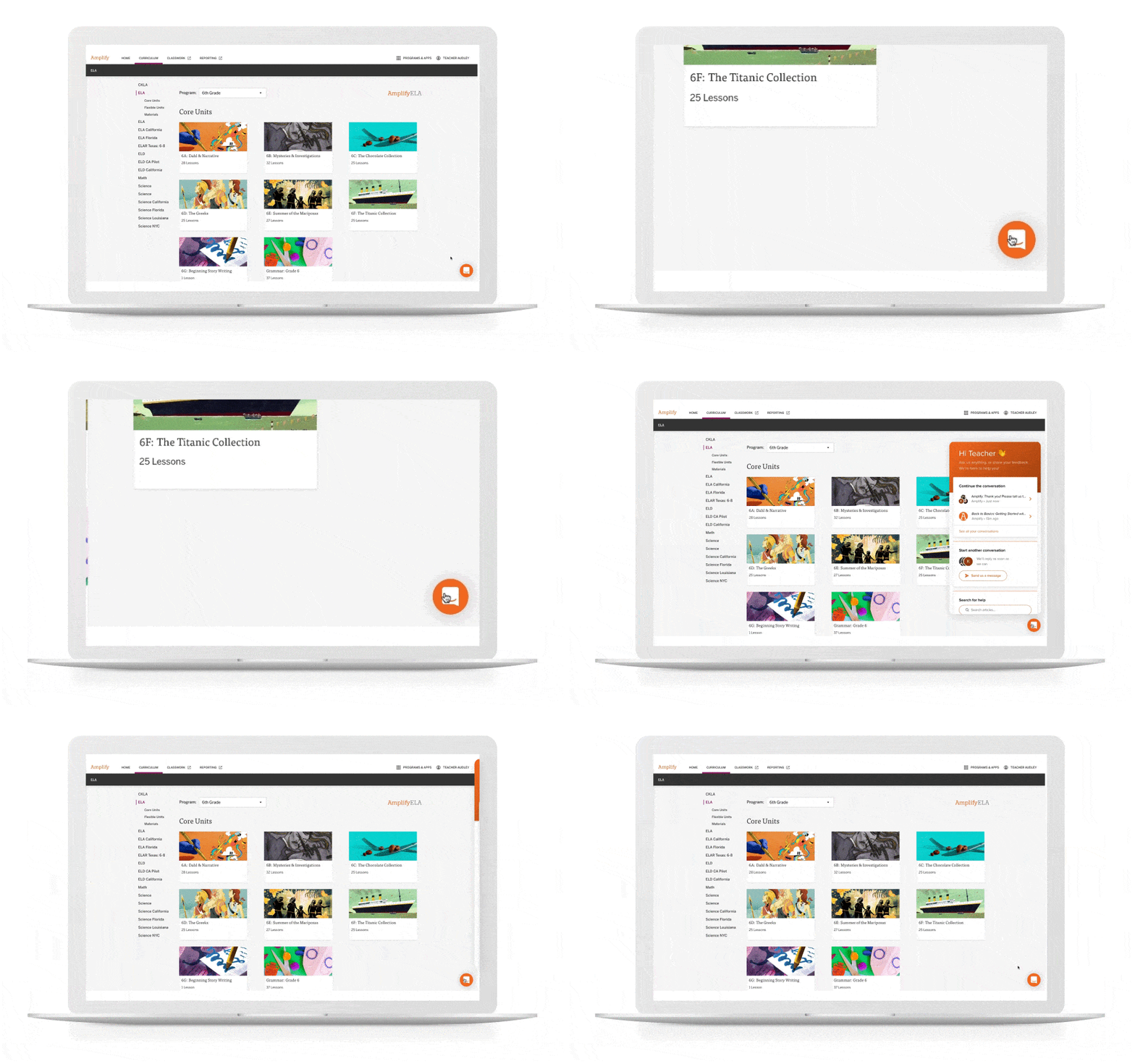
Amplify Math for Idaho

Dear Idaho math educators,

We’re honored that you’re reviewing Amplify Math for use with your middle school students.

We’re confident you’ll find this Idaho-approved program to be a powerful tool for getting all your students talking and thinking about math concepts together.

On this site, you’ll find a variety of resources to guide you in your review, including demo account access. We look forward to meeting you and showing you what makes this program so unique.

Yvonne Rhode and Kristen Rockstroh
Idaho Account Executives

A miniature yellow van with luggage on top is parked next to a small stop sign, with a blurred, colorful vehicle in the background. Text reads: "Your literacy journey stops here!.

Virtual Caravan Stop

Amplify Math isn’t your traditional core math program. It’s different to make a difference—and the results are simply undeniable. Watch our virtual caravan presentations to the right and learn about the research-based approaches built right into this high-quality solution. Plus, see how Amplify Math brings student-centered learning to life for students in grades 6–8.

What it is

Amplify Math is a brand-new program based on the highly-rated Illustrative Mathematics curriculum IM K–12 Math™️.

It’s designed around the idea that a core math curriculum needs to serve 100 percent of students in accessing grade-level math every day. To that end, Amplify Math delivers:

  • Engaging, discourse-rich math lessons that are easier to teach.
  • Flexible, social problem-solving experiences both online and off.
  • Real-time insights, data, and reporting that inform instruction.
amplify math middle schoolers in classroom

How it works

Amplify Math delivers the instructional power of student-centered learning packaged in a lesson format that is easy and manageable. With easy-to-follow instructional supports, implementing a problem-based program becomes more effective and enjoyable for both you and your students. Paired with our digital experience, math class becomes fun and dynamic, with plenty of opportunities for students to talk through their reasoning, work with their peers, and gain new understandings.

A laptop displays geometric shapes in a teaching demo. Nearby, a separate document with text and diagrams is visible.

Featuring Desmos and more

Desmos digital lessons

Digital lessons should be powerful in their ability to surface student thinking and spark interesting and productive discussions. We’ve partnered with Desmos to bring this vision to life with our complete library of social, collaborative lessons powered by Desmos technology.

A laptop displays an educational program with a rocket simulation on the left and a graph of rocket launch trajectories versus time on the right.

Engaging student experience

Relevant content and interactive math tools create an intuitive and engaging student experience. Plus, working together in real time allows them to see that communicating their ideas and learning from each other are important parts of math class.

A diagram on a tablet screen shows a person holding multiple leashes, each attached to a different colored dog. Text describes a walking challenge activity.

Visibility into student thinking

Imagine having more visibility into your students’ mathematical thinking. Now imagine students have access to this same information. With Amplify Math’s collaborative lesson interface and teacher dashboard, students can’t hide. What’s more, they have visibility into the thinking of their peers—exposing them to a wider variety of approaches to solving the same problem.

A computer screen shows a student response interface, displaying a comment explaining why a square is a type of rectangle.

Pre-requisite skill building

Power-ups provide just-in-time support to help student strengthen pre-requisite skills before engaging in whole-class activities. Power-ups ensure all students have a chance to experience success in the day’s lesson even if they might be several years behind. Not teaching online? They’re available in the Teacher Edition, too.

A laptop screen displays a grid of class members' names with checkmarks and X symbols, indicating progress or completion status in an online learning platform.

Ready-to-teach lesson slides

Every lesson of Amplify Math includes ready-to-teach lesson slides complete with step-by-step teaching notes, suggested student and teacher responses, options for differentiating instruction, links to useful resources, and tips for supporting students through common trouble-spots. Teacher can also customize their lesson slides, adding their own flavor, flair, and favorite problems—enabling them to truly make the lesson their own.

A laptop screen displays an educational interface with a colorful geometric shape, shape options to choose from, and instructional text on the right side.

Presentation sync and student pacing

Being able to control what slides students see and when gives teachers the ability to control the pace of the lesson to suite the needs of the class. When Presentation Sync is turned on, students can access all the slides in the lesson. When it’s off, it ensures students’ screens follow the teacher’s. Teachers can also set a range of slides, which allows students to work at their own pace within the unlocked slides only.

A laptop displays an educational interface with a decimal lesson, pop-up notification, and navigation bar showing multiple open slides at the bottom.

Standards-level reports

Not only do our reports show progress toward standards mastery, they include detail on how students performed against the standard in the past and how many more encounters are yet to come. This feature alone helps teachers prioritize instruction and intervene with additional resources when necessary.

A computer screen displays a New York math skills tracking interface, highlighting standard 6.EE.C.9, with progress indicators and a class average score of 74% shown in a yellow pie chart.

Focus on math identify

Helping students develop strong, healthy, and flexible math identities is a cornerstone of Amplify Math. Throughout the program, students are taught that they themselves are mathematicians, that today’s math was largely shaped by a diverse range of mathematicians who deserve to be learned about, and that learning is never finished.

Illustration of a laptop displaying various colorful icons and graphics representing diverse professions and historical figures on its screen, emphasizing illustrative mathematics and desmos math concepts through its displayed content.

Access demo

Ready to explore the program? Follow these simple instructions to access our program digitally.

  • Watch the video to the right or use this document to learn how to navigate our print and digital components.
  • Click the Access demo button.
  • Select Log in with Amplify.
  • Enter the login credentials found on the unique login flyer provided. If no login flyer was provided, use the following credentials:
    • Username: t1.idahomath8@demo.tryamplify.net
    • Password: Amplify1-idahomath8
  • Click on any of the six units to explore.

Contact us

Support is always within reach. Our team is dedicated to supporting districts across Idaho and can be reached at any time by emailing HelloIdaho@amplify.com or by calling us directly.

Woman with long, wavy brown hair wearing a navy blazer and bright pink blouse, smiling at the camera against a dark gray background.

Yvonne Rhode

Sr. Account Executive

Districts over 4,700 students

(480) 673-0019

yrohde@amplify.com

Portrait of a smiling woman with blonde hair, wearing a pink and white gingham shirt and stud earrings.

Kristen Rockstroh, M.Ed.

Account Executive

Districts under 4,700 students

(480) 639-8367

krockstroh@amplify.com

Smiling woman with shoulder-length brown hair stands in front of a tree, wearing a white top.

Fawn Nguyen

Math Specialist

(805) 328-1115

fnguyen@amplify.com

A middle-aged man with glasses, a mustache, and a goatee, wearing a light gray shirt and a black tie, posed against a plain white background.

Francis Ogata

Math Specialist

(916) 521-1467

fogata@amplify.com

S5.E6. Why skepticism is essential to the Science of Reading, with Dr. Claude Goldenberg

To view this protected page, enter the password below:


S3 – 04. Ideas to build math fluency with Valerie Henry, Graham Fletcher, and Tracy Zager

Promotional image for "Math Teacher Lounge" Season 3, Episode 4 titled "Ideas to Build Math Fluency," featuring Valerie Henry, Tracy J. Zager, and Graham Fletcher.

Fluency in math can oftentimes be associated with negative experiences with its development— timed worksheets, for example. Bethany and Dan are joined by three guests to better understand fluency and how to make its approach fun. Dr. Val Henry shares her three-part definition of fluency and her five principles for developing it. Additionally, Tracy Zager and Graham Fletcher join Bethany and Dan to better understand fluency through a lens of equity and using multimedia as a tool.

Explore more from Math Teacher Lounge by visiting our main page

Download Transcript

Dan Meyer (00:03)

Hey folks. Welcome back. This is Math Teacher Lounge, and I am one of your hosts, Dan Meyer.

Bethany Lockhart Johnson (00:07):

And I’m your other host, Bethany Lockhart Johnson. Hi, Dan.

Dan Meyer (00:11):

Hey, great to see you. We have a big one this week to chat about and some fantastic guests. We are chatting about fluency, which is the sort of word and concept that I feel like people have very, very non-neutral associations with it. A lot of them are very negative, for a lot of people.

Bethany Lockhart Johnson (00:26):

I saw you frown a little. What’s up with that, Dan? You kind of, like, shrank.

Dan Meyer (00:30):

I have strong feelings about it. You know, there’s lots of ways that people go about helping people become fluent in mathematics. And a lot of them are harmful for students, and ineffective. And it got me thinking about fluency as it exists outside of the world of mathematics, where we have a lot of very clear images of it. We’re getting fluent in things all the time. Like, as humans. Human development is the story of fluency. And I just was wondering….Bethany, would you describe yourself as fluent at something outside of the world of mathematics? What is that? How’d you get fluent at it? What was the process?

Bethany Lockhart Johnson (01:05):

Hmm, I think I’m a pretty fluent reader. I read all the time. I’m a happier person if I’ve read that day. I once saw this poster in a classroom; it said “10 Ways to Become a Better Reader: Read, Read, Read, Read, Read…you know, 10 times. Get it? Reading? You get better at reading by reading! So I would say reading. And it’s been kind of cool—I have a one-year-old who, it’s been really exciting slash overwhelmingly anxiety-producing to see him get very fluent with walking slash running, ’cause he’s getting faster every day. And it’s kind of fun. When I think of what’s something somebody’s trying to get fluent with…walking! He’s trying to be more fluid. He’s practicing transitions. He doesn’t wanna hold my hand while he traverses rocky terrain. He’s getting better at it. He’s practicing. What about you? What’s something…?

Dan Meyer (02:08):

I think about driving a lot. I’m a very fluent driver and I think a lot about when I was first a driver, you know? And how l have my hands on 10 and 2, vice grip, and do not talk to me; do not ask me anything; don’t ask me my NAME. I need to focus so hard. And then a year later, you know, I’m driving with one hand, smash the turn signal, take a sip off of whatever, change the CD. And then it’s no big deal.

Bethany Lockhart Johnson (02:38):

Wait, did you pass the first time? Your test?

Dan Meyer (02:40):

Yeah, I don’t like to brag about it. <laugh> But I do all the time. <laugh> But I got a hundred on my driving test. I don’t care who knows it. And I hope it’s everybody. But I guess all of this is just to say there are areas of life where fluency feels natural, with the case of walking. There’s areas of life where fluency feels motivating, with like driving—I wanna be able to switch the CD out or whatever. And there’s areas where fluency feels terrifying and hard to come by, like mathematics, sometimes. So we have a set of guests here. Our first guest will help us figure out what do we mean by fluency? And what’s the research say about what fluency is and how students develop it in mathematics? And then our other guests will help us think about what it looks like in practice in the classroom. What are some novel, new ways to work on fluency? So first up we have Val Henry, Dr. Val Henry.

Bethany Lockhart Johnson (03:32):

So we knew we needed help with the fluency definition, because when we think about it, it’s kind of big, right? And we wanted to look at what research about fluency really says. So we called on Valerie Henry. Val is a nationally board-certified teacher, taught middle school for 17 years, and since 2002 has worked with undergraduates graduates, credential candidates as a lecturer at the University of California, Irvine, one of my alma maters. So after doing her dissertation on addition and subtraction fluency in first grade, Val created a project to study ways to build addition and subtraction and multiplication and division fluency while also developing number sense in algebraic thinking. And the pilot grew and grew over the last 18 years into a powerful daily mini-lesson approach to facts fluency called FactsWise. And when we thought of fluency, the first person I thought of was Val. Welcome, Val Henry, to the Lounge! I’m so excited to have you here. Welcome.

Valerie Henry (04:36):

Thanks, Bethany. And thanks to you, Dan. It’s great to be here today.

Dan Meyer (04:41):

Great to have you; help yourself to whatever you find in the fridge. The names that people write down on those things in the bags are just recommendations. It’s potluck-style here. I’m curious, Val, if you’re, like, on an airplane, someone asks you what you do, and you say you study fluency…what is the layperson’s definition of what does it mean to be fluent in mathematics? And if you can give a brief tour through what the research says about what works and what doesn’t that would really help us orient our conversation here.

Valerie Henry (05:12):

The first thing I have to do when I talk to somebody on a plane is define the idea of fluency. And I often use an example of tying your shoelaces. Because that works with first graders as well as adults. This idea that when we first start trying to put our shoes on and get those shoelaces tied, somebody tries to, first of all, just do it for us. But then of course maybe tries to teach us the bunny-ears approach. And we struggle and struggle as little kids and eventually either the bunny-ears approach or something else starts to work for us. But we still have to pay attention to it. We have to think hard and it’s not easy. And then over time we get to the point where we basically don’t even think about it. When I tie my shoes in the morning. I’m not thinking about right-over-left and left-over-right and all of those things. I just do it. And so that’s a good, easy example of becoming fluent with something. I think what we’re talking about today though, is the basics, the adding and subtracting that we hope kids are going to have mastered maybe by second grade, and the multiplication and division facts that we wanna maybe have mastered by third, maybe fourth grade. So now what does that mean to become fluent with those basics? I have a three-part definition that seems to match up really nicely with the common core approach to fluency. Which is, first of all, we want the answers to be correct. And then second, we want the answers to be easy to know. And so what does that mean? Well, to me, it means without needing to count,

Bethany Lockhart Johnson (07:12):

You mean without having to kind of muscle through it? Or say more about you mean.

Valerie Henry (07:16):

Well, I guess what I mean is that when you watch a young child try and solve something even as simple as two plus three, they might put up two fingers and then go 3, 4, 5 with three more fingers winding up on their hand, one or the other of their hands. While they’re doing that, they don’t really have a sense of whether even their answer is right or not, quite often. Especially when you get to the larger adding and subtracting problems, you can see a lot of errors happening as they’re trying to count. And it’s taking up cognitive energy to do that counting process, especially as you get to the larger quantities. So my definition of fluency now is “getting it right without needing to do that hard work like counting.” Now, some people might say, well, we just want them to have ’em memorized. But in my research, I’ve learned that a lot of very fluid adults don’t always have every fact memorized. In fact, if you ask a room full of adults, what’s seven plus nine, you might learn that they can all get it correct quickly, quickly…but they don’t all have it memorized. And so when you ask them, “How did you get that?” Many of them will say, “Well, I just gave one from the 7 to the 9 and I know that 10 plus 6 is 16.”

Bethany Lockhart Johnson (08:53):

That’s such an important distinction. My brain literally just did that actually!

Valerie Henry (08:58):

<laugh> Right? <laugh> But you’re fluid with it, because it doesn’t take you much cognitive energy at all.

Bethany Lockhart Johnson (09:05):

Right.

Valerie Henry (09:07):

So now we have “correct without needing to put that cognitive energy,” which usually means that you’re counting. And then the third thing is “relatively quickly,” so that you’re not spending 15 seconds trying to figure it out. Even that part-whole strategy approach can be done really quickly, almost instantaneously. Or it can take a long time. So if a student can get the answer correct within, you know, three or four seconds— is I’m pretty generous—I figure that they’re pretty darn fluent with that fact. So that’s my three-part definition of these basics, fluency.

Dan Meyer (09:55):

I love the distinction between getting it correct and getting it quick. It’s possible to be quick with wrong answers. It’s possible to be like, “Those are separate components there.” And I echo Bethany’s appreciation for this third option in between knowing it instantaneously through memorization and muscling through it. But there’s like a continuum there of how much energy it took you to come up with it that all feels extremely helpful.

Valerie Henry (10:21):

And you know, one of the things that I’ve noticed is that when kids are pressured to come up with those instantaneous answers, they often default to guessing and get it wrong.

Bethany Lockhart Johnson (10:30):

Mm, yeah.

Valerie Henry (10:30):

So that’s one of the things that I’ve learned is that as we’re trying to help students develop fluency, it’s important to start with building their conceptual understanding of what it means to do, you know, 3 times 9 and what the correct answer is, maybe using manipulatives or representations of some sort. Not skip-counting! I really have found that skip-counting just perpetuates itself in many students’ minds and that they never stop skip-counting, which means they’re putting in not very much mental energy if it’s 2 times 3 but a ton of mental energy if it’s 7 times 8. Because frankly, it’s really hard to skip count by sevens. And by eights.

Bethany Lockhart Johnson (11:18):

I can get to 14 and then I’m like, wait, wait, what was next? Right? No, no, no…21! What do you feel are some misconceptions that maybe teachers, maybe parents have about fluency in math?

Valerie Henry (11:30):

I think maybe one of the first ones is that if students count or skip-count, their answers repetitively over and over and over and over, that they’re bound to memorize them. And the study that I did back in 2004, I actually had a school that had decided that they were going to do time tests with their students every day, all year. And that undoubtedly by the end of the year, those students would be fluent.

Bethany Lockhart Johnson (12:06):

And to clarify by time test, you mean like, sit down, pencil, paper, ready, go, worksheet kind of thing.

Valerie Henry (12:15):

Yes.

Bethany Lockhart Johnson (12:16):

Some of us might remember quite vividly.

Valerie Henry (12:18):

<laugh> Very vividly. And you know, you have to get it done within a certain amount of time. So they made it fun for the students. Apparently the students enjoyed it. I was a little leery about that, but in the end, when I went and checked on the students and I did one-on-one assessments with half of the students in every class that were randomly selected so that I could get a sense of where they were with their fluency—and these were first graders—they basically had nothing memorized. They were simply counting as fast as they possibly could. And, you know, mostly getting the right answers. But they had not memorized. So that’s one of the myths, I think, is that repetitive practice of counting gets you to memorization.

Bethany Lockhart Johnson (13:10):

If I put it in front of you enough times, you’ll become fluent.

Valerie Henry (13:14):

Right, right. Now these students didn’t really get any instruction, any help learning these. They just simply tested over and over and over. So that’s another thing that I think is a misconception. It’s that if we test students, but don’t really teach them fluency, then they’re going to become fluent. If we just test them every Friday or that kind of thing. And that they’ll learn them at home. But really what that means is a few lucky kids who have parents who have the time and the energy and the background to know how to help will take that job on at home. Not that many students are really that fortunate.

Dan Meyer (14:01):

It’s almost like the traditional approach, or the approach you’re describing, confuses process and product. It says, “Well, the product is that eventually fluent students will be able to do something like this, see these problems and answer them, answer them quickly,” and says, “Well, that must be the process then as well; let’s give them that products a whole lot.” But as I hear you describe fluency with bunny ears on shoelaces, there’s these images and approaches and techniques that require a very active teacher presence to support the development of it. That’s just kind of interesting to me.

Valerie Henry (14:35):

My initial project, the pilot project that I tried, was to simply ask teachers to follow five key principles. And the first one was to do something in the classroom every day for—I told them, even if you’ve only got five or 10 minutes, work on fluency for five or 10 minutes a day, and let’s see what happens. So that was one key element was just to teach it and to give students opportunities to get what the research calls for when you’re trying to memorize, which is actually immediate feedback. When I talk about immediate feedback with my student teachers, I say, “I’m talking about within one or two seconds of trying a problem, and then sort of immediately knowing, getting feedback of whether you got the answer right or not so that your brain can kind of gain that confidence. ‘Oh, not only did I come up with an answer, but somebody’s telling me it’s the correct answer.’”

Dan Meyer (15:38):

There’s a lot of apps now in the digital world that offer students questions about arithmetic or other kinds of mathematical concepts and give immediate feedback of a sort: the feedback of “You’re right; you’re wrong” sort. Is that effective fluency development, in your view?

Valerie Henry (15:57):

I haven’t heard and I haven’t seen them being super-effective. The ways I think about this are “Immediate feedback isn’t the only thing we need.” Probably one of the biggest things that we need is for students to develop strategies. And this is one of the other things I’ve learned from international research, from countries that do have students who become very fluent very early, is that they don’t shoot straight for memorization, but they go through this process of taking students from doing some counting and then quickly moving them to trying to use logic. So, “Hey, you really are confident that 2 + 2 is 4; so now let’s use that to think about 2 + 3.” Actually, as an algebra teacher, I would much rather have students that have a combination of memorization and these strategies, than students who’ve only memorized. Isn’t that interesting that my most successful algebra students were good strategy thinkers. Not just good memorizers.

Bethany Lockhart Johnson (17:09):

So you mentioned there were five that kind of helped root this idea in like, “What can teachers do? What is the best thing that teachers can do to support with fact fluency?” So, everyday was key.

Valerie Henry (17:22):

Then the next principle that I really focus on is switching immediately to the connected subtractions so that students—

Bethany Lockhart Johnson (17:33):

Not waiting until you’ve gotten all the way through addition. But making “Ooh!”

Valerie Henry (17:38):

Totally. And I didn’t do that the first year. And when we looked at the results of the assessments at the end of the year, we realized that our students were so much weaker in subtraction than addition. So the following pilot year, we tried this other approach of doing subtraction right after the students had developed some fluency with that small chunk of addition. And we got such better subtraction results.

Bethany Lockhart Johnson (18:11):

What are the other principles?

Valerie Henry (18:13):

The biggest one is to use these strategies. So the strategies makes the third. And then the fourth I would say is to go from concrete to representational to abstract.

Bethany Lockhart Johnson (18:27):

Don’t put away those manipulatives. Don’t put away those tools.

Valerie Henry (18:31):

Oh, so important to come back to them for multiplication and division. And my fifth principle is to wait on assessment. To use it as true assessment, but not race to start testing before students have had a chance to go through this three-phase process. Which is conceptual understanding with manipulatives; building strategies, usually with representations; and then working on building some speed until it’s just that natural fluency.

Bethany Lockhart Johnson (19:07):

I wanna say thank you so much for offering your really learned perspective, because you have not only done the research, but seen it in action and seen how shifting our notions of fluency and what fluency can be and what a powerful foundation it can be for all mathematicians. Really, that shift is so powerful. And I appreciate you sharing it with our listeners and with us. So we’re so excited that we got to talk with you today, Val—

Dan Meyer (19:35):

Thank you, Dr. Henry.

Valerie Henry (19:37):

You’re welcome!

Dan Meyer (19:41):

With us now we have Graham Fletcher and Tracy Zager, a couple of people who understand fluency at a very deep and classroom level. I wanna introduce them and get their perspective on what we’re trying to solve here with fluency. So Graham Fletcher has served in education in a lot of different roles: as a classroom teacher, math coach, math specialist, and he’s continually seeking new and innovative ways to support students and teachers in their development of conceptual understanding in elementary math. He’s the author, along with Tracy, of Building Fact Fluency, a fluency kit we’ll talk about, and openly shares so much of his wisdom and resources at gfletchy.com. Tracy Johnson Zager is a district math coach who loves to get teachers hooked on listening to kids’ mathematical ideas. She is a co-author of this toolkit, Building Fact Fluency, and the author of Becoming the Math Teacher You Wish You’d Had: Ideas and Strategies from Vibrant Classrooms. Tracy also edits professional books for teachers at Stenhouse Publishers, including, yours truly. Thank you for all that insight, Tracy, and support on the book.

Bethany Lockhart Johnson (20:49):

Dan and I were talking at the beginning of the episode about things we feel like, “Hey, I’m fluent in that. I’m fluent in that.”

Dan Meyer (20:55):

Just very curious: What’s something you would like to get fluent in outside of the world of mathematics, let’s say?

Tracy Zager (21:00):

I’ll say understanding the teenage brain, as the parent of a 13-year-old and 15-year-old. That’s the main thing I’m working on becoming fluent in!

Bethany Lockhart Johnson (21:10):

Ooh!

Dan Meyer (21:13):

A language fluency, perhaps. All right, Graham. How about you?

Graham Fletcher (21:16):

For me typing, it’s always been an Achilles heel of mine. So voice-to-text has been my friend. But it’s also been my nemesis in much of my texting here and working virtually over the last couple years. So yeah, typing.

Dan Meyer (21:33):

Do you folks have some way of helping us understand the difference in how fluency is handled by instructors and by learners?

Tracy Zager (21:40):

I would say that the lay meaning of fluency is definitely a little different than what we mean in the math education realm. When we’re talking about math fact fluency, which is just one type of fluency. So you gotta think about procedural fluency and computational fluency; there are lots of types of fluency in math. And Graham and I had the luxury of really focusing in specifically on math fact fluency. We’re looking at kind of a subset of the procedural fluency. So the words you hear in all the citations are accurate, efficient, and flexible. There’s this combination of kids get the right answer in a reasonable amount of time and with a reasonable amount of work and they can match their strategy or their approach to the situation. That’s where that flexibility comes in. And there’s like lots more I wanna say about that about sort of…I think one issue that comes up around fluency is that people are in a little bit of a rush. So they tend to think of the fluency as this automaticity or recall of known facts without having to think about it. And that is part of the end goal, but that’s not the journey to fluency. So this is one of the things that Graham and I thought about a lot was the path to fluency. The goal here it’s that student in middle school who’s learning something new doesn’t have to expend any effort to gather that fact. And they might do it because they’ve done it so many different ways that they’ve got it, and now they just know it, or they might be like my friend who’s a mathematician who still, if you say, “Six times 8,” she thinks in her head, “Twelve, 24, 48…” and she does this double-double-double associative property strategy. And it’s so efficient, you would never know. And that’s totally great. That’s fine. That’s not slowing her down. That’s not providing a drag in the middle of a more complex problem or new learning. So we’re really focused on having elementary school students be able to enter the middle and high school standards without having that pull out of the new thinking.

Graham Fletcher (23:53):

And as I think about that, I think about how so many students will memorize their facts, but then they haven’t memorized them with understanding. So that when they move into middle school and they move into high school, it’s almost like new knowledge and new understanding that’s applied from a stand-alone skill.

Bethany Lockhart Johnson (24:10):

So something that felt really unique to me, Graham, as I was diving into the toolkit, is your use of images, Tracy, Graham, is the way that you use images to help students notice and wonder to start making sense of these quantities and the decomposition of numbers using images. Can you talk a little bit about how images played a part in the way that you think about this building a fact fluency?

Graham Fletcher (24:41):

What I realized is so many times when we approach math with just naked numbers with so many of our elementary students, the numbers aren’t visible. The quantities. They can’t see them; they can’t move them. They’re just those squiggly figures that we were talking about earlier on. So how is it that we make the quantities visible, to where students feel as if they can grab an apple and move it around? Because a lot of times we start with the naked numbers and then if kids don’t get the naked numbers, then we kind of backfill it. But what would happen if we start with the images? And then from there, these rich, flourishing mathematical conversations develop from the images. And I think that was the premise and the goal of the toolkit.

Tracy Zager (25:22):

When you look at how fact fluency has traditionally been taught, it’s all naked numbers. And sometimes we wrote ’em sideways. Like, that’s it. That was our variety of task type. Right? Sometimes it’s vertical; sometimes it’s horizontal. And that was it. And I’ve just known way too many kids who couldn’t find a hook to hang their hat on with that. It didn’t connect to anything. And so part of why I knew Graham was the perfect person for this project was his strength in multimedia photography, art, video. And so we started from this idea of contexts that for each lesson string in the toolkit, there’s some kind of context. An everyday object, arranged in some kind of a way that reveals mathematical structure and invites students to notice the properties. So we start with images of everyday objects: tennis balls, paint pots…um, help me out; here are a million of them. Crayons—

Bethany Lockhart Johnson (26:18):

Crayons, markers.

Tracy Zager (26:18):

Shoes, right? Sushi, origami paper, all kinds of things in the different toolkits. So there’s a series of images or a three-act task or both around those everyday objects, and then story problems grounded in that context. And then there are images with mathematical tools that bring out different ideas, but relate in some way to the image talks. And we do all of that before we get to the naked number talk. Which we do, and by the time you get to the number talk, it’s pretty quick, ’cause they’ve been reasoning about cups of lemonade. And now when you give them the actual numerals, they’re all over it.

Bethany Lockhart Johnson (27:03):

I have to say too, as somebody who—particularly in middle school—navigated math anxiety, we recently talked with Allison Hintz and Anthony Smith about their amazing book Mathematizing Children’s Literature.

Tracy Zager (27:14):

Yay!

Bethany Lockhart Johnson (27:14):

And I was explaining, like, if I sat down at the beginning of a math class and my teacher opened a picture book and said, “We’re gonna start here,” I felt my whole body relax. And if we start with this image, if we start with just looking at an image and making sense of an image, I feel like that could be such a powerful touchstone for all the work you do from there.

Tracy Zager (27:41):

That’s core. That’s a core design principle, is that invitational access. There are no barriers to entry. There’s nothing to decode. There’s nothing formal. We’ve been learning from Dan for years about this, right? Of starting with the informal and then eventually layering in the formal. I was in a class in Maine where they were doing an image talk and it’s these boxes of pencils. It’s a stack of boxes of pencils and they’re open and you can see there are 10 pencils in each box. And so there are five boxes of pencils each with 10 pencils in it. And then the next image is 10 boxes of pencils and each box is half full. So now it’s 10 boxes each with five. And the kids are talking and talking and then the third image, I think there are seven boxes each with 10 pencils in it. And she said, “What do you think the next picture’s gonna be?” And this girl said, “You just never know with these people!” <laugh> I dunno!”

Bethany Lockhart Johnson (28:37):

That’s kinda true. Knowing you both, it’s kinda true.

Tracy Zager (28:42):

Like if it’s seven boxes with 10 in it, one kid said, I think it’s gonna be 14 boxes of five. And other kids are like, I think it’s gonna be 10 boxes with seven. And they start talking about which of those there are and the relationships between—

Bethany Lockhart Johnson (28:58):

But they’re making sense of numbers!

Tracy Zager (28:59):

Totally. So all the kids felt invited. They can offer something up. They’re noticing and wondering about that image. They’re talking about it in whatever informal language or home language that they speak. And that was core to us. That was a huge priority, because honestly, one of the motivations to talk about fluency is that it’s always been this gatekeeper. It has served to keep kids out of meaningful math. Particularly kids from marginalized or historically excluded communities. So they’re back at the round table, doing Mad Minutes, while the more advantaged kids are getting to do rich problem solving. And so, we thought, what if we could teach fact fluency through rich problem solving that everybody could access? That was like square one for us.

Bethany Lockhart Johnson (29:45):

That’s huge.

Dan Meyer (29:46):

That’s great to hear. What’s been helpful for me is to understand that students who are automatic, that’s just kind of what’s on the surface of things. And that below that might be some really robust kind of foundation or scaffolding that bleeds to a larger building being built, or it might be just really rickety and not offer a sturdy place to build farther up. It’s been really exciting to hear that. I wonder if you’d comment for a moment about, in the digital age and—I’m at Desmos and our sponsors are Amplify and we all work in the digital world quite a bit. There are a lot of what report to be solutions to the fluency issue, to developing fluency in the digital world. Just lots and lots of them. Some that are quite well used, others that are just like X, Y, or Z app on the market. You can find something. Do you have perspectives on these kinds of digital fluency building apps? Like, what about them works or doesn’t work? Let us know. Graham, how about you? And then Tracy, I’d love to hear your thoughts too.

Graham Fletcher (30:47):

Yeah, I think that’s a great question, ’cause there’s a lot of shiny bells and whistles out there right now that can really excite a lot of teachers. But I always come back to what works for me as a classroom teacher is probably gonna work in a digital world as well. So what are the things that I love and honor most about being in front of students, and how can I capture that in that virtual world? I think one of the things that really helps students make connections is coherence. I think coherence, especially when you leave students for—you don’t get to talk with them after the lesson is done—so I think about how we can purposefully sequence things through a day-to-day basis. I think coherence is something that gets really lost when we talk about fluency, especially with whether it be digital or whether it be print, because what ends up happening is we say, “OK, we have all these strategies we need to teach,” and it becomes a checklist. So how is it that we can just provide students the opportunity to play around in a space, whether it be digital or in person, but in a meaningful way that allows them the time and the space and that area to breathe and think, but be coherent. And connecting those lessons along the way. And I think coherence is one thing that a lot of the times it’s harder to—when we’re in the weeds, it’s so hard and difficult to zoom back out and say, “Do all these lessons connect? How do they intentionally connect? And how do they purposefully connect?” And without coherence, everything’s kind of broken down into that granular level. So when looking at—I think about Desmos and I think about the Toolkit and I think about how Tracy and I talked a lot about, “Well, this, does it connect with the context problem, does it connect with the image talk, or the lessons? Like, how does it all connect and how are we providing students an opportunity to make connections between the day-to-day instruction and lessons that we tackle?”

Tracy Zager (32:44):

I’m reminded of a conversation that Dan, you and I had a long time ago, in Portland, Maine, in a bar. I’ll just be honest. <laugh> And we were talking about how, in the earlier days of Desmos, you were stressed out by what you saw, which was kids one-on-one, on a device, in a silent room. And you were like, no, this is not it. This is not what technology is here to serve. We can do so many things better using technology appropriately, but we can’t lose talk and we can’t lose relationships and we can’t lose formative assessment and teachers listening to kids and kids listening to each other and helping each other understand their thinking. Right? So when I think about the tech that’s out there for fact fluency, most of it is gonna violate all rules I have around time testing. So that a whole bunch of it, I would just toss on that premise. They’re really no different than flashcards. It’s just flashcards set in junkyard heaps. Or, you know, underground caverns. Or with a volcano or whatever. It’s the same thing. There are some lovely visuals—I’m thinking of Berkeley Everett’s Math Flips. Those are really pretty. Mathigon has some really nice stuff that’s digital. And I think that those resources invite you to kind of ponder and notice things and talk about them. All the tools that we design in the toolkit are designed to get people talking to each other, and give teachers opportunities to pull alongside kids and listen in and understand where they are. For example, our games, we didn’t design the games to be played digitally, even though you could, and people did during COVID, because we want kids on the rug, next to each other, on their knees; I’ve seen kids like across tables. I was in a school recently where a kid was like, “I hope you believe in God, ’cause you’re going…!” You know what I mean? <laugh>. Like they’re all pumped up.

Bethany Lockhart Johnson (34:41):

They’re invested!

Tracy Zager (34:45):

They’re psyching each other up and down and they’re interacting and it’s social and the teacher’s walking around and she’s listening to the games. And they don’t actually need any bells and whistles. They need dice and they need counters and they need this game that is actually a game. In all of our conversations, games have to actually be games. Games cannot be “roll and record.” Games have to involve strategy. They have to be fun. So in designing those games, we didn’t feel like it brought any advantage to make that a digital platform. But things that did bring advantages digitally, like the ability to project these beautiful images or to use short video in the classroom, that really was a value-add that enabled us to do something different in math class than we had done before, and to get kids talking in a different way than they ever had before. When I think about fluency, historically, if you say like, “OK, it’s time to practice our math facts,” you hear a lot of groans. And when I see a Building Fact Fluency classroom and I say, “OK, it’s BFF time!” There’s like a “YEAAAAHHH!” You know? And so that’s what we’re after.

Graham Fletcher (35:47):

It’s all about kids, really, for us. And I think at the heart of it, we made all the decisions with teachers and kids at the forefront of it.

Tracy Zager (35:55):

I know of high schoolers who are newcomers, who have experienced very little formal education, and speak in other languages, are using it as high schoolers, because it involves language and math and all the deep work in the properties and it’s accessible, but it’s also not at all condescending or patronizing. Like we designed it to be appropriate for older kids. So that’s just something that I think we’re both really proud of. One thing we thought a lot about, especially in the multiplication-division kit is how a classroom teacher could use it and a coordinating educator in EL, Title, special education, intervention could also use it because there’s so much in it, that students could get to be experts, if they got extra time in it, using something that’s related and would give them additional practice. So they could play a game a little bit earlier than the rest of the classes. And they could come in already knowing about that game, or they could do a related task. We have all these optional tasks that no classroom teacher would ever have time to teach it all. So the special educator could use it and have kids doing a Same and Different or a True/False, or some of the optional games. And then the work in both special education and general education could connect.

Dan Meyer (37:20):

I just wanna say that this is an area that for so many students, as you’ve said, Tracy, it presents a barrier for their inclusion in mathematics. It’s a very emotionally fraught area of mathematics. And we really appreciate the wisdom you brought here. And just the care you’ve brought to the product itself. Your knowledge of teaching, knowledge of math, and yeah, especially a love for students feels like it’s really infused throughout Building Fact Fluency. If our listeners want to know more outside of this podcast, outside of the product itself, where can they find your words, your voice? Where you folks at these days? Tell ’em, Graham would you?

Graham Fletcher (37:57):

You can find us at Stenhouse, Building Fact Fluency. And then Tracy and I, currently playing around, sharing ideas a lot on Twitter, under the hashtag #BuildingFactFluency. That’s kind of where we can all come together and share ideas. And then also on the Facebook community, where there’s lots of teachers sharing ideas.

Bethany Lockhart Johnson (38:19):

If you were to ask our listeners like, “Hey, if you wanna keep thinking about this, here’s something you could try or here’s something you could go do,” what could be a challenge that we could share that could help us continue this conversation?

Graham Fletcher (38:35):

Online you can actually download a full lesson string. And a lesson string is a series of activities and resources that are purposefully connected. You can pick one or two of those from the Stenhouse web site, Building Fact Fluency. You can try the game. You can try one of those strategy-based games. You can try an image talk and just see how it goes. And just share and reflect back, whether on Twitter or on Facebook. But it’s kind of there, if you wanna give it a whirl. And as Tracy was sharing, even if you’re a middle-school teacher or a high-school teacher, we really tried to think about those middle-school and high-school students keeping it grade level-agnostic. Just so every student has those opportunities for those mathematical conversations. So download a lesson string and give it a whirl, and we’d love to hear how it goes.

Dan Meyer (39:25):

Bethany and I will be working the same challenge with people in our life.

Bethany Lockhart Johnson (39:29):

Yes.

Dan Meyer (39:29):

Enjoying some fact fluency with people in our homes, perhaps. We’ll see. And we’ll be sharing the results in the Math Teacher Lounge Facebook group. Graham and Tracy, thanks so much for being here. It was such a treat to chat with you both.

Bethany Lockhart Johnson (39:42):

I love learning with you and just helping to shift this idea of fluency into something that can be accessible and powerful and positive.

Stay connected!

Join our community and get new episodes every other Tuesday!

We’ll also share new and exciting free resources for your classroom every month.

What Valerie Henry says about math

“A lot of very fluent adults don’t always have every fact memorized. ”

– Val Henry

Meet the guests

Valerie Henry has been a math educator since 1986. She taught middle school math for 17 years and has worked as a lecturer at University of California Irvine since 2002. After doing her 2004 dissertation research on addition/subtraction fluency in first grade, Valerie created FactsWise, a daily mini-lesson approach that simultaneously develops  fluency,  number sense, and algebraic thinking. Additionally, she has provided curriculum and math professional development for K-12 teachers throughout her career, working with individual schools, districts, county offices of education, Illustrative Mathematics, the SBAC Digital Library, and the UCI Math Project.

Graham Fletcher has served in education as a classroom teacher, a math coach, and currently as a math specialist. He is continually seeking new and innovative ways to support students and teachers in their development of conceptual understanding in elementary mathematics. He is the author of Building Fact Fluency and openly shares many of his resources at gfletchy.com. Follow him on Twitter.

Tracy Johnston Zager is a district math coach who loves to get teachers hooked on listening to kids’ mathematical ideas. She is a co-author of the Building Fact Fluency toolkits and the author of Becoming the Math Teacher You Wish You’d Had: Ideas and Strategies from Vibrant Classrooms. Tracy also edits professional books by teachers, for teachers at Stenhouse Publishers. Follow her on Facebook.

A collage of three headshots: an older woman with glasses, a man with a beard in a blue shirt, and a woman with dark hair smiling in front of greenery.
A graphic with the text "Math Teacher Lounge with Bethany Lockhart Johnson and Dan Meyer" on colored overlapping circles.

About Math Teacher Lounge: The podcast

Math Teacher Lounge is a biweekly podcast created specifically for K–12 math educators. In each episode co-hosts Bethany Lockhart Johnson (@lockhartedu) and Dan Meyer (@ddmeyer) chat with guests, taking a deep dive into the math and educational topics you care about.

Join the Math Teacher Lounge Facebook group to continue the conversation, view exclusive content, interact with fellow educators, participate in giveaways, and more!