S2-05: Moving students forward with project-based learning

In this episode, Eric Cross sits with K–5 educator Janis Lodge to chat about building on her own science curriculum to create meaningful project-based learning experiences. Janis shares her work teaching Gifted and Talented Education (GATE), and how to use those practices to help accelerate the learning of all students. Eric and Janis also talk about making time for science within K–5 classrooms. Explore more from Science Connections by visiting our main page.
Janis Lodge (00:00):
To me, the reward of having those kids feel like they accomplished something and the way that they can take ownership of it and go in so many different directions, I cannot take that away from them. That’s such an opportunity that if I have the means to do it, I have to just take it and run with it.
Eric Cross (00:18):
Welcome to Science Connections. I’m your host, Eric Cross. My guest today is Janis Lodge. Janis is a third-grade teacher in Orange County, California, with a specialization in gifted and talented education. Recently, Janis was awarded the Orange County Council for the Gifted and Talented Education Classroom grant. This grant funds a project that provides an extension to her third-grade science unit about environments and survival. Through this project, students will think like a biomimicry engineer as they design a robot that is inspired by an innovation found in nature. In this episode, we discuss how she uses interdisciplinary teaching practices to make time for science learning; why gifted and talented education strategies can benefit all students; and her process for creating a problem-based lesson that ultimately earned her a grant for her classroom. And now, please enjoy my conversation with Janis Lodge. One, welcome! Thanks for being here.
Janis Lodge (01:14):
Of course, I am happy to do it. I’m excited for the opportunity.
Eric Cross (01:17):
Of course! Yeah. Elementary school teachers in science, I feel like there’s so many things to have conversations about. And some of the things that you’ve really focused on, I think, are, really, really important. But I wanna start off with your journey of you becoming a teacher in the classroom. And so, would you kind of give your background, your origin story? How did you end up as a third-grade teacher?
Janis Lodge (01:37):
Well, my story is definitely not a traditional story. Before I was a teacher, I was actually living in Maui, Hawaii. I moved there right after college. I went to Chico State in Northern California. And I got a degree in graphic design. And after I graduated, well, I should give a little bit of a backstory. My last summer before graduating, I spent the whole summer in Maui and I just fell in love with it. So when I graduated, I decided instead of applying for jobs in Northern California, I’m just gonna put some resumes out in Maui and see if I can get a job. And I did. I ended up getting a job doing graphic design and marketing for a kite surf company out there. And I ended up just staying for seven years on the island. And after about seven years, I kind of got a little bit of island fever and decided I wanted to come back to California. I wasn’t sure exactly what I wanted to do, but I just had this calling that I need to do something a little more fulfilling with my life. And I started thinking about different ideas and dreams I had. And I actually started thinking about when I was younger, right? I had this dream. If you were to ask me when I was 10 years old what I wanted to be when I grow up, it would be elementary school teacher.
Eric Cross (02:48):
Really?
Janis Lodge (02:48):
Believe it or not. When I was younger, I transformed my bedroom into a classroom. My stuffed animals were my students. I just thought I’m gonna be the next best teacher ever. And you know, as I went through life and kind of went in different directions, I kind of lost sight of that dream a little bit. But for some reason, when I decided to change careers, I just remembered that. And so I just decided to go get my teaching credential and see if it worked out. And it was probably the best decision I made. I feel like everything just fell perfectly into place. I ended up getting a job at an amazing school, and now, five years later, I’m a third grade teacher.
Eric Cross (03:28):
So one of the questions I have to ask, and talking to elementary school teachers, this comes up a lot: How do you make time for science as an elementary school teacher who’s teaching everything? And let me kind of premise this with, at least for those of us in California, and I’m sure the rest of the states too, but we know this; There’s kind of this pressure with pacing and then even, depending on what school you’re at, math and English tend to get the bulk of things. And maybe there’s this perception also of like, well, I gotta teach math and English, and sometimes science gets put to the back burner for different reasons.
Janis Lodge (03:57):
Well, you’re exactly right. The beginning of the year, we were provided with a pacing from the district. And you know, they try to keep us on track, saying, “You should be starting Unit 2 at this time.” But other than that, there’s really no specific guidelines of how many days we’re supposed to be teaching or for how long. But one kind of secret that I’ve discovered is that I can weave science into the other subjects, specifically with language arts. So quite often what I do is I take a look at the language arts standard, and if it’s identifying the key details and the main idea, well I can do that with the science books used from the curriculum. So I’ll just pull those readers and we’ll do the exact same skill, start with the same standard, but we’ll use the content from science. By doing that, we call that kind of like interdisciplinary study. And the students really enjoy that more, too, because they’re using the same skills but they’re diving deeper into the content.
Eric Cross (04:54):
Right.
Janis Lodge (04:55):
And so also that helps build the background knowledge. So then when it comes to time where, if I want to do a science lab or a science investigation, now they already have that background knowledge ’cause we already dove deep into the reading and they can apply that pretty quickly right away into their lab or whatever activity they’re doing.
Eric Cross (05:12):
Can you give an example maybe of how you might pull out something that might be a skill that you’re trying to develop, maybe in an English content, but you would pull that out in a science lesson, maybe? What would you do?
Janis Lodge (05:25):
We’re actually doing that right now. So we’re in our second unit of science and they’re studying inheritance and traits and they’re looking at different organisms to see how they have adaptations to help them survive in their environment. So coincidentally part of the literacy skills is to look at multiple sources, do research, and summarize and make analysis of what they’re reading. And so we have different varied resources. I have websites; I have books, ebooks, videos, and pictures. And they’re choosing which four sources they want to use. And then, then they’re coming up with a summary at the end and then putting together a Google Slides presentation based on whatever organism that they chose.
Eric Cross (06:05):
Did you have a science background before becoming an elementary school teacher?
Janis Lodge (06:11):
Um, none. Besides what I, you know, took in high school and college.
Eric Cross (06:16):
Did you find it easy to kind of lean into the science, or was it something you just kind of jumped into and said, “All right, I’m gonna get after it”?
Janis Lodge (06:23):
What’s interesting is if, you know, throughout my education, my favorite subjects were English and reading and writing and art. And quite honestly, science wasn’t my favorite subject. But I think because of that, that inspires me to come up with creative ways of presenting the information to them and making it exciting and engaging for them, because I don’t want them to feel that way. I want them to be excited about all subjects. And I think that’s the beauty of combining the different subjects like I mentioned before. Like I say, you know, “What would a scholar do? Think like a wildlife biologist. And like with my project, think like a biomimicry engineer.” And so it kind of shifts their thinking. Like, it’s not just, “Oh, we have to study science.” It’s like, “No, you are the scientist; you are a meteorologist; or you are an author. How would an author write about this? How would an illustrator capture this in a photo or a comic strip?” And so, when you really combine those disciplines, you can take it to another level. So even if science isn’t their favorite subject, like maybe it wasn’t for me growing up, they can still take something they’re passionate about and apply the science content to it and they really resonate with them.
Eric Cross (07:37):
You leaned into your strengths. Which are more like, coming into it, you had all these kind of creative strengths. You have that background as a graphics designer. You were into the arts. But then with those strengths, did that kinda give you more confidence to dive into the science work, because you approached it from your assets that you were already coming to the table with?
Janis Lodge (07:55):
Yeah.You said it perfectly. If you look at it from a different lens, there’s all these different ways you can approach science.
Eric Cross (07:59):
I find it in my own science class, too. We’re all teaching the same standards. But how I approach it is through Eric Cross’s kind of personality and understanding and my angle, and another teacher might do it a different way. But we’re all leading to the same destination.
Janis Lodge (08:14):
Exactly.
Eric Cross (08:15):
That kind of leads me to my next question, and this is having to do with the project that you just alluded to. The biomimicry project. So you did a biomimicry project. Would you consider that like a project based-learning assignment?
Janis Lodge (08:26):
Well, this will be the third year that I’ve taught this unit. And when I wrapped it up last year, it’s through the Amplify Science program, and they do a wonderful job of having a lot of investigations and really thinking like a biomimicry engineer. But the final part of the unit was to design a robot inspired by a giraffe, to eliminate invasive plants in a particular environment. And the project part of it at the end was to create a model using Popsicle sticks and pipe cleaners. And then the other part of it was a digital simulation where they would put in different shape structures of teeth, and kind of reconfigure the shape of the mouth. And then they’d put in what they think is effective, and then the computer would say, oh, you’re 98% successful or 70% successful. And I remember at the end of it the students were like, “OK, well when do we make the robots?” And I thought, “Well, we’re just doing the simulation, or we’re just doing this model out of Popsicle sticks; we’re not actually gonna make a robot.” And they just seemed so disappointed. And that’s kind of how the wheels started turning my head like, “Well, what if they actually could make a robot? The only thing stopping me is I don’t have the materials to do it.” So, shortly after that unit wrapped up, coincidentally I saw the email about this grant opportunity that was being offered through the Orange County Council for Gifted Education. And they said, If you have a project that you wanna get funded that would promote GATE strategies within the classroom, then you can submit this proposal. So that’s how the ball got rolling for that proposal. And I researched different robotics kits and different companies and I found one that was really user-friendly for third graders, and not so difficult for me to learn as well.
Eric Cross (10:10):
You’re a risk taker. Like, I’m already seeing this as I’m talking to you. Is that just who you are or do you have a network? Like what keeps you taking these risks?
Janis Lodge (10:18):
I don’t really consider it a risk, because it’s exciting for me. Like I said, I don’t know that much about robotics, but the idea of learning more and then teaching that to my students is exciting. And you know, there was a little bit of risk ’cause I’m deviating a little bit from the curriculum, from the standard lesson, but to me, the reward of having those kids feel like they accomplished something, and the way that they can take ownership of it and go in so many different directions, and on top of that, develop coding skills and computer science skills and robotic skills, to me it was just like I cannot take that away from them. That’s such an opportunity that if I have the means to do it, I have to just take it and run with it. So I think just being inspired by the potential outcomes of what could happen is what made me take that risk.
Eric Cross (11:05):
Did you just kind of create this from scratch? Did you work with a team of people? How did you come to the point where you were ready to present this for the grant?
Janis Lodge (11:12):
Pretty much from scratch. Like I said, the Amplify unit, it does teach them about robotics that were inspired by nature. So some of the materials that they read, and there’s some videos that show really great examples. There’s like a robotic arm that was inspired by an elephant trunk. There’s a book that shows what this field is, biomimicry engineer, they actually show like what they do in that field. And I thought this is a perfect way to apply it because the curriculum’s already pretty much set it up for me; now I just have to add this one final component to it. And essentially it becomes project-based learning at that point, because they’re taking their knowledge and their skills that they’ve learned up to that point. Even the unit that we’re doing doing right now is building up to it. So it’s kind of that final—instead of giving them a test at the end and saying, “OK, tell me what you learned about inheritance and traits and environments,” they can actually take that knowledge and apply it to an innovation or creation that comes out of their own mind, which is so much more powerful.
Eric Cross (12:11):
Do they connect to any other learning goals as they’re doing these projects?
Janis Lodge (12:15):
Well, I think first and foremost, the 21st century skills that from day one I tell them, the four Cs: collaboration, creativity, communication, and critical thinking. All of those are woven in through this lesson. From the beginning, we talked about the whole engineering design process. So from the beginning, they start with a question and oftentimes that actually can be the hardest for them to think about, “What’s a scientific question or a problem that I wanna solve?” If they’re passionate about, maybe, a sport or the environment or something within their school, I go, “There it is. OK, that’s the problem. How can you design something inspired by nature to solve that problem?” And then, from there they go into the planning and the designing and the testing and then the improving. So going through that engineering design process, I think, is what really makes them feel like they are the engineer going through this. And they can make mistakes. They can take risks. A lot of my students I’ve found are afraid to take risks. They wanna make sure they succeed. And they need that challenge to know that if they do fail, that’s OK. We can just revisit this. We can test it. We can look at it in a different way.
Eric Cross (13:27):
You maybe wonder about, how do you assess something like this?
Janis Lodge (13:30):
I think that’s where all those stages along the way are important. Because I wanna make sure that they have a plan and that it’s based on the knowledge that they’ve gained in the unit. I think one of the other things about project-based learning is the final product of how they demonstrate their mastery. And in my classroom I oftentimes give them a choice of how they’re gonna present that to me. So maybe they’re going to write it out like an essay. Maybe they’re gonna create a Google slide. Maybe they’re gonna make a video. Maybe they’re going to—obviously in this part they will have the model, but they’ll have to have some way to explain it to me. And I think giving them that choice gives them the opportunity to show it in the way that’s meaningful to them.
Eric Cross (14:14):
And are you using like a rubric when you’re grading these assignments? Or, how do you actually grade it?
Janis Lodge (14:20):
Yes. So we have a rubric that’s provided to us for the written component that all the students will do at the end. But I can take that same rubric and see if they’ve applied that to the project. So even the verbiage wouldn’t really need to change. I think it’s still important that the students are able to demonstrate this in written form and so all of them will still complete that written component, but to also give them the opportunity to show that in the modality of their choice. I think is really important too.
Eric Cross (14:48):
Right. And you have some students that feel much more comfortable being able to present orally versus—
Janis Lodge (14:53):
Exactly.
Eric Cross (14:53):
—versus writing versus maybe doing a video. I mean, we see that in middle school and in high school too. Students show their knowledge or their understanding of a topic depending on the medium in different ways, and some better than others. Some may find that they can communicate it a lot better orally, but when pen goes to paper or fingers go to keyboard, you might grade it completely different, ’cause they’re not able to transfer what’s in their mind into writing. And the way you’re doing it, and giving that student choice, they probably have so much more buy-in, I’d imagine, because they get to pick what they get to do.
Janis Lodge (15:21):
Right.
Eric Cross (15:22):
You said something earlier and I wanna come back to it. So you mentioned GATE, and GATE is not something that I hear a lot in my world, but it was something I heard a lot when I was in school. There were kind of all of these perceptions and ideas about GATE. You’re a GATE teacher, correct?
Janis Lodge (15:38):
Right.
Eric Cross (15:39):
What is GATE, and what is it like being a GATE teacher? What are the misconceptions, if any, that you might have heard or come across?
Janis Lodge (15:46):
Well, so GATE stands for Gifted and Talented Education. And first and foremost, I think a misconception is that we’re just kind of doing whatever we want; we come up with our own lessons and teach a totally different curriculum. Which is definitely a myth. Because we start with the exact same standards as any other third grade class that you’d walk into. That’s definitely where we start. But I think in addition to the standards, we also implement what are called GATE standards: So they’re Depth, Complexity, Acceleration, and Novelty. And there’s a lot of tools that we use in the classroom, different strategies. You’ll see things like the prompts of Depth and Complexity. We’ll use things like “think like a disciplinarian”; I’m doing “think like a biomimicry engineer.” But really, all they are are just thinking tools and strategies to elevate students thinking and kind of go below that surface level of the content to dive deeper. It also provides opportunities for acceleration. So for example, our last science unit, it was on magnetic force, and there was a handful of students that just grasped the concepts right away, and they’re ready for something else. They’re ready for more rigor. They need some challenge. And so at that point I can kind of pull that group aside and provide some differentiation for them. And I said, “OK, well, you understand the concept of magnetic force, balanced forces. So now what I want you to do is think about something that you’re really passionate about, and how could you use magnetic force somewhere in that field—again to solve a problem, problem-based learning—and present it to me?” So they create this form, it’s like a “think like a disciplinarian” frame, and one of them was “think like a hockey player.” And he’s trying to think of a way that he can incorporate magnetic force. Anyway, I could go on and on. But basically it’s finding what these students’ passions are. And I do that with all my students. And I should probably preface this by saying that even though these are standards that I implement in my classroom because it’s a GATE classroom, these are practices and tools that can be applied to any learner, at any age. And they really just enrich the education for all students.
Eric Cross (18:02):
So your classroom is, is a mixed classroom. There’s GATE students and then general—
Janis Lodge (18:05):
Right.
Eric Cross (18:07):
—students, non-GATE students, in the same class. It’s interesting because I imagine GATE is kind of scaffolding up to a higher level, but then, you also said something that I’ve noticed when I’m creating scaffolds for my students to support them, who may not be at a grade level, maybe in reading or literacy or math, those same scaffolds can help all students.
Janis Lodge (18:27):
So yeah, I don’t just go, “OK, you’re my GATE students; I’m gonna use these practices on you.” I use it for the whole class. But I’m also surprised by having that mix of these different learning styles. A lot of times students are inspired by other students, or, you know, we have this big thing about one of the prompts is Multiple Perspectives. I try to do that as much as I can, because students are inspired by the ideas of their peers. And quite often, if they hear it from a peer, it could be exactly what I just said, but they heard their student say it in a different way and it just clicks and they’re like, “Wow, I get that.”
Eric Cross (19:00):
I think a lot of teachers struggle or, or maybe feel ill-equipped, to support higher-level students. Did you get trained to be a GATE teacher? First lemme ask that question: Did you get special training for this?
Janis Lodge (19:13):
Yes. I went through a course, I think it was like a six-week certification course, through my district.
Eric Cross (19:19):
OK, so you got a special training, which—I’ve been in the classroom for nine years; I teach at a university as an adjunct professor; but I’ve never been trained on teaching gifted or accelerated students. And I’m kind of wondering now, like, do you feel like it made you a better teacher?
Janis Lodge (19:33):
Absolutely.
Eric Cross (19:34):
And if so, how do I get to do this?
Janis Lodge (19:36):
Well, it’s through the county. I mean, anybody can get trained and certified how to teach this way. But, just like you said, I think coming out of that, my eyes were just open, and my biggest takeaway is that these practices, even though they are designed for gifted and talented, it really kind of reshaped my thinking about how I, number one, present material to the students, that I’m doing it in an engaging way, and I’m not just lecturing at them; there’s opportunities for them to collaborate and communicate and use multiple resources. So, you know, how I’m teaching has changed. And then also, how I’m providing opportunities for them to demonstrate their learning. And a lot of that is project-based learning, because once they have the knowledge and skills they need to do something with it. I mean, that’s really the true definition of innovation, is taking the skills or taking something that you’ve learned, and now go with it. Run with it.
Eric Cross (20:32):
How can we take what you’ve learned and then kind of spread it, so teachers have this in their toolkit, too? Like for me, I have multiple ways to be able to support reading and literacy and math and tools and sentence frames. And my students who have special learning plans, I have a have a lot of tool sets for that. I wanna build my tool sets for this other area for my students who want to continue, who wanna run, or go beyond, or even stretch themselves. I think we need to take some of the things that you’re doing and not make them kind of like this exclusive group, but also let’s share it with everyone, ’cause if everybody can access it—
Janis Lodge (21:03):
I agree.
Eric Cross (21:03):
—we might see a lot more potential or a lot more opportunities for students who might not otherwise have them.
Janis Lodge (21:08):
And one thing: My school, I’m really proud to say that my principal has seen that. You know, he’s like, “Well why are we just keeping this in the GATE classroom?” So he’s working on getting all of our teachers certified.
Eric Cross (21:19):
No, I love what you’re doing and your principal sounds, sounds awesome for doing that and recognizing that this can benefit more students than just the ones who, you know, pass the Raisin Test, I think it’s what it was called when I was taking it, or whatever it is back then.
Janis Lodge (21:31):
Exactly.
Eric Cross (21:32):
We’ve talked about project-based learning, the GATE classroom…I kind of wanna come back to you as we wrap up. Thinking about, like, the jobs that you and I do, and the people that listen to this podcast, we have one of the few jobs that people remember us for a lifetime. And I wanna ask you, who was someone that was maybe inspirational in your educational career, that inspired you, or is maybe one of the most memorable? You might have several…but who is someone that was memorable to you in your career, and why? Why were they memorable to you?
Janis Lodge (22:02):
Yeah. Well, obviously, when I was younger, I was definitely inspired by all my teachers. The fact that I turned my bedroom into a classroom…I just was just in awe of this profession. But I think one that really resonated with me was my junior year in high school. I was taking a newspaper class and the teacher was Mrs. Kavanaugh, and she really taught us everything from writing the articles to the editing, to putting the pages together. And I remember in that class I was working on this program called QuarkXPress. I don’t even know if it exists anymore. But I was just fascinated with putting all these pieces together that we’d worked on for so long and getting the articles, picking the pictures, the illustrations and the titles. And I remember her looking at me saying, “You really enjoy this, don’t you?” And I said, “Yeah.” And she said, “Well, I have a computer graphics elective class that you should take next year.” And I thought, “OK, I’d love to do this, this opportunity to expand my knowledge and my skills.” So because of that, I took the computer graphics class the next year and I just remember throughout the whole time, she was just constantly encouraging me and acknowledging my skills. And I find myself doing that as a teacher as well. ‘Cause that really resonated with me. And it’s funny, this summer I was going through some boxes of some old stuff from high school, and I found this handout that I had made, because I remember my senior year of high school, she said, “Janis, you know what? You’re doing such a great job; we have these new, incoming students coming into the newspaper class, and I’d love for you to actually teach them how to do this pagination on this QuarkXPress program. I want you to put something together and actually teach it to them.” I thought, “Wow, she believes in me that much that she’s gonna let me teach this to the incoming students.” But I think my takeaway from that was that she gave me the opportunity to take those skills and actually do something with them, to apply them right away.
Eric Cross (23:53):
Mrs. Kavanaugh. Miss Kavanaugh. Shout-out to Miss Kavanaugh. As you told that story, I heard you as a teacher because I’m hearing she’s applying these GATE strategies in that situation. That’s what that’s what I heard.
Janis Lodge (24:08):
Yeah, absolutely.
Eric Cross (24:09):
She personalized this learning. She created a specialized opportunity. You presented to a real audience that was authentic. It had this personalization in it and this rigor and this challenge and it made a huge impact. And it’s just amazing to listen to you and hear this come full-circle, and now you’re doing this with little ones. And I just wanna thank you for your time in doing the interview, sharing your story with how you became a teacher, your students, the projects that you do. And just like so many teachers, going the extra mile for your kids and bringing in these really important 21st century skills; they’re gonna be so much better off for it. And I know it makes my job easier when I get them in the classroom, so thank you.
Janis Lodge (24:49):
Yeah. Well, thank you for the opportunity.
Eric Cross (24:51):
My pleasure. Thanks so much for listening and we wanna hear more about you and the educators who inspire you. You can nominate them as a future guest on Science Connections by emailing STEM@amplify.com. That’s S -T-E-M at amplify dot com. And be sure to click subscribe, wherever you listen to podcasts, and join our Facebook group, Science Connections: The Community. Until next time.
Stay connected!
Join our community and get new episodes every other Wednesday!
We’ll also share new and exciting free resources for your classroom every month!


Meet the guest
Janis Lodge is a third grade teacher in Orange County, California. Her career in education started six years ago when she decided to follow her passion of making a positive difference in the lives of young scholars. Prior to teaching, Janis lived in Maui, Hawaii for seven years, working in the field of graphic design, marketing, and hospitality. She has found that her interest in innovation, project-based learning, and inquiry-driven exploration has helped shape her into the educator she is today. STEAM is integrated regularly into her classroom, and her students continually develop 21st century skills through a variety of unique projects. Janis is also a PAL (Peer Assistance Leadership) Advisor for her school, where she helps young leaders (4th-6th graders) cultivate their leadership skills and empowers them to make a positive difference in their school and community. Janis was recently awarded the Orange County Council for the Gifted & Talented Education Classroom Grant, which will provide an extension to the third grade Amplify Science Unit: Environments and Survival.

About Science Connections
Welcome to Science Connections! Science is changing before our eyes, now more than ever. So…how do we help kids figure that out? We will bring on educators, scientists, and more to discuss the importance of high-quality science instruction. In this episode, hear from our host Eric Cross about his work engaging students as a K-8 science teacher. Listen here!
You might also like:


Amplify announces new reading acceleration program to address learning gaps next fall
BROOKLYN, N.Y., May 18, 2021 — Amplify, a publisher of next-generation curriculum and assessment programs, announced the launch of Amplify Skills Boost, a grades 1–6 solution that works alongside any core program to provide 30 minutes of highly targeted foundational skills instruction each day.
Based on Amplify’s 20 years of expertise in early literacy, and built on the science of reading, Amplify Skills Boost is an easy-to-implement, integrated system that schools and districts can use to identify reading gaps and accelerate student learning. The offering includes quick assessment tools, targeted instruction, personalized practice, and intervention. By focusing on the skills each student needs most, Amplify Skills Boost enables educators to stay focused on grade-level instruction the rest of the day.
“Amplify Skills Boost raises the bar in terms of quality and accessibility — any teacher can use this alongside any core program to boost their students’ reading skills after a year of interrupted instruction,” said Alexandra Clarke, senior vice president and general manager of ELA curriculum at Amplify. “It integrates quick assessment with instruction, practice, and intervention, allowing educators to focus on connecting and teaching versus testing.”
Drawn from Amplify’s rigorous assessment, core, personalized practice, and intervention programs, Amplify Skills Boost can be combined with any existing program. Instructional content is easy for any teacher to implement and is adaptable for use with entire classrooms, small groups, or individual students.
The product includes a series of videos on phonemic awareness developed in collaboration with literacy experts David and Meredith Liben. In conjunction with the Amplify Skills Boost release, Amplify is partnering with the Right to Read Project to develop and make available for free a groundbreaking series of student-facing Science of Reading videos that teach students how their reading brain develops over time.
District and school leaders interested in learning more about Amplify Skills Boost may visit www.amplify.com/skills-boost.
About Amplify
A pioneer in K–12 education since 2000, Amplify is leading the way in next-generation curriculum and assessment. Our captivating core and supplemental programs in ELA, math, and science engage all students in rigorous learning and inspire them to think deeply, creatively, and for themselves. Our formative assessment products turn data into practical instructional support to help all students build a strong foundation in early reading and math. All of our programs provide teachers with powerful tools that help them understand and respond to the needs of every student. Today, Amplify serves more than seven million students in all 50 states.
What is Boost Reading?
Boost Reading is a K–5 student-driven literacy program that provides both enrichment and remediation for all students, leveraging the power of compelling storytelling to engage students in personalized reading instruction and practice. It features:
- High quality, research-based instruction based on the science of reading
- Unparalleled personalized learning pathways
- Compelling and imaginative storylines
- Social and emotional learning
- Insightful reports tied to actionable next steps

How does Boost Reading work?
Boost Reading uses students’ latest reading assessment data to ensure they practice the right skills at the right time. In cases where no student assessment data is available, our embedded placement tool ensures students receive the content and skill practice most appropriate for their current reading level.
From there, students move through our curriculum along their own learning pathway where they encounter personalized content tailored to their evolving skill and grade levels.
Summary of games
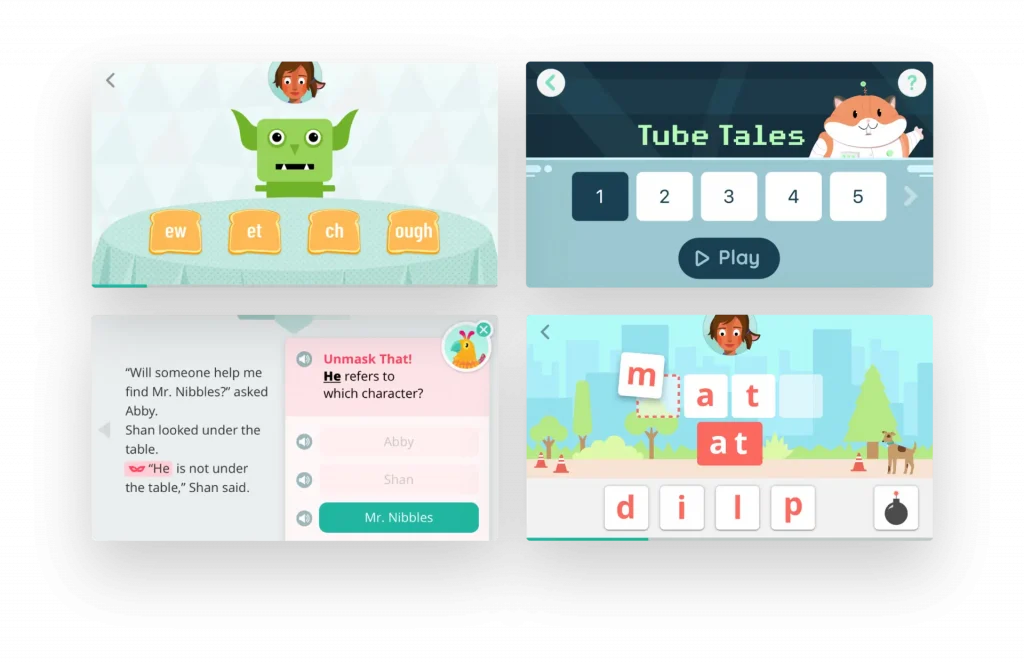
With over 40 adaptive games, Boost Reading helps students of all levels grow across 13 critical skills areas, including explicit instruction in comprehension processes.
- Phonological awareness
- Letter sound correspondence
- Letter combinations
- Early decoding
- Advanced decoding
- Comprehension processes
- Key ideas and details
- Craft and structure
- Integration of knowledge and ideas
- Vocabulary
- Connected texts
- Fluency
- Close reading
See pages 16-78 of this guide for a detailed explanation of every game in the program.
How does Boost Reading integrate with the other parts of the literacy system?
Boost Reading + mCLASS® with DIBELS® 8th Edition
mCLASS automatically places students on an adaptive path within Boost Reading, which provides them the exact practice–both remediation and acceleration–that they need.
Click here to learn more about how Boost Reading and the mCLASS Assessment System work together.
Boost Reading + Amplify CKLA
Boost Reading extends core instruction with Amplify CKLA with personalized practice that follows the same scope and sequence.
Click here to learn more about how Boost Reading and Amplify CKLA work together.
What makes Boost Reading different?
Multiple dimensions
Boost Reading features full adaptivity. That means students progress along a pathway that adapts on multiple dimensions, not just one. For example, a student can work on early first-grade decoding in one game while building more advanced vocabulary knowledge in another.
Always-positive feedback
Boost Reading supports positive participation by giving students immediate and clear feedback. These results are never punitive. Instead our always-positive feedback is delivered in the context of the game world and is designed to motivate students to keep trying.
Focus on SEL
Sustained academic success depends upon social and emotional learning (SEL) as well as the mastery of fundamental literacy skills. Consistent with the most widely-recognized framework and standards for SEL (from the CASEL consortium, which includes 25 states), Boost Reading also focuses on the five areas of social and emotional learning:
- Self-awareness
- Self-management
- Social awareness
- Relationship skills
- Responsible decision-making
Ready-to-teach mini-lessons
Boost Reading turns data into action with reports that help educators know exactly who needs support and ready-to-teach mini-lessons that deliver targeted reinforcement and remediation.
Accelerated growth
Boost Reading accelerates student growth at all reading levels and reduces the number of students at risk of reading difficulty. In one study of 3rd graders in a large urban district who used Boost Reading for only one semester:
- 54% of students who used Boost Reading made above average progress, whereas only 44% of students in the comparison group made above average progress.
- 54% of English learners in that same study made above average growth, whereas only 45% of English learners in the comparison group made above average growth.
Check out the above results and more in this efficacy paper.
Demo access
Follow the instructions below to login to your demo account.
- Click the Boost Reading Demo button below.
- Select Log in with Amplify.
- Enter the username: atahan
- Enter the password: Abcd1234
- Click the mCLASS®: Boost Reading Edition tile.
Check out these additional resources
Boost Reading review resources:
What is Boost Reading?
Boost Reading is a K–5 student-driven literacy program that provides both enrichment and remediation for all students, leveraging the power of compelling storytelling to engage students in personalized reading instruction and practice. It features:
- High quality, research-based instruction based on the Science of Reading.
- Unparalleled personalized learning pathways.
- Compelling and imaginative storylines.
- Social and emotional learning.
- Insightful reports tied to actionable next steps.

How does Boost Reading work?
Boost Reading uses students’ latest reading assessment data to ensure they practice the right skills at the right time. In cases where no student assessment data is available, our embedded placement tool ensures students receive the content and skill practice most appropriate for their current reading level.
From there, students move through our curriculum along their own learning pathway where they encounter personalized content tailored to their evolving skill and grade levels.
Summary of games
With over 40 adaptive games, Boost Reading helps students of all levels grow across 13 critical skills areas, including explicit instruction in comprehension processes.
- Phonological awareness
- Letter sound correspondence
- Letter combinations
- Early decoding
- Advanced decoding
- Comprehension processes
- Key ideas and details
- Craft and structure
- Integration of knowledge and ideas
- Vocabulary
- Connected texts
- Fluency
- Close reading
See pages 16-78 of this guide for a detailed explanation of every game in the program.
What makes Boost Reading different?
Multiple dimensions
Boost Reading features full adaptivity. That means students progress along a pathway that adapts on multiple dimensions, not just one. For example, a student can work on early first-grade decoding in one game while building more advanced vocabulary knowledge in another.
Always-positive feedback
Boost Reading supports positive participation by giving students immediate and clear feedback. These results are never punitive. Instead our always-positive feedback is delivered in the context of the game world and is designed to motivate students to keep trying.
Focus on SEL
Sustained academic success depends upon social and emotional learning (SEL) as well as the mastery of fundamental literacy skills. Consistent with the most widely-recognized framework and standards for SEL (from the CASEL consortium, which includes 25 states), Boost Reading also focuses on the five areas of social and emotional learning:
- Self-awareness
- Self-management
- Social awareness
- Relationship skills
- Responsible decision-making
Ready-to-teach mini-lessons
Boost Reading turns data into action with reports that help educators know exactly who needs support and ready-to-teach mini-lessons that deliver targeted reinforcement and remediation.
Accelerated growth
Boost Reading accelerates student growth at all reading levels and reduces the number of students at risk of reading difficulty. In one study of 3rd graders in a large urban district who used Boost Reading for only one semester:
- 54% of students who used Boost Reading made above average progress, whereas only 44% of students in the comparison group made above average progress.
- 54% of English learners in that same study made above average growth, whereas only 45% of English learners in the comparison group made above average growth.
Check out the above results and more in this efficacy paper.
How does Boost Reading integrate with the other parts of the literacy system?
Boost Reading + mCLASS® with DIBELS® 8th Edition
mCLASS automatically places students on an adaptive path within Boost Reading, which provides them the exact practice–both remediation and acceleration–that they need.
Click here to learn more about how Boost Reading and the mCLASS Assessment System work together.
Boost Reading + Amplify CKLA
Boost Reading extends core instruction with Amplify CKLA with personalized practice that follows the same scope and sequence.
Click here to learn more about how Boost Reading and Amplify CKLA work together.
Check out these additional resources
Boost Reading review resources:
What is Boost Reading?
Boost Reading is a K–5 student-driven literacy program that provides both enrichment and remediation for all students, leveraging the power of compelling storytelling to engage students in personalized reading instruction and practice. It features:
- High quality, research-based instruction based on the Science of Reading.
- Unparalleled personalized learning pathways.
- Compelling and imaginative storylines.
- Social and emotional learning.
- Insightful reports tied to actionable next steps.

How does Boost Reading work?
Boost Reading uses students’ latest reading assessment data to ensure they practice the right skills at the right time. In cases where no student assessment data is available, our embedded placement tool ensures students receive the content and skill practice most appropriate for their current reading level.
From there, students move through our curriculum along their own learning pathway where they encounter personalized content tailored to their evolving skill and grade levels.
Summary of games
With over 40 adaptive games, Boost Reading helps students of all levels grow across 13 critical skills areas, including explicit instruction in comprehension processes.
- Phonological awareness
- Letter sound correspondence
- Letter combinations
- Early decoding
- Advanced decoding
- Comprehension processes
- Key ideas and details
- Craft and structure
- Integration of knowledge and ideas
- Vocabulary
- Connected texts
- Fluency
- Close reading
See pages 16-78 of this guide for a detailed explanation of every game in the program.
What makes Boost Reading different?
Multiple dimensions
Boost Reading features full adaptivity. That means students progress along a pathway that adapts on multiple dimensions, not just one. For example, a student can work on early first-grade decoding in one game while building more advanced vocabulary knowledge in another.
Always-positive feedback
Boost Reading supports positive participation by giving students immediate and clear feedback. These results are never punitive. Instead our always-positive feedback is delivered in the context of the game world and is designed to motivate students to keep trying.
Focus on SEL
Sustained academic success depends upon social and emotional learning (SEL) as well as the mastery of fundamental literacy skills. Consistent with the most widely-recognized framework and standards for SEL (from the CASEL consortium, which includes 25 states), Boost Reading also focuses on the five areas of social and emotional learning:
- Self-awareness
- Self-management
- Social awareness
- Relationship skills
- Responsible decision-making
Ready-to-teach mini-lessons
Boost Reading turns data into action with reports that help educators know exactly who needs support and ready-to-teach mini-lessons that deliver targeted reinforcement and remediation.
Accelerated growth
Boost Reading accelerates student growth at all reading levels and reduces the number of students at risk of reading difficulty. In one study of 3rd graders in a large urban district who used Boost Reading for only one semester:
- 54% of students who used Boost Reading made above average progress, whereas only 44% of students in the comparison group made above average progress.
- 54% of English learners in that same study made above average growth, whereas only 45% of English learners in the comparison group made above average growth.
Check out the above results and more in this efficacy paper.
How does Boost Reading integrate with the other parts of the literacy system?
Boost Reading + mCLASS® with DIBELS® 8th Edition
mCLASS automatically places students on an adaptive path within Boost Reading, which provides them the exact practice–both remediation and acceleration–that they need.
Click here to learn more about how Boost Reading and the mCLASS Assessment System work together.
Boost Reading + Amplify CKLA
Boost Reading extends core instruction with Amplify CKLA with personalized practice that follows the same scope and sequence.
Click here to learn more about how Boost Reading and Amplify CKLA work together.
Demo access
Follow the instructions below to login to your demo account.
- Click the Boost Reading Demo button below.
- Select Log in with Amplify.
- Enter the username: atahan
- Enter the password: Abcd1234
- Click the mCLASS®: Boost Reading Edition tile.
Check out these additional resources
Boost Reading review resources:
What is Boost Reading?
Boost Reading is a K–5 student-driven literacy program that provides both enrichment and remediation for all students, leveraging the power of compelling storytelling to engage students in personalized reading instruction and practice. It features:
- High quality, research-based instruction based on the Science of Reading.
- Unparalleled personalized learning pathways.
- Compelling and imaginative storylines.
- Insightful reports tied to actionable next steps.
How does Boost Reading work?
Boost Reading uses students’ latest reading assessment data to ensure they practice the right skills at the right time. In cases where no student assessment data is available, our embedded placement tool ensures students receive the content and skill practice most appropriate for their current reading level.
From there, students move through our curriculum along their own learning pathway where they encounter personalized content tailored to their evolving skill and grade levels.
Summary of games
With over 40 adaptive games, Boost Reading helps students of all levels grow across 13 critical skills areas, including explicit instruction in comprehension processes.
- Phonological awareness
- Letter sound correspondence
- Letter combinations
- Early decoding
- Advanced decoding
- Comprehension processes
- Key ideas and details
- Craft and structure
- Integration of knowledge and ideas
- Vocabulary
- Connected texts
- Fluency
- Close reading
See pages 16-78 of this guide for a detailed explanation of every game in the program.
What makes Boost Reading different?
Multiple dimensions
Boost Reading features full adaptivity. That means students progress along a pathway that adapts on multiple dimensions, not just one. For example, a student can work on early first-grade decoding in one game while building more advanced vocabulary knowledge in another.
Always-positive feedback
Boost Reading supports positive participation by giving students immediate and clear feedback. These results are never punitive. Instead our always-positive feedback is delivered in the context of the game world and is designed to motivate students to keep trying.
Ready-to-teach mini-lessons
Boost Reading turns data into action with reports that help educators know exactly who needs support and ready-to-teach mini-lessons that deliver targeted reinforcement and remediation.
Accelerated growth
Boost Reading accelerates student growth at all reading levels and reduces the number of students at risk of reading difficulty. In one study of 3rd graders in a large urban district who used Boost Reading for only one semester:
- 54% of students who used Boost Reading made above average progress, whereas only 44% of students in the comparison group made above average progress.
- 54% of English learners in that same study made above average growth, whereas only 45% of English learners in the comparison group made above average growth.
Check out the above results and more in this efficacy paper.
How does Boost Reading integrate with the other parts of the literacy system?
Boost Reading + mCLASS® with DIBELS® 8th Edition
mCLASS automatically places students on an adaptive path within Boost Reading, which provides them the exact practice–both remediation and acceleration–that they need.
Click here to learn more about how Boost Reading and the mCLASS Assessment System work together.
Boost Reading + Amplify CKLA
Boost Reading extends core instruction with Amplify CKLA with personalized practice that follows the same scope and sequence.
Click here to learn more about how Boost Reading and Amplify CKLA work together.
Demo access
Follow the instructions below to login to your demo account.
- Click the Boost Reading Demo button below.
- Select Log in with Amplify.
- Enter the username: atahan
- Enter the password: Abcd1234
- Click the mCLASS®: Boost Reading Edition tile.
- Follow the instructions on pages 5 and 6 of this document.
Check out these additional resources
Boost Reading review resources:
Boost Reading Review for Indiana
On its surface, Boost Reading (formerly Amplify Reading) is a K–5 digital literacy program designed to help students rebuild, develop, and strengthen foundational skills as they play their way through an imaginative and personalized game world. But don’t let its simple and playful nature fool you. Look under the hood and you’ll find an unparalleled adaptive algorithm, powerful analytics, and robust instruction that links back to our assessment system and core instruction.
What is Boost Reading?
Boost Reading is a K–5 student-driven literacy program that provides both enrichment and remediation for all students, leveraging the power of compelling storytelling to engage students in personalized reading instruction and practice. It features:
- High quality, research-based instruction based on the Science of Reading.
- Unparalleled personalized learning pathways.
- Compelling and imaginative storylines.
- Growth mindset.
- Insightful reports tied to actionable next steps.
How does Boost Reading work?
Boost Reading uses students’ latest reading assessment data to ensure they practice the right skills at the right time. In cases where no student assessment data is available, our embedded placement tool ensures students receive the content and skill practice most appropriate for their current reading level.
From there, students move through our curriculum along their own learning pathway where they encounter personalized content tailored to their evolving skill and grade levels.
Summary of games
With over 40 adaptive games, Boost Reading helps students of all levels grow across 13 critical skills areas, including explicit instruction in comprehension processes.
- Phonological awareness
- Letter sound correspondence
- Letter combinations
- Early decoding
- Advanced decoding
- Comprehension processes
- Key ideas and details
- Craft and structure
- Integration of knowledge and ideas
- Vocabulary
- Connected texts
- Fluency
- Close reading
See pages 16-78 of this guide for a detailed explanation of every game in the program.
What makes Boost Reading different?
Multiple dimensions
Boost Reading features full adaptivity. That means students progress along a pathway that adapts on multiple dimensions, not just one. For example, a student can work on early first-grade decoding in one game while building more advanced vocabulary knowledge in another.
Always-positive feedback
Boost Reading supports positive participation by giving students immediate and clear feedback. These results are never punitive. Instead our always-positive feedback is delivered in the context of the game world and is designed to motivate students to keep trying.
Ready-to-teach mini-lessons
Boost Reading turns data into action with reports that help educators know exactly who needs support and ready-to-teach mini-lessons that deliver targeted reinforcement and remediation.
Accelerated growth
Boost Reading accelerates student growth at all reading levels and reduces the number of students at risk of reading difficulty. In one study of 3rd graders in a large urban district who used Boost Reading for only one semester:
-
- 54% of students who used Boost Reading made above average progress, whereas only 44% of students in the comparison group made above average progress.
- 54% of English learners in that same study made above average growth, whereas only 45% of English learners in the comparison group made above average growth.
Check out the above results and more in this efficacy paper.
How does Boost Reading integrate with the other parts of the literacy system?
Boost Reading + mCLASS® with DIBELS® 8th Edition
mCLASS automatically places students on an adaptive path within Boost Reading, which provides them the exact practice–both remediation and acceleration–that they need.
Click here to learn more about how Boost Reading and the mCLASS Assessment System work together.
Boost Reading + Amplify CKLA
Boost Reading extends core instruction with Amplify CKLA with personalized practice that follows the same scope and sequence.
Click here to learn more about how Boost Reading and Amplify CKLA work together.
Sample materials and demo access
Explore as a teacher
Ready to explore as a teacher? Follow these instructions:
- Click the Boost Reading Teacher Platform button below.
- Select Log in with Amplify.
- Enter the student username: t1.scottsdaleunified@demo.tryamplify.net
- Enter the password: Amplify1-scottsdaleunified
- Click the CKLA icon.
- Select a grade level from the drop-down menu at the top of the page.
Explore as a student
Ready to explore as a student? Follow these instructions:
- Click the Boost Reading Student Hub button below.
- Select Log in with Amplify.
- Enter the student username: s1.scottsdaleunified@demo.tryamplify.net
- Enter the password: Amplify1-scottsdaleunified
- Click the Hub icon
- Select a grade level.
Check out these additional resources
Boost Reading review resources:
What is Boost Reading?
Boost Reading is a K–5 student-driven literacy program that provides both enrichment and remediation for all students, leveraging the power of compelling storytelling to engage students in personalized reading instruction and practice.
It features:
- High quality, research-based instruction based on the Science of Reading.
- Unparalleled personalized learning pathways.
- Compelling and imaginative storylines.
- Growth mindset.
- Insightful reports tied to actionable next steps.
How does Boost Reading work?
Boost Reading uses students’ latest reading assessment data to ensure they practice the right skills at the right time. In cases where no student assessment data is available, our embedded placement tool ensures students receive the content and skill practice most appropriate for their current reading level.
From there, students move through our curriculum along their own learning pathway where they encounter personalized content tailored to their evolving skill and grade levels.
Summary of games
With over 40 adaptive games, Boost Reading helps students of all levels grow across 13 critical skills areas, including explicit instruction in comprehension processes.
- Phonological awareness
- Letter sound correspondence
- Letter combinations
- Early decoding
- Advanced decoding
- Comprehension processes
- Key ideas and details
- Craft and structure
- Integration of knowledge and ideas
- Vocabulary
- Connected texts
- Fluency
- Close reading
See pages 16-78 of this guide for a detailed explanation of every game in the program.
What makes Boost Reading different?
Multiple dimensions
Boost Reading features full adaptivity. That means students progress along a pathway that adapts on multiple dimensions, not just one. For example, a student can work on early first-grade decoding in one game while building more advanced vocabulary knowledge in another.
Always-positive feedback
Boost Reading supports positive participation by giving students immediate and clear feedback. These results are never punitive. Instead our always-positive feedback is delivered in the context of the game world and is designed to motivate students to keep trying.
Ready-to-teach mini-lessons
Boost Reading turns data into action with reports that help educators know exactly who needs support and ready-to-teach mini-lessons that deliver targeted reinforcement and remediation.
Accelerated growth
Boost Reading accelerates student growth at all reading levels and reduces the number of students at risk of reading difficulty. In one study of 3rd graders in a large urban district who used Boost Reading for only one semester:
- 54% of students who used Boost Reading made above average progress, whereas only 44% of students in the comparison group made above average progress.
- 54% of English learners in that same study made above average growth, whereas only 45% of English learners in the comparison group made above average growth.
Check out the above results and more in this efficacy paper.
How does Boost Reading integrate with the other parts of the literacy system?
Boost Reading + mCLASS® with DIBELS® 8th Edition
mCLASS automatically places students on an adaptive path within Boost Reading, which provides them the exact practice–both remediation and acceleration–that they need.
Click here to learn more about how Boost Reading and the mCLASS Assessment System work together.
Boost Reading + Amplify CKLA
Boost Reading extends core instruction with Amplify CKLA with personalized practice that follows the same scope and sequence.
Click here to learn more about how Boost Reading and Amplify CKLA work together.
Sample materials and demo access
Explore as a teacher
Ready to explore as a teacher? Follow these instructions:
- Click the Boost Reading Teacher Platform button below.
- Select Log in with Amplify.
- Enter the student username: t1.scottsdaleunified@demo.tryamplify.net
- Enter the password: Amplify1-scottsdaleunified
- Click the CKLA icon.
- Select a grade level from the drop-down menu at the top of the page.
Explore as a student
Ready to explore as a student? Follow these instructions:
- Click the Boost Reading Student Hub button below.
- Select Log in with Amplify.
- Enter the student username: s1.scottsdaleunified@demo.tryamplify.net
- Enter the password: Amplify1-scottsdaleunified
- Click the Hub icon
- Select a grade level.
Check out these additional resources
Boost Reading review resources:
What is Boost Reading?
Boost Reading is a K–5 student-driven literacy program that provides both enrichment and remediation for all students, leveraging the power of compelling storytelling to engage students in personalized reading instruction and practice. It features:
- High quality, research-based instruction based on the Science of Reading.
- Unparalleled personalized learning pathways.
- Compelling and imaginative storylines.
- Growth mindset.
- Insightful reports tied to actionable next steps.
How does Boost Reading work?
Boost Reading uses students’ latest reading assessment data to ensure they practice the right skills at the right time. In cases where no student assessment data is available, our embedded placement tool ensures students receive the content and skill practice most appropriate for their current reading level.
From there, students move through our curriculum along their own learning pathway where they encounter personalized content tailored to their evolving skill and grade levels.
Summary of games
With over 40 adaptive games, Boost Reading helps students of all levels grow across 13 critical skills areas, including explicit instruction in comprehension processes.
- Phonological awareness
- Letter sound correspondence
- Letter combinations
- Early decoding
- Advanced decoding
- Comprehension processes
- Key ideas and details
- Craft and structure
- Integration of knowledge and ideas
- Vocabulary
- Connected texts
- Fluency
- Close reading
See pages 16-78 of this guide for a detailed explanation of every game in the program.
What makes Boost Reading different?
Multiple dimensions
Boost Reading features full adaptivity. That means students progress along a pathway that adapts on multiple dimensions, not just one. For example, a student can work on early first-grade decoding in one game while building more advanced vocabulary knowledge in another.
Always-positive feedback
Boost Reading supports positive participation by giving students immediate and clear feedback. These results are never punitive. Instead our always-positive feedback is delivered in the context of the game world and is designed to motivate students to keep trying.
Ready-to-teach mini-lessons
Boost Reading turns data into action with reports that help educators know exactly who needs support and ready-to-teach mini-lessons that deliver targeted reinforcement and remediation.
Accelerated growth
Boost Reading accelerates student growth at all reading levels and reduces the number of students at risk of reading difficulty. In one study of 3rd graders in a large urban district who used Boost Reading for only one semester:
- 54% of students who used Boost Reading made above average progress, whereas only 44% of students in the comparison group made above average progress.
- 54% of English learners in that same study made above average growth, whereas only 45% of English learners in the comparison group made above average growth.
Check out the above results and more in this efficacy paper.
How does Boost Reading integrate with the other parts of the literacy system?
Boost Reading + mCLASS® with DIBELS® 8th Edition
mCLASS automatically places students on an adaptive path within Boost Reading, which provides them the exact practice–both remediation and acceleration–that they need.
Click here to learn more about how Boost Reading and the mCLASS Assessment System work together.
Boost Reading + Amplify CKLA
Boost Reading extends core instruction with Amplify CKLA with personalized practice that follows the same scope and sequence.
Click here to learn more about how Boost Reading and Amplify CKLA work together.
Sample materials and demo access
Explore as a teacher
Ready to explore as a teacher? Follow these instructions:
- Click the Boost Reading Teacher Platform button below.
- Select Log in with Amplify.
- Enter the student username: t1.scottsdaleunified@demo.tryamplify.net
- Enter the password: Amplify1-scottsdaleunified
- Click the CKLA icon.
- Select a grade level from the drop-down menu at the top of the page.
Explore as a student
Ready to explore as a student? Follow these instructions:
- Click the Boost Reading Student Hub button below.
- Select Log in with Amplify.
- Enter the student username: s1.scottsdaleunified@demo.tryamplify.net
- Enter the password: Amplify1-scottsdaleunified
- Click the Hub icon
- Select a grade level.
Check out these additional resources
Boost Reading review resources:
Welcome, Boost Reading families!
The High Impact Tutoring Implementation Workshop Series
Administrators, welcome to Amplify Science!
Here you’ll find information about enrollment and licensing, technical requirements, professional learning resources, and more.
Onboarding: What to expect
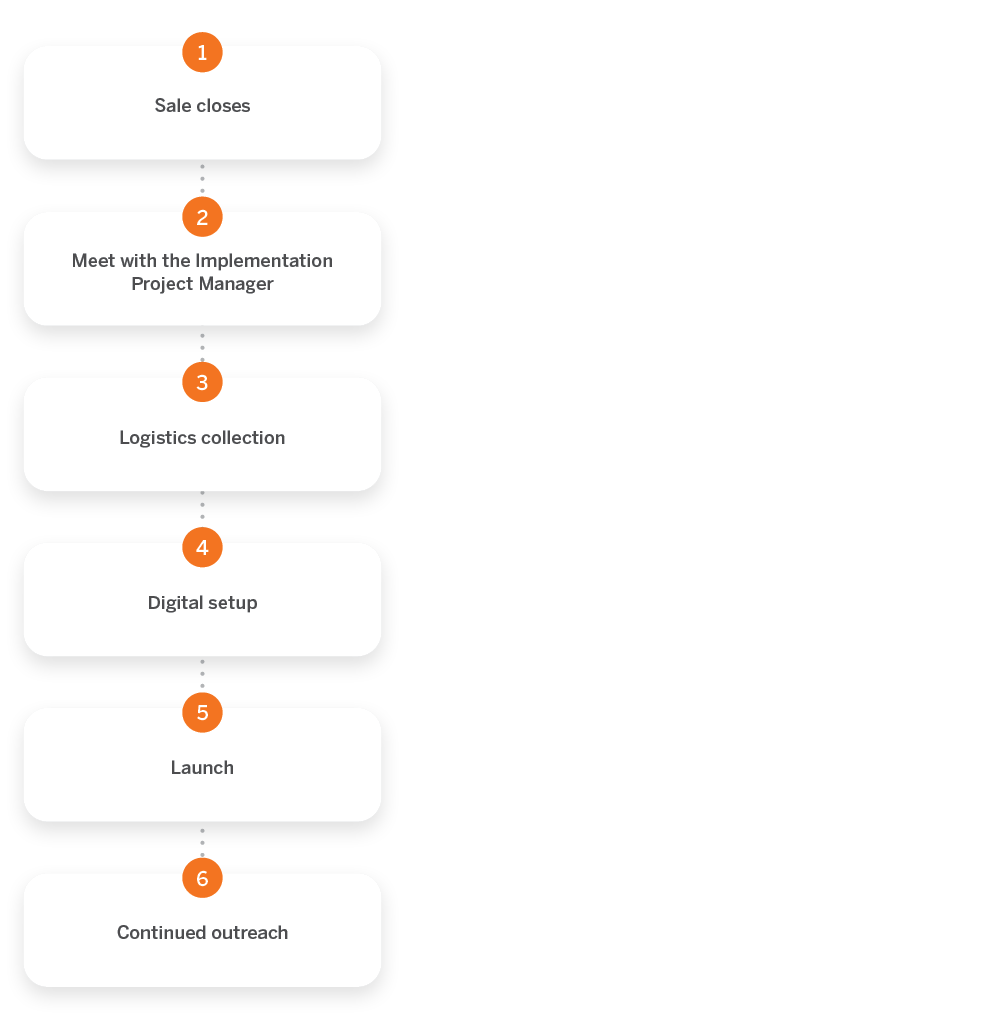
Welcome to Amplify Science! There are six basic steps to onboarding. Use this visual as a reference, but also know that our dedicated implementation team will be there to support you during the entire process.
Technology requirements and guidelines
To ensure that your hardware and network meet the minimum technical requirements for performance and support of your curriculum products, please see Amplify’s customer requirements page.
You’ll also want to add the URLs on this page to the corresponding district- or school-level filters so that your teachers and students can access their Amplify Science materials.
Data sharing agreement
Partnering with Amplify through our data sharing program deepens learning outcomes and gives you the performance analysis you need to make impactful decisions within your district or school. By signing our data sharing agreement, your district will help us to better understand student performance as it relates to your state’s standards. It also allows us to compare results with the curriculum-embedded assessments and state-level assessments. These analyses will help you identify the areas where your teachers and students are excelling or may be experiencing challenges.
Stay tuned for additional updates.
Enrollment and licensing overview
During the enrollment and licensing call, your Amplify implementation partner will walk you through the enrollment process. We recommend exploring the enrollment web tool ahead of the call for suggestions on which enrollment method may be best for your district.
The following guides provide additional information about enrollment methods and the data sharing process.


Preparing for your materials
Each unit of Amplify Science comes with a hands-on materials kit.
Each hands-on materials kit arrives in 1–3 boxes and contains the following:
- Consumable materials
- Nonconsumable materials
- Classroom wall materials
- Premium print materials (cards, maps, etc.)
- 18 copies of each Student Book (K–5)
- A blackline master copy of the Student Investigation Notebook (K–5)
You can find complete materials lists for each unit in the following PDFs. This information is also available in the digital Teacher’s Guide within the program.
Once your district’s purchase order has been sent to Amplify and is processed, Amplify will provide tracking information on your materials kits and any additional print materials you’ve ordered.


Administrator Reports
Self-service Administrator Reports allow insight into teacher and student usage and student performance data for the current school year.
Access is limited to district and school administrators. Administrators can directly access these reports at my.amplify.com/admin-reports.
Announcements
Summer extension
With summer fast approaching, we recognize that some districts may be extending the school year and/or continuing the use of Amplify curriculum and programs for summer instruction. If your summer instruction will continue past June 30 and/or you need to make rostering or enrollment changes, follow our guidance on extending your rollover date.
Use stimulus funding to drive transformation
Learn about ESSER I, II, and III funding (or CARES, CRRSA, and ARP) and how to use these funds to help with learning recovery and acceleration. Districts have significant flexibility in how to use the ESSER money, with ESSER II and III specifying that some of the funds should be used to address unfinished learning. All Amplify programs and services meet the criteria for the funding. Get more information about funding and guidelines.
Next steps: How do I support my teachers?
Pre-launch checklist for teachers
Please share our Program Hub with your educators. It will provide helpful information as they prepare to implement Amplify in their classrooms, including a pre-launch checklist. Note that they’ll need to be logged into Amplify Science to access the Hub. If they don’t have a login yet, you can also download and share the Amplify Science pre-launch checklist for teachers PDF.

Professional learning
We partner with every district to make sure the Amplify Science rollout meets their unique needs. Check out these sample agendas to get a better understanding of what our team has to offer.
Advice and answers
The Science help website is filled with step-by-step resources to address educators’ questions. Encourage your educators to read through these tutorials and search for topics they want to learn more about.
Contact us
Powerful (and free!) pedagogical support
Amplify provides a unique kind of support you won’t find from other publishers. We’ve developed an educational support team of former teachers and administrators who provide pedagogical support at no cost to educators using our programs. This free service includes:
- Information on where to locate standards and other planning materials.
- Recommendations and tips for day-to-day teaching with Amplify Science.
- Support with administering and interpreting assessment data and more.
To reach our pedagogical team, click the orange icon while logged into the curriculum to get immediate help, call (866) 629-2446, or email edsupport@amplify.com.
Timely technical and program support
Our Customer Care and Support team is available Monday through Friday, 7 a.m. to 9 p.m. ET, and Sunday, 10 a.m. to 6 p.m. ET, through a variety of channels:
- Live chat: Click the orange icon while logged into the curriculum to get immediate help in the middle of the school day.
- Phone: Call our toll-free number: (800) 823-1969.
- Email: Send an email to help@amplify.com.
Join our community
Our Amplify Science Facebook group is a community of Amplify Science educators from across the country. It’s a space to share best practices, ideas, and support on everything from implementation to instruction. Join today.
Use stimulus funding to drive transformation.
Learn about ESSER I, II, and III funding (or CARES, CRRSA, and ARP), and how to use these funds to help with learning recovery and acceleration. Districts have significant flexibility in how to use the ESSER money, with ESSER II and III specifying that some of the funds should be used to address unfinished learning.
Given the enormous influx of resources flowing into K–12, now is the time to drive important, sustainable change in your district. All Amplify programs and services meet the criteria for the funding, and our early literacy suite can be particularly helpful in driving reading growth in grades K–5.

Where to start: Watch our stimulus funding overview.
Julia Gonzales, vice president of government relations at Amplify, walks you through what you need to know about federal stimulus funding.
Five fast facts
Here are the essential facts you need to know about the latest stimulus funding, also known as ESSER III or the American Rescue Plan (ARP).
- It’s okay to keep using products and services you’ve purchased. As long as funds are assigned to spending categories and paid to vendors by each fund’s deadlines—and the purchases are allowable uses—it’s okay to keep using products and services after those dates.
- Schools and districts have a lot of leeway in how to use the money. ESSER III funds may be used to propel your vision of teaching and learning post-pandemic, so try to think about both short-term needs and your longer term ambitions for the district.
- At least 20 percent must be used to address unfinished learning. For example, schools and districts can use the funding to bolster the strength of in-school core instruction, differentiated practice, and intervention, as well as for summer learning, after school, and extended day activities.
- The money is available now. Act quickly! Schools and districts can access ESSER III stimulus funds right now, and districts are moving very fast to spend these dollars. The deadlines are around the corner: All ESSER III funds must be assigned to a spending category by Sept. 30, 2024, and paid to vendors four months after that.
- Note: State Education Agencies can request an extension with the U.S. Department of Education. See the following table for more information on timelines.
- It’s okay to keep using products and services you’ve purchased. As long as funds are assigned to spending categories and paid to vendors by each fund’s deadlines—and the purchases are allowable uses—it’s okay to keep using products and services after those dates.

Find out how much funding is coming your way.
Use this tool from Whiteboard Advisors to search by state and district to see approximately how much money is coming to your region.


Amplify is an allowable expense.
See how spending categories for ESSER III (ARP), ESSER II (CRRSA), and ESSER I (CARES) specifically align with Amplify programs and trainings. Download our chart of allowable uses.
Amplify programs align to stimulus priorities.
Amplify can help accelerate literacy learning for all students with an early literacy suite that includes Amplify CKLA, Boost Reading, mCLASS®, and mCLASS Intervention, as well as professional learning and coaching. Each of our research-based literacy programs can be added to an existing literacy system at a district, and can be used together as an integrated suite.

Timelines for funding
Curious how long federal stimulus funds are available? See our chart with funding details, including timelines and deadlines.
| ESSER I (CARES) | ESSER II (CRRSA) | ESSER III (ARP) | |
|---|---|---|---|
| Signed into law | March 2020 | December 2020 | March 2021 |
| Total education funds | $30.7 billion | $82 billion | $170 billion |
| Total K–12 funds | $13.2 billion | $54 billion | $122 billion |
| Obligation deadline When funds must be assigned to a spending category. | March 13, 2020– Sept. 30, 2022 | March 13, 2020– Sept. 30, 2023 | March 13, 2020– Sept. 30, 2024 |
| Liquidation deadline When vendors must be paid for the work contracted. | April 1, 2024 | Feb. 1, 2024 | Feb. 1, 2025 |
| Potential liquidation deadline, if extended The deadline if a state education agency requests and receives an extension from the US DOE. | March 30, 2024 | March 30, 2025 | March 30, 2026 |
For more information about deadlines and rules, please see the US DOE guidance.
Announcing Amplify’s Boost suite!
Our personalized learning programs are being renamed under our new Boost brand. The new names exemplify what these next-generation acceleration and remediation tools do—boost foundational literacy skills for all students.
- Boost Reading
- Boost Close Reading
- Boost Reading+
- Boost Lectura
Educators and students will see the new Boost names in the program(s) and program resources beginning July 2023. Educators will continue to have access to the program(s) they know and love, under the new Boost name.
We’re committed to making this update as seamless as possible. Please do not hesitate to reach out to Amplify Support with any questions.
Introducing Boost Lectura!
Boost Lectura is our new personalized Spanish literacy program for grades K–2. When paired with Boost Reading, the two programs provide instructional parity and data insights for English and Spanish literacy, supporting transfer of critical literacy skills between languages.
Boost Lectura is built on the Science of Reading and was developed with the same technology as Boost Reading. The program’s powerful, rich content was created with Spanish literacy experts representing various Spanish-speaking regions, and the scope and sequence focuses on key accelerants of Spanish literacy development.
This groundbreaking new program can be used on its own or integrated into any dual language or English immersion model. Educators do not need to speak Spanish to administer the program. Learn more about Boost Lectura and request more information on our website.
Simplified program access and navigation
All Amplify users (teachers and students) will enter their programs via learning.amplify.com/ and navigate via the new Educator Home.
Once logged in, teachers will have a central landing page to access their program(s). Here, they’ll see recommendations like suggested resources, timely feature reminders, and information about class activity.
Once logged in, students will have a central landing page where they’ll access their assignments.

Note: Users who log in through Clever and Classlink will continue to have the same process. This update is geared toward building an easier and more intuitive digital experience for teachers and students in Boost Reading and Boost Close Reading.
Embedded benchmark assessments and Teacher Dashboard insights
As a reminder, Boost Reading assesses students’ overall text reading proficiency level and provides detailed reporting. This robust measure is administered once during each benchmark period—beginning-of-year, middle-of-year, and end-of-year. The measure places students (and re-places them mid-year) on their personalized path along Boost Reading’s adaptive skill map.
And, for students in grades 1–5, the Benchmark Assessment leverages powerful voice recognition technology to assess student’s fluency and proficiency. It also provides a key insight for educators to use in better identifying areas for student improvement in the Boost Reading Teacher Dashboard.

Student growth, risk areas, and benchmark data will be presented together in the same section, so educators can easily check in on students’ benchmark assessment data and monthly performance! Learn more in your Teacher Guide.

Boost Close Reading Admin Reports
Administrators using Boost Close Reading now have access to Admin Reports. The reports provide administrators with visibility into important program usage data, such as the number of schools using the program, students actively using it, and the grades of students using the program—all directly on the platform.

Amplify raises $215 million in a growth funding round from Learn Capital, A-Street Ventures, and current investor Emerson Collective
(Brooklyn, NY – October 26, 2021) Amplify, a publisher of next-generation curriculum and assessment programs, announced today it has raised $215 million in a growth funding round with Learn Capital and A-Street Ventures, joining current investor Emerson Collective in this round. The funding will accelerate Amplify’s remarkable growth in providing students and teachers with high-quality, digital-forward instructional programs and helping districts address unfinished learning from the pandemic. Rob Hutter from Learn Capital and Marc Sternberg from A-Street Ventures have joined the company’s board, currently made up of Emerson Collective Managing Director and XQ Institute CEO Russlynn Ali, Amplify CEO Larry Berger, Monarch Global Strategies President and CEO Michael Camuñez, Emerson Collective Managing Director Brad Powell, and former Secretary of Education Margaret Spellings.
Amplify currently reaches more than 10 million students in 4,000 districts across all 50 states, with a growing international presence. All three of Amplify’s existing core programs have garnered top ratings on third-party curriculum evaluation site EdReports.org, resulting in strong demand across the country, including in California, where Amplify Science was the lead publisher and won approximately 35 percent of the market in the most recent adoption. Digital supplemental program Amplify Reading also continues to gain traction, as does Amplify’s gold-standard early reading assessment, mCLASS®, which was recently selected as the K–3 formative and diagnostic assessment for North Carolina’s Read to Achieve program. By meeting the demand for research-based, technology-enabled programs, Amplify’s bookings have grown by 50 percent year-over-year for the last four years (2017-2020).
“Our educators and our students have been hit hard by the events of the last two years, which have only exacerbated existing gaps in reading and math skills. Amplify is working to provide the best resources possible to schools and districts while they work to recover and support all students in achieving at high levels,” said board member and former secretary of education Margaret Spellings. “We are deeply grateful for our new partners, their K–12 expertise, and their ongoing commitment to investing in the high-quality, digital-forward learning our students need now and in the future.”
Amplify plans to use the funds to make strategic acquisitions in best-of-breed education companies and to accelerate product development across its portfolio, with a focus on its digital supplemental programs.
“Amplify has experienced remarkable growth for six years in a row, is profitable, and is earning the trust of teachers and students. This moment is urgent for accelerating our ability to serve the needs of schools and districts. The magnitude of learning loss and the range of hybrid models for delivering instruction call for the kinds of products that Amplify builds,” said Larry Berger, chief executive officer of Amplify. “As impact-oriented investors, Emerson, Learn Capital, and A-Street Ventures raised a significant round in order to help us address these urgent needs by being a rapid reaction partner for districts across the country.”
Learn Capital, based in Silicon Valley, is one of the world’s leading venture capital funds with a dedicated focus on education technology and companies that leverage technology for better and smarter learning worldwide.
“We focus on finding the most extraordinary teams working in education, and Amplify is a natural fit,” said Rob Hutter, head of Learn Capital. “Amplify stands at the center of a profound shift in K–12 curriculum delivery that pairs an acceleration of digital learning with an unprecedented emphasis on quality in core instructional materials design. Amplify is uniquely positioned to benefit from both of these trends, and we’re thrilled to have this opportunity to participate in the company’s journey. ”
A-Street Ventures is a privately sponsored investment fund with a strategic focus on seeding and scaling innovative K–12 student learning and achievement solutions for students, families, and schools with a current focus on digital-first instructional materials in curriculum and new paradigms for student assessment.
“At A-Street, we believe education can serve as a powerful engine of mobility, and now is the time for big leaps forward in transforming how students learn and how teachers teach,” said Marc Sternberg, Founder and Managing Director of A-Street Ventures. “That’s why we are excited to partner with Amplify, a company that is lifting up the quality of daily instruction and leaning into digital-forward tools to accelerate learning.”
“We could not be happier to have Rob Hutter and Marc Sternberg join the team,” said Brad Powell, board member and managing director of Emerson Collective. “Rob and Marc each bring deep knowledge about K–12 education and share a long-term, impact-oriented vision to investment in this industry. They, along with their firms, will bring important new expertise to our governance, our network, and our brain trust. We are grateful to have such strong partners supporting Amplify’s future growth.”
About Amplify
A pioneer in K–12 education since 2000, Amplify is leading the way in next-generation curriculum and assessment. Our captivating core and supplemental programs in ELA, math, and science engage all students in rigorous learning and inspire them to think deeply, creatively, and for themselves. Our formative assessment products turn data into practical instructional support to help all students build a strong foundation in early reading and math. All of our programs provide teachers with powerful tools that help them understand and respond to the needs of every student. Today, Amplify reaches more than ten million students in all 50 states. To learn more, visit https://amplify.com.
About Emerson Collective
Emerson Collective deploys a wide range of tools—from impact investing to philanthropy to advocacy—in pursuit of a more equal and just America. Emerson focuses on creating systemic change in education, immigration, climate, and cancer research and treatment. To learn more, visit https://www.emersoncollective.com.
About Learn Capital
Learn Capital, based in Silicon Valley, is one of the world’s leading venture capital funds with a dedicated focus on education technology and companies that leverage technology for better and smarter learning worldwide. Since 2009, Learn Capital has backed extraordinary teams building market transforming services for every age and stage of learning, on nearly every continent. The company’s practice spans seed, early stage and emerging growth companies that are committed to the improvement of individual and societal capacities at scale, propelling the generation of inclusive prosperity worldwide. For more information and to view the fund’s portfolio, please visit http://www.learncapital.com.
About A-Street Ventures
A-Street Ventures is a privately sponsored investment fund with a strategic focus on seeding and scaling innovative K- 12 student learning and achievement solutions for students, families, and schools. A-Street intends to invest in a mix of early-, growth- and late-stage ventures, with a current focus on digital-first instructional materials in curriculum and new paradigms for student assessment. A-Street was founded because the time is now for big leaps forward in how students learn, and for what teaching and learning can look like; for lifting up the teaching profession by reorienting the teacher to his or her most sacred task: the human-centered work of facilitating learning; for leveraging digital-forward tools to accelerate learning; and for leaning into the surging digital access, breakthrough, and platforms that can transform at long last the Industrial Age classroom and into the modern hub of learning. For additional information about A-Street Ventures, please visit https://www.astreet.ventures and on Twitter @astreetventures.
Contact:
Kay Moffett
Chief Marketing Officer
kmoffett@amplify.com

Join us!
Meet like-minded educators Lorem ipsum dolor sit amet, consectetur adipiscing elit, sed do eiusmod tempor incididunt ut magna aliqua.
March 2–4
The US Grant Hotel, San Diego
About the event
Join us for two days of interactive and inspirational talks with math education leaders from around the country to discuss where math education is headed. Meet like-minded K–12 leaders as well as change-makers from major universities, EdTech companies, and professional learning organizations dedicated to improving teacher experiences and student outcomes in mathematics.
We’re hosting an optional pre-conference workshop featuring Patrick Callahan and Chris Weber on Monday, March 2. The pre-conference starts at 12 p.m.
What to expect:
- Two full days of keynote and breakout sessions covering a variety of K–12 math topics
- Sessions led by district leaders sharing their work to raise math achievement
- Evening networking events
- Engaging speakers with a variety of expertise
- Insights you can put to use in your district immediately

Meet a few of our speakers
Use this version when there are multiple presenters.

Jason Zimba
Founding Partner of Student Achievement Partners
Lead writer of the Common Core State Standards for Mathematics

Sunil Singh
Founding Partner of Student Achievement Partners
Lead writer of the Common Core State Standards for Mathematics

Christina Lincoln-Moore
Founding Partner of Student Achievement Partners
Lead writer of the Common Core State Standards for Mathematics
Meet our featured presenter
Use this version when there is only one presenter, rather than many.

Natalie Wexler
Lorem ipsum dolor sit amet, consectetur adipiscing elit, sed do eiusmod tempor incididunt ut labore et dolore magna aliqua. Quis ipsum suspendisse ultrices gravida dictum fusce. Convallis posuere morbi leo urna molestie. In metus vulputate eu scelerisque felis imperdiet proin fermentum leo.
Lorem ipsum dolor sit amet, consectetur adipiscing elit, sed do eiusmod tempor incididunt ut labore et dolore magna aliqua. Quis ipsum suspendisse ultrices gravida dictum fusce.
Event agenda
Monday, March 2
Arrivals
Pre-conference workshop featuring Chris Weber and Patrick Callahan
Sessions begin at 1 p.m. Pacific and include:
- Adult and Student Mindsets and Math Supports
- Enhanced Mathematics
3:00 p.m. Hotel check-in available
6:00 p.m. Welcome reception and dinner
Tuesday, March 3
8:30 a.m. Sessions begin
Sessions include:
- Math milestones with Jason Zimba
- Unfinished learning with Phil Daro
- Powerful moments in math class with Mike Flynn
- Utilizing math history to embrace equity, failure, and authentic problem-solving in leadership communities with Sunil Singh
- Radical change in high school mathematics: Addressing wicked problems of tracking, acceleration, and curricular change with Mike Steele
6:30 p.m. Evening event
Wednesday, March 4
8:30 a.m. Sessions begin
Sessions include:
- Embedding problem-solving into your curriculum with Fawn Nguyen
- Writing in mathematics: The power of mathematics explanations with Jessica Balli
- Talk Number 2 Me: Mathematics and mindfulness with Christina Lincoln-Moore
- Writing in mathematics: The power of mathematical explanations with Patrick Callahan
4:00 p.m. Departures
Submit the form to register for the event!
Note: this is a Hubspot form but, when this page is used, we will be using Gravity forms. I put in an HS form now since the CSS has not been added.

The fine print
While we’ve made every effort to ensure that this invitation is consistent with the gift and ethics rules adopted by most jurisdictions, we recognize that many public officials are subject to rules that do not permit acceptance of this offer or require approval of other officials at your agency. If you do plan to attend our event, please ensure that acceptance of our invitation is fully compliant with your local rules regarding travel, lodging, and meals for events with vendors. Please let us know if we can provide any additional information to support your determination.
Join us!
Meet like-minded educators Lorem ipsum dolor sit amet, consectetur adipiscing elit, sed do eiusmod tempor incididunt ut magna aliqua.
March 2–4
The US Grant Hotel, San Diego
About the event
Join us for two days of interactive and inspirational talks with math education leaders from around the country to discuss where math education is headed. Meet like-minded K–12 leaders as well as change-makers from major universities, EdTech companies, and professional learning organizations dedicated to improving teacher experiences and student outcomes in mathematics.
We’re hosting an optional pre-conference workshop featuring Patrick Callahan and Chris Weber on Monday, March 2. The pre-conference starts at 12 p.m.
What to expect:
- Two full days of keynote and breakout sessions covering a variety of K–12 math topics
- Sessions led by district leaders sharing their work to raise math achievement
- Evening networking events
- Engaging speakers with a variety of expertise
- Insights you can put to use in your district immediately

Meet a few of our speakers
Use this version when there are multiple presenters.
Jason Zimba
Founding Partner of Student Achievement Partners
Lead writer of the Common Core State Standards for Mathematics
Sunil Singh
Founding Partner of Student Achievement Partners
Lead writer of the Common Core State Standards for Mathematics
Christina Lincoln-Moore
Founding Partner of Student Achievement Partners
Lead writer of the Common Core State Standards for Mathematics
Meet our featured presenter
Use this version when there is only one presenter, rather than many.

Natalie Wexler
Lorem ipsum dolor sit amet, consectetur adipiscing elit, sed do eiusmod tempor incididunt ut labore et dolore magna aliqua. Quis ipsum suspendisse ultrices gravida dictum fusce. Convallis posuere morbi leo urna molestie. In metus vulputate eu scelerisque felis imperdiet proin fermentum leo.
Lorem ipsum dolor sit amet, consectetur adipiscing elit, sed do eiusmod tempor incididunt ut labore et dolore magna aliqua. Quis ipsum suspendisse ultrices gravida dictum fusce.
Event agenda
Monday, March 2
Arrivals
Pre-conference workshop featuring Chris Weber and Patrick Callahan
Sessions begin at 1 p.m. Pacific and include:
- Adult and Student Mindsets and Math Supports
- Enhanced Mathematics
3:00 p.m. Hotel check-in available
6:00 p.m. Welcome reception and dinner
Tuesday, March 3
8:30 a.m. Sessions begin
Sessions include:
- Math milestones with Jason Zimba
- Unfinished learning with Phil Daro
- Powerful moments in math class with Mike Flynn
- Utilizing math history to embrace equity, failure, and authentic problem-solving in leadership communities with Sunil Singh
- Radical change in high school mathematics: Addressing wicked problems of tracking, acceleration, and curricular change with Mike Steele
6:30 p.m. Evening event
Wednesday, March 4
8:30 a.m. Sessions begin
Sessions include:
- Embedding problem-solving into your curriculum with Fawn Nguyen
- Writing in mathematics: The power of mathematics explanations with Jessica Balli
- Talk Number 2 Me: Mathematics and mindfulness with Christina Lincoln-Moore
- Writing in mathematics: The power of mathematical explanations with Patrick Callahan
4:00 p.m. Departures
Submit the form to register for the event!
Note: this is a Hubspot form but, when this page is used, we will be using Gravity forms. I put in an HS form now since the CSS has not been added.

The fine print
While we’ve made every effort to ensure that this invitation is consistent with the gift and ethics rules adopted by most jurisdictions, we recognize that many public officials are subject to rules that do not permit acceptance of this offer or require approval of other officials at your agency. If you do plan to attend our event, please ensure that acceptance of our invitation is fully compliant with your local rules regarding travel, lodging, and meals for events with vendors. Please let us know if we can provide any additional information to support your determination.
The Ohio High Impact Tutoring Consultancy Series
Buffalo Consultancy
The High-Impact Tutoring Implementation Workshop Series
Administrators, welcome to mCLASS!
Here you’ll find information about enrollment and licensing, technical requirements, professional learning resources, and more.

Onboarding: What to expect
Welcome to mCLASS! There are six basic steps to onboarding. Use this visual as a reference, but also know that our dedicated implementation team will be there to support you during the entire process.
Technology requirements and guidelines
To ensure that your hardware and network meet the minimum technical requirements for performance and support of mCLASS, please see Amplify’s customer requirements page.
You’ll also want to add the URLs on this page to the corresponding district- or school-level filters so that your teachers and students can access their mCLASS materials.
Data sharing agreement
Partnering with Amplify through our data sharing program deepens learning outcomes and gives you the performance analysis you need to make impactful decisions within your district or school. By signing our data sharing agreement, your district will help us to better understand student performance as it relates to your state’s standards. It also allows us to compare results with the curriculum-embedded assessments and state-level assessments. These analyses will help you identify the areas where your teachers and students are excelling or may be experiencing challenges.
Stay tuned for additional updates.
Enrollment and licensing overview
During the enrollment and licensing call, your Amplify implementation partner will walk you through the enrollment process. We recommend exploring the enrollment web tool ahead of the call for suggestions on which enrollment method may be best for your district.
The following guides provide additional information about enrollment methods and the data sharing process.


You can also reference the mCLASS Enrollment Help collection for additional information.
Preparing for your materials
If you have ordered printed assessment kits, you or the materials coordinator at your school or district will receive a shipping logistics survey to ensure a smooth delivery. It is critical that this survey be completed prior to the shipment of materials. If your school or district has not received a survey, reach out to your Amplify implementation manager.
What’s included in the kits?
Below you will find a list of the print materials included in each mCLASS kit.
DIBELS 8th Edition
The mCLASS DIBELS® 8th Edition kits are grade-specific and contain the student materials for assessment with mCLASS software. K–6 (Kits for each grade sold separately):
- How to Get Started with mCLASS one sheet
- Student Benchmark Assessment materials
- Student Progress Monitoring Assessment materials
- Assessment Administration and Scoring manual
Maze administration:
- Maze for grades 2–6 is typically administered online to a group of students, each on their own computer or device. No printed materials are needed.
- If your school does not have sufficient student devices or if your students are not yet ready for online assessment, you may administer Maze with paper and pencil and enter the scores manually. Get more information.
Materials for additional assessments in the mCLASS suite
For customers who use Text Reading and Comprehension (TRC), IDEL®, TRC Spanish, mCLASS® Math, and/or Intervention, we provide the following:
TRC Atlas Benchmark kit
- 76 leveled readers covering levels A–Z (both fiction and nonfiction)
- Tabs to organize books by level grouping
- Information pamphlet
mCLASS: Math
Kindergarten and grade 1 combination kit
- Activities Guide
- Counting chips
- Screening and Progress Monitoring student materials
Grade 2 kit
- Activities Guide
- Counting chips
- Screening and Progress Monitoring Teacher Guide and answer key
- Screening and Progress Monitoring forms 1–10
Grade 3 kit
- Activities Guide
- Screening and Progress Monitoring teacher guide and answer key
- Screening and Progress Monitoring forms 1–10
Multi-grade kit, including K–3
- All materials listed above
IDEL
IDEL Multi-grade kit (K–3):
- Kit includes K–3 student and teacher materials
TRC Spanish
TRC Spanish Benchmark kit (K–3)
- 20 leveled readers covering Descrubriendo la Lectura (DLL) levels 1–24 (both fiction and nonfiction)
- Information pamphlet
- 16 additional texts available online via the mCLASS home training page
Intervention
K–3 and 4–6 kits (sold separately)
- Printed cards
- Puppet
- Whiteboard
- Sticker book
- 25 resealable bags
- Magnifying glass
- Burst® binder
- Burst messenger bag
- User Guides
- Accordion file
- Burst posters
- Light blue carrying case (includes double-tipped markers, dry erase markers, counting chips, and sand timers)
- Assessment books
Announcements
Use stimulus funding to drive transformation
Learn about ESSER I, II, and III funding (or CARES, CRRSA, and ARP) and how to use these funds to help with learning recovery and acceleration. Districts have significant flexibility in how to use the ESSER money, with ESSER II and III specifying that some of the funds should be used to address unfinished learning. All Amplify programs and services meet the criteria for the funding. Get more information about funding and timelines.
Next steps: How do I support my teachers?
Logging in to mCLASS Home
mCLASS Home is where you will access mCLASS Reporting, Instruction, and other helpful resources. Teachers can log in by navigating to mclass.amplify.com.
Setting up your assessment device
Assessments are administered using the mCLASS app. The mCLASS app is installed by creating a shortcut from your school’s preferred web browser on the desktop or home screen of a teacher’s device. Share this link with teachers for best practices specific to their device’s operating system.
Professional development
We partner with every district to make sure the mCLASS rollout meets their unique needs. Check out our professional development site to get a better understanding of what our team has to offer.
Contact us
Powerful (and free!) pedagogical support
Amplify provides a unique kind of support you won’t find from other publishers. We’ve developed an educational support team of former teachers and administrators who provide pedagogical support at no cost to educators using our programs. This free service includes:
- Support with administering and interpreting assessment data and more.
- Guidance for developing lesson plans and intervention plans.
- Recommendations and tips for day-to-day teaching with mCLASS.
To reach our pedagogical team, click the orange icon while logged into mCLASS to get immediate help, call (866) 629-2446, or email edsupport@amplify.com.
Timely technical and program support
Our Customer Care and Support team is available Monday through Friday, 7 a.m. to 9 p.m. ET, and Sunday, 10 a.m. to 6 p.m. ET, through a variety of channels:
- Live chat: Click the orange icon while logged into mCLASS to get immediate help in the middle of the school day.
- Phone: Call our toll-free number: (800) 823-1969.
- Email: Send an email to help@amplify.com.
Join our community
Our mCLASS Facebook group is a community of mCLASS educators from across the country. It’s a space to share best practices, ideas, and support on everything from implementation to instruction. Join today.
Administrators, welcome to Amplify Reading!
Here you’ll find information about enrollment and licensing, technical requirements, professional learning resources, and more.
Onboarding: What to expect
Welcome to Amplify Reading! There are six basic steps to onboarding. Use this visual as a reference, but also know that our dedicated implementation team will be there to support you during the entire process.
Technology requirements and guidelines
To ensure that your hardware and network meet the minimum technical requirements for performance and support of your curriculum products, please see Amplify’s customer requirements page.
You’ll also want to add the URLs on this page to the corresponding district- or school-level filters so that your teachers and students can access their Amplify Reading materials.
Data sharing agreement
Partnering with Amplify through our data sharing program deepens learning outcomes and gives you the performance analysis you need to make impactful decisions within your district or school. By signing our data sharing agreement, your district will help us to better understand student performance as it relates to your state’s standards. It also allows us to compare results with the curriculum-embedded assessments and state-level assessments. These analyses will help you identify the areas where your teachers and students are excelling or may be experiencing challenges.
Stay tuned for additional updates.
Enrollment and licensing overview
During the enrollment and licensing call, your Amplify implementation partner will walk you through the enrollment process. We recommend exploring the enrollment web tool ahead of the call for suggestions on which enrollment method may be best for your district.
The following guides provide additional information about enrollment methods and the data sharing process.
Administrator Reports
Self-service Administrator Reports allow insight into activation, usage, growth, progress, and instruction overviews illustrating how students are performing within the adaptive program.
Access will be limited to district and school administrators. Administrators can directly access these reports at my.amplify.com/admin-reports.
Announcements
Summer extension
With summer fast approaching, we recognize that some districts may be extending the school year and/or continuing the use of Amplify curriculum and programs for summer instruction. If your summer instruction will continue past June 30 and/or you need to make rostering or enrollment changes, follow our guidance on extending your rollover date.
Use stimulus funding to drive transformation
Learn about ESSER I, II, and III funding (or CARES, CRRSA, and ARP) and how to use these funds to help with learning recovery and acceleration. Districts have significant flexibility in how to use the ESSER money, with ESSER II and III specifying that some of the funds should be used to address unfinished learning. All Amplify programs and services meet the criteria for the funding. Get more information about funding and timelines.
Next steps: How do I support my teachers?
Professional development
We partner with every district to make sure the Amplify Reading rollout meets their unique needs. Check out our professional development site to get a better understanding of what our team has to offer.
Advice and answers
We have an array of online resources available to address educators’ questions. As they get started with the curriculum, we encourage educators to visit the Amplify Reading help site to read through tutorials and search for topics they want to learn more about.
Contact us
Powerful (and free!) pedagogical support
Amplify provides a unique kind of support you won’t find from other publishers. We have developed an educational support team of former teachers and administrators who provide pedagogical support at no cost to educators using our programs. This free service includes:
- Guidance for developing lesson plans and intervention plans.
- Information on where to locate standards and other planning materials.
- Recommendations and tips for day-to-day teaching with Amplify Reading.
- Support with administering and interpreting assessment data and more.
To reach our pedagogical team, click the orange icon while logged into the curriculum to get immediate help, call (866) 629-2446, or email edsupport@amplify.com.
Timely technical and program support
Our Customer Care and Support team is available Monday through Friday, 7 a.m. to 9 p.m. ET, and Sunday, 10 a.m. to 6 p.m. ET, through a variety of channels:
- Live chat: Click the orange icon while logged into the curriculum to get immediate help in the middle of the school day.
- Phone: Call our toll-free number: (800) 823-1969.
- Email: Send an email to help@amplify.com.
Join our community
Our Amplify Reading Facebook group is a community of Amplify Reading educators from across the country. It’s a space to share best practices, ideas, and support on everything from implementation to instruction. Join today.
Aligning MTSS to the Science of Reading: Five critical elements of a research-based system

How science and data can help us deliver the instruction and interventions that help all kids read
Watching kids learn to read? Magic. Learning how kids learn to read? Science.
As you likely know, the Science of Reading encompasses the pedagogy and practices proven by extensive research to effectively teach children how to read. The growing body of evidence around the Science of Reading tells us that with explicit, systematic instruction, all students can learn to read at or near grade level.
So as educators, we can think of it as the science of teaching reading.
In this post, we’ll look closer at that science in the classroom and explore how it delivers literacy skills in a way that meets the needs of all students. We’ll describe the critical elements of a complete Science of Reading system—including, but not limited to, a Science of Reading curriculum—and explore how it aligns with a Multi-Tiered System of Supports (MTSS) framework.
We’ll also underscore the importance of data in informing instructional decisions—but in a way that might surprise you.
The five critical elements of a Science of Reading system
Strong core instruction grounded in Science of Reading principles is crucial. But in isolation, even that’s not enough. To be powerful and effective, a literacy system needs to bring together assessment, curriculum, intervention, personalized learning, and ongoing professional development.
An effective early literacy system aligns the following five key components with the principles of the Science of Reading. This way, each component shares a research-based foundation and works to meet the needs of all students.
- Universal and dyslexia screening. Assessment should include universal screening, dyslexia screening, and progress monitoring to identify at-risk students with actionable data and align instruction to areas of greatest need.
- Core instruction. A high-quality core program includes explicit, systematic instruction in foundational skills and a coherent approach to building background knowledge and vocabulary.
- Personalized learning. Effective personalized learning programs support both remediation and acceleration. They can reinforce core instruction or serve as a supplement to provide teachers with a taste of what research-based instructional tools can do.
- Intervention. Intervention should be staff-led and data-driven, with students’ needs clearly identified and frequently monitored.
- Science of Reading professional development. Districts across the country are making the shift to the Science of Reading. As you evaluate where to start, begin by sharing and cultivating a learning community among colleagues. The more knowledge you gain, the easier it will be to identify which areas to prioritize.
How MTSS aligns with the Science of Reading
The approach described above can integrate powerfully with MTSS.
For a thoughtful discussion of this kind of integration with examples from real classrooms, listen to this recent episode of Amplify’s Science of Reading: The Podcast, with guest Dr. Brittney Bills, curriculum coordinator at Grand Island Public Schools.
In this episode, Dr. Bills described the difference between reading interventions grounded in a MTSS framework, and Response to Intervention (RTI). By definition, RTI reading is a response and solution to an identified problem. Though RTI is necessary and effective, MTSS can help prevent struggles in the first place.
Dr. Bills also shared one core idea that might surprise you: When it comes to differentiating instruction, small groups are not always the most effective approach. Instead, she introduces the concept (included in the MTSS model) of a class-wide intervention.
In Dr. Bills’s experience, grouping can take time away from instruction. “You might have a group of kids getting this five-minute intervention three times a week, and that group of kids getting that ten-minute intervention two times a week … we piecemeal that out,” she says.
But data can lead us to different decisions: “If 60% or more of your students are demonstrating a need for, say, oral reading fluency, then you would implement a class-wide intervention,” says Dr. Bills. “The reality is that we have more kids than not who have the same difficulties.”
Paraphrasing reading expert Dr. Steven Dykstra, Bills says, “We don’t need more individualized instruction. We need better cookie cutters.”
Of course, we still need data to guide us, Bills notes. “We want to leverage data to make decisions that are going to help us arrive at our outcomes or our goals in the most efficient and effective means possible.”
How Amplify can help
Amplify’s been turning that science into great literacy instruction for two decades. And through our Science of Reading podcast and free professional development events, we’re constantly working with the best experts in the field to make our programs even better—and to share the latest insights with teachers, because we believe the Science of Reading is for everyone.
Amplify’s early literacy suite is based on 20 years of experience with the Science of Reading. The assessment and intervention power of mCLASS®, the core instruction of Amplify CKLA®, and the personalized learning of Amplify Reading come together in a complete system that saves you time and aligns your literacy practices.
The suite comprises a family of programs that are all built on the Science of Reading and connect with one another. What makes it powerful?
- It’s a cohesive literacy solution to support MTSS and RTI.
- Aligned resources do away with the need for piecemealing.
- Data drives next steps for whole-group, small-group, and individual student instruction.
Welcome, West Ada reviewers!
Welcome, California educators!
Thank you for taking the time to review Amplify’s complete early literacy system for TK–8.
Our curriculum, assessment, practice, and intervention solutions work in tandem to ensure classroom teachers have what they need to provide multi-tiered literacy support to every student.
On this site, you’ll find a variety of resources designed to support your review and evaluation, including links to sample materials, demo access, and additional materials.

Complete literacy system
Strong core instruction is crucial–but in isolation, even that’s not enough. A truly effective literacy system needs to bring together assessment, core instruction, personalized practice, targeted intervention, and ongoing professional development.
Together with leading experts in reading instruction, Amplify has built a proven early literacy system grounded in the latest reading research and designed to ensure every student receives the multi-tiered support they need to grow as a reader. Our partners include:
- The University of Oregon
- Core Knowledge Foundation
- Recognized language, literacy, and biliteracy experts such as Dr. Lillian Durán, Dr. Desiree Pallais, Dr. Catherine Snow, and others.

Assessment
Not only should an assessment systems include universal screening, dyslexia screening, diagnostic assessments, and progress monitoring, it must also be easy and efficient to administer, and provide classroom teachers with actionable data that guides instruction.
The mCLASS® Assessment System delivers all that and more!
When the DIBELS® 8th Edition assessment is paired with:
- The Text Reading and Comprehension (TRC) assessment, teachers unlock the ability to record reading behaviors through running digital records.
- The Vocabulary, Encoding, and Rapid Automatized Naming (RAN) measures, teachers are empowered to screen for dyslexia risk.
- mCLASS Lectura, teachers gain a holistic view of their students with biliteracy insights that support students in both English and Spanish.
Ready to learn more? Click the buttons below to review mCLASS with DIBELS 8th Edition with TRC and mCLASS Lectura.
Core instruction
Core instruction should include explicit, systematic lessons in foundational skills and a coherent approach to building background knowledge, developing vocabulary, and reading complex text with confidence.
With Amplify Core Knowledge Language Arts® (CKLA) and Amplify Caminos, all students have the opportunity to become strong readers, writers, speakers, and thinkers. Through a powerful combination of proven, evidence-based practices and engaging, interactive content, these core curricula enable students to develop a deep mastery of foundational skills as well as a robust knowledge base–both of which are necessary for accessing and comprehending complex texts.
Ready to learn more? Click the buttons below to review Amplify CKLA and Amplify Caminos.
Personalized practice
Student needs are multidimensional, which is precisely why practice must be personalized and provide opportunities for remediation and acceleration across multiple dimensions.
Through its integration with mCLASS and Amplify CKLA, Boost Reading’s adaptive personalized pathway makes practice more purposeful and productive. mCLASS automatically places students on an adaptive path within Boost Reading, which provides them the exact practice they need. That very practice follows the same approach and scope and sequence as Amplify CKLA, which further reinforces the core instruction.
Ready to learn more? Click the button below to review Boost Reading.
Targeted intervention
Getting students caught up on reading skills requires more than just “extra help” in small groups. It requires data-informed instruction focused directly on the specific skills each group needs to learn next.
mCLASS® Intervention is a staff-led reading intervention that does the heavy lifting of data analysis and lesson sequencing, freeing up teachers to teach the reading skills each student needs. mCLASS Intervention connects directly to mCLASS data, automatically groups students with similar needs, follows a research-based skills progression, includes ready-to-teach engaging lessons, and updates skill profiles and groups every ten days.
Ready to learn more? Click the button below to review mCLASS Intervention.
Review resources
- Amplify’s Early Literacy Suite
- Science of Reading Roadmap
- Making the Shift to the Science of Reading
- Science of Reading: The Podcast
Program-specific review resources can be found within each of the review microsites referenced above.

Your California team
Looking to speak directly with your local representative? Get in touch with a California team member to learn more about our early literacy suite or request a demo account. Simply email HelloCalifornia@amplify.com or email a team member directly.

Dan Pier
Vice President, West
(415) 203-4810
dpier@amplify.com

Erin King
Sales Director
(512) 736-3162
eking@amplify.com

NORTHERN CA
Wendy Garcia
Senior Account Executive
(510) 368-7666
wgarcia@amplify.com

BAY AREA
Lance Burbank
Account Executive
(415) 830-5348
lburbank@amplify.com

CENTRAL VALLEY and CENTRAL COAST
Demitri Gonos
Senior Account Executive
(559) 355-3244
dgonos@amplify.com

VENTURA and L.A. COUNTIES
Jeff Sorenson
Associate Account Executive
(310) 902-1407
jsorenson@amplify.com

ORANGE and L.A. COUNTIES
Lauren Sherman
Senior Account Executive
(949) 397-5766
lsherman@amplify.com

SAN BERNARDINO and L.A. COUNTIES
Michael Gruber
Senior Account Executive
(951) 520-6542
migruber@amplify.com

RIVERSIDE and L.A. COUNTIES
Brian Roy
Senior Account Executive
(818) 967-1674
broy@amplify.com

SAN DIEGO COUNTIES
Kirk Van Wagoner
Senior Account Executive
(760) 696-0709
kvanwagoner@amplify.com

BUTTE, DEL NORTE, HUMBOLDT, and SHASTA COUNTY and DISTRICTS UNDER 2250 ENROLLMENT
Kevin Mauser
Lead Account Executive
(815) 534-0148
kmauser@amplify.com
Welcome, Oregon educators!
Thank you for taking the time to explore Amplify’s early literacy system for K–5.
Our core curriculum, assessment, practice, and intervention solutions work in tandem to ensure classroom teachers have a multi-tiered literacy support system for every Oregon student. All of Amplify’s early literacy resources can be used to support Oregon’s Early Literacy Success School District Grants, including our Science of Reading professional development offerings. This website will provide you information about each grant-applicable resource and the Application Guidance document can assist you in applying for the grant. The grant due date is January 8, 2024.

Literacy System Overview
Strong core instruction is crucial–but in isolation, even that’s not enough. A truly effective literacy system needs to bring together assessment, core instruction, personalized practice, targeted intervention, and ongoing professional development.
Together with leading experts in reading instruction, Amplify has built a proven early literacy system grounded in the latest reading research and designed to ensure every student receives the multi-tiered support they need to grow as a reader. Our partners include:
- The University of Oregon
- Core Knowledge Foundation
- Recognized language, literacy, and biliteracy experts such as Dr. Lillian Durán, Dr. Desiree Pallais, Dr. Catherine Snow, and others.
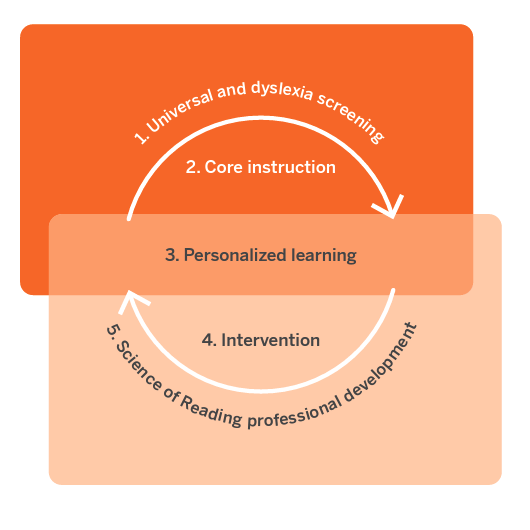
Assessment
Not only should an assessment systems include universal screening, dyslexia screening, diagnostic assessments, and progress monitoring, it must also be easy and efficient to administer, and provide classroom teachers with actionable data that guides instruction.
The mCLASS® Assessment System delivers all that and more!
When the DIBELS® 8th Edition assessment is paired with:
- The Text Reading and Comprehension (TRC) assessment, teachers unlock the ability to record reading behaviors through running digital records.
- The Vocabulary, Encoding, and Rapid Automatized Naming (RAN) measures, teachers are empowered to screen for dyslexia risk.
- mCLASS Lectura, teachers gain a holistic view of their students with biliteracy insights that support students in both English and Spanish.
Ready to learn more? Click the buttons below to review mCLASS with DIBELS 8th Edition with TRC and mCLASS Lectura.
Core instruction
Core instruction should include explicit, systematic lessons in foundational skills and a coherent approach to building background knowledge, developing vocabulary, and reading complex text with confidence.
With Amplify Core Knowledge Language Arts® (CKLA) and Amplify Caminos, all students have the opportunity to become strong readers, writers, speakers, and thinkers. Through a powerful combination of proven, evidence-based practices and engaging, interactive content, these core curricula enable students to develop a deep mastery of foundational skills as well as a robust knowledge base–both of which are necessary for accessing and comprehending complex texts.
Ready to learn more? Click the buttons below to review Amplify CKLA and Amplify Caminos.
Personalized practice
Student needs are multidimensional, which is precisely why practice must be personalized and provide opportunities for remediation and acceleration across multiple dimensions.
Through its integration with mCLASS and Amplify CKLA, Boost Reading’s adaptive personalized pathway makes practice more purposeful and productive. mCLASS automatically places students on an adaptive path within Boost Reading, which provides them the exact practice they need. That very practice follows the same approach and scope and sequence as Amplify CKLA, which further reinforces the core instruction.
Ready to learn more? Click the button below to review Boost Reading.
Targeted intervention
Getting students caught up on reading skills requires more than just “extra help” in small groups. It requires data-informed instruction focused directly on the specific skills each group needs to learn next.
mCLASS® Intervention is a staff-led reading intervention that does the heavy lifting of data analysis and lesson sequencing, freeing up teachers to teach the reading skills each student needs. mCLASS Intervention connects directly to mCLASS data, automatically groups students with similar needs, follows a research-based skills progression, includes ready-to-teach engaging lessons, and updates skill profiles and groups every ten days.
Ready to learn more? Click the button below to review mCLASS Intervention.

Science of Reading PD
Interested in helping your district make the shift to the Science of Reading? If so, grant funds can also be used for professional development. Amplify offers Science of Reading (SoR) professional development to districts that are ready to begin or progress their SoR journey. These synchronous and asynchronous courses will build and deepen teacher knowledge around SoR and give them practical tips for effective instruction.
Ready to learn more? Click the button below to review our product-agnostic Science of Reading professional learning opportunities.
Lastly, here are additional links to helpful Science of Reading resources:
Your Oregon team
Looking to speak directly with your local representative? Get in touch with an Oregon team member to learn more about our early literacy suite and how it can be used in applying for the Early Literacy Success School District Grants. See below to find your Amplify Account Executive.


Welcome, Arizona educators!
Thank you for taking the time to review Amplify’s complete early literacy system for PreK–5.
Our curriculum, assessment, practice, and intervention solutions work in tandem to ensure classroom teachers have what they need to provide multi-tiered literacy support to every student.
On this site, you’ll find a variety of resources designed to support your review and evaluation. If you have any questions, please don’t hesitate to contact us. Contact information is at the bottom of the page.
Complete literacy
system
Strong core instruction is crucial–but in isolation, even that’s not enough. A truly effective literacy system needs to bring together assessment, core instruction, personalized practice, targeted intervention, and ongoing professional development.
Together with leading experts in reading instruction, Amplify has built a proven early literacy system grounded in the latest reading research and designed to ensure every student receives the multi-tiered support they need to grow as a reader. Our partners include:
- The University of Oregon
- Core Knowledge Foundation
- Recognized language, literacy, and biliteracy experts such as Dr. Lillian Durán, Dr. Desiree Pallais, Dr. Catherine Snow, and others.
Assessment
Not only should an assessment systems include universal screening, dyslexia screening, diagnostic assessments, and progress monitoring, it must also be easy and efficient to administer, and provide classroom teachers with actionable data that guides instruction.
The mCLASS® Assessment System delivers all that and more!
When the DIBELS® 8th Edition assessment is paired with:
- The Text Reading and Comprehension (TRC) assessment, teachers unlock the ability to record reading behaviors through running digital records.
- The Vocabulary, Encoding, and Rapid Automatized Naming (RAN) measures, teachers are empowered to screen for dyslexia risk.
- mCLASS Lectura, teachers gain a holistic view of their students with biliteracy insights that support students in both English and Spanish.
Ready to learn more? Click the buttons below to review mCLASS with DIBELS 8th Edition with TRC and mCLASS Lectura.
Core instruction
Core instruction should include explicit, systematic lessons in foundational skills and a coherent approach to building background knowledge, developing vocabulary, and reading complex text with confidence.
With Amplify Core Knowledge Language Arts® (CKLA) and Amplify Caminos, all students have the opportunity to become strong readers, writers, speakers, and thinkers. Through a powerful combination of proven, evidence-based practices and engaging, interactive content, these core curricula enable students to develop a deep mastery of foundational skills as well as a robust knowledge base–both of which are necessary for accessing and comprehending complex texts.
Ready to learn more? Click the buttons below to review Amplify CKLA and Amplify Caminos.
Personalized practice
Student needs are multidimensional, which is precisely why practice must be personalized and provide opportunities for remediation and acceleration across multiple dimensions.
Through its integration with mCLASS and Amplify CKLA, Boost Reading’s adaptive personalized pathway makes practice more purposeful and productive. mCLASS automatically places students on an adaptive path within Boost Reading, which provides them the exact practice they need. That very practice follows the same approach and scope and sequence as Amplify CKLA, which further reinforces the core instruction.
Ready to learn more? Click the button below to review Boost Reading.
Targeted intervention
Getting students caught up on reading skills requires more than just “extra help” in small groups. It requires data-informed instruction focused directly on the specific skills each group needs to learn next.
mCLASS® Intervention is a staff-led reading intervention that does the heavy lifting of data analysis and lesson sequencing, freeing up teachers to teach the reading skills each student needs. mCLASS Intervention connects directly to mCLASS data, automatically groups students with similar needs, follows a research-based skills progression, includes ready-to-teach engaging lessons, and updates skill profiles and groups every ten days.
Ready to learn more? Click the button below to review mCLASS Intervention.
Your Arizona team
Looking to speak directly with your local representative? Get in touch with an Arizona team member to learn more about our early literacy suite or request a demo account.
EASTERN, WESTERN, SOUTHERN AZ
Tommy Gearhart
Senior Account Executive
(505) 206-7661
Virtual presentations
Amplify CKLA for Grades K–2
Amplify CKLA for Grades 3–5
About CKLA
Amplify CKLA is a core ELA program for grades K–5 that delivers:
- A combination of explicit foundational skills with meaningful knowledge building.
- Embedded support and differentiation that get all students reading grade-level texts together.
- Opportunities for students to see the strengths and experiences that all people share while celebrating each others’ unique identities and experiences.
- Authentic Spanish language arts instruction with Amplify Caminos.

How it Works
Amplify CKLA teaches both foundational skills and background knowledge in grades K–2 and combines them in 3–5.
- In grades K–2, students complete one full lesson that builds foundational reading skills and one full lesson that builds background knowledge.
- In grades 3–5, students complete one integrated lesson combining skills and knowledge with increasingly complex texts, close reading, and a greater emphasis on writing


What students Explore
Amplify CKLA builds knowledge coherently across subjects and grades.
Students make connections from year to year by exploring grade-appropriate subject-area knowledge and vocabulary in history, science, literature, and the arts while learning to read, write, and think creatively and for themselves.
Download the at-a-glance resources below to learn more.



What students read
Amplify CKLA puts a variety of texts in the hands of students every day to build and strengthen background knowledge and vocabulary, listening and reading comprehension, and decoding and fluency skills.
A comprehensive approach to literacy instruction requires students to have a wide range of text experiences, including reading, listening, discussing, and writing. Check out our text complexity guide to learn more by clicking here. Most questions, tasks, and assignments in CKLA materials are text-dependent. See how we use questioning and analysis skills to help students understand text in CKLA here.
More than that, we ensure the texts students read represent the world around them. With a diverse range of authors, topics, and characters, all students have ample access to both windows and mirrors. Our texts include the following:
- Authentic books.
- Authentic text passages.
- Student Readers.
- Novel Guides (grades 3–5).
Download the lists below to explore specific grade-level texts.





Supports LETRS
Amplify CKLA aligns with the instructional principles recommended by LETRS.
- Structured: Concepts are taught through consistent routines.
- Sequential: Concepts are taught in a logical, well-planned sequence.
- Systematic: Phonemes are taught from simplest to most complex.
- Explicit: Decoding and encoding concepts are taught directly and explicitly.
- Multi-sensory: Instruction is delivered through visual, auditory, and kinesthetic-tactile pathways.
- Cumulative: Concepts are applied in decodable, connected texts with constant review and reinforcement.

A comprehensive and cohesive solution
A strong literacy program is more than a reading program or an assessment tool: it combines curriculum, instruction, regular practice, intervention, and assessments.
Amplify has brought these components together in our early literacy curriculum suite to ensure you have what you need for multi-tiered support.


Trial Access
Ready to explore on your own? Follow the instructions below to access your demo account.
Explore CKLA's digital site
First, watch the quick teacher navigation video to the right. Then, follow the instructions below to access your demo account.
Go to my.amplify.com
Select Log in with Amplify
Teacher login: t1.springfield.ckla.k-5@demo.
Student login: s1.springfield.ckla.k-5@demo.
Password for both: Amplify1-springfield.ckla.k-5
Select the CKLA icon and your desired grade level
Additional Resources
Check out the information below to learn more about Amplify CKLA and see how Amplify CKLA is impacting classrooms all over the country.
Scope and sequences:
Grade 3 Integrated
Grade 4 Integrated
Grade 5 Integrated
Writing resources:
CKLA Writing Continuum for Grades K–2
CKLA Writing Continuum for Grades 3–5
Grade 3 Grammar and Morphology Scope & Sequence
Grade 4 Grammar and Morphology Scope & Sequence
Grade 5 Grammar and Morphology Scope & Sequence
Other helpful resources:
Contact us
Interested in speaking directly with your representative?
 |
Kristin McDonald Senior Account Executive (515) 240-0244 |
Welcome, San Francisco reviewers!
As national data shows dismal literacy scores, Amplify Reading program demonstrates strong outcomes for academically vulnerable students
BROOKLYN, N.Y.–Amplify, a publisher of next-generation curriculum and assessment programs, released the results of a year-long study on the impact of Amplify Reading, a data-based personalized learning program for K–5 built on the Science of Reading. Across all grades, Amplify Reading students outperformed non-Amplify Reading students after using the program during the 2020–21 school year, with particularly striking outcomes for students identified as ‘at-risk’ for not reaching grade-level benchmarks.
The study compared more than 50,000 K–5 students who used Amplify Reading for 30 minutes per week during the 2020–21 school year with a group of over 160,000 students who did not use Amplify Reading, matched on key student and school characteristics across the United States. Students were measured by educators using mCLASS® with DIBELS® 8th Edition, the gold-standard literacy assessment developed by the University of Oregon. Students who used Amplify Reading in all grades made significantly greater gains from the beginning to end of year in word reading, oral reading fluency and comprehension. Additionally, Amplify Reading students who began the year ‘at risk’ were 36% more likely to end the year at or above benchmark compared to a matched comparison group of students who did not use Amplify Reading. Students made these gains during the 2020–21 school year despite interrupted instruction and other challenges related to the pandemic.
“Amplify Reading consistently drives student growth, even in inconsistent times,” said Melissa Ulan, senior vice president and general manager of supplementals at Amplify. “Given the enormous toll COVID disruptions have taken on our early literacy learners, it’s heartening to see students clearly making gains, especially our most academically vulnerable students, so that educators can implement the most effective strategies to catch students up and accelerate growth.”
The research study, which meets the Every Student Succeeds Act’s (ESSA) Tier 2 Moderate Evidence showed significant and positive effects on student reading outcomes for all grade levels. Notably, 65% of kindergarten students in the Amplify Reading group finished the year on track for reading success, compared to 50% of the comparison group. Across all grades, Amplify Reading students outperformed non-Amplify Reading students, with 59% finishing the year at benchmark compared to 52% of students in the comparison group.
Students were considered on track for reading success if their mCLASS DIBELS composite score was at benchmark or above.
Amplify Reading is a reading acceleration program for grades K–5 that leverages the power of compelling storytelling to engage students in personalized reading instruction and practice. Whether students are just learning to read or mastering comprehension, Amplify Reading presents the skills that they need, at a pace that supports their individual development. It provides students with targeted and engaging instruction and practice in the key skills that students need to become successful readers: Phonological Awareness, Phonics, Decoding, Fluency, Vocabulary, Comprehension, and Close Reading.
About Amplify
A pioneer in K–12 education since 2000, Amplify is leading the way in next-generation curriculum and assessment. Our core and supplemental programs in ELA, math, and science engage all students in rigorous learning and inspire them to think deeply, creatively, and for themselves. Our formative assessment products help teachers identify the targeted instruction students need to build a strong foundation in early reading and math. All of our programs and services provide educators with powerful tools that help them understand and respond to the needs of every student. Today, Amplify serves more than 14 million students in all 50 states. For more information, visit amplify.com.
Contacts
Kristine Frech
media@amplify.com
San Diego Caregivers — Welcome to Amplify Desmos Math!
Welcome to the Amplify Desmos Math Caregiver Hub for San Diego USD. We’re excited to partner with San Diego USD teachers, principals, and district leaders to provide your student with exceptional opportunities to learn math. We designed this hub to help you in supporting your student along their math journey this year.

Introducing Amplify Desmos Math
Amplify Desmos Math is a new core math curriculum built for grades 6, 7, 8. Designed to help students learn math in a way, Amplify Desmos Math uses a student-centered approach to instruction, which has been proven to significantly increase math learning.
In every lesson, Amplify Desmos Math poses engaging and relevant problems to solve, giving students daily opportunities to think critically, work collaboratively, and actively participate in their own learning.

Amplify Desmos Math was built upon the highly rated Illustrative Mathematics curricula: IM K-12 Math™️, which earned an all-green score on EdReports.
About student-centered math instruction
Student-centered instruction may look different from the way students have learned math for decades, and maybe even the way you learned math. Instead of memorizing formulas and tricks, student-centered learning focuses on giving student opportunities to figure out how math works. Plus, research shows that students and teachers alike prefer this method, and teachers report that student-centered instruction has helped their students learn more math.

This way of learning helps students:
- Understand how math concepts work.
- Remember what they learn in class and apply their knowledge to new situations.
- Perform better on standardized tests and have more growth in their grades than their peers who learn through other methods.
- Learn to communicate in writing and verbally, understand and challenge the opinions of others, and build confidence in solving new problems.
- Develop key skills for success in college and the workplace, like using technology, completing projects independently and with others, and persevering through difficult problems.
What materials do students use?
Amplify Desmos Math supports blended learning with supportive print materials and a unique digital experience. In addition to a consumable Student Edition, students are invited to use our interactive online platform to solve open-ended tasks and challenging problems.

Here are some key highlights of the digital platform:
- Digital activities that allow students to explore and make sense of math
- Digital calculator and virtual manipulatives that support students of all levels
- Immediate feedback that guides students in understanding challenging concepts
- Ability to access instructional materials in English or Spanish
With access to their own special online dashboard, teachers can monitor students’ work in real time, making sure they get the exact support that they need at every part of the lesson.
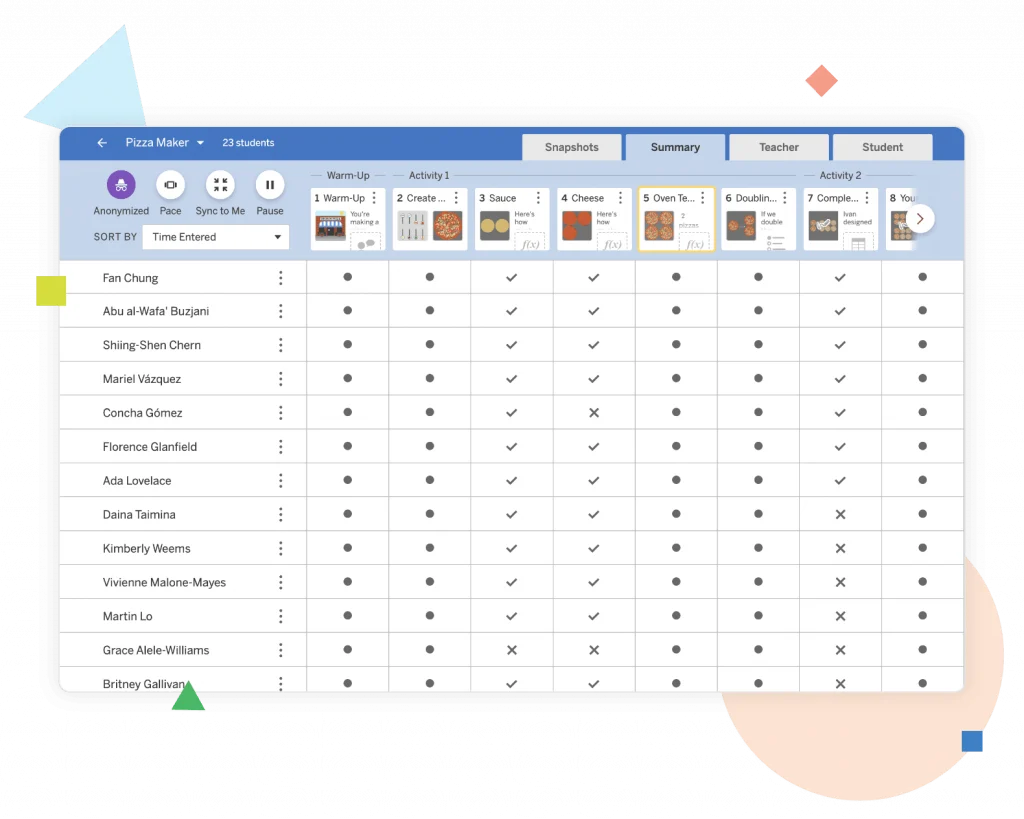
What does a lesson look like?
Students in an Amplify Desmos Math classroom can be seen (and heard!) — asking questions, debating answers, justifying their thinking, grappling with problems, and working together and independently.

In class, your student will spend their time working on challenging problems while the teacher acts as a guide, highlighting different strategies for solving problems and helping students to understand the reasoning behind the math they do in class. Your student will be pushed to think more deeply about the math in their class as the teacher and other students question them on why their ideas make sense. Research has proven that this method helps students become better problem solvers, critical thinkers, and have a stronger conceptual understanding of what they are learning.
Here’s what a typical Amplify Desmos Math lesson includes:
- Warm-up: A short, attention-getting problem to get students interested in the lesson
- Activities: 1-3 mini-activities that challenge students’ problem-solving skills
- Synthesis: Discussion to review and bring together the important concepts from the lesson
- Exit Ticket and Reflection: Questions for students to show what they know from the lesson
- Practice: Additional problems your student’s teacher may assign for classwork or homework
How can families support math learning at home?
Find the math in everyday life
Relate math to daily activities at home, whether it be baking, grocery shopping, or planning for a road trip. Your student can help you figure out the price of an item after a coupon, cut a recipe in half, or figure out how much gas you’ll need to make it to your destination. Encourage your student to point out ways that your family uses math in your daily tasks.
Review practice problems together
Your student’s teacher may assign practice problems at the end of each lesson for classwork or homework. Ask your student to walk you through how they solved each problem, or talk about any parts that were challenging for them.
Remember getting stuck is okay
Emphasize that getting stuck is part of the process and a necessary part of learning. Many students (and adults!) fear making mistakes, however, research shows that making mistakes helps your brain grow more. When your student gets stuck on a problem, encourage them to try different strategies, even if they are not sure if they are right.
Use our Unit Summaries for Families
We’ve created a Family Resource for every unit of the program that provides a summary of key concepts plus examples for how to work through problems.
Within each of the grade-level links below, you’ll find a Family Resource document for each unit, in both English and Spanish.
Unit 1: Area and Surface Area
Unit 2: Introducing Ratios
Unit 3: Rates and Percentages
Unit 4: Dividing Fractions
Unit 5: Arithmetic in Base Ten
Unit 6: Expressions and Equations
Unit 7: Rational Numbers
Unit 8: Data Sets and Distributions
Unit 1: Scale Drawings
Unit 2: Introducing Proportional Relationships
Unit 3: Measuring Circles
Unit 4: Percentages
Unit 5: Rational Number Arithmetic
Unit 6: Expressions, Equations, and Inequalities
Unit 7: Angles, Triangles, and Prisms
Unit 8: Probability and Sampling
Unit 1: Rigid Transformations and Congruence
Unit 2: Dilations and Similarity
Unit 3: Linear Relationships
Unit 4: Linear Equations and Systems of Linear Equations
Unit 5: Functions and Volume
Unit 6: Exponents and Scientific Notation
Unit 7: Irrationals and the Pythagorean Theorem
Unit 8: Associations in Data
Note: The below links are for our Volume 2 units, which most students are working in currently. Additional units will be coming soon!
Unit 1: Coming Soon!
Unit 2: Coming Soon!
Unit 3: Fractions and Decimals
- Student Guide: Accelerated 6, Unit 3, Part 1 (English)
- Student Guide: Accelerated 6, Unit 3, Part 2 (English)
- Spanish Coming Soon!
Unit 4: Expressions and Equations
- Student Guide: Accelerated 6, Unit 4 (English)
- Spanish Coming Soon!
Unit 5: Proportional Relationships
- Student Guide: Accelerated 6, Unit 5, Part 1 (English)
- Student Guide: Accelerated 6, Unit 5, Part 2 (English)
- Spanish Coming Soon!
Unit 6: Percentages
- Student Guide: Accelerated 6, Unit 6, Part 1 (English)
- Student Guide: Accelerated 6, Unit 6, Part 2 (English)
Unit 7: Positive and Negative Numbers
Unit 8: Describe Data
Note: The below links are for our Volume 2 units, which most students are working in currently. Additional units will be coming soon!
Unit 1: Coming Soon!
Unit 2: Coming Soon!
Unit 3: Coming Soon!
Unit 4: Linear Relationships and Systems of Linear Equations
- Student Guide: Accelerated 7, Unit 4, Part 1 (English)
- Student Guide: Accelerated 7, Unit 4, Part 2 (English)
- Spanish Coming Soon!
Unit 5: Functions
- Student Guide: Accelerated 7, Unit 5 (English)
- Spanish Coming Soon!
Unit 6: Associations in Data
- Student Guide: Accelerated 7, Unit 6 (English)
- Spanish Coming Soon!
Unit 7: Volume and Surface Area
Unit 8: Exponent and Scientific Notation
Unit 9: Pythagorean Theorem and Irrational Numbers
Listen to our podcast
Our Math Teacher Lounge is a biweekly podcast created specifically for K–12 math teachers. In each episode, co-hosts Bethany Lockhart Johnson (@lockhartedu) and Dan Meyer (@ddmeyer) chat with expert guests, taking a deep dive into the math and educational topics.
From time-to-time, the topic of an episode is perfect for families. For example, the episode below features Dr. Marjorie Schaeffer. She discusses what causes math anxiety, math hacks, and how the right math technology can make an incredible impact in children and family members who struggle with math anxiety.
Listen today and don’t forget to grab your MTL study guide to track your learning and make the most of this episode!
How do families access the program at home?
Your student will have access to all learning, practice, and assessment materials through the Amplify platform. Students can access the digital curriculum in school and at home by following these simple instructions.
- Click the Amplify Desmos Math button.
- Select Log in with Amplify.
- Enter this username and password provided by your student’s teacher.
- Select the desired grade level.
Professional development for assessment and intervention programs
Amplify professional development (PD) provides learning experiences that intentionally develop the knowledge and skills you need for effective and self-sustaining implementation.
Learn how to administer and score your assessment and develop a deeper understanding of reporting and instruction by investing in professional development.

Amplify professional development has been vetted by Rivet Education’s team through a rigorous three-step process and is listed in the Professional Learning Partner Guide.

About Amplify PD
Change is more likely to stick and get results if you take a systemic approach. Partner with us to do just that by developing a learning plan that will drive your program implementation, enrich your instructional practices, and increase student impact.
Amplify’s professional development is designed to ensure successful, sustained implementation of our programs. Sessions are strategically bundled to provide continuous support, adapting to your K–8 educators’ evolving needs throughout the year.

Our packages include:
- Launch sessions: Propel your teachers into the new school year by introducing them to their Amplify program, laying a strong foundation for effective implementation.
- Strengthen sessions: Enhance implementation with mid-year sessions that target specific instructional practices, providing the support needed to enhance program efficacy.
- Coach sessions: Provide tailored guidance and support for educators and leaders to address specific needs, refining and advancing their instructional practices.
About Amplify assessment and intervention programs
Amplify’s high-quality programs make it easier for K–8 educators to teach inspiring, impactful lessons that celebrate and develop the brilliance of their students. Equipped with tools that provide robust scaffolding and differentiated instruction, assessment, and intervention, educators gain real-time insights and can provide personalized, actionable plans that support every learner.
Learn how to get the most out of your assessment and intervention program(s) through Amplify’s PD.
Assessment
- mCLASS® DIBELS® 8th Edition (grades K–8)
- mCLASS Lectura (grades K–6)
- mCLASS DIBELS 8th Edition and mCLASS Lectura biliteracy
- mCLASS Math (grades K–8)
Intervention
- mCLASS Intervention
We provide PD sessions for all Amplify programs. Contact your account executive to discuss the extended catalog of PD session options or request a quote.
mCLASS Assessments
We’ve created professional development offerings that will help you meet your unique needs this school year. Explore the Begin and Practice packages available for mCLASS DIBELS 8th Edition (K–8), mCLASS Lectura (K–6), and/or mCLASS Math (K–8) by selecting the session titles to learn more.
Please note that mCLASS DIBELS 8th Edition and mCLASS Lectura biliteracy sessions are currently unavailable for the Hybrid 4 and Virtual 4 packages.
Begin packages for mCLASS Literacy
Assessment programs
*Assessment Strengthen sessions should be scheduled after the most recent benchmark window has closed for participants to work with their own data.
Begin: Launch: Administration and instruction essentials for K–8 teachers
On-site or virtual, 6 hours
Dive into the essentials of your mCLASS assessment program. Learn how to administer and score the assessment(s) and leave ready to leverage mCLASS reports and lessons to accelerate data-driven student outcomes.
Session options: mCLASS DIBELS 8th Edition (K–8), mCLASS Lectura (K–6), and/or mCLASS DIBELS 8th Edition/Lectura
Audience: Teachers, instructional staff (maximum 30 participants)
Language: The mCLASS Lectura session is facilitated in English or Spanish.
Begin: Launch: Administration and scoring training for K–8 teachers
On-site or virtual, 3 hours
Learn how to administer and score your mCLASS assessment(s) and leave ready to collect data using standardized guidelines.
Session options: mCLASS DIBELS 8th Edition (K–8), mCLASS Lectura (K–6)
Audience: Teachers, instructional staff (maximum 30 participants)
Language: The mCLASS Lectura session is facilitated in English or Spanish.
Begin: Launch: Administration and reporting training for K–8 leaders
On-site or virtual, 3 hours
Prepare to implement your assessment program(s) at your school site(s). Determine systems-level actions that will ensure assessment fidelity and leave ready to leverage key admin reports to support data-informed decisions.
Session options: mCLASS DIBELS 8th Edition (K–8), mCLASS Lectura (K–6), and/or mCLASS DIBELS 8th Edition/Lectura
Audience: Leaders (maximum 30 participants)
Language: The mCLASS Lectura session is facilitated in English only.
Available July 2026
Begin: Launch: mCLASS additional assessment measures training for K–3 teachers
Virtual, 1 hour
Participants will dive into the essentials of mCLASS Spelling, RAN, Vocabulary, and/or Oral Language and leave ready to administer the assessment to collect data using standardized guidelines.
Session options: mCLASS DIBELS 8th Edition (K–3)
Audience: Teachers, instructional staff (maximum 30 participants)
Available July 2026
Begin: Launch: mCLASS Español assessment measures training for K–3 teachers
Virtual, 1 hour
Participants will dive into the essentials of mCLASS Spelling Español, Vocabulary Español, and/or Oral Language Español and leave ready to administer the assessment to collect data using standardized guidelines.
Session options: mCLASS Lectura (K–3)
Audience: Teachers, instructional staff (maximum 30 participants)
Language: The mCLASS Lectura session is facilitated in English.
Available July 2026
Begin: Launch: mCLASS/mCLASS Español additional assessment measures training for K–3 teachers
Virtual, 1 hour
Participants will dive into the essentials of mCLASS Spelling/Spelling Español, RAN, Vocabulary/Vocabulary Español, and/or Oral Language/Oral Language Español and leave ready to administer the assessment to collect data using standardized guidelines.
Session options: mCLASS DIBELS 8th Edition (K–3) and mCLASS Lectura (K–3)
Audience: Teachers, instructional staff (maximum 30 participants)
Language: The mCLASS Lectura session is facilitated in English or Spanish.
Begin: Strengthen: Creating a data-driven classroom for K–8 teachers
On-site or virtual, 3 hours
Dive deep into mCLASS reports and instructional recommendations to drive stronger student outcomes in your classroom. You will leave ready to leverage mCLASS progress monitoring and grouping tools to support a robust MTSS program.
Session options: mCLASS DIBELS 8th Edition (K–8), mCLASS Lectura (K–6), and/or mCLASS DIBELS 8th Edition/Lectura
Audience: Teachers, instructional staff (maximum 30 participants)
Language: The mCLASS Lectura session is facilitated in English or Spanish.
Begin: Strengthen: Building a data-driven culture for K–8 leaders
On-site or virtual, 3 hours
Cultivate a schoolwide culture of data-driven practices. Use mCLASS reports to drill into key school-level data and leave with a systems-level action plan to drive stronger student and teacher outcomes.
Session options: mCLASS DIBELS 8th Edition (K–8), mCLASS Lectura (K–6), and/or mCLASS DIBELS 8th Edition/Lectura
Audience: Leaders (maximum 30 participants)
Language: The mCLASS Lectura session is facilitated in English only.
Begin: Strengthen Focus: Assessing with fidelity for K–8 teachers
Virtual, 1 hour
Fortify your assessment administration with trainer-led practice targeted to your unique needs.
Session options: mCLASS DIBELS 8th Edition (K–8), mCLASS Lectura (K–6), and/or mCLASS DIBELS 8th Edition/Lectura
Audience: Teachers, instructional staff (maximum 30 participants)
Language: The mCLASS Lectura session is facilitated in English or Spanish.
Begin: Strengthen Focus: Reporting and instruction basics for K–8 teachers
Virtual, 1 hour
Learn how to use mCLASS classroom reporting, instructional tools, and resources to accelerate data-driven student outcomes.
Session options: mCLASS DIBELS 8th Edition (K–8), mCLASS Lectura (K–6), and/or mCLASS DIBELS 8th Edition/Lectura
Audience: Teachers, instructional staff (maximum 30 participants)
Language: The mCLASS Lectura session is facilitated in English or Spanish.
Begin: Strengthen Focus: Goal setting and growth outcomes for K–8 teachers
Virtual, 1 hour
Learn how to use mCLASS Zones of Growth (Zonas de crecimiento for mCLASS Lectura) reports to set meaningful, ambitious, and attainable student goals that drive student progress and growth.
Session options: mCLASS DIBELS 8th Edition (K–8), mCLASS Lectura (K–6), and/or mCLASS DIBELS 8th Edition/Lectura
Audience: Teachers, instructional staff (maximum 30 participants)
Language: The mCLASS Lectura session is facilitated in English or Spanish.
Begin: Strengthen Focus: Progress monitoring for K–8 teachers
Virtual, 1 hour
Implement mCLASS progress monitoring and MTSS best practices to track student progress and accelerate growth.
Session options: mCLASS DIBELS 8th Edition (K–8), mCLASS Lectura (K–6), and/or mCLASS DIBELS 8th Edition/Lectura
Audience: Teachers, instructional staff (maximum 30 participants)
Language: The mCLASS Lectura session is facilitated in English or Spanish.
Begin: Strengthen Focus: Reporting basics for K–8 leaders
Examine your school-level mCLASS benchmark assessment data to identify key levers for improving student outcomes.
Session options: mCLASS DIBELS 8th Edition (K–8), mCLASS Lectura (K–6), and/or mCLASS DIBELS 8th Edition/Lectura
Audience: Leaders (maximum 30 participants)
Language: The mCLASS Lectura session is facilitated in English only.
Coach session
On-site, 6 hours or virtual, 3 hours
Coach sessions focus on building internal school and district capacity and leadership excellence to accelerate data-driven student outcomes for teachers using mCLASS. Coaching is customized to meet a school or district’s needs and can include observations, modeling, real-time coaching, and/or co-planning.
Audience: Individual teachers, grade-level teams, PLCs, and/or instructional leaders (maximum 30 participants)
mCLASS DIBELS 8th Edition/Lectura: Administration and instruction essentials for teachers
Online course, self-paced
Dive into the essentials of your mCLASS assessment program through this on-demand course. Learn how to administer and score the assessment and leave ready to leverage mCLASS reports and lessons to accelerate data-driven student outcomes.
Upon finishing the course, participants can download a certificate of completion. This subscription includes an individual seat to the course, which takes approximately 8 hours to complete. Participants will be able to access and revisit the course as needed for up to one year.
Course options: mCLASS DIBELS 8th Edition, mCLASS Lectura
Audience: Teachers, instructional staff (individual seat)
Available July 2026
mCLASS DIBELS 8th Edition: Calibration training course for teachers
Online course, self-paced
Ensure accuracy and reliability of mCLASS DIBELS 8th Edition test administration through this on-demand course. Review how to administer and score each teacher-administered measure, then calibrate your scoring through scoring mastery checks.
Upon finishing the course, participants can download a certificate of completion. This subscription includes an individual seat to the course, which takes approximately 1–3 hours to complete, depending on learner needs. Participants will be able to access and revisit the course as needed for up to one year.
Course options: mCLASS DIBELS 8th Edition
Audience: Teachers, instructional staff (individual seat)
mCLASS DIBELS 8th Edition: Transition training course for DDS teachers
Online course, self-paced
Prepare to administer and score the DIBELS 8th Edition assessment in the mCLASS platform through this on-demand course. Learn the essentials of your mCLASS assessment program and leave ready to leverage mCLASS reports and lessons to accelerate data-driven student outcomes.
Upon finishing the course, participants can download a certificate of completion. This subscription includes an individual seat to the course, which takes approximately 8 hours to complete. Participants will be able to access and revisit the course as needed for up to one year.
Course options: mCLASS DIBELS 8th Edition
Audience: Teachers, instructional staff (individual seat)
Begin packages for mCLASS Math 2nd Edition
Assessment programs
New
Begin: mCLASS Math: Program overview for K–5 or 6–8 teachers
Available for grades 6–8 teachers July 2026
On-site or virtual, 3 hours
Dive into the essentials of your mCLASS Math assessment program. Learn how these assessments both highlight students’ strengths and help identify what’s next through an asset-based approach. Leave ready to administer assessments and understand reporting.
Audience: Teachers, instructional staff (maximum 30 participants)
New
Begin: mCLASS Math: Program overview for K–5 or 6–8 leaders
Available for grades K–5 and grades 6–8 leaders July 2026
On-site or virtual, 3 hours
Prepare to implement your mCLASS Math assessment program at your school site(s). Determine systems-level actions that will ensure successful assessment administration and leave ready to leverage key admin reports to support data-informed decisions.
Audience: Teachers, instructional staff (maximum 30 participants)
New
Begin: mCLASS Math: Student thinking and instructional next steps for grades K–5 teachers
Available for grades 6–8 teachers Oct. 2026
On-site or virtual, 3 hours
Explore how mCLASS Math helps determine what students know in relation to grade-level content, and how to use data to inform instructional next steps that support, strengthen, and stretch student thinking. Dig into your own student data and leave with actionable next steps that connect directly to the ways your students are thinking about mathematics.
Audience: Teachers, instructional staff (maximum 30 participants)
New
Begin: mCLASS Math + Boost Math: Understanding and using data to plan intervention for grades K–5 or 6–8 teachers
Available for grades K–5 teachers July 2026 and grades 6–8 teachers Oct. 2026
On-site or virtual, 3 hours
Explore how Boost Math uses mCLASS Math data to inform intervention recommendations and monitor student progress. Dig into your student data, explore relevant instructional resources, and leave with actionable next steps for intervention.
Audience: Teachers, instructional staff (maximum 30 participants)
New
Begin: Strengthen Focus: mCLASS Math: Leveraging assessment data to strengthen mathematical explanations for grades K–5 or 6–8 teachers
Available for grades K–5 teachers July 2026 and grades 6–8 teachers Oct. 2026
Virtual, 1 hour
Dig into mCLASS Math to reveal what students understand about mathematical concepts and give them the tools to become more clear and confident communicators in math class.
Audience: Teachers, instructional staff (maximum 30 participants)
Available July 2026
Begin: mCLASS Math 2nd Edition: Program overview and instructional next steps for grades K–5 teachers
Online course, self-paced
Through this self-paced, on-demand online course, participants will dive into the essentials of mCLASS Math K–5 and leave ready to administer the assessment, understand reporting, and take instructional next steps based on the data.
Upon finishing the course, participants can download a certificate of completion. This subscription includes an individual seat to the course, which takes approximately six hours to complete. Participants will be able to access and revisit the course as needed for up to one year.
Course options: mCLASS DIBELS 8th Edition
Audience: Teachers, instructional staff (individual seat)
Available July 2026
Begin: mCLASS Math 2nd Edition: Program overview and instructional next steps for grades 6–8 teachers
Online course, self-paced
Through this self-paced, on-demand online course, participants will dive into the essentials of mCLASS Math 6–8 and leave ready to administer the assessment, understand reporting, and take instructional next steps based on the data.
Upon finishing the course, participants can download a certificate of completion. This subscription includes an individual seat to the course, which takes approximately six hours to complete. Participants will be able to access and revisit the course as needed for up to one year.
Course options: mCLASS DIBELS 8th Edition
Audience: Teachers, instructional staff (individual seat)
Practice packages for mCLASS Literacy
| On-site package (6 hours) |
Virtual 6 package (6 hours) |
Virtual 4 package (4 hours) |
Virtual 2 package (2 hours) |
|
| Two Strengthen sessions per package | ||||
| Strengthen session titles* | ||||
| On-site 3 hr. |
Virtual 3 hr. |
Virtual 3 hr. and 1 hr. |
Virtual 1 hr. |
|
| Creating a data-driven classroom for K–8 teachers |  |
|
|
|
| Building a data-driven culture for K–8 leaders | |
|
|
|
| Assessing with fidelity for K–8 teachers | |
|
||
| Reporting and instruction basics for K–8 teachers | |
|
||
| Progress monitoring for K–8 teachers | |
|
||
| Goal setting and growth outcomes for K–8 teachers | |
|
||
| Reporting basics for K–8 leaders | |
|
||
| NEW: mCLASS DIBELS 8 additional assessment measures training for K–8 teachers | |
|||
| NEW: mCLASS Español assessment measures training for K–8 teachers | |
|||
| NEW: mCLASS DIBELS 8 and mCLASS Lectura additional assessment measures training for K–8 teachers | |
|||
*Assessment Strengthen sessions should be scheduled after the most recent benchmark window has closed for participants to work with their own data.
Practice: Creating a data-driven classroom for K–8 teachers
On-site or virtual, 3 hours
Dive deep into mCLASS reports and instructional recommendations to drive stronger student outcomes in your classroom. You will leave ready to leverage mCLASS progress monitoring and grouping tools to support a robust MTSS program.
Session options: mCLASS DIBELS 8th Edition (K–8), mCLASS Lectura (K–6), and/or mCLASS DIBELS 8th Edition/Lectura
Audience: Teachers, instructional staff (maximum 30 participants)
Language: The mCLASS Lectura session is facilitated in English or Spanish.
Practice: Building a data-driven culture for K–8 leaders
On-site or virtual, 3 hours
Cultivate a schoolwide culture of data-driven practices. Use mCLASS reports to drill into key school-level data and leave with a systems-level action plan to drive stronger student and teacher outcomes.
Session options: mCLASS DIBELS 8th Edition (K–8), mCLASS Lectura (K–6), and/or mCLASS DIBELS 8th Edition/Lectura
Audience: Leaders (maximum 30 participants)
Language: The mCLASS Lectura session is facilitated in English only.
Practice: Strengthen Focus: Assessing with fidelity for K–8 teachers
Virtual, 1 hour
Fortify your mCLASS DIBELS 8th Edition assessment administration with trainer-led practice targeted to your unique needs.
Session options: mCLASS DIBELS 8th Edition (K–8), mCLASS Lectura (K–6), and/or mCLASS DIBELS 8th Edition/Lectura
Audience: Teachers, instructional staff (maximum 30 participants)
Language: The mCLASS Lectura session is facilitated in English or Spanish.
Practice: Strengthen Focus: Reporting and instruction basics for K–8 teachers
Virtual, 1 hour
Learn how to use mCLASS classroom reporting, instructional tools, and resources to accelerate data-driven student outcomes.
Session options: mCLASS DIBELS 8th Edition (K–8), mCLASS Lectura (K–6), and/or mCLASS DIBELS 8th Edition/Lectura
Audience: Teachers, instructional staff (maximum 30 participants)
Language: The mCLASS Lectura session is facilitated in English or Spanish.
Practice: Strengthen Focus: Progress monitoring for K–8 teachers
Virtual, 1 hour
Implement mCLASS progress monitoring and MTSS best practices to track student progress and accelerate growth.
Session options: mCLASS DIBELS 8th Edition (K–8), mCLASS Lectura (K–6), and/or mCLASS DIBELS 8th Edition/Lectura
Audience: Teachers, instructional staff (maximum 30 participants)
Language: The mCLASS Lectura session is facilitated in English or Spanish.
Practice: Goal setting and growth outcomes for K–8 teachers
Virtual, 1 hour
Learn how to use mCLASS Zones of Growth (Zonas de crecimiento for mCLASS Lectura) reports to set meaningful, ambitious, and attainable student goals that drive student progress and growth.
Session options: mCLASS DIBELS 8th Edition (K–8), mCLASS Lectura (K–6), and/or mCLASS DIBELS 8th Edition/Lectura
Audience: Teachers, instructional staff (maximum 30 participants)
Language: The mCLASS Lectura session is facilitated in English or Spanish.
Practice: Reporting basics for K–8 leaders
Virtual, 1 hour
Examine your school-level mCLASS benchmark assessment data to identify key levers for improving student outcomes.
Session options: mCLASS DIBELS 8th Edition (K–8), mCLASS Lectura (K–6), and/or mCLASS DIBELS 8th Edition/Lectura
Audience: Leaders (maximum 30 participants)
Language: The mCLASS Lectura session is facilitated in English.
Available July 2026
Practice: Strengthen Focus: mCLASS DIBELS 8th Edition additional assessment measures training for K–8 teachers
Virtual, 1 hour
Participants will dive into the essentials of mCLASS Spelling, RAN, Vocabulary, and/or Oral Language and leave ready to administer the assessment to collect data using standardized guidelines.
Session options: mCLASS DIBELS 8th Edition (K–8)
Audience: Leaders (maximum 30 participants)
Available July 2026
Practice: Strengthen Focus: mCLASS Español assessment measures training for K–8 teachers
Virtual, 1 hour
Participants will dive into the essentials of mCLASS Spelling Español, Vocabulary Español, and/or Oral Language Español and leave ready to administer the assessment to collect data using standardized guidelines.
Session options: mCLASS Lectura (K–6)
Audience: Teachers, instructional staff (maximum 30 participants)
Language: The mCLASS Lectura session is facilitated in English.
Available July 2026
Practice: Strengthen Focus: mCLASS DIBELS 8th Edition and mCLASS Lectura additional assessment measures training for K–8 teachers
Virtual, 1 hour
Participants will dive into the essentials of mCLASS Spelling/Spelling Español, RAN, Vocabulary/Vocabulary Español, and/or Oral Language/Oral Language Español and leave ready to administer the assessment to collect data using standardized guidelines.
Session options: mCLASS DIBELS 8th Edition (K–8) and mCLASS Lectura (K–6)
Audience: Teachers, instructional staff (maximum 30 participants)
Language: The mCLASS Lectura session is facilitated in English or Spanish.
Add on: Coach session
On-site, 6 hours or virtual, 3 hours
Coach sessions focus on building internal school and district capacity and leadership excellence to accelerate data-driven student outcomes for teachers using mCLASS. Coaching is customized to meet a school or district’s needs and can include observations, modeling, real-time coaching, and/or co-planning.
Audience: Individual teachers, grade-level teams, PLCs, and/or instructional leaders (maximum 30 participants)
Available October 2026
Add on: mCLASS DIBELS 8th Edition and Amplify CKLA 3rd Edition: Data-driven instruction for K–5 teachers
On-site or virtual, 3 hours
Dive deep into mCLASS reports and instructional recommendations to drive instructional decisions in Amplify CKLA and stronger student outcomes in your classroom. You will leave ready to leverage mCLASS progress monitoring and grouping tools to support a robust Multi-Tiered System of Supports program with Amplify CKLA as your core instruction.
Course options: mCLASS DIBELS 8th Edition and Amplify CKLA 3rd Edition
Audience: K–2 or 3–5 teachers, instructional staff (maximum 30 participants)
Add on: mCLASS DIBELS 8th Edition and mCLASS Lectura: Administration and instruction essentials for teachers
Online course, self-paced
Dive into the essentials of your mCLASS assessment program through this on-demand course. Learn how to administer and score the assessment and leave ready to leverage mCLASS reports and lessons to accelerate data-driven student outcomes.
Upon finishing the course, participants can download a certificate of completion. This subscription includes an individual seat to the course, which takes approximately eight hours to complete. Participants will be able to access and revisit the course as needed for up to one year.
Course options: mCLASS DIBELS 8th Edition, mCLASS Lectura
Audience: Teachers, instructional staff (individual seat)
Available July 2026
Add on: mCLASS DIBELS 8th Edition: Calibration training course for teachers
Online course, self-paced
Ensure accuracy and reliability of mCLASS DIBELS 8th Edition test administration through this on-demand course. Review how to administer and score each teacher-administered measure, then calibrate your scoring through scoring mastery checks.
Upon finishing the course, participants can download a certificate of completion. This subscription includes an individual seat to the course, which takes approximately 1–3 hours to complete, depending on learner needs. Participants will be able to access and revisit the course as needed for up to one year.
Course options: mCLASS DIBELS 8th Edition
Audience: Teachers, instructional staff (individual seat)
Available July 2026
Add on: mCLASS DIBELS 8th Edition: Transition training course for DDS teachers
Online course, self-paced
Prepare to administer and score the DIBELS 8th Edition assessment in the mCLASS platform through this on-demand course. Learn the essentials of your mCLASS assessment program and leave ready to leverage mCLASS reports and lessons to accelerate data-driven student outcomes.
Upon finishing the course, participants can download a certificate of completion. This subscription includes an individual seat to the course, which takes approximately eight hours to complete. Participants will be able to access and revisit the course as needed for up to one year.
Course options: mCLASS DIBELS 8th Edition
Audience: Teachers, instructional staff (individual seat)
Amplify intervention PD sessions
Each intervention program offers Launch and Coach sessions for up to 30 participants per program for year one and beyond. Our interactive sessions are available on-site or virtually, empowering teachers and leaders anywhere with the tools and skills they need to inspire all students to think deeply, creatively, and for themselves.
mCLASS Intervention
mCLASS Intervention is a staff-led Tier 2 and Tier 3 reading intervention program that does the heavy lifting of data analysis and lesson sequencing, freeing up teachers to teach the reading skills each student needs. View the table and select the session title to learn more about each mCLASS Intervention PD session.
| On-site or virtual sessions 6 hr. |
Self-paced course | |
| Launch sessions | ||
| Initial training for K–6 interventionists and intervention coordinators | |
|
| Initial training for K–6 interventionists and intervention coordinators | |
|
Coach sessions
| On-site sessions 6 hr. |
On-site or virtual sessions 3 hr. |
|
| Coach session |
 |
|
| Coach session |
|
Launch
Propel your teachers into the new school year with sessions that introduce them to their Amplify program(s) and support a strong implementation.
Initial training for K–6 interventionists and intervention coordinators
On-site or virtual, 6 hours
In part 1 of this training, interventionists and intervention coordinators will prepare to deliver mCLASS Intervention lessons and learn how to administer the diagnostic and progress monitoring measures. In part 2, intervention coordinators will learn the essentials of coordinating mCLASS Intervention and leave ready to implement the program at their school site.
Audience: Teachers, instructional staff, intervention coordinators (maximum 30 participants)
Initial training course for K–6 interventionists and intervention coordinators
Online course, self-paced
Prepare to deliver mCLASS Intervention lessons and learn how to administer the diagnostic and progress monitoring measures through this on-demand course. Intervention coordinators will additionally learn the essentials of coordinating mCLASS Intervention to support implementation at their school site.
Upon finishing the course, participants can download a certificate of completion. This subscription includes an individual seat to the course, which takes approximately three hours to complete. Participants will be able to access and revisit the course as needed for up to one year.
Audience: Teachers, instructional staff (individual seat)
Coach
Support teachers and leaders with learning experiences tailored to meet their specific needs.
Coach session
On-site, 6 hours
Coach sessions focus on building internal school and district capacity and leadership excellence to accelerate data-driven student outcomes for teachers using mCLASS Intervention. Coaching is customized to meet a school or district’s needs and can include observations, modeling, real-time coaching, and/or co-planning.
Audience: Individual teachers, grade-level teams, PLCs, and/or instructional leaders (maximum 30 participants)
Coach session
On-site or virtual, 3 hours
Coach sessions focus on building internal school and district capacity and leadership excellence to accelerate data-driven student outcomes for teachers using mCLASS Intervention. Coaching is customized to meet a school or district’s needs and can include observations, modeling, real-time coaching, and/or co-planning.
Audience: Individual teachers, grade-level teams, PLCs, and/or instructional leaders (maximum 30 participants)
Additional assessment and intervention programs
Additional sessions and online courses are also available for other mCLASS programs (Paper DIBELS 8th Edition and mCLASS Intervention Universal).
To learn more about enhancing your Amplify experience by purchasing other mCLASS programs and/or accompanying PD sessions, please contact your account executive.
Contact us
AMPLIFY DESMOS MATH FLORIDA
Welcome, Palm Beach reviewers!
We’re honored to introduce you to Amplify Desmos Math Florida, and confident this comprehensive program will be a powerful tool in classrooms across your district.
Please start with the video on the right to learn more.
Next, view this video for an in-depth look at a lesson from both the Teacher and Student Editions.
Accelerated 6
Visit http://learning.amplify.com/.
To further support your review.
Select Log in with Amplify and use the login credentials in your submission documents.


- Palm Beach Rubric Response
- Accelerated 6 Standards Correlation Amplify Desmos Math Florida
- Amplify Desmos Math Florida Program Guide
- IM7 Standards Alignment
- Grade 6 Multilingual Glossary
- Grade 7 Multilingual Glossary
- Amplify Desmos Math Florida Multilingual Resources
Professional development for assessment and intervention programs
Amplify professional development (PD) provides learning experiences that intentionally develop the knowledge and skills you need for effective and self-sustaining implementation.
Learn how to administer and score your assessment and develop a deeper understanding of reporting and instruction by investing in professional development.
Amplify professional development has been vetted by Rivet Education’s team through a rigorous three-step process and is listed in the Professional Learning Partner Guide.
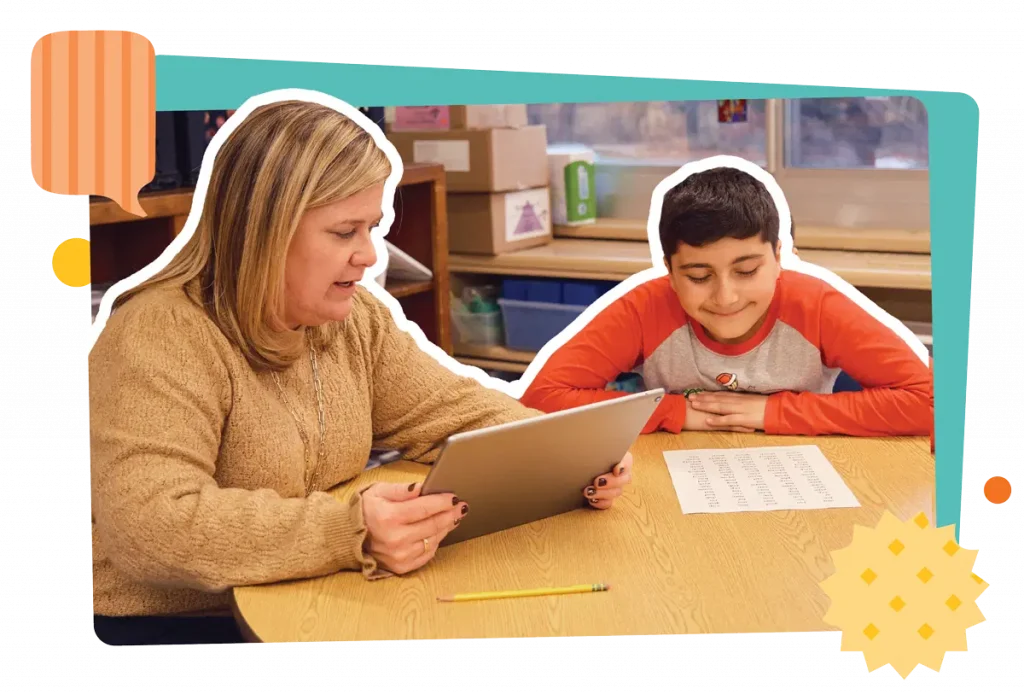
About Amplify PD
Change is more likely to stick and get results if you take a systemic approach. As our partner, you’ll develop a learning plan that will drive your program implementation, enrich your instructional practices, and increase student impact.
Amplify’s professional development is designed to ensure successful, sustained implementation of our programs. Through strategically bundled packages, our PD sessions provide continuous support that adapts to your educators’ evolving needs.

Our packages include:
- Launch sessions: Propel your teachers into the new school year by introducing them to their Amplify program, laying a strong foundation for effective implementation.
- Strengthen sessions: Boost implementation with mid-year sessions that target specific instructional practices, providing the support needed to enhance program efficacy.
- Coach sessions: Provide tailored guidance and support for educators and leaders to address specific needs, refining and advancing their instructional practices.
About mCLASS Texas® assessment PD packages:
- Begin packages: Ideal for the first year of implementation, these packages help educators transition to evidence-based practices. Each package includes Launch and Strengthen sessions to set the foundation and support the initial phases of program adoption.
- Format options: On-site, Hybrid, Virtual
- Components: One Launch session introduces and supports a strong implementation and one Strengthen session deepens understanding of the program.
- Practice packages: Designed for the second year of implementation and beyond, these packages deepen educators’ knowledge and refine their practice. They focus on continuous improvement, using data to drive instructional decisions and enhance student outcomes.
- Format options: On-site, Hybrid, Virtual
- Components: Two Strengthen sessions expand practice and drive outcomes. We recommend enhancement Coach sessions for ongoing support and addressing customized needs.
About mCLASS Intervention PD sessions:
- Each intervention program offers Launch and Coach sessions for up to 30 participants per program for year one and beyond.
- Our interactive sessions are available on-site or virtually, empowering teachers and leaders anywhere with the tools and skills they need to inspire all students to think deeply, creatively, and for themselves.
About Amplify assessment and intervention programs
Amplify’s high-quality programs make it easier for educators to teach inspiring, impactful lessons that celebrate and develop the brilliance of their students. Empowering teachers with tools to provide robust scaffolding and differentiated instruction, assessment, and intervention programs take the hassle and guesswork out of assessments with real-time, actionable plans personalized for every learner.
Learn how to get the most out of your assessment and intervention program(s) through Amplify’s PD.
Assessment
- mCLASS Texas
- mCLASS Lectura Texas
- mCLASS Texas + Lectura
Intervention
- mCLASS Intervention
We provide PD sessions for all Amplify programs. Contact your account executive to discuss the extended catalog of PD session options or request a quote.
mCLASS Texas Assessments
We’ve created professional development offerings that will help you meet your unique needs this school year. Explore the Begin and Practice packages available for mCLASS Texas Edition and mCLASS Lectura Texas by selecting the session titles to learn more.
Please note that mCLASS Texas and mCLASS Texas + Lectura biliteracy sessions are currently unavailable for the Hybrid 4 and Virtual 4 packages.
Begin packages
Assessment programs
| On-site package (9 hours) |
Hybrid 9 package (9 hours) |
Hybrid 4 package (4 hours) |
Virtual 9 package (9 hours) |
Virtual 4 package (4 hours) |
|
| One Launch and Strengthen session per package | |||||
| Launch sessions | |||||
| On-site 6 hr. |
On-site 6 hr. |
On-site 3 hr. |
Virtual 6 hr. (2 half-days) |
Virtual 3 hr. |
|
| Administration and instruction essentials for teachers | |
|
|
||
| Administration and scoring training for teachers |
|
|
|||
| Administration and reporting training for leaders | |
|
|||
| Strengthen sessions | |||||
| On-site 3 hr. |
Virtual 3 hr. |
Virtual 1 hr. |
Virtual 3 hr. |
Virtual 1 hr. |
|
| Creating a data-driven classroom for teachers | |
|
|
||
| Building a data-driven culture for leaders | |
|
|
||
| Assessing with fidelity for teachers |
|
|
|||
| Reporting and instruction basics for teachers | |
|
|||
| Goal setting and growth outcomes for teachers | |
|
|||
| Progress monitoring for teachers | |
|
|||
| Reporting basics for leaders |
|
|
|||
*Assessment Strengthen sessions should be scheduled after the most recent benchmark window has closed for participants to work with their own data.
| Coach session | |||
| Suggested enhancements |
On-site | On-site or virtual | |
| 6 hr. | 3 hr. | ||
Begin: Administration and instruction essentials for teachers
On-site or virtual, 6 hours
Dive into the essentials of your mCLASS Texas assessment program. Learn how to administer and score the assessment and leave ready to leverage mCLASS Texas reports and lessons to accelerate data-driven student outcomes.
Session options: mCLASS Texas, mCLASS Lectura Texas, and/or mCLASS Texas + Lectura biliteracy
Audience: Teachers, instructional staff (maximum 30 participants)
Language: The mCLASS Lectura Texas session is facilitated in English or Spanish.
Begin: Administration and scoring training for teachers
On-site or virtual, 3 hours
Learn how to administer and score your mCLASS Texas assessment(s) and leave ready to collect data using standardized guidelines.
Session options: mCLASS Texas, mCLASS Lectura Texas, and/or mCLASS Texas + Lectura biliteracy
Audience: Teachers, instructional staff (maximum 30 participants)
Language: The mCLASS Lectura Texas session is facilitated in English or Spanish.
Begin: Administration and reporting training for leaders
On-site or virtual, 3 hours
Prepare to implement your assessment program(s) at your school site(s). Determine systems-level actions that will ensure assessment fidelity and leave ready to leverage key admin reports to support data-informed decisions.
Session options: mCLASS Texas, mCLASS Lectura Texas, and/or mCLASS Texas + Lectura biliteracy
Audience: Leaders (maximum 30 participants)
Language: The mCLASS Lectura Texas session is facilitated in English only.
Begin: Creating a data-driven classroom for teachers
On-site or virtual, 3 hours
Dive deep into mCLASS Texas reports and instructional recommendations to drive stronger student outcomes in your classroom. You will leave ready to leverage mCLASS Texas progress monitoring and grouping tools to support a robust MTSS program.
Session options: mCLASS Texas, mCLASS Lectura Texas, and/or mCLASS Texas + Lectura biliteracy
Audience: Teachers, instructional staff (maximum 30 participants)
Language: The mCLASS Lectura Texas session is facilitated in English or Spanish.
Begin: Building a data-driven culture for leaders
On-site or virtual, 3 hours
Cultivate a schoolwide culture of data-driven practices. Use mCLASS Texas reports to drill into key school-level data and leave with a systems-level action plan to drive stronger student and teacher outcomes.
Session options: mCLASS Texas, mCLASS Lectura Texas, and/or mCLASS Texas + Lectura biliteracy
Audience: Leaders (maximum 30 participants)
Language: The mCLASS Lectura Texas session is facilitated in English only.
Begin: Strengthen Focus: Assessing with fidelity for teachers
Virtual, 1 hour
Fortify your assessment administration with trainer-led practice targeted to your unique needs.
Session options: mCLASS Texas, mCLASS Lectura Texas, and/or mCLASS Texas + Lectura biliteracy
Audience: Teachers, instructional staff (maximum 30 participants)
Language: The mCLASS Lectura Texas session is facilitated in English or Spanish.
Begin: Strengthen Focus: Reporting and instruction basics for teachers
Virtual, 1 hour
Learn how to use mCLASS Texas classroom reporting, instructional tools, and resources to accelerate data-driven student outcomes.
Session options: mCLASS Texas, mCLASS Lectura Texas, and/or mCLASS Texas + Lectura biliteracy
Audience: Teachers, instructional staff (maximum 30 participants)
Language: The mCLASS Lectura Texas session is facilitated in English or Spanish.
Begin: Strengthen Focus: Goal setting and growth outcomes for teachers
Virtual, 1 hour
Learn how to use mCLASS Texas Zones of Growth (Zonas de crecimiento for mCLASS Lectura) reports to set meaningful, ambitious, and attainable student goals that drive student progress and growth.
Session options: mCLASS Texas, mCLASS Lectura Texas, and/or mCLASS Texas + Lectura biliteracy
Audience: Teachers, instructional staff (maximum 30 participants)
Language: The mCLASS Lectura Texas session is facilitated in English or Spanish.
Begin: Strengthen Focus: Progress monitoring for teachers
Virtual, 1 hour
Implement mCLASS progress monitoring and MTSS best practices to track student progress and accelerate growth.
Session options: mCLASS Texas, mCLASS Lectura Texas, and/or mCLASS Texas + Lectura biliteracy
Audience: Teachers, instructional staff (maximum 30 participants)
Language: The mCLASS Lectura Texas session is facilitated in English or Spanish.
Begin: Strengthen Focus: Reporting basics for leaders
Virtual, 1 hour
Examine your school-level mCLASS benchmark assessment data to identify key levers for improving student outcomes.
Session options: mCLASS Texas, mCLASS Lectura Texas, and/or mCLASS Texas + Lectura biliteracy
Audience: Leaders (maximum 30 participants)
Language: The mCLASS Lectura Texas session is facilitated in English only.
Practice packages
| On-site package (6 hours) |
Virtual 6 package (6 hours) |
Virtual 4 package (4 hours) |
Virtual 2 package (2 hours) |
|
| Two Strengthen sessions per package | ||||
| Strengthen session titles* | ||||
| On-site 3 hr. |
Virtual 3 hr. |
Virtual 3 hr. and 1 hr. |
Virtual 1 hr. |
|
| Creating a data-driven classroom for teachers | |
|
|
|
| Building a data-driven culture for leaders |
|
|
|
|
| Assessing with fidelity for teachers | |
|
||
| Reporting and instruction basics for teachers | |
|
||
| Progress monitoring for teachers |
|
|
||
| Goal setting and growth outcomes for teachers |
|
|
||
| Reporting basics for leaders | |
|
||
*Assessment Strengthen sessions should be scheduled after the most recent benchmark window has closed for participants to work with their own data.
| Coach session | |||
| Suggested enhancements |
On-site | On-site or virtual | |
| 6 hr. | 3 hr. | ||
Practice: Creating a data-driven classroom for teachers
On-site or virtual, 3 hours
Dive deep into mCLASS Texas reports and instructional recommendations to drive stronger student outcomes in your classroom. You will leave ready to leverage mCLASS Texas progress monitoring and grouping tools to support a robust MTSS program.
Session options: mCLASS Texas, mCLASS Lectura Texas, and/or mCLASS Texas + Lectura biliteracy
Audience: Teachers, instructional staff (maximum 30 participants)
Language: The mCLASS Lectura Texas session is facilitated in English or Spanish.
Practice: Building a data-driven culture for leaders
On-site or virtual, 3 hours
Cultivate a schoolwide culture of data-driven practices. Use mCLASS Texas reports to drill into key school-level data and leave with a systems-level action plan to drive stronger student and teacher outcomes.
Session options: mCLASS Texas, mCLASS Lectura Texas, and/or mCLASS Texas + Lectura biliteracy
Audience: Leaders (maximum 30 participants)
Language: The mCLASS Lectura Texas session is facilitated in English only.
Practice: Strengthen Focus: Assessing with fidelity for teachers
Virtual, 1 hour
Fortify your mCLASS Texas Edition assessment administration with trainer-led practice targeted to your unique needs.
Session options: mCLASS Texas, mCLASS Lectura Texas, and/or mCLASS Texas + Lectura biliteracy
Audience: Teachers, instructional staff (maximum 30 participants)
Language: The mCLASS Lectura Texas session is facilitated in English or Spanish.
New session
Practice: Strengthen Focus: Reporting and instruction basics for teachers
Virtual, 1 hour
Learn how to use mCLASS Texas classroom reporting, instructional tools, and resources to accelerate data-driven student outcomes.
Session options: mCLASS Texas, mCLASS Lectura Texas, and/or mCLASS Texas + Lectura biliteracy
Audience: Teachers, instructional staff (maximum 30 participants)
Language: The mCLASS Lectura Texas session is facilitated in English or Spanish.
Practice: Strengthen Focus: Progress monitoring for teachers
Virtual, 1 hour
Implement mCLASS Texas progress monitoring and MTSS best practices to track student progress and accelerate growth.
Session options: mCLASS Texas, mCLASS Lectura Texas, and/or mCLASS Texas + Lectura biliteracy
Audience: Teachers, instructional staff (maximum 30 participants)
Language: The mCLASS Lectura Texas session is facilitated in English or Spanish.
New session for mCLASS Lectura Texas and mCLASS Texas + Lectura biliteracy
Practice: Goal setting and growth outcomes for teachers
Virtual, 1 hour
Learn how to use mCLASS Texas Zones of Growth (Zonas de crecimiento for mCLASS Lectura Texas) reports to set meaningful, ambitious, and attainable student goals that drive student progress and growth.
Session options: mCLASS Texas, mCLASS Lectura Texas, and/or mCLASS Texas + Lectura biliteracy
Audience: Teachers, instructional staff (maximum 30 participants)
Language: The mCLASS Lectura Texas session is facilitated in English or Spanish.
Practice: Reporting basics for leaders
Virtual, 1 hour
Examine your school-level mCLASS Texas benchmark assessment data to identify key levers for improving student outcomes.
Session options: mCLASS Texas, mCLASS Lectura Texas, and/or mCLASS Texas + Lectura biliteracy
Audience: Leaders (maximum 30 participants)
Language: The mCLASS Lectura Texas session is facilitated in English.
Amplify intervention PD sessions
Intervention programs
Each intervention program offers Launch and Coach sessions for up to 30 participants per program for year one and beyond.
mCLASS Texas Intervention
mCLASS Intervention is a staff-led Tier 2 and Tier 3 reading intervention program that does the heavy lifting of data analysis and lesson sequencing, freeing up teachers to teach the reading skills each student needs. View the table and select the session title to learn more about each mCLASS Intervention PD session.
| On-site or virtual sessions 3 hr. |
Self-paced course | |
| Launch sessions | ||
| Program overview for interventionists | |
|
| Program overview for intervention coordinators | |
|
| Program overview course for interventionists | |
|
Coach sessions
| On-site sessions 6 hr. |
On-site or virtual sessions 3 hr. |
|
| Coach session |
|
|
| Coach session |
|
Launch
Propel your teachers into the new school year with sessions that introduce them to their Amplify program(s) and support a strong implementation.
Program overview for interventionists
On-site or virtual, 3 hours
Prepare to deliver mCLASS Intervention lessons and learn how to administer the diagnostic and progress monitoring measures.
Audience: Teachers, instructional staff (maximum 30 participants)
Program overview for intervention coordinators
On-site or virtual, 3 hours
Intervention coordinators will learn the essentials of coordinating mCLASS Intervention and leave ready to implement the program at their school site.
Audience: Intervention coordinators (maximum 30 participants)
Program overview for interventionists
Online course, self-paced
Prepare to deliver mCLASS Intervention lessons and learn how to administer the diagnostic and progress monitoring measures through this on-demand course. This subscription includes an individual seat to the course, which takes approximately 3 hours to complete. Participants will be able to access and revisit the course as needed for up to one year.
Audience: Teachers, instructional staff (individual seat)
Coach
Support teachers and leaders with learning experiences tailored to meet their specific needs.
Coach session
On-site, 6 hours
Coach sessions focus on building internal school and district capacity and leadership excellence to accelerate data-driven student outcomes for teachers using mCLASS Intervention. Coaching is customized to meet a school or district’s needs and can include observations, modeling, real-time coaching, and/or co-planning.
Audience: Individual teachers, grade-level teams, PLCs, and/or instructional leaders (maximum 30 participants)
Coach session
On-site or virtual, 3 hours
Coach sessions focus on building internal school and district capacity and leadership excellence to accelerate data-driven student outcomes for teachers using mCLASS Intervention. Coaching is customized to meet a school or district’s needs and can include observations, modeling, real-time coaching, and/or co-planning.
Audience: Individual teachers, grade-level teams, PLCs, and/or instructional leaders (maximum 30 participants)
Enhancement options
Enhancement options are available for assessment programs such as:
- mCLASS Texas
- mCLASS Lectura Texas
Enhancements can be purchased for all teachers/leaders or a subset of educators.
Enhancement offerings for assessment programs
Add the following session to any assessment or intervention package.
| On-site 6 hr. |
Virtual 6 hr. |
On-site or virtual 3 hr. |
|
| Coach session for individual teachers, grade-level teams, PLCs, and/or instructional leaders |
|
|
Coach session
On-site or virtual, 6 hours; On-site or virtual, 3 hours
Coach sessions focus on building internal school and district capacity and leadership excellence to accelerate data-driven student outcomes for teachers using mCLASS Texas. Coaching is customized to meet a school or district’s needs and can include observations, modeling, real-time coaching, and/or co-planning.
Audience: Individual teachers, grade-level teams, PLCs, and/or instructional leaders (maximum 30 participants)
Online courses
Launch online courses are available for the following assessment programs:
- mCLASS Texas
- mCLASS Lectura Texas
Please view the table below for more information.
Online courses for assessment programs
| Self-paced Online course |
|
| Administration and instruction essentials for teachers |
|
Administration and instruction essentials for teachers
Online course, self-paced
Dive into the essentials of your mCLASS Texas assessment program through this on-demand course. Learn how to administer and score the assessment and leave ready to leverage mCLASS Texas reports and lessons to accelerate data-driven student outcomes. This subscription includes an individual seat to the course, which takes approximately 8 hours to complete. Participants will be able to access and revisit the course as needed for up to one year.
Course options: mCLASS Texas, mCLASS Lectura Texas, and/or mCLASS Math
Audience: Teachers, instructional staff (individual seat)
Additional assessment and intervention programs
Additional sessions and online courses are available for other mCLASS programs (mCLASS Express, mCLASS Math, and mCLASS Intervention Universal).
To learn more about enhancing your Amplify experience by purchasing other mCLASS Texas programs and/or accompanying PD sessions, contact your account executive.
Contact us
We’re here to provide answers and guidance as you explore your PD options. Fill out the form to connect with us and discover how Amplify PD can enhance your educational journey.
Welcome, Florida reviewers!
Plan your professional development
We’re excited to partner with you on your Amplify journey. Flexible professional development pathways have been designed to meet your needs.

Recommended Professional Development Plan
Our team has curated a recommended professional learning path from initial launch to continuous support. Use the Professional Development Planning Guide below to discuss the plan that best meets your school or district needs with your Account Executive.
mCLASS with DIBELS 8th Edition sessions overview
| Audience | Title | Duration | Modality |
|---|---|---|---|
| Launch | |||
| New mCLASS with DIBELS 8th Edition customers with limited time for PD | mCLASS with DIBELS 8th Edition program overview | Half day | Onsite/Remote |
| New mCLASS with DIBELS 8th Edition customers | Initial training | 1 day onsite or 2 half days remote | Onsite/Remote |
| Initial training: Train the Trainer | 1 day onsite or 2 half days remote | Onsite/Remote | |
| Initial training | Self-paced | Online course | |
| Strengthen | |||
| mCLASS with DIBELS 8th Edition customers with limited time for PD | Understanding your classroom data | Half day | Onsite/Remote |
| All mCLASS with DIBELS 8th Edition customers | Classroom data analysis and instructional planning | 1 day onsite or 2 half days remote | Onsite/Remote |
| Classroom data analysis and instructional planning: Train the Trainer | 1 day onsite or 2 half days remote | Onsite/Remote | |
| Classroom data analysis and instructional planning | Self-paced | Online course | |
| All mCLASS with DIBELS 8th Edition customers | Understanding your school or district data | Half day | Onsite/Remote |
| Data-driven leadership practices | 1 day onsite or 2 half days remote | Onsite/Remote | |
| Data-driven leadership practices: Train the Trainer | 1 day onsite or 2 half days remote | Onsite/Remote | |
| Data-driven leadership practices | Self-paced | Online course | |
| Strengthening consultation session | 60 min. | Remote | |
| Strengthening consultation session package | 3 60-min. sessions | Remote | |
| Coach | |||
| All mCLASS with DIBELS 8th Edition customers | Coaching session | 1 day | Onsite |
| Coaching session | Half day | Onsite/Remote | |
| Building readers | |||
| All mCLASS with DIBELS 8th Edition customers | Building readers for leaders | 2 half days | Onsite/Remote |
| Building readers for teachers | 3 half days | Onsite/Remote | |
Launch
mCLASS with DIBELS 8th edition program overview
Half day (3 hours)
This PD prepares participants to implement the assessment and collect reliable data using standardized guidelines.
Audience: Teachers (administrators welcome), maximum 30 participants
Modality: Onsite/Remote
Initial training
1 day onsite (6 hours) or 2 half days remote (6 hours)
This PD prepares participants to implement the assessment, collect reliable data using standardized guidelines, and use the targeted lessons available on mCLASS to drive differentiated instruction.
Audience: Teachers (administrators welcome), maximum 30 participants
Modality: Onsite/Remote
Initial training: Train the Trainer
1 day onsite (6 hours) or 2 half days remote (6 hours)
This PD prepares participants to implement the assessment, collect reliable data using standardized guidelines, and use the targeted lessons available on mCLASS to drive differentiated instruction. Participants receive annotated session materials to turnkey the session to colleagues.
Audience: Teachers (administrators welcome), maximum 30 participants
Modality: Onsite/Remote
Initial training
Self-paced
This PD is an individual seat to our self-paced, on-demand online course that contains approximately 6 hours of training. Participants will learn how to implement the assessment, collect reliable data using standardized guidelines, and use the targeted lessons available on mCLASS to drive differentiated instruction. Participants will access and revisit the course anytime for up to one year as a refresher.
Audience: Teachers (administrators welcome)
Modality: Online
Strengthen
Understanding your classroom data
Half day (3 hours)
This PD prepares participants to understand their students’ data by utilizing the reports available on mCLASS. This session should be scheduled after the most recent benchmark window has closed so that participants can work with their own data.
Audience: Teachers (administrators welcome), maximum 30 participants
Modality: Onsite/Remote
Classroom data analysis and instructional planning
1 day onsite (6 hours) or 2 half days remote (6 hours)
This PD prepares participants to deeply understand their students’ data and create actionable instructional plans by utilizing the reports and skills-focused lesson plans available on mCLASS.
Audience: Teachers (administrators welcome), maximum 30 participants
Modality: Onsite/Remote
*This session should be scheduled after the most recent benchmark window has closed so that participants can work with their own data.
Classroom data analysis and instructional planning: Train the Trainer
1 day onsite (6 hours) or 2 half days remote (6 hours)
This PD prepares participants to deeply understand their students’ data and create actionable instructional plans by utilizing the reports and skills-focused lesson plans available on mCLASS. Participants receive annotated session materials to turnkey the session to colleagues.
Audience: Teachers (administrators welcome), maximum 30 participants
Modality: Onsite/Remote
*This session should be scheduled after the most recent benchmark window has closed so that participants can work with their own data.
Classroom data analysis and instructional planning
Online course (self-paced)
This PD is an individual seat to our self-paced, on-demand online course that contains approximately 6 hours of training. Participants will learn how to deeply understand their students’ data and create actionable instructional plans by utilizing the reports and skills-focused lesson plans available on mCLASS. Participants will access and revisit the course anytime for up to one year as a refresher.
Audience: Teachers (administrators welcome)
Modality: Online
Understanding your school or district data
Half day (3 hours)
This PD prepares participants to use their data in making schoolwide decisions. This session should be scheduled after the most recent benchmark window has closed so that participants can work with their own data.
Audience: Administrators, maximum 30 participants
Modality: Onsite/Remote
Data-driven leadership practices
1 day onsite (6 hours) or 2 half days remote (6 hours)
This PD prepares participants to use their data in making school-wide decisions and build a schoolwide culture of data-driven instruction. This session should be scheduled after the most recent benchmark window has closed so that participants can work with their own data.
Audience: Administrators, maximum 30 participants
Modality: Onsite/Remote
Data-driven leadership practices: Train the Trainer
1 day onsite (6 hours) or 2 half days remote (6 hours)
This PD prepares participants to use their data in making school-wide decisions and build a schoolwide culture of data-driven instruction. This session should be scheduled after the most recent benchmark window has closed so that participants can work with their own data. Participants receive annotated session materials to turnkey the session to colleagues.
Audience: Administrators, maximum 30 participants
Modality: Onsite/Remote
Data-driven leadership practices
Online course (self-paced)
This PD is an individual seat to our self-paced, on-demand online course that contains approximately 6 hours of training. Participants will learn how to use their data in making school-wide decisions and build a schoolwide culture of data-driven instruction. Participants will access and revisit the course anytime for up to one year as a refresher.
Audience: Administrators
Modality: Online
Strengthening consultation session
(60-min.)
This 60-minute session will focus on a specific topic that will deepen educators’ understanding of mCLASS and equip them with the tools needed to drive stronger student outcomes. An Amplify facilitator will align with the school or district leadership team in advance of the session on the topic (chosen from a menu of options) that will best meet educators’ unique needs.
Topics include:
- Progress Monitoring
- Zones of Growth
- Data Walkthrough for Leaders
Audience: Teachers and/or administrators, maximum 30 participants
Modality: Remote
Strengthening consultation session package
(3 hours)
This package consists of three 60-minute sessions that can be delivered on the same day or on different days. Each session will focus on a specific topic that will deepen educators’ understanding of mCLASS and equip them in driving towards stronger student outcomes. An Amplify facilitator will align with the school or district’s leadership team in advance on the topics that will best meet educators’ unique needs.
Topics include:
- Progress Monitoring
- Zones of Growth
- Data Walkthrough for Leaders
Audience: Teachers and/or administrators, maximum 30 participants
Modality: Remote
Coach
Coaching session
1 day (6 hours)
This PD will deepen educators’ understanding of how to utilize mCLASS in order to accelerate data-driven student outcomes. An Amplify facilitator will visit one or two school sites for one day and work with teachers and/or leaders. Prior to the visit, the Amplify facilitator will align with each school’s leadership team on their needs and customize the visit schedule accordingly.
Audience: Teachers and/or administrators, maximum 30 participants
Modality: Onsite
Coaching session
Half day (3 hours)
This PD is up to 3 hours of training and will deepen educators’ understanding of how to utilize mCLASS in order to accelerate data-driven student outcomes. An Amplify facilitator will visit one school site for a half-day and work with teachers and/or leaders. Prior to the visit, the Amplify facilitator will align with each school’s leadership team on their needs and customize the visit schedule accordingly.
Audience: Teachers and/or administrators, maximum 30 participants
Modality: Onsite/Remote
Building readers
Building readers for leaders
2 half days (6 hours)
This training session is split into 2 half-day sessions (3 hours each). The same participants should attend both sessions in order to receive all content, which includes learning the Science of Reading and how to align this theory with schoolwide instruction. Part 2 should be scheduled two to three weeks after Part 1.
Audience: Administrators, maximum 30 participants
Modality: Onsite
Building readers for teachers
3 half days (9 hours)
This training series is split into three half-day sessions (3 hours each). The same participants should attend all sessions in order to receive all content, which includes learning the Science of Reading and how to align this theory with classroom instruction. Part 2 should be scheduled two to three weeks after Part 1, and Part 3 should be scheduled two to three weeks after Part 2.
Audience: Teachers (administrators welcome), maximum 30 participants
Modality: Onsite/Remote
mCLASS with DIBELS 8th Edition and TRC sessions overview
| Audience | Title | Duration | Modality |
|---|---|---|---|
| Launch | |||
| New mCLASS with DIBELS 8th Edition and TRC customers | Initial training | 1 day onsite or 2 half days remote | Onsite/Remote |
| Initial training: Train the Trainer | 1 day onsite or 2 half days remote | Onsite/Remote | |
| Initial training | Self-paced | Online course | |
| Strengthen | |||
| All mCLASS with DIBELS 8th Edition and TRC customers | Classroom data analysis and instructional planning | 1 day onsite or 2 half days remote | Onsite/Remote |
| Data-driven leadership practices | 1 day onsite or 2 half days remote | Onsite/Remote | |
| Coach | |||
| All mCLASS with DIBELS 8th Edition and TRC customers | Coaching session | 1 day | Onsite |
| Coaching session | Half day | Onsite/Remote | |
Launch
Initial training
1 day onsite (6 hours) or 2 half days remote (6 hours)
This PD prepares participants to implement the assessment, collect reliable data using standardized guidelines, and use the targeted lessons available on mCLASS to drive differentiated instruction.
Audience: Teachers (administrators welcome), maximum 30 participants
Modality: Onsite/Remote
Initial training: Train the Trainer
1 day onsite (6 hours) or 2 half days remote (6 hours)
This PD prepares participants to implement the assessment, collect reliable data using standardized guidelines, and use the targeted lessons available on mCLASS to drive differentiated instruction. Participants receive annotated session materials to turnkey the session to colleagues.
Audience: Teachers (administrators welcome), maximum 30 participants
Modality: Onsite/Remote
Initial training
Self-paced
This PD is an individual seat to our self-paced, on-demand online course that contains approximately 6 hours of training. Participants will learn how to implement the assessment, and collect reliable data using standardized guidelines and use the targeted lessons available on mCLASS to drive differentiated instruction. Participants will access and revisit the course anytime for up to one year as a refresher.
Audience: Teachers (administrators welcome)
Modality: Online
Strengthen
Classroom data analysis and instructional planning
1 day onsite (6 hours) or 2 half days remote (6 hours)
This PD prepares participants to deeply understand their students’ data and create actionable instructional plans by utilizing the reports and skills-focused lesson plans available on mCLASS.
Audience: Teachers (administrators welcome), maximum 30 participants
Modality: Onsite/Remote
*This session should be scheduled after the most recent benchmark window has closed so that participants can work with their own data.
Data-driven leadership practices
1 day onsite (6 hours) or 2 half days remote (6 hours)
This PD prepares participants to use their data in making schoolwide decisions and build a schoolwide culture of data-driven instruction. This session should be scheduled after the most recent benchmark window has closed so that participants can work with their own data.
Audience: Administrators, maximum 30 participants
Modality: Onsite/Remote
Coach
Coaching session
1 day onsite (6 hours)
This PD will deepen educators’ understanding of how to utilize mCLASS in order to accelerate data-driven student outcomes. An Amplify facilitator will visit one or two school sites for one day and work with teachers and/or leaders. Prior to the visit, the Amplify facilitator will align with each school’s leadership team on their needs and customize the visit schedule accordingly.
Audience: Teachers and/or administrators, maximum 30 participants
Modality: Onsite/Remote
Coaching session
Half day (3 hours)
This PD is up to 3 hours of training and will deepen educators’ understanding of how to utilize mCLASS in order to accelerate data-driven student outcomes. An Amplify facilitator will visit one school site for a half-day and work with teachers and/or leaders. Prior to the visit, the Amplify facilitator will align with each school’s leadership team on their needs and customize the visit schedule accordingly.
Audience: Teachers and/or administrators, maximum 30 participants
Modality: Onsite/Remote
mCLASS Lectura sessions overview
| Audience | Title | Duration | Modality |
|---|---|---|---|
| Launch | |||
| New mCLASS Lectura Customers with limited time for PD | mCLASS Lectura program overview | Half day | Onsite/Remote |
| New mCLASS Lectura customers | mCLASS Lectura initial training | 1 day onsite or 2 half days remote | Onsite/Remote |
| mCLASS Lectura initial training: Train the Trainer | 1 day onsite or 2 half days remote | Onsite/Remote | |
| mCLASS Lectura Initial training | Self-paced | Online course | |
| Strengthen | |||
| All mCLASS Lectura customers with limited time for PD | Understanding your classroom data | Half day | Onsite/Remote |
| All mCLASS Lectura customers | Classroom data analysis and instructional planning | 1 day onsite or 2 half days remote | Onsite/Remote |
| Classroom data analysis and instructional planning: Train the Trainer | 1 day onsite or 2 half days remote | Onsite/Remote | |
| Understanding your school or district data | Half day | Onsite/Remote | |
| Data-driven leadership practices | 1 day onsite or 2 half days remote | Onsite/Remote | |
| Data-driven leadership practices: Train the Trainer | 1 day onsite or 2 half days remote | Onsite/Remote | |
| Strengthening consultation session | 60 min. | Remote | |
| Coach | |||
| All mCLASS Lectura customers | Coaching session | 1day | Onsite |
| Coaching session | Half day | Onsite/Remote | |
Launch
mCLASS Lectura program overview
Half day (3 hours)
This PD prepares participants to implement the assessment and collect reliable data using standardized guidelines.
Audience: Teachers (administrators welcome), maximum 30 participants
Modality: Onsite/Remote
mCLASS Lectura initial training
1 day onsite (6 hours) or 2 half days remote (6 hours)
This PD prepares participants to implement the assessment, collect reliable data using standardized guidelines, and use the targeted lessons available on mCLASS to drive differentiated instruction. While the assessment must be administered in Spanish, English-speaking educators educators who would like to learn about the program but will not be administering the assessment may attend.
Audience: Teachers (administrators welcome), maximum 30 participants
Modality: Onsite/Remote
mCLASS Lectura initial training: Train the Trainer
1 day onsite (6 hours) or 2 half days remote (6 hours)
This PD prepares participants to implement the assessment and collect reliable data using standardized guidelines. While the assessment must be administered in Spanish, English-only speaking educators who would like to learn about the program but will not be administering the assessment may attend. Participants receive annotated session materials to turnkey the session to colleagues.
Audience: Teachers (administrators welcome), maximum 30 participants
Modality: Onsite/Remote
mCLASS Lectura initial training
Online course (self-paced)
This PD is an individual seat to our self-paced, on-demand online course that contains approximately 6 hours of training. Participants will learn how to implement the assessment, collect reliable data using standardized guidelines, and use the targeted lessons available on mCLASS to drive differentiated instruction. Participants will access and revisit the course anytime for up to one year as a refresher.
Audience: Teachers (administrators welcome)
Modality: Online
Strengthen
Understanding your classroom data
Half day (3 hours)
This PD prepares participants to understand their students’ data by utilizing the reports available on mCLASS. This session should be scheduled after the most recent benchmark window has closed so that participants can work with their own data.
Audience: Teachers (administrators welcome), maximum 30 participants
Modality: Onsite/Remote
Classroom data analysis and instructional planning
1 day onsite (6 hours) or 2 half days remote (6 hours)
This PD prepares participants to deeply understand their students’ data and create actionable instructional plans by utilizing the reports and skills-focused lesson plans available on mCLASS.
Audience: Teachers (administrators welcome), maximum 30 participants
Modality: Onsite/Remote
*This session should be scheduled after the most recent benchmark window has closed so that participants can work with their own data.
Classroom data analysis and instructional planning: Train the Trainer
1 day onsite (6 hours) or 2 half days remote (6 hours)
This PD prepares participants to deeply understand their students’ data and create actionable instructional plans by utilizing the reports and skills-focused lesson plans available on mCLASS. Participants receive annotated session materials to turnkey the session to colleagues.
Audience: Teachers (administrators welcome), maximum 30 participants
Modality: Onsite/Remote
*This session should be scheduled after the most recent benchmark window has closed so that participants can work with their own data.
Understanding your school or district data
Half day (3 hours)
This PD prepares participants to use their data in making schoolwide decisions. This session should be scheduled after the most recent benchmark window has closed so that participants can work with their own data.
Audience: Administrators, maximum 30 participants
Modality: Onsite/Remote
Data-driven leadership practices
1 day onsite (6 hours) or 2 half days remote (6 hours)
This PD prepares participants to use their data in making school-wide decisions and build a schoolwide culture of data-driven instruction. This session should be scheduled after the most recent benchmark window has closed so that participants can work with their own data.
Audience: Administrators, maximum 30 participants
Modality: Onsite/Remote
Data-driven leadership practices: Train the Trainer
1 day onsite (6 hours) or 2 half days remote (6 hours)
This PD prepares participants to use their data in making schoolwide decisions and build a schoolwide culture of data-driven instruction. This session should be scheduled after the most recent benchmark window has closed so that participants can work with their own data. Participants receive annotated session materials to turnkey the session to colleagues.
Audience: Administrators, maximum 30 participants
Modality: Onsite/Remote
Strengthening consultation session package
(3 hours)
This package consists of three 60-minute sessions that can be delivered on the same day or on different days. Each session will focus on a specific topic that will deepen educators’ understanding of mCLASS and equip them with the tools needed to drive stronger student outcomes. An Amplify facilitator will align with the school or district leadership team in advance of the session on the topic (chosen from a menu of options) that will best meet educators’ unique needs. Topics include progress monitoring, goal setting, and a data walkthrough for leaders.
Audience: Teachers (administrators welcome), maximum 30 participants
Modality: Remote
Coach
Coaching session
1 day (6 hours)
This PD will deepen educators’ understanding of how to utilize mCLASS in order to accelerate data-driven student outcomes. An Amplify facilitator will visit 1–2 school sites for one day and work with teachers and/or leaders. Prior to the visit, the Amplify facilitator will align with each school’s leadership team on their needs and customize the visit schedule accordingly.
Audience: Teachers and/or administrators, maximum 30 participants
Modality: Onsite
Coaching session
Half day (3 hours)
This PD is up to 3 hours of training and will deepen educators’ understanding of how to utilize mCLASS in order to accelerate data-driven student outcomes. An Amplify facilitator will visit 1 school site for a half-day and work with teachers and/or leaders. Prior to the visit, the Amplify facilitator will align with each school’s leadership team on their needs and customize the visit schedule accordingly.
Audience: Teachers and/or administrators, maximum 30 participants
Modality: Onsite/Remote
| Launch | Strengthen | Ongoing | |
|---|---|---|---|
| BOY | After BOY or MOY | After BOY or MOY | |
| New customers | Program overview | Understanding your classroom data | Coaching session |
| Initial training | Understanding your school or district data | Building readers for teachers | |
| Strengthening consultation session/package | Building readers for leaders | ||
| Returning customers | Coaching session (refresher content) | Classroom data analysis and instructional planning | Coaching session |
| Data-driven leadership practices | Building readers for teachers | ||
| Strengthening consultation session/package | Building readers for leaders | ||
| *Note: If you are currently delivering instruction in a hybrid or remote model, we recommend that all of the sessions above be delivered remotely. | |||
mCLASS Express sessions overview
| Title | Duration | Modality |
|---|---|---|
| Launch | ||
| Initial training | Half day | Onsite/Remote |
| Initial training | Self-paced | Online course |
Launch
Initial training
Half day (3 hours)
Take the first step in launching mCLASS Express! The half-day initial training will help educators understand how mCLASS Express’ voice-recognition scoring generates immediate instructional recommendations for students reading below grade level. Educators will also learn how to utilize the teacher portal to assign assessments, review and correct scoring, track student growth over time, and leverage the program’s activities to create an action plan for a single classroom or across classes/grades.
Audience: Teachers (administrators welcome), maximum 30 participants
Modality: Onsite/Remote
Initial training
Self-paced (2 hours)
Take the first step in launching mCLASS Express! The two-hour initial training will help educators understand how mCLASS Express’ voice-recognition scoring generates immediate instructional recommendations for students reading below grade level. Educators will also learn how to utilize the teacher portal to assign assessments, review and correct scoring, track student growth over time, and leverage the program’s activities to create an action plan for a single classroom or across classes/grades.
As this is a self-paced, on-demand online course, participants will be able to access the course anytime, move as quickly or slowly as needed through different sections, and revisit the course up to one year as a refresher in the future.
Audience: Teachers (administrators welcome), maximum 30 participants
Modality: Online
mCLASS: IDEL sessions overview
| Title | Duration | Modality |
|---|---|---|
| Launch | ||
| mCLASS IDEL program overview | Half day | Onsite/Remote |
| Initial training | 1 day | Onsite/Remote |
| Initial training: Train the Trainer | 1 day | Onsite/Remote |
| Initial training | Self-paced | Online course |
Launch
mCLASS IDEL program overview
Half day (3 hours)
This PD prepares participants to implement the assessment and collect reliable data using standardized guidelines.
Audience: Teachers (administrators welcome), maximum 30 participants
Modality: Onsite/Remote
Initial training
1 day onsite (6 hours) or 2 half days remote (6 hours)
Prepare to implement your mCLASS:IDEL assessment with fidelity! Learn about the five basic early literacy skills that are crucial for reading development, and understand how they are assessed on the mCLASS:IDEL assessment. Then, practice administering and scoring each assessment measure and receive targeted feedback from a facilitator. Upon completion of this session, participants will be on their way to collecting reliable data to support all students.
Audience: Teachers and/or administrators, maximum 30 participants
Modality: Onsite/Remote
Initial training: Train the Trainer
1 day onsite (6 hours) or 2 half days remote (6 hours)
Prepare to implement your mCLASS:IDEL assessment with fidelity! Learn about the five basic early literacy skills that are crucial for reading development, and understand how they are assessed on the mCLASS:IDEL assessment. Then, practice administering and scoring each assessment measure and compare your responses to exemplars. As this is a Train the Trainer session, participants will receive annotated session materials in order to turnkey the session to colleagues.
Audience: Teachers and/or administrators, maximum 30 participants
Modality: Onsite/Remote
Initial training
Online course (self-paced)
This PD is an individual seat to our self-paced, on-demand online course that contains approximately 6 hours of training. Participants will learn how to implement the assessment, collect reliable data using standardized guidelines, and use the targeted lessons available on mCLASS to drive differentiated instruction. Participants will access and revisit the course anytime for up to one year as a refresher.
Audience: Teachers (administrators welcome)
Modality: Online
TRC Atlas Español
Launch
TRC Atlas Español program overview
Half day (3 hours)
This PD prepares participants to implement the assessment and collect reliable data using standardized guidelines.
Audience: Teachers (administrators welcome), maximum 30 participants
Modality: Onsite/Remote
mCLASS Math sessions overview
| Audience | Title | Duration | Modality |
|---|---|---|---|
| Launch | |||
| New mCLASS Math customers with limited time for PD | mCLASS Math program overview | Half day | Onsite/Remote |
| New mCLASS Math customers | Initial training | 1 day onsite or 2 half days remote | Onsite/Remote |
| Initial training: Train the Trainer | 1 day onsite or 2 half days remote | Onsite/Remote | |
| Strengthen | |||
| All mCLASS Math customers with limited time for PD | Understanding your classroom data | Half day | Onsite/Remote |
| All mCLASS Math customers | Classroom data analysis and instructional planning | 1 day onsite or 2 half days remote | Onsite/Remote |
| Classroom data analysis and instructional planning: Train the Trainer | 1 day onsite or 2 half days remote | Onsite/Remote | |
| Understanding your school or district data | Half day | Onsite/Remote | |
| Data-driven leadership practices | 1 day onsite or 2 half days remote | Onsite/Remote | |
| Data-driven leadership practices: Train the Trainer | 1 day onsite or 2 half days remote | Onsite/Remote | |
Launch
mCLASS Math program overview
Half day (3 hours)
This PD prepares participants to implement the assessment and collect reliable data using standardized guidelines.
Audience: Teachers (administrators welcome), maximum 30 participants
Modality: Onsite/Remote
Initial training
1 day onsite (6 hours) or 2 half days remote (6 hours)
Learn the foundational research for mCLASS Math and how it supports students’ abilities in mathematical reasoning. Understand the various assessment components and develop techniques for interviewing students and documenting their thinking. Interpret assessment results, and brainstorm suggested instructional activities. Upon completion of this session, participants will be on their way to collecting reliable data.
Audience: Teachers (administrators welcome), maximum 30 participants
Modality: Onsite/Remote
Initial training: Train the Trainer
1 day onsite (6 hours) or 2 half days remote (6 hours)
Learn the foundational research for mCLASS Math and how it supports students’ abilities in mathematical reasoning. Understand the various assessment components, and develop techniques for interviewing students and documenting their thinking. Interpret assessment results, and brainstorm suggested instructional activities. Upon completion of this session, participants will be on their way to collecting reliable data. Participants receive annotated session materials to turnkey the session to colleagues.
Audience: Teachers (administrators welcome), maximum 30 participants
Modality: Onsite/Remote
Strengthen
Understanding your classroom data
Half day (3 hours)
This PD prepares participants to understand their students’ data by utilizing the reports available on mCLASS. This session should be scheduled after the most recent benchmark window has closed so that participants can work with their own data.
Audience: Teachers (administrators welcome), maximum 30 participants
Modality: Onsite/Remote
Classroom data analysis and instructional planning
1 day onsite (6 hours) or 2 half days remote (6 hours)
This PD prepares participants to deeply understand their students’ data and create actionable instructional plans by utilizing the reports available on mCLASS.
Audience: Teachers (administrators welcome), maximum 30 participants
Modality: Onsite/Remote
*This session should be scheduled after the most recent benchmark window has closed so that participants can work with their own data.
Classroom data analysis and instructional planning: Train the Trainer
1 day Onsite (6 hours) or 2 half days Remote (6 hours)
This PD prepares participants to deeply understand their students’ data and create actionable instructional plans by utilizing the reports available on mCLASS. Participants receive annotated session materials to turnkey the session to colleagues.
Audience: Teachers (administrators welcome), maximum 30 participants
Modality: Onsite/Remote
*This session should be scheduled after the most recent benchmark window has closed so that participants can work with their own data.
Understanding your School or District Data
Half day (3 hours)
This PD prepares participants to use their data in making schoolwide decisions. This session should be scheduled after the most recent benchmark window has closed so that participants can work with their own data.
Audience: Administrators, maximum 30 participants
Modality: Onsite/Remote
Data-driven leadership practices
1 day onsite (6 hours) or 2 half days remote (6 hours)
This PD prepares participants to use their data in making schoolwide decisions and build a schoolwide culture of data-driven instruction. This session should be scheduled after the most recent benchmark window has closed so that participants can work with their own data.
Audience: Administrators, maximum 30 participants
Modality: Onsite/Remote
Data-driven leadership practice: Train the Trainer
1 day onsite (6 hours) or 2 half days remote (6 hours)
This PD prepares participants to use their data in making schoolwide decisions and build a schoolwide culture of data-driven instruction. This session should be scheduled after the most recent benchmark window has closed so that participants can work with their own data. Participants receive annotated session materials to turnkey the session to colleagues.
Audience: Administrators, maximum 30 participants
Modality: Onsite/Remote
Contact
Amplify welcomes the opportunity to partner with schools and districts to design professional development plans and answer your questions.
If you would like to order any of our professional development services, please contact your local Amplify sales representative or call (800) 823-1969.
Professional development for supplemental programs
Amplify professional development provides learning experiences that intentionally develop the knowledge and skills you need for effective and self-sustaining implementation.
Learn and apply effective instructional techniques and develop a deeper understanding of your Amplify supplemental program(s) by investing in professional development (PD).
Amplify professional development has been vetted by Rivet Education’s team through a rigorous three-step process and is listed in the Professional Learning Partner Guide.

About Amplify PD
Change is more likely to stick and get results if you take a systemic approach. Partner with us to develop a learning plan that will drive your program implementation, enrich your instructional practices, and increase student impact.
Amplify’s professional development is designed to ensure successful, sustained implementation of our programs. Through strategically bundled packages, our PD sessions provide continuous support that adapts to your educators’ evolving needs.
Session types
Our supplemental sessions include:

- Launch sessions: Propel your teachers into the new school year by introducing them to their Amplify program, laying a strong foundation for effective implementation.
- Strengthen sessions: Mid-year sessions target specific instructional practices, providing the support needed to enhance program efficacy. Supplemental Strengthen sessions should be scheduled after participants have at least six weeks of student data to enable them to work with their own data.
Our interactive sessions empower teachers and leaders implementing Amplify programs, giving them the tools and skills they need to support students in developing and improving their reading skills. We provide session options for on-site or virtual sessions through various modalities and durations.
Amplify supplemental programs
Providing students with personalized targeted instruction and practice, Amplify supplemental programs empower teachers with tools to enhance the teacher-student relationship, making it more informed and responsive.
Learn how to get the most out of your supplemental program(s) through Amplify’s PD.
- Boost Reading Texas K–8 is a personalized English literacy program for grades K–8 built on the Science of Reading and proven to accelerate growth. Its captivating storylines engage students in powerful, digital reading instruction and practice.
- Boost Lectura K–2 is a research-based Spanish literacy program that enables students in grades K–2 to practice and accelerate their development of foundational reading skills. Boost Lectura uses riveting storylines and an adaptive curriculum to engage students in powerful, personalized digital reading instruction.
Whatever your unique needs this school year, you’ll find professional development offerings that will help you meet them. Find out more below!
Boost Reading Texas K–8 and Boost Lectura K–2
We’ve created professional development offerings that will help you meet your unique needs this school year. Explore the Launch and Strengthen sessions available for Boost Reading Texas K–8 and Boost Lectura K–2 by selecting the session titles to learn more!
Launch sessions
| On-site or virtual 2 hr. |
Online course Self-paced |
|
| Getting started for teachers | |
|
| Getting started for leaders | |
|
| Getting started for teachers | |
|
| Getting started for leaders | |
Strengthen sessions
| Virtual 1 hr. | |
| Maximizing data for teachers | |
*Supplemental Strengthen sessions should be scheduled after participants have at least six weeks of student data to enable participants to work with their own data.
Launch sessions
Propel your teachers into the new school year with sessions that introduce them to their Amplify program(s) and support a strong implementation.
Getting started for teachers
On-site or virtual, 2 hours
Learn the essentials of your Boost program(s), including program structure and navigation, and leave ready for a strong implementation.
Session options: Boost Reading Texas K–5, Boost Reading Texas 6–8, Boost Lectura K–2
Audience: Teachers, instructional staff (maximum 30 participants)
Language: The Boost Reading Texas K–8 sessions are facilitated in English. The Boost Lectura K–2 session can be facilitated in English or Spanish.
Getting started for leaders
Onsite or virtual, 2 hours
Prepare to support effective program implementation and leave ready to leverage Admin Reports to accelerate student outcomes.
Session options: Boost Reading Texas K–5, Boost Reading Texas 6–8, Boost Lectura K–2
Audience: Leaders (maximum 30 participants)
Getting started for teachers
Online course, self-paced
Learn the essentials of Boost program(s), including program structure and navigation, and prepare to implement the program through this on-demand course. This subscription includes an individual seat in the course, which takes approximately 2 hours to complete. Participants will be able to access and revisit the course as needed for up to one year.
Session options: Boost Reading Texas K–8, Boost Lectura K–2
Audience: Teachers, instructional staff (individual seat)
Language: All online courses are presented in English.
Getting started for leaders
Online course, self-paced
Prepare to support effective program implementation and learn how to leverage Admin Reports to accelerate student outcomes through this on-demand course. This subscription includes an individual seat in the course, which takes approximately 2 hours to complete. Participants will be able to access and revisit the course as needed for up to one year.
Session options: Boost Reading Texas K–8
Audience: Leaders (individual seat)
Strengthen sessions
Strengthen your Amplify implementation with a program-specific session that supports personalized learning and practice in your classrooms.
Maximizing data for teachers
Virtual, 1 hour
Learn how to leverage the Boost teacher dashboard to accelerate data-driven student outcomes.
Session options: Boost Reading Texas K–5, Boost Reading Texas 6–8, Boost Lectura K–2
Audience: Teachers, instructional staff (maximum 30 participants)
Additional supplemental programs and PD
Additional sessions are also available for Boost Reading Texas K–8+.
To learn more about enhancing your Amplify experience by purchasing additional supplemental programs and/or accompanying PD sessions, contact your account executive.
Get in touch with a PD expert
We’re here to provide answers and guidance as you explore your PD journey. Fill out the form to connect with us and discover how Amplify PD can enhance your educational journey.
Accelerating learning in science with the Science of Reading

The Science of Reading: it’s not just for Language Arts.
As host Eric Cross and expert guest Susan Lambert discuss in this Science Connections webinar, the Science of Reading also provides a powerful foundation for science learning.
Here’s what they had to say about bringing evidence-based literacy strategies into the science classroom.
The role of literacy in science literacy
Strictly speaking, the Science of Reading refers to the vast body of research we now have—and put into practice—on the systematic, explicit, and cumulative instruction required for students to learn to read.
There is a misconception that when we’re talking about the Science of Reading, we’re just talking about reading.
—Susan Lambert, Amplify’s Chief Academic Officer for Elementary Humanities
In fact, we’re talking about comprehensive literacy, which encompasses all the essential—and interdependent—components of literacy, including background knowledge, vocabulary, and both comprehension and expression.
In other words, it’s the listening, speaking, reading, and writing that scientists do in the real world—and that students do to engage with and connect to science learning. As we discussed in this post, developing students’ literacy in science helps them develop scientific literacy. And science literacy allows students to become critical thinkers, problem solvers, and strategic questioners—in science and beyond.
Integrating science and literacy in the classroom
What do these literacy strategies look like in practice? Eric puts them to use regularly—and here’s how you can, too.
- Use phenomena to activate and gauge prior knowledge. The more you know, the better you comprehend text and the faster you learn—so exploring familiar observable events (frying eggs, seeing your breath on a cold day) can engage students and accelerate their comprehension from the jump.
- Provide multilingual resources. “Being intentional about providing access to resources in the languages our students speak is critical,” said Eric. “The data shows that the more proficient students become in their native language, the more proficient they become in a new one.”
- Get students writing (and speaking, and editing). Eric has his students document their experiments and observations in (digital) notebooks and online portfolios. They also share with and present to each other, he said, “so they’re seeing other students’ writing styles and syntax and what details they include, and they can go back and update their own.” And, since it’s a year-long process, “by the time they’re done, they have this beautiful website that showcases their work.” (Amplify Science’s Student Investigation Notebooks also fit the bill!)
- Work across subjects. The Common Core recommends that, by 4th grade, 50% of texts read should be non-fiction. That’s why Eric coordinates with ELA teachers to read one text about metabolism, for example, each examining it through different lenses. “When you’re able to work together with another content teacher, it’s like magic,” he said. (And in elementary school, you’re the other content teacher!)
- Run science seminars. Students use evidence to explain their thinking. “For students who need extra support, you can have pre-written sentence frames so that they’re able to participate,” Eric said. “Even when they’re listening to other students speaking, that’s helping them develop language skills. You watch them be able to listen, speak, engage in debate, and disagree without being disagreeable, which we know as adults is a valuable skill.”
For more of Eric’s strategies, watch the webinar: Science Connections: Accelerating Learning in Science with the Science of Reading.
Even more to explore
Webinars:
- Finding Connections to K–8 Science & Literacy Educator Roundtable
- K–8 Literacy & Science Instruction Integration
Curriculum: Amplify Science
Amplify blog:
Expect more from your assessments with mCLASS Math.
Understanding student thinking is the key to accelerating student performance.
Welcome to mCLASS® Math, the benchmarking and progress monitoring system for grades K–8 that measures proficiency, reveals underlying mathematical thinking, and informs instructional support for every learner. Analyzing student responses to reveal valid underlying mathematical thinking—even in wrong answers—helps better target individualized instructional recommendations that build grade-level proficiency.
Meet mCLASS Math.
mCLASS Math’s research-based benchmark and progress monitoring assessment system tracks performance against grade-level expectations to help predict later growth outcomes.
With screening and diagnostic capabilities and empirically established cut scores to assess risk, mCLASS Math reporting helps educators pinpoint strengths and areas of growth for individualized instructional support for every student. Together, these establish a strong Multi-Tiered System of Supports (MTSS).
This powerful assessment is digitally assigned to the whole class three times annually: beginning-of-year (BOY), middle-of-year (MOY), and end-of-year (EOY). The open responses of the assessment give more robust data-points gathered from each item, and it only takes 30 to 40 minutes to complete.
Designed to target critical grade-level skills that predict success, the rich data can be used as a diagnostic tool for Tier 2 and Tier 3 intervention and flags for the potential risk of dyscalculia.
mCLASS Progress Monitoring assessments help teachers chart students’ progression between benchmark assessment windows. For students receiving targeted support, mCLASS Progress Monitoring determines if intervention is effective or adjustments are needed to enhance student learning.
These short yet effective assessments enable teachers to monitor a student’s math performance between mCLASS Benchmark assessments. mCLASS Progress Monitoring assessments can be assigned to a select group of students needing targeted support in a specific skill or Tier 2 or Tier 3 intervention, and are aligned around crucial math domains for each grade level.
Assess in less time.
With the groundbreaking digital analysis of student thinking, mCLASS Math teachers can rely on the predictive validity of assessments in less time.
The powerful Student Response Analysis of open-ended questions provides deep insight into what and how students think—faster and with fewer questions.

Access deeper insights.
mCLASS Math’s dynamic data reports offer a window into student thinking, reliably guiding intervention across Tiers 1–3.
The more teachers understand how their students think, the better they can support their growth. The assessment system recognizes students’ individual strengths, experiences, understandings, and strategies—or assets, as we collectively refer to them—to inform the robust data that powers mCLASS Math.
Educator and caregiver reports
Empirically established cut scores and domain-specific measures help teachers plan for tiered intervention with classroom, school, and district-level performance reports set to predict end-of-year outcomes.
To reinforce learning at home, Home Connect letters provide caregivers with easy-to-use reports on their child’s math development.
Student Thinking Report
The Student Thinking Report gives teachers actionable recommendations tailored to how individual students or groups of students approach problems. By understanding the different ways of thinking in skimmable, yet robust, reports, teachers have the tools they need to efficiently plan differentiation to achieve instructional targets.
Actionable recommendations enable teachers to quickly differentiate with intervention resources aligned to common misconceptions.
Research behind mCLASS Math
Based on decades of research for best practices in math, mCLASS Math efficiently assesses students’ skills and thinking to give teachers instant recommendations for small group and individualized instruction.
Following research from leading math experts and an in-depth validation analysis through WestEd, a technical report will be released summer 2025.
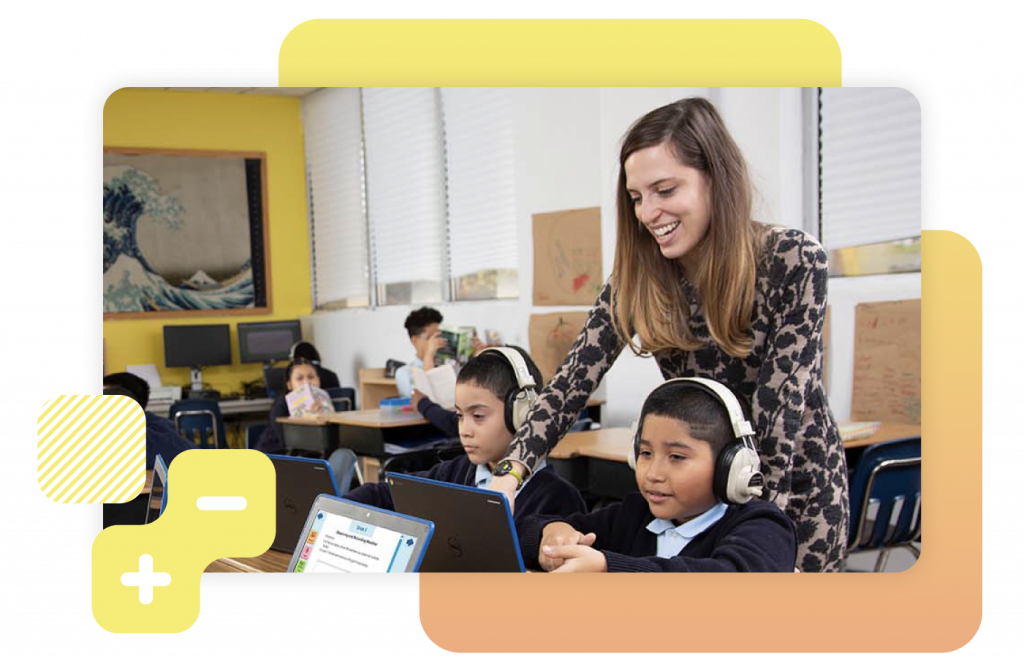
A dedicated team at Amplify with over 500 combined years of classroom teaching, school leadership, and assessment experience thoughtfully created mCLASS Math with teachers and students in mind.
Following research from leading math experts and an in-depth validation analysis through WestEd, data will be continuously released starting in spring 2025.

Sandra Pappas
Associate Director of Research

Patrick Callahan, Ph.D.
Educator and Founder of Math ANEX

Jason Zimba, Ph.D.
Chief Academic Officer of STEM
at Amplify
The mCLASS Math K–5 assessment system is designed to provide educators with reliable and valid measures to identify students needing additional support in mathematics and to inform instructional decisions. Preliminary data presents evidence supporting the psychometric quality of the assessment using the technical standards outlined by the National Center on Intensive Intervention (NCII) and state requirements for screening measures.
Data informs
instruction
mCLASS Math works alongside your core instruction, differentiation, and intervention. The data model behind mCLASS Math provides comprehensive data for each student across grades K–8, easily connecting teachers to the immediate next steps that will support, strengthen, and stretch all learners.
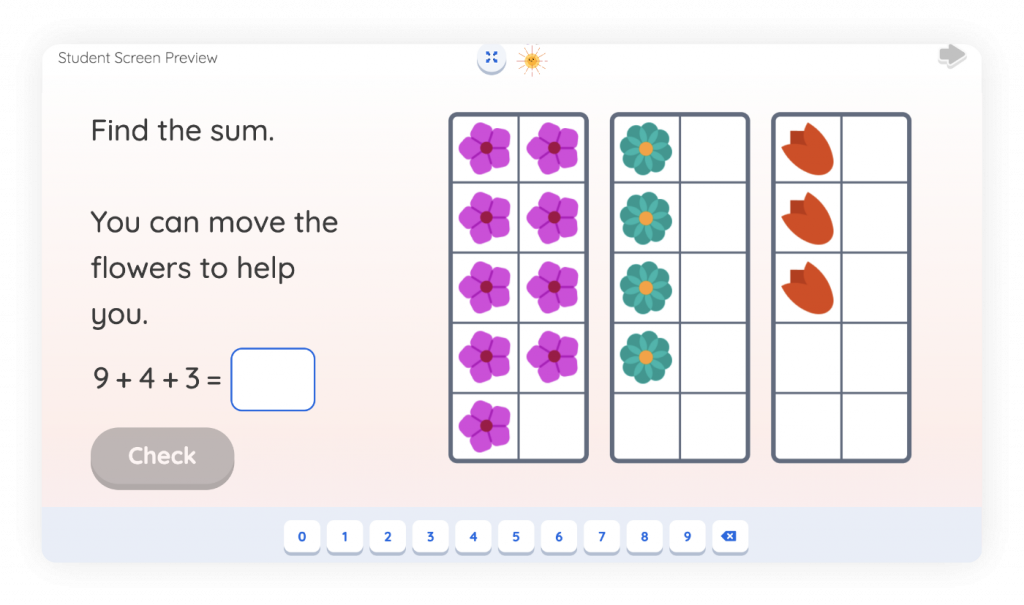
Personalized Learning accelerates student growth with daily, targeted 15-minute digital activities. Supported by a virtual tutor, students tackle individualized tasks linked to daily lessons, receiving just-in-time support to foster grade-level success.

Teacher-led, 15-minute Mini-Lessons can build grade-level proficiency by providing research-based, targeted intervention to small groups of students who need additional support.

Reinforce students’ understanding of concepts through collaborative, hands-on Centers (grades K–5). These student-led routines provide additional practice with vertical alignment across grade levels.
Fluency Practice uses spaced repetition, an evidence-based approach to promoting memory retention, to teach basic facts. The adaptive nature of the practice allows students to focus less and less on the facts they already know. We’ve partnered with Math for Love to iterate on the popular Multiplication by Heart to create Division by Heart and Addition and Subtraction by Heart I & II. These proven fluency decks—plus Skills Fluency for supporting procedural fluency practice—help students practice crucial skills independently.
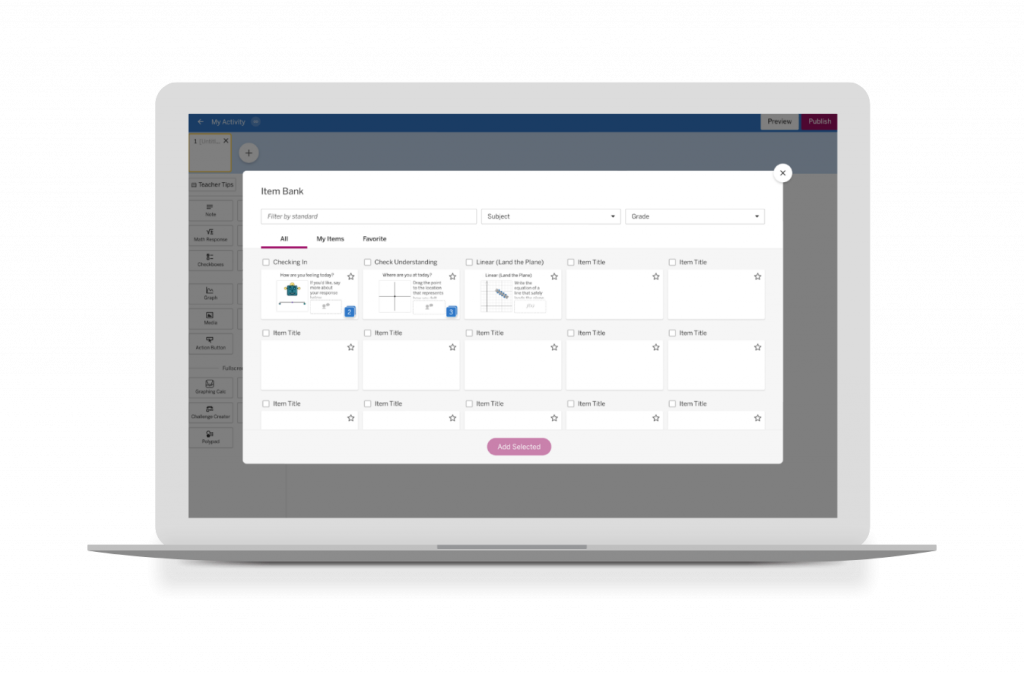
Item Banks provide space for teachers to create custom practice and assessments by using filters and searching for standards, summative-style items, and more.

All students should have access to fun and challenging problems. Extensions are 10- to 15-minute activities aligned to the most critical topics for the grade, providing flexible, low-lift activities for the whole class or targeted intervention to small groups of students ready for an extra challenge.
One cohesive math experience
As part of Amplify Desmos Math, Amplify’s comprehensive math suite, mCLASS Math provides a strong foundation of actionable data to help teachers diagnose and capitalize on student strengths. Amplify Desmos Math ensures that you have all the core, intervention, and personalized instruction you need to support each stage of a student’s math journey.
Welcome, Washington County!
S5.E6. Why skepticism is essential to the Science of Reading, with Dr. Claude Goldenberg
Amplify Desmos Math California
Welcome, K–8 Reviewers!
We’re honored to introduce you to Amplify Desmos Math California. We’re confident you’ll find this comprehensive program to be a powerful tool for bringing the vision of the California Math Framework to life in classrooms across the state.
Please start with the video on the right to learn how to navigate the program and access key features referenced within our submission. Below you’ll find additional resources to support your review.
Your Review Samples
As a curriculum that incorporates both print and digital resources, it’s important that you explore both our physical materials (delivered to you in grade-specific tubs) and our digital materials (accessible through our platform). We invite you to explore both types of resources using the instructions and tips below.
Print Samples
Your print samples should have arrived in grade-specific tubs with a copy of two Reviewer binders. The K-5 Reviewer binder is contained within the Grade K shipping box and the Grade 6-8 Reviewer binder can be located in the Grade 6 shipping box. As you begin the process of organizing your materials, please refer to the inventory checklist found inside each tub as well as within your Reviewer Binder.
Digital Samples
In order to access your digital samples, you’ll need to log into our platform using your unique login credentials found on a Digital Access Flyer inside of your Reviewer Binder. Once you have located the flyer:
- Click the orange button below to access the platform.
- Click “Log in with Amplify.”
- Enter the username and password provided on your Digital Access Flyer.
Navigation Tips
Below you will find helpful tips for navigating Amplify Desmos Math California. We recommend reading these pages alongside the program’s print materials and digital experience to gain a deeper understanding of the program.
Click the links below to read about navigating program features including:
- Navigating the print program (Grades K–1)
- Navigating the print program (Grades 2–5)
- Navigating the print program (Grades 6–8)
- Navigating the digital program
Built for California
The Amplify Desmos Math California program is designed around the vision articulated in the California Mathematics Framework to enable all California students to become powerful users of mathematics. Our program incorporates the latest research in student learning, meaning that we:
- Focus on the Big Ideas: Amplify Desmos Math California’s courses, units, and lessons are centered around the Big Ideas. Big Ideas, like standards, are not considered in isolation. In addition to each unit and lesson’s focal Big Ideas, Amplify Desmos Math California also provides connections among the Big Ideas across units and lessons.
- Center on open and engaging tasks: Amplify Desmos Math California is grounded in engaging tasks meant to address students’ often-asked question: “Why am I learning this?” Students are invited into learning with low-floor, high-ceiling tasks that provide an entry point for all. Open tasks in Amplify Desmos Math California provide the space for students to try on multiple strategies and represent their thinking in different ways, and allow student explanation and discussion to serve as the center of the classroom. All lessons offer both print and digital representations of lessons.
- Provide enhanced digital experiences: Amplify Desmos Math California includes digitally-enhanced lesson activities, incorporating interactive digital tools alongside print materials. These purposefully-placed resources allow students to visualize mathematical concepts, receive actionable feedback while practicing, encounter personalized learning support from an onscreen tutor, and engage in discussions about their thinking and approaches.
- Treat core instruction and differentiation as integral partners: The Amplify Desmos Math California curriculum provides teachers with lessons, strategies, and resources to eliminate barriers and increase access to grade-level content without reducing the mathematical demand of tasks. Every activity has multiple entry points to ensure that all students are supported and challenged. Intervention and personalized learning activities are directly connected to lesson content and offer students the individualized support as they dive into the mathematics.
Category 1: Mathematics Content/Alignment with the Standards
Standards Maps
The links below provide the Standards Maps for Amplify Desmos Math California for each grade level.
Evaluation Criteria Map
Linked here is the Evaluation Criteria Map for grades K–8. Please note that you will need to be logged into the digital platform to access the links in the Evaluation Criteria Map.
Standards for Mathematical Practice
The links below provide the alignment of Amplify Desmos Math California to the Standards for Mathematical Practice at each grade level.
Drivers of Investigation and Content Connections
Amplify Desmos Math California incorporates the Drivers of Investigation (DIs) and Content Connection (CCs) throughout the program. Throughout the year, students engage with open and authentic tasks of varying durations — from lesson activities to unit-level Explore lessons and longer course-level Investigations. Every lesson and investigation opportunity is grounded around the why, how, and what of the learning experience, and helps teachers bring mathematical concepts to life.

California English Language Development Standards
The links below provide the alignment of Amplify Desmos Math California to the California English Language Development Standards at each grade level.
California Environmental Principles and Concepts
Select lessons, performance tasks, and investigations across grade levels in Amplify Desmos Math California are aligned to one or more of the California Environmental Principles and Concepts. Click the links below to view how the California Environmental Principles and Concepts are represented in each grade level.
Category 2: Program Organization
Amplify Desmos Math California thoughtfully combines conceptual understanding, procedural fluency, and application. Each lesson is designed to tell a story by posing problems that invite a variety of approaches before guiding students to synthesize their understanding of the learning goals.
Big Ideas
Amplify Desmos Math California’s courses, units, and lessons are centered around the Big Ideas. In addition to each unit and lesson’s focal Big Ideas, Amplify Desmos Math California also provides connections among the Big Ideas across units and lessons. Please refer to Keeping the Big Ideas at the Center (linked below) for specific lesson designs and alignment with the Big Ideas for each grade level.
Program Structure
Amplify Desmos Math California combines the best of problem-based lessons, intervention, personalized practice, and assessments into a coherent and engaging experience for both students and teachers.

Lessons and units in Amplify Desmos Math California are designed around a Proficiency Progression, a model that steps out problem-based learning by systematically building students’ curiosity into lasting grade-level understanding.

In the Proficiency Progression, lessons begin by activating students’ natural curiosity and offering opportunities to generate new ideas through collaboration. Teachers are then able to refine ideas through intentional facilitation and guide students to grade-level understanding, while students retain the ability to use different strategies and methods to show their comprehension of the content. Students are provided ample opportunities to develop lasting understanding.
Scope and Sequence
Below you can view the scope and sequence for each grade level.


Lesson Design and Structure

Amplify Desmos Math California is designed with a structured approach to problem-based learning that systematically builds on students’ curiosity and allows students to grapple with the Big Ideas of the California Framework. Every lesson activity is organized into a Launch, Monitor, Connect format.
- Launch: The launch is a short, whole-class conversation that creates a need or excitement, provides clarity, or helps students connect their prior knowledge or personal experience, which ensures that everyone has access to the upcoming work.
- Monitor: As students work individually, in pairs, or in groups, teachers explore student thinking, ask questions, and provide support to help move the conversations closer to the intended math learning goal.
- Connect: Teachers connect students’ ideas to the key learning goals of the lesson, facilitating class discussions that help synthesize and solidify the Big Ideas.
Each lesson within Amplify Desmos Math California follows the same structure.
- Warm-Up: Every Amplify Desmos Math California lesson begins with a whole class Warm-Up. Warm-Ups are an invitational Instructional Routine intended to provide a social moment at the start of the lesson in which every student has an opportunity to contribute. Warm-Ups may build fluency or highlight a strategy that may be helpful in the current lesson or act as an invitation into the math of the lesson.
- Lesson Activities: Each lesson includes one or two activities. These activities are the heart of each lesson. Students notice, wonder, explore, calculate, predict, measure, explain their thinking, use math to settle disputes, create challenges for their classmates, and more. Guidance is provided to help teachers launch, monitor, and connect student thinking over the course of the activity.
- Synthesis and Show What You Know: The Synthesis is an opportunity for the teacher and students to pull all the learning of the lesson together into a lesson takeaway. Students engage in a facilitated discussion to consolidate and refine their ideas about the learning goals, and the teacher synthesizes students’ learning. Show What You Know is a daily assessment opportunity for students to show what they know about the learning goals and what they are still learning.
- Centers (K–5): Centers are hands-on activities for students in grades K–5 to play collaboratively to strengthen their understanding of key skills and concepts. In grades K–1, students have Daily Center Time built into every lesson.
- Practice and Differentiation: Daily practice problems for the day’s lesson are included both online and in the print Student Edition, including fluency, test practice, and spiral review.
Kindergarten–Grade 1

Grades 2–5

Grades 6–8

Routines
Amplify Desmos Math California features a variety of lesson routines. Instructional routines and Math Language Routines (MLRs) are used within lessons to highlight student-developed language and ideas, cultivate conversation, support mathematical sense-making, and promote meta-cognition. Both are called out at point-of-use within the Teacher Edition and Teacher Presentation Screens. Below are the types of routines used throughout the Amplify Desmos Math California curriculum:
Math Language Routines
- MLR1: Stronger and Clearer Each Time
- MLR2: Collect and Display
- MLR3: Critique, Correct, Clarify
- MLR5: Co-Craft Questions
- MLR6: Three Reads
- MLR7: Compare and Connect
- MLR 8: Discussion Supports
Instructional Routines
- Decide and Defend
- Notice and Wonder
- Number Talk
- Tell a Story
- Think-Pair-Share
- Which One Doesn’t Belong?
Category 3: Assessments
A variety of performance data in Amplify Desmos Math California provides evidence of student learning, while helping students bolster their skills and understanding.
Unit-Level Assessment
Amplify Desmos Math California has embedded unit assessments that offer key insights into students’ conceptual understanding of math. These assessments provide regular, actionable information about how students are thinking about and processing math, with both auto-scoring and in-depth rubrics that help teachers anticipate and respond to students’ learning needs.
- Pre-Unit Check: Each unit in grades 2–8 begins with a formative assessment designed to identify the student skills that will be particularly relevant to the upcoming unit. This check is agnostic to the standards covered in the following unit and serves not as a deficit-based acknowledgment of what students do not know, but rather as an affirmation of the knowledge and skills with which students come in.
- End-of-Unit Assessment: Students engage with rigorous grade-level mathematics through a variety of formats and tasks in the summative End-of-Unit Assessment. A combination of auto-scored (when completed digitally) and rubric-scored items provides deep insights into student thinking. All Amplify Desmos Math California End-of-Unit Assessments include two forms.
- Sub-Unit Quizzes: Sub-Unit Quizzes are formative assessments embedded regularly in Grades Kindergarten through Algebra 1. In these checks, students are assessed on a subset of conceptual understandings from the unit, with rubrics that help illuminate students’ current understanding and provide guidance for responding to student thinking.
- Sub-Unit Checklists: These checklists enable teachers to observe key skills and concepts that cannot be assessed on a pencil-and-paper assessment in Kindergarten–Grade 1. The checklists outline the supports students need to achieve mathematical growth and success.
- Performance Tasks: At the end of each unit in grades 3–8, there is a summative assessment performance task provided to evaluate students’ proficiency with the concepts and skills addressed in the unit.
Lesson-Level Assessments
Amplify Desmos Math California lessons include daily moments of assessment to provide valuable evidence of learning for both the teacher and student. Beyond formative, summative, and benchmark assessments, students also have opportunities for self-reflection with Watch Your Knowledge Grow. Students take ownership of their learning by reflecting and tracking their progress before and after each unit.
- Show What You Know: Each lesson has a daily formative assessment focused on one of the key concepts in the lesson. Show What You Know moments are carefully designed to minimize completion time for students while maximizing daily teacher insights to attend to student needs during the following class.
- Responsive Feedback™: Teachers have the ability to see and provide in-the-moment feedback as students progress through a digital lesson. Responsive Feedback motivates students and engages them in the learning process.
Diagnostic Assessment
Every grade level features an asset-based diagnostic assessment designed to be administered at the beginning of the year. Delivered digitally and to the whole class, our diagnostic assessment is uniquely designed to reveal underlying math thinking and identify what students know about grade-level math. With data beyond just right and wrong, teachers have the type of deeper level of insights need to take the right next step.
CAASPP-Aligned Assessment Preparation
Amplify Desmos Math is designed to support students’ mathematical development through problem-based learning, differentiation, and embedded assessments. The program’s emphasis on conceptual understanding, procedural fluency, and application aligns with the mathematical practices and content standards assessed by the CAASPP.
Amplify Desmos Math California includes a CAASPP-aligned Item Bank. This standards-aligned bank of questions allows teachers to filter and search by grade and standard to find items. Once assigned on the digital platform, students will experience CAASPP-like practice with the online digital tools.
Data and Reporting
Amplify Desmos Math California provides teachers and administrators with unified reporting and insights so that educators have visibility into what students know about grade-level math—and can plan instruction accordingly for the whole class, small groups, and individual students. Reporting functionality integrates unit assessments, lesson assessments, diagnostic data, and progress monitoring for a comprehensive look at student learning. Program reports show proficiency and growth by domain, cluster, standard, and priority concept using performance data from unit assessments, then highlight areas of potential student need to allow teachers to modify their instruction and target differentiated support.
Administrator reporting provides a complete picture of student, class, and district performance, allowing administrators to implement instructional and intervention plans.
Category 4: Access and Equity
The Amplify Desmos Math California curriculum provides teachers with lessons, strategies, and resources to eliminate barriers and increase access to grade-level content without reducing the mathematical demand of tasks. Our lessons are developed using the Universal Design for Learning (UDL) framework to proactively ensure that all learners can access and participate in meaningful, challenging learning opportunities.
Every activity has multiple entry points to ensure that all students are supported and challenged. Intervention and personalized learning activities are directly connected to the day’s content and offer students the individualized supports they need to be successful.
Each lesson and unit contains guidance for teachers on how to identify students who may need support, students who need to keep strengthening their understanding, and students who may be ready to stretch their learning. In addition, teachers are provided with recommendations for resources to use with each group of students.
Universal Design for Learning
Each lesson in the program incorporates opportunities for engagement, representation, action, and expression based on the guidelines of Universal Design for Learning (UDL).
- Multiple Means of Engagement: Students engage in both print and digital learning, and are regularly participating in discussions and hands-on activities. Students are invited to build their own challenge for other students to solve, which provides opportunities for choice and
autonomy, as well as joy and play. - Multiple Means of Representation: Students are encouraged to demonstrate their learning using mathematical representations, both print and digital, and regularly engage with their peers in analyzing multiple possible solutions. Classes engage in open-ended discussions about what individual students notice and wonder about mathematical concepts.
- Multiple Means of Action and Expression: Learners differ in how they navigate learning environments and express what they know. Students can communicate their ideas in multiple ways, including in print, sketching, uploading photos, or recording an audio response.
Accessibility
Lesson facilitation supports
Every lesson includes at least one specific suggestion the teacher can use to increase access to the lesson without reducing the mathematical demand of the tasks. These suggestions address the following areas:
- Visual-spatial processing
- Conceptual processing
- Executive functioning
- Memory and attention
- Fine motor skills
Accessibility tools
Students have the ability to control accessibility tools so that each learning experience is customized to their individual needs. In many instances, these tools can be turned on or off at any point of instruction.
- Text to speech: Reads text instructions to students in multiple languages
- Enlarged font: Increases the size of all text on screen
- Braille mode: Includes narration of digital interactions
- Language selection: Toggles between languages
Differentiation: In-Lesson Teacher Moves
Within every lesson activity, teachers can use the suggestions in the Differentiation Teacher Moves table to provide in-the-moment instructional support while students are engaged in the work of the lesson. This table can help teachers anticipate the ways students may approach the activity, and provides prompts that they can use during the lesson to Support, Strengthen, and Stretch individual students in their thinking. Teachers are provided with clear student actions and understanding to look for, each matched with immediately usable suggestions for how to respond to the student thinking illustrated in each row of the table. In addition to using these suggestions in the moment as teachers monitor student work, teachers can review the Differentiation table in advance to help them anticipate how students are likely to approach the activity.

Differentiation: Beyond the Lesson
Teachers are provided with recommendations for resources to use with each group of students needing support, strengthening, and stretching after each lesson. Support, Strengthen, and Stretch resources include:
- Mini-Lessons: 15-minute, small-group direct instruction lessons targeted to a specific concept or skill
- Item Banks: Space for teachers to create practice and assessments by using filters and searching for standards, summative-style items, and more
- Fluency Practice: Adaptive, personalized practice built out for basic operations and more
- Centers (K–5): Lesson-embedded routines and practice for students that are vertically aligned across grade levels
- Extensions: Lesson-embedded Teacher Moves including possible stretch questions and activities for students
- Lesson Practice: Additional practice problems support every lesson
- Math Adventures: Strategy-based math games where students engage with math concepts and practice skills in a fun digital environment
- Lesson Summary Support: Support for students and caregivers that provides efficient explanation of the learning goal with clear examples
Math Identity and Community
The Math Identity and Community feature supports teachers in helping students build confidence in their own mathematical thinking, develop skills to work with and learn from others when doing math, and learn how math is an interwoven part of their broader community. The embedded prompts throughout the lessons are designed to highlight what it means to be good at math, the value of sharing ideas, and the power of flexible and creating thinking. Here are some examples of the Math Identity and Community supports embedded in each lesson:
- I can be all of me in math class. You will work with partners every day in math class. What do you want your partners to know about you?
- We are a math community. What does good listening look like and sound like in a math community?
- I am a doer of math. What math strengths did you use today?
Unit Stories
Every unit in grades K–5 contains a Unit Story. These Unit Stories are brief fiction stories read aloud by the teacher at the beginning of each unit that connect to the math of the unit and introduce characters that students will get to know as they engage in the unit. Teachers read the story aloud from their Teacher Edition while projecting illustrations for students from the story, found in the Teacher Presentation Screens for the story. Across the unit, the Unit Story context and characters are used at appropriate points to inspire and engage students in the math as well as in reflections about their math identity and community.
Math Language Development
Every lesson in Amplify Desmos Math California includes opportunities for all students to develop mathematical language as they experience the content. Amplify Desmos Math California purposefully progresses language development from lesson to lesson and across units by supporting students in making their arguments and explanations stronger, clearer, and more precise. This systematic approach to the development of math language can be broken down into the following four categories of support:
- Vocabulary: Units and lessons start by surfacing students’ language for new concepts, then building connections between their language and the new vocabulary for that unit. This honors the language assets that students bring into their learning.
- Language goals: Language goals attend to the mathematics students are learning, and are written through the lens of one or more of four language modalities: reading, writing, speaking, and listening.
- Math Language Routines: Math Language Routines are used within lessons to highlight student-developed language and ideas, cultivate conversation, support mathematical sense-making, and promote meta-cognition.
- Multilingual/English learner supports: Supports for multilingual/English learners (ML/ELs) are called out at intentional points within each lesson. These specific, targeted suggestions support ML/ELs with modifications that increase access to a task, or through development of contextual or mathematical language (both of which can be supportive of all learners).
Multilingual and English Learner Supports
Partnership with English Learner Success Forum
Amplify partnered with the English Learner Success Forum (ELSF), a national nonprofit organization that advocates for high-quality instructional materials that are inclusive of multilingual learners. ELSF reviewed Amplify Desmos Math California, and provided directional guidance and feedback to ensure that the program reflects their research-based instructional strategies for multilingual/English learners.
Math Language Development Resources
Our Math Language Development Resources book contains lesson-specific strategies and activities for all levels of English Learners (i.e., Emerging, Expanding, Bridging). With support for every lesson, teachers are empowered to help all students, regardless of their language skills, to participate fully, grasp the material, and excel in their mathematical journey.
Multilingual Glossary
Amplify Desmos Math California includes a digital glossary for languages other than Spanish. Translations will be provided for up to nine languages.
Spanish Version
Amplify Desmos Math California will include Spanish student-facing materials beginning in the 2026–27 school year.
Category 5: Instructional Planning and Support
Amplify Desmos Math California includes a variety of embedded instructional supports to empower teachers to lead effectively and gain actionable insights into student growth and progress. Teachers are equipped with a comprehensive set of resources designed to fulfill the requirements of Category 5.
Grade-level concepts
Within the Teacher Edition front matter:
- Scope and sequence
- Big Ideas, Drivers of Investigation, and Content Connections
- Grade level standards
- Standards for Mathematical Practice
- English Language Development Standards
- Environmental Principals and Concepts
Within each Unit and Sub-Unit Overview:
- Big Ideas, Drivers of Investigation, and Content Connections
- Math that Matters Most
- Grade level standards
- Standards for Mathematical Practice
- English Language Development Standards
- Environmental Principals and Concepts
Within each Lesson:
- Big Ideas, Drivers of Investigation, and Content Connections
- Grade level standards
- Standards for Mathematical Practice
- English Language Development Standards
- Environmental Principals and Concepts
How to implement the program
At the course level (within the Teacher Edition front matter):
- Navigating the Program (both print and digital)
- Facilitating Lesson Activities with Launch, Monitor and Connect
- Overview of the Digital Facilitation Tools
At the lesson level:
- Suggestions for timing
- What materials to prep
- How to organize and group students
- Key lesson takeaways with the Synthesis
- Recommendations for Differentiation
- Strategies for intervention and extensions (in the Intervention, Extensions, and Investigation Resources book)
At the activity level:
- Differentiation recommendations
- Accessibility tips
- ML / EL tips
- Teacher look-fors
- Recommended Teacher Moves
- Prompts for guiding student thinking
- Sample student responses
Development of Math Language
A variety of language development supports are provided within the Student and Teacher Editions and Math Language Development Resources book.
At the lesson level:
- Diagrams and visuals
- Sentence frames and word banks
- Graphic organizers, including Frayer models
- Vocabulary routines
- Embedded language supports aligned to the CA ELDs
- Lesson-specific strategies for Emerging, Expanding, and Bridging
At the unit level:
- Words With Multiple Meanings
- Contextual vocabulary
At the course level:
- English/Spanish cognates
- Multilingual Glossary
Other Curriculum Guidance
- Additional Practice Resources book
- Assessment Resources book
- Assess and Respond guidance paired with each assessment opportunity
- Show-What-You-Know activities
- Answer keys and rubrics
- Performance tasks

Our research
Amplify Tutoring
Amplify Tutoring supports—and accelerates—student proficiency in foundational literacy and mathematical skills. Aligned to high-impact tutoring (HIT) design principles, it features evidence-based practices grounded in Amplify’s data-driven mCLASS® products and high-quality literacy and math instructional materials.
Efficacy

Amplify Tutoring: 2021–2022 Data Summary: A nation at risk: disrupted learning: Post Covid, Amplify Tutoring offered programs for thousands of students.
2022–2023 Data Summary: Accelerating learning through high-impact tutoring: Amplify has scaled high-impact tutoring solutions.

Amplify Tutoring 2023–2024 Impact Summary: Students in Amplify Tutoring make outsized reading gains, showing the promise of high-impact tutoring, as 2024 NAEP reading results remain below pre-pandemic levels.

Student Impact and Supports for High-impact Tutoring in Texas 2023–2024: High-impact tutoring scaled across Texas helped accelerate students’ reading growth.

High-Dosage Tutoring: Accelerating Learning in Ohio 2024–2025: Ohio students in Amplify Tutoring made reading gains as the state prioritized high-impact tutoring.

Explore more of our research.
Learn more about the research behind our programs.


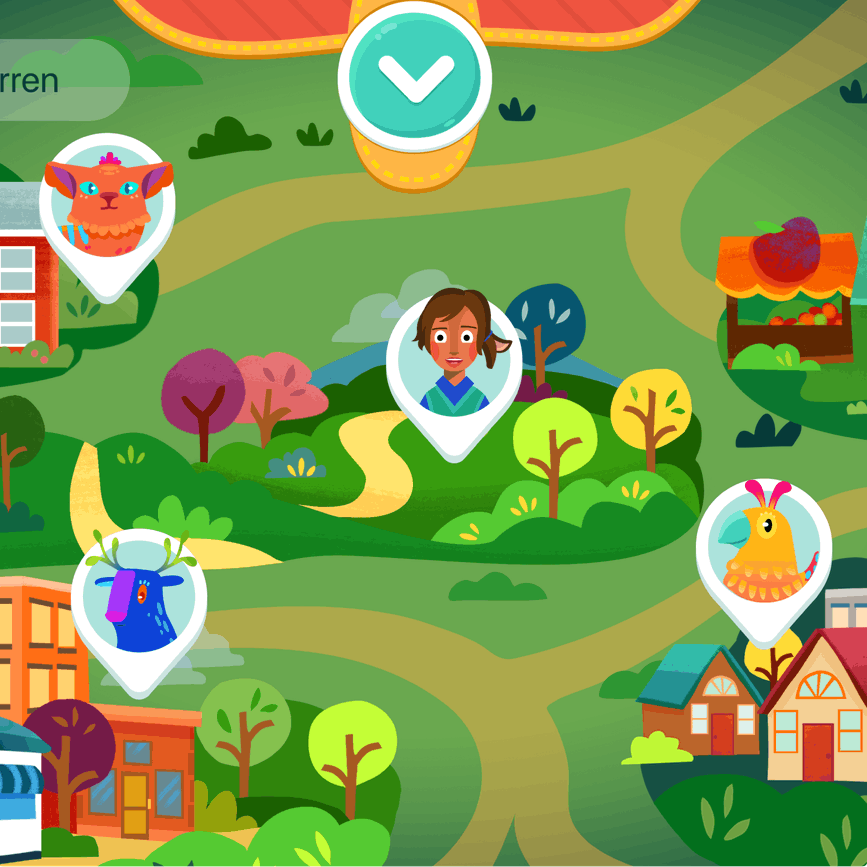
Building and Accelerating Math Understanding through Reengagement Activities
Tuesday, 4pm ET
It’s the middle of the school year and you have students all over the map—some are ahead, some are behind, and others are holding steady at grade-level. But how can we push all students a step further while reinforcing conceptual understanding and engaging all learners? Join this session to unpack how assessment, intervention, and reengagement activities work together to welcome all students into the math while accelerating learning.
High-impact, evidence-based programs that help students make gap-closing gains in reading and math
Amplify Tutoring engages students and drives measurable academic gains. We partner with districts to ensure that children become confident, proficient readers and mathematical thinkers.

About Amplify Tutoring
Grounded in evidence-based practices and taught by caring, consistent tutors, our high-impact tutoring programs use high-quality instructional materials and data-driven mCLASS® products to support and engage students.
- Personalized, data-driven instruction
- Research-backed solutions tailored to support your Multi-Tiered System of Supports (MTSS) framework
- Customizable—before, during, or after school; year-long, semester-long, and summer programming
- Comprehensive, hands-on program management and staffing support
Amplify Literacy Tutoring supports K–6 readers through engaging, systematic instruction aligned to the Science of Reading and driven by mCLASS DIBELS® data.
Amplify Math Tutoring accelerates student achievement in grades 3–5 and builds students’ confidence in speaking, writing, and thinking mathematically.
More than a program: a true partner
Hear directly from district leaders and educators who’ve experienced the Amplify Tutoring difference. In these candid conversations, they share how we partner to deliver solutions for schools, gains for students, and support for teachers.


Our impact
Amplify Tutoring accelerates learning for students who need it most. Students in Amplify Tutoring are more likely to achieve outsized academic gains than similarly at-risk peers in the same schools who are not enrolled in the program.
Amplify Tutoring has been awarded the National Student Support Accelerator (NSSA) Tutoring Program Design Badge by Stanford University!
Learn moreReliable, easy-to-read data
With valid and reliable mCLASS assessments and real-time reporting always within reach, everyone involved in a child’s learning journey—from teachers and tutors to school leaders and families—can support student growth.
- Teachers have visibility into students’ data and all tutoring lesson content.
- School and district administrators receive regular tutoring attendance and progress-monitoring reports.
- Caregivers receive Home Connect letters and activities to help their child practice foundational skills at home.


High-quality instructional materials that power Amplify Literacy Tutoring
Amplify Literacy Tutoring includes high-quality resources to support students’ growth.
Targeted lessons generated by precise data
mCLASS Intervention is a research-backed, ESSA rated program that targets instruction based on students’ mCLASS DIBELS 8th Edition assessment results. With engaging lessons aligned to the Science of Reading that adapt based on students’ progress monitoring results, mCLASS Intervention streamlines time-consuming data analysis for teachers and makes sure that tutoring focuses on the literacy skills students need.


Transparency into student performance
mCLASS DIBELS 8th Edition is our nationally normed benchmarking and progress monitoring assessment tool to measure students’ foundational literacy skills. Students take the benchmark assessment three times a year and progress monitoring occurs every 7–10 lessons in between.
Proven impact for students who need it most
Boost Reading delivers targeted, adaptive practice that meets students where they are, while teachers get simple and meaningful insights into student progress. The program consistently moves students toward grade-level proficiency with just 30 minutes of use per week. Students can continue learning through Boost Reading between tutoring sessions or at home.

High-quality instructional materials that power Amplify Math Tutoring
Amplify Math Tutoring includes high-quality resources to support students’ growth.
Intervention Mini-Lessons aligned to core instruction
Amplify Desmos Math Mini-Lessons provide targeted intervention for students who require additional support or need more time. These lessons are aligned to the most critical topics throughout a unit; they enhance conceptual understanding while improving procedural fluency and application.

Valuable insights into student mathematical thinking
mCLASS Math is our benchmarking and progress monitoring assessment tool. Students take the benchmark assessment three times a year; progress monitoring occurs every 7–10 lessons in between.
Personalized practice—anytime and at home
Fact fluency practice provides students with regular practice beyond rote memorization. The program is used during tutoring sessions and is available on non-tutoring days. Students also have access to Boost Math’s independent learning activities, to continue practicing between tutoring sessions or at home.

Consultation and collaboration
Amplify Tutoring tailors our support for educators, schools, districts, caregivers, and state-level leaders, helping to realize the promise of high-impact tutoring programs. Through collaborative partnerships at every level, Amplify Tutoring engages communities in driving academic improvement and boosting attendance.
Our services can include:
Program design consultation: Amplify Tutoring offers expert program design consultation services to help schools and districts create effective and scalable high-impact tutoring programs.
Tailored onboarding: We provide customized training sessions for school, district, and state leaders, ensuring that Amplify Tutoring services are integrated smoothly into existing systems.
Ongoing professional development and coaching: Our program management includes continuous training, coaching support, and office hours with pedagogical experts to fortify the program’s success and adaptability.
Caregiver engagement: We offer resources and support for families and caregivers, including tips for at-home support, helping them stay informed and involved in their child’s progress.
Seamless communication and support: We provide transparent communication and engage all stakeholders—district and school leaders, teachers, caregivers, and students—to keep everyone aligned and informed.
Data reporting: We provide detailed reports and analytics to district and school leaders, giving them the power to monitor progress, make data-driven decisions, and celebrate successes.
Amplify Tutoring is part of a connected early literacy and math suite.
Our literacy and math suite programs are designed to support and complement each other in a Multi-Tiered System of Supports (MTSS). Learn more about our related programs.



AMPLIFY DESMOS MATH FLORIDA
Welcome, Palm Beach reviewers!
We’re honored to introduce you to Amplify Desmos Math Florida, and confident this comprehensive program will be a powerful tool in classrooms across your district.
Please start with the video on the right to learn more.
Next, view this video for an in-depth look at a lesson from both the Teacher and Student Editions.
Accelerated 7
Visit http://learning.amplify.com/.
To further support your review.
Select Log in with Amplify and use the login credentials in your submission documents.


- Palm Beach Rubric Response
- Accelerated 7 Standards Correlation Amplify Desmos Math Florida
- Amplify Desmos Math Florida Program Guide
- IM7 Standards Alignment
- Grade 7 Multilingual Glossary
- Grade 8 Multilingual Glossary
- Amplify Desmos Math Florida Multilingual Resources
Welcome, Montgomery County educators!
Introducing Amplify Desmos Math, a curiosity-driven program that builds lifelong math proficiency. Each lesson poses problems that invite a variety of approaches before guiding students to synthesize their understanding of the learning goals. Students encounter math problems they’re eager to solve, while teachers spend more time where it’s most impactful—creating a collaborative classroom of learners.
Learn more about the program and begin your review below.

About the program
Taking the IM content further.
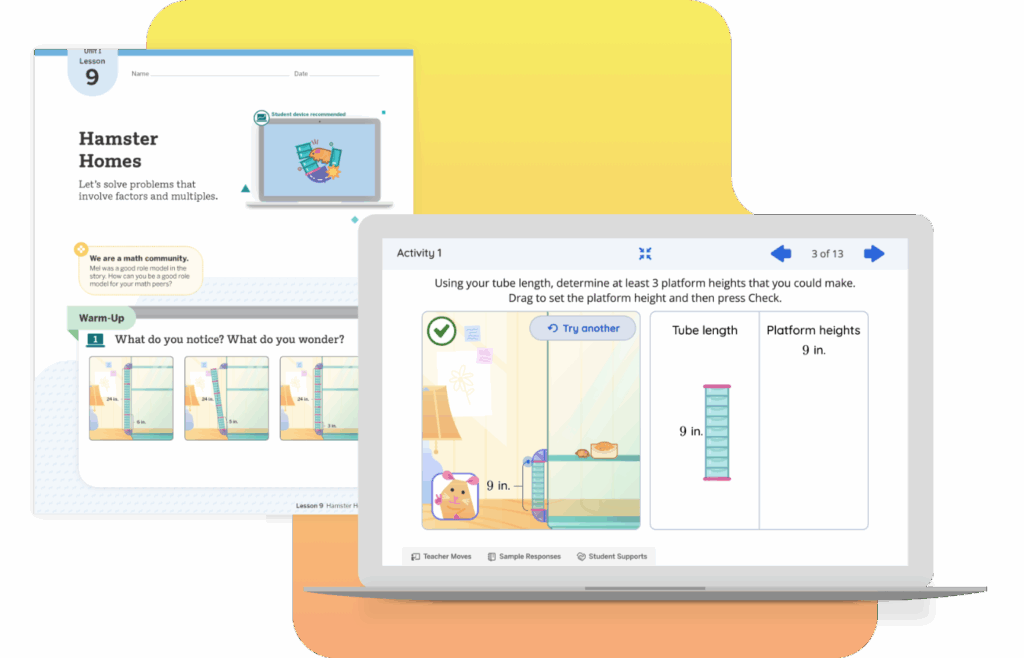
Amplify Desmos Math is a curiosity-driven program that builds lifelong math proficiency. Each lesson poses problems that invite a variety of approaches before guiding students to connect their understanding of the learning goals.
Students encounter math problems they’re eager to solve, while teachers spend more time where it’s most impactful: creating a collaborative classroom of learners.
We chose to base our program on the extensively field-tested IM K–12 MathTM authored by Illustrative Mathematics. IM K–12 Math is a problem-based curriculum. It asks students to grapple with well-designed and thoughtfully sequenced real-world mathematical problems to build their understanding of how to efficiently solve them.
Begin your review to see how we’ve taken the IM K–12 Math content further.
Begin your review
Click here to explore samples of print Amplify Desmos Math materials.
To explore the full program and digital lessons, click the orange button below or navigate to learning.amplify.com and select “Log in with Amplify,” then log in with the credentials below.
- Username: t1.mcpsadm@demo.tryamplify.net
- Password: Amplify1-mcpsadm
Resources to get started
Once logged in, check out the PD Library to see teaching tools such as videos of demo lessons and pacing guides.
To learn more about Progress Monitoring with mCLASS Math, view the mCLASS Math program overview walkthrough.
To review parent resources, explore the Amplify Desmos Math Caregiver Hub, which includes caregiver resources for each unit and information on how to support math learning at home.
In addition to the PK-A1 Amplify Desmos Math courses, Amplify has responded to the state’s Request for Information (RFI) for the development of an Integrated Mathematics Algebra 1 course aligned to the new Maryland mathematics standards. We intend to work with the state on their timeline and expectations in support of statewide implementation in school year 2027-2028. We would value an opportunity to collaborate with MCPS as we move forward with exploration on the development of this course, preparation for the transition during school 2026-2027, as well as planning for Integrated Mathematics Algebra 2.
Standards alignment
Click the links below to view a correlation of Amplify Desmos Math to the Maryland College and Career Ready Standards for Mathematics.
Amplify Desmos Math PreK Resources
- PreK Sample Lessons
- Amplify Desmos Math PreK Overview Brochure
- Amplify Desmos Math PreK Scope and Sequence
Amplify Desmos Math Accelerated 6/7 Resources
S4 – 02. Bethany and Dan share their math biographies

In this episode, co-hosts Bethany Lockhart Johnson and Dan Meyer get personal and share their “math bios”—their early experiences with math and how those experiences turned them into the educators they are today.
Explore more from Math Teacher Lounge by visiting our main page.
Dan Meyer (00:00):
We’re recording. What’s up, everybody. This is Dan Meyer with Math Teacher Lounge.
Bethany Lockhart Johnson (00:08):
And I’m Bethany Lockhart Johnson. We are so excited to be back. Season Four, Episode Two. Hi, Dan.
Dan Meyer (00:16):
Hey, Bethany, how are you doing today?
Bethany Lockhart Johnson (00:18):
I’m so excited to be talking with you! You know, as we record this, our reunion at NCTM is getting closer and closer.
Dan Meyer (00:28):
The NCTM live show is gonna be bonkers. I don’t think people are ready for it. You think you know what we’re about on MTL from listening to us, but the live show is gonna be outta control. You cannot imagine how many clowns and elephants Bethany wants to have at the live show. We’re still—we’re trying to talk her down from like three to one, but we’ll see.
Bethany Lockhart Johnson (00:44):
All I want is the t-shirt cannon. Because I used to go to these baseball games and they would have a t-shirt cannon. And I thought, I wanna operate a t-shirt cannon! So like, if I could be standing on stage aiming t-shirts at people who are jumping up and down requesting a t-shirt? I don’t know. Doesn’t that sound fun?
Dan Meyer (01:01):
Sounds awesome. High point of my college education was catching a t-shirt. No, it was—it was a burrito. It was a burrito cannon. But I think it was just a t-shirt cannon, but it was a burrito cannon. And I caught a burrito at a game and it was probably the most memorable moment of all of college education for me.
Bethany Lockhart Johnson (01:16):
Was the burrito still warm?
Dan Meyer (01:18):
Oh yeah. I think it got—like, I think it might’ve been warm at one point and then it got warmed back up through the muzzle velocity of the cannon. So it was a pretty great system they had going on there. <Laugh> Yeah. <Laugh> Anyway, I’m off topic, but, we’re thrilled to—I’m thrilled to chat with you and we’re thrilled to be listened to by you folks out there in MTL land. In the lounge itself. We got a fun show today.
Bethany Lockhart Johnson (01:40):
So if you listen to Episode One—which if you haven’t, hope you go back and listen to it—if you listen to Season Four, Episode One, you’re gonna hear—we asked Huon, KT, who is this delight of a joyful teacher. We asked her to talk to us about what’s her math bio. And we want to ask all of our guests—like, I wanna go back and ask every single guest we’ve ever had to tell us their math bio.
Dan Meyer (02:06):
Yep.
Bethany Lockhart Johnson (02:06):
Because, while seemingly simple in nature, our students enter our math classroom already having had this relationship with math and these notions about their role in math or what they think about math. And it impacts our school year with them if we’re a teacher. And it impacts our relationship with math as we move through our education and beyond. Right? And I I’m so excited about this question, ’cause I think it also ties into this theme for Season Four, which is joyful math, and diving into “When has math felt joyful? When has it not? Does it feel like—how do we think about how our math bio, our relationship with math, has evolved into a joyful or less joyful place?”
Dan Meyer (02:54):
I get it. And what’s really key here, I think, is that teaching more than other professions is a generational profession. You know what I’m saying? Like, no one is like, “Well, you know, I sold insurance to you and now you’re selling insurance to, you know, my grandkids; that’s amazing!” But people are always posting photos when, like, you teach someone who then becomes a teacher later. Teaching is a generational sort of thing. So the kinds of joyful experiences that we offer or don’t offer students now affect the experiences that students who haven’t even been born yet will have, you know, some 20, 30 years later. That, to me, is a trip. And well-worth exploring, you know, how we got here, mathematically speaking.
Bethany Lockhart Johnson (03:39):
I remember a friend had sent me this image of an assignment that her son got that was asking for their Mathography. They wanted to know about their history of mathematics. And this was their first assignment. And this teacher, I would like to imagine, read them all and used it to inform conversations about students’ relationship with math. And, you know, some of the questions they asked were thinking about whether you consider yourself, quote, unquote, “good at math.” Like “what kind of experiences have you had? What do you like or dislike about math? What is, you know—what do you expect to learn in math this year?” Just asking students to actually pause and examine and reflect on their relationship and then also looking forward to, like, what kind of a classroom community do we wanna create? And I loved that assignment. And yeah, so today’s episode Dan, guess what?
Dan Meyer (04:32):
What’s going on? What’s happening?
Bethany Lockhart Johnson (04:33):
I figured we should ask each other about our math bio.
Dan Meyer (04:39):
I think the people out there would love to know this about us. ‘Cause you know, we’re both awesome. But also what’s really cool here is that like, I don’t know this about you. Like not, not a lot. You know, the folks at Amplify, they kind of assembled me and Bethany together in the same way that record labels assembled pop boy bands, girl bands, that kind of thing, back in the day. You know, grabbing some stars from screen or film and just like throwing ’em together and saying, “All right, now you’re here to perform together.” And so it’s just a really good moment for us to, like, settle back and just know who we’ve been working with for the last three seasons and change here. I love it.
Bethany Lockhart Johnson (05:15):
Well, I don’t know. I don’t actually agree with that, Dan. Because don’t you remember? We knew each other beforehand. And while I would like to think of us as…oh, I’ll say One Direction—well, no, One Direction is now defunct. Who’s another band that got formed by one of those shows and is still together and still—
Dan Meyer (05:33):
BTS! K-Pop, you know! Let’s go!
Bethany Lockhart Johnson (05:35):
K-pop. BTS.
Dan Meyer (05:38):
Let’s go, Bethany <laugh>.
Bethany Lockhart Johnson (05:39):
So can we incorporate some K-pop into the NCTM Math Teacher Lounge live episode? Don’t answer now. Don’t answer now. OK. So not only are we gonna share our math bios, but we want to encourage you listeners to share your math bio with somebody in your life. It could be a child in your life, maybe talking to your kiddo about what was it like. What was math like for you? It could be a student that you have. It could be a partner, a friend, a parent. I mean, the sky’s the limit. Share your math bio. And most of all, share with us. We wanna hear about your math bio and you can share it with us at Twitter, at MTLShow, or in our Facebook group, Math Teacher Lounge.
Dan Meyer (06:26):
Stop on by, please. All right. I’m gonna just share like, just a couple of quick, signposts. Not the full bio. Gotta leave them wondering about something here. But here’s a few quick highlights and lowlights of my math bio and how, maybe, it made me the teacher that I was and the educator I am. Is that cool?
Bethany Lockhart Johnson (06:44):
Wait, I didn’t even, I didn’t ask you yet.
Dan Meyer (06:46):
Ask me what?
Bethany Lockhart Johnson (06:47):
Hey, Dan!
Dan Meyer (06:49):
Is there like a magical word? Like, what’s your math bio? <Laugh> Oh, go for it. No, no, that’s right. They won’t know what I’m talking about. Why is he talking about his math bio? Bethany—
Bethany Lockhart Johnson (06:57):
That whole lead-in that we just gave? They might not know.
Dan Meyer (07:00):
Yeah. We just talked about math bios for the last 20 minutes. But yeah, they might not know what we’re—
Bethany Lockhart Johnson (07:04):
<laugh> So Dan, why don’t you go first? ‘Cause I know you were gonna ask me to go first, but why don’t you go first? Dan? What’s your math bio?
Dan Meyer (07:12):
Oh, wow. Well, thank you for the formal invitation to share my math bio, Bethany Lockhart Johnson. So, I’ll just share—I just wanna share a couple items here, not the full history. Gotta leave ’em—leave a little mystery in there, you know what I’m saying? But here’s a few highlights and lowlights, and I think what it means for me as an educator. So, I was homeschooled for eight years. That was big—did a lot of math learning on my own. Couple of lowlights from that, a lot of highlights, in terms of just like being able to, like, learn at my own rate and just jump on ahead and pursue different wacky things. But I tried to switch into public school in fourth grade and I lasted, um, four hours. I didn’t even go to class. I enrolled and then it was like, boom, I was out of there. Because we went to the school; we met the teacher, saw the room, very nice person and place. But I got the homework assignment and the homework assignment was gibberish. I had no idea what to do and such was this feeling of just, like, despair and hopelessness, I was like, I cannot be a part of this. I remember the assignment. It was about identifying scalene, isosceles, and equilateral triangles. I’ll tell you this: I am quite good at that now. But at the time, like, I didn’t know what those words meant. And you know, at that moment we had Encyclopedia Britannica, could not Google this or even Ask Jeeves or AltaVista this so well back then. It just—it was an entry moment of failure and realizing that so much of math is like a, kind of a social kind of construct. And if you’re not part of that social circle, what can you do? So that was a bummer. Another bummer was eighth-grade math, learned it all by way of videotape. You know, put in the tape and watch—not gonna say the person’s name and not this person’s fault—but it was just like watching someone work on a whiteboard. Kind of a precursor to Khan Academy, kind of a drag. Went to high school—
Bethany Lockhart Johnson (09:02):
Wait, wait, wait, wait. We were—I’m not ready to jump to high school. Wait. Can you pause for just a second?
Dan Meyer (09:06):
Yeah. Rock on.
Bethany Lockhart Johnson (09:07):
I just need you to go back to the triangle thing. So in that moment, what did that mean for you that you had had all these experiences with math and then you encounter math in a completely different sphere, a public school, and it did not have a connection or meaning to you because prior to that, it sounds like it was pretty positive. Right? Explore these things you’re curious about; there’s not, like, a level you need to stick with…
Dan Meyer (09:33):
Yep, yep. Yeah. I think that’s right. Maybe it was a little bit of a classic, like, “Oh, I didn’t have a growth mindset; my mindset was like, ‘Oh, I’m good at math because I am, you know, born that way,’” and all of a sudden, that identity was, you know, thrown into question. And, you know, my foundation was all of a sudden quite shaky. And yeah, that’s—you know, I think I taught a lesson recently where I was like, “Hey, this whole thing with a less-than or equal-to sign and a greater-than or equal-to sign, like what those signs are: it’s just, it’s language. And if it’s confusing to you, it’s not because you’re bad at math; it’s ’cause language is oftentimes confusing ’cause people have to agree on it.” So I dunno, that sort of thing is kind of filtered in, filtered back in periodically, some sympathy for like how a lot of math is like just socially agreed upon ways of working with, you know, numbers, shapes, patterns, that kind of thing.
Bethany Lockhart Johnson (10:20):
OK.
Dan Meyer (10:21):
Anyway.
Bethany Lockhart Johnson (10:21):
- And in this home school—I have a lot of questions about that, but I’ll stick to one—were you in a community of people that you talked about these math ideas with? Were you homeschooled solo? You have a sibling, so I think you were together, right?
Dan Meyer (10:39):
Yeah. Yeah. I’ve got a twin sister. So we were, you know, like, right on with each other the whole way through there. And yeah, so we had—but it wasn’t, it wasn’t like a—it was a lot of individual work, with my flavor of homeschooling.
Bethany Lockhart Johnson (10:54):
- Got it. And the tapes—wait, before you go to high school, the tapes, the VHS tapes, which I’m just loving this image—
Dan Meyer (11:02):
Yeah.
Bethany Lockhart Johnson (11:02):
Was that a positive experience? Was that because that was an area of math that whoever was homeschooling you wasn’t that comfortable with? Why was it that route for the tapes, and what was that? Was that joyful for you?
Dan Meyer (11:15):
Yeah, definitely not joyful. Yeah, it was like, if you had questions, you couldn’t really ask them of the VHS tape. It didn’t work out so well in that way. And it was a lot of operational-type math. It was, you know—there was no give and take; it was all kind of take. From the video teacher. And yeah, I was doing that because my homeschool teacher, my mom, who is very smart in lots of areas, did not have the math knowledge or confidence, especially to help with math at eighth grade. And that was a big reason why, flash-forward to the next year, went to high school.
Bethany Lockhart Johnson (11:48):
Nice segue. OK.
Dan Meyer (11:50):
<laugh> You caught up to high school…I encountered just like four years of just crazy-good, just bonkers-good math teachers who just really changed a lot for me. Especially, Mr. Bishop and Mr. Cavender, very cool folks who did a lot. And especially, I think Mr. Bishop and Cavender both modeled for me what curiosity from a knowledgeable adult looks like. Like someone who, you know, now I can say to myself, “Oh, they were kind of like putting on an act of being very curious about answers they were hearing for the 2000th time from a student,” let’s say, but what a powerful experience that was for me to feel like, “Oh, wow, my thoughts are interesting to someone besides myself.” I got like, maybe it’s two real highlights that I’ll just point to, from my math bio that made me the math teacher and person that I am. Let’s see here. Maybe three, if you you’ll indulge me. One is just like the idea that you could do math wherever you have your brain, a pencil and a paper. And so I remember like in high school, I was in church with my family and kind of a little bit bored of whatever’s going on. And I just had the Bolton and I like drew a pentagon, a regular one, then a hexagon, a regular one, and kept on drawing, like adding sides to the shape. And it was like, it was becoming a circle. And, you know, I was able to take the area of each of those shapes and say, you know, “What happens as you send the number of sides to infinity?” And watch as the formula for area of a circle, Pi R squared, popped out. And it was kind of a literal religious experience, in that moment, just like, “Wow, like my brain’s so cool and math is so cool and paper and pencil’s so cool.” And so there’s that. Just that kind of experience was pretty awesome. And then I would just say like, I’ve had some really fantastic experiences with math in the world itself. Stuff like—let’s see, this is gonna invite more questions from Bethany, probably, maybe I should avoid—I got, I have a Guinness—I have a Guinness world record that’s almost 20 years old. This Guinness world record is—it’s old enough to drive basically at this point. And almost old enough to drink. But like it was—it was a record for chaining the longest paper clip chain together in 24 hours. And the only way I was able to break that record was through mathematics. Where, like, I would be finishing a box of clips. And I would say to my buddy who was there, “I just finished a box of clips.” And that person would type in the number of clips that I had just done. And then a mathematical formula that I had created would tell me how many—how long the chain was at that point. It was being rolled around a spool. And like, it’s just like, wow. So math just made this possible. You know, math revealed that the record I was trying to beat was beatable, because I did the math on it. It was, like, thousands of feet long in 24 hours. And other folks might be like, “Oh, like, that’s that’s huge!” But me, I was like, “All right, let’s divide this out. You know, divide by 24 hours in a day, divide by 60 minutes an hour, 60 seconds in a minute. Oh, that’s like one clip every four seconds. That’s really slow.” You know, think about that <counts aloud>, “Clip, two, three, four. Clip two, three…” It was just slow. So math helped me, you know, wreck that record. Which to my knowledge still still stands. Don’t get any ideas, Math Teacher Lounge Folks! Is this news to you, Bethany? You haven’t blinked in the last, like, five minutes. I’m curious if this is new.
Bethany Lockhart Johnson (15:20):
It is news to me. And I have so many questions. Because OK, if four seconds was slow, so then what was your like—so then I’m assuming a hundred clips per box? Like, what was the rate, you know, per box? How long did it take you to complete a box? What did this friend like? Did this friend stick with you for the whole 24 hours? Did you really do it for 24 hours? Or once you beat the record, did you rest? How did you account for biological function? Like, needs? Like a restroom?
Dan Meyer (15:51):
<Interrupting> Like what?
Bethany Lockhart Johnson (15:51):
Eating.
Dan Meyer (15:51):
Like what, Bethany? OK.
Bethany Lockhart Johnson (15:52):
Um, Sleep.
Dan Meyer (15:55):
So yeah, maybe we dive into some of the specifics in a different time.
Bethany Lockhart Johnson (15:59):
Just tell me one of ’em. Tell me one.
Dan Meyer (15:59):
I’ll just say. So as to discourage other Math Teacher Lounge listeners from taking this on—back off of the record, folks!—this was back in college, so I was a little more limber back then. But I did one—I think it was 1.8 seconds per clip. For an entire 24 hours. Just like, so just like think about it, would you? If you’re gonna step to me on this one, just think about that, OK? And then, and then, you know, make an informed decision.
Bethany Lockhart Johnson (16:28):
Wait. Wait, wait, I just wanna tell you one thing. I’m picturing somebody with a straw, and like, giving you water as you keep clipping. I’m picturing, like, music, I…
Dan Meyer (16:37):
That’s not far. That’s not far. That’s not far from—yeah.
Bethany Lockhart Johnson (16:40):
So many questions! OK. Go on. Sorry, sorry, sorry. Go on. This is your bio.
Dan Meyer (16:44):
We gotta, I gotta wrap this up. I wanna hear your bio. But, like, I would just say like this move to this sense that math is actually a thing that’s useful for more than just a grade; it’s useful for more than just, you know, the societal, you know, adulation that comes from being a math nerd. That kind of thing. And so that, I think that affected a lot of math teaching for me. And, if I gotta, like, summarize math teaching itself in a journey, it went from like, “Hey kids, aren’t I awesome?” to, “Hey kids, isn’t math awesome?” to “Hey kids, aren’t you awesome?” And like that journey was facilitated by lots and lots of people, you know, a lot of personal growth, but at this point, at one point I was like, “Hey, math can help you get records and whatnot. It’s really useful.” And now I’m like, “Wow, your brain’s just doing just really interesting things. I can help you understand how interesting those things are, and maybe make them more interesting, or interesting in a different way, with some help here.” Let’s put a pin in that. That’s the math bio.
Bethany Lockhart Johnson (17:50):
- So I have no doubt that if you ask someone in your life, listeners, for their math bio, that you will discover things about them that you never knew. Literally the questions that I have…I have so many question. And Dan is very good at, you know, bringing me back. Bring me back, like, come on, come on. But I just wanna say, overall, your journey seems pretty joyful. It seems pretty joyful. It seems pretty full of confidence. I don’t wanna say “ego” in a negative way, but I wanna say you were buoyed by these experiences that allowed you to feel like math was a place for you to thrive.
Dan Meyer (18:36):
Right.
Bethany Lockhart Johnson (18:36):
Where you could try out things. You could try it out and just, “I could do that!” Right? Like…your relationship just felt very, like…you felt like you had autonomy, agency, perhaps much like you, you operate in this world. Dan, is that, is that right <laugh>?
Dan Meyer (18:54):
Yeah, I think it’s fair to say. And without telling too much of her story, my twin sister with whom I share most things, including genetics, you know—she had a very different experience in math early on. She’s brilliant. She’s a doctor. And not, you know, the book kind of doctor that I am, but like a real, you know, medical doctor. She’s brilliant. But we were—we encountered different messages about who math was made for, early on in, you know, in our entire math learning. And she—we both digested the messages that we were sent, and took, you know, different, different paths because of them, for sure.
Bethany Lockhart Johnson (19:31):
Funny how that works. I thank you, Dan. I do. For in all sincerity, I appreciate you sharing that. And I think that it’s exciting to hear how it influenced your teaching. It feels like you want to cultivate those experiences for your students. And I’ve been in the room when you’ve presented; I was in a room where you taught a class live. It felt like you were making space for the students to have these aha moments. And it feels like in your work at Desmos, and now Amplify, you’re trying to create these products that allow folks to recreate these amazing math moments. Right? And that it’s for everyone and that it’s accessible and it can be very positive. I feel like I have this new perspective on kind of the energy you bring to your teaching. So thank you for sharing that.
Dan Meyer (20:24):
Yeah. Been a pleasure. Thanks for your questions here, Bethany. And it’s been—it’s been fun to reflect on it. And I do—I do feel very lucky in lots of ways. Privileged. Lucky. I know, like—I think the world has been set up for my success in lots of ways, as who I am. But I do just…yeah, I feel—I want more people to experience what it’s like when you walk into a math classroom and it’s like, “Hey, this place is for you. You have interesting thoughts about this. Let’s get ’em out.” So that’s awesome. I would love to hear about you and how you…I mean, we have taught different kinds of kids. You know, I taught kids who I think were somewhat set in, they’re a little bit more solid at secondary in who they are as a math learner. Like “I know who math is and who I am with math.” And I’m really excited to hear what your math bio allowed you to do with students who were perhaps open to the idea that they are very mathematical or at least not yet closed off to those possibilities. So, yeah. What are some of the high, the, you know, the high and low water marks of the making of Bethany Lockhart Johnson, math teacher? <Laugh>
Bethany Lockhart Johnson (21:24):
Thanks for asking, Dan. <Laugh> I’ve shared aspects of my math bio because I think it really informs the way that I talk to people about math and think about math. And I like to share it because I want folks to consider their own journey with math, as we like engage with problem-solving and sense-making and thinking about the students in our classroom. My dad is a math and computer science major. So he had a computer very early on. I wish he had invested in Apple early on when he had like one of the first Apple computers ever. And, sorry, dad, but it’s true. I do wish you had done that.
Dan Meyer (22:10):
I’m sure he does too.
Bethany Lockhart Johnson (22:11):
Oh, he does. So math and computers and conversations about counting, you know, it felt like it was kind of just normal. Like it was around me. And I went to Montessori, which is a private school that—oh, they have some public Montessori—but it’s very self-directed. And so we would have these kind of charts, these goals for the day that you explored. And so we would explore math in very, I don’t know, very organic ways, with these natural materials. And I feel like I excelled at math, but it wasn’t something that I was conscious of. It was just like, “Oh, well, yeah. Math, it’s, you know, something we do.” And then when I went to—when I left Montessori in fourth grade, I remember that year being a lot of like repetition. I was like, well, we did this. We covered this. And except for the mission project that we hadn’t done, that was all new. And that’s it. For another time I’ll share about that. But <laugh> then, they actually, I was moved with a group of students to the fifth grade math class, ’cause we had already done the work that we were doing. And so, it wasn’t that it felt like it came easily, but it did make sense. What we were doing made sense. And then it all kind of changed. There was a lot of change in my family. There was, like, missed school time. And we moved and I went to a new middle school and I was in this environment with students who—it was like an accelerated program. And so I was in this environment with students who were pretty competitive with each other. And I remember going—and I was not from of a competitive environment; like Montessori is not competitive. It’s not about that.
Dan Meyer (24:02):
Right. Right.
Bethany Lockhart Johnson (24:02):
It’s—it was very strange to me that I would be competing against anyone, even competing against myself. And I, you know, knew how to set goals. But it was a different level of energy. And I felt like, because I wasn’t competitive in that nature, I felt like that kind—I felt on the outside of a lot of the energy. Besides the regular, like, middle-school feeling outside of things. And I remember the first friend that I made. Hi, Susan! She had said to me, this was like maybe our second week of school, she’s like, “Oh, at lunchtime, come with me to math club.” And I was like, “OK.” And I remember walking into that room and I had no idea what was going on. And so that was one of the first times where I was just like, “Whoa, I have absolutely no concept of what they’re talking about or what.” These are my peers. I felt very—it was very—it was strange. It was strange. I was like, “This doesn’t feel like a space for me at all.” When I think ordinarily I was kind of excited about the idea of going to math club at lunch, you know? And over middle school, I kind of just got progressively more and more behind. It started with missing some work and then missing more and then checking out. And, you know, the problem was that I really made it about myself. That, like, it wasn’t something that I was then good at or could do. When really it was that well, pre-algebra, I was having a really hard time in like the rest of my life. And so I wasn’t real present in that class. And so when I got to algebra, it didn’t make a whole lot of sense. And then if I missed Monday, Tuesday, and Wednesday, well, Thursday is gonna be hard, you know? And, it just got progressively harder and harder. So I had this great idea that between eighth grade and ninth grade, I was going to take this accelerated geometry class. ‘Cause that was the ninth grade class, it was geometry. And I would take it. It was like geometry in three weeks or something. So then when I entered high school, I would’ve gotten this like jumpstart. But I wish I had said, “Oh, I’ll take this, and then in ninth grade I’ll take geometry.” So like I’ve already kind of gotten a preview of the material. But instead I went to the 10th grade math, which was like intermediate algebra, trigonometry. I had absolutely no clue what was going on. And I had a very, very difficult time and I wasn’t ready for that class. But it was exacerbated by the fact that this teacher felt very free to let the freshmen in that class know that they shouldn’t be in that class. That this class was for 10th graders.
Dan Meyer (26:49):
Oh wow. Oh, wow.
Bethany Lockhart Johnson (26:51):
And we had a rather contentious relationship. And I will never forget that we were in the hallway, and he says to me, “You don’t belong here.” And I’ve talked to—I’ve talked to a girlfriend of mine about her experiences with this teacher and she has the fondest memories.
Dan Meyer (27:13):
Wow.
Bethany Lockhart Johnson (27:14):
She—in fact, almost everyone I’ve spoken with, you know, if we are talking about past teachers or, “Oh, what was that class like?” I mean, they just have these wonderful memories! And for me, my sense of like belonging was already so on a tight rope anyway, that to have this adult, this teacher, tell me, “You do not belong here,” just crushed me. And in hindsight, I think he was saying like, “This class is too hard for you.” I mean, maybe. <Laugh> But all I heard was “You don’t belong here.” And I extrapolated it to connect to math and to anything having to do with math in general. And it just got worse and worse through high school in the world of math. My next math class was even—I had to repeat that class, and still didn’t understand what was going on, and felt more out of place, and, you know, it’s one of those things that I just kind of had started to accept that, I guess, math isn’t for me. I guess I’m just not a math person. Or whatever these stories are that I started to create and build and find evidence for around me that was informing that this wasn’t for me. And I had always done well in school. I was in, you know, accelerated classes. I felt like I was capable of problem solving. And yet in math, I just felt like I had all of this evidence saying that I didn’t belong there. And so when I went to college, I took whatever two math classes were—you know, I was in performing arts and then I did ethnic studies as well. And I remember you had to take two math classes that were GEs. There were these classes that if you don’t wanna deal with math, you go take those classes. And I was like, “Oh yeah, I’ll take that. I’ll take that.” The gulf widened, you know? <Laugh> And I didn’t feel like anxiety when I had to do things like balance my checkbook or navigate math in everyday spaces. It was just, it would never occur to me that I would like seek out opportunities to engage with math or think about it or talk about it.
Dan Meyer (29:35):
That is—yeah, that’s just so wild, how, I don’t know, like it’s often, from the student’s perspective, it is them in a vacuum with math, and the two of them interact and decide if, you know, if they’re right for each other. But from the grown-up perspective, it’s just, you know, it’s a little bit clearer that your story with math was not just you in math, but you with, you know, various external things happening. With family, various teachers playing their different roles—sometimes, you know, really tragic and horrible roles—and then like the compounding mathematical debt that it feels like you were kind of building up, as challenges in one year didn’t get resolved and moved into the next year and so on. And all that makes me wonder—it makes me, like really, really scared, first of all, because I would bet that your teacher might not even remember that moment, that for you is part of just a pivotal moment in your math story, and how many kids have I played—have I been a part of their story in that way and wouldn’t even recall? You know what I’m saying? So that’s a scary part. And then also I’m just wondering, like, how can we, how can we help kids who are in those moments recognize that, “Oh, this kid is like absent a bunch,” and give them more resources to be successful rather than say, “Well, you just gotta try harder now.” Those are things I’m wondering, hearing your story. Thank you for sharing that. I’d love to know more about how you then became a teacher and what all that did for you as you helped students.
Bethany Lockhart Johnson (31:06):
Well, but to answer what you were saying, it wasn’t that I wasn’t—I was always absent physically, but at least like mentally at that point, because it had become so difficult. It didn’t make sense to me. So I was just really checked out in math class, you know? So in hindsight, you know, as a teacher, for sure I can look back, and especially hearing these stories and these experiences my friend had with this teacher and just like chalks up as one of like her most favorite teachers ever! And you know, he clearly did a great job for so many students. But for me, and I think for some people, they would’ve taken those challenges and, you know, it would have fortified them in a different way or something. But for me, I took it upon myself to mean certain things about myself and about my ability and what I was capable of. And so I think, I think in some ways, you know, yeah, it’s all, it’s all interconnected. You know, when your students walk in the door, they’re not this—the things that are impacting them in their life are coming into the room with them. And I don’t think we can take that for granted and think, “Well, if they just focus hard enough…”
Dan Meyer (32:21):
Yeah.
Bethany Lockhart Johnson (32:23):
So let’s go back to my love of Oprah. You know, Oprah talks about living your best life. And something I really appreciate about Oprah is that she encourages you to examine, like, sticking points, right? Like she doesn’t just say, “Well, this…just pretend nothing ever happened, and everything’s fine!” You know, she really talks about making time for reflection. And I kind of got mad that anytime I thought about math, or math schooling came up. Or, you know, whatever, any time that came up that I just felt UGH about it. And I felt like a failure. And I’m like, “You know what, what if I took a math class? And I’m an adult at this point. I’ve graduated. I have—I’ve left college. I have my degrees. But I said, “What if I took a math class?” So I went down to, the city college and I found out that you have to take this exam, like a placement exam. And I went and took the placement exam. And I remember it’s one of the responsive tests where if you get it right, the next question’s a little harder. And so I’m taking it, panicking, because it’s getting more like…I just, you know. And I remember it placed me in like, whatever, Algebra Something, this class that was far more advanced than I thought I should be in. And I was like, there’s been a mistake! You know, and I went to the counselor and said, you know, “I got these results, but I couldn’t answer a lot of the questions on the test.” She’s like, “No, no, no, that’s how it works.” So I go take this class and the class was hard. And I decided that I was just gonna keep showing up. And every day before class, I kid you not, they had a little math…it was like a math center where you could go in and they had a bunch of tables and you’d sit at the table and you could sit and do your work or whatever. If you had a question, you walked up and put your name on a clipboard and then somebody would come and help you. So I did that, every single—like before every single class I would go in. I’d sit there. I’d do the work. I’d go. And I’d get help. Like somebody would walk over and you know, some kid for whom they’re like this…you know, they’re math—it might be you, Dan! It could be you! It could have been you! You know, would walk over and be like—
Dan Meyer (34:38):
Yeah, I was in Help like that. Naw, it’s awesome. Love, love those people. Yeah.
Bethany Lockhart Johnson (34:42):
And you know, I did it. And I did so well in the class. I did exceedingly well in the class. And I said—
Dan Meyer (34:50):
Take that! Take that, everything! Every other math experience!
Bethany Lockhart Johnson (34:53):
I said, what?
Dan Meyer (34:55):
Yeah!
Bethany Lockhart Johnson (34:55):
Wait a second.
Dan Meyer (34:56):
Yeah.
Bethany Lockhart Johnson (34:57):
And it was that I was present. I was not afraid to look at what didn’t make sense. And if something didn’t make sense, it didn’t mean there was something wrong with me. Whaaaaat?
Dan Meyer (35:10):
Yeah. Yeah.
Bethany Lockhart Johnson (35:10):
So I was just in such a different space. And then I took another math class and that class was even harder. And I did the same thing where I went to the little lab and, you know, and it just buoyed me. And it made me realize that, like, this story, that my experience with it was very powerful and that was a real lived experience, but that it didn’t have to define my relationship with math. But then! I decided I wanted to go back to school to become a classroom teacher. And I totally—this was a couple years after that math class experience. So now, you know, I’m healing my relationship with math through basic positive experiences, da, da, da, you know, doing other work. But fast-forward, for a whole number of reasons, decided to become a classroom teacher. And I freaked out. All of my—like, I’m studying for the GRE and the CSET and all the things you have to the hoops you have to jump through to apply to the masters program and the credential program. And I freaked out. I was so close to quitting, Dan. Because I was convinced that the reason I couldn’t be a classroom teacher is because I wasn’t capable in math. Like I was—it was all that resurfaced. And even though I now had evidence to say something different, to the contrary, it was still so visceral. And I was so scared. But I passed that Math CSET.
Dan Meyer (36:47):
Get it.
Bethany Lockhart Johnson (36:47):
I did well enough on the GRE—
Bethany Lockhart Johnson (36:50):
Yes!
Bethany Lockhart Johnson (36:50):
You know, I finished my credential. I worked really, really hard. I had to work so hard in my student placement, when I was student teaching for a fifth-grade class, ’cause I felt like, “Oh my God!” I mean, now I could do the mathematics, but I couldn’t TEACH it to someone, you know? But I had amazing professors at UCI, and my math professors really like just—and my mentor teacher! shout out to Jennifer! shout out to Phil!—these amazing mentor teachers who just loved teaching and who loved—like you said, you have these teachers in your life who you got to see the way that they listened to students. They taught me about that love of listening to students. And then I fell in love with, you know, CGI, cognitively guided instruction, and started learning all about all of these educators who just wanna learn from students’ thinking. And it was just so powerful. And I realize as a kindergarten teacher that I have this really special role in helping to create space for a positive school experience. Like we get to talk about—I talk about my students as mathematicians; they’re writers; they’re thinkers; they’re problem-solvers. And I also want to make space for parents. Some of them, this is their first kid in kindergarten, and they brought all of their experiences, a lot of it negative, that they had had with mathematics. So I felt like it was such an exciting opportunity to help show parents how they could have conversations about math with their students. That also, I hope helped heal their own anxiety with mathematics.
Dan Meyer (38:41):
Right, right.
Bethany Lockhart Johnson (38:42):
Like, I’ve not even scratched the surface of math learning. But I just have such a changed perspective and relationship with math. And I just fell in love with the sense-making. And I fell in love with the journey of it. I still experience math anxiety about a wide variety of things, but I do love it. And I feel like there’s a space for me in relationship with math. And that really excites me.
Dan Meyer (39:09):
Yeah. Wow. Listen to that folks. We, we don’t deserve her! Bethany Lockhart Johnson! She got some math game and could have gone off there and, you know, become an accountant or something. And she chose to hang with kids and their parents. That’s so wild that you’re like rehabbing parents and their self-conception about mathematics at the same time. I think that is so cool.
Bethany Lockhart Johnson (39:32):
Well, thanks Dan Meyer. I gotta tell you, I don’t know when or if I’ve ever shared that much of my math story. So there is a certain amount of vulnerability there. But thanks for listening. And I’m glad that, you know—I think there’s space for us to talk about these things that we care deeply about, but that can be really complicated.
Dan Meyer (39:56):
Yes. Yes. And I love how you you’ve really sharpened the point on what I feel like I know in my brain, but not my body all the time: That individual teachers are huge. Like, individual teachers, and individual moments of teaching, are just not something to play with. You know, like that kid that’s in fifth grade having a tough time, like there could be a month or a day-long period where all of a sudden, like, you’re just like, “Oh yeah, I’m back in the mix; like, me and math are still buddies.” And there’s also like moments that you had, where like one casual word from a teacher can just really put a huge wedge between you and a discipline that needs and wants you and your intellect in it.That’s a really powerful testimonial. Not just for math, but for teaching, your teaching bio.
Bethany Lockhart Johnson (40:43):
I agree with you. And I also, I also…you know, I think we can’t put this—we are human. Teachers are human. And so I’m sure there’s things I’ve said to students. Twenty-second story: a student stapled his finger in my class. <Laugh> And I remember holding his hand and saying, “Why did you do that?” And I wasn’t yelling at him, but it was like, I am sure the panic in my face…like, that’s what he’s gonna remember about kindergarten. Right? <Laugh>.
Dan Meyer (41:19):
Yeah.
Bethany Lockhart Johnson (41:20):
That. He will remember that. He won’t remember the really cool city project we did. He’s gonna remember his teacher holding his hand, in his face: “Why did you do that?”
Dan Meyer (41:30):
Yeah. Yeah.
Bethany Lockhart Johnson (41:30):
You know, so we’re human. And yes, it was awful that that teacher said that to me. There were a thousand other ways that he could have said whatever it was he was thinking. And that did deeply wound me. But despite his influence—because teachers do have a lot of power and I think they need to examine that power, ongoing—it still doesn’t have to define us. So I don’t wanna put this pressure, like—
Bethany Lockhart Johnson (41:55):
Sure.
Bethany Lockhart Johnson (41:56):
“So never ever say anything negative!” You know, we’re human.
Dan Meyer (42:00):
I feel like that kid is currently on some office-supply podcast talking about “your office-supply bio” and saying, “Let me tell you how I first got really freaked out by staples. Here’s the deal: I only use paper clips. And here’s why.”
Bethany Lockhart Johnson (42:15):
“Here’s why.” But then—callback!—he’s going to stumble upon THIS podcast and think, “And because I’m so adept with paper clips, I can beat that record!”
Dan Meyer (42:30):
Though—aaay! whoa! Settle down!
Bethany Lockhart Johnson (42:31):
BOOM.
Dan Meyer (42:31):
Don’t get any ideas, kid. No way. Uh-uh. I don’t like that at all. That’s not what—that’s not what I want to have happen here. No, thank you.
Bethany Lockhart Johnson (42:41):
Well, I’m spent, Dan. I need a nap.
Dan Meyer (42:45):
Yeah. I need a box of Kleenex. I need a nap. I need a—yeah, for sure, a baba. Uh-huh. Definitely. Hey, so look, I’m not expecting you folks out there in the lounge to kind of give us the same depth or breadth. You know, we are here, of course, for your entertainment. Feast on our stories and dramas. But I would love to know at some point, like, what are a few, a few moments that really came to define you mathematically? Came to influence you as a teacher? I think we would do really well for each other to understand that about all of our processes. So yeah, I would just toss in a plug in for Twitter, @MTLShow, or Facebook, Math Teacher Lounge; it would be fantastic to hear from you.
Bethany Lockhart Johnson (43:24):
Thanks so much for listening.
Dan Meyer (43:25):
Thanks, folks. Bye now.
Stay connected!
Join our community and get new episodes every other Tuesday!
We’ll also share new and exciting free resources for your classroom every month.
Meet the guests
Dan Meyer
Dan Meyer taught high school math to students who didn’t like high school math. He has advocated for better math instruction on CNN, Good Morning America, Everyday With Rachel Ray, and TED.com. He earned his doctorate from Stanford University in math education and is currently the Dean of Research at Desmos, where he explores the future of math, technology, and learning. Dan has worked with teachers internationally and in all 50 United States and was named one of Tech & Learning’s 30 Leaders of the Future.
Bethany Lockhart Johnson
Bethany Lockhart Johnson is an elementary school educator and author. Prior to serving as a multiple-subject teacher, she taught theater and dance and now loves incorporating movement and creative play into her classroom. Bethany is committed to helping students find joy in discovering their identities as mathematicians. In addition to her role as a full-time classroom teacher, Bethany is a Student Achievement Partners California Core Advocate and is active in national and local mathematics organizations. Bethany is a member of the Illustrative Mathematics Elementary Curriculum Steering Committee and serves as a consultant, creating materials to support families during distance learning.

About Math Teacher Lounge: The podcast
Math Teacher Lounge is a biweekly podcast created specifically for K–12 math educators. In each episode co-hosts Bethany Lockhart Johnson (@lockhartedu) and Dan Meyer (@ddmeyer) chat with guests, taking a deep dive into the math and educational topics you care about.
Join the Math Teacher Lounge Facebook group to continue the conversation, view exclusive content, interact with fellow educators, participate in giveaways, and more!
You might also like:



Welcome, Florida reviewers!
Professional development for supplemental programs
Amplify professional development provides learning experiences that intentionally develop the knowledge and skills you need for effective and self-sustaining implementation.
Learn and apply effective instructional techniques and develop a deeper understanding of your Amplify supplemental program(s) by investing in professional development (PD).
Amplify professional development has been vetted by Rivet Education’s team through a rigorous three-step process and is listed in the Professional Learning Partner Guide.

About Amplify PD
Take a systematic approach to drive lasting change. Partner with us to create a learning plan that enhances implementation, instruction, and student impact.
Amplify’s professional development ensures successful, sustained implementation through strategically bundled packages that provide continuous support adapting to your educators’ evolving needs.
Session types
Our supplemental sessions include:


Amplify supplemental programs
Providing students with personalized targeted instruction and practice, Amplify’s digital intervention and supplemental programs empower teachers with tools to enhance the teacher-student relationship, making it more informed and responsive.
Learn how to get the most out of your supplemental program(s) through Amplify’s PD.
- Boost Reading is a K–5 digital intervention program that helps students close literacy gaps through adaptive instruction based on the Science of Reading. Built for Multi-Tiered System of Supports frameworks, it delivers differentiated skill development across every tier, providing targeted, student-led practice alongside growth reporting that empowers teachers to intervene where support is needed most.
- Boost Lectura is a K–2 digital intervention program that delivers differentiated instruction in foundational Spanish literacy skills. Built on the Science of Reading, Boost Lectura uses riveting storylines and an adaptive curriculum to engage students in powerful, targeted digital reading instruction.
- Boost Close Reading is a differentiated reading program for grades 6–8 that helps students acquire the close reading skills needed to read and understand complex texts. Students build their skills as they journey through the dystopian world of “The Last Readers,” making progress by practicing critical reading through guided instruction and text-dependent questions that prepare them for the challenges they will face on assessments.
- Boost Math™ drives tiered intervention and practice for grades K–8 by using assessment data to place students into targeted learning pathways. Through a research-backed mix of personalized learning, teacher-led small groups, and student-led practice aligned to core instruction, Boost Math turns assessment into action.
Whatever your unique needs this school year, you’ll find professional development offerings that will help you meet them. Find out more below!
Boost Reading and Boost Lectura
Launch sessions
Propel your teachers into the new school year with sessions that introduce them to their Amplify program(s) and support a strong implementation.
Getting started for teachers
On-site or virtual, 2 hours
Learn the essentials of your Boost program(s), including program structure and navigation, and leave ready for a strong implementation.
Session options: Boost Reading, Boost Lectura, Boost Close Reading, Boost Math
Audience: Teachers, instructional staff (maximum 30 participants)
Language: The Boost Reading and Boost Close Reading sessions are facilitated in English. The Boost Lectura session can be facilitated in English or Spanish.
Getting started for leaders
On-site or virtual, 2 hours
Prepare to support effective program implementation and leave ready to leverage Admin Reports to accelerate student outcomes.
Session options: Boost Reading
Audience: Leaders (maximum 30 participants)
Getting started for teachers
Online course, self-paced
Learn the essentials of your Boost program(s), including program structure and navigation, and prepare to implement the program through this on-demand course.
This subscription includes an individual seat in the course, which takes approximately 2 hours to complete. Participants will be able to access and revisit the course as needed for up to one year. Upon finishing the course, participants can download a certificate of completion.
Session options: Boost Reading, Boost Lectura, Boost Close Reading
Audience: Teachers, instructional staff (individual seat)
Language: All online courses are presented in English.
Getting started for leaders
Online course, self-paced
Prepare to support effective program implementation and learn how to leverage Admin Reports to accelerate student outcomes through this on-demand course.
This subscription includes an individual seat in the course, which takes approximately 2 hours to complete. Participants will be able to access and revisit the course as needed for up to one year. Upon finishing the course, participants can download a certificate of completion.
Session options: Boost Reading
Audience: Leaders (individual seat)
Available July 2026
Begin: mCLASS Math: Program overview for K–5 or 6–8 teachers
Available for grades 6–8 teachers July 2026
On-site or virtual, 3 hours
Dive into the essentials of your mCLASS Math assessment program to learn how these assessments both highlight students’ strengths and help identify what’s next through an asset-based approach. Leave ready to administer assessments and understand reporting.
Audience: Teachers, instructional staff (maximum 30 participants)
Strengthen sessions
Strengthen your Amplify implementation with a program-specific session that supports personalized learning and practice in your classrooms.
*Supplemental Strengthen sessions should be scheduled after participants have at least six weeks of student data to enable participants to work with their own data.
Focus Strengthen: Maximizing data for teachers
Virtual, 1 hour
Learn how to leverage the Boost teacher dashboard to accelerate data-driven student outcomes.
Session options: Boost Reading, Boost Close Reading
Audience: Teachers, instructional staff (maximum 30 participants)
New session
mCLASS Math + Boost Math: Understanding and using data to plan intervention for K–5 teachers
On-site or virtual, 3 hours
Explore how Boost Math uses mCLASS Math data to inform intervention recommendations and monitor student progress. Dig into your student data, explore relevant instructional resources, and leave with actionable next steps for intervention.
Session options: For users of both mCLASS Math and Boost Math programs
Audience: Teachers, instructional staff (maximum 30 participants)
Additional supplemental programs and PD
Additional sessions are also available for Boost Reading+.
To learn more about enhancing your Amplify experience by purchasing additional supplemental programs and/or accompanying PD sessions, contact your account executive.
Get in touch with a PD expert.

Our research
Boost Reading & Boost Lectura
Leveraging compelling storytelling and the latest research, Boost Reading supplemental instruction enables students to make better-than-expected progress, reduces students’ risk for reading difficulty, and helps close achievement gaps for multilingual learners. Boost Reading meets criteria for Tier II-Moderate Evidence as an education intervention under ESSA.
Efficacy
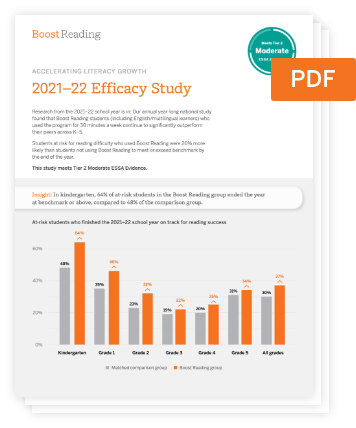

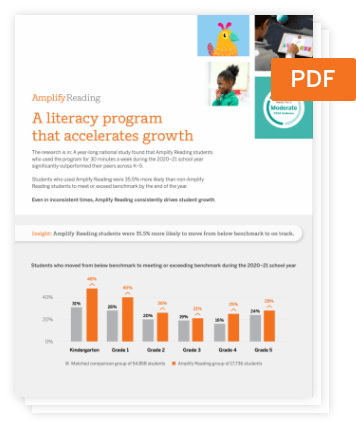


Research base

Boost Lectura


Explore more of our research.
Learn more about the research behind our programs.


Welcome, Palm Beach reviewers of Amplify Desmos Math Florida!
We’re honored to introduce you to Amplify Desmos Math Florida. Start with the video provided here to learn how to navigate the site.
On each grade-level site, you will find detailed information about the program’s development, a comprehensive overview of reviewer materials, and instructions on how to access the curriculum.
Select the grade level you’re reviewing:
Note: Student Spanish Samplers are available in Grade 7 and Algebra 1
Amplify Desmos Math updates are coming!
As we look ahead to the upcoming school year, we’re continuing to enhance Amplify Demos Math. From time-saving platform enhancements to new features, these updates are designed to help you deliver engaging math instruction while making planning, assigning, and differentiation easier than ever.
Whether you’re using Amplify Desmos Math on its own or alongside Personalized Learning, Boost Math®, or mCLASS® Math, this page highlights what’s already available and what’s coming next.

Updates coming for the 2026–27 school year
To help you plan for the year ahead with confidence, we’re previewing some of the exciting enhancements coming your way.
Platform updates
We’re improving the overall classroom experience with platform enhancements that make lessons easier to navigate and instruction easier to manage.
- Activity pages are being redesigned to feature a left sidebar, informational tabs, and lesson screens at the top of the page. This optional reconfiguration will allow you to immediately see each lesson and more easily access relevant resources and tools. You will be able to turn on the new design – or turn it off to return to the original design – with a toggle located on the page.
- We’re making updates to our Recently Visited section on Educator Home. You’ll see both activity and units reflected there, and have the ability to star a unit or lesson to pin it to the front of your list
- Presentation tools are also expanding, making it easier to facilitate lessons, annotate in real time, and manage instruction from anywhere in the room.
- You will be able to assign Teacher Presentation Screens to individual students who need access on their own devices for reference or accessibility purposes.
Administrator Report improvements
- The existing Administrator Reports for Unit Performance will be replaced with a new and improved Student Performance report that will provide school and district administrators with aggregated views of student performance on end-of-unit assessments as well as standards. The report will support grouping this data by school and class without having to access reporting for individual classrooms.
AI-powered teacher tools
We’ve developed new tools to enhance your ability to connect and collaborate with families! These will be available when you opt in through Amplify Labs.
- Discussion Moments, launching for grades 6–8 in 2026–27, will support rich classroom conversations by highlighting student ideas directly within lessons, making it easier to pause, reflect, and discuss mathematical thinking.
- Newsletter Generator, for grades K–5, allows you to create your own customizable communication to share out with families.
Using mCLASS Math? Explore upcoming updates and noteworthy features for assessment, progress monitoring, and reporting on the mCLASS Math Program Highlights page.

New offerings
Amplify Desmos Math continues to grow to support more learners across grade levels and instructional pathways.
- Expanded Spanish student and teacher materials will better serve multilingual classrooms by providing access to high-quality math instruction in both print and digital formats.
- New PreK and Transitional Kindergarten offerings emphasize hands-on, developmentally appropriate learning.
- For middle school, Accelerated 6 and Accelerated 7 will be available for full release soon, offering a two-year pathway that condenses grades 6–8.
- At the high school level, Amplify Desmos Math will soon be commercially available as complete high school course sequences, including Algebra 1, Geometry, Algebra 2, and Integrated Math pathways.
Note: Some offerings and enhancements may require an additional purchase.
Noteworthy features
These features are already available or rolling out soon to help you plan, teach, and support students more efficiently.

- Use Stream filtering tools to search by student name and quickly view everything assigned to a particular learner.
- Assign work to individual students, create and reuse named groups, or assign multiple Personalized Learning activities at once using batch assign, making it easier to differentiate instruction and support small groups without extra setup time.
- Preview student work directly from the Stream to check progress and decide on next steps more efficiently.
- Individual Student Reports provide a unified view of student progress across math products, offering a clear, shareable snapshot to support caregiver communication and student conferencing.
- Download and print screens of any lesson or activity by selecting the three-dot menu to the right of the activity (or lesson) title and selecting View PDF.

Personalized Learning activities are now clearer and easier for students to manage.
Personalized Learning activities now include a clear Done button, helping students understand when their work is complete.
- Once an activity is finished, it moves out of the To Do list and into Past Work, reducing confusion and supporting student organization.
- You also have improved visibility and guidance for addressing unfinished work, redoing activities, and when Personalized Learning data appears in reporting.

Easier planning and navigation across resources
Planning instruction is simpler with an improved Browse Instructional Resources experience designed to reduce clicks and help you quickly find the materials you need.
- Locate resources more easily for small-group instruction, practice, or extension.
- Get more control over the student experience, including the option to remove Math Adventures from Student Home when those activities aren’t part of their instructional plan.
Using Boost Math as part of your math solution? Learn more about recent enhancements to Boost Math, including updates to instructional pathways and more options to further the impact of your Multi-Tiered System of Supports (MTSS).
Webinar: Adapt, Enrich, Remediate, Accelerate: Using Personalized Learning in Your Literacy System
Webinar: Science Connections: Accelerating Learning in Science with the Science of Reading
Welcome, reviewers of Amplify Desmos Math Florida!
K–5 personalized reading curriculum to accelerate literacy growth in your classroom
Boost Reading Texas helps K–5 educators meet the needs of every reader with personalized literacy instruction based in the Science of Teaching Reading. Our efficacy data, measured by DIBELS® 8th Edition, shows that Boost Reading helped 26% more students reach benchmark than those not using the program. This Amplify reading curriculum fits into any learning model and provides actionable growth insights along the way.

Evidence-based personalized instruction
Boost Reading Texas is a student-led supplemental reading curriculum that provides additional time to support other students. It reinforces instruction across all tiers through true differentiation of skill development. It’s your digital assistant in literacy instruction—extending core instruction, addressing remediation needs, and constantly adapting activities to help every reader flourish.
Our approach
Proven efficacy
Did you know that you can supercharge reading growth with Boost Reading Texas? Texas students using Boost Reading Texas are showing phenomenal growth…and we have the data to prove it!

Instructional cohesion across all tiers
Amplify’s comprehensive early literacy suite—comprising Amplify ELAR Texas core instruction, mCLASSⓇ Texas assessment and intervention, and Boost Reading Texas personalized practice—provides seamless alignment and a strong Science of Teaching Reading foundation for a Multi-Tiered System of Supports within your classroom. For Amplify ELAR Texas students who start the year below benchmark reading levels, Boost Reading Texas increases the likelihood of meeting benchmark by 34% by end of year, compared to non-Boost Reading users.
Targeted, systematic reading practice for all
The highly adaptive technology creates individual skill maps for each student—whether they’re reading below, at, or above grade level—providing simultaneous remediation and advancement in different skill domains. The program is an effective component of your classroom’s remediation and intervention solutions, with explicit instruction for all students, including those with dyslexia or in special education classes.

Closing the gap for K–5 multilingual/English learners
Boost Reading Texas’ Spanish literacy partner, Boost Lectura Texas, supports multilingual/English learners (ML/ELs) learning to read in their native language. When used together, the two programs drive literacy growth in English and Spanish and provide teachers with side-by-side reporting on skills progression in both languages.

What’s included

Next-generation technology
Boost Reading Texas is constantly adapting to tailor instruction and scaffold foundational skills for students, building proficiency one engaging activity at a time. Students will never get stuck in static practice activities.
Comprehensive skill coverage
The scope and sequence is based on the Science of Teaching Reading and includes explicit instruction in phonics, phonological awareness, comprehension, vocabulary, and all skills critical to fluent and confident reading.
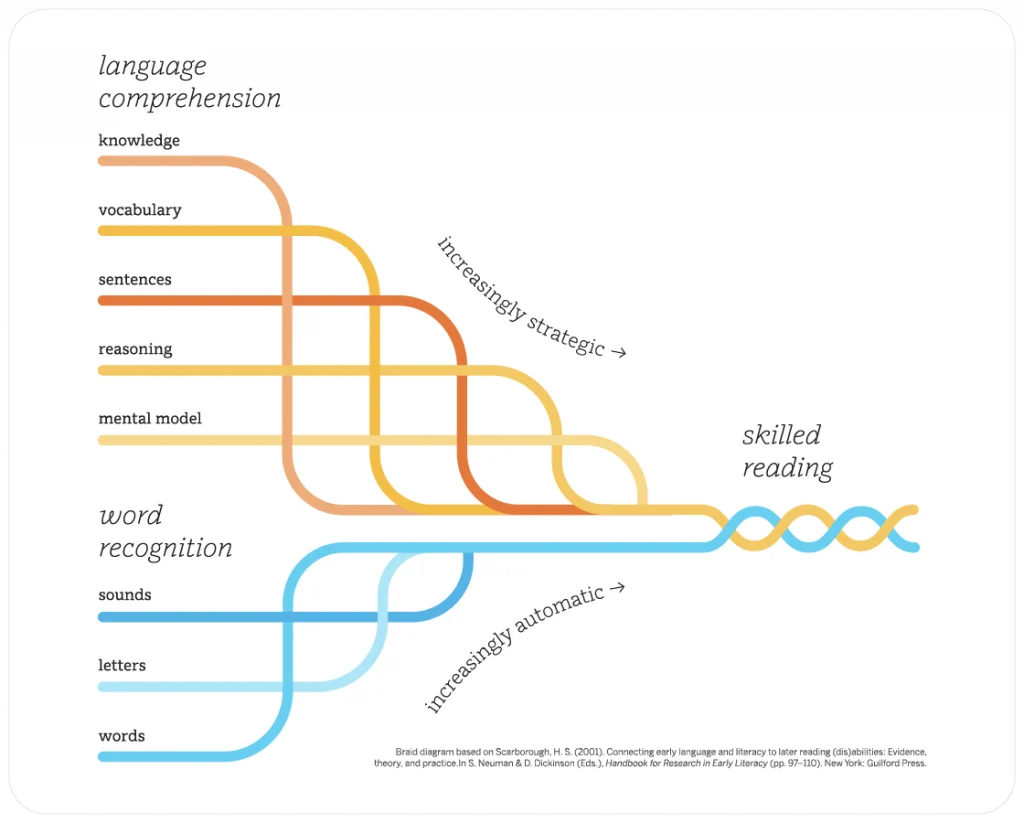

Benchmark and growth assessments
Built-in benchmark assessments measure student proficiency at beginning-, middle-, and end-of-year, and Curioso Skill Scans measure monthly growth in students using the program without interrupting engagement.
Easy-to-use growth and proficiency reports
Embedded assessments give teachers actionable insights into students’ reading journeys. Visibility into performance gives teachers peace of mind that students are making meaningful progress in their literacy development.
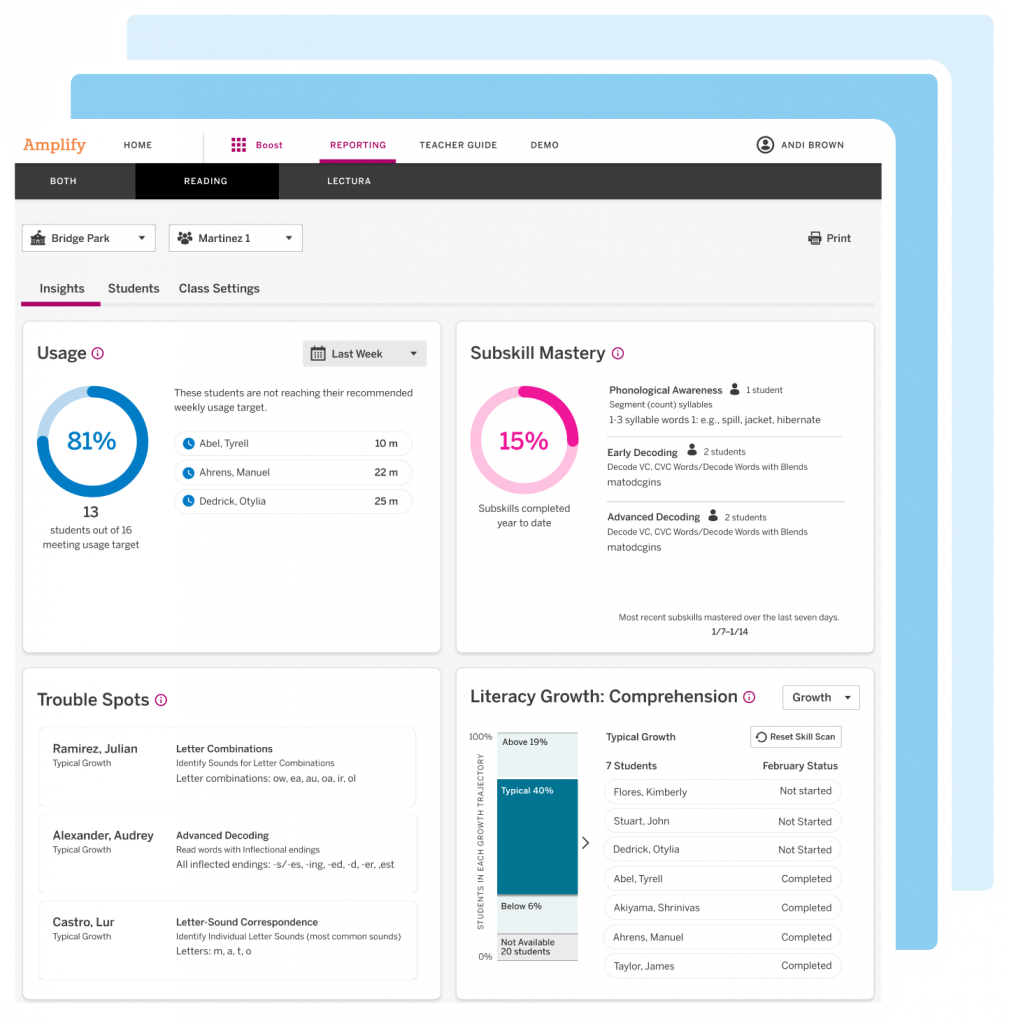

Administrator and caregiver reports
Administrators and caregivers are welcomed into the student reading journey with data on program usage, reading progress, and skill mastery.
Research-based activities to reinforce skills
Boost Reading Texas alerts educators to trouble spots students encounter in their skill development and offers additional K–5 literacy resources and lessons for teachers to address and fortify reading skills.


Boost Reading is a proud winner of the Tech & Learning Awards of Excellence: Best for Back to School 2023.
Learn moreExplore more programs based on the Science of Teaching Reading.
Learn more about our related Texas programs at texas.amplify.com.
Welcome, Amplify Tutoring caregivers!
Welcome to Amplify Tutoring! We’re excited to support your student with high-impact tutoring in both reading and/or math. Our program is grounded in research and designed to build confidence, strengthen foundational skills, and accelerate learning. We also provide tools and resources to help teachers and caregivers work together to create a strong culture of learning at home and at school. Para la versión en español, haga clic aquí.

What is high impact tutoring?
High-impact tutoring is small-group, targeted instruction that can lead to significant learning gains. Amplify Tutoring achieves these gains through the following best practices:

High-quality
materials
Tutors use high-quality reading and math lessons that are proven to work. You’ll see real progress and growth through your child’s individual data.

Frequent and consistent high-impact
tutoring sessions
Tutors provide personalized attention in small groups. Our program is designed for students to participate in three or more 30-minute sessions per week.

Supportive relationships and training
Consistent tutor-student pairings support relationship-building and higher achievement. Tutors receive ongoing professional development.
Amplify Tutoring provides your student with engaging and effective tutoring programming throughout the year.
Minutes matter
Every minute counts in helping your child learn and grow. To get the most out of tutoring, it’s important they come on time and attend regularly. Here are a few quick reminders:
How you can help your child get the most from tutoring
- Communicate with your child’s teacher. If your child can’t make it to tutoring, just let the teacher or coordinator know so they can support them.
- Make tutoring days a priority. Try your best to make sure your child is at school on tutoring days. Every session helps them grow!
- Ask for the tutoring schedule. Reach out to your child’s teacher or the tutoring coordinator to find out the days and times for tutoring.
- Plan around tutoring time. If you can, schedule appointments and other activities at different times so your child doesn’t miss a session.
Talking to your student about their Amplify Tutoring sessions
Discuss tutoring with your student at home or while getting ready for the day. To support their learning, you may consider:
Celebrating progress
Ask:
- What new reading skills or strategies have you learned?
- How has your reading improved since starting tutoring?
- Do you have any favorite books or activities in tutoring?
Setting goals together
Ask:
- What reading skills would you like to improve in tutoring?
- What goal would you like to achieve by the end of the tutoring program?
- What steps can you take to help achieve those goals?
- How can I help support your goals?
Sharing your support
Ask:
- How can I help you with your reading or math?
- Can we set aside time each day for you to practice your skills?
- What was the most interesting part of your tutoring session?
- What do you feel proud of achieving in this week’s sessions?
- When did you feel really excited about what you were learning?
Amplify Tutoring literacy support materials and resources
Caregivers, please find materials and resources below that may be helpful to you and your student.
mCLASS:
- Schools participating in Amplify Tutoring use mCLASS assessment and mCLASS Intervention.
- mCLASS assessment identifies reading risks and helps address student needs through targeted interventions such as high-impact tutoring.
- Check the Understanding mCLASS guide for reading assessments, caregiver resources, and growth.
- Explore the mCLASS caregiver hub in English and Spanish.
- View the sample HomeConnect letter that highlights your student’s strengths and growth areas.
- Visit the HomeConnect site which offers activities for your family to practice important literacy skills with your child.
Boost Reading:
- Boost Reading provides personalized instruction based on the Science of Reading.
- It complements your student’s high-impact tutoring, giving them a place to practice the same skills.
- Explore Boost Reading caregiver resources.
Note: All schools participating in Amplify Tutoring use mCLASS Intervention. Ask your student or their teacher about the implementation of Boost Reading.
Amplify Tutoring math support materials and resources
Caregivers, please find materials and resources below that may be helpful to you and your student.
Amplify Math Tutoring materials:
Learn more about the mCLASS Math Assessment your student will take.
- Schools participating in Amplify Math Tutoring use Amplify’s mCLASS math assessment, Amplify Desmos Math Mini-Lessons, and Amplify’s Fluency by Heart.
- mCLASS assessment provides valuable insights into student math thinking. It shows how students think about grade-level math and what they already understand.
- Amplify Desmos Math Mini-Lessons are the lessons tutors use to help guide your student through grade-level math concepts.
- Amplify’s Fluency by Heart is the fact fluency program your student will use during tutoring. Students are encouraged to continue to practice their fact fluency through this program outside of tutoring, too!
- Explore the Math Caregiver Hub in English and Spanish to learn more about Amplify Desmos Math!
- View the HomeConnect letter homepage, which includes a sample letter that highlights your student’s development of math skills against the grade-level expectations.
- Visit the Caregiver Resources, which offers activities for your family to practice key concepts.
- Learn more about the mCLASS Math Assessment your student will take.
Tutoring impacts

Amplify Tutoring works for students who need it most! In one large study of Amplify Tutoring in action, 70 percent of students who scored below benchmark and participated regularly in Amplify Tutoring made above-average growth. Tutored students were 22 percentage points more likely to make outsized growth than peers with a similar profile who did not receive high-impact tutoring at their school.
By providing targeted support tailored to individual needs, Amplify Tutoring enables students to receive the assistance they need and deserve.
See how Amplify Tutoring accelerates learning.
Looking for help or more information?
Visit amplify.com/tutoring to learn more about Amplify Tutoring.
For additional support, please contact your student’s teacher.
Thank you for everything you do to support your student’s learning!
Prepare for the new school year with your student!
We’re excited to welcome you and your student to Amplify for the new school year, and to provide exceptional learning opportunities through our programs. We’ve assembled the following resources and guides for you to reference to ensure your student has the most productive experience with our platform and curriculum throughout the year. Select your Amplify program below to get started!
Para la versión en español, haga clic aquí.

Select a program below:






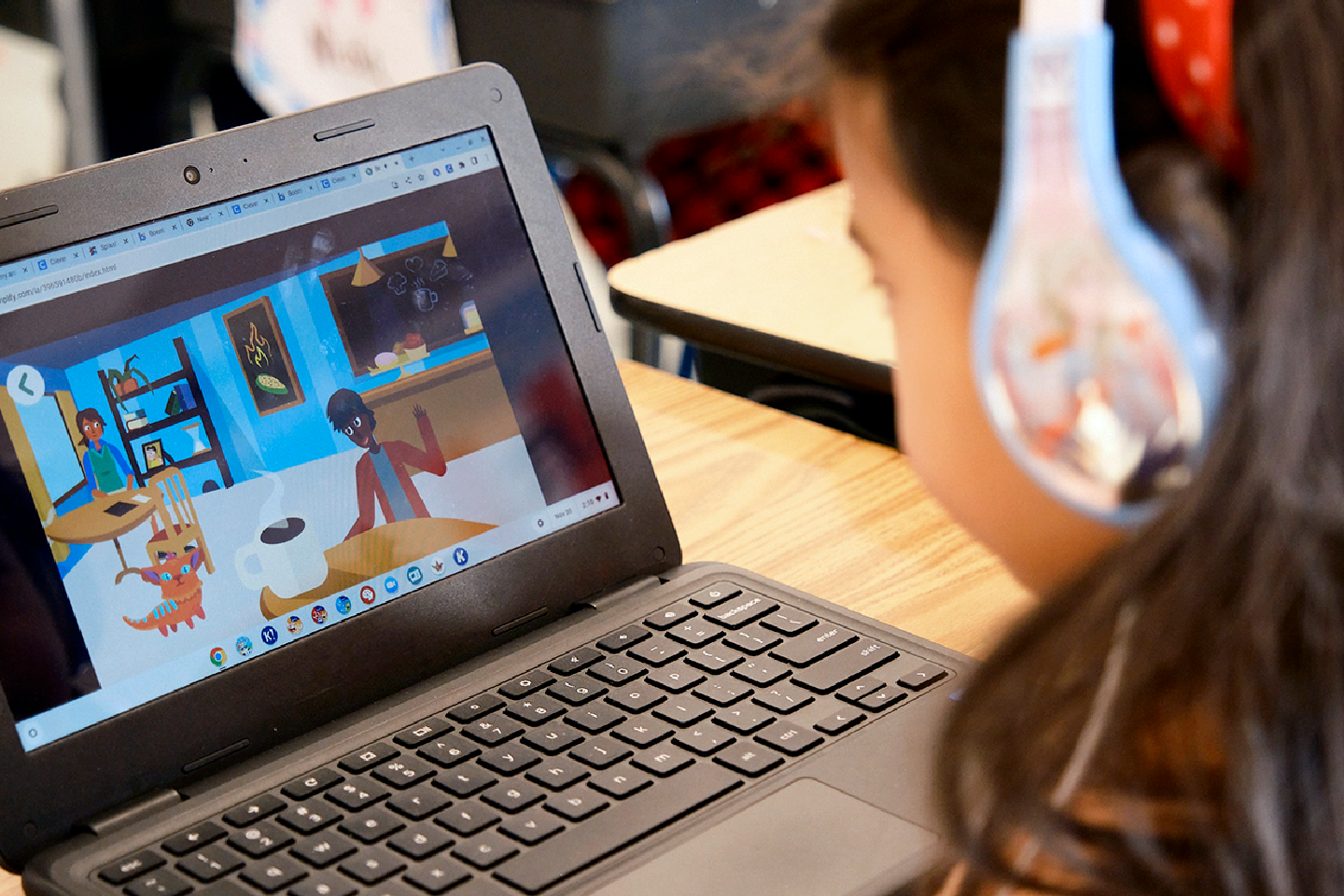




Plan your professional development
We’re excited to partner with you on your Amplify journey. Flexible professional development pathways have been designed to meet your needs.
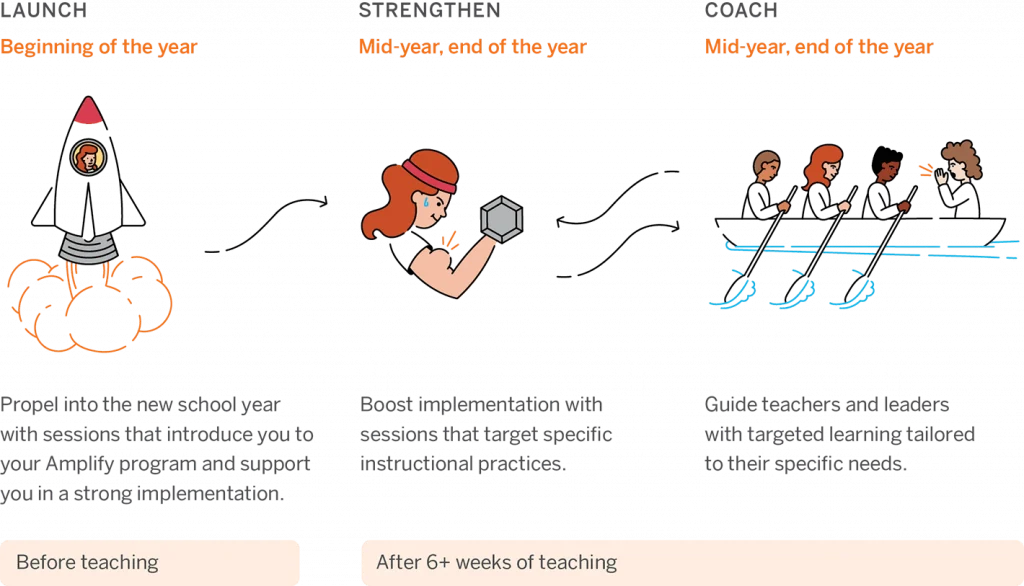
Recommended Professional Development Plan
Our team has curated a recommended professional learning path from initial launch to continuous support. Use the Professional Development Planning Guide below to discuss the plan that best meets your school or district needs with your Account Executive.
Sessions overview
| Recommended sessions are highlighted below. |
| Audience | Title | Duration | Modality |
|---|---|---|---|
| mCLASS Texas Edition Launch | |||
| All mCLASS Texas Edition customers | Initial training | 2 half days or self-paced | Remote/Online course |
| New mCLASS Texas Edition customers | Initial training | 1 day | Onsite |
| Initial training: Train the Trainer | 1 day onsite or 2 half days remote | Onsite/Remote | |
| New mCLASS Texas Edition customers with limited time for PD | mCLASS program overview, English measures only | Half day | Onsite/Remote |
| mCLASS program overview, Spanish measures only | Half day | Onsite/Remote | |
| Experienced mCLASS Texas Edition customers | Refresher training | Half day | Onsite/Remote |
| mCLASS Texas Edition and Amplify Reading Launch | |||
| New mCLASS Texas Edition and Amplify Reading customers | Initial training with Amplify Reading overview | 1 day onsite or 2 half days remote | Onsite/Remote |
| Initial training with Amplify Reading overview: Train the Trainer | 1 day onsite or 2 half days remote | Onsite/Remote | |
| mCLASS Texas Edition and TRC Launch | |||
| New mCLASS Texas Edition and TRC customers | Initial training with TRC overview | 1 day onsite or 2 half days remote | Onsite/Remote |
| Initial training with TRC overview: Train the Trainer | 1 day onsite or 2 half days remote | Onsite/Remote | |
| Experienced mCLASS Texas Edition customers | TRC initial training | Half day | Onsite/Remote |
| TRC initial training: Train the Trainer | Half day | Onsite/Remote | |
| mCLASS Express Launch | |||
| New mCLASS Express customers | Initial training | Half day | Onsite/Remote |
| Initial training | Self-paced | Online course | |
| mCLASS Texas Edition Strengthen | |||
| All mCLASS Texas Edition customers with limited time for PD | Understanding your classroom data | Half day | Onsite/Remote |
| All mCLASS Texas Edition customers | Classroom data analysis and instructional planning | 1 day | Onsite |
| All mCLASS Texas Edition customers | Classroom data analysis and instructional planning | 2 half days | Remote |
| Classroom data analysis and instructional planning: Train the Trainer | 1 day onsite or 2 half days remote | Onsite/Remote | |
| Classroom data analysis and instructional planning | Self-paced | Online | |
| All mCLASS Texas Edition customers | Data-driven leadership practices | 1 day onsite | Onsite |
| All mCLASS Texas Edition customers | Data-driven leadership practices | 2 half days | Remote |
| Data-driven leadership practices: Train the Trainer | 1 day onsite or 2 half days remote | Onsite/Remote | |
| Data-driven leadership practices | Self-paced | Online | |
| Understanding your school or district data | Half day | Onsite/Remote | |
| Strengthening consultation session | 1-hour session | Remote | |
| All mCLASS Texas Edition customers | Strengthening consultation session package | 3 1-hour sessions | Remote |
| mCLASS Texas Edition Coach | |||
| All mCLASS Texas Edition customers | Coaching session | 1 day | Onsite |
| All mCLASS Texas Edition customers | Coaching session | Half day | Onsite/Remote |
Launch
mCLASS Texas Edition
Initial training
1 day onsite (6 hours) or 2 half days remote (6 hours)
This PD prepares participants to implement the assessment, collect reliable data using standardized guidelines, and use the targeted lessons available on mCLASS to drive differentiated instruction.
Audience: Teachers (administrators welcome), maximum 30 participants
Modality: Onsite/Remote
Initial training: Train the Trainer
1 day onsite (6 hours) or 2 half days remote (6 hours)
This PD prepares participants to implement the assessment, collect reliable data using standardized guidelines, and use the targeted lessons available on mCLASS to drive differentiated instruction. Participants receive annotated session materials to turnkey the session to colleagues.
Audience: Teachers (administrators welcome), maximum 30 participants
Modality: Onsite/Remote
mCLASS program overview, English measures only
Half day (3 hours)
This PD prepares participants to implement the English measures of the mCLASS Texas assessment and collect reliable data using standardized guidelines. Only English measures are covered in this half-day training.
Audience: Teachers (administrators welcome), maximum 30 participants
Modality: Onsite/Remote
mCLASS program overview, Spanish measures only
Half day (3 hours)
This PD prepares participants to implement the Spanish measures of the mCLASS Texas assessment and collect reliable data using standardized guidelines. Only Spanish measures are covered in this half-day training.
Audience: Teachers (administrators welcome), maximum 30 participants
Modality: Onsite/Remote
Refresher training
Half day (3 hours)
The half-day refresher training is designed for teachers and instructional leaders who are experienced with any version of DIBELS® and/or Acadience Reading and are invested in successfully implementing mCLASS Texas Edition. This session will help educators focus on what’s new to the assessment and understand mCLASS Texas Edition’s potential to impact all students through improved measures, stronger insight into students’ instructional needs, and bolstered skills-focused lessons to support instructional planning. Upon completion of this session, participants will be prepared to implement the new assessment, collect reliable data using standardized guidelines, and use the targeted lessons available on mCLASS Texas Edition to drive differentiated instruction as part of their regular classroom practice.
Audience: Teachers (administrators welcome), maximum 30 participants
Modality: Onsite/Remote
mCLASS Texas Edition and Amplify Reading
Initial training with Amplify Reading overview
1 day onsite (6 hours) or 2 half days remote (6 hours)
Take the first step in launching mCLASS Texas Edition and Amplify Reading! The initial training will help educators understand how mCLASS Texas Edition assesses the basic early literacy skills that are crucial for reading development, gain hands-on experience administering and scoring the assessment using standardized guidelines, and access the Instruction page in order to find skills-focused lessons that will support instructional planning. A high-level overview of how to get started with Amplify Reading will also be provided at the end of the training along with supplementary, on-demand resources. Upon completion of this session, participants will be prepared to implement the new assessment, collect reliable data using standardized guidelines, use the targeted lessons available on mCLASS Texas Edition to drive differentiated instruction as part of their regular classroom practice, and understand key Amplify Reading features.
Audience: Teachers (administrators welcome), maximum 30 participants
Modality: Onsite/Remote
Initial training with Amplify Reading overview: Train the Trainer
1 day onsite (6 hours) or 2 half days remote (6 hours)
Take the first step in launching mCLASS Texas Edition and Amplify Reading! The initial training will help educators understand how mCLASS Texas Edition assesses the basic early literacy skills that are crucial for reading development, gain hands-on experience administering and scoring the assessment using standardized guidelines, and access the Instruction page in order to find skills-focused lessons that will support instructional planning. A high-level overview of how to get started with Amplify Reading will also be provided at the end of the training along with supplementary, on-demand resources. Upon completion of this session, participants will be prepared to implement the new assessment, collect reliable data using standardized guidelines, use the targeted lessons available on mCLASS Texas Edition to drive differentiated instruction as part of their regular classroom practice, and understand key Amplify Reading features. Participants receive annotated session materials to turnkey the session to colleagues.
Audience: Teachers (administrators welcome), maximum 30 participants
Modality: Onsite/Remote
mCLASS Texas Edition and TRC
Initial training with TRC overview
1 day onsite (6 hours) or 2 half days remote (6 hours)
Take the first step in launching mCLASS Texas Edition and Amplify Reading! The initial training will help educators understand how mCLASS Texas Edition assesses the basic early literacy skills that are crucial for reading development, gain hands-on experience administering and scoring the assessment using standardized guidelines, and access the Instruction page in order to find skills-focused lessons that will support instructional planning. A high-level overview of how to get started with Amplify Reading will also be provided at the end of the training along with supplementary, on-demand resources. Upon completion of this session, participants will be prepared to implement the new assessment, collect reliable data using standardized guidelines, use the targeted lessons available on mCLASS Texas Edition to drive differentiated instruction as part of their regular classroom practice, and understand key Amplify Reading features.
Audience: Teachers (administrators welcome), maximum 30 participants
Modality: Onsite/Remote
Initial training with TRC overview: Train the Trainer
1 day onsite (6 hours) or 2 half days remote (6 hours)
Take the first step in launching mCLASS Texas Edition and TRC! The initial training will help educators understand how mCLASS Texas Edition assesses the basic early literacy skills that are crucial for reading development, gain hands-on experience administering and scoring the assessment using standardized guidelines, and access the Instruction page in order to find skills-focused lessons that will support instructional planning. A high-level overview of how to get started with TRC will also be provided at the end of the training along with supplementary, on-demand resources. Upon completion of this session, participants will be prepared to implement the new assessment, collect reliable data using standardized guidelines, use the targeted lessons available on mCLASS Texas Edition to drive differentiated instruction as part of their regular classroom practice, and understand key TRC features. Participants receive annotated session materials to turnkey the session to colleagues.
Audience: Teachers (administrators welcome), maximum 30 participants
Modality: Onsite/Remote
TRC initial training
Half day (3 hours)
Take the first step in launching TRC! The half-day initial training will help educators understand how TRC assesses the basic early literacy skills that are crucial for reading development, gain hands-on experience administering and scoring the assessment using standardized guidelines, and access the Instruction page in order to find skills-focused lessons that will support instructional planning.
Audience: Teachers (administrators welcome), maximum 30 participants
Modality: Remote
TRC initial training: Train the Trainer
Half day (3 hours)
Take the first step in launching TRC! The half-day initial training will help educators understand how TRC assesses the basic early literacy skills that are crucial for reading development, gain hands-on experience administering and scoring the assessment using standardized guidelines, and access the Instruction page in order to find skills-focused lessons that will support instructional planning. Participants receive annotated session materials to turnkey the session to colleagues.
Audience: Teachers (administrators welcome), maximum 30 participants
Modality: Remote
mCLASS Express
Initial training
Half day (3 hours)
Take the first step in launching mCLASS Express! The half-day initial training will help educators understand how mCLASS Express’ voice-recognition scoring generates immediate instructional recommendations for students reading below grade level. Educators will also learn how to utilize the teacher portal to assign assessments, review and correct scoring, track student growth over time, and leverage the program’s activities to create an action plan for a single classroom or across classes/grades.
Audience: Teachers (administrators welcome), maximum 30 participants
Modality: Remote
Initial training
Self-paced
Take the first step in launching mCLASS Express! The two-hour initial training will help educators understand how mCLASS Express’ voice-recognition scoring generates immediate instructional recommendations for students reading below grade level. Educators will also learn how to utilize the teacher portal to assign assessments, review and correct scoring, track student growth over time, and leverage the program’s activities to create an action plan for a single classroom or across classes/grades. As this is a self-paced, on-demand online course, participants will be able to access the course anytime, move as quickly or as slowly as needed through different sections, and revisit the course for up to one year as a refresher in the future.
Audience: Teachers (administrators welcome)
Modality: Remote
Strengthen
Understanding your classroom data
Half day (3 hours)
This PD prepares participants to understand their students’ data by utilizing the reports available on mCLASS. This session should be scheduled after the most recent benchmark window has closed so that participants can work with their own data.
Audience: Teachers (administrators welcome), maximum 30 participants
Modality: Onsite/Remote
Classroom data analysis and instructional planning
1 day onsite (6 hours) or 2 half days remote (6 hours)
This PD prepares participants to deeply understand their students’ data and create actionable instructional plans by utilizing the reports and skills-focused lesson plans available on mCLASS.
Audience: Teachers (administrators welcome), maximum 30 participants
Modality: Onsite/Remote
*This session should be scheduled after the most recent benchmark window has closed so that participants can work with their own data.
Classroom data analysis and instructional planning: Train the Trainer
1 day onsite (6 hours) or 2 half days remote (6 hours)
This PD prepares participants to deeply understand their students’ data and create actionable instructional plans by utilizing the reports and skills-focused lesson plans available on mCLASS. Participants receive annotated session materials to turnkey the session to colleagues.
Audience: Teachers (administrators welcome), maximum 30 participants
Modality: Onsite/Remote
*This session should be scheduled after the most recent benchmark window has closed so that participants can work with their own data.
Classroom data analysis and instructional planning
Self-paced
This PD is an individual seat to our self-paced, on-demand online course that contains approximately 6 hours of training. Participants will learn how to deeply understand their students’ data and create actionable instructional plans by utilizing the reports and skills-focused lesson plans available on mCLASS. Participants will access and revisit the course anytime for up to one year as a refresher. Note: The online course focuses on the English measures only.
Audience: Teachers (administrators welcome)
Modality: Online
Understanding your school or district data
Half day (3 hours)
This PD prepares participants to use their data in making schoolwide decisions. This session should be scheduled after the most recent benchmark window has closed so that participants can work with their own data.
Audience: Administrators, maximum 30 participants
Modality: Onsite/Remote
Data-driven leadership practices
1 day onsite (6 hours) or 2 half days remote (6 hours)
This PD prepares participants to use their data in making schoolwide decisions and build a schoolwide culture of data-driven instruction. This session should be scheduled after the most recent benchmark window has closed so that participants can work with their own data.
Audience: Administrators, maximum 30 participants
Modality: Onsite/Remote
Data-driven leadership practices: Train the Trainer
1 day onsite (6 hours) or 2 half days remote (6 hours)
This PD prepares participants to use their data in making schoolwide decisions and build a schoolwide culture of data-driven instruction. This session should be scheduled after the most recent benchmark window has closed so that participants can work with their own data. Participants receive annotated session materials to turnkey the session to colleagues.
Audience: Administrators, maximum 30 participants
Modality: Onsite/Remote
Data driven leadership practices
Self-paced
This PD is an individual seat to our self-paced, on-demand online course that contains approximately 6 hours of training. Participants will learn how to use their data in making schoolwide decisions and build a schoolwide culture of data-driven instruction. Participants will access and revisit the course anytime for up to one year as a refresher. Note: The online course focuses on the English measures only.
Audience: Administrators
Modality: Online
Strengthening consultation session
60 minutes
This 60-minute session will focus on a specific topic that will deepen educators’ understanding of mCLASS and equip them in driving towards stronger student outcomes. An Amplify facilitator will align with the school or district’s leadership team in advance on the topic from a menu of options that will best meet educators’ unique needs. Topics include progress monitoring, zones of growth, and a data walkthrough for leaders.
Audience: Teachers and/or administrators, maximum 30 participants
Modality: Remote
Strengthening consultation session package
3 hours
This package consists of three 60-minute sessions that can be delivered on the same day or on different days. Each session will focus on a specific topic that will deepen educators’ understanding of mCLASS and equip them in driving towards stronger student outcomes. An Amplify facilitator will align with the school or district’s leadership team in advance on the topics that will best meet educators’ unique needs. Topics include progress monitoring, zones of growth, and a data walkthrough for leaders.
Audience: Teachers and/or administrators, maximum 30 participants
Modality: Remote
Coach
Coaching session
1 day onsite (6 hours)
This PD will deepen educators’ understanding of how to utilize mCLASS in order to accelerate data-driven student outcomes. An Amplify facilitator will visit one or two school sites for one day and work with teachers and/or leaders. Prior to the visit, the Amplify facilitator will align with each school’s leadership team on their needs and customize the visit schedule accordingly.
Audience: Teachers and/or administrators, maximum 30 participants
Modality: Onsite/Remote
Coaching session
Half day (3 hours)
This PD is up to 3 hours of training and will deepen educators’ understanding of how to utilize mCLASS in order to accelerate data-driven student outcomes. An Amplify facilitator will visit one school site for a half-day and work with teachers and/or leaders. Prior to the visit, the Amplify facilitator will align with each school’s leadership team on their needs and customize the visit schedule accordingly.
Audience: Teachers and/or administrators, maximum 30 participants
Modality: Remote
Pricing
We offer the following pricing for training sessions and packages:
| Session type | Pricing |
|---|---|
| 1-day onsite session | $3,200 |
| 1-day onsite session: Train the Trainer | $3,500 |
| 2 half-day remote sessions | $1,500 |
| 2 half-day remote sessions: Train the Trainer | $2,000 |
| Half-day onsite session | $2,500 |
| Half-day remote session | $750 |
| 2-hour self-paced online course | $20 per individual seat |
| 6-hour self-paced online course | $49 per individual seat |
Please note that the prices are general ranges and may be subject to change.
Contact
Amplify welcomes the opportunity to partner with schools and districts to design professional development plans and answer your questions.
If you would like to order any of our professional development services, please contact your local Amplify sales representative or call (800) 823-1969.
A powerful partnership
Amplify Science was developed by the science education experts at UC Berkeley’s Lawrence Hall of Science and the digital learning team at Amplify.

The University of California, Berkeley’s Lawrence Hall of Science is a recognized leader in PreK–12 science education, producing groundbreaking curriculum products for more than 40 years, including the international award-winning Seeds of Science/Roots of Reading®. The Hall’s curriculum materials are used in one in four classrooms across the nation.

Amplify has been pioneering digital education products for more than 15 years, empowering teachers across the country to offer more personalized instruction and accelerate the potential of their students to become more active, engaged learners. Amplify has supported more than 200,000 educators and three million students in all 50 states.
Instructional model
The Amplify Science program is rooted in the proven, research-based pedagogy of Do, Talk, Read, Write, Visualize. Here’s how each element works:
DO First-hand investigations are an important part of any science classroom, and Amplify Science has students getting hands-on experience in every unit, from building models of protein molecules to experimenting with electrical systems.
TALK Student-to-student discourse and full class discussions are an integral part of the program. Students are provided with numerous opportunities to engage in meaningful oral scientific argumentation, all while fostering a collaborative classroom environment.
READ Students read scientific articles, focusing their reading activities on searching for evidence related to their investigation, and importantly, on asking and recording questions as they read through fascinating texts on 21st-century topics.
WRITE Following real-world practices, students write scientific arguments based on evidence they’ve collected, clearly expressing their reasoning about how a given piece of evidence connects to one of several claims.
VISUALIZE By manipulating digital simulations and using modeling tools to craft visualizations of their thinking—just as real scientists and engineers do—students take their learning far beyond the confines of what they can physically see in the classroom in an exciting and authentic way.
Elementary school course structure
- Needs of Plants and Animals
- Pushes and Pulls
- Sunlight and Water
- Animal and Plant Defenses
- Light and Sound
- Spinning Earth
- Plant and Animal Relationships
- Properties of Materials
- Changing Landforms
- Balancing Forces
- Inheritance and Traits
- Environments and Survival
- Weather and Climate
- Energy Conversions
- Vision and Light
- Earth’s Features
- Waves, Energy, and Information
- Patterns of Earth and Sky
- Modeling Matter
- The Earth System
- Ecosystem Restoration
Middle school course structure (domain model)
- Launch:
Geology on Mars - Plate Motion
- Engineering Internship:
Plate Motion - Rock Transformations
- Earth, Moon, and Sun
- Ocean, Atmosphere, and Climate
- Weather Patterns
- Earth’s Changing Climate
- Engineering Internship:
Earth’s Changing Climate
- Launch:
Microbiome - Metabolism
- Engineering Internship:
Metabolism - Traits and Reproduction
- Populations and Resources
- Matter and Energy in Ecosystems
- Natural Selection
- Engineering Internship: Natural Selection
- Evolutionary History
- Launch:
Harnessing Human Energy - Force and Motion
- Engineering Internship:
Force and Motion - Magnetic Fields
- Thermal Energy
- Phase Change
- Engineering Internship: Phase Change
- Chemical Reactions
- Light
Middle school course structure (integrated model)
- Launch:
Microbiome - Metabolism
- Engineering Internship:
Metabolism - Traits and Reproduction
- Thermal Energy
- Ocean, Atmosphere, and Climate
- Weather Patterns
- Earth’s Changing Climate
- Engineering Internship:
Earth’s Changing Climate
- Launch:
Geology on Mars - Plate Motion
- Engineering Internship:
Plate Motion - Rock Transformations
- Phase Change
- Engineering Internship: Phase Change
- Chemical Reactions
- Populations and Resources
- Matter and Energy in Ecosystems
- Launch:
Harnessing Human Energy - Force and Motion
- Engineering Internship:
Force and Motion - Magnetic Fields
- Light Waves
- Earth, Moon, and Sun
- Natural Selection
- Engineering Internship: Natural Selection
- Evolutionary
Begin your review
To begin your review, click the button below to log in as a teacher.
Watch a video walkthrough


Contact your Delaware representative
Denise Donahue
Account Executive
Email: ddonahue@amplify.com
Phone: (410) 251-5855
A powerful partnership
Amplify Science was developed by the science education experts at UC Berkeley’s Lawrence Hall of Science and the digital learning team at Amplify.
The University of California, Berkeley’s Lawrence Hall of Science is a recognized leader in PreK–12 science education, producing groundbreaking curriculum products for more than 40 years, including the international award-winning Seeds of Science/Roots of Reading®. The Hall’s curriculum materials are used in one in four classrooms across the nation.
Amplify has been pioneering digital education products for more than 15 years, empowering teachers across the country to offer more personalized instruction and accelerate the potential of their students to become more active, engaged learners. Amplify has supported more than 200,000 educators and three million students in all 50 states.
Instructional model
Amplify Science program is rooted in the proven, research-based pedagogy of Do, Talk, Read, Write, Visualize. Here’s how each element works:
DO
First-hand investigations are an important part of any science classroom, and Amplify Science has students getting hands-on in every unit, from building models of protein molecules to experimenting with electrical systems.
TALK
Student-to-student discourse and full class discussions are an integral part of the program. Students are provided with numerous opportunities to engage in meaningful oral scientific argumentation, all while fostering a collaborative classroom environment.
READ
Students read scientific articles, focusing their reading activities on searching for evidence related to their investigation, and importantly, on asking and recording questions as they read through fascinating texts on 21st-century topics.
WRITE
Following real-world practices, students write scientific arguments based on evidence they’ve collected, making clear their reasoning about how a given piece of evidence connects to one of several claims.
VISUALIZE
By manipulating digital simulations and using modeling tools to craft visualizations of their thinking— just as real scientists and engineers do—students take their learning far beyond the confines of what they can physically see in the classroom in an exciting and authentic way.
Year at a glance
Amplify Science is organized around units where students are introduced to compelling phenomena and real-world problems, develop and strengthen claims by collecting evidence and testing assumptions, and apply their learning in new contexts.


Inside an Amplify Science classroom

Resources to support your review
- What’s so phenomenal about phenomena? – ebook
- Phenomena in grades K–5 and 6–8
- Hands-on investigations in grades K–5 and 6–8
- Student Books in grades K–5
- Literacy-rich science instruction in grades K–5
- Engineering in Amplify Science
- IB Standards Correlation
Boost Reading
Boost Reading is a personalized reading program that students can’t wait to play. Whether they are just learning to read or mastering close reading, Boost Reading helps achieve off-the-charts reading growth in grades K–8.
Click here to play demo of Boost Reading K-5.
Target support for every student
Students come to school with a range of abilities and achieve mastery at different rates. Providing each learner with the specific support they need to progress can be challenging. Enter Boost Reading.
Ready to learn more?
Fill out the form to begin your review or learn more about our Professional Development offerings.
Professional development
Existing business
- United Arab Emirates
- Oman
- Kingdom of Saudi Arabia
- Beirut
Contact your Amplify representative today
Matt Drury
mdrury@amplify.com
00971 52 9788789
Personalized learning grounded in the Science of Reading

Surveying the landscape
Recent data shows that far fewer young students are on target for reading proficiency than in previous years. In fall 2020, kindergarteners were 6 percent less likely to be on track in reading than they were in the 2019–20 school year.

How do we reverse these trends? A personalized learning program steeped in research-based literacy practices can be your first step. In this blog, we introduce personalized learning programs for early literacy, discuss why they should be aligned with the Science of Reading, and outline the key features that all effective personalized learning programs should have to support ALL students.
What is personalized learning?
“Personalized learning in literacy education is an approach in which teaching and other learning experiences build on each student’s strengths, address each student’s needs, spur student motivation and agency, and help all students meet grade-level standards and, ultimately, achieve college and career readiness.”
— Student Achievement Partners
Achieve the Core outlines a set of key components every personalized program should include to accelerate literacy:

How can I bring the Science of Reading into personalized learning?
Not all personalized learning programs should be treated equally. Programs should provide explicit, systematic foundational skills, continue to build background knowledge, and support core Science of Reading instruction. Focusing on the things we do while we’re reading that allow us to make sense of text — also known as comprehension processes — is a key component of supporting beginning readers.
How will I know if a personalized learning program is based on research about how children learn to read?
We’ve provided a checklist of key features to look for when selecting a personalized learning program grounded in the Science of Reading.
1) Look for a program that complements your Science of Reading instructional practices.
The content of a personalized program should support your core Science of Reading instruction.
Look for research-based instruction aligned to Scarborough’s Reading Rope, a focus on comprehension processes and language structures in addition to foundational skills, and personalization that adapts based on student needs.
2) Look for a program that employs a whole-child approach.
A whole-child approach focuses on students’ individual strengths and needs.
Look for targeting of skill practice at the just-right level in ALL areas, a focus on students’ individual strengths as well as their needs, and more opportunities for success, all of which build student confidence.
3) Look for a program that uses an adaptive scope and sequence.
In an adaptive model, students progress along a unique pathway through a learning map that adapts based on their performance.
Look for full adaptivity — where students progress along a pathway that adapts on multiple dimensions, not just one. The program should offer data to place students into personalized pathways and continue to analyze student performance data to determine the skills they practice and when.
4) Look for a program that acts as a digital tutor to save teachers time.
A program that aims to save you time provides students with differentiated instruction and pathways when they’re really struggling.
Look for a program that provides scaffolding and differentiated pathways to students when they’re struggling, and offers precursor and ancillary skill development and advancement opportunities before revisiting challenging content. Programs should alert teachers with targeted resources to support students and keep them moving.
5) Look for a program that motivates students intrinsically.
Programs that focus on intrinsic motivation leverage a growth mindset theory to ensure that students have fun while they learn.
Look for a program that rewards persistence as much as performance and ensures students have fun while they learn.
Personalized learning supplemental tool: Amplify Reading
Amplify Reading is a personalized learning program powered by the Science of Reading. The program blends compelling storytelling with research-based instructional practices to offer:
- Personalized instruction across 13 different critical skill areas that adapt to each student’s needs while building on their strengths.
- Explicit practice in comprehension processes, phonics, and vocabulary.
- Extra support and scaffolds for struggling readers and English learners.
- An immersive game-play design that motivates students and makes learning to read fun.
To learn how this program can accelerate reading growth in your district, request a personalized walkthrough below.
Amplify Reading – Amplify Reading
Work cited
Liben, Meredith, et al. “What Principles Must Underlie Successful Personalized Learning?” Peers and Pedagogy, 27 Oct. 2020
New professional development series for science educators

New year’s resolutions generally don’t work—unless, experts say, they’re specific, measurable, and backed by science (like … getting more sleep so you feel more rested). So if you’ve resolved (or at least planned) to do more science professional development this year, we got you.
Our new, free, on-demand professional development webinars are ready to be added to your calendar. Designed for the era of NGSS, they offer research-based ways for you to engage your students deeply in science this year. (But we hope you’ll find a way to get more sleep, too!)
Phenomena-based science learning for next-level engagement
The Next Generation Science Standards (NGSS) are designed to deliver this key shift: Students go from learning about to figuring out. Instead of delivering information, teachers invite students to explore the power of phenomena-based learning in science. By focusing first on real-life scenarios and thoughtful questions over abstract correct answers, this approach cultivates students’ voices and curiosity. It gets them to the right answers—but in a way that helps them think, read, write, and argue like real scientists and engineers.
The NGSS also delivers three-dimensional science instruction. This means that each standard includes the following three dimensions:
- Science and Engineering Practices: the actual behaviors that scientists and engineers engage in as they investigate and create.
- Cross-cutting Concepts: concepts that appear across and link various domains of science. They include: Patterns, similarity, and diversity; cause and effect; scale, proportion, and quantity; systems and system models; energy and matter; structure and function; and stability and change.
- Disciplinary Core Ideas: The fundamental scientific ideas that make up the core content of the NGSS.
A look at our webinars
Featuring curriculum experts from UC Berkeley’s Lawrence Hall of Science, our webinars will show you what these approaches look like in real classrooms.
COURSE 1
Establishing a Culture of Figuring Out in Your Next Generation Science Classroom
Explore ways to cultivate curiosity and value student voices while utilizing the structures and content from phenomena-based, literacy-rich science curricula designed for the Next Generation Science Standards.
COURSE 2
Lead with Phenomena and the Three Dimensions Will Follow
Reframe your K–8 science instruction by focusing on phenomena. Learn about the shift in science teaching and classroom practices toward one where students are figuring out, not learning about.
COURSE 3
Leveraging Science to Accelerate Learning
Learn about an approach to teaching and learning science that not only meets state science standards, but can also be used to support accelerated student learning across all subject areas.
Also:
Tune into Science Connections:The Podcast.
Learn more about the NGSS.
Explore more Amplify webinars.
Have a phenomenal 2023 in science!
S2-02: Developing your own teaching style: Tips from a veteran teacher.

In this episode, Eric Cross sits down with veteran educator and former Miami-Dade County Public Schools (M-DCPS) Middle School Science Teacher of the Year, Marilyn Dieppa. During the show, Marilyn shares tips for new teachers, ways to inspire students, and how she utilizes her journalism background to develop literacy skills within her science classroom. She also shares her experiences developing a robotics academy, and the VEX IQ World’s Competition. Explore more from Science Connections by visiting our main page.
Marilyn Dieppa (00:01):
I think my favorite thing is their success. Whether it’s robotics, whether it’s in the classroom, that they pass a test for the first time, those are my moments of success. And that’s what makes me happy.
Eric Cross (00:15):
Marilyn Dieppa is a veteran middle-school science educator at Miami-Dade County public schools. Dieppa launched her school’s STEM Academy in 2016 and developed professional development through the STEM Transformation Institute of Florida International University. Dieppa’s coached numerous new teachers and was the 2018 Miami-Dade County public schools’ middle-school Science Teacher of the Year. In this episode, we discussed her transition from a career in journalism to the science classroom and the value of personal and professional support systems for teacher longevity. And now, please enjoy my conversation with Marilyn Dieppa.
Marilyn Dieppa (00:52):
Nice to meet you, Eric.
Eric Cross (00:53):
Nice to meet you too. Thank you for being willing to come on the podcast.
Marilyn Dieppa (00:58):
Not a problem.
Eric Cross (00:59):
So you’re out in, you’re out in Florida. In Dade County. I’m out here in San Diego. So I’m like literally on the other side of the country. Have you—were you born and raised in Florida?
Marilyn Dieppa (01:09):
I’ve been here for 40 years, so I’ve been here most of my life. Yeah. I’m Puerto Rican, but I was, you know, my young childhood, I was in New Jersey. And then when I was 15, I came down.
Eric Cross (01:23):
I looked at like your—some of your accolades, which are really impressive. The things that you’ve done for students with robotics, and all the education, or, kind of like teacher enrichment, a lot of mentoring and coaching that you do now.
Marilyn Dieppa (01:35):
I am part of leadership team for the district. I do a lot of training. I work on curriculum. I help with pacing guides to make sure that everything is based on what the state wants, what the district wants. I have done a lot for the district in the last, probably 20 years.
Eric Cross (01:52):
What got you into teaching initially? What was your…like, why middle school science? We’re like a unique group.
Marilyn Dieppa (01:57):
This is the second career choice for me. So I’ve only been doing this for 24 years. I was a journalism major and then I got married and then I had my child and I wanted to do something. My thing was that I wanted to go to Iraq. I wanted to cover the news. I have a minor in Middle Eastern culture. so there was a lot of things that were in my mind when I was young, pre-married. and after, you know, you have children, priorities kind of change. So I totally changed, pretty much had to start from scratch, with my degree, because nothing kind of transferred over from journalism to teaching. So before I actually did that, I started subbing just to see if I liked it. And I fell in love with teaching right away. And that’s how I got into it. So my degree is really in elementary.
Eric Cross (02:45):
Now, when you were subbing, you were doing elementary school.
Marilyn Dieppa (02:47):
Yes. Pretty much elementary.
Eric Cross (02:48):
How did you go from there to like, middle-school science?
Marilyn Dieppa (02:50):
My thing was writing, not necessarily math and science. But I ended up with my cooperating teacher, my CT, she was a math and science teacher. So I was put with her, and who knew that I liked science and I liked math? So I ended up with that and I infused a lot of labs. So in elementary you tend to—I think teachers are a little bit afraid of the labs, so I infused a lot of literature with my labs. I infused all my—I did it like a whole-group type thing, everything I did with my labs, I incorporated the math. I incorporated the science. I incorporated, you know, the reading with it. And from there, I just—you know, they ended up putting me in a lot of leadership roles with science. And then my principal was opening up the school where I’m at now, my former principal. And she, you know, she took me with her. And so her dissertation was in looping, on how following your students, did that really make a difference in test scores? So I was part of her like test study, and I had students that I followed for two years in a row. And she would look at data and that was part of her dissertation. So that really made a difference. So I ended up moving with my students and my first group of middle-school students, I had them for four years.
Eric Cross (04:10):
Oh, wow.
Marilyn Dieppa (04:10):
And that was—those were my children. I, like, boohooed when they left. And I ended up, you know, literally following them from fourth grade all the way to more than four years. Because it was all the way until they left eighth grade.
Eric Cross (04:21):
What did you think of that model of looping with students?
Marilyn Dieppa (04:24):
I think it’s a great model, depending on the kids that you have. I love, you know, the school that I’m at. I’m very blessed, because it’s a great school. It’s really a wonderful school. I’ve had really good relationships with students. They always come back, and they always come back when they wanna tell me that they’re in something in science, right? They’re an engineer or they’re a nurse, or they’re, you know, doctors at this point. So I’ve seen a little bit of everything with my students. And it’s very rewarding.
Eric Cross (04:52):
That’s super-exciting, right? When they come back and they’re either telling you about their college major or what career they’re in. And I like to recruit them at that point and ask them to come talk to my students. Because Google photos gives you unlimited storage, if you have a teacher account, I actually have photos of students from like 10 years ago.
Marilyn Dieppa (05:09):
Oh, wow.
Eric Cross (05:10):
And I’ll put their middle school picture next to their—and then their current picture.
Marilyn Dieppa (05:14):
Oh, that’s awesome. I’ve never done that.
Eric Cross (05:17):
Yeah. You could see, like, they could see the younger version of them.
Marilyn Dieppa (05:19):
And it’s funny because even with the STEM Academy, which I have now, I have the same group of kids for three years. So I’ve had already few groups that have gone by, and those kids come back to me, they come back to our competitions, they help out, you know, they’re very integrated with the robotics. So I’m getting those students back as well. So I’ve maintained that relationship with them as well.
Eric Cross (05:46):
How do you develop your own classroom management style? How did you figure out where your—where you fit and what works for you? What was your process like for that?
Marilyn Dieppa (05:55):
You know what I think, just by teaching, teaching them to respect. And one thing that I’ve developed that—I don’t scream in my classroom; I just talk to the kids. I have very good one-on-one communication with them. I show them respect. I treat them as an equal.
Eric Cross (06:12):
And what grade are you teaching currently?
Marilyn Dieppa (06:14):
Eighth grade. So I do science. I teach high school science. I teach comprehensive, which is like our regular students. I have kids who are inclusion. I have kids that are ESL. So I teach all, you know, dynamics of students. And then I have the academy, which is something separate. But I infuse a lot of physics and of course that they need in order for them to be competitive.
Eric Cross (06:38):
So tell me about that. What is the STEM Academy?
Marilyn Dieppa (06:40):
It is an enrichment program. So it is an advanced enrichment program, because they do follow like the math enrichment. so they have to be really good at math in order for them to be accepted into the program. So, one day we got like a grant, and we got a little robot, the VEX. I don’t know if you’re familiar with VEX. I know it’s big in California. So I was told, “Here, this is for you. See what you can do with it.” So I started with an after-school club, the following year. It kind of hit off. We went to our first little competition. The kids did really well. And then the following year, they told me, “Hey, we need an academy, make it happen.” So it’s not like I had a curriculum. I kind of do my own thing. But we do a lot of different types of things. Our big portion is the VEX, but I also do sec me, we do Future City. We do a whole bunch of competitions within the district. You know, Math Bowl. So I get my kids prepared for anything that really has to do competitive-based. I do that with those students.
Eric Cross (07:38):
What age range or which grade range?
Marilyn Dieppa (07:40):
Sixth to eighth. We have kids who stay the three years and then we have kids that after, you know, sometimes it’s more the parents that want them to be part of the engineering. but sometimes we lose kids after the first year and you know, that’s fine because we wanna really have kids who really wanna be there and are, you know, committed to it. Because there’s a lot of commitments to that program.
Eric Cross (08:01):
Those types of programs, there’s so many like outside-of-the-classroom things that you need to take care of. If you’re going to competitions, and weekends, and all those types of things. Is there a team of teachers that are doing this or is it just you?
Marilyn Dieppa (08:10):
Team of one! .
Eric Cross (08:11):
A team of one! Right? Like, yeah. And how long have you been running this yourself?
Marilyn Dieppa (08:16):
This is probably like my sixth year.
Eric Cross (08:19):
OK.
Marilyn Dieppa (08:20):
So we’ve been very successful. That program is totally inquiry. It’s totally on them. I don’t know how to use a little, you know, remote control. I don’t know how to do anything. I’m there for troubleshoot and to make sure that they’re on task, but they have been very successful because I do put everything on them. And I go, “It’s not my robot. This is your robot.” So they build everything
Eric Cross (08:40):
And that seems to be the theme, especially with, a lot of times, with science teachers. And encouraging them to say, “You don’t have to be the expert in everything.” Teachers tend to be more like risk-taking and innovative when they’re willing to like, not have to be—I don’t have to know everything in order to do something.
Marilyn Dieppa (08:54):
Exactly. So we’ve been very successful. Very proud of my students because you know, we’ve, gone to Worlds twice. We’ve qualified three times in the six years. Actually, I had two teams that went last year.
Eric Cross (09:07):
What is, what is Worlds? That sounds like a big deal.
Marilyn Dieppa (09:10):
It’s a huge thing. And it’s teams from all over the world. You can actually look it up online. It’s—from this year, there were teams, although they said China was not gonna be in there, there were actually some teams from China. There were teams from New Zealand. There were teams from South Africa, the UK, a lot of teams from, from Europe. And then there are teams from here. We are the host country. We’ve been the host country for a while. But it’s amazing. The first time we went, the first team that we were paired up with was a Russian team. So, you know, there was Google Translate and the kids—and it’s, they didn’t need to know the same language because they communicated with the robots. So it was really amazing. They work collaboratively. So it’s not like a battle box. So they work two teams together and whatever, they both get together, they both earn the same points. So it teaches leadership, and there’s so much more to it than just a robot. They have to know how to communicate, because they do get interviewed. They do online challenges. It’s so many things. It’s just—I think it’s one of the best things that our district has really invested in, because these kids are so into it, and they love it so much. For the last year and this year I have the same kids that are in the robotics. I’m also gonna be teaching them physical science. So I have to teach them that separation between what we’re doing in our science classes versus what they’re doing in the class. So there has to be a separation. So they see one side of me in this class where it’s very laid back. It’s very chill. No, no, you, you guys do it. There’s no sitting down. It’s like organized chaos, I call it all the time. But then in the classroom, it has to be a little bit more organized.
Eric Cross (10:53):
Is that something that, as far as getting the parts—like people do, like, GoFundMes and donations and Donors Choose. Can you—
Marilyn Dieppa (11:00):
We get grant money, grant money from the town of Miami Lakes, the town that I work in. So the town actually sponsors us. Without them, we could not do that. It is a very expensive activity to do. If you go online and you look up the prices, you’ll be, “Oh my gosh, goodness, it’s very expensive.” You know? But the smiles on their faces when they come back and they have those little certificates, it means nothing, you know, it’s a little piece of paper. But that, to me, to them, it means the world.
Eric Cross (11:27):
Well, teachers, if you’re looking for ways to get that stuff funded, be fearless on behalf of asking for free things for your kids. Find a local business that somewhat connects to even robotics and say, “Hey, look, I’ve got 50 kids that really want to get after it. And we need X amount of dollars so we can buy those robotics kits. We’ll put your banner up somewhere. We’ll do all these other things. But come support our students. Come to the competition. Donate whatever you can for our students.” And many organizations will say, will say yes. Many just aren’t asked.
Marilyn Dieppa (11:57):
Right. And a lot of towns do have, like, education advisory boards. You wanna reach out to those people. ‘Cause those are the communities where they have money set aside in order to assist things like this.
Eric Cross (12:09):
Do you notice any carryover between the students that do get involved with these extracurriculars into the regular science classroom?
Marilyn Dieppa (12:16):
For sure. They’re more, they’re more disciplined. They tend to care more about the sciences because they see that link in the science. I mean, my kids are talking about gear ratios. They’re talking about, you know, mass accelerations. They had—they infuse all these things. And when they see it in the science class, they’re making that connection, which is really wonderful.
Eric Cross (12:41):
It seems like there’s a high level of engagement because this is an authentic thing. It’s almost, this should be science.
Marilyn Dieppa (12:46):
Yes. And not only that, the writing skills that have to be interpreted because part of the program is that they, they don’t necessarily have to have it, but in order for them to go far and make it to Worlds, they have to have an engineering notebook. So our strength sometimes is not the robot, but the engineering notebook.
Eric Cross (13:02):
his is where the journalism major shines.
Marilyn Dieppa (13:05):
Yes. And I go, “Guys, this is your Ikea manual. You have to explain what you’re doing, what pieces you’re using, what’s going right.” You know, and then they have to interpret and see what didn’t work. How can they fix it? So there’s so much problem-solving. It’s real life, it’s what they’re doing there. More so than sitting and learning rote, you know, vocabulary or whatever the case might be, ’cause they’re actually applying what they’re learning.
Eric Cross (13:31):
Yeah. And that’s, that’s so critical, the communication piece. Because seems like now in society, more than ever, even just being able to communicate something with bad science is convincing to people. Versus if you have great science, but you can’t communicate it, you’re not gonna be able to get it out into the public. It’s so great to see a program that exactly brings together this literacy aspect, in addition to kind of this content and skills aspect of doing the science.
Marilyn Dieppa (13:57):
And that’s what really, you know, since I started, that’s pretty much what I’ve done. My strength, believe it or not, when I was growing up, was not the science. I think I didn’t really have a really good science background. But I remember reflecting and saying, “I don’t want my students to feel like I felt when I was a child.” I wanna make sure that I give them everything, you know, give them the hands-on experience. I think I had one teacher when I was growing up and I still remember him. He was my second-grade teacher and he was just so amazing with the science. And it was just like the only really good experience I had. And I think that always stayed in the back of my mind. And when I started teaching and I go, “I wanna give these kids these experiences.” You know, sometimes I see kids in eighth grade and I go, how sad! They see water boiling and they’re just, like, in a lab room. And they’re just like, in awe, because there’s water boiling. And I go, “You guys haven’t seen water boil before?” And he goes, “No, no, no, not like this!” And I go, oh wow.
Eric Cross (14:58):
Even if it’s simple, everyday phenomena, everyday things that people deal with in a science classroom, or when you’re a teacher in that setting, it’s just—it just hits different, right? Like you, you know, you drop dye into water and watch it diffuse. And it’s like, whoa! Because they’re looking at it through that different lens. And that’s why one of the reasons why—I’m super-biased, but as science teachers, we get to do the coolest stuff.
Marilyn Dieppa (15:21):
Yeah, we do.
Eric Cross (15:22):
We just do. It’s so much fun. And basically anything that happens, that’s cool, like in, innovation and things like that, we can figure out ways to incorporate into our classroom. Now, as a coach and as a mentor, you’ve had multiple student teachers in your classroom. And we have, you know, huge need for new teachers. I teach teachers who are getting their CR, getting their credential. And the landscape of education is, is constantly shifting. You’ve watched it shift over the years. What are your biggest tips that you give to new teachers?
Marilyn Dieppa (15:49):
Well, I just had an intern last semester. I’ve had a few interns where, you know, not only are they doing this, but they’re also learning robotics too. So they’re really getting aspect in how to incorporate that. You don’t have to have everything separate. You can include everything together. But I think, I think it just comes from the foundation where they’re not exposed. Even me, when I went to college, I don’t remember doing so many labs as I should have. And I think it’s just a fear of them trying new things and failing. And I go, you know what? I, sometimes my first class is my guinea pig class, because I always change my labs. I don’t like to do the same thing over and over again. If I see something online, I go, “Oh wow. You know what, I’m gonna try it.” And I go, “Hey guys, this is the first time; we’re gonna do this together.” And it’s really—it’s just for them not to be fearful. And I think especially for science teachers or like even elementary, to give the kids the foundation that they need, they’re afraid. They’re afraid of failing and not trying something new, and say, “Hey, it’s OK. There’s other ways of doing this.” You know? So I always say, “My first class is always my guinea pig class, ’cause that’s the class I’m gonna try this on.” And then, you know, when you have to tweak, reflect, then we do that.
Eric Cross (17:06):
What are some of the things that you’ve seen or encouragements that you give to teachers who are teaching, kind of, in this kind of newer landscape, where as teachers, you become more than just a science teacher. I mean, you’re a mentor. You’re an encourager. Sometimes you’re a counselor for students. And then there, there are things that happen externally that impact teachers as well. It’s a tough job.
Marilyn Dieppa (17:24):
So I always say, you know, when you have a child, we have to be very aware of what’s happening with our children. Especially after these two years of the pandemic. That was kind of crazy. Last year was a really tough year, I think, for most educators that were back in the classroom. But I always tell ’em, you have to be really aware of what’s going on with these kids outside. When you see somebody who’s not doing anything and then you have the parents are there supporting. There’s something going—I mean, there has to be something going on. Kids are not just going to be so, so defiant. You’re gonna have very few that will be like that. But most of them it’s just gotta see and read those kids and see what’s going on, and don’t be afraid to—and I always say, I’m not there to really be your friend, but I’m there to help you. And you gotta tell ’em, you know, if you need to talk, come talk to me. Have an open-door policy with those kids.
Eric Cross (18:16):
What’s been your favorite part of the job? Something you really enjoy about the job? Especially having been teaching for as long as you have.
Marilyn Dieppa (18:23):
I think my favorite thing is their success. Whether they have struggled all the year and they’ve had that one piece of success or they don’t realize what they got out of middle school until they get to high school and they come back to you and they tell you it’s, you know, seeing my kids, whether it’s robotics, whether it’s in the classroom, that they pass a test for the first time, those are my moments of success. And that’s what makes me happy.
Eric Cross (18:52):
So you get those ahas, you get those wins, those turnarounds. And it’s like, “Ah, this keeps me going. This is so good!” But there’s something that I say to myself when I do get challenges in the classroom is teaching seventh grade, I say, “They’re 12. They’re 13. They’ve been on earth for 13 years. And for the first five or six, like, you know, they’re just kind of coming online at that point. And they’re going through all these changes.” And it grounds me in the fact that ’cause sometimes the things that you experience can be really, really challenging kind of interpersonally. And I remind myself, “Well, it’s like—you’re not 28 years old. Like, you’re, 12 and 13, and you need me to not be Mr. Cross, the science teacher. You need me to be, you know, Mr. Cross, the mentor, or Mr. Cross, the coach.” Like you were saying, open door. Keeping that open door, keeping that relationship. Because so much of what we’re doing is like life coaching in addition—and that connects to their success in the classroom. There’s a direct relationship.
Marilyn Dieppa (19:45):
Yes, yes, yes, absolutely.
Eric Cross (19:46):
Now what gets you back each fall? Because at the end, you know, every school year it’s like, “That was a tough one!” Especially with the last couple years. Right? So what’s been something, what gets you back in the classroom every fall, so that you’re ready for your students?
Marilyn Dieppa (20:02):
I think the support I get at home. I have a husband who is the most supportive person ever. He always tells me, “Your kids are grown up.” You know, my kids are adults now. “Enjoy these kids, what they’re doing. You don’t know how much they need you.” So he does tell me that. He goes, “And don’t complain! You love it!” And also my administration, they back me up. And that’s what I think what keeps you coming back. I love my administration. Whatever I ask for, they don’t tell me no. They tell me I’m crazy, but they don’t tell me no. You know, we have these huge competitions once a year at our school, administration has to be involved ’cause they have to be there, and they go, “We do this because we love you! But you know, you’re crazy!”
Eric Cross (20:48):
It’s interesting, ’cause both of these things, they involve human connection. And one is your support system at home, which is incredibly valuable. Shout out to your husband; I don’t know if he’s around. And then the culture, like, feeling supported. Teachers, you know—and it’s not just in education, but people, I’ve experienced—will work harder, longer, be more committed, when they have that intangible. When they feel like they’re connected to something bigger than them. Or on a team, not in a silo. And one person can really create or break whether that happens. And just like us in the classroom as a teacher, right? Like, “What makes you like this teacher’s class?” “Well, I feel connected. I feel safe. I feel it’s fun. It’s the culture!” I like to end with asking this question and you kind of alluded to an answer earlier, but who is one, or it could be multiple teachers, that you’ve had in your own life as a kid growing up or young person in kindergarten through 12th grade, could even be college, that has inspired you? Or made a difference in your life one way or another? Like, who pops out? I feel like we all have somebody.
Marilyn Dieppa (21:58):
One was my second grade teacher, as I mentioned before. Mr. Fernandez, never forget him. And my other teacher was my high school teacher, Mr. Velazquez. It was in New Jersey as well. And he was the one that really got me into the love of writing. He was my Spanish teacher, actually. He wasn’t even, you know—he was like an elective teacher. But he just made me believe like, “Wow, you’re like a really good writer!” To me, those two gentlemen really stood out. Very fond memories of being in school and really enjoying what I was doing.
Eric Cross (22:33):
There are so many teachers that we all have been impacted by. And many of us now who are teachers, we sit in that same seat. We fill those same shoes. And going back to what you had said earlier, one of the most rewarding things is when those kids come back to you. And I’m thinking about all the work that you’ve done, all the students you’ve poured into, all the competitions you’ve done. The ones that have come back to you are a small fragment of the ones that you’ve impacted.
Marilyn Dieppa (22:59):
Mm-hmm, yeah.
Eric Cross (23:00):
‘Cause we think about our own story, right? Like you’ve gone on and paid dividends for that one teacher in second grade. You know, Mr. Fernandez or Mr. Velasquez like, they went and they just gave you exposure to something or helped you fall in love with something. And you went on this trajectory. And if we could see the timeline of, like, this teacher created Marilyn, and Marilyn went and did this, and then what do all those students do? And that, I don’t know, there’s so many jobs that are gonna be hard work and that are gonna be challenging and stressful. But that is the thing that I think fills me when I listen to your story. I just think about like all the students throughout Florida that you have—you probably will never hear from, but have gone on to do amazing things or become great people who would go back and talk about you and say you were an inspiration for them. Marilyn, thank you for taking the time out to be on the podcast and for not only teaching students, but inspiring and coaching younger teachers and new teachers. It’s so critical. And for being willing to spend so much of your time beyond the classroom to create these opportunities for students to do this awesome, fun, engaging science, and go to Worlds. I wish you a great school year.
Marilyn Dieppa (24:11):
Thank you. You too.
Eric Cross (24:12):
We hope you make it to Worlds again and crush, in a competitive, collaborative type of environment. We’ll be checking out—I’m sure other teachers will check out Vex Robotics. Thanks for being on the podcast.
Marilyn Dieppa (24:23):
Thank you. You too, Eric.
Eric Cross (24:26):
Thanks so much for listening. Now we want to hear more about you. Do you have any educators who inspire you? You can nominate them as a future guest on Science Connections by emailing STEM@amplify.com. That’s S T E M at amplifycom.wpengine.com. Make sure to click subscribe wherever you listen to podcasts. And join our Facebook group, Science Connections: The Community. Until next time.
Stay connected!
Join our community and get new episodes every other Tuesday!
We’ll also share new and exciting free resources for your classroom every month.
Meet the guest
Marilyn Dieppa is a long-time educator and STEM Academy coach at Miami Dade County Public Schools. Currently in her 24th year, Marilyn teaches 8th grade science and coaches the STEM Academy at Bob Graham Education Center. She launched the Science, Technology, Engineering and Math (STEM) Academy during the 2016-2017 school year, and the teams compete in VEX IQ World’s Competition representing both the district and the state. She has been the middle school department chairperson since 2003, attends the district department meetings and Instructional Capacity-building Academy (ICAD), and trains her science department.
Dieppa holds a bachelor of science in Elementary Education and a master of science in reading education. She is also a Nationally Board-Certified Teacher in Science.

About Science Connections
Welcome to Science Connections! Science is changing before our eyes, now more than ever. So…how do we help kids figure that out? We will bring on educators, scientists, and more to discuss the importance of high-quality science instruction. In this episode, hear from our host Eric Cross about his work engaging students as a K-8 science teacher. Listen here!

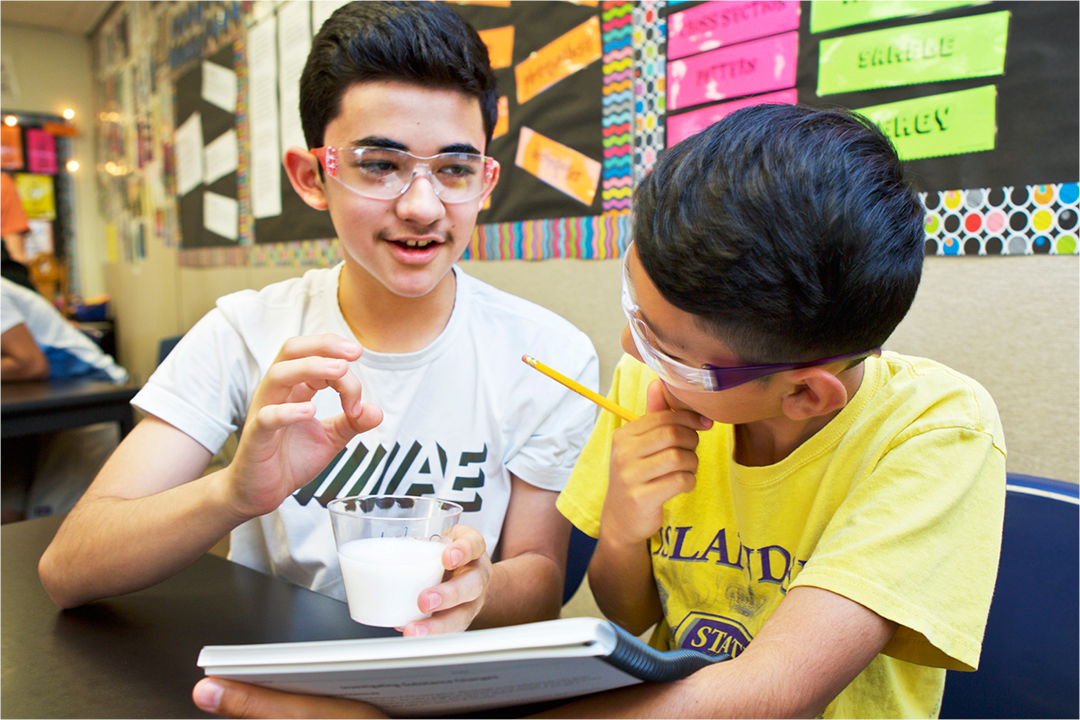

GREAT NEWS!
High-Impact Tutoring Grant for 2025–26 is released by DESE!
Built on the Science of Reading, Amplify Tutoring engages students and achieves real results. Let’s partner and support Arkansas students to become confident, proficient readers.

Arkansas Districts, Welcome to Amplify Tutoring
At Amplify Tutoring, we’re dedicated to assisting you every step of the way. From grant writing and planning to full implementation — including tutors, materials, and everything you need — we’re here to help you.
- Maximize Your Opportunity
Watch our quick 3-minute video to discover how Amplify Tutoring can help you make the most of this chance and ensure Arkansas students receive the support they deserve! - Our Impact
Interested in how we’re already making a difference? Explore our impact across Arkansas here. - Connect with Us
Schedule a 1:1 meeting with us today to learn more and get grant writing support. - Learn More About Us:
Visit amplify.com/tutoring for more information.Register for an information session:- Register for an information session:
- August 19: 10 a.m. CT or 2 p.m. CT
- August 20: 10 a.m. CT or 2 p.m. CT
- August 21: 10 a.m. CT or 2 p.m. CT
- August 25: 10 a.m. CT or 2 p.m. CT
- August 26: 10 a.m. CT or 2 p.m. CT
- August 27: 10 a.m. CT or 2 p.m. CT
- Resources to Support
See the Commissioner’s Memo here and 2025–2026 grant application here. - Questions?
Contact us at tutoring@amplify.com
Hear from leaders like you!
See what other district leaders are saying about Amplify Tutoring.
Overview

Accelerate student achievement.
Amplify Tutoring supports and accelerates student proficiency in foundational literacy skills. Results show that students in Amplify Tutoring outperformed similarly at-risk peers on a nationally normed reading assessment, and those who attended most consistently made the largest gains.

Reimagine instructional supports.
Amplify’s scaled tutoring offerings can be customized to help you meet the needs of your students. Whether you need high-quality tutoring materials, help designing your tutoring program, professional development, or tutors, Amplify can support you at every stage.

Increase insight into student learning.
Grounded in data, mCLASS® Intervention provides educators and tutors with visibility into lessons, progress monitoring, and instruction tailored to the needs of each student.
Our approach
Amplify Tutoring offers research-aligned tutoring materials, services, and training. From design consultations to full-service tutoring programs, our models reflect the principles of high-impact tutoring.


Data-driven instructional materials that are aligned with the Science of Reading and meet ESSA criteria
Amplify Tutoring features research-backed lessons aligned with the Science of Reading and grounded in mCLASS Intervention (an ESSA aligned program). This program groups students with common strengths and needs and provides progress monitoring.
Frequent and consistent sessions
Tutors engage with students in three or more 30-minute skill-building sessions per week to build confidence in students’ early literacy skills.


Positive relationship building
When students feel safe and cared for, they are motivated to achieve their goals. Our approach supports consistent, positive tutor-student relationships.
Training for district and tutoring personnel
District and tutoring personnel receive flexible, comprehensive training, enabling high-quality tutoring instruction to meet student needs.

First-of-its-kind voice-powered assessment to help educators understand and accelerate the literacy development of remote learners
BROOKLYN, New York—August 25, 2020—Amplify, a publisher of next-generation curriculum and assessment programs, today announced the release of a voice-enabled reading assessment for grades 1–6, created in collaboration with Dublin-based SoapBox Labs, which develops accuracy and privacy driven voice technology for children. Text Reading Online is the first literacy assessment of its kind to enable remote evaluation of oral reading fluency, accuracy, and comprehension—critical indicators of reading development for young readers.
“Given the realities of teaching and learning in a pandemic, educators are seeking approaches to assessing a child’s independent reading when they cannot be together in person,” said Larry Berger, chief executive officer at Amplify. “We are pleased to offer Text Reading Online as a part of the overall mCLASS literacy suite to help educators assess their students’ reading development remotely, including the accurate identification of learning loss and how best to address it, this year.”
Reading accuracy, fluency, and comprehension are important indicators of whether students are making the transition from learning to read to reading to learn. Like most early literacy assessments, however, evaluation of oral reading fluency typically requires direct in-person observation of students by trained educators. By enabling educators to understand and evaluate fluency, accuracy, and comprehension development, even in a remote setting, Text Reading Online can help educators tailor instruction and avoid reading loss during a critical developmental stage.
To perform the assessment, students read two texts aloud: the first text is at the student’s grade level, the second is adapted based on the student’s performance on the initial text. Students then answer a set of text-dependent comprehension questions to evaluate their degree of understanding. Data from the assessment, including reading rate and specific error types, provides educators with near real-time feedback, which they can use to identify areas of focus and cater lessons to each child’s needs.
Named one of Europe’s hottest startups by Wired UK in 2019, SoapBox Labs was founded by Dr. Patricia Scanlon, whose popular TEDx talk explains the ways in which technology can “transform a child’s reading journey.” In 2018, Scanlon was named to the Forbes list of Top 50 Women in Tech globally.
“This is about making educators’ lives just a little bit easier by providing them with tech-enabled tools that allow them to engage in accurate and private literacy assessment for all their students,” said SoapBox Labs CEO Dr. Patricia Scanlon. “But the implications are even more far reaching. The moment for voice tech in learning has arrived, and we view our work as essential in the development of a more inclusive, equitable education future.”
Text Reading Online will be available for free to all of Amplify’s mCLASS customers during the 2020-2021 school year. Visit the Text Reading Online page on Amplify.com to learn more.
***
About Amplify
A pioneer in K–12 education since 2000, Amplify is leading the way in next-generation curriculum and assessment. Our captivating core and supplemental programs in ELA, math, and science engage all students in rigorous learning and inspire them to think deeply, creatively, and for themselves. Our formative assessment products turn data into practical instructional support to help all students build a strong foundation in early reading and math. All of our programs provide teachers with powerful tools that help them understand and respond to the needs of every student. Today, Amplify serves five million students in all 50 states. For more information, visit amplify.com.
About SoapBox Labs
SoapBox Labs develops award-winning voice technology for kids modeled on kids’ speech, language, and behaviors. Proprietary and built from the ground up, our accurate, private, and age-appropriate voice technology powers immersive play and learning experiences, including literacy and language learning tools, for children ages 2 to 12 years old. To view demos, download reports and white papers, or learn more about how our technology powers third party education and toy companies, go to www.SoapBoxLabs.com.
A Spanish and English literacy curriculum grounded in the Science of Reading
Discover a suite of Spanish literacy curriculum and assessment programs designed to build confident readers with mCLASS® Lectura, Amplify Caminos, and Boost Lectura. Amplify’s biliteracy suite includes assessment, core instruction, and personalized learning built on the Science of Reading.
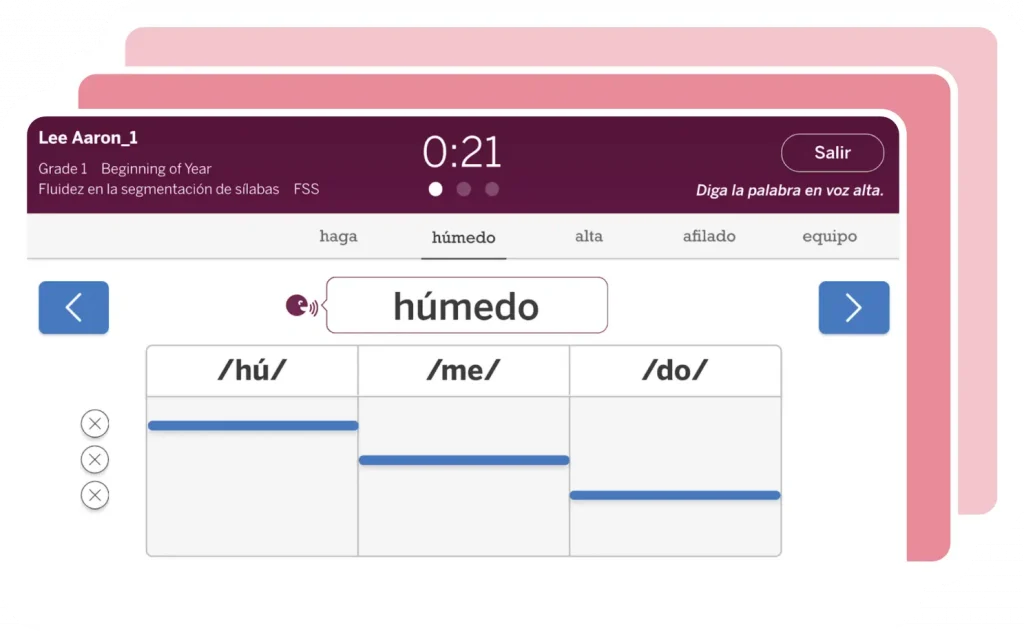
mCLASS Lectura assessment
mCLASS Lectura is a Science of Reading-based universal and dyslexia screener for K–6 that helps educators accelerate students’ literacy in Spanish. When combined with mCLASS DIBELS® 8th Edition, it’s the only assessment offering a dual language instructional report that enables teachers to identify skills students can transfer across languages.
Amplify Caminos core curriculum
When combined with Amplify Caminos, mCLASS Lectura helps you provide targeted whole-class instruction specific to your class’s or students’ risk levels and areas of growth for Spanish literacy.
Boost Lectura personalized learning
mCLASS Lectura drives placement into Boost Lectura, our personalized learning program, placing students on a skill map that meets them at their instructional level.
Amplify Caminos
core curriculum
Amplify Caminos is a K–5 Spanish language arts curriculum that helps teachers inspire students to become confident readers, writers, and thinkers in Spanish. Grounded in the Science of Reading and following biliteracy principles, the program combines rich content knowledge with systematic foundational skills instruction.

Amplify Caminos provides strong core instruction in the same critical literacy skills measured in mCLASS Lectura, helping align your assessment and core instruction.
Boost Lectura personalized learning
Amplify Caminos and Boost Lectura are grounded in the same evidence-based Spanish literacy skills progression, reinforcing skill development through personalized practice.
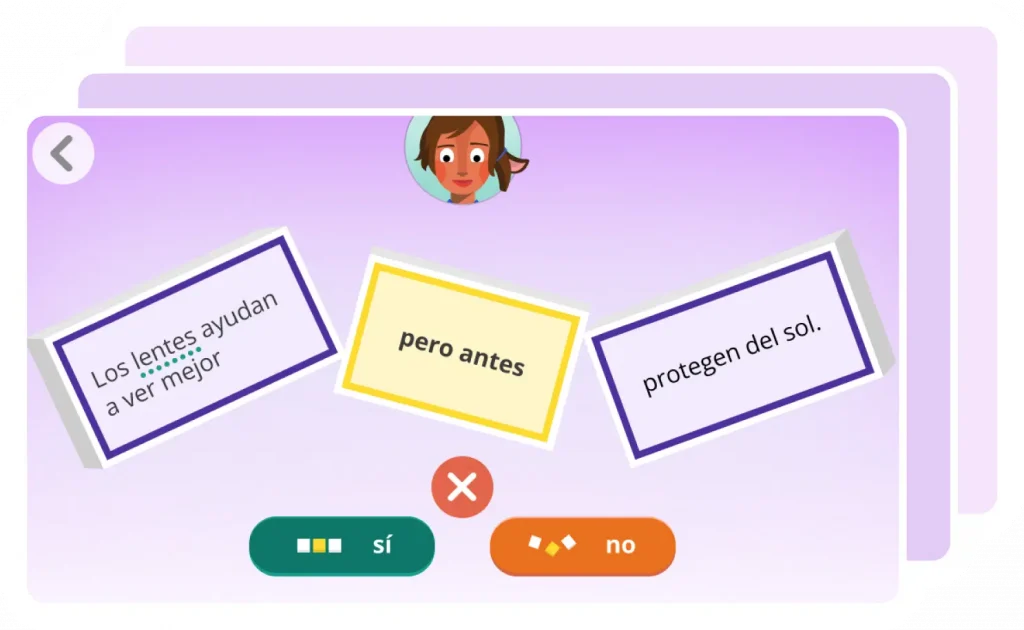
Boost Lectura personalized learning
Boost Lectura is a K–2 personalized Spanish literacy program with proven efficacy that focuses on key accelerants of critical literacy skills. Boost Lectura offers a highly adaptive, student-led approach to personalized learning that’s instructive and engaging. Boost Lectura also fits in any classroom model, allowing for easy integration without disrupting routines.
Boost Lectura uses mCLASS Lectura’s data for student placement, providing practice with the skills students need the most.
Amplify Caminos core curriculum
Boost Lectura expands on the learning experience from Amplify Caminos, delivering personalized practice to support foundational skill development.
Built on principles that honor biliteracy
Biliteracy opens the door to rewarding learning opportunities for students. Amplify is committed to biliteracy development and empowering educators in fostering great teaching and learning experiences. Access our biliteracy and Science of Reading principles, the foundation of our biliteracy suite, for insights into how bilingual literacy develops.
Explore more programs based on the Science of Reading.
Our English early literacy suite programs are also designed to support and complement each other. Learn more about integrated programs below.

High-impact literacy tutoring for K–6 built on the Science of Reading-NEW | Amplify
Uncover student thinking with a complete K-8 math assessment system
Expect more from your assessments with mCLASS® Math, a complete K–8 benchmark and progress monitoring assessment system that shows how students performed, reveals their math thinking, and provides teachers with recommendations to drive grade-level success.
About the program
mCLASS Math is a digital assessment system designed to evaluate student performance and growth against grade-level expectations throughout the year. The program empowers educators and students with:
- Valid, reliable, and research-based assessments that take less time, so you can measure student proficiency and growth without taking time away from instruction.
- Valuable insights into student math thinking that move beyond right or wrong answers, revealing students’ processes so you can accelerate grade-level learning by building on what they already know.
- Data that drives instruction, turning assessment results into clear next steps for differentiation and intervention—all aligned with your core math program and MTSS framework.
mCLASS Math is available for grades K–5 in the 2025–26 school year and for grades K–8 in the 2026–27 school year.
Access deeper insights into students’ understanding
Traditional assessments focus only on right or wrong answers. mCLASS Math goes deeper, revealing how students think about grade-level math and what they already understand.
This asset-based approach recognizes that every student has their own ways of thinking. Their individual strengths, experiences, understandings, and strategies—or assets, as we collectively refer to them—inform the robust data that powers mCLASS Math. By focusing on what students already know and where they need support, teachers can confidently build on each target area for growth and accelerate grade-level learning with confidence.

Traditional assessments |
mCLASS Math’s asset-based assessments |
| Focus on student deficits | Highlight what students already know and how they think to build on their strengths |
| Require lengthy assessments with separate questions to address each skill | Efficiently gather multiple data points per item, reducing assessment time |
| Judge answers solely as correct or incorrect | Reveal students’ thinking and understanding behind their answers |
| Provide data disconnected from core instruction and intervention | Deliver data-driven recommendations aligned with core instruction and MTSS |
mCLASS Benchmark Assessments
- Digitally administered to the whole class three times a year (BOY, MOY, EOY) to measure growth against grade-level expectations
- Provide real-time visibility into student work and responses
- Diagnostic and screening tools to identify strengths and areas for Tier 2 and Tier 3 interventions
- Flag potential risk of dyscalculia for early support
mCLASS Progress Monitoring
- Quick, targeted assessments administered between benchmarks
- Track student performance in specific skills and concepts over time
- Inform instructional adjustments with in-the-moment recommendations
- Ensure interventions are effective to keep students on track
Instructional supports for Tiers 1–3
Support, Strengthen, and Stretch model: Flexible framework for effective differentiation and intervention
- Mini-Lessons: 15-minute teacher-led interventions to build grade-level proficiency in small groups
- Centers: collaborative, hands-on activities for concept reinforcement (grades K–5)
- Fluency Practice: adaptive digital practice to build number sense and procedural fluency
- Item Bank: customizable practice and assessments filtered by standards and skills
- Extensions: student-choice activities to challenge and extend learning

A research-backed approach
mCLASS Math assessments provide valid, reliable measures of student proficiency and thinking, offering clear insight into growth and performance against grade-level expectations.
Developed by a team of researchers, mCLASS Math has undergone rigorous psychometric validity studies and is backed by the latest iteration of curriculum-based measurement tools and a state-of-the-art approach for efficiently assessing students’ mathematical thinking.
Additionally, K–5 progress monitoring and 6–8 benchmark assessments are part of ongoing national field trials, reflecting our commitment to continuous improvement and evidence-based design. Learn more.
Data that informs instruction
mCLASS Math transforms each student’s assessment results into clear, actionable next steps, empowering teachers to provide timely scaffolds and targeted instruction where they’re needed most. Integrated insights align with your core math program and MTSS framework, making it easy to differentiate and support every learner with confidence.
One integrated math solution
Amplify’s comprehensive math suite, Amplify Desmos Math, provides seamless alignment to help teachers capitalize on strengths, foster deep investment, and build agency for all students.
Everything is in one place—with screening and progress monitoring, core instruction, integrated personalized learning, and embedded intervention teachers can trust.
Maximize assessment impact with mCLASS PD.
Amplify offers focused professional development to help educators leverage mCLASS Math data effectively. Gain strategies to enhance instruction, drive student success, and fully utilize assessment insights.

Amplify Classroom
Amplify Classroom is a free teaching and learning platform that places student engagement at the center of instruction.
Amplify Classroom features free lessons, lesson-
building tools, sharing features, and more. Built by
math educators, the platform makes differentiation
easier for teachers, enabling them to personalize individual student instruction in real-time.
Create your teacher account
at classroom.amplify.com.
Explore more programs.
Amplify programs are designed to support and complement each other. Learn more about our related programs.
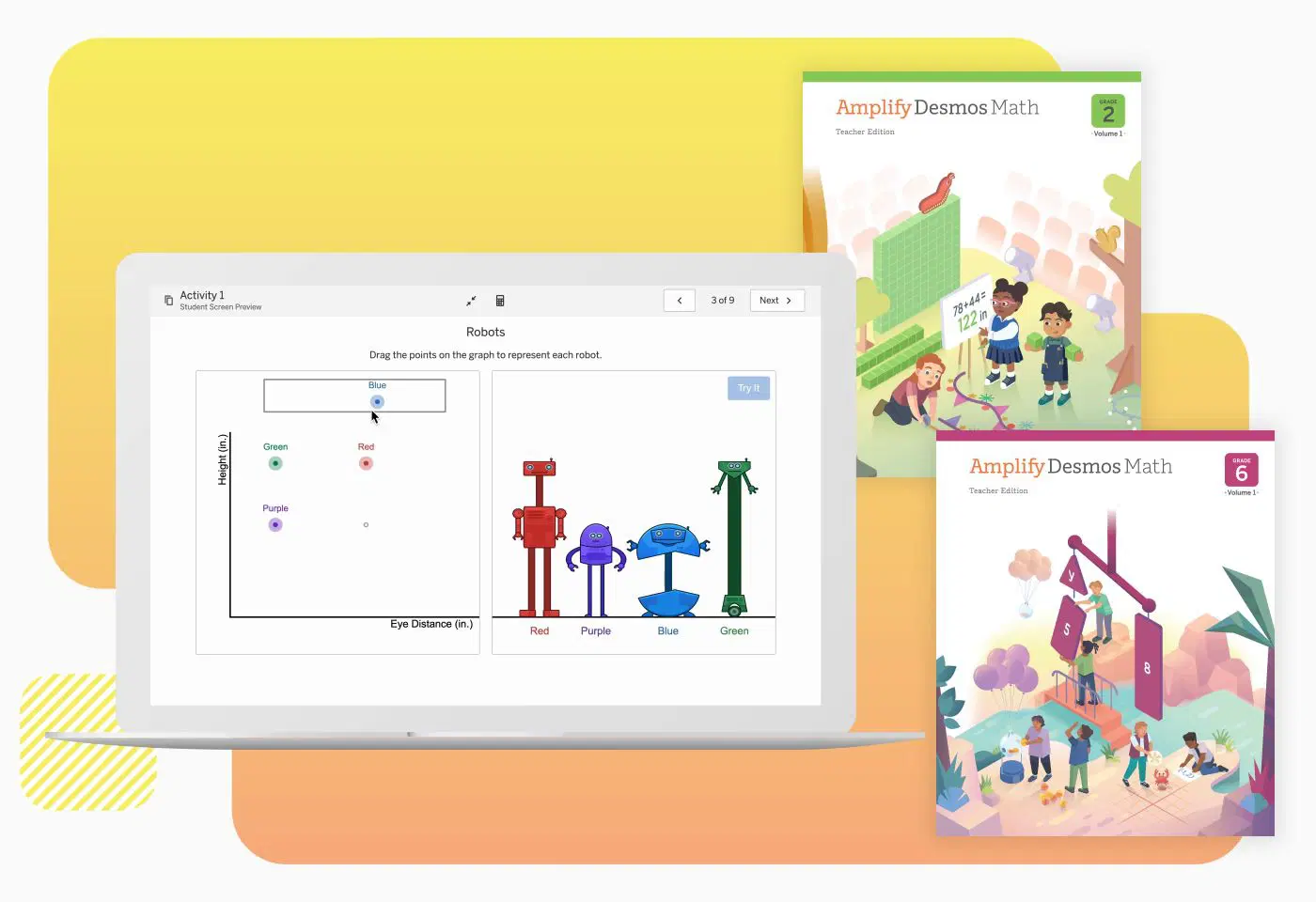


New study: When combined with Amplify CKLA, Boost Reading significantly improves student progress
BROOKLYN, NY (January 27, 2025) – Amplify, a publisher of next-generation curriculum and assessment programs, today released the results of a study on the impact of using Boost Reading™, an adaptive K–5 personalized learning program grounded in the Science of Reading. Designed to complement the Amplify Core Knowledge and Language Arts (CKLA) curriculum, Boost Reading provides both intervention and enrichment support, reinforcing Amplify CKLA’s core instruction.
Findings reveal that Boost Reading accelerates growth for K-5 students already using Amplify CKLA. On average across grades, Amplify CKLA students who began the year at below-average reading levels and used Boost Reading for 30 minutes a week or more were 18 percent more likely to exceed national benchmarks for reading growth relative to students who did not.
Boost Reading is an adaptive and student-led program that tailors practice to each student’s individual needs, reinforcing core knowledge topics while addressing critical skill gaps. It integrates into any classroom model, allowing for full independent practice and freeing teachers to work with other students.
“It’s clear that Boost Reading and Amplify CKLA are powerful, research-backed tools that have the potential to help many K-5 students,” said Melissa Ulan, executive vice president of the literacy suite at Amplify. “Because they share the same pedagogical foundation and sequencing of foundational skills, when you combine the two, you really start to see accelerated growth. This is particularly important given the literacy rates among students nationwide.”
The study included more than 90,000 students who used Boost Reading for at least 30 minutes a week and a comparison group of more than 90,000 students who did not use Boost Reading, matched on key student characteristics. Students’ reading skills were measured using mCLASS® DIBELS® 8th Edition.
About Amplify
A pioneer in K–12 education since 2000, Amplify is leading the way in next-generation curriculum and assessment. Our core and supplemental programs in ELA, math and science engage all students in rigorous learning and inspire them to think deeply, creatively and for themselves. Our formative assessment products help teachers identify the targeted instruction students need to build a strong foundation in early reading and math. All of our programs and services provide educators with powerful tools that help them understand and respond to the needs of every student. Today, Amplify serves more than 15 million students in all 50 states and on six continents. For more information, visit Amplify.com.
Media Contact: Kristine Frech; media@amplify.com
Boost Reading+ sessions overview
| Title | Duration | Modality | Audience |
|---|---|---|---|
| Launch Sessions | |||
| Initial training | Half day | Onsite/Remote | New Boost Reading+ customers |
Launch sessions
Initial training
Half day (3 hours)
The initial half-day training will explain how Skills Boost combines assessment, targeted instruction, personalized practice, and intervention to accelerate students’ reading growth. It will also support educators in administering program placement to students, utilizing the teacher dashboard to monitor students’ progress, and implementing 9-day lesson plans for students who require intervention.
Audience: Teachers (administrators welcome), maximum 30 participants
Modality: Onsite/remote
Pricing
| Session type | Pricing |
|---|---|
| Half-day onsite session | $2,500 |
| Half-day remote session | $750 |
Contact
Amplify welcomes the opportunity to partner with schools and districts to design professional development plans and answer your questions.
If you would like to order any of our professional development services, please contact your local Amplify sales representative or call (800) 823-1969.
Close gaps with the only digital intervention for Amplify CKLA and mCLASS classrooms.
Boost Reading is a K–5 digital intervention program that connects directly to your existing tools. It automatically turns your mCLASS® DIBELS® 8th Edition data into action and reinforces your Amplify Core Knowledge Language Arts (CKLA) lessons with adaptive instruction. It meets students exactly where they are and fits into any part of the school day, giving you clear insights with no extra work.
Move more students toward benchmark

Amplify CKLA students who start the year at below-benchmark reading levels are 34% more likely to meet benchmark by the end of year when using Boost Reading.

Across grades K–5, at-risk students using Boost Reading are 36% more likely to reach benchmark by the end of year.

Multilingual/English learners (ML/ELs) who start the year at risk are 43% more likely to finish the year on track after using Boost Reading than their peers who did not use Boost Reading.
Click through to explore the Boost Reading Teacher Dashboard for yourself.
See what your teachers see. Explore this interactive demo to see how easy it is to track student progress, assessment data, and growth reporting insights. Just click “Next” on the screen below to begin!
Differentiated support at every turn
Boost Reading supports your Multi-Tiered System of Supports (MTSS) framework by providing differentiated skill development for every learner, keeping student growth in constant motion from assessment to practice.
Tier 1: Reinforce Amplify CKLA lessons with adaptive enrichment and grade-level practice that keeps students engaged and on track.
Tier 2: Deliver independent remediation for students navigating core concept challenges, so you can stay focused on your small groups.
Tier 3: Keep student growth moving between small-group sessions with practice that reinforces your mCLASS instruction.

A digital companion built to follow your lead
Experience a connected literacy suite where your assessment, core instruction, and intervention work together. Boost Reading is the only program designed to follow the same scope and sequence as your Amplify CKLA lessons, all aligned to the Science of Reading and all powered by your mCLASS DIBELS 8th Edition data.


Amplify CKLA: Your lessons, reinforced
Boost Reading provides the adaptive independent practice students need to thrive in your core lessons. Amplify CKLA students who start the year at below-benchmark reading levels are 34% more likely to meet benchmark by the end of year when using Boost Reading.
Built for the way students learn
Student growth accelerates when adaptive practice reinforces your core instruction. Boost Reading is anchored in the same Science of Reading sequence as Amplify CKLA, introducing critical skills in the same order research dictates.

Deeper mastery of core skills
Boost Reading ensures that students on every path are building the mechanics of reading independently while your class stays on track with Amplify CKLA lessons. Explore the sections below to see how Boost Reading provides targeted practice that supports instruction.
Help students build strong foundational blending skills.
The quest Gem & Nye provides targeted practice with phonological awareness. Students work alongside friendly sound bots to listen to individuals sounds and blend them together to identify words.
For Amplify CKLA students
Boost Reading follows the same sequence as Amplify CKLA. Both are grounded in the Science of Reading to reinforce classroom blending techniques, such as arm blending. The program’s differentiation offers students reading below grade level the support they need to engage with grade-level content.

Strengthen decoding and syllable skills.
In Curioso Crossing, students engage in systematic practice by identifying and decoding multi-syllable patterns. Each level brings the decoding speed and accuracy needed for comprehension.
For Amplify CKLA students
Boost Reading provides repeated exposure to the sound-spelling patterns found on your Amplify CKLA Power Bar cards, reinforcing advanced decoding skills. This repeated practice helps students gain the confidence needed to independently access complex CKLA texts.

Develop rich mental models for deeper comprehension.
Picture This puts students in the director’s chair, guiding them as they read complex passages and select visual elements that bring the story to life. By physically building the scene with characters, settings, and plot details, students develop the mental modeling skills that power strong reading comprehension.
For Amplify CKLA students
Story analysis is central to your classroom readers. Boost Reading supports readers who are struggling with text through adaptive practice with the same “Who, What, and Why” thinking they use in core lessons. As they progress through their personalized path, they strengthen comprehension skills at their own pace.

Strengthen the language skills that bring stories to life.
Idiomatica takes students on an adventure through common idioms and expressions. Students explore the difference between literal and figurative meanings, building the language awareness they need to interpret complex texts.
For Amplify CKLA students
Literacy instruction in Grades 3+ focuses on authors’ use of figurative language and descriptive details. Boost Reading complements this skill with practice to ensure students internalize descriptive language, enabling them to work through more rigorous texts.

Turn your data into immediate intervention and remediation.
When your tools speak the same language, student growth is easy to follow. Boost Reading uses your mCLASS data, ensuring every student is on the fastest path to reading success.


Trust your data to deliver the right skills.
Boost Reading turns your teacher-administered mCLASS assessment data into targeted learning paths, making enrichment and remediation a direct extension of your observations. Every lesson is grounded in what students need.
See how Boost Reading turns mCLASS data into action.
Boost Reading picks up where mCLASS leaves off, providing focused practice for skills that have been flagged. Explore the module below to see how Boost Reading translates assessment scores into targeted practice for each student needing support.

Meet Alice, who is currently navigating her beginning-of-year reading assessments. Her mCLASS data flags a specific need for Phoneme Segmentation (PSF) support, pinpointing where she needs a little extra help to stay on track.
Alice can expect to dive into targeted practice quests like All Aboard! during her independent learning time. Here, she will learn to isolate and hear the specific sounds that make up a word—building her confidence and skills before she even begins to read.

Meet Aiden, who has already mastered letter names but is still working on putting those sounds together. His mCLASS data flags a need for Nonsense Word Fluency (NWF) and Phoneme Segmentation (PSF) support, showing exactly where he needs a bridge to decoding.
Aiden can expect to dive into targeted practice quests like Picky Goblins during his independent time. This playful, focused practice helps him find his footing with letter sounds and blending, ultimately helping those individual sounds click into whole words.

Meet DeAndre, who is progressing well with isolated letter sounds and word decoding, but encounters a challenge when it’s time to read full sentences. While his foundational skills are solid, his mCLASS data flags a need for Oral Reading Fluency (ORF) support, showing he’s ready to practice reading text smoothly.
DeAndre can expect to dive into quests like Story Lab during his independent learning time to practice bridging the gap between individual words and a full story. By tracking and reading along with connected text at his own pace, he can build the rhythm and expression needed to make reading feel more like a natural conversation.

Meet Ernesto, who reads with great speed and accuracy, hitting benchmark milestones on his oral reading assessments. However, when it comes to deep text comprehension, his mCLASS Maze data flags a need for extra support, showing he’s ready to focus on how sentences build meaning.
Ernesto can expect to dive into quests like Unmask That during his independent time. This focused practice helps him master how sentences connect by teaching him to track details like pronouns, ensuring he catches the full meaning of every paragraph.

Implementation that fits your schedule
Boost Reading fits right into the routines you already have in place. It’s designed to honor your current schedule and protect your classroom time with just 30 minutes of practice a week.
With this flexible program you can:
- Provide student-led independent practice with the flexibility for one-to-one support.
- Lead targeted small groups at a moment’s notice with printable lessons.
- Fit learning easily into daily routines, like stations, warm-ups, or early finishers.
- Keep the rest of the class on a personalized path with a simple log-in-and-go setup.
Know exactly who needs support with reporting built for busy teachers.
You don’t need to be a data analyst to see if your students are growing. Boost Reading translates every minute of student practice into clear, actionable insights that help you plan your next move.

Trouble Spots
Turn struggles into immediate instructional wins. Trouble Spots identifies where students need help and provides printable lessons, so you can deliver targeted intervention support quicker.
Monthly Growth Reporting
Celebrate growth as it happens while you watch learning gaps close month over month. Boost Reading’s Monthly Growth Reporting provides easy-to-read data on how your class is growing over time, giving you the perfect at-a-glance tool to see how your interventions are working.


Skill Placement
Connect the dots between student practice and your benchmark goals with a clear view of Science of Reading skill development. Skill Placement serves as a window into how students are growing toward grade-level mastery, showing you how their core Amplify CKLA skills are progressing.
Administrator and Caregiver Reports
Literacy success is a unified effort. Boost Reading provides Administrator Reports for district-wide visibility into student growth, while families receive Caregiver Reports that produce simple and friendly updates on their child’s progress. Together, these insights turn every milestone into a shared celebration—from the district office to the dinner table.

Growing confident readers in both languages
Support your Spanish and English learners together by pairing Boost Reading with Boost Lectura, our K–2 Spanish literacy program. Together, they provide the targeted practice students need to transfer critical literacy skills between both languages.
See why Boost Reading is the best part of their day!
Bring your literacy team on board.
Download these resources for a deeper look at how Boost Reading can support literacy development in your classrooms.


New York
Welcome to the Baltimore Tutoring Project!
Baltimore City Schools and Amplify have partnered to provide virtual reading tutoring services. Amplify Tutoring aligns with the mission of Amplify in extending the reach of classroom teachers and supporting rigorous and riveting learning experiences for students. The purpose of this high impact tutoring is to support and accelerate student achievement in foundational literacy skills in order to address unfinished learning and achievement gaps. Classroom teachers teach foundational literacy skills in whole group and small group settings; Amplify tutoring is one way to support teachers in meeting the needs of their students by providing additional opportunities for struggling students to work in small groups with a tutor.

Welcome, Baltimore Educators!
We’ve created this website with resources that will help ensure the success of your high-impact tutoring program.




Additional resources
Log In to Amplify Tutoring
Logging in with a personal device
- If you’re already logged into Clever, go to tutor.amplify.com and click Log In with Clever. You will be taken directly to Amplify Tutoring.
- If you’re NOT logged into Clever, go to tutor.amplify.com and click Log In with Clever.
- Scan the Clever badge OR enter your school name and your Clever username and password and click Log in


Logging in with a shared device
- If you’re using a shared device, go to tutor.amplify.com and click Log In with Amplify.
- Enter your Amplify Reading username and password.
- Click Log in.
Logging in for the first time
After you log in for the first time, scroll down to complete the welcome tutorial.

Join a Tutoring Session
- After you log in, click your class.
- Click Blackboard Collaborate and then click Join session.
- In the list that displays, click your class name to join the scheduled session. Note: You can only join a session at the time it is scheduled. If the scheduled session isn’t in progress, you will see “Room disabled” under Blackboard Collaborate.
- If you’re joining for the first time, click Allow to give your browser permission to use the microphone and camera. Check to make sure each is working.
- To stop seeing onscreen instructions: click Later under Start Tutorial, then click X on the next prompt.
You should now be able to see and hear your tutor and the other students in your session.

Test Session Audio and Video
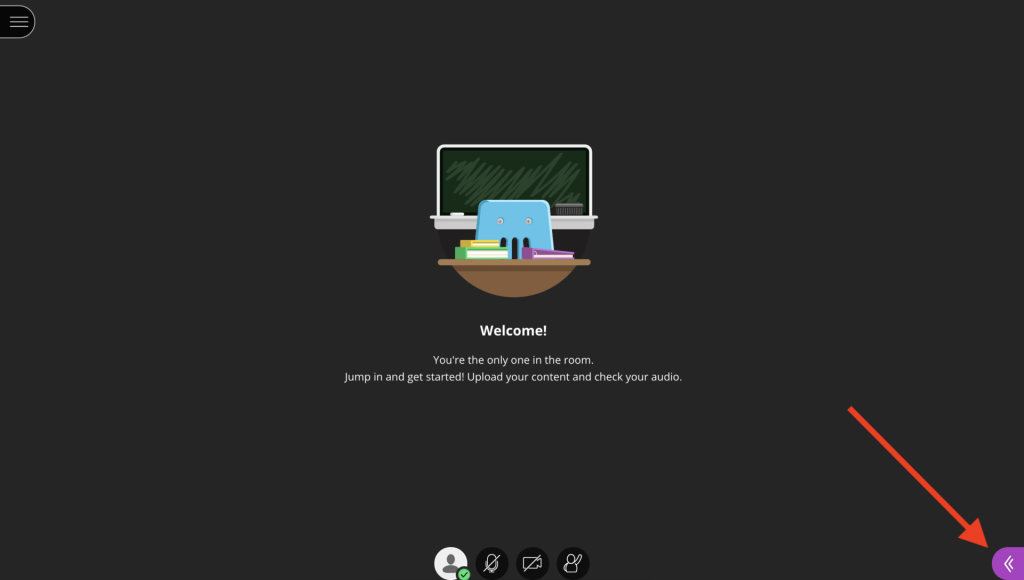
- To test audio and video, you must first join a session. Audio and video settings can only be tested in a session.
- Open the Collaborate panel by clicking the purple icon in the lower-right corner of the page.
- Click the My Settings icon in the panel that opens.
- Click Set up your camera and microphone.
- Test your microphone, and grant permission to your microphone if asked.
- Test your camera, and grant permission to your camera if asked.
Your tutor and the other students in your session should now be able to see and hear you.

Webinars
View our latest webinars for more information
Student-friendly resources

Additional resources

Student inventory of devices
How to obtain an additional inventory of student devices PDF


Family Letter- Pivoting to Remote Learning
Here is an Amplify Family Letter- Pivoting to Remote Learning for your use.
Connect, Reflect, Share!

Complete this optional Google form to share highlights from tutoring. We would love to capture and share your a-ha moments, the practices/strategies/resources you have found helpful, and/or celebrations of your students’ growth as readers and your development as a tutor!
Please use the form below to alert us of issues and concerns. We will look at trends, solutions, and reach out to schools if needed.
A digital reading intervention that delivers growth across every tier of instruction
Boost Reading is a student-led K–5 digital intervention, built on the Science of Reading, that delivers systematic instruction. Students receive targeted, adaptive practice that meets them where they are, while teachers get simple and meaningful insights into student progress without extra work. Fully aligned to Amplify CKLA and mCLASS®, Boost Reading brings powerful support to every tier of instruction. Para la versión en español, haga clic aquí.
Proven impact for students who need it most
Boost Reading meets ESSA’s Moderate (Tier 2) Evidence criteria and consistently moves students who score below and well-below benchmark toward benchmark with just 30 minutes of use per week. Boost Reading provides extra support to students (including multilingual/English learners and students with dyslexia) struggling with reading, with practice that builds a strong foundation for future reading success from the ground up. Learn more about the program’s impact on the Boost Reading research page.
Critical to MTSS with differentiated support for every learner
Boost Reading adapts automatically, so students practice the right skills at the right moment. Tier 2 students get meaningful independent intervention support, while Tier 3 students receive additional skill reinforcement between their staff-led sessions with mCLASS Intervention. Boost Reading follows the same foundational skills sequence as Amplify CKLA, which means that students practice skills unique to them, making Boost Reading an effective part of a Multi-Tiered System of Support (MTSS).
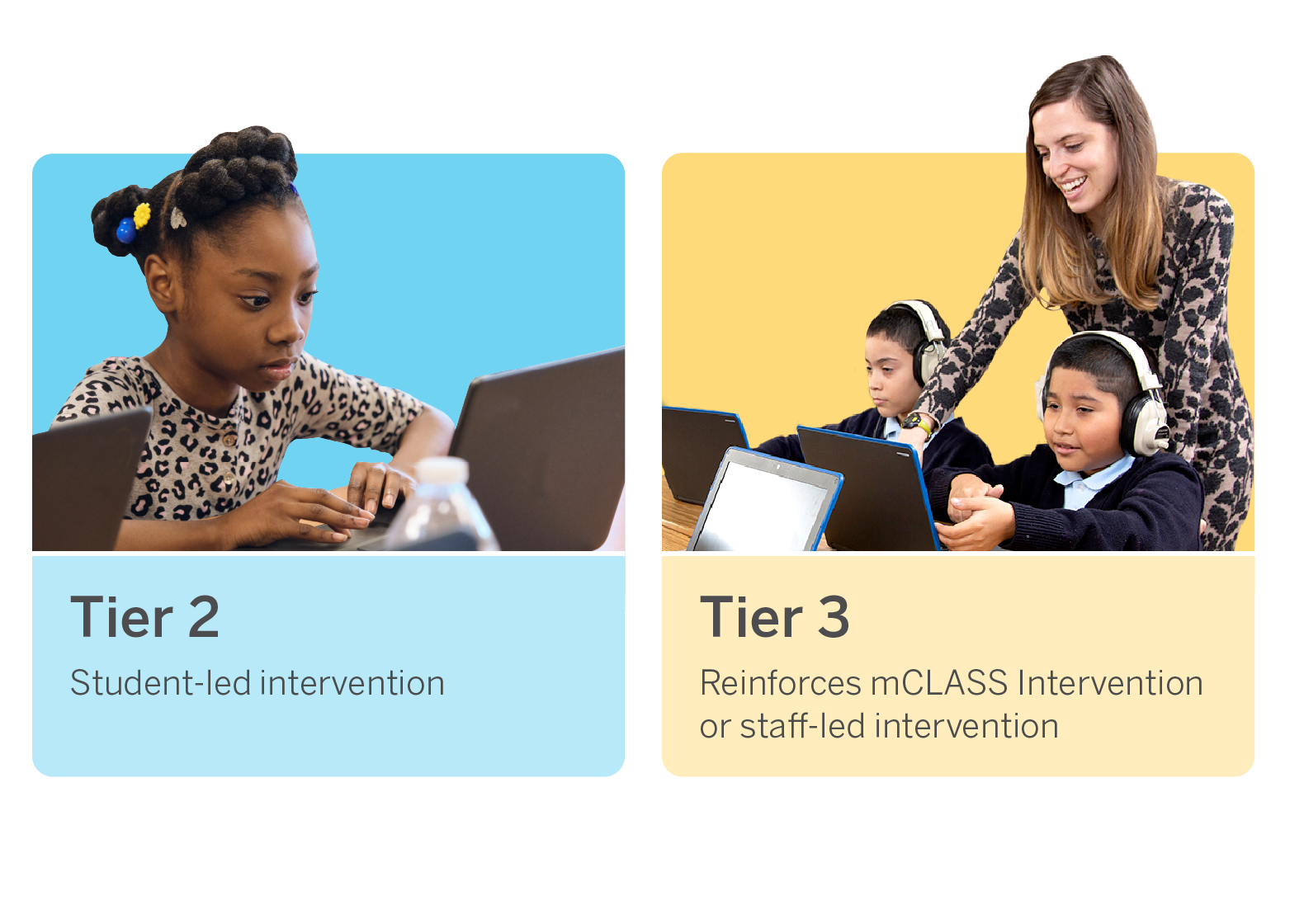
Data you can actually use in your classroom
Boost Reading shows you exactly what you need to know about student progress, through simple growth reporting on the Teacher Dashboard. See who’s improving, who needs support, and which skills to target next without having to spend time digging through complicated data.
Aligned to Amplify CKLA and mCLASS DIBELS 8th Edition
Boost Reading follows Amplify CKLA’s scope and sequence, making it easy to integrate into your daily routines by reinforcing the same skills you’re already teaching. It uses mCLASS DIBELS® 8th Edition data to provide targeted support and placement, giving teachers a clear view of how students progress across all instructional tiers.

Closing the gap for
K–2 multilingual/English learners
Boost Reading’s Spanish literacy partner, Boost Lectura, strengthens early literacy for Spanish-speaking multilingual/English learners. When used together, the two programs give teachers side-by-side insight into skill progression in Spanish and English, helping accelerate learning across both languages.
What’s included
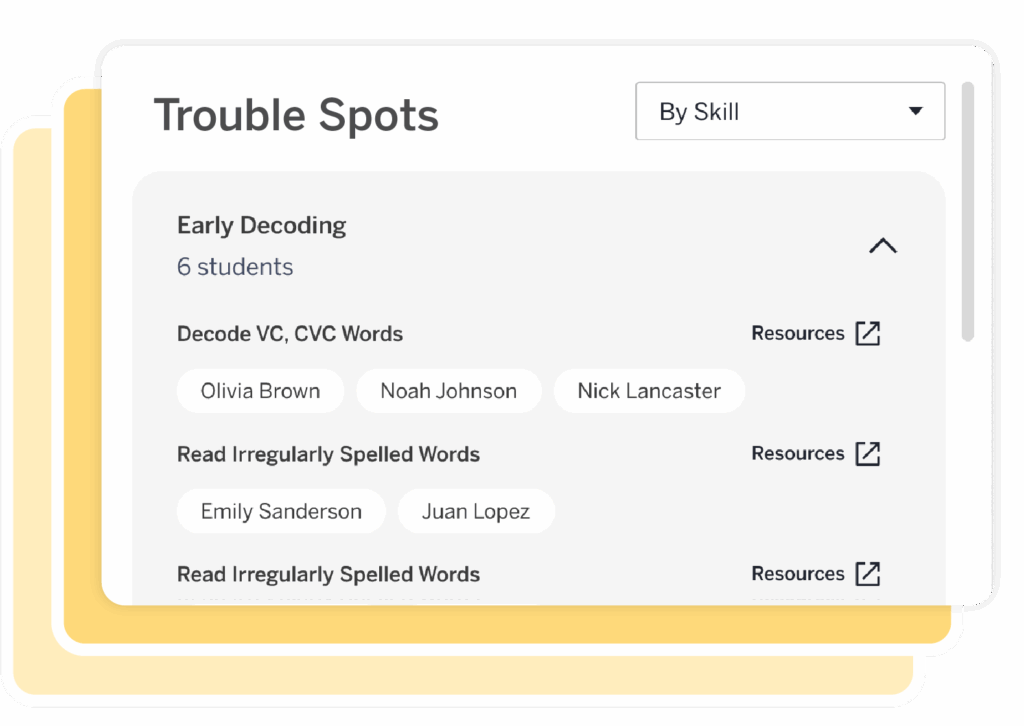
Pinpoint the skills that need your attention
The Trouble Spots section makes it easy to see which students are struggling and what skills they need to work on. Printable, ready-to-teach lessons allow you to pull together small groups in minutes.
Watch your students grow
Never miss a moment of your students’ literacy development, with monthly growth reporting! You’ll be able to track how students are developing skills month over month, and see their reading trajectory unfold.
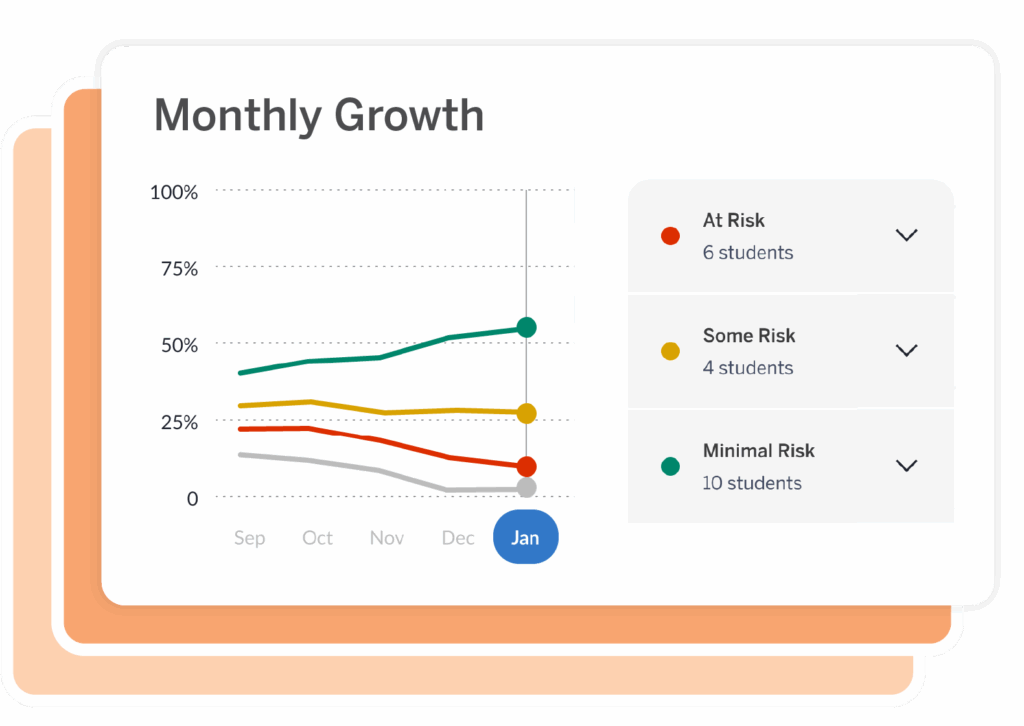
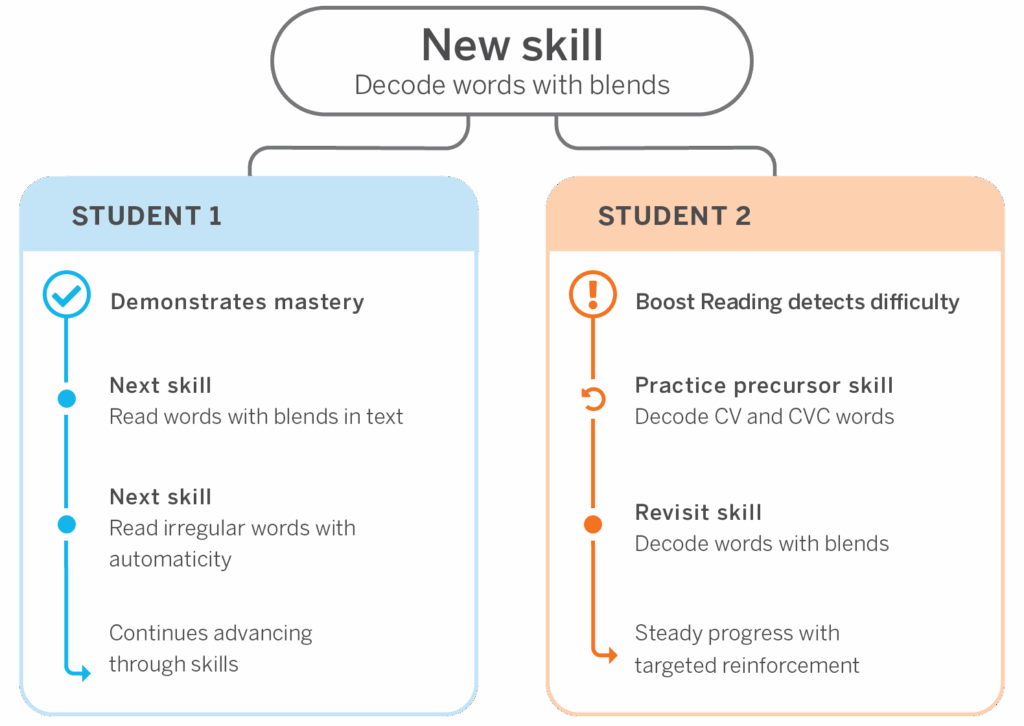
A program that grows with your students
Boost Reading continuously tailors instruction based on individual student performance. That means scaffolding foundational skills while building proficiency, one engaging activity at a time. There’s no stalled practice, and you’ll see steady progress across key reading skills.
Benchmark and growth assessments
Boost Reading combines built-in benchmark assessments with monthly skill scans to give teachers a holistic view of progress from the beginning of the year to the end of the year. The monthly skill scans act as check-ins between benchmark windows, so you’ll always know where students stand with a complete picture of their learning.
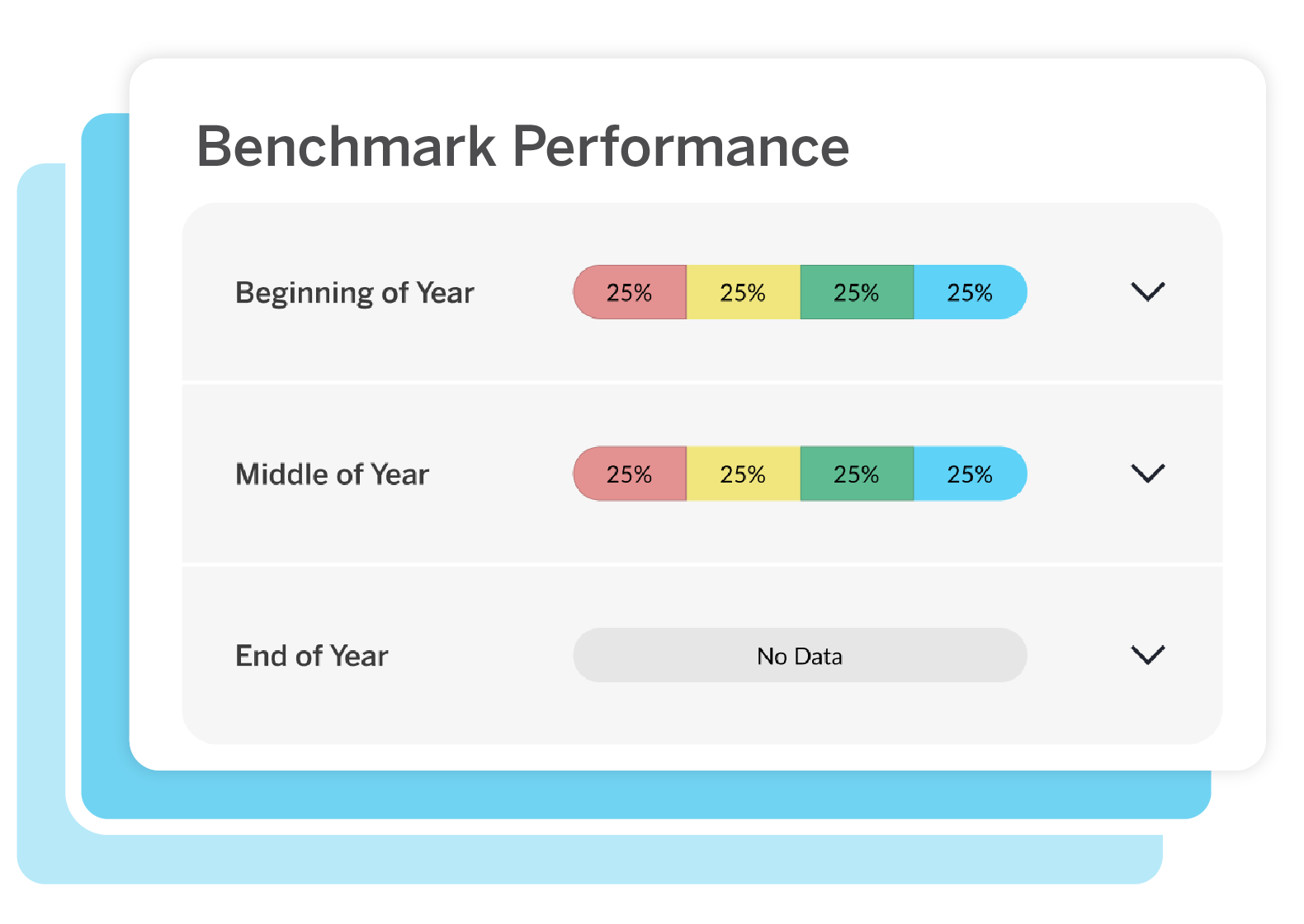
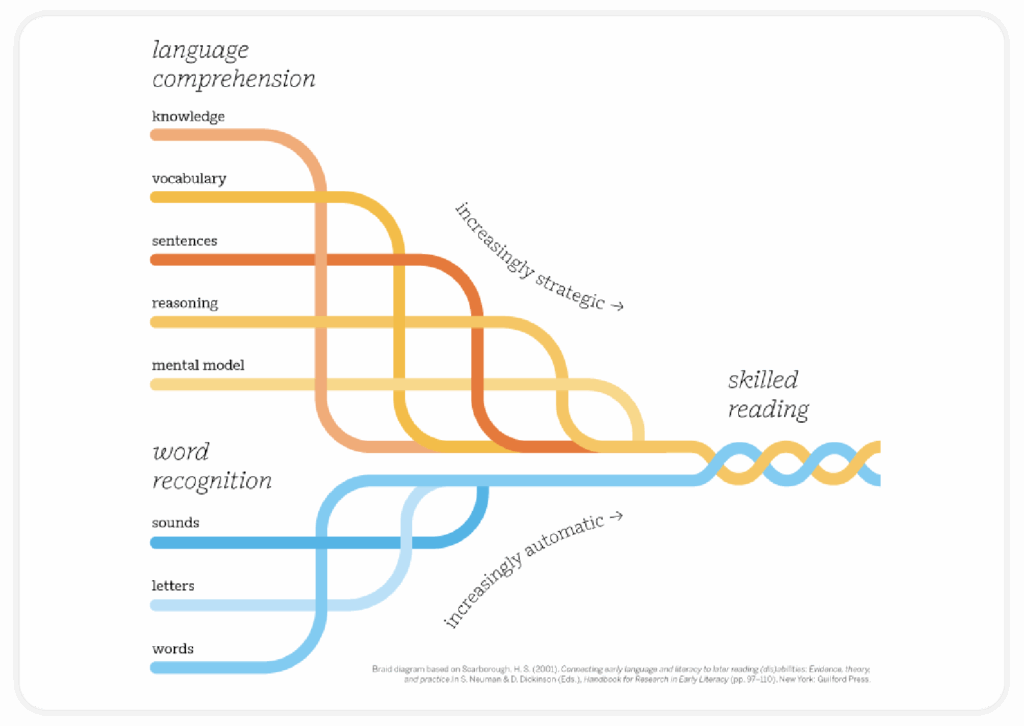
Science of Reading scope and sequence
Boost Reading introduces skills in the order research shows students learn best. Phonological awareness builds into phonics, vocabulary, and comprehension for a solid foundation and confident readers.
Administrator and caregiver reports
Administrators and caregivers are welcomed into the student reading journey with data on program usage, reading progress, and skill mastery.
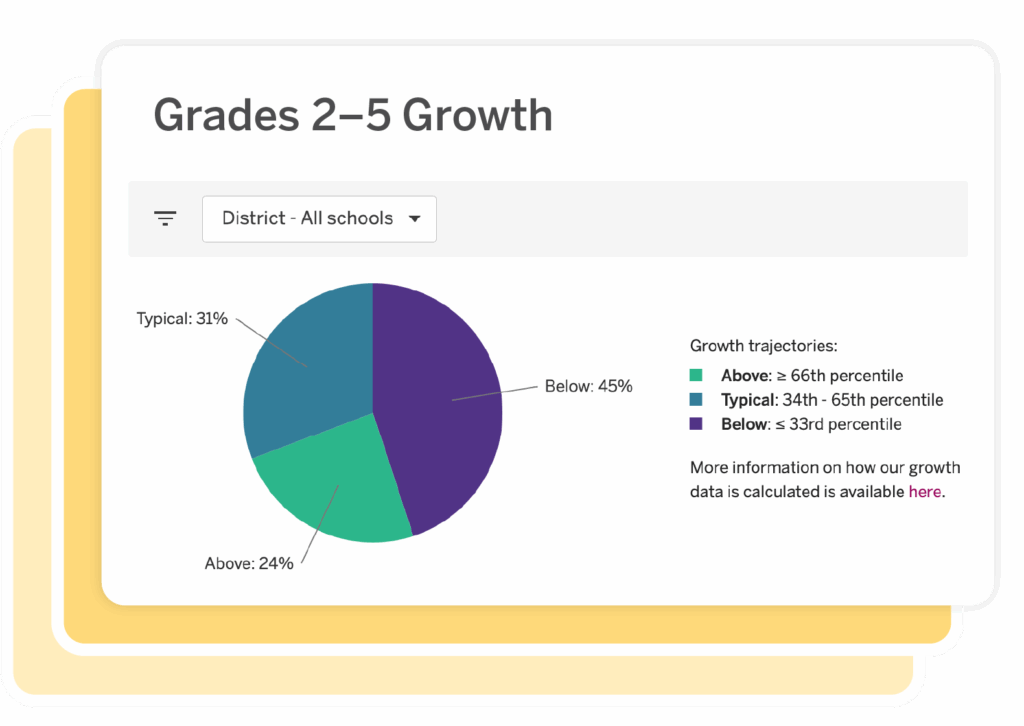
Explore more programs based on the Science of Reading.
All of the programs in our literacy suite are designed to support and complement each other. Learn more about our related programs:


Celebrating the 2026 Science of Reading Star Awards finalists

Every day, teachers and education leaders guide students toward a future lit up by literacy. It’s not always easy, especially for those championing shifts toward programs grounded in the Science of Reading.
That’s why we’re thrilled to celebrate the finalists of the 2026 Science of Reading Star Awards! These awards recognize educators, schools, and districts who go above and beyond to make evidence-based instruction a reality.
Empowering students through literacy
The Science of Reading Star Awards shine a beacon on the champions of literacy—the educators putting research into action.
Studies show that systematic phonics instruction leads to significantly higher achievement, particularly for students experiencing reading difficulties. Literacy instruction grounded in the Science of Reading strengthens critical thinking by building the vocabulary and background knowledge students need to make meaning from complex texts.
But shifting to this instruction is about more than swapping programs—it’s about leading change and inspiring others. With these awards, we celebrate the educators and districts whose innovative approach does just that.
Here are this year’s categories and finalists:
- The District Captain: For the district that exemplifies strong Science of Reading practices across the board
- Keppel Union School District, CA
- Traverse City Area Public Schools, MI
- DeSoto County School District, MS
- Colton Joint Unified School District, CA
- The Literacy Legend: For the school that’s seen significant reading gains among their students school-wide when using the Science of Reading
- Albuquerque Collegiate Charter School, NM
- Faircrest Memorial Elementary School, OH
- Grantsburg Elementary School, WI
- The Background Knowledge Builder: For showing the world that the Science of Reading empowers students with knowledge, context, and vocabulary from elementary through middle school
- Sara Allen, Spring Hill Unified School District 230, KS
- Joy Villahermosa, North Slope Borough School District, AL
- Jesse Muehler, St. John-Emmanuel Lutheran School, IN
- The Changemaker: For showcasing exemplary Science of Reading routines and practices, and serving as an inspiration to others on the journey
- Olivia Eastwood, Dedham Public School District, MA
- Amy Sell, Lower Dauphin School District, PA
- Rob Murray, Romeo Community School District, MI
- The Comprehension Champion: For fostering deep understanding and critical thinking by expertly guiding students to make meaning from complex texts, ask thoughtful questions, and connect reading to their world and experiences
- Kiera Bridley, Webster School District, WI
- Sandi Bourque, Ascension Parish School District, LA
- Rebecca Zandbergen, Kamaile Academy Public Charter School, HI
- The Data Dynamo: For expertly using data to drive instruction within a Multi-Tiered System of Supports framework, identifying student needs with precision, and implementing targeted interventions that accelerate literacy growth for every learner
- ZaTaya Rivenbark, Charleston County School District, SC
- Yaneth Acosta, Buncombe County School District, NC
- Diana Van Osdell, Northwestern School Corporation, IN
- Kelly Scheurich, Stratford Public Schools, CT
- The Language Luminary: For outstanding success in developing the skills and strengths of multilingual/English learners
- Melissa García, Passaic Public Schools, NJ
- Maria Monsivais, Cicero School District 99, IL
- Yessenia Viera, Carthage R9 School District, MO
- Jennifer Gomez Vallejos, Buncombe County School District, NC
- The Science of Reading Rookie: For a teacher in their first three years of teaching already making strides with the Science of Reading
- Johanna Vargas, Grand Island Public Schools, NE
- Christian Watkins, Cornerstone Prep Denver, TN
- Marissa Riley, Urbana School District 116, IL
- The Writing Whiz: For integrating writing instruction with the Science of Reading, cultivating articulate and confident writers through innovative and effective practices
- Joandra Mendoza, Rome City School District, GA
- Jennifer Csolkovits, Walton-Verona Independent School District, KY
- Caitlyn Bacom Dominguez, Cambridge Public School District, MA
- William Strunk, South Bend Community School Corporation, IN
Amplify Desmos Math for NYC
Welcome! This site contains supporting resources for the New York City Department of Education Amplify Desmos Math adoption for grade 6–A1.
What’s new?
- Prepare for 2025–26! Get everything you need to teach Amplify Demos Math with this checklist.
- Use this guide to learn about the materials included through Core Curriculum purchases.
- Need help? Check here for who can help! Our dedicated phone number, just for NYC, has team members ready to help! 1-888-960-0380

About the program
Amplify Desmos Math New York is based on Illustrative Mathematics® IM K–12™ and expands on Desmos Math 6–8 (which received all-green ratings from EdReports) with beautiful print resources, and robust practice, differentiation supports, assessment and reporting. Read the review on EdReports.
Amplify Desmos Math provides:
- Engaging, discourse-rich math lessons that are easier to teach.
- Flexible, collaborative problem-solving experiences both online and off.
- Real-time insights that make student thinking more transparent.
Program highlights to know about
- Getting started with Amplify Desmos Math Video (coming soon)
- Curriculum overview and background
- Examples of implementation
- Implementation considerations
- Caregiver Resources
- Multilingual Learner Supports
- Packing List
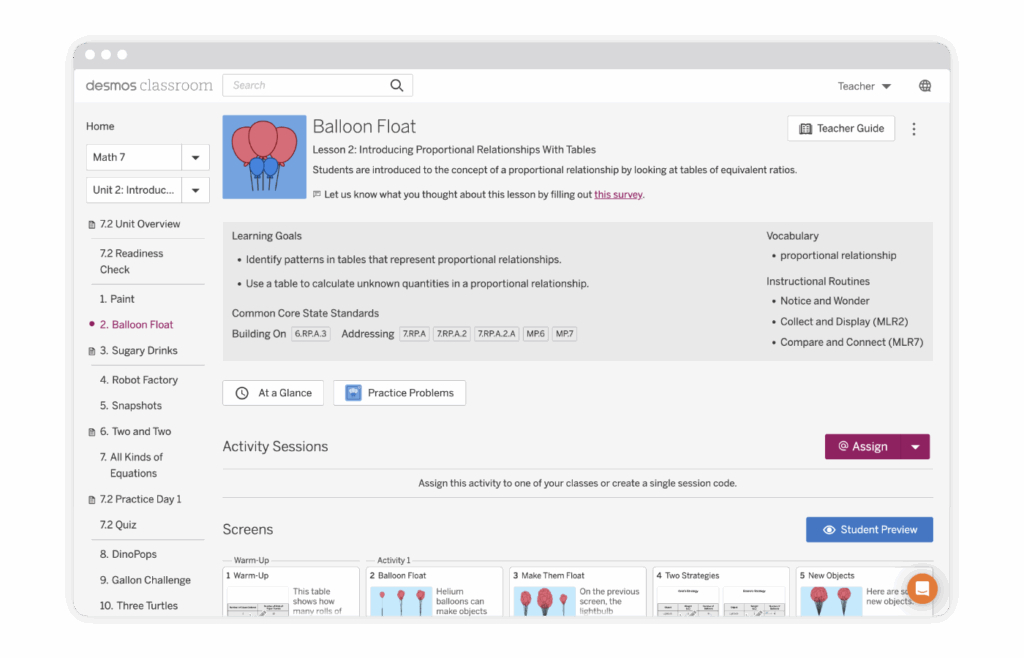
Desmos Classroom digital lessons
Digital lessons should be powerful in their ability to surface student thinking and spark interesting and productive discussions. We’ve joined forces with Desmos Classroom to bring this vision to life with a complete library of interactive, collaborative lessons.

Engaging student experience
Relevant content and interactive math tools create an intuitive and engaging student experience. Plus, working together in real time allows students to see that communicating their ideas and learning from each other are important parts of math class.

Visibility into student thinking
Imagine having more visibility into your students’ mathematical thinking. Now imagine that students have access to this same information. With our collaborative lesson interface and teacher dashboard, students have awareness their own thinking and that of their peers—exposing them to a wider variety of approaches to solving the same problem.
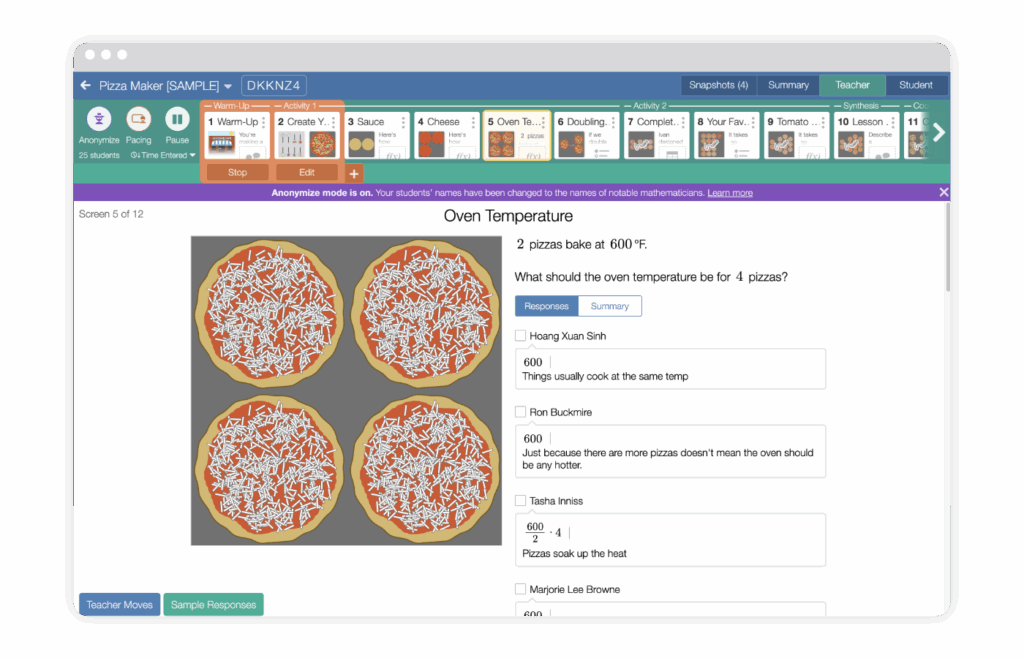
Ready-to-teach lessons
Each grade level includes 150 ready-to-teach lessons, complete with slides, step-by-step teaching notes, suggested student and teacher responses, tips for incorporating instructional routines, support for developing mathematical language, and links to useful resources. Teachers can manage what slides students see, controlling the pace of the lesson to suit the needs of the class.
Planning for instruction
Amplify Desmos Math is customized specifically to meet the New York State Next Generation Math Learning Standards. Within each document below, you’ll find direct links to lessons and activities where each individual standard is addressed.
The program is also aligned with the expectations outlined in the New York City Department of Education Definition of Culturally Responsive-Sustaining Education and the New York State Culturally Responsive-Sustaining Education Framework. Download the CR-SE alignment.
Amplify Desmos Math Scope and Sequence
Amplify Desmos Math Accelerated Scope and Sequence
Ready to plan for the 2025-26 school year? These pacing guides are designed to provide structure, not rigid mandates and resources for NYC.

Experience Amplify Desmos Math New York
Explore our digital program to review content from all grades, 6–A1. Watch our quick walkthrough video for helpful navigation tips.
Try out Amplify Desmos Math by following these steps.
Printable login instructions:
- Teachers: Log in with Amplify steps 1–3 and steps 4–6 or TeachHub (district-preferred login method)
- Administrators: Log in with Amplify or TeachHub (district-preferred login method)
- Students: Log in with Amplify steps 1–3 and steps 4–6 or TeachHub (district-preferred login method)
Additional support:
- How to reset student(s) password
- How to log my class out of a shared device
- Clever class logout instructions
- Single session codes
Print Materials List:
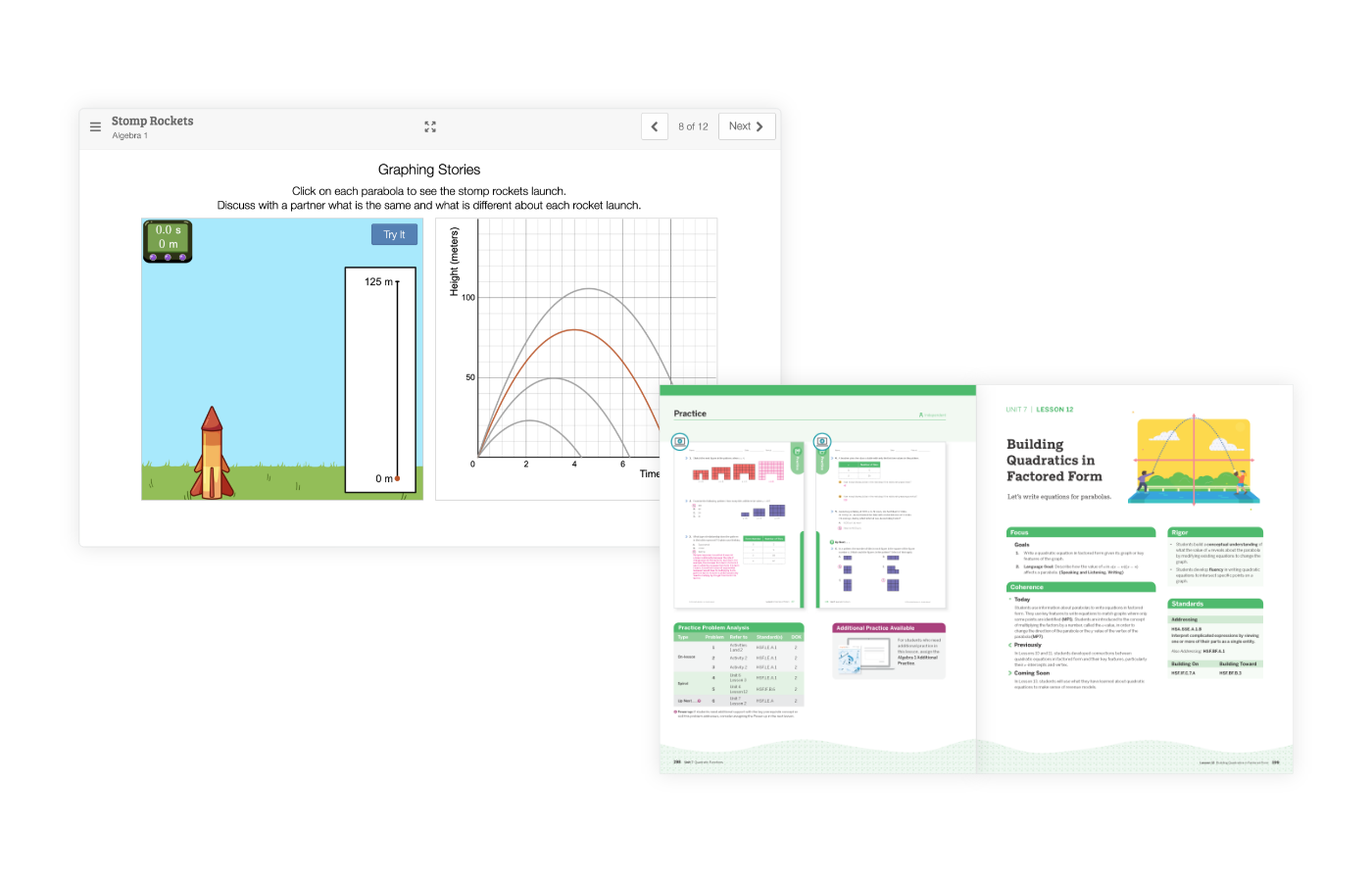
Lesson Sampler
Amplify Desmos Math delivers the instructional power of student-centered learning packaged in a lesson format that’s teacher-friendly and manageable.
With easy-to-follow instructional support, implementing a problem-based program becomes more effective and enjoyable for both you and your students. Paired with the Desmos Classroom digital experience, math class is suddenly fun and dynamic, with plenty of opportunities for students to talk through their reasoning, work with their peers, and gain new understanding.


Additional features
Universal design
Every student is brilliant, and every student has brilliant mathematical ideas worth sharing and cultivating. Incorporating principles of Universal Design for Learning (UDL) into lessons brings students’ brilliance to the forefront. UDL is a research-based framework designed to ensure that all learners can access and participate in meaningful, challenging learning opportunities.

Diversity and representation
Helping students develop strong, healthy, and flexible math identities is a cornerstone of our program. Throughout the curriculum, students are taught that they themselves are mathematicians, that today’s math has been shaped by a diverse range of mathematicians who deserve to be celebrated, and that learning is never finished.

Assessments
Less exciting, but essential for learning: assessments. Amplify Desmos Math features a robust variety of formative and summative assessments, including readiness checks, exit tickets, quizzes, end-of-unit tests, and benchmarks aligned with New York State Next Generation Mathematics Learning Standards.
Reporting
Not only do our reports reveal progress toward standard mastery, but they also include details on how students performed against the standard in the past and how many encounters are yet to come. This feature alone helps teachers prioritize instruction and intervene with additional resources when necessary.
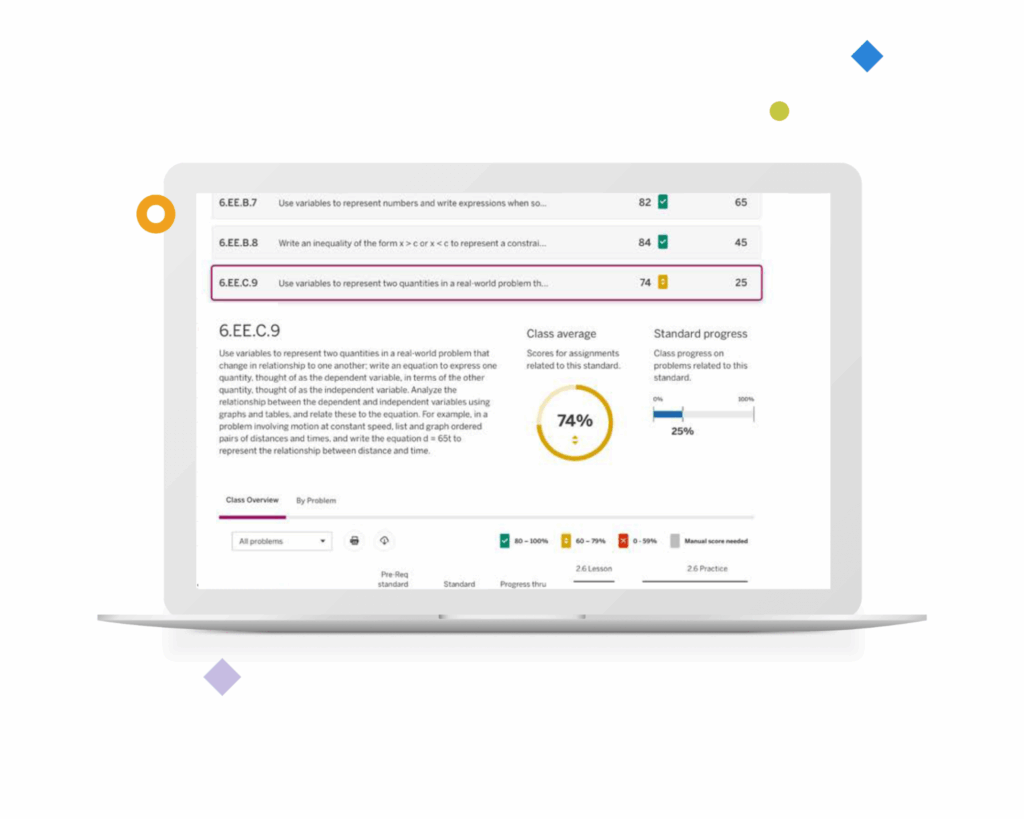
NYC webinar series
Figuring out how to implement a problem-based learning approach to mathematics can be fun—and challenging. Rest assured that you won’t be alone on this journey; Amplify will be by your side every step of the way. Our back-to-school math webinar series for K–8 administrators and teachers:
- Introduces the new NYC Solves initiative.
- Establishes the foundation for all educators to effectively understand and implement the NYCPS Shifts in Mathematics in their classrooms.
- Provides an overview of Amplify Desmos Math, the pre-approved NYCPS curriculum chosen to ensure that every school can successfully implement these math shifts and is supported with high-level, tailored professional development and coaching throughout the process.
Please see the specific webinars and the recordings below to learn more!
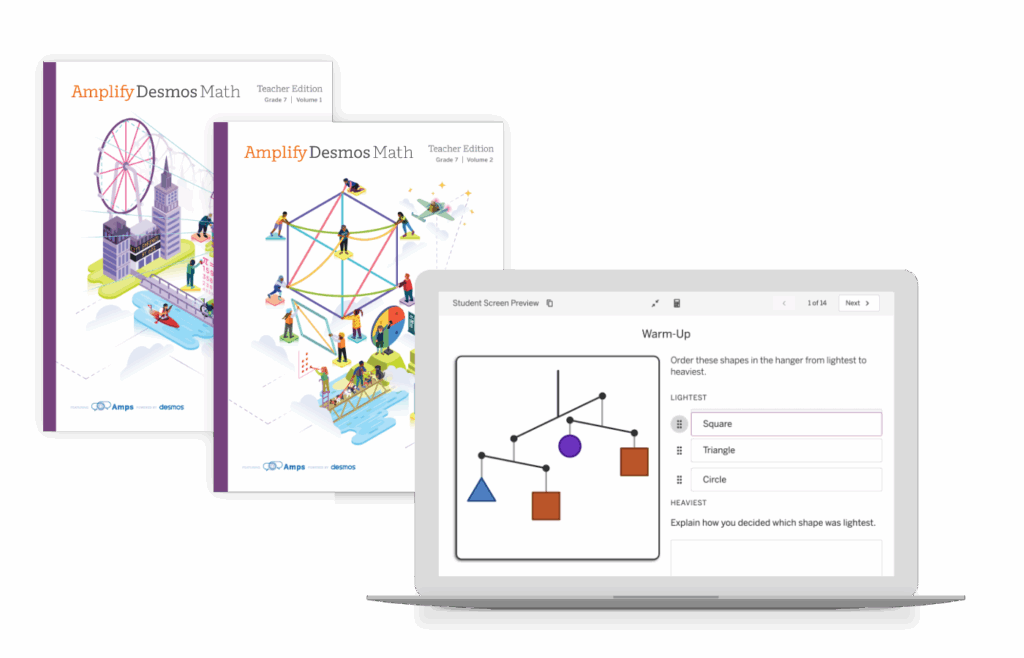
On-demand webinar 1
Would you like to learn more about the NYCPS Shifts in Mathematics and enhance your understanding of each of the five shifts?
Explore how the NYCPS math shifts are transforming mathematics education from a procedural approach to a more engaging, discoverable, and connected learning experience.
Listen to the Understanding the NYCPS Shifts in Mathematics session recording.
On-demand webinar 2
Let’s unpack the why, what, and how to unlock every student’s mathematical mind and build math proficiency for life! In this webinar, we discuss the power of teaching our children to be skilled mathematicians through a structured approach to problem-solving.
Listen to the Unlocking Mathematical Minds: A Structured Approach to Problem-Based Learning session recording.
On-demand webinar 3
For some educators, transitioning to problem-based learning might seem daunting. There’s often concern that the open-ended nature of the approach could derail students from achieving mathematical goals. However, by finding the right balance between open-ended opportunities and structured classroom activities, teachers can encourage students to share their thinking while meeting key learning targets. Uncover simple shifts that educators can implement to foster the perfect balance of open-ended student thinking and focus on mathematical instructional goals.
Listen to the Making the Shift to Problem-Based Learning session recording.
On-demand webinar 4
Amplify Desmos Math New York K–A1 is math that motivates! During this session recording, you’ll experience a grade 6 lesson that captures the essence of NYC Solves.
Listen to the Learn More and Experience Amplify Desmos Math LIVE, an NYCPS-Approved Math Curriculum session recording.
Looking for help?
Support is always within reach. Our team is dedicated to supporting you throughout your review. You can be reached at any time by emailing or calling us directly.
- Support pathways for NYC Core Orders
- Chat: Click the orange icon while logged in to get immediate help.
- Support Portal: Fill out this form, and we will get back to you as soon as possible.
- Phone: Call our toll-free NYC Support number: (888) 960-0380.
- Email: Send an email to AmplifyNYC@amplify.com.
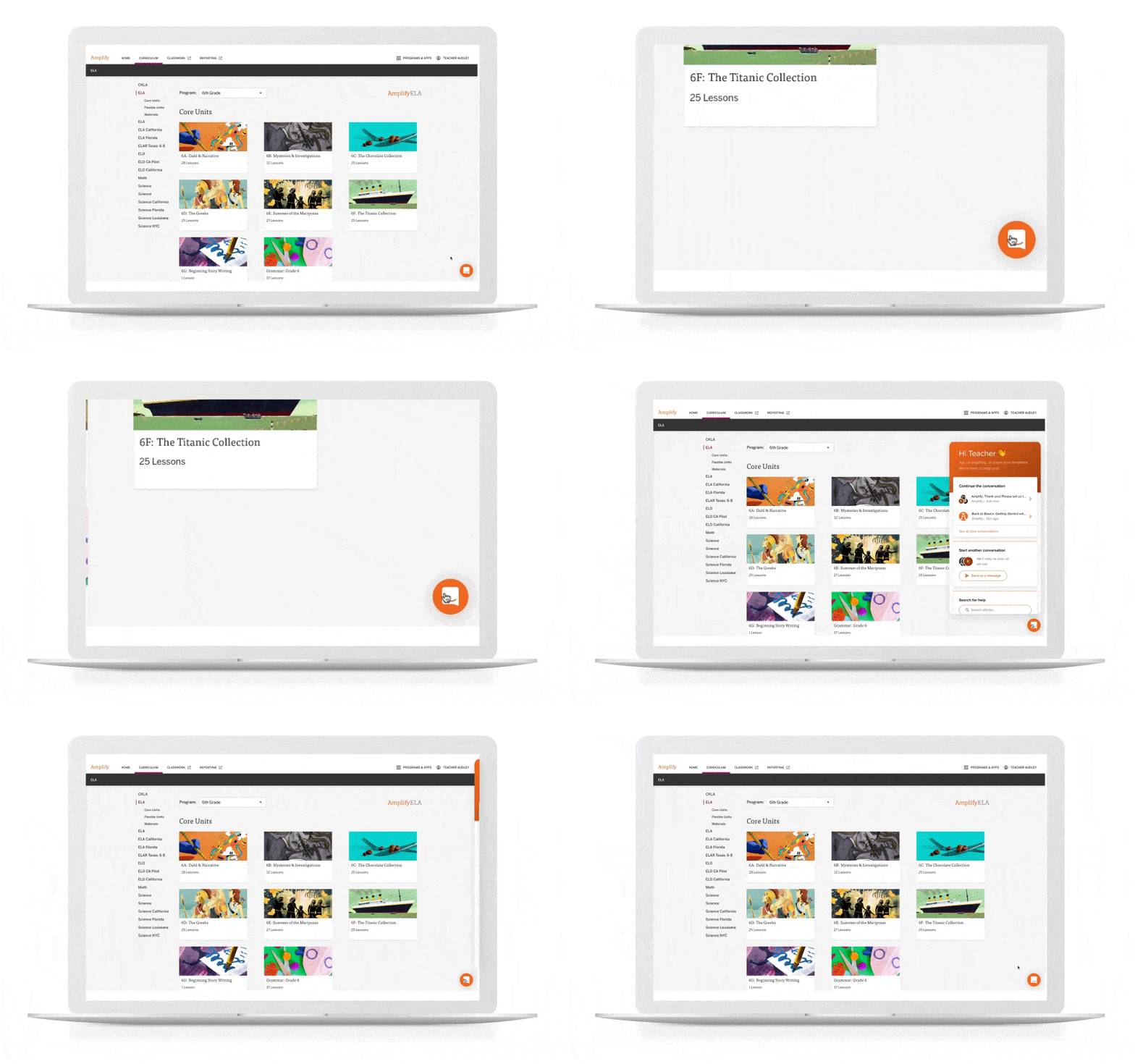
Welcome, Idaho SMART educators and schools!
In alignment with the Idaho Department of Education’s K–3 Idaho SMART Project, mCLASSⓇ DIBELSⓇ 8th Edition has been selected to support the initiative’s goals. This selection reinforces Idaho’s commitment to ensuring every child reads proficiently by the end of third grade using evidence-based practices grounded in the Science of Reading.
Log in to access your mCLASS program and hundreds of resources at learning.amplify.com.
What’s new?
- Contact Yvonne Rhode at yrohde@amplify.com for dedicated account support.
- New episodes of Amplify’s Science of Reading: The Podcast are now available!
Want advice and answers from the Amplify team?

About mCLASS in Idaho
mCLASS DIBELS 8th Edition will enable the early identification of students requiring additional reading support, providing the data and insights needed to build the strong literacy foundations envisioned in Idaho’s SMART Project through its collaborative work with leadership, district/building coaches, and educators.
mCLASS in Idaho is committed to providing literacy instruction for all by:
- Aligning core curriculum, instruction, and assessments with the Science of Reading.
- Providing appropriate literacy interventions to address the varying needs and challenges of reading development.
- Implementing practices based on the Science of Reading in every classroom, every day.
- Providing aligned resources to parents, guardians, and family members.
mCLASS is built on decades of research from the Center on Teaching and Learning at the University of Oregon, a national center for early childhood assessment and instruction. The measures are already in use in many districts in Idaho. The additional mCLASS suite includes reporting, grouping, lessons, and caregiver support.
Interested in more information? Watch the recording of the Idaho Department of Education’s overview of what is being offered to educators.
Transform your assessment and instructional skills with mCLASS DIBELS 8th Edition training.
Ready to master one of education’s most powerful assessment tools? Join our comprehensive mCLASS DIBELS 8th Edition training sessions and unlock the full potential of data-driven instruction!
You’ll gain:
- Complete mastery of mCLASS essentials, from administration to scoring.
- Confidence in using standardized assessment guidelines.
- Expertise in leveraging powerful mCLASS reports and lessons.
- Proven strategies to accelerate student outcomes through data-driven decisions.
Perfect for: Teachers, reading specialists, interventionists, and administrators who want to maximize student growth through precise assessment and targeted instruction.
Walk away ready to: Immediately implement what you’ve learned and start making a measurable impact on student reading achievement in your classroom or school.
Explore the abundant learning opportunities available for Idaho teachers and leaders below, including session recordings, training resources, and more. Don’t miss this opportunity to elevate your assessment expertise and drive real results for your students!
Interest Survey
Interested in hearing more and determining your school or district’s eligibility? Complete the interest survey below.
What to expect next:
- An email from Amplify will be sent to schedule professional development based on your survey responses
- Idaho SMART Project will verify school eligibility
- Once approved, an Amplify representative will reach out to your technical contact and yourself and provide information on completing the Digital Onboarding
- Schools or districts will then share roster data with Amplify
Register now—limited spots available!
Support your implementation with our half-day virtual mCLASS DIBELS 8th Edition training sessions offered throughout the 2025–26 school year. Various session topics will be offered at strategic times to support teachers at critical times. Sessions will be conducted via Zoom, providing a convenient online format for districts seeking flexible professional development without full-site commitments.
mCLASS DIBELS 8th Edition initial training (3 hrs)
Participants will dive into the essentials of mCLASS DIBELS 8th Edition and leave ready to administer and score the assessment to collect data using standardized guidelines.
Register now!
mCLASS DIBELS 8th Edition: Creating a data-driven culture for teachers (3 hrs)
What’s next? Dive deep into mCLASS DIBELS 8th Edition reports and instructional recommendations to drive stronger student outcomes in your classroom. You will leave ready to leverage mCLASS progress monitoring and grouping tools to support a robust MTSS program.
Sessions coming soon.
mCLASS DIBELS 8th Edition: Administration and reporting training for leaders (3 hrs)
Prepare to implement mCLASS with your school or district. Determine systems-level actions that will ensure assessment fidelity and leave ready to leverage key admin reports to support data-informed decision making.
Sessions coming soon.
mCLASS DIBELS 8th Edition: Creating a data-driven culture for leaders (3 hrs)
Cultivate a school-wide culture of data-driven practices. Use mCLASS reports to drill into key school-level data and leave with a systems-level action plan to drive stronger student and teacher outcomes.
Sessions coming soon.
Looking for additional training? No problem. Reach out to your local Account Executive to explore our flexible training alternatives that work with your district’s unique schedule.
Coming soon!
Training resources

Explore the complete professional development library and the Amplify webinar library.
View the mCLASS DIBELS 8th Edition Benchmark Scoring in action:
- Practice videos and forms
- Video: How to Assign Online Assessments (3:36)
- How To: Use District-Level Student Online Assessment Management
- mCLASS DIBELS 8th Edition assessment materials (for print)
Learn about additional assessment measures (RAN, Spelling, Vocabulary, Oral Language).
Explore more programs.

Amplify’s proven suite of assessment, instruction, and intervention is the gold standard in early literacy. Our programs are designed to enable students to build robust foundational skills and grow at all reading levels. Unlock the full suite and learn more about our related programs today!
Contact us!
Yvonne Rhode
Senior Account Executive
yrohde@amplify.com
Skyler Dario
Account Executive
sdario@amplify.com