Familias y cuidadores, ¡les damos la bienvenida a Amplify Desmos Math New York para los grados K–5!

Les damos la bienvenida a Amplify Desmos Math Caregiver Hub de Amplify New York, para los grados de kindergarten a 5.º. ¡Nos entusiasma que la escuela de su estudiante haya elegido nuestro programa! Hemos diseñado este espacio para ayudarle a incentivar en su estudiante el aprendizaje de las matemáticas este año. El esfuerzo que usted realice cumple un rol fundamental en la experiencia que el estudiante tenga con las matemáticas.

Esperamos que el estudiante disfrute de explorar las matemáticas usando la tecnología a su disposición, tanto como colaborar con amigos para resolver problemas y aprender todo tipo de conceptos nuevos e interesantes. ¡Y esperamos que a usted le encante acompañarlo en esta experiencia!

Reciban un afectuoso saludo, con mucho entusiasmo por este aprendizaje conjunto.

—El equipo de Amplify Desmos Math
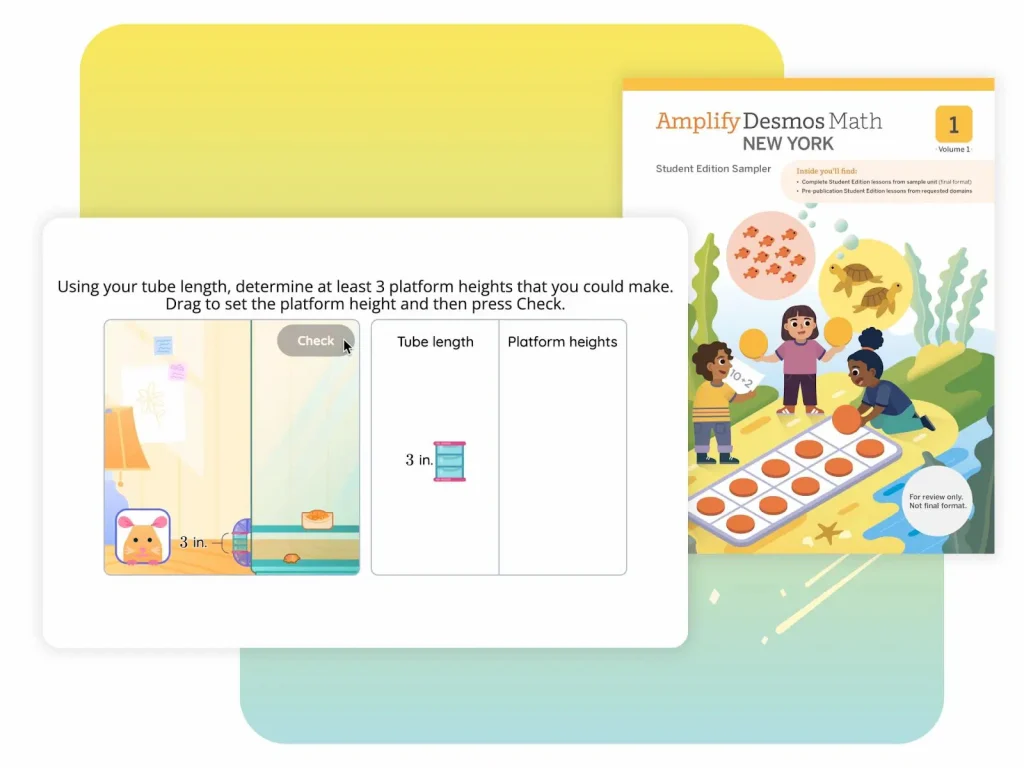
A math activity interface instructs to determine platform heights using a tube length. A student workbook titled "Amplify Desmos Math, New York, Volume 1" featuring children playing is also visible.

Presentación de Amplify Desmos Math

Amplify Desmos Math es un plan de estudios básico de matemáticas, diseñado para estudiantes de kindergarten a 5.º grado. Desarrollamos el programa con la idea de que todo método estructurado de aprendizaje que se centra en la resolución de problemas debe tomar como base la curiosidad de los estudiantes para poder desarrollar conocimientos perdurables al nivel que corresponde en cada grado. Cada lección ofrece oportunidades de desarrollar los conocimientos de los estudiantes, conectar sus ideas, mejorar su dominio de las destrezas y darles la autonomía de plantear preguntas, explorar y hacer descubrimientos. 

Amplify Desmos Math utiliza un método de enseñanza centrado en el estudiante, el cual ha demostrado mejorar significativamente el aprendizaje de las matemáticas. Nuestra misión es que su estudiante aprenda matemáticas ¡y que le encante aprenderlas! 

En cada lección, el plan de estudios de Amplify Desmos Math plantea problemas entretenidos y relevantes que solucionar, dando diariamente a los estudiantes oportunidades para pensar críticamente, colaborar y participar activamente en su propio aprendizaje.
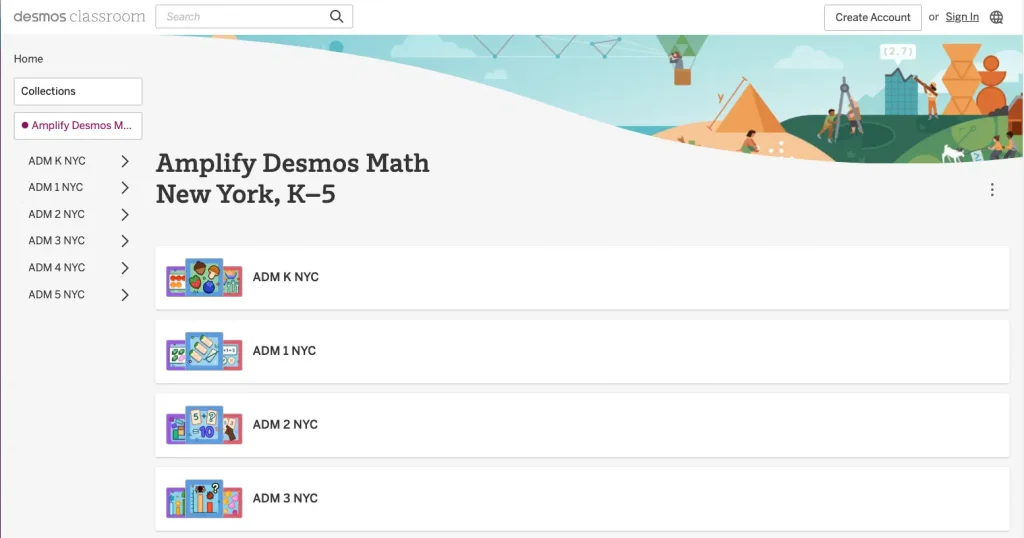
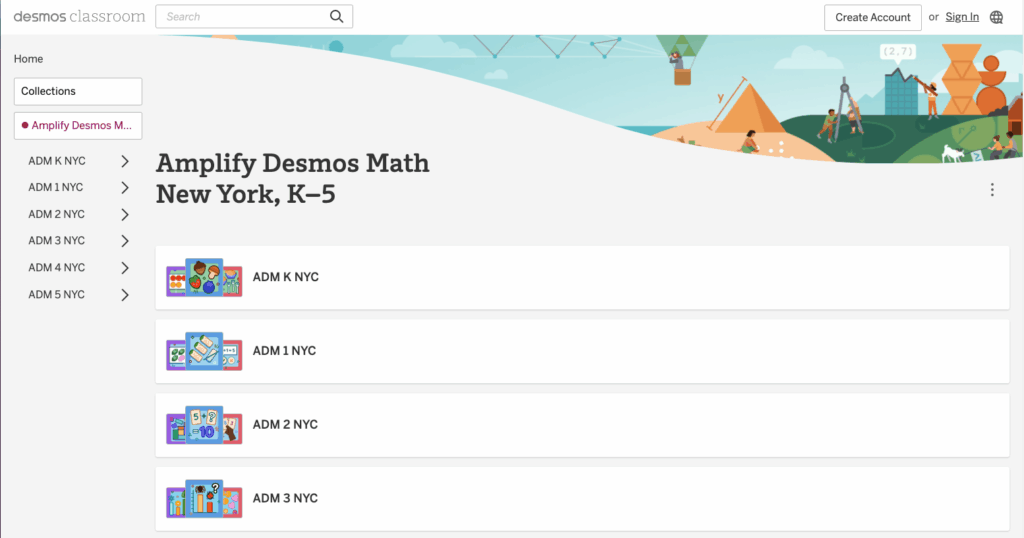
Página web de Desmos Classroom que muestra una lista de los módulos de Amplify Desmos Math para Nueva York, K-5, con opciones ADM K NYC, ADM 1 NYC, ADM 2 NYC y ADM 3 NYC.

Sobre la enseñanza de las matemáticas centrada en el estudiante

La enseñanza centrada en el estudiante puede parecer distinta a las formas de aprender matemáticas del pasado y a la manera en que usted aprendió matemáticas. En lugar de memorizar fórmulas y trucos, el aprendizaje centrado en el estudiante se enfoca en ofrecer oportunidades para descubrir cómo funcionan las matemáticas. Las investigaciones revelan que tanto estudiantes como maestros prefieren este método, además de que los maestros informan que la enseñanza centrada en el estudiante ha ayudado a los suyos a aprender más matemáticas.

A diverse group of students, one wearing a unicorn headband, looks at a teacher pointing to an amplify math bar graph on a board.

Esta forma de aprendizaje ayuda a los estudiantes a:

  • Comprender cómo funcionan los conceptos matemáticos.
  • Recordar lo que aprenden en clase y aplicar sus conocimientos a situaciones nuevas.
  • Obtener mejores resultados en exámenes estandarizados y tener mejores calificaciones que los estudiantes que aprenden con otros métodos.
  • Aprender a comunicarse tanto por escrito como verbalmente, comprender y replicar las opiniones de los demás y adquirir confianza para resolver nuevos problemas.
  • Desarrollar habilidades clave para la vida, por ejemplo, aprovechar la tecnología, completar proyectos de forma individual y en grupo y perseverar ante problemas difíciles.

¿Qué materiales utilizan los estudiantes?

Amplify Desmos Math promueve el aprendizaje por medio de materiales impresos de apoyo combinados con experiencias digitales singulares. Todas las lecciones de Amplify Desmos Math K-5 están disponibles en un libro de Edición del estudiante que usan para escribir. Muchas de las lecciones están diseñadas para incluir actividades prácticas que incorporan materiales manipulables, y una cierta cantidad de lecciones se diseñó para que los estudiantes usen dispositivos digitales como computadoras portátiles o tabletas, en función de sus edades. Dichas lecciones incluyen experiencias digitales enriquecidas que se recomienda que los maestros asignen a sus estudiantes.

Three animated women of diverse ethnicities smiling and discussing a math curriculum around a laptop at a table, with colorful abstract shapes in the background.

He aquí algunas características que puede esperar de Amplify Desmos Math para su estudiante: 

  • Lecciones que impulsan el debate en el aula para que los estudiantes puedan colaborar y así, lograr un aprendizaje conjunto y experimentar un sentido de comunidad.
  • Feedback receptivo que interpreta las respuestas de los estudiantes en el contexto apropiado y fomenta la perseverancia y la rectificación.
  • Planes de clase fáciles de seguir, probados en aulas de todo el país, con sugerencias y estrategias didácticas claras y rutinas de lenguaje matemático.
  • Problemas de práctica para lograr dominio y ayudar a los estudiantes a repasar temas anteriores.
  • Sugerencias de diferenciación para que los maestros puedan cubrir las necesidades de estudiantes diversos.
  • Evaluaciones formativas que proporcionan información sobre la comprensión de cada estudiante y permiten hacer ajustes a la enseñanza para atender las necesidades de toda la clase.
  • Evaluaciones sumativas que ayudan a los maestros a comprender qué saben los estudiantes sobre los contenidos matemáticos que han estudiado. 
  • Evaluaciones diarias en cada lección, con las cuales los maestros pueden verificar constantemente la comprensión. Un recurso para cuidadores en cada unidad, el cual incluye explicaciones de conceptos matemáticos clave y problemas para resolver con el estudiante.

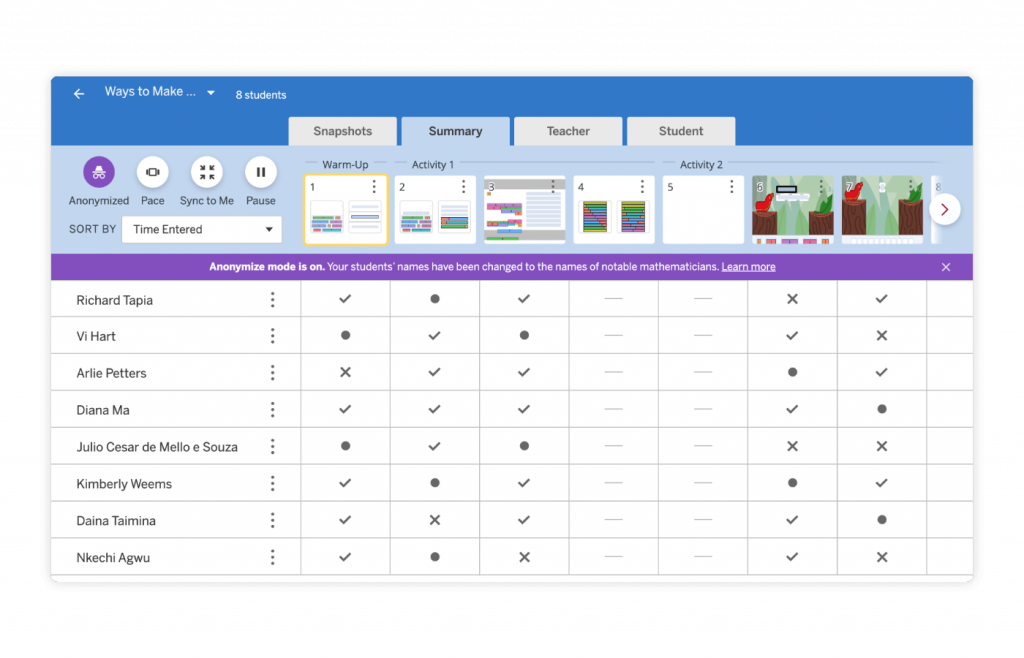
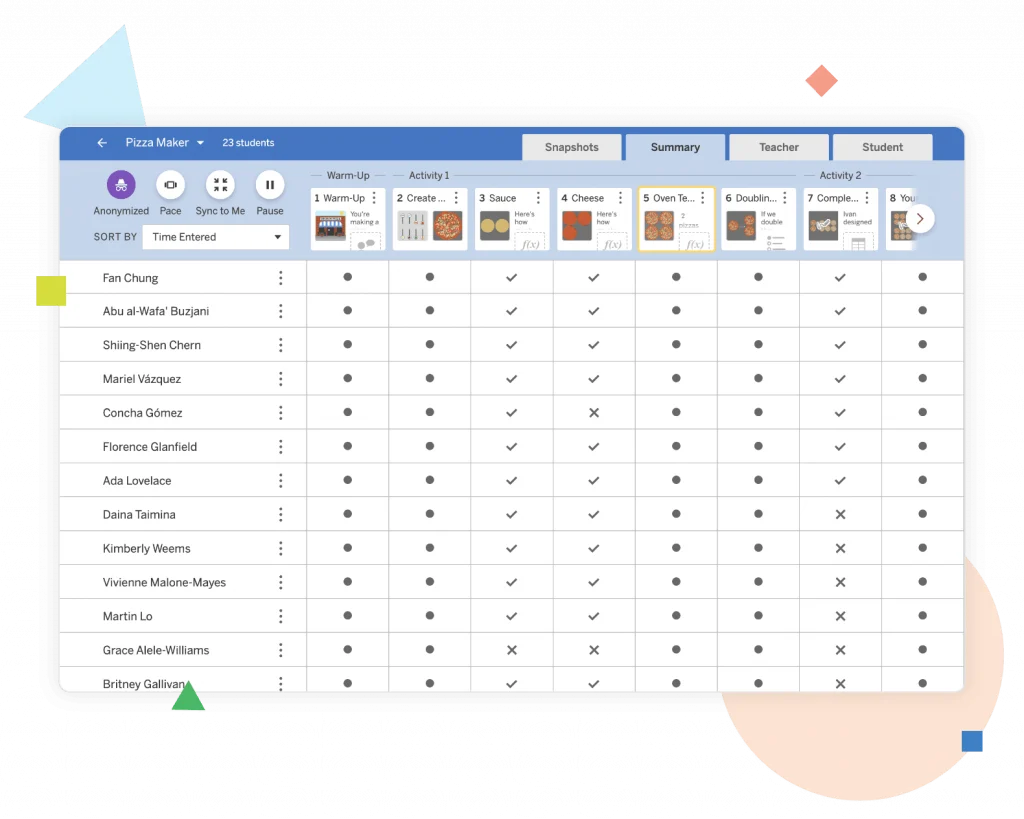
Cuando los estudiantes utilizan dispositivos, los maestros pueden supervisar su trabajo en tiempo real para asegurarse de que cuentan con el apoyo que necesitan en cada sección de la lección, tanto dentro como fuera del aula. Aquí le presentamos un ejemplo de lo que un maestro ve en su panel de control para ayudarle a supervisar los razonamientos y estimular el aprendizaje de los estudiantes.

A classroom dashboard displays student names and their progress in activities, with checkmarks indicating completed tasks and circles showing ongoing or incomplete tasks.

Los estudiantes también pueden acceder a su trabajo digital en casa. He aquí un artículo sobre cómo navegar por la página de inicio para estudiantes.

¿Cómo es una lección?

En una clase de Amplify Desmos Math, se puede ver (¡y oír!) a los estudiantes al hacer preguntas, debatir respuestas, justificar sus razonamientos, resolver problemas y trabajar juntos o de forma individual.

Two students, one male and one female, are sitting at a desk with a laptop, discussing a project under a "math club" sign, with speech bubble icons above them.

Esto es lo que normalmente incluye una lección de Amplify Desmos Math:

  • Calentamiento: Un problema breve e interesante para que los estudiantes se sientan atraídos por la lección.
  • Actividades: Una o dos actividades cortas que desafían las habilidades de los estudiantes para resolver problemas.
  • Síntesis: Un debate que repasa y reúne los conceptos importantes de la lección.
  • Demuestra lo que sabes y Reflexión: Preguntas para que los estudiantes demuestren lo que aprendieron en la lección. (Nota: La evaluación “Demuestra lo que sabes” se imparte a criterio del maestro en kindergarten y 1.er grado).
  • Centros: Estaciones de actividades dirigidas por los estudiantes, las cuales refuerzan los conceptos matemáticos que se aprendieron durante las actividades de la lección a través de formatos interactivos, usualmente similares a juegos. En kindergarten y 1.er grado, el tiempo destinado a los Centros se incorpora a los últimos 15 minutos de cada lección. 

Este es el material disponible al término de la lección para apoyar, consolidar y ampliar el aprendizaje de los estudiantes:

  • Diferenciación: Minilecciones, Centros, actividades complementarias, aprendizaje personalizado y práctica de dominio. 
  • Práctica: Problemas adicionales que el maestro puede asignar como trabajo en clase o tareas para casa.

¿Cómo pueden los cuidadores incentivar el aprendizaje de las matemáticas en casa?

Utilice nuestros Recursos de apoyo de la unidad para cuidadores

Hemos agregado un recurso para cuidadores a cada unidad del programa, el cual proporciona un resumen de los conceptos clave, junto con un problema extraído del conjunto de ejercicios de práctica de la lección para que lo resuelva junto con el estudiante. 

En cada uno de los enlaces de los grados académicos a continuación, encontrará un documento con los recursos para cuidadores correspondientes a cada unidad, tanto en inglés como en español.

1.er grado
Unidad 1: Sumar, restar y trabajar con datos
English
Spanish

3.er grado
Unidad 1: Introducción a la multiplicación
English
Spanish

5.º grado
Unidad 1: Volumen
English
Spanish

Repasen juntos los problemas de práctica

El maestro puede asignar problemas de práctica al final de cada lección, como trabajo en clase o como tarea. Si el estudiante ya ha completado los problemas de práctica de la lección, pídale que le explique cómo resolvió cada problema o que le hable sobre las partes que le resultaron más difíciles. 

Haga preguntas de seguimiento al estudiante para fomentar el uso del vocabulario matemático al explicar sus razonamientos, por ejemplo, “¿cómo lo sabes?”, “¿cómo puedes mostrar tu razonamiento?” o “¿cómo describirías eso?”. 

Si el estudiante no consigue avanzar, hágale preguntas de apoyo, por ejemplo, “¿qué información de aquí conoces?” o “¿cómo podrías representar este problema?”.

Recuerde que es válido bloquearse

Haga hincapié en que bloquearse forma parte del proceso de aprendizaje e incluso es fundamental. Muchos estudiantes (¡al igual que adultos!) temen equivocarse. Sin embargo, las investigaciones demuestran que cometer errores ayuda a que el cerebro se desarrolle mejor. Cuando el estudiante no logre avanzar en un problema, anímelo a probar distintas estrategias, aunque no tenga certeza de si son correctas.

Descubran las matemáticas en la vida cotidiana

Relacionen las matemáticas con las actividades cotidianas del hogar, ya sea al ir de compras, preparar una comida o planificar una visita a una tienda. El estudiante puede ayudarle a calcular cuántas manzanas más que naranjas hay en el carrito; puede mostrarle cómo dividir un sándwich en cuartos o calcular cuánto cambio recibirán de un billete de diez dólares. Anime al estudiante a mencionar de qué forma la familia utiliza las matemáticas en sus tareas diarias.

Lea el Cuento de la unidad con el estudiante

Cada unidad de Amplify Desmos Math K–5 comienza con un cuento leído en voz alta que captura el interés de los estudiantes y contextualiza los conceptos matemáticos de la unidad. Los elementos y personajes del Cuento de la unidad aparecen en las lecciones de toda la unidad.

Acceda a nuestra colección de lecciones y actividades gratuitas para K–5

Explore nuestros contenidos gratuitos más recientes para estudiantes de kindergarten a 5.º grado en nuestra colección de destacados de Desmos Classroom. En nuestra colección gratuita, puede acceder a:

  • Lecciones digitales: interesantes lecciones interactivas.
  • Minilecciones: una mezcla de actividades impresas y digitales, diseñadas para la enseñanza a grupos pequeños.
  • Rutinas matemáticas: actividades digitales breves para iniciar la enseñanza y fomentar los diálogos matemáticos.
  • Momentos matemáticos manejables: actividades digitales de práctica que utilizan materiales manipulables virtuales de Polypad, que por su diseño, pueden usarse de forma flexible. 

Haga clic aquí para acceder a la colección e inscribirse gratuitamente.  

¿Cómo accede la familia al programa desde casa?

El estudiante tendrá acceso a los materiales de aprendizaje, práctica y evaluación a través de la plataforma de Amplify. El estudiante puede acceder al plan de estudios digital en la escuela y en casa siguiendo estas sencillas instrucciones.

  • Haga clic en el botón de color naranja Login to Amplify Desmos Math a continuación.
  • Seleccione Log in with Amplify.
  • Introduzca el nombre de usuario y la contraseña del estudiante que el maestro proporcionó.
  • Seleccione el grado del estudiante.

Amplify Desmos Math for the Archdiocese of Miami

Welcome Catholic school educators, 

Amplify Desmos Math thoughtfully combines conceptual understanding, procedural fluency, and application. Each math lesson is designed to tell a story by posing problems that invite a variety of approaches before guiding students to synthesize their understanding of the learning goals.

What is Amplify Desmos Math?

Amplify Desmos Math supports teachers in building students’ lifelong math proficiency. The program:

  • Supports social classrooms, invites mathematical creativity, and evokes wonder, creating a welcoming learning space where students are empowered to see themselves and their classmates as having brilliant mathematical ideas.
  • Provides teachers with clear, step-by-step moves to build systematically from students’ prior knowledge to grade-level learning.
  • Connects students to each other’s thinking and to an understanding that they can use math to make sense of the world.
  • Enables access to grade-level understanding for every student, every day.

A powerful suite of math resources

Amplify Desmos Math combines the best of problem-based lessons, intervention, personalized practice, and assessments into a coherent and engaging experience for both students and teachers.

Data informs instruction. Comprehensive student profiles provide full data on students’ assets and skills, empowering teachers to provide just-in-time scaffolds throughout core instruction and targeted intervention when needed.

Ready to Explore?

Ready to explore as a teacher? Follow these instructions:

Ready to explore as a student? Follow these instructions:

Educational software interface featuring a New York math problem about measuring platform heights using a 9-inch tube, illustrated with a playful, colorful design.

Experience Amplify Desmos Math

Click the links below to explore our interactive digital lessons, where you’ll also find print Teacher Edition and Student Edition pages for each lesson.

For helpful navigation tips and more program information, download our Grades K–5 and Grades 6–Algebra 1 program guides.

You can also watch a product expert walk through a lesson and the available program components with a lesson walkthrough video.

Personalized learning and support

Amplify Desmos Math includes digital, adaptive practice that provides the personalized support a student needs to access grade-level math every day. Personalized Learning activities target a skill or concept aligned to the day’s core lesson, with each student receiving personalized scaffolds based on what they already know. This technology complements daily learning and provides another layer of support to the in-lesson differentiation and instructional guidance provided to teachers. Click here to try a Boost Personalized Learning activity. More activities coming soon!

The Fluency Practice of Amplify Desmos Math uses an evidence-based approach to memory retention—spaced repetition—for the basic operations. Students around the world have answered more than 120 million multiplication questions within our application. Try it now! 

Educational software on a laptop screen showing a student activity to complete a bar graph by categorizing dragonflies, designed for the New York math curriculum.

Contact us

Support is always available. Our team is dedicated to helping you every step of the way. Contact your dedicated Florida representative here for program access, samples, and additional information.

A smiling man with short hair wears a green polo shirt against a plain background, exuding the kind of confidence that comes from teaching an inspiring math lesson.

Jeff Rutter

Field Manager
Miami-Dade and Monroe Counties
jrutter@amplify.com
(727) 407-5801

A smiling person with long blonde hair wears a textured blue top against a plain background, embodying the essence of personalized learning.

Amanda Shelley

Account Executive
Broward County Schools
ashelley@amplify.com
(321)-693-3518

A man with short, dark hair and a full beard smiles confidently. He is wearing a pink patterned shirt and a green jacket, reminiscent of an engaging math lesson. The light gray background subtly complements his dynamic style.

Tom Gantt

District Manager
Miami Resident
tgantt@amplify.com
(305)-546-2979

Welcome, LAUSD educators!

Introducing Amplify Desmos Math California, a curiosity-driven TK–12 program that builds lifelong math proficiency. Each lesson poses problems that invite a variety of approaches before guiding students to synthesize their understanding of the learning goals. Students encounter math problems they’re eager to solve, while teachers spend more time where it’s most impactful—creating a collaborative classroom of learners.

Start by watching our welcome video to the right, then learn more about the program and begin your review below.

Built for California

An educational worksheet on robots, featuring a graph with red, purple, and blue robot icons, and instructions for a warm-up activity.

The Amplify Desmos Math California program is designed around the vision articulated in the Mathematics Framework for California Public Schools: Kindergarten Through Grade Twelve to enable all California students to become powerful users of mathematics. Our program incorporates the latest research in student learning, meaning that we:

  • Focus on the Big Ideas: Amplify Desmos Math California’s courses, units, and lessons are centered around the Big Ideas. Big Ideas, like standards, are not considered in isolation. In addition to each unit and lesson’s focal Big Ideas, Amplify Desmos Math California also provides connections among the Big Ideas across units and lessons.
  • Center on open and engaging tasks: Amplify Desmos Math California is grounded in engaging tasks meant to address students’ often-asked question: “Why am I learning this?”  Students are invited into learning with low-floor, high-ceiling tasks that provide an entry point for all. Open tasks in Amplify Desmos Math California provide the space for students to try on multiple strategies and represent their thinking in different ways, and allow student explanation and discussion to serve as the center of the classroom. All lessons offer both print and digital representations.
  • Provide enhanced digital experiences: Amplify Desmos Math California includes digitally-enhanced lesson activities, incorporating interactive digital tools alongside print materials. These purposefully-placed resources allow students to visualize mathematical concepts, receive actionable feedback while practicing, encounter personalized learning support from an onscreen tutor, and engage in discussions about their thinking and approaches.
  • Treat core instruction and differentiation as integral partners: The Amplify Desmos Math California curriculum provides teachers with lessons, strategies, and resources to eliminate barriers and increase access to grade-level content without reducing the mathematical demand of tasks. Every activity has multiple entry points to ensure that all students are supported and challenged. Intervention and personalized learning activities are directly connected to lesson content and offer students individualized support as they dive into the mathematics.

About the program

Taking the IM content further.

A laptop displays a math activity about platform heights and tube length, while a worksheet titled "Hamster Homes" is visible in the background.

Amplify Desmos Math California is a curiosity-driven program that builds lifelong math proficiency. Each lesson poses problems that invite a variety of approaches before guiding students to connect their understanding of the learning goals.

Students encounter math problems they’re eager to solve, while teachers spend more time where it’s most impactful: creating a collaborative classroom of learners.

We chose to base our program on the extensively field-tested IM K–12 MathTM authored by Illustrative Mathematics. IM K–12 Math is a problem-based curriculum. It asks students to grapple with well-designed and thoughtfully sequenced real-world mathematical problems to build their understanding of how to efficiently solve them.

Begin your review to see how we’ve taken the IM K–12 Math content further.

Begin your review

Using a Google Chrome or Safari web browser, click the orange button below or navigate to learning.amplify.com and select “Log in with Amplify.” Please note, these demo accounts expire on April 04, 2026.

K–8 English credentials

  • Username: t1.lausd_adm_k8@demo.tryamplify.net
  • Password: Amplify1-lausd_adm_k8

K–8 Spanish credentials

  • Username: t1.lausd_k8_spanish@demo.tryamplify.net
  • Password: Amplify1-lausd_k8_spanish

AGA credentials

  • Username: t1.lausd_aga@demo.tryamplify.net
  • Password: Amplify1-lausd_aga

Familias y cuidadores, ¡bienvenidos a Amplify Desmos Math California
K–5!

Bienvenidos al Caregiver Hub de Amplify Desmos Math California K–5. Esperamos que su estudiante disfrute explorando las matemáticas, trabajando con amigos para resolver problemas y aprendiendo conceptos nuevos e interesantes. ¡Y esperamos que ustedes disfruten de la experiencia matemática junto con ellos! A continuación, encontrarán algunas sugerencias y recursos para apoyar su aprendizaje en casa.

Obtenga más información sobre Amplify Desmos Math California.

For the English version, please click here.

Tres niños participan en una actividad práctica de matemáticas con tarjetas numéricas y fichas sobre una cuadrícula. El fondo está decorado con peces y símbolos matemáticos.

Recursos de la unidad para cuidadores

Para cada unidad del programa, hemos creado un Recurso para cuidadores (Caregiver Resource), el cual ofrece un resumen de los conceptos clave, además de un problema del conjunto de práctica de la lección que usted puede resolver con su estudiante. Encontrará un Recurso para cuidadores en cada unidad, disponible tanto en inglés como en español.

Ingrese a Amplify Desmos Math California en casa.

Además del cuaderno de ejercicios impreso de la Edición del estudiante (Student Edition), su estudiante tendrá acceso digital a todos los materiales de aprendizaje, práctica y evaluación a través de la plataforma de Amplify. Es posible acceder al currículo digital desde la escuela o desde casa siguiendo estas instrucciones:

  • Haga clic en el botón Amplify Desmos Math California.
  • Seleccione Log in with Amplify.
  • Ingrese el nombre de usuario y la contraseña de su estudiante que el maestro les haya proporcionado.
  • Seleccione el nivel escolar deseado.

Una vez iniciada la sesión, los cuidadores pueden ver el trabajo de los estudiantes abriendo tareas anteriores.

Aprenda a navegar por la página de inicio de los estudiantes (student home page).

Vistazo general a los materiales

Amplify Desmos Math California promueve el aprendizaje mixto por medio de materiales impresos de apoyo y una experiencia digital única. Todas las lecciones en los grados K a 5 están disponibles en un cuaderno de trabajo de la Edición del estudiante. Muchas de las lecciones incluyen actividades prácticas con materiales manipulables, herramientas que ayudan a que los estudiantes hagan tangibles conceptos abstractos para poder comprenderlos. Su estudiante también trabajará con dispositivos digitales durante un número de lecciones que es apropiado para su edad.

Cuando los estudiantes usan dispositivos, los maestros pueden supervisar su trabajo en tiempo real, asegurándose de que reciban el apoyo exacto que necesitan en cada parte de la lección, dentro y fuera del salón de clase.

Una interfaz digital que muestra los nombres anónimos de los estudiantes y su estado de participación en diversas actividades. La interfaz incluye opciones para realizar resúmenes, capturas de pantalla y vistas individuales de los estudiantes.

Componentes de una lección

A los estudiantes en un aula de Amplify Desmos Math California se les ve (¡y se les escucha!) haciendo preguntas, debatiendo respuestas, justificando su razonamiento, enfrentándose a problemas y trabajando juntos o de forma individual.

Una lección típica de Amplify Desmos Math California incluye:

  • Calentamiento: Un problema breve e interesante para que los estudiantes se sientan atraídos a la lección.
  • Actividades: Una o dos actividades cortas que desafíen las destrezas de los estudiantes para resolver problemas.
  • Síntesis: Una discusión para revisar y consolidar los conceptos importantes de la lección.
  • Demuestra lo que sabes (Show What You Know) y Reflexión (Reflection): Preguntas para que los estudiantes demuestren lo que aprendieron en la lección. (Nota: La evaluación de la lección “Demuestra lo que sabes” es opcional en kindergarten y primer grado).
  • Centros (Centers): Estaciones de actividades dirigidas por los estudiantes que refuerzan los conceptos matemáticos que aprendieron durante las actividades de la lección usando formatos interactivos y, a menudo, lúdicos. En kindergarten y primer grado, el tiempo destinado a los Centros se incorpora en los últimos 15 minutos de cada lección.

Para apoyar, fortalecer y ampliar el aprendizaje de los estudiantes después de la lección, Amplify Desmos Math California ofrece opciones de:

  • Diferenciación: Minilecciones (Mini-Lessons), Centros, Extensiones, Boost Personalized Learning y Fluency Practice (Práctica de la fluidez).
  • Práctica: Problemas adicionales que el maestro puede asignar para trabajar en clase o como tarea.

Apoye el aprendizaje de las matemáticas en casa.

Usted puede apoyar el aprendizaje de las matemáticas de su estudiante fuera de la escuela de muchas maneras:

El maestro puede asignar problemas de práctica al final de cada lección como trabajo en clase o como tarea. Si su estudiante ya ha completado los problemas de práctica de la lección, pídale que le explique cómo resolvió cada problema o que comente las partes que le resultaron difíciles. Haga preguntas de seguimiento para fomentar el uso del lenguaje matemático mientras explica su razonamiento, por ejemplo: “¿Cómo lo sabes?”, “¿Cómo puedes demostrar tu razonamiento?” o “¿Cómo describirías eso?”. Si su estudiante no consigue avanzar, hágale preguntas de apoyo, por ejemplo: “¿Qué información de aquí conoces?” o “¿Cómo podrías representar este problema?”.

Los juegos de Centro (Center game) se alinean con las matemáticas de la unidad y se pueden jugar con los estudiantes fuera de clase. Es posible que el maestro les explique a los estudiantes cómo jugar un juego de Centro durante o después de una lección. Si no es así, usted puede enseñarle a jugar usando instrucciones fáciles de seguir. Regístrese para obtener una cuenta gratuita y explorar los Centros y el contenido adicional para grados K a 5 en nuestras Colecciones destacadas.

Relacione las matemáticas con actividades cotidianas en casa, ya sea ir de compras, preparar la comida o planear una visita a la tienda. Su estudiante puede ayudarle a calcular cuántas manzanas más hay en el carrito que naranjas, dividir un sándwich en cuatro partes o calcular cuánto cambio recibirá si paga con un billete de diez dólares. Anímelo a señalar las maneras en que ustedes usan las matemáticas en sus quehaceres diarios.

Recuerde al estudiante que bloquearse es una parte necesaria (incluso benéfica) del proceso de aprendizaje. Muchos estudiantes (al igual que personas adultas) temen equivocarse, pero las investigaciones demuestran que cometer errores ayuda a que nuestro cerebro se desarrolle. Cuando su estudiante no consiga avanzar en un problema, anímelo a seguir intentando diferentes estrategias, aunque no esté seguro de si son correctas.

Obtenga más información.

¿Tiene alguna pregunta sobre Amplify Desmos Math California? Visite nuestra biblioteca de ayuda (en inglés) para buscar artículos con respuestas a sus preguntas sobre el programa. Para obtener más ayuda, por favor comuníquese con su maestro.

Grade K

Unit 1: Position, Length, Height, and Sorting

Lesson 2: Describe and Compare Length and Height, Session 3Connecting Cubes

Unit 2: Numbers to 5, Shapes and Weight

Lesson 4: Count, Show and Write Numbers to 5, Session 2Skye’s Style
Lesson 5: Compare Numbers to 5, Session 4Matching Groups
Lesson 5: Compare Numbers to 5, Session 5Designing Shoes With Skye
Lesson 6: Three-Dimensional Shapes and Weight, Session 1What’s That Shape?
Lesson 6: Three-Dimensional Shapes and Weight, Session 2Building Solid Shapes
Lesson 6: Three-Dimensional Shapes and Weight, Session 5Putting Solid Shapes Together

Unit 3: Addition and Subtractions with 5 and Shapes,

Lesson 8: Two-Dimensional Shapes,
Session 1
So Much Sorting
Lesson 8: Two-Dimensional Shapes,
Session 2
What’s That Shape Called?
Another Shape

Unit 4: Numbers to 10 and Shapes

Lesson 11: Count, Show, and Write Numbers to 10, Session 1Investigate: Cafeteria Math
Fingers as Math Tools
Lesson 12: Compare Numbers to 10, Session 1Moving and Grooving
Fingers and Counters
Lesson 12: Compare Numbers to 10, Session 2More, Fewer, or the Same
Comparing Words
Lesson 12: Compare Numbers to 10, Session 5Forest Friends
Lesson 14: Compose and Decompose 10, Session 2Harry’s Hamster Wheel
Lesson 14: Compose and Decompose 10, Session 3Harry Explores Space
Lesson 14: Compose and Decompose 10, Session 4Showing What We Know About 10
Lesson 14: Compose and Decompose 10, Session 5Harry Explores the Ocean

Unit 6: Addition and Subtraction Within 10

Lesson 20: Add Within 10, Session 1Investigate: Casey’s Town
What Does It Mean to Add?
Lesson 20: Add Within 10, Session 2How Many Objects?
Lesson 20: Add Within 10, Session 3How Many Objects in Pictures?
How Will You Count?
Lesson 21: Subtract Within 10, Session 1What Does It Mean to Subtract?
Lesson 22: Add and Subtract to Solve Wold Problems, Session 1The Bus Depot

Unit 7: Teen Numbers and Shapes

Lesson 23: Compose and Decompose Teen Numbers with Tools and Drawings, Session 2Investigate: Packing Snacks
Getting Ready for the Game
Pass, Shoot, Score
Lesson 23: Compose and Decompose Teen Numbers with Tools and Drawings, Session 3How Many on the Field?
Lesson 25: Compose and Decompose Teen Numbers with Symbols, Session 2Jersey Jam!
People at the Park

Grade 1

Unit 1: Relating Addition and Subtraction

Lesson 2: Add and Subtract Within 10, Session 1What’s the Difference?
Leaping Lily Pads!
Investigate: Let’s Grow!
Lesson 2: Add and Subtract Within 10, Session 3Packing a Picnic
Lesson 5: Solve Word Problems to 10, Session 2Tutu’s Garden in Maui
Lesson 5: Solve Word Problems to 10, Session 2Replanting Huli
Lesson 5: Solve Word Problems to 10, Session 3The Kalo Plants
Lesson 5: Solve Word Problems to 10, Session 4A Community Working Together
Lesson 5: Solve Word Problems to 10, Session 5Helping Others

Unit 2: Addition and Subtraction Within 20

Lesson 6: Teen Numbers, Session 2Same Number, Different Ways
Lesson 7: Add Three Numbers, Session 2Making 10
Kitten Coaster

Unit 4: Using Tens and Ones to Organize and Count

Lesson 15: Tens and Ones, Session 1Investigate: Game Points
Lesson 15: Tens and Ones, Session 3Meeting Yara
It’s a Match
Lesson 16: Numbers to 120, Session 1How Many Cubes?
Boris’s Thimbles
Lesson 21: Add Two-Digit Numbers, Session 1How Many Tens?
Investigate: Squashes at the Playground
Lesson 21: Add Two-Digit Numbers,
Session 2
Town Helpers
Lesson 21: Add Two-Digit Numbers,
Session 3
Making Squash Butter

Unit 5: Operations with Tens and Ones

Lesson 19: Addition with Two-Digit Numbers, Session 2From Park to Table

Unit 6: Geometry and Measurement

Lesson 22: Shapes, Session 1Shapes Ying Saw
Lesson 23: Break Shapes Into Equal Parts, Session 2Fair and Square
One of the Parts, All of the Parts
Lesson 23: Break Shapes Into Equal Parts, Session 5A Bigger Part

Grade 1 (ADM G2)

Unit 1: Relating Addition and Subtraction

Lesson 1: Partner Pairs for 10, Session 3Ways to Make 10
Lesson 2: Add and Subtract Within 10, Session 3Exploring Within 10

Grade 2

Unit 1: Numbers Within 20

Lesson 2: Using Mental Math Strategies to Subtract, Session 1Awesome Aquariums

Unit 2: Numbers Within 100

Lesson 10: Solve Word Problems Involving Money, Session 1Investigate
Lesson 10: Solve Word Problems Involving Money, Session 2Discovering Coins (Part 1)
The Toy Stand
Lesson 10: Solve Word Problems Involving Money, Session 3How Much Money?
Discovering Coins (Part 2)
Lesson 10: Solve Word Problems Involving Money, Session 4The Craft Stand at the Block Party

Unit 3: Numbers Within 1000

Lesson 12: Three-Digit Numbers, Session 1Investigate: A Mistake in Mom’s Office
What Makes a Hundred?
Lesson 12: Three-Digit Numbers, Session 2Looking for Patterns
Lesson 13: Read and Write Three-Digit Numbers, Session 1What’s the Value?
Lesson 13: Read and Write Three-Digit Numbers, Session 2Mail Call!
Lesson 13: Read and Write Three-Digit Numbers, Session 3A New Representation
What’s Your Name?
All the Ways!
Lesson 15: Mental Addition and Subtraction, Session 2Turtle Hurdle
Lesson 16: Add Three-Digit Numbers, Session 2There’s Something About Berries
Lesson 18: Using Addition and Subtraction Strategies with Three-Digit Numbers, Session 2Baking With Skunk

Unit 4: Length

Lesson 25: Solving Problems About Length, Session 2Lengths of Jungle Animals
Lesson 27: Sorting and Organizing Data, Session 1Messy Measurements
Lesson 27: Sorting and Organizing Data, Session 3Bracelets and Wristbands
Lesson 26: Add and Subtract on the Number Line, Session 1Investigate
Time to Line Up!
In Full Bloom
Lesson 26: Add and Subtract on the Number Line, Session 2What’s That Number?
Lesson 26: Add and Subtract on the Number Line, Session 3Greater Than, Less Than, or Equal to

Unit 5: Shapes and Arrays

Lesson 28: Recognize and Draw Shapes, Session 2Frame It!
Lesson 28: Recognize and Draw Shapes, Session 3Measure It, Draw It
Lesson 32: Even and Odd Numbers,
Session 1
Can You Share?
Lesson 32: Even and Odd Numbers,
Session 2
Everybody, Find A Partner!
Lesson 32: Even and Odd Numbers,
Session 3
Is It Even or Odd?

Grade 2 (ADM G3)

Unit 2: Numbers Within 100

Lesson 6: Adding Two-Digit Numbers, Session 1Panda Patterns
Lesson 12: Understand Three-Digit Numbers, Session 2Investigate: Creating a Photo Gallery
Lesson 16: Add Three-Digit Numbers, Session 2How Would You Solve It?
Adding Your Way
What Is an Algorithm?
Lesson 16: Add Three-Digit Numbers, Session 3Using Fewer Digits
Determining Sums of 2 or More Addends
Lesson 16: Add Three-Digit Numbers, Session 3Adding Strategically

Unit 4: Length

Lesson 27: Read and Make Line Plots, Session 2The Plot Chickens
Let’s Make a Line Plot

Grade 3

Unit 2: Multiplication and Division

Lesson 4: Understand the Meaning of Multiplication, Session 1Equal Groups
Lesson 6: Multiply with 3, 4, and 6, Session 2Rectangles and Arrays
Lesson 8: Use Order and Grouping to Multiply, Session 2Arrays of Flavor
Lesson 11: Understand How Multiplication and Division Are Connected, Session 1It’s Chili in Here!
Lesson 12: Multiplication and Division Facts, Session 3Relating Quotients to Familiar Products

Unit 3: Multiplication

Lesson 19: Scaled Graphs, Session 1Puppy Pile
Lesson 19: Scaled Graphs, Session 42, 5, or 10?
Lesson 14: Understand Area, Session 1Tiling Figures
Lesson 14: Understand Area, Session 2Which Covers More Space?
Lesson 15: Multiply to Find Area, Session 3Area Hunt
Lesson 17: Solve One-Step Word Problems Using Multiplication and Division, Session 2Division and Multiplication Equations

Unit 4: Fractions

Lesson 21: Understand Fractions on a Number Line, Session 1Cat Crossing
Lesson 21: Understand Fractions on a Number Line, Session 2Fractions on the Number Line
Lesson 21: Understand Fractions on a Number Line, Session 3Location, Location, Location

Unit 6: Shapes

Performance TaskInvestigate: Comparing Rugs
Lesson 30: Understand Categories of Shapes, Session 1Piho’s Shapes
Lesson 31: Classify Quadrilaterals, Session 1Rectangles, Squares, and Rhombuses
Lesson 31: Classify Quadrilaterals, Session 3More Quadrilaterals

Grade 4

Unit 2: Operations

Lesson 6: Understand Multiplication as a Comparison, Session 1Sticker Mania
Lesson 6: Understand Multiplication as a Comparison, Session 2Representing “Times as Many”
Going Swimming
Lesson 8: Multiples and Factors, Session 1Hamster Homes
Lesson 8: Multiples and Factors, Session 3Factor or Multiple?
Lesson 8: Multiples and Factors, Session 4A Number Game
Lesson 9: Number and Shape Patterns, Session 1How Does It Grow?

Unit 3: Multi-Digit Operations and Measurement

Lesson 11: Multiply by One-Digit Numbers, Session 1Investigate: Packing Lei
Counting Flowers for Lei
Lesson 11: Multiply by One-Digit Numbers, Session 3A Lei Making Workshop
A Reasonable Answer
Three of a Kind
Lesson 12: Multiply by Two-Digit Numbers, Session 2Growing Flowers for the Lei
Double Decomposition
Lesson 12: Multiply by Two-Digit Numbers, Session 3Revisiting Strategies
How Many Supplies?

Unit 4: Fractions, Decimals, and Measurement

Lesson 17: Understand Equivalent Fractions, Session 1Investigate: Building Your Own Number Line
Fraction Strips
Lesson 18: Understand Equivalent Fractions, Session 3Chop It
All Kinds of Fractions
Lesson 19: Fraction Addition and Subtraction, Session 1Pizza Problems
Lesson 20: Add and Subtract Fractions, Session 4Math Pizzeria
Lesson 24: Multiply Fractions by Whole Numbers, Session 2Equal Groups of Fractions
Lesson 25: Fractions as Tenths and Hundredths, Session 3Investigate: Different Units
Lesson 26: Relate Decimals and Fractions, Session 2A New Way to Write Tenths
A New Way to Write Hundredths
Lesson 26: Relate Decimals and Fractions, Session 4Are They Equivalent?
Lesson 27: Compare Decimals, Session 2How Can You Compare?
Lesson 27: Compare Decimals, Session 3Robot Factory
Lesson 27: Compare Decimals, Session 4What’s the Order

Unit 5: Geometry and Measurement

Lesson 30: Points, Lines, Rays, and Angles, Session 3Angle Adventures
Lesson 31: Angles, Session 1The Spin on Angles
Lesson 32: Add and Subtract with Angles, Session 3Angles in Motion

Grade 5

Unit 1: Whole Number Operations and Applications

Lesson 2: Find Volume Using Unit Cubes, Session 1Which is Largest
Lesson 2: Find Volume Using Unit Cubes, Session 2Packing the Barge
Lesson 3: Find Volume Using Formulas, Session 3Putting it Together
Figures Made of Prisms
Lesson 4: Multiply Multi-Digit Numbers, Session 1Partial Products Everywhere
Lesson 4: Multiply Multi-Digit Numbers, Session 4How Do They Compare?
Lesson 5: Divide Multi-Digit Numbers, Session 4Emptying the Water Tank

Unit 2: Decimals and Fractions

Lesson 6: Understand Decimal Place Value, Session 1Investigate: Numbers Between Numbers
Lesson 6: Understand Decimal Place Value, Session 2What Is One Thousandth?
Lesson 8: Read and Write Decimals,
Session 1
Say What?
Place Value Patterns
Lesson 9: Compare and Round Decimals, Session 2Selling Collectibles
Lesson 9: Compare and Round Decimals, Session 3The Claw
Which Way Down the Mountain?
Lesson 9: Compare and Round Decimals, Session 4Rounding Races
Lesson 7: Understand Powers of 10, Session 1Monarch Butterflies
All About That Base
Powers of 10 Parade

Unit 3: More Decimals & Fractions

Lesson 18: Fractions as Division, Session 1Investigate: Sharing Sandwiches
Division Story Problems
Making Generalizations
Investigate: Folding Paper
Lesson 18: Fractions as Division, Session 2Sharing More Sandwiches
Dance Breaks
Lesson 19: Multiplication by a Fraction, Session 2Parts of Parts
Lesson 20: Multiply Fractions to Find Area, Session 2One Part of One Part
Lesson 20: Multiply Fractions to Find Area, Session 3Making Food
Lesson 22: Multiply Fractions in Word Problems, Session 3Installing Turf
Rows and Columns
Lesson 22: Multiply Fractions in Word Problems, Session 4Messy Multiplication
Applying Fraction Multiplication
Lesson 21: Exploring Multiplication as Scaling, Session 1Chores at Animal Haven
The Re-size-inator

Unit 5: Algebraic Thinking and the Coordinate Plane

Lesson 31: Understand the Coordinate Plane, Session 1Bullseye!
Lesson 31: Understand the Coordinate Plane, Session 2Creating a Coordinate System
Coordinating Satellite Repairs

Grade 6

Unit 1: Expressions and Equations: Area, Algebraic Expressions, and Exponents

iReady ClassroomAmplify Classroom
Lesson 1: Find the Area of a ParallelogramUnit 1
Lesson 3: Exploring Parallelograms
Exploring Parallelograms, Part 2

Unit 2: Decimals and Fractions: Base-Ten Operations, Division with Fractions, and Volume

Lesson 7: Add, Subtract, and Multiply Multi-Digit DecimalsUnit 4
Lesson 1: Dishing Out Decimals
Lesson 8: Divide Whole Numbers and Multi-Digit DecimalsUnit 5
Lesson 13: Movie Time
Lesson 9: Understand Division with FractionsUnit 4
Lesson 3: Flour Planner
Lesson 10: Divide FractionsUnit 4
Lesson 6: Fill the Gap

Unit 3: Ratio Reasoning: Ratio Concepts and Equivalent Ratios

Lesson 12: Understand Ratio ConceptsUnit 2
Lesson 1: Pizza Maker
Lesson 13: Find Equivalent RatiosUnit 2
Lesson 4: Fruit Lab
Lesson 10: Disaster Preparation

Unit 4: Ratio Reasoning: Unit Rates and Percent

Lesson 15: Understand Rate ConceptsUnit 3
Lesson 1: Many Measurements
Lesson 16: Use Unit Rates to Solve ProblemsUnit 3
Lesson 6: Soft Serve
Lesson 17: Understand PercentsUnit 3
Lesson 9: Lucky Duckies

Unit 5: Algebraic Thinking: Equivalent Expressions and Equations with Variables

Lesson 19: Write and Identify Equivalent ExpressionsUnit 6
Lesson 8: Products and Sums
Take Away (coming soon!)
Lesson 22: Analyze Two-Variable RelationshipsUnit 6
Lesson 16: Subway Fares
Take Away (coming soon!)

Unit 6: Positive and Negative Numbers: Absolute Value, Inequalities, and the Coordinate Plane

Lesson 23: Understand Positive and Negative NumbersUnit 7
Lesson 1: Can You Dig It?
Lesson 24: Order Positive and Negative NumbersUnit 7
Lesson 4: Order in the Class
Lesson 26: Write and Graph One-Variable InequalitiesUnit 7
Lesson 7: Tunnel Travels

Unit 7: Statistical Thinking: Data Distributions and Measures of Center and Variability

Lesson 30: Use Dot Plots and Histograms to Describe Data DistributionsUnit 8
Lesson 3: Minimum Wage
Lesson 5: The Plot Thickens
Lesson 31: Interpret Median and Interquartile Range in Box PlotsUnit 8
Lesson 11: Toy Cars

Grade 7

Unit 1: Proportional Relationships: Ratios, Rates, and Circles

iReady ClassroomAmplify Classroom
Lesson 2: Find Unit Rates Involving Ratios and FractionsUnit 2
Lesson 1: Paint
Lesson 4: Represent Proportional RelationshipsUnit 2
Lesson 6: Two and Two
Lesson 5: Solve Proportional Relationship Problems
Lesson 6: Solve Area and Circumference Problems Involving CirclesUnit 3
Lesson 3: Measuring Around
Lesson 9: Area Challenges

Unit 2: Numbers and Operations: Add and Subtract Rational Numbers

Lesson 7: Understand Addition with Negative NumbersUnit 5
Lesson 1: Floats and Anchors
Lesson 8: Add with Negative NumbersUnit 5
Lesson 1: Floats and Anchors
Lesson 9: Understand Subtraction with Negative IntegersUnit 5
Lesson 1: Floats and Anchors
Lesson 10: Add and Subtract Positive and Negative NumbersUnit 5
Lesson 1: Floats and Anchors

Unit 3: Numbers and Operations: Multiply and Divide Rational Numbers

Lesson 14: Use the Four Operations with Negative NumbersUnit 5
Lesson 10: Integer Puzzles

Unit 4: Algebraic Thinking: Expressions, Equations, and Inequalities

Lesson 19: Write and Solve InequalitiesUnit 6
Lesson 16: Shira the Sheep

Unit 5: Proportional Reasoning: Percents and Statistical Samples

Lesson 20: Solve Problems Involving Percents Unit 4
Lesson 5: Percent Machines
Lesson 12: Posing Percent Problems (coming soon!)
Lesson 22: Understand Random SamplingUnit 8
Lesson 2: Prob-bear-bilities
Lesson 24: Compare PopulationsUnit 8
Lesson 10: Crab Island

Unit 6: Geometry: Solids, Triangles, and Angles

Lesson 28: Find Unknown Angle MeasuresUnit 7
Lesson 2: Friendly Angles
Lesson 4: Missing Measures

Unit 7: Probability: Theoretical Probability, Experimental Probability, and Compound Events

Lesson 30: Understand ProbabilityUnit 8
Lesson 1: How Likely?
Lesson 2: Prob-bear-bilities

Grade 8

Unit 1: Geometric Figures: Rigid Transformations and Congruence

iReady ClassroomAmplify Classroom
Lesson 1: Understand Rigid Transformations and Their PropertiesUnit 1
Lesson 1: Transformers
Lesson 2: Spinning, Flipping, Sliding
Lesson 2: Work with Single Rigid Transformations in the Coordinate PlaneUnit 1
Lesson 4: Moving Day

Unit 2: Geometric Figures: Transformations, Similarity, and Angle Relationships

Lesson 4: Understand Dilations and SimilarityUnit 2
Lesson 2: Dilation Mini Golf
Lesson 6: Describe Angle RelationshipsUnit 2
Lesson 6: Social Scavenger Hunt
Lesson 7: Describe Angle Relationships in TrianglesUnit 1
Lesson 12: Puzzling It Out

Unit 3: Linear Relationships: Slope, Linear Equations, and Systems

Lesson 8: Graph Proportional Relationships and Define SlopeUnit 3
Lesson 1: Turtle Time Trials
Lesson 13: Solve Systems of Linear Equations AlgebraicallyUnit 4
Lesson 11: Make Them Balance
Lesson 12: Line Zapper

Unit 4: Functions: Linear and Nonlinear Relationships

Lesson 15: Understand FunctionsUnit 5
Lesson 1: Turtle Crossing
Lesson 2: Guess My Rule
Lesson 16: Use Functions to Model Linear RelationshipsUnit 5
Lesson 5: The Tortoise and the Hare

Unit 5: Integer Exponents: Properties and Scientific Notation

Lesson 19: Apply Exponent Properties for Positive Integer ExponentsUnit 7
Lesson 1: Circles
Lesson 3: Power Pairs
Lesson 22: Work with Scientific NotationUnit 7
Lesson 9: Specific and Scientific
Lesson 11: Balance the Scale

Unit 6: Real Numbers: Rational Numbers, Irrational Numbers, and the Pythagorean Theorem

Lesson 23: Find Square Roots and Cube Roots to Solve ProblemsUnit 8
Lesson 4: Root Down
Lesson 25: Find Rational Approximations of Irrational NumbersUnit 8
Lesson 10: Taco Truck
Lesson 27: Apply the Pythagorean TheoremUnit 8
Lesson 8: Triangle-Tracing Turtle
Lesson 28: Solve Problems with Volumes of Cylinders, Cones, and SpheresUnit 8
Lesson 11: Cylinders
Lesson 13: Cones

Unit 7: Statistics: Two-Variable Data and Fitting a Linear Model

Lesson 29: Analyze Scatter Plots and Fit a Linear Model to DataUnit 6
Lesson 3: Robots
Lesson 4: Dapper Cats
Lesson 6: Find the Fit

Disclaimer

This document is for informational purposes only; references to third-party programs do not imply endorsement or affiliation, and all trademarks are the property of their respective owners.

Amplify Desmos Math New York

Amplify Desmos Math New York supports teachers in building students’ lifelong math proficiency. The program:

  • Supports social classrooms, invites mathematical creativity, and evokes wonder, creating a welcoming learning space where students are empowered to see themselves and their classmates as having brilliant mathematical ideas.
  • Provides math teachers with clear step-by-step moves to build systematically from students’ prior knowledge to grade-level learning. 
  • Connects students to each other’s thinking and to an understanding that they can use math to make sense of the world.
  • Enables access to grade-level understanding for every student, every day.

Math that motivates

Picture a classroom where students are so engaged in a math lesson that they protest when the teacher pauses their work on a problem. A classroom is buzzing with the sounds of natural curiosity. This is what we regularly see with Amplify Desmos Math. This is math that motivates.

Three colorful educational posters showing different math concepts being taught in classrooms across New York, each with a distinct age group and activity setting.

Review program samplers (Grades K–5)

Experience the beautiful, easy-to-use print components that add to the power of Desmos Classroom technology and instruction by downloading the print samplers below. The samplers include print pages from Amplify Desmos Math New York lessons.

Grade 1

Grade 3

Grade 5

Review program samplers (Grades 6–8)

Experience the beautiful, easy-to-use print components that add to the power of Desmos Classroom technology and instruction by downloading the print samplers below. The samplers include print pages from Amplify Desmos Math New York lessons.

Grades 6–8
Mini-Lesson sampler

Grade 6
Teacher Edition sampler
Student Edition sampler
Assessment Guide sampler

Grade 7
Teacher Edition sampler
Student Edition sampler
Assessment Guide sampler

Grade 8
Teacher Edition sampler
Student Edition sampler
Assessment Guide sampler

A set of six colorful educational book covers titled "Amplify Desmos Math New York," each featuring stylized math-themed illustrations and different pastel accent colors.

Experience Amplify Desmos Math New York

Explore our digital program to review content from grades K–8. Watch our quick walkthrough videos for helpful navigation tips: Grades K–5 and Grades 6–8.

To log in, click the orange “Review now” button below, select “Log in with Amplify” and use the following login credentials:
Username: t1.ny-state-adm@demo.tryamplify.net
Password: Amplify1-ny-state-adm

Illustration of the New York math digital learning platform, featuring a laptop displaying a math game and vibrant posters of classroom scenes with diverse students.
Educational software interface featuring a New York math problem about measuring platform heights using a 9-inch tube, illustrated with a playful, colorful design.


Standards

Once you’ve logged in to your reviewer account, download the documents correlating Amplify Desmos Math New York to the New York State Next Generation Math Learning Standards.

Personalized learning

Amplify Desmos Math includes digital, adaptive practice that provides the personalized support a student needs to access grade-level math every day. Boost Personalized Learning activities target a skill or concept aligned to the day’s core lesson, with each student receiving personalized scaffolds based on what they already know. This technology complements daily learning and provides another layer of support to the in-lesson differentiation and instructional guidance provided to teachers. Try out free Boost Personalized Learning activities.

The Fluency Practice of Amplify Desmos Math uses an evidence-based approach to memory retention—spaced repetition—for the basic operations. Students around the world have answered more than 120 million multiplication questions within our application. Try it now! 

Educational software on a laptop screen showing a student activity to complete a bar graph by categorizing dragonflies, designed for the New York math curriculum.
Two women smiling while working together at a computer on New York math in a bright office setting.

Help

Support is always within reach. Our team is dedicated to supporting you throughout your review and can be reached by email or phone 7 a.m. to 7 p.m. ET.

  • Live chat: Once logged into the program, click the orange icon to get immediate help.
  • Phone: Call our toll-free number: (888) 960-0380.
  • Email: Send an email to help@amplify.com. In the message body, please include your name and question. Provide as much detail as possible, so we can more quickly help you find a solution.

Welcome, Amplify Desmos Math California families!

Welcome to the Amplify Desmos Math California Caregiver Hub. We’ve designed this space to help you support your student along their math journey. We hope your student enjoys exploring math, working with friends to solve problems, and learning new and interesting concepts. And we hope you enjoy the math journey with them.

Para la versión en español, haga clic aquí.

Two children place large math cards with the numbers 5, 8, and the variable y on a balance scale, surrounded by math symbols, a triangle, and balloons.

Introducing Amplify Desmos Math California

Amplify Desmos Math California is a core math curriculum for kindergarten through grade 12. We believe that a structured approach to problem-based learning builds on students’ curiosity to develop lasting grade-level understanding.

The Amplify Desmos Math California curriculum uses student-centered instruction. In every lesson, students solve engaging and relevant problems, think critically, work collaboratively, and actively participate in their own learning.

Explore grade-level resources:

Student-centered instruction

Student-centered instruction may look different from the way you learned math. It aims to create a learning environment where students feel empowered and engaged in their own learning journey, providing them opportunities to figure out how math works instead of simply memorizing formulas and tricks. They learn to communicate both verbally and in writing, come to understand and challenge the opinions of others, and build confidence. This approach enables students to remember what they learn and apply their knowledge to new situations. 

Here are some other benefits to student-centered instruction:

  • Research shows that students and teachers prefer this method
  • Students perform better on standardized tests and have more growth in their grades.
  • Teachers report that student-centered instruction helps their students learn more math.
  • Students develop key skills for success in college, the workplace, and beyond, such as using technology, completing projects independently and with others, and persevering through challenges.
Ilustración digital de un problema matemático que involucra un pez en una pecera sobre una mesa junto a una ventana con un árbol y un reloj. El problema pide explicar las variables en la ecuación "30 = α * 1,5".

Components of a lesson

A typical Amplify Desmos Math California lesson includes:

  • Warm-Up: An open-ended question or interaction to draw students into the lesson.
  • Activities: One to three activities that make up the heart of each lesson.
  • You’re Invited to Explore More: Problems that invite students to explore a concept—often beyond the scope of the lesson—more deeply. These problems are intentionally available to all learners.
  • Synthesis: An opportunity for students to put the key ideas from the lesson into their own words.
  • Show What You Know and Reflection: A check for understanding focused on key concepts from the lesson.
  • Centers (grades K–5 only): Student-led activity stations that reinforce the math learned during lesson activities through interactive and often game-like formats. In kindergarten and grade 1, time for Centers is built into the last 15 minutes of every lesson.
  • Practice: Additional problems your student’s teacher may assign, including practice about the current lesson and review from previous lessons and units.

Get more information.

Have a question about Amplify Desmos Math California? Visit our help library to search for articles with answers to your program questions. For additional support, please contact your student’s teacher.

Welcome, San Juan USD, to Amplify Desmos Math California

Amplify Desmos Math California core math program is designed to meet the California Mathematics Framework and the California Common Core State Standards for Mathematics. Scroll down and click to the links in the drop down sections to view grades 6–8 student materials.

Two children place large math cards with the numbers 5, 8, and the variable y on a balance scale, surrounded by math symbols, a triangle, and balloons.

Presentación de Amplify Desmos Math California

Amplify Desmos Math California es un plan básico de estudios de matemáticas diseñado para estudiantes que cursan desde kindergarten hasta el grado 12. Creemos que un enfoque estructurado del aprendizaje basado en la resolución de problemas fomenta la curiosidad de los estudiantes y ayuda a desarrollar una comprensión duradera y adecuada a su nivel escolar.

El plan de estudios de Amplify Desmos Math California utiliza un método de enseñanza centrado en el estudiante. En cada lección, los estudiantes resuelven problemas interesantes y relevantes, reflexionan de manera crítica, trabajan en conjunto y participan activamente en su propio aprendizaje.

Explore recursos según el nivel escolar:

Enseñanza centrada en el estudiante

La enseñanza centrada en el estudiante puede parecer distinta a la forma en que usted aprendió matemáticas. Su objetivo es crear un entorno de aprendizaje donde los estudiantes se sientan empoderados y comprometidos con su propio proceso de aprendizaje, brindándoles oportunidades para comprender cómo funcionan las matemáticas en lugar de simplemente memorizar fórmulas y trucos. Aprenden a comunicarse tanto verbalmente como por escrito, arriban a la comprensión y al cuestionamiento de las opiniones de los demás, mientras se nutren de confianza. Este enfoque les permite recordar lo aprendido y aplicar sus conocimientos a nuevas situaciones.

A continuación listamos otros beneficios de la enseñanza centrada en el estudiante:

  • Las investigaciones muestran que los estudiantes y maestros prefieren este método.
  • Los estudiantes se desempeñan mejor en las pruebas estandarizadas y consiguen un mayor crecimiento en sus calificaciones.
  • Los maestros informan que la enseñanza centrada en el estudiante ayuda a que sus estudiantes aprendan un mayor número de conceptos matemáticos.
  • Los estudiantes desarrollan destrezas clave para tener éxito en la universidad, el lugar de trabajo y más allá. Entre estas destrezas se encuentra cómo usar la tecnología, completar proyectos de forma independiente y en equipo, y cómo perseverar ante desafíos.
Ilustración digital de un problema matemático que involucra un pez en una pecera sobre una mesa junto a una ventana con un árbol y un reloj. El problema pide explicar las variables en la ecuación "30 = α * 1,5".

Componentes de una lección

Esto es lo que normalmente incluye una lección de Amplify Desmos Math California:

Calentamiento: Una pregunta o interacción de respuesta abierta para que los estudiantes se sientan atraídos a la lección.

Actividades: De una a tres actividades que constituyen el núcleo de cada lección.

Te invitamos a explorar más: Problemas que invitan a los estudiantes a explorar un concepto con mayor profundidad, a menudo más allá del alcance de la lección. Estos problemas están disponibles para todos los estudiantes de manera intencional.

Síntesis: Una oportunidad para que los estudiantes expresen las ideas claves de la lección en sus propias palabras.

Demuestra lo que sabes (Show What You Know) y Reflexión (Reflection): Una verificación de comprensión centrada en los conceptos clave de la lección.

Centros (Centers; solo en los grados K a 5): Estaciones de actividades dirigidas por los estudiantes que refuerzan los conceptos matemáticos que aprendieron durante las actividades de la lección usando formatos interactivos y, a menudo, lúdicos. En kindergarten y primer grado, el tiempo destinado a los Centros se incorpora en los últimos 15 minutos de cada lección.

Práctica: Problemas adicionales que el maestro puede asignar, como prácticas sobre la lección en curso y un repaso de lecciones o unidades previas.

Obtenga más información.

¿Tiene alguna pregunta sobre Amplify Desmos Math California? Visite nuestra biblioteca de ayuda (en inglés) para buscar artículos con respuestas a sus preguntas sobre el programa. Para obtener más ayuda, por favor comuníquese con su maestro.

Familias y cuidadores, ¡bienvenidos a Amplify Desmos Math California
6–12!

Bienvenidos al Caregiver Hub de Amplify Desmos Math California 6–12. Diseñamos este espacio para apoyar a su estudiante en su proceso de aprendizaje de las matemáticas.

En clase, su estudiante trabaja con lecciones digitales usando dispositivos, así como cuadernos de trabajo de la Edición del estudiante (Student Edition). También se le pueden asignar prácticas digitales o impresas fuera de clase. A continuación, encontrará algunas sugerencias y recursos para apoyar el aprendizaje de su estudiante en casa.

Obtenga más información sobre Amplify Desmos Math California.

For the English version, please click here.

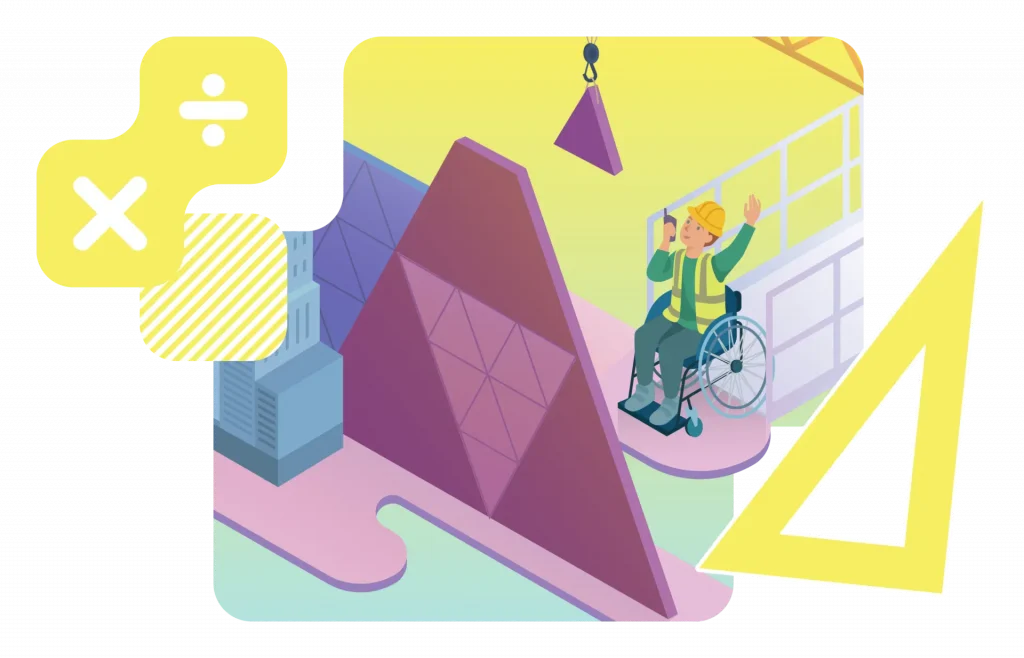
Ilustración de una persona en silla de ruedas con un casco que dirige la colocación de una pieza triangular, rodeada de símbolos matemáticos.

Recursos de la unidad para cuidadores

Para cada unidad del programa, hemos creado un Recurso para cuidadores (Caregiver Resource), el cual ofrece un resumen de la lección, además de un problema que usted puede resolver con su estudiante (y una clave de respuestas). Estos recursos están disponibles tanto en inglés como en español, junto con un glosario de términos clave en ambos idiomas.

Unidad 1: Área y área de superficie

Unidad 2: Introducción a las razones

Unidad 3: Tasas y porcentajes

Unidad 4: División de fracciones

Unidad 5: Aritmética decimal

Unidad 6: Expresiones y ecuaciones

Unidad 7: Números positivos y negativos

Unidad 8: Descripción de datos – ¡Próximamente!

Unidad 1: Dibujos a escala

Unidad 2: Introducción a las relaciones proporcionales

Unidad 3: Medidas de círculos

Unidad 4: Relaciones proporcionales y porcentajes

Unidad 5: Operaciones con números positivos y negativos

Unidad 6: Expresiones, ecuaciones y desigualdades

Unidad 7: Ángulos, triángulos y prismas

Unidad 8: Probabilidad y muestreo

Unidad 1: Transformaciones rígidas y congruencia

Unidad 2: Dilataciones, semejanza y pendiente

Unidad 3: Relaciones proporcionales y lineales

Unidad 4: Ecuaciones lineales y sistemas lineales

Unidad 5: Funciones y volumen

Unidad 6: Asociación de datos

Unidad 7: Exponentes y notación científica

Unidad 8: Teorema de Pitágoras y números irracionales

Unidad 1: Patrones y secuencias

Unidad 2: Ecuaciones lineales y desigualdades

Unidad 3: Descripción de datos

Unidad 4: Descripción de funciones

Unidad 5: Sistemas de ecuaciones lineales y desigualdades

Unidad 6: Funciones exponenciales

Unidad 7: Funciones cuadráticas

Unidad 8: Ecuaciones cuadráticas

Ingrese a Amplify Desmos Math California en casa.

Su estudiante tendrá acceso digital a todos los materiales de aprendizaje, práctica y evaluación a través de la plataforma de Amplify. Es posible acceder al currículo digital desde la escuela o desde casa siguiendo estas instrucciones:

  • Haga clic en el botón Amplify Desmos Math California.
  • Seleccione Log in with Amplify.
  • Ingrese el nombre de usuario y la contraseña que el maestro de su estudiante les haya proporcionado.
  • Seleccione el nivel escolar deseado.

Una vez iniciada la sesión, usted y su estudiante podrán ver los trabajos abriendo tareas anteriores.

Aprenda a navegar por la página de inicio de los estudiantes (student home page).

Apoye el aprendizaje de las matemáticas en casa.

Usted puede apoyar el aprendizaje de las matemáticas de su estudiante fuera de la escuela de muchas maneras:

Relacione las matemáticas con las actividades cotidianas del hogar, ya sea hornear, ir de compras o planear un viaje. Su estudiante puede ayudarle a determinar el precio de un artículo con un cupón, reducir una receta a la mitad o calcular cuánto combustible necesitan para llegar a su destino.

Invite al estudiante a que le explique paso a paso cómo resolvió cada problema o le platique qué partes le resultaron difíciles de resolver. Para fomentar el uso del lenguaje matemático, considere hacer las siguientes preguntas al estudiante: “¿Cómo lo sabes?”, “¿Cómo puedes mostrar tu razonamiento?” o “¿Cómo describirías eso?”. Si el estudiante no consigue avanzar, hágale preguntas de apoyo, por ejemplo: “¿Qué información de aquí conoces?” o “¿Cómo podrías representar este problema?”.

Recuerde al estudiante que bloquearse es una parte natural y necesaria (incluso benéfica) del proceso de aprendizaje. Muchos estudiantes (al igual que personas adultas) temen equivocarse, pero las investigaciones demuestran que equivocarse ayuda a que nuestro cerebro se desarrolle. Cuando su estudiante no consiga avanzar en un problema, anímelo a seguir intentando diferentes estrategias, aunque no esté seguro de si son correctas.

Esperamos que su estudiante disfrute explorando las matemáticas, trabajando con amigos para resolver problemas y aprendiendo conceptos nuevos e interesantes. ¡Y esperamos que ambos disfruten de esta emocionante aventura matemática!

Obtenga más información.

¿Tiene alguna pregunta sobre Amplify Desmos Math California? Visite nuestra biblioteca de ayuda (en inglés) para buscar artículos con respuestas a sus preguntas sobre el programa. Para obtener más ayuda, por favor comuníquese con su maestro.

Families and caregivers, welcome to Amplify Desmos Math California
6–12!

Welcome to the Amplify Desmos Math California Grade 6–12 Caregiver Hub. We’ve designed this space to help you support your student at every stage of their math journey.

In class, your student engages with digital lessons using devices as well as write-in Student Edition books. They also may be assigned digital or print practice outside of class. Below, you’ll find some suggestions and resources for how you can support their learning at home.

Learn more about Amplify Desmos Math California.

Para la versión en español, haga clic aquí.

Ilustración de una persona en silla de ruedas con un casco que dirige la colocación de una pieza triangular, rodeada de símbolos matemáticos.

Caregiver Unit Resources

For every unit of the program, we’ve created a Caregiver Resource that provides a summary of each lesson, plus a problem to try with your student (and an answer key). These resources are available in both English and Spanish, as well as a glossary of key terms in both languages.

Unit refresh videos

Unit 1

  • Sub-Unit 1a – Calculating the Area of Parallelograms
  • Sub-Unit 1b – Calculating the Area of Triangles
  • Sub-Unit 2 – Determining the Surface Area of Rectangular Prisms

Unit 2

Unit 3

Unit 4

  • Sub-Unit 1 – Dividing Fractions Using Tape Diagrams
  • Sub-Unit 2 – Dividing Fractions Using Common Denominators
  • Sub-Unit 3 – Determining the Volume of Prisms With Fractional Dimensions

Unit 5

  • Sub-Unit 1 – Adding and Subtracting Decimals
  • Sub-Unit 2 – Multiplying Decimals Using Area Models
  • Sub-Unit 3 – Dividing Decimals Using Fractions
  • Sub-Unit 4 – Converting Between Fractions, Percents, and Decimals

Unit 6

  • Sub-Unit 1 – Writing and Solving Equations
  • Sub-Unit 2 – Writing Equivalent Expressions Using the Area Model
  • Sub-Unit 3 – Evaluating Expressions With Exponents
  • Sub-Unit 4 – Interpreting Graphs

Unit 7

  • Sub-Unit 1 – Ordering and Comparing Positive and Negative Numbers
  • Sub-Unit 2 – Identifying Solutions to Inequalities
  • Sub-Unit 3 – Plotting Points on the Coordinate Plane

Unit 8

  • Sub-Unit 1 – Creating Dot Plots
  • Sub-Unit 2 – Calculating Mean Absolute Deviation
  • Sub-Unit 3 – Interpreting Box Plots
  • Sub-Unit 4 – Predicting Population Using Sample Data (For use with Amplify Desmos Math New York)
  • Sub-Unit 5 – Predicting Sample Spaces Using Proportional Relationship (For use with Amplify Desmos Math New York)

Unit 1

  • Sub-Unit 1 – Using Ratios to Determine the Scale Factor Between Scaled Copies
  • Sub-Unit 2 – Using Ratios to Determine Unknown Scales in Scale Drawings

Unit 2

  • Sub-Unit 1 – Determining the Constant of Proportionality
  • Sub-Unit 2 – Writing Equations for Proportional Relationships
  • Sub-Unit 3 – Comparing Proportional Relationships
  • Sub-Unit 4 – Representing Proportional Relationships with Multiple Representations

Unit 3

  • Sub-Unit 1 – Determining the Circumference of a Circle
  • Sub-Unit 2 – Calculating Areas of Complex Shapes

Unit 4

Unit 5

  • Sub-Unit 1 – Adding and Subtracting Positive and Negative Number
  • Sub-Unit 2 – Dividing Integers
  • Sub-Unit 3 – Solving Real-World Problems Involving Positive and Negative Numbers

Unit 6

  • Sub-Unit 1 – Writing Equations from Descriptions and Tape Diagrams
  • Sub-Unit 2 – Solving Equations With Positive and Negative Numbers
  • Sub-Unit 3 – Solving Inequalities

Unit 7

  • Sub-Unit 1 – Determining Unknown Angle Measures
  • Sub-Unit 2 – Determining If Three Segments Form a Triangle
  • Sub-Unit 3 – Calculating the Surface Area of Prisms

Unit 8

  • Sub-Unit 1 – Predicting Sample Spaces Using Proportional Relationships
  • Sub-Unit 2 – Predicting Population Using Sample Data

Unit 1

  • Sub-Unit 1 – Determining Coordinates After a Rotation
  • Sub-Unit 2 – Using Rigid Transformations to Determine if Two Figures on the Grid are Congruent
  • Sub-Unit 3 – Determining Unknown Interior and Exterior Angles

Unit 2

  • Sub-Unit 1 – Performing Dilations on a Square Grid
  • Sub-Unit 2 – Determining Missing Side Lengths in Similar Triangles
  • Sub-Unit 3 – Calculating Slope By Drawing Similar Triangles on a Coordinate Plane

Unit 3

  • Sub-Unit 1 – Writing Equations to Represent Proportional Relationships
  • Sub-Unit 2 – Interpreting Slope and Intercepts of Linear Relationships
  • Sub-Unit 3 – Calculating Slope Given Two Points

Unit 4

  • Sub-Unit 1 – Solve Single-Variable Equations with Parentheses
  • Sub-Unit 2 – Solving Systems of Linear Equations by Graphing

Unit 5

  • Sub-Unit 1 – Justifying Whether a Graph Represents a Function
  • Sub-Unit 2 – Comparing Properties of Linear Functions
  • Sub-Unit 3 – Calculating Volumes of Cylinders

Unit 6

  • Sub-Unit 1 – Interpreting Points on a Scatter Plot
  • Sub-Unit 2 – Using Lines of Fit to Make Predictions
  • Sub-Unit 3 – Calculating Missing Values in Two-Way Tables

Unit 7

Unit 8

  • Sub-Unit 1 – Approximating Square Roots
  • Sub-Unit 2 – Calculating Unknown Side Lengths
  • Sub-Unit 3 – Identifying Rational and Irrational Numbers

Unit 1

  • Sub-Unit 1 – Determining If a Sequence is Arithmetic, Geometric or Neither
  • Sub-Unit 2 – Using Visual Patterns or Terms in the Sequence to Write Explicit Expressions for Arithmetic and Geometric Sequences

Unit 2

  • Sub-Unit 1 – Solving Linear Equations
  • Sub-Unit 2 – Solving Multi-Variable Linear Equations
  • Sub-Unit 3 – Graphing Solutions of Two-Variable Linear Inequalities

Unit 3

  • Sub-Unit 1 – Calculating Values in Two-Way and Relative Frequency Tables
  • Sub-Unit 2 – Comparing Data Using Mean and Standard Deviation
  • Sub-Unit 3 – Interpreting Slope and y-intercept in Context

Unit 4

  • Sub-Unit 1 – Evaluating Function Notation
  • Sub-Unit 2 – Writing Domain and Range with Inequalities
  • Sub-Unit 3 – Graphing Piecewise-Defined Functions
  • Sub-Unit 4 – Writing Recursive Definitions in Function Notation

Unit 5

  • Sub-Unit 1 – Solving Systems of Linear Equations by Substitution
  • Sub-Unit 2 – Graphing Solutions to Systems of Inequalities

Unit 6

  • Sub-Unit 1 – Writing Exponential Functions from Graphs
  • Sub-Unit 2 – Calculating Percent Change in Exponential Functions
  • Sub-Unit 3 – Writing Equivalent Expressions Using Radicals and Rational Exponents
  • Sub-Unit 4 – Writing Exponential Functions Involving Compound Interest

Unit 7

  • Sub-Unit 1 – Describing Key Features of Parabolas
  • Sub-Unit 2 – Graphing Quadratic Functions in Factored Form
  • Sub-Unit 3 – Writing Quadratic Functions in Vertex Form

Unit 8

  • Sub-Unit 1 – Rewriting Factored-Form Expressions in Standard Form
  • Sub-Unit 2 – Solving Quadratic Equations by Graphing
  • Sub-Unit 3 – Solving Quadratic Equations by Completing the Square
  • Sub-Unit 4 – Solving Quadratic Equations Using the Quadratic Formula

Unit 1

  • Sub-Unit 1 – Determining If a Sequence is Arithmetic, Geometric or Neither
  • Sub-Unit 2 – Using Visual Patterns or Terms in the Sequence to Write Explicit Expressions for Arithmetic and Geometric Sequences

Unit 2

  • Sub-Unit 1 – Solving Linear Equations
  • Sub-Unit 2 – Solving Multi-Variable Linear Equations
  • Sub-Unit 3 – Graphing Solutions of Two-Variable Linear Inequalities

Unit 3

  • Sub-Unit 1 – Solving Systems of Linear Equations by Substitution
  • Sub-Unit 2 – Graphing Solutions to Systems of Inequalities
  • Sub-Unit 3 – Writing Equations for Parallel and Perpendicular Lines

Unit 4

  • Sub-Unit 1 – Evaluating Function Notation
  • Sub-Unit 2 – Writing Domain and Range with Inequalities
  • Sub-Unit 3 – Writing Recursive Definitions in Function Notation

Unit 5

  • Sub-Unit 1 – Writing Exponential Functions from Graphs
  • Sub-Unit 2 – Calculating Percent Change in Exponential Functions
  • Sub-Unit 3 – Writing Exponential Functions Involving Compound Interest

Unit 6

  • Sub-Unit 1 – Drawing Perpendicular Bisectors
  • Sub-Unit 2 – Determining Coordinates After a Rotation
  • Sub-Unit 3 – Using Rigid Transformations to Determine if Two Figures on the Grid are Congruent

Unit 7

  • Sub-Unit 1 – Calculating Values in Two-Way and Relative Frequency Tables
  • Sub-Unit 2 – Comparing Data Using Mean and Standard Deviation
  • Sub-Unit 3 – Interpreting Slope and y-intercept in Context

Access Amplify Desmos Math California at home.

Your student will have access to all learning, practice, and assessment materials through the Amplify platform. Students can access the digital curriculum in school and at home by following these simple instructions.

  • Click the Amplify Desmos Math California button.
  • Select Log in with Amplify.
  • Enter the username and password provided by your student’s teacher.
  • Select the desired grade level.

Once logged in, you and your student can view work by opening previous assignments.

Learn how to navigate the student home page.

Support math learning at home.

You can support your student’s math learning outside of school in many ways:

Relate math to daily activities at home, whether you’re baking, grocery shopping, or planning a trip. Your student can help you calculate the prices when you use a coupon, figure out how to cut a recipe in half, or determine the amount of gas you’ll need to make it to your destination.

Invite your student to walk you through how they solved each problem or talk about any parts that were challenging for them. To encourage the use of math language, consider asking, “How do you know?,” “How can you show your thinking?,” or “How would you describe that?” If students get stuck, consider asking questions like, “What information do you know here?” or “How could you represent this problem?”

Emphasize that getting stuck is part of the process and a necessary part of learning. Many students (and adults!) fear making mistakes, but research shows that making mistakes helps your brain grow. When your student gets stuck on a problem, encourage them to try different strategies, even if they think they can’t do it or will get it wrong.

We hope your student enjoys exploring math, working with friends to solve problems, and learning new and interesting concepts. And we hope you enjoy this exciting math journey with them!

Get more information.

Have a question about Amplify Desmos Math California? Visit our Help Library to search for articles with answers to your program questions. For additional support, please contact your student’s teacher.

Families and caregivers, welcome to Amplify Desmos Math California K–5!

Welcome to the Amplify Desmos Math California K–5 Caregiver Hub. We hope your student enjoys exploring math, working with friends to solve problems, and learning new and interesting concepts. And we hope you enjoy the math journey with them! Below are some suggestions and resources for how you can support their learning at home.

Learn more about Amplify Desmos Math California.

Para la versión en español, haga clic aquí.

Three children are engaging in a math activity with a grid and orange markers. One child holds a "9-3" card. The background includes beach elements and abstract math symbols.

Caregiver Unit Resources

For every unit of the program, we’ve created a Caregiver Resource that provides a summary of key concepts, plus a problem from the lesson practice set you can work through with your student. You’ll find a Caregiver Resource for each unit, in both English and Spanish.

Unit 1: Math in Our World

Unit 2: Numbers 1–10

Unit 3: Flat Shapes All Around Us

Unit 4: Understanding Addition and Subtraction

Unit 5: Make and Break Apart Numbers Within 10

Unit 6: Numbers 0–20

Unit 7: Solid Shapes All Around Us

Unit 1: Adding, Subtracting, and Working With Data

Unit 2: Addition and Subtraction Story Problems

Unit 3: Adding and Subtracting Within 20

Unit 4: Numbers to 99

Unit 5: Adding Within 100

Unit 6: Measuring Lengths of Up to 120 Length Units

Unit 7: Geometry and Time

Unit 1: Working With Data and Solving Comparison Problems

Unit 2: Adding and Subtracting Within 100

Unit 3: Measuring Length

Unit 4: Addition and Subtraction on the Number Line

Unit 5: Numbers to 1,000

Unit 6: Geometry and Time

Unit 7: Adding and Subtracting Within 1,000

Unit 8: Equal Groups

Unit 1: Introducing Multiplication

Unit 2: Area and Multiplication

Unit 3: Wrapping Up Addition and Subtraction Within 1,000

Unit 4: Relating Multiplication to Division

Unit 5: Fractions as Numbers

Unit 6: Measuring Length, Time, Liquid Volume, and Weight

Unit 7: Two-Dimensional Shapes and Perimeter

Unit 1: Factors and Multiples

Unit 2: Fraction Equivalence and Comparison

Unit 3: Extending Operations to Fractions

Unit 4: From Hundredths to Hundred Thousands

Unit 5: Multiplicative Comparison and Measurement

Unit 6: Multiplying and Dividing Multi-Digit Numbers

Unit 7: Angles and Properties of Shapes

Unit 1: Volume

Unit 2: Fractions as Quotients and Fraction Multiplication

Unit 3: Multiplying and Dividing Fractions

Unit 4: Multiplication and Division With Multi-Digit Whole Numbers

Unit 5: Place Value Patterns and Decimal Operations

Unit 6: More Decimal and Fraction Operations

Unit 7: Shapes on the Coordinate Plane

Unit refresh videos

Unit 1

  • Sub-Unit 2 – Answering the Question “Are There Enough?”
  • Sub-Unit 3 – Counting and Cardinality

Unit 2

  • Sub-Unit 1 – Comparing 2 Groups Using the Terms More, Fewer, and Same
  • Sub-Unit 2 – Counting Objects in Different Orders
  • Sub-Unit 3 – Making Groups to Represent Numerals
  • Sub-Unit 4 – Comparing Written Numbers

Unit 3

  • Sub-Unit 1 – Identifying Circles and Triangles in Different Sizes and Orientations
  • Sub-Unit 2 – Using Positional Words to Describe the Location of Shapes

Unit 4

  • Sub-Unit 1 – Adding and Subtracting Within 10
  • Sub-Unit 2 – Representing Addition and Subtraction Story Problems
  • Sub-Unit 3 – Finding the Values of Expressions

Unit 1

  • Sub-Unit 1 – Organizing Data to Count How Many in Each Category
  • Sub-Unit 2 – Counting on to Add and Counting Back to Subtract
  • Sub-Unit 3 – Representing 2 Categories of Data With Addition Equations

Unit 2

  • Sub-Unit 1 – Representing and Solving Add To, Change Unknown Story Problems
  • Sub-Unit 2 – Using Addition or Subtraction to Find an Unknown Part of a Total Amount
  • Sub-Unit 3 – Solving Compare, Difference Unknown Problems
  • Sub-Unit 4 – Making Sense of Story Problems With Different Questions

Unit 3

  • Sub-Unit 1 – Finding a Difference Using the Relationship Between Addition and Subtraction
  • Sub-Unit 2 – Using the Structure of Teen Numbers to Find Missing Addends
  • Sub-Unit 3 – Breaking Apart Addends to Make 10 When Adding
  • Sub-Unit 4 – Subtracting From Teen Numbers in Parts to Get to 10

Unit 4

  • Sub-Unit 1 – Adding a Ten To and Subtracting a Ten From Multiples of 10
  • Sub-Unit 2 – Representing and Writing Two-Digit Numbers
  • Sub-Unit 3 – Comparing Two-Digit Numbers
  • Sub-Unit 4 – Representing the Same Two-Digit Number With Different Amounts of Tens and Ones

Unit 1

  • Sub-Unit 1 – Choosing Strategies to Add Within 20
  • Sub-Unit 2 – Representing Data in a Picture Graph and Bar Graph
  • Sub-Unit 3 – Finding the Difference Between 2 Categories Shown on a Bar Graph

Unit 2

  • Sub-Unit 1 – Strategies to Solve Story Problems Involving Money
  • Sub-Unit 2 – Decomposing a Ten When Subtracting by Place
  • Sub-Unit 3 – Making Sense of Story Problems About Comparing That Use the Word More
  • Sub-Unit 4 – Making Sense of One- and Two-Step Story Problems

Unit 3

  • Sub-Unit 1 – Measuring the Length of an Object in Centimeters Using a Ruler
  • Sub-Unit 2 – Measuring Objects in Inches and Feet
  • Sub-Unit 3 – Representing Measurement Data on a Line Plot

Unit 4

  • Sub-Unit 1 – Locating Numbers on Number Lines
  • Sub-Unit 2 – Representing Addition and Subtraction Strategies on a Number Line

Unit 1

  • Sub-Unit 1 – Representing Equal-Groups Situations With Equal-Groups Drawings
  • Sub-Unit 2 – Representing Arrays With Multiplication Equations
  • Sub-Unit 3 – Representing Data Using Scaled Bar Graphs

Unit 2

  • Sub-Unit 1 – Determining the Area of a Rectangle Using Counting and Skip Counting
  • Sub-Unit 2 – Determining the Area of a Rectangle Using Multiplication
  • Sub-Unit 3 – Decomposing to Determine the Area of Rectilinear Figures

Unit 3

  • Sub-Unit 1 – Using the Expanded Form and Partial Sums Algorithms to Add
  • Sub-Unit 2 – Using the Expanded Form Algorithm to Subtract
  • Sub-Unit 3 – Rounding Numbers to the Nearest Hundred and Ten Using Number Lines
  • Sub-Unit 4 – Representing and Solving Two-Step Story Problems Involving Multiplication

Unit 4

  • Sub-Unit 1 – Representing Division Situations With Equal-Groups Drawings
  • Sub-Unit 2 – Representing an Equal-Groups Problem With a Division and Multiplication Equation
  • Sub-Unit 3 – Using the Distributive Property of Multiplication to Multiply a One-Digit Number by a Teen Number
  • Sub-Unit 4 – Decomposing Dividends to Divide

Unit 1

  • Sub-Unit 1 – Using Factor Pairs to Determine All the Possible Side Lengths of a Rectangle With a Given Area
  • Sub-Unit 2 – Finding Multiples and Common Multiples

Unit 2

  • Sub-Unit 1 – Locating Fractions with Different Denominators On the Same Number Line
  • Sub-Unit 2 – Using Multiples or Factors to Determine Equivalent Fractions
  • Sub-Unit 3 – Comparing Fractions Using Equivalent Fractions With Common Denominators

Unit 3

  • Sub-Unit 1 – Adding and Subtracting Fractions with the Same Denominator
  • Sub-Unit 2 – Multiplying Whole Numbers and Fractions
  • Sub-Unit 3 – Adding Fractions with Denominators of 10 and 100

Unit 4

  • Sub-Unit 1 – Writing Fractions With Denominators of 10 and 100 as Decimals
  • Sub-Unit 2 – Relationships Between Place Values in Multi-Digit Whole Numbers
  • Sub-Unit 3 – Comparing Multi-Digit Numbers
  • Sub-Unit 4 – Using the Standard Algorithm to Subtract When Decomposing is Required

Unit 1

  • Sub-Unit 1 – Using the Layered Structure of a Rectangular Prism to Determine the Volume
  • Sub-Unit 2 – Determining the Volume of a Rectangular Prism
  • Sub-Unit 3 – Determining the Volume of Figures Composed of Rectangular Prisms

Unit 2

  • Sub-Unit 1 – Representing Equal-Sharing Story Problems with Fractional Quotients
  • Sub-Unit 2 – Representing Fractions with Equivalent Multiplication and Division Expressions
  • Sub-Unit 3 – Determining the Area of a Rectangle With a Fractional Side Length

Unit 3

  • Sub-Unit 1 – Representing Multiplication of 2 Unit Fractions with Diagrams
  • Sub-Unit 2 – Dividing Whole Numbers by Unit Fractions

Unit 4

  • Sub-Unit 1 – Multiplying Multi-digit Whole Numbers Using the Partial Products and Standard Algorithms
  • Sub-Unit 2 – Dividing Multi-Digit Whole Numbers Using Partial Quotients
  • Sub-Unit 3 – Representing Multi-Step Story Problems with Equations

Access Amplify Desmos Math California at home.

In addition to a print Student Edition workbook, your student will have digital access to all learning, practice, and assessment materials through the Amplify platform. The digital curriculum can be accessed in school and at home by following these instructions:

  • Click the Amplify Desmos Math California button.
  • Select Log in with Amplify.
  • Enter your student’s username and password provided by your student’s teacher.
  • Select the desired grade level.

Once logged in, caregivers can view student work by opening previous assignments.

Learn how to navigate the student home page.

Materials overview

Amplify Desmos Math California address blended learning with supporting print materials and a unique digital experience. All K–5 lessons are available in a write-in Student Edition book. Many of the lessons include hands-on activities with manipulatives, tools that help students understand abstract concepts by making them tangible. Your student will also work with digital devices for an age-appropriate number of lessons.

When students use devices, teachers can monitor their work in real time, making sure they get the exact support that they need at every part of the lesson, in and outside of class.

Una interfaz digital que muestra los nombres anónimos de los estudiantes y su estado de participación en diversas actividades. La interfaz incluye opciones para realizar resúmenes, capturas de pantalla y vistas individuales de los estudiantes.

Components of a lesson

Students in an Amplify Desmos Math California classroom can be seen (and heard!) asking questions, debating answers, justifying their thinking, grappling with problems, and working together and independently.

A typical Amplify Desmos Math California lesson includes:

  • Warm-up: A short, attention-getting problem to pique students’ interest in the lesson.
  • Activities: One to two mini-activities that challenge students’ problem-solving skills.
  • Synthesis: Discussion to review and bring together the important concepts from the lesson.
  • Show What You Know and Reflection: Questions for students to show what they know from the lesson. (Note: The Show What You Know lesson assessment is optional for kindergarten and grade 1.)
  • Centers: Student-led activity stations that reinforce the math learned during lesson activities through interactive and often game-like formats. In kindergarten and grade 1, time for Centers is built into the last 15 minutes of every lesson.

To support, strengthen, and stretch students’ learning after the lesson, Amplify Desmos Math California offers options for:

  • Differentiation: Mini-Lessons, Centers, Extensions, Boost Personalized Learning, and Fluency Practice.
  • Practice: Additional problems your student’s teacher may assign for classwork or homework.

Support math learning at home.

You can support your student’s math learning outside of school in many ways:

Your student’s teacher may assign practice problems at the end of each lesson for classwork or homework. If your student has already completed the practice problems for the lesson, ask them to walk you through how they solved each problem, or talk about any parts that were challenging for them. Ask your student follow-up questions to encourage the use of math language as they explain their thinking, such as, “How do you know?,” “How can you show your thinking?,” or “How would you describe that?” If students are stuck, ask support questions, such as, “What information do you know here?” or “How could you represent this problem?”

Your student’s teacher may introduce a Center game with students in the lesson or beyond the lesson. These games are aligned to the math of the unit and can be played with students outside of class. Your student’s teacher may introduce a Center game to students during or after completing a lesson, or you may need to teach the game before you play by using easy-to-follow instructions. Sign up for a free account to explore Centers and additional K–5 content in our Featured Collections.

Each unit in Amplify Desmos Math begins with a read-aloud story to engage students and provide context for the math of the unit. Elements and characters from the Unit Story then appear in lessons throughout the unit.

Kindergarten

Grade 1

Grade 2

Grade 3

Grade 4

Grade 5

Relate math to daily activities at home, whether grocery shopping, preparing a meal, or planning for a trip to the store. Your student can help you figure out how many more apples there are than oranges in the grocery cart, show how to split a sandwich into fourths, or figure out how much change you’ll receive in exchange for a $10 bill. Encourage your student to point out ways that you use math in your daily tasks.

Remind your student that getting stuck is part of the process and a necessary—beneficial, even!—part of learning. Many students (and adults) fear making mistakes. But research shows that making mistakes helps our brains grow. When your student gets stuck on a problem, encourage them to keep trying different strategies, even if they’re not sure if they are right.

Get more information.

Have a question about Amplify Desmos Math California? Visit our help library to search for articles with answers to your program questions. For additional support, please contact your student’s teacher.

Welcome to Amplify Desmos Math California!

California educators, welcome to math that motivates. Introducing Amplify Desmos Math California, a curiosity-driven TK–12 program that builds lifelong math proficiency. Each lesson poses problems that invite a variety of approaches before guiding students to synthesize their understanding of the learning goals. Students encounter math problems they’re eager to solve, while teachers spend more time where it’s most impactful—creating a collaborative classroom of learners.

Keep reading to learn more about the program and explore sample materials.

About the program

Amplify Desmos Math California is a TK–12 core math program designed to meet the CA Math Framework and the Common Core State Standards for Mathematics. Amplify Desmos Math California thoughtfully combines conceptual understanding, procedural fluency, and application through a structured approach to problem-based learning. Through engaging activities, Amplify Desmos Math California invites curiosity and math discourse into the classroom to create lifelong math proficiency.

Continue reading to learn more about the K–8, Algebra 1, and Math 1 programs and to explore sample materials. (Spanish, TK and high school materials are in development and will be available in the 2026–27 school year. Geometry and Algebra 2 beta pilots will be available in the 2025–26 school year.)

A powerful math suite

Amplify Desmos Math California combines the best of assessment, problem-based core lessons, personalized practice, and intervention into a coherent and engaging experience for both students and teachers.

Laptop displaying a math problem interface with student assessment reports in the background.

Screening and progress monitoring

mCLASS Math benchmark assessments, along with the embedded program assessments, measure not just what students know, but how they think. The asset-based assessment system provides teachers with targeted, actionable insights, linked to core instruction and intervention resources. Unit- and lesson-level core assessments give teachers data at their fingertips to guide and differentiate instruction. In grades 3–8, core assessments and performance tasks are designed to prepare students for success on the Smarter Balanced Assessment Consortium (SBAC) testing.

Core instruction

Amplify Desmos Math California core lessons pair problems students are eager to solve with clear instructional moves for teachers. Each lesson is designed to tell a story by posing problems that invite a variety of approaches before guiding students to synthesize their understanding of the learning goals. With built-in differentiation and multilingual/English learner support, Amplify Desmos Math California enables every student to find success in the math classroom.

A digital math activity asks users to choose a block that makes 10 with a given number; a worksheet shows a similar "make 10" math exercise with blank spaces to fill in.
A digital educational screen showing a math problem about converting meters to centimeters. It involves a diving toy sinking 5 meters into a pool. Text prompts users to input the conversion.

Personalized Learning

Boost Personalized Learning activities help students access grade-level math through engaging, independent digital practice. Responsive Feedback adjusts to students’ work, providing item-level adaptivity to further support their learning.

Differentiation and intervention

Amplify Desmos Math views differentiation as an ongoing process where teachers are both reactive and proactive to student needs, ensuring that all students have clear pathways to proficiency. Through rich data and teacher support, Amplify Desmos Math uses flexible categories of intervention and enrichment that adjust daily according to student thinking.

In-the-moment differentiation supports are available for every lesson, both digitally and in the print Teacher Edition.

Two pages of a math worksheet and teacher’s guide about determining coordinates after a rotation, featuring diagrams, tables, and step-by-step problem-solving instructions.

An approach that supports teachers

Clear, step-by-step instructional moves help teachers plan and teach student-centered lessons that use
student thinking to differentiate instruction and guide to grade-level understanding. They include:

  • Guidance on what to listen for and how
    to respond.
  • Clear learning objectives to keep learning on
    track for each activity and lesson.
  • Daily reinforcement activities to provide direct
    instruction when needed.
A woman writes on a whiteboard using math teaching resources while a man sits at a desk, smiling. There are books and papers on the desk.
Network diagram with interconnected nodes labeled: Measure and Compare Objects, Represent Data, Dollars and Cents, Problem Solving with Measure, Skip Counting to 100, Number Strategies, Squares in an Array, Seeing Fraction in Shapes.

Big Ideas

The CA Mathematics Framework encourages a shift from power standards to thinking about math as a series of connected Big Ideas. Each Amplify Desmos Math California lesson supports one or more Big Ideas and the connections between them. The grade-level diagram changes through the course based on the math concepts addressed within.

Please refer to the following Keeping the Big Ideas at the Center documents to review specific lesson designs and alignments with the Big Ideas for each grade level.

Click here to see how the Big Ideas are represented within the K–8 core lessons.

Focus, coherence, and rigor

Amplify Desmos Math California incorporates the Drivers of Investigation (DIs) and Content Connection (CCs) throughout the program. Throughout the year, students engage with open and authentic tasks of varying durations—from lesson activities to unit-level Explore lessons and longer course-level Investigations. Every lesson and investigation opportunity is grounded in the why, how, and what of the learning experience, and helps teachers bring mathematical concepts to life.

An educational slide on addition story problems, detailing goals for solving problems, language goals, and strategies using equal expressions, tens and ones, and number sense.

Please refer to the following Amplify Desmos Math California alignments to the Standards for Mathematical Practice, provided by grade level.

A screen titled "Match the Score" with a 2D target graph showing various scores. Instructions request four ordered pairs to total 400. Four pairs are listed: (4, 2), (7, 4), (7, 6), (10, 6). A "Try again" button is shown.

Built-in authentic tasks

Mathematics is not learning in isolation. Students are connected to each other’s thinking and can use math to understand the world. With accessible invitations to authentic tasks, all students can experience mathematical success. Amplify Desmos Math California provides these authentic invitations in a variety of ways:

Each unit begins with an “Explore” lesson, which allows students to engage with authentic exploration in low-floor, high-ceiling tasks. These tasks are designed to promote an inclusive and differentiated learning environment—allowing all students to access basic mathematical concepts, while offering advanced exploration and problem-solving for those ready for more complex work.

Our innovative course-level investigations are designed to facilitate multi-part exploration. Students grapple with Big Ideas, diving deep into key concepts that encourage comprehensive understanding. Data science is infused into the approach, giving students a solid foundation from which to interpret and apply data-driven solutions. They’re also encouraged to understand and appreciate the interrelatedness of Earth’s environmental systems via our lesson’s focus on the Environmental Principles and Concepts (EP&Cs).

Explicit support for multilingual/English learners

Three overlapping educational worksheets for first grade math, including a cover page, a list of learning goals, and a lesson plan with bilingual English and Spanish text.

Amplify partnered with the English Learner Success Forum (ELSF), a national nonprofit organization that advocates for high-quality instructional materials that are inclusive of multilingual/English learners (ML/ELs). ELSF reviewed Amplify Desmos Math California, and provided directional guidance and feedback to ensure that the program reflects their research-based instructional strategies for multilingual/English learners.

Amplify Desmos Math California recognizes the diverse language needs of our students and is designed to be inclusive. Each lesson in the program features a parallel language activity, designed to be available to all students, in the form of teacher guidance and student activities. The activities in the Math Language Development Resources have level ELD differentiation to support all levels of ML/ELs. This approach ensures that all students, regardless of their language skills, can participate fully, grasp the material, and excel in their mathematical journey.

Our Multilingual Glossary includes, in addition to Spanish, nine languages: Simplified Mandarin, Tagalog, Vietnamese, Arabic, European French, Russian, Brazilian-Portuguese, Haitian-Creole, and Urdu.

Amplify Desmos Math California will include Spanish student-facing materials beginning in the 2026–27 school year.

Assessments

By starting with what students already know, Amplify Desmos Math helps build a strong foundation for success to guide and support future learning. Teachers are empowered to transform every classroom into an engaged math community that invites, values, and develops student thinking. With explicit guidance on what to look for and how to respond, teachers can effectively support students as they develop their understanding.

Open math workbook showing an End-of-Unit Assessment with multiple-choice and written response questions on fractions and equivalent values.

Program assessments

A variety of performance data in Amplify Desmos Math provides evidence of student learning while helping students bolster their skills and understanding.

Unit-Level Assessments

Our embedded unit assessments offer key insights into students’ conceptual understanding of math. These assessments provide regular, actionable information about how students are thinking about and processing math, with both auto-scoring and in-depth rubrics that help teachers anticipate and respond to students’ learning needs.

Lesson-Level Assessments

Amplify Desmos Math lessons are centered around sense-making and in-the-moment feedback. Daily moments of assessment provide valuable evidence of learning for both the teacher and student.

Data and reporting

Amplify Desmos Math provides teachers and administrators with unified reporting and insights so that educators have visibility into what students know about grade-level math—and can plan instruction accordingly for the whole class, small groups, and individual students.

A table displays students' performance levels across various items, with a detailed score distribution for a specific assessment shown in a separate overlay. Geometric design elements accented the background, providing an engaging visual touch ideal for any math classroom using Amplify Desmos Math.

Assessment reports

Reporting functionality integrates unit assessments, lesson assessments, personalized learning, Benchmark assessments, and Progress Monitoring for a comprehensive look at student learning.

Our reports show proficiency and growth by domain, cluster, standard, and priority concept using performance data from unit assessments. Then our reports highlight areas of potential student need to allow teachers to modify their instruction and target differentiated support.

At-a-glance views of unit-level assessment results inform your instructional planning, and you can also drill down to item-level analysis.

Standards reports

Our standards report allows you to monitor proficiency at the class and individual student levels. Proficiency and growth are shown by domain, cluster, standard, and priority concepts. Areas of potential student need are highlighted to allow teachers to modify their instruction and target differentiated support.

Administrator reports

Amplify Desmos Math provides a complete picture of student, class, and district performance, allowing administrators to implement instructional and intervention plans.

  • Track student, class, and district performance with usage, completion, and assessment data.
  • Accurately group students and classes with the Benchmark and Progress Monitoring data of mCLASS Assessments and allow teachers to reliably implement and track the progress of Tier 2 and Tier 3 intervention.
  • Provide one data-driven solution that educators can rely on for high-quality math instruction.

Elementary review resources

To learn about the elementary program, please start by watching the Amplify Desmos Math California Elementary Program Overview video.

For additional program information and helpful navigation tips, download the Amplify Desmos Math California Elementary Program Guide.

View the Elementary Program Components Guide here. 

View the Hands-on manipulatives brochure here.

Middle School review resources

To learn about the middle school program, please start by watching the Amplify Desmos Math California Middle School Program Overview video.

For additional program information and helpful navigation tips, download the Amplify Desmos Math California Middle School Program Guide.

View the Middle School Program Components Guide here.

View the middle school manipulative kit components here.

The digital experience

In Amplify Desmos Math, embedded interactions and animations allow students to test predictions, get feedback, share ideas, and connect representations.

The digital interactions included in lesson activities are designed to elicit student thinking in a way that feels fun and inviting. As students play and explore math concepts, teachers can highlight the ideas that students share, connect those ideas to other students’ ideas, and build on their thinking through productive class discussion.

Watch the video to preview the digital experience and for helpful platform navigation tips.

A laptop displays a math activity about platform heights and tube length, while a worksheet titled "Hamster Homes" is visible in the background.

Explore grade level samples

All lessons in Amplify Desmos Math California include print materials and rich digital experiences. Every lesson is supported with Student Edition pages, teacher presentation screens, and interactive digital resources for practice and differentiation. Some lessons also enable students to use devices to interact with lesson content.

You’ll find sample materials by grade level in the following drop-downs. Please refer to your physical samples and the digital platform (accessed through the demo account provided by your account executive) for a comprehensive program review.

Scope and Sequence

Math 2–3 is currently being developed and will be available in the 2026–27 school year.

Cover of "Amplify Desmos Math California Teacher Edition GEO Volume 1" featuring abstract geometric illustrations and people engaged in mathematical activities.
Scope and Sequence (National Edition)

The Amplify Desmos Math Geometry Beta National Edition is available for piloting in the 2025–26 school year. Amplify Desmos Math California Geometry will be available in the 2026–27 school year.

Cover of "Amplify Desmos Math California Geo Volume 1 Student Edition" featuring geometric shapes and small illustrated people interacting with mathematical elements.
Geometry sampler

This sampler includes Teacher Edition front matter for program overview information, plus Teacher Edition and Student Edition pages for Units 1–2.

Cover of "Amplify Desmos Math California A2 Teacher Edition," featuring a Ferris wheel, math graphs, and students interacting with mathematical concepts.
Scope and sequence (National Edition)

The Amplify Desmos Math Algebra 2 Beta National Edition is available for piloting in the 2025–26 school year. Amplify Desmos Math California Algebra 2 will be available in the 2026–27 school year.

Cover of "Amplify Desmos Math California Student Edition A2 Volume 1" featuring mathematical graphs, a Ferris wheel, and students interacting with math concepts.
Algebra 2 sampler

This sampler includes Teacher Edition front matter for program overview information, plus Teacher Edition and Student Edition pages for Units 1–2.

Contact us

For questions, samples, or more information, please contact your local Amplify account executive:

Erin King
Sales Director, CA
(512) 736-3162
eking@amplify.com

Northern CA
Wendy Garcia
Senior Account Executive
(510) 368-7666
wgarcia@amplify.com

Bay Area
Lance Burbank
Account Executive
(415) 830-5348
lburbank@amplify.com

Central Valley and Central Coast
Demitri Gonos
Senior Account Executive
(559) 355-3244
dgonos@amplify.com

Ventura and L.A. County
Jeff Sorenson
Associate Account Executive
(310) 902-1407
jsorenson@amplify.com

Orange and L.A. County
Lauren Sherman
Senior Account Executive
(949) 397-5766
lsherman@amplify.com

San Bernardino and L.A. County
Michael Gruber
Senior Account Executive
(951) 520-6542
migruber@amplify.com

Riverside and L.A. County
Brian Roy
Senior Account Executive
(818) 967-1674
broy@amplify.com

San Diego County
Kirk Van Wagoner
Senior Account Executive
(760) 696-0709
kvanwagoner@amplify.com

Under 2300 students in Bay Area, Sacramento Valley, and Northern Counties
Kevin Mauser
Lead Account Executive
(815) 534-0148
kmauser@amplify.com

Under 2300 students in Southern CA, Central Coast, and Southern Central Valley Counties
Charissa Snyder
Account Executive
(720) 936-6802
chsnyder@amplify.com

Amplify Desmos Math New York high school

Welcome to Amplify Desmos Math! Below, you’ll find information about the program, login credentials to access the digital curriculum, and additional resources to support your review.

A laptop screen displays a math activity showing a machine representing the function h(x) = f(x + 2) and a table for input and output values.

About the program

Our structured approach to problem-based learning builds on students’ curiosity to develop lasting grade-level understandings for all students.  The program thoughtfully combines conceptual understanding, fluency, and application, motivating students with interesting problems they are eager to solve. Teachers can spend more time where it’s most impactful: creating a collaborative classroom of learners.

A geometry activity shows a circle intersected by several lines, with a shaded quadrilateral inside. Questions and answer options appear on the right.

Structured approach to problem-based learning

  • Easy-to-follow instructional guidance
  • Robust assessments and reports
  • Explicit guidance for teachers on what to look for and how to respond
A classroom activity tracker shows a grid with students’ names in the left column and progress checkmarks or crosses for seven activities across the top.

Math that motivates

  • Powerful teacher-facilitation supports and tools
  • Students talking and building from each other’s ideas 
  • Compatible print and digital materials for every lesson to foster a collaborative classroom
A design challenge interface shows two side-by-side diagrams with interlocking purple circles; the left is editable with 3 objects, the right is the design to match.

Student thinking is made evident

  • Curiosity-driven lessons that motivate students with interesting problems they are eager to solve
  • Technology that provides Responsive Feedback and is designed to reveal mathematical thinking
  • Student Notes pages to prepare students for college-level skills

Scope and sequence and standards alignment

Click the link below to view the program scope and sequence, alignment to standards, and alignment to the NYC DOE Definition of Culturally Responsive-Sustaining Education and the New York State Culturally Responsive-Sustaining Education Framework

A two-page chart outlines the scope and sequence for Algebra 1, Geometry, and Algebra 2 units, with a vector graphic of lab equipment in the lower right corner.
A laptop displays a graph of a diver's path above water, with two printed math worksheets featuring graphs, tables, and practice problems in the background.

Experience Amplify Desmos Math New York.

Explore our digital program to review content from Algebra 1, Geometry, and Algebra 2. To log in, click the orange “Review now” button below, select “Log in with Amplify” and use the following login credentials:

Username: t.math-adm-ny-hs@tryamplify.net

Password: AmplifyNumber1

Resources to support your review

To learn more about Amplify Desmos Math New York, including pedagogical philosophy, origins, implementation examples, and nationally recognized independent reviews, please download the following documents:

A worksheet and two digital screens show math activities involving tables and blocks, focusing on comparing numbers and filling in missing values.

Looking for help?

Support is always within reach. Our team is dedicated to supporting you throughout your review and can be reached at any time by emailing or calling us directly.

  • Live chat: Click the orange icon while logged in to get immediate help.
  • Phone: Call our toll-free number: (800) 823-1969.
  • Email: Send an email to help@amplify.com. In the message body, please include your name and question. Provide as much detail as possible, so we can more quickly help you find a solution.

Welcome, Central Kitsap, to Amplify Desmos Math!

Amplify Desmos Math K-5 thoughtfully combines conceptual understanding, procedural fluency, and application. Each lesson is designed to tell a story by posing problems that invite a variety of approaches before guiding students to synthesize their understanding of the learning goals.

Scroll to learn more about the program and explore sample materials.

About the program

We believe in math that motivates. Our structured approach to problem-based learning builds on students’ curiosity to develop lasting grade-level understandings for all students. 

The program motivates students with interesting problems they are eager to solve. Teachers can spend more time where it’s most impactful: creating a collaborative classroom of learners.

A powerful suite of math resources

Amplify Desmos Math combines the best of problem-based lessons, intervention, personalized practice, and assessments into a coherent and engaging experience for both students and teachers.  Feel free to explore our grade-level ancillary samplers to learn more about assessment and reporting, intervention, and differentiation:

Grade K Ancillary Sampler

Grade 1 Ancillary Sampler

Grade 2 Ancillary Sampler

Grade 3 Ancillary Sampler

Grade 4 Ancillary Sampler

Grade 5 Ancillary Sampler

A digital interface displays a math screener report on the left and a math problem involving division, alongside a visual representation of students lined up on the right, integrating rich math resources from Amplify Desmos Math.

Assessment

mCLASS® Assessments, along with daily formative checks, measure not only what students know, but how they think. The asset-based assessment system provides teachers with targeted, actionable insights, linked to core and intervention resources. Visit our mClass Math site to learn more.

Two side-by-side math activities for children: on the left, a caterpillar-themed block challenge, and on the right, a worksheet for finding pairs that sum to 10. These exercises are fantastic ways to amplify children's engagement with math concepts.

Core instruction

Amplify Desmos Math lessons pair problems students are eager to solve with clear instructional moves for teachers. With low-floor, high-ceiling tasks every student can actively participate and be a part of the math community. Unit- and lesson-level core assessments give teachers data at their fingertips to guide and differentiate instruction.

A math lesson screen shows a toy sinking 5 meters into a pool. A textbox asks how many centimeters that is, with space for an answer and a "Try again" button. An avatar explains the question, using Desmos math tools to amplify understanding.

Differentiation

Boost Personalized Learning activities help students access grade-level math through engaging, independent digital practice. Responsive Feedback adjusts to students’ work, providing item-level adaptivity to further support their learning and offer personalized differentiation. Visit our Boost Math site to learn more. 

Two pages from a New York math textbook on determining coordinates after a rotation. Includes sections on modeled review, guided practice, and teacher's notes, with diagrams and examples that amplify the learning experience.

Embedded intervention

Integrated resources like Mini-Lessons, Fluency Practice, and Math Adventures provide targeted intervention on a specific concept or skill connected to the daily lesson. Extensions are also available to stretch students’ understanding.

Multilingual Learners

To support multilingual/English learners, Amplify Desmos Math incorporates research-based Math Language Routines (MLRs) by providing language modality strategies like sentence frames where appropriate, both in the teacher language provided for each task and in the differentiation support section found throughout the program. For further information on math language development, please see pg. 82 of the Amplify Desmos Math Program Guide.

A male teacher in a red shirt explaining a lesson to a focused young female student in a classroom. other students are in the background.

Review Resources

To support your review of Amplify Desmos Math here are links to important K-5 review resources:

Two women in an office setting are smiling while looking at a tablet. Various educational icons surround the image.

K-5 sample materials

Click the links in the drop-down sections below to explore sample materials from each grade.  To see sample student responses, please click on the Teacher Edition pages and scroll to “Sample Student Work” (first one is about 30 pages in) or click on Intervention and Extension resources.   

For helpful navigation tips and more program information, download the Amplify Desmos Math Program Guide.

You can also watch a product expert walk through a lesson and the available program components.

Digital educational material showing an activity named "Hamster Homes" involving tube length and platform heights for a hamster cage. Includes a diagram with platforms measuring 9 inches.
Screenshot of a kindergarten curriculum outline featuring units like Math in Our World, Numbers 1-10, Positions and Shapes, Understanding Addition, Making 10, and Shapes All Around Us. This comprehensive program utilizes New York Math standards to build foundational skills.
Program structure

Get to know the content and structure of Kindergarten Amplify Desmos Math.

Cover of Amplify Desmos Math Grade K Teacher Edition featuring three children playing with math-related objects and a group of rabbits sitting nearby, aligning with the engaging curriculum seen in New York math classrooms.
Teacher Edition pages

Planning and instructional guidance is visual, organized, and easy-to-follow. To help you review the program, we have included samples from a complete sub-unit on this site: Unit 2, Sub-Unit 1: Counting and Comparing Objects.

Educational activity screen displaying a blue backpack with icons, dot groups on the left, and a grid background. Prompt reads, "Look inside the backpack. Then choose the group with the same number of dots." A great tool to amplify Desmos math learning in line with New York math standards.
Digital experience

Explore our digital experience! Every lesson in Amplify Desmos Math has student print materials and digital recommendations.

Cover of "Amplify Desmos Math: Student Edition Kindergarten," featuring an illustration of three children playing with math-related toys. A group of small white animals, possibly hamsters, play nearby. The scene brilliantly captures the joy of New York math exploration for young learners.
Student Edition pages

Motivate students with mathematics that is both rigorous and delightful.

Cover of "Amplify Desmos Math Grade K Centers Resources" featuring a large, stylized red and pink "C" on a light pink background with simple geometric designs. This distinctive cover complements New York math curriculums with its engaging visual elements.
Centers Resources

Engaging, hands-on games for students to play collaboratively to strengthen their understanding of key skills and concepts.

Cover of "Amplify Desmos Math: Grade K." The title is displayed with a geometric "I" illustration in the center. Subtitle reads "Intervention and Extension Resources" on a pink and white background, ideal for New York math standards.
Intervention and Extension Resources

Additional resources to reinforce and extend key concepts, including Mini-Lessons and Extensions.

A digital activity screen, crafted in the style of Amplify Desmos Math, shows two paths with different quantities of mushrooms. The user is prompted to choose the path with more mushrooms. A bear is on the left side of the screen.

In this lesson, students apply their understanding of how to compare groups of images as they determine which group has more or fewer and then compare their strategies by guiding a bear through a path that has more mushrooms than the other.

Grade 1 math curriculum overview displaying six units with instructional and assessment days: counting, addition, subtraction, numbers to 10, comparing numbers, measuring length, and geometry—aligned with the New York Math standards.
Program structure

Get to know the content and structure of Grade 1 Amplify Desmos Math.

Children interact with math activities on a large tablet while observing fish illustrations. The text reads "Amplify Desmos Math Grade 1 Teacher Edition, aligned with New York Math standards.
Teacher Edition pages

Planning and instructional guidance is visual, organized, and easy-to-follow. To help you review the program, we have included samples from a complete sub-unit on this site: Unit 2, Sub-Unit 1: Story Problems in Maui.

A digital math exercise, amplified by Desmos Math, showcases a story problem about adding kalo plants with three illustrations and a filled-out number sentence 3 + 4 = 7. A "Check" button is present. This tool aligns perfectly with New York math standards.
Digital experience

Explore our digital experience! Every lesson in Amplify Desmos Math has student print materials and digital recommendations.

Illustration of three children engaged in math activities from the "Amplify Desmos Math: Student Edition 1" textbook. One child holds a number card, while the others manipulate counters and images, experiencing an exciting approach inspired by New York math techniques.
Student Edition pages

Motivate students with mathematics that is both rigorous and delightful.

Cover of "Amplify Desmos Math Centers Resources" for Grade 1, featuring a yellow and white 3D letter "C" on a light background.
Centers Resources

Engaging, hands-on games for students to play collaboratively to strengthen their understanding of key skills and concepts.

Cover of "Amplify Desmos Math, Grade 1: Intervention and Extension Resources" depicting a large, blocky number one and a yellow-themed design. Ideal for enhancing New York math curriculum.
Intervention and Extension Resources

Additional resources to reinforce and extend key concepts, including Mini-Lessons and Extensions.

An educational game screen, inspired by New York math standards, shows a subtraction problem, "4 - 1," with a frog moving along numbered lily pads to reveal the answer "3.

In this lesson, students find differences when subtracting 1 and 2 from the same number by helping a frog reach a lily pad where it can eat a bug.

A curriculum overview for Grade 2 in New York Math displaying 8 units, including topics like comparisons, addition, subtraction, and geometric shapes, with details on the number of instructional and assessment days. This plan integrates resources from Amplify Desmos Math to enrich learning experiences.
Program structure

Get to know the content and structure of Grade 2 Amplify Desmos Math.

Cover of the "Amplify Desmos Math" Grade 2 Teacher Edition, showcasing children measuring with rulers and a poster displaying a mathematical equation, set against whimsical scenery with a colorful dragon. Perfect for New York math classrooms.
Teacher Edition pages

Planning and instructional guidance is visual, organized, and easy-to-follow. To help you review the program, we have included samples from a complete sub-unit on this site: Unit 2, Sub-Unit 1: Adding and Subtracting.

Activity screen displaying a task to estimate the number of animals in an aquarium, featuring a bar chart for goldfish, frogs, and shrimp. Utilizing Desmos math tools, an illustration of an aquarium with various animals is also included to amplify learning.
Digital experience

Explore our digital experience! Every lesson in Amplify Desmos Math has student print materials and digital recommendations.

Cover of "Amplify Desmos Math Student Edition 2" showing three children performing a New York math activity with blocks and measurements.
Student Edition pages

Motivate students with mathematics that is both rigorous and delightful.

Cover of an educational book titled "Amplify Desmos Math Grade 2 Centers Resources" featuring a green "C" on a light green background, perfect for enhancing New York math education.
Centers Resources

Engaging, hands-on games for students to play collaboratively to strengthen their understanding of key skills and concepts.

Cover of "Amplify Desmos Math Grade 2: Intervention and Extension Resources" featuring a green numeral 1 on a light green background, aligning with the New York math standards.
Intervention and Extension Resources

Additional resources to reinforce and extend key concepts, including Mini-Lessons and Extensions.

An educational activity where users must select the block with the correct number to make a total of 10 using the given block numbers. The UI, inspired by New York math standards, features a caterpillar and two tree stumps to amplify engagement with Desmos Math tools.

Students continue to develop fluency by finding the number that makes 10 by helping a millipede reach its favorite food – a clump of leaves!

An educational curriculum outline for Grade 3 with seven units covering various mathematics topics, including multiplication, shapes, fractions, and measurement. Suggested instructional days are provided. The New York Math approach ensures a thorough understanding of each concept.
Program structure

Get to know the content and structure of Grade 3 Amplify Desmos Math.

Cover of a "Grade 3 Amplify Desmos Math Teacher Edition" book, featuring a cutaway building with diverse students and a teacher working on New York math problems and organizing materials.
Teacher Edition pages

Planning and instructional guidance is visual, organized, and easy-to-follow. To help you review the program, we have included samples from a complete sub-unit on this site: Unit 2, Sub-Unit 1: Concepts of Area Measurement.

Educational software displays a challenge to determine the area of an unpainted wall. The wall features a door and window with given dimensions, and a mouse pointer hovers near the question, amplifying the student's engagement.
Digital experience

Explore our digital experience! Every lesson in Amplify Desmos Math has student print materials and digital recommendations.

Cover of "Amplify Desmos Math Student Edition 3" showcasing illustrated children engaged in various mathematical activities inside a glass house structure, reflecting the dynamic energy of New York math.
Student Edition pages

Motivate students with mathematics that is both rigorous and delightful.

Cover of the Amplify Desmos Math Grade 3 Centers Resources book, featuring a 3D letter "C" in blue and white on a minimalistic background, perfect for aligning with New York math standards.
Centers Resources

Engaging, hands-on games for students to play collaboratively to strengthen their understanding of key skills and concepts.

Cover of an "Amplify Cover of the "Amplify Desmos Math" Grade 3 book featuring intervention and extension resources, with a blue geometric "I" on a light blue background, aligning with New York Math standards.
Intervention and Extension Resources

Additional resources to reinforce and extend key concepts, including Mini-Lessons and Extensions.

A page titled "Activity 2" features a table showing counts of rabbits, raccoons, and foxes, an image of animal stickers, and a bar graph representing the number of each animal, designed to amplify your New York math lesson with engaging visual data.

Students compare data represented on bar graphs with different scales by using animal stickers to create scaled bar graphs.

A course outline for Algebra 1 with 8 units, each detailing the number of instructional and optional days. The total suggested instructional days are 144 and 28 optional days, aligning with New York Math standards.
Program structure

Get to know the content and structure of Grade 4 Amplify Desmos Math.

Cover of "Amplify Desmos Math: Teacher Edition Grade 4" showing children learning New York Math outdoors, using large mathematical tools and numbers, with one child in a wheelchair.
Teacher Edition pages

Planning and instructional guidance is visual, organized, and easy-to-follow. To help you review the program, we have included samples from a complete sub-unit on this site: Unit 2, Sub-Unit 1: Size and Location of Fractions.

Educational screen showing an interactive activity from Amplify Desmos Math where a user drags a point to cut a log into quarters. The progress is 2 out of 10.
Digital experience

Explore our digital experience! Every lesson in Amplify Desmos Math has student print materials and digital recommendations.

Cover of "Amplify Desmos Math, Student Edition, Grade 4," showcasing students collaborating on math problems involving shapes and numbers against a vibrant backdrop that blends cityscapes and natural scenery, capturing the essence of New York math learning.
Student Edition pages

Motivate students with mathematics that is both rigorous and delightful.

Cover of the "Amplify Desmos Math" Grade 4 Centers Resources book, featuring a large, stylized blue letter "C" on a light blue background. This essential resource for New York math educators ensures engaging and effective instruction.
Centers Resources

Engaging, hands-on games for students to play collaboratively to strengthen their understanding of key skills and concepts.

Cover of "Amplify Desmos Math, Grade 4: Intervention and Extension Resources," featuring a geometric illustration and a blue and orange color scheme inspired by New York math standards.
Intervention and Extension Resources

Additional resources to reinforce and extend key concepts, including Mini-Lessons and Extensions.

Interactive educational activity asking users to determine platform heights using a 3-inch tube. The interface, inspired by Desmos math tools, features a dragging function and feedback system with a checkbox and "Try another" option, amplifying the learning experience.

Students choose tube lengths to connect to platform heights for hamster homes, identifying possible heights using what they know about multiples.

A Grade 5 curriculum scope and sequence chart with units covering volume, fractions, multiplication, shapes, place value, and measurement. Each unit lists instructional and assessment days to amplify Desmos Math activities.
Program structure

Get to know the content and structure of Grade 5 Amplify Desmos Math.

Illustration of three students engaging with various math activities outdoors and around large blocks. Text at the top reads "Amplify Desmos Math, Grade 5, Teacher Edition" - a perfect resource for New York math educators.
Teacher Edition pages

Planning and instructional guidance is visual, organized, and easy-to-follow. To help you review the program, we have included samples from a complete sub-unit on this site: Unit 2, Sub-Unit 1: Fractions as Quotients.

A digital activity prompt showing a scenic landscape with bamboo shoots and a panda. Using Desmos math tools, the task is to estimate the length where the third bamboo shoot should be placed for the panda to reach a leaf. This exercise is designed to amplify your understanding of spatial reasoning.
Digital experience

Explore our digital experience! Every lesson in Amplify Desmos Math has student print materials and digital recommendations.

Cover of "Amplify Desmos Math: Student Edition, Grade 5" featuring students engaged in various mathematical activities outside, such as block building, measuring, and gardening—a perfect resource aligning with New York math standards.
Student Edition pages

Motivate students with mathematics that is both rigorous and delightful.

Cover image of "Amplify Desmos Math Grade 5 Centers Resources" featuring a large purple letter C on a light purple background, showcasing the innovative approach of Amplify Desmos Math that's making waves in New York math education.
Centers Resources

Engaging, hands-on games for students to play collaboratively to strengthen their understanding of key skills and concepts.

Cover of "Amplify Desmos Math Grade 5: Intervention and Extension Resources," featuring a large, stylized number five in purple against a light purple background with minimal geometric patterns, ideal for New York math curriculum support.
Intervention and Extension Resources

Additional resources to reinforce and extend key concepts, including Mini-Lessons and Extensions.

An interactive screen showing an activity about decomposing a figure into prisms, with a touch of Desmos Math integration. The user is asked to drag points to demonstrate the decomposition. Two prism illustrations are displayed, offering a glimpse of New York Math's approach.

Students decompose a figure into rectangular prisms and determine the volume of the figure by adding the volumes of the individual prisms.

Contact Us

If you have any questions throughout your review process or need additional samples, please don’t hesitate to contact:

Alicia O’Neil

Account Executive

425-890-6103

aoneil@amplify.com

Request additional samples

Ready to learn more? Connect with an Amplify Desmos Math expert to request additional program samples.

Families & Caregivers — Welcome to Amplify Desmos Math New York for grades K–5!

This is the initial version of the Caregiver Hub for Amplify Desmos Math New York. Para la versión en español, haga clic aquí.

Welcome to the Amplify Desmos Math New York K–5 Caregiver Hub for grades K–5. We’re so excited your student’s school has chosen our program! We designed this space to help you support your student in their math journey this year. Your hard work plays an essential role in your student’s math experience.

We hope your student enjoys using technology to explore math, working with friends to solve problems, and learning all sorts of new and interesting concepts. And we hope you love experiencing it with them!

Excited to learn together,
—The Amplify Desmos Math team

A math activity interface instructs to determine platform heights using a tube length. A student workbook titled "Amplify Desmos Math, New York, Volume 1" featuring children playing is also visible.

Introducing Amplify Desmos Math

Amplify Desmos Math is a core math curriculum built for kindergarten through grade 5. We developed the program around the idea that a structured approach to problem-based learning builds on students’ curiosity to develop lasting grade-level understandings for all students. Each lesson offers opportunities to develop students’ understanding; connect their ideas; grow their skill fluency; and empower them to ask questions, explore, and make discoveries.

Amplify Desmos Math uses a student-centered approach to instruction, which has been proven to significantly increase math learning. Our mission is for your students to learn math—and to love learning math!

In every lesson, the Amplify Desmos Math curriculum poses engaging and relevant problems to solve, giving students daily opportunities to think critically, work collaboratively, and actively participate in their own learning.

Screenshot of the Amplify Desmos Math New York, K-5 section on the Desmos Classroom website displaying a list of ADM lessons for different grade levels.

About student-centered math instruction

Student-centered instruction may look different from the way students have learned math in the past, and perhaps from the way you learned math. Instead of memorizing formulas and tricks, student-centered learning focuses on giving students opportunities to figure out how math works. Research shows that students and teachers alike prefer this method, and teachers report that student-centered instruction has helped their students learn more math.

A diverse group of students, one wearing a unicorn headband, looks at a teacher pointing to an amplify math bar graph on a board.

This way of learning helps students:

  • Understand how math concepts work.
  • Remember what they learn in class and apply their knowledge to new situations.
  • Perform better on standardized tests and have more growth in their grades than their peers who learn through other methods.
  • Learn to communicate in writing and verbally, understand and challenge the opinions of others, and build confidence in solving new problems.
  • Develop key skills for success in college and the workplace, like using technology, completing projects independently and with others, and persevering through difficult problems.

What materials do students use?

Amplify Desmos Math supports blended learning with supportive print materials and a unique digital experience. All Amplify Desmos Math K–5 lessons are available in a write-in Student Edition book. Many of the lessons are designed to include hands-on activities with manipulatives. An age-appropriate number of lessons are designed for students to use digital devices like laptops or tablets. These include enhanced digital experiences that teachers can assign to students.

Three animated women of diverse ethnicities smiling and discussing a math curriculum around a laptop at a table, with colorful abstract shapes in the background.

Here’s what you can expect for your students from Amplify Desmos Math:

  • Lessons that drive classroom discussions so students can work toward a shared understanding and sense of community.
  • Responsive feedback that interprets student responses in context and encourages perseverance and revision.
  • Easy-to-follow lesson plans tested in classrooms across the country, with clear teaching suggestions, strategies, and Math Language Routines.
  • Practice problems to support fluency and help students review previous topics.
  • Recommended differentiation suggestions for teachers so that they can meet the needs of diverse learners.
  • Formative assessments that provide information on student understanding so that they can adjust their instruction to meet the needs of all students in their class.
  • Summative assessments that help teachers understand what students know about the math content they have been learning.
  • Daily lesson-level assessments so that teachers can frequently check for understanding.
  • A caregiver resource for each unit that includes explanations of key math concepts and problems to try with your student.

When students use devices, teachers can monitor students’ work in real time, making sure they get the exact support that they need at every part of the lesson, in and outside of class. Here is a sample of what a teacher sees on their dashboard to help them monitor thinking and support student learning.

Screenshot of a digital class attendance and activity tracker with student names and checkboxes indicating their participation in various New York math tasks.

Students are also able to access their digital work at home. Here’s an article on how to navigate the student home page.

What does a lesson look like?

Students in an Amplify Desmos Math classroom can be seen (and heard!)—asking questions, debating answers, justifying their thinking, grappling with problems, and working together and independently.

Two students, one male and one female, are sitting at a desk with a laptop, discussing a project under a "math club" sign, with speech bubble icons above them.

Here’s what a typical Amplify Desmos Math lesson includes:

  • Warm-up: A short, attention-getting problem to get students interested in the lesson.
  • Activities: 1-2 mini-activities that challenge students’ problem-solving skills.
  • Synthesis: Discussion to review and bring together the important concepts from the lesson.
  • Show What You Know and Reflection: Questions for students to show what they know from the lesson. (Note: The “Show What You Know” lesson assessment is optional for the teacher to assign in kindergarten and grade 1)
  • Centers: Student-led activity stations that reinforce the math learned during lesson activities through interactive and often game-like formats. In kindergarten and grade 1, time for Centers is built into the last 15 minutes of every lesson.

Here’s what is available after the lesson to support, strengthen, and stretch students’ learning:

  • Differentiation: Mini-lessons, Centers, extensions, personalized learning, and fluency practice.
  • Practice: Additional problems your student’s teacher may assign for classwork or homework.

How can caregivers support math learning at home?

Use our Unit Support for Caregivers

We’ve created a Caregiver Resource for every unit of the program that provides a summary of key concepts, plus a problem from the lesson practice set you can work through with your student. Within each of the grade-level links below, you’ll find a Caregiver Resource document for each unit, in both English and Spanish.

Grade 1
Unit 1: Adding, Subtracting, and Working With Data
English
Spanish

Grade 3
Unit 1: Introducing Multiplication
English
Spanish

Grade 5
Unit 1: Volume
English
Spanish

Review practice problems together

Your student’s teacher may assign practice problems at the end of each lesson for classwork or homework. If your student has already completed the practice problems for the lesson, ask your student to walk you through how they solved each problem, or talk about any parts that were challenging for them. Ask your students follow-up questions to encourage the use of math language as they explain their thinking, such as: “How do you know?,” “How can you show your thinking?,” or “How would you describe that?” If students are stuck, ask support questions such as, “What information do you know here?” or “How could you represent this problem?”

Getting stuck is okay!

Emphasize that getting stuck is part of the process and a necessary part of learning. Many students (and adults!) fear making mistakes. However, research shows that making mistakes helps your brain grow more. When your student gets stuck on a problem, encourage them to try different strategies, even if they are not sure if they are right.

Find the math in everyday life.

Relate math to daily activities at home, whether grocery shopping, preparing a meal, or planning for a trip to the store. Your student can help you figure out how many more apples there are than oranges in the grocery cart, show how to split a sandwich into fourths, or figure out how much change you’ll receive in exchange for a ten dollar bill. Encourage your student to point out ways that you use math in daily tasks.

Read the Unit Story with your student.

Each unit in Amplify Desmos Math K–5 begins with a read-aloud story to engage students and provide context for the math of the unit. Elements and characters from the Unit Story then appear in lessons throughout the rest of the unit.

Access our Featured Collection of free K–5 Lessons and Activities.

Explore our latest free K–5 content in our Desmos Classroom Featured Collection. With our free collection, you can access:

  • Digital Lessons: Engaging interactive lessons
  • Mini-Lessons: A mix of print and digital activities designed for small-group instruction
  • Math Routines: Short digital activities to kick-start instruction and encourage math discussions
  • Bite-Sized Math Moments: Digital practice activities that use Polypad virtual manipulatives, designed to be used flexibly

Click here to access the collection and sign up for a free account.

How do caregivers access the program at home?

Your student will have access to all learning, practice, and assessment materials through the Amplify platform. Students can access the digital curriculum in school and at home by following these simple instructions.

  • Click the orange Login to Amplify Desmos Math button below.
  • Select Log in with Amplify.
  • Enter your student’s username and password provided by your student’s teacher.
  • Select your student’s grade level.

Amplify Desmos Math NY Pilot

To view this protected page, enter the password below:


Welcome to Amplify Desmos Math California!

California educators, welcome to math that motivates. Introducing Amplify Desmos Math California, a new, curiosity-driven TK–12 program that builds lifelong math proficiency. Each lesson poses problems that invite a variety of approaches before guiding students to synthesize their understanding of the learning goals. Students encounter math problems they are eager to solve; teachers spend more time where it’s most impactful: creating a collaborative classroom of learners.

Scroll to learn more about the program and explore sample materials.

About the program

Amplify Desmos Math California is a TK–12 core math program designed to meet the CA Math Framework and the Common Core State Standards for Mathematics. Offered in English and Spanish, Amplify Desmos Math California thoughtfully combines conceptual understanding, procedural fluency, and application through a structured approach to problem-based learning. Through engaging activities, Amplify Desmos Math California invites curiosity and math discourse into the classroom to create lifelong math proficiency.

Please scroll to learn more about the K–8 program and explore sample materials. (TK and high school materials are in development and will be available soon.)

A powerful math suite

Amplify Desmos Math California combines the best of assessment, problem-based core lessons, personalized practice, and intervention into a coherent and engaging experience for both students and teachers.

Laptop displaying a math problem interface with student assessment reports in the background.

Assessment

mCLASS benchmark assessments, along with daily formative checks, measure not only what students know, but also how they think. The asset-based assessment system provides teachers with targeted, actionable insights, linked to core instruction and intervention resources. Unit- and lesson-level core assessments give teachers data at their fingertips to guide and differentiate instruction. In grades 3–8, core assessments and performance tasks are designed to prepare students for success on the Smarter Balanced Assessment Consortium (SBAC) testing.

Core instruction

Amplify Desmos Math California core lessons pair problems students are eager to solve with clear instructional moves for teachers. Each lesson is designed to tell a story by posing problems that invite a variety of approaches before guiding students to synthesize their understanding of the learning goals. With built-in differentiation and Multilingual / English Learner support, Amplify Desmos Math California will allow every student to find success in the math classroom.

An educational game screen with a worm on a log and numbered blocks. Adjacent is a worksheet titled "Finding the Missing Pair" with instructions and incomplete equations.
A digital educational screen showing a math problem about converting meters to centimeters. It involves a diving toy sinking 5 meters into a pool. Text prompts users to input the conversion.

Personalized learning

Boost Personalized Learning activities help students access grade-level math through engaging, independent digital practice. Responsive Feedback adjusts to students’ work, providing item-level adaptivity to further support their learning.

Intervention

Integrated resources like Mini-Lessons, Fluency Practice, and Math Adventures provide targeted intervention on a specific concept or skill connected to the daily lesson. Extensions are also available to stretch students’ understanding.

Two pages of a math workbook displaying exercises on determining coordinates after rotation. The pages include diagrams, tables, and practice problems.
Network diagram with interconnected nodes labeled: Measure and Compare Objects, Represent Data, Dollars and Cents, Problem Solving with Measure, Skip Counting to 100, Number Strategies, Squares in an Array, Seeing Fraction in Shapes.

Big Ideas

The CA Mathematics Framework encourages a shift from power standards to thinking about math as a series of connected Big Ideas. Each Amplify Desmos Math California lesson supports one or more Big Ideas and the connections between Big Ideas. The grade-level diagram changes through the course based on the math concepts being addressed.

Focus, coherence, and rigor

Each lesson highlights why the content being covered is important, how students will engage with the mathematics, and what students will do with the learning. Our lesson opener helps teachers understand the most important concepts of the lesson, and includes the Drivers of Investigation (DI), Content Connections (CC), and Standards for Mathematical Practice (SMP) that drive learning in each lesson.

An educational slide on addition story problems, detailing goals for solving problems, language goals, and strategies using equal expressions, tens and ones, and number sense.
A screen titled "Match the Score" with a 2D target graph showing various scores. Instructions request four ordered pairs to total 400. Four pairs are listed: (4, 2), (7, 4), (7, 6), (10, 6). A "Try again" button is shown.

Built-in authentic tasks

Mathematics is not learning in isolation. Students are connected to each other’s thinking and can use math to understand the world. With accessible invitations to authentic tasks, all students can experience mathematical success. Amplify Desmos Math California provides these authentic invitations in a variety of ways:

Each unit begins with an “Explore” lesson, which allows students to engage with authentic exploration in low-floor, high-ceiling tasks. These tasks are designed in such a way that all students can access the basic mathematical concepts, but they also offer possibilities for advanced exploration and problem-solving for those ready for more complex work, promoting an inclusive and differentiated learning environment.

Our innovative course-level investigations are designed to facilitate multipart exploration. Students grapple with Big Ideas, diving deep into key concepts that encourage comprehensive understanding. Data science is infused into the approach, equipping students with a strong foundation in interpreting and applying data-driven solutions. The Environmental Principles and Concepts (EP&Cs) are also a focus of our investigations, enabling students to understand and appreciate the coherence and interrelationship of Earth’s environmental systems.

A focus on multilingual and English learners

Children sitting at desks in a classroom with a large illustrated caterpillar on the wall. Beside them are printed educational materials labeled “Amplify Desmos Math” and “Ying’s Aquarium Story.”.

In building Amplify Desmos Math California, we partnered with the English Learner Success Forum (ELSF) to provide guidance on our multilingual/English learner support for teachers. ELSF is a national nonprofit organization that advocates for high-quality instructional materials that are inclusive of multilingual learners. ELSF’s guiding documents reflect research-based instructional strategies that are critical to curriculum design and were created by researchers, linguists, and practitioners from across the country. ELSF reviewed our materials and provided directional guidance and feedback to ensure that the program fully supports multilingual/English learners.

A component of our K–5 curriculum is the engaging unit stories that interweave mathematics with real-life situations and relatable narratives. These unit stories are specifically crafted to inspire curiosity and foster a deep connection between the learner and the math concepts being explored. This unique approach not only makes learning fun and interesting, but also allows our young learners to see themselves in the math.

To help students grow their domain-specific and academic vocabulary, Amplify Desmos Math California provides embedded vocabulary routines, such as prompting teachers to use a Frayer Model. These routines allow students to make connections to new language and offer repeated opportunities to develop and refine language.

Amplify Desmos Math California recognizes the diverse language needs of our students and is designed to be inclusive. Each lesson in the program features a parallel language activity, designed to be available to all students, in the form of teacher guidance and student activities. The activities in the Math Language Development Resource has leveled ELD (Emerging, Expanding, Bridging) differentiation to support all levels of Multilingual and English Learners. This approach ensures that all students, regardless of their language skills, can participate fully, grasp the material, and excel in their mathematical journey.

Uploaded digital glossary for languages other than Spanish. Up to nine languages of translations will be provided for.

Amplify Desmos Math California will include support resources for Spanish-speaking students across TK–Algebra 1/Integrated I beginning in the 20262027 school year.

A computer displays an educational activity about measuring platform heights. A notebook page is layered behind it, with a colorful hamster-themed illustration.

K–5 sample materials

Click the links in the drop-down sections below to explore sample materials from each grade. 

For helpful navigation tips and more program information, download the Amplify Desmos Math Program Guide.

You can also watch a product expert walk through a lesson and the available program components.

Screenshot of a kindergarten curriculum outline featuring units like Math in Our World, Numbers 1-10, Positions and Shapes, Understanding Addition, Making 10, and Shapes All Around Us. This comprehensive program utilizes New York Math standards to build foundational skills.
Program structure

Get to know the content and structure of Kindergarten Amplify Desmos Math California.

Cover of Amplify Desmos Math Grade K Teacher Edition featuring three children playing with math-related objects and a group of rabbits sitting nearby, aligning with the engaging curriculum seen in New York math classrooms.
Teacher Edition pages

Planning and instructional guidance is visual, organized, and easy-to-follow. To help you review the program, we have included samples from a complete sub-unit on this site: Unit 2, Sub-Unit 1: Counting and Comparing Objects.

Digital educational activity showing a blue backpack illustration with dots, a task to match dots on cards, and printed sheet featuring a similar dot-matching exercise.
Digital experience

Explore our digital experience! Every lesson in Amplify Desmos Math California has student print materials and digital recommendations.

Cover of "Amplify Desmos Math: Student Edition Kindergarten," featuring an illustration of three children playing with math-related toys. A group of small white animals, possibly hamsters, play nearby. The scene brilliantly captures the joy of New York math exploration for young learners.
Student Edition pages

Motivate students with mathematics that is both rigorous and delightful.

Cover of "Amplify Desmos Math Grade K Centers Resources" featuring a large, stylized red and pink "C" on a light pink background with simple geometric designs. This distinctive cover complements New York math curriculums with its engaging visual elements.
Centers Resources

Engaging, hands-on games for students to play collaboratively to strengthen their understanding of key skills and concepts.

Cover of "Amplify Desmos Math: Grade K." The title is displayed with a geometric "I" illustration in the center. Subtitle reads "Intervention and Extension Resources" on a pink and white background, ideal for New York math standards.
Intervention and Extension Resources

Additional resources to reinforce and extend key concepts, including Mini-Lessons and Extensions.

Illustration of a bear choosing a path with more mushrooms. Activity book page titled "A Furry Feast" with groups of objects to compare quantities.

In this lesson, students apply their understanding of how to compare groups of images as they determine which group has more or fewer and then compare their strategies by guiding a bear through a path that has more mushrooms than the other.

A clear plastic box contains various math manipulatives, including counting cubes, geometric shapes, rulers, and dice, displayed outside the box.
Hands-on manipulative kit

An optional add-on to your Amplify Desmos Math California program, the manipulative kit provides hands-on learning tools designed to simplify and illustrate complex mathematical concepts.

Grade 1 math curriculum overview displaying six units with instructional and assessment days: counting, addition, subtraction, numbers to 10, comparing numbers, measuring length, and geometry—aligned with the New York Math standards.
Program structure

Get to know the content and structure of Grade 1 Amplify Desmos Math California.

Children interact with math activities on a large tablet while observing fish illustrations. The text reads "Amplify Desmos Math Grade 1 Teacher Edition, aligned with New York Math standards.
Teacher Edition pages

Planning and instructional guidance is visual, organized, and easy-to-follow. To help you review the program, we have included samples from a complete sub-unit on this site: Unit 2, Sub-Unit 1: Story Problems in Maui.

A digital educational activity showing a math problem about leaves on a kalo plant with a related worksheet on plant growth.
Digital experience

Explore our digital experience! Every lesson in Amplify Desmos Math California has student print materials and digital recommendations.

Illustration of three children engaged in math activities from the "Amplify Desmos Math: Student Edition 1" textbook. One child holds a number card, while the others manipulate counters and images, experiencing an exciting approach inspired by New York math techniques.
Student Edition pages

Motivate students with mathematics that is both rigorous and delightful.

Centers Resources

Engaging, hands-on games for students to play collaboratively to strengthen their understanding of key skills and concepts.

Intervention and Extension Resources

Additional resources to reinforce and extend key concepts, including Mini-Lessons and Extensions.

Interactive math activity for kids featuring a frog and number line for subtraction problems, asking to find differences to locate bugs.

In this lesson, students find differences when subtracting 1 and 2 from the same number by helping a frog reach a lily pad where it can eat a bug.

A clear plastic box contains various math manipulatives, including counting cubes, geometric shapes, rulers, and dice, displayed outside the box.
Hands-on manipulative kit

An optional add-on to your Amplify Desmos Math California program, the manipulative kit provides hands-on learning tools designed to simplify and illustrate complex mathematical concepts.

A curriculum overview for Grade 2 in New York Math displaying 8 units, including topics like comparisons, addition, subtraction, and geometric shapes, with details on the number of instructional and assessment days. This plan integrates resources from Amplify Desmos Math to enrich learning experiences.
Program structure

Get to know the content and structure of Grade 2 Amplify Desmos Math California.

Cover of the "Amplify Desmos Math" Grade 2 Teacher Edition, showcasing children measuring with rulers and a poster displaying a mathematical equation, set against whimsical scenery with a colorful dragon. Perfect for New York math classrooms.
Teacher Edition pages

Planning and instructional guidance is visual, organized, and easy-to-follow. To help you review the program, we have included samples from a complete sub-unit on this site: Unit 2, Sub-Unit 1: Adding and Subtracting.

Two digital worksheets about Theo's aquarium with tasks to estimate animal quantities using draggable graphs and illustrations of fish, frogs, and shrimps.
Digital experience

Explore our digital experience! Every lesson in Amplify Desmos Math California has student print materials and digital recommendations.

Cover of "Amplify Desmos Math Student Edition 2" showing three children performing a New York math activity with blocks and measurements.
Student Edition pages

Motivate students with mathematics that is both rigorous and delightful.

Cover of an educational book titled "Amplify Desmos Math Grade 2 Centers Resources" featuring a green "C" on a light green background, perfect for enhancing New York math education.
Centers Resources

Engaging, hands-on games for students to play collaboratively to strengthen their understanding of key skills and concepts.

Cover of "Amplify Desmos Math Grade 2: Intervention and Extension Resources" featuring a green numeral 1 on a light green background, aligning with the New York math standards.
Intervention and Extension Resources

Additional resources to reinforce and extend key concepts, including Mini-Lessons and Extensions.

Educational activity on a screen showing a worm and blocks with numbers. Another page shows an activity titled "Finding the Missing Pair," with numbered options and a video prompt.

Students continue to develop fluency by finding the number that makes 10 by helping a millipede reach its favorite food – a clump of leaves!

A clear plastic box contains various math manipulatives, including counting cubes, geometric shapes, rulers, and dice, displayed outside the box.
Hands-on manipulative kit

An optional add-on to your Amplify Desmos Math California program, the manipulative kit provides hands-on learning tools designed to simplify and illustrate complex mathematical concepts.

An educational curriculum outline for Grade 3 with seven units covering various mathematics topics, including multiplication, shapes, fractions, and measurement. Suggested instructional days are provided. The New York Math approach ensures a thorough understanding of each concept.
Program structure

Get to know the content and structure of Grade 3 Amplify Desmos Math California.

Cover of a "Grade 3 Amplify Desmos Math Teacher Edition" book, featuring a cutaway building with diverse students and a teacher working on New York math problems and organizing materials.
Teacher Edition pages

Planning and instructional guidance is visual, organized, and easy-to-follow. To help you review the program, we have included samples from a complete sub-unit on this site: Unit 2, Sub-Unit 1: Concepts of Area Measurement.

Math activity screenshot showing a problem to calculate the area of an unpainted wall space with given side lengths in a room diagram.
Digital experience

Explore our digital experience! Every lesson in Amplify Desmos Math California has student print materials and digital recommendations.

Cover of "Amplify Desmos Math Student Edition 3" showcasing illustrated children engaged in various mathematical activities inside a glass house structure, reflecting the dynamic energy of New York math.
Student Edition pages

Motivate students with mathematics that is both rigorous and delightful.

Cover of the Amplify Desmos Math Grade 3 Centers Resources book, featuring a 3D letter "C" in blue and white on a minimalistic background, perfect for aligning with New York math standards.
Centers Resources

Engaging, hands-on games for students to play collaboratively to strengthen their understanding of key skills and concepts.

Cover of an "Amplify Cover of the "Amplify Desmos Math" Grade 3 book featuring intervention and extension resources, with a blue geometric "I" on a light blue background, aligning with New York Math standards.
Intervention and Extension Resources

Additional resources to reinforce and extend key concepts, including Mini-Lessons and Extensions.

Activity sheets showing a bar graph and a table for counting animal stickers: 7 rabbits, 5 raccoons, and 2 foxes. Includes instructions for arranging data points on a graph.

Students compare data represented on bar graphs with different scales by using animal stickers to create scaled bar graphs.

A clear plastic box contains various math manipulatives, including counting cubes, geometric shapes, rulers, and dice, displayed outside the box.
Hands-on manipulative kit

An optional add-on to your Amplify Desmos Math California program, the manipulative kit provides hands-on learning tools designed to simplify and illustrate complex mathematical concepts.

A course outline for Algebra 1 with 8 units, each detailing the number of instructional and optional days. The total suggested instructional days are 144 and 28 optional days, aligning with New York Math standards.
Program structure

Get to know the content and structure of Grade 4 Amplify Desmos Math California.

Cover of "Amplify Desmos Math: Teacher Edition Grade 4" showing children learning New York Math outdoors, using large mathematical tools and numbers, with one child in a wheelchair.
Teacher Edition pages

Planning and instructional guidance is visual, organized, and easy-to-follow. To help you review the program, we have included samples from a complete sub-unit on this site: Unit 2, Sub-Unit 1: Size and Location of Fractions.

Screenshot of a digital math activity showing a fraction number line task with a log-cutting visual and an instruction page titled "Locating Fractions.
Digital experience

Explore our digital experience! Every lesson in Amplify Desmos Math California has student print materials and digital recommendations.

Cover of "Amplify Desmos Math, Student Edition, Grade 4," showcasing students collaborating on math problems involving shapes and numbers against a vibrant backdrop that blends cityscapes and natural scenery, capturing the essence of New York math learning.
Student Edition pages

Motivate students with mathematics that is both rigorous and delightful.

Cover of the "Amplify Desmos Math" Grade 4 Centers Resources book, featuring a large, stylized blue letter "C" on a light blue background. This essential resource for New York math educators ensures engaging and effective instruction.
Centers Resources

Engaging, hands-on games for students to play collaboratively to strengthen their understanding of key skills and concepts.

Cover of "Amplify Desmos Math, Grade 4: Intervention and Extension Resources," featuring a geometric illustration and a blue and orange color scheme inspired by New York math standards.
Intervention and Extension Resources

Additional resources to reinforce and extend key concepts, including Mini-Lessons and Extensions.

An educational activity displays a drag-and-drop task to determine platform heights using tube lengths, showing a room scene and instructions on a digital interface.

Students choose tube lengths to connect to platform heights for hamster homes, identifying possible heights using what they know about multiples.

A clear plastic box contains various math manipulatives, including counting cubes, geometric shapes, rulers, and dice, displayed outside the box.
Hands-on manipulative kit

An optional add-on to your Amplify Desmos Math California program, the manipulative kit provides hands-on learning tools designed to simplify and illustrate complex mathematical concepts.

A Grade 5 curriculum scope and sequence chart with units covering volume, fractions, multiplication, shapes, place value, and measurement. Each unit lists instructional and assessment days to amplify Desmos Math activities.
Program structure

Get to know the content and structure of Grade 5 Amplify Desmos Math California.

Illustration of three students engaging with various math activities outdoors and around large blocks. Text at the top reads "Amplify Desmos Math, Grade 5, Teacher Edition" - a perfect resource for New York math educators.
Teacher Edition pages

Planning and instructional guidance is visual, organized, and easy-to-follow. To help you review the program, we have included samples from a complete sub-unit on this site: Unit 2, Sub-Unit 1: Fractions as Quotients.

Activity worksheet and digital screen showing a panda on a cliff, with instructions about placing a missing bamboo shoot to help it reach the leaf.
Digital experience

Explore our digital experience! Every lesson in Amplify Desmos Math California has student print materials and digital recommendations.

Cover of "Amplify Desmos Math: Student Edition, Grade 5" featuring students engaged in various mathematical activities outside, such as block building, measuring, and gardening—a perfect resource aligning with New York math standards.
Student Edition pages

Motivate students with mathematics that is both rigorous and delightful.

Cover image of "Amplify Desmos Math Grade 5 Centers Resources" featuring a large purple letter C on a light purple background, showcasing the innovative approach of Amplify Desmos Math that's making waves in New York math education.
Centers Resources

Engaging, hands-on games for students to play collaboratively to strengthen their understanding of key skills and concepts.

Cover of "Amplify Desmos Math Grade 5: Intervention and Extension Resources," featuring a large, stylized number five in purple against a light purple background with minimal geometric patterns, ideal for New York math curriculum support.
Intervention and Extension Resources

Additional resources to reinforce and extend key concepts, including Mini-Lessons and Extensions.

Screen showing a student activity about decomposing a figure into prisms, with a drag-and-drop exercise and an adjacent worksheet labeled "Seeing Prisms.

Students decompose a figure into rectangular prisms and determine the volume of the figure by adding the volumes of the individual prisms.

A clear plastic box contains various math manipulatives, including counting cubes, geometric shapes, rulers, and dice, displayed outside the box.
Hands-on manipulative kit

An optional add-on to your Amplify Desmos Math California program, the manipulative kit provides hands-on learning tools designed to simplify and illustrate complex mathematical concepts.

6–A1 sample materials

Click the links in the drop-down sections below to explore sample materials from each grade. 

For helpful navigation tips and more program information, download the Amplify Desmos Math Program Guide.

You can also watch a product expert walk through a lesson and the available program components.

Laptop showing a math activity with geometric shapes. Two textbooks titled "Amplify Desmos Math" are displayed above.
An educational document titled "Scope and Sequence" for Grade 6 math, designed in collaboration with Amplify Desmos Math, outlining six units with instructional and optional days for topics such as fractions, integers, and expressions.
Program structure

Get to know the content and structure of Grade 6 Amplify Desmos Math California.

Cover of the Grade 6 Amplify Desmos Math Teacher Edition, showcasing students engaging in various mathematical activities around a balance scale with variables, inspired by New York math educational standards.
Teacher Edition pages

Planning and instructional guidance is visual, organized, and easy-to-follow. To help you review the program, we have included samples from three sub-units on this site: Unit 1, Sub-Unit 1: Area; Unit 3, Sub-Unit 1: Units and Measurement; and Unit 6, Sub-Unit 1: Solving Equations.

A digital activity showing two model trains on a track with a question about speed. A printed page on the right is titled "Model Trains" with warm-up instructions.
Digital experience

Explore our digital experience! Every lesson in Amplify Desmos Math California has student print materials and digital recommendations.

Cover of “Amplify Desmos Math, Student Edition, Grade 6” featuring an illustration of children engaging in various New York math-related activities outdoors.
Student Edition pages

Motivate students with mathematics that is both rigorous and delightful.

Cover image of "Amplify Desmos Math" for Grade 6, featuring a 3D pink letter "I" and the text "Intervention and Extension Resources." This New York math edition supports students with comprehensive resources.
Intervention and Extension Resources

Additional resources to reinforce and extend key concepts, including Mini-Lessons and Extensions.

A digital illustration of math balancing scales featuring boxes and a fox, alongside a worksheet displaying similar content and activities for learning math concepts.

Students use equations and tape diagrams to represent seesaw situations and to determine unknown animal weights, helping them make connections between diagrams that represent equations of the form `x+p=q` or `px=q`.

A clear plastic storage box filled with educational math manipulatives, including colorful blocks, shapes, measuring tools, and counting cubes displayed outside the box.
Hands-on manipulative kit

An optional add-on to your Amplify Desmos Math California program, the manipulative kit provides hands-on learning tools designed to simplify and illustrate complex mathematical concepts.

A Grade 7 math curriculum outline, featuring units on scale drawings, proportional relationships, measuring circles, rational numbers, operations, equations, angles, area, and probability with sequencing and days allocated. Perfectly aligned with Amplify Desmos Math for New York Math standards.
Program structure

Get to know the content and structure of Grade 7 Amplify Desmos Math California.

Cover image of "Amplify Desmos Math Teacher Edition Grade 7" featuring an illustration of students engaging in math-related activities with geometric shapes and construction elements against a New York cityscape background.
Teacher Edition pages

Planning and instructional guidance is visual, organized, and easy-to-follow. To help you review the program, we have included samples from three sub-units on this site: Unit 1, Sub-Unit 1: Scaled Copies; Unit 4, Sub-Unit 1: Percentages as Proportional Relationships; and Unit 6, Sub-Unit 1: Equations and Tape Diagrams.

Activity page showing a grid for shape creation with an area of 8 square centimeters. Includes shape options and instructions on rotation. A booklet page displays area challenges and warm-up tasks.
Digital experience

Explore our digital experience! Every lesson in Amplify Desmos Math California has student print materials and digital recommendations.

Cover of "Amplify Desmos Math, Student Edition, Grade 7" showing students engaged in math activities against a cityscape reminiscent of New York, with purple geometric structures and a crane in the background.
Student Edition pages

Motivate students with mathematics that is both rigorous and delightful.

Cover of "Amplify Desmos Math: Grade 7 – Intervention and Extension Resources" featuring a stylized 3D "I" on a light purple background, ideal for both New York math and national curricula.
Intervention and Extension Resources

Additional resources to reinforce and extend key concepts, including Mini-Lessons and Extensions.

Screenshot of an educational website showing a math activity featuring a sheep named Shira. There is a graph and a worksheet on inequalities displayed.

Students solve inequalities with positive and negative coefficients to solve a variety of challenges featuring a fictional sheep who eats grass according to an inequality.

A clear plastic storage box filled with educational math manipulatives, including colorful blocks, shapes, measuring tools, and counting cubes displayed outside the box.
Hands-on manipulative kit

An optional add-on to your Amplify Desmos Math California program, the manipulative kit provides hands-on learning tools designed to simplify and illustrate complex mathematical concepts.

Grade 8 math curriculum chart featuring 9 units, such as Rigid Transformations and Congruence, with Suggested Instructional days. Each unit outlines instructional days, assessment days, and optional days—complemented by insights from Amplify Desmos Math to enhance your New York math learning experience.
Program structure

Get to know the content and structure of Grade 7 Amplify Desmos Math California.

Illustration of children engaging in learning activities outdoors near a large slide. The title "Amplify Desmos Math Grade 8 Teacher Edition" is shown at the top, highlighting its relevance to New York math curriculum standards.
Teacher Edition pages

Planning and instructional guidance is visual, organized, and easy-to-follow. To help you review the program, we have included samples from three sub-units on this site: Unit 1, Sub-Unit 1: Rigid Transformations; Unit 3, Sub-Unit 2: Linear Relationships; and Unit 6, Sub-Unit 2: Analyzing Numerical Data.

Image of a digital math activity titled "Line Capture #2" featuring a grid, equations, and instructions. A paper worksheet with graphs and a "Line Zapper" title is displayed alongside.
Digital experience

Explore our digital experience! Every lesson in Amplify Desmos Math California has student print materials and digital recommendations.

Cover of the "Amplify Desmos Math" Student Edition for Grade 8, featuring students engaging in various mathematical activities in a stylized outdoor New York setting.
Student Edition pages

Motivate students with mathematics that is both rigorous and delightful.

Cover of "Amplify Desmos Math Grade 8: Intervention and Extension Resources" featuring a stylized "I" on a gray background, tailored for New York math standards.
Intervention and Extension Resources

Additional resources to reinforce and extend key concepts, including Mini-Lessons and Extensions.

An educational worksheet on robots, featuring a graph with red, purple, and blue robot icons, and instructions for a warm-up activity.

Students connect points on a scatter plot with individuals in a population and rows of data in a table. The analysis of scatter plots continues with data about the eye distances and heights of robots.

A clear plastic storage box filled with educational math manipulatives, including colorful blocks, shapes, measuring tools, and counting cubes displayed outside the box.
Hands-on manipulative kit

An optional add-on to your Amplify Desmos Math California program, the manipulative kit provides hands-on learning tools designed to simplify and illustrate complex mathematical concepts.

A course outline for Algebra 1 with 8 units, each detailing the number of instructional and optional days. The total suggested instructional days are 144 and 28 optional days, aligning with New York Math standards.
Program structure

Get to know the content and structure of Algebra 1 Amplify Desmos Math California.

Cover of "Amplify Desmos Math: Algebra 1, Teacher Edition" featuring diverse characters engaged in mathematical activities, with a graph and a bridge in the background, illustrating the vibrant energy of New York math.
Teacher Edition pages

Planning and instructional guidance is visual, organized, and easy-to-follow. To help you review the program, we have included samples from two complete sub-units on this site: Unit 2, Sub-Units 1–2: One-Variable Equations and Multi-Variable Equations.

A digital educational interface shows a graph with data points and textual instructions comparing year and breeding pairs. Adjacent is a page discussing penguin populations with charts and illustrations.
Digital experience

Explore our digital experience! Every lesson in Amplify Desmos Math California has student print materials and digital recommendations.

Cover of "Amplify Desmos Math" Student Edition A1, featuring an illustration of diverse characters engaging in New York math activities against a backdrop of graphs and mathematical concepts.
Student Edition pages

Motivate students with mathematics that is both rigorous and delightful.

A digital math activity screen showing block arrangements and a worksheet page titled "Shelley the Snail" with related graphics.

Students represent the solutions of a situation using a table, a graph, and multiple forms of an equation to identify multiple combinations of blocks that can help Shelley the Snail cross a gap.

Contact us

For questions, samples, or more information, please contact your local Amplify Account Executive:

Erin King
Sales Director, CA
(512) 736-3162
eking@amplify.com

Northern CA
Wendy Garcia
Senior Account Executive
(510) 368-7666
wgarcia@amplify.com

Bay Area
Lance Burbank
Account Executive
(415) 830-5348
lburbank@amplify.com

Central Valley and Central Coast
Demitri Gonos
Senior Account Executive
(559) 355-3244
dgonos@amplify.com

Ventura and L.A. County
Jeff Sorenson
Associate Account Executive
(310) 902-1407
jsorenson@amplify.com

Orange and L.A. County
Lauren Sherman
Senior Account Executive
(949) 397-5766
lsherman@amplify.com

San Bernardino and L.A. County
Michael Gruber
Senior Account Executive
(951) 520-6542
migruber@amplify.com

Riverside and L.A. County
Brian Roy
Account Executive
(818) 967-1674
broy@amplify.com

San Diego County
Kirk Van Wagoner
Senior Account Executive
(760) 696-0709
kvanwagoner@amplify.com

Under 2300 students in Bay Area, Sacramento Valley, and Northern Counties
Kevin Mauser
Lead Account Executive
(815) 534-0148
kmauser@amplify.com

Under 2300 students in Southern CA, Central Coast, and Southern Central Valley Counties
Charissa Snyder
Account Executive
(720) 936-6802
chsnyder@amplify.com

Request additional samples.

Ready to learn more? Connect with an Amplify Desmos Math California expert to request additional program samples.

Amplify Desmos Math for Washoe County

To view this protected page, enter the password below:


Tap into your Arkansas math students’ curiosity and brilliance.

As a math teacher, you work every day to celebrate student brilliance, build deep conceptual understanding, and create the conditions for every student to be successful.

We’re here to help.

Amplify Desmos Math Program Page Hero Image
ADM_Updates_Assets-DC

Desmos Classroom

Grades 3+

A teaching and learning platform offering a collection of free digital lessons and lesson building tools

  • Teachers can build their own lessons using the Activity Builder tool
  • Teachers can explore lessons including:
    • Library of user created lessons
    • Featured Collection lessons authored by the Desmos Classroom team

Learn more at teacher.desmos.com

A math problem on a computer screen shows a fish in a bowl, a window, a clock, and text prompting students to explain the fish's mass equation. The Amplify Desmos Math logo and EdReports badge appear in the lower right corner.

Desmos Math 6–A1

Grades 6–8, Algebra 1

A year-long, blended middle school math curriculum delivered through the Desmos Classroom platform

  • A rigorous curriculum based on Illustrative Mathematics® IM K–12™, authored by the Desmos Classroom team
  • Grades 6–8 courses rated perfect scores on EdReports (Algebra 1 not yet reviewed)
  • Pre-made, fully customizable lessons, available in English and Spanish
  • Powerful facilitation tools to allow for real-time insight and feedback

Learn more amplify.com/desmosmath

Math workbook page with a graph and table. It shows Tim and Tam walking at a constant rate. Instructions to complete the table and "Check My Work" button are visible.

Amplify Desmos Math

Grades K–Algebra 2

Coming Soon: A new core PreK–12 program from Amplify and Desmos Classroom

  • The power of Desmos Classroom technology and instruction with additional easy-to-use print and digital components
  • Based on Illustrative Mathematics® IM K–12™
  • Aligned to standards
  • Available in English and Spanish
  • K–A1 pilots available back-to-school 2024

A new core PreK–12 program from Amplify and Desmos Classroom

Amplify Desmos Math taps into students’ natural curiosity from the start of every lesson. When students are presented with age-appropriate, interactive, social learning experiences, spaces open up for creative thinking in which they can fully engage with interesting and important math ideas.

Key features of Amplify Desmos Math:

  • Interactive, 45-minute lessons in print and online based on Illustrative Mathematics® IM K–12™
  • Powerful facilitation tools at point-of-use in the lesson, including:
    • Teacher dashboard, providing real-time insights into student thinking
    • Sharing student work features to highlight student thinking
    • Classroom conversation toolkit to facilitate productive classroom discussions
  • Differentiation, including just-in-time prerequisite supports
  • Instructional and language development routines
  • Assessment customization
  • Reporting

Expect more from your math program.

Computer interface displaying various mosaic patterns submitted by users, each in different color combinations and grid shapes, with labels beneath each design.

For students

Every student feels connected and a part of the conversation when participating in an Amplify Desmos Math lesson. And when students are actively engaged with the content, they achieve more.

Screenshot of a Desmos Classroom page showing a course titled "Math 6-A1" with units on scale drawings, proportional relationships, measuring circles, and percentages.

For teachers

The program delivers what math educators want and need, including:

  • Standards-aligned print and digital lessons that capture students’ interest every day.
  • The right mix of informal and more substantive diagnostic and summative assessments.
  • Differentiation support
  • Additional practice sets
  • Spanish language supports
Math textbook cover and a colorful graph on a website interface, depicting parabolas and offering interactive tools for capturing parabolic shapes.

For leaders

The program delivers what school and district leaders want and need, including:

  • A coherent core program based on the industry-leading IM K–12 Math™ by Illustrative Mathematics®.
  • A comprehensive suite of usage and performance reports that gives educators a better sense of which students might be at risk of falling behind.
  • A team from Amplify dedicated to making your implementation a success.

What’s included

We’ve taken the power of Desmos’ technology and lessons and added beautiful, easy-to-use print and digital components to make a game-changing program that makes teaching a breeze.

  • Student Editions (two volumes)
  • Digital lessons, practice, assessment, and differentiation, built with Desmos technology
  • Teacher Edition
  • Digital tools and support
  • Classroom monitoring and management
  • Reporting
  • Assessment customization
  • Differentiation, including just-in-time prerequisite supports and mini-lessons
  • Additional practice and Assessment blackline masters (print and digital)

Ready to learn more?

Speak to a representative to find out how to be among the first to preview Amplify Desmos Math.

Stay up-to-date on the latest Amplify Desmos Math and Desmos Classroom news.

Digital lessons should be powerful in their ability to surface student thinking and spark interesting and productive discussions. Sign up to learn more about how Amplify Desmos Math and Desmos Classroom bring all students into the math conversation.

The Math Teacher Lounge is open!

Amplify presents the Math Teacher Lounge, a podcast with hosts Bethany Lockhart Johnson and Dan Meyer.

Illustration of a podcast player with "Math Teacher Lounge" and two headshots, featuring a man and a woman. Geometric shapes are scattered around.