Inspiring the next generation of Idaho scientists, engineers, and curious citizens

Amplify Science is a brand-new, engaging core curriculum designed for three-dimensional, phenomena-based learning.

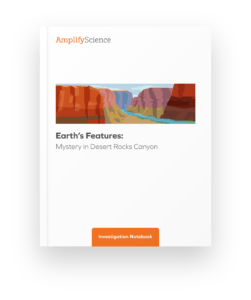
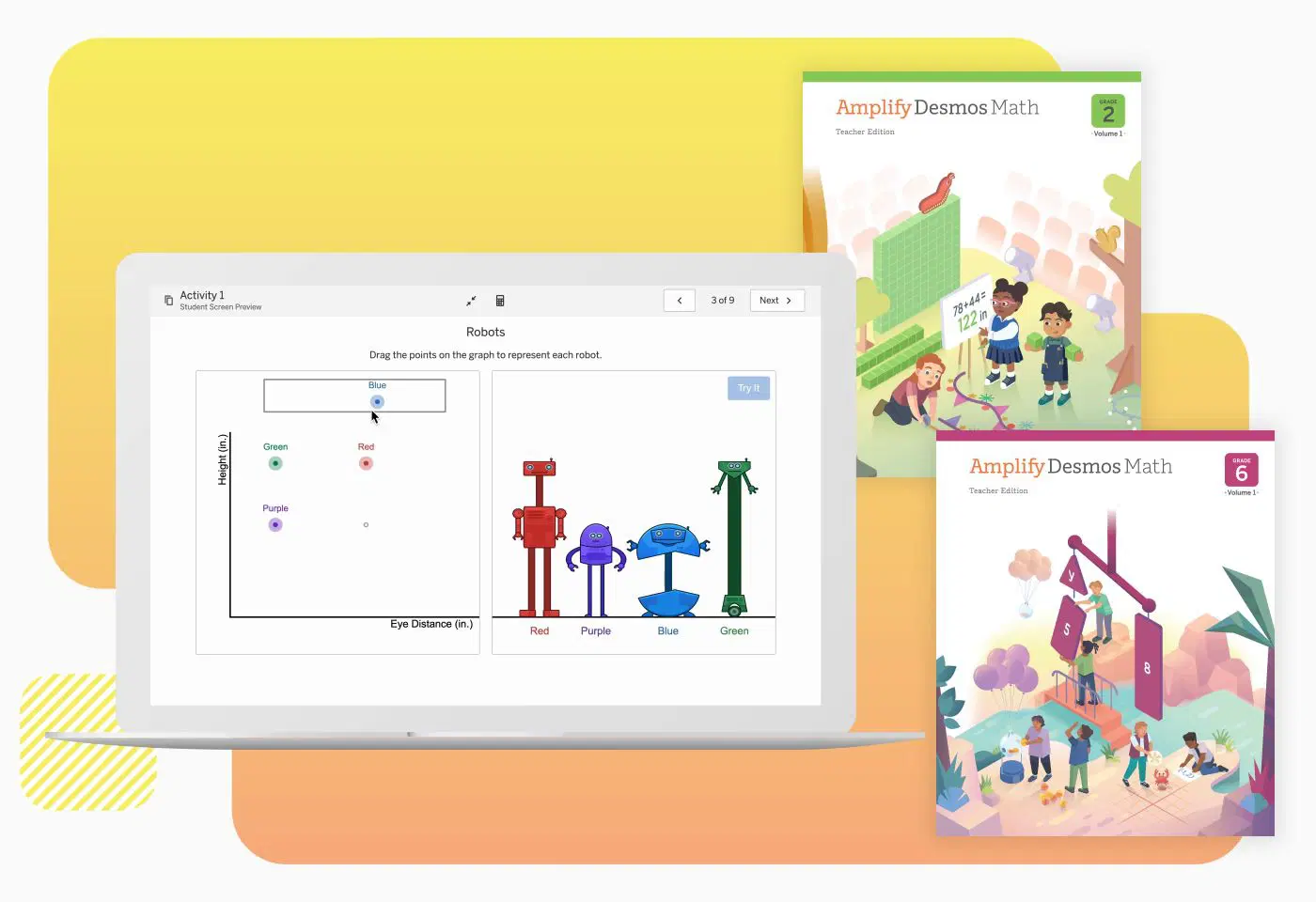
image of Amplify Science and science classroom materials for science teachers

A powerful partnership

Amplify Science was developed by the science education experts at the University of, Berkeley’s Lawrence Hall of Science and the digital learning team at Amplify.

The logo for The Lawrence Hall of Science, University of California, Berkeley, features blue text on a light background and is recognized by educators using Amplify Science for middle school science programs.

The University of California, Berkeley’s Lawrence Hall of Science is a recognized leader in PreK–12 science education, producing groundbreaking curriculum products for more than 40 years, including the international award-winning Seeds of Science/Roots of Reading®. The Hall’s curriculum materials are used in one in four classrooms across the nation. Read more about The Hall’s research-proven Do, Talk, Read, Write, Visualize multimodal learning model.

Amplify has been pioneering digital education products for more than 15 years, empowering teachers across the country to offer more personalized instruction and accelerate the potential of their students to become more active, engaged learners. Amplify has supported more than 200,000 educators and three million students in all 50 states.

Multimodal learning model

The Amplify Science program is rooted in the proven, research-based pedagogy of Do, Talk, Read, Write, Visualize. Here’s how each element works:

DO
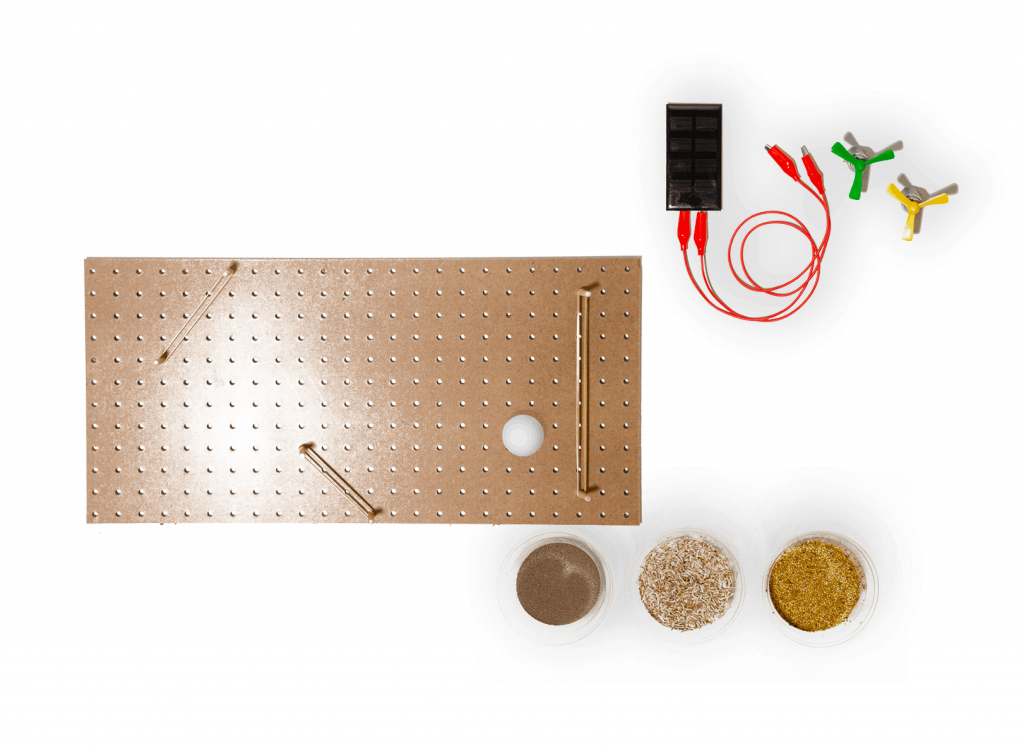
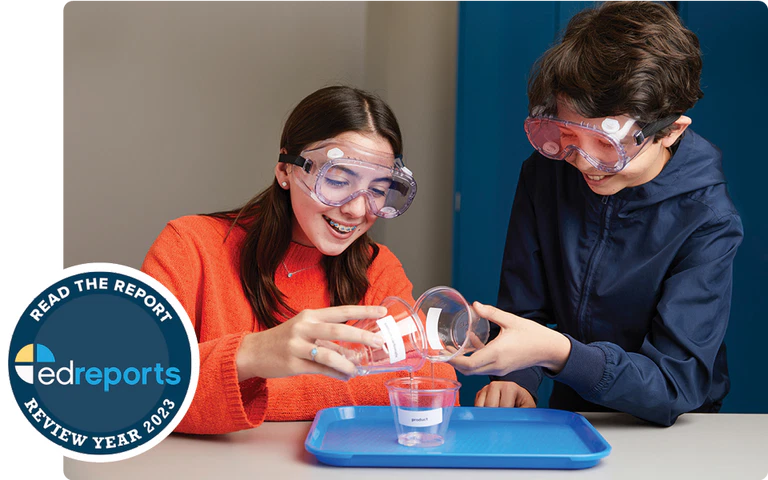
First-hand investigations are an important part of any science classroom, and Amplify Science has students getting hands-on in every unit, from building models of protein molecules to experimenting with electrical systems.

TALK
Student-to-student discourse and full class discussions are an integral part of the program. Students are provided with numerous opportunities to engage in meaningful oral scientific argumentation, all while fostering a collaborative classroom environment.

READ
Students read scientific articles, focusing their reading activities on searching for evidence related to their investigation, and importantly, on asking and recording questions as they read through fascinating texts on 21st-century topics.

WRITE
Following real-world practices, students write scientific arguments based on evidence they’ve collected, making clear their reasoning about how a given piece of evidence connects to one of several claims.

VISUALIZE
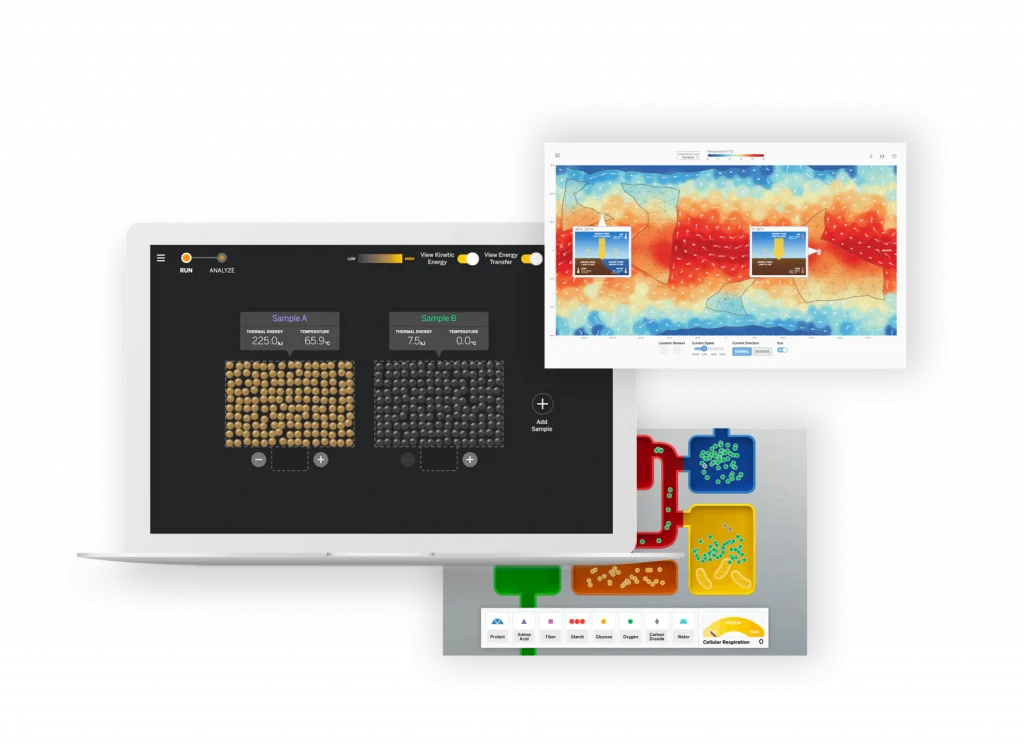
By manipulating digital simulations and using modeling tools to craft visualizations of their thinking— just as real scientists and engineers do—students take their learning far beyond the confines of what they can physically see in the classroom in an exciting and authentic way.

Elementary school course structure

  • Needs of Plants and Animals
  • Pushes and Pulls
  • Sunlight and Water
  • Animal and Plant Defenses
  • Light and Sound
  • Spinning Earth
  • Plant and Animal Relationships
  • Properties of Materials
  • Changing Landforms
  • Balancing Forces
  • Inheritance and Traits
  • Environments and Survival
  • Weather and Climate
  • Energy Conversions
  • Vision and Light
  • Earth’s Features
  • Waves, Energy, and Information
  • Patterns of Earth and Sky
  • Modeling Matter
  • The Earth System
  • Ecosystem Restoration

Middle school course structure (domain model)

  • Launch:
    Geology on Mars
  • Plate Motion
  • Engineering Internship:
    Plate Motion
  • Rock Transformations
  • Earth, Moon, and Sun
  • Ocean, Atmosphere, and Climate
  • Weather Patterns
  • Earth’s Changing Climate
  • Engineering Internship:
    Earth’s Changing Climate
  • Launch:
    Microbiome
  • Metabolism
  • Engineering Internship:
    Metabolism
  • Traits and Reproduction
  • Populations and Resources
  • Matter and Energy in Ecosystems
  • Natural Selection
  • Engineering Internship: Natural Selection
  • Evolutionary History
  • Launch:
    Harnessing Human Energy
  • Force and Motion
  • Engineering Internship:
    Force and Motion
  • Magnetic Fields
  • Thermal Energy
  • Phase Change
  • Engineering Internship: Phase Change
  • Chemical Reactions
  • Light

Spanish-language support

Amplify Science is committed to providing support to meet the needs of all learners, including multiple access points for Spanish-speaking students. Developed in conjunction with Spanish-language experts and classroom teachers, multiple components are available in Spanish across the Amplify Science curriculum.

Spanish-language materials include:

COMPONENTTEACHER/STUDENT
Student Investigation Notebooks (K-8)Student
Science articles (6-8)Student
Student Books (K-5)Student
Video transcripts (6-8)Student
Digital simulation translation key (6-8)Student
Printed classroom materials (K-8)
(Unit and chapter questions, key concepts, vocabulary cards, etc.)
Teacher and student
Copymasters (K-8)Teacher
Assessments (K-8)Teacher

Contact your Idaho representative directly

Bob McCarty
Senior Account Executive

Email: rmccarty@amplify.com
Phone: (435) 655-1731

Access the curriculum

To begin your review, click the button below for more information about Amplify Science and to access the online digital curriculum.

A powerful partnership

Amplify Science was developed by the science education experts at UC Berkeley’s Lawrence Hall of Science and the digital learning team at Amplify.

The logo for The Lawrence Hall of Science, University of California, Berkeley, features blue text on a light background and is recognized by educators using Amplify Science for middle school science programs.

The University of California, Berkeley’s Lawrence Hall of Science is a recognized leader in PreK–12 science education, producing groundbreaking curriculum products for more than 40 years, including the international award-winning Seeds of Science/Roots of Reading®. The Hall’s curriculum materials are used in one in four classrooms across the nation.

Amplify has been pioneering digital education products for more than 15 years, empowering teachers across the country to offer more personalized instruction and accelerate the potential of their students to become more active, engaged learners. Amplify has supported more than 200,000 educators and three million students in all 50 states.

Instructional model

The Amplify Science program is rooted in the proven, research-based pedagogy of Do, Talk, Read, Write, Visualize. Here’s how each element works:

DO First-hand investigations are an important part of any science classroom, and Amplify Science has students getting hands-on experience in every unit, from building models of protein molecules to experimenting with electrical systems.

TALK Student-to-student discourse and full class discussions are an integral part of the program. Students are provided with numerous opportunities to engage in meaningful oral scientific argumentation, all while fostering a collaborative classroom environment.

READ Students read scientific articles, focusing their reading activities on searching for evidence related to their investigation, and importantly, on asking and recording questions as they read through fascinating texts on 21st-century topics.

WRITE Following real-world practices, students write scientific arguments based on evidence they’ve collected, clearly expressing their reasoning about how a given piece of evidence connects to one of several claims.

VISUALIZE By manipulating digital simulations and using modeling tools to craft visualizations of their thinking—just as real scientists and engineers do—students take their learning far beyond the confines of what they can physically see in the classroom in an exciting and authentic way.

Elementary school course structure

  • Needs of Plants and Animals
  • Pushes and Pulls
  • Sunlight and Water
  • Animal and Plant Defenses
  • Light and Sound
  • Spinning Earth
  • Plant and Animal Relationships
  • Properties of Materials
  • Changing Landforms
  • Balancing Forces
  • Inheritance and Traits
  • Environments and Survival
  • Weather and Climate
  • Energy Conversions
  • Vision and Light
  • Earth’s Features
  • Waves, Energy, and Information
  • Patterns of Earth and Sky
  • Modeling Matter
  • The Earth System
  • Ecosystem Restoration

Middle school course structure (domain model)

  • Launch:
    Geology on Mars
  • Plate Motion
  • Engineering Internship:
    Plate Motion
  • Rock Transformations
  • Earth, Moon, and Sun
  • Ocean, Atmosphere, and Climate
  • Weather Patterns
  • Earth’s Changing Climate
  • Engineering Internship:
    Earth’s Changing Climate
  • Launch:
    Microbiome
  • Metabolism
  • Engineering Internship:
    Metabolism
  • Traits and Reproduction
  • Populations and Resources
  • Matter and Energy in Ecosystems
  • Natural Selection
  • Engineering Internship: Natural Selection
  • Evolutionary History
  • Launch:
    Harnessing Human Energy
  • Force and Motion
  • Engineering Internship:
    Force and Motion
  • Magnetic Fields
  • Thermal Energy
  • Phase Change
  • Engineering Internship: Phase Change
  • Chemical Reactions
  • Light

Middle school course structure (integrated model)

  • Launch:
    Microbiome
  • Metabolism
  • Engineering Internship:
    Metabolism
  • Traits and Reproduction
  • Thermal Energy
  • Ocean, Atmosphere, and Climate
  • Weather Patterns
  • Earth’s Changing Climate
  • Engineering Internship:
    Earth’s Changing Climate
  • Launch:
    Geology on Mars
  • Plate Motion
  • Engineering Internship:
    Plate Motion
  • Rock Transformations
  • Phase Change
  • Engineering Internship: Phase Change
  • Chemical Reactions
  • Populations and Resources
  • Matter and Energy in Ecosystems
  • Launch:
    Harnessing Human Energy
  • Force and Motion
  • Engineering Internship:
    Force and Motion
  • Magnetic Fields
  • Light Waves
  • Earth, Moon, and Sun
  • Natural Selection
  • Engineering Internship: Natural Selection
  • Evolutionary

Begin your review

To begin your review, click the button below to log in as a teacher.

Watch a video walkthrough

Contact your Delaware representative

Denise Donahue

Account Executive
Email: ddonahue@amplify.com
Phone: (410) 251-5855

Frequently asked questions

The following FAQ contains the answers to some of the most common questions that we receive from pilot teachers like you.

Still have questions? Your dedicated pilot support coordinator would be happy to help. His or her contact information can be found in the pilot support brochure you received during your pilot implementation training. If you prefer, request that your pilot support coordinator gets in touch with you by completing this form.

A teacher discusses educational content in front of a whiteboard while students in the classroom raise their hands eagerly.

Program questions

It’s true. Our teacher’s guide does not look like the typical guide that comes with a traditional textbook. Here’s why: we aren’t a traditional textbook program. Rather, we’re a next generation curriculum designed to support a shift to a whole new way of teaching science.

With this shift, your district will be faced with supporting a wide-variety of needs from a wide-variety of teachers. For that reason, the resources required to successfully implement a new program will vary considerably from teacher to teacher. That’s precisely why our Teacher’s Reference Guide is chock full of so many rich and varied resources. From scientific background knowledge to suggested teacher talk, standards maps to materials lists, and lesson preparation notes and classroom management tips to strategies for differentiating instruction, this guide is truly meant to serve as an instructional reference.

For everyday instructional use, we recommend that busy classroom teachers use Classroom Slides, which are now available for most K–5 units and will be coming soon for grades 6–8.

Also known as our hands-free TG, Classroom Slides are a brand-new teaching resource that makes delivering daily instruction easy and fun. With a fully customizable PPT available for every lesson of the program, teachers can put down the Teacher’s Guide and focus on what matters most—their students.

Classroom Slides are:

  • Available offline, which means no more sweating unreliable internet connections.
  • Streamlined for easy lesson delivery, including lesson visuals, activity instructions and transitions, animations, investigation setup videos, technology support, and more.
  • Fully editable, allowing teachers to incorporate their own flavor, flair, and favorite resources.

Our development team is working as quickly as possible to make Classroom Slides available to all teachers. That said, at this time they are only available for the first and second units of each grade K–5, with the remaining units being released over the next few months. Due to the popularity of Classroom Slides at the elementary level, development for grades 6–8 is now underway, with all units scheduled for completion by the 2020-2021 school year.

Not to worry. Amplify Science California was developed with plenty of wiggle room built right into the program. This means that you can relax knowing that there’s ample time to get it all done.
 
Most curricula provide 180 days of lessons despite knowing that the typical classroom can’t possibly complete everything in a given school year. Rather than asking you to wade through unnecessary content, we designed a program that addresses 100 percent of the California NGSS in just 66 days at grades K–2 and 88 days at grades 3–5, and 146 days at grades 6–8.

While we took great care in ensuring cohesiveness across units and grade levels, we also know that the ability level of your students changes from year to year. As a result, you need a program that provides adaptable and flexible pacing, and that empowers you to make instructional decisions in the moment.

As you evaluate how well Amplify Science California can accommodate your pacing needs, consider the following:

Progress Builds: Our Progress Builds describe the way in which students’ understanding of the central phenomenon should develop and deepen over the course of a unit. Each Progress Build defines several levels of understanding, with each level integrating and building upon the knowledge and skills from lower levels. Because these Progress Builds are directly tied to the program’s system of assessments, teachers are armed with the data they need to make informed decisions about when to move on, when to slow down, and when to revisit a concept and dive deeper.

A chart titled Animal and Plant Defenses Progress Build outlines three levels of understanding about survival strategies in animals and plants.

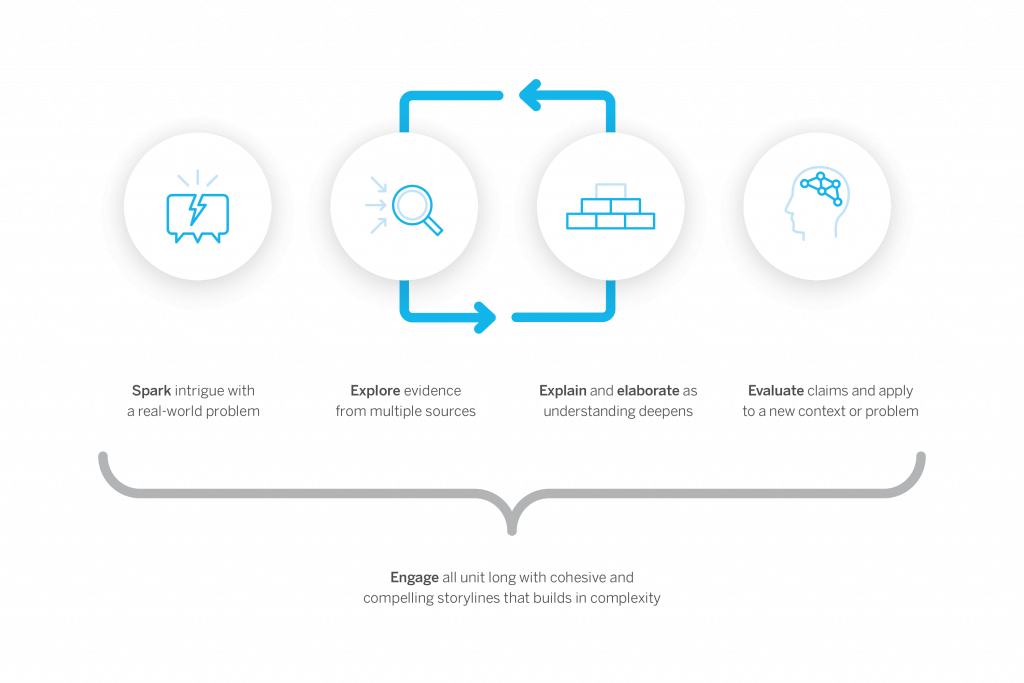
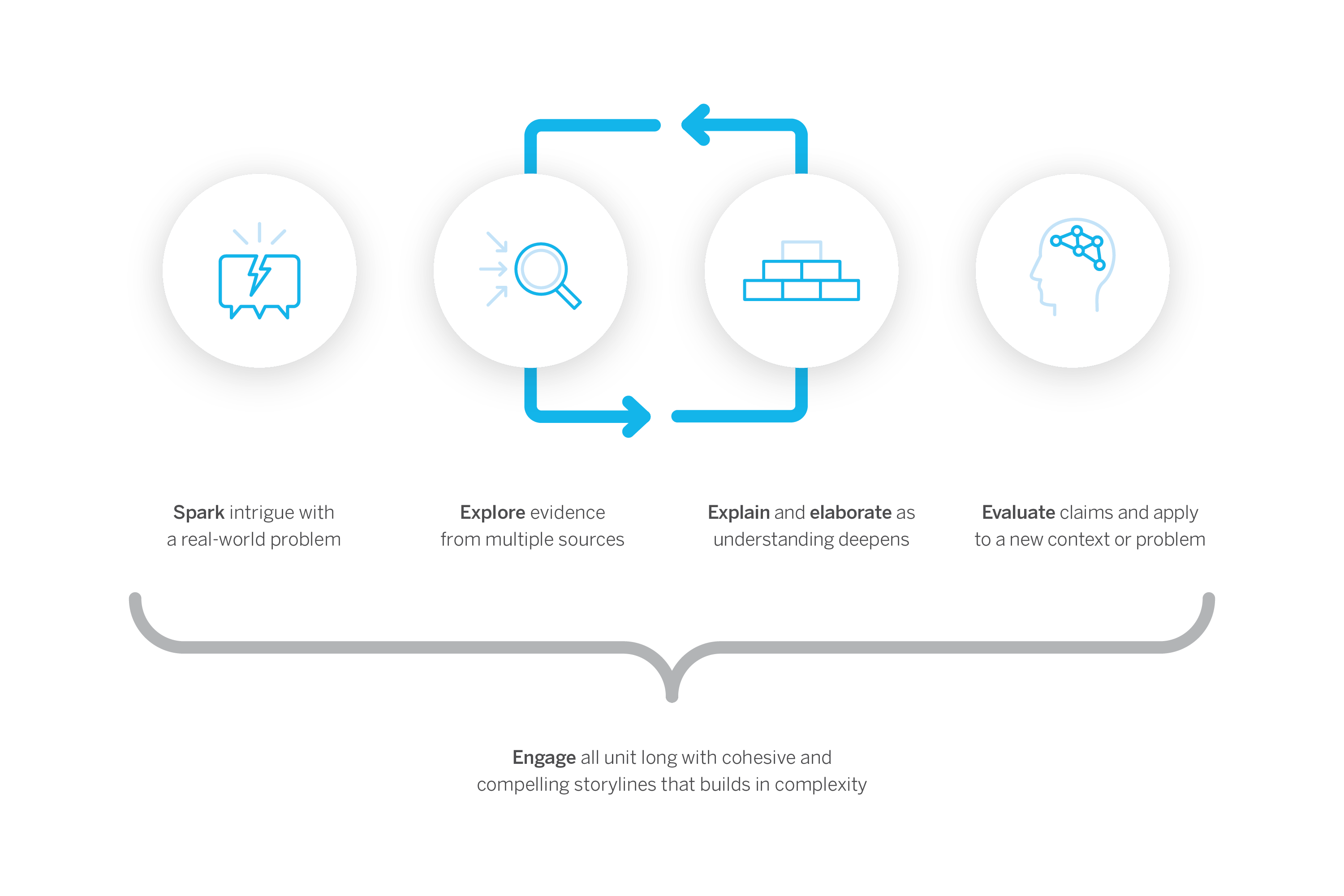
Multiple at-bats: Rather than introducing a concept on Monday, testing for mastery on Friday, and knowing students will forget everything by the next Tuesday, we set out to help students build meaningful and lasting knowledge that they can retain and transfer over the course of the entire unit. We accomplish this by giving students multiple opportunities (a.k.a. “at-bats”) to encounter, explore, and experience a concept. Said another way, Amplify Science California is actually made up of a series of multi-modal “mini-lessons”. This intentional cyclical and iterative design mirrors the 5Es, allows teachers the flexibility to speed up or skip ahead once students have demonstrated mastery, and empowers students to learn concepts more deeply than any other program. 

Graphic showing a research process with four steps: spark intrigue with a real-world problem, explore evidence, explain and elaborate, and evaluate claims, connected in a cycle with arrows.

Extension activities: When some students are ready to move on and others are not, our unit extension activities can be a big help. Found in the Lesson Brief section of both the digital and printed Teacher’s Guide, these activities ensure that advanced learners remain engaged and challenged while teachers help the rest of the class build the foundational knowledge they need to be successful later in the unit.

What’s important to remember is that more hands-on doesn’t necessarily mean better, at least according to the California NGSS. That’s because only two of the eight Science and Engineering Practices (SEPs) are directly related to hands-on learning. 

Just as scientists gather evidence from many types of sources, so do students in the Amplify Science California program. Like scientists, students gather evidence from physical models, digital models, texts, videos, photographs, maps, and data sets. By doing so, we provide students more opportunities than any other program to practice using all of the practices called out in the California NGSS Framework.

NGSS 8 Science Practices

  1. Asking questions
  2. Developing and using models
  3. Planning and carrying out investigations
  4. Analyzing and interpreting data
  5. Using mathematics and computational thinking
  6. Constructing explanations
  7. Engaging in arguments from evidence
  8. Obtaining, evaluating, and communicating information

While all of our units engage students in gathering evidence from a rich collection of sources, the reliance on different types of evidence (and evidence sources) varies according to unit. For instance, some units lend themselves to meaningful hands-on experiences, while in other units the phenomena students are investigating are too slow, too dangerous, or too big to be observed directly. In those units, students rely more heavily on other evidence sources such a physical models or simulations.

Unit types in grades K–5
In each K–5 grade, there is one unit that emphasizes investigation, one that emphasizes modeling, and one that emphasizes design. In addition, in grades 3–5, there is also one unit that emphasizes argumentation.

Unit types in grades 6–8
Each 6–8 grade features three types of units: LaunchCore, and Engineering Internships. Each year has one Launch unit, six Core units, and two Engineering Internships.

For teachers who wish to supplement the lessons with even more hands-on activities, optional “flextension” activities are included in many units.

As a blended curriculum, districts who adopt Amplify Science California are outfitted with a variety of print and digital resources as well as hands-on materials kits. To explore the specific components of the program, visit our What’s Included page.

As our customers will tell you, when you adopt Amplify Science California, you aren’t just buying a science curriculum, you’re joining a family. As such, along with materials, your adoption of Amplify Science California also includes care and support through a variety of staff and resources, including: customer support specialists, pedagogical support specialist, implementation specialists, professional learning specialists, educational partnership managers, and more.

Technical questions

To ensure that your hardware and network meet the minimum technical requirements for optimal performance and support of your digital curriculum products please see Amplify’s customer requirements page.

Absolutely! While 1:1 scenarios are great, they aren’t required. That’s because all Amplify Science California lessons were designed with device sharing in mind, and never assume that every student has a separate device. 

When the use of practice apps is called for in a lesson, you have several options:

  • If internet access is unavailable—“Preload” the digital tool on your device or devices for use offline.
  • If limited student devices are available—Have students do the activities in pairs or small groups.
  • If no student devices are available—Project the digital tool to the class and either “drive” the digital tool yourself or invite students to “drive” by using your device.

learning.amplify.com gives you access to the digital Teacher’s Guide and also gives your students (grades 68) access to the digital student experience.

apps.learning.amplify.com/elementary gives your students (grades 25) access to any practice apps referenced in the instruction. The teacher will either need to log in using their credentials, or have student accounts set up.

Tech headaches are never fun. However, implementing the following tips can help you keep the tech gremlins away.

  • Display the student URLs near the classroom display materials.
  • Before you start a unit, download all unit and lesson resources using the Offline Guide found in the Unit Guide of your digital Teacher’s Guide. In the event that connectivity issues strike, you will still be able to conduct your lessons without interruption.
  • Use Chrome or Safari if possible as these are our preferred browsers.
  • Disable pop-up blockers on all devices being used to support lessons.
  • Be prepared for some webpages to open in a new tab and for PDF files to download automatically.
  • Check and test your connections to any projection devices that you might be using throughout the lesson.
  • Display the student URLs near the classroom display materials.

Inspiring the next generation of Oklahoma scientists, engineers, and curious citizens

Amplify Science is an engaging new core curriculum designed for three-dimensional, phenomena-based learning.

A powerful partnership

Amplify Science was developed by the science education experts at UC Berkeley’s Lawrence Hall of Science and the digital learning team at Amplify.

Instructional model

The Amplify Science program is rooted in the proven, research-based pedagogy of Do, Talk, Read, Write, Visualize. Here’s how each element works:

DO
First-hand investigations are an important part of any science classroom, and Amplify Science has students getting hands-on in every unit—from building models of protein molecules to experimenting with electrical systems.

TALK
Student-to-student discourse and full-class discussions are an integral part of the program. Students are provided with numerous opportunities to engage in meaningful oral scientific argumentation, all while fostering a collaborative classroom environment.

READ
Students read scientific articles, focusing their reading activities on searching for evidence related to their investigation and, importantly, on asking and recording questions as they read through fascinating texts on 21st-century topics.

WRITE
Following real-world practices, students write scientific arguments based on evidence they’ve collected, making clear their reasoning about how a given piece of evidence connects to one of several claims.

VISUALIZE
By manipulating digital simulations and using modeling tools to craft visualizations of their thinking— just as real scientists and engineers do—students take their learning far beyond the confines of what they can physically see in the classroom in an exciting and authentic way.

Oklahoma Instructional Samplers

Video: Oklahoma Spotlight on All Learners (SPED, G & T, EL, DEI)

Resources to support your review

Remote and hybrid learning support

Oklahoma Spotlight Video: Remote and Hybrid Learning

Amplify has launched a new remote learning solution called Amplify Science @Home. Intended to make extended remote learning and hybrid learning easier, Amplify Science@Home includes two useful options for continuing instruction: @Home Videos and @Home Units. 

Amplify Science @Home Videos are recordings of real Amplify Science teachers teaching the lessons. For those teachers who are unable to meet synchronously with their students, the recorded lessons are a great way to keep their students on track and engaged with Amplify Science while at home. These videos will be produced for all K–5 units, and for the first four units of each 6–8 grade level. Their release will be rolling, beginning in August 2021.   

Amplify Science@Home Units are modified versions of Amplify Science units, strategically designed to highlight key activities from the program. The @Home Units take significantly less instructional time than the complete Amplify Science program and allow students to engage with science at home. @Home Units will be developed for all Amplify Science K–8 units. Each @Home unit includes:

  • Teacher overviews explaining how to use the materials, including suggestions for enhancing the @Home Units if synchronous learning or in-class time with students is available.
  • Overviews to send home to families.

Student materials are available in two formats:

  • @Home Slides (PDF/PPT) + Student Sheets (PDF) for students with access to technology at home.
  • Downloadable @Home Packets (PDF) for students without access to technology at home.

Download the remote and hybrid learning guide.

What’s included

Flexible resources that work seamlessly together
Oklahoma Spotlight Video: Instructional Resources: More than a textbook!

Science articles
The middle school science articles serve as sources for evidence collection and were authored by science and literacy experts at the Lawrence Hall of Science.

Student Investigation Notebooks
Available for every unit, the Student Investigation Notebooks provide space for students to:

  • record data.
  • reflect on ideas from texts and investigations.
  • construct explanations and arguments.

Available with full-color article compilations for middle school units.

Digital student experience
Students access the digital simulations and modeling tools, as well as lesson activities and assessments, through the digital student experience. Students can interact with the digital student experience as they:

  • conduct hands-on investigations.
  • engage in active reading and writing activities.
  • participate in discussions.
  • record observations.
  • craft end-of-unit scientific arguments.

Oklahoma Spotlight Video: Spotlight on Simulations

Teacher’s Guides
Available digitally and in print, the Teacher’s Guides contain all of the information teachers need to facilitate classroom instruction, including:

  • Classroom Slides.
  • detailed lesson plans.
  • unit and chapter overview documentation.
  • differentiation strategies.
  • standards alignments.
  • in-context professional development.

Oklahoma Spotlight Video: Classroom Slides

Hands-on materials kits
Hands-on learning is at the heart of Amplify Science. Each unit kit contains:

  • consumable and non-consumable hands-on materials.
  • print classroom display materials.
  • premium print materials for student use (sorting cards, maps, etc).

Scope and sequence

GRADE

UNITS

Kindergarten

  • Needs of Plants and Animals
  • Pushes and Pulls
  • Sunlight and Water

Grade 1

  • Animal and Plant Defenses
  • Light and Sound
  • Spinning Earth

Grade 2

  • Plant and Animal Relationships
  • Properties of Materials
  • Changing Landforms

Grade 3

  • Balancing Forces
  • Inheritance and Traits
  • Environments and Survival
  • Weather and Climate

Grade 4

  • Energy Conversions
  • Vision and Light
  • Earth’s Features
  • Waves, Energy, and Information

Grade 5

  • Patterns of Earth and Sky
  • Modeling Matter
  • The Earth System
  • Ecosystem Restoration

GRADE

UNITS

Grade 6

  • Launch: Microbiome
  • Metabolism
  • Plate Motion
  • Plate Motion Engineering Internship
  • Rock Transformations
  • Ocean, Atmosphere, and Climate
  • Weather Patterns
  • Thermal Energy
  • Phase Change

Grade 7

  • Launch: Harnessing Human Energy
  • Chemical Reactions
  • Populations and Resources
  • Matter Energy and Ecosystems
  • Earth’s Changing Climate
  • Earth’s Changing Climate Engineering Internship
  • Magnetic Fields

Grade 8

  • Launch: Geology on Mars
  • Force and Motion
  • Force and Motion Engineering Internship
  • Light Waves
  • Earth, Moon, and Sun
  • Traits and Reproduction
  • Natural Selection
  • Evolutionary History

Oklahoma Academic Standards for Science coverage

Amplify Science was designed from the ground up to meet the Next Generation Science Standards (NGSS), and the Oklahoma Academic Standards for Science (OASS) are closely aligned to the NGSS at K–8. The guidance below is meant to provide support for integrating additional activities that support full coverage of the OASS. You can view the full K–8 OASS correlation here.

Organized by grade level, each section below will outline:

  • additional activities that support 100% alignment to the Oklahoma Academic Standards for Science; 
  • the standard being addressed with the activities; 
  • the recommended placement of the activities within a specific Amplify Science unit; and 
  • PDFs of any accompanying materials that are necessary to implement the activities. 

Standard: 1.ESS3.1: Communicate solutions that will reduce the impact of humans on the land, water, air, and/or other living things in the local environment.

Recommended placement: Animal and Plant Defenses unit, Chapter 1

MaterialsThe Student Book Investigating Monarchs from the unit Needs of Plants and Animals

Investigating Monarchs emphasizes the needs of monarch caterpillars and butterflies and shows what happens when these animals are not able to meet their needs. The book first introduces the life cycle of monarchs, explaining that monarch caterpillars must eat milkweed to survive and change into butterflies. Their summer habitat must have milkweed. The butterflies then migrate a long distance, from the United States to a forest in the mountains of Mexico, where they take shelter in the trees. Their winter habitat must have trees. Scientists discovered that the monarch population in Mexico was greatly reduced because people were cutting down the trees. The forest was then protected, but the monarch population did not recover as expected. Scientists in the United States found evidence that this was because fields with milkweed are being replaced by farms and buildings. This book could be read with the class either before or after Chapter 1 of the Animal and Plant Defenses unit, which focuses on what plants and animals need to do to survive. Students could be asked to reflect on what the monarchs need to survive (including food and shelter), and how human activities impacted the monarchs’ ability to meet those needs. After reading the book, students could brainstorm ideas for how to reduce the impact of humans on the local environment.

Standard: MS-PS4-2: Develop and use a model to describe that waves are reflected, absorbed, or transmitted through various materials.

Recommended placement: Metabolism unit, Lesson 3.3, addition to Activity 5 

Materials“What Eyes Can See” science article

As students investigate metabolism and the body systems, the article “What Eyes Can See” should be assigned to deepen their understanding of information processing and sense receptors and connect that understanding to the emerging idea of the interaction of waves with various materials. The article explores how the only thing we can really see is light. Light travels from a light source to the eye, passing through some materials and bouncing off others. Tiny organs inside the eye called rods and cones absorb energy from light, making vision possible. These interactions between light and materials determine our visible world. 

Instructions:

Download the PDF “What Eyes Can See” above and remind students of the Active Reading guidelines. Before students read the article, invite them to share prior experiences. For example, “Have you ever had an experience where something looked different in one kind of light than in another kind of light? Or where something seemed to appear or disappear when the light changed?”

Standard: MS-PS3-1: Construct and interpret graphical displays of data to describe the relationships of kinetic energy to the mass of an object and to the speed of an object.

Recommended placement: Harnessing Human Energy unit, Lesson 1.4, after Activity 4 

MaterialsForce and Motion simulationActivity instructions and copymasters

In this activity, students use the Force and Motion Simulation to investigate the relationship between kinetic energy, mass, and velocity. 

Instructions

Download the PDF linked above for the Lesson Guide and copymasters needed for the activity. Note that this investigation is typically implemented during the Force and Motion unit. This means the Lesson Guide will contain some incongruous labeling (e.g., unit name), as well as instructions that are out of context and unnecessary for the purposes of addressing this standard at grade 7. We suggest skipping to step 4 of the Instructional Guide to avoid some of this. Your students will get additional exposure to this activity, and indeed the standard as a whole, when they get to the Force and Motion unit in grade 8.

Standards:

  • MS-PS2-3: Ask questions about data to determine the factors that affect the strength of electric and magnetic forces.
  • MS-PS2-5: Conduct an investigation and evaluate the experimental design to provide evidence that fields exist between objects exerting forces on each other even though the objects are not in contact.

Recommended placementForce and Motion unit, after Lesson 1.5 

MaterialsFlextension PDF

This hands-on activity builds on and reinforces students’ understanding of forces that act at a distance, with a focus on electrostatic force. Students explore electrostatic forces, prompted by a set of challenges that they try to accomplish. Next, students generate scientific questions based on their observations. Electrostatic force is less predictable and consistent than magnetic force, and investigating it can be both challenging and intriguing. The purpose of this lesson is for students to gain firsthand experience with electrostatic force and to gain experience generating scientific questions based on observations. You might choose to include this Flextension if you would like your students to have more exposure to electrostatic force, and if you would like to challenge your students to explore and ask questions about a challenging type of force. 

Instructions:

Download the PDF linked above for a detailed Lesson Guide and the copymasters associated with the activity. Note that this activity is typically implemented as an add-on Flextension during the Magnetic Fields unit. This means that you will see some information that is out of context (e.g., placement information, unit title), but the activity itself also works for the purposes of the Force and Motion unit. If you have any questions, please reach out to our support team via the chat icon in your account or help@amplify.com

Explore the Digital Teacher’s Guide

When you’re ready to review, click the orange button below and use your provided login credentials to access the Amplify Science Digital Teacher’s Guide.

To help familiarize yourself with navigating the digital Teacher’s Guide, watch our navigational guide videos:

Grades K–5:

Grades 6–8:

Looking for help?

Powerful (and free!) pedagogical support

Amplify provides a unique kind of support you won’t find from other publishers. We’ve developed an educational support team of former teachers and administrators who provide pedagogical support for every Amplify curriculum, assessment, and intervention program. This service is completely free for all educators who are using our programs and includes:

  • Guidance for developing lesson plans and intervention plans.
  • Information on where to locate standards and other planning materials.
  • Recommendations and tips for day-to-day teaching with Amplify programs.
  • Support with administering and interpreting assessment data and more.

To reach our pedagogical team, use our live chat within your program, call              (800) 823-1969, or email edsupport@amplify.com

Timely technical and program support

Our technical and program support is included and available from 7 a.m. to 7 p.m. ET, Monday through Friday, through a variety of channels, including a live chat program that enables teachers to get immediate help in the middle of the school day.

For your most urgent questions:

  • Use our live chat within your program.
  • Call our toll-free number: (800) 823-1969.

For less urgent questions:

Contact us

Contact your Oklahoma representative:
Julie Godfrey
Account Executive
jgodfrey@amplify.com
(817) 360-0527

A powerful partnership

Amplify Science was developed by the science education experts at UC Berkeley’s Lawrence Hall of Science and the digital learning team at Amplify.

The logo for The Lawrence Hall of Science, University of California, Berkeley, features blue text on a light background and is recognized by educators using Amplify Science for middle school science programs.

The University of California, Berkeley’s Lawrence Hall of Science is a recognized leader in PreK–12 science education, producing groundbreaking curriculum products for more than 40 years, including the international award-winning Seeds of Science/Roots of Reading®. The Hall’s curriculum materials are used in one in four classrooms across the nation.

The word "Amplify" is written in large, orange letters with a period at the end on a light background.

Amplify has been pioneering digital education products for more than 15 years, empowering teachers across the country to offer more personalized instruction and accelerate the potential of their students to become more active, engaged learners. Amplify has supported more than 200,000 educators and three million students in all 50 states.

Instructional model

Amplify Science program is rooted in the proven, research-based pedagogy of Do, Talk, Read, Write, Visualize. Here’s how each element works:

DO
First-hand investigations are an important part of any science classroom, and Amplify Science has students getting hands-on in every unit, from building models of protein molecules to experimenting with electrical systems.

TALK
Student-to-student discourse and full class discussions are an integral part of the program. Students are provided with numerous opportunities to engage in meaningful oral scientific argumentation, all while fostering a collaborative classroom environment.

READ
Students read scientific articles, focusing their reading activities on searching for evidence related to their investigation, and importantly, on asking and recording questions as they read through fascinating texts on 21st-century topics.

WRITE
Following real-world practices, students write scientific arguments based on evidence they’ve collected, making clear their reasoning about how a given piece of evidence connects to one of several claims.

VISUALIZE
By manipulating digital simulations and using modeling tools to craft visualizations of their thinking— just as real scientists and engineers do—students take their learning far beyond the confines of what they can physically see in the classroom in an exciting and authentic way.

Year at a glance

Amplify Science is organized around units where students are introduced to compelling phenomena and real-world problems, develop and strengthen claims by collecting evidence and testing assumptions, and apply their learning in new contexts.

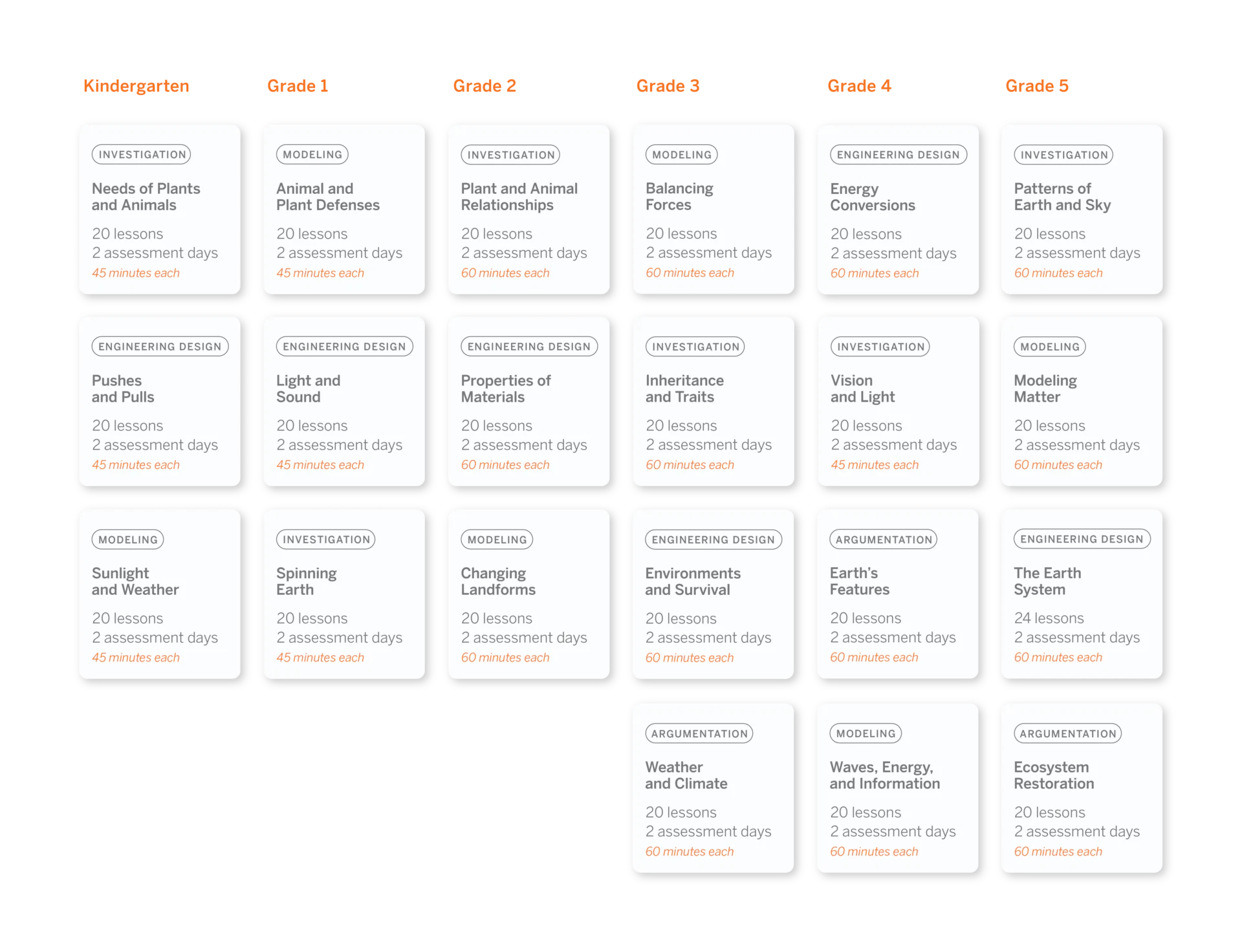
A chart displays science units by grade level, from Kindergarten to Grade 5, showing titles, type, number of lessons, and assessment days for each unit.
Amplify Science's Year at a Glance unit breakdown for grade six through grade eight

Inside an Amplify Science classroom

An infographic explains instructional methods for teachers and students, featuring icons for reading, hands-on activities, discussion, and modeling tools with brief descriptions.

Resources to support your review

Boost Reading

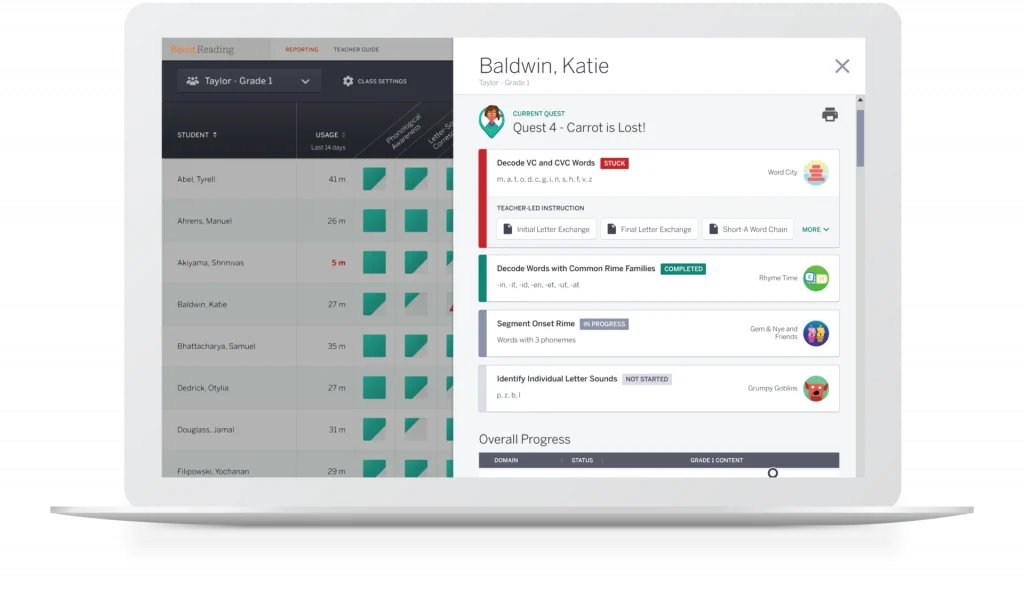
Boost Reading is a personalized reading program that students can’t wait to play. Whether they are just learning to read or mastering close reading, Boost Reading helps achieve off-the-charts reading growth in grades K–8.


Click here to play demo of Boost Reading K-5.

Target support for every student

Students come to school with a range of abilities and achieve mastery at different rates. Providing each learner with the specific support they need to progress can be challenging. Enter Boost Reading. 

Ready to learn more?

Fill out the form to begin your review or learn more about our Professional Development offerings.

Professional development

Existing business

  • United Arab Emirates
  • Oman
  • Kingdom of Saudi Arabia
  • Beirut

Contact your Amplify representative today

Matt Drury
mdrury@amplify.com
00971 52 9788789

Amplify Science – Prince George

To view this protected page, enter the password below:


Inspiring East Baton Rouge’s next generation of scientists, engineers, and curious citizens

To view this protected page, enter the password below:


A powerful partnership

Amplify Science was developed by the science education experts at UC Berkeley’s Lawrence Hall of Science and the digital learning team at Amplify.

Instructional model

The Amplify Science program is rooted in the proven, research-based pedagogy of Do, Talk, Read, Write, Visualize. Here’s how each element works.

DO
First-hand investigations are an important part of any science classroom, and Amplify Science has students getting hands-on in every unit, from building models of protein molecules to experimenting with electrical systems.

TALK
Student-to-student discourse and full-class discussions are an integral part of the program. Students are provided with numerous opportunities to engage in meaningful oral scientific argumentation, all while fostering a collaborative classroom environment.

READ
Students read scientific articles, focusing their reading activities on searching for evidence related to their investigation and, importantly, on asking and recording questions as they read through fascinating texts on 21st-century topics.

WRITE
Following real-world practices, students write scientific arguments based on evidence they’ve collected, making clear their reasoning about how a given piece of evidence connects to one of several claims.

VISUALIZE
By manipulating digital simulations and using modeling tools to craft visualizations of their thinking— just as real scientists and engineers do—students take their learning far beyond the confines of what they can physically see in the classroom in an exciting and authentic way.

Resources to support your review

Remote and hybrid learning support

A child sits at a desk using a laptop. Next to the desk is a bookshelf with books, a fishbowl, and a soccer ball.

Amplify has launched a new remote learning solution called Amplify Science@Home. Intended to make extended remote learning and hybrid learning easier, Amplify Science@Home includes two useful options for continuing instruction: @Home Videos and @Home Units. 

Amplify Science @Home Videos are recordings of real Amplify Science teachers teaching the lessons. For those teachers who are unable to meet synchronously with their students, the recorded lessons are a great way to keep their students on track and engaged with Amplify Science while at home. These videos will be produced for all K–5 units, and for the first four units of each 6–8 grade level. Their release will be rolling, beginning in August.   

Amplify Science@Home Units are modified versions of Amplify Science units, strategically designed to highlight key activities from the program. The @Home Units take significantly less instructional time than the complete Amplify Science program and allow students to engage with science at home. @Home Units will be developed for all Amplify Science K–8 units. Each @Home Unit includes:

  • Teacher overviews explaining how to use the materials, including suggestions for enhancing the @Home Units if synchronous learning or in-class time with students is available.
  • Overviews to send home to families.

Student materials are available in two formats:

  • @Home Slides (PDF/PPT) + Student Sheets (PDF) for students with access to technology at home.
  • Downloadable @Home Packets (PDF) for students without access to technology at home.

Download the Remote and hybrid learning guide.

What’s included:

Flexible resources that work seamlessly together

Science articles
The middle school science articles serve as sources for evidence collection and were authored by science and literacy experts at the Lawrence Hall of Science.

Amplify Science articles

Student Investigation Notebooks
Available for every unit, the Student Investigation Notebooks provide space for students to:

  • record data.
  • reflect on ideas from texts and investigations.
  • construct explanations and arguments.

Available with full-color article compilations for middle school units.

Louisiana-specific Materials

Louisiana Companion Student Booklet

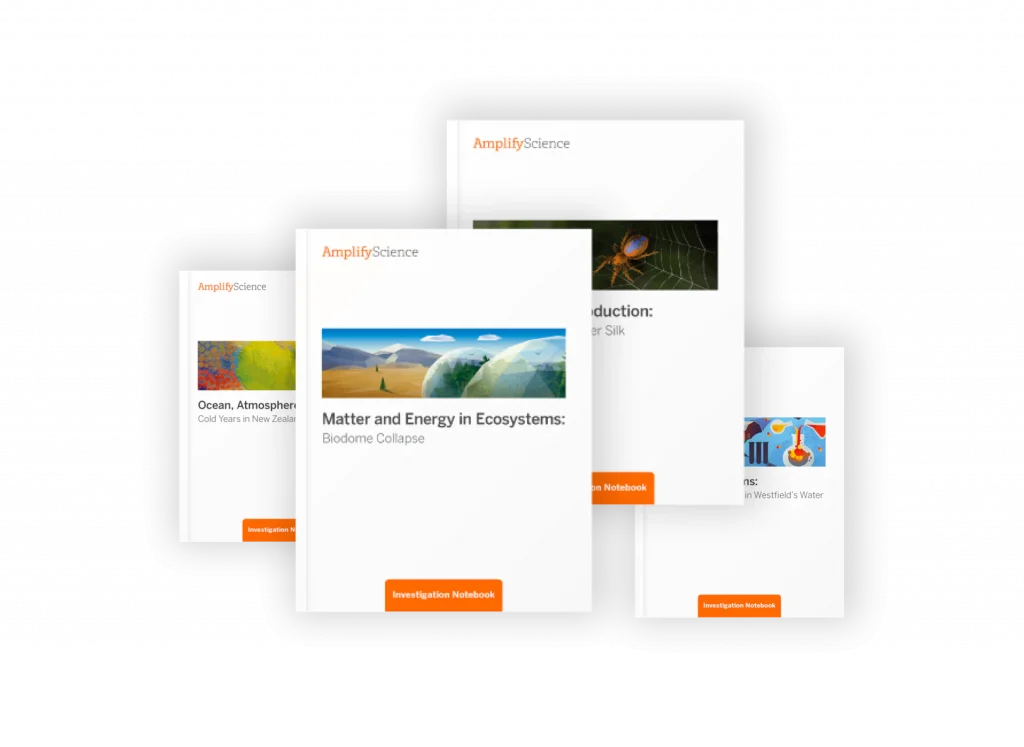
Collection of educational books from 'amplify science' on topics including ocean atmosphere, matter and energy ecosystems, and insect interactions, displayed in various angles.

Digital student experience
Students access the digital simulations and modeling tools, as well as lesson activities and assessments, through the digital student experience. Students can interact with the digital student experience as they:

  • conduct hands-on investigations.
  • engage in active reading and writing activities.
  • participate in discussions.
  • record observations.
  • craft end-of-unit scientific arguments.
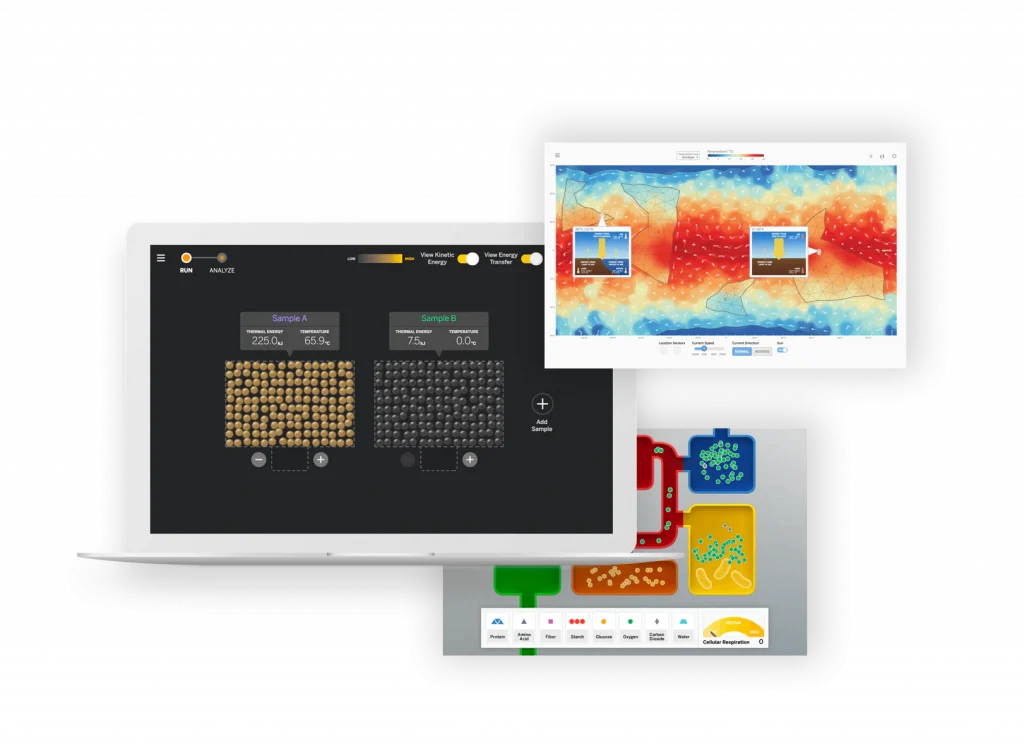
A digital illustration showcasing a laptop and a tablet displaying complex data analysis software interfaces with graphs and heatmaps.

Teacher’s Guides
Available digitally and in print, the Teacher’s Guides contain all of the information teachers need to facilitate classroom instruction, including:

  • Louisiana Companion Teacher Booklet (6-8)
  • Classroom Slides 
  • detailed lesson plans.
  • unit and chapter overview documentation.
  • differentiation strategies.
  • standards alignments.
  • in-context professional development.
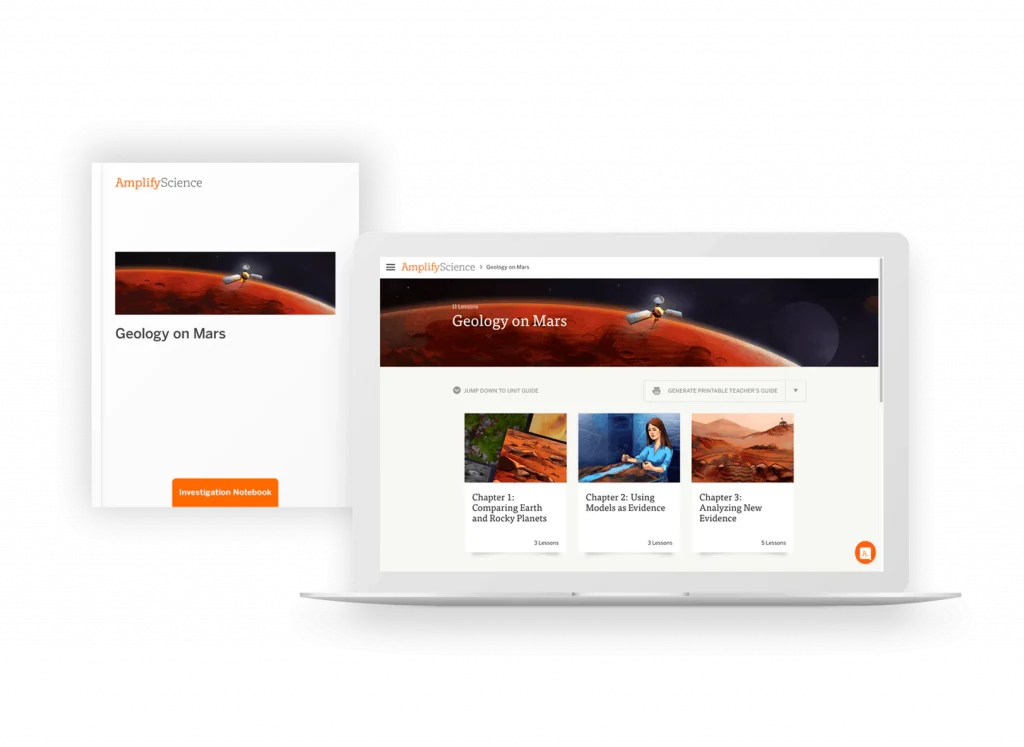
A laptop displaying the Geology on Mars webpage sits beside a book titled "Geology on Mars," both featuring the same cover image of Mars and a spacecraft, perfect for enhancing three-dimensional learning in any science classroom.

Hands-on materials kits
Hands-on learning is at the heart of Amplify Science. Each unit kit contains:

  • consumable and non-consumable hands-on materials.
  • print classroom display materials.
  • premium print materials for student use (sorting cards, maps, etc.).
A perforated rectangular board, three small containers with different powders, a black battery holder with red wires, and three colored alligator clips are arranged on a white background.

Scope and sequence

Amplify Science Louisiana K–5 Program Brochure

GRADE

UNITS

Kindergarten

  • Needs of Plants and Animals
  • Pushes and Pulls
  • Sunlight and Water

Grade 1

  • Animal and Plant Defenses
  • Light and Sound
  • Spinning Earth

Grade 2

  • Plant and Animal Relationships
  • Properties of Materials
  • Changing Landforms

Grade 3

  • Balancing Forces
  • Inheritance and Traits
  • Environments and Survival
  • Weather and Climate

Grade 4

  • Energy Conversions
  • Vision and Light
  • Earth’s Features
  • Waves, Energy, and Information

Grade 5

  • Patterns of Earth and Sky
  • Modeling Matter
  • The Earth System
  • Ecosystem Restoration

GRADE

UNITS

Grade 6

  • Launch: Microbiome
  • Populations and Resources
    Additional instruction added: Human impact on Earth systems and Louisiana’s natural resources
  • Matter and Energy in Ecosystems
    Additional instruction added: Structure and properties of matter Structure and function of cells
  • Force and Motion
  • Engineering Internship: Force and Motion
  • Magnetic Fields
  • Earth, Moon, and Sun
  • Light Waves
    Additional instruction added: The function of the cell nucleus

Grade 6 Louisiana  Resources

  • 5 Companion Lessons
  • Units with Companions Lessons: Populations and Resources; Matter and Energy in Ecosystems; Light Waves
  • Louisiana Companion Materials Kit

Grade 7

  • Metabolism
  • Engineering Internship: Metabolism
  • Phase Change
  • Chemical Reactions
  • Traits and Reproduction
  • Ocean, Atmosphere, and Climate
  • Weather Patterns
  • Earth’s Changing Climate

Grade 7 Louisiana  Resources

  • 8 Companion Lessons
  • Units with Companions Lessons: Phase ChangeTraits and ReproductionOcean, Atmosphere, and ClimateWeather PatternsEarth’s Changing Climate
  • Louisiana Companion Materials Kit, not needed in 7th grade

Grade 8

  • Launch: Geology on Mars
  • Plate Motion
  • Engineering Internship: Plate Motion
  • Rock Transformations
  • Thermal Energy
  • Natural Selection
  • Engineering Internship: Natural Selection
  • Evolutionary History

Grade 8 Louisiana Resources

  • 6 Companion Lessons
  • Unit with Companions Lessons: Plate MotionRock TransformationsThermal EnergyNatural Selection
  • Louisiana Companion Materials Kit

Amplify and the Lawrence Hall of Science have created custom Amplify Science Louisiana materials for middle school students and teachers. The Louisiana edition of Amplify Science 6–8 differs from our national program in a few key ways:

  • Standards cited are Louisiana State Standards for Science (LSSS) instead of NGSS
  • A custom scope and sequence tailored to the LSSS is used
  • Louisiana Companion Lessons are included
  • Louisiana companion kits, which contain materials to accommodate the added companion lessons, are available for grades 6 and 8

Explore the Digital Teacher’s Guide

When you’re ready to review, click the orange button below and use your provided login credentials to access the Amplify Science Digital Teacher’s Guide.

To help familiarize yourself with navigating the digital Teacher’s Guide, watch our navigational guide videos:

Grades K–5:

Grades 6-8

Looking for help?

Powerful (and free!) pedagogical support

Amplify provides a unique kind of support you won’t find from other publishers. We have developed an educational support team of former teachers and administrators who provide pedagogical support for every Amplify curriculum, assessment, and intervention program. This service is completely free for all educators who are using our programs and includes:

  • Guidance for developing lesson plans and intervention plans.
  • Information on where to locate standards and other planning materials.
  • Recommendations and tips for day-to-day teaching with Amplify programs.
  • Support with administering and interpreting assessment data and more.

To reach our pedagogical team, use our live chat within your program, call (800) 823-1969, or email edsupport@amplify.com

Timely technical and program support

Our technical and program support is included and available from 7 a.m. to 7 p.m. ET, Monday through Friday, through a variety of channels, including a live chat program that enables teachers to get immediate help in the middle of the school day.

For your most urgent questions:

  • Use our live chat within your program.
  • Call our toll-free number: (800) 823-1969.

For less urgent questions:

Contact us

Contact your Louisiana representative:
Wayne Hebert
whebert@amplify.com
(337) 298-7833

Inspiring the next generation of Richmond scientists, engineers, and curious citizens

Amplify Science is an engaging core curriculum designed for three-dimensional, phenomena-based learning.

image of Amplify Science and science classroom materials for science teachers

A powerful partnership

Amplify Science was developed by the science education experts at UC Berkeley’s Lawrence Hall of Science and the digital learning team at Amplify.

The logo for The Lawrence Hall of Science, University of California, Berkeley, features blue text on a light background and is recognized by educators using Amplify Science for middle school science programs.

The University of California, Berkeley’s Lawrence Hall of Science is a recognized leader in PreK–12 science education, producing groundbreaking curriculum products for more than 40 years, including the international award-winning Seeds of Science/Roots of Reading®. The Hall’s curriculum materials are used in one in four classrooms across the nation.

The word "Amplify" is written in large, orange letters with a period at the end on a light background.

Amplify has been pioneering digital education products for more than 15 years, empowering teachers across the country to offer more personalized instruction and accelerate the potential of their students to become more active, engaged learners. Amplify has supported more than 200,000 educators and three million students in all 50 states.

Instructional model

The Amplify Science program is rooted in the proven, research-based pedagogy of Do, Talk, Read, Write, Visualize. Here’s how each element works:

DO
First-hand investigations are an important part of any science classroom, and Amplify Science has students getting hands-on in every unit, from building models of protein molecules to experimenting with electrical systems.

TALK
Student-to-student discourse and full class discussions are an integral part of the program. Students are provided with numerous opportunities to engage in meaningful oral scientific argumentation, all while fostering a collaborative classroom environment.

READ
Students read scientific articles, focusing their reading activities on searching for evidence related to their investigation, and importantly, on asking and recording questions as they read through fascinating texts on 21st-century topics.

WRITE
Following real-world practices, students write scientific arguments based on evidence they’ve collected, making clear their reasoning about how a given piece of evidence connects to one of several claims.

VISUALIZE
By manipulating digital simulations and using modeling tools to craft visualizations of their thinking— just as real scientists and engineers do—students take their learning far beyond the confines of what they can physically see in the classroom in an exciting and authentic way.

Elementary school course structure

  • Pushes and Pulls
  • Needs of Plants and Animals
  • Sunlight and Water
  • Spinning Earth
  • Light and Sound
  • Animal and Plant Defenses
  • Properties of Materials
  • Plant and Animal Relationships
  • Weather and Climate
  • Balancing Forces
  • Environments and Survival
  • Inheritance and Traits
  • Changing Landforms
  • Vision and Light
  • Earth’s Features
  • Waves, Energy, and Information
  • Patterns of Earth and Sky
  • The Earth System
  • Ecosystem Restoration
  • Modeling Matter
  • Energy Conversions
  • Balancing Forces

Middle school course structure

  • Microbiome
  • Earth, Moon, and Sun
  • Ocean, Atmosphere, and Climate
  • Weather Patterns
  • Earth’s Changing Climate
  • Metabolism
  • Populations and Resources
  • Matter and Energy in Ecosystems
  • Traits and Reproduction
  • Natural Selection
  • Evolutionary History
  • Harnessing Human Energy
  • Force and Motion
  • Force and Motion Engineering Internship
  • Thermal Energy
  • Phase Change
  • Light Waves
  • Phase Change Engineering Internship
  • Chemical Reactions
  • Magnetic Fields

Inside an Amplify Science classroom

An infographic explains instructional methods for teachers and students, featuring icons for reading, hands-on activities, discussion, and modeling tools with brief descriptions.

Resources to support your review

Ready to learn more?

To begin your review, fill out the form for more information about Amplify Science and to access the online digital curriculum.

Our Instructional model

The Amplify Science program is rooted in the proven, research-based pedagogy of Do, Talk, Read, Write, Visualize. Here’s how each element works:

DO
First-hand investigations are an important part of any science classroom, and Amplify Science has students getting hands-on in every unit, from building models of protein molecules to experimenting with electrical systems.

TALK
Student-to-student discourse and full class discussions are an integral part of the program. Students are provided with numerous opportunities to engage in meaningful oral scientific argumentation, all while fostering a collaborative classroom environment.

READ
Students read scientific articles, focusing their reading activities on searching for evidence related to their investigation, and importantly, on asking and recording questions as they read through fascinating texts on 21st-century topics.

WRITE
Following real-world practices, students write scientific arguments based on evidence they’ve collected, making clear their reasoning about how a given piece of evidence connects to one of several claims.

VISUALIZE
By manipulating digital simulations and using modeling tools to craft visualizations of their thinking— just as real scientists and engineers do—students take their learning far beyond the confines of what they can physically see in the classroom in an exciting and authentic way.

Supporting resources

Scope and sequence

GRADE

UNITS

Kindergarten

  • Needs of Plants and Animals
  • Pushes and Pulls
  • Sunlight and Water

Grade 1

  • Animal and Plant Defenses
  • Light and Sound
  • Spinning Earth

Grade 2

  • Plant and Animal Relationships
  • Properties of Materials
  • Changing Landforms

Grade 3

  • Balancing Forces
  • Inheritance and Traits
  • Environments and Survival
  • Weather and Climate

Grade 4

  • Energy Conversions
  • Vision and Light
  • Earth’s Features
  • Waves, Energy, and Information

Grade 5

  • Patterns of Earth and Sky
  • Modeling Matter
  • The Earth System
  • Ecosystem Restoration

GRADE

UNITS

Grade 6

  • Launch: Microbiome
  • Metabolism
  • Metabolism Engineering Internship
  • Thermal Energy
  • Plate Motion
  • Plate Motion Engineering Internship
  • Rock Transformations
  • Weather Patterns
  • Ocean, Atmosphere, and Climate

Grade 7

  • Launch: Harnessing Human Energy
  • Phase Change
  • Phase Change Engineering Internship
  • Magnetic Fields
  • Earth’s Changing Climate
  • Earth’s Changing Climate Engineering Internship
  • Chemical Reactions
  • Populations and Resources
  • Matter and Energy in Ecosystems

Grade 8

  • Launch: Geology on Mars
  • Earth, Moon, and Sun
  • Light Waves
  • Force and Motion
  • Force and Motion Engineering Internship
  • Traits and Reproduction
  • Natural Selection
  • Natural Selection Engineering Internship
  • Evolutionary History

South Carolina College- and Career-Ready Science Standards 2021

Amplify Science was designed from the ground up to meet the Next Generation Science Standards (NGSS), and the South Carolina College- and Career-Ready Science Standards 2021 are closely aligned to the NGSS at K-8. The guidance below is meant to provide support for integrating additional companion activities that support full coverage of the South Carolina College- and Career-Ready Science Standards 2021.

Organized by grade level, each section below will outline:

  • Additional activities that support 100% alignment to the  South Carolina College- and Career-Ready Science Standards 2021; 
  • The standard being addressed with the activities; 
  • The recommended placement of the activities within a specific Amplify Science unit; and 
  • PDFs of any accompanying materials that are necessary to implement the activities.

Standard: MS-PS1-4: Develop a model that predicts and describes changes in particle motion, temperature, and state of a pure substance when thermal energy is added or removed.
Recommended placementThermal Energy unit, Lesson 4.4, addition to Activity 3
Materials“Liquid Oxygen”
By reading the article “Liquid Oxygen,” which describes how the relationship between attraction and kinetic energy determines when a substance changes phase, students extend their understanding of the possible effects of adding or removing thermal energy to include changes in state (phase). Oxygen is one of the most common elements in the world, but most people are only familiar with oxygen in the gas phase. Because oxygen molecules are only weakly attracted to one another, condensing oxygen is difficult. This article introduces students to molecular attraction and discusses its role in phase change, including how it can be used to turn oxygen from a gas to a liquid.
Instructions:
Download PDFs of the “Liquid Oxygen” and distribute it to students. Before they begin reading, remind students of the Active Reading Guidelines. 

Standard: MS-PS4-2: Develop and use a model to describe that waves are reflected, absorbed, or transmitted through various materials.
Recommended placementWeather Patterns unit, Lesson 4.4, addition to Activity 3
Materials“Harvesting Sunlight”, “Why No One in Space Can Hear You Scream” and “Making Waves at Swim Practice”
After investigating weather patterns, which includes a focus of the effects of energy from sunlight, students extend their learning about light by reading three articles about light and other waves.
“Harvesting Sunlight:” Students read this article to learn about the types of light from the sun that plants use for photosynthesis. The article describes how the sun emits all types of light, but plants can only use certain types of visible light for photosynthesis, mostly red and blue light. Plants also absorb other types of light, and these types of light affect plants in different ways. Students use this information to gather evidence that there are different types of light that can affect a material in different ways.
“Why No One in Space Can Hear You Scream:” Students read this article to learn about how waves are transmitted. Explosions that would be deafening on Earth are silent in space. This is because sound is produced by sound waves and, unlike light waves, sound waves need matter to travel through. Reading about this phenomenon helps students understand the similarities and differences between mechanical and electromagnetic waves.
“Making Waves at Swim Practice:” A practice for the school swim team provides an everyday context for discussing light waves and sound waves in this engaging article. First, the article explores sound waves traveling through different materials–the air, the water of the pool, and even a metal poolside bench. Students discover that sound waves travel at different speeds in different materials. The later part of the article discusses light waves, which also travel at different speeds in different materials. As light waves move from one material to another, they change speed and bend. This bending of light waves is called refraction, and it explains why objects that are partly in the water and partly out of the water (such as the legs of a person sitting on the side of a pool) appear ripply and bent.
Instructions:
Plan one class period for each article. Download PDFs of the  “Harvesting Sunlight,” “Why No One in Space Can Hear You Scream,” and “Making Waves at Swim Practice” articles. For each article, before students begin reading, preview the article and discuss what students already know and what they wonder about the topic, then remind students of the Active Reading Guidelines. 

Standard: MS-PS2-3: Ask questions about data to determine the factors that affect the strength of electric and magnetic forces. MS-PS2-5: Conduct an investigation and evaluate the experimental design to provide evidence that fields exist between objects exerting forces on each other even though the objects are not in contact.
Recommended placementHarnessing Human Energy unit, Lesson 3.4, after Activity 1
Materials“Earth’s Geomagnetism” and “Painting with Static Electricity”
After concluding their investigations of energy transfers and conversions, students read two articles that introduce the topic of forces that act at a distance.
“Earth’s Geomagnetism:” What makes a compass needle point north, no matter what? This article introduces students to Earth’s geomagnetic field and the field lines scientists use to show its direction.
“Painting with Static Electricity:” This article gives students the opportunity to learn about electrostatic fields and forces in the context of spray painting without making a mess. Electrostatic painting systems use electrostatics to draw spray paint toward the object being painted, and nowhere else. Painters charge the object they are painting with a negative charge and the paint with a positive charge. The opposite charges are attracted to one another, causing the paint to move toward the object. This surprising use of electrostatics saves time and paint and keeps things tidy!
Instructions
Plan one class period for each article. Download PDFs of the “Earth’s Geomagnetism” and “Painting with Electricity” articles. For each article, before students begin reading, preview the article and discuss what students already know and what they wonder about the topic, then remind students of the Active Reading Guidelines. 

What’s included

Science articles
The middle school science articles serve as sources for evidence collection and were authored by science and literacy experts at the Lawrence Hall of Science.

Student Investigation Notebooks
Available for every unit, the Student Investigation Notebooks provide space for students to:

  • Record data
  • Reflect on ideas from texts and investigations
  • Construct explanations and arguments

Available with full-color article compilations for middle school units.

Cuatro folletos blancos con detalles en naranja brillante y varias imágenes de temas de la naturaleza en las portadas. Los títulos son parcialmente visibles, centrándose en información sobre el agua y sus usos.

Digital student experience
Students access the digital simulations and modeling tools, as well as lesson activities and assessments, through the digital student experience. Students can interact with the digital student experience as they:

  • Conduct hands-on investigations
  • Engage in active reading and writing activities
  • Participate in discussions
  • Record observations
  • Craft end-of-unit scientific arguments
Una fotografía de tres pantallas de computadora que muestran diferentes interfaces de software: código sobre un fondo negro, un mapa de calor del clima y un entorno de programación gráfico.

Teacher’s Guides
Available digitally and in print, the Teacher’s Guides contain all of the information teachers need to facilitate classroom instruction, including:

  • Classroom Slides
  • Detailed lesson plans
  • Unit and chapter overview documentation
  • Differentiation strategies
  • Standards alignments
  • In-context professional development
A laptop displaying the Geology on Mars webpage sits beside a book titled "Geology on Mars," both featuring the same cover image of Mars and a spacecraft, perfect for enhancing three-dimensional learning in any science classroom.

Hands-on materials kits
Hands-on learning is at the heart of Amplify Science. Each unit kit contains:

  • Consumable and non-consumable hands-on materials
  • Print classroom display materials
  • Premium print materials for student use (sorting cards, maps, etc.)
A perforated rectangular board, three small containers with different powders, a black battery holder with red wires, and three colored alligator clips are arranged on a white background.

Remote and hybrid learning supports

Una persona sentada en un escritorio usando una computadora portátil, con una estantería que contiene libros, una pecera y una pelota de fútbol cerca.

Amplify has launched a new remote learning solution called Amplify Science@Home. Intended to make extended remote learning and hybrid learning easier, Amplify Science@Home includes two useful options for continuing instruction: @Home Videos and @Home Units. 

Amplify Science @Home Videos are recordings of real Amplify Science teachers teaching the lessons. For those teachers who are unable to meet synchronously with their students, the recorded lessons are a great way to keep their students on track and engaged with Amplify Science while at home. These videos will be produced for all K–5 units, and for the first four units of each 6–8 grade level. Their release will be rolling, beginning in August.   

Amplify Science@Home Units are modified versions of Amplify Science units, strategically designed to highlight key activities from the program. The @Home Units take significantly less instructional time than the complete Amplify Science program and allow students to engage with science at home. @Home Units will be developed for all Amplify Science K–8 units. Each @Home unit includes:

  • Teacher overviews explaining how to use the materials, including suggestions for enhancing the @Home Units if synchronous learning or in-class time with students is available.
  • Overviews to send home to families.

Student materials are available in two formats:

  • @Home Slides (PDF/PPT) + Student Sheets (PDF) for students with access to technology at home.
  • Downloadable @Home Packets (PDF) for students without access to technology at home.

Download the Remote and hybrid learning guide.

Looking for help?

Powerful (and free!) pedagogical support

Amplify provides a unique kind of support you won’t find from other publishers. We have developed an educational support team of former teachers and administrators who provide pedagogical support for every Amplify curriculum, assessment, and intervention program. This service is completely free for all educators who are using our programs and includes:

  • Guidance for developing lesson plans and intervention plans
  • Information on where to locate standards and other planning materials
  • Recommendations and tips for day-to-day teaching with Amplify programs
  • Support with administering and interpreting assessment data and more

To reach our pedagogical team, use our live chat within your program, call (800) 823-1969, or email edsupport@amplify.com

Timely technical and program support

Our technical and program support is included and available from 7 a.m. to 7 p.m. ET, Monday through Friday, through a variety of channels, including a live chat program that enables teachers to get immediate help in the middle of the school day.

For your most urgent questions:

  • Use our live chat within your program
  • Call our toll-free number: (800) 823-1969

For less urgent questions:

Contact us

Contact your South Carolina team representatives:
Jeff Rutter
Field Manager
jrutter@amplify.com
(727) 512-8440

Lisa Jurovaty
Account Executive (West South Carolina)
ljurovaty@amplify.com
(803) 526-1899

Cathy McMillan (East South Carolina)
Senior Account Executive
cmcmillan@amplify.com
(904) 465-9904

Amplify Science – West Virginia – state review

To view this protected page, enter the password below:


Utah – USBE Data Analysis for K-3 Reading Assessment Program – New

To view this protected page, enter the password below:


Inspiring the next generation of St. Tammany scientists, engineers, and curious citizens

To view this protected page, enter the password below:


Vulnerability Disclosure Policy

As a provider of technology solutions to schools, Amplify’s commitment to data privacy and security is essential to our organization. Amplify demonstrates that commitment in part through the physical, technical, and administrative safeguards we maintain to protect student data and other sensitive information entrusted to our care.

Amplify looks forward to working with the security community to find security vulnerabilities and support our efforts to keep our data and systems safe and secure.

Before reporting a vulnerability, please read our program rules, eligibility overview, report submission rules and guidelines, legal terms, and out-of-scope list set out below.

General Rules

  • We appreciate reports on any Amplify-owned asset, but only vulnerabilities that prove to be outside of expected behavior are eligible for acceptance.
  • Reports involving third party services or providers not under Amplify’s control are out-of-scope for submission.
  • Amplify places a high priority on privacy. Vulnerabilities in the areas of inadvertent exposure of our customers’ personally identifiable information (PII) are considered to be of Critical severity.
  • We classify vulnerability severity per CVSS (the Common Vulnerability Scoring Standard). These are general guidelines, and the ultimate decision over a reward – whether to give one and in what amount – is a decision that lies entirely within our discretion on a case-by-case basis.
  • In order to receive an award for validated reports, you must have a HackerOne account. Please note reward decisions are subject to the discretion of Amplify. Please note these are general guidelines, and that reward decisions are subject to the discretion of Amplify.
  • Only interact with test accounts that you created via self sign-up or were provided by Amplify. The use of any credentials outside of these areas for testing purposes, including legacy credentials supplied through the program and leaked credentials from third parties is strictly prohibited.
  • Do not contact Amplify’s customer support for questions or to submit a vulnerability report.
  • Amplify may, in its sole discretion, disqualify you if you breach this policy or fail to comply with any of the program’s rules and terms.
  • Amplify reserves the right to cancel or modify this program without notice at any time.

Eligibility

  • You are not eligible for participation if you 1) are employed by Amplify or any of its affiliates 2) are an immediate family member of a person employed by Amplify or any of its affiliates or 3) left the employment of Amplify or its affiliates or subsidiaries within the past (12) months.
  • You are not eligible for participation if you have been prohibited in writing from participating in the Bug Bounty Program by Amplify at any time.
  • You may not be in violation of any national, state, or local law or regulation with respect to any activities directly or indirectly related to conducting your tests.
  • You may not compromise the privacy or safety of our customer and the operation of our services;
  • You may not cause harm to Amplify, our customers, or others;
  • You must follow the policy guidelines to responsibly disclose vulnerabilities to Amplify.

Vulnerability Submission Rules & Guidelines

  • Any testing conducted on customer data or accounts is strictly prohibited and will result in removal from the program.
  • If during the course of testing you encounter any sensitive data outside of your test accounts (including student or teacher names, login info, assessment data, activity data, and student work, etc.), please cease testing immediately and report what you have found. DO NOT include any text, screenshots, etc. with PII in the report. This action safeguards both potentially vulnerable data and yourself.
  • Do not access, download, or share any data you encounter in your testing.
  • Only interact with test accounts that you created or that we provided. The use of any credentials outside of these areas for testing purposes is strictly prohibited.
  • Provide detailed reports with reproducible steps. If the report is not detailed enough to reproduce the issue, the issue will not be eligible for a reward.
  • In some cases, you may not have all of the context information to assess the impact of a vulnerability. If you’re unsure of the direct impact but are reasonably certain that you have identified a vulnerability, we encourage you to submit a detailed report and state the open questions on impact.
  • When duplicate submissions for the same vulnerability occur, we only award the first report that was received, provided that it can be fully reproduced.
  • Multiple reports describing the same vulnerability against multiple assets or endpoints must be submitted within a single report.
  • Avoid destruction of data and interruption or degradation of our service.
  • Proof of Concept (POC) videos that do not include PII are highly recommended to help verify the issue, provide clarity, and save time on triage.
  • Please provide timely responses to any follow-up questions and requests for additional information.
  • Understand that there could be submissions for which we accept the risk, have other compensating controls, or will not address in the manner expected. When this happens, we will act as transparently as we can to provide you with the necessary context as to how the decision was made.
  • Reports submitted using methods that violate policy rules will not be accepted and may result in account suspension from/denial of entrance to the program.
  • Please refer to any noted out-of-scope areas listed under Out-of-Scope Vulnerabilities.

Out-of-Scope Vulnerabilities

When reporting vulnerabilities, please consider (1) attack scenario / exploitability, and (2) security impact of the bug. The following issues are considered out-of scope. In addition, please refer to any noted Out of Scope areas listed under the program assets.

  • Social engineering (e.g. phishing, vishing, smishing) is prohibited.
  • Clickjacking on pages with no sensitive actions.
  • Unauthenticated/logout/login CSRF.
  • Attacks requiring MITM or physical access to a user’s device.
  • Previously known vulnerable libraries without a working Proof of Concept.
  • Comma Separated Values (CSV) injection without demonstrating a vulnerability.
  • Missing best practices in SSL/TLS configuration.
  • Any activity that could lead to the disruption of our service (DoS).
  • Content spoofing and text injection issues without showing an attack vector/without being able to modify HTML/CSS.
  • XSRF that requires the knowledge of a secret.
  • Automated tools that could generate significant traffic and possibly impair the functioning of our services.
  • Testing or demonstrating the ability to upload unlimited audio/video files to exhaust resources.
  • Leaked credentials from third party providers, including invalid or stale employee credential dumps, and/or leaked personal information of Amplify staff.
  • Leaked credentials for Amplify customers not caused by vulnerabilities in our systems.
  • Vulnerabilities identified via third party services or providers where Amplify is not the owner.
  • Issues that merely result in spam/annoyance without additional impact (e.g sending emails without sufficient rate limiting)
  • Attempts to access our offices or data centers.
  • Any activity that could contribute to the disruption of our service (DoS). Automated scanning tests should be kept to 10 requests per second or less.
  • Self XSS.
  • Broken links and/or crashes in general.
  • Issues that require unlikely user interaction.
  • Issues that do not affect the latest version of modern browsers
  • Issues that require physical access to a victim’s computer/device.
  • Disclosure of information that does not present a significant risk
  • Please refer to any noted out-of-scope areas listed under program assets.

Legal

  • Any information you receive or collect about us, our affiliates or any of our users, employees or agents in connection with the Bug Bounty Program (“Confidential Information”) must be kept confidential and only used in connection with the Bug Bounty Program. You may not use, disclose or distribute any such Confidential Information, including without limitation any information regarding your Submission, without our prior written consent. You must get written consent by submitting a disclosure request through the HackerOne platform.
  • Researchers must follow HackerOne’s disclosure guidelines. Public disclosure or disclosure to other third parties without the explicit permission of Amplify is prohibited.
  • We will not take legal action against you if vulnerabilities are found and responsibly reported in compliance with all of the terms and conditions outlined in this policy.
  • Amplify reserves the right to modify the terms and conditions of this program without notice at any time, and your participation in the Program constitutes acceptance of all terms.

Submit Vulnerability Report

Amplify Science

A new phenomena-based science curriculum for grades K–5.

A disciplinary literacy approach to learning science

Literacy is an integral part of science. Scientists read, write, listen, and speak in order to obtain, evaluate, and communicate information about the natural world. They explain their findings, conduct research, connect to the work of other scientists, and communicate ideas to a variety of audiences. In the Amplify Science program, students learn to read, write, and speak as scientists do as they acquire facility with the academic language and vocabulary of science. Through the seamless integration of science and literacy instruction, students also learn that reading, writing, and talking are essential practices of science, and that all scientists use these practices to gather information, communicate claims, leverage evidence, draw conclusions from data, and share their ideas through oral and written explanations and arguments.

Situating literacy instruction in a content area like science has several benefits. First, it helps students develop ways of thinking that are characteristic to the discipline. Second, building background knowledge in a discipline also helps students access complex content in texts that can be difficult to grasp. Finally, situating literacy in a content area like science provides an authentic reason for reading, writing, and talking — to better understand the science ideas under study. Reading, like science, can be an act of inquiry when there are genuine questions to be investigated.

The following are the guiding principles for disciplinary literacy in the Amplify Science program:

  • Students can acquire literacy expertise through the pursuit of science knowledge and by engaging in scientific and engineering practices.
  • Attention to disciplinary literacy instruction should begin as soon as students enter school and should continue throughout the grades.
  • Participation in a community is key to acquiring disciplinary expertise and literacy.
  • Argumentation and explanation are the central enterprises of science and, thus, these practices are the focus of reading, writing, and speaking in science.

Reading in Amplify Science

Amplify Science provides students with well-written, grade-level appropriate informational texts alongside explicit, embedded instruction on reading in science. Throughout the program, students are apprenticed into reading like scientists – that is, reading actively, curiously, and critically, with a focus on making meaning and using the text as a source of evidence. As students read science texts in conjunction with other multimodal experiences around a topic (doing, talking, visualizing, writing), they increase their skill in accessing these complex texts, as well as their understanding of the importance of text for finding information. Reading informational text is inexorably linked to students’ investigations in each unit. Firsthand investigations provide background knowledge and context for students’ reading, and, in turn, the text provides information, evidence, and support for investigations in progress. In addition, the program includes many books and articles that introduce diverse scientists currently working in the field to highlight science and engineering as a vibrant and viable career choice for students.

Reading in Amplify Science is approached from an inquiry stance – students ask questions, make connections, evaluate information, search for evidence, and clarify difficult concepts as they read. This approach focuses on the practices and processes by which experts in a field obtain, evaluate, and communicate information, including arguments, explanations, data, and visual representations used to explain scientific concepts. Across the program, the teacher models, and students practice, reading like scientists while using reading strategies and approaches that are appropriate to the task, purpose, and grade level. Along with explicit instruction, teachers model strategic reading by thinking aloud as they read, asking questions, and linking the information in the text to their class’s investigations. Students are then provided with multiple opportunities to read and discuss ideas with peers, using the text as a resource for information and evidence. Reading and discussing texts in these ways builds students’ capacity to read strategically while simultaneously building their understanding of science content. The scaffolded reading experiences at each grade level help students learn to approach complex texts in systematic ways and will aid them as they read other science texts throughout their school careers.

TEXT DESIGN AND ACCESSIBILITY Each Amplify Science unit includes custom-written informational texts. In K–5, there are five student books (four informational books and one reference book) per unit; in grades 6–8, there are multiple student articles per unit. These informational texts are designed to support students’ understanding of science ideas, practices, and crosscutting concepts, as well as to showcase the work of diverse scientists. An important goal of the Amplify Science program is to provide appropriately complex science texts for students that support, link to, and expand their firsthand science learning. To accomplish this goal, it is critical that the texts are accessible to as many students as possible. All Student Books, articles, and other student materials are reviewed for accessibility and readability using the three-dimensional model of text complexity (qualitative, quantitative, and reader-and-task considerations) set out by the Common Core State Standards for English Language Arts (CCSS-ELA).

The qualitative dimension of text complexity focuses on the purpose, structure, language conventions, and knowledge demands of a text. Books and articles were written, reviewed, and edited by members of the Lawrence Hall of Science team of professional educators and science writers during the development of each unit. They are tailored to address concepts students are learning in the unit, and use the same language and vocabulary throughout so students encounter consistent terminology across modalities of learning (reading, writing, doing investigations, discussing).

The texts also include carefully created or selected visual representations such as diagrams, photographs, and illustrations that support and/or provide additional information. The placement of each book or article within the instructional sequence is carefully designed and classroom-tested so that the text is supportive of student content learning in a variety of ways, and provides just-in-time information, reinforcing key ideas or introducing new ones within the unit.

On the quantitative dimension, each book and article was designed and reviewed using internally developed criteria for each grade. Each book or article was analyzed against a list of commonly used words, as well as criteria for calculating the difficulty of decodable words. The number of unique hard words in each text was controlled, with the percentage of hard words varying based on the grade level. At the same time, a small set of core science vocabulary words related to the science ideas students are learning was repeatedly used across a set of books or articles because repeated encounters with words in context is one way that students learn and internalize them. In addition to our internal approach to readability, each book or article in grades 1–8 was analyzed by MetaMetrics and assigned a Lexile Measure. This allowed us to ensure that books and articles fall within recommended Lexile Measures found in the updated Text Complexity Band in Supplemental Information for Appendix A of the Common Core State Standards for English Language Arts and Literacy: New Research on Text Complexity.

Reader and task considerations are related to whether a particular text is appropriate for particular students and particular tasks. The placement of books within the Amplify Science program of instruction was carefully considered as part of unit design. Books were strategically placed within the sequence of instruction to ensure they are appropriately tied to what students are learning and that students are adequately prepared to read them with appropriate support. Sometimes this means that students read a text before conducting a firsthand investigation because it serves the purpose of activating and enhancing students’ background knowledge about a topic and sparking an interest in a scientific idea. At other times, students read a book after they have had a chance to investigate and develop ideas about the phenomenon firsthand because reading will help them generate more evidence to support claims. We cannot know all the individual learning needs of every reader the program reaches; however, the design and placement of the books was also informed by survey data from field trial teachers. These teachers were asked to evaluate field trial versions of the books and accompanying lessons based on several criteria, and to comment on how well the instruction and respective text worked for different readers.

More information on reading in Amplify Science available through in-person professional learning and within the Program Guide included with purchase.

Inspiring the next generation of Alabama scientists, engineers, and curious citizens

To view this protected page, enter the password below:


Assessments

Credible. Actionable. Timely. The assessment system for each Amplify Science unit is designed to provide teachers with actionable diagnostic information about student progress toward the learning goals for the unit. Assessment of unit learning goals is grounded in the Unit Progress Build (PB), which describes how student understanding is likely to develop and deepen through engagement with the unit’s learning experiences. The assessment system includes formal and informal opportunities for students to demonstrate understanding and for teachers to gather information throughout the unit – all while giving teachers flexibility in deciding what to score and what to simply review. Built largely around instructionally-embedded performances, these opportunities encompass a range of modalities that, as a system, attend to research on effective assessment strategies and the NRC Framework for K-12 Science Education.

The variety of assessment options for Amplify Science include:

  • Pre-Unit Assessment (formative): discussion, modeling, and written explanations to gauge students knowledge.
  • On-the-Fly Assessments (OtFA) (formative): each OtFA includes guidance on what to look for in student activity or work products, and offers suggestions on how to adjust instruction accordingly.
  • End-of-Chapter Problem Context Explanations (formative): Three-dimensional performance tasks to support students’ consolidation of ideas encountered in each chapter and provide insight into students’ developing understanding.
  • Self-Assessments (formative): One per chapter; brief opportunities for students to reflect on their own learning, ask questions, and reveal ongoing wonderings about unit content.
  • Critical Juncture Assessment (CJ) (formative): Occurring at the end of each chapter similar in format to the Pre-Unit and End-of-Unit assessments.
  • End-of-Unit Assessment (summative): discussion, modeling, and written explanations to gauge students’ knowledge and growth.

Hands-On and Print Materials (“Kits”)

There is a box of materials associate with every unit of Amplify Science, containing a variety of hands-on activities and print materials that are called for in the various lessons in the unit. Each box, commonly called a “kit,” is associated with a given unit, and each teacher should ideally have their own kit for each unit.

Hands-on brochures

*One blackline master Student Investigation Notebook is included in each unit kit, grades 3–5.

Within the kit there are two types of materials:

  1. Physical manipulatives
  2. Printed materials

The physical manipulatives are the hands-on items used in various lessons in the unit. For example, the Balancing Forces kit contains balloons, batteries, magnets, fasteners, rubber balls, and various other materials.

There are two types of physical manipulatives: consumables and nonconsumables. Nonconsumables are durable and, if cared for properly, can be used over the course of several years. Consumables are used up with each use and must be replenished.

There are also print materials in the kits, including:

  • Key concepts: Teachers designate an area of the classroom wall to post “Key Concept” printed cards. These cards contain short sentences that explicitly identify an important idea or concept learned in the unit. By posting that card to the wall, the classroom has a visual anchor – a physical representation of “what we’ve learned so far.”
  • Vocabulary wall: Like the Key Concepts, Vocabulary cards are provided in your unit’s kit. These, too, are posted to a designated area of the classroom wall, and more and more vocabulary cards are added to the wall as we progress through the unit.
  • Unit and Chapter Questions: Printed cards with the unit question and individual chapter questions are also provided in the kit. These cards help students to remember exactly what we are investigating over the course of the chapter, and ultimately, over the course of the unit.
  • Card Sets: Printed cards, specific to a unit, are in each kit (though not all units have Card Sets). Often, students are sorting these cards on their desks, ranking them, ordering them, etc. For example, in the Metabolism unit, students take “Evidence Cards,” each with a piece of evidence, and then rank and arrange the evidence cards from strong-> weak->irrelevant, thereby providing a visualization of their thinking and reasoning.

Preview Amplify Science: NYC

Start your view by simply selecting “Preview the Curriculum” and then selecting either Teacher or Student access. We recommend selecting Teacher access as you will also be able to see the student resources.

Looking for help reviewing the program? Reach out to a New York City Amplify Science curriculum expert.

Reading and Literacy Integration

Amplify Science units provide strategy-based literacy instruction that aims to develop students’ facility with reading, writing, and talking about science. Each unit provides many authentic opportunities for students to learn about and practice the ways of communicating and learning that characterize science as a discipline. The following are the Amplify Science Guiding Principles for Literacy:

  1. Students acquire literacy expertise through the pursuit of science knowledge and by engaging in scientific and engineering practices.
  2. Attention to discipline literacy instruction should begin as soon as students enter school and should continue throughout the grades.
  3. Participation in a disciplinary community is key to acquiring disciplinary expertise and literacy.
  4. Since the purpose of science is to better explain the natural world, argumentation and explanation are the central enterprises of science. Therefore, these practices are central foci of reading, writing, and talk in science.

Literacy instruction in the Amplify Science program utilizes a Gradual Release of Responsibility approach (Pearson and Gallagher 1983). In this approach, instruction begins with the teacher assuming primary responsibility for modeling strategy or skill and explicitly instruction how to use each strategy or skill. As instruction proceeds, the teacher offers as much support as needed so students can practice using the target strategy more independently. Over time, students take on more responsibility for using the strategy more independently. Depending on the goal, the path from teacher modeling to student independence will vary. Over the course of a unit, students may not achieve independence for every literacy goal, but they will move along the continuum toward flexible use of a wide range of reading, writing, and learning strategies that have been incorporated throughout the program.

Each Amplify Science Elementary Unit includes five books that students use to build an understanding of science ideas, practices, and crosscutting concepts. While the program does not take on responsibility for providing all literacy instruction required for students’ reading development (e.g., skill-based or fluency-oriented literacy instruction), it is designed to support vocabulary, language, and reading comprehension development.

Amplify Science provides students with a series of content-rich nonfiction and informational texts that are read for a variety of purposes throughout the unit. The five books in each unit include one book for approximately every five days of instruction and one reference book that students draw upon throughout the 22-lesson units (20 instructional lessons & 2 assessment days for pre/post). Students are encouraged to read books as independently as possible so they can apply the comprehension strategies they are learning in order to understand what they read. In each Amplify Science reading session, comprehension is supported at three stages: before, during, and after reading. At each stage, students engage in planned tasks that build an understanding of the key concepts and themes in a book. The teacher’s role is to scaffold comprehension and provide opportunities for practicing the strategies and skills that are being taught. At each stage, these include:

  • Before-reading activities designed to help students activate their background knowledge, prepare to use particular comprehension strategies, and set a purpose for reading.
  • During-reading activities intended to help students monitor their comprehension, make connections, and read and understand important science vocabulary in context.
  • After reading activities intended to help students reflect on their learning and connect their reading to their firsthand science investigations.

Nonfiction and informational text. The Amplify Science program is designed to help students gain familiarity with the structures and functions of nonfiction and informational texts by extending students’ exposure to these texts in a rich learning environment. The program uses nonfiction and informational texts because it is an important component of content learning in school; it helps build knowledge of the natural and social world, and it provides students with a purposeful context for learning key concepts and vocabulary. Nonfiction and informational text are also engaging and motivating as it answers genuine questions and capitalizes on student interests and background knowledge. Reading a wide variety of texts have been shown to affect students’ interest in reading overall (Duke 2004). Nonfiction and informational genres are also the genres students are most likely to encounter when reading and writing inside and outside of school. For adults, nonfiction and informational texts are read more often than other genres (Duel 2004; Smith 2000). In order for students to become successful information gatherers as adults, we need to provide opportunities for them to engage with nonfiction and informational texts in school.

Reading comprehension. Reading instruction in Amplify Science is designed to promote students’ capacity to read for meaning. Guided instruction and a supportive classroom context help students learn to employ powerful comprehension strategies that are critical for gaining a better understanding of text and becoming skilled readers (Duke and Pearson 2002). Comprehension strategies included in the Amplify Science program include posing questions, making inferences, setting goals for reading, summarizing, synthesizing, and using text features. Across units, students are guided to use these strategies flexibly as they read and make sense of a wide range of nonfiction and informational texts. Students also gain critical experience with understanding texts and experiences in relation to one another as they make connections between the books they read and the science they do. These connections then extend their growing conceptual understanding. Reading instruction in Amplify Science also encourages students to reflect on the utility of comprehension strategies, including when, why, and how these strategies helped them. One important way students make connections is through sustained classroom discussion of text with their peers (Nystrand 1997). Students regularly discuss both content and comprehension use before, during, and after reading, learning more about both as they engage in discussions with their peers. The Amplify Science approach also draws on research that demonstrates the benefits of instructional coherence (connected reading, writing, listening, and talk), particularly in the content area of science (Romance and Vitale 2001; Cervetti et. al. 2007; The Directed Reading Model supports reading comprehension before, during, and after reading. Cervetti et. al. 2006). Reading comprehension is enhanced as students connect what they read to what they are investigating and learning in science. The Amplify Science student books provide many opportunities for students to practice their developing reading skills in context, engage in authentic discourse around text, make connections, and support their understandings with textual evidence.

Digital Simulations

Digital Sims are digital tools that serve as venues of exploration and means for collecting data and evidence, and present students with opportunities to make observations and manipulate variables of key scientific processes and mechanism. Sims allow students to explore scientific concepts that might otherwise be invisible or impossible to see with the naked eye. Much like real scientists do, students of Amplify Science will use these computer simulations to gain insight into processes that occur on the microscopic scale, or alternatively, to speed up processes that might otherwise take thousands or millions of years to observe.

In grades 4–8, Amplify Science offers a unique sim which students will use throughout the unit. And each time a sim appears in a lesson, there are clear instructions for both teachers and students on its use.

Digital simulation from Ecosystem Restoration unit

Spanish Resources

Amplify Science is committed to providing support to meet the needs of all learners, including multiple access points for Spanish-speaking students. Developed in conjunction with Spanish-language experts and classroom teachers, multiple components are available in Spanish across the Amplify Science curriculum.

Spanish-language materials include:

ComponentTeacher/student
Student Investigation Notebooks (K–8)Student
Science articles (6–8)Student
Student Books (K–5)Student
Video transcripts (6–8)Student
Digital simulation translation key (6–8)Student
Printed classroom materials (K–8)
(Unit and chapter questions, key concepts, vocabulary cards, etc.)
Teacher and student
Copymasters (K–8)Teacher
Assessments (K–8)Teacher

Supporting ELLs

English language learners (ELLs) bring a lifetime of background knowledge and experiences to everything they do. As they work to acquire a new language and new academic knowledge simultaneously, they may need specific linguistic support. In the instruction, the Differentiation Brief points out activities that could pose linguistic challenges for English learners or reduce their access to science content, and suggests supports and modifications accordingly.

The Lawrence Hall of Science authorship team believes that it is essential for students to develop both a deep understanding of science concepts and facility with disciplinary practices that are essential to the work of scientists and engineers. It is also important to recognize that in a single classroom, students have an array of learning needs and preferences. In particular, English language learners can benefit from learning opportunities designed to meet their needs from additional support then needed as they tackle the language and content demands of science.Five principles helped the Lawrence Hall of Science curriculum developers design instructional sequences to meet the goals of bolstering students who develop understanding of science content, decreasing language demands without diluting science content, and allowing students to more fully engage in disciplinary literacy practices. The five principles are based on research on best practices in the field and have been reviewed by Amplify Science ELL advisors.

  1. Leverage and build students’ informational background knowledge.
  2. Capitalize on students’ knowledge of language.
  3. Provide explicit instruction about the language of science.
  4. Provide opportunities for scaffolded practice.
  5. Provide multimodal means of accessing science content and expressing science knowledge.

Back to Amplify Science

Program details

Get started with Amplify Reading: 6–8 Edition.

Cuatro personajes con distintos disfraces y una gran máquina robótica con garras visibles se encuentran juntos sobre un fondo blanco.

Introduction

Amplify Reading 6–8 is a digital reading program laser-focused on helping students find deeper meaning in texts by teaching them to question everything they read.

To capture students’ imagination, Amplify Reading 6–8 takes the form of an interactive graphic novel called The Last Readers. This story is set in a dystopian future world run by Machines, where people are told what to read and what to think. But dissent is afoot. Recruited for the rebellion, students are trained in the powerful ways authors convey meaning and affect their audience.

What students learn

Exploring texts from literary classics to propaganda, from great speeches to scientific articles, students learn to analyze the moves that authors make to achieve their purposes. Chapter topics alternate between the close analysis of arguments and literary analysis.

Each chapter should take approximately one hour for students to complete.

How to integrate this program into your curriculum

Amplify Reading 6–8 is designed for students to work independently as they progress through the chapters of The Last Readers. For the last chapter of each book, teachers have the option to build on independent work through group and whole-class activities.

For the best experience, students should complete the chapters in order. The chapters and concepts build on each other and were designed to help students master close reading skills. While teachers can unlock chapters so students can work on specific concepts at any given moment, doing so may result in a less-than-ideal experience. Later lessons are locked by default, but we will provide the ability to unlock lessons from within the teacher dashboard.

How teachers are using Amplify Reading 6–8

Reinforcement of concepts

Many teachers find the program extremely helpful for reinforcing key reading skills in the core curriculum. They use it in class one or two times a week for 20 to 30 minutes over the course of a year.

Test preparation

The program features extensive practice with text-dependent questions, providing a fun and effective way for students to get comfortable answering those kinds of questions.

Other common uses

Teachers also use the program to introduce key close reading concepts, for extra practice or homework, as response to intervention, and for after-school and summer school programs.

Routines

  • Devoting one class period every week or two to having students work independently on The Last Readers. While students are working independently on devices, teachers can work with small groups who need extra support with their core curriculum work. Teachers can also assign students work in Practice Mode during class or for homework.
  • Treating each book of The Last Readers as a 2–3 week mini-unit that can be inserted between units of core curriculum instruction. In addition to having students work on the chapters during class, teachers can assign students work in Practice Mode in between chapters or for homework.
  • Regularly assigning The Last Readers to students as homework. Because students may move through the chapters at different paces, teachers may want to assign one chapter per week and ask students to work in Practice Mode for the rest of the week after they complete a chapter.

Pedagogical approach

In Amplify Reading 6–8:

  1. Students learn to question everything they read by engaging with a story-based adventure in which understanding every piece of text and every article, billboard, speech and poem is essential to the narrative.
  2. Students learn to leverage the same devices used by authors to convey meaning by creating new content that integrates seamlessly with the story.

Unlike other reading supplementals that rely solely on assessment questions and feedback, Amplify Reading 6–8 weaves digital instruction together with assessment, all within an immersive story where the analysis of text is a critical element of the plot. The storytelling is vivid, suspenseful, and complex, designed to provide students with purpose and agency as they take on ever more challenging and high-stakes close reading tasks.

Each mission includes three steps:

  1. Interactive instruction: Students engage with a specific close reading concept using digital manipulatives.
  2. Guided close reading: Students apply knowledge of the concept to a complex text.
  3. Creative application: Students use their knowledge of the concept to create new content that solves a story-based problem.

Literary and informational passages are paired with carefully crafted, text-dependent questions and technology-enhanced items that prepare students for the same types of questions they’ll face on high stakes assessments. All along the way, teachers receive reports that visualize activity and progress, and highlight areas of improvement. Teachers can also leverage the original content generated by students in each mission as a rich classroom discussion piece.

Combining content and pedagogy with the creativity and purpose of storytelling results in an experience that truly motivates students and gives them the skills and confidence to tackle complex text.

Standards and alignments

Download the complete scope and sequence.

The practice of close reading lies at the heart of the Common Core and many other state standards for English Language Arts. Instruction in close reading enables students to become attuned to the essential elements of authentic texts: from key ideas and claims to specific details and evidence; from the effects of single words to those of larger textual structures; from the significance of individual texts to the interrelated meanings of entire corpora.

The recent focus on close reading is reflected in the text-dependent questions that populate many recent state assessments of ELA proficiency. Text-dependent questions address students’:

  • understanding of vocabulary
  • understanding of syntax and structure
  • understanding of literary and argumentative devices
  • understanding of themes and central ideas

Amplify Reading 6–8 gives students the essential skills and confidence they need to address text-dependent questions and the standards to which they refer.

Additionally, each book of The Last Readers emphasizes at least one Common Core reading anchor standards associated with each of the ELA standards strands:

Book 1: KID 1 / C&S 4 / IKI 8

Book 2: KID 1, 2, 3 / C&S 4, 5, 6 / IKI 8

Book 3: KID 1, 2, 3 / C&S 4, 5, 6 / IKI 6, 7, 8

Levels

Because each classroom represents a wide range of reading abilities, teachers can assign students to unique learning tracks that are tailored to provide the level of support each student needs.

After your students have enrolled in a class, you can assign them to a particular level in Reporting. All students will be automatically enrolled in the Core level. It is recommended that you assign all students to whatever level is most appropriate for them before they begin chapter 1. You can change a student’s level at any time.

LEVELDESIGNED FOR

CORE

Students whose reading levels fall within the middle school band.

EXTRA SUPPORT

Students who are reading below middle school level or with limited English proficiency. The instructional content and texts have been adapted or replaced to support students who “can engage in complex, cognitively demanding social and academic activities requiring language when provided moderate linguistic support.” Support includes streamlined, scaffolded content that integrates the built-in-dictionary tool, so students can access content and academic vocabulary at their language level and above. For productive written activities, students are given supports such as sentence frames to help them develop structured academic responses.


ADVANCED (coming soon)

We are developing an advanced level that will challenge readers with more complex texts and prompts, and with additional content.

Included texts

Book 1

Book 2

Book 3

Learning mathematics through problem solving: Part 2

Problem-based learning can put students on the path to math success. In this post, we’ll dig a little deeper into what it is, what it’s not, and teachers’ role in putting it into action. 

You can read the first post in this series here.

Tackling real-world questions

In our previous post, we established that a problem-based math curriculum sets math students up for long-term success. We showed that lessons in a problem-based learning model introduce students to interesting and often real-world problems or tasks that require them to draw on background knowledge, previously learned content, and/or new information. 

Problem-based learning vs. teaching as presenting

With traditional show-and-tell pedagogy, the teacher describes the procedures and formulas to answer problems and then gives students an opportunity to practice what they’ve been shown. This model is very common—most middle school and high school math teachers report using it as their primary mode of instruction.

With this approach, instruction is focused on getting answers through isolated skills and processes, so many students fail to develop the conceptual foundations required for the math to make sense. This often means students don’t know when a piece of knowledge is useful to a new, novel problem.

While teachers may be able to make a given lesson fun (for example, by turning it into a game), the math in the lesson is often uninspiring. Students may remember the game, but forget the math.

The limits of telling students how to do things

The occasional use of direct instruction is not always a bad option for teachers. Not all concepts and skills require substantial inquiry in order to stick or make sense.

But there are limits to deploying direct instruction as the primary mode of teaching. They include the following:

  1. For routine algorithmic problems such as calculating the sum of two multi-digit numbers, teaching has to involve a certain amount of telling—but just telling students how do something doesn’t set them up for success. Students remember algorithms better over the long term when those procedures are grounded in conceptual understanding. If students forget a procedure, conceptual understanding can help them recover it.
  2. Not every problem is routine or has an algorithm. Word problems are a big part of math, and word problems aren’t routine. No algorithm can make solving them a mechanical process. Instead, students have to comprehend the situation and create equations or models that reflect the relationships presented in the problem.
  3. In middle school math, algorithms become even less prevalent. As soon as rational numbers enter the scene, even a numerical calculation like -1(-1 – 1) has elements of strategy. 

Algebra often presents a student with choices, as when solving an equation like 3(x + 1) = 6. Will they begin by using the distributive property to rewrite the equation as 3x + 3 = 6? Or should they begin by dividing both sides of the original equation by 3 to obtain x + 1 = 2?

With problem-based pedagogy, choices about how to solve a word problem or which calculation strategy to pick can become learning moments. If some students do it one way while other students do it another way, both groups can learn by discussing how the two methods relate. 

How Amplify Math can help 

Amplify Math lessons help teachers cultivate and structure these student conversations. The program includes easy-to-follow instructional supports that make implementing a problem-based program more effective and enjoyable for both teachers and students. The lessons are designed to elicit creative thinking and get students collaborating. 

By working on problems that are intriguing, engaging, and relevant, students see how the math they are learning in class connects to their everyday lives. Students are placed into situations where they need to reason, collaborate, revise their thinking, and apply what they’ve learned.

Learning mathematics through problem solving: Part 3

A young girl solving a K-12 mathematics problem by pouring liquid into a container, surrounded by various lab equipment like a scale and measuring tape.

Tackling real-world questions as a path to math success

In previous posts, we’ve established that problem-based learning sets students up for long-term success. We’ve shown that problem-based lessons introduce students to interesting and often real-world problems or tasks, and described the key role teachers play in putting problem-based learning into action. 

In this post, we’ll look more closely at how teachers can support students engaging in problem-based learning, even when the students do much of their work together in groups. 

You can read the first post in this series here and the second post here

Teachers transfer learning responsibility to students

In a problem-based lesson, students are introduced to a handful of interesting and often real-world problems or tasks that can be worked out by referencing background knowledge, previously learned content, and newly provided information. 

With problem-based learning, teachers transfer the responsibility of the actual learning to students. Teachers set up the activities and lessons, then students are given the right information and scaffolds to make sense of math concepts and opportunities to practice and apply their learning. 

These problems are designed to get students thinking—and talking together—about solutions. This way, students begin to grapple with math content and grasp math language development.  

During class, the teacher’s role is to observe students, ask questions, select and share student work, and help students synthesize their learning at the end of the lesson. That’s where teachers help students apply new insights and conceptions to their bigger-picture understanding of the math at hand.

When students do need to be taught a process directly, teachers can shift from conceptual to procedural instruction. (For example, after making sense of adding signed rational numbers, students practice to gain fluency.) In these moments, the problem-based structure is focused more directly on producing answers and debugging procedures than on new sense-making.

Problem-based math teaching aligns with NCTM practices

The highest quality problem-based lessons embody all eight of the NCTM Teaching Practices. These are: 

  1. Establish mathematics goals to focus student learning.
  2. Implement tasks that promote reasoning and problem solving.
  1. Use and connect mathematical representations.
  2. Facilitate meaningful mathematical discourse.
  3. Pose purposeful questions.
  4. Build procedural fluency from conceptual understanding.
  5. Support productive struggle in learning mathematics.
  6. Elicit and use evidence of student thinking.

​​How Amplify Math can help teachers

We started with a world-class problem-based curriculum (Illustrative Mathematics’® IM K–12 Math™) and made changes to help educators implement engaging problem-based core curriculum for students. Amplify Math helps shift to planning and teaching problem-based lessons, tracking student progress, and differentiating instruction based on real-time data. We’ve made the math problems more exciting and relevant for all students, thus making it easier for all students to become active participants in their learning.

What does problem-based math learning unlock for students? Part 2

Webinar series recap, part 2 of 3

Our webinar series explores how problem-based learning engages all students in grade-level math every day, and how instructors can bring problem-based learning into their classrooms.

We reviewed part 1 of the series in this blog post. Now, in part 2, we dig deeper into this key aspect of problem-based learning: transferring responsibility for learning to the students.

So…now what? “If you watched Kristin Gray’s webinar,” says educator Kathleen Sheehy, “You may be thinking, ‘I learned so much about the power of problem-based learning. Where do I get started?’”

In this webinar, Sheehy joins fellow educator Ben Simon to explore how teachers can truly make that key shift toward student-centered instruction. “It is a journey. So we are going to talk about the small shifts that teachers and others can make that add up to something big,” Sheehy says.

The role of the teacher in student-centered learning

Most adults were not taught to do math this way as kids—and many teachers were not taught to teach math this way. When teachers have a lot of content to get across in limited time, it can feel risky to shift to a style that requires a bit of letting go.

“Student-centered instruction helps us embrace the idea that people can come at math ideas from different directions,” says Sheehy. “It’s collaborative and social. It focuses on problem-solving with an emphasis on multiple strategies and flexible thinking.”

Problem-based math learning may not be the sage-on-a-stage model, where the teacher stands up front and acts as the only math expert in the room—but it doesn’t mean the teacher relinquishes control, either. You can have both student-focused instruction and solid classroom management.

“It’s not a free-for-all. It’s very structured,” says Sheehy. “The teacher also plays a role in providing instruction and then guiding their students to the key takeaways they want for them.”

Building stakeholder investment

To be most effective, problem-based learning needs to be not only focused on the student but supported by the community as well. This means you aren’t the only one who needs to adjust to the new approach.

What actions can you take to build stakeholder investment? How can you get the principal, other teachers, parents, and kids (who are also accustomed to another style of learning) involved and excited?

Be able to articulate a really compelling reason why student-centered instruction is right for your students. The following are just a few research-backed examples:

  • It helps students develop deeper and longer-lasting mathematical understanding.
  • It helps students grow as problem-solvers, engaging them in productive struggle and collaboration and learning core life skills.
  • It helps students develop a growth mindset, which reduces math anxiety, boosts math confidence, and helps them relinquish the idea that someone either is or is not a math person.

When the teacher is the supporter of knowledge, not the gatekeeper, students lead the learning process and feel more confidence with and connection to math, says Sheehy.

How and where do you communicate these ideas? Sheehy and Dixon have found that providing a short hands-on math experience with problem-based learning examples can be very effective. This enables stakeholders to experience the difference themselves, especially when conducted in a low-stakes scenario like a parent math night or PD training.

Sheehy also suggests asking them what they think the impact of student-centered learning would have been for them when they were students. “We’ve heard people say things like, ‘I would have been way less anxious about math if I’d learned it this way,’” she says.

Making a plan to start the shift

“We’re not expecting to create a masterpiece overnight. It takes time to develop the teacher and student skills and to establish everything that needs to be in place,” Sheehy says, “You can’t get better at all the things all at once.”

Where to start? “Size up the shift,” she says, and make a plan.

“Using very clear look-fors can enable educators to decide where to focus,” says Sheehy. “‘What would I look for if I walked into a classroom that is beginning to engage in student-centered instruction?’”

Here are a few key elements to look for:

  1. Management of materials, routines, and classroom setup in a way that facilitates collaboration.
  2. Establishment of a classroom community (using norms charts, etc.) around the core idea that everybody belongs there and is a mathematician.
  3. A teachable structure that models the thinking process and creates predictability, allowing students to focus.

Sheehy and Dixon have found that a focus on these three areas helps teachers name what they are trying to improve in a systematic way.

“Once I tackle this first area and feel successful with that, I know what I’m going to tackle next, and after that,” says Sheehy. “These look-fors can help you make informed decisions that, little step by little step, can help you eventually get to where you want to be.”

How Amplify Math supports problem-based learning

Amplify Math is designed to support problem-based learning, so you’re making that shift every time you teach. The program specifically supports teachers in the planning and delivery of problem-based lessons, and enables them to monitor student progress and differentiate instruction based on real-time data.

Lessons start with warm-ups that tap into prior knowledge, then move into problems that require collaboration to solve. Teachers monitor, engage, and ultimately synthesize student work into the main idea. There are also ample opportunities for practice and reflection. 

Learn more about Amplify Desmos Math.

Register to watch the recording.

Subscribe to Math Teacher Lounge.

Pseudoscience examples for critical thinking skills

MIRACLE HAIR GROWTH! 

Quantum hair activation technology: This groundbreaking innovation goes beyond conventional science, delving into the realm of quantum energy to stimulate hair growth at the subatomic level. Blended with rare botanicals from ancient civilizations for luster and shine. Limited-time offer: Act now and receive a vial of stardust-infused hair serum!

Effective product…or pseudoscience? We’ll bet you guessed it. (Sorry, no stardust serum for you!)

While this hair product itself sounds like junk, reading about it can be a valuable experience for science students.

Teaching your students to identify pseudoscience in the world around them helps them learn to protect themselves from false claims that can be money-wasting at best, dangerous at worst.

And as they learn to discern, they also develop lifelong critical thinking skills!

We say knowledge is power but it’s not enough to know things, and there’s too much to know. Being able to think and not fall for someone’s bunk is my goal for my students.

—Melanie Trecek-King, biology professor and guest in Science Connections podcast Season 3, Episode 5: Thinking is power

Let’s explore how educators can use examples of pseudoscience to develop critical thinking skills—and incorporate NGSS (Next Generation Science Standards) science and engineering practices into their approach.

What’s the difference between science and pseudoscience?

Science is grounded in empirical evidence, rigorous testing, and the scientific method. Pseudoscience presents itself as scientific but lacks the fundamental elements of genuine scientific inquiry: evidence, peer review, and the capacity to generate accurate predictions.

Though pseudoscience may make vague claims, it has clear characteristics. When something is pseudoscience, it:

  1. Can’t be proven wrong: Makes claims that are unobservable or too vague.
  2. Professes “proof” without presenting actual evidence: Presents only anecdotal evidence, if any.
  3. Uses technobabble: See: “Quantum hair activation technology.”

For more characteristics of pseudoscience, check out Melanie Trecek-King’s episode of Science Connections!

To be sure, not all pseudoscience is harmful—pursuits and activities such as aromatherapy and astrology can be positive experiences in people’s lives—it just should not be defined as or considered science.

How addressing pseudoscience encourages critical thinking

When you teach students to identify pseudoscience, you are teaching them to use an evidence- and research-based approach when analyzing claims. Which is…science!

You are also:

  • Teaching them to engage in thoughtful and educational argument/debate.
  • Encouraging them to use their knowledge of science in the real world.
  • Creating real-world impact.

When students learn to identify pseudoscience—faulty products, myths, and disprovable “discoveries”—they’ll be prepared and informed when making real-world decisions.

Critical thinking exercises inspired by pseudoscience

We’ve talked about “miracle” hair growth treatments, which are more commonly targeted to adults. Students may have more commonly encountered claims about or ads for alkaline water or detox diets, conspiracy theories and instances of science denial, astrology, and more. These examples offer great opportunities to discuss how to determine the difference between science and pseudoscience.

Suggested activities:

  • Pseudoscience Sherlock: Ask students to find examples of pseudoscience in real life via social media, products sold in stores, or on the internet. Tell them to pay close attention to “articles” that are really ads.
  • Pseudoscience lab: Prompt students to back up their claim that a given example represents pseudoscience with evidence: e.g., lack of empirical evidence, controlled experiments, or unbiased sample; absence of peer-reviewed research; reliance on anecdotes; hyperbolic and unprovable claims.
  • Snake oil! Ask students to practice identifying pseudoscience by creating their own advertisements, commercials, or news segments for fake products or scientific “advancements.”
  • Spread the word: Ask students to create flyers, PSAs, or articles on how to identify the characteristics of pseudoscience.

Other activities that incorporate the NGSS while also sniffing out pseudoscience:

  • Asking questions: Encourage students to ask probing questions about pseudoscientific claims. How does this claim defy our current understanding of the natural world? What empirical evidence is missing?
  • Developing and using models: Have students create models that illustrate the differences between a pseudoscientific claim and a well-established scientific concept. This visual representation supports understanding and critical analysis.
  • Engaging in argument from evidence: Arrange debates where students argue for or against a pseudoscientific claim using evidence-based reasoning. This practice sharpens their ability to critically evaluate information.
  • Obtaining, evaluating, and communicating information: Ask students to research the history and impact of a specific pseudoscientific belief. Have them present their findings, highlighting how critical thinking could have prevented widespread acceptance of the claim.

Using examples of pseudoscience in your science classroom can help students learn to not only think like scientists, but navigate the real world, too.

Bertha Vasquez, former teacher and current director of education at the Center for Inquiry, has used these approaches with her students. As she shared on Season 3, Episode 6 of Science Connections: “I guarantee you that those students, when they walked into a store with their parents and they saw a product [with] a money-back guarantee [that] cures way too many things, and it’s based on ‘ancient plant wisdom’ and has ‘scientific’ language on the box, they may go, ‘Mom, I think these people are trying to sell you some pseudoscience.’”

More to explore

Boost student engagement with Science Seminars

What do you get when you cross a Socratic seminar with Curie, Watson, and Crick?

A Science Seminar.

Though Socratic seminars typically take place in ELA or social studies/humanities classrooms, we also know how strongly scientific and literacy approaches can support each other.

So let’s see what magic can happen when we bring a little Socrates into science!

More than just seminars on science

As you likely know, a Socratic seminar is a method of facilitated discussion that uses open-ended questions, active listening, and collaboration to encourage deep exploration of a text or topic.

Sound perfect for science? That’s because it is!

When a Socratic seminar becomes a Science Seminar, students focus on scientific evidence and work together to answer a question and come to the most convincing explanation of a phenomenon. Ideally, the teacher takes a supporting role, putting students and their ideas at the center of the discussion. In this way, Science Seminars form a powerful part of an NGSS-informed curriculum that teaches students to think, talk, evaluate, and collaborate like scientists.

The benefits of Science Seminars

Like Socratic seminars, Science Seminars:

  • Build critical thinking. They encourage participants to analyze and evaluate information critically, challenging assumptions and exploring multiple perspectives.
  • Provide practice in productive argument. Through structured dialogue, Science Seminars teach students to challenge each other respectfully and engage in constructive disagreements, supporting their ideas with reasoning and evidence.
  • Boost literacy skills. By actively participating in discussions, students practice active listening, oral communication, and analytical thinking—all serving to enrich their comprehension, vocabulary, and overall literacy skills.

And on top of all that, they also connect to key Next Generation Science Standards (NGSS) practices. Specifically:

  • Asking questions and defining problems.
  • Analyzing and interpreting data.
  • Constructing explanations and designing solutions.
  • Engaging in argument from evidence.
  • Obtaining, evaluating, and communicating information.

Tips for strong Science Seminars

Science Seminars are designed to be student-focused and student-led, but the teacher still plays an important role in setting students and seminars up for success. Here are some ways you can help them run smoothly and effectively:

  1. Set clear expectations. What’s the goal of the seminar? Make sure students know precisely what question they’re working to answer, and how they will know when they’ve answered it.
  2. Set ground rules. Before you start, help the students agree on how they will interact. Who has the floor? What words, phrases, and types of communication are helpful or not? What happens when students disagree?
  3. Involve all students. Plan in advance how more quiet students can take part. You might consider supplying conversational prompts to encourage participation.
  4. Take on a supporting role. Once you’ve set it all up, step back. If the conversation stalls, you might ask an open-ended question. You might also take notes—a reminder that the students are in charge and what they’re saying is important.

Free Science Seminar resource collection

We’ve created a free set of materials to help you host a successful Science Seminar. In this collection, you’ll get:

  • A helpful guide that dives deeper into how to get started.
  • Our top 10 Science Seminar tips for teachers.
  • Talk moves for grades K–1, 3–5, and 6–8.

Access your free Science Seminar resources here.

Even more to explore

The importance of reading fluency in effective literacy instruction

There’s a difference between the ability to sound out words on a page and the ability to truly understand their meaning. That difference? Reading fluency. 

Fluency is one of the five foundational reading skills. (The other four, as you likely know, are  phonological awareness, phonics, vocabulary, and comprehension.) Fluency connects readers not just to words, but to emotions and expressions, characters and connotations. And it’s also where reading really starts to foster joy. 

In this post, we’ll explore what fluency is, why it matters, and how to successfully incorporate it into your literacy instruction. 

Defining fluency

The International Literacy Association defines reading fluency as “reasonably accurate reading, at an appropriate rate, with suitable expression, that leads to accurate and deep comprehension and motivation to read.” 

In other words, fluency is not just reading fast. And it goes beyond merely decoding words, to developing a deep understanding of what they’re trying to say. Fluency allows readers to connect ideas, recognize patterns, and infer meanings. 

“I call fluency the bridge to comprehension,” says Kent State literary education professor Tim Rasinski, discussing the topic on Amplify’s Science of Reading: The Podcast

Why fluency in reading matters

Rasinski is also director of Kent State’s award-winning reading clinic, and in his podcast episode, he describes encountering students as old as grade 5 who have decoding skills, but not fluency. “[These students] can sound words out, but if you were to hear them read orally, it would be slow, laborious reading in a monotone,” he says. According to Rasinski, these students aren’t getting “much joy and satisfaction, or even comprehension” from their reading. 

While oral expression in reading is not the ultimate goal, it is an indicator. “The way you read orally reflects the way you read silently,” Rasinski says. “Most of us would say when we read silently we ‘hear’ ourselves with our internal voice.” 

When readers develop fluency, they also develop: 

  • Comprehension. As decoding becomes more effortless, readers can focus on understanding meaning. Fluent readers recognize words automatically, allowing them to dedicate cognitive resources to complex sentence structures and connections among ideas. They grasp both main points and nuances. All told, they get what they’re reading. 
  • Confidence. Fluent readers are more likely to feel accomplished, proud, and motivated with regards to their reading abilities. And it’s a virtuous cycle: As their confidence grows, they’re more likely to engage in and enjoy reading—and continue to improve. 
  • Vocabulary. Fluency plays a significant role in vocabulary acquisition and language development. Fluent readers encounter a larger variety of words in context. This exposure enhances their language and communication skills across academic topics and life experiences. 
  • Academic success. Fluency helps students read to learn. As students advance through school, fluency becomes increasingly important for comprehension and analysis of more advanced and content-rich texts.
  • Emotional connection. Fluency enables readers to connect with the characters, emotions, experiences, and implications in a given text. That’s what makes reading immersive and enjoyable—in the moment and for a lifetime. 

The fluency journey: learning and assessment

The Science of Reading tells us that foundational reading skills must be taught explicitly and systematically, and fluency is no exception. Developing reading fluency is a gradual process that requires consistent practice and exposure to different types of texts. There are several stages and skills that support the development of reading fluency. 

  • Fluency starts with accuracy in decoding. As students practice and improve their phonics skills, they can accurately recognize and decode more and more words. This helps them move from laborious reading toward more efficient reading.
  • Speed comes as a result of accuracy. As students become more accurate in decoding, they can read words more quickly. Accuracy helps reduce the time it takes to identify and process each word, allowing for a smoother and faster reading experience.
  • Fluency practice helps with automaticity. And the more students develop both accuracy and speed, the more they develop automaticity. 

As you may know, there’s a tool called Oral Reading Fluency (ORF) that reading professionals use as a quick-read thermometer of sorts to measure reading speed and accuracy. It’s a simple assessment, measuring how many words a student reads correctly in an unpracticed passage. It’s considered one of the best indicators of a student’s reading progress. 

“It works! It has validity. It gives us good, useful information,” says researcher, educational consultant, and author Dr. Jan Hasbrouck on Science of Reading: The Podcast. That’s why it’s widely used—but, she adds, it’s also widely misunderstood. 

It is a reliable and helpful measure of fluency in terms of reading rate and accuracy, she says. At the same time, “It was unfortunate to put the label ‘fluency’ on it,” she says. “We reading teachers think of fluency as something much more multifaceted and complex that at minimum includes prosody, or expression. It is accuracy, rate, expression, metacognition, background knowledge—it’s all of this stuff that really experienced reading teachers think of as fluency.” 

Fluency best practices for literary instruction

Automaticity frees up cognitive space for comprehension, but fluency isn’t just about reading fast—it’s also about making meaning, which is where prosody comes in. 

Prosody refers to the rhythm, intonation, and expression used by someone reading aloud. 

But it’s not just for the natural performers in the classroom. Prosody can be influenced. How do we help students develop that external, and internal, prosodic voice? 

Through targeted read-aloud practice. By explicitly teaching students about prosody and providing systematic practice opportunities, educators can nurture fluency and comprehension simultaneously—a connection to overall reading success that is well-supported by evidence-based research. 

Some fluency strategies include: 

  • Reader’s Theater in the classroom: Students don’t have to be skilled actors to take on roles and read from scripts. Theater activities allow them to practice recognition and expressions of drama and emotion as they bring the lines to life. 
  • Assisted reading: When students read aloud simultaneously with a more fluent reader, they practice their own skills while also hearing someone else make meaning of the same text. This can also take the form of choral reading, i.e., students reading aloud as a group, focusing on using appropriate intonation and expression. Reading together allows them to practice prosody in a supportive and collaborative environment.
  • Consistent reinforcement and rewards: Rasinski works with students on snippets of text, first with prosody modeled by teachers, then practiced alone and together (repeated reading), then performed for each other or even parents or other adults who offer praise. This regular practice helps boost the confidence and motivation that assists students in developing fluency. “We want children to experience reading success every single day,” says Rasinski. 

More to explore

Reading comprehension strategies grounded in science

When we teach reading using what science (specifically the Science of Reading) tells us, we guide the brain to start recognizing and understanding those letters, syllables, and words. And the most effective reading comprehension strategies depend not only on explicit instruction, but on building background knowledge.

Comprehension instruction: Breaking it down

According to the Simple View of Reading, two cognitive capacities are required for proficient reading: (1) decoding, and (2) language comprehension.

“Reading comprehension is the product, not the sum, of those two components,” says Dr. Jane Oakhill, professor of experimental psychology at the University of Sussex. “If one of them is zero, then overall reading ability is going to be zero.”

As Oakhill explains further on Science of Reading: The Podcast, each component contains its own set of distinct skills and processes. It’s crucial to help students develop all of these capacities.

Building mental models for new information

Some readers are great at decoding but struggle with language comprehension. Why might that be—and how can you support them?

Here’s some context: After you read this paragraph, you aren’t likely to recall the precise wording—but you will probably remember the idea. Researchers use the term mental model to describe the cognitive strategies for the structure you create in your mind to perform this feat of comprehension.

Historically, educators have thought about the process of comprehension — everything that happens after each word is recognized — as a black box. But now we know that there are two levels of comprehension at work: comprehension processes and comprehension products.

Comprehension processes are the steps you take to build a mental model of a text during reading. Comprehension products refer to the work you are able to do with that model after reading.

Think of the process of building a mental model as a sort of micro-comprehension. Weaker comprehenders build weaker models, so they may struggle when asked to create a narrative text summary, identify a theme, put together predictions, or describe key details of a character’s evolving beliefs.

By actively engaging with text, connecting prior knowledge, utilizing graphic organizers, receiving explicit instruction, and exploring new information, students can learn to build robust mental models that enhance their comprehension of the text. These mental models serve as frameworks for understanding, organizing, and synthesizing information, which then leads to improved comprehension, retention, and critical thinking.

Researchers have identified as many as 17 comprehension processes that affect students’ ability to build and use their mental models. The following are a few of the comprehension processes that weak comprehenders most commonly struggle with, and that with practice, can be targeted for skill development and improved overall comprehension.

  • Anaphora (using pronouns to refer to an earlier word or phrase): Some readers struggle to process pronoun relationships (Megherbi & Ehrlich, 2005), identify antecedents, and answer questions that require resolution of anaphora (Yuill & Oakhill, 1988).
  • Gap-filling inference: When reading the sentence “Carla forgot her umbrella and got soaking wet,” more skilled readers will conclude that it rained. A lack of awareness of when and how to activate background knowledge to fill in gaps may hinder a student’s ability to make inferences and comprehend the text as a whole (Cain & Oakhill, 1999).
  • Marker words: Writers use connective words (e.g., sothough, and yet), structure cues (e.g., meanwhile), and predictive cues (e.g., “There are three reasons why…”) to signal ways that text fits together. Students with limited knowledge of the meaning and function of these words may struggle with the meaning of the text (Oakhill, et al., 2015).
  • Comprehension monitoring: When proficient readers encounter difficulty, they tend to stop, reread, and try to figure it out. Less proficient readers may just keep going or fail to recognize that what they’re reading doesn’t fit their mental model.

Two strategies that you can employ in your classroom to guide students in comprehension strategy instruction:

  • Graphic organizers: Use graphic organizers such as concept maps, story maps, or Venn diagrams to help students learn to visually organize information and relationships within the text. Visualization enhances comprehension (Graesser, et al., 1994). As the text progresses, students can refer to and update their models.
  • Comprehension monitoring: Teach readers to monitor their comprehension while reading by pausing to reflect on their understanding, clarify confusing points, and adjust their reading strategies as needed. Monitoring comprehension helps good readers stay engaged and actively construct meaning from the text.

How background knowledge powers comprehension

The Science of Reading demonstrates the importance of systematic and explicit phonics instruction. But students don’t have to learn phonics or decoding before knowledge comes into the equation. In fact, the opposite might even be true.

Let’s say you’re handed a passage of text describing part of a baseball game. You read the text, and then you’re asked to reenact that part of the game. Which is most likely to help you do so?

  1. Your ability to read
  2. Your knowledge of baseball
  3. Neither

If you answered “2,” you’re batting 1,000. This example summarizes an influential 1988 study that concluded that the strongest predictor of comprehension was knowledge. In the study, which showed readers (with varying degrees of background knowledge about baseball) a passage describing a game, struggling readers comprehended as well as strong readers—as long as they had prior knowledge of baseball.

“The background knowledge that children bring to a text is also a contributor to language comprehension,” says Sonia Cabell, Ph.D., an associate professor at Florida State University’s School of Teacher Education, on Science of Reading: The Podcast.

In fact, background knowledge is the scaffolding upon which readers build connections between prior knowledge and new words. Students with average reading ability and some background knowledge of a topic will generally comprehend a text on that topic as well as stronger readers who lack that knowledge.

But until recently, literacy instruction has typically focused on decontextualized skills—finding the main idea, making inferences—rather than on the content of texts and resources that students engage with. According to Cabell, what we know about knowledge and comprehension should inform instruction for the whole class. “I think most, if not every, theory of reading comprehension implicates knowledge,” she says. “But that hasn’t necessarily been translated into all of our instructional approaches.”

How can we help build background knowledge while teaching reading? Here are some strategies backed by science.

  • Systematically build the knowledge that will become background knowledge. Use a curriculum grounded in topics that build on one another. “When related concepts and vocabulary show up in texts, students are more likely to retain information and acquire new knowledge,” say education and literacy experts Barbara Davidson and David Liben. According to them, this retention even continues into subsequent grades. “Knowledge sticks best when it has associated knowledge to attach to.”
  • Provide instruction that engages deeply with contentResearch shows that students—and teachers, too—actually find this content-priority approach more rewarding than, in Davidson and Liben’s words, “jumping around from topic to topic in order to practice some comprehension strategy or skill.”
  • Support students in acquiring vocabulary related to content. Presenting keywords and concepts prior to reading helps students comprehend text more deeply. Spending more time on each topic helps students learn more topic-related words and more general academic vocabulary they’ll encounter in other texts.
  • Use comprehension strategies in service of the content. While building knowledge systematically, teachers can use proven strategies—such as chunking and creating graphic organizers—to help students develop skills they can use to support their for understanding of important information.
  • Use discussions and writing to help students learn content. Invite students to share their interpretations, supporting their thought processes in their own words and connecting with peers’ perspectives.
  • Help students forge connections in small groups. Help students draw connections between reading lessons and units—and their own experiences—as they grow their knowledge base together.

Every day, the Science of Reading has more to tell us about comprehension as a multifaceted skill that requires a combination of various strategies, tools, and techniques to unlock meaning from text. Because of this body of research, we know that when educators bring intentional and evidence-based practices into the classroom, students can enhance their ability to comprehend grade level text, analyze information critically, and engage with diverse subject areas. By nurturing students’ reading comprehension skills grounded in the Science of Reading, educators can empower students to become good readers who can navigate complex texts with confidence and understanding.

Explore more

The Amplify blog:

Science of Reading: The Podcast

Strengthening critical thinking with a content-first approach: How Amplify CKLA is closing gaps in an elementary classroom

In my first-grade classroom, we’ve been studying early world civilizations. My students and I have pretended to hop in our time machines and travel back—first to ancient Mesopotamia, then to ancient Egypt. We’ve written our names on clay tablets in cuneiform and learned what it means for a religion to be polytheistic. We’ve compared and contrasted early farming systems and places of worship. As I prepared to read aloud another lesson a few days ago, I mentioned to the class that it was the eleventh lesson in the unit of study, prompting widened eyes and a chorus of “Already!?

I teach eighteen six- and seven-year olds in a Title I school, where half of the students are low-income, 75% are non-white, and over half are multilingual/English learners or speak another language at home. In my job, I’m honored to empower students who schools and society have not always served well. I became a teacher to help end that inequity—to close the knowledge gap and ensure that low-income, non-white, and immigrant children receive the tools they need to build a bright future. A growing body of research tells us that a strong base of content knowledge is essential for student growth and success in literacy. We also know that students who come from low-income backgrounds are less likely to come to school possessing the academic background knowledge of their peers, presumably because they have more limited opportunities to come across this type of knowledge at home. For this reason, I’m grateful that around a year and a half ago, my district adopted the knowledge-based literacy curriculum CKLA.

Scenes from a knowledge-based curriculum

What does knowledge-based learning look like in practice? Here’s one powerful example of how a knowledge-forward lesson helped my students succeed in practicing an important literacy skill. We were reading about Howard Carter, the British archaeologist who wanted to locate Tutenkhaman’s tomb. The lesson lends itself well to one of our state’s curriculum standards for the quarter: to make and confirm predictions about nonfiction text. Part one of the Read-Aloud ends on a cliffhanger: After a years-long search with no success, encountering dead ends and tomb robbers, Carter uncovers a hidden door marked with a royal seal.

“A prediction,” I explained, “is a careful guess about what you think might happen, based on the clues you already know. Think about what you know from the story, and predict what Carter might find behind the door.” We quickly reviewed some of the main points as I scribed on chart paper: Carter had been searching for Tutenkhaman’s tomb for six years, pharaohs were often buried with treasure or gold, the door they found was in the last possible place to look in the Valley of the Kings. I handed out papers I’d prepared with sentence frames for students to record or dictate their ideas. We hadn’t yet spent much time this year explicitly practicing prediction-making—in fact, I wondered how many of my students even knew what the word prediction meant—but I could see the wheels already turning behind most of my students’ eyes as they wiggled with excitement, envisioning gold, ghosts, King Tut’s tomb, or a pile of bones.

“Maybe nothing,” one student—a six-year-old who speaks primarily Spanish at home—told me with a shrug as I helped him write down his ideas. “Maybe the tomb robbers took it all.”

How to improve critical thinking—with knowledge

Even though my students might or might not have been familiar with the literacy skill of making and confirming predictions, the rich and meaty Read-Aloud set them up for success. It was rife with topics of interest to many a six- or seven-year-old—exploration, tomb robbers, golden treasure, mummies—which kept them engaged. And it included plenty of details through which they could actually draw a meaningful inference about what Carter might have found. I had to explain only once that a prediction should be based on information you already have—not a random guess—and every one of my eighteen students successfully generated a plausible idea.

This is the magic of a knowledge-based curriculum. It levels gaps in learning by generating a rich, shared base of content knowledge that supports the development of key literacy skills. My students were successful in plausibly guessing what might happen next in the story because they had a strong grasp of the information about Howard Carter. I might have chosen to teach an entire mini-lesson on prediction-making first and then asked my students to apply the skill to a less thoughtfully selected text, or to an independently selected book on their own, but if they weren’t already familiar with the topics it covered, my guess is that they would have been far less successful.

The curriculum standards for literacy in both the Common Core and Virginia (my school’s state) emphasize critical thinking skills and specific comprehension strategies, such as inferencing, over content knowledge. This is understandable: Students must learn to make meaning of a text in front of them, not just read the words on the page. But as Natalie Wexler puts it, “The ability to think critically…is inextricably linked to how much knowledge you have about the situation at hand” (The Knowledge Gap, 39). How could my students make a prediction about a future event in a text if they didn’t understand the textual clues they were given in the first place? Especially given that students from low-income homes are likely to possess less background knowledge about the curriculum they will encounter in school, a focus on teaching skills in isolation can contribute to a far-from-level playing field.

Teaching “comprehension skills” first and then expecting students to apply them is common practice in the method of literacy instruction frequently referred to as balanced literacy. Though the conversation about literacy is, thankfully, moving toward a research-backed approach focused on the Science of Reading, we still have a long way to go. While student teaching during my education master’s program less than three years ago, I was encouraged to teach mini-lessons on topics such as “finding the main idea” and “using topic headings to understand,” which students would then practice with independently selected texts. This approach is not supported by research as a best practice—and it assumes a shared base of cultural knowledge. In that way, it entrenches inequality by privileging students who may already possess more background knowledge, allowing our most vulnerable learners to fall even further behind.

By contrast, a knowledge-based curriculum creates that base together, giving all students a better chance at success. My own experience confirms the research. CKLA empowers my students to take ownership of their learning, expand their vocabularies, make connections, and passionately engage. I’m grateful to use an evidence-based curriculum designed to ensure that every student—including those too often left behind by our schools and other institutions—can learn to read.

More to explore

Problem-based learning in Amplify Desmos Math

This program brings problem-based learning into the math classroom, with an approach proven to help students develop math reasoning and problem-solving skills—not to mention deep understanding, fluency, and comfort with all things math. 

Let’s take a closer look at problem-based learning in math, and at the contours of this exciting curriculum. 

How problem-based learning helps math students—and math teachers

When you learned math, you likely started out learning arithmetic then moved on to solving word problems. You might have learned formulas, then practiced using them to determine the volume of a prism or which train will arrive at what time. 

But life works differently. Sometimes we tackle the problem first, not the formula. When you get a new piece of technology—a phone, a TV, a computer—you might read the user guide, or you might just turn it on and try some things. 

If that second style sounds like you, that’s common—and it’s an example of learning through problem-solving. 

“It’s something we naturally do,” says Kristin Gray, executive director of Amplify’s math suite.  “We’ve had a phone before, so we would pick up this new phone and try doing things that we know worked before, and then we would experiment. Does it work the same on this phone? This bouncing between experience and explanation is the foundation of how we learn through problem-solving.”

What does that look like in the math classroom? 

Students tackling interesting problems, raising questions about the math required, receiving an explanation, and applying it back to the problem—just as in the example of new technology. 

“When we show students how to get the answer, we send the message that math is solely about answer-getting and learning processes. Answers are important, but we want to use problems to teach the math, not just teach students to get the answer,” says Gray. 

Learning through problem-solving can also engage more learners in math, says Gray. By influencing the way students (and teachers) think about what it means to know and do math, problem-based learning has the potential to shift the way they think of themselves as mathematicians.

“Students are naturally curious and like solving challenges and trying things in new ways, so that’s a great start,” says Gray. 

And understanding is motivating. It inspires perseverance and confidence. It supports making connections, not learning concepts in isolation. 

When students are given a new problem and are able to use prior knowledge to help solve it, that “promotes the development of autonomous learners,” says Gray. 

Supporting the brilliance of student thinking 

Our program combines interactive problem-based lessons with explicit instruction, reinforcement, and practice. Lessons build a strong foundation in procedural and fact fluency, deepen understanding of concepts, and enable students to apply learning to real-world tasks.

To learn more about how and why it all came together, watch the following video featuring Amplify Director of Project Management Christina Lee, Amplify Math advisor and Desmos user Fawn Nguyen, and Desmos Director of Research Dan Meyer.

Christina: Hi, I’m Christina, the product manager at Amplify working on our K–12 math program. As you may have heard by now, Desmos Classroom is joining Amplify. This includes all of teacher.desmos.com, including all of the free activities, the free activity builder, and the Desmos math curriculum. I have Fawn Nguyen and Dan Meyer here to answer a few questions about what’s going on. Thank you both for joining! 

The first question is to you, Dan. One thing every Desmos user is going to want to know is, will the Desmos calculators and activities on teacher.desmos.com stay free to use forever?

Dan: Yes, period. It’s an important question and an easy one to answer. Our commitment to users, from day one, has been [to] whatever you can use for free. Now we’re not going to make you pay for that. We know how hard it is as a teacher to build your practice on top of software that could disappear, and Amplify shares that commitment in a rock-solid way.

Christina: That’s great to hear! Fawn, can you tell us a little bit about what you love about teacher.desmos.com? Why should a teacher who’s never used [it] check it out?

Fawn: How do I love teacher teacher.desmos.com? Let me count the ways! There’s nothing like it out there that allows teachers to build lessons from scratch. What makes it unique? Well, there are lots of things that are unique about Desmos, but the screen-by-screen build is a standout for me. It allows me to interact with students prior to moving to the next screen. More importantly, the interaction among the students and the teacher dashboard is just brilliant. It lets me see the students’ responses, especially the graphical ones, in real time. I feel like it’s a built-in formative assessment [in] the lesson. And not surprisingly, the structures from the five math practices by Peg Smith are built-in there with the selecting, sequencing, and connecting.

Christina: Dan, why does it make sense for Amplify and Desmos to build one core math program for grades 6–12?

Dan: We’ve been traveling on separate parallel paths for a really long time and it makes a lot of sense for us to go farther together. For instance, we’ve both been building a core curriculum based on the Illustrative Mathematics curriculum. We have both been doing that using core Desmos technology. We both share an understanding of the complexity of teaching, the brilliance of student thinking, and so it makes sense for us to merge together. Desmos brings to the table a deep understanding of how technology can support student learning, and Amplify brings to the table an understanding of how systems support students at scale. So we bring a lot of commonalities and a lot of elements that both of us need from the other.

Image showing an educational digital platform called Amplify Math in collaboration with Desmos Classroom. The interface includes various features such as textbooks, problem-based learning activities, interactive graphs, and practice exercises.

Christina: Fawn, you’ve been an advisor on the Amplify Math curriculum focused on problem-solving. In what ways do you think this knitting together of the two programs will help make teaching through problem-solving easier for teachers?

Fawn: I actually knit, Christina! So I really like your description of the partnership as knitting together the two programs. It’s like taking two luxurious fibers, if I may say––ironically, luxurious but free, which describes literally nothing except Desmos––and weaving them together to create a gorgeous and functional design. I’m thinking about a sweater vest for Dan, he would look great in it! Amplify truly understands what problem-solving is, that it’s non-routine. And Amplify’s math curriculum has many great activities. However, when this task can only live on a printed page it’s hard for it to stay as a problem-solving task. What I mean is that it’s hard for students to unsee things. So when it’s on paper, you have to show all the cards and that ruins everything to me, frankly. But with Desmos again, with that screen-by-screen build and the pause and pace functions, they are designed so that the timing of teacher moves can happen. I think the timing is really important. And then problem-solving is about tinkering with ideas and testing conjectures, and Desmos is built for such. It invites you to play, it invites you to take risks, and it doesn’t shame you when you make a mistake. So ultimately, Desmos brings school mathematics, which Amplify writes, closer to what doing mathematics looks like.

Christina: Dan, one final question for you. What’s going to happen to the Desmos calculators now?

Dan: The Desmos calculators, like all the other technology as part of this deal, will remain free into perpetuity. They’ll get spun over into a new corporation, a public benefit corporation called Desmos Studio, where they’ll have a lot more focus from the people who work on it and a lot more resources to expand and develop and do that work.

Christina: Thank you, Dan. Thank you, Fawn. Thank you both. I’m really excited about this opportunity we have to build something special for teachers and students! For more information about Amplify Math and Desmos Classroom, and everything else we’ve got going on, please visit amplify.com/futureofmath.

From math lesson planning to long-term success

Amplify Desmos Math makes it easy for both teachers and students to make the shift to a problem-based approach by providing captivating activities, powerful teacher-facilitation tools, and lots of support for differentiation and practice.

Lessons start with warm-ups that tap into prior knowledge and move into problems that require collaboration to solve. Teachers monitor, engage, and ultimately synthesize student work into the main idea. There are also ample opportunities for practice and reflection. 

Amplify Desmos Math will be available for 2025–26 school year implementation. Interested districts can pilot the beta release starting fall 2024.

Learn more about Amplify Desmos Math.

Our Instructional model

The Amplify Science program is rooted in the proven, research-based pedagogy of Do, Talk, Read, Write, Visualize. Here’s how each element works:

DO
First-hand investigations are an important part of any science classroom, and Amplify Science has students getting hands-on in every unit, from building models of protein molecules to experimenting with electrical systems.

TALK
Student-to-student discourse and full class discussions are an integral part of the program. Students are provided with numerous opportunities to engage in meaningful oral scientific argumentation, all while fostering a collaborative classroom environment.

READ
Students read scientific articles, focusing their reading activities on searching for evidence related to their investigation, and importantly, on asking and recording questions as they read through fascinating texts on 21st-century topics.

WRITE
Following real-world practices, students write scientific arguments based on evidence they’ve collected, making clear their reasoning about how a given piece of evidence connects to one of several claims.

VISUALIZE
By manipulating digital simulations and using modeling tools to craft visualizations of their thinking— just as real scientists and engineers do—students take their learning far beyond the confines of what they can physically see in the classroom in an exciting and authentic way.

Scope and sequence

GRADE

UNITS

Kindergarten

  • Needs of Plants and Animals
  • Pushes and Pulls
  • Sunlight and Water

Grade 1

  • Animal and Plant Defenses
  • Light and Sound
  • Spinning Earth

Grade 2

  • Plant and Animal Relationships
  • Properties of Materials
  • Changing Landforms

Grade 3

  • Balancing Forces
  • Inheritance and Traits
  • Environments and Survival
  • Weather and Climate

Grade 4

  • Energy Conversions
  • Vision and Light
  • Earth’s Features
  • Waves, Energy, and Information

Grade 5

  • Patterns of Earth and Sky
  • Modeling Matter
  • The Earth System
  • Ecosystem Restoration

GRADE

UNITS

Grade 6

  • Launch: Microbiome
  • Metabolism
  • Metabolism Engineering Internship
  • Thermal Energy
  • Plate Motion
  • Plate Motion Engineering Internship
  • Rock Transformations
  • Weather Patterns
  • Ocean, Atmosphere, and Climate

Grade 7

  • Launch: Harnessing Human Energy
  • Phase Change
  • Phase Change Engineering Internship
  • Magnetic Fields
  • Earth’s Changing Climate
  • Earth’s Changing Climate Engineering Internship
  • Chemical Reactions
  • Populations and Resources
  • Matter and Energy in Ecosystems

Grade 8

  • Launch: Geology on Mars
  • Earth, Moon, and Sun
  • Light Waves
  • Force and Motion
  • Force and Motion Engineering Internship
  • Traits and Reproduction
  • Natural Selection
  • Natural Selection Engineering Internship
  • Evolutionary History

Charlotte of diocese standards alignment

Amplify Science was designed from the ground up. The guidance below is meant to provide support for integrating additional companion activities that support the students of the Charlotte of Diocese.

Organized by grade level, each section below will show:

  • The standard being addressed with the activities; 
  • The recommended placement of the activities within a specific Amplify Science unit; and 
  • PDFs of any accompanying materials that are necessary to implement the activities.

What’s included

Science articles
The middle school science articles serve as sources for evidence collection and were authored by science and literacy experts at the Lawrence Hall of Science.

Student Investigation Notebooks
Available for every unit, the Student Investigation Notebooks provide space for students to:

  • Record data
  • Reflect on ideas from texts and investigations
  • Construct explanations and arguments

Available with full-color article compilations for middle school units.

Digital student experience
Students access the digital simulations and modeling tools, as well as lesson activities and assessments, through the digital student experience. Students can interact with the digital student experience as they:

  • Conduct hands-on investigations
  • Engage in active reading and writing activities
  • Participate in discussions
  • Record observations
  • Craft end-of-unit scientific arguments

Teacher’s Guides
Available digitally and in print, the Teacher’s Guides contain all of the information teachers need to facilitate classroom instruction, including:

  • Classroom Slides
  • Detailed lesson plans
  • Unit and chapter overview documentation
  • Differentiation strategies
  • Standards alignments
  • In-context professional development

Hands-on materials kits
Hands-on learning is at the heart of Amplify Science. Each unit kit contains:

  • Consumable and non-consumable hands-on materials
  • Print classroom display materials
  • Premium print materials for student use (sorting cards, maps, etc.)

Looking for help?

Powerful (and free!) pedagogical support

Amplify provides a unique kind of support you won’t find from other publishers. We have developed an educational support team of former teachers and administrators who provide pedagogical support for every Amplify curriculum, assessment, and intervention program. This service is completely free for all educators who are using our programs and includes:

  • Guidance for developing lesson plans and intervention plans
  • Information on where to locate standards and other planning materials
  • Recommendations and tips for day-to-day teaching with Amplify programs
  • Support with administering and interpreting assessment data and more

To reach our pedagogical team, use our live chat within your program, call (800) 823-1969, or email edsupport@amplify.com

Timely technical and program support

Our technical and program support is included and available from 7 a.m. to 7 p.m. ET, Monday through Friday, through a variety of channels, including a live chat program that enables teachers to get immediate help in the middle of the school day.

For your most urgent questions:

  • Use our live chat within your program
  • Call our toll-free number: (800) 823-1969

For less urgent questions:

Contact us

Contact your South Carolina team representatives:

Jennifer Eason

Senior Account Executive

jeason@amplify.com

Tom Gantt

District Manager

tgantt@amplify.com

S2-02: Developing your own teaching style: Tips from a veteran teacher.

Poster for "Science Connections" podcast with an image of Marilyn Dieppa, featuring a logo of an atom and text promoting season 2, episode 2 about veteran teaching styles.

In this episode, Eric Cross sits down with veteran educator and former Miami-Dade County Public Schools (M-DCPS) Middle School Science Teacher of the Year, Marilyn Dieppa. During the show, Marilyn shares tips for new teachers, ways to inspire students, and how she utilizes her journalism background to develop literacy skills within her science classroom. She also shares her experiences developing a robotics academy, and the VEX IQ World’s Competition. Explore more from Science Connections by visiting our main page.

Download Transcript

Marilyn Dieppa (00:01):
I think my favorite thing is their success. Whether it’s robotics, whether it’s in the classroom, that they pass a test for the first time, those are my moments of success. And that’s what makes me happy.

Eric Cross (00:15):
Marilyn Dieppa is a veteran middle-school science educator at Miami-Dade County public schools. Dieppa launched her school’s STEM Academy in 2016 and developed professional development through the STEM Transformation Institute of Florida International University. Dieppa’s coached numerous new teachers and was the 2018 Miami-Dade County public schools’ middle-school Science Teacher of the Year. In this episode, we discussed her transition from a career in journalism to the science classroom and the value of personal and professional support systems for teacher longevity. And now, please enjoy my conversation with Marilyn Dieppa.

Marilyn Dieppa (00:52):
Nice to meet you, Eric.

Eric Cross (00:53):
Nice to meet you too. Thank you for being willing to come on the podcast.

Marilyn Dieppa (00:58):
Not a problem.

Eric Cross (00:59):
So you’re out in, you’re out in Florida. In Dade County. I’m out here in San Diego. So I’m like literally on the other side of the country. Have you—were you born and raised in Florida?

Marilyn Dieppa (01:09):
I’ve been here for 40 years, so I’ve been here most of my life. Yeah. I’m Puerto Rican, but I was, you know, my young childhood, I was in New Jersey. And then when I was 15, I came down.

Eric Cross (01:23):
I looked at like your—some of your accolades, which are really impressive. The things that you’ve done for students with robotics, and all the education, or, kind of like teacher enrichment, a lot of mentoring and coaching that you do now.

Marilyn Dieppa (01:35):
I am part of leadership team for the district. I do a lot of training. I work on curriculum. I help with pacing guides to make sure that everything is based on what the state wants, what the district wants. I have done a lot for the district in the last, probably 20 years.

Eric Cross (01:52):
What got you into teaching initially? What was your…like, why middle school science? We’re like a unique group.

Marilyn Dieppa (01:57):
This is the second career choice for me. So I’ve only been doing this for 24 years. I was a journalism major and then I got married and then I had my child and I wanted to do something. My thing was that I wanted to go to Iraq. I wanted to cover the news. I have a minor in Middle Eastern culture. so there was a lot of things that were in my mind when I was young, pre-married. and after, you know, you have children, priorities kind of change. So I totally changed, pretty much had to start from scratch, with my degree, because nothing kind of transferred over from journalism to teaching. So before I actually did that, I started subbing just to see if I liked it. And I fell in love with teaching right away. And that’s how I got into it. So my degree is really in elementary.

Eric Cross (02:45):
Now, when you were subbing, you were doing elementary school.

Marilyn Dieppa (02:47):
Yes. Pretty much elementary.

Eric Cross (02:48):
How did you go from there to like, middle-school science?

Marilyn Dieppa (02:50):
My thing was writing, not necessarily math and science. But I ended up with my cooperating teacher, my CT, she was a math and science teacher. So I was put with her, and who knew that I liked science and I liked math? So I ended up with that and I infused a lot of labs. So in elementary you tend to—I think teachers are a little bit afraid of the labs, so I infused a lot of literature with my labs. I infused all my—I did it like a whole-group type thing, everything I did with my labs, I incorporated the math. I incorporated the science. I incorporated, you know, the reading with it. And from there, I just—you know, they ended up putting me in a lot of leadership roles with science. And then my principal was opening up the school where I’m at now, my former principal. And she, you know, she took me with her. And so her dissertation was in looping, on how following your students, did that really make a difference in test scores? So I was part of her like test study, and I had students that I followed for two years in a row. And she would look at data and that was part of her dissertation. So that really made a difference. So I ended up moving with my students and my first group of middle-school students, I had them for four years.

Eric Cross (04:10):
Oh, wow.

Marilyn Dieppa (04:10):
And that was—those were my children. I, like, boohooed when they left. And I ended up, you know, literally following them from fourth grade all the way to more than four years. Because it was all the way until they left eighth grade.

Eric Cross (04:21):
What did you think of that model of looping with students?

Marilyn Dieppa (04:24):
I think it’s a great model, depending on the kids that you have. I love, you know, the school that I’m at. I’m very blessed, because it’s a great school. It’s really a wonderful school. I’ve had really good relationships with students. They always come back, and they always come back when they wanna tell me that they’re in something in science, right? They’re an engineer or they’re a nurse, or they’re, you know, doctors at this point. So I’ve seen a little bit of everything with my students. And it’s very rewarding.

Eric Cross (04:52):
That’s super-exciting, right? When they come back and they’re either telling you about their college major or what career they’re in. And I like to recruit them at that point and ask them to come talk to my students. Because Google photos gives you unlimited storage, if you have a teacher account, I actually have photos of students from like 10 years ago.

Marilyn Dieppa (05:09):
Oh, wow.

Eric Cross (05:10):
And I’ll put their middle school picture next to their—and then their current picture.

Marilyn Dieppa (05:14):
Oh, that’s awesome. I’ve never done that.

Eric Cross (05:17):
Yeah. You could see, like, they could see the younger version of them.

Marilyn Dieppa (05:19):
And it’s funny because even with the STEM Academy, which I have now, I have the same group of kids for three years. So I’ve had already few groups that have gone by, and those kids come back to me, they come back to our competitions, they help out, you know, they’re very integrated with the robotics. So I’m getting those students back as well. So I’ve maintained that relationship with them as well.

Eric Cross (05:46):
How do you develop your own classroom management style? How did you figure out where your—where you fit and what works for you? What was your process like for that?

Marilyn Dieppa (05:55):
You know what I think, just by teaching, teaching them to respect. And one thing that I’ve developed that—I don’t scream in my classroom; I just talk to the kids. I have very good one-on-one communication with them. I show them respect. I treat them as an equal.

Eric Cross (06:12):
And what grade are you teaching currently?

Marilyn Dieppa (06:14):
Eighth grade. So I do science. I teach high school science. I teach comprehensive, which is like our regular students. I have kids who are inclusion. I have kids that are ESL. So I teach all, you know, dynamics of students. And then I have the academy, which is something separate. But I infuse a lot of physics and of course that they need in order for them to be competitive.

Eric Cross (06:38):
So tell me about that. What is the STEM Academy?

Marilyn Dieppa (06:40):
It is an enrichment program. So it is an advanced enrichment program, because they do follow like the math enrichment. so they have to be really good at math in order for them to be accepted into the program. So, one day we got like a grant, and we got a little robot, the VEX. I don’t know if you’re familiar with VEX. I know it’s big in California. So I was told, “Here, this is for you. See what you can do with it.” So I started with an after-school club, the following year. It kind of hit off. We went to our first little competition. The kids did really well. And then the following year, they told me, “Hey, we need an academy, make it happen.” So it’s not like I had a curriculum. I kind of do my own thing. But we do a lot of different types of things. Our big portion is the VEX, but I also do sec me, we do Future City. We do a whole bunch of competitions within the district. You know, Math Bowl. So I get my kids prepared for anything that really has to do competitive-based. I do that with those students.

Eric Cross (07:38):
What age range or which grade range?

Marilyn Dieppa (07:40):
Sixth to eighth. We have kids who stay the three years and then we have kids that after, you know, sometimes it’s more the parents that want them to be part of the engineering. but sometimes we lose kids after the first year and you know, that’s fine because we wanna really have kids who really wanna be there and are, you know, committed to it. Because there’s a lot of commitments to that program.

Eric Cross (08:01):
Those types of programs, there’s so many like outside-of-the-classroom things that you need to take care of. If you’re going to competitions, and weekends, and all those types of things. Is there a team of teachers that are doing this or is it just you?

Marilyn Dieppa (08:10):
Team of one! .

Eric Cross (08:11):
A team of one! Right? Like, yeah. And how long have you been running this yourself?

Marilyn Dieppa (08:16):
This is probably like my sixth year.

Eric Cross (08:19):
OK.

Marilyn Dieppa (08:20):
So we’ve been very successful. That program is totally inquiry. It’s totally on them. I don’t know how to use a little, you know, remote control. I don’t know how to do anything. I’m there for troubleshoot and to make sure that they’re on task, but they have been very successful because I do put everything on them. And I go, “It’s not my robot. This is your robot.” So they build everything

Eric Cross (08:40):
And that seems to be the theme, especially with, a lot of times, with science teachers. And encouraging them to say, “You don’t have to be the expert in everything.” Teachers tend to be more like risk-taking and innovative when they’re willing to like, not have to be—I don’t have to know everything in order to do something.

Marilyn Dieppa (08:54):
Exactly. So we’ve been very successful. Very proud of my students because you know, we’ve, gone to Worlds twice. We’ve qualified three times in the six years. Actually, I had two teams that went last year.

Eric Cross (09:07):
What is, what is Worlds? That sounds like a big deal.

Marilyn Dieppa (09:10):
It’s a huge thing. And it’s teams from all over the world. You can actually look it up online. It’s—from this year, there were teams, although they said China was not gonna be in there, there were actually some teams from China. There were teams from New Zealand. There were teams from South Africa, the UK, a lot of teams from, from Europe. And then there are teams from here. We are the host country. We’ve been the host country for a while. But it’s amazing. The first time we went, the first team that we were paired up with was a Russian team. So, you know, there was Google Translate and the kids—and it’s, they didn’t need to know the same language because they communicated with the robots. So it was really amazing. They work collaboratively. So it’s not like a battle box. So they work two teams together and whatever, they both get together, they both earn the same points. So it teaches leadership, and there’s so much more to it than just a robot. They have to know how to communicate, because they do get interviewed. They do online challenges. It’s so many things. It’s just—I think it’s one of the best things that our district has really invested in, because these kids are so into it, and they love it so much. For the last year and this year I have the same kids that are in the robotics. I’m also gonna be teaching them physical science. So I have to teach them that separation between what we’re doing in our science classes versus what they’re doing in the class. So there has to be a separation. So they see one side of me in this class where it’s very laid back. It’s very chill. No, no, you, you guys do it. There’s no sitting down. It’s like organized chaos, I call it all the time. But then in the classroom, it has to be a little bit more organized.

Eric Cross (10:53):
Is that something that, as far as getting the parts—like people do, like, GoFundMes and donations and Donors Choose. Can you—

Marilyn Dieppa (11:00):
We get grant money, grant money from the town of Miami Lakes, the town that I work in. So the town actually sponsors us. Without them, we could not do that. It is a very expensive activity to do. If you go online and you look up the prices, you’ll be, “Oh my gosh, goodness, it’s very expensive.” You know? But the smiles on their faces when they come back and they have those little certificates, it means nothing, you know, it’s a little piece of paper. But that, to me, to them, it means the world.

Eric Cross (11:27):
Well, teachers, if you’re looking for ways to get that stuff funded, be fearless on behalf of asking for free things for your kids. Find a local business that somewhat connects to even robotics and say, “Hey, look, I’ve got 50 kids that really want to get after it. And we need X amount of dollars so we can buy those robotics kits. We’ll put your banner up somewhere. We’ll do all these other things. But come support our students. Come to the competition. Donate whatever you can for our students.” And many organizations will say, will say yes. Many just aren’t asked.

Marilyn Dieppa (11:57):
Right. And a lot of towns do have, like, education advisory boards. You wanna reach out to those people. ‘Cause those are the communities where they have money set aside in order to assist things like this.

Eric Cross (12:09):
Do you notice any carryover between the students that do get involved with these extracurriculars into the regular science classroom?

Marilyn Dieppa (12:16):
For sure. They’re more, they’re more disciplined. They tend to care more about the sciences because they see that link in the science. I mean, my kids are talking about gear ratios. They’re talking about, you know, mass accelerations. They had—they infuse all these things. And when they see it in the science class, they’re making that connection, which is really wonderful.

Eric Cross (12:41):
It seems like there’s a high level of engagement because this is an authentic thing. It’s almost, this should be science.

Marilyn Dieppa (12:46):
Yes. And not only that, the writing skills that have to be interpreted because part of the program is that they, they don’t necessarily have to have it, but in order for them to go far and make it to Worlds, they have to have an engineering notebook. So our strength sometimes is not the robot, but the engineering notebook.

Eric Cross (13:02):
his is where the journalism major shines.

Marilyn Dieppa (13:05):
Yes. And I go, “Guys, this is your Ikea manual. You have to explain what you’re doing, what pieces you’re using, what’s going right.” You know, and then they have to interpret and see what didn’t work. How can they fix it? So there’s so much problem-solving. It’s real life, it’s what they’re doing there. More so than sitting and learning rote, you know, vocabulary or whatever the case might be, ’cause they’re actually applying what they’re learning.

Eric Cross (13:31):
Yeah. And that’s, that’s so critical, the communication piece. Because seems like now in society, more than ever, even just being able to communicate something with bad science is convincing to people. Versus if you have great science, but you can’t communicate it, you’re not gonna be able to get it out into the public. It’s so great to see a program that exactly brings together this literacy aspect, in addition to kind of this content and skills aspect of doing the science.

Marilyn Dieppa (13:57):
And that’s what really, you know, since I started, that’s pretty much what I’ve done. My strength, believe it or not, when I was growing up, was not the science. I think I didn’t really have a really good science background. But I remember reflecting and saying, “I don’t want my students to feel like I felt when I was a child.” I wanna make sure that I give them everything, you know, give them the hands-on experience. I think I had one teacher when I was growing up and I still remember him. He was my second-grade teacher and he was just so amazing with the science. And it was just like the only really good experience I had. And I think that always stayed in the back of my mind. And when I started teaching and I go, “I wanna give these kids these experiences.” You know, sometimes I see kids in eighth grade and I go, how sad! They see water boiling and they’re just, like, in a lab room. And they’re just like, in awe, because there’s water boiling. And I go, “You guys haven’t seen water boil before?” And he goes, “No, no, no, not like this!” And I go, oh wow.

Eric Cross (14:58):
Even if it’s simple, everyday phenomena, everyday things that people deal with in a science classroom, or when you’re a teacher in that setting, it’s just—it just hits different, right? Like you, you know, you drop dye into water and watch it diffuse. And it’s like, whoa! Because they’re looking at it through that different lens. And that’s why one of the reasons why—I’m super-biased, but as science teachers, we get to do the coolest stuff.

Marilyn Dieppa (15:21):
Yeah, we do.

Eric Cross (15:22):
We just do. It’s so much fun. And basically anything that happens, that’s cool, like in, innovation and things like that, we can figure out ways to incorporate into our classroom. Now, as a coach and as a mentor, you’ve had multiple student teachers in your classroom. And we have, you know, huge need for new teachers. I teach teachers who are getting their CR, getting their credential. And the landscape of education is, is constantly shifting. You’ve watched it shift over the years. What are your biggest tips that you give to new teachers?

Marilyn Dieppa (15:49):
Well, I just had an intern last semester. I’ve had a few interns where, you know, not only are they doing this, but they’re also learning robotics too. So they’re really getting aspect in how to incorporate that. You don’t have to have everything separate. You can include everything together. But I think, I think it just comes from the foundation where they’re not exposed. Even me, when I went to college, I don’t remember doing so many labs as I should have. And I think it’s just a fear of them trying new things and failing. And I go, you know what? I, sometimes my first class is my guinea pig class, because I always change my labs. I don’t like to do the same thing over and over again. If I see something online, I go, “Oh wow. You know what, I’m gonna try it.” And I go, “Hey guys, this is the first time; we’re gonna do this together.” And it’s really—it’s just for them not to be fearful. And I think especially for science teachers or like even elementary, to give the kids the foundation that they need, they’re afraid. They’re afraid of failing and not trying something new, and say, “Hey, it’s OK. There’s other ways of doing this.” You know? So I always say, “My first class is always my guinea pig class, ’cause that’s the class I’m gonna try this on.” And then, you know, when you have to tweak, reflect, then we do that.

Eric Cross (17:06):
What are some of the things that you’ve seen or encouragements that you give to teachers who are teaching, kind of, in this kind of newer landscape, where as teachers, you become more than just a science teacher. I mean, you’re a mentor. You’re an encourager. Sometimes you’re a counselor for students. And then there, there are things that happen externally that impact teachers as well. It’s a tough job.

Marilyn Dieppa (17:24):
So I always say, you know, when you have a child, we have to be very aware of what’s happening with our children. Especially after these two years of the pandemic. That was kind of crazy. Last year was a really tough year, I think, for most educators that were back in the classroom. But I always tell ’em, you have to be really aware of what’s going on with these kids outside. When you see somebody who’s not doing anything and then you have the parents are there supporting. There’s something going—I mean, there has to be something going on. Kids are not just going to be so, so defiant. You’re gonna have very few that will be like that. But most of them it’s just gotta see and read those kids and see what’s going on, and don’t be afraid to—and I always say, I’m not there to really be your friend, but I’m there to help you. And you gotta tell ’em, you know, if you need to talk, come talk to me. Have an open-door policy with those kids.

Eric Cross (18:16):
What’s been your favorite part of the job? Something you really enjoy about the job? Especially having been teaching for as long as you have.

Marilyn Dieppa (18:23):
I think my favorite thing is their success. Whether they have struggled all the year and they’ve had that one piece of success or they don’t realize what they got out of middle school until they get to high school and they come back to you and they tell you it’s, you know, seeing my kids, whether it’s robotics, whether it’s in the classroom, that they pass a test for the first time, those are my moments of success. And that’s what makes me happy.

Eric Cross (18:52):
So you get those ahas, you get those wins, those turnarounds. And it’s like, “Ah, this keeps me going. This is so good!” But there’s something that I say to myself when I do get challenges in the classroom is teaching seventh grade, I say, “They’re 12. They’re 13. They’ve been on earth for 13 years. And for the first five or six, like, you know, they’re just kind of coming online at that point. And they’re going through all these changes.” And it grounds me in the fact that ’cause sometimes the things that you experience can be really, really challenging kind of interpersonally. And I remind myself, “Well, it’s like—you’re not 28 years old. Like, you’re, 12 and 13, and you need me to not be Mr. Cross, the science teacher. You need me to be, you know, Mr. Cross, the mentor, or Mr. Cross, the coach.” Like you were saying, open door. Keeping that open door, keeping that relationship. Because so much of what we’re doing is like life coaching in addition—and that connects to their success in the classroom. There’s a direct relationship.

Marilyn Dieppa (19:45):
Yes, yes, yes, absolutely.

Eric Cross (19:46):
Now what gets you back each fall? Because at the end, you know, every school year it’s like, “That was a tough one!” Especially with the last couple years. Right? So what’s been something, what gets you back in the classroom every fall, so that you’re ready for your students?

Marilyn Dieppa (20:02):
I think the support I get at home. I have a husband who is the most supportive person ever. He always tells me, “Your kids are grown up.” You know, my kids are adults now. “Enjoy these kids, what they’re doing. You don’t know how much they need you.” So he does tell me that. He goes, “And don’t complain! You love it!” And also my administration, they back me up. And that’s what I think what keeps you coming back. I love my administration. Whatever I ask for, they don’t tell me no. They tell me I’m crazy, but they don’t tell me no. You know, we have these huge competitions once a year at our school, administration has to be involved ’cause they have to be there, and they go, “We do this because we love you! But you know, you’re crazy!”

Eric Cross (20:48):
It’s interesting, ’cause both of these things, they involve human connection. And one is your support system at home, which is incredibly valuable. Shout out to your husband; I don’t know if he’s around. And then the culture, like, feeling supported. Teachers, you know—and it’s not just in education, but people, I’ve experienced—will work harder, longer, be more committed, when they have that intangible. When they feel like they’re connected to something bigger than them. Or on a team, not in a silo. And one person can really create or break whether that happens. And just like us in the classroom as a teacher, right? Like, “What makes you like this teacher’s class?” “Well, I feel connected. I feel safe. I feel it’s fun. It’s the culture!” I like to end with asking this question and you kind of alluded to an answer earlier, but who is one, or it could be multiple teachers, that you’ve had in your own life as a kid growing up or young person in kindergarten through 12th grade, could even be college, that has inspired you? Or made a difference in your life one way or another? Like, who pops out? I feel like we all have somebody.

Marilyn Dieppa (21:58):
One was my second grade teacher, as I mentioned before. Mr. Fernandez, never forget him. And my other teacher was my high school teacher, Mr. Velazquez. It was in New Jersey as well. And he was the one that really got me into the love of writing. He was my Spanish teacher, actually. He wasn’t even, you know—he was like an elective teacher. But he just made me believe like, “Wow, you’re like a really good writer!” To me, those two gentlemen really stood out. Very fond memories of being in school and really enjoying what I was doing.

Eric Cross (22:33):
There are so many teachers that we all have been impacted by. And many of us now who are teachers, we sit in that same seat. We fill those same shoes. And going back to what you had said earlier, one of the most rewarding things is when those kids come back to you. And I’m thinking about all the work that you’ve done, all the students you’ve poured into, all the competitions you’ve done. The ones that have come back to you are a small fragment of the ones that you’ve impacted.

Marilyn Dieppa (22:59):
Mm-hmm, yeah.

Eric Cross (23:00):
‘Cause we think about our own story, right? Like you’ve gone on and paid dividends for that one teacher in second grade. You know, Mr. Fernandez or Mr. Velasquez like, they went and they just gave you exposure to something or helped you fall in love with something. And you went on this trajectory. And if we could see the timeline of, like, this teacher created Marilyn, and Marilyn went and did this, and then what do all those students do? And that, I don’t know, there’s so many jobs that are gonna be hard work and that are gonna be challenging and stressful. But that is the thing that I think fills me when I listen to your story. I just think about like all the students throughout Florida that you have—you probably will never hear from, but have gone on to do amazing things or become great people who would go back and talk about you and say you were an inspiration for them. Marilyn, thank you for taking the time out to be on the podcast and for not only teaching students, but inspiring and coaching younger teachers and new teachers. It’s so critical. And for being willing to spend so much of your time beyond the classroom to create these opportunities for students to do this awesome, fun, engaging science, and go to Worlds. I wish you a great school year.

Marilyn Dieppa (24:11):
Thank you. You too.

Eric Cross (24:12):
We hope you make it to Worlds again and crush, in a competitive, collaborative type of environment. We’ll be checking out—I’m sure other teachers will check out Vex Robotics. Thanks for being on the podcast.

Marilyn Dieppa (24:23):
Thank you. You too, Eric.

Eric Cross (24:26):
Thanks so much for listening. Now we want to hear more about you. Do you have any educators who inspire you? You can nominate them as a future guest on Science Connections by emailing STEM@amplify.com. That’s S T E M at amplifycom.wpengine.com. Make sure to click subscribe wherever you listen to podcasts. And join our Facebook group, Science Connections: The Community. Until next time.

Stay connected!

Join our community and get new episodes every other Tuesday!

We’ll also share new and exciting free resources for your classroom every month.

What Marilyn Dieppa says about science

“I think as science teachers, we’re afraid of failing and not trying something new, and I say, ‘Hey, it’s okay!’ You have to tweak, reflect.”

– Marilyn Dieppa

STEM Academy Coach/Teacher, 2018 Miami-Dade County Public Schools (M-DCPS) Middle School Science Teacher of the Year

Meet the guest

Marilyn Dieppa is a long-time educator and STEM Academy coach at Miami Dade County Public Schools. Currently in her 24th year, Marilyn teaches 8th grade science and coaches the STEM Academy at Bob Graham Education Center. She launched the Science, Technology, Engineering and Math (STEM) Academy during the 2016-2017 school year, and the teams compete in VEX IQ World’s Competition representing both the district and the state. She has been the middle school department chairperson since 2003, attends the district department meetings and Instructional Capacity-building Academy (ICAD), and trains her science department.

Dieppa holds a bachelor of science in Elementary Education and a master of science in reading education. She is also a Nationally Board-Certified Teacher in Science.

Smiling woman with long dark hair wearing a patterned top, photographed against a plain white background inside a circular frame.

About Science Connections

Welcome to Science Connections! Science is changing before our eyes, now more than ever. So…how do we help kids figure that out? We will bring on educators, scientists, and more to discuss the importance of high-quality science instruction. In this episode, hear from our host Eric Cross about his work engaging students as a K-8 science teacher. Listen here!

Welcome, Washington County!

To view this protected page, enter the password below:


NYC Solves Regents Prep A1

Hello NYC high school math educators!

Welcome to Amplify Desmos Math NYC Solves Regents Prep A1. This sequence of lessons is specifically designed for students who passed Algebra 1 in eighth grade but did not pass the NYS Regents exam in June. The instructional resources are accessed through the Amplify Desmos Math platform, affording students a highly engaging experience to prepare them for the January administration of the Regents by reinforcing conceptual understanding.

On this site, you’ll find a variety of resources to guide you in learning more about the course and how to get started.

Ready to jump in? This quick start guide will help you take the first steps to get started. Remember to use your NYCDOE email for access. 

Laptop displaying a math website called Desmos Math 6–A1, featuring an interactive exercise involving a sketch of a car and graphs.
amplify math middle schoolers in classroom

About Amplify Desmos Math

Amplify Desmos Math 6–A1 is based on the highly rated IM K–12™ curricula from Illustrative Mathematics, with extensive enhancements that include teacher supports, interactivity, assessments, and reporting.

The program is aligned with the expectations outlined in the New York City Department of Education Definition of Culturally Responsive-Sustaining Education and the New York State Culturally Responsive-Sustaining Education Framework.

Download the CR-SE alignment.

Your NYC Solves Regents Prep A1 course uses key lessons and activities from Amplify Desmos Math to prepare students for the A1 Regents.

NYC webinar series

Figuring out how to implement a problem-based learning approach to mathematics can be fun—and challenging. Rest assured that you will not be alone on this journey. Amplify will be by your side every step of the way. Our back-to-school math webinar series for K–8 administrators and teachers:

  • Introduces the new NYC Solves initiative.
  • Establishes the foundation for all educators to effectively understand and implement the NYCPS Shifts in Mathematics in their classrooms.
  • Provides an overview of Amplify Desmos Math, the pre-approved NYCPS curriculum chosen to ensure every school can successfully implement these math shifts and is supported with high-level, tailored professional development and coaching throughout the process.

Please see the specific webinars and the recordings below to learn more!

On-demand webinar 1
[Aug. 29 and Sept. 3, 2024]

Would you like to learn more about the NYCPS Shifts in Mathematics and enhance your understanding of each of the five shifts?

Explore how the NYCPS math shifts are transforming mathematics education from a procedural approach to a more engaging, discoverable, and connected learning experience.

Listen to the Understanding the NYCPS Shifts in Mathematics session recording.

On-demand webinar 2
[Sept. 10 and Sept. 12, 2024]

Let’s unpack the why, what, and how to unlock every student’s mathematical mind and build math proficiency for life! In this webinar, we discuss the power of teaching our children to be skilled mathematicians through a structured approach to problem solving

Listen to the Unlocking Mathematical Minds: A Structured Approach to Problem-Based Learning session recording.

On-demand webinar 3
[Sept. 17 and Sept. 19, 2024]

For some educators, transitioning to problem-based learning might seem daunting. There is often concern that its open-ended nature could derail students from achieving mathematical goals. However, by finding the right balance between open-ended opportunities and structured classroom activities, students can be encouraged to share their thinking while meeting key learning targets. Uncover simple shifts that educators can implement to foster open-ended student thinking while maintaining focus on mathematical instructional goals.

Listen to the Making the Shift to Problem-Based Learning session recording.

Live webinar 4
[Oct. 1 and Oct. 3, 2024]

Learn More and Experience Amplify Desmos Math LIVE, an NYCPS Approved Math Curricula.

This is the final session of the series. Amplify Desmos Math New York K–A1 is math that motivates! During this session, you’ll experience a Grade 6 lesson that captures the essence of NYC Solves.

Choose from two convenient times and register below:

Program features to know

Screenshot of an educational module titled "Balloon Float" on Desmos Classroom. It focuses on proportional relationships with tables and lists goals related to quantities, patterns, and numerical relationships.

Desmos Classroom digital lessons

Digital lessons should be powerful in their ability to surface student thinking and spark interesting and productive discussions. We’ve joined forces with Desmos Classroom to bring this vision to life with a complete library of interactive, collaborative lessons.

A screenshot of an educational software showing a turtle race. Users write equations for four turtles to determine their speed. Lane 4 is empty, waiting for an equation to be written. Graph and table included.

Engaging student experience

Relevant content and interactive math tools create an intuitive and engaging student experience. Plus, working together in real-time allows students to see that communicating their ideas and learning from each other are important parts of math class.

Laptop screen displaying an illustrative mathematics pattern on a grid in a graphics editing software interface, with annotations and tool icons visible.

Visibility into student thinking

Imagine having more visibility into your students’ mathematical thinking. Now imagine students have access to this same information. With our collaborative lesson interface and teacher dashboard, students stay engaged. What’s more, they have visibility into the thinking of their peers—exposing them to a wider variety of approaches to solving the same problem.

A screenshot displays a Pizza Maker educational tool. Four pizzas are shown, and a question about oven temperature for multiple pizzas is posed. Various student responses are visible below.

Ready-to-teach lessons

The two tracks for scope and sequence include ready-to-teach lessons to prepare students for the A1 Regents. Lessons come complete with slides, step-by-step teaching notes, suggested student and teacher responses, tips for incorporating instructional routines, support for developing mathematical language, and links to useful resources. Teachers can also control what slides students see, giving teachers the ability to control the pace of the lesson to suit the needs of the class.

Planning for instruction

To start using the program quickly in your classroom, check out the following onboarding videos, guide, and planning resources. They cover what you need to know to get going fast.

Amplify Desmos Math Regents Prep Course Session I

NYC Solves Regents Prep A1 is customized specifically to meet the needs of students in ninth grade preparing for the Algebra 1 Regents exam. Within each document below, you’ll find the scope and sequence with course structure and lessons.

Screenshot of an educational website's dashboard, displaying colorful banners for math 6, math 7, math 8, and algebra 1 courses under the featured collections section.

Logging in to access the program

Login instructions:

Questions? Check out this Tech FAQ for more information.

Additional support:

A desktop screen displaying various educational graphs and charts, including trajectory and bar graphs, with icons and text details related to Desmos math lessons.

Lesson Sampler

Amplify Desmos Math delivers the instructional power of student-centered learning in a lesson format that’s teacher-friendly and manageable.

With easy-to-follow instructional support, implementing a problem-based program is effective and enjoyable for both you and your students. Paired with the Desmos Classroom digital experience, math class becomes fun and dynamic, with plenty of opportunities for students to talk through their reasoning, work with their peers, and gain new understanding.

Cover of "Amplify Desmos Math, Algebra 1, Teacher Edition" depicting students interacting with mathematical graphs and geometric shapes in a futuristic setting.

Algebra 1 [A1] Teacher Edition Sampler

LEARN MORE 

A math worksheet titled "Working Backwards" featuring a warm-up exercise involving a number machine, with a table to complete for different values of x and an illustration of machine operations.

Algebra 1 [A1] Student Edition Sampler

LEARN MORE 

Additional features

Universal design

Every student is brilliant, and every student has brilliant mathematical ideas worth sharing and cultivating. Incorporating principles of Universal Design for Learning (UDL) into lessons brings students’ brilliance to the forefront. UDL is a research-based framework designed to ensure that all learners can access and participate in meaningful, challenging learning opportunities.

A feedback form with two questions, "How well did you understand the math in this lesson?" and "How did you feel about learning math in this lesson?" with corresponding emoji options for responses, perfectly complements the New York Math curriculum.

Diversity and representation

Helping students develop strong, healthy, and flexible math identities is a cornerstone of our program. Throughout the curriculum, students are taught that they themselves are mathematicians, that today’s math has been shaped by a diverse range of mathematicians who deserve to be celebrated, and that learning is never finished.

Illustration of a laptop displaying various colorful icons and graphics representing diverse professions and historical figures on its screen, emphasizing illustrative mathematics and desmos math concepts through its displayed content.

Assessments

Less exciting, but essential for learning: assessments. Amplify Desmos Math features a robust variety of formative and summative assessments, including readiness checks, exit tickets, quizzes, end-of-unit tests, and benchmarks aligned with New York State Next Generation Mathematics Learning Standards.

Illustration of a laptop displaying various colorful icons and graphics representing diverse professions and historical figures on its screen, emphasizing illustrative mathematics and desmos math concepts through its displayed content.

Reporting

Not only do our reports reveal progress toward standard mastery, they also include details on how students performed against the standard in the past and how many encounters are yet to come. This feature alone helps teachers prioritize instruction and intervene with additional resources when necessary.

A computer screen displays a New York math skills tracking interface, highlighting standard 6.EE.C.9, with progress indicators and a class average score of 74% shown in a yellow pie chart.

Looking for help?

Throughout your implementation, you can reach our support team by live chat, phone, or email Monday through Friday,
7 a.m. to 7 p.m. ET.

  • Chat: Click the orange icon while logged in to get immediate help.
  • Phone: Call our dedicated support line for NYCPS (888) 960-0380.
  • Email: Send an email to help@amplify.com. In the message body, please include your name and question. Provide as much detail as possible, so we can help you find a solution.
A laptop screen displays an educational curriculum interface with a list of core units and colorful illustrated unit tiles for sixth grade ELA.

Amplify Desmos Math for NYC

Welcome! This site contains supporting resources for the New York City Department of Education Amplify Desmos Math adoption for grade 6–A1.

What’s new?

  • New reporting views will be available for district and school leaders by February 10th. Review the resources below for more.
  • Have a question about Amplify Desmos Math? this FAQ doc answers top questions about access, implementation, and features.
  • Need help? Check here for who can help! Our dedicated phone number, just for NYC, has team members ready to help! 1-888-960-0380
amplify math middle schoolers in classroom

About the program

Amplify Desmos Math New York is based on Illustrative Mathematics® IM K–12™ and expands on Desmos Math 6–8 (which received all-green ratings from EdReports) with beautiful print resources, and robust practice, differentiation supports, assessment and reporting. Read the review on EdReports.

Amplify Desmos Math provides:

  • Engaging, discourse-rich math lessons that are easier to teach.
  • Flexible, collaborative problem-solving experiences both online and off.
  • Real-time insights that make student thinking more transparent.

Program highlights to know about

Screenshot of a Desmos Classroom lesson page titled "Balloon Float," showing lesson objectives, standards, vocabulary, and navigation menu on the left.

Desmos Classroom digital lessons

Digital lessons should be powerful in their ability to surface student thinking and spark interesting and productive discussions. We’ve joined forces with Desmos Classroom to bring this vision to life with a complete library of interactive, collaborative lessons.

Screenshot of an educational interface showing a turtle race with lanes labeled 1 to 4, a play button, timer, and a table for writing equations for each lane.

Engaging student experience

Relevant content and interactive math tools create an intuitive and engaging student experience. Plus, working together in real time allows students to see that communicating their ideas and learning from each other are important parts of math class.

A digital activity interface showing hexagonal mosaics, a "Scale Factor = 3" label, and students' text responses about scaling and color patterns in the mosaic shapes.

Visibility into student thinking

Imagine having more visibility into your students’ mathematical thinking. Now imagine that students have access to this same information. With our collaborative lesson interface and teacher dashboard, students have awareness their own thinking and that of their peers—exposing them to a wider variety of approaches to solving the same problem.

A computer screen displays a math lesson about baking pizzas at 600°F, showing four uncooked pizzas and student response boxes below the question.

Ready-to-teach lessons

Each grade level includes 150 ready-to-teach lessons, complete with slides, step-by-step teaching notes, suggested student and teacher responses, tips for incorporating instructional routines, support for developing mathematical language, and links to useful resources. Teachers can manage what slides students see, controlling the pace of the lesson to suit the needs of the class.

Planning for instruction

Amplify Desmos Math is customized specifically to meet the New York State Next Generation Math Learning Standards. Within each document below, you’ll find direct links to lessons and activities where each individual standard is addressed.

The program is also aligned with the expectations outlined in the New York City Department of Education Definition of Culturally Responsive-Sustaining Education and the New York State Culturally Responsive-Sustaining Education Framework. Download the CR-SE alignment.

Amplify Desmos Math Scope and Sequence

Amplify Desmos Math Accelerated Scope and Sequence

Ready to plan for the 2025-26 school year? These pacing guides are designed to provide structure, not rigid mandates and resources for NYC.     

Experience Amplify Desmos Math New York

Explore our digital program to review content from all grades, 6–A1. Watch our quick walkthrough video for helpful navigation tips.

Try out Amplify Desmos Math by following these steps.

A digital screen displays a rocket graphing activity, and an open textbook shows diagrams, charts, and text on building quadratics in factored form.

Lesson Sampler

Amplify Desmos Math delivers the instructional power of student-centered learning packaged in a lesson format that’s teacher-friendly and manageable.

With easy-to-follow instructional support, implementing a problem-based program becomes more effective and enjoyable for both you and your students. Paired with the Desmos Classroom digital experience, math class is suddenly fun and dynamic, with plenty of opportunities for students to talk through their reasoning, work with their peers, and gain new understanding.

Three children and several penguins stand around a large thermometer on an icy landscape with mountains in the background. The cover is labeled "Grade 6 Sample lesson.

Grade 6 Lesson Sampler

learn more

Three people stand next to a large thermometer in a snowy landscape with mountains and penguins; cover page reads "Grade 7 Sample lesson" for Amplify Desmos Math.

Grade 7 Lesson Sampler

learn more

Three people and several penguins stand on ice near a large thermometer, with snowy mountains in the background. The thermometer shows temperatures from -30°C to 50°C.

Grade 8 Lesson Sampler

learn more

Universal design

Every student is brilliant, and every student has brilliant mathematical ideas worth sharing and cultivating. Incorporating principles of Universal Design for Learning (UDL) into lessons brings students’ brilliance to the forefront. UDL is a research-based framework designed to ensure that all learners can access and participate in meaningful, challenging learning opportunities.

A feedback form with two questions, "How well did you understand the math in this lesson?" and "How did you feel about learning math in this lesson?" with corresponding emoji options for responses, perfectly complements the New York Math curriculum.

Diversity and representation

Helping students develop strong, healthy, and flexible math identities is a cornerstone of our program. Throughout the curriculum, students are taught that they themselves are mathematicians, that today’s math has been shaped by a diverse range of mathematicians who deserve to be celebrated, and that learning is never finished.

Illustration of a laptop displaying various colorful icons and graphics representing diverse professions and historical figures on its screen, emphasizing illustrative mathematics and desmos math concepts through its displayed content.

Assessments

Less exciting, but essential for learning: assessments. Amplify Desmos Math features a robust variety of formative and summative assessments, including readiness checks, exit tickets, quizzes, end-of-unit tests, and benchmarks aligned with New York State Next Generation Mathematics Learning Standards.

Illustration of a laptop displaying various colorful icons and graphics representing diverse professions and historical figures on its screen, emphasizing illustrative mathematics and desmos math concepts through its displayed content.

Reporting

Not only do our reports reveal progress toward standard mastery, but they also include details on how students performed against the standard in the past and how many encounters are yet to come. This feature alone helps teachers prioritize instruction and intervene with additional resources when necessary.

A computer screen displays a New York math skills tracking interface, highlighting standard 6.EE.C.9, with progress indicators and a class average score of 74% shown in a yellow pie chart.

NYC webinar series

Figuring out how to implement a problem-based learning approach to mathematics can be fun—and challenging. Rest assured that you won’t be alone on this journey; Amplify will be by your side every step of the way. Our back-to-school math webinar series for K–8 administrators and teachers:

  • Introduces the new NYC Solves initiative.
  • Establishes the foundation for all educators to effectively understand and implement the NYCPS Shifts in Mathematics in their classrooms.
  • Provides an overview of Amplify Desmos Math, the pre-approved NYCPS curriculum chosen to ensure that every school can successfully implement these math shifts and is supported with high-level, tailored professional development and coaching throughout the process.

Please see the specific webinars and the recordings below to learn more!

Two Amplify Desmos Math teacher edition books are shown next to a laptop displaying a digital math activity with shapes and a prompt about ordering by lightest weight.

On-demand webinar 1

Would you like to learn more about the NYCPS Shifts in Mathematics and enhance your understanding of each of the five shifts?

Explore how the NYCPS math shifts are transforming mathematics education from a procedural approach to a more engaging, discoverable, and connected learning experience.

Listen to the Understanding the NYCPS Shifts in Mathematics session recording.

On-demand webinar 2

Let’s unpack the why, what, and how to unlock every student’s mathematical mind and build math proficiency for life! In this webinar, we discuss the power of teaching our children to be skilled mathematicians through a structured approach to problem-solving.

Listen to the Unlocking Mathematical Minds: A Structured Approach to Problem-Based Learning session recording.

On-demand webinar 3

For some educators, transitioning to problem-based learning might seem daunting. There’s often concern that the open-ended nature of the approach could derail students from achieving mathematical goals. However, by finding the right balance between open-ended opportunities and structured classroom activities, teachers can encourage students to share their thinking while meeting key learning targets. Uncover simple shifts that educators can implement to foster the perfect balance of open-ended student thinking and focus on mathematical instructional goals.

Listen to the Making the Shift to Problem-Based Learning session recording.

On-demand webinar 4

Amplify Desmos Math New York K–A1 is math that motivates! During this session recording, you’ll experience a grade 6 lesson that captures the essence of NYC Solves.

Listen to the Learn More and Experience Amplify Desmos Math LIVE, an NYCPS-Approved Math Curriculum session recording.

Looking for help?

Support is always within reach. Our team is dedicated to supporting you throughout your review. You can be reached at any time by emailing or calling us directly.

  • Support pathways for NYC Core Orders
  • Chat: Click the orange icon while logged in to get immediate help.
  • Support Portal: Fill out this form, and we will get back to you as soon as possible.
  • Phone: Call our toll-free NYC Support number: (888) 960-0380.
  • Email: Send an email to AmplifyNYC@amplify.com.
A computer screen displaying an educational platform with various course thumbnails including science and art topics.

Amplify Desmos Math for San Diego

Hello San Diego math educators,

Welcome to Amplify Desmos Math! We’re confident you’ll find this to be a powerful and effective program for getting all your students talking and thinking about math concepts together.

On this site, you’ll find a variety of resources to guide you in learning more about what Amplify Desmos Math has to offer. 

A laptop displays a math activity showing a dinosaur-shaped car on a grid and a tunnel with a height restriction sign and a tree.

Figuring out Problem-Based Learning

Figuring out how to implement a problem-based learning approach to mathematics can be fun and challenging. Rest assured that you will not be alone on this journey. Amplify will be by your side every step of the way.

In the short videos below, Fawn Nguyen (Amplify Math Specialist, Former Math Coach and Teacher) and John Hoogestraat (Desmos Product Specialist, Former Math Coach and Teacher) share their thoughts about the power of Amplify Desmos Math.

Promotional graphic with the text “Figure it out with Fawn and John” and photos of a smiling man and woman in circular frames.

Amplify Desmos Math: Supporting Math Practices

Amplify Desmos Math: Teacher Time-Saving Tools

Amplify Desmos Math: Capturing Student Thinking

Amplify Desmos Math: What a Classroom Looks and Sounds Like

About Amplify Desmos Math

Amplify Desmos Math, based on the highly-rated Illustrative Mathematics curriculum IM K–12 Math™, is designed around the idea that a core math curriculum needs to serve 100 percent of students in accessing grade-level math every day.

By joining forces with Desmos Classroom, Amplify is changing the conversation around math instruction—for both students and teachers.

  • Engaging, discourse-rich math lessons that are easier to teach.
  • Flexible, collaborative problem-solving experiences both online and off.
  • Real-time insights that make student thinking more transparent.
amplify math middle schoolers in classroom

Program highlights

Taking the IM content further

Planning for instruction

To start using Amplify Desmos Math quickly in your classroom, check out the following onboarding videos, guide, and planning resources. They cover what you need to know to get started fast.

Onboarding videos and guides

Standards Correlation

Screenshot of an educational website's dashboard, displaying colorful banners for math 6, math 7, math 8, and algebra 1 courses under the featured collections section.

Lesson Sampler

Amplify Desmos Math delivers the instructional power of student-centered learning packaged in a lesson format that is teacher-friendly and manageable.

With easy-to-follow instructional support, implementing a problem-based program becomes more effective and enjoyable for both you and your students. Paired with the Desmos Classroom digital experience, math class becomes fun and dynamic, with plenty of opportunities for students to talk through their reasoning, work with their peers, and gain new understandings.

A desktop screen displaying various educational graphs and charts, including trajectory and bar graphs, with icons and text details related to Desmos math lessons.

Additional features

Universal design

Every student is brilliant, and every student has brilliant mathematical ideas worth sharing and cultivating. Incorporating principles of Universal Design for Learning (UDL) into lessons brings their brilliance to the forefront. UDL is a research-based framework designed to ensure that all learners can access and participate in meaningful, challenging learning opportunities.

A feedback form with two questions, "How well did you understand the math in this lesson?" and "How did you feel about learning math in this lesson?" with corresponding emoji options for responses, perfectly complements the New York Math curriculum.

Diversity and representation

Helping students develop strong, healthy, and flexible math identities is a cornerstone of our program. Throughout the curriculum, students will be taught that they themselves are mathematicians, that today’s math was largely shaped by a diverse range of mathematicians who deserve to be learned about, and that learning is never finished.

Illustration of a laptop displaying various colorful icons and graphics representing diverse professions and historical figures on its screen, emphasizing illustrative mathematics and desmos math concepts through its displayed content.

Assessments

Less exciting, but essential for learning—assessments. Amplify Desmos Math will feature a robust variety of formative and summative assessments, including: readiness checks, exit tickets, quizzes, end-of-unit tests, benchmarks, and CAASPP practice.

Illustration of a laptop displaying various colorful icons and graphics representing diverse professions and historical figures on its screen, emphasizing illustrative mathematics and desmos math concepts through its displayed content.

Reporting

Not only will our reports show progress toward standards mastery, they will include detail on how students performed against the standard in the past and how many more encounters are yet to come. This feature alone helps teachers prioritize instruction and intervene with additional resources when necessary.

A computer screen displays a New York math skills tracking interface, highlighting standard 6.EE.C.9, with progress indicators and a class average score of 74% shown in a yellow pie chart.

Featuring Desmos Math 6–A1

Desmos Math 6–8 is based on the highly rated IM K–12™ curricula from Illustrative Mathematics. It has also earned a perfect all-green rating by EdReports.

Read the review on EdReports.

Unlike other IM-based lessons, ours require less prep and are easier to teach. Plus, our more visually rich activities and engaging on-ramps to learning make our lessons accessible to all students.

Digital educational slide adhering to the core curriculum, showcasing a fishbowl on a table, clock on the wall at 8:00, and window with curtains, next to a math problem about

Desmos Classroom digital lessons

Digital lessons should be powerful in their ability to surface student thinking and spark interesting and productive discussions. We’ve joined forces with Desmos Classroom to bring this vision to life with a complete library of interactive, collaborative lessons.

Screenshot of an educational module titled "Balloon Float" on Desmos Classroom. It focuses on proportional relationships with tables and lists goals related to quantities, patterns, and numerical relationships.

Engaging student experience

Relevant content and interactive math tools create an intuitive and engaging student experience. Plus, working together in real-time allows students to see that communicating their ideas and learning from each other are important parts of math class.

A screenshot of an educational software showing a turtle race. Users write equations for four turtles to determine their speed. Lane 4 is empty, waiting for an equation to be written. Graph and table included.


Visibility into student thinking

Imagine having more visibility into your students’ mathematical thinking. Now imagine students have access to this same information. With our collaborative lesson interface and teacher dashboard, students can’t hide. What’s more, they have visibility into the thinking of their peers—exposing them to a wider variety of approaches to solving the same problem.

Laptop screen displaying an illustrative mathematics pattern on a grid in a graphics editing software interface, with annotations and tool icons visible.

Ready-to-teach lessons

Each grade-level includes 150 ready-to-teach lessons complete with slides, step-by-step teaching notes, suggested student and teacher responses, tips for incorporating instructional routines, support for developing mathematical language, and links to useful resources. Teachers can also control what slides students see, giving teachers the ability to control the pace of the lesson to suite the needs of the class.

A screenshot displays a Pizza Maker educational tool. Four pizzas are shown, and a question about oven temperature for multiple pizzas is posed. Various student responses are visible below.


Looking for help?

Our chat agents are standing by to assist you!
Simply log in at learning.amplify.com and click the orange button in the bottom right corner to chat live with our support team.

Important to Note
Our support hours are Monday through Friday, 4 a.m. to 4 p.m. PT.

Don’t have a login yet?
Email us: help@amplify.com
Call us: +1 (800) 823-1969

A laptop screen displays a curriculum dashboard with a list of core units and colorful thumbnails for a sixth-grade ELA program.

State-approved | Grades 6–8 and Algebra 1

Amplify Math for Oregon

Dear Oregon math educators,

We’re honored that you’re reviewing Amplify Math for use with your middle school students.

We’re confident you’ll find this Oregon-approved program to be a powerful tool for getting all your students talking and thinking about math concepts together.

On this site, you’ll find a variety of resources to guide you in your review, including demo account access. We look forward to meeting you and showing you what makes this program so unique.

Kristen Rockstroh
Oregon Account Executive

A miniature model of a yellow bus with a

Virtual Caravan Stop

Amplify Math isn’t your traditional core math program. It’s different to make a difference—and the results are simply undeniable. Watch our virtual caravan presentations to the right and learn about the research-based approaches built right into this high-quality solution. Plus, see how Amplify Math brings student-centered learning to life for students in grades 6–8.

What it is

Amplify Math is a brand-new program based on the highly-rated Illustrative Mathematics curriculum IM K–12 Math™️.

It’s designed around the idea that a core math curriculum needs to serve 100 percent of students in accessing grade-level math every day. To that end, Amplify Math delivers:

  • Engaging, discourse-rich math lessons that are easier to teach.
  • Flexible, social problem-solving experiences both online and off.
  • Real-time insights, data, and reporting that inform instruction.
amplify math middle schoolers in classroom

How it works

Amplify Math delivers the instructional power of student-centered learning packaged in a lesson format that is easy and manageable. With easy-to-follow instructional supports, implementing a problem-based program becomes more effective and enjoyable for both you and your students. Paired with our digital experience, math class becomes fun and dynamic, with plenty of opportunities for students to talk through their reasoning, work with their peers, and gain new understandings.

A laptop displays geometric shapes in a teaching demo. Nearby, a separate document with text and diagrams is visible.

Featuring Desmos and more

Laptop screen displaying an educational graphic about "relationships of angles" on the Mathematics Curriculum platform named Amplify Math by Desmos.

Desmos digital lessons

Imagine having more visibility into your students’ mathematical thinking. Now imagine students have access to this same information. With Amplify Math’s collaborative lesson interface and teacher dashboard, students can’t hide. What’s more, they have visibility into the thinking of their peers—exposing them to a wider variety of approaches to solving the same problem.

A computer screen shows a student response interface, displaying a comment explaining why a square is a type of rectangle.

Engaging student experience

Power-ups provide just-in-time support to help student strengthen pre-requisite skills before engaging in whole-class activities. Power-ups ensure all students have a chance to experience success in the day’s lesson even if they might be several years behind. Not teaching online? They’re available in the Teacher Edition, too.

A laptop screen displays a grid of class members' names with checkmarks and X symbols, indicating progress or completion status in an online learning platform.

Ready-to-teach lesson slides

Every lesson of Amplify Math includes ready-to-teach lesson slides complete with step-by-step teaching notes, suggested student and teacher responses, options for differentiating instruction, links to useful resources, and tips for supporting students through common trouble-spots. Teacher can also customize their lesson slides, adding their own flavor, flair, and favorite problems—enabling them to truly make the lesson their own.

A laptop screen displays an educational interface with a colorful geometric shape, shape options to choose from, and instructional text on the right side.

Presentation sync and student pacing

Being able to control what slides students see and when gives teachers the ability to control the pace of the lesson to suite the needs of the class. When Presentation Sync is turned on, students can access all the slides in the lesson. When it’s off, it ensures students’ screens follow the teacher’s. Teachers can also set a range of slides, which allows students to work at their own pace within the unlocked slides only.

A laptop displays an educational interface with a decimal lesson, pop-up notification, and navigation bar showing multiple open slides at the bottom.

Access demo

Ready to explore the program? Follow these simple instructions to access our program digitally.

  • Watch the video to the right or use this document to learn how to navigate our print and digital components.
  • Click the Access demo button.
  • Select Log in with Amplify.
  • Enter this username: t.ormath@tryamplify.net
  • Enter this password: AmplifyNumber1
  • Select your grade level.
  • Explore any of the six units.

Contact us

Support is always within reach. Our team is dedicated to supporting districts across Oregon and can be reached at any time by emailing HelloOregon@amplify.com or by calling us directly.

Kristen Rockstroh, M.Ed.

Account Executive

Districts under 4,700 students

(480) 639-8367

krockstroh@amplify.com

Fawn Nguyen

Math Specialist

(805) 328-1115

fnguyen@amplify.com

Lynne Kraus

Educational Consultant

(503) 989-3533

lkraus@amplify.com

A woman with shoulder-length brown hair smiles in front of a tree, wearing a white top.

Gregg Ritchie

STEM Specialist

(503) 312-7013

gritchie@amplify.com

Cassondra Kauppi

STEM Specialist

(503) 310-8798

ckauppi@amplify.com

About Desmos Math

Desmos Math 6–A1 delivers the instructional power of student-centered learning packaged in a lesson format that is teacher-friendly and manageable.

With easy-to-follow instructional supports, implementing a problem-based program becomes more effective and enjoyable for both you and your students. Delivered through the Desmos Classroom digital experience, math class becomes fun and dynamic, with plenty of opportunities for students to talk through their reasoning, work with their peers, and gain new understandings.


Desmos Classroom technology

Math lessons should be powerful in their ability to surface student thinking and spark interesting and productive discussions. The Desmos Classroom platform brings this vision to life. It even includes a complete library of interactive, collaborative lessons made by your math colleagues.

Desmos Classroom digital lessons

Engaging student experience

Relevant content and interactive math tools create an intuitive and engaging student experience. Plus, working together in real-time allows students to see that communicating their ideas and learning from each other are important parts of math class.

Desmos Math student experience

Visibility into student thinking

Imagine having more visibility into your students’ mathematical thinking. Now imagine students have access to this same information. With our collaborative lesson interface and teacher dashboard, students can’t hide. What’s more, they have visibility into the thinking of their peers—exposing them to a wider variety of approaches to solving the same problem.

Desmos Math teacher tools

Ready-to-teach lessons

Each grade-level includes 150 ready-to-teach lessons complete with slides, step-by-step teaching notes, suggested student and teacher responses, tips for incorporating instructional routines, support for developing mathematical language, and links to useful resources. Teachers can also control what slides students see, giving teachers the ability to control the pace of the lesson to suite the needs of the class.

Desmos Math Lesson Slides

A Lesson with Dr. Dan Meyer

Desmos Math has been extensively tested by math educators across the nation…including Dr. Dan Meyer.

In this 8-minute video, Dr. Dan Meyer puts a Desmos Math lessons to the test, and shares how the Desmos Math teacher tools empower all teacher to deliver engaging and interactive lessons.

Access demo

Ready to explore the program? Follow these instructions to access your demo account.

  • Click the Access demo button.
  • Click the Sign In link.
  • Enter the email address and password provided by your Account Executive.
  • Select your grade level.
  • Explore any of the eight units.

Contact us

Looking to speak directly with your local Account Executive? Get in touch with a California team member to learn more about Desmos Math or to request a demo account.

Wendy Garcia

Senior Account Executive

(510) 368-7666

wgarcia@amplify.com

Lisa Marinovich

Senior Account Executive

(831) 461-4187

lmarinovich@amplify.com

Demitri Gonos

Senior Account Executive

(559) 355-3244

dgonos@amplify.com

Jeff Sorenson

Associate Account Executive

(310) 902-1407

jsorenson@amplify.com

Lauren Sherman

Senior Account Executive

(949) 397-5766

lsherman@amplify.com

Michael Gruber

Senior Account Executive

(951) 520-6542

migruber@amplify.com

Debbie Smith

Senior Account Executive

(760) 285-7482

dsmith@amplify.com

Kirk Van Wagoner

Senior Account Executive

(760) 696-0709

kvanwagoner@amplify.com

About Desmos Math

Desmos Math 6–A1 delivers the instructional power of student-centered learning packaged in a lesson format that is teacher-friendly and manageable.

With easy-to-follow instructional supports, implementing a problem-based program becomes more effective and enjoyable for both you and your students. Delivered through the Desmos Classroom digital experience, math class becomes fun and dynamic, with plenty of opportunities for students to talk through their reasoning, work with their peers, and gain new understandings.


Powerful Desmos Classroom technology

Math lessons should be powerful in their ability to surface student thinking and spark interesting and productive discussions. The Desmos Classroom platform brings this vision to life. It even includes a complete library of interactive, collaborative lessons made by your math colleagues.

Desmos Classroom digital lessons

Engaging student experience

Relevant content and interactive math tools create an intuitive and engaging student experience. Plus, working together in real-time allows students to see that communicating their ideas and learning from each other are important parts of math class.

Desmos Math student experience

Visibility into student thinking

Imagine having more visibility into your students’ mathematical thinking. Now imagine students have access to this same information. With our collaborative lesson interface and teacher dashboard, students can’t hide. What’s more, they have visibility into the thinking of their peers—exposing them to a wider variety of approaches to solving the same problem.

Desmos Math teacher tools

Ready-to-teach lessons

Each grade-level includes 150 ready-to-teach lessons complete with slides, step-by-step teaching notes, suggested student and teacher responses, tips for incorporating instructional routines, support for developing mathematical language, and links to useful resources. Teachers can also control what slides students see, giving teachers the ability to control the pace of the lesson to suite the needs of the class.

Desmos Math Lesson Slides

A Lesson with Dr. Dan Meyer

Desmos Math has been extensively tested by math educators across the nation…including Dr. Dan Meyer.

In this 8-minute video, Dr. Dan Meyer puts a Desmos Math lessons to the test, and shares how the Desmos Math teacher tools empower all teacher to deliver engaging and interactive lessons.

Access demo

Ready to explore the program?  Contact your local Amplify Account Executive to receive your login credentials. Please see their contact information below.

Contact us

Looking to speak directly with your local Account Executive? Get in touch with a Colorado team member to learn more about Desmos Math or to request a demo account.

Monty Lammers

Senior Account Executive

719-964-4501

mlammers@amplify.com

Vanessa Scott

Account Executive

602-690-9216

vascott@amplify.com

Welcome, Amplify Ambassadors!

To view this protected page, enter the password below:


S3-02: How science strengthens literacy and language development

A graphic with the text "Science Connections" and "Amplify" features colorful circles and curved lines on a dark gray background.

In our second episode of the season, we continue finding ways that science is overlooked and how it can be better utilized in schools—and as an ally to other subjects!

We sat down with Susan Gomez Zwiep, former middle school science teacher and senior science educator and staff advocate at BSCS Science Learning. She shared past experiences and research that shows the benefits of integrating science and literacy, as well as strategies for applying these ideas in the classroom.

We hope you enjoy this episode and explore more from Science Connections by visiting our main page!

DOWNLOAD TRANSCRIPT

Dr. Susan Gomez Zwiep (00:00):
We started to see this trend of students communicating more in English because they were excited about the science that they had been learning.

Eric Cross (00:10):
Welcome to Science Connections. I’m your host Eric Cross. In this third season, we’re exploring the theme of science as the underdog. And last time around, we delved into the data showing that compared to other subjects, science is often put on the back burner. Now it’s time to explore why it’s so important to change that and how to do it effectively. So over the course of these coming episodes, we’re gonna make the case for science and equip you with data and strategies for advancing science in your own home, school, or community. To kick things off, we’re going to spend a few episodes going in depth on the integration of science and English instruction. We know we need to dramatically improve literacy rates in this country, and as we’ll show in the coming episodes, science can be a key ally in that goal. We’ll also show how language development and literacy instruction can support science. Yes, it can be a win-win, folks. To start out, I’m joined by someone who has been studying science and language development for more than a decade. Dr. Susan Gomez Zwiep is a senior science educator and staff advocate for BSCS Science Learning. On this episode, she talks about her own experience as a middle school science teacher and share some key insights and strategies from the research on integrating science and English language development. Please enjoy this conversation with Dr. Susan Gomez Zwiep.

Eric Cross (01:36):
Welcome to the podcast. Thank you for being here and having this really important conversation. So I’m so glad you can make it, Susan.

Dr. Susan Gomez Zwiep (01:43):
Yeah, I’m excited to be here.

Eric Cross (01:44):
We’re gonna talk all about language development and science. But first I was hoping that you can just kind of set the stage and tell the listeners about yourself and how you came about to studying this specific subject.

Dr. Susan Gomez Zwiep (01:57):
Sure. So I am a California native. I grew up in the San Gabriel Valley and that’s where I started teaching. I have an undergraduate degree in integrated biology from UC Berkeley. And I thought I was gonna go be a field scientist. And while I was waiting for grad school applications to run their course, I took a substitute job in Montebello to kind of bide my time. And because I had a science degree, they asked if I would take a permanent placement, well, a temporary permanent placement. And I said sure. And found myself teaching seventh and eighth grade general science to a population that at the time was about 68% English language learners, in a school that you would consider urban, under-resourced with a community that was large percentage immigrants from Mexico, Central and South America. And I never looked back. I kept that job.

Dr. Susan Gomez Zwiep (03:04):
I loved it. I love the middle school classroom. I love teaching science to my middle school students and truly, truly just found a really good home for my love of science, but also my love for talking about science and helping other people understand science. So at some point I was entertained with the idea of going to graduate school. So while I was still teaching, I actually did a Ph.D. At the University of Southern California in the science education field. And once there, realized that I actually had a unique experience in higher ed, that experience of teaching with populations that are learning English or have home languages other than English, was actually not common in higher ed circles. And being from that community was also not common. And so I pretty quickly leveraged that experience to combat what I think is universally agreed as an equity issue that in my school where I taught, the district had advocated for ELs to get an extra hour of language development in order to promote their English language proficiency.

Dr. Susan Gomez Zwiep (04:28):
And, our principal wisely said, there are not enough English-only students in this school to do that without losing all of our science teachers because there’s not enough kids left to actually fill a day, a teacher’s day. And she said, these kids learn more language in their science courses than they do anywhere else, so I don’t wanna remove that. But the reality is, is that at that time–this was in the late nineties, early two thousands–if you were not proficient in English, you went to more time with language development. And that makes a lot of sense in some ways. But when you look at the big picture, you realize, well, that means those kids aren’t going to science and they’re not having opportunities to have consistent quality science learning opportunities simply because they spoke a language other than English at home. And so that’s really how I fell into this work.

Eric Cross (05:28):
And that has a downstream effect. I mean, once you start pulling students from a course, that automatically sets the trajectory for later outcomes, which we ultimately see in STEM fields where we, we don’t see the population of our students represented in the STEM fields. Now, I know this goes back a few years, but you were doing research for your Ph.D. What did you start to follow?

Dr. Susan Gomez Zwiep (05:50):
Yeah, so I eventually took a position at Cal State Long Beach, which was not by chance, it’s a Hispanic-serving institution, and that’s where I wanted to do my academic work. And once I was there, sought funding with a district to support elementary science learning. So it had a teacher professional learning component that was both summer and in-class, sort of like PD in the classroom component. And the district came back and said, the only way you are gonna get time to even talk about science in elementary school is if it’s attached to language development. And so that’s what we did. It was a three-year grant, there was a sister grant that followed–so all told, it was about a five-year program where we basically said, what if instead of following the traditional ELD, English Language Development curriculum, we modified and put science as the context for language development in the K2 bands.

Dr. Susan Gomez Zwiep (07:01):
Teachers at the district traditionally had not been excited about their language development curriculum until we said, we’re gonna take that and we’re gonna do some science instead. And then they were like, no, no, no! We love our ELD curriculum. But they hung in there with us. The project was successful enough that it actually became a K4 and then a K5 project. The district ended up having to put in a ton of money into this because the grant only paid for so much. But their schools actually wanted “in” ’cause what they heard is when we put science as a context for language development, kids were talking more. Kids were speaking in English more. Kids were writing more. Kids were engaged. And the ultimate, kids were developing English quickly and in a community where you could actually operate within the community without speaking English. These are Spanish-speaking communities and the schools operated in Spanish outside the classroom. So if you walked into the school’s office, the principal secretary, the person who manned the door, spoke Spanish. The field supervisors that the lunch supervisors spoke Spanish.

Eric Cross (08:17):
The non-teaching staff that are supporting the rest of the students outside of the classroom.

Dr. Susan Gomez Zwiep (08:23):
Yeah. Everybody spoke Spanish and they spoke Spanish at school. And even the principals came back and said, from being in this project, that the kids were coming into the office and had transitioned to communicating in English, especially when they wanted to talk about science, and they really wanted to talk about science ’cause they were super excited about the stuff that they were learning. So we started to see this trend of students communicating more in English because they were excited about the science that they had been learning. And yeah, that sold itself and we had schools jumping in.

Eric Cross (09:01):
So you started off in a situation where you were told that you had to, if you wanna get science and you had to merge it into English, basically. And is it fair to say that that’s because of testing requirements that schools have on them? Like this is what gets analyzed or what was the purpose behind that?

Dr. Susan Gomez Zwiep (09:15):
It was district policy and it was site policy and those policies were put into place for very good intentions. Students don’t get reclassified into English only, and reclassification is how you traditionally got access to all this other programming, electives, AP college prep, all those other things. And the best way to get them reclassified was to learn English, and to learn it sooner rather than later. So it was in an attempt to get kids reclassified from English learner to English proficient.

Eric Cross (09:55):
And then during that process it was able to be expanded to K4. And then with these open-minded teachers, you gave them the content, they used science as the context for learning. And then your students who were mostly emerging bilinguals and multilingual students, you found that they started speaking English more frequently. What did you make of that result? Like what did you come to after seeing all that happen?

Dr. Susan Gomez Zwiep (10:20):
So I do wanna say that there’s a couple of reasons why we think this works so well. But I have to really acknowledge that there were linguistics, second language acquisition experts that were part of this team. And we wouldn’t have been able to make any of this work if it was purely science educators leading this cause. There’s a lot we didn’t understand about language development, and they really helped us. But one of the things that we think is unique about science, there’s a few really important aspects–one is that we all have experiences in the natural world, since we can process outside information, right? We all have observations, things we’ve observed with our eyes, we’ve heard, we’ve felt, and all of those experiences build some pretty good science ideas before we enter formal schooling. You know, kids already have ideas about this.

Dr. Susan Gomez Zwiep (11:20):
We don’t have to give them language for it. They already have these concepts and experiences. The other thing is that we are inherently interested in the natural world we occupy. And so we’re curious, science is often considered cool, there are science channels and science fiction movies and science fiction books and magazines–and this is just … it’s just cool. And that tended to be the trigger, you know, when we gave kids something interesting to observe. A Ziploc bag with water that we added an Alka-Seltzer to, and strange things starts happening in the baggie. That curiosity, that excitement allowed kids to leap over any concerns they had about the language they were supposed to use in the classroom. One of the most difficult things about learning a language is using a language that is imperfect. So saying things and communicating in a language that you are not a hundred percent confident about, that you’re not sure you’re using the right words or the right tenses. But when kids were excited about this thing in a Ziploc bag, they didn’t care. They communicated however they could, sometimes in their primary language or their home language, sometimes in imperfect English, but by and large they just communicated. They did it in oral language, like listening and speaking, but they also did it in writing. And that was easy. Like we didn’t have to do anything other than provide interesting science experiences. And that’s, that’s pretty common.

Eric Cross (13:06):
Yeah. I feel like, to co-sign on the science is cool, it is objectively, if a matter of fact, even just looking at the Oscars, like we have multiverse, you know, we have sci-fi you know, the costume designer of Wakanda Forever. We have all of these different movies that are all founded in some kind of these scientific principles. And so the idea that science is cool and organic, naturally engaging is something I think we, we all can connect to and it resonates with all of us. So I feel like is sort of your origin story too.

Dr. Susan Gomez Zwiep (13:33):
That’s the origin story.

Eric Cross (13:34):
That’s the origin story right there, to continue with this like movie theme. Now if we fast forward to today, based on all the research that you’ve seen since then, and your experience, why would you advocate merging English language development and science?

Dr. Susan Gomez Zwiep (13:49):
Well, for one, the research that we conducted actually provided some really nice evidence that showed, even though we had essentially stole minutes from language development time and inserted science. And on state mandated tests and on their students’ language proficiency measures, the kids in the program with the blended, did significantly better than students who were getting ELD instruction alone. Traditional ELD instruction. And that kind of blew our mind. We would’ve been happy if they had done just fine. Like we could put science into a student’s day and do no harm. They could get their language development; they could get science. But in fact, what we found was that they did better. That they actually gained English more quickly and it showed up in multiple measures, including the state English language arts assessment, which again, kind of blew our mind.

Eric Cross (14:55):
So just to be clear about the study that you did, you looked at two groups and one was the blended science and English language development, and then the other one was a control group. And the blended group ended up showing more improvement.

Dr. Susan Gomez Zwiep (15:09):
Yes. So there’s quite a bit of research now, this research was done in the early two thousands, and the research has built around it to really suggest that this does seem to be a more efficient way to promote language development while still maintaining students’ access to a core content area. But in recent years, the standards have shifted and that has been just a remarkable, wonderful change. And both standards have shifted. So when we did our research, we did it under the old California Science standards that were fairly heavy in technical terms. They were heavy in science concepts rather than kids doing things. And they were a much narrower focus.

Eric Cross (16:04):
And these are the standards that most of us grew up on, right? Those of us who are pretty much teachers in the classroom today pretty much grew up on what you’re talking about. Is that fair to say?

Dr. Susan Gomez Zwiep (16:12):
That’s fair to say, yes. So the new standards that we have now, the California NGSS Standards emphasize not just ideas, but they also emphasize students doing things in science. And we didn’t have to build-in language portions to the standards. They now exist. The NGSS is a very, very rich linguistic opportunity for students. And at the same time, the way we’ve thought about language development has also shifted. We used to talk about language and science… we used to think about science as a lot of words, and you had to know the words, you had to have this technical language. And we’ve sort of shifted that to really thinking about, language is no longer a prerequisite for science learning. Language is now developed through the science learning or the content learning experiences.

Eric Cross (17:11):
So now there’s more chances to integrate English into science. Have you seen success stories or have you seen examples of this? Maybe just anecdotes of teachers kind of doing this since you’ve been doing this research and kind of watching. If so, would you mind sharing one or two?

Dr. Susan Gomez Zwiep (17:30):
Yeah. And I will just give a nod to Dr. Dr. Okie Lee who’s now at NYU who has really led sort of this reconception of language and science. And one of the ways she talks about it is this notion that I enter this learning experience, I enter this observation of this phenomena with fairly naive, simple scientific ideas. And my language about it is equally simple. But as I develop more and more ideas, as my understanding of the phenomenon, what I figured out becomes more sophisticated, I need more sophisticated language. And so what we’re starting to see are these spaces where teachers are building science ideas and science and understanding along with the language. And in order to do that, you really need to know what’s the storyline arc of my science lesson? What do they figure out in lesson one? What do they figure out in lesson two?

Dr. Susan Gomez Zwiep (18:35):
What do they figure out in lesson three? How are the science ideas building over time? So that I can then look at the language that they’re using and what language supports do I need in order to allow students to not only engage and figure things out, but communicate their ideas about it. And so we’re seeing teachers blow up what we call language, what we call text. It’s not just words. It’s not just sentences written on a paper, but it’s models, it’s pictorial representations, it’s gestures, it’s this wide range. We pretty much said, let’s blow language up. Let’s like use all of the linguistic registers that we have in order to make meaning of what we’re seeing it in together in this classroom. So that’s one thing that we’re starting to see. The other thing is that teachers are really allowing students opportunities to use what we call social language, non-standard dialects.

Dr. Susan Gomez Zwiep (19:40):
The language I use at home and with my friends. Because earlier I had said, we have all these experiences and those experiences in the world are tied up in my social register. They’re tied up in my home language ’cause that’s where I experience them. And to let students have access to using that language in the classroom, especially initially in a unit, means we’re giving ’em access to those experiences that they have that are related to the phenomena under study. So I totally understand the benefit of promoting academic language and promoting language frames and forms that we use in more academic settings. But it’s a sticky wicket. You have to be careful how you tell students about the way you want them to communicate. Because when we tell them that language that you use at home with your friends and family is not welcome here, we can send a message that they’re not welcome here. And that those experiences that they have outside of classroom about how things fall, the way sunlight heats up different surfaces, where you’ll find plants and what plants you will find based on conditions. All of those experiences, we’re sending a message that those are not welcome in the classroom. And so this expansion of language, including non-standard dialects and even home language, is really important for letting students bring their whole selves into the classroom.

Eric Cross (21:23):
I love what you just said. It legitimizes the funds of knowledge, the language, the cultures that our students are bringing to the table. I remember when I first learned the word code-switching in college and you know, I’m biracial, I grew up in my home community and my school community were two different communities and I ethnically, culturally belonged to both. And I had to code-switch in order to kind of survive and be accepted into different communities. And not until I was in college did I actually understand what I was doing. Now there were all kinds of teasing and jokes that went on to how I would talk if I code-switched improperly. And in my classroom, I would see students who would explain concepts in a way that was maybe like a casual register. They just were explaining it the best way they could.

Eric Cross (22:10):
And the way they were speaking was kind of denigrated or it was seen as negative even though they were communicating their concept. And when I became a middle school teacher, one of my, I don’t know, it’s like sometimes when you teach, you get to, you change how you were taught or what you experience and legitimizing my students’ language, and they would tell these beautiful stories and in their most common like, casual language, but they’re explaining the concept brilliantly. And it was phenomenal to see this barrier be removed of saying, you have to talk like this in order to be a scientist or you have to say these right words. And, and that’s what I feel like I’m hearing that in how you’re describing kind of how science has been done and what language can do to certain groups of students.

Dr. Susan Gomez Zwiep (22:58):
Yeah, very much so. And you know, back to the origin story, you know, I grew up in a multi-generational household. My mom, my aunt, my grandmother, Spanish was their first language, but they lost it because my mom was raised in Riverside and she, you know, went to school in the, the fifties and sixties and back then you weren’t allowed to speak Spanish at school. And so they lost the language.

Eric Cross (23:27):
They weren’t allowed to speak it at all.

Dr. Susan Gomez Zwiep (23:29):
At all. I didn’t directly observe it, but that is the story that my family tells, that there was no English spoken anywhere on school grounds. And that was a different issue. Right? That was very much for people unfamiliar with some of the history in Southern California. Their segregated schools, severe racism, linguistic racism, racial racism against Mexicans was a real thing. But yet I grew up in this household where the sort of way of speaking, like I think many Mexican households, the context is everything. So you can’t get to the facts until you’ve told the whole context of everything happening around it. So we used to joke that we couldn’t send my grandmother to the doctor by herself ’cause he had 15 minutes, and she was gonna take 20 just to tell him how she got there before she got to why she was there. But this telling of the context, the telling of the story around the idea is part of the linguistic, this sort of linguistic way of my household. When I got to school, I had to learn to drop it because teachers found me off topic. You know, I still have to be careful how I express things and sometimes I’m not a fast storyteller <laugh>, and I monitor that for myself. So I can only imagine what it’s like to be a kid in a classroom.

Eric Cross (24:59):
Right. And there are so many constraints in the school day, you know, especially if you’re multi-subject and you’re elementary and you’re teaching multiple subjects and someone’s trying to tell a story and you’re just like, land the plane! And they’ve, you know, gotta tell ’em the story, but realizing that when you look at it through a lens of like, culturally, this is how we communicate, then it reframes what the student is trying to do. They’re communicating to you based on how they’ve learned to communicate and they’re including essential parts of the story. And so how do you both honor that while also, you know, certain things like brevity and being concise and things like that that they’ll have to learn. But also honoring that and making sure that there’s space for that in your classroom. Even me, I’m thinking about this where I had students record this video and it was one minute to two-and-a-half minutes explaining three concepts. And I had students coming up to me afterwards saying, Mr. Cross, I need to record two videos because two-and-a-half minutes is not long enough. And I was like, how? I even extended it. But I’m realizing and listening to you and going, they’re probably not just getting to the point. They’re probably including more context into this because that’s how they story tell and that was actually part of the lesson.

Eric Cross (26:12):
So now I need to go back and extend their time that I’ve given them for <laugh> that project. I wanna come back to kind of, since we’re on this topic about why this is also an equity issue. Mm-hmm. <affirmative>. So we were talking about language, you touched on this a bit, and we were talking about integrating into science, but can we go a little bit further into how this integrated approach maybe can benefit English language learners in particular? And maybe anything else that’s related to equity that comes to mind.

Dr. Susan Gomez Zwiep (26:40):
So there’s a couple of layers of the equity issue. The most tangible and clear is student access. If we wait until students develop English proficiency to allow them access to quality science learning, we lose a tremendous number of students that could not only could they benefit from science, we could benefit from their entering this science conversation. And I was at a university and I was in a college of natural sciences and we were dedicated to increasing the diversity of the faculty. And it was a struggle ’cause the number of Ph.D. science ed or biology or chemistry academics that come from marginalized populations is very, very small. And it’s not by accident. You know, the number of students that make it into the next level, that make it into college prep courses, that make it into STEM majors, that complete STEM majors and go on to either careers or advanced degrees narrows at every possible step.

Dr. Susan Gomez Zwiep (28:01):
And so the equity issue is really one of access. And as basic as that is, it’s the easiest to solve. So that’s the first layer of equity. But the second issue around equity is how we engage these students once they’re in this space. Do we make it possible for them to see themselves as a scientist or an engineer? Are we creating learning experiences that not only allow them to use all the sense-making resources that they have, but do we make them feel like they’re valuable and useful in that space? Because there’s a lot of people that will say, I could be successful as a scientist, but I’m not willing to give up who I am in order to do that. And that’s a real thing. There’s a lot of research about like, why are they leaving? Like why, you know, is it because they’re not able?

Dr. Susan Gomez Zwiep (29:05):
Is it because they don’t see themselves as being capable? And now I think we’re looking at this as a different issue. It’s not that students don’t see themselves as capable and not that they’re not achieving. They see the cost that it will take to enter these fields and essentially not be able to be their full selves. So that’s the second equity issue. And in both cases we lose. As a society, we lose. We lose access to the full range of human resources that we have, and we lose access to their unique perspectives that they would bring to real problems facing us. It’s like all hands-on deck. We need to stop making it too difficult to participate in the conversation and we need to be more inclusive about how we invite these other perspectives and how we respect and utilize their ways of sense-making. That may not be Western science ways that we have in our books now, but hopefully those science materials are gonna change and we’re gonna start to see other ways of sense-making and other people involved in the stories that we tell around science concepts.

Eric Cross (30:29):
And just to be clear, this practice in integration, while it lifts up equity for marginalized or underrepresented groups or students who are emerging bilinguals or students who typically we don’t see representation of, this approach also benefits native speakers as well. Correct?

Dr. Susan Gomez Zwiep (30:47):
Yeah. And there’s actually a group of native speakers that come from text poor homes. It’s typical in underserved communities. Poor people living in poverty that may be native English speakers. They may not be marginalized populations. But they don’t have access to like text. And so that’s another group altogether that needs linguistic support. And then once you have all voices in the room contributing, everybody benefits because now the conversation, the building understanding conversation we’re having or the sense-making conversation that we’re having has everybody involved. And we all benefit from that.

Eric Cross (31:33):
And we see, I think one of the benefits about a country like the U.S., is we have such a heterogeneous group of people. And when we’re moving in the same direction, we’re all coming to the same problem, but from different perspectives and we’re able to come up with more innovative and novel solutions to them. And that’s kind of what I’m hearing is like as we generate scientists that are all coming from different backgrounds, we’re gonna be able to solve future problems, current problems a lot more effectively because nobody has a monopoly on perspective. Nobody has a monopoly on knowledge or the fastest way to do something or the best way to do something.

Dr. Susan Gomez Zwiep (32:11):
Right. Right. And traditionally we really have privileged particular experiences, particular ways of sense-making particular linguistic registers. And if we could just kind of put that privileged ways aside and open up space for everybody to feel like they have a voice, I think the next generation could change the world. I think they could solve some real problems. I’m truly hopeful that they would see themselves not just as capable, but as necessary in these pursuits.

Eric Cross (32:50):
So what does it actually look like today to do this work in instruction well? So to integrate the science, to integrate literacy, to take the benefits of the things that we’ve been talking about. What are some practical things that educators could do to get started, whether it’s in early, you know, K5 or middle school or even high school.

Dr. Susan Gomez Zwiep (33:13):
So I will say, I’m gonna kind of separate ’cause in the elementary space, students are primarily developing literacy in multiple languages. The language of the classroom, typically English, home language, languages, they may be multilingual. In the secondary setting where students tend to have developed social language in some language, it’s a little different. So I’m gonna kind of separate those two. So for elementary spaces where teachers tend to teach multiple things, I recommend that you get a partner. Don’t do this work alone. You cannot do this work alone. I mean you can, but it’s very frustrating and not nearly as much fun. So you really wanna take a look at what is the science that kids are going to be engaged in. Because when we look at science first and build language development around it, the experience tends to be more authentic and organic.

Dr. Susan Gomez Zwiep (34:18):
And what we used to do is we used to, like when we were talking about the science, we’d monitor the language we were using and then use that to say these are the registers. This is the language that we use when we were thinking about this. So if students are gonna use this, these are the scaffolds they’re gonna need. ‘Cause to do it, well, to do it efficiently, the scaffolds need to be specific to the science learning. So if we’re doing cause and effect, those are specific linguistic scaffolds that are different than if, say we’re doing model and systems and systems models, those are a whole other slew of scaffolds. And so you wanna be really tending to, what is the science being discussed and what is the language that kids are going to use and build scaffolds around it.

Dr. Susan Gomez Zwiep (35:10):
And then you also wanna think about what is the social language? What are the experience that kids will have either in words or pictures that I can leverage in this space. And then you wanna do that for the arc of the unit and slowly increase sophistication around those linguistic supports, as well as the science learning. But if kids have social language and they’re now in, there’s a group we call long-term English learners who have not been reclassified way beyond what the typical reclassification is. And that actually is important to think about because if you think about the kinder group, the group of kindergartners that enter a school when they’re five or six, those kids are going to go from grade to grade to grade. And as students develop proficiency, will get reclassified and they move out of this group that we’re still calling English learners.

Dr. Susan Gomez Zwiep (36:10):
So by the time you get to like seventh, eighth, ninth grade, if they’re still students in that category, they have very different needs on average than the group we started with. Often when we talk about secondary or these long-term English learners, we can leverage social language a lot more, but have to build the scaffolds more carefully around, for lack of a better word, the more academic content transferring that those social nonverbal language into more sophisticated forms. I think in any setting, you wanna utilize your resources. If I’m in a secondary space and I have a language development teacher and I’m not talking to her or him or they, that’s a problem. You need to go talk to the other people that have these same kids and talk to them about, how are you engaging in language, what are you doing?

Dr. Susan Gomez Zwiep (37:07):
Because you know, you could actually have a lesson, maybe this is a lesson about energy and you’re using a model and the kids are creating an initial model. And over in ELD land, they’re doing some linguistic supports. They’re working on some forms and functions of language. You could talk about the catapult, you could talk about the solar heater. You could use the context of the science conversation, which has a whole bunch of tangible experiences. You know, there’s the solar heater in front of you. I don’t need to keep it all in my head ’cause it’s in front of me and we can point to things and talk about things by manipulating the materials. And then I can take all of that and my ELD partner can use that as context when available. But it takes collaboration, but it’s collaboration well spent. And it’s more challenging in the initial phases of the collaboration. Once you kind of the get into the groove, it becomes a lot easier.

Eric Cross (38:16):
The meta of this, as we talk about integrating science and literacy is, and this is great advice, but it’s basically integrate your science teachers with your English teachers and co-plan and do this work together. It’s a force multiplier. One, you’re both, you’re getting two specialists together. It also, I’m just listening to just the parallels. It also resembles what you actually do in the STEM fields of collaboration working together to problem-solve, and you’re modeling for your students what you want to happen. And if I was an administrator listening to this, someone who had control, like master schedules and things like that, there also needs to be space created for these teachers to talk to each other and plan and do all these other things to kind of maybe come up with like interdisciplinary units or even just meet and begin the conversation. It just seems like such great advice.

Dr. Susan Gomez Zwiep (39:07):
Yeah. We’re professionals. We have academic degrees and credentials and experience in the classroom and yet more often than not, we leave it to the students in the seats to make the connections between my class and the class they go to next. And that’s not fair. We need to be talking to each other. So if we’re talking about argumentation, argumentation in science and argumentation in ELA and argumentation in math–we’re not even talking about the same thing. I mean, cognitively we’re talking about taking some evidence and creating a claim and supporting it, but what we mean by evidence is very different in the different disciplines. What counts as more convincing evidence changes. And yet we assume that because we say evidence in one class, the kids know what we’re talking about. And the kids are sitting there going, which one is this? Which evidence are you talking about? Because last period it was something else. And so I think we also need to really consider who’s in the best position to clarify the connections and the integration because we leave it to kids more often than not right now.

Eric Cross (40:19):
I agree. Just having those conversations and defining your terms and agreeing on them just to make it easier for students. ‘Cause you’re right, they are left to make those connections or bridge the gaps. And when you have an education system for many schools, I think most of us, it’s still pretty siloed. You’re still kind of like, especially when you’re in secondary, it’s we’re doing this or even elementary, different times of the day you do different subjects, versus the way that we experience life itself or even our professions. We’re actually integrating science and math and reading and writing throughout the day, and ebbs and flows going back and forth. And without making those explicit connections, we’re leaving a lot of things to chance, hoping that the learning’s there in such a valuable moment. Before we go, I’m wondering if you have a parting message for listeners about the topic of integrating science and literacy. You’ve already said so many amazing things, but you have the platform speaking to educators and folks out there. What would you wanna say to them?

Dr. Susan Gomez Zwiep (41:18):
This is not an easy endeavor. The system that we operate in does not make this effort easy, but it is worth it. It is worth it to the kids in our classrooms. It is worth it to the building of a scientific community and a scientifically literate populace. It’s important to solving problems in the future. It’s important to have kids feel like regardless of how they say things, that they belong in a classroom. If we can relax the sort of linguistic demands on kids and let them enter science learning in a way that allows them to use all their resources and they’re curious, they can really leverage both areas in a way that they don’t do individually. It’s really hard to think about what it is I’m trying to say if I’m worried about how I have to say it. And so we really need to think about, when are those times that we’re gonna let kids just tell us what it is that they’re excited about and when is it that we’re going to help them craft a more formalized language around those ideas. Right now we do a really good job at that second half. We need to do better at the first.

Eric Cross (42:46):
Susan, thank you so much for joining us today and for sharing your expertise and your wisdom and your passion for serving the students and for bringing everybody to the table through language and through science. We really appreciate it and the listeners will too.

Dr. Susan Gomez Zwiep (43:03):
Thank you so much. This is my favorite topic.

Eric Cross (43:06):
Thanks so much for listening to my conversation with Dr. Susan Gomez Zwiep, senior science educator and staff advocate at BSCS Science Learning. And please remember to subscribe to Science Connections so that you don’t miss any of the episodes in this exciting third season. And while you’re there, we’d really appreciate it if you can leave us a review. It’ll help more listeners find the show. Next time on the show, we’re going to continue exploring the how and why of integrating science and literacy instruction.

Speaker 3 (43:35):
When we interview scientists, they spend a lot of their time reading the work of other scientists and writing their findings, writing grant proposals, presenting at conferences. A huge part of the work of a scientist is not just at a bench conducting experiments, but even if you’re conducting experiments, you’re using your literacy processes to think about what you’re seeing in your experiment.

Eric Cross (43:57):
That’s next time on Science Connections. Thanks so much for listening.

Stay connected!

Join our community and get new episodes every other Wednesday!

We’ll also share new and exciting free resources for your classroom every month!

What Dr. Susan Gomez Zwiep says about science

“When we used science as a context for language development, kids were talking more, kids were writing more, kids were engaged.”

– Dr. Susan Gomez Zwiep

Senior Science Educator, BSCS Science Learning

Meet the guests

Susan Gomez Zwiep began her career in science education as a middle school science teacher in Los Angeles where she spent over 12 years working in urban schools. Prior to joining BSCS, Susan worked at California State University, Long Beach as a Professor of Science Education.

Susan has also worked as a Regional Director for the K-12 Alliance, providing high-quality professional development in science and mathematics for K12 educators, including the CA NGSS Early Implementer Initiative. Susan consistently works toward establishing equitable access for all students to rigorous, inquiry-based science instruction and supporting teachers in their journey to become advocates for students, science education, and their own professional development.

A person with short dark hair smiles at the camera outdoors, with trees and hills in the background. The photo is framed by a circular graphic with a star and an accent mark.
A laptop screen displays the “Science Connections: The Community” private group page, with science-themed icons decorating the background and edges.

About Science Connections

Welcome to Science Connections! Science is changing before our eyes, now more than ever. So…how do we help kids figure that out? We will bring on educators, scientists, and more to discuss the importance of high-quality science instruction. In this episode, hear from our host Eric Cross about his work engaging students as a K-8 science teacher. 

S2-04: Gamification in the K–8 classroom

Podcast episode graphic featuring guest Fabian Hofmann, titled "Gamification in the K–8 classroom," from Science Connections Season 2, Episode 4, with an illustration of a planet.

In this episode, Eric Cross sits down with his colleague and friend Fabian Hofmann to talk through gamification in the K–8 classroom. They discuss Fabian’s experience teaching outside of the United States, and the differences in classrooms outside of the country. Fabian explains the integration of game mechanisms in the classroom, standard-based grading, and shifting student thinking about learning by forming strong relationships. Fabian also shares how he created a new STEM course at his school revolving around his own passion for Star Wars. Explore more from Science Connections by visiting our main page.

DOWNLOAD TRANSCRIPT >

Fabian Hofmann (00:00):

In Mr. Hofmann’s class, I get to earn points and I get to be a Jedi. I can suspend my disbelief and I’m learning history, but at the same time, I’m traveling through the galaxy.

Eric Cross (00:13):

Welcome to Science Connections. I’m your host, Eric Cross. My guest today is Fabian Hofmann. Fabian is a middle school IB educator, currently teaching seventh grade multimedia design and history at Albert Einstein Academy’s middle school here in San Diego, California. He also hosts the podcast Rebel Teacher Alliance, a podcast dedicated to encouraging and supporting teachers to rethink student engagement. Fabian’s one of the most innovative teachers that I’ve ever met. His use of technology and gamification makes learning fun and accessible for our students. And I have firsthand experience with these students because we teach on the same team and have worked alongside each other during my entire career as a teacher. In this episode, we discuss gamification of the classroom, how he approaches grading from an innovator’s mindset, and his newest STEM class, Immersive Design, where his students are working with former Disney Imagineers to completely renovate their classroom into an interactive Star Wars-themed learning environment. And now, please enjoy my conversation with my good friend and colleague, Fabian Hofmann. We’ve worked together for how many years now? How many years have you been at Einstein?

Fabian Hofmann (01:23):

Well, I started when you started, like after you were student teaching, so 2014.

Eric Cross (01:28):

OK, so it’s been a while.

Fabian Hofmann (01:30):

Yeah. And then I took two years off and I went to Hawaii. I couldn’t handle the pressure. And then I came back. So we’ve worked together for six years but known each other for eight.

Eric Cross (01:39):

What’s your origin story? We’re gonna talk about your origin story. I told you.

Fabian Hofmann (01:42):

All right, cool. Right. So when I was a little boy…no. <Laugh>

Eric Cross (01:46):

This podcast is not that long!

Fabian Hofmann (01:49):

So no, I started out, teaching in 2009. I started student teaching in Germany and was teaching history and English. Did this two-year student-teaching program there. And then, when I was done, my wife and I, she’s American, we got married and we decided to move to the States. And then I started teaching at a German cultural center called the Goethe-Institut in San Francisco. We lived in the Bay Area. And from there, after a year we moved down to San Diego; I started subbing; I worked for a year at High Tech High. I taught humanities there. And then, after that year, I ended up at Einstein teaching German because that was what was available. I didn’t want to teach German. That wasn’t like, on the top of my list. But it made sense because I had taught German in San Francisco and it kind of was like, “Well, I can do that, I guess.” And then, yeah, and then I went back to—we went to Hawaii for a couple of years and then I came back here to start teaching history. So I’ve taught like a million things essentially.

Eric Cross (02:52):

And then during that time, what’s your evolution been like in the classroom? Kind of like your view of education? And how does that play out in your day-to-day with kids?

Fabian Hofmann (02:59):

So when I started teaching here in the States, I noticed that it’s very different. Technology was much further along here than it was in Germany. So when I got here and we had like an iPad cart; I helped setting up the iPad carts. And I worked with the Chromebooks and I was like, holy, holy crap, this is so cool. Like, kids can like actually do things with this technology. And then, I mean, I love technology. I’ve had an iPad when it came out and stuff like that. And so I was like, “Oh, so how about we use this in our classroom?” And so I always moved—I moved very quickly to having students create on the iPad. And at first it was like, “Oh, we use the Apple apps and stuff.” And then I went to an ed-tech teacher summit here in San Diego and my eyes were like opened to, “Oh my God, there’s so much more than just the Apple apps.” And ever since then I was like, “OK, we’re gonna use this; we’re gonna do that.” It’s just crazy stuff that I thought was cool and that students really seemed to enjoy, because it wasn’t like a typical language class; it was more like, “Well, what can we do to create, and how can we somehow still use the language but we are learning coding at the same time, or we are creating something in 3D at the same time?” Like, I was always trying to make it have two angles: the language angle, obviously, and then also the technology angle.

Eric Cross (04:25):

What was it that kept you kind of pushing? ‘Cause I remember the beginning in the Classcraft days to where you are now, I feel like you’re like light-years ahead of where you started.

Fabian Hofmann (04:37):

So you were actually the one who showed me Classcraft, which is like a gamification portal, kind of off-the-shelf thing that you can subscribe to. It has some free features and it’s like a gamification platform where students can create characters. And then these characters go on adventures. That’s like their avatar, and they get experience points in the classroom game and stuff happens. You can create, like, adventure paths for them. So if you have an assignment that you want students to do that has different steps, so, that could be an adventure path. That’s what I liked about Classcraft, is like this idea of like, “OK, we’re taking a game and applying it.” But it wasn’t enough for me. And so I started developing my own classroom game. I did some reading. I met online with John Meehan, worked with him. I read the book by Michael Matera, Explore Like a Pirate. And so it just broadened my whole world to, or just opened the world of gamification to me.

Eric Cross (05:38):

You present on gamification; you mentor other teachers on gamification. You host a podcast where you talk about it. But for those people who haven’t done it or gotten into it or maybe have a perception of it maybe that’s not quite accurate, can you talk a little bit about like what gamification is and what it’s not?

Fabian Hofmann (05:54):

  1. So the biggest difference…we all know game-based learning, because we all do it. We use Quizlet; we use quizzes; we use Gimkit, Blookit, Jeopardy, anything like that. Those are game based. That’s game-based learning. So using a game to facilitate learning. Which is great. I love game-based learning too. But the difference is with gamification, in the pure definition of gamification, is that you’re using game mechanics and elements and apply them to a non-game setting. A couple of smart educators were like, “Why don’t we just do that in our classroom?” And so we borrow these elements, these mechanics, these game mechanics, like getting experience points, and applying them to the classroom. So anything that students do, they earn points. So they turn in an assignment, that gets you a hundred points. They go and do something extra for the class, they get 50 points. Whatever it is, whatever your value is. That’s one aspect, like a leaderboard, virtual money, stuff like that that just in reality is not necessary, but you’re putting it somewhere where it doesn’t exist. And all of a sudden students have this weird shift in their view where it’s like, “Well, school is school, but in Mr. Hofmann’s class, I get to earn points and I get to be a Jedi and I can suspend my disbelief and I’m learning history, but at the same time I’m like traveling through the galaxy.” And it’s just amazing how that shift happens just because we’re changing the language a little bit.

Eric Cross (07:29):

Yeah. You seem to have like tapped into something that is already kind of in that zeitgeist culture thing. We’re gaming and it appeals to—I know it appeals to our students regardless of how they feel about even the subject that’s being taught, the fact that they’re immersed into this environment where they’re taking on this character role and they’re part of this bigger narrative. And you’ve so dynamically constructed this whole storyline and these experiences, and they’re learning experiences, like, they’re learning, but they’re enjoying it in a different way. But I wanted to ask you about something that I really admire that you do, and it’s how you grade. And I remember the first time you said this, we were in a parent-teacher conference and we’re all talking on Zoom with these parents and we’re all sharing our spiel. And you go, I don’t grade kids. They grade themselves. Can you talk a little bit about your conferencing with students? The rubric you use like that that, I’ve really been paying close attention to lately.

Fabian Hofmann (08:24):

Yeah. So, when I was working in Hawaii, I noticed I was teaching English, and grading papers in English is really not fun. Like, that is like my least favorite thing. Some teachers are like, “Yeah, it’s grading! Awesome! I can read stuff!” For me, it’s like, yes, I like to read stuff, but I—and it was the same in German class. I gave them feedback. Sometimes I would use oral feedback, I would, like, record stuff for them, and they would listen to it, and then they would work on it. And so I noticed when I’m giving them feedback and its oral feedback, they’re more inclined to actually work on the stuff that I was critiquing, versus when I sat down and I wrote something. They would never read it. Or some would, and most of them would not. And so I was like, this sucks. <Laughs> And I encountered this book called Hacking Assessment, because it’s such a waste of time, right? You spend so much time, because you wanna do the due diligence. And for those few kids who actually do care, that benefits them. But I want this to benefit everybody. And so I read this book called Hacking Assessment, by Starr Sackstein. And she talks about how she put the onus of grading into the student hands, essentially. And so she did standard-based grading and essentially said, “You know what? Here’s the thing. I am not going to grade you anymore. You are going to get a rubric that we are going to dissect and explain and make sure that you understand. And then you sit down and you give yourself a grade based on this rubric.” And I was like, “Wow, what? That is….I can do that? And the cool thing about this book is that she covers all the roadblocks that we as teachers have. And she explains, like, she gives examples on what we can do to convince parents, to convince admin, to convince the community, convince other teachers why what we’re doing is much, much better for a student than the previous system is. If you think about it, when a student comes into school, they start at a hundred, they start the year at a hundred, and all they’re doing is just lose points. And they’re just trying to keep up. Right? And it kind of flips this on its head, because not only with the gamification, I’m changing the name of the game, literally, but I’m also now with ungrading, I’m giving them the responsibility and the accountability to really look at their stuff and really be critical about how they’re doing. And I taught like normal in my first year in Hawaii when I was teaching English, by me grading everything and turning it and giving it to them. And I used peer grade and I did all that kind of stuff. But in the end, I was always the one responsible for the grade. But then I started to do the ungrading move and I just started to conference with kids and started giving them feedback, with the help of gamification, because there’s like a bunch of rubrics you can use to make it more fun. But all of a sudden, kids that in the year before would’ve failed my class in English, because they were English learners; they were just not into it; they didn’t care as much…all of a sudden that flipped completely. I did the exact same content again. We had to write an essay and all of a sudden, the essays were all like, up there, because we sat down, we talked about it, we went through this review process, gave them feedback. In the end, they could say, “Hey, I want this grade. And then I still have the last say. I would say, say, “Yep, sounds good.” Or “If you wanna get an A on this, or whatever it was, a 4, then here are the things you still need to do.” And because I did that, all of a sudden, the students are like, “Oh, that’s all I need to do?” And then they did it and turned it in, and all of a sudden, they got a 4. It’s, it’s amazing how that the conferencing with students, how that shifted their attitude. And I got to know my students way better than I ever had.

Eric Cross (12:20):

Yeah. That’s, that’s one of the things that I’ve noticed. And I watch you get so much more facetime with students having conferences than I do. I find myself grading…and, you know, at our school, it’s mastery-based instruction, so students can retake assessments, but you’re absolutely right: I give a grade; they get a score; and some of ’em score lower, but in their minds it’s like, OK, I’m done with that. And even though they can retake it, such a small percentage actually do. But the information that I give them in the feedback is often not read. But you’re sitting down and having a conversation and really listening and there’s so much more of a connection that you have. I just think it’s so rich. But the question I have now is how do you make the time for those conversations with those kids in your class?

Fabian Hofmann (13:01):

Yeah, it’s definitely a learning curve. Like the first year I did it, it was horrible. Like <laugh>, it cost so much time. Because kids came, because when it was time to grading, because I had not figured it out yet, I had not streamlined it. And I’m still learning. I’m still trying to figure this out and do it even better. But the idea is that you do something, you check in with me really quick. That doesn’t have to be like a full-on conference. It’s—I walk around or I call them up and say, “Hey, I saw you working on this. How did, how are you doing there? How many—” Like, let’s say I use a rubric that gives them crystals for different parts. They write the introduction; they write a bibliography; whatever, so I can bring them up and say, “Hey, how is the bibliography looking?” And they’re like, “Oh yeah, I’m missing…like, I only have like one or two sources.” And then we say, “OK, so right now you would get two crystals out of three because you have something. When you come back, you get all the crystals.” And so that’s a gamified aspect again, right? They’re coming back to get more crystals, not because they wanna do better necessarily. But because they’re like, “Hey, I wanna get those crystals because it gives me points in the game.” They are very good about like grading themselves and kind of like, they’re really hard on themselves sometimes too. And I have students who are like—

Eric Cross (14:08):

Yeah, they are.

Fabian Hofmann (14:09):

“Well, how can you make sure that people don’t just give themselves an eight?” And I’m like, “Because there’s a system in place that that does not happen. Like, there is a rubric, and if they cannot back up what they want, then it’s not gonna happen. They can write an eight all day long. I’m still the person entering it into the grade book!” <Laugh>

Eric Cross (14:27):

And let me premise this for listeners who don’t teach at IB schools, which is probably like most people.

Fabian Hofmann (14:31):

Yeah.

Eric Cross (14:32):

So IB, we teach zero through eight on a rubric system. And seven-eight is kind of like the A, kind of, quote-unquote. I know IB people are probably cringing when I say that, but <laugh>, you know, when you transfer it to like a high school? Seven, eight would be the highest score, you know. Four, five, six. So when we say eight, we’re talking about the highest score.

Fabian Hofmann (14:49):

Yeah. And so it’s really interesting because I can call them out on stuff, and it’s a one-on-one conversation, right? And if, especially if they turn something in that is not great, and they give themselves like a—I don’t know, like a C, let’s say, or a four, or whatever it is—and they’re like, “And you’re happy with that?” And then they’re standing there and they’re like, like, “No…?” <Laugh> And all of a sudden there’s a conversation. Where it’s like, and then I can be very intentionally like, “Hey man, I know you can do better. I would not—I’m not gonna accept this. I’m gonna push you to turn this in again.” And most of them actually sit down and do more. It’s a process. It takes a while. It’s not pretty in the beginning. But the payout is, so it’s incredible. Just like the amount of time that I get to spend with students, like specifically talking to them about things that they still need to work on, celebrating stuff they do, it’s incredible. Like the relationships are just so different than what I had years ago.

Eric Cross (15:50):

And you’ve also created a system where we preach—and schools always talk about this Dweck growth mindset and not having a fixed mindset, but I wonder how many opportunities or how systems are set up that are actually fixed, where it’s like one and done, OK, you did this exam and then that’s it, but there’s no opportunities to grow until the next exam! Which is gonna be….or whatever the assessment is, which is a whole different area of content or different topic or whatever. But here, you’re actually able to facilitate this growth mindset and push back if a student says, like, “Well that’s—I just got a four,” and you can actually pour into them and talk to them. And do you ever hear more about a student’s story as to why they were where they’re at, as you’re having these conferences?

Fabian Hofmann (16:29):

Oh, absolutely. Like for some kids who, who are just like not getting the work done or whatever, there’s always something where it’s not because they’re not smart or because they’re lazy. It’s like, sometimes, literally they tell you, well, ’cause I ask them, “Hey, can you work on this at home?” Or “Can you come in during lunch, after school, whatever? I’m always here.” And then they drop some bombs on you, like, “Hey, my parents, like, divorced. My mom lives in Mexico.” ‘Cause we live in San Diego. So some students live in Mexico and come to school here in San Diego and they get stuck at the border or, even though they have internet at home, they have to share. It’s like kind of what we experienced during the pandemic, where it’s like, there’s like three kids at home and one computer. Stuff like that. Right? And it’s these stories where you’re like, first of all, it’s very humbling ’cause they’re going through stuff that I never had to go through. I mean, my childhood was not amazing, but compared to what they’re going through, it’s like, “Oh yeah, that exists.” And it kind of like puts you in your place a little bit. It’s also because of the system that I use. There’s no late, really, in my class. Some of the students are like, “I need to subtract points from my grade because I turned it in late.” And I’m like, “No, no, no, no, no. The fact that you’re doing it is quote-unquote punishment enough ’cause you have to do it outside of class, you have to do it at home; you have to do it during lunch. Like, that is, that is not comfortable. You’re still doing it. So why would I punish you by taking a grade away? That doesn’t make sense. You got the work done. That’s all that matters.” I try to be that person that like is understanding. It’s still pushing them to do their best and reminding them and harping on them. And with the spark that I threw in there and fanning that flame of them becoming a better student because I’m supporting them. You’re supporting them. We’re all—our seventh-grade team is incredibly supportive. And then some people might push back, like “That’s not preparing them for the real world.” This is the real world.

Eric Cross (18:20):

There’s a lot of life skills that they’re gonna need…but like, they’re 12 right now! Or 11 or six, you know, whatever it is! Let’s—we can hold off on taxes and the crushing weight of adult reality later on. You got it done! Well-done! I do wanna talk about this thing that is your baby lately, this embryonic thing that you’ve been growing and I’ve been fortunate to be able to watch it since its inception. But you have this class that you created from scratch that’s essentially a STEM class. Two questions: Why did you create the class? And you’ve done some uncommon things. I’m gonna leave it wide open just for you to talk about it because it’s your baby and I’ve been fortunate to be able to watch it from the start. So can you talk about that?

Fabian Hofmann (19:01):

So yeah, so I’m obsessed with Star Wars. I think that’s putting it mildly. I love Star Wars. Always have. My classroom game is called Jedi Academy. And I’ve been playing around with this idea of creating a room that is more immersive. So I put a space, like a window to space, on my wall. I have the Millennium Falcon in my room. I have like a bunch of Resistance stuff or whatever. Anything Star Wars, you can find in my classroom. It’s not like overloaded, but I was very intentional in the things that I put in there, because I want my students to come in and feel like they are playing the game. And one of those things that I used was like smells; I used sounds to try to immerse them more. And then so one day I was like, wouldn’t it be cool to create a classroom that looks literally like a Star Wars set? Like you walked onto a set. Onto a spaceship, onto a rebel base, onto whatever it is. And how can I, how can I make that happen? And then we talked about it and you were like, “Yeah, how about you let the kids do it?” And that’s kind of how the course was born. And now I have students in my classroom who are in the process of designing a classroom based on Star Wars. And they’re gonna build everything. And we’re all learning at the same time. I’ve never done anything like this. I do like STEM, but I’ve never like actually made it a class. And so I contacted a bunch of people on LinkedIn ’cause I was like, it would be cool to talk to an Imagineer and to get like my foot in the door at Disney and then have an Imagineer come in and tell us about what they did. I have this book called The Art of Galaxy’s Edge, which is like the Star Wars land in Disneyland. And I just looked at the list and was like, “Who could be a good person to contact here?” And it said one of them was Eric Baker, and it said, “Executive Creative Director.” And I googled him or I looked for him on LinkedIn and I found him and I was like, “I’m just gonna send him a message. I’m just gonna tell him what I do in my class in history, gamification and all that, and they’re Jedi, and blah, blah, blah.” And he wrote back! Like, he was the only person that wrote back. I wrote a bunch of people and he was like, “Yeah, I’d be super-interested. I don’t know what you want me to do, but I’m down.” And so it created this relationship between me and Eric Baker who used to work for Imagineering, who are like the people at Disney who create the rides in the park and all that. And I talked to him and he gave me some feedback on the room. And then he was like, “Oh, so if you ever want me to talk to students, I’m down.” I was like, “Uh, yes!” And so we had him Zoom in. He talked about his life and how he became one of the people to look for when it comes to theme park design and to create immersive experiences. And I contacted other people on YouTube, like somebody who is like a Star Wars room builder. He’s willing to chat with us about this project. And then, I discovered that there is this thing called Imagination Campus at Disneyland, which they offer workshops on immersive storytelling. And I was like, “Oh, that’s what I want! I want my students to tell a story with my room!” And so I wrote up a proposal. Took a long time, but they signed—our admin signed it off. We kind of financed it. And then, about two weeks ago, you came along, another teacher, and we took 30something students to Disneyland and they did this workshop where they learned all about like how the Imagineers design story elements and put them in the parks. And then we took all of the kids to Galaxy’s Edge. And we took a bunch of photos. We went on the rides together. We had this collective experience. And it was life-changing for a lot of students. Because, I mean, we’re a Title One school; there’s like, we have about 60% free or reduced lunch. And a lot of them had never been to Disneyland. About half of them had never been. Some of them went when they were little. And so just watching their faces, going to Disneyland, watching them walk into Galaxy’s Edge, experiencing all these things, it was just, my mind was just blown. And I like literally, I don’t know if you noticed, but I was just smiling. Literally.

Eric Cross (23:19):

You were loving it.

Fabian Hofmann (23:20):

Yeah. Then we come back and we have these amazing conversations about design and what they noticed and how they created this immersive experience in their world. And we talk about how we can bring this back to our classroom. And parents are sending emails saying, “Oh my God, we’re so happy that you did this for our kids and you’re the coolest teacher.”

Eric Cross (23:39):

You touched on something that I wanted to ask you about. So you stay connected to people that inspire you, I feel like, or you have a pretty broad network of educators and professionals. Like, how much does that play into what you do in the classroom and the ideas that you have, as your network or your community of people?

Fabian Hofmann (23:57):

So the one network that helped me the most is Twitter. And I know people have opinions about Twitter, for good reason. But when I started to gamify, I just started to follow specific hashtags for areas that interested me. And that was gamification; eXPdup, which is like Explore like a Pirate—it’s an acronym. And it just opened up all these people, all these people, all these educators who are out there just like doing cool stuff and sharing it on Twitter. And I started connecting with them. And one of them is on my podcast. We met through Twitter; we started sharing stuff. We started talking about the things that we do. We both happened to have a gamified classroom. And so we connected over this thing Twitter, and now we’re like friends and we’re presenting together at Q and all those places. Teacher Twitter is incredibly supportive and people want to show you the stuff that they work on, just like I do. Like when I have stuff that I worked out, I shared it on there. And it’s so fun to hear back from teachers saying, “Hey, this looks awesome.” It’s just, it makes you feel good and it makes you feel like, “Oh, what I’m doing is not a total waste of time.” <Laugh>

Eric Cross (25:10):

<laugh> Those thoughts do creep in, right? Like, even though you’re doing something awesome and you might think so, we become our own worst critic sometimes, or we always see the things that we can improve and we overlook the things that we’re doing well. Fabian, where can people hear more about you, about gamification, about what you’re doing in the classroom, about how you’re innovating? I know you talk about this stuff with some—and you talk about it with some pretty legit people in the education industry. So can you tell some folks where they can hear more about it?

Fabian Hofmann (25:37):

So you can find me on Twitter at Hofmann edu—one F, two Ns—edu, and then I also host a podcast called Rebel Teacher Alliance. There’s three of us, where we talk all things gamification. But we also talk to teachers who don’t gamify at all. And we just, we just invite people who are interesting, who have stuff to share, who do cool stuff. You can find the podcast on the internet at Rebel Teacher Alliance dot com. Follow us there. If you wanna be a guest, just send a message and we’ll get you on.

Eric Cross (26:10):

Fabian, I’m gonna gush on you right now, but when you came back to Einstein, I was so happy because I knew that you sharpened me; you make me a better science teacher. Your innovation, your passion for kids, your sense of humor, your outside-the-box thinking, all of that. And when you got onto the seventh-grade team and you were here, I just knew that it was going to be awesome. And it has been. And so as a teaching colleague, as a friend, dude, you just rock, man. I’m super proud of you. And thank you for making me better.

Fabian Hofmann (26:40):

Aw, now I’m starting to cry. It’s like, don’t…

Eric Cross (26:43):

<laugh>. All true, dude. All true, my brother.

Fabian Hofmann (26:46):

Thank you.

Eric Cross (26:46):

All true. And thank you for letting me be part of the journey and I will definitely be walking down the hall asking you questions as I try to implement some of these great ideas that you’re doing with kids. Thanks so much for listening. And now we wanna hear more about you. Do you know any inspiring educators? Nominate them as a future guest on Science Connections by emailing STEM at amplifycom.wpengine.com. That’s S T E M at amplifycom.wpengine.com. Make sure to click subscribe wherever you listen to podcasts and join our Facebook group, Science Connections: The Community. Until next time.

Stay connected!

Join our community and get new episodes every other Wednesday!

We’ll also share new and exciting free resources for your classroom every month!

What Fabian Hofmann says about science

“I want my students to come in and feel like they are playing the game. I used smells. I used sounds to try to immerse them more. And then so one day I was like, wouldn’t it be cool to create a classroom that looks literally like a set?”

– Fabian Hofmann

Middle School Educator, Albert Einstein Academies Middle School

Meet the guest

Fabian Hofmann is a middle school International Baccalaureate teacher and host of the Podcast, Rebel Teacher Alliance. He is currently teaching 7th grade History and Multimedia Design just down the hall from Eric Cross at Albert Einstein Academies Middle School in San Diego. To engage students, he uses technology and gamification. Students embark on a year-long journey through a galaxy far, far away to learn the ways of the “Force” and some world history along the way. Follow him on Twitter and check out the Rebel Teacher Alliance podcast.

A man with short gray hair and a beard is smiling at the camera, photographed against a neutral background inside a circular frame with a small yellow sparkle accent, evoking the playful spirit of gamification.

About Science Connections

Welcome to Science Connections! Science is changing before our eyes, now more than ever. So…how do we help kids figure that out? We will bring on educators, scientists, and more to discuss the importance of high-quality science instruction. In this episode, hear from our host Eric Cross about his work engaging students as a K-8 science teacher.

Review Materials

Teacher Reference Guides

It’s important that your committee sees the full breadth and depth of our instruction. For that reason, we provided a copy of each of our unit-specific Teacher Reference Guides. Before you panic, rest assured that teachers do not use these robust reference guides for day-to-day teaching. For that, we have a hands-free TG!

Amplify Science lesson slides

  • Teacher Reference Guide: Unlike a typical TG that requires a series of supplemental books to support it, our encyclopedic reference guide is chock-full of everything a teacher needs to fully implement our program and the NGSS.
  • Ready-to-Teach Digital Lessons: For daily instruction, teachers need their hands free. That’s why we created ready-to-teach lesson slides for every single lesson What’s more, they are editable and include suggested teacher talk and point-of-use differentiation and other instructional tips. Read this help article to learn more.

Hands-on kits

Every unit of our program includes a dedicated hands-on materials kit. Due to the amount of materials involved, we provided your committee two sample kits per grade level. Our unit-specific kits make material management easy for teachers—they grab the tub they need and then put it all back with ease. Plus, items needed for multiple units are duplicated and found in each tub.

Amplify Science hands-on kits

Our unit-specific kits:

  • Include more materials — We give you enough non-consumable materials to support 200 student uses.
  • Are more manageable — Unlike other programs that require large groups of students to share limited sets of materials, our kits include enough to support small groups of 4–5 students.
  • Include supportive videos — Each hands-on activity provides clear instructions for the teacher, with more complex activities supported by video demonstrations and illustrations.

Overview

Developed by UC Berkeley’s Lawrence Hall of Science, our program features:

  • A phenomena-based approach where students construct a more complex understanding of each unit’s anchor phenomenon.
  • A blend of cohesive storylines, hands-on investigations, rich discussions, literacy-rich activities, and digital tools.
  • Cohesive units, chapters, lessons, and activities designed to deliver true 3-dimensional learning.
  • An instructional design that supports all learners in accessing all standards.


Hands-on investigations

Literacy integration

Simulations and modeling tools

Classroom discussions

EdReports All-Green

Amplify Science for grades K–8 has been rated all-green by EdReports.

Read the review on EdReports.

Program structure

Our cyclical lesson design ensures students receive multiple exposures to concepts through a variety of modalities.

As they progress through the lessons within a unit, students build and deepen their understanding, increasing their ability to develop and refine complex explanations of the unit’s phenomenon. It’s this proven program structure and lesson design that enables Amplify Science to address 100% of the NGSS in fewer days than other programs.

Navigating an Engineering Internship (Part 2)

This Part 2 video demonstrates how to use the Futura Workspace to manage the immersive experience of the Engineering Internship units. This includes guidance on how to create student groups, how to review student work, and how to send students targeted feedback on their designs.

Unit sequence

Our lessons follow a structure that is grounded in regular routines while still being flexible enough to allow for a variety of learning experiences.

In fact, our multi-modal instruction offers more opportunities for students to construct meaning, and practice and apply concepts than any other program. What’s more, our modular design means our units can be flexibly arranged to support your instructional goals.

Unit 1

Microbiome

Domain: Life Science

Unit type: Launch

Student role: Microbiological researchers

Phenomenon: The presence of 100 trillion microorganisms living on and in the human body may keep the body healthy.  

Unit 2

Metabolism

Domain: Life Science

Unit type: Core

Student role: Medical researchers

Phenomenon: Elisa, a young patient, feels tired all the time.  

See how this unit works

Unit 3

Metabolism Engineering Internship

Domains: Life Science, Engineering Design

Unit type: Engineering internship

Student role: Food engineers

Phenomenon: Designing health bars with different molecular compositions can effectively meet the metabolic needs of patients or rescue workers.  

Unit 4

Traits and Reproduction

Domain: Life Science

Unit type: Core

Student role: Biomedical students

Phenomenon: Darwin’s bark spider offspring have different silk flexibility traits, even though they have the same parents.  

See how this unit works

Unit 5

Thermal Energy

Domain: Physical Science

Unit type: Core

Student role: Thermal scientists

Phenomenon: One of two proposed heating systems for Riverdale School will best heat the school.  

See how this unit works   

Unit 6

Ocean, Atmosphere, and Climate

Domains: Earth and Space Science, Physical Science

Unit type: Core

Student role: Climatologists

Phenomenon: During El Niño years, the air temperature in Christchurch, New Zealand is cooler than usual.  

Unit 7

Weather Patterns

Domains: Earth and Space Science, Physical Science

Unit type: Core

Student role: Forensic meteorologists

Phenomenon: In recent years, rainstorms in Galetown have been unusually severe.  

See how this unit works

Unit 8

Earth’s Changing Climate

Domains: Earth and Space Science, Life Science

Unit type: Core

Student role: Climatologists

Phenomenon: The ice on Earth’s surface is melting.  

See how this unit works

Unit 9

Earth’s Changing Climate Engineering Internship

Domains: Earth and Space Science, Engineering Design

Unit type: Engineering internship

Student role: Civil engineers

Phenomenon: Designing rooftops with different modifications can reduce a city’s impact on climate change.  

Unit 1

Geology on Mars

Domain: Earth and Space Science

Unit type: Launch

Student role: Planetary geologists

Phenomenon: Analyzing data about landforms on Mars can provide evidence that Mars may have once been habitable.  

Unit 2

Plate Motion

Domain: Earth and Space Science

Unit type: Core

Student role: Geologists

Phenomenon: Mesosaurus fossils have been found on continents separated by thousands of kilometers of ocean, even though the Mesosaurus species once lived all together.  

See how this unit works

Unit 3

Plate Motion Engineering Internship

Domains: Earth and Space Science, Engineering Design

Unit type: Engineering internship

Student role: Mechanical engineering interns

Phenomenon: Patterns in earthquake data can be used to design an effective tsunami warning system.    

Unit 4

Rock Transformations

Domain: Earth and Space Science

Unit type: Core

Student role: Geologists

Phenomenon: Rock samples from the Great Plains and from the Rocky Mountains — regions hundreds of miles apart — look very different, but have surprisingly similar mineral compositions.   

See how this unit works

Unit 5

Phase Change

Domains: Physical Science, Earth and Space Science

Unit type: Core

Student role: Chemists

Phenomenon: A methane lake on Titan no longer appears in images taken by a space probe two years apart.  

See how this unit works

Unit 6

Phase Change Engineering Internship

Domains: Engineering Design, Physical Science

Unit type: Engineering internship

Student role: Chemical engineering interns

Phenomenon: Designing portable baby incubators with different combinations of phase change materials can keep babies at a healthy temperature.  

Unit 7

Chemical Reactions

Domains: Physical Science, Life Science, Earth and Space Science

Unit type: Core

Student role: Forensic chemists

Phenomenon: A mysterious brown substance has been detected in the tap water of Westfield.  

See how this unit works

Unit 8

Populations and Resources

Domains: Life Science, Earth and Space Science

Unit type: Core

Student role: Biologists

Phenomenon: The size of the moon jelly population in Glacier Sea has increased.  

See how this unit works  

Unit 9

Matter and Energy in Ecosystems

Domains: Life Science, Earth and Space Science, Physical Science

Unit type: Core

Student role: Ecologists

Phenomenon: The biodome ecosystem has collapsed.  

See how this unit works 

Unit 1

Harnessing Human Energy

Domains: Physical Science, Earth and Space Science, Engineering Design

Unit type: Launch

Student role: Energy scientists

Phenomenon: Rescue workers can use their own human kinetic energy to power the electrical devices they use during rescue missions.   

Unit 2

Force and Motion

Domain: Physical Science

Unit type: Core

Student role: Physicists

Phenomenon: The asteroid sample-collecting pod failed to dock at the space station as planned.  

See how this unit works

Unit 3

Force and Motion Engineering Internship

Domains: Engineering Design, Physical Science

Unit type: Engineering internship

Student role: Mechanical engineering interns

Phenomenon: Designing emergency supply delivery pods with different structures can maintain the integrity of the supply pods and their contents.  

Unit 4

Magnetic Fields

Domain: Physical Science

Unit type: Core

Student role: Physicists

Phenomenon: During a test launch, a spacecraft traveled much faster than expected.  

Unit 5

Light Waves

Domains: Physical Science, Life Science, Earth and Space Science

Unit type: Core

Student role: Spectroscopists

Phenomenon: The rate of skin cancer is higher in Australia than in other parts of the world.  

See how this unit works

Unit 6

Earth, Moon, and Sun

Domains: Earth and Space Science, Physical Science

Unit type: Core

Student role: Astronomers

Phenomenon: An astrophotographer can only take pictures of specific features on the Moon at certain times.  

Unit 7

Natural Selection

Domains: Life Science, Earth and Space Science

Unit type: Core

Student role: Biologists

Phenomenon: The newt population in Oregon State Park has become more poisonous over time.  

See how this unit works

Unit 8

Metabolism Engineering Internship

Domains: Life Science, Engineering Design

Unit type: Engineering internship

Student role: Food engineers

Phenomenon: Designing health bars with different molecular compositions can effectively meet the metabolic needs of patients or rescue workers.  

Unit 9

Evolutionary History

Domains: Life Science, Earth and Space Science

Unit type: Core

Student role: Paleontologists

Phenomenon: A mystery fossil at the Natural History Museum has similarities with both wolves and whales.    

See how this unit works

Access program

Watch the video to the right plus the ones below showing you how to navigate our digital platform. When you’re ready, follow the instructions below to log into our live demo account.

  • Click the orange button below to access the platform.
  • To explore as a teacher, enter this username (t1.washoemssci@demo.tryamplify.net) and this password ( Amplify1-washoemssci).
  • To explore as a student, enter this username (s1.washoemssci@demo.tryamplify.net) and this password ( Amplify1-washoemssci).
  • Choose your grade level from the drop-down menu.


Access the digital platform now

Navigating an Engineering Internship (Part 1)

This Part 1 video demonstrates how Engineering Internship units invite students to design solutions for real-world problems as interns for a fictional company called Futura. In the process, they apply and deepen their learning from Core units.

Navigating an Engineering Internship (Part 2)

This Part 2 video demonstrates how to use the Futura Workspace to manage the immersive experience of the Engineering Internship units. This includes guidance on how to create student groups, how to review student work, and how to send students targeted feedback on their designs.

Navigating our reporting tools

Teachers of Amplify Science grades 6–8 have access to a feature called Reporting. When unit assessments are administered digitally, the Reporting tool enables teachers to analyze student performance on the unit assessments.

Differentiation post-assessment

Every core unit of Amplify Science 6–8 features a formal formative assessment opportunity at the mid-way point, or Critical Juncture, of the unit, which provides an important opportunity for differentiation.

Resources

Amplify Math for PXU

To view this protected page, enter the password below:


S3 – 03. Math professional learning experiences with Elham Kazemi

Podcast episode poster for "Math Teacher Lounge" featuring Elham Kazemi, a Mathematics Education Professor at the University of Washington.

How do we continue to grow and be more reflective about our own teaching? In this episode, Bethany Lockhart Johnson and Dan Meyer chat with Elham Kazemi to explore how to look at teaching as a collaborative experiment. Moving more toward analyzing student thinking and how that contributes to teaching itself, leaves more space for one’s own understanding of math to grow throughout your career. When one revises their teaching based on the data we’re collecting from students and peers, this allows us to be both teachers and learners forever.

Explore more from Math Teacher Lounge by visiting our main page.

Download Transcript

Dan Meyer (00:04):
Hey folks, welcome to math teacher lounge. My name is Dan Meyer

Bethany Lockhart Johnson (00:07):
And I’m Bethany, Lockhart Johnson.

Dan Meyer (00:09):
And this is the teacher learning week. We’re thinking this week about how we grow as teachers. And to start with, I just wanted to ask Bethany, uh, first Bethany, how are you doing? And second <laugh>. Um, what is, what, what has been your like most favorite and least favorite, most effective least effective professional learning experience when you were a classroom teacher?

Bethany Lockhart Johnson (00:30):
I think for me, most effective was definitely when I could use it right away. Right. Whatever we were talking about, whatever we were learning, like I got to go put it into practice. Sure. Uh, I, I remember we did something where we designed a lesson and then we went and taught it like one person taught it and the rest of the people watched. And then we kind of like got to workshop it, which that was like a one off the fact that we got to go out of our classroom and go observe somebody teaching. It was gold. It was gold. Um, so that was probably the most effective, because there was so much opportunity for reflection and least effective was something that felt like just completely unconnected to, you know, kind of either so theoretical that it wasn’t like touching on what we were navigating right there in the classroom. I don’t know. What about you? What can you think of times that, are you gonna say times you led a PD? Those were the most effective?

Dan Meyer (01:26):
Yeah. My favorite ones are my sessions, of course. But if I had to throw those out for a second, um, yeah, I, I like, I want, I want both, I want it all. I want the, um, the big ideas that take a long time to settle in that also have like small bits that can carve off and use relatively quickly to test my understanding of the ID is, yeah. I’ve had some, some PD where I’m like, this is very relevant to tomorrow. And I also don’t care. Like for instance, like how to use the CD, the, the, like the, the software, you know, on the, on my curriculum, for instance, it’s like, okay, yeah, this is just a little, little too practical. You know what I’m saying? I want some bigger ideas to chew on. Um, I would also say like, I love my favorite PD by a long was writing up thoughts about how the day went and putting that on the internet in a public place that we used to call a blog and where people would come along, cuz there was like 10 blogs and like, tell me like that’s no good.

Dan Meyer (02:16):
Like the thing that you like is not a thing you should like, here’s the thing you should like instead, or try instead, or just this weird community that sprung up, you know, when I was, uh, starting to teach relatively new teacher and uh, I feel like I grew a lot

Bethany Lockhart Johnson (02:28):
Go back to this idea blog. If people would call you, they’d call you on the phone. What, what

Dan Meyer (02:32):
Was they would fax me? They, it would be a fact. So

Bethany Lockhart Johnson (02:35):
Fax,

Dan Meyer (02:36):
I got it. Fax a comment. Yeah. Got it. So, uh, that’s, that’s Bethany and I, and we’re super excited to have people who have a bit broader of a perspective, a bit more of the land than what, what the two of us, um, think about with our own professional learning experiences.

Dan Meyer (02:52):
We’ve invited on an expert. We hope will help us understand alternate ways to do professional learning as teachers to grow as teachers besides, you know, all of us getting into the same room once every, every, uh, few months together, Elm Cosmi is a professor of mathematics education at the university of Washington, Elm studies, how strong professional communities develop in schools and how schools can be organized. So teachers learn from and what their students, this work is informed by equity oriented research on thinking, uh, on children’s mathematical thinking and classroom practice. She is co-author with Allison hints of intentional talk, which focuses on leading productive discussions in mathematics. And she edited coral counting and counting collections with Megan Frankie and Angela tau, which focuses on the importance of counting from preschool to fifth grade. Looking forward to a great chat with Elham, welcome Elham to the show.

Elham Kazemi (03:43):
Thanks for having me, my favorite topic ever to talk with you both about,

Bethany Lockhart Johnson (03:47):
I think something that I just deeply, deeply respected admire is that I feel like you are constantly sharing about how you are learning. You’re continue to learn, continue to, to try out new ideas and you do a very good job of like highlighting things that you’ve learned, whether that’s sharing it through a tweet or sharing it amongst colleagues or peers. And I, I just really appreciate that because I feel like being in the mathematics community with you, I feel like I grow by, I just like paying attention to like, Hey, she’s a learner, she’s done all these amazing things and thinks in these amazing ways and has shifted my thinking in such amazing ways. But she’s saying, Hey, I I’m still learning. So yeah. Hi, thank you. Thank you for your, I don’t know. We’re just glad to have you here.

Elham Kazemi (04:41):
Thanks. I do feel like the perpetual student, like I’ve never left school and I wonder like one day maybe I will, when I grow older, when I grow up, will I ever leave school? Maybe not.

Bethany Lockhart Johnson (04:52):
<laugh>

Dan Meyer (04:53):
Great. Let’s dig in. Yeah. So please tell us you partnered with a school for some professional learning that wasn’t the sort where you would go in and offer brilliant ideas and then leave. But rather it, it seemed like it was more of a job embedded sort, the sort of thing that might have a life of its own after, you know, after the, the grant ends or the program ends. Can you describe what it was you did and what the effect was?

Elham Kazemi (05:15):
I think I wanna first say that everything that I have done and experimented with as really the result of working with fabulous people, teachers, coaches, principals, other, um, colleagues and peers in the field who are constantly trying to work on what good teaching looks like and how you learn to do it. And mostly because we care about kids and we care about what students experience in the classroom. And we want kids to love school, to have school, be a place where they’re known, they’re loved, um, that they look forward to being in every day. And I think there’s that, um, the why that, that, um, per that makes you want to learn is really about the students and being, doing things in service of them. Because when, uh, as one of my colleagues said, when children thrive, teachers thrive. So what does it mean for us to thrive?

Elham Kazemi (06:06):
If we are focused on our kids’ experiences in schools, what we did at this, this particular school and a group of schools is kind of tap into a, all that curiosity and drive that teachers have to do a good job and to use their imaginations well, and to engage the actual ideas that children have in their classroom together, not separately, not like get a great idea and be inspired by it and then go figure it out by yourself, but be inspired by ideas and then try to figure them out together. Because, um, as you both know, very talented teachers, uh, who also have been inspired to change your classroom teaching. Once you figure something out or as you’re figuring it out, there’s all kinds of intricacies. Like I remember when I first learned about three act tasks, I thought what a brilliant idea, but it’s not so simple to try to enact the brilliance of it because you can simplify it too much or you can get stuck and not really know how do you move from one act to the next, or what’s the point of the third act?

Elham Kazemi (07:12):
Do you just like reveal the answer and that’s it. And then you move on. Um, how do you even do design the tasks to begin with all of those things, raise questions and working on them together, uh, and carving up that space and time to work on them together is sorely missing in schools. And so that’s what we were able to do with the schools that I parted and it is find the time and then design the structures so that teachers could, um, <affirmative> think about their teaching together and then also be in the classroom together with kids. So the kids see that we are also learning to be responsive to them. That’s the point. So we have to work stuff out when kids are present, which is the part that usually trips a lot of people up.

Bethany Lockhart Johnson (07:55):
Well, that to me is I think the part that shifted my teaching and continues to is this, it is a culture shift to tell your students, to invite your students into your learning, to tell them I’m, I’m learning too. It was an invitation to, to be vulnerable in a way that I think sometimes teachers are very afraid to be vulnerable. Uh, if they don’t know what the student response is gonna be, or they don’t know, they don’t wanna seem like they don’t know the answers or they don’t know how to figure out a problem. I think that’s a real shift in the, in the culture for, for compared to maybe what we, we experienced growing up.

Dan Meyer (08:33):
I hated not knowing the answer to a math problem. I admitting I, I was uncertain with the mathematics, but to admit that I am like a, a work in aggress as a teacher, feels like an extra admission, an extra layer of humility, which is, I don’t know, it’s a really special thing that you were up to with that school. I’d love to hear like about specific structures that you worked with to help make that transition feel, you know, more natural, more welcoming, more productive.

Elham Kazemi (08:58):
So, I mean, you probably have experienced common planning time, right? This is a thing that often happens for us teachers. I think that common planning time looks a lot sometimes like, uh, what are we gonna do on Monday, Tuesday, Wednesday? Okay. What do we need? What are the materials we need? Who is gonna do that? Will you write this? And that’s what kind of common planning time, and then it’s over. And then you might see each other at lunch and say, well, how did that go? And you’ll talk a little bit about it, but common planning time and learning labs, which is sort of what the, what we call the, the PD that we designed means. Okay. So let’s take three act task. We, we write a little bit about it. We’ve seen a couple, but okay. What would it really mean to plan this particular one?

Elham Kazemi (09:42):
So common planning time is thinking like, how are we gonna launch that first act? What are we actually gonna say? What do we think the kids are gonna say? Why would we say it that way? What if they say something else? Um, and then, okay, so what does it actually sounds like to transition from act one, to act two? What might we say, what would happen with this particular task and actually getting into the details of how you imagine, like, what, what you would do when you were actually planning the specifics of a particular lesson, but leaving it loose enough that you’re not trying to make it perfect. And I think that’s the trick. So, so that you are not so invested, that goes in that particular way or that you fail. If it doesn’t go that way. Um, but that you have something you wanna learn together and trying out this three act task with a particular group of kids so that when you go into the classroom, first of all, you’ve all thought through the full R of the lesson.

Elham Kazemi (10:40):
And you’re curious enough about what’s gonna happen at particular points that you’ve left room for uncertainty and the taking of some risks. So then when you go together into a classroom and kids start to say things that you didn’t anticipate you or, or they start to do something that you’re so jazzed about, that you didn’t anticipate that you’re like, this is the thing we should pursue more. You give each other permission to do that. You’re like, whoa, wait, did you hear what so? And so said, I think we should follow that road and see where it takes us, or, huh. Okay, hold on. And that’s what we call teacher timeouts, where you actually confer briefly and you tell the kids, this is a super special day. We’ve tried to design something. We’re very curious how you are gonna react to it. So we’re gonna try it out. And along the way, we might pause to get your ideas or for us to make some decisions and steer the ship in a, in a new directions and see what happens. So we’re gonna be sitting closely to you among you. Um, and you get to be our teachers today while we teach. That’s how it’s framed.

Bethany Lockhart Johnson (11:46):
Like, what were you seeing in professional development or in that wasn’t happening amongst teachers? Like where, where are the gaps? Because it feels like so much of your work. You’ve just looked in such nuanced ways at how teachers can continue to grow and be more reflective of their own teaching. And I’m just kind of curious where that came from or where you’re seeing the landscape.

Elham Kazemi (12:10):
Yeah, that’s a good question. Well, I, oh, everything I know about, children’s thinking to Megan Frankie and the beautiful body of work called CGI, but, um, one of the things that we noticed, there’s so many great CGI workshops, and even like all the seminars and conference presentations and amazing things that you can design to have engaging work time for teach in, in professional development, outside of their classroom, people get super jazzed, you know, they get, um, uh, they have meaningful experiences, but to contextualize that back into their classrooms with their own students is like where, where often I would see like, wait, the same group of teachers I just saw in my classroom or in either in math methods or in this PD seminar, or even myself, like noticing, like I have seen and thought about stuff a lot. But when I went to go do it with a particular group of kids, holy moly was that so hard. And I saw all kinds of new complexities that I didn’t anticipate. And if I were just left to my own devices, I might very easily say, whew, this seems a little too hard.

Bethany Lockhart Johnson (13:21):
Right,

Elham Kazemi (13:22):
Right. And that’s the thing that I always hated. I was like, oh, if only we had, or you, or if you watched somebody do a demo lesson and you saw something that was like, kind of cool that you wish you had done afterwards. I often this happened in reflections. I wish we had, because we weren’t allowed to interrupt each other during teaching. Cuz somehow that would be rude or that would undermine the teacher’s authority. But that’s only the way we frame it. If we say actually we’re all capable people. So a question we ask ourselves during instruction doesn’t mean you don’t know what you’re doing. It means actually we’re thinking together then the interruptions aren’t about undermining authority. They’re about thinking together.

Dan Meyer (14:04):
There’s a performative aspect to a lot of teaching. Like the like teaching feels like a performance and you don’t, the movie’s playing or there’s a play that’s going on. It feels like inappropriate to interrupt that in any way. Cause the performance is going and I, I love what this that’s. I love what this idea does to kind of, to redefine teaching is not a performance, but this, this co-constructed thing. Or if it’s a performance, it’s a performance, the stars, all of us, like we’re all a part of the cast and always a it’s always the dress rehearsal.

Elham Kazemi (14:30):
<laugh> it is like the dress rehearsal. Although some of my brilliant colleagues with backgrounds in drama and theater, Sarah Kavanaugh and Holly GU and Elizabeth dure, they actually were at a meeting together. And they talked about how this like breaks the fourth wall, you know, mm-hmm, <affirmative> like, which is out of theater, um, where the performer speaks to the audience, you know, I know you’re there and I have something to say to you. Yep. And I was like, well, we should, why can’t we do that in teaching? So we actually wrote a little paper, um, that’s called breaking the fourth wall as a way. That’s so cool as a metaphor for understanding and reframing what these interruptions could meet. Cuz we often get people when we about this for academic audience who say like, aren’t you using the children and what are the children gonna do while you just pause? Are they supposed to freeze? And uh, you know, while you talk about them, but it’s not really that it’s like, Hey students, we’re here because of you. So shouldn’t, we try to involve you and are decision making. To some extent, it’s not like we don’t know what we’re doing, but we’re doing things because we wanna advance your learning.

Bethany Lockhart Johnson (15:40):
I mean, I still remember the first time I did a teacher time out and it, it was, I, it was breaking the four, it was this like, okay, you’re gonna see what happens, kids like, look at my, my tap dances stopped. And you’re you mean like, you know, whoa, wait a second. And I think it is about how you frame it. Right? It’s a celebration of their thinking and you, you use the term ambitious teaching and it, to me that is such a joyful way to think about it.

Elham Kazemi (16:06):
It is risky. And you would never say anything to shame any student, no. Or to shame your colleagues. Clearly it’s not a about that kind of discussion. Right. And they’re so brief. They’re like, it, it seconds. It’s not like you’re wasting time. You’re actually trying to understand what’s happening here. And I’ve just had so many instances where something goes on. Um, like we were doing a growing patterns task in a classroom and the student built the fourth term and they built stuff that did not follow the pattern. And I was so confused. I, I just didn’t understand like what was going on. And one of the kids said, well, if you, if you did follow the pattern, that’s not her words. But you know, she’s like, well, if we built it this way, that would be too obvious. Because if you just, if you saw that and you’re like, oh, that lesson failed.

Elham Kazemi (16:59):
Now we, our kids don’t understand what patterns are. We did it. Like, we gotta pause here and we gotta say, and we’re like, well, what do you mean? Can you say more about that? And basically what they said is that, um, well, first of all, they’re, they’re right. A pattern could change at any time, but it’s like, it would be more interesting if they, they knew how many cubes it would take for the fourth term that it would be nine, but they’re like, Hey, let’s rearrange that nine in some cool new ways. <laugh> cause that’s more interesting. It was like more interesting to them if, if they didn’t keep the pattern. So like, you kind of had to wrestle with that in the moment <affirmative> with them. And that’s how they can actually be partners with you in the teacher, timeout.

Bethany Lockhart Johnson (17:40):
Right. That’s making it about them and their learning. It’s not about that. It’s not about your performance and like looking all shiny and, and I’ve got it all together and I know exactly how this lesson’s gonna go. It that’s so interesting.

Elham Kazemi (17:53):
And sometimes you pause and like some cuz somebody else who’s watching is noticing something about what the kids are doing. And while you’re, if you’re happen to be the person who’s upfront at the time leading, you’ve got so many things going on in your head that some times the person who’s just been sitting on the rug with the kids mm-hmm <affirmative> has noticed something. And they’re like, can I ask something right now? And that’s a great teacher timeout too. Mm. Because they’re interrupting you cuz they’re like, I think I, I wanna see what kids will say. If we ask this question next and those moments have been like amazing because someone has noticed something that another person hasn’t in the room and it’s been very helpful to illuminate how kids are processing something or what two ideas they could connect. That would be really powerful based on what we were hoping to learn that day or do with the kids that day.

Dan Meyer (18:47):
It’s like you have a bonus brain attached to you there in the room. Sounds really powerful. I wonder a couple about the student experience of this. I’m imagine if I was a student in the room and I heard the two teachers like kind of pause, take this time out and like talk about how interesting my thinking was like behind my back a little bit, like trying to strategize about something interesting. I had said, I just imagine I would, I would feel very good about like, that would be a very positive experience for me. Um, but I’m just curious, can you speak to how students reacted when they’re,

Bethany Lockhart Johnson (19:16):
You mean, if you had been a student in the class and you saw two teachers conferring about your work?

Dan Meyer (19:21):
Yeah. Yeah. Like I, my classmates had of thing that was like, it, it kind of like was so novel that it stymied the teachers and then they like had to pause and like talk about what are we doing? Oh, I don’t know. I can imagine that’d be like know a fun feeling. Maybe I just tell more about me than about the kids, but

Elham Kazemi (19:35):
<laugh> it points to like, how would you go about starting to do this work? Right. Because one is you do, you do have to tell kids, Hey, I’m here with so and so and so, and so, and so, and so it might be just two of you. It might be five of you. It might be more and you know how we’ve been working on X thing in class? Well, today we wanted to try this new thing and, but we’re not sure how it’s gonna go and we need, we need your feedback. Right. So here’s something that might happen. We might pause you, you, I mean, you really do directly tell the kids to do that. And then we’re gonna ask you how it felt and we’re gonna share those feelings with one another. So you do that, you do a little exit card or you,

Bethany Lockhart Johnson (20:19):
How, what felt the pause or how,

Elham Kazemi (20:22):
How, yeah. How did it feel that, how did this lesson go or how did a lesson, how did it feel when you heard, you know, ALM and Dan talk to each other, doing this lesson and they might say, Hey, it’s cool. It’s fun. Kids have definitely chimed in, in like, if we ask a question like, should we do this next or this, somebody will pipe in and say, do that, you know, do this thing. Instead. If, if you kind of pipe in to say, can I ask a question? They just turn to you and look at you and answer your question. Right. So, and we always thank them and we just like pump it up. Right? Like this is so cool because this is all about you. And usually when you say today, you’re gonna be our teachers, especially the little kids. They like get all giggly. Totally.

Bethany Lockhart Johnson (21:02):
Right.

Elham Kazemi (21:04):
Love it.

Bethany Lockhart Johnson (21:05):
You know, you, you were sharing about this really unique situation, which I wish it wasn’t as unique where you had the whole school involved, but how did that happen? And what if you don’t have the whole school involved? What if it’s just me in my grade level, who’s like, I kind of wanna try this, but what

Elham Kazemi (21:22):
<laugh>, I think you could start with your, a peer in your school or a colleague in your school. Yeah. I mean, it’s a little seed, right. And it’s a little seed and then you could make it grow. I also believe in starting small and growing, cuz you do have to invite people into a different way of thinking about what it means to learn together. So you need to experience it, um, in order to believe it.

Dan Meyer (21:49):
Yeah. It feels like we would not want to write off any student as like, oh, they just don’t wanna learn. I think a lot of, a lot of us just like don’t buy that, that there’s other reasons why people need that. A teacher shouldn’t like shouldn’t, that’s not true of students that they have been told they can’t learn or there’s various circumstances the same. I, I suppose the same as like should be true is true of teachers. Like no teacher doesn’t want to learn more about teaching is at least a helpful Axiom to use, to approach the work of teacher growth. And so maybe they, yeah, maybe I feel like I’m the only person in my school who wants to do this, but perhaps that’s not actually true. Perhaps it’s just a matter of creating an imagination or the right kind of enticement or I don’t know what, um, but to start small and grow from there makes a lot of sense.

Elham Kazemi (22:32):
I feel now, like it would be weird and a lot harder for me to invite someone to just come in and watch me teach and sit quietly in the back when I don’t know anything about what they’re thinking and wait until afterwards to get their opinion.

Bethany Lockhart Johnson (22:46):
Oh yes.

Elham Kazemi (22:47):
I would be much more willing to co-plan with someone so that we were both on the same page about what we were trying to do and then when you’re in the classroom with me. So that’s the other thing that’s important cuz I don’t think you can just be in the classroom together and I, you know, interrupt each other’s teachers, if you haven’t planned together, cuz you do have to have some common understanding of what are we trying to do here? Oh the

Dan Meyer (23:10):
Intent here.

Elham Kazemi (23:11):
Yeah. So I would definitely say don’t just show up in each other’s classroom and start interrupting each other. <laugh> if you don’t know what the heck is going on. Yeah.

Dan Meyer (23:21):
Yeah. I, I know that’s directed at one person on this call in particular. I hear that.

Elham Kazemi (23:25):
I know who we’re talking about, but you know, I would be way more intimidating for me if I was trying to do a three act task and Dan just came to watch me do it <laugh> and he hadn’t planned with me. He didn’t know why I selected that task. I had no opportunity to talk to him. Then it would be, Hey Dan, would you just like do this with me? Let’s think through this. Why would you do this then? What, what have you normally done? Oh, okay. Why have you done that? Right. And then to like, okay, let’s try it together. Um, and then, and then along the way, if I have questions, you’re there with me. So sometimes there is someone more experience like if right. And sometimes you’re both just like, I just don’t have that much experience with this. I’m learning this for the first time.

Elham Kazemi (24:04):
Right. And the beauty of the math ed community, whether it’s on Twitter or is that we’re kind of pretty accessible to each other. Right. So if I read something and I have a question about it, you bet I’m gonna reach out to the author <laugh> and say, I’ve been thinking about your work and this is what’s been coming up for us. Can you? So like, it definitely happened with hands down conversations. We tried it in the learning lab and we just couldn’t figure out like that. How do you intercede, like into the hands down conversation cuz the kids are supposed to have a conversation. So we had to like give Kaia and her co-author a few specific examples so they could help our thinking so that we could try it again. Right. And make it better. And I think that is, is what it means to be learning in community is that you use the resources more broadly.

Bethany Lockhart Johnson (24:52):
That’s a beautiful reminder too. And it also helps me feel a little better about all the messages I’ve sent you. Like what does this mean? Can you help me with this?

Elham Kazemi (24:59):
<laugh> I mean, that just makes you feel alive. <laugh> I think

Bethany Lockhart Johnson (25:06):
So. I think P part of the beauty of you talking about starting small is that it does give those of us who maybe aren’t seeing that those opportunities for collaboration reflected in our school culture, it gives us kind of some hope for like, wait, don’t just like, think you can’t start. I, how do you, how do you see, how do you see it growing? Or, or do you think like if you could magically <laugh> like wave your wand and, and create some shifts around, around, uh, the culture where folks are feeling isolated or maybe don’t feel like they have the needs to do this work. What could that look like?

Elham Kazemi (25:51):
Yeah. What could that look like? So time, like we need some imagination around the use of time in schools and I have seen some really amazing opportunities where teachers get to co-teach, which means that they really have to co-plan when, um, there’s a break in a regular school session and there’s like an intercession or like a, like an elective that, um, that doesn’t, I haven’t seen it happen a lot in public schools, but I have seen it happen a lot in independent schools where they’ll have like, stop, stop the presses. It’s like a drop everything and read, but it’s like a drop everything and do an R arts week. And then all the kids in the school get shuffled. So they into multiage groupings and the teachers get to plan something special for like the week. But you could start with like a day, which would at least get you to plan something together and try to teach together and be just in each other’s spaces. And I think that might be kind of an interesting way to start where you have to like mess with the schedule somehow. Cuz the schedule is the beast in schools

Bethany Lockhart Johnson (26:59):
Is kind of the first step. Like we are going to create a shared activity, a shared instructional goal, a shared like where do I start?

Elham Kazemi (27:09):
What, where do you start? I mean, there’s so many good books. We all read, start with something that grabs your imagination. That you’re like, if I got to do this in my class, I’d be so jazzed. And I think my kids would love it. Why would they love it? You know, whatever it is. There’s so many good ideas that people are instantly blogging about publishing, um, slow reveal graphs. I love those two. I have like all these things. I was like, I would love to try these out, but I, I gotta do them with somebody cuz I need a sounding board about like how, what does it mean to do it well? And what does it mean to just do it at the surface level and do it a, you know, in a kind of a crappy way. And we don’t wanna do a crappy job. We wanna do a good job, but you have to start, you have to start sometimes in an awkward, crappy way. Like, you know, and get past that stage. Cause often we try a bunch of stuff, eh, and then we drop it. But like you gotta work on it to make it really

Bethany Lockhart Johnson (27:58):
Good. And if you’ve already tried it and it didn’t go so well it’s, this could be an invitation, like, you know, it doesn’t mean give up on the idea. It means like, Hey let, let’s let’s collaborate. Let’s you know, come into my class. Let’s co plan this.

Elham Kazemi (28:10):
So I would challenge people to think about the schedule. <laugh> try to do something just a little bit different. You know, like when we do learning labs, people are like, well, how do you do that? And there’s no money for it. Actually. We just use our money in a slightly different way to make or that everybody four people get a sub, which I know right now, sub shortages is crazy, crazy, but then combine your classes or do something different. Yeah. You know, um, involve people differently somehow in your, in your school environment to get that time,

Bethany Lockhart Johnson (28:43):
Really see this as a priority. This is a, this is there’s is intense value in this time to collaborate. Yeah.

Elham Kazemi (28:51):
Yeah. There’s so many side benefits for, I think for kids and teachers when you’re able to do this.

Dan Meyer (28:58):
Yeah. You’ve heard of folks. Uh, usually our, our math teacher challenge, our lounge challenge has been, uh, pedagogical in nature or a new CU. And uh, this is a different kind of one. This is, uh, go, go be a Rabel Razr go Rouse rabble at your, uh, front office and figure out the right way to get some funding or some time or shuffle a master schedule in such a way that you have collaboration, time to plan to co-teach to interrupt one another and uh, let us know how it goes. We are super excited and super interested in all of that. Thank you, uh, Elham for being with us here today and sharing all of your wisdom about how teachers grow.

Elham Kazemi (29:36):
Thanks for reminding me. You too loved

Bethany Lockhart Johnson (29:38):
It. We’re never done learning. We’re never done learning. Nope.

Bethany Lockhart Johnson (29:44):
Aha. Thank you so much for joining us in the lounge. I think all of us have sat through effective and ineffective professional learning sessions and just helping us to envision of how this can truly help PD can truly transform our classrooms. It is it’s exciting. It’s exciting. And I think we’ve all learned a lot from our conversation. So thank you. Thank you. Thank you. And don’t forget, you can connect with us in the lounge on Facebook at math teacher lounge or on Twitter at MTL show. Let’s keep this conversation going. Keep it going. Thanks so much for joining us. Thanks

Speaker 4 (30:20):
Everybody. <silence>.

Stay connected!

Join our community and get new episodes every other Tuesday!

We’ll also share new and exciting free resources for your classroom every month.

What Elham Kazemi says about math

“ When children thrive, teachers thrive. So what does it mean for us to thrive if we are focused on our kids’ experiences at school?”

– Elham Kazemi

Professor of Mathematics Education, University of Washington

Meet the guest

Elham Kazemi is a professor of mathematics education at the University of Washington. She studies how strong professional communities develop in schools and how schools can be organized so teachers learn from and with their students. This work is informed by equity-oriented research on organizational learning, children’s mathematical thinking, and classroom practice.  She is co-author with Allison Hintz of Intentional Talk, which focuses on leading productive discussions in mathematics. She also edited Choral Counting and Counting Collections with Megan Franke and Angela Turrou, which focuses on the importance of counting from preschool to 5th grade.

Follow Elham on Twitter

A woman with long dark hair and streaks of gray smiles at the camera, wearing a black top and necklace, with a blurred green and pink outdoor background—ideal for sharing in a math teacher lounge or featuring math teacher resources.
A graphic with the text "Math Teacher Lounge with Bethany Lockhart Johnson and Dan Meyer" on colored overlapping circles.

About Math Teacher Lounge: The podcast

Math Teacher Lounge is a biweekly podcast created specifically for K–12 math educators. In each episode co-hosts Bethany Lockhart Johnson (@lockhartedu) and Dan Meyer (@ddmeyer) chat with guests, taking a deep dive into the math and educational topics you care about.

Join the Math Teacher Lounge Facebook group to continue the conversation, view exclusive content, interact with fellow educators, participate in giveaways, and more!

S1-09: Supporting K–8 science students in the digital world: Ricky Mason

Podcast cover for "Science Connections," Season 1, Episode 9, featuring "Ricky Mason" discussing K–8 science education. Includes a globe illustration and decorative science-themed elements.

In this episode, Eric sits down with Ricky Mason, chief executive officer of BrainSTEM. Ricky shares his passion for inspiring students into science careers, and his path from an engineering career with organizations like the Department of Defense, National Aeronautics and Space Administration, and the Central Intelligence Agency to starting BrainSTEM, an education program that develops creative digital tools to enable all teachers and students to dive deeper into STEM content. Ricky and Eric talk about representation in science classrooms and the importance of embedding fun within K–8 science content! Explore more from Science Connections by visiting our main page.

Download Transcript

Ricky Mason (00:00):

I feel like comfort is where dreams go to die. And I’m still dreaming every night. So I’ll wake up, chasing them.

Eric Cross (00:08):

Welcome to Science Connections. I’m your host, Eric Cross. My guest today is Ricky Mason. Ricky is an engineer whose career included lead roles at the Department of Defense, NASA, and the CIA. Ricky transitioned to education as an adjunct faculty at the University of Kentucky. And while there, he founded BrainSTEM, an edtech company that developed a 3D virtual reality metaverse for STEM education. Today, BrainSTEM serves public school districts, private schools, and nonprofits. And in this episode, we discuss what led Ricky to creating BrainSTEM Metaversity, and how he’s using the metaverse to transform STEM learning for students. And now please enjoy my conversation with Ricky Mason. How did you, so like maybe going back doing your origin story, maybe you can talk about it, but brother, you don’t sleep. Talk about keep making moves, your hashtag, I mean, I was looking at your LinkedIn profiles, looking at your details. You get after it. I was getting tired just reading it. I was like John Hopkins, electrical engineering, real estate, starting companies. You must have that gene where it’s like four hours of sleep and then you’re like, ready to go.

Ricky Mason (01:19):

Yeah, man. My mom told me if I didn’t stay busy, then I’m in trouble. So when I was about 14, she told me that. I said, well, Mama, I guess I’m gonna stay busy then. And yeah, man, that’s just been my life. I feel like if I don’t keep making moves, then I’m in trouble. So, feel like comfort is where dreams go to die and I’m still dreaming every night. So I’ll wake up chasing them.

Eric Cross (01:44):

I feel like a kindred spirit with you. So, were you always interested in STEM like, was there something like a moment or a year where you remember you were like, this is my jam. This is what I’m gonna get into.

Ricky Mason (01:57):

Yeah, man. When it really clicked for me was in the fifth grade. I was at a school assembly and an IBM engineer came in and he brought a robot and he programmed it with punch cards right on the stage. And I got the opportunity to come up andyou know, put one of the punch cards in the robot to program it. And I asked him, I’m like, what is your job? He said, I’m a robotics engineer. And I went home right after that assembly and I said, Mom, that’s what I wanna do, become a robotics engineer. And my mom would take me to the libraries. Well, I felt like I was getting outta bible study on Wednesdays by going to the library. So I went there and I started researching robots.

Ricky Mason (02:39):

And at the time the robots that were popular were all being sent to space. And it was the spiritless. It was being sent to Mars. And I said, Mom, well, I guess I gotta become an astronaut if I’m gonna be a robotics engineer. And that’s kind of what set me out on that dream. And my mom started trying to find outlets for me to get involved in STEM, but it was really tough to find those outlets, you know, especially in that fifth to eighth grade range here in Kentucky. So that was kind of where it started for me man, when I knew that yeah, engineering is what I wanna do.

Eric Cross (03:14):

What does an electrical engineer do? I imagine there’s different types of specialties, but like, was there something that you specialize in that you focused on or was it, is it just kind of like a generalist field?

Ricky Mason (03:23):

Yeah, so I would say, yeah, man, it’s a huge field. So you could be doing anything from, you know, power, like power coming into your house. So those large power systems all the way down to nanotechnology and microchips. I like to tell people I’m a real full stack engineer, so my wheelhouse is kind of from the PCD, the little green computer chips, all the way to the cloud. Over my career, I’ve had some pretty cool jobs. One of those things was I was a test engineer for the army. So I got to test weapons up at Aberdeen Proving Ground for the Army. So I got to drive those weapons and test them before they went to theater there. After that,I worked at United Launch Alliance down at Cape Canaveral where I launched five rockets.

Ricky Mason (04:07):

So I was a part of the electrical ground systems team there where we were responsible for all of the electrical systems on the rocket while it was on the pad. Somonitoring the temperature of the rocket, the fuel, the entire system for safety while it was on that pad. And then finally I worked at the CIA as a computer engineer building data centers and as a data center architect for some of our remote systems and virtualizing our systems. So kind of had a broad spectrum of things there. And then finally coming back to the University of Kentucky as a research engineer and faculty. I developed drone technology for monitoring crops. So flying drones over crops with LIDAR, just like self-driving cars with high-definition cameras to pull in data about those crops, to help farmers determine about pesticides fertilizers, and the overall health of their crops from a remote location.

Eric Cross (05:10):

It’s so neat to hear you talk about it and to see how this is all built up to what you do now with BrainSTEM. How would you explain what BrainSTEM is? I know that’s your, that’s kind of your baby right now and what you’ve been working on a few years.

Ricky Mason (05:23):

Yeah, man, we started BrainSTEM in 2019 officially, but I would say BrainSTEM has been almost 10 years in coming. While I was in undergrad, I played football at the University of Kentucky. But I got hurt going into my sophomore year and that kind of shattered my dreams of football. And that’s when I really got back into engineering. One of my professors asked me to come to a robotics competition and I saw these third graders and sixth graders programming robots. And I’m like, oh my God, they’re programming robots! And I had no idea how to code or what to do with these things. And where was this a when I was a kid? And so I immediately bought one of those robots and taught myself how to program it <laugh> and then we started a robotics team in Lexington,there at a church.

Ricky Mason (06:10):

And we got a sponsorship from Lexmark to start that team. And that was kind of my first leap into STEM and teaching STEM and creating programs for students in STEM. I did that in undergrad and like I said, fast forward 10 years later, I’m teaching at the University of Kentucky and we’re struggling to recruit STEM students. Why aren’t students going into STEM? I hear too many adults tell me, oh man, I wish I would’ve done engineering, or I started out in engineering, but I left engineering or I wish I could go back to school for engineering or learn to code. And I’m like, I asked them like, why didn’t you do this? What happened? And often it’s like, it was the math. It was, oh, I didn’t get into it until I was in college. And I’m like, well, that’s the key.

Ricky Mason (06:52):

I knew I wanted to do this in the fifth grade. And I started with a plan in the fifth grade to achieve these goals and dreams. And I started doing that research and realizing that the same problem existed that I had. There was no outlet for kids to get involved in STEM, and so many kids have an affinity for STEM an early age. So we started BrainSTEM to provide access to STEM education and exposure STEM careers, STEM professionals, and just to STEM fields as a whole, because too often kids may know about the term, engineer, or the term, scientists, but they don’t really know what those people do or have a strong connection with the field or have any hands-on projects that they kind of done around those things or met anyone like me.

Ricky Mason (07:42):

I didn’t meet an engineer until I was in college. So that has really been impactful for some of the students that we’ve been able to touch. I had a family reach out to me. They moved to Lexington from California and they were like, man, I really want my ninth-grade son to get involved in engineering. So we started a weekend program with that one student and it went amazing. Like we competed in science fairs, we applied for different college programs and things like that. So it became an entire like mentorship program. And I’m proud to say that a year ago, he actually graduated with his bachelor’s in electrical engineering from your side of town, UCSB. It was just awesome to actually see this come full circle. And that’s kind of one of the first things that we did before we actually formalized as BrainSTEM University.

Eric Cross (08:34):

What will be like your elevator pitch for a teacher? If you were gonna say, this is what BrainSTEM does. I have the luxury of going through it on the site, but since we’re on a podcast, how would you kind of pitch it to people letting them know, like what, what does it do? Who does it serve?

Ricky Mason (08:47):

Yeah. So BrainSTEM provides STEM curriculum and STEM magnets for schools and nonprofits looking to increase access to STEM for K through 12 students. We also have launched our BrainSTEM Metaversity, a metaverse product for teachers to take their 2D Google classroom and convert it into a 3D metaverse classroom where students can collaborate during a 3D class. So all of your students show up as their avatars that they can select from our inventory of 150 avatars, and enjoy class in a 3D gameified Minecraft like World.

Eric Cross (09:26):

So I made my avatar by the way. It’s kind of tight, I have to say, it’s kind of tight. Hey, I’m gonna share. So those of you in the podcasts I’ll share it so you can see it. You’re not gonna be able to see it right now, but since I have the man himself I gotta share it with him just so I can get a reaction. So can you see that?

Ricky Mason (09:43):

Yeah. <laugh> That’s so good.

Eric Cross (09:44):

I feel like I wanna look like him though. I want him in real life. Like I want be able to switch to looking like my avatar

Ricky Mason (09:52):

<Laugh>

Eric Cross (09:54):

That was the first thing that I jumped on, when I went on your site, was making the avatar and I had so much fun doing it. I actually took longer than I probably wanna admit cause I was like customizing everything

Ricky Mason (10:03):

Yeah, man. It’s so fun. And that’s exactly what, you know, when you can show up as the person you want, it changes your whole being. I’ve seen kids that are quiet in class. They show up as their avatar and they’re talkative, they’re asking questions, they’re moving around the room, interacting with other kids. I feel like it’s almost like a superpower just to put your avatar on.

Eric Cross (10:25):

So what is something that a teacher could have their students go and learn or do if they, if they signed up,

Ricky Mason (10:31):

Let’s kick it off. So how we started with the metaverses, was teaching coding. So our first class was Minecraft and Python coding in the metaverse. So students showed up in the metaverse with our virtual instructor, that instructor led a lecture in the metaverse and then those students could collaborate on their Python games. So, they created and built the game in Python. We shared those games in the metaverse and we have our leaderboards that are in the metaverse, as they’re completing these challenges, including these games, then sharing them back in the metaverse with other students and getting that feedback on their game. So we’ve seen huge excitement from students when I can come back in and see my friend’s work. Like too often, students don’t get to see their work and that’s motivation to do better when I’m like, Jim’s gonna see my work. It’s amazing to see that motivation when students are sharing their work with other kids and not just their parent or just them and the teacher or seeing their grades. It’s been really cool to see.

Eric Cross (11:33):

You have that genuine audience too. Like that real-time feedback. And then like an authentic audience for students that makes everything seem, it takes it up a notch.

Ricky Mason (11:42):

Yeah, man. And then as we have built on this platform, so like you said with that avatar, so think if you created a really cool looking avatar and other students wanted to be that avatar, we have a way of sharing that avatar back into the world and in the inventory so that other students could then be your avatar. Or, if you create a world, we could then share that world back into the inventory, so the teacher could have class in a world that you created.

Eric Cross (12:07):

They’re creating content, not just consuming it. They’re actually creating content that could be shared across like grade levels or students.

Ricky Mason (12:14):

Well, we’re gonna say right now it’s just within your classroom. Eventually yes, we want students to be able to share that across school districts. At least we think that data will be probably limited to those kinds of realms as far as schools go. But you’ll be able to share this across sixth grade. We’ll be able to see what everyone in the sixth grade is doing in their STEM class or their game development class or their history class, per se, even if they’re giving back a presentation or what we have here in JCPS is backpack skills of success, where students are presenting on things that they’re learning that relate back to core competencies that the district is focused on. And I think that sharing those in the metaverse and doing those in the 3D world will be an awesome experience for students.

Eric Cross (12:56):

Are you seeing anything else as far as those skills that we see that are needed in coding? Is there something that the VR adds that was distinct from maybe just a kid with a Chromebook in his class that it’s just him in isolation doing the coding? Was there any like aha moments or surprises when they’re in the VR world doing this?

Ricky Mason (13:13):

I think the biggest thing is we could actually show them real examples of code working in other ways. Sofor example, if we’re working through loops, we can show them something looping. We can relate these functions to real-world things happening in the VR world so that they can see and better relate the actual concept with visuals, if that makes sense. So, you’re in loop Allen the whole time you’re learning about loops. You’re immersed in that kind of world. What we’ve seen is students really start to, you know, they it pick up and it clicks a lot faster because some of these concepts are so abstract for students to understand, when we can relate them to things in that world that they see that are in front of them, that they can grasp before we go to okay, type in “while” “”parentheses” <laugh> they can thenrelate that and pick up on those clues a lot better after they’ve seen those things in the world.

Eric Cross (14:09):

So they can actually visualize it in the metaverse. Whereas outside of it, it’s more just, just text-based coding and they’re not isolated. Like the first thing I’m thinking about is how like, with my own students, when they’re learning Sratch or Python, it’s not easy to share back and forth because they all are on individual accounts and they’d have to go on a different computer, or we’d have to find some way to publish it. And then all the kids would have to access it. But it sounds like in the metaversity classrooms, it’s easy for students in that same class to see each other’s work. Am I getting that right?

Ricky Mason (14:37):

Yeah. So most of our classrooms are limited to 24 students and in some of our breakout classrooms, we limit them to about eight students. Everybody can share their screen, so students can share their screen in the metaverse. They can share their video in the metaverse. They can share documents in the metaverse. They can share their, like I said, their code or anything that they want to share with other students. They can kind of do that. So it’s been a really cool product, I think, for students to almost find independence to work within a group, in an online setting. As they’ve been working through these problems online and remote it’s been really cool to see how they use the metaverse and break out. Even in a class, they can go off into a section because it’s all spacial. If you walk away, I can’t hear your conversation. So they can go into a little section within a metaverse class and have their own breakout. And a teacher can walk over to them. Okay. You guys are working over here. Let me walk to my next group. Just like in class. So it’s been really cool to see those students use the metaverse like that.

Eric Cross (15:41):

Just listening to you talk about this. One of the exciting things about emerging technologies or taking what the private sector does, and someone with a mind like yourself, and go, how do I use this for education? Like, that’s something that like excites me and you’ve run with it. But I just thought about, you’re doing an hour of code, you’ve created this metaverse, and you can bring in somebody, a professional into the metaverse, but they’re in, you know, the Bay area, but they could be a software engineer for Tesla or Google or anybody. Could they move around the metaverse and take a look at different students’ work and interact in that way.

Ricky Mason (16:17):

Yeah, man, we get in there. We make metaverse selfies. I drop Lambos in the metaverse, we take picture with Lambos. We have scavenger hunts in the metaverse. It’s a really awesome experience. And that’s one of the big things I think that is so powerful, is like you said, we could have that engineer, that celebrity, we could have Travis Scott, you know, in the world meeting thousands of kids motivating them because they met their STEM goals. They met their, you know, their testing school goals or whatever. These are things that kids really care about. If I get the Travis Scott avatar or the Elon Musk avatar, because I completed the Elon Musk rocket challenge, like that’s huge for me to show up in class as that avatar, like it’s just like Fortnite and it’s bringing all of those mechanics into the classroom.

Eric Cross (17:07):

When I hear you talk about the metaverse and I hear you talk about the potential of where you want to go with it, I think about my own students, and I think about, how they would really have a genuine interest and desire to want to do this and probably be doing it when they don’t have to, like at home at night wanting to go back into it and interact. And, you’re also building this virtual community. I mean, are you seeing that like, cause I’m hearing that?

Ricky Mason (17:28):

Yeah, man, building that community is huge. And I often tell people all the time, I want the STEM community to be just like the basketball community, the football community. I want students to have that camaraderie built around them for learning STEM and participating in STEM activities and competitions. Because when you see students out there at a robotics, they have the same zeal, the same, you know, everything that you find at a football competition. So we just have to get behind them and back those events with the same enthusiasm that we back sports. And that’s the environment that I want to create for STEM students and for that STEM community, because I longed for that community when I was in school. And like I said, I had it in football, but I wanted both. I wanted the best of both worlds. I wanted my robotics guys and my football guys to show up together here at the competition and have a good time.

Eric Cross (18:23):

You’re absolutely right. Like robotics STEM, these things, community helps fuel like people’s interest and working together. And it brings people from the outside who are seeking that community. Like, hey, my friends are doing this, I wanna kind of check it out. That’s how we recruit a wider swath of our population into it. So it’s not this kind of very narrow channel of folks who are going into STEM.

Ricky Mason (18:45):

If you can’t find that community. I mean for me, I felt like I was the only one playing football who was interested in robotics. So I never told anybody because I didn’t feel like that related to anybody within my vicinity. So I kept that to myself and that’s the biggest thing. I think if we get these kids just talking more about their interests, because a lot of them are interested in robotics and space and these STEM topics, but they don’t have anyone that’s really nudging them or asking them or piquing their interest in those spaces and saying, hey man, it’s okay to, you know, learn about robots. It’s okay to geek out on space. <Laugh> So that’s been my goal and that’s kind of why I felt like this was the time in my career for me to kind of do this, be a face for STEM education and inspire kids to chase their goals and dreams. Over my career, I’ve had some really cool jobs, but I felt like I could keep doing cool jobs, but I’m like at the right age to still connect with those students and inspire them to chase their dreams. And that’s why I feel like right now, man, it’s just an opportune time to get these students involved in STEM.

Eric Cross (20:01):

We don’t get that. Oftentimes, when we’re solely doing the cool job or simply in the private sector, we don’t get those experiences as much as we do when we’re able to actually serve our community or students or take our passion, our skill set, and use it to serve another person. I hear that like, as you describe what you’re doing now is like, there’s something beyond just, you know, the using your skills and doing cool stuff, but there’s something I hear. That’s helping people and actually doing something you believe in that resonates deeply in you. And I can hear it as you talk about it.

Ricky Mason (20:30):

It’s been just amazing to actually chart out that journey. Like I said, and like tell kids, like, no man, I’m from right up the block from you, cause I mean, I’m building this back at home in my hometown. And that’s the reason why I kind of came back to kind of do that in my hometown, because I really want to, you know, relate to those students and inspire, you know, students here. Nobody thinks about technology coming out of Kentucky and that’s been a gift and a curse, I guess, with launching BrainSTEM in Kentucky. When I first started, I said, we’re a STEM education company, people are asking me what is STEM? So, that was where we started out with this in 2019, all the way to, you know, hey, in 2020, we’re gonna launch a metaverse. A metaverse! What is that? It’s been amazing to try to change the minds of not only Kentuckians about STEM and the importance of STEM, but the world that a metaverse company is coming outta Kentucky. <Laugh>

Eric Cross (21:31):

The work that you’re doing and, it exists beyond you and you probably know this, but as a Black science educator out here in San Diego … We don’t see people who look like all of us in this work often, and I saw that you had created something, a network group, network and chill. And that was one of the things, we had touched on community, but I thought that that was so huge because we need each other.

Ricky Mason (21:55):

I feel like that was the biggest thing for us in engineering. Like I showed up to my first internship and I’m like, I mean, my boss was cool. Everything else was cool, but I just didn’t feel like, hey, this is a community for me. And I almost changed my major because of that. But I’m glad that I didn’t, it’s huge to have more of us represented in, in these spaces.

Eric Cross (22:16):

And you know, in engineering, especially when we look at the disproportionate, you know, men versus women. Like it’s not, you know, it’s not just culture, but it’s, you know, gender, all of these different things. And if we’re gonna change it, I think a program like yours that gets exposure to all kids and then giving them choice. What advice would you give to students? Or what advice I should say, do you give to students now? When you see like your younger self in the different kind of K12 grades who are thinking about their futures or they’re thinking about STEM, what do you say to them?

Ricky Mason (22:46):

So my biggest advice, man is start now. Whatever that big thing is, that big dream is that you have, what is that now? You’re thinking about planes. You’re thinking about robots. You’re thinking about RC cars, whatever that is. Let’s start now. Let’s get your hands on an RC car. Let’s take it apart. Let’s start coding. Let’s start thinking about those problems now. But the biggest thing is, is getting kids used to solving tough problems. Typically, most students that have an affinity for, you know, STEM — and you just know that that kid’s gonna go into, STEM — they’re problem solvers. They’re typically looking and seeking those tough problems and seeking opportunities to learn. That’s where I feel like it’s parents’ jobs to provide that environment to foster, that zeal. A five-year-old kid, we started our STEM program with them at the beginning of this month.

Ricky Mason (23:39):

The first day I came in after I told him I was a rocket scientist. And now he’s like, well, I wanna be a pilot. I said, if you pay attention to this class, we’re gonna get you started on your way to being a pilot. And he knows all the parts of a rocket and he knows a rocket needs an oxidizer. And he knows the fuselage, the wings, the wing flaps. He knows all the different parts of the plane and how the forces, the drag, the lift, the weight, he knows how those are working cause we talked about those in class and he has so much more confidence and it came all to fruition when a kid said, wow, I thought it was gonna be really hard to be a robotics engineer. And I’m like, no, that’s not gonna be that hard. That is exactly what we set out to do when we started BrainSTEM, was to break down those barriers and those walls and build that confidence and say, look man, you can do this. It’s easy.

Eric Cross (24:26):

Society doesn’t help much either because one of our terms, right, if something’s really hard, or if something’s not hard, we say it’s not rocket science. That implies that rocket science is really hard and inaccessible. If kids would hear that it kind of instills in their brain, okay. It’s really hard, it’s probably too hard for me. To that point to parents, it sounds like a lot of just exposure, like giving students the opportunity to be able to be exposed to these things and letting them create wonder from it.

Ricky Mason (24:51):

Yeah, man. I often tell parents we’re gonna set kids up to go pro no matter what,

Eric Cross (24:56):

And those skill sets transfer, whether they decide to go into coding or they decide to manage a bank, you’re still gonna be dealing with people. You’re still gonna be problem-solving. You’re still gonna have to come up with creative solutions to things. It sounds like through a program like this, they learn those skills early.

Ricky Mason (25:12):

Yes. And I think that one thing that parents don’t think about … We talk about all the STEM and we want smart kids, but we need those soft skills also within STEM. So those competitions, getting them involved in those communities with STEM students is really huge in presenting their ideas because oftentimes, you know, our STEM guys, we’re in a lab working and that’s where we love and that’s where we wanna be because we haven’t, you know, been prepared to talk and present our ideas. So I think that’s a huge part of what we have to teach our STEM students. And we do that by providing that community and those opportunities for them to, you know, do that.

Eric Cross (25:47):

Thinking about where you are now, looking back on your K-12 education, were there any teachers that stood out to you or that inspired you as I even just say that, can you think of a particular teacher or one or two?

Ricky Mason (26:00):

When I think about my teachers, my teachers really taught me to solve those tough problems and those subjects that you don’t kinda like <laugh>, cause I was always a great student, but my teachers helped me to focus on those subjects that I didn’t so much, you know, enjoy. So I enjoyed math and science, but English social studies, like why do I have to be here? I had two teachers during my high school career that really supported me in that regard, and helping me to be the best student all aroundfrom like I said, STEM to English and social studies, and making me realize that I have to be a well-rounded student if I’m gonna be truly successful. As far as engineering, man, I would say one guy, my teacher, Nick Bazar up at John Hopkins. During my master’s there, I had a really cool project. I got to do data forensics on a real live murder case. <Laugh> That was really inspiring because I’m like, wow, this is real life where my coding skills are being used in a jury trial <laugh>. And so that was a really cool experience to partner with my professor to kind of do that. I mean, that was just mind blowing that I got to help with that and that, I mean, he was using his programming skills to help solve a murder case.

Eric Cross (27:22):

What’s the best way for people to connect with you and follow your journey? And if a teacher’s interested and they’re listening to this and they’re hearing, okay, this metaverse coding thing sounds awesome, I want to get involved, I wanna know more, where can people go? What steps should they take to be able to get connected to you and what you’re doing?

Ricky Mason (27:40):

Yeah. So you can check us out at brainSTEMu.com, that’s brainSTEM, the letter “u” dot com and on all social medias, we’re BrainSTEMu or BrainSTEM University. Teachers, right now, we are doing our free course for teachers. So sign up at brainstemu.com. You can sign up for your class to get into a free metaverse experience, just so you can kind of check it out and get your class into the metaverse and see how your students like the metaverse, how you like teaching in the metaverse and convert one of your 2D lessons from Google classroom into a metaverse classroom. For me, I’m Ricky Mason, 5 0 2 on all social media platforms. So you can just type that in Ricky Mason502 and get with me there.

Eric Cross (28:28):

Nice. Well Ricky, I wanna thank you for sharing your story and creating BrainSTEM. And then for, I know you’re a man of tremendous talents and skills and accomplishments, and you’re focusing all that on not only being back in your community, but also creating something for younger versions of you and opening up opportunities that they might not otherwise have, as you said, folks are like, what is STEM? And that is exactly where we need those seeds planted. So thank you for doing that.

Ricky Mason (28:55):

Oh man, this is awesome. I appreciate you, man for hosting this podcast and providing this platform and sharing the message of, you know, educators and people in the space.

Eric Cross (29:07):

Thanks so much for joining me and Ricky today. Make sure to support Science Connections by subscribing wherever you listen to podcasts. And you could hear more from Ricky in our Facebook group, Science Connections the community, where you can check out all the exclusive content. Until next time.

Stay connected!

Join our community and get new episodes every other Tuesday!

We’ll also share new and exciting free resources for your classroom every month.

What Ricky Mason says about science

“We just have to get behind [students] and back them with the same enthusiasm that we back sports…because I longed for that community when I was in school.”

– Ricky Mason

CEO, BrainSTEM

Meet the guest

Ricky Mason is the dynamic CEO and founder of BrainSTEM, an ed-tech company that developed a metaverse for education. His corporate career included lead engineer roles at the DoD, NASA, and CIA. Ricky transitioned to education as adjunct faculty at the University of Kentucky. While there, he started BrainSTEM to bring innovative technology and an inspirational curriculum to STEM education. Today, BrainSTEM serves public school districts, private schools, and nonprofits.

Follow Ricky on all social media @rickymason502

Portrait of a smiling man with a beard and short hair, wearing a white shirt, against a gray background.

About Science Connections

Welcome to Science Connections! Science is changing before our eyes, now more than ever. So…how do we help kids figure that out? We will bring on educators, scientists, and more to discuss the importance of high-quality science instruction. In this episode, hear from our host Eric Cross about his work engaging students as a K-8 science teacher. Listen here!

S2-01: How teachers are really feeling this school year

science connections S02-01 Episode Cover

In this special solo episode, Eric Cross starts the season by sharing his personal journey as an educator, and how the difficulties of the last few years have shaped his mindset going into the upcoming school year. Eric also addresses teacher burnout and what inspires him to continue working as a classroom educator. Explore more from Science Connections by visiting our main page.

Download Transcript

Eric Cross (00:02):

Welcome to Science Connection, Season Two. As we begin the next season, I thought it would be a good time to share my story. As the host, I get to ask people questions about their journey, but I’ve actually never shared much about my own. So I’ve taken some of my most frequently asked questions to guests and asked them to myself. I hope you enjoy.

Eric Cross (00:23):

So the origin story question, I think really gets to the heart of why a person does what they do, because so much of who we are, especially as adults and teachers, is a result of experiences that we had in our lives when we were kids or in school with other teachers. And my life’s no different. I was born to a 19-year-old single mom. And when you’re a young boy growing up, especially with a young single mom, you often look to older men in different positions as kinda like a surrogate or like a mentor. And you may not even tell them that they are that to you. You kind of keep it close to the chest. And that’s what I did growing up. One of the ones that really stood out to me is, in seventh grade, I went to a middle school here in San Diego that was called Keiller Middle School. And we were a magnet program that specialized in science. And they had this program that brought professors from the local universities and they did this high-level enrichment. They would even take us to the college campus and we would work in these labs as seventh graders. It was amazing. And one of the people there, his name was Dr. Tress, and he was a professor. And Dr. Tress took a liking to me. I reminded him of his son. We were doing this great embryology experiment. We would take purple sea urchins. And we would inject them with potassium chloride, which would cause them to spawn. And we would fertilize these eggs, and then we would run different experiments using them. And these were things that I had never done before. I had always loved science. I’d always loved tinkering and building things. But this was my introduction, really, to high-level biology and to higher levels of education. I didn’t—I didn’t have many figures like that in my life growing up. I mean, I’m a first-generation, you know, high school, college graduate. Many of these are first generations for me. So, this was a new experience. And so Dr. Tress really unlocked a core memory and was one of my first mentors, as far as academics are concerned. And during my seventh-grade year, I entered the science fair and won first place, which was a huge deal. They took us out to Balboa Park. We got to miss school for a week. We got to go to all the museums for free. It was the best. And I think at that point in time, it really solidified something in me that would lay dormant until later on in my adult life. High school, I was really fortunate: the high school I went to was Morse High School, not too far from Keiller, and they had an aeronautics program. So I was able to enroll in that aeronautics program. And I learned how to fly before I learned how to drive. And I had this great instructor named Mr. Klon, who was this like 6′ 4″, 250-pound hippie guy. And he—we would get in the plane and we would have these like philosophical conversations. And through that, especially looking back now as a teacher, I realized that he was making connections with me and investing into who I was as a person. And it was something that I so needed at the time. Because at home I didn’t have that. You know, my safe place, a lot of time, was school. It was my only structure. It was where I knew I would get encouragement. It was where I knew things were reliable and consistent. For a lot of people, and a lot of kids, their home life isn’t like that. School was that for me. So Mr. Klon, I mean, he was this authentic, you know, consistent person in my life and made a huge difference at this time.

Eric Cross (03:23):

After I graduated high school, I left home just to get away from a difficult environment. And I was homeless for a little while and that was a huge moment in my life. And around that time, an aunt found out and she said, “You’re gonna come stay with us.” And this was like this three-year process of me living with them in this, like, functional family that ate dinner together. And they went to the zoo. They had family passes. And they took family photos at Christmastime. This was all weird stuff. Like, I didn’t know—I didn’t know who did these things. It was—I felt like a puppy that like lived in a home that was like…it was a home that was just always kind of like violent or like just really toxic. And then it gets put into a healthy home and doesn’t know how to act. That’s how it felt. And this was around like 19, 20 years old. During that time I started putting myself through school. So I went to community college and I was broke as a joke. And so I couldn’t afford the textbooks while I was going. So I would just go to the bookstore, the Barnes and Noble bookstore in Mira Mesa here in San Diego. And I would stay there all night using the textbooks or using the books there for doing my work. And then I would just put the books back on the shelves. Because let’s just face it. Textbooks are expensive, brother wasn’t trying to pay for all that. So I really had to earn that time. So I was working full-time. I was going to school. And, eventually I got a job in working in finance with a really great friend who mentored me during my younger twenties. And I didn’t wanna be broke and finance made sense.

Eric Cross (04:44):

And so I did that for a little while, until I got to a point in my career where I was watching an episode of The Office, the UK version, the Ricky Gervais version, and a character said, “I’d rather be at the bottom of a ladder I want to climb than halfway up one I don’t.” And I realized, working in finance, that I was halfway up a ladder I never wanted to climb. So I wanted to move into something that, if I was gonna spend eight hours a day or 10 hours a day doing something, I wanted it to be something that actually filled me up inside. And this is how I got into teaching. So I had always been working with young people, specifically 12- to 18-year-olds, like a non-profit or volunteering, mentoring, after-school programs. And I’ve always managed to rationalize my job in the finance world as meaningful because it let me do the real work that fulfilled me. So the real work was working with the kids. But my day job, my, like, Clark Kent-type job, was just, you know, doing the finance thing of like helping people that have a lot of money make more money. Which at the end of my life, I look back and I said, “That’s not what I want my legacy to be.”

Eric Cross (05:43):

And when the finance crash happened in 2008, that’s when I think I started looking back on it and said, “If I’m gonna spend all my time doing something and spending 40 or 60 or 80 hours of my day of my week doing things, I want it to matter. And that’s when I decided to pivot and leave that field and go and get my master’s in education and get my teaching credential, teaching science specifically. Now, one of the questions we get asked a lot and I’ve been asked is, is “How has teaching changed as a result of the pandemic?” And I feel like this could be several podcasts in and of itself, and it’s also regional, because everybody’s experienced it differently, And we’re still experiencing it! That’s the crazy thing! It’s like, it’s not over, we’re still in it. And some places have innovated and pivoted and some places just did what they needed to and they are trying to go back to business as usual. But if anything has happened, the pandemic revealed how much more, how much schools are more than places of just content learning. For many students it’s where they have their only community, their structure, their emotional wellness. They get regular meals, access to tech, and adults that care about them that are outside of their family. The schools are so much more than that. I mean, my school, they were a place, like a hub, that was giving out food every single day during the pandemic to families that would kind of drive by. So for a lot of schools, they became places like that. It also…the pandemic revealed the intensity of the educator workload. I mean, being able to manage your family, having the capacity, to be a content expert, you need to be a counselor, a trauma-care specialist, a coach, an encourager, a tech expert.

Eric Cross (07:23):

I mean, the term mental health is now more common and starting to become prioritized. Now we’re focusing so much more on the whole child. And we know from research that how a child feels about themselves and their safety and their security impacts their ability to learn. So the more comfortable and safe a student feels in the classroom with teachers and with friends, the better they’re gonna be able to learn. And ultimately the higher they’re gonna be able to achieve. You can’t, you can’t have one without the other. In addition, I think less teachers, see themselves teaching into retirement. I think that’s a big thing. I read these articles about teacher shortages and I think the reality is it’s actually teacher exodus. It’s teachers leaving. And that’s been really difficult. I’ve had many friends who’ve left for the private sector. And I get it, especially if you’re one that has—if you’re the first in your family to graduate from college, with a STEM degree, to them taking a teaching position can mean walking away from a salary in the private sector that pays two or three times more.

Eric Cross (08:23):

And in many places around the country, in order to be a teacher and maintain a median standard of living, you need either dual income, multiple jobs, or a multi-generational household. For a lot of people it just doesn’t make sense. And even right now, today, as I’m recording this, I’m reading articles and getting text messages…and I received a text message three days ago from a teacher that said, “My goal this year is to just not resign.” And that’s where a lot of teachers are feeling right now: isolated, challenged, and under-appreciated. And Plato said, “What’s honored in a country is cultivated there.” And I’ve been looking at how teachers are honored and one of the ways is just, like, practical. Like, look, I gotta pay my bills. You know, love the Starbucks gift card. Love the CPK, the gift card. The cards, all those other things…but brother got a car payment. And at the end of the day, if we care about our kids, we need to take care of the people that take care of them. And there’s very practical ways for that to happen. And everybody in different sectors around the country is dealing with that in different ways. I think the pandemic also revealed, now the public can see how our kids don’t receive the same quality of education. And once you’re aware of that, you can’t put the genie back in the bottle. So once you see on Zoom or once you see in a meeting, or once you see on the news, that students in different areas, whether it’s the rural South or a suburb in Seattle, are not getting equitable educations, well, ultimately that impacts all of us. Now. It’s not all doom and gloom. Good things have come from, as a result of, the pandemic. Many schools have made progress towards narrowing the technology gap, ’cause they had to! ‘Cause you can’t do Zoom and you can’t do Google Meet and all that stuff with a packet! You gotta get those Chromebooks. And Chromebooks and the internet and access to tech is not a new thing. It’s been out for a long time. The technology gap is not a new thing. It’s been written about extensively, but all of a sudden districts and schools started figuring out how to close that gap. And that’s awesome. We didn’t want a pandemic to be the catalyst for that to happen. But at the end of the day, we started closing it. A lot of schools did an amazing job and districts did an amazing job with deploying the hardware, sending out buses with wifi, putting lessons and videos on USB sticks and dropping them off to parents who live in sparsely populated areas. I mean, there were so many stories that I’ve heard about schools and teachers just doing amazing things, going above and beyond what they needed to on behalf of kids.

Eric Cross (10:51):

I think in addition to that, there’s also been students and families are now having more options to personalize their learning. So we have this in-person model, we have this Zoom or kind of online model, and this hybrid model, and it hasn’t all been perfect, you know, at all. But some families have come out and said, you know what actually doing this hybrid model is better for my son or better for my daughter or better for my student, because they’re able to get the socialization, but also able to focus better at home than they are in a classroom of 36. And that’s legitimate. You know, we talk about personalized learning, but it’s not exactly personalized when everybody has to wake up at the same time, same schedule, go to the same, the same classroom of, you know, up to 40 kids, and do the same lesson. I mean, we have to be honest about our limitations with personalizing learning for students. And when we can provide more options and we give teachers the infrastructure to be able to use different platforms, then we’re able to personalize learning a lot more.

Eric Cross (11:51):

There’s also been an emphasis on the whole-child wellness. I think the spotlight on mental well-being heavily impacts their academic success, but counseling teams, social workers, school psychologists—I think more than ever we’ve realized the value that they bring to the schools. And unfortunately many of them have caseloads of 200 students or more. And they’re seeing students most often that are in crisis. And especially after the pandemic, we’re realizing how valuable they are and how much we need to, one, honor them and give them the support that they need, and also recruit more. Because as we start recognizing how our brains are impacted by the things that we’re dealing with, we’re also gonna see how that’s gonna impact our students’ performance. And we need the specialists in those positions to be able to support our kids. I think, last, I think more innovation and lesson design and how we assess students. And so we’ve been talking about in education just kind of critiquing: how do we assess what a student knows? How do we make what a student actually does at school relevant to real life? I mean, so many times I have students who’ve graduated that are like, “I feel like the things I learned in school, like, they’re not always transferable to real life. It helped me on a test, but like, I don’t know how to do my taxes.” Or “I memorized these facts, but I don’t really apply it in my job.” Or “The facts that I learned I could have actually learned on the fly in my job. I wish I would’ve actually focused on the skills or had an earlier opportunity to get some experience because when I’m trying to apply for a job, <laugh> they ask for experience and I’m 22 years old.”

Eric Cross (13:28):

And so all these things kind of come up. And so I think there’s been some great conversations around “how do we rethink what education looks like?” And there’s different pockets around the country that have been doing that, I think, really well. And I think it’s important for us as teachers to stay connected to those people who are kind of pushing the boundaries and thinking outside the box, because when we get siloed, it’s really easy to get calcified and cynical. I get it. And it impacts me too. But when we’re around those people who have those fresh ideas, who are really pushing the limits, it inspires us. And that’s something I think during the pandemic that I’m grateful that I was intentional about, is staying connected with other teachers. There’s a big question; Why do you continue your work in the classroom and what keeps you motivated? And I was thinking really hard about this question, because depending on <laugh>, depending on my day, I feel like my answer’s gonna be a little bit different. So I’ve had to step back from this 30-foot, thousand-foot perspective and answer the question. And my answer is this: I think because I still feel like I can be effective to influence positive change in my classroom with my students and within the larger education system as a whole. I think if I lost either of those two, then I’d rethink my profession. Look, I’m an innovator. I like asking “why” questions and things like that. And I’m not always the most popular person when you do that. But education is like just a huge ship. It doesn’t pivot on a dime. And asking why questions and pushing for change on behalf of kids isn’t easy, fun, or glamorous, but it’s it’s necessary. And I feel like over the last few years, I’ve been able to see these kind of glimmers of a trajectory change, at least where I am locally. And that’s something that has given me a lot of hope. I’m very fortunate to be connected to educators and people in leadership that are really about making a difference beyond just kind of the cliched platitudes. They actually wanna make systemic change, in a way that’s positive. And that’s been really helpful for me. So as long as I feel like I’m useful in the classroom for students, and as long as I feel like I’m bringing, I think change, on behalf of teachers and students and administrators and our community in a way that moves the ball down the field, that’s what keeps me motivated. And what I like to ask teachers when I close in the podcast is. “What teacher or teachers have inspired you?”

Eric Cross (15:54):

And for me, I think it would start off with the teachers who cared about me when they didn’t have to, in elementary school all the way through college. And there are numerous teachers. My science-teacher community of practice. For the last two years, I’ve been fortunate to spend every month, once a month, meeting with just a core group of science teachers that really care about some of the things that we are impacted by in the classroom. And when the pandemic was going on, we still met regularly. And because we’re not all teaching in the same place, we kind of were able to bring different perspectives to the table. I think the current classroom teachers and former classroom teachers that I have in my community really inspire me. The ones who are dedicated to opening doors for students. The graduate students that I teach at the University of San Diego, they keep me fresh. I love leaving teaching my 12- and 13-year-olds, and then driving down the street to the university and teaching 20somethings who are all about to be in the classroom. They come with new ideas, they’re asking questions, and I get to actually share things that I just did three hours ago. I think that’s one thing that continues to inspire me. And it’s one of the reasons why I love teaching at the University of San Diego. Their energy and enthusiasm is super-refreshing. And then all the teachers that are willing to take risks and fail forward, to try things different, to ask hard questions, to push the envelope. Teaching’s hard. It’s easy to point out the problems in education as a whole. But after we do that, it’s important to figure out the practical ways we can make the changes that we wanna see.

Eric Cross (17:23):

Now, that’s to say that if you have the capacity for it and the resources and the support. Some of us, we don’t. Some of us, we are on an island, and that’s a really, really difficult place to be, especially when you have family and kids to take care of. And you have to make decisions on what’s best for you and for your own students. We do this work on behalf of kids. And it’s one of the most honorable services a person can provide to our community. But one area for growth that I think we have kind of as a society, is teachers spend their lives, daily, on behalf of the future of our country. For other people’s children. They fall asleep at night worrying about other people’s kids. They spend their own money to create opportunities and experiences that students might not otherwise have. And it’s important that we collectively, and I know I’m preaching the choir when I say this, but this is one of my messages, is that we honor them in turn. We create programs that allow them to be able to afford housing. We create opportunities for them to be able to generate wealth. We create ways for them to be able to find rest, to get connection. And then internally we create systems where they can just work on themselves, fill themselves, get trained, and be whole, so they can bring their best self to the kids in front of them. That’s one of my personal platforms. It’s something that I think is vital. We gotta take care of the people that take care of our kids. So there’s a saying that says, “It’s better to light a candle than to curse the darkness.” And it takes one person to blow out a candle, but one candle can light thousands of other candles, without diminishing its own light. And that’s what we have to be. So my encouragement, teachers, as you’re going into this new school year, and you’re thinking about what’s going on, you’re thinking about all the challenges—and they’re there, and they’re real, and trust me, it’s not like some Pollyanna, like, “Hey, just be positive!” mindset and everything’s gonna be great—no, no, no, no, no. It’s not that. But my encouragement…if I can tell you one thing that’s helped me more than anything else, it’s being connected to other people who are candle-lighters. Because there are a lot of places that are gonna blow out the candle. It could be the staff lounge. It could be Twitter, it could be Reddit. It could be Instagram. It could be TikTok. It could be, you know, anybody. Someone next door to you. There’s a lot of folks that are gonna be willing to point out and say, “Look, this is what’s wrong.” But find the helpers. Find the people that are candle-lighters. And stay connected with them. Find that community. I can tell you for me, that’s been the thing that’s been able to help me sojourn through all of this—I couldn’t do this by myself—is being able to share my story with other teachers and knowing that I’m doing this work alongside of other folks who are doing this work, and I can share my story with them and listen to their stories, is something that’s been able to fill my cup. And so I hope I can do the same for you and for other people listening to other people I come in contact with.

Eric Cross (20:08):

Teachers, I wish you a great school year. Hang in there. Be those candle-lighters and bring your best self on behalf of the students. Thanks so much for listening. Now, we wanna hear more about you. If you have any stories you wanna share about the classroom, please email stem@amplify.com. That’s STEM at amplifycom.wpengine.com. And make sure to click subscribe wherever you listen to podcasts. And join our Facebook group, Science Connections: The Community. Until next time.

Stay connected!

Join our community and get new episodes every other Tuesday!

We’ll also share new and exciting free resources for your classroom every month.

What Eric Cross says about science

“We do this work on behalf of kids, and it’s one of the most honorable services a person can provide to our community.”

– Eric Cross

K–8 Science teacher, Host of Science Connections: The Podcast

Meet the guest

Eric Cross is a 7th grade science/technology teacher, grade level lead, and digital learning innovator for Albert Einstein Academies, International Baccalaureate schools. He is also an adjunct professor of learning and technology at the University of San Diego and a Google certified innovator. Eric earned a bachelor’s degree from Azusa Pacific University and a Master of Education from the University of San Diego. He had 17 years of experience working with at-risk youth and underserved populations before becoming a middle school teacher. By building relationships with students, colleagues, and the community, he has become an empowered leader in and out of the classroom. Through meaningful learning experiences centered around student agency, STEM has become accessible to students through highly engaging lesson design, thoughtful integration of digital tools, and culturally relevant pedagogy.

Smiling person with short hair and a beard, wearing a collared shirt and sweater, against a dark background. Small star icon on the top left of the circular frame.

About Science Connections

Welcome to Science Connections! Science is changing before our eyes, now more than ever. So…how do we help kids figure that out? We will bring on educators, scientists, and more to discuss the importance of high-quality science instruction. In this episode, hear from our host Eric Cross about his work engaging students as a K-8 science teacher. Listen here!

Creating lasting change in K–5 math and literacy instruction

Two women seated at a table engage in a lively conversation. One is using a laptop, likely discussing innovative teaching practices. Bookshelves filled with resources for empowering students are visible in the background, perhaps hinting at their dedication to star awards in education.

Transforming math and literacy education takes more than just tips and tricks—it requires vision, commitment, and the right support. Whether you’re rethinking early literacy skills instruction, refining math core curriculum, or fostering a culture of collaboration, you need strong leadership and proven strategies for real change to occur.

“Sustained, meaningful change doesn’t happen overnight,” said Kymyona Burk, Ed.D., a senior policy fellow at ExcelinEd and the keynote speaker at our recent Leading With Vision symposium. “It requires commitment, collaboration, and a clear vision for supporting both educators and students.”

At the symposium—which included keynotes, panels, and math and literacy tracks—education experts from across the country shared experiences navigating instructional shifts, leading curriculum implementation, and setting schools up for success. From building buy-in to making data-driven decisions, their actionable insights can empower you with the knowledge and tools to create lasting change in your district.

Read on for a recap of the core presentations. You can also watch or listen along—and, for extra credit, download the workbook to deepen your learning.

Opening keynote: Key Factors for Successful Transformation in Literacy and Math

Kymyona Burk, Ed.D.
Senior Policy Fellow, ExcelinEd

In her session, Kymona Burk made the case that real student learning progress in literacy and math doesn’t come from policy alone—it requires systemic, research-based change in classrooms. Too often, schools focus on interventions for struggling students instead of strengthening core instruction to prevent gaps in the first place. She pointed to Mississippi’s success in narrowing achievement gaps as proof that evidence-based teaching, teacher support, and family engagement drive meaningful, lasting improvement.

A key factor in that success, she argued, was a firm commitment to the Science of Reading. “We have decades of research on how children learn to read, and we can’t afford to ignore it,” she said.

Burk also stressed math’s similarities to literacy when it comes to effective teaching methods. Just as students need structured, research-backed reading instruction, they also need math teaching and instructional materials that build deep understanding rather than rely on rote memorization. Achieving this, she said, requires strong materials, better teacher training, and a commitment to using data to refine strategies. The path to better outcomes isn’t a mystery—what’s needed is leadership and persistence.

Key takeaways:

  • Tier 1 instruction is the foundation. Schools must prioritize high-quality core instruction to prevent learning gaps.
  • Literacy and math both need urgent attention. Math reform has lagged behind literacy efforts, but both require evidence-based teaching and structured support.
  • Teachers need more than just training. Professional development must be paired with coaching, collaboration, and access to the right materials.
  • Sustained effort leads to results. Mississippi’s success proves that achievement gaps can be closed with consistent investment in people, resources, and accountability.

Leadership Lessons Learned in Baltimore City Schools That Impact Change Everywhere

Janise Lane
VP of Customer Transformation, Amplify; former Executive Director of Teaching and Learning, Baltimore City Schools

Janise Lane’s talk centered on Baltimore City Schools’ multi-year effort to implement a more effective literacy curriculum, highlighting the importance of managing both the logistical and emotional aspects of change. While the district had strong, committed educators, student performance remained stagnant, prompting a curriculum audit and a shift toward evidence-based instruction.

Lane described how to build buy-in and sustainability by ensuring that change is not dictated solely by district leadership. “We had to shift from a system where decisions were made at the top, to one where teachers, families, and community members were true decision-makers,” Lane said.

She also emphasized the need to recognize and address resistance. “Everybody approaches change differently, and it’s our job as leaders to attend to all of those emotions,” Lane said. The key to success, she noted, is creating structured pathways for implementation while remaining adaptable and open to feedback and real classroom experiences.

Key takeaways:

  • Balance structure with flexibility. A clear plan is necessary, but it must adapt based on feedback, data, and the realities of implementation.
  • Small wins build momentum. Celebrating early progress helps shift mindsets from skepticism to belief in the change.
  • Trust and transparency matter. Educators need to see that leadership is engaged, responsive, and committed to making change work for everyone.

Making Math People: Key Shifts in How We Think of Math Assessment

Patrick Callahan, Ph.D.
Educator; Founder, Math ANEX

During his talk, Patrick Callahan emphasized the ways that asset-based assessments measure not just what students don’t know, but the depths of their mathematical thinking. Instead of relying on traditional multiple-choice tests, his approach encourages open-ended responses, allowing teachers to analyze how students arrive at their answers.

Callahan noted that by looking beyond correctness to understand reasoning, teachers can better target instruction. “If all I see is that 37% of my students got an area problem right, I might think I need to reteach area,” Callahan explained. “But if I analyze responses, I see that some kids are correctly multiplying but misunderstanding overlapping rectangles, while others are actually calculating perimeter instead. That tells me exactly where to focus my instruction.”

His research also shows a correlation between students who demonstrated conceptual understanding (such as interpreting remainders in division problems) and higher performance on standardized tests—evidence that fostering deep thinking supports both engagement and achievement.

Key takeaways:

  • Assessments should focus on thinking, not just accuracy. Open-ended questions provide deeper learning opportunities.
  • Targeted teaching saves time. Knowing why students struggle prevents unnecessary reteaching.
  • Classroom discussions boost comprehension. Encouraging students to explain their thinking deepens understanding.

Creating a Supportive Environment for Educators During Times of Instructional Change

Ricky Robertson
Educator; author; consultant

“The number one influence on team effectiveness is psychological safety,” Ricky Robertson said during his symposium session. “Not how talented the individuals are, but how they interact with one another.” His talk focused on how the knowledge that one can speak up without fear of punishment or humiliation affects school culture, educator well-being, and student success, citing research such as Google’s Project Aristotle that demonstrates how high-performing teams thrive not on individual expertise but the quality of interactions among team members.

He also noted that toxic workplace dynamics—such as fear-based leadership, cliques, and bullying—contribute to burnout, disengagement, and resistance to change. Stressing that “strategies don’t transform schools, systems do,” he shared case studies of schools that changed their culture by fostering open communication, restructuring leadership teams, and implementing clear decision-making processes. Creating a safe environment isn’t just about being nice, Robertson said. Robertson noted that creating a safe environment isn’t just about being nice, but about building systems that allow educators to collaborate, support one another, and better serve their students.

Key takeaways:

  • Psychological safety boosts performance. Schools that report a high sense of psychological safety see increased collaboration, innovation, and teacher retention.
  • Structured collaboration matters. Schools with clear communication protocols and leadership structures create more productive teams.
  • Change starts with educators. Supporting teachers’ well-being and professional growth is the foundation for student success.

More to explore

Welcome, Ellensburg, to Amplify Desmos Math!

Amplify Desmos Math K-5 thoughtfully combines conceptual understanding, procedural fluency, and application. Each lesson is designed to tell a story by posing problems that invite a variety of approaches before guiding students to synthesize their understanding of the learning goals.

Scroll to learn more about the program and explore sample materials.

About the program

We believe in math that motivates. Our structured approach to problem-based learning builds on students’ curiosity to develop lasting grade-level understandings for all students. 

The program motivates students with interesting problems they are eager to solve. Teachers can spend more time where it’s most impactful: creating a collaborative classroom of learners.

A powerful suite of math resources

Amplify Desmos Math combines the best of problem-based lessons, intervention, personalized practice, and assessments into a coherent and engaging experience for both students and teachers.  Feel free to explore our grade-level ancillary samplers to learn more about assessment and reporting, intervention, and differentiation:

Grade K Ancillary Sampler

Grade 1 Ancillary Sampler

Grade 2 Ancillary Sampler

Grade 3 Ancillary Sampler

Grade 4 Ancillary Sampler

Grade 5 Ancillary Sampler

A laptop displays a math problem with illustrated students and a virtual keyboard. Behind it, a chart shows percentages for a Math 2 Beginning-of-Year Screener assessment.

Assessment

mCLASS® Assessments, along with daily formative checks, measure not only what students know, but how they think. The asset-based assessment system provides teachers with targeted, actionable insights, linked to core and intervention resources. Visit our mClass Math site to learn more.

Two side-by-side math activities for children: on the left, a caterpillar-themed block challenge, and on the right, a worksheet for finding pairs that sum to 10. These exercises are fantastic ways to amplify children's engagement with math concepts.

Core instruction

Amplify Desmos Math lessons pair problems students are eager to solve with clear instructional moves for teachers. With low-floor, high-ceiling tasks every student can actively participate and be a part of the math community. Unit- and lesson-level core assessments give teachers data at their fingertips to guide and differentiate instruction.

A math lesson screen shows a toy sinking 5 meters into a pool. A textbox asks how many centimeters that is, with space for an answer and a "Try again" button. An avatar explains the question, using Desmos math tools to amplify understanding.

Differentiation

Personalized Learning activities help students access grade-level math through engaging, independent digital practice. Responsive Feedback adjusts to students’ work, providing item-level adaptivity to further support their learning and offer personalized differentiation. Visit our Boost Math site to learn more. 

Two pages from a New York math textbook on determining coordinates after a rotation. Includes sections on modeled review, guided practice, and teacher's notes, with diagrams and examples that amplify the learning experience.

Embedded intervention

Integrated resources like Mini-Lessons, Fluency Practice, and Math Adventures provide targeted intervention on a specific concept or skill connected to the daily lesson. Extensions are also available to stretch students’ understanding.

Multilingual Learners

To support multilingual/English learners, Amplify Desmos Math incorporates research-based Math Language Routines (MLRs) by providing language modality strategies like sentence frames where appropriate, both in the teacher language provided for each task and in the differentiation support section found throughout the program. For further information on math language development, please see pg. 82 of the Amplify Desmos Math Program Guide.

Una profesora con un polo rojo ayuda a una estudiante con cabello largo y rizado que está leyendo un libro en su escritorio en un salón de clases. En la pared detrás de ellos se exhiben carteles con temas educativos.

Review Resources

To support your review of Amplify Desmos Math here are links to important K-5 review resources:

Two women in an office setting are smiling while looking at a tablet. Various educational icons surround the image.

K-5 sample materials

Click the links in the drop-down sections below to explore sample materials from each grade.  To see sample student responses, please click on the Teacher Edition pages and scroll to “Sample Student Work” (first one is about 30 pages in) or click on Intervention and Extension resources.   

For helpful navigation tips and more program information, download the Amplify Desmos Math Program Guide.

You can also watch a product expert walk through a lesson and the available program components.

Digital educational material showing an activity named "Hamster Homes" involving tube length and platform heights for a hamster cage. Includes a diagram with platforms measuring 9 inches.
Screenshot of a kindergarten curriculum outline featuring units like Math in Our World, Numbers 1-10, Positions and Shapes, Understanding Addition, Making 10, and Shapes All Around Us. This comprehensive program utilizes New York Math standards to build foundational skills.
Program structure

Get to know the content and structure of Kindergarten Amplify Desmos Math.

Cover of Amplify Desmos Math Grade K Teacher Edition featuring three children playing with math-related objects and a group of rabbits sitting nearby, aligning with the engaging curriculum seen in New York math classrooms.
Teacher Edition pages

Planning and instructional guidance is visual, organized, and easy-to-follow. To help you review the program, we have included samples from a complete sub-unit on this site: Unit 2, Sub-Unit 1: Counting and Comparing Objects.

Educational activity screen displaying a blue backpack with icons, dot groups on the left, and a grid background. Prompt reads, "Look inside the backpack. Then choose the group with the same number of dots." A great tool to amplify Desmos math learning in line with New York math standards.
Digital experience

Explore our digital experience! Every lesson in Amplify Desmos Math has student print materials and digital recommendations.

Cover of "Amplify Desmos Math: Student Edition Kindergarten," featuring an illustration of three children playing with math-related toys. A group of small white animals, possibly hamsters, play nearby. The scene brilliantly captures the joy of New York math exploration for young learners.
Student Edition pages

Motivate students with mathematics that is both rigorous and delightful.

Cover of "Amplify Desmos Math Grade K Centers Resources" featuring a large, stylized red and pink "C" on a light pink background with simple geometric designs. This distinctive cover complements New York math curriculums with its engaging visual elements.
Centers Resources

Engaging, hands-on games for students to play collaboratively to strengthen their understanding of key skills and concepts.

Cover of "Amplify Desmos Math: Grade K." The title is displayed with a geometric "I" illustration in the center. Subtitle reads "Intervention and Extension Resources" on a pink and white background, ideal for New York math standards.
Intervention and Extension Resources

Additional resources to reinforce and extend key concepts, including Mini-Lessons and Extensions.

A digital activity screen, crafted in the style of Amplify Desmos Math, shows two paths with different quantities of mushrooms. The user is prompted to choose the path with more mushrooms. A bear is on the left side of the screen.

In this lesson, students apply their understanding of how to compare groups of images as they determine which group has more or fewer and then compare their strategies by guiding a bear through a path that has more mushrooms than the other.

Grade 1 math curriculum overview displaying six units with instructional and assessment days: counting, addition, subtraction, numbers to 10, comparing numbers, measuring length, and geometry—aligned with the New York Math standards.
Program structure

Get to know the content and structure of Grade 1 Amplify Desmos Math.

Children interact with math activities on a large tablet while observing fish illustrations. The text reads "Amplify Desmos Math Grade 1 Teacher Edition, aligned with New York Math standards.
Teacher Edition pages

Planning and instructional guidance is visual, organized, and easy-to-follow. To help you review the program, we have included samples from a complete sub-unit on this site: Unit 2, Sub-Unit 1: Story Problems in Maui.

A digital math exercise, amplified by Desmos Math, showcases a story problem about adding kalo plants with three illustrations and a filled-out number sentence 3 + 4 = 7. A "Check" button is present. This tool aligns perfectly with New York math standards.
Digital experience

Explore our digital experience! Every lesson in Amplify Desmos Math has student print materials and digital recommendations.

Illustration of three children engaged in math activities from the "Amplify Desmos Math: Student Edition 1" textbook. One child holds a number card, while the others manipulate counters and images, experiencing an exciting approach inspired by New York math techniques.
Student Edition pages

Motivate students with mathematics that is both rigorous and delightful.

Cover of "Amplify Desmos Math Centers Resources" for Grade 1, featuring a yellow and white 3D letter "C" on a light background.
Centers Resources

Engaging, hands-on games for students to play collaboratively to strengthen their understanding of key skills and concepts.

Cover of "Amplify Desmos Math, Grade 1: Intervention and Extension Resources" depicting a large, blocky number one and a yellow-themed design. Ideal for enhancing New York math curriculum.
Intervention and Extension Resources

Additional resources to reinforce and extend key concepts, including Mini-Lessons and Extensions.

An educational game screen, inspired by New York math standards, shows a subtraction problem, "4 - 1," with a frog moving along numbered lily pads to reveal the answer "3.

In this lesson, students find differences when subtracting 1 and 2 from the same number by helping a frog reach a lily pad where it can eat a bug.

A curriculum overview for Grade 2 in New York Math displaying 8 units, including topics like comparisons, addition, subtraction, and geometric shapes, with details on the number of instructional and assessment days. This plan integrates resources from Amplify Desmos Math to enrich learning experiences.
Program structure

Get to know the content and structure of Grade 2 Amplify Desmos Math.

Cover of the "Amplify Desmos Math" Grade 2 Teacher Edition, showcasing children measuring with rulers and a poster displaying a mathematical equation, set against whimsical scenery with a colorful dragon. Perfect for New York math classrooms.
Teacher Edition pages

Planning and instructional guidance is visual, organized, and easy-to-follow. To help you review the program, we have included samples from a complete sub-unit on this site: Unit 2, Sub-Unit 1: Adding and Subtracting.

Activity screen displaying a task to estimate the number of animals in an aquarium, featuring a bar chart for goldfish, frogs, and shrimp. Utilizing Desmos math tools, an illustration of an aquarium with various animals is also included to amplify learning.
Digital experience

Explore our digital experience! Every lesson in Amplify Desmos Math has student print materials and digital recommendations.

Cover of "Amplify Desmos Math Student Edition 2" showing three children performing a New York math activity with blocks and measurements.
Student Edition pages

Motivate students with mathematics that is both rigorous and delightful.

Cover of an educational book titled "Amplify Desmos Math Grade 2 Centers Resources" featuring a green "C" on a light green background, perfect for enhancing New York math education.
Centers Resources

Engaging, hands-on games for students to play collaboratively to strengthen their understanding of key skills and concepts.

Cover of "Amplify Desmos Math Grade 2: Intervention and Extension Resources" featuring a green numeral 1 on a light green background, aligning with the New York math standards.
Intervention and Extension Resources

Additional resources to reinforce and extend key concepts, including Mini-Lessons and Extensions.

An educational activity where users must select the block with the correct number to make a total of 10 using the given block numbers. The UI, inspired by New York math standards, features a caterpillar and two tree stumps to amplify engagement with Desmos Math tools.

In this lesson, students find differences when subtracting 1 and 2 from the same number by helping a frog reach a lily pad where it can eat a bug.

An educational curriculum outline for Grade 3 with seven units covering various mathematics topics, including multiplication, shapes, fractions, and measurement. Suggested instructional days are provided. The New York Math approach ensures a thorough understanding of each concept.
Program structure

Get to know the content and structure of Grade 3 Amplify Desmos Math.

Cover of a "Grade 3 Amplify Desmos Math Teacher Edition" book, featuring a cutaway building with diverse students and a teacher working on New York math problems and organizing materials.
Teacher Edition pages

Planning and instructional guidance is visual, organized, and easy-to-follow. To help you review the program, we have included samples from a complete sub-unit on this site: Unit 2, Sub-Unit 1: Concepts of Area Measurement.

Educational software displays a challenge to determine the area of an unpainted wall. The wall features a door and window with given dimensions, and a mouse pointer hovers near the question, amplifying the student's engagement.
Digital experience

Explore our digital experience! Every lesson in Amplify Desmos Math has student print materials and digital recommendations.

Cover of "Amplify Desmos Math Student Edition 3" showcasing illustrated children engaged in various mathematical activities inside a glass house structure, reflecting the dynamic energy of New York math.
Student Edition pages

Motivate students with mathematics that is both rigorous and delightful.

Cover of the Amplify Desmos Math Grade 3 Centers Resources book, featuring a 3D letter "C" in blue and white on a minimalistic background, perfect for aligning with New York math standards.
Centers Resources

Engaging, hands-on games for students to play collaboratively to strengthen their understanding of key skills and concepts.

Cover of an "Amplify Cover of the "Amplify Desmos Math" Grade 3 book featuring intervention and extension resources, with a blue geometric "I" on a light blue background, aligning with New York Math standards.
Intervention and Extension Resources

Additional resources to reinforce and extend key concepts, including Mini-Lessons and Extensions.

A page titled "Activity 2" features a table showing counts of rabbits, raccoons, and foxes, an image of animal stickers, and a bar graph representing the number of each animal, designed to amplify your New York math lesson with engaging visual data.

Students compare data represented on bar graphs with different scales by using animal stickers to create scaled bar graphs.

A course outline for Algebra 1 with 8 units, each detailing the number of instructional and optional days. The total suggested instructional days are 144 and 28 optional days, aligning with New York Math standards.
Program structure

Get to know the content and structure of Grade 4 Amplify Desmos Math.

Cover of "Amplify Desmos Math: Teacher Edition Grade 4" showing children learning New York Math outdoors, using large mathematical tools and numbers, with one child in a wheelchair.
Teacher Edition pages

Planning and instructional guidance is visual, organized, and easy-to-follow. To help you review the program, we have included samples from a complete sub-unit on this site: Unit 2, Sub-Unit 1: Size and Location of Fractions.

Educational screen showing an interactive activity from Amplify Desmos Math where a user drags a point to cut a log into quarters. The progress is 2 out of 10.
Digital experience

Explore our digital experience! Every lesson in Amplify Desmos Math has student print materials and digital recommendations.

Cover of "Amplify Desmos Math, Student Edition, Grade 4," showcasing students collaborating on math problems involving shapes and numbers against a vibrant backdrop that blends cityscapes and natural scenery, capturing the essence of New York math learning.
Student Edition pages

Motivate students with mathematics that is both rigorous and delightful.

Cover of the "Amplify Desmos Math" Grade 4 Centers Resources book, featuring a large, stylized blue letter "C" on a light blue background. This essential resource for New York math educators ensures engaging and effective instruction.
Centers Resources

Engaging, hands-on games for students to play collaboratively to strengthen their understanding of key skills and concepts.

Cover of "Amplify Desmos Math, Grade 4: Intervention and Extension Resources," featuring a geometric illustration and a blue and orange color scheme inspired by New York math standards.
Intervention and Extension Resources

Additional resources to reinforce and extend key concepts, including Mini-Lessons and Extensions.

Interactive educational activity asking users to determine platform heights using a 3-inch tube. The interface, inspired by Desmos math tools, features a dragging function and feedback system with a checkbox and "Try another" option, amplifying the learning experience.

Students choose tube lengths to connect to platform heights for hamster homes, identifying possible heights using what they know about multiples.

A Grade 5 curriculum scope and sequence chart with units covering volume, fractions, multiplication, shapes, place value, and measurement. Each unit lists instructional and assessment days to amplify Desmos Math activities.
Program structure

Get to know the content and structure of Grade 5 Amplify Desmos Math.

Illustration of three students engaging with various math activities outdoors and around large blocks. Text at the top reads "Amplify Desmos Math, Grade 5, Teacher Edition" - a perfect resource for New York math educators.
Teacher Edition pages

Planning and instructional guidance is visual, organized, and easy-to-follow. To help you review the program, we have included samples from a complete sub-unit on this site: Unit 2, Sub-Unit 1: Fractions as Quotients.

A digital activity prompt showing a scenic landscape with bamboo shoots and a panda. Using Desmos math tools, the task is to estimate the length where the third bamboo shoot should be placed for the panda to reach a leaf. This exercise is designed to amplify your understanding of spatial reasoning.
Digital experience

Explore our digital experience! Every lesson in Amplify Desmos Math has student print materials and digital recommendations.

Cover of "Amplify Desmos Math: Student Edition, Grade 5" featuring students engaged in various mathematical activities outside, such as block building, measuring, and gardening—a perfect resource aligning with New York math standards.
Student Edition pages

Motivate students with mathematics that is both rigorous and delightful.

Cover image of "Amplify Desmos Math Grade 5 Centers Resources" featuring a large purple letter C on a light purple background, showcasing the innovative approach of Amplify Desmos Math that's making waves in New York math education.
Centers Resources

Engaging, hands-on games for students to play collaboratively to strengthen their understanding of key skills and concepts.

Cover of "Amplify Desmos Math Grade 5: Intervention and Extension Resources," featuring a large, stylized number five in purple against a light purple background with minimal geometric patterns, ideal for New York math curriculum support.
Intervention and Extension Resources

Additional resources to reinforce and extend key concepts, including Mini-Lessons and Extensions.

An interactive screen showing an activity about decomposing a figure into prisms, with a touch of Desmos Math integration. The user is asked to drag points to demonstrate the decomposition. Two prism illustrations are displayed, offering a glimpse of New York Math's approach.

Students decompose a figure into rectangular prisms and determine the volume of the figure by adding the volumes of the individual prisms.

Contact Us

If you have any questions throughout your review process or need additional samples, please don’t hesitate to contact:

Alicia O’Neil

Account Executive

425-890-6103

aoneil@amplify.com

Request additional samples

Ready to learn more? Connect with an Amplify Desmos Math expert to request additional program samples.

What’s included in our phenomena-based science curriculum

Amplify Science is a phenomena-based science curriculum for grades K-8. This program is designed to give students engaging, realistic experiences that mirror how scientists and engineers actually work. To do this, the Lawrence Hall of Science and Amplify created compelling print and digital resources that work seamlessly together to enable students’ investigations and explorations.

Year at a glance

Amplify Science is organized around units where students are introduced to compelling phenomena and real-world problems, develop and strengthen claims by collecting evidence and testing assumptions, and apply their learning in new contexts.

Un gráfico que muestra secuencias de lecciones de ciencias desde jardín de infantes hasta quinto grado, detallando temas, números de lecciones, días de evaluación y duración de las lecciones para cada grado.

Units at a glance

In each Amplify Science unit, students are asked to inhabit the role of a scientist or engineer in order to investigate a real-world problem. These problems provide relevant, 21st-century contexts through which students investigate different scientific phenomena.

1

Needs of Plants and Animals

Students take on the role of scientists in order to figure out why there have been no monarch caterpillars in the community garden since vegetables were planted. They investigate how plants and animals get what they need to live and grow, and make a new plan for the community garden that provides for the needs of the monarch caterpillars in addition to producing vegetables for humans.

2

Pushes and Pulls

Students take on the role of pinball machine engineers as they investigate the effects of forces on the motion of an object. They conduct tests in their own prototypes (models) of a pinball machine and use what they learn to contribute to the design of a class pinball machine. Over the course of the unit, students construct a foundational understanding of why things move in different ways

Silueta de una estructura de parque infantil contra un cielo azul con nubes y tres soles amarillos.

3

Sunlight and Weather

The principals of Woodland Elementary and Carver Elementary need student weather scientists to help them explain why Woodland’s playground is warmer than Carver’s at recess. Students gather data from models of the sun and Earth’s surface and observe their own playgrounds to figure out how sunlight causes changes in the temperatures of different surfaces. Students then use models to figure out why Woodland’s playground sometimes floods.

1

Animal and Plant Defenses

Students play the role of marine scientists. In their role, students apply their understanding of plant and animal defense structures to explain to aquarium visitors how a sea turtle and her offspring can defend themselves from ocean predators when they are released into the wild.

Dos manos sosteniendo un papel con un dibujo de pirámide y árbol, iluminado por una linterna, proyectando otra sombra de la imagen en la pared.

2

Light and Sound

Students take on the role of light and sound engineers for a puppet show company as they investigate cause and effect relationships to learn about the nature of light and sound. They apply what they learn to design shadow scenery and sound effects for a puppet show.

Ilustración que muestra un paisaje urbano dividido en noche a la izquierda con una luna y estrellas, y día a la derecha con un sol, nubes y un avión.

3

Spinning Earth

As sky scientists, students explain why a boy living in a place near them sees different things in the sky than his grandma does when he talks to her on the phone. Students record, organize, and analyze observations of the sun and other sky objects as they look for patterns and make sense of the cycle of daytime and nighttime.

1

Plant and Animal Relationships

In their role as plant scientists, students work to figure out why there are no new chalta trees growing in the Bengal Tiger Reserve, which is part of a broadleaf forest. Students investigate what the chalta tree needs to survive, then collect and analyze qualitative and quantitative data to solve the mystery.

Una mano sostiene un frijol rojo sobre una mesa, mientras un palo de madera esparce pegamento blanco y frijoles esparcidos. Sobre la mesa también hay una taza blanca y una pluma amarilla.

2

Properties of Materials

As glue engineers, students are challenged to create a glue for use at their school that meets a set of design goals. Students present an evidence-based argument for why their glue mixture will be good for their school to use.

Ilustración de una costa con acantilados, un edificio de centro recreativo con un techo rojo y un letrero, árboles de hoja perenne, una bandera azul y una playa de arena debajo.

3

Changing Landforms

The director of the Oceanside Recreation Center gets a scare when a nearby cliff collapses overnight. Research reveals that the distance between the Recreation Center’s flagpole and the edge of the cliff have changed over time. Students play the role of geologists and work to figure out why the cliff has changed over time. Based on what they learn about erosion, they advise on whether it is safe to keep the center open even though the cliff is changing.

Una ilustración de un tren de alta velocidad moderno y aerodinámico que viaja por una vía elevada con un paisaje verde de fondo.

1

Balancing Forces

People in Faraday are excited to hear that a new train service will be built for their city, but concerned when they hear that it will be a floating train. Students are challenged to figure out how a floating train works in order to explain it to the citizens of Faraday. They develop models of how the train rises, floats, and then falls back to the track, and then write an explanation of how the train works.

Ilustración de una escena de bosque con un oso, un alce, pájaros en una rama y un grupo de lobos en primer plano. Las colinas y los árboles están al fondo bajo un cielo despejado.

2

Inheritance and Traits

Students play the role of wildlife biologists working in Greystone National Park. They study two wolf packs and are challenged to figure out why an adopted wolf (“Wolf 44”) in one of the packs has certain traits. Students observe variation between and within different species, investigate inherited traits and those that result from the environment, and explain the origin of several of the adopted wolf’s traits.

Ilustración de un pájaro mirando un caracol en el suelo, con hojas verdes en el lado izquierdo y un fondo de cielo azul.

3

Environments and Survival

In their role as biomimicry engineers, students work to figure out how the traits of grove snails affect their survival in different environments. They then explore how the traits of different organisms make them more likely or less likely to survive, collecting and interpreting data to understand how organisms’ traits affect their survival in different environments. Students then apply their understanding to a new challenge: designing effective solutions for the removal of invasive plants.

4

Weather and Climate

In their role as meteorologists, students gather evidence to decide where to build an orangutan reserve by analyzing patterns in weather data. After choosing the strongest evidence, students use data to make arguments about which of three fictional islands has weather most like that of orangutans’ existing habitats, Borneo and Sumatra. They then discern patterns in the locations of natural hazards in order to figure out which ones the Wildlife Protection Organization must prepare for.

Ilustración de un paisaje urbano nocturno con ventanas iluminadas y farolas, una luna visible y estrellas en el cielo. Una figura solitaria se recorta en una de las ventanas.

1

Energy Conversions

Students take on the role of systems engineers for Ergstown, a fictional town that experiences frequent blackouts, and explore reasons why an electrical system can fail. Students apply what they learned as they choose new energy sources and energy converters for the town, then write arguments for why their design choices will make the town’s electrical system more reliable.

Un gecko se prepara para atrapar un grillo bajo una farola por la noche. Las flechas amarillas ilustran la luz de la lámpara que golpea al grillo y se refleja en los ojos del gecko.

2

Vision and Light

As conservation biologists, students work to figure out why a population of Tokay geckos has decreased since the installation of new highway lights in the rainforest. Students use their understanding of vision, light, and information processing to figure out why an increase in light in the geckos’ habitat is affecting the population.

3

Earth’s Features

Playing the role of geologists, students help the director of Desert Rocks National Park explain how and when a particular fossil formed and how it came to be in its current location. Students figure out what the environment of the park was like in the past and why it has so many visible rock layers.

Dos delfines nadan bajo el agua en un ambiente teñido de azul, uno frente al otro, y uno parece abrir ligeramente la boca.

4

Waves, Energy, and Information

In their role as marine scientists, students work to figure out how mother dolphins communicate with their calves. They write a series of scientific explanations with diagrams to demonstrate their growing understanding of how sound waves travel. Then they apply what they’ve learned about waves, energy, and patterns in communication to figure out how to create patterns that can communicate information over distances.

1

Patterns of Earth and Sky

Playing the role of astronomers, students help a team of archaeologists figure out what the missing piece of a recently discovered artifact might have depicted. As they learn about the sun and other stars and the movement of Earth, students can explain what is shown on the artifact and what might be on the missing piece.

2

Modeling Matter

In their role as food scientists at a fictional company, students are introduced to the idea that all matter is made of particles too small to see, and that each different substance is made of particles (molecules) that are unique. They are then challenged to solve two problems: one requires them to separate a mixture, and the other requires them to make unmixable substances mix. Students are challenged to use the particulate model of matter to explain their work to the CEO of the company.

Ilustración de un paisaje costero con una montaña y flechas que representan el flujo del viento sobre y alrededor de la montaña, lo que indica la dinámica del flujo de aire.

3

The Earth System

The cities of East Ferris and West Ferris are located on different sides of a mountain on the fictional Ferris Island. East Ferris is having a water shortage while West Ferris is not. As water resource engineers, students learn about the Earth system to help figure out what is causing the water shortage problem and design possible solutions, including freshwater collection systems and proposals for using chemical reactions to treat wastewater.

Ilustración de una escena de la jungla en la que aparecen un guepardo y un perezoso entre un denso follaje verde y varias plantas coloridas.

4

Ecosystem Restoration

As ecologists, students work to figure out why the organisms in a part of a Costa Rican rainforest ecosystem aren’t growing and thriving. As they solve this problem, students learn more generally how organisms in an ecosystem get the matter and energy they need to survive, and then write a series of restoration plans that include arguments about why the rainforest ecosystem is not thriving and recommend actions to restore its health.

Print & digital components

The program includes instructional guidance and student materials for a year of instruction, with lessons and activities that keep students engaged every day.

Component

Format

Teacher’s Guides

Available digitally and in print, the Teacher’s Guides contain all of the information teachers need to facilitate classroom instruction, including detailed lesson plans, high-level overview documentation, differentiation strategies, standards alignments, materials and preparation steps, teacher support strategies and in-context professional development, possible student responses, and more.

Print and digital

Hands-on materials kits

Hands-on learning is integrated into every unit of Amplify Science. Each hands-on activity is supported through clear instructions for the teacher, as well as easily accessible materials in unit-specific kits. Each kit contains hands-on materials, both consumable and nonconsumable, and various print materials (e.g., Vocabulary and Key Concept cards). With Amplify Science, students can actively participate in science: gathering evidence, thinking critically, making observations, and communicating their claims.

Kit

A collection of gardening supplies including a blue bucket, soil bags, plastic cups, hose, fertilizer pellets, and a black tray on a white background.

Component

Format

Student Investigation Notebooks

Available for every unit, the Student Investigation Notebooks contain instructions for activities and space for students to record data, reflect on ideas from texts and investigations, and construct explanations and arguments.

Print and digital

Student books

The age-appropriate Student Books in Amplify Science allow students to engage with content-rich text, obtain evidence, develop research and close reading skills, and construct arguments and explanations about the ideas they are learning in class.

Print and digital

Simulations and practice tools (grades 2+)

Developed exclusively for the Amplify Science program, these serve as venues for exploration and data collection, allowing students to explore scientific concepts that might otherwise be invisible or impossible to see with the naked eye.

Digital

Laptop screen displaying a geographical simulation of a river system with zones: Upper River, Floodplain, and River Delta, including an elevation chart and controls for speed and time adjustment.

Explore more programs

Our programs are designed to support and complement one another. Learn more about our related programs.

Uncover student thinking with a complete K-8 math assessment system

Expect more from your assessments with mCLASS® Math, a complete K–8 benchmark and progress monitoring assessment system that shows how students performed, reveals their math thinking, and provides teachers with recommendations to drive grade-level success.

Explore mCLASS samples

About the program

mCLASS Math is a digital assessment system designed to evaluate student performance and growth against grade-level expectations throughout the year. The program empowers educators and students with:

  • Valid, reliable, and research-based assessments that take less time, so you can measure student proficiency and growth without taking time away from instruction.
  • Valuable insights into student math thinking that move beyond right or wrong answers, revealing students’ processes so you can accelerate grade-level learning by building on what they already know.
  • Data that drives instruction, turning assessment results into clear next steps for differentiation and intervention—all aligned with your core math program and MTSS framework.

mCLASS Math is available for grades K–5 in the 2025–26 school year and for grades K–8 in the 2026–27 school year.

Access deeper insights into students’ understanding

Traditional assessments focus only on right or wrong answers. mCLASS Math goes deeper, revealing how students think about grade-level math and what they already understand.

This asset-based approach recognizes that every student has their own ways of thinking. Their individual strengths, experiences, understandings, and strategies—or assets, as we collectively refer to them—inform the robust data that powers mCLASS Math. By focusing on what students already know and where they need support, teachers can confidently build on each target area for growth and accelerate grade-level learning with confidence.

A student completing math assessment that highlights their strengths.

Traditional assessments

mCLASS Math’s asset-based assessments

Focus on student deficits Highlight what students already know and how they think to build on their strengths
Require lengthy assessments with separate questions to address each skill Efficiently gather multiple data points per item, reducing assessment time
Judge answers solely as correct or incorrect Reveal students’ thinking and understanding behind their answers
Provide data disconnected from core instruction and intervention Deliver data-driven recommendations aligned with core instruction and MTSS

mCLASS Benchmark Assessments

  • Digitally administered to the whole class three times a year (BOY, MOY, EOY) to measure growth against grade-level expectations
  • Provide real-time visibility into student work and responses
  • Diagnostic and screening tools to identify strengths and areas for Tier 2 and Tier 3 interventions
  • Flag potential risk of dyscalculia for early support

mCLASS Progress Monitoring

  • Quick, targeted assessments administered between benchmarks
  • Track student performance in specific skills and concepts over time
  • Inform instructional adjustments with in-the-moment recommendations
  • Ensure interventions are effective to keep students on track

Instructional supports for Tiers 1–3

Support, Strengthen, and Stretch model: Flexible framework for effective differentiation and intervention

  • Mini-Lessons: 15-minute teacher-led interventions to build grade-level proficiency in small groups
  • Centers: collaborative, hands-on activities for concept reinforcement (grades K–5)
  • Fluency Practice: adaptive digital practice to build number sense and procedural fluency
  • Item Bank: customizable practice and assessments filtered by standards and skills
  • Extensions: student-choice activities to challenge and extend learning
Image of teacher with students on laptops taking digital math tests

A research-backed approach

mCLASS Math assessments provide valid, reliable measures of student proficiency and thinking, offering clear insight into growth and performance against grade-level expectations.

Developed by a team of researchers, mCLASS Math has undergone rigorous psychometric validity studies and is backed by the latest iteration of curriculum-based measurement tools and a state-of-the-art approach for efficiently assessing students’ mathematical thinking. 

Additionally, K–5 progress monitoring and 6–8 benchmark assessments are part of ongoing national field trials, reflecting our commitment to continuous improvement and evidence-based design. Learn more.

Data that informs instruction

mCLASS Math transforms each student’s assessment results into clear, actionable next steps, empowering teachers to provide timely scaffolds and targeted instruction where they’re needed most. Integrated insights align with your core math program and MTSS framework, making it easy to differentiate and support every learner with confidence.

One integrated math solution

Amplify’s comprehensive math suite, Amplify Desmos Math, provides seamless alignment to help teachers capitalize on strengths, foster deep investment, and build agency for all students.

Everything is in one place—with screening and progress monitoring, core instruction, integrated personalized learning, and embedded intervention teachers can trust.

Maximize assessment impact with mCLASS PD.

Amplify offers focused professional development to help educators leverage mCLASS Math data effectively. Gain strategies to enhance instruction, drive student success, and fully utilize assessment insights.

Ready to learn more about mCLASS Math?

Fill out this form and we’ll be in touch with you shortly.

Amplify Classroom

Amplify Classroom is a free teaching and learning platform that places student engagement at the center of instruction.

Amplify Classroom features free lessons, lesson-
building tools, sharing features, and more. Built by
math educators, the platform makes differentiation
easier for teachers, enabling them to personalize individual student instruction in real-time.

Create your teacher account
at classroom.amplify.com.

Explore more programs.

Amplify programs are designed to support and complement each other. Learn more about our related programs.

Inspiring the next generation of Arkansas scientists, engineers, and curious citizens

Amplify Science is a proven effective core curriculum designed for three-dimensional, phenomena based learning that provides an immersive experience for students.

Amplify Science was developed by the science education experts at UC Berkeley’s Lawrence Hall of Science and the digital learning team at Amplify.

Collage showing students engaged in classroom science activities and two scientific illustrations: a cheetah in foliage and a diagram of clouds and raindrops above a hill.

Grounded in Research

UC Berkeley’s Lawrence Hall of Science, the authors behind Amplify Science, developed the Do, Talk, Read, Write, Visualize approach, and gold standard research shows that it works. Our own efficacy research is pretty exciting, too.

See more of our research.

Instructional model

The Amplify Science program is rooted in the proven, research-based pedagogy of Do, Talk, Read, Write, Visualize. Here’s how each element works:

DO
First-hand investigations are an important part of any science classroom, and Amplify Science has students getting hands-on in every unit, from building models of protein molecules to experimenting with electrical systems.

TALK
Student-to-student discourse and full class discussions are an integral part of the program. Students are provided with numerous opportunities to engage in meaningful oral scientific argumentation, all while fostering a collaborative classroom environment.

READ
Students read scientific articles, focusing their reading activities on searching for evidence related to their investigation and, importantly, on asking and recording questions as they read through fascinating texts on 21st-century topics.

WRITE
Following real-world practices, students write scientific arguments based on evidence they’ve collected, making clear their reasoning about how a given piece of evidence connects to one of several claims.

VISUALIZE
By manipulating digital simulations and using Modeling Tools to craft visualizations of their thinking—just as real scientists and engineers do—students take their learning far beyond the confines of what they can physically see in the classroom in an exciting and authentic way.

Explore the digital Teacher’s Guide

When you’re ready to review, click the orange button below and use your provided login credentials to access the Amplify Science Digital Teacher’s Guide.
If you need login credentials, contact your local Arkansas Account Executive, Marty Pitts, mpitts@amplify.com.

Instructional samplers

Resources to support your review

What’s included

Flexible resources that work seamlessly together:

Science articles
The middle school science articles serve as sources for evidence collection and were authored by science and literacy experts at the Lawrence Hall of Science.

Student Investigation Notebooks
Available for every unit, the Student Investigation Notebooks provide space for students to:

  • Record data.
  • Reflect on ideas from texts and investigations.
  • Construct explanations and arguments.

Available with full-color article compilations for middle school units.

Collection of educational books from 'amplify science' on topics including ocean atmosphere, matter and energy ecosystems, and insect interactions, displayed in various angles.

Digital student experience
Students access the digital simulations and Modeling Tools, as well as lesson activities and assessments, through the digital student experience. Students can interact with the digital student experience as they:

  • Conduct hands-on investigations.
  • Engage in active reading and writing activities.
  • Participate in discussions.
  • Record observations.
  • Craft end-of-unit scientific arguments.
A digital illustration showcasing a laptop and a tablet displaying complex data analysis software interfaces with graphs and heatmaps.

Teacher’s Guides
Available digitally and in print, the Teacher’s Guides contain all of the information teachers need to facilitate classroom instruction, including:

  • Classroom Slides.
  • Detailed lesson plans.
  • Unit and chapter overview documentation.
  • Differentiation strategies.
  • Standards alignments.
  • In-context professional development.
A laptop displaying the Geology on Mars webpage sits beside a book titled "Geology on Mars," both featuring the same cover image of Mars and a spacecraft, perfect for enhancing three-dimensional learning in any science classroom.

Hands-on materials kits
Hands-on learning is at the heart of Amplify Science. Each unit kit contains:

  • Consumable and non-consumable hands-on materials.
  • Print classroom display materials.
  • Premium print materials for student use (sorting cards, maps, etc.)
A perforated rectangular board, three small containers with different powders, a black battery holder with red wires, and three colored alligator clips are arranged on a white background.

Scope and Sequence

Grade Units

Kindergarten

  • Needs of Plants and Animals
  • Pushes and Pulls
  • Sunlight and Water

Grade 1

  • Animal and Plant Defenses
  • Light and Sound
  • Spinning Earth

Grade 2

  • Plant and Animal Relationships
  • Properties of Materials
  • Changing Landforms

Grade 3

  • Balancing Forces
  • Inheritance and Traits
  • Environments and Survival
  • Weather and Climate

Grade 4

  • Energy Conversions
  • Vision and Light
  • Earth’s Features
  • Waves, Energy, and Information

Grade 5

  • Patterns of Earth and Sky
  • Modeling Matter
  • The Earth System
  • Ecosystem Restoration
Grade Units

Grade 6

  • Launch: Microbiome
  • Metabolism
  • Metabolism Engineering Internship
  • Traits and Reproduction
  • Thermal Energy
  • Ocean, Atmosphere, and Climate
  • Weather Patterns
  • Earth’s Changing Climate
  • Earth’s Changing Climate Engineering Internship

Grade 7

  • Launch: Geology on Mars
  • Plate Motion
  • Plate Motion Engineering Internship
  • Rock Transformations
  • Phase Change
  • Chemical Reactions
  • Populations and Resources
  • Matter and Energy in Ecosystems

Grade 8

  • Launch: Harnessing Human Energy
  • Force and Motion
  • Force and Motion Engineering Internship
  • Magnetic Fields
  • Light Waves
  • Earth, Moon and Sun
  • Natural Selection
  • Natural Selection Engineering Internship
  • Evolutionary History

Remote and hybrid learning support

Amplify provides a remote learning solution called Amplify Science @OnDemand. Intended to make extended remote learning and hybrid learning easier, Amplify Science @OnDemand includes two useful options for continuing instruction: @OnDemand Videos and @OnDemand Units. These videos also provide embedded professional development for teachers as well as opportunities for students to review a lesson, if needed.

Amplify Science @OnDemand Videos are recordings of real Amplify Science teachers teaching the lessons. For those teachers who are unable to meet synchronously with their students, the recorded lessons are a great way to keep their students on track and engaged with Amplify Science while at home. These videos will be produced for all K–5 units, and for the first four units of each 6–8 grade level. Their release will be rolling, beginning in August.   

Amplify Science@OnDemand Units are modified versions of Amplify Science units, strategically designed to highlight key activities from the program. The @OnDemand Units take significantly less instructional time than the complete Amplify Science program and allow students to engage with science at home. @OnDemand Units will be developed for all Amplify Science K–8 units. Each @OnDemand unit includes:

  • Teacher overviews explaining how to use the materials, including suggestions for enhancing the @OnDemand Units if synchronous learning or in-class time with students is available.
  • Overviews to send home to families.

Student materials are available in two formats:

  • @OnDemand Slides (PDF/PPT) + Student Sheets (PDF) for students with access to technology at home.
  • Downloadable @OnDemand Packets (PDF) for students without access to technology at home.

Download the remote and hybrid learning guide.

Looking for help?

Powerful (and free!) pedagogical support

Amplify provides a unique kind of support you won’t find from other publishers. We have developed an educational support team of former teachers and administrators who provide pedagogical support for every Amplify curriculum, assessment, and intervention program. This service is completely free for all educators who are using our programs and includes:

  • Guidance for developing lesson plans and intervention plans.
  • Information on where to locate standards and other planning materials.
  • Recommendations and tips for day-to-day teaching with Amplify programs.
  • Support with administering and interpreting assessment data and more.

To reach our pedagogical team, use our live chat within your program, call (800) 823-1969, or email edsupport@amplify.com

Timely technical and program support

Our technical and program support is included and available from 7 a.m. to 7 p.m. ET, Monday through Friday, through a variety of channels, including a live chat program that enables teachers to get immediate help in the middle of the school day.

For your most urgent questions:

  • Use our live chat within your program.
  • Call our toll-free number: (800) 823-1969.

For less urgent questions:

Contact your Arkansas representative:

Portrait of an elderly woman with white hair, smiling, wearing a black blazer against a light brown background.
Marty Pitts

Senior Account Executive
mpitts@amplify.com
(214) 945-5544

A person with dark hair and a beard is smiling at the camera against a gradient background.
Mark Ramos

Inside Account Executive
mramos@amplify.com
(737) 308-4822

Our Instructional model

The Amplify Science Alabama program is rooted in the proven, research-based pedagogy of Do, Talk, Read, Write, Visualize. Here’s how each element works:

DO
First-hand investigations are an important part of any science classroom, and Amplify Science Alabama has students getting hands-on in every unit, from building models of protein molecules to experimenting with electrical systems.

TALK
Student-to-student discourse and full class discussions are an integral part of the program. Students are provided with numerous opportunities to engage in meaningful oral scientific argumentation, all while fostering a collaborative classroom environment.

READ
Students read scientific articles, focusing their reading activities on searching for evidence related to their investigation, and importantly, on asking and recording questions as they read through fascinating texts on 21st-century topics.

WRITE
Following real-world practices, students write scientific arguments based on evidence they’ve collected, making clear their reasoning about how a given piece of evidence connects to one of several claims.

VISUALIZE
By manipulating digital simulations and using modeling tools to craft visualizations of their thinking— just as real scientists and engineers do—students take their learning far beyond the confines of what they can physically see in the classroom in an exciting and authentic way.

Supporting resources

To review the digital program, visit learning.amplify.com.

Click Login with Amplify, and use the following credentials:

Teacher view

Additional Materials to support your review:

Scientific Literacy

Literacy-rich science instruction

Scope and sequence

GRADE

UNITS

Kindergarten

  • Needs of Plants and Animals
  • Pushes and Pulls
  • Sunlight and Water

Grade 1

  • Animal and Plant Defenses
  • Light and Sound
  • Spinning Earth

Grade 2

  • Plant and Animal Relationships
  • Properties of Materials
  • Changing Landforms

Grade 3

  • Balancing Forces
  • Inheritance and Traits
  • Environments and Survival
  • Weather and Climate

Grade 4

  • Energy Conversions
  • Vision and Light
  • Earth’s Features
  • Waves, Energy, and Information

Grade 5

  • Patterns of Earth and Sky
  • Modeling Matter
  • The Earth System
  • Ecosystem Restoration

GRADES K-5

Grade K: Pushes and Pulls

Grade 1: Animal and Plant Defenses

Grade 2: Properties of Materials

Grade 3: Balancing Forces

Grade 4: Investigating Wavelength

Grade 5: Introducing Food Science

Hands On Investigations

Hands-on Investigations
Hands-on learning is an essential part of Amplify Science Alabama, and is integrated into every unit. Students actively participate in science, acting like scientists and engineers as they gather evidence, think critically, solve problems, and develop and defend claims about the world around them. Every unit includes hands-on investigations which are critical to achieving the unit’s learning goals.

Amplify offers hands-on material kits as well as the option to use AMSTI Kit Resources for many of the student investigations.

Digital Experience

Digital student experience
Students access the digital simulations and modeling tools, as well as lesson activities and assessments, through the digital student experience. Students can interact with the digital student experience as they:

  • Conduct hands-on investigations
  • Engage in active reading and writing activities
  • Participate in discussions
  • Record observations
  • Craft end-of-unit scientific arguments

Alabama Teacher’s Guides
Available digitally and in print, the Teacher’s Guides contain all of the information teachers need to facilitate classroom instruction, including:

  • Classroom Slides
  • Detailed lesson plans
  • Unit and chapter overview documentation
  • Differentiation strategies
  • Standards alignments
  • In-context professional development

Looking for help?

Powerful (and free!) pedagogical support

Amplify provides a unique kind of support you won’t find from other publishers. We have developed an educational support team of former teachers and administrators who provide pedagogical support for every Amplify curriculum, assessment, and intervention program. This service is completely free for all educators who are using our programs and includes:

  • Guidance for developing lesson plans and intervention plans
  • Information on where to locate standards and other planning materials
  • Recommendations and tips for day-to-day teaching with Amplify programs
  • Support with administering and interpreting assessment data and more

To reach our pedagogical team, use our live chat within your program, call (800) 823-1969, or email edsupport@amplify.com

Timely technical and program support

Our technical and program support is included and available from 7 a.m. to 7 p.m. ET, Monday through Friday, through a variety of channels, including a live chat program that enables teachers to get immediate help in the middle of the school day.

For your most urgent questions:

  • Use our live chat within your program
  • Call our toll-free number: (800) 823-1969

For less urgent questions:

The power of high-quality instructional materials for K–8 science

Great teaching matters—and so do the materials that support it. Learn how high-quality instructional materials help bring three-dimensional science learning to life in K–8 classrooms.

By Amplify Staff | March 10, 2026

A teacher helps two young students with a classroom activity involving small craft sticks at a table, demonstrating how to teach reading comprehension using engaging hands-on methods ideal for k-5 reading comprehension.

What’s included

Boost Close Reading for 6–8 uses captivating storylines to engage students in powerful personalized reading instruction and practice. Whether students are learning to read fluently or sharpening close reading skills, Boost Close Reading accelerates their growth while freeing educators up to work with small groups or individual students. Explore more of the program here.

Boost Close Reading is a recipient of Digital Promise’s Research-Based Design and Learner Variability certifications.

Program at a glance

Boost Close Reading is a research-based, standards aligned program that supports students along an adaptive path of increasingly complicated texts and literary concepts. Students find these games embedded in an engaging narrative world that grows as they do, whether they are learning foundational skills or mastering close reading.

A grid with four columns labeled Imagination, Mystery, Adventure, and Rebellion, showing stages: Foundations, Learning to Read, Reading to Learn, and Reading to Understand Deeply.

Books at a glance

At the middle school level, Boost Close Reading sets students in a dystopian future world run by Machines, where people are told what to read and what to think. Students are recruited into the rebellion and trained in the powerful ways authors convey meaning and affect their audience. This interactive graphic novel is divided into three books with each chapter focusing on a different skill or concept.

Ilustración de personas sentadas usando computadoras portátiles, dispuestas en un patrón repetitivo con líneas de fondo similares a circuitos que las conectan.
Chapter 1: Arguments and their structure

Students learn to build arguments using claims, evidence, and reasons.

Una persona que lleva una sudadera con capucha roja sostiene un libro mientras está parada contra una pared en una ciudad futurista con edificios altos y ventanas iluminadas.
Chapter 2: Setting and Mood

Students learn to analyze how descriptions of setting evoke mood for the reader.

Un grupo personas, vestidas con atuendos futuristas, se encuentran en un entorno urbano moderno mientras usan tabletas. Un cartel al fondo dice "ÓPTIMO.
Chapter 3: Pathos

Students learn to evaluate methods of persuasion in pathos arguments.

Una persona con una chaqueta roja se encuentra frente a un gran robot con brazos mecánicos, rodeado de montones de escombros y piezas de maquinaria, bajo rayos de luz enfocados.
Chapter 4: Word choice and tone

Students learn to analyze word choices to determine tone.

Dibujo de una figura encapuchada trepando a un edificio con drones persiguiéndolos. Un letrero de neón en el edificio dice "OBEDEZCA Y SEA LIBRE". Otra figura encapuchada observa desde un lado. Entorno urbano con edificios altos.
Chapter 5: Logos

Students learn to identify, analyze, and create logos arguments.

Una figura futurista con una capa con capucha, un brazo mecánico brillante y cabello rosa brillante extiende una mano que emite una energía azul. El fondo presenta un paisaje urbano digital con edificios en forma de cuadrícula.
Chapter 6: Figurative language

Students learn to analyze and use figurative language.

Una persona con cabello morado se reclina en una silla futurista dentro de una habitación con poca luz, con más sillas y monitores visibles al fondo.
Chapter 7: Ethos

Students learn to identify, analyze, and create ethos arguments.

Tres personajes animados, al frente y al centro, se paran con confianza frente a edificios altos y futuristas. La figura central viste una sudadera con capucha roja, flanqueada por un individuo sonriente con un bastón y otro con cabello rubio.
Chapter 8: Review and Synthesis

Students review what they’ve learned in the past seven lessons and apply their knowledge to create an original protest text.

Una caricatura de un dinosaurio verde parlante y una criatura reptil azul, ambos con armadura futurista, sobre un fondo de tablas de madera.
Chapter 1: Narrative Arguments

Students learn to analyze the use of narrative in arguments.

Una ilustración de un robot con brazos en forma de garra y varias caras y formas de robot flotante en el fondo, lo que sugiere un entorno digital o virtual.
Chapter 2: Characterization

Students learn to identify different types of characterization and make inferences from indirect characterization.

Dos personajes animados, uno con cabello negro y rosa con armadura oscura, el otro con piel verde azulado y cabello texturizado, están uno frente al otro en una cueva. El personaje con armadura está sentado mientras que el personaje verde azulado está de pie.
Chapter 3: Description in arguments

Students learn to identify sensory language and analyze its use in arguments.

Siluetas de un grupo de nueve personas y un animal caminando por un desierto con montañas al fondo, proyectando largas sombras sobre la arena.
Chapter 4: Conflict and character change

Students learn to identify different types of conflict and analyze how characters change in response to conflict.

Ilustración de animales antropomórficos con extremidades robóticas y armas, liderando una ofensiva en un contexto de fábricas y humo.
Chapter 5: Causal reasoning

Students learn to analyze, evaluate, and create causal arguments.

Un personaje con armadura roja se enfrenta a figuras humanoides que emergen de las olas del agua, empuñando lanzas. Otras figuras con armadura y una pequeña criatura están a su lado, contra un cielo rosa y un fondo rocoso.
Chapter 6: Themes

Students learn to use analysis of character change to determine and express the theme of a literary work.

Una persona con cabello morado se encuentra en un acantilado durante una tormenta, sosteniendo un bastón que emite rayos al cielo.
Chapter 7: Evaluating arguments and fallacies

Students learn to evaluate pathos, logos, and ethos arguments by checking for completeness and coherence and identifying common fallacies.

Un grupo de personas se sienta en aguas poco profundas, frente a un barco de aspecto antiguo cubierto de musgo con una proa en forma de cabeza de dragón, bajo un cielo tormentoso con lluvia a cántaros.
Chapter 8: Review and synthesis

Students review what they’ve learned in the past seven chapters and apply their knowledge to putting the finishing touches on an original text.

Una persona con sombrero y ropa informal se arrastra en una habitación roja con poca luz, iluminada por un solo foco. En primer plano aparecen varios objetos geométricos de gran tamaño.
Chapter 1: Complex arguments

Students learn to map out and analyze complex argument structures.

Una persona sostiene una computadora portátil mientras una criatura grande parecida a un insecto la levanta a través de un paisaje urbano oscuro.
Chapter 2: Narrative voice

Students learn to identify the narrative point of view and analyze the purpose and effects of narrative voice.

Dos personajes animados, un hombre con traje verde y abrigo marrón con bastón, y una mujer con capucha y gafas protectoras, mantienen una tensa conversación en una sala oscura y vacía.
Chapter 3: Arguments by analogy

Students learn to analyze and evaluate arguments by analogy.

Una obra de arte digital que presenta símbolos de codificación verdes y formas geométricas abstractas. La escena incluye personajes que interactúan con un entorno escalonado y un gran emblema estilizado destaca en primer plano.
Chapter 4: Style

Students learn to identify the elements of style and analyze how they are used to achieve an author’s purpose.

Una fila de cascos metálicos yace sobre una cinta transportadora en una instalación industrial iluminada en rojo, con un gran incendio ardiendo al fondo.
Chapter 5: Dialectic

Students learn to participate in dialectics by using logos arguments and crafting appropriate counterpoints.

Un grupo personajes parecidos a superhéroes, incluida una persona con una chaqueta con capucha roja, parecen estar en acción y se dirigen hacia el espectador. El fondo es una estructura circular en forma de túnel.
Chapter 6: Review and synthesis

Students review the literary and argumentative tools they’ve learned throughout the three books and apply them to creating an effective rhetorical message.

Digital components

The program includes resources that give students chances to apply skills they’ve learned and teachers the ability to track student progress across multiple data points.

Component

Format

Teacher dashboard

The teacher dashboard requires zero set-up time and uses detailed data to provide insights into student progress. Teachers can drill down into student profiles to see specific areas of focus and where they are struggling.

Digital

Component

Format

Practice mode

In addition to the books, speeches, and articles weaved into the narrative arc of the game, students may also access hundreds of texts in practice mode. Here, they can continue to hone their mastery of close reading skills on a wide range of authentic texts.

digital

Explore more programs

Our programs are designed to support and complement one another. Learn more about our related programs.

Introduction

Amplify Education, Inc. (“Amplify” or “we”) recognizes the importance of protecting the privacy and security of your personal information. This App Privacy Policy describes our practices in connection with information that we may collect through your use of the Cell Simulator iOS application (the “App”).

This App Privacy Policy describes Amplify’s practices for handling non-personal information (e.g., site activity) in connection with the App.

Children. The App does not collect personal information from any users, including children under 13 years of age.

By using the App, you agree to the terms and conditions of this App Privacy Policy. If you do not agree to this App Privacy Policy, please discontinue your use of the App.

Collection of information

Amplify may collect information from you at various points, including the following:

App activity information. When you access and interact with the App, we and our Third Party Agents (as defined below) may collect certain information about those visits. For example, we or our Third Party Agents may receive and record information about your computing device, including potentially your IP address, a unique application identifier assigned to that copy of the App (the “App ID”), or other characteristics of the device hardware, operating system and configurations for that device. The App ID and any other persistent identifiers we collect will be used solely for the purpose of recording information about your usage of the App, and will not be used to collect information through any other product or service.

Notice and choice

Updates to App Privacy Policy; Choice. Amplify may modify this App Privacy Policy. Please look at the Last Revised Date at the top of this App Privacy Policy to see when this App Privacy Policy was last revised. Any changes to this App Privacy Policy will become effective when we post the revised App Privacy Policy to this URL: http://amplify.com/curriculum/cell-module/privacy. If you do not wish to be bound by the terms of the revised App Privacy Policy, you must discontinue your use of the App.

Location of Data. The App is hosted in and managed and controlled by us from the United States and is not intended to subject us to the laws or jurisdiction of any jurisdiction other than that of the United States. If you are a user located outside the United States, you understand and consent to having any personal information processed in the United States. United States data protection and other relevant laws may not be the same as those in your jurisdiction.

Linked Services.The App may be linked to sites operated by unaffiliated companies. Amplify is not responsible for the privacy practices of unaffiliated companies, and once you leave the App via a link, you are subject to the applicable privacy policy of the unaffiliated service.

Use and disclosure

We may use and/or disclose any information we collect from you for the following purposes and as described elsewhere in this App Privacy Policy:

To provide and manage the App. We use the usage information we collect from you to provide the App and features to you, including to measure and improve its services and features, and to personalize your experience by delivering relevant content. We may also use and disclose aggregate or anonymous data about your use of and activity in the App to assist us in this regard and for any other purpose.

To improve our products and services. We may use your usage information for our internal business purposes, such as data analysis, developing new products and services, enhancing the App, and improving our services. To share with our affiliated education companies. Amplify may share your usage information with Amplify’s affiliated education companies for the purposes described in this App Privacy Policy.

To allow Third Party Agents to assist us. We may engage third party service providers, agents and partners (“Third Party Agents”) to perform functions on our behalf, such as analytics. We may disclose your usage information to such Third Party Agents to enable them to assist us in these efforts, for the purposes described in this App Privacy Policy.

To protect the rights of Amplify and our users. There may be instances when Amplify may disclose your usage information, in situations where Amplify has a good faith belief that such disclosure is necessary or appropriate in order to: (i) protect, enforce, or defend the legal rights, privacy, safety, operations, or property of Amplify, our parents, subsidiaries or affiliates or our or their employees, agents and contractors (including enforcement of our agreements, including our terms of use); (ii) protect the rights, safety, privacy, security or property of users of the Site or others; (iii) protect against fraud or for risk management purposes; (iv) comply with the law or legal process, including laws outside your country of residence; (v) respond to requests from public and government authorities, including those outside your country of residence; or (vi) allow us to pursue available remedies or limit the damages that we may sustain.

To complete a merger or sale of assets. If Amplify sells all or part of its business or makes a sale or transfer of its assets or is otherwise involved in a merger, transfer or other disposition of all or part of its business, assets or stock (including in connection with any bankruptcy or similar proceedings), Amplify may transfer your information to the party or parties involved in the transaction.

Security

Amplify uses commercially reasonable administrative, technical, personnel and physical measures to safeguard information in its possession against loss, theft and unauthorized use, disclosure or modification.

Sensitive information

We ask that you not send or disclose to us any personal and/or sensitive information (e.g., name, address, social security numbers, information related to racial or ethnic origin, health, or criminal background) on or through the App or otherwise.

Contact us

If you have questions about this App Privacy Policy, please contact us at:

Email: privacy@amplify.com

Mail: Amplify, 55 Washington St., Ste 900, Brooklyn, NY, 11201 Attn: General Counsel

These terms and conditions (“Supplement”) supplement the terms which govern you and your school’s use of Amplify’s mCLASS® Beacon™ Assessment Studio products (“Products”), which enable the creation of K-12 state- or federally-funded assessments within United States school districts (“Assessments”).

Amplify has contracted with Copyright Clearance Center, Inc. (“CCC”) for the use of certain copyrighted materials in CCC’s Student Assessment License content repertory (“Licensed Content”) in Assessments and related teaching materials (“Related Materials”) developed or administered through Amplify’s products. The following additional terms apply to the use of the Licensed Content as part of Assessments and Related Materials created, provided and/or administered by Amplify or by Customer under the Agreement (to the extent of any conflict between Amplify’s terms related to the Licensed Content and this Supplement, the terms of this Supplement shall prevail):

Authorized use

Customer and its participating schools may use the Licensed Content only as follows:

(a) Customer may store copies of Assessments and Related Materials containing Licensed Content within Customer’s electronic network solely for access and use in the administration of Assessments as authorized under the Agreement, as supplemented hereby.

(b) Customer may make available or distribute Licensed Content to schools and to students (including home-schooled students) within the Customer’s district solely as part of Assessments and Related Materials, in any number required by the relevant school (subject to the limitations set forth in this Supplement and any additional limitations set by the relevant copyright rights holder (each, a “Rightsholder”)) and communicated to Customer by Amplify.

(c) After an Assessment which includes Licensed Content is conducted and scored, Customer may, unless otherwise restricted, make copies of such Assessment (in whole or in part) available for review by parents, school administrators, teachers and staff, and relevant school/district employees and officials.

Limitations

The authorizations provided above:

(a) do not include any right to manipulate or change the Licensed Content (or any portion thereof) in any way;

(b) except as expressly described above, do not include any right to make available or distribute the Licensed Content (or any portion thereof) to any person, or for any purposes beyond those described above;

(c) except as expressly described above, do not authorize any person other than Customer or Amplify to create, deliver or otherwise provide Licensed Content to Customer or to its schools, students, administrators, or to any other persons; and

(d) are subject to any additional limitations which are set forth in any written agreement between Amplify and Customer, and/or which are set by the relevant Rightsholder and communicated to Customer by Amplify.

Use

No rights are granted to use the Licensed Content except as expressly provided above.

Reservation of rights

Customer acknowledges and agrees that CCC and the Rightsholders are each an intended third party beneficiary of this Supplement and, to the extent applicable, of the Agreement, with full rights to directly enforce the terms hereof and thereof.

Termination

This Supplement shall be in effect during Customer’s licensed use of the Products, and shall terminate automatically on the termination or expiration thereof; provided that:

(a) any rights to use the Licensed Content shall automatically terminate on termination of the Student Assessment License contract between Amplify and CCC, subject only to any provisions thereof pertaining to the continued use of existing Assessments as communicated by Amplify to Customer;

(b) CCC, on behalf of Rightsholders, shall have the right to immediately suspend or terminate the use of all or part of the Licensed Content by Customer or its participating schools in the event of a breach of the terms of this Supplement which is not cured promptly after written notice thereof is provided to Customer.

Terms

Notwithstanding anything to the contrary in Amplify’s terms or in this Supplement, in the event that CCC requires Amplify to remove Licensed Content from the Student Assessment License repertory for a legal reason such as libel, infringement, or potential to cause harm, such work will be removed from the Amplify Agreement, and Amplify shall promptly remove (and/or ensure the removal of) any copies of such Licensed Content from subsequent Assessments (and to the extent applicable, existing Assessments) and no further use will be allowed.

Miscellaneous

This Supplement shall be governed and construed under the laws of the State of New York, without regard to the principles thereof of conflicts of law.

At Amplify, we believe Pennsylvania students and teachers deserve high quality instructional materials.

That’s why we partner with schools across the Keystone State to meet their core curriculum, assessment, and intervention goals. With solutions grounded in research and evidence-based practices, Amplify is leading the way with rigorous and relevant learning experiences.

Select a program below to learn more.

Illustration of Pennsylvania featuring cows, a barn, city skyline, groundhog, pretzel, chocolate bar, Liberty Bell, and a train on a green landscape.
Group of diverse middle school students working on laptops and discussing in classroom.

Amplify Desmos Math (K–12)

Amplify Desmos Math is a comprehensive K–12 math suite that has everything in one place: benchmark and progress monitoring, core instruction, integrated personal learning, embedded intervention, and more. This structured, problem-based approach builds on students’ curiosity while strategically developing math fluency and lasting grade-level understanding. The program delivers:

  • Engaging, discourse-rich math lessons that fuel classroom conversations and drive the learning process.
  • Comprehensive integrated resources, including print and digital, along with manipulatives and Centers Kits in K–5.
  • Real-time insights, data, and reporting that inform instruction and celebrate student thinking.

Flexible, social problem-solving experiences

Digital lessons should be able to bring student thinking to the surface and spark productive discussions. We bring this vision to life with interactive social, collaborative lessons powered by Desmos technology.

A teacher using a tablet interacts with a young student in a classroom, with educational posters in the background.

mCLASS early literacy assessment and intervention (K–8)

Effective universal screening and progress monitoring means that every student is an individual and targeted instruction should become a reality, not a dream. 

mCLASS® is the gold-standard K–8 assessment and intervention suite for early literacy that helps every child learn to read confidently.

  • Universal screening presented in one-minute measures shows where your students are, who is at risk, and where to target instruction.
  • Dyslexia screening identifies students who are at risk for reading difficulties without needing an additional assessment system
  • Elimination of manual assessment process gives you instant results and clear next steps for each student.
  • Progress monitoring allows you to quickly adjust to student needs, based on how they are responding to instruction.

The power of mCLASS

Based on decades of leading literacy research, mCLASS lets you know exactly which part of a skill a student is struggling with, then gives you effective next steps and lesson plans.

Watch how mCLASS can help teachers:

  • Save hours of time.
  • Catch at-risk students earlier.
  • Connect data to personalized learning.
Several students listening attentively

Amplify Core Knowledge Language Arts (PreK–5)

High-quality, content-rich instruction should combine multisensory phonics instruction with knowledge-rich texts and interactive multimedia resources.

Built on the Science of Reading, Amplify Core Knowledge Language Arts® (CKLA) sequences deep content knowledge with research-based foundational skills.

  • Explicit, systematic foundational skills lessons are easy to teach and exciting to learn.
  • Deep knowledge-building across units and grades helps access complex text, so real comprehension can happen.
  • Rich, authentic texts with engaging topics and immersive learning support students wherever they are.

Students love CKLA. But don’t just take our word for it.

Amplify CKLA is impactful for teachers, administrators, families, and most of all—students! Hear what students think about Amplify CKLA.

A young girl focuses on a laptop with a stack of books, a colorful creature, and autumn leaves in a stylized graphic.

Boost Reading (K–5)

Authentic personalized learning should be developmentally appropriate, grounded in research, and truly adaptive.

Boost Reading is a personalized, digital supplemental reading tool for grades K–5 featuring:

  • Research-based approach to critical literacy skill development that is proven to accelerate reading growth in just 30 minutes per week.
  • Captivating storylines and games with powerful individualized reading instruction and practice to bridge learning gaps while learning independently.
  • Actionable data that offers deeper insights into student performance and needs.

Boost Reading keeps all students playing and motivated to learn.

Boost Reading includes age-appropriate storylines that excite students’ curiosity. Regardless of their reading ability, students are placed in a year-long storyline that is developmentally appropriate for them. As students grow, so do the immersive worlds around them.

A student reading "Summer of the Mariposas"

Amplify ELA (6–8)

Amplify ELA is the only program truly designed to support middle school students at this critical developmental moment. We ensure that skills are taught, standards are covered, and the test is prepped – all while bringing texts to life and differentiating instruction.

  • Rich, complex text and research-based instruction at the center of every lesson to build the vocabulary, knowledge, and skills needed in middle school, high school, and beyond.
  • Multiple points of entry and differentiated support allow every student, regardless of fluency or ability, to engage deeply in the same curriculum.
  • Immersive digital apps that offer engaging interactive experiences where students work with key skills in brand new ways.

We are the program for middle schoolers.

Let’s face it– middle school students are different from high school students. That’s why they deserve a program of their own.

A futuristic cityscape with a figure in a red hood looking at a large digital billboard displaying a "wanted for unlawful reading" alert.

Boost Close Reading (6–8)

Middle school students need to exercise their close reading skills in order to deeply comprehend across the curriculum. Based on a riveting storyline designed especially for middle schoolers, Boost Close Reading helps students find deeper meaning in a digital journey like no other.

  • Inspire engagement via high-interest storytelling, choose-your-own adventure experiences, and skill-building features.
  • Explore topics like claim, evidence, reasoning, word choice, and tone in both literary and informational texts.
  • Detailed teacher dashboards display student progress, performance, and usage information, offering easy-to-access insights on areas of strength and weakness.

Fight the machines and save the world.

Before the machines took over, humans could fend for themselves. Now humanity is trapped. And their only hope? You.

A badge for EdReports Review Year 2023, two students at a computer, two students discussing with a tablet, and an educational diagram of a spider on a screen.

Amplify Science Pennsylvania (K–8)

Amplify Science Pennsylvania is a proven K–8 curriculum that develops critical thinkers who are prepared to solve problems in their communities and beyond. It features:

  • Phenomena-based exploration and three-dimensional learning where students take on the roles of scientists and engineers to solve real-world problems.
  • Immersive hands-on activities that teach students how to gather evidence, ask questions, and develop and defend claims.
  • Literacy-rich science instruction that enables young scientists to become excellent readers, writers, and speakers.
  • Custom lessons specifically designed to meet Pennsylvania’s STEELS standards.
Bar chart comparing science content knowledge: Do-Talk-Read-Write approach at 51.5% and Business-as-usual approach at 36.6%.

Do, Talk, Read, Write students outperform their peers.

Bar graph comparing middle school science vocabulary, showing 48.6% for the Do-Talk-Read-Write approach with Amplify Science and 22.5% for the Business-as-usual approach.

English language learners who use Do, Talk, Read, Write outperform their ELL peers.

Bar chart compares middle school science learning progression outcomes before and after a unit, showing similar distributions with the highest value at category 3 in both cases, illustrating the impact of Amplify Science instruction.

Do, Talk, Read, Write increases learning outcomes.

Get Support

Get support

Do you use already use an Amplify program in Pennsylvania? Our support team is here to provide technical and instructional support by phone, live chat, or email.

Get help now

Contact us

A woman with long brown hair and glasses wearing a light blue sweater, smiling at the camera against a gray background.

Julie Couch

District Enrollment <1800 students

A person with long blonde hair, wearing a lace scarf, smiles in a sunlit outdoor setting, reminiscent of the excitement Pennsylvania teachers bring to Amplify Science programs for elementary students.

Laura Soeder

Western PA

A smiling person with shoulder-length gray hair, wearing a peach-colored scarf and a gray sweater, stands against a plain white background. This image captures the essence of Pennsylvania teachers who are dedicated to enriching Science programs for elementary students.

Monica Vincent

Southeast PA

A man with curly brown hair and a beard, smiling broadly, wearing a suit, dress shirt, and floral tie, standing outdoors with trees and grass in the background.

Keenan Zambelli

Northeast & Central PA

Season 1, Episode 4

Teaching with determination, starring Khamphet Pease

Today on Beyond My Years, host Ana Torres learns all she can learn from the life stories and lessons of Khamphet Pease. As a refugee from Laos, Khamphet shares the difficulty she experienced navigating a home culture that did not encourage education or career ambitions for women. Despite that, she laughs over her stubbornness that she sees as an integral part of what has motivated her to chase her dreams, spend over 20 years as a STEM teacher, and what earned her the presidential award for excellence in mathematics and science teaching. Due to gendered norms and expectations, she almost lost out on the future she truly wanted. Since then, she has made it her mission to champion a learning environment where young girls feel they belong and can thrive in STEM fields. Khamphet takes Ana on a journey through all the lessons she learned along the way of managing work/life balance, creating a classroom culture of trust, and the importance of finding a mentor during the hardest teaching years of your life. Once back in the classroom, Eric Cross and Ana check in on Eric’s first two weeks of back-to-school and discuss practical ways to take care of yourself first so you can then take care of your students.

A woman with long black hair smiles in a headshot. The background, featuring books, apples, and stars in pastel colors, hints at her passion for education—perfect for a teaching podcast host.

Meet Our Guest(s):

A woman with long black hair smiles at the camera against a plain light background, ready to share insights on her teaching podcast.

Khamphet “Phet” Pease

Khamphet “Phet” Pease has been teaching for 20 years at Wilson Middle School in San Diego, CA, where she has taught students across multiple grades and subjects, with a primary focus on mathematics and science. A tireless advocate for broadening STEM education, she is committed to breaking barriers for underrepresented students, including females, Black, Indigenous, and People of Color, and those from lower socioeconomic backgrounds. She founded and coaches the Wilson Robotics Club, leading her students to excel in competitions such as Botball and First Lego League, and earning numerous awards at local and national levels. Recognized for her outstanding contributions, her accolades include the 2015 San Diego County Teacher of the Year, the 2022 State Awardee for the Presidential Award for Excellence in Mathematics and Science Teaching (PAEMST), the 2022 CSTA Computer Science Teaching Excellence Award, and the 2023 National Center for Women & Information Technology (NCWIT) National Educator Award.

Meet our host, Ana Torres.

Ana has been an educator for 30 years, working in both the K–8 and higher education sectors. She served as an administrator and instructor at various public and private colleges and universities and as a bilingual and dual language teacher, dual language math and reading interventionist, dual language instructional coach, assistant principal, and principal in K–8 schools. Ana is currently the Senior Biliteracy and Multilingual Product Specialist on Amplify’s Product Specialist team, and delivers literacy and biliteracy presentations across the nation. Ana’s passion and advocacy for biliteracy and multiculturalism has led her to educate leaders, teachers, and parents about the positive impact of bilingualism and biliteracy in our world.

A woman with long dark hair and hoop earrings smiles at the camera while wearing a black blazer, standing outdoors—ready to discuss classroom challenges or share insights on her teacher podcast.
A man with short, closely-cropped hair and a trimmed beard smiles at the camera against a light gray background, ready to inspire diverse learners in the math classroom.

Meet our Classroom Insider, Eric Cross.

Eric Cross is a middle school science teacher who hopes to someday be a lifelong educator, like the guests on Beyond My Years! In each episode, Eric connects with host Ana Torres to discuss her guests’ best insights gleaned from their long and rewarding careers in the classroom. Then, Eric talks about bringing some of their wisdom into his current classroom and busy life.

Quotes

“If you’re just talking about somebody who has more teaching experience, then yes, I consider myself seasoned. But [in my] heart, I feel like because I’m a lifelong learner, I’m still learning new things every single year. I’m never relying on my old tricks. I’m always adding new tools to my tool belt.”

—Khamphet Pease

“The experiences I had growing up definitely affect the way that I teach and [they’re] actually a huge reason why I really advocate for girls and females in STEM, because I was almost prevented from finding my path just because of my gender.”

—Khamphet Pease

“I remember one class that I had [with only] one female student, and she was just looking around and I could see in her eyes that she just felt like this is not a place for her. She dropped out of that class and after that I was like, no, this is unacceptable.”

—Khamphet Pease

“This next school year, she told me I’m up at 60 percent girls in my intro to coding classe,. and that’s huge! I want to make sure that girls have access and they feel wanted and included and they can see themselves in these fields.”

—Khamphet Pease

“Sometimes [parents say], ‘Oh, no, this is not for girls. You shouldn’t learn engineering.’ And I invite them in, I say, ‘please come to my class, please come to my club.’ And when they come, they’re always so impressed.”

—Khamphet Pease

“We just need more women. More of their voices. They need more seats at the table because if we all hear [only] male voices, then 50 percent of the population isn’t going to have their problem solved as easily or as efficiently.”

—Khamphet Pease

“I know a lot of teachers [say], ‘Oh no, I don’t have time for that. I’ve got to cover the standards and I have to have all this done by the end of the year. So I don’t have time to spend two weeks doing this in my classroom.’ But let me tell you, it is so worth it because once you have that relationship and connection with your students when you do dive into the content, it is smooth sailing because they trust you now.”

—Khamphet Pease

Season 10, Episode 14

Your comprehension questions answered, with Nathaniel Swain, Ph.D.

In this episode of Science of Reading: The Podcast, returning guest Nathaniel Swain, Ph.D., joins Susan Lambert to close out the season by answering thoughtful and thought-provoking comprehension questions submitted by listeners. Nathaniel and Susan answer questions about comprehension strategies, the relationship between comprehension and memorization, and how to shift the mindset among your teaching colleagues to help them understand comprehension.

Meet Our Guest(s):

Portrait of a man with brown hair and beard, wearing a light blue shirt, in front of a blurred background with illustrated orange pencil and accents, reflecting on teaching comprehension strategies.

Nathaniel Swain, Ph.D.

Nathaniel Swain is a Teacher, Instructional Coach, and Writer. He produces a blog for teachers called Dr. Swain’s Cognitorium and is cohost of the Chalk Dust Podcast with Rebecca Birch. Nathaniel works directly with schools and systems through an online learning platform called Luminary.

He founded a community of educators committed to the Science of Learning: Think Forward Educators. He also has a best-selling book, Harnessing the Science of Learning: Success Stories to Help Kickstart Your School Improvement.

Meet our host, Susan Lambert

Susan Lambert is chief academic officer of literacy at Amplify and host of Science of Reading: The Podcast. Throughout her career, she has focused on creating high-quality learning environments using evidence-based practices. Lambert is a mom of four, a grandma of four, a world traveler, and a collector of stories.

As the host of Science of Reading: The Podcast, Lambert explores the increasing body of scientific research around how reading is best taught. A former classroom teacher, administrator, and curriculum developer, she’s dedicated to turning theory into best practices that educators can put right to use in the classroom, and to showcasing national models of reading instruction excellence.

Person with short blonde hair, glasses, and earrings, wearing an orange jacket, smiling in front of a plain gray background—committed to literacy education and fostering background knowledge for all learners.

Quotes

“What we’re trying to do is create meaningful text experiences. … The strategies are background, the powerhouse behind the work we’re doing, but the star of the show is the language and the text.”

—Nathaniel Swain

“Humans are geared, whenever they’re encountering language or knowledge, to try and make meaningful connections. Depending on what they’re already thinking about or what they already know, they’re actually going to come to that text with a very different starting point.”

—Nathaniel Swain

“If you ever feel like your comprehension work only allows students to produce or perform something on a particular day in which you’ve just read that text, then you may be missing the opportunity to weave meaningful text together.”

—Nathaniel Swain

“The problem with treating language as if it’s just a set of tick boxes that you can just tick off, is that students need a meaningful reason to hold on to that language. They have to use it or they’ll lose it.”

—Nathaniel Swain

“If you worry so much about which strategy to use and therefore reduce the amount of text exposure to just short paragraphs to practice that strategy, then I think you might miss out on the opportunity to build up that text representation.”

—Nathaniel Swain

“When we’re teaching reading comprehension, really let the text be the center of what we’re doing.”

—Susan Lambert

Making Problem Solving the Heart of Math Class

Wednesday, 4pm ET

Students learn mathematics best through a thoughtful balance of solving problems, analyzing and connecting solution methods, and being provided with the right information at just the right time. For many reasons, however, this balance often tips toward telling students too quickly how to solve problems. To restore it, educators must reconsider how to allow students to do more of the mathematical work. Join this session to unpack strategies for striking a balance between problem solving and explicit teaching moments in your classroom.

Season 10, Episode 9

From research to reality: Breaking down comprehension barriers, with Phil Capin, Ph.D.

In this episode of Science of Reading: The Podcast, Susan Lambert is joined by Phil Capin, Ph.D., assistant professor of education at the Harvard Graduate School of Education. They explore why recommended reading comprehension practices aren’t widely implemented in schools, and what educators can do to change that. Together, they also discuss how knowledge building is foundational to reading comprehension; how writing is a powerful tool in supporting reading comprehension; and why we should structure reading instruction based on what happens before, during, and after reading.

Meet Our Guest(s):

A man with short dark hair smiles at the camera inside a circular frame with an orange pencil graphic in the corner, highlighting his passion for effective reading comprehension practices.

Phil Capin, Ph.D.

Phil Capin, Ph.D., is an assistant professor at the Harvard Graduate School of Education. His research focuses on understanding differences in reading development and developing and evaluating the impact of instructional practices, primarily for those with reading difficulties. Supported by the grant from the Institute of Education Sciences and the National Institutes of Health, Capin has conducted randomized control trials examining instructional approaches for improvising reading opportunities and outcomes for students with reading difficulties in K–2 settings. As a former teacher, a primary goal of his work is to meaningfully address challenges faced by educators.

Meet our host, Susan Lambert

Susan Lambert is chief academic officer of literacy at Amplify and host of Science of Reading: The Podcast. Throughout her career, she has focused on creating high-quality learning environments using evidence-based practices. Lambert is a mom of four, a grandma of four, a world traveler, and a collector of stories.

As the host of Science of Reading: The Podcast, Lambert explores the increasing body of scientific research around how reading is best taught. A former classroom teacher, administrator, and curriculum developer, she’s dedicated to turning theory into best practices that educators can put right to use in the classroom, and to showcasing national models of reading instruction excellence.

Person with short blonde hair, glasses, and earrings, wearing an orange jacket, smiling in front of a plain gray background—committed to literacy education and fostering background knowledge for all learners.

Quotes

“Instead of asking, ‘What do you know about a topic?,' I would start with building their knowledge.”

—Phil Capin, Ph.D.

“We've underestimated the value of writing in supporting reading comprehension.”

—Phil Capin, Ph.D.

“Reading and writing rely on a lot of the same language processes, and writing supports the consolidation of knowledge.”

—Phil Capin, Ph.D.

“When I think of high-quality reading comprehension instruction, I think of before, during, and after.”

—Phil Capin, Ph.D.

“Reading comprehension is the byproduct of a constellation of competencies that are interrelated: your ability to read words, your knowledge of words, and your background knowledge on the topic of the text.”

—Phil Capin, Ph.D.

“Students should engage with meaningful problems, and they should have a reason for learning.”

—Phil Capin, Ph.D.

“It's really important that we help students to develop those foundational literacy skills, because it is just a fact that if you can't read the words, you're not going to understand the text.”

—Phil Capin, Ph.D.

“Reading comprehension will vary based on the knowledge you bring to the task, your interest in it, and your purpose for reading.”

—Phil Capin, Ph.D.

Conference: Reading, Literacy, & Learning Annual IDA Conference

Learn more about Amplify solutions at DyslexiaCon!

Season 7, Episode 8

Writing your way to better reading, with Steve Graham

When it comes to literacy education and cross-domain learning, it’s critical to understand the relationship between reading and writing. In this episode, Susan talks to Steve Graham all about writing—and how it can be used to strengthen literacy. Graham served as chair of the What Works Clearinghouse Practice Guides on elementary and secondary writing, and is the current Regents and Warner Professor at Arizona State University. Together, he and Susan discuss ways to support student writing, hindrances to writing development, the importance of teaching handwriting skills, and why writing is essential to any literacy program.

Meet Our Guest(s):

Steve Graham

Steve Graham

Steve Graham is the Regents and Warner Professor in the division of Leadership and Innovation at Arizona State University’s Mary Lou Fulton Teachers College. For 42 years, he has studied how writing develops, how to teach it effectively, and how it can be used to support reading and learning. In recent years, he has been involved in the development and testing of digital tools for supporting writing and reading through a series of grants from the Institute of Educational Sciences and the Office of Special Education Programs in the U.S. Department of Education. His research involves the development of writers with special needs in both elementary and secondary schools, much of which occurs in urban schools. 

He has received many awards for his contributions to literacy and was selected to the Reading Hall of Fame in 2018. He is a fellow of the American Educational Research Association, Division 15 of the American Psychological Association, and of the International Academy for Research in Learning Disabilities.

Meet our host, Susan Lambert

Susan Lambert is the Chief Academic Officer of Elementary Humanities at Amplify, and the host of Science of Reading: The Podcast. Her career has been focused on creating high-quality learning environments using evidence-based practices. Susan is a mom of four, a grandma of four, a world traveler, and a collector of stories.

As the host of Science of Reading: The Podcast, Susan explores the increasing body of scientific research around how reading is best taught. As a former classroom teacher, administrator, and curriculum developer, Susan is dedicated to turning theory into best practices that educators can put right to use in the classroom, and to showcasing national models of reading instruction excellence.

Retrato de una mujer caucásica sonriente con cabello rubio corto, involucrada en un podcast sobre la ciencia de la lectura, con gafas, lápiz labial rojo y un collar de perlas.

Quotes

"Kids need to write, they need to write for a variety of purposes. And they also need to write for real reasons, for real audiences."

—Steve Graham

Amplify announces launch of new integrated mCLASS® early literacy suite to support all students in reading on grade level by third grade

Brooklyn, NY – (January 28, 2019) Amplify, a company that creates next-generation curriculum and assessment programs, announced today that it is launching a new mCLASS suite that includes both teacher-led and adaptive student-driven instruction, as well as the mobile version of the DIBELS 8th Edition assessment developed by the Center on Teaching and Learning at the University of Oregon’s College of Education. The updated mCLASS early literacy suite integrates assessment, instruction, and intervention programs to help educators easily provide rich, differentiated reading instruction for all students. The new mCLASS suite is available for educators to begin using in the 2019–2020 school year.

“At Amplify, we are laser-focused on early literacy and research-based identification of risk, and we are committed to providing teachers with highly effective, time-saving tools to help every student read on grade level by the end of third grade, ” said Krista Curran, senior vice president and general manager, Assessment and Intervention, at Amplify. “For this reason, we’re excited to launch an enhanced version of our gold-standard mCLASS early literacy suite to better support the more than 120,000 educators and 1.65 million students who are using the program across the country today. We have improved our mCLASS assessments and reporting, and added screening for reading difficulties such as dyslexia as well as adaptive instruction tailored to each student’s specific needs. This integrated suite means schools can help support all students in becoming confident readers with one easy-to-use tool.”

Amplify launched the first version of mCLASS in 2001, making mCLASS one of the longest-running and most extensively researched early literacy programs on the market today. mCLASS has served more than 14 million students in all 50 states over the last 18 years.

Developed by the University of Oregon, where DIBELS research has been going on for decades, DIBELS 8th Edition is founded on a substantially strong, valid and reliable research base for identifying and supporting struggling readers, including those at risk for dyslexia. As of fall 2018, approximately 21 states have passed legislation for dyslexia screening in order to support the early identification of students at risk for dyslexia, and more states are currently considering enacting similar legislation. The screening tools in the new edition of mCLASS help educators meet the demands of the new legislation.

“We are excited to deepen our partnership with Amplify with the introduction of mCLASS DIBELS 8th Edition,” said Hank Fien, director, Center on Teaching and Learning at University of Oregon. “Our launch of DIBELS 8th Edition represents our continued commitment to providing evidence-based assessments, reporting, coaching and interventions as part of our education extension mission. This partnership, along with the Center on Teaching and Learning’s ongoing commitment to the highest standards of evidence, make DIBELS 8th Edition a powerful tool for educators.”

mCLASS with DIBELS 8th Edition features improved assessments, deeper insight into students’ instructional needs, and more intuitive reporting. It offers reduced assessment time and more useful data through adaptive test design and new skill profiles that better support differentiated instruction.

The updated mCLASS suite also offers adaptive, student-led instruction for the first time in the form of mCLASS: Amplify Reading Edition, in which mCLASS results send students on a highly engaging, game-based journey to learn the specific skills they need to advance their literacy skills. This new option enhances the mCLASS instructional experience, which will also include even more resources for teacher-led instruction.

About Amplify
A pioneer in K–12 education since 2000, Amplify is leading the way in next-generation curriculum and assessment. Our captivating core and supplemental programs in ELA, math, and science engage all students in rigorous learning and inspire them to think deeply, creatively, and for themselves. Our formative assessment products turn data into practical instructional support to help all students build a strong foundation in early reading and math. All of our programs provide teachers with powerful tools that help them understand and respond to the needs of every student. Today, Amplify serves four million students in all 50 states. For more information, visit amplify.com.

About University of Oregon’s Center on Teaching and Learning
The Center on Teaching and Learning (CTL), one of the largest research centers at the University of Oregon (UO), was established in 2000 as part of the College of Education. Over the last decade, CTL has been awarded 75+ state and federal research grants. CTL is committed to conducting rigorous research on the design, delivery and efficacy of curriculum, instruction, and assessment as individual elements used in schools, especially in the primary, elementary, and middle school grades. CTL’s mission is to conduct, translate, and disseminate research that focuses on the solutions to serious but practical problems in school systems.

Media contact: media@amplify.com

Aldine ISD adopts Amplify’s integrated early literacy suite; supports students in learning to read confidently by third grade

Amplify, a publisher of next-generation curriculum and assessment programs, announced today the adoption of its early literacy suite — including the Amplify Core Knowledge Language Arts (CKLA) curriculum and the mCLASS® Texas Edition reading assessment and intervention program — by the Aldine Independent School District, a large urban district outside of Houston, TX. mCLASS Texas Edition, a full K–6 assessment solution, is one of the only two programs recently approved by the state of Texas as a kindergarten diagnostic and dyslexia screener.

“We are dealing with a dual pandemic,” stated Dr. LaTonya Goffney. “The pandemic of COVID-19 and the pandemic of racism. The way forward is through literacy, a basic human right. For this reason, we are taking a very focused, research-based approach to reading instruction. With Amplify’s integrated early literacy suite, we are ensuring all of our students get the support they need to become skilled and confident readers by third grade.”

Aldine ISD sought a new approach to literacy that included a systematic process for teaching phonics and a curriculum that would strengthen student comprehension through knowledge and vocabulary development. The district also wanted a connected assessment to measure literacy development and provide intervention for struggling readers reliably. Ultimately, they decided that Amplify’s early literacy suite was the best solution.

Amplify’s early literacy suite is built on the science of reading. Amplify CKLA is a top-rated core curriculum that combines rich, diverse content in history, science, literature, and the arts with systematic, research-based foundational skills instruction for PreK–5 ELA. mCLASS Texas Edition is a comprehensive assessment with DIBELS® 8th Edition, full parity between English and Spanish, dyslexia screening, and aligned Tier 2 and 3 intervention.

“We are proud to work with the Aldine ISD team that is all in and committed to a clear vision,” stated Raymundo Rodríguez, south-central regional vice president of sales, at Amplify. “They are passionate about the work, deliberate in their approach, and focused on their objective to ensure that every child can read.”

Aldine ISD currently has 67,000 students, the vast majority of whom are students of color — 73% Hispanic, and 23% African American. Before the adoption, only 30% of third-grade students read on grade level, with an even lower percentage for African American students.

Superintendent Dr. LaTonya M. Goffney stated that the district’s new approach to literacy would increase efficacy and equity.

Aldine ISD is the first school district in Texas to move to this literacy model.

***

About Amplify
A pioneer in K–12 education since 2000, Amplify is leading the way in next-generation curriculum and assessment. Our captivating core and supplemental programs in ELA, math, and science engage all students in rigorous learning and inspire them to think deeply, creatively, and for themselves. Our formative assessment products turn data into practical instructional support to help all students build a strong foundation in early reading and math. All of our programs provide teachers with powerful tools that help them understand and respond to the needs of every student. Today, Amplify serves more than five million students in all 50 states.

For more information, visit amplify.com.

Contact: media@amplify.com

Core Knowledge Language Arts® receives high marks from independent EdReports.org review

The English Language Arts curriculum met expectations in every “gateway” of the EdReports review system for grades 3-5.

“We’ve seen time and again in schools and districts nationwide how CKLA develops strong and motivated readers by building a foundation of background knowledge and foundational skills,” said Susan Lambert, vice president of CKLA at Amplify. “EdReports.org’s review further validates the effectiveness of our curriculum.”

The content review team at EdReports.org measured the following areas, or gateways, in its review process: text quality and alignment to the Common Core State Standards; building knowledge with texts, vocabulary and tasks; and instructional supports and usability indicators.

Teachers and administrators rely on EdReports.org’s objective and independent reviews to support their curriculum decisions.

About CKLA

Core Knowledge Language Arts®, for grades PreK-5, offers educators a proven approach for building strong readers and ensuring that students are prepared for the transition from learning to read to reading to learn. The curriculum instills both background knowledge and foundational skills through two instructional strands for grades K-2 that integrate into a single strand in grades 3-5. Using both print and digital resources, CKLA provides:

  • Carefully sequenced background knowledge in social studies, science, literature and the arts to build vocabulary and comprehension.
  • An unprecedented, thorough approach to developing decoding and other critical foundational skills.

CKLA, which is widely used in districts in New York, Louisiana and other states around the country, originated in response to the reading crisis in today’s schools. A substantial number of students are reading below level by the end of grade 3—an indicator of future success. The act of reading requires both decoding—translating the written code to oral language—and comprehension—the act of using prior knowledge, language skills and reasoning skills to form connections and make meaning. However, many students lack access to background knowledge about the world. CKLA closes the achievement gap by bringing the world to kids, offering them a wealth of information and teaching them the necessary skills to read, write and think critically about texts and their contexts.

About Amplify

Amplify’s digital products for English language arts, math and science are leading the way in data-driven instruction and setting the standard for next-generation curriculum. A full suite of proven early literacy products helps build strong foundations for student achievement. Amplify has brought mobile assessments, instructional analytics, and riveting, rigorous curriculum to thousands of schools. To date, Amplify has supported more than 200,000 educators and 3 million students in all 50 states. For more information, please visit www.amplify.com.

Contact: media@amplify.com

Amplify acquires Desmos curriculum to build the future of math instruction; Desmos calculators to remain independent and free to all

BROOKLYN, N.Y., May 18, 2022 — Amplify, a next-generation publisher of curriculum and assessment, announced today that it has acquired the curriculum and instructional technology of Desmos, the acclaimed developer of digital math tools and curriculum. The deal is the culmination of a close partnership between Amplify and Desmos over the past two years. Desmos’ world-renowned calculators will remain independent as part of a separate Public Benefit Corporation called Desmos Studio that will focus on the development of free, best-in-class online calculators and other tools.

The Amplify and Desmos curriculum teams will now deeply integrate the technology and content they’ve both been developing and piloting for several years. The resulting combined program, based on IM K–12 Math™, will bring together Amplify’s proven ability to deliver the highest quality STEM curriculum to millions of students, and the groundbreaking digital tools and instructional approach of Desmos. Desmos technology will also power new modes of creative, collaborative learning in the next generation of Amplify’s science and literacy core programs.

Now a part of Amplify, teacher.desmos.com will be called Desmos Classroom and will continue to provide free lesson-building tools and lessons to teachers around the world. Users can expect more instructional content, professional learning resources, and classroom learning tools, continuing to enhance Desmos Classroom as the most powerful free resource for math educators.

“We have admired Desmos for more than a decade, watching them sail from strength to strength on a current of excellence and teacher enthusiasm. The past two years of working closely together reinforced a shared vision for improving math education,” said Larry Berger, Amplify’s chief executive officer. “We will now merge our math curriculum development efforts, with the goal of building a new kind of teaching and learning experience that helps every student love learning math and gain access to math’s power and beauty.”

Desmos Studio will become a separate Public Benefit Corporation led by original Founder and Chief Executive Officer Eli Luberoff, and will continue to build and grow the Desmos suite of calculators and other tools, and the community that relies on them. The calculators will remain free to teachers and students globally and available for companies to license for use in their products. Its partnerships with over 75 organizations around the world will provide Desmos Studio with the resources to continue intensive research and development around Desmos calculators and other tools long into the future.

“We chose this unique deal with Amplify because, in our years working together, it’s become clear that Amplify shares our pedagogical vision and our commitment to quality, and recognizes what’s made Desmos special. We know that Amplify’s exceptional team can help us continue to improve while bringing our curriculum and activities to as many teachers and students as possible,” said Eli Luberoff, founder and chief executive officer of Desmos. “As an independent entity, Desmos Studio will continue to improve the calculators that teachers and students know and love. The Desmos calculator is now embedded in math classrooms across the world, and for that reason should be managed as a resource for the public good, which means keeping it free for educators and students while continuously improving it for years to come.”

About Amplify
A pioneer in K–12 education since 2000, Amplify is leading the way in next-generation curriculum and assessment. Our core and supplemental programs in ELA, math, and science engage all students in rigorous learning and inspire them to think deeply, creatively, and for themselves. Our formative assessment products help teachers identify the targeted instruction students need to build a strong foundation in early reading and math. All of our programs provide educators with powerful tools that help them understand and respond to the needs of every student. Today, Amplify serves more than 10 million students in all 50 states. For more information, visit amplify.com.

About Desmos
Desmos wants to build a world where every student learns math and loves learning math, where a student’s access to the power and beauty of math doesn’t depend on their place of birth, race, ethnicity, gender, or any other aspect of their identity. Our free suite of calculators are used annually by millions of teachers and students around the world, and our activities and curriculum power the daily work of hundreds of thousands of teachers and millions of students. For more information, visit desmos.com.

Contact: media@amplify.com

Amplify announces acquisition of assessment provider Math ANEX

BROOKLYN, NY (April 3, 2024) – Amplify, a publisher of next-generation curriculum and assessment programs, today announced the acquisition of Math ANEX, a pioneering math assessment provider renowned for its innovative asset-based approach which focuses on analyzing students’ mathematical thinking.

Math ANEX will become a key feature of Amplify’s mCLASS Math product, helping educators go beyond the limitations of binary score reporting, explore deep analysis of student thinking, and build on the assets students showcase. This asset-based approach highlights students’ mathematical capabilities, showcasing evidence of what they can do, rather than making assumptions about what they cannot.

“Amplify mCLASS Math is going to represent a new standard for mathematics assessment. We aim to provide educators not only with reliable measures of student achievement and valid content priorities, but also with an asset-based system that analyzes student thinking and allows teachers to leverage their students’ mathematical strengths,” said Amplify’s Executive Vice President and Chief Academic Officer of STEM Jason Zimba. “The groundbreaking work of Patrick Callahan and his team at Math ANEX will help us develop assessments with unprecedented quality, relevance, and instructional value for teachers.”

Math ANEX’s main product, District Essential Math Indicators (or DEMI), is a digital math assessment designed to deeply analyze how students think about and approach mathematical problems. By identifying students’ often overlooked mathematical assets, DEMI helps inform more effective instructional action, empowering teachers to leverage and build on those existing student assets. The integration of DEMI into mCLASS Math will help Amplify further its ambitious vision for math assessments, including:

  • assessment items that are carefully designed to prompt student thinking about essential math;
  • additional assessment items that cover the remaining skills and standards;
  • the ability to tag and auto-score open-ended student responses to analyze student thinking and performance;
  • detailed insights and actionable instructional recommendations for teachers; and
  • aggregate reports that inform district-level decision-making for administrators.

ANEX currently serves nearly 220,000 students across more than 15 U.S. school districts, including the San Diego Unified School District, the second largest district in California. Math ANEX founder and CEO Patrick Callahan will join Amplify to support the company’s math suite.

“When we founded Math ANEX, our goal was to revolutionize math assessment by extending beyond just correct/incorrect reporting, towards more comprehensive analysis of student thinking,” said Math ANEX CEO Patrick Callahan. “We understood from years of previous work that equipping educators with rich insights into student thinking was one of the most powerful ways to catalyze learning in mathematics. Joining the Amplify team pairs us with the expertise and resources to share this major paradigm shift in math assessment in ways that reverberate throughout the entire education system.”

About Amplify
A pioneer in K–12 education since 2000, Amplify is leading the way in next-generation curriculum and assessment. Our core and supplemental programs in ELA, math and science engage all students in rigorous learning and inspire them to think deeply, creatively and for themselves. Our formative assessment products help teachers identify the targeted instruction students need to build a strong foundation in early reading and math. All of our programs and services provide educators with powerful tools that help them understand and respond to the needs of every student. Today, Amplify serves more than 15 million students in all 50 states and on six continents. For more information, visit Amplify.com.

About Math ANEX
Founded in 2021 by Patrick Callahan and Jeremy Thiesen, Math ANEX (short for ANalyzing EXplanations) is a math assessment provider that helps schools and districts implement asset-based tools and practices. Math ANEX assessments go far beyond scoring correct/incorrect answers by analyzing how students think about and approach mathematics. Our objective is to uncover insights into student thinking, identify what students are doing well, and support teachers in building on those existing strengths. Math ANEX uses an asset-based lens to analyze what mathematics students understand, how they apply that knowledge in various situations, and how they communicate their reasoning.

Contact: Kristine Frech; media@amplify.com