Write better feedback for better math learning.
Research suggests that Black and Latino students pay attention to what teachers say about their work in math class, and that teacher feedback can affect their learning, motivation, and sense of belonging. Learn how to give better feedback with AI.

Overview
With support from the Bill and Melinda Gates Foundation, Amplify researched the features of effective feedback for underrepresented minority students and used that research to create a generative AI tool that helps teachers give students feedback about math.
This project resulted in the following work:
- Two literature reviews about feedback in mathematics, especially for underrepresented minority students.
- A prompt for a large language model (LLM) that would take in written feedback and offer feedback on the feedback, helping its author learn principles of effective feedback using principles of effective feedback.
- A professional development activity in the Desmos Classroom platform that engages teachers in writing feedback messages about student thinking and receiving feedback on their feedback via an API call to OpenAI’s ChatGPT.
Literature reviews
We asked researchers to review literature about feedback, especially for underrepresented minority students. The researchers compiled the following literature reviews:
Stereotype Threat and Feedback (Picho-Kiroga)
Teacher Feedback: A Brief Literature Review (Good)
LLM prompt
We wrote an LLM prompt designed to take in the following context:
- The text of a math problem
- A student’s response to the problem
- A teacher’s feedback to the student
- The principles of effective feedback we distilled from the literature reviews
The prompt gives teachers feedback on their feedback, helping them learn to give effective feedback using the principles of effective feedback. The prompt and sample response:
You are a helpful and patient mathematics instructional coach who needs to support teachers who are trying to give feedback to their students on mathematics problems.
You will give feedback to teachers helping them give more effective feedback to their students. Your goal is to help teachers improve their feedback using several principles. It is important that you also use these principles when you give feedback to the teachers.
First, feedback must communicate high standards and the message that a person is capable of meeting high standards. Those responses might look like:
- “I am giving you these comments because I have very high expectations and I know that you can reach them.”
- “The expectations in this course are high and I know you can do great work. The feedback here is designed to help you get there.”
Second, feedback must emphasize mastery goals rather than performance goals. Feedback that incorporates mastery goals:
- Is specific and substantive rather than one that is comparative/fosters competition.
- Encourages perseverance, focuses on development of competence on the relevant topic and/or domain.
- Acknowledges (praises) effort, improvement, and tells the person what is right about their work.
- Emphasizes achieving a standard relative to mastery of content and prior performance, rather than focusing on relative performance (comparison to others).
Third, feedback needs to be in language that the person receiving it can easily understand. Feedback to students should be written at a level that a grade 6 student can read and understand. Feedback to teachers should be written at a level that a grade 12 student can read and understand.
The feedback should be concise. It should not tell the teacher the exact feedback to offer. Rather it should ask a question designed to help them think more about the principles of effective feedback we have described above.
For context, you will receive a [mathematics problem], [student response], [teacher feedback message]. Here is an example of how you can support a teacher with providing feedback that follows the principles of effective feedback:
[mathematics problem] Write the equation of this line. The line is given by the equation y = ⅔ x + 4
[student response] y = 3/2 x + 4
[teacher feedback message] That is incorrect. Try again.
Your feedback to the teacher might be:
Giving effective feedback is challenging and all of us can learn it. Here you told the student their answer is incorrect, which is important information, but doesn’t tell them what part of the task they got right. Can you change your feedback to emphasize an area where they are correct or, if you don’t see anything correct, to give them a first question to help them start?
Given the following a [mathematics problem], [student response], and [teacher feedback message], write a three-to-five sentence message to the teacher that gives them feedback on their feedback and provides an example.

Teacher professional development activity
The OpenAI ChatGPT interface could help teachers develop more effective feedback, but working with it is more complex too. Teachers must input a math question, a student answer, and their original message into the context window.
We wanted to simplify that process by embedding an API call to ChatGPT in an environment that automatically collects and injects the context information. To do that, we used the Desmos Classroom Activity Builder, the same platform we use to author our Desmos Math 6-A1 curriculum.
In the professional development activity we created, teachers think about how students might respond to common math questions in middle school. They brainstorm their own responses to common wrong answers. And then they receive feedback from a helpful generative AI agent.

Prototype: AI-enhanced Feedback Support
Desmos Math contains an interface that lets teachers write feedback to students through its software platform. We created an activity that would a) help teachers learn how to give asset-based mathematics feedback, b) introduce educators to the affordances of AI in their practice.
To use the activity:
- Click this activity link.
- Log in with a Google or Amplify account.
You will interact with ideas about feedback and several incorrect student answers. When you give your feedback on those student answers, you’ll receive AI-generated feedback on your feedback. You can revise and resubmit multiple times.

User Testing: Report of Results
We invited middle school mathematics teachers to participate in this teacher feedback activity through one of our email communications. 95 teachers responded affirmatively and 44 of them ultimately participated. They accessed the activity and completed a survey about their experience.
Overall, we have significant qualitative evidence in survey responses that teachers are interested in learning more about giving effective feedback and that they are at least curious about generative AI. This particular instantiation has significant room for improvement and we will continue to investigate ways to improve the kinds of feedback Black and Latino students receive from their teachers. Read more in the below report.
Asset-oriented AI feedback for Black & Latino students at scale: Results of user testing
Contact us
What is mCLASS Lectura?
mCLASS Lectura is an authentic personalized Spanish instruction and assessment system built specifically for bilingual children learning to read. It highlights what reading skills your child already knows, and it shares where they may need additional support.
mCLASS Lectura also provides teachers with instructional reading activities for each student based on their assessment score, in order to deliver targeted guidance on specific skills they may need support with.
Getting started
Ways to support your child
Home Connect
The mCLASS Home Connect website houses literacy resources for parents and caregivers, including at-home lessons organized by skill to support bilingual students learning to read in English. Our mCLASS caregiver letters in English and Spanish ensure that families know how to best support their child.
We recommend reviewing this “Protecting Kids Online” article by the Federal Trade Commission, addressing digital safety.

How to get help
Have a question about Amplify mCLASS Lectura?
Visit our help library to search for articles with answers to your program questions.
For additional curriculum support, contact your student’s teacher.
Welcome to the Amplify CKLA 3rd Edition program review site!
Digital experience for Amplify Science
The Amplify Science digital experience unlocks a whole new level of engagement and impact. With the digital experience, everything you need is in one place, saving you time and making it easier than ever to plan lessons, present digital content, and review student work. Students engage with content in one access point, unlocking deep engagement through digital books, simulations, and practice tools.
Read the review on EdReports.
Streamline planning and supercharge instruction
Make lesson planning easier with slides-based lessons and integrated teacher guidance.
- Educator Home helps you stay organized with quick access to your programs, recently taught lessons, student work, and upcoming assignments.
- Ready-to-use and customizable presentation slides support lesson prep, planning, and instruction.
- Embedded prompts within the digital slides offer additional support through suggested teacher talk, teacher actions, and embedded assessment opportunities.
Instant insight into student learning
View student thinking in real time with the live review tool embedded within every student experience lesson.
- Keep an eye on all of your students as they write, record audio, draw, upload and capture images, and more.
- Spot and correct common misconceptions as they’re happening.
- Anonymously share student work with the entire class to spark productive discussions and praise students for their hard work.
Ignite student engagement
Student Home offers one intuitive access point for students to fully engage with classroom instruction. Students can:
- Easily access all lessons from one simple dashboard.
- Connect to student books, simulations (“sims”), and digital practice tools embedded at point of use.
- Allow students to explore lesson slides through a self-paced or automatically navigated learning path, predetermined by the teacher.
Assign lessons your way with LMS integrations
The digital experience integrates with various LMSs, allowing you and your students to access Amplify Science with the software you’re already comfortable using.
- Easily create and send assignments and specify due dates.
- Tailor your digital experience to meet your classroom’s needs.
mCLASS dyslexia screener for CA
What is Amplify Caminos?
Amplify Caminos is a core Spanish language arts program for grades K–5 that delivers:
- Authentic instruction built from the ground up for the Spanish language.
- A unique research-based approach truly built on the Science of Reading.
- A combination of explicit foundational skills with meaningful knowledge-building.
- Embedded support and differentiation that gets all students reading grade-level texts together.
- Opportunities for students to see the strengths and experiences that all people share while also celebrating each others’ unique identities and experiences.

How does Amplify Caminos work?
Grades K–2: Dedicated knowledge-building and explicit skills instruction
Every day, students in Grades K–2 complete one full lesson that builds foundational reading skills in the Amplify Caminos Lectoescritura strand, as well as one full lesson that builds background knowledge in the Amplify Caminos Conocimiento strand. Through learning in each of these strands, students develop the early literacy skills necessary to help them become confident readers and build the context to understand what they’re reading.
Grades 3–5: Integrated instruction
In Grades 3–5, the Amplify Caminos Lectoescritura and Conocimiento strands are integrated in one set of instructional materials. Lessons begin to combine skills and knowledge with increasingly complex texts, close reading, and a greater writing emphasis. Students can then use their skills to go on their own independent reading adventures.
What makes Amplify Caminos different?
Built on the Science of Reading
Built out of the latest research in the Science of Reading, Amplify Caminos delivers explicit instruction in both foundational literacy skills (systematic phonics, decoding, and fluency) and background knowledge in grades K–2 with an integrated approach to explicit instruction in grades 3–5.
Explicit systematic skills instruction
The skills instruction in Amplify Caminos was distinctly developed with the Spanish language in mind. Its foundational lessons are specific to the language, rather than a direct translation from Amplify CKLA’s English skills instruction.
Reading instruction begins with the vowels first, then the most common consonants, and finally the least common consonants. Students will blend and segment sounds to form syllables, and syllables to form words.
Although Spanish has a highly predictable orthography, there are a few silent letters (h is always silent, u is silent after g or q), as well as letters that can make different sounds, depending on the letters that follow them. For that reason, syllables with these letters are taught somewhat later in the progression. The same is true for syllables with infrequently occurring consonants, such as z, k, x, and w.
Coherent knowledge instruction
While students are learning how to read, the Conocimiento strand gives them authentic and engaging reasons to read.
Amplify Caminos uses spiral learning to reinforce every student’s ability to develop skills like reading, writing, speaking, and listening in Spanish that can be transferred to English. As students engage with their lessons, they explore the similarities and differences in grammar, vocabulary, writing, and language use between Spanish and English. This bridge helps students learning two languages to strengthen their knowledge in both.
Through cross-curricular content, students explore units that relate to storytelling, science, and the history of our world in a holistic and thoughtful way. With these units, you’ll bring the world to your students, showing them how reading can become an exciting, rewarding, and useful part of their lives.

Embedded differentiation for all learners
Amplify Caminos provides built-in differentiation strategies and supports in every lesson.
- Apoyo a la enseñanza y desafío: Support and Challenge suggestions in every lesson provide assistance or opportunities for more advanced work toward the goal of the lesson.
- Notas culturales: These point-of-use notes provide additional information about the traditions, foods, holidays, word variations, and more from across the Spanish-speaking world.
- Apoyo adicional: Every lesson in the Lectoescritura (Skills) Strand provides additional support activities suggested to reinforce foundational skills instruction. These activities can be given to any student who requires extra help, including students with special needs.
Commitment to equity

We believe we have a responsibility to provide literacy instruction that gives every student an equal opportunity to succeed and even excel. Amplify Caminos builds students’ knowledge about the world, helping them see people who resemble them and their familiar situations or experiences while also exposing them to people whose appearances, lives, beliefs, and backgrounds differ from their own.
In addition to teaching all students to crack the written code (which is vital for equity), the Amplify Caminos program helps students celebrate their own unique identities and experiences while also seeing the strengths and experiences we all share.
Amplify Caminos includes both transadaptations and authentic texts written by Latin American and Spanish authors. Authentic literature exposes students to a variety of text types and perspectives to deepen their knowledge of fascinating topics in social studies, science, literature, and the arts. Authentic texts support text-to-self, text-to-world, and text-to-text connections for readers.

Amplify Caminos is built on the conviction that equitable instruction is vital to an effective program. Decodable Student Readers celebrate students’ diverse experiences and feature individuals with a broad range of identity factors, including socio-economic status, age, ability, race, ethnicity, country of origin, and more.

How does Amplify Caminos integrate with the other parts of the literacy system?
Amplify Caminos + mCLASS® Lectura
Achieve complete parity between English and Spanish assessments with mCLASS Lectura for K–6. mCLASS Lectura allows teachers to connect with their Spanish-speaking students face-to-face, one-on-one, and in the language most comfortable to them. The result? Valid and reliable student data reports
available in both English and Spanish, enabling teachers to pinpoint where their Spanish-speaking or emergent bilingual students really are in their skill development and what instruction to prioritize.

Amplify Caminos + Boost Reading
Boost Reading is an engaging, adaptive digital program that extends the learning in Amplify Caminos. Boost Reading offers support to a large sub-group of English learners (ELs) through Spanish voice-over. Spanish voiceover instructions are available in vocabulary and sentence-level comprehension games so ELs can build their vocabulary, language, and critical comprehension skills before moving into analyzing complex texts

Check out these additional resources
Caminos review resources:
- Caminos Program Guide
- Biliteracy and Science of Reading Principles
- Amplify Caminos Conocimiento Scopes and Sequences
- Grade K Knowledge Strand
- Grade 1 Knowledge Strand
- Grade 2 Knowledge Strand
- Grade 3 Integrated Strand
- Grade 4 Integrated Strand
- Grade 5 Intgrated Strand
Demo access
Ready to explore on your own? Follow the instructions linked below to access your demo accounts for Caminos and mCLASS Lectura.
Amplify integrations
Texas State Reviewers: Welcome to Amplify ELAR Skills and Amplify SLAR Habilidades y Destrezas!
Thank you for taking the time to review Amplify’s English and Spanish Phonics programs for Texas. This site will allow you to easily access grade-level teacher and student resources submitted for review. Simply click the program you wish to review below to get started.
Feedback: Amplify’s materials on this website have been submitted to the Texas State Board of Education for review as part of their annual IMRA (Instructional Materials Review and Approval) process. During this process, Amplify is accepting feedback and will make additional edits to address surfacing issues. Your feedback is appreciated as we ensure a product of the highest quality. Please submit feedback and/or error reports by visiting sboe.texas.gov/imra.

Amplify Texas ELAR Skills K-3
TEKS Breakout Correlations
- Adjusted Pathways Document
- Appendices Grade 3
- Assessment Guide
- Corrective Feedback Planning Tool
- Curriculum Maps
- Data Analysis and Progress Monitoring Grade 3
- Enhancing Observations for Leaders (Coach Observation Tracker)
- Fluency Packet
- GEL Resources
- Intervention Toolkit – follow these steps to access:
- Click HERE to access the site
- Click ‘Log in with Amplify’
- Enter Username and Password:
- Username: texasreviewer2024.teacher
- Password: AmplifyNumber1
- Pacing Guides
- Unit Assessment Tracker Grade 3
- Program Overview for Leaders
- Skills Unit Internalization Template
- Skills Lesson Internalization Template
- Support for All Learners
- My Weekly Reflection
- Amplify Hub – follow these steps to access:
- Click HERE to access the site
- Click ‘Log in with Amplify’
- Enter Username and Password:
- Teacher
- Username: texasreviewer2024.teacher
- Password: AmplifyNumber1
- Student
- Username: texasreviewer2024.student
- Password: AmplifyNumber1
- Teacher
Grade K
Essential Program Materials:
Grade 1
Essential Program Materials:
Grade 2
Essential Program Materials:
Grade 3
Amplify Texas SLAR Habilidades y Destrezas K-2
TEKS Breakout Correlations
- Adjusted Pathways Document
- Year at a Glance
- Assessment Guide
- Corrective Feedback Planning Tool
- Curriculum Maps / Mapa curricular: Habilidades y Destrezas
- Bilingual Planning Tools
- Enhancing Observations for Leaders (Observation Tracker)
- Fluency Packet / Paquete de fluidez: Guía del maestro
- Writing Evaluation Rubric
- Pacing Guides / Guía de clases
- Program Overview for Leaders
- Support for All Learners
- My Weekly Reflection
- Dictation: General Description / Dictado: descripción general
- Skills Unit Internalization Template / Planificación de la unidad
- Skills Lesson Internalization Template / Planificación de la lección
- Click HERE to access the site
- Click Log in with Amplify
- Enter Username and Password:
- Teacher
- Username: texasreviewer2024.teacher
- Password: AmplifyNumber1
- Student
- Username: texasreviewer2024.student
- Password: AmplifyNumber1
- Teacher
Essential K-2 program materials:
- Image Cards / Tarjetas de imágenes
- Large Letter Cards / Tarjetas grandes de letras
- Small Letter Cards / Tarjetas pequeñas de letras
- Vocabulary Book – Teacher Guide / Libro de vocabulario: Guía del maestro
- Vocabulary Book – Activity Book / Libro de vocabulario: Cuaderno del estudiante
- Cursive Activity Book
Grado K
- Teacher Guide / Guía del maestro
- Activity Book / Cuaderno de actividades
- Big Book / Libro grande
- Editable Lesson Slides / Diapositivas de lecciones – Unit Sample
- Poetry Lesson 1 / Poesía Lección 1
- Poetry Lesson 1 Poem / Poesía Lección 1 Poema
- Digital Components (Projectables)/ Componentes digitales
- Large Syllable Cards / Tarjetas grandes de sílabas
- Take-Home Letter (English)
- Teacher Guide / Guía del maestro
- Activity Book / Cuaderno de actividades
- Big Book / Libro grande
- Editable Lesson Slides / Diapositivas de lecciones – Unit Sample
- Digital Compenents (Projectables)/ Componentes digitales
- Large Syllable Cards / Tarjetas grandes de sílabas
- Small Syllable Cards / Tarjetas pequeñas de sílabas
- Take-Home Letter (English)
- Teacher Guide / Guía del maestro
- Activity Book / Cuaderno de actividades
- Big Book / Libro grande
- Editable Lesson Slides / Diapositivas de lecciones – Unit Sample
- Poetry Lesson 2 / Poesía Lección 2
- Poetry Lesson 2 Poem / Poesía Lección 2 Poema
- Digital Components (Projectables)/ Componentes digitales
- Large Syllable Cards / Tarjetas grandes de sílabas
- Small Syllable Cards / Tarjetas pequeñas de sílabas
- Take-Home Letter (English)
- Teacher Guide / Guía del maestro
- Activity Book / Cuaderno de actividades
- Reader / Libro de lectura
- Big Book / Libro grande
- Editable Lesson Slides / Diapositivas de lecciones – Unit Sample
- Digital Components (Projectables)/ Componentes digitales
- Large Syllable Cards / Tarjetas grandes de sílabas
- Small Syllable Cards / Tarjetas pequeñas de sílabas
- Take-Home Letter (English)
- Teacher Guide / Guía del maestro
- Activity Book / Cuaderno de actividades
- Reader / Libro de lectura
- Big Book / Libro grande
- Editable Lesson Slides / Diapositivas de lecciones – Unit Sample
- Poetry Lesson 3 / Poesía Lección 3
- Poetry Lesson 3 Poem / Poesía Lección 3 Poema
- Digital Components (Projectables)/ Componentes digitales
- Large Syllable Cards / Tarjetas grandes de sílabas
- Small Syllable Cards / Tarjetas pequeñas de sílabas
- Take-Home Letter (English)
- Teacher Guide / Guía del maestro
- Activity Book / Cuaderno de actividades
- Reader / Libro de lectura
- Big Book / Libro grande
- Editable Lesson Slides / Diapositivas de lecciones – Unit Sample
- Digital Components (Projectables)/ Componentes digitales
- Large Syllable Cards / Tarjetas grandes de sílabas
- Small Syllable Cards / Tarjetas pequeñas de sílabas
- Take-Home Letter (English)
- Teacher Guide / Guía del maestro
- Activity Book / Cuaderno de actividades
- Reader / Libro de lectura
- Big Book / Libro grande
- Editable Lesson Slides / Diapositivas de lecciones – Unit Sample
- Digital Components (Projectables)/ Componentes digitales
- Large Syllable Cards / Tarjetas grandes de sílabas
- Small Syllable Cards / Tarjetas pequeñas de sílabas
- Take-Home Letter (English)
- Teacher Guide / Guía del maestro
- Activity Book / Cuaderno de actividades
- Reader / Libro de lectura
- Big Book / Libro grande
- Editable Lesson Slides / Diapositivas de lecciones – Unit Sample
- Poetry Lesson 4 / Poesía Lección 4
- Poetry Lesson 4 Poem / Poesía Lección 4 Poema
- Digital Components (Projectables)/ Componentes digitales
- Large Syllable Cards / Tarjetas grandes de sílabas
- Small Syllable Cards / Tarjetas pequeñas de sílabas
- Take-Home Letter (English)
Grado 1
- Teacher Guide / Guía del maestro
- Activity Book / Cuaderno de actividades
- Reader / Libro de lectura
- Big Book / Libro grande
- Editable Lesson Slides / Diapositivas de lecciones – Unit Sample
- Poetry Lesson 1 / Poesía Lección 1
- Poetry Lesson 1 Poem / Poesía Lección 1 Poema
- Digital Components (Projectables)/ Componentes digitales
- Large Syllable Cards / Tarjetas grandes de sílibas
- Take-Home Letter (English)
- Teacher Guide / Guía del maestro
- Activity Book / Cuaderno de actividades
- Reader / Libro de lectura
- Big Book / Libro grande
- Editable Lesson Slides / Diapositivas de lecciones – Unit Sample
- Digital Components(Projectables)/ Componentes digitales
- Small Syllable Cards / Tarjetas pequeñas de sílabas
- Take-Home Letter (English)
- Teacher Guide / Guía del maestro
- Activity Book / Cuaderno de actividades
- Reader / Libro de lectura
- Big Book / Libro grande
- Editable Lesson Slides / Diapositivas de lecciones – Unit Sample
- Poetry Lesson 2 / Poesía Lección 2
- Poetry Lesson 2 Poem / Poesía Lección 2 Poema
- Digital Components (Projectables)/ Componentes digitales
- Large Syllable Cards / Tarjetas grandes de sílabas
- Small Syllable Cards / Tarjetas pequeñas de sílabas
- Take-Home Letter (English)
- Teacher Guide / Guía del maestro
- Activity Book / Cuaderno de actividades
- Reader / Libro de lectura
- Big Book / Libro grande
- Editable Lesson Slides / Diapositivas de lecciones – Unit Sample
- Poetry Lesson 3 / Poesía Lección 3
- Poetry Lesson 3 Poem / Poesía Lección 3 Poema
- Digital Components (Projectables)/ Componentes digitales
- Large Syllable Cards / Tarjetas grandes de sílabas
- Small Syllable Cards / Tarjetas pequeñas de sílabas
- Take-Home Letter (English)
- Teacher Guide / Guía del maestro
- Activity Book / Cuaderno de actividades
- Reader / Libro de lectura
- Editable Lesson Slides / Diapositivas de lecciones – Unit Sample
- Digital Components (Projectables)/ Componentes digitales
- Large Syllable Cards / Tarjetas grandes de sílabas
- Small Syllable Cards / Tarjetas pequeñas de sílabas
- Take-Home Letter (English)
- Teacher Guide / Guía del maestro
- Activity Book / Cuaderno de actividades
- Reader / Libro de lectura
- Editable Lesson Slides / Diapositivas de lecciones – Unit Sample
- Digital Components (Projectables)/ Componentes digitales
- Large Syllable Cards / Tarjetas grandes de sílabas
- Small Syllable Cards / Tarjetas pequeñas de sílabas
- Take-Home Letter (English)
- Teacher Guide / Guía del maestro
- Activity Book / Cuaderno de actividades
- Reader / Libro de lectura
- Editable Lesson Slides / Diapositivas de lecciones – Unit Sample
- Digital Components (Projectables)/ Componentes digitales
- Large Syllable Cards / Tarjetas grandes de sílabas
- Small Syllable Cards / Tarjetas pequeñas de sílabas
- Take-Home Letter (English)
- Teacher Guide / Guía del maestro
- Activity Book / Cuaderno de actividades
- Reader / Libro de lectura
- Editable Lesson Slides / Diapositivas de lecciones – Unit Sample
- Poetry Lesson 4 / Poesía Lección 4
- Poetry Lesson 4 Poem / Poesía Lección 4 Poema
- Digital Components (Portables)/ Componentes digitales
- Take-Home Letter (English)
Grado 2
- Teacher Guide / Guía del maestro
- Activity Book / Cuaderno de actividades
- Reader / Libro de lectura
- Editable Lesson Slides / Diapositivas de lecciones – Unit Sample
- Digital Components (Projectables)/ Componentes digitales
- Large Syllable Cards / Tarjetas grandes de sílabas
- Small Syllable Cards / Tarjetas pequeñas de sílabas
- Take-Home Letter (English)
- Teacher Guide / Guía del maestro
- Activity Book / Cuaderno de actividades
- Reader / Libro de lectura
- Editable Lesson Slides / Diapositivas de lecciones – Unit Sample
- Poetry Lesson 1 / Poesía Lección 1
- Poetry Lesson 1 Poem / Poesía Lección 1 Poema
- Digital Components (Projectables)/ Componentes digitales
- Take-Home Letter (English)
- Teacher Guide / Guía del maestro
- Activity Book / Cuaderno de actividades
- Reader / Libro de lectura
- Editable Lesson Slides / Diapositivas de lecciones – Unit Sample
- Poetry Lesson 2 / Poesía Lección 2
- Poetry Lesson 2 Poem / Poesía Lección 2 Poema
- Digital Components (Projectables)/ Componentes digitales
- Take-Home Letter (English)
- Teacher Guide / Guía del maestro
- Activity Book / Cuaderno de actividades
- Reader / Libro de lectura
- Editable Lesson Slides / Diapositivas de lecciones – Unit Sample
- Poetry Lesson 3 / Poesía Lección 3
- Poetry Lesson 3 Poem / Poesía Lección 3 Poema
- Digital Components (Projectables)/ Componentes digitales
- Large Syllable Cards / Tarjetas grandes de sílabas
- Take-Home Letter (English)
- Teacher Guide / Guía del maestro
- Activity Book / Cuaderno de actividades
- Reader / Libro de lectura
- Editable Lesson Slides / Diapositivas de lecciones – Unit Sample
- Poetry Lesson 4 / Poesía Lección 4
- Poetry Lesson 4 Poem / Poesía Lección 4 Poema
- Digital Components (Projectables)/ Componentes digitales
- Take-Home Letter (English)
Desmos Math 6–A1 correlations with Carnegie Math Texas
Amplify Science Overview Video
Amplify Science 6–8 Form F Citation Video
Spanish Resources
List of Amplify Science Spanish resources designed to support multilingual/English learner classrooms and all multilingual models.
NM Form F Correlations
Access your digital samples
For your digital review of Amplify Science 6–8, follow these steps:
- Locate your Digital Review Flyer in the binder included with your print samples
- Click the “Log in to 6-8 Amplify Science” button below
- Enter the unique credentials found on your Digital Review Flyer
- Start exploring!
Don’t forget to view the Amplify Science 6–8 Form F Citation Video above for navigation tips!
Technical Requirements & Support
Technical Requirements for Amplify Science
For technical/digital support, contact:
Violet Wanta, VP Product Core Platform
Cell Phone: 203-980-2076
Email: vwanta@amplify.com
Program Knowledge & Additional Support
For program questions or additional support, contact:
Matt Reed, VP Science
Cell Phone: 347-668-4537
Email: mreed@amplify.com
NEW AND NOTEWORTHY UPDATES
mCLASS Texas Edition, mCLASS Lectura, and mCLASS Intervention!
mCLASS® Texas Edition, mCLASS Lectura, and mCLASS® Intervention are introducing enhancements for the next school year. Explore the following improvements designed to save you time, extend your reach, and support your efforts to deliver the learning experiences your students deserve.
Updates
mCLASS Texas Edition expands to support grades 7–8.
This expansion supports a full K–8 literacy model (alongside Amplify Texas ELAR 6–8), to help you identify where both elementary and middle school students need support and to guide you on the next steps. With mCLASS Texas Edition for grades 7–8, you can support middle school students with reading fundamentals, monitor progress for grade-level and below-grade-level skills, and find instructional guidance based on best practices for middle school.
mCLASS Lectura update: phonemic awareness measure option for kindergarten and grade 1
Fluidez en la segmentación de fonemas (FSF) will be added to mCLASS Lectura as an optional measure for kindergarten and grade 1. FSF is a standardized, individually-administered phonemic awareness assessment that measures students’ ability to fluently segment words, a skill which is predictive of Spanish reading proficiency and is also transferable to support the development of English phonemic awareness.
FSF does not impact the overall mCLASS Lectura Composite Score.

Noteworthy features
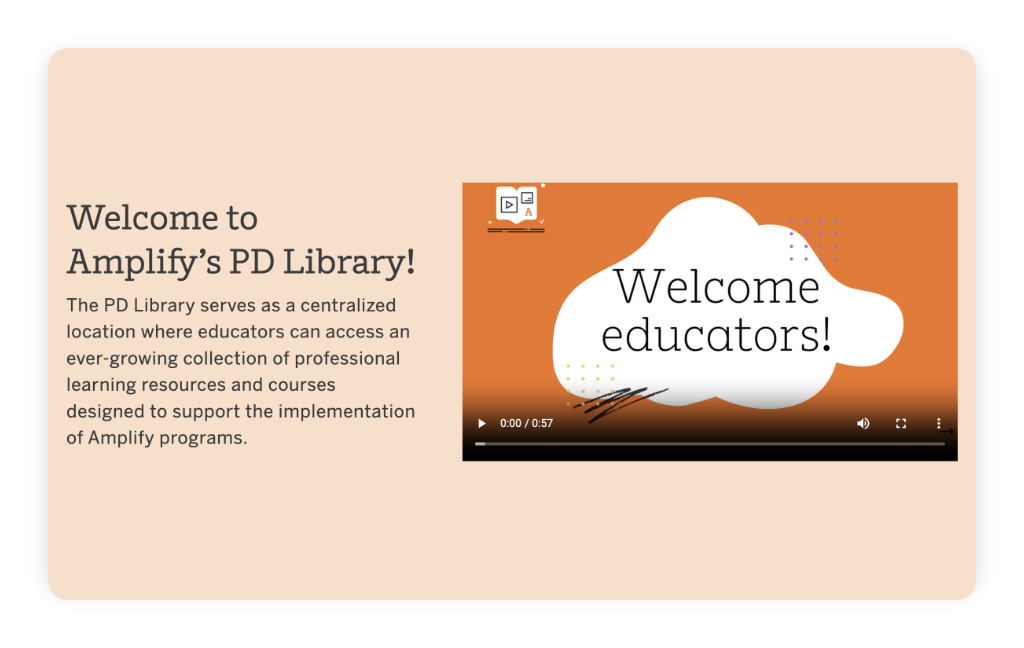
PD Library
You’ll find helpful professional development (PD) resources in the PD Library to ensure your mCLASS implementation runs smoothly. When you’re logged into mCLASS, the PD Library can be accessed by clicking the PD Library button on the left navigation bar.
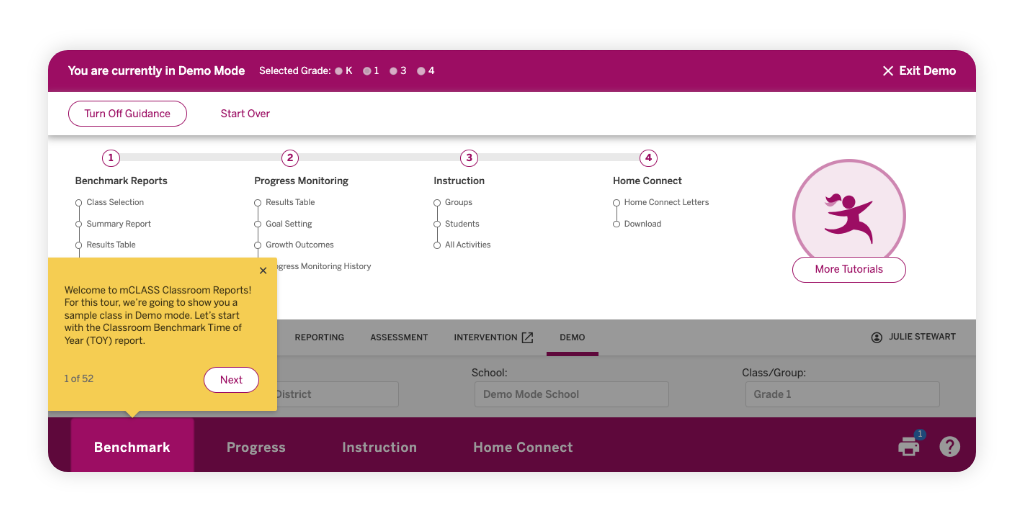
Demo mode in English Classroom Reporting
mCLASS English Classroom Reporting features a demo mode that guides teachers through sample classroom and student reports, highlighting realistic student data within the complete set of mCLASS instructional tools. This demo mode is especially helpful for onboarding purposes with teachers new to using mCLASS.
NEW AND NOTEWORTHY UPDATES
mCLASS DIBELS 8th Edition, mCLASS Lectura, and mCLASS Intervention!
mCLASS® DIBELS® 8th Edition, mCLASS Lectura, and mCLASS® Intervention are introducing enhancements for the next school year. Explore the following improvements designed to save you time, extend your reach, and support your efforts to deliver the learning experiences your students deserve.
Updates
mCLASS DIBELS 8th Edition expands to support grades 7–8.
This expansion supports a full K–8 literacy model (alongside Amplify ELA), to help you identify where both elementary and middle school students need support and to guide you on the next steps. With mCLASS DIBELS 8th Edition for grades 7–8, you can support middle school students with reading fundamentals, monitor progress for grade-level and below-grade-level skills, and find instructional guidance based on best practices for middle school.
mCLASS Lectura update: phonemic awareness measure option for kindergarten and grade 1
Fluidez en la segmentación de fonemas (FSF) will be added to mCLASS Lectura as an optional measure for kindergarten and grade 1. FSF is a standardized, individually-administered phonemic awareness assessment that measures students’ ability to fluently segment words, a skill which is predictive of Spanish reading proficiency and is also transferable to support the development of English phonemic awareness.
FSF does not impact the overall mCLASS Lectura Composite Score.
Noteworthy features
PD Library
You’ll find helpful professional development (PD) resources in the PD Library to ensure your mCLASS implementation runs smoothly. When you’re logged into mCLASS, the PD Library can be accessed by clicking the PD Library button on the left navigation bar.
Demo mode in English Classroom Reporting
mCLASS English Classroom Reporting features a demo mode that guides teachers through sample classroom and student reports, highlighting realistic student data within the complete set of mCLASS instructional tools. This demo mode is especially helpful for onboarding purposes with teachers new to using mCLASS.
Documents
Explore Amplify CKLA and Amplify Caminos
Thank you for reviewing the top-rated Amplify Core Knowledge Language Arts (CKLA) and its new Spanish-language partner Amplify Caminos.
Built on the Science of Reading, Amplify CKLA and Amplify Caminos sequence deep content knowledge with research-based foundational skills to help New York City students become strong readers, writers, speakers, and thinkers. As part of our commitment to creating richer curricula that is more diverse and culturally responsive, we’ve built on the foundation of our 1st Edition to create a new Amplify CKLA, complete with program enhancements that better help you reach every student.

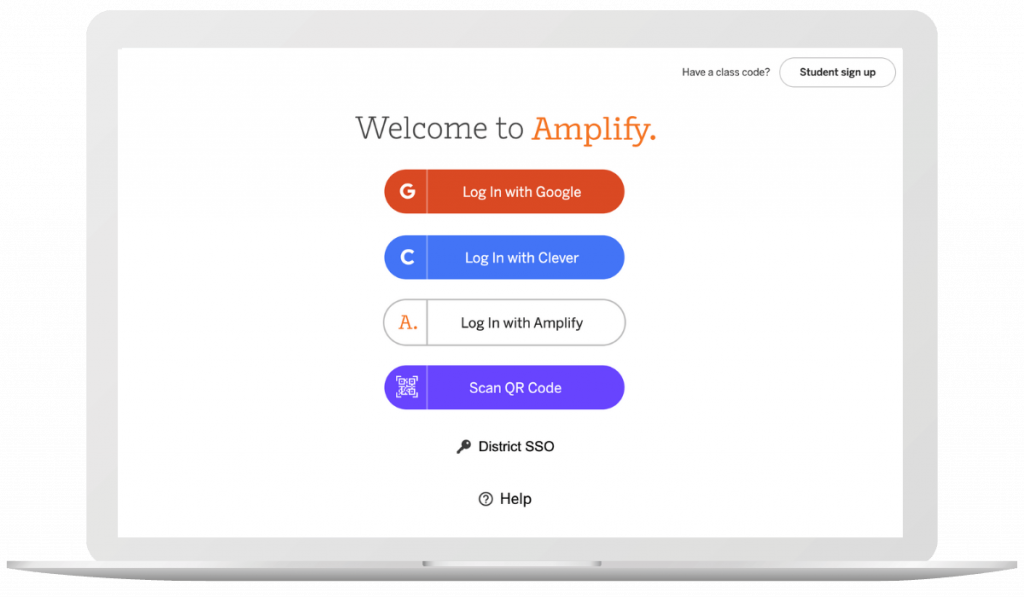
Access your demo account
Access your NYC demo account to perform a full program review and explore the digital features that enhance instruction and save educators valuable time.
Username: t.nyc-ckla-demo@tryamplify.net
Password: Demo1234
Click here for demo login and navigation support.
Built on the Science of Reading
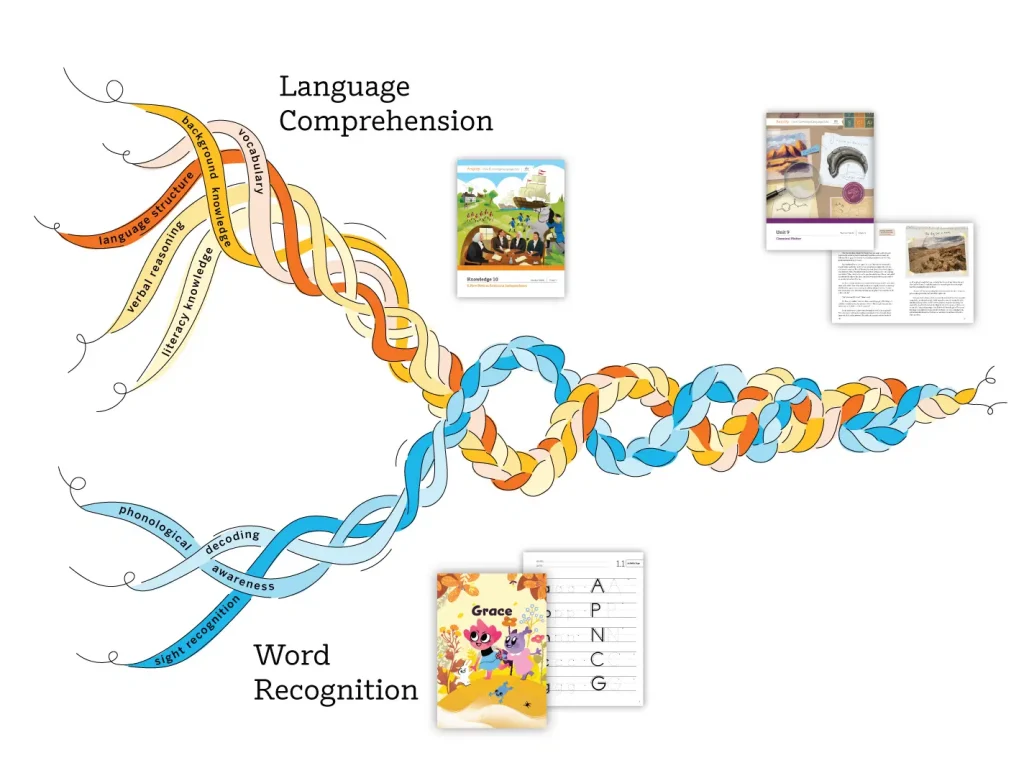
Through a unique, evidence-based two-strand approach, Amplify CKLA helps students master foundational skills and build a robust knowledge base–both of which are necessary for accessing and comprehending complex texts.
Grades K–2: Dedicated knowledge building and explicit skills instruction
Every day, students in Grades K–2 complete one full lesson that builds foundational reading skills in the Amplify CKLA Skills Strand, as well as one full lesson that builds background knowledge in the Amplify CKLA Knowledge Strand. Through learning in each of these strands, students develop the early literacy skills necessary to help them become confident readers and build the context to understand what they’re reading.
Grades 3–5: Integrated instruction
In Grades 3–5, Knowledge and Skills are integrated in one set of instructional materials. Lessons begin to combine skills and knowledge with increasingly complex texts, close reading, and a greater writing emphasis. Students can then use their skills to go on their own independent reading adventures.
Illustrated for engagement
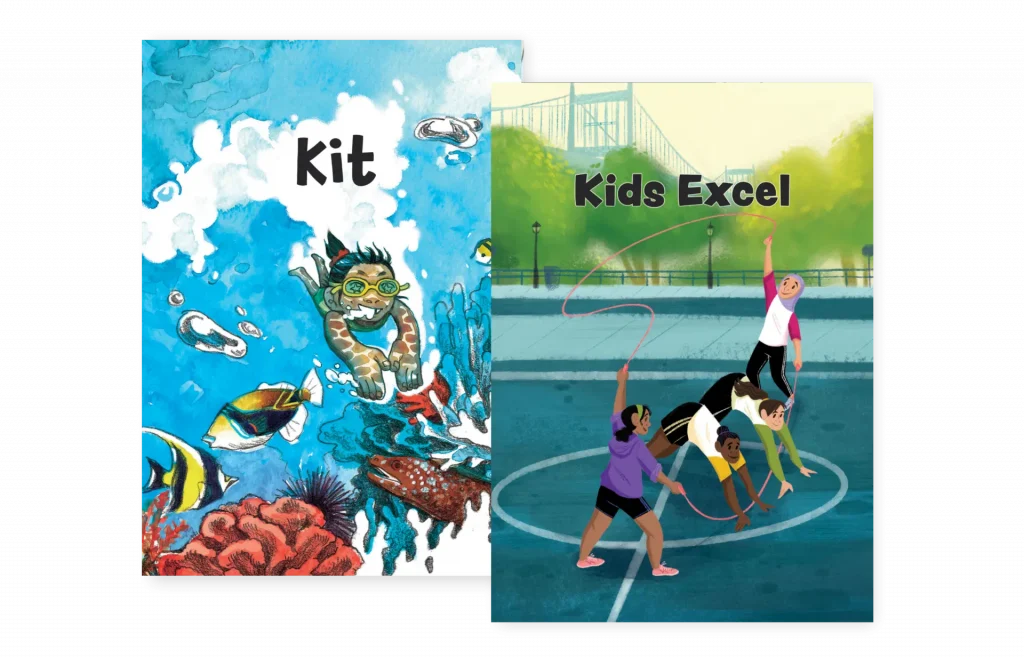
All of the Amplify CKLA K–2 Skills Readers have been redesigned and reillustrated to increase student engagement and students’ sense of connection with the decodable stories and their characters. Stories with human characters now have improved inclusivity and authenticity and feature individuals with a broad range of identity factors, including socioeconomic status, age, ability, race, ethnicity, country of origin, religion, and more. Other stories feature fantastical creatures to bring excitement and whimsy to the tales.
These new readers better reflect New York City classrooms and give students intensive practice with 100% decodable text.
Inspire inquiry and spark curiosity
New Knowledge Research Units in each grade of Amplify CKLA and Amplify Caminos provide a collection of high-interest authentic trade books that will spark your students’ curiosity and inspire more inquiry. The rich topics and highly visual components featured in these units provide students with new perspectives and additional windows and mirrors as they work to build knowledge.
In these units students will soar to new heights with Dr. Ellen Ochoa, Amelia Earhart, and the Tuskegee Airmen. They’ll feel the rhythm as they learn about Jazz legends Miles Davis, Tito Puente, and Billie Holiday. And they’ll explore the far reaches of the world with Jacques Cousteau, Matthew Henson, and Eugenie Clark.


Parallel Spanish literacy instruction
Like Amplify CKLA, Amplify Caminos provides a two-strand approach to instruction via authentic Spanish foundational skills instruction sequenced with the same knowledge-building content found in Amplify CKLA. Every day in Grades K–2, students complete one full lesson that builds foundational reading skills in the Amplify Caminos Lectoescritura strand, as well as one full lesson that builds background knowledge in the Amplify Caminos Conocimiento strand.
When used with Amplify CKLA, Amplify Caminos provides parity across English and Spanish that’s suitable for any Spanish and English biliteracy implementation model.
New York City review materials
The Amplify CKLA Program Guide and the Amplify Caminos Program Guide provide you with more details on how these programs work, how they’re structured, and why they’re uniquely capable of helping you bring English and Spanish reading instruction built on the Science of Reading to your classroom.
NYC DOE requested review information:
- Amplify CKLA Scope and Sequence documents
- Amplify Caminos Scope and Sequence documents
- Amplify CKLA is recognized by Knowledge Matters Campaign and has received high ratings from EdReports.
- Alignment to New York State Next Generation ELA Learning Standards
- Alignment to Culturally Responsive-Sustaining Education Framework
- New York City DOE Implementation and Professional Development Proposal
For an even more in-depth review, access the following materials:

Amplify CKLA and ELA Elementary Language Arts Curriculum Adoption
mCLASS dyslexia screener for CA
What is Amplify Caminos?
Amplify Caminos is a core Spanish language arts program for grades TK–5 that delivers:
- Authentic instruction built from the ground up for the Spanish language.
- A unique research-based approach truly built on the Science of Reading.
- A combination of explicit foundational skills with meaningful knowledge-building.
- Embedded support and differentiation that gets all students reading grade-level texts together.
- Opportunities for students to see the strengths and experiences that all people share while also celebrating each others’ unique identities and experiences.

How does Amplify Caminos work?
Grades K–2: Dedicated knowledge-building and explicit skills instruction
Every day, students in Grades K–2 complete one full lesson that builds foundational reading skills in the Amplify Caminos Lectoescritura strand, as well as one full lesson that builds background knowledge in the Amplify Caminos Conocimiento strand. Through learning in each of these strands, students develop the early literacy skills necessary to help them become confident readers and build the context to understand what they’re reading.
Grades 3–5: Integrated instruction
In Grades 3–5, the Amplify Caminos Lectoescritura and Conocimiento strands are integrated in one set of instructional materials. Lessons begin to combine skills and knowledge with increasingly complex texts, close reading, and a greater writing emphasis. Students can then use their skills to go on their own independent reading adventures.
What makes Amplify Caminos different?
Built on the Science of Reading
Built out of the latest research in the Science of Reading, Amplify Caminos delivers explicit instruction in both foundational literacy skills (systematic phonics, decoding, and fluency) and background knowledge in grades K–2 with an integrated approach to explicit instruction in grades 3–5.
Explicit systematic skills instruction
The skills instruction in Amplify Caminos was distinctly developed with the Spanish language in mind. Its foundational lessons are specific to the language, rather than a direct translation from Amplify CKLA’s English skills instruction.
Reading instruction begins with the vowels first, then the most common consonants, and finally the least common consonants. Students will blend and segment sounds to form syllables, and syllables to form words.
Although Spanish has a highly predictable orthography, there are a few silent letters (h is always silent, u is silent after g or q), as well as letters that can make different sounds, depending on the letters that follow them. For that reason, syllables with these letters are taught somewhat later in the progression. The same is true for syllables with infrequently occurring consonants, such as z, k, x, and w.
Coherent knowledge instruction
While students are learning how to read, the Conocimiento strand gives them authentic and engaging reasons to read.
Amplify Caminos uses spiral learning to reinforce every student’s ability to develop skills like reading, writing, speaking, and listening in Spanish that can be transferred to English. As students engage with their lessons, they explore the similarities and differences in grammar, vocabulary, writing, and language use between Spanish and English. This bridge helps students learning two languages to strengthen their knowledge in both.
Through cross-curricular content, students explore units that relate to storytelling, science, and the history of our world in a holistic and thoughtful way. With these units, you’ll bring the world to your students, showing them how reading can become an exciting, rewarding, and useful part of their lives.
Embedded differentiation for all learners
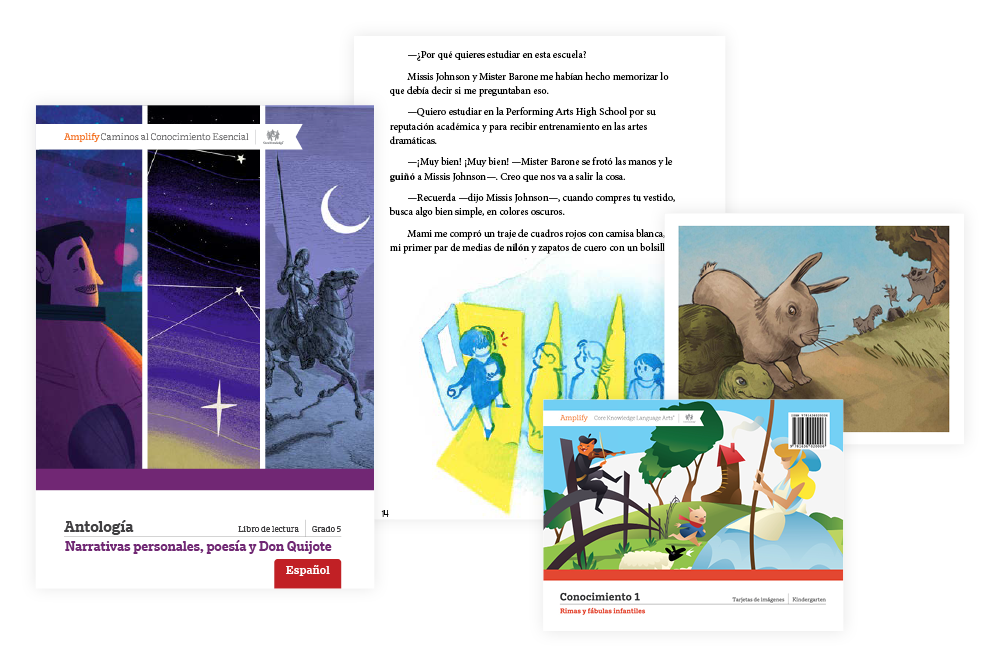
Amplify Caminos provides built-in differentiation strategies and supports in every lesson.
- Apoyo a la enseñanza y desafío: Support and Challenge suggestions in every lesson provide assistance or opportunities for more advanced work toward the goal of the lesson.
- Notas culturales: These point-of-use notes provide additional information about the traditions, foods, holidays, word variations, and more from across the Spanish-speaking world.
- Apoyo adicional: Every lesson in the Lectoescritura (Skills) Strand provides additional support activities suggested to reinforce foundational skills instruction. These activities can be given to any student who requires extra help, including students with special needs.
Commitment to equity
We believe we have a responsibility to provide literacy instruction that gives every student an equal opportunity to succeed and even excel. Amplify Caminos builds students’ knowledge about the world, helping them see people who resemble them and their familiar situations or experiences while also exposing them to people whose appearances, lives, beliefs, and backgrounds differ from their own.
In addition to teaching all students to crack the written code (which is vital for fairness), the Amplify Caminos program helps students celebrate their own unique identities and experiences while also seeing the strengths and experiences we all share.
Amplify Caminos includes both transadaptations and authentic texts written by Latin American and Spanish authors. Authentic literature exposes students to a variety of text types and perspectives to deepen their knowledge of fascinating topics in social studies, science, literature, and the arts. Authentic texts support text-to-self, text-to-world, and text-to-text connections for readers.

Amplify Caminos is built on the conviction that fairness in instruction is vital to an effective program. Decodable Student Readers celebrate students’ varied experiences and feature individuals with a broad range of identity factors, including socio-economic status, age, ability, race, ethnicity, country of origin, and more.
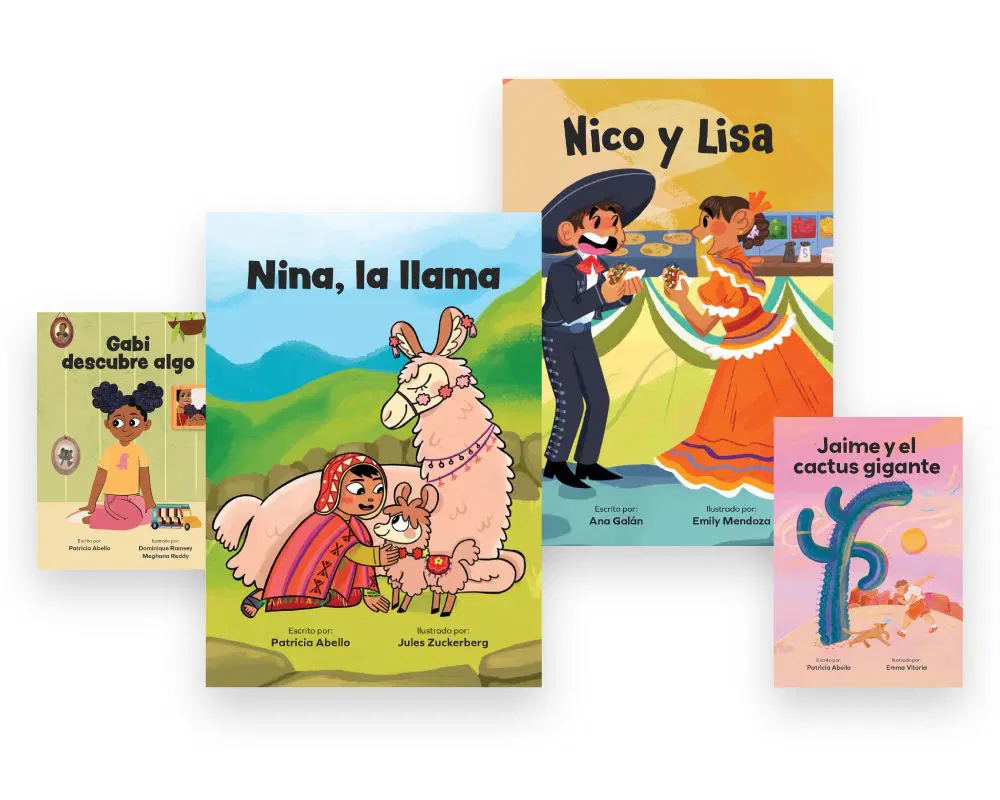
How does Amplify Caminos integrate with the other parts of the literacy system?
Amplify Caminos + mCLASS® Lectura
Achieve complete parity between English and Spanish assessments with mCLASS Lectura for K–6. mCLASS Lectura allows teachers to connect with their Spanish-speaking students face-to-face, one-on-one, and in the language most comfortable to them. The result? Valid and reliable student data reports
available in both English and Spanish, enabling teachers to pinpoint where their Spanish-speaking or emergent bilingual students really are in their skill development and what instruction to prioritize.

Amplify Caminos + Amplify Reading
Amplify Reading is an engaging, adaptive digital program that extends the learning in Amplify Caminos. Amplify Reading offers support to a large sub-group of English learners (ELs) through Spanish voice-over. Spanish voiceover instructions are available in vocabulary and sentence-level comprehension games so ELs can build their vocabulary, language, and critical comprehension skills before moving into analyzing complex texts

Check out these additional resources
Caminos review resources:
- Caminos Program Guide
- Biliteracy and Science of Reading Principles
- Amplify Caminos Conocimiento Scopes and Sequences
- Grade K Knowledge Strand
- Grade 1 Knowledge Strand
- Grade 2 Knowledge Strand
- Grade 3 Integrated Strand
- Grade 4 Integrated Strand
- Grade 5 Intgrated Strand
Beaver County School District
About the program
mCLASS offers teacher-administered assessment, intervention, and personalized instruction for grades K–6. Know exactly how to monitor and support every student in your classroom, with features like:
- Precise one-minute measures based on over three decades of predictive data.
- Universal and Reading Difficulties screening in one tool.
- Instruction that highlights observed patterns and recommends activities.
- Robust reports for teachers, specialists, administrators, and parents.

The right measures at the right time
With mCLASS DIBELS 8th Edition, you’ll assess students based on grade-specific curriculum and instructional standards, in accordance with International Dyslexia Association (IDA) guidelines.
mCLASS DIBELS 8th Edition offers one-minute, easy-to-administer measures of processing speed, phonological awareness, alphabetic principle, and word reading.
| DIBELS® 8th Edition subtest alignment with SB 114 requirements | ||||||
|---|---|---|---|---|---|---|
| RDRP Screening Area | mCLASS DIBELS 8th Edition Measure | Grade K | Grade 1 | Grade 2 | Grade 3 | Grade 4–6 |
| Rapid naming ability | Letter Naming Fluency (LNF) |  | | |||
| Phonological awareness | Phoneme Segmentation Fluency (PSF) | | | |||
| Alphabetic principle | Nonsense Word Fluency (NWF) | | | | | |
| Word reading | Word Reading Fluency (WRF) | | | | | |
| Word reading | Oral Reading Fluency (ORF) | | | | | |
| Comprehension | Maze | | | | ||
| Language Comprehension | Oral Language | | | | ||
| Vocabulary | Vocabulary | | | | | |
| RAN | Rapid Automatized Naming (Numbers) | | | | | |
| Encoding | Spelling | OPTIONAL | ||||
Validated as a universal screener and a dyslexia screener
Strong reliability and validity evidence shows that DIBELS 8th Edition can effectively assess students in key skills linked to both dyslexia and broader reading difficulty. The research supporting DIBELS 8th Edition, conducted by the University of Oregon, is rigorous, meets high technical standards, and empowers educators to make well-informed decisions.
Read the DIBELS 8th Edition Dyslexia White Paper.

A complete system for data-based decision making
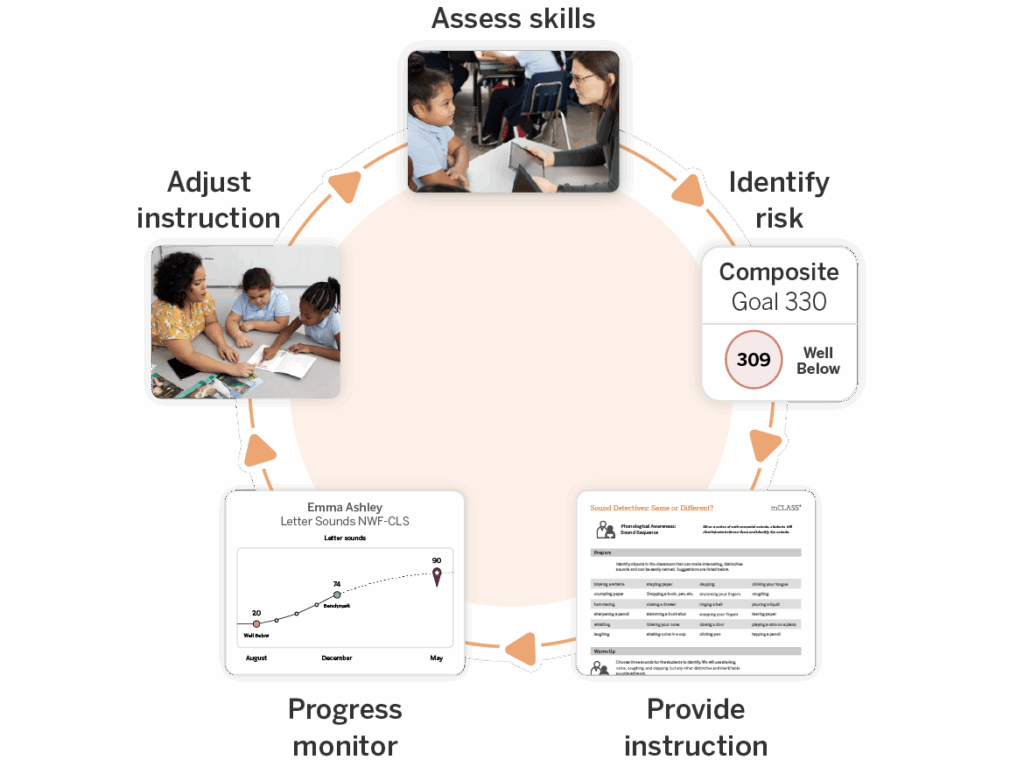
mCLASS DIBELS 8th Edition provides rich data that helps you make informed instructional decisions and seek out further dyslexia screening evaluation if needed:
- Assess skills: mCLASS DIBELS 8th Edition and optional dyslexia screenings in Rapid Automatized Naming (RAN), Spelling, Vocabulary, and Oral Language accurately assess students’ abilities.
- Identify risk: The DIBELS 8 composite score shows each student’s risk level, with ‘Well Below Benchmark’ indicating a need for intensive support. Students who are also ‘Well Below Benchmark’ in RAN and/or Spelling have an additional Risk Indicator icon next to their name.
- Provide instruction: The mCLASS Instruction feature analyzes student error patterns to key dyslexia-related subtests, then recommends small groups and explicit, multi-sensory activities for reinforcing skills.
- Progress monitor: mCLASS includes progress-monitoring measures to track student growth in letter sounds, alphabetic principle, word reading, oral reading fluency, and comprehension, so that informed instructional decisions can be made.
- Adapt instruction: mCLASS displays indicators based on progress monitoring performance that indicate when a change in instruction may be needed. It also updates instruction recommendations using the latest data.
Differentiated literacy instruction
mCLASS DIBELS 8th Edition lays the groundwork for a strong Multi-Tiered System of Supports (MTSS).
In addition to identifying students with symptoms of dyslexia, mCLASS DIBELS 8th Edition data recommends early intervention, personalized instruction, and core instruction within Amplify’s early literacy suite. Based on the Science of Reading, Amplify’s early literacy suite programs follow an explicit and systematic structure, build knowledge, and instruct on all of the foundational skills essential to literacy development.
- Intervene with mCLASS Intervention and Amplify Tutoring: Staff-led Tier 2 and 3 intervention for intensive support.
- Practice with Boost Reading: Personalized learning program to extend and reinforce core instruction.
- Instruct with Amplify Core Knowledge Language Arts (CKLA): Core curriculum to build foundational skills and knowledge.

Bilingual Reading Difficulties screening
By assessing with mCLASS DIBELS 8th Edition and its Spanish counterpart, mCLASS Lectura, you’ll know with confidence whether a student truly shows signs of of reading difficulties or is experiencing difficulties learning a new language.
When used together, mCLASS DIBELS 8th Edition and mCLASS Lectura feature a Dual Language Report that analyzes Reading Difficulties screening results in both languages. The report also details how each student can leverage their strengths from one language to support growth in the other.

Equal skill coverage in English and Spanish
mCLASS Lectura subtest alignment with SB114
| RDRP screening areas | English measure | Spanish measure | Description* |
|---|---|---|---|
| Letter Naming and RAN | Letter Naming Fluency (LNF) | Fluidez in nombrar letras (FNL) | Grades K–1: Naming letters in print. 1 minute, 1:1 administration. |
| Phonological Awareness (Segmentation) | Phonemic Segmentation Fluency (PSF) | Fluidez en la segmentación de sílabas (FSS) & Fluidez en la segmentación de fonemas (FSF) | Grades K–1: Hearing and using sounds or syllables in spoken words. 1 minute, 1:1 administration. |
| Phonological Awareness (Elision) | – | ¿Qué queda? (QQ) | Grades K–2: Produce the part of a word that remains after deleting a syllable or phoneme. 1 minute, 1:1 administration. |
| Letter Sound Correspondence Knowledge | Nonsense Word Fluency Correct Letter Sounds(NWF-CLS) | Fluidez en los sonidos de letras (FSL) | English: Grades K–3: Identify letter-sound correspondences in the context of pseudo-words. Spanish: Grades K-1: Identify letter-sounds in isolation. 1 minute, 1:1 administration. |
| Letter-Sound Knowledge (Receptive) | – | Fluidez en los sonidos de las letras K-Inicio (FSL K-Inicio) | Grade K: Identify (point to) which letter makes a certain sound. Untimed, 1:1 administration. |
| Decoding | Nonsense Word Fluency Words Recoded Correctly (NWF-WRC) | Fluidez en los sonidos de las sílabas (FSL) | Grades K–3: Identify letter-sound correspondences in the context of pseudo-words. Spanish: Grades K–1: Identify letter-sounds in isolation. 1 minute, 1:1 administration. |
| Word Reading | Word-Reading Fluency (WRF) | Fluidez en las palabras (FEP) | Grades K–3: Reading common words easily, quickly and correctly.1 minute, 1:1 administration. |
| Fluency | Oral Reading Fluency (ORF) | Fluidez en la lectura oral (FLO) | Grades 1–6: Reading connected text with accuracy and automaticity. 1 minute, 1:1 administration. |
| Reading Comprehension | Maze | ¿Cuál palabra? (CP) | Grades 2–6: Understanding meaning from texts. 3 minutes, group administration. |
| Vocabulary | Vocabulary | Vocabulario | Grades K–3: Arranging letters correctly to spell words with grade appropriate features. 15 minutes, group administration. |
| Encoding | Spelling | Ortografía | Grades K–3: Arranging letters correctly to spell words with grade-appropriate features. 15 minutes, group administration. |
| RAN (Numbers) | Rapid Automatized Naming | – | Grades K–3: Correctly and quickly naming visual symbols, such as numbers. 1-2 minutes, 1:1 administration. |
| Language Comprehension | Oral Language | Lenguaje oral | Grades K–2: Demonstrate the ability to use words and phrases acquired through conversations, reading and being read to, and responding to texts. 5 minutes, 1:1 administration. |
*Students can be assessed using off-grade measures when information on specific skills is needed.
Resources for families
Welcome California Caregivers! Please click here to learn more about mCLASS assessments.
Families play a crucial role in helping children overcome reading challenges. mCLASS DIBELS 8th Edition and mCLASS Lectura provide a Home Connect letter after each screening to explain the results in family-friendly language, recommend activities, and direct families to a free website for additional at-home support.

Developmentally appropriate
Computer-based assessments that require students to complete tasks silently or independently may over-identify students for intervention services, especially young learners who are still developing focus and attention abilities.
mCLASS requires students to actively demonstrate their proficiency in producing letter sounds, forming words, and reading texts. This approach to assessment aligns with IDA guidelines for effective screening of reading challenges. By choosing mCLASS for universal screening, you’ll gain accurate information about a student’s risk for reading difficulties, and gain the capability to monitor every student’s path to reading proficiency.
Additional resources
mCLASS Resources
- mCLASS Research Hub
- mCLASS Program Guide
- mCLASS Digital Access Guide
- mCLASS Reporting Guide
- mCLASS Help Site
- mCLASS self-guided walkthrough
Dyslexia Resources
- mCLASS Dyslexia Toolkit
- Dyslexia Fact vs. Fiction ebook
- Blog post: 4 tools to help teachers better understand dyslexia
- Science of Reading: The Podcast, Season 7, Episode 7: Debunking the “gift” of dyslexia in children, with Dr. Tim Odegard
- Science of Reading: The Podcast, Season 1, Episode 6: The facts and myths of dyslexia, with Emily Lutrick
Multilingual and English learners Resources
Your California team
Looking to speak directly with your local representative?
Get in touch with a California team member to learn more about our early literacy suite or request a demo account.
Dan Pier
Vice President, West
(415) 203-4810
dpier@amplify.com
Erin King
Sales Director, CA
(512) 736-3162
eking@amplify.com
NORTHERN CA
Wendy Garcia
Senior Account Executive
(510) 368-7666
wgarcia@amplify.com
BAY AREA
Lance Burbank
Account Executive
(415) 830-5348
lburbank@amplify.com
CENTRAL VALLEY and CENTRAL COAST
Demitri Gonos
Senior Account Executive
(559) 355-3244
dgonos@amplify.com
VENTURA and L.A. COUNTY
Jeff Sorenson
Associate Account Executive
(310) 902-1407
jsorenson@amplify.com
ORANGE and L.A. COUNTY
Lauren Sherman
Senior Account Executive
(949) 397-5766
lsherman@amplify.com
SAN BERNARDINO and L.A. COUNTY
Michael Gruber
Senior Account Executive
(951) 520-6542
migruber@amplify.com
RIVERSIDE AND L.A. COUNTY
Brian Roy
Senior Account Executive
(818)967-1674
broy@amplify.com
SAN DIEGO COUNTY
Kirk Van Wagoner
Senior Account Executive
(760) 696-0709
kvanwagoner@amplify.com
BUTTE, DEL NORTE, HUMBOLDT, and SHASTA COUNTY and DISTRICTS UNDER 2250 ENROLLMENT
Kevin Mauser
Lead Account Executive
(815) 534-0148
kmauser@amplify.com
Review of the B.E.S.T. program for middle schools, Amplify ELA Florida Edition
Thank you for taking the time to review Amplify ELA Florida Edition for middle school. The items below will allow you to experience our fully blended program, with access to our print materials, digital curriculum, and additional resources to support your review.
With the Benchmarks for Excellent Student Thinking (B.E.S.T.) standards as the foundation, our robust curriculum is built with a full appreciation of rich text, history, art, music, and other disciplines. This thoughtful development encourages a broader view of literacy that promotes knowledge-building across varied domains and subjects.

Review digital program
The content and instruction in Amplify ELA’s digital program mirror the content provided in the print Teacher Guides and Student Editions found below. Additionally, the digital program offers enhanced opportunities to engage students through the use of multimedia and a variety of learning apps. Teachers will also find embedded apps that make it easy to score student work, provide feedback, differentiate instruction, and report on progress.

To review the digital program, visit learning.amplify.com.
Click Login with Amplify, and use the following credentials:
Student view
- Username: s2.elafl@tryamplify.net
- Password: AmplifyNumber1
Amplify ELA Florida overview
Review grade 6 materials

Teacher Guides:
Bid #1274: 9781636025216, Amplify ELA Florida Grade 6 Teacher Blended Package
Available digitally and in print, the Teacher Guides contain all of the information teachers need to facilitate classroom instruction.

Reading with the B.E.S.T. Modules have been built to guide teachers and students as they begin to work with Florida’s new reading standards, providing an introduction to each grade-level B.E.S.T. Reading benchmark.

Student Edition (single volume per year):
Bid #1274: 9781643830766, Amplify ELA Grade 6 Student Edition (single)
Available digitally and in print, the Student Edition guides middle schoolers through complex texts and writing by:
- Engaging students with high-quality narrative and informational texts.
- Providing videos, audio supports, and digital experiences that capture their attention.
- Presenting text in a single print volume for students to annotate on the page

Student Writing Journals:
Bid #1274: 9781636025186 Amplify ELA Florida Grade 6 Student Blended Package
Review grade 7 materials

Teacher Guides:
Bid #1276: 9781636025223, Amplify ELA Florida Grade 7 Teacher Blended Package
Available digitally and in print, the Teacher Guides contain all of the information teachers need to facilitate classroom instruction.

Reading with the B.E.S.T. Modules have been built to guide teachers and students as they begin to work with Florida’s new reading standards, providing an introduction to each grade-level B.E.S.T. Reading benchmark.

Student Edition (single volume per year)
Bid #1276: 9781643831114, Amplify ELA Grade 7 Student Edition (single)
Available digitally and in print, the Student Edition guides middle schoolers through complex texts and writing by:
- Engaging students with high-quality narrative and informational texts.
- Providing videos, audio supports, and digital experiences that capture their attention.
- Presenting text in a single-volume print student experience to annotate on the page.

Writing Journals:
Bid #1276: 9781636025193, Amplify ELA Florida Grade 7 Student Blended
Review grade 8 materials

Teacher Guides:
Bid #1277: 9781636025230, Amplify ELA Florida Grade 8 Teacher Blended Package
Available digitally and in print, the Teacher Guides contain all of the information teachers need to facilitate classroom instruction.

Reading with the B.E.S.T. Modules have been built to guide teachers and students as they begin to work with Florida’s new reading standards, providing an introduction to each grade-level B.E.S.T. Reading benchmark.

Student Edition (one volume per year)
Bid #1277: 9781643831466, Amplify ELA Grade 8 Student Edition (single)
Available digitally and in print, the student edition guides middle schoolers through complex texts and writing by:
- Engaging students with high-quality narrative and informational texts.
- Providing videos, audio supports, and digital experiences that capture their attention.
- Presenting text in a single-volume print student experience to annotate on the page.

Writing Journals:
Bid #1277: 9781636025209, Amplify ELA Florida Grade 8 Student Blended
Florida-required guidance
Resources
Additional materials to support your review:
Welcome, mCLASS DIBELS 8th Edition families!
We’re excited to welcome you and your child to the mCLASS® DIBELS® 8th Edition Caregiver Hub for the new school year. We’ve assembled the following resources and guides to help you support your child and enable them to have the most productive experience with our platform throughout the year.
Para la versión en español, haga clic aquí.
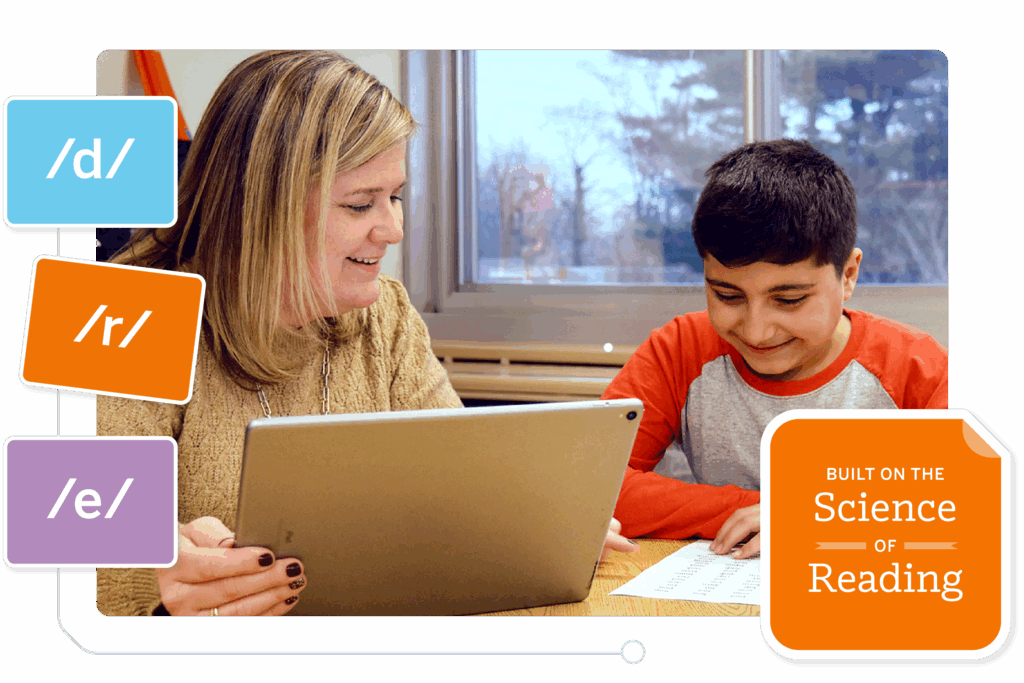
What is mCLASS DIBELS 8th Edition?
mCLASS DIBELS 8th Edition is an assessment and instruction system that provides valuable information on how students are progressing in their development of critical reading skills.
The program also provides teachers with instructional reading activities for each student based on their assessment score, enabling your child’s teacher to deliver lessons and provide practice opportunities that are specific to your child’s needs.
Ways to support your child
Home Connect
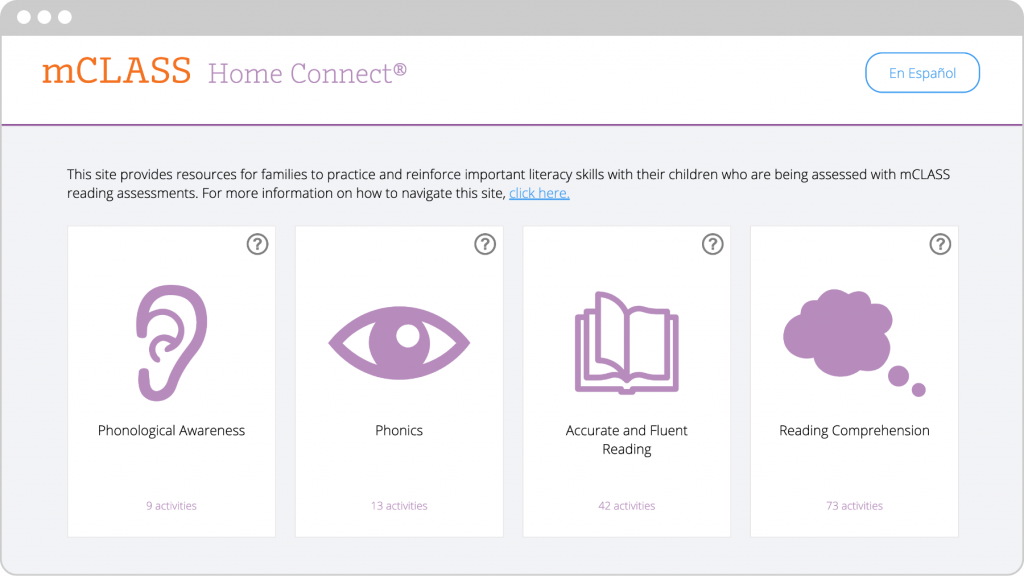
The mCLASS Home Connect® website houses reading practice resources for parents and caregivers, including at-home lessons organized by skill to support students. Our mCLASS caregiver letters in English and Spanish offer suggestions on how families can best support their child.
Review digital safety
We recommend reviewing this Protecting Kids Online site by the Federal Trade Commission addressing digital safety.
How to get help
Have a question about mCLASS DIBELS 8th Edition?
Read our caregiver guide or visit our help center to search for articles with answers to your program questions.
For additional curriculum support, please contact your child’s teacher.
Welcome, mCLASS Lectura families!
We’re excited to welcome you and your child to the mCLASS® Lectura Caregiver Hub for the new school year. We’ve assembled the following resources and guides to help you support your child and empower them to grow and learn new skills both in and beyond the classroom.
Para la versión en español, haga clic aquí.
What is mCLASS Lectura?
mCLASS Lectura is an authentic personalized Spanish instruction and assessment system built specifically for bilingual children learning to read. It highlights the reading skills your child already has, and it shares where they may need additional support.
mCLASS Lectura also provides teachers with instructional reading activities for each student based on their assessment score, giving targeted guidance on specific skills that may need additional support.
Ways to support your child
Home Connect
The mCLASS Home Connect® website houses reading practice resources for parents and caregivers, including at-home lessons organized by skill to support bilingual students learning to read in English. Our mCLASS caregiver letters in English and Spanish offer suggestions on how a family can best support their child.
Review digital safety
We recommend reviewing this Protecting Kids Online site by the Federal Trade Commission addressing digital safety.
How to get help
Have a question about mCLASS Lectura?
Read our caregiver guide or visit our help center to search for articles with answers to your program questions.
For additional curriculum support, please contact your child’s teacher.
Welcome, Amplify ELA families!
We’re excited to welcome you and your student to the Amplify ELA program for the new school year, and to provide you with exceptional learning opportunities through ELA. We’ve assembled the following resources and guides to help you support your student and enable them to have the most productive experience with our platform throughout the year.
Para la versión en español, haga clic aquí.
What is Amplify ELA?
Amplify ELA helps students in grades 6–8 read and understand complex texts that encourage them to grapple with interesting ideas and find relevance for themselves. Amplify ELA is a blended program that includes both digital and print materials, but can also be used as a print-only version. Students using Amplify ELA read text passages closely, interpret what they find, discuss their thinking with peers, and develop their ideas in writing. The lesson structure is easy to follow, but flexible enough to allow for a variety of learning experiences and varied enough to keep students engaged.
Features include:
- Functionality that allows individual students to work at their own level while also being challenged appropriately.
- Built-in tools that allow teachers to track and respond to student work.
- The digital Amplify Library, which contains more than 700 downloadable, full-length fiction and nonfiction books.
- The Vocab App, which uses game-like activities to help students master keywords from the program’s texts. (Students using print materials will see keywords highlighted.)
- Independent writing assignments called Solos, available on mobile devices.
- Interactive projects called Quests that accompany certain units to provide additional practice with analytical reading, writing, speaking, and listening skills.
Getting started
How you can support the child in your care:
- If possible, read with your student daily; even 15 minutes of reading together each day can make a huge impact. You can read aloud sections of the text together—many middle grade students enjoy performing sections of dialogue by taking on the role of a character in a play, or adding some dramatic flair to a poem with which they are working. If your student struggles with reading aloud, you might try reading the text to them with expression, then having them read it back to you. For additional practice, there are an array of fluency activities in the program’s Flex Days. Ask your student to help you find these activities.
- Find moments to discuss what they are reading and discovering. Examples of questions you could ask: What stood out to you from what you read today? Were any sentences or words confusing? What was most surprising? What do you think the writer was trying to communicate? Do you agree with the writer’s ideas or descriptions? What connections can you make between what you are reading and your own life, or other issues you’ve heard about?
- Listen to your student read their written responses or have them share with a friend over the phone or video chat.
- Browse the Amplify Library with your student to find books they’ll enjoy and be able to read fluently and independently.
- Review this Protecting Kids Online website by the Federal Trade Commission addressing digital safety.
Accessing texts in the Amplify Library
We encourage students to utilize the core texts from the Amplify Library while at home! Please follow these steps to download a text for offline reading:
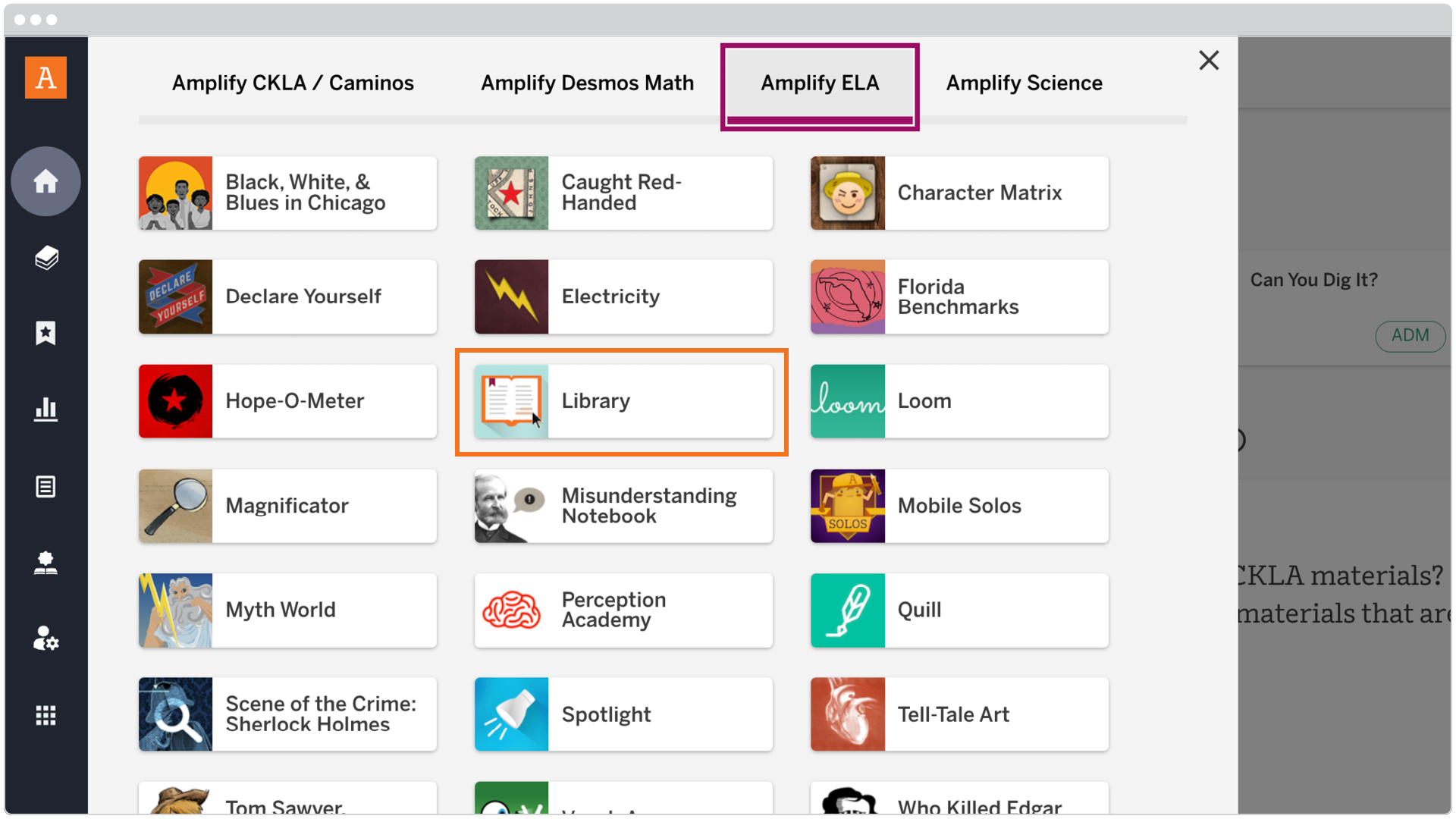
1. Navigate to the Program & Apps menu at the top of your screen and scroll through to find the Amplify Library icon. When you select it, the Amplify Library will open in a new tab.
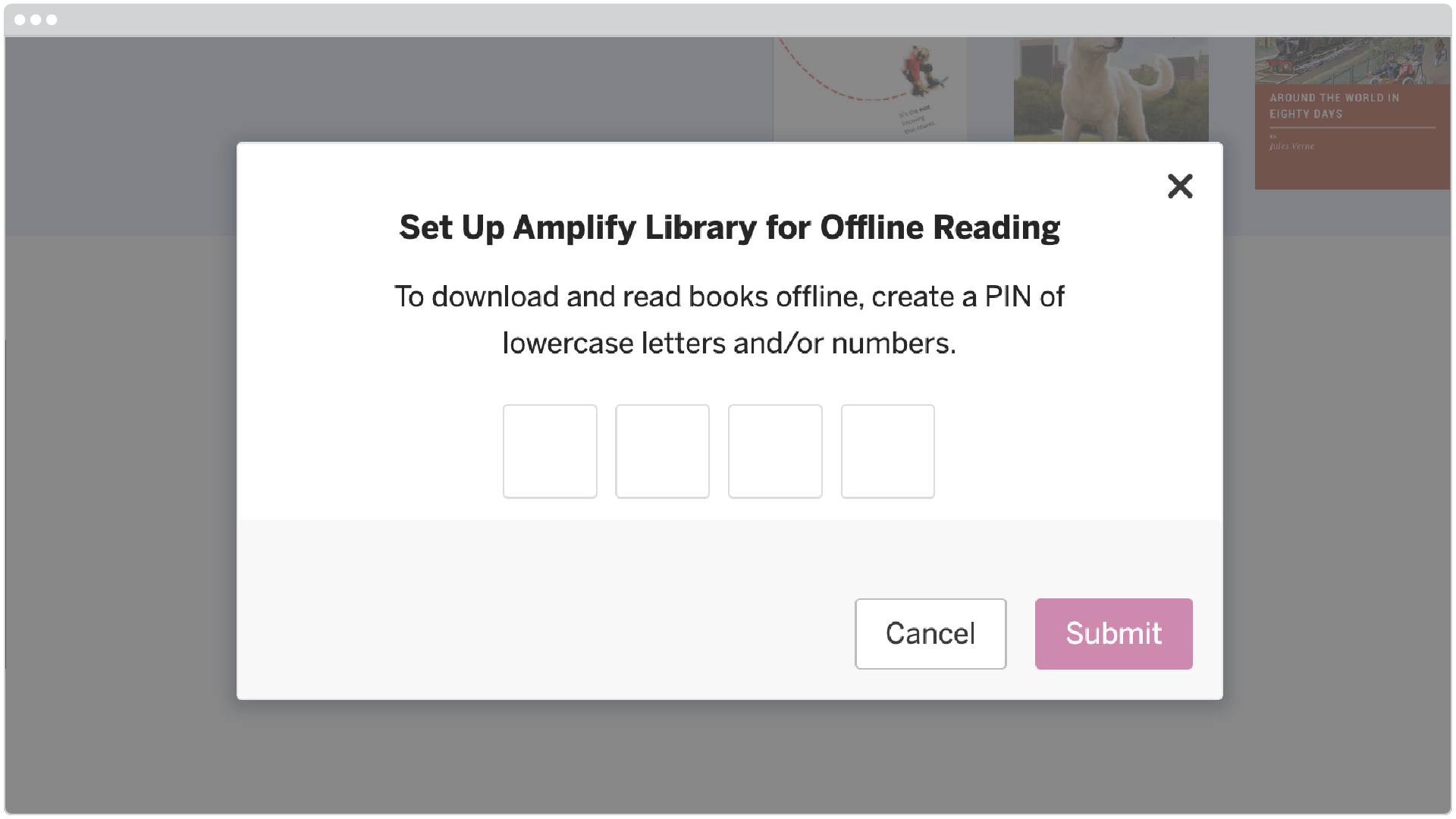
2. If prompted, follow the directions to set up a pin for the Amplify Library; otherwise, proceed to the next step.
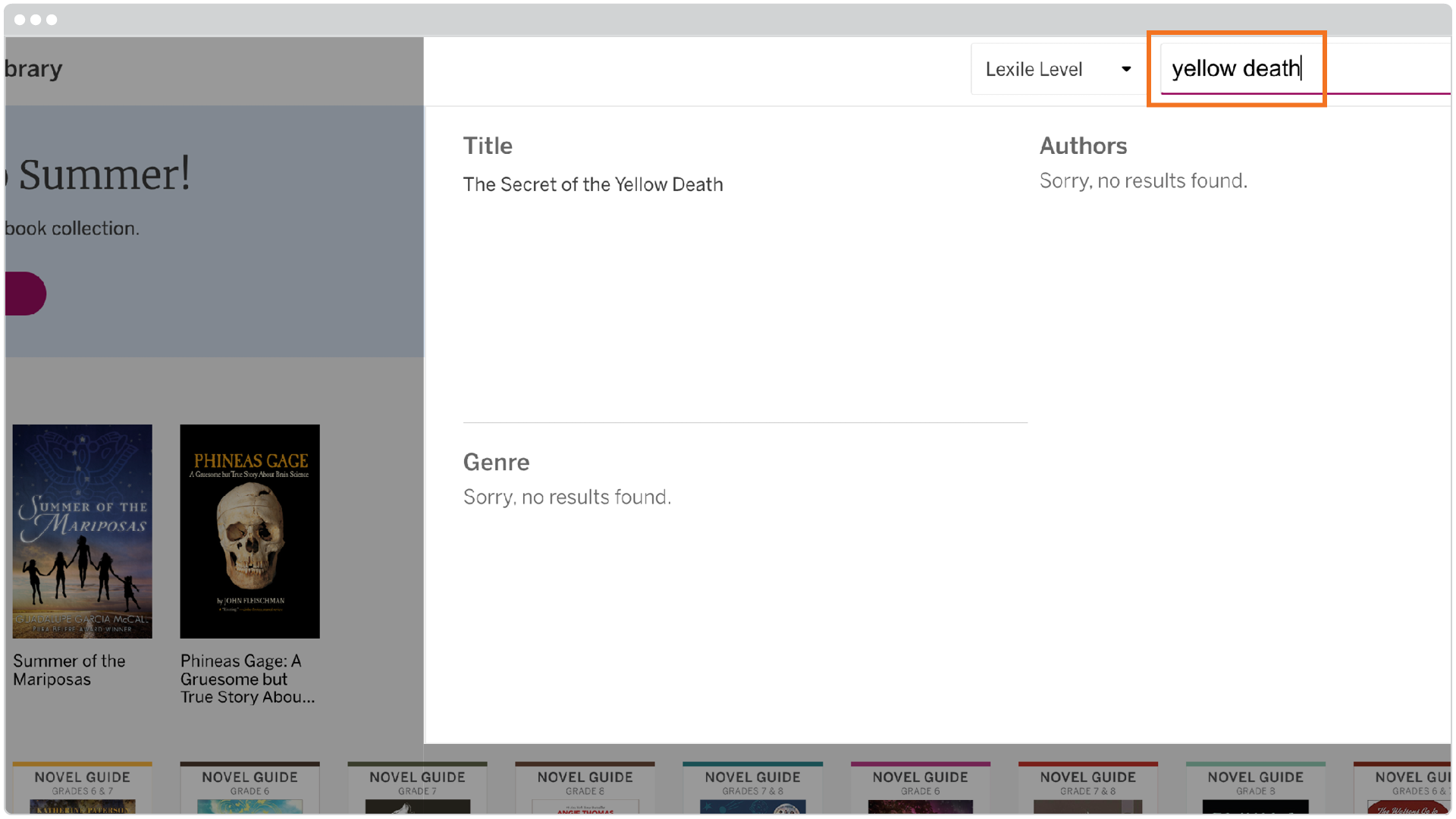
3. In the upper right corner of your screen, search for the book you would like to download. Example: The Secret of the Yellow Death: A True Story of Medical Sleuthing.
4. Select the Download button.
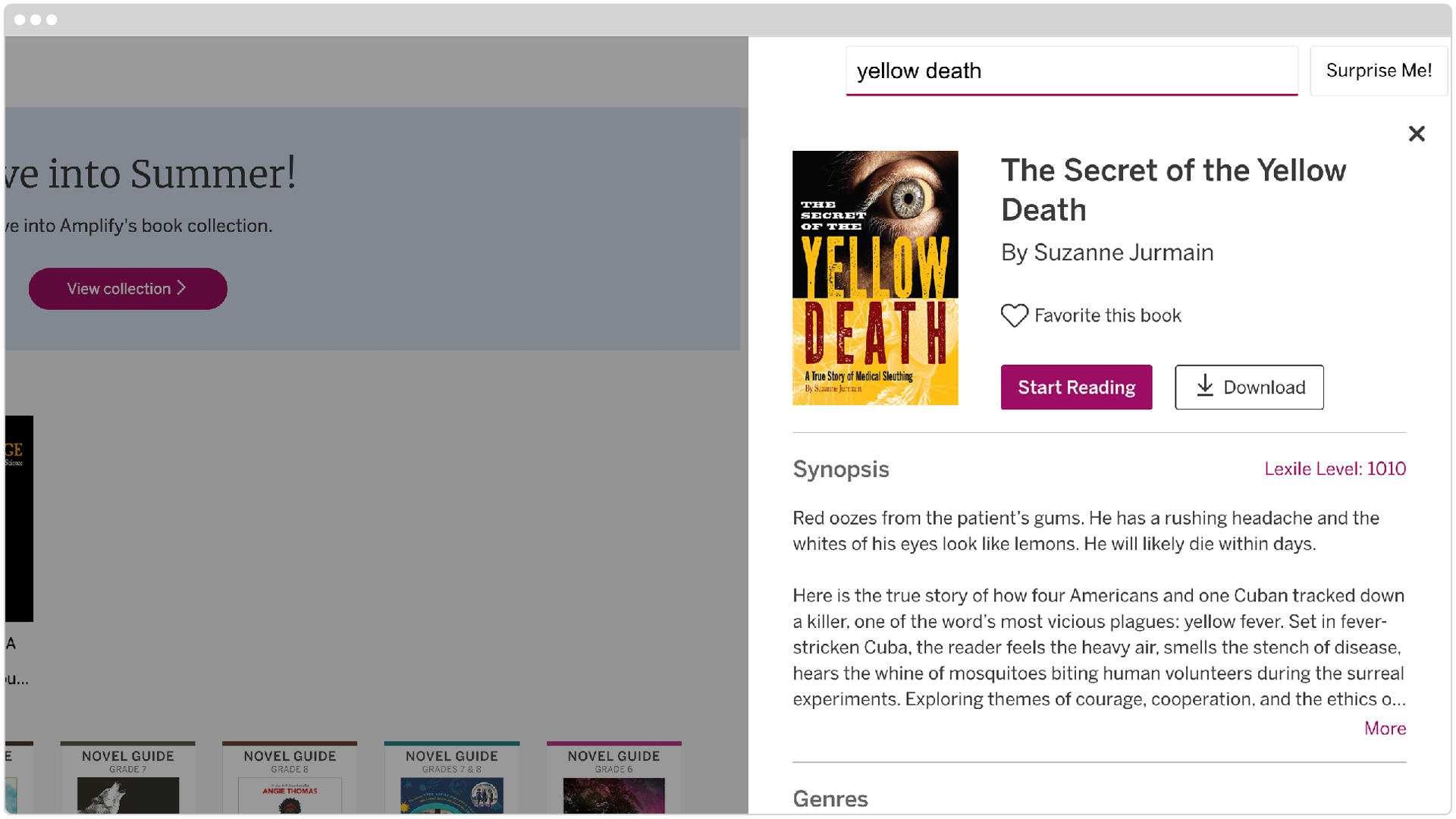
5. If you lose connection while still in the Amplify Library, you can continue to access and read the downloaded book(s). If the page refreshes without internet access, or you try to login on another device without internet access, you will lose access to the downloaded book(s) until the internet connection is restored.
To retrieve your downloaded texts:
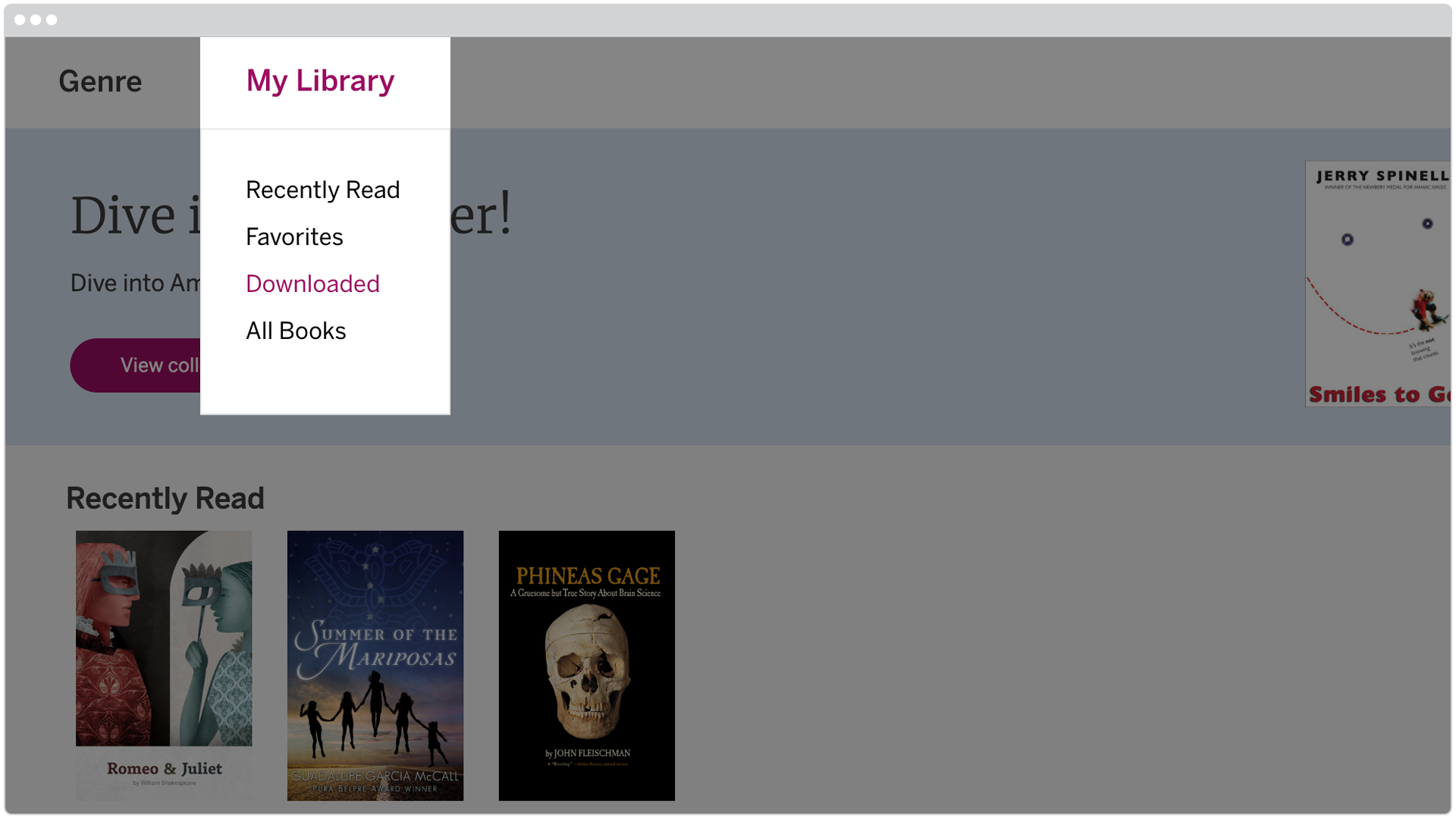
- In the Amplify Library app, open the My Library drop-down menu in the upper left corner.
- Select Downloaded.
- Choose the text you wish to read from all of your pre-downloaded texts.
Materials overview
Not every school will operate the same way, but students attending schools that have both the print and digital editions of the program will likely have the following print materials at home:
- Student Edition: This includes all of the readings and activities necessary for instruction throughout the year. Students can read the selections both digitally and in print, annotating in either format. The lessons in the print Student Edition reflect each digital lesson, but have been modified to work effectively in print.
- Writing Journals: This provides space for students to respond to Writing Prompts and complete other written assignments.
In the case that students are without access to devices or the internet, they can continue to complete key reading and writing assignments using the print Student Editions and student Writing Journals.
Teachers can also access, print, and mail student Novel Guides for up to 12 commonly taught novels. Six of these novels are available in the Amplify Library, and most should be available in a public library.
Unit overviews
Below are quick overviews of each unit your student will be working through in their grade throughout the year. Included along with each unit is a downloadable guide that provides a more in-depth look at what content is covered and how you can help your student advance their understanding of the topics.
- Unit 6A: Dahl & Narrative
- Students begin with narrative writing to quickly boost their writing production, learn the foundational skill of focus, and become comfortable with key classroom habits and routines they will use all year. Students then apply their new observational focus to some lively readings from Roald Dahl’s memoir Boy and learn how to work closely with textual evidence.
- Unit 6B: Mysteries & Investigations
- Students read like an investigator to embark on a multi-genre study of the mesmerizing world of scientific and investigative sleuthing. At the end of the unit, students write an essay explaining which trait is most useful to problem-solving investigators.
- Unit 6C: The Chocolate Collection
- The Aztecs used it as currency. Robert Falcon Scott took it to the Antarctic. The Nazis made it into a bomb designed to kill Churchill. The 3,700-year-long history of chocolate is full of twists and turns, making it a rich and rewarding research topic. In this unit, students explore primary source documents and conduct independent research to better understand the strange and wonderful range of roles that chocolate has played for centuries around the world.
- Unit 6D: The Greeks
- Greek myths help us understand not only ancient Greek culture but also the world around us and our role in it. Drawing on the routines and skills established in previous units, these lessons ask students to move from considering the state of a single person—themselves or a character—to contemplating broader questions concerning the role people play in the world and the communities they inhabit within it.
- Unit 6E: Summer of Mariposas
- The borderlands between the United States and Mexico are the place of legends, both true and fictional. Summer of the Mariposas, by Guadalupe Garcia McCall, plants a retelling of the Odyssey into this setting, launching five sisters on an adventure into a world of heroes and evildoers derived from Aztec myths and Latinx legends. On the journey, the sisters reconcile the dissolution of their parent’s marriage and find new strength in their identity and connection to Aztec lineage. Students consider how McCall uses the structure of the hero’s journey to celebrate women, heritage, and a broad definition of family. Students also have the opportunity to compare these characters’ fictional journey into Mexico to a description of one boy’s true journey into the United States.
- Unit 6F: The Titanic Collection
- In this research unit, students learn to tell the difference between primary, secondary, and tertiary sources; determine if a given source is reliable; and understand the ethical uses of information. Students then construct their own research questions and explore the internet for answers. They also take on the role of a passenger from the Titanic’s manifest to consider gender and class issues as they research and write narrative accounts from the point of view of their passenger.
- Unit 6G: Beginning Story Writing
- In this unit, students get to practice their creative writing skills and learn the elements of storytelling and character development, as well as the importance of vivid language. Students gain a sense of ownership over their writing as they experiment with the impact of their authorial choices on sentences, language, character traits, and plot twists.
- Grade 6: Grammar
- In this unit, students complete self-guided grammar instruction and practice that teachers assign to them throughout the year. Sub-units are organized by key grammar topics, so teachers can assign the content that best meets their student’s needs while making sure students work with the key grammar topics for their grades.
- Unit 7A: Red Scarf Girl & Narrative
- In this study of a highly engaging memoir of a young woman growing up in China during the Cultural Revolution, students quickly learn the history and politics of this tumultuous period by focusing on the story of someone living through the upheaval. As students follow her journey through a world turned upside down, they will track the changes in her feelings and motivations over time.
- Unit 7B: Character & Conflict
- By reading the play A Raisin in the Sun and the short story “Sucker,” students explore how people facing hardships can inflict unintentional harm on the people around them. The two narratives work together to provide opportunities for students to analyze characters’ responses to conflict and the author’s development of ideas over the course of a piece of fiction.
- Unit 7C: Brain Science
- Could you survive an iron rod through your skull? Phineas Gage did, and his gruesome-but-true story allows students to build background information and analyze other informational texts, including the contemporary The Man Who Mistook His Wife For A Hat and the relevant Demystifying the Adolescent Brain.
- Unit 7D: Poetry & Poe
- Poe’s texts always offer so much to notice, decipher, talk about—and creep us out. Since things are not always what they seem, students must use close reading skills to question whether they should believe what Poe’s narrator is telling them … or not.
- Unit 7E: The Frida & Diego Collection
- Mexico’s most famous and provocative artists, Diego Rivera and Frida Kahlo, were an extraordinary couple who lived in extraordinary times. They were both soul mates and complete opposites. Their multifaceted lives and work offer students rich and fascinating subjects to study as they examine primary source documents and conduct independent research.
- Unit 7F: The Gold Rush Collection
- In this research unit, students choose from a large collection of primary and secondary sources to learn about the wide range of people who took part in the California Gold Rush. They also take on the role of someone who lived during the gold rush and write journal entries from their perspective.
- Unit 7G: Intermediate Story Writing
- In this unit, students get to practice their creative writing skills and learn the elements of storytelling and character development, as well as the importance of vivid language. Students gain a sense of ownership over their writing as they experiment with the impact of their authorial choices on sentences, language, character traits, and plot twists.
- Grade 7: Grammar
- In this unit, students complete self-guided grammar instruction and practice that teachers assign to them throughout the year. Sub-units are organized by key grammar topics, so teachers can assign the content that best meets their student’s needs while making sure students work with the key grammar topics for their grades.
- Unit 8A: Perspectives & Narrative
- This unit aims to teach students to read like writers. They practice paying attention to the craft of writing and to the moves a good writer makes to shape the way we see a scene or feel about a character—to stir us up, surprise us, or leave us wondering what will happen next. Students closely read examples of rich, layered narrative nonfiction, analyze the techniques each author uses to make their writing resonate, and practice applying these techniques to their own narrative writing.
- Unit 8B: Liberty & Equality
- In this unit, students look at the words of a range of creators—from poet Walt Whitman to abolitionist Frederick Douglass to President Abraham Lincoln—to see how their writing contributed to an extreme shift in social organization: a whole new concept of what it means for people to be considered “equal.” They also study multiple perspectives on the Civil War, including the memoir of a girl who was enslaved, a confederate girl’s diary, and a nonfiction account of the young boys who served as soldiers during the war.
- Unit 8C: Science & Science Fiction
- Students read Gris Grimly’s Frankenstein, a graphic novel that adds captivating illustrations to an abridgment of the 1818 edition of Mary Shelley’s book. Paired with Shelley’s text, Grimly’s haunting—and, at times, horrific—representations of Frankenstein’s creature push students to wrestle with some of the text’s central themes: the source of humanity and the root of evil. Students then write an essay in which, after arguing both sides of the question, they determine whether or not Frankenstein’s creature should ultimately be considered human.
- Unit 8D: Shakespeare’s Romeo & Juliet
- Romeo and Juliet combines romance with action, offering a wide range of themes and scenes for students to read about and act out. Your middle schoolers are at the right age to identify with the lovers’ strong feelings—and also old enough to think critically about the choices Romeo and Juliet make.
- Unit 8E: Holocaust: Memory & Meaning
- This unit uses a range of primary source articles, images, and videos, as well as literary nonfiction and graphic nonfiction, to study what made the atrocities of the Holocaust possible. Students investigate how propaganda was generated and employed to create a political environment that ultimately corrupted a society. The Olympics are seen through the lens of an international propaganda campaign, providing cover for Nazis to begin eliminating non-Aryans from their culture. The final sub-unit examines the outcomes of Nazi doctrine and the impact on Jewish victims and survivors.
- Unit 8F: The Space Race Collection
- In this unit, students to put their research and close-reading skills to the test to distinguish between reliable and unreliable sources, explore primary documents, and conduct independent research to better understand the space race that took place between two of the world’s superpowers. This dramatic story offers students a rich research topic to explore as they build information literacy skills, learn how to construct their own research questions, and explore the internet for answers.
- Grade 8: Grammar
- In this unit, students complete self-guided grammar instruction and practice that teachers assign to them throughout the year. Sub-units are organized by key grammar topics, so teachers can assign the content that best meets their student’s needs while making sure students work with the key grammar topics for their grades.
- Unit 8G: Advanced Story Writing
- In this unit, students get to practice their creative writing skills. They’ll learn the elements of storytelling and character development, and the power of vivid language to grab readers and pull them into a story.
Additional activities
Quests:
You may notice your student working with peers on the same interactive project over several days, trying to solve a mystery or explain a historical event. That’s what happens when a teacher assigns a Quest: an in-depth week-long exploration that requires collaboration and deepens engagement with texts and topics.
Vocab App:
The Vocab App helps students master vocabulary words through game-like activities that challenge them to think through morphology, analogy, and synonyms/antonyms, and to decipher meaning through context.
Have a question about Amplify ELA?
Visit our help library to search for articles with answers to your program questions.
For additional curriculum support, please contact your student’s teacher.
Next Generation Science Standards letter
Each unit includes a letter describing the Next Generation Science Standards and how they’re reflected in all units at a particular grade.
Click on your student’s grade below to download the letter for that grade:
Unit Maps
Each unit in Amplify Science has a Unit Map for the teacher. This document outlines the scientific questions the students come across in the unit, and how they will figure out the answers.
Click on your student’s grade to download all of the Unit Maps for that grade:
Simulations
In grades 3–5, students use interactive digital apps as one way of figuring out unit phenomena. This short video shows an example of a simulation.
Resource for back-to-school night
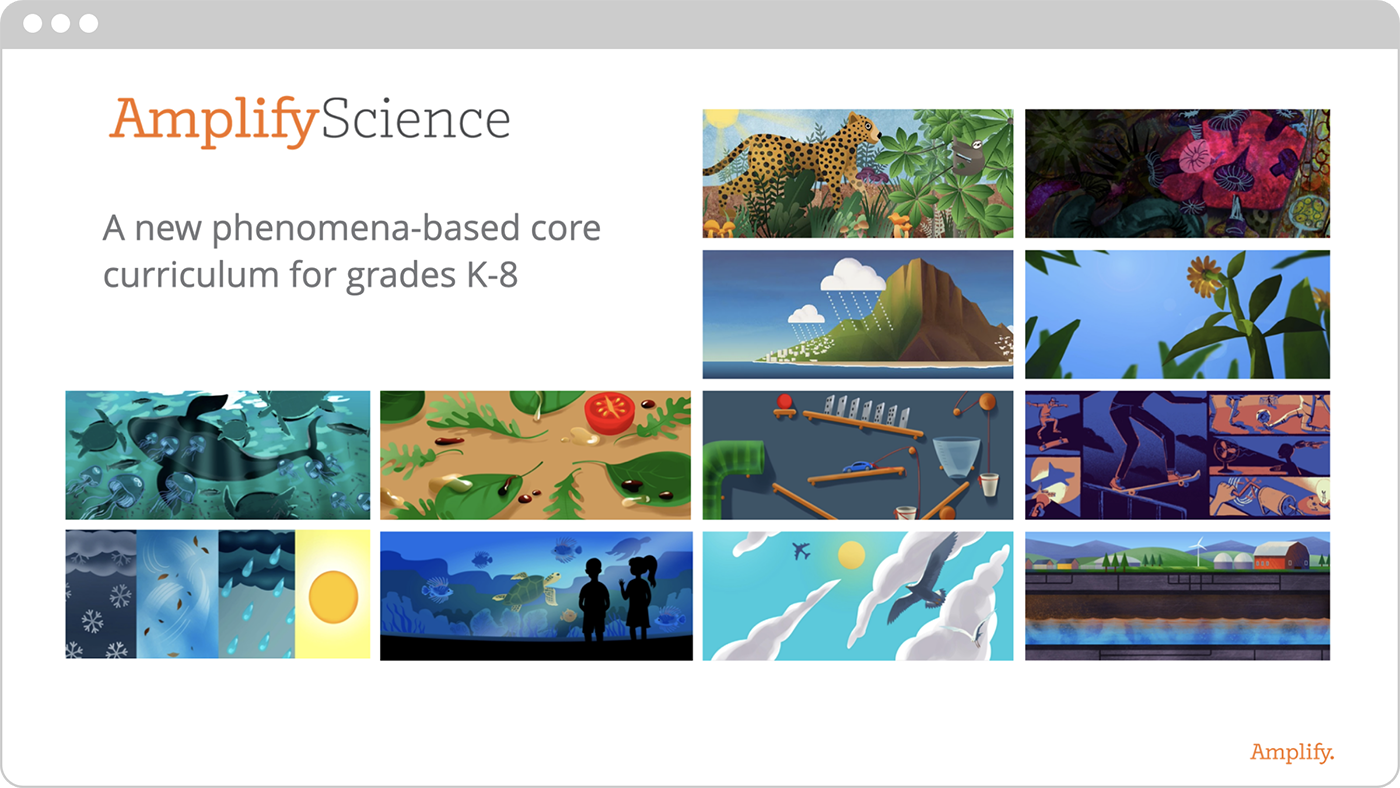
This presentation (available for download) provides a general overview of the Amplify Science curriculum. Your student’s teacher may have used this resource during back-to-school night.
Home investigations
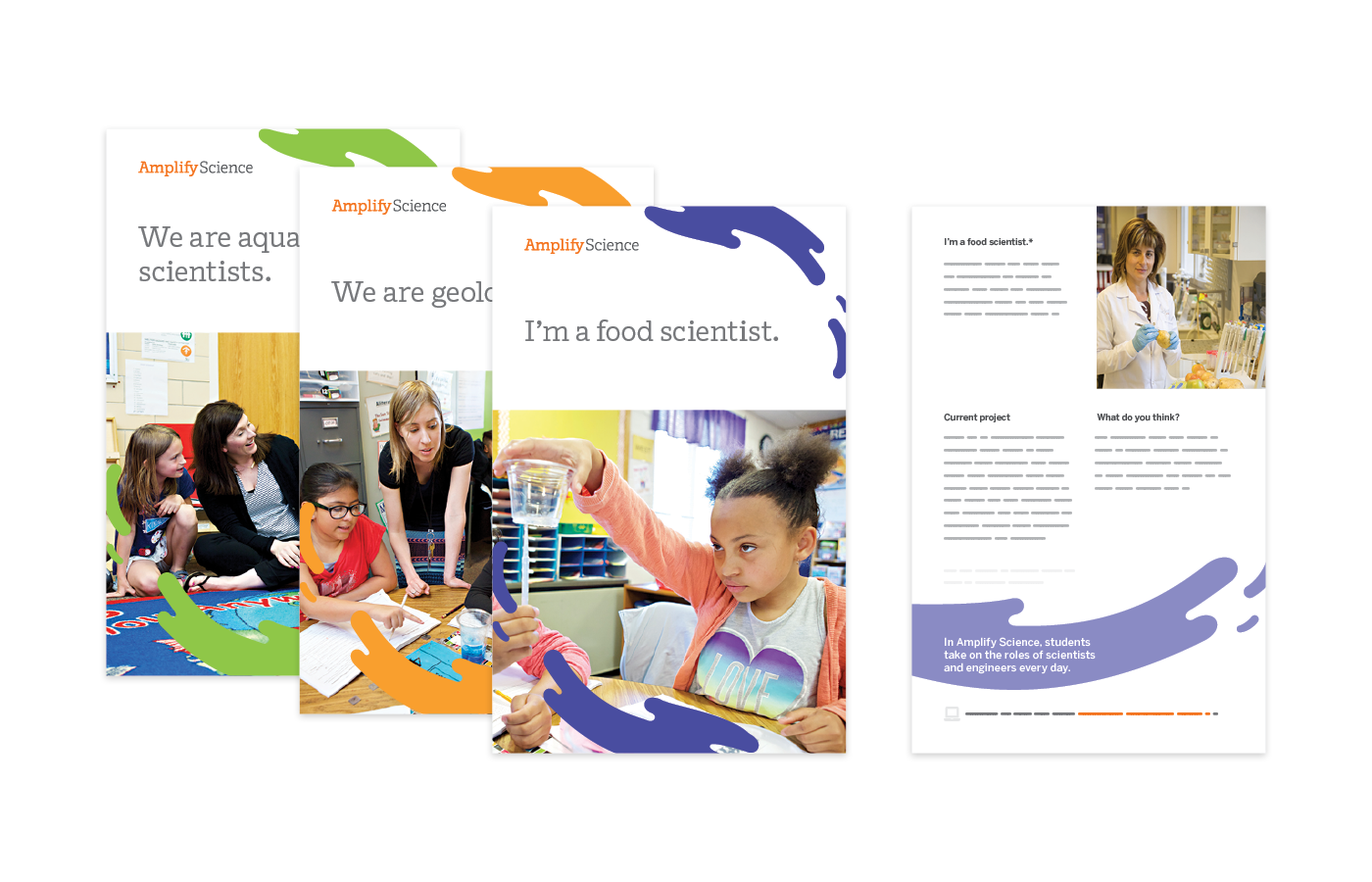
If you’re interested in extending the Amplify Science classroom experience at home use the Scientist Profile Cards to spark discussions about careers in science and engineering!
The Amplify Science program also includes several Home Investigations that you can explore with your students outside of the school day. Your student’s teacher may assign the Home Investigations as the class progresses through the units, but if you’d like to explore them on your own, you can do so by clicking on your student’s grade below:
Questions for at-home discussion
For Amplify Science families, the Questions for At-Home Discussion documents for every unit in grades K–5 contain questions for families to ask their students to help guide continued discussion and learning outside the classroom.
|
Kindergarten |
Grade 1 |
Grade 2 |
|
Grade 3 |
Grade 4 |
Grade 5 |
Contact us
We’re here to help you!
Have a question about Amplify Science? Visit our help library to search for articles with answers to your program questions. For additional curriculum support, contact your student’s teacher.
Welcome, Amplify Science middle school families!
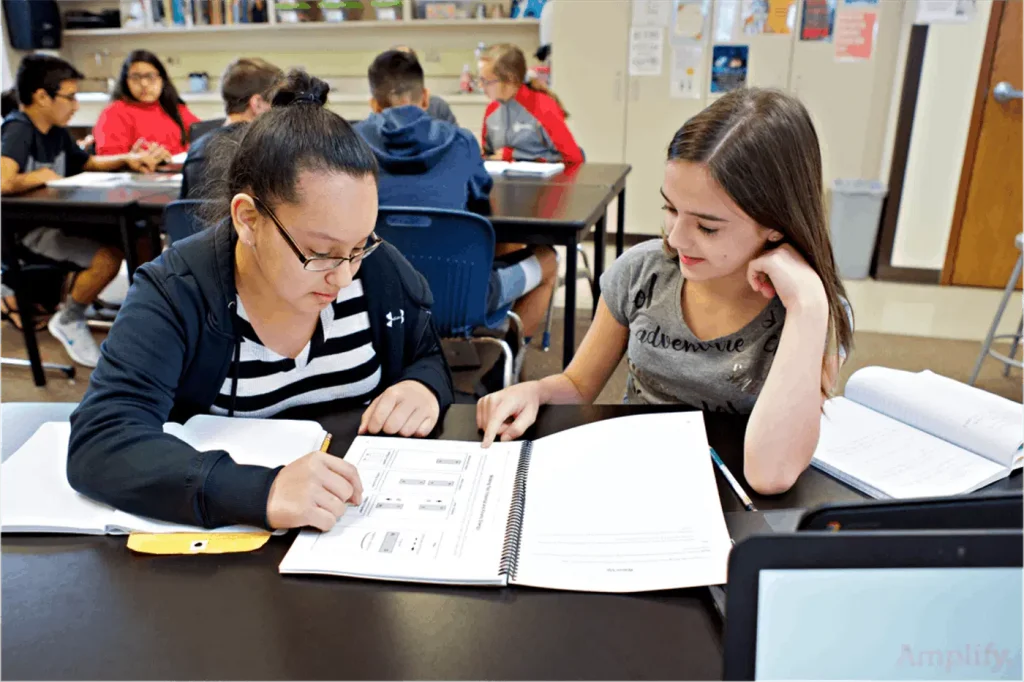
Next Generation Science Standards letter
The following letter, which is also included in the program, describes the Next Generation Science Standards and how they’re reflected in Amplify Science’s middle school units. Click here to download.
Student navigation video
Watch this video for ideas on how best to support students navigating Amplify Science.
Unit Maps
Each unit in Amplify Science has a Unit Map for the teacher. This document outlines the scientific questions students come across in the unit, and how they will figure out the answers.
Download an example of a Unit Map from the Metabolism unit.
If you’re interested in looking at the Unit Maps for your student’s grade level, please contact your student’s teacher.
Simulations
In grades 6–8, students use interactive digital simulations and other apps as just one way of figuring out unit phenomena. This short video shows an example of a simulation.
Resource for back-to-school night
This presentation (available for download) provides a general overview of the Amplify Science curriculum. Your student’s teacher may have used this resource during back-to-school night.
Family homework experiences
If you’re interested in extending the Amplify Science classroom experience at home use the Scientist Profile Cards to spark discussions about careers in science and engineering!
The Amplify Science program also includes several family homework experiences that you can use with your student outside of the school day. Your student’s teacher may assign the Family Homework Experiences as the class progresses through the units, but if you’d like to explore them on your own, you can do so by clicking on the unit names below:
- Chemical Reactions
- Earth, Moon, and Sun
- Earth’s Changing Climate
- Earth’s Changing Climate Engineering Internship
- Evolutionary History
- Force and Motion
- Force and Motion Engineering Internship
- Geology on Mars
- Harnessing Human Energy
- Light Waves
- Magnetic Fields
- Matter and Energy in Ecosystems
- Metabolism
- Metabolism Engineering Internship
- Microbiome
- Natural Selection
- Natural Selection Engineering Internship
- Ocean, Atmosphere, and Climate
- Phase Change
- Phase Change Engineering Internship
- Plate Motion
- Plate Motion Engineering Internship
- Populations and Resources
- Rock Transformations
- Thermal Energy
- Traits and Reproduction
- Weather Patterns
Contact us
We’re here to help you!
Have a question about Amplify Science? Visit our help library to search for articles with answers to your program questions. For additional curriculum support, contact your student’s teacher.
Welcome, Amplify Science families!
We’re excited to welcome you and your student to the Amplify Science program for the new school year, and to provide your student with exceptional learning opportunities through our program. We’ve assembled the following resources and guides to help you support your student and enable them to have the most productive experience with our platform throughout the year.
Para la versión en español, haga clic aquí.
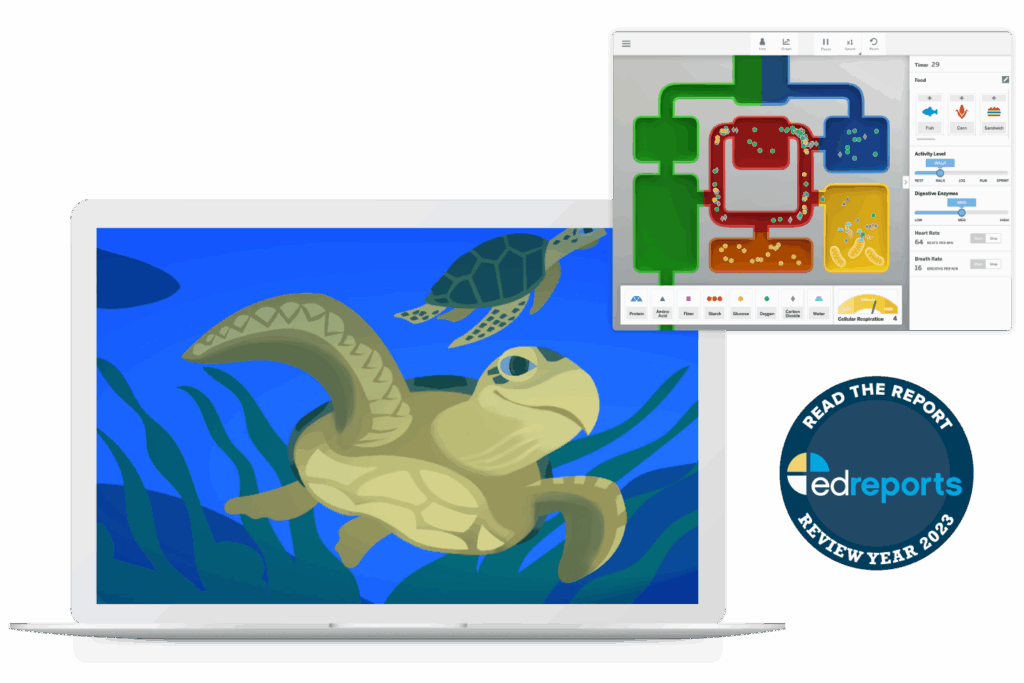
What is Amplify Science?

Amplify Science is an engaging curriculum for grades K–8 designed by experts at UC Berkeley’s Lawrence Hall of Science. As you look through the program, you may notice that it looks different from any science curriculum you’ve seen before. That’s because, in recent years, science teaching has moved away from fact-based lessons, such as those that require memorization, and toward deep learning, where students actively investigate and figure out real-world problems. This shift in science teaching and learning is reflected in new national science standards (the Next Generation Science Standards) and in—you guessed it—Amplify Science.
Getting started
While Amplify Science lessons are designed to be completed in the classroom with peers, there are some activities that students can work on at home with your support. Prior to beginning that work, we recommend reviewing this Protecting Kids Online article by the Federal Trade Commission addressing digital safety.
Materials overview
Amplify Science integrates the latest best practices in science teaching and learning. Students will have numerous opportunities to use hands-on materials, engage with readings, develop evidence-based scientific written arguments, and explore digital applications.
Watch this video for a brief overview of the Amplify Science approach and program structure.
A powerful partnership
Amplify Science is the result of a collaboration between Amplify and the science education experts at UC Berkeley’s Lawrence Hall of Science. The team of science, math, engineering, and literacy experts at the Lawrence developed the content of the program, while Amplify’s team of designers and engineers developed the tools and components that bring the lessons to life for students.
Click here for more information on the Lawrence.
Explore grade-level resources
Contact us
We’re here to help you!
Have a question about Amplify Science? Visit our help library to search for articles with answers to your program questions. For additional curriculum support, contact your student’s teacher.
Prepare for the new school year with your student!
We’re excited to welcome you and your student to Amplify for the new school year, and to provide exceptional learning opportunities through our programs. We’ve assembled the following resources and guides for you to reference to ensure your student has the most productive experience with our platform and curriculum throughout the year. Select your Amplify program below to get started!
Para la versión en español, haga clic aquí.

Select a program below:






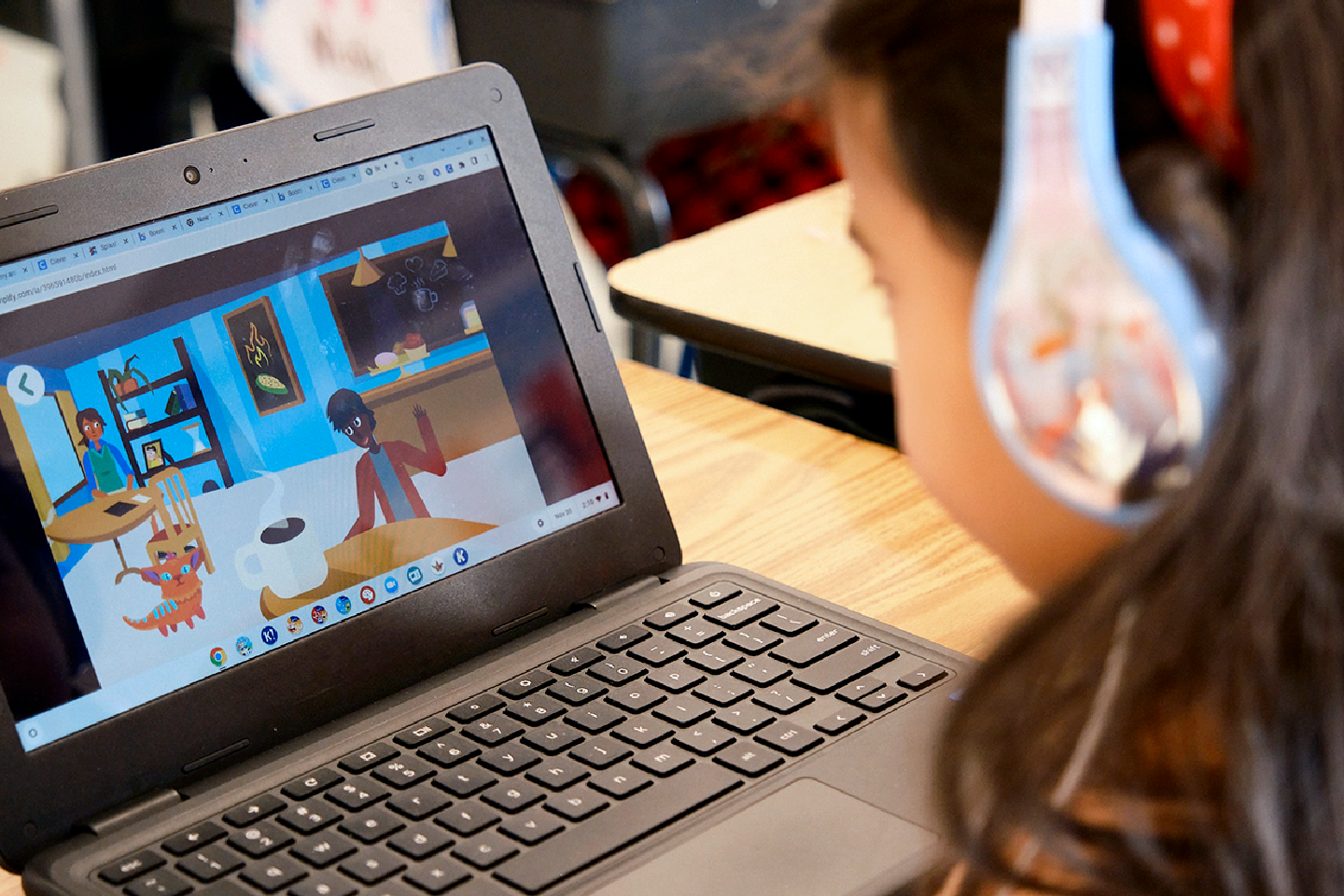



¡Bienvenidas, familias de estudiantes de Amplify Science para primaria!
Carta de los Estándares de Ciencias para la Próxima Generación
Cada unidad incluye una carta que describe los Estándares de Ciencias para la Próxima Generación y una explicación de cómo se presentan estos estándares en todas las unidades de cada grado.
Si le interesa ver cómo se incorporan estos estándares en el aprendizaje de su estudiante, haga clic abajo para descargar la carta correspondiente a su grado.
- Kindergarten (en inglés)
- Grado 1 (en inglés)
- Grado 2 (en inglés)
- Grado 3 (en inglés)
- Grado 4 (en inglés)
- Grado 5 (en inglés)
Mapas de las unidades
Cada unidad de Amplify Science incluye un mapa para los maestros. Este documento contiene las preguntas científicas que los estudiantes encontrarán en la unidad y explica cómo hallarán las respuestas.
Si le interesa saber más, haga clic abajo, en el grado de su estudiante, para descargar el Mapa de la unidad.
- Kindergarten (en inglés)
- Grado 1 (en inglés)
- Grado 2 (en inglés)
- Grado 3 (en inglés)
- Grado 4 (en inglés)
- Grado 5 (en inglés)
Simulaciones
En los grados 3–5, el uso de aplicaciones digitales interactivas es tan solo uno de los métodos que los estudiantes emplean para interpretar los conceptos de la unidad. El siguiente video muestra un ejemplo de una simulación:
Recursos para el evento de regreso a clases
La presentación siguiente ofrece una mirada al currículo de Amplify Science. Es probable que el maestro o la maestra haya presentado este recurso en el evento escolar de regreso a clases.
Haga clic aquí para descargar la presentación.
Investigaciones en casa
Si le interesa ampliar la experiencia escolar de Amplify Science en casa, vea una de las siguientes tarjetas de Perfil del científico. Considere usarlas para iniciar conversaciones sobre carreras de ciencias e ingeniería.
Haga clic aquí para descargar las tarjetas de Perfil del científico.
El programa Amplify Science también incluye varias investigaciones para hacer en casa que podrá explorar con el estudiante fuera del horario de clases. El maestro o la maestra de su estudiante podría asignar investigaciones para hacer en casa a medida que la clase avanza en las unidades, pero si desea explorarlas por su cuenta, simplemente haga clic en los siguientes nombres de las unidades. Haga clic abajo, en el grado de su estudiante.
- Kindergarten (en inglés)
- Grado 1 (en inglés)
- Grado 2 (en inglés)
- Grado 3 (en inglés)
- Grado 4 (en inglés)
- Grado 5 (en inglés)
Preguntas para conversar en casa
os documentos “Preguntas para conversar en casa” para cada unidad en los grados K-5 contienen preguntas para que las familias hagan a sus estudiantes para ayudar a guiar la discusión y el aprendizaje continuos fuera del aula.
Sepa dónde encontrar ayuda
¡Nuestro compromiso es brindarle ayuda! ¿Tiene alguna pregunta sobre Amplify Science?
Ingrese a nuestra biblioteca de ayuda para encontrar artículos con las respuestas a sus preguntas sobre el programa. Si necesita ayuda adicional con el currículo, comuníquese con el maestro o la maestra de su estudiante.
Boost Reading
- Boost Reading (K–5) is available for purchase!
- Boost Lectura (K–2) is available for purchase! Learn more here.
We are excited to share a fun Boost Reading resource that teachers can use to creatively connect with their students, while motivating them to increase their weekly Boost Reading usage. These Digital Classroom Assets have been loaded onto a Powerpoint, so that the images and slides can be used in many and varied ways to support remote instruction.
Share this Boost Reading Log to your students and they can keep track of their weekly BR time. Tip: If families have access to a printer, they can print out the file for daily use at home. Put scotch tape over the area for the date and minutes and make it a wipe-off surface! Sample photo.
Looking for ways to motivate your students? We’ve created resources to support remote engagement with Boost Reading Fun. Digital downloads below.
Click here to go back to the LAUSD homepage.

Boost Reading
- An integrated solution that leverages your DIBELS data to place students in the right learning progression for their skills.
- A supplemental digital curriculum that teaches literacy skills through a captivating game world.
- An adaptive, research-based program that immerses students in language, decoding, and comprehension and differentiates instruction based on student progress.
Boost Reading Reporting Guide
A comprehensive new resource is now available for you and your teachers. This Boost Reading Reporting Guide will help you navigate through all of the progress data that is available on the Teacher Dashboard and in Administrator Reports.
Implementation Resources
Boost Reading (K-2) is available for all schools! When your students are not learning from you, they can continue to learn on their own. And the more your kids are on it, the better they do in reading.
This year, we have made it easier than ever for teachers and students. Students do not have to wait to be assessed on DIBELS to be placed into the program.
When a student uses Boost Reading for the first time, the program determines the initial level of content they will see, based on their unique learning needs.
Students are placed into the adaptive learning map by using their most recent supported assessment data or by taking an alternate placement activity provided by the Boost program.
Once they are assessed in DIBELS, the program will automatically adjust based on that data and will give them the skills they need practice in. Teachers and students are able to directly connect to Boost Reading from the Amplify app within Schoology using their SSO. (Teachers no longer need a class login or QR code for their students.) Teachers and administrators have additional reporting features on the Boost Reading dashboard to support the progress of students.
1. Log into Schoology at lms.lausd.net.
2. Locate Amplify app and find Amplify’s Educator Home page.
3. Click into and directly connect to Boost Reading. (No additional login required.)
Administrators
Teachers
- Initial Training Video (17 mins)
- Boost Reading 2020 Updates
- Teacher Dashboard Analysis (Participant Training Notebook)
- Dashboard Data Sample
Parents/Caregivers
- Boost Reading Family Resource Site (English)
- Boost Reading Family Resource Site (Spanish)
Additional Resources
- Which Curioso Are You?
- Curioso Masks and How-to Video
- Advice and answers from the Amplify Team
Boost Reading Fun Pack
Welcome to the Amplify Science review toolkit
Simplify your NGSS curriculum review journey with the Amplify Science review toolkit.

Choose your grade
Choosing a Next Generation Science Standards curriculum can be a daunting task, so we’ve tried to simplify the process for you. Whether you have five minutes or two hours, the Amplify Science review toolkit can help you decide. Within this site, we’ve provided you with all the tools you need to review Amplify Science—including a program overview, downloadable resources, classroom videos, a program walkthrough, a sample unit, and rubrics that you can use to evaluate the program.
All you have to do is choose your grade band to get started.
Amplify Science Resources for NYC
Amplify Science is a brand-new, engaging core curriculum designed for three-dimensional, phenomena-based learning.
Welcome to Amplify Science
A powerful partnership
Amplify Science was developed by the science education experts at UC Berkeley’s Lawrence Hall of Science and the digital learning team at Amplify.


Getting Started
We are excited to start the 2021-2022 school year with you! For support with where to begin, please take a look at our NYC Getting Started documents below.
NYC Getting Started – Administrators
NYC Getting Started – Teachers
For all login instructions, including password reset instructions, please visit Getting started resources > Login Support on the K-5 or 6-8 NYC Resource Site.
Advanced Literacy Instruction
Authored by UC Berkeley’s Lawrence Hall of Science, Amplify Science is a comprehensive program that blends literacy-rich activities, hands-on investigations, and engaging digital experiences to empower New York City students to think, read, write, and argue like 21st-century scientists and engineers. Highly adaptable and user-friendly, the program offers schools and individual teachers flexibility based on their technology resources and preferences.
Amplify Science meets higher expectations for science teaching and learning in New York City in a variety of ways:
- Anchor phenomena, explored through diverse interdisciplinary contexts, serve as the foundation for compelling, coherent storylines.
- Research-based multimodal learning allows students to develop expertise in all Science and Engineering Practices (SEPs) and deep understanding of Disciplinary Core Ideas (DCIs) and Crosscutting Concepts (CCCs) through repeated experiences within a wide variety of contexts.
- Integrated literacy support allows students to build the reading, writing, listening, and speaking skills necessary to obtain, evaluate, and communicate information about the natural world.
- Modeling tools enable students to create, and later revise, visualizations of their ideas of key scientific phenomena at critical points in the curriculum.
- Embedded engineering in units focused on engineering and technology emphasize that there’s not always one right answer, as students balance competing constraints to design the best justifiable solutions.
COVID-19 Remote and Hybrid Resources
As part of the response to the ongoing covid-19 pandemic, Amplify has created guidance for using our programs remotely. Please visit our Program Hub accessible via your Teacher Platform for all of our hybrid and remote learning supports.
For additional remote learning resources specifically for NYC DOE, please visit the respective K-5 or 6-8 pages (links at the bottom of this page) for more information.
Select Your Grade-Level
Welcome to Amplify Science
You’ll be up and running in no time!

About this site
Let’s get started.
Select your role.
Inspiring the next generation of scientists, engineers, and curious citizens
Amplify Science is a breakthrough curriculum designed to address the NYS Science Learning Standards. Authored by the industry-leading team at the Lawrence Hall of Science, Amplify Science is a highly-engaging, phenomena-based curriculum for grades K–8 that integrates the latest research and practices in science education, as well as interactive digital tools and hands-on activities, to teach students to think, read, write, and argue like real scientists and engineers.

Amplify Science for elementary school
Our complete program for grades K–5 recognizes the importance of students’ engagement with hands-on experiences, and amplifies those with literacy-rich activities, closely aligned digital materials and award-winning, informational books.
- Learn more about Amplify Science
- Review the K-5 NYSSLS Correlations
- Download the K-5 unit sequence
- Hear from K–5 teachers
Amplify Science for middle schools
Our complete program for grades 6–8 is a new curriculum that integrates the latest strategies in science teaching and learning with phenomena-driven storylines, hands-on investigations, and interactive digital tools to inspire the next generation of scientists and engineers.
Ready to learn more?
Ready to take a closer look? Request a sample of Amplify Science.
Reading and literacy integration
Amplify Science is a new phenomena-based science curriculum for grades K–8.
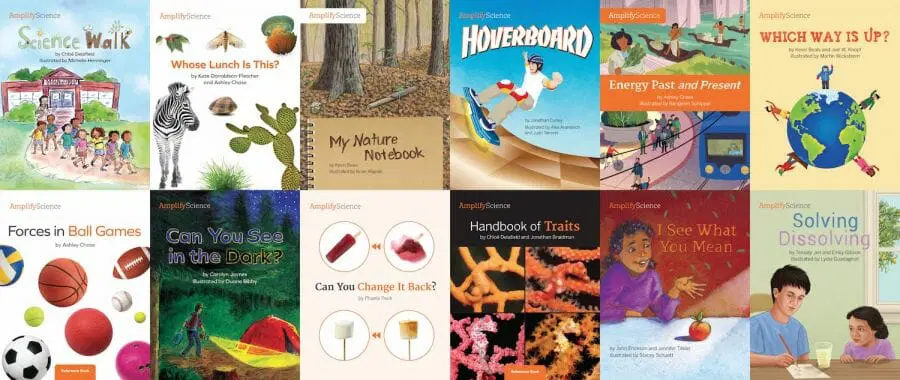
Reading and literacy integration
Amplify Science units provide strategy-based literacy instruction that aims to develop students’ facility with reading, writing, and talking about science. Each unit provides many authentic opportunities for students to learn about and practice the ways of communicating and learning that characterize science as a discipline. The following are the Amplify Science Guiding Principles for Literacy:
- Students acquire literacy expertise through the pursuit of science knowledge and by engaging in scientific and engineering practices.
- Attention to discipline literacy instruction should begin as soon as students enter school and should continue throughout the grades.
- Participation in a disciplinary community is key to acquiring disciplinary expertise and literacy.
- Since the purpose of science is to better explain the natural world, argumentation and explanation are the central enterprises of science. Therefore, these practices are central foci of reading, writing, and talk in science.
Literacy instruction in the Amplify Science program utilizes a Gradual Release of Responsibility approach (Pearson and Gallagher 1983). In this approach, instruction begins with the teacher assuming primary responsibility for modeling strategy or skill and explicitly instruction how to use each strategy or skill. As instruction proceeds, the teacher offers as much support as needed so students can practice using the target strategy more independently. Over time, students take on more responsibility for using the strategy more independently. Depending on the goal, the path from teacher modeling to student independence will vary. Over the course of a unit, students may not achieve independence for every literacy goal, but they will move along the continuum toward flexible use of a wide range of reading, writing, and learning strategies that have been incorporated throughout the program.
Each Amplify Science Elementary Unit includes five books that students use to build an understanding of science ideas, practices, and crosscutting concepts. While the program does not take on responsibility for providing all literacy instruction required for students’ reading development (e.g., skill-based or fluency-oriented literacy instruction), it is designed to support vocabulary, language, and reading comprehension development.
Amplify Science provides students with a series of content-rich nonfiction and informational texts that are read for a variety of purposes throughout the unit. The five books in each unit include one book for approximately every five days of instruction and one reference book that students draw upon throughout the 22-lesson units (20 instructional lessons & 2 assessment days for pre/post). Students are encouraged to read books as independently as possible so they can apply the comprehension strategies they are learning in order to understand what they read. In each Amplify Science reading session, comprehension is supported at three stages: before, during, and after reading. At each stage, students engage in planned tasks that build an understanding of the key concepts and themes in a book. The teacher’s role is to scaffold comprehension and provide opportunities for practicing the strategies and skills that are being taught. At each stage, these include:
- Before-reading activities designed to help students activate their background knowledge, prepare to use particular comprehension strategies, and set a purpose for reading.
- During-reading activities intended to help students monitor their comprehension, make connections, and read and understand important science vocabulary in context.
- After reading activities intended to help students reflect on their learning and connect their reading to their firsthand science investigations.
Nonfiction and informational text. The Amplify Science program is designed to help students gain familiarity with the structures and functions of nonfiction and informational texts by extending students’ exposure to these texts in a rich learning environment. The program uses nonfiction and informational texts because it is an important component of content learning in school; it helps build knowledge of the natural and social world, and it provides students with a purposeful context for learning key concepts and vocabulary. Nonfiction and informational text are also engaging and motivating as it answers genuine questions and capitalizes on student interests and background knowledge. Reading a wide variety of texts have been shown to affect students’ interest in reading overall (Duke 2004). Nonfiction and informational genres are also the genres students are most likely to encounter when reading and writing inside and outside of school. For adults, nonfiction and informational texts are read more often than other genres (Duel 2004; Smith 2000). In order for students to become successful information gatherers as adults, we need to provide opportunities for them to engage with nonfiction and informational texts in school.
Reading comprehension. Reading instruction in Amplify Science is designed to promote students’ capacity to read for meaning. Guided instruction and a supportive classroom context help students learn to employ powerful comprehension strategies that are critical for gaining a better understanding of text and becoming skilled readers (Duke and Pearson 2002). Comprehension strategies included in the Amplify Science program include posing questions, making inferences, setting goals for reading, summarizing, synthesizing, and using text features. Across units, students are guided to use these strategies flexibly as they read and make sense of a wide range of nonfiction and informational texts. Students also gain critical experience with understanding texts and experiences in relation to one another as they make connections between the books they read and the science they do. These connections then extend their growing conceptual understanding. Reading instruction in Amplify Science also encourages students to reflect on the utility of comprehension strategies, including when, why, and how these strategies helped them. One important way students make connections is through sustained classroom discussion of text with their peers (Nystrand 1997). Students regularly discuss both content and comprehension use before, during, and after reading, learning more about both as they engage in discussions with their peers. The Amplify Science approach also draws on research that demonstrates the benefits of instructional coherence (connected reading, writing, listening, and talk), particularly in the content area of science (Romance and Vitale 2001; Cervetti et. al. 2007; The Directed Reading Model supports reading comprehension before, during, and after reading. Cervetti et. al. 2006). Reading comprehension is enhanced as students connect what they read to what they are investigating and learning in science. The Amplify Science student books provide many opportunities for students to practice their developing reading skills in context, engage in authentic discourse around text, make connections, and support their understandings with textual evidence.
We are the program for Indiana’s middle school students and teachers.
Amplify ELA is a blended curriculum. We built Amplify ELA to help you make sure the standards are covered, the skills are taught, the test is prepped for, and your students are scaffolded and encouraged. What’s more, everything is done in the background. That way, you can spend your time bringing the text to life, making the classroom hum, and letting each student know you are paying attention to their growth.

Program overview

Amplify ELA is a hybrid curriculum designed specifically for grades 6–8. The heart of every lesson is the text. Each grade includes six units centered on literary or informational texts, delivered in several forms of media. Your classroom will also benefit from two or three immersive learning experiences called Quests and a dedicated Story Writing unit.
- Full standards coverage: Standards are clearly labeled in each lesson overview, so teachers can save time planning and get back to what they love: teaching.
- Five levels of differentiation: Based on each student’s needs and the performance measures within Amplify ELA reports, a teacher can choose the differentiation level that’s the right fit for everyone.
- Embedded assessments: Teachers benefit from uninterrupted instructional time and a continuously updated picture of each student’s progress with key skills and standards.
- Powerful feedback tools: Comprehensive tools help teachers maximize both the quantity and quality of feedback.
- Robust reporting: Our reporting app offers information on student progress to help inform instructional decisions.
- All in one place: Embedded teacher support, differentiation tools, student data, text and other curriculum features—they’re all right there.
Materials
Discover print and digital materials included in the program.
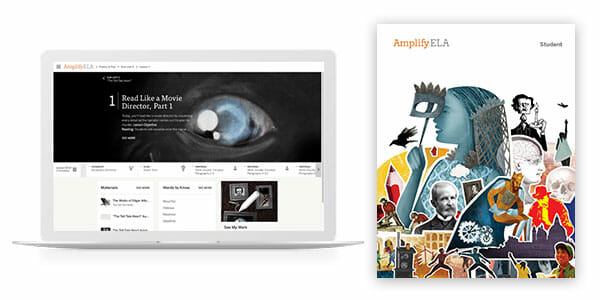
Student edition
Available digitally and in print, the student materials guide middle schoolers through complex texts and writing by:
- engaging students with high-quality narrative and informational texts, providing videos, audio supports, and digital experiences that capture their attention, and
- keeping all of their writing in one place with the personal writing journal.
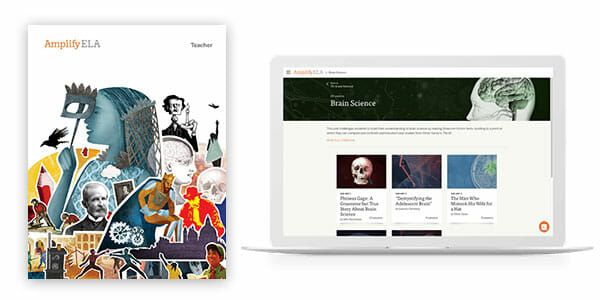
Teacher edition
Available digitally and in print, the Teacher edition contains all of the information teachers need to facilitate classroom instruction, including:
- detailed lesson plans
- video teacher tips embedded in the lesson
- standards alignment and exit tickets
- real-time differentiation strategies
- robust reporting

Interactive Quests
Fun, week-long explorations where students practice analytical reading, writing, speaking, and listening skills, all while building a strong classroom community.

Digital library for independent reading
Amplify Library: Our expansive digital library includes more than 650 fiction and nonfiction, classic, and contemporary titles.
Resources
Learn more about Amplify ELA and how we address the unique needs of middle school students.
Program sample guide

Table of Contents

Experts & presenters

Deb Sabin
Chief Academic Officer, Amplify ELA
Deb Sabin leads Amplify’s curriculum development teams for ELA. Previously she was Director of Instruction and Training for The Writer’s Express. She’s been an ELA teacher in a variety of classrooms from alternative high schools to elite prep schools and international dual language programs.

Jeff Dannemiller
Product Specialists, Amplify
Jeff works with educators across the country, helping them get the most out of their middle school students with reading, writing, and developing all the other skills necessary for high school and beyond.
Contacts

Nathan Toles
Field Manager
ntoles@amplify.com
(317) 430-7879

Jackie Roper
Senior Account Executive
jroper@amplify.com
(312) 202-2598

Casie Rayes
crayes@amplify.com
(480) 549-7531
Welcome, Tennessee educators!
On this site, you will find the following information to assist you as you review Amplify Core Knowledge Language Arts (CKLA): a program overview to get you started, the CKLA knowledge sequence, comprehensive program guides for a deeper dive into the research base and day-to-day instruction, and other useful information. You’ll also find a month’s worth of lessons for each grade level.
Amplify CKLA was developed by the Core Knowledge Foundation and Amplify.

Getting started
Welcome to Amplify CKLA, a comprehensive reading and language arts curriculum built on today’s rigorous standards. CKLA delivers superior results through a uniquely research-based approach, combining step-by-step foundational skills with meaningful content knowledge in science, history, literature, and the arts. By focusing deeply on building students’ knowledge base, CKLA levels the playing field for every child.
Read the program overview to learn more about CKLA’s unique approach.
Grades K–2
In grades K–2, Amplify CKLA is segmented into two distinct strands: Knowledge and Skills.
Skills Strand: Skills Strand lessons build a strong foundation for students through daily instruction in phonemic awareness, spelling patterns, decoding with engaging, decodable texts, writing mechanics, and writing structure and processes.
Knowledge Strand It is vital to build students’ knowledge and vocabulary while they are still in the process of learning to read. In doing so, you better ensure their long-term success. CKLA’s Knowledge Strand is based on that very principle.
Grades K–2 Resources
K–2 materials
Core components for grades K–2:
Teacher Guide
You’ll find step-by-step lessons that are comprehensive, engaging, and support every learner.
Activity Book
With an integrated approach to reading and writing, students practice new sound-spellings by reading them in diverse contexts and then writing in response to the text.
Reader
Unlike other decodable texts, CKLA’s Readers feature engaging plots and characters, making the process of learning to read rewarding.
Grades 3–5
In grades 3–5, the Skills and Knowledge strands are integrated. As part of the curriculum’s research-based design, students in grades 3–5 spend several weeks immersed in sequenced domains in science, history, and literature, deepening both critical literacy skills and background knowledge.
Grades 3–5 Resources
Grades 3–5 materials
Core components for grades 3–5:
Teacher Guide
Teacher Guides for each unit provide step-by-step guidance, clear lesson objectives, and formative assessment as well as differentiated supports to empower teachers with proven strategies and research-based tools.
Activity Book
Anchored by the unit’s text, Activity Books immerse students in content-rich learning for deeper comprehension. They provide daily opportunities for students to respond to text while applying knowledge and serve as formative assessments connected to each day’s objectives.
Reader
Rich in knowledge and diverse in content, Student Readers are the foundation of each unit as students dive into increasingly complex text and sharpen their analytical skills. From geology to the Middle Ages, students engage with a truly diverse range of topics.
Contact us

Chasity O’Quinn
Account Executive for East Tennessee
coquinn@amplify.com
(865) 599-5101

Ann Patterson
Account Executive for West Tennessee
apatterson@amplify.com
(704) 813-7757
Amplify’s universal and dyslexia screening in one too
Measure what matters

mCLASS® with DIBELS 8th Edition® provides a formative assessment solution that supports the identification of students at risk for reading difficulties, including difficulty related to dyslexia. DIBELS 8th Edition was developed by the University of Oregon with the primary focus of ensuring that the measures are able to meet state-level dyslexia screening requirements.
How mCLASS identifies students at risk of dyslexia
When screening for risk, nothing can replace the power of listening to a child read—listening to their strengths as a reader AND their struggles.
With mCLASS, teachers administer predictive one-minute assessment measures that involve listening to students interact with sounds, letters, words, and text while screening for reading difficulties.

Identifying at-risk students: What comes next?
Research and statistics about dyslexia in early literacy
90 percent of students who struggle in third grade will continue to struggle at the end of elementary school if they do not receive the intervention.
74 percent of students who are poor readers in third grade will be poor readers in ninth grade, and, in general, have a higher risk of academic failure and school dropout.
According to a 2015 National Assessment of Educational Progress study, only 35 percent of fourth-grade students were proficient in reading. Most of these children will spend the rest of their time in school trying to catch up
mClass solutions
mCLASS Instruction provides teachers with a single view of the personalized, blended instruction (teacher-led and online) that is available to support individual student or small-group needs in skill areas directly assessed in the mCLASS assessment.
Employ teacher-led instruction for whole classes, small-groups, and individual students, including activities created by Susan Hall, author of I’ve DIBEL’d, Now What, are provided for skill practice.
Additional instructional resources for comprehension include grade-level passages that provide more practice.
Get online student instruction and practice with Amplify Reading, which places students in a personalized instruction path based on mCLASS assessment data and adapts based on progress in the curriculum. Students engage with skills-based games as well as an eReader.
Receive rigorous, teacher-led intervention with mCLASS Intervention to address students most in need of support.
Teachers can download a letter with student assessment results to send home to parents and guardians, or use as a basis for discussion at conferences. Home Connect letters describe how the measures relate to skills development. Progress bars indicate the student’s performance on each measure.
Home Connect extends reporting to parents and guardians in a way that is easily understood and provides suggestions for positive action.
Dylexia Resources and Materials
Resources

Connecting the science of reading to assessment
Recorded on: Tuesday, February 4, 2020 at 2–3 p.m. ET
What exactly does the science of reading say about early literacy assessment? Hear from an expert on how to align assessment to the science of reading.
Request a demo
mCLASS with Amplify Reading offers Amplify Reading’s engaging and adaptive instructional layer alongside mCLASS’s best-in-class literacy assessment. Simply complete the form to request a demo, and an Amplify sales representative will be in touch.
Welcome, Tennessee educators!
We’re so excited to be on this journey with you. So much is hard to predict right now—about learning, and about life. What’s not changing? Literacy as learning bedrock, and the need to teach it well. We’re here to help.

Louisiana review of Amplify ELA for middle school
Inspiring the next generation of St. Tammany scientists, engineers, and curious citizens
Welcome Amplify Science educators! Test
Amplify Science
Benchmark assessments
The Next Generation Science Standards Benchmark Assessments by Amplify give you insight into how your students are progressing toward mastery of the standards ahead of high-stakes end-of-year assessments. The Benchmark Assessments measure and report on the three dimensions and performance expectations of the NGSS.
The NGSS Benchmark Assessments are designed to test all standards, with multiple assessment opportunities per year. The assessment forms are paced to align with the Amplify Science curriculum sequence. Assigned digitally or as PDFs, the assessments are designed to be given three or four times per year.
Click below to preview the NGSS Benchmark Assessments:
Note: the NGSS Benchmark Assessments were developed for the national edition of Amplify Science, and we will work with the New York City Department of Education to modify for New York City.
The Amplify NGSS Benchmark Assessments were authored by Amplify and were not developed as part of the Amplify Science program or created by the Lawrence Hall of Science.
Boost Reading+ sessions overview
| Title | Duration | Modality | Audience |
|---|---|---|---|
| Launch Sessions | |||
| Initial training | Half day | Onsite/Remote | New Boost Reading+ customers |
Launch sessions
Initial training
Half day (3 hours)
The initial half-day training will explain how Skills Boost combines assessment, targeted instruction, personalized practice, and intervention to accelerate students’ reading growth. It will also support educators in administering program placement to students, utilizing the teacher dashboard to monitor students’ progress, and implementing 9-day lesson plans for students who require intervention.
Audience: Teachers (administrators welcome), maximum 30 participants
Modality: Onsite/remote
Pricing
| Session type | Pricing |
|---|---|
| Half-day onsite session | $2,500 |
| Half-day remote session | $750 |
Contact
Amplify welcomes the opportunity to partner with schools and districts to design professional development plans and answer your questions.
If you would like to order any of our professional development services, please contact your local Amplify sales representative or call (800) 823-1969.
Amplify professional development: Coaching
Amplify Science
A new phenomena-based science curriculum for grades K–5.
A disciplinary literacy approach to learning science
Literacy is an integral part of science. Scientists read, write, listen, and speak in order to obtain, evaluate, and communicate information about the natural world. They explain their findings, conduct research, connect to the work of other scientists, and communicate ideas to a variety of audiences. In the Amplify Science program, students learn to read, write, and speak as scientists do as they acquire facility with the academic language and vocabulary of science. Through the seamless integration of science and literacy instruction, students also learn that reading, writing, and talking are essential practices of science, and that all scientists use these practices to gather information, communicate claims, leverage evidence, draw conclusions from data, and share their ideas through oral and written explanations and arguments.
Situating literacy instruction in a content area like science has several benefits. First, it helps students develop ways of thinking that are characteristic to the discipline. Second, building background knowledge in a discipline also helps students access complex content in texts that can be difficult to grasp. Finally, situating literacy in a content area like science provides an authentic reason for reading, writing, and talking — to better understand the science ideas under study. Reading, like science, can be an act of inquiry when there are genuine questions to be investigated.
The following are the guiding principles for disciplinary literacy in the Amplify Science program:
- Students can acquire literacy expertise through the pursuit of science knowledge and by engaging in scientific and engineering practices.
- Attention to disciplinary literacy instruction should begin as soon as students enter school and should continue throughout the grades.
- Participation in a community is key to acquiring disciplinary expertise and literacy.
- Argumentation and explanation are the central enterprises of science and, thus, these practices are the focus of reading, writing, and speaking in science.
Reading in Amplify Science
Amplify Science provides students with well-written, grade-level appropriate informational texts alongside explicit, embedded instruction on reading in science. Throughout the program, students are apprenticed into reading like scientists – that is, reading actively, curiously, and critically, with a focus on making meaning and using the text as a source of evidence. As students read science texts in conjunction with other multimodal experiences around a topic (doing, talking, visualizing, writing), they increase their skill in accessing these complex texts, as well as their understanding of the importance of text for finding information. Reading informational text is inexorably linked to students’ investigations in each unit. Firsthand investigations provide background knowledge and context for students’ reading, and, in turn, the text provides information, evidence, and support for investigations in progress. In addition, the program includes many books and articles that introduce diverse scientists currently working in the field to highlight science and engineering as a vibrant and viable career choice for students.
Reading in Amplify Science is approached from an inquiry stance – students ask questions, make connections, evaluate information, search for evidence, and clarify difficult concepts as they read. This approach focuses on the practices and processes by which experts in a field obtain, evaluate, and communicate information, including arguments, explanations, data, and visual representations used to explain scientific concepts. Across the program, the teacher models, and students practice, reading like scientists while using reading strategies and approaches that are appropriate to the task, purpose, and grade level. Along with explicit instruction, teachers model strategic reading by thinking aloud as they read, asking questions, and linking the information in the text to their class’s investigations. Students are then provided with multiple opportunities to read and discuss ideas with peers, using the text as a resource for information and evidence. Reading and discussing texts in these ways builds students’ capacity to read strategically while simultaneously building their understanding of science content. The scaffolded reading experiences at each grade level help students learn to approach complex texts in systematic ways and will aid them as they read other science texts throughout their school careers.
TEXT DESIGN AND ACCESSIBILITY Each Amplify Science unit includes custom-written informational texts. In K–5, there are five student books (four informational books and one reference book) per unit; in grades 6–8, there are multiple student articles per unit. These informational texts are designed to support students’ understanding of science ideas, practices, and crosscutting concepts, as well as to showcase the work of diverse scientists. An important goal of the Amplify Science program is to provide appropriately complex science texts for students that support, link to, and expand their firsthand science learning. To accomplish this goal, it is critical that the texts are accessible to as many students as possible. All Student Books, articles, and other student materials are reviewed for accessibility and readability using the three-dimensional model of text complexity (qualitative, quantitative, and reader-and-task considerations) set out by the Common Core State Standards for English Language Arts (CCSS-ELA).
The qualitative dimension of text complexity focuses on the purpose, structure, language conventions, and knowledge demands of a text. Books and articles were written, reviewed, and edited by members of the Lawrence Hall of Science team of professional educators and science writers during the development of each unit. They are tailored to address concepts students are learning in the unit, and use the same language and vocabulary throughout so students encounter consistent terminology across modalities of learning (reading, writing, doing investigations, discussing).
The texts also include carefully created or selected visual representations such as diagrams, photographs, and illustrations that support and/or provide additional information. The placement of each book or article within the instructional sequence is carefully designed and classroom-tested so that the text is supportive of student content learning in a variety of ways, and provides just-in-time information, reinforcing key ideas or introducing new ones within the unit.
On the quantitative dimension, each book and article was designed and reviewed using internally developed criteria for each grade. Each book or article was analyzed against a list of commonly used words, as well as criteria for calculating the difficulty of decodable words. The number of unique hard words in each text was controlled, with the percentage of hard words varying based on the grade level. At the same time, a small set of core science vocabulary words related to the science ideas students are learning was repeatedly used across a set of books or articles because repeated encounters with words in context is one way that students learn and internalize them. In addition to our internal approach to readability, each book or article in grades 1–8 was analyzed by MetaMetrics and assigned a Lexile Measure. This allowed us to ensure that books and articles fall within recommended Lexile Measures found in the updated Text Complexity Band in Supplemental Information for Appendix A of the Common Core State Standards for English Language Arts and Literacy: New Research on Text Complexity.
Reader and task considerations are related to whether a particular text is appropriate for particular students and particular tasks. The placement of books within the Amplify Science program of instruction was carefully considered as part of unit design. Books were strategically placed within the sequence of instruction to ensure they are appropriately tied to what students are learning and that students are adequately prepared to read them with appropriate support. Sometimes this means that students read a text before conducting a firsthand investigation because it serves the purpose of activating and enhancing students’ background knowledge about a topic and sparking an interest in a scientific idea. At other times, students read a book after they have had a chance to investigate and develop ideas about the phenomenon firsthand because reading will help them generate more evidence to support claims. We cannot know all the individual learning needs of every reader the program reaches; however, the design and placement of the books was also informed by survey data from field trial teachers. These teachers were asked to evaluate field trial versions of the books and accompanying lessons based on several criteria, and to comment on how well the instruction and respective text worked for different readers.
More information on reading in Amplify Science available through in-person professional learning and within the Program Guide included with purchase.
Amplify Science
A new phenomena-based science curriculum for grades K–5.
Universal Design for Learning
Universal Design for Learning (UDL) is a research-based framework for improving student learning experiences and outcomes by focusing on careful instructional planning to meet the varied needs of students. UDL is not a special-education initiative. Through the UDL framework, the needs of all learners are considered and planned for at the point of first teaching, thereby reducing the need for follow-up or alternative instruction. Following the principles of UDL, Amplify Science units and lessons are designed to be universal and flexible in allowing choice; different paths toward goals; and multiple means of engagement, representation, action and expression, and assessment, so that all students have an opportunity to learn during lessons and be successful with lesson and unit goals. While Amplify Science lessons are intentionally designed to be universal and flexible, each student is unique and teachers will need to understand their students’ individual learning strengths and needs in order to refine or enhance lessons through differentiation strategies to make them truly universal. All lessons are designed with a range of students in mind, providing multiple points of entry and modalities of learning (e.g. talking to peers, viewing short explanatory videos, reading, writing, conducting investigations, etc.) for students to engage with the content. In addition, to support teachers with the decisions they need to make in order to ensure that all students have access to learning, each lesson contains a Differentiation Brief that outlines specific supports for diverse learners, as well as flexible options for adapting lessons according to students’ needs. UDL principles and guidelines, as well as practical suggestions for classroom teaching and learning, can be found at the National Center for UDL (udlcenter.org).
Differentiation strategies to support all students
Amplify Science provides a differentiated path for all students to thrive in the science and engineering classroom. Following the principles of UDL, lessons and Differentiation Briefs were designed to provide teachers with detailed guidance on supporting students with diverse learning strengths and needs, with a particular focus on English learners and long term English learners, standard English learners, students experiencing stressful living conditions (students living in poverty, foster youth, migrant students), advanced learners, girls and young women, students with disabilities, and students experiencing academic learning challenges.
Assessments
Credible. Actionable. Timely. The assessment system for each Amplify Science unit is designed to provide teachers with actionable diagnostic information about student progress toward the learning goals for the unit. Assessment of unit learning goals is grounded in the Unit Progress Build (PB), which describes how student understanding is likely to develop and deepen through engagement with the unit’s learning experiences. The assessment system includes formal and informal opportunities for students to demonstrate understanding and for teachers to gather information throughout the unit – all while giving teachers flexibility in deciding what to score and what to simply review. Built largely around instructionally-embedded performances, these opportunities encompass a range of modalities that, as a system, attend to research on effective assessment strategies and the NRC Framework for K-12 Science Education.
The variety of assessment options for Amplify Science include:
- Pre-Unit Assessment (formative): discussion, modeling, and written explanations to gauge students knowledge.
- On-the-Fly Assessments (OtFA) (formative): each OtFA includes guidance on what to look for in student activity or work products, and offers suggestions on how to adjust instruction accordingly.
- End-of-Chapter Problem Context Explanations (formative): Three-dimensional performance tasks to support students’ consolidation of ideas encountered in each chapter and provide insight into students’ developing understanding.
- Self-Assessments (formative): One per chapter; brief opportunities for students to reflect on their own learning, ask questions, and reveal ongoing wonderings about unit content.
- Critical Juncture Assessment (CJ) (formative): Occurring at the end of each chapter similar in format to the Pre-Unit and End-of-Unit assessments.
- End-of-Unit Assessment (summative): discussion, modeling, and written explanations to gauge students’ knowledge and growth.
Hands-On and Print Materials (“Kits”)
There is a box of materials associate with every unit of Amplify Science, containing a variety of hands-on activities and print materials that are called for in the various lessons in the unit. Each box, commonly called a “kit,” is associated with a given unit, and each teacher should ideally have their own kit for each unit.
Hands-on brochures
*One blackline master Student Investigation Notebook is included in each unit kit, grades 3–5.
Within the kit there are two types of materials:
- Physical manipulatives
- Printed materials
The physical manipulatives are the hands-on items used in various lessons in the unit. For example, the Balancing Forces kit contains balloons, batteries, magnets, fasteners, rubber balls, and various other materials.
There are two types of physical manipulatives: consumables and nonconsumables. Nonconsumables are durable and, if cared for properly, can be used over the course of several years. Consumables are used up with each use and must be replenished.
There are also print materials in the kits, including:
- Key concepts: Teachers designate an area of the classroom wall to post “Key Concept” printed cards. These cards contain short sentences that explicitly identify an important idea or concept learned in the unit. By posting that card to the wall, the classroom has a visual anchor – a physical representation of “what we’ve learned so far.”
- Vocabulary wall: Like the Key Concepts, Vocabulary cards are provided in your unit’s kit. These, too, are posted to a designated area of the classroom wall, and more and more vocabulary cards are added to the wall as we progress through the unit.
- Unit and Chapter Questions: Printed cards with the unit question and individual chapter questions are also provided in the kit. These cards help students to remember exactly what we are investigating over the course of the chapter, and ultimately, over the course of the unit.
- Card Sets: Printed cards, specific to a unit, are in each kit (though not all units have Card Sets). Often, students are sorting these cards on their desks, ranking them, ordering them, etc. For example, in the Metabolism unit, students take “Evidence Cards,” each with a piece of evidence, and then rank and arrange the evidence cards from strong-> weak->irrelevant, thereby providing a visualization of their thinking and reasoning.
Preview Amplify Science: NYC
Start your view by simply selecting “Preview the Curriculum” and then selecting either Teacher or Student access. We recommend selecting Teacher access as you will also be able to see the student resources.
Looking for help reviewing the program? Reach out to a New York City Amplify Science curriculum expert.
Reading and Literacy Integration
Amplify Science units provide strategy-based literacy instruction that aims to develop students’ facility with reading, writing, and talking about science. Each unit provides many authentic opportunities for students to learn about and practice the ways of communicating and learning that characterize science as a discipline. The following are the Amplify Science Guiding Principles for Literacy:
- Students acquire literacy expertise through the pursuit of science knowledge and by engaging in scientific and engineering practices.
- Attention to discipline literacy instruction should begin as soon as students enter school and should continue throughout the grades.
- Participation in a disciplinary community is key to acquiring disciplinary expertise and literacy.
- Since the purpose of science is to better explain the natural world, argumentation and explanation are the central enterprises of science. Therefore, these practices are central foci of reading, writing, and talk in science.
Literacy instruction in the Amplify Science program utilizes a Gradual Release of Responsibility approach (Pearson and Gallagher 1983). In this approach, instruction begins with the teacher assuming primary responsibility for modeling strategy or skill and explicitly instruction how to use each strategy or skill. As instruction proceeds, the teacher offers as much support as needed so students can practice using the target strategy more independently. Over time, students take on more responsibility for using the strategy more independently. Depending on the goal, the path from teacher modeling to student independence will vary. Over the course of a unit, students may not achieve independence for every literacy goal, but they will move along the continuum toward flexible use of a wide range of reading, writing, and learning strategies that have been incorporated throughout the program.
Each Amplify Science Elementary Unit includes five books that students use to build an understanding of science ideas, practices, and crosscutting concepts. While the program does not take on responsibility for providing all literacy instruction required for students’ reading development (e.g., skill-based or fluency-oriented literacy instruction), it is designed to support vocabulary, language, and reading comprehension development.
Amplify Science provides students with a series of content-rich nonfiction and informational texts that are read for a variety of purposes throughout the unit. The five books in each unit include one book for approximately every five days of instruction and one reference book that students draw upon throughout the 22-lesson units (20 instructional lessons & 2 assessment days for pre/post). Students are encouraged to read books as independently as possible so they can apply the comprehension strategies they are learning in order to understand what they read. In each Amplify Science reading session, comprehension is supported at three stages: before, during, and after reading. At each stage, students engage in planned tasks that build an understanding of the key concepts and themes in a book. The teacher’s role is to scaffold comprehension and provide opportunities for practicing the strategies and skills that are being taught. At each stage, these include:
- Before-reading activities designed to help students activate their background knowledge, prepare to use particular comprehension strategies, and set a purpose for reading.
- During-reading activities intended to help students monitor their comprehension, make connections, and read and understand important science vocabulary in context.
- After reading activities intended to help students reflect on their learning and connect their reading to their firsthand science investigations.
Nonfiction and informational text. The Amplify Science program is designed to help students gain familiarity with the structures and functions of nonfiction and informational texts by extending students’ exposure to these texts in a rich learning environment. The program uses nonfiction and informational texts because it is an important component of content learning in school; it helps build knowledge of the natural and social world, and it provides students with a purposeful context for learning key concepts and vocabulary. Nonfiction and informational text are also engaging and motivating as it answers genuine questions and capitalizes on student interests and background knowledge. Reading a wide variety of texts have been shown to affect students’ interest in reading overall (Duke 2004). Nonfiction and informational genres are also the genres students are most likely to encounter when reading and writing inside and outside of school. For adults, nonfiction and informational texts are read more often than other genres (Duel 2004; Smith 2000). In order for students to become successful information gatherers as adults, we need to provide opportunities for them to engage with nonfiction and informational texts in school.
Reading comprehension. Reading instruction in Amplify Science is designed to promote students’ capacity to read for meaning. Guided instruction and a supportive classroom context help students learn to employ powerful comprehension strategies that are critical for gaining a better understanding of text and becoming skilled readers (Duke and Pearson 2002). Comprehension strategies included in the Amplify Science program include posing questions, making inferences, setting goals for reading, summarizing, synthesizing, and using text features. Across units, students are guided to use these strategies flexibly as they read and make sense of a wide range of nonfiction and informational texts. Students also gain critical experience with understanding texts and experiences in relation to one another as they make connections between the books they read and the science they do. These connections then extend their growing conceptual understanding. Reading instruction in Amplify Science also encourages students to reflect on the utility of comprehension strategies, including when, why, and how these strategies helped them. One important way students make connections is through sustained classroom discussion of text with their peers (Nystrand 1997). Students regularly discuss both content and comprehension use before, during, and after reading, learning more about both as they engage in discussions with their peers. The Amplify Science approach also draws on research that demonstrates the benefits of instructional coherence (connected reading, writing, listening, and talk), particularly in the content area of science (Romance and Vitale 2001; Cervetti et. al. 2007; The Directed Reading Model supports reading comprehension before, during, and after reading. Cervetti et. al. 2006). Reading comprehension is enhanced as students connect what they read to what they are investigating and learning in science. The Amplify Science student books provide many opportunities for students to practice their developing reading skills in context, engage in authentic discourse around text, make connections, and support their understandings with textual evidence.
Digital Simulations
Digital Sims are digital tools that serve as venues of exploration and means for collecting data and evidence, and present students with opportunities to make observations and manipulate variables of key scientific processes and mechanism. Sims allow students to explore scientific concepts that might otherwise be invisible or impossible to see with the naked eye. Much like real scientists do, students of Amplify Science will use these computer simulations to gain insight into processes that occur on the microscopic scale, or alternatively, to speed up processes that might otherwise take thousands or millions of years to observe.
In grades 4–8, Amplify Science offers a unique sim which students will use throughout the unit. And each time a sim appears in a lesson, there are clear instructions for both teachers and students on its use.
Digital simulation from Ecosystem Restoration unit
Spanish Resources
Amplify Science is committed to providing support to meet the needs of all learners, including multiple access points for Spanish-speaking students. Developed in conjunction with Spanish-language experts and classroom teachers, multiple components are available in Spanish across the Amplify Science curriculum.
Spanish-language materials include:
| Component | Teacher/student |
|---|---|
| Student Investigation Notebooks (K–8) | Student |
| Science articles (6–8) | Student |
| Student Books (K–5) | Student |
| Video transcripts (6–8) | Student |
| Digital simulation translation key (6–8) | Student |
| Printed classroom materials (K–8) (Unit and chapter questions, key concepts, vocabulary cards, etc.) | Teacher and student |
| Copymasters (K–8) | Teacher |
| Assessments (K–8) | Teacher |
Supporting ELLs
English language learners (ELLs) bring a lifetime of background knowledge and experiences to everything they do. As they work to acquire a new language and new academic knowledge simultaneously, they may need specific linguistic support. In the instruction, the Differentiation Brief points out activities that could pose linguistic challenges for English learners or reduce their access to science content, and suggests supports and modifications accordingly.
The Lawrence Hall of Science authorship team believes that it is essential for students to develop both a deep understanding of science concepts and facility with disciplinary practices that are essential to the work of scientists and engineers. It is also important to recognize that in a single classroom, students have an array of learning needs and preferences. In particular, English language learners can benefit from learning opportunities designed to meet their needs from additional support then needed as they tackle the language and content demands of science.Five principles helped the Lawrence Hall of Science curriculum developers design instructional sequences to meet the goals of bolstering students who develop understanding of science content, decreasing language demands without diluting science content, and allowing students to more fully engage in disciplinary literacy practices. The five principles are based on research on best practices in the field and have been reviewed by Amplify Science ELL advisors.
- Leverage and build students’ informational background knowledge.
- Capitalize on students’ knowledge of language.
- Provide explicit instruction about the language of science.
- Provide opportunities for scaffolded practice.
- Provide multimodal means of accessing science content and expressing science knowledge.
Introduction
Amplify’s Next Generation Science Standards (NGSS) Benchmark Assessments are designed to help teachers measure student progress toward the three dimensions—Disciplinary Core Ideas (DCIs), Science and Engineering Practices (SEPs), and Crosscutting Concepts(CCCs)—and performance expectations (PEs) of the NGSS. The assessments provide important insight into how students are progressing toward mastery of different standards ahead of high-stakes, end-of-year assessments.
The NGSS Benchmark assessments are built to be delivered after specific units in the recommended Amplify Science scope and sequence*. They are given 3–4 times per year, depending on the grade level. The benchmarks are intended to show progress at various points in time across a school year, and are therefore not summative in nature. Digital items and item clusters are also tagged to specific NGSS standards, allowing customization to align with other course sequences. The assessments are available via the following platforms:
- PDF files: For administering Benchmark Assessments on paper
Digital
- Illuminate
- SchoolCity
- Otus
- QTI (“Question and Test Interoperability”) files
- Not sure whether QTI files are compatible with your assessment platform? Contact your school IT or assessment platform representative for more information.
- Please note that Amplify is able to provide access to the QTI files themselves, but is not able to support the integration process. Your assessment platform provider should be able to assist with QTI file integration.
*The Amplify NGSS Benchmark Assessments are separate from the Amplify Science program. They were not created by the Lawrence Hall of Science.
Current customers
If you are a current NGSS Benchmark assessment customer looking for information about the assessments, see this help page.
Assessment structure and scoring
Structure
Each assessment is structured in two segments, and designed to be administered in a 90 minute session.
- Segment A: a sequence of multiple choice questions
- Segment B: a series of performance tasks, short responses, and multiple choice questions
Grades 3–5 have 4 benchmark assessments per grade, with 14–15 items per assessment.
Grades 6–8 have 3 benchmark assessments per grade, with 25–26 items per assessment. Grades 6–8 can be structured to follow either an integrated or a discipline/domain model.
Scoring
Each NGSS dimension is tested by a minimum of 3 items per grade level. Reporting categories are defined at multiple levels, including individual NGSS dimensions and Performance Expectations.
Each item carries a recommended value of 1–3 points, and each assessment is accompanied by a teacher Scoring Guide that details for each item:
- NGSS standards alignment
- Depth of Knowledge (DOK)
- Answer Key
- Item Type
- Recommended score
Sample Assessment Items
Grade 3 Benchmark Assessment Form D
Grade 5 Benchmark Assessment Form D
Earth and Space Science Benchmark Assessment Form A
Frequently asked questions
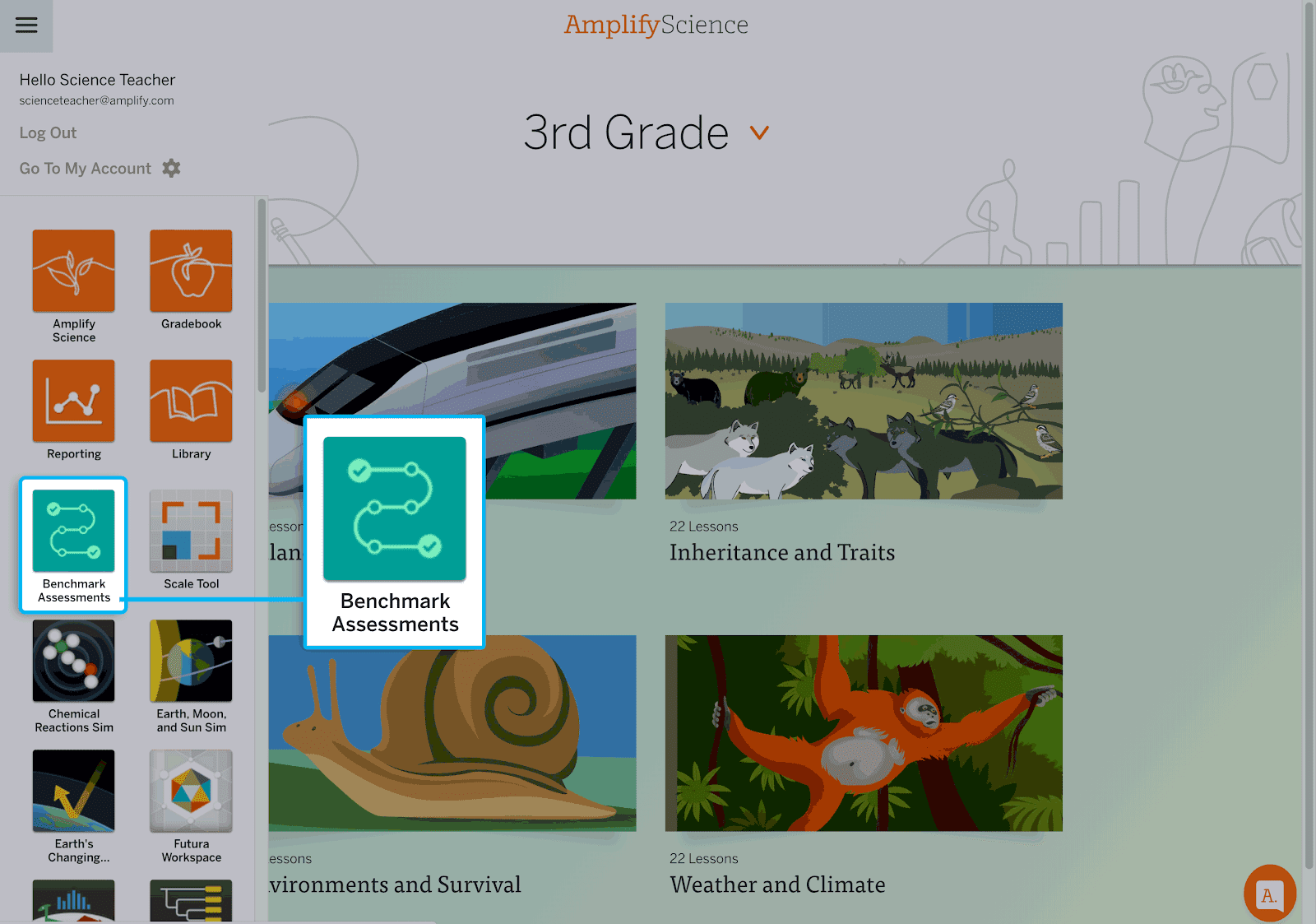
Administrators, welcome to Amplify ELA!
Here you’ll find information about enrollment and licensing, technical requirements, professional learning resources, and more.

Onboarding: What to expect
Welcome to Amplify ELA! There are six basic steps to onboarding. Use this visual as a reference, but also know that our dedicated implementation team will be there to support you during the entire process.
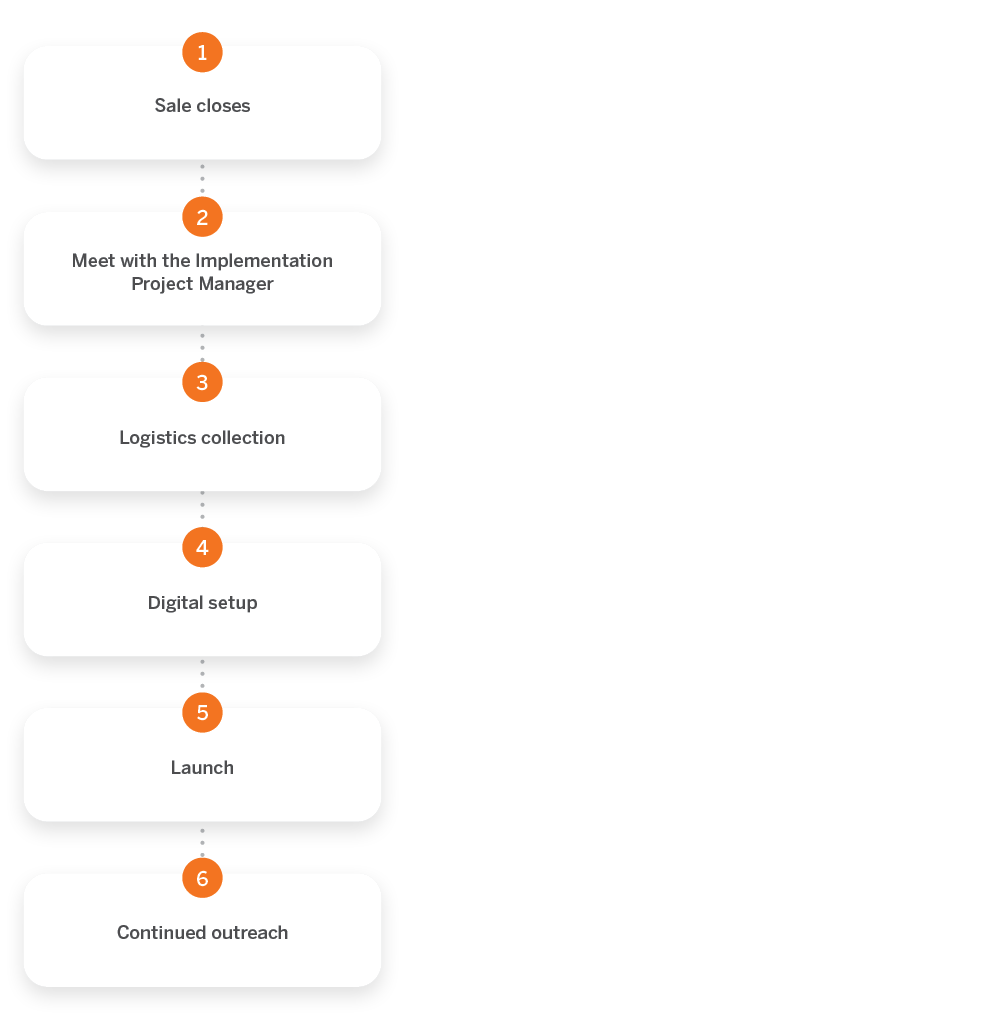
Technology requirements and guidelines
To ensure that your hardware and network meet the minimum technical requirements for performance and support of your curriculum products, please see Amplify’s customer requirements page.
You’ll also want to add the URLs on this page to the corresponding district- or school-level filters so that your teachers and students can access their Amplify ELA materials.
Data sharing agreement
Partnering with Amplify through our data sharing program deepens learning outcomes and gives you the performance analysis you need to make impactful decisions within your district or school. By signing our data sharing agreement, your district will help us to better understand student performance as it relates to your state’s standards. It also allows us to compare results with the curriculum-embedded assessments and state-level assessments. These analyses will help you identify the areas where your teachers and students are excelling or may be experiencing challenges.
Stay tuned for additional updates.
Enrollment and licensing overview
During the enrollment and licensing call, your Amplify implementation partner will walk you through the enrollment process. We recommend exploring the enrollment web tool ahead of the call for suggestions on which enrollment method may be best for your district.
The following guides provide additional information about enrollment methods and the data sharing process.

Preparing for your materials
If you’ve purchased the Amplify ELA blended package, each grade level will include the following print materials:
Teacher Kit—one per classroom that includes the following:
- 6 Teacher Editions (one per unit)
- 1 Solo Workbook blackline master
- 6 Writing Journals (one per unit)
- 1 novel
- Poster set (3 posters)
Student Blended Package—one per student that includes the following:
- 1 Student Edition
- 6 Writing Journals (one per unit)
- 1 novel
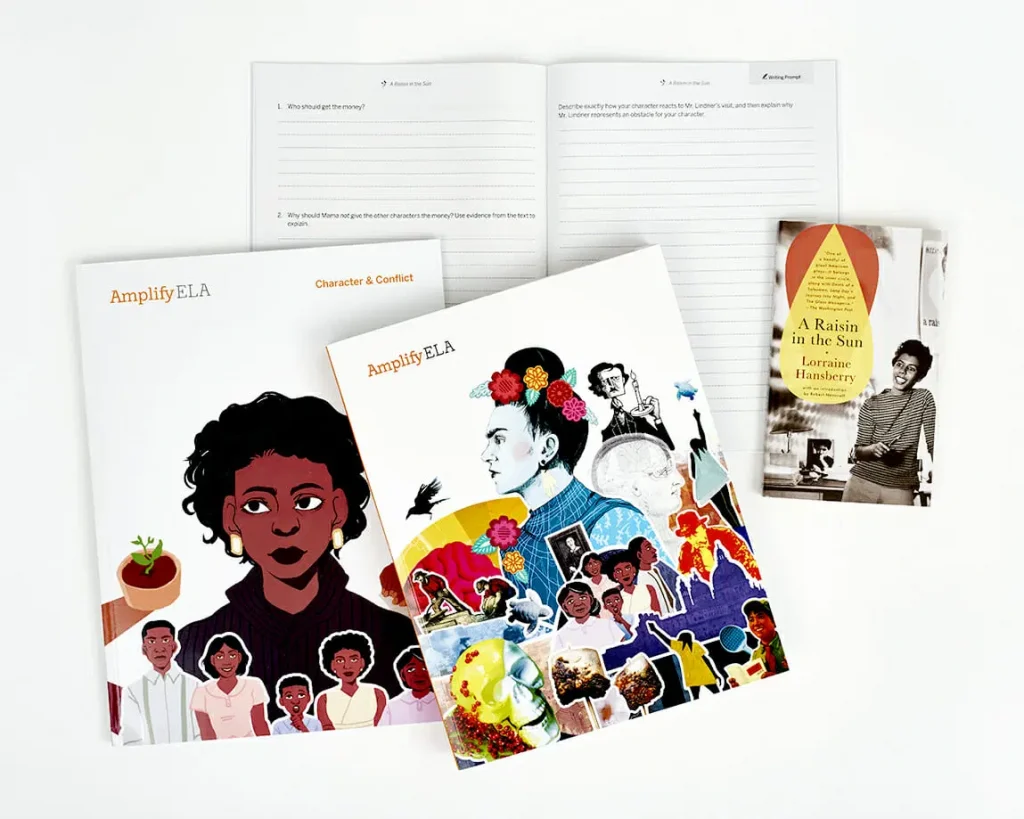
How many boxes will I receive?
To plan for delivery of print materials and storage space, here’s what to expect:
Teacher Kit—Components are provided in one box per classroom.
Student Blended Package—Components are shipped in cartons, which include materials for multiple students. The maximum weight for any carton is 35 pounds, though the average weight is 15–20 pounds. The number of cartons depends on the number of students in your order. Packing slips will list the contents of each carton against the whole order.
Administrator Reports
Self-service Administrator Reports allow insight into teacher and student usage and student performance data for the current school year.
Access will be limited to district and school administrators. Administrators can directly access these reports at my.amplify.com/admin-reports.
Next steps: How do I support my teachers?
Pre-launch checklist for teachers
Please share our Professional Learning site with your educators. It will provide them with helpful information as they prepare to implement Amplify in their classrooms, including the launch packet. You can also download and share our launch packet here. Amplify login is required to access this site.

Professional development
We partner with every district to make sure the Amplify ELA rollout meets their unique needs. Check out our professional development roadmap to get a better understanding of what our team has to offer.
Advice and answers
The ELA help site is filled with step-by-step resources to address educators’ questions. Encourage your educators to read through these tutorials and search for topics they want to learn more about.
Contact us
Powerful (and free!) pedagogical support
Amplify provides a unique kind of support you won’t find from other publishers. We’ve developed an educational support team of former teachers and administrators who provide pedagogical support at no cost to educators using our programs. This free service includes:
- Information on where to locate standards and other planning materials.
- Recommendations and tips for day-to-day teaching with Amplify ELA.
- Support with administering and interpreting assessment data and more.
To reach our pedagogical team, click the orange icon while logged into the curriculum to get immediate help, call (866) 629-2446, or email edsupport@amplify.com.
Timely technical and program support
Our Customer Care and Support team is available Monday through Friday, 7 a.m. to 9 p.m. ET, and Sunday, 10 a.m. to 6 p.m. ET, through a variety of channels:
- Live chat: Click the orange icon while logged into the curriculum to get immediate help in the middle of the school day.
- Phone: Call our toll-free number: (800) 823-1969.
- Email: Send an email to help@amplify.com.
Join our community
Our Amplify ELA Facebook group is a community of Amplify ELA educators from across the country. It’s a space to share best practices, ideas, and support on everything from implementation to instruction. Join today.
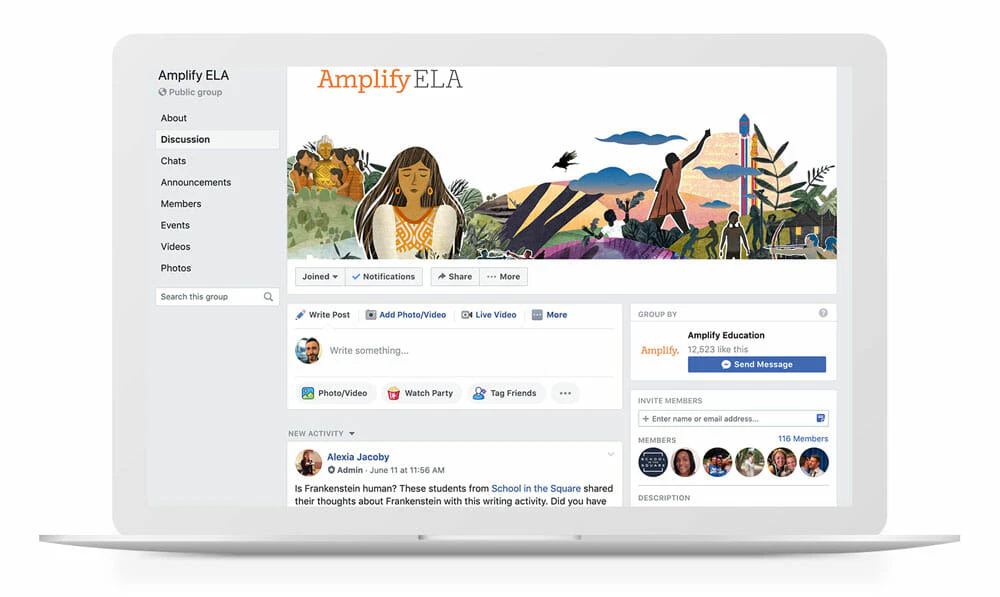
NC DPI RFP 40-PR11968232 Amplify Education Vendor demo questions Clarification 01
Amplify Program Usage Guidelines
If you would like to use Amplify’s tools or content in your work, please review the following guidelines to determine whether your specific use is allowed or if you require a request for approval.
- Amplify CKLA Usage & Branding Guidelines
- Amplify Classroom and Polypad Free & Commercial Use Guidelines
Amplify’s goal is to support educational access to high-quality curriculum while protecting the intellectual property and integrity of our programs. For additional questions about permissible and prohibited uses, please reach out to the customer care and support team.
Personalized learning grounded in the Science of Reading

Surveying the landscape
Recent data shows that far fewer young students are on target for reading proficiency than in previous years. In fall 2020, kindergarteners were 6 percent less likely to be on track in reading than they were in the 2019–20 school year.

How do we reverse these trends? A personalized learning program steeped in research-based literacy practices can be your first step. In this blog, we introduce personalized learning programs for early literacy, discuss why they should be aligned with the Science of Reading, and outline the key features that all effective personalized learning programs should have to support ALL students.
What is personalized learning?
“Personalized learning in literacy education is an approach in which teaching and other learning experiences build on each student’s strengths, address each student’s needs, spur student motivation and agency, and help all students meet grade-level standards and, ultimately, achieve college and career readiness.”
— Student Achievement Partners
Achieve the Core outlines a set of key components every personalized program should include to accelerate literacy:

How can I bring the Science of Reading into personalized learning?
Not all personalized learning programs should be treated equally. Programs should provide explicit, systematic foundational skills, continue to build background knowledge, and support core Science of Reading instruction. Focusing on the things we do while we’re reading that allow us to make sense of text — also known as comprehension processes — is a key component of supporting beginning readers.
How will I know if a personalized learning program is based on research about how children learn to read?
We’ve provided a checklist of key features to look for when selecting a personalized learning program grounded in the Science of Reading.
1) Look for a program that complements your Science of Reading instructional practices.
The content of a personalized program should support your core Science of Reading instruction.
Look for research-based instruction aligned to Scarborough’s Reading Rope, a focus on comprehension processes and language structures in addition to foundational skills, and personalization that adapts based on student needs.
2) Look for a program that employs a whole-child approach.
A whole-child approach focuses on students’ individual strengths and needs.
Look for targeting of skill practice at the just-right level in ALL areas, a focus on students’ individual strengths as well as their needs, and more opportunities for success, all of which build student confidence.
3) Look for a program that uses an adaptive scope and sequence.
In an adaptive model, students progress along a unique pathway through a learning map that adapts based on their performance.
Look for full adaptivity — where students progress along a pathway that adapts on multiple dimensions, not just one. The program should offer data to place students into personalized pathways and continue to analyze student performance data to determine the skills they practice and when.
4) Look for a program that acts as a digital tutor to save teachers time.
A program that aims to save you time provides students with differentiated instruction and pathways when they’re really struggling.
Look for a program that provides scaffolding and differentiated pathways to students when they’re struggling, and offers precursor and ancillary skill development and advancement opportunities before revisiting challenging content. Programs should alert teachers with targeted resources to support students and keep them moving.
5) Look for a program that motivates students intrinsically.
Programs that focus on intrinsic motivation leverage a growth mindset theory to ensure that students have fun while they learn.
Look for a program that rewards persistence as much as performance and ensures students have fun while they learn.
Personalized learning supplemental tool: Amplify Reading
Amplify Reading is a personalized learning program powered by the Science of Reading. The program blends compelling storytelling with research-based instructional practices to offer:
- Personalized instruction across 13 different critical skill areas that adapt to each student’s needs while building on their strengths.
- Explicit practice in comprehension processes, phonics, and vocabulary.
- Extra support and scaffolds for struggling readers and English learners.
- An immersive game-play design that motivates students and makes learning to read fun.
To learn how this program can accelerate reading growth in your district, request a personalized walkthrough below.
Amplify Reading – Amplify Reading
Work cited
Liben, Meredith, et al. “What Principles Must Underlie Successful Personalized Learning?” Peers and Pedagogy, 27 Oct. 2020
Supporting science students with a creative twist
In this episode of Science Connections: The Podcast, Kentucky Science Teacher of the Year Shad Lacefield sat down with host Eric Cross to discuss ways to create memorable learning experiences for students.
You can access the full episode here, but we’ve pulled out Shad’s top three teacher takeaways for you to use in your classroom today!
1. Go above and beyond for your class.
During remote learning, Shad was having a tough time connecting with students and keeping them engaged virtually, so he started something called “Vader Visits.” Shad would dress up as Darth Vader and show up at students’ houses as an incentive to get them to turn in their work on time and stay interested in what he was teaching in science class at the time. It was a commitment for Shad, as he had to fit that into his teaching (and life) schedule, but he was able to keep his students interested in science class, and learned more about each student he went to visit. The practice was so successful, he extended it beyond remote learning.
I still try to dress up at least once every week, if not once every other week just to make whatever we’re doing fun.
– Shad Lacefield
2. Get to know your students in creative ways.
As part of his Vader Visits, Shad was able to get students to open up and share more of their interests with him, which helped him build better connections with each student. As a way to connect with students less interested in Star Wars, Shad asked them about their other interests and found new costumes. For some students, he would show up dressed up as Harry Potter. For others, he would dress up as Mario from Mario Brothers.
I went [on] over 50 visits and it was cool to see kids in their home and talk to them and meet their parents. It was a great opportunity for me to engage with parents as well, [to ask,] ‘how is online learning going? What can I do to support you? Do you have any questions?’
– Shad Lacefield
3. Be open to new ways to reach students.
Shad has creatively expanded his teaching to include outlets that he knows kids are interested in outside of school. He makes TikTok videos. He weaves Minecraft references into his lessons. He uses YouTube. He even creates new characters to keep things fresh. By speaking a “language” that was familiar to students, Shad was able to create more meaningful connections with his students as both learners and people. And it helped him stay positive as an educator.
I just go back to, ‘why did I do this to begin with?’ And it gets me excited to be like, ‘I did it for the kids, and it’s about the kids.’ I get joy when they’re laughing and smiling.
– Shad Lacefield
For a more in-depth look, listen to the full episode to hear Eric and Shad discussing ways to create memorable learning experiences for students.
Science Connections: The Podcast featuring Kentucky Science Teacher of the Year Shad Lacefield.
Learning mathematics through problem solving: Part 3

Tackling real-world questions as a path to math success
In previous posts, we’ve established that problem-based learning sets students up for long-term success. We’ve shown that problem-based lessons introduce students to interesting and often real-world problems or tasks, and described the key role teachers play in putting problem-based learning into action.
In this post, we’ll look more closely at how teachers can support students engaging in problem-based learning, even when the students do much of their work together in groups.
You can read the first post in this series here and the second post here.
Teachers transfer learning responsibility to students
In a problem-based lesson, students are introduced to a handful of interesting and often real-world problems or tasks that can be worked out by referencing background knowledge, previously learned content, and newly provided information.
With problem-based learning, teachers transfer the responsibility of the actual learning to students. Teachers set up the activities and lessons, then students are given the right information and scaffolds to make sense of math concepts and opportunities to practice and apply their learning.
These problems are designed to get students thinking—and talking together—about solutions. This way, students begin to grapple with math content and grasp math language development.
During class, the teacher’s role is to observe students, ask questions, select and share student work, and help students synthesize their learning at the end of the lesson. That’s where teachers help students apply new insights and conceptions to their bigger-picture understanding of the math at hand.
When students do need to be taught a process directly, teachers can shift from conceptual to procedural instruction. (For example, after making sense of adding signed rational numbers, students practice to gain fluency.) In these moments, the problem-based structure is focused more directly on producing answers and debugging procedures than on new sense-making.
Problem-based math teaching aligns with NCTM practices
The highest quality problem-based lessons embody all eight of the NCTM Teaching Practices. These are:
- Establish mathematics goals to focus student learning.
- Implement tasks that promote reasoning and problem solving.
- Use and connect mathematical representations.
- Facilitate meaningful mathematical discourse.
- Pose purposeful questions.
- Build procedural fluency from conceptual understanding.
- Support productive struggle in learning mathematics.
- Elicit and use evidence of student thinking.
How Amplify Math can help teachers
We started with a world-class problem-based curriculum (Illustrative Mathematics’® IM K–12 Math™) and made changes to help educators implement engaging problem-based core curriculum for students. Amplify Math helps shift to planning and teaching problem-based lessons, tracking student progress, and differentiating instruction based on real-time data. We’ve made the math problems more exciting and relevant for all students, thus making it easier for all students to become active participants in their learning.
Amplifying Your District Award winner

This Amplifying Your District Award honored two district leaders who are driving change using the Science of Reading in 2021. Motivated by low literacy rates in her school district, Alli Rice dug into the research behind the Science of Reading because she was determined to increase equity. Through various events and Knowledge Builders for the teachers in her care, she then effectively led the shift to a research-based curriculum in her district. Read on for our conversation with Alli about her work with the Science of Reading!
What does the Science of Reading mean to you?
For me, it’s really about equity. Thousands of kids are already a step behind because of their skin color, their neighborhood, or their zip code, all of these things that really shouldn’t define their academic ability or their opportunity in life. I’ve looked at statistics around prison populations and illiteracy rates. Some, so many adults are functionally illiterate and they can’t fully understand. They can’t even read their prescriptions.
I also work for a district where most of our kids are on the lower end for socioeconomic status. We have a very high ELL population and 63 home languages spoken in my district. And we are the urban center of our area. Historically, we have been a balanced literacy district, but we have watched our test scores decline.
Since discovering the Science of Reading and this completely different approach to teaching literacy, I feel like I have unlocked Pandora’s box of potential. By addressing our core and aligning our teaching practices, our students can feel success and our teachers will, too. My teachers here have the biggest hearts of any educators I have ever worked with, and they work tirelessly day in and day out to support our students. We try to provide as many enrichment opportunities to all of our kids and to expose them to the greatest and the best. The ability to read, to me, is the greatest civil right. If we’re not providing them that, I can’t sleep at night.
What news, materials, or information do you consume to help you teach?
We use Amplify CKLA and Amplify Reading and those programs are just wonderful. I am also an avid listener of Science of Reading: The Podcast. We arranged for Natalie Wexler and Susan Lambert to do a live professional development session in our district, which was so fantastic, especially for our most reluctant coaches and administrators. Our district-wide LETRS training has also been life-changing. We currently have 800 people who are completing the training, which has helped to align the district and put us all on this path to success.
One particularly impactful thing, and that I rely heavily on for support, is my teacher cadre. Each cadre is about 14 teachers in the district and they represent all of our clusters. We’ve partnered up with our Diversity, Equity, and Inclusion department to do text bias reviews on materials, which has been important for our adaptations for cultural responsiveness. Our selection cadre came from that as well, when we landed on Amplify CKLA for K–3. The teacher input and camaraderie I get from my cadre is so instrumental and I am so grateful for them.
What advice do you have for teachers starting out with the Science of Reading?
Find your people, find your community. I remember Margaret Goldberg’s presentation during last spring’s Science of Reading symposium, and how she said you need to find your dots, you need to seek out like-minded people and go where they are. Find those people who are ready to make the change like you are, or perhaps have already done it, and can be that positive support system you need to make a difference. Don’t be afraid to message people on Twitter or Facebook or LinkedIn, ask about their experiences, and build that community around you. Find the ones who are going to partner with you, who will lead you the right way, who will take your calls. And read all the books!
Watch the Science of Reading awards show!
Dyslexia toolkit for teachers

What do students at risk for dyslexia struggle with?
- Delay in learning tasks such as tying shoes, telling time
- Difficulty expressing self
- Inattentiveness, distractibility
- Inability to follow directions
- Left-right confusion
- Difficulty learning alphabet, times tables, words of songs
- Difficulty learning rhymes
- Poor playground skills
- Difficulty learning to read
- Mixing order of letters or numbers when writing
- Reversing letters or numbers
Supporting students with dyslexia: What can you do?
According to the International Dyslexia Association official publication of Perspectives on Language and Literacy, Vol. 44, 2018, here are six steps to help your struggling students:
1. Screen for dyslexia
- Become involved in implementing or improving universal screening programs for dyslexia by reminding administrators about specific laws.
- If you suspect your student has dyslexia, request that common reading and writing skills associated with dyslexia are assessed (e.g., basic reading skills [phonics and sight word identification], spelling, reading rate).
2. Dyslexia training for teachers and reading specialists
- Advocate for the appointment of a specific person in charge of dyslexia training.
- Request specific teacher training that includes structured literacy programs (e.g., explicit, systematic reading instruction, phonics instruction, etc.). Request dyslexia awareness training for all K–12 teachers.
3. Eligibility for accommodations and services for students with dyslexia
- Become involved in the Response to Intervention, Multi-tiered system of support, or a similar system at your school. Ensure that the accommodations and services that are provided are appropriate for students with dyslexia.
- Collaborate with colleagues to evaluate the effectiveness of accommodations and services being provided to students with dyslexia.
4. Classroom instruction for students with dyslexia
- Become familiar with differentiated instruction strategies (e.g., use of centers during instruction).
- Learn and help colleagues learn about specific reading programs designed to help students with dyslexia (e.g., structured literacy programs).
5. Dyslexia handbook
- Request that your state or district develop a dyslexia handbook to guide teachers and offer other states’ handbooks as a reference.
6. Dyslexia awareness
- Consult with fellow educational professionals in your school(s) to hold events and encourage discussions about dyslexia during October (National Dyslexia Month).
DIBELS® 8th Edition is validated for the following measures:
DIBELS 8th Edition Subtest Alignment with Dyslexia Screening Areas
| Rapid Naming Ability | Phonological Awareness | Alphabetic Principle | Word Reading | |
| Letter Naming Fluency |  | |||
| Phonemic Segmentation Fluency | | |||
| Nonsense Word Fluency | | | | |
| Word Reading Fluency | | |||
| Oral Reading Fluency | |
How mCLASS can help you identify and support at-risk students
mCLASS® with DIBELS® 8th Edition’s free dyslexia screening measures provide additional screening for risk of dyslexia in students in grades K–3 through subtests that help identify early warning signs of reading difficulty. Measures include:
- Vocabulary
- Encoding
- Rapid Automatized Naming (RAN)
- Word Reading Fluency (WRF)
- Letter Naming Fluency (LNF)
- Phonemic Segmentation Fluency (PSF)
Meet Amplifying Your District Award Winner Brittney Bills

Brittney’s passion for reading development shines through her commitment to early literacy. Under a four-year plan she devised, Brittney’s district adopted a new curriculum and system of professional development that embraced the Science of Reading and celebrated its impact on their students.
What does the Science of Reading mean to you?
I believe the Science of Reading is about hope. Knowing 95% of students are cognitively able to read at grade level with the right explicit instruction was empowering for me and the teachers I support. Every child should know the joy and success of reading.
What tools/curriculum do you use to implement the Science of Reading? How did Amplify help?
We are an Amplify district and super proud to be an Amplify district. Last year, we started with Amplify CKLA Skills adoption because that’s where we had the biggest gap in terms of our instructional resources and supporting our students. Then we added on Knowledge for K–2 this year, integrated it for grades 3–5, and started using Amplify Reading.
We started using mCLASS® with DIBELS® 8th Edition with all of our K–3 students. After last year, fourth- and fifth-grade teachers caught wind of these awesome things that the lower elementary teachers had access to that they didn’t, so we expanded mCLASS with DIBELS 8th Edition to K–5 this year. We love the high-quality resources and programs that Amplify has to offer and we have seen some tremendous results early on and had some wonderful success. They’re supporting us in our vision, which is wonderful.
What advice do you have for teachers starting with the Science of Reading?
Just get started. Don’t feel overwhelmed by what you don’t know. We have seen tremendous success and tremendous results, but there’s still a lot of work left for us to do. I would say decide the thing that you want to focus on, pick something that you want to understand better, that you want to learn more about, and commit yourself. In the education world, we are almost paralyzed by the sheer amount of things that need to be done. There’s this sense of immediacy and urgency, that you have to balance with your reality.
Make sure that teachers feel supported because teachers go through a grieving process once they learn more. They feel guilt and sadness about some of the students they have taught in the past. Stay committed to growing and developing because science is going to change and you have to evolve and move with the science.
Watch the Science of Reading Star Awards!
Integrating literacy in the science classroom
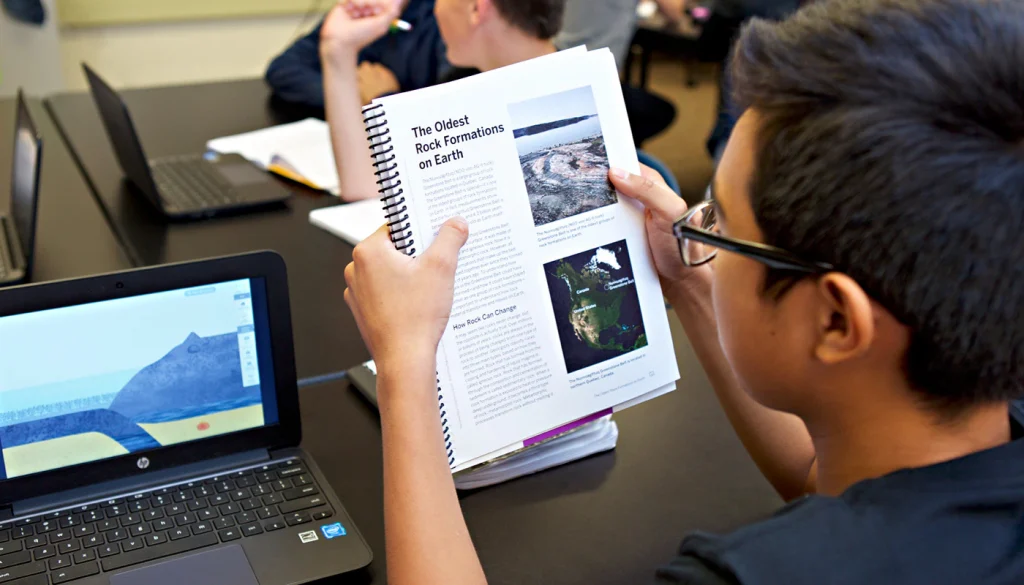
What do science classrooms and ELA classrooms have in common?
Literacy.
As science students build their scientific literacy, they also build their literacy literacy—as in,their capacity to read, write, and think across all disciplines. In a sense, all teachers are teachers of literacy, as students read to learn in essentially every subject.
An ELA teacher can help students learn to read and interpret certain types of non-fiction and science-related texts, while a science teacher is uniquely positioned to integrate a science curriculum with a focus on literacy goals. ELA teachers are the experts on what the average person considers literacy; however, science teachers are the true experts on science literacy.
In this post, we’ll take a look at what it means for science teachers to support literacy growth in their students.
Scientific literacy vs. literacy in science
First, let’s define our terms.
Scientific literacy refers to a student’s understanding of scientific concepts, inside and outside the classroom.
Literacy in science refers to the literacy skills that students use to acquire and share scientific knowledge. These skills include reading, writing, speaking, and listening.
Developing students’ literacy in science helps them develop scientific literacy. Science literacy allows students to become critical thinkers, problem solvers, and strategic questioners.
Insights on integrating science and literacy
Integrating literacy into science is more than making sure students read articles and write lab reports—but the two are still a natural fit.
The standards that guide instruction in grades 6–8 make this integration concrete. Certain Common Core ELA standards intersect with the Next Generation Science Standards (NGSS).
To cite just a few examples, the Common Core requires students to be able to:
- Cite specific textual evidence to support analysis of science and technical texts. RST.6-8.1
- Determine the central ideas or conclusions of a text; provide an accurate summary of the text distinct from prior knowledge or opinions. RST.6-8.2
- Follow precisely a multistep procedure when carrying out experiments, taking measurements, or performing technical tasks. RST.6-8.3
- Integrate quantitative or technical information expressed in words in a text with a version of that information expressed visually (e.g., in a flowchart, diagram, model, graph, or table). RST.6-8.7
- Distinguish among facts, reasoned judgment based on research findings, and speculation in a text. RST.6-8.8
What’s required of students is what’s often called disciplinary literacy. That means literacy through the lens of inquiry in a given field. Science has its own set of vocabulary and reading/writing styles students need to learn to understand, decode, and write in.
And when they do, the academic benefits go both ways.
Integrating literacy into science encourages both science and ELA growth
The scientific method requires students to ask questions, listen to explanations, and present conclusions. And when science teachers use targeted literacy teaching strategies, they can help students understand challenging scientific vocabulary. For example, they can learn the difference between the two meanings of the word “culture.” Those are the same approaches students will use when analyzing with and communicating about texts in ELA.
Also, reading in science can be more than just reading a science textbook or science-related article—teachers can help students learn to read through a scientific lens by encouraging even the youngest students to articulate their questions about a text and understand where they might find answers.
And then there’s writing: “Science and writing standards are really in service of each other,” writes educator Gina Flynn in Literacy Today. “When we present authentic writing opportunities in science, we are not only developing students’ understanding of science concepts but also providing an authentic context for developing writing skills.”
Integrating science into ELA also encourages both science and ELA growth. When students grapple with science-related texts in ELA, they can develop ways of thinking and communicating that support the scientific approach, refine sense-making skills that are key to both disciplines, and get inspired to keep up with the latest scientific discoveries—yet another great reason to read.
More to explore
Science and literacy: You don’t have to choose
Math strategies that build community in your classroom
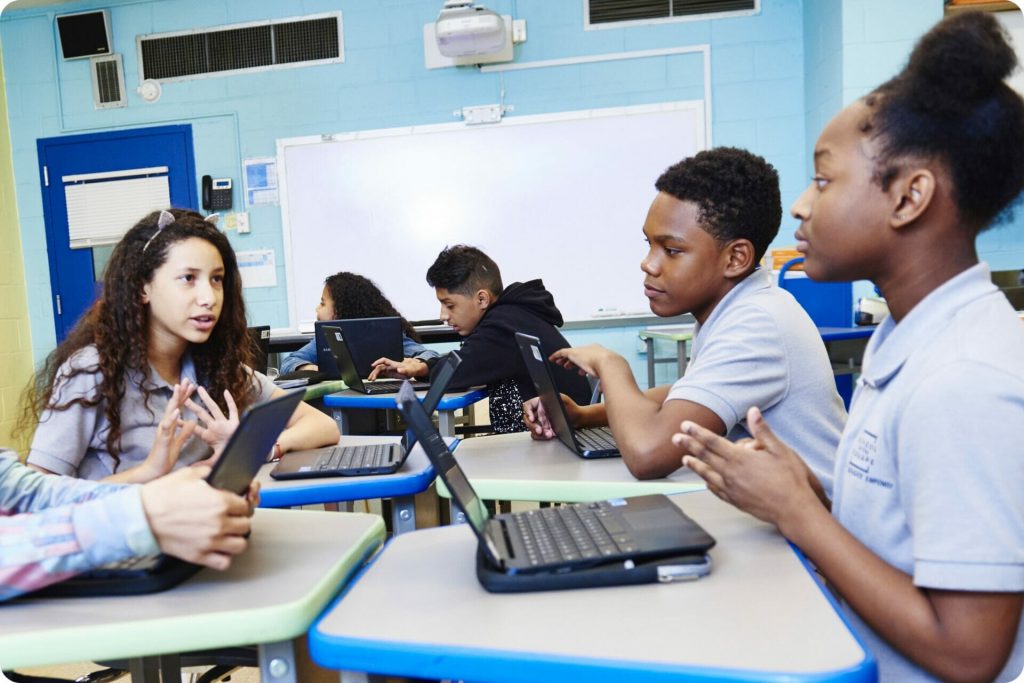
It’s tough to do math without sets, sums, and multipliers, so it stands to reason that it’d be tough to learn math solo, outside of a group.
Indeed, research shows that math is best learned in a community. In this post, we’ll explain why that is, what it looks like in a classroom, and how you can create a community for your math students.
What math community means: Creative classroom ideas
There are many types of math communities: online interest groups, professional organizations, the Mathletes.
In the context of a math classroom, a math community refers to the collaborative environment a teacher can create using both math strategies and social strategies (and by involving students’ parents and guardians). In a robust math community, all students feel comfortable sharing ideas, asking questions, and engaging in mathematical conversations.
In other words, math communities are student-centered. Rather than delivering information, teachers guide students. They encourage students to explore math concepts, make connections to the real world, and ask questions—of each other, and the teacher.
And in a math community, wrong answers aren’t dismissed—in fact, they’re an essential part of the learning process. In our webinar What Amazing K–12 Math Looks Like, educator and director of research at Desmos, Dan Meyer underlines the importance of students understanding “the value in their thinking—which means the value in their wrong answers.”
Benefits of math community: Equity in schools and more
A community-oriented math classroom can help each student learn, and all students learn. Here’s how.
- Increased engagement. When students feel a sense of belonging and connection in their math class, they’re more likely to be engaged and motivated. By promoting open discussions, group activities, and cooperative problem-solving, teachers can help students—even those who don’t think they’re “math people”—develop a genuine interest in math.
- Reduced math anxiety. Math anxiety affects at least 20% of students. It can hinder their growth in math and beyond. But in a supportive math community—where different styles and wrong answers are considered part of the process—those students can thrive. Embracing and working from incorrect answers encourages students to focus on the “how” of math, and to participate without fear of getting it wrong. They feel more comfortable asking questions, taking risks, and making mistakes as well as learning from them.
- Improved communication skills. In a math community, all students get the chance to communicate their mathematical thinking and reasoning. Explaining their ideas to others and listening to their classmates enhances their speaking and writing skills—in math, and across other subjects, too.
- Learning from diverse perspectives. A supportive math classroom community allows students from different backgrounds and with varying abilities to contribute to class and feel valued. Encouraging—and observing—the sharing of diverse perspectives fosters critical thinking, creativity, and problem-solving skills.
- Positive reinforcement. A strong math community creates an environment where students feel valued, respected, included, and supported. It’s fertile ground for a growth mindset, one in which students believe they actually can do math regardless of challenges or errors. A math community encourages risk-taking, resilience, and perseverance—in math, and beyond.
How to engage students in math lessons that build community
Want to know how to make math fun and build community? Here are some ways to get started.
- Encourage collaboration. Promote a culture of cooperation and teamwork by incorporating group activities, peer support, and class discussions into your lessons.
- Celebrate brilliance. Recognize a variety of efforts, insights, and accomplishments among students—including taking risks, and making mistakes. This will motivate all students to appreciate different ways of learning and the value of both process and product.
- Personalize support. Offering individualized help to students who need it shows commitment to their success and builds a supportive environment for everyone.
- Develop a growth mindset. Create a culture where mistakes are inevitable, even welcomed, as part of the learning process. Encourage perseverance and persistence.
- Choose meaningful tasks. Assign problems with real-world relevance. Working together to solve them helps students see the “why” of math—and connect with each other in the process.
- Play. Game-ifying problems and introducing friendly competition builds camaraderie and helps students find shared joy in math—a win-win!
More to explore
The Reading Rope: Breaking it all down
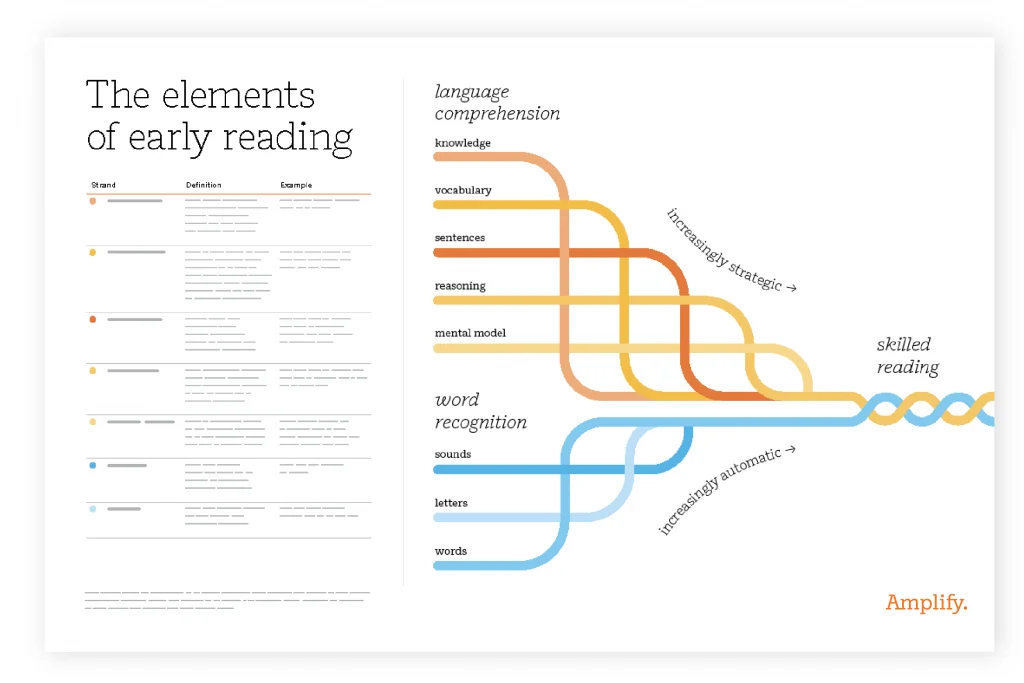
What do pipe cleaners have to do with learning to read?
In the late 1990s, reading and literacy expert Hollis Scarborough, Ph. D., used pipe cleaners to create a model of the intertwined skills that make up the process of learning to read.
That model is the iconic Reading Rope, the visualization that helps us understand the essential strands of reading and how they work together.
In this post, we’ll examine the components of the Rope both individually and together, then explore how the Rope aligns with the Science of Reading and the five foundational reading skills.
What is the Reading Rope?
The human brain is wired to do many things, but reading is not one of them. The brain does not automatically know that certain marks on a page or screen are designed to represent sounds, or meaning. That’s why we have to teach reading, explicitly and systematically.
And when we teach reading using what science—the Science of Reading—tells us, the brain wires itself to start recognizing and understanding those letters, syllables, and words.
The Reading Rope provides a visual representation of that process and all its essential, interrelated components.
Why is the Reading Rope important for the Science of Reading?
The Reading Rope emphasizes the need for a comprehensive, deliberate approach to reading instruction. It recognizes that reading is not a singular skill, but rather a set of interwoven processes.
By understanding and addressing each of these processes (known in the Rope as strands), educators can provide the targeted instruction that helps readers succeed.
How does the Simple View of Reading connect to the Reading Rope?
One of the research-based frameworks used in the Science of Reading is the Simple View of Reading.
According to the Simple View, two cognitive capacities are required for proficient reading: (1) word recognition and (2) language comprehension.
“Reading comprehension is the product, not the sum, of those two components. If one of them is zero, then overall reading ability is going to be zero,” says Jane Oakhill, Ph.D., professor of experimental psychology at the University of Sussex.
Those two skills make up the two meta-strands of the Rope. But, as Oakhill explains further on her episode of Science of Reading: The Podcast, each strand contains its own subset of distinct skills and processes.
What are the strands of the Reading Rope?
Let’s take a look:
- Word recognition encompasses the ability to accurately and swiftly decode printed words. Phonological awareness, phonics, and sight word recognition contribute to this strand.
- Phonological awareness is the ability to recognize and manipulate the individual sounds (phonemes) within spoken words. It includes skills such as identifying rhymes, segmenting words into syllables, and manipulating sounds within words. Phonological awareness provides the foundation for phonics instruction.
- Phonics describes the systematic relationship between letters and the sounds they represent. It includes understanding letter-sound correspondences, decoding unfamiliar words by applying sound-symbol relationships, and blending sounds to form words. Phonics instruction gives students the tools to decode printed words.
- Sight word recognition is the ability to recognize and read words automatically, without decoding. Building a repertoire of sight words boosts fluency.
- Language comprehension is the understanding of spoken and written language, including vocabulary, grammar, syntax, and the ability to make inferences and draw conclusions. Language comprehension allows readers to extract meaning from text.
- Vocabulary refers to the words one knows and understands, both orally and in writing. A robust vocabulary enhances comprehension and communication.
- Grammar and syntax are the rules and structures that govern language. Understanding and applying grammatical rules helps students comprehend and construct sentences, enhancing their ability to make meaning from text.
- Inference and conclusion skills describe the abilities of drawing conclusions, making predictions, and deriving implicit meaning. These skills require readers to combine their background knowledge with information in the text to make guesses and reach conclusions.
How do the strands combine to form a process?
These strands are interconnected and mutually supportive. Strong word recognition skills enable efficient decoding, which frees up cognitive resources for language comprehension. Similarly, robust language comprehension skills facilitate deeper word understanding and contextualized reading.
That’s how the Rope represents not just the elements of learning to read, but also the process toward fluency. As students progress, their word recognition becomes increasingly automatic, and their language comprehension becomes increasingly strategic.
- In the word recognition strand, readers focus on decoding individual words, relying on phonological awareness and phonics. With practice and instruction, word recognition becomes more efficient and effortless. This automaticity frees up cognitive resources for comprehension and higher-level thinking.
- In the language comprehension strand, readers learn to engage actively with the text, ask questions, make connections and predictions, and monitor understanding. Strategic readers use comprehension strategies—summarizing, visualizing, self-questioning, and more—to deepen their understanding of what’s on the page.
Those two processes are intertwined and interdependent. The Rope shows that, as readers progress, they get better at combining automatic word recognition with strategic reading skills.
They can effortlessly recognize words, allowing them to focus on comprehending the text and performing higher-level thinking. By strategically applying language comprehension skills, readers construct meaning, make connections, and analyze the text.
This combination of automatic and strategic skills supports reading and facilitates engagement with more complex and challenging texts.
How does the Rope relate to the five foundational skills of reading?
The Rope is made of a lot more than the five foundational skills of reading (phonics, phonemic awareness, vocabulary, fluency, and comprehension). How does it all add up?
While the Reading Rope does not explicitly mention these five skills as a distinct set, the strands do align with them. Here’s how:
- Phonological awareness (and phonemic awareness) is represented in the Rope’s word recognition strand.
- Phonics is also a critical aspect of word recognition.
- Fluency—often considered a combination of accuracy, rate, and prosody—is not represented as its own strand, but it’s closely related to the word recognition strand. As students develop automaticity in word recognition, their reading fluency improves.
- Vocabulary aligns with the language comprehension strand. The development of a robust vocabulary enhances reading comprehension by enabling students to understand and infer the meaning of words encountered in the text.
- Comprehension is built into the language comprehension strand. It includes skills such as understanding sentence structure, making inferences, drawing conclusions, and connecting prior knowledge. These skills help the reader get meaning from the text and connect to higher-level thinking.
The Reading Rope is a game-changing tool, clarifying a complex process and helping teachers target instruction. When the strands come together, they weave the strongest possible foundation for student reading success.
Science professional learning resources for teachers
We hope you’ll take some time to rest and recharge this summer! But we also know how hard you work—even when school’s out—to do the best you can for the students in your science classroom.
Without the constraints of the school schedule, summer can be a great time for teachers to work on professional development!
That’s why we created this handy list of professional learning resources, mined from our trove of blog posts and webinars, for you to dive into this summer.
Science and literacy integrations
How should you approach the integration of science and literacy, and why is it important in the first place? Get all the answers in these posts and webinars:
- K–8 Literacy & Science Instruction Integration (webinar)
- ”Instructional strategies for integrating literacy into your science classroom” (blog)
- ”Integrating writing skills into science instruction” (blog)
- ”Integrating literacy in the science classroom” (blog)
- ”Science or literacy instruction? You don’t have to choose!” (blog)
- Finding Connections to K–8 Science & Literacy Educator Roundtable (webinar)
Next Generation Science Standards
These resources will help you learn about the Next Generation Science standards by grade level—and discover how to make them come alive in your classroom:
- Establishing a Culture of Figuring Out in Your Next Generation Science Classroom (webinar)
- Embedded and Immersive Engineering (webinar)
- Grade K–5 Science Program & Curriculum Overview—NGSS Curriculum
Phenomena in science
What’s phenomena-based learning in science? A method of exploring the everyday and observable that can also deliver extraordinary results. Learn more here:
- “The power of phenomena in the science classroom” (blog)
- What Is Phenomenon Based Teaching & Learning? (webinar)
- Phenomenon Based Learning in NGSS Curriculum (webinar)
- Supporting Student-To-Student Discourse in Science (And Beyond!) (webinar)
More to explore
How teachers can address math anxiety

How teachers can address math anxiety
No one is born knowing the quadratic formula, or how to measure a triangle—math needs to be taught.
Likewise, no one is born a “math person”—or not a math person. And no one is born with math anxiety.
“Children don’t come with math anxiety,” says Dr. Rosemarie Truglio, senior vice president of curriculum and content for Sesame Workshop and a guest on Math Teacher Lounge. “Math anxiety is learned.” That’s actually good news because it means math anxiety can be unlearned, too. We can teach students (and even teachers) how to overcome it. In this post, we’ll cover some helpful learning strategies, teacher tips, and supports for caregivers.
Anxiety in—and beyond—the math classroom
First, let’s review what math anxiety is and is not.
Math anxiety is more than just finding math challenging, or feeling like you’re not a math person. Dr. Gerardo Ramirez, associate professor of educational psychology at Ball State University, defines it as “a fear or apprehension in situations that might involve math or situations that you perceive as involving math. Anything from tests to homework to paying a tip at a restaurant.” Here’s what else we know:
- Causes: Math anxiety is not correlated with high or low skill or performance. For students who’ve been pressured to excel, math anxiety comes with the fear of not meeting expectations. For students who historically haven’t done well in math, the anxiety comes with the assumption they’ll do poorly every time. Other triggers include a mismatch between learning and teaching styles that can lead to struggle, or false cultural messages like “girls aren’t good at math.”
- Consequences: People who suffer from math anxiety may deliberately avoid math, the consequences of which are obvious and far-reaching: not learning math at all, thus limiting academic success, career options, and even social experiences and connections. (This webinar mentions real-life—and relatable—examples of adults affected by math anxiety.)
- Prevalence: Math anxiety affects at least 20 percent of students, and parents and teachers can suffer from math anxiety, too. In fact, some research suggests that when teachers have math anxiety, it’s more likely that some of their students will as well. Luckily, those teachers and parents can also play a key role in helping students (and maybe even themselves) get more comfortable with math.
Addressing math anxiety in the classroom
Math anxiety can arise from the contexts and cultures in which students encounter math, so it makes sense that we can also create conditions that can help reduce it—and even prevent it from taking hold. Here are some key strategies for helping even the most math-anxious students thrive:
- Invite explicit conversation about math anxiety. In this webinar, Math Teacher Lounge podcast co-host Bethany Lockhart Jones recommends having open and direct conversations with all students about how doing math makes them feel. “The more you know about your students’ ‘math stories,’ the more you can help them,” she says.
- Build a positive, supportive, and collaborative math community where different learning styles and incorrect answers—often fuel for math anxiety—are considered part of the learning process. Embracing and working from wrong answers encourages students to focus on the “how” of math. Students feel more comfortable asking questions, taking risks, and making mistakes (as well as learning from them).
How do you build a supportive environment in your math classroom?
- Cultivate a growth mindset. Create a culture where mistakes are not just acceptable, but inevitable—even welcomed. Encourage perseverance and persistence. Emphasize that being challenged by a math concept doesn’t mean a student is inherently bad at math or just can’t do it. It means only that they can’t do it yet.
- Encourage collaboration. Promote a culture of cooperation and teamwork by incorporating group activities, peer support, and class discussions into your lessons.
- Play. Game-ifying problems and introducing friendly competition builds camaraderie and helps students find shared joy in math—a win-win!
- Give students plenty of time. Alleviating the pressure of time constraints allows students to think more deeply, take brain breaks, make fewer rushed errors, and develop a sense of control and confidence. Here are some ways to build time into your math lessons:
- Allow students ample time to think when you ask them questions.
- Allow students to work on assignments in class with support and take them home to finish if they need more time.
- Consider giving tests and quizzes in two parts and allowing students to complete them over multiple days.
- Create a culture of revisions. Allowing students to revise homework assignments and tests/quizzes for partial credit will remind them that learning math is a process, not a mandate to get everything right the first time. This will help them deepen their understanding by learning from and correcting their errors—and remind them that mistakes are part of growth.
- Use intentional language. The phrase “This is easy” might sound encouraging, but anxious students may hear it as “You should be able to do this.” Instead, use supportive, objective language such as “This problem is similar to when we…” or “Try using this strategy.”
Addressing math anxiety at home
Caregivers may be accustomed to reading to students at home, but sitting together and doing math? Probably less so. Some caregivers may even inadvertently perpetuate math anxiety—or the ideas that feed it—by repeating some of the associated stereotypes and misconceptions. (“Sorry, kiddo, grandpa’s not a math person.”)
Teachers can address this by sending materials home to support caregivers in engaging kids in math. Math games, for example, offer a fun, accessible opportunity for home practice—and they can even be played at bedtime, along with story time.
In general, teachers can also encourage caregivers to:
- Use and point out their use of math in the real world wherever possible.
- Help with math homework as much as possible.
- Use intentional, positive phrasing about math—including about their own use of it.
Teachers have the ability to reduce math anxiety and help students unlearn the stereotypes associated with it by building a positive math ecosystem. They can build a positive community in their math classroom, set caregivers up for success in supporting students at home, and even shine a light on their own relationship to math.
To learn more, tune in to Season 5 of Math Teacher Lounge, dive into our math webinars, and read the rest of our math blog.
Invest in high-quality professional development
Amplify’s professional development provides a variety of learning experiences over multiple years to incrementally develop and apply the knowledge and skills needed for effective and self-sustaining implementation.
Gain insights into effective instructional techniques, and develop a deeper understanding of your Amplify program(s) by investing in professional development.

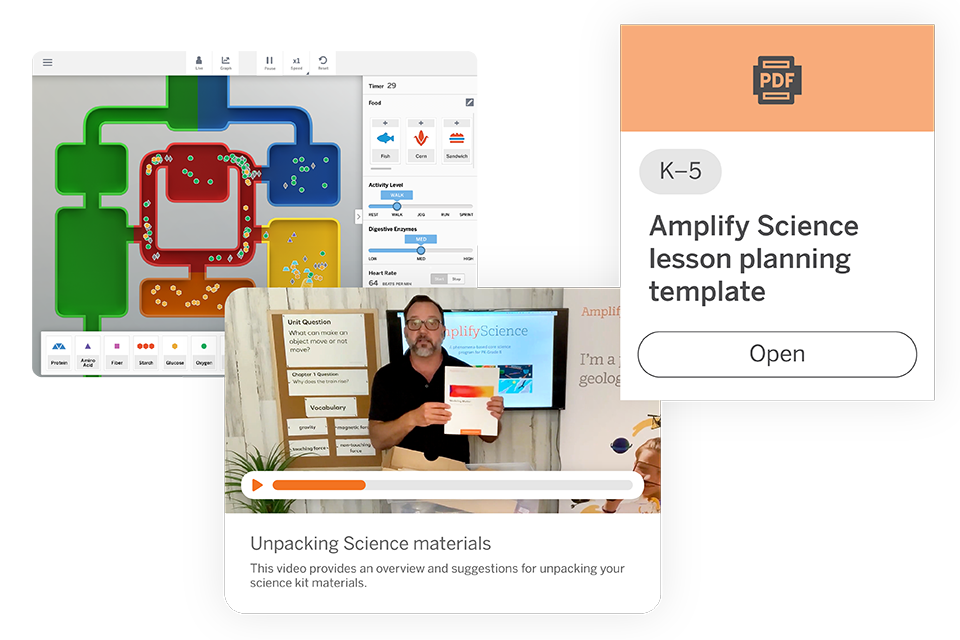
The foundation for long-lasting and sustainable change
Partner with members of our professional learning team to plan long-lasting and sustainable change for your school or district. Change is more likely to stick and get results with deliberate planning. We can support your through this journey to drive your professional improvement, enrich your instructional practice, and increase student impact.
Professional learning journey
Every school and district is unique. That’s why we offer flexible delivery options to best meet your specific needs and objectives.
Our professional development programs come in packages or individual sessions, available both on-site and virtually, to help you get the most out of your Amplify program(s).
You can also customize your learning experience by adding extra sessions, such as Science of Reading, supporting multiliterate learners, and a problem-based approach to math, to build on your base package.
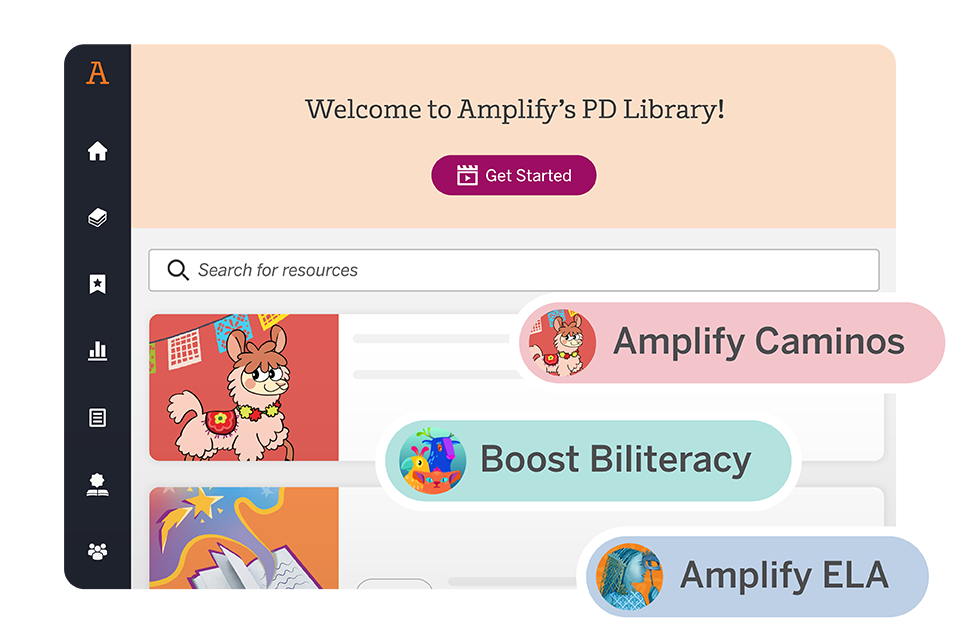
Empower teachers to continuously improve
Professional development helps teachers stay motivated and inspired to grow professionally. Demonstrate your commitment to your staff by empowering them with professional development packages that include on-site or virtual Launch, Strengthen, or Coach sessions, all of which will orient you and your team to the full features of Amplify programs.
You can also personalize your learning experience by adding enhancement sessions to base packages.

Launch
On-site and virtual Launch sessions introduce Amplify programs and support strong implementation. Self-paced, online courses are also available for select Amplify programs and include an on-demand subscription for 12-months.
After learning about the program’s foundational principles and key features, you’ll practice administering it within a collaborative environment.

Strengthen
On-site and virtual Strengthen sessions deepen understanding of the program. Session offerings are targeted and meant to take your practice—and your students’ learning—to the next level.
Offered as part of core packages, as well as enhancements, Strengthen sessions are intended to effectively address your students’ needs. Examples include:
- A focus on data analysis.
- Examining student writing.
- Targeted intervention instruction.

Coach
On-site and virtual Coach sessions are tailored to elevate instructional practices and meet the unique needs of teachers and/or leaders.
Partner with an Amplify coach who will support you in planning customized sessions leveraging our menu of supports, which can include:
- Lesson modeling by an Amplify facilitator.
- Classroom observations and debriefs.
- Grade-level planning.
Commit to sustainable change for long-term impact
Learning may ebb and flow between phases depending on your teachers’ and leaders’ needs, experiences, and professional goals. Amplify professional development aims to continually grow, develop, and refine instructional practices to support student learning and achievement.
Frequently asked questions
We value your partnership and aim to provide you with the highest quality learning experiences. Check out our frequently asked PD questions below, along with responses.
Additional learning
Once you become an Amplify customer, you’ll have access to many opportunities to continue learning how to get the most out of your Amplify program(s).
To get a sense of our support, check out some of our free resources:
- Featured blog posts on the Amplify blog
- Webinars or other online events
- Video content on Youtube
Biliteracy supports
Facilitated in both English and Spanish, specialized biliteracy sessions should be scheduled for teachers using both curricula and/or assessments. Sessions are available to support the use of both Amplify CKLA and Amplify Caminos core programs or mCLASSⓇ DIBELSⓇ 8th Edition and Lectura assessment programs. Substitute a biliteracy session for the 6-hour initial training in your package, or add these sessions on to your package for your biliteracy teachers.
Speak to our team to learn more!
Order and payment support
If you’re ready to submit your price quote, purchase order, or payment, visit our Ordering Support site for more information.
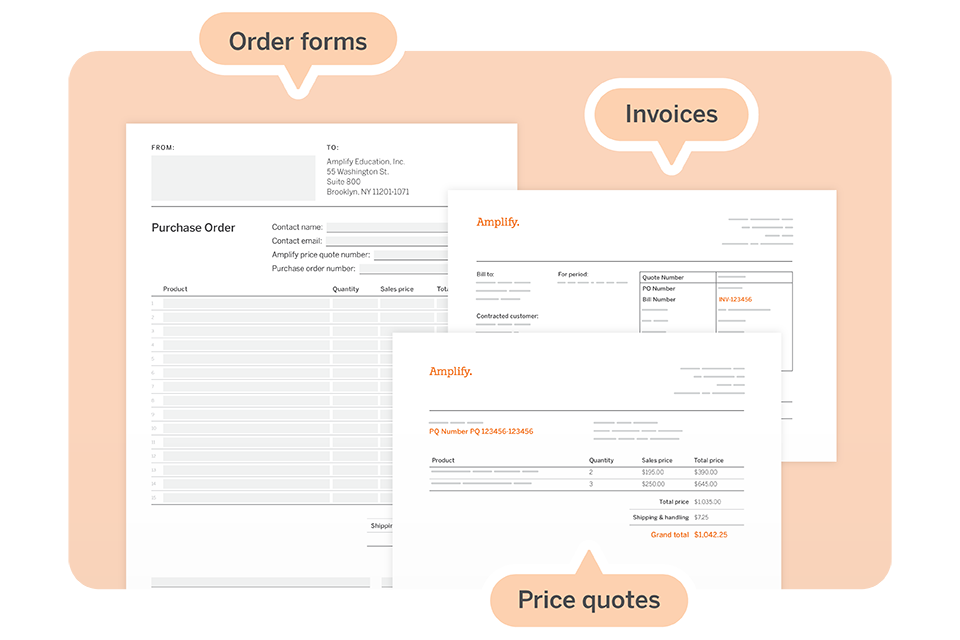
Community of collaboration
Connect with fellow Science of Reading or science advocates in one of our public Facebook groups. Join a community or tune into one of our podcasts today:
- Science of Reading: The Community and The Podcast
- Science Connections: The Community and The Podcast
- Beyond My Years podcast: Listen to chronicles from the classroom.
Amplify customers can join our exclusive, program-specific Facebook communities to ask pedagogical questions, share Amplify teaching hacks, and more!
Get in touch with a PD expert
Meet the team
Amplify employees are innovators and optimists from the fields of education, technology, design, and media. Meet some of our team members.
Team members
From full operation to lasting change with the Science of Reading: Phase 3

Welcome to the third and final installment in our series about the change management required to make the shift to the Science of Reading in your schools.
In Phase 1 of this series, we answered the question: Why is the Science of Reading important? We also described its potential to deliver literacy transformation—both in your classrooms and districts, and nationwide.
Change at that level requires hard work at your level, starting with what those in the field often call “exploration.” In Phase 1, we discussed what teachers should know about the Science of Reading. You established the rationale for changing to a Science or Reading curriculum and built buy-in from stakeholders.
In Phase 2 of this series, we guided you in evaluating Science of Reading programs, helping you answer the question: Which program will best help your school or district transition to the evidence-based practices that will drive results for students? We also walked through the selection, adoption, and initial implementation of Science of Reading resources.
And now you’re ready for change management Phase 3: full operation, innovation, and sustainability. What does this phase look like? How will the Science of Reading be used effectively? Where and how will you see student growth? Read on for all this and more.
Phase 3, part 1: Full operation
At this stage, Science of Reading literacy practices are fully integrated throughout your system.
Remember, the three key drivers of educational change are process, practice, and people. So let’s break the full operation phase down into these categories:
Process
Conduct routine data analysis to monitor student progress and determine areas of needed improvement.
Practice
Expand the focus on evidence-based literacy practice to other grade-level instructional areas to support the integration of these practices into the larger system (when appropriate). That might include personalized learning, intervention, support for bilingual students, and others.
People
Plan and implement onboarding processes for new teachers and administrators. Emphasize deeper understanding of resources and instructional practices through continuous improvement, coaching, and mentoring.
Questions to answer at this stage:
- How has the integration of evidence-based practices and resources impacted literacy development of students?
- What specific progress-monitoring processes are in place to track the effectiveness of literacy practices?
- Are interventions effective for students not reading on grade level?
- Have we reduced the number of students who are at risk?
- How are staff onboarded and prepared to step into the system?
- What ongoing professional learning will occur?
Phase 3, part 2: Innovation and sustainability
All these phases, all this work—here’s where it starts to pay off.
With Science of Reading practices fully in play, you’ll see them start to work in the form of student growth.
This stage will allow for refinement of instructional practice and a much deeper understanding of how Science of Reading research affects student achievement.
This is also a moment to continue building knowledge by focusing on middle school. Your middle schoolers need to draw on the foundational skills built in earlier grades—or get the intervention that will help them catch up—and build an academic knowledge base that will prepare them for success in high school and beyond. Continuing to bring research-based literacy practices to middle school instruction will help them get there.
And now, your final set of the 3 Ps:
Process
- Leave room for innovation aligned with the ever-growing body of Science of Reading research.
- Consider creating processes that will allow for the expansion of pedagogy based on the Science of Reading into middle schools.
Practice
- Ensure that current research and data are informing instructional decisions and continuing to deepen the knowledge base you’ve built so far.
- Implement systems such as collaborative conversations about data, peer-to-peer instructional rounds, and the study of problems of practice to support deeper implementation.
- Develop professional learning systems and put them into practice.
People
- Emphasize a culture of collaboration and shared ownership, as well as a community of practice.
- Focus conversations on student growth and outcomes to better allocate resources.
Question to answer at this stage:
- What strategies and systems can we develop to encourage innovation while remaining true to the implementation of chosen resources?
Now you have the tools, the plan, and the motivation to help drive life-changing results and improve literacy outcomes for all students by bringing the Science of Reading into your classrooms. We’re happy to be part of that change. And we’d love to hear how it goes!
More ways to explore:
- Creating change that lasts when implementing the Science of Reading: Phase 1
- Adopting and implementing the right Science of Reading program: Phase 2
- Managing the change that matters most: Implementing the Science of Reading with integrity
- The Science of Reading
- Change Management Playbook
- Change management principles
- Science of Reading: A New Teacher’s Guide ebook
Accelerating learning in science with the Science of Reading

The Science of Reading: it’s not just for Language Arts.
As host Eric Cross and expert guest Susan Lambert discuss in this Science Connections webinar, the Science of Reading also provides a powerful foundation for science learning.
Here’s what they had to say about bringing evidence-based literacy strategies into the science classroom.
The role of literacy in science literacy
Strictly speaking, the Science of Reading refers to the vast body of research we now have—and put into practice—on the systematic, explicit, and cumulative instruction required for students to learn to read.
There is a misconception that when we’re talking about the Science of Reading, we’re just talking about reading.
—Susan Lambert, Amplify’s Chief Academic Officer for Elementary Humanities
In fact, we’re talking about comprehensive literacy, which encompasses all the essential—and interdependent—components of literacy, including background knowledge, vocabulary, and both comprehension and expression.
In other words, it’s the listening, speaking, reading, and writing that scientists do in the real world—and that students do to engage with and connect to science learning. As we discussed in this post, developing students’ literacy in science helps them develop scientific literacy. And science literacy allows students to become critical thinkers, problem solvers, and strategic questioners—in science and beyond.
Integrating science and literacy in the classroom
What do these literacy strategies look like in practice? Eric puts them to use regularly—and here’s how you can, too.
- Use phenomena to activate and gauge prior knowledge. The more you know, the better you comprehend text and the faster you learn—so exploring familiar observable events (frying eggs, seeing your breath on a cold day) can engage students and accelerate their comprehension from the jump.
- Provide multilingual resources. “Being intentional about providing access to resources in the languages our students speak is critical,” said Eric. “The data shows that the more proficient students become in their native language, the more proficient they become in a new one.”
- Get students writing (and speaking, and editing). Eric has his students document their experiments and observations in (digital) notebooks and online portfolios. They also share with and present to each other, he said, “so they’re seeing other students’ writing styles and syntax and what details they include, and they can go back and update their own.” And, since it’s a year-long process, “by the time they’re done, they have this beautiful website that showcases their work.” (Amplify Science’s Student Investigation Notebooks also fit the bill!)
- Work across subjects. The Common Core recommends that, by 4th grade, 50% of texts read should be non-fiction. That’s why Eric coordinates with ELA teachers to read one text about metabolism, for example, each examining it through different lenses. “When you’re able to work together with another content teacher, it’s like magic,” he said. (And in elementary school, you’re the other content teacher!)
- Run science seminars. Students use evidence to explain their thinking. “For students who need extra support, you can have pre-written sentence frames so that they’re able to participate,” Eric said. “Even when they’re listening to other students speaking, that’s helping them develop language skills. You watch them be able to listen, speak, engage in debate, and disagree without being disagreeable, which we know as adults is a valuable skill.”
For more of Eric’s strategies, watch the webinar: Science Connections: Accelerating Learning in Science with the Science of Reading.
Even more to explore
Webinars:
- Finding Connections to K–8 Science & Literacy Educator Roundtable
- K–8 Literacy & Science Instruction Integration
Curriculum: Amplify Science
Amplify blog:
Alert: Progress in early literacy is slowing.

The latest middle-of-school-year data from Amplify show that throughout the spring and fall of 2023, schools across the country made some progress increasing the number of K–2 students on track for learning to read. But that progress is slowing.
Between 2021–2022 and 2022–2023, the number of K–2 students on track for learning to read increased by four to five percent across all grades; however, between 2022–2023 and 2023–2024, the increase was only two percent in each grade. Yet this is not the time for slow progress, because literacy rates in the United States are already a concern. Only half of K–2 students are on track for learning to read, and three in ten students are far behind.
To address slowing gains, schools and districts need to act now to accelerate literacy outcomes.
Early reading: Why we need to act now
The decline is especially urgent for students in kindergarten through the second grade. That’s because of what comes next: third grade, known to be the make-or-break year for reading and future academic success. To put it bluntly, students who are not proficient in reading before entering fourth grade are much more likely than their peers to struggle in school, and they are much more likely to drop out.
“The data is clear—literacy rates at the earliest and most critical time for student development are slowing. Changing this course requires schools and districts to act now and review their approaches in all grades,” says Susan Lambert, chief academic officer of elementary humanities at Amplify. “Schools that deliver strong outcomes focus on building a solid foundation at the start and intervening quickly when students need extra support, rather than trying to play catch up later, when it can be more difficult.”
The good news: We know what to do.
When students receive science-based reading instruction, literacy outcomes improve.
Changing these outcomes requires that districts and schools review the processes and practices they have in place at all levels. Schools that deliver strong outcomes focus on getting students on track—and often ahead—in the earliest grades, because it’s easier to get students ahead from the beginning than to catch them up later.
Districts should:
- Administer universal screening assessments three times per year to monitor levels of risk for reading difficulties.
- Allocate staff to support students who are at risk, spending additional time in literacy instruction beyond grade-level instruction.
- Regularly monitor progress for students who are at risk, making adjustments as needed.
- Ensure that instructional staff gain knowledge about science-based reading instruction and implement high-quality core curriculum with fidelity.
- Instill a love of reading and books during all school-based programs, with the support of caregivers and the community.
“The good news is that when students receive science-based reading instruction, outcomes improve,” Lambert continues. “And, when that instruction takes place in the earliest possible grades, research shows that most students can be taught to read at or approaching grade level.”
More to explore
Connecting science and literacy: The power of language
We’ve talked about how scientists need literacy skills in order to be scientists. They can’t do their jobs without reading, writing, listening, and communicating.
Our recent webinar Science Connections: Science and Literacy explored this intersection from a broader level: the power of language in the science classroom.
How can science teachers remove language barriers to make sure all students are able to access prior knowledge—and acquire more? And how can teachers leverage language to create optimal learning conditions for their science students? Why should they?
Let’s find out what webinar co-hosts Eric Cross and Susan Gomez Zwiep, Ph.D., had to say!
Language and science sense-making
Contrary to stereotype, scientists aren’t just loners in labs. Susan Gomez Zwiep, former middle school science teacher and senior science educator at BSCS Science Learning, credits a colleague with this pearl: “If I’m just doing science myself, and not talking to anybody, that’s not science. That’s just me in my head.”
So science teachers need to give students every possible opportunity to get out of their heads. And if language is a barrier—whether students are learning English, or challenged by science vocab—teachers can help remove it.
This principle is especially important in the context of phenomena-based learning, says Gomez Zwiep. “Rather than telling students ideas, and then proving those ideas correct by showing them a phenomenon, we show them the phenomena and engage them in science sense-making to develop that understanding,” she says. “Language is central to science sense-making and communicating that sense-making.”
Students also bring their prior knowledge to scientific sense-making. And, as Gomez Zwiep points out, prior knowledge is often embedded in the language a student uses at home, or just their own non-scientific vernacular. “I have to use that when I first engage with the phenomenon,” she says. “Otherwise, I’m limiting the resources that kids bring to the learning environment.”
Language in a “safe” science classroom
“If I had to learn science in my second language, I would be struggling with not only everyday vocabulary, but also content-specific vocabulary,” says Eric Cross, host of Amplify’s Science Connections podcast. “You would never actually know what I knew or what I was bringing to the table.”
The goal is to create an environment where students feel comfortable exploring, using whatever language is accessible to them, and then guiding them to conclusions—and precise scientific language. “A classroom requires trust. It requires relationship building,” says Gomez Zwiep. “If a student is worried about saying something a particular way, that’s where all their cognitive energy is going instead of actually talking about the science.”
The key? Put scientific ideas first, and the language will come. “We used to wait until kids had English in order to learn science. And now we’re starting to see that language emerges from learning experiences,” says Gomez Zwiep. “So it’s a product of learning, not a prerequisite.”
Literacy in your science classroom
You can integrate science and literacy right away, starting with free science and literacy lesson samples from Amplify Science.
Explore more:
Science blogs
- “Science or literacy instruction? You don’t have to choose!”
- “Instructional strategies for integrating literacy into your science classroom”
Science Connections podcast episodes
Problem-based learning in Amplify Desmos Math
This program brings problem-based learning into the math classroom, with an approach proven to help students develop math reasoning and problem-solving skills—not to mention deep understanding, fluency, and comfort with all things math.
Let’s take a closer look at problem-based learning in math, and at the contours of this exciting curriculum.
How problem-based learning helps math students—and math teachers
When you learned math, you likely started out learning arithmetic then moved on to solving word problems. You might have learned formulas, then practiced using them to determine the volume of a prism or which train will arrive at what time.
But life works differently. Sometimes we tackle the problem first, not the formula. When you get a new piece of technology—a phone, a TV, a computer—you might read the user guide, or you might just turn it on and try some things.
If that second style sounds like you, that’s common—and it’s an example of learning through problem-solving.
“It’s something we naturally do,” says Kristin Gray, executive director of Amplify’s math suite. “We’ve had a phone before, so we would pick up this new phone and try doing things that we know worked before, and then we would experiment. Does it work the same on this phone? This bouncing between experience and explanation is the foundation of how we learn through problem-solving.”
What does that look like in the math classroom?
Students tackling interesting problems, raising questions about the math required, receiving an explanation, and applying it back to the problem—just as in the example of new technology.
“When we show students how to get the answer, we send the message that math is solely about answer-getting and learning processes. Answers are important, but we want to use problems to teach the math, not just teach students to get the answer,” says Gray.
Learning through problem-solving can also engage more learners in math, says Gray. By influencing the way students (and teachers) think about what it means to know and do math, problem-based learning has the potential to shift the way they think of themselves as mathematicians.
“Students are naturally curious and like solving challenges and trying things in new ways, so that’s a great start,” says Gray.
And understanding is motivating. It inspires perseverance and confidence. It supports making connections, not learning concepts in isolation.
When students are given a new problem and are able to use prior knowledge to help solve it, that “promotes the development of autonomous learners,” says Gray.
Supporting the brilliance of student thinking
Our program combines interactive problem-based lessons with explicit instruction, reinforcement, and practice. Lessons build a strong foundation in procedural and fact fluency, deepen understanding of concepts, and enable students to apply learning to real-world tasks.
To learn more about how and why it all came together, watch the following video featuring Amplify Director of Project Management Christina Lee, Amplify Math advisor and Desmos user Fawn Nguyen, and Desmos Director of Research Dan Meyer.
Christina: Hi, I’m Christina, the product manager at Amplify working on our K–12 math program. As you may have heard by now, Desmos Classroom is joining Amplify. This includes all of teacher.desmos.com, including all of the free activities, the free activity builder, and the Desmos math curriculum. I have Fawn Nguyen and Dan Meyer here to answer a few questions about what’s going on. Thank you both for joining!
The first question is to you, Dan. One thing every Desmos user is going to want to know is, will the Desmos calculators and activities on teacher.desmos.com stay free to use forever?
Dan: Yes, period. It’s an important question and an easy one to answer. Our commitment to users, from day one, has been [to] whatever you can use for free. Now we’re not going to make you pay for that. We know how hard it is as a teacher to build your practice on top of software that could disappear, and Amplify shares that commitment in a rock-solid way.
Christina: That’s great to hear! Fawn, can you tell us a little bit about what you love about teacher.desmos.com? Why should a teacher who’s never used [it] check it out?
Fawn: How do I love teacher teacher.desmos.com? Let me count the ways! There’s nothing like it out there that allows teachers to build lessons from scratch. What makes it unique? Well, there are lots of things that are unique about Desmos, but the screen-by-screen build is a standout for me. It allows me to interact with students prior to moving to the next screen. More importantly, the interaction among the students and the teacher dashboard is just brilliant. It lets me see the students’ responses, especially the graphical ones, in real time. I feel like it’s a built-in formative assessment [in] the lesson. And not surprisingly, the structures from the five math practices by Peg Smith are built-in there with the selecting, sequencing, and connecting.
Christina: Dan, why does it make sense for Amplify and Desmos to build one core math program for grades 6–12?
Dan: We’ve been traveling on separate parallel paths for a really long time and it makes a lot of sense for us to go farther together. For instance, we’ve both been building a core curriculum based on the Illustrative Mathematics curriculum. We have both been doing that using core Desmos technology. We both share an understanding of the complexity of teaching, the brilliance of student thinking, and so it makes sense for us to merge together. Desmos brings to the table a deep understanding of how technology can support student learning, and Amplify brings to the table an understanding of how systems support students at scale. So we bring a lot of commonalities and a lot of elements that both of us need from the other.

Christina: Fawn, you’ve been an advisor on the Amplify Math curriculum focused on problem-solving. In what ways do you think this knitting together of the two programs will help make teaching through problem-solving easier for teachers?
Fawn: I actually knit, Christina! So I really like your description of the partnership as knitting together the two programs. It’s like taking two luxurious fibers, if I may say––ironically, luxurious but free, which describes literally nothing except Desmos––and weaving them together to create a gorgeous and functional design. I’m thinking about a sweater vest for Dan, he would look great in it! Amplify truly understands what problem-solving is, that it’s non-routine. And Amplify’s math curriculum has many great activities. However, when this task can only live on a printed page it’s hard for it to stay as a problem-solving task. What I mean is that it’s hard for students to unsee things. So when it’s on paper, you have to show all the cards and that ruins everything to me, frankly. But with Desmos again, with that screen-by-screen build and the pause and pace functions, they are designed so that the timing of teacher moves can happen. I think the timing is really important. And then problem-solving is about tinkering with ideas and testing conjectures, and Desmos is built for such. It invites you to play, it invites you to take risks, and it doesn’t shame you when you make a mistake. So ultimately, Desmos brings school mathematics, which Amplify writes, closer to what doing mathematics looks like.
Christina: Dan, one final question for you. What’s going to happen to the Desmos calculators now?
Dan: The Desmos calculators, like all the other technology as part of this deal, will remain free into perpetuity. They’ll get spun over into a new corporation, a public benefit corporation called Desmos Studio, where they’ll have a lot more focus from the people who work on it and a lot more resources to expand and develop and do that work.
Christina: Thank you, Dan. Thank you, Fawn. Thank you both. I’m really excited about this opportunity we have to build something special for teachers and students! For more information about Amplify Math and Desmos Classroom, and everything else we’ve got going on, please visit amplify.com/futureofmath.
From math lesson planning to long-term success
Amplify Desmos Math makes it easy for both teachers and students to make the shift to a problem-based approach by providing captivating activities, powerful teacher-facilitation tools, and lots of support for differentiation and practice.
Lessons start with warm-ups that tap into prior knowledge and move into problems that require collaboration to solve. Teachers monitor, engage, and ultimately synthesize student work into the main idea. There are also ample opportunities for practice and reflection.
Amplify Desmos Math will be available for 2025–26 school year implementation. Interested districts can pilot the beta release starting fall 2024.
Learn more about Amplify Desmos Math.
Top 5 back-to-school tips for math teachers
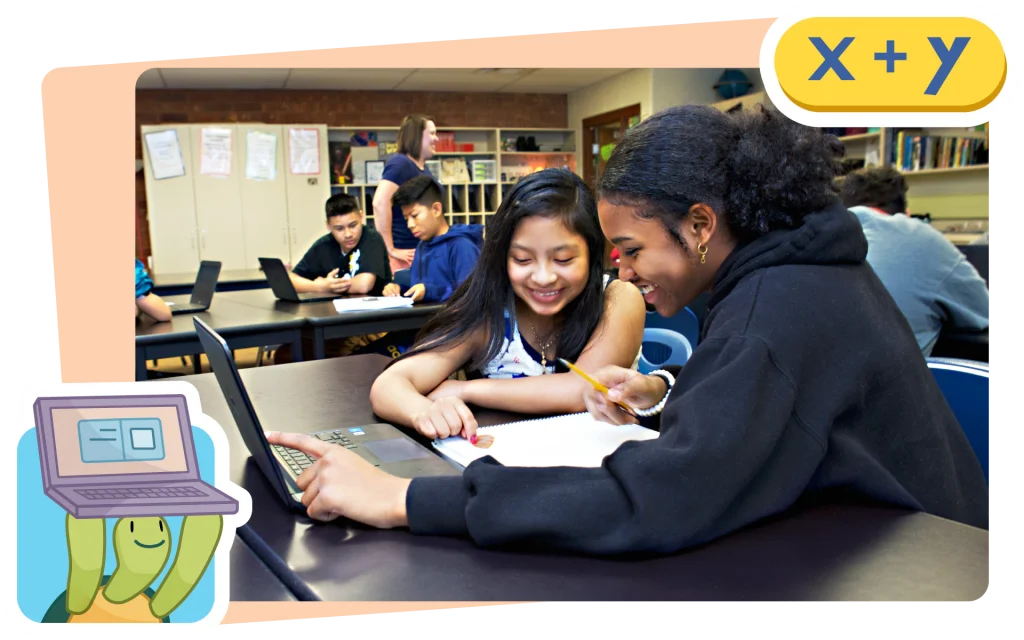
Math teachers: What’s the formula for a successful year? As you know, there are plenty of variables, but here’s one constant: being prepared for back-to-school season.
We’re here to help!
From fun math activities to positive tone-setting to professional learning opportunities and more, our strategies are designed to help you enter your math classroom for the new school year feeling energized, inspired, and supported by your math community.
1. First-day fun: Plan interactive math classroom activities.
Before launching into back-to-school math lessons, how about a few rounds of Icebreaker Bingo? Create a Bingo card inviting students to find classmates who can answer “yes” to math-related descriptions (e.g., “Enjoys cooking or baking,” “Plays a musical instrument,” “Likes to play board games”). Activities like these motivate students by helping them uncover common interests and reminding them that math is an integral part of “real life.”
2. Student success: Work with school colleagues and leadership toward shared goals.
Review what systems may already be in place and consider adding more. You might:
- Schedule regular team meetings to set and work toward common goals.
- Establish a professional learning community to share math resources for teachers. For example: Consider hosting a Learning Lab to encourage collaborative professional learning from within the classroom.
- Amp up the use of data to inform decisions. Ask your team: What student performance data and assessment results can we use to see where improvements are needed?
3. Set the tone for the year: We are here to make mistakes.
As Math Teacher Lounge podcast co-host Dan Meyer says, “Students spend the majority of their learning in class [being] wrong.” That’s not only normal, it’s actually good—as long as students know that. Start the year by reminding them that making mistakes is not only inevitable, but also essential. Normalizing being “wrong” encourages students to overcome fear of failure, take risks, and build confidence—in school math activities and beyond.
4. Grow together: Establish a math community.
Build a math ecosystem connecting students to one another and creating a continuum between the classroom and their everyday lives. You might:
- Establish math routines in your classroom to build a classroom community focused on collaborative learning.
- Collaborate with students on writing a weekly math blog or math newsletter with classroom updates.
- Create simple but engaging math challenges for students and caregivers to do together, such as building toothpick towers or budgeting for a fantasy birthday party.
5. Use free professional learning opportunities for teachers from the math team at Amplify.
Explore our upcoming math webinars, designed to support you—along with your schools and districts—in using collaborative, effective, and engaging math practices in the classroom.
You can also check out our on-demand math webinar library on your own time. From quick tips to longer continuing education (CE) credit options, our library is sure to have just what you need.
Finally, our free toolkit of math resources will:
- Help you craft a dynamic math curriculum during the crucial first weeks of school.
- Support student engagement and spark new inspiration in your classroom practices and activities.
- Offer learning opportunities you can access now or on demand whenever you need them.
- Make it even easier for you to implement the tips above setting math students up for success from day one of the school year!