Welcome, Reviewers to Amplify Desmos Math California!
Please select your grade levels below. On each site, you will find detailed information about the program’s development, a comprehensive overview of reviewer materials, and instructions on how to access the digital curriculum.
Select the grade band you are reviewing:
Slow but steady: K–2 reading readiness climbs just 1–2 percentage points annually.
With just over half of young readers on track and year-over-year gains flattening, the latest research brief underscores the urgency of data-driven instruction:
- 57% of K–2 students overall are on track to learn to read.
- Year-over-year improvement from 2024–25 to 2025–26 ranged from zero to two percentage points across grades K–2; the youngest students made the most progress.
- Middle-of-year data is uniquely positioned to help schools plan for instructional changes and implement those changes before the following school year. See our recommendations for schools and districts concerned about changing literacy outcomes.
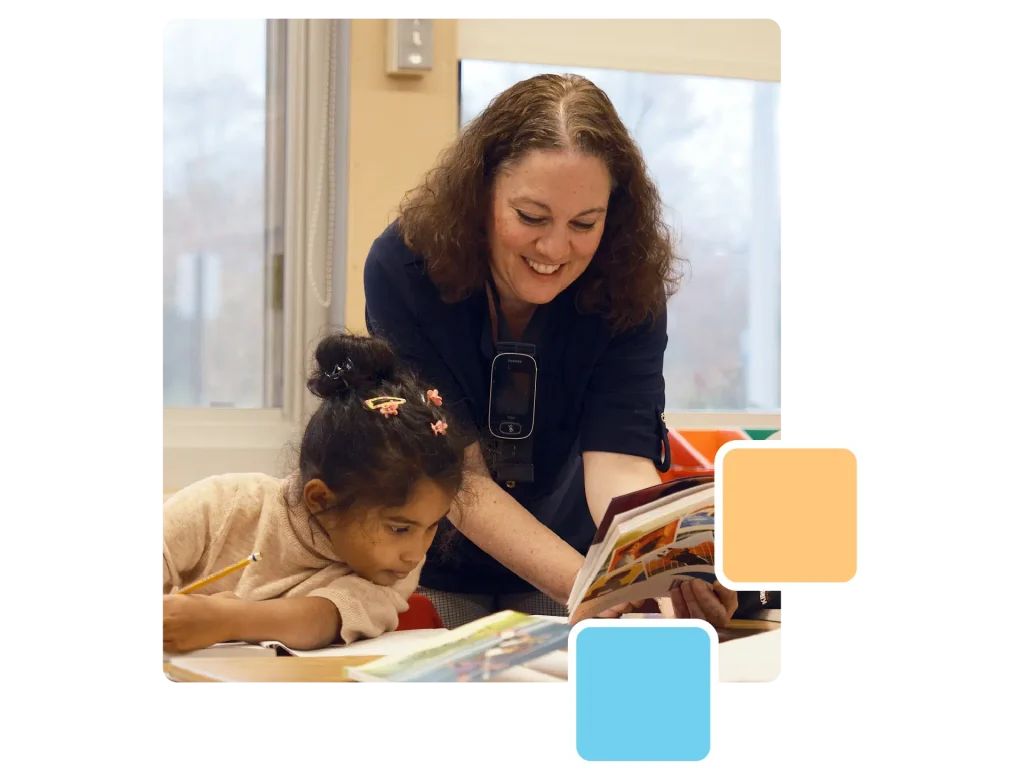
Explore Amplify’s middle-of-year research brief.


Research briefs by school year
October 2024
BOY: Summer instructional loss highlights the importance of quality core instruction for the youngest grades.
October 2025
BOY: More students start the school year on track for learning to read, though momentum is slow.
February 2025
MOY: Early literacy gains offer hope for COVID recovery, though broader literacy challenges persist nationwide.
February 2026
MOY: Slow but steady: K–2 reading readiness climbs just 1–2 percentage points annually.
July 2025
EOY: Reading scores rise overall; gender disparities present a complex picture.

Read more research and case studies.
Amplify’s high-quality programs benefit millions of students every day using methods that are evidence-based, ESSA-aligned, and showing efficacy in a variety of contexts. Read more research and case studies and see more briefs on early literacy.
Expect more from your assessments with mCLASS Math.
Understanding student thinking is the key to accelerating student performance.
Welcome to mCLASS® Math, the benchmarking and progress monitoring system for grades K–8 that measures proficiency, reveals underlying mathematical thinking, and informs instructional support for every learner. Analyzing student responses to reveal valid underlying mathematical thinking—even in wrong answers—helps better target individualized instructional recommendations that build grade-level proficiency.
Meet mCLASS Math.
mCLASS Math’s research-based benchmark and progress monitoring assessment system tracks performance against grade-level expectations to help predict later growth outcomes.
With screening and diagnostic capabilities and empirically established cut scores to assess risk, mCLASS Math reporting helps educators pinpoint strengths and areas of growth for individualized instructional support for every student. Together, these establish a strong Multi-Tiered System of Supports (MTSS).
This powerful assessment is digitally assigned to the whole class three times annually: beginning-of-year (BOY), middle-of-year (MOY), and end-of-year (EOY). The open responses of the assessment give more robust data-points gathered from each item, and it only takes 30 to 40 minutes to complete.
Designed to target critical grade-level skills that predict success, the rich data can be used as a diagnostic tool for Tier 2 and Tier 3 intervention and flags for the potential risk of dyscalculia.
mCLASS Progress Monitoring assessments help teachers chart students’ progression between benchmark assessment windows. For students receiving targeted support, mCLASS Progress Monitoring determines if intervention is effective or adjustments are needed to enhance student learning.
These short yet effective assessments enable teachers to monitor a student’s math performance between mCLASS Benchmark assessments. mCLASS Progress Monitoring assessments can be assigned to a select group of students needing targeted support in a specific skill or Tier 2 or Tier 3 intervention, and are aligned around crucial math domains for each grade level.
Assess in less time.
With the groundbreaking digital analysis of student thinking, mCLASS Math teachers can rely on the predictive validity of assessments in less time.
The powerful Student Response Analysis of open-ended questions provides deep insight into what and how students think—faster and with fewer questions.

Access deeper insights.
mCLASS Math’s dynamic data reports offer a window into student thinking, reliably guiding intervention across Tiers 1–3.
The more teachers understand how their students think, the better they can support their growth. The assessment system recognizes students’ individual strengths, experiences, understandings, and strategies—or assets, as we collectively refer to them—to inform the robust data that powers mCLASS Math.
Educator and caregiver reports
Empirically established cut scores and domain-specific measures help teachers plan for tiered intervention with classroom, school, and district-level performance reports set to predict end-of-year outcomes.
To reinforce learning at home, Home Connect letters provide caregivers with easy-to-use reports on their child’s math development.
Student Thinking Report
The Student Thinking Report gives teachers actionable recommendations tailored to how individual students or groups of students approach problems. By understanding the different ways of thinking in skimmable, yet robust, reports, teachers have the tools they need to efficiently plan differentiation to achieve instructional targets.
Actionable recommendations enable teachers to quickly differentiate with intervention resources aligned to common misconceptions.
Research behind mCLASS Math
Based on decades of research for best practices in math, mCLASS Math efficiently assesses students’ skills and thinking to give teachers instant recommendations for small group and individualized instruction.
Following research from leading math experts and an in-depth validation analysis through WestEd, a technical report will be released summer 2025.

A dedicated team at Amplify with over 500 combined years of classroom teaching, school leadership, and assessment experience thoughtfully created mCLASS Math with teachers and students in mind.
Following research from leading math experts and an in-depth validation analysis through WestEd, data will be continuously released starting in spring 2025.

Sandra Pappas
Associate Director of Research

Patrick Callahan, Ph.D.
Educator and Founder of Math ANEX

Jason Zimba, Ph.D.
Chief Academic Officer of STEM
at Amplify
The mCLASS Math K–5 assessment system is designed to provide educators with reliable and valid measures to identify students needing additional support in mathematics and to inform instructional decisions. Preliminary data presents evidence supporting the psychometric quality of the assessment using the technical standards outlined by the National Center on Intensive Intervention (NCII) and state requirements for screening measures.
Data informs
instruction
mCLASS Math works alongside your core instruction, differentiation, and intervention. The data model behind mCLASS Math provides comprehensive data for each student across grades K–8, easily connecting teachers to the immediate next steps that will support, strengthen, and stretch all learners.
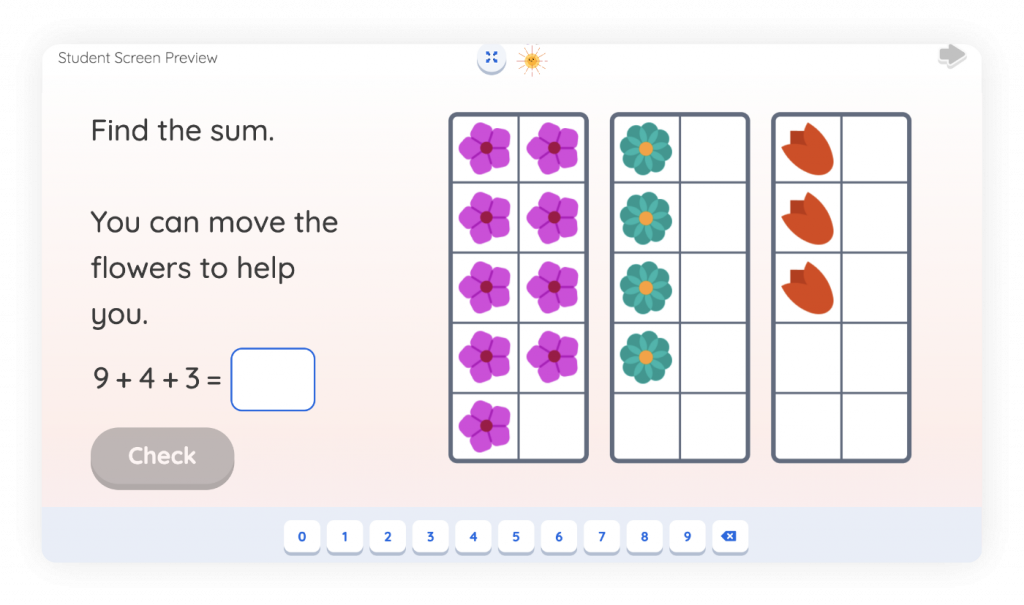
Personalized Learning accelerates student growth with daily, targeted 15-minute digital activities. Supported by a virtual tutor, students tackle individualized tasks linked to daily lessons, receiving just-in-time support to foster grade-level success.

Teacher-led, 15-minute Mini-Lessons can build grade-level proficiency by providing research-based, targeted intervention to small groups of students who need additional support.

Reinforce students’ understanding of concepts through collaborative, hands-on Centers (grades K–5). These student-led routines provide additional practice with vertical alignment across grade levels.
Fluency Practice uses spaced repetition, an evidence-based approach to promoting memory retention, to teach basic facts. The adaptive nature of the practice allows students to focus less and less on the facts they already know. We’ve partnered with Math for Love to iterate on the popular Multiplication by Heart to create Division by Heart and Addition and Subtraction by Heart I & II. These proven fluency decks—plus Skills Fluency for supporting procedural fluency practice—help students practice crucial skills independently.
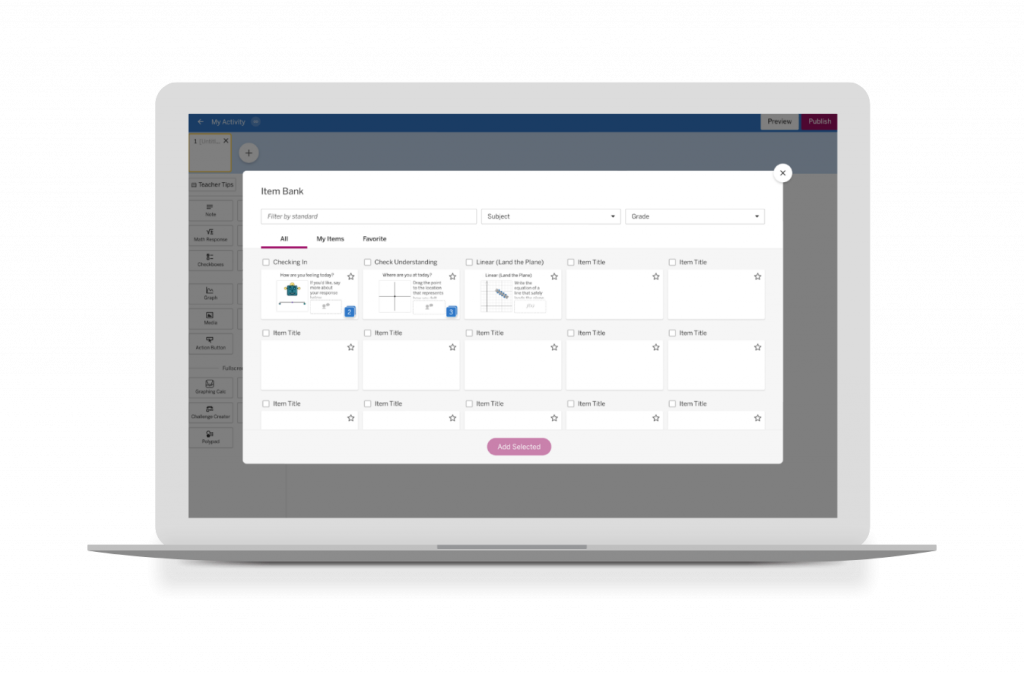
Item Banks provide space for teachers to create custom practice and assessments by using filters and searching for standards, summative-style items, and more.

All students should have access to fun and challenging problems. Extensions are 10- to 15-minute activities aligned to the most critical topics for the grade, providing flexible, low-lift activities for the whole class or targeted intervention to small groups of students ready for an extra challenge.
One cohesive math experience
As part of Amplify Desmos Math, Amplify’s comprehensive math suite, mCLASS Math provides a strong foundation of actionable data to help teachers diagnose and capitalize on student strengths. Amplify Desmos Math ensures that you have all the core, intervention, and personalized instruction you need to support each stage of a student’s math journey.
Amplify Desmos Math for the Archdiocese of Miami
Welcome Catholic school educators,
Amplify Desmos Math thoughtfully combines conceptual understanding, procedural fluency, and application. Each math lesson is designed to tell a story by posing problems that invite a variety of approaches before guiding students to synthesize their understanding of the learning goals.
What is Amplify Desmos Math?
Amplify Desmos Math supports teachers in building students’ lifelong math proficiency. The program:
- Supports social classrooms, invites mathematical creativity, and evokes wonder, creating a welcoming learning space where students are empowered to see themselves and their classmates as having brilliant mathematical ideas.
- Provides teachers with clear, step-by-step moves to build systematically from students’ prior knowledge to grade-level learning.
- Connects students to each other’s thinking and to an understanding that they can use math to make sense of the world.
- Enables access to grade-level understanding for every student, every day.
A powerful suite of math resources
Amplify Desmos Math combines the best of problem-based lessons, intervention, personalized practice, and assessments into a coherent and engaging experience for both students and teachers.
Data informs instruction. Comprehensive student profiles provide full data on students’ assets and skills, empowering teachers to provide just-in-time scaffolds throughout core instruction and targeted intervention when needed.
Ready to Explore?
Ready to explore as a teacher? Follow these instructions:
- Visit learning.amplify.com
- Select Log in with Amplify.
- Enter the username: t1.diocese_of_miami_adm@demo.tryamplify.net
- Enter the password: Amplify1-diocese_of_miami_adm
Ready to explore as a student? Follow these instructions:
- Enter the password: Amplify1-diocese_of_miami_adm
- Visit learning.amplify.com
- Select Log in with Amplify.
- Enter the username: s1.diocese_of_miami_adm@demo.tryamplify.net

Experience Amplify Desmos Math
Click the links below to explore our interactive digital lessons, where you’ll also find print Teacher Edition and Student Edition pages for each lesson.
For helpful navigation tips and more program information, download our Grades K–5 and Grades 6–Algebra 1 program guides.
You can also watch a product expert walk through a lesson and the available program components with a lesson walkthrough video.


Personalized learning and support
Amplify Desmos Math includes digital, adaptive practice that provides the personalized support a student needs to access grade-level math every day. Personalized Learning activities target a skill or concept aligned to the day’s core lesson, with each student receiving personalized scaffolds based on what they already know. This technology complements daily learning and provides another layer of support to the in-lesson differentiation and instructional guidance provided to teachers. Click here to try a Boost Personalized Learning activity. More activities coming soon!
The Fluency Practice of Amplify Desmos Math uses an evidence-based approach to memory retention—spaced repetition—for the basic operations. Students around the world have answered more than 120 million multiplication questions within our application. Try it now!

Contact us
Support is always available. Our team is dedicated to helping you every step of the way. Contact your dedicated Florida representative here for program access, samples, and additional information.

Jeff Rutter
Field Manager
Miami-Dade and Monroe Counties
jrutter@amplify.com
(727) 407-5801

Amanda Shelley
Account Executive
Broward County Schools
ashelley@amplify.com
(321)-693-3518

Tom Gantt
District Manager
Miami Resident
tgantt@amplify.com
(305)-546-2979
Welcome, Washington County!
Welcome to Amplify Desmos Math California!
California educators, welcome to math that motivates. Introducing Amplify Desmos Math California, a new, curiosity-driven TK–12 program that builds lifelong math proficiency. Each lesson poses problems that invite a variety of approaches before guiding students to synthesize their understanding of the learning goals. Students encounter math problems they are eager to solve; teachers spend more time where it’s most impactful: creating a collaborative classroom of learners.
Scroll to learn more about the program and explore sample materials.
About the program
Amplify Desmos Math California is a TK–12 core math program designed to meet the CA Math Framework and the Common Core State Standards for Mathematics. Offered in English and Spanish, Amplify Desmos Math California thoughtfully combines conceptual understanding, procedural fluency, and application through a structured approach to problem-based learning. Through engaging activities, Amplify Desmos Math California invites curiosity and math discourse into the classroom to create lifelong math proficiency.
Please scroll to learn more about the K–8 program and explore sample materials. (TK and high school materials are in development and will be available soon.)
A powerful math suite
Amplify Desmos Math California combines the best of assessment, problem-based core lessons, personalized practice, and intervention into a coherent and engaging experience for both students and teachers.

Assessment
mCLASS benchmark assessments, along with daily formative checks, measure not only what students know, but also how they think. The asset-based assessment system provides teachers with targeted, actionable insights, linked to core instruction and intervention resources. Unit- and lesson-level core assessments give teachers data at their fingertips to guide and differentiate instruction. In grades 3–8, core assessments and performance tasks are designed to prepare students for success on the Smarter Balanced Assessment Consortium (SBAC) testing.
Core instruction
Amplify Desmos Math California core lessons pair problems students are eager to solve with clear instructional moves for teachers. Each lesson is designed to tell a story by posing problems that invite a variety of approaches before guiding students to synthesize their understanding of the learning goals. With built-in differentiation and Multilingual / English Learner support, Amplify Desmos Math California will allow every student to find success in the math classroom.


Personalized learning
Boost Personalized Learning activities help students access grade-level math through engaging, independent digital practice. Responsive Feedback adjusts to students’ work, providing item-level adaptivity to further support their learning.
Intervention
Integrated resources like Mini-Lessons, Fluency Practice, and Math Adventures provide targeted intervention on a specific concept or skill connected to the daily lesson. Extensions are also available to stretch students’ understanding.

Big Ideas
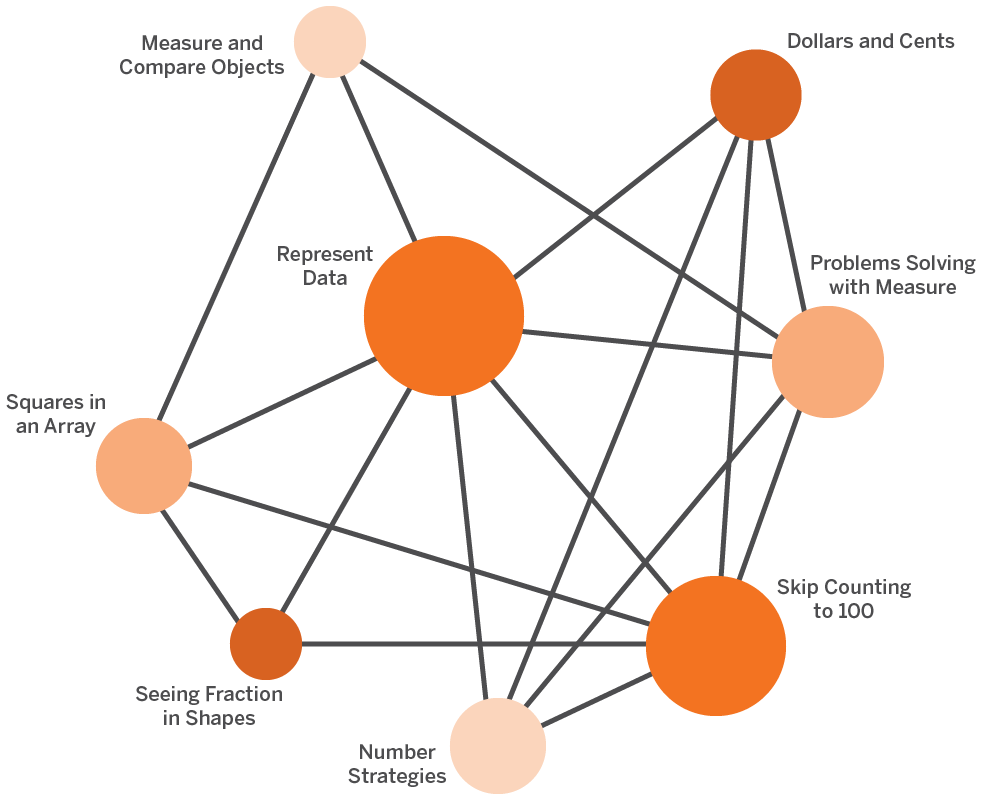
The CA Mathematics Framework encourages a shift from power standards to thinking about math as a series of connected Big Ideas. Each Amplify Desmos Math California lesson supports one or more Big Ideas and the connections between Big Ideas. The grade-level diagram changes through the course based on the math concepts being addressed.
Focus, coherence, and rigor
Each lesson highlights why the content being covered is important, how students will engage with the mathematics, and what students will do with the learning. Our lesson opener helps teachers understand the most important concepts of the lesson, and includes the Drivers of Investigation (DI), Content Connections (CC), and Standards for Mathematical Practice (SMP) that drive learning in each lesson.


Built-in authentic tasks
Mathematics is not learning in isolation. Students are connected to each other’s thinking and can use math to understand the world. With accessible invitations to authentic tasks, all students can experience mathematical success. Amplify Desmos Math California provides these authentic invitations in a variety of ways:
Each unit begins with an “Explore” lesson, which allows students to engage with authentic exploration in low-floor, high-ceiling tasks. These tasks are designed in such a way that all students can access the basic mathematical concepts, but they also offer possibilities for advanced exploration and problem-solving for those ready for more complex work, promoting an inclusive and differentiated learning environment.
Our innovative course-level investigations are designed to facilitate multipart exploration. Students grapple with Big Ideas, diving deep into key concepts that encourage comprehensive understanding. Data science is infused into the approach, equipping students with a strong foundation in interpreting and applying data-driven solutions. The Environmental Principles and Concepts (EP&Cs) are also a focus of our investigations, enabling students to understand and appreciate the coherence and interrelationship of Earth’s environmental systems.
A focus on multilingual and English learners

In building Amplify Desmos Math California, we partnered with the English Learner Success Forum (ELSF) to provide guidance on our multilingual/English learner support for teachers. ELSF is a national nonprofit organization that advocates for high-quality instructional materials that are inclusive of multilingual learners. ELSF’s guiding documents reflect research-based instructional strategies that are critical to curriculum design and were created by researchers, linguists, and practitioners from across the country. ELSF reviewed our materials and provided directional guidance and feedback to ensure that the program fully supports multilingual/English learners.
A component of our K–5 curriculum is the engaging unit stories that interweave mathematics with real-life situations and relatable narratives. These unit stories are specifically crafted to inspire curiosity and foster a deep connection between the learner and the math concepts being explored. This unique approach not only makes learning fun and interesting, but also allows our young learners to see themselves in the math.
To help students grow their domain-specific and academic vocabulary, Amplify Desmos Math California provides embedded vocabulary routines, such as prompting teachers to use a Frayer Model. These routines allow students to make connections to new language and offer repeated opportunities to develop and refine language.
Amplify Desmos Math California recognizes the diverse language needs of our students and is designed to be inclusive. Each lesson in the program features a parallel language activity, designed to be available to all students, in the form of teacher guidance and student activities. The activities in the Math Language Development Resource has leveled ELD (Emerging, Expanding, Bridging) differentiation to support all levels of Multilingual and English Learners. This approach ensures that all students, regardless of their language skills, can participate fully, grasp the material, and excel in their mathematical journey.
Uploaded digital glossary for languages other than Spanish. Up to nine languages of translations will be provided for.
Amplify Desmos Math California will include support resources for Spanish-speaking students across TK–Algebra 1/Integrated I beginning in the 20262027 school year.

K–5 sample materials
Click the links in the drop-down sections below to explore sample materials from each grade.
For helpful navigation tips and more program information, download the Amplify Desmos Math Program Guide.
You can also watch a product expert walk through a lesson and the available program components.
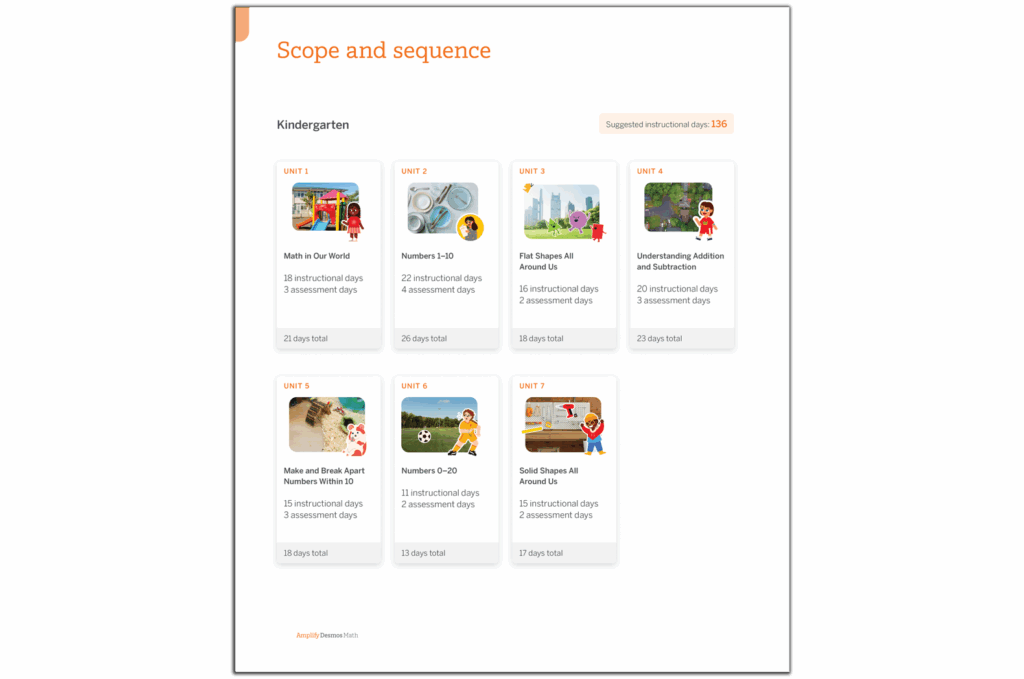
Program structure
Get to know the content and structure of Kindergarten Amplify Desmos Math California.
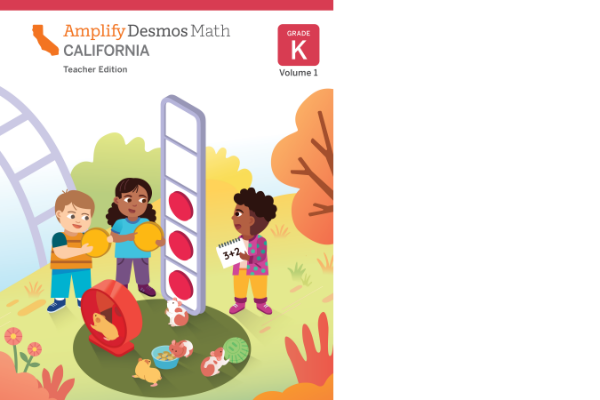
Teacher Edition pages
Planning and instructional guidance is visual, organized, and easy-to-follow. To help you review the program, we have included samples from a complete sub-unit on this site: Unit 2, Sub-Unit 1: Counting and Comparing Objects.

Digital experience
Explore our digital experience! Every lesson in Amplify Desmos Math California has student print materials and digital recommendations.

Student Edition pages
Motivate students with mathematics that is both rigorous and delightful.

Centers Resources
Engaging, hands-on games for students to play collaboratively to strengthen their understanding of key skills and concepts.
Intervention and Extension Resources
Additional resources to reinforce and extend key concepts, including Mini-Lessons and Extensions.
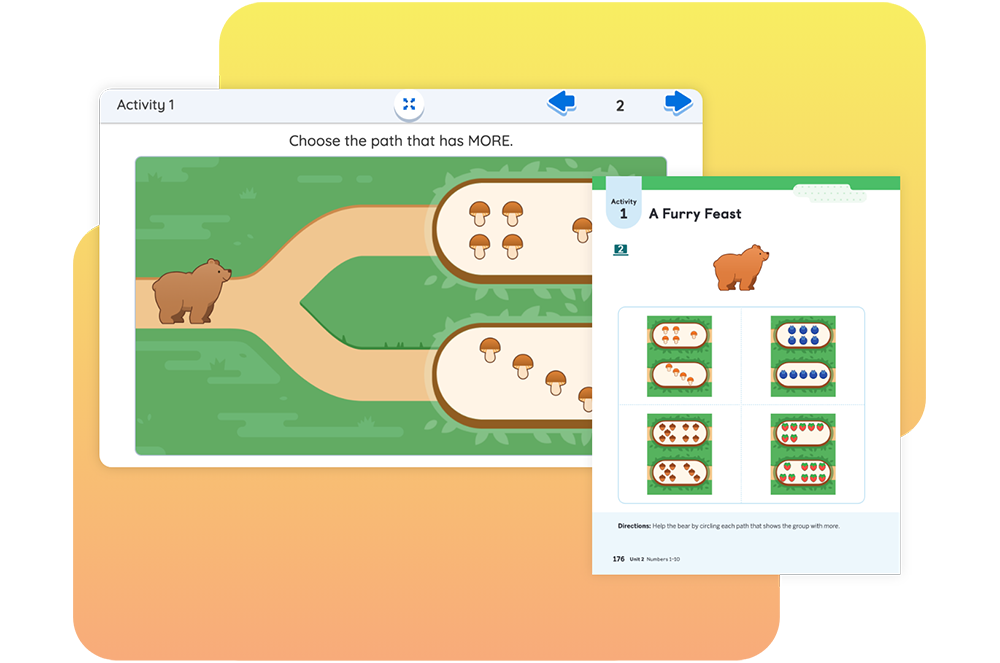
Featured digital lesson: Forest Friends
In this lesson, students apply their understanding of how to compare groups of images as they determine which group has more or fewer and then compare their strategies by guiding a bear through a path that has more mushrooms than the other.
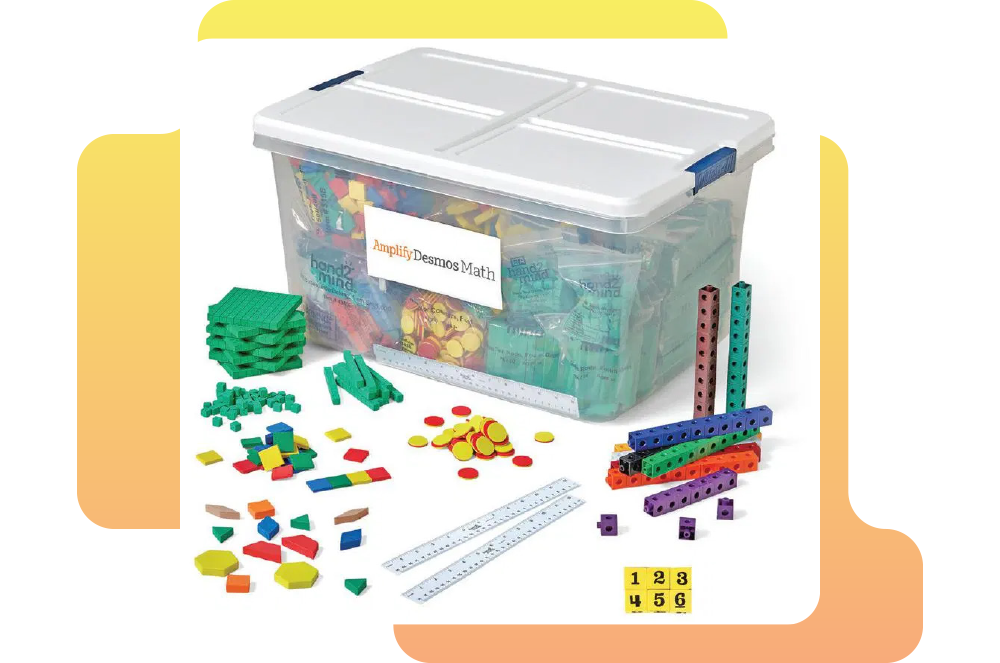
Hands-on manipulative kit
An optional add-on to your Amplify Desmos Math California program, the manipulative kit provides hands-on learning tools designed to simplify and illustrate complex mathematical concepts.
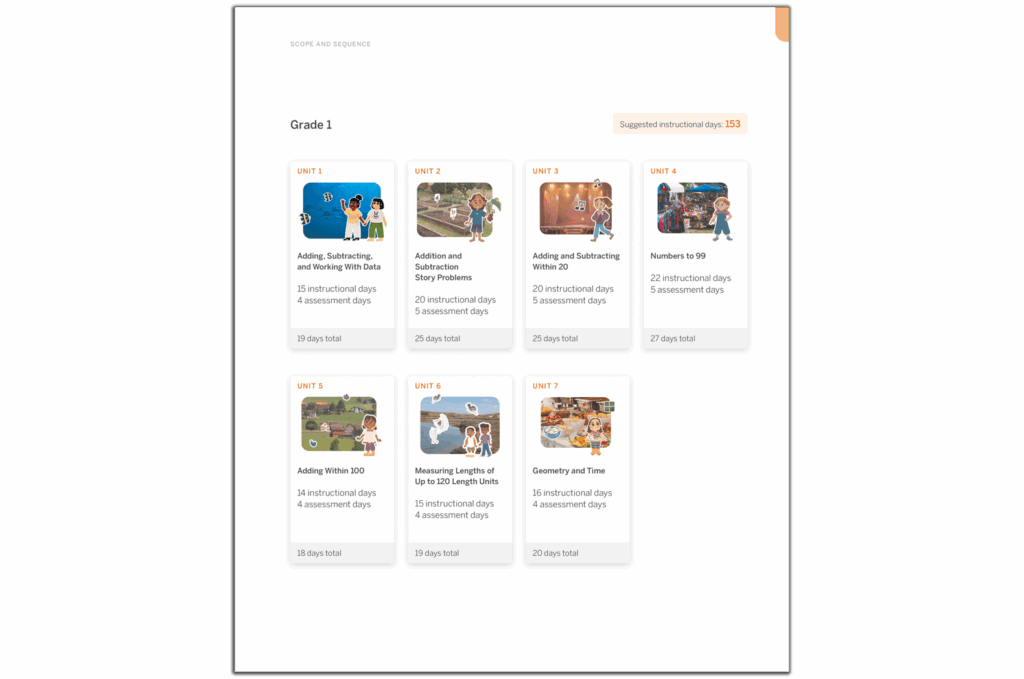
Program structure
Get to know the content and structure of Grade 1 Amplify Desmos Math California.

Teacher Edition pages
Planning and instructional guidance is visual, organized, and easy-to-follow. To help you review the program, we have included samples from a complete sub-unit on this site: Unit 2, Sub-Unit 1: Story Problems in Maui.
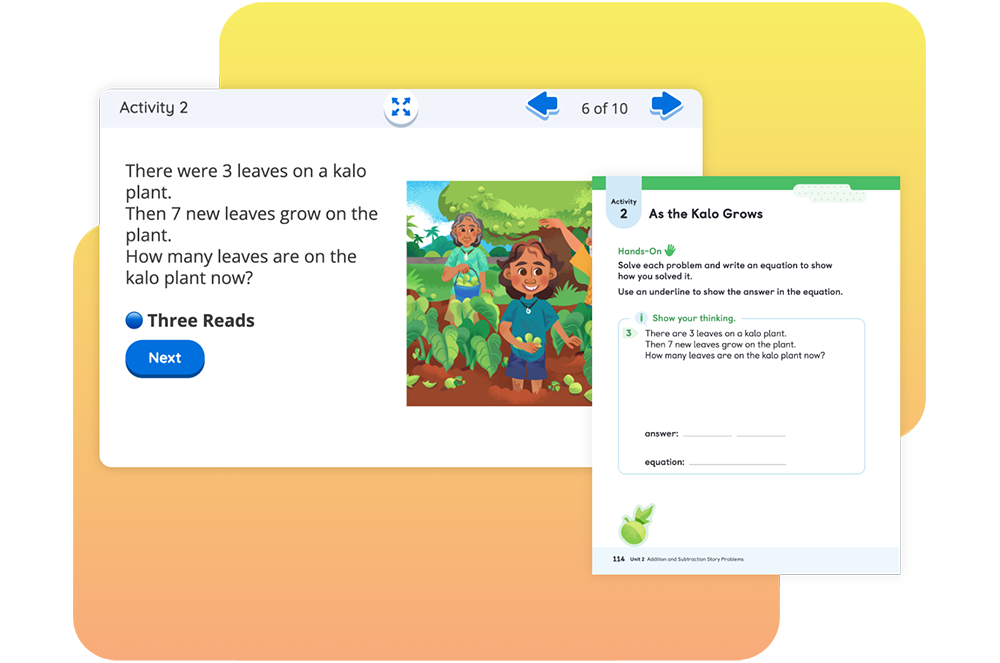
Digital experience
Explore our digital experience! Every lesson in Amplify Desmos Math California has student print materials and digital recommendations.

Student Edition pages
Motivate students with mathematics that is both rigorous and delightful.

Centers Resources
Engaging, hands-on games for students to play collaboratively to strengthen their understanding of key skills and concepts.

Intervention and Extension Resources
Additional resources to reinforce and extend key concepts, including Mini-Lessons and Extensions.
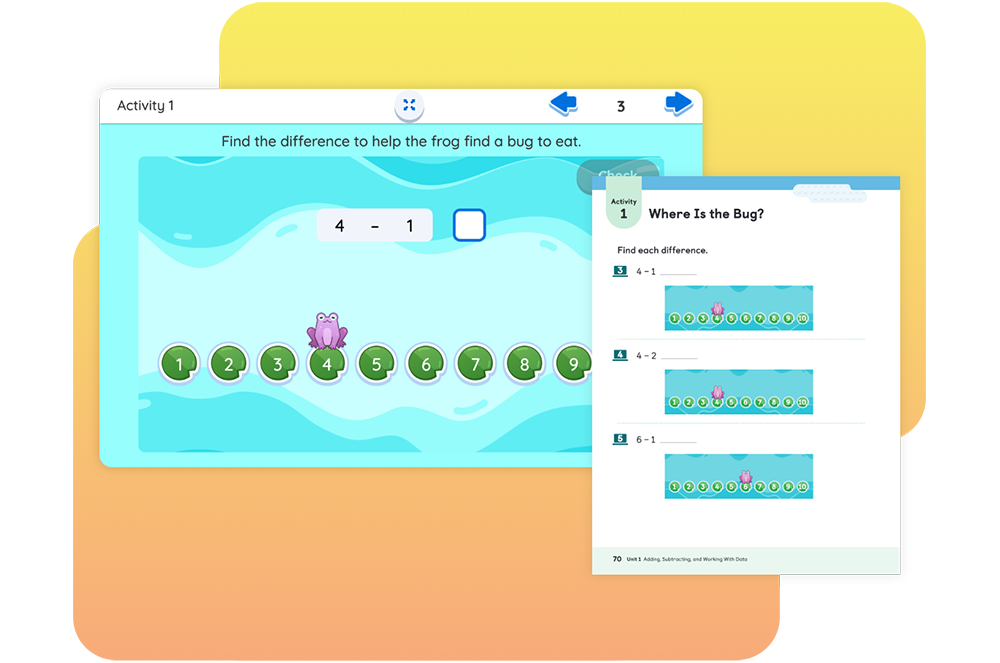
Featured digital lesson: Leaping Lily Pads!
In this lesson, students find differences when subtracting 1 and 2 from the same number by helping a frog reach a lily pad where it can eat a bug.
Hands-on manipulative kit
An optional add-on to your Amplify Desmos Math California program, the manipulative kit provides hands-on learning tools designed to simplify and illustrate complex mathematical concepts.
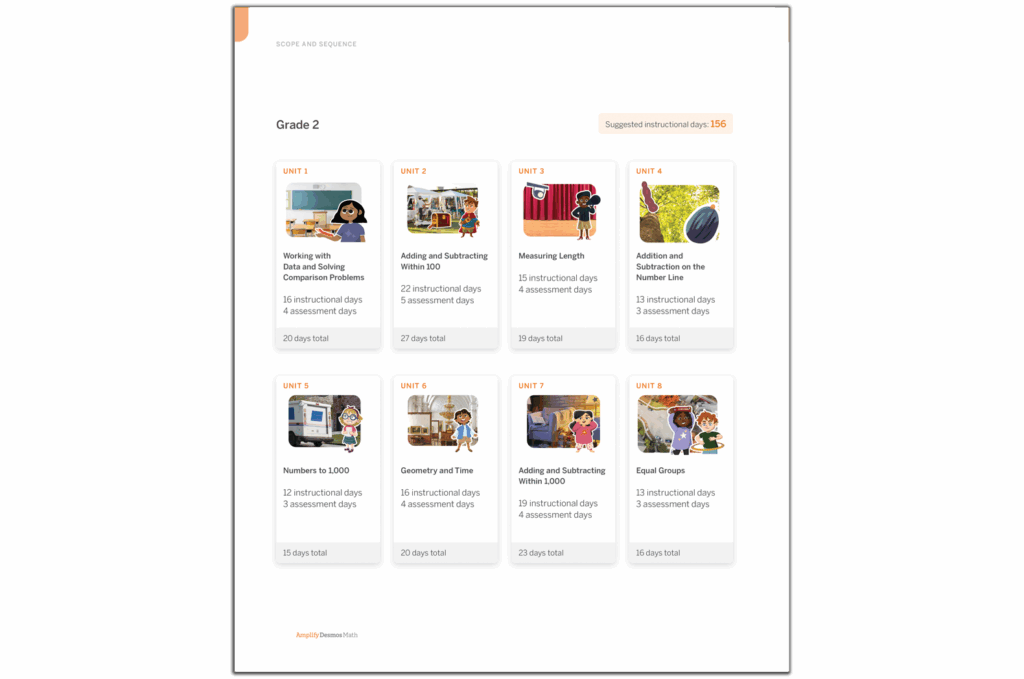
Program structure
Get to know the content and structure of Grade 2 Amplify Desmos Math California.
Teacher Edition pages
Planning and instructional guidance is visual, organized, and easy-to-follow. To help you review the program, we have included samples from a complete sub-unit on this site: Unit 2, Sub-Unit 1: Adding and Subtracting.
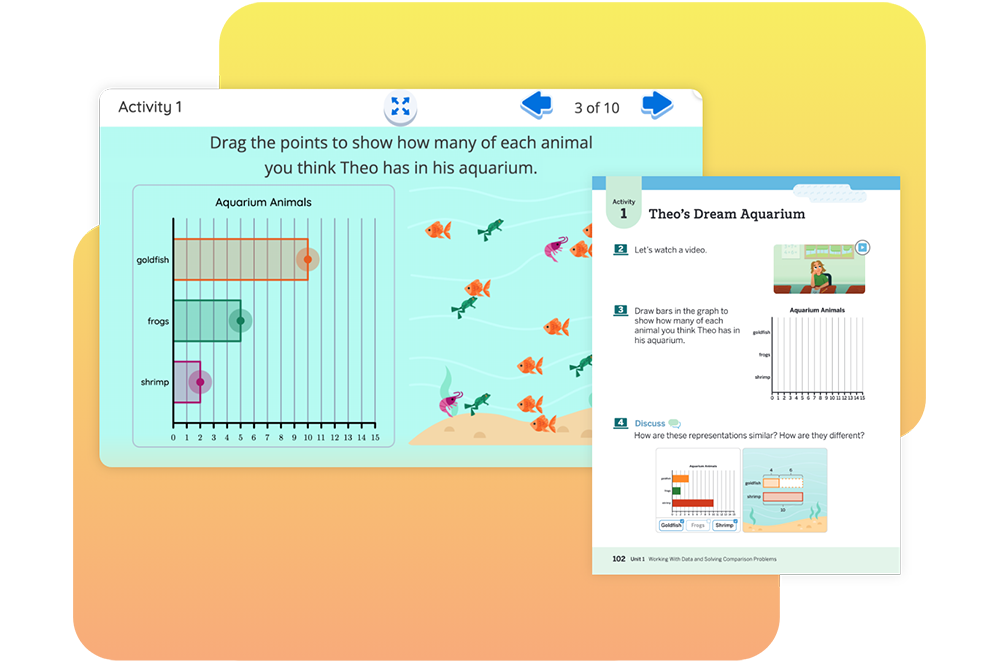
Digital experience
Explore our digital experience! Every lesson in Amplify Desmos Math California has student print materials and digital recommendations.

Student Edition pages
Motivate students with mathematics that is both rigorous and delightful.

Centers Resources
Engaging, hands-on games for students to play collaboratively to strengthen their understanding of key skills and concepts.

Intervention and Extension Resources
Additional resources to reinforce and extend key concepts, including Mini-Lessons and Extensions.

Featured digital lesson: Ways to Make 10
Students continue to develop fluency by finding the number that makes 10 by helping a millipede reach its favorite food – a clump of leaves!
Hands-on manipulative kit
An optional add-on to your Amplify Desmos Math California program, the manipulative kit provides hands-on learning tools designed to simplify and illustrate complex mathematical concepts.
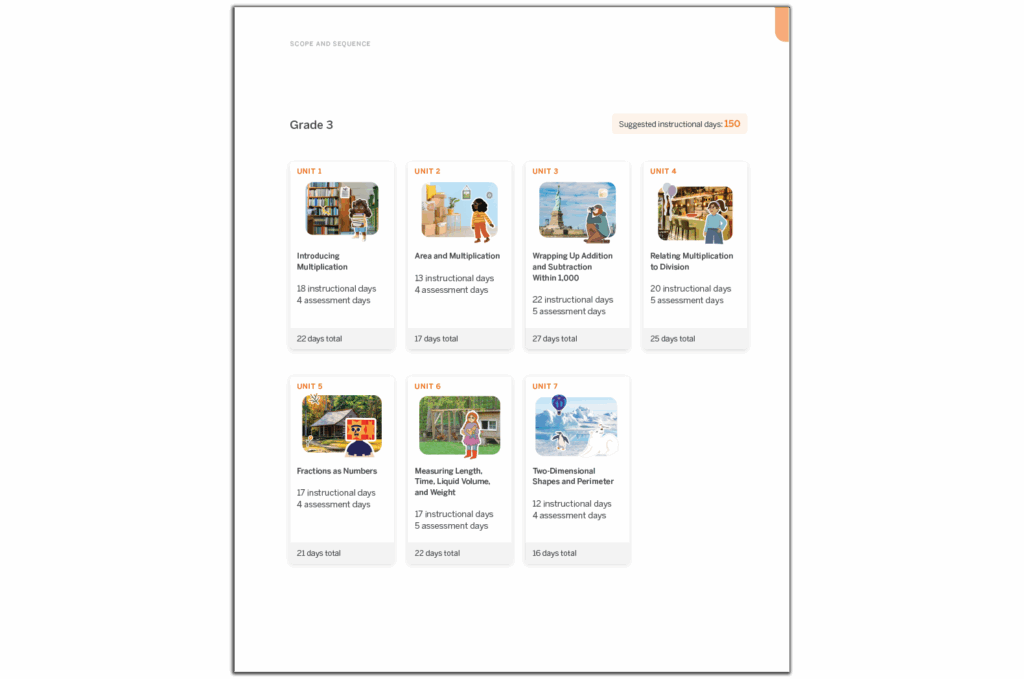
Program structure
Get to know the content and structure of Grade 3 Amplify Desmos Math California.

Teacher Edition pages
Planning and instructional guidance is visual, organized, and easy-to-follow. To help you review the program, we have included samples from a complete sub-unit on this site: Unit 2, Sub-Unit 1: Concepts of Area Measurement.
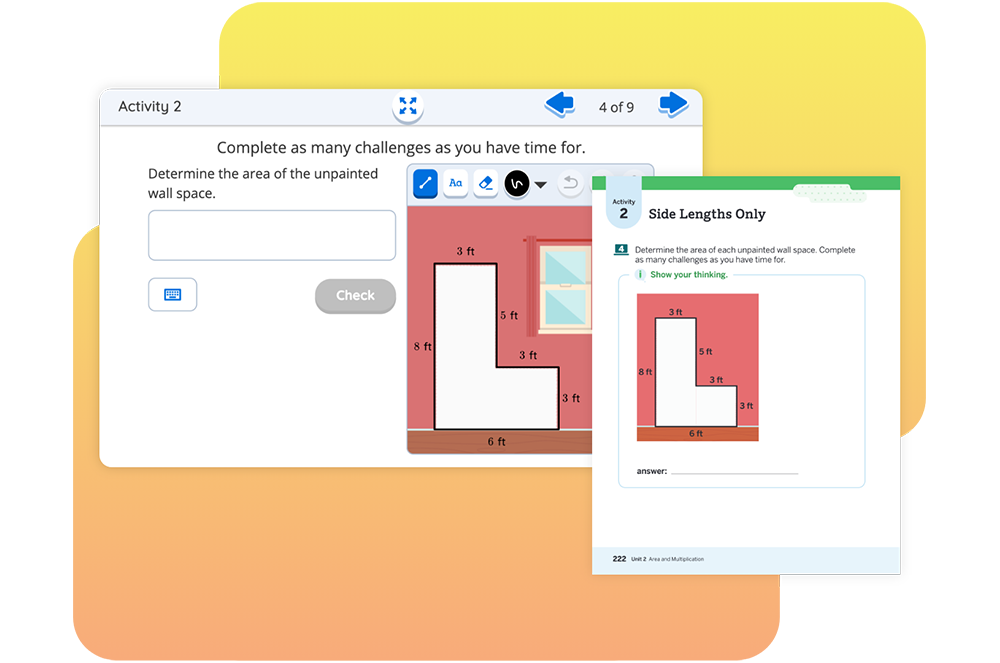
Digital experience
Explore our digital experience! Every lesson in Amplify Desmos Math California has student print materials and digital recommendations.

Student Edition pages
Motivate students with mathematics that is both rigorous and delightful.

Centers Resources
Engaging, hands-on games for students to play collaboratively to strengthen their understanding of key skills and concepts.
Intervention and Extension Resources
Additional resources to reinforce and extend key concepts, including Mini-Lessons and Extensions.
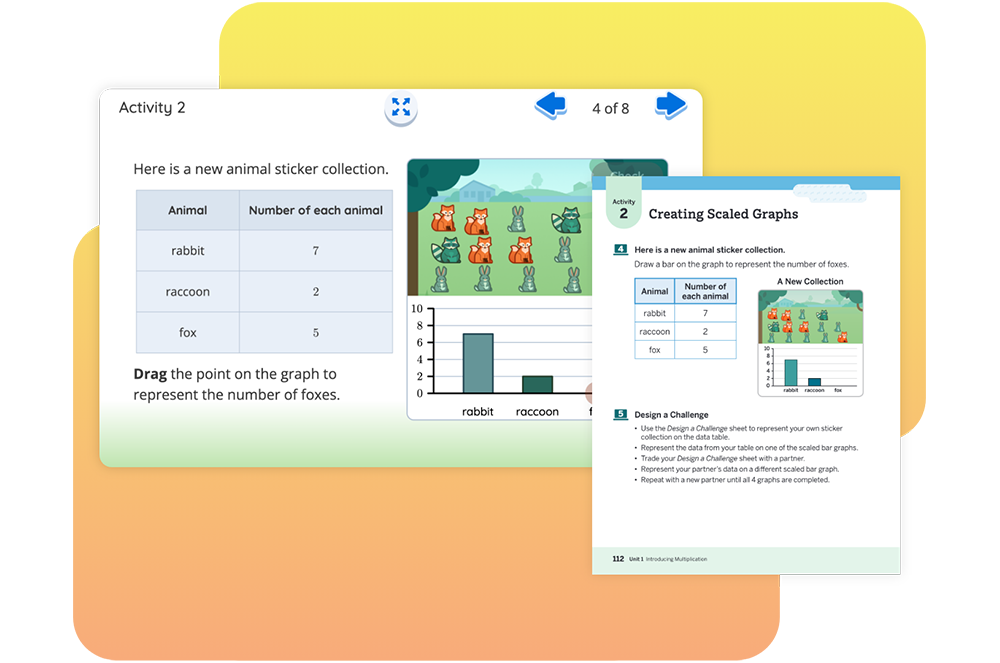
Featured digital lesson: Puppy Pile
Students compare data represented on bar graphs with different scales by using animal stickers to create scaled bar graphs.
Hands-on manipulative kit
An optional add-on to your Amplify Desmos Math California program, the manipulative kit provides hands-on learning tools designed to simplify and illustrate complex mathematical concepts.

Program structure
Get to know the content and structure of Grade 4 Amplify Desmos Math California.

Teacher Edition pages
Planning and instructional guidance is visual, organized, and easy-to-follow. To help you review the program, we have included samples from a complete sub-unit on this site: Unit 2, Sub-Unit 1: Size and Location of Fractions.

Digital experience
Explore our digital experience! Every lesson in Amplify Desmos Math California has student print materials and digital recommendations.
Student Edition pages
Motivate students with mathematics that is both rigorous and delightful.

Centers Resources
Engaging, hands-on games for students to play collaboratively to strengthen their understanding of key skills and concepts.
Intervention and Extension Resources
Additional resources to reinforce and extend key concepts, including Mini-Lessons and Extensions.

Featured digital lesson: Hamster Homes
Students choose tube lengths to connect to platform heights for hamster homes, identifying possible heights using what they know about multiples.
Hands-on manipulative kit
An optional add-on to your Amplify Desmos Math California program, the manipulative kit provides hands-on learning tools designed to simplify and illustrate complex mathematical concepts.
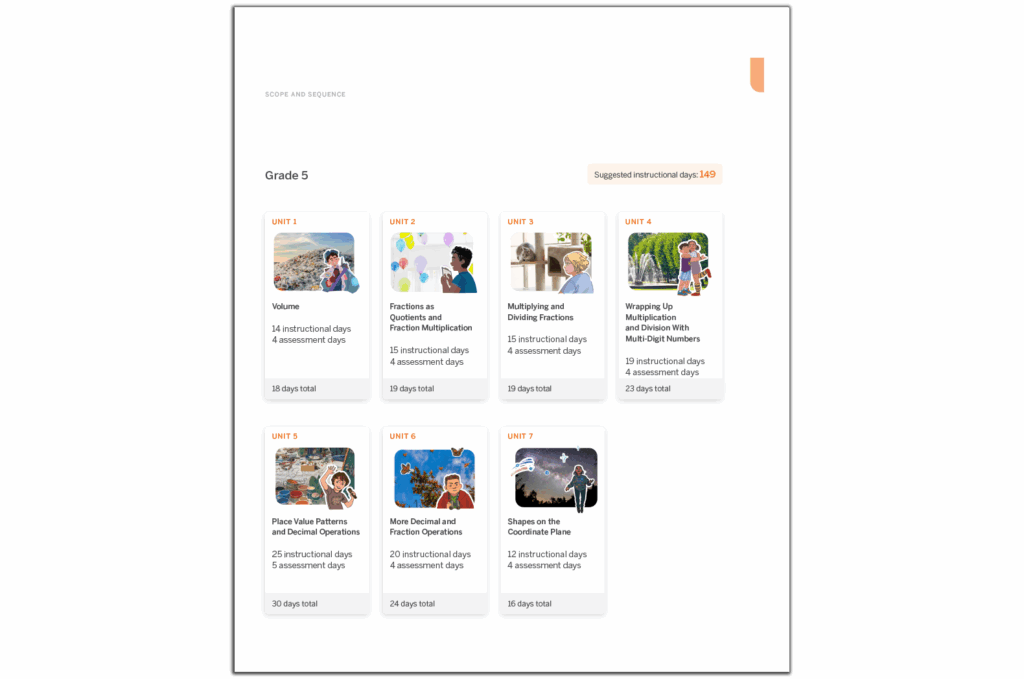
Program structure
Get to know the content and structure of Grade 5 Amplify Desmos Math California.

Teacher Edition pages
Planning and instructional guidance is visual, organized, and easy-to-follow. To help you review the program, we have included samples from a complete sub-unit on this site: Unit 2, Sub-Unit 1: Fractions as Quotients.

Digital experience
Explore our digital experience! Every lesson in Amplify Desmos Math California has student print materials and digital recommendations.
Student Edition pages
Motivate students with mathematics that is both rigorous and delightful.

Centers Resources
Engaging, hands-on games for students to play collaboratively to strengthen their understanding of key skills and concepts.

Intervention and Extension Resources
Additional resources to reinforce and extend key concepts, including Mini-Lessons and Extensions.
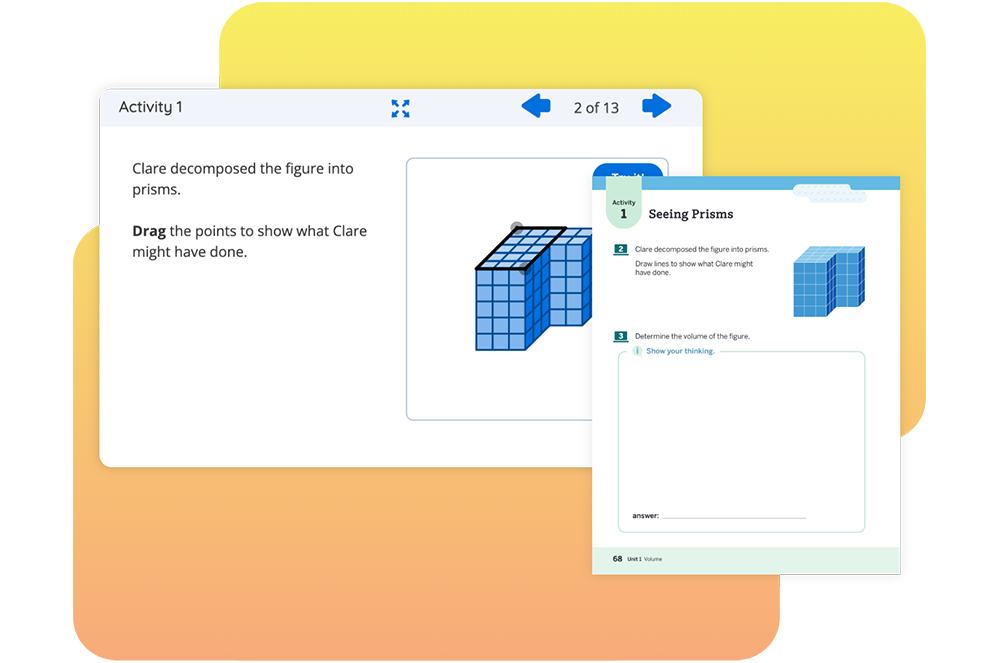
Featured digital lesson: Figures Made of Prisms
Students decompose a figure into rectangular prisms and determine the volume of the figure by adding the volumes of the individual prisms.
Hands-on manipulative kit
An optional add-on to your Amplify Desmos Math California program, the manipulative kit provides hands-on learning tools designed to simplify and illustrate complex mathematical concepts.
6–A1 sample materials
Click the links in the drop-down sections below to explore sample materials from each grade.
For helpful navigation tips and more program information, download the Amplify Desmos Math Program Guide.
You can also watch a product expert walk through a lesson and the available program components.

Program structure
Get to know the content and structure of Grade 6 Amplify Desmos Math California.

Teacher Edition pages
Planning and instructional guidance is visual, organized, and easy-to-follow. To help you review the program, we have included samples from three sub-units on this site: Unit 1, Sub-Unit 1: Area; Unit 3, Sub-Unit 1: Units and Measurement; and Unit 6, Sub-Unit 1: Solving Equations.

Digital experience
Explore our digital experience! Every lesson in Amplify Desmos Math California has student print materials and digital recommendations.

Student Edition pages
Motivate students with mathematics that is both rigorous and delightful.

Intervention and Extension Resources
Additional resources to reinforce and extend key concepts, including Mini-Lessons and Extensions.
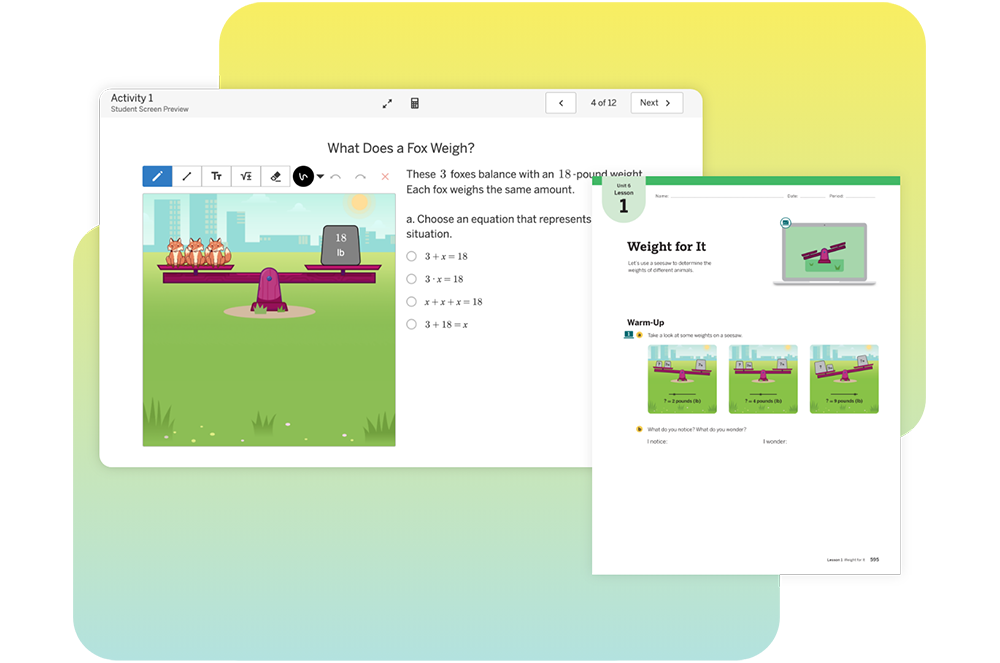
Featured digital lesson: Weight for It
Students use equations and tape diagrams to represent seesaw situations and to determine unknown animal weights, helping them make connections between diagrams that represent equations of the form `x+p=q` or `px=q`.

Hands-on manipulative kit
An optional add-on to your Amplify Desmos Math California program, the manipulative kit provides hands-on learning tools designed to simplify and illustrate complex mathematical concepts.
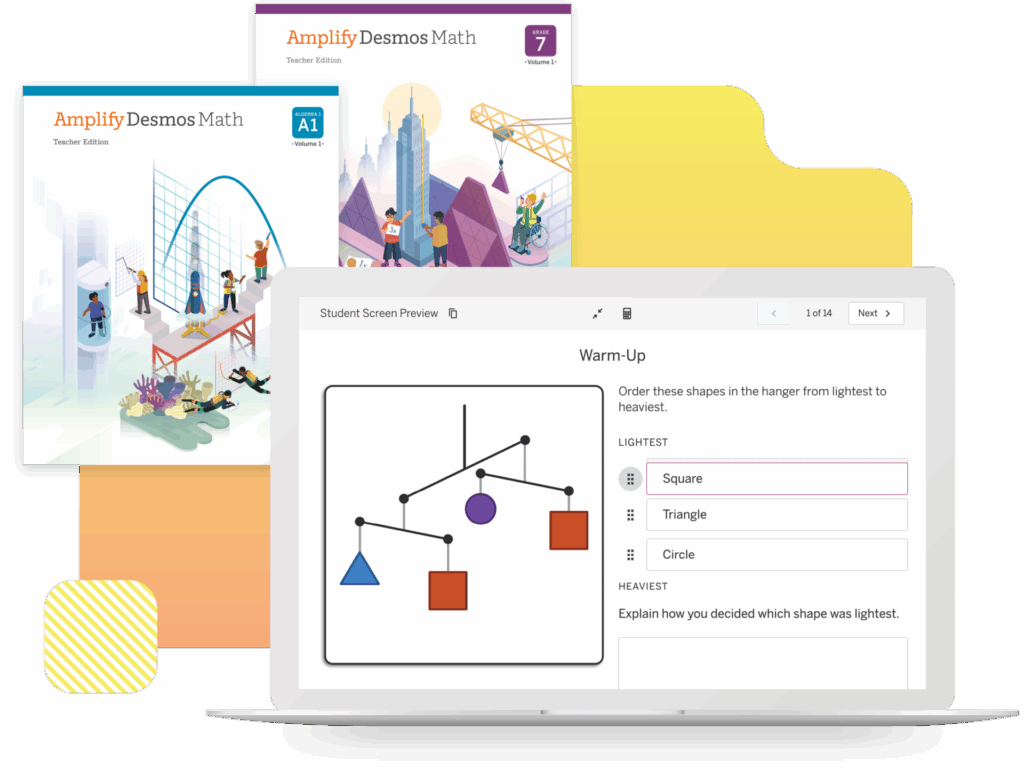
Program structure
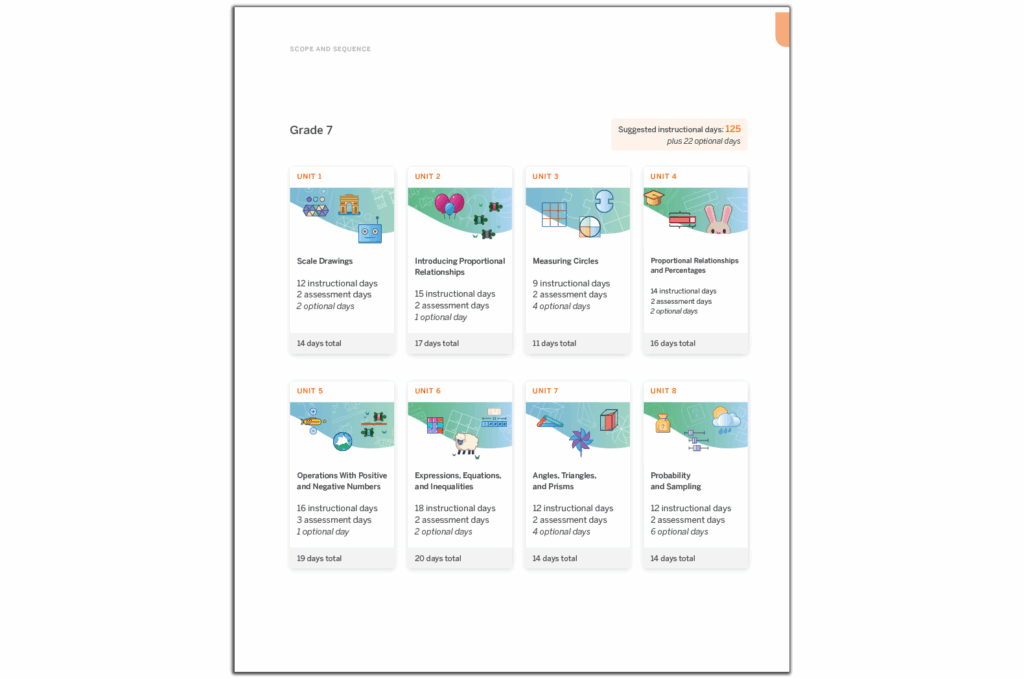
Get to know the content and structure of Grade 7 Amplify Desmos Math California.

Teacher Edition pages
Planning and instructional guidance is visual, organized, and easy-to-follow. To help you review the program, we have included samples from three sub-units on this site: Unit 1, Sub-Unit 1: Scaled Copies; Unit 4, Sub-Unit 1: Percentages as Proportional Relationships; and Unit 6, Sub-Unit 1: Equations and Tape Diagrams.
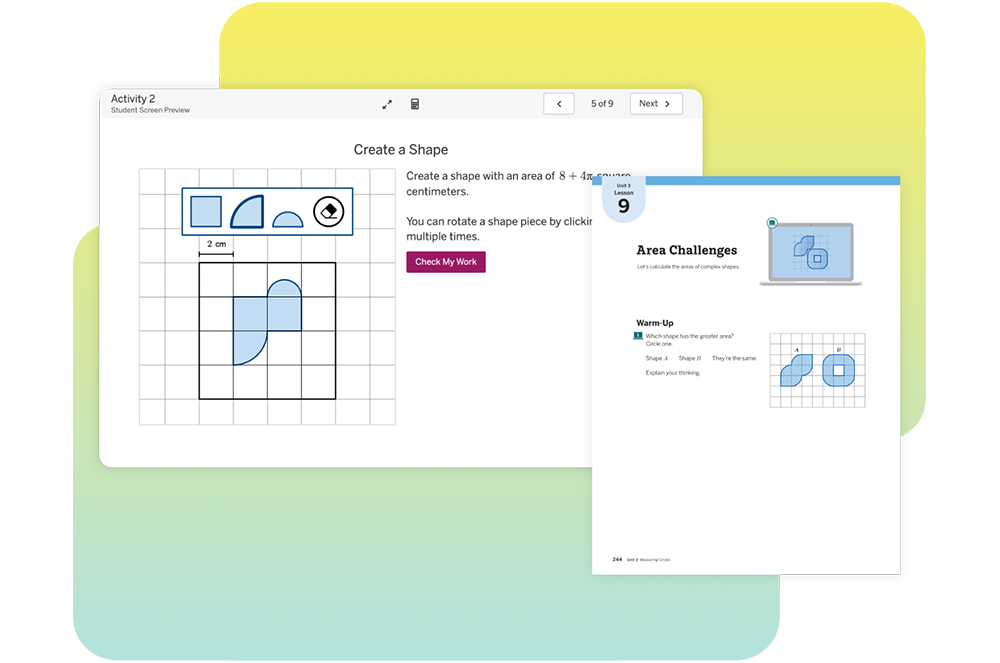
Digital experience
Explore our digital experience! Every lesson in Amplify Desmos Math California has student print materials and digital recommendations.

Student Edition pages
Motivate students with mathematics that is both rigorous and delightful.

Intervention and Extension Resources
Additional resources to reinforce and extend key concepts, including Mini-Lessons and Extensions.
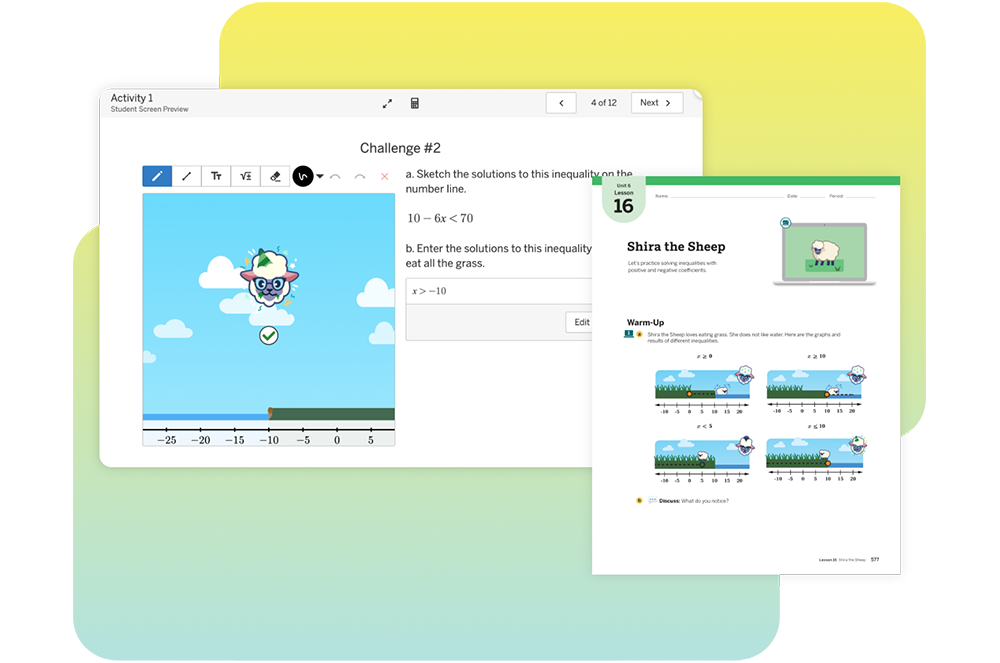
Featured digital lesson: Shira the Sheep
Students solve inequalities with positive and negative coefficients to solve a variety of challenges featuring a fictional sheep who eats grass according to an inequality.
Hands-on manipulative kit
An optional add-on to your Amplify Desmos Math California program, the manipulative kit provides hands-on learning tools designed to simplify and illustrate complex mathematical concepts.
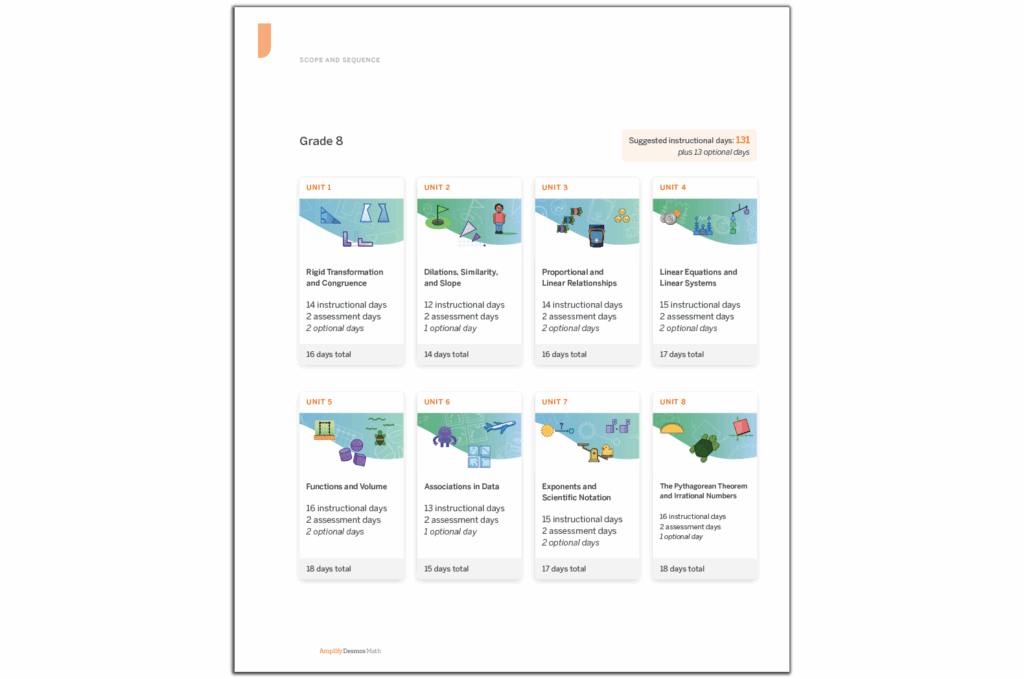
Program structure
Get to know the content and structure of Grade 7 Amplify Desmos Math California.

Teacher Edition pages
Planning and instructional guidance is visual, organized, and easy-to-follow. To help you review the program, we have included samples from three sub-units on this site: Unit 1, Sub-Unit 1: Rigid Transformations; Unit 3, Sub-Unit 2: Linear Relationships; and Unit 6, Sub-Unit 2: Analyzing Numerical Data.

Digital experience
Explore our digital experience! Every lesson in Amplify Desmos Math California has student print materials and digital recommendations.

Student Edition pages
Motivate students with mathematics that is both rigorous and delightful.
Intervention and Extension Resources
Additional resources to reinforce and extend key concepts, including Mini-Lessons and Extensions.
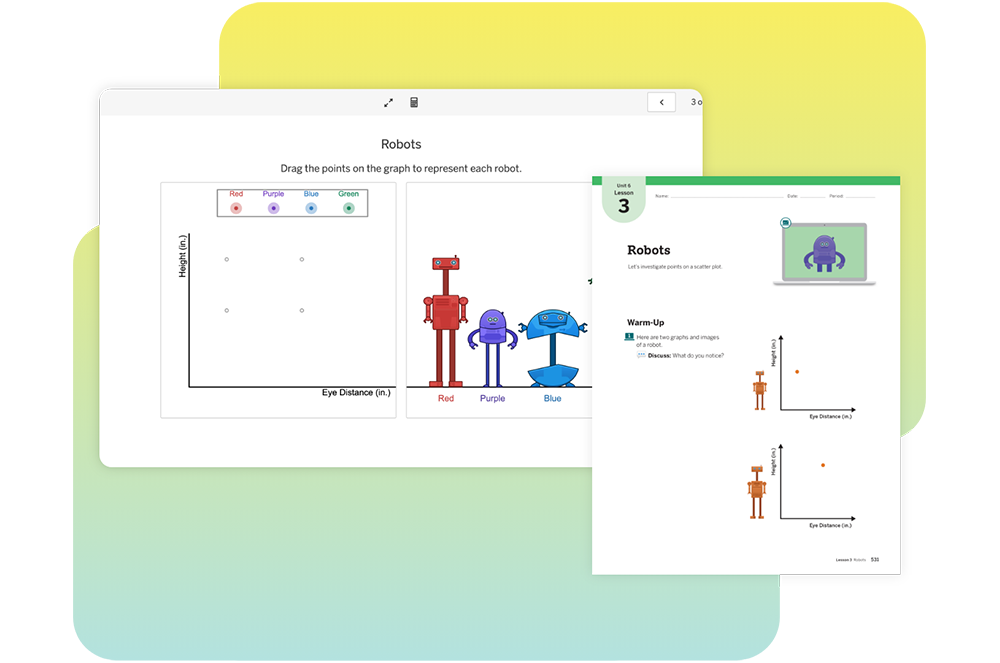
Featured digital lesson: Robots
Students connect points on a scatter plot with individuals in a population and rows of data in a table. The analysis of scatter plots continues with data about the eye distances and heights of robots.
Hands-on manipulative kit
An optional add-on to your Amplify Desmos Math California program, the manipulative kit provides hands-on learning tools designed to simplify and illustrate complex mathematical concepts.
Program structure
Get to know the content and structure of Algebra 1 Amplify Desmos Math California.

Teacher Edition pages
Planning and instructional guidance is visual, organized, and easy-to-follow. To help you review the program, we have included samples from two complete sub-units on this site: Unit 2, Sub-Units 1–2: One-Variable Equations and Multi-Variable Equations.
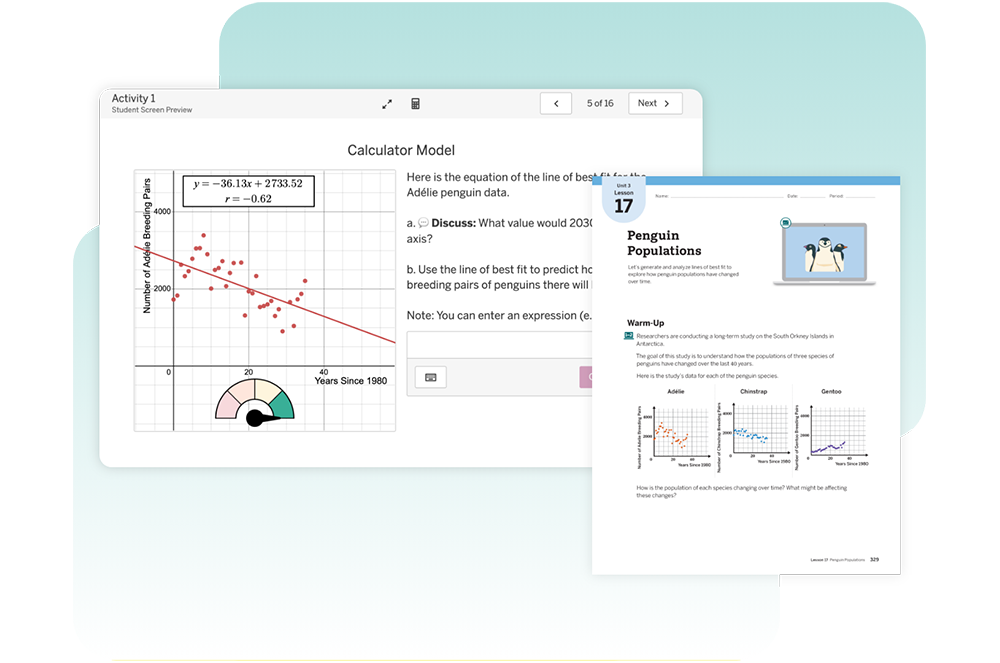
Digital experience
Explore our digital experience! Every lesson in Amplify Desmos Math California has student print materials and digital recommendations.

Student Edition pages
Motivate students with mathematics that is both rigorous and delightful.

Featured digital lesson: Shelley the Snail
Students represent the solutions of a situation using a table, a graph, and multiple forms of an equation to identify multiple combinations of blocks that can help Shelley the Snail cross a gap.
Contact us
For questions, samples, or more information, please contact your local Amplify Account Executive:
Erin King
Sales Director, CA
(512) 736-3162
eking@amplify.com
Northern CA
Wendy Garcia
Senior Account Executive
(510) 368-7666
wgarcia@amplify.com
Bay Area
Lance Burbank
Account Executive
(415) 830-5348
lburbank@amplify.com
Central Valley and Central Coast
Demitri Gonos
Senior Account Executive
(559) 355-3244
dgonos@amplify.com
Ventura and L.A. County
Jeff Sorenson
Associate Account Executive
(310) 902-1407
jsorenson@amplify.com
Orange and L.A. County
Lauren Sherman
Senior Account Executive
(949) 397-5766
lsherman@amplify.com
San Bernardino and L.A. County
Michael Gruber
Senior Account Executive
(951) 520-6542
migruber@amplify.com
Riverside and L.A. County
Brian Roy
Account Executive
(818) 967-1674
broy@amplify.com
San Diego County
Kirk Van Wagoner
Senior Account Executive
(760) 696-0709
kvanwagoner@amplify.com
Under 2300 students in Bay Area, Sacramento Valley, and Northern Counties
Kevin Mauser
Lead Account Executive
(815) 534-0148
kmauser@amplify.com
Under 2300 students in Southern CA, Central Coast, and Southern Central Valley Counties
Charissa Snyder
Account Executive
(720) 936-6802
chsnyder@amplify.com
Amplify Desmos Math for KIPP
We’re thrilled that you’re reviewing Amplify Desmos Math for use with your students.
We’re confident you’ll find this to be a powerful and effective program for getting all your students talking and thinking about math concepts together.
Michael Kasloff
Regional Vice President, Strategic Sales
Expect more from your math program.

For students
Every student feels connected and a part of the conversation when participating in an Amplify Desmos Math lesson. And when students are actively engaged with the content, they achieve more.

For teachers
The program delivers what math educators want and need:
- Standards-aligned print and digital lessons that capture students’ interest every day
- The right mix of informal and substantive diagnostic and summative assessments
- Differentiation support
- Extensive practice in print and digital
- Multilingual learner support

For leaders
The program delivers what school and district leaders want and need:
- A coherent core program based on the industry-leading IM K–12 Math™ by Illustrative Mathematics®
- A comprehensive suite of usage and performance reports to identify school- and district-wide trends
- A team from Amplify dedicated to making your implementation a success
What’s included
We’ve taken the power of Desmos’ technology and lessons and added beautiful, easy-to-use print and digital components to make a game-changing program that makes teaching a breeze.
Student materials
- Student Editions (2 volumes)
- Digital lessons, practice, assessment, and differentiation, built with Desmos technology
Program components subject to change.
Teacher materials
- Teacher Edition (2 volumes)
- Digital tools and support
- Classroom monitoring and management
- Reporting
- Assessment customization
- Differentiation, including just-in-time prerequisite supports
- Additional practice and Assessment blackline masters (print and digital)
Program components subject to change.
Start your review
Ready to explore the program? Watch our quick walkthrough video and follow these simple instructions to access your demo account.
- Preview K–5 digital lessons here.
- Download the draft K–5 scope and sequence here.
- Preview digital lessons for grades 6–Algebra 1 here.
- You can also preview both the student edition and teacher edition of a grade 3 lesson in print.
View our help articles on running your first lesson and the Teacher dashboard for more information.

mCLASS Math (Assessment)
All digital (grades K–6)
The all new mCLASS Math is an online screener and diagnostic. It provides granular data, targeted grouping suggestions, teacher-led activities and places students in Boost Math.
Click here to view the mCLASS Math scope and sequence and skills coverage across grades K–6. To the right, preview a sample item and program overview information.
Contact us
Support is always within reach. Our team is dedicated to supporting KIPP and can be reached at any time by emailing or calling us directly.
 |
|
Michael Kasloff Regional Vice President, Strategic Sales 862-215-4505 mkasloff@amplify.com |
Welcome to Amplify Desmos Math!
Amplify Desmos Math for Washoe County
Welcome, Oregon educators!
Thank you for taking the time to review Amplify’s K–8 science programs for Oregon. This site will allow your committees to easily access grade-level teacher and student resources digitally, and experience all that our high-quality instructional materials have to offer.
Amplify Science for grades K–8 has been rated all-green by EdReports. Read the review on EdReports.

Contact us
Support is always within reach. Our team is dedicated to supporting districts across Oregon and can be reached at any time by emailing HelloOregon@amplify.com or by calling us directly.

Erin Elfving-Strayhan
Senior Account Executive
Districts over 3,000 students
(971) 291-9854

Kristen Rockstroh, M.Ed.
Account Executive
Districts under 3,000 students
(480) 639-8367
Welcome, Idaho ELA Review Committee!
Amplify CKLA and Amplify ELA aren’t your traditional core programs. They’re different to make a difference — and the results are undeniable. Truly built on the Science of Reading, our high-quality ELA solutions help teachers bring evidence-based practices to life in the classroom.
This site includes everything you need for your review, including digital access to teacher and student materials and additional review resources.

Welcome, Davis ELA Reviewers!
Amplify’s ELA solutions aren’t your traditional core programs. They’re different to make a difference — and the results are undeniable. Truly built on the Science of Reading, our high-quality ELA solutions help teachers bring evidence-based practices to life in the classroom.
This site includes information for your review, including digital access to teacher and student materials and additional review resources. Click below to get started.

Contact Us
Looking to speak directly with your Amplify representative? Please contact…
Bob McCarty
Senior Account Executive
435-655-1731
rmccarty@amplify.com
Welcome, Washington County ELA Review Committee!
Amplify CKLA and Amplify ELA aren’t your traditional core programs. They’re different to make a difference — and the results are undeniable. Truly built on the Science of Reading, our high-quality ELA solutions help teachers bring evidence-based practices to life in the classroom.
This site includes everything you need for your review, including digital access to teacher and student materials and additional review resources.
Amplify ELA Review for Washington County
Amplify ELA is the only ELA curriculum that takes the Science of Reading to the next level.
Truly designed for students entering the middle grades, Amplify ELA engages and empowers learners, and addresses the very specific and unique needs of students in grades 6–8.
Scroll down to learn how ELA is uniquely designed to help all your middle schoolers make learning leaps in literacy.

Meet Amplify ELA
Developed specifically for the needs of students entering the middle grades, Amplify ELA is a blended curriculum that promises:
- A structured, yet flexible approach.
- Carefully crafted, age-appropriate materials and activities that aren’t too “babyish” or too mature.
- Complex, content-rich literature and informational texts that ensure ample opportunities for students to encounter both “windows and mirrors”.
- Highly engaging lessons that keep adolescents plugged in and motivated to learn.
- An instructional design that levels the playing field for every student.
- Superior results.


Access, engagement, and equity
In Amplify ELA, all students read the same text with the help of differentiated supports. In other words, we don’t dumb things down; we bring students up. Our robust collection of diverse texts and research-based approach to instruction not only engage students, but build confidence.


ELLs
With Amplify ELA’s integrated and designated ELD support, English language learners are given a chance to shine.
Embedded supports enable students to engage with and participate in discussion of grade-level texts with their grade-level peers.


Access demo
Ready to explore on your own? Follow the instructions below to access your demo account.
Access the ELA Teacher Digital Platform
First, watch the quick navigation video to the right. Then login using the directions below.
- Click the ELA Teacher Platform button below.
- Select Log in with Amplify.
- Enter this username: t1.washcolangarts@demo.tryamplify.net
- Enter this password: Amplify1-washcolangarts
- Select Grade 6
Aloha, Hawaii educators!
Kyrene, welcome to Amplify ELA!
Welcome to the Amplify ELA review site for Kyrene School District. This site is designed to help you learn about Amplify ELA—a core English Language Arts curriculum for Grades 6–8 and the middle school counterpart to Amplify CKLA. Like K-5, Amplify ELA is built on the same Science of Reading instructional strategies to help middle schoolers grow as readers, writers, and thinkers. Additionally, here are a few important documents so you can rest assured that Amplify ELA is aligned to Arizona’s English Language Arts standards.
What is Amplify ELA?
Amplify ELA is a core program for grades 6–8 that delivers:
- A unique research-based approach designed to get all students reading grade-level text together.
- An instructional design that inspires students to read more deeply, write more vividly, and think more critically.
- A rich combination of dynamic texts, lively discussions, and interactive Quests that truly engages middle schoolers and inspires them to participate in learning.
Interested in learning more about the research behind the program?
Click the link to access the Amplify ELA Research Hub.


How does it work?
Amplify ELA provides everything you need to deliver a full year’s worth of high-quality instruction.
Looking for a more flexible version of the curriculum? Check out our abridged lesson pathways ensure full coverage of the standards in just 100 days.


What do students explore?
Each grade level of Amplify ELA consists of six multimedia units. Four or five of the units are focused on complex literary texts and one or two are collections based on primary source documents and research. Each grade also provides two or three immersive learning experiences called Quests, a dedicated story writing unit, and a poetry unit.
Download the unit overviews below to learn more.


How does it engage all students?
Watching students mature into adolescents: inspiring. Knowing how to engage and motivate their changing brains: science.
The middle-school years are marked by a period of tremendous growth and change for students—physically, emotionally, and socially. Amplify ELA understands and embraces these changes, and delivers instruction specifically designed to tap into adolescents’ natural inclinations toward collaboration, exploration, and autonomy.


Differentiation
Amplify believes all students are capable of reading grade-level text together.
Amplify ELA ensures all students have access to the same text. With six distinct levels of differentiation, your student is supported or challenged in a way that meets their unique needs. This includes ELLs at the Developing, Expanding, and Bridging levels, as well as students needing substantial support or an extra challenge.


Assessment
In Amplify ELA, all units include a robust system of embedded assessment that provides teachers with actionable student performance data long before end-of-unit or benchmark exams. The Embedded Assessment Measure (EAM) reports allow teachers to easily track and interpret student performance without ever interrupting the flow of daily instruction to test students.
Clear and actionable student performance data
With intelligent feedback tools and embedded assessments, Amplify ELA makes it easy to monitor student progress and intervene where needed—no matter where teaching and learning is taking place.
Automated Writing Assessment
Amplify’s Automated Writing Evaluation assesses student writing for Focus, Use of Evidence, and Conventions, providing critical feedback for teachers and data for Amplify’s writing reports.
Reporting
Amplify ELA Reporting provides teachers with clear data to understand patterns of student performance and deliver scaffolds and supports as students need them.
Click this link for more information on assessments in Amplify ELA.
Access demo
Ready to explore on your own? Follow the instructions below to access your demo account.
Explore as a teacher
To access the teacher digital platform, first watch the quick navigation video to the right. Then login using the directions below.
- Click the ELA Teacher Platform button below.
- Select Log in with Amplify.
- Enter this username: t1.kyrenerfp@demo.tryamplify.net
- Enter this password: Amplify1-kyrenerfp
Explore as a student
To access the student digital platform, follow the login directions below.
- Click the ELA Student Platform button below.
- Select Log in with Amplify.
- Enter this username: s1.kyrenerfp@demo.tryamplify.net
- Enter this password: Amplify1-kyrenerfp
Contact Us
If you have any questions about Amplify ELA, please don’t hesitate to contact:
Tommy Gearhart
Senior Account Executive
505-206-7661
tgearhart@amplify.com
Welcome to Amplify ELA!
Amplify ELA is the only ELA curriculum that takes the Science of Reading to the next level.
Truly designed for students entering the middle grades, Amplify ELA engages and empowers learners, and addresses the very specific and unique needs of students in grades 6–8.
Scroll down to learn how ELA is uniquely designed to help all your middle schoolers make learning leaps in literacy.
Meet Amplify ELA
Developed specifically for the needs of students entering the middle grades, Amplify ELA is a blended curriculum that promises:
- A structured, yet flexible approach.
- Carefully crafted, age-appropriate materials and activities that aren’t too “babyish” or too mature.
- Complex, content-rich literature and informational texts that ensure ample opportunities for students to encounter both “windows and mirrors”.
- Highly engaging lessons that keep adolescents plugged in and motivated to learn.
- An instructional design that levels the playing field for every student.
- Superior results.


Access, engagement, and equity
In Amplify ELA, all students read the same text with the help of differentiated supports. In other words, we don’t dumb things down; we bring students up. Our robust collection of diverse texts and research-based approach to instruction not only engage students, but build confidence.


ELLs
With Amplify ELA’s integrated and designated ELD support, English language learners are given a chance to shine.
Embedded supports enable students to engage with and participate in discussion of grade-level texts with their grade-level peers.

Access Demo
Ready to explore on your own? Follow the instructions below to access your demo account.
Access the ELA Teacher Digital Platform
First, watch the quick navigation video to the right. Then login using the button below.
- Click the ELA Teacher Platform button below.
- Select Log in with Amplify.
- Enter this username: t1.davislangarts@demo.tryamplify.net
- Enter this password: Amplify1-davislangarts
- From the homepage, click “ELA” on the left hand side.
Access the ELA Student Digital Platform
To access the Student Digital Platform, follow these directions below:
- Click the ELA Student Platform button below.
- Select Log in with Amplify.
- Enter this username: s1.davislangarts@demo.tryamplify.net
- Enter this password: Amplify1-davislangarts
Welcome, Peoria Review Committees!
We’re so honored you’re considering Amplify Science to meet the needs of your district.This site is designed to support your committee members in conducting a thorough review of Amplify Science.
Ready to get started? Click your grade level band to continue or scroll down to connect with a team member.

Your team
Looking to speak directly with an Amplify Science representative? Get in touch with a team member to learn more about reviewing and using the program.



Welcome, Allentown ELA review committees!
Dear Allentown educator,
We’re extremely excited to be part of your English language arts adoption process.
Amplify CKLA and Amplify ELA aren’t your traditional core ELA programs. They’re different because they are designed to make a difference – and the results are simply undeniable. See how students build their knowledge and understanding starting in kindergarten and continuing through grade 8 here. Next, check out our caravan presentations below to learn more.
Don’t forget to see how we align to your Pennsylvania Core Standards for grades K-5 and 6-8.
I look forward to visiting with you soon and sharing more about the unique research-based approaches built right into these high-quality solutions.
With great respect for what you do,
Janet Barry
Account Executive
Virtual Caravan Stop
Amplify CKLA for Grades K–5
Watch the video to the right to learn how Amplify CKLA brings Science of Reading best practices to life and addresses the specific needs of students in grades K–5.
Ready for more? Visit our review site to download resources and access a demo.
Amplify ELA for Grades 6–8
Watch the video to the right to learn how Amplify ELA takes the Science of Reading to the next level, engages and empowers learners, and addresses the specific and very unique needs of students in grades 6–8.
Ready for more? Visit our review site to download resources and access a demo.
Contact us
Interested in speaking directly with your representative?

Janet Barry
Account Executive
(630) 946-4157
Welcome to Amplify ELA!
Welcome to the Amplify ELA review site for Arizona. This site is designed to help you learn about Amplify ELA—a core English Language Arts curriculum for Grades 6–8. Here are a few important documents so you can rest assured that Amplify ELA is aligned to Arizona’s English Language Arts standards.
What is Amplify ELA?
Amplify ELA is a core program for grades 6–8 that delivers:
- A unique research-based approach designed to get all students reading grade-level text together.
- An instructional design that inspires students to read more deeply, write more vividly, and think more critically.
- A rich combination of dynamic texts, lively discussions, and interactive Quests that truly engages middle schoolers and inspires them to participate in learning.
Interested in learning more about the research behind the program?
Click the link to access the Amplify ELA Research Hub.
How does it work?
Amplify ELA provides everything you need to deliver a full year’s worth of high-quality instruction.
Looking for a more flexible version of the curriculum? Check out our abridged lesson pathways ensure full coverage of the standards in just 100 days.
What do students explore?
Each grade level of Amplify ELA consists of six multimedia units. Four or five of the units are focused on complex literary texts and one or two are collections based on primary source documents and research. Each grade also provides two or three immersive learning experiences called Quests, a dedicated story writing unit, and a poetry unit.
Download the unit overviews below to learn more.
How does it engage all students?
Watching students mature into adolescents: inspiring. Knowing how to engage and motivate their changing brains: science.
The middle-school years are marked by a period of tremendous growth and change for students—physically, emotionally, and socially. Amplify ELA understands and embraces these changes, and delivers instruction specifically designed to tap into adolescents’ natural inclinations toward collaboration, exploration, and autonomy.


Differentiation
Amplify believes all students are capable of reading grade-level text together.
Amplify ELA ensures all students have access to the same text. With six distinct levels of differentiation, your student is supported or challenged in a way that meets their unique needs. This includes ELLs at the Developing, Expanding, and Bridging levels, as well as students needing substantial support or an extra challenge.

Assessment
In Amplify ELA, all units include a robust system of embedded assessment that provides teachers with actionable student performance data long before end-of-unit or benchmark exams. The Embedded Assessment Measure (EAM) reports allow teachers to easily track and interpret student performance without ever interrupting the flow of daily instruction to test students.
Clear and actionable student performance data
With intelligent feedback tools and embedded assessments, Amplify ELA makes it easy to monitor student progress and intervene where needed—no matter where teaching and learning is taking place.
Automated Writing Assessment
Amplify’s Automated Writing Evaluation assesses student writing for Focus, Use of Evidence, and Conventions, providing critical feedback for teachers and data for Amplify’s writing reports.
Reporting
Amplify ELA Reporting provides teachers with clear data to understand patterns of student performance and deliver scaffolds and supports as students need them.
Click this link for more information on assessments in Amplify ELA.
Access demo
Ready to explore on your own? Follow the instructions below to access your demo account.
Explore as a teacher
First, watch the quick teacher navigation video to the right. Then, follow the instructions below to access your demo account.
- Click this link: Amplify ELA Online Demo Access
- Select Teacher
- Select Get Started
- Select the desired grade level once logged in.
Explore as a student
First, watch the quick student navigation video to the right. Then, follow the instructions below to access your demo account.
- Click this link: Amplify ELA Online Demo Access
- Select Student
- Select Get Started
- Select the desired grade level once logged in.
Idaho ELA Review for Grades 6-8
Amplify ELA is the only ELA curriculum that takes the Science of Reading to the next level.
Truly designed for students entering the middle grades, Amplify ELA engages and empowers learners, and addresses the very specific and unique needs of students in grades 6–8.
Scroll down to learn how ELA is uniquely designed to help all your Idaho middle schoolers make learning leaps in literacy.
Meet Amplify ELA
Developed specifically for the needs of students entering the middle grades, Amplify ELA is a blended curriculum that promises:
- A structured, yet flexible approach.
- Carefully crafted, age-appropriate materials and activities that aren’t too “babyish” or too mature.
- Complex, content-rich literature and informational texts that ensure ample opportunities for students to encounter both “windows and mirrors”.
- Highly engaging lessons that keep adolescents plugged in and motivated to learn.
- An instructional design that levels the playing field for every student.
- Superior results.
Access, engagement, and equity
In Amplify ELA, all students read the same text with the help of differentiated supports. In other words, we don’t dumb things down; we bring students up. Our robust collection of diverse texts and research-based approach to instruction not only engage students, but build confidence.
ELLs
With Amplify ELA’s integrated and designated ELD support, English language learners are given a chance to shine.
Embedded supports enable students to engage with and participate in discussion of grade-level texts with their grade-level peers.
Access Demo
Ready to explore on your own? Follow the instructions below to access your demo account.
Access the ELA Teacher Digital Platform
First, watch the quick navigation video to the right. Then login using the directions below.
- Click the ELA Teacher Platform button below.
- Select Log in with Amplify.
- Enter this username: t1.elaidaho@tryamplify.net
- Enter this password: AmplifyNumber1
Access the ELA Student Digital Platform
To access the student digital platform, follow the login directions below.
- Click the ELA Student Platform button below.
- Select Log in with Amplify.
- Enter this username: s1.elaidaho@tryamplify.net
- Enter this password: AmplifyNumber1
Welcome, Jefferson County, to Amplify Science!
Thank you for taking the time to review Amplify’s K–8 science programs for Jefferson County Public Schools. This site will allow your committees to easily access grade-level teacher and student resources digitally, and experience all that our high-quality instructional materials have to offer.

Contact us
Want to speak to your Amplify representative for Jefferson County Public Schools? Please contact…

Monty Lammers
Senior Account Executive
(719) 964-4501
Welcome, Cartwright Review Committee!
Welcome, Louisiana educators!
Get all students talking and thinking together about grade-level math.
Amplify Math is designed around the idea that a core math curriculum needs to serve 100 percent of students in accessing grade-level math every day. To that end, the program delivers:
- Engaging, discourse-rich math lessons that are easier to teach.
- Flexible, social problem-solving experiences both online and off.
- Real-time insights, data, and reporting that inform instruction.
Flexible social problem-solving experiences
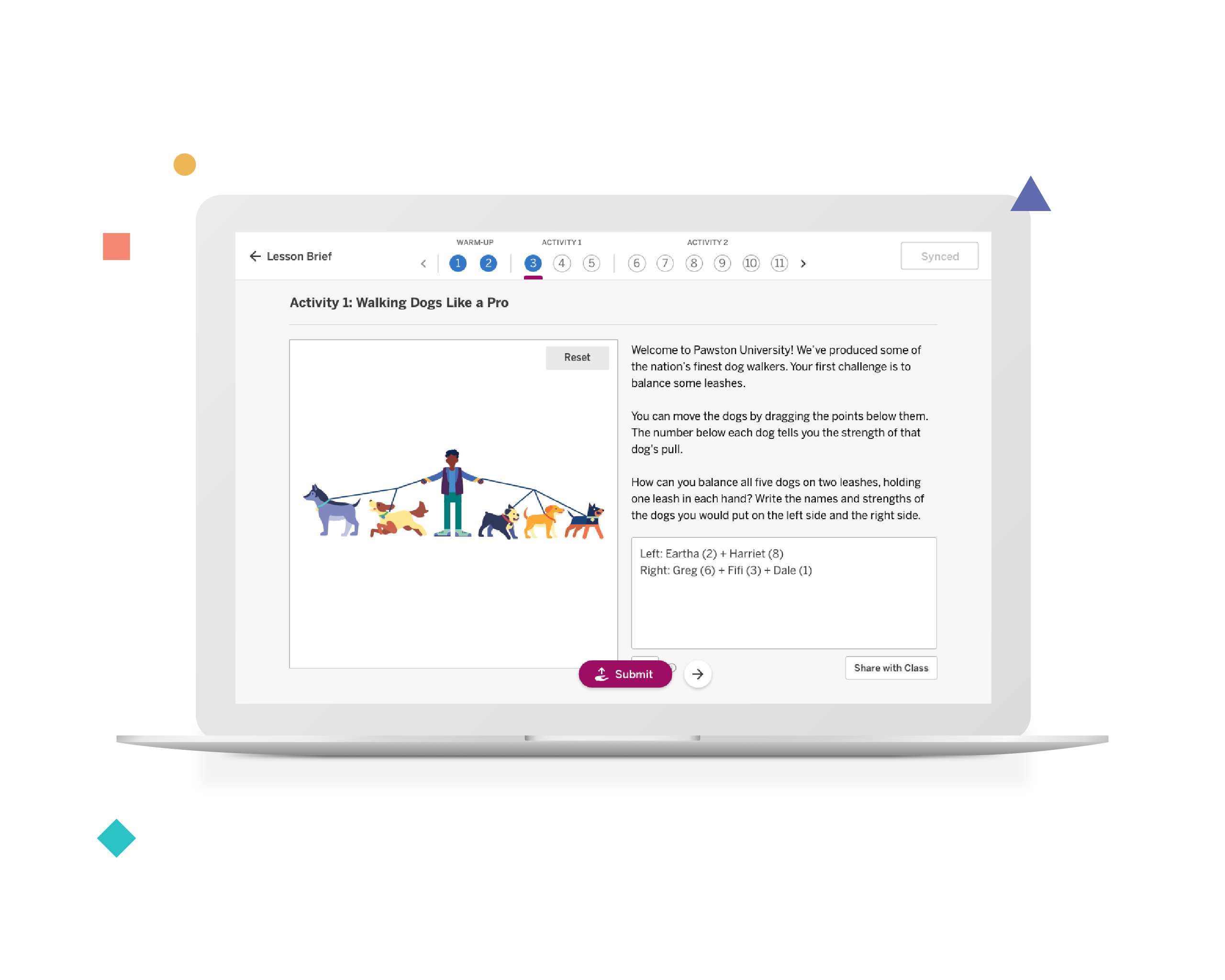
Digital lessons should be powerful in their ability to surface student thinking and spark interesting and productive discussions. We’ve partnered with Desmos to bring this vision to life with our complete library of Amps—social, collaborative lessons powered by Desmos technology.
Intuitive and engaging student experience
The student experience is intuitive and engaging because the content and the tools are interesting and exciting. Students work together and interact with the mathematics in real time to quickly see that reasoning and revising are important parts of math class.

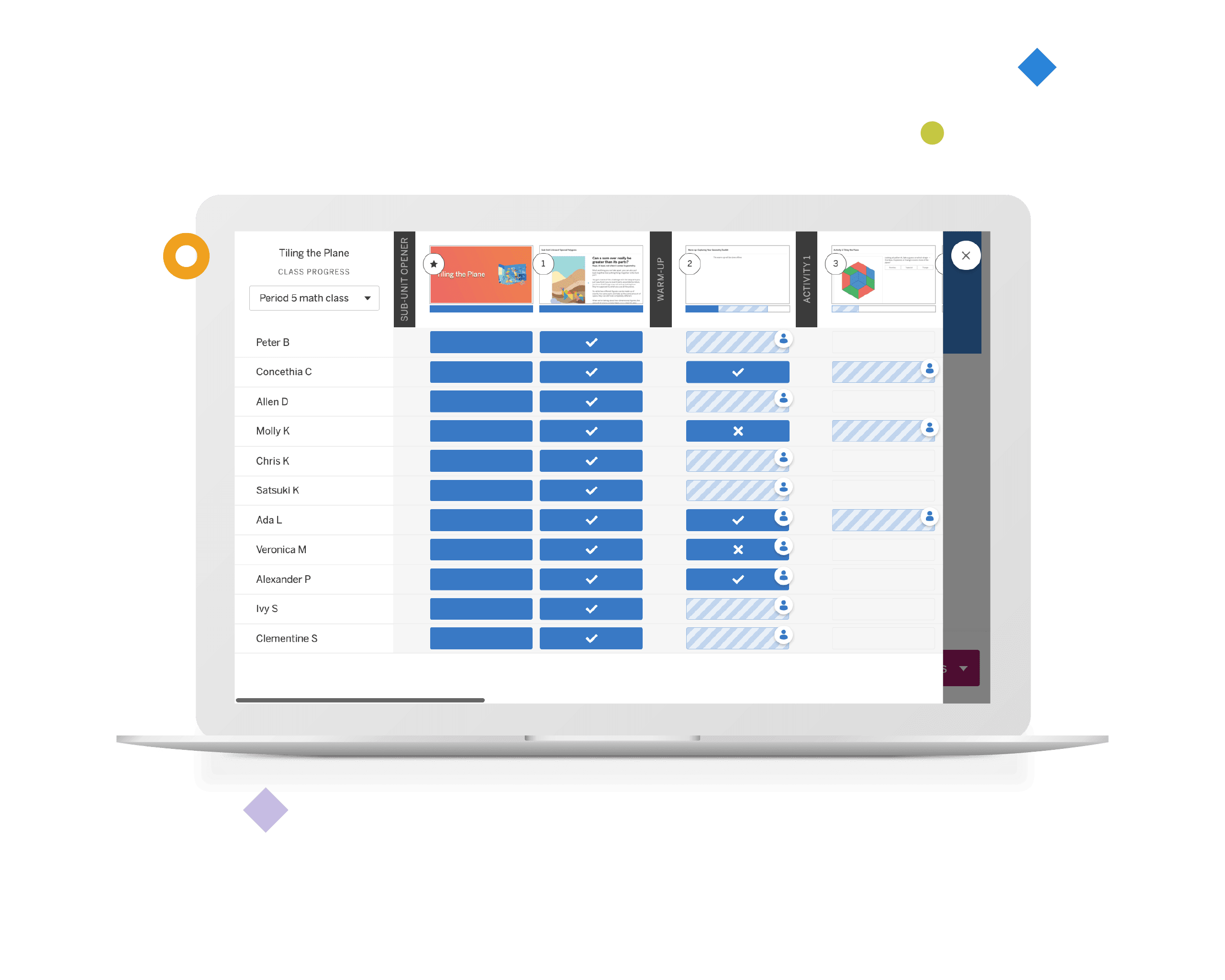
Powerful teaching and monitoring tools
Imagine knowing where your students are, what they think, what they might not get yet, and what needs to happen next. This is all possible with Amplify Math.
Automatic, just-in-time supports
Our Power-ups provide just-in-time support at the point of use before activities for your students. Power-ups ensure we are giving all students—even the ones who might be three years behind in math, but only 15 minutes behind the day’s lesson—the chance to experience success in math. Not teaching online? They’re available in the Teacher Edition, too.
Engaging lessons that are more teachable
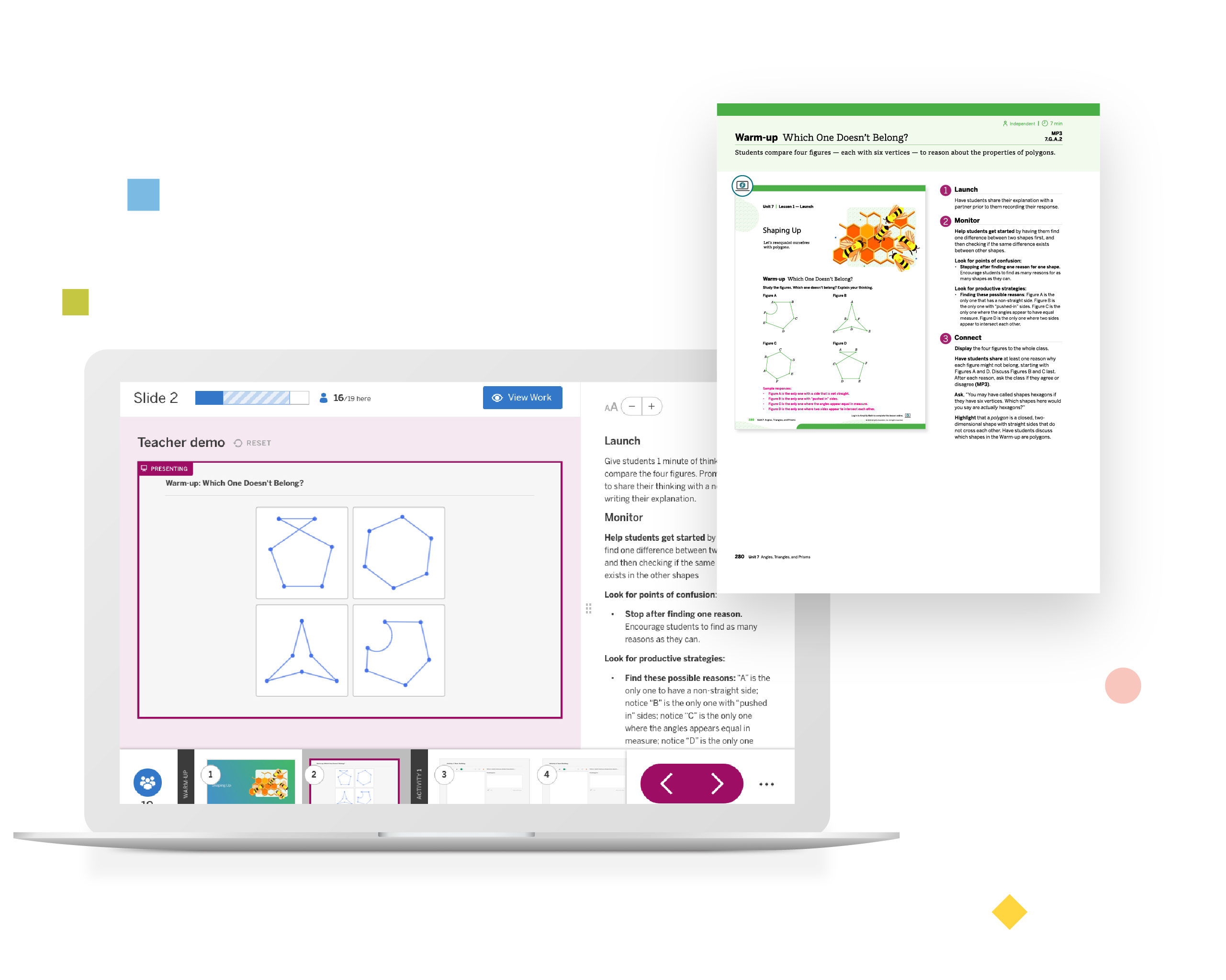
Amplify Math makes productive discourse easier to facilitate and more accessible for students. The program provides teachers with easy-to-follow instructional supports that make implementing a problem-based program more effective and enjoyable for both you and your students.
Math in the program is social and collaborative. Our digital experience is fun and dynamic, with plenty of opportunities for students to talk through their reasoning, work with their peers, and gain new understandings.
Curious to learn more about what a social, collaborative classroom looks like?
Review now
Review now
Click the orange button below to log in as a teacher and review the full digital experience.
Select “Log in with Amplify” and enter these credentials:
Username: t1.louisianamath@demo.tryamplify.net
Password: Amplify1-louisianamath
Click here to download a navigational guide.

Welcome, Louisiana!
Get all students talking and thinking together about grade-level math.
Amplify Math is designed around the idea that a core math curriculum needs to serve 100 percent of students in accessing grade-level math every day. To that end, the program delivers:
- Engaging, discourse-rich math lessons that are easier to teach.
- Flexible, social problem-solving experiences both online and off.
- Real-time insights, data, and reporting that inform instruction.
Flexible social problem-solving experiences
Digital lessons should be powerful in their ability to surface student thinking and spark interesting and productive discussions. We’ve partnered with Desmos to bring this vision to life with our complete library of Amps—social, collaborative lessons powered by Desmos technology.
Intuitive and engaging student experience
The student experience is intuitive and engaging because the content and the tools are interesting and exciting. Students work together and interact with the mathematics in real time to quickly see that reasoning and revising are important parts of math class.
Powerful teaching and monitoring tools
Imagine knowing where your students are, what they think, what they might not get yet, and what needs to happen next. This is all possible with Amplify Math.
Automatic, just-in-time supports
Our Power-ups provide just-in-time support at the point of use before activities for your students. Power-ups ensure we are giving all students—even the ones who might be three years behind in math, but only 15 minutes behind the day’s lesson—the chance to experience success in math. Not teaching online? They’re available in the Teacher Edition, too.
Engaging lessons that are more teachable
Amplify Math makes productive discourse easier to facilitate and more accessible for students. The program provides teachers with easy-to-follow instructional supports that make implementing a problem-based program more effective and enjoyable for both you and your students.
Math in the program is social and collaborative. Our digital experience is fun and dynamic, with plenty of opportunities for students to talk through their reasoning, work with their peers, and gain new understandings.
Curious to learn more about what a social, collaborative classroom looks like?
Review now
Review now
Click the orange button below to log in as a teacher and review the full digital experience.
Select “Log in with Amplify” and enter these credentials:
Username (teacher): t1.louisianamathpublic@demo.tryamplify.net
Username (student): s1.louisianamathpublic@demo.tryamplify.net
Password (teacher and student): Amplify1-louisianamathpublic
Click here to download a navigational guide.
Welcome, Tennessee educators!
Get all students talking and thinking together about grade-level math.
Amplify Math is designed around the idea that a core math curriculum needs to serve 100 percent of students in accessing grade-level math every day. To that end, the program delivers:
- Engaging, discourse-rich math lessons that are easier to teach.
- Flexible, social problem-solving experiences both online and off.
- Real-time insights, data, and reporting that inform instruction.
Flexible social problem-solving experiences
Digital lessons should be powerful in their ability to surface student thinking and spark interesting and productive discussions. We’ve partnered with Desmos to bring this vision to life with our complete library of Amps—social, collaborative lessons powered by Desmos technology.
Intuitive and engaging student experience
The student experience is intuitive and engaging because the content and the tools are interesting and exciting. Students work together and interact with the mathematics in real time to quickly see that reasoning and revising are important parts of math class.
Powerful teaching and monitoring tools
Imagine knowing where your students are, what they think, what they might not get yet, and what needs to happen next. This is all possible with Amplify Math.
Automatic, just-in-time supports
Our Power-ups provide just-in-time support at the point of use before activities for your students. Power-ups ensure we are giving all students—even the ones who might be three years behind in math, but only 15 minutes behind the day’s lesson—the chance to experience success in math. Not teaching online? They’re available in the Teacher Edition, too.
Engaging lessons that are more teachable
Amplify Math makes productive discourse easier to facilitate and more accessible for students. The program provides teachers with easy-to-follow instructional supports that make implementing a problem-based program more effective and enjoyable for both you and your students.
Math in the program is social and collaborative. Our digital experience is fun and dynamic, with plenty of opportunities for students to talk through their reasoning, work with their peers, and gain new understandings.
Curious to learn more about what a social, collaborative classroom looks like?
Review now
Review now
Click the orange button below to log in as a teacher and review the full digital experience.
Select “Log in with Amplify” and enter the login credentials supplied to you.
Click here to download a navigational guide.
Welcome, Tennessee!
Get all students talking and thinking together about grade-level math.
Amplify Math is designed around the idea that a core math curriculum needs to serve 100 percent of students in accessing grade-level math every day. To that end, the program delivers:
- Engaging, discourse-rich math lessons that are easier to teach.
- Flexible, social problem-solving experiences both online and off.
- Real-time insights, data, and reporting that inform instruction.
Flexible social problem-solving experiences
Digital lessons should be powerful in their ability to surface student thinking and spark interesting and productive discussions. We’ve partnered with Desmos to bring this vision to life with our complete library of Amps—social, collaborative lessons powered by Desmos technology.
Intuitive and engaging student experience
The student experience is intuitive and engaging because the content and the tools are interesting and exciting. Students work together and interact with the mathematics in real time to quickly see that reasoning and revising are important parts of math class.
Powerful teaching and monitoring tools
Imagine knowing where your students are, what they think, what they might not get yet, and what needs to happen next. This is all possible with Amplify Math.
Automatic, just-in-time supports
Our Power-ups provide just-in-time support at the point of use before activities for your students. Power-ups ensure we are giving all students—even the ones who might be three years behind in math, but only 15 minutes behind the day’s lesson—the chance to experience success in math. Not teaching online? They’re available in the Teacher Edition, too.
Engaging lessons that are more teachable
Amplify Math makes productive discourse easier to facilitate and more accessible for students. The program provides teachers with easy-to-follow instructional supports that make implementing a problem-based program more effective and enjoyable for both you and your students.
Math in the program is social and collaborative. Our digital experience is fun and dynamic, with plenty of opportunities for students to talk through their reasoning, work with their peers, and gain new understandings.
Curious to learn more about what a social, collaborative classroom looks like?
Review now
Review now
Click the orange button below to log in as a teacher and review the full digital experience.
Select “Log in with Amplify” and enter these credentials:
Username (teacher): t1.tnmathreviewer@demo.tryamplify.net
Username (student): s1.tnmathreviewer@demo.tryamplify.net
Password (teacher and student): Amplify1-tnmathreviewer
Click here to download a navigational guide.
Print materials for your review
Reasons to Choose Amplify Math 6-8 & Alg.1
Welcome, Idaho educators!
Get all students talking and thinking together about grade-level math.
Amplify Math is designed around the idea that a core math curriculum needs to serve 100 percent of students in accessing grade-level math every day. To that end, the program delivers:
- Engaging, discourse-rich math lessons that are easier to teach.
- Flexible, social problem-solving experiences both online and off.
- Real-time insights, data, and reporting that inform instruction.
Flexible social problem-solving experiences
Digital lessons should be powerful in their ability to surface student thinking and spark interesting and productive discussions. We’ve partnered with Desmos to bring this vision to life with our complete library of Amps—social, collaborative lessons powered by Desmos technology.
Intuitive and engaging student experience
The student experience is intuitive and engaging because the content and the tools are interesting and exciting. Students work together and interact with the mathematics in real time to quickly see that reasoning and revising are important parts of math class.
Powerful teaching and monitoring tools
Imagine knowing where your students are, what they think, what they might not get yet, and what needs to happen next. This is all possible with Amplify Math.
Automatic, just-in-time supports
Our Power-ups provide just-in-time support at the point of use before activities for your students. Power-ups ensure we are giving all students—even the ones who might be three years behind in math, but only 15 minutes behind the day’s lesson—the chance to experience success in math. Not teaching online? They’re available in the Teacher Edition, too.
Engaging lessons that are more teachable
Amplify Math makes productive discourse easier to facilitate and more accessible for students. The program provides teachers with easy-to-follow instructional supports that make implementing a problem-based program more effective and enjoyable for both you and your students.
Math in the program is social and collaborative. Our digital experience is fun and dynamic, with plenty of opportunities for students to talk through their reasoning, work with their peers, and gain new understandings.
Curious to learn more about what a social, collaborative classroom looks like?
Review now
Review now
Click the orange button below to log in as a teacher and review the full digital experience.
Select “Log in with Amplify” and enter your reviewer login credentials.
Click here to download a navigational guide.
S2-01: How teachers are really feeling this school year
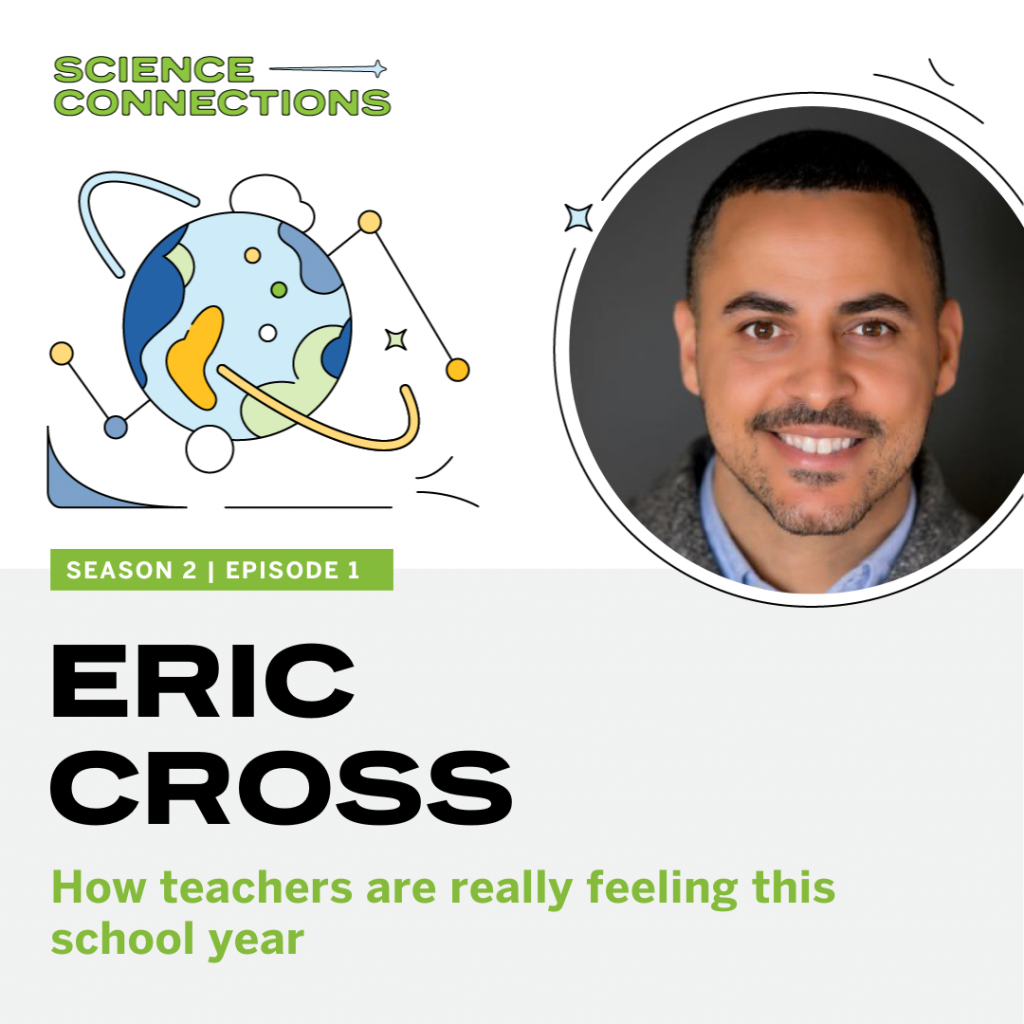
In this special solo episode, Eric Cross starts the season by sharing his personal journey as an educator, and how the difficulties of the last few years have shaped his mindset going into the upcoming school year. Eric also addresses teacher burnout and what inspires him to continue working as a classroom educator. Explore more from Science Connections by visiting our main page.
Eric Cross (00:02):
Welcome to Science Connection, Season Two. As we begin the next season, I thought it would be a good time to share my story. As the host, I get to ask people questions about their journey, but I’ve actually never shared much about my own. So I’ve taken some of my most frequently asked questions to guests and asked them to myself. I hope you enjoy.
Eric Cross (00:23):
So the origin story question, I think really gets to the heart of why a person does what they do, because so much of who we are, especially as adults and teachers, is a result of experiences that we had in our lives when we were kids or in school with other teachers. And my life’s no different. I was born to a 19-year-old single mom. And when you’re a young boy growing up, especially with a young single mom, you often look to older men in different positions as kinda like a surrogate or like a mentor. And you may not even tell them that they are that to you. You kind of keep it close to the chest. And that’s what I did growing up. One of the ones that really stood out to me is, in seventh grade, I went to a middle school here in San Diego that was called Keiller Middle School. And we were a magnet program that specialized in science. And they had this program that brought professors from the local universities and they did this high-level enrichment. They would even take us to the college campus and we would work in these labs as seventh graders. It was amazing. And one of the people there, his name was Dr. Tress, and he was a professor. And Dr. Tress took a liking to me. I reminded him of his son. We were doing this great embryology experiment. We would take purple sea urchins. And we would inject them with potassium chloride, which would cause them to spawn. And we would fertilize these eggs, and then we would run different experiments using them. And these were things that I had never done before. I had always loved science. I’d always loved tinkering and building things. But this was my introduction, really, to high-level biology and to higher levels of education. I didn’t—I didn’t have many figures like that in my life growing up. I mean, I’m a first-generation, you know, high school, college graduate. Many of these are first generations for me. So, this was a new experience. And so Dr. Tress really unlocked a core memory and was one of my first mentors, as far as academics are concerned. And during my seventh-grade year, I entered the science fair and won first place, which was a huge deal. They took us out to Balboa Park. We got to miss school for a week. We got to go to all the museums for free. It was the best. And I think at that point in time, it really solidified something in me that would lay dormant until later on in my adult life. High school, I was really fortunate: the high school I went to was Morse High School, not too far from Keiller, and they had an aeronautics program. So I was able to enroll in that aeronautics program. And I learned how to fly before I learned how to drive. And I had this great instructor named Mr. Klon, who was this like 6′ 4″, 250-pound hippie guy. And he—we would get in the plane and we would have these like philosophical conversations. And through that, especially looking back now as a teacher, I realized that he was making connections with me and investing into who I was as a person. And it was something that I so needed at the time. Because at home I didn’t have that. You know, my safe place, a lot of time, was school. It was my only structure. It was where I knew I would get encouragement. It was where I knew things were reliable and consistent. For a lot of people, and a lot of kids, their home life isn’t like that. School was that for me. So Mr. Klon, I mean, he was this authentic, you know, consistent person in my life and made a huge difference at this time.
Eric Cross (03:23):
After I graduated high school, I left home just to get away from a difficult environment. And I was homeless for a little while and that was a huge moment in my life. And around that time, an aunt found out and she said, “You’re gonna come stay with us.” And this was like this three-year process of me living with them in this, like, functional family that ate dinner together. And they went to the zoo. They had family passes. And they took family photos at Christmastime. This was all weird stuff. Like, I didn’t know—I didn’t know who did these things. It was—I felt like a puppy that like lived in a home that was like…it was a home that was just always kind of like violent or like just really toxic. And then it gets put into a healthy home and doesn’t know how to act. That’s how it felt. And this was around like 19, 20 years old. During that time I started putting myself through school. So I went to community college and I was broke as a joke. And so I couldn’t afford the textbooks while I was going. So I would just go to the bookstore, the Barnes and Noble bookstore in Mira Mesa here in San Diego. And I would stay there all night using the textbooks or using the books there for doing my work. And then I would just put the books back on the shelves. Because let’s just face it. Textbooks are expensive, brother wasn’t trying to pay for all that. So I really had to earn that time. So I was working full-time. I was going to school. And, eventually I got a job in working in finance with a really great friend who mentored me during my younger twenties. And I didn’t wanna be broke and finance made sense.
Eric Cross (04:44):
And so I did that for a little while, until I got to a point in my career where I was watching an episode of The Office, the UK version, the Ricky Gervais version, and a character said, “I’d rather be at the bottom of a ladder I want to climb than halfway up one I don’t.” And I realized, working in finance, that I was halfway up a ladder I never wanted to climb. So I wanted to move into something that, if I was gonna spend eight hours a day or 10 hours a day doing something, I wanted it to be something that actually filled me up inside. And this is how I got into teaching. So I had always been working with young people, specifically 12- to 18-year-olds, like a non-profit or volunteering, mentoring, after-school programs. And I’ve always managed to rationalize my job in the finance world as meaningful because it let me do the real work that fulfilled me. So the real work was working with the kids. But my day job, my, like, Clark Kent-type job, was just, you know, doing the finance thing of like helping people that have a lot of money make more money. Which at the end of my life, I look back and I said, “That’s not what I want my legacy to be.”
Eric Cross (05:43):
And when the finance crash happened in 2008, that’s when I think I started looking back on it and said, “If I’m gonna spend all my time doing something and spending 40 or 60 or 80 hours of my day of my week doing things, I want it to matter. And that’s when I decided to pivot and leave that field and go and get my master’s in education and get my teaching credential, teaching science specifically. Now, one of the questions we get asked a lot and I’ve been asked is, is “How has teaching changed as a result of the pandemic?” And I feel like this could be several podcasts in and of itself, and it’s also regional, because everybody’s experienced it differently, And we’re still experiencing it! That’s the crazy thing! It’s like, it’s not over, we’re still in it. And some places have innovated and pivoted and some places just did what they needed to and they are trying to go back to business as usual. But if anything has happened, the pandemic revealed how much more, how much schools are more than places of just content learning. For many students it’s where they have their only community, their structure, their emotional wellness. They get regular meals, access to tech, and adults that care about them that are outside of their family. The schools are so much more than that. I mean, my school, they were a place, like a hub, that was giving out food every single day during the pandemic to families that would kind of drive by. So for a lot of schools, they became places like that. It also…the pandemic revealed the intensity of the educator workload. I mean, being able to manage your family, having the capacity, to be a content expert, you need to be a counselor, a trauma-care specialist, a coach, an encourager, a tech expert.
Eric Cross (07:23):
I mean, the term mental health is now more common and starting to become prioritized. Now we’re focusing so much more on the whole child. And we know from research that how a child feels about themselves and their safety and their security impacts their ability to learn. So the more comfortable and safe a student feels in the classroom with teachers and with friends, the better they’re gonna be able to learn. And ultimately the higher they’re gonna be able to achieve. You can’t, you can’t have one without the other. In addition, I think less teachers, see themselves teaching into retirement. I think that’s a big thing. I read these articles about teacher shortages and I think the reality is it’s actually teacher exodus. It’s teachers leaving. And that’s been really difficult. I’ve had many friends who’ve left for the private sector. And I get it, especially if you’re one that has—if you’re the first in your family to graduate from college, with a STEM degree, to them taking a teaching position can mean walking away from a salary in the private sector that pays two or three times more.
Eric Cross (08:23):
And in many places around the country, in order to be a teacher and maintain a median standard of living, you need either dual income, multiple jobs, or a multi-generational household. For a lot of people it just doesn’t make sense. And even right now, today, as I’m recording this, I’m reading articles and getting text messages…and I received a text message three days ago from a teacher that said, “My goal this year is to just not resign.” And that’s where a lot of teachers are feeling right now: isolated, challenged, and under-appreciated. And Plato said, “What’s honored in a country is cultivated there.” And I’ve been looking at how teachers are honored and one of the ways is just, like, practical. Like, look, I gotta pay my bills. You know, love the Starbucks gift card. Love the CPK, the gift card. The cards, all those other things…but brother got a car payment. And at the end of the day, if we care about our kids, we need to take care of the people that take care of them. And there’s very practical ways for that to happen. And everybody in different sectors around the country is dealing with that in different ways. I think the pandemic also revealed, now the public can see how our kids don’t receive the same quality of education. And once you’re aware of that, you can’t put the genie back in the bottle. So once you see on Zoom or once you see in a meeting, or once you see on the news, that students in different areas, whether it’s the rural South or a suburb in Seattle, are not getting equitable educations, well, ultimately that impacts all of us. Now. It’s not all doom and gloom. Good things have come from, as a result of, the pandemic. Many schools have made progress towards narrowing the technology gap, ’cause they had to! ‘Cause you can’t do Zoom and you can’t do Google Meet and all that stuff with a packet! You gotta get those Chromebooks. And Chromebooks and the internet and access to tech is not a new thing. It’s been out for a long time. The technology gap is not a new thing. It’s been written about extensively, but all of a sudden districts and schools started figuring out how to close that gap. And that’s awesome. We didn’t want a pandemic to be the catalyst for that to happen. But at the end of the day, we started closing it. A lot of schools did an amazing job and districts did an amazing job with deploying the hardware, sending out buses with wifi, putting lessons and videos on USB sticks and dropping them off to parents who live in sparsely populated areas. I mean, there were so many stories that I’ve heard about schools and teachers just doing amazing things, going above and beyond what they needed to on behalf of kids.
Eric Cross (10:51):
I think in addition to that, there’s also been students and families are now having more options to personalize their learning. So we have this in-person model, we have this Zoom or kind of online model, and this hybrid model, and it hasn’t all been perfect, you know, at all. But some families have come out and said, you know what actually doing this hybrid model is better for my son or better for my daughter or better for my student, because they’re able to get the socialization, but also able to focus better at home than they are in a classroom of 36. And that’s legitimate. You know, we talk about personalized learning, but it’s not exactly personalized when everybody has to wake up at the same time, same schedule, go to the same, the same classroom of, you know, up to 40 kids, and do the same lesson. I mean, we have to be honest about our limitations with personalizing learning for students. And when we can provide more options and we give teachers the infrastructure to be able to use different platforms, then we’re able to personalize learning a lot more.
Eric Cross (11:51):
There’s also been an emphasis on the whole-child wellness. I think the spotlight on mental well-being heavily impacts their academic success, but counseling teams, social workers, school psychologists—I think more than ever we’ve realized the value that they bring to the schools. And unfortunately many of them have caseloads of 200 students or more. And they’re seeing students most often that are in crisis. And especially after the pandemic, we’re realizing how valuable they are and how much we need to, one, honor them and give them the support that they need, and also recruit more. Because as we start recognizing how our brains are impacted by the things that we’re dealing with, we’re also gonna see how that’s gonna impact our students’ performance. And we need the specialists in those positions to be able to support our kids. I think, last, I think more innovation and lesson design and how we assess students. And so we’ve been talking about in education just kind of critiquing: how do we assess what a student knows? How do we make what a student actually does at school relevant to real life? I mean, so many times I have students who’ve graduated that are like, “I feel like the things I learned in school, like, they’re not always transferable to real life. It helped me on a test, but like, I don’t know how to do my taxes.” Or “I memorized these facts, but I don’t really apply it in my job.” Or “The facts that I learned I could have actually learned on the fly in my job. I wish I would’ve actually focused on the skills or had an earlier opportunity to get some experience because when I’m trying to apply for a job, <laugh> they ask for experience and I’m 22 years old.”
Eric Cross (13:28):
And so all these things kind of come up. And so I think there’s been some great conversations around “how do we rethink what education looks like?” And there’s different pockets around the country that have been doing that, I think, really well. And I think it’s important for us as teachers to stay connected to those people who are kind of pushing the boundaries and thinking outside the box, because when we get siloed, it’s really easy to get calcified and cynical. I get it. And it impacts me too. But when we’re around those people who have those fresh ideas, who are really pushing the limits, it inspires us. And that’s something I think during the pandemic that I’m grateful that I was intentional about, is staying connected with other teachers. There’s a big question; Why do you continue your work in the classroom and what keeps you motivated? And I was thinking really hard about this question, because depending on <laugh>, depending on my day, I feel like my answer’s gonna be a little bit different. So I’ve had to step back from this 30-foot, thousand-foot perspective and answer the question. And my answer is this: I think because I still feel like I can be effective to influence positive change in my classroom with my students and within the larger education system as a whole. I think if I lost either of those two, then I’d rethink my profession. Look, I’m an innovator. I like asking “why” questions and things like that. And I’m not always the most popular person when you do that. But education is like just a huge ship. It doesn’t pivot on a dime. And asking why questions and pushing for change on behalf of kids isn’t easy, fun, or glamorous, but it’s it’s necessary. And I feel like over the last few years, I’ve been able to see these kind of glimmers of a trajectory change, at least where I am locally. And that’s something that has given me a lot of hope. I’m very fortunate to be connected to educators and people in leadership that are really about making a difference beyond just kind of the cliched platitudes. They actually wanna make systemic change, in a way that’s positive. And that’s been really helpful for me. So as long as I feel like I’m useful in the classroom for students, and as long as I feel like I’m bringing, I think change, on behalf of teachers and students and administrators and our community in a way that moves the ball down the field, that’s what keeps me motivated. And what I like to ask teachers when I close in the podcast is. “What teacher or teachers have inspired you?”
Eric Cross (15:54):
And for me, I think it would start off with the teachers who cared about me when they didn’t have to, in elementary school all the way through college. And there are numerous teachers. My science-teacher community of practice. For the last two years, I’ve been fortunate to spend every month, once a month, meeting with just a core group of science teachers that really care about some of the things that we are impacted by in the classroom. And when the pandemic was going on, we still met regularly. And because we’re not all teaching in the same place, we kind of were able to bring different perspectives to the table. I think the current classroom teachers and former classroom teachers that I have in my community really inspire me. The ones who are dedicated to opening doors for students. The graduate students that I teach at the University of San Diego, they keep me fresh. I love leaving teaching my 12- and 13-year-olds, and then driving down the street to the university and teaching 20somethings who are all about to be in the classroom. They come with new ideas, they’re asking questions, and I get to actually share things that I just did three hours ago. I think that’s one thing that continues to inspire me. And it’s one of the reasons why I love teaching at the University of San Diego. Their energy and enthusiasm is super-refreshing. And then all the teachers that are willing to take risks and fail forward, to try things different, to ask hard questions, to push the envelope. Teaching’s hard. It’s easy to point out the problems in education as a whole. But after we do that, it’s important to figure out the practical ways we can make the changes that we wanna see.
Eric Cross (17:23):
Now, that’s to say that if you have the capacity for it and the resources and the support. Some of us, we don’t. Some of us, we are on an island, and that’s a really, really difficult place to be, especially when you have family and kids to take care of. And you have to make decisions on what’s best for you and for your own students. We do this work on behalf of kids. And it’s one of the most honorable services a person can provide to our community. But one area for growth that I think we have kind of as a society, is teachers spend their lives, daily, on behalf of the future of our country. For other people’s children. They fall asleep at night worrying about other people’s kids. They spend their own money to create opportunities and experiences that students might not otherwise have. And it’s important that we collectively, and I know I’m preaching the choir when I say this, but this is one of my messages, is that we honor them in turn. We create programs that allow them to be able to afford housing. We create opportunities for them to be able to generate wealth. We create ways for them to be able to find rest, to get connection. And then internally we create systems where they can just work on themselves, fill themselves, get trained, and be whole, so they can bring their best self to the kids in front of them. That’s one of my personal platforms. It’s something that I think is vital. We gotta take care of the people that take care of our kids. So there’s a saying that says, “It’s better to light a candle than to curse the darkness.” And it takes one person to blow out a candle, but one candle can light thousands of other candles, without diminishing its own light. And that’s what we have to be. So my encouragement, teachers, as you’re going into this new school year, and you’re thinking about what’s going on, you’re thinking about all the challenges—and they’re there, and they’re real, and trust me, it’s not like some Pollyanna, like, “Hey, just be positive!” mindset and everything’s gonna be great—no, no, no, no, no. It’s not that. But my encouragement…if I can tell you one thing that’s helped me more than anything else, it’s being connected to other people who are candle-lighters. Because there are a lot of places that are gonna blow out the candle. It could be the staff lounge. It could be Twitter, it could be Reddit. It could be Instagram. It could be TikTok. It could be, you know, anybody. Someone next door to you. There’s a lot of folks that are gonna be willing to point out and say, “Look, this is what’s wrong.” But find the helpers. Find the people that are candle-lighters. And stay connected with them. Find that community. I can tell you for me, that’s been the thing that’s been able to help me sojourn through all of this—I couldn’t do this by myself—is being able to share my story with other teachers and knowing that I’m doing this work alongside of other folks who are doing this work, and I can share my story with them and listen to their stories, is something that’s been able to fill my cup. And so I hope I can do the same for you and for other people listening to other people I come in contact with.
Eric Cross (20:08):
Teachers, I wish you a great school year. Hang in there. Be those candle-lighters and bring your best self on behalf of the students. Thanks so much for listening. Now, we wanna hear more about you. If you have any stories you wanna share about the classroom, please email stem@amplify.com. That’s STEM at amplifycom.wpengine.com. And make sure to click subscribe wherever you listen to podcasts. And join our Facebook group, Science Connections: The Community. Until next time.
Stay connected!
Join our community and get new episodes every other Tuesday!
We’ll also share new and exciting free resources for your classroom every month.


Meet the guest
Eric Cross is a 7th grade science/technology teacher, grade level lead, and digital learning innovator for Albert Einstein Academies, International Baccalaureate schools. He is also an adjunct professor of learning and technology at the University of San Diego and a Google certified innovator. Eric earned a bachelor’s degree from Azusa Pacific University and a Master of Education from the University of San Diego. He had 17 years of experience working with at-risk youth and underserved populations before becoming a middle school teacher. By building relationships with students, colleagues, and the community, he has become an empowered leader in and out of the classroom. Through meaningful learning experiences centered around student agency, STEM has become accessible to students through highly engaging lesson design, thoughtful integration of digital tools, and culturally relevant pedagogy.

About Science Connections
Welcome to Science Connections! Science is changing before our eyes, now more than ever. So…how do we help kids figure that out? We will bring on educators, scientists, and more to discuss the importance of high-quality science instruction. In this episode, hear from our host Eric Cross about his work engaging students as a K-8 science teacher. Listen here!



S4 – 01. Joyful math teaching with Kanchan Kant
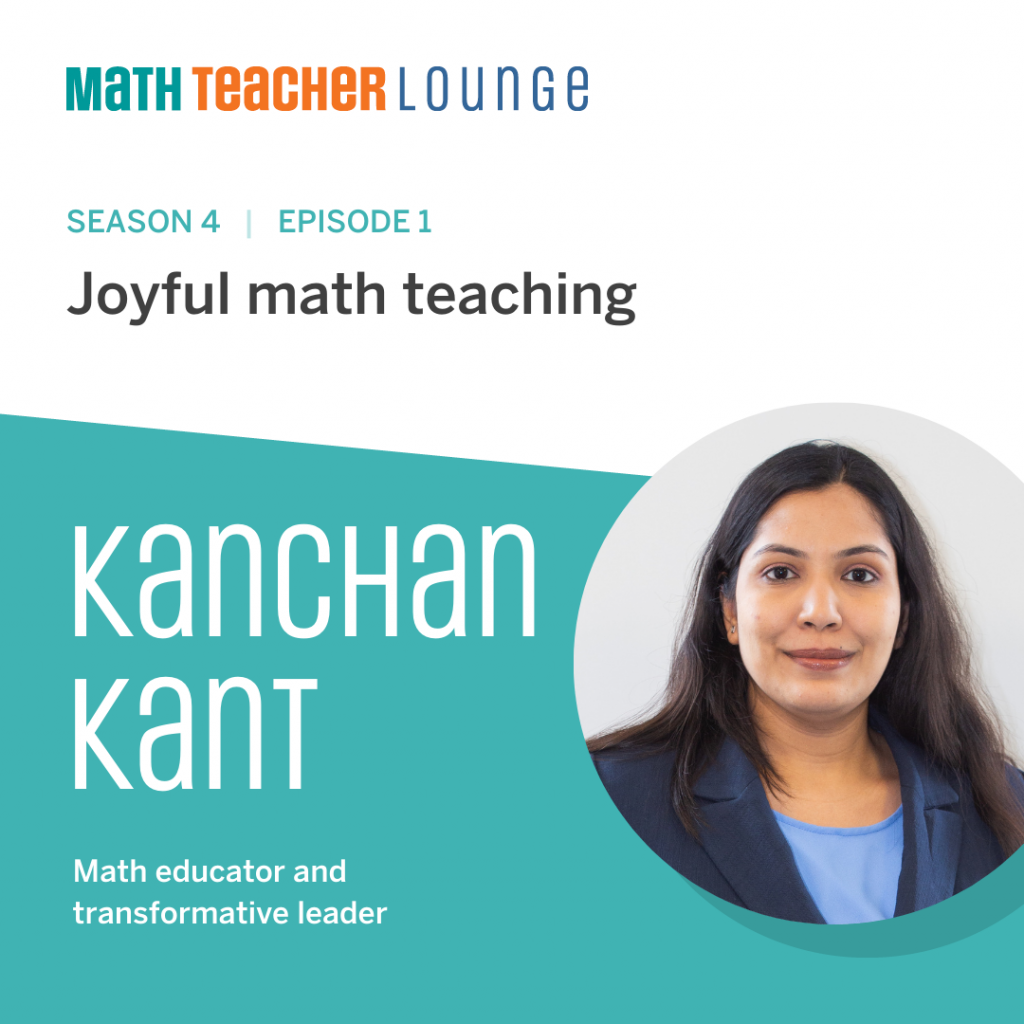
This season on the Math Teacher Lounge podcast, we follow the theme “joyful math” and uncover its meaning.
In this episode, Kanchan Kant joins Bethany Lockhart Johnson and Dan Meyer to discuss the key, early investment she makes at the start of the school year to ensure her math teaching will be joyful for herself and for her students for the rest of the year.
Explore more from Math Teacher Lounge by visiting our main page.
Dan Meyer (00:00):
Okay, we are recording. Hey folks. Welcome back to Math Teacher Lounge. (laugh)
Bethany Lockhart Johnson (00:06):
Hardly off to a rocking start.
Dan Meyer (00:06):
Yeah. Yeah. <laugh> Did you like my energy there? Hey folks. Welcome back to Math Teacher Lounge. It’s a new season with your host Dan Meyer. And…
Bethany Lockhart Johnson (00:15):
I’m Bethany, Lockhart Johnson. How’s your summer Dan?
Dan Meyer (00:22):
Summer for me feels really hectic as we prepare, here at Amplify, for the new school year, and everyone’s starting these new math programs. So I’ve been feeling quite amped up, like usual in the summer. But also, my kids started big kid school. So I’ve been seeing the educational system from the role of a parent and all the anxieties and I worry, will I be my kids’ teacher’s most annoying parent <laugh> … So what kind of math curriculum you using? Oh, have you heard of core counting? Can I lead a math center? What’s this worksheet about? I’m really worried my kids are just overall gonna hate my vibe when I come around their classes. Uh, <laugh> so lots going on with me.
Bethany Lockhart Johnson (01:06):
It’s already happening for me and I have a toddler.
Dan Meyer (01:10):
<laugh> There we go. Anyway, that’s what I’m up to. That’s how I’m feeling. I’m curious how you’re doing. We haven’t chatted in a while. We’re excited about the podcast, but it’s been a bit, you know? Bethany got a break from me and my antics over the summer. So, how are we finding you here, as we ramp up to the new season?
Bethany Lockhart Johnson (01:24):
Uhhhh. Well, let me just tell you, I have a toddler. That’s kind of all I need to say. Except that’s not all I will say. Of course, I’ll say more. I am exploring, I’m dipping my toe into the extracurricular toddler activities; the music classes of the toddler world, the creative movement of the toddler world. And yeah, I have lots of opinions and lots of things to say about the teachers. And I’m like, Ugh, I can’t wait to be room mom. And just like…<laugh>
Dan Meyer (01:55):
Just let it rip, you know?
Bethany Lockhart Johnson (01:57):
I have opinions on everything and just hope I don’t get kicked out of the class.
Bethany Lockhart Johnson (02:05):
It’s been an eventfully recharging summer and we are ready for this new season. And in fact, we’re so ready that we decided that we were gonna mix up this season. Just a, just a tiny bit. Shall I explain Dan?
Dan Meyer (02:21):
Yeah. Let’s do it.
Bethany Lockhart Johnson (02:22):
So we have loved all the different topics that we have explored in the Math Teacher Lounge world, but we kind of feel like we need to do some more deep dives. So for this season and the foreseeable seasons …
Dan Meyer (02:38):
We’ll see how it goes.
Bethany Lockhart Johnson (02:38):
Let’s stick with this season. For this season. We’re going to be exploring a singular theme.
Dan Meyer (02:46):
We’re not bouncing around. Yep. We’re not bouncing around from a guest to guest going on whatever shiny thing in the river bed catches our eye. We’re gonna take one theme and see where it goes. What we working with here this season?
Bethany Lockhart Johnson (02:57):
This season, we are going to be exploring the idea of joyful math, joyful math. And Dan, the question I have for you is, is the term joyful math one that you use on the regular?
Dan Meyer (03:10):
No, it definitely is not. I think that joy and math are very rarely, you know, connected in the popular mind. Number one, and number two, you know, I’m kind of an ornery fellow, so that’s not my natural kind of description of math. But we decided that it feels like an important one at the moment, because a lot of math teaching–a lot of teaching in general, math teaching in particular–math teaching is often not a joyful discipline for students, where, you know, I’ve done some research where you look at what people type into Google. And I looked at like, what they…why am I bad at X? And I looked at that for where X is math, where it’s science, where it’s reading, where it’s history. And it was just wild to see how many more hits there are out there on the Internet for “why am I bad at math?” People don’t really associate math with joy, but also we’re looking at joyful math in terms of joyful math teaching. Math teaching, teaching in general, is a tough field at the moment with a lot of teachers leaving teaching. And those who remain are having a lot of soul searching and thinking about, why am I here and how do I sustain this work? And in an environment that seems hostile to my interests or my talents, or work-life balance. And so that’ll be the theme that we’re gonna kind of uncover over the course of our season, talking to various interesting guests, including one today about, yeah, joyful math teaching and joyful math.
Dan Meyer (04:43):
And to help us think about what joyful math teaching looks like, we figured we’d first look at what UN-joyful math teaching looks like. It happens to be the case that we’ve been in a pandemic as you might be aware, and teaching has been challenging. And the NEA, our National Education Association, surveyed its member teachers and asked them the following question … Gave a list of issues that school employees have experienced and asked, for each one indicate how serious of a problem this is for you. This is a survey where more than half of members said they are more likely to leave or retire sooner than planned because of the pandemic. And this is almost double the numbers from July, 2020. It’s really hard to keep track of teacher departures and unfilled vacancies across states. So I don’t wanna like blow this up out of proportion, but it does indicate some real challenges in teaching. So Bethany, I was curious, what do you think like at the top of the list, like what kinds of factors, issues facing educators would you imagine there are?
Bethany Lockhart Johnson (05:48):
So if I’m to understand you correctly, these are reasons someone is not actively experiencing joy in the profession of teaching. Like why would they leave?
Dan Meyer (05:58):
Exactly.
Bethany Lockhart Johnson (05:59):
Well, the number one thing that came to mind for me, well, okay. Wait, wait, one other caveat I need to ask about, you said specifically pandemic-related or just in general, because if it’s pandemic-related, then I think, well, there’s health issues, right? That people are concerned about, but in general, the thing that came to mind was a lack of support from administration districts, lack of funding, and overcrowding in classrooms. Like, you know, I saw somebody had 40 students in their classroom. So those are the two things that I can imagine like top on someone’s list that would make them experience less than a joyful day.
Dan Meyer (06:44):
Yeah. There’s a bunch of you’re kind of identifying here. So number seven on the list is lack of respect from parents and the public, which is like 76% of teachers call that out as serious for them. Others that you kind of circled around in terms of resources go like, not enough planning or unstructured time in the job kind of ties into resources. Yeah. But there’s others that are on the list that I’m curious, you wanna take on the swing at it, given what I’ve said here,
Bethany Lockhart Johnson (07:15):
I feel like too much being asked of them, like being asked to wear too many hats, like they’re being asked to not only teach their class, but also cover all the vacancies and supervise recess and, you know, make a delicious, nutritious lunch. That’s what came to mind. Am am I close?
Dan Meyer (07:33):
Yeah. Number four on the list, unfilled job openings leading to more work for remaining staff. People covering, you know, not just the kind of external to teaching work like you’re describing, but also just taking on like losing your prep period, to take on a class that has been unfilled for all kinds of reasons. Yeah.
Bethany Lockhart Johnson (07:54):
Yeah. I’ve only gotten the fourth. Give me one clue, one clue about …
Dan Meyer (07:59):
So, I mean like, so number one is general stress from the coronavirus pandemic, you know, which I feel like …
Bethany Lockhart Johnson (08:06):
I mentioned that.
Dan Meyer (08:07):
I’ll give you that one. Yep, yep, sure. And then number two, close behind, is feeling burned out, which I think ties into what you’re describing as well. I’m giving Bethany credit on that one. The third one is very different from the ones you’ve been describing. I think I cannot in good faith give you even partial credit for this one. I’ll just say it. Student…
Bethany Lockhart Johnson (08:28):
Wait! Dan, this is not how you give clues.
Dan Meyer (08:31):
Here’s a clue. It’s student absences due to COVID19. It’s really hard to deal student absences. That’s your clue.
Bethany Lockhart Johnson (08:40):
That wasn’t a clue that you told me.
Dan Meyer (08:43):
Yeah, let’s see. I think that’s largely it. There’s also pay is too low, is on the list; student behavioral issues, on the list. And I think that about covers it. So all of that, that basket of items has led to more than half of teachers in this survey, saying that they’re more likely to leave or retire from education sooner than planned. And I don’t know. I think we all know teachers who have bailed.
Bethany Lockhart Johnson (09:08):
I’ve never played a board game with you, Dan, but if we ever play a board game, we’re gonna work on your clue giving, ’cause I want to keep guessing. And you just told me.
Dan Meyer (09:22):
Yeah. Yeah.
Bethany Lockhart Johnson (09:22):
In all seriousness, the <laugh>. In all seriousness, I think yes, the stress of the pandemic and students being absent, what some folks are calling unfinished learning, all of those pieces do play into it. But a lot of those things that you’re mentioning on the list are things that are not unique to the pandemic, right? Like those are things that I feel like there is some modicum of control that we could have over shifting the way the culture of the teaching profession is going so that we could create a more joyful experience for educators, administrators, and students.
Dan Meyer (10:03):
Yeah. Good call out. That’s exactly right. We could tax the people who are not in the classrooms more and increase the pay to classroom teachers. You know, there we go.
Bethany Lockhart Johnson (10:11):
Oh. Bingo. Why didn’t we ask you sooner Dan, for your wisdom.
Dan Meyer (10:15):
Yeah. I’m … solved by Dan. Yeah, good point though. So I read that and yeah, I think that there’s been some … people have critiqued the NEA for being very alarmist about teacher departures as the year has ramped up. It has not been quite the flood of departing teachers as was predicted and thank heavens for that, but we should still be very bummed if teachers are unhappy and wanting to leave and feel like they can’t leave. That is definitely not good. So we were really excited to bring to the table, someone who is just a very joyful teacher and one in a very intentional way. Someone who has a lot of discipline in how she approaches the job and the students in it and tries to create a joyful environment for herself, Kanchan Kant. Kanchan is a math and computer science teacher at Newton North High School in Newton, Massachusetts. She’s been sharing her love for math with her students for the past four years, while also being instrumental in setting the culture and ethos of the math department at her school in her role as the assistant department head. We welcome you on the show Kanchan to help us understand joy and math teaching. Thanks for being here.
Bethany Lockhart Johnson (11:29):
Welcome!
Kanchan Kant (11:30):
Thank you for having me. I really appreciate it.
Bethany Lockhart Johnson (11:33):
One of my friends, her son was asked as his first math homework assignment to write out his math bio. And I loved that idea because we got to hear a little bit about your bio from like a broader perspective. But if we were to ask about your math bio, I will speak for myself to say like, automatically certain images flash into my mind, right? To think about my relationship, my evolving relationship with math. But I’m so curious if I was to ask you, what’s your math bio? How did you become the person, mathematically speaking, that you are today? Would you mind sharing a bit about that?
Kanchan Kant (12:10):
Of course I would love to. So I was born and raised in India and I belong to a family which considers mathematics to be extremely important to succeed in life. My father used to have me add and subtract license plates since I was four years old, when we were out and about. I loved math in school, it just made like complete sense to me. It was logical and you know, it was my favorite subject. I loved it all through high school. I had a confidence speed breaker in undergrad. When in my second semester I almost failed the engineering math course that I took. That was the first time math felt like too much and not like my best friend, which it was supposed to be. So it was a while before I could summon the courage to take on another math course in college.
Kanchan Kant (12:56):
But once I did that, it was like old times. I realized I had to persevere through the challenging bits. And once I did that, it started to make sense again. And through my journey, as an educator speaking to people from various backgrounds and like coming to the United States, I realized that math is challenging for everyone at one time or another. For some people that is elementary school. And for some others, it is college or even later. Either way does not mean that you are not a math person. When I was in college, I felt I was not a math person. Whereas my sister, my very own sister said the same thing about math in middle school. Both of us use math every day. And we are definitely, definitely math people. So for me to be a math person is to persevere, to approach problem-solving in a logical manner, and to find the joy in the process ,as well as the answer.
Dan Meyer (13:47):
That’s wonderful. Yeah. A lot of people, have a moment where they feel like almost betrayed by what they thought was a close friend of theirs, with math, where it’s like, wait, I thought we were tight. You know, I thought we were cool. You and me. And there’s that moment. And I wonder if that’s been a useful moment for you to, you know, bring back now and then as a teacher with students who might feel that even, you know, in high school or in a secondary school as a kid.
Kanchan Kant (14:15):
Absolutely. Like when I talk to students and tell them, yes, I had difficulty in math too. It has not always been easy for men and there are still things I struggle with sometimes, then it’s like more modeling for them that you have to persevere, you should persevere. And once you do that, it makes sense and you can feel successful. So, almost every year I end up sharing the story with my students.
Bethany Lockhart Johnson (14:38):
There’s so much value in that, right? That you are sharing that vulnerability with students. And to say your relationship with mathematics has not been, you know, smooth sailing the whole way through. There were times when you had to work harder than others.
Dan Meyer (14:55):
Yeah. Really fun to hear about you and your father as well. I tried to ask my five-year-old to do some skip counting the other day, like, okay, cool, you’re hot stuff. You can count, you know, up by ones, but what about by twos? And the moment really fell flat. And I watched myself becoming the kind of parent who is whose enthusiasm for math is one day resented by his children. I feel a lot of, yeah, I felt your anxiety Kanchan, with math itself. And now I feel anxiety as like someone who loves math and loves to teach math and may one day alienate the people closest to him. <laugh>
Kanchan Kant (15:31):
I don’t like that future. I have a three-month-old. I do not like this future of mine. If I have to go through what you’re going through. Uh, oh, <laugh>
Dan Meyer (15:38):
You got this. So Kanchan, you’re going back to the classroom coming up here at the time of this recording. It’s a few weeks out. And we’re thinking about like the kind of ways that math teachers sustain a disposition that is joyful. How are you feeling right now, as far as going back to class after this summer? Are you feeling excited, anxious, some combo, tell us about it.
Kanchan Kant (16:01):
I would say combo, but more excited than anxious. I was on maternity leave, as I mentioned, before the school year ended, and I missed the students dearly. Like, my students are what gives me hope in the darkest times. They are thoughtful. They’re empathetic. They’re so eager to learn. And very soon into my teaching career, I realized that if I take the time to get to know my students and make them feel safe and seen in my class, teaching them math would be so much easier and so much more fun. So I’m a little worried about this being like fourth year into the pandemic, but let’s see. Last year I felt the students were finding it difficult to interact with and work with their classmates because they had not been doing it for so long. So I’m hoping this year would go a little better and I’m really looking forward to working with them and building community and see how it goes.
Dan Meyer (16:53):
So if I’m understanding you correctly, you are feeling very well recharged here. You had basically an extended summer with this maternity leave, basically just like a lot of rest and relaxation over the last, like several months. Um, if I get you here. So anyway, I’m glad for that for you. And, yeah. I also hear you on the difficulties of teaching post pandemic or mid pandemic. Anyway, thanks for sharing that.
Bethany Lockhart Johnson (17:19):
What I love is I hear you being so intentional, like thinking about those relationships and thinking about that community that you want to build, you know? How do you hope that you’re gonna cultivate joy in your teaching this year? I mean like, are there certain routines or disciplines that you specifically call forth or that you think other teachers should think about?
Kanchan Kant (17:41):
So at the start of every school year, I dedicate like about three to four weeks to set up the classroom culture, both social and academic. I call my classroom a learning community. We start with community circles, we do icebreaker activities, group building and all those kinds of things. But most importantly, we do a lot of collective problem solving. So I try to present students with problems, which can be solved using multiple strategies and have multiple entry points, basically they are low floor, high ceiling problems. These could be stretch problems that they have seen before, like concepts that they already know or logical puzzles, or just wrapping their heads around different problems. Then I have students share their strategies. The more strategies they have on the board, the more successful I think the problem was. Every year, inevitably, students come up with strategies that I’ve never ever seen before for the same problems that I do.
Kanchan Kant (18:35):
And so I have students come up to the board, they would share their strategies. If they’re not ready for that, they would walk me through their strategies. And I would write their name on the board with different colored markers and everything. Basically to give them choice and agency. It also shows them that the process of doing the problem is so much more important than just getting the right answer and that it is okay to make mistakes in our learning community. I use a lot of vertical whiteboards, some concepts and problems align so well with the vertical surfaces, especially when students can explore together, learn from each other. So I do a lot of that. As for routines, I would say consistency is the key. I consistently reinforce that I want to hear multiple strategies, that it is okay to make mistakes. I am willing to learn from you as much as you’re willing to learn from me. So all like that consistency in culture more than the routines, is I feel important to bring that joy.
Dan Meyer (19:29):
That’s super interesting. Thanks for that. So I’ve heard, I hear two common objections or two common concerns to using rich tasks or doing problem solving. And I think I heard like answers to those two common reservations within what you described there, but I wonder if we can kind of bring it to the surface. And so one of the reservations is around the time that those problems take and another is that teachers often feel like, well, I might be surprised, you know, I might not know what to do with what a student does. And I thought I was hearing like some very interesting answers to both of those kinds of reservations from you, but would you just surface those up if you have some.
Kanchan Kant (20:09):
So in terms of time, I feel if I spend the time at the beginning of the year, setting up that community and doing those problems, it makes learning the math and learning the concepts much more faster throughout the rest of the year. And even when I am trying, like, even throughout the year, if we are doing a warm up problem, as I call it, which has multiple strategies, that’s gonna clarify so many more concepts when we talk about those five, 10 strategies of doing the same problem, then going through multiple problems to clarify those concepts. So for me, it actually saves time instead of taking more time.
Dan Meyer (20:43):
Hmm. That’s super interesting. It’s an investment I’m hearing from you that, yeah, you might not be hitting the curriculum quite as hard early on, but that all of a sudden you’re in the spring and it’s like, oh wow, we’ve been moving so much faster through territory that has been more challenging. What would you say to you know, comfort concerned educators or to address the concern that I don’t know what I’ll do with these five, 10 different strategies. You say, I always see strategies that I’ve never anticipated. Like, it’s a good thing, you know, like you’re happy about that. I think that’s a very intimidating thing for lots of educators. What would you say to that?
Kanchan Kant (21:19):
I think like, for me, it’s a good kind of discomfort. That means like a student is teaching me something, which is actually doing two things. One modeling for them that I’m willing to learn and that I don’t know everything. And two, also telling them that they’re mathematicians. They know what they’re doing. They’re not just receivers of math, they’re actually creating it. So for me, that is very, very important.
Bethany Lockhart Johnson (21:43):
I love that so much. When you think about your students and you’re about to start this new school year, how do you hope your students will experience math in your classroom?
Kanchan Kant (21:53):
So I hope my students can see the beauty and joy of math. They can see that math is a way to see the world and not as something we have to do to get through school. So my hope for my classroom is that we can learn to problem-solve and persevere through problems and learn from each other and not just get through the curriculum. Because like, I think math is a wonderful way to learn these skills, which are so important when you get out of high school. Most importantly, I just wanna make sure that my students see themselves as mathematicians. And like one of the things that like I have to share with you that, because one of my highlights for the year has to be the Desmos art project. I do it every year for the past three years, I think since I’ve started teaching sophomores. And I do it as a unit assessment for functions and my students design something that is meaningful to them, using all the different kinds of functions and colors and shading and everything that you can think of in Desmos.
Kanchan Kant (22:49):
Thank you so much for that though. It is such a cool way for me to see them do that. Like I have seen such amazing creations. One of my students once made a scaled working model of a solar system wherein the planets were rotating at relative speed. The Saturn had rings and they were like asteroids and everything. And then it was beautifully done. Then there was another one who did a very, very detailed whale scenery, her reasoning. I wanna be a Marine biologist and I wanna study whales. So this is what is meaningful to me. So like that one project is just a culmination of everything that I want students to see in math and in my classroom. And like I do more of those kinds of things, but that is one thing that it’s one of the highlights of my year.
Dan Meyer (23:32):
That’s awesome. I love hearing that. Yeah. Shout out to the team at Desmos Studio for building and continuing to develop a tool list that so good for art and animation, even, in addition to some mathematics with a more computational kind. Yeah, that’s really exciting. What’s interesting to me is that you teach high school, and I think that like students at that age have a very well-defined sense of what math is and who they are as mathematicians. And then along you come, you know, and like offer this really interesting disruption, you know, in their sophomore year of high school that like, oh, this can be totally different, this relationship who I am. And that’s just really exciting. I imagine it’s a very surprising year. I would imagine that first month, I would imagine is a very surprising month for a lot of your sophomores.
Kanchan Kant (24:20):
Yeah, it is. I mean, that’s why I take that time to build that community because then that sets the tone and the relationship that we’re gonna have for the rest of the year. Students get to know how to work with each other. They get to know each other, that whole piece is like super important because of that.
Dan Meyer (24:35):
Yeah. That’s awesome. So here’s the thing, like we’re exploring these ideas about joyful math teaching and what it will take to cultivate restore, reclaim joy in math, teaching this next year. And you’ve offered us these really interesting ideas some, some very, you know, philosophical and some technical about how you spend time in ways that lead to joy in the spring for you and your students. Love that. We don’t want to as hosts, as researchers, investigators of this joyful math teaching idea, we don’t wanna say it’s all up to teachers to change their mindset, to do different technical practices, and that will lead to joy. We also wanna be really attentive to the environment that surrounds you, the people who are around to support you, the policy makers, the social structures that influence your joy in very significant ways. So what we would love to know from you is, how are you supported by the greater educational community in keeping your joy in your work? I’m thinking, especially about administrators, you know, front office, staff, parents, even, can you name a few ways for those sorts of people who listen to this podcast, how they can cultivate a math teacher’s joy this coming year?
Kanchan Kant (25:54):
I would say trust. I think more than anything, educators want administrators, parents, the greater educational community, to trust them to be professionals and experts in what they do. That does not mean that we don’t want to learn, that we don’t want feedback, that we don’t wanna get better. It just means that we keep the wellbeing of our students as our top priority. And we would like to be trusted to do just that. Also just keeping in mind that whether we like it or not, we are still adjusting to the new normal while recovering from the worst of the pandemic times. A lot of us are recovering from trauma, a lot of our students are recovering from trauma, and we need time and space for our social and emotional wellbeing.
Dan Meyer (26:35):
Yeah. I’m really curious, Kanchan, you’ve done a lot of work in your area with your grading team and in thinking about equitable and biased resistant instruction. I’m curious how you see those efforts lining up with creating joyful math learning conditions for all students, not just students from a dominant culture of math doing, let’s say.
Kanchan Kant (26:55):
For me, creating an equitable environment in a classroom is most important because once you have that, that’s when you have the relationships, that’s when you have the culture, that’s when all students actually thrive. So to that end, our school and our department has been doing a lot of work around grading practices. We actually assess how we grade students, where the bias is, what we can do to make them more bias resistant. Should we move to mastery based grading? Like that’s something I’ve been experimenting with for the past two years. Through the pandemic, I started doing mastery based grading so that my students can get more opportunities to show that they have learned the content. And so like just little things which help bridge the opportunity gap. I would say another project that our school undertakes is called the calculus project wherein we have students in Black, Latinx, and low income families sign up for that and are recommended for that. And then we do summer classes and yearlong support to preview the material for next year, not as a remedial class, but to actually set students up for success in AP classes for the coming year. So we have the community buildup. We have the courses we have like math support. It’s a very beautiful thing actually. And I’ve been working with that program for four years now. So yeah, so those are my ways of creating more equity in our school.
Bethany Lockhart Johnson (28:19):
That’s so beautiful and I deeply, deeply wish you had been my high school math teacher. And I have to say that the theme that I kind of keep hearing is this intentionality. How you are so intentional about your work, not just with what your students are learning, but how they’re learning it, how they are engaging with this subject and how they are building their own relationship. You talked a little bit about your relationship over the years with mathematics, but how are your students building that relationship? And so I’m just very appreciative of you sharing that with us and with our listeners. And we are so excited to have learned a little bit about, like, I feel like I got a little mini peek into your classroom.
Kanchan Kant (29:03):
Thank you.
Bethany Lockhart Johnson (29:04):
And can I say that if you are listening to this prior to October at NCTM Los Angeles, you will get to hear Kanchan Kant speak at Shadow Con. Can I give that away, Dan? Is that, is that …
Dan Meyer (29:23):
You can drop that. Yeah, It’s pretty top secret.
Bethany Lockhart Johnson (29:26):
Can I drop it?
Dan Meyer (29:27):
Yeah. Do it. Yeah.
Bethany Lockhart Johnson (29:28):
Dan and I will be in the audience cheering you on. It’s been a joy to learn with and from you, and we are so excited to just, you know, kind of keep marinating on some of these ideas about how we can continue to be intentional about creating joyful math spaces for our students. Thank you so much for joining us today.
Kanchan Kant (29:49):
Thank you so much. It was a real pleasure.
Dan Meyer (29:57):
So Bethany, I loved hearing Kanchan talk about both her, just her joyful personality, but how she cultivates joy through craft and technique through, you know, through the various ways she interacts with students in intentional ways, that those make the job more joyful for her. And I thought it was really interesting to hear her talk about how autonomy is the thing that she needs most in her job environment to feel like she can be joyful in her work. In that context, I saw … something on Twitter popped up for me in my, you know, my many Twitter wanderings. This is a segment we might call, Dan finds something on Twitter and shares it with Bethany. Which we’ll tighten that up a little bit, but I’m sending this over to you right now, and I’d love to know as you check this out, what you’re seeing and what you’re thinking and we’ll chat about how it relates to our interview here in a moment.
Bethany Lockhart Johnson (30:47):
All right. I’m ready, send it over. It’s opening. So this appears to be a document by the way, outlining, maybe it’s a district, maybe it’s administration, they’re outlining expectation type and expectation guidelines. Hmm. Okay. And these are lesson plan expectations. Expectation type. Timeliness. Plans are due no later than 6 p.m.. Friday prior to the week of instruction. Comprehensive, all activities for the week for all subjects taught should be included and complete by due date and time. Plans should have at minimum, the following, see template for detail. Okay. So then it goes through the things that the plans need to have, the topic title, target, the objective, the activities, the sequence, the display agendas to be displayed backward design. Okay. So basically <laugh>, we were just talking about, overwhelm. And when I see this document, listeners, have you ever received something from your administrator or anyone, let’s take it more broadly, that is requesting something of you that would take so much time to complete and be so out of touch with your lived reality that it really genuinely sucks the joy out of the experience.
Bethany Lockhart Johnson (32:25):
So the first thing that I see that this document, and again, the goal of whichever district’s plan this is, is that these expectations will lead–now, mind you, I am a fan of like, you know, looking ahead, I’m not a like, oh, hey, what am I gonna teach in five minutes? No, but the idea that then it lays out all of the things in such detail that you’re gonna be teaching feels like one of those pacing guides where, oh, move on to the next page, whether or not your students have any sort of sense making whatsoever. So my first thought is, oh, sad. I have to stay here. I’ll be there past 6 p.m. But I’m gonna be there trying to make the plans for the next week based on what I think my students have learned. Hmm it’s sounds like a little bit of a bummer. Dan, what did you think when you saw this and did I do a fair description of what it is?
Dan Meyer (33:25):
No, it’s, it’s a tough one to describe, ’cause it’s basically a wall of text and commands from an administrator who like, I just have to imagine has just like acres and acres of teachers trying to beat down their door to teach at this school, if this is how you’re gonna treat your teachers. I mean just, yeah. The idea of having a week… I’m with you, you don’t wanna just like, just jump in by the seat of your pants, but the idea of having a full week of lessons for every section you teach, every prep you teach, planned and submitted with every minute, basically morseled out to different goals. It says down here, you gotta like, for all of these, download a CSV of grades and whatnot and attach those. It’s the sort of thing, like you said, there are some edicts that you get from administration where you just have to laugh or just like, you have definitely missed like what I am willing to do here. It’s so far beyond. Yeah. I can’t imagine it. And it just felt like, yeah, it was a great way to get teachers like Kanchan to feel like a real lack of autonomy. Like it’s this would not work. I don’t think.
Bethany Lockhart Johnson (34:33):
And it’s not even like willing to do. Like, let’s say you’re even willing to produce it. Let’s say that me, the rule follower is like, okay. I’m gonna attempt to meet these demands. One, most teachers were just, you know, they probably would put baloney down there anyway. Not saying that I would, but I’m saying like, it’s clearly just a hoop that they’re having to jump through and two…
Dan Meyer (35:04):
Yeah. Compliance, right?
Bethany Lockhart Johnson (35:05):
Yeah. Compliance, compliance. There you go. And two, yeah, it feels like it’s about control and not trusting the teacher. And I love that. Kanchan said that trust is what she needs. Right? You’re hiring me. Yes. I still have lots to learn, but you’re trusting me and you’re creating an environment where I can continue to learn from and with my students. And if I was being asked to submit this tome every Friday before six, that is predicting, what does it say, anticipating the steps necessary for student mastery? You know, I kind of feel like maybe it’s like that one or two teachers where maybe they feel like, oh, I don’t trust that teacher or that teacher isn’t doing a good job, whatever. We better do this for all of the teachers, but then it’s not gonna change the practices of that one teacher and all the other teachers are gonna be resentful.
Dan Meyer (36:00):
Like if there was like feedback that came back to you on, you know, on lesson plans or there was some like something that was very constructive or productive, like maybe that would be different, but it really just feels like these are gonna go into a digital drawer somewhere and not be looked at, at all.
Bethany Lockhart Johnson (36:15):
Yes. The digital drawer. Like I’m gonna send you this report and then nothing is going to happen with it. Except that four hours of my time. Well, you wouldn’t do it, but <laugh>…
Dan Meyer (36:29):
You’ve worn me down. You’ve worn me down. I’m now putty in your hands and more compliant for the next thing. And I also just wanna shout out the administrator today, who I emailed asking about like a teacher participating in a project and this administrator said, I have a standing policy not to email teachers over summer break, which you know, as administrators out there doing just the good work, you know, trusting teachers, watching out for them, trying to be a force multiplier for teachers, making the road wider, the way easier for teachers. So shout out to y’all doing the out there. Really appreciate that.
Bethany Lockhart Johnson (37:04):
Okay. Wait, wait. About that email thing, quick question. Did you ever check your email over the summer?
Dan Meyer (37:11):
Uh, yeah. That’s one way in which I was the, you know, I just love email, you know? Oh. Someone wanted to reach out. Oh, oh, Banana Republic wants to tell me about new clothes that are on offer. <laugh> I mean like, it’s just, I love those personal emails. So yeah, I did check my email over the summer.
Bethany Lockhart Johnson (37:26):
Somebody emailed me recently and they emailed me at like two in the morning. And because I currently have a toddler, I received the email at four in the morning because you know, the best thing to help myself fall back asleep is to hop on my phone, right? Like I’m already up trying to get my toddler back to sleep. I might as well start scrolling. Anyway, so the person had this little thing at the bottom of their email and it said, I have, something to the effect of, I have really like wonky work hours. I may be sending this outside of the like more standard nine to five. But please don’t feel pressure in any way to respond outside of your time. Would you appreciate that, seeing that or does it make you feel like you should respond? ‘Cause I almost responded at four in the morning, and maybe that says something about …
Dan Meyer (38:15):
They’re telling you not to respond.
Bethany Lockhart Johnson (38:16):
I know it was helpful.
Dan Meyer (38:18):
It says don’t, but you’re like, what if they’re saying that because they really expect me to respond and this is one of many ways that you and I are different. I’m always happy to see that.
Bethany Lockhart Johnson (38:29):
Do you respond? I’ve texted you in the evening because you know I have some wonky hours. Do you respond to things, like where’s your boundary there? Or when you were in the classroom, where was your boundary there? Did parents have your phone number?
Dan Meyer (38:43):
No. I gave kids my cell phone number for a couple years and it was a wobbly experiment. But parents will email, you know, back and forth with you. And I think the best thing to like … I love just like adding some friction, some latency into the kind of the chain, you know, like I hate going like back and forth, like da, da, da, da, and then like respond and then da, da da respond. And it just like goes back and forth. So just like just sitting back for an hour or two hours, you know, not responding, just let someone cool down, calm down. Email just gets you more email. That’s like if you send an email, you are just making it more likely to get more email. It’s a, you know, it’s a problem.
Bethany Lockhart Johnson (39:20):
Are you one of the zero people?
Dan Meyer (39:23):
My inbox is at zero. Most days before work.
Bethany Lockhart Johnson (39:26):
You’re joking!
Dan Meyer (39:28):
I end work every day with inbox, at zero.
Bethany Lockhart Johnson (39:31):
You’re joking!
Dan Meyer (39:32):
That’s just, you know.
Bethany Lockhart Johnson (39:33):
Who are you?
Dan Meyer (39:34):
You know, you should take my life coaching, Bethany. I’ll give you a discount since we’re math teacher, lunch pals. But, um yeah. I can help.
Bethany Lockhart Johnson (39:44):
Thank you for qualifying where our pal-dom lives. I wouldn’t even tell you how many are in my inbox. Point is, if you are actively starting the school year, we celebrate you and we are here and over the next few months, we’re gonna be diving into joyful math and that definition’s gonna keep evolving. But I wanna say something that is making me feel a little joyful, Dan. You ready?
Dan Meyer (40:15):
Tell me.
Bethany Lockhart Johnson (40:16):
You and I, in person, at NCTM, the National Council for Teachers and Mathematics. It’s coming up and we are going to be recording Math Teacher Lounge, live. Live, in person! And I hear there’s gonna be like a t-shirt cannon and there’s gonna be, you know, like musicians marching through the aisles or something.
Dan Meyer (40:46):
A marching band?
Bethany Lockhart Johnson (40:46):
A marching band!
Dan Meyer (40:46):
Trained animals. Yeah.
Bethany Lockhart Johnson (40:48):
But the point is, I’m so excited, Dan. And you know, when I see you, I might just, it’s been so long since I’ve seen you, Dan. I’d love to give you a big old embrace.
Dan Meyer (41:04):
You might just, you might just cry. Yeah. Yeah. It’ll be great. Yeah. It’s gonna be awesome for you folks to see me and Bethany have a real awkward first hug since the pandemic. And, uh, but it’s gonna be a blast to hang with us in person. We’ll have some special guests, probably, some interesting segments. You folks should stop on by at NCTM, if you’re gonna be there. Highly recommended.
Bethany Lockhart Johnson (41:29):
Now, we will be broadcasting that episode. You’re gonna get to hear … we’re gonna record it live. It’s gonna happen. In the meantime, you can find us at MTLshow on Twitter, or you can find us in our Facebook group, Math Teacher Lounge. We can’t wait to hear from you. And we’d love to hear what makes math joyful for you? Where can we add a little bit more joy to you this, this season? So thrilled to be back. Thanks for listening.
Stay connected!
Join our community and get new episodes every other Tuesday!
We’ll also share new and exciting free resources for your classroom every month.
Meet the guest
As a math and computer science teacher at Newton North High School, Newton, MA, Kanchan has been sharing her love for math with her students for the past four years. Kanchan is instrumental in setting the culture and ethos of the mathematics department at her school in her role as the Assistant Department Head. Kanchan also leads the Math Department Grading Team and has been instrumental in making grading policies which are more equitable and bias resistant. In her new role as a Transformative Leaders of Massachusetts Fellow in collaboration with Springpoint and Barr Foundation, Kanchan looks forward to making equity and joy of learning the foundation of many more classrooms.

About Math Teacher Lounge: The podcast
Math Teacher Lounge is a biweekly podcast created specifically for K–12 math educators. In each episode co-hosts Bethany Lockhart Johnson (@lockhartedu) and Dan Meyer (@ddmeyer) chat with guests, taking a deep dive into the math and educational topics you care about.
Join the Math Teacher Lounge Facebook group to continue the conversation, view exclusive content, interact with fellow educators, participate in giveaways, and more!
You might also like:
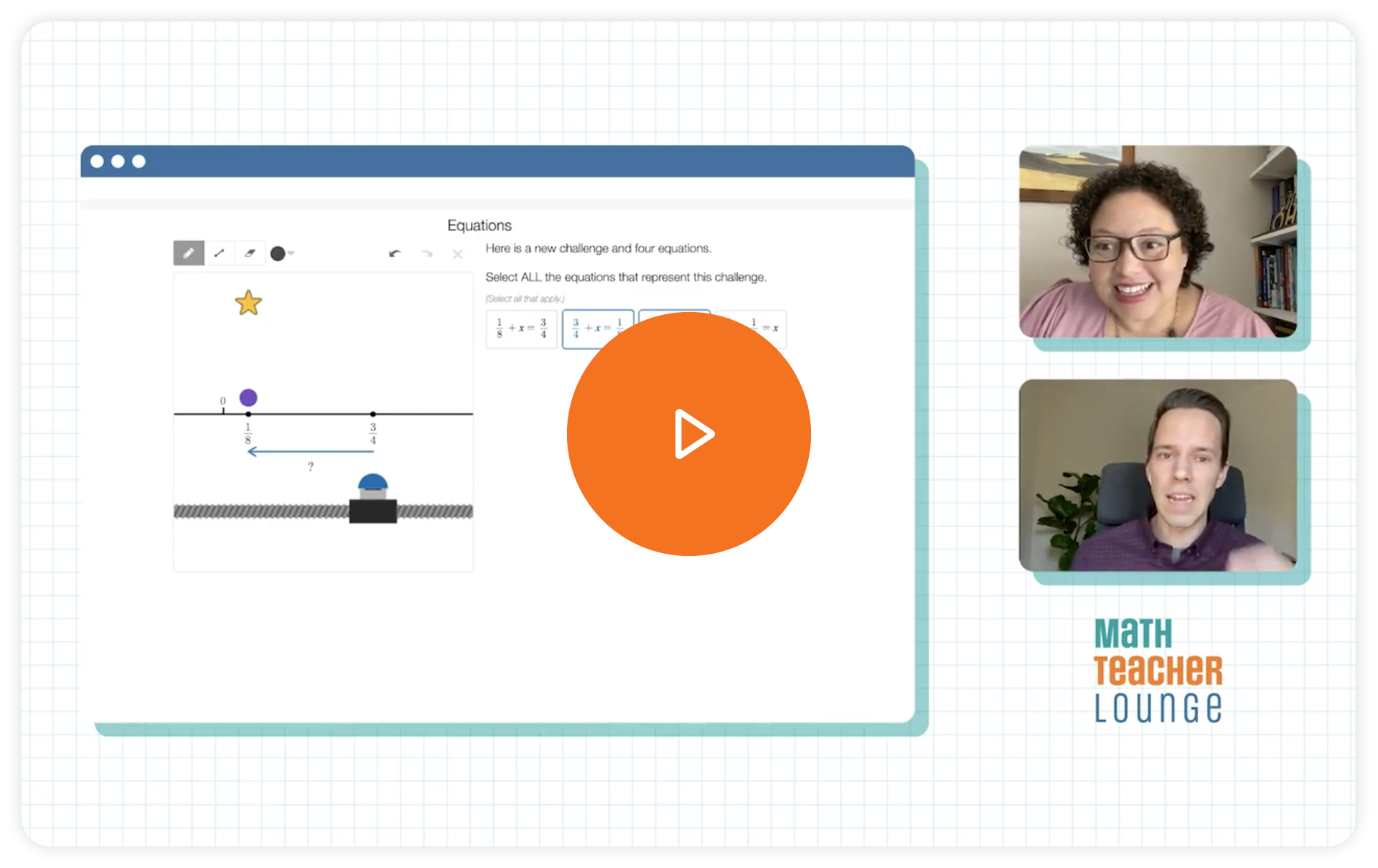
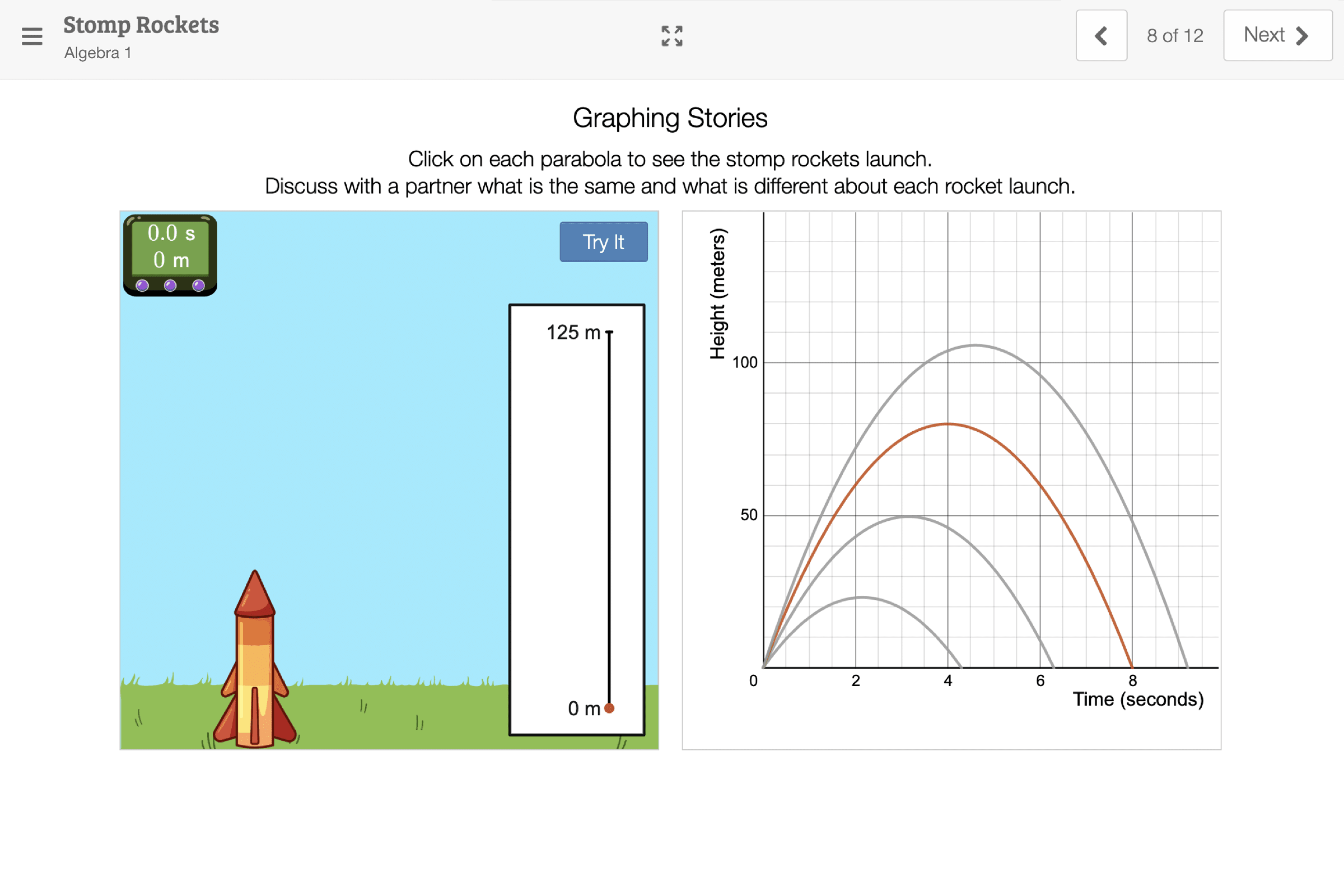
Creating lasting change in K–5 math and literacy instruction

Transforming math and literacy education takes more than just tips and tricks—it requires vision, commitment, and the right support. Whether you’re rethinking early literacy skills instruction, refining math core curriculum, or fostering a culture of collaboration, you need strong leadership and proven strategies for real change to occur.
“Sustained, meaningful change doesn’t happen overnight,” said Kymyona Burk, Ed.D., a senior policy fellow at ExcelinEd and the keynote speaker at our recent Leading With Vision symposium. “It requires commitment, collaboration, and a clear vision for supporting both educators and students.”
At the symposium—which included keynotes, panels, and math and literacy tracks—education experts from across the country shared experiences navigating instructional shifts, leading curriculum implementation, and setting schools up for success. From building buy-in to making data-driven decisions, their actionable insights can empower you with the knowledge and tools to create lasting change in your district.
Read on for a recap of the core presentations. You can also watch or listen along—and, for extra credit, download the workbook to deepen your learning.
Opening keynote: Key Factors for Successful Transformation in Literacy and Math
Kymyona Burk, Ed.D.
Senior Policy Fellow, ExcelinEd
In her session, Kymona Burk made the case that real student learning progress in literacy and math doesn’t come from policy alone—it requires systemic, research-based change in classrooms. Too often, schools focus on interventions for struggling students instead of strengthening core instruction to prevent gaps in the first place. She pointed to Mississippi’s success in narrowing achievement gaps as proof that evidence-based teaching, teacher support, and family engagement drive meaningful, lasting improvement.
A key factor in that success, she argued, was a firm commitment to the Science of Reading. “We have decades of research on how children learn to read, and we can’t afford to ignore it,” she said.
Burk also stressed math’s similarities to literacy when it comes to effective teaching methods. Just as students need structured, research-backed reading instruction, they also need math teaching and instructional materials that build deep understanding rather than rely on rote memorization. Achieving this, she said, requires strong materials, better teacher training, and a commitment to using data to refine strategies. The path to better outcomes isn’t a mystery—what’s needed is leadership and persistence.
Key takeaways:
- Tier 1 instruction is the foundation. Schools must prioritize high-quality core instruction to prevent learning gaps.
- Literacy and math both need urgent attention. Math reform has lagged behind literacy efforts, but both require evidence-based teaching and structured support.
- Teachers need more than just training. Professional development must be paired with coaching, collaboration, and access to the right materials.
- Sustained effort leads to results. Mississippi’s success proves that achievement gaps can be closed with consistent investment in people, resources, and accountability.
Leadership Lessons Learned in Baltimore City Schools That Impact Change Everywhere
Janise Lane
VP of Customer Transformation, Amplify; former Executive Director of Teaching and Learning, Baltimore City Schools
Janise Lane’s talk centered on Baltimore City Schools’ multi-year effort to implement a more effective literacy curriculum, highlighting the importance of managing both the logistical and emotional aspects of change. While the district had strong, committed educators, student performance remained stagnant, prompting a curriculum audit and a shift toward evidence-based instruction.
Lane described how to build buy-in and sustainability by ensuring that change is not dictated solely by district leadership. “We had to shift from a system where decisions were made at the top, to one where teachers, families, and community members were true decision-makers,” Lane said.
She also emphasized the need to recognize and address resistance. “Everybody approaches change differently, and it’s our job as leaders to attend to all of those emotions,” Lane said. The key to success, she noted, is creating structured pathways for implementation while remaining adaptable and open to feedback and real classroom experiences.
Key takeaways:
- Balance structure with flexibility. A clear plan is necessary, but it must adapt based on feedback, data, and the realities of implementation.
- Small wins build momentum. Celebrating early progress helps shift mindsets from skepticism to belief in the change.
- Trust and transparency matter. Educators need to see that leadership is engaged, responsive, and committed to making change work for everyone.
Making Math People: Key Shifts in How We Think of Math Assessment
Patrick Callahan, Ph.D.
Educator; Founder, Math ANEX
During his talk, Patrick Callahan emphasized the ways that asset-based assessments measure not just what students don’t know, but the depths of their mathematical thinking. Instead of relying on traditional multiple-choice tests, his approach encourages open-ended responses, allowing teachers to analyze how students arrive at their answers.
Callahan noted that by looking beyond correctness to understand reasoning, teachers can better target instruction. “If all I see is that 37% of my students got an area problem right, I might think I need to reteach area,” Callahan explained. “But if I analyze responses, I see that some kids are correctly multiplying but misunderstanding overlapping rectangles, while others are actually calculating perimeter instead. That tells me exactly where to focus my instruction.”
His research also shows a correlation between students who demonstrated conceptual understanding (such as interpreting remainders in division problems) and higher performance on standardized tests—evidence that fostering deep thinking supports both engagement and achievement.
Key takeaways:
- Assessments should focus on thinking, not just accuracy. Open-ended questions provide deeper learning opportunities.
- Targeted teaching saves time. Knowing why students struggle prevents unnecessary reteaching.
- Classroom discussions boost comprehension. Encouraging students to explain their thinking deepens understanding.
Creating a Supportive Environment for Educators During Times of Instructional Change
Ricky Robertson
Educator; author; consultant
“The number one influence on team effectiveness is psychological safety,” Ricky Robertson said during his symposium session. “Not how talented the individuals are, but how they interact with one another.” His talk focused on how the knowledge that one can speak up without fear of punishment or humiliation affects school culture, educator well-being, and student success, citing research such as Google’s Project Aristotle that demonstrates how high-performing teams thrive not on individual expertise but the quality of interactions among team members.
He also noted that toxic workplace dynamics—such as fear-based leadership, cliques, and bullying—contribute to burnout, disengagement, and resistance to change. Stressing that “strategies don’t transform schools, systems do,” he shared case studies of schools that changed their culture by fostering open communication, restructuring leadership teams, and implementing clear decision-making processes. Creating a safe environment isn’t just about being nice, Robertson said. Robertson noted that creating a safe environment isn’t just about being nice, but about building systems that allow educators to collaborate, support one another, and better serve their students.
Key takeaways:
- Psychological safety boosts performance. Schools that report a high sense of psychological safety see increased collaboration, innovation, and teacher retention.
- Structured collaboration matters. Schools with clear communication protocols and leadership structures create more productive teams.
- Change starts with educators. Supporting teachers’ well-being and professional growth is the foundation for student success.
More to explore
Meet the 2025 Science of Reading Star Awards finalists

Celebrating the 2025 Science of Reading Star Awards finalists
Every day, teachers and education leaders across the country are guiding students toward a future lit up by literacy.
It’s not always easy—especially when they’re the ones championing and implementing shifts toward literacy programs grounded in the Science of Reading.
That’s why we’re thrilled to celebrate the finalists of the 2025 Science of Reading Star Awards!
These awards recognize the educators who go above and beyond to make evidence-based reading instruction a reality for students learning in their schools and districts. Whether they’re rolling out new district-wide literacy programs, coaching fellow educators, or introducing innovative teaching practices, these education leaders are making a real difference for students.
And just like the light from distant stars, the impact of their efforts reaches far and wide, shaping futures for years to come.
Empowering students through literacy
The Science of Reading Star Awards aim a beacon on the champions of literacy—teachers, administrators, and education leaders who are putting the best literacy research into action.
Studies show that systematic phonics instruction—one of the key components of the Science of Reading—leads to significantly higher reading achievement than alternative methods, particularly for struggling readers. Literacy instruction grounded in the Science of Reading strengthens critical thinking by systematically building the language comprehension skills—like vocabulary, syntax, and background knowledge—that students need to make meaning, draw inferences, and evaluate ideas in complex texts. And when you teach knowledge in tandem with literacy, you inspire students to become confident readers, writers, and thinkers.
But shifting to instruction aligned to the Science of Reading isn’t just about swapping one program for another or bringing innovative teaching methods into one classroom—it’s about leading change, engaging stakeholders, and being an inspiration to others.
These awards celebrate the educators, schools, and districts whose innovative approach to literacy is doing just that. Here’s a look at this year’s categories and finalists:
- District: The District Captain For the leaders bringing Science of Reading practices to life across entire districts
- Puyallup School District, WA
- Celina City Schools, OH
- Waukegan CUSD #60, IL
- Madison County School District, MS
- School: The Literacy Legend For the school that has seen significant reading gains among their students school-wide when using the Science of Reading
- Angie Grant Elementary School, Benton School District, AR
- Bataan Memorial Primary School, Port Clinton City School District, OH
- Bruin Point Elementary School, Carbon School District, UT
- Individual: The Changemaker For showcasing exemplary Science of Reading routines and practices, and serving as an inspiration to others on the journey
- Stephanie Wilcox, District Elementary School Improvement Specialist, Redmond School District, OR
- Emily Tessalone Garcia, Grade 8 Teacher, Passaic City Public School District, NJ
- Reena Mathew, Literacy Coach, Suffern Central School District, NY
- Individual: The Language Luminary For outstanding success in developing the skills and strengths of multilingual/English learners
- Johanna Quinde, Teacher, The Nancy DeBenedittis School, NY
- Dayana Orozco Rojas, Kindergarten Dual Language Teacher, Kannapolis City School District, NC
- Eimy Maria Galindo Medina, Grade 2 DLI Teacher, Denver Public Schools, CO
- Individual: The Background Knowledge Builder For showing the world that the Science of Reading empowers students with knowledge, context, and vocabulary from elementary through middle school
- Ann Ingham, Grade 3 Teacher, Cedarburg School District, WI
- Katie Chappell. Grade 5 Teacher, Rome City School District, GA
- Demi Grosely, Teacher, Clarkston School District, WA
- Individual: The MTSS Maestro For implementing a data-driven Multi-Tiered System of Supports (MTSS) framework that creates a thriving and robust literacy ecosystem
- Samantha Umali, Special Education Teacher and Elementary K–4 General Education Teacher, Bering Strait School District, AK
- Kylie Altier, Grade 1 Teacher, East Baton Rouge Parish School System, LA
- Erin Custadio, Elementary Literacy Manager, Falmouth Public School District, MA
- Victoria Green, Reading Specialist, Roswell Independent School District, NM
- Individual: The Science of Reading Rookie For a teacher in their first year already making strides with the Science of Reading
- Miracle Austin, Kindergarten Teacher, Guilford Preparatory Academy, NC
- Pei-Ching Peng, Instructional Apprentice, Uplift Elevate Preparatory, TX
- Todd Payne, Elementary Teacher, Renaissance School, WI
- Individual: The Cross-Disciplinarian For skilled weaving of literacy practices across subject areas in the classroom
- Katie Kirkpatrick, Teacher, Graham Dustin Public Schools, OK
- Laura Horvath, K–12 Science & Social Studies Curriculum Coordinator, Harrison School District 2, CO
- Christina Miller, Lower Elementary Teacher, South Bend Community School Corporation, IN
- Individual: The Writing Whiz For integrating writing instruction with the Science of Reading and cultivating articulate and confident writers through innovative and effective practices
- Michelle Luebbering, Grade 5 Teacher, Jefferson City School District, MO
- Jennifer Dove, Grade 3 Teacher, Rockingham County Public School District, VA
- Daphne Long, Teacher, St. Clair County School District, AL
From districts undergoing transformations to educators supporting professional development on the ground, these finalists are proving that with the right approach—and the right support—every child can become a strong reader.
Congratulations, finalists! We know the long hours, extra effort, and deep belief in your students that fuels your work. You’re making the future brighter, one reader at a time!
Learn more on our Science of Reading Star Awards page.
LITERACY CHAMPIONS
The Science of Reading Star Awards
Making the shift to the Science of Reading is no small feat. Every day, educators like you are successfully improving student outcomes in schools and communities, and we’re eager to celebrate your accomplishments with the Science of Reading Star Awards.
We’re no longer accepting submissions for this year’s Star Awards cycle. See you next year!

Get excited for the prizes!
Exceptional accomplishments deserve to be rewarded.
All award winners will receive:
- Honorary Amplify Ambassadorship.
- Amplification on our website and social media.
- A Science of Reading starter library.
- Enrollment in Science of Reading: The Learning Lab for each winner and a friend.
- Tons of swag!
The grand prize winners in the District and School categories will receive access to an exclusive library of professional development resources. The grand prize winner in the Individual category will be given full conference registration and associated travel costs to The Annual Conference of The Reading League.
Recognizing leaders in education
Learning to read is nothing short of a transformation—and at the heart of this transformation are literacy educators harnessing the Science of Reading to ignite lifelong learning.
Science of Reading Star Award winners shine bright, going above and beyond to light the path for students nationwide. Be part of the celebration—help us recognize these heroes!

An award category for everyone!

District:
The District Captain
This award honors a district that exemplifies strong Science of Reading practices across the board.

School:
The Literacy Legend
This award honors a school that has seen significant reading gains among their students school-wide when using the Science of Reading.

Individual:
The Background Knowledge Builder
This award is for showing the world that the Science of Reading empowers students with knowledge, context, and vocabulary from elementary through middle school.

Individual:
The Changemaker
This award is for showcasing exemplary Science of Reading routines and practices, and serving as an inspiration to others on the journey.

Individual:
The Comprehension Champion
This award is for fostering deep understanding and critical thinking by expertly guiding students to make meaning from complex texts, ask thoughtful questions, and connect reading to their world and experiences.

Individual:
The Data Dynamo
This award is for expertly using data to drive instruction within an MTSS framework, identifying student needs with precision, and implementing targeted interventions that accelerate literacy growth for every learner.

Individual:
The Language Luminary
This award is for outstanding success in developing the skills and strengths of emergent bilingual students and multilingual/English learners.

Individual:
The Science of Reading Rookie
This award is for a teacher in their first three years of teaching, already making strides with the Science of Reading.

Individual:
The Writing Whiz
This award is for integrating writing instruction with the Science of Reading, cultivating articulate and confident writers through innovative and effective practices.

Submit a nomination to the Science of Reading Star Awards!
Entry is quick and simple—just provide the required information and an overview of the nominee you think deserves recognition.
- You may submit multiple entries, but please nominate for only one category at a time.
- Your submission can include an overview of the educator, school, or district’s journey with the Science of Reading; how they overcame challenges; how they are empowering their students with the Science of Reading; how they implemented strong Science of Reading practices; and/or what results they are seeing.
- The more specific you can be in your submission, the better! If data is a big part of your story, we’d love to hear about it.
- As part of your entry, you agree to allow us to contact you about the details of your application.
- A member of the team will be in contact by March 2026 if you are short-listed as a finalist.
Unleash the potential of knowledge building in language comprehension
Every child is capable of becoming a skilled reader. Every classroom can provide that opportunity and drive student success, through a content-rich literacy curriculum.
We’ll show you how.
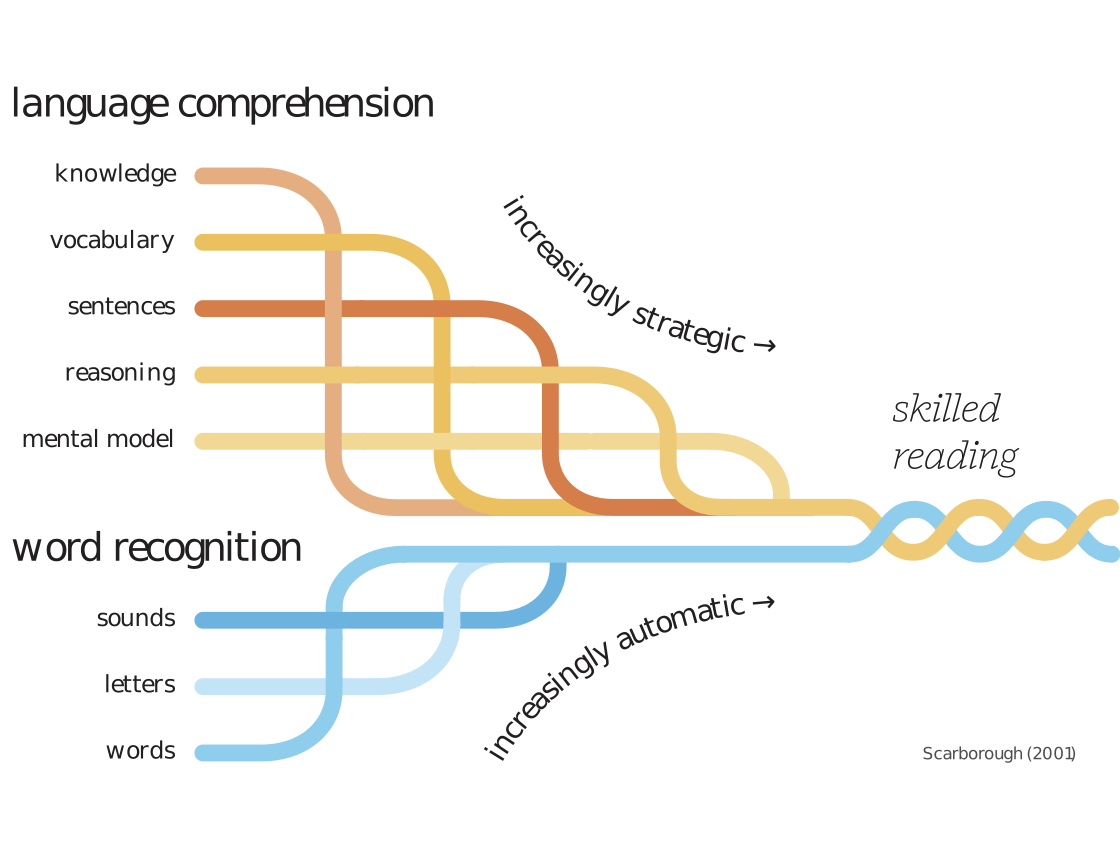
The relationship among knowledge, language comprehension, and literacy skills
The Science of Reading shows that early literacy skills are best built deliberately, on a foundation of knowledge. Knowledge building is not a result of reading and language comprehension; it’s a vital prerequisite and a fundamental part of the process. When students read a text on a familiar topic–event a tough one–they’re more likely to comprehend it. In other words: The more you know, the more, and faster, you learn.
Why is building knowledge so important?
Background knowledge—coupled with comprehension strategies—fuels students’ capacity to understand texts, answer questions, and grapple with ideas.
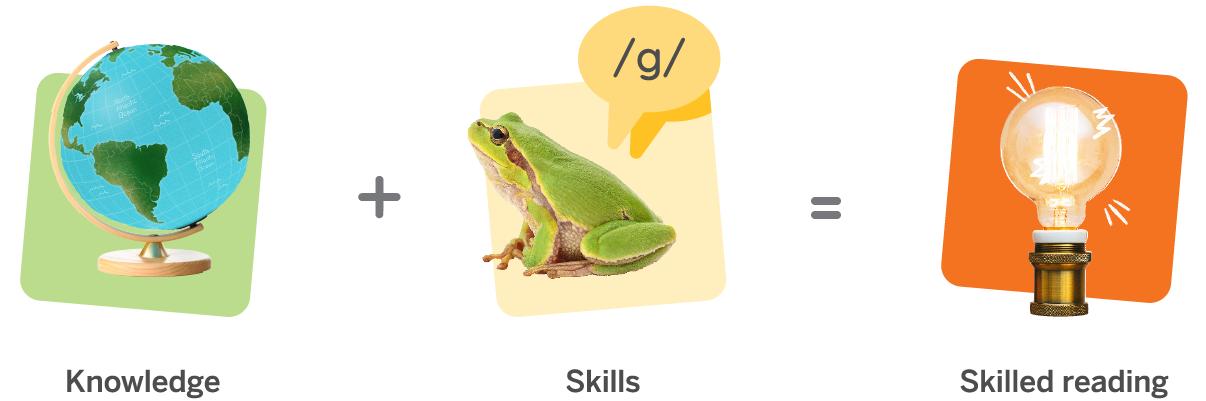
Students bring different bodies of knowledge into school. Some are whizzes at baseball or mechanics; some visit museums, have tons of books at home, and know the word “yacht.” That means their comprehension of a given topic or text will correlate with what they already know. But what happens when they learn the same content together? A recent independent study showed that a knowledge-building literacy curriculum in elementary school raised test scores and helped eliminate income-based opportunity gaps.
It is our responsibility as educators to bring the world into the classroom for all students and help them grow their literacy skills.
Literacy instruction has typically focused on decontextualized skills—finding the main idea, making inferences—before, or instead of, the content of texts and resources that students engage with. Many teachers may have been trained to “put the skills and strategies in the foreground, like a skill of the week, then bring in texts that they find suited for demonstrating the skill or strategy,” says Natalie Wexler, author of The Knowledge Gap. But science shows that harnessing skills and strategies to content is actually more effective. That is, using a coherent and systematic progression of content that helps knowledge and skills build on each other has been shown to result in better student outcomes.
“The advantage of a coherent curriculum is that the topics it covers can build on one another, with one unit providing a foundation of knowledge for others that come later, both throughout a single school year and across grade levels,” according to Barbara Davidson and David Liben. Along the way, students also cultivate curiosity and confidence, accelerating the entire process. So the more you know, the faster you learn—and that lasts a lifetime.

Getting started with knowledge based learning
Effective literacy instruction must celebrate the experiences students have but not assume each student has specific pieces of prior knowledge. Rather, it must build knowledge in the classroom. Students (and teachers) need curricula that expose them to a diverse array of new topics—spanning history, science, literature, culture, and the arts—in an intentional sequence that builds a rich and common knowledge base from which all students can draw.
Want to get started now? We’ve got an ebook to help you out.
Professional development to support your shift to the Science of Reading
Ignite literacy transformation with Amplify’s Science of Reading: The Learning Lab—an inspiring three-course series.
- Course 1: Foundations to the Science of Reading
- Course 2: Advanced Topics in the Science of Reading: Assessment and Reading Difficulties
- Course 3: Applied Structured Literacy
Crafted to the standards of the International Dyslexia Association, this self-paced online series provides unparalleled, research-backed instruction. Explore enriching activities, curated resources, and learn from Susan Lambert, chief academic officer and host of Science of Reading: The Podcast.
The best investment you can make is in knowledge, and the returns are priceless.
Learn more about the online courses or request a quote!
Tap into individual online course seats.
Before and after knowledge building: What knowledge looks like in the classroom

Making connections to what students already know
Before: Teachers “activate” students’ prior knowledge before reading.
After: Teachers build students’ knowledge explicitly for students to leverage later as background knowledge.

Developing reading comprehension
Before: Teachers focus instruction on comprehension strategies (e.g., “strategy of the day” instruction).
After: Teachers focus on content and use comprehension strategies to help students gain knowledge of that content.

Introduction of new topics and information
Before: Students learn about content-area topics individually in disconnected units of instruction.
After: Students learn topics through a coherent approach that builds knowledge within and across units of instruction.
See the remarkable difference shifting to a knowledge-building approach can make in your school. Our enlightening flyer guides you through a before-and-after journey, illustrating the profound impact of knowledge building on learning. Check it out!
What to look for in a knowledge-building literacy curriculum:

It develops content knowledge.
The program should immerse students in a given domain for weeks—that’s how they acquire academic knowledge. The content should also develop from grade to grade, so that students learning about Renaissance art can reflect on and compare to what they previously learned about art in the Middle Ages.

It leverages read-alouds for exposure to complex language.
In early grades, students’ listening comprehension outpaces their reading comprehension. Interactive read-alouds can be used to expose students to academic language and rich vocabulary. With background knowledge, vocabulary words are “the main support beams in the comprehension house.” This approach also helps teachers introduce students to new information and experiences—in a supportive and interactive environment.

It introduces students to a wide variety of topics and content.
A content-rich curriculum exposes students to broad knowledge over time in a systematic, cumulative way, which is more effective than spending several months on just one topic. And while that’s happening, students are participating in enriching discussions and writing activities so they can further interact with the content, promoting deeper engagement and supporting retention of both the knowledge and associated vocabulary.

It builds both knowledge and foundational skills.
Knowledge building is just one component of literacy development. A content-rich curriculum that helps students build both knowledge (language comprehension) and skills (word recognition) takes into account both sides of the Reading Rope, giving students everything they need to build the foundation for a lifetime of literacy success. Instead of learning to read so they can read to learn, students who use a content-rich curriculum learn to read and learn about the world at the same time, enabling them to understand what they’re reading.
Thank you for requesting our Science of Reading Resources!
You may now download them using the links below.
- Change Management Playbook
- Science of Reading: A Primer, Part One
- Science of Reading: A Primer, Part Two
- Reading Rope placemat
- Science of Reading: Making the Shift ebook
- Five shifts for true Science of Reading instruction
- Science of Reading principles
- MTSS principles
- The Importance of Dual Language Assessment infographic

¡Prepárese para el nuevo año escolar con su estudiante!
Nos complace darle la bienvenida a usted y a su estudiante a Amplify este nuevo año escolar y brindarles oportunidades de aprendizaje excepcionales a través de nuestros programas. Hemos reunido los siguientes recursos y guías para que usted pueda consultarlos y garantizar que su estudiante tenga la experiencia más productiva con nuestra plataforma y plan de estudios durante todo el año. ¡Seleccione su programa Amplify a continuación para comenzar!
For the English version, please click here.
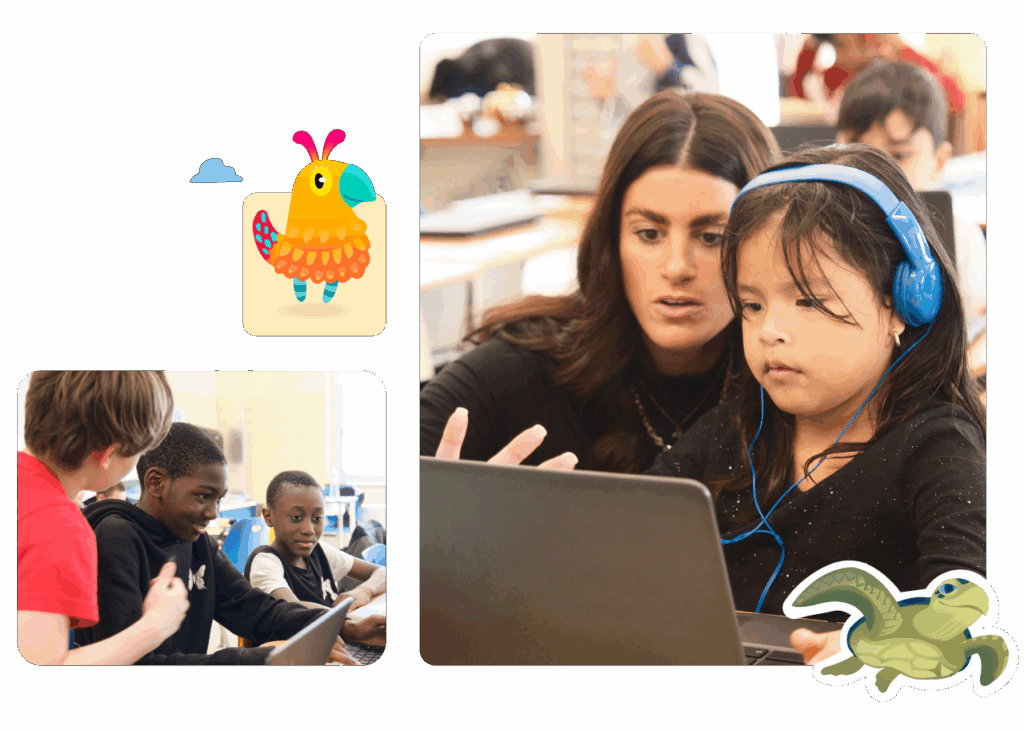
Seleccione un programa a continuación:






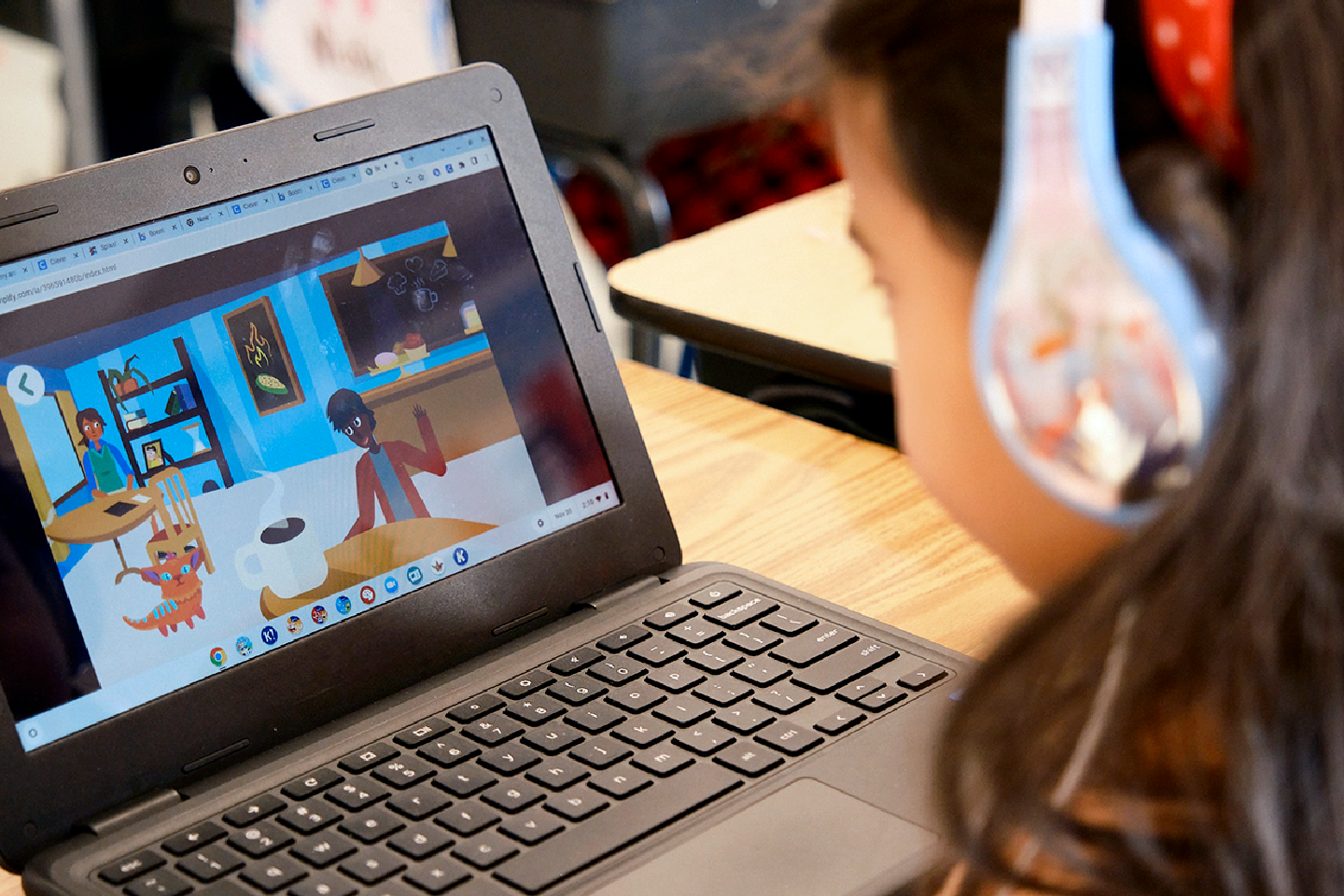
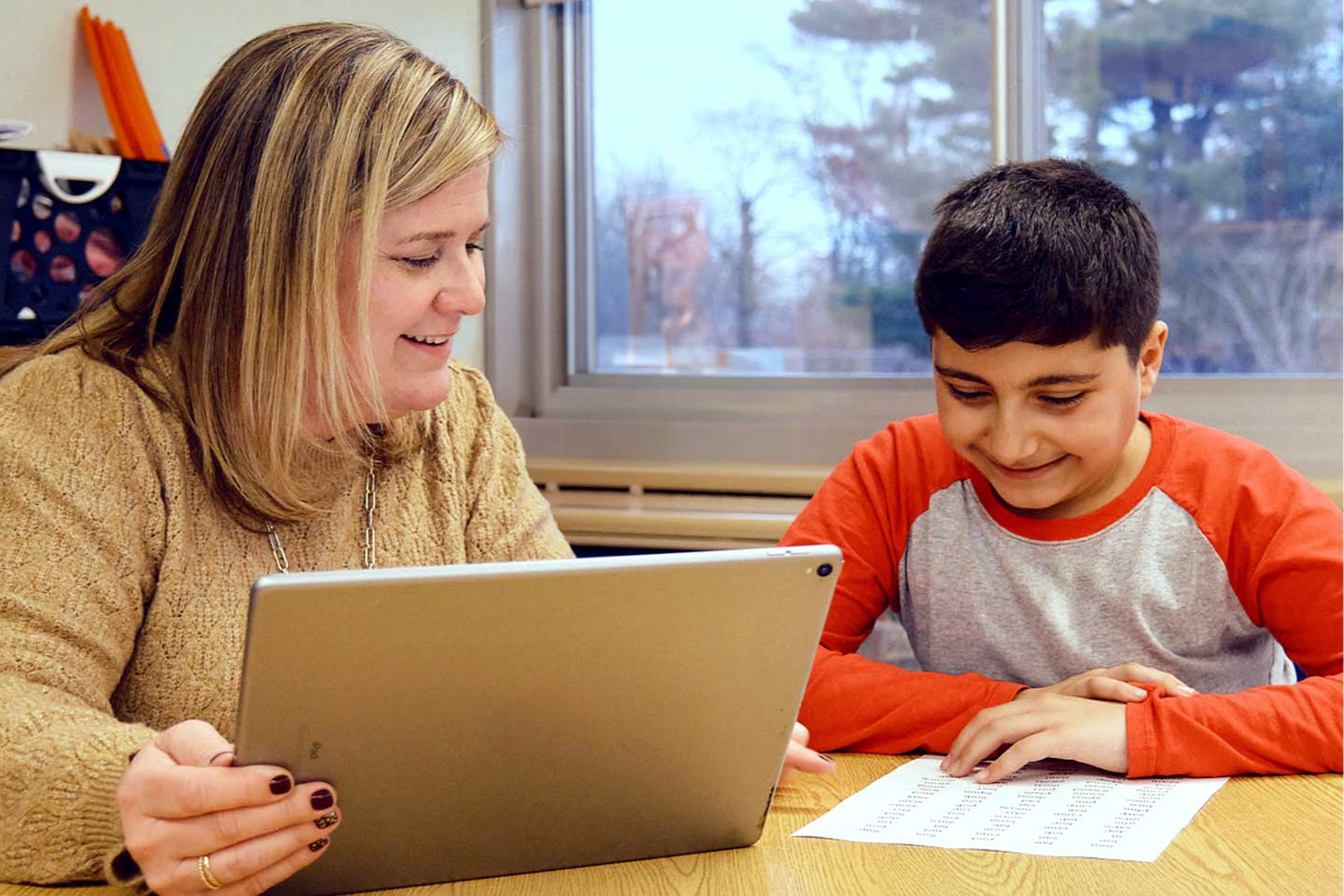



Amplify Desmos Math New York
Amplify Desmos Math New York supports teachers in building students’ lifelong math proficiency. The program:
- Supports social classrooms, invites mathematical creativity, and evokes wonder, creating a welcoming learning space where students are empowered to see themselves and their classmates as having brilliant mathematical ideas.
- Provides math teachers with clear step-by-step moves to build systematically from students’ prior knowledge to grade-level learning.
- Connects students to each other’s thinking and to an understanding that they can use math to make sense of the world.
- Enables access to grade-level understanding for every student, every day.
Math that motivates
Picture a classroom where students are so engaged in a math lesson that they protest when the teacher pauses their work on a problem. A classroom is buzzing with the sounds of natural curiosity. This is what we regularly see with Amplify Desmos Math. This is math that motivates.

Review program samplers (Grades K–5)
Experience the beautiful, easy-to-use print components that add to the power of Desmos Classroom technology and instruction by downloading the print samplers below. The samplers include print pages from Amplify Desmos Math New York lessons.
Grade 1
- Teacher Edition sampler
- Student Edition sampler
- Ancillary sampler
- Assessment Resources, Unit 3
- Centers, Unit 3
- Mini-Lessons, Unit 3
Grade 3
- Teacher Edition sampler
- Student Edition sampler
- Ancillary sampler
- Assessment Resources, Unit 2
- Centers, Unit 2
- Mini-Lessons, Unit 2
Grade 5
Review program samplers (Grades 6–8)
Experience the beautiful, easy-to-use print components that add to the power of Desmos Classroom technology and instruction by downloading the print samplers below. The samplers include print pages from Amplify Desmos Math New York lessons.
Grades 6–8
Mini-Lesson sampler
Grade 6
Teacher Edition sampler
Student Edition sampler
Assessment Guide sampler
Grade 7
Teacher Edition sampler
Student Edition sampler
Assessment Guide sampler
Grade 8
Teacher Edition sampler
Student Edition sampler
Assessment Guide sampler

Experience Amplify Desmos Math New York
Explore our digital program to review content from grades K–8. Watch our quick walkthrough videos for helpful navigation tips: Grades K–5 and Grades 6–8.
To log in, click the orange “Review now” button below, select “Log in with Amplify” and use the following login credentials:
Username: t1.ny-state-adm@demo.tryamplify.net
Password: Amplify1-ny-state-adm

Standards
Once you’ve logged in to your reviewer account, download the documents correlating Amplify Desmos Math New York to the New York State Next Generation Math Learning Standards.
Personalized learning
Amplify Desmos Math includes digital, adaptive practice that provides the personalized support a student needs to access grade-level math every day. Boost Personalized Learning activities target a skill or concept aligned to the day’s core lesson, with each student receiving personalized scaffolds based on what they already know. This technology complements daily learning and provides another layer of support to the in-lesson differentiation and instructional guidance provided to teachers. Try out free Boost Personalized Learning activities.
The Fluency Practice of Amplify Desmos Math uses an evidence-based approach to memory retention—spaced repetition—for the basic operations. Students around the world have answered more than 120 million multiplication questions within our application. Try it now!

Help
Support is always within reach. Our team is dedicated to supporting you throughout your review and can be reached by email or phone 7 a.m. to 7 p.m. ET.
- Live chat: Once logged into the program, click the orange icon to get immediate help.
- Phone: Call our toll-free number: (888) 960-0380.
- Email: Send an email to help@amplify.com. In the message body, please include your name and question. Provide as much detail as possible, so we can more quickly help you find a solution.
Amplify Desmos Math New York
Amplify Desmos Math New York supports teachers in building students’ lifelong math proficiency. The program:
- Supports social classrooms, invites mathematical creativity, and evokes wonder, creating a welcoming learning space where students are empowered to see themselves and their classmates as having brilliant mathematical ideas.
- Provides teachers with clear step-by-step moves to build systematically from students’ prior knowledge to grade-level learning.
- Connects students to each other’s thinking and to an understanding that they can use math to make sense of the world.
- Enables access to grade-level understanding for every student, every day.
Math that motivates
Picture a classroom where are so engaged in a math lesson that they protest when the teacher pauses their work on a problem. A classroom is buzzing with the sounds of natural curiosity. This is what we regularly see with Amplify Desmos Math. This is math that motivates.
Experience Amplify Desmos Math New York
Explore our digital program to review content from all grades, K–5. Watch our quick walkthrough video for helpful navigation tips. To log in, click the orange “Review now” button below, select “Log in with Amplify” and use the following login credentials:
Username: t.nycadmsample-01@tryamplify.net
Password: AmplifyNumber1
[New!] Review access now includes one additional complete unit for Grades 1, 3, and 5.
To log in as a student, use the following credentials (you must first log out if you have already logged in as a teacher):
Username: s.nycadmsample-01@tryamplify.net
Password: AmplifyNumber1

About the program
To learn more about Amplify Desmos Math New York, including pedagogical philosophy, origins, implementation examples, and independent, nationally-recognized reviews, download the following documents:
- Curriculum overview and background
- Translation options
- Professional learning plan
- Examples of implementation
- Implementation considerations
- Schools list
- Curriculum reviews
- [New!] Instructional Routines and Math Language Routines Facilitation Guide
- [New!] Amplify Desmos Math New York Caregiver Hub (also available in Spanish)
Standards
Once you’ve logged in to your reviewer account, download our program scope and sequence and a document correlating Amplify Desmos Math New York to the New York State Next Generation Math Learning Standards.
Grades K–5 standards correlation
The program is well aligned with the expectations outlined in the New York City Department of Education Definition of Culturally Responsive-Sustaining Education and the New York State Culturally Responsive-Sustaining Education Framework. Download the CR-SE alignment.
The program is also well aligned with the research-informed math practices outlined in the New York City Public Schools Shifts in Mathematics. Download the program’s alignment to the Shifts in Mathematics.

Personalized Learning
Amplify Desmos Math includes digital, adaptive practice that provides the personalized support a student needs to access grade-level math every day. Personalized Learning activities target a skill or concept aligned to the day’s core lesson, with each student receiving personalized scaffolds based on what they already know. This technology complements daily learning and provides another layer of support to the in-lesson differentiation and instructional guidance provided to teachers. Try out a sample Boost Personalized Learning activity.
The Fluency Practice of Amplify Desmos Math uses an evidence-based approach to memory retention—spaced repetition—for the basic operations. Students around the world have answered more than 120 million multiplication questions within our application. Try it now!
Help
Support is always within reach. Our team is dedicated to supporting you throughout your review and can be reached at any time by emailing or calling us directly.
- Live chat: Click the orange icon while logged in to get immediate help.
- Phone: Call our toll-free number: (888)-960-0380.
- Email: Send an email to help@amplify.com. In the message body, please include your name and question. Provide as much detail as possible, so we can more quickly help you find a solution.
Be a changemaker for science.
Profound science learning experiences have the power to transcend classroom walls—cultivating students’ curiosity, fostering critical thinking and creativity, building knowledge about the real world, and supporting students on their pathway to college and beyond. Unfortunately, science continues to fight for sufficient instructional time and resources.
The good news? Intentional shifts, combined with evidence-based practices and effective high-quality instructional materials, can help teachers make the most of the time they do have—transforming students into concerned global citizens ready to take on the world.


Science instruction designed for all students
K–8 science instruction is the crucial foundation that prepares students for high school learning. Our change management playbook details manageable and realistic changes to your process and practice that will make your K–8 instruction even more powerful.
Establishing high-quality teaching and learning
Access to high-quality instructional materials (HQIM) is a vital piece of the change management puzzle. Support the leaders who are on a mission to identify HQIM and set up the best possible conditions for implementation success.


Connecting science and literacy
Want to make every instructional moment count? Integrate science and literacy more deeply—and witness the transformation in student learning. Find out how with this resource pack.
The foundation for long-lasting and sustainable change
Change is more likely to stick and get results when you take a systemic approach. Partner with us to do just that by developing a learning plan that will drive your program implementation, enrich your instructional practices, and increase student impact. Amplify’s high-quality programs make it easier for you to teach inspiring, impactful lessons that celebrate and develop the brilliance of your students.


Science free resource library
Find free K–8 activities, posters, and guides to engage all students in science.

2024 Science Symposium
Access best practices and tips from science leaders through our on-demand Science Symposium.

Science Connections archives
Hear more strategies from educator Eric Cross and other experts in this podcast.
Amplify Desmos Math Texas K-5 is IMRA-approved!
We’re excited that Amplify Desmos Math Texas K–5 was not only approved, but also passed TEA’s IMRA review with perfect scores!
- 100% aligned with the TEKS
- 100% aligned with the ELPS
- 100% on the Quality Rubric, with 163/163 points
- 107 Green Flags: more than any other K–5 publisher!
- 0 Red Flags
And more exciting news…the parallel Spanish student experience will be available for implementation for the
2026–27 school year as well!
Click below to explore digital samples and request print samples and/or a presentation today!
And that’s not all! Click below to learn more about the products that round out our comprehensive math suite for Texas: mCLASS Math Texas, our robust math screener, and Boost Math Texas, our tiered intervention and practice program aligned to core instruction.
Immerse your Arkansas middle school students in close reading.
Middle school students are learning to immerse themselves in text—and learning to articulate what resonates and matters to them in what they read. Boost Close Reading is an immersive supplemental reading program that engages students through an interactive graphic novel. With high-interest storytelling and guided instruction, the program motivates middle schoolers to question what they read, think critically, and build the close reading skills that will ensure success in high school and beyond.


In this future, reading is adventure.
Each student’s journey through this action-packed world depends on their ability to read literary and informational texts critically. Boost Close Reading develops a deep understanding of essential middle school skills—such as identifying the parts of a valid argument—that will prepare them for success in high school and in the broader world.
And every student can be the hero.
Every chapter provides integrated instruction, guided close reading, and a creative application. You set the difficulty level for each student. Assign English Learners and struggling readers to the Extra Support path. When they’re ready, switch them back to the Core Path.

Science of Reading resources hub
The Science of Reading is complex, so your understanding of it should be, too. That’s why our resource pages break it all down for you, from word recognition and comprehension to dyslexia and Multi-Tiered Systems of Supports. Equip yourself with the knowledge you need to make the greatest difference to your students!

Select a resource:

Amplify’s Science of Reading overview
Learn the ins and outs of the Science of Reading—what it means, and why its principles matter.


Science of Reading: The Podcast
Listen to the latest insights from researchers and practitioners in early reading.

Science of Reading programs
Achieve next-level literacy growth with a cohesive Science of Reading suite.

Science of Reading success stories
We’ve helped thousands of Science of Reading champions make the shift, and they’re eager to share the secrets of their long-term success with fellow educators like you.

Science of Reading webinars
Get on-demand professional development to build and refine your toolkit of Science of Reading resources and instructional practices.

Science of Reading Star Awards
Nominate a literacy changemaker for our prestigious Science of Reading Star Awards!

Science of Reading data and MTSS
Fortify your Science of Reading implementation using essential data and a Multi-Tiered System of Supports (MTSS).

Change management
Educational change doesn’t happen overnight, or by itself. We’ll walk you through the process to help you make literacy success a lasting reality in your classroom.

Knowledge building
Learn the ins and outs of the Science of Reading—what it means, and why its principles matter.

Dyslexia and the Science of Reading
Discover how assessment and instruction grounded in the Science of Reading helps identify children at risk of developing dyslexia at the earliest possible moments, creating the widest opportunity for intervention.

Science of Reading professional development course
Learn everything you need to know about Science of Reading instruction with Amplify’s Chief Academic Officer and host of Science of Reading: The Podcast Susan Lambert.

Supporting multilingual & English language learners
Multilingual/English learners (ML/ELs) bring unique strengths to classrooms, enriching the learning experiences for all.
At Amplify, we empower educators with tools that honor the strengths and capabilities of ML/ELs. Our curriculum and assessments meet students where they are and help them develop their skills, propelling them on their learning journeys.
Amplify supports ML/ELs across all subjects, from English language arts to math and science. For students who speak Spanish, we also provide a comprehensive biliteracy suite.
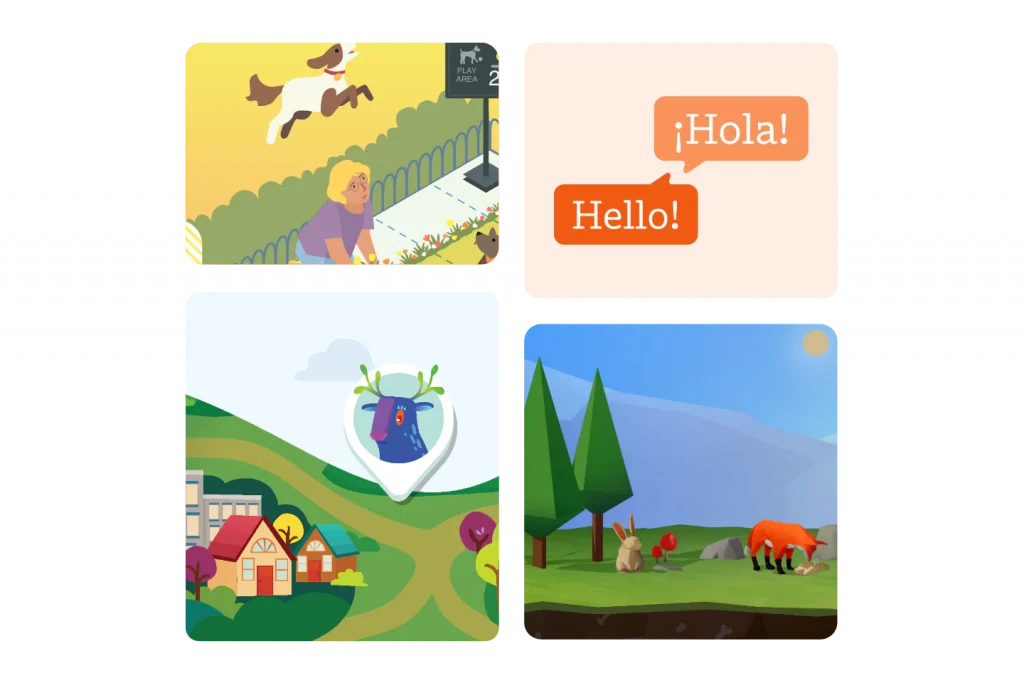

Amplify CKLA core literacy curriculum for grades K–5
Amplify Core Knowledge Language Arts (CKLA) is a K–5 core curriculum built on the science of how students learn to read and write. Amplify CKLA supports ML/ELs in a variety of ways.

Scaffolding at five levels of proficiency
In addition to core instruction, Amplify CKLA provides lesson supports for Entering/Emerging, Transitioning/ Expanding, and Bridging levels.

Lesson differentiation
Lessons include Support and Challenge suggestions that provide assistance or opportunities for more advanced work toward the goal of the lesson. These resources are suitable for all learners, including ML/ELs.

Phonological awareness and phonics supports
The digital Sound Library easily facilitates sound development through videos showing mouth movements and songs that help students practice articulating new sounds with catchy lyrics.

Frequent oral language development opportunities
Amplify CKLA boosts language development with complex read-alouds, interactive discussion, writing activities, and explicit teaching of academic and domain vocabulary.
Amplify CKLA pairs with Amplify Caminos, its companion K–5 Spanish literacy program that supports biliteracy instruction.
Language Studio, an English Language Development companion program for Amplify CKLA
Language Studio, Amplify CKLA’s dedicated K–5 English language development companion program, offers daily 30-minute lessons to help ML/ELs practice reading, writing, speaking, and listening skills. Aligned to the World-Class Instructional Design and Assessment (WIDA) framework, Language Studio previews and reinforces language and content from core instruction, so that ML/ELs of all proficiency levels are able to access grade-level content as they develop academic English.


Interactive language development
Language Studio provides opportunities for classroom discussions, oral presentations, and writing tasks, promoting comprehension and learning by connecting with students’ cultural and linguistic backgrounds.

Explicit vocabulary instruction
Interactive vocabulary and academic language support is provided before each lesson to deepen students’ understanding of text.

Multimodal comprehension support
Students can preview content, interact with physical materials, compare text types, receive explicit grammar instruction, and have access to extensive vocabulary exercises.

Skill proficiency monitoring
Language Studio facilitates evaluation with an understanding of what students should produce at each level.

mCLASS DIBELS 8th Edition literacy assessment for grades K–8
mCLASS® is an all-in-one system for Science of Reading-based universal screening, dyslexia screening, and progress monitoring for grades K–8. Powered by DIBELS 8th Edition, mCLASS provides valuable data on your ML/ELs’ literacy in English, helping you build a robust system of tiered supports. With a single tool, you can access the data and instructional support you need for each student’s literacy development, from phonics to comprehension, catering to all readers, from beginner to advanced.

Screening and reporting
mCLASS’s one-minute measures and dyslexia screening identify risk as early as possible, providing you with the right data to make informed decisions.

Language considerations
mCLASS provides specific language guidance, offers ML/EL instructional strategies, and considers each student’s unique language background, never penalizing for language variety, accent, or articulation, and extending this understanding into small-group practices.

Performance and reporting transparency
Understand student performance through direct observation and detailed reports which offer growth insights, including district-wide student achievement data that can be filtered by EL status, Home Language, or English Proficiency status.
mCLASS pairs with mCLASS Lectura, an authentic Spanish literacy assessment for K–8 that measures key foundational skills and supports Spanish-speaking bilingual students.
mCLASS Intervention for grades K–6
mCLASS Intervention is our K–6 reading intervention program, designed to support you in providing effective Tier 2 and 3 instruction and getting readers on track. mCLASS Intervention does the heavy lifting of data analysis and lesson planning for you. This lets you focus on what you do best: teaching the skills each student needs to become a confident reader.


Effective lessons with built-in support
Lessons are equipped with best practices and guidance targeting language and literacy development for ML/ELs. The program also includes materials and resources that make content accessible to Spanish-speaking students.

Structured small groups
Once groups are formed, mCLASS Intervention determines the ideal focus for each group and automatically prepares two weeks of targeted lessons.

Keeps you updated on student progress
Track student growth with reliable progress-monitoring tools and reporting that provides a clear view of each student’s progress.

Boost Reading personalized reading program for grades K–5
A key component of Amplify’s early literacy suite, Boost Reading is a personalized learning program for K–5 that offers comprehensive targeted practice, built-in benchmark assessments, and powerful reporting. Boost Reading provides practice in the full progression of key phonics and comprehension skills critical to literacy development.
Boost Reading works. Results of a year-long study show that students in grades K–5—including ML/ELs—who used Boost Reading for 30 minutes a week significantly outperformed their peers.

Systematic instruction in foundational skills and comprehension
Reinforce core instruction with explicit practice in phonics and phonological awareness. Boost Reading is the only program that focuses on comprehension processes—what readers do while reading that allows them to make sense of text—which is especially beneficial for ML/EL students.

Mouth formation modeling for articulation support
Boost Reading includes specific scaffolds and supports—such as a modeling of mouth formations for articulation—that are proven to be beneficial for ML/ELs.

Vocabulary practice
Targeted morphology practice for independent vocabulary building and explicit instruction with Tier 2 vocabulary words are proven to be supportive for ML/ELs.
Boost Reading pairs with Boost Lectura, a Spanish literacy program for K–2 that provides students with personalized practice to develop Spanish literacy skills.
Amplify ELA core literacy curriculum for grades 6–8
With Amplify ELA, students learn to tackle any complex text and make observations, grapple with interesting ideas, and find relevance for themselves. Amplify ELA is a grade 6–8 English language arts program designed to bridge language gaps and enhance learning for ML/ELs. With integrated supports in every lesson, Amplify ELA empowers educators to deliver grade-level content while maintaining rigorous standards, thus reducing barriers to language acquisition and boosting student success.


Built-in scaffolds
Background documents (in English and Spanish) establish context and support comprehension before students begin to read. Features such as audio assessments, read-aloud, and Reveal words ensure that all students have the opportunity to engage with and understand grade-level materials.

Differentiated writing prompts
Simplified language, sentence starters, word banks, and visual cues offer the necessary levels of support to help students meet their writing goals.

Multi-language glossaries
Available in 11 languages—English, Arabic, Chinese, French, Haitian Creole, Portuguese, Russian, Spanish, Tagalog, Urdu, and Vietnamese—these glossaries support vocabulary development and comprehension.
Amplify Desmos Math core curriculum for grades K–12
Amplify Desmos Math is a curiosity-driven K–12 program that builds students’ lifelong math proficiency. Every lesson in Amplify Desmos Math includes opportunities for all students to develop mathematical language as they experience the content, while providing intentional support for ML/ELs. We purposefully progress language development from lesson to lesson and across units by supporting students in making their arguments and explanations stronger, clearer, and more precise.

Multilingual/English learner support
Supports for ML/ELs are called out at intentional points within each lesson. These specific, targeted suggestions support ML/ELs with modifications that increase access to a task, or through development of contextual or mathematical language (both of which can be supportive of all learners). ML/EL supports may also be attached to Math Language Routines.

Math Language Routines (MLRs)
Math Language Routines are used within lessons to highlight student-developed language and ideas, cultivate conversation, support mathematical sense-making, and promote metacognition. Tips for facilitating MLRs are included when they would be helpful within lessons.

Language goals and vocabulary
Language goals attend to the mathematics students are learning, and are written through the lens of one (or more) of four language modalities: reading, writing, speaking, and listening. Units and lessons start by surfacing students’ language for new concepts, then building connections between their language and the new vocabulary for that unit. This honors the language assets that students bring into their learning.
Amplify Science core curriculum for grades
K–8
Amplify Science is a curiosity-driven science curriculum that empowers students to Do, Talk, Read, Write, and Visualize like scientists. Through phenomena-based, literacy-rich, and interactive learning experiences, it develops students into critical thinkers who will gain the skills they need to solve real problems in their communities and the world. For students who need additional support, Amplify Science provides specialized instructional approaches, activities, and resources that take into account English learners’ level of language proficiency.


Instructional design built on five key principles
Amplify Science leverages background knowledge, capitalizes on student knowledge of language, provides explicit instruction about the language of science, gives students opportunities with scaffolded practice, and enables students to access science content and express science knowledge through a multimodal approach.

Do, Talk, Read, Write, Visualize instructional model
Our multimodal instructional approach caters to diverse learning needs and promotes active engagement for all learners.

Honoring multilingualism
Amplify Science honors multilingualism as students are invited to share in their native language at strategic points in instruction. Teacher-led instruction on cognates and a multilingual glossary in 10 languages offer additional support.

Spanish instructional materials
Carefully translated materials use academic Spanish, with attention to consistency and grade-level appropriate language, to support language development.
A biliteracy suite grounded in the Science of Reading
Discover a suite of Spanish literacy curriculum and assessment programs designed to build confident readers with Amplify Caminos, mCLASS Lectura, and Boost Lectura. Amplify’s biliteracy suite includes assessment, core instruction, and personalized learning built on the Science of Reading.
Explore more programs in Amplify’s literacy and biliteracy suites.
All of the programs in our literacy suite and our biliteracy suite are designed to support and complement each other. Learn more about our related programs:

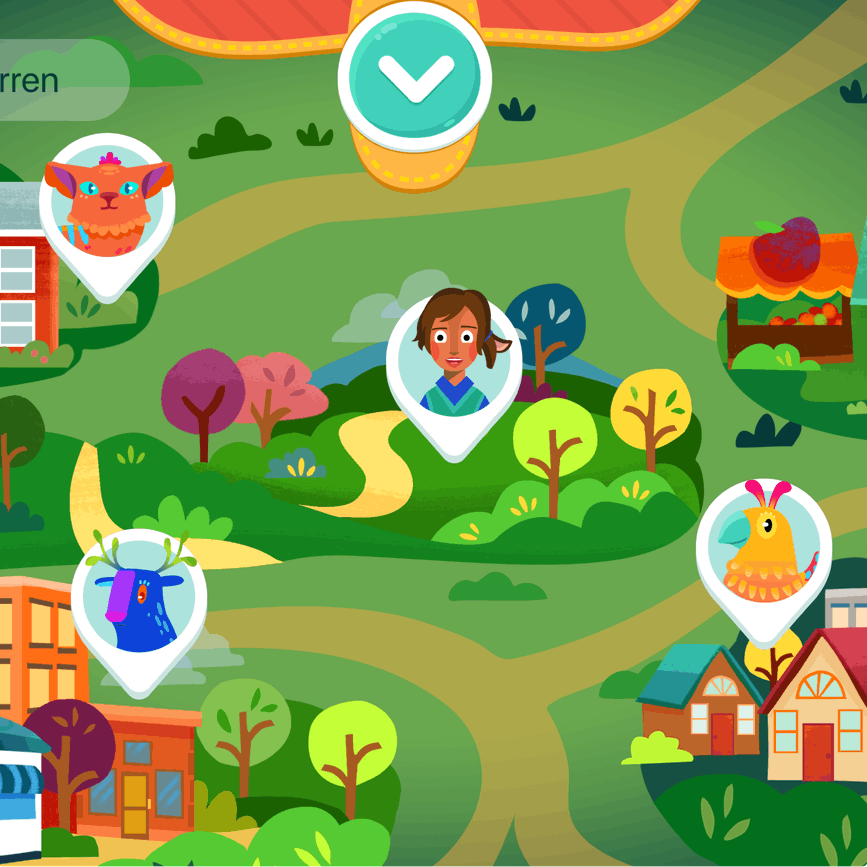

Unlock possibility with the Science of Writing
The reality is…writing is hard. It’s hard to learn, it’s hard to teach, it’s hard to do.
Natalie Wexler, author of The Knowledge Gap and The Writing Revolution, says, “Writing is the hardest thing we ask students to do.” Fortunately, we have decades of research that shows us how best to teach and learn how to write, known as the Science of Writing. As an educator your job is to make this hard task easier and more fulfilling for students. And our job is to help you.
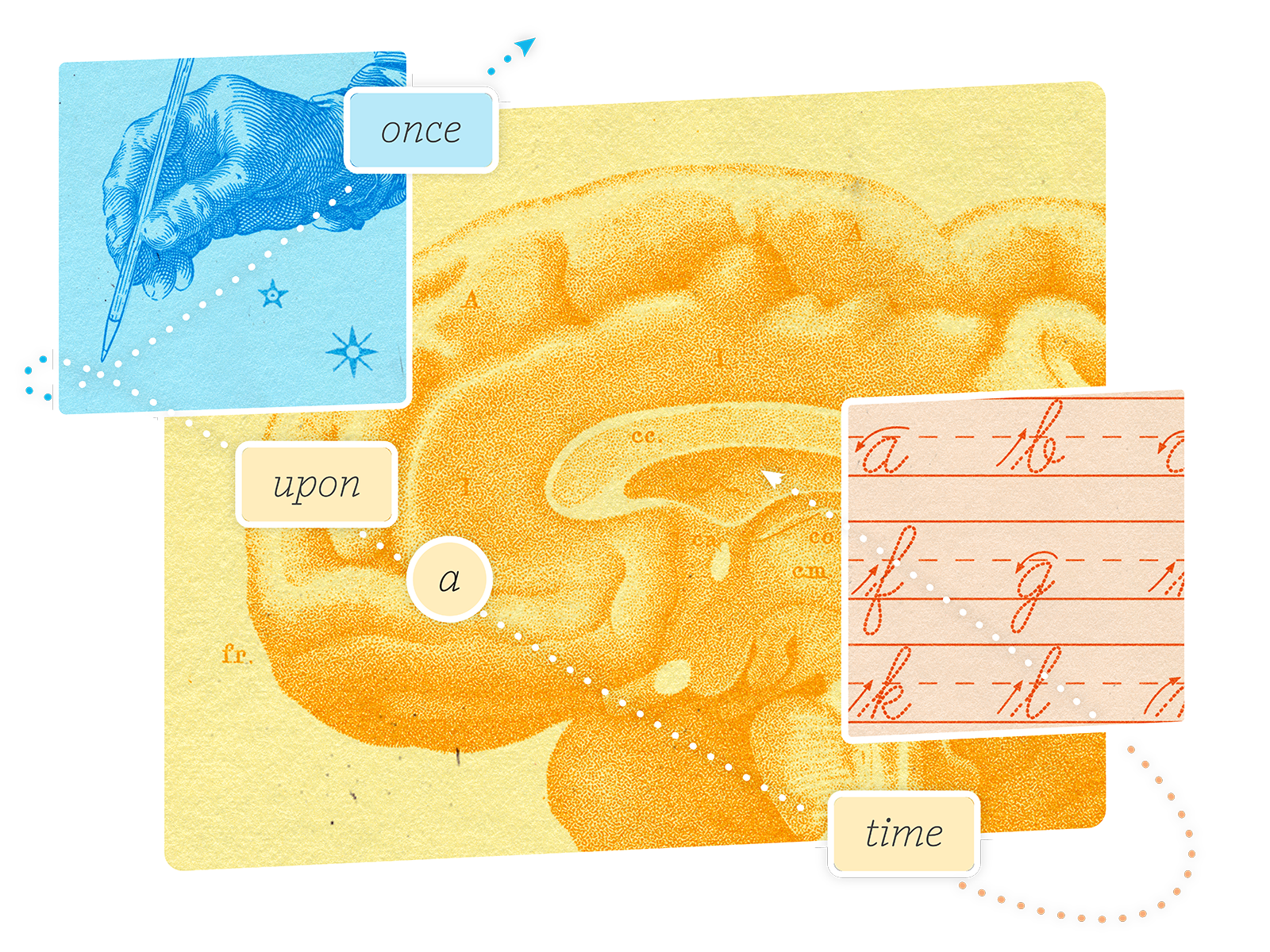
Why writing matters: Connection, expression, and better reading comprehension
Without writing, there would be no need for reading, and of course, writing is a part of literacy.
Through writing, students can express their ideas, connect with others, and deepen and communicate their understanding of what they are reading and thinking.
Having strong writing skills ensures students can engage fully in all settings, share their opinions and information, tell stories, and have a voice.
What is the Science of Writing?
Learning to write (and read) isn’t natural but it can be taught—and research shows us how. Like the Science of Reading, the Science of Writing is the collection of research and evidence-based practices that explains how writing develops along with the teaching strategies that help students develop into skilled writers.
Writing proficiency involves mastering the use of a complex set of skills that must be taught explicitly, again just like reading proficiency. The Simple View of Writing breaks down these processes into transcription and composition, and provides us with a framework for guiding instruction.
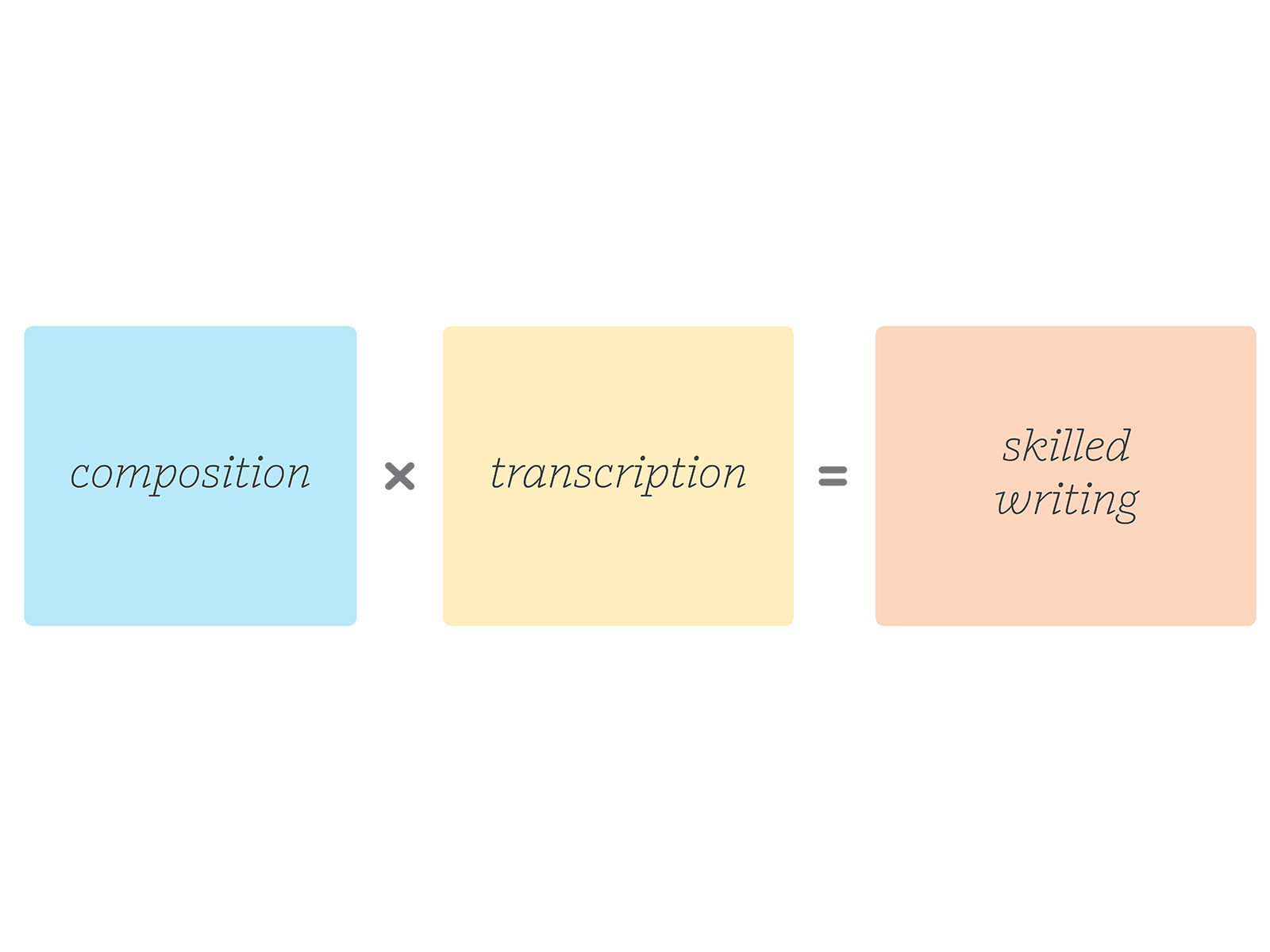
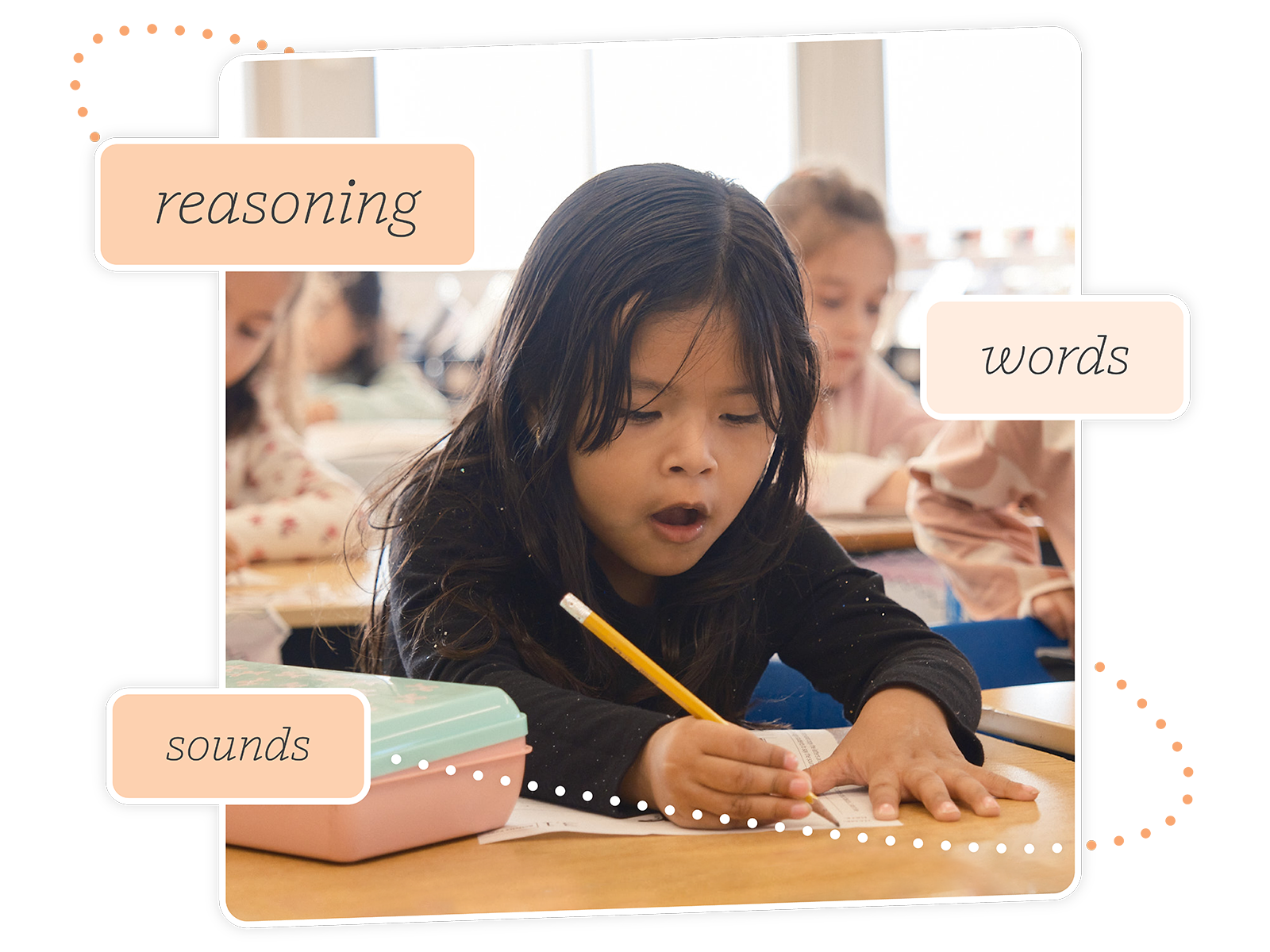
The relationship between reading and writing
Reading and writing reinforce and support each other. When reading, students are exposed to vocabulary, grammar, and syntax. And when writing, students can get more practice to improve the fluency and efficiency of their handwriting, and apply their knowledge of spelling and their understanding of vocabulary, grammar, and syntax.
Readers use comprehension skills such as summarizing, predicting, and making inferences to help them create meaning as they read. Writers use those same skills to develop a piece of writing that is clear and concise for the reader.
The benefits of applying reading skills and strategies when writing
- If you teach students decoding skills, then they become better spellers.
- If students learn strategies for planning, drafting, and revising during composition, then their reading comprehension improves.
- If students have word and vocabulary knowledge, then they’re better at expressing their ideas in writing.
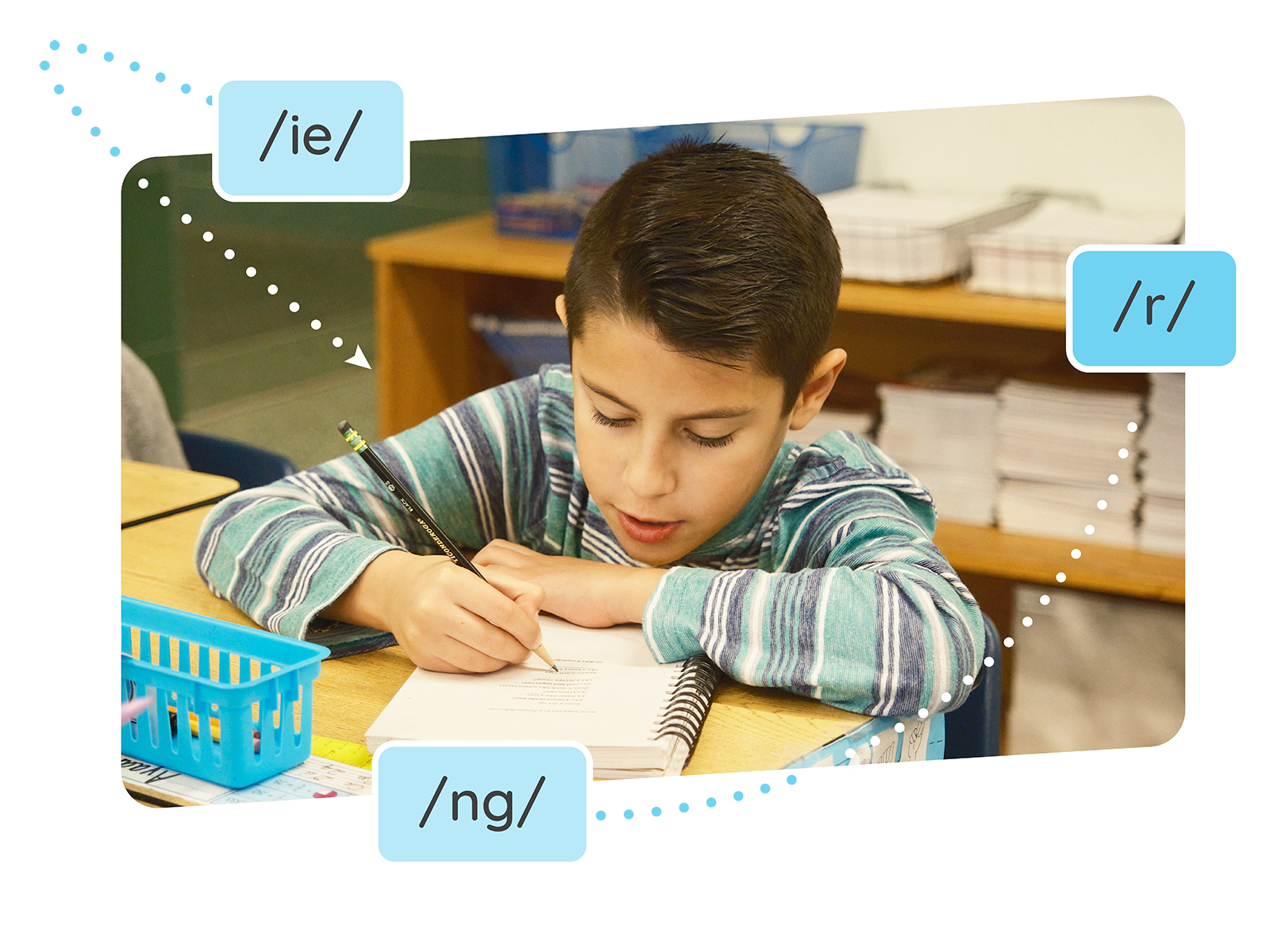
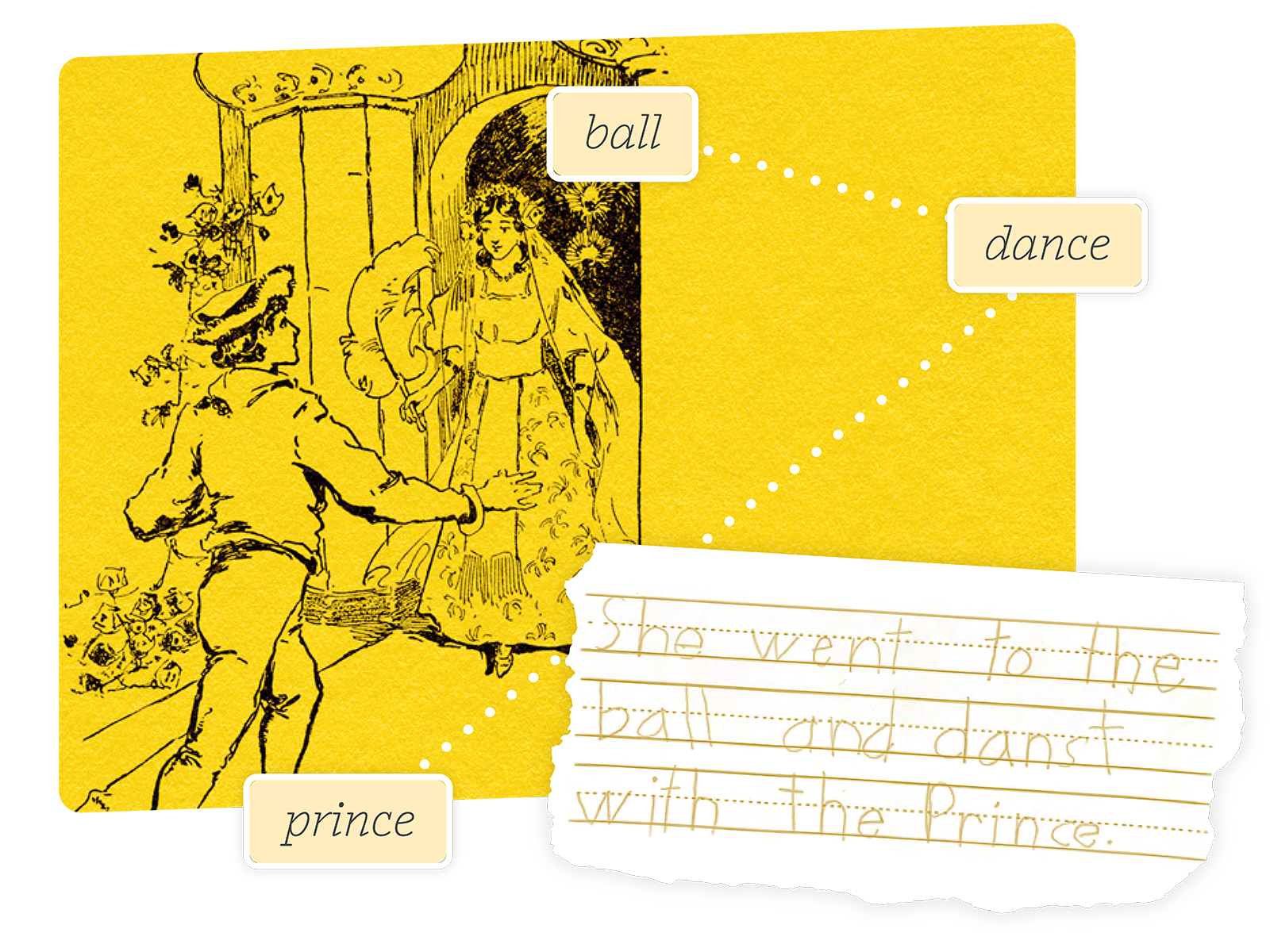
Oral language and writing
Oral language is the foundation for literacy, and its development begins in infancy. As their oral language develops, children learn how to string words into phrases and sentences, which progresses into telling stories and answering questions in detail. And as they listen to stories, children develop vocabulary and understanding of syntax and grammar. All of these build a foundation for writing.
Discovering the Science of Writing
Explore helpful resources to learn more about the Science of Writing, and the importance of implementing evidence-based instructional practices into your classroom, school, and district.
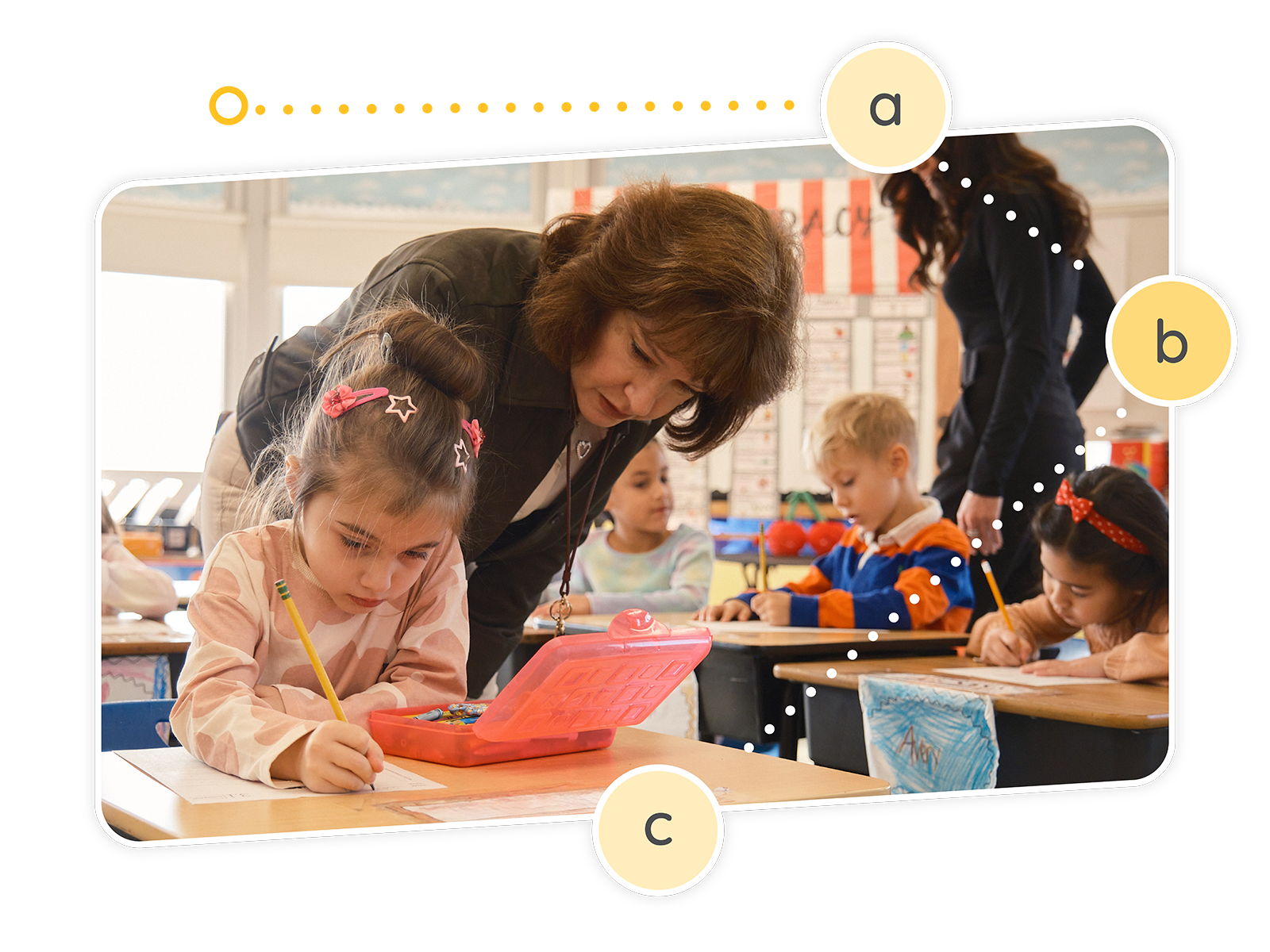
Books:
Articles:

Webinars:
- The Science of Reading: The Next Chapter
- The Science of Reading + Writing: Turning a New Page Together
- The Writing Chapter: Sparking the Writing Revolution with the Latest Insights and Research
- Writing and the Science of Reading Forum Panel Discussion: How does Writing Intersect with Reading?, Education Week


Join our User Research Community!
Help shape Amplify products.
Educators and students are at the center of what we do. That’s why we test our products with real users, visit classrooms across the country, and gather ideas and feedback from educators like you! This is how we ensure that we’re developing new products that meet your needs, as well as continuously improving our existing products to better support your classrooms.
That’s where our User Research Community comes in. This is a group of valued educators we look to for their expertise! They regularly participate in research and feedback opportunities and share their insights with our Product teams.
We hope you’ll consider joining Amplify’s User Research Community. When we have a study that’s a good fit for you, our team will reach out with details and next steps.

Why participate in user research?

Make an impact
Help influence and improve Amplify products by sharing your feedback and ideas

Get sneak peeks
Learn about new products and features that Amplify teams are working on

Connect with us
Share your thoughts and feedback directly with Amplify product development teams

Enjoy thank-you gifts
Receive incentives as a thank you for your time
What to expect
When you sign up to join the Amplify User Research Community, we’ll ask you some questions that will help us match you with research studies. When an opportunity sounds like a good fit, we’ll send you an email and share the details up front, such as study topic, research format, time commitment, and compensation. Then, you can decide if you’d like to participate.


Frequently asked questions
We’re looking for all types of educators to join our User Research Community: new Amplify users, power users, and everyone in between. We’re also looking for people who don’t use our products. If you work in a school setting or support schools, we want to hear from you. Here are some of the people we’d love to connect with:
- Classroom teachers (PreK–12)
- Biliteracy teachers
- Special education teachers
- Interventionists
- Coaches
- Curriculum directors
- School administrators
- District administrations
- Parents and caregivers
We have a separate research program for K–12 students. Learn more about our Playtesting program below.
Amplify runs a variety of research studies, and we’ll include the details of the study in our email. When you participate in one of our studies, you might be invited to:
- Talk to a researcher in a video call: Share your experiences with a specific product.
- Share your screen: Show us how you use Amplify’s products, try out a prototype, or test new features.
- Complete a survey: Answer questions about your current practices and/or preferences.
- Host a school visit: Have a few Amplify employees visit your classroom to observe our programs in action.
- Participate in a long-form study: These studies may involve a small commitment for several days or over a few weeks. You may be asked to review new materials or designs or to try something out in your classroom. Our researchers may ask you to respond to questions or take notes based on your experience using a product.
The information you provide will only be used to match you with suitable research studies and won’t be shared or sold to external parties. All data is stored on a secure server. See our Privacy Policy for more detail.
Amplify’s goal is to design welcoming product experiences. To do this well, it’s important for us to get feedback from everyone. We collect demographic information to help ensure that study participants represent the educators, students, and school environments we serve. All questions are optional and your information is kept confidential in accordance with our Privacy Policy.
You can opt out at any time by clicking unsubscribe in any of our research emails.
We typically offer e-gift cards as a way of saying thank you to those who participate in our research studies. We’ll include the exact details of the thank-you gift in the email invitation for the session. If your session is eligible for a thank-you gift card, you should receive it within five business days after completing your session. Please note that not all study participants will receive a thank-you gift.
Amplify Playtesting Program
A fun and empowering experience for kids
Students in our Playtesting Program provide feedback on new Amplify games and features as they’re being developed. Our researchers work one-on-one with students for 30 minutes at a time, inviting them to interact with new games and designs and gathering their feedback. We then integrate that feedback directly into our product development. It’s a chance for students to share their thoughts and ideas and have a real impact on the programs we’re building.

Who can participate?
Any students in kindergarten through grade 12 this school year can be part of our playtesting program, with parental permission.
What are the perks?
Aside from a fun time and a sneak peek at what’s in development, all students receive a $20 Amazon gift card for participating in a playtesting session.
When, where, and how do kids participate?
When playtesting needs arise, our User Research team will reach out to parents/caregivers to schedule a Google Meet session at a time that’s convenient for you and your child.
How can I sign my child up?
To enroll your student, please fill out this consent form. Your child will then be added to our playtesting program database. When a playtesting opportunity arises that we think would be a good fit, we’ll reach out!
Inspiring the next generation of Indiana scientists, engineers, and curious citizens
Amplify Science is a proven effective core curriculum designed for three-dimensional, phenomena-based learning that provides an immersive experience for science students. Amplify Science was developed in partnership with the science education experts at UC Berkeley’s Lawrence Hall of Science.

What is Amplify Science?
Amplify Science is a curiosity-driven science curriculum that empowers students to Do, Talk, Read, Write, and Visualize like scientists. Through phenomena-based, literacy-rich, and interactive learning experiences, students develop as critical thinkers who will gain the skills they need to solve real problems in their communities and the world.
Each unit of Amplify Science engages students in a relevant, real-world problem where they investigate scientific phenomena, engage in collaboration and discussion, and develop models or explanations in order to arrive at solutions.
Grounded in research
Developed by the science education experts at UC Berkeley’s Lawrence Hall of Science in partnership with the digital learning team at Amplify, our program features:
- A phenomena-based approach where students construct a deep understanding of each unit’s anchor phenomenon.
- A blend of cohesive storylines, hands-on investigations, lively discussions, literacy-rich activities, and digital tools.
- Carefully crafted units, chapters, lessons, and activities designed to deliver truly authentic three-dimensional learning.
- An instructional design that supports all learners in accessing all standards.


Instructional model
The Amplify Science program is rooted in the research-based proven effective pedagogy of Do, Talk, Read, Write, Visualize.
Here’s how each element works:
Do
Learners engage with scientific phenomena by conducting student-centered investigations.
Talk
Students engage in collaborative and inquisitive discussions and scientific argumentation.
Read
Reading scientific texts is an act of inquiry: Students ask questions, gather evidence, and make connections through literacy.
Write
Students write to share what they have learned and apply new evidence to strengthen written arguments and explanations.
Visualize
Students gather evidence through simulations, physical models, and modeling tools, allowing them to see and investigate complex, microscopic, or otherwise unobservable phenomena.
What’s included
Flexible resources that work seamlessly together

Grades K–5 materials

Student Books
Age-appropriate Student Books allow students to:
- engage with content-rich texts
- obtain evidence
- develop research and close-reading skills
- construct arguments and explanations

Student Investigation Notebooks
Available for every unit, the Student Investigation Notebooks provide space for students to:
- record data
- reflect on ideas from texts and investigations
- construct explanations and arguments

Simulations and practice tools (grades 2+)
Developed exclusively for the Amplify Science program, these engaging digital tools:
- serve as venues for exploration
- enable data collection
- allow students to explore scientific concepts
- show what might be impossible to see with the naked eye

Teacher’s Guides
Available digitally and in print, the Teacher’s Guides contain all of the information teachers need to facilitate classroom instruction, including:
- detailed lesson plans
- unit and chapter overview documentation
- differentiation strategies
- standards alignments
- in-context professional development

Hands-on materials kits
Hands-on learning is at the heart of Amplify Science. Each unit kit contains:
- consumable and non-consumable hands-on materials
- print classroom display materials
- premium print materials for student use (sorting cards, maps, etc.)
Grades 6–8 materials

Science articles
The middle school science articles serve as sources for evidence collection and were authored by science and literacy experts at the Lawrence Hall of Science.

Student Investigation Notebooks
Available for every unit, the Student Investigation Notebooks provide space for students to:
- record data
- reflect on ideas from texts and investigations
- construct explanations and arguments
- Available with full-color article compilations for middle school units

Digital student experience
Students access the digital simulations and modeling tools, as well as lesson activities and assessments, through the digital student experience. Students can interact with the digital student experience as they:
- conduct hands-on investigations
- engage in active reading and writing activities
- participate in discussions
- record observations
- craft end-of-unit scientific arguments

Teacher’s Guides
Available digitally and in print, the Teacher’s Guides contain all of the information teachers need to facilitate classroom instruction, including:
- detailed lesson plans
- unit and chapter overview documentation
- differentiation strategies
- standards alignments
- in-context professional development
Hands-on materials kits
Hands-on learning is at the heart of Amplify Science. Each unit kit contains:
- consumable and non-consumable hands-on materials
- print classroom display materials
- premium print materials for student use (sorting cards, maps, etc.)

Unit Sequence
Our lessons follow a structure that is grounded in regular routines while still being flexible enough to allow for a variety of learning experiences.
In fact, our multimodal instruction offers more opportunities for students to construct meaning—and practice and apply concepts—than any other program. What’s more, our modular design means our units can be flexibly arranged to support your instructional goals.


Indiana science resources to support your review

K–5 Science Resources
Contact us
Support is always available. Our team is committed to helping you every step of the way. Contact your dedicated Indiana representative here for program access, samples, and additional information.

Elizabeth Sillies Callahan
Southern IN
(513) 407-5801

Jody Kammer
Central IN
(310) 402-7837

Amanda Knipper
Northern IN
(260) 894-5123

Paige Lawrence
District enrollment below 1200
(980) 421-2608
Meet our Amplify Education Ambassadors.
We’re proud to showcase our amazing team of Amplify Education Ambassadors! These innovative educators are the heart of Amplify, representing a wide range of backgrounds and expertise. They are teachers and leaders who understand the impact of using our programs and care about supporting other educators and their students.
Learn more about each of these innovative educators and the essential work they do.

Amplify Education Ambassador class of 2025–26
Welcome, Indiana literacy educators!
Amplify ELA is built specifically for the needs of middle school teachers and students. This blended curriculum is designed to help teachers implement the Indiana Academic Standards for ELA by delivering a structured yet flexible instructional approach grounded in the Science of Reading.
Looking for core instruction for Grades K–5? Click here.
Designed to prepare Indiana middle schoolers for high school and beyond
After watching the Amplify ELA 6–8 video to the left, scroll down to learn even more, download resources, and access a demo.
What is ELA?
Amplify ELA is a core program for Grades 6–8 that delivers:
- A unique, research-based approach designed to get all students reading grade-level text together.
- An instructional design that inspires students to read more deeply, write more vividly, and think more critically.
- A rich combination of dynamic texts, lively discussions, and interactive Quests that truly engages middle schoolers and inspires them to participate in learning.
How ELA works
Amplify ELA lessons follow a structure that’s grounded in regular routines, yet flexible enough to allow for a variety of learning experiences. You can find more information in our ELA Program Guide.
What students explore
Amplify ELA provides everything you need to deliver a full year’s worth of instruction.
Each grade level of Amplify ELA consists of six multimedia units. Four or five of the units are focused on complex literary texts and one or two are collections based on primary source documents and research. Each grade also provides a dedicated story-writing unit, a poetry unit, and two or three immersive learning experiences called Quests.
Download the Unit Overview and explore a model lesson below to learn more.


Science of Reading
Watching students mature into adolescents? Inspiring. Knowing how to engage and motivate their changing brains? Science.
The middle school years are marked by a period of tremendous growth and change—physically, emotionally, and socially. Amplify ELA understands and embraces these changes, and delivers instruction specifically designed to tap into adolescents’ natural inclinations toward collaboration, exploration, and autonomy.
Differentiation
We believe all students are capable of reading grade-level text together.
Amplify ELA ensures all students have access to the same text. With six distinct levels of differentiation, every student is supported or challenged in a way that meets their unique needs. This includes multilingual/English learners (ML/ELs) at the Developing, Expanding, and Bridging levels, as well as students needing substantial support or an extra challenge.
Assessment
Amplify ELA not only includes captivating content, but also provides clear and actionable measurement data about student performance.
Our embedded formative and summative assessment tools maximize teaching time, while allowing teachers to make confident, data-driven decisions about the instruction and support students need to grow continually as readers and writers.


Get access
Ready to explore as a teacher? Follow these instructions:
- Visit learning.amplify.com.
- Select Log in with Amplify.
- Enter your provided teacher username and password.
- Select ELA.
Ready to explore as a student? Follow these instructions:
- Visit learning.amplify.com.
- Select Log in with Amplify.
- Enter your provided student username and password.
- Select ELA.
Contact us
Support is always available. Our team is committed to helping you every step of the way. Contact your dedicated Indiana representative here for program access, samples, and additional information.
Elizabeth Sillies Callahan
Southern IN
(513) 407-5801
Jody Kammer
Central IN
(310) 402-7837
Amanda Knipper
Northern IN
(260) 894-5123
Paige Lawrence
District enrollment below 1200
(980) 421-2608
Amplify Desmos Math Summer bridge program
This upcoming back-to-school season is sure to be anything but normal. It will be critical to use the summer months to tend to unfinished learning and prepare students for the math to come.


Thinking ahead
Amplify is offering free complete middle school and Algebra 1 units that support a number of typical summer school or bridge programs. The lessons are based on the highly rated Illustrative Mathematics program and designed to make problem-based instruction easier for teachers and more exciting for students.
Units available (June 2020)
Find a complete list of lessons available here.
Materials available June 2020
- Complete unit Teacher’s Guide available online or for printing
- Delivery format: Google Docs
- Complete unit Student Edition pages available online or for printing
- Delivery format: Google Docs
- Digital lessons
- Delivery format: Desmos
- Pre- and post-assessments
- Delivery format: Desmos and Google Docs

Making the materials work for you
We’re offering free, asynchronous professional learning resources to help your teachers quickly get up to speed with the Amplify Desmos Math lessons. These resources include:
- Quick-start videos for each unit, including a unit overview and a walkthrough of the print and digital lessons.
- Pacing suggestions for a variety of summer school scenarios.
- Regularly scheduled office hours in July and August with an Amplify Desmos Math product expert.
Proposed learning models


Samples
Printable Google Docs
Including Teacher Edition pages, Student Edition pages, and practice
Digital lessons powered by Desmos
The case for grade-level ELA instruction in middle school

Teaching middle school comes with unique challenges—especially in ELA, where a single classroom may include students from all walks of life and all reading levels. Recent data shows that more than 30% of middle school students struggle to read at grade level. So a teacher’s instinct might—understandably—be to match students with texts at their individual reading levels.
But research shows that’s not the best approach for meeting student needs. In fact, a critical way to help middle schoolers read at grade level is … to teach them at grade level.
All students benefit when they are challenged with grade-level content, along with the necessary support and scaffolding to promote their growth. This approach ensures that no student—whether below, above, or on grade level—is left behind or held back from their full potential.
The problem with the remediation trap
Providing struggling students with simpler texts seems like a logical way to build confidence. But this approach often reinforces learning gaps instead of closing them. When students aren’t exposed to grade-level material, they miss out on critical opportunities to:
- Build knowledge and vocabulary necessary for long-term academic success.
- Engage in meaningful discussions that deepen comprehension.
- Develop confidence in their ability to tackle complex texts and new concepts.
But when students interact with rigorous content and new information alongside their peers, they gain the skills, exposure, and engagement they need to improve—no matter where they start.
Scaffolding in education: Why does it matter?
If students need help reaching grade-level standards, focus on providing the right scaffolding rather than lowering expectations.
- Pre-teaching key vocabulary to support comprehension.
- Breaking down complex texts into smaller, digestible parts.
- Using guided questions and discussion prompts to deepen understanding.
- Encouraging peer collaboration so that students can learn from each other.
- Incorporating visual aids like diagrams, charts, and graphic organizers to clarify concepts and support comprehension.
By using these strategies, teachers can keep students engaged in grade-level work while addressing skill gaps in a way that fosters real growth.
How grade-level instruction works for every student
- Grade-level instruction builds confidence and motivation. Middle school students are deeply social learners who thrive when they feel included. When struggling students are placed in remedial groups with lower expectations, they can feel discouraged. But when they read and discuss the same challenging texts as their peers, they’re more motivated to participate and push themselves.
- Grade-level instruction develops critical thinking skills. Grade-level texts expose students to richer vocabulary, more complex sentence structures, and deeper themes. This helps all students—whether they’re working above or below grade level—develop essential thinking and analytical skills that prepare them for high school, college, and beyond.
- Grade-level instruction prepares students for real-world literacy. Success in the real world depends on the ability to read and comprehend challenging material. If students aren’t exposed to complex texts in middle school, they’ll struggle in high school, the workplace, and life. Providing grade-level instruction ensures that they develop the reading stamina and skills they need for the future.
Bridging skill gaps without lowering expectations
Some students may need additional support in decoding, fluency, or foundational skills. However, this doesn’t mean they should be separated from grade-level content. Instead, they should receive targeted interventions alongside their core instruction.
Here’s how to bridge skill gaps while keeping all students on track:
- Use structured reading supports—such as read-alouds or guided reading along with explicit fluency practice—so struggling students can follow along with grade-level texts.
- Incorporate explicit vocabulary instruction to help students understand and use new words.
- Provide sentence starters and discussion frameworks to support writing and comprehension.
- Encourage independent reading at different levels to build fluency while keeping classroom instruction rigorous.
With these strategies, students receive the help they need without missing out on the rich, challenging materials that promote deeper learning.
Teach up, not down: The best approach for middle school ELA
While scaffolding allows struggling readers to access the same grade-level content as their peers, advanced learners can benefit from opportunities to go deeper with discussions, analytical writing, and extension activities—all within the same instructional framework.
Key takeaways for middle school ELA success:
- Every student should engage with grade-level content, regardless of their starting point.
- Scaffolding in education helps all learners access complex texts and grow as readers.
- Effective literacy instruction prepares students for the demands of high school, college, and beyond.
More to explore
If you’re looking for research-backed strategies to support all students with grade-level instruction, check out our free ebook, Every Student at Grade Level: The Case for Grade-Level ELA Instruction in Middle School. It’s packed with actionable insights for teaching middle school ELA effectively and implementing powerful scaffolding techniques.
How to implement the Science of Reading in your classroom today
Four steps administrators can take to shift to the Science of Reading
10 books to get you started with the Science of Reading
Meet the Science of Reading superstars at Windber Elementary
Hardworking teachers, schools, school leaders, and school districts deserve applause every single day. We try to honor educators and their outstanding contributions in as many ways as we can at Amplify—which is why our annual Science of Reading Star Awards is one of our biggest events of the year! We’re currently accepting nominations through Jan. 31. Apply now!
This annual educator awards program is a great opportunity to shine a spotlight on the teachers, administrators, and entire schools working to improve student literacy outcomes in communities across the country—just like 2024 Science of Reading Rookie winner Windber Elementary in Windber, PA.
We hope their positive impact on student learning inspires you in your work—and inspires you to nominate a teacher or school for an award next year!
The challenge: Driving success in early literacy skills
Windber Area School District is a small, rural district in central Pennsylvania. Its preK–5 elementary school is Title One and has just over 620 students, 54% of whom are economically disadvantaged.
The district has been dedicated to helping its diverse student population succeed for years, but getting young learners to excel in literacy has always been a challenge.
That’s why, when Principal Charles Beckley stepped in to lead the way, he adopted a fresh approach to early literacy learning experiences. Principal Beckley has worked in education for a decade, first in North Carolina then at Windber Elementary as classroom teacher, dean of students, and now principal. Under his guidance, Windber’s educators worked together to transform the school’s reading program—and offer inspiration for literacy educators everywhere.
Best practices: Embracing a Science of Reading curriculum
Principal Beckley’s leadership did what truly powerful leadership does: inspire and equip others to lead, too.
First, he and his colleagues had to clarify the why of science-based literacy education. “We had to understand the literacy research and the rationale behind why we needed to make the shift,” he recalls. They collaborated with outside experts to get the information they needed, then they focused on teamwork.
“The original stakeholders who led the push for the Science of Reading, they talked to their colleagues, they collaborated. They were understanding of their teams’ needs and wants. It was a team effort and a team approach,” he says.
They knew they were on the right track when the school board offered their full support, aligning everyone behind their vision for research-based literacy education.
Individual teacher awards: Also deserved!
The most powerful drivers of this change, says Beckley, were the teachers: “Our teachers and coaches had the biggest lift because they had to learn the [CKLA] curriculum.” He affectionately calls them “the neurosurgeons of our school,” and emphasizes their ability to pinpoint areas of need and build the grade-level foundational skills students need most, as well as their readiness to embrace change and dedication to professional growth.
Beckley further emphasized his school’s collective effort, which other districts can look to as a model: “Our community has been on board with this,” he says, “and our students have been great.”
The adoption of Amplify Core Knowledge Language Arts (CKLA) was also crucial, providing the teachers with a framework and instructional materials that skillfully combined both skills and content knowledge.
The results have been undeniable. “If you look at our kindergarten,” Beckley says, “at midyear, [we] were 72% on or above benchmark through DIBELS®.”
Windber’s progress is proof of the power of an evidence-based curriculum that nurtures capable and informed readers—and of a community willing to deliver innovative literacy approaches. Their story is one of commitment to research, dedication to student success, development of shared leadership, and access to the right tools and support.
“We know that we’ve done the best for our kids,” Beckley says. “And that’s the most important thing.”
Inspired? Nominate a teacher, school, or district for an award.
We’re looking for our shining 2025 Science of Reading leaders now! Find the specs, our nomination deadline, and more on our Star Awards page. Nominate a teacher for an award.
How problem-based learning can transform the math classroom

With test scores and student engagement on the decline, it’s clear that traditional teaching methods aren’t meeting the needs of all of today’s math learners.
One solution that’s gaining momentum is problem-based learning. By focusing on real-world problems and structured approaches, this approach develops critical thinking, reasoning, and application—skills that are essential for math success.
But making this shift isn’t easy. For math teachers and educators, it requires careful planning, a clear strategy, and community commitment.
That’s why we’re here to help.
The decline in test scores and engagement
The latest National Assessment of Educational Progress (NAEP) results show a sharp decline in math proficiency across grade levels. Only 26% of eighth graders performed at or above the NAEP Proficient level in 2022. These results represent the largest score declines in NAEP mathematics at grades 4 and 8 since initial assessments in 1990. The pandemic didn’t help, but it’s not the only factor.
This downward trend is compounded by a sense of disengagement. According to YouthTruth’s report Making Sense of Learning Math: Insights from the Student Experience, only half of students feel that what they’re learning in math connects to the real world. Recent survey data also shows that less than half of U.S. students feel that they “often” or “always” work on interesting problems in math class.
When math feels irrelevant or intimidating, students disengage—and the learning gaps that follow can be difficult to close.
An opportunity to grow
But the data also includes opportunities. According to NAEP research, more than 70% of students report that they enjoy activities that challenge their thinking and thinking about problems in new ways.
Problem-based learning helps give those students what they want.
And in a world that relies increasingly on data, analysis, and innovation, students need to learn not just how to follow steps and apply formulas, but how to think mathematically. In other words, problem-solving skills need to be part of student learning. This is particularly important in elementary and middle school math, where foundational concepts are built—and where students have the chance to forget their identities as “math people.”
That’s why working to infuse problem-based math learning into your district’s instruction can help reverse negative math and engagement trends.
What does problem-based learning in math look like?
Let’s go back and define this approach more fully. Research shows that math instruction is most effective when it encourages students—individually or grouped with peers—to grapple actively with math problems. When instruction gives students the opportunity and freedom to solve problems, rather than dictating solutions and then having them practice, students are more motivated.
For example, instead of memorizing the formula for calculating area and then practicing it in a series of disconnected problems, students might tackle a problem-solving challenge like:
How much paint is needed to cover our classroom walls?” Or they might work on a broader question such as: “How can we design a park, taking into account constraints like space, cost, and accessibility?
At its core, problem-based learning values mathematical thinking and reasoning. Rather than focusing on procedures and memorization, problem-based learning encourages students to:
- Explore open-ended problems.
- Ask questions and make connections.
- Develop strategies to solve problems collaboratively.
- Build curiosity and perseverance.
- Reflect on their reasoning and process.
In the problem-based learning classroom, students are positioned as active participants in their math experiences, building a deeper understanding of concepts as they work through challenges. This is particularly critical for ensuring students don’t just learn math, but understand why it works and how to apply it. These approaches can transform math classrooms into spaces where students build both foundational and real-world math skills—and a healthy dose of math confidence, too.
Critical factors in making the shift
Integrating problem-based learning into traditional math teaching can feel like (and is!) a big change—in lesson-planning, mindset, and more.
To make it work for administrators, teachers, and students alike, schools do best when they focus on a few critical factors. These include:
- Clear vision: Understand (and communicate) why the shift matters and what it looks like in action.
- Leadership buy-in: Gain commitment from school leaders and administrators.
- Teacher support: Offer professional development, resources, and ongoing guidance specific to math instruction.
- Structured approaches: Establish a well-defined plan for implementing problem-based learning in math classrooms effectively.
What problem-based learning can look like in the classroom
While problem-based learning offers proven benefits, it can be difficult to integrate into the classroom without a clear structure. Teachers need tools and strategies to guide students through the process and ensure that learning goals are met.
A structured approach to problem-based learning in math should include:
- Defining the problem: Present a clear, engaging math challenge connected to real-world scenarios.
- Student inquiry: Encourage exploration, discussion, and different solution paths.
- Collaboration: Support teamwork to share ideas and reasoning.
- Reflection: Allow students to evaluate their process, solutions, and learning.
This structured approach not only improves students’ conceptual understanding, but also aligns with Amplify’s research findings, which show that students who engage in active learning outperform their peers in more traditional settings.
By embracing problem-based learning in math classrooms, educators can:
- Boost student engagement and confidence.
- Improve student problem-solving and mathematical reasoning skills.
- Help reverse declines in math achievement over time.
- Empower students to see the value and relevance of math in academics and in their lives.
Ready to learn more?
If you’re ready to explore how your school can make the shift to problem-based learning in math, our new change management ebook is the perfect place to start. It offers practical guidance, real-world examples, and a deeper look at the strategies highlighted above.
Download the ebook now to discover actionable insights and strategies to help make problem-based learning come alive in your math classrooms.
Navigating the shift to three-dimensional science teaching and learning

Students need science. They need it to succeed in school, and they need it to navigate the world around them—whether interpreting a weather forecast, perfecting a recipe, or troubleshooting the Wi-Fi.
But only 22% of high school students are proficient in science, and students in grades K–5 get an average of just 20 minutes of science instruction each day. For middle and high school students, access to advanced science courses is often limited. We’re not giving students all the tools they need to succeed in a world that’s increasingly shaped by science and technology.
Three-dimensional learning can help us solve that. This approach moves science education into the realm of discovery—where students learn to think and act like scientists.
But unlike hot water melting ice, shifting to this approach won’t happen in an instant! Don’t worry—we’re here to help.
Science learning: a pivotal moment
Many of us were taught science the traditional way: learning about the scientific world and how it works. (And many of us did ok!) But we know now that there’s a better way. Students need to figure out science the way scientists do.
This hands-on, problem-solving, three-dimensional approach (sometimes nicknamed “3D learning”) builds critical thinking, collaboration, and curiosity—all skills that are vital across school subjects and in life.
With content and lesson plans that focus on Science and Engineering Practices, Crosscutting Concepts, and Disciplinary Core Ideas, this model equips students with critical thinking skills and a deep understanding of scientific principles.
This shift started with the 2012 publication of A Framework for K–12 Science Education, which introduced the concept of three-dimensional learning. These principles, now embedded in the Next Generation Science Standards (NGSS), focus on three major changes:
- Helping students move from simply learning about science to actively figuring it out.
- Encouraging them to explain natural phenomena.
- Aligning science learning with English language arts and math goals.
By embracing these changes, educators can help students make meaningful connections across disciplines, setting them up for success in real-world challenges.
Driving and supporting systemic change
Transforming science education isn’t a quick fix—it’s a cultural and systemic change. To make it work and make it last, schools and districts need to focus on three key drivers: process, practice, and people.
- Process: Pinpoint challenges, create clear plans, and track progress.
- Practice: Build the infrastructure for three-dimensional learning, including aligning curriculum, offering professional development, and updating teaching practices.
- People: Communicate effectively, support teachers, and highlight science champions who can inspire others.
Real change takes time and deliberate effort. But with these elements in place, schools can establish lasting improvements and build elementary and middle school programs that benefit every student.
Amplify Science’s playbook to guide you
To help educators navigate this shift, our new Science Change Management Playbook offers practical, evidence-based resources for transitioning over time to three-dimensional learning. Here’s what you’ll find inside:
- Evidence-based practices: Learn structured approaches to problem-based learning, backed by research that highlights their benefits for students and teachers alike.
- Practical tips: Explore actionable steps for driving meaningful change, from crafting a shared vision to delivering effective professional learning.
- Real stories: Read testimonials from students and educators who have experienced the transformative power of curiosity-driven, collaborative learning.
With this playbook, schools can build K–8 and/or middle school science programs that truly engage students, equipping them with skills they’ll use for a lifetime.
The move to three-dimensional science teaching and learning opens the door to deeper understanding, better problem-solving, greater curiosity, and—more and more—a world built by students who know how to think like scientists.
More to explore
- Dive deeper into the shift to three-dimensional teaching and learning with our Science Change Management Playbook to help you navigate the shift to three-dimensional science teaching and learning.
- Discover how to be a changemaker for science through additional change management resources.
- Learn more about Amplify Science.
Your Beyond My Years 2024 recap!

In August of last year, our teaching podcast Beyond My Years took its first steps—and in no time we were exploring a lot of new territory on our journey to soak up teacher advice and wisdom from seasoned educators across the globe. Their experiences became our experiences. So let’s recap some of the top moments of 2024.
In 2024 on Beyond My Years we:
Traveled 3,469 miles to Stasia, Alaska.
We ventured all the way to the northernmost part of Alaska alongside Patti and Rod Lloyd to teach in a rural indigenous community. Joining such a rich and unique culture as outsiders taught Patti and Rod the importance of learning from their students.
“Even though they’re coming to me at five and six years old, they are coming with a lot of rich knowledge that I don’t have. And if I remain open and work with them, I’ve got a lot to learn.” —Rod Lloyd
Went back to school at the age of 80.
When the United Kingdom put out a call in 2020 for retired educators to return to aid a national shortage, Eric Jones knew he still had more left to teach, even at the age of 80! He knows that to stay in the education field as long as he has you need to celebrate and honor all areas of what a teacher does. When you honor every piece of the work you can do, you can make sure every moment stays aligned with your goals and serves your students.
“I like teaching kids things they didn’t know before and now they’re excited about. I love the idea that they will then move on into realms of industry and economic success that I would never dream of.” —Eric Jones
Shared our first Amplify podcast episode entirely in Spanish.
We even had our first bonus episode entirely in Spanish with Luz Selenia Muñoz. She taught us that some things transcend language—like the importance of knowing the “why” behind student behavior. According to Luz, whether your classroom is monolingual or multilingual, it is important to make connections with your students. You will see what they need and know what their triggers are. Behavior improves when you understand what your kids are going through.
“Yo creo que le diría que tenga paciencia. Paciencia. Que respire. Que las cosas van a mejorar cada día.” —Luz Selenia Muñoz
“I think I would tell them to be patient. Be patient. Breathe. Things will change for the better with every passing day.” —Luz Selenia Muñoz
Took time for ourselves.
Kamphet Pease called out the overachiever in all of us educators. An important piece of teacher advocacy: We all took a hard look at our school to-do lists together and recognized that we have to do better at prioritization—including prioritizing self-care.
“Make sure you take care of yourself as well. Take the time to go for a walk, take the time to take a bubble bath, cook for yourself, whatever you find enjoyment in.” —Kamphet Pease
Want even more of the best of the best from season one of Beyond My Years, which is brought to you by the team that produces Science of Reading: The Podcast? Download our key takeaways, a curated collection of invaluable wisdom and practical guidance from our lineup of inspiring educator guests.
More to explore:
Power up your Science of Reading knowledge: 2024 podcast recap
Amplify’s Science of Reading: The Podcast won both Silver and the Listeners’ Choice Award in the education category at the 2024 Signal Awards! If you haven’t already, we hope you’ll join those who have helped catapult the podcast to more than six million downloads.
You’re welcome to binge-listen all 29 podcast episodes released in 2024, but here, we’ve selected a few to highlight for you.
The power of the Science of Reading
Some context: As you probably know, the Science of Reading is a much-researched area alongside the science of learning. Applying cognitive, neuroscience, and educational principles, it helps us understand and improve how students acquire and develop reading skills. This knowledge is essential because, while humans typically learn to speak naturally, reading (and writing) require formal instruction. According to the Simple View of Reading, reading comprehension is the product of both decoding and linguistic comprehension. So kids must be taught the relationships between sounds and letters, and how to decode words. Systematic instruction presents these skills in a logical order, explicit instruction goes beyond just “exposing” kids to words and texts, and cumulative instruction builds on skills learned before.
The episodes below are a great start to exploring the fundamentals of evidence-based instruction beginning in early literacy. You’ll hear about the importance of knowledge building, the symbiosis between reading and writing, and the power of multilingual learning, just to name a few topics.
The power of knowledge
Season 8 focuses on why knowledge is so critical for literacy development and how educators can empower students to build it.
- Episode 10: Comprehension is an outcome, with Sharon Vaughn
Many of us (as students and educators) were taught or trained with comprehension framed as a skill. But award-winning researcher and author Sharon Vaughn, Ph.D., says (spoiler!) that comprehension is not a skill to be taught in a vacuum, but rather an outcome—of strong decoding, vocabulary, and background knowledge. “If students can’t read words or don’t know what they mean, emphasizing comprehension is just the wrong priority,” she says. Vaughn stresses the importance of systematically building background knowledge through coherent, high-level informational texts and relevant content lessons, enabling students to connect ideas and deepen understanding. By focusing on these foundational elements, educators can support comprehension and meaningful learning.
Episode 11: Cognitive load theory: Four items at a time, with Greg Ashman, Ph.D.
Drawing from his book A Little Guide for Teachers: Cognitive Load Theory, deputy principal and professor Greg Ashman argues that students need to build a strong foundation of knowledge in order to think and learn effectively. He challenges the idea of leaving students to “figure things out” on their own. “Kids are not little scientists,” he says, and advocates instead for structured instruction to build the schemas necessary for deeper learning.
Ashman also recommends reducing extra cognitive load—distractions that overwhelm working memory—and cautions against overrelying on approaches like “productive failure,” which can frustrate students who happen to lack relevant foundational knowledge. His advice: Use evidence-based methods and prioritize clear, incremental instruction.
The power of evidence-based literacy instruction
Season 9 dives deep into the key principles of and latest developments in the Science of Reading.
Episode 3: Know the non-negotiables in a program aligned to the Science of Reading, with Kari Kurto
Kari Kurto, national Science of Reading project director with the Reading League, discusses the organization’s curriculum evaluation tool designed to assess research-based practices in reading programs. Drawing from her experience teaching students with dyslexia, Kurto emphasizes the necessity of explicit, systematic instruction in phonics and (like Ashman) the importance of reducing extraneous cognitive load.
She says one must-have for any effective, evidence-based curriculum is explicit instruction in phonics through a clear scope and sequence, which ensures that students build foundational skills, such as phonemic awareness, in a systematic way. “No program is perfect, but understanding both its strengths and areas for improvement allows schools to maximize its impact,” she says.
Episode 4: Comprehension is not a skill, with Hugh Catts, Ph.D.
Hugh Catts, like Vaughn, continues to challenge us to rethink reading comprehension. “Comprehension isn’t the purpose of reading,” says Catts, a professor at Florida State University. “The purpose of reading is whatever you’re reading for.” Whether scanning for a fact, grasping the gist, or diving deep into a complex topic, comprehension varies based on the reader’s intent and context. He also urges educators to do what the evidence asserts: Move beyond isolated skill drills to content-rich instruction that builds knowledge and engages students meaningfully. Catts notes that comprehension grows over time, as students develop mental models and apply critical thinking in a variety of reading contexts.
The power of multilingualism
In this special miniseries, our podcast focuses on how the Science of Reading serves multilingual/English learners (ML/ELs).
Episode 1: Language is always an asset, with Kajal Patel Below
Kajal Patel Below, Amplify’s vice president of biliteracy, highlights why language is such a powerful asset, and how multilingualism is not a barrier, but a gift. “Literacy in a new language builds from literacy in the home language,” she says.
But that’s not—yet—the prevailing view. Multilingual and English learners often face challenges like being left out of research or misidentified in assessments. Below also notes schools focus too much on phonics and foundational skills, sometimes overlooking the equally important elements of language comprehension, vocabulary, and speaking skills.
With the number of multilingual learners growing fast in the U.S., Below calls for schools and educators to embrace bilingual education, create stronger resources, and celebrate the unique strengths these students bring to the classroom.
More to explore
Meet Science of Reading changemaker Altramez Simone McQuaige

Awards for teachers—we should probably give them out every day. We try to honor teachers and their exceptional contributions in as many ways as we can at Amplify. That’s why our annual Science of Reading Star Awards is one of our biggest events of the year!
We’re currently accepting nominations through Jan. 31. Apply now!
This annual award program is a great opportunity for us to shine a spotlight on the classroom teachers, school administrators, and educators who are improving student literacy outcomes in schools and communities across the country—like 2024 Changemaker Award winner Altramez Simone McQuaige. We hope her significant contributions inspire you in your work—and inspire you to nominate a teacher for an award next year!
A leadership role: Experience and experimentation
Altramez Simone McQuaige has spent more than 30 years in education, so it’s probably safe to assume she knows what she’s doing. But she’s not afraid to embrace change, or even take risks. “We didn’t go into this profession to do the same thing every day,” she says.
As supervisor of elementary reading and English language arts at Prince George’s County Public Schools, McQuaige took on the challenge of improving literacy instruction in her district by focusing on the Science of Reading.
Foundational skills: Noticing the problem
Several years ago, McQuaige and her team noticed a specific issue with foundational skills instruction, especially in first and second grades. “We were seeing a population of students that we weren’t seeing progress with consistency,” she says.
Under McQuaige’s leadership, a team of coaches, reading leaders, and administrators met to discuss how to improve their foundational skills instruction and student outcomes, asking themselves questions like: Should they shift their curriculum? Their classroom methods? Their entire literacy approach?
Then the pandemic hit.
Coming together: Exploring a new approach
Despite pandemic disruptions, McQuaige and her team convened and launched a cohort of 240 teachers, central office personnel, and reading leaders to learn more about the Science of Reading.
Openness to change was key. The cohort had to be willing to look at the latest research and see—as McQuaige puts it— that “some of the practices that may have been used from yesteryear were not effective.”
Their decision? Start to shift from a balanced literacy environment to a structured literacy approach involving explicit, systematic teaching of the elements of reading and a strong emphasis on phonological and phonemic awareness, phonics, vocabulary, and comprehension strategies.
Varied stakeholders building energy for change
There was “energy around the shift,” she recalls. The excitement coming from that large team of varied stakeholders helped build further buy-in—and success.
“We wanted to ensure that our reading leaders and our central office personnel with ESOL teachers and special educators had an opportunity to engage in these conversations,” she says. “That led us to have teachers practice or pilot programs before we chose the best products to meet the needs of our teachers.”
“We were building capacity across our district,” she says, “and building leaders and allies to talk about why the shift is necessary, and what they noticed as they started to embed those practices in their instruction.”
Professional development: Continued improvement and support
The result? The district successfully moved to a structured literacy approach in just three years, and improvements in student performance data demonstrate the effectiveness of the changes. “Even those who were once reticent are seeing the shift in their students,” McQuaige says of the teachers around her.
She also acknowledges the essential role of their partners: “Amplify’s support was crucial as we shifted. We know that as you make the shift, it will never be one and done. The continuous learning across our district, using our Amplify team, is invaluable.”
But McQuaige knows that even if the shift in approach is technically complete, she—like her students—must always be learning. “Let’s follow the research,” she says. “I know research is always changing, and that means we’re always changing.”
Here’s your nomination form!
Inspired? We’re looking for our shining 2025 Science of Reading leaders now! Visit our Star Awards page for information like our submission deadline, and nominate a teacher for an award today!
Iowa CKLA review for Grades 6-8
Welcome to the Amplify ELA community review site for Iowa. This site is designed to help you learn about Amplify ELA—a core English Language Arts curriculum for Grades 6-8.
Amplify ELA is a blended curriculum designed to help teachers implement the Iowa Core Literacy Standards by delivering a structured, yet flexible instructional approach grounded in the Science of Reading.
What is Amplify ELA?
Amplify ELA is a core program for grades 6–8 that delivers:
- A unique research-based approach designed to get all students reading grade-level text together.
- An instructional design that inspires students to read more deeply, write more vividly, and think more critically.
- A rich combination of dynamic texts, lively discussions, and interactive Quests that truly engages middle schoolers and inspires them to participate in learning.


How does it work?
Amplify ELA lessons follow a structure that is grounded in regular routines, but that is flexible enough to allow for a variety of learning experiences for your student. To see the structure of the program at each grade level, please click below.
What do students explore?
Amplify ELA provides everything teachers need to deliver a full year’s worth of standards-based instruction.
Each grade level of Amplify ELA consists of six multimedia units. Four or five of the units are focused on complex literary texts and one or two are collections based on primary source documents and research. Each grade also provides two or three immersive learning experiences called Quests, a dedicated story writing unit, and a poetry unit.
Download the unit overviews below to learn more.
How does it engage all students?
Watching students mature into adolescents: inspiring. Knowing how to engage and motivate their changing brains: science.
The middle school years are marked by a period of tremendous growth and change for students – physically, emotionally, and socially. Amplify ELA understands and embraces these changes, and delivers instruction specifically designed to tap into adolescents’ natural inclinations toward collaboration, exploration, and autonomy.

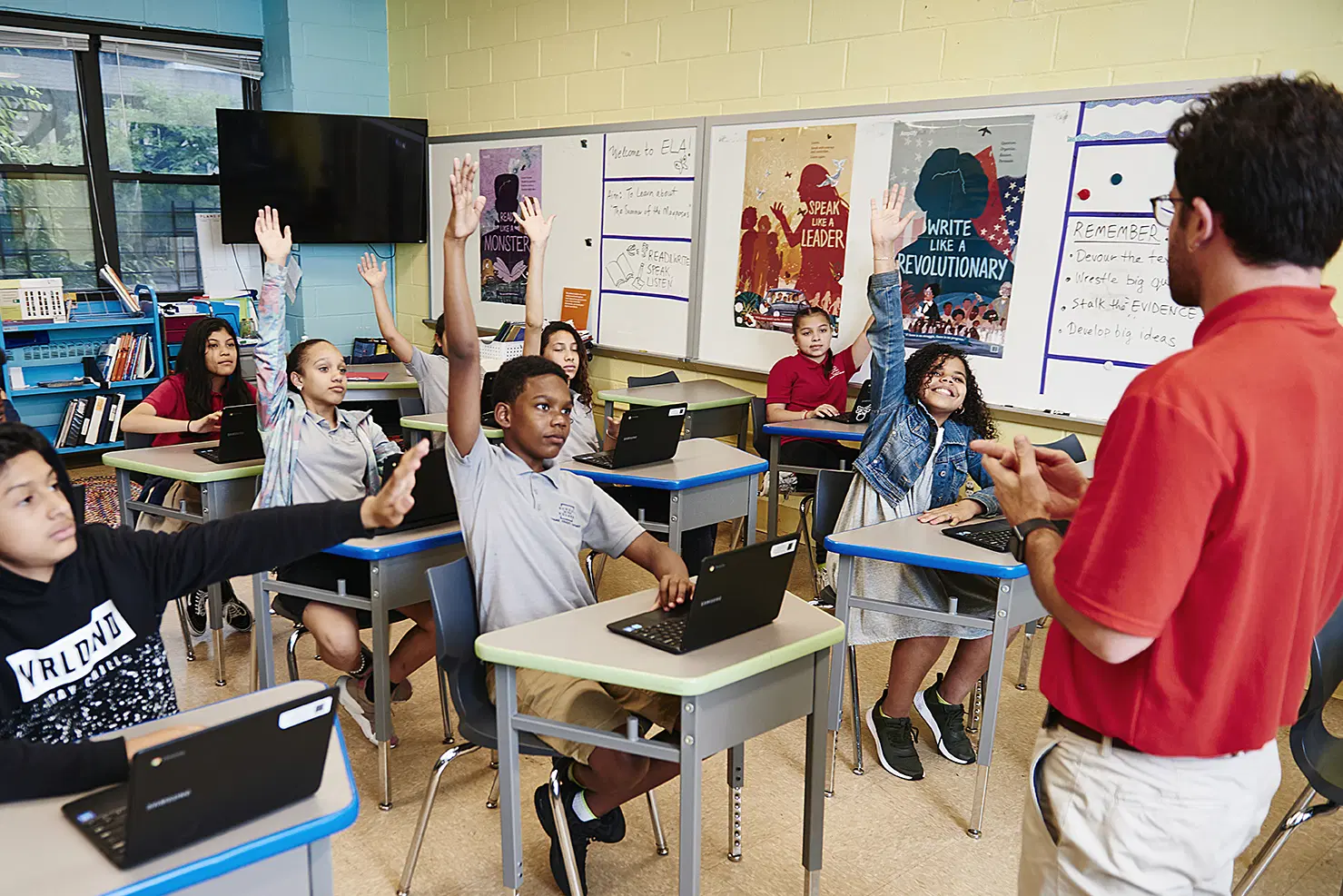
Differentiation
Amplify believes all students are capable of reading grade level text together.
Amplify ELA ensures all students have access to the same text. With six distinct levels of differentiation, your student is supported or challenged in a way that meets their unique needs. This includes ELLs at the Developing, Expanding, and Bridging levels as well as students needing substantial support or an extra challenge.

Virginia 6–8 ELA Review Site
Welcome, Denver, to Amplify ELA 6-8!
Amplify ELA is the only ELA curriculum that takes the Science of Reading to the next level.
Truly designed for students entering the middle grades, Amplify ELA engages and empowers learners, and addresses the very specific and unique needs of students in grades 6–8.
Rated all-green on EdReports, Amplify ELA earned perfect scores across all gateways.
Scroll down to learn how ELA is uniquely designed to help all your Denver middle schoolers make learning leaps in literacy.
Meet Amplify ELA
Developed specifically for the needs of students entering the middle grades, Amplify ELA is a blended curriculum that promises:
- A structured, yet flexible approach.
- Carefully crafted, age-appropriate materials and activities that aren’t too “babyish” or too mature.
- Complex, content-rich literature and informational texts that ensure ample opportunities for students to encounter both “windows and mirrors”.
- Highly engaging lessons that keep adolescents plugged in and motivated to learn.
- An instructional design that levels the playing field for every student.
- Superior results.


Access, engagement, and equity
In Amplify ELA, all students read the same text with the help of differentiated supports. In other words, we don’t dumb things down; we bring students up. Our robust collection of diverse texts and research-based approach to instruction not only engage students, but build confidence.
ELLs
With Amplify ELA’s integrated and designated ELD support, English language learners are given a chance to shine.
Embedded supports enable students to engage with and participate in discussion of grade-level texts with their grade-level peers.

Access Demo
Ready to explore on your own? Follow the instructions below to access your demo account.
Access the ELA Teacher Digital Platform
First, watch the quick navigation video to the right. Then login using the directions below.
- Click the ELA Teacher Platform button below.
- Select Log in with Amplify.
- Enter this username: t1.dps-ms-ela@demo.tryamplify.net
- Enter this password: Amplify1-dps-ms-ela
Access the ELA Student Digital Platform
To access the student digital platform, follow the login directions below.
- Click the ELA Student Platform button below.
- Select Log in with Amplify.
- Enter this username: s1.dps-ms-ela@demo.tryamplify.net
- Enter this password: Amplify1-dps-ms-ela
Top 10 Science of Reading podcasts to get you started

Since 2019, Science of Reading: The Podcast has delivered the latest insights from researchers and practitioners in early reading. Hosted by Amplify’s Chief Academic Officer Susan Lambert, each episode welcomes a renowned leader in the education and literacy community, explores a timely topic related to the Science of Reading, and offers instructional advice to educators implementing evidence-based practices in their schools.
New to the podcast? Here are 10 popular episodes to acquaint yourself with the Science of Reading. Listen, enjoy, and subscribe — we have new episodes every other Wednesday!
S1-E1: Natalie Wexler on “The Knowledge Gap”
Susan hosts Natalie Wexler for a deep dive into her latest book, The Knowledge Gap: The Hidden Cause of America’s Broken Education System—And How to Fix It, and a discussion of the lack of equity in reading education among students, the benefits of knowledge-rich curriculum inside and beyond the classroom, why it’s important to build background knowledge while teaching foundational skills, and why professional development doesn’t seem to be making a difference and how it can be improved.
S1-E3: Emily Hanford on reporting on education and the Science of Reading
Susan sits down with Emily Hanford, education reporter and host of the Education Post podcast, to examine the big takeaways from her experience reporting on dyslexia and the patterns that emerged in her investigation; why reading instruction isn’t more aligned with the Science of Reading; and the evolution of whole language, balanced literacy, and phonics instruction.
S1-E8: Tim Shanahan on evidence-based literacy practices
Reading expert Tim Shanahan discusses his view on teaching reading, including an explanation of the four crucial things you need to teach reading, and what it means to really do a “close read” in literature.
S3-E1: Dr. Jane Oakhill on Scarborough’s Reading Rope
Dive into the first episode of our Deconstructing the Rope series as Dr. Jane Oakhill, professor of experimental psychology at the University of Sussex, provides an overview of Scarborough’s Reading Rope. She also emphasizes the importance of inferencing in comprehension, why the Simple View of Reading is still relevant almost 40 years later, and how each element of the Rope comes together to deconstruct the complexity of reading.
S3-E3: Dr. Louisa Moats on decoding
Join Dr. Louisa Moats, President of Moats Associates Consulting, as she unwinds decoding, a strand of Scarborough’s Reading Rope. In the third episode of our Deconstructing the Rope series, Louisa highlights the significance of decoding in the Science of Reading and discusses the value of becoming students of our own language. She also explains the reciprocal relationship between decoding and encoding and why both are essential to provide effective phonics instruction to children in the classroom.
S2-E7: Sonia Cabell on research, comprehension, and content-rich literacy instruction
Join Sonia Cabell, Assistant Professor of Education at Florida State University, as she shares findings from her research trials on content-rich literacy curricula and whether activating students’ background knowledge alongside explicit phonics instruction is more effective than traditional approaches. She also explains what constitutes “compelling evidence” in the Science of Reading and why students need to interact with both written and spoken language while learning to read.
S3-E5: Dr. Bruce McCandliss on sight recognition
Join Dr. Bruce McCandliss, Professor at the Graduate School of Education of Stanford University, as he unwinds sight recognition, a strand of Scarborough’s Reading Rope. In the fifth episode of our series, Bruce explains the role of sight and word recognition in the Science of Reading and highlights the importance of the rapid integration of print, speech, and meaning. He also encourages listeners to be cognizant of the ever-changing technological learning environment while nurturing young readers and writers.
S2-E1: Dr. LaTonya Goffney on a district-wide SoR adoption
Join Dr. LaTonya Goffney, Superintendent of Schools for Aldine Independent School District in Texas, as she recounts her two-year journey with her team of district educators to adopt a new early literacy curriculum. Hear how they successfully challenged the traditional adoption process, studied the science of teaching reading, analyzed student data and experiences, and developed a district-wide set of beliefs and expectations.
S3-E7: Maria Murray on The Reading League’s Defining Movement
In this special episode, Dr. Maria Murray, President, and CEO of The Reading League analyze the intricacies of literacy instruction and shares common misconceptions that educators have about the Science of Reading. She also explains why the Science of Reading: A Defining Movement coalition was founded: the belief in a clear understanding of what the Science of Reading is and what it is not, in order to promote the proper use of instructional practices aligned with its findings.
4 tools to help teachers better understand dyslexia

Despite variations in terminology, many professionals still consider dyslexia to be synonymous with the term “reading difficulty.” But a growing interest in the subject and a resurgence of the term in literacy research is increasing awareness of dyslexia’s neurobiological origins.
With things changing fast, it can be difficult to stay up to date on the latest research and instructional practices surrounding dyslexia. In this blog post, we’re providing four amazing reading materials to improve your understanding and ability to support struggling readers.
Defining dyslexia
Dyslexia is a critical topic in education these days — but what is it? This article from the Orton Gillingham Online Academy breaks down the International Dyslexia Association’s definition of dyslexia and what it means for students with this “hidden disability:”
“What is Dyslexia? Part 1” by Lorna Wooldridge
Dyslexia in your classroom
Students with dyslexia make up 15–20% of the school-age population, and are likely to be in every classroom. These fascinating statistics show just how present dyslexia is in the student population:
“Most Reading Difficulties Can Be Resolved or Diminished” by Carolyn Cowen
Dyslexic brains are wired differently, but intensive reading intervention can rewire them. Read about how science and technology are being used to understand what’s happening in a brain with dyslexia:
“How Science Is Rewiring the Dyslexic Brain” by Gabrielle Emanuel
Dyslexia: Fact and fiction
We know more about dyslexia now than ever before?—?can you distinguish between fact and fiction? Uncover the truths and myths of dyslexia now:
Math Teacher Lounge episode: Howie Hua on making math viral

K—12 math instruction has come a long way from having students memorize times tables. Thanks to innovative instructors like Howie Hua, it’s gone all the way to TikTok. And it’s gone viral.
Bethany Lockhart Johnson and Dan Meyer recently talked to Howie Hua on Math Teacher Lounge—now a podcast!
Meet Howie Hua
Howie Hua is a lecturer at Fresno State. He teaches math to future elementary math teachers. That’s a good thing, because he doesn’t just make math “come alive.” He makes it go viral.
He has more than 32,000 followers on TikTok (@howie_hua), where his brief, punchy math explainer videos have garnered nearly 500,000 likes.
That’s why Bethany Lockhart Johnson was so excited to talk to him on the podcast, she says. “He is inviting us to think about how we ask questions in mathematics in ways that get people buzzing. His ideas and thoughts have gone viral and people are in conversation in a way that we long for them to be, out in the streets shouting about mathematics.”
(Fun fact: Hua can also throw a rifle 15 feet in the air, do a back flip, and catch it. Don’t believe us? Check out his TikTok.)
Questions are as important as answers
“I think people don’t want to watch a 20-minute YouTube video on something math-related. Maybe they just want a short one-minute explainer,” says Hua.
Even in one minute, Hua shines new light on math functions and concepts—and more.
“People want to understand what’s actually happening,” says Hua. “For example, I got so many nice comments when I explained the long division algorithm. I said, ‘Let’s visualize it.’ It’s not just connecting the permutation and the combination formulas. People want to know what’s happening rather than just ‘Use this formula to get an answer.’”
Dan Meyer shares a couple of Hua’s most popular TikToks:
- Test Talk: Reduce test anxiety by having students talk in a group about a test for five minutes before putting pencil to paper.
- How do you calculate … ? In his Mental Math Mondays series, Hua asks viewers to tell him exactly how they solve a given arithmetic problem. “One of my favorite hobbies is to listen to how people think about math,” says Hua. “So if you want to make my day, comment or stitch this video with how you would calculate 17 plus 18 in your head.”
Hua says that to ask “Hey, how would you think about this?” does more than give him insight. Asking questions helps build community, and shows people that there are many ways to arrive at an answer.
Says Hua: “It really goes to show that math is a creative subject. ‘Hey, can we find another way? What’s another way that we can do this?’ I tell my students, the beauty is in us, not the final answer.”
Join the challenge
Here’s Hua’s Math Teacher Lounge challenge for this episode:
- Walk around and find something that you can count, take a picture, and then ask around: “Hey, how would you count these?” See if their way is the same as yours—or if it blows your mind.
- Share your pictures and thoughts by tagging us (@MTLShow) and Howie (@Howie_Hua) on Twitter, and sharing them in the Math Teacher Lounge Facebook group as well.
Bonus: Did you do the daily Wordle before you read this post? You might have learned something about teaching math—listen to the podcast to find out why (and to hear why on earth Dan Meyer would start his guesses with “PYGMY”)
The Math Teacher Lounge podcast is available on all major streaming platforms and on mathteacherlounge.com. Math Teacher Lounge is presented by Amplify and Desmos. Visit Amplify’s website to find out more about Amplify Math.
Language comprehension: Building mental models

©Alexander Huth / The Regents of the University of California
Throughout this five-part series, we will cover the main components of the Science of Reading (SoR) and provide additional resources and research to guide your exploration and implementation of this important movement.
Say you’re given a passage of text to read. This particular paragraph describes half an inning of a made-up baseball game.
After you read the passage, you are asked to reenact the scene.
Which is more likely to aid your success?
A. Your ability to read
B. Your knowledge of baseball
C. It makes no difference
Would you be surprised to know the answer is actually B?
In part one of our series, “What is the Science of Reading anyway?,” we discussed the two main components of the Science of Reading: decoding (converting written words into speech) and language comprehension (understanding that speech). We also provided in-depth coverage of both learning and teaching how to decode the symbols of the English alphabet and strengthen the reading muscle.
LANGUAGE COMPREHENSION
In 1988, two young researchers and 64 students took part in an experiment that has forever changed how we think about reading and comprehension. One by one, the students were handed the same story covering half an inning of a made-up baseball game and asked to reenact it.
To the researchers’ surprise, they found that reading ability had little impact on how well kids understood the story—but knowledge of baseball did. In fact, students who were weak readers did as well as strong readers if they had knowledge of baseball.

Teaching knowledge explicitly improves reading comprehension. As Willingham has said, “Reading tests are knowledge tests in disguise.”
Researchers at the Haskins Lab at Yale tested this theory and found an extraordinarily high correlation between how well a 7-to-9-year-old child can recognize words and how well they comprehend text.

Common teaching mistake — Strategy instruction
So if reading comprehension is driven by a student’s vocabulary and knowledge, are widely taught strategies like finding the main idea equally critical?
Many strategies make intuitive sense: Stopping and re-reading when comprehension breaks down, for instance, is helpful for many children. But teaching the main idea strategy over and over is less helpful.
It is hard to find the main idea of a piece of writing if you don’t really understand any of the ideas in it. And even if you know a strategy — like re-reading when stuck — you also need to be well-versed in when to apply the strategy. You need to notice that you didn’t understand the text.
Often, strategy instruction neglects to offer students practice with identifying the situations in which they should use the strategy.
In the 1940s, a skills shift began to take place in education systems throughout the world. Its effects can be traced in the U.K., Sweden, Germany, and, most recently, France. This shift brought an emphasis on reading and math, squeezing out the broader knowledge taught in the sciences and social sciences. Some have linked the decline in standardized test scores—the SAT in the U.S. and the DEPP national exam in France—to this shift.
The National Survey of Science and Mathematics Education reported that today, classes in grades K–3 spend just 19 minutes per day on science and 16 minutes per day on social science.
To counter this loss of broader knowledge in our students, research suggests that we teach comprehension strategies in moderation and use the freed-up time to build knowledge (and vocabulary).
But simply exposing students to everyday speech doesn’t build a strong vocabulary. In a typical conversation, there are around 20 unusual words—such as dismayed or zeal—per 1000 words. Newspapers and books contain more than twice as many. Rich vocabulary, then, is gained not solely through speech, but through reading. Rich vocabulary, then, is gained not solely through speech, but through reading—especially when reading a variety of text types.

Mental models
Some readers with good word recognition, vocabulary, and knowledge are still weak comprehenders. Why might this be the case?
After students read a passage, they aren’t likely to recall the precise wording, but they will probably remember the ideas. Researchers use the term mental model to describe the structure you create in your mind to perform this feat of comprehension. Think of the process of building a mental model as a sort of micro-comprehension. Weak comprehenders build poor models. Hence, when asked prediction or mapping character development questions, they answer poorly.

There are four critical skills students need to improve their mental modeling:
- Decoding the usage of anaphoras (she, they, him). Some early readers can’t reliably figure out who the pronoun is referring to, especially in ambiguous text.
- Understanding the use of markers to signal ways that the text fits together — connectives, (like so, though, whenever) structure cues, and directions. Inexperienced readers may not know that but, though, yet, and however signal that something opposite follows.
- Writers make assumptions about what can be left unstated. For instance, when they read “Carla forgot her umbrella and got very wet today,” good readers will use their prior knowledge to conclude that it rained. Weaker readers who fail to make these gap-filling inferences wind up with gaps in their mental model.
- When something doesn’t make sense, you stop, re-read, and try to figure it out. Weaker readers just keep going—not because they’ve failed to figure it out, but because they’ve failed to notice that they don’t understand. They need explicit instruction in monitoring comprehension as they read.
Overview
Think of reading as a suitcase that you need two keys to open. The first key is word-level decoding, a skill that becomes automatic and fluent. The second key is language, vocabulary, and domain-specific knowledge. The more words you can decode, the more new words — and their meanings — you can learn. Similarly, the more knowledge you have on a topic, the more you can soak up on the same topic — and on related topics.
These two keys make up the Science of Reading. When schools focus heavily on one key or the other, the suitcase doesn’t open. So now the greater task of applying this knowledge in the classroom awaits us.