Building math lessons: The playful side you never knew existed

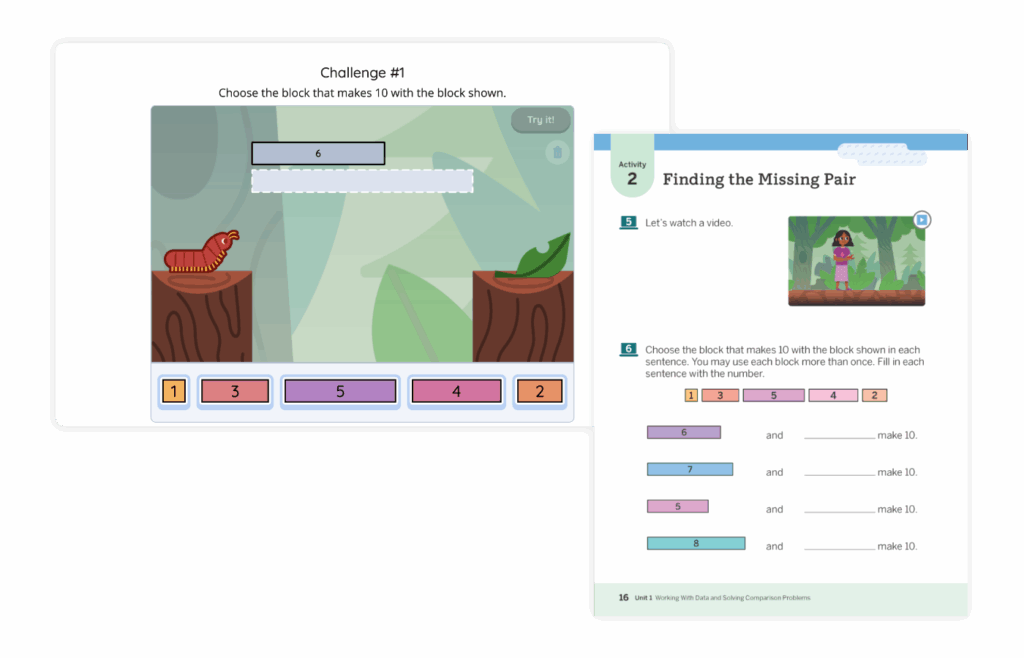
Two people smiling in separate circles; one has a cartoon corgi icon, the other shows math blocks—perfect for celebrating early literacy skills—all set on a cheerful yellow background.

When you think of what goes on behind the scenes of building Amplify Classroom lessons, you probably envision carefully calculated math formulas and complicated equations, right?

Not exactly. Meet Sara Barring and Sean Sweeney from our interaction development team! They create animations and interactions for many of our most popular math lessons, and one day they decided to record some of their work sessions. What began as a simple “Wouldn’t it be fun…” conversation turned into something pretty remarkable: a front row seat to their joyous exploration of math.

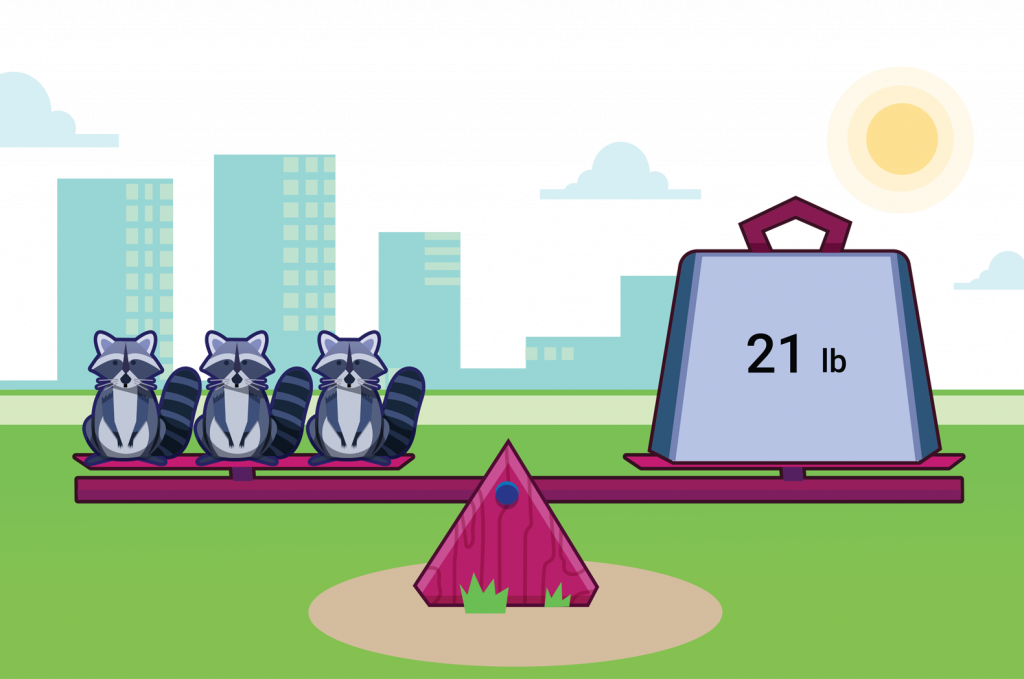
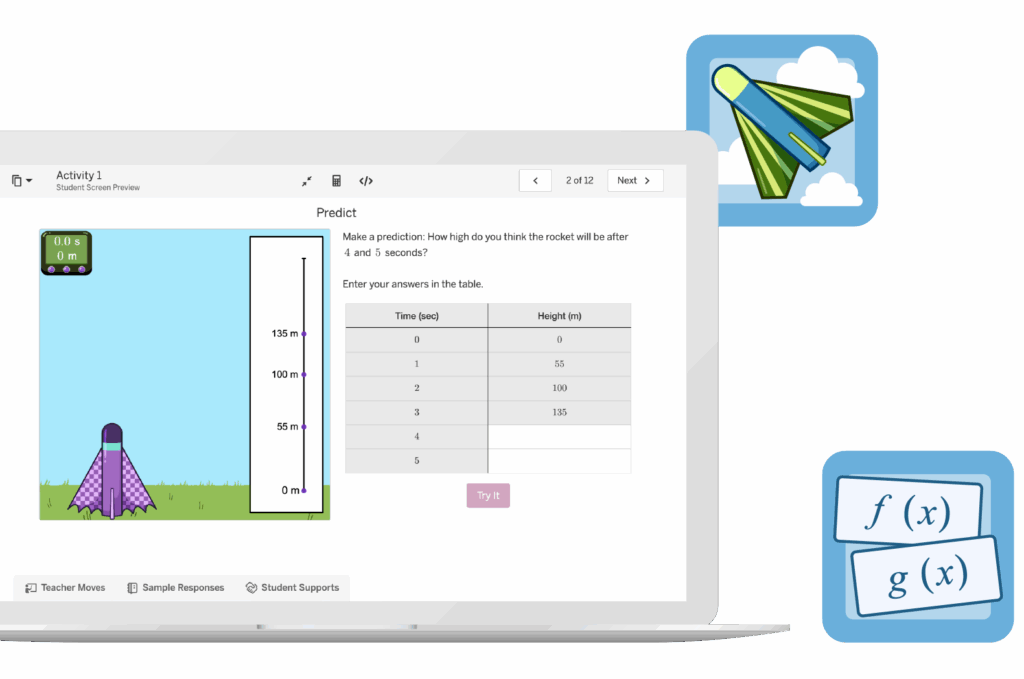
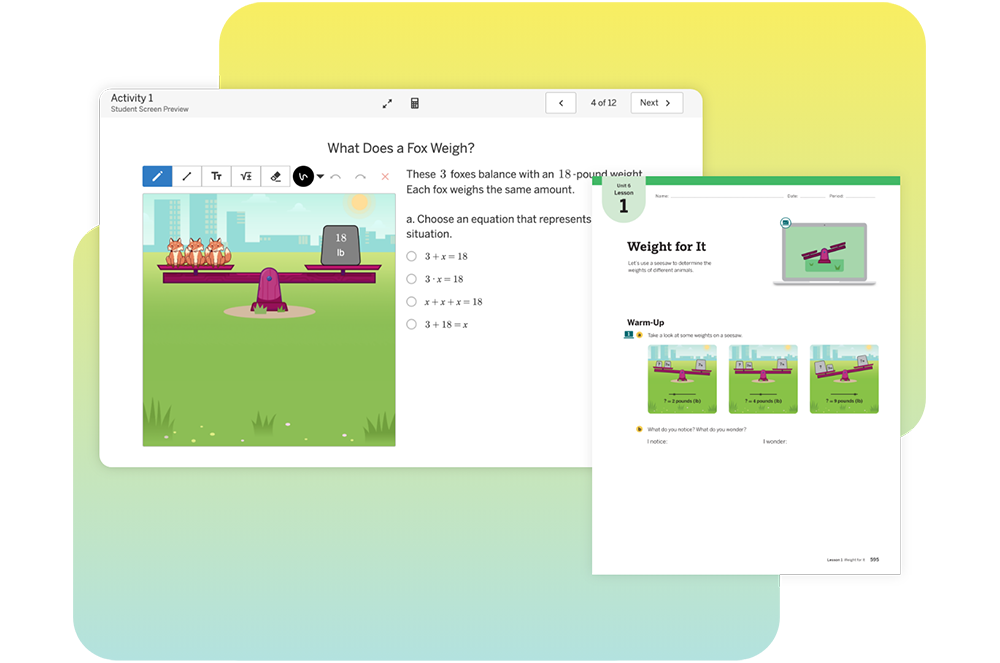
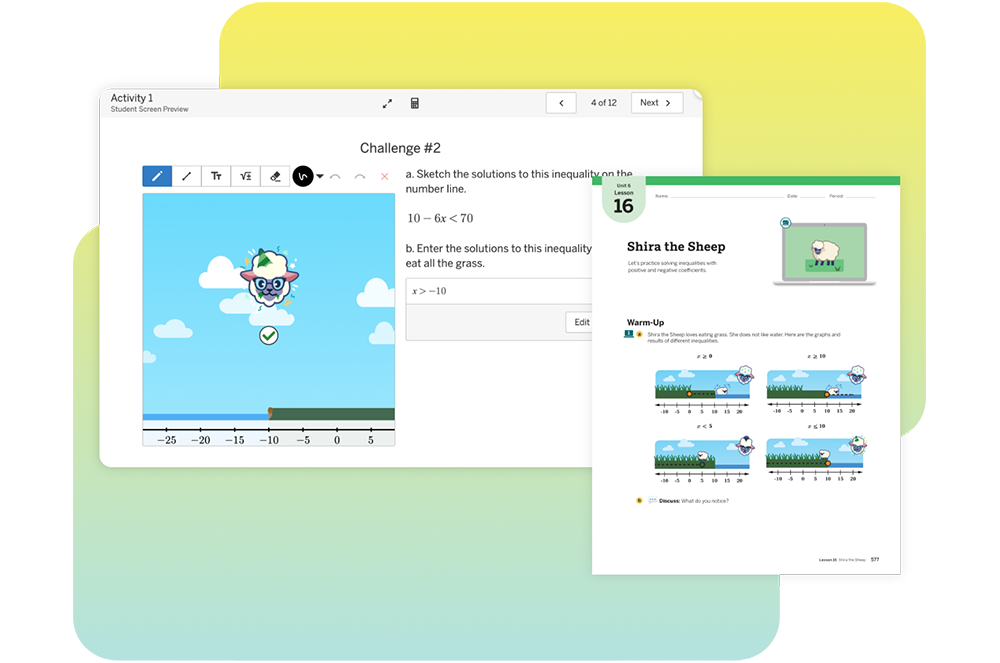
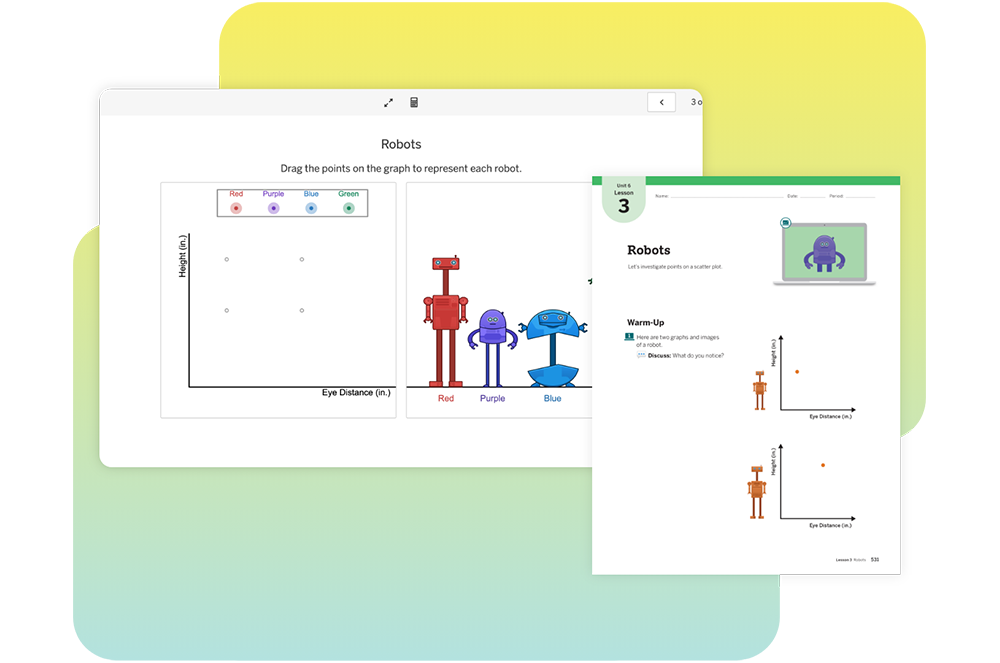
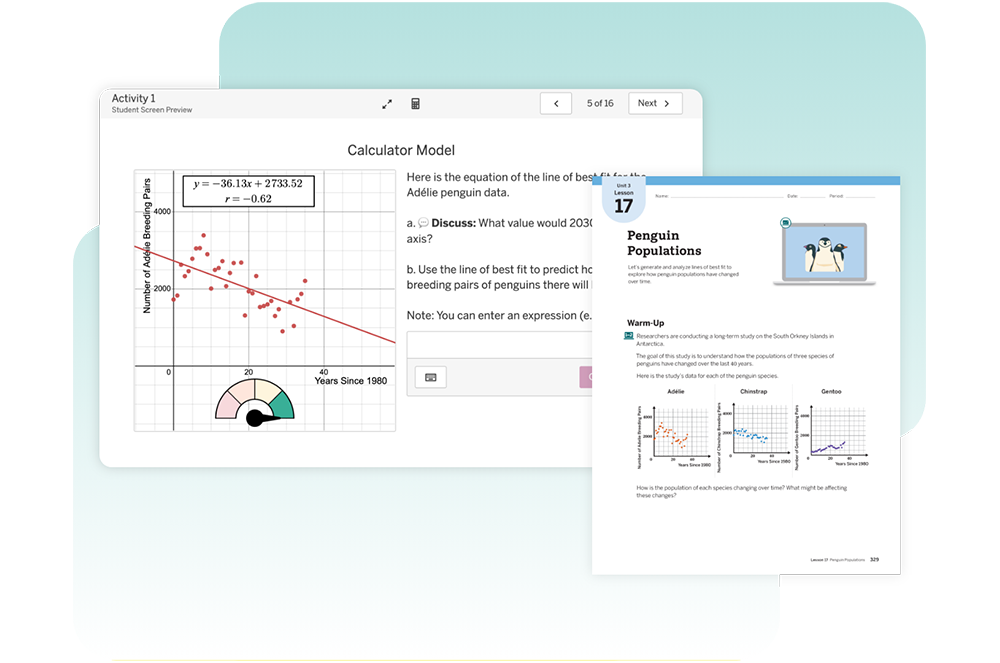
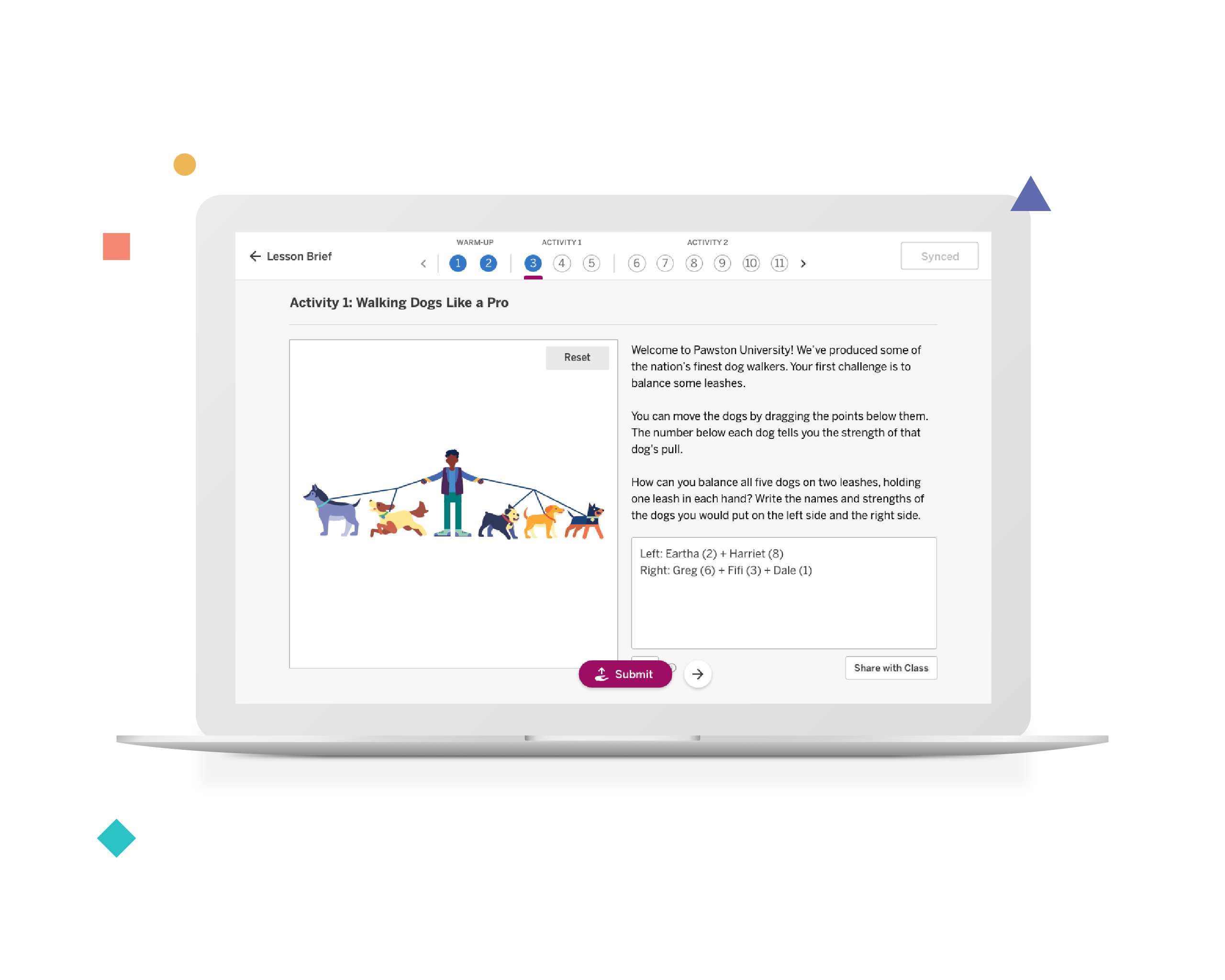
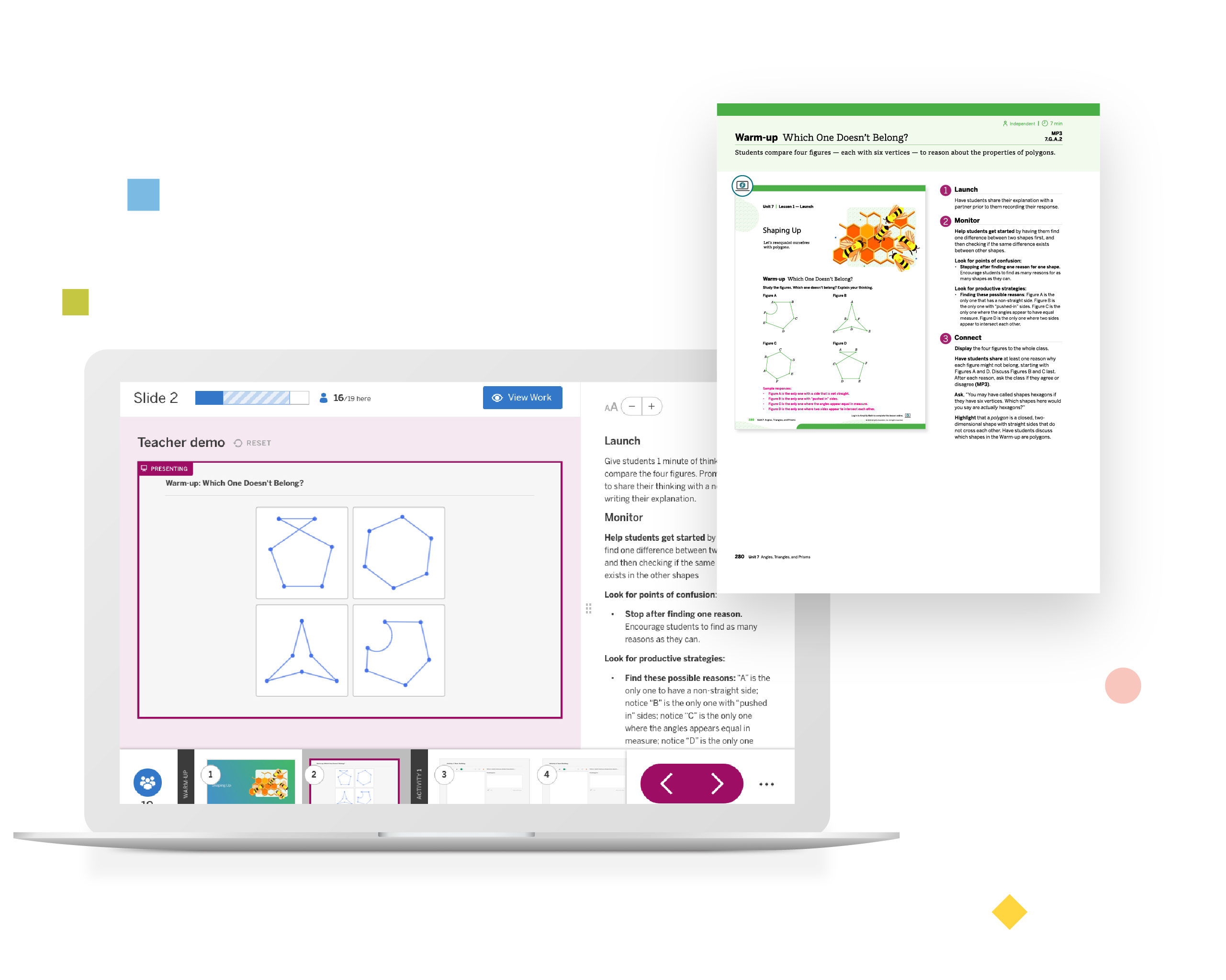
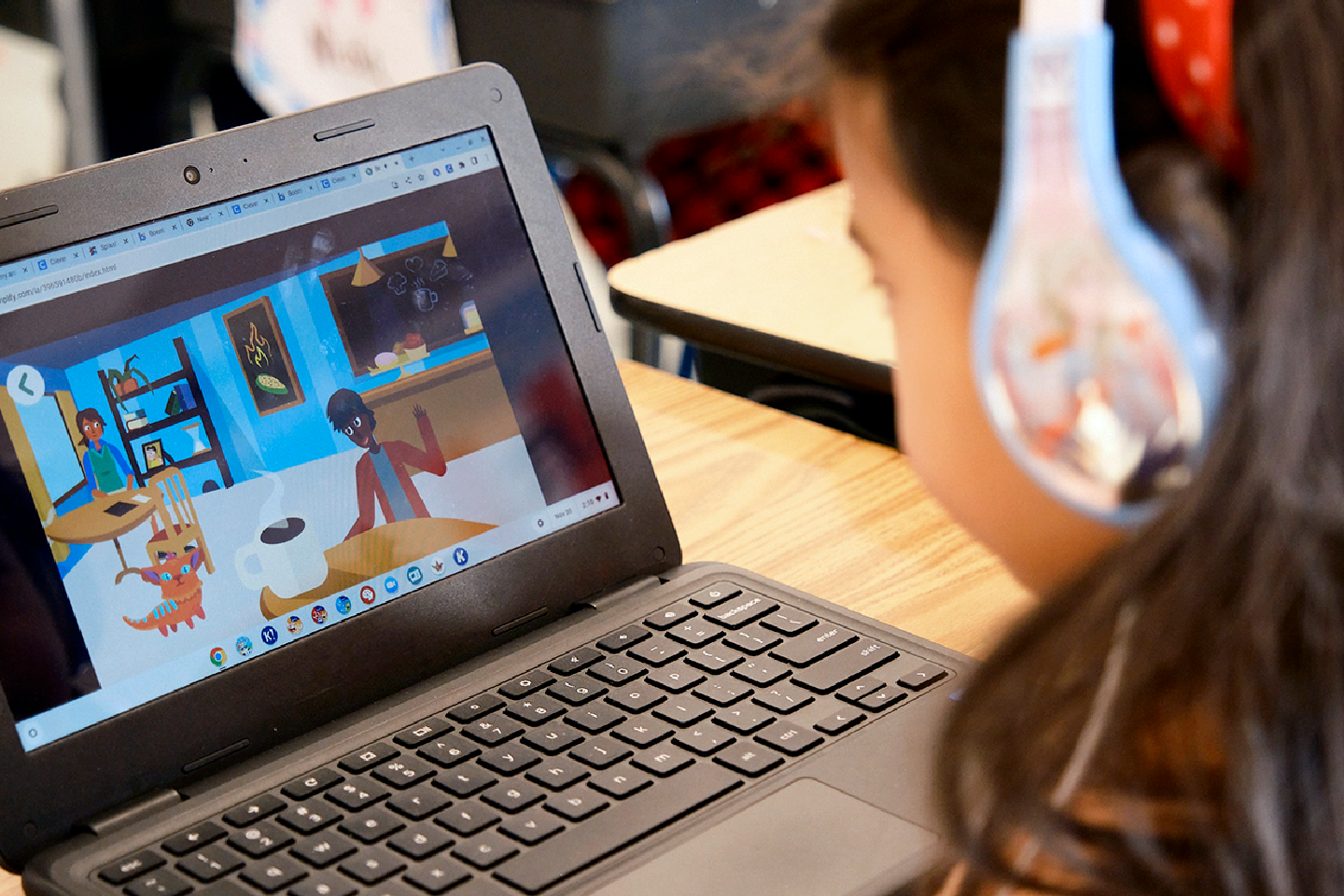
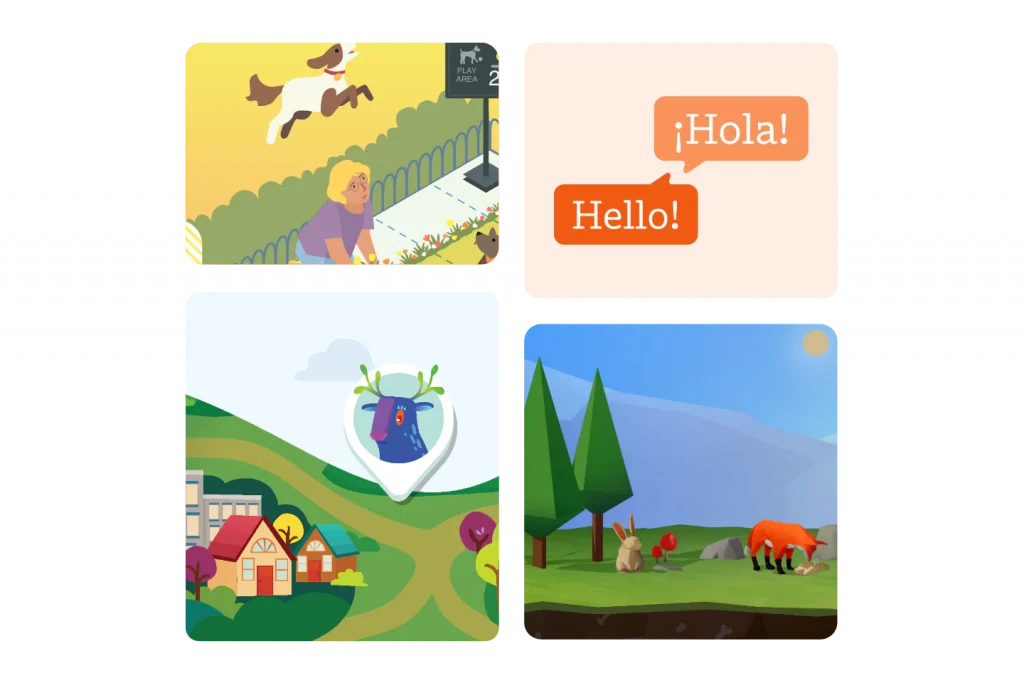
Sean and Sara spend their days bringing math problems to life using Activity Builder, Amplify Classroom’s lesson-building tool. Their goal is to encourage students to explore their own thinking, moving beyond traditional right-and-wrong feedback. Instead of being told “no” when a guess is off, students get visual Responsive Feedback that demonstrates the meaning behind their thinking. In the grade 6 lesson Weight for It, for example, the animation shows them what would happen if the dog actually weighed what they guessed!

Sean and Sara help create a safe, playful space where making a mistake isn’t a failure, but a visual stepping stone that encourages students to try again. This creative process is exactly what they decided to capture on camera. Their video series, “Graph Time With Sara and Sean,” reveals what happens when pure curiosity guides work in graphing mathematics. Each episode opens the window into a genuine, surprising discovery, showing the magic happens when you stop worrying about perfection. Watching these videos, even those who feel intimidated by math or think math isn’t for them may feel inspired to try it themselves.

Redefining mistakes as happy accidents

In any field, the word “mistake” can feel loaded. But for Sara and Sean, the process of creating math animations is less about avoiding mistakes and more about seeing what happens.

A great thing about working in Activity Builder’s graphing calculator, Sara notes, is that you can immediately see how every adjustment affects the animation. This instant visibility helps shift your perspective—an unexpected result isn’t a failure, but a happy accident. According to Sara, these moments provide a pivot point into a new, unplanned direction.

Take one episode of “Graph Time” that wouldn’t exist without a happy accident Sean had while trying to create a firework animation for one of our lessons. That “mistake” led to the discovery of unexpected mathematical patterns that the team may not have found otherwise. These patterns seem to magically emerge from simple sine and cosine functions, revealing flower-like designs, perfect circles, and intricate geometric shapes that feel limitless in their variety, proving that mathematical beauty often reveals itself through curious experimentation rather than careful planning.

Sara and Sean hope to show viewers the reality of their work–with all the struggles, detours, and joy. You might expect someone who creates math animations all day to have their steps carefully mapped out. “We don’t,” Sean says, “and that’s part of what we like about it.”

The ripple effect: Transforming math culture

Sara and Sean’s playful approach to building curriculum content creates waves they hope will extend beyond their own creative joy, inspiring a new generation of math explorers.

For teachers, these videos offer more than just creative techniques—they provide a blueprint for shifting classroom culture. Sean emphasizes that viewers are seeing “the real work they do every day,” providing educators with an authentic model for bringing genuine excitement to mathematical learning. Sara, drawing from her teaching background, recognizes the transformative power of just changing the narrative: “Math gets such a bad rep a lot of the time, so even if Graph Time with Sara and Sean just offers a positive rebrand on some things, I think that’s powerful, too.”

When students see people having fun with math, through teachers or videos like “Graph Time With Sara and Sean,” they begin to see math as an invitation to explore. Sean and Sara are hoping they can help students find their own magic, making math less about intimidation and more about fun.

Check out Sara and Sean’s videos to see their graphing creations in action!

Ready to create your own amazing math adventures? Check out our Lesson Building Toolkit for bite-size tutorials on making your own lesson creations with Amplify Classroom.

This is one of the best things I have ever worked on.

A man in a white shirt is smiling in a circular frame, with illustrations of a person swimming and a submarine on a light blue background, capturing the lively spirit of Amplify Desmos Math and engaging classroom discussions.

Every discussion teaches kids about math—and about themselves.

Among many other reasons, discussions are important because they’re moments when the teacher assigns value to students. In a discussion, the teacher says, “Hey—I have precious little time to teach what I know. Still, I’m going to dedicate some of that time for you to share and talk about what you know.” That’s a moment when students learn about math, but also that their own ideas have value.

Discussions are difficult, and “more wait time” is rarely the reason.

There are a few reasons why discussions frequently fail, and it’s rarely because the teacher didn’t give students enough “wait time” to respond, as is commonly believed.

1. The question was hard to understand or find your way into. For a long time, I’d ask my kids at dinner, “How was your day? What happened?” And my kids wouldn’t have much to say. Lately, I ask them to tell me two things about their day that happened and one thing that didn’t, and we all guess which was which. It’s an easier prompt, one that kids can find their way into with ease and then use as a launching pad into a larger conversation.

2. There isn’t enough to talk about. If your math class consists of a lot of binary, right/wrong questions, what is there for anyone to talk about? “A lot of us got this one wrong. Here’s a pie chart that shows how wrong we were. How about I show you how to do it?” That’s fine, but it isn’t a discussion, and it’s quite often a very dreary classroom environment for children.

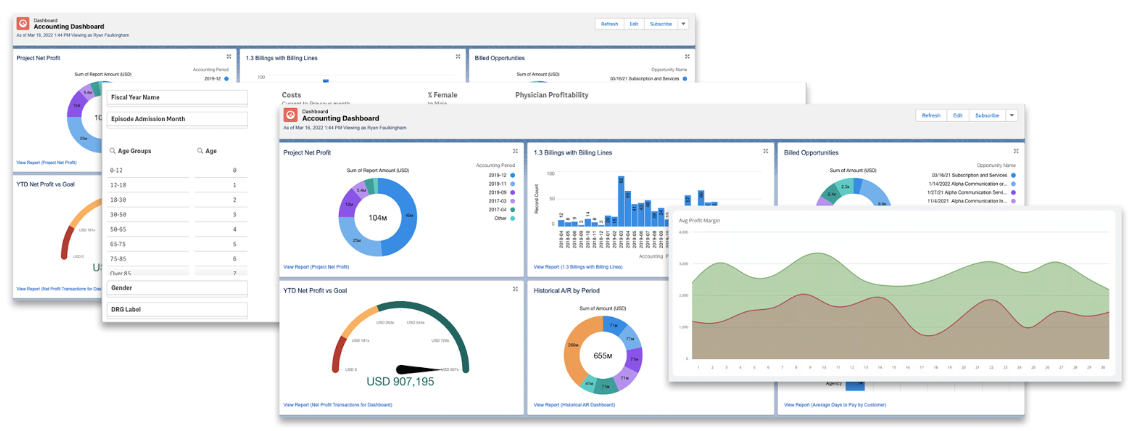
A digital dashboard displays multiple financial charts, graphs, and filters—including pie charts and bar graphs—similar to those used in Amplify Desmos Math for middle school math classroom discussions on project profitability and billing.

In Amplify Desmos Math, a curriculum I work on, kids generally have plenty to talk about. Our interactives stir a kid’s imagination for even the most abstract areas of math. For example, this submarine interactive stirs up a kid’s ideas about adding positive and negative integers.

A yellow submarine with five round windows, each filled with a blue dot—perfect for sparking classroom discussions in middle school math. Red and blue dots sit above and below the windows, plus an anchor and lightbulb icon on the left.

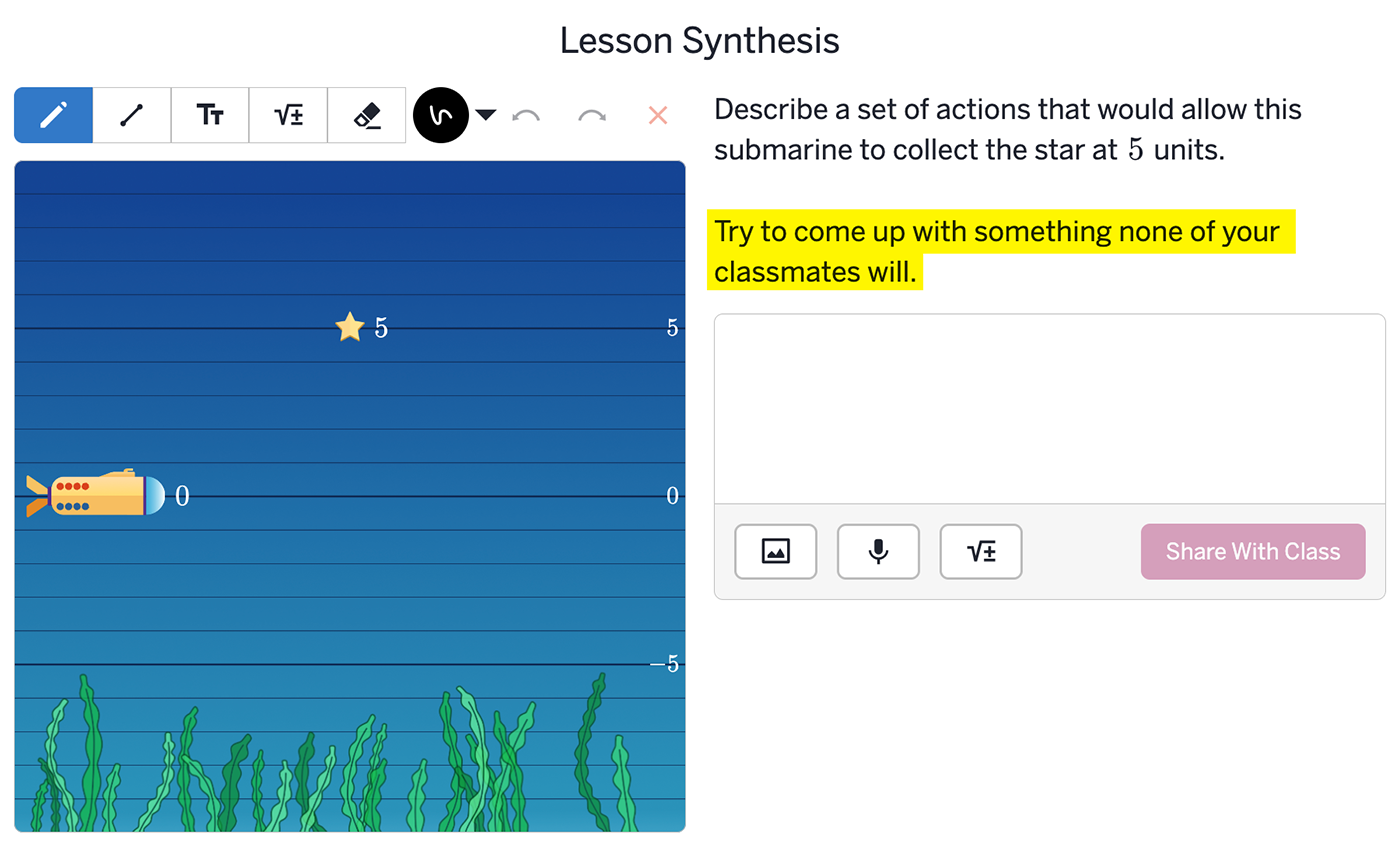
And then we ask kids, “Hey, what do you think about the star at +5? Can you come up with something that none of your classmates do?”

A digital lesson in Amplify Desmos Math shows a submarine at position 0 and a star labeled 5; instructions prompt students to collect the star using unique actions, sparking engaging middle school math classroom discussions.

Let me tell you: Kids accept that challenge.

3. There is too much to talk about.

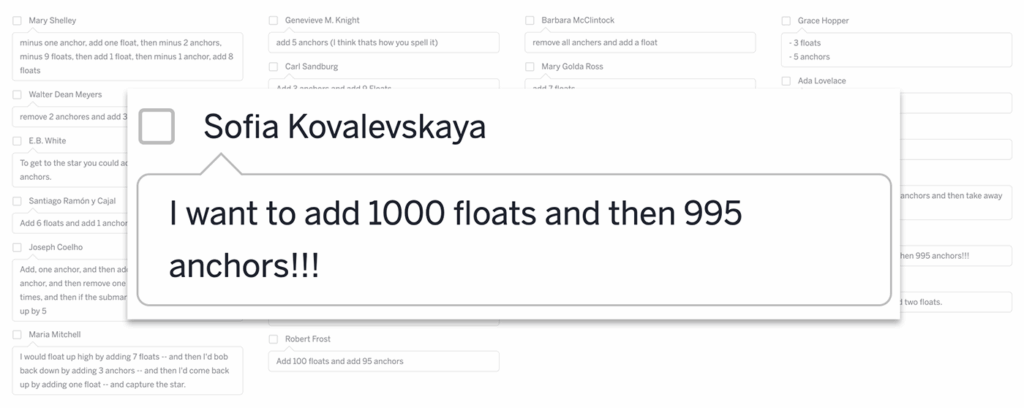
This is a good problem to have, but it’s still a problem. In the class screenshotted below, 25 students have put 300 thoughtful words in front of the teacher, every response different from every other!

A highlighted text box shows Sofia Kovalevskaya saying, "I want to add 1000 floats and then 995 anchors!!!" against a background of faded text—perfect for sparking middle school math classroom discussions with Amplify Desmos Math.

Teachers now have a problem of abundance, not scarcity. They have to decide which responses to select, and why, in an environment of cognitive overload.

This is very hard work for teachers, especially novices, especially teachers who lack mathematical content knowledge, especially teachers who are hanging onto the school year by their fingernails.

We offer teachers lots of different support for discussions throughout our curriculum—both in print and digital activities—but our new discussion support for digital activities is first-of-its-kind and best-in-class.

Discussion Moments.

  1. Student responses stream into the teacher’s dashboard.
  2. A message appears: “Analyzing Student Responses.”
  3. Shortly after, the message changes: “Open Discussion Moment.
A green banner with the text "Analyzing student responses" and two sparkles, next to a gray computer monitor icon—perfect for facilitating Classroom discussions in middle school math with Amplify Desmos Math.

You click the message and see a classroom-ready discussion screen.

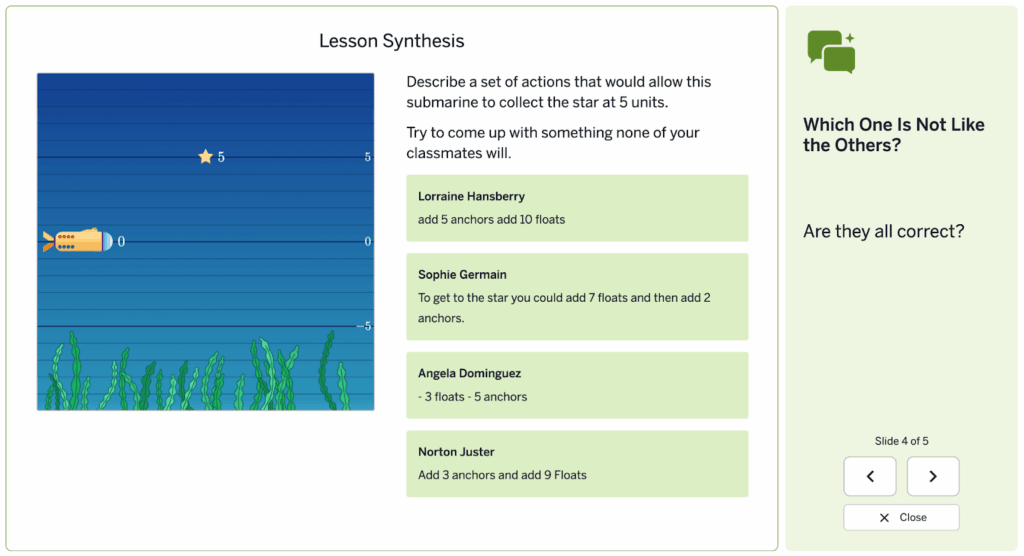
A submarine aims for a star 5 units up; students suggest combinations of floats and anchors to reach it. Amplify Desmos Math sparks engaging classroom discussions as a sidebar asks, "Are they all correct?.

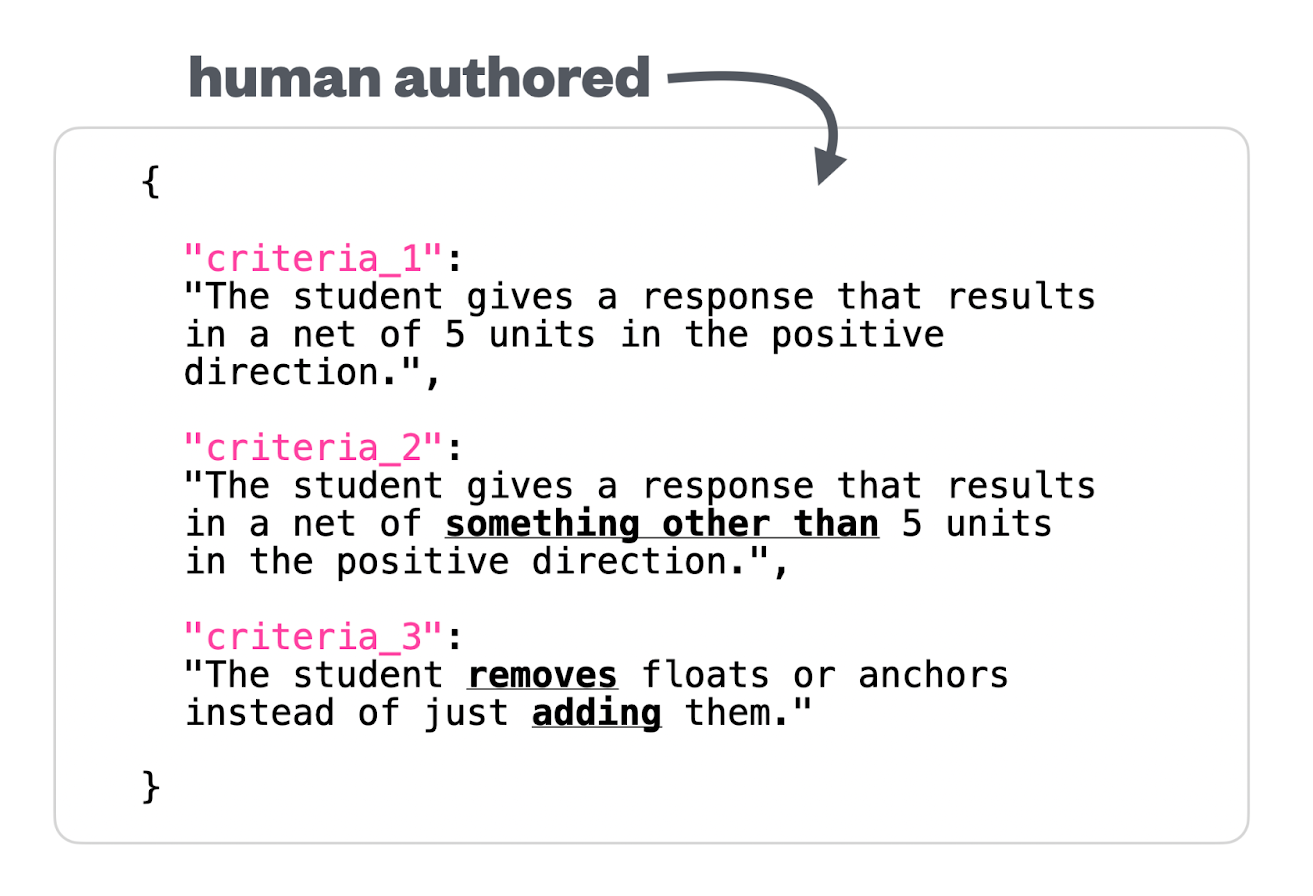
First, you see four student responses, each one authored by a student in the class, each one interesting on its own. This was not luck. Those responses were curated by a large language model at the direction of our curriculum experts. “Find three responses that capture the star in different ways,” our experts prompted the AI. “Responses that add anchors. That remove anchors. Find one response that might not capture the star.”

Next to those responses you see a question: ”Which one is not like the others?” That question feels surprisingly well-matched for this math and for those student responses. This, also, isn’t an accident. Curriculum experts made that decision.

You click the right arrow and see a suggested narration for the Discussion Moment, narration which was authored, again, by our human authors for this particular problem, to help novices learn to facilitate productive discussions in math.

That’s a “Discussion Moment.”

In the past, coaches, experts, and publishers have all asked teachers to . . .

  • Select and sequence student responses.
  • Construct a student-facing discussion resource.
  • Lead the conversation.

Now we are asking teachers to . . .

  • Lead the conversation.

In our experience, computers do quite well with the first two jobs while teachers obliterate computers at the work of leading a conversation, at connecting student ideas, at asking one kid what they think of another kid’s idea, at pulling ideas out of a kid who maybe doesn’t think they have ideas to offer. Discussion Moments delegate to humans and computers the best work for each of them.

Discussion Moments are different.

Lots of edtech companies are putting AI to work in lots of different ways. Discussion Moments are unique.

First, they’re designed to work through rather than around the teacher, during class rather than outside of class. They’re designed to support social interactions between students and teachers in the moment of instruction. This is the action.

Second, this is a classroom-ready resource. So many AI applications just output a ChatGPT-style resource. Lots of text. Several main bullets. Lots of sub-bullets. An emoji or two. And I am very sorry, but they are not useful in class. The teacher has to read all of that text, copy and paste and edit it, and then construct the student-facing resource all in the middle of class. That’s fantasyland, folks. At Amplify, we have, instead, created a one-click, classroom-ready resource.

Third, we’ve fortified these digital Discussion Moments with gallons of human expertise. Since December, I’ve worked with several of our curriculum experts—Casey Nelson, Brian Kam, and Tom Snarsky—and for every problem across several units of middle school math, they:

  • Reviewed thousands of student responses to each problem.
  • Identified thematic trends in the student responses.
  • Decided whether or not those themes demand a discussion.
  • Decided which of several discussion frames would be most appropriate, given those themes.
  • Wrote an AI prompt specific to each problem to increase the odds that the large language model will curate useful student responses.
Screenshot of code-like text outlining three criteria for student responses, with bolded and underlined terms, labeled "human authored" at the top—ideal for guiding classroom discussions in middle school math or Amplify Desmos Math activities.

Most edtech companies would prefer to let AI lead this process from end to end, using the same prompt for every problem, even at the cost of the teacher and student experience. Meanwhile, we only ask AI to execute instructions and construct a resource. The nature of those instructions, the type of resource, and how it’s used—that is all determined by different humans and their expertise.

What do teachers and administrators think?

I ran a small-scale pilot of this feature last spring and kicked off a larger-scale pilot last week. A couple hundred teachers overall. I have never had an easier time recruiting teachers for a project than with this one. Every district math curriculum lead knows how challenging it is for teachers to lead discussions, and every one I asked was eager to support.

Two other examples of Discussion Moments.

Compare and Connect. We asked a large language model to locate responses that have one of a couple of important features but ideally not both. Then we constructed a Discussion Moment asking students to write a response that combines the best of both answers.

A scatter plot titled “Radius vs. Area” from Amplify Desmos Math prompts classroom discussions about proportional relationships, as middle school math students compare line types and notice the points do not form a straight line.

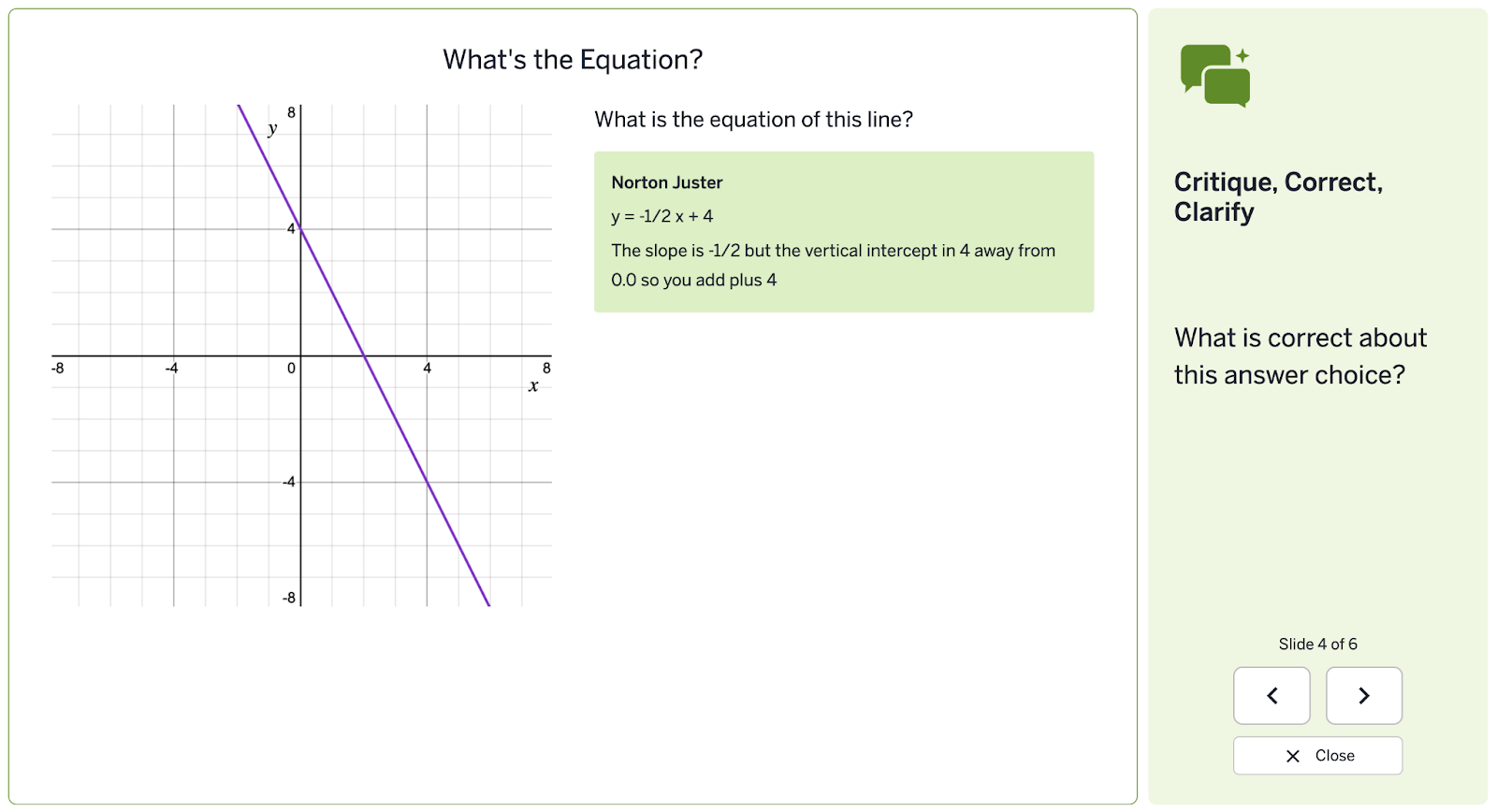
Critique, Correct, Clarify. Our curriculum authors noticed a frequent incorrect answer to a question. We told the LLM to watch out for it and frame it in a Discussion Moment where the class is asked to find value in the wrong answer before correcting it. Try to imagine what it does to a kid to hear their incorrect answer described as valuable.

A graph displays a purple straight line with negative slope crossing the y-axis at 4 and the x-axis at 8; text explains the equation y = -1/2x + 4, perfect for middle school math or engaging Amplify Desmos Math classroom discussions.

Wait—don’t you hate AI?

I get why you might ask me that, but no. I think generative AI is perhaps the most overrated education technology of my lifetime; I don’t think the chatbot tutors or lessonslop generators are going to transform K–12 education. But I do think generative AI is neat. And look, I have tried to support discussion work with K–12 teachers for the last ten years in other ways, too. I have run in-person and remote PD. I have written math lessons and teacher supports for those lessons. I have sent nifty little customized email sequences tailored to teacher usage. None of those supports have been as promising as AI is here. None of them has moved the needle like Discussion Moments because none of them has been able to meet teachers in their moment of need, at the point of use.

That’s it. You can find Discussion Moments in Amplify Desmos Math next school year.

Other publishers say they have “Desmos.” What’s the difference between what Amplify has and what they have?

Logo with the word "Amplify" in orange font and "desmos" in gray font, separated by a vertical line on a light background, perfect for teacher awards or to nominate a teacher for an award in early literacy.

If you’ve been in the math world for a while, you know the name Desmos. It’s synonymous with free dynamic math tools.

And lately, you’ve probably also been hearing about Amplify and Desmos together. But other publishers also say they have Desmos, so what’s the deal?

Let’s clear it up.

The most important thing to know is that, back in 2022, the original Desmos split into two separate parts. Think of them like a calculators and other tools part and a classroom activities and curriculum part.

The tools part: Desmos Studio

This is the Desmos you first fell in love with.

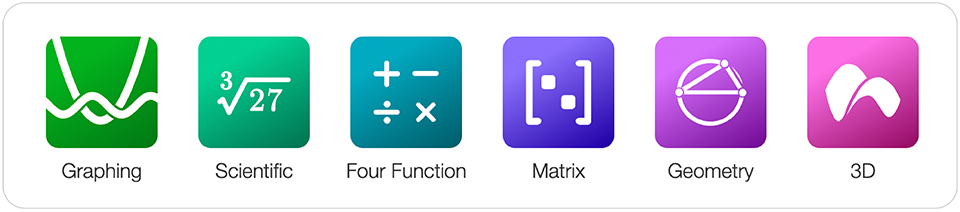
What it is: Desmos Studio is the name of the company that builds and maintains the powerful, free Desmos calculators. This is an independent Public Benefit Corporation, and can be found at www.desmos.com. That team builds and maintains a collection of free math tools:

Six colorful icons represent types of calculators—Graphing, Scientific, Four Function, Matrix, Geometry, and 3D—each featuring a distinct mathematical symbol. Perfect for desmos math enthusiasts and edtech companies alike.

What it’s for: This is your go-to for exploration, demonstrations, and “What if I change this?” moments. It’s the blank canvas you use on your smartboard or the tool your students use for homework.

The bottom line: The calculators are run by an independent company called Desmos Studio PBC. You can find their tools for free at their website, desmos.com; on state tests; and in curriculum programs (including ours).

A Desmos graphing calculator displays the quadratic function y = 2x^2 - 3, showing a parabola opening upwards with its vertex at (0, -3)—a great example of how edtech companies like Desmos Math enhance classroom learning.

The lessons: Amplify Classroom & Amplify Desmos Math

What it is: In 2023, Amplify acquired the Desmos instructional platform (then called Desmos Classroom, now called Amplify Classroom) as well as their math curriculum for grades 6–8 and the teams that built those resources. We had already been working on our own math curriculum, decided to combine forces with the Desmos curriculum team, and created Amplify Desmos Math, now available for grades K–12.

When other publishers may talk about having “Desmos,” what they mean is they license the calculators and Geometry tool from Desmos Studio.

What it’s for: Amplify has these tools, too, but we also have the Activity Builder, which integrates these tools much more deeply than is possible with other Desmos Studio partnerships. We take this powerful Desmos technology and layer instruction, student collaboration, and dynamic teaching tools on top, creating classrooms that buzz with excitement and learning.

What’s available for free:

  • The “Desmos activities” platform (you might know it from teacher.desmos.com), now Amplify Classroom. This is where you can find hundreds of free lessons and activities. You can also use the Activity Builder tool to create your own custom activities from scratch.
  • The beloved, pre-built “Activity Builder” activities like “Marbleslides” and more are still available for free on Amplify Classroom.

The bottom line: Educators can still use the vast library of free activities and build their own on Amplify Classroom. This is not changing.

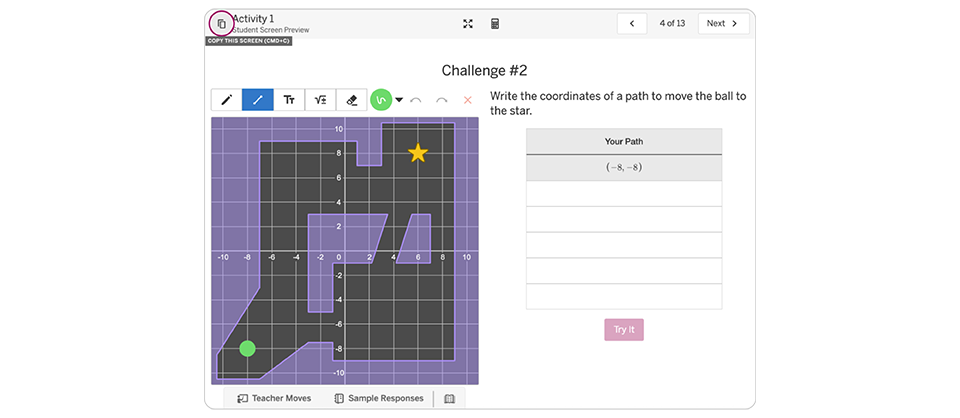
A grid-based puzzle inspired by Desmos Math, where you guide a green ball to a yellow star by entering coordinates in the answer box, offers an engaging approach popular among edtech companies.

The core curriculum: Amplify Desmos Math

This is the new, comprehensive curriculum available to districts and schools.

What it is: This is a full core math curriculum for grades K–12 that Amplify has built in collaboration with the Desmos curriculum team that joined us a few years ago. It uses the Desmos instructional philosophy and tools as its backbone, but it’s much more than a collection of activities.

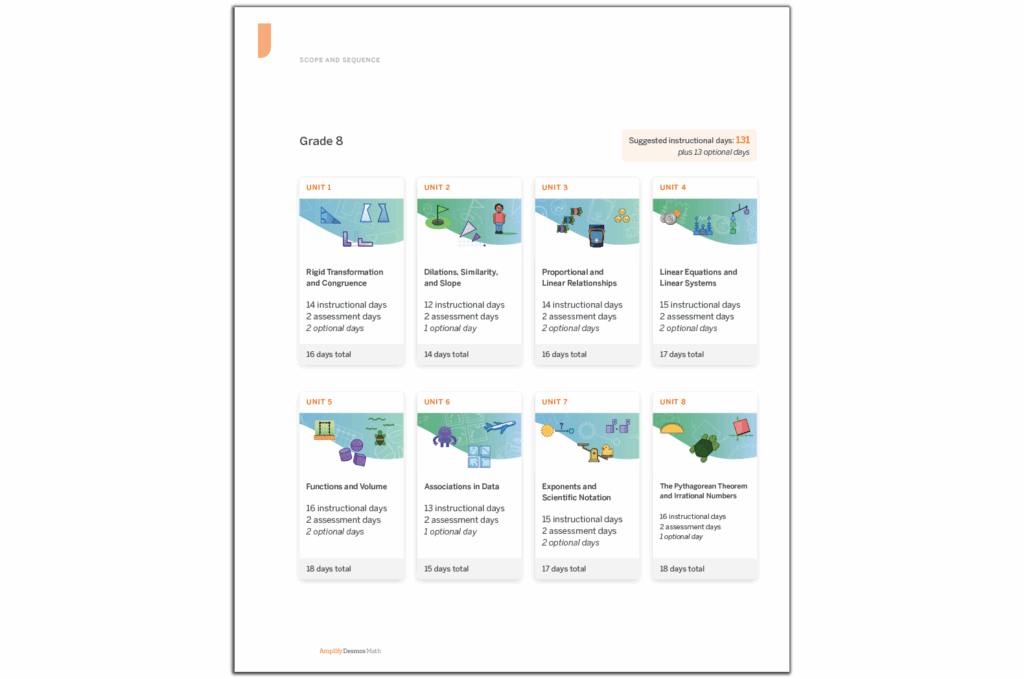
What it’s for: This program is designed to be your primary, day-to-day curriculum. It includes a complete, standards-aligned scope and sequence, print materials, digital lessons (with activities enhanced and aligned to standards), assessments, intervention resources, and personalized practice.

The bottom line: If you want a complete curriculum in which every lesson is built on polished Desmos-style activities, you want Amplify Desmos Math K–12. This core curriculum is offered exclusively by Amplify.

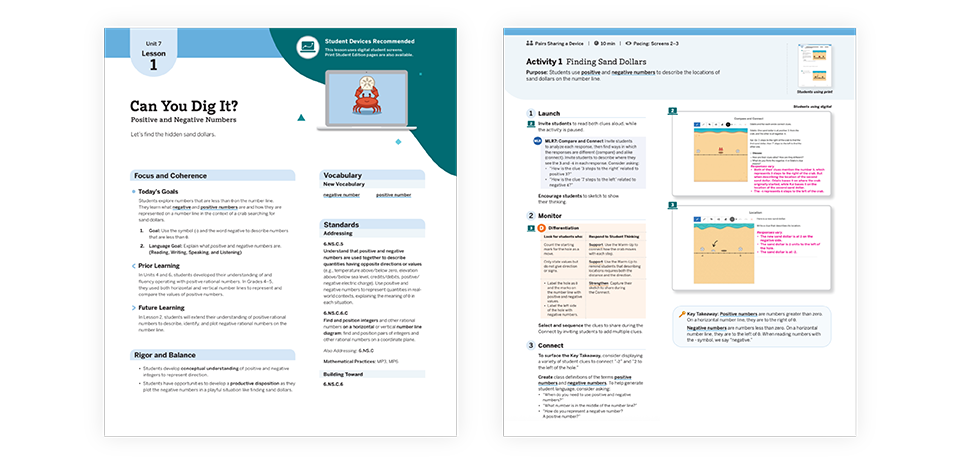
Two-page educational lesson plan titled "Can You Dig It?" covering positive and negative numbers, with objectives, vocabulary, standards, and a step-by-step activity inspired by the Desmos math curriculum.

Quick-reference chart

What is it?Where to find it?Cost
Desmos Studio ToolsPowerful math tools and calculators (graphing, scientific, etc.) for graphing, calculations, and geometry visualizations.
Access via desmos.com or embedded in partner productsFree
for individual use
Amplify ClassroomA teaching and learning platform that couples Desmos Studio tools with instruction and collaboration tools

– Rich activities and lessons that develop understanding with Responsive Feedback

– Collaboration and facilitation tools designed for the classroom

– Student ideas used to build new problems and scenarios

Browse free activities and lessons or build your own with Activity Builder.
Only available from Amplify at amplify.com/classroom
(previously Desmos Classroom)
Free
Amplify Desmos MathA comprehensive K–12 math curriculum built on the Amplify Classroom platform

– Ready-to-teach print and digital curriculum built on the Amplify Classroom platform

– Comprehensive coverage of all standards without the searching.

– Additional support for your classroom, including assessment, differentiation, practice, professional development, and more.
Try lessons for free on Amplify Classroom

Contact us for more information on purchasing for your district
With a paid subscription

Become an Amplify Classroom Fellow!

Are you an Amplify Classroom (formerly Desmos Classroom) superfan or a math educator who loves using technology to make learning come alive? If so, consider applying to join the next Amplify Classroom Fellows cohort, a passionate community of math educators who inspire one another and help shape the future of Amplify’s products!

If you have any questions, reach out to amplifyclassroomfellows@amplify.com.

Amplify Classroom Fellows" text with abstract shapes in pastel colors in the background, perfect for inspiring mathematics teachers and energizing any math classroom.

What is the Amplify Classroom Fellowship?

A group of fifteen mathematics teachers standing indoors, smiling and holding up their hands in a "W" shape, wearing conference badges.

The Amplify Classroom Fellowship is a professional learning community of K–12 math educators who:

  • Use Amplify Classroom to empower students’ mathematical thinking.
  • Share insights, strategies, and inspiration with peers.
  • Care deeply about making math learning accessible and engaging for all students.

As an Amplify Classroom Fellow, you’ll receive:

  • Invitations to unique professional development experiences, both online and in person.
  • Opportunities to connect with the Amplify Classroom Fellows community of peers and Amplify teams.
  • Early access to learn about new features before other educators.
Four people, including mathematics teachers, stand in a group having a discussion at an indoor event; two wear lanyards, one gestures with hands while others listen.
Four mathematics teachers sit around a round table working on laptops, with coffee cups nearby, collaborating in an Amplify Classroom workshop setting.

We ask participants to:

  • Share experiences through presentations, publications, and educator events during the school year.
  • Connect and collaborate with like-minded educators and Amplify teams.
  • Attend an in-person New Fellows Orientation event in mid-July 2026.

Interested in becoming an Amplify Classroom Fellow?

Applications for Cohort 9 will open next winter.
If you have any questions, reach out to amplifyclassroomfellows@amplify.com.

S5-01. Investigating math anxiety in the classroom

A blue graphic with text reading "Math Teacher Lounge" in multicolored letters and "Amplify." at the bottom, with abstract geometric shapes and lines as decoration.

Season 5 is here! This season, we’ll be talking all about math anxiety: what it is, what causes it, and what we can do to prevent or ease this anxiety in the math classroom. To launch this very important theme, we sat down with Dr. Gerardo Ramirez, associate professor of educational psychology at Ball State University.
 
As someone who’s been studying math anxiety for more than a decade, he had some interesting research and advice to share on why math anxiety affects so many students (and adults), and tips for how to start reducing it.
 
Listen now and don’t forget to grab your MTL study guide to track your learning and make the most of this episode!
 
Enjoy this episode and explore more from Math Teacher Lounge by visiting our main page.

Download Transcript

Dan Meyer (00:01):
Hey, folks. Welcome back to Math Teacher Lounge. I’m one of your hosts, Dan Meyer.

Bethany Lockhart Johnson (00:05):
And I am your other host. I’m Bethany Lockhart Johnson. Season five! Hello!

Dan Meyer (00:11):
Bethany, how are you doing? How have you been spending the long break between our recording sessions?

Bethany Lockhart Johnson (00:16):
As much as I loved sharing content from previous seasons, I am so thrilled that we’re back for season five. I have been, you know, chasing a toddler. I think he’s already tired of me saying, “Ooh, can we count that?” He’s like [sighs] “One two, one two.” Like, he’s done already.

Dan Meyer (00:36):
Too much counting. Yeah, I worry about that so much, that my love of mathematics might be perceived by my kids as smothering. Yeah, I worry about the same. We shared with you folks some bangers of reruns, in my humble opinion. Some great guests. But, we’ve been excited—me and Bethany—to hop back on the mics, on the ones and twos, and explore some new ideas together.

Bethany Lockhart Johnson (01:01):
Well, I loved our season talking about joy in mathematics. And personally I could…like, we could turn this whole podcast into joy in mathematics. However, we’re kind of going a different route. Because if you ask folks why they don’t feel joy in mathematics, a lot of times at the root of that is some really intense math anxiety. So this whole season, we’re going to be delving into math anxiety. Exploring what it is, who has it, why do we think it happens, what do we think we can do about it, and how can we navigate through it, so that we can experience that joy in math? These are questions that we’re gonna explore over the course of the season. Dan Meyer, how do you feel about that?

Dan Meyer (01:49):
It feels big and it feels personal. I mean, as we shared in our math stories back from season…whatever it was, math anxiety was a huge part.

Bethany Lockhart Johnson (01:59):
It was last season, Dan.

Dan Meyer (02:00):
Last…? I mean, who can remember? Big part of your journey. I’ve had some very punctuated but intense moments of anxiety in math class. And socially, we have built math up to be this incredibly powerful thing. You know, restricting movement on economic ladders, preventing people from getting into careers they want. Whether or not they have much to do with math class, math anxiety is a really large part of educational but also social life. And yeah, I’m really excited to explore it with you. We’re bringing on some really excellent guests. Some researchers, yes. But not just researchers! Also people who practice in the field and know firsthand what it looks like to resolve issues of anxiety with students.

Bethany Lockhart Johnson (02:45):
Yeah, you’re right, Dan. My math story contained quite a bit of math anxiety, so I am particularly invested in this season. I mean, I still navigate math anxiety. And, you know, many of us do, and let’s talk about it. And let’s—I love that you reminded me. We’re gonna have a lot of great researchers all throughout the season, and a lot of times folks feel like the research happening, there’s sometimes a gap between researchers and what’s actually happening in the classroom. Not in all cases, but a lot of times. Right? And I remember a lot of conversation about the latest research when I was in grad school, but unless you’re actively studying something, sometimes we don’t know what’s happening. Right? We’re really focused on what’s happening right in front of us in our classroom. So let’s take some of that research; let’s break it down; let’s talk to some of the folks who are thinking about this for the bulk of their day, right?

Dan Meyer (03:41):
Yep. So we got our first guest coming up in a moment here.

Bethany Lockhart Johnson (03:45):
So to kick off this season, we’re starting episode one by talking to Dr. Gerardo Ramirez, Associate Professor of Educational Psychology at Ball State University. And he’s been researching math anxiety for more than a decade. He’s worked with so many amazing folks in the field. He’s worked with students, he’s worked with teachers, with educators…I’m just so excited to talk to him. If you look up math anxiety, you see his name as one of the folks who is really thinking about this at so many different angles, and we get to talk to him. So enjoy our conversation with Dr. Gerardo Ramirez.

Dan Meyer (04:29):
We are so excited to have Dr. Gerardo Ramirez on the show with us. Dr. Ramirez is an Associate Professor of Educational Psychology at Ball State University. Thanks so much for joining us.

Dr. Gerardo Ramirez (04:40):
Yeah, thank you for inviting me to talk about math anxiety.

Bethany Lockhart Johnson (04:43):
So with your interview, Dr. Ramirez, we are actually launching the season. We’re gonna be talking about all different aspects of math anxiety, and it feels pretty perfect that you are first guest of the season, because of the sheer breadth of research and conversations you’ve had about math anxiety. Could you start us off kind of telling us a story of how did you get interested in studying math anxiety? Or why, you know, why did you dive into this topic that, you know, I think a lot of folks might…like, if you’re on a plane, and you say, “Oh, I study math anxiety,” what kind of reaction are you gonna get?

Dr. Gerardo Ramirez (05:24):
Oh, sure. Yeah. I think most people are actually very interested because they all have their own story about feeling anxious about math, or just being anxious about evaluation situations that involve math. And, yeah, they wanna share those stories. People feel quite comfortable talking about their anxiety about math, for some reason. But for me, I started off, when I was in undergrad, I was studying to take the GRE quiz. I was hoping to go into a psych program. But I wasn’t exactly sure what direction yet. As I took some of the practice tests, there’s some situations in which I was very nervous about taking the practice test. And I just noticed that I did really poorly on some of these exams. And so I became very interested in issues like choking under pressure, which means when you underperform relative to what you expected to perform. And so, as I was researching these issues, I started to come across this whole field of math anxiety. And I saw that while there are some people who choke under pressure during tests, there are other people who just have a strong general fear of mathematics.

Dan Meyer (06:29):
That’s really helpful. I can imagine you’re doing a lot of free psychology sessions, free therapy for people on airplanes when they bring to you their own stories of math. So let’s thank you for your service in that sense. I’m super-curious. So Bethany and I have both taught math. We both have seen firsthand what it looks like when a student is anxious in math class, though maybe we don’t have kind of the clinical language to describe it. And I’m curious, from a clinical sense, how do we define math anxiety?

Dr. Gerardo Ramirez (06:57):
Sure. So first off, math anxiety is not something that you would find in the DSM, for instance. But we generally define that as a fear or apprehension to situations that involve math. So it doesn’t have to necessarily be educational situations. It could be someone asks you a math-related question during a party, or you have to calculate the tip at a restaurant, for instance. It doesn’t have to be about schooling situations, although that’s obviously where it seems to matter a lot for many people. So it is basically a fear or apprehension to situations that involve math. And I think distinguishing the term “fear” from “anxiety” is really important here. A lot of times people use those terms interchangeably, and the term “fear” is obviously within our definition of math anxiety. But oftentimes what differentiates anxiety from fear is that, anxiety is—think of it like a recipe. Anxiety is fear plus a little bit of unknown. OK? So if, for instance, if you hated snakes, and they threw a snake at you, you’d be in intense fear. Whereas if you hated snakes and they said, “There is a snake in the room, but I’m not gonna tell you where,” that’s gonna cause anxiety. And so the reason why we call it math anxiety is because a lot of times people experience this fear for a possible unknown future that involves math or possible unknown evaluations that people might have about your competence, because of math. And so for a lot of kids, they feel anxious about how they’re gonna do on a test or whether they’re gonna be able to pass a class or whether they’ll be able to understand what you’re saying in your lessons, for instance. And so the anxiety component really gets at fear of something that’s unknown, but related to mathematics situations.

Dan Meyer (08:47):
Math is somewhere in the ceiling right now. Perhaps I might be surprised with a math situation!

Dr. Gerardo Ramirez (08:52):
Yeah. yep.

Dan Meyer (08:52):
So I have this tendency to assume that every other subject that we teach has it better and easier than math does. It’s not true. I know this is not true. But I’m kind of curious here. Is math anxiety, like, part of a general just set of anxiety around schooling itself? Like, is there a reading anxiety, a writing anxiety, and does that all just flow from the same kind of fount of anxiety around schooling or situations about learning? And what makes math special in this regard? If it is its own special anxiety, for instance?

Dr. Gerardo Ramirez (09:27):
There are different…so some people obviously suffer from generalized anxiety. Right? And so they would, you know, feel anxious both for evaluative and non-evaluative situations. But in the research that we’ve done and that other people have done, there are differences between things like reading anxiety, math anxiety; I’ve also studied spatial and creativity anxiety. A lot of times what we’re trying to do in these studies is we measure all of the above, and we try to show that, look, math anxiety predicts math situations above and beyond these other things. So yeah, we definitely distinguish those things. And so what’s special about math is that, well, I think the symbolic nature is a big part of it. The abstract symbolic nature is just not as tangible to students. They can’t touch it. And so it doesn’t allow ’em to use their full cognitive faculties to play with it, as you might see, for instance, in science. Or it doesn’t allow people to relate math to their own interests the way you might see, for instance, in English. So maybe I hate reading novels, but I’m interested in zombies and you give me a book on zombies, well, ok, great, you’ve connected my personal assets to the topic. Whereas with math, either that’s harder to do or instructors don’t do such a good job of setting that connection up.

Bethany Lockhart Johnson (10:46):
Also, I think, you know, I’ve heard of students being really anxious, let’s say, during a reading session, when teachers used to do—hopefully they’re still not doing it—the popcorn reading, where you just randomly call on a student to read out a sentence. Right? But you don’t really hear students or adults talking about, “Oh, no, no, no, I don’t read; I don’t mess with reading.” You know? Whereas with math, you do hear, “Oh, I’m not a math person. Oh no, no, no, don’t ask me any math questions.” And that is such a distinction.

Dr. Gerardo Ramirez (11:18):
Yeah. And I think a lot of that’s because it’s just so common. As an adult, to be nervous about reading is kind of an uncommon thing. So people feel a stigma around admitting that. But math is something that everyone feels like they’re inadequate in. And so there’s a lot of comfort in telling you how they’re just one of the many people who don’t like math. And that, you know, can have a lot of different consequences and outcomes. I think on the one hand, I think for a lot of kids it becomes a normalized message that if you fear math, that’s OK, join the club. Right? But we have to be careful about that, ’cause a lot of math anxiety researchers will oftentimes say, part of what leads to math anxiety is adults normalizing that it’s OK to be scared of math. So I think a lot of times adults, teachers, for instance, math teachers, they’ll tell kids, “You know, if you’re scared, that’s OK.” And so a lot of the math anxiety community says, “No, no, no, you’re not supposed to do that.” But my recent view is different. I view that as a form of validation. Because math is hard. And so telling kids, “Hey, look, it’s actually easy if you just try,” I don’t think that’s true. It’s actually just hard. And I think even if it was easy, to the kid, it feels hard! And I think something that’s not really well-studied right now in our field is the value of validating people’s math negative math experiences. We don’t want to validate that, ’cause we think that we’re gonna reinforce that. But actually, I think the opposite. I think when you validate people’s negative math experiences, it helps ’em to feel that they can handle it. They can start to take control over their own emotions.

Bethany Lockhart Johnson (12:52):
I love that. And I, I actually, I think that’s so powerful, what you’re talking about, that validation. I taught kindergarten, and I vividly remember being in a parent-teacher conference and that parent saying, “Oh, I wasn’t a math person either,” right? Or, you know, their language and their experience with their own math schooling, their anxiety about math was actually impacting their students’ experience of math. Or the conversation that, when I would go to talk about a math assessment, let’s say, you could see the parent actually tensing up. And there was this moment of validation, that I felt like we needed to make space for that in the conversation with the parents, right?

Dr. Gerardo Ramirez (13:38):
Yeah.

Bethany Lockhart Johnson (13:38):
Like, this is a real thing. And we are working on teaching students that math is something that gets to—your experience with math gets to look all sorts of different ways. And it’s OK if we, you know, make a mistake, or if we kind of only get this part, but we’ve really got that part. Or let’s talk about it; let’s write about it. So I really feel like that that validation is something that’s so missing. And instead of the validation, like you said, you see folks being like, “Oh yeah, me neither. I’m not a math person either.” Right?

Dr. Gerardo Ramirez (14:10):
Yeah. I think…part of the reason why people are comfortable sharing this because they’re looking for validation also. When they say, “Oh, I’m not a math person,” you know, I think they’re hoping that, you’ll say like, “Yeah, me neither,” or “Of course not, ’cause math is terrible.” Right? They’re looking for validation, not to reinforce their perspective, but to feel that it’s OK not to be a math person. And I think that’s one of the techniques that I’m trying to work on in my research right now, is to provide evidence that actually people will work harder when you validate their math experience. You don’t have to tell them a positive story per se. If your current story is “Math is hard and I’m very, very anxious; I’m scared,” then we can just validate that and help you work through that. And it actually will strengthen our relationships. Because if you’re a student and you’re struggling with math and I tell you, “Yeah, it’s hard; it’s OK to struggle with math,” that makes you feel seen. And that’s gonna lead you to want to ask me more for help, because I’m someone who understands you. And that’s a great, you know, remediation opportunity.

Dan Meyer (15:14):
A common thread that I think I’m seeing here in several answers is that math sometimes asks students to disassociate part of themselves. Where success in math oftentimes means working from an a level of abstraction with symbols, like you said, that can feel alien. Like, who am I here? And in the same way, I love that you’re proposing we validate and reassociate people with a very deeply felt part of themselves that is anxious about mathematics.

Dr. Gerardo Ramirez (15:44):
Yeah. I mean, I think that’s what validation’s supposed to do, right? So a lot of us, when we feel these strong emotions, we wonder, “Is this even a real thing? Are other people feeling this? Is there something wrong with me?” So we feel the emotions, but we can’t actually deal with them, because we wonder if they’re legitimate. And so when someone says, like, “Yeah, this is hard,” it crystallizes that emotion. And once something is made real, you can actually choose how you want to deal with it. Some kids are gonna deal with it by staying anxious. But some people are gonna choose to deal with it by saying, “Well, there’s nothing I can do about it now; I have to take this math test, so I’m just gonna think positive.” And that’s great. If the kid can end up saying that to themselves, that’s much more effective than me telling the kid, “Hey, you just gotta think positive. You’re gonna start the test anyway.” And so we want the kid to make meaning of their experience, and the way we do that is by crystallizing their emotions through validation.

Dan Meyer (16:36):
Yeah. I love that. And so what you’re proposing there, I think, sounds like, a solution, like a post-talk solution after students are feeling anxiety.

Dr. Gerardo Ramirez (16:43):
Yes.

Dan Meyer (16:43):
To validate and empathize.

Dr. Gerardo Ramirez (16:45):
Yes.

Dan Meyer (16:45):
And over the course of our season, we hope to explore a lot about solutions to math anxiety that are preventative, that reduce the odds of anxiety arising, through instruction and curriculum, before it arises. And I’m just wondering if you’ve seen anything that would hint at either specific or general words of wisdom you wanna share with the educators, about not just addressing it after the fact, but preventing math anxiety before it arises?

Dr. Gerardo Ramirez (17:14):
To be honest, at this point, I haven’t seen enough evidence for me to recommend anything concretely as an intervention for math anxiety, or an intervention to prevent its development. All I can really do here is rely a lot on the more broad cognitive-behavioral research on anxiety, which says that one of the ways we prevent people from developing anxiety is by helping them to make more positive appraisals of challenge situations. So a lot of times, when kids are challenged, they don’t know how to interpret that. “What does it mean that I’m struggling with this thing?” And so that’s where I think a lot of teachers can help students’ interpretations of that. ‘Cause if you leave kids to their own devices, they’re gonna think, “I’m struggling because I’m stupid. I’m struggling because I’m not good enough. I’m struggling because my dad is right; I’m gonna be a failure.” You know? They’re going to impose an interpretation to a challenge situation regardless. And so, as teachers, one thing we can do is we can help shape that interpretation and say, “What does it mean to struggle with math? People will say it means you’re stupid. That’s one interpretation. What’s another one? It means that your brain is working really hard to think through something. That’s another interpretation. What’s better? What do you think is more helpful?” And then, helping students to see how interpretations matter to how you ultimately feel about something. And that’s a very metacognitive way of thinking about things. So yeah, I would say that one way to prevent it is to help students to take more positive interpretations of their experience. But another way, and I think a more successful way, I think, is to give students early experiences where they feel efficacious dealing with math. One of the ways you do that, for instance, is by obviously making sure that the students understand the material—but that’s obvious; people are trying to do that. One of my favorite recommendations is to keep reassigning assignments, the same exact assignment, for, say, three weeks, back-to-back. So if in week one you do the homework assignment, you do OK, you don’t do so great, when week two you do it, you give the exact same assignment, and now the student can see like, “Wow, OK, this was much easier.” And then, week three, you give the exact same assignment; now the kid’s feeling really confident. And the reason why that’s great is because it helps kids to see that they’re growing in confidence. A lot of times kids don’t get to see that because we’re constantly throwing new assessments at them. And so they’re never seeing that growth. All they’re seeing is a new challenge, a new challenge, a new challenge. So I think we need to set up situations where they can feel that they’re growing, when we keep the assessment static. That can be a formative assessment, for instance—doesn’t have to be a summative assessment.

Bethany Lockhart Johnson (19:55):
That feels so powerful and it feels like it really connects to that validation piece, right? We are actually helping to create a culture in our math classroom where we might struggle with something, but we keep revisiting it. And it’s not so much to reach mastery, but as Dr. Megan Franke — we talked to her about this partial understanding and about pulling on those threads of things that you do understand, so that you can build your confidence…build, not just confidence, but build your…I guess, kind of get your footing, right? You’re saying, “Well, I do understand this. I see how this works.” And if I’m revisiting an assignment, I feel like that would give me permission to like, “Hey, I don’t have to have this figured out on the first pass. You know?

Dr. Gerardo Ramirez (20:44):
Yes, yes. Yeah. I mean, I’m gonna give you a silly analogy, but I think it works. You know, a lot of times people will have nightmares, right? And they’ll keep having the same nightmare over and over again, right? And so one reason that we suspect this happens is because they haven’t worked through whatever that nightmare’s supposed to be about. So if, say, I’m scared of driving, I may be having the same dream about driving and crashing over and over. And we keep having these nightmares. And I think math anxiety is kind of like a waking nightmare, where you keep rehashing something because you haven’t had the chance to finally address that dragon. You know? And so if someone was having a lot of fear over driving, then one behavioral approach would be, you know, to work with a therapist to actually get behind the wheel and maybe drive around the same track over and over until you feel comfortable at that, and then the nightmares stop. Well, the same thing is true, I think, about math, math and math anxiety, is that you wanna give people these opportunities to feel confident by going back to that original experience that caused them to feel anxious, and saying, “This one assignment that we did in week three that really freaked you out, let’s try it again now in week five. How was that?” “Yeah, it wasn’t so bad. It was still kind of annoying.” “OK, we’ll we’ll come back to it.” “Now it’s week seven. Now let’s go back to that assignment. How is it now?” “That’s actually…it wasn’t that terrible.” And that gives people the opportunity to reflect on how they’ve grown past that nightmare.

Bethany Lockhart Johnson (22:05):
I have to say, Dan talked about you being like a therapist. I’m like, wait, “How did you know, Dr. Ramirez? I did have this recurring dream! I did! And I had to face it. No, but I had such intense math anxiety in high school and it was debilitating. And the biggest thing for me, I thought I was the only one. I thought there was something wrong with me. I thought, “Why can’t I figure this out?” There wasn’t a conversation about “Here are some tools,” or “Here are some, some, some…”. Like, “This is OK, for you to feel scared about this or overwhelmed!”

Dr. Gerardo Ramirez (22:41):
Mm-hmm. Mm-hmm.

Bethany Lockhart Johnson (22:42):
You know, I think often when we talk about how widespread math anxiety is, I think a lot of folks automatically jump to high schoolers or college students avoiding math courses. But we see this in really young kids.

Dr. Gerardo Ramirez (22:56):
Yeah. So people are…people are just constantly making meaning of themselves, regardless of the age range. And that’s true even with young kids; they are trying to figure out who they are. Right? And so one of the things you see oftentimes with young kids is you ask ’em, “What are you good at?” And they say, “Everything!” And that’s their attempt to, you know, make meaning of themselves. But sometimes they’re not good at everything. Sometimes they actually struggle in math. And I think even early on, they have to make meaning of that. They say, “Well, I’m good at everything except math.” And how do you make sense of that? Well, why not math? “Oh, because math is terrible. It’s not for everybody. You know, it’s not something that I like.” And so, yeah, in a lot of the studies that we did early on, we basically went into these first-grade classrooms with the purpose of trying to assess whether we can actually show variability in kids’ math anxiety, even early on. In other other words, do kids even report feeling anxious about math situations? Or do they tell us that they’re great at everything? And what we found was that in fact, a good chunk of kids are, again, perfectly willing to tell you that “No, certain situations involving math make me very anxious.” Counting or addition, or doing a problem on the board. And the way we do that is by—I think there are probably more sophisticated ways that can be done, but this is the best we have at this point—is we go in there and we ask them, we show them a bunch of smiley faces and anxious faces. And we say, “I want you to tell me how you feel about these different situations that involve math.” And so we say, “If you feel kind of nervous, I want you to point to this face. If you feel very nervous, point to this face.” And we basically will read to them situations. We’ll say, “How would you feel if your teacher asked you to open up your new math textbook and you saw all the numbers inside of it?” And they’ll point to the really nervous face. So right now, those are some of the more reliable assessments for math anxiety among young kids. And that work showed us that even young kids are self-reporting math anxiety.

Dan Meyer (24:51):

Obviously this is worth our study, because we would hope people would not feel anxious in general, and especially if we have a mandated…kids are mandated to be in math classes for their entire childhood. So I see the need for this study, these studies. I’m curious: What are the consequences, though? Like what, what correlates with math anxiety? What are other reasons why we should care about math anxiety and work to remediate it?

Dr. Gerardo Ramirez (25:16):
Oh, sure. So it correlates with their actual math performance. It can correlate when they choose to do homework. Right? So a lot of times, the parents report having to fight with their kids over math homework a lot. And you also oftentimes see a lot of frustration over mathematics specifically. And so it can, you know, not only affect their academic ongoing outcomes, like math tests and math assignments, but it can also affect their relationship with their parents. So if every time you come home, your dad’s screaming at you because you haven’t done your math homework, and when he asks you to solve the problem in front of them, you don’t remember, ’cause you were checked out, ’cause you’re so stressed out, that’s gonna cause a really negative experience. You know, a lot of times people grow up and they still remember their dad screaming at them over the math homework. You know, it’ll affect your relationship with your teacher. So if you’re making me feel incompetent, if you’re stressing me out, you’re not the kind of person I wanna come to for help. So it can predict relational outcomes as well as academic outcomes. And down the line, of course, when it affects students’ opportunities to get into things like AP classes, it affects students standardized test performance and their choice of colleges, as well as scholarship opportunities.

Dan Meyer (26:29):
Once you show that it correlates to performance, then that opens up a whole range of other correlations that are pretty important, it sounds like. Whether that’s career options or, you know, post-secondary education and the like.

Dr. Gerardo Ramirez (26:40):
Yeah. And a lot of times, when people are choosing a career at college, a lot of times students will make a decision specifically based on what career has less math requirements or less math courses. So I think this finding needs to be verified further. But, there’s some studies showing that, for instance, elementary ed teachers, one factor that feeds into the decision to go into elementary ed is the math requirements are very low in elementary ed. So that can…obviously it’s not what we wanna hear, because these are our first formal math teachers, right? For our kids.

Bethany Lockhart Johnson (27:16):
It feels so powerful, the impact that math anxiety can have, not only while you’re in, let’s say, elementary school, high middle school, high school, but then the impacts beyond that in terms of your career. And I shared this last season, when we talked about our personal math story, but I know when I was navigating the deepest part of my math anxiety, I really felt like, maybe this is a reason I can’t be an elementary school teacher. Because I was so worried that I wouldn’t be able…not that I wouldn’t understand the math for fourth grade, fifth grade, but that there was something about my ability to teach it or understand it or develop a love and passion for it that I wouldn’t be able to do. And I really had to reclaim it in my own way. But, you know, something that I think is so powerful about your research is just the applicability — not only to the field of mathematics, but folks’ everyday lives. And the way that you have talked in the past about math being a gatekeeper…I have a family member who, brilliant American Sign Language interpreter. I mean, amazing. Like a dance with her fingers. I could just watch it all day. And she actually didn’t complete the program because she couldn’t complete the math requirements. And I remember talking to her about like, “Well, have you gone to the free tutoring? Have you gone to, you know, this or that?” But it was a paralyzing fear, you know? So Dr. Ramirez, what do you wish educators understood about math anxiety? Or the research about math anxiety? Or maybe even the general public at large, what do you wish folks understood about math anxiety?

Dr. Gerardo Ramirez (28:58):
Oh, I think that a lot of students, they struggle with math. And I think we wanna normalize that struggle as much as possible. We want to create a culture where it’s OK to do math slow; it’s ok to take your time. And I know that’s not possible with a lot of these requirements that a lot of math teachers have to do. But I think if we want to prevent math anxiety, we have to create opportunities to tell better stories. So that’s ultimately what I tell people is, why do people develop math anxiety? Because they had experiences that challenged their competency and they told a negative story. And so making space to reflect in math classrooms about what does it mean to go slow in math, or what does it mean to make mistakes, and then helping kids to tell better stories, I think it’s really the best thing we can do as math educators. ‘Cause you know, your job is not to be a therapist ultimately. You know, there’s only so much math teachers can do. But I think one of the most powerful things we can create is setting up students’ experiences where they feel confident, and they can tell better stories, so they can have better dreams about math.

Dan Meyer (30:06):
Really appreciate this introduction to math anxiety. It’s been a fantastic kickoff to our season. Dr. Ramirez, thank you so much for joining us.

Dr. Gerardo Ramirez (30:14):
Sure. Thank you.

Dan Meyer (30:16):
Thank you folks so much for listening to that conversation with Dr. Gerardo Ramirez, Associate Professor of Educational Psychology at Ball State University.

Bethany Lockhart Johnson (30:25):
Dan, OK, if not for your frantic signaling, I would’ve probably asked another 20 questions. I need to know what you thought .

Dan Meyer (30:34):
I found it interesting at all points. And especially I think I started to understand a little bit better where the anxiety comes from for some students. I got a little bit here, which is that I think math, more than other disciplines, involves alienation. Check that word. You like that? Alienation? I’m into it. I’m feeling it. It’s like…to get good at math, to be successful in math, you gotta, as a kid, lose your attachment to the world you understand. And I mean, “got to” as in like, “you are asked to” — many times, unfortunately, by curriculum and instruction. Which is to say, you’re turning things you can hold onto into numerals. Right? You’re turning the world and its patterns that you can see and touch into Xs and Ys. And I just don’t know that other disciplines deal with that as much. Maybe I’m wrong and just guilty of, you know, “grass is always greener” syndrome here. But I think that’s an experience that kids have in math. And I thought that Dr. Ramirez got at that when he’s talking about the need to validate a student’s experience of anxiety. Like, in treating anxiety, sometimes we alienate people further by just like saying, “Oh, no, no, no, it’s just like, you need to, you know, drill yourself more, practice more,” and kind of invalidate that. So this feeling of alienation, I think permeates a lot of math instruction. I’m looking forward to learning more about that with our future episodes

Bethany Lockhart Johnson (32:00):
Alienation. That’s interesting. I definitely felt, I definitely felt isolated and alone many times in my math journey, when I was having my…you know, in high school, when I was feeling like, “Clearly everyone can look at tan, sign, cosign, and that means something to them.” Right? I think it’s really interesting, because I’m thinking about the other disciplines; I’m running through them, and I’m like, even in science, which can seem abstract, so oftentimes there’s these experiments that accompany these concepts, where you’re like, “Look at this concept made real in front of you.” Right? . And so yeah, that’s really interesting.

Dan Meyer (32:39):
You’re always one step away from blowing something up! Or, you know, dissecting something that’s tangible to you.

Bethany Lockhart Johnson (32:46):
Yeah. That’s really interesting. I did really love how he brought up the abstract. And how, I think, even validating it…he talked so much about validation. Which to me was like, YES. If somebody just said, “Hey, it’s not only possible to have math anxiety, but it also doesn’t mean that you don’t belong here.” If somebody had said that, it would’ve literally changed the trajectory, you know? And I wonder what those conversations could look like in our classrooms, where teachers celebrate that. Like, WHOA, this is a new way to think of this. This is a new way. Asking how many, or what do you notice for this image, through a mathematical lens, or looking…we talked to Alison Hintz and Antony Smith, like mathematizing books, like looking through these lenses — it’s an invitation to step into this other world, right? But there’s not only one way to do it. And I think oftentimes it’s like that anxiety of “Am I gonna say the right thing?” or “Am I gonna notice the right thing?” Right? How do we create that space more, where there’s so many possibilities and we want kiddos to notice what they notice, right?

Dan Meyer (33:54):
You gotta become a certain kind of person to be successful in math class. I feel like is part of the implied deal. Where you’ve gotta—like how you said—say a certain thing or think about a certain thing a certain kind of way. You’re trying to become someone who is not necessarily you. Which I think is fundamentally an experience of alienation, separating you from important parts of yourself.

Bethany Lockhart Johnson (34:19):
I will never, ever dive into mathematics on the scale and level that you have with your PhD. You understand math in a way that my brain just…I won’t get there, right? And yet I’m allowed to call myself a mathematician, with all of my deep dives in elementary math and my love of early numeracy and thinking about how we start thinking about counting and numbers. Right? It’s like, if we make more space for what mathematicians can look like, and what is your personal relationship with math…I mean, that to me feels really exciting. ‘Cause I think we both have something to offer each other.

Dan Meyer (35:03):
I think I have never found early math more interesting than when I talk to early math educators. And learn just like all the different ways that students come to understand a concept that I had thought was simple. Like addition of whole numbers. Whoa! There’s a lot of ways kids do that work, and their brains think those thoughts. And, yeah. That’s a good word there you’re offering us and our listeners.

Bethany Lockhart Johnson (35:27):
Yeah. Yeah. I’m really excited about this season. I think there’s — again, there’s no way we’re gonna cover all facets of math anxiety. But I think having the chance to explore it over the course of a season is going to be really fascinating. And really, I hope, destigmatize it and open up the conversation for our listeners. And, you know, if you listeners…we wanna know what you thought of this episode. Do you have any particular questions? Do you have questions related to math anxiety? Questions related to this episode? We are in development for this season, so we’re gonna do our best to get those questions answered. You can keep in touch with us in our Facebook discussion group, Math Teacher Lounge Community, and on Twitter at MTLshow.

Dan Meyer (36:14):
Next time, we’re gonna go deeper into the causes and consequences of math anxiety.

Dr. Erin Maloney (36:20):
It’s not just the case that people who are bad at math are anxious about it. It’s actually that the anxiety itself can cause you to do worse in math. And that for me is really exciting, ’cause it means that if we can change your mindset, then we can really set you on a path with several more options available to you.

Dan Meyer (36:41):
Til next time folks,

Bethany Lockhart Johnson (36:41):
Bye.

Stay connected!

Join our community and get new episodes every other Tuesday!

We’ll also share new and exciting free resources for your classroom every month.

What Dr. Gerardo Ramirez says about math

“A lot of students struggle with math, and we want to normalize that struggle as much as possible. We have to find opportunities to tell better stories and reflect on our experiences.”

– Dr. Gerardo Ramirez

Associate Professor of Educational Psychology, Ball State University

Meet the guest

Dr. Gerardo Ramirez obtained his Ph.D. from the University of Chicago, where he studied the  role of teachers and parents in shaping the math attitudes of their students, as well as reappraisal techniques to help students cope with anxiety during testing situations.

Dr. Ramirez is currently an associate professor at Ball State, where he examines the role of frustration, empathy, and cultural capital in shaping students’ success and persistence.

A man with glasses, a beard, and a receding hairline wearing a suit and tie, pictured inside a circular frame with simple graphic accents—perfect for representing math teacher resources or the math teacher lounge.
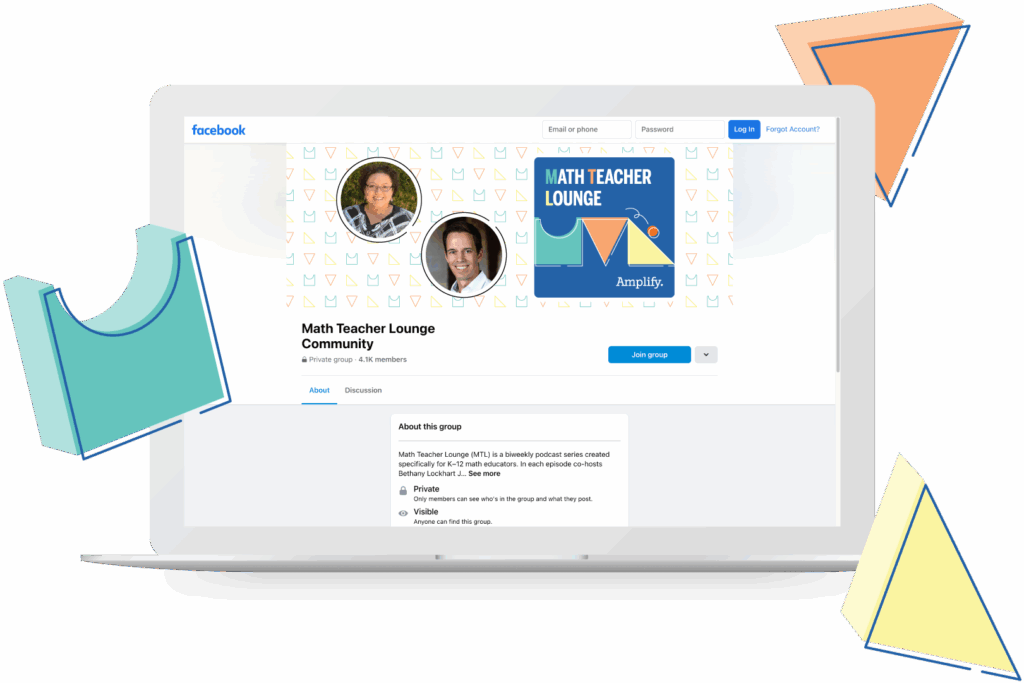
A laptop displaying a Facebook group page for "Math Teacher Lounge Community," featuring profile photos, a group banner, and geometric shapes in the image background.

About Math Teacher Lounge

Math Teacher Lounge is a biweekly podcast created specifically for K–12 math educators. In each episode co-hosts Bethany Lockhart Johnson (@lockhartedu) and Dan Meyer (@ddmeyer) chat with guests, taking a deep dive into the math and educational topics you care about.

Join the Math Teacher Lounge Facebook group to continue the conversation, view exclusive content, interact with fellow educators, participate in giveaways, and more!

S4 – 04. Dear Math

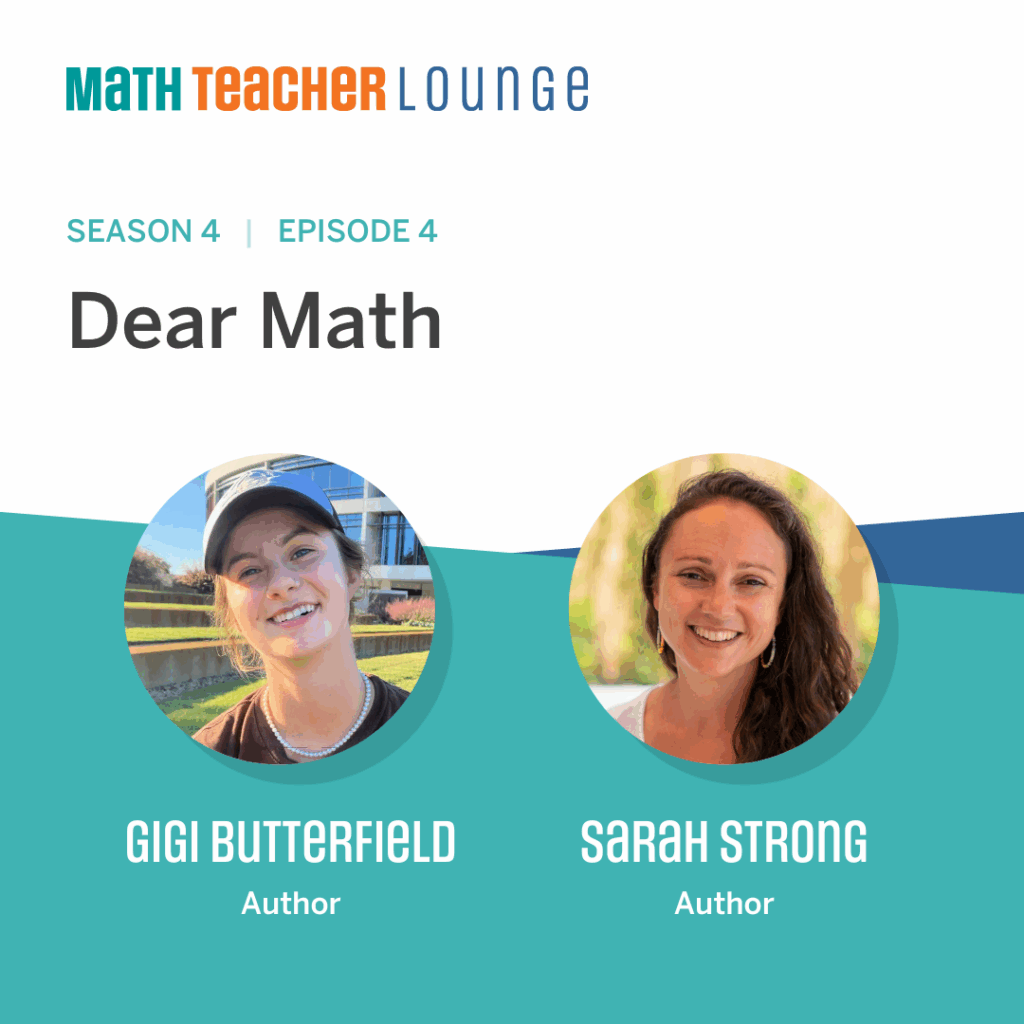
Promotional graphic for "Math Teacher Lounge" podcast, season 4, episode 4, featuring two women, Gigi Butterfield and Sarah Strong, titled "Dear Math.

In this episode, Bethany and Dan chat with Sarah Strong and Gigi Butterfield, authors of Dear Math: Why Kids Hate Math and What Teachers Can Do About It. Listen in as they chat about their experiences with finding joy in math, and how their passion helped them tell the stories of other students’ journeys to find (or not find!) joy in math.

Explore more from Math Teacher Lounge by visiting our main page

Download Transcript

Dan Meyer (00:01):

Hey folks, welcome back to Math Teacher Lounge. My name is Dan Meyer.

Bethany Lockhart Johnson (00:05):

And I’m Bethany Lockhart Johnson.

Dan Meyer (00:06):

Bethany, it’s been fantastic to see you. It’s been a long while. I feel like [it’s been] since NCTM and our last episode, where we compared the best teacher from movies and TV, crowning the winner Tina Faye from Mean Girls, is a huge, huge episode. It’s good to see you back.

Bethany Lockhart Johnson (00:20):

Didn’t see her coming, but it’d be so fun to be in person. And the energy in that room was, I mean, if you listeners, if you heard that episode, we had some very, very passionate opinions about which teacher was best represented. And we’ve heard from a lot of you that we left a ton of people out. We know, and you know, it’s been great to hear your opinion and your defense of Ms. Frizzle. So, thank you for that. <laugh>

Dan Meyer (00:50):

I apologize for nothing. We’re super excited right now to bring to you folks the first post-NCTM episode. We have a couple of authors, a couple of published authors on the call here. And they, they got a really fun premise for a book. They have, I think, maybe one of the most interesting data sets out there. There’s lots of data out there that’s quantitative, you know, survey data or assessment data and who-knows-what percentages. And they’ve got a set of data that’s just super qualitative, but really dives deep into the beating heart and soul of students as it relates to mathematics. Especially because this season is all about joy in math, how students have it, why they don’t sometimes. And what we can do about that. First up, Sarah Strong is a co-author of the book Dear Math. Sarah loves hearing people’s math stories. I’ve known Sarah first as a math and science teacher in grade six through 12, and a teacher developer at High Tech High in San Diego, a school that’s very innovative and project based and very exciting. And so Sarah’s on as a co-author. And Gigi Butterfield is also a very talented mathematician. And, you know, someone that I have learned from. So I consider Gigi a math teacher-educator as well, coincidentally, [as] one of Sarah’s students! So this is a fun project where Sarah and Gigi are teacher and student and co-authored a book called Dear Math. And Gigi’s now a student, a screenwriting major at Loyola Marymount University. So please, welcome on, great to have you folks, Gigi and Sarah.

Bethany Lockhart Johnson (02:28):

Welcome, you two. We’re so glad to have you in the Lounge.

Sarah Strong (02:32):

Yay. Thanks for having us.

Gigi Butterfield (02:34):

Yeah, happy to be here.

Bethany Lockhart Johnson (02:35):

So the full title [is] Dear Math: Why Kids Hate Math and What Teachers Can Do about It, and as I was reading this out and about in the wilds <laugh>, you know, it was really interesting. Like I’m sitting in a waiting room and somebody starts to talk about their math experience, which, you know, Dan, you know, I love to talk to people. Actually, this season, Sarah, Gigi, we are actually starting all of our episodes, and we actually had a whole episode about this, about Dan’s math story, my math story. We’re asking all of our guests to share their math story. As I was reading Dear Math, I also felt like I got to hear more about your math journey as well as bits and pieces of the students in your class from their ‘Dear math’ letters. It was really wonderful. And so I was like, oh, I wanna hear their math story. So would you share your math story with us, as little or as a lot as you would like to?

Sarah Strong (03:35):

Well, we should have Gigi go first because this book is all about centering student voices. And so I always feel like we need to start by listening to the students. And Gigi here is the student, so Gigi.

Gigi Butterfield (03:47):

Wow, thanks Sarah. I feel very centered <laugh>. Um, so <laugh> my math story as a young student, I quite ‘liked math.’ I put that in quotations that I liked math, and that was because I pretty much thought that I liked it because I was told that I was good at it. I could complete the math assignments that my teachers gave to me pretty easily and pretty hastily. And so that made me feel really good about myself. And then I’d get a big red A+ and that’d make me feel even better about myself. And so I was like, I love math. Math is awesome cuz I’m awesome at it. And this formed what, if you read the book, you’ll see Sarah and I kind of coined a fraudulent fondness of mathematics in that, oh, ‘I think that I like this thing because I don’t really understand it that much, but I understand what I need to understand to gain validation from my teachers and peers.’ And so that’s kind of the attitude I was heading into middle school with. And it carried for the first couple years. And then in eighth grade I had a math test that I failed, like, four times in a row. And that was the first time I had really experienced failure within the math classroom. And it was super hard for me. And it ended up being, for a brief time, very detrimental to my relationship with math in that I was like, well, ‘The reason I loved this is because I was good at it and I’m not good at it, so I hate it. So I hate math so much, it’s my least favorite thing.’ And then I got to high school with that attitude, very different than the one I was entering middle school with, and then I had Sarah Strong as my math teacher. And throughout that first year and then a subsequent three more years where she was my math teacher, I learned that my fraudulent fondness had been just that, it had been completely fraudulent, and that the reasons I liked math, the pillars of what made me good, speed and accuracy, void of any real contextual understanding, were super arbitrary. And they were actually the reason that I wasn’t able to deeply enjoy math at all because I wasn’t coming at it with curiosity or creativity or any sense of relating it to my own life in the greater world. And then I learned how to do those things and I learned how to get excited about math, even when I wasn’t able to do it really easily or really quickly. And then I started to love math and I still love math today. So that’s what I would say my math story is.

Bethany Lockhart Johnson (06:36):

I love it. It’s so interesting to hear that you have such a clear, and in the book you talk about it, too, this reflective sense, you’re able to reflect on what that test meant. Like it could have gone a very different way, right? Oh, which, folks, we should say that Gigi was in Sarah’s class for four years. It sounds like this relationship you had was really healing.

Gigi Butterfield (07:00):

Yeah, it was amazing. I was like the luckiest high schooler ever.

Bethany Lockhart Johnson (07:04):

For reals. Yeah, that’s beautiful. And it’s so cool to hear that you were able to transform that and your relationship really evolved, you know? It evolved.

Dan Meyer (07:15):

I love your comment about how, ‘Now I realize there’s gonna be tough times, and that’s not an indication of failure or a fraud.’ It’s actually a very real part about relationships with humans and with subjects like math as well. It’s super fun to hear. I’d love to hear from Sarah. It’s so wild that you two have been a part of each other’s math story, to a significant degree. How would you summarize your math story?

Sarah Strong (07:38):

Certainly Gigi was a player in my ongoing math story as an adult. And I think that’s also a part of it, is we all have continually evolving and emerging stories of who we are as math teachers, but my math story is kind of congruent to Gigi’s and that’s part of what’s inspired this book is the phrase Gigi used in her ‘Dear math’ letter, fraudulent fondness, I had never thought of that beautiful alliterative phrase before. And I thought, ‘Oh my gosh, that’s what I felt.’ And I had called it a fixed mindset, or all of these other things, but calling it fraudulent fondness was so poignant to me that I couldn’t get it outta my head, and we just kept talking about it. And I think my fraudulent fondness started probably in high school. Before high school I think I was just really stressed out about math, because I thought I had to do really good at it and get things really right really fast or else I was dumb. So this was part of the fixed mindset piece. And so I wouldn’t say I loved it in elementary school, I more felt the weight of it. And I remember especially timed tests, which we always hear about a lot. I just remember sweating and shaking and being like, if I don’t get this the fastest I am a failure, I will cry. And that’s not really setting yourself up to love a thing. So I was, it was a bit fraught and stressful, but then in high school I had this belief that I had to keep being good at it, but I started getting a lot of positive feedback from tests and quizzes and teachers, that was like, ‘Oh my gosh, you’re so great at this. You should be in this class and look, you moved into Algebra Two as a freshman. Wow. Who takes Algebra Two as a freshman? You must be so smart.’ And I was like, ‘Oh, I am so smart.’ But that is sort of an anchor for fraudulent fondness as, ‘I like math because I’m in Algebra Two as a freshman.’ That has nothing to do with being mathematical at all, necessarily. My senior year, my calculus teacher knew I was thinking of becoming a math teacher, so she invited me to support her for my math class that year in one of the freshman math classes with her.

Bethany Lockhart Johnson (09:54):

Wow.

Sarah Strong (09:55):

So I was like a teacher’s aid as a senior. And it was there that I think I started to break down some of my assumptions of what it was to be mathematical and start realizing, I never had the term fraudulent fondness, but realizing that I didn’t fully understand or grasp what mathematics was because the students in her ninth-grade class, I was getting to look at their work <laugh>. I was stamping their warmups, and there [were] so many interesting ideas on there that I had not confronted in my own math journey cuz I was really sucked into my, like, ‘Hey, here is my work. And I checked my answer on the back and it was right.’ I hadn’t seen different ways of thinking about mathematics and my eyes were opened and that made me wanna become a math teacher even more. I’d say throughout college I did a lot of collaborating and working with others and really developed a keen excitement for different ways of thinking about math and then becoming a teacher, I mean that’s the cornucopia, unique and creative math ideas are there in front of your face every day. And so I just thought it was the most fun thing to do. I started in sixth grade, to listen to what the students were saying and their conception of things and try to make sense of their thinking.

Dan Meyer (11:18):

There’s something so joyful from the student’s perspective of experiencing a knowledgeable other as being very curious about what they’re thinking, whether it’s right or wrong, maybe especially if it’s wrong, I just, I think about that and how you’ve been a part of people’s joy in math class from even when you were a math student, as a pretty special bullet on your resume. Thanks for sharing all that. I would love for you to explain to the audience what the ‘Dear math’ assignment is. Would you paint a picture of what the ‘Dear math’ assignment was?

Sarah Strong (11:48):

Yeah, the ‘Dear math’ assignment was birthed out of a project I was designing that was supposed to take this really metaphoric lens toward math identity development. And in right triangle trig, we use the metaphor of shadows to look at the shadows of our math story. And then the 3D geometry was cross sections. Like what are these cross sections, these snapshots of your math story that tell a story. And what I wanted to do in that project, aside from exploring all these math ideas and then applying a metaphoric lens to our own math stories, was I wanted my students to get to identify where they experienced a fracture in their math journey and get to go work with a student in that grade as like, public service <laugh>.

Bethany Lockhart Johnson (12:33):

I got chills when I read that because I was like, ‘Oh my gosh, if I could go back and talk to sixth-grade Bethany, what would I say?’ Right?

Sarah Strong (12:42):

Yeah. And it’s almost like you, for some students I noticed, they had this fixed understanding of themselves as a mathematician from that point forward, from a fourth grader forward.

Bethany Lockhart Johnson (12:55):

Totally.

Sarah Strong (12:55):

And they couldn’t even acknowledge that they had learned mathematics since then. So it’s like, you have to go backward. And actually, in helping some of those students, they were like, ‘Oh, I actually understand fourth-grade math.’ I’m like, ‘Der! You’re doing all of this stuff right now!’ But there was such this, I call it a math trauma, you know, I don’t wanna throw around that word, but it really was, because it was impeding them from moving forward in their math journey. So anyway, I wanted to have a way that we could identify that piece of their story. And then, at the same time, we do project tunings at High Tech High, so before we embark on a semester, we chat with a group of teachers and they tune our projects for us. And a humanities teacher I was with was like, ‘Oh my gosh, I have my students write “Dear Books” letters or something. It’s modeled after that Kobe Bryant, Michael Jordan thing, you should have ’em do ‘Dear math’ letters.’ And I said, ‘Oh my gosh, you’re right, I should.’ So it came from another teacher at my school, and that’s where it kind of started. And during that project, the students wrote their letters, but then we did a lot of analyzing and revising and adding to our stories throughout the semester to explicitly address our evolving understanding of our math identity.

Gigi Butterfield (14:11):

I will say as a student taking part in it, it was very cathartic, and yeah, I remember going back and helping a eighth grader with some of the math they were learning, and I think there’s an element that you touched on, Bethany, of like, oh, when you go back to help someone, you realize they’re so small and they’re just trying their best. And I think with everything in math, it’s very easy to be really hard on yourself and we label other people as good and bad, but before we even get to that, we label ourselves as that. And so in eighth grade, I had labeled myself as bad at math and then I went back and I started helping someone. And the idea of telling this young person that because they were struggling, they were inherently and endemically and forever gonna be bad at math is insane. And so you of course didn’t do that, and you were kind of able to see yourself then in this young person and really heal a lot.

Bethany Lockhart Johnson (15:11):

That’s so beautiful, yeah.

Gigi Butterfield (15:12):

It was pretty amazing. It was one of my favorite things I did in all of high school.

Dan Meyer (15:16):

I’m often guilty of assuming that other subjects have it better than math. I just have a hard time imagining that it would dredge up quite the same catharsis and psychological repair, for some reason math, and there’s some amount of data on this, that math occupies a unique and kind of mythic quality in the mind of students as this really formidable villain in people’s development. You’ve read all kinds of letters from students and I feel like you, when I referred to you as having this data set, like you have, I think, access to the psyches of students who have experienced that, you know, that math trauma, as you put it, Sarah. I wonder, Gigi, since you have the student’s lens there on your classmates as you’re examining those letters, what were some of the themes that popped out to you of why people find math so enormously challenging and hurtful in some ways?

Gigi Butterfield (16:14):

So the themes that Sarah and I found, and then eventually tabulated, end up being the different chapters of the book. So each chapter is an adjective that we saw coming up a lot in students’ letters. So there’s intimidating, hierarchical, useless. Those are some of the negative ones. And then in the back half of the book, we wanted to end on a good note, so we get to the positive ones and there’s, you know, fun, powerful. Paradoxical is even one of them because, like all things, you know, it is. And so I think a lot of the reason that, to reference the title of the book, kids hate math, and to kind of echo what you were saying, Dan, because I do agree in some ways, that other subjects have it easier—like, I am a writer, I love writing, and I think it’s because a lot of other subjects are viewed as less binary than math is. In math, you’re right or you’re wrong, you’re good at it or you’re bad at it, you’re a math person, you’re just born that way, or you’re not. And I don’t think that we view students in that binary manner in a lot of other disciplines. In writing, for instance, there’s a lot of individual work with the teacher that goes on in improving things, or people can have their own style to their writing, their own flair, which I think is fully applicable to mathematics, but we’re not teaching it that way.

Bethany Lockhart Johnson (17:42):

We have a friend of the show, Mandy Janssen. Her book, Rough Draft Math, reminds me of that idea that, I think you put it so beautifully, Gigi, that you’re either right or you’re wrong, right? And how can we create those spaces where it is complex and it is all those things you list.

Sarah Strong (18:00):

I was gonna say, that’s why we actually ended the book on paradoxical, cuz we were like, ‘We’re gonna end on a high note,’ and then we were like, ‘Actually it’s not realistic that everyone would think all these positive things about math all the time.’

Bethany Lockhart Johnson (18:13):

Yeah.

Sarah Strong (18:14):

Nor is it even the goal. It’s actually really a part of the goal, is that we would, like you just said Bethany, be able to hold these feelings together and actually maintain a strong math identity through all of these emotions that come and go and to be grounded and like, ‘I’m a mathematician because I am a creative thinker who asks good questions and makes connections and listens to other people’s ways of thinking and models and all the math practices and all of these things.’

Dan Meyer (18:43):

So I’d love to know the kind of pushback that I imagine some teachers would offer here is that it feels, it has the feel of being non-mathematical, which is to say, it’s not, you know, in my scope and sequence or my chapter list or that kind of thing. And I just wonder how you could, how you might respond to people who’d love to know like, what is the bang for the buck? What am I getting back as a return on this kind of investment?

Sarah Strong (19:02):

I have heard that very critique and I’ve sort of gotten to the point where I’m like, ‘How can I start working with these students without knowing their stories before they’ve arrived to me?’ Like I want to understand them and who they are so I can know them well and then support them on their math journey for this whole year. We’re gonna be together for an hour every day for a whole year. <laugh> We’ve gotta know each other. So I’ve sort of, with students and even from students sometimes, I’ll say, ‘Why are we writing in math class?’ What I usually try to do is offer them my story first. So I have my ‘Dear math’ letter and I read it aloud to them and I share my story with them and ask them, what surprised you? What makes sense? What parts of that did you connect with? And then I’ll say for the next 20 minutes, ‘I’d love to hear your math story. I know it’s sort of unusual to do writing in math class, but this is gonna help me understand you more so that I can be the teacher that you need me to be for the rest of the semester. And I promise you I’m gonna read every single one and really be hearing your voice in my head as we go through the rest of the semester.’

Bethany Lockhart Johnson (20:07):

I’ve definitely had those assignments where I wrote something and maybe poured my heart out and then I had the sense that it was kind of just stuck in a drawer, right?

Sarah Strong (20:15):

Mm-hmm.

Dan Meyer (20:15):

I think there’s something about these ‘Dear math’ letters, at least the ones that you shared in the book, the excerpts you shared in the book, that were vulnerable, that were, like you said Gigi, they were cathartic, right? So even though I wanna champion folks to do this in their classroom, it’s like, as a teacher, whether you’re curious or not, you still wanna handle these folks’ stories with care, right?

Sarah Strong (20:41):

I think I write in the book about how, before I was about to read all the math letters, my heart would start beating fast a little cuz I knew there were gonna be kids in there that hate it <laugh> and I was gonna have to just accept it. But then I thought, well that’s the most important thing for me to hear, cuz it, I’m delusional if I’m not accepting that they have those feelings as they arrive to me every day. I just think, ‘Look, everyone showed up here and they’re happy to learn with me!’ But it also can feel heavy to the teacher. And so I like the ‘handle with care.’ Do something with the letters, confirm to the students that you read them and that you really value it, keep bringing it up, revisit it with them partway through the semester. It’ll impact a lot.

Dan Meyer (21:23):

I’m curious, Gigi, what other experiences you can point to that were the work of mathematics, like through doing the math, where you felt like your relationship was being rehabilitated with mathematics.

Gigi Butterfield (21:36):

I would say one was my senior year, I believe. Sorry, you can correct me if I wrong, but I believe my senior year. So this was also, just to set the scene, height of COVID, virtual learning, perfect setting for kids to love math when there’s chaos going on outside and no one wants to think about it. And Sarah implemented a project about voting systems around the world and throughout history and how voting systems are implemented into our modern day, how they work, the benefits and the drawbacks to different ones. And this was, you know, 2020. So it was during an election and it was so poignant that you couldn’t, as a student, you couldn’t not care about it, you couldn’t not be interested. You were coming to the table with some opinions, some ideas, and then we got to explore those ideas further in that, the end of the project, the sort of final piece, was collaborating with a group to create your own voting system that you thought could solve most of the problems, if not all of the problems that the other voting systems were introducing. So it was so relatable and it was so important that the math that you were learning, the struggle of it, felt worth it. I still remember that math really well because I remember the purpose, I remember all of the applications. And that was an instance where I really remember thinking, ‘Wow, math is powerful. Math is absolutely powerful and is important to me as an individual.’

Dan Meyer (23:31):

What else? Yeah, I’d love to hear another one.

Gigi Butterfield (23:33):

In collaborating with other students, which, at High Tech High, we did every day, and consistently with different people. And in doing that collaborating, it was really eye-opening to learn how many different skillsets there are within the discipline of mathematics. Because coming into this high school math classroom with that unfortunate binary thinking of, there’s good and there’s bad, one great way to disrupt that is to work with a lot of different people. And then you learn that people can be good at a lot of different things. There can be people that are fantastic at asking questions to understand the context more deeply. There can be people that are so great at creating tables and organizing thoughts. There can be people that are amazing at being skeptical of an answer, it seems like we’ve all come to a consensus and they say, ‘Wait, that might not be quite right.’ Or, ‘How did you get there?’ And it really makes you think deeper as a mathematician. And that’s something that I’ve really loved and cherished about math as well.

Bethany Lockhart Johnson (24:36):

At one point, you reference a lot of different students, and I love going on the journey with them. And I’m remembering at one point, you talk about a student named Zelma who said she was bad at math, and then how she had all of these, and you say, ‘reference points to support her claim.’ And that phrase just stuck with me. How do you begin helping students speak back to that evidence? Because that evidence can be powerful.

Sarah Strong (25:05):

Yeah, I’m glad you brought up Zelma, cuz I thought her story was particularly poignant and it’s told at the beginning of the Hierarchy chapter and, maybe it’s obvious to people, but this chapter theme was maybe, statistically, the most prevalent in letters, this notion that students are always talking about how they were ahead or behind or not where they should be compared to either their perception, mostly their perception of everyone else. And we did a focus group on this chapter with a group of students and they were saying, ‘Nobody actually ever feels like they’re in the right place. Everyone always feels like they’re somewhere in this hierarchy that’s wrong.’ And I reference some research in there that there’s this pervasive story of a narrow path of math learning that’s sometimes in curriculum or in teacher prep programs or in schools. And it’s one of the biggest problems in terms of helping students form more whole math identities grounded in a lot of different things. But Zelma was referencing that she felt like everyone else thought she was stupid and I was like, ‘Oh my gosh, I’m so shocked. I don’t see you in that way and I’m fairly certain that everyone else in this room doesn’t.’ It seems that she had built that thought of herself a really long time before. What I tried to do was to point out to her ways that I saw her being mathematical myself. But it was almost like she was like, ‘Yeah, yeah, you’re a math teacher, you’re supposed to tell me that.’ And so the intervention that we actually talk about about in that book, in that chapter, is Belongingness Buddies, which is not necessarily something that you would have to do in math class, but I started realizing that in order for students to shift how they saw themselves as mathematicians, they needed to know that I saw them as a mathematician, but also that their peers saw them as mathematically valuable members of the community, authentically, not just like, ‘Eh, my peer told me good job today.’ What Belongingness Buddies did was, they checked in on each other. They were the person, like if you were absent, your Belongingness Buddy is texting you today and saying like, ‘Hey, we missed you in math class today.’ Like all these kinds of things. And I once even had a student FaceTime their person who was on a trip so they could participate in our daily discourse that day. And it just built this idea that we are a community and we actually all need all of us to be here for our community to be whole and functioning. And when one of our members is gone, we reach out to them because we’re not whole without them. Through that the students were able to start developing deeper relationships with each other, in a variety of ways, but also where they were like, ‘Oh, my Belongingness Buddy shared with me a new idea about this math problem and I learned something new.’ Zelma, through working with her Belongingness Buddy, got some more confidence that I couldn’t actually instill in her myself despite my best efforts, that her peers started celebrating her. She was an amazing discussion leader! She was so charismatic and she would be in the front of the room calling on people and connecting their thinking and she was like, the best at that. I started thinking, ‘Oh my gosh, people need to tell her that she’s brilliant and an important member of this community, all these people.’

Bethany Lockhart Johnson (28:29):

And when I think about joy in mathematics, which again is our theme for this season, belonging seems at least like, you wanna feel like you belong in the space. You know, if you’re gonna experience joy, and you don’t feel like you belong, how can you have space for that joy? Right? And it’s really, really beautiful and I think belongingness or feeling like you don’t belong in math class is something that comes up again and again when folks talk about not having joy in math. So the fact that you are calling that out and bringing it into your space, that’s really beautiful. Thank you.

Dan Meyer (29:05):

Overall, this whole interview to me just speaks for how the most transformative work that teachers do as students often winds up transforming the teacher as well. And you’ve just described, and we’ve heard from other guests, Sarah and Gigi, just what this kind of work does on the people who are doing it, whether you’re a teacher or a student. Thank you both so much. The book is called Dear Math, Why Kids Hate Math and What Teachers Can Do about It. We’re so lucky to have had on Sarah Strong and Gigi Butterfield. Thank you both for being here with us and sharing so much knowledge and wisdom.

Bethany Lockhart Johnson (29:33):

Thank you so much for joining us in the Lounge. Thank you.

Sarah Strong (29:36):

Thanks for having us.

Gigi Butterfield (29:38):

Yeah, thank you.

Dan Meyer (29:42):

Wow. That was a very unusual chat for a math podcast for math classes. It was off the beaten path for us, I think, I loved it. I wanna know what you think about it, Bethany.

Bethany Lockhart Johnson (29:52):

I definitely heard of an assignment where you share with the teacher your math autobiography, where you talk about your journey with math. But a ‘Dear math’ letter is a whole ‘nother level. And the thing I loved most about it was the way Sarah was so focused on centering her students’ experiences. I mean, Gigi’s in college, you should have talked to me in college, Dan, I was not that self-reflective! I mean, that was awesome.

Dan Meyer (30:20):

Yeah. Awesome. Same. And I hope to hear from you folks out there in podcast land, if you try this assignment with your students, it doesn’t sound like it needs to take a long, long amount of time. Just some moments to reflect on your relationship with mathematics and to think about what to do next could be really valuable for you and your students. And we would love to hear more about that, how that goes for you and your classes.

Bethany Lockhart Johnson (30:43):

Yeah, and I think also remembering what Sarah said, that the biggest theme was that trust that she built, right? So she didn’t assign it and then stuck it in the drawer. She used it to inform conversations with students. She said even, make sure you at least acknowledge that you’ve read them, you know, they’re sharing something for some of them, something that they’ve never been asked before. And you’re trying to create this relationship, this space for future conversations and you’re building a community. I love it. So thank you, Sarah and Gigi, for being a part of this Math Teacher Lounge convo. We hope that we hear more from you listeners, like Dan said, about how this conversation impacts you and how you might use it in your classroom space.

Dan Meyer (31:33):

Find us @MTLshow on Twitter or the Math Teacher Lounge group on Facebook. And yeah, get in touch and we’d love to hear your own story about mathematics. We’re doing a little bit of a book giveaway also in the Math Teacher Lounge Facebook group. So stop on by and share your story and get entered for a chance to win a book.

Stay connected!

Join our community and get new episodes every other Tuesday!

We’ll also share new and exciting free resources for your classroom every month.

What Sarah Strong says about math teaching

“And during that project, the students wrote their letters, but then we did a lot of analyzing and revising and adding to our stories throughout the semester to like explicitly address our evolving understanding of our math identity.”

– Sarah Strong

Meet the guests

Sarah Strong

Sarah Strong is the co-author of Dear Math. She has taught math and science to grades 6 through 12 at High Tech High in San Diego, and she also works for the High Tech High Graduate School of Education teaching various math pedagogy courses and supporting new math teachers in the organization.

Gigi Butterfield

Gigi Butterfield is the co-author of Dear Math. She is currently a screenwriting major at Loyola Marymount University and a former student of the Gary and Jeri-Ann Jacobs High Tech High in San Diego. She thrives in situations where she can explore math deeply and ask thoughtful questions of her peers and her teachers. Gigi has attended project-based learning schools since the age of five and, even in college, is passionate about how PBL plays an integral role in revitalizing heavily antiquated math pedagogies.

Two women smiling in individual portraits overlaid on a split pastel background, one indoors and one outdoors, each holding a sign that says "Dear Math.
A graphic with the text "Math Teacher Lounge with Bethany Lockhart Johnson and Dan Meyer" on colored overlapping circles.

About Math Teacher Lounge: The podcast

Math Teacher Lounge is a biweekly podcast created specifically for K–12 math educators. In each episode co-hosts Bethany Lockhart Johnson (@lockhartedu) and Dan Meyer (@ddmeyer) chat with guests, taking a deep dive into the math and educational topics you care about.

Join the Math Teacher Lounge Facebook group to continue the conversation, view exclusive content, interact with fellow educators, participate in giveaways, and more!

S4 – 03: LIVE from NCTM with Bethany and Dan

Hosts Bethany and Dan, both smiling, in a promotional image for the "Math Teacher Lounge" podcast, Season 4 Episode 3, titled "Live from NCTM!" with an

In this episode, co-hosts Bethany Lockhart Johnson and Dan Meyer are LIVE with more than one hundred Math Teacher Lounge listeners at the recent National Council of Teachers of Mathematics conference. Listen in as they answer the pressing question: Who is the best teacher in film or television?

Explore more from Math Teacher Lounge by visiting our main page

Download Transcript

Presenter (00:00):
Ladies and gentlemen, from Math Teacher Lounge, we have Bethany Lockhart Johnson and Dan Meyer! <cheering>

Bethany Lockhart Johnson (00:08):
Doesn’t go well that the door was locked. Like, I could not get in! <Laugh>

Dan Meyer (00:12):
Yeah. Gotcha. All right. We’re gonna sit a little bit. Let’s see how that works—

Bethany Lockhart Johnson (00:16):
Hi!

Dan Meyer (00:16):
Yeah. I think we’ll stand up? Or whaddaya think, sit…?

Bethany Lockhart Johnson (00:19):
Should we stand? Hi.

Dan Meyer (00:22):
Hello. Great to see you folks. Yeah, I can hear you.

Bethany Lockhart Johnson (00:25):
Can you hear me? That’s—I know YOU can me. Can you hear me OK? OK! We’re here. Hello. Thank you for like, lining up and coming out and being here. Thank you!

Dan Meyer (00:35):
Means so much to me that you could be here for me, on my show, with Bethany Lockhart Johnson, my co-host. <Audience laughs>

Bethany Lockhart Johnson (00:40):
The hour has just started.

Dan Meyer (00:42):
We’re just getting going. Yeah. If you folks have heard the podcast, you don’t know how much gets cut out. And it’s like, mostly me just having, you know, anxious nerves and saying something silly and then we cut it out and we can’t do that here today. So it should be real fun for all of us, I think. Yeah.

Bethany Lockhart Johnson (00:55):
It’s not true. It’s mostly dancing. “Bethany, can you stop talking? Bethany?” Cause it’s mostly—

Dan Meyer (00:59):
“It’s my turn. It’s my turn! Bethany <laugh>! I haven’t been heard for a while.”

Bethany Lockhart Johnson (01:02):
Dan. We’re at an in-person conference.

Dan Meyer (01:05):
In-person BIG conference, I would say. I’d say a big conference. Yeah.

Bethany Lockhart Johnson (01:08):
And have you been to the Amplify booth?

Dan Meyer (01:11):
I have! Have these people? There’s a claw machine with free socks.

Bethany Lockhart Johnson (01:16):
Yeah. You’re saving me socks, right? That’s what you’re saying. <Laugh> I mean, it’s exciting. How has your conference been so far?

Dan Meyer (01:21):
So far it’s been a blast. I feel fed. I feel like the community’s been awesome. How are you feeling about it?

Bethany Lockhart Johnson (01:29):
OK. Let’s talk about me for just a second.

Dan Meyer (01:31):
Yeah. Talk about you.

Bethany Lockhart Johnson (01:31):
Last night, Dan, was the very first night that I was away from my toddler. <Audience: Aw!>

Dan Meyer (01:38):
Big commitment being here. Thank you.

Bethany Lockhart Johnson (01:40):
I got super-emotional walking back to the hotel after dinner, and then I got in my room, <laugh> I put on pajamas, and I turned on music. I slept so good!

Dan Meyer (01:50):
Yeah. <Audience laughs> Give it up for no kids! <Audience laughs> Hey!

Bethany Lockhart Johnson (01:55):
I love him so much. But I slept all the way through the night. Oh, by the way, I ordered room service in the morning.

Dan Meyer (02:01):
On Amplify.

Bethany Lockhart Johnson (02:01):
That bill’s coming. But it’s been a great conference and I’m so delighted to be here in person and to get to share energy…and hopefully that’s all we’re sharing today. Y’all got your tests, right? Yep. Sharing energy and community today. Because we know it’s been hard. Hardness. Hard.

Dan Meyer (02:25):
Yeah.

Bethany Lockhart Johnson (02:26):
Years. Hard. And to be in person, I know conferences reinvigorate me and I go back into my educational spaces feeling revitalized with new connections and new ideas to try. So yeah, I’ve been excited to be here. And thank you all for being here.

Dan Meyer (02:40):
Yep. I don’t care if I get six different strains of Covid here. I’m just thrilled to be here. <Audience laughs> I don’t know if you’ve had the same feeling, though, Bethany, you folks…I’m a little bit confused to some degree about what we’re doing. I just wanna be really transparent. This is my sarcastic voice but I’m being sincere here. It kind of feels like we’re in a little bit of a time capsule. Like we all got in a time capsule in 2019 and, you know, you open it back up and it’s like, OK, so we’re still, you know, talking about X, Y, or Z protocol for establishing classroom routines or whatever. And I’m like, OK! Like, I loved that in 2019! But I do admit, I’m still trying to figure out a little bit like, what are we doing now? What’s our relationship to the world out there? Things are very different. I have had some great sessions that I’ve enjoyed. I’m also like, still waiting for a session to draw a little blood. Do you know what I mean? Like there’s been sessions…no? OK. You’ve been in these sessions where it’s like, “Oh, ow.” Like, and you look down and there’s and there’s blood there. It’s like, I thought I knew what we were up to. Like, I thought I knew what teaching was and how we relate to the world. I dunno, like in any Danny Martin session in 2019, “Take a Knee” was one, where I was like, “Oh, OK. Like, I’m not as hot as I think I am here. Like, I’m part of a system.” That kind of thing for me draws blood. And I haven’t been in one of those yet. Been some great sessions. I’m a little hopeful that today we draw a little blood and think about what we’re doing here, is my hope here, if that’s OK. So Bethany’s gonna moderate that impulse and she’ll be the fun one and I’ll be the blood-drawing one.

Bethany Lockhart Johnson (04:05):
No, I don’t…that metaphor doesn’t speak to me personally. But what I will say is, I get what you’re saying about really wanting to be in that room where there’s like this synergy happening. No promises about that today other than—

Dan Meyer (04:18):
I promise. <Audience laughs> Go on.

Bethany Lockhart Johnson (04:20):
Other than I get what you’re saying. I’ll find my own metaphor that does not involve bloodshed, but.

Dan Meyer (04:25):
Sure. There’s a lot of ways we we could go about this today. And the one that I’m excited about is, you know, we could like, you know, analyze some results from students, and talk about what went into that. Look at classroom video. Lots of possibilities. But here’s what we’re up to today. Hope you’re into it. Which is, we are here in the heart of the entertainment industry. You know, Tinseltown! Um, the Big Apple! Uh…

Bethany Lockhart Johnson (04:47):
No!

Dan Meyer (04:47):
Come on. What do you got here? Um…

Bethany Lockhart Johnson (04:51):
It was daytime at night. Like the lights were so bright.

Dan Meyer (04:54):
The City of Lights.

Bethany Lockhart Johnson (04:55):
There was a movie premiere outside my hotel room, which I was not invited to, unfortunately. But so what are we doing today?

Dan Meyer (05:01):
So here’s what we’re doing. We are gonna settle, once and for all, a question you have not asked yourself yet, perhaps, but will want to know the answer to in a moment. Which is: Who is the best teacher in all of film or television? OK? We’re gonna do that. It’ll be fun. But I hope that in debating this a little bit with a special guest we’ll bring up in a moment, that we will start to uncover some truths about what makes good teaching. How that’s different from teaching as we see it in movies and tv. Why middle-class America wants teachers to look a certain way in movies and tv. What all that means. And it’ll be awesome. I think. I’m hopeful it’ll be awesome. So what we did here is we’ve invited eight people. Eight folks you people may have known. You’ve been in their sessions today, in this conference, perhaps. And asked them: Who’s your fave? Like, we might have our favorites, but we wanted to democratize it a bit. So asked some cool people who you folks like, who are very smart and thoughtful about teaching: Who’s your favorite teacher?

Bethany Lockhart Johnson (05:58):
A few of whom are in this room. Thank you for your submission.

Dan Meyer (06:00):
Thank so much. Yeah. We’ll see what happens here. <laugh>

Bethany Lockhart Johnson (06:03):
As they shrink down.

Dan Meyer (06:03):
Yeah. Might draw some blood that I don’t mean to right now. We’ll see. OK.

Bethany Lockhart Johnson (06:06):
That metaphor, what IS that??

Dan Meyer (06:07):
Yeah. Yeah. I love it. I’m still going with it. <laugh> And you folks will be a huge part of this. THE part of this, really. So what will happen is I’ll share with you our first nominees. A few of us will make a case for our favorites, or least favorites, as the case may be sometimes. And then by applause, by acclamation, you folks will decide who wins and advances to the next round. Start with eight, move to four. You folks know math.You know where this goes. OK.

Bethany Lockhart Johnson (06:34):
No, keep going. Keep going.

Dan Meyer (06:36):
Two, then one.

Bethany Lockhart Johnson (06:36):
Yeah. Got it.

Dan Meyer (06:37):
Then a half of it. No?

Bethany Lockhart Johnson (06:38):
He had to school me on the making of brackets. But we got it. Yeah.

Dan Meyer (06:41):
How brackets work.

Bethany Lockhart Johnson (06:41):
But we got it. March Madness, what?

Dan Meyer (06:44):
Yeah, in order to do this right, we had to bring up—all the folks that you’ll see are also former Math Teacher Lounge guests, or like, just fan favorites. And we’re also bringing up a former Math Teacher Lounge guest to help us decide this and debate this in a respectful manner.

Bethany Lockhart Johnson (06:59):
New dad.

Dan Meyer (07:00):
New dad.

Bethany Lockhart Johnson (07:01):
You see where my brain’s still at? I miss him. <Laughs>

Dan Meyer (07:03):
Friend from San Diego. Really cool teacher.

Bethany Lockhart Johnson (07:06):
Incredible teacher.

Dan Meyer (07:06):
Works at Desmos and Amplify. And I just want you to welcome up your friend and mine. Chris Nho!

Bethany Lockhart Johnson (07:11):
Chris Nho!

Dan Meyer (07:13):
Come up, Chris. Let’s go, buddy. We didn’t talk about it, but did you want to do the cornball stuff too?

Chris Nho (07:22):
Wow. Would I love to do—

Bethany Lockhart Johnson (07:23):
And then the door could be locked! And then you have to wait and like, just—

Chris Nho (07:27):
Yeah, I’ll skip that part.

Bethany Lockhart Johnson (07:28):
Hi. Welcome. You’re here. We’re here in person.

Chris Nho (07:30):
Very glad to be here. Thank you all for having me.

Dan Meyer (07:33):
Tell me who you are.

Chris Nho (07:34):
My name is Chris Nho. I live in San Diego. I’m a new dad. A three month old, just had. Yeah, she’s actually here at the conference with us in the hotel room. And I promise you she is not by herself. She is with…come on. I was like, “Hey, just gimme one hour. I’ll be right back. I have to do very important work.” But yeah, I think I got invited here because I have opinions and I’m willing to draw…some…blood.

Dan Meyer (08:02):
There we go! Two outta three! We’re good on the metaphor now.

Bethany Lockhart Johnson (08:06):
We’re so glad you’re here. If you haven’t listened to the episode where Chris and Molly and some other public math folks share their ideas and ideas of how to take math out into the world, please listen, because we had a blast.

Dan Meyer (08:19):
Inspiring work. Really inspiring work. Very cool. Cool. OK. Right on. OK.

Bethany Lockhart Johnson (08:23):
Let’s do this!

Dan Meyer (08:24):
Let’s get started here. Yeah! <Audience cheers> Yeah. And we might ask you who your favorite teacher is, who’s missing from our list of eight? We might have forgotten some people. Anyway. All right. So here’s our first two. Our first two are nominated by way of, let’s see, um, Mandy Jansen is a professor at the University of Delaware. Got some awesome talks here this week, a Shadow Con talk last night. She’ll be nominating one. And also, um, Lani Horn is a professor at Vanderbilt, also extremely cool, prolific author and speaker, just all-around great human and friend of teachers everywhere. And she’ll nominate another in this bracket, which is the Northeastern Comedy bracket, Northeastern comedy bracket.

Bethany Lockhart Johnson (09:06):
It just worked out that way.

Dan Meyer (09:07):
Yeah. Here it is. Here is Tina Fey in Mean Girls.

Tina Fey in Mean Girls (09:12):
“OK. Everybody close your eyes. All right. I want you to raise your hand if you have ever had a girl say something bad about you behind your back. Open your eyes. Now close your eyes again. And this time I want you to raise your hand if you have ever said anything about a friend behind her back. Open up. It’s been some girl-on-girl crime here.”

Lani Horn (09:52):
I am nominating Sharon Norbury from Mean Girls as the best movie math teacher. She is an awesome teacher who is always there for her kids. She always sees the best in them. She shows that she can forgive even some pretty bad behavior, if she sees that kids are trying. She’s a strong feminist who makes sure that smart girls don’t dumb themselves down just to impress boys.

Tina Fey in Mean Girls (10:22):
“Katie, I know that having a boyfriend may seem like the most important thing in the world right now, but you don’t have to dumb yourself down to get guys to like you.”

Lani Horn (10:30):
She’s also super hard-working. She works three jobs. She’s always there for the kids. She plays piano in the talent show and takes them to Mathlete competitions. And she’s also socially aware. And when things go really badly among the girls, she does some pretty creative things to try to get them to be kinder to each other.

Dan Meyer (10:54):
OK. That’s one.

Bethany Lockhart Johnson (10:55):
Helen Case.

Dan Meyer (10:57):
All right. Settle down. Settle down. Settle down. All right.

Bethany Lockhart Johnson (10:59):
Piano too!

Dan Meyer (11:00):
Bethany’s already trying to bias people here. All right. Chill out. Hold on. So next one is Mandy Jansen with Jack Black from School of Rock. Uh-oh. Uh-oh.

Jack Black in School of Rock (11:09):
“What was your name?”

Kid in School of Rock (11:10):
“Katie.”

Jack Black in School of Rock (11:11):
“Katie. What was that thing you were playing today? The big thing.”

Kid in School of Rock (11:14):
“Cello.”

Jack Black in School of Rock (11:15):
“OK. This is a bass guitar and it’s the exact same thing, but instead of playing like this, you tip it on the side. Chellooooo! You’ve got a bass! <Laugh> Try it on.”

Mandy Jansen (11:25):
And I’m nominating for best teacher in a film Jack Black as Dewey Finn playing Mr. Ned Schneebly in the film School of Rock. So why this portrayal? First of all, playing a longterm sub. Those are so hard to find right now. <Audience laughs> Really hard. And then he teaches using class projects. That’s brilliant. Integrated learning. And then love this. He gives students roles and tasks that are differentiated and align to the specific strengths that each student has.

Kid 2 in School of Rock (12:05):
“I can also play clarinet, you know!”

Jack Black in School of Rock (12:06):
“I’ll find something for you when we get back from lunch. I’ll assign the rest of you killer positions.”

Mandy Jansen (12:13):
And the film culminates in a performance of a collaborative song that they all wrote and performed together. And the students experience that collaboration and teamwork and creating something beautiful is much more important than winning first place. And finally, one of the songs that the character sings in the film is “Math is a Wonderful Thing.” Can’t beat that.

Dan Meyer (12:40):
All right. That’s tough. That’s tough. So here’s the deal. What we have right now is just a quick minute—so Bethany, you ranked, we all ranked our own faves here outta the list of eight. And Bethany put Jack Black in School of Rock a bit higher than Tina Fey in Mean Girls.

Bethany Lockhart Johnson (12:54):
Missed the piano part though.

Dan Meyer (12:55):
And Chris, vice versa here. So Bethany, would you start us off and just make a quick case here for Jack Black versus Tina Fey?

Bethany Lockhart Johnson (13:01):
OK. So here’s what I’m thinking. There’s been rumor that maybe they’re putting less than credentialed people into classrooms to fill teaching gaps. I mean, just rumor. And so here’s this guy who is a rocker. He is not a substitute. He has no teaching training. And yet he goes in there and it turns out that he has the ability to see students’ potential and to recognize their unique abilities. And like Mandy said, he really tapped into, like, he saw them and said, “No, more is possible for you than what you think is possible.” And there’s like real sub anxiety. When you walk in, you can either be like, happy there’s a sub, but I was usually really nervous. Right? And he goes in and he makes that classroom into a home.

Dan Meyer (13:53):
Wow.

Chris Nho (13:54):
Wow.

Dan Meyer (13:56):
Chris, speak on it. Tina Fey needs you. Chris.

Chris Nho (13:59):
Tina Fey. Here we go. I’m gonna argue here that—when was that movie made?

Dan Meyer (14:03):
T is for terrific. I is for Interesting.

Chris Nho (14:06):
Decades ago. And I’m gonna argue that Tina Fey was very progressive for her time. OK, let’s talk about social emotional learning. Hello. <Audience laughs> Love that. Right? Stand up if, I mean, she’s getting people to talk about their emotions. And there’s a curriculum. But let’s just pause, because that’s not what’s really happening in the classroom right now. So social emotional learning, I think she’s, she’s got that a lot. And then number two, you know, if you remember the plot of Mean Girls a little bit, she gets her name written in that Burn Book. Like she sees what they say about her. Restorative justice. Let’s go. <Audience laughs>.

Dan Meyer (14:38):
Whom amongst us. Yes.

Chris Nho (14:40):
You write Mr. Nho in the Burn Book?? Well, your grade book is gonna look like a Burn Book! OK? <Audience laughs> Tina Fey, Tina Fey, she was like, “No, you know, know what? I’m actually gonna spend more time with you. You’re gonna become a mathlete.” And Lindsay Lohan discovers—she drops the most iconic line in all of math education. “The limit does not exist.” Thank you, Tina Fey, for that. For that gift.

Dan Meyer (15:04):
Bless. Bless you. Tina Fey. Wow.

Bethany Lockhart Johnson (15:05):
Oh, man. Wow.

Dan Meyer (15:09):
Let’s see what the people say here. I do wanna just add one quick thing about—it’s interesting to me how often in these movies—just kind of go in a little bit, zoom out just a minute—how often it’s a teacher who has no training as a teacher. <Bethany laughs> I am kind of curious why it is. Like, those are the movies that get hot, that get made. Again, these are all kind of a mirror of the taste of the moviegoing public. You know what I’m saying? Like, these, these are not movies—I wanna believe they are made for me and for us as teachers. But they are not. There’s not enough of us to justify, you know, Jack Black’s, you know, M&M budget or whatever he’s got going on in his trailer or whatever. That needs to be for everybody in middle-class America. So what is it about middle-class America that wants to see teaching as something that anybody can do? Just like, you know, just, just run up there in your van and make it happen.

Bethany Lockhart Johnson (15:54):
Magic magically manifests.

Dan Meyer (15:56):
Yeah. Manifest. Yeah. That’s just interesting to me. I just toss that out there as some red meat. Let’s see what the people say here. All right, OK, so you’re ready. Let’s get the bracket going here. The question is Tina Fey versus Jack Black. You had a moment here. Just whisper to someone real fast who you’re going for here real quick. What are you thinking here? <Crowd murmuring> All right. Crowd’s buzzing. Crowd’s buzzing. Would you folks…? All right. Bring it back. Go ahead and make some noise for Tina Fey. <Crowd cheers> OK. OK. Make some noise for Jack Black! <Crowd cheers> Judges say Tina Fey. Tina Fey moves on. All right. All right.

Chris Nho (16:44):
Stunned. I’m stunned. I’m speechless.

Bethany Lockhart Johnson (16:46):
Tina Fey moves on. Wow.

Dan Meyer (16:48):
This has exceeded my expectations in terms of having some fun, but also getting deep, getting deep and real about teaching. I’m into this right here. Yeah. What’s up?

Bethany Lockhart Johnson (16:54):
That’s the goal. That’s the goal. OK. You wanted blood? Oooh, this next matchup might just be where that blood comes forth! OK. Stretch. Warm up. Dan Meyer, who’s up next?

Dan Meyer (17:11):
We’ve got the animated/animatronic round here in the Southeast. And repping the two contestants here, who do we have? We have Allison Hintz, professor, author outta Washington, as one of the two nominators. And the other nominator is one of my heroes, though we’ll find out very wrong about this nomination, Jenna Laib, who’s in the crowd, and I’m trying not to make eye contact here. <Laugh> And here are the two nominations. A couple minutes each. And then we’ll chat about it. And one of us will probably die. But we’ll see how it goes.

Allison Hintz (17:50):
A long, long time ago, in a galaxy far, far away, MTL, we began learning from the Jedi Master of Teaching. With the Socratic and experiential approach. With unparalleled mindfulness, compassion, and humility. The best teacher in TV and film, Yoda is. <Audience laughs> Yoda lives the values we share as teachers and learners. He humbly comes alongside us as we construct new knowledge.

Yoda (18:29):
“You must unlearn what you have learned.”

Allison Hintz (18:32):
Yoda allows us to struggle and sees mistakes as critical to learning.

Yoda (18:39):
“The greatest teacher, failure is.”

Allison Hintz (18:43):
Yoda values curiosity and reminds us of the beauty and joy of teachers learning from children.

Yoda (18:52):
“Truly wonderful, the mind of a child is.”

Allison Hintz (18:59):
MTL! Join the Resistance! Let the force flow through you in declaring, the best teacher in TV and film, Yoda is.

Dan Meyer (19:18):
Give it up for Allison Hintz! All right! <Audience applauds>

Bethany Lockhart Johnson (19:20):
Alison! And to have that on hand too, which Is kind of perfect.

Bethany Lockhart Johnson (19:26):
Just to be clear, the helmet is not a part of a Zoom background.

Dan Meyer (19:29):
You may evaluate the quality of the nomination based on the costumes of the nominator. That is acceptable. That’s acceptable.

Bethany Lockhart Johnson (19:35):
That is a REAL HELMET.

Dan Meyer (19:35):
All right. The next nominator here, this one is from Jenna Laib, math coach, all-around stellar human. Here we go. This is Ms. Frizzle.

Ms. Frizzle (19:42):
“Single file, class. Our rotten field trip has only just begun.”

Jenna Laib (19:47):
And I think that the best teacher from TV or movies is Ms .Valerie Frizzle from The Magic School Bus. First and foremost, Ms. Frizzle believes in her students. She encourages them to take an active role in their learning, and also to advocate for change in their local community. For example, there’s an episode where there is a logger who’s gonna cut down a rotting log that would benefit the local ecosystem. And the students figure out a way to convince him to leave the log so that all of the animals and the plant life can benefit. She orchestrates really challenging situations for these students, and she allows them the space to ask questions and engage in problem-solving and puzzle their way out of these really, really difficult scenarios. Ms. Frizzle has unmatched pedagogy. She’s bold, she’s innovative, and she’s a major proponent of experiential learning. So these students are heading straight into a storm to learn about weather systems. <Audience laughs> These students are heading into the human body to learn about digestion and disease. They literally get baked into a cake to learn about some chemistry and reactions.

Children in The Magic School Bus (20:54):
“What’s happening?” <Audience laughs> “Why is it suddenly getting so hot?” “Maybe it’s because the floor is on fire!” <Audience laughs>

Jenna Laib (21:02):
This pedagogy is all led by her outstanding catchphrase, which is:

Ms. Frizzle (21:06):
“Take chances; make mistakes; get messy!”

Jenna Laib (21:14):
From her pedagogy to the classroom community that she creates, Ms. Frizzle is an inspiration, and that is why I think that she is the best teacher from TV or film. <Audience applauds>

Dan Meyer (21:25):
Right on! Give it up for Jenna. Give it up for Jenna. All right. I’m gonna take first pass at this. Chris knows my argument already, so I’m gonna take this here. I see some of you are feeling how I’m feeling on this one. OK, so I don’t have tons to say in favor of Yoda. I think it was all true what Allison said. I think the costume was banging. It was awesome. So there’s all that, but I have more to say against Ms. Frizzle than for Yoda.

Bethany Lockhart Johnson (21:48):
No, no, no. Wait a second!

Bethany Lockhart Johnson (21:49):
Let’s let it happen. Bethany, I’ve come prepared.

Dan Meyer (21:54):
I may have made a misstep here, I realize.

Bethany Lockhart Johnson (21:56):
I’ve come prepared.

Dan Meyer (21:56):
So I think Jenna is all correct. I think those clips spoke for themselves. I think that what they add up to, to me, is not “great teacher,” but more “someone who should be locked up.” <Audience laughs> Or at the very minimum, “someone who should be kept away from children.” <Audience laughs> Do not let that woman around children. I mean, check it out. Look, I don’t wanna throw down credentials. I’ve been to grad school, though. I know how this works. When your brain is stressed, you get these—all the cortisol happens. Your working memory shrinks up. You cannot learn when you’re stressed. And those kids, like whatever lesson Ms. Frizzle is teaching by sending them into an oven, I repeat, an oven <audience laughs>, like, they’re not gonna learn anything ’cause their brains are freaking out with stress and fear. OK?

Bethany Lockhart Johnson (22:41):
“What’s happening??”

Dan Meyer (22:43):
“What’s happening? Am I on fire? Well…I’m learning lots, though! Sure is magical!” <Audience laughs> It’s like, “No. Get that woman out of a classroom.” That’s my opening and closing argument. Right? There’s all it is.

Chris Nho (23:01):
All right. All right. All right.

Bethany Lockhart Johnson (23:02):
Chris knows.

Chris Nho (23:03):
I’ve got, I’ve got lots to say. First off, I think Dan was in charge of the editing of those video clips. So let’s let that be—you know, let the record stand. <Audience laughs>

Dan Meyer (23:11):
Where’s the lie though? Where’s the lie?

Chris Nho (23:14):
And, you know, second, I think, um—this is the guy up here saying, “I wanna see blood.” You know? And then he has a teacher who literally takes the students into a blood cell and, and you get a little scared! You get a little worried for the students, you know? So I just don’t get it, Dan. This or that. OK? I think Ms. Frizzle—so I actually went to a project-based learning school. I taught at a project-based learning school. And the best thing about it is like, your learning, it doesn’t just stay in this box of math lesson or writing lesson, history lesson. And I think with Ms. Frizzle, like you can’t help but learn things because you are getting baked in a cake. <Audience laughs> Yeah, it is a little scary. And I imagine there’s cortisol and things happening, but guess what? Probably the next episode, they go into their own brains and explore what’s happening. That kind of thing. You know?

Dan Meyer (24:07):
The kids that survived, just be clear. <Audience laughs>

Chris Nho (24:10):
Yeah. OK. Would I want Nora, my three-month-old, to be babysat by Ms. Frizzle? Maybe not. <Audience laughs> But what I have to say about Yoda is Yoda maybe wins the best tutor award. Give it up for Yoda’s Best Tutor Award.

Bethany Lockhart Johnson (24:24):
Oh, yeah…

Chris Nho (24:25):
That ratio’s looking really nice. I could teach the heck outta Luke Skywalker. OK? But 20 little Luke Skywalkers running around. I’m not sure. OK?

Dan Meyer (24:34):
Luke did survive the training, though. <Audience laughs> So that’s awfully nice to say about it. All right, Great words from Chris here. I’m still not convinced. We’ll see how you’re convinced here. Would you whisper to someone where you’re leaning here? Frizzle or Yoda? <Audience buzzing>

Chris Nho (24:47):
I tried. I tried.

Dan Meyer (24:53):
All right. That’s enough of that. Let’s hear it folks. Give it up for Yoda. <Audience cheers> Give it up. Give it up. You. Give. It. Up.

Chris Nho (25:05):
Hey, next. Next.

Dan Meyer (25:06):
All right. All right, all right. <Mutters> Give it up for Ms. Frizzle. <Audience cheers louder> I dunno, it’s pretty close. Call a tie. Maybe Yoda? Yoda by nose? <Audience laughs> All right. All right. Let’s…let me see who’s it. Let’s get the people advancing here. I’ll keep on moving here.

Chris Nho (25:26):
As you’re doing that. Um, Dan ranked Ms. Frizzle last in his personal ranking. And I ranked Ms. Frizzle very high, so we knew this one would be spicy,

Bethany Lockhart Johnson (25:36):
<laugh> Spicy it was. Are you having a good time so far? <Audience cheers> So while we love seeing these images and we love seeing these video clips, at the core, what are these things about how teachers are portrayed? And how accurate is that to our real lives? I mean, besides the cake part, right? That my chemistry class did often feel like I was on fire. I was so stressed in it. Um, we’re ready?

Dan Meyer (26:05):
Yep. Great. We’re ready, we’re up here. So the next two nominees are coming to you folks from Tracy Zager, who is the editor of my book, forthcoming in 2027 at the earliest and 2032 at the latest. And also your very own Zak Champagne from Florida, here in the room. Hey, Zak. Zak, let’s see who the nominations are. I’m gonna skip past that, didn’t work out so well for me. Here it is. This is Marshall Kane from the TV show Community.

Michael K. Williams in Community (26:32):
“You two complete your case to the class and let them decide your grades.”

Joel McHale in Community (26:37):
“Professor, thank you.”

Michael K. Williams in Community (26:40):
“It’s not a favor, Mr. Winger. Man’s gotta have a code.”

Joel McHale in Community (26:44):
“Awesome.”

Zak Champagne (26:46):
This is a pitch for an underdog. This teacher didn’t stand on desks or encourage his students to follow their musical passions. In fact, this teacher was seen only in a few episodes of my favorite TV show of all time, Community, Community has set at Greendale Community College in Colorado. And in season three, we get to meet Dr. Marshall Kane, a biology professor whose story is an inspiration to anyone who just takes the time to look and listen. Dr. Marshall Kane slowly earned his PhD while in prison, serving a sentence of 25 to life. In his classroom, he inspires students to love biology, question why LEGO has become so complicated, and randomly pairs his students for group projects to ensure no one feels left out. His greatest performance comes when a group of students believe their yam project was intentionally sabotaged. Dr. Kane took this as an opportunity for some trans-disciplinary real-world learning. So yes, at community college, he felt that a middle-school mock trial was the best way to determine who killed the yam. So let’s all pick the underdog and vote for Dr. Marshall Kane. After all, man’s gotta have a code. <Audience goes “oh!” and applauds>

Dan Meyer (27:53):
Thank you, Zak.

Bethany Lockhart Johnson (27:54):
I have a code.

Dan Meyer (27:56):
Next up is Tracy Zager, nominating an unusual nomination, not a single person, but an ensemble performance. A bunch of people from a movie called Searching for Bobby Fisher. Here we go.

Rapid-fire movie dialogue (28:11):
“What’s that?” “Schleimann attack.” “Schleimann attack? Where’d you learn that from, a book?” “No, my teacher taught me.” “Aw, your teacher. Well, forget it. Play like you used to, from the gut. Get your pawns rolling on the queen’s side.”

Tracy Zager (28:26):
Hey, Math Teacher Lounge. This is Tracy Zager. I’m excited to share my nominee for the best movie teacher. But I have to admit that when I first got the email, I thought, oh, who am I gonna nominate? Because most movies about teachers are highly problematic. They usually have like a saviorism thing, usually white saviors. And I just felt like I couldn’t suggest any of those. So rather than nominate a movie about a single teacher, I wanted to nominate a movie that taught me something about teaching. And that movie is a deep cut. It’s Searching for Bobby Fischer. It’s a movie about a chess prodigy. And what I love about it is that all of the different adults in the movie are in teacher roles in some way. And the student, Josh, the chess player, is a fully realized character, not an empty pail, who pulls from the strengths of each one of those adults while also dealing with their flaws and humanity. And there’s just beautiful synergy in the way he gets the best out of everybody, but also has to overcome some of the barriers that they put in front of him. So I feel like it’s a much more authentic and humbling, but also inspiring, movie about the power of teaching. So if you haven’t ever seen it, check it out. And I can’t wait to see who the other nominees are. Thanks so much.

Dan Meyer (29:53):
Right on. Thank you, Tracy. Wherever you are. <Applause> We’ll move a little quicker here. I’m curious, Bethany, you put Marshall Kane pretty high. I put Bobby Fischer pretty high. What do you have to say about Marshall Kane for us here?

Bethany Lockhart Johnson (30:04):
Well, I just wanna say two things. One is that, like Zak said, he has this code of conduct that he brings in. And he stays true to it no matter what happens. If you saw him in in Community, you know that he held himself up to such high esteem, but not just himself, his students as well. And he took accountability when he felt he had done wrong, even though, well, that’s controversy. But first—oh, the other thing, rest in peace, Michael K. Williams. Oh my gosh. The actor who plays Marshall K. And the thing that I wanna say most of all about it is that he brings his whole self to the classroom. He was in prison for decades. He brings his whole self and says, “This is who I was. This is who I am today. And this is how we can work together as a community.”

Dan Meyer (30:58):
That’s big. I love your comments about code of conduct too. It makes me wish that Ms. Frizzle had a code of conduct also.

Bethany Lockhart Johnson (31:05):
I knew that was coming back!

Chris Nho (31:06):
Two slides ago, Dan. That was two slides ago.

Dan Meyer (31:08):
Can’t let it go. So yeah, I love what you said there. I have no strong beef here either way. Bobby Fischer’s a movie I have loved dearly and can’t be objective about it. I love that the kid in that movie, more than any other movie here, the kid teaches the adults so much through his innocence and how he challenges them and how they’re treating him. Dig all that so much. Will not, will not begrudge anyone any vote either way here. I do begrudge many of you your vote in previous rounds. <Audience laughs> So let’s just, let’s hear. We’re not gonna ask you folks at all to chitchat. We’re gonna move on this one. So would you folks make some noise here for Marshall Kane in Community? OK. OK. And would you make some noise here for Bobby Fischer, the kid in Bobby Fischer, the ensemble? <Audience cheers, applauds>

Bethany Lockhart Johnson (31:56):
Marshall Kane.

Dan Meyer (31:57):
Marshall Kane takes it. All right. Good job, Marshall Kane! All right. Zak’s feeling good. Moving on to the final four here, Zak, right on. OK. Our last—the Northwest Division here is also the large urban district division here. We have a couple different teachers in sets of large urban schools. They’re nominated, they’re advanced by a couple people here. One is past president of NCTM, Robert Berry. And another is Fawn Nguyen, Southern California phenom. Great teacher and friend of lots of us. Um, let’s see who they nominated here. First from Robert Berry, let’s see, who is it here? Janine Teagues from Abbott Elementary.

Abbott Elementary dialogue (32:37):
“Hey, you know what? I’m probably probably gonna be Kenny’s second-grade teacher. Why don’t you just let him get a head start with me today?” “That’d be great.” “Yeah? OK. Hey, Kenny, would you like to be in my group today?” “Not really.” “That’s the spirit.”

Robert Berry (32:54):
My nomination is gonna be Quinta Brunson, the Emmy Award-winning Quinta Brunson from Abbott Elementary. Janine Teagues is the character. She exemplifies care not only from an affect way, but she also exemplifies care in the things that she does for her students. While the scenes in the show are entertaining, they do represent the challenges that teachers experience when they’re trying to meet the needs of her students. So she goes, goes all out for her students and finding resources. She accesses other people to get resources for her students. But the care shows up in the way that she is mindful of their needs. And so, for me, when I think about teachers and teaching, sometimes we can talk about pedagogy, but sometimes we also can talk about those kind of intangibles that makes a teacher a great teacher. It is apparent from her students that she cares about them, she supports them, and she goes all out 100% for her students. Janine Teagues, Quinta Brunson is, I think, is my choice of the best teacher on television because of the realism and the representation that she brings to this character of what teaching is about. <Applause>

Dan Meyer (34:28):
Right on. Right on. OK. OK. Next up, we’ve got, Fawn Nguyen is nominating Erin Gruwell from Freedom Writers. Here we go.

Hilary Swank in Freedom Writers movie (34:39):
“Look, you can either sit in your seats reading those workbooks or you can play a game. Either way, you’re in here till the bell rings. OK? This is called the Line Game. I’m gonna ask you a question. If that question applies to you, you step onto the line and then step back away for the next question. Easy, right? The first question. How many of you have the new Snoop Dog album? <kids move around> OK, back away. Next question. How many of you have seen Boys in the Hood?”

Fawn Nguyen (35:26):
We all learn about Miss G and her 150 students in the movie Freedom Writers starring Hilary Swank. All great teachers share a common set of traits. They care deeply about their students, have high expectations of them, and always believing wholeheartedly that they will succeed. Great teachers go above and beyond, not because they extraordinary—as Anne Gruwell would always refer to herself as an ordinary teacher—but because extraordinary things happen to people when we believe in them, give them hope, help them write their own story with a different ending. So what stood out for me with Miss G is the scope of her reach, the ever-expanding sphere of her humanity. The red tape she had placed on the classroom floor for the line game shows just how much we all have in common despite our differences. Her students didn’t just learn from her; they learned from one another. If you’d like to be part of this expanding sphere to give voice and hope, please check out Freedom Writers Foundation dot org.

Dan Meyer (36:38):
OK. This right here is a tough one for us. Thank you, Fawn. We collectively ranked—that’s our number one seed and number eight seed, which I hasten to say does not have to do with Erin Gruwell, a person, but the portrayal and the movie. So we don’t have like a whole lot of…there’s not a lot of defense we have to offer here of our eighth seed. And I heard like a kind of a little bit of a murmur over the crowd on Erin Gruwell. So I’m more interested than having a defense back and forth. I’d be curious what you, Bethany, think about what, like, what both movies have to say about like, what teaching is, especially teaching urban schools with black and brown kids and lower-class kids, for instance. They both have, I think, very different things to say about them. Do you have thoughts about that?

Bethany Lockhart Johnson (37:19):
Well, it’s interesting because there is some overlap in the sense that the arguments that both Fawn and Robert Berry put out, they both care deeply about their students, right? We’re not gonna argue that. They care deeply. And something that I would say about Miss Teagues is there’s something about the way that she sees not only her classroom, her students, but she sees all of the students in the school as her students. And her idea of resource generation is really helping the teachers to generate resources from their community themselves, and to also realize that the students see themselves reflected in the teachers. And I think that—you know, again, this is not about the real person—but the movie portrayal, and we often see kind of this, for Freedom Writers, we often see this like, Great Last Hope whisked in and her personal sacrifices are what makes these students, these brown and black students’ transformation possible. Because of her sacrifices. Including her marriage. Including, you know, three jobs. And it’s just portrayed in a way that I think really celebrates her sacrifices rather than what the students have already brought—they already come into the room bringing so much as they are, already, without her intervention.

Dan Meyer (38:38):
I love the portrayal of the teacher as part of a community of teachers. Versus in so many of these movies, it’s the teacher as the only person who gets it, you know, oftentimes coming from outside of the world of teaching and everyone’s against them and wants ’em just to fall in line and do the thing we always do, and they’re the outlier. But in Abbott Elementary, it’s like we all rise and we fall together. And teachers are investing in each other’s success, especially with Gregory the longterm sub. We’re all rooting for his, you know, his flourishing. I love that. And yeah. That’s bigtime.

Chris Nho (39:09):
Yeah, I think one interesting thing is that Freedom Writers, when it came out, I think it was like a commercial success.

Bethany Lockhart Johnson (39:17):
Oh, big time. Yeah. It was.

Chris Nho (39:18):
It probably influenced a lot of people to try teaching out. So I do wonder what it says about us, right? Like that we want teaching to fit this narrative, and we wanna be those people who could go into a classroom and <puts on “cool voice”> “Y’all listen to Snoop Dog?” and just have that question HIT. <laughter> And you know, I’ve taught in a large urban school district, and I’ve been that person and I’ve seen other people try and be that person. And I think stepping away from it a little bit, just—it’s a reflection of what people want out of teaching and what they think better education looks like.

Dan Meyer (39:57):
Yeah, yeah. This idea that, so I’m a middle-class person, let’s say, and like, there’s this idea, like, “I know what I would do if I was going into circumstances of impoverishment.” Like I have—

Bethany Lockhart Johnson (40:06):
“All they really need is…”

Dan Meyer (40:07):
…for me to give ’em some real talk and tell ’em, you know, pull their pants up or whatever, listen to Snoop Dog, that kind of thing. And that will be the key. And that’s not how it is in, you know, in Jack Black in School of Rock or Tina Fey school, which are, you know, coded as largely like upper-class or largely white schools. And in those movies, it’s interesting, like how it’s about students discovering themselves, oftentimes. And the central figures are often students. And the students need to reject an oppressive parent figure or something and find themselves. But no, in Freedom Writers, it’s like, “You need to become more like the middle-class teachers who are coming in here to give you this wisdom.” It’s just interesting. I do find it—a pet peeve of mine is when movies portray teachers as only successful if you endure, for instance, the failure of your marriage, or even in Stand and Deliver, for instance, like Jaime Escalante, they depict him having a heart attack. And, like, the job oughta be…easier. <Audience laughs>

Chris Nho (41:04):
Truth.

Bethany Lockhart Johnson (41:05):
That’s the barometer for how much….

Dan Meyer (41:09):
Like, no heart attacks and no divorces related to the job, that kind of thing. I do love how in Abbott—one last thing and we’ll vote and Abbott will win <audience laughs>—is like how, like there, there is a lot of degradation in Abbott, but it’s not a divorce or a heart attack—it’s the petty indignities of asking a student, “Do you wanna hang with me?” And a student says, “Nah, not really.” And that just spoke to me like how it’s not cinematic, but teaching, successful teaching, is like a collection of developing an immunity to students saying, “You’re not hot.” <Laugh> You know? And so I love that. I do wish that there was more depiction of students in Abbott Elementary. It’s a lot of adult stuff. Whatever. Give it up for Abbott, if you would, please. Let’s just get this done here. All right. That’s plenty. That’s plenty. Not gonna ask folks about Freedom Writers. OK, let’s move on to— all right, let’s hear it for Freedom Writers! Yeah. OK, cool. We go, yep.

Chris Nho (42:05):
Plot twist!

Bethany Lockhart Johnson (42:07):
OK, let’s see our final four. Cut and paste. Real time. Real time.

Audience member (42:12):
Where’s Dolores Umbridge?

Dan Meyer (42:14):
Oh….

Bethany Lockhart Johnson (42:16):
Hey, did you hear that? He said, “Where’s Dolores Umbridge?”

Dan Meyer (42:20):
All right. OK.

Bethany Lockhart Johnson (42:20):
See, we missed so many. We could…

Dan Meyer (42:21):
So coming up here, we’ve got in the Eastern Conference, Tina Fey and Ms. Frizzle. Y’all know how I feel about that one. Let’s just get this one done. OK, let’s give it up for Tina Fey. Let’s hear it. <Audience cheers> OK. All right. Yes! Let’s give it up for menace to children everywhere, the terror, the Ms. Frizzle. <Audience cheers> One more time for Tina Fey. Let’s hear it. <Audience cheers> One more time for Ms. Frizzle. Let’s hear it. <Audience cheers>

Bethany Lockhart Johnson (42:59):
Yeah. OK.

Dan Meyer (43:00):
It took ’em one round, but they made the right call in the end. <Laugh>

Chris Nho (43:04):
All it took was 10 minutes of constant Ms. Frizzle-bashing. <Laugh>

Dan Meyer (43:09):
Persevering and problem-solving, that’s my game. Yes. All right. So, do either of you want to influence the audience one way or the other?

Bethany Lockhart Johnson (43:16):
That’s not how I play, Dan.

Dan Meyer (43:18):
Oh, OK. Yeah, that’s true. That’s true. You’re good. On Abbott versus Marshall Kane, should we just let ’em have it? All right. All right. Give it up For Abbott Elementary. Not bad. And for Marshall Kane. OK. OK. I hear Zak and five other people. All right, cool. <laugh> Right on. All right. We got our, we got our finals,

Bethany Lockhart Johnson (43:45):
We did it. We made it to two. And we know: We left out a lot of people. Right? And honestly, I kind of wish we could poll like everyone. I mean, think you put it on Twitter, right? Like, who would you pick? But I would say we had a pretty solid eight there. I’m excited to see who… Look at the little crown he put, you guys. Come on.

Dan Meyer (44:05):
I worked hard for you. For you. <Laugh> Yeah. I liked that it was a good bunch that had a lot of different kinds of qualities…and lack of qualities in some cases. And it allowed us that—I shouldn’t knock her while she’s down, and she IS down, it’s true. <Laugh> And I appreciate the conversation we’ve had, what they have revealed overall about teaching and what the world wants teaching to be versus what it actually is or actually should be. I appreciate that. So let’s settle this here. Give it up, if you would, for Abbott Elementary. <Audience cheers> And give it up for Tina Fey in Mean Girls. <Audience cheers>

Bethany Lockhart Johnson (44:49):
Wow.

Dan Meyer (44:51):
That was close. I almost give that to Tina Fey.

Audience member (44:55):
Yeah, we do!

Dan Meyer (44:55):
I don’t know. That was a bracket-buster for me right there. Yeah. I lost money in the office pool off that right there. Maybe let’s just find out one more time here. One more time.

Bethany Lockhart Johnson (45:03):
Last time.

Dan Meyer (45:03):
Time to summon up all your conviction on one or the other here. No half-measures right now. All right.

Bethany Lockhart Johnson (45:07):
Emmy Award-winning Quinta Brunson.

Dan Meyer (45:09):
Yeah, you saw Robert Berry on that, right? He was like, “Oh, I got one more card to play. Emmy Award-winning.” That’s admissible. That’s admissible. We’ll take that. All right. So…give it up for Abbott Elementary, one last time. <Audience cheers> OK. All right. All right. And give it up for Tina Fey in Mean Girls. <Audience cheers>

Bethany Lockhart Johnson (45:30):
Drumroll, please!

Chris Nho (45:33):
Best teacher is….

Dan Meyer (45:34):
Tina Fey in Mean Girls! Yeah. Not a bad pick.

Bethany Lockhart Johnson (45:39):
I love it. And I think, too, I think we’re gonna have a little bit of a more reflective lens than we thought we did when we see depictions of teachers in film and television. And, you know, hopefully we’ll see some new tropes come in, right?

Dan Meyer (45:55):
Yep. Yeah. Every dollar we spend on movies with lousy teachers is just encouraging these people to make more lousy teacher movies, you know? Awesome. Thank you for being here for a live taping—

Bethany Lockhart Johnson (46:06):
Thank you for being here.

Dan Meyer (46:06):
—of our podcast, Math Teacher Lounge, in a hot room. Appreciate that. Yeah, it’s been fun for us to have you here. Um, super-important, super-important final remark: Bethany loves Oprah and Oprah occasionally, in the show—

Bethany Lockhart Johnson (46:18):
Is she coming?! Is she here?!

Dan Meyer (46:19):
Not here! Not here! Calm down. Calm down. Um, but we do have in Oprah fashion, not something—

Bethany Lockhart Johnson (46:24):
Oh. Oh, OK. Oh, that’s, that’s OK. Sorry. I got, had really excited for a second. As if the Amplify playing cards, The Amplify t-shirts being chucked at you at high speed—I did try to get a t-shirt cannon, and that was quickly ruled out <laugh>. They didn’t know about my rocket arm, right?

Dan Meyer (46:46):
Yeah, you got a cannon. <Laugh>

Bethany Lockhart Johnson (46:47):
Yeah. Oh, that’s a compliment. Oh, is that a compliment? Thank you, Dan. Thank you. Look under your seat because we have five winners. We wanna thank you for being here in person. We wanna thank the folks who are listening. We wanna thank Amplify. Oh my God. Somebody just pulled off the chair tag. You get to take that chair home with you.

Dan Meyer (47:08):
Does anybody have a prize?

Bethany Lockhart Johnson (47:10):
OK, stand up if you…stand up if you…Yes! Stand up if you have one!

Dan Meyer (47:16):
Free set of classroom dry-erase boards, right here. Congratulations.

Bethany Lockhart Johnson (47:22):
And for you who pulled off the chair tag, I don’t know. We gotta we gotta find something for you.

Dan Meyer (47:27):
Put that in your backpack.

Bethany Lockhart Johnson (47:30):
Thank you again for being here. Thank you. Amplify. Thank you, Desmos. Thank you. Dan Meyer.

Dan Meyer (47:36):
Thank you folks. Chris, thank you buddy.

Bethany Lockhart Johnson (47:38):
Chris! Chris Nho, everybody!

Dan Meyer (47:40):
We will be, we will be at—Bethany and I will be at the booth, if you wanna chit-chat and hang out, sign some stuff. Whatever. You wanna have Bethany sign you, she’ll do that. Um, come on down to the Amplify booth and we’ll—

Bethany Lockhart Johnson (47:50):
We’ll talk to you more about Ms. Frizzle.

Dan Meyer (47:52):
Fun and prizes. I will share with my real thoughts about Ms. Frizzle down there. I’d love to see you. Thanks for being here, folks.

Bethany Lockhart Johnson (47:57):
Thanks for listening. Bye.

Stay connected!

Join our community and get new episodes every other Tuesday!

We’ll also share new and exciting free resources for your classroom every month.

What Dan Meyer says about math teaching

“Teaching, more than other professions, is a generational profession. The kinds of joyful experiences we offer—or don’t offer—now affect the experiences students that haven’t even been born yet will have years later.”

– Dan Meyer

Meet the guests

Dan Meyer

Dan Meyer taught high school math to students who didn’t like high school math. He has advocated for better math instruction on CNN, Good Morning America, Everyday With Rachel Ray, and TED.com. He earned his doctorate from Stanford University in math education and is currently the Dean of Research at Desmos, where he explores the future of math, technology, and learning. Dan has worked with teachers internationally and in all 50 United States and was named one of Tech & Learning’s 30 Leaders of the Future.

Bethany Lockhart Johnson

Bethany Lockhart Johnson is an elementary school educator and author. Prior to serving as a multiple-subject teacher, she taught theater and dance and now loves incorporating movement and creative play into her classroom. Bethany is committed to helping students find joy in discovering their identities as mathematicians. In addition to her role as a full-time classroom teacher, Bethany is a Student Achievement Partners California Core Advocate and is active in national and local mathematics organizations. Bethany is a member of the Illustrative Mathematics Elementary Curriculum Steering Committee and serves as a consultant, creating materials to support families during distance learning.

A woman with curly hair and glasses smiles outdoors; a man with short dark hair smiles indoors in front of a blurred math teacher lounge, highlighting valuable math teacher resources.
A graphic with the text "Math Teacher Lounge with Bethany Lockhart Johnson and Dan Meyer" on colored overlapping circles.

About Math Teacher Lounge: The podcast

Math Teacher Lounge is a biweekly podcast created specifically for K–12 math educators. In each episode co-hosts Bethany Lockhart Johnson (@lockhartedu) and Dan Meyer (@ddmeyer) chat with guests, taking a deep dive into the math and educational topics you care about.

Join the Math Teacher Lounge Facebook group to continue the conversation, view exclusive content, interact with fellow educators, participate in giveaways, and more!

S4 – 02. Bethany and Dan share their math biographies

Promotional graphic for "math teacher lounge," season 4 episode 2, featuring photos and names of math teaching guests Bethany Lockhart and Dan Meyer.

In this episode, co-hosts Bethany Lockhart Johnson and Dan Meyer get personal and share their “math bios”—their early experiences with math and how those experiences turned them into the educators they are today.

Explore more from Math Teacher Lounge by visiting our main page

Download Transcript

Dan Meyer (00:00):

We’re recording. What’s up, everybody. This is Dan Meyer with Math Teacher Lounge.

Bethany Lockhart Johnson (00:08):

And I’m Bethany Lockhart Johnson. We are so excited to be back. Season Four, Episode Two. Hi, Dan.

Dan Meyer (00:16):

Hey, Bethany, how are you doing today?

Bethany Lockhart Johnson (00:18):

I’m so excited to be talking with you! You know, as we record this, our reunion at NCTM is getting closer and closer.

Dan Meyer (00:28):

The NCTM live show is gonna be bonkers. I don’t think people are ready for it. You think you know what we’re about on MTL from listening to us, but the live show is gonna be outta control. You cannot imagine how many clowns and elephants Bethany wants to have at the live show. We’re still—we’re trying to talk her down from like three to one, but we’ll see.

Bethany Lockhart Johnson (00:44):

All I want is the t-shirt cannon. Because I used to go to these baseball games and they would have a t-shirt cannon. And I thought, I wanna operate a t-shirt cannon! So like, if I could be standing on stage aiming t-shirts at people who are jumping up and down requesting a t-shirt? I don’t know. Doesn’t that sound fun?

Dan Meyer (01:01):

Sounds awesome. High point of my college education was catching a t-shirt. No, it was—it was a burrito. It was a burrito cannon. But I think it was just a t-shirt cannon, but it was a burrito cannon. And I caught a burrito at a game and it was probably the most memorable moment of all of college education for me.

Bethany Lockhart Johnson (01:16):

Was the burrito still warm?

Dan Meyer (01:18):

Oh yeah. I think it got—like, I think it might’ve been warm at one point and then it got warmed back up through the muzzle velocity of the cannon. So it was a pretty great system they had going on there. <Laugh> Yeah. <Laugh> Anyway, I’m off topic, but, we’re thrilled to—I’m thrilled to chat with you and we’re thrilled to be listened to by you folks out there in MTL land. In the lounge itself. We got a fun show today.

Bethany Lockhart Johnson (01:40):

So if you listen to Episode One—which if you haven’t, hope you go back and listen to it—if you listen to Season Four, Episode One, you’re gonna hear—we asked Huon, KT, who is this delight of a joyful teacher. We asked her to talk to us about what’s her math bio. And we want to ask all of our guests—like, I wanna go back and ask every single guest we’ve ever had to tell us their math bio.

Dan Meyer (02:06):

Yep.

Bethany Lockhart Johnson (02:06):

Because, while seemingly simple in nature, our students enter our math classroom already having had this relationship with math and these notions about their role in math or what they think about math. And it impacts our school year with them if we’re a teacher. And it impacts our relationship with math as we move through our education and beyond. Right? And I I’m so excited about this question, ’cause I think it also ties into this theme for Season Four, which is joyful math, and diving into “When has math felt joyful? When has it not? Does it feel like—how do we think about how our math bio, our relationship with math, has evolved into a joyful or less joyful place?”

Dan Meyer (02:54):

I get it. And what’s really key here, I think, is that teaching more than other professions is a generational profession. You know what I’m saying? Like, no one is like, “Well, you know, I sold insurance to you and now you’re selling insurance to, you know, my grandkids; that’s amazing!” But people are always posting photos when, like, you teach someone who then becomes a teacher later. Teaching is a generational sort of thing. So the kinds of joyful experiences that we offer or don’t offer students now affect the experiences that students who haven’t even been born yet will have, you know, some 20, 30 years later. That, to me, is a trip. And well-worth exploring, you know, how we got here, mathematically speaking.

Bethany Lockhart Johnson (03:39):

I remember a friend had sent me this image of an assignment that her son got that was asking for their Mathography. They wanted to know about their history of mathematics. And this was their first assignment. And this teacher, I would like to imagine, read them all and used it to inform conversations about students’ relationship with math. And, you know, some of the questions they asked were thinking about whether you consider yourself, quote, unquote, “good at math.” Like “what kind of experiences have you had? What do you like or dislike about math? What is, you know—what do you expect to learn in math this year?” Just asking students to actually pause and examine and reflect on their relationship and then also looking forward to, like, what kind of a classroom community do we wanna create? And I loved that assignment. And yeah, so today’s episode Dan, guess what?

Dan Meyer (04:32):

What’s going on? What’s happening?

Bethany Lockhart Johnson (04:33):

I figured we should ask each other about our math bio.

Dan Meyer (04:39):

I think the people out there would love to know this about us. ‘Cause you know, we’re both awesome. But also what’s really cool here is that like, I don’t know this about you. Like not, not a lot. You know, the folks at Amplify, they kind of assembled me and Bethany together in the same way that record labels assembled pop boy bands, girl bands, that kind of thing, back in the day. You know, grabbing some stars from screen or film and just like throwing ’em together and saying, “All right, now you’re here to perform together.” And so it’s just a really good moment for us to, like, settle back and just know who we’ve been working with for the last three seasons and change here. I love it.

Bethany Lockhart Johnson (05:15):

Well, I don’t know. I don’t actually agree with that, Dan. Because don’t you remember? We knew each other beforehand. And while I would like to think of us as…oh, I’ll say One Direction—well, no, One Direction is now defunct. Who’s another band that got formed by one of those shows and is still together and still—

Dan Meyer (05:33):

BTS! K-Pop, you know! Let’s go!

Bethany Lockhart Johnson (05:35):

K-pop. BTS.

Dan Meyer (05:38):

Let’s go, Bethany <laugh>.

Bethany Lockhart Johnson (05:39):

So can we incorporate some K-pop into the NCTM Math Teacher Lounge live episode? Don’t answer now. Don’t answer now. OK. So not only are we gonna share our math bios, but we want to encourage you listeners to share your math bio with somebody in your life. It could be a child in your life, maybe talking to your kiddo about what was it like. What was math like for you? It could be a student that you have. It could be a partner, a friend, a parent. I mean, the sky’s the limit. Share your math bio. And most of all, share with us. We wanna hear about your math bio and you can share it with us at Twitter, at MTLShow, or in our Facebook group, Math Teacher Lounge.

Dan Meyer (06:26):

Stop on by, please. All right. I’m gonna just share like, just a couple of quick, signposts. Not the full bio. Gotta leave them wondering about something here. But here’s a few quick highlights and lowlights of my math bio and how, maybe, it made me the teacher that I was and the educator I am. Is that cool?

Bethany Lockhart Johnson (06:44):

Wait, I didn’t even, I didn’t ask you yet.

Dan Meyer (06:46):

Ask me what?

Bethany Lockhart Johnson (06:47):

Hey, Dan!

Dan Meyer (06:49):

Is there like a magical word? Like, what’s your math bio? <Laugh> Oh, go for it. No, no, that’s right. They won’t know what I’m talking about. Why is he talking about his math bio? Bethany—

Bethany Lockhart Johnson (06:57):

That whole lead-in that we just gave? They might not know.

Dan Meyer (07:00):

Yeah. We just talked about math bios for the last 20 minutes. But yeah, they might not know what we’re—

Bethany Lockhart Johnson (07:04):

<laugh> So Dan, why don’t you go first? ‘Cause I know you were gonna ask me to go first, but why don’t you go first? Dan? What’s your math bio?

Dan Meyer (07:12):

Oh, wow. Well, thank you for the formal invitation to share my math bio, Bethany Lockhart Johnson. So, I’ll just share—I just wanna share a couple items here, not the full history. Gotta leave ’em—leave a little mystery in there, you know what I’m saying? But here’s a few highlights and lowlights, and I think what it means for me as an educator. So, I was homeschooled for eight years. That was big—did a lot of math learning on my own. Couple of lowlights from that, a lot of highlights, in terms of just like being able to, like, learn at my own rate and just jump on ahead and pursue different wacky things. But I tried to switch into public school in fourth grade and I lasted, um, four hours. I didn’t even go to class. I enrolled and then it was like, boom, I was out of there. Because we went to the school; we met the teacher, saw the room, very nice person and place. But I got the homework assignment and the homework assignment was gibberish. I had no idea what to do and such was this feeling of just, like, despair and hopelessness, I was like, I cannot be a part of this. I remember the assignment. It was about identifying scalene, isosceles, and equilateral triangles. I’ll tell you this: I am quite good at that now. But at the time, like, I didn’t know what those words meant. And you know, at that moment we had Encyclopedia Britannica, could not Google this or even Ask Jeeves or AltaVista this so well back then. It just—it was an entry moment of failure and realizing that so much of math is like a, kind of a social kind of construct. And if you’re not part of that social circle, what can you do? So that was a bummer. Another bummer was eighth-grade math, learned it all by way of videotape. You know, put in the tape and watch—not gonna say the person’s name and not this person’s fault—but it was just like watching someone work on a whiteboard. Kind of a precursor to Khan Academy, kind of a drag. Went to high school—

Bethany Lockhart Johnson (09:02):

Wait, wait, wait, wait. We were—I’m not ready to jump to high school. Wait. Can you pause for just a second?

Dan Meyer (09:06):

Yeah. Rock on.

Bethany Lockhart Johnson (09:07):

I just need you to go back to the triangle thing. So in that moment, what did that mean for you that you had had all these experiences with math and then you encounter math in a completely different sphere, a public school, and it did not have a connection or meaning to you because prior to that, it sounds like it was pretty positive. Right? Explore these things you’re curious about; there’s not, like, a level you need to stick with…

Dan Meyer (09:33):

Yep, yep. Yeah. I think that’s right. Maybe it was a little bit of a classic, like, “Oh, I didn’t have a growth mindset; my mindset was like, ‘Oh, I’m good at math because I am, you know, born that way,’” and all of a sudden, that identity was, you know, thrown into question. And, you know, my foundation was all of a sudden quite shaky. And yeah, that’s—you know, I think I taught a lesson recently where I was like, “Hey, this whole thing with a less-than or equal-to sign and a greater-than or equal-to sign, like what those signs are: it’s just, it’s language. And if it’s confusing to you, it’s not because you’re bad at math; it’s ’cause language is oftentimes confusing ’cause people have to agree on it.” So I dunno, that sort of thing is kind of filtered in, filtered back in periodically, some sympathy for like how a lot of math is like just socially agreed upon ways of working with, you know, numbers, shapes, patterns, that kind of thing.

Bethany Lockhart Johnson (10:20):

OK.

Dan Meyer (10:21):

Anyway.

Bethany Lockhart Johnson (10:21):

  1. And in this home school—I have a lot of questions about that, but I’ll stick to one—were you in a community of people that you talked about these math ideas with? Were you homeschooled solo? You have a sibling, so I think you were together, right?

Dan Meyer (10:39):

Yeah. Yeah. I’ve got a twin sister. So we were, you know, like, right on with each other the whole way through there. And yeah, so we had—but it wasn’t, it wasn’t like a—it was a lot of individual work, with my flavor of homeschooling.

Bethany Lockhart Johnson (10:54):

  1. Got it. And the tapes—wait, before you go to high school, the tapes, the VHS tapes, which I’m just loving this image—

Dan Meyer (11:02):

Yeah.

Bethany Lockhart Johnson (11:02):

Was that a positive experience? Was that because that was an area of math that whoever was homeschooling you wasn’t that comfortable with? Why was it that route for the tapes, and what was that? Was that joyful for you?

Dan Meyer (11:15):

Yeah, definitely not joyful. Yeah, it was like, if you had questions, you couldn’t really ask them of the VHS tape. It didn’t work out so well in that way. And it was a lot of operational-type math. It was, you know—there was no give and take; it was all kind of take. From the video teacher. And yeah, I was doing that because my homeschool teacher, my mom, who is very smart in lots of areas, did not have the math knowledge or confidence, especially to help with math at eighth grade. And that was a big reason why, flash-forward to the next year, went to high school.

Bethany Lockhart Johnson (11:48):

Nice segue. OK.

Dan Meyer (11:50):

<laugh> You caught up to high school…I encountered just like four years of just crazy-good, just bonkers-good math teachers who just really changed a lot for me. Especially, Mr. Bishop and Mr. Cavender, very cool folks who did a lot. And especially, I think Mr. Bishop and Cavender both modeled for me what curiosity from a knowledgeable adult looks like. Like someone who, you know, now I can say to myself, “Oh, they were kind of like putting on an act of being very curious about answers they were hearing for the 2000th time from a student,” let’s say, but what a powerful experience that was for me to feel like, “Oh, wow, my thoughts are interesting to someone besides myself.” I got like, maybe it’s two real highlights that I’ll just point to, from my math bio that made me the math teacher and person that I am. Let’s see here. Maybe three, if you you’ll indulge me. One is just like the idea that you could do math wherever you have your brain, a pencil and a paper. And so I remember like in high school, I was in church with my family and kind of a little bit bored of whatever’s going on. And I just had the Bolton and I like drew a pentagon, a regular one, then a hexagon, a regular one, and kept on drawing, like adding sides to the shape. And it was like, it was becoming a circle. And, you know, I was able to take the area of each of those shapes and say, you know, “What happens as you send the number of sides to infinity?” And watch as the formula for area of a circle, Pi R squared, popped out. And it was kind of a literal religious experience, in that moment, just like, “Wow, like my brain’s so cool and math is so cool and paper and pencil’s so cool.” And so there’s that. Just that kind of experience was pretty awesome. And then I would just say like, I’ve had some really fantastic experiences with math in the world itself. Stuff like—let’s see, this is gonna invite more questions from Bethany, probably, maybe I should avoid—I got, I have a Guinness—I have a Guinness world record that’s almost 20 years old. This Guinness world record is—it’s old enough to drive basically at this point. And almost old enough to drink. But like it was—it was a record for chaining the longest paper clip chain together in 24 hours. And the only way I was able to break that record was through mathematics. Where, like, I would be finishing a box of clips. And I would say to my buddy who was there, “I just finished a box of clips.” And that person would type in the number of clips that I had just done. And then a mathematical formula that I had created would tell me how many—how long the chain was at that point. It was being rolled around a spool. And like, it’s just like, wow. So math just made this possible. You know, math revealed that the record I was trying to beat was beatable, because I did the math on it. It was, like, thousands of feet long in 24 hours. And other folks might be like, “Oh, like, that’s that’s huge!” But me, I was like, “All right, let’s divide this out. You know, divide by 24 hours in a day, divide by 60 minutes an hour, 60 seconds in a minute. Oh, that’s like one clip every four seconds. That’s really slow.” You know, think about that <counts aloud>, “Clip, two, three, four. Clip two, three…” It was just slow. So math helped me, you know, wreck that record. Which to my knowledge still still stands. Don’t get any ideas, Math Teacher Lounge Folks! Is this news to you, Bethany? You haven’t blinked in the last, like, five minutes. I’m curious if this is new.

Bethany Lockhart Johnson (15:20):

It is news to me. And I have so many questions. Because OK, if four seconds was slow, so then what was your like—so then I’m assuming a hundred clips per box? Like, what was the rate, you know, per box? How long did it take you to complete a box? What did this friend like? Did this friend stick with you for the whole 24 hours? Did you really do it for 24 hours? Or once you beat the record, did you rest? How did you account for biological function? Like, needs? Like a restroom?

Dan Meyer (15:51):

<Interrupting> Like what?

Bethany Lockhart Johnson (15:51):

Eating.

Dan Meyer (15:51):

Like what, Bethany? OK.

Bethany Lockhart Johnson (15:52):

Um, Sleep.

Dan Meyer (15:55):

So yeah, maybe we dive into some of the specifics in a different time.

Bethany Lockhart Johnson (15:59):

Just tell me one of ’em. Tell me one.

Dan Meyer (15:59):

I’ll just say. So as to discourage other Math Teacher Lounge listeners from taking this on—back off of the record, folks!—this was back in college, so I was a little more limber back then. But I did one—I think it was 1.8 seconds per clip. For an entire 24 hours. Just like, so just like think about it, would you? If you’re gonna step to me on this one, just think about that, OK? And then, and then, you know, make an informed decision.

Bethany Lockhart Johnson (16:28):

Wait. Wait, wait, I just wanna tell you one thing. I’m picturing somebody with a straw, and like, giving you water as you keep clipping. I’m picturing, like, music, I…

Dan Meyer (16:37):

That’s not far. That’s not far. That’s not far from—yeah.

Bethany Lockhart Johnson (16:40):

So many questions! OK. Go on. Sorry, sorry, sorry. Go on. This is your bio.

Dan Meyer (16:44):

We gotta, I gotta wrap this up. I wanna hear your bio. But, like, I would just say like this move to this sense that math is actually a thing that’s useful for more than just a grade; it’s useful for more than just, you know, the societal, you know, adulation that comes from being a math nerd. That kind of thing. And so that, I think that affected a lot of math teaching for me. And, if I gotta, like, summarize math teaching itself in a journey, it went from like, “Hey kids, aren’t I awesome?” to, “Hey kids, isn’t math awesome?” to “Hey kids, aren’t you awesome?” And like that journey was facilitated by lots and lots of people, you know, a lot of personal growth, but at this point, at one point I was like, “Hey, math can help you get records and whatnot. It’s really useful.” And now I’m like, “Wow, your brain’s just doing just really interesting things. I can help you understand how interesting those things are, and maybe make them more interesting, or interesting in a different way, with some help here.” Let’s put a pin in that. That’s the math bio.

Bethany Lockhart Johnson (17:50):

  1. So I have no doubt that if you ask someone in your life, listeners, for their math bio, that you will discover things about them that you never knew. Literally the questions that I have…I have so many question. And Dan is very good at, you know, bringing me back. Bring me back, like, come on, come on. But I just wanna say, overall, your journey seems pretty joyful. It seems pretty joyful. It seems pretty full of confidence. I don’t wanna say “ego” in a negative way, but I wanna say you were buoyed by these experiences that allowed you to feel like math was a place for you to thrive.

Dan Meyer (18:36):

Right.

Bethany Lockhart Johnson (18:36):

Where you could try out things. You could try it out and just, “I could do that!” Right? Like…your relationship just felt very, like…you felt like you had autonomy, agency, perhaps much like you, you operate in this world. Dan, is that, is that right <laugh>?

Dan Meyer (18:54):

Yeah, I think it’s fair to say. And without telling too much of her story, my twin sister with whom I share most things, including genetics, you know—she had a very different experience in math early on. She’s brilliant. She’s a doctor. And not, you know, the book kind of doctor that I am, but like a real, you know, medical doctor. She’s brilliant. But we were—we encountered different messages about who math was made for, early on in, you know, in our entire math learning. And she—we both digested the messages that we were sent, and took, you know, different, different paths because of them, for sure.

Bethany Lockhart Johnson (19:31):

Funny how that works. I thank you, Dan. I do. For in all sincerity, I appreciate you sharing that. And I think that it’s exciting to hear how it influenced your teaching. It feels like you want to cultivate those experiences for your students. And I’ve been in the room when you’ve presented; I was in a room where you taught a class live. It felt like you were making space for the students to have these aha moments. And it feels like in your work at Desmos, and now Amplify, you’re trying to create these products that allow folks to recreate these amazing math moments. Right? And that it’s for everyone and that it’s accessible and it can be very positive. I feel like I have this new perspective on kind of the energy you bring to your teaching. So thank you for sharing that.

Dan Meyer (20:24):

Yeah. Been a pleasure. Thanks for your questions here, Bethany. And it’s been—it’s been fun to reflect on it. And I do—I do feel very lucky in lots of ways. Privileged. Lucky. I know, like—I think the world has been set up for my success in lots of ways, as who I am. But I do just…yeah, I feel—I want more people to experience what it’s like when you walk into a math classroom and it’s like, “Hey, this place is for you. You have interesting thoughts about this. Let’s get ’em out.” So that’s awesome. I would love to hear about you and how you…I mean, we have taught different kinds of kids. You know, I taught kids who I think were somewhat set in, they’re a little bit more solid at secondary in who they are as a math learner. Like “I know who math is and who I am with math.” And I’m really excited to hear what your math bio allowed you to do with students who were perhaps open to the idea that they are very mathematical or at least not yet closed off to those possibilities. So, yeah. What are some of the high, the, you know, the high and low water marks of the making of Bethany Lockhart Johnson, math teacher? <Laugh>

Bethany Lockhart Johnson (21:24):

Thanks for asking, Dan. <Laugh> I’ve shared aspects of my math bio because I think it really informs the way that I talk to people about math and think about math. And I like to share it because I want folks to consider their own journey with math, as we like engage with problem-solving and sense-making and thinking about the students in our classroom. My dad is a math and computer science major. So he had a computer very early on. I wish he had invested in Apple early on when he had like one of the first Apple computers ever. And, sorry, dad, but it’s true. I do wish you had done that.

Dan Meyer (22:10):

I’m sure he does too.

Bethany Lockhart Johnson (22:11):

Oh, he does. So math and computers and conversations about counting, you know, it felt like it was kind of just normal. Like it was around me. And I went to Montessori, which is a private school that—oh, they have some public Montessori—but it’s very self-directed. And so we would have these kind of charts, these goals for the day that you explored. And so we would explore math in very, I don’t know, very organic ways, with these natural materials. And I feel like I excelled at math, but it wasn’t something that I was conscious of. It was just like, “Oh, well, yeah. Math, it’s, you know, something we do.” And then when I went to—when I left Montessori in fourth grade, I remember that year being a lot of like repetition. I was like, well, we did this. We covered this. And except for the mission project that we hadn’t done, that was all new. And that’s it. For another time I’ll share about that. But <laugh> then, they actually, I was moved with a group of students to the fifth grade math class, ’cause we had already done the work that we were doing. And so, it wasn’t that it felt like it came easily, but it did make sense. What we were doing made sense. And then it all kind of changed. There was a lot of change in my family. There was, like, missed school time. And we moved and I went to a new middle school and I was in this environment with students who—it was like an accelerated program. And so I was in this environment with students who were pretty competitive with each other. And I remember going—and I was not from of a competitive environment; like Montessori is not competitive. It’s not about that.

Dan Meyer (24:02):

Right. Right.

Bethany Lockhart Johnson (24:02):

It’s—it was very strange to me that I would be competing against anyone, even competing against myself. And I, you know, knew how to set goals. But it was a different level of energy. And I felt like, because I wasn’t competitive in that nature, I felt like that kind—I felt on the outside of a lot of the energy. Besides the regular, like, middle-school feeling outside of things. And I remember the first friend that I made. Hi, Susan! She had said to me, this was like maybe our second week of school, she’s like, “Oh, at lunchtime, come with me to math club.” And I was like, “OK.” And I remember walking into that room and I had no idea what was going on. And so that was one of the first times where I was just like, “Whoa, I have absolutely no concept of what they’re talking about or what.” These are my peers. I felt very—it was very—it was strange. It was strange. I was like, “This doesn’t feel like a space for me at all.” When I think ordinarily I was kind of excited about the idea of going to math club at lunch, you know? And over middle school, I kind of just got progressively more and more behind. It started with missing some work and then missing more and then checking out. And, you know, the problem was that I really made it about myself. That, like, it wasn’t something that I was then good at or could do. When really it was that well, pre-algebra, I was having a really hard time in like the rest of my life. And so I wasn’t real present in that class. And so when I got to algebra, it didn’t make a whole lot of sense. And then if I missed Monday, Tuesday, and Wednesday, well, Thursday is gonna be hard, you know? And, it just got progressively harder and harder. So I had this great idea that between eighth grade and ninth grade, I was going to take this accelerated geometry class. ‘Cause that was the ninth grade class, it was geometry. And I would take it. It was like geometry in three weeks or something. So then when I entered high school, I would’ve gotten this like jumpstart. But I wish I had said, “Oh, I’ll take this, and then in ninth grade I’ll take geometry.” So like I’ve already kind of gotten a preview of the material. But instead I went to the 10th grade math, which was like intermediate algebra, trigonometry. I had absolutely no clue what was going on. And I had a very, very difficult time and I wasn’t ready for that class. But it was exacerbated by the fact that this teacher felt very free to let the freshmen in that class know that they shouldn’t be in that class. That this class was for 10th graders.

Dan Meyer (26:49):

Oh wow. Oh, wow.

Bethany Lockhart Johnson (26:51):

And we had a rather contentious relationship. And I will never forget that we were in the hallway, and he says to me, “You don’t belong here.” And I’ve talked to—I’ve talked to a girlfriend of mine about her experiences with this teacher and she has the fondest memories.

Dan Meyer (27:13):

Wow.

Bethany Lockhart Johnson (27:14):

She—in fact, almost everyone I’ve spoken with, you know, if we are talking about past teachers or, “Oh, what was that class like?” I mean, they just have these wonderful memories! And for me, my sense of like belonging was already so on a tight rope anyway, that to have this adult, this teacher, tell me, “You do not belong here,” just crushed me. And in hindsight, I think he was saying like, “This class is too hard for you.” I mean, maybe. <Laugh> But all I heard was “You don’t belong here.” And I extrapolated it to connect to math and to anything having to do with math in general. And it just got worse and worse through high school in the world of math. My next math class was even—I had to repeat that class, and still didn’t understand what was going on, and felt more out of place, and, you know, it’s one of those things that I just kind of had started to accept that, I guess, math isn’t for me. I guess I’m just not a math person. Or whatever these stories are that I started to create and build and find evidence for around me that was informing that this wasn’t for me. And I had always done well in school. I was in, you know, accelerated classes. I felt like I was capable of problem solving. And yet in math, I just felt like I had all of this evidence saying that I didn’t belong there. And so when I went to college, I took whatever two math classes were—you know, I was in performing arts and then I did ethnic studies as well. And I remember you had to take two math classes that were GEs. There were these classes that if you don’t wanna deal with math, you go take those classes. And I was like, “Oh yeah, I’ll take that. I’ll take that.” The gulf widened, you know? <Laugh> And I didn’t feel like anxiety when I had to do things like balance my checkbook or navigate math in everyday spaces. It was just, it would never occur to me that I would like seek out opportunities to engage with math or think about it or talk about it.

Dan Meyer (29:35):

That is—yeah, that’s just so wild, how, I don’t know, like it’s often, from the student’s perspective, it is them in a vacuum with math, and the two of them interact and decide if, you know, if they’re right for each other. But from the grown-up perspective, it’s just, you know, it’s a little bit clearer that your story with math was not just you in math, but you with, you know, various external things happening. With family, various teachers playing their different roles—sometimes, you know, really tragic and horrible roles—and then like the compounding mathematical debt that it feels like you were kind of building up, as challenges in one year didn’t get resolved and moved into the next year and so on. And all that makes me wonder—it makes me, like really, really scared, first of all, because I would bet that your teacher might not even remember that moment, that for you is part of just a pivotal moment in your math story, and how many kids have I played—have I been a part of their story in that way and wouldn’t even recall? You know what I’m saying? So that’s a scary part. And then also I’m just wondering, like, how can we, how can we help kids who are in those moments recognize that, “Oh, this kid is like absent a bunch,” and give them more resources to be successful rather than say, “Well, you just gotta try harder now.” Those are things I’m wondering, hearing your story. Thank you for sharing that. I’d love to know more about how you then became a teacher and what all that did for you as you helped students.

Bethany Lockhart Johnson (31:06):

Well, but to answer what you were saying, it wasn’t that I wasn’t—I was always absent physically, but at least like mentally at that point, because it had become so difficult. It didn’t make sense to me. So I was just really checked out in math class, you know? So in hindsight, you know, as a teacher, for sure I can look back, and especially hearing these stories and these experiences my friend had with this teacher and just like chalks up as one of like her most favorite teachers ever! And you know, he clearly did a great job for so many students. But for me, and I think for some people, they would’ve taken those challenges and, you know, it would have fortified them in a different way or something. But for me, I took it upon myself to mean certain things about myself and about my ability and what I was capable of. And so I think, I think in some ways, you know, yeah, it’s all, it’s all interconnected. You know, when your students walk in the door, they’re not this—the things that are impacting them in their life are coming into the room with them. And I don’t think we can take that for granted and think, “Well, if they just focus hard enough…”

Dan Meyer (32:21):

Yeah.

Bethany Lockhart Johnson (32:23):

So let’s go back to my love of Oprah. You know, Oprah talks about living your best life. And something I really appreciate about Oprah is that she encourages you to examine, like, sticking points, right? Like she doesn’t just say, “Well, this…just pretend nothing ever happened, and everything’s fine!” You know, she really talks about making time for reflection. And I kind of got mad that anytime I thought about math, or math schooling came up. Or, you know, whatever, any time that came up that I just felt UGH about it. And I felt like a failure. And I’m like, “You know what, what if I took a math class? And I’m an adult at this point. I’ve graduated. I have—I’ve left college. I have my degrees. But I said, “What if I took a math class?” So I went down to, the city college and I found out that you have to take this exam, like a placement exam. And I went and took the placement exam. And I remember it’s one of the responsive tests where if you get it right, the next question’s a little harder. And so I’m taking it, panicking, because it’s getting more like…I just, you know. And I remember it placed me in like, whatever, Algebra Something, this class that was far more advanced than I thought I should be in. And I was like, there’s been a mistake! You know, and I went to the counselor and said, you know, “I got these results, but I couldn’t answer a lot of the questions on the test.” She’s like, “No, no, no, that’s how it works.” So I go take this class and the class was hard. And I decided that I was just gonna keep showing up. And every day before class, I kid you not, they had a little math…it was like a math center where you could go in and they had a bunch of tables and you’d sit at the table and you could sit and do your work or whatever. If you had a question, you walked up and put your name on a clipboard and then somebody would come and help you. So I did that, every single—like before every single class I would go in. I’d sit there. I’d do the work. I’d go. And I’d get help. Like somebody would walk over and you know, some kid for whom they’re like this…you know, they’re math—it might be you, Dan! It could be you! It could have been you! You know, would walk over and be like—

Dan Meyer (34:38):

Yeah, I was in Help like that. Naw, it’s awesome. Love, love those people. Yeah.

Bethany Lockhart Johnson (34:42):

And you know, I did it. And I did so well in the class. I did exceedingly well in the class. And I said—

Dan Meyer (34:50):

Take that! Take that, everything! Every other math experience!

Bethany Lockhart Johnson (34:53):

I said, what?

Dan Meyer (34:55):

Yeah!

Bethany Lockhart Johnson (34:55):

Wait a second.

Dan Meyer (34:56):

Yeah.

Bethany Lockhart Johnson (34:57):

And it was that I was present. I was not afraid to look at what didn’t make sense. And if something didn’t make sense, it didn’t mean there was something wrong with me. Whaaaaat?

Dan Meyer (35:10):

Yeah. Yeah.

Bethany Lockhart Johnson (35:10):

So I was just in such a different space. And then I took another math class and that class was even harder. And I did the same thing where I went to the little lab and, you know, and it just buoyed me. And it made me realize that, like, this story, that my experience with it was very powerful and that was a real lived experience, but that it didn’t have to define my relationship with math. But then! I decided I wanted to go back to school to become a classroom teacher. And I totally—this was a couple years after that math class experience. So now, you know, I’m healing my relationship with math through basic positive experiences, da, da, da, you know, doing other work. But fast-forward, for a whole number of reasons, decided to become a classroom teacher. And I freaked out. All of my—like, I’m studying for the GRE and the CSET and all the things you have to the hoops you have to jump through to apply to the masters program and the credential program. And I freaked out. I was so close to quitting, Dan. Because I was convinced that the reason I couldn’t be a classroom teacher is because I wasn’t capable in math. Like I was—it was all that resurfaced. And even though I now had evidence to say something different, to the contrary, it was still so visceral. And I was so scared. But I passed that Math CSET.

Dan Meyer (36:47):

Get it.

Bethany Lockhart Johnson (36:47):

I did well enough on the GRE—

Bethany Lockhart Johnson (36:50):

Yes!

Bethany Lockhart Johnson (36:50):

You know, I finished my credential. I worked really, really hard. I had to work so hard in my student placement, when I was student teaching for a fifth-grade class, ’cause I felt like, “Oh my God!” I mean, now I could do the mathematics, but I couldn’t TEACH it to someone, you know? But I had amazing professors at UCI, and my math professors really like just—and my mentor teacher! shout out to Jennifer! shout out to Phil!—these amazing mentor teachers who just loved teaching and who loved—like you said, you have these teachers in your life who you got to see the way that they listened to students. They taught me about that love of listening to students. And then I fell in love with, you know, CGI, cognitively guided instruction, and started learning all about all of these educators who just wanna learn from students’ thinking. And it was just so powerful. And I realize as a kindergarten teacher that I have this really special role in helping to create space for a positive school experience. Like we get to talk about—I talk about my students as mathematicians; they’re writers; they’re thinkers; they’re problem-solvers. And I also want to make space for parents. Some of them, this is their first kid in kindergarten, and they brought all of their experiences, a lot of it negative, that they had had with mathematics. So I felt like it was such an exciting opportunity to help show parents how they could have conversations about math with their students. That also, I hope helped heal their own anxiety with mathematics.

Dan Meyer (38:41):

Right, right.

Bethany Lockhart Johnson (38:42):

Like, I’ve not even scratched the surface of math learning. But I just have such a changed perspective and relationship with math. And I just fell in love with the sense-making. And I fell in love with the journey of it. I still experience math anxiety about a wide variety of things, but I do love it. And I feel like there’s a space for me in relationship with math. And that really excites me.

Dan Meyer (39:09):

Yeah. Wow. Listen to that folks. We, we don’t deserve her! Bethany Lockhart Johnson! She got some math game and could have gone off there and, you know, become an accountant or something. And she chose to hang with kids and their parents. That’s so wild that you’re like rehabbing parents and their self-conception about mathematics at the same time. I think that is so cool.

Bethany Lockhart Johnson (39:32):

Well, thanks Dan Meyer. I gotta tell you, I don’t know when or if I’ve ever shared that much of my math story. So there is a certain amount of vulnerability there. But thanks for listening. And I’m glad that, you know—I think there’s space for us to talk about these things that we care deeply about, but that can be really complicated.

Dan Meyer (39:56):

Yes. Yes. And I love how you you’ve really sharpened the point on what I feel like I know in my brain, but not my body all the time: That individual teachers are huge. Like, individual teachers, and individual moments of teaching, are just not something to play with. You know, like that kid that’s in fifth grade having a tough time, like there could be a month or a day-long period where all of a sudden, like, you’re just like, “Oh yeah, I’m back in the mix; like, me and math are still buddies.” And there’s also like moments that you had, where like one casual word from a teacher can just really put a huge wedge between you and a discipline that needs and wants you and your intellect in it.That’s a really powerful testimonial. Not just for math, but for teaching, your teaching bio.

Bethany Lockhart Johnson (40:43):

I agree with you. And I also, I also…you know, I think we can’t put this—we are human. Teachers are human. And so I’m sure there’s things I’ve said to students. Twenty-second story: a student stapled his finger in my class. <Laugh> And I remember holding his hand and saying, “Why did you do that?” And I wasn’t yelling at him, but it was like, I am sure the panic in my face…like, that’s what he’s gonna remember about kindergarten. Right? <Laugh>.

Dan Meyer (41:19):

Yeah.

Bethany Lockhart Johnson (41:20):

That. He will remember that. He won’t remember the really cool city project we did. He’s gonna remember his teacher holding his hand, in his face: “Why did you do that?”

Dan Meyer (41:30):

Yeah. Yeah.

Bethany Lockhart Johnson (41:30):

You know, so we’re human. And yes, it was awful that that teacher said that to me. There were a thousand other ways that he could have said whatever it was he was thinking. And that did deeply wound me. But despite his influence—because teachers do have a lot of power and I think they need to examine that power, ongoing—it still doesn’t have to define us. So I don’t wanna put this pressure, like—

Bethany Lockhart Johnson (41:55):

Sure.

Bethany Lockhart Johnson (41:56):

“So never ever say anything negative!” You know, we’re human.

Dan Meyer (42:00):

I feel like that kid is currently on some office-supply podcast talking about “your office-supply bio” and saying, “Let me tell you how I first got really freaked out by staples. Here’s the deal: I only use paper clips. And here’s why.”

Bethany Lockhart Johnson (42:15):

“Here’s why.” But then—callback!—he’s going to stumble upon THIS podcast and think, “And because I’m so adept with paper clips, I can beat that record!”

Dan Meyer (42:30):

Though—aaay! whoa! Settle down!

Bethany Lockhart Johnson (42:31):

BOOM.

Dan Meyer (42:31):

Don’t get any ideas, kid. No way. Uh-uh. I don’t like that at all. That’s not what—that’s not what I want to have happen here. No, thank you.

Bethany Lockhart Johnson (42:41):

Well, I’m spent, Dan. I need a nap.

Dan Meyer (42:45):

Yeah. I need a box of Kleenex. I need a nap. I need a—yeah, for sure, a baba. Uh-huh. Definitely. Hey, so look, I’m not expecting you folks out there in the lounge to kind of give us the same depth or breadth. You know, we are here, of course, for your entertainment. Feast on our stories and dramas. But I would love to know at some point, like, what are a few, a few moments that really came to define you mathematically? Came to influence you as a teacher? I think we would do really well for each other to understand that about all of our processes. So yeah, I would just toss in a plug in for Twitter, @MTLShow, or Facebook, Math Teacher Lounge; it would be fantastic to hear from you.

Bethany Lockhart Johnson (43:24):

Thanks so much for listening.

Dan Meyer (43:25):

Thanks, folks. Bye now.

Stay connected!

Join our community and get new episodes every other Tuesday!

We’ll also share new and exciting free resources for your classroom every month.

What Dan Meyer says about math teaching

“Teaching, more than other professions, is a generational profession. The kinds of joyful experiences we offer, or don’t offer, now affect the experiences students that haven’t even been born yet will have years later.”

– Dan Meyer

Meet the guests

Dan Meyer

Dan Meyer taught high school math to students who didn’t like high school math. He has advocated for better math instruction on CNN, Good Morning America, Everyday With Rachel Ray, and TED.com. He earned his doctorate from Stanford University in math education and is currently the Dean of Research at Desmos, where he explores the future of math, technology, and learning. Dan has worked with teachers internationally and in all 50 United States and was named one of Tech & Learning’s 30 Leaders of the Future.

Bethany Lockhart Johnson

Bethany Lockhart Johnson is an elementary school educator and author. Prior to serving as a multiple-subject teacher, she taught theater and dance and now loves incorporating movement and creative play into her classroom. Bethany is committed to helping students find joy in discovering their identities as mathematicians. In addition to her role as a full-time classroom teacher, Bethany is a Student Achievement Partners California Core Advocate and is active in national and local mathematics organizations. Bethany is a member of the Illustrative Mathematics Elementary Curriculum Steering Committee and serves as a consultant, creating materials to support families during distance learning.

A woman with curly hair and glasses smiles outdoors; a man with short dark hair smiles indoors in front of a blurred math teacher lounge, highlighting valuable math teacher resources.
A graphic with the text "Math Teacher Lounge with Bethany Lockhart Johnson and Dan Meyer" on colored overlapping circles.

About Math Teacher Lounge: The podcast

Math Teacher Lounge is a biweekly podcast created specifically for K–12 math educators. In each episode co-hosts Bethany Lockhart Johnson (@lockhartedu) and Dan Meyer (@ddmeyer) chat with guests, taking a deep dive into the math and educational topics you care about.

Join the Math Teacher Lounge Facebook group to continue the conversation, view exclusive content, interact with fellow educators, participate in giveaways, and more!

S5-05. Math technology & hacks for math anxiety: research-based tips for caregivers

A blue graphic with text reading "Math Teacher Lounge" in multicolored letters and "Amplify." at the bottom, with abstract geometric shapes and lines as decoration.

We’ve been very lucky to have so many prolific and brilliant researchers on this season of Math Teacher Lounge, and our next guest is no exception.

Listen as we sit down with Dr. Marjorie Schaeffer to discuss what causes math anxiety, math hacks, and how the right math technology can make an incredible impact in children and caregivers coping with math anxiety.

Listen today and don’t forget to grab your MTL study guide to track your learning and make the most of this episode!

Download Transcript

Marjorie Schaeffer (00:00):

I think the most important thing we know from literature right now is that high math-anxious parents, when they interact with their children, their children learn less math over the course of the school year.

Bethany Lockhart Johnson (00:12):

Welcome back to Math Teacher Lounge. I’m Bethany Lockhart Johnson.

Dan Meyer (00:15):

And I’m Dan Meyer.

Bethany Lockhart Johnson (00:16):

We’re onto Episode 5, Dan, of our series on math anxiety. And I wanna say it feels so lovely to imagine all of these people out there doing work to help combat math anxiety. I dunno, it just makes me feel excited about the possibilities. This work is out there; it’s happening! Kids and teachers and caregivers are being impacted by these conversations. Not just — I mean, I don’t just mean the conversations we’re having on Math Teacher Lounge, but I mean, that these researchers are doing. Like, yes, we can change this!

Dan Meyer (00:53):

This is great. Yeah. We have people who are extremely smart, who have dedicated their professional lives to studying math anxiety and resolving it. And each of them that we’ve chatted with — they share lots of ideas in common, but I’ve loved how they each have their own different flavor or take or area of emphasis on a problem that hits everybody everywhere. It’s in your home, with kids and caregivers. It’s in schools. It’s in our places of teacher preparation and professional learning. Every place is a place where we can focus on resolving issues of math anxiety. It’s exciting.

Bethany Lockhart Johnson (01:26):

Yeah, I feel like … if there could be a course in — we all know that our teacher prep programs, in MOST teacher prep programs, there’s not nearly enough math methods or time to cover <laugh> — it’s like ready, set, go! And depending on who your mentor teacher is or what your math methods course … I mean, it can totally shape the way that you are prepared or really not prepared for going out there to teach math! And so I love that we’re having these conversations.

Dan Meyer (01:55):

What I love about today’s conversation is, one, it’s got a little bit of a technology flavor, so there’s that. But I also love, it’s got one of my favorite features about change, which is that it focuses on change to action, change to routine, rather than change to belief. Rather than saying like, “OK, everybody! Everybody stop thinking bad beliefs about math and transmitting them to your kids!” Instead, it says, “What we’ll do is just, hey, we’ll set that aside for a second and we’re gonna do a certain thing every day and watch as those actions make your beliefs change.” That to me is extremely cool. And I think it has a higher likelihood of success than just, like, me telling parents, “Hey, stop thinking these thoughts!”

Bethany Lockhart Johnson (02:37):

“Ready, set, stop being anxious!”

Dan Meyer (02:39):

Exactly. Exactly. So it’s an exciting conversation we’re gonna have here.

Bethany Lockhart Johnson (02:43):

Right. So it’s not a, you know, “wave the wand and all of a sudden, you’re not anxious about math anymore.” But these incremental changes, these incremental conversations, this validation, can really, really impact change. I’m with you on it, Dan. I hear what you’re saying.

Dan Meyer (03:01):

To help us talk through all of these ideas and more, we’re joined by Dr. Marjorie Schaeffer, Assistant Professor of Psychology at St. Mary’s College in Indiana.

Bethany Lockhart Johnson (03:10):

Enjoy. <Jaunty music> So, yes, Dan, we are so excited to welcome Marjorie Schaeffer. She’s Assistant Professor of Psychology at St. Mary’s College. Dr. Schaeffer, we’re so excited you’re here. Hello!

Marjorie Schaeffer (03:28):

Thank you so much for inviting me.

Dan Meyer (03:29):

Yeah. We are super-lucky to have had so many prolific and brilliant researchers about math anxiety on our show. You’ll be no exception. And every time, we love to find out about how you came to study math anxiety, which winds up being a really interesting glimpse into your backstory bio. So tell us, what is the route by which you came toward studying math anxiety?

Marjorie Schaeffer (03:51):

Oh, I love that question. I’m really interested in how the attitudes and beliefs of parents and teachers influence children, especially around math. And I actually became interested in this idea in college, when no Child Left Behind was actually first starting to be implemented in schools with high-stakes standardized testing. So much so that I actually did my thesis on this thinking about, “Do children understand the importance of high-stakes testing? Do they have anxiety around that idea?” And so that was really my first foray into the anxiety literature. And that was kind of the entry point into math anxiety for me.

Dan Meyer (04:28):

So you started by studying a very high-stakes assessment, like our students connecting with this. And the assessment is once per year. And classroom instruction is every day. So how did you move from the assessments to the everyday instruction?

Marjorie Schaeffer (04:44):

That’s a great question. So, after college, I actually taught kindergarten. And so from that, I saw the day-to-day impact of instruction and the day-to-day impact of children’s individual attitudes and beliefs. And so I really became interested in thinking about, “How do we understand why some children are really successful from the instruction happening in classrooms and why other children need a little bit more support?” And so math anxiety was one way for me to really think about the individual differences I saw in my kindergarten classroom.

Dan Meyer (05:18):

It feels like you headed … you went farther upstream, is what it feels like. Where assessment … there’s like some kind of anxiety around assessment, let’s say. And then you ventured farther up the stream to classroom instruction and then still farther into kids’ homes. It seems like your research invokes a lot of curiosity about the sources of a kind of amorphous, flowing phenomenon called math anxiety. And I’d love to hear a bit about what you know about how caregivers transfer, transmit — whatever the word is — math anxiety to their kids.

Marjorie Schaeffer (05:55):

For parents … we think that the attitudes and beliefs of parents matter. And we see that for lots of areas, not just math anxiety. But I think math anxiety, we see that really clearly. And so, we can think about it both in terms of what kind of input parents provide. So, how do families talk about math with their children? What kind of support do they provide around homework? And those are ones that I think are a little obvious. But we can also think about the offhanded comments that parents say to children when they’re talking about math generally. Right? So, we see lots of memes going around, talking about how hard math homework is. And so, I think when parents say offhanded comments like, “I’m not a math person,” or “We’re just bad at math,” that communicates values to children. I think the most important thing we know from literature right now is that high math-anxious parents, when they interact with their children, their children learn less math over the course of the school year. And this specific mechanism by which that happens is still an area for a lot of research. And so some people think it’s about input. So maybe if I’m math anxious, I’m avoiding math. And so, when I have an option to read a picture book that has math content, I focus on the colors instead. And so, my child is actually getting less math than other children. We can also think it’s about these messages that are provided. So, when I talk about math, I send the message to my child, it’s not for them, and therefore the child wants to engage in it less. And some of my work looks at things like expectations and values. So, thinking about, “Do math-anxious families actually value math less than other families unintentionally?” And so, we have some support for this idea that they expect less of their children. And so maybe when they struggle, they respond in different ways than a family who’s lower in math anxiety.

Bethany Lockhart Johnson (07:53):

This is so fascinating to me. I also was a kindergarten teacher. And I remember a mom who just … she had such like palpable math anxiety. And during one of our conversations, she was talking about these homework sessions with her daughter. And I may have mentioned this on the podcast before. But she was talking about how every night they would sit together and they would do all this math. They’d do, like, extra math together. And it always ended in tears. And despite her math anxiety, she didn’t want her daughter to experience the math anxiety that she did. So she was trying to pile it on, so her daughter was more proficient and comfortable. And instead, it was perpetuating this anxiety about it. And so, it’s a phenomenon then, right? Even if a parent is saying, like you said, maybe completely unwilling, this mother was actually trying to do the opposite. She was trying to help, you know, imbue the love and comfort with math. Right?

Marjorie Schaeffer (09:01):

Absolutely. This is why I think in my research, it’s really important that we find low-stakes, low-stress ways for high math-anxious families to do math. They absolutely can support their children in doing math. But they need a little support. We want it to be a fun, low-stakes environment, right? So maybe that’s the connection back to high-stakes testing, that I want children to have fun math experiences.

Dan Meyer (09:28):

Yeah. This is challenging, because it feels like the more caregivers know about math anxiety, and its pernicious effects on students, and how easily transmitted it is, one could become quite anxious about math anxiety. And, you know, no one makes great decisions when they’re anxious. So if I’m recalling our various episodes we’ve done, we’ve heard from people say, “Well, you need to validate students’ math anxiety. This is not something to just ignore or brush past. But also, not validate it in a way that says, you know, ‘This is OK and generational and inevitable.’” Which presents parents with a very thin path to follow, it seems like. So I love what you’re saying about how we gotta just de-stress the whole process.

Bethany Lockhart Johnson (10:11):

You’re avoiding the whole, “I wasn’t a math person either” kind of thing. <laugh>

Dan Meyer (10:15):

Right, right, right. Yeah. So I’d love to know more. We’re excited about the technology that you have studied and helped develop, presumably, called Bedtime Math, anapp for caregivers. And I’d love to know more about what that is and what it offers parents who know enough about math to know that they don’t want to transmit math anxiety to their children, but also want to support. So what does that offer them?

Marjorie Schaeffer (10:39):

So Bedtime Math is an app. It’s freely available on iTunes or the Apple Store or Google Play. And what it’s designed to do is to provide a nightly topical passage. So one of my favorites is the one about Groundhogs Day. And so it talks a little bit about the history of Groundhogs Day, and then it asks math-related follow-up questions. So starting at a preschool level, going through late fifth grade. And it’s really meant for parents to pick the one that meets their children where they are. And so the preschool-level question asks children to pretend to be a groundhog and walk to the left and walk to the right. So a skill that families might not think about as being math, but we actually think that IS part of understanding math. Understanding left and right directionality. And then the next question can ask questions like, “If it took the groundhog three seconds to climb out of the hole, and then two more seconds to see its shadow, how much time did it take all together?” So a simple addition problem, but it’s phrased in a fun way. And so the hope is that for high math-anxious families, these interactions are fun and playful. They don’t look like fights over homework. They’re just conversations that families can have around topics that are naturally interesting to children. And our hope is that when families have lots of these positive low-stakes interactions, they actually can see that we can talk about math in unstressful ways. In lots of ways, right? We can also do this at the grocery store. We can also do this while we’re cooking in the kitchen. It doesn’t just have to be fights over homework.

Bethany Lockhart Johnson (12:14):

And I actually have the Bedtime Math — one of the Bedtime Math books. And I was so excited to find out that there’s an app. And I think one of the things that I loved about the book is that these are invitations, right? They’re exactly that. Low pressure <laugh>, and they’re invitations to have a conversation. And if we were just to tell parents, “Oh, just count!” or, “Hey, just count wherever you go!” You know? No. It’s, in a way, I think, like you said, it’s retraining the parents on what math could look like. Like, “Oh, I didn’t even think we could just kind of have this conversation and we’re actually doing math together.”

Marjorie Schaeffer (12:55):

Yes, absolutely. I absolutely agree. We want it to be fun and playful and not stressful. And we want it to also be things that are meaningful to children’s lives. So these are topics children are interested in. It’s not that we are using flashcards or making children practice math facts over and over again. These are things children should wanna do that can naturally fit into a child’s routine. So almost all families read books before bed, and what we hope is that math can also be a part of the nighttime routine.

Dan Meyer (13:27):

There’s something really subtle here going on that I just wanna name and ask a question about. First of all, it’s cool that you started with studying high-stakes stuff and now you are developing low-stakes stuff. And I’m really curious what makes a thing low-stakes? Like, a few things I’m hearing from you is that there’s, like … I have a small child that I read literature to on a nightly basis. And I feel very anxiety-free doing that. And it’s almost as though, because each of the — tasks is the wrong word for this, but experiences — involve some reading, it puts me, the parent, in a mode that is comfortable and familiar to me. I’m curious: Are there other, as you design, what, one per day for a year? All these different experiences. What are some of the principles that you lean on that help make a thing low-stakes for kids and for parents?

Marjorie Schaeffer (14:17):

Yeah, that’s a great question. So one thing we wanted to be really intentional about is that our app doesn’t look like a lot of traditional apps. There isn’t noises that go off. You don’t enter an answer. And so one of the things that we thought made it low-stakes is that while there is a right or wrong answer — there is a correct answer — we aren’t giving children upsetting feedback. Instead, what we wanna encourage families to do is, if you struggle to remember how many seconds it took the groundhog to come out of the hole, you can work through that with a parent. So it doesn’t feel like you’re getting negative feedback; you’re being told you’re bad at math; you did it wrong. Instead, you’re just getting natural support moving forward. And so that’s one thing we wanted to be really intentional about, was that it wasn’t going to be a negative experience for children. And we are trying to build on all of the positive interactions families are having around nightly book reading. So many ways this can look very similar. You get to read another story that’s topical and hopefully interesting. And then do these little questions together. And so for a lot of families, their children don’t actually really look at the question. It almost feels like the parent is just asking them on their own. Like, they just came up with it. They just wanted to know what would happen to the groundhog. If there were three more groundhogs? How many groundhogs would we have all together? Not like it’s gonna be like homework or other parts.

Dan Meyer (15:38):

So my understanding is that there isn’t a blank into which people type a number in, press “submit” for evaluation, receive the red X, the green check. That’s a key part of the design here.

Marjorie Schaeffer (15:50):

Yes, absolutely. And for research purposes, we would’ve loved to know what families were saying. But we think it’s really important that it’s fun, interactive, that families are working together to get to the right answer, that it’s not a test for children.

Bethany Lockhart Johnson (16:03):

In your research, when you were — maybe you could walk us through the study a little bit. But I’m also curious if you heard from parents that it was carrying over beyond the bedtime routine. Because I would imagine, if I am building these skills and reading these questions and learning that I could talk to my kid like this about math in a fun way, that’s gonna happen then, like you said, when I’m in the grocery store. Or when I’m waiting in line for at the bank. Or whatever, you know? People go into banks now still, right?

Marjorie Schaeffer (16:35):

Yeah, absolutely. So in our study, we recruited almost 600 families and we randomly assigned them. So they had an equal chance of getting both our math app and what we call our control app. And that’s really just a math app without the math. We think of it as a reading control app. And that’s because we wanna make sure that families are having a similar experience, that it’s not just that having high-quality, fun interactions with your child is actually impacting children’s math achievement. And so what we then did is followed those children over the course of early elementary school. And so we worked with them in schools in the fall and spring of first, second, and third grade, really to look at their math learning. And so what we find is that children of high math-anxious adults, when they have the reading app, so what we think of as what’s happening in the real world, we see that really classic gap between children of high math-anxious adults and children of low math-anxious adults. So if you have a high math-anxious parent, you’re learning about three months less math over the course of first grade. But for children who receive this math app, we see this gap as closed. Those children look no different than a low math-anxious parent. And so that’s leading us to think that we’ve helped families talk about math in fundamentally different ways. We did a little bit of just talking to families to see a little bit about what might be going on. And a lot of families do report exactly what you’re describing, where they say this did help them talk about math in different ways they were doing it other times.

Dan Meyer (18:10):

That’s a really extraordinary study design. I don’t know … I love that you folks gave the control group not nothing. Like it’s possible that just parents and kids bonding over a thing regularly would be enough to provoke some kind of academic gain. But you gave the control group a thing that had them interacting socially, bonding, and still this large common gap between high-anxious and low-anxious parents, their kids shrunk together. Is that what I’m gathering here?

Marjorie Schaeffer (18:41):

Yeah, absolutely. So we’re basically seeing we can no longer, when we look at children’s data, say that parents’ math anxiety explains individual differences. So these children look really similar. They’re learning more than children who has a high math-anxious parent and just got our reading control app.

Dan Meyer (19:01):

just diving into the study a little bit more here, what is the time commitment? Or, did you guide parents to say, “All right, we’re gonna do this do this delightful story about a badger for an hour”? Or did people do it for five minutes? And what was the time commitment, roughly, for people?

Marjorie Schaeffer (19:17):

So we tell families to do it however they see fit. Because it is an app, we are able to get some sense of how long, and we are talking about three to six minutes for many families. For a lot of families, they’re reading a paragraph, the paragraph and a half, and then answering one or two questions. They’re not going through every possible question. They’re just doing a little bit, really meeting their kids where they are.

Dan Meyer (19:39):

Roughly how many times per week was that?

Marjorie Schaeffer (19:41):

So we asked families to do it as much as it fit. But we’re seeing about two and a half on average in the first year. And so families are fitting it in a couple of nights a week. It’s not every night.

Bethany Lockhart Johnson (19:52):

So what it sounds like you’re saying is what really was powerful about this app is that it was the space and time and prompts between the caregiver and the child, that chance to really sit down and have some of these meaningful and positive math interactions. How did it shift those relationships?

Marjorie Schaeffer (20:12):

So one of the things I think that makes the app effective is the changing of expectations. After a year, families are really using the app a lot less. And I think that’s OK, that they have found other ways to incorporate math into their lives. And we find that we don’t see an impact on their math anxiety, that they aren’t becoming less math anxious from this experience. Which I think makes sense, because they have had a lifetime of math anxiety. But we do see a change in parents’ expectations and value of math. So they expect their children will be better at math, and they also report that math is more important in their children’s lives. And so I think that’s an important part of it, which is, we can change these values for families, even if we aren’t able to change the math anxiety of the adults in children’s lives.

Bethany Lockhart Johnson (21:01):

I want to for a second before — because I’m loving this idea of the app, and I’m excited to find out more ways to cultivate these conversations in my home and also share this with other folks. Because even folks who don’t even maybe realize they have math anxiety … like you said, so often it’s unconscious. So often we’re putting these little snippets into our everyday conversation, like, “Oh yeah, I’m not a math person.” And we don’t even realize how much is impacting our kiddos and ourselves, right? So I am really curious: What do you think … in your research, what were some other takeaways that you feel like are really strategies that we can think about for combating math anxiety in general?

Marjorie Schaeffer (21:47):

So I’m particularly interested in thinking about how math-anxious adults can help tone down their anxiety so that they can have high-quality interactions with their children, that they interact with. And so one of the big takeaways for my research, I think, is that math-anxious families can help their children with math. They just need support. And so I think there are lots of ways for that support to look like. One, I think it can be an app, but I also think reading a little bit about math can be really helpful. So it’s not new. So the first time you aren’t thinking about some of these ideas is as your child has their homework open in front of you. And so you can process your own feelings separately before you have to do it with a child. I also think reminding parents that math is everywhere and that math is actually lots of things that we all love to do. Math isn’t just calculus. Not that calculus isn’t wonderful. But that math is measuring, math is counting ducks at the park. Math is talking about how many times did I go down this slide. And talking about math in this way, I think reminds families that they are great at that. That even if maybe they’ve had bad math experiences before, they can do math. Especially the way their preschool or early childhood, early elementary school student needs them to. And I think that can then set the foundation for being really successful later.

Dan Meyer (23:13):

So is your research then, your subsequent studies, your line of inquiry, is moving more towards how to support parents, then? Is that what I’m hearing?

Marjorie Schaeffer (23:22):

Yeah. So I’m really interested in both understanding how the math anxiety of parents and teachers influences children. And so math anxiety is really common and we know that it’s particularly common in early elementary school teachers. And so it’s very likely that children are interacting with a highly math-anxious adult. And so I’m really interested in thinking about how we can support those individuals in doing it. And so both, I think, things like Bedtime Math, which provide fun, unscripted ways to do that, but I’m also interested in the teacher equivalent. So, thinking about whether having things like a math coach can help teachers have more positive experiences with math. So if you see someone else play math games with your students, can that help you do it as well?

Dan Meyer (24:09):

It makes me wonder a lot about an app for teachers or an app for parents, one that’s not designed to be co-consumed with kids and their parents. But what that would look like … yeah, that’s really interesting.

Bethany Lockhart Johnson (24:21):

If we have a parent who, let’s say they have a third grader, fourth grader, fifth grader, or a middle schooler, right? Outside of early education. And they say, “OK, but what do I do? I’m with my kiddo; I don’t remember this math.” And they’re realizing that their anxiety may be influencing their kiddos’ disposition of mathematics, Or maybe they’re just in the midst of the battle <laugh>. What would you say to those folks, especially if it’s math that maybe they’re not comfortable with?

Marjorie Schaeffer (24:56):

One, I think we should like tone down the stress, right? Remind ourselves that it’s homework and homework feels really high-stakes, but these other outcomes are really high-stakes too, right? And so I’m really interested in the idea that can we help parents feel more comfortable about math by watching their own children teach it to them. So what’s a concept that the fourth grader actually feels really good about? And can they remind their parent how to do it? Can, together, they problem-solve the math homework? And so it’s not just on the parent to give the child the right answer. We know that’s a recipe for communicating some negative things about math. But instead, help the parent-child pair figure it out together. So what are some resources we can do? Can we look it up on the internet together? Can we write an email to the teacher together? Can we think about what are other problems that maybe we know how to do, and therefore we can use that same model here? So I want parents to feel like they are not solely responsible for it. That they can help figure it out with their child together. And so it’s a fun interaction.

Bethany Lockhart Johnson (26:02):

I love that. I love that.

Dan Meyer (26:03):

Yeah. Yeah. That’s wonderful. Yeah. A conviction that I have, and I think it’s true, is that any math that we’re learning at middle school, the attraction can be dialed down to a degree that a very small child, or a parent who has a very small child’s understanding of math, can appreciate. So instead of calculation, estimation. Instead of proof, just make a claim about something. And it makes me wonder about a companion to the work that’s happening in schools that parents feel inadequate to support, that students might not want to teach their parents. But which they could both, on a daily basis, say, “Here’s a way we can engage in this at a level that is comfortable to both of us.” Just dreaming out loud here. No question asked. No response needed. I just love your work. And made me wonder about that. Can you let me know your thoughts about technology? It is very rare that we have someone on the call who is an academic and very well-versed in research, but who also is published not just in in papers and textbooks, but also in digital media. It’s consumed by lots of people. So I am trusting that you have opinions about how math looks in technology. And I wonder if you’d offer some thoughts about how it goes, right? How it goes wrong from your own eyes.

Marjorie Schaeffer (27:14):

OK. That’s a great question. I think that we need more research. I first wanna say that I think that technology has really exploded in the last few years. How children have access to technology and screen times has really changed. And what we need is high-quality research happening. That said, I think that all of the things we know from child-development research still apply to technology. And so we know that children learn best when they are engaging in interactions with their parents. And so when families can use technology together, or at least can talk about what’s happening, it can be really effective. I also think technology, especially math apps, are best at teaching concrete skills with very clear answers. So I think practicing math facts is a great use of technology. So I love that Sushi math app where you solve multiplication problems and then get to quickly pull the sushi off the cart, right? But for higher-level questions, where we’re thinking about word problems or where what we’re helping to teach students is complex thinking, apps have a harder time doing that. Because students can often figure out the answer without engaging in the thinking that we are hoping that they’ll learn. And so I think technology absolutely has a piece. I think technology is helpful for parents. I think the logistics of helping parents live their lives is a good reason to use technology. But I think we need to be conscious of what it’s replacing. And so I think a world in which we think fourth graders can learn math only from apps is not realistic. But absolutely apps can be a great supplement to what’s already happening in the classroom.

Dan Meyer (28:56):

Yeah, that’s super-helpful. We have done a lot of work in digital curriculum here at Amplify, and often face the question on a daily basis, “Should this math be digital or on paper? Should we have the students stand up and talk or type something?” And those decisions are way too crucial and way more sensitive than a lot of the app-based education gives credit to. So appreciate your perspective there.

Marjorie Schaeffer (29:22):

OK. And I don’t think there’s one answer, or one answer for all classrooms. I think it’s like always a balancing act. I do think that one of the reasons our work is successful is because the parent-child interaction. And we want parents to learn from these experiences. And I think the same thing is true for for teachers.

Bethany Lockhart Johnson (29:41):

Dr. Schaeffer, thank you so much for being with us today and for sharing about your research, and again, for inviting us to reconsider ways that we can develop a more positive relationship with math. And that parent or caregiver or teacher relationship with a child, we’re seeing just how incredibly impactful that is. And I really appreciate your work and your voice on this. Thank you so much for your time.

Dan Meyer (30:07):

Thank you.

Marjorie Schaeffer (30:08):

Thank you for having me.

Bethany Lockhart Johnson (30:12):

Thank you again, Dr. Schaeffer, and thank you all for listening to our conversation. You can check out the show notes for more on Dr. Schaeffer’s work and to see a link to the app that we shared about Bedtime Math.

Dan Meyer (30:25):

Please keep in touch with us on Facebook at Math Teacher Lounge Community, and on Twitter at MTLShow.

Bethany Lockhart Johnson (30:32):

We would love to hear … you’ve been listening to this series; we’re dipping our toe into all these aspects of math anxiety. Is there something that you’re still wondering about? Something you wanna share about your own story with math anxiety?

Dan Meyer (30:43):

And if you haven’t already, if this is your first exposure to the Math Teacher Lounge podcast, please subscribe to Math Teacher Lounge, wherever you get your fine podcast products. And if you like what you’re hearing, please rate us! Leave us a review. You’ll help more listeners find the show.

Bethany Lockhart Johnson (31:01):

And let a friend know. But you know, it’s, it’s nice and cozy here in the Lounge, right? There’s no pressure. We’re hanging out. It’s all about learning. We’re learning together. We’re glad you’re here and we want others in your community to join us in the Lounge as well. You can find more information on all of Amplify’s shows at our podcast hub. Go to amplifycom.wpengine.com/hub. Next time on Math Teacher Lounge, we’re gonna be chatting about where we are today that we weren’t a few months ago in this topic.

Dan Meyer (31:31):

We’ll be chatting about this last series about math anxiety, and trading our favorite insights and observations from the run of the season.

Bethany Lockhart Johnson (31:41):

I just love this series, Dan. And thanks, all, for listening. We really appreciate having you in the Lounge.

Stay connected!

Join our community and get new episodes every other Tuesday!

We’ll also share new and exciting free resources for your classroom every month.

What Marjorie Schaeffer says about math

“We want it to be a fun, low-stakes environment, especially in high-stakes scenarios like testing. We want children to have fun math experiences.”

– Marjorie Schaeffer

Assistant Professor of Psychology at Saint Mary’s College

Meet the guest

Marjorie Schaeffer is an assistant professor of psychological sciences at Saint Mary’s College. She received her Ph.D in developmental psychology from the University of Chicago. Marjorie is interested in the role parents and teachers play in the development of children’s math attitudes and performance. She is specifically interested in the impact of expectations and anxiety and on children’s academic performance. Her work has been published in outlets including ScienceJournal of Experimental Psychology: General, and Developmental Science.

A laptop displaying a Facebook group page for "Math Teacher Lounge Community," featuring profile photos, a group banner, and geometric shapes in the image background.

About Math Teacher Lounge

Math Teacher Lounge is a biweekly podcast created specifically for K–12 math educators. In each episode co-hosts Bethany Lockhart Johnson (@lockhartedu) and Dan Meyer (@ddmeyer) chat with guests, taking a deep dive into the math and educational topics you care about.

Join the Math Teacher Lounge Facebook group to continue the conversation, view exclusive content, interact with fellow educators, participate in giveaways, and more!

S5-04. Coaching tips for managing math anxiety in teachers

A blue graphic with text reading "Math Teacher Lounge" in multicolored letters and "Amplify." at the bottom, with abstract geometric shapes and lines as decoration.

So far this season, we’ve investigated math anxiety in students and its causes with passionate researchers and curriculum experts, including one from Sesame Workshop! Now we hear from Dr. Heidi Sabnani, consultant, coach, and co-host of Math 4 All, as she gives us research-based tips for teachers who are facing math anxiety themselves! Listen as we discuss Heidi’s own math anxiety and journey through math, the effects teacher math anxiety can have on instruction, and practices educators can implement right away for overcoming math anxiety.

Listen today and don’t forget to grab your MTL study guide to track your learning and make the most of this episode!

Download Transcript

Dr. Heidi Sabnani (00:00):

Coaching is the opportunity to provide that just-in-time kind of professional development for teachers, if we go at it in a slightly different way.

Dan Meyer (00:10):

Hey folks, welcome back to Math Teacher Lounge. I’m your host, Dan Meyer.

Bethany Lockhart Johnson (00:14):

And I’m Bethany Lockhart Johnson.

Dan Meyer (00:16):

Bethany, how are you doing, and how are you feeling about our current trajectory through this exploration of math anxiety?

Bethany Lockhart Johnson (00:24):

Dan, I gotta tell you — let me make it about me for a second. <laugh>.

Dan Meyer (00:29):

Go. Do it.

Bethany Lockhart Johnson (00:30):

If only I had known that so many other people experienced math anxiety, and I wasn’t the only one. I mean, I’ve said it before, but you know, I hope that this series so far is helping to reframe math anxiety for folks who maybe have a narrow definition of it … and I guess expand, reframe. And also, for those folks who are working with students who have math anxiety, or who they themselves have experienced math anxiety, I hope they’ve found some tools, some resources. Right? Like, “Yes!”

Dan Meyer (01:04):

Yes! Same.

New Speaker (01:06):

And what about you? How are you feeling?

Dan Meyer (01:08):

Yeah, I hope this has been cathartic for all of our listeners who have experienced math anxiety, and not re-traumatizing, that there are lots of people who feel this way about math in particular. And that it’s so well-experienced, so broadly experienced, that people have decided to study it a whole bunch. Which is great. And now we’re moving into our kind of solutioning. You know, in my relationships, I’m sometimes told that I rush too quickly to solutions before trying to understand what’s going on. So I’ve loved our episodes that have been about what is going on. And now, with Dr. Truglio last episode and our guest today, we’re moving more into some solutions, which I’m excited about.

Bethany Lockhart Johnson (01:49):

I don’t know, Dan, I think next time I see you I’m gonna bring a list of some concerns or worries I have, and I would love if you just get right to the solution. I’m actually OK with that.

Dan Meyer (02:01):

All right. Good to know. Good to know. I’ll say I am coming off of a day where I was feeling some teacher anxiety today, because I taught really real students. So just to let you know where I’m coming from here. I taught some seventh grade students at Montera Middle, here in Oakland Unified School District. Taught ’em a lesson outta the Desmos curriculum. And it was one of those lessons where some thorny stuff comes up. I’m talking students who are wrong for smart reasons, who are right for the wrong reasons, and their minds are working so hard trying to figure out inequalities. And I’m like trying to just step into that process as an educator with some curriculum and help shape those ideas. But it’s just … I don’t know, you want it to be as easy as like, “let me just show you how it’s done a few times, and now you got it.” But whew, some of these ideas, they take a long time to form up and they’re really easily reshaped by lots of stuff going on. So that’s where I’m at, anxiety-wise, right now. The teacher anxiety stuff.

Bethany Lockhart Johnson (03:04):

I think there’s probably plenty of teachers who do kind of just say, this is how you do it. And so, from what I have seen of your teaching and what I know of the Desmos curriculum, it is such an opportunity to think hard about the things that we are assuming about our students, assuming about what we know about the math itself. And yeah, that requires some thought.

Dan Meyer (03:30):

Yeah, for sure. I came in ready, like, “When you multiply both sides of an inequality by a negative, this sign flips around.” And I could just say that to kids and say, “Hey, remember that! Write that down!” And a lot of them would do it really well, you know, provided the assessment problems looked like ones we’ve gone over in class. And they’re also learning — in addition to that math, they’re learning that math is a giant sack of tricks they gotta memorize, right? So there’s just these pros and cons. And at the end of the one period I’m gonna teach this week, I was like, “Well, your teacher’s gonna go over that tomorrow, when they’re with you instead of me.” So it felt a bit like I copped out on that one. And I’m just in in my feelings about that right now. And I’m gonna try to come on down here and be present in the math-anxiety world.

Bethany Lockhart Johnson (04:25):

I appreciate you sharing that, Dan. And I think … I have a feeling that you could write a pretty catchy rhyme to allow the students to flip and <starting to rap> “multiply by negative. and dit-dit-dit-dit.” Can you feel it? You picking up that beat?

Dan Meyer (04:40):

Ooh, yeah. A nice little beat. Uh-huh. Yup.

Bethany Lockhart Johnson (04:41):

Yeah. You know, you could come up with something pretty clever, and yet you did not lean on your wordsmithing skills. You said, “No, let us dive in.” So what are you gonna do with this lesson, by the way? What happens now? You popped in for one period, and then what happens?

Dan Meyer (05:03):

Yeah. So this is gonna be a blast. I hope you folks tune in. We’re gonna actually release the footage of me teaching this lesson live. You know, it’ll be replayed live. And on top of that, a couple of my favorite teacher coaches and just smart people about teaching are going to be giving commentary. They are gonna be giving the director’s commentary, the sports announcers’ commentary on what they’re seeing. I beg for their generosity in their commentary. But I think it’ll be a lot of fun. I’ve never seen anything like this before, a commentary track on top of a teaching lesson, in this way. So I’m just gonna gonna be excited to see what they noticed that I didn’t, what they might have done, the thoughts they might have. Maybe I’ll do a post-game interview, you know.

Bethany Lockhart Johnson (05:50):

Ooh, yes!

Dan Meyer (05:50):

With my towel around my neck, <laugh> looking all sweaty.

Bethany Lockhart Johnson (05:54):

Ready, set, grow!

Dan Meyer (05:55):

Like, “Yup, we gave it all out there, you know, just a real team effort.” You know, that kind of thing. We’ll see how that goes.

Bethany Lockhart Johnson (06:02):

I actually love that idea. I love that it’s not just this one random lesson that just kind of floats out there, and it’s about, you walk away with whatever feelings you have, and the students obviously walk away, but that this is gonna help other educators.

Dan Meyer (06:17):

Yeah. Yeah. We’ll multiply my anxiety and make it more people’s anxiety. We’ll see how that goes. So stay tuned on the Math Teacher Lounge feed for that. All right?

Bethany Lockhart Johnson (06:25):

All right! And speaking of anxiety, Dan Meyer, we gotta get to today’s show. You know, last time we had some amazing strategies for helping students from Dr. Truglio from Sesame Workshop. I gotta tell you, I sent that episode to so many of my friends, like, “Listen to these ideas!” and have had some interesting follow-up conversations. And we would love to hear what you think about this season so far, at MTLShow on Twitter or in our Facebook group, Math Teacher Lounge. So today, we’re gonna focus on strategies for supporting teachers.

Dan Meyer (07:00):

Yes. Which is why we’re so excited to bring to you folks Heidi Sabnani, who — we’ve had researchers. We’ve had Sesame Workshoppers. And Heidi Sabnani has been a classroom teacher; she’s teacher-consultant; newly minted doctoral degree holder. We’re so pumped to bring to you folks: Heidi Sabnani.

Bethany Lockhart Johnson (07:25):

Dr. Sabnani, thank you for being here. Can we call you Dr. Heidi? What would you. …

Dr. Heidi Sabnani (07:31):

You can just call me Heidi. Yeah. Heidi is good.

Dan Meyer (07:36):

Right on.

Bethany Lockhart Johnson (07:36):

  1. Heidi, thank you for joining us in the Lounge. We’re so excited to talk with you.

Dr. Heidi Sabnani (07:41):

I am super-honored to be here. It’s really exciting and I just really appreciate the opportunity.

Bethany Lockhart Johnson (07:47):

I will say I don’t have a PhD, although the two people I’m talking with right now, both do, and you’re both like holding up your degrees as we speak and saying, “Wah-wah.” But I imagine that if I did, I’d wanna throw that doctor in more frequently, so.

Dr. Heidi Sabnani (08:02):

Well—

Bethany Lockhart Johnson (08:03):

If I sneak in a “Doctor,” Heidi, it’s only out of respect.

Dr. Heidi Sabnani (08:05):

  1. I appreciate it.

Bethany Lockhart Johnson (08:07):

Dan makes me call him Dr. Meyer all the time.

Dan Meyer (08:10):

You don’t call me Dr. Dan or Dr. Meyer, ever. So—

Bethany Lockhart Johnson (08:13):

I will now!

Dan Meyer (08:14):

—this respect only goes towards Dr. Heidi, it seems. But yeah, we’ll take that off the air.

Bethany Lockhart Johnson (08:19):

Well, we are going to delve into your research on math anxiety soon, because I actually — speaking of becoming a doctor, a new doctor, I have some questions. We have questions about your research, but on a personal level, I really appreciated the way that you share that you yourself experienced math anxiety as a student. So I’m wondering if you could tell us a bit about your own math anxiety, your <laugh> journey through math.

Dr. Heidi Sabnani (08:50):

Yeah, so much like the people in the research that I did, and with the research that I read by others, many of us can tie the beginnings — or like the evil villain origin story of math anxiety — to a particular event, or series of events. And my series of events started, the big blow-up, I guess, in fourth grade. And I had had some struggles in school — I have mild dyslexia and dyscalculia. And so I had always been in the special group of kids who got some extra attention <laugh> from the teacher, or from an aide, or whoever happened to be in the room. But in fourth grade — at that time, they taught multiplication and division facts in fourth grade. Many, many moons ago. And I struggled greatly with just understanding what was happening and why we were moving so quickly. And, my teacher was probably not the best person to be entrusted with my learning at the time. Like, her style may have been OK for others, but it was obvious that she felt like kind of wasting her time with some people in the classroom. And I happened to be one of those people.

Bethany Lockhart Johnson (10:26):

Mmm. You said that really diplomatically, though. <Laugh>

Dr. Heidi Sabnani (10:30):

Well, you know, you look back at things from the perspective of many years. And having made lots of mistakes myself in the classroom as a teacher, I try to give some grace to things that happened, and how you remember them. Yeah, that’s my story, but maybe she had a different one, right?

Bethany Lockhart Johnson (10:55):

Yeah. But fourth grade Heidi was still, you know, still experiencing that. Yeah.

Dr. Heidi Sabnani (11:01):

Yeah. Fourth-grade Heidi didn’t like being in the “dumb group” and didn’t like being told that she would probably not graduate from high school. So that was kind of the general environment. And I got further and further behind in math. The dyslexia was less and less of an issue the older I got, because I had great comprehension. And so I could figure out the fluency thing just by the pattern of language, because mine is mild in comparison to so many who struggle with that. But math was not working in that same way. And I got more and more behind and to the point where I was having to stay in every day at recess. And I had had it after like a month. Like, I’m not staying in at recess anymore to do this math that I don’t understand, by myself. Like, not doing it. So I—

Bethany Lockhart Johnson (11:53):

Which, by the way, if there’s one way to make you hate it, <laugh> like, to engender, to endear you to a subject, could it be, “Let’s have you stay in at recess”?

Dr. Heidi Sabnani (12:07):

Right. And so one day I just stormed out of the classroom, I was like, “I’m not coming. I’m not staying, I’m not doing this anymore. I’m done.” And I can remember her standing up at the top of the hill screaming at me to come back, and I was like, “No way. Not doing it. Done with this.” I went to a parochial school, though, and my dad is a pastor. So that whole little incident blew up in the greater community in a way that I didn’t really anticipate as a fourth grader. And my parents had no idea that this was going on. And so they were shocked and dismayed that their — up until that point — oldest child, rule-follower, had done this. But then even more upset when they found out what was happening with my math understanding, or lack thereof. And they did what they knew best at the time. So my mom was a great memorizer. She has a brain like an elephant. And my dad grew up in the British system in India and Singapore, and it was at that time very much based on memorization. And so they were like, “We are gonna just work really hard. We’re gonna buckle down and do this thing <laugh>.” And so that’s what we did, and that’s where all of it began. It was not — it was just about “We’re gonna learn the facts. We’re not gonna ask questions; we’re not gonna think about it, because it’s just the rules. And if you can figure out the rules or the system or what the teacher wants, and mimic what the teacher is doing, then you’ll be successful.” And it was really successful for me, once I figured that out all the way through. My whole goal in high school when I took high school math was to take enough math courses with a high-enough GPA that when I got my BA in college, that I would never have to take math again. And I succeeded in that and got an English degree and a Master’s in world lit. And I was in no way doing math ever again.

Bethany Lockhart Johnson (14:31):

But little did you know that Future You was going to be researching math anxiety. How did you wind up researching it then? How did you wind up researching math anxiety?

Dr. Heidi Sabnani (14:43):

So I took a job in school improvement when I was working in Ohio, after a number of years teaching high school English in Southern California and Guatemala and Michigan, all over the place. And I took a job in school improvement with a co-consultant who was gonna be doing the math end, and I was gonna be doing the literacy end, and we were just gonna go in, and I was gonna make kids love reading, and she was gonna make kids love math, and it was gonna be so fun. And then she decided she didn’t like working with adults and they couldn’t find anyone else. And my boss said, “So you’re just gonna do both for the rest of the year.” After that year, I got requested to go back and, and do this again. I said, “Well, if I’m gonna do this, I’m going to go back and reteach myself the math in ways that I wish that fourth-grade Heidi had learned it, and fourth-grade-and-up Heidi had learned it.” And so that was like the, the beginning of the switch. And so now equal amounts of time in my career have been spent in both. But when I started, when I continued working, when I left the classroom to continue working with teachers, and when I transitioned more into an elementary setting, I began to notice the same behaviors that I had in high school of avoiding math, and avoiding teaching math, were happening in the classrooms that I was supporting. And so I would have teachers come and say, “Oh, can we talk about this literacy thing?” And even if it was like a math meeting, or we were supposed to split the time evenly, and ohhh, for some reason the literacy time talk would just like move over <laugh>. And then there was no time to talk about math at the end. And “Oh, that’s just too bad.” Like, we’re just gonna move on to this next thing. Funny how that happens, right?

Bethany Lockhart Johnson (16:32):

Yeah. <laugh>.

Dr. Heidi Sabnani (16:34):

And noticing teachers’ behaviors around going to and or avoiding math professional development that I was giving. Or getting sick. Or like having to leave the room for a long period of time. And so I began to notice these behaviors. And initially I thought I wanted to look at math anxiety in children, which is one branch of the research that I started with. But as I got into things more, the people that I have the most influence in are adults right now.

Dan Meyer (17:09):

Right.

Dr. Heidi Sabnani (17:09):

And so as I started looking at the research that had already been done, I feel like we do a really nice job of admiring the problem of math anxiety, and we do less in the “what to do about” phase. And so I was like, “Well, if I’m going to continue to be in this career and in this profession, then I need to be doing something in the space of ‘what are we gonna do about it?’” And so that’s how I switched to looking at “what do we do to help teachers?” Particularly elementary school teachers, because that’s the area of greatest need, based on previous research that we could at least do something to help.

Dan Meyer (17:51):

Yeah. A previous guest mentioned that a lot of research is better understood as me-search, especially in this kind of arena, where we’re going back in to try to understand what it was that happened for us and how to prevent it for future generations. And I have nothing but respect for that motivation right there. And your point is well-put, that it is very possible to spend a ton of time examining math anxiety from every angle, every facet, you know, put it up there on a mounted board and admire it … and there’s a lot of value there, but I appreciate that you’re moving into, “So, now what?”

Dr. Heidi Sabnani (18:27):

Yep.

Dan Meyer (18:28):

And so I’d love if you’d share with us and our listeners the broad details of your study, and what you ultimately found. Like, if there are any large takeaways here, what were they?

Dr. Heidi Sabnani (18:40):

Yeah. So a couple of things to kind of just lay a little bit of the groundwork. One out of four teachers say that they have math anxiety. Those numbers increase rapidly, the younger of the grades that the teachers teach. So if we think about preK to two, it’s about 88%, based on other people’s research. So I was like, “Well that’s a lot of people <laugh>!” And so, that’s the scope of the problem. And so I was thinking, “OK, what do we do in these moments?” Because other researchers had said they’re spending — when they don’t like it, they’re spending less time teaching math and avoiding it, or relying on methods that were done to us. Just out of fear of trying something different, at many times. And so one thing that has become more prominent in math education since I transitioned 16 years ago into this has been the role of coaches in school systems. And so one of the questions I wanted to think about was, “What can coaches or math specialists who work with adults as well do to help the teachers that they work with?” So that was kind of the lens that I was looking at. Like, let’s think about the systems that we currently have in place. Is there something that we could be doing that would help teachers, that wouldn’t be so huge or so monumental that with little shifts in our own behavior as coaches or professional development providers that we could make that would make a difference? So that being said, this was a qualitative study, so a small group of people in very intense settings. So I kind of always wanna preface that, because in academic world, you know, there’s <laugh> all sorts of thoughts about that. So I had asked teachers from districts that I work with who self-identified as having math anxiety if they would be interested in the study. So, this is what we’re thinking of, this is what it would look like, and the scope of the support they would have.

Bethany Lockhart Johnson (20:50):

So basically you’re tracking these four teachers who self-identified as math anxious. And were you serving as their coach and kind of seeing what was working?

Dr. Heidi Sabnani (21:00):

I was serving as their coach. Yeah. I was serving as their coach during that time period. And some fairly recent research that had been done was in the idea of “Can we do some reflective conversations or reflective writing around where your math anxiety started, and how that makes you feel both as a teacher of mathematics now, because you are teaching math, and how that affects your identity as a mathematician?” And so that was the first starting point. And that was a really critical moment that I’m glad that I had stumbled across the research on, because it turned out that having someone hear and acknowledge that what happened to them was both wrong and inappropriate, in many cases, and in a couple instances, was traumatic and also abusive — that that mattered. That it was OK to feel anger and hurt and frustration based on what happened to you in the past. And then have that moment to reflect on, “OK, so what do you want the classroom environment that you’re building as a teacher to feel like for your students?” So it was turning that moment of how they felt to thinking about, then, what kind of environment do we wanna make within the math classroom? And what steps can we take to ensure that happens? So that was like, Step One is just thinking about what that looks like. What kind of math identities then do you want to create for your students? Because all of the teachers were very concerned with not continuing the cyclical nature that often happens with math anxiety, from teacher to student and back again.

Bethany Lockhart Johnson (22:54):

Well, and even that validation, right? Like, how many of them hadn’t even had, like you said, had that? We had another, when in our first episode, Dr. Gerardo Ramirez talked about that validation and how key.

Dr. Heidi Sabnani (23:09):

Yeah. That was the first thing. The next step of it, which very different from what I often do — I don’t generally go in and model for teachers — just me, taking over your classroom. I really like to co-plan with teachers and co-teach with teachers and have it not feel like they’re losing control over what’s happening in that moment. And that’s generally the way that I go in when I’m doing professional development in a classroom, right? Like, I’m working with the teacher and we’re a team; we’re doing this together. But in these four cases, these teachers were very, very resistant <laughs> to co-teaching. And so I said, “OK, well, let’s throw everything out. Let’s try whatever it happens to be.” So the modeling aspect turned out to be really important, in part when three out of the four cases, because they were like, “Oh, I can do that.” <laugh> like, Well, yeah, I know you can! Like, it was that having a moment to sit back and see someone else doing it — which is harder to do when you’re co-teaching, right? It’s harder to be reflective in the moment when you’re still thinking about the teaching choices you’re making, because you’re both co-teaching.

Bethany Lockhart Johnson (24:24):

Right. Or sometimes you see, like in co-teaching, it falls into “one teach, one manage,” you know, or something like that.

Dr. Heidi Sabnani (24:31):

Yes.

Bethany Lockhart Johnson (24:31):

I have definitely fallen into that. But you, by modeling … it was almost, I don’t know, it feels like you’re kind of holding their hand. Like, “I’ll show you!” And not that it has to exactly look like that, right? But you found if a coach is coming in and the teacher gets to sit back and basically watch their students learn, they’re probably gettinga ton of information about their students, and they’re really learning some teaching strategies for mathematics that they can then like dip their toe in. I think? <Laugh> Am I kind of thinking of this? I’m trying to picture this and it feels rich and rife with possibilities <laugh>.

Dr. Heidi Sabnani (25:16):

Well, and it, it turned it from … I think sometimes, when I go into a classroom, I learn so much from watching teachers and being able to sit and listen to students, that you don’t always have the luxury of when you’re the teacher. <Laugh> Right? It’s so much harder to be like, “OK, I’m gonna be watching what a kid does, because I’m hoping someone uses this strategy, so I can connect it to this other person’s strategy, so that we can take that apart and look at it and really have immediate discussion around it.” Those are all so many things that are happening in the moment as a teacher. You don’t get to sit back and look at it from a researcher kind of lens. Or look, you know, from the up-above lens. And when I had these conversations with teachers, I was like, “That’s what I want you to do. I want you to be able to sit back and look at all the things that are happening.” Because then you begin to notice not only the moves that the teacher — in this case, me — who was modeling for them was doing, but also the student conversations. And it was almost like having a case study within that moment, where they got to sit back and just experience, versus thinking about all the decisions that they would make at the moment. So that was something that was really surprising to me.

Dan Meyer (26:33):

Yeah. And I love the idea that they’re seeing the pedagogical moves, but they’re also experiencing perhaps a sense of math that’s de-stressed. You know, they are allowing themselves to sit next to students and feel as though they are a student, in ways that if you’re co-teaching, you are still like enmeshed in the gears of the whole lesson. I wonder if that’s a part of this too. So I’m hearing from you that we’re taking these teachers who have all admitted to some math anxiety, and that one of the interventions, or one of the findings, was that modeling worked really well for, again, this set of teachers. But you modeling lessons that highlighted mathematics, that was less anxious, that helped the teachers see that students were engaging in really productive un-anxious ways, brave ways. Were there other kinds of takeaways that you experienced there?

Dr. Heidi Sabnani (27:24):

Yeah. So in addition to that, we had to think about and start at Step One. One of the teachers that I worked with had done her student teaching with a teacher who had math anxiety, and who never taught math. And so she entered her teaching career, never having taught math before or seen it taught. And so in her situation, she had had one course in her teacher preparation program, that was on fractions.

Bethany Lockhart Johnson (27:54):

That’s often the case, right? One math methods course! Help, we have to get it all in in this semester! <Laugh>

Dr. Heidi Sabnani (28:01):

<Laugh> Yes. And so she came in and said, “I feel like I have to start at the beginning.” And so there was no question that was inappropriate, or that we weren’t going to explore or think about. And so that was, I think, the starting place with that particular teacher. And then one other, who was kind of in her same age range, where we had to start thinking about, “OK, how did you learn as a learner? What ways are you seeing your students learn as learners? And then let’s focus on those first as the areas that you wanna explore in your teaching.” And so a lot of that ended up being much more visual and hands-on ways of exploring. And so those were some of the changes in, I think, pedagogy that were the most significant. In a couple of cases, these are early elementary teachers who had had one experience with manipulatives in their whole teaching career up until that point. And so one teacher brought me a bucket of Cuisenaire rods and said, “These are in my room. I don’t know what they are. <Laugh> Are we building things with them? Are they blocks that are just small? <Laugh> Like what are they for?”

Bethany Lockhart Johnson (29:20):

Yes!

Dr. Heidi Sabnani (29:21):

And so, <laugh> it was that idea of, “OK, let’s, let’s explore all the different ways that we can use these, and that we can think about how your students might learn best with this particular tool that you have in your room.”

Bethany Lockhart Johnson (29:34):

So hearing you talk about this research — which by the way, I know, you’re like, for our listeners, it’s all, “Quick, boil down your years and hours of research and synthesize it for us.”

Dan Meyer (29:50):

Your life’s work.

Bethany Lockhart Johnson (29:50):

In a little tiny neat package. But really though, even though I know there’s so many layers to your research, and your work with these teachers, I wanna flag for our listeners that even the things that you’ve identified for us, you were giving teachers space — as coach, giving teachers space, and validating their experience as a mathematician, as you know, as a young student, right? Making space for that experience and validating “Yeah, that was really lousy and your math anxiety is real.” Like, Step One is already powerful. And then you’re creating space where they get to be in their classroom as a learner, right? And have a lesson modeled. And then you’re creating more <laugh> space for them to learn and ask questions. And I have absolutely seen teachers like, “I don’t know what to do with these,” and kind of shove aside the district-provided tools or the curriculum-provided tools. And so even those things, Heidi — Dr. Heidi <laugh> — you know, even if … I don’t know, for me, I am listening to you and just holding those points in mind and feeling like that, alone, if a coach did even just that … I know there’s so much more to it, but what a powerful opportunity for reclaiming math as an educator, right? That’s what I’m feeling.

Dr. Heidi Sabnani (31:25):

Well, and I was hoping that there wouldn’t be … I mean, OK, it’s a double-sided hope. If there was something like so novel and so fantastic that was so different from the things that we have already at our disposal, that would’ve made a much better book or dissertation. <Laugh> But the reality is, there are things that we already know work. And we don’t often take the time or, or are given the time to be able to explore those things. Right? So even as coaches, you have district initiatives or things like, “this is what we’re working on this year,” and that’s fantastic, right? We keep those things moving forward. But if we’re thinking about coaching teachers with math anxiety, no teacher with math anxiety is going to be coming to NCTM.

Dan Meyer (32:16):

Right. Right. Or the training.

Dr. Heidi Sabnani (32:19):

Or the training. They’re like, “Oh, PD day? Literacy! Yes, please! Bye!” You know, it’s that piece of it. So when we have these moments, the coaching is the opportunity to provide that just-in-time kind of professional development for teachers, if we go at it in a slightly different way. It does not have to be huge. It can be things like, they feel that they’re stronger in literacy. Well, then, let’s explore some of the ideas around math, anxiety and math identity and examples of people who’ve overcome either those things or other barriers in their life. And how can those things help form not only your students’ math identity, but your math identity. And it gives entry points in ways that you have access to if you’re a person’s coach.

Dan Meyer (33:18):

So in that sense, I’d love to know from you, if someone came to you at a coach’s meeting at NCSM and asked you, “What is something I can do right now to support the teachers at my site and my district, who are commonly experiencing math anxiety?” What is something that you would offer them in that brief moment you had with that coach?

Dr. Heidi Sabnani (33:40):

So it is hearing their story first. That’s the big one. And then, can you, in your coaching, provide opportunities to slow down? We all have these pacing guides in some form or another, that drive the things that are coming. Is there a way that you can set up meetings a month or more in advance of the content that those teachers are going to teach? Can we explore a month in advance, that content? And ways to teach it and understand it? There’s the ways to teach it, but there’s also like, “What is this math and how do kids experience this math?” What kind of experiences do we want to have ourselves as learners and then have as kids? If we can create cycles like that, that then don’t feel so rushed. It’s so hard when we’re like, “Oh, we have a planning meeting and we’re meeting with our coach!” And you’re teaching this lesson tomorrow. “Learn all this stuff about adding and subtracting on a number line. Go!” It’s so fast. And so if we had those opportunities to build in cycles, where we could slow down that process, it would make a huge difference in the lives of so many teachers. And it’s finding that time and the willingness. If you listen to teachers, they will work with you. If you validate what happens to them, and acknowledge that sometimes that still happens to us. I mean, I still have experiences like that. Sometimes I’ll walk into a classroom and I’m like, “Oh, I forgot how to do that!” You know, like, “I’ve not reached that far in my remaking of my own education!”

Bethany Lockhart Johnson (35:24):

Yehhhh, heh heh heh.

Dr. Heidi Sabnani (35:25):

<laugh>. And you think, “I don’t wanna look like an idiot. I’m the math consultant who’s here to duh duh duh.” All of those things still come up. Yeah. And stopping and saying like, “OK, everybody, this is what’s happening to me right now.” <laugh> The vulnerability you have, you have to think about that. Even if you don’t have experiences of math anxiety in your own life. Let’s say you always rocked out in math, and you’re now a math specialist and you love it. You think it’s the most spectacular thing. There’s some other element in your life where you face some anxiety. All of us do. So it’s about thinking about, “OK, this is where I experience anxiety. Can I find that in the teachers that I work with? And then, can my teachers find that in the students they work with?” You know, the teachers, as they begin to reflect on their own experiences, began noticing which students always went to the nurse during math time, always asked to go to the bathroom during math time, always couldn’t find a pencil, or whatever it happened to be. And they began to be more aware of their students’ behaviors as well, and could then say, “Hey, let’s sit and talk about how you feel in math class. Like, I’ve been noticing that when it’s time for math, like your stomach hurts. Can we talk about like why that might be?” Because those teachers with math are more attuned, often, to those students. And so it just … the time factor, I guess is, is the bottom line.

Bethany Lockhart Johnson (36:59):

I just wanna say, it’s so great to have you in the Lounge. Because I think you’re really bringing this perspective that we haven’t talked about, which … we are not expecting coaches to walk in and know it all. That’s actually the exact opposite. You are allowed to be vulnerable. We are not saying, “Come,” quote-unquote, “Fix this.” It’s like, “Hey, how can you facilitate and make space?” And I feel like you have given us just a taste of like how that might be possible. And you know, I think even if it’s just a chance for teachers to reflect on their own experience in math, even that would probably be kind of revolutionary for — and I don’t say that word lightly — for some PD spaces, especially if they have another peer in their team that is like quote-unquote, “a whiz,” or like, “Oh, I don’t feel like I can be vulnerable in my math anxiety because this teacher seems to know it all.” But you’re creating space where it’s like, “Hey, we all have strengths. We all have areas where we could support each other.” And I love that invitation for coaches. I love that invitation for teachers. And … yeah. I’m just, I’m so glad we get a snapshot of your research. Again, I know, I respect that this is not the whole thing!

Dan Meyer (38:22):

Can we find … is there a link to your dissertation in the show notes, for those of us who peruse dissertations? Can we add something here? Think about —

Dr. Heidi Sabnani (38:29):

Oh, I have no idea!

Dan Meyer (38:30):

Just think about it. Just think about it. But —

Dr. Heidi Sabnani (38:34):

It’s somewhere on ProQuest. It did get some. …

Dan Meyer (38:36):

Right on.

Bethany Lockhart Johnson (38:36):

Is that a thing, Dan? Could I go, like, Google your dissertation?

Dan Meyer (38:39):

You definitely could. Yeah, for sure. It’s around. Yeah, same way. Well, that’s awesome. And I think it’s so helpful for those who write those enormous unwieldy essays to, you know, distill it in different ways. I hope it’s been … we’ve enjoyed so much, hearing you carve up a huge project into pieces that were really helpful for us to think about here in the Lounge. Thank you so much for coming on and hanging out with us. Dr. Sabnani, it’s been a pleasure.

Dr. Heidi Sabnani (39:06):

Hey, I’m happy to do it any time. Always the biggest joy in the work that I do is little changes in a positive direction.

Dan Meyer (39:18):

Right on.

Dr. Heidi Sabnani (39:19):

That’s all that this is about. Right? Whether it’s kids, whether it’s teachers, whether it’s administration. The work that we all do is so valuable, and it is more and more difficult over time. And just giving ourselves a little bit of space to think about and acknowledge that, I think, is really important. So I appreciate you all making space as well. And thinking about this idea. Because <laugh> we’re math people! And we don’t have math anxiety! Right?

Bethany Lockhart Johnson (39:51):

<laugh>

Dan Meyer (39:51):

So people would assume

Dr. Heidi Sabnani (39:54):

<laugh>. Yeah.

Bethany Lockhart Johnson (39:54):

Thank you so much. You’re welcome back in the Lounge anytime. <laugh> Thanks so much for listening to our conversation with Dr. Heidi Sabnani, consultant and co-host of the show “Math for All.” I can’t get enough about talking about math anxiety!

Dan Meyer (40:13):

Especially from people who are working with teachers so closely.

Bethany Lockhart Johnson (40:18):

Yes, totally. I loved that lens of, “Hey, look at what happens if we actually focus on the teacher’s experience and help them kind of reclaim this comfort, this sense of identity, relationship with math that’s positive. How does that impact their teaching?” I loved talking about it, and I’m really interested in how that work continues to evolve. So thank you so much Dr. Sabnani, for your time. And you know, listeners, please keep in touch with us on our Facebook, in our discussion group, Math Teacher Lounge Community, or you can find us on Twitter at MTL show.

Dan Meyer (40:58):

If you haven’t already, please subscribe to Math Teacher Lounge, wherever you get podcasts. Also, if you like what you’re hearing, please rate us and leave us a review. It will help more listeners find the show. And it just makes me and Bethany feel good about ourselves, too. You can find more information on all of Amplify’s shows at our new podcast hub. Go to Amplify.com/hub.

Bethany Lockhart Johnson (41:20):

You know, Dan, I also always like to say, I find most of my podcasts through recommendations from other listeners, friends, folks. So if you like what you’re hearing, share it in your teacher lounge. Just, like, on break, turn it up and start vibing and having the conversation right there.

Dan Meyer (41:40):

Yep. Yep. I got a better idea. Take the link to this podcast and then copy it and find the longest — the thread in your inbox with the most people on it. One of those ones that’s like, someone accidentally cc’d like 500 people, everyone at your school. Press “reply.” This is crucial. Not “reply,” but “reply all.” Paste that link in. Press “send.” Watch what happens.

Bethany Lockhart Johnson (42:04):

Nothing but good —

Dan Meyer (42:04):

Good fortune will be yours.

Bethany Lockhart Johnson (42:06):

Nothing but good things can happen when you send this to 500 people in the next 10 minutes. Next time on Math Teacher Lounge, we’re gonna be joined by Dr. Marjorie Schaeffer of St. Mary’s College for a conversation about math anxiety, and specifically Dan, how parents and caregivers, how their disposition influences the way their kiddos feel about math.

Dr. Marjorie Schaeffer (42:29):

I think the most important thing we know from literature right now is that high-math-anxious parents, when they interact with their children, their children learn less math over the course of the school year.

Bethany Lockhart Johnson (42:40):

And get this, she’s gonna talk to us about an app that just might be something worth, you know, heading over to the app store for.

Dan Meyer (42:49):

I’ve used some apps, I have opinions, and I can’t wait. We just share recommendations on apps with Dr. Schaeffer.

Bethany Lockhart Johnson (42:56):

That’s next time on Math Teacher Lounge. Thanks so much for listening.

Stay connected!

Join our community and get new episodes every other Tuesday!

We’ll also share new and exciting free resources for your classroom every month.

What Dr. Heidi Sabnani says about math

“Much like the people in my research, many of us can tie the beginnings or the ‘evil villain origin story’ of our own math anxiety to an event or series of events.”

– Dr. Heidi Sabnani

Consultant and Co-host of Math 4 All

Meet the guest

Heidi Sabnani is always surprised that she works in math education. She developed math anxiety as a young student and spent much of her school life and early career avoiding math. After teaching English in the United States and Guatemala, and earning her MA in World Literature, she found herself in the uncomfortable position of working in math classrooms as a school improvement consultant. Once she realized that her life was going to involve math, Heidi decided to relearn math in the ways she wished she had learned the first time around. 18 years later she is still learning with and from the students and teachers she has the privilege to serve.

Heidi’s doctoral research at Northeastern University focused on interventions for math anxiety in elementary teachers. She currently works as a consultant, speaker, and author.

Portrait of a woman with long dark hair, wearing a light gray sweater, smiling in front of a blurred outdoor background, with graphic elements framing the photo—perfect for math teacher resources or a welcoming math teacher lounge.
A laptop displaying a Facebook group page for "Math Teacher Lounge Community," featuring profile photos, a group banner, and geometric shapes in the image background.

About Math Teacher Lounge

Math Teacher Lounge is a biweekly podcast created specifically for K–12 math educators. In each episode co-hosts Bethany Lockhart Johnson (@lockhartedu) and Dan Meyer (@ddmeyer) chat with guests, taking a deep dive into the math and educational topics you care about.

Join the Math Teacher Lounge Facebook group to continue the conversation, view exclusive content, interact with fellow educators, participate in giveaways, and more!

S5-03. Cultivating a joy of learning with Sesame Workshop

A blue graphic with text reading "Math Teacher Lounge" in multicolored letters and "Amplify." at the bottom, with abstract geometric shapes and lines as decoration.

Listen as we chat with Dr. Rosemarie Truglio, senior vice president of curriculum and content for Sesame Workshop! Continuing our theme of math anxiety this season, we sat down with Dr. Truglio to chat about Sesame Street and her thoughts on how to spread a growth mindset to young children and put them on course to academic achievement and long-term success.
 
Listen today and don’t forget to grab your MTL study guide to track your learning and make the most of this episode!

Download Transcript

Dr. Rosemarie Truglio (00:00):
Children don’t come with this math anxiety. Math anxiety is learned.

Bethany Lockhart Johnson (00:07):
Welcome back to Math Teacher Lounge. I’m Bethany Lockhart Johnson.

Dan Meyer (00:11):
And I’m Dan Meyer.

Bethany Lockhart Johnson (00:12):
Hello, Dan Meyer.

Dan Meyer (00:14):
Great to see you, Bethany. We are on episode three. Can you believe it?

Bethany Lockhart Johnson (00:18):
So, I feel like we’ve just started scratching the surface about math anxiety. We’ve talked to two amazing researchers. We’ve talked about what math anxiety is, how it’s often screened for some of the causes, some of the consequences … I mean, we’ve had some good conversations. Dan, what do you think?

Dan Meyer (00:38):
Definitely, I think that the consequences have only grown more dire in my head. I’m not sure how you feel about the consequences. But, you know, it is enough for me that we ask students to take mathematics for much of their childhoods, to worry about their anxiety, taking that. But to hear about from these researchers about all the different things that correlate with math achievement and math anxiety—talking about future careers, certainly, but even some other, more serious lifelong concerns? That gives me a lot of motivation to continue this study of math anxiety here with you on the show.

Bethany Lockhart Johnson (01:14):
It is really widespread. It has a big impact, not only on students, but on parents, on educators. You know, it’s—

Dan Meyer (01:23):
Multi-generational.

Bethany Lockhart Johnson (01:25):
Yes. And you know, so often when folks think of math anxiety, what I hear them say is, “Oh, yeah, in high school is when math really ramps up. That’s when anxiety starts.” But we know that it starts in our youngest learners. And our research has already backed that up. We know it. I’ve seen it in my classroom. You may have seen it with some students you work with. And let me tell you, it starts young.

Dan Meyer (01:52):
It does start early. Right now, I have a son that’s just started kindergarten, and he seems relatively math-positive, but we’ve known from our interviews on this show and other kinds of experiences that oftentimes, that feeling —that math is for me, and I am for math, and we are all friends — can turn on a single moment. It seems like one teacher says a thing that changes a student’s perception of themselves as a mathematician or of math itself. So I keep waiting with bated breath, hoping not to find that one moment that changes our current open posture towards mathematics. So now it’s time to really dive into some strategies for combating math anxiety.

Bethany Lockhart Johnson (02:34):
To help us out, we’ve called on a pretty exciting guest. I am so excited, Dan Meyer! We are being joined by Dr. Rosemarie Truglio. She is Senior Vice President of Curriculum and Content at Sesame Workshop. Sesame Workshop! As in, “Tell me how to get to Sesame Street.” Dan, I have to tell you, I spent many, many hours of my childhood watching Sesame Street. I have to ask, do you have happy Sesame Street memories? Is this part of your formation, Dan Meyer?

Dan Meyer (03:08):
At this point? In my advancing years, and the brain cells that I have left, Sesame Street is really kind of just a vibe in my head. But that vibe is such a pleasant one. One in which like nothing bad could happen. One in which learning is common and normalized and fun. And you just kind of feel at home, constantly.

Bethany Lockhart Johnson (03:33):
I don’t know about the “just the vibe” part, because for me, it is visceral. I’m there. I am actually … I mean, I might still be there.

Dan Meyer (03:42):
You could reenact some of the skits?

Bethany Lockhart Johnson (03:44):
. You didn’t watch Sesame Street with your kiddos when they were younger?

Dan Meyer (03:49):
We watched a lot of Elmo. A lot of Elmo. Yeah.

Bethany Lockhart Johnson (03:52):
Next-generation Sesame Street. Well, I think it’s so perfect that we’re gonna be talking about what Sesame Workshop does to help combat math anxiety and create a positive connection and relationship with mathematics. So I’m really excited to hear what Dr. Truglio and her team have been working on. And here’s our conversation with Dr. Truglio.

Dan Meyer (04:15):
Welcome to the show, Dr. Truglio. It is an honor.

Dr. Rosemarie Truglio (04:18):
Great to be here. Thank you for inviting me.

Dan Meyer (04:20):
You are Senior Vice President of Curriculum and Content at Sesame Workshop, which definitely sounds like the coolest job in the world to both four-year-old me and also Now me. Would you just help us help us with some backstory of how you ended up here, and what you do at Sesame Workshop?

Dr. Rosemarie Truglio (04:38):
Sure. It is a pretty cool job. And I am very fortunate that I’ve been in this position for the past 26 years. So, I am a developmental psychologist, and my job is to help Sesame Workshop identify curriculum needs, so that we could address them in the content that we create on the show and across our various platforms. So, Sesame Street is currently in its 53rd season. And we just, wrapped production for the 54th season, which we’ll debut next fall. And Sesame Street began with an experiment: Can television actually teach children school readiness skills, to have them better prepared for school? Especially those children who did not have access to formal education during the preschool years? And it is what we call a whole-child curriculum, because we’re dealing with all of the school readiness needs. So that that includes the academic needs, their social-emotional needs, and their health needs, as well as what we call these cognitive processing skills—how children learn content. Right? So it’s not just content skills, but how you approach learning and how you actually learn content. So as a grad student, I was fortunate to work at the Center for Research on the Influences of Television on Children. Very special center. It was at the University of Kansas. And my advisors, developmental psychologists, they studied the effects of television on children, both the positive effects and the negative effects. And so part of their research was to actually look at the longterm educational effects of Sesame Street. So I was working with Sesame Street content as a grad student, and then came to New York City. My first job was Assistant Professor at Teachers College, Columbia University. And when this position became available, Director of Research at the time, it was called, I took that job. And so my job was to oversee both the curriculum and the implementation of the curriculum, as well as the research. Because what we know, our co-founder, Joan Ganz Cooney has always said, for Sesame Street to be a successful educational program, production has to work closely with early childhood educators. They are the ones who know the curriculum and, and develop the curriculum goals, as well as the developmental psychologists who actually study how children are paying attention to the content. But more importantly, what are they comprehending from the content? And we all have to work together. Because even though we are the experts, the real experts are the children themselves. So nothing is deemed final until we actually show the children and see what they are learning from the content that we are producing.

Dan Meyer (07:54):
Are you referring to like, test audiences of kids then?

Dr. Rosemarie Truglio (07:57):
Yeah, I guess you could call it test audiences. I mean, I don’t. I don’t like to call it that because I see them as co-collaborators. I don’t see them as a test audience. Because, as I said, they’re the experts. It’s a collaboration. I mean, they’re the experts. And so I wanna know—

Dan Meyer (08:12):
As collaborators. I got it now. Yeah.

Dr. Rosemarie Truglio (08:14):
They help us. So that’s exactly what we tell the children too. So it’s called formative research. You know, we, we do what we call, um, storybook testing, an animated version of a storybook to have some little movement and see are they finding the story engaging, but more importantly, are they picking up on the intended educational lesson that we’re trying to teach in the story. So they are co-collaborators. they’re the ones who are helping us get the story just right for them.

Dan Meyer (08:46):
That’s really exciting, and makes me think about what classes might be like if students were regarded in that kind of lens as well. I just wanna say that my four-year-old self is on this interview as well, and is re-contextualizing all the stuff I saw as a kid. And it just felt like, at the time, you folks turned the camera on and went down to the street and we just had this real natural time. And it’s great to hear about all the intense preparation and co-construction at work and work that went into that time. Yeah,

Dr. Rosemarie Truglio (09:12):
It’s about a year preparation from start to finish. From the start of identifying, “What is the educational need? Is it an academic need? Is it a social-emotional need? Is it a health need? Is it a cognitive-processing need?” And then once we have the need identified, we have what we call a curriculum seminar. We bring in the experts who are studying this topic with preschoolers, because we wanna get it, we wanna get it right.

Bethany Lockhart Johnson (09:41):
Which, by the way, little behind the scenes: How often do you get to go to set?

Dr. Rosemarie Truglio (09:46):
So we’re in a production probably about six weeks out of the year. Covid really messed things up. ‘Cause we have to be really—we have very strict Covid protocols, but there is someone on my team—and sometimes we have to, you know, rotate for availability—but there’s always an educator on set.

Bethany Lockhart Johnson (10:06):
Awesome.

Dr. Rosemarie Truglio (10:07):
Because even though you stick to the script, questions arise; they wanna make changes; sometimes they have to cut; things are running too long and they have to cut and we gotta figure out where to cut. So there’s always an educator on set.

Bethany Lockhart Johnson (10:19):
But sometimes you go and have lunch, like—.

Dr. Rosemarie Truglio (10:21):
Oh, I go, yes. Sometimes I go—

Bethany Lockhart Johnson (10:23):
And just hang out with Big Bird, right?

Dr. Rosemarie Truglio (10:24):
Sometimes I go hang out with Big Bird. No, those are my friends!

Bethany Lockhart Johnson (10:27):
They are!

Dr. Rosemarie Truglio (10:28):
No, no, I go hang out with them. They’re my friends. Yes.

Bethany Lockhart Johnson (10:32):
When I think about Sesame Street and I think about … like, I can’t help but smile. Because I think I have such fond memories of the characters. I mean, we invited them, my mom invited them, into our home, right? And, you know, now I have a two-year-old and there’s no doubt that I’m gonna introduce him to Sesame Street. And I see how it really does feel like the folks who are doing this work, you and your team, you have a deep respect for children. So it makes sense that you call your test collaborators “collaborators,” right? They’re a part of it. And you know, I love that. And Sesame Street makes me smile. However, I’m like, we’re talking about math anxiety. And it’s so interesting, because as Dan and I were talking about our memories of Sesame Street … you know, it’s like Sesame Street feels like there’s not much anxiety. I mean, there are problems, and there’s problem solving, and it’s not like everything is perfect. But we figure it out. And it’s OK to make mistakes and it’s OK to try again. And a lot of times, we don’t see that in the math classroom—or at least, how folks talk about math. So, how do you all think about anxiety, about how to prevent it? Like, when you’re doing your work, you know that math anxiety is a real thing. But then that’s not translated in these experiences and the relationships with math that you’re building with your viewers.

Dr. Rosemarie Truglio (12:07):
Yeah, that’s a really good question, because it’s really easy, because our core audience are two- to four-year-olds and they love math. And what’s not to love, right? Because they are figuring the world out as they’re exploring the world. So you said something really interesting, that when you turn on the TV—when you turned on the TV when you were a child, and now you’re a mom of a two-year-old, we wanna make sure that the show represents content that is relevant and meaningful to our target audience. And that comes through with the characters. So all of our characters have very specific personalities, as all children do. And our characters represent all children, in terms of not only personality, but interest and learning styles, ’cause we wanna see—we wanna make sure that children see themselves in these characters. And we have a character who actually loves math. And he’s The Count.

Bethany Lockhart Johnson (13:12):
I’m like, “I know! I know who it is!” I will save you my impression. Although I have done it for my child. But I’ll save our listeners .

Dr. Rosemarie Truglio (13:20):
And you know, he’s an adult character. Some of our characters are preschoolers, like Elmo and Abby—they’re preschoolers—and Zoe. But The Count is an adult. He lives in the castle and he just loves numbers. But what’s really important is while we have The Count to explain—not explain to, but to portray to children, cause we don’t explain anything; we show children that math is more than number, right? Math is a pretty wide concept. Which is what I love about math. And the other thing about math is math language. The language of math. ‘Cause when we’re teaching children vocabulary words, we’re also teaching children the concept. Be it a math concept or a science concept or a social-emotional concept. So children don’t come with this math anxiety. Math anxiety is learned and it’s unfortunate. It’s picked up by their observations of the adults in their lives, who sometimes say out loud, “I don’t like math,” or “Math is hard,” or even worse, “I’m not good at math.” Or may even label it as math anxiety. That word won’t mean anything to a young child. But it then provides a, whaddya call it, like a negative valence for something that they never felt negative about. Because as they’re growing and interacting with the world, math is all around them. And there’s that sense of awe and wonder and joy, especially as they’re learning and they’re figuring it out. So I think we have to reframe math. Instead of saying “math anxiety,” we have to talk about the joy of math and all the wonderful joys that come with the exploration of these math concepts. Number is great. We know kids love numbers. We know that they love to count and use a big word here: enumerate . Because so many parents don’t make this distinction. They’ll say, “Oh, my child is counting!” Well, there’s rote counting, 1, 2, 3, 4, 5, 6, 7, 8, 9, 10, which is important. But then it’s like there’s an item for each number. So it’s one Cheerio, two Cheerios. And then as you point to each number, you are then figuring out what the set is, of the number of objects that you have. And then you get at what I love to call the meaningfulness of math. Right? Number has meaning. And as I said, it’s all part of your everyday activities. It’s part of—it’s in your kitchen; you’re following recipes; you’re measuring; you’re weighing. It’s at bath time, right? You could have the sorting of nested cups and you could, you know, and once again, the math language: big, bigger, biggest. These are relational concepts. You could then count what sinks and what floats, if you’re doing science. And then you could put them in two different buckets, and count. These are the items that sunk and these are the items that float. So math and bath time could be a lot of fun. And then there’s math and music. Music is so rich with math, as you talk about rhythm and tempo and dynamics and pitch and duration. That’s all math.

Bethany Lockhart Johnson (16:57):
The way that you talk about it, it is so rich, right? It is so multi-layered. And you know, I’ve shared on the podcast before: I’ve actually had parents in parent-teacher conferences say that, “Well, I wasn’t good at math either,” or “Math’s really not my thing.” And it’s really—it is, it’s rooted in that fear. And so I do see the way that you’re talking about it; I see that come through in Sesame Street. That, in a lot of ways, it’s reeducating parents, right? Because we hope that our caregivers are sitting next to their kiddo and enjoying it together and having conversations about it later. And there’s a way that parents then are also getting their own sense of what math can be, expanded. And I think there’s such a beauty in that. And I love the way that you talk about that, that you really are looking at, “Well, we wanna celebrate counting and the joyfulness of that. And let’s use math talk, you know, and let’s use these words and try out these ideas.” And it’s not because you’re trying to check some list. But you’re really exploring it and having fun together.

Dr. Rosemarie Truglio (18:03):
And you’re embracing it. And you mentioned the word “mistake.” So often when it comes to math, if you make a mistake—you make a mistake in counting or, you know, we’re not doing a lot of math equations on Sesame Street, but that’s when people feel like they can’t do math. ‘Cause they made a mistake. And that’s something that we are trying to address on Sesame Street, that it’s OK to make mistakes and you learn through mistakes. But you have to have—and I’m gonna come up with this other phrase now—you have to have what we call a growth mindset. What that means is that I may not be able to do this yet. Like, it’s called “the power of yet.” So we know that learning any concept, it takes time and practice. And how do we have children embrace the process, right? So often we focus on right and wrong. Now, there is right and wrong with math, of course. You know, there’s a right answer and there’s a wrong answer. But how do we focus, not on the end product, but the process through which you are engaging in? So let’s talk about measurement. Let’s talk about measuring the length and the width or the height of something. You might make some mistakes along the way, but you’re processing it. My son used to make all of these little structures for all his little play animals. Well, you know, he would measure and think he got it right. And then when he put the animals in, of course, you know, either the animal was too wide or it was too tall. And he would have to redo it. But you’re not redoing it from scratch, you’re redoing it now from experience. “I realize that if I’m gonna put the giraffe in with the elephant, I’m gonna need something wide as well as high.” Right? For the length, tall. And that’s process. And then, for children, when they figure it out, that “oops” and “aha”—the “aha” was like, “I did it!” And it’s so empowering, you know, giving them agency—not swooping in and saying, “All right, I’ll fix it for you. You know, we got the wide elephant and the tall giraffe and I’ll you know…”. NO! Having them do it. And another fun activity is in what we call informal measurement. And that’s like getting something of an equal size. It could be paper clips or it could be same-size blocks, and then measuring how long something is. So if it’s measured by blocks versus paperclips, you’re gonna have a lot more paperclips than you are blocks. And that kind of comparison is so fascinating for children. And so that’s measurement. And now we have counting. Like, how many paperclips long is something versus how many blocks long is something.

Dan Meyer (21:02):
So checking my understanding here, you’ve talked about how caregivers and other adults can transmit math anxiety by naming it and claiming it for themselves. And you’ve talked about, some really exciting ways that adults can involve students and kids in different kinds of math. I’d love to go upstream with you a little bit and wonder out loud, where does this anxiety come from initially? It’s gotta be more than adult one to kid two talking about anxiety, and transmitting it from human to human. What is the original spring from which all this anxiety flows?

Dr. Rosemarie Truglio (21:36):
Yeah. I do think it does—a lot of it does come from the adults in their lives. It’s unfortunate, because there is a lot of math talk about it, right? I can’t do math; I’m not good at math. Even when you’re at a restaurant and you get the bill and someone’s figuring out the tip, I can’t tell you how often it’s like, “Pass the bill, because I can’t do math.” Or if you actually then bring gender into it, you know, “Oh, girls aren’t good at math,” and that’s not true. There’s no evidence of that whatsoever, right? So in the younger grades, there’s no gender difference in terms of math ability. What’s also interesting about even socioeconomic status differences, you don’t see a lot of differences between low-income and middle-income children when it comes to math skills. Where you see differences is children’s ability to talk about their mathematical thinking. So if a child doing a math problem is asked, “How did you solve the problem?”, low-income children don’t often have the language to explain their thinking. So that’s something that we did on Sesame Street, where we focused a lot on what we call math talk. So, not just show number and show doing math, but actually narrate and giving the language. Because math literacy is one of the predictors of overall school achievement. So there’s that. They’re getting it from the adults in their lives. They’re getting it, unfortunately, sometimes from their teachers. But I think the anxiety comes from the fear of making mistakes. Because math, there is right and wrong, and always wanting to get the right answer. So that’s why this whole idea of reframing, and saying, “But really, it’s in the process.” So, you know, my son, math is not his strong suit. And I’ve been doing a lot of growth mindset with him as well. And there was a teacher that he had—I think in like 10th or 11th grade—who said, “In a test, I don’t wanna—I’m not even gonna look at the answer. I wanna see the process through which you GOT to this answer. And I’m going to grade the process. So the process could yield a right answer; it could yield a wrong answer. But you’re gonna get graded on the process. Because I wanna see how you are approaching the problem and how you’re thinking it through.” And I think that is a great example of, maybe, to try to reduce math anxiety. Because if you can get people excited about the process through which you’re learning—and that applies to all subjects, it’s not just math!

Bethany Lockhart Johnson (24:36):
I’m like, that applies to life! Right?

Dr. Rosemarie Truglio (24:38):
That applies to life!

Bethany Lockhart Johnson (24:39):
That’s so spot on. Wow. Yeah.

Dr. Rosemarie Truglio (24:41):
But I think that there’s so much focus on right and wrong, and not really understanding the value of the process. So on Sesame, we’ve been doing a lot of “oops” and “ahas.” You know, we’re gonna make mistakes, but what’s important is what do you DO when you make a mistake? So there’s a great episode with The Count. A couple of years ago. The Count was counting. Something he does every day. A lot of time, every day, ’cause he’s obsessed with counting and numbers. And he was counting an array of items.

Gladys the Cow (25:17):
I need 10 sandwiches all together.

The Count (25:22):
Well, of course.

Dr. Rosemarie Truglio (25:23):
And he made a mistake.

Elmo (25:25):
The Count?

The Count (25:25):
Hmm?

The Count (25:25):
Elmo thinks The Count made a little mistake.

The Count (25:31):
No mistake.

The Count (25:32):
Mm-hmm. Yeah.

Dr. Rosemarie Truglio (25:33):
And first time ever, did he make a mistake. And he fell apart.

The Count (25:38):
I must make sure that that never happens again. So I shall never count again.

Dr. Rosemarie Truglio (25:46):
And that’s an example of showing that, you know, you could get upset when you make a mistake, but what’s important is you gotta come back and you gotta come back to doing what you love. In his case, is counting and letting him know that it was an “oops.” But you learn that mistakes are OK. It’s OK to make a mistake and continue to do what you love.

The Count (26:13):
I must keep trying and you should, too.

Elmo (26:17):
Yeah!

The Count (26:17):
So come, let’s count the carrots together!

Elmo (26:18):
Oh, cool!

Bethany Lockhart Johnson (26:19):
And what a beautiful gift to show kiddos. Show that to kiddos, right? And to the adults. I wanna, you know, really acknowledge it, and say, “Hey look this, it’s OK.” And again, you’re giving them that language. That’s such a gift.

Dr. Rosemarie Truglio (26:34):
Thank you.

Dan Meyer (26:34):
We spend a lot of time wondering why other subjects don’t seem to suffer from this negative perception. And I think you’ve unlocked a lot of that. You’ve mentioned that there are issues that cut across different subject areas, but I think from my own experience and research and interviews, it seems that in ELA and the social sciences, there’s this aspect where you need to come up with a claim and “how are you seeing this?” And there are multiple defensible claims. And I love how you imported that generous pedagogy over into math with this example of a teacher who says, “You know what? It’s about the process here.” Disassociating answer and process.

Dr. Rosemarie Truglio (27:09):
And I think the other thing is like, when children are engaged in a project, for parents to point out: “You’re doing math!” Because they don’t realize that they’re doing math. Once again, math is so often equated solely with numbers and mathematical computations. So it was really interesting—the same is true for science. You know, when we’re talking to parents about the use of everyday—like, going to the supermarket or making dinner or bath time, there’s so much math and science in the everyday. And then when you point it out to them—”you’re doing math”—it’s like, “I’m doing math!” Like, you’re setting the table for a family of six: you’re doing math. That’s called one one-to-one correspondence. “I’m doing math: I’m setting the table.” Yeah, but you’re doing math. You can’t set the table because you have to know how many people are gonna be sitting at the table for dinner. You can’t follow a recipe without doing math. You can’t go shopping without doing math. There’s quantity; you gotta figure out how many peppers you gotta buy, or pounds. “I gotta get a bunch of potatoes and I gotta put ’em in the scale. And I have to get two pounds of potatoes.”

Bethany Lockhart Johnson (28:29):
So your book Ready for School: A Parent’s Guide to Playful Learning for Children Ages Two to Five. First, as a parent of a young toddler, I gotta say it’s such a tool; it’s such a resource. It’s very conversational. And I think about these ideas a lot, both in my work and, you know, just for fun. And yet, even if this wasn’t my chosen field, I still feel like it’s just so accessible. And I wanna flag something.

Dr. Rosemarie Truglio (29:01):
Thank you.

Bethany Lockhart Johnson (29:01):
Yeah, no. Thank YOU. . I wanna flag something that you said in the math chapter You were talking about the joy of math, and you said when it comes to our children, caregivers: “take pleasure in reading stories together, especially at bedtime, which in many households is a regular part of a child’s routine. But somehow the notion of introducing math concepts to our children seems daunting. In fact, some studies have shown that parents harbor a strong belief that while it’s important and pleasurable to support their child’s reading skills, it’s the responsibility of the schools to take care of teaching math.” And that quote, I highlighted it, I starred it! And I would love for you to say a little more about that, because you have given us already, like, a bounty of ideas that as caregivers we can do with our kiddos or the kiddos in our lives. And we’ve seen that even what they’re learning in school, it may not be the freeing, joyful math language that we hope our kiddos have access to.

Dr. Rosemarie Truglio (30:05):
Yeah, I’m glad you brought that up. Because a lot of our focus is on how children learn through playful experiences, and how they learn through play in particular. And there are so many playing, either a game or even playing ideas—like we talked about building, you know, a house for animals or building a fort. It’s just so filled with math. And I wish I could narrate for every young parent how I would hope that they would talk as they are co-engaged in this activity. And I think … we asked about, with the anxiety, the adults have to find the joy in math first. They have to see the math. That’s the problem. That’s why I hope that my book provides that. I want you to know that you are doing math and I want you to know that your child is what we call a mathematician—or in the science chapter, is a STEMist. Your child is already doing science, technology, engineering, and math. STEM is so integrated. So to acknowledge them—because babies are doing math! Babies know, they can distinguish between a small quantity and something that is a of a larger quantity and want the larger. Right? So, it’s natural for them. And they are taking it all in. I mean, the joy of watching a child just early counting: you know, one, two. And trying to then figure out the meaningfulness of two. It’s not three objects. There are actually two. And for a parent to see the joy in that I think is step one. And then to see the richness and how expansive math is, and that power of, oops, “I made a mistake, don’t freak out,” and then [not] say, “See, I’m not good at math,” but say, “Let me try again. I know I could figure this out.” Right? It’s all of that supportive language and supportive experiences that builds this mindset, a positive mindset. So that you hope that when you get into the higher grades, they’re not walking in and saying, “I can’t, I can’t do math.”

Dan Meyer (32:26):
Yeah. Super helpful. I think you point at one of the grownups—great powers in the world of kids, which is to label. To name things. And you know, you’ve talked about how grownups should ideally downplay some of their negative experiences with mathematics for the sake of the kid, but also to play up the positive stuff that they’re doing as mathematics. Like that right there, that’s math. I would love to know … you have an extremely loud megaphone to communicate messages about math and the world and everything through Sesame Street. One of the biggest that there is—and I just wonder if you could step out and imagine you had a magic wand to wave over the world in which students grow up, play and learn—what would you do like to help students have better associations or less math anxiety? And, you know, learn more about math itself?

Dr. Rosemarie Truglio (33:19):
If I had a magic wand, I would give everyone what we call a growth mindset that nothing is fixed and everything can be changed if you put the time and effort into the process, and enjoy the process. The joy of learning. I think, you know, it’s really sad. I don’t wanna be sad on your show. But when we were getting ready for the 50th anniversary, I was wondering, “What is gonna be the curriculum focus?” You know, we just came off of literacy and math literacy and social-emotional development. And we talked about the power of play. Playful learning. And building careers. Give children sophisticated play scenarios so that they could explore what they may wanna be when they grow up. Because there’s a concept: If I can see it, I can play it, I can be it. Right? So where are those portrayals? And it’s like, “What are we gonna do for the 50th?” And I had a convening of experts across all disciplines, and brought them into a room. And I said, you know, “What keeps you up at night? Like, what are you worried about?” Sort of like the State of the Union of Child Development. And this is where the sad part is. They talked about how that sense of joy, that sense of wonder, that sense of curiosity, that sense of flexible thinking and creative thinking, was disappearing in early childhood. Wow. If it’s disappearing in early childhood, we are in big, big trouble . ‘Cause I could see it disappearing later on, you know, as you advance in grade. But what do you mean, it’s disappearing in childhood? And then they talked about the fear of making mistakes. And that goes against—it’s the opposite of a growth mindset. And so we have to bring back that sense of joy, wonder, asking those why questions and embracing them. So it’s another problem parents have. They’re fine with the “why” questions until the “whys” become so difficult they don’t have the answers. And then they don’t want the “why” questions, because now they feel like they’re not smart enough to answer their child’s “why” questions. How do I flip that around to be much more positive and say, “You know, I don’t know! But let’s find out together. Let’s explore together; let’s experiment together.” That’s what I mean about the shift in the mindset, that growth mindset. We should not know all of the answers, but where’s the joy of, “Wow, I don’t know, let’s go find out together”? And that applies to math too. But you have to have that open mindset. You have to—you, as yourself, have to have that growth mindset.

Bethany Lockhart Johnson (36:20):
I love that magic wand. I want that magic wand! And I think what—like Dan said about this megaphone, this opportunity to reach so many young people, so many caregivers—what a gift! And I’m so grateful that you took time to be in the lounge with us, and that you have shared these ideas. Because truly, I think, like you said, it’s really our youngest learners, right? How can we create and cultivate these opportunities for our youngest learners to find the joy in mathematics and just in learning, right?

Dr. Rosemarie Truglio (36:54):
Yeah.

Bethany Lockhart Johnson (36:55):
So thank you. Thank you so much, Dr. Truglio. We are deeply grateful for your insight and for all the work you do. And we continue to invite the world of Sesame Street into our homes.

Dr. Rosemarie Truglio (37:08):
Thank you. Thank you for allowing us to come into your home, and for you to re-learn with your child as you’re watching Sesame Street. Because it’s very much a parenting show, as it is for a child-directed show, because we are blessed to have these wonderful human cast members who are the stand-ins for parents. And so we are often giving you the language for how to talk about and how to problem-solve together. So thank you.

Dan Meyer (37:43):
Thanks so much for listening to our conversation with Dr. Rosemarie Truglio, Senior Vice President of Curriculum and Content at Sesame Workshop.

Bethany Lockhart Johnson (37:51):
Dr. Truglio is also the author of Sesame Street Ready for School, A Parents Guide to Playful Learning for Children Ages Two to Five, and we’re gonna make sure we put a link to that in the show notes because it is really, really a rich resource. I’m diving in. I have so many ideas bookmarked that I wanna try out with my kiddo.

Dan Meyer (38:09):
Yeah, it’s really exciting to see—like, for a classroom educator, I just kinda assumed that a lot of math learning happens in the classroom context. That’s my lens. So yeah, I loved reading the book and seeing all the different opportunities for parents for just out there in the world, in front of your house, at the supermarket. All the different opportunities there are for mathematical thinking, and then to think about how to bring that into some of those routines and ideas into the classroom, into formal schooling.

Bethany Lockhart Johnson (38:35):
Exactly. Exactly. Like Dr. Truglio said, the caregivers’s disposition about mathematics matters so deeply. Your teachers’ dispositions about mathematics, their beliefs, the way that you hear people talking about math, that impacts our learners. That impacts—like, as a student, that impacts what you think is possible for yourself. So I love this, re-educating ourselves about what math can look like out in the world, in everyday conversations. I don’t know. I really, really appreciated this conversation with Dr. Truglio.

Dan Meyer (39:12):
Same. Yeah. We’d love to hear what you folks think about the work. the book, her ideas. Definitely get in touch with us. Subscribe to Math Teacher Lounge, wherever you get podcasts. And keep in touch with us on Facebook at Math Teacher Lounge Community, and on Twitter at MTL show.

Bethany Lockhart Johnson (39:27):
Also, if you haven’t already, please subscribe to Math Teacher Lounge wherever you get your podcast. And if you like what you’re hearing, please leave us a rating and a review. It’ll help more listeners find the show. And while you’re at it, let a friend know about this episode, because you enjoyed it; they might enjoy it. On our next episode, we’re gonna be chatting with Dr. Heidi Sabnani and taking a closer look at best practices for coaching teachers to reduce their own math anxiety.

Dr. Heidi Sabnani (39:56):
One of the teachers that I worked with had done her student teaching with a teacher who had math anxiety and who never taught math. And so she entered her teaching career never having taught math before or seeing it taught.

Dan Meyer (40:10):
Thanks again for listening, folks.

Bethany Lockhart Johnson (40:12):
Bye.

Stay connected!

Join our community and get new episodes every other Tuesday!

We’ll also share new and exciting free resources for your classroom every month.

What Dr. Rosemarie Truglio says about math

“We all have to work together, because even though we are the experts [on curriculum and education], the real experts are the children themselves.”

– Dr. Rosemarie Truglio

Senior Vice President of Curriculum and Content, Sesame Workshop

Meet the guest

Rosemarie T. Truglio, Ph.D. is the Senior Vice President of Curriculum and Content at Sesame Workshop. Dr. Truglio is responsible for the development of the interdisciplinary curriculum on which Sesame Street is based and oversees content development across platforms (e.g., television, publishing, toys, home video, and theme park activities).  She also oversees the curriculum development for all new show production, including  Bea’s Block, Mecha BuildersEsme & RoyHelpsters, and Ghostwriter. Dr. Truglio has written numerous articles in child and developmental psychology journals and presented her work at national and international conferences. Her current book is Ready for School! A Parent’s Guide to Playful Learning for Children Ages 2 to 5, published by Running Press (2019).

A person with short dark hair, wearing a dark blazer and white top, smiles at the camera against a blue background with graphic elements, evoking the inviting atmosphere of a math teacher lounge and highlighting useful math teacher resources.
A laptop displaying a Facebook group page for "Math Teacher Lounge Community," featuring profile photos, a group banner, and geometric shapes in the image background.

About Math Teacher Lounge

Math Teacher Lounge is a biweekly podcast created specifically for K–12 math educators. In each episode co-hosts Bethany Lockhart Johnson (@lockhartedu) and Dan Meyer (@ddmeyer) chat with guests, taking a deep dive into the math and educational topics you care about.

Join the Math Teacher Lounge Facebook group to continue the conversation, view exclusive content, interact with fellow educators, participate in giveaways, and more!

S5-02. Uncovering the causes of math anxiety

A blue graphic with text reading "Math Teacher Lounge" in multicolored letters and "Amplify." at the bottom, with abstract geometric shapes and lines as decoration.

We’re continuing our season theme of math anxiety, going beyond the basics, diving deeper into what causes it, and how we can help students move forward. In this episode, we talk to Dr. Erin Maloney from the University of Ottawa to better understand what’s actually happening in the brain when a person experiences math anxiety, and how we can take steps to shift student mindsets in a positive direction.
 
Listen now and don’t forget to grab your MTL study guide to track your learning and make the most of this episode!
 
Enjoy this episode and explore more from Math Teacher Lounge by visiting our main page. 

Download Transcript

Dr. Erin Maloney (00:00):

It’s the anxiety itself in many ways that can cause people to underperform.

Bethany Lockhart Johnson (00:06):

Welcome back to Math Teacher Lounge. I’m Bethany Lockhart Johnson.

Dan Meyer (00:10):

And I’m Dan Meyer.

Bethany Lockhart Johnson (00:11):

This is episode two of our new season, all about math anxiety. Who has it? What is it? What do we do about it?

Dan Meyer (00:20):

I’m learning so much, learning a ton.

Bethany Lockhart Johnson (00:22):

I loved our first conversation with Dr. Gerardo Ramirez, episode one, our first episode of the season. Really, our goal with that conversation was just to—we need to talk about the basics of it, for reals. Like, what is math anxiety?

Dan Meyer (00:36):

What is it? How do you measure it? How’s it defined? Super-helpful stuff.

Bethany Lockhart Johnson (00:40):

There’s not only one way that it’s measured. But it’s like, in active research right now, how are folks making sense of it? And I think Dr. Ramirez did such a fantastic job of sharing that with our listeners. And I learned a lot. You learned a lot, Dan?

Dan Meyer (00:56):

I did. And I’m also super-excited to take that knowledge that we have developed together and go and build on top of it and keep on climbing up up the mountain here, and learn more about math anxiety. Which is why we’re super-excited to have a guest on, Dr. Maloney, who is going to help us learn more—especially about what happens to the brain when it’s experiencing math anxiety. There’s some really complex stuff that happens there, including the role of parents and educators in creating and resolving math anxiety. And I think we’ll also learn that the whole situation is a bit of a hot mess. And we’ll try to make it a little bit less messy together.

Bethany Lockhart Johnson (01:34):

Little bit less messy. Dan, if we do nothing else, can we make it a little less messy?

Dan Meyer (01:41):

I sometimes prefer more mess, but in this case I prefer less. So.

Bethany Lockhart Johnson (01:45):

I have a two-year-old, so everything is a mess.

Dan Meyer (01:47):

Your life is mess. Yes. <laugh> Right. Well, I’m excited for you folks to hear this. It was a delightful conversation, so yeah, tune in. We are joined by Dr. Erin Maloney.

Bethany Lockhart Johnson (01:56):

Let’s go. We are joined by Dr. Erin Maloney, associate professor in the School of Psychology at the University of Ottawa, where she directs the Cognition and Emotion Laboratory, as well as serving as the Canada Research Chair in Academic Achievement and Well-being. Welcome to the show, Dr. Maloney. We’re so excited to have you in the Lounge.

Dr. Erin Maloney (02:20):

Yeah, thank you so much for having me. This is fantastic.

Bethany Lockhart Johnson (02:24):

So our last season was all about math and joy. And even when I read your title, I felt more joyful. Like, somebody is thinking about academic achievement, but with well-being in mind. I love it.

Dr. Erin Maloney (02:39):

Aw, thank you.

Dan Meyer (02:40):

Cognition and emotion!

Bethany Lockhart Johnson (02:42):

E-mo-tion!

Dr. Erin Maloney (02:43):

I don’t think they can be separate. I think that you have to think about them together, ’cause they’re so intricately connected.

Dan Meyer (02:49):

Love that. People try, but we love that. Yeah. That’s our vibe here, too.

Bethany Lockhart Johnson (02:52):

People try. That was a big problem with my math anxiety. They just wanted…there was no room for my emotion. They’re like, stop weeping at your desk—

Dan Meyer (03:00):

It’s rearranging neurons….

Bethany Lockhart Johnson (03:01):

—you’re distracting the other children. So would you mind telling us the story of how you even got interested in this topic? You know, when you tell people that you study math anxiety—or, actually, I don’t know how you describe it to them; I’m hopeful you bring in that well-being part—but how did you get here? What do you, what do you, what do you…yeah, tell us! We love it!

Dr. Erin Maloney (03:23):

<laugh> I feel like what you’re actually asking is, “How did you make life choices that got you to here?” <Laugh>

Bethany Lockhart Johnson (03:29):

Justify your life choices! Ready? Go!

Dr. Erin Maloney (03:32):

<laugh> Whoo. OK. So, all right. So we often, in psychology, we joke that instead of doing research, we do “me-search.” And that’s, that’s admittedly true in my case. I was a student who absolutely loved math up until about eighth grade, and then something changed, and all of a sudden I was terrified of math and I had absolutely no sense of self-efficacy in it. Despite trying really hard, I was extremely anxious about it. And so I initially, I set out…my parents were completely convinced that I was absolutely capable of doing mathematics and that I was getting in my own way. And when I went to university, I decided to prove them wrong. So I set out to prove that some people just can’t do math, and that’s the end of it. And, you know, 20 plus years later, my parents were right. And it turns out that many people—well, I would argue virtually everyone—can do math. And that if you are really anxious about it, it can get in the way. And interestingly, you know, in, in the years that we’ve been doing this research, there’s really good strategies that can be used—that hopefully we get a chance to chat about—that can really help reduce the amount of anxiety that students are experiencing. But I really did set out, like the bold teenager that I was, to prove my parents wrong. And that backfired <laugh>. So I know it’s kind of a strange answer, but it’s the truth. So I was really interested in understanding why it was some people just could not do math.

Dan Meyer (05:10):

That makes two for two so far, on guests for this season who did a version of me-search. And I feel like this is pretty common for a lot of researchers. Like, I wanna figure out…my experience as a teacher, the part where you, I think, diverge from a lot of people I knew in grad school, myself included, is that you actually let counter evidence change your perspective on things. Whereas I feel like a lot of us go in: “I know this is true and I’m gonna gather data!” and lo and behold, I’m true! But only now, with the research TM, you know, trademarked research, attached to it. So that’s, really exciting. Thanks for sharing that.

Dr. Erin Maloney (05:43):

No, you’re welcome.

Bethany Lockhart Johnson (05:44):

But don’t people say that the more personal you get, the more universal it is? Right? So if you go and get your doctorate about something that you think is just your experience or in your brain, then people are gonna be gonna be like, “Wait a second; you think that too?” “Wait, that math anxiety isn’t just you?” I don’t know, it sounds like a pretty great path to me. When you tell folks that you study math anxiety or when you’re speaking to folks about your research, do you find that there is a lot of folks who relate to what you’re studying? Or how does that conversation typically go?

Dr. Erin Maloney (06:20):

Yeah, so it is I think an extremely relatable topic. Not in the sense that everyone experiences anxiety about math, but everyone seems to know somebody who’s really anxious about math. Or everyone’s at least aware of the stereotype that like some people are math people and some people aren’t, and that’s just the way it is. So it feels like everyone has feelings about math and everyone seems very happy to share those feelings. So one thing I’ve always found really interesting, and actually, so I, I know you mentioned that you had Gerardo on recently. Gerardo and I have had really interesting conversations about how people are really quick to tell you that they hate math and they can’t do math, and they’re anxious about math. And I’ve yet to have anyone ever tell me they hate reading, they can’t read, they’re really anxious about reading as an adult. So for some reason math seems really different. And in that sense people always seem to be pretty excited to talk about their feelings towards math.

Dan Meyer (07:23):

Yeah, definitely. Been on an airplane or two myself and had those conversations. You know, people asking to be reseated because they found out that I do math for a living or whatever. Or just unburdening themselves, for sure. I’m super-curious: I think that the fact that you are doing the me-search is reason enough to want to dedicate your life to this study. But I am curious: If you were gonna justify to someone else, why is math anxiety important to study? What are its consequences, even outside of math education? What would you say to that?

Dr. Erin Maloney (07:57):

So I think it’s probably not hard to convince people that success in math is important, right? So we know that children who start elementary school behind in mathematics tend to stay behind in mathematics, unless they have any kind of very targeted intervention. We know that children who do worse in mathematics throughout K to 12 education in general get lower-paying jobs when they’re older. We also know that when they do worse than mathematics relative to their peers, there’s fewer jobs that are open to them, relative to if they excelled in math. Right? And so I think in many ways there are really clear consequences for students who are not comfortable with math and who avoid it. But I think one of the really, really interesting things about math anxiety, and maybe part of why I’ve fallen in love with it as a research topic is that it’s the anxiety itself in many ways that can cause people to underperform. So it’s not just the case that people who are bad at math are anxious about it. It’s actually that the anxiety itself can cause you to do worse in math. And that for me is really exciting, ’cause it means that if we can change your mindset, then we can really set you on a path with several more options available to you career-wise. And I think that is really empowering.

Dan Meyer (09:18):

Hmm. Yeah, definitely. And I’d love for you to explore — your laboratory is the cognition and emotion laboratory, which I love, how you’re creating those linkages between how you feel about a thing and what your opportunities or your aptitude for learning it. I’m really curious, can you say more about the, the relationship there? How does feeling anxiety impair your ability to do mathematics?

Dr. Erin Maloney (09:41):

Yeah, so feeling anxiety, typically what you tend to experience is these negative thoughts and ruminations. So you can imagine, you’re somebody who doesn’t really love math, you’re pretty anxious about it; you know, Bethany, maybe you’ve had this kind of experience before. I’m gonna call you out on it. I’ve had it many times, where you sit down to do a math test and all of a sudden you’re not focusing on the actual math test in front of you. You’re focusing on things like the consequences of not doing well on this. Right? Or “my parents are gonna be really disappointed if I don’t pass this test,” or “my teacher is gonna think negatively negative of me,” or sometimes we see things like, “I’m a girl, girls don’t do math.” These types of stereotypes. And what happens is that those thoughts actually tie up really important cognitive resources, like, really important memory resources, that you need to do the math test. And so if you are trying to essentially do two things at once, right? You’re trying to deal with all these negative thoughts that are distracting you and you’re trying to do the math test, then you’re not going to do as well as someone who’s sitting down and doesn’t have all of these distracting thoughts to deal with. And we actually know that from research that we have in our lab right now, where we just ask people like, “Hey, when you did this math test, what kind of stuff are you thinking about?” what we find is that the people who are really anxious about math report a whole bunch of thoughts that are unrelated really to the math test, per se. It’s more about the consequences of doing poorly. And as a result of those thoughts, they actually end up doing worse.

Dan Meyer (11:14):

This has been really helpful to figure out, how the emotional state of doing math affects the ability to do math. And it’s really interesting how you’re saying that the direction of the causality can go from the emotions to the cognition. And I’m just curious then, what is the source of the bad emotions about math? Where does that come from? Is it nature? Is it nurture? Some combination? How do you see it?

Dr. Erin Maloney (11:39):

Yeah, so one, that’s a fantastic question. And there’s been a whole bunch of people all around the world that have been spending a lot of time really trying to pinpoint that down. And I think the answer is that it’s, you know, it’s complex. So most of what it’s looking like right now is that it is a combination of both. So essentially what we find is that kids who start elementary school who are a little bit behind in math—and for the question of why they’re behind, that’s also complex; it could be genetics, it could be just environmental input, before the child ever entered formal schooling kind of thing—but in essence, what we find is that kids that start school behind in mathematics, those are the children who are most likely to develop anxiety about math by the time they’re finished first grade. OK? But we also know that once they’ve developed the anxiety about math, then that’s when they get these thoughts and ruminations that kind of tie up those memory resources, that then is gonna make it harder for them to succeed in math tests. So you get into this sort of vicious cycle, right? Where maybe you start behind a little bit and then you develop the anxiety, the anxiety causes you to underperform relative to what you should be able to, so now you’re even further behind, you get more anxious because you’re not doing as well as you’d like to…but again, kind of coming back to the “Why are the children starting behind in the first place?” Some of that seems to be the role that parents are playing in the household. So some kids come from a household where parents are playing a lot more math games with them, talking about mathematical concepts on a regular basis. Maybe they have older siblings who are, you know, practicing arithmetic and, and mathematical processing in front of them. And so those kids are exposed to more math before they ever even start formal schooling. Those kids seem to do better. And then we also know that the parents’ attitudes matter a lot too. So what we find is that when parents are high in math anxiety themselves, especially when they help their children a lot with their math homework in really early ages, we find that those kids end up being more anxious about math by the end of the school year, and they also end up doing worse in mathematics. So it really does seem to be, you know, kind of a complex set of factors that have something to do with both maybe genetic predisposition to success in math and genetic predisposition to anxiety, but then also the social attitudes and stereotypes about math to which you’re exposed at home that really seem to be coming together to create this anxiety in young children.

Bethany Lockhart Johnson (14:24):

I feel like everything you’re saying is <laugh>…it makes so much sense and yet it’s so often not talked about, right? Because it’s just more like, it gets boiled down to, “Oh, they’re just not a math person,” instead of all these other factors that are at play. And I completely remember the anxiety I felt, whether it was a test or not, walking into my math classroom when I was in ninth grade. And there’s no way I was set up and ready to learn. Right? <Laugh>. And something with—we mentioned Dr. Ramirez, he was talking about validating that anxiety. If teachers validate that like, “Oh, you know what, sometimes you might feel stumped, or this might feel overwhelming.” Even the power in creating space for that in the classroom, right? And acknowledging that it doesn’t—math doesn’t have to “come easy” to you in order for you to have access or make sense, is such a powerful concept. And I love the way that you are looking at all these different factors and saying, “Hey, it’s both simple and also a lot more complicated than we’re we’re making it.” Right?

Dr. Erin Maloney (15:36):

No, and I agree with that sentiment so much. Like, I think, though—one thing I will sort of caution is that I think when teachers are validating the anxiety, or when parents are validating the anxiety, I think there’s a very fine line that needs to be walked where we need to be able to say, you know, “It’s OK to struggle with something. That’s, that is completely OK.” And as we’re, you know, as we’re working towards something that’s really valuable, right? We can, we can work hard at something and by working hard at it, we’re going to get better. And I think that type of validating is really, really important and valuable. I think what we wanna be careful of is not to say things like, “Oh, it’s OK. I also never loved math.” And, you know, “Oh, I was never a math person either.” And so even though we might be bringing comfort to the the child, I think that that’s sending the wrong message. And so sometimes it’s really well intentioned and really not great—

Bethany Lockhart Johnson (16:37):

A hundred percent.

Dr. Erin Maloney (16:38):

—in terms of the messaging. So that’s the only…so just for people listening, the only sort of caution that I would give there is that I think there’s nuances to the validating of the feelings that are important.

Bethany Lockhart Johnson (16:50):

I am so glad you said that because as a kindergarten teacher, I vividly remember—and this is as early as, you know, the kids are five years old, right?—and I remember in a parent-teacher conference, a parent saying, “Oh, I wasn’t a math person either,” or, “Oh, no, ugh.” And they were so quick, like you said, they wouldn’t say that about reading, but they were so quick to talk about their lack of natural math aptitude, right? And, and it was really interesting because you know that even if they’re not saying that specific thing at home, those attitudes are absolutely carrying over at home. And they’re absolutely carrying over to, to how they interact with their kiddo around math and around what’s happening in the conversations about math. And I felt like a lot of times my work as a teacher was also to help support parents through their own math anxiety, and help give them some new language for how they can talk about math. And that math is more than just getting to an answer quickly. Like, let’s talk about, let’s go on math walks, let’s go on number walks, what numbers are around the home? Or oh, is that bigger than this? Do you have more of this? And even those little things, I, my hope was that it was starting to shift the conversation around what math was possible in the home, particularly when you saw that it was the parents who had palpable math anxiety. Right? And how much you know that that’s gonna impact what’s happening when you sit down to do homework together.

Dr. Erin Maloney (18:22):

Yeah. And I love that you have worked to encourage parents to do that. So we do similarly. Like even from a research perspective, where I will often give talks to parents and teachers and we talk about the idea of trying to mathematize everything, right? So just the idea that math is absolutely everywhere, and you know, whether it’s a matter of playing games in the car with your kids where you’re thinking of a number and it’s “My number is higher than 42, but lower than 80, and what number do you think I might be thinking of?” And, and gradually trying to get the child to that number. Or, you know, asking questions like, “What’s your favorite even number and why?” And just little things like that that, that I think can make math fun for kids, that help—I don’t even know how to explain it, but just that idea of bringing joy into it, so it’s not always this heavy subject that kids have to come to. So we definitely try to talk to parents about the idea of, like I said, mathematizing everything. And usually it’s well-received, ’cause often parents find it empowering, right? They’re like, “Oh, well, I could do that! But like, that’s not math!” And you’re like, “No, but it is.”

Dan Meyer (19:33):

Yep.

Dr. Erin Maloney (19:34):

Like, it is! And sometimes parents will say like, “Well, I don’t know how to do fractions.” And you’re like, “OK, but how do you bake?” “Well, I don’t know! I just, like, I know how to do those fractions!” And you’re like, “OK, but that’s the starting point. Let’s work with that.” Like, let’s, you know. And I think a lot of times, it’s reminding the parents that they’re actually far more capable than what they think they are, despite the fact that maybe they struggled with math when they were younger.

Dan Meyer (19:58):

Yeah. This is so interesting. And I feel like part of the challenge around conversations about anxiety and math and how to, how to resolve it and where it comes from, is that it, like, it presupposes a single definition of math. And so, you know, we’re talking about like how to be more mindful about math. But you know, like if kids were walking every day through a treacherous street, you know, the solution might not be become more mindful about that street. It’s just like, we gotta fix the treacherous nature of the street, really. You know, I love that we’re talking also about redefining what math is, making it more playful. That feels like a super-important component here. I’d love to know more about what you know about the role of gender in all of this. Are there differences in the way boys and girls experience math anxiety and how it relates to achievement in math?

Dr. Erin Maloney (20:48):

Yeah, so, there’s really, really interesting research on gender in math anxiety. So in general, we find that girls tend to experience more anxiety about math than boys do. So one hypothesis is that it has to do with just social stereotypes that, you know, girls are, are good at reading; boys are good at math, kind of thing. So there’s some evidence to suggest that that might be playing a role. There’s other evidence to suggest as well that maybe boys actually do experience as much anxiety, they just don’t really own up to it.

Dan Meyer (21:20):

Ooh, yikes.

Dr. Erin Maloney (21:21):

So thoughts are, you know, there’s a bit of an apprehension for males to admit experiencing the anxiety. But I think one of the things that is extremely interesting about it—at least to me—is that we don’t tend to see gender differences in young children. So in early elementary school, even though we’ll see that kids as young as six years old will experience anxiety about math, and that that anxiety is related to how well they do in math and how much they enjoy math, it doesn’t seem to vary as a function of gender at that young age. It doesn’t seem to be related to gender until kids are at about sixth, seventh grade that we really start to see this gender difference coming online. And so that, to me, suggests that it’s probably something more social than biological at play. It probably has something more to do with these stereotypes and stuff. But another really interesting—or at least, I’m biased, but to me—another really interesting line of research that comes into play—and some of this is stuff out of my own lab—so we know that boys in general tend to do better at spatial processing than girls. And we know that spatial processing is really important for math, right? So math and space are pretty connected. And by spatial processing, I mean things like being able to picture something rotating in your mind or, you know, envisioning how these puzzle pieces might fit together. And so we know that boys tend to do better at that type of processing. And the gender difference there seems to be related to gender differences in math anxiety. So there’s some speculation, too, that it might be that as the math starts to become more reliant on spatial processing, that that’s when we see this separation between boys and girls with respect to how much anxiety they feel about math. So a lot of this is to say, I think the answer to the gender question right now is what I think what we would officially call a bit of a hot mess, <laugh> where I think there’s probably more questions than answers. But I think that there’s definitely something going on. And it really seems to be coming on later in elementary school.

Dan Meyer (23:32):

That’s a refreshingly honest admission from a social scientist, that it’s a hot mess and not perfectly clear, <laugh> so I appreciate that. It’s interesting what you said about the spatial reasoning. In our work creating curriculum at Amplify, I find we lean a lot on trying to tie abstract math towards spatial topics. Like, can you estimate a quantity before you calculate it? Can you identify a pattern and where it breaks before you prove it abstractly? And, I dunno, it’s just interesting to me. I’m just thinking out loud about how I feel like math becomes more abstract rather than more spatial. The farther you venture into secondary math…I’m wondering if I misunderstand what you’re meaning by spatial, and the progression of math from K–12.

Dr. Erin Maloney (24:20):

Yeah, so I think you can still have—you can have math be abstract, but still really relying on spatial processing. Right? And I think part of that is maybe a bit of us having different definitions of when we say “spatial.” So in cognitive science, when we talk about spatial representations or spatial reasoning, it’s really like anything you’re picturing in your mind, any time you’re really picturing these things in your mind and manipulating those images at all. So if you imagine, even like at a simple level, but it’s gonna hold when you’re going more complex as well. So doing like equivalence problems, for example, where you have to balance the equations.

Dan Meyer (24:58):

Yeah.

Dr. Erin Maloney (24:59):

Even just being able to envision things kind of moving around that equal sign and bringing one piece of the equation from this side to the other is actually an extremely spatial kind of reasoning. Right? Or when you’re expanding, that’s actually extremely extremely spatial, despite the fact that it might not feel like it initially. Obviously anything in geometry is going to be very spatial. So I think, in that sense, we would argue that the spatial processing is still playing a pretty important role. But it’s maybe a different type of spatial processing than what we’re seeing at a very early level in elementary school. That said, you can completely disagree with me too. ‘Cause I could also just be wrong, and that’s fair. My kids tell me I’m wrong all the time. So I’m used to <laugh> being told that I’m wrong.

Dan Meyer (25:47):

Well, we’re a bit more deferential on this here show, with our guests. So I would not do that. But it makes sense, what you’re saying about how these are things that you manipulate in your mind, whether they are Xs and Ys or numbers and fractions. These are all things that we manipulate. That ties into differences in this spacial reasoning category, it sounds like, which then contributes to math anxiety. And it does start to feel like there’s a lot going on here, is what it feels like.

Bethany Lockhart Johnson (26:14):

You mean hot mess?

Dan Meyer (26:16):

I meant hot mess.

Dr. Erin Maloney (26:17):

Yeah. <laugh>, I think that’s the technical term, right? I’m pretty sure that’s the technical term for it.

Dan Meyer (26:21):

I didn’t know the citation for it. So I didn’t say it. But I knew who in literature named that. But yeah.

Dr. Erin Maloney (26:28):

I’ll write something at some point.

Dan Meyer (26:30):

We’ll cite Maloney, 2022. Yeah. Yes.

Bethany Lockhart Johnson (26:34):

So I will say that one of my dreams in thinking about this season and last season, but particularly this season, since we’re really getting to talk to some researchers who get to think about this, and have really interesting conversations about it all the time…one of my dreams is that we’re bringing—’cause we do have some folks who are researchers that are listening, right? But then we also have teachers and folks who are in the classroom every day, and parents and caregivers listening. And so I think one of the beautiful things about the way that I hear you talking about it is you’re thinking about the research, but it’s so applicable. Right? And I wonder if there’s anything else you can say around it. I wanna reduce that divide, that gap, between the research that’s happening and then what’s happening with the kiddos and in the classroom and at home. And I don’t know if it’s like a magic wand thing where like <laugh> if there were changes you’d wanna see at a societal level, to try to combat math anxiety, but you see where I’m going. You know, it’s like <laugh>….

Dr. Erin Maloney (27:39):

  1. So I’m gonna answer maybe in two ways. So I think the first thing that I’m hearing from you is that idea of diminishing this divide, right? And so one thing I try to keep in mind, as someone who’s a researcher and working in the lab, I will often be called in to talk to teachers and give professional development sessions. And they often want the sage-on-the-stage academic, that stands up there and tells you the answers to things. And one of the first things that I’m gonna admit when I get up there is, “I am not on the front lines.” So what I do in the lab, for me to tell you that that’s gonna work in a classroom of 30 kids who may or may not have eaten dinner that day, and may or may not have snow pants, and may or not…like it’s–

Bethany Lockhart Johnson (28:23):

Mmm, yes.

Dr. Erin Maloney (28:24):

You know, I think we also need to be a little bit reasonable. So I try really hard in my own program of research to make sure that I’m always talking to teachers and to principals and to curriculum designers to make sure that the ideas that I have make sense. In fact, one of the most recent book chapters that I wrote, I wrote in collaboration with a really good friend of mine who’s a principal, an elementary school principal, and a former math consultant. And we wrote it together, to really say like, “Hey, here’s how we can help each other inform how research can inform practice and how practice can also inform research.” ‘Cause he can come to me and say, “I’m doing this. I can’t find anything in the literature to support this, but I’m sure it works!” And we can design something in the lab to test whether or not it seems like it’s gonna work.

Bethany Lockhart Johnson (29:11):

That’s huge. Yeah.

Dr. Erin Maloney (29:12):

Empirically. And so I think that open communication is massive. One thing that we’re doing in my own lab to try to keep that open communication available. So to anyone listening who’s ever tried to get access to a journal article, they’re held behind paywalls, right? So one, the way it works, my understanding of this anyway, is that the journal owns the formatted version of the paper. So what we do is we put up audio recordings of all of the research papers that we ever publish. So I’m pretty sure I own the words as the author, and the journal owns the prettified version that you can buy. So we audio-record all of our papers, so that if teachers or parents ever want to hear the actual science that’s going into some of these decisions, they have access to at least the stuff that we do in our lab. And we also put up an infographic for every paper, just highlighting kind of the main questions and main findings. And we do that because I think that the only way for the information to actually be useful is if it gets into the hands of the stakeholders that actually need that information.

Bethany Lockhart Johnson (30:21):

And is accessible. That’s huge. That’s huge!

Dr. Erin Maloney (30:24):

Yeah. Yeah. So that’s one way that we try to do it. And like I said, the other thing, we try to always be working with principals and with teachers. I joke that the way that I remedied this in my own life…so my husband’s a teacher; it’s like, I just married one! It’s fine! <laugh> I can grill him on a regular basis, and be like, “I wanna try this experiment. Do you think it’s gonna work?” And he can say, like, “It’s not going to. Here’s why.”

Dan Meyer (30:47):

That’s awesome. Marrying a participant—you know, a research participant—is unethical, of course. Would not clear IRB. But turning your partner into a participant? Like, what are you gonna do? That’s great.

Dr. Erin Maloney (30:57):

Yeah, no, that’s fair game.

Dan Meyer (30:58):

Yep.

Dr. Erin Maloney (30:59):

Yeah. So that’s—I think we we compensate each other <laugh>. So, no…so I do joke a little bit about that. He was a teacher simply ’cause he wanted to be one. Not ’cause I needed him to be one. But, I think that communication part is, is really key. That’s one thing. Then the other part of the question or the other sort of piece of the question that I was hearing is that idea of, how do we fix math anxiety. Right? Like, what’s the great, “I’m glad that there’s a whole bunch of time and effort and energy going into trying to understand this, but what, where are we at?” And I think with that, it’s really, really promising. So there’s been a lot of research coming out looking at how best to help children or even adults manage their own anxiety about math. And there’s a few really interesting strategies that seem to be quite effective. So one, and I don’t know if—um, it feels weird calling him Dr. Ramirez, just ’cause I know him well!—but I don’t know if Dr. Ramirez would’ve talked about this when he chatted with you, but he has some really interesting work on expressive writing. Did he chat about that at all?

Bethany Lockhart Johnson (32:07):

He didn’t, but I’ve read some of his work about it and I think it’s so fascinating.

Dr. Erin Maloney (32:11):

Yeah! So, OK, well, I’ll tell you about his work on it.

Bethany Lockhart Johnson (32:13):

Yes, please. Please.

Dr. Erin Maloney (32:14):

Because it’s super-useful. So when we talked about that idea of how anxiety causes these thoughts and ruminations, and they tie up the memory resources that you need, what Gerardo has found is that when you get students to write about their anxiety for about 10 minutes before they do a test, what ends up happening is they end up doing better on the test, relative to if they would not have written about their anxiety at all. And this is particularly true for students who are really high in anxiety. OK? And the idea is that all of those thoughts that they were going to have about the test or the consequences of the test, et cetera, you just kind of get ’em…it’s like a mind dump where you get ’em all onto the page at first before you even go to do the test. And now when you go to do the test, you’re not having to do two things at once. You’re no longer dealing with these thoughts ’cause you got ’em all out on the paper beforehand. And so Gerardo has some really interesting work showing that that works for math anxiety. And then it also works for just testing anxiety in general. And so that’s a strategy that I love. I also—part of what I really love about it is it’s so low-cost, right? You need a paper and a pencil and it’s great. So those are always my favorite strategies, the ones that don’t really cost us anything. So that’s one way of dealing with like the cognitive part of the anxiety. The other thing you can do is try to deal with the anxiety part of the anxiety. So for that, what we find is that the typical strategies that you’re gonna see for anxiety tend to work for math anxiety. So things like focused breathing. Right? Making sure you’re doing deep inhales and exhales. That really diaphragmatic breathing seems to be quite helpful. We know that what we call progressive desensitization is really key. That’s the idea of doing things, you know, starting with the questions that you know how to handle. And then gradually working up to the more difficult questions. So you’re sort of gradually exposing yourself to the more complex stuff. And how that can play out on an actual test at school is, you sit down, and instead of just starting with question number one, you actually read the whole test, see which questions you feel like you know the best, start with those questions, and that helps build your confidence so that you’re better able to tackle the questions that are maybe a little bit outside of where you’re currently at. So that seems to be really helpful. The other part that I will say, too, that’s extremely helpful: So we know that anxiety really ties up those memory resources. And so the more you can make the math automatic, the more immune it’s going to be to anxiety in the moment. And so I know that this part can be a little bit controversial, because we don’t wanna necessarily demotivate children, and kill the enthusiasm for math that we’re trying to cultivate…but really, you know, really committing your arithmetic facts to memory can be extremely helpful. So really learning those times tables, really learning your addition and subtraction facts. ‘Cause what happens is, then when you’re in a situation where you need that information, even if you’re anxious and you’re working with fewer cognitive resources than what you would normally have, you actually don’t need that many cognitive resources to be able to pull something from memory that you’ve memorized. So it really helps to kind of protect you against some of the negative impacts of the anxiety while you’re doing that test.

Bethany Lockhart Johnson (35:37):

And you’re not using all your cognitive resources to figure out seven times eight, because you can really focus on what you’re trying to do with that. Oh, that’s fascinating. Yeah. Yeah.

Dr. Erin Maloney (35:47):

Yes. No, a hundred percent right. And so I know that’s one that, like I said, I know it can be somewhat controversial because it’s…you know, we’ve talked about—or we haven’t talked about in this conversation, but we often talk about—the idea of drilling and killing. Right? So you drill the facts, you kill the, the enthusiasm. But I think that there are ways that we can drill arithmetic facts, or help make them automatic, but still fun, right? It doesn’t have to always be in a high-pressure kind of way.

Bethany Lockhart Johnson (36:16):

Totally. And we’ve talked about fluency, and I’m sure we’ll talk about it more in the Lounge. And that is interesting, that link between anxiety when the fluency isn’t there, that—or, of course we hear about anxiety with timed tests, but the idea of that IS something you can do to reduce it, because you have those facts just at your ready. Right?

Dr. Erin Maloney (36:37):

Yeah. So I actually, again, I’m gonna be a little bit controversial. So I don’t hate timed tests in the way that a lot of people do. But I love time to practice. So I think once we’ve got to a point where children have a fairly decent understanding of skills, of a skill, once they’ve got a fairly decent grasp on it, then I love the idea of the timed practice. So it can be still in a low-pressure situation, where in many ways it doesn’t matter if you get the answer to the question correct. But we’re practicing doing it in a situation in which you might be feeling a little bit of pressure, but it’s not real pressure, if that makes sense. And I think that can be really, really useful for students. And again, it can be done in a fun way, right? It doesn’t have to be these super-intense ways. It can be fun. But I think that in life there are situations in which the time that it takes you to complete a problem matter. And I think that we have to make sure that we don’t get too far away from that.

Dan Meyer (37:40):

Yeah. It feels like we should do an entire other episode thinking about ways to develop that fluency and automaticity that don’t contribute to anxiety, or create further disparities between people who are high math anxiety and low math anxiety. Not a small question, I’m sure. And I appreciate you alluding to all of that. You know, this whole thing, as you said, is quite the hot mess. And I feel like you, Dr. Maloney, have helped us make this a little less messy, in our heads, and hopefully the listeners’ heads. I really appreciate that. I just love…you’ve mentioned lots of resources that you have. You’ve alluded to them: audiobook-style readings of your research, which I need ’cause I just finished, you know, Harry Potter, the seventh book, so I need a new thing to listen to like that. Also infographics. Can you tell our listeners where they can find this work of yours, and if there are any other kinds of resources that you wanna plug for our listeners here?

Dr. Erin Maloney (38:32):

Yeah, for sure. So all of our resources can be found on my lab website. So the address for that is www.ErinMaloney.ca. So there we have, like you said, the infographics and the audio articles and all that stuff. And then we also have a link to a new kids’ book out, actually, that a colleague of mine and I have published recently, that really walks through some of these strategies on combating math anxiety. The book is written as a children’s book, so it’s Peyton & Charlie Challenge Math. But it secretly is a book that would also work for adults. So if you are a parent that’s a little bit anxious about math, or a teacher that maybe is a little bit anxious, and you wanna see how some of these strategies can play out, in that book—we linked to it on the website, but it is available for purchase on Amazon. And the one thing I will say about the book, ’cause this is something that we were pretty proud of, so Sheri-Lynn Skwarchuk, who is a school psychologist, and I wrote the book. And it’s available for purchase at our cost price, so we don’t actually make any money on the book. It was literally just a way of getting some of the science out to people who might be able to benefit from it.

Bethany Lockhart Johnson (39:45):

Reducing that divide!

Dr. Erin Maloney (39:46):

Yeah, well that’s what we’re trying to do! Right? So I think in the U.S., I think it’s like $6 on Amazon. And then in terms of other resources, we’re in the process right now of creating some informational videos and and stuff like that that hopefully will be useful for parents and for teachers, just in terms of understanding a little bit more about the anxiety and understanding how to deal with the anxiety in the classroom more, at home or wherever it might be coming up.

Dan Meyer (40:15):

Well, thanks so much. I really appreciate—we appreciate!—you coming on, and hearing about how you’re trying to bridge so many different barriers from research to practice, and school to home. It’s just really inspiring. And we’d love to have you back on sometime. So thank you so much for joining us.

Bethany Lockhart Johnson (40:29):

I feel like we’ve just hung out! Don’t you, Dan?

Dan Meyer (40:31):

Are we rolling here? Oh my gosh, we’re rolling. I just thought we’re just hanging. Yeah,

Bethany Lockhart Johnson (40:34):

I thought we were just hanging!

Dr. Erin Maloney (40:36):

I know, I do, I really appreciate that it has a very kind of chill vibe to it.

Dan Meyer (40:41):

Chill vibe. Like a lounge.

Bethany Lockhart Johnson (40:42):

It’s the lounge!

Dan Meyer (40:43):

Thank you. You get us; you get us. <laugh>

Bethany Lockhart Johnson (40:45):

Dan Meyer. I was shopping for children’s books, and there was this book, and it was talking about being at home with Mom. And it’s going through all the things that the child did that day with Mom. It’s like, “We played outside, we ran through the sprinklers, we even did some homework.” And it shows them sitting at the table with the homework, that’s clearly math homework, in front of them. And the mom is like, “Harrumph!” Like a very perplexed, anxious face. And there’s all these question marks above her. And it’s just like,

Dan Meyer (41:24):

“There should not be numbers on that paper!”

Bethany Lockhart Johnson (41:25):

Exactly. And the child is like, “Ohhhh,” you know. And I mean, I have to give credit to the illustrator, because they really did capture the clear message of this interaction, which was sitting down to do math homework or think about math together is a source of angst. Right? According to this author and according to too many people. And so I think what’s really important is that we recognize those images when we see them out there and speak back to them, and say, “Hey, wait a second.” Yeah, it can feel like that, and it doesn’t have to. And what’s going on that that’s just the assumed way that it’s gonna feel, to sit down and math together. You know?

Dan Meyer (42:11):

Yeah. It feels like we all have a lot of work to do on the whole math-anxiety front. Dr. Maloney helped us see how parents play a part, educators play a part, society and how they create people plays its own part in how we all define math as a thing where we evaluate student thought or where students play it with their thoughts, has its own huge part as well. So yeah, it was a really fantastic conversation with Dr. Maloney. I hope you folks will check out the show notes, where you will find links to Dr. Maloney’s website. A lot of her work, which as you heard, is very geared towards practitioners and parents and even directly at kids, especially the new children’s book she co-authored, Peyton & Charlie Challenge Math.

Bethany Lockhart Johnson (42:55):

Next time we’re gonna dive even more into the nitty gritty of combating math anxiety. To do that, we’re actually gonna be joined—I am so excited about this—by Dr. Rosemarie Truglio from Sesame Workshop.

Rosemarie Truglio (43:09):

Our core audience are two- to four-year-olds, and they love math. And what’s not to love? Children don’t come with this math anxiety. Math anxiety is learned.

Dan Meyer (43:23):

So excited.

Dr. Erin Maloney (43:24):

Sesame Street was a huge part of my childhood and my toddler doesn’t know it yet, but Sesame Street is coming. It’s coming. Like, we’re we’re gonna introduce Sesame Street to him. We just haven’t yet.

Dan Meyer (43:37):

Sesame Street straight raised me.

Bethany Lockhart Johnson (43:38):

Right?

Dan Meyer (43:39):

Yeah. Don’t tell my parents. But that’s, yeah, that’s true. I’m excited, too. It’s gonna be a blast.

Bethany Lockhart Johnson (43:45):

I’m really excited. I think that the more we dive into this topic—which, again, we’re gonna look at math anxiety from a lot of different angles—and I’m excited to talk to Dr. Truglio about how we can take this research and these conversations that are happening about math and how it can actually impact what’s happening in homes. ‘Cause we wanna help create positive relationships with mathematics, with kids in math. I’m so excited. And I hope you folks keep listening. We love having you here in the Lounge. And if you haven’t already, please subscribe to Math Teacher Lounge, wherever you get podcasts. And if you like what you’re hearing, please leave us a rating and a review. It helps more listeners to find the show, and let other folks know about this show. Recommendations are great. Thanks so much for listening.

Stay connected!

Join our community and get new episodes every other Tuesday!

We’ll also share new and exciting free resources for your classroom every month.

What Dr. Erin Maloney says about math

“If we can change their mindset, then we can set students on a path to more opportunities and success.”

–Dr. Erin Maloney

Associate Professor in the School of Psychology, Director of the Cognition and Emotion Laboratory, and the Canada Research Chair (Tier II) in Academic Achievement and Well-Being, all at the University of Ottawa

Meet the guest

Erin Maloney is an Associate Professor and Canada Research Chair at the University of Ottawa. Her research sits at the intersection of Cognitive Psychology, Developmental Psychology, and Education and focuses on cognitive and emotional factors that relate to academic achievement. She is a world-renowned expert on the study of math anxiety, conducting research in the lab, in homes, and in classrooms with children, parents, and their teachers. She is passionate about both knowledge mobilization and equity, diversity, and inclusion within education and science.

A woman with straight, shoulder-length light brown hair smiles at the camera, framed by a circular graphic with geometric accents on a white background—perfect for a math teacher lounge or sharing math teacher resources.
A laptop displaying a Facebook group page for "Math Teacher Lounge Community," featuring profile photos, a group banner, and geometric shapes in the image background.

About Math Teacher Lounge

Math Teacher Lounge is a biweekly podcast created specifically for K–12 math educators. In each episode co-hosts Bethany Lockhart Johnson (@lockhartedu) and Dan Meyer (@ddmeyer) chat with guests, taking a deep dive into the math and educational topics you care about.

Join the Math Teacher Lounge Facebook group to continue the conversation, view exclusive content, interact with fellow educators, participate in giveaways, and more!

Winter Wrap-Up 01: Problem-solving and facilitating classroom discussions

Promotional graphic for Math Teacher Lounge podcast, episode 1, featuring Fawn Nguyen, Christy Thompson, and Kassia Omohundro Wedekind discussing classroom problem-solving and discussions.

As we prep for an exciting new season of Math Teacher Lounge: The Podcast, hosts Bethany Lockhart Johnson and Dan Meyer are looking back at the amazing speakers and conversations from past episodes and sharing some of their favorites!

First up: A season 2 double feature of the power of problem-solving with Fawn Nguyen and Facilitating Classroom Discussions with authors Christy Hermann Thompson and Kassia Omohundro Wedekind.

Fawn is a specialist on Amplify’s advanced math team and a former math teacher and math coach—so she knows her stuff! You’ll hear about her five criteria for good problem-solving problems, and the power and importance of exposing all students to problem-solving.

Then, we’ll move into Bethany and Dan’s conversation with Christy and Kassia to learn how hands-down conversations allow students to become better listeners and the steps you can take to implement hands-down conversations in your classroom.

Explore more from Math Teacher Lounge by visiting our main page.

Download Transcript

Dan Meyer: (00:01)

Hey folks. Welcome back to Math Teacher Lounge. My name is Dan Meyer.

Bethany Lockhart Johnson: (00:03)

And I’m Bethany Lockhart Johnson. Hello! Happy New Year! Hello, Dan Meyer.

Dan Meyer: (00:09)

HNY, Bethany. HNY to you and to all of the listeners out there in Math Teacher Lounge. HNY is the abbreviation that I use sometimes.

Bethany Lockhart Johnson: (00:18)

Oh, is that what that is? Is that—I wasn’t sure what that was. If on my birthday you send me HBD…no.

Dan Meyer: (00:25)

Yeah.

Bethany Lockhart Johnson: (00:25)

No. Unacceptable.

Dan Meyer: (00:27)

I will. No, you want the full thing. To demonstrate my care for your birthday, I gotta spell the whole thing out. I’m just trying to stay relevant. You know, I’m just trying to stay relevant and youthful. So I’m using The Abreevs.

Bethany Lockhart Johnson: (00:38)

The Brevvies.

Dan Meyer: (00:40)

To the extent of even abbreviating the word “abbreviation.” . So, any New Year’s resolutions you wanna share with the listeners, Bethany? While you think, I’ll just share mine real quick here. This is the year of the perfect Wordle streak for yours truly, Dan Meyer. I’m going the full 365. Watch. Watch me do it, folks. I’m naming it here. Live on air. recorded on air. Perfect Wordle year. What you got for the listeners, Bethany?

Bethany Lockhart Johnson: (01:10)

Let’s see. It’s raining very hard here in Southern California, and my newest resolution is to embrace nature. My child wants nothing more than to go and splash in all the puddles.

Dan Meyer: (01:22)

Nice.

Bethany Lockhart Johnson: (01:23)

And be amongst the mud. And what I’m gonna keep telling myself—and so far, so far, I’ve been doing pretty good with this—thrive, child. Splash. Squish. We can dry you off. You will not melt. So I want to keep finding opportunities. Like, for instance, my response is, “It’s pouring rain. Let’s stay under covers and let’s read this book together!” And his response is like, banging on the windows, like, “Please let me go outside.” So I myself have some rain boots. I’m going to go forth and splash with my child. So hopefully you’ll see me doing that a bit more.

Dan Meyer: (02:08)

Love that.

Bethany Lockhart Johnson: (02:09)

Ask me what I’m doing. I’m outside, splashing in nature.

Dan Meyer: (02:12)

I don’t wanna put words in your mouth, but I have felt a bit like parenting is a means for rounding out aspects of my own personality that I have felt are—or habits or hobbies that are lacking. Like, I’ve never been real outdoorsy or into camping, but I don’t want that to limit my own kids’ aspirations or interests. So let’s do the thing that’s not super natural for me, for their own sake. Which is kind of what I’m hearing a little bit from you, which—that sounds exciting.

Bethany Lockhart Johnson: (02:35)

Do you wanna go camping together? Like, our families?

Dan Meyer: (02:38)

Uhhh. Let’s take this one off the air. I also love something that’s more relevant to a teachers audience that you said, that I think is super interesting, is how there’s ways that we can make the jobs harder for ourselves, that are optional. And what I hear from you is like, “I’m just not gonna freak out. We’re getting wet. We’re getting soggy. And I’m just not gonna freak out.” And I just think that that’s interesting to think about, the things that we take on, you know, that’s optional. Freaking out is optional, sometimes. And there’s other areas, I think, for parenting or for teaching, where it’s like, “Oh, do I really need to choose this particular battle?” And to reconsider that.

Bethany Lockhart Johnson: (03:19)

And in that spirit, our whole Wordle episode that we talked about? Do you remember you talked about how beautiful Wordle mistakes are, and how you keep learning from mistakes? I mean, you obviously want the final correct answer, but just, you know, when you get on a losing streak, Dan, I hope you’ll continue to pat yourself on the back.

Dan Meyer: (03:38)

Well, I will not be taking on a losing streak, or even lose one day. This is what’s gonna happen here. I’m just speaking that and putting it out in the universe.

Bethany Lockhart Johnson: (03:49)

Speak it!

Dan Meyer: (03:50)

But if it happens, I will be taking a long break from all human interaction. And lamenting, as I do.

Bethany Lockhart Johnson: (03:59)

Camping. Dan’s off in the woods, weeping.

Dan Meyer: (04:01)

That’s right. That’s right. Yeah. Well, we wanna share with you folks—an exciting programming note is that we are currently working very hard on producing a special fifth season of this podcast. You thought the other seasons were special? Let me tell you, this fifth season gives new meaning to the word “special.” And we can’t wait to tell you more about that. But in the meantime, Bethany, you wanna tell ’em what we’re up to in the meantime?

Bethany Lockhart Johnson: (04:26)

Well, Dan and I went back and we were having a conversation about some of our most favorite conversations, or the conversations that people bring up to us. Like, when we were at the CMC conference, or NCTM, folks, when we talk about the podcast, they’re like, “Oh, I loved this one.” “Oh, I love this one.” And that, to me, I don’t know, that is exciting. And so, while we’re putting together this new season over these next few weeks, we’re gonna feature a few of our favorite conversations from our first four seasons. Dan, four seasons!

Dan Meyer: (04:59)

We’ve been at this for four seasons! And I do want to just emphasize something you said, Bethany: that all of our conversations are our favorite conversations. They’re all our special children. What we just felt like you, the listeners, did not quite learn enough from some of these, and so we really needed you to hear them again to make sure you got everything that you should get out of them. So, let’s tell ’em who’s up first. And who’s up first is a conversation we had about problem-solving with Fawn Nguyen, who’s an advanced math team specialist here at Amplify. Been a former math coach, math teacher. Just really done the work, is what I’d say about Fawn.

Bethany Lockhart Johnson: (05:38)

If you have been listening to this podcast, you’re like, “Whoa, whoa. Wait, I have not missed an episode. I didn’t hear Fawn’s interview.” That is because we used to be video only, not podcasts. So this conversation with Fawn was from, what, our second season?

Dan Meyer: (05:55)

Yeah.

Bethany Lockhart Johnson: (05:56)

And we were on video. And another thing about it is it was, this is a conversation that, when folks talk about problem-solving, a lot of the responses we’ve gotten are like, “Wait, I’ve never thought of problem-solving this way.” In fact, you’ll hear us say that exact thing . So we really appreciated the time with Fawn. And yeah.

Dan Meyer: (06:17)

Enjoy it, folks. Especially enjoy Fawn’s—I think a four-part?—definition of problem-solving, a word that’s often kind of mushily defined. And Fawn really goes into, I think, precision and depth on it. So hope you folks enjoy it.

Dan Meyer: (06:35)

Give a wave, Fawn, to the camera. Would you? Cool. Fawn has been a teacher for a very long time. She is someone who could have left the classroom at any point and taken any number of jobs in the math-teaching universe. But I’ve always admired that Fawn has taught kids for a very long time, and that has given her, in my view, just a lot of clarity on what is important to her about students. I’ve seen her not get upset or obsessed with certain kinds of small niche issues that a lot of us, like, they get a lot of us down in the classroom, sometimes. And she’s maintained a laser focus on among many other things, problem-solving as a virtue in mathematics classrooms. So, please welcome Fawn to our show. Fawn, thanks so much for being here.

Fawn Nguyen: (07:18)

Hey, thank you so much. Thank you. I am so excited and honored that you guys invited me for this, Bethany and Dan.

Bethany Lockhart Johnson: (07:24)

Thank you for being here.

Fawn Nguyen: (07:26)

I love you, Bethany. Dan, I can tolerate, but I love you.

Dan Meyer: (07:30)

I really worked myself up there on that complimentary opening for you, and that’s how you get me back, here? OK. Problem-solving is fully on the consciousness of math teachers. Every math teacher knows that they need to say, like, “Yeah, oh, problem-solving. Yes. Love it. Do it. I dig it.” But even so, I feel like it’s become kind of a buzzword. Like, it’s not always obvious what that means…or am I doing problem-solving, really? So we’re curious: As someone who is a problem-solving expert, who is asked all over the world to talk about problem-solving: How do I know if I’m doing problem-solving in my classroom?

Fawn Nguyen: (08:12)

This is not my definition of it, but—nor am I an expert, by the way, Dan, thank you! but I try really, really hard and work on it!—my definition—or it’s not my definition, but I like it because it’s short and honest—is “problem-solving is what we do when we don’t know what to do.” And so—

Bethany Lockhart Johnson: (08:32)

Ooh!

Fawn Nguyen: (08:32)

—with that mind-frame, I’m hoping teachers think more about what they task. Because I think it gets mislabeled a lot, as to what is problem-solving. If the kids already know what to do, there’s a solution path. Then it’s not problem-solving.

Dan Meyer: (08:48)

Yeah. So what are examples then? An example of, like, I might call something problem-solving, but it it fails that particular definition that you just proposed there. Very short, very honest definition.

Fawn Nguyen: (08:59)

Just, it needs to have constraint and contradiction to what the kids think naturally. It should come as a surprise. There’s an element of surprise in it. There’s tension.

Dan Meyer: (09:11)

Maybe if there’s harder numbers or, you know, decimals or fractions in the same kind of procedure…I can feel myself thinking, “Yeah, this is hard. This is problem-solving. Problem-solving equals hard. But we already know what to do.”

Fawn Nguyen: (09:27)

Or just word problems. That’s the most common thing. As soon as it just has words attached to the math, it becomes problem-solving. But that’s just coding it to me. That’s just coding it with words, wrapping it around. It doesn’t mean anything until we read through and see if there’s true problem-solving in it.

Bethany Lockhart Johnson: (09:45)

Like, what’s the moment that it becomes problem-solving? In the way that you envision it?

Fawn Nguyen: (09:53)

Well, I think there’s the bigger problem-solving of really bringing a task…I wanna call it left field. It just—we rarely ever, if ever, see it in the regular coursework, but it can also be problem-solving if we just take what we expect the children to do at the end of the unit, how about we front-load that? To me, that’s also problem-solving. And I’m trying to encourage teachers to do that last problem first. The task writers put more thought—not that they don’t do the rest of it!—but you know, this is a special one, because they label it “challenge,” or “enrichment,” or “are you ready for more?” I’ve seen those. And so it is this really special problem. And I would love for us to think about “do that first.” Because my biggest fear is that because it comes at the end, that not all the children are involved. And so that to me is the saddest part. Because we might not get to it, right? In mathematics, we always think, “OK, well, let’s do these problems and then we don’t have time for the rest.” But I think that’s your richest task right there, is at the very end. So why don’t we front-load it, start it, and it’s OK—of course it’s OK!—that we don’t all get it. But the exposure to all students is so important. Talk about, you know, equity. Talk about that, everybody gets the same thing. If everyone dug into that first one with everybody’s collaboration, and we get to share that, and then we leave it, because “Yeah, OK, now we learn more of the other stuff, right? That hopefully support. And then we can go back. And now everybody had a chance to go get into it, and then we can come back to it as, as many problems, we need to go back to it.”

Bethany Lockhart Johnson: (11:37)

And that feels so powerful. Because it feels like—as a teacher, I’m thinking it would also inform my work, how I approach the unit, and how I approach the next steps. Right? Like, what kind of work would we be doing if I let it, if I allow it, to change the way that I approach the unit.

Dan Meyer: (11:58)

Yeah. What you’re describing is so powerful, and really asks a lot of the task designers as well, I think. There are problem-solving tasks that really require, like, abstract knowledge of the way formulas and variables fit together. And what I love about what Amplify is doing with their problem-solving, what you’re helping them do, is that they start with a true low floor that can draw in every student. And they might get stuck at different places; that’s fine. But everyone has a way in. That’s exciting.

Fawn Nguyen: (12:24)

It’s a big deal for me to have this opportunity and this trust, to integrate problem-solving into the curriculum, make it intentional. It’s difficult to implement. It is, to be honest. Because for me, what is a good task? This makes one of my four criteria: One is, it is non-routine. It is simply stated. Simply stated—that’s like your low floor. And then has multiple solutions. And the fourth: This makes it. Because that the teacher enjoys solving it. And so you have to enjoy solving it to bring it. Because so that way I can say to my kids, “This is my gift.” It really is, Because, you know, it has so much fun and joy. And I appreciate the struggle. And I wanna illustrate an example. For example, let’s say Dan and I are classmates. And I know that Dan gets A’s on his tests and the lowest score he ever got was an 89%. I, on the other hand, just sitting right next to him, I average D. I have a D average on everything. While Bethany, our amazing and wonderful teacher, brings in a problem. And when she brings it in, she says, “I worked on this problem. I found this problem; I worked on it; and I struggled with it. And it was amazing. I enjoyed it so much, I’m sharing it with you.” And all of a sudden it’s like, “OK!” And I”m sitting there, right? My teacher loves this problem so much; she’s bringing it in to share with us. And now, all of a sudden, it’s not, you know…and I know she only gives us non-routine. When she talks about problem-solving, it’s non-routine. So it’s not directly tied to the textbook that I’ve been struggling with. So it gives me a chance, it gives me a chance to contribute. To think differently. And now, suddenly I look forward to working with Dan, because in this space, in this problem-solving space, Dan is no longer Mr. Know-It-All. And so that’s what I mean by—I am saying this a hundred times, and I will not stop saying it—problem-solving levels the playing field. Our world is filled with unsolved problems. Are you kidding me? Right? We look around us, we have so many things that are not solvable, or people are working on it, and yet in mathematics, what happens? The bell rings; we start; and we solve everything during that time, and we leave. And that’s…yeah. No! No! We need to wrestle with problems.

Dan Meyer: (15:04)

And that was our conversation with Fawn Nguyen, which we first released way back in November, 2021. You folks can follow Fawn on Twitter at Fawn P Nguyen. Um, that’s @ F A W N P N G U Y E N.

Bethany Lockhart Johnson: (15:18)

So our episode today is a double feature. We are featuring another conversation that we loved from Season Two. This is a conversation with Christy Hermann Thompson and Kassia Omohundro Wedekind. They’re authors of the book, “Hands Down, Speak Out: Listening and Talking Across Literacy and Math.” And I don’t know if you remember, but not only did we have a conversation with them, but we did a whole book study on Facebook, a Facebook Live book study, over the course of several months. And it was one of my most favorite things. And then they did a webinar at the end. So our conversation with them on the podcast for me felt like such a beautiful dive into their book. And you know, I’ve said it before, you think you have something down in the classroom, you’re like, “Oh, hand-raising, I’ve got that down.” You think you have it down, but then somebody says, “OK, but have you ever considered thiiiis?” You know, and it just—

Dan Meyer: (16:17)

NOT that??

Bethany Lockhart Johnson: (16:18)

, Not that? Something totally different? And I loved talking with them. They’re a lot of fun. And I loved the book.

Dan Meyer: (16:23)

Wonderful conversation, great book. Very provocative ideas. Yeah. As someone who’s like, “OK, classroom management, I gotta get the hand-raising going…”. In the classroom before we talked, they offered a really potent challenge to some really standard classroom management ideas. Yeah. Loved it.

Bethany Lockhart Johnson: (16:40)

And this conversation also offers some really practical tips for facilitating student conversations. So we think you’ll enjoy it. Here’s our conversation with Christy and Kassia.

Bethany Lockhart Johnson: (16:53)

So today we are talking about “Hands Down, Speak Out: Listening and Talking Across Literacy and Math, K—5.” And we have the authors here, Kassia Omohundro Wedekind and Christy Hermann Thompson. Before we begin, let’s define what a hands-down conversation is. A hands-down conversation is just another way to structure discourse in your classroom. So in a typical classroom, you might see students raising their hand and waiting on a teacher to call on them before they share their ideas or engage in discussion. But in a hands-down conversation, it’s students’ ideas and voices that are taking the lead, and teachers are stepping back and focusing on listening and facilitating. Hello! Welcome to the Lounge.

Kassia Omohundro Wedekind: (17:44)

Thank you. We’re excited to be here. We’re fans of Season One. So we’re ready to go.

Dan Meyer: (17:50)

I was a secondary teacher but I still found so much to love about the book. I think facilitating conversations is just generally challenging, and perhaps even more so in math, where answers feel so tightly dialed-in, in lots of ways. But I loved it. I would love for you to just explain to our audience, what is a hands-down conversation and how does that contrast with what might be standard practice for some people? For some classes?

Christy Hermann Thompson: (18:13)

We just started using the term hands-down conversation because we wanted to differentiate the fact that there are different times to have different types of dialogue in the math classroom, in the literacy classroom. And we use this as one of our tools. Right? It’s not that every day, all day long, we’re very against hand-raising and should never see that again. We find that having this as one of our tools will be where we make really clear to the students that this is a moment where we’re turning it over to you to negotiate the space and make the decisions about when your voice comes in and who speaks next. You know, carry on kind of like that dinner table or that playground or, you know, whatever is your natural habitat for talk. And bringing that into the classroom and then hoping that it also someday transfers back out of the classroom back into the real world.

Bethany Lockhart Johnson: (19:09)

For the teachers who feel like that’s terrifying to have students just start speaking, and speaking without any sort of control or my little equity sticks, my little popsicle sticks, or my popcorn, or whatever other thing they’re using, what would you say is the first step?

Christy Hermann Thompson: (19:25)

So I think recognizing and naming that fear is part of it. And then saying to yourself, “What’s the worst that could happen here?” You know, I think the worst that could happen is that nobody talks and it’s totally silent. Or on the other hand, everybody talks at the same time. And both of those things will happen! And so what? It’s gonna be messy. And if you just acknowledge that it’s gonna look messy, and that’s part of growing; that every child as they learn—and every adult—is messy as they grow.

Kassia Omohundro Wedekind: (19:59)

And we have to see what kinds of things will happen in a hands-down conversation. Like there’s no prerequisite. You just start and then you see what happens. And those are the signs that tell you, “What can help this community grow as talkers and listeners? If everyone’s talking at the same time, and they’re kind of pushing each other over with their words by saying, “I have something to add!” “I have something to add!” or something like that, that’s a common thing that sometimes happens at the beginning. Then you know that the next step is to do some work about how to hold your thoughts back, how to add, wait for a space in the conversation to talk. And those are all things we need people to know out in the world.

Bethany Lockhart Johnson: (20:41)

So can you give an example of a micro-lesson that…well, first, what do you define as a micro-lesson? And then, what’s an example of one that maybe somebody who wants to dip their toe into the world of hands-down conversations that they could try?

Christy Hermann Thompson: (20:56)

The reason we call them micro-lessons is because we wanted to differentiate from the term mini lesson, which is out there and tends to describe about 10 or 15 minutes that might take place at the beginning of a work period of time. And this is much smaller than that. We usually follow a pretty predictable structure of naming. Here’s this thing that’s so helpful when we’re having conversations, and we love to especially be able to name something that a student had done: “Kaylee did this yesterday and it really helped us.” So what we might call that is, “And then here’s how Kaylee and other people might do that. They might do something like this.” And, you know, having a little anchor chart, so there’s a visual reminder of that skill. “So when we’re having a conversation today, you could try…”. And that’s basically a micro-lesson, just in a nutshell.

Kassia Omohundro Wedekind: (21:51)

When I was doing these hands-down conversations and I had more space for myself to listen as a teacher, I’m like, “Well, look at those kids, like, slumped onto the ground, like, pulling the carpet apart, but they’re having this amazing conversation!” And so I learned that listening is a lot broader. So in this lesson that I’m thinking about, we just talk with kids about what are lots of different ways that listening can look like. Sometimes with younger kids, I’ll take pictures of them listening in different ways and we’ll notice things about them together. And then we invite them to talk with their Turn and Talk partner about like, “How do you like to be listened to?” Or “Tell me about how you listen.” And just kind of broaden that. And really, I like to think that like the micro-lessons are for the kids, but also I’m saying those things to say them for myself. Like, “Remember, you don’t have to insist that kids are staring each other down in the eyes all the time. Like, “It’s OK when they’re doing other things. There’s other ways of listening.” So I think I’ve learned as much from the micro-lessons each time I do them as the kids that I’m trying to help grow as listeners and talkers, as well.

Dan Meyer: (23:00)

You folks have a lot of really eloquent ideals you express, around democratic classrooms and engagement. But you also have just some very tangible, practical…even down to, like, how a teacher positions their body in space and the way they use their eyes to connect. I think it would be really helpful for teachers to hear that it’s not just they’re signing on to a manifesto of sorts, but there’s ways they can act their way into the beliefs that you both expressed here.

Christy Hermann Thompson: (23:26)

When I’m starting hands-down conversation work, if I put myself a little bit outside of the circle and look down, and give myself a clipboard, it, it helps me bite my tongue and it helps me give better wait time and see what the kids are doing before I have that tendency to jump in and teach and do lots of teacher-y things.

Bethany Lockhart Johnson: (23:48)

Kassia and Christy, thank you so much for joining us. We are so excited to have this conversation and to share your work. This is exciting. And I feel like this conversation is just the beginning of a deeper dive into this book.

Kassia Omohundro Wedekind: (24:01)

Thanks for having us.

Christy Hermann Thompson: (24:02)

Thank you.

Dan Meyer: (24:03)

Thank you both.

Bethany Lockhart Johnson: (24:06)

Thanks so much for listening to our conversations with Fawn Nguyen and Christy Hermann Thompson and Kassia Omohundro Wedekind, both of which were released in 2021, part of our second season. And, you know, we hoped you enjoyed listening to it for a first, second, maybe third, fourth time.

Dan Meyer: (24:24)

Let’s be real. There’s some real fans out there.

Bethany Lockhart Johnson: (24:26)

We loved it then. We love it now!

Dan Meyer: (24:28)

Yep, yep, yep. Please keep in touch with the show by following us on Twitter at MTL Show, and join our Facebook group, the Math Teacher Lounge community. We’d love to hear from you there. And please stay tuned for more info on what we’re cooking up here in the Math Teacher Lounge. Thank you folks for listening. Take care, Bethany.

Bethany Lockhart Johnson: (24:47)

Bye now.

Stay connected!

Join our community and get new episodes every other Tuesday!

We’ll also share new and exciting free resources for your classroom every month.

What Fawn Nguyen says about math teaching

“It’s a big deal for me to have the opportunity and this trust to integrate problem-solving into the curriculum.”

– Fawn Nguyen

Specialist, Math Advance Team, Amplify Desmos Math

Meet the guests

Fawn Nguyen

Fawn began her work with Amplify in 2022 as a Math Advance Team Specialist. She was a math coach for a K-8 school district for three years, and a middle school teacher for 30 years before that. Fawn has also received a number of accolades as an educator.

Christy Thompson

Christy Thompson is a Literacy Coach in Fairfax County Public Schools in Virginia. She has spent her teaching and coaching career particularly focused on listening to and learning from the talk of our youngest students.

Kassia Omohundro Wedekind

Kassia Omohundro Wedekind spent many wonderful years as a classroom teacher and math coach in Fairfax County Public Schools in Virginia and now splits her time between being an independent math coach and an editor at Stenhouse Publishers. Her favorite days are spent in classrooms learning from the many ways children talk, listen and negotiate meaning together.

Three women are pictured separately in circular frames, each smiling and facing the camera, against a white background with overlapping pastel shapes—perfect for highlighting math teacher lounge discussions or sharing essential math teacher resources.
A graphic with the text "Math Teacher Lounge with Bethany Lockhart Johnson and Dan Meyer" on colored overlapping circles.

About Math Teacher Lounge: The podcast

Math Teacher Lounge is a biweekly podcast created specifically for K–12 math educators. In each episode co-hosts Bethany Lockhart Johnson (@lockhartedu) and Dan Meyer (@ddmeyer) chat with guests, taking a deep dive into the math and educational topics you care about.

Join the Math Teacher Lounge Facebook group to continue the conversation, view exclusive content, interact with fellow educators, participate in giveaways, and more!

Welcome, Florida educators!

Welcome to Amplify Desmos Math Florida! Below, you’ll find links to sample lessons and more information about our Amplify Desmos Math Florida program.

A laptop screen displays a math question with a scatter plot about staff and wait times; a worksheet with a similar graph is shown in the background.

Preview Lessons.

Check out the links below to explore our interactive sample lessons. 

Register to learn more about Amplify Desmos Math Florida.

Join us as we sit down with math experts and educators to explore how to support both students and teachers in math classrooms across Florida. This free professional learning series is designed to deliver collaborative, effective, and engaging math practices, as well as free activities to use right away. 

A simplified map of Florida with illustrations of a sun, clouds, ocean waves, palm trees, an orange, and a space shuttle.

A structured approach to problem-based learning

Amplify Desmos Math combines and connects conceptual understanding, procedural fluency, and application. Lessons are designed with the Proficiency Progression™, a model that provides teachers with clear instructional moves to build from students’ prior knowledge to grade-level learning.

Student thinking is valuable and can be made evident.

We believe that math class is a place where teachers can elicit, celebrate, and build on their students’ interesting ideas. Those ideas fuel meaningful classroom conversations and drive the learning process.

Three students sit at a table in a classroom, smiling and looking at a laptop together, with notebooks and papers in front of them.
A laptop screen displays a math question with a scatter plot about staff and wait times; a worksheet with a similar graph is shown in the background.

Robust assessments that drive learning and inform instruction

A variety of performance data in Amplify Desmos Math Florida provides evidence of student learning, while helping students bolster their skills. With explicit guidance on what to look for and how to respond, teachers can effectively support students as they develop their understanding.

Reporting and insights

Teachers and administrators have visibility into what students know about grade-level math with a variety of data reports. By evaluating not only what students know about grade-level math but also providing insight into how they think, teachers can confidently plan whole-class instruction and targeted intervention.

A digital dashboard displays student names and their performance levels in a grid, with a score distribution summary for assessment items shown in an overlay—ideal for tracking progress within the core curriculum or Desmos Math programs.

Access to grade-level math for every student, every day

Amplify Desmos Math Florida provides teachers with lessons, strategies, and resources to eliminate barriers and increase access to grade-level-content without reducing the mathematical demand of tasksall while supporting students in building strong number sense, fluency, and conceptual understanding.

Differentiation when and where it matters most

Teachers are provided with clear student actions to look for, matched with immediately usable suggestions for how to respond to student thinking. Each lesson also includes recommendations for resources to use with students to support, strengthen, and stretch their understanding of the lesson goal.

Boost Personalized Learning

Boost Personalized Learning activities in Amplify Desmos Math Florida target a skill or concept aligned to the day’s core lesson, with each student receiving personalized scaffolds based on what they already know. Designed to build fluency in mathematics, these activities adapt to each student’s unique needs and support skill-based growth.

Intervention Mini-Lessons aligned to core instruction

Amplify Desmos Math Florida Mini-Lessons are aligned to the most critical topics throughout a unit and provide targeted intervention for small groups of students who need additional support or more time.

A teacher sits at a table with two students, using small objects and a workbook to provide individualized instruction during a Boost Math lesson in a classroom with large windows.

Boost Math

Boost Math is a K–8 personalized learning and intervention program that provides Learning Pathways to ensure that every student succeeds. Our system supports all aspects of a strong Multi-Tiered System of Supports (MTSS) through learning progressions that connect foundational skills directly to core instruction.

Explore Boost Math

Contact us

Support is always available. Our team is dedicated to helping you every step of the way. Contact your dedicated Florida representative for program access, samples, and additional information.

A smiling man with short hair wears a green polo shirt against a plain background, exuding the kind of confidence that comes from teaching an inspiring math lesson.

Jeff Rutter

Field Manager
jrutter@amplify.com

A person with shoulder-length curly hair smiles while wearing a dark top.

Kamilah Simpson

Account Executive
ksimpson@amplify.com

A man with short, dark hair and a full beard smiles confidently. He is wearing a pink patterned shirt and a green jacket, reminiscent of an engaging math lesson. The light gray background subtly complements his dynamic style.

Thomas Gantt

District Manager
tgantt@amplify.com

Welcome, reviewers of Amplify Desmos Math Florida!

To view this protected page, enter the password below:


Partner with Amplify to power Georgia classrooms.

Georgia educators are leading the way for every learner, from the first sounds of reading to real‑world problem solving. Amplify is your partner with research‑based programs, actionable data, and on‑the‑ground support for administrators, teachers, and coaches.

Together, we’ll help students grow and get ready for what’s next.

A collage featuring children learning outdoors, a teacher and student with a laptop, two girls doing an Amplify Science activity, and an illustration of green plants with white flowers.
Illustration of a bear on a rock overlooking a campsite in a valley with mountains, trees, tents, and people; includes an EdReports review badge in the lower right corner.

Amplify CKLA

Using a fundamentally different approach to language arts, Amplify Core Knowledge Language Arts® (CKLA) is a PreK–5 program that sequences deep content knowledge with research-based foundational skills. Amplify CKLA met expectations and received all-green ratings from EdReports, making it an exceptional choice for Georgia schools. Read the review on EdReports.

Explore Amplify CKLA

Amplify ELA

Amplify ELA is designed to support middle school students at this critical developmental moment. We ensure that skills are taught, standards are covered, and the test is prepped, all while bringing texts to life and differentiating instruction. Read the review on EdReports.

Explore Amplify ELA

A girl, an Indiana teacher's inspiration, is reading "Summer of the Mariposas" with an EdReports sticker beside her, labeled "Read the Report, Review Year 2020," capturing a moment that echoes through Indiana elementary schools.
Two students wearing safety goggles conduct a science experiment together, pouring liquid between plastic cups over a blue tray on a classroom table.

Amplify Science

Amplify Science empowers Georgia students to think, read, and write like real scientists and engineers. Amplify Science K–8 received all-green ratings in EdReports’ review of national science curricula. Read the review on EdReports.

Explore Amplify Science

Amplify Desmos Math

Amplify Desmos Math is a new, curiosity-driven program for grades K–12 that builds lifelong math proficiency. Through a structured approach to problem-based learning, Amplify Desmos Math helps teachers create a collaborative math community with students at its center. Grades 6–8 courses rated perfect scores on EdReports. Read the review on EdReports.

Explore Amplify Desmos Math

Two girls sit at a table with open books, one making hand gestures while smiling, the other looking at her and giving a thumbs up. Behind them are shelves filled with books, capturing the lively atmosphere of a math classroom.
A woman shows a tablet to a boy sitting at a desk; the boy is smiling and looking at a sheet of printed text, exploring nuevas formas de ampliar el plan de estudios.

mCLASS

With Amplify’s trusted assessment system, teachers can simplify their understanding of student thinking and skills in literacy and math. mCLASS® analyzes student results, highlighting each student’s strengths and identifying areas that need more focus. With the small group recommendations and instructional activities mCLASS provides, teachers have more time for other priorities and students quickly receive the support they need.

Explore mCLASS Math

Explore mCLASS DIBELS 8th Edition

Boost Learning

It’s your digital assistant instruction—extending and complementing core instruction, addressing remediation needs, and constantly adapting activities for each student’s unique needs. Teachers spend less time planning and more time ensuring that every student’s specific needs are met—with customizable resources that help differentiate when and how it matters most. Boost Learning is personalized instruction and intervention for every student.

Explore Boost Reading Grades K–5

Explore Boost Math

A young girl in a leopard print shirt works on a laptop at a classroom desk, with other students and desks visible in the background.
Illustration of a girl running, surrounded by a turtle, soccer ball, book, bee, stars, and a circular scene of a toucan and a pyramid, with "¡Hola!" written above.

Spanish literacy resources

Discover a suite of Spanish literacy curriculum and assessment programs designed to build confident readers with mCLASS® Lectura, Amplify Caminos, and Boost Lectura. Amplify’s biliteracy suite includes assessment, core instruction, and personalized learning built on the Science of Reading.

Explore mCLASS Lectura

Explore Amplify Caminos

Explore Boost Lectura

Request a demo, samples, and more.

Support is always available. Our team is dedicated to helping you every step of the way. Contact your dedicated Georgia representative for program access, samples, and additional information.

A woman with straight, shoulder-length blonde hair and light skin, wearing a blue top, smiles at the camera against a neutral background, reflecting the professional spirit of the Georgia Department of Education.

Iliana Gonzalez

ilgonzalez@amplify.com

A man with short gray hair and a goatee, wearing a gray collared shirt, standing in front of a white background.

Sean McFall

smcfall@amplify.com

Welcome to Amplify Desmos Math California!

California educators, welcome to math that motivates. Introducing Amplify Desmos Math California, a curiosity-driven TK–12 program that builds lifelong math proficiency. Each lesson poses problems that invite a variety of approaches before guiding students to synthesize their understanding of the learning goals. Students encounter math problems they’re eager to solve, while teachers spend more time where it’s most impactful—creating a collaborative classroom of learners.

Keep reading to learn more about the program and explore sample materials.

About the program

Amplify Desmos Math California is a TK–12 core math program designed to meet the CA Math Framework and the Common Core State Standards for Mathematics. Amplify Desmos Math California thoughtfully combines conceptual understanding, procedural fluency, and application through a structured approach to problem-based learning. Through engaging activities, Amplify Desmos Math California invites curiosity and math discourse into the classroom to create lifelong math proficiency.

Continue reading to learn more about the K–8, Algebra 1, and Math 1 programs and to explore sample materials. (Spanish, TK and high school materials are in development and will be available in the 2026–27 school year. Geometry and Algebra 2 beta pilots will be available in the 2025–26 school year.)

A powerful math suite

Amplify Desmos Math California combines the best of assessment, problem-based core lessons, personalized practice, and intervention into a coherent and engaging experience for both students and teachers.

Laptop displaying a math problem interface with student assessment reports in the background.

Screening and progress monitoring

mCLASS Math benchmark assessments, along with the embedded program assessments, measure not just what students know, but how they think. The asset-based assessment system provides teachers with targeted, actionable insights, linked to core instruction and intervention resources. Unit- and lesson-level core assessments give teachers data at their fingertips to guide and differentiate instruction. In grades 3–8, core assessments and performance tasks are designed to prepare students for success on the Smarter Balanced Assessment Consortium (SBAC) testing.

Core instruction

Amplify Desmos Math California core lessons pair problems students are eager to solve with clear instructional moves for teachers. Each lesson is designed to tell a story by posing problems that invite a variety of approaches before guiding students to synthesize their understanding of the learning goals. With built-in differentiation and multilingual/English learner support, Amplify Desmos Math California enables every student to find success in the math classroom.

A digital math activity asks users to choose a block that makes 10 with a given number; a worksheet shows a similar "make 10" math exercise with blank spaces to fill in.
A digital educational screen showing a math problem about converting meters to centimeters. It involves a diving toy sinking 5 meters into a pool. Text prompts users to input the conversion.

Personalized Learning

Boost Personalized Learning activities help students access grade-level math through engaging, independent digital practice. Responsive Feedback adjusts to students’ work, providing item-level adaptivity to further support their learning.

Differentiation and intervention

Amplify Desmos Math views differentiation as an ongoing process where teachers are both reactive and proactive to student needs, ensuring that all students have clear pathways to proficiency. Through rich data and teacher support, Amplify Desmos Math uses flexible categories of intervention and enrichment that adjust daily according to student thinking.

In-the-moment differentiation supports are available for every lesson, both digitally and in the print Teacher Edition.

Two pages of a math worksheet and teacher’s guide about determining coordinates after a rotation, featuring diagrams, tables, and step-by-step problem-solving instructions.

An approach that supports teachers

Clear, step-by-step instructional moves help teachers plan and teach student-centered lessons that use
student thinking to differentiate instruction and guide to grade-level understanding. They include:

  • Guidance on what to listen for and how
    to respond.
  • Clear learning objectives to keep learning on
    track for each activity and lesson.
  • Daily reinforcement activities to provide direct
    instruction when needed.
A woman writes on a whiteboard using math teaching resources while a man sits at a desk, smiling. There are books and papers on the desk.
Network diagram with interconnected nodes labeled: Measure and Compare Objects, Represent Data, Dollars and Cents, Problem Solving with Measure, Skip Counting to 100, Number Strategies, Squares in an Array, Seeing Fraction in Shapes.

Big Ideas

The CA Mathematics Framework encourages a shift from power standards to thinking about math as a series of connected Big Ideas. Each Amplify Desmos Math California lesson supports one or more Big Ideas and the connections between them. The grade-level diagram changes through the course based on the math concepts addressed within.

Please refer to the following Keeping the Big Ideas at the Center documents to review specific lesson designs and alignments with the Big Ideas for each grade level.

Click here to see how the Big Ideas are represented within the K–8 core lessons.

Focus, coherence, and rigor

Amplify Desmos Math California incorporates the Drivers of Investigation (DIs) and Content Connection (CCs) throughout the program. Throughout the year, students engage with open and authentic tasks of varying durations—from lesson activities to unit-level Explore lessons and longer course-level Investigations. Every lesson and investigation opportunity is grounded in the why, how, and what of the learning experience, and helps teachers bring mathematical concepts to life.

An educational slide on addition story problems, detailing goals for solving problems, language goals, and strategies using equal expressions, tens and ones, and number sense.

Please refer to the following Amplify Desmos Math California alignments to the Standards for Mathematical Practice, provided by grade level.

A screen titled "Match the Score" with a 2D target graph showing various scores. Instructions request four ordered pairs to total 400. Four pairs are listed: (4, 2), (7, 4), (7, 6), (10, 6). A "Try again" button is shown.

Built-in authentic tasks

Mathematics is not learning in isolation. Students are connected to each other’s thinking and can use math to understand the world. With accessible invitations to authentic tasks, all students can experience mathematical success. Amplify Desmos Math California provides these authentic invitations in a variety of ways:

Each unit begins with an “Explore” lesson, which allows students to engage with authentic exploration in low-floor, high-ceiling tasks. These tasks are designed to promote an inclusive and differentiated learning environment—allowing all students to access basic mathematical concepts, while offering advanced exploration and problem-solving for those ready for more complex work.

Our innovative course-level investigations are designed to facilitate multi-part exploration. Students grapple with Big Ideas, diving deep into key concepts that encourage comprehensive understanding. Data science is infused into the approach, giving students a solid foundation from which to interpret and apply data-driven solutions. They’re also encouraged to understand and appreciate the interrelatedness of Earth’s environmental systems via our lesson’s focus on the Environmental Principles and Concepts (EP&Cs).

Explicit support for multilingual/English learners

Three overlapping educational worksheets for first grade math, including a cover page, a list of learning goals, and a lesson plan with bilingual English and Spanish text.

Amplify partnered with the English Learner Success Forum (ELSF), a national nonprofit organization that advocates for high-quality instructional materials that are inclusive of multilingual/English learners (ML/ELs). ELSF reviewed Amplify Desmos Math California, and provided directional guidance and feedback to ensure that the program reflects their research-based instructional strategies for multilingual/English learners.

Amplify Desmos Math California recognizes the diverse language needs of our students and is designed to be inclusive. Each lesson in the program features a parallel language activity, designed to be available to all students, in the form of teacher guidance and student activities. The activities in the Math Language Development Resources have level ELD differentiation to support all levels of ML/ELs. This approach ensures that all students, regardless of their language skills, can participate fully, grasp the material, and excel in their mathematical journey.

Our Multilingual Glossary includes, in addition to Spanish, nine languages: Simplified Mandarin, Tagalog, Vietnamese, Arabic, European French, Russian, Brazilian-Portuguese, Haitian-Creole, and Urdu.

Amplify Desmos Math California will include Spanish student-facing materials beginning in the 2026–27 school year.

Assessments

By starting with what students already know, Amplify Desmos Math helps build a strong foundation for success to guide and support future learning. Teachers are empowered to transform every classroom into an engaged math community that invites, values, and develops student thinking. With explicit guidance on what to look for and how to respond, teachers can effectively support students as they develop their understanding.

Open math workbook showing an End-of-Unit Assessment with multiple-choice and written response questions on fractions and equivalent values.

Program assessments

A variety of performance data in Amplify Desmos Math provides evidence of student learning while helping students bolster their skills and understanding.

Unit-Level Assessments

Our embedded unit assessments offer key insights into students’ conceptual understanding of math. These assessments provide regular, actionable information about how students are thinking about and processing math, with both auto-scoring and in-depth rubrics that help teachers anticipate and respond to students’ learning needs.

Lesson-Level Assessments

Amplify Desmos Math lessons are centered around sense-making and in-the-moment feedback. Daily moments of assessment provide valuable evidence of learning for both the teacher and student.

Data and reporting

Amplify Desmos Math provides teachers and administrators with unified reporting and insights so that educators have visibility into what students know about grade-level math—and can plan instruction accordingly for the whole class, small groups, and individual students.

A table displays students' performance levels across various items, with a detailed score distribution for a specific assessment shown in a separate overlay. Geometric design elements accented the background, providing an engaging visual touch ideal for any math classroom using Amplify Desmos Math.

Assessment reports

Reporting functionality integrates unit assessments, lesson assessments, personalized learning, Benchmark assessments, and Progress Monitoring for a comprehensive look at student learning.

Our reports show proficiency and growth by domain, cluster, standard, and priority concept using performance data from unit assessments. Then our reports highlight areas of potential student need to allow teachers to modify their instruction and target differentiated support.

At-a-glance views of unit-level assessment results inform your instructional planning, and you can also drill down to item-level analysis.

Standards reports

Our standards report allows you to monitor proficiency at the class and individual student levels. Proficiency and growth are shown by domain, cluster, standard, and priority concepts. Areas of potential student need are highlighted to allow teachers to modify their instruction and target differentiated support.

Administrator reports

Amplify Desmos Math provides a complete picture of student, class, and district performance, allowing administrators to implement instructional and intervention plans.

  • Track student, class, and district performance with usage, completion, and assessment data.
  • Accurately group students and classes with the Benchmark and Progress Monitoring data of mCLASS Assessments and allow teachers to reliably implement and track the progress of Tier 2 and Tier 3 intervention.
  • Provide one data-driven solution that educators can rely on for high-quality math instruction.

Elementary review resources

To learn about the elementary program, please start by watching the Amplify Desmos Math California Elementary Program Overview video.

For additional program information and helpful navigation tips, download the Amplify Desmos Math California Elementary Program Guide.

View the Elementary Program Components Guide here. 

View the Hands-on manipulatives brochure here.

Middle School review resources

To learn about the middle school program, please start by watching the Amplify Desmos Math California Middle School Program Overview video.

For additional program information and helpful navigation tips, download the Amplify Desmos Math California Middle School Program Guide.

View the Middle School Program Components Guide here.

View the middle school manipulative kit components here.

The digital experience

In Amplify Desmos Math, embedded interactions and animations allow students to test predictions, get feedback, share ideas, and connect representations.

The digital interactions included in lesson activities are designed to elicit student thinking in a way that feels fun and inviting. As students play and explore math concepts, teachers can highlight the ideas that students share, connect those ideas to other students’ ideas, and build on their thinking through productive class discussion.

Watch the video to preview the digital experience and for helpful platform navigation tips.

A laptop displays a math activity about platform heights and tube length, while a worksheet titled "Hamster Homes" is visible in the background.

Explore grade level samples

All lessons in Amplify Desmos Math California include print materials and rich digital experiences. Every lesson is supported with Student Edition pages, teacher presentation screens, and interactive digital resources for practice and differentiation. Some lessons also enable students to use devices to interact with lesson content.

You’ll find sample materials by grade level in the following drop-downs. Please refer to your physical samples and the digital platform (accessed through the demo account provided by your account executive) for a comprehensive program review.

Scope and Sequence

Math 2–3 is currently being developed and will be available in the 2026–27 school year.

Cover of "Amplify Desmos Math California Teacher Edition GEO Volume 1" featuring abstract geometric illustrations and people engaged in mathematical activities.
Scope and Sequence (National Edition)

The Amplify Desmos Math Geometry Beta National Edition is available for piloting in the 2025–26 school year. Amplify Desmos Math California Geometry will be available in the 2026–27 school year.

Cover of "Amplify Desmos Math California Geo Volume 1 Student Edition" featuring geometric shapes and small illustrated people interacting with mathematical elements.
Geometry sampler

This sampler includes Teacher Edition front matter for program overview information, plus Teacher Edition and Student Edition pages for Units 1–2.

Cover of "Amplify Desmos Math California A2 Teacher Edition," featuring a Ferris wheel, math graphs, and students interacting with mathematical concepts.
Scope and sequence (National Edition)

The Amplify Desmos Math Algebra 2 Beta National Edition is available for piloting in the 2025–26 school year. Amplify Desmos Math California Algebra 2 will be available in the 2026–27 school year.

Cover of "Amplify Desmos Math California Student Edition A2 Volume 1" featuring mathematical graphs, a Ferris wheel, and students interacting with math concepts.
Algebra 2 sampler

This sampler includes Teacher Edition front matter for program overview information, plus Teacher Edition and Student Edition pages for Units 1–2.

Contact us

For questions, samples, or more information, please contact your local Amplify account executive:

Erin King
Sales Director, CA
(512) 736-3162
eking@amplify.com

Northern CA
Wendy Garcia
Senior Account Executive
(510) 368-7666
wgarcia@amplify.com

Bay Area
Lance Burbank
Account Executive
(415) 830-5348
lburbank@amplify.com

Central Valley and Central Coast
Demitri Gonos
Senior Account Executive
(559) 355-3244
dgonos@amplify.com

Ventura and L.A. County
Jeff Sorenson
Associate Account Executive
(310) 902-1407
jsorenson@amplify.com

Orange and L.A. County
Lauren Sherman
Senior Account Executive
(949) 397-5766
lsherman@amplify.com

San Bernardino and L.A. County
Michael Gruber
Senior Account Executive
(951) 520-6542
migruber@amplify.com

Riverside and L.A. County
Brian Roy
Senior Account Executive
(818) 967-1674
broy@amplify.com

San Diego County
Kirk Van Wagoner
Senior Account Executive
(760) 696-0709
kvanwagoner@amplify.com

Under 2300 students in Bay Area, Sacramento Valley, and Northern Counties
Kevin Mauser
Lead Account Executive
(815) 534-0148
kmauser@amplify.com

Under 2300 students in Southern CA, Central Coast, and Southern Central Valley Counties
Charissa Snyder
Account Executive
(720) 936-6802
chsnyder@amplify.com

Welcome to Amplify Desmos Math!

Your Amplify Desmos Math Experience Kit includes teacher and student materials for one sub-unit of instruction to try in your classroom. Click the orange button below to access the digital lessons for your grade.

A laptop displays a math problem on its screen with illustrations of fish and a clock, alongside two math activity books titled "Amplify Desmos Math" for grades 3 and 5.

About the program

Our structured approach to problem-based learning systematically builds on students’ curiosity to develop lasting grade-level understanding.

Amplify Desmos Math combines and connects conceptual understanding, procedural fluency, and application. Lessons are designed with the Proficiency Progression™, a model that provides teachers with clear instructional moves to build from students’ prior knowledge to grade-level learning.

Educational materials featuring various graphs and applications, including rocket motion and quadratic functions, displayed on Desmos and paper.
Interactive digital math lesson interface with colorful graphics showing parabola exploration and plotting tools on screen, enhanced by the New York math curriculum.

Structured approach to problem-based learning

  • Differentiation and personalized practice
  • Easy-to-follow instructional guidance
  • Robust assessments and reports
  • Spanish student materials
A classroom dashboard displays student names and their progress in activities, with checkmarks indicating completed tasks and circles showing ongoing or incomplete tasks.

Math that motivates

  • Powerful teacher-facilitation supports and tools
  • Students talking and building from each other’s ideas 
  • Every lesson has fully compatible print and digital materials for a collaborative classroom
Illustration of an Amplify Desmos math learning tool on a student screen showing abacus representations for the sums 8+7, 7+4+5, 3+8+4

Student thinking is made evident

  • Curiosity-driven lessons that motivate students with interesting problems they are eager to solve
  • Explicit guidance for teachers on what to look for and how to respond
  • Technology that provides Responsive Feedback and is designed to reveal mathematical thinking

Experience Kit digital lessons

Use the grade-specific links below to explore our interactive digital lessons. Learn more about assigning a lesson to your class using a single-session code.

In addition to the sample lessons below, you can view the Experience Kit brochure, which includes helpful print and digital navigation tips.

Grades K–5 brochure

Grades 6–A1 brochure

A digital math activity screen showing block arrangements and a worksheet page titled "Shelley the Snail" with related graphics.
A girl in a red and pink uniform kicks a soccer ball while two players in yellow attempt to block, showcasing teamwork akin to problem-solving strategies in Amplify Desmos Math. Another player runs in the background.
Kindergarten, Unit 6: Numbers 0–20

Sub-Unit 1: Counting Teen Numbers

A crowd gathers outdoors near a path lined with blueberry displays; musicians play on a stage, and people interact as a woman and child stand in the foreground holding drinks.
Grade 1, Unit 5: Adding Within 100

Sub-Unit 1: Adding Without Making a Ten

A family stands by a mailbox labeled "Three Hundred Two." In New York, a child holds a letter as an adult pats their head. Another adult, with a desmos math guide in hand, looks on proudly.
Grade 2, Unit 5: Numbers to 1,000

Sub-Unit 1: The Value of Three Digits

In an outdoor setting, a girl with glasses attentively washes a chicken in soapy water, surrounded by hills, trees, and buildings. Soap bubbles and leaves float in the air as she ponders New York math challenges amidst this tranquil scene.
Grade 3, Unit 6: Measuring Length, Time, Liquid Volume, and Weight

Sub-Unit 1: Measurement Data on Line Plots

In "Pat's Lei Shop," amidst the floral artistry, one can almost sense the precision akin to solving a New York math problem, with each lei meticulously assembled on a table with scissors, thread, and flowers.
Grade 4, Unit 6: Multiplying and Dividing Multi-Digit Numbers

Sub-Unit 1: Multi-Digit Multiplication

At a bustling puzzle stand, a person interviews a young individual holding a puzzle box. Various puzzles, including "Autumn Day," catch the eye. A sign proudly boasts, "Jonathan & Omar's Pleasing Puzzles!"—where New York math enthusiasts find joy in every challenge.

Grade 5, Unit 5: Place Value Patterns and Decimal Operations

Sub-Unit 1: Numbers to Thousandths

Three raccoons on a seesaw balance with a 21-pound weight in a city park setting under a clear sky.
Grade 6, Unit 6: Expressions and Equations

Sub-Unit 1: Solving Equations

A sheep stands on grass near a number line, with an orange point at zero; a festive sheep with a hat and party blower appears in a thought bubble.
Grade 7, Unit 6: Expressions, Equations, and Inequalities

Sub-Unit 3: Inequalities

Four colorful robots stand in front of a whiteboard with a graph in a classroom setting.
Grade 8, Unit 6: Associations in Data

Sub-Unit 2: Analyzing Numerical Data

A laptop screen displays a math activity with a question about a rocket's height. Icons of a rocket and mathematical functions are on the side.
Algebra 1, Unit 7: Quadratic Functions

Sub-Unit 1: Introduction to Quadratic Functions

Looking for help?

Support is always within reach. Our team is dedicated to supporting you throughout your review and can be reached at any time by emailing or calling us directly.

  • Live chat: Click the orange icon while logged in to get immediate help.
  • Phone: Call our toll-free number: (800) 823-1969.
  • Email: Send an email to help@amplify.com. In the message body, please include your name and question. Provide as much detail as possible, so we can more quickly help you find a solution.
A laptop screen displays a curriculum dashboard with a list of core units and colorful thumbnails for a sixth-grade ELA program.

Ready to learn more?

Sign up to be among the first to receive updates about Amplify Desmos Math.

Welcome, Amplify Math families and community to Amplify Desmos Math High School (AGA, Integrated 1–3)!

Welcome to Amplify Desmos Math! Below, you’ll find links to sample lessons, scope and sequence, and more information about our AGA and Integrated high school math programs.

Algebra 1, Geometry, Algebra 2, and Integrated 1 are available for Beta implementations and pilots in 2025–26. Integrated 2–3 will be available for the 2026–27 school year.

A collage of educational software screens, featuring Desmos Math with vibrant graphs and animations, amplifies mathematical comparisons alongside engaging plant growth simulations. Perfect for educators in New York math classrooms seeking dynamic learning tools.

About the program

Our structured approach to problem-based learning builds on students’ curiosity to develop lasting grade-level understandings for all students.  The program thoughtfully combines conceptual understanding, fluency, and application, motivating students with interesting problems they are eager to solve. Teachers can spend more time where it’s most impactful: creating a collaborative classroom of learners.

Screenshot of an educational activity page using Amplify Desmos Math to present a function machine and a table for calculating outputs of ( h(x) = f(x + 2) ) with given inputs for ( x ), offering an engaging approach to New York math standards.
The geometry activity screen features a circle with intersecting lines and a shaded area. Instructions prompt users to explore Sam's construction and determine if a square was formed, all enhanced by the innovative tools of Amplify Desmos Math.

Structured approach to problem-based learning

  • Easy-to-follow instructional guidance
  • Robust assessments and reports
  • Spanish student materials (available 2026–27)
A classroom dashboard displays student names and their progress in activities, with checkmarks indicating completed tasks and circles showing ongoing or incomplete tasks.

Math that motivates

  • Powerful teacher-facilitation supports and tools
  • Students talking and building from each other’s ideas 
  • Every lesson has compatible print and digital materials for a collaborative classroom
Screenshot of a design challenge interface from Amplify Desmos Math, featuring overlapping purple circles. The left shows 3 circles, and the right displays 5. Task: match the two designs as if solving a New York math puzzle.

Student thinking is made evident

  • Curiosity-driven lessons that motivate students with interesting problems they are eager to solve
  • Explicit guidance for teachers on what to look for and how to respond
  • Technology that provides Responsive Feedback and is designed to reveal mathematical thinking
A chart titled Scope and Sequence for Algebra 1, Geometry, and Algebra 2, with colorful units and topics, overlaid by an illustration of lab equipment with a gauge and liquid.

Scope and sequence

Click the link below to view the program scope and sequence.

Preview lessons

Check out the links below to explore our interactive digital lessons. Download a navigation guide for tips on navigating the print and digital program components.

A laptop showcases a mathematical graph using Desmos Math, amplifying the learning experience. Behind it lie two papers with printed graphs and text, reflecting a bustling New York math classroom environment.

Looking for help?

Support is always within reach. Our team is dedicated to supporting you throughout your review and can be reached at any time by emailing or calling us directly.

  • Live chat: Click the orange icon while logged in to get immediate help.
  • Phone: Call our toll-free number: (800) 823-1969.
  • Email: Send an email to help@amplify.com. In the message body, please include your name and question. Provide as much detail as possible, so we can more quickly help you find a solution.
A laptop screen displays a curriculum dashboard with a list of core units and colorful thumbnails for a sixth-grade ELA program.

Ready to learn more?

Fomente y exalte el razonamiento de los estudiantes aprovechando su curiosidad natural.

Amplify Desmos Math ayuda a los maestros a fomentar un aula con estudiantes entusiastas y cooperativos, partiendo de sus ideas y desarrollando diaria y firmemente los conocimientos del grado académico correspondiente de cada estudiante. For English version, please click here.

image of Desmos Classroom resource page

Amplify Classroom

Para los grados K a 12.º

Una plataforma de enseñanza y aprendizaje que ofrece una colección de lecciones digitales gratuitas y herramientas para diseñar lecciones.

  • Los maestros pueden crear sus propias lecciones con la herramienta Activity Builder.
  • También pueden explorar contenido creado por otros maestros, por ejemplo:
    • Las lecciones que crean los usuarios y se almacenan en la biblioteca.
    • Las lecciones de la Colección destacada que produce el equipo de Amplify Classroom.

Más información en classroom.amplify.com

Interactive digital math lesson interface with colorful graphics showing parabola exploration and plotting tools on screen, enhanced by the New York math curriculum.

Amplify Desmos Math

Para los grados K a Álgebra 2

Próximamente: Un nuevo programa básico de prekindergarten a 12.º grado de Amplify y Desmos Classroom.

  • Un método basado en problemas que produce resultados mediante el desarrollo de una comprensión conceptual sólida, fluidez procedimental y ejemplos de uso.
  • Tecnología que inspira conexiones en el aula, fomentando la colaboración, el diálogo y la perseverancia en la resolución de problemas.
  • La curiosidad natural de los estudiantes propicia una comprensión cabal de las matemáticas y un aprendizaje que dura toda la vida.
  • Disponible en inglés y español.
  • Programma piloto para los grados K a A1 para el regreso a clases en el 2024.
Ilustración de un entorno educativo con una computadora portátil que muestra una lección de Desmos Math en pantalla, flanqueada por representaciones coloridas y abstractas de un paisaje urbano y varios gráficos.

Un nuevo programa básico para los grados preK al 12.º de Amplify y Desmos Classroom.

Amplify Desmos Math facilita tanto a los maestros como a los estudiantes la migración a un método basado en el planteamiento y la resolución de problemas, proporcionando actividades atractivas, eficaces herramientas de facilitación para el maestro y muchos apoyos para la diferenciación y la práctica.

Hemos combinado lecciones interactivas basadas en problemas con enseñanzas explícitas, refuerzos y prácticas para que los estudiantes dominen auténticamente las matemáticas. Las lecciones sientan una base sólida en cuanto a la fluidez en los procedimientos y cálculos, afianzan la comprensión de los conceptos y permiten a los estudiantes aplicar lo aprendido a situaciones del mundo real.

Amplify Desmos Math estará disponible a partir del curso escolar 2025–26. Los distritos interesados podrán probar la versión Beta a partir del otoño del 2024.

Más de lo que espera de un programa de matemáticas.

Integral

  • Plan de estudios basado en Illustrative Mathematics® IM K-12™
  • Diferenciación y práctica personalizadas
  • Evaluaciones e informes exhaustivos
  • Material didáctico en español
Cuadro ilustrativo que muestra el alcance y la secuencia del plan de estudios básico para álgebra 1 de sexto grado, segmentado en ocho unidades, con un caracol de dibujos animados en la esquina.
image of Amplify Desmos Math lesson overview of student activity

Cooperativo

  • Apoyos y herramientas eficaces para la facilitación docente
  • Los estudiantes analizan y aprenden de las ideas de los demás
  • Cada lección cuenta con materiales impresos y digitales totalmente compatibles con un aula inclusiva

Fascinante

  • Lecciones que promueven la curiosidad e inspiran a los estudiantes a resolver problemas del mundo real
  • Tecnología de Desmos Classroom que proporciona información instantánea e interactiva para potenciar el razonamiento de los estudiantes
  • Vistosas instrucciones gráficas para maestros y estudiantes
Interfaz de software educativo que muestra una lección de gráfico de barras sobre perros, con una ilustración de un corgi al lado de la pantalla como parte del plan de estudios de Amplify Desmos Math.

Qué incluye

Aprovechamos los alcances tecnológicos y las lecciones de Desmos y añadimos simples pero fascinantes componentes impresos y digitales para crear un programa sin precedentes que simplifica la enseñanza.

  • Edición para estudiantes (varios volúmenes)
  • Páginas de actividades interactivas para el estudiante
  • Interacciones enriquecidas (más información en la página 5)
  • Herramientas de colaboración
  • Práctica personalizada
  • Edición para maestros (varios volúmenes)
  • Herramientas de facilitación y seguimiento del progreso
  • Páginas de presentación
  • Apoyos pedagógicos
  • Evaluación
  • Prácticas adicionales y material fotocopiable en blanco y negro para evaluaciones

¿Necesita más información?

Llene este formulario y nos comunicaremos con usted a la brevedad.

Manténgase al día con las últimas novedades sobre Amplify Desmos Math y Desmos Classroom.

Las lecciones digitales deben potenciar el razonamiento de los estudiantes y generar debates interesantes y productivos. Regístrese para obtener más información sobre cómo Amplify Desmos Math y Desmos Classroom incitan a los estudiantes a interesarse por las matemáticas.

¡El Math Teacher Lounge está disponible!

Amplify presenta Math Teacher Lounge, un podcast con los presentadores Bethany Lockhart Johnson y Dan Meyer.

Illustration of a podcast player with "Math Teacher Lounge" and two headshots, featuring a man and a woman. Geometric shapes are scattered around.

Introducing Amplify Classroom

Screenshot of the Amplify Classroom Discover page displaying subject filters, grade levels, a search bar, and a list of educational activities with descriptions and tags to support family engagement.

Feeling crunched for lesson-planning time? You’re not imagining it. A recent EdSurge report found that teachers get, on average, just 266 minutes of dedicated planning time a week—under an hour a day. And that’s before the meetings, paperwork, and “Got a minute?” queries start rolling in.

When teachers have so little space to craft high-quality interactive lessons, any tool that streamlines planning or teaching can make a huge difference.

Enter Amplify Classroom (formerly Desmos Classroom), launched for the 2025–26 school year and available for free! Already used by more than 300,000 teachers, this all-in-one platform brings together free resources for K–12 students; teacher guides and real-time teaching tools; and interactive lessons across math, literacy, and science—helping educators focus less on logistics and lesson plans and more on student engagement.

Interactive lessons that stick

Amplify Classroom’s free teaching resources go far beyond static worksheets or “entertaining” electronics. The platform’s library of more than 1,000 lessons features a wide range of free K–12 resources, including K–5 activities, middle school science explorations, and high school math challenges. Highlights include:

  • A grade 1 math activity called Leaping Lily Pads!, in which students help a purple frog hop toward a golden crown while making connections between subtracting 1 and subtracting 2—and practicing subtracting 2 and adding 2.
  • A grade 4 science activity called Food Chains, in which students create their own sequences of organisms, then line up those organisms to model how energy flows through an ecosystem, tracing that energy from start to finish.
  • Literacy practice that explores how the letter “y” sounds in words like myth.
  • Classic Desmos math challenges, like balancing raccoons on a seesaw against a 21-pound weight.
  • Hands-on Polypad manipulatives that let students experiment with tangrams, grids, and colorful geometric shapes.

These types of activities are not just engaging in the moment. They can also set the stage for lifelong math enjoyment. “I’ve been wary about making my kids not hate math,” says kindergarten teacher Martin Joyce. “No ‘drill-n-kill.’ [Now] they’re asking if they can do math on the computer before bed!”

What you can do with these free resources

Once you create a free teacher account, you can:

  • Teach more than 1,000 free interactive lessons across math, literacy, and science.
  • Customize any premade lesson or build your own with the drag-and-drop editor.
  • Monitor student thinking in real time with intuitive dashboards.
  • Share snapshots of student work—names optional—to prompt discussion and highlight ideas.
  • Control the pacing of lessons, pausing to dive deeper into a concept or syncing everyone to the same spot.

Here’s how it works in practice:

  1. Find a lesson. Browse by subject, grade level, or topic until you land on one that fits your plan for the day.
  2. Share it with your class. Assign the activity so students can join from their own devices.
  3. Teach and adapt in the moment. Use the dashboard to see student thinking in real time, highlight responses, and pace the lesson as you go.

Grade 5 teacher Traci Jackson saw how these K–5 activities boosted collaboration and learning in her class: “After an audible groan when the activity was paused, students made sense of ordered pairs through a purposeful Amplify Classroom experience. One student pair wrote without any prompting!”

More to explore

  • Explore Amplify Classroom, the free platform for grades K–12.
  • Learn how Amplify Classroom is supporting teachers across math, literacy, and science.
  • Find free professional learning resources for educators and free activities for students in our Problem-Based Learning Starter Pack.

Supporting multilingual learners—by supporting their families

Woman smiling in front of a brick wall, surrounded by colorful illustrations of a turtle, toucan, book, and nature, with the word "¡Hola!" at the top left—celebrating technology in the math classroom and boosting the performance of students.

Teachers know that multilingual/English learners (ML/ELs) are an important and fast-growing population in today’s classrooms. In 2021, more than 10% of students enrolled in public schools across the U.S. were identified as English language learners, with some projections suggesting this number could reach 40% by 2030.

But when it comes to partnering with the families of ML/ELs for student success, we’re just beginning to tap into what’s possible.

I’m an ML/EL teacher and former homeroom teacher at a school serving many ML/ELs.

Here’s what I’ve learned about best practices for bridging the school-to-home communication gap and partnering with families (all families!) to ensure their child’s success.

Recognizing the communication gap: Common challenges with multilingual families

In my experience, three common barriers can stand in the way of strong family engagement and student success:

  • Cultural expectations around parent-teacher communication: In many cultures, school is considered the teacher’s domain. Reaching out may be seen as crossing a line—or simply not expected at all.
  • Logistical challenges: Unpredictable schedules may lead to missed messages, delayed responses, or inconsistent availability.
  • Language barriers: If a message isn’t in a language a caregiver understands, it’s unlikely they’ll respond—not because they don’t care, but because they can’t fully engage.

Supporting multilingual learners starts with recognizing these barriers not as signs of disconnection, but as invitations to shift our approach. There are best practices we can adopt to help bridge the gap—and build the trust and relationships our students need to thrive.

Tools and strategies for better parent-teacher communication

If you want to communicate with families who speak a variety of different languages, the first step is finding the method of contact that works best for each of them. My school uses an auto-translating app called ParentSquare for home communications—but not all families I’ve worked with respond to ParentSquare messages. So if a family isn’t responsive to one mode of communication, try another!

It’s a good idea to ask families on Back-to-School Night—or whenever your students first arrive—if they have a preferred mode of communication. I’ve found I get the best response rate by creating a Google Voice number and communicating via text, first translating through an app if needed.

Keep a log of this information so you have it on hand when you need it. In the long run, this will be easier for both you and your students’ caregivers than you chasing them down to get them to download, log into, or check a specific app.

The important thing is to consider making contact essential, and to keep trying until you find the mode that works for both you and the parents of your ML/EL students.

Setting the tone for strong family engagement

If you want to forge a strong family-school partnership (and you should!), you also need to set the tone. When families have a different cultural understanding of school engagement than what you’re used to, I’ve found that it helps to explicitly solicit parent input, explaining how a partnership between caregiver and teacher will help support their child’s success.

Let them know how and why they should get in touch with you, and make it easy by reaching out proactively with brief, positive updates.

What multilingual families really want to know

Perhaps most importantly, ask families what they want to know! I’ve attended many parent-teacher conferences—both for my own students and as an interpreter—and I’m frequently struck by how many multilingual families respond when I ask what questions they have. Many families who haven’t previously reached out are suddenly overflowing with questions.

The most common one I get is how they can support their child’s academic journey at home. Parents also frequently request updates about behavior. Understand that just because a family isn’t asking these questions proactively doesn’t mean they don’t care. When I explicitly ask parents what they need, their responses make it abundantly clear that they are deeply invested in their child’s schooling and success.

I’ve also learned that many families—especially those who speak a language other than English at home—may not know that there are many ways to support their child’s growth, even if classroom instruction is not in their home language.

Think about what tips and resources you can most easily provide: Do your students’ parents know that reading or reciting poems, songs, or chants in their home language helps literacy growth? Could you send home simple board games from the classroom to reinforce key skills? Would signing up for a library card give them access to resources they didn’t know were available? Many caregivers of ML/EL students have told me they lack the tools to get involved—but are eager to engage once given tangible strategies.

How teachers can go the extra mile

In order to give our students and their families the support they need, it’s critical that we challenge our internal biases and assumptions. If we assume parents are uninterested or uninvolved, we avoid an opportunity to think creatively about how to bridge communication gaps and facilitate family involvement. We also cut off a world of possibility for our students and limit their access to the academic success that comes from parent involvement.

Working with the families of ML/ELs may bring added responsibilities—but it’s also a unique privilege, full of new opportunities. In teaching ML/ELs, I’ve found that I get to be a cultural bridge—one of the people providing warmth, stability, and welcome to families navigating a new culture. School can be overwhelming in a new country or different language—but a teacher who goes the extra mile can ensure success for both students and families.

Additional resources

How asset-based assessments can revolutionize math instruction

A student writes in a notebook at a desk with a laptop, as her awesome teacher stands beside her. Both appear engaged in conversation about her academic struggles during ELA class.

Many of today’s math classrooms are facing a perfect storm: declining scores, widening learning gaps, and growing pressure on teachers to deliver solutions. According to the National Assessment of Educational Progress, students are experiencing the steepest drop in math scores since 1990. EdWeek Research Center reports that a persistent gap between educational theory and day-to-day practice is putting added stress on teachers, often leaving them to navigate complex pedagogical demands without adequate support.

So how can we provide both students and teachers with the tools they need to succeed? How can math assessments and math intervention programs provide real help and drive student progress—without piling on more work?

One promising answer lies in rethinking how we assess what students know.

Rethinking the role of math assessments

Traditional assessments tend to focus on correctness alone. Did the student get it right or wrong? How many points did they earn?

But this binary approach misses a lot. A skipped question could mean a tech hiccup or a moment of confusion—not a lack of understanding. A wrong answer might come at the end of otherwise solid problem-solving.

An asset-based assessment approach shifts the focus from mistakes to meaning. It looks beyond outcomes to understanding how students think—their strategies, reasoning, and partial understandings. And when teachers can see that thinking, they gain far more useful data to guide instruction and inform their math intervention program.

This approach doesn’t lower expectations—it raises the quality of insight and gives struggling students (and really all students) a better shot at meeting standards with instruction that’s tailored to their actual needs.

Honoring students’ thinking and teachers’ time

Every student thinks differently. Asset-based assessments help reveal individual thinking, often through short-answer or open-response formats that ask students to explain how they solved a problem.

But this shift isn’t just for students. Teachers can benefit enormously when assessments are designed to surface trends in student thinking. If 30% of a class misinterprets the same concept, that result reveals a teaching opportunity. Rather than reteach an entire unit, teachers can adjust with focused, targeted support. That means less time spent diagnosing, and more time actually helping.

And when technology in the math classroom makes this data easy to collect, analyze, and act on, teachers get a level of consistent insight that is not only helpful, but actionable.

From student performance to student performance + thinking

The ultimate goal of asset-based assessments isn’t to replace performance data—it’s to enhance it. Knowing how a student got to an answer (or why they didn’t) can make all the difference in determining what to do next.

Here’s an example involving a division problem:

A wooden table with four chairs is shown. Text explains each table seats 4, the art class has 33 students, and asks how many tables are needed—an example of using technology in the math classroom to boost student engagement.

When real students were given this problem, they responded with answers like:

  • 33/4 = 8.25, round up to 9 so all kids can sit!
  • 33/4 = 8 with a remainder of 1. She needs 8 tables.
  • 8 x 4 = 32, but 9 x 4 = 36. I don’t know if we can leave one student sitting lonely on the floor, though.

Traditional grading might stop at “correct” or “incorrect” for these responses. But when students are asked to explain their thinking, teachers can uncover a range of reasoning—from successful multiplication strategies to misunderstandings about remainders.

These glimpses into student thinking aren’t just informative—they’re transformative. They can illuminate the performance of students in a deeper, more actionable way. They can help teachers take smarter next steps, and they can help students feel understood, capable, and more like “math people” every day.

More to explore

How differentiation drives success

A collage features a blue-toned figure holding a mask, silhouettes of people, butterflies, and abstract shapes against a colorful background—evoking scenes from an American classroom helping struggling readers learn by teaching phonemes.

I’d like to share a favorite success story from my ELA class that brings home the true power of differentiation.

There was one boy—let’s call him Dipper. (It’s not his real name; I just really like the show “Gravity Falls.”) Dipper was the sweetest, kindest, most wholesome eighth grader I have ever met. He was absolutely precious.

Dipper also suffered from fairly severe academic struggles. He was well below his middle school reading level, struggled to express ideas in writing, and took longer than other students to break down basic concepts. When Dipper first came to me, he couldn’t start or complete a written sentence. He was easily frustrated and often overwhelmed to the point of tears.

Spoiler: By the end of the school year, Dipper was writing multiple paragraphs and starting to connect them with transition sentences.

Here’s how he got that much closer to grade level.

Using sentence starters and scaffolds to build success

My school district had recently adopted Amplify ELA (6–8). At the outset, I placed Dipper at the differentiation level with the most support. When we talked about how a character reacted to a moment in the story, Dipper had corresponding smiley, frowny, and disgusted faces to identify feelings. He had his own lesson plan with example quotes, shortened readings, alternative questions to spark thinking, and sentence starters to help him focus on comprehension instead of getting stuck at the start.

All of these supports helped him comprehend, share his responses, and contribute to discussions.

So far, so good.

But putting those thoughts to paper—or text box—was a completely different hurdle.

Facing academic struggles with patience and persistence

I can’t talk about Dipper without talking about his one-to-one aide. Let’s call her Ms. Mabel. (Again, “Gravity Falls.” I’m telling you, check it out.)

Ms. Mabel had sat beside Dipper during every ELA class since sixth grade. She helped him stay focused and generate ideas, and she even transcribed his answers when needed. Ms. Mabel’s devotion to Dipper’s success was profound and inspirational.

And it made all the difference when it came to Writing Prompts. At first, the prompts were met with tears and tantrums, panic and disdain, all the joyful wholesomeness ripped from Dipper.

Ms. Mabel would console him and redirect his passions to the work. She would point out the sentence starters, help him copy and paste them to the text box, and have him fill in the blanks. Again and again.

And then, little by little: Less panic. Fewer tears. Sentence starters, fill in the blank. Progress.
Sentence starters, fill in the blank. Success.

Day by day, Dipper, stacking wins like pancakes at an all-you-can-eat breakfast buffet, found confidence in himself, his reading, and his writing. He went from barely being able to complete a sentence to writing multiple paragraphs with evidence to support his ideas.

We had seen Dipper grow from a tiny sixth grader into a less tiny eighth grader and had watched his initial tenacity meet with stagnation, frustration, and defeat—until this year. This year with Amplify was different.

Why it takes more than just an awesome teacher

Obviously, you can’t pin success on one factor. Dipper had many supports in place: two blocks in the resource room, a dedicated aide, supportive peers and family, and—above all—a fierce drive and work ethic.

But if you asked Ms. Mabel, she would tell you that Amplify helped, too. She found that the way the questions were broken down allowed her to teach Dipper what he misunderstood better than she had been able to in previous years. We discovered very quickly how much autonomy was built in. It wasn’t rigid. It gave us structure and trust. It made differentiation easier, clearer, and more meaningful.

Sure, maybe Dipper was also maturing. Maybe I’m just an awesome teacher. Or maybe, just maybe, we need every little bit of help we can get to do the hard work in life. Maybe we need someone to push us in the right direction. Maybe we need those guardrails to keep us on course. Some of us can start our own engines, but we all need to be able to race.

Sometimes, we need someone who can help us start our sentences so we can learn how to be the ones to finish them.

More to explore

  • Let’s keep the conversation going! Join the discussion in our Amplify learning communities.
  • Looking for inspiration? Watch Teacher Connections, a video series featuring practical advice and tools straight from fellow educators—our very own Amplify Ambassadors.
  • Dive into our podcast hub to hear from top thought leaders and educators and uncover cross-disciplinary insights to support your instruction.

An Aussie teaching American phonemes

A woman smiles in a portrait overlaid on an illustrated open book with a ladybug, web, and green landscape, reflecting an interactive teaching style; a speech bubble shows "/u/".

Ever heard of bidialectalism? It means the ability to fluently switch between two dialects.
It was a new word for me when I first started teaching in the U.S.—but I figured it out fast, just by opening my mouth in the classroom.

Bringing my own Australian dialect to teaching six-year-olds deepened my capacity to help struggling readers and multilingual readers. It has also strengthened our classroom community and provided surprising, even amusing opportunities to learn—for all of us.

“What if they get an Australian accent?”

When I first entered an American classroom, I was nervous about teaching phonemes to kids. I kept wondering, “What if they get an Australian accent?” (That never happened.)

I remember my first year teaching Amplify CKLA, standing in front of my students and trying to figure out why the word “from” seemed tricky. For me, it sounded exactly how it was spelled. I kept saying “from,” but my students said: “/f/ /r/ /u/ /m/.”

That was the first of many times I realized how different my dialect really was.

The next one came during our Animals and Habitats unit. We were deep into the lesson when I casually said what sounded like “Pythin,” and a student turned and said, “Don’t you mean PythOn?”

Then came the r-controlled vowels. (R-controlled vowels, also called r-influenced vowels, are vowels that change their sound when followed by an “r” in the same syllable. Instead of sounding short or long, the vowel is “controlled” by the “r”—like in “car,” “bird,” “corn,” “turn,” and “her.”)

Because of my accent, when I said those sounds, they almost always came out as “uh.” (I think that’s why I’ve been told Aussies were responsible for the schwa!) While that got a good laugh—and gave students lots of chances to mimic my accent—it drove home the real importance of phonological awareness.

Learning together: Teaching phonemes and pronunciation

I spent the rest of that first year going over the phoneme videos on the Amplify resources hub, practicing my r-controlled vowels. I did my best to learn to switch between the Australian and American dialects. I even started challenging my students to correct me more often. (“Wait, did I say that right?”)

That led to more intentional practice when teaching grade-level spelling patterns for those individual sounds. I started adding silly actions to go with each one. For example, we’d say, “‘e’ and ‘r’ are friends and together they go ‘errrrr,’” and we’d pretend to turn a key into either side of our cheeks.

Those small quirks helped my students remember the sounds—and they helped me just as much.

Don’t dread it—use it!

So, to any teacher who’s dreading teaching phonemes or teaching kids to read because of their speech or dialect—don’t!

Learning with your students, blending Amplify’s tools with your own quirks and personality, builds classroom memories and creates powerful literacy instruction.

You don’t have to erase your accent to be effective. In fact, embracing your uniqueness might just make you a better teacher.

From one teacher to another: Don’t be afraid of the greatness you already have.

To close out, here’s my favorite use of what I believe is the greatest phoneme/diphthong of all time: Aussie! Aussie! Aussie! Oi! Oi! Oi!

Why hands-on learning matters in science

A knowledge board, a child examining a geode, and a hand holding a geode in front of colorful geode art illustrate personalized learning through hands-on science exploration.

Science should be more than just reading about concepts—it should be something students can see, touch, and explore. When students actively engage with science through hands-on activities, technology, and even literature connections, they develop not only essential science skills, but also deeper understanding and lasting curiosity.

Bringing science to life: Hands-on activities

Perhaps the most effective way to engage students in science is to combine a high-quality curriculum with an interactive teaching style to make it experiential. In my classroom, we use the Amplify CKLA Geology unit to dive into earth science concepts. While these strategies can be applied across grade levels and scientific topics, the following is an example from my fourth-grade classroom’s geology lessons:

  • Examining geodes: Students predict what they will find inside before breaking geodes open. Then they analyze the crystal structures, connecting their observations to Amplify CKLA’s science concepts.
  • Writing about Earth’s layers: After learning about the Earth’s structure, students reinforce their understanding by writing creative descriptions or short stories from the perspective of different layers.
  • Diagramming volcanoes and the rock cycle: Drawing detailed diagrams, students visualize how rocks change over time and how volcanic eruptions shape the Earth’s surface.

Connecting literacy skills to science skills

Incorporating literature deepens students’ understanding of science. I use a mix of trade books and digital resources to bring concepts to life through storytelling and informational texts. These books help students connect scientific ideas with real-world applications, fostering both literacy and science skills.

Literacy skills like reading comprehension and critical thinking are key to understanding complex scientific ideas. When students dive into science-related materials, they practice making sense of data, thinking critically about evidence, and building arguments. These practices boost students’ overall literacy, expanding their vocabulary, sparking their curiosity, and developing their media literacy.

Digital resources for students: Exploring science with Google Earth

To further engage students, I integrate Google Earth into our lesson plans. This allows them to explore real-world scientific phenomena—such as geological formations, ecosystems, and weather patterns—making abstract concepts more tangible. Students love zooming in on famous landscapes, discussing how they were formed, and identifying scientific features. This interactive approach using relevant digital tools helps make science feel relevant and exciting.

Final thoughts: The power of engagement in science

By combining hands-on activities, literature, and technology, I’ve helped my students develop a genuine curiosity about science. As the school year progresses, they ask more questions, make deeper connections, and take ownership of their learning.

Engaging students in science doesn’t have to be complicated—it just has to be meaningful. By making learning interactive, Amplify (through Amplify CKLA and Amplify Science) helps students connect with scientific concepts in meaningful ways. I encourage other educators to bring Amplify’s lessons to life with interactive approaches that spark wonder and excitement in young scientists.

Explore more

  • Let’s keep the conversation going! Join the discussion in our Amplify learning communities.
  • Looking for inspiration? Watch Teacher Connections, a video series featuring practical advice and tools straight from fellow educators—our very own Amplify Ambassadors.
  • Dive into our podcast hub to hear from top thought leaders and educators and uncover cross-disciplinary insights to support your instruction.

Welcome, Reviewers to Amplify Desmos Math California!

Please select your grade levels below. On each site, you will find detailed information about the program’s development, a comprehensive overview of reviewer materials, and instructions on how to access the digital curriculum.

Select the grade band you are reviewing:

Slow but steady: K–2 reading readiness climbs just 1–2 percentage points annually.

With just over half of young readers on track and year-over-year gains flattening, the latest research brief underscores the urgency of data-driven instruction:

  • 57% of K–2 students overall are on track to learn to read.
  • Year-over-year improvement from 2024–25 to 2025–26 ranged from zero to two percentage points across grades K–2; the youngest students made the most progress.
  • Middle-of-year data is uniquely positioned to help schools plan for instructional changes and implement those changes before the following school year. See our recommendations for schools and districts concerned about changing literacy outcomes.
An adult helps a child read a book at a table. The child is writing, and the adult is smiling. The setting resembles a classroom, with windows in the background.

Explore Amplify’s middle-of-year research brief.

Bar chart showing the percent of kindergarten students on track by year, ranging from 38% to 57%, with the highest value at 57% and the lowest at 38%.

Kindergarten at middle-of-year

57% of kindergarten students are on track to learn to read, two percentage points higher than 2024–25. Read more about how early reading recovery has stalled and what steps to take.

Read More

Bar chart showing the percent of Grade 1 students on track, with values 58, 44, 48, 52, 54, 55, and 56 percent, all below 60%.

First grade at middle-of-year

56% of first grade students are on track to learn to read, one percentage point higher than 2024–25. Read more about how early reading recovery has stalled and what steps to take.

Read More

Bar chart showing the percent of Grade 2 students on track, ranging from 52% to 60%, with an upward trend peaking at 58%.

Second grade at middle-of-year

58% of second grade students are on track to learn to read, no change from 2024–25. Read more about how early reading recovery has stalled and what steps to take.

Read More

Research briefs by school year

October 2024

BOY: Summer instructional loss highlights the importance of quality core instruction for the youngest grades.

Read the brief

October 2025

BOY: More students start the school year on track for learning to read, though momentum is slow.

Read the brief

February 2025

MOY: Early literacy gains offer hope for COVID recovery, though broader literacy challenges persist nationwide.

Read the brief

February 2026

MOY: Slow but steady: K–2 reading readiness climbs just 1–2 percentage points annually.

Read the brief

July 2025

EOY: Reading scores rise overall; gender disparities present a complex picture.

Read the brief

Read more research and case studies.

Amplify’s high-quality programs benefit millions of students every day using methods that are evidence-based, ESSA-aligned, and showing efficacy in a variety of contexts. Read more research and case studies and see more briefs on early literacy.

Welcome, Washington County!

To view this protected page, enter the password below:


NYC Solves Regents Prep A1

Hello NYC high school math educators!

Welcome to Amplify Desmos Math NYC Solves Regents Prep A1. This sequence of lessons is specifically designed for students who passed Algebra 1 in eighth grade but did not pass the NYS Regents exam in June. The instructional resources are accessed through the Amplify Desmos Math platform, affording students a highly engaging experience to prepare them for the January administration of the Regents by reinforcing conceptual understanding.

On this site, you’ll find a variety of resources to guide you in learning more about the course and how to get started.

Ready to jump in? This quick start guide will help you take the first steps to get started. Remember to use your NYCDOE email for access. 

Laptop displaying a math website called Desmos Math 6–A1, featuring an interactive exercise involving a sketch of a car and graphs.
amplify math middle schoolers in classroom

About Amplify Desmos Math

Amplify Desmos Math 6–A1 is based on the highly rated IM K–12™ curricula from Illustrative Mathematics, with extensive enhancements that include teacher supports, interactivity, assessments, and reporting.

The program is aligned with the expectations outlined in the New York City Department of Education Definition of Culturally Responsive-Sustaining Education and the New York State Culturally Responsive-Sustaining Education Framework.

Download the CR-SE alignment.

Your NYC Solves Regents Prep A1 course uses key lessons and activities from Amplify Desmos Math to prepare students for the A1 Regents.

NYC webinar series

Figuring out how to implement a problem-based learning approach to mathematics can be fun—and challenging. Rest assured that you will not be alone on this journey. Amplify will be by your side every step of the way. Our back-to-school math webinar series for K–8 administrators and teachers:

  • Introduces the new NYC Solves initiative.
  • Establishes the foundation for all educators to effectively understand and implement the NYCPS Shifts in Mathematics in their classrooms.
  • Provides an overview of Amplify Desmos Math, the pre-approved NYCPS curriculum chosen to ensure every school can successfully implement these math shifts and is supported with high-level, tailored professional development and coaching throughout the process.

Please see the specific webinars and the recordings below to learn more!

On-demand webinar 1
[Aug. 29 and Sept. 3, 2024]

Would you like to learn more about the NYCPS Shifts in Mathematics and enhance your understanding of each of the five shifts?

Explore how the NYCPS math shifts are transforming mathematics education from a procedural approach to a more engaging, discoverable, and connected learning experience.

Listen to the Understanding the NYCPS Shifts in Mathematics session recording.

On-demand webinar 2
[Sept. 10 and Sept. 12, 2024]

Let’s unpack the why, what, and how to unlock every student’s mathematical mind and build math proficiency for life! In this webinar, we discuss the power of teaching our children to be skilled mathematicians through a structured approach to problem solving

Listen to the Unlocking Mathematical Minds: A Structured Approach to Problem-Based Learning session recording.

On-demand webinar 3
[Sept. 17 and Sept. 19, 2024]

For some educators, transitioning to problem-based learning might seem daunting. There is often concern that its open-ended nature could derail students from achieving mathematical goals. However, by finding the right balance between open-ended opportunities and structured classroom activities, students can be encouraged to share their thinking while meeting key learning targets. Uncover simple shifts that educators can implement to foster open-ended student thinking while maintaining focus on mathematical instructional goals.

Listen to the Making the Shift to Problem-Based Learning session recording.

Live webinar 4
[Oct. 1 and Oct. 3, 2024]

Learn More and Experience Amplify Desmos Math LIVE, an NYCPS Approved Math Curricula.

This is the final session of the series. Amplify Desmos Math New York K–A1 is math that motivates! During this session, you’ll experience a Grade 6 lesson that captures the essence of NYC Solves.

Choose from two convenient times and register below:

Program features to know

Screenshot of an educational module titled "Balloon Float" on Desmos Classroom. It focuses on proportional relationships with tables and lists goals related to quantities, patterns, and numerical relationships.

Desmos Classroom digital lessons

Digital lessons should be powerful in their ability to surface student thinking and spark interesting and productive discussions. We’ve joined forces with Desmos Classroom to bring this vision to life with a complete library of interactive, collaborative lessons.

A screenshot of an educational software showing a turtle race. Users write equations for four turtles to determine their speed. Lane 4 is empty, waiting for an equation to be written. Graph and table included.

Engaging student experience

Relevant content and interactive math tools create an intuitive and engaging student experience. Plus, working together in real-time allows students to see that communicating their ideas and learning from each other are important parts of math class.

Laptop screen displaying an illustrative mathematics pattern on a grid in a graphics editing software interface, with annotations and tool icons visible.

Visibility into student thinking

Imagine having more visibility into your students’ mathematical thinking. Now imagine students have access to this same information. With our collaborative lesson interface and teacher dashboard, students stay engaged. What’s more, they have visibility into the thinking of their peers—exposing them to a wider variety of approaches to solving the same problem.

A screenshot displays a Pizza Maker educational tool. Four pizzas are shown, and a question about oven temperature for multiple pizzas is posed. Various student responses are visible below.

Ready-to-teach lessons

The two tracks for scope and sequence include ready-to-teach lessons to prepare students for the A1 Regents. Lessons come complete with slides, step-by-step teaching notes, suggested student and teacher responses, tips for incorporating instructional routines, support for developing mathematical language, and links to useful resources. Teachers can also control what slides students see, giving teachers the ability to control the pace of the lesson to suit the needs of the class.

Planning for instruction

To start using the program quickly in your classroom, check out the following onboarding videos, guide, and planning resources. They cover what you need to know to get going fast.

Amplify Desmos Math Regents Prep Course Session I

NYC Solves Regents Prep A1 is customized specifically to meet the needs of students in ninth grade preparing for the Algebra 1 Regents exam. Within each document below, you’ll find the scope and sequence with course structure and lessons.

Screenshot of an educational website's dashboard, displaying colorful banners for math 6, math 7, math 8, and algebra 1 courses under the featured collections section.

Logging in to access the program

Login instructions:

Questions? Check out this Tech FAQ for more information.

Additional support:

A desktop screen displaying various educational graphs and charts, including trajectory and bar graphs, with icons and text details related to Desmos math lessons.

Lesson Sampler

Amplify Desmos Math delivers the instructional power of student-centered learning in a lesson format that’s teacher-friendly and manageable.

With easy-to-follow instructional support, implementing a problem-based program is effective and enjoyable for both you and your students. Paired with the Desmos Classroom digital experience, math class becomes fun and dynamic, with plenty of opportunities for students to talk through their reasoning, work with their peers, and gain new understanding.

Cover of "Amplify Desmos Math, Algebra 1, Teacher Edition" depicting students interacting with mathematical graphs and geometric shapes in a futuristic setting.

Algebra 1 [A1] Teacher Edition Sampler

LEARN MORE 

A math worksheet titled "Working Backwards" featuring a warm-up exercise involving a number machine, with a table to complete for different values of x and an illustration of machine operations.

Algebra 1 [A1] Student Edition Sampler

LEARN MORE 

Additional features

Universal design

Every student is brilliant, and every student has brilliant mathematical ideas worth sharing and cultivating. Incorporating principles of Universal Design for Learning (UDL) into lessons brings students’ brilliance to the forefront. UDL is a research-based framework designed to ensure that all learners can access and participate in meaningful, challenging learning opportunities.

A feedback form with two questions, "How well did you understand the math in this lesson?" and "How did you feel about learning math in this lesson?" with corresponding emoji options for responses, perfectly complements the New York Math curriculum.

Diversity and representation

Helping students develop strong, healthy, and flexible math identities is a cornerstone of our program. Throughout the curriculum, students are taught that they themselves are mathematicians, that today’s math has been shaped by a diverse range of mathematicians who deserve to be celebrated, and that learning is never finished.

Illustration of a laptop displaying various colorful icons and graphics representing diverse professions and historical figures on its screen, emphasizing illustrative mathematics and desmos math concepts through its displayed content.

Assessments

Less exciting, but essential for learning: assessments. Amplify Desmos Math features a robust variety of formative and summative assessments, including readiness checks, exit tickets, quizzes, end-of-unit tests, and benchmarks aligned with New York State Next Generation Mathematics Learning Standards.

Illustration of a laptop displaying various colorful icons and graphics representing diverse professions and historical figures on its screen, emphasizing illustrative mathematics and desmos math concepts through its displayed content.

Reporting

Not only do our reports reveal progress toward standard mastery, they also include details on how students performed against the standard in the past and how many encounters are yet to come. This feature alone helps teachers prioritize instruction and intervene with additional resources when necessary.

A computer screen displays a New York math skills tracking interface, highlighting standard 6.EE.C.9, with progress indicators and a class average score of 74% shown in a yellow pie chart.

Looking for help?

Throughout your implementation, you can reach our support team by live chat, phone, or email Monday through Friday,
7 a.m. to 7 p.m. ET.

  • Chat: Click the orange icon while logged in to get immediate help.
  • Phone: Call our dedicated support line for NYCPS (888) 960-0380.
  • Email: Send an email to help@amplify.com. In the message body, please include your name and question. Provide as much detail as possible, so we can help you find a solution.
A laptop screen displays an educational curriculum interface with a list of core units and colorful illustrated unit tiles for sixth grade ELA.

Welcome to Amplify Desmos Math California!

California educators, welcome to math that motivates. Introducing Amplify Desmos Math California, a new, curiosity-driven TK–12 program that builds lifelong math proficiency. Each lesson poses problems that invite a variety of approaches before guiding students to synthesize their understanding of the learning goals. Students encounter math problems they are eager to solve; teachers spend more time where it’s most impactful: creating a collaborative classroom of learners.

Scroll to learn more about the program and explore sample materials.

About the program

Amplify Desmos Math California is a TK–12 core math program designed to meet the CA Math Framework and the Common Core State Standards for Mathematics. Offered in English and Spanish, Amplify Desmos Math California thoughtfully combines conceptual understanding, procedural fluency, and application through a structured approach to problem-based learning. Through engaging activities, Amplify Desmos Math California invites curiosity and math discourse into the classroom to create lifelong math proficiency.

Please scroll to learn more about the K–8 program and explore sample materials. (TK and high school materials are in development and will be available soon.)

A powerful math suite

Amplify Desmos Math California combines the best of assessment, problem-based core lessons, personalized practice, and intervention into a coherent and engaging experience for both students and teachers.

Laptop displaying a math problem interface with student assessment reports in the background.

Assessment

mCLASS benchmark assessments, along with daily formative checks, measure not only what students know, but also how they think. The asset-based assessment system provides teachers with targeted, actionable insights, linked to core instruction and intervention resources. Unit- and lesson-level core assessments give teachers data at their fingertips to guide and differentiate instruction. In grades 3–8, core assessments and performance tasks are designed to prepare students for success on the Smarter Balanced Assessment Consortium (SBAC) testing.

Core instruction

Amplify Desmos Math California core lessons pair problems students are eager to solve with clear instructional moves for teachers. Each lesson is designed to tell a story by posing problems that invite a variety of approaches before guiding students to synthesize their understanding of the learning goals. With built-in differentiation and Multilingual / English Learner support, Amplify Desmos Math California will allow every student to find success in the math classroom.

An educational game screen with a worm on a log and numbered blocks. Adjacent is a worksheet titled "Finding the Missing Pair" with instructions and incomplete equations.
A digital educational screen showing a math problem about converting meters to centimeters. It involves a diving toy sinking 5 meters into a pool. Text prompts users to input the conversion.

Personalized learning

Boost Personalized Learning activities help students access grade-level math through engaging, independent digital practice. Responsive Feedback adjusts to students’ work, providing item-level adaptivity to further support their learning.

Intervention

Integrated resources like Mini-Lessons, Fluency Practice, and Math Adventures provide targeted intervention on a specific concept or skill connected to the daily lesson. Extensions are also available to stretch students’ understanding.

Two pages of a math workbook displaying exercises on determining coordinates after rotation. The pages include diagrams, tables, and practice problems.
Network diagram with interconnected nodes labeled: Measure and Compare Objects, Represent Data, Dollars and Cents, Problem Solving with Measure, Skip Counting to 100, Number Strategies, Squares in an Array, Seeing Fraction in Shapes.

Big Ideas

The CA Mathematics Framework encourages a shift from power standards to thinking about math as a series of connected Big Ideas. Each Amplify Desmos Math California lesson supports one or more Big Ideas and the connections between Big Ideas. The grade-level diagram changes through the course based on the math concepts being addressed.

Focus, coherence, and rigor

Each lesson highlights why the content being covered is important, how students will engage with the mathematics, and what students will do with the learning. Our lesson opener helps teachers understand the most important concepts of the lesson, and includes the Drivers of Investigation (DI), Content Connections (CC), and Standards for Mathematical Practice (SMP) that drive learning in each lesson.

An educational slide on addition story problems, detailing goals for solving problems, language goals, and strategies using equal expressions, tens and ones, and number sense.
A screen titled "Match the Score" with a 2D target graph showing various scores. Instructions request four ordered pairs to total 400. Four pairs are listed: (4, 2), (7, 4), (7, 6), (10, 6). A "Try again" button is shown.

Built-in authentic tasks

Mathematics is not learning in isolation. Students are connected to each other’s thinking and can use math to understand the world. With accessible invitations to authentic tasks, all students can experience mathematical success. Amplify Desmos Math California provides these authentic invitations in a variety of ways:

Each unit begins with an “Explore” lesson, which allows students to engage with authentic exploration in low-floor, high-ceiling tasks. These tasks are designed in such a way that all students can access the basic mathematical concepts, but they also offer possibilities for advanced exploration and problem-solving for those ready for more complex work, promoting an inclusive and differentiated learning environment.

Our innovative course-level investigations are designed to facilitate multipart exploration. Students grapple with Big Ideas, diving deep into key concepts that encourage comprehensive understanding. Data science is infused into the approach, equipping students with a strong foundation in interpreting and applying data-driven solutions. The Environmental Principles and Concepts (EP&Cs) are also a focus of our investigations, enabling students to understand and appreciate the coherence and interrelationship of Earth’s environmental systems.

A focus on multilingual and English learners

Children sitting at desks in a classroom with a large illustrated caterpillar on the wall. Beside them are printed educational materials labeled “Amplify Desmos Math” and “Ying’s Aquarium Story.”.

In building Amplify Desmos Math California, we partnered with the English Learner Success Forum (ELSF) to provide guidance on our multilingual/English learner support for teachers. ELSF is a national nonprofit organization that advocates for high-quality instructional materials that are inclusive of multilingual learners. ELSF’s guiding documents reflect research-based instructional strategies that are critical to curriculum design and were created by researchers, linguists, and practitioners from across the country. ELSF reviewed our materials and provided directional guidance and feedback to ensure that the program fully supports multilingual/English learners.

A component of our K–5 curriculum is the engaging unit stories that interweave mathematics with real-life situations and relatable narratives. These unit stories are specifically crafted to inspire curiosity and foster a deep connection between the learner and the math concepts being explored. This unique approach not only makes learning fun and interesting, but also allows our young learners to see themselves in the math.

To help students grow their domain-specific and academic vocabulary, Amplify Desmos Math California provides embedded vocabulary routines, such as prompting teachers to use a Frayer Model. These routines allow students to make connections to new language and offer repeated opportunities to develop and refine language.

Amplify Desmos Math California recognizes the diverse language needs of our students and is designed to be inclusive. Each lesson in the program features a parallel language activity, designed to be available to all students, in the form of teacher guidance and student activities. The activities in the Math Language Development Resource has leveled ELD (Emerging, Expanding, Bridging) differentiation to support all levels of Multilingual and English Learners. This approach ensures that all students, regardless of their language skills, can participate fully, grasp the material, and excel in their mathematical journey.

Uploaded digital glossary for languages other than Spanish. Up to nine languages of translations will be provided for.

Amplify Desmos Math California will include support resources for Spanish-speaking students across TK–Algebra 1/Integrated I beginning in the 20262027 school year.

A computer displays an educational activity about measuring platform heights. A notebook page is layered behind it, with a colorful hamster-themed illustration.

K–5 sample materials

Click the links in the drop-down sections below to explore sample materials from each grade. 

For helpful navigation tips and more program information, download the Amplify Desmos Math Program Guide.

You can also watch a product expert walk through a lesson and the available program components.

Screenshot of a kindergarten curriculum outline featuring units like Math in Our World, Numbers 1-10, Positions and Shapes, Understanding Addition, Making 10, and Shapes All Around Us. This comprehensive program utilizes New York Math standards to build foundational skills.
Program structure

Get to know the content and structure of Kindergarten Amplify Desmos Math California.

Cover of Amplify Desmos Math Grade K Teacher Edition featuring three children playing with math-related objects and a group of rabbits sitting nearby, aligning with the engaging curriculum seen in New York math classrooms.
Teacher Edition pages

Planning and instructional guidance is visual, organized, and easy-to-follow. To help you review the program, we have included samples from a complete sub-unit on this site: Unit 2, Sub-Unit 1: Counting and Comparing Objects.

Digital educational activity showing a blue backpack illustration with dots, a task to match dots on cards, and printed sheet featuring a similar dot-matching exercise.
Digital experience

Explore our digital experience! Every lesson in Amplify Desmos Math California has student print materials and digital recommendations.

Cover of "Amplify Desmos Math: Student Edition Kindergarten," featuring an illustration of three children playing with math-related toys. A group of small white animals, possibly hamsters, play nearby. The scene brilliantly captures the joy of New York math exploration for young learners.
Student Edition pages

Motivate students with mathematics that is both rigorous and delightful.

Cover of "Amplify Desmos Math Grade K Centers Resources" featuring a large, stylized red and pink "C" on a light pink background with simple geometric designs. This distinctive cover complements New York math curriculums with its engaging visual elements.
Centers Resources

Engaging, hands-on games for students to play collaboratively to strengthen their understanding of key skills and concepts.

Cover of "Amplify Desmos Math: Grade K." The title is displayed with a geometric "I" illustration in the center. Subtitle reads "Intervention and Extension Resources" on a pink and white background, ideal for New York math standards.
Intervention and Extension Resources

Additional resources to reinforce and extend key concepts, including Mini-Lessons and Extensions.

Illustration of a bear choosing a path with more mushrooms. Activity book page titled "A Furry Feast" with groups of objects to compare quantities.

In this lesson, students apply their understanding of how to compare groups of images as they determine which group has more or fewer and then compare their strategies by guiding a bear through a path that has more mushrooms than the other.

A clear plastic box contains various math manipulatives, including counting cubes, geometric shapes, rulers, and dice, displayed outside the box.
Hands-on manipulative kit

An optional add-on to your Amplify Desmos Math California program, the manipulative kit provides hands-on learning tools designed to simplify and illustrate complex mathematical concepts.

Grade 1 math curriculum overview displaying six units with instructional and assessment days: counting, addition, subtraction, numbers to 10, comparing numbers, measuring length, and geometry—aligned with the New York Math standards.
Program structure

Get to know the content and structure of Grade 1 Amplify Desmos Math California.

Children interact with math activities on a large tablet while observing fish illustrations. The text reads "Amplify Desmos Math Grade 1 Teacher Edition, aligned with New York Math standards.
Teacher Edition pages

Planning and instructional guidance is visual, organized, and easy-to-follow. To help you review the program, we have included samples from a complete sub-unit on this site: Unit 2, Sub-Unit 1: Story Problems in Maui.

A digital educational activity showing a math problem about leaves on a kalo plant with a related worksheet on plant growth.
Digital experience

Explore our digital experience! Every lesson in Amplify Desmos Math California has student print materials and digital recommendations.

Illustration of three children engaged in math activities from the "Amplify Desmos Math: Student Edition 1" textbook. One child holds a number card, while the others manipulate counters and images, experiencing an exciting approach inspired by New York math techniques.
Student Edition pages

Motivate students with mathematics that is both rigorous and delightful.

Centers Resources

Engaging, hands-on games for students to play collaboratively to strengthen their understanding of key skills and concepts.

Intervention and Extension Resources

Additional resources to reinforce and extend key concepts, including Mini-Lessons and Extensions.

Interactive math activity for kids featuring a frog and number line for subtraction problems, asking to find differences to locate bugs.

In this lesson, students find differences when subtracting 1 and 2 from the same number by helping a frog reach a lily pad where it can eat a bug.

A clear plastic box contains various math manipulatives, including counting cubes, geometric shapes, rulers, and dice, displayed outside the box.
Hands-on manipulative kit

An optional add-on to your Amplify Desmos Math California program, the manipulative kit provides hands-on learning tools designed to simplify and illustrate complex mathematical concepts.

A curriculum overview for Grade 2 in New York Math displaying 8 units, including topics like comparisons, addition, subtraction, and geometric shapes, with details on the number of instructional and assessment days. This plan integrates resources from Amplify Desmos Math to enrich learning experiences.
Program structure

Get to know the content and structure of Grade 2 Amplify Desmos Math California.

Cover of the "Amplify Desmos Math" Grade 2 Teacher Edition, showcasing children measuring with rulers and a poster displaying a mathematical equation, set against whimsical scenery with a colorful dragon. Perfect for New York math classrooms.
Teacher Edition pages

Planning and instructional guidance is visual, organized, and easy-to-follow. To help you review the program, we have included samples from a complete sub-unit on this site: Unit 2, Sub-Unit 1: Adding and Subtracting.

Two digital worksheets about Theo's aquarium with tasks to estimate animal quantities using draggable graphs and illustrations of fish, frogs, and shrimps.
Digital experience

Explore our digital experience! Every lesson in Amplify Desmos Math California has student print materials and digital recommendations.

Cover of "Amplify Desmos Math Student Edition 2" showing three children performing a New York math activity with blocks and measurements.
Student Edition pages

Motivate students with mathematics that is both rigorous and delightful.

Cover of an educational book titled "Amplify Desmos Math Grade 2 Centers Resources" featuring a green "C" on a light green background, perfect for enhancing New York math education.
Centers Resources

Engaging, hands-on games for students to play collaboratively to strengthen their understanding of key skills and concepts.

Cover of "Amplify Desmos Math Grade 2: Intervention and Extension Resources" featuring a green numeral 1 on a light green background, aligning with the New York math standards.
Intervention and Extension Resources

Additional resources to reinforce and extend key concepts, including Mini-Lessons and Extensions.

Educational activity on a screen showing a worm and blocks with numbers. Another page shows an activity titled "Finding the Missing Pair," with numbered options and a video prompt.

Students continue to develop fluency by finding the number that makes 10 by helping a millipede reach its favorite food – a clump of leaves!

A clear plastic box contains various math manipulatives, including counting cubes, geometric shapes, rulers, and dice, displayed outside the box.
Hands-on manipulative kit

An optional add-on to your Amplify Desmos Math California program, the manipulative kit provides hands-on learning tools designed to simplify and illustrate complex mathematical concepts.

An educational curriculum outline for Grade 3 with seven units covering various mathematics topics, including multiplication, shapes, fractions, and measurement. Suggested instructional days are provided. The New York Math approach ensures a thorough understanding of each concept.
Program structure

Get to know the content and structure of Grade 3 Amplify Desmos Math California.

Cover of a "Grade 3 Amplify Desmos Math Teacher Edition" book, featuring a cutaway building with diverse students and a teacher working on New York math problems and organizing materials.
Teacher Edition pages

Planning and instructional guidance is visual, organized, and easy-to-follow. To help you review the program, we have included samples from a complete sub-unit on this site: Unit 2, Sub-Unit 1: Concepts of Area Measurement.

Math activity screenshot showing a problem to calculate the area of an unpainted wall space with given side lengths in a room diagram.
Digital experience

Explore our digital experience! Every lesson in Amplify Desmos Math California has student print materials and digital recommendations.

Cover of "Amplify Desmos Math Student Edition 3" showcasing illustrated children engaged in various mathematical activities inside a glass house structure, reflecting the dynamic energy of New York math.
Student Edition pages

Motivate students with mathematics that is both rigorous and delightful.

Cover of the Amplify Desmos Math Grade 3 Centers Resources book, featuring a 3D letter "C" in blue and white on a minimalistic background, perfect for aligning with New York math standards.
Centers Resources

Engaging, hands-on games for students to play collaboratively to strengthen their understanding of key skills and concepts.

Cover of an "Amplify Cover of the "Amplify Desmos Math" Grade 3 book featuring intervention and extension resources, with a blue geometric "I" on a light blue background, aligning with New York Math standards.
Intervention and Extension Resources

Additional resources to reinforce and extend key concepts, including Mini-Lessons and Extensions.

Activity sheets showing a bar graph and a table for counting animal stickers: 7 rabbits, 5 raccoons, and 2 foxes. Includes instructions for arranging data points on a graph.

Students compare data represented on bar graphs with different scales by using animal stickers to create scaled bar graphs.

A clear plastic box contains various math manipulatives, including counting cubes, geometric shapes, rulers, and dice, displayed outside the box.
Hands-on manipulative kit

An optional add-on to your Amplify Desmos Math California program, the manipulative kit provides hands-on learning tools designed to simplify and illustrate complex mathematical concepts.

A course outline for Algebra 1 with 8 units, each detailing the number of instructional and optional days. The total suggested instructional days are 144 and 28 optional days, aligning with New York Math standards.
Program structure

Get to know the content and structure of Grade 4 Amplify Desmos Math California.

Cover of "Amplify Desmos Math: Teacher Edition Grade 4" showing children learning New York Math outdoors, using large mathematical tools and numbers, with one child in a wheelchair.
Teacher Edition pages

Planning and instructional guidance is visual, organized, and easy-to-follow. To help you review the program, we have included samples from a complete sub-unit on this site: Unit 2, Sub-Unit 1: Size and Location of Fractions.

Screenshot of a digital math activity showing a fraction number line task with a log-cutting visual and an instruction page titled "Locating Fractions.
Digital experience

Explore our digital experience! Every lesson in Amplify Desmos Math California has student print materials and digital recommendations.

Cover of "Amplify Desmos Math, Student Edition, Grade 4," showcasing students collaborating on math problems involving shapes and numbers against a vibrant backdrop that blends cityscapes and natural scenery, capturing the essence of New York math learning.
Student Edition pages

Motivate students with mathematics that is both rigorous and delightful.

Cover of the "Amplify Desmos Math" Grade 4 Centers Resources book, featuring a large, stylized blue letter "C" on a light blue background. This essential resource for New York math educators ensures engaging and effective instruction.
Centers Resources

Engaging, hands-on games for students to play collaboratively to strengthen their understanding of key skills and concepts.

Cover of "Amplify Desmos Math, Grade 4: Intervention and Extension Resources," featuring a geometric illustration and a blue and orange color scheme inspired by New York math standards.
Intervention and Extension Resources

Additional resources to reinforce and extend key concepts, including Mini-Lessons and Extensions.

An educational activity displays a drag-and-drop task to determine platform heights using tube lengths, showing a room scene and instructions on a digital interface.

Students choose tube lengths to connect to platform heights for hamster homes, identifying possible heights using what they know about multiples.

A clear plastic box contains various math manipulatives, including counting cubes, geometric shapes, rulers, and dice, displayed outside the box.
Hands-on manipulative kit

An optional add-on to your Amplify Desmos Math California program, the manipulative kit provides hands-on learning tools designed to simplify and illustrate complex mathematical concepts.

A Grade 5 curriculum scope and sequence chart with units covering volume, fractions, multiplication, shapes, place value, and measurement. Each unit lists instructional and assessment days to amplify Desmos Math activities.
Program structure

Get to know the content and structure of Grade 5 Amplify Desmos Math California.

Illustration of three students engaging with various math activities outdoors and around large blocks. Text at the top reads "Amplify Desmos Math, Grade 5, Teacher Edition" - a perfect resource for New York math educators.
Teacher Edition pages

Planning and instructional guidance is visual, organized, and easy-to-follow. To help you review the program, we have included samples from a complete sub-unit on this site: Unit 2, Sub-Unit 1: Fractions as Quotients.

Activity worksheet and digital screen showing a panda on a cliff, with instructions about placing a missing bamboo shoot to help it reach the leaf.
Digital experience

Explore our digital experience! Every lesson in Amplify Desmos Math California has student print materials and digital recommendations.

Cover of "Amplify Desmos Math: Student Edition, Grade 5" featuring students engaged in various mathematical activities outside, such as block building, measuring, and gardening—a perfect resource aligning with New York math standards.
Student Edition pages

Motivate students with mathematics that is both rigorous and delightful.

Cover image of "Amplify Desmos Math Grade 5 Centers Resources" featuring a large purple letter C on a light purple background, showcasing the innovative approach of Amplify Desmos Math that's making waves in New York math education.
Centers Resources

Engaging, hands-on games for students to play collaboratively to strengthen their understanding of key skills and concepts.

Cover of "Amplify Desmos Math Grade 5: Intervention and Extension Resources," featuring a large, stylized number five in purple against a light purple background with minimal geometric patterns, ideal for New York math curriculum support.
Intervention and Extension Resources

Additional resources to reinforce and extend key concepts, including Mini-Lessons and Extensions.

Screen showing a student activity about decomposing a figure into prisms, with a drag-and-drop exercise and an adjacent worksheet labeled "Seeing Prisms.

Students decompose a figure into rectangular prisms and determine the volume of the figure by adding the volumes of the individual prisms.

A clear plastic box contains various math manipulatives, including counting cubes, geometric shapes, rulers, and dice, displayed outside the box.
Hands-on manipulative kit

An optional add-on to your Amplify Desmos Math California program, the manipulative kit provides hands-on learning tools designed to simplify and illustrate complex mathematical concepts.

6–A1 sample materials

Click the links in the drop-down sections below to explore sample materials from each grade. 

For helpful navigation tips and more program information, download the Amplify Desmos Math Program Guide.

You can also watch a product expert walk through a lesson and the available program components.

Laptop showing a math activity with geometric shapes. Two textbooks titled "Amplify Desmos Math" are displayed above.
An educational document titled "Scope and Sequence" for Grade 6 math, designed in collaboration with Amplify Desmos Math, outlining six units with instructional and optional days for topics such as fractions, integers, and expressions.
Program structure

Get to know the content and structure of Grade 6 Amplify Desmos Math California.

Cover of the Grade 6 Amplify Desmos Math Teacher Edition, showcasing students engaging in various mathematical activities around a balance scale with variables, inspired by New York math educational standards.
Teacher Edition pages

Planning and instructional guidance is visual, organized, and easy-to-follow. To help you review the program, we have included samples from three sub-units on this site: Unit 1, Sub-Unit 1: Area; Unit 3, Sub-Unit 1: Units and Measurement; and Unit 6, Sub-Unit 1: Solving Equations.

A digital activity showing two model trains on a track with a question about speed. A printed page on the right is titled "Model Trains" with warm-up instructions.
Digital experience

Explore our digital experience! Every lesson in Amplify Desmos Math California has student print materials and digital recommendations.

Cover of “Amplify Desmos Math, Student Edition, Grade 6” featuring an illustration of children engaging in various New York math-related activities outdoors.
Student Edition pages

Motivate students with mathematics that is both rigorous and delightful.

Cover image of "Amplify Desmos Math" for Grade 6, featuring a 3D pink letter "I" and the text "Intervention and Extension Resources." This New York math edition supports students with comprehensive resources.
Intervention and Extension Resources

Additional resources to reinforce and extend key concepts, including Mini-Lessons and Extensions.

A digital illustration of math balancing scales featuring boxes and a fox, alongside a worksheet displaying similar content and activities for learning math concepts.

Students use equations and tape diagrams to represent seesaw situations and to determine unknown animal weights, helping them make connections between diagrams that represent equations of the form `x+p=q` or `px=q`.

A clear plastic storage box filled with educational math manipulatives, including colorful blocks, shapes, measuring tools, and counting cubes displayed outside the box.
Hands-on manipulative kit

An optional add-on to your Amplify Desmos Math California program, the manipulative kit provides hands-on learning tools designed to simplify and illustrate complex mathematical concepts.

A Grade 7 math curriculum outline, featuring units on scale drawings, proportional relationships, measuring circles, rational numbers, operations, equations, angles, area, and probability with sequencing and days allocated. Perfectly aligned with Amplify Desmos Math for New York Math standards.
Program structure

Get to know the content and structure of Grade 7 Amplify Desmos Math California.

Cover image of "Amplify Desmos Math Teacher Edition Grade 7" featuring an illustration of students engaging in math-related activities with geometric shapes and construction elements against a New York cityscape background.
Teacher Edition pages

Planning and instructional guidance is visual, organized, and easy-to-follow. To help you review the program, we have included samples from three sub-units on this site: Unit 1, Sub-Unit 1: Scaled Copies; Unit 4, Sub-Unit 1: Percentages as Proportional Relationships; and Unit 6, Sub-Unit 1: Equations and Tape Diagrams.

Activity page showing a grid for shape creation with an area of 8 square centimeters. Includes shape options and instructions on rotation. A booklet page displays area challenges and warm-up tasks.
Digital experience

Explore our digital experience! Every lesson in Amplify Desmos Math California has student print materials and digital recommendations.

Cover of "Amplify Desmos Math, Student Edition, Grade 7" showing students engaged in math activities against a cityscape reminiscent of New York, with purple geometric structures and a crane in the background.
Student Edition pages

Motivate students with mathematics that is both rigorous and delightful.

Cover of "Amplify Desmos Math: Grade 7 – Intervention and Extension Resources" featuring a stylized 3D "I" on a light purple background, ideal for both New York math and national curricula.
Intervention and Extension Resources

Additional resources to reinforce and extend key concepts, including Mini-Lessons and Extensions.

Screenshot of an educational website showing a math activity featuring a sheep named Shira. There is a graph and a worksheet on inequalities displayed.

Students solve inequalities with positive and negative coefficients to solve a variety of challenges featuring a fictional sheep who eats grass according to an inequality.

A clear plastic storage box filled with educational math manipulatives, including colorful blocks, shapes, measuring tools, and counting cubes displayed outside the box.
Hands-on manipulative kit

An optional add-on to your Amplify Desmos Math California program, the manipulative kit provides hands-on learning tools designed to simplify and illustrate complex mathematical concepts.

Grade 8 math curriculum chart featuring 9 units, such as Rigid Transformations and Congruence, with Suggested Instructional days. Each unit outlines instructional days, assessment days, and optional days—complemented by insights from Amplify Desmos Math to enhance your New York math learning experience.
Program structure

Get to know the content and structure of Grade 7 Amplify Desmos Math California.

Illustration of children engaging in learning activities outdoors near a large slide. The title "Amplify Desmos Math Grade 8 Teacher Edition" is shown at the top, highlighting its relevance to New York math curriculum standards.
Teacher Edition pages

Planning and instructional guidance is visual, organized, and easy-to-follow. To help you review the program, we have included samples from three sub-units on this site: Unit 1, Sub-Unit 1: Rigid Transformations; Unit 3, Sub-Unit 2: Linear Relationships; and Unit 6, Sub-Unit 2: Analyzing Numerical Data.

Image of a digital math activity titled "Line Capture #2" featuring a grid, equations, and instructions. A paper worksheet with graphs and a "Line Zapper" title is displayed alongside.
Digital experience

Explore our digital experience! Every lesson in Amplify Desmos Math California has student print materials and digital recommendations.

Cover of the "Amplify Desmos Math" Student Edition for Grade 8, featuring students engaging in various mathematical activities in a stylized outdoor New York setting.
Student Edition pages

Motivate students with mathematics that is both rigorous and delightful.

Cover of "Amplify Desmos Math Grade 8: Intervention and Extension Resources" featuring a stylized "I" on a gray background, tailored for New York math standards.
Intervention and Extension Resources

Additional resources to reinforce and extend key concepts, including Mini-Lessons and Extensions.

An educational worksheet on robots, featuring a graph with red, purple, and blue robot icons, and instructions for a warm-up activity.

Students connect points on a scatter plot with individuals in a population and rows of data in a table. The analysis of scatter plots continues with data about the eye distances and heights of robots.

A clear plastic storage box filled with educational math manipulatives, including colorful blocks, shapes, measuring tools, and counting cubes displayed outside the box.
Hands-on manipulative kit

An optional add-on to your Amplify Desmos Math California program, the manipulative kit provides hands-on learning tools designed to simplify and illustrate complex mathematical concepts.

A course outline for Algebra 1 with 8 units, each detailing the number of instructional and optional days. The total suggested instructional days are 144 and 28 optional days, aligning with New York Math standards.
Program structure

Get to know the content and structure of Algebra 1 Amplify Desmos Math California.

Cover of "Amplify Desmos Math: Algebra 1, Teacher Edition" featuring diverse characters engaged in mathematical activities, with a graph and a bridge in the background, illustrating the vibrant energy of New York math.
Teacher Edition pages

Planning and instructional guidance is visual, organized, and easy-to-follow. To help you review the program, we have included samples from two complete sub-units on this site: Unit 2, Sub-Units 1–2: One-Variable Equations and Multi-Variable Equations.

A digital educational interface shows a graph with data points and textual instructions comparing year and breeding pairs. Adjacent is a page discussing penguin populations with charts and illustrations.
Digital experience

Explore our digital experience! Every lesson in Amplify Desmos Math California has student print materials and digital recommendations.

Cover of "Amplify Desmos Math" Student Edition A1, featuring an illustration of diverse characters engaging in New York math activities against a backdrop of graphs and mathematical concepts.
Student Edition pages

Motivate students with mathematics that is both rigorous and delightful.

A digital math activity screen showing block arrangements and a worksheet page titled "Shelley the Snail" with related graphics.

Students represent the solutions of a situation using a table, a graph, and multiple forms of an equation to identify multiple combinations of blocks that can help Shelley the Snail cross a gap.

Contact us

For questions, samples, or more information, please contact your local Amplify Account Executive:

Erin King
Sales Director, CA
(512) 736-3162
eking@amplify.com

Northern CA
Wendy Garcia
Senior Account Executive
(510) 368-7666
wgarcia@amplify.com

Bay Area
Lance Burbank
Account Executive
(415) 830-5348
lburbank@amplify.com

Central Valley and Central Coast
Demitri Gonos
Senior Account Executive
(559) 355-3244
dgonos@amplify.com

Ventura and L.A. County
Jeff Sorenson
Associate Account Executive
(310) 902-1407
jsorenson@amplify.com

Orange and L.A. County
Lauren Sherman
Senior Account Executive
(949) 397-5766
lsherman@amplify.com

San Bernardino and L.A. County
Michael Gruber
Senior Account Executive
(951) 520-6542
migruber@amplify.com

Riverside and L.A. County
Brian Roy
Account Executive
(818) 967-1674
broy@amplify.com

San Diego County
Kirk Van Wagoner
Senior Account Executive
(760) 696-0709
kvanwagoner@amplify.com

Under 2300 students in Bay Area, Sacramento Valley, and Northern Counties
Kevin Mauser
Lead Account Executive
(815) 534-0148
kmauser@amplify.com

Under 2300 students in Southern CA, Central Coast, and Southern Central Valley Counties
Charissa Snyder
Account Executive
(720) 936-6802
chsnyder@amplify.com

Request additional samples.

Ready to learn more? Connect with an Amplify Desmos Math California expert to request additional program samples.

Amplify Desmos Math high school (AGA, Integrated 1–3)

Welcome to Amplify Desmos Math! Below, you’ll find links to sample lessons, scope and sequence, and more information about our AGA and Integrated high school math programs.

Algebra 1, Geometry, Algebra 2, and Integrated 1 are available for Beta implementations and pilots in 2025–26. Integrated 2–3 will be available for the 2026–27 school year.

A collage of educational software screens, featuring Desmos Math with vibrant graphs and animations, amplifies mathematical comparisons alongside engaging plant growth simulations. Perfect for educators in New York math classrooms seeking dynamic learning tools.

About the program

Our structured approach to problem-based learning builds on students’ curiosity to develop lasting grade-level understandings for all students.  The program thoughtfully combines conceptual understanding, fluency, and application, motivating students with interesting problems they are eager to solve. Teachers can spend more time where it’s most impactful: creating a collaborative classroom of learners.

Screenshot of an educational activity page using Amplify Desmos Math to present a function machine and a table for calculating outputs of ( h(x) = f(x + 2) ) with given inputs for ( x ), offering an engaging approach to New York math standards.
The geometry activity screen features a circle with intersecting lines and a shaded area. Instructions prompt users to explore Sam's construction and determine if a square was formed, all enhanced by the innovative tools of Amplify Desmos Math.

Structured approach to problem-based learning

  • Easy-to-follow instructional guidance
  • Robust assessments and reports
image of Amplify Desmos Math

Math that motivates

  • Powerful teacher-facilitation supports and tools
  • Students talking and building from each other’s ideas 
  • Every lesson has compatible print and digital materials for a collaborative classroom
Screenshot of a design challenge interface from Amplify Desmos Math, featuring overlapping purple circles. The left shows 3 circles, and the right displays 5. Task: match the two designs as if solving a New York math puzzle.

Student thinking is made evident

  • Curiosity-driven lessons that motivate students with interesting problems they are eager to solve
  • Explicit guidance for teachers on what to look for and how to respond
  • Technology that provides Responsive Feedback and is designed to reveal mathematical thinking
A chart titled "Scope and Sequence" for Algebra 1, Geometry, and Algebra 2, with colorful units and topics, overlaid by an illustration of lab equipment with a gauge and liquid.

Scope and sequence

Click the link below to view the program scope and sequence.

Preview lessons

Check out the links below to explore our interactive digital lessons. Download a navigation guide for tips on navigating the print and digital program components.

A laptop showcases a mathematical graph using Desmos Math, amplifying the learning experience. Behind it lie two papers with printed graphs and text, reflecting a bustling New York math classroom environment.

Looking for help?

Support is always within reach. Our team is dedicated to supporting you throughout your review and can be reached at any time by emailing or calling us directly.

  • Live chat: Click the orange icon while logged in to get immediate help.
  • Phone: Call our toll-free number: (800) 823-1969.
  • Email: Send an email to help@amplify.com. In the message body, please include your name and question. Provide as much detail as possible, so we can more quickly help you find a solution.

Ready to learn more?

Welcome, Louisiana educators!

Get all students talking and thinking together about grade-level math.

Amplify Math is designed around the idea that a core math curriculum needs to serve 100 percent of students in accessing grade-level math every day. To that end, the program delivers: 

  • Engaging, discourse-rich math lessons that are easier to teach.
  • Flexible, social problem-solving experiences both online and off.
  • Real-time insights, data, and reporting that inform instruction.

Flexible social problem-solving experiences

Digital lessons should be powerful in their ability to surface student thinking and spark interesting and productive discussions. We’ve partnered with Desmos to bring this vision to life with our complete library of Amps—social, collaborative lessons powered by Desmos technology.

Intuitive and engaging student experience

The student experience is intuitive and engaging because the content and the tools are interesting and exciting. Students work together and interact with the mathematics in real time to quickly see that reasoning and revising are important parts of math class. 

Powerful teaching and monitoring tools

Imagine knowing where your students are, what they think, what they might not get yet, and what needs to happen next. This is all possible with Amplify Math.

Automatic, just-in-time supports

Our Power-ups provide just-in-time support at the point of use before activities for your students. Power-ups ensure we are giving all students—even the ones who might be three years behind in math, but only 15 minutes behind the day’s lesson—the chance to experience success in math. Not teaching online? They’re available in the Teacher Edition, too.

Engaging lessons that are more teachable

Amplify Math makes productive discourse easier to facilitate and more accessible for students. The program provides teachers with easy-to-follow instructional supports that make implementing a problem-based program more effective and enjoyable for both you and your students.

Math in the program is social and collaborative. Our digital experience is fun and dynamic, with plenty of opportunities for students to talk through their reasoning, work with their peers, and gain new understandings.

Curious to learn more about what a social, collaborative classroom looks like?

Review now

Review now

Click the orange button below to log in as a teacher and review the full digital experience.

Select “Log in with Amplify” and enter these credentials:

Username: t1.louisianamath@demo.tryamplify.net

Password: Amplify1-louisianamath

Click here to download a navigational guide.

Welcome, Louisiana!

Get all students talking and thinking together about grade-level math.

Amplify Math is designed around the idea that a core math curriculum needs to serve 100 percent of students in accessing grade-level math every day. To that end, the program delivers: 

  • Engaging, discourse-rich math lessons that are easier to teach.
  • Flexible, social problem-solving experiences both online and off.
  • Real-time insights, data, and reporting that inform instruction.

Flexible social problem-solving experiences

Digital lessons should be powerful in their ability to surface student thinking and spark interesting and productive discussions. We’ve partnered with Desmos to bring this vision to life with our complete library of Amps—social, collaborative lessons powered by Desmos technology.

Intuitive and engaging student experience

The student experience is intuitive and engaging because the content and the tools are interesting and exciting. Students work together and interact with the mathematics in real time to quickly see that reasoning and revising are important parts of math class. 

Powerful teaching and monitoring tools

Imagine knowing where your students are, what they think, what they might not get yet, and what needs to happen next. This is all possible with Amplify Math.

Automatic, just-in-time supports

Our Power-ups provide just-in-time support at the point of use before activities for your students. Power-ups ensure we are giving all students—even the ones who might be three years behind in math, but only 15 minutes behind the day’s lesson—the chance to experience success in math. Not teaching online? They’re available in the Teacher Edition, too.

Engaging lessons that are more teachable

Amplify Math makes productive discourse easier to facilitate and more accessible for students. The program provides teachers with easy-to-follow instructional supports that make implementing a problem-based program more effective and enjoyable for both you and your students.

Math in the program is social and collaborative. Our digital experience is fun and dynamic, with plenty of opportunities for students to talk through their reasoning, work with their peers, and gain new understandings.

Curious to learn more about what a social, collaborative classroom looks like?

Review now

Review now

Click the orange button below to log in as a teacher and review the full digital experience.

Select “Log in with Amplify” and enter these credentials:
Username (teacher): t1.louisianamathpublic@demo.tryamplify.net
Username (student): s1.louisianamathpublic@demo.tryamplify.net
Password (teacher and student): Amplify1-louisianamathpublic

Click here to download a navigational guide.

Welcome, Tennessee educators!

Get all students talking and thinking together about grade-level math.

Amplify Math is designed around the idea that a core math curriculum needs to serve 100 percent of students in accessing grade-level math every day. To that end, the program delivers: 

  • Engaging, discourse-rich math lessons that are easier to teach.
  • Flexible, social problem-solving experiences both online and off.
  • Real-time insights, data, and reporting that inform instruction.

Flexible social problem-solving experiences

Digital lessons should be powerful in their ability to surface student thinking and spark interesting and productive discussions. We’ve partnered with Desmos to bring this vision to life with our complete library of Amps—social, collaborative lessons powered by Desmos technology.

Intuitive and engaging student experience

The student experience is intuitive and engaging because the content and the tools are interesting and exciting. Students work together and interact with the mathematics in real time to quickly see that reasoning and revising are important parts of math class. 

Powerful teaching and monitoring tools

Imagine knowing where your students are, what they think, what they might not get yet, and what needs to happen next. This is all possible with Amplify Math.

Automatic, just-in-time supports

Our Power-ups provide just-in-time support at the point of use before activities for your students. Power-ups ensure we are giving all students—even the ones who might be three years behind in math, but only 15 minutes behind the day’s lesson—the chance to experience success in math. Not teaching online? They’re available in the Teacher Edition, too.

Engaging lessons that are more teachable

Amplify Math makes productive discourse easier to facilitate and more accessible for students. The program provides teachers with easy-to-follow instructional supports that make implementing a problem-based program more effective and enjoyable for both you and your students.

Math in the program is social and collaborative. Our digital experience is fun and dynamic, with plenty of opportunities for students to talk through their reasoning, work with their peers, and gain new understandings.

Curious to learn more about what a social, collaborative classroom looks like?

Review now

Review now

Click the orange button below to log in as a teacher and review the full digital experience.

Select “Log in with Amplify” and enter the login credentials supplied to you.

Click here to download a navigational guide.

Welcome, Tennessee!

Get all students talking and thinking together about grade-level math.

Amplify Math is designed around the idea that a core math curriculum needs to serve 100 percent of students in accessing grade-level math every day. To that end, the program delivers: 

  • Engaging, discourse-rich math lessons that are easier to teach.
  • Flexible, social problem-solving experiences both online and off.
  • Real-time insights, data, and reporting that inform instruction.

Flexible social problem-solving experiences

Digital lessons should be powerful in their ability to surface student thinking and spark interesting and productive discussions. We’ve partnered with Desmos to bring this vision to life with our complete library of Amps—social, collaborative lessons powered by Desmos technology.

Intuitive and engaging student experience

The student experience is intuitive and engaging because the content and the tools are interesting and exciting. Students work together and interact with the mathematics in real time to quickly see that reasoning and revising are important parts of math class. 

Powerful teaching and monitoring tools

Imagine knowing where your students are, what they think, what they might not get yet, and what needs to happen next. This is all possible with Amplify Math.

Automatic, just-in-time supports

Our Power-ups provide just-in-time support at the point of use before activities for your students. Power-ups ensure we are giving all students—even the ones who might be three years behind in math, but only 15 minutes behind the day’s lesson—the chance to experience success in math. Not teaching online? They’re available in the Teacher Edition, too.

Engaging lessons that are more teachable

Amplify Math makes productive discourse easier to facilitate and more accessible for students. The program provides teachers with easy-to-follow instructional supports that make implementing a problem-based program more effective and enjoyable for both you and your students.

Math in the program is social and collaborative. Our digital experience is fun and dynamic, with plenty of opportunities for students to talk through their reasoning, work with their peers, and gain new understandings.

Curious to learn more about what a social, collaborative classroom looks like?

Review now

Review now

Click the orange button below to log in as a teacher and review the full digital experience.

Select “Log in with Amplify” and enter these credentials:
Username (teacher): t1.tnmathreviewer@demo.tryamplify.net
Username (student): s1.tnmathreviewer@demo.tryamplify.net
Password (teacher and student): Amplify1-tnmathreviewer

Click here to download a navigational guide.

Welcome, Idaho educators!

Get all students talking and thinking together about grade-level math.

Amplify Math is designed around the idea that a core math curriculum needs to serve 100 percent of students in accessing grade-level math every day. To that end, the program delivers: 

  • Engaging, discourse-rich math lessons that are easier to teach.
  • Flexible, social problem-solving experiences both online and off.
  • Real-time insights, data, and reporting that inform instruction.

Flexible social problem-solving experiences

Digital lessons should be powerful in their ability to surface student thinking and spark interesting and productive discussions. We’ve partnered with Desmos to bring this vision to life with our complete library of Amps—social, collaborative lessons powered by Desmos technology.

Intuitive and engaging student experience

The student experience is intuitive and engaging because the content and the tools are interesting and exciting. Students work together and interact with the mathematics in real time to quickly see that reasoning and revising are important parts of math class. 

Powerful teaching and monitoring tools

Imagine knowing where your students are, what they think, what they might not get yet, and what needs to happen next. This is all possible with Amplify Math.

Automatic, just-in-time supports

Our Power-ups provide just-in-time support at the point of use before activities for your students. Power-ups ensure we are giving all students—even the ones who might be three years behind in math, but only 15 minutes behind the day’s lesson—the chance to experience success in math. Not teaching online? They’re available in the Teacher Edition, too.

Engaging lessons that are more teachable

Amplify Math makes productive discourse easier to facilitate and more accessible for students. The program provides teachers with easy-to-follow instructional supports that make implementing a problem-based program more effective and enjoyable for both you and your students.

Math in the program is social and collaborative. Our digital experience is fun and dynamic, with plenty of opportunities for students to talk through their reasoning, work with their peers, and gain new understandings.

Curious to learn more about what a social, collaborative classroom looks like?

Review now

Review now

Click the orange button below to log in as a teacher and review the full digital experience.

Select “Log in with Amplify” and enter your reviewer login credentials.

Click here to download a navigational guide.

S2-01: How teachers are really feeling this school year

science connections S02-01 Episode Cover

In this special solo episode, Eric Cross starts the season by sharing his personal journey as an educator, and how the difficulties of the last few years have shaped his mindset going into the upcoming school year. Eric also addresses teacher burnout and what inspires him to continue working as a classroom educator. Explore more from Science Connections by visiting our main page.

Download Transcript

Eric Cross (00:02):

Welcome to Science Connection, Season Two. As we begin the next season, I thought it would be a good time to share my story. As the host, I get to ask people questions about their journey, but I’ve actually never shared much about my own. So I’ve taken some of my most frequently asked questions to guests and asked them to myself. I hope you enjoy.

Eric Cross (00:23):

So the origin story question, I think really gets to the heart of why a person does what they do, because so much of who we are, especially as adults and teachers, is a result of experiences that we had in our lives when we were kids or in school with other teachers. And my life’s no different. I was born to a 19-year-old single mom. And when you’re a young boy growing up, especially with a young single mom, you often look to older men in different positions as kinda like a surrogate or like a mentor. And you may not even tell them that they are that to you. You kind of keep it close to the chest. And that’s what I did growing up. One of the ones that really stood out to me is, in seventh grade, I went to a middle school here in San Diego that was called Keiller Middle School. And we were a magnet program that specialized in science. And they had this program that brought professors from the local universities and they did this high-level enrichment. They would even take us to the college campus and we would work in these labs as seventh graders. It was amazing. And one of the people there, his name was Dr. Tress, and he was a professor. And Dr. Tress took a liking to me. I reminded him of his son. We were doing this great embryology experiment. We would take purple sea urchins. And we would inject them with potassium chloride, which would cause them to spawn. And we would fertilize these eggs, and then we would run different experiments using them. And these were things that I had never done before. I had always loved science. I’d always loved tinkering and building things. But this was my introduction, really, to high-level biology and to higher levels of education. I didn’t—I didn’t have many figures like that in my life growing up. I mean, I’m a first-generation, you know, high school, college graduate. Many of these are first generations for me. So, this was a new experience. And so Dr. Tress really unlocked a core memory and was one of my first mentors, as far as academics are concerned. And during my seventh-grade year, I entered the science fair and won first place, which was a huge deal. They took us out to Balboa Park. We got to miss school for a week. We got to go to all the museums for free. It was the best. And I think at that point in time, it really solidified something in me that would lay dormant until later on in my adult life. High school, I was really fortunate: the high school I went to was Morse High School, not too far from Keiller, and they had an aeronautics program. So I was able to enroll in that aeronautics program. And I learned how to fly before I learned how to drive. And I had this great instructor named Mr. Klon, who was this like 6′ 4″, 250-pound hippie guy. And he—we would get in the plane and we would have these like philosophical conversations. And through that, especially looking back now as a teacher, I realized that he was making connections with me and investing into who I was as a person. And it was something that I so needed at the time. Because at home I didn’t have that. You know, my safe place, a lot of time, was school. It was my only structure. It was where I knew I would get encouragement. It was where I knew things were reliable and consistent. For a lot of people, and a lot of kids, their home life isn’t like that. School was that for me. So Mr. Klon, I mean, he was this authentic, you know, consistent person in my life and made a huge difference at this time.

Eric Cross (03:23):

After I graduated high school, I left home just to get away from a difficult environment. And I was homeless for a little while and that was a huge moment in my life. And around that time, an aunt found out and she said, “You’re gonna come stay with us.” And this was like this three-year process of me living with them in this, like, functional family that ate dinner together. And they went to the zoo. They had family passes. And they took family photos at Christmastime. This was all weird stuff. Like, I didn’t know—I didn’t know who did these things. It was—I felt like a puppy that like lived in a home that was like…it was a home that was just always kind of like violent or like just really toxic. And then it gets put into a healthy home and doesn’t know how to act. That’s how it felt. And this was around like 19, 20 years old. During that time I started putting myself through school. So I went to community college and I was broke as a joke. And so I couldn’t afford the textbooks while I was going. So I would just go to the bookstore, the Barnes and Noble bookstore in Mira Mesa here in San Diego. And I would stay there all night using the textbooks or using the books there for doing my work. And then I would just put the books back on the shelves. Because let’s just face it. Textbooks are expensive, brother wasn’t trying to pay for all that. So I really had to earn that time. So I was working full-time. I was going to school. And, eventually I got a job in working in finance with a really great friend who mentored me during my younger twenties. And I didn’t wanna be broke and finance made sense.

Eric Cross (04:44):

And so I did that for a little while, until I got to a point in my career where I was watching an episode of The Office, the UK version, the Ricky Gervais version, and a character said, “I’d rather be at the bottom of a ladder I want to climb than halfway up one I don’t.” And I realized, working in finance, that I was halfway up a ladder I never wanted to climb. So I wanted to move into something that, if I was gonna spend eight hours a day or 10 hours a day doing something, I wanted it to be something that actually filled me up inside. And this is how I got into teaching. So I had always been working with young people, specifically 12- to 18-year-olds, like a non-profit or volunteering, mentoring, after-school programs. And I’ve always managed to rationalize my job in the finance world as meaningful because it let me do the real work that fulfilled me. So the real work was working with the kids. But my day job, my, like, Clark Kent-type job, was just, you know, doing the finance thing of like helping people that have a lot of money make more money. Which at the end of my life, I look back and I said, “That’s not what I want my legacy to be.”

Eric Cross (05:43):

And when the finance crash happened in 2008, that’s when I think I started looking back on it and said, “If I’m gonna spend all my time doing something and spending 40 or 60 or 80 hours of my day of my week doing things, I want it to matter. And that’s when I decided to pivot and leave that field and go and get my master’s in education and get my teaching credential, teaching science specifically. Now, one of the questions we get asked a lot and I’ve been asked is, is “How has teaching changed as a result of the pandemic?” And I feel like this could be several podcasts in and of itself, and it’s also regional, because everybody’s experienced it differently, And we’re still experiencing it! That’s the crazy thing! It’s like, it’s not over, we’re still in it. And some places have innovated and pivoted and some places just did what they needed to and they are trying to go back to business as usual. But if anything has happened, the pandemic revealed how much more, how much schools are more than places of just content learning. For many students it’s where they have their only community, their structure, their emotional wellness. They get regular meals, access to tech, and adults that care about them that are outside of their family. The schools are so much more than that. I mean, my school, they were a place, like a hub, that was giving out food every single day during the pandemic to families that would kind of drive by. So for a lot of schools, they became places like that. It also…the pandemic revealed the intensity of the educator workload. I mean, being able to manage your family, having the capacity, to be a content expert, you need to be a counselor, a trauma-care specialist, a coach, an encourager, a tech expert.

Eric Cross (07:23):

I mean, the term mental health is now more common and starting to become prioritized. Now we’re focusing so much more on the whole child. And we know from research that how a child feels about themselves and their safety and their security impacts their ability to learn. So the more comfortable and safe a student feels in the classroom with teachers and with friends, the better they’re gonna be able to learn. And ultimately the higher they’re gonna be able to achieve. You can’t, you can’t have one without the other. In addition, I think less teachers, see themselves teaching into retirement. I think that’s a big thing. I read these articles about teacher shortages and I think the reality is it’s actually teacher exodus. It’s teachers leaving. And that’s been really difficult. I’ve had many friends who’ve left for the private sector. And I get it, especially if you’re one that has—if you’re the first in your family to graduate from college, with a STEM degree, to them taking a teaching position can mean walking away from a salary in the private sector that pays two or three times more.

Eric Cross (08:23):

And in many places around the country, in order to be a teacher and maintain a median standard of living, you need either dual income, multiple jobs, or a multi-generational household. For a lot of people it just doesn’t make sense. And even right now, today, as I’m recording this, I’m reading articles and getting text messages…and I received a text message three days ago from a teacher that said, “My goal this year is to just not resign.” And that’s where a lot of teachers are feeling right now: isolated, challenged, and under-appreciated. And Plato said, “What’s honored in a country is cultivated there.” And I’ve been looking at how teachers are honored and one of the ways is just, like, practical. Like, look, I gotta pay my bills. You know, love the Starbucks gift card. Love the CPK, the gift card. The cards, all those other things…but brother got a car payment. And at the end of the day, if we care about our kids, we need to take care of the people that take care of them. And there’s very practical ways for that to happen. And everybody in different sectors around the country is dealing with that in different ways. I think the pandemic also revealed, now the public can see how our kids don’t receive the same quality of education. And once you’re aware of that, you can’t put the genie back in the bottle. So once you see on Zoom or once you see in a meeting, or once you see on the news, that students in different areas, whether it’s the rural South or a suburb in Seattle, are not getting equitable educations, well, ultimately that impacts all of us. Now. It’s not all doom and gloom. Good things have come from, as a result of, the pandemic. Many schools have made progress towards narrowing the technology gap, ’cause they had to! ‘Cause you can’t do Zoom and you can’t do Google Meet and all that stuff with a packet! You gotta get those Chromebooks. And Chromebooks and the internet and access to tech is not a new thing. It’s been out for a long time. The technology gap is not a new thing. It’s been written about extensively, but all of a sudden districts and schools started figuring out how to close that gap. And that’s awesome. We didn’t want a pandemic to be the catalyst for that to happen. But at the end of the day, we started closing it. A lot of schools did an amazing job and districts did an amazing job with deploying the hardware, sending out buses with wifi, putting lessons and videos on USB sticks and dropping them off to parents who live in sparsely populated areas. I mean, there were so many stories that I’ve heard about schools and teachers just doing amazing things, going above and beyond what they needed to on behalf of kids.

Eric Cross (10:51):

I think in addition to that, there’s also been students and families are now having more options to personalize their learning. So we have this in-person model, we have this Zoom or kind of online model, and this hybrid model, and it hasn’t all been perfect, you know, at all. But some families have come out and said, you know what actually doing this hybrid model is better for my son or better for my daughter or better for my student, because they’re able to get the socialization, but also able to focus better at home than they are in a classroom of 36. And that’s legitimate. You know, we talk about personalized learning, but it’s not exactly personalized when everybody has to wake up at the same time, same schedule, go to the same, the same classroom of, you know, up to 40 kids, and do the same lesson. I mean, we have to be honest about our limitations with personalizing learning for students. And when we can provide more options and we give teachers the infrastructure to be able to use different platforms, then we’re able to personalize learning a lot more.

Eric Cross (11:51):

There’s also been an emphasis on the whole-child wellness. I think the spotlight on mental well-being heavily impacts their academic success, but counseling teams, social workers, school psychologists—I think more than ever we’ve realized the value that they bring to the schools. And unfortunately many of them have caseloads of 200 students or more. And they’re seeing students most often that are in crisis. And especially after the pandemic, we’re realizing how valuable they are and how much we need to, one, honor them and give them the support that they need, and also recruit more. Because as we start recognizing how our brains are impacted by the things that we’re dealing with, we’re also gonna see how that’s gonna impact our students’ performance. And we need the specialists in those positions to be able to support our kids. I think, last, I think more innovation and lesson design and how we assess students. And so we’ve been talking about in education just kind of critiquing: how do we assess what a student knows? How do we make what a student actually does at school relevant to real life? I mean, so many times I have students who’ve graduated that are like, “I feel like the things I learned in school, like, they’re not always transferable to real life. It helped me on a test, but like, I don’t know how to do my taxes.” Or “I memorized these facts, but I don’t really apply it in my job.” Or “The facts that I learned I could have actually learned on the fly in my job. I wish I would’ve actually focused on the skills or had an earlier opportunity to get some experience because when I’m trying to apply for a job, <laugh> they ask for experience and I’m 22 years old.”

Eric Cross (13:28):

And so all these things kind of come up. And so I think there’s been some great conversations around “how do we rethink what education looks like?” And there’s different pockets around the country that have been doing that, I think, really well. And I think it’s important for us as teachers to stay connected to those people who are kind of pushing the boundaries and thinking outside the box, because when we get siloed, it’s really easy to get calcified and cynical. I get it. And it impacts me too. But when we’re around those people who have those fresh ideas, who are really pushing the limits, it inspires us. And that’s something I think during the pandemic that I’m grateful that I was intentional about, is staying connected with other teachers. There’s a big question; Why do you continue your work in the classroom and what keeps you motivated? And I was thinking really hard about this question, because depending on <laugh>, depending on my day, I feel like my answer’s gonna be a little bit different. So I’ve had to step back from this 30-foot, thousand-foot perspective and answer the question. And my answer is this: I think because I still feel like I can be effective to influence positive change in my classroom with my students and within the larger education system as a whole. I think if I lost either of those two, then I’d rethink my profession. Look, I’m an innovator. I like asking “why” questions and things like that. And I’m not always the most popular person when you do that. But education is like just a huge ship. It doesn’t pivot on a dime. And asking why questions and pushing for change on behalf of kids isn’t easy, fun, or glamorous, but it’s it’s necessary. And I feel like over the last few years, I’ve been able to see these kind of glimmers of a trajectory change, at least where I am locally. And that’s something that has given me a lot of hope. I’m very fortunate to be connected to educators and people in leadership that are really about making a difference beyond just kind of the cliched platitudes. They actually wanna make systemic change, in a way that’s positive. And that’s been really helpful for me. So as long as I feel like I’m useful in the classroom for students, and as long as I feel like I’m bringing, I think change, on behalf of teachers and students and administrators and our community in a way that moves the ball down the field, that’s what keeps me motivated. And what I like to ask teachers when I close in the podcast is. “What teacher or teachers have inspired you?”

Eric Cross (15:54):

And for me, I think it would start off with the teachers who cared about me when they didn’t have to, in elementary school all the way through college. And there are numerous teachers. My science-teacher community of practice. For the last two years, I’ve been fortunate to spend every month, once a month, meeting with just a core group of science teachers that really care about some of the things that we are impacted by in the classroom. And when the pandemic was going on, we still met regularly. And because we’re not all teaching in the same place, we kind of were able to bring different perspectives to the table. I think the current classroom teachers and former classroom teachers that I have in my community really inspire me. The ones who are dedicated to opening doors for students. The graduate students that I teach at the University of San Diego, they keep me fresh. I love leaving teaching my 12- and 13-year-olds, and then driving down the street to the university and teaching 20somethings who are all about to be in the classroom. They come with new ideas, they’re asking questions, and I get to actually share things that I just did three hours ago. I think that’s one thing that continues to inspire me. And it’s one of the reasons why I love teaching at the University of San Diego. Their energy and enthusiasm is super-refreshing. And then all the teachers that are willing to take risks and fail forward, to try things different, to ask hard questions, to push the envelope. Teaching’s hard. It’s easy to point out the problems in education as a whole. But after we do that, it’s important to figure out the practical ways we can make the changes that we wanna see.

Eric Cross (17:23):

Now, that’s to say that if you have the capacity for it and the resources and the support. Some of us, we don’t. Some of us, we are on an island, and that’s a really, really difficult place to be, especially when you have family and kids to take care of. And you have to make decisions on what’s best for you and for your own students. We do this work on behalf of kids. And it’s one of the most honorable services a person can provide to our community. But one area for growth that I think we have kind of as a society, is teachers spend their lives, daily, on behalf of the future of our country. For other people’s children. They fall asleep at night worrying about other people’s kids. They spend their own money to create opportunities and experiences that students might not otherwise have. And it’s important that we collectively, and I know I’m preaching the choir when I say this, but this is one of my messages, is that we honor them in turn. We create programs that allow them to be able to afford housing. We create opportunities for them to be able to generate wealth. We create ways for them to be able to find rest, to get connection. And then internally we create systems where they can just work on themselves, fill themselves, get trained, and be whole, so they can bring their best self to the kids in front of them. That’s one of my personal platforms. It’s something that I think is vital. We gotta take care of the people that take care of our kids. So there’s a saying that says, “It’s better to light a candle than to curse the darkness.” And it takes one person to blow out a candle, but one candle can light thousands of other candles, without diminishing its own light. And that’s what we have to be. So my encouragement, teachers, as you’re going into this new school year, and you’re thinking about what’s going on, you’re thinking about all the challenges—and they’re there, and they’re real, and trust me, it’s not like some Pollyanna, like, “Hey, just be positive!” mindset and everything’s gonna be great—no, no, no, no, no. It’s not that. But my encouragement…if I can tell you one thing that’s helped me more than anything else, it’s being connected to other people who are candle-lighters. Because there are a lot of places that are gonna blow out the candle. It could be the staff lounge. It could be Twitter, it could be Reddit. It could be Instagram. It could be TikTok. It could be, you know, anybody. Someone next door to you. There’s a lot of folks that are gonna be willing to point out and say, “Look, this is what’s wrong.” But find the helpers. Find the people that are candle-lighters. And stay connected with them. Find that community. I can tell you for me, that’s been the thing that’s been able to help me sojourn through all of this—I couldn’t do this by myself—is being able to share my story with other teachers and knowing that I’m doing this work alongside of other folks who are doing this work, and I can share my story with them and listen to their stories, is something that’s been able to fill my cup. And so I hope I can do the same for you and for other people listening to other people I come in contact with.

Eric Cross (20:08):

Teachers, I wish you a great school year. Hang in there. Be those candle-lighters and bring your best self on behalf of the students. Thanks so much for listening. Now, we wanna hear more about you. If you have any stories you wanna share about the classroom, please email stem@amplify.com. That’s STEM at amplifycom.wpengine.com. And make sure to click subscribe wherever you listen to podcasts. And join our Facebook group, Science Connections: The Community. Until next time.

Stay connected!

Join our community and get new episodes every other Tuesday!

We’ll also share new and exciting free resources for your classroom every month.

What Eric Cross says about science

“We do this work on behalf of kids, and it’s one of the most honorable services a person can provide to our community.”

– Eric Cross

K–8 Science teacher, Host of Science Connections: The Podcast

Meet the guest

Eric Cross is a 7th grade science/technology teacher, grade level lead, and digital learning innovator for Albert Einstein Academies, International Baccalaureate schools. He is also an adjunct professor of learning and technology at the University of San Diego and a Google certified innovator. Eric earned a bachelor’s degree from Azusa Pacific University and a Master of Education from the University of San Diego. He had 17 years of experience working with at-risk youth and underserved populations before becoming a middle school teacher. By building relationships with students, colleagues, and the community, he has become an empowered leader in and out of the classroom. Through meaningful learning experiences centered around student agency, STEM has become accessible to students through highly engaging lesson design, thoughtful integration of digital tools, and culturally relevant pedagogy.

Smiling person with short hair and a beard, wearing a collared shirt and sweater, against a dark background. Small star icon on the top left of the circular frame.

About Science Connections

Welcome to Science Connections! Science is changing before our eyes, now more than ever. So…how do we help kids figure that out? We will bring on educators, scientists, and more to discuss the importance of high-quality science instruction. In this episode, hear from our host Eric Cross about his work engaging students as a K-8 science teacher. Listen here!

S4 – 01. Joyful math teaching with Kanchan Kant

Podcast cover for "Math Teacher Lounge," Season 4, Episode 1, titled "Joyful math teaching," featuring Kanchan Kant, described as a math educator and transformative leader.

This season on the Math Teacher Lounge podcast, we follow the theme “joyful math” and uncover its meaning.

In this episode, Kanchan Kant joins Bethany Lockhart Johnson and Dan Meyer to discuss the key, early investment she makes at the start of the school year to ensure her math teaching will be joyful for herself and for her students for the rest of the year.

Explore more from Math Teacher Lounge by visiting our main page.

Download Transcript

Dan Meyer (00:00):
Okay, we are recording. Hey folks. Welcome back to Math Teacher Lounge. (laugh)

Bethany Lockhart Johnson (00:06):
Hardly off to a rocking start.

Dan Meyer (00:06):
Yeah. Yeah. <laugh> Did you like my energy there? Hey folks. Welcome back to Math Teacher Lounge. It’s a new season with your host Dan Meyer. And…

Bethany Lockhart Johnson (00:15):
I’m Bethany, Lockhart Johnson. How’s your summer Dan?

Dan Meyer (00:22):
Summer for me feels really hectic as we prepare, here at Amplify, for the new school year, and everyone’s starting these new math programs. So I’ve been feeling quite amped up, like usual in the summer. But also, my kids started big kid school. So I’ve been seeing the educational system from the role of a parent and all the anxieties and I worry, will I be my kids’ teacher’s most annoying parent <laugh> … So what kind of math curriculum you using? Oh, have you heard of core counting? Can I lead a math center? What’s this worksheet about? I’m really worried my kids are just overall gonna hate my vibe when I come around their classes. Uh, <laugh> so lots going on with me.

Bethany Lockhart Johnson (01:06):
It’s already happening for me and I have a toddler.

Dan Meyer (01:10):
<laugh> There we go. Anyway, that’s what I’m up to. That’s how I’m feeling. I’m curious how you’re doing. We haven’t chatted in a while. We’re excited about the podcast, but it’s been a bit, you know? Bethany got a break from me and my antics over the summer. So, how are we finding you here, as we ramp up to the new season?

Bethany Lockhart Johnson (01:24):
Uhhhh. Well, let me just tell you, I have a toddler. That’s kind of all I need to say. Except that’s not all I will say. Of course, I’ll say more. I am exploring, I’m dipping my toe into the extracurricular toddler activities; the music classes of the toddler world, the creative movement of the toddler world. And yeah, I have lots of opinions and lots of things to say about the teachers. And I’m like, Ugh, I can’t wait to be room mom. And just like…<laugh>

Dan Meyer (01:55):
Just let it rip, you know?

Bethany Lockhart Johnson (01:57):
I have opinions on everything and just hope I don’t get kicked out of the class.

Bethany Lockhart Johnson (02:05):
It’s been an eventfully recharging summer and we are ready for this new season. And in fact, we’re so ready that we decided that we were gonna mix up this season. Just a, just a tiny bit. Shall I explain Dan?

Dan Meyer (02:21):
Yeah. Let’s do it.

Bethany Lockhart Johnson (02:22):
So we have loved all the different topics that we have explored in the Math Teacher Lounge world, but we kind of feel like we need to do some more deep dives. So for this season and the foreseeable seasons …

Dan Meyer (02:38):
We’ll see how it goes.

Bethany Lockhart Johnson (02:38):
Let’s stick with this season. For this season. We’re going to be exploring a singular theme.

Dan Meyer (02:46):
We’re not bouncing around. Yep. We’re not bouncing around from a guest to guest going on whatever shiny thing in the river bed catches our eye. We’re gonna take one theme and see where it goes. What we working with here this season?

Bethany Lockhart Johnson (02:57):
This season, we are going to be exploring the idea of joyful math, joyful math. And Dan, the question I have for you is, is the term joyful math one that you use on the regular?

Dan Meyer (03:10):
No, it definitely is not. I think that joy and math are very rarely, you know, connected in the popular mind. Number one, and number two, you know, I’m kind of an ornery fellow, so that’s not my natural kind of description of math. But we decided that it feels like an important one at the moment, because a lot of math teaching–a lot of teaching in general, math teaching in particular–math teaching is often not a joyful discipline for students, where, you know, I’ve done some research where you look at what people type into Google. And I looked at like, what they…why am I bad at X? And I looked at that for where X is math, where it’s science, where it’s reading, where it’s history. And it was just wild to see how many more hits there are out there on the Internet for “why am I bad at math?” People don’t really associate math with joy, but also we’re looking at joyful math in terms of joyful math teaching. Math teaching, teaching in general, is a tough field at the moment with a lot of teachers leaving teaching. And those who remain are having a lot of soul searching and thinking about, why am I here and how do I sustain this work? And in an environment that seems hostile to my interests or my talents, or work-life balance. And so that’ll be the theme that we’re gonna kind of uncover over the course of our season, talking to various interesting guests, including one today about, yeah, joyful math teaching and joyful math.
Dan Meyer (04:43):
And to help us think about what joyful math teaching looks like, we figured we’d first look at what UN-joyful math teaching looks like. It happens to be the case that we’ve been in a pandemic as you might be aware, and teaching has been challenging. And the NEA, our National Education Association, surveyed its member teachers and asked them the following question … Gave a list of issues that school employees have experienced and asked, for each one indicate how serious of a problem this is for you. This is a survey where more than half of members said they are more likely to leave or retire sooner than planned because of the pandemic. And this is almost double the numbers from July, 2020. It’s really hard to keep track of teacher departures and unfilled vacancies across states. So I don’t wanna like blow this up out of proportion, but it does indicate some real challenges in teaching. So Bethany, I was curious, what do you think like at the top of the list, like what kinds of factors, issues facing educators would you imagine there are?

Bethany Lockhart Johnson (05:48):
So if I’m to understand you correctly, these are reasons someone is not actively experiencing joy in the profession of teaching. Like why would they leave?

Dan Meyer (05:58):
Exactly.

Bethany Lockhart Johnson (05:59):
Well, the number one thing that came to mind for me, well, okay. Wait, wait, one other caveat I need to ask about, you said specifically pandemic-related or just in general, because if it’s pandemic-related, then I think, well, there’s health issues, right? That people are concerned about, but in general, the thing that came to mind was a lack of support from administration districts, lack of funding, and overcrowding in classrooms. Like, you know, I saw somebody had 40 students in their classroom. So those are the two things that I can imagine like top on someone’s list that would make them experience less than a joyful day.

Dan Meyer (06:44):
Yeah. There’s a bunch of you’re kind of identifying here. So number seven on the list is lack of respect from parents and the public, which is like 76% of teachers call that out as serious for them. Others that you kind of circled around in terms of resources go like, not enough planning or unstructured time in the job kind of ties into resources. Yeah. But there’s others that are on the list that I’m curious, you wanna take on the swing at it, given what I’ve said here,

Bethany Lockhart Johnson (07:15):
I feel like too much being asked of them, like being asked to wear too many hats, like they’re being asked to not only teach their class, but also cover all the vacancies and supervise recess and, you know, make a delicious, nutritious lunch. That’s what came to mind. Am am I close?

Dan Meyer (07:33):
Yeah. Number four on the list, unfilled job openings leading to more work for remaining staff. People covering, you know, not just the kind of external to teaching work like you’re describing, but also just taking on like losing your prep period, to take on a class that has been unfilled for all kinds of reasons. Yeah.

Bethany Lockhart Johnson (07:54):
Yeah. I’ve only gotten the fourth. Give me one clue, one clue about …

Dan Meyer (07:59):
So, I mean like, so number one is general stress from the coronavirus pandemic, you know, which I feel like …

Bethany Lockhart Johnson (08:06):
I mentioned that.

Dan Meyer (08:07):
I’ll give you that one. Yep, yep, sure. And then number two, close behind, is feeling burned out, which I think ties into what you’re describing as well. I’m giving Bethany credit on that one. The third one is very different from the ones you’ve been describing. I think I cannot in good faith give you even partial credit for this one. I’ll just say it. Student…

Bethany Lockhart Johnson (08:28):
Wait! Dan, this is not how you give clues.

Dan Meyer (08:31):
Here’s a clue. It’s student absences due to COVID19. It’s really hard to deal student absences. That’s your clue.

Bethany Lockhart Johnson (08:40):
That wasn’t a clue that you told me.

Dan Meyer (08:43):
Yeah, let’s see. I think that’s largely it. There’s also pay is too low, is on the list; student behavioral issues, on the list. And I think that about covers it. So all of that, that basket of items has led to more than half of teachers in this survey, saying that they’re more likely to leave or retire from education sooner than planned. And I don’t know. I think we all know teachers who have bailed.

Bethany Lockhart Johnson (09:08):
I’ve never played a board game with you, Dan, but if we ever play a board game, we’re gonna work on your clue giving, ’cause I want to keep guessing. And you just told me.

Dan Meyer (09:22):
Yeah. Yeah.

Bethany Lockhart Johnson (09:22):
In all seriousness, the <laugh>. In all seriousness, I think yes, the stress of the pandemic and students being absent, what some folks are calling unfinished learning, all of those pieces do play into it. But a lot of those things that you’re mentioning on the list are things that are not unique to the pandemic, right? Like those are things that I feel like there is some modicum of control that we could have over shifting the way the culture of the teaching profession is going so that we could create a more joyful experience for educators, administrators, and students.

Dan Meyer (10:03):
Yeah. Good call out. That’s exactly right. We could tax the people who are not in the classrooms more and increase the pay to classroom teachers. You know, there we go.

Bethany Lockhart Johnson (10:11):
Oh. Bingo. Why didn’t we ask you sooner Dan, for your wisdom.

Dan Meyer (10:15):
Yeah. I’m … solved by Dan. Yeah, good point though. So I read that and yeah, I think that there’s been some … people have critiqued the NEA for being very alarmist about teacher departures as the year has ramped up. It has not been quite the flood of departing teachers as was predicted and thank heavens for that, but we should still be very bummed if teachers are unhappy and wanting to leave and feel like they can’t leave. That is definitely not good. So we were really excited to bring to the table, someone who is just a very joyful teacher and one in a very intentional way. Someone who has a lot of discipline in how she approaches the job and the students in it and tries to create a joyful environment for herself, Kanchan Kant. Kanchan is a math and computer science teacher at Newton North High School in Newton, Massachusetts. She’s been sharing her love for math with her students for the past four years, while also being instrumental in setting the culture and ethos of the math department at her school in her role as the assistant department head. We welcome you on the show Kanchan to help us understand joy and math teaching. Thanks for being here.

Bethany Lockhart Johnson (11:29):
Welcome!

Kanchan Kant (11:30):
Thank you for having me. I really appreciate it.

Bethany Lockhart Johnson (11:33):
One of my friends, her son was asked as his first math homework assignment to write out his math bio. And I loved that idea because we got to hear a little bit about your bio from like a broader perspective. But if we were to ask about your math bio, I will speak for myself to say like, automatically certain images flash into my mind, right? To think about my relationship, my evolving relationship with math. But I’m so curious if I was to ask you, what’s your math bio? How did you become the person, mathematically speaking, that you are today? Would you mind sharing a bit about that?

Kanchan Kant (12:10):
Of course I would love to. So I was born and raised in India and I belong to a family which considers mathematics to be extremely important to succeed in life. My father used to have me add and subtract license plates since I was four years old, when we were out and about. I loved math in school, it just made like complete sense to me. It was logical and you know, it was my favorite subject. I loved it all through high school. I had a confidence speed breaker in undergrad. When in my second semester I almost failed the engineering math course that I took. That was the first time math felt like too much and not like my best friend, which it was supposed to be. So it was a while before I could summon the courage to take on another math course in college.

Kanchan Kant (12:56):
But once I did that, it was like old times. I realized I had to persevere through the challenging bits. And once I did that, it started to make sense again. And through my journey, as an educator speaking to people from various backgrounds and like coming to the United States, I realized that math is challenging for everyone at one time or another. For some people that is elementary school. And for some others, it is college or even later. Either way does not mean that you are not a math person. When I was in college, I felt I was not a math person. Whereas my sister, my very own sister said the same thing about math in middle school. Both of us use math every day. And we are definitely, definitely math people. So for me to be a math person is to persevere, to approach problem-solving in a logical manner, and to find the joy in the process ,as well as the answer.

Dan Meyer (13:47):
That’s wonderful. Yeah. A lot of people, have a moment where they feel like almost betrayed by what they thought was a close friend of theirs, with math, where it’s like, wait, I thought we were tight. You know, I thought we were cool. You and me. And there’s that moment. And I wonder if that’s been a useful moment for you to, you know, bring back now and then as a teacher with students who might feel that even, you know, in high school or in a secondary school as a kid.

Kanchan Kant (14:15):
Absolutely. Like when I talk to students and tell them, yes, I had difficulty in math too. It has not always been easy for men and there are still things I struggle with sometimes, then it’s like more modeling for them that you have to persevere, you should persevere. And once you do that, it makes sense and you can feel successful. So, almost every year I end up sharing the story with my students.

Bethany Lockhart Johnson (14:38):
There’s so much value in that, right? That you are sharing that vulnerability with students. And to say your relationship with mathematics has not been, you know, smooth sailing the whole way through. There were times when you had to work harder than others.

Dan Meyer (14:55):
Yeah. Really fun to hear about you and your father as well. I tried to ask my five-year-old to do some skip counting the other day, like, okay, cool, you’re hot stuff. You can count, you know, up by ones, but what about by twos? And the moment really fell flat. And I watched myself becoming the kind of parent who is whose enthusiasm for math is one day resented by his children. I feel a lot of, yeah, I felt your anxiety Kanchan, with math itself. And now I feel anxiety as like someone who loves math and loves to teach math and may one day alienate the people closest to him. <laugh>

Kanchan Kant (15:31):
I don’t like that future. I have a three-month-old. I do not like this future of mine. If I have to go through what you’re going through. Uh, oh, <laugh>

Dan Meyer (15:38):
You got this. So Kanchan, you’re going back to the classroom coming up here at the time of this recording. It’s a few weeks out. And we’re thinking about like the kind of ways that math teachers sustain a disposition that is joyful. How are you feeling right now, as far as going back to class after this summer? Are you feeling excited, anxious, some combo, tell us about it.

Kanchan Kant (16:01):
I would say combo, but more excited than anxious. I was on maternity leave, as I mentioned, before the school year ended, and I missed the students dearly. Like, my students are what gives me hope in the darkest times. They are thoughtful. They’re empathetic. They’re so eager to learn. And very soon into my teaching career, I realized that if I take the time to get to know my students and make them feel safe and seen in my class, teaching them math would be so much easier and so much more fun. So I’m a little worried about this being like fourth year into the pandemic, but let’s see. Last year I felt the students were finding it difficult to interact with and work with their classmates because they had not been doing it for so long. So I’m hoping this year would go a little better and I’m really looking forward to working with them and building community and see how it goes.

Dan Meyer (16:53):
So if I’m understanding you correctly, you are feeling very well recharged here. You had basically an extended summer with this maternity leave, basically just like a lot of rest and relaxation over the last, like several months. Um, if I get you here. So anyway, I’m glad for that for you. And, yeah. I also hear you on the difficulties of teaching post pandemic or mid pandemic. Anyway, thanks for sharing that.

Bethany Lockhart Johnson (17:19):
What I love is I hear you being so intentional, like thinking about those relationships and thinking about that community that you want to build, you know? How do you hope that you’re gonna cultivate joy in your teaching this year? I mean like, are there certain routines or disciplines that you specifically call forth or that you think other teachers should think about?

Kanchan Kant (17:41):
So at the start of every school year, I dedicate like about three to four weeks to set up the classroom culture, both social and academic. I call my classroom a learning community. We start with community circles, we do icebreaker activities, group building and all those kinds of things. But most importantly, we do a lot of collective problem solving. So I try to present students with problems, which can be solved using multiple strategies and have multiple entry points, basically they are low floor, high ceiling problems. These could be stretch problems that they have seen before, like concepts that they already know or logical puzzles, or just wrapping their heads around different problems. Then I have students share their strategies. The more strategies they have on the board, the more successful I think the problem was. Every year, inevitably, students come up with strategies that I’ve never ever seen before for the same problems that I do.

Kanchan Kant (18:35):
And so I have students come up to the board, they would share their strategies. If they’re not ready for that, they would walk me through their strategies. And I would write their name on the board with different colored markers and everything. Basically to give them choice and agency. It also shows them that the process of doing the problem is so much more important than just getting the right answer and that it is okay to make mistakes in our learning community. I use a lot of vertical whiteboards, some concepts and problems align so well with the vertical surfaces, especially when students can explore together, learn from each other. So I do a lot of that. As for routines, I would say consistency is the key. I consistently reinforce that I want to hear multiple strategies, that it is okay to make mistakes. I am willing to learn from you as much as you’re willing to learn from me. So all like that consistency in culture more than the routines, is I feel important to bring that joy.

Dan Meyer (19:29):
That’s super interesting. Thanks for that. So I’ve heard, I hear two common objections or two common concerns to using rich tasks or doing problem solving. And I think I heard like answers to those two common reservations within what you described there, but I wonder if we can kind of bring it to the surface. And so one of the reservations is around the time that those problems take and another is that teachers often feel like, well, I might be surprised, you know, I might not know what to do with what a student does. And I thought I was hearing like some very interesting answers to both of those kinds of reservations from you, but would you just surface those up if you have some.

Kanchan Kant (20:09):
So in terms of time, I feel if I spend the time at the beginning of the year, setting up that community and doing those problems, it makes learning the math and learning the concepts much more faster throughout the rest of the year. And even when I am trying, like, even throughout the year, if we are doing a warm up problem, as I call it, which has multiple strategies, that’s gonna clarify so many more concepts when we talk about those five, 10 strategies of doing the same problem, then going through multiple problems to clarify those concepts. So for me, it actually saves time instead of taking more time.

Dan Meyer (20:43):
Hmm. That’s super interesting. It’s an investment I’m hearing from you that, yeah, you might not be hitting the curriculum quite as hard early on, but that all of a sudden you’re in the spring and it’s like, oh wow, we’ve been moving so much faster through territory that has been more challenging. What would you say to you know, comfort concerned educators or to address the concern that I don’t know what I’ll do with these five, 10 different strategies. You say, I always see strategies that I’ve never anticipated. Like, it’s a good thing, you know, like you’re happy about that. I think that’s a very intimidating thing for lots of educators. What would you say to that?

Kanchan Kant (21:19):
I think like, for me, it’s a good kind of discomfort. That means like a student is teaching me something, which is actually doing two things. One modeling for them that I’m willing to learn and that I don’t know everything. And two, also telling them that they’re mathematicians. They know what they’re doing. They’re not just receivers of math, they’re actually creating it. So for me, that is very, very important.

Bethany Lockhart Johnson (21:43):
I love that so much. When you think about your students and you’re about to start this new school year, how do you hope your students will experience math in your classroom?

Kanchan Kant (21:53):
So I hope my students can see the beauty and joy of math. They can see that math is a way to see the world and not as something we have to do to get through school. So my hope for my classroom is that we can learn to problem-solve and persevere through problems and learn from each other and not just get through the curriculum. Because like, I think math is a wonderful way to learn these skills, which are so important when you get out of high school. Most importantly, I just wanna make sure that my students see themselves as mathematicians. And like one of the things that like I have to share with you that, because one of my highlights for the year has to be the Desmos art project. I do it every year for the past three years, I think since I’ve started teaching sophomores. And I do it as a unit assessment for functions and my students design something that is meaningful to them, using all the different kinds of functions and colors and shading and everything that you can think of in Desmos.

Kanchan Kant (22:49):
Thank you so much for that though. It is such a cool way for me to see them do that. Like I have seen such amazing creations. One of my students once made a scaled working model of a solar system wherein the planets were rotating at relative speed. The Saturn had rings and they were like asteroids and everything. And then it was beautifully done. Then there was another one who did a very, very detailed whale scenery, her reasoning. I wanna be a Marine biologist and I wanna study whales. So this is what is meaningful to me. So like that one project is just a culmination of everything that I want students to see in math and in my classroom. And like I do more of those kinds of things, but that is one thing that it’s one of the highlights of my year.

Dan Meyer (23:32):
That’s awesome. I love hearing that. Yeah. Shout out to the team at Desmos Studio for building and continuing to develop a tool list that so good for art and animation, even, in addition to some mathematics with a more computational kind. Yeah, that’s really exciting. What’s interesting to me is that you teach high school, and I think that like students at that age have a very well-defined sense of what math is and who they are as mathematicians. And then along you come, you know, and like offer this really interesting disruption, you know, in their sophomore year of high school that like, oh, this can be totally different, this relationship who I am. And that’s just really exciting. I imagine it’s a very surprising year. I would imagine that first month, I would imagine is a very surprising month for a lot of your sophomores.

Kanchan Kant (24:20):
Yeah, it is. I mean, that’s why I take that time to build that community because then that sets the tone and the relationship that we’re gonna have for the rest of the year. Students get to know how to work with each other. They get to know each other, that whole piece is like super important because of that.

Dan Meyer (24:35):
Yeah. That’s awesome. So here’s the thing, like we’re exploring these ideas about joyful math teaching and what it will take to cultivate restore, reclaim joy in math, teaching this next year. And you’ve offered us these really interesting ideas some, some very, you know, philosophical and some technical about how you spend time in ways that lead to joy in the spring for you and your students. Love that. We don’t want to as hosts, as researchers, investigators of this joyful math teaching idea, we don’t wanna say it’s all up to teachers to change their mindset, to do different technical practices, and that will lead to joy. We also wanna be really attentive to the environment that surrounds you, the people who are around to support you, the policy makers, the social structures that influence your joy in very significant ways. So what we would love to know from you is, how are you supported by the greater educational community in keeping your joy in your work? I’m thinking, especially about administrators, you know, front office, staff, parents, even, can you name a few ways for those sorts of people who listen to this podcast, how they can cultivate a math teacher’s joy this coming year?

Kanchan Kant (25:54):
I would say trust. I think more than anything, educators want administrators, parents, the greater educational community, to trust them to be professionals and experts in what they do. That does not mean that we don’t want to learn, that we don’t want feedback, that we don’t wanna get better. It just means that we keep the wellbeing of our students as our top priority. And we would like to be trusted to do just that. Also just keeping in mind that whether we like it or not, we are still adjusting to the new normal while recovering from the worst of the pandemic times. A lot of us are recovering from trauma, a lot of our students are recovering from trauma, and we need time and space for our social and emotional wellbeing.

Dan Meyer (26:35):
Yeah. I’m really curious, Kanchan, you’ve done a lot of work in your area with your grading team and in thinking about equitable and biased resistant instruction. I’m curious how you see those efforts lining up with creating joyful math learning conditions for all students, not just students from a dominant culture of math doing, let’s say.

Kanchan Kant (26:55):
For me, creating an equitable environment in a classroom is most important because once you have that, that’s when you have the relationships, that’s when you have the culture, that’s when all students actually thrive. So to that end, our school and our department has been doing a lot of work around grading practices. We actually assess how we grade students, where the bias is, what we can do to make them more bias resistant. Should we move to mastery based grading? Like that’s something I’ve been experimenting with for the past two years. Through the pandemic, I started doing mastery based grading so that my students can get more opportunities to show that they have learned the content. And so like just little things which help bridge the opportunity gap. I would say another project that our school undertakes is called the calculus project wherein we have students in Black, Latinx, and low income families sign up for that and are recommended for that. And then we do summer classes and yearlong support to preview the material for next year, not as a remedial class, but to actually set students up for success in AP classes for the coming year. So we have the community buildup. We have the courses we have like math support. It’s a very beautiful thing actually. And I’ve been working with that program for four years now. So yeah, so those are my ways of creating more equity in our school.

Bethany Lockhart Johnson (28:19):
That’s so beautiful and I deeply, deeply wish you had been my high school math teacher. And I have to say that the theme that I kind of keep hearing is this intentionality. How you are so intentional about your work, not just with what your students are learning, but how they’re learning it, how they are engaging with this subject and how they are building their own relationship. You talked a little bit about your relationship over the years with mathematics, but how are your students building that relationship? And so I’m just very appreciative of you sharing that with us and with our listeners. And we are so excited to have learned a little bit about, like, I feel like I got a little mini peek into your classroom.

Kanchan Kant (29:03):
Thank you.

Bethany Lockhart Johnson (29:04):
And can I say that if you are listening to this prior to October at NCTM Los Angeles, you will get to hear Kanchan Kant speak at Shadow Con. Can I give that away, Dan? Is that, is that …

Dan Meyer (29:23):
You can drop that. Yeah, It’s pretty top secret.

Bethany Lockhart Johnson (29:26):
Can I drop it?

Dan Meyer (29:27):
Yeah. Do it. Yeah.

Bethany Lockhart Johnson (29:28):
Dan and I will be in the audience cheering you on. It’s been a joy to learn with and from you, and we are so excited to just, you know, kind of keep marinating on some of these ideas about how we can continue to be intentional about creating joyful math spaces for our students. Thank you so much for joining us today.
Kanchan Kant (29:49):
Thank you so much. It was a real pleasure.

Dan Meyer (29:57):
So Bethany, I loved hearing Kanchan talk about both her, just her joyful personality, but how she cultivates joy through craft and technique through, you know, through the various ways she interacts with students in intentional ways, that those make the job more joyful for her. And I thought it was really interesting to hear her talk about how autonomy is the thing that she needs most in her job environment to feel like she can be joyful in her work. In that context, I saw … something on Twitter popped up for me in my, you know, my many Twitter wanderings. This is a segment we might call, Dan finds something on Twitter and shares it with Bethany. Which we’ll tighten that up a little bit, but I’m sending this over to you right now, and I’d love to know as you check this out, what you’re seeing and what you’re thinking and we’ll chat about how it relates to our interview here in a moment.

Bethany Lockhart Johnson (30:47):
All right. I’m ready, send it over. It’s opening. So this appears to be a document by the way, outlining, maybe it’s a district, maybe it’s administration, they’re outlining expectation type and expectation guidelines. Hmm. Okay. And these are lesson plan expectations. Expectation type. Timeliness. Plans are due no later than 6 p.m.. Friday prior to the week of instruction. Comprehensive, all activities for the week for all subjects taught should be included and complete by due date and time. Plans should have at minimum, the following, see template for detail. Okay. So then it goes through the things that the plans need to have, the topic title, target, the objective, the activities, the sequence, the display agendas to be displayed backward design. Okay. So basically <laugh>, we were just talking about, overwhelm. And when I see this document, listeners, have you ever received something from your administrator or anyone, let’s take it more broadly, that is requesting something of you that would take so much time to complete and be so out of touch with your lived reality that it really genuinely sucks the joy out of the experience.

Bethany Lockhart Johnson (32:25):
So the first thing that I see that this document, and again, the goal of whichever district’s plan this is, is that these expectations will lead–now, mind you, I am a fan of like, you know, looking ahead, I’m not a like, oh, hey, what am I gonna teach in five minutes? No, but the idea that then it lays out all of the things in such detail that you’re gonna be teaching feels like one of those pacing guides where, oh, move on to the next page, whether or not your students have any sort of sense making whatsoever. So my first thought is, oh, sad. I have to stay here. I’ll be there past 6 p.m. But I’m gonna be there trying to make the plans for the next week based on what I think my students have learned. Hmm it’s sounds like a little bit of a bummer. Dan, what did you think when you saw this and did I do a fair description of what it is?

Dan Meyer (33:25):
No, it’s, it’s a tough one to describe, ’cause it’s basically a wall of text and commands from an administrator who like, I just have to imagine has just like acres and acres of teachers trying to beat down their door to teach at this school, if this is how you’re gonna treat your teachers. I mean just, yeah. The idea of having a week… I’m with you, you don’t wanna just like, just jump in by the seat of your pants, but the idea of having a full week of lessons for every section you teach, every prep you teach, planned and submitted with every minute, basically morseled out to different goals. It says down here, you gotta like, for all of these, download a CSV of grades and whatnot and attach those. It’s the sort of thing, like you said, there are some edicts that you get from administration where you just have to laugh or just like, you have definitely missed like what I am willing to do here. It’s so far beyond. Yeah. I can’t imagine it. And it just felt like, yeah, it was a great way to get teachers like Kanchan to feel like a real lack of autonomy. Like it’s this would not work. I don’t think.

Bethany Lockhart Johnson (34:33):
And it’s not even like willing to do. Like, let’s say you’re even willing to produce it. Let’s say that me, the rule follower is like, okay. I’m gonna attempt to meet these demands. One, most teachers were just, you know, they probably would put baloney down there anyway. Not saying that I would, but I’m saying like, it’s clearly just a hoop that they’re having to jump through and two…

Dan Meyer (35:04):
Yeah. Compliance, right?

Bethany Lockhart Johnson (35:05):
Yeah. Compliance, compliance. There you go. And two, yeah, it feels like it’s about control and not trusting the teacher. And I love that. Kanchan said that trust is what she needs. Right? You’re hiring me. Yes. I still have lots to learn, but you’re trusting me and you’re creating an environment where I can continue to learn from and with my students. And if I was being asked to submit this tome every Friday before six, that is predicting, what does it say, anticipating the steps necessary for student mastery? You know, I kind of feel like maybe it’s like that one or two teachers where maybe they feel like, oh, I don’t trust that teacher or that teacher isn’t doing a good job, whatever. We better do this for all of the teachers, but then it’s not gonna change the practices of that one teacher and all the other teachers are gonna be resentful.

Dan Meyer (36:00):
Like if there was like feedback that came back to you on, you know, on lesson plans or there was some like something that was very constructive or productive, like maybe that would be different, but it really just feels like these are gonna go into a digital drawer somewhere and not be looked at, at all.

Bethany Lockhart Johnson (36:15):
Yes. The digital drawer. Like I’m gonna send you this report and then nothing is going to happen with it. Except that four hours of my time. Well, you wouldn’t do it, but <laugh>…

Dan Meyer (36:29):
You’ve worn me down. You’ve worn me down. I’m now putty in your hands and more compliant for the next thing. And I also just wanna shout out the administrator today, who I emailed asking about like a teacher participating in a project and this administrator said, I have a standing policy not to email teachers over summer break, which you know, as administrators out there doing just the good work, you know, trusting teachers, watching out for them, trying to be a force multiplier for teachers, making the road wider, the way easier for teachers. So shout out to y’all doing the out there. Really appreciate that.

Bethany Lockhart Johnson (37:04):
Okay. Wait, wait. About that email thing, quick question. Did you ever check your email over the summer?

Dan Meyer (37:11):
Uh, yeah. That’s one way in which I was the, you know, I just love email, you know? Oh. Someone wanted to reach out. Oh, oh, Banana Republic wants to tell me about new clothes that are on offer. <laugh> I mean like, it’s just, I love those personal emails. So yeah, I did check my email over the summer.

Bethany Lockhart Johnson (37:26):
Somebody emailed me recently and they emailed me at like two in the morning. And because I currently have a toddler, I received the email at four in the morning because you know, the best thing to help myself fall back asleep is to hop on my phone, right? Like I’m already up trying to get my toddler back to sleep. I might as well start scrolling. Anyway, so the person had this little thing at the bottom of their email and it said, I have, something to the effect of, I have really like wonky work hours. I may be sending this outside of the like more standard nine to five. But please don’t feel pressure in any way to respond outside of your time. Would you appreciate that, seeing that or does it make you feel like you should respond? ‘Cause I almost responded at four in the morning, and maybe that says something about …

Dan Meyer (38:15):
They’re telling you not to respond.

Bethany Lockhart Johnson (38:16):
I know it was helpful.

Dan Meyer (38:18):
It says don’t, but you’re like, what if they’re saying that because they really expect me to respond and this is one of many ways that you and I are different. I’m always happy to see that.

Bethany Lockhart Johnson (38:29):
Do you respond? I’ve texted you in the evening because you know I have some wonky hours. Do you respond to things, like where’s your boundary there? Or when you were in the classroom, where was your boundary there? Did parents have your phone number?

Dan Meyer (38:43):
No. I gave kids my cell phone number for a couple years and it was a wobbly experiment. But parents will email, you know, back and forth with you. And I think the best thing to like … I love just like adding some friction, some latency into the kind of the chain, you know, like I hate going like back and forth, like da, da, da, da, and then like respond and then da, da da respond. And it just like goes back and forth. So just like just sitting back for an hour or two hours, you know, not responding, just let someone cool down, calm down. Email just gets you more email. That’s like if you send an email, you are just making it more likely to get more email. It’s a, you know, it’s a problem.

Bethany Lockhart Johnson (39:20):
Are you one of the zero people?

Dan Meyer (39:23):
My inbox is at zero. Most days before work.

Bethany Lockhart Johnson (39:26):
You’re joking!

Dan Meyer (39:28):
I end work every day with inbox, at zero.

Bethany Lockhart Johnson (39:31):
You’re joking!

Dan Meyer (39:32):
That’s just, you know.

Bethany Lockhart Johnson (39:33):
Who are you?

Dan Meyer (39:34):
You know, you should take my life coaching, Bethany. I’ll give you a discount since we’re math teacher, lunch pals. But, um yeah. I can help.

Bethany Lockhart Johnson (39:44):
Thank you for qualifying where our pal-dom lives. I wouldn’t even tell you how many are in my inbox. Point is, if you are actively starting the school year, we celebrate you and we are here and over the next few months, we’re gonna be diving into joyful math and that definition’s gonna keep evolving. But I wanna say something that is making me feel a little joyful, Dan. You ready?

Dan Meyer (40:15):
Tell me.

Bethany Lockhart Johnson (40:16):
You and I, in person, at NCTM, the National Council for Teachers and Mathematics. It’s coming up and we are going to be recording Math Teacher Lounge, live. Live, in person! And I hear there’s gonna be like a t-shirt cannon and there’s gonna be, you know, like musicians marching through the aisles or something.

Dan Meyer (40:46):
A marching band?

Bethany Lockhart Johnson (40:46):
A marching band!

Dan Meyer (40:46):
Trained animals. Yeah.

Bethany Lockhart Johnson (40:48):
But the point is, I’m so excited, Dan. And you know, when I see you, I might just, it’s been so long since I’ve seen you, Dan. I’d love to give you a big old embrace.

Dan Meyer (41:04):
You might just, you might just cry. Yeah. Yeah. It’ll be great. Yeah. It’s gonna be awesome for you folks to see me and Bethany have a real awkward first hug since the pandemic. And, uh, but it’s gonna be a blast to hang with us in person. We’ll have some special guests, probably, some interesting segments. You folks should stop on by at NCTM, if you’re gonna be there. Highly recommended.

Bethany Lockhart Johnson (41:29):
Now, we will be broadcasting that episode. You’re gonna get to hear … we’re gonna record it live. It’s gonna happen. In the meantime, you can find us at MTLshow on Twitter, or you can find us in our Facebook group, Math Teacher Lounge. We can’t wait to hear from you. And we’d love to hear what makes math joyful for you? Where can we add a little bit more joy to you this, this season? So thrilled to be back. Thanks for listening.

Stay connected!

Join our community and get new episodes every other Tuesday!

We’ll also share new and exciting free resources for your classroom every month.

What Kanchan Kant says about math

“Creating an equitable environment in the classroom is most important because once you have that, that’s when you have the relationships, and that’s when all students actually thrive.”

– Kanchan Kant

Meet the guest

As a math and computer science teacher at Newton North High School, Newton, MA, Kanchan has been sharing her love for math with her students for the past four years. Kanchan is instrumental in setting the culture and ethos of the mathematics department at her school in her role as the Assistant Department Head. Kanchan also leads the Math Department Grading Team and has been instrumental in making grading policies which are more equitable and bias resistant. In her new role as a Transformative Leaders of Massachusetts Fellow in collaboration with Springpoint and Barr Foundation, Kanchan looks forward to making equity and joy of learning the foundation of many more classrooms.

Businesswoman with long dark hair, wearing a dark blazer and blue blouse, poses in a professional portrait against a light background, representing math programs.
A graphic with the text "Math Teacher Lounge with Bethany Lockhart Johnson and Dan Meyer" on colored overlapping circles.

About Math Teacher Lounge: The podcast

Math Teacher Lounge is a biweekly podcast created specifically for K–12 math educators. In each episode co-hosts Bethany Lockhart Johnson (@lockhartedu) and Dan Meyer (@ddmeyer) chat with guests, taking a deep dive into the math and educational topics you care about.

Join the Math Teacher Lounge Facebook group to continue the conversation, view exclusive content, interact with fellow educators, participate in giveaways, and more!

¡Prepárese para el nuevo año escolar con su estudiante!

Nos complace darle la bienvenida a usted y a su estudiante a Amplify este nuevo año escolar y brindarles oportunidades de aprendizaje excepcionales a través de nuestros programas. Hemos reunido los siguientes recursos y guías para que usted pueda consultarlos y garantizar que su estudiante tenga la experiencia más productiva con nuestra plataforma y plan de estudios durante todo el año. ¡Seleccione su programa Amplify a continuación para comenzar!

For the English version, please click here.

A teacher helps a young girl with headphones use a laptop, while two boys work together on another laptop; cartoon bird and turtle stickers decorate the image, highlighting efforts to ampliar el plan de estudios through engaging technology in the classroom.

Amplify Desmos Math Texas K-5 is IMRA-approved!

We’re excited that Amplify Desmos Math Texas K–5 was not only approved, but also passed TEA’s IMRA review with perfect scores!

  • 100% aligned with the TEKS
  • 100% aligned with the ELPS
  • 100% on the Quality Rubric, with 163/163 points
  • 107 Green Flags: more than any other K–5 publisher!
  • 0 Red Flags

And more exciting news…the parallel Spanish student experience will be available for implementation for the
2026–27 school year as well!

Click below to explore digital samples and request print samples and/or a presentation today!

And that’s not all! Click below to learn more about the products that round out our comprehensive math suite for Texas: mCLASS Math Texas, our robust math screener, and Boost Math Texas, our tiered intervention and practice program aligned to core instruction.

Science of Reading resources hub

The Science of Reading is complex, so your understanding of it should be, too. That’s why our resource pages break it all down for you, from word recognition and comprehension to dyslexia and Multi-Tiered Systems of Supports. Equip yourself with the knowledge you need to make the greatest difference to your students!

Select a resource:

Amplify’s Science of Reading overview

Learn the ins and outs of the Science of Reading—what it means, and why its principles matter.

LEARN MORE 

Science of Reading FAQ

Get early literacy guidance with our Science of Reading FAQ.

LEARN MORE 

Science of Reading: The Podcast

Listen to the latest insights from researchers and practitioners in early reading.

LEARN MORE 

Science of Reading programs

Achieve next-level literacy growth with a cohesive Science of Reading suite.

EXPLORE NOW 

Science of Reading success stories

We’ve helped thousands of Science of Reading champions make the shift, and they’re eager to share the secrets of their long-term success with fellow educators like you.

LEARN MORE 

Science of Reading webinars

Get on-demand professional development to build and refine your toolkit of Science of Reading resources and instructional practices.

WATCH NOW 

Science of Reading Star Awards

Nominate a literacy changemaker for our prestigious Science of Reading Star Awards!

LEARN MORE 

Science of Reading data and MTSS

Fortify your Science of Reading implementation using essential data and a Multi-Tiered System of Supports (MTSS).

LEARN MORE 

Change management

Educational change doesn’t happen overnight, or by itself. We’ll walk you through the process to help you make literacy success a lasting reality in your classroom.

LEARN MORE 

Knowledge building

Learn the ins and outs of the Science of Reading—what it means, and why its principles matter.

LEARN MORE

Dyslexia and the Science of Reading

Discover how assessment and instruction grounded in the Science of Reading helps identify children at risk of developing dyslexia at the earliest possible moments, creating the widest opportunity for intervention.

LEARN MORE 

Science of Reading professional development course

Learn everything you need to know about Science of Reading instruction with Amplify’s Chief Academic Officer and host of Science of Reading: The Podcast Susan Lambert.

ENROLL NOW 

The Science of Writing

Explore the Science of Writing, and how you can use it with the Science of Reading to unlock life-changing literacy outcomes.

LEARN MORE 

Supporting multilingual & English language learners

Multilingual/English learners (ML/ELs) bring unique strengths to classrooms, enriching the learning experiences for all.

At Amplify, we empower educators with tools that honor the strengths and capabilities of ML/ELs. Our curriculum and assessments meet students where they are and help them develop their skills, propelling them on their learning journeys.

Amplify supports ML/ELs across all subjects, from English language arts to math and science. For students who speak Spanish, we also provide a comprehensive biliteracy suite.

Four vibrant illustrations feature a goat, greeting phrases in Spanish and English, a map with an animal icon, and a fox with rabbits in a forest—perfect for engaging multilanguage & English language learners.
Illustration of a robot character, nine book covers above, and a tablet displaying an e-book page. A pink character stands on a stool holding a book, promoting a reading program for English language learners. Stars decorate the background.

Amplify CKLA core literacy curriculum for grades K–5

Amplify Core Knowledge Language Arts (CKLA) is a K–5 core curriculum built on the science of how students learn to read and write. Amplify CKLA supports ML/ELs in a variety of ways.

Image of a lesson page titled "Introducing the Read-Aloud," focused on speaking and listening skills. The highlighted section emphasizes "Speaking and Listening," seamlessly integrating into the literacy curriculum to support multilanguage & English language learners.

Scaffolding at five levels of proficiency

In addition to core instruction, Amplify CKLA provides lesson supports for Entering/Emerging, Transitioning/ Expanding, and Bridging levels.

An open workbook on writing skills, featuring instructions on creating paragraphs and checking understanding for literacy curriculum, with icons and a

Lesson differentiation

Lessons include Support and Challenge suggestions that provide assistance or opportunities for more advanced work toward the goal of the lesson. These resources are suitable for all learners, including ML/ELs.

A computer screen displays a multilanguage phonics learning app, ideal for English language learners, featuring an astronaut illustration and a play button for the sound "/a/".

Phonological awareness and phonics supports

The digital Sound Library easily facilitates sound development through videos showing mouth movements and songs that help students practice articulating new sounds with catchy lyrics.

A group of young children, including multilanguage and English language learners, sit cross-legged on a classroom floor, some with hands raised, appearing engaged and attentive.

Frequent oral language development opportunities

Amplify CKLA boosts language development with complex read-alouds, interactive discussion, writing activities, and explicit teaching of academic and domain vocabulary.

Amplify CKLA pairs with Amplify Caminos, its companion K–5 Spanish literacy program that supports biliteracy instruction.

Language Studio, an English Language Development companion program for Amplify CKLA

Language Studio, Amplify CKLA’s dedicated K–5 English language development companion program, offers daily 30-minute lessons to help ML/ELs practice reading, writing, speaking, and listening skills. Aligned to the World-Class Instructional Design and Assessment (WIDA) framework, Language Studio previews and reinforces language and content from core instruction, so that ML/ELs of all proficiency levels are able to access grade-level content as they develop academic English.

Four illustrated educational book covers are shown, each with different cultural and historical themes, titled "Language Studio Volumes 1-4" from Amplify Core Knowledge Language Arts—perfect for multilanguage and English language learners.
A young girl sits at a desk reading a book, while two other children are in the background—one using a laptop. The scene supports multilanguage and English language learners as they engage with different resources.

Interactive language development

Language Studio provides opportunities for classroom discussions, oral presentations, and writing tasks, promoting comprehension and learning by connecting with students’ cultural and linguistic backgrounds.

A worksheet labeled "Features of Academic Language," ideal for multilanguage and English language learners, with highlighted text: "Draw and Write," "Offer and Support Opinion," and "Tier 3 Domain-specific words.

Explicit vocabulary instruction

Interactive vocabulary and academic language support is provided before each lesson to deepen students’ understanding of text.

Two schoolgirls in green uniforms, English language learners, look at a notebook together in a multilanguage classroom—one holding a pencil box and pointing at the book.

Multimodal comprehension support

Students can preview content, interact with physical materials, compare text types, receive explicit grammar instruction, and have access to extensive vocabulary exercises.

A language proficiency assessment chart for multilanguage and English language learners, listing evaluation criteria and descriptors across five proficiency levels from entering to bridging.

Skill proficiency monitoring

Language Studio facilitates evaluation with an understanding of what students should produce at each level.

A person holds a tablet displaying educational progress, featuring profile images of two students labeled

mCLASS DIBELS 8th Edition literacy assessment for grades K–8

mCLASS® is an all-in-one system for Science of Reading-based universal screening, dyslexia screening, and progress monitoring for grades K–8. Powered by DIBELS 8th Edition, mCLASS provides valuable data on your ML/ELs’ literacy in English, helping you build a robust system of tiered supports. With a single tool, you can access the data and instructional support you need for each student’s literacy development, from phonics to comprehension, catering to all readers, from beginner to advanced.

A laptop screen displays a table showing the beginning-of-year assessment scores for four Grade 1 multilanguage and English language learners across three goal areas: Composite, LNF, and PSF.

Screening and reporting

mCLASS’s one-minute measures and dyslexia screening identify risk as early as possible, providing you with the right data to make informed decisions.

A laptop screen displays an educational platform with a lesson plan on decoding complex word patterns for Grade 3 English language learners under the "Instruction" tab, supporting multilanguage development.

Language considerations

mCLASS provides specific language guidance, offers ML/EL instructional strategies, and considers each student’s unique language background, never penalizing for language variety, accent, or articulation, and extending this understanding into small-group practices.

A computer screen displays a dashboard with student assessment data, including charts and tables comparing performance across different benchmarks for multilanguage and English language learners.

Performance and reporting transparency

Understand student performance through direct observation and detailed reports which offer growth insights, including district-wide student achievement data that can be filtered by EL status, Home Language, or English Proficiency status.

mCLASS pairs with mCLASS Lectura, an authentic Spanish literacy assessment for K–8 that measures key foundational skills and supports Spanish-speaking bilingual students.

mCLASS Intervention for grades K–6

mCLASS Intervention is our K–6 reading intervention program, designed to support you in providing effective Tier 2 and 3 instruction and getting readers on track. mCLASS Intervention does the heavy lifting of data analysis and lesson planning for you. This lets you focus on what you do best: teaching the skills each student needs to become a confident reader.

Infographic showing a 10-day cycle: measure skills, group multilanguage and English language learners, generate lessons, teach students, and provide practice, all arranged in a circular flow.
A worksheet page titled "Introduce a" with instructional text, a letter grid activity, support tips, and a section labeled “Challenge,” overlaid by the text “Multimodal learner resources” for multilanguage and English language learners.

Effective lessons with built-in support

Lessons are equipped with best practices and guidance targeting language and literacy development for ML/ELs. The program also includes materials and resources that make content accessible to Spanish-speaking students.

A lesson plan shows students, skills, and Day 1 activities for a 10-day Blending and Regular Words set—ideal for multilanguage and English language learners—involving sounding out, blends, and a word race game.

Structured small groups

Once groups are formed, mCLASS Intervention determines the ideal focus for each group and automatically prepares two weeks of targeted lessons.

A line graph showing Emma Ashley's letter sounds scores: 20 in August, 74 in December (benchmark), and projected to reach 90 in May—demonstrating strong progress for multilanguage and English language learners.

Keeps you updated on student progress

Track student growth with reliable progress-monitoring tools and reporting that provides a clear view of each student’s progress.

A young girl with headphones uses a laptop, sitting in front of a colorful, illustrated background with trees, clouds, a bird, and Science of Reading and ESSA Evidence badges—perfect for multilanguage and English language learners.

Boost Reading personalized reading program for grades K–5

A key component of Amplify’s early literacy suite, Boost Reading is a personalized learning program for K–5 that offers comprehensive targeted practice, built-in benchmark assessments, and powerful reporting. Boost Reading provides practice in the full progression of key phonics and comprehension skills critical to literacy development.

Boost Reading works. Results of a year-long study show that students in grades K–5—including ML/ELs—who used Boost Reading for 30 minutes a week significantly outperformed their peers.

A computer screen displays a sentence highlighting the words "Mateo" and "he," with arrows connecting them—helpful for multilanguage and English language learners. A "Done" button and an illustrated face are also visible.

Systematic instruction in foundational skills and comprehension

Reinforce core instruction with explicit practice in phonics and phonological awareness. Boost Reading is the only program that focuses on comprehension processes—what readers do while reading that allows them to make sense of text—which is especially beneficial for ML/EL students.

A laptop screen displays a cartoon mouth, a person’s face above it, and four toast-shaped buttons below—ideal for multilanguage practice and engaging English language learners.

Mouth formation modeling for articulation support

Boost Reading includes specific scaffolds and supports—such as a modeling of mouth formations for articulation—that are proven to be beneficial for ML/ELs.

A colorful educational game screen supports English language learners and multilanguage skills, showing a creature on a log labeled "stamp" with four word choices: sand, stand, stamp, and champ. A waterfall and plants are in the background.

Vocabulary practice

Targeted morphology practice for independent vocabulary building and explicit instruction with Tier 2 vocabulary words are proven to be supportive for ML/ELs.

Boost Reading pairs with Boost Lectura, a Spanish literacy program for K–2 that provides students with personalized practice to develop Spanish literacy skills.

Want to learn more about Amplify’s elementary biliteracy suite?

Fill out this form, and we’ll be in touch with you shortly.

Amplify ELA core literacy curriculum for grades 6–8

With Amplify ELA, students learn to tackle any complex text and make observations, grapple with interesting ideas, and find relevance for themselves. Amplify ELA is a grade 6–8 English language arts program designed to bridge language gaps and enhance learning for ML/ELs. With integrated supports in every lesson, Amplify ELA empowers educators to deliver grade-level content while maintaining rigorous standards, thus reducing barriers to language acquisition and boosting student success.

A tablet showcases an educational lesson interface about butterflies, alongside a book titled "Amplify ELA: Summer of the Mariposas," surrounded by illustrated butterflies, enriching the literacy curriculum and engaging multilanguage & English language learners.
A tablet screen displays a digital reading and writing assignment with text excerpts on the left and character trait questions on the right, designed to support multilanguage and English language learners.

Built-in scaffolds

Background documents (in English and Spanish) establish context and support comprehension before students begin to read. Features such as audio assessments, read-aloud, and Reveal words ensure that all students have the opportunity to engage with and understand grade-level materials.

A worksheet with a writing prompt about "Summer of the Mariposas," designed to support multilanguage and English language learners as they describe a character and explain her traits using evidence from the story.

Differentiated writing prompts

Simplified language, sentence starters, word banks, and visual cues offer the necessary levels of support to help students meet their writing goals.

A book titled "Mysteries & Investigation Multi-Language Glossary" with glossary cards for English-French and English-Vietnamese translations of the phrase "a wealth of," ideal for multilanguage study and English language learners.

Multi-language glossaries

Available in 11 languages—English, Arabic, Chinese, French, Haitian Creole, Portuguese, Russian, Spanish, Tagalog, Urdu, and Vietnamese—these glossaries support vocabulary development and comprehension.

Amplify Desmos Math core curriculum for grades K–12

Amplify Desmos Math is a curiosity-driven K–12 program that builds students’ lifelong math proficiency. Every lesson in Amplify Desmos Math includes opportunities for all students to develop mathematical language as they experience the content, while providing intentional support for ML/ELs. We purposefully progress language development from lesson to lesson and across units by supporting students in making their arguments and explanations stronger, clearer, and more precise.

A text box suggests encouraging multilanguage and English language learners to paraphrase peers’ ideas, building connections and using unit vocabulary, with an emphasis on speaking and listening skills.

Multilingual/English learner support

Supports for ML/ELs are called out at intentional points within each lesson. These specific, targeted suggestions support ML/ELs with modifications that increase access to a task, or through development of contextual or mathematical language (both of which can be supportive of all learners). ML/EL supports may also be attached to Math Language Routines.

A text box explaining MLR7: Compare and Connect, with prompts for students—including multilanguage and English language learners—to analyze, compare, and connect different problem-solving strategies.

Math Language Routines (MLRs)

Math Language Routines are used within lessons to highlight student-developed language and ideas, cultivate conversation, support mathematical sense-making, and promote metacognition. Tips for facilitating MLRs are included when they would be helpful within lessons.

A white box lists today’s goals for a lesson on parallelograms, including area calculation and encouraging multilanguage & English language learners to use mathematical language in writing, speaking, and listening.

Language goals and vocabulary

Language goals attend to the mathematics students are learning, and are written through the lens of one (or more) of four language modalities: reading, writing, speaking, and listening. Units and lessons start by surfacing students’ language for new concepts, then building connections between their language and the new vocabulary for that unit. This honors the language assets that students bring into their learning.

Amplify Science core curriculum for grades
K–8

Amplify Science is a curiosity-driven science curriculum that empowers students to Do, Talk, Read, Write, and Visualize like scientists. Through phenomena-based, literacy-rich, and interactive learning experiences, it develops students into critical thinkers who will gain the skills they need to solve real problems in their communities and the world. For students who need additional support, Amplify Science provides specialized instructional approaches, activities, and resources that take into account English learners’ level of language proficiency.

A teacher and three children, all English language learners, interact enthusiastically around a table with a colorful project in a classroom setting. The lively discussion enhances their literacy curriculum experience, fostering both creativity and understanding.
A document page titled "Patterns of Earth and Sky" is shown, with a highlighted overlay listing printable resources for multilanguage and English language learners, such as objectives, compilations, and glossaries.

Instructional design built on five key principles

Amplify Science leverages background knowledge, capitalizes on student knowledge of language, provides explicit instruction about the language of science, gives students opportunities with scaffolded practice, and enables students to access science content and express science knowledge through a multimodal approach.

A blue square with two arrows forming a loop, next to the words: Do, Talk, Read, Write, Visualize—ideal for multilanguage and English language learners.

Do, Talk, Read, Write, Visualize instructional model

Our multimodal instructional approach caters to diverse learning needs and promotes active engagement for all learners.

A webpage section titled "Differentiation" discusses teaching strategies for diverse learners, including multilanguage and English language learners, with a sidebar listing various digital resources and lesson materials.

Honoring multilingualism

Amplify Science honors multilingualism as students are invited to share in their native language at strategic points in instruction. Teacher-led instruction on cognates and a multilingual glossary in 10 languages offer additional support.

Cover of a Spanish-language science booklet titled "Patrones de la Tierra y del cielo," ideal for multilanguage and English language learners, featuring a space illustration and an orange "Cuaderno de investigación" button at the bottom.

Spanish instructional materials

Carefully translated materials use academic Spanish, with attention to consistency and grade-level appropriate language, to support language development.

A biliteracy suite grounded in the Science of Reading

Discover a suite of Spanish literacy curriculum and assessment programs designed to build confident readers with Amplify CaminosmCLASS Lectura, and Boost Lectura. Amplify’s biliteracy suite includes assessment, core instruction, and personalized learning built on the Science of Reading.

Explore more programs in Amplify’s literacy and biliteracy suites.

All of the programs in our literacy suite and our biliteracy suite are designed to support and complement each other. Learn more about our related programs:

Join our User Research Community!

Help shape Amplify products.

Educators and students are at the center of what we do. That’s why we test our products with real users, visit classrooms across the country, and gather ideas and feedback from educators like you! This is how we ensure that we’re developing new products that meet your needs, as well as continuously improving our existing products to better support your classrooms.

That’s where our User Research Community comes in. This is a group of valued educators we look to for their expertise! They regularly participate in research and feedback opportunities and share their insights with our Product teams.

We hope you’ll consider joining Amplify’s User Research Community. When we have a study that’s a good fit for you, our team will reach out with details and next steps.

A person is using a tablet, immersed in progress and analytics data graphics on a white and orange backdrop, reminiscent of tools often employed by school administrators.

Why participate in user research?

Make an impact

Help influence and improve Amplify products by sharing your feedback and ideas

Get sneak peeks

Learn about new products and features that Amplify teams are working on

Connect with us

Share your thoughts and feedback directly with Amplify product development teams

Enjoy thank-you gifts

Receive incentives as a thank you for your time

What to expect

When you sign up to join the Amplify User Research Community, we’ll ask you some questions that will help us match you with research studies. When an opportunity sounds like a good fit, we’ll send you an email and share the details up front, such as study topic, research format, time commitment, and compensation. Then, you can decide if you’d like to participate.

A person in a shirt and tie, possibly a school administrator, reviews documents at a desk. Inset is an image of the "User Research Community Questionnaire," perhaps focusing on insights from K-12 teachers.
Three people from the research community collaborate with digital devices, including a tablet and a laptop, fervently discussing their findings.

Frequently asked questions

We’re looking for all types of educators to join our User Research Community: new Amplify users, power users, and everyone in between. We’re also looking for people who don’t use our products. If you work in a school setting or support schools, we want to hear from you. Here are some of the people we’d love to connect with:

  • Classroom teachers (PreK–12)
  • Biliteracy teachers
  • Special education teachers
  • Interventionists
  • Coaches
  • Curriculum directors
  • School administrators
  • District administrations
  • Parents and caregivers

We have a separate research program for K–12 students. Learn more about our Playtesting program below.

Amplify runs a variety of research studies, and we’ll include the details of the study in our email. When you participate in one of our studies, you might be invited to:

  • Talk to a researcher in a video call: Share your experiences with a specific product.
  • Share your screen: Show us how you use Amplify’s products, try out a prototype, or test new features.
  • Complete a survey: Answer questions about your current practices and/or preferences.
  • Host a school visit: Have a few Amplify employees visit your classroom to observe our programs in action.
  • Participate in a long-form study: These studies may involve a small commitment for several days or over a few weeks. You may be asked to review new materials or designs or to try something out in your classroom. Our researchers may ask you to respond to questions or take notes based on your experience using a product.

The information you provide will only be used to match you with suitable research studies and won’t be shared or sold to external parties. All data is stored on a secure server. See our Privacy Policy for more detail.

Amplify’s goal is to design welcoming product experiences. To do this well, it’s important for us to get feedback from everyone. We collect demographic information to help ensure that study participants represent the educators, students, and school environments we serve. All questions are optional and your information is kept confidential in accordance with our Privacy Policy.

You can opt out at any time by clicking unsubscribe in any of our research emails.

We typically offer e-gift cards as a way of saying thank you to those who participate in our research studies. We’ll include the exact details of the thank-you gift in the email invitation for the session. If your session is eligible for a thank-you gift card, you should receive it within five business days after completing your session. Please note that not all study participants will receive a thank-you gift.

Amplify Playtesting Program

A fun and empowering experience for kids

Students in our Playtesting Program provide feedback on new Amplify games and features as they’re being developed. Our researchers work one-on-one with students for 30 minutes at a time, inviting them to interact with new games and designs and gathering their feedback. We then integrate that feedback directly into our product development. It’s a chance for students to share their thoughts and ideas and have a real impact on the programs we’re building.

A girl wearing headphones smiles while using a laptop, surrounded by illustrations of a building and a house. A colorful creature dances nearby, reminiscent of the creative tools K-12 teachers use to inspire young minds.

Who can participate?
Any students in kindergarten through grade 12 this school year can be part of our playtesting program, with parental permission.

What are the perks?
Aside from a fun time and a sneak peek at what’s in development, all students receive a $20 Amazon gift card for participating in a playtesting session.

When, where, and how do kids participate?
When playtesting needs arise, our User Research team will reach out to parents/caregivers to schedule a Google Meet session at a time that’s convenient for you and your child.

How can I sign my child up?
To enroll your student, please fill out this consent form. Your child will then be added to our playtesting program database. When a playtesting opportunity arises that we think would be a good fit, we’ll reach out!

Meet our Amplify Education Ambassadors.

We’re proud to showcase our amazing team of Amplify Education Ambassadors! These innovative educators are the heart of Amplify, representing a wide range of backgrounds and expertise. They are teachers and leaders who understand the impact of using our programs and care about supporting other educators and their students.

Learn more about each of these innovative educators and the essential work they do.

Two women sit at a table using laptops in a vibrant learning community. One woman points at the other’s screen as illustrations of hot air balloons and a planet decorate the image corners.

Amplify Education Ambassador class of 2025–26

Connect with us!

Want to connect with an Ambassador?

Send us an email at ambassadors@amplify.com.

Amplify Desmos Math Summer bridge program

This upcoming back-to-school season is sure to be anything but normal. It will be critical to use the summer months to tend to unfinished learning and prepare students for the math to come. 

Illustration of a virtual classroom screen with nine diverse children displayed in a grid format, each in separate colored squares.
Text message conversation between two children discussing an enjoyable online math lesson, with one child admitting to cheating.

Thinking ahead

Amplify is offering free complete middle school and Algebra 1 units that support a number of typical summer school or bridge programs. The lessons are based on the highly rated Illustrative Mathematics program and designed to make problem-based instruction easier for teachers and more exciting for students.

Units available (June 2020)

COURSE UNITS  
6
Expressions and Equations (19 lessons)
Key for algebra readiness (variables)
Rational Numbers (19 lessons)
Key for algebra readiness (negatives)
7
Expressions, Equations, and Inequalities (23 lessons)
Key for algebra readiness
Angles, Triangles, and Prisms (18 lessons)
8
Associations in Data (9 lessons)
Data and modeling skills are critical
Exponents and Scientific Notation (15 lessons)
Understanding exponential behavior in today’s world is critical
Algebra 1
 Introduction to Exponentials (22 lessons)
Understanding exponential behavior in today’s world is critical
 Introduction to Quadratic Functions (23 lessons)
A key connection to physics

Find a complete list of lessons available here.

Materials available June 2020

  • Complete unit Teacher’s Guide available online or for printing
    • Delivery format: Google Docs
  • Complete unit Student Edition pages available online or for printing
    • Delivery format: Google Docs
  • Digital lessons
    • Delivery format: Desmos
  • Pre- and post-assessments
    • Delivery format: Desmos and Google Docs
A text message exchange between two individuals discussing a math work arrangement, with a friendly and supportive tone.

Making the materials work for you

We’re offering free, asynchronous professional learning resources to help your teachers quickly get up to speed with the Amplify Desmos Math lessons. These resources include:

  • Quick-start videos for each unit, including a unit overview and a walkthrough of the print and digital lessons.
  • Pacing suggestions for a variety of summer school scenarios.
  • Regularly scheduled office hours in July and August with an Amplify Desmos Math product expert.

Proposed learning models

Icons representing three educational models: in-school lessons, mix of at-home and in-school lessons, and digital lessons, each with brief descriptions.
A laptop screen displaying a presentation slide titled "detecting counterfeit coins," with graphs, text, and images of coins.

Samples

Printable Google Docs

Including Teacher Edition pages, Student Edition pages, and practice

Digital lessons powered by Desmos

How problem-based learning can transform the math classroom

With test scores and student engagement on the decline, it’s clear that traditional teaching methods aren’t meeting the needs of all of today’s math learners.

One solution that’s gaining momentum is problem-based learning. By focusing on real-world problems and structured approaches, this approach develops critical thinking, reasoning, and application—skills that are essential for math success.

But making this shift isn’t easy. For math teachers and educators, it requires careful planning, a clear strategy, and community commitment.

That’s why we’re here to help.

The decline in test scores and engagement

The latest National Assessment of Educational Progress (NAEP) results show a sharp decline in math proficiency across grade levels. Only 26% of eighth graders performed at or above the NAEP Proficient level in 2022. These results represent the largest score declines in NAEP mathematics at grades 4 and 8 since initial assessments in 1990. The pandemic didn’t help, but it’s not the only factor.

This downward trend is compounded by a sense of disengagement. According to YouthTruth’s report Making Sense of Learning Math: Insights from the Student Experience, only half of students feel that what they’re learning in math connects to the real world. Recent survey data also shows that less than half of U.S. students feel that they “often” or “always” work on interesting problems in math class.

When math feels irrelevant or intimidating, students disengage—and the learning gaps that follow can be difficult to close.

An opportunity to grow

But the data also includes opportunities. According to NAEP research, more than 70% of students report that they enjoy activities that challenge their thinking and thinking about problems in new ways.

Problem-based learning helps give those students what they want.

And in a world that relies increasingly on data, analysis, and innovation, students need to learn not just how to follow steps and apply formulas, but how to think mathematically. In other words, problem-solving skills need to be part of student learning. This is particularly important in elementary and middle school math, where foundational concepts are built—and where students have the chance to forget their identities as “math people.”

That’s why working to infuse problem-based math learning into your district’s instruction can help reverse negative math and engagement trends.

What does problem-based learning in math look like?

Let’s go back and define this approach more fully. Research shows that math instruction is most effective when it encourages students—individually or grouped with peers—to grapple actively with math problems. When instruction gives students the opportunity and freedom to solve problems, rather than dictating solutions and then having them practice, students are more motivated.

For example, instead of memorizing the formula for calculating area and then practicing it in a series of disconnected problems, students might tackle a problem-solving challenge like:

How much paint is needed to cover our classroom walls?” Or they might work on a broader question such as: “How can we design a park, taking into account constraints like space, cost, and accessibility?

At its core, problem-based learning values mathematical thinking and reasoning. Rather than focusing on procedures and memorization, problem-based learning encourages students to:

  • Explore open-ended problems.
  • Ask questions and make connections.
  • Develop strategies to solve problems collaboratively.
  • Build curiosity and perseverance.
  • Reflect on their reasoning and process.

In the problem-based learning classroom, students are positioned as active participants in their math experiences, building a deeper understanding of concepts as they work through challenges. This is particularly critical for ensuring students don’t just learn math, but understand why it works and how to apply it. These approaches can transform math classrooms into spaces where students build both foundational and real-world math skills—and a healthy dose of math confidence, too.

Critical factors in making the shift

Integrating problem-based learning into traditional math teaching can feel like (and is!) a big change—in lesson-planning, mindset, and more.

To make it work for administrators, teachers, and students alike, schools do best when they focus on a few critical factors. These include:

  • Clear vision: Understand (and communicate) why the shift matters and what it looks like in action.
  • Leadership buy-in: Gain commitment from school leaders and administrators.
  • Teacher support: Offer professional development, resources, and ongoing guidance specific to math instruction.
  • Structured approaches: Establish a well-defined plan for implementing problem-based learning in math classrooms effectively.

What problem-based learning can look like in the classroom

While problem-based learning offers proven benefits, it can be difficult to integrate into the classroom without a clear structure. Teachers need tools and strategies to guide students through the process and ensure that learning goals are met.

A structured approach to problem-based learning in math should include:

  1. Defining the problem: Present a clear, engaging math challenge connected to real-world scenarios.
  2. Student inquiry: Encourage exploration, discussion, and different solution paths.
  3. Collaboration: Support teamwork to share ideas and reasoning.
  4. Reflection: Allow students to evaluate their process, solutions, and learning.

This structured approach not only improves students’ conceptual understanding, but also aligns with Amplify’s research findings, which show that students who engage in active learning outperform their peers in more traditional settings.

By embracing problem-based learning in math classrooms, educators can:

  • Boost student engagement and confidence.
  • Improve student problem-solving and mathematical reasoning skills.
  • Help reverse declines in math achievement over time.
  • Empower students to see the value and relevance of math in academics and in their lives.

Ready to learn more?

If you’re ready to explore how your school can make the shift to problem-based learning in math, our new change management ebook is the perfect place to start. It offers practical guidance, real-world examples, and a deeper look at the strategies highlighted above.

Download the ebook now to discover actionable insights and strategies to help make problem-based learning come alive in your math classrooms.

Math Teacher Lounge episode: Howie Hua on making math viral

K—12 math instruction has come a long way from having students memorize times tables. Thanks to innovative instructors like Howie Hua, it’s gone all the way to TikTok. And it’s gone viral. 

Bethany Lockhart Johnson and Dan Meyer recently talked to Howie Hua on Math Teacher Lounge—now a podcast!

Meet Howie Hua

Howie Hua is a lecturer at Fresno State. He teaches math to future elementary math teachers. That’s a good thing, because he doesn’t just make math “come alive.” He makes it go viral. 

He has more than 32,000 followers on TikTok (@howie_hua), where his brief, punchy math explainer videos have garnered nearly 500,000 likes. 

That’s why Bethany Lockhart Johnson was so excited to talk to him on the podcast, she says. “He is inviting us to think about how we ask questions in mathematics in ways that get people buzzing. His ideas and thoughts have gone viral and people are in conversation in a way that we long for them to be, out in the streets shouting about mathematics.”

(Fun fact: Hua can also throw a rifle 15 feet in the air, do a back flip, and catch it. Don’t believe us? Check out his TikTok.)

Questions are as important as answers

“I think people don’t want to watch a 20-minute YouTube video on something math-related. Maybe they just want a short one-minute explainer,” says Hua. 

Even in one minute, Hua shines new light on math functions and concepts—and more. 

“People want to understand what’s actually happening,” says Hua. “For example, I got so many nice comments when I explained the long division algorithm. I said, ‘Let’s visualize it.’ It’s not just connecting the permutation and the combination formulas. People want to know what’s happening rather than just ‘Use this formula to get an answer.’”

Dan Meyer shares a couple of Hua’s most popular TikToks: 

  • Test Talk: Reduce test anxiety by having students talk in a group about a test for five minutes before putting pencil to paper. 
  • How do you calculate … ? In his Mental Math Mondays series, Hua asks viewers to tell him exactly how they solve a given arithmetic problem. “One of my favorite hobbies is to listen to how people think about math,” says Hua. “So if you want to make my day, comment or stitch this video with how you would calculate 17 plus 18 in your head.”

Hua says that to ask “Hey, how would you think about this?” does more than give him insight. Asking questions helps build community, and shows people that there are many ways to arrive at an answer. 

Says Hua: “It really goes to show that math is a creative subject. ‘Hey, can we find another way? What’s another way that we can do this?’ I tell my students, the beauty is in us, not the final answer.” 

Join the challenge

Here’s Hua’s Math Teacher Lounge challenge for this episode: 

  1. Walk around and find something that you can count, take a picture, and then ask around: “Hey, how would you count these?”  See if their way is the same as yours—or if it blows your mind.
  2. Share your pictures and thoughts by tagging us (@MTLShow) and Howie (@Howie_Hua) on Twitter, and sharing them in the Math Teacher Lounge Facebook group as well. 

Bonus: Did you do the daily Wordle before you read this post? You might have learned something about teaching math—listen to the podcast to find out why (and to hear why on earth Dan Meyer would start his guesses with “PYGMY”)

The Math Teacher Lounge podcast is available on all major streaming platforms and on mathteacherlounge.com. Math Teacher Lounge is presented by Amplify and Desmos. Visit Amplify’s website to find out more about Amplify Math. 

Language comprehension: Building mental models

©Alexander Huth / The Regents of the University of California

Throughout this five-part series, we will cover the main components of the Science of Reading (SoR) and provide additional resources and research to guide your exploration and implementation of this important movement.

Say you’re given a passage of text to read. This particular paragraph describes half an inning of a made-up baseball game.

After you read the passage, you are asked to reenact the scene.

Which is more likely to aid your success?

A. Your ability to read

B. Your knowledge of baseball

C. It makes no difference

Would you be surprised to know the answer is actually B?

In part one of our series, “What is the Science of Reading anyway?,” we discussed the two main components of the Science of Reading: decoding (converting written words into speech) and language comprehension (understanding that speech). We also provided in-depth coverage of both learning and teaching how to decode the symbols of the English alphabet and strengthen the reading muscle.

LANGUAGE COMPREHENSION

In 1988, two young researchers and 64 students took part in an experiment that has forever changed how we think about reading and comprehension. One by one, the students were handed the same story covering half an inning of a made-up baseball game and asked to reenact it.

To the researchers’ surprise, they found that reading ability had little impact on how well kids understood the story—but knowledge of baseball did. In fact, students who were weak readers did as well as strong readers if they had knowledge of baseball.

Teaching knowledge explicitly improves reading comprehension. As Willingham has said, “Reading tests are knowledge tests in disguise.”

Researchers at the Haskins Lab at Yale tested this theory and found an extraordinarily high correlation between how well a 7-to-9-year-old child can recognize words and how well they comprehend text.

Common teaching mistake — Strategy instruction

So if reading comprehension is driven by a student’s vocabulary and knowledge, are widely taught strategies like finding the main idea equally critical?

Many strategies make intuitive sense: Stopping and re-reading when comprehension breaks down, for instance, is helpful for many children. But teaching the main idea strategy over and over is less helpful.

It is hard to find the main idea of a piece of writing if you don’t really understand any of the ideas in it. And even if you know a strategy — like re-reading when stuck — you also need to be well-versed in when to apply the strategy. You need to notice that you didn’t understand the text.

Often, strategy instruction neglects to offer students practice with identifying the situations in which they should use the strategy.

In the 1940s, a skills shift began to take place in education systems throughout the world. Its effects can be traced in the U.K., Sweden, Germany, and, most recently, France. This shift brought an emphasis on reading and math, squeezing out the broader knowledge taught in the sciences and social sciences. Some have linked the decline in standardized test scores—the SAT in the U.S. and the DEPP national exam in France—to this shift.

The National Survey of Science and Mathematics Education reported that today, classes in grades K–3 spend just 19 minutes per day on science and 16 minutes per day on social science.

To counter this loss of broader knowledge in our students, research suggests that we teach comprehension strategies in moderation and use the freed-up time to build knowledge (and vocabulary).

But simply exposing students to everyday speech doesn’t build a strong vocabulary. In a typical conversation, there are around 20 unusual words—such as dismayed or zeal—per 1000 words. Newspapers and books contain more than twice as many. Rich vocabulary, then, is gained not solely through speech, but through reading. Rich vocabulary, then, is gained not solely through speech, but through reading—especially when reading a variety of text types.

Mental models

Some readers with good word recognition, vocabulary, and knowledge are still weak comprehenders. Why might this be the case?

After students read a passage, they aren’t likely to recall the precise wording, but they will probably remember the ideas. Researchers use the term mental model to describe the structure you create in your mind to perform this feat of comprehension. Think of the process of building a mental model as a sort of micro-comprehension. Weak comprehenders build poor models. Hence, when asked prediction or mapping character development questions, they answer poorly.

There are four critical skills students need to improve their mental modeling:

  1. Decoding the usage of anaphoras (she, they, him). Some early readers can’t reliably figure out who the pronoun is referring to, especially in ambiguous text.
  2. Understanding the use of markers to signal ways that the text fits together — connectives, (like so, though, whenever) structure cues, and directions. Inexperienced readers may not know that but, though, yet, and however signal that something opposite follows.
  3. Writers make assumptions about what can be left unstated. For instance, when they read “Carla forgot her umbrella and got very wet today,” good readers will use their prior knowledge to conclude that it rained. Weaker readers who fail to make these gap-filling inferences wind up with gaps in their mental model.
  4. When something doesn’t make sense, you stop, re-read, and try to figure it out. Weaker readers just keep going—not because they’ve failed to figure it out, but because they’ve failed to notice that they don’t understand. They need explicit instruction in monitoring comprehension as they read.

Overview

Think of reading as a suitcase that you need two keys to open. The first key is word-level decoding, a skill that becomes automatic and fluent. The second key is language, vocabulary, and domain-specific knowledge. The more words you can decode, the more new words — and their meanings — you can learn. Similarly, the more knowledge you have on a topic, the more you can soak up on the same topic — and on related topics.

These two keys make up the Science of Reading. When schools focus heavily on one key or the other, the suitcase doesn’t open. So now the greater task of applying this knowledge in the classroom awaits us.

For more in-depth examples, brain scans, and information about the Science of Reading, download our free primer:

Science of Reading – Make the Shift Today

Learning mathematics through problem solving: Part 1

Productive struggle as a path to success

Many of us grew up with word problems as a part of math instruction, but we now know that students learn better when problems are more than just a part of learning. In fact, research shows that learning based on problem solving sets math students up for long-term success. 

Why problem-based learning matters 

What’s the problem with word problems? So-called “show-and-tell” pedagogies often rely on teachers demonstrating how to solve math problems, which doesn’t produce the kind of sticky learning that puts students on a path to long-term success. 

As a result, too few students are prepared for Algebra I. Even fewer go on to succeed in the high school math courses that are prerequisites for college and for careers that require quantitative skills.

Research published in Frank Lester’s 2003 book Research and Issues in Teaching Mathematics Through Problem Solving shows that instruction is more effective when the students themselves grapple actively with the math problems, working in groups or individually. This productive-struggle approach is often called problem-based learning. 

What problem-based learning looks like 

In a problem-based lesson, students are introduced to a handful of interesting and often real-world problems or tasks that can be understood and/or solved by referencing background knowledge, previously learned content, and newly provided information. 

These problems are designed to get students thinking about solutions they can then discuss with their peers. According to 2019 research conducted by Jack Dieckmann and Renae Skarin, this fosters both understanding of the content and math language development.

Over the course of the problem-based lesson, the teacher monitors student work, selects examples of that work to discuss with the class, and asks questions that propel the conversation and learning forward (as described by Margaret Schwan Smith and Mary Kay Stein in their 2011 book Five Practices for Orchestrating Productive Mathematics Discussions.

This synthesis incorporates students’ new insights and conceptions into their bigger-picture understanding of mathematics.

Problem-based math programs 

There are already high-quality curricula that call for this kind of pedagogy, but this approach can be hard to implement because it requires both a shift in practice for many teachers and more active engagement from students.

That’s why the highest-quality problem-based lessons embody all eight of the National Council of Teachers of Mathematics (NCTM) Teaching Practices. Amplify Math is one of them. 

Learning mathematics through problem solving: Part 2

Problem-based learning can put students on the path to math success. In this post, we’ll dig a little deeper into what it is, what it’s not, and teachers’ role in putting it into action. 

You can read the first post in this series here.

Tackling real-world questions

In our previous post, we established that a problem-based math curriculum sets math students up for long-term success. We showed that lessons in a problem-based learning model introduce students to interesting and often real-world problems or tasks that require them to draw on background knowledge, previously learned content, and/or new information. 

Problem-based learning vs. teaching as presenting

With traditional show-and-tell pedagogy, the teacher describes the procedures and formulas to answer problems and then gives students an opportunity to practice what they’ve been shown. This model is very common—most middle school and high school math teachers report using it as their primary mode of instruction.

With this approach, instruction is focused on getting answers through isolated skills and processes, so many students fail to develop the conceptual foundations required for the math to make sense. This often means students don’t know when a piece of knowledge is useful to a new, novel problem.

While teachers may be able to make a given lesson fun (for example, by turning it into a game), the math in the lesson is often uninspiring. Students may remember the game, but forget the math.

The limits of telling students how to do things

The occasional use of direct instruction is not always a bad option for teachers. Not all concepts and skills require substantial inquiry in order to stick or make sense.

But there are limits to deploying direct instruction as the primary mode of teaching. They include the following:

  1. For routine algorithmic problems such as calculating the sum of two multi-digit numbers, teaching has to involve a certain amount of telling—but just telling students how do something doesn’t set them up for success. Students remember algorithms better over the long term when those procedures are grounded in conceptual understanding. If students forget a procedure, conceptual understanding can help them recover it.
  2. Not every problem is routine or has an algorithm. Word problems are a big part of math, and word problems aren’t routine. No algorithm can make solving them a mechanical process. Instead, students have to comprehend the situation and create equations or models that reflect the relationships presented in the problem.
  3. In middle school math, algorithms become even less prevalent. As soon as rational numbers enter the scene, even a numerical calculation like -1(-1 – 1) has elements of strategy. 

Algebra often presents a student with choices, as when solving an equation like 3(x + 1) = 6. Will they begin by using the distributive property to rewrite the equation as 3x + 3 = 6? Or should they begin by dividing both sides of the original equation by 3 to obtain x + 1 = 2?

With problem-based pedagogy, choices about how to solve a word problem or which calculation strategy to pick can become learning moments. If some students do it one way while other students do it another way, both groups can learn by discussing how the two methods relate. 

How Amplify Math can help 

Amplify Math lessons help teachers cultivate and structure these student conversations. The program includes easy-to-follow instructional supports that make implementing a problem-based program more effective and enjoyable for both teachers and students. The lessons are designed to elicit creative thinking and get students collaborating. 

By working on problems that are intriguing, engaging, and relevant, students see how the math they are learning in class connects to their everyday lives. Students are placed into situations where they need to reason, collaborate, revise their thinking, and apply what they’ve learned.

Learning mathematics through problem solving: Part 3

A young girl solving a K-12 mathematics problem by pouring liquid into a container, surrounded by various lab equipment like a scale and measuring tape.

Tackling real-world questions as a path to math success

In previous posts, we’ve established that problem-based learning sets students up for long-term success. We’ve shown that problem-based lessons introduce students to interesting and often real-world problems or tasks, and described the key role teachers play in putting problem-based learning into action. 

In this post, we’ll look more closely at how teachers can support students engaging in problem-based learning, even when the students do much of their work together in groups. 

You can read the first post in this series here and the second post here

Teachers transfer learning responsibility to students

In a problem-based lesson, students are introduced to a handful of interesting and often real-world problems or tasks that can be worked out by referencing background knowledge, previously learned content, and newly provided information. 

With problem-based learning, teachers transfer the responsibility of the actual learning to students. Teachers set up the activities and lessons, then students are given the right information and scaffolds to make sense of math concepts and opportunities to practice and apply their learning. 

These problems are designed to get students thinking—and talking together—about solutions. This way, students begin to grapple with math content and grasp math language development.  

During class, the teacher’s role is to observe students, ask questions, select and share student work, and help students synthesize their learning at the end of the lesson. That’s where teachers help students apply new insights and conceptions to their bigger-picture understanding of the math at hand.

When students do need to be taught a process directly, teachers can shift from conceptual to procedural instruction. (For example, after making sense of adding signed rational numbers, students practice to gain fluency.) In these moments, the problem-based structure is focused more directly on producing answers and debugging procedures than on new sense-making.

Problem-based math teaching aligns with NCTM practices

The highest quality problem-based lessons embody all eight of the NCTM Teaching Practices. These are: 

  1. Establish mathematics goals to focus student learning.
  2. Implement tasks that promote reasoning and problem solving.
  1. Use and connect mathematical representations.
  2. Facilitate meaningful mathematical discourse.
  3. Pose purposeful questions.
  4. Build procedural fluency from conceptual understanding.
  5. Support productive struggle in learning mathematics.
  6. Elicit and use evidence of student thinking.

​​How Amplify Math can help teachers

We started with a world-class problem-based curriculum (Illustrative Mathematics’® IM K–12 Math™) and made changes to help educators implement engaging problem-based core curriculum for students. Amplify Math helps shift to planning and teaching problem-based lessons, tracking student progress, and differentiating instruction based on real-time data. We’ve made the math problems more exciting and relevant for all students, thus making it easier for all students to become active participants in their learning.

Building resilience through routine, relationships, and regulation

Digital advertisement featuring a tablet displaying an e-book titled "Science of Reading: the podcast," with a portrait of a long-haired man, surrounded by colorful abstract graphics and text about downloads.

Welcome back to Science of Reading: The Podcast!

In the classroom, we’re continually looking out for our students and looking for ways to support their well-being and academic growth. But how often do we look at what we’re doing to take care of ourselves? And what does that look like for students and educators, having lived the past year and a half in a global period of stress during the pandemic?

Books have been some of my most meaningful companions … there’s a form of attachment that can occur between a reader and a story or a book that can actually be a safe space of refuge.

 — Ricky Robertson

In this episode, we join Susan Lambert as she talks to Ricky Robertson about building systems of support for students impacted by Adverse Childhood Experiences (ACEs) and the educators who work with them. Ricky is an educator, author, and consultant who has worked with alternative and traditional schools. The episode focuses first on how teachers can prioritize their own self-care and why it is essential in order to care for students. Ricky then goes into explaining what ACEs are and the ways that fight, flight, freeze, and fawn responses can manifest in the classroom. Lastly, they go into explaining resilience and how routine and relationships help build a foundation for resilience — ending on a note of encouragement to educators that their investment is never wasted.

Listen Below!

For more research and wisdom on the best ways to teach reading, subscribe to Science of Reading: The Podcast.

Save your spot at our webinar series to discover how the Science of Reading is for everyone!

Making the most of your stimulus funding

There are literally billions of dollars left in ESSER stimulus funds—and regardless of the role you serve in K–12 education, some of those dollars can help you and your students. Though you have until Sept. 30, 2024, to assign these funds, it’s never too early to ensure that you and your colleagues are taking advantage of what’s available to you to invest in your students and classrooms. 

While 20% of your district’s funding must target instructional loss caused by the pandemic, you can direct the rest toward your specific needs—whether you need print instructional materials, dual language supports, or personalized learning to help your students catch up.

We’re happy to guide you through the current funding landscape and offer some tips for claiming your funding and helping get your students back on track.

Overview of the stimulus funding landscape

We’ve reached historic levels of federal investment to support the recovery of K–12 education. The American Rescue Plan (ARP) has supplied our nation’s schools with three buckets of ESSER stimulus funds:

  • $13 billion under the CARES Act in March 2020 (ESSER I)
  • $54 billion under the CRSA in December 2020 (ESSER II)
  • $122 billion under the ARP in March 2021 (ESSER III)

This brings the total funds to $189 billion—a staggering amount available to help you, your students, and your colleagues. ESSER III funds must be assigned by Sept. 30, 2024, but this doesn’t mean the programs and services you purchase will expire. Your state can request an 18-month extension to liquidate the funds, and the changes needed to transform student performance and other school needs aren’t bound by this date.

As you consider how to spend your funding, keep in mind that there are 16 types of allowable expenses, including learning software; summer learning and after-school programs for at-risk students; and activities that support federal requirements, such as ESEA and Titles I, II, III, and IV.

Spending priorities across states

Within the boundaries of allowable expenses, many states have already begun deciding how they want to target the specific needs of their districts.

Stimulus investments must reflect your district’s needs while taking into account the unique skills and gaps of individual students.

At the state level, Georgia is prioritizing student mental health and wellbeing, while Massachusetts is taking on that issue in addition to figuring out how to measure learning loss and helping districts reopen safely. 

New York is emphasizing early childhood education, staff training, maintaining operations, and education technology. Kansas has similar goals with learning software, in addition to a focus on continuing operations, providing sanitation supplies, and catering to remote students’ needs.

One report tracking stimulus funding in 1,040 school districts across 35 states found patterns among school needs. More than half the districts studied set aside funds for summer learning, a third plan to pay for transportation, and a quarter will invest in online platforms.

Amplify programs fit the bill

All Amplify programs and services meet the funding criteria, including our literacy, dual language, and STEM suites.

Our literacy suite is made up of high-quality instructional materials that are based on evidence, which is one of the purchasing requirements in the American Rescue Plan. These programs provide students with personalized instruction—whether it’s at the core, supplemental, or intervention levels.

For more detailed information about using stimulus funding to get your students back on track in reading, watch our recent webinar to learn more about Amplify Reading, our personalized reading program for grades K–5, and mCLASS, our early foundational literacy assessment.

Want to learn more about ESSER and how to use these funds thoughtfully? Visit our stimulus funding webpage where you’ll have access to a tracking tool that allows you to search by state and district to see approximately how much money is headed your way. As you explore ways to use the funds available to you, be mindful about the long-term impacts of the choices you’re making, and listen to your teachers, students, and overall school community. Creating or expanding upon an instructional system that includes core curriculum, a reliable assessment tool, and personalized and supplemental learning is a great way to set your teachers and students up for success now and in the future.

4 ways to weather educational change

The landscape of education is constantly shifting. That’s always been true, because the world is constantly changing. But at no time in recent memory has the landscape of education been forced to change in as many ways as it has over the past few years.

How can teachers navigate the seismic changes in the education system in their day-to-day lives?

In this recent episode of Science Connections: The Podcast, host Eric Cross talks about managing educational change with veteran educator and former Miami-Dade County Public Schools (M-DCPS) Middle School Science Teacher of the Year Marilyn Dieppa.

Below, we’ve outlined four tips for weathering shifts. The bottom line? It’s important for teachers to be able to change with the times, while remaining a steady, solid presence for students.

1. Embrace change—it’s good for kids, too.

“I always change my labs. I don’t like to do the same thing over and over again,” says Dieppa. And when she tries something new, she tells her students she’s experimenting. (After all, it’s science!)

“They’re afraid of trying something new and failing,” Dieppa says—so she tries to model taking on the unknown, learning, and adjusting as needed. This is part of cultivating a growth mindset for kids. “It’s for them not to be fearful. That gives kids a foundation they need.”

2. Have an open-door policy.

The pandemic has exacerbated challenges in kids’ lives that can make it tough for them to learn. Some even say we’re in a youth mental health crisis. Now more than ever, it’s important that “you become more than just a science teacher,” says Cross. “You’re a mentor. You’re an encourager. Sometimes you’re a counselor.”

It’s impossible to be everything to every student, but it’s important to let them know you see them.

“I always say, I’m not there to really be your friend, but I’m there to help you,’” says Dieppa. “And you gotta tell ’em, you know, ‘if you need to talk, come talk to me’. Because so much of what we’re doing is like life coaching in addition, and that connects to their success in the classroom.”

3. Measure wins in lots of ways.

What keeps Dieppa going? “Whether [students] have struggled all year and they’ve had that one piece of success, or they come back and tell you they didn’t realize what they got out of middle school science until they got to high school, those are my moments of success.”

4. Remember—you’re still learning, too.

Yes, you’re the teacher, but “you don’t have to be the expert in everything,” says Cross. “Teachers tend to be more risk-taking and innovative when they’re willing to say, ‘I don’t have to know everything in order to do something.’”

Whenever it feels like you can’t do something or don’t know something, remember: You can’t do it yet. You don’t know it yet. Growth mindset phrases for students apply to your growth, too.

Listen to the whole podcast episode here and subscribe to Science Connections: The Podcast here

About Amplify’s Science Connections: The Podcast

Science is changing before our eyes, now more than ever. So how do we help kids figure that out? How are we preparing students to be the next generation of 21st-century scientists?

Join host Eric Cross as he sits down with educators, scientists, and knowledge experts to discuss how we can best support students in science classrooms. Listen to hear how you can inspire kids across the country to love learning science, and bring that magic into your classroom for your students.

Linguistic variation and dialects: difference, not error

Teachers need to know about the language variety that their students are speaking.

—Dr. Julie Washington

In this episode, Susan Lambert is joined by Dr. Julie Washington to discuss linguistic variety and dialects as difference, not error, and how to best support all students as they learn to read.

Dr. Washington—professor in the School of Education at the University of California, Irvine (UCI)and a speech-language pathologist—offers practical advice for educators teaching reading to children who don’t use general American English, and discusses how to do so in a way that respects students’ community languages and dialects. She reminds educators that students rise or fall to the expectations set for them, and encourages educators to remember that if they embrace language variety as something that needs to be understood and incorporated into developing successful readers, they will develop successful readers.

Daily math routines that spark student curiosity

It’s the educator’s eternal question: How do I keep students engaged?

When designing daily math practice, teachers are always working to make real-world math problems fresh and relevant, find new entrance points for concepts, or simply come up with surprises. All of these approaches can be very effective.

And though it may seem counter-intuitive, so can routines.

The power of instructional routine

The word routine can connote a sense of doing something mechanically, even without thinking. But teachers know that well-placed classroom routines can open opportunities for creative thought.

Routines provide a way for you and your students to build and maintain a sense of familiarity and structure throughout the school year. They also free up time teachers would otherwise spend giving directions. When students know exactly how a certain activity should run, and understand all instructions and expectations, everything goes more smoothly.

That’s why a core set of shared routines can be a powerful, practical force for establishing an effective classroom learning community..

Bringing math routine into the classroom

We know routines can be effective in any classroom. Now, we also have research offering direct evidence that certain routines are particularly effective in math classrooms.

Think-pair-share

Do you want your students to have more time to think before solving and sharing about a problem? 

GOAL: Provides opportunities to identify, compare, and contrast multiple strategies

TIP: During partnered discussion, consider displaying sentence frames such as, “ First they… Next they…” “Their strategy was to…” or “I see a/an… in both strategies.”.

How to do it:

  • Invite students to solve a problem that can be solved with multiple strategies. Then, display two or more different responses representing different strategies.
  • Give students time to analyze the strategies on their own and then invite them to discuss them with a partner.
  • Facilitate a class discussion to describe, compare, contrast, and connect the different strategies. Utilize open-ended questions like, “Why did different strategies lead to the same outcome?” or, “What was helpful about each strategy?”

Where to learn more

We worked with our curriculum team to develop routine cards for math teachers, so you can implement routines that are part of our math program in your classroom. Most of the routines you’ll find throughout Amplify Desmos Math have been specifically proven effective in math classrooms. All of them have been adapted from established teaching practices.

We invite you to access a sample set of some of our most popular routines and decide which ones to try out in your classroom!

Resources

Download free math instructional routine cards.

Explore Desmos Classroom.

Learn more about Amplify Desmos Math.

Inquiry-based learning: 3 tips for science teachers

Which practice is at the top of the eight NGSS Science and Engineering Practices? Good question! It’s asking questions and defining problems.

And why is asking questions so important? (Also a good question.) 

Because science isn’t just facts. Science is a process of finding answers—a process that starts with questions. That’s why students learn like scientists best in a science classroom defined by phenomena-based learning, also known as inquiry-based learning.  

How can science educators bring this approach into the classroom? 

That’s one question host Eric Cross and science educator and professional development facilitator Jessica Kesler address in the latest episode of Amplify’s Science Connections: The Podcast.

The power of questions

Kesler’s mission at TGR Foundation, a Tiger Woods charity, is to empower educators to create engaging classrooms that foster future leaders.

“We train teachers on STEM competencies and the pedagogical tools and strategies to implement the STEM we’re doing in our learning labs,” she says. “Then they can implement it in the classroom and have this multiplicative effect that can help us reach millions of kids and prepare them for careers.”

Those pedagogical approaches include student-centered learning practices. Using those practices, teachers spend less time delivering facts and more time asking questions, while developing students’ ability to do the same.

That’s how we shift science from, as the NGSS frames it, “learning about” to “figuring out.”

Per the NGSS: “The point of using phenomena to drive instruction is to help students engage in practices to develop the knowledge necessary to explain or predict the phenomena. Therefore, the focus is not just on the phenomenon itself. It is the phenomenon plus the student-generated questions about the phenomenon that guides the learning and teaching. The practice of asking questions or identifying problems becomes a critical part of trying to figure something out.”

Inquiry-based learning examples and approaches

Kesler recognizes that a shift to inquiry-based learning can’t be made overnight, or all at once. “We never suggest overhauling your classroom…add a little bit here and there and see how it impacts your students.”

Here are some strategies Kesler suggests for empowering educators to deliver inquiry-based science learning.

  1. Cultivate an inquiry mindset. We live in a world where answers to pretty much everything are right on our phones, right in our pockets. That ease and accessibility can dampen student curiosity. But when teachers start shifting focus from asking students for answers to asking them to develop smart questions, students can grow that mental inquiry muscle.
  2. Make inquiry visible. No need to be sneaky—you can be explicit with students about what you’re doing, and what you’re inviting them to do. Think: “What are tools and strategies you can use so that students can illuminate their thinking for themselves and for you and their peers?” Kesler says. “So the students get to see their own thinking as they progress, and you get to tell the story of how their minds have evolved.” Paying attention to student questions also enables you to observe where students are making mistakes, where misconceptions come up, and where you should target your next lesson, Kesler adds. “So it makes you more responsive in the moment.”
  3. Build an inquiry environment. Asks Kesler: “What are the things that you can embed into your physical space and develop in a student’s intellectual space that will help you create a holistic inquiry environment?” There’s no one right answer, but a shift in environment can support a shift in intellectual approach. (Consider the opposite: “If you take someone out of an old habit or space and tell them, ‘We are gonna change your minds and teach inquiry,’ but put them back in the same environment, they’re going to be conflicted,” Kesler says. You could create displays that present questions rather than facts, or arrange the room to support conversation rather than lecture—whatever makes sense for your space.

Definitely test, explore, experiment—even take risks—and ask your own questions. After all, the inquiry mindset is for you, too!

Learn more

Explore how Amplify Science supports inquiry-based learning.

Listen to all of Season 1, Episode 10, Empowering the science educator: Jessica Kesler, and find more episodes and strategies from Amplify’s Science Connections: The Podcast.

Instructional strategies for integrating literacy into your science classroom

Do you ever feel like science is the underdog in your school or district? You’re not alone.

But it doesn’t have to be that way. In fact, we know that science can overdeliver. That’s especially true when educators successfully integrate it with other subjects.

You can dive into the power of integrating science and literacy with the latest season of Science Connections. Here’s a sneak peek at what we explore in the first few episodes of Season 3 of our podcast.

Rooting for the underdog

In what sense is science seen as an underdog? Just ask Eric Banilower and Courtney Plumley of Horizon Research, a consulting firm that supports educational improvement and policy development. Host Eric Cross interviews them in Season 3, Episode 1.

As you know, an underdog is generally a weaker or less favored person or entity. Banilower and Plumley find that science instruction often fits that mold.

One thing they found: elementary school teachers’ schedules allow for less instruction of science than math and ELA. They also note that when there’s a break in routine—a special assembly or early dismissal—science is often “the first thing to go,” says Plumley.

They also note that instructors (like many others) are often expected to design their own curriculum.

The conversation offers some solutions for shifting these practices, as well as supporting science instructors in general.

“You don’t ask doctors to develop new treatments and tests. Their job is to get to know their patient, assess what’s going on, and then use research-based methods to develop a plan of action. That analogy [suggests] a scalable approach for raising…the quality of science education,” Banilower says.

What is that approach? According to Banilower, “Giving teachers research-based, high-quality instructional materials that they can use to meet the needs of their students would allow them to focus on getting to know their students, seeing their strengths, [finding areas where they have] room for growth, and…help[ing] those students progress.”

The power of integrating science and literacy into the science classroom

Science does not need to stay in a silo. As we illuminate in Episodes 2 and 3, bringing literacy work into the science classroom can supercharge students’ work in both. (We also explore the topic in this blog post.)

“We know we need to dramatically improve literacy rates in this country, and as we’ll show in the coming episodes, science can be a key ally in that goal,” says our host, Eric Cross.

It goes the other way, too. Language development and literacy instruction can support science. “Win-win, folks,” says Cross.

In Episode 2, senior science educator Dr. Susan Gomez Zwiep described how bilingual and multilingual students in her school accelerated their English speaking and learning when they were excited to discuss science phenomena.

Indeed, she notes, the NGSS provides rich linguistic opportunities for students. We used to talk about language in science as all technical, but that’s changed. “Language is now developed through the science learning experiences,” says Gomez Zwiep.

Two key approaches you can use:

  • Think of science lessons as a narrative. Gomez Zwiep suggests you ask yourself, “What’s the story arc of my science lesson? How are the science ideas building over time?”
  • Welcome language that’s comfortable and conversational for your students.  “This expansion of language, including non-standard dialects and even home language, is really important for letting students bring their whole selves into the classroom,” she says.

More ways to enhance literacy in science 

Don’t worry—you don’t need to take a second job. “It’s not that you have to become a reading specialist to integrate literacy into science,” says Douglas Fisher, Ph.D., professor and chair of educational leadership at San Diego State University. “It’s how our brains work.”

It’s also how science works. “Science teachers and scientists do a lot of reading, writing, speaking, and listening and viewing. They use the five literacy processes all the time,” says Fisher, our guest on Episode 3.

Some strategies Fisher offers:

  • Invite multiple aspects of literacy. Think: What role do speaking, listening, reading, writing, and viewing, play in your class? Provide opportunities for students to do those things each time you meet with them.
  • Read challenging texts. “Science is an ideal place to get students reading things that are hard for them. Doses of struggle are good for our brains,” Fisher says. “Complex texts that don’t give up their meanings easily allow students to reread the text, mark it, talk to peers about it, and answer questions with their groups.”
  • Get them writing, even in short bursts. “Writing is thinking,” he says. “While you are writing, your brain cannot do anything else.” So if your students understand a given concept, have them write about it.

And that’s just the beginning. Tune in—and stay tuned—for more strategies for encouraging literacy integration in a science classroom.

More ways to learn

Centering students in math curriculum adaptations

Starting with a high-quality math program

In her research article, “Examining Key Concepts in Research on Teachers’ Use of Mathematics Curricula”, Janine Remillard described curriculum use as a dynamic and ongoing relationship between teachers and resources—a relationship shaped by both the teacher and characteristics of the resource.

I have found that while certain characteristics can make a math curriculum high-quality, it is only through its relationship with teachers that it creates truly meaningful math experiences for students.

In my own teaching experiences and now back in classrooms with teachers, I am convinced that no matter how well-constructed a lesson, it only gets better as teachers plan collaboratively and center their students.

Shaping lessons for the students in your classroom can be challenging because there is not one right way or time to adapt a lesson, and the reasons we adapt vary.

Sometimes we make relatively small tweaks to the wording of a prompt, a question the teacher should pose, or the timing of an activity.

Other times we make more substantial changes to the task or task structure in order to more clearly move toward the learning goal based on what we are seeing and hearing from students.

And then there are the times we realize in the midst of an activity we should have made an adaption in our planning.

I recently taught a 5th grade fractions lesson that provided a perfect example of the dynamic nature of the work.

Engaging in a math curriculum activity

This particular lesson falls at the end of the fraction addition and subtraction unit.

The Warm-Up of this lesson is a Number Talk, which made sense to the 5th grade teachers and I, given the unit focus.

We reviewed the mathematical concepts and problems in our planning session, anticipated that students might find common denominators, and agreed that the synthesis discussion around denominator choice aligned with the problems. 

Four addition problems with fractions—1/8 + 5/8, 1/8 + 6/16, 1/8 + 1/3, and 1/8 + 5/12—are arranged vertically to support math students and center student ideas in the math curriculum.

While we anticipated that students would successfully add, the number choices in the string led students to solve each one the same exact way, with the only difference being whether they stated their sum in simplest form or not.

Halfway through, we could see the majority of the students were getting bored and it was hard to infuse curiosity and excitement around denominator choice because students had already generalized a way of finding a common denominator—which at this point in the unit was great!

In the midst of the Number Talk, we paused and debated pivoting our focus to the problems in relation to one another rather than denominator choice. But we knew that doing that would add extra time to the lesson, when we needed the majority of the time for the activities that followed.

So we wrapped it up and moved on, knowing we had time to discuss our choice in an upcoming planning session.

Adapting in ways that center student ideas

After class, I couldn’t stop thinking about revisions I would make if we had the opportunity to plan it all over again. Because although the problems in the string supported mental calculation and aligned with the lesson activities, the students needed something different at this point in their learning.

After reflecting with colleagues, we decided the timing of that particular Number Talk for these students was too late in the unit and wondered if a different routine would have made it more engaging.

Using that Number Talk as a rough draft (shout out to Mandy Jansen), I played around with different number choices and routines we might use in a second take on that lesson. 

If we wanted to stick with the same task structure, we could adjust the numbers to create a new Number Talk or True or False? routine that more explicitly encouraged relational reasoning and use of the properties.

For example, the following problem strings still attend to denominators when adding fractions but also open up the space for more interesting and engaging student discourse. 

Number Talk

Four horizontal equations invite math students to add fractions with different denominators—1/8 + 5/8; 1/8 + 1/2; 1/8 + 1/2 + 9/24; and 1/8 + 1/2 + 9/24 + 6/4—centering student ideas as part of a dynamic math curriculum.

True or False?

Four lines of math equations with fractions involve addition, comparison, and equality symbols—featuring denominators like 8, 16, 3, 7, and 24—centered on student ideas to enhance the math curriculum for eager math students.

If we wanted to use a different structure altogether, we could try the Which One Doesn’t Belong? routine to provide opportunities for students to notice other interesting aspects.

In this activity, students share reasons why one of four items—in this case, equations—doesn’t belong. There is no single right answer because each object could both belong and not belong, depending on the student’s criteria. (If you’ve never tried this routine, it’s a must!)

A set of four boxes labeled A to D, each showing a math equation involving the addition of two fractions and their simplified sum—perfect for centering student ideas and matching student needs in any math curriculum.

Because I couldn’t wait until this lesson next year to see what students would do with one of these ideas, I asked them to write about the Which One Doesn’t Belong? The variation among their ideas was exciting.

While I could still see attention to the denominators as in the original Warm-Up, students were now describing their ideas in much more unique ways. If this had been the original Warm-Up, it’s not hard to imagine how much more engaged students would have been—and how much more teachers would have learned about their thinking. 

Learning from within the work of teaching

Curriculum materials have shaped my teaching and learning since the beginning of my time in the classroom. They then became the focus of my work at Illustrative Mathematics and now in my current work at Amplify.

I am a strong advocate for high-quality curriculum materials, and at the same time, I also believe that every curriculum can always be improved to better meet the needs of students and teachers.

I continually recognize and appreciate the time I get to spend planning, teaching, and reflecting with teachers about their dynamic and ongoing relationship with curriculum materials.

These opportunities to learn from within the work of teaching are invaluable inputs to our current work at Amplify, where we have the exciting opportunity to improve the characteristics of math resources currently in schools. 

Want to learn more from Kristin Gray? Watch her webinar!

Science professional learning resources for teachers

We hope you’ll take some time to rest and recharge this summer! But we also know how hard you work—even when school’s out—to do the best you can for the students in your science classroom.

Without the constraints of the school schedule, summer can be a great time for teachers to work on professional development! 

That’s why we created this handy list of professional learning resources, mined from our trove of blog posts and webinars, for you to dive into this summer. 

Science and literacy integrations

How should you approach the integration of science and literacy, and why is it important in the first place? Get all the answers in these posts and webinars: 

Next Generation Science Standards

These resources will help you learn about the Next Generation Science standards by grade level—and discover how to make them come alive in your classroom: 

Phenomena in science

What’s phenomena-based learning in science? A method of exploring the everyday and observable that can also deliver extraordinary results. Learn more here: 

More to explore

Free professional learning opportunities for math educators

We hope you’ll take some time this summer to refresh your energy—and your math teaching skills and knowledge. We’re here to help with these professional learning opportunities for math teachers.  

Culled from our trove of blog posts and webinars, we’ve compiled a list of math teacher resources covering topics from technology in the math classroom to math anxiety and more. We hope your down time and your math time add up to a great summer! 

Diving into math curriculum

As math teachers, you work every day to celebrate student brilliance, build deep conceptual understanding, and create the conditions for every student to be successful. Find out how Amplify Desmos Math can help with these resources. 

Desmos Classroom

This four-part webinar series will give you the tools you need to go from platform novice to skilled Desmos Classroom whiz.

What amazing math looks like

How can you help students both learn math and love math? Examine what amazing math looks like for both educators and students in this webinar series that explores the importance of focus, engagement, and collaboration. Start with our special kickoff webinar presented by math expert Dan Meyer, host of Math Teacher Lounge, then binge-watch our webinars on next-level math engagement! 

Desmos Math 6–A1

Learn about the EdReports process for evaluating high-quality instructional materials (including Desmos Math 6–8) in a post from our blog, then check out our info session and Step Ahead webinars to learn more about the program—and see it through the eyes of math students!

Creating a math community 

As any mathematician knows, there’s strength in numbers! The following posts, all from the Amplify blog, will help you build a culture of collaboration and community in your math classrooms. 

Summer is one of those good things that must come to an end. But when it does, we hope these resources will have helped you feel more prepared than ever for a magical year of math! 

Top 5 back-to-school tips for science teachers

Science teachers: We got you. 

“Teaching through a pandemic called for so much innovation, resilience, and sacrifice,” says Eric Cross, host of the podcast Science Connections and a K–8 science teacher who’s spent 10 years in the classroom. 

As education continues to evolve with new technologies like artificial intelligence, [teachers] keep rising to meet each moment with wisdom and courage.

 —Eric Cross

And with that innovation in mind, we’re here to get you ready to go back to school. 

From fun classroom activities to professional learning opportunities, our strategies are designed to help you walk back into your science classrooms feeling energized, inspired, and supported by a science community. 

As Cross says: “We’re all in this together.” 

1. First-day fun: Plan interactive classroom activities. How about some Icebreaker Bingo? Create a Bingo card that invites students to find classmates who can answer “yes” to science-related descriptions (e.g., “Has a pet reptile,” “Enjoys stargazing”). Activities like these help students uncover common interests while also providing background knowledge. They can also remind students that science doesn’t just happen in the science classroom—it’s an integral part of their lives and worlds, too.

2. Student success: Work with school colleagues and leadership toward shared goals. Review what systems may already be in place and consider adding more. You might: 

  • Schedule regular team meetings to set and work toward common goals.
  • Establish a professional learning community to share science resources for teachers.
  • Amp up the use of data to inform decisions. Ask your team: What student performance data and assessment results can we use to see where improvements are needed?

Approaches like these will help build a network of support for science learning, and support every educator in taking steps to help students grow.

3. Set the tone for the year: We are scientistsYou might have learned science by starting with a principle and then exploring it in the real world. Today, we know it’s more effective to start by observing a phenomenon, then trying to predict or explain it. In fact, that’s what scientists do. And when your students do that, they become scientists, too. Let students know from day one that that’s who they are to help them start the year motivated and engaged.

4. Cultivate community: Build a science ecosystem. Find ways to involve caregivers in student learning and create a continuum between the classroom and their everyday lives. You might: 

  • Collaborate with students on writing a weekly science newsletter or blog with classroom updates and suggested at-home activities.
  • Organize family science days or nights (IRL or online) for students and caregivers to do some hands-on science together.
  • Create simple but engaging science challenges for students and caregivers to do together. (Paper airplane distance contest, anyone?)

5. Use free professional learning opportunities for teachers from Amplify Science. Explore upcoming Amplify Science webinars, designed to support you—along with your schools and districts—in using collaborative, effective, and engaging science practices in the classroom. You’ll hear from thought leaders in science education, observe real science students in K–5 classrooms, and much more. 

Ready to dive into professional learning right away? Check out our on-demand science webinar library. From quick tips to longer continuing education (CE) credit options, our on-demand webinar library is sure to have just what you need.

Free science resource toolkit 

Our free toolkit of science resources will make it even easier for you to implement all of the tips above while setting science students up for success. These resources aren’t just for teachers—administrators and caregivers can use them, too! A robust science program means giving the right tools to not only those who teach, but everyone who supports students’ science learning. The resources in the toolkit will:

  • Help you craft a dynamic science curriculum during the crucial first weeks of school.
  • Support student engagement and spark new inspiration in your classroom practices and activities.
  • Offer learning opportunities you can access now or on demand whenever you need them.

We hope these resources will serve you and your young scientists all year long! 

More to explore

Embracing artificial intelligence in the math classroom

Artificial intelligence seems to be everywhere these days. We use it when we ask Alexa or Siri for the morning weather report. We use it when GPS tells us how to best avoid traffic. We use it when we chill at the end of the day with a recommendation from Netflix. 

But what about during the day—and specifically, at school? Even more specifically, can AI be leveraged to enhance the math classroom? 

“While AI is an amazing tool, you’ve really got to make sure that you are focusing in on your expertise as well,” says veteran math educator and STEM instructional coach Kristen Moore, “And saying, ‘How can I use this to make something better?’ and not just, ‘How can I use this to make something?’” 

In this post, we’ll talk about the current state of AI in math education, and how it can support educators in making math better. (SPOILER: It’s not going to replace you!) 

First, some STEM learning for us: What is artificial intelligence? 

Artificial intelligence, or AI, refers to the development of computer systems able to perform tasks that typically require human intelligence. 

It involves creating algorithms and systems that enable computers to learn from data, adapt to new situations, and make decisions or predictions.

AI aims to mimic human cognitive functions such as understanding language, recognizing patterns, solving problems, and making decisions. It encompasses a range of techniques and technologies, including machine learning, neural networks, natural language processing, and robotics.

The term “artificial intelligence” was introduced in 1956.  The availability of vast amounts of data and advancements in computer power in the 2010s led to additional breakthroughs. And with the proliferation of smartphones, smart devices, and the internet, AI technologies began to work their way into our homes, cars, pockets, and everyday lives.

What’s the state of AI in education? 

AI is already commonplace in schools and classrooms. Here are just a few examples:

  • Adaptive learning: This software uses AI algorithms to adjust the difficulty and content of lessons based on a student’s performance, helping students remain engaged and challenged at their optimal level.
  • Assistive technologies: AI helps students with disabilities by providing assistive technologies like text-to-speech and speech-to-text tools, making educational content more accessible.
  • Plagiarism detection: These tools use AI algorithms to identify instances of copied or unoriginal content in students’ assignments, essays, and projects. 
  • Data analysis for teachers: AI analyzes data from student assessments to identify trends and insights, helping teachers make informed decisions about instructional strategies. It can also predict students’ performance trends, helping teachers identify at-risk students early and intervene to provide additional support.
  • Grammar, spelling, and style checkers: AI can provide real-time feedback to students (and teachers!) on their writing work.

Embracing AI technology in your math classroom

While AI is not here to replace teachers, it is here to stay. And experts say it’s only going to become more commonplace. But despite how common AI is already—both outside and inside school—not all teachers are familiar with its numerous applications and potential. Now is a great time for educators to start exploring its uses and get ahead of the curve.

Here are a few easy entry points for math teachers. 

ChatGPT: A common AI tool, ChatGPT is designed to understand and generate human-like text based on the input it receives. It’s trained on a wide range of internet text, which enables it to generate responses to a vast array of prompts and questions. 

Most students have likely experimented with ChatGPT, while teachers—though aware of it—are less likely to use it. ChatGPT has highly practical applications for both groups, though—including in the math (and science) classroom. 

It can, for example, help teachers plan interesting, relevant math lessons for their students. Kristen Moore, who discusses this topic on Math Teacher Lounge, suggests that math teachers use ChatGPT to:

  • Connect topics to student interests and vice-versa. (Teachers can ask ChatGPT for real-life applications of polynomials and select those that might pique student interest, or ask about math applications derived from students’ hobbies and pursuits.) 
  • Generate word problems (including step-by-step solutions), lessons, projects and rubrics, and more.

Toward the (near) future

As AI advances, it will continue to revolutionize education. Here are a few time-saving ways that educators can look forward to using it in their classrooms.

  • AI tutors: AI-powered virtual tutors will help math students with homework questions and provide explanations for various concepts. These tutors can be available at home 24/7, allowing students to seek an AI homework helper whenever they need it.
  • Automatic graders: Some AI tools can automatically grade math work, including multiple-choice and short-answer assignments. These tutors can be available at home 24/7 in any household with internet access, allowing students to seek more personalized instruction.
  • Personalized learning paths: These AI-powered platforms will work particularly well for math students by adapting to each student’s skill level and pace, offering tailored exercises and challenges that cater to their strengths and identify areas of improvement. They will analyze students’ performance and adjust the difficulty of content, ensuring that students get targeted support and opportunities to progress.

More to explore

To dive deeper into AI in math education—and get rolling with AI in your classroom—check out this two-episode mini-series on our Math Teacher Lounge podcast focused on just that: 

“I’m a believer that learning is inherently social,” says Carolan, who is quick to emphasize how technology can enhance that quality, not replace it. The same can be said for the role teachers play in the classroom—a role technology can support, but never take away. To learn more about this topic (and discuss it with your fellow educators!), head to our Math Teacher Lounge community