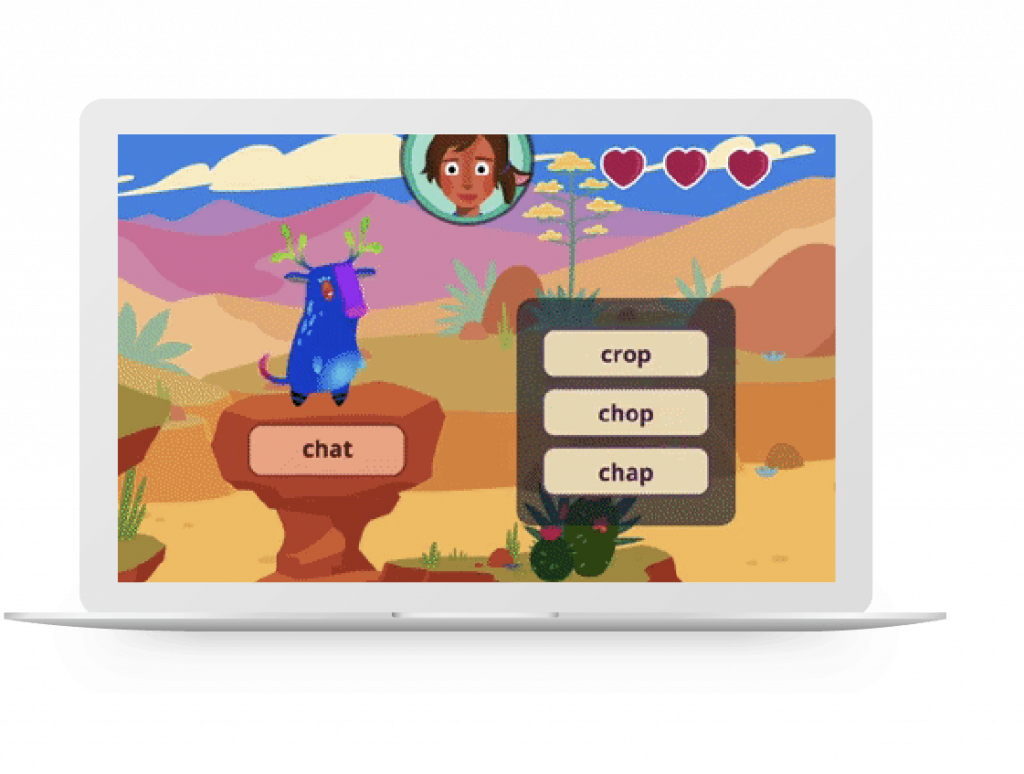
Free, high-quality lessons without the scavenger hunt.

Discover more than a thousand free lessons bursting with interactivity—across K–12 math, literacy, and science.

Math: Grades K–5
A cartoon purple frog sits on a green hill with a purple bug on the left and a yellow crown on the right, all on a bright green background.
Math: Grades 9–12
A quadratic equation, ax² + bx + c, appears above a blue and purple table with an arrow pointing from the equation to the table.
Science: Grades 4–8
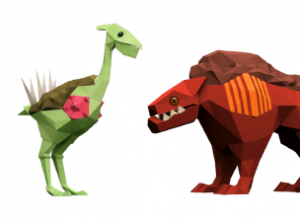
Two low-poly, fictional creatures face off: a green, bird-like animal with spikes and a red, bear-like beast with sharp teeth and orange markings—perfect for sparking imagination using free teaching resources.
Literacy: Grades K–5
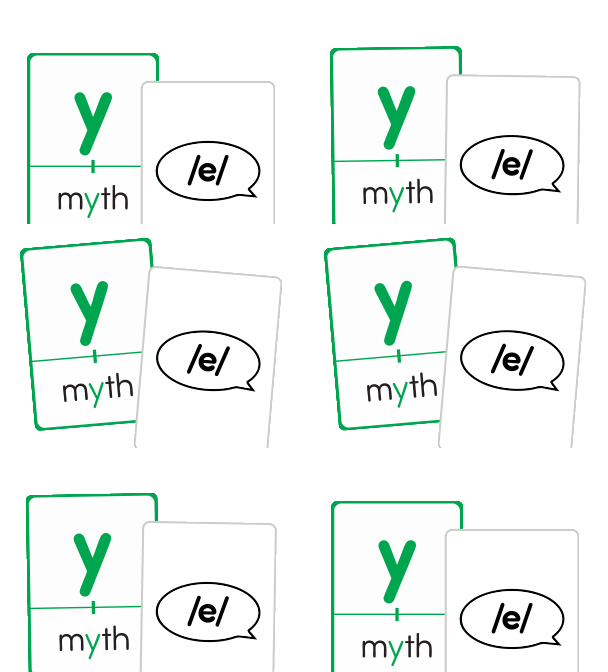
A card with the letter u0022yu0022 labeled as in u0022mythu0022 next to a speech bubble card showing the phonetic symbol /e/.
Math: Desmos classics Grades 6–8
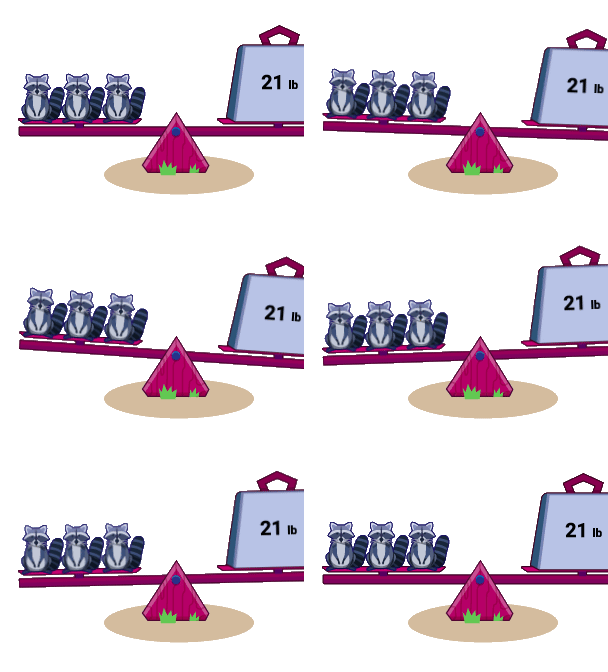
Three raccoons balance on one side of a seesaw, while a 21 lb weight balances the other side on a grassy surface.
Polypad manipulatives:
A square divided into seven colorful geometric shapes: two triangles, two parallelograms, one square, and two smaller triangles in green, red, purple, orange, teal, and magenta.

More than 300,000 teachers turn to Amplify Classroom for captivating lessons and virtual manipulatives.

Grade 1 Math

Leaping Lily Pads

Grade 6 Science

Behaviors and Structures Support Survival

Kindergarten Literacy

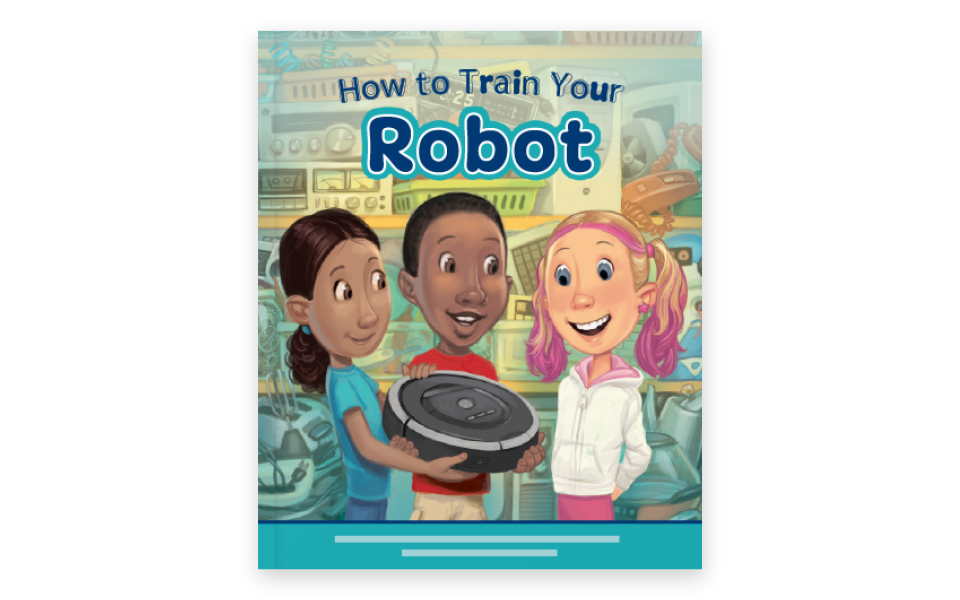
The Boy and the Violin

Grades K–12

Polypad manipulatives

Algebra 1

Shelley the Snail

Get your classroom buzzing with our powerful teaching tools.

Tailor lessons to fit your needs.

Share and celebrate student ideas.

Take snapshots of classwork to foster discussion and highlight student thinking.

Gain insights into student thinking.

Monitor your students’ ideas in real time so you can adapt instruction on the fly.

Control the flow of instruction.

Pace students to specific parts of the lesson, or pause to explore concepts more deeply.

What are people saying?

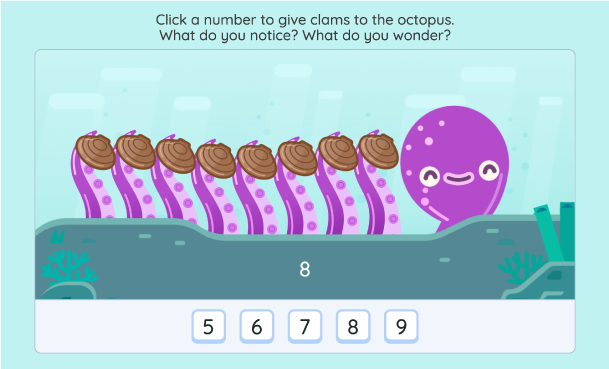
A purple octopus with eight tentacles, each holding a clam, is shown above a row of number buttons labeled 5, 6, 7, 8, and 9. The number 8 is highlighted.

Martin Joyce

@martinsean

Love this #AmplifyClassroom kindergarten activity! First the octopus checks sums of 8 then the sea urchin comes out. Great job. I’ve been wary about making my kids not hate math (no drill n kill) and they’re asking can we do math on the computer before bed. Yes! Cc @ddmeyer

A user interface with four circular icons—Anonymize, Pace, Sync to Me, and Paused—above a dropdown menu labeled "Sort by Time Entered," designed as a free teaching platform for easy access to lesson plans.

Traci Jackson

@traciteacher

After an audible groan b/c the activity was paused, Ss made sense of ordered pairs through a purposeful #AmplifyClassroom experience! This S pair wrote without any prompting. Great collaboration and learning in 5th grade today!

Mark Labuda

@mrmlabuda

Hands down the best virtual manipulatives I’ve ever come across.

Screenshot of the Facebook group "Amplify Classroom Educators (formerly Desmos Educators)" with a join group button, highlighting educational images, group details, and access to free teaching resources.

Join our community

More than 30,000 educators share advice, lessons, wins, and more in our Amplify Classroom Educators Group. Be a part of the conversation!

Interested in learning about the benefits of being an Amplify customer?

Amplify Classroom FAQ

Amplify Classroom (formerly Desmos Classroom) is a free K–12 teaching platform that gives educators access to a library of high-quality, interactive lessons in math, literacy, and science. The platform is built with tools that promote student engagement and collaboration, while giving teachers real-time visibility into student thinking.

Amplify Classroom supports K–12 educators across math, science, and literacy. The platform offers more than 1,000 free interactive lessons, with content designed to build deeper understanding and student engagement at every grade level.

No. Teachers can create a free Amplify Classroom account and immediately access teaching tools and hundreds of lessons without a district license or subscription. Paid programs such as Amplify Desmos Math and Amplify Core Knowledge Language Arts (CKLA) also run on Amplify Classroom, and you can access that content through the same platform if your school or district subscribes to these programs.

Some schools and districts require that specific URLs be added to their allowlist before teachers can access Amplify Classroom. A full list of permitted domains can be found at amplify.com/allowlist. Teachers should share this information with their school or district IT team.

Amplify Classroom offers built-in tools that promote real-time teacher visibility and student engagement. Key features include:

  • Real-time student insights: See student responses and thinking as they happen, all in one easy-to-use teacher dashboard.
  • Teacher pacing controls: Pause a lesson or advance all student screens simultaneously.
  • Select and sequence student work: Highlight student ideas live by selecting and sharing student work during a discussion.
  • Anonymous student sharing: Display student work to the class without showing students’ real names.
  • Lesson customization: Copy and edit pre-built K–12 lessons or build your own from scratch using our drag-and-drop lesson builder.
  • Class management tools: Create and manage multiple classes, add co-teachers, and organize rosters.

Yes. Teachers can customize our K–12 lessons or even create lessons from scratch to meet their students’ unique needs. This includes adding things like pre-made screens, images, multiple-choice questions, graphs, and more with our drag-and-drop lesson builder.

Yes. Many teachers use Amplify Classroom to supplement their existing curriculum. The platform can be integrated into any part of a teacher’s day, with a wide library of lessons and tools for core or supplemental instruction.

For schools seeking a full core curriculum, Amplify also offers paid programs including Amplify Desmos Math and Amplify CKLA, both fully integrated into the platform.

Yes. Amplify Classroom supports signing in with Google. Teachers can import class rosters directly from Google Classroom to streamline setup. For Amplify customers, Clever integration is available for school and district rostering. You can learn more about our integrations here.

Amplify Classroom is built to facilitate compliance with applicable student data privacy laws, including FERPA, COPPA and other applicable laws related to the collection and use of student data. To provide Amplify Classroom to students, Amplify receives Student Data as a “school official” in accordance with Section 99.31 of FERPA and COPPA guidance, and operates at the direction of the school. You can read more about this in our Acceptable Use Policy and Customer Privacy Policy.

S2-06: Making time for science in the K–5 classroom

Promotional graphic for "Science Connections" podcast, Season 2 Episode 6, featuring Lauran Woolley discussing making time for science in K–5 classrooms.

In this episode,  Eric Cross sits down with TikTok star and podcast host Lauran Woolley about her experience teaching science content within her K–5 classroom. Lauran shares how she’s learned how to make time for science, and what most K–5 teachers experience when creating their own science curriculum. Lauran also talks about her rise in popularity on TikTok, her podcast, Teachers Off Duty, and establishing strong relationships with her 5th grade students. Explore more from Science Connections by visiting our main page.

DOWNLOAD TRANSCRIPT

Lauran Woolley (00:00):

I wanna make sure that they’re ready for the real world, and I wanna make sure that they’re able to apply these things that I’m teaching them in their life, not on a multiple choice test.

Eric Cross (00:11):

Welcome to Science Connections. I’m your host Eric Cross. My guest today is Lauren Woolley. Lauren is a full-time fifth grade teacher in Leetonia, Ohio, who has amassed a following of 5.5 million subscribers on TikTok and over 1 million followers on YouTube. She’s also co-host of the podcast, Teachers Off Duty. Lauren has combined her teaching vocation and her talent for entertaining to connect with her students and encourage teachers across the world using her own unique style of edutainment. My most vivid memory from our discussion was her sincerity and openness about her experiences. It quickly became obvious to me that her personal transparency was a characteristic that she has remained grounded in despite her social media success. And now, please enjoy my discussion with Lauren Woolley.

Eric Cross (00:53):

You’re currently teaching fifth grade?

Lauran Woolley (00:55):

Yes.

Eric Cross (00:55):

What is it like to teach all content areas? ‘Cause I’m a middle school science teacher.

Lauran Woolley (00:59):

I didn’t always teach all content areas. First I started in second grade, so I used to teach like primary. I taught that for about three years. And I only really got my 4-5 endorsement because it was told to me that it would make me more marketable as a teacher. So I got it <laugh>. I was like, I’m never gonna use that. And then, my second year teaching, my class had low numbers and they collapsed my second grade classroom, split up my students, and then moved me to fifth grade in January. I had to take over a fifth grade class with all content areas in the middle of a school year. And it was really hard. It was like probably one of the most challenging things I’ve ever had to do teaching. When I got my job at my current school, it was only language arts, social studies.

Lauran Woolley (01:46):

So we only have two fifth grade classes. My other teacher would teach math, science. I taught language arts, social studies, and then the timeframes weren’t matching up. Like, I didn’t have enough time in my schedule for all the things we had to do in our curriculum. And she had like a little bit too much time. We realized as a district that it would be better for our fifth grade classes to just be self-contained. And last year was the first year I taught all five subjects. And I liked the variety of teaching everything because when I taught just language arts, social studies, I just felt like I was repeating myself twice a day. <laugh>. It was kind of boring for me. So like, I like doing all of it. <laugh>.

Eric Cross (02:24):

Yeah. With all of your talents and like your background and what I’ve seen, I could totally see why having all the different content areas would like make sense. Are you using a set curriculum? How do you come up with what to teach? Do you do it with teams? Like who comes up with that?

Lauran Woolley (02:36):

Uh, me, myself and I.

Eric Cross (02:38):

Well done.

Lauran Woolley (02:39):

My school, for literacy we’re using literacy collaborative. Then for math, we just adopted bridges, which I love and it’s very hands-on, very like student-led. For science, we had nothing. And I am not a science, or was not a science teacher at the time when I took over. So I panicked a bit and I was like, “Hey, can we have some kind of science curriculum? ‘Cause I got nothing.” And it’s not hard to look at the state standards and figure out what you need to teach them, but having no resources to go off of is extremely difficult. And luckily I have an older brother, he’s like three years older than me and he’s also a teacher. He actually is a science teacher. ‘Cause that first year that I was teaching all subjects, I was like, “Hey Ryan, can you just like send me all of your Google Drive files for science <laugh>?

Lauran Woolley (03:33):

And he’s like, “Yeah, sure.” So he kind of was like a mentor for like the first year that I taught science. And this year being my second full year teaching science, I feel much more confident. I’m still using his resources. We don’t have a dedicated curriculum at my school. So that’s like one thing I’ve been fighting my school on. And not that they don’t wanna get us one, but like they were focused on getting the math curriculum last year. And then I was told, okay, this year will be science because in my state, fifth grade is a tested area for science and we have no curriculum.

Eric Cross (04:04):

Ryan, keep doing what you’re doing big bro. Second, thank you to every teacher who’s had a Google Drive folder full of curriculum that you graciously shared to a new teacher or someone else that they could have.

Lauran Woolley (04:18):

Can we just say like, can schools, like schools, please get your teacher’s science curriculums.

Eric Cross (04:24):

No, absolutely right. And there is this way of thinking that, especially as a science teacher, it’s something that is dear to my heart, but we do want to develop these math and English skills that’s important and we need that for science. But we’ve always taught so siloed for so long, but that’s not the way that we learn and that’s not the way life works. Something that intrigued me about what you said, and I think a lot of people can relate to it, and I know I can because that was me, is you created your own content or your science content. Like you’re kind of piecing that together from what Ryan had shared with you. How do you make time for that with all of the other things that you’re doing and pressures of state testing and things like that. Like how do you weave that into your teaching?

Lauran Woolley (05:02):

So we have like things that are non-negotiable in our schedules. Like we have to have so many minutes of this, so many minutes of that, so many minutes of whatever else. Well, the first year, I was self-contained. I was like, okay, my main goal, because science is a tested area, I wanna make sure that I get in science every single day, 90% of the time I’m able to get anywhere from 30 to 45 minutes of science every day. But this year it was my goal to make sure that I was getting science done and like we were doing meaningful lessons. And last year I didn’t do this, but this year I’m doing a Christmas center for STEM. So I got it off of Teachers Pay Teachers. I’m sorry, I can’t remember who it was made by, but it’s called Jingle All the Way and it’s like building Santa’s new sleigh. And so like the kids have an activity where they have popsicle sticks, straws, a plastic cup and then like tape. And they have to build a new sleigh for Santa and see how many pennies their sleigh can hold. Like talk about a sleigh being lightweight but also strong and like what would make it strong and different things like that. So I’ve been trying to incorporate a lot more STEM activities. And then something I really like to use for experiment days, I call them lab days, is Gizmo. Have you heard of Gizmo?

Eric Cross (06:15):

Yeah. The simulations.

Lauran Woolley (06:16):

Yeah. My brother showed me that too and he was using it in his class. I mean there’s so many different ones that they have that align with the standards and they have like student lab sheets that go with them and teacher guides and stuff. I’ve just been trying to like up my game a little bit more this year, because last year I was like struggling to get all of the standards in before state testing came around because, can we agree, state testing should not be as early as it is? Our state test happens in like March and we have two months of school left. So like, we better be done with standards by February so we could review, because otherwise we’re kind of outta luck because we run outta time.

Eric Cross (06:59):

Yes. That and there’s all kinds of other things that state testing brings with it that we could spend a lot of time probably critiquing and talking about like as far as what’s ideal for kids and what’s the best way to measure and assess learning. That is one question I wanna ask you though, because I know with your work on TikTok and Instagram and YouTube, you must be connected to a pretty vast teacher network and maybe you have like, kinda like more of an inner circle of people, but you must come across so many different perspectives and get into great discussions. Is there <laugh>, is there anything that kind of stands out to you as far as if you were in charge of what we’re doing? Because that’s kind of the system that we all live in and we kind of are trying to internally change it, but it’s been that way for a long time and we just kind of have to work within it until we can make changes. But if you were to, I dunno from an elementary school perspective, change or modify the way kids are learning, what would you do if you had Monarch ability?

Lauran Woolley (07:54):

Okay, I got three main things I’m thinking in my head. Okay, first things first, we got Maslow’s hierarchy of needs. Okay. If kids are coming to school hungry, if they’re coming to school and don’t have, you know, fresh clothing to put on, if they’re coming to school and they have issues at home that they are dealing with, that they are not okay with, the learning is not happening. That’s secondary. They don’t, it doesn’t matter to them. It doesn’t matter to me because what’s most important is that child as a human being and whether or not they’re okay. If I had unlimited resources, I would love to be able to build like a little mini village inside a school and have like a clothing store that kids could grab stuff from. Or like a, you know how I know how school have like closets and food pantries, but like a real place they could get some new clothes, not like hand-me-down clothes, like a store they could go and grab some food if they needed food for their homes or whatever. We have like an onsite counselor but not like a school counselor, like a therapist-type counselor for like mental health. Having some kind of like health clinic, not just like a school nurse because, let’s be real, our school nurses see everything <laugh> and they do not get enough credit, but like to have like a little like urgent care clinic, like basically a small town <laugh> inside a school that like kids would have all of the resources that they need met. Like that would be my number one thing that I would love to do. I have taught in, you know, I’ve only taught in two different schools, but like I’ve seen a lot of things and the number one thing that keeps coming back is just like home lives and mental health and having someone to talk to.

Lauran Woolley (09:41):

And I think our kids don’t have enough of that. Second of all, would be obviously state testing. Because I mean, it’s good to see like where our kids are at. I don’t think it should be used punitively and I don’t think that it should be putting as much pressure on teachers and students the way that it is. It’s not effective that way at all. Let teachers do their jobs without us having to, like, ’cause honestly, who’s not gonna say that they’re not trying to set their students up to do the best on that test. Our evaluation depends on it. I’m gonna make sure my students are prepared for it. I’m gonna teach all the standards, but like, I shouldn’t have to be teaching so that they could do well on a test. I wanna make sure that they’re ready for the real world and I wanna make sure that they’re able to apply these things that I’m teaching them in their life, not on a multiple choice test. Third of all, <laugh>.

Eric Cross (10:33):

This, this is great. And I think a lot of teachers will listen and be like, “That’s what I’m talking about right there.” Keep going. You’re on three.

Lauran Woolley (10:40):

That would be two teachers in every classroom. Either two teachers in each room or like a teacher and a paraprofessional in each room, because there’s not even an argument that teachers are more effective when they have help.

Eric Cross (10:54):

I would even carry the math on further and say that it’s a force multiplier, like exponentially, that it’s not just, it’s not just like a one plus one equals two teachers. It’s almost like you can almost have like three or four just because of the energy and the synergy that can be created between the two. And you can push off of each other, encourage one another and both support different types of students. So I agree a hundred percent. I think that if you had two teachers that were in sync and planning together and talking about kids all of the time, you would be able to go deeper with students. You’d be able to find out those things that you talked about in Maslow’s because sometimes we don’t find out about it until a parent-teacher conference or kids left our classroom. I wish I would’ve known that. The student was without these things in the very beginning.

Lauran Woolley (11:41):

Absolutely. Mm-hmm.

Eric Cross (11:42):

So when do you start in the school and do we go on LinkedIn to sign up and apply or is it like a lottery system? Like, ’cause you know, I was gonna get a lot of attention.

Lauran Woolley (11:52):

I would love to Oprah Winfrey this and like build my own school <laugh>.

Eric Cross (11:56):

We gotta get those followers up. We gotta build up the sponsorships. We gotta get you up to a hundred million.

Lauran Woolley (12:01):

Listen, if all of my followers across all my platforms donated like $2, we could have $12 million to build a school. <laugh>.

Eric Cross (12:10):

Think about like, DonorsChoose, right? People do that. And I know there’s mixed feelings about it because we need stuff in our classroom. I’m just gonna say that. All right. So, whether I have to ask for it on a website or whatever, but people want to give directly to kids, or people who need it. And I think when there’s opportunities like that, that are visible, people are more likely to want to.

Lauran Woolley (12:29):

In reality, should other people have to fund education in classrooms? No. That’s literally what your taxes are for. A government-funded classroom versus a teacher-funded classroom are two different things. And we know that. But if teachers are asking for things or asking for donations on Amazon or on DonorsChoose, just know in your heart that that teacher has probably already shelled out a lot of their own cash to do that. It’s not that they’re, you know, asking for handouts or anything like that. They’re trying to give their students the best that they can and that’s the thought process behind it. And until we get changes in our education system or changes in legislature that will allow us to do that or will allow classroom budgets, I mean, our hands are tied. Like there’s only so much teachers can do. I’m very fortunate to teach in a district that sees the value in spending money on their teachers and students. And, like my school, like I said, they just shelled out thousands of dollars on a new math curriculum. They bought school supplies. Literally every teacher made their school supply list this year. And then the district went in and paid for every single student’s school supplies in the entire district.

Eric Cross (13:49):

Can we get a shout out to your district real quick?

Lauran Woolley (13:51):

Uh, yeah. I mean, shout out Leetonia schools like, I mean, you guys are awesome and I’ll shout that from the rooftops. I love where I teach. Like I really do think that they value our students and they care about our students and our admin is great. We got a new superintendent a couple years ago. He’s been doing a phenomenal job and I really love it and I’m glad I teach there.

Eric Cross (14:12):

When you move out of the classroom, you know, in any position of leadership, you do have the microscope or magnifying glass on you and a lot of times it’s critical. And not unjustifiably so, I mean, there’s a lot of things that can be critiqued. However, what we don’t always hear is the success stories or where it’s working for teachers and why. And we need leaders to be able to talk to each other and find, “Hey, it’s working in your district? Oh, I just heard, I just heard this district get shot out. I’m gonna go reach out to those people. Hey, what are you doing?” Because we connect with each other, but I think when you go like a level up, that kind of getting up the top of the mountain, the, the connection sometimes can become more difficult for people. There’s not a lot of, I don’t know, maybe there are, but admin influencers.

Lauran Woolley (14:54):

Oh yeah, there definitely are. And I’ve met some really incredible ones. I’m on a committee at my school, it’s called NNPS, it’s the National Network of Partnership Schools. It was started out of Ohio State University. Essentially it is a committee in the school that’s dedicated to bringing together the community and businesses and partnering with people to make our school as strong as it can be. We started last year and we did a bear breakfast, ’cause our mascot is a bear. And we had Christmas things and we had the choir caroling, and we had pancake breakfast for everybody and it was completely free. It was just really nice to see everybody come together. And it feels like the culture changes when people work together and come together for the betterment of the school and for the students. And I think what’s challenging is that so many people have such a negative experience from their schooling that they’re hesitant to get involved in their kids’ schooling. I urge any parents out there, any guardians out there that are, you know, in that mindset where you’re like, I didn’t like my teachers in school, or I had this, this, this and happened to me at school. Give it a chance to know that things have changed and things are changing.

Eric Cross (16:11):

I definitely agree with you about parent engagement and getting involved and sometimes parents, they just don’t know that they should. But wow, your voice is so powerful, especially at board meetings and things like that. Getting stakeholders involved, creating community, which it sounds like your school did a great job or your district did a great job of. The last question I wanna ask you, and it’s kind of going back to who your influencer was, is you now are in a position where your impact exceeds more than, you know. You’re planting so many seeds you’re sharing, and you’ll hear maybe a few, or I’m sure you’ll hear the things that kind of come back to you, but that’s only a fraction. But I wanted to ask you, like, as you think back on your career as an educator or when you were in school K through five or K through 12, is there anyone who stands out to you or who was maybe your influencer or teacher who made a big difference that was memorable? And if so, who was it and what was it about them or what did they do?

Lauran Woolley (17:01):

So I had a lot of teachers that I really had good relationships with and I loved school growing up. But one always stood out in particular, and that was my ninth grade English teacher and her name is Andrea Reid. She was the first person who really told me that I was talented at something and that I could succeed in something because she was the English teacher. She was also a coach of the speech and debate team at my high school. Just one day after school. She was like, “Hey, like you should come to speech tryouts.” So I went to tryouts, like I did it not thinking like I cared if I made it or didn’t, and then I made the team. And honestly, I feel like speech was the starting point of all of it. I competed in speech and debate for four years of high school and she was my coach.

Lauran Woolley (17:49):

I always have horrible nervousness with public speaking, even though I do it a lot. And she would always give me like the best hype speeches and the best confidence boosters. And I feel like speech started my love of acting and started my love of like, you know, comedy and stuff like that. And so therefore TikTok happened and I don’t think any of this would’ve happened had it not been for her and her opening that door for me and telling me, “Hey, you would be good at this. You should try it.” We’re still friends to this day, 15 years later, and she is like an older sister to me and I love it.

Eric Cross (18:26):

That’s amazing. Andrea Reed, that’s her name.

Lauran Woolley (18:28):

Andrea, yep.

Eric Cross (18:29):

Andrea. Andrea Reid. Ms. Reid, thank you, for inspiring Lauran and <laugh> because of your impact, now it’s impacting so many others and as teachers, like, we don’t even, we don’t know, but it’s so humbling to know that like the words that we say to people have that impact and power. It’s so, it’s, it’s so inspiring to me. One of the things that resonate with you so much is your transparency. Like in your depth. Like even as just listening to you talk, you normalize and humanize so many things that we experience and I’m sure that’s what a lot of the people that watch you connect with. You show your life, your family, your house, all these things that are happening. And I was just looking through the comments and there’s just so many people that are warmed. Not just your students, but like so many teachers. So thank you for doing what you’re doing and I wish you tremendous success. Thank you for your time.

Lauran Woolley (19:17):

No, thank you so much for having me. This was awesome. I just wish everybody a great school year and I hope that we all make it through winter break. <laugh>.

Eric Cross (19:27):

Thanks so much for listening to this season of Science Connections. I love learning about science educators just like you. You can nominate educators that inspire you to become a future guest on Science Connections by emailing STEM@amplify.com. That’s S T E M at amplifycom.wpengine.com. Make sure to click subscribe wherever you listen to podcasts and tune in for a brand new season of Science Connections coming soon.

Stay connected!

Join our community and get new episodes every other Wednesday!

We’ll also share new and exciting free resources for your classroom every month!

What Lauran Woolley says about science

“I want to make sure they’re ready for the real world and I want to make sure they’re ready to apply these things I’m teaching them in their life, not just on a multiple choice test.”

– Lauran Woolley

5th Grade Teacher, Northeast Ohio

Meet the guest

Lauran Woolley is a fifth grade teacher in Northeast Ohio. She has loved being able to combine her love of education and entertainment into one career. Her goal is not only to humanize educators to both families and students, but to create a safe space for her students on the internet. She has had the privilege of collaborating with educators around the world to shed a light on this amazing career. You can listen and watch the Teachers Off Duty podcast here!

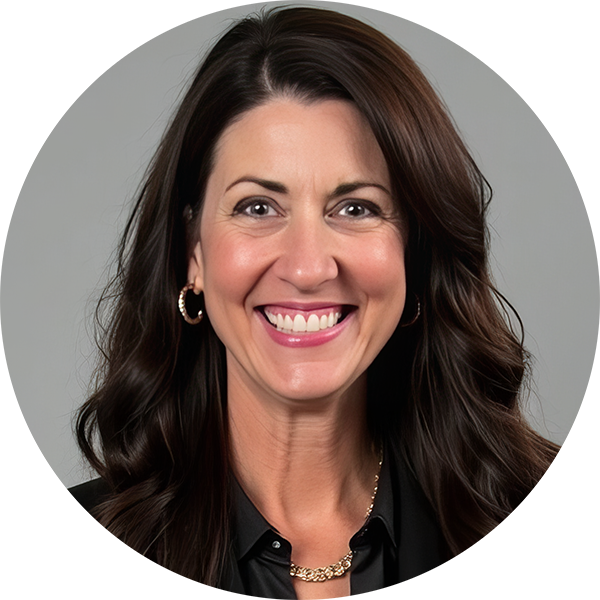
A woman with long dark hair smiles at the camera, wearing a black top and lanyard, with a colorful blurred background.

About Science Connections

Welcome to Science Connections! Science is changing before our eyes, now more than ever. So…how do we help kids figure that out? We will bring on educators, scientists, and more to discuss the importance of high-quality science instruction. In this episode, hear from our host Eric Cross about his work engaging students as a K-8 science teacher. 

S3-04: Using AI and ChatGPT in the science classroom

A graphic with the text "Science Connections" and "Amplify" features colorful circles and curved lines on a dark gray background.

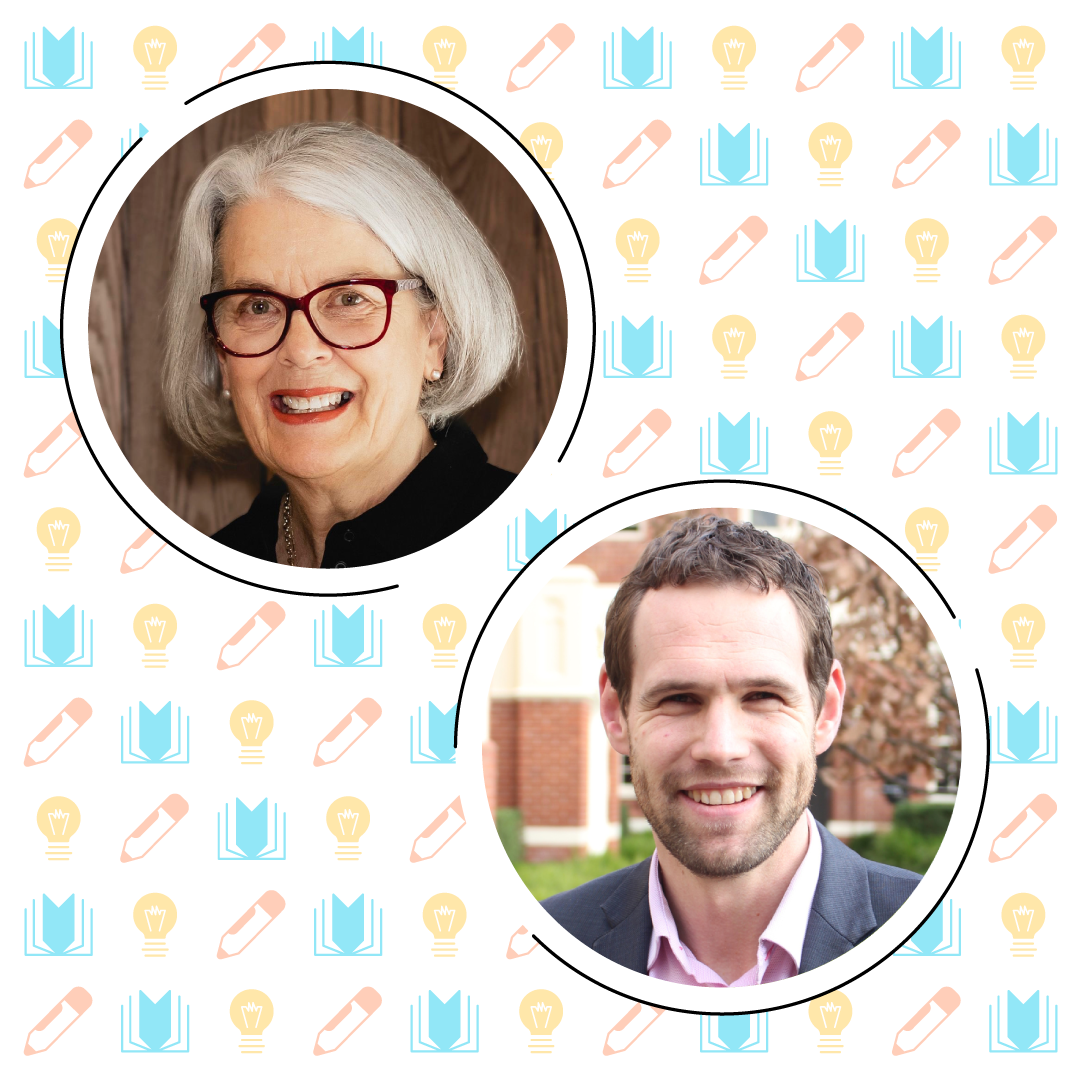
In the latest episode of the Science Connections podcast, we explore AI in education and its impact on students. Listen as I sit down with teachers Donnie Piercey and Jennifer Roberts to discuss ChatGPT and how we can use it to build science and literacy skills in K–12 classrooms while preparing students for the real world.

And don’t forget to grab your Science Connections study guide to track your learning and find additional resources!

We hope you enjoy this episode and explore more from Science Connections by visiting our main page!

DOWNLOAD TRANSCRIPT

Jennifer Roberts (00:00:00):

If a kid graduates from school without knowing that AI exists, they’re not gonna be prepared for what they face out in the world.

Eric Cross (00:00:07):

Welcome to Science Connections. I’m your host, Eric Cross.

Eric Cross (00:00:12):

This season of the podcast, we’re making the case for everyone’s favorite underdog, science. Recently we’ve been highlighting the magic that can come from integrating science and literacy. So if you haven’t checked out those recent episodes, definitely go back in your feed after you’re done with this one. This time around, we’re going to deep dive into what artificial intelligence means for literacy instruction, and how science can be a force for good, in responsibly exposing students to AI. To help me out, I’m joined by two extremely accomplished educators. Jen Roberts, a veteran high-school English teacher from San Diego, who among many things runs the website LitAndTech.com. And I’m also joined by fifth-grade teacher Donnie Piercey. In addition to being Kentucky’s 2021 Teacher of the Year, Donnie also has an upcoming book about bringing AI into the classroom. Whether you’ve never heard of ChatGPT or whether you’re already using it every day, I think you’ll find this a valuable discussion about the intersection of science, English, and technology. Here’s Jen and Donnie.

Eric Cross (00:01:17):

So first off, welcome to the show. It’s good to see you all. What I wanna do is kind of start off by introducing both of you. And so we’ll just go K–12. So <laugh>, Donnie.

Jennifer Roberts (00:01:30):

Donnie goes first.

Eric Cross (00:01:31):

Donnie’s gonna go first. Donnie out in Kentucky. Just a little background. What do you teach; how long you’ve been in the classroom; and what are you having fun with right now?

Donnie Piercey (00:01:38):

Yeah, so my name is Donnie Piercey. I’m a fifth-grade teacher from Kentucky. Live and teach right here in Lexington, Kentucky, right in the center of the state. I’m the 2021 Kentucky Teacher of the Year. But I’ve been teaching elementary school for the past … I think this is year 16 or 17. It’s long enough where I’ve lost count, and I can’t even count on fingers anymore. My friends like to joke that I’ve taught long enough where now I can count down. You know, it’s like, “All right, only so many more years left.” But yeah, teach all subjects. Science definitely is one of the subjects that I don’t just try to squeeze into my day, but make sure that … it’s not even a devoted subject, but one that I definitely try to — don’t just have that set time, but also try to do some cross-curricular stuff with it. So definitely the rise of AI in these past few months, which feels like years by this point, has definitely played quite the role, in not just changing the way that I’ve been teaching science, but really all my subjects. So, excited to chat with y’all about it.

Eric Cross (00:02:47):

Nice. I’m excited that you’re here. And Jen?

Jennifer Roberts (00:02:51):

Hi, I’m Jen Roberts. I teach ninth-grade English at Point Loma High School, and that’s where I usually stop when I introduce myself. But for your sake—

Eric Cross (00:03:00):

I will keep introducing you if you stop there. <laugh>

Jennifer Roberts (00:03:04):

I am nationally board-certified in English Language Arts for early adolescence. I am the co-author of a book called Power Up: Making the Shift to 1:1 Teaching and Learning, from Stenhouse, with my fabulous co-author Diana Neebe. Shout out to Diana. I blog at LitAndTech.com about teaching and technology and literacy and the intersection of those things. And I’m looking forward to talking about how AI is showing up in my classroom and the fun things I’m doing with it.

Donnie Piercey (00:03:31):

And one of us is actually secretly a robot, and you have to guess which one.

Jennifer Roberts (00:03:35):

Have to guess which one. Yes. <laugh>

Eric Cross (00:03:37):

That would be super-meta. And you were the CUE — Computer-Using Educator — outstanding teacher or educator? Whatever. Either one. Of the year.

Jennifer Roberts (00:03:45):

I was the CUE ’22 Outstanding Educator. Yes. And I’ve won a few other things as well.

Eric Cross (00:03:53):

The gaming backpack.

Jennifer Roberts (00:03:54):

I’ve won a gaming backpack recently! Yes. I once won an iPad in a Twitter chat.

Eric Cross (00:03:58):

What?

Donnie Piercey (00:03:58):

What’s a gaming backpack? Hold on. We need to talk about that.

Jennifer Roberts (00:04:01):

We will talk about that. <laugh> And then, I was once a finalist for county Teacher of the Year. That’s as close as I got to Donnie. Donnie was the Kentucky Teacher of the Year. He got to go to the White House and stuff. That was exciting.

Donnie Piercey (00:04:13):

<laugh> I mean, to be fair, there’s only three million people in Kentucky, and about what, 50 million people that live in California? <Laugh> So odds are definitely stacked in my favor, I think.

Jennifer Roberts (00:04:23):

So you’re saying we’re even there? Is that, is that what you’re going for?

Donnie Piercey (00:04:25):

Yeah, evens out. Evens out.

Eric Cross (00:04:27):

So I’ve been looking forward to talking to you both for a while now, and talking about artificial intelligence. It’s like the big thing. And both of you, at different ends of the spectrum and in my life, have contributed to this. Donnie, you’ve been sharing so much great information online about how you’re using AI in elementary. Jen, you are the reason I got into education technology years ago, right when I was becoming a teacher. And so being able to talk with you both about it excites me a lot. So first off, for the listeners who may not have any experience with it — and there’s still a lot of people out there who have not been exposed to it, haven’t got their feet wet with it yet — I’m hoping we could start off maybe with an explanation of … we could do AI, ChatGPT, I know that’s the big one. But simply explaining what it is, just for the new person. And whoever wants to start off can tell us about it. Or maybe we’ll start … we’ll, let’s actually, let’s do this: Let’s continue going like K–12? So Donnie, maybe you could … what’s your pitch to the new person of, “Hey, this is what it is”?

Donnie Piercey (00:05:31):

All right. So, AI, artificial intelligence, probably the way that most people are exposed to it, at least since November when it launched, is through ChatGPT. Where if you Google it, you know it’s made by a company called OpenAI. The best way to describe what it is … when you go there for the first time, make an account, it’s free. You have like a little search window, looks like a Google search bar. And instead of searching for information, you can ask it to create stuff for you. So for example, like on Google search, you might type in a question like, “Who was the 19th president of the United States?” Where on ChatGPT, instead of just searching for information, it creates stuff for you. So you could say, you could ask it to, “Hey, write a poem about the 19th president of the United States.” Or, “Write a short little essay comparing, I don’t know, Frederick Douglass to Martin Luther King Jr.” And it would do that for you. You know, that’s most people’s first exposure to AI, at least in these past few months. Instead of … you know, it’s artificial intelligence, but it’s not just chatbots. There’s lots of other AI that exist out there.

Jennifer Roberts (00:06:47):

And I think that’s the thing: that people don’t realize how much AI is already in their lives.

Donnie Piercey (00:06:51):

For sure. Yeah.

Jennifer Roberts (00:06:52):

You know, they just haven’t seen … the term that I see being used a lot now is “generative AI.” AI that can produce something. It can produce writing, it can produce art, it can produce a script, it can produce a character. But the AI that has been helping you pick what to watch next on Netflix and the AI that’s helping Google help you get where you wanna go on Google Maps faster, those are forms of artificial intelligence as well.

Donnie Piercey (00:07:21):

Yeah. I mean, even those, when you get that that message in Gmail, and instead of having to type out that response that says, “Yeah, that sounds great,” you can just click the little button that says, “Yeah, that sounds great.” I mean, that’s been in Gmail for years, but that’s artificial intelligence too.

Eric Cross (00:07:39):

Absolutely. So why is it important, do you think, for educators to, to be familiar with it? Like, why are we all so excited about it?

Jennifer Roberts (00:07:47):

So, educators need to know what kids are into, and kids are obviously into ChatGPT. And anyone who’s an educator right now has probably already had something cross their desk — or more likely their computer screen — that was written by AI and passed off as a student’s own work. And that is, of course, the great fear among teachers everywhere, that this is what kids are just gonna do these days and they won’t be able to catch it and children won’t be doing their own work and this and this. But I think the big reason teachers need to know what’s going on is because teachers need to be futurists. Our clientele will live in the future. We teach kids, kids will become adults, adults will live in the world. And so if we’re not thinking about and trying to predict on some level what’s gonna happen 5, 10, 15 years from now … we might be wrong, but what if we’re right?

Jennifer Roberts (00:08:38):

And if we’re not at least trying to think about what is their future world gonna look like, then we’re not serving our students well. I did a whole night talk on that. So I think ChatGPT is part of that. I teach seniors. I had this moment of realization I felt a few months ago. I’m like, “This is gonna be the world they graduate into. They need to know what this is before they leave me.” If I don’t teach them how to use this well, and not the way they’re using it — which is to copy and paste the teacher’s assignment and drop it into ChatGPT and take whatever it spits out and turning that in without even looking at it — if I don’t teach ’em how to use it critically, if I don’t teach them how to write effective prompts, if I don’t teach them how to use the AI as a tool, as a collaborator, then they’re gonna graduate into a world where they lose out to people who do know how to do that. And I think the advantage goes to kids who have access and knowledge of what’s in front of them and what’s available, and can use all of the tools at their disposal. Because when you’re writing in school and you write with a collaborator, that could be considered cheating. But when you do that out in the adult world, that’s considered doing a good job. <Laugh> Being a team player. <Laugh> You know, adults don’t work alone for the most part. And adults are expected to churn out beautiful, perfect content no matter how they got there. So if I’m not teaching my kids how to use this, they’re not being ready. They’re not gonna be ready to be the adults that I want them to be.

Donnie Piercey (00:10:07):

A hundred percent agree. And I also believe … as you know, I teach elementary school. I also don’t think anybody is saying that on the first day of kindergarten, you hand a kid a Chromebook and load up an AI chatbot or ChatGPT and say, Hey, this thing’s gonna do all your work for you for the next 12 years; just coast through life. You don’t have to think creatively. You don’t have to learn how to develop a paragraph or learn how to write a speech or develop an idea. Like, I don’t think anybody’s saying that, because as an elementary school teacher, there’s many days when I’m like, “Y’all, we’re just putting the Chromebooks away today and we’re just gonna go old-school. We’re just gonna maybe just jot down five quick ideas and stand up and present those ideas to the class.”

Donnie Piercey (00:10:54):

Because while AI definitely will, like you were saying, Jen, play a significant role in the lives of our students who are, not just graduating, but the 10- and 11-year-olds in my classroom this year. A significant role in their lives. It’s also really important to recognize that we’re not saying that this means that “Hey, kids don’t have to work anymore.” They still have to put forth that effort. There’s still — one of the ways that you become a good writer is by trial and error. And sometimes that trial and error comes through talking to a teacher or talking like you were saying to a peer or collaborating with a peer and saying to them, “Well, this sentence here, this paragraph here, really doesn’t make sense.” And I do believe one of the ways — especially as AI starts to become more fine-tuned and starts to be embedded more and more in tools like Google Docs and Microsoft Word — is it’s almost going to be a tutor to students.

Donnie Piercey (00:11:56):

Mm-hmm. <affirmative> Where I could very easily see in a few years, or maybe a few months, who knows what Google or any of these other big companies has rolling out, where a student could highlight a paragraph that they wrote simply, and then say, “Hey, proofread this for me,” or “Check for coherence.” Or even just ask a simple question: “Does this paragraph make sense?” Because you can already do that. You can copy a paragraph over into a chatbot and say, “Hey, does this make sense?” You know, “Rate my idea from one to 10,” and it’ll do that for ’em.

Jennifer Roberts (00:12:26):

We did that last week <laugh>.

Donnie Piercey (00:12:28):

Yeah. Right. I mean, that’s the thing. That technology exists now. It’s just not totally embedded yet. But based on what I’ve read and what I’ve seen, that’s gonna happen sooner rather than later. And it’s really, really important that we teach our students that, “No, you’re not just gonna use this, this tool to cheat, but you can use this tool to help you become a more creative student.”

Jennifer Roberts (00:12:50):

This is the use case in my classroom. Can I talk about that? You ready for that?

Eric Cross (00:12:53):

Please.

Jennifer Roberts (00:12:54):

OK.

Eric Cross (00:12:54):

Please.

Jennifer Roberts (00:12:55):

So my ninth graders are writing a comparative analysis essay, where I took them to the student art gallery and I made them pick two pieces of completely unknown student art and take notes on it, so they could go back and write this essay. And as soon as we got back to class, I said, can ChatGPT write this for you? And they all kind of froze ’cause I didn’t tell them what ChatGPT was. And they weren’t sure if they were allowed to know or not. And finally one of them kind of bravely raised his hand and said, “No.” And I said, “Why not?” And he said, “Well, the AI hasn’t seen the art. How can it write an essay about art when the art is completely original that we just went and looked at?” I said, “It’s almost like I planned it that way, isn’t it?” And they laughed nervously. And then I said, “Does that mean it can’t help us with this assignment?” And they said, “Well, no — of course it can’t help us, because it has not seen the art.” And I said, “Well. …” And I open ChatGPT, and I typed in what they were trying to do: “I need to write a comparative analysis essay comparing two pieces of student art on these reasons. And I need to choose which one did it better, basically. Can you help me with an outline?” and ChatGPT produced a lovely outline. And I looked at that with my students and we looked at it together and I said, “This is what it gave us. Would this be helpful to you?” And they’re like, “Yeah, that would be helpful to us.” So we — to be clear here, I was the only one using ChatGPT in the room. They were not actually using it. We were using it together. I copied and pasted the outline that it gave us and put it in their learning management system where they could access it so they could use the outline that the robot provided, and then they could use that to make their own writing better. So then I let them write for a little while, and, after they’d written for a little while, I said, “Does anybody wanna let me share your first paragraph with ChatGPT and see what it thinks of how you’re doing?” And a brave student raised his hand and we took his paragraph and we put it in ChatGPT, and it spit back advice. We said, “This is what I have so far for my first paragraph. Do you have any advice for me?” And we gave it the writing, and the first piece of advice it gave back was very generic, you know, “Add a hook,” you know, like kind of thing. But after that, it started to get more specific about things he was actually doing in his writing. And it started to give him some feedback. And we looked at that together as a class. And I said, “Does any of that feedback help you?” And he said, “Oh yeah, absolutely. I’m gonna go add some revisions to my paragraph.” And other students did too. They looked at the feedback he got and used that to improve their writing. And so everybody went and revised. And I said, “Look, if you take what the robot gives you and you copy and paste it, and you turn it in as your own work, it’s gonna get flagged for plagiarism. And that’s not gonna go well. But if it gives you writing advice the same way I would give you writing advice, and you decide that advice is good, and you take that advice and you incorporate it into your own writing yourself, then the robot’s making you better, but you’re still the one doing your own writing.” And the writing they turned in from that assignment was, was better. It wasn’t written by ChatGPT; it was still about the student art that they found in the gallery. But I showed them a path. Like, it can help you with an outline, it can help you with feedback. Right? These are fair ways to use it that’s gonna make you better. And they really liked that. They really liked — no one had shown them that before. The idea that you don’t just take the teacher’s prompt and give it to it … like, these are new uses to students and worked well.

Eric Cross (00:16:17):

So right now, you both just laid out these ways that you’re using it. And I do this with people that I’m trying to introduce to ChatGPT or AI. ‘Cause I get excited. Anyone could write a 500-word persuasive essay on the use of color in The Great Gatsby or The Outsiders, and they can get something back within seconds. But for a lot of educators, it might feel like the sky is falling.

Donnie Piercey (00:16:43):

Oh, understandably! Understandably. I mean, that totally makes sense.

Eric Cross (00:16:49):

What would you say to them? Donnie, go ahead.

Donnie Piercey (00:16:51):

Yeah. Well, I feel like every teacher kind of goes through the same experience when they see like a generative chatbot. I mean, all these major companies are gonna start incorporating AI, the generative AI piece. And a lot of times, when they see it for the first time, two things. First they’ll say “Oh, but I’ll know that that’s not my students’ writing.” Which, frankly, I think is a good thing, because that tells me that the teachers know their students’ writing. They’ve seen them write in person. They’ve conferenced with them one-on-one. And if a student were to turn something in to me, who I know might be a struggling writer, maybe it’s not their strength, and all of a sudden they’re turning in this10-page dissertation-worthy thesis written at a PhD level, I’m like, “All right, man, you’re nine. Can we talk about where this came from?” <laugh> But I also don’t think that at like the heart, I don’t feel like kids want to cheat. I really don’t. I feel like sometimes like kids are in a situation where they’re like, “OK, I’ve got nothing left. I gotta get this assignment done.” And when those kind of things happen, that’s when we as teachers, we have those one-on-one conversations. Even when I showed my students ChatGPT and even some of the AI image-generating stuff for the first time, and I talked to them about, “What do y’all think about this?” Because, you know, they’re under 13. In my district, ChatGPT is blocked for students. Staff, we have access to it. And that’s just because one, it’s so new, and at the same time, we need to figure out, “What’s the best way they can go about using this tool?” But when we were talking about it as a class, you know, I didn’t want to ignore the elephant in the room. So I asked them, I said, “Hey, do you feel like this is something that you all would use to. …” I mean, I used the word. I said “cheat.” And to be honest, the majority of the students in my class, they were taken aback. They’re like, “What? You think we just would cheat all the time?” Right? <Laugh> And I’m like, “Oh, well good. I’m glad to know that integrity is still alive and well.” But yeah, that’s definitely my thoughts on it, as far as not only the student integrity piece — I think that that’s the big thing that you need to just bring up with your students. Because again, I like to think that I’ve seen my students write enough that if they were going to turn something in that wasn’t their voice, or it didn’t sound like them, like I could have that conversation. And don’t be surprised, too, if in the next … I don’t know, one month to a year, there’s lots of AI detectors that exist. A lot of them are these like third-party things. You can go ahead, but I would not be surprised if in the next year or so, like you start to see those AI detectors be built into Google Docs, into Microsoft Word, into even Canva. And honestly, it’s almost like a fail-safe button for teachers, that we could say “All right, this is telling me that this is 99% probably written by AI.” So you can have that conversation with a student that way.

Jennifer Roberts (00:20:03):

I mean, if you’re worried about it, Formative, right now, will even tell you if something is copy-and-pasted into the boxes that they give you for students to write in. I find that kids who cheat are desperate, you know. Especially at the high school level. They’re panic mode. And, and usually their panic comes from, “I have no idea how to even start this assignment.” And so part of what I wanna use ChatGPT for is to lower that barrier for them. Like, you’ve got an assignment, you don’t know where to start. Tell the robot, tell ChatGPT, about the assignment and ask it for a list of steps. You know, ask it for an outline. Ask it for a time management plan. I see so much tremendous potential for this to help many of my students with IEPs who have executive functioning issues.

Donnie Piercey (00:20:49):

Oh, a hundred percent, right?

Jennifer Roberts (00:20:51):

Yes, a hundred percent. This can be their personal assistant who, you know, instead of me sitting with them one-on-one and saying, you know, “This is the task you need to do, let’s break it down into these six discrete chunks,” the artificial intelligence can do that for them. And it can do that for teachers too. <laugh>

Donnie Piercey (00:21:09):

Jen, I was just thinking about, how long until we see like the phrase artificial intelligence written onto a student’s IEP? I could see that happening very, very soon.

Jennifer Roberts (00:21:20):

Right? They should be able to use that. And then, also, of course, all of its amazing beneficials for teachers. I had to completely rewrite a unit of my curriculum. I knew what I wanted to do. I had some ideas of things I wanted to put in there. And I resorted to, I went to EducationCopilot.com and typed in my stuff that I had: You know, what standards I wanted to cover, what outcomes I was hoping for mm-hmm. <affirmative>. And it generated an eight-week unit for me. And I actually told it then to go back and do it as a 12-week unit so that I’d have more stuff in there to go and cherry-pick to decide what I really wanted to do. But it gave me ideas. It gave me places to start. It saved me an hour of just brainstorming. And I don’t think that was cheating. I still got to go in and decide which ideas were valid. And I still got to … you know, I mean, I’m a teacher. Can I get accused of cheating? I don’t think that’s a thing. It’s—

Eric Cross (00:22:18):

That’s collaborating! It’s collaborating!

Donnie Piercey (00:22:20):

Collaborating! It’s a feature! It’s a feature.

Jennifer Roberts (00:22:22):

It’s Tony Stark talking to Jarvis. You know, they’re figuring it out together.

Donnie Piercey (00:22:26):

Oh, when you use the AI, Jennifer, do you call yours Jarvis? In my class we call him Jeeves. ‘Cause remember Ask Jeeves?

Jennifer Roberts (00:22:33):

I think Eric calls it Jarvis.

Eric Cross (00:22:35):

Yeah. Jarvis is gonna be the AI’s name when, when I can get that fully functioning. There are some things that you had said, I just wanna circle back on. Donnie, Jen — so what I heard was like, best intentions. The part you said about integrity and students wanting to cheat … even the mindset that we go in assuming our students, what they would want to do and assuming best intentions, really kind of frames how you look at this kind of technology. And then Jen, you kind of brought up why students cheat, and realizing that either they don’t feel equipped, or maybe it’s time management, or something else. But most people — and I believe this as an educator — most students want to learn, and they want to be able to perform and achieve. And when they cheat, it’s because they didn’t feel like they could, for whatever reason. Whether it’s it’s outside factors, whether it’s something internal, motivation, whatever it is.

Jennifer Roberts (00:23:24):

Or they were very disconnected and just didn’t care.

Eric Cross (00:23:27):

Sure.

Jennifer Roberts (00:23:27):

This is just busy work the teacher’s giving me, so I’m gonna give it very little of my time and energy. But I think, yeah, it can be that. But if the kid cares about it, if they wanna learn, they wanna learn, you know?

Eric Cross (00:23:40):

Right.

Jennifer Roberts (00:23:40):

This is the day of the internet. Any kid can learn anything they really want to learn. And we see that all the time in our classes. The kid who has zero interest in what I’m teaching in English, but he is an expert coder, and that’s what he wants to spend his time learning. He’s like, “Can I read this C++ book as my independent reading book?” And I’m like, “You know, actually, you can. Go ahead.” <Laugh>

Eric Cross (00:24:01):

Yeah. And for both of you, saying that this makes content more accessible … and I think Donnie, or Jen, you said something about IEPs. I actually put in having it write an IEP to see what would happen. I gave it a prompt for a student’s ability level and I asked it to create a plan. And then I asked it to create a rationale. And it did! And it was good! I went through and vetted it. And right now … you know, a lot of it is funny, ’cause the conversation I’m having with different teachers is kind of like the Wikipedia one. Remember when Wikipedia first got out and everyone was like trying to discourage everybody from using it, because, well, it could be changed by anybody? And now everyone’s like, “Oh, check Wikipedia, and then steal the sources, ’cause they’re already done for you.” Like, the mindset has shifted since then. And I was talking to someone and they said, “Well. …” And I said, “We can use AI, it could be a tutor, these other things. …” And they said, “Yeah, but what happens?” And then insert apocalyptic scenario. Like, what happens if you don’t have access to wifi? And it reminded me of, for some reason, cooking classes. So in the 1700s you probably had to be able to farm to be able to generate your food. Right? Like, you had to get it from somewhere. But if you take a culinary class now, you just go to the grocery store. And someone might say, “Well, but you should know how to farm, ’cause what if there was this worldwide apocalypse and nobody could go to the grocery stores?” <Laugh> And you’re like, “Well, balance of probability though.” You know, it’s like we’ve been really been living in these iterations of life, and I think this next step for some folks … like, we don’t even realize, even like something like bank statements, right? So many folks are paperless. And there’s always a what-if scenario. What if you need it and the internet goes down. But we get so used to to to technology advancing and making our lives different. This kind of seems like that next iteration. And I wanna ask you this question: Are we looking at like the next calculator? The next internet, with this tech? Or do you think it’s too early to say?

Donnie Piercey (00:26:01):

Well, I’ve seen a lot of people compare ChatGPT to a calculator. I’ve seen that pop up on social media. There’s, “Oh well, no, this is like when the calculator was invented. Everyone was up in arms about how ‘that’s not what math students should do.’ Math should be pencil and paper, math should be this.’” However, you can give a kid a calculator and you can give ’em a word problem and they can punch in all the numbers, but they could do the wrong operation or they could put the decimal point in the wrong place, ’cause the student is still the one who’s controlling what’s on the calculator. Where with AI, all you gotta do is just copy it and then paste it into the bot and it’ll spit out whatever the question asked it for. Whether it was, you know, a 500-word rationale or proof for something in geometry, or if it’s analyzing data on a chart, it’ll do all that.

Jennifer Roberts (00:27:00):

Yes. But it’s not that magical. It’s back to what Eric did with the IEP. He put in a prompt and then he knew enough to ask for a rationale and then he knew enough about IEPs to critically read the results he got and make sure they actually worked for what he needed. He had to know all that. He was an expert using it to do an expert thing. My husband’s a computer scientist; he got ChatGPT to help him write an app, and it was a new programming language to him, and he could put in the data and he could ask for things that I would’ve never thought to ask for. But because he knows the language of computer science, he knew what to ask for. And when it gave him results that were bad, he could see that, and he could say, “Yes, but do it again, but without this,” or “make this part more efficient.” He, again, knew what to ask for. So I think the generative AI is, as a partner with humans, a powerful thing. But if the human doesn’t know what they’re doing, yeah. You’re still not gonna get great results.

Donnie Piercey (00:28:03):

<laugh> And I think that’s why I’m coming at this from the elementary school perspective, right? Because in K–5 students are still learning, like, “Hey, where does the decimal point go?” They’re still learning, you know, if you’re dividing by a two-digit number, where does the first digit go, if you go in the old long-division algorithm? And so they’re still acquiring that base-level knowledge that … I don’t know, maybe this is similar to in Jurassic Park when Jeff Goldblum says, “It didn’t take any knowledge to attain,” you know, “they stood on the shoulders of geniuses,” that whole thing. Like they had to acquire the knowledge for themselves, was his whole point. And so that’s why I don’t think it’s exactly the same as the calculator. It is definitely going to change things, in a similar way that the calculator did. But to me it’s just a whole new animal. And I don’t know if it’s going to be like the next internet, Eric — if you’re gonna get little devices that have AI built into it, like a Star Wars kind of thing, like a droid or something that follows you around — all that would be kind of cool, not gonna lie. But whether it’s something that you’ll access through the internet, something that’s built into your TV, that part I don’t know. But I do know that there’s a reason why all of these apps and all these companies are investing so much — not just energy, but time and money into it. Because they’re recognizing. “OK, this really has the potential to change things.” But if used well, and used safely, to change people’s lives for the better.

Eric Cross (00:29:41):

So I definitely hear that you both agree with the statement that if AI ChatGPT was used in the classroom, it could be a force for good. And literacy development. And I wanna shift gears a bit and then come back to the AI. So with that said — and we’re gonna get into some best practices in a minute — in Science Connections right now in this season, we’re making the case for how science can do more in classrooms and in schools. And so I’m I’m curious about what both of you think about the role in science fostering a better future when it comes to AI and education. And this season we’re really talking a lot about literacy. You know, in schools, so often it’s taught in a siloed way. And Donnie, you’re doing multi-subject. Jen, you’re single-subject: English. And we’ve really been trying to make this case for how science can actually support literacy, and these skills that students are trying to develop. So we’re going a little old-school, kind of diving into your content specialty, but maybe even pre-AI, or maybe AI has a component in this. But Don, maybe we’ll start with you. How has science been a way that has been helpful for your own literacy instruction? I know you do a lot of science, because I see your Google Earth stuff and the thing you did with the solar systems back in the day. And I think —.

Donnie Piercey (00:30:54):

Oh my gosh! You remember my <laugh> … wow.

Eric Cross (00:30:58):

That was amazing!

Donnie Piercey (00:31:00):

We haven’t done that since the pandemic. But I had my students go out, and using Google Earth, we built a scale model. Each of the students partnered up and they planned out on Google Earth a scale model of the solar system. They picked an object from around their house and we talked about like, “Don’t pick something bigger than a beach ball, or else, you know, your Neptune’s gonna end up like 10 miles away.” But you know, they just picked like a small ball, like a basketball, soccer ball, something like that. Or football, for international friends. And then we calculated the size of every other planet. And then on Google Earth, using their front lawn as where the sun was, then we went and we calculated where other planets would be, and then we actually drove to those locations and like held up the objects that would represent Neptune, Jupiter, Saturn, and all that. But it was a lot of fun.

Eric Cross (00:31:59):

And is that still accessible? ‘Cause I know you have some websites that you put resources out there.

Donnie Piercey (00:32:03):

Yeah. Yeah, I can … I wanna say on my Resources page — Resources.MrPiercey.com — I’ve got a link on there to a couple of student examples that I can share. And if not, when we get off this call, I’m gonna go on and put them on there <laugh> so people can find it. I’ll even throw on there just the assignment itself. So if you wanted to copy that and do that with your students, you could.

Eric Cross (00:32:27):

Donnie, the reason why I brought that up is because I saw that you had posted that or shared it a long time ago, and I just thought it was the coolest thing that you could totally do with middle-school students or high-school students. Jen, when I became a teacher, you said, “We’re all teachers of literacy.”

Jennifer Roberts (00:32:43):

<laugh> Yeah. I think we forgot to tell them that I was one of your professors.

Eric Cross (00:32:47):

Yes. <Jennifer laughs> One of the people who’ve definitely influenced and shaped my teaching. And that statement has never left my mind: that we’re all teachers of literacy. And I want to ask you, at the high-school level, how can science educators, or how can science — how have you seen it, or how does it, support literacy, when it’s done right?

Jennifer Roberts (00:33:09):

Like I said, I think we’re all teachers of literacy, but I think literacy is bigger than just reading and writing. I don’t think someone is literate if they can’t talk somewhat knowledgeably about what’s happening with climate change. I don’t think someone’s literate if they don’t know what’s going on in the world. And I think so much of what’s going on in the world has to do with science. We’re doing that all the time. If I could teach English just by giving kids articles about science, things to read, that would make my day. Right? We would never read another piece of fiction again. It would all be, you know, what’s happening to the ice sheet in Greenland. My students thrive on reading non-fiction. And then whenever that non-fiction touches on science is even more interesting. And whenever I can get them writing about data, particularly their own data that they collected, I think that’s building those science literacy skills as well. So I think science and English blend together very, very well. I think the literacy aspects of that are fantastic. There are more subject-specific vocabulary words, advanced vocabulary words, in science than any other discipline. And I don’t see why those shouldn’t come up in English as well. You know, my seniors will do a unit at the end of the year on the new space race. Unless I replace it with a unit about generative AI, which I’m seriously considering doing, ’cause I think they really need to learn about bias in AI algorithms and things like that. And I would like to have them read a whole bunch about that stuff. And I wanna give them the open letter that all those CEOs signed that said that AI research should slow down, and make them part of that live conversation about what’s happening in that field. So science comes into that. You know, when we read Into the Wild, we start talking about a whole bunch of scientific concepts. And when it rains in Southern California, we pull up weather maps and look at radar and talk about that and how that works.

Donnie Piercey (00:34:59):

That’s like once every 10 years, Jen? <Laugh>

Jennifer Roberts (00:35:02):

Well, actually, this year it rained a lot. It rained a lot in San Diego. Which is actually very high-interest for them. ‘Cause they wanna know, is it gonna be raining at lunchtime?

Eric Cross (00:35:12):

Jen, you said something … you have your students writing about data?

Jennifer Roberts (00:35:16):

Oh yeah.

Eric Cross (00:35:17):

Can you tell me more about that?

Jennifer Roberts (00:35:19):

So, this is something we’ve done with the ninth grade team for a long time now, is writing about their own data. So it started with a unit about stereotypes and stereotype threat. And they would collect data individually and then they would enter that data into a Google form and then we would give them the spreadsheet of the aggregate data from the whole ninth grade. And then we morphed that unit into one about academic honesty, and they filled out a survey at the beginning of the unit about their feelings about academic honesty and about experiences with academic honesty and cheating and homework and things like that. And then we would do the unit. We’d do all the readings in the unit. And they’d have these “aha” moments about things that were happening at other schools. And then at the end of the unit, we would give them back their own aggregate data and ask them to write about whether or not academic honesty was an issue at our school. And then to support that answer with evidence from their own dataset. So they had that spreadsheet to comb through and figure out, you know, where am I gonna stand on this? We give them the multiple-choice questions we gave them as the graphs, in Google Slides, so that they could write about them and talk about them, too. So yeah, getting kids to write about data. And the the sentence frames we gave them were sentence frames out of, They Say, I Say, from the chapter on writing about science. And <laugh> as they write this stuff, they’re like, “I feel so smart writing this way.” And I’m like, “I know, ’cause you’re writing about big important topics!” Right? And writing about their own data come to think of it is another great way to make an assignment both very personal to them, but also make it ChatGPT-proof, you know, if you’re looking for something that kids can’t just hand to the robot, the robot doesn’t have that data set.

Eric Cross (00:37:08):

Absolutely. And Donnie, at the elementary level, do you, do you make connections between science and literacy? In your class? You talked about with math, definitely with the solar system, but now, I’m curious, what are your newer projects? What have you been working on lately?

Jennifer Roberts (00:37:23):

What’s up now, Donnie?

Eric Cross (00:37:24):

Yeah, what are you doing?

Donnie Piercey (00:37:25):

Oh, man. Well, let me think. I’m just trying to think of some fun projects that we’ve done this year. Science that we can tie in Literacy and also some student creation. Just recently we had a … so I’ve wanted to expose my students to famous scientists that weren’t just white dudes from Europe. So for this year, what I did — and I actually used AI for this — I went into ChatGPT and I asked for 64 famous scientists and it listed them all off. And then I asked it, like, how many of these were white? And I think it said like 61 of them. You know, it had like Neil DeGrasse Tyson, and a couple of other … I didn’t know who they were. So I’m like, “All right, so we need to make this more diverse and make this more equitable.” ‘Cause you know, with the student population in my classroom, try to find equal representation to make sure they can see themselves in some of these scientists. So, eventually got it narrowed down to where I had about 64 scientists. Half are women, half are men from all continents except Antarctica. I assigned these scientists to my students. Some got two; some got three. And their assignment was to go and one, do some individual research on this person, find out what they were famous for, what they were most well-known for, turn it actually into a persuasive piece, where I said, “Hey, you’re gonna have one slide.” And I’ll tell you why I gave him one slide in a minute. On that one slide, you’ve gotta convince the person who sees it that this scientist is the most important scientist since the dawn of creation. I said, “You could use images, text — I don’t care if they were famous for something that you didn’t even understand what it was. It’s a persuasive piece. You’re 10. Go all out. Add gifs, do that whole thing.

Eric Cross (00:39:21):

This is awesome.

Jennifer Roberts (00:39:21):

I wanna do this project.

Donnie Piercey (00:39:23):

And if you picked up on the number 64, and I did this in March, so what we did was throughout the weeks of March Madness of the women’s and men’s NCAA tournament, whenever a game was going on, we had another round of voting. I just paired ’em up. I was gonna like seed them, like 1 to 64 — that’s just way too much work for me <laugh>. So I just kind of did random kind of thing. But all the students had to do — they just saw the slides side-by-side, and the only question they had was, “Based on what you see here, who is the most important scientist? This person or this person?” And it eventually came down to Carl Sagan going up against Marie Curie.

Eric Cross (00:40:04):

OK, that’s a good matchup.

Donnie Piercey (00:40:06):

Yeah, well, the Marie Curie slide, they just liked the radium piece. So they added like some green glowing gifs. And I said, “Guys, it doesn’t always grow glow green.” But whatever. Anyway, eventually Carl Sagan, in case you wanted to know, according to the 10-year-olds in my classroom, is the most important scientist in the history of the world. So I don’t know if I agree with that per se — I think maybe Newton or somebody else might have had something else to say about it — but fun assignment. It was a unique way to expose my students to a bunch of ideas. I remember the student that I assigned Newton, the only thing that that she knew about Isaac Newton was “Didn’t he get hit in the head with an apple?” And I said, “Well, not exactly, I think you might have read or maybe seen too many like old-school cartoons or whatever.” But she ended up doing some research. She’s like, “Oh, I’ve heard of that before! That equal and opposite reaction thing.” Didn’t know what it meant. I had another student that just got really … you know, if you’ve ever been on one of those YouTube kicks where it’s just, you go like nine levels deep onto like, “What does this theorem mean?” Student sits in back of my classroom, I walked by one day and he’s just watching something on like the fifth dimension and what it might be. And I said, “Oh, your scientist got you started on that.” So definitely was a lot of fun. Unique way to combine reading, writing, but also expose my students to some ideas. And we’re definitely gonna do it again. I’ve actually done this assignment before. I picked 64 random elements on the periodic table. But their only slide that they have to make is “What’s your element? What is it used for? And then, why is this the most important element since the dawn of creation?” <Laugh> And, you know, there’s always that student that gets hydrogen. They’re just like “Sweet!” Right? They get excited about that one. <laugh>

Eric Cross (00:41:59):

Explosions.

Donnie Piercey (00:42:00):

Yeah. But then, for that kid who likes a challenge, or that student with the “gifted” label, you give them, like, einsteinium or palladium. Some of the more challenging ones. And they go all out with this. I didn’t use AI for that one, but it was kind of fun, and I figured it’d be neat to share an idea that another teacher could try.

Eric Cross (00:42:20):

Well you probably have at least two teachers right now that are gonna go and try that. And we’re both looking at you. So.

Donnie Piercey (00:42:24):

Go for it.

Eric Cross (00:42:25):

Thanks for that idea. I’m imagining my students coming in with jerseys with “neon.”

Donnie Piercey (00:42:29):

Oh yeah. <laugh>

Eric Cross (00:42:30):

“Neon” on it. Just all ’80s out.

Donnie Piercey (00:42:33):

The game behind it, too, is you tell kids — again, this is just so the 10-year-olds in my class don’t get their feelings hurt — but I say, “Hey, and if your element gets knocked out, you just have to start cheering for whoever beats you in the tournament.” So by the end, you kind of got half the class cheering for one and half the class cheering for whatever.

Jennifer Roberts (00:42:53):

So the only thing I got outta that whole story that I’ve got for you is, as a child I met Carl Sagan. That’s all I got.

Donnie Piercey (00:43:02):

For real?

Jennifer Roberts (00:43:02):

For real.

Donnie Piercey (00:43:03):

So did he talk with that cadence and tone?

Jennifer Roberts (00:43:06):

Yes.

Donnie Piercey (00:43:06):

Like in real life? Wow.

Jennifer Roberts (00:43:07):

Yes. My father was one of the cinematographers on the original Cosmos. And I got to go to the set a few times.

Donnie Piercey (00:43:14):

That’s incredible!

Jennifer Roberts (00:43:15):

I did not appreciate what I was seeing as a child. But as an adult, I’m like, “That was cool. I was there.”

Donnie Piercey (00:43:20):

“You can see my shadow off in the distance.”

Jennifer Roberts (00:43:23):

I mean, maybe that’s part of why I’ve always had an interest in science. I’ve always had fantastic science teachers. Every science teacher I ever had was amazing.

Donnie Piercey (00:43:31):

I credit mine to Mr. Wizard. I don’t know if you ever watched Mr. Wizard and Beakman’s World?

Eric Cross (00:43:35):

I remember Mr. Wizard. Yep. Yep. I definitely remember Mr. Wizard, Beakman’s World, all those. That was on Nickelodeon back in the day. I had to get up early to watch that one. But there’s a YouTube video—

Donnie Piercey (00:43:44):

Six am!

Eric Cross (00:43:44):

<laugh> It was! It was super-early! But there was one, Don, I don’t know if you’ve seen this on YouTube, but it said “Mr. Wizard Is Mean,” and it’s just clips of when he’s—

Donnie Piercey (00:43:56):

Yelling at kids!

Eric Cross (00:43:56):

Chastising. Or being really direct. It’s just one after another.

Donnie Piercey (00:44:02):

He always asked ’em a question and if the kid, you know, didn’t answer it right, he’d be like, “Well, you’re not right, but you’re wrong.” You know, whatever. <Laugh>

Eric Cross (00:44:14):

I have to make sure I’m not subconsciously saying Mr. Wizard quotes when I’m talking in the classroom, when things are happening. But yeah, that video’s hilarious. So I just want to bring us back to AI, and ask this question: Do you think science has a special role to play when it comes to teaching kids about AI responsibly? Does science have a special role in that?

Jennifer Roberts (00:44:36):

I think the responsible piece of AI I wanna teach my students about is the part about the bias in the algorithms and the bias in the training. And I want them to understand how it works, well enough to make informed decisions about how it impacts their lives.

Donnie Piercey (00:44:56):

Hmm.

Jennifer Roberts (00:44:57):

Because I do have concerns about a tool that was trained on the internet. And the answers it gives you is the average of the internet. And do we trust the internet? And the answer from kids is always, “Well sorta, no.” <Laugh> So I want them to understand the social science behind that.

Donnie Piercey (00:45:18):

Yeah. And just along that same point, having the students recognize that just because, you know, you copy-and-paste a question in, the answer it spits out might not always be correct. So, teaching them that just like you would with a source that you find about a topic that you’re researching, you’ve gotta fact-check.

Jennifer Roberts (00:45:44):

It’s just like being a good scientist. A good scientist wouldn’t always accept a single result or the first result. You know, you would look at multiple angles. You would try things different ways. Last week I took the article my seniors were reading about victim compensation after 9-11, and in front of them, I gave ChatGPT, I said, “Are you familiar with this article by Amanda Ripley? And ChatGPT came back and said, “Oh yes, this was written in the Atlantic in 2020 and it’s about these things, blah, blah blah.” And my students looked at that and went, “That’s not the article we read.” And I said, “I know. It got it wrong. That’s amazing!” Yeah. And I was so happy that it got it wrong! ‘Cause I wanted them to see that happen.

Donnie Piercey (00:46:21):

And I guess one of the big science questions there, or one of the big science components there, is that idea of inquiry. Right? It’s almost like you have to teach students how to ask those deep questions about what AI spits out.

Eric Cross (00:46:35):

All of those tips are great. And it leads me to this last question I want to ask. New teachers that are out there — it actually doesn’t even matter; new teachers, experienced teachers, all of us are kind of new at different levels of this race. We’re all kind of starting it together. I mean, it hit mainstream. We’re all getting exposed to it. You all really dive into it. When tech comes out, I know you two really like, “OK, how can we use this to transform education and do awesome things for kids?”

Donnie Piercey (00:47:04):

Usually, when new tech comes out, “How can this make my life easier?” is usually the question. Yeah.

Jennifer Roberts (00:47:09):

“How can I save myself time with this?” Yes.

Donnie Piercey (00:47:11):

“How can this result in me watching more TV and you know, less grading,” sometimes.

Eric Cross (00:47:16):

And I start there like you, but then I end up more time that I fill with another project. And I need to learn how to stop doing that. I’m like, “Oh! I got more free time! … to go take on this other task.”

Jennifer Roberts (00:47:28):

Oh, all of my tech adoption is driven by “how can I work less?”

Eric Cross (00:47:32):

So you’re you’re talking to a new teacher, teacher’s getting exposed to this, they’re starting the school year or they’re just getting their feet wet with it. What advice would you give them about AI, incorporated into content or even just best practices? Where you’re at right now in your own journey, and someone’s asking you about it —what would you share with ’em? And Jen, I want to start with you.

Jennifer Roberts (00:47:53):

So, the first thing I did is I was in the middle of grading, you know, 62 essays from my seniors about Into the Wild, when ChatGPT became a thing last November. And I wanted to see what would happen. So the first thing I did was take the prompt that I had given my students and gave it to ChatGPT, ’cause I had just graded a whole bunch of those essays and my brain was very attuned to what my rubric was doing and what I was expecting as the outcome. So I could take what ChatGPT gave me as that quote unquote “essay” and evaluate it critically. And I was ready to do that. So my first advice is take something you’re already asking students to do and ask ChatGPT to do the same thing. So that as you look at the student results, you can compare that to what ChatGPTgives you. If what you’re finding is that ChatGPT can generate something that would earn a decent grade from you, you might need to change that assignment. And it doesn’t need to be a big change, but it might need a tweak or something, so that it, it does rely on the student voice, the students to do something more personal. I’m finding very helpful in my classroom is having my kids do projects where they are recording themselves on — I like Flip. So they’re writing a scene together and they’re having to record the scene together. And I’m emphasizing more of the speaking roles than the writing roles necessarily. So yes, first, take something you’re already doing, paste in to ChatGPT, see what the results are, see how that fits with what your students are doing, and then do that for every assignment you give and just sort of see what comes out of that, and see which assignments are failing and which assignments are working. ‘Cause that’s gonna give you a sense, when you do see one of those results from your students, you’ll be able to recognize it. But it’ll also help you tweak your assignments and decide, “How can I make this a little more original or a little bit more authentic for my students?” And if the robot, if the AI, can’t generate a response, what could the AI do that would be helpful to your students? Would be my next question. So can you use the AI to help them generate an outline? Can you use the AI to help them generate a list of steps to help them get started? And when you’re comfortable enough doing that by yourself, then don’t be afraid to open it in front of your class. If it’s not blocked at your school site, which I hope it’s not. Because I think the advantage goes to kids who have access to this in the long run, or at least see what it is and know what it is. Right? Because if a kid graduates from school without knowing that AI exists, they’re not gonna be prepared for what they face out in the world. So give them a chance to see you using it. Model effectively using it. I have a blog post about that. I just wrote it. LitAndTech.com. You can check that out. “Introducing 9th graders to ChatGPT.” How it went, right? There’s a chart there you can have. It’s my very first draft of this, but it seems to be very popular. So, you know, show students how it can be used as their mentor. If I can’t come read your paragraph because I have 36 kids in my classroom and I cannot stop and read everybody’s first paragraph, can you, if you want to, give your first paragraph to ChatGPT and ask for advice? And will that advice be helpful to you? So showing students how it can be used responsibly is, I think, something every teacher should be doing right now. And don’t hold back just because you’re afraid you’re gonna be teaching them what this is. They know what this is. Right?

Donnie Piercey (00:51:13):

They know what it is.

Jennifer Roberts (00:51:13):

Especially if you teach high school. They know what it is. I’ve had parents thank me for showing them how to use it responsibly. You know, this can actually be a really useful tool, but if you’re trying to make it do your work for you, it will probably fail you. If you’re trying to use it to help you do your work, it will probably be helpful. Sort of the way I’m breaking it down for them at this point. You want the great metaphor? The great metaphor is if you build a robot and send it to the top of a mountain, did you climb that mountain? No. If you build a robot and ask it to help you get to the top of the mountain, and you and the robot go together, did you climb that mountain? Yes.

Eric Cross (00:51:53):

I like that. I’m thinking through this. I’m processing that now.

Donnie Piercey (00:51:57):

Me too.

Eric Cross (00:51:59):

Yeah. I just imagine a robot holding my hand climbing Mount Everest and I’m like, “Yeah, I did it.”

Donnie Piercey (00:52:04):

If I got a robot though, like I would have to dress it like Arnold Schwarzenegger in Terminator 2. Like I would just have to.

Eric Cross (00:52:10):

Of course.

Donnie Piercey (00:52:10):

Of course.

Eric Cross (00:52:13):

Donnie, same question. Advice. Teachers getting immersed into it. Tips. What would you say?

Donnie Piercey (00:52:20):

So, I would definitely agree with everything that Jen said. Just, if anything else, to familiarize yourself with it. Almost like pretend like it’s a student in your classroom and it’s answering questions, just so that way you can see what it can do. And you’re kind of training yourself, like, “Oh, well, if I ever need examples, exemplars.” If you’re in a writing piece and you don’t wanna sit there and write out four different types of student responses — you know, advanced writer, beginning writer, whatever — great way to to do that is you just—

Jennifer Roberts (00:52:48):

Oh yeah. We did that.

Donnie Piercey (00:52:48):

—copy the prompt in and give a beautifully written piece that a fifth grader would be impressed with. Boom. It’ll do it for you. In my classroom, the way that I approach it is I kinda look at AI as almost like this butler that I don’t have to pay. That if I need it to do something for me, it’s just bookmarked. I can click it. And I mean, sometimes I just talk to it like it’s a person. And it’s almost like, in the chat window, I’m just rambling at it, what I’m trying to do. And it’s almost like I’m talking to a coworker, and I’m trying to hedge out some ideas for a lesson. Simple example: For a science lesson, if you’re trying to come up with … let’s say you’re a fifth-grade — or, sorry, I teach fifth grade. Say you’re a seventh-grade science teacher. And you’re trying to teach the students in your class about Newton’s third law of motion. You know, every action [has an ] equal and opposite reaction. Look around your room. See what you have. Maybe look around and you’re like, “All right, I got a whiteboard, microscope, I’ve got magnets, a cylinder. …” And you just copy all this stuff into ChatGPT. Say, like, “Hey, I have all of these items. Cotton balls, peanut butter, whatever.” And say, “I’m trying to teach students Newton’s third law of motion. Give me some ideas of some ways I could teach it using some of these materials.” And it’ll do it! It’ll give you like five to 10 ideas!

Jennifer Roberts (00:54:15):

And then tell it what your students are into. Like, my students are really into basketball. Can you work that into this lesson?

Donnie Piercey (00:54:21):

Yeah! They’re into the Avengers! Hey, find some way to tie Spider-Man into this. You know, that was a pun that didn’t go so well. But, you know <laugh> figure out some way that you could incorporate this and it’ll do it. And Eric, like you said, it won’t be perfect. Right? But if anything else, if you’re a starting teacher and you’re trying to brainstorm ideas — try it.

Eric Cross (00:54:44):

And Donnie, as you were saying that, I was thinking — first, I imagined Spider-Man shooting cotton balls with peanut butter all over them — and then my mind went to having students have these items, like you were saying. And then they create labs, working alongside AI. To do inquiry. To create a lab about something, and then going and performing and collecting data. OK, that’s — now I wanna go do that tomorrow!

Donnie Piercey (00:55:10):

Listen, it is so easy to do. If you have an extra computer in your classroom. … We were talking about Jarvis and Iron Man and Tony Stark earlier. Make a new chat in ChatGPT. Tell it, “I want you to pretend that you are Tony Stark. Only answer questions as if you are Tony Stark.” Or “Pretend you’re Jarvis.” Whatever. “Stay in character the whole time. I’m going to have sixth grade students come up to you and ask you questions about science or forces of nature, and only answer questions like you’re Iron Man.” And guess what? You keep that station in your classroom. Students are working on a project — you know, in elementary school, a lot of times we’ll have that, “ask three before me” — you’re supposed to ask three friends before you go and bug the teacher. Well, maybe one of those “three before me” can be that little computer station, where they go up and ask Tony Stark a question, and then it answers them as Jarvis or Iron Man. I mean, we’re really just scratching the surface with all this AI stuff. And as more and more companies and more and more creatives are gonna start to realize everything that it can do, we’re gonna start to see it more and more. And hopefully we as teachers can really figure out how to use this tool to, of course, help students, but also help them be creative and explore and learn on their own.

Eric Cross (00:56:35):

That’s amazing. And just both of you are just dropping gems right now. And I wanna wrap up by saying — and I’ve said this before on earlier podcasts I’ve done — but at this phase in my life, the people that I’m the biggest fans of are teachers. And it’s true. I don’t mean that in a cliche way. When I watch celebrities and things like that, when I watch professional sports, that doesn’t fill me the way it used to when I was a kid. At this point, as a professional, I get inspired by other educators who are just doing awesome things. And when I think about educators who are doing that, you two are on that list of people that make me better. And when I get better, I can do better things for my kids. And so, one, I want to thank you for staying in the classroom and continue to support students. They’re so lucky to have you both. The second thing I wanted to say is, Jen, I wanna start with you. Where can people — and I know we said at the beginning — but where can people find the stuff that you put out? You got blogs, your social, your book.

Jennifer Roberts (00:57:28):

I got lots of social. Twitter, I’m JenRoberts1 on Twitter. And then my blog is LitAndTech.com. And then I’m on lots of the new social too, the Mastodons, the Spoutables, the Posts — those kinds of things — as just Jen Roberts, because I got in early and I got my real name without a 1. And there was some other one I’m on recently that I’ve forgotten about. But there’s lots of ’em. They’re fun. And I’m Jen Roberts. You can find me there.

Donnie Piercey (00:57:56):

And I’m SergeantPepperD on AOL, if anyone’s interested.

Eric Cross (00:58:00):

If you wanna hit Donnie up on AIM. <Laugh>

Donnie Piercey (00:58:03):

SergeantPepperD.

Jennifer Roberts (00:58:04):

You know, speaking of rock stars and people who do amazing things, I did write a blog post about using ChatGPT in the classroom, but I hear Donnie wrote a whole book.

Eric Cross (00:58:13):

Oh yeah. So, Donnie! Donnie, that’s a great segue. Thanks Jen. Donnie, how do people find out more? And can you tell us about this book you wrote, that’s coming out in the summer?

Donnie Piercey (00:58:22):

Yeah, so the book I wrote is called 50 Strategies for Integrating AI Into the Classroom. It’s published by Teacher Created Materials. They reached out to me. They had seen some of the stuff that I was doing, not just with ChatGPT, but also some image-generating AI stuff. You know, I got featured on Good Morning America, which was kind of cool. And they saw that and they said, ‘Hey, that looks really neat.” Reached out to me and asked me to write a book. And the idea behind the book, that launches this summer, it’s just 50 ideas, 50 prompts, different things that, as a classroom teacher, that you can do. So, you know, I think there’s so many AI books that are out there now. A lot of them are big ideas, which I think are important. Definitely important discussions that need to be, have around, the ethics of AI. What’s the role that AI should play in the classroom. But I just wanted to write a book, kind of like the discussion that, that Jen and I were just having, which is like, “Can we just share a whole bunch of ideas, different things that we could try with our students?” So definitely check it out. And I appreciate you giving me a shout-out too. That was cool, Eric. Thank you.

Eric Cross (00:59:35):

Of course. Definitely. And Donnie, your Twitter is again. …

Donnie Piercey (00:59:39):

Oh, @MrPiercey, M R P I E R C E Y.

Eric Cross (00:59:44):

Follow Donnie. Follow Jen. Tons of stuff on there. Both of you, thank you so much. For your time, for talking about students and how we can take care of them, science, literacy, AI. I hope we can talk about this again. I feel like even if in just six months, we might be saying different things. In a year, the landscape might completely change. And that makes it really fun. But thank you both for being on the show.

Jennifer Roberts (01:00:04):

Thank you for having us, Eric.

Donnie Piercey (01:00:05):

Thank you so much, Eric. We appreciate it, bud.

Eric Cross (01:00:10):

Thanks so much for listening to my conversation with Jen Roberts and Donnie Piercey. Jen Roberts is a veteran English teacher at San Diego’s Point Loma High School and author of the book Power Up: Making the Shift to 1:1 Teaching and Learning. You can keep up with her at LitAndTech.com. And Donnie Piercey is a fifth-grade teacher from Lexington, Kentucky. He hosts the podcast Teachers Passing Notes. Stay up-to-date with him at Resources.MrPiercey.com. And let us know what you think of this episode in our Facebook discussion group, Science Connections: The Community. Make sure you don’t miss any new episodes of Science Connections by subscribing to the show, wherever you get podcasts. And as always, we’d really appreciate it if you can leave us a review. It’ll help more people and AI robots find the show. You can find more information on all of Amplify’s shows on our podcast hub, Amplify.com/hub. Thanks again for listening.
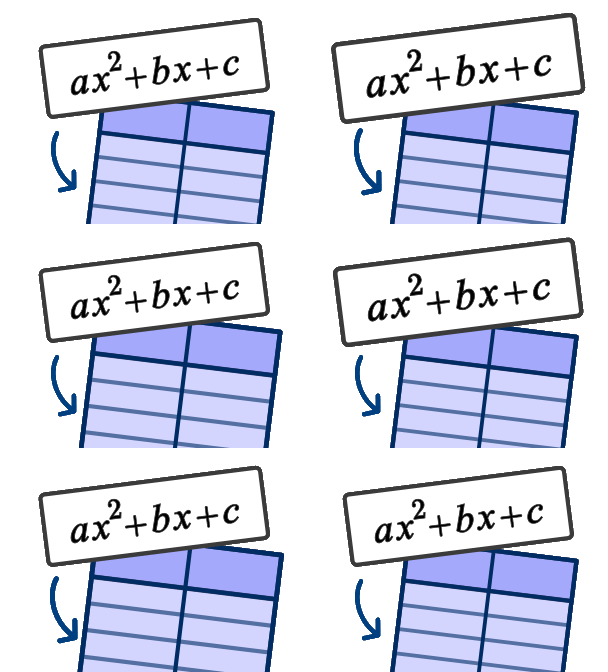
Stay connected!

Join our community and get new episodes every other Wednesday!

We’ll also share new and exciting free resources for your classroom every month!

What Jennifer Roberts says about science

“If I’m not teaching my students how to use this, then they’re not going to turn into the adults we need them to be… If we’re not at least trying to think about what our future world is going to look like, then we’re not serving our students well.”

– Jennifer Roberts

High School English Teacher

Meet the guests

Jen Roberts is a Nationally Board Certified high school English teacher with 25+ years of experience teaching Social Science and English Language Arts in grades 7-12. She has had 1:1 laptops for her students since 2008 and is the co-author of Power Up: Making the Shift to 1:1 Teaching and Learning. A Google for Education Certified Innovator since 2011, Jen was named the CUE Outstanding Educator in 2022. Her interests include literacy instruction, standards based grading, and leveraging Google tools to make her teaching more efficient and effective.
A woman with light skin and blond hair stands outdoors, framed by illustrated graphics including a blue flask and curved lines. Green foliage is visible in the background.

Donnie Piercey, the 2021 Kentucky Teacher of the Year, is a fifth-grade teacher in Lexington, Kentucky.  With a passion for utilizing technology to promote student inquiry, learning, and engagement, he has been teaching since 2007. In addition to being in the classroom, he runs a podcast, Teachers Passing Notes that is produced by the Peabody Award winning GZMShows, and holds several recognitions, including a National Geographic Fellowship to Antarctica in 2018. His most recent work in Artificial Intelligence has not gone unnoticed, earning him multiple appearances on Good Morning America, the Associated Press, and PBS. His upcoming book, “50 Strategies for Integrating AI in the Classroom” published by Teacher Created Materials, is written for educators looking for practical classroom approaches to using AI. All told, Donnie has been invited to keynote and present at schools in thirty-three states and on five continents.

A man with short brown hair and a beard smiles at the camera, wearing a red shirt, framed by a circular graphic with a blue flask icon.
A laptop screen displays the “Science Connections: The Community” private group page, with science-themed icons decorating the background and edges.

About Science Connections

Welcome to Science Connections! Science is changing before our eyes, now more than ever. So…how do we help kids figure that out? We will bring on educators, scientists, and more to discuss the importance of high-quality science instruction. In this episode, hear from our host Eric Cross about his work engaging students as a K-8 science teacher. 

Language comprehension: Building mental models

©Alexander Huth / The Regents of the University of California

Throughout this five-part series, we will cover the main components of the Science of Reading (SoR) and provide additional resources and research to guide your exploration and implementation of this important movement.

Say you’re given a passage of text to read. This particular paragraph describes half an inning of a made-up baseball game.

After you read the passage, you are asked to reenact the scene.

Which is more likely to aid your success?

A. Your ability to read

B. Your knowledge of baseball

C. It makes no difference

Would you be surprised to know the answer is actually B?

In part one of our series, “What is the Science of Reading anyway?,” we discussed the two main components of the Science of Reading: decoding (converting written words into speech) and language comprehension (understanding that speech). We also provided in-depth coverage of both learning and teaching how to decode the symbols of the English alphabet and strengthen the reading muscle.

LANGUAGE COMPREHENSION

In 1988, two young researchers and 64 students took part in an experiment that has forever changed how we think about reading and comprehension. One by one, the students were handed the same story covering half an inning of a made-up baseball game and asked to reenact it.

To the researchers’ surprise, they found that reading ability had little impact on how well kids understood the story—but knowledge of baseball did. In fact, students who were weak readers did as well as strong readers if they had knowledge of baseball.

Teaching knowledge explicitly improves reading comprehension. As Willingham has said, “Reading tests are knowledge tests in disguise.”

Researchers at the Haskins Lab at Yale tested this theory and found an extraordinarily high correlation between how well a 7-to-9-year-old child can recognize words and how well they comprehend text.

Common teaching mistake — Strategy instruction

So if reading comprehension is driven by a student’s vocabulary and knowledge, are widely taught strategies like finding the main idea equally critical?

Many strategies make intuitive sense: Stopping and re-reading when comprehension breaks down, for instance, is helpful for many children. But teaching the main idea strategy over and over is less helpful.

It is hard to find the main idea of a piece of writing if you don’t really understand any of the ideas in it. And even if you know a strategy — like re-reading when stuck — you also need to be well-versed in when to apply the strategy. You need to notice that you didn’t understand the text.

Often, strategy instruction neglects to offer students practice with identifying the situations in which they should use the strategy.

In the 1940s, a skills shift began to take place in education systems throughout the world. Its effects can be traced in the U.K., Sweden, Germany, and, most recently, France. This shift brought an emphasis on reading and math, squeezing out the broader knowledge taught in the sciences and social sciences. Some have linked the decline in standardized test scores—the SAT in the U.S. and the DEPP national exam in France—to this shift.

The National Survey of Science and Mathematics Education reported that today, classes in grades K–3 spend just 19 minutes per day on science and 16 minutes per day on social science.

To counter this loss of broader knowledge in our students, research suggests that we teach comprehension strategies in moderation and use the freed-up time to build knowledge (and vocabulary).

But simply exposing students to everyday speech doesn’t build a strong vocabulary. In a typical conversation, there are around 20 unusual words—such as dismayed or zeal—per 1000 words. Newspapers and books contain more than twice as many. Rich vocabulary, then, is gained not solely through speech, but through reading. Rich vocabulary, then, is gained not solely through speech, but through reading—especially when reading a variety of text types.
Mental models

Some readers with good word recognition, vocabulary, and knowledge are still weak comprehenders. Why might this be the case?

After students read a passage, they aren’t likely to recall the precise wording, but they will probably remember the ideas. Researchers use the term mental model to describe the structure you create in your mind to perform this feat of comprehension. Think of the process of building a mental model as a sort of micro-comprehension. Weak comprehenders build poor models. Hence, when asked prediction or mapping character development questions, they answer poorly.

There are four critical skills students need to improve their mental modeling:

  1. Decoding the usage of anaphoras (she, they, him). Some early readers can’t reliably figure out who the pronoun is referring to, especially in ambiguous text.
  2. Understanding the use of markers to signal ways that the text fits together — connectives, (like so, though, whenever) structure cues, and directions. Inexperienced readers may not know that but, though, yet, and however signal that something opposite follows.
  3. Writers make assumptions about what can be left unstated. For instance, when they read “Carla forgot her umbrella and got very wet today,” good readers will use their prior knowledge to conclude that it rained. Weaker readers who fail to make these gap-filling inferences wind up with gaps in their mental model.
  4. When something doesn’t make sense, you stop, re-read, and try to figure it out. Weaker readers just keep going—not because they’ve failed to figure it out, but because they’ve failed to notice that they don’t understand. They need explicit instruction in monitoring comprehension as they read.

Overview

Think of reading as a suitcase that you need two keys to open. The first key is word-level decoding, a skill that becomes automatic and fluent. The second key is language, vocabulary, and domain-specific knowledge. The more words you can decode, the more new words — and their meanings — you can learn. Similarly, the more knowledge you have on a topic, the more you can soak up on the same topic — and on related topics.

These two keys make up the Science of Reading. When schools focus heavily on one key or the other, the suitcase doesn’t open. So now the greater task of applying this knowledge in the classroom awaits us.

For more in-depth examples, brain scans, and information about the Science of Reading, download our free primer:

Science of Reading – Make the Shift Today

Prepare Professional Development (PD)

Learning experiences to prepare for literacy and math instructional shifts

The following literacy and math sessions are designed to support all educators—regardless of the program used—in enhancing their instructional practices.

  • Sessions devoted to Science of Reading offer research-based strategies to deepen understanding that support students’ reading development.
  • Sessions focusing on a problem-based approach to math empower educators to facilitate meaningful learning experiences and foster critical thinking skills in their students.
  • Sessions supporting multilingual/English learners enable educators to make a meaningful impact on students’ multiliteracy development.
An open book with stars on the left and a math-themed scene with numbers and shapes on the right, separated by a circular sync icon in the center.

Professional learning journey

Four circular icons in sequence—a lightbulb, pencil, whiteboard, and podium—are linked by arrows, illustrating professional learning steps ideal for professional development for teachers or Science of Reading initiatives.
Prepare
Begin
Practice
Advance
Learning sessions will help shift literacy and math instruction in areas such as the Science of Reading and/or problem-based approaches to math. Program-aligned packages will support those who are new to Amplify programs. Program-aligned packages will support those who have experience using Amplify programs. Offerings will support advanced implementation, build capacity for instructional leaders, certify in-house trainers to deliver Launch sessions, and more.
“Gain the literacy knowledge and skills you need to thrive and help your students thrive. Through these sessions, you’ll understand typical literacy development and how to describe and address literacy difficulties.”

—Susan Lambert, Chief Academic Officer, Elementary Humanities

Host, Science of Reading: The Podcast

Science of Reading learning experiences

Listening to students read is magic. But knowing how to get them reading? That’s science.

Making the shift to the Science of Reading is no small feat, but participating in professional development sessions can help you make this change seamlessly.

Amplify Science of Reading sessions offer flexible professional learning experiences for teachers that incorporate engaging activities grounded in what science tells us about literacy development.

A chart outlining nine Science of Reading principles is shown, with a note to prepare for a virtual session and an estimated time of 90 minutes.

Build your knowledge of the Science of Reading

Virtual | 90-minute session

This introductory session provides educators with a foundational overview of what the Science of Reading means and what it tells us about how to teach using evidence-based reading practices.

Participants will learn to:

  • Define the Science of Reading by examining evidence-based research.
  • Explain how two frameworks, the Simple View of Reading and the Reading Rope, work in tandem to guide effective literacy instruction.
  • Identify instructional principles aligned to the Science of Reading.
A graphic outlines elements of early reading, showing how skills like vocabulary and reasoning support language comprehension and word recognition; “3 hours” is noted for session duration.

Deepen your knowledge of the Science of Reading

On-site or virtual | 3-hour session

This session will build a base of common knowledge about the Reading Rope and support educators in identifying effective instruction grounded in the Science of Reading.

Participants will learn to:

  • Identify the strands in the Reading Rope.
  • Describe how each strand plays an important role in developing skilled readers and writers.
  • Identify key look-fors in effective Science of Reading instruction.

Science of Reading: The Learning Lab online courses

This series of three self-paced online courses, crafted by literacy expert Susan Lambert and built around International Dyslexia Association (IDA) Knowledge and Practice Standards, guides you through the essential Science of Reading skills and knowledge needed to teach students to read proficiently, as well as advanced strategies for aiding struggling readers. Each course builds on the last, equipping you with the tools and confidence to make a lasting impact on your students’ literacy journeys.

Benefit from flexible learning on an interactive platform—each course spans 25–30 hours of instruction and is accessible for 12 months. Upon completion, you’ll be provided with a downloadable certificate, validating your new expertise in the Science of Reading.

A boy kneels and reads a book near stacked books, while a girl stands with folded arms; both observe a mobile with colorful shapes and letters, reflecting elements of classroom instruction inspired by the Science of Reading.

Foundations to the Science of Reading

This course offers a comprehensive overview of research in the field. Each of the eight modules contains three lessons covering the foundations of literacy acquisition.

Explore the scope and sequence of Foundations to the Science of Reading with a  Pacing Guide.

Access the free Preview Pass for this course.

A child points at large outlined letters on a board with a pointer stick, next to a stack of books—capturing an engaging moment in classroom instruction.

Advanced topics in the Science of Reading: Assessment and reading difficulties

The second course is aimed at providing an in-depth examination of assessments, a deeper understanding of reading difficulties, and familiarity with pertinent legal frameworks for educators, all of which influence instructional decision-making.

Explore the scope and sequence of Advanced topics in the Science of Reading with our Pacing Guide

Access the free Preview Pass for this course.

Three people in lab coats stand around a lab table with test tubes and a flask, engaging in classroom instruction as they discuss and gesture to each other.

Applied structured literacy

The final course in the series is designed to review key concepts and knowledge from previous coursework, explore fundamental aspects of structured literacy within lessons, observe and analyze structured literacy instruction in action, and investigate how data informs instructional decisions.

Explore the scope and sequence of Applied structured literacy with our Pacing Guide.

Access the free Preview Pass for this course.

“Amplify’s Science of Reading online course builds background knowledge on how students read, then goes deeper to give you strategies that correlate with current research that can be implemented into your classroom right away. The course opened my thinking to new ways of teaching and I can’t wait to try it with students! If you want to walk away feeling successful with helping kids read, take this course! ”

Allie Appel

Coach, WI

Sessions supporting multiliterate learners

Unlock the magic of teaching multiliterate learners with evidence-based literacy practices. Making the shift to effectively support diverse readers in multiple languages is no small feat, but our professional development sessions are here to guide you effortlessly.

Empower your teaching with these engaging sessions, and make a meaningful impact on your multiliterate students’ literacy development.

Graphic showing speech bubbles with "Hello!" and "¡Hola!" and text reading "Prepare: Virtual session" and "90 minutes.

Build your knowledge of multilingual/English learners

Virtual | 90-minute session

This session provides educators with a foundational overview of how to teach multiliterate learners using evidence-based literacy practices.

Contact us to request a quote.

Graphic showing text bubbles with "¡Hola!" and "Hello!" and a note indicating to prepare for an on-site or virtual session lasting 3 hours.

Deepen your knowledge of multilingual/English learners

On-site or virtual | 3-hour session

This session will build an understanding of how the brain learns to read in multiple languages, as well as how to leverage cross-linguistic transfer and align instruction to best practices for multiliterate learners.

Contact us to request a quote.

Sessions focusing on a problem-based approach to math instruction

Elevate educational experiences by placing students’ ideas at the core of math lessons through problem-based learning. These sessions offer flexible professional learning experiences, allowing you to gain firsthand experience with a problem-based approach as a learner. You then learn to integrate this approach seamlessly into your teaching practices, bringing renewed energy to your math classroom.
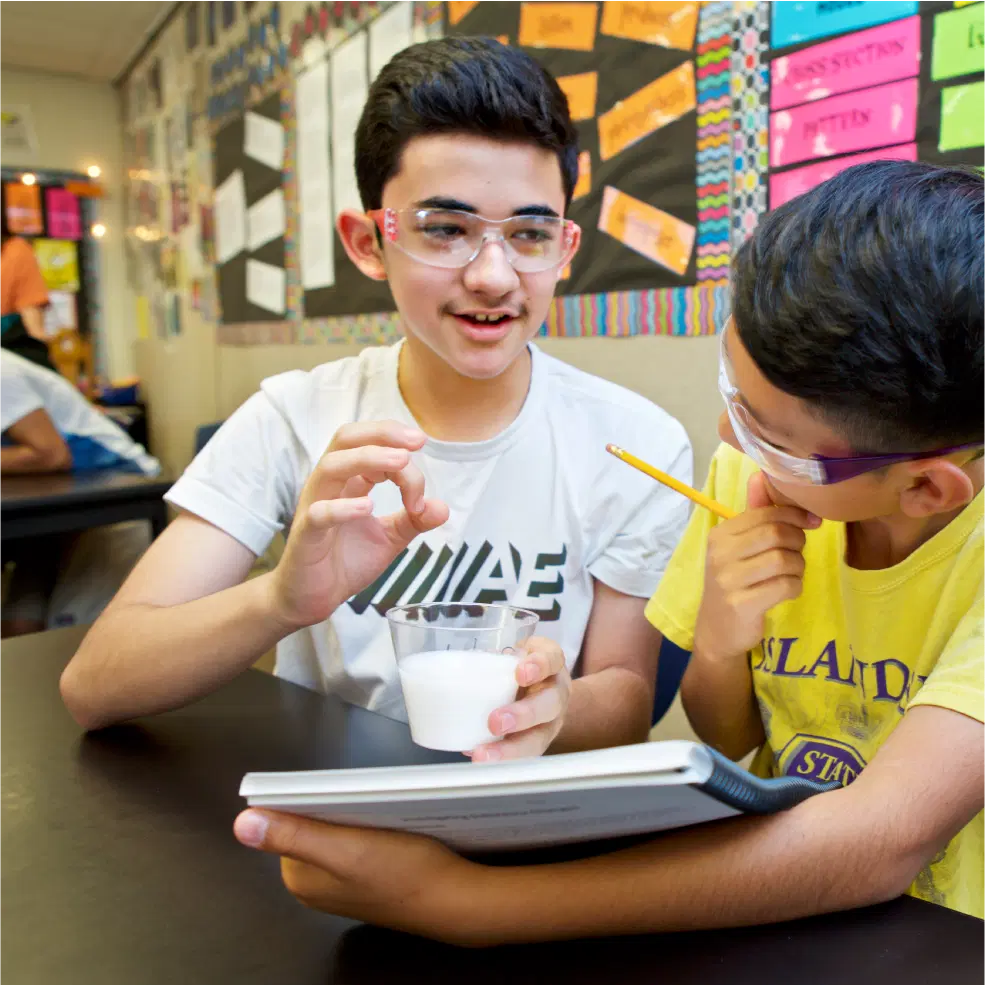
A graphic showing steps for a virtual learning session: Warm-Up, Activities, Synthesis, and Reinforce, with a progress bar and "90 minutes" indicated.

Build your knowledge of a problem-based approach for grades K–5 or 6–8

Virtual | 90-minute session

This session provides you with a foundational overview of what an engaging problem-based approach in math entails.

During this session you’ll learn to:

  • Explain how a problem-based approach to math brings delight to both teaching and learning and builds lasting student understanding.
  • Identify actionable strategies for using a problem-based approach in a math classroom.

Contact us to request a quote.

Screenshot of a math practice activity showing an equation with blocks, a table to fill in values, and a note indicating a 3-hour preparation for on-site or virtual sessions.

Deepen your knowledge of a problem-based approach for grades K–5 or 6–8

On-site or virtual | 3-hour session

This session provides you with hands-on experience facilitating problem-solving in math, leaving you with an increased understanding of how to teach conceptual understanding, procedural skill and fluency, and applications of math.

During this session you’ll learn to:

  • Explain how a problem-based approach to math brings delight to both teaching and learning and builds lasting student understanding.
  • Identify actionable strategies for using a problem-based approach in a math classroom.
  • Connect your current teaching practice to a problem-based approach, and choose a next step to implement a more problem-based approach.

Contact us to request a quote.

Get in touch with a PD expert

Science of Reading:
A glossary

The Science of Reading reflects decades of research on how children best learn to read and which instructional practices best support their journey. Understanding common Science of Reading definitions can help fast-track your instruction, so we’ve put together this glossary as a starting point.

Two girls in green uniforms look at a notebook together in a classroom. Educational icons and a "Built on the Science of Reading" label are overlaid on the image.

Common Science of Reading terms

Some of the most important terms for building your understanding of the Science of Reading:

Alphabetic principle: The understanding that specific sounds can be mapped onto specific letters
Biliteracy: The ability to communicate effectively in two different languages
Composition: The creation or organization of a written piece, short or long
Comprehension: The ability to understand what is written or said
Decoding: Translating a word from print to speech by understanding sound-spelling correspondences
Domain-specific knowledge: Understanding of the key principles in a specific subject area (such as scientific principles, poetry conventions)
Domain-specific vocabulary: Words key to understanding a specific subject area (such as scientific terms, poetic terms, technical terms)

Dyslexia: A language-based learning disorder or set of learning differences that makes it difficult to learn to read, write, or spell

Encoding: Translating a word from speech to print by understanding sound-spelling correspondences

Fluency: The ability to read a text with accuracy, speed, and expression

Inferences: Conclusions drawn through reasoning, without their being stated directly in a text

Learning differences: The unique ways in which brains can process information and the different rates at which they do it

Mental model: A general idea or structure of information that can be applied to many texts

Metacognition: Being mindful of one’s own thinking processes, including using knowledge of a given task, knowledge of cognitive strategies, and knowledge of one’s self, to successfully learn

Morphology: The study of word parts and how words are formed

MTSS (Multi-Tiered Systems of Support): A comprehensive framework designed to provide systematic and differentiated support to all students

Phoneme: The smallest unit of sound that distinguishes one word from another

Phonemic awareness: The ability to identify and work with individual sounds (phonemes) within a word

Phonics: Teaching the relationship between the sounds in oral language and the letters in written language

Reading Rope: A visual representation of the way decoding and comprehension skills work together in the brain of a skilled reader

Reasoning: The ability to apply knowledge based on new or existing information to comprehend the meaning of a passage

Science of Reading: The body of ongoing scientific research about how the brain works when one is learning to read, and how reading is best taught

Science of Writing: The body of ongoing scientific research about how the brain works when one is learning to write, and how writing is best taught

Sight recognition: The ability to recognize a written word without having to sound it out (also called word recognition)

Simple View of Reading: A framework that explains how word recognition and language comprehension work together to produce skilled reading

Simple View of Writing: A framework that explains how transcription and composition skills work together to produce skilled writing

Tier 1 instruction: Core grade-level instruction

Tier 2 instruction: Additional support for small groups of students to reinforce grade-level instruction

Tier 3 instruction: Intensive, more individualized intervention

Transcription: The process of converting speech into written text

Vocabulary: The quantity and quality of words a student knows

Word recognition: The ability to recognize a written word without having to sound it out (also called sight recognition)

Your guide to getting started with the Science of Reading

Looking for more grounding in the Science of Reading? Download our free ebook.

Cover of a guide titled "Science of Reading: A New Teacher’s Guide," featuring a teacher reading to two children, pencil and book icons, and helpful K-5 teaching resources. Perfect for those asking, "What is the science of reading?.

Achieve life-changing results with the
Science of Reading—we’ll show you how.

Watching students learn to read is magic. But knowing how they get there? That’s science.

Making the shift to the Science of Reading is commendable, but it is no small feat. Our extensive experience, field-tested resources, and stories of literacy success will help you deliver the true transformation you need in your district—and see the results your students deserve.

An illustration of a brain with superimposed images: handwriting, cursive letters, and the words "once upon a time" arranged in a sequence.

Exploring the Science of Writing

Discover the captivating journey of writing with our new guide, Science of Writing: A Primer. This resource delves into the history of writing, highlights the crucial link between combining reading and writing instruction, and reveals why handwriting still matters in today’s digital world. Designed to complement CKLA 3rd Edition and our other literacy tools, this primer is set to become a trusted companion, just like those before it.

MTSS Playbook

Explore our new ebook designed to help you build an evidence-based Multi-Tiered System of Supports (MTSS) tailored to diverse literacy goals. This resource provides actionable steps and essential questions to fortify your MTSS with the Science of Reading, enhancing its effectiveness and achieving better outcomes for your students.

Woman and child smiling while reading a book, with colorful cartoon animals in the background.
Cover of a "Change Management Playbook" guide, featuring two women reviewing a tablet and a teacher in an orange sweater instructing a classroom—highlighting K–5 literacy instruction and effective science of reading resources.

The science of teaching reading, coupled with the art of change management

Shifting to the Science of Reading isn’t just an overnight curriculum swap—it’s a profound culture change with multiple stages and stakeholders. We’ve helped educators succeed in that shift for years, and now we’re here to guide you every step of the way. Through each stage of implementation, our Change Management Playbook will help you mobilize your practice, process, and people to make the shift that matters most.

What is the Science of Reading?

Learning to read is not innate, but it can be taught—and science tells us how. The Science of Reading refers to the vast body of growing research that deconstructs how children learn to read, and the instructional practices that can get them there.

Reading fluency requires a complex combination of skills, taught explicitly and systematically. There are two main frameworks that can help us break it all down: The Simple View of Reading and Scarborough’s Rope.

Two schoolgirls in green uniforms look at a notebook together in a classroom. Science of Reading and book icons are overlaid on the image.
Cover of a guide titled "Science of Reading: A New Teacher’s Guide" by Amplify, featuring a teacher with two children and educational icons.

Science of Reading starter kit for new teachers

New to the classroom? We’ve compiled a collection of resources and insights about the Science of Reading to help you acquire more knowledge and build confidence. You’ll find the tools, information, and support you need to foster successful readers and writers in your classroom this school year—and beyond.

The Simple View of Reading

The Simple View of Reading, formulated by Philip Gough and William Tunmer in 1986, is the theory that proficient reading requires two main components:

Flowchart illustrating skilled reading as the product of language comprehension and word recognition, grounded in the science of reading.
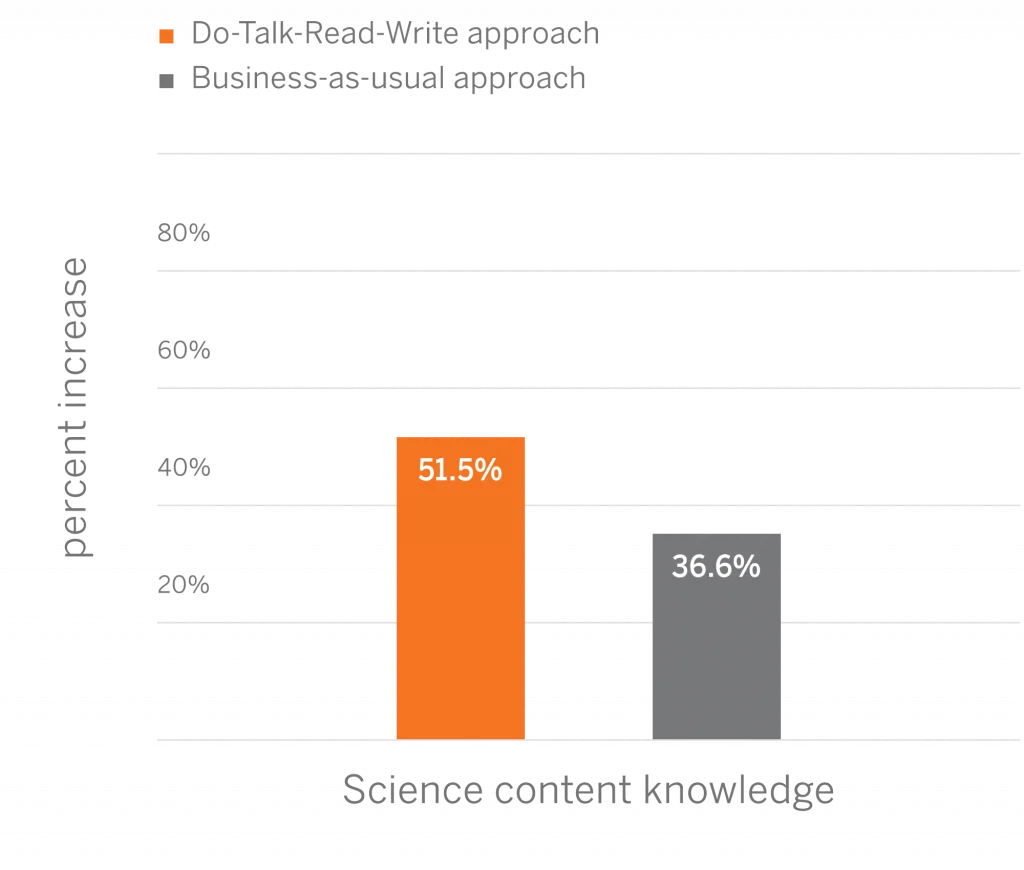
A diagram with intertwining orange, yellow, and blue lines converging and diverging, illustrating interconnected pathways on a black background—reflecting the dynamic flow of ideas found in Core Knowledge or Amplify CKLA curricula.
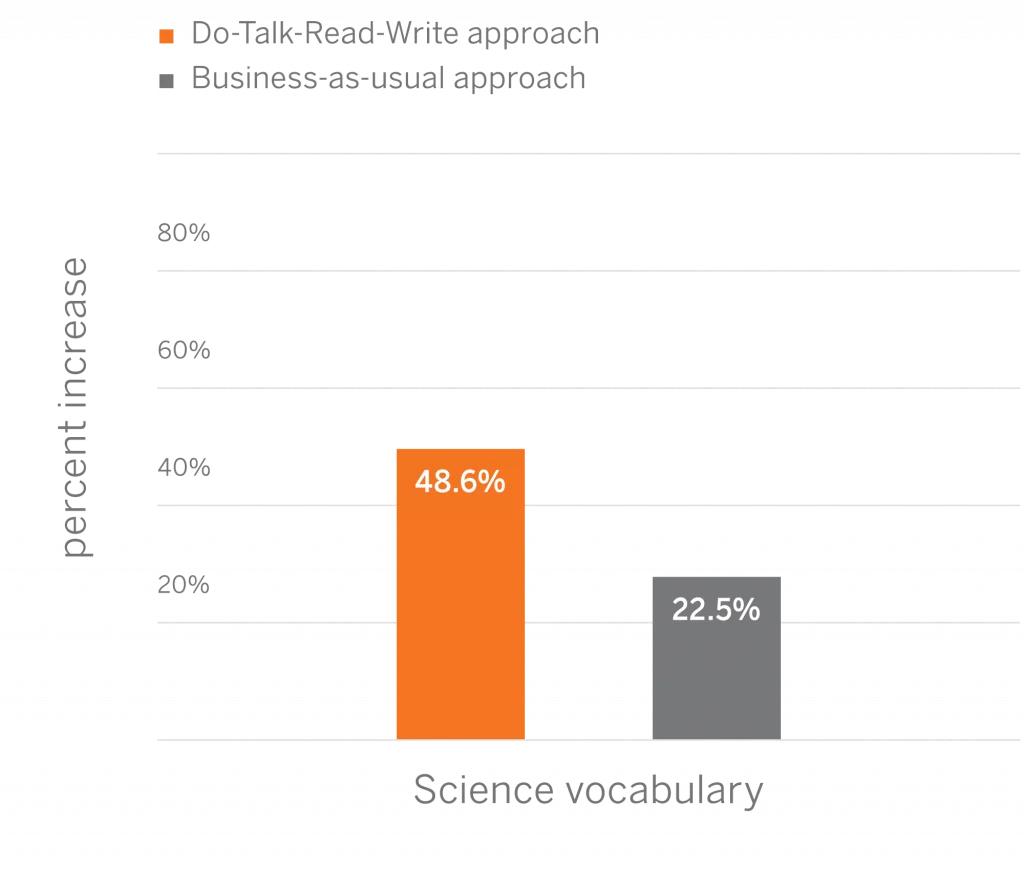
The Reading Rope

The Reading Rope, developed by Dr. Hollis Scarborough in 2001, helps us visualize the strands of specific skills and instruction that support students in decoding and comprehension.

Professional development to support your shift to the Science of Reading

Ignite literacy transformation with Amplify’s Science of Reading: The Learning Lab—an inspiring three-course series.

  • Dive into a comprehensive overview with course one, Foundations to the Science of Reading.
  • Examine assessments and their roles in course two, Advanced Topics in the Science of Reading: Assessment and Reading Difficulties.
  • Apply effective literacy instruction to your classroom in course three, Applied Structured Literacy.

Crafted to the standards of the International Dyslexia Association, this self-paced online series provides unparalleled, research-backed instruction. Explore enriching activities, curated resources, and learn from Susan Lambert, chief academic officer and host of Science of Reading: The Podcast.

The best investment you can make is in knowledge, and the returns are priceless.

Illustration of a webpage titled "Science of Reading: The Learning Lab series" with icons of a book, paper, and other subjects below the title.

Learn more about the online courses or request a quote!

Two labeled course cards: "Course 1: Foundations to the Science of Reading" and "Course 2: Advanced Topics in the Science of Reading," with a shopping cart icon in the top right.

Tap into individual online course seats.

Science of Reading podcast cover image open book

Science of Reading: The Podcast

Tune in to hear the latest insights and trends in early reading, right from leading literacy experts and practitioners.

Listen now

Build your background knowledge of the Science of Reading.

Our Science of Reading principles and primers explain the essentials: what the Science of Reading is, how it works, and why it matters for every student.

An infographic titled "Science of Reading principles" showcases ten evidence-based K–5 literacy instruction strategies, informed by interdisciplinary research, in color-coded boxes with a "NEW" badge in the top right corner.

New Science of Reading principles placemat!

Decades of research inform the updated Science of Reading principles placemat. Use these insights as a guide for evidence-based literacy instruction—perfect for committed educators aiming to achieve real improvements in student reading outcomes.

Download principles

An illustration of a girl running with a colorful kite, with text reading "Science of Reading: A Primer | Part One" and "Amplify" in the top left corner, highlighting K–5 literacy instruction.

Science of Reading
A Primer: Part 1

In part 1 of our definitive Science of Reading primer, we discuss literacy as a societal goal, walk you through how the brain learns to decode and comprehend text, and present the patterns that top-performing schools and districts follow to achieve early reading success.

Download primer 1

Illustration of two people atop a yellow pyramid, with text reading "Science of Reading: A Primer | Part Two"—an engaging look at K–5 literacy instruction. "Amplify" appears in the top left corner.

Science of Reading
A Primer: Part 2

In part 2 of our Science of Reading primer, we establish the importance of prior knowledge for comprehension, lay out the process of micro-comprehension, and demonstrate how literacy skills build on and accelerate themselves.

Download primer 2

A woman with long dark hair smiles in front of a plain background, reflecting the joy she finds in interdisciplinary research. She is wearing a dark green top and earrings.
“If you’re looking for a Science of Reading training, the [Science of Reading: Foundations to the Science of Reading] online course is great. It helps you build background knowledge on learning how students learn how to read, and then it goes deeper and it gives you strategies that correlate with those findings that you can implement right into your classroom.”

—Allie Appel, Instructional Coach

School District of Arcadia, WI

Why undertake this crucial change?

When we bring proven methods based on the Science of Reading into schools, we make sure kids are learning to read and help teachers and caregivers support a culture of reading. Together, we can solve the reading crisis and make literacy a reality everywhere.

You’ll change lives with literacy.

According to the National Assessment of Educational Progress (NAEP), only 35% of fourth graders in the United States are proficient in reading. But schools using a Science of Reading approach have seen significant improvements in literacy rates. Using research-based methods, educators can help give all children the chance to become successful readers.

Young boy in a classroom sits at a desk and writes on a worksheet, with other children working at nearby desks in the background.
A laptop screen displaying a literacy intervention game with a cartoon llama in a desert setting and a word selection task presented to a child’s avatar in the corner.

You’ll build a foundation with explicit, systematic skills instruction.

Reading skills don’t come naturally. We actually need to rewire our brains with intentional, structured literacy instruction—starting with sounds.

You’ll improve outcomes with knowledge building.

Longitudinal research shows that knowledge building doesn’t just happen as a result of reading, but is also a vital prerequisite for and component of it. And when delivered intentionally and systematically, knowledge delivers literacy results.

Illustration depicting diverse people engaged in various activities, including astronauts in space, a musician engaged in interdisciplinary research, and a child drawing, set against a whimsical celestial backdrop.
A person with long braided hair, wearing oversized glasses, earrings, a necklace, and a red top, smiles at the camera against a plain background.
“It’s not just about the curriculum. It’s about the science behind how people, how children, and how we as humans learn to read… It’s working. I wish I had this years ago. ”

—Javonna Mack, Lead Content Teacher

Caddo Parish Schools, Louisiana

Science of Reading & Early Literacy Resources FAQ

Amplify understands that making the shift to the Science of Reading is no small feat. Get some early literacy resources and guidance with our Science of Reading FAQ.

Learning to read is not innate. It needs to be taught intentionally and systematically—and science tells us how. The vast and growing body of research on early literacy is referred to as the Science of Reading. It draws on extensive research in cognitive science, linguistics, and neuroscience. It emphasizes the systematic teaching of foundational skills—such as phonics, phonological awareness, and decoding—in building vocabulary and comprehension. In other words, it deconstructs the processes behind how children learn to read, and provides evidence for the instructional practices and early literacy resources that can get them there.

Read more 

The Science of Reading refers to the pedagogy and practices proven by extensive research to effectively teach children how to read. It places a strong emphasis on both components of the Simple View of Reading, demonstrating that systematic and explicit instruction in phonics and and intentionally sequenced knowledge building are critical to reading success.

In a balanced literacy environment, learning happens through reading and writing immersion, where the need for explicit instruction in phonics is recognized but is not the primary focus.

The key difference between the approaches lies in their emphasis on foundational reading skills and a coherent approach to building language comprehension.

A balanced literacy approach typically includes a combination of whole language approaches (emphasizing meaning and context) and phonics instruction. Balanced literacy instruction is designed to be flexible and open to interpretation by the instructor. It may include the three-cueing system, which encourages students to rely on syntactic and semantic clues in a text to read an unfamiliar word, rather than decoding (Does it look right? Does it sound right? Does it make sense?). Balanced literacy practitioners may also use leveled reading to differentiate instruction, which can can limit vocabulary exposure, hinder in-depth comprehension skills, and further widen achievement gaps.

Balanced literacy has long been a popular approach to reading instruction, with educators appreciating its openness to variation. But advocates for the Science of Reading argue that an evidence-based approach aligned with known cognitive processes and a focus on foundational skills and language comprehension provides the most solid foundation for reading instruction—for confident and struggling readers alike.

Read more

According to our friends at The Reading League, the Science of Reading is important not because it gives us an effective way to teach reading, but because it gives us the most effective way to teach reading.

“The Science of Reading is critical because it emphasizes evidence-based instruction. Decades of scientific research on reading have consistently shown the most effective ways to teach reading. The Science of Reading incorporates this research, which includes phonemic awareness, phonics, fluency, vocabulary, and comprehension.”

The Reading League also takes it to the next level: What happens when all children have access to the most effective early literacy and reading education? “We believe in a future where a collective focus on applying the Science of Reading through teacher and leader preparation, classroom application, and community engagement will elevate and transform every community, every nation, through the power of literacy.”

The Science of Reading has identified five foundational reading skills that are considered crucial for early reading development. One of those skills is phonics. In other words, the Science of Reading has established that phonics are crucial, but the Science of Reading is not the same as phonics.

Phonics instruction helps students learn how to sound out and blend letters to read words accurately. As we know from the Simple View of Reading, two fundamental skills are required for reading with comprehension:

  1. Decoding—the ability to recognize written words (via phonics)
  2. Language comprehension—understanding what words mean

And the Science of Reading also reminds us that students do not have to learn phonics or decoding before knowledge comes into the equation. “The background knowledge that children bring to a text is also a contributor to language comprehension,” says Sonia Cabell, Ph.D., associate professor at Florida State University’s School of Teacher Education, on Science of Reading: The Podcast.

The Science of Reading is an evolving field built on decades of high-quality, evidence-based research that continually integrates new insights gathered from cognitive neuroscience, psychology, and linguistics. These ongoing studies constantly refine our understanding of how the human brain processes language and learning, enabling more personalized and effective teaching strategies that can adapt to the wide-ranging learning needs of students.

Like other sciences such as medicine, astronomy, or engineering – new advancements in reading technology allow us to understand how the brain works and refine our practices. Every scientific advancement in this field of reading science deepens our comprehension of reading-related challenges like dyslexia and informs the development of evidence-based interventions. We don’t believe that the Science of Reading can be reduced to a fad or trend. Rather, it is a continually evolving, enduringly effective discipline, grounded in rigorous research and driven by the quest for better comprehension of how we read and learn.

Assessment grounded in the Science of Reading can help identify children at risk of dyslexia at the earliest possible moments, creating the widest opportunity for intervention.

People with dyslexia often experience challenges in phonological awareness. They may struggle to break down words into their component sounds and to recognize the relationships between letters and sounds. Systematic and explicit instruction in phonics and phonological awareness can help individuals with dyslexia develop necessary phonological skills. This evidence-based instruction can also help students who have difficulty with decoding.

Further, evidence-based comprehension instruction, including explicit instruction in vocabulary and comprehension strategies, can support students with dyslexia in understanding and making meaning from text.

Download our free dyslexia toolkit

The Science of Reading can be integrated with a Multi-Tiered System of Supports (MTSS) to provide comprehensive and targeted reading instruction for all students. The Science of Reading aligns with a tiered model by providing evidence-based practices for instruction at each tier. An MTSS includes universal screening to identify students at risk of reading difficulties; the Science of Reading can also guide the selection of screening measures to assess specific foundational skills. Aligning the Science of Reading with an MTSS framework can also enhance instructional practices and interventions, ensure data-driven decision making, and help meet the needs of all students.

Read more

Integrating the Science of Reading and the Science of Writing strengthens our approach to teaching literacy. Reading and writing are interdependent. Understanding how sentences are built not only contributes to better reading comprehension, it also helps writers develop clear, logical text. As students grow as readers, they also grow as writers, leading to a comprehensive literacy education. Clear thinking and effective writing are crucial for expressing ideas. By fostering both skills, teachers better support students in becoming confident readers and writers, prepared for academic challenges and beyond.

One of the research-based frameworks used in the Science of Reading is the Simple View of Reading. According to the Simple View, two cognitive capacities are needed for proficient reading: (1) understanding the language (comprehension) and (2) recognizing words in print (decoding). A true Science of Reading program is designed from the start for students to build these skills, in a developmentally appropriate way.

It will also emphasize the importance of knowledge building by exposing students to a diverse array of new topics spanning history, science, and literature, organized intentionally and coherently within and across grades. Deep and intentionally sequenced knowledge domains will help build a student’s vocabulary and understanding of complex texts. And it will include instruction in  all five foundational skills: phonics, phonemic awareness, vocabulary, fluency, and comprehension.

Download our free ebookScience of Reading: Making the Shift, which includes a checklist of what to look for in a curriculum based on the Science of Reading. Learn more from our friends at The Reading League.

Actually, we have a full literacy suite built on the Science of Reading! It includes:

  • mCLASS® assessment, powered by DIBELS® 8th Edition, a gold-standard universal and dyslexia screener, plus a progress monitoring tool, all in one.
  • Amplify Core Knowledge Language Arts (CKLA), which provides explicit, systematic foundational skills instruction combined with intentional knowledge building.
  • Boost Reading, a highly adaptive personalized reading program that reinforces the core curriculum and supports enrichment, remediation, and intervention for each student in your classroom.
  • mCLASS Intervention, a staff-led intervention program targeted to Tiers 2 and 3, made easy with automatic data-driven grouping and sequenced explicit, systematic skills lesson plans to support at-risk students.

Reading requires deliberate, systematic attention—and so does shifting to the Science of Reading in your school or district. It requires not only the right curriculum, but also all-new mindsets, metrics, and more. Reflecting years of experience supporting real educators, our resources will walk you through the process of change management in your community—and show you why the shift is worth it. View our Science of Reading change management playbook.

Welcome to Amplify Desmos Math!

To view this protected page, enter the password below:


Welcome, Texas educators!

mCLASS® Texas Edition has been selected as the Texas Education Agency (TEA)–approved alternative free Reading Diagnostic Tool for Kindergarten and as one of the free options for grades 1–2, as legislated by HB3.

mCLASS Texas Edition provides a full K–6 assessment solution, enabling you to leverage and connect valuable student data from the beginning of their literacy journey to later grades, reflecting a reliable and valid view of every student’s progression.

Introducing mCLASS Lectura!  This revolutionary Spanish assessment ensures complete parity between English and Spanish-speaking students.  

*For mCLASS Texas Edition customers who have already opted into the program, please visit our onboarding site to learn how to get started. 

A teacher sits at a table with three young students, holding a tablet. Phonetic symbols /r/, /d/, and /e/ appear around them.
Flowchart showing five components of a reading program: assessment suite, core instruction, skill boosting, intervention, and professional development, arranged in sequential steps.

What is mCLASS Texas Edition?

mCLASS Texas Edition is an integrated, gold standard literacy system that offers teacher-administered assessment and holistic instruction for grades K–6. Teachers often complain about the need to cobble together a number of different tools. They don’t trust their screener so they use something else to monitor progress.

The mCLASS comprehensive system includes efficient one-minute measures, a built-in dyslexia screener, teacher-led and student-driven instruction, intervention, and robust reports for teachers and administrators. It’s all you’ll need to monitor and support every type of student learner in your classroom.

We’re excited to introduce mCLASS Lectura! mCLASS Lectura works with mCLASS’s DIBELS 8th Edition to deliver universal and dyslexia screening in both languages. This powerful tool is the only assessment to offer a dual language instructional report that shows how a student is reading in each language.

Built for Texas educators

TEA has established a bold vision for teaching and learning by:

  1. Enabling universal, multidimensional assessment.
  2. Supporting differentiated instruction based on diagnostics.
  3. Making the resulting data useful for teachers and parents.

mCLASS Texas Edition is built on decades of research at the Center on Teaching and Learning at the University of Oregon, a national center for early childhood assessment and instruction. The measures are already in use in hundreds of districts in Texas.

CLICK HERE to explore a walkthrough of mCLASS Texas Edition and mCLASS Lectura (or click the image to the right).

A promotional graphic for mclass literacy suite describing benefits for grades k-6, featuring text and images of children engaging in classroom activities.
Tablet displaying a student performance table. Columns for assessment times; rows for performance levels. Percentages and student counts are provided in each assessment area and level.

mCLASS® Texas Edition and mCLASS Lectura Reporting

Quick and actionable reports provide detailed insight into students’ reading development across foundational literacy skills for classroom teachers and literacy specialists, principals and district leaders, and parents and guardians at home.

mCLASS Texas Edition gives you instant results and clear next steps for each student. 

When mCLASS Texas Edition is used in tandem with the brand new, mCLASS Lectura, educators will have access to a dual language instructional report that shows how a student is reading in each language.

Personalized learning for every student

Boost Reading (formerly Amplify Reading) is a K–8 student-driven literacy program that provides both remediation and enrichment for all students, leveraging the power of compelling storytelling to engage students in personalized reading instruction and practice.

At its heart, there are 3 main areas that make Boost Reading a unique supplemental learning program:

  • The program meets all students where they are with powerful individualized instruction and practice
  • Age-appropriate narratives create a learning experience that leaps off the screen
  • Research shows Boost Reading improves student performance–particularly among English Learners–reducing the overall percentage of students at risk of reading difficulty.
A laptop screen displays a colorful cartoon map with various buildings and character icons, including a school, store, and several avatars on a green landscape.
A screen shows a syllable segmentation exercise for "húmedo," with a timer at the top reading 0:21 and a "Salir" button.

Introducing mCLASS Lectura: Dual Language assessment and instruction for K-6!

Here’s what mCLASS Lectura delivers to help teachers know what instruction to prioritize:

  • An authentic dual language assessment that works in tandem with mCLASS Texas Edition to deliver universal and dyslexia screening in both languages.
  • The only assessment to offer a dual language instructional report that shows how a student is reading in each language.  This helps the teacher tailor instructional recommendations for each student based on the identified transferable skills from one language to another.
  • Complete parity between English and Spanish solutions at all levels, with full coverage of the key foundational skills required by Texas

Click here to learn more about mCLASS Lectura.

Dyslexia screening: Catch at-risk students early

Early intervention is critical. mCLASS Texas with DIBELS 8th Edition aligns to the state’s rigorous requirements around dyslexia screening as outlined in the Texas Dyslexia Handbook.

Check out mCLASS Texas measures for DIBELS and Lectura here.

Get universal and dyslexia screening in one single powerful tool—no additional assessment system required.

Emergency Rules Related to Dyslexia Screening are available that address the 2019-20 school year kindergarten end-of-year dyslexia screening and have implications for the 2020/2021 school year 1st grade BOY administration of Commissioner-approved or LEA designated reading instrument. This new screening requirement applies to 1st grade students who were not screened for dyslexia at EOY of their kindergarten year.

Download our dyslexia toolkit to learn more.

Icons of a red open book, yellow puzzle piece, blue ear, and blue eye on a black background.
A smiling girl with dark hair in pigtails sits at a desk, looking to the side. She is wearing a light blue shirt and has an open book in front of her.

mCLASS Texas Alignment with the Texas Essential Knowledge and Skills (TEKS)

mCLASS Texas Edition includes multiple measures. In English, it includes DIBELS 8th Edition and screeners of vocabulary, spelling, and oral language. In Spanish, it includes IDEL, screeners of vocabulary, oral language, and spelling. 

Curious about required kindergarten beginning-of-year measures for ECDS Texas? Check out more details here!

Complete K–6 solution

Amplify also provides additional top-rated literacy programs that connect with mCLASS Texas Edition to give educators a robust, comprehensive package that covers all of their instructional needs. 

  • mCLASS Intervention is a staff-led reading intervention for K–6 that performs data analysis and lesson sequencing with Tier 2 and Tier 3 small-group intervention to get struggling readers back on track.
  • Text Reading and Comprehension (TRC) for K–6 provides teachers with additional comprehension measures within the mCLASS platform, featuring a digital reading record and connected book sets.
  • mCLASS Math offers universal screening and progress monitoring with diagnostic interviews to provide a rich view of at-risk students and gauge the effectiveness of math instruction.
Young student in blue shirt writing in a notebook while sitting at a desk in a classroom, looking forward with focus.
Yellow speech bubble with three dots inside, indicating a message or conversation in progress.

Frequently asked questions

Interested in learning more? Read this FAQ we’ve put together based on questions we’ve received about mCLASS Texas Edition.

Remote and hybrid assessment and learning guide

mCLASS® Texas Edition has created a collection of resources to help users plan for a variety of scenarios for the 2020–2021 school year.

*The TEA has offered a a one-time waiver to school districts for the 2020-2021 school year. They continue to encourage LEAs to adopt a kindergarten screener, as districts will still need to meet dyslexia screening requirements for grades K and 1 for the 2020–21 school year.

Cover of a remote and hybrid learning guide showing application icons, and images of diverse students engaged with digital devices.

Contact your Texas representative

Looking to speak directly with an mCLASS Texas Edition representative? Get in touch with the mCLASS Texas team to learn more about using the program:

Email: texas@amplify.com

Professional portrait of a smiling man wearing a dark suit jacket and white shirt, set against a black background.

Raymundo Rodriguez, M.Ed.

Vice President, South Central

Portrait of a woman with white hair, smiling, wearing a black blazer against a light brown background.

Marty Pitts

Senior Account Executive

A woman with shoulder-length blonde hair, wearing a black blazer and a silver necklace, smiles at the camera against a light background.

Mindi Jones

District Manager, South Central

Portrait of a smiling woman with long brown hair, wearing a red top and earrings, set against a white background.

Carla Small

Senior Account Executive

Woman with long black hair, wearing hoop earrings and a red top, smiling at the camera with a blurred indoor background.

Mary Brown

Senior Account Executive

Smiling woman with short blonde hair wearing a dark top, posed against a light-colored, textured background.

Katie Gentry-Funk

Senior Account Executive

Man with short dark hair wearing a blue suit jacket and white shirt, facing the camera and smiling slightly, standing in front of a neutral background.

Hector Gomez

Account Executive

Smiling man with short dark hair and a beard, wearing a red textured sweater, standing in an outdoor setting with buildings in the background.

Mark Ramos

Account Executive, Inside Sales

A person with short, brown hair wearing a maroon shirt and black cardigan is shown in a circular portrait with a blurred nature background.

Melanie Ferry

Senior Account Executive, Inside Sales

Smiling woman with long brown hair, wearing a black shirt and hoop earrings, against a gray background.

Kelley Simpson

Account Executive, Inside Sales

Opt in today

Fill out the form to sign up for mCLASS/mCLASS Lectura! If you have any questions as you complete the form, you can reach our Texas team at texas@amplify.com.

Flowchart outlining steps to utilize mCLASS Texas Edition: opt in, determine programs, enroll staff and students, receive materials, attend training, and utilize the edition.

What my wedding taught me about choosing curriculum

The right curriculum choice isn’t only about the product—it’s about who’s by your side from start to finish. Here’s how one district found that with Amplify CKLA.

By Kelly Pruitt, Instructional Facilitator, Peninsula School District | May 28, 2026

A teacher leans over a group of elementary students who are working together at a classroom table under a "CKLA Skills" sign, guiding them through successful CKLA implementation.

Inspiring the next generation of Florida scientists, engineers, and curious citizens

Amplify Science Florida is a brand-new blended science curriculum for grades 6-8 that meets 100 percent of the Next Generation Sunshine State Standards for Science.

The national edition of Amplify Science for middle school was recently rated all green by EdReports. Read the review on EdReports.

  • Un rover robótico está colocado en un terreno arenoso y lleno de rocas bajo un cielo brumoso, dejando huellas de neumáticos tras él.
  • Dos niños con gafas de seguridad participan en una actividad científica; uno sostiene una taza de líquido y hace gestos mientras el otro toma notas con un lápiz.
  • Dos niños están sentados en una mesa redonda en un salón de clases, mirando juntos la pantalla de una computadora portátil. Ambos parecen comprometidos y están sonriendo.
  • Una ilustración digital de una araña muestra el proceso de producción de veneno dentro de una célula de glándula venenosa. El diagrama del cuerpo de la araña está a la izquierda, con una vista celular detallada a la derecha, resaltando los componentes celulares.

Grounded in research and proven effective

UC Berkeley’s Lawrence Hall of Science, the authors behind Amplify Science Florida, developed the Do, Talk, Read, Write, Visualize approach, and gold standard research shows that it works. Our own efficacy research is pretty exciting, too.

What educators say

“Just looking through the Amplify Science curriculum, I’m wishing I could go back in time and learn these concepts with these resources! I love that Amplify is more focused on diving deeper into fewer concepts over the year, rather than grazing the surface of more topics.”

Lizzie

Middle school teacher, KIPP charter network

What educators say

“In using this program, I have seen that my students are completely engaged and are able to visualize models of concepts using the simulations that they otherwise would not be able to visualize. The program is not about rote memory of facts—rather, it addresses the bigger picture and assesses a deeper understanding of science concepts.”

Julie

Science teacher, Georgia

What educators say

“The engineering units are engaging and really helped me better understand the new standards. I love being able to walk around and talk to students as they explore solutions, make claims, and reason with their peers.”

Karla

Science teacher, California

A powerful partnership

Amplify Science Florida was developed by the science education experts at UC Berkeley’s Lawrence Hall of Science and the digital learning team at Amplify. As the Hall’s first curriculum designed to address the Next Generation Sunshine State Standards for Science, Amplify Science Florida reflects state-of-the-art practices in science teaching and learning.

Our approach

Each unit of Amplify Science Florida engages students in a relevant, real-world problem where they investigate scientific phenomena, engage in collaboration and discussion, and develop models or explanations in order to arrive at solutions.

Rooted in research

Amplify Science Florida is rooted in the Lawrence Hall of Science’s Do, Talk, Read, Write, Visualize model of learning. This research-based approach presents students with multiple modalities through which to explore the curriculum.

Four middle school science students gather around a desk, engaged in an interactive group project, investigating an object together in a colorful classroom setting.
Two middle school girls conduct a science experiment

A flexible, blended program

Amplify Science Florida includes hands-on activities, print materials, and powerful digital tools to support online and offline teaching and learning. Highly adaptable and user-friendly, the program gives schools and individual teachers flexibility based on their technology resources and preferences.

Students take on the roles of scientists and engineers.

In each unit, students take on the role of a scientist or engineer to investigate a real-world problem. These problems provide relevant contexts through which students investigate phenomena.

Two middle school girls use a Student Investigation Notebook to take on the role of scientists and engineers

Phenomena-based teaching and learning

Download the “What’s so phenomenal about phenomena?” e-book

Download a free e-book

What’s included

Flexible resources that work seamlessly together

Science articles

The middle school science articles serve as sources for evidence collection and were authored by science and literacy experts at the Lawrence Hall of Science.

Student Investigation Notebooks

Available for every unit, the Student Investigation Notebooks provide space for students to:

  • record data
  • reflect on ideas from texts and investigations
  • construct explanations and arguments

Available with full-color article compilations for middle school units

Digital student experience

Students access the digital simulations and modeling tools, as well as lesson activities and assessments, through the digital student experience. Students can interact with the digital student experience as they:

  • conduct hands-on investigations
  • engage in active reading and writing activities
  • participate in discussions
  • record observations
  • craft end-of-unit scientific arguments

Teacher’s Guides

Available digitally and in print, the Teacher’s Guides contain all of the information teachers need to facilitate classroom instruction, including:

  • detailed lesson plans
  • unit and chapter overview documentation
  • differentiation strategies
  • standards alignments
  • in-context professional development

Hands-on materials kits

Hands-on learning is at the heart of Amplify Science Florida. Each unit kit contains:

  • consumable and non-consumable hands-on materials
  • print classroom display materials
  • premium print materials for student use (sorting cards, maps, etc.)

Explore more programs.

Our programs are designed to support and complement one another. Learn more about our related programs.

mCLASS dyslexia screener for CA

To view this protected page, enter the password below:


Welcome CKLA 1st Edition users!

Thank you for being part of the CKLA® family!

The Amplify CKLA 1st Edition experience is no longer supported as of January 1st, 2023. The 1st Edition has been a wonderful and essential part of our CKLA journey, but as we expand our program, we want to make sure we serve teachers with updated instruction that blends powerful content and a digital experience that meets the needs of all learners. On this page you will find more information about next steps, and resources we’d like to share with you as you prepare for this change.

Collage of three educational images: upper left shows Amplify CKLA speech therapy resources, upper right features two children collaborating over a notebook, bottom image depicts a boy studying intently at a desk.

FAQ

When did support for CKLA 1st Edition end?

Due to the age of the digital experience, the original CKLA 1st edition website began to experience a loss of functionality on June 30, 2022. Print materials, including consumable Activity Books, are no longer available for purchase as of December 22, 2022.

What does this mean for me as a 1st Edition user?

You may continue to use your print materials, but your access to digital content will be limited. We strongly encourage you to explore the all-new digital experience and updated content in the CKLA 2nd Edition to see how it could transform your classroom.

Who can I talk with if we have additional questions?

Please reach out to the customer care and support team at amplify.com/request-support.

CKLA 2nd Edition

As part of our commitment to creating even richer and more wide-ranging curricula, we have built on the foundation of the 1st Edition to release a new edition of Amplify CKLA with a collection of program enhancements that can save you time and help you reach every student. Built on feedback from users all over the country, the CKLA 2nd Edition has a number of fantastic resources and tools, including:

  • The Teacher Resource site, a website with digital versions of physical materials, digital components, and a full suite of planning documents to help keep you on course throughout Amplify CKLA, along with our Professional Learning site, which gives teachers and administrators access to free PD professional development modules, model lessons, and a wealth of resources to develop expertise.
CKLA-1st-edition-retirement_Teacher Resource Site_Mockup
  • Our brand-new Knowledge Research Units that carry forward our powerful and proven instructional approach while also adding increased variety, authentic literature, and instructional flexibility. With one unit per grade K–5, each is built around a trade book, and is supported with a Teacher Guide, Student Activity Books, Image Cards, and digital license.
  •  Redesigned Skills Readers for grades K–2 to increase representation of characters and illustrators, to better showcase the content, and to look more like trade books! Selected updates have also been made to texts.
  • Novel Guides for grades 3–5, which provide 15 full days of instruction on contemporary trade books, as well as writing prompts that help students navigate the authentic literature they love.
  • The Intervention Toolkit, which provides easy-to-use resources to assist teachers in filling gaps in students’ foundational skills. Teachers have access to hundreds of activities to support phonics, fluency, comprehension, handwriting, and other key skills.
CKLA-1st-edition-retirement_Intervention-Toolkit_Mockup
  • The Amplify CKLA Hub, a place where students can access digital resources independently from anywhere, taking full advantage of the instructional multimedia experiences that Amplify CKLA has to offer. 
  • For grades K–2, Knowledge Builder videos to introduce each domain, Sound Library videos and songs for each sound in the English language, and audio-enabled eBooks of grade-level Student Readers.
  • For grades 3–5, access to the Vocab App for independent practice with domain vocabulary and audio-enabled eBooks in English and Spanish.
Two laptop screens displaying educational apps: one features the Amplify CKLA phonetics learning program and the other displays a storybook page about a cat bandit.

At an additional cost, you can experience additional CKLA offerings, including: 

  • A new K–5 digital experience that makes instruction more flexible for students and teachers in in-person, hybrid, and remote classrooms. Everything you need is in one place, making it easier and more engaging than ever to plan lessons, present digital content, and review student work. 
CE_ICstudent home images
  • Writing Studio, which provides a full sequence of targeted writing activities that are tied both to writing standards and to the CKLA domains. 
  • Language Studio, an English language-development companion program to CKLA. Our carefully developed program follows the CKLA Knowledge Domains, previewing and reinforcing skills and content from core instruction using instruction specifically built for English Language Learners.

Explore the 2nd Edition Program Guide for more information about this powerful program!

If you’d like to learn more about upgrading to CKLA 2nd Edition, use the form below to get in contact with an Amplify representative! 

Contact your Amplify representative

Invest in high-quality professional development

Amplify’s professional development provides a variety of learning experiences over multiple years to incrementally develop and apply the knowledge and skills needed for effective and self-sustaining implementation.

Gain insights into effective instructional techniques, and develop a deeper understanding of your Amplify program(s) by investing in professional development.

Two women sit at a table working on laptops, collaborating and reviewing documents, with icons on the left representing ideas, writing, computers, and achievement.
Collage showing a digital science simulation, a teacher demonstrating science materials on video, and a PDF icon for a K–5 Amplify Science lesson planning template.

The foundation for long-lasting and sustainable change

Partner with members of our professional learning team to plan long-lasting and sustainable change for your school or district. Change is more likely to stick and get results with deliberate planning. We can support your through this journey to drive your professional improvement, enrich your instructional practice, and increase student impact.

Professional learning journey

Every school and district is unique. That’s why we offer flexible delivery options to best meet your specific needs and objectives.

Our professional development programs come in packages or individual sessions, available both on-site and virtually, to help you get the most out of your Amplify program(s).

You can also customize your learning experience by adding extra sessions, such as Science of Reading, supporting multiliterate learners, and a problem-based approach to math, to build on your base package.

Screenshot of Amplify’s PD Library interface with a search bar, colorful resource cards, and highlighted sections: Amplify Caminos, Boost Biliteracy, and Amplify ELA.
Four circular icons in a row showing a lightbulb, pencil, whiteboard, and podium, connected by arrows in a cycle, representing stages of a process.

Prepare

Begin

Practice

Advance
Prepare learning experiences will help shift literacy and math instruction and deepen understanding of research-based practices to support new program implementation. Program-aligned packages will support those who are new to Amplify’s programs. You’ll build the foundational knowledge and skills necessary to begin teaching with your Amplify program(s).

Program-aligned packages will support those who have experience using Amplify’s programs. You’ll refine instructional skills, expand knowledge of your Amplify program(s), and explore more advanced instructional strategies.

Program-aligned offerings will support advanced implementation to deepen understanding of content and pedagogy and build-in house capacity to support a robust, sustainable implementation.

Multi-program, suite packages

Core program packages

Literacy

  • Amplify CKLA
  • Amplify Caminos
  • Amplify ELA

STEM

  • Amplify Math
  • Amplify Desmos Math (K–12)
  • Amplify Science


Intervention program sessions

  • Boost Reading
  • Boost Lectura
  • Boost Close Reading
  • Boost Math

Assessment program packages

  • mCLASS with DIBELS® 8th Edition
  • mCLASS Lectura
  • mCLASS Math

mCLASS Intervention K–6 program sessions


Empower teachers to continuously improve

Professional development helps teachers stay motivated and inspired to grow professionally. Demonstrate your commitment to your staff by empowering them with professional development packages that include on-site or virtual Launch, Strengthen, or Coach sessions, all of which will orient you and your team to the full features of Amplify programs.

You can also personalize your learning experience by adding enhancement sessions to base packages.

A woman with long dark hair smiles while sitting at a table with two others, papers and laptops in front of them. Three circular icons are displayed on the left side.
Three people work together at a computer in a classroom; one woman points at the monitor while the others watch attentively.

Launch

On-site and virtual Launch sessions introduce Amplify programs and support strong implementation. Self-paced, online courses are also available for select Amplify programs and include an on-demand subscription for 12-months.

After learning about the program’s foundational principles and key features, you’ll practice administering it within a collaborative environment.

Two people sit at a table reviewing documents together against a yellow background. An icon of a barbell is displayed in the top left corner.

Strengthen

On-site and virtual Strengthen sessions deepen understanding of the program. Session offerings are targeted and meant to take your practice—and your students’ learning—to the next level.

Offered as part of core packages, as well as enhancements, Strengthen sessions are intended to effectively address your students’ needs. Examples include:

  • A focus on data analysis.
  • Examining student writing.
  • Targeted intervention instruction.
Two women sit side by side at a table, each with a laptop. One woman points at the other’s screen as they focus on the display against a plain blue background.

Coach

On-site and virtual Coach sessions are tailored to elevate instructional practices and meet the unique needs of teachers and/or leaders.

Partner with an Amplify coach who will support you in planning customized sessions leveraging our menu of supports, which can include:

  • Lesson modeling by an Amplify facilitator.
  • Classroom observations and debriefs.
  • Grade-level planning.

Commit to sustainable change for long-term impact

Learning may ebb and flow between phases depending on your teachers’ and leaders’ needs, experiences, and professional goals. Amplify professional development aims to continually grow, develop, and refine instructional practices to support student learning and achievement.

A diagram shows categories about teaching, with “Grading and Assessment” highlighted and selected by a pointing hand cursor. Other categories include instruction, pedagogy, and remediation.
Three overlapping squares with rounded corners, each containing a large question mark, are arranged on a light peach rectangular background.

Frequently asked questions

We value your partnership and aim to provide you with the highest quality learning experiences. Check out our frequently asked PD questions below, along with responses.

Additional learning

Once you become an Amplify customer, you’ll have access to many opportunities to continue learning how to get the most out of your Amplify program(s).

To get a sense of our support, check out some of our free resources:

Two educational course cards: one showing a teacher helping a student, titled "Instructional Moves to Support Motivation in Math Class," and another titled "Data and Dyslexia" with alphabet tiles.
Two speech bubbles on a peach background, one saying "Hello!" in English and the other saying "¡Hola!" in Spanish.

Biliteracy supports

Facilitated in both English and Spanish, specialized biliteracy sessions should be scheduled for teachers using both curricula and/or assessments. Sessions are available to support the use of both Amplify CKLA and Amplify Caminos core programs or mCLASS DIBELS 8th Edition and Lectura assessment programs. Substitute a biliteracy session for the 6-hour initial training in your package, or add these sessions on to your package for your biliteracy teachers.

Speak to our team to learn more!

Order and payment support

If you’re ready to submit your price quote, purchase order, or payment, visit our Ordering Support site for more information.

Three documents labeled as purchase order form, invoice, and price quote, each displaying fields for product details, contact information, and amounts.
Two podcast covers: "Beyond My Years" with colorful graphics and "Science of Reading: The Podcast" with book and sun illustrations; a badge reads "7M+ downloads.

Community of collaboration

Connect with fellow Science of Reading or science advocates in one of our public Facebook groups. Join a community or tune into one of our podcasts today:

Amplify customers can join our exclusive, program-specific Facebook communities to ask pedagogical questions, share Amplify teaching hacks, and more!

Get in touch with a PD expert

Beyond prompts: How to teach writing for middle school student success

Writing is hard. Natalie Wexler, who co-wrote The Writing Revolution: A Guide to Advancing Thinking Through Writing in All Subjects and Grades, has described it as “the hardest thing we ask students to do.”

And writing is also hard to teach—perhaps especially to middle schoolers.

Writing education experts such as Steve Graham, Ph.D., say that, as important as writing is, it often gets less attention due to competing educational demands, like the need to teach subjects connected to high-stakes testing, the pressure to teach to a given test, and the siloing of writing as an independent skill untethered to content.

But writing is essential—not just as a means of expressing knowledge, but also as a means of building it. That’s why, when it comes to middle-school writing instruction, we need to go beyond just writing prompts. So how can teachers provide the strongest possible writing instruction for middle-school students? Keep reading.

Student writing: Why it matters

Learning to write makes you a better writer, but it also makes you a better reader—and a better learner.

In a meta-analysis of more than 100 studies, Steve Graham and Michael Hebert, Ph.D., found that writing about text improves comprehension and learning even more than reading alone, reading and rereading, or reading and discussing.

“Combining reading and writing is part of the Science of Reading,” writes literacy educator Tim Shanahan, Ph.D. “If you want better reading scores, the Science of Reading says do not neglect writing, nor dispatch it to someplace else in the curriculum. When you feel especially pressured to improve reading achievement, that is the time to embrace more tightly the combination of reading and writing.”

Shanahan also notes that readers who write and writers who read are best equipped to observe what authors do to convey meaning and what readers need in order to understand writing.

Current ELA standards recognize the interplay between reading and writing by articulating these goals: using writing to improve learning from text and using the reading of multiple texts to improve the writing of syntheses or reports.

Writing activities for middle school

Even with challenges and constraints, educators can find ways to engage students and transform their writing. When planning writing activities with your middle-school students, it’s important to keep them captivated, incorporate writing instruction throughout your lessons, and differentiate to meet the needs of all of your students. Here are some principles that will help:

  • Detach writing from getting it “right.” Seymour Papert theorized that students become better thinkers when they’re not attached to one outcome—not afraid to be “wrong.” Of course, sometimes there is a correct answer, but it’s the process of seeking it that counts. Offer writing assignments that encourage—and reward—risk-taking and creativity.
  • Integrate writing everywhere. Help students build both knowledge and writing skills by including writing exercises across subjects, including science.
  • Scaffold with sentence frames and modified prompts. Middle-school students often know what they want to say, but not how to say it, especially if they are multilingual learners. Sentence frames and modified prompts—such as “Tom convinces his friends to whitewash the fence by saying…”—can help with that. They reduce linguistic barriers, enabling students to produce writing and speech more complex than what they could have done on their own—and giving you a sense of their level of understanding.

Writing can be a powerful tool to help students deepen their comprehension of written text, expand their knowledge, and develop as communicators. Learn more about the best strategies and activities to use in your classroom. These will put you on the best path for helping your students thrive as writers, readers, communicators, and lifelong learners.

More to explore

Hello, Colorado teachers and leaders!

We’re excited to continue to support Early Literacy Assessment Tool (ELAT) schools in Colorado.

Welcome to the 2026-2027 school year! Schools that participate in ELAT will receive the following mCLASS® tools and supports:

  • mCLASS DIBELS 8th Edition & mCLASS Lectura: CDE’s only approved interim assessment for ELAT
  • Additional Screening Measures to support students at risk for reading differences, including dyslexia 
  • 2026-27 mCLASS BOY checklist of ELAT Colorado teachers
  • Individualized and group instructional supports for teachers to use with students
  • Family and caregiver resources
  • Ongoing professional development and resources
A computer screen displays an educational dashboard with student names, assessment icons, and a detailed progress report for a student named Emma Ashley.

Important information

  • New mCLASS DIBELS 8th Edition professional development sessions are now available! Register now for available sessions.
  • Each participating district will receive mCLASS DIBELS 8th Edition Assessment kits. One kit per grade is provided; K–3 will be shipped. Materials can also be downloaded for free. Click the mCLASS DIBELS 8th Edition materials section below for directions on downloading materials.
A collage with two photos of teachers interacting with students and two graphic icons: an ear on blue and a speech bubble on yellow.

Please visit our Technical Onboarding website for information regarding enrollment and licensing.

Please note: you must include Student State IDs in all enrollment files.

Need help logging in? Visit our Teacher Central site for help and instructions on navigating the platform.

Beginning-of-Year (BOY) Benchmark:

  • Select a two-week window within the first 30 calendar days of your school year. 
  • Kindergarten consideration: Through a provision in HB15-1323, you may choose to use up to 60 calendar days for initial benchmarking. Completion of your BOY READ interim assessment within the first 60 days may be used to inform the literacy component of your kindergarten school readiness assessment.

Middle-of-Year (MOY) Benchmark:

  • Select a two-week window between November 30th and December 18th or January 4th and January 22nd. (Dates need to be before winter break or after winter break). 

End-of-Year (EOY) Benchmark:

  • Select a two-week window between April 19th and May 22nd.

Progress Monitoring:

  • Students scoring Well Below Benchmark must be progress monitored every 7–10 instructional days, and students scoring Below Benchmark must be progress monitored every 10–12 instructional days.

Access the mCLASS DIBELS 8th Edition materials here.

Access both mCLASS DIBELS 8th Edition and mCLASS Lectura materials by navigating to learning.amplify.com/pdlibrary. Note: Login required!

  1. Select Explore Programs, then mCLASS.
  2. Choose Assessment materials: mCLASS Lectura or mCLASS DIBELS 8th Edition.
A collage features two illustrated icons (a puzzle piece and an eye) and two candid photos of children in a classroom setting, one girl smiling and another girl working at a table.

Progress planning tools

Amplify Progress Planning Tool for mCLASS DIBELS 8th Edition

This tool utilizes data from mCLASS users across the nation to provide schools and districts with a meaningful comparative perspective for their progress during the school year.

Hands typing on a laptop with a video call on-screen showing a smiling woman teaching or presenting.

Amplify Tutoring in Colorado

Learn about how Amplify Tutoring meets the Colorado Department of Education (CDE) High-Impact Tutoring Program (HITP) Grant requirements.

To help schools and districts take advantage of CO HITP Grant funds, Amplify is hosting a series of informational sessions designed to provide an overview of Amplify Tutoring.

Go to Amplify Tutoring site 

Square graphic with "Science of Reading: The Podcast" text, an open book, geometric shapes, and the Amplify logo on a yellow and blue background.

Additional Resources

Check out Amplify for the most up-to-date information and resources provided by Amplify, such as:

A search bar and header reading u0022Amplify. Advice and answers from the Amplify Teamu0022 are displayed at the top of a webpage with blank article boxes below.

Amplify Help Library

When you have a question about Amplify curriculum, we suggest you check out our Help Library as your first stop. It’s packed with answers to FAQ and tips for navigating and using Amplify. The search tool there will help you find the answer you need quickly.

Learn more

Three elementary students in a classroom sit at desks, reading books and writing in notebooks. A graphic in the center reads, "Built on the Science of Teaching Reading.

Science of Reading

Discover how the Science of Reading is for everyone! All students—from multilingual/English learners to middle schoolers to your most confident young readers—benefit from the research-based, proven literacy instruction indicated by the Science of Reading.

Learn more

Meet the team.

Alexandra Ludtke

Director, Customer Success

ALUDTKE@amplify.com 

Kim Ballentyne

Professional Development Strategist

kballentyne@amplify.com 

CDE ELAT support

elat@cde.state.co.us 

Need more help?

Log in at learning.amplify.com, and click the gray chat button in the bottom right corner to chat live with our support team.

Our Help Center contains searchable articles and resources to answer many of your questions.

If you need additional support, please contact our support team.

Get struggling K–6 readers on track with our reading intervention program.

mCLASS® Intervention is a staff-led reading intervention that does the heavy lifting of data analysis and lesson sequencing, freeing up teachers to teach the reading skills each student needs.

  • Una mujer señala una página de un libro mientras una joven observa. Están sentados en una mesa en un salón de clases con carteles educativos en la pared detrás de ellos.
  • A teacher with glasses sits at a table with five students, aiding them in writing exercises as part of mCLASS Intervention. A pink laptop is open on the table, while educational posters adorn the classroom walls.

About mCLASS Intervention

Getting students caught up on reading skills requires more than just “extra help” in small groups. It requires teaching that directly targets the specific skills each group needs to learn next. How does mCLASS Intervention help? It does the heavy lifting of data analysis and lesson generation.

What educators say

“Because mCLASS Intervention is so targeted, we’ve seen student performance improve much faster than we used to. It also increased the efficiency and effectiveness of our teachers.”

Bree Lessar

Superintendent, La Veta School District, Colorado

What educators say

“I am so grateful for mCLASS Intervention and the Amplify team! Using these programs assisted us with helping our struggling readers. My school obtained a FIVE Star rating by the State Department of Education (the highest rating in our state) due to our student growth last year.”

Reading Specialist, Nevada

Research-based, classroom-tested

K–2 students in mCLASS® Intervention grew by up to 8 student growth percentile points more in early literacy skills than similar peers not enrolled in mCLASS Intervention, according to a study by the Institute of Education Sciences (IES).

Our approach

mCLASS® Intervention follows a research-based skills progression and uses software to analyze results, form small groups, build engaging lessons for each group, and update skill profiles and groups every 10 days.

Measure skills

Every 10 days, educators progress-monitor students on the skills they’re working to build. mCLASS Intervention analyzes these results, updates students’ placement on the learning progression, and identifies what they should focus on next.

Group students

Once each student’s profile is updated, mCLASS® Intervention analyzes the results of other students and arranges students by skill into small groups of 4–6.

Generate lessons

Once groups are formed, mCLASS® Intervention determines the ideal focus for each group and automatically prepares two weeks of targeted lessons. See a sample here.

Teach students

Staff then deliver the lessons to the small group of students—either with the interventionist coming into the room or the students going to a different room.

Elevate results with mCLASS Intervention PD.

Our Launch and Coach sessions offer tailored professional development designed to maximize the impact of mCLASS Intervention. Gain insights and strategies for effective intervention and tracking student progress.

What’s included

mCLASS Intervention covers the five big ideas of reading: phonological awareness, phonics, fluency, vocabulary, and comprehension. The program comes with a mix of print and digital components to help you serve students.

Targeted lesson plans

mCLASS Intervention provides a bank of more than 4,000 research-backed activities, including multisensory activities that use auditory, visual, tactile, and kinesthetic techniques.

Lesson builder

The lesson builder automatically assembles activities into detailed lessons that target the skills each group is ready to learn.

Easy-to-use lesson materials

mCLASS Intervention provides both print kit materials and a digital card app to help you streamline lesson preparation.

Practice app

The practice app allows students to continue to improve their automaticity in decoding with engaging games.

Progress monitoring

Standardized diagnostic probes allow educators to closely monitor progress.

Educator and administrator reports

Analytical reporting allows educators to see each student’s progress throughout the year.

Training resources

Embedded training modules and a pedagogical help desk get you started and maximize your students’ success.

Explore more programs based on the Science of Reading

All of the programs in our literacy programs are designed to support and complement each other. Learn more about our related programs:

Season 10, Episode 14

Your comprehension questions answered, with Nathaniel Swain, Ph.D.

In this episode of Science of Reading: The Podcast, returning guest Nathaniel Swain, Ph.D., joins Susan Lambert to close out the season by answering thoughtful and thought-provoking comprehension questions submitted by listeners. Nathaniel and Susan answer questions about comprehension strategies, the relationship between comprehension and memorization, and how to shift the mindset among your teaching colleagues to help them understand comprehension.

Second Mockup Episode 14: Your comprehension questions answered, with Nathaniel Swain, Ph.D.

To view this protected page, enter the password below:


Season 10, Episode 14

Your comprehension questions answered, with Nathaniel Swain, Ph.D.

In this episode of Science of Reading: The Podcast, returning guest Nathaniel Swain, Ph.D., joins Susan Lambert to close out the season by answering thoughtful and thought-provoking comprehension questions submitted by listeners. Nathaniel and Susan answer questions about comprehension strategies, the relationship between comprehension and memorization, and how to shift the mindset among your teaching colleagues to help them understand comprehension.

Mockup Episode 14: Your comprehension questions answered, with Nathaniel Swain, Ph.D.

To view this protected page, enter the password below:


Literacy Essentials, Episode 2

Science of Reading Essentials: Comprehension

In this special Essentials episode of Science of Reading: The Podcast, Susan Lambert digs into the archives to find reading comprehension insights from experts Hugh Catts, Ph.D.; Sharon Vaughn, Ph.D.; and Reid Smith, Ph.D. Listeners will get a foundational introduction to the complexities of reading comprehension and come away with an understanding of how to reframe comprehension as an outcome rather than a skill, choose the right texts and ask the right questions, and cultivate long-term memory and knowledge recall.

Meet Our Guest(s):

A middle-aged man with a bald head, gray beard, and mustache is smiling and wearing a dark collared shirt against a plain background.

Hugh Catts

Hugh Catts, Ph.D., studies the early identification and prevention of reading disabilities. Catts is a former board member of the International Dyslexia Association and former president of the Society for the Scientific Study of Reading. He has received the Samuel T. Orton Award (the International Dyslexia Association’s highest honor) and the Honors of the Association Award from the American Speech-Language-Hearing Association for his career contributions to these disciplines. His current research concerns the early identification of reading and language difficulties and the nature and assessment of reading comprehension problems.

A grayscale portrait of an older woman with light hair, resting her chin on her hands and looking directly at the camera.

Sharon Vaughn

Sharon Vaughn, Ph.D., serves as the Manuel J. Justiz Endowed Chair in Education and the Executive Director of the Meadows Center for Preventing Educational Risk, an organized research unit that she founded with a Make-A-Wish gift the Meadows Foundation family. She’s the recipient of numerous awards, including the University of Texas Distinguished Faculty and Research Award (which she was the first woman to receive), the Council for Exceptional Children (CEC) Special Education Research Award, the American Educational Research Association’s Special and Inclusive Education Research Distinguished Researcher Award, and the Jeannette E. Fleischner Award for Outstanding Contributions in the Field of Learning Disabilities from CEC. She is the author of more than 40 books and 350 research articles, six of which have met the What Works Clearing House Criteria for their intervention reports. She has conducted technical assistance in literacy in more than 10 countries and 30 state Departments of Education and has worked as a literacy consultant on more than 50 technical assistance projects.

A man with short brown hair and a beard, wearing a suit jacket and light shirt, smiles outdoors in front of a brick building.

Reid Smith

Reid Smith, Ph.D., is an elementary school teacher and curriculum leader at a school in Australia. He holds a doctorate from La Trobe University’s Science of Language and Reading Lab, where his research focused on the contribution of background knowledge to the act of reading. He is also co-CEO of Ochre Education, a not-for-profit organization committed to closing educational gaps by providing teachers with free, high-quality curriculum materials.

Meet our host: Susan Lambert

Susan Lambert is Chief Academic Officer of Literacy at Amplify and host of Science of Reading: The Podcast. Throughout her career, she has focused on creating high-quality learning environments using evidence-based practices. Lambert is a mom of four, a grandma of four, a world traveler, and a collector of stories.

As the host of Science of Reading: The Podcast, Lambert explores the increasing body of scientific research around how reading is best taught. A former classroom teacher, administrator, and curriculum developer, she’s dedicated to turning theory into best practices that educators can put right to use in the classroom, and to showcasing national models of reading instruction excellence.

A person with short, light-colored hair, wearing dark-rimmed glasses, a red jacket, and small earrings, smiling at the camera against a neutral background.

Quotes

“ For the most part, if we're paying attention, if we can read words efficiently and know what they mean and have background knowledge, it yields comprehension.”

—Sharon Vaughn

“ Some people say that the purpose of reading is comprehension. It's not the purpose of reading. The purpose of reading is whatever you're comprehending it for.”

—Hugh Catts

 ”We often forget that an important consideration to comprehending text is actually the text itself. A rigorous, interesting, full-of-rich-information text is going to yield a different kind of interaction between the reader than something that is super easy, or a text that might be patterned, or what we might call a leveled text.”

—Susan Lambert

“[There’s] a strong literature base that tells us that one of the differences between poor readers and strong readers is their ability to notice when there are inconsistencies in the text, and have strategies that they can employ to resolve those inconsistencies.”

—Reid Smith

“This Essentials episode does not answer everything about comprehension. All we're doing here is building a foundation, understanding that comprehension isn't a skill, it's complex.”

—Susan Lambert

Literacy Essentials, Episode 4

Science of Reading Essentials: The science of learning

On this Science of Reading Essentials episode, we're taking a deeper dive into the science of learning to explore how memory, cognitive load, and knowledge building can transform your literacy instruction. On this synthesis episode, host Susan Lambert, Ed.D., weaves in the insights of our expert guests—Natalie Wexler; Nathaniel Swain, Ph.D.; Hugh Catts, Ph.D.; Daniel Willingham, Ph.D.; Peter C. Brown; Jamey Peavler, Ed.D.; and David Rapp, Ph.D. With their insights, Susan reflects on how memory works and why understanding its processes is foundational to effective teaching; why cognitive load theory and background knowledge are game-changers for literacy instruction; and which evidence-based strategies—like retrieval practice, spaced repetition, and mixed practice—make learning stick.

Meet Our Guest(s):

Portrait of a woman with short, curly blonde hair, light skin, and a white top, looking at the camera with a neutral expression—an image that could illustrate modern perspectives in literacy instruction or the science of learning.

Natalie Wexler

Natalie Wexler is the author of multiple books, including Beyond the Science of Reading: Connecting Literacy Instruction to the Science of Learning and The Knowledge Gap: The Hidden Cause of America’s Broken Education System—and How to Fix It; and is the co-author, together with Judith C. Hochman, Ed.D., of The Writing Revolution: A Guide to Advancing Thinking Through Writing in All Subjects and Grades. She has a free Substack newsletter called Minding the Gap, and she was the host of the Knowledge Comprehension podcast, Season 1. More information is available on her website, www.nataliewexler.com.

A man with short brown hair and a beard, wearing a light blue collared shirt, poses in front of a blurred background, reflecting his passion for reading comprehension and literacy instruction.

Nathaniel Swain, Ph.D.

Nathaniel Swain is a teacher, instructional coach, and writer. He produces a blog for teachers called Dr. Swain’s Cognitorium and is cohost of the Chalk Dust podcast with Rebecca Birch. Nathaniel works directly with schools and systems through an online learning platform called Luminary.

He founded a community of educators committed to the science of learning, called Think Forward Educators. He also has a best-selling book, Harnessing the Science of Learning: Success Stories to Help Kickstart Your School Improvement.

A bald older man with a white goatee and mustache, wearing a dark collared shirt, smiles at the camera against a plain gray background—exuding warmth often found in dedicated literacy instruction professionals.

Hugh Catts, Ph.D.

Hugh Catts’ research interests include the early identification and prevention of reading and disabilities. He is a former board member of the International Dyslexia Association and former president of the Society for the Scientific Study of Reading. He has received the Samuel T. Orton Award, the International Dyslexia Association’s highest honor, and the Honors of the Association award from the American Speech-Language-Hearing Association, for his career contributions in these disciplines. His current research concerns the early identification of reading and language difficulties and the nature and assessment of reading comprehension problems.

A bald man with red-framed glasses and a brown jacket stands in front of a brick wall, embodying the spirit of literacy instruction as he looks at the camera.

Daniel Willingham, Ph.D.

Daniel Willingham is a professor of psychology at the University of Virginia, where he has taught since 1992. Until about 2000, his research focused solely on the brain basis of learning and memory. Today, all of his research concerns the application of cognitive psychology to K–12 education. He is the author of several books, including the best-selling Why Don’t Students Like School? and Outsmart Your Brain. His writing on education has appeared in 23 languages. In 2017, he was appointed by President Barack Obama to the National Board for Education Sciences.

An older man with white hair and a beard, wearing a blue checked shirt, stands outdoors near a body of water with trees in the background, perhaps reflecting on reading comprehension or the science of learning.

Peter C. Brown

Peter C. Brown is a bestselling writer and novelist, retired from a career as a management consultant. He is the lead author of Make It Stick: The Science of Successful Learning. Make It Stick has been translated into 17 foreign languages and received international acclaim for changing the way we understand learning.

Jamey Peavler, Ed.D.

Jamey Peavler is a co-director of and full-time instructor in the Graduate Reading Science program at Mount St. Joseph University. Before joining Mount St. Joseph, Jamey served as director of training for the M.A. Rooney Foundation. In addition, she works for the National Council for Teacher Quality (NCTQ) as a higher-education textbook and teacher licensure reviewer. Her research interests include instructional design, the impact of spaced practice and interleaving to support effortful retrieval and retention of information, the role of oral language and syntactic awareness on comprehension and written expression, and foundational skills for supporting literacy in the early childhood setting.

A woman with long brown hair is smiling at the camera, surrounded by books and plants blurred in the background—a perfect scene for anyone passionate about reading comprehension and the science of learning.
A man with short gray hair, a beard, and glasses, known for his work in literacy instruction, is wearing a purple checkered shirt and smiling slightly against a plain white background.

David Rapp, Ph.D.

David Rapp is the Walter Dill Scott Professor of Education, Social Policy, and Psychology at Northwestern University. His research examines language and memory, focusing on the cognitive mechanisms responsible for successful learning and knowledge failures. This has included investigations into the influence of inaccurate information on comprehension, the evaluation of technologies that support formal and informal learning, and the iterative development of tools and curricula intended to support literacy. Rapps’ projects have been funded by the National Science Foundation, the U.S. Department of Education, the National Institute on Aging, and Meta.

Meet our host, Susan Lambert, Ed.D.

Susan Lambert is chief academic officer of literacy at Amplify and host of Science of Reading: The Podcast. Throughout her career, she has focused on creating high-quality learning environments using evidence-based practices. Lambert is a mom of four, a grandma of four, a world traveler, and a collector of stories.

As the host of Science of Reading: The Podcast, Lambert explores the increasing body of scientific research around how reading is best taught. A former classroom teacher, administrator, and curriculum developer, she’s dedicated to turning theory into best practices that educators can put right to use in the classroom, and to showcasing national models of reading instruction excellence.

Person with short blonde hair, glasses, and earrings, wearing an orange jacket, smiling in front of a plain gray background—committed to literacy education and fostering background knowledge for all learners.

Quotes

“To build a meaningful memory of something that you can hold on to and use, you have to think about it.”

—Hugh Catts

“Memory is a cognitive process. It's the way the brain encodes, stores, and retrieves information.”

—Susan Lambert

“You can't learn something new if it doesn't connect to something you already know.”

—Peter C. Brown

“The catch about writing is it's hugely important. It can help cement knowledge and long-term memory, deep knowledge, et cetera.”

—Natalie Wexler

“When we have knowledge in our long-term memory, all of these limitations suddenly disappear.”

—Nathaniel Swain

“We can only work with a limited set of information and when there's too much happening in our working memory, we experience cognitive overload. Essentially, our system is overloaded and we shut down.”

—Susan Lambert

“Essentially, memory is what enables us to retain knowledge, skills, and experiences, forming the foundation for all learning and cognition.”

—Susan Lambert

“The resonance model of comprehension suggests when someone asks a question, lots of ideas get activated automatically in memory.”

—David Rapp

“Your mind is very good at bringing up from memory the necessary facts, the facts that will help you given the context.”

—Daniel Willingham

“A lot of our students that are having difficulty are experiencing cognitive overload. So the first thing we need to think about is how are we gonna minimize that for them?”

—Jamey Peavler

Season 10, Episode 10

From talk to text: How language skills shape reading success, with Charles Hulme, D.Phil., and MaryKate DeSantis

In this episode of Science of Reading: The Podcast, Susan Lambert is joined by emeritus professor of psychology and education at the University of Oxford, Charles Hulme, D.Phil.; and founder of Left Side Strong LLC, MaryKate DeSantis. They dive deep into the critical connection between oral language development and reading comprehension. Together, they also explore exactly what oral language development is, how to screen children for deficits in oral language abilities, and the most effective strategies educators can use for intervention.

Meet Our Guest(s):

A smiling older man with short gray hair poses in front of green plants, highlighting themes of language development. A lightbulb graphic and circular frame decorate the photo.

Charles Hulme, D.Phil.

Charles Hulme is emeritus professor of psychology and education at the University of Oxford. He has broad research interests in reading, language, and memory processes and their development; and is an expert on randomized controlled trials in education. He has published widely and is in the top 2% for citations of all researchers in the field of education. He holds an honorary doctorate from the University of Oslo (2014) and is a member of Academia Europea and a Fellow of the Academy of Social Sciences. He was also elected a Fellow of the British Academy in 2017.

A woman with short brown hair and a black turtleneck smiles at the camera. She is framed by a circular border with a blue book icon and orange decorative lines, hinting at her passion for reading success. Bookshelves are blurred in the background.

MaryKate DeSantis

MaryKate DeSantis is the founder of Left Side Strong LLC. Her experience working in a large urban school district as a special education teacher, reading specialist, and district-wide literacy coach has fueled her passion for translational research to ensure that all children receive evidence-based instruction. Her background in teaching reading sparked an interest in researching language, literacy, and developmental trajectories. She is a full-time faculty member in the Speech and Language Literacy Lab at MGH Institute of Health Professions, and is also an ongoing-research collaborator with the BRIDGES Lab at the Harvard Graduate School of Education.

She has also served as a clinician in the Neurology Department at Boston Children’s Hospital, is an adjunct professor at the Boston College Lynch School of Human Development, and is a Ph.D. student in educational psychology at the University of Connecticut.

Meet our host, Susan Lambert

Susan Lambert is chief academic officer of literacy at Amplify and host of Science of Reading: The Podcast. Throughout her career, she has focused on creating high-quality learning environments using evidence-based practices. Lambert is a mom of four, a grandma of four, a world traveler, and a collector of stories.

As the host of Science of Reading: The Podcast, Lambert explores the increasing body of scientific research around how reading is best taught. A former classroom teacher, administrator, and curriculum developer, she’s dedicated to turning theory into best practices that educators can put right to use in the classroom, and to showcasing national models of reading instruction excellence.

Person with short blonde hair, glasses, and earrings, wearing an orange jacket, smiling in front of a plain gray background—committed to literacy education and fostering background knowledge for all learners.

Quotes

“Reading comprehension is the process of taking the meaning from printed symbols on a page and translating them into a linguistic and cognitive code. It's making contact with the processes of language comprehension.”

—Charles Hulme, D.Phil.

“Language comprehension is really what leads us to reading comprehension.”

—MaryKate DeSantis

“We've got to start from the premise that reading is language. Without language, there would be no reading. Reading is a process that involves taking language in its written form and translating it back into its original form, which is spoken language.”

—Charles Hulme, D.Phil.

“If we go back in development, language skills appear to form the foundation for the ability to decode print, as well as the foundation for the ability to understand what is decoded.”

—Charles Hulme, D.Phil.

“Language skills are unconstrained, meaning the sky's the limit. As long as you continue to engage in any sort of way, your language skills can continue to develop throughout your lifetime.”

—Susan Lambert

“We talk about learning to read, but we also need to talk about reading to learn. A lot of what we learn in our lives is through reading, and reading is certainly a powerful driver of vocabulary and language development.”

—Charles Hulme, D.Phil.

“Focusing on language is worth the time. …  When we treat it as foundational, that's when we will give more students access to success.”

—MaryKate DeSantis

“If we want better readers, we have to grow better language users.”

—MaryKate DeSantis

Season 2, Episode 3

Learning alongside your multilingual learners, starring Elsa Cárdenas-Hagan, Ed.D.

Host Ana Torres is joined by Elsa Cárdenas-Hagan, Ed.D., a linguist and speech pathologist known for her work with multilingual/English learners (ML/ELs). In this episode, Elsa focuses on small changes that educators can make to create classrooms that are more inclusive and supportive of ML/ELs. She shares strategies for morphology instruction, learning useful information about students’ home languages, shifting away from a deficit mindset when it comes to ML/ELs, and more. She’ll also touch on why techniques like asking students to respond in full sentences and slowing down your rate of teaching can better serve students. Ana and Classroom Insider Eric Cross then reflect on Elsa's insights, and Eric shares a vulnerable moment that demonstrates why humility and openness are some of his core teaching principles.

Meet Our Guest(s):

A woman with straight brown hair wearing a red blazer, gold earrings, and a necklace, smiling at the camera against a neutral background—perfect for a teaching podcast focused on multilingual learners.

Elsa Cárdenas-Hagan, Ed.D.

Dr. Elsa Cárdenas-Hagan is president of the Valley Speech Language and Learning Center in Brownsville, Texas, and a research associate at the University of Houston’s Texas Institute for Measurement, Evaluation, and Statistics. She has dedicated her career to researching language and literacy development among Spanish- and English-speaking students, collaborating on national projects sponsored by the National Institute for Child Health and Human Development and the Institute of Education Sciences.

A respected leader, Cárdenas-Hagan chairs the National Joint Committee on Learning Disabilities and serves on literacy advisory boards for New York City, Utah, and Texas. She is also the author of Literacy Foundations for English Learners: A Comprehensive Guide to Evidence-Based Instruction, a book that helps educators implement the structured literacy approach with English learners. She has received numerous awards, including the Margaret Byrd Rawson Lifetime Achievement Award from the International Dyslexia Association.

Meet our host, Ana Torres.

Ana has been an educator for 30 years, working in both the K–8 and higher education sectors. She served as an administrator and instructor at various public and private colleges and universities and as a bilingual and dual language teacher, dual language math and reading interventionist, dual language instructional coach, assistant principal, and principal in K–8 schools. Ana is currently the Senior Biliteracy and Multilingual Product Specialist at Amplify, and delivers literacy and biliteracy presentations across the nation. Ana’s passion and advocacy for biliteracy and support for all students from all walks of life has led her to educate leaders, teachers, and parents about the positive impact of bilingualism and biliteracy in our world.

A woman with long dark hair and hoop earrings smiles at the camera while wearing a black blazer, standing outdoors—ready to discuss classroom challenges or share insights on her teacher podcast.
A man with short, closely-cropped hair and a trimmed beard smiles at the camera against a light gray background, ready to inspire diverse learners in the math classroom.

Meet our Classroom Insider, Eric Cross.

Eric Cross is a middle school science teacher who hopes to someday be a lifelong educator, like the guests on Beyond My Years! In each episode, Eric connects with host Ana Torres to discuss her guests’ best insights gleaned from their long and rewarding careers in the classroom. Then, Eric talks about bringing some of their wisdom into his current classroom and busy life.

Quotes

“First come in with the attitude of I'm a learner, too. I want to learn about you, and you'll learn about me.’”

—Elsa Cárdenas-Hagan, Ed.D.

“You don't have to be an expert in every single language. You just need to know enough about that language to serve your students.”

—Ana Torres

“I look at the faces of the students that are there and that motivates me. All the other noise doesn't matter because I'm there to help them reach their dreams.”

—Elsa Cárdenas-Hagan, Ed.D.

“I am an educator of all students, it doesn't matter who they are.”

—Eric Cross

“As a teacher, you're always confronted with things that you may not be strong in. Like, it's part of the job. And that hits you. And I'll be transparent, it hits you in the ego.”

—Eric Cross

“You're always going to be presented with people that you don't feel properly equipped to serve. And that's okay. It's part of being a human. So what do we do? We go and find resources so that we can become better.”

—Eric Cross

Season 8, Episode 1

Knowledge and comprehension: Never one without the other, with Reid Smith and Pamela Snow

In the premiere episode of Season 8 of Science of Reading: The Podcast, Susan Lambert is joined by guests Reid Smith and Pamela Snow to lay the groundwork for a season entirely centered on knowledge and knowledge-building. Reid and Pamela—of the SOLAR Lab at La Trobe University in Melbourne, Australia—recently co-authored (along with many others) a review of the literature on background knowledge and literacy. In this discussion, they share what they learned, including some surprising takeaways. This episode examines the  complexity of building background knowledge, the important role it plays in literacy, and the reasons we’ve decided to spend a whole season exploring it!

Meet Our Guest(s):

Pamela Snow

Pamela Snow

Pamela Snow, Ph.D., is a professor of cognitive psychology in the School of Education at La Trobe University in Australia and co-director of the Science of Language and Reading (SOLAR) Lab. She is both a speech-language pathologist and a registered psychologist, and her research focuses on ensuring language and literacy success across the school years.

Reid Smith

Reid Smith is an elementary school teacher and curriculum leader at a school in Australia, and is also a doctoral candidate at La Trobe University’s Science of Language and Reading (SOLAR) Lab. His research focuses on the contribution of background knowledge to the act of reading. He is also co-CEO of Ochre Education, a not-for-profit organization committed to closing educational gaps by providing teachers with free, high-quality curriculum materials.

Meet our host, Susan Lambert

Susan Lambert is the Chief Academic Officer of Elementary Humanities at Amplify, and the host of Science of Reading: The Podcast. Her career has been focused on creating high-quality learning environments using evidence-based practices. Susan is a mom of four, a grandma of four, a world traveler, and a collector of stories.

As the host of Science of Reading: The Podcast, Susan explores the increasing body of scientific research around how reading is best taught. As a former classroom teacher, administrator, and curriculum developer, Susan is dedicated to turning theory into best practices that educators can put right to use in the classroom, and to showcasing national models of reading instruction excellence.

Retrato de una mujer caucásica sonriente con cabello rubio corto, involucrada en un podcast sobre la ciencia de la lectura, con gafas, lápiz labial rojo y un collar de perlas.

Quotes

“This idea of having a coherent curriculum that systematically builds knowledge and skills over time is something that we think is really important for our kids.”

—Reid Smith

“I'd just point to making sure that you really give students the opportunity to learn more about the world that they're in and the cultures that we have in the past, present, and future. They're all really important things for our kids. And, you know, from an instrumentalist point of view, because it helps their reading comprehension.”

—Pamela Snow

"I think we respect teacher autonomy when we give them the knowledge that they need about how the English writing system works, right across the Reading Rope, and how the English language works, right across the Reading Rope.”

—Pamela Snow

First-of-its-kind voice-powered assessment to help educators understand and accelerate the literacy development of remote learners

BROOKLYN, New York—August 25, 2020—Amplify, a publisher of next-generation curriculum and assessment programs, today announced the release of a voice-enabled reading assessment for grades 1–6, created in collaboration with Dublin-based SoapBox Labs, which develops accuracy and privacy driven voice technology for children. Text Reading Online is the first literacy assessment of its kind to enable remote evaluation of oral reading fluency, accuracy, and comprehension—critical indicators of reading development for young readers.

“Given the realities of teaching and learning in a pandemic, educators are seeking approaches to assessing a child’s independent reading when they cannot be together in person,” said Larry Berger, chief executive officer at Amplify. “We are pleased to offer Text Reading Online as a part of the overall mCLASS literacy suite to help educators assess their students’ reading development remotely, including the accurate identification of learning loss and how best to address it, this year.”

Reading accuracy, fluency, and comprehension are important indicators of whether students are making the transition from learning to read to reading to learn. Like most early literacy assessments, however, evaluation of oral reading fluency typically requires direct in-person observation of students by trained educators. By enabling educators to understand and evaluate fluency, accuracy, and comprehension development, even in a remote setting, Text Reading Online can help educators tailor instruction and avoid reading loss during a critical developmental stage.

To perform the assessment, students read two texts aloud: the first text is at the student’s grade level, the second is adapted based on the student’s performance on the initial text. Students then answer a set of text-dependent comprehension questions to evaluate their degree of understanding. Data from the assessment, including reading rate and specific error types, provides educators with near real-time feedback, which they can use to identify areas of focus and cater lessons to each child’s needs.

Named one of Europe’s hottest startups by Wired UK in 2019, SoapBox Labs was founded by Dr. Patricia Scanlon, whose popular TEDx talk explains the ways in which technology can “transform a child’s reading journey.” In 2018, Scanlon was named to the Forbes list of Top 50 Women in Tech globally.

“This is about making educators’ lives just a little bit easier by providing them with tech-enabled tools that allow them to engage in accurate and private literacy assessment for all their students,” said SoapBox Labs CEO Dr. Patricia Scanlon. “But the implications are even more far reaching. The moment for voice tech in learning has arrived, and we view our work as essential in the development of a more inclusive, equitable education future.”

Text Reading Online will be available for free to all of Amplify’s mCLASS customers during the 2020-2021 school year. Visit the Text Reading Online page on Amplify.com to learn more.

***

About Amplify
A pioneer in K–12 education since 2000, Amplify is leading the way in next-generation curriculum and assessment. Our captivating core and supplemental programs in ELA, math, and science engage all students in rigorous learning and inspire them to think deeply, creatively, and for themselves. Our formative assessment products turn data into practical instructional support to help all students build a strong foundation in early reading and math. All of our programs provide teachers with powerful tools that help them understand and respond to the needs of every student. Today, Amplify serves five million students in all 50 states. For more information, visit amplify.com.

About SoapBox Labs
SoapBox Labs develops award-winning voice technology for kids modeled on kids’ speech, language, and behaviors. Proprietary and built from the ground up, our accurate, private, and age-appropriate voice technology powers immersive play and learning experiences, including literacy and language learning tools, for children ages 2 to 12 years old. To view demos, download reports and white papers, or learn more about how our technology powers third party education and toy companies, go to www.SoapBoxLabs.com.