Website Terms of Use

Description of Site Services; Acceptance of Terms of Use

Welcome to www.amplify.com (together with any successor sites and the Site Services and Company Content (each as defined below), in whole and in part, the “Site”). The Site is operated by Amplify Education, Inc. (“Company” or “we”). The services that Company makes available on or through the Site include education-related articles, information and instructional services, purchasing functionality, support chat functionality and any other features, content, services, functionality and applications offered from time to time by Company on or through the Site (collectively, “Site Services”).

BY ACCESSING OR USING THE SITE, YOU REPRESENT AND WARRANT THAT YOU ARE OF LEGAL AGE TO ENTER INTO THIS TERMS OF USE AGREEMENT (“AGREEMENT”) AND YOU AGREE TO BE BOUND BY THE TERMS AND CONDITIONS OF THIS AGREEMENT. BY PURCHASING GOODS AND SERVICES ON THE SITE, YOU ARE ACCEPTING THE PRACTICES DESCRIBED IN THIS AGREEMENT AS WELL AS ANY ADDITIONAL TERMS OF USE THAT MAY BE ASSOCIATED WITH THE PARTICULAR GOODS AND SERIVICES YOU ARE PURCHASING.

Please read this Agreement carefully. If you are an employee or other representative of a school or other organization who is accessing or using the Site on behalf of such organization, then you are agreeing to this Agreement on behalf of yourself and such organization. We may modify this Agreement at any time in our discretion, and we may provide such modifications to you by any reasonable means, including by posting the revised version of this Agreement on the Site. You can determine when this Agreement was last revised by referring to the “LAST UPDATED” legend at the top of this Agreement. Your access to or use of the Site following any changes to this Agreement will constitute your acceptance of those changes. Notwithstanding the foregoing, any changes to this Agreement shall not apply to any dispute between you and us arising prior to the date on which we posted the revised version of this Agreement incorporating such changes or otherwise notified you of such changes. If you do not agree to be bound by this Agreement, you must not access or use the Site. Your access to and use of certain parts of the Site may require you to accept additional terms and conditions, and may require you to download certain Software or Content (each as defined below).

Jurisdictional Issues

The Site is controlled and operated by Company from the United States, and is not intended to subject Company to the laws or jurisdiction of any state, country or territory other than that of the United States. Company does not represent or warrant that the Site is appropriate or available for use in any particular jurisdiction other than the United States. In choosing to access and use the Site, you do so on your own initiative and at your own risk, and you are responsible for complying with all local laws, rules and regulations. You are also subject to United States export controls and are responsible for any violations of such controls, including any United States embargoes and other federal rules and regulations restricting exports. We may limit the Site’s availability to any person, geographic area or jurisdiction we choose, at any time and in our discretion. Not all products or services described on the Site are available in all states or territories.

Company content

The Site contains information, text, files, images, video, sounds, musical works, computer code, works of authorship, applications, and other materials and content (collectively, “Content”) of Company or its licensors (“Company Content”). The Site (including the Company Content) is protected by copyright, trademark, trade secret and other laws, and as between you and Company, Company owns and retains all rights in the Site. Company hereby grants to you a limited, revocable, non-sublicensable license, during the term of the Agreement, to access, display and perform the Company Content (excluding any computer code) solely for your personal, non-commercial use and solely as necessary to access and use the Site. Except as expressly permitted by Company in this Agreement or on the Site, you may not copy, download, stream, capture, reproduce, duplicate, archive, upload, modify, translate, create derivative works based upon, publish, broadcast, transmit, retransmit, distribute, perform, display, sell or otherwise use or transfer any Content. You may not, either directly or through the use of any device, software, online resource or other means, remove, alter, bypass, avoid, interfere with or circumvent any copyright, trademark or other proprietary notice on the Content or any digital rights management mechanism, device, or other content protection or access control measure associated with the Content.

User content

You may not access or use the Site for any commercial purpose. You are responsible for all Content that you post, upload, transmit, e-mail or otherwise make available on, through or in connection with the Site (collectively, “User Content”). Please choose carefully the Content that you make available on, through or in connection with the Site. Company does not control any Content other than Company Content, and as such you may be exposed to offensive, indecent, inaccurate or otherwise objectionable Content by accessing or using the Site. Company is not responsible or liable for any Content or the conduct of any Site user. If you become aware of any misuse of the Site, please report such misuse immediately to Company at general@amplify.com. Company reserves the right (but has no obligation) to monitor the Site, including for inappropriate Content or conduct, and to remove any Content in Company’s discretion and without liability to you or any third party.

Your proprietary rights

You retain any ownership rights that you have in your User Content. You hereby grant to Company and its affiliates, licensees and authorized users, a perpetual, non-exclusive, fully paid-up and royalty-free, sublicensable (through multiple tiers), transferable (in whole or in part), worldwide license to use, modify, excerpt, adapt, create derivative works and compilations based upon, publicly perform, publicly display, reproduce and distribute such User Content on, through or in connection with the Site and/or any other commercial or non-commercial endeavor of Company or any of its affiliates, including in connection with any distribution or syndication thereof to Third Party Services (as defined below), on and through all media formats now known or hereafter devised, for any and all purposes including promotional, marketing, trade and commercial purposes. The exercise of such rights shall not require any further permission or notice, payment or attribution to you or any third party. Company reserves the right to limit the storage capacity made available for User Content.

You represent and warrant that: (a) you own the User Content made available by you, or otherwise have the right to grant the license set forth in this Section, and (b) the posting of such User Content through or in connection with the Site does not violate the privacy rights, publicity rights, copyrights, contract rights or any other rights of any person or entity. You agree to pay for all royalties, fees and any other monies owing to any person or entity by reason of the use of such User Content.

Use of the site

You agree not to:

  • Post, upload or otherwise transmit or link to Content that is: unlawful; threatening; harmful; abusive; pornographic or includes nudity; offensive; harassing; excessively violent; tortious; defamatory; false or misleading; obscene; vulgar; libelous; hateful; or discriminatory.
  • Violate the rights of others, including patent, trademark, trade secret, copyright, privacy, publicity, contract or other proprietary rights.
  • Harass or harm another person.
  • Exploit or endanger a minor.
  • Impersonate any person or entity.
  • Introduce or engage in activity that involves the use of viruses, bots, worms, Trojan horses, Easter eggs, time bombs, spyware or any other computer code, files or programs that interrupt, destroy or limit the functionality of any computer software or hardware or telecommunications equipment, or otherwise permit the unauthorized access to or use of a computer or a computer network.
  • Interfere with, damage, disable, disrupt, impair, create an undue burden on, or gain unauthorized access to the Site or any Account, or Company’s servers or networks;
  • Restrict or inhibit any other person from using the Site (including by hacking or defacing the Site). Cover, remove, disable, block or obscure the Site (including advertisements on the Site).
  • Use technology or any automated system, such as scripts or bots, to collect user names, passwords, e-mail addresses or any other data from or through the Site, or to circumvent or modify any security technology or software that is part of the Site.
  • Send or cause to send (directly or indirectly) unsolicited bulk messages or other unsolicited bulk communications of any kind through the Site. If you do so, you acknowledge you will have caused substantial harm to Company, and that the amount of such harm would be extremely difficult to measure. As a reasonable estimation of such harm, you agree to pay to Company $50.00 for each actual or intended recipient of such communication.
  • Modify, adapt, translate, reverse engineer, decompile or disassemble the Site.
  • Solicit, collect or request any information for commercial or unlawful purposes.
  • Post, upload or otherwise transmit an image or video of another person without that person’s consent.
  • Use the Site to advertise, promote or engage in any commercial activity (including engaging in sales, contests or sweepstakes) without Company’s prior written consent.
  • Frame or mirror the Site without Company’s express prior written consent.
  • Use the Site in a manner inconsistent with any applicable law, rule or regulation.
  • Use any robot, spider, site search/retrieval application or other manual or automatic device to retrieve, index, “scrape,” “data mine,” or in any way gather content of the Site or reproduce or circumvent the navigational structure or presentation of the Site without Company’s express prior written consent. Notwithstanding the foregoing, Company grants to the operators of public search engines the permission to use spiders to copy material from the Site for the sole purpose of, and solely to the extent necessary for, creating publicly-available searchable indices of such material, but not caches or archives of such material. Company reserves the right to revoke these exceptions either generally or in specific cases.
  • Attempt, facilitate or encourage others to do any of the foregoing.

Company reserves the right to investigate and take appropriate legal action against anyone who, in Company’s discretion, violates this Agreement or attempts to do so, including terminating or suspending a user’s Account or access to or use of the Site, or reporting any User Content or conduct to law enforcement authorities.

You (and not Company) are responsible for obtaining and maintaining all telecommunications, broadband and computer hardware, equipment and services needed to access and use the Site, and for paying all charges related thereto.

User disputes

You are solely responsible for your interactions with other users of the Site, providers of Third Party Services (as defined below) or any other third parties with whom you interact on, through or in connection with the Site.

Purchases

Company may make available products and services for purchase through the Site, and may use third-party suppliers and service providers to enable e-commerce functionality on the Site. You may only purchase products and services that appear on the Site and that are delivered to an address located in the United States. You may only purchase products and services for personal, non-commercial use by you, your educational institution or students of your educational institution. We may limit quantities or refuse any order for any reason or no reason, including if we have reasonable cause to believe an order is for onward sale or resale other than through distribution channels approved by us. We make no promise that products or services available on the Site are appropriate or available for use in locations outside the United States, and purchasing products or services for delivery to or use in territories where their contents are unlawful is prohibited. If you choose to purchase products or services from locations outside the United States, you do so at your own risk. It is your responsibility to ascertain and obey all applicable local, state, federal and international laws (including minimum age requirements) in regard to the possession, use and sale of any product or service made available through the Site.

If you wish to purchase any product or service made available through the Site, you may be asked to supply certain information relevant to your transaction, including your credit card number, the expiration date of your credit card, your billing address and your shipping information. YOU REPRESENT AND WARRANT THAT YOU HAVE THE LEGAL RIGHT TO USE ANY CREDIT CARD(S) USED IN CONNECTION WITH ANY TRANSACTION. By submitting such information, you grant to Company the right to provide such information to third parties for purposes of facilitating the completion of transactions initiated by you or on your behalf. Verification of information may be required prior to the acknowledgement or completion of any transaction. While it is our practice to confirm orders by e-mail, the receipt of an e-mail order confirmation does not constitute our acceptance of an order or our confirmation of an offer to sell a product or service.

Details of the products and services available for purchase are set forth on the Site. All prices are displayed exclusive of all taxes and shipping/freight charges. Available payment methods, methods of shipping and shipping charges (including charges for expedited shipping, if available) are detailed on the Site. Company may also collect and remit sales tax on your purchase as required by United States law. If you are a tax-exempt entity, please enter the appropriate information where requested on your order form and we will not collect sales tax on your purchase.

Generally, credit and debit cards are not charged until we either ship the product(s) or confirm store availability (at which time you will be charged only for the products we have actually shipped along with any applicable taxes and shipping charges). However, we may pre-authorize your order amount with your credit or debit card issuer at the time you place the order, which may have an effect on your available credit line. When paying for a preorder with a debit card, you will be charged at the time you place your preorder. Please contact your credit or debit card issuer for more information. If you ordered a special delivery product, you will be charged once a delivery time is confirmed. For digitally delivered orders, your credit or debit card will be charged at the time that you initiate the download of the product.

All purchases made through the Site are made pursuant to a shipment contract. As a result, risk of loss and title for products purchased through the Site pass to you upon delivery of the products to the carrier. You are responsible for filing any claims with carriers for damaged and/or lost shipments. Please note that all shipping addresses must be compliant with the shipping restrictions contained on the Site.

Products, services and specifications

All products and services described or depicted on the Site, and all related features, content, specifications and prices, are subject to change at any time without notice. Certain weights, measures and similar descriptions are approximate and are provided for convenience purposes only. Packaging may vary from that shown. We make reasonable efforts to accurately display the attributes of our products, including the applicable colors; however, the actual color you see will depend on your computer system, and we cannot guarantee that your computer will accurately display such colors. The inclusion of any product or service on the Site at a particular time does not imply or warrant that such product or service will be available at any time. Occasionally, the manufacture or distribution of a certain product or service may be delayed for a number of reasons. In such event, we will make reasonable efforts to notify you of the delay and keep you informed of the revised delivery schedule. By placing an order, you represent that the products and services ordered will be used only in a lawful manner. All DVDs and similar products are sold for private, non-commercial home use (where no admission fee is charged), non-public performance, or classroom or instructional use only, and may not be duplicated.

Return and exchange policy

Unless otherwise specified in the terms associated with a particular product, you may return or exchange any product purchased through the Site within fourteen (14) days of receipt, by calling our customer service hotline, 1–800–823–1969, in the event that the purchased product is defective or you received the wrong product. Except for the foregoing, you may not return, cancel or exchange any product or service. Certain jurisdictions may provide additional statutory rights. Nothing herein is meant to limit your return or cancellation rights under local law. In the event that a return or exchange is due to an incorrect order or faulty product, we will be responsible for the shipping costs associated with such return. We will ship a replacement product upon receiving your defective or incorrect product and verifying the reason for the return or exchange.

Accuracy of information

We attempt to ensure that information on the Site is complete, accurate and current. Despite our efforts, the information on the Site may occasionally be inaccurate, incomplete or out of date. We make no representation as to the completeness, accuracy or currency of any information on the Site. For example, products or services included on the Site may be unavailable, may have different attributes than those listed, or may carry a different price than that stated on the Site. If an item’s correct price is higher than our stated price, we will, at our discretion, either contact you for instructions before shipping or cancel your order and notify you of such cancellation. Items in your “Shopping Bag” reflect the current price displayed on the item’s product detail page. Please note that this price may differ from the price displayed when the item was first placed in your Shopping Bag. In addition, we may make changes in information about price and availability without notice.

Chemicals, agricultural materials, and other hazardous materials

Certain products made available through the Site may include chemicals, agricultural materials or other material that may be subject to regulations or restrictions with respect to import or export, or to whom we may sell such material or where or how such material may be used. It is your responsibility to read and abide by all warning notices that accompany any products that you purchase. In addition, we reserve the right to request additional information from you, verify your identity, limit sales to certified educational or research institutions, or cancel or delay your order if required by law or if we believe it is necessary or advisable. Due to special shipping and handling requirements, freight companies routinely impose a surcharge on each package of hazardous material shipped. In such event, we will add such surcharge to your order.

Registration and account security

You may have the ability to create an account on or through the Site (an “Account”). If you submit registration information to create an Account, you represent and warrant that all information submitted to Company in connection with such registration is complete and accurate, and that you will update such information if it changes. If you create an Account, you are responsible for all use of your Account, and for maintaining the confidentiality of the information used to access your Account (including user name and password). You agree not to share your user name or password with anyone, or use anyone else’s Account at any time. You agree to notify Company immediately if you suspect any unauthorized use of, or access to, your Account (including your user name and password). You acknowledge that the reuse of your password in connection with accounts on other websites increases the risk that the security of your Account may be compromised.

The Site may make available, or third parties may provide, links to other websites, applications, resources, advertisements, Content or other products or services created, hosted or made available by third parties (“Third Party Services”), and such third party may use other third parties to provide portions of the Third Party Service to you, such as technology, development or payment services. When you access or use a Third Party Service, you are interacting with the applicable third party, not with Company, and you do so at your own risk. Company is not responsible for and makes no warranties, express or implied, as to the Third Party Services or the providers of such Third Party Services (including the accuracy or completeness of the information provided by such Third Party Service or the privacy practices of any third party). Inclusion of any Third Party Service or a link thereto on the Site does not imply approval or endorsement of such Third Party Service. Company is not responsible or liable for the content or practices of any Third Party Service or third party, even if such Third Party Service links to or is linked by the Site, and even if such Third Party Service is operated by an affiliate of Company or a company otherwise connected with us or the Site

Feedback

Unless we expressly agree otherwise in writing, if you provide us with any ideas, proposals, suggestions or materials (“Feedback”), whether related to the Site or otherwise, you hereby acknowledge and agree that (a) your provision of any Input is gratuitous, unsolicited and without restriction and does not place Company under any fiduciary or other obligation; and (b) any Feedback is not confidential and Company has no confidentiality obligations with respect to such Feedback.. You hereby grant to us a world-wide, royalty-free, fully paid-up, exclusive, perpetual, irrevocable, transferable and fully sublicensable (through multiple tiers) license, without additional consideration to you or any third party, to reproduce, distribute, perform and display (publicly or otherwise), adapt, modify and otherwise use and exploit such Feedback, in any format or media now known or hereafter developed, and you hereby represent and warrant that you have all necessary rights to grant the foregoing license. We may use Feedback for any purpose whatsoever without permission or notice, compensation or attribution to you or any third party. You are and remain responsible and liable for the content of any Feedback.

Privacy

Please review the Privacy Policy for the Site, available at http://www.amplify.com/privacy, to learn about our information collection, usage and disclosures practices with respect to information collected by us through the Site. Please note that certain products or services made available by us, other than the Site, may be subject to different privacy policies. In addition, the Site’s Privacy Policy does not address, and we are not responsible or liable for, the information collection, usage and disclosures practices of any third party or Third Party Service.

Disclaimers

THE SITE, USER CONTENT, THIRD PARTY SERVICES, AND ALL PRODUCTS AND SERVICES SOLD THROUGH THE SITE (COLLECTIVELY, THE “SITE PRODUCTS”) ARE MADE AVAILABLE “AS-IS” AND “AS AVAILABLE” AND COMPANY DOES NOT GUARANTEE OR PROMISE ANY SPECIFIC RESULTS FROM USE OF THE SITE PRODUCTS. COMPANY AND ITS AFFILIATES EXPRESSLY DISCLAIM ANY WARRANTIES AND CONDITIONS OF ANY KIND, WHETHER EXPRESS OR IMPLIED, INCLUDING THE IMPLIED WARRANTIES OF MERCHANTABILITY, FITNESS FOR A PARTICULAR PURPOSE AND NON-INFRINGEMENT. IN PARTICULAR, COMPANY AND ITS AFFILIATES MAKE NO WARRANTY THAT THE SITE OR USER CONTENT OR THIRD PARTY SERVICES, OR YOUR ACCESS TO OR USE THEREOF, WILL BE UNINTERRUPTED, TIMELY, SECURE, ERROR-FREE, ACCURATE OR RELIABLE. UNDER NO CIRCUMSTANCES SHALL WE BE LIABLE FOR ANY CONSEQUENCES OF ANY UNAUTHORIZED USE OF THE SITE PRODUCTS THAT VIOLATES ANY APPLICABLE LAW OR REGULATION. CERTAIN STATE LAWS DO NOT ALLOW LIMITATIONS ON IMPLIED WARRANTIES OR THE EXCLUSION OR LIMITATION OF CERTAIN DAMAGES. IF THESE LAWS APPLY TO YOU, SOME OR ALL OF THE ABOVE DISCLAIMERS, EXCLUSIONS, OR LIMITATIONS MAY NOT APPLY TO YOU, AND YOU MIGHT HAVE ADDITIONAL RIGHTS.

Under no circumstances will Company or its affiliates be responsible for any loss or damage, including property damage, personal injury or death, resulting from use of the Site, Products, problems or technical malfunction in connection with use of the Site, Products, attendance at any Company event or the conduct of any Site users, whether online or offline. Your use of the Site, Products is solely your responsibility and at your own risk. The User Content and Third Party Services do not necessarily reflect the opinions or policies of Company or its affiliates.

Limitations on liability

IN NO EVENT WILL COMPANY OR ITS AFFILIATES BE LIABLE TO YOU OR ANY THIRD PARTY FOR ANY INDIRECT, CONSEQUENTIAL, EXEMPLARY, INCIDENTAL, SPECIAL OR PUNITIVE DAMAGES, INCLUDING LOST PROFIT DAMAGES, ARISING FROM YOUR USE OF THE SITE PRODUCTS, EVEN IF COMPANY OR ONE OF ITS AFFILIATES HAS BEEN ADVISED OF THE POSSIBILITY OF SUCH DAMAGES. NOTWITHSTANDING ANYTHING TO THE CONTRARY CONTAINED HEREIN, THE TOTAL LIABILITY OF COMPANY AND ITS AFFILIATES TO YOU FOR ANY CAUSE WHATSOEVER AND REGARDLESS OF THE FORM OF THE ACTION, WILL AT ALL TIMES BE LIMITED TO THE AMOUNT PAID, IF ANY, BY YOU TO COMPANY FOR THE SITE PRODUCTS.

Indemnity

You agree to indemnify and hold harmless Company, its affiliates, subcontractors and other partners, and each of their respective officers, agents, partners and employees, from any losses, costs, expenses (including reasonable attorneys’ fees), liabilities, claims or demands, due to or arising out of your use of the Site, your breach or alleged breach of this Agreement, your violation or alleged violation of any rights of another, or any Content that you post or otherwise submit on, through or in connection with the Site.

Termination

This Agreement remains in full force and effect while you access or use the Site. If you create an Account, you may terminate your Account at any time, for any reason, by contacting us at general@amplify.com. Company may terminate or suspend your Account and/or your access to or use of the Site at any time, for any or no reason, with or without prior notice or explanation, and without liability. Upon any such suspension or termination, your right to access and use the Site will immediately cease, and Company may immediately deactivate or delete your Account and all files and other information associated with it, and/or bar any further access to such files and other information. Company shall not be liable to you or any third party for any suspension or termination of your Account or of access to or use of the Site or any such files or other information, and shall not be required to make such files and other information available to you after any such suspension or termination. Sections 2, 5, 13, 17, 18, 19, 22, and 26 shall survive any expiration or termination of this Agreement.

U.S. export controls

All software made available in connection with the Site (“Software”) may be subject to United States export controls. No Software may be downloaded from or through the Site or otherwise exported or re-exported in violation of U.S. export laws.

Governing law

The terms of this Agreement are governed by the laws of the State of New York, U.S.A., without regard to its conflicts of law provisions, and regardless of your location.

Arbitration

EXCEPT FOR DISPUTES THAT QUALIFY FOR SMALL CLAIMS COURT, ALL DISPUTES ARISING OUT OF OR RELATED TO THIS AGREEMENT, WHETHER BASED IN CONTRACT, TORT, STATUTE, FRAUD, MISREPRESENTATION OR ANY OTHER LEGAL THEORY, WILL BE RESOLVED THROUGH FINAL AND BINDING ARBITRATION BEFORE A NEUTRAL ARBITRATOR INSTEAD OF IN A COURT BY A JUDGE OR JURY, AND YOU AGREE THAT COMPANY AND YOU ARE EACH WAIVING THE RIGHT TO TRIAL BY A JURY. YOU AGREE THAT ANY ARBITRATION UNDER THIS AGREEMENT WILL TAKE PLACE ON AN INDIVIDUAL BASIS; CLASS ARBITRATIONS AND CLASS ACTIONS ARE NOT PERMITTED AND YOU ARE AGREEING TO GIVE UP THE ABILITY TO PARTICIPATE IN A CLASS ACTION.

Arbitration procedure

Any arbitration under Section 23 above will be administered by the American Arbitration Association under its Commercial Arbitration Rules and Supplementary Procedures for Consumer-Related Disputes (“Supplementary Procedures”), as amended by this Agreement. The Supplementary Procedures are available online at http://www.adr.org/aaa/ShowPDF?doc=ADRSTG_015820. The arbitrator will conduct hearings, if any, by teleconference or videoconference, rather than by personal appearances, unless the arbitrator determines upon request by you or by us that an in-person hearing is appropriate. Any in-person appearances will be held at a location which is reasonably convenient to both parties with due consideration of their ability to travel and other pertinent circumstances. If the parties are unable to agree on a location, such determination should be made by the AAA or by the arbitrator. The arbitrator’s decision will follow the terms of this Agreement and will be final and binding. The arbitrator will have authority to award temporary, interim or permanent injunctive relief or relief providing for specific performance of this Agreement, but only to the extent necessary to provide relief warranted by the individual claim before the arbitrator. The award rendered by the arbitrator may be confirmed and enforced in any court having jurisdiction thereof. Notwithstanding any of the foregoing, nothing in this Agreement will preclude you from bringing issues to the attention of federal, state, or local agencies, and, if the law allows, they can seek relief against us for you.

Employment opportunities

Company may, from time to time, post Company employment opportunities on the Site and/or invite users to submit resumes to Company. If you choose to submit your name, contact information, resume and/or other personal information to Company in response to such employment listings, you are authorizing Company to use this information for all lawful and legitimate hiring, employment and other business purposes. Company also reserves the right, at its discretion, to forward such information to Company’s affiliates for their legitimate business purposes. Nothing in this Agreement or contained on the Site will constitute a promise by Company to review any such information, or to contact, interview, hire or employ any individual who submits such information.

The Digital Millennium Copyright Act of 1998 (“DMCA”) provides recourse for copyright owners who believe that material appearing on the Internet infringes their rights under U.S. copyright law. If you believe that any material residing on or linked to from the Site infringes your copyright, please send (or have your agent send) to Company’s Copyright Agent a notification of claimed infringement with all of the following information: (a) identification of the copyrighted work claimed to have been infringed, or, if multiple copyrighted works are covered by a single notification, a representative list of such works; (b) identification of the claimed infringing material and information reasonably sufficient to permit us to locate the material on the Site (such as the URL(s) of the claimed infringing material); (c) information reasonably sufficient to permit us to contact you, such as an address, telephone number, and, if available, an e-mail address; (d) a statement by you that you have a good-faith belief that the disputed use is not authorized by the copyright owner, the copyright owner’s agent or the law; (e) a statement by you that the above information in your notification is accurate and a statement by you, made under penalty of perjury, that you are the owner of an exclusive right that is allegedly infringed or are authorized to act on such owner’s behalf; and (f) your physical or electronic signature. Company’s Copyright Agent for notification of claimed infringement can be reached as follows: Copyright Agent, Amplify Education, Inc., 55 Washington Street, Brooklyn, NY 11201; Facsimile: 212-796-2311; Attn: Legal. Company’s Copyright Agent for notification of claimed infringement can also be reached electronically at: legal@amplify.com. Company reserves the right to terminate infringers’ and suspected infringers’ Accounts or their access to or use of the Site.

Notice for California residents

Under California Civil Code Section 1789.3, California users are entitled to the following consumer rights notice: If you have a question or complaint regarding the Site, please contact us by writing to Amplify Education, Inc., 55 Washington Street, Brooklyn, NY 11201 or by calling us at 212–213–8177 or sending a fax to 212–796–2311. California residents may reach the Complaint Assistance Unit of the Division of Consumer Services of the California Department of Consumer Affairs by mail at 1625 North Market Blvd., Sacramento, CA 95834, or by telephone at (916) 445–1254 or (800) 952–5210.

Other terms

This Agreement does not, and shall not be construed to, create any partnership, joint venture, employer-employee, agency or franchisor-franchisee relationship between you and Company. You may not assign, transfer or sublicense any or all of your rights or obligations under this Agreement without our express prior written consent. We may assign, transfer or sublicense any or all of our rights or obligations under this Agreement without restriction. The failure of Company to exercise or enforce any right or provision of this Agreement will not operate as a waiver of such right or provision. The Section titles in this Agreement are for convenience only and have no legal or contractual effect. References to and mentions of the word “include,” “includes,” “including,” or “e.g.” will mean “including, without limitation.” References to “discretion” will mean “sole discretion.” This Agreement operates to the fullest extent permissible by law. If any provision of this Agreement is unlawful, void or unenforceable, that provision is deemed severable from this Agreement and does not affect the validity or enforceability of any remaining provisions. Without limitation, you agree that a printed version of this Agreement and of any notice given in electronic form shall be admissible in judicial or administrative proceedings based upon or relating to this Agreement to the same extent and subject to the same conditions as other business documents and records originally generated and maintained in printed form. Company will not be responsible for failures to fulfill any obligations due to causes beyond its control.

Please contact us at legal@amplify.com with any questions regarding this Agreement.
Join our Amplify learning community!

Looking to connect with fellow educators, share insights, and help shape the future of Amplify programs?

Our Facebook groups encourage educators to collaborate, ask questions, and exchange experiences. Join one of these groups for valuable teacher-to-teacher conversations!

You can also follow Amplify on FacebookXLinkedIn, and Instagram.

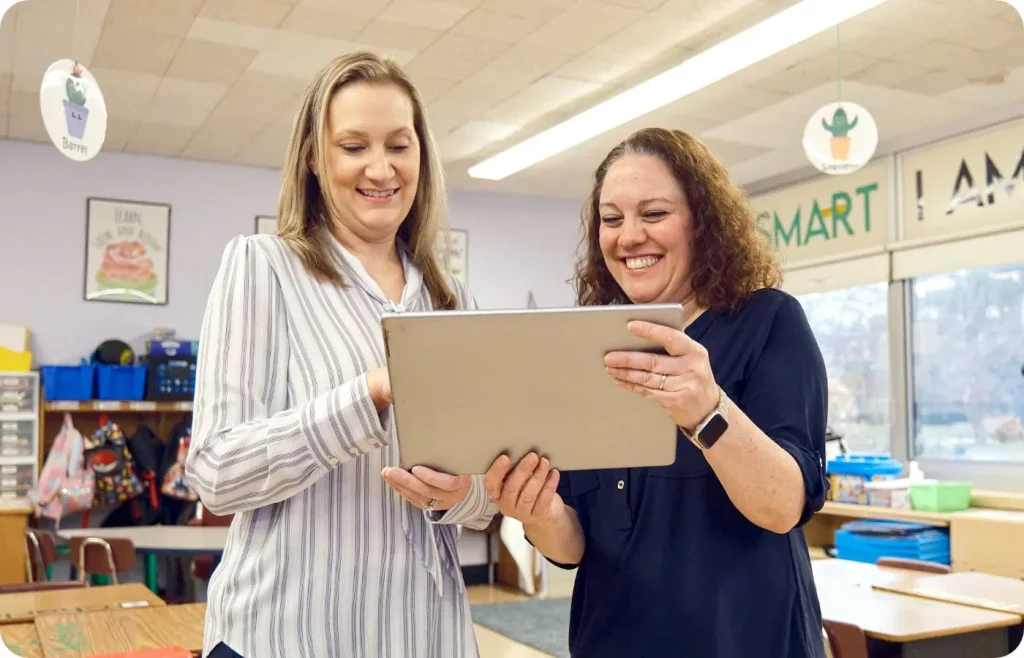
Two women stand in a classroom, smiling as they look at a laptop together—sharing teaching tips and supporting each other in the education community.
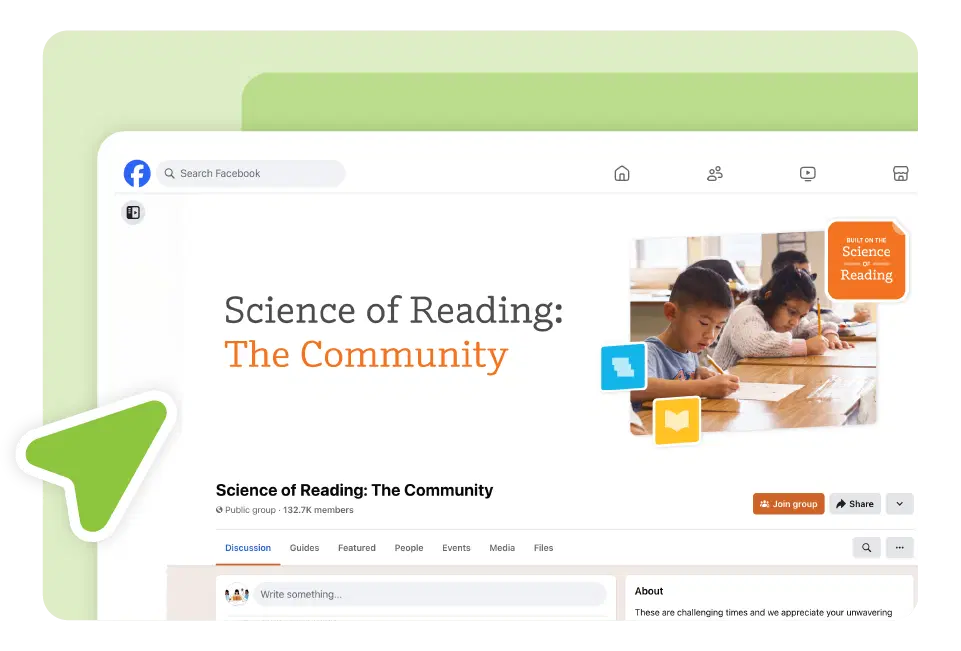
Screenshot of a Facebook group page titled "Science of Reading: The Community," where innovative educators and children are engaged at a table, highlighting group information and the spirit of a vibrant learning community.

Science of Reading: The Community

Join a vibrant community of educators passionate about early literacy! In Science of Reading: The Community, you’ll find discussions on the latest research, best practices, and classroom strategies for implementing the Science of Reading. Want even more expert insights? Subscribe to Science of Reading: The Podcast for conversations with top researchers and practitioners.

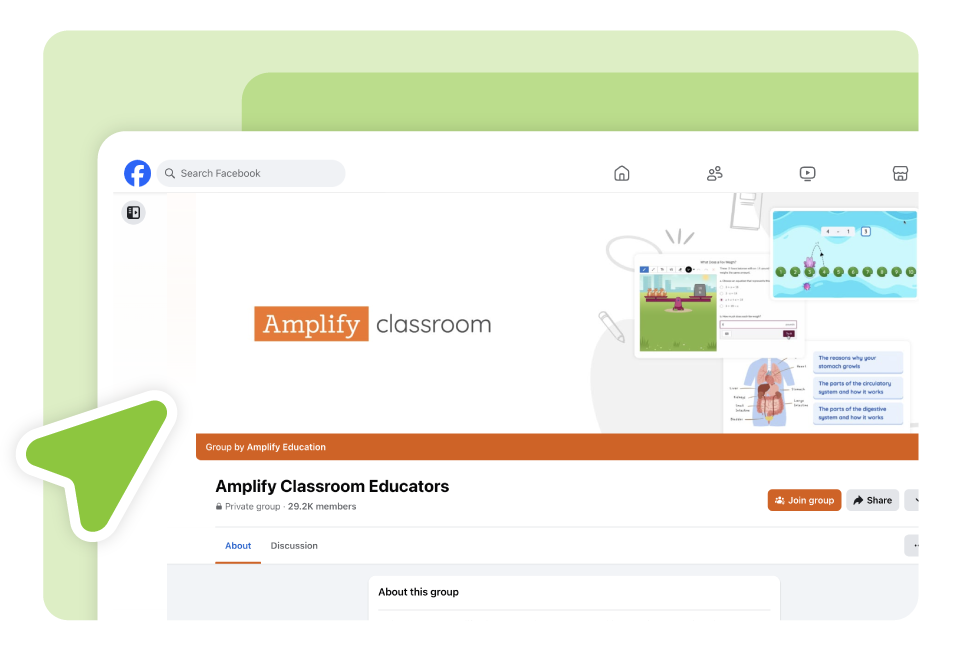
Amplify Classroom Educators Facebook group

Join a dynamic community of educators who are passionate about leveraging Amplify Classroom’s interactive tools and activities. In this group, members exchange ideas, share activities, discuss best practices, and explore innovative ways to deepen student understanding. Whether you’re looking for inspiration or collaboration, you’ll find it here!

A Facebook group page titled "Amplify Classroom Educators" is displayed on a computer screen, showing join and share buttons—a dynamic learning community for innovative educators to connect teacher to teacher.
Screenshot of a Facebook group page titled "Amplify Desmos Math," highlighting its cover image, name, and a visible "Join group" button—perfect for teacher to teacher sharing in an active education community.

Amplify Desmos Math Facebook group

This group is the go-to space for teachers, coaches, and educators using Amplify Desmos Math, mCLASS Math, and Boost Math. Connect with peers, ask questions, get answers, provide feedback, and stay informed on important updates.

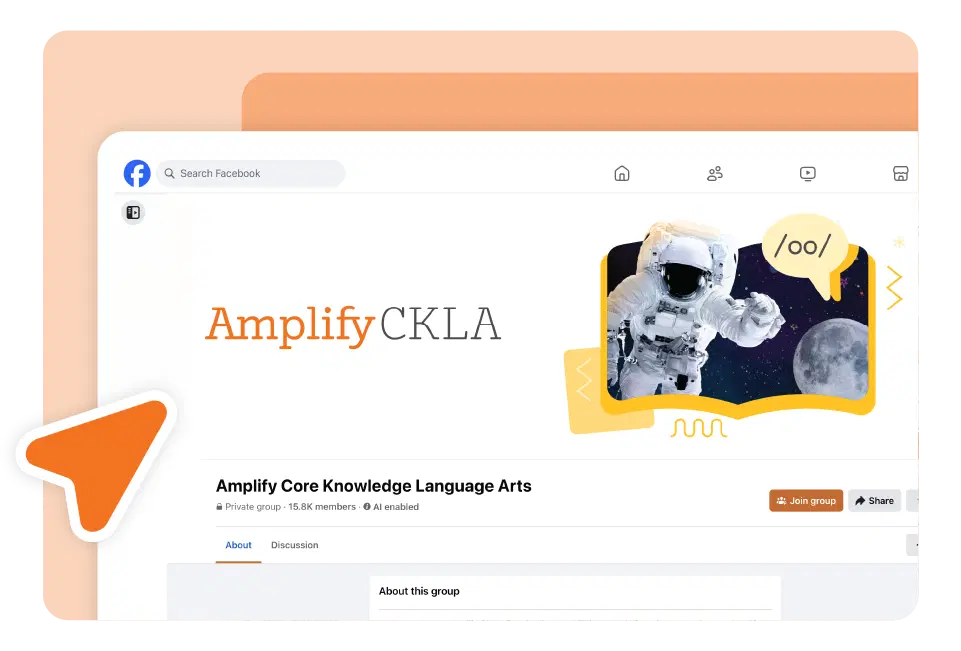
Amplify CKLA Facebook group

Looking to enhance your reading instruction? Our Amplify CKLA Facebook group is a space where educators discuss strategies for teaching reading, writing, speaking, listening, and vocabulary. Ask questions, share insights, and connect with colleagues who are using Amplify CKLA to support literacy success.

A Facebook group page titled "Amplify Core Knowledge Language Arts," featuring an astronaut and moon beside the Amplify CKLA logo—an education community where innovative educators connect teacher to teacher.
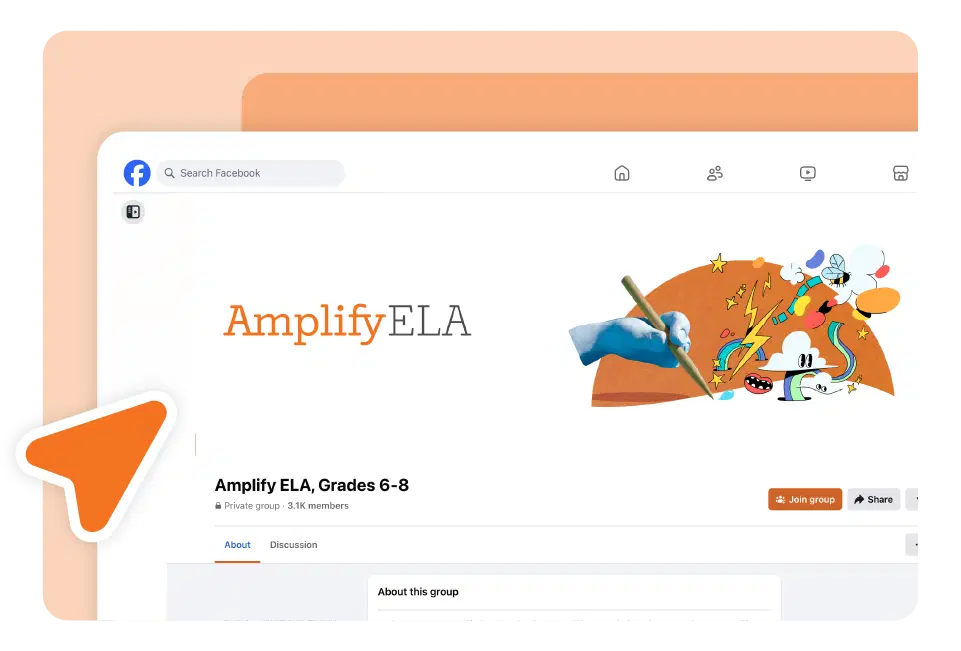
Screenshot of the Amplify ELA Facebook group page for grades 6–8, highlighting the group name, member count, and a colorful banner—an active learning community where educators share teaching tips and support one another.

Amplify ELA Facebook group

Teaching middle school ELA comes with unique challenges and opportunities—let’s navigate them together! In the Amplify ELA Facebook group, educators swap teaching ideas, classroom successes, and concrete strategies for using Amplify ELA effectively. Join the group to gain insights from fellow teachers and share what’s working in your classroom!

Boost Reading & mCLASS Facebook group

This group is a collaborative space for educators and caregivers using Boost Reading and mCLASS®. Whether you have questions, need support, or want to share success stories, this is the place to connect. Join us to exchange ideas, get helpful tips, and learn how to create the best reading experience for your students.

Screenshot of a Facebook group page titled "Boost Reading & mCLASS," featuring a colorful illustrated bird with "aw" and "er" sound cards. Innovative educators can join this vibrant learning community for valuable teaching tips.
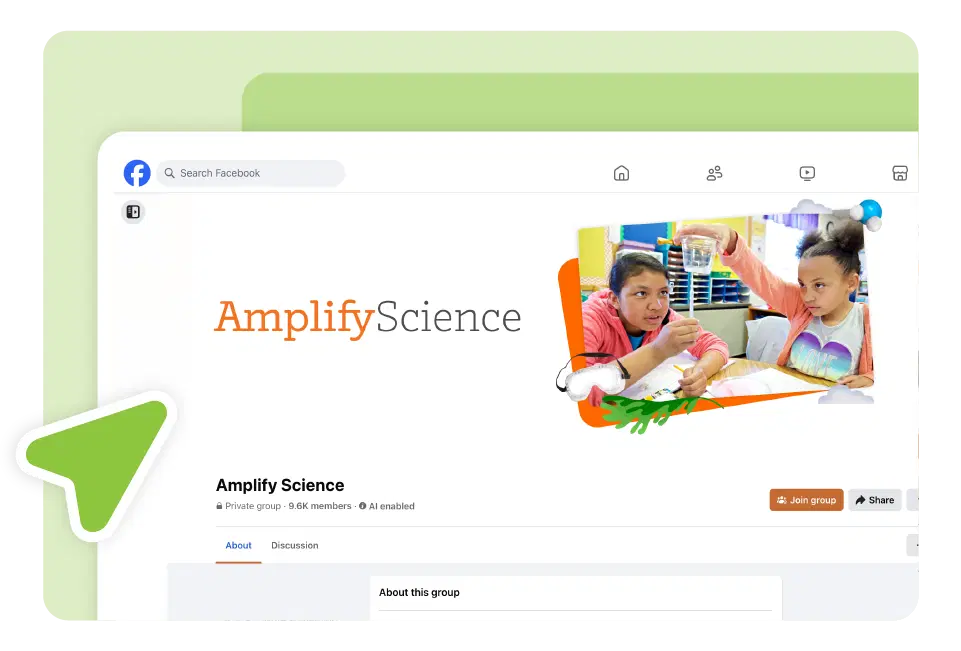
Screenshot of a Facebook group page titled "Amplify Science," featuring a cover photo of two children conducting a science experiment in class—a hub for sharing teaching tips and building an education community.

Amplify Science Facebook group

Engage with fellow science educators in the Amplify Science Facebook group! Discuss best practices for implementing Amplify Science, explore ideas on how to teach in three dimensions, and share strategies for meeting NGSS standards. Educators also post classroom success stories, providing inspiration and real-world applications of the curriculum.

If you’re an Amplify Science instructional leader, the Lawerence Hall of Science encourages you to learn more and apply to join the exclusive, no-cost Instructional Leaders Community of Practice (ILCP).

Connect with us—and educators everywhere.

Our social media channels deliver a steady stream of news, insights, and conversations that support educators in connecting with each other and creating great learning experiences for students. Find Amplify on Facebook, X, LinkedIn, and Instagram!

Blue lowercase "f" logo representing the Facebook social media platform on a white background, connecting innovative educators and fostering a vibrant education community. LinkedIn logo featuring a white "in" within a blue square, representing a global learning community for professionals. Instagram logo featuring a white camera outline inside a rounded square with a gradient background of pink, purple, and orange hues—a vibrant symbol connecting innovative educators and the education community.
A laptop and a smartphone display an orange screen with the word "Amplify." written in white text, symbolizing a vibrant learning community for innovative educators.

Contact sales

Ready to learn more? Fill out this form and we’ll be in touch with you shortly.

Amplify and SFUSD Partnership

We recognize and respect the unique differences of each of our partnering districts—and that includes San Francisco USD.

Out of the box, Amplify Caminos offers districts a rich, comprehensive, research-based SELA experience. That said, no two districts are exactly alike. To that end, we are committed to working with San Francisco USD to ensure that Amplify Caminos addresses the needs of your community. This includes providing implementation guidance and support, as well as collaborating with your staff to determine which domains need to be modified or exchanged.

What is Amplify Caminos?

Amplify Caminos is a core Spanish language arts program for grades TK–5 that delivers:

  • Authentic instruction built from the ground up for the Spanish language.
  • A unique research-based approach truly built on the Science of Reading.
  • A combination of explicit foundational skills with meaningful knowledge-building.
  • Embedded support and differentiation that gets all students reading grade-level texts together.
  • Opportunities for students to see the strengths and experiences that all people share while also celebrating each others’ unique identities and experiences.


Watch the video below to learn more about Amplify Caminos for Grades K–2.


Watch the video below to learn more about Amplify Caminos for Grades 3–5.

How does Amplify Caminos work?

Amplify Caminos is built on the science of how kids learn to read—in Spanish.

Amplify Caminos is all about helping you teach students how to read, all while giving them authentic and engaging reasons to read. That’s why Amplify Caminos develops foundational skills and builds knowledge in tandem.

  • Knowledge: Through complex and authentic Spanish read-alouds with an emphasis on classroom interactivity, oral comprehension, and contextual vocabulary, students start to build their awareness of the world around them—and the way the reading skills they’re building give them access to it.
  • Skills: Starting with the sounds at the core of the Spanish
    language, students practice their phonemic awareness, handwriting skills, vocabulary, spelling, and grammar. Through daily practice, students become aware of the connection between reading and writing, building confidence as they go.
Illustration depicting the flow of genetic information, represented by ribbons transitioning from dna to rna, connected to various educational images and diagrams.

Respecting the development differences between grade ranges, Amplify Caminos teaches foundational skills and background knowledge as two distinct strands in grades K–2, and combines them into one integrated strand in grades 3–5.

Grades K–2:
Every day, students in grades K–2 complete one full lesson that explicitly and systematically builds foundational reading skills in the Amplify Caminos Lectoescritura strand, as well as one full lesson that builds robust background knowledge to access complex text in the Amplify Caminos Conocimiento strand. Through learning in each of these strands, students develop the early literacy skills necessary to help them become confident readers and build the context to understand what they’re reading.

Grades 3–5:
In grades 3–5, the Amplify Caminos Lectoescritura and Conocimiento strands are integrated in one set of instructional materials. Lessons begin to combine skills and knowledge with increasingly complex texts, close reading, and a greater writing emphasis. Students can then use their skills to go on their own independent reading adventures.

What do Amplify Caminos students explore?

Amplify Caminos builds students’ knowledge about the world.

In addition to teaching all students to crack the written code (which is vital for equity), the Amplify Caminos program helps students see the strengths and experiences we all share while celebrating their own unique identities and experiences.

This is accomplished through the exploration of topics and text that feature people who resemble students and familiar situations or experiences while also exposing them to people whose appearances, lives, beliefs, and backgrounds differ from their own.
 

Engaging domains

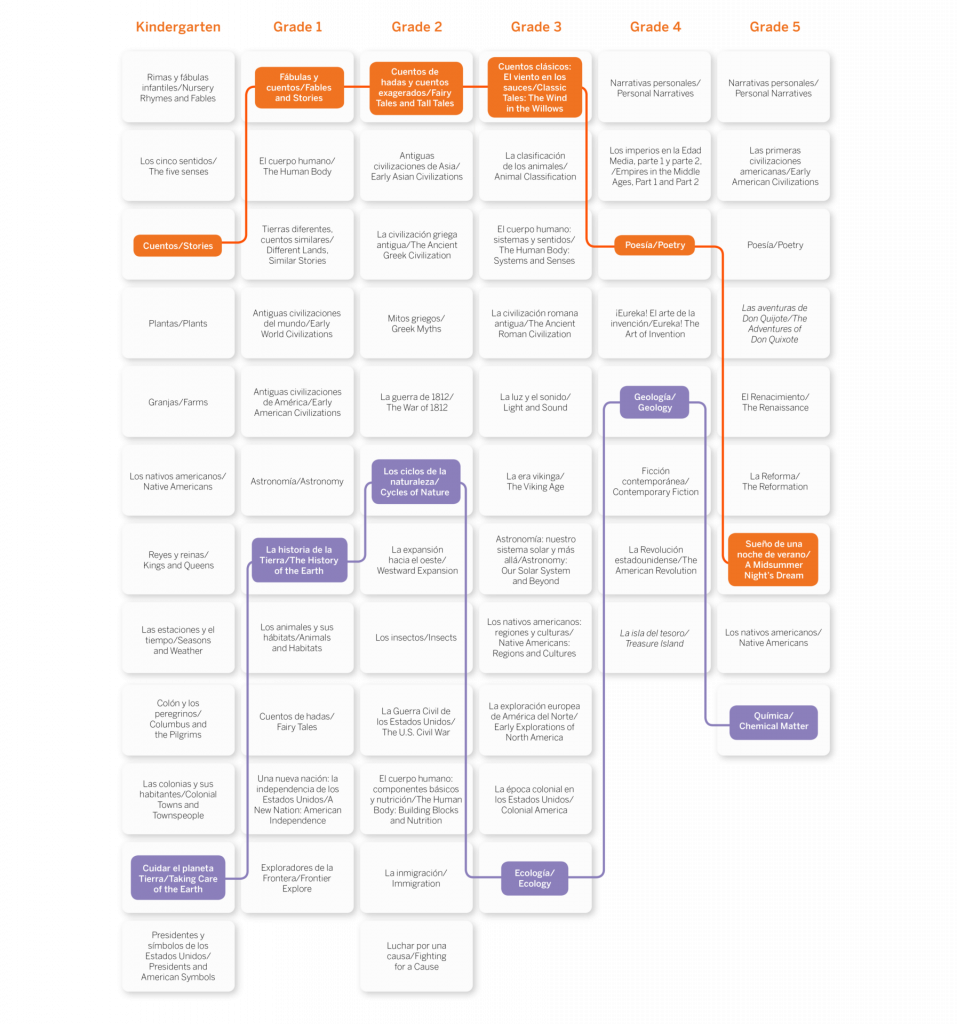
Amplify Caminos builds knowledge coherently across subjects and grades.

Throughout the program, students use their skills to explore domains that relate to storytelling, science, and the history of our world as seen through the eyes of many different groups.

Carefully selected to build from year-to-year, our grade-appropriate topics help students make and deepen connections while also reading, writing, and thinking creatively and for themselves.

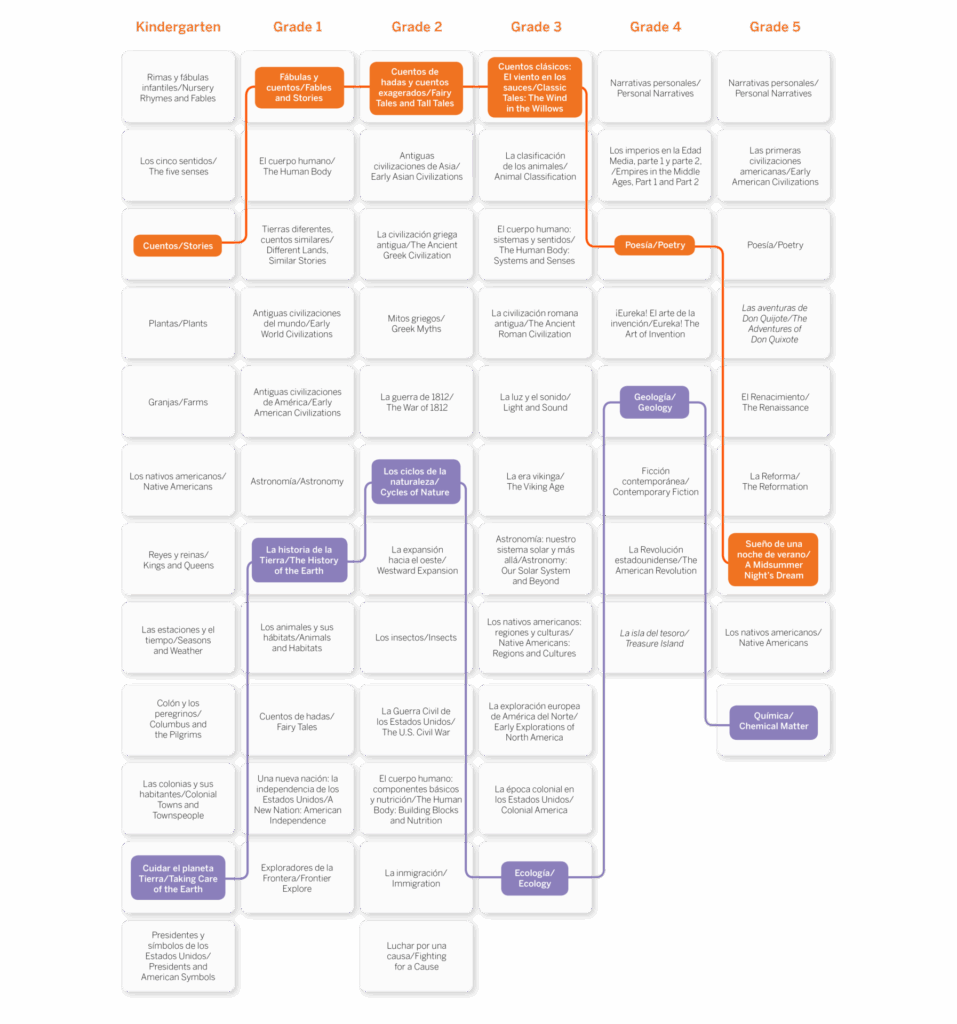
Curriculum flowchart for Kindergarten to Grade 5, showing subject progression in language, science, and social studies, with highlighted and connected units.

New Knowledge Research Units for Grades K–5

Our brand-new Knowledge Research units carry forward Amplify Caminos’ powerful and proven instructional approach while also:

  • Adding more diversity. The rich topics and highly visual components featured in these units provide students with even more “windows and mirrors” and perspectives as they work to build knowledge.
  • Adding more authentic literature. Each new research unit revolves around a collection of high-interest authentic trade books that will spark more curiosity and inspire more inquiry.
  • Adding more flexibility. Units can be implemented for extended core instruction during flex periods, district-designated Pausing Points, or enrichment periods.

Units cover a variety of rich and relevant topics:

With these new units, students will soar to new heights with Dr. Ellen Ochoa, Amelia Earhart, and the Tuskegee Airmen. They’ll feel the rhythm as they learn about Jazz legends Miles Davis, Tito Puente, and Duke Ellington. And they’ll explore the far reaches of the world with Jacques Cousteau, Matthew Henson, and Eugenie Clark.

  • Grade K: El arte y el mundo que nos rodea
  • Grade 1: Cuentos de aventuras: relatos desde los confines de la Tierra
  • Grade 2: ¡A volar! La era de la aviación
  • Grade 3: Jazz y más
  • Grade 4: Energía: pasado, presente y futuro
  • Grade 5: Más allá de Juneteenth: de 1865 al presente

Units will be made available in English and Spanish, and will include the following components:

Why we added this unit:
“Every child is an artist,” said Picasso, meaning that every child uses art to explore and understand the world around them. El arte y el mundo que nos rodea honors that truth by introducing Kindergarten students to some of the ways in which artists have explored and understood the world around them.

This domain introduces students to artists from different time periods, countries, and cultures. Throughout the unit, students learn about different kinds of art and how artists use the world around them as they make art. They also connect this to what they have already learned about the earth, plants, and animals in other Caminos domains: GranjasPlantas, and Cuidar el planeta Tierra. In addition, students connect this to what they have learned about sculptors in the Presidentes y símbolos de los Estados Unidos domain. As they explore different artists and artistic traditions, they develop their ideas about how humans are connected to each other and to the world around them.

As you read the texts in this unit, students may observe ways in which the characters or subjects are both similar to and different from students. This is a good opportunity to teach students awareness and sensitivity, building on the idea that all people share some things in common, even as they have other things that make them unique. This unit also offers an excellent opportunity to collaborate with your school’s art teacher, as many lessons have suggested activities to help students understand the kind of art they are studying.

Within this unit, students have opportunities to:

  • Use details to describe art.
  • Identify three ways to create art.
  • Identify characteristics of cave art.
  • Sequence the steps of making pottery.
  • Describe how artists can create work connected to the world around them.
  • Describe what makes Kehinde Wiley’s portraits unique.
  • Explain how the texture of a surface can affect artwork created on it.
  • Explain what a sculpture is.
  • Describe what makes James Turrell’s artwork about the sky unique.
  • Explain what a museum is and what kinds of things you can see or do there.

Trade books in this unit:
Instruction in this unit revolves around the following collection of high-interest authentic trade books. One copy of each trade book is included with the unit materials.

  • Georgia O’Keeffe por Erica Salcedo
  • Yayoi Kusama: De aquí al infinito por Sarah Suzuki
  • Tejedora del arcoíris por Linda Elovitz Marshall
  • Las tijeras de Matisse por Jeanette Winter
  • El museo por Susan Verde
  • Quizás algo hermoso: Cómo el arte transformó un barrio por F. Isabel Campoy

Sample materials:
Take a sneak peek at the rich instruction and engaging activities for this unit by viewing the PDFs below.

Why we added this unit:
This domain introduces students to adventure stories set around the world and challenges students to dig into the adventures through research. By listening to the Read-Alouds and trade books, students increase their vocabulary and reading comprehension skills, learn valuable lessons about perseverance and teamwork, and become familiar with gathering information for research.

In this unit, students study the careers of real-world explorers Dr. Eugenie Clark and Sophia Danenberg, marvel at the inventions of Jacques Cousteau, think critically about how teamwork and collaboration can make greater adventures possible, learn about the science and technology that enable adventures, and research some of the ways humans have confronted challenges at the edges of the world, from the oceans below to space above.

Each lesson in the domain builds students’ research skills as they ask questions, gather information, and write a paragraph about their findings. Students share what they have learned about adventures in an Adventure Gallery Walkthrough. By taking on the persona of one of the adventurers they meet in the Read-Alouds and trade books, students deliver their final paragraphs as if they are a “speaking portrait” of that person. Students are invited to dress up as that adventurer if they desire.

In addition, teachers can set aside time outside the instructional block to create the picture frames students will hold as they present to the Adventure Gallery Walk guests. Frames can be made from shirt boxes, cardboard, construction paper, or any art supplies that are on hand. This might be an opportunity to collaborate with the school’s art department if resources are available. Another option is to ask students to make their frames at home with their caregivers. On the day of the Adventure Gallery Walk, students will be the hosts and take on specific jobs, such as welcoming the guests, describing their work throughout the unit, and pointing out the areas of study on the domain bulletin board. You can find a complete list of student jobs in Lesson 13.

How this unit builds knowledge:
This unit builds upon the following Caminos units that students will have encountered in the previous grade.

  • Rimas y fábulas infantiles (Kindergarten)
  • Cuentos (Kindergarten)

The specific core content targeted in these domains is particularly relevant to the Read-Alouds students will hear in Cuentos de aventuras: relatos desde los confines de la Tierra. The background knowledge students bring to this unit will greatly enhance their understanding of the trade books used in this unit.

Trade books in this unit:
Instruction in this unit revolves around the following collection of high-interest authentic trade books. One copy of each trade book is included with the unit materials.

  • My Name Is Gabito/Me llamo Gabito por Monica Brown
  • Galápagos Girl/Galapagueña por Marsha Diane Arnold
  • My Name Is Gabriela/Me llamo Gabriela por Monica Brown
  • El viaje de Kalak por María Quintana Silva y Marie-Noëlle Hébert
  • Señorita Mariposa por Ben Gundersheimer
  • Sharuko, el arqueólogo peruano/Peruvian Archaeologist Julio C. Tello por Monica Brown
  • Abuelita fue al mercado por Stella Blackstone

Sample materials:
Take a sneak peek at the rich instruction and engaging activities for this unit by viewing the PDFs below.

Why we added this unit:
With this domain, students head up, up, and away with an introduction to the soaring history of aviation. Students learn the stories of early aviators, such as the Montgolfier brothers, the Wright brothers, Aida de Acosta, and Amelia Earhart.

During the unit, students study the science of flight, including the physics concept of lift, and research the social impacts of the world of flight. Finally, students let their research skills take flight as they explore key figures from the world of aviation.

The lessons in this domain build on earlier Grade 2 Caminos domains about the westward expansion, early Greek civilizations, and Greek myths, and lay the foundation for learning about other periods of world history in future grades.

How this unit builds knowledge:
This unit builds upon the following Caminos units that students will have encountered earlier in the year.

  • La civilización griega antigua (Grade 2)
  • Mitos griegos (Grade 2)
  • La expansión hacia el oeste (Grade 2)

The specific core content targeted in these domains is particularly relevant to the Read-Alouds students will hear in ¡A volar! La era de la aviación. The background knowledge students bring to this unit will greatly enhance their understanding of the trade books used in this unit.

Trade books in this unit:
Instruction in this unit revolves around the following collection of high-interest authentic trade books. One copy of each trade book is included with the unit materials.

  • ¡A volar! Todo sobre aviones por Jennifer Prior
  • Amelia sabe volar por Mara dal Corso
  • Héroes de la aviación que cambiaron el mundo por Dan Green
  • El niño que alcanzó las estrellas por José M. Hernández
  • La niña que aprendió a volar por Sylvia Acevedo
  • Buenas Noches Capitán Mamá por Graciela Tiscareño-Sato

Sample materials:
Take a sneak peek at the rich instruction and engaging activities for this unit by viewing the PDFs below.

Why we added this unit:
This domain teaches students about the vibrant music, poetry, and culture of the Jazz Age in the United States. Students learn about famous writers and musicians like Langston Hughes, Louis Armstrong, Billie Holiday, Melba Liston, Tito Puente, and Miles Davis. They study how the jazz art form took root in the South, then spread to the North to become the sound of the Harlem Renaissance, eventually connecting people around the world in musical expression.

During this unit, students perform guided research to further explore both the history of jazz and what jazz is today. They develop research skills and then use those skills to find deeper connections between the stories and music of the Jazz Age and music today. As students learn about the world of jazz, they collaborate and share ideas with their classmates. They also practice sharing feedback focused on their written work, and, at the end of the unit, students present their research to the group.

The lessons give students opportunities to dive into the rhythms and stories of jazz, utilizing the knowledge sequence in this unit to:

  • Collaboratively generate research questions about jazz, jazz musicians, contemporary musicians from the state where they live or have lived, and the evolution of jazz music.
  • Utilize Read-Alouds, independent reading, and partner reading to learn about the Jazz Age, the Harlem Renaissance, jazz music, and biographies of celebrated jazz musicians and writers.
  • Research the answers to their generated questions, gather information, write a short research essay about a famous jazz musician, write a short essay about a contemporary musician from the state where they live or have lived, and give a presentation about their research.

How this unit builds knowledge:
Within this unit, students have opportunities to:

  • Ask relevant questions and make pertinent comments
  • Identify details in texts
  • Determine key ideas of texts by evaluating details
  • Make text-based inferences
  • Generate questions based on prior knowledge and gathered information
  • Synthesize details across texts to demonstrate comprehension
  • Discuss and explain an author’s purpose
  • Identify and cite reliable primary and secondary sources of information
  • Compose a well-organized and focused informative essay
  • Make connections between topics
  • Present information using appropriate media

Trade books in this unit:
Instruction in this unit revolves around the following collection of high-interest authentic trade books. One copy of each trade book is included with the unit materials.

  • ¡Esquivel! Un artista del sonido de la era espacial por Susan Wood
  • Ray Charles por Sharon Bell Mathis
  • Tito Puente, el Rey del Mambo por Monica Brown
  • Me llamo Celia, la vida de Celia Cruz por Monica Brown
  • ¡Azúcar! por Ivar Da Coll

In this unit, students also read the poem “Harlem” by Langston Hughes. (Available for free through the Academy of American Poets website and the Poetry Foundation website, with recorded audio available through the website for John Hancock College Preparatory High School.)

Sample materials:
Take a sneak peek at the rich instruction and engaging activities for this unit by viewing the PDFs below.

Why we added this unit:
With this domain, students become tomorrow’s problem solvers in this study of energy in the United States. Analytical reading skills are developed by examining the challenges of early energy innovators. Students then read about current energy practices and young energy change-makers across the world.

Throughout the unit, students conduct research into different sources of energy and present a proposal, putting them in the shoes of future energy innovators. They also use the knowledge sequence in this unit to:

  • Collaboratively analyze texts to identify cause-effect and problem-solution relationships.
  • Generate questions and conduct research about energy.
  • Write an opinion essay making their case for a fuel of the future.
  • Create energy proposals using primary and secondary resources.

How this unit builds knowledge:
This unit builds upon the following Caminos units that students will have encountered in previous grades as well as earlier in the year.

  • Plantas (Grade K)
  • La historia de la Tierra (Grade 1)
  • ¡Eureka! Estudiante inventor (Grade 4)

The specific core content targeted in these domains is particularly relevant to the Read-Alouds students will hear in Energía: pasado, presente y futuro. The background knowledge students bring to this unit will greatly enhance their understanding of the trade books used in this unit.

Trade books in this unit:
Instruction in this unit revolves around the following collection of high-interest authentic trade books. One copy of each trade book is included with the unit materials.

  • La historia de los combustibles fósiles por William B. Rice
  • El niño que domó el viento por William Kamkwamba y Bryan Mealer

Sample materials:
Take a sneak peek at the rich instruction and engaging activities for this unit by viewing the PDFs below.

Why we added this unit:
Within this domain, Students learn about General Granger’s announcement in Galveston, Texas on June 19, 1865, a day marked in history as Juneteenth. Texts and multimedia sources will support foundational knowledge-building about the end of slavery in the United States. A review of the first freedom announcement, President Lincoln’s Emancipation Proclamation, provides students with background knowledge to further emphasize the significance of Juneteenth in American history.

This unit also takes students on a journey beyond Juneteenth, as they study specific contributions of African Americans from 1865 to the present day. Students participate in a virtual field trip to Emancipation Park in Houston, Texas and use the knowledge sequence in this unit to:

  • Collaboratively generate research questions about Juneteenth, The Great Migration, innovators and inventors, education, the humanities, activists, and allies.
  • Use Read-Alouds, independent, and partner reading to learn about African American contributions from 1865 to the present.
  • Research to find answers to their generated questions, gather information, and write a four-chapter Beyond Juneteenth book.

How this unit builds knowledge:
This unit builds upon the following Caminos units that students will have encountered in previous grades.

  • Los nativos americanos (Grade K)
  • Una nueva nación: la independencia de los Estados Unidos (Grade 1)
  • La Guerra Civil de los Estaods Unidos (Grade 2)
  • La inmigración (Grade 2)
  • Los nativos americanos (Grade 5)

The specific core content targeted in these domains is particularly relevant to the Read-Alouds students will hear in Más allá de Juneteenth: de 1865 al presente
. The background knowledge students bring to this unit will greatly enhance their understanding of the trade books used in this unit.

Trade books in this unit:
Instruction in this unit revolves around the following collection of high-interest authentic trade books. One copy of each trade book is included with the unit materials.

  • Martí’s Song for Freedom/Martí y sus versos por la libertad escrito por Emma Otheguy
  • ¡Celebremos Juneteenth! escrito por Carole Boston Weatherford
  • Side by Side/Lado a Lado: The Story of Dolores Huerta and Cesar Chavez/La Historia de Dolores Huerta y César Chávez escrito por Monica Brown
  • Canto de alabanza para el día: Poema para la ceremonia inaugural del mandato de Barack Obama escrito por Elizabeth Alexander, traducido por Rodrigo Rojas

Sample materials:
Take a sneak peek at the rich instruction and engaging activities for this unit by viewing the PDFs below.

Diverse texts

Amplify Caminos puts a variety of texts in the hands of students every day.

Amplify Caminos includes both transadaptations and authentic texts written by Latin American and Spanish authors. In addition to featuring a diverse range of authors and topics, our texts represent individuals and characters with a broad range of identity factors, including socioeconomic status, age, ability, race, ethnicity, country of origin, religion, and more.

Amplify Caminos texts include:

  • Authentic literature: Authentic literature exposes students to a variety of text types and perspectives to deepen their knowledge of fascinating topics in social studies, science, literature, and the arts. Authentic texts support text-to-self, text-to-world, and text-to-text connections for readers.
  • Decodable Student Readers: Amplify Caminos is built on the conviction that equitable instruction is vital to an effective program. Decodable Student Readers at grades K–2 are newly re-designed to celebrate students’ diverse experiences and feature individuals with a broad range of identity factors, including socioeconomic status, age, ability, race, ethnicity, country of origin, religion, and more.
  • ReadWorks® texts: Amplify and ReadWorks have partnered to deliver high-quality texts curated to support the Amplify Caminos Knowledge Sequence and to extend student learning. Texts include high-interest nonfiction articles in topics in social studies, science, literature, and the arts. These texts are accompanied by vocabulary supports and standards-aligned formative assessment opportunities. Teachers can monitor their students’ progress using the ReadWorks reporting features.
Three book covers displaying children's books in spanish, each featuring colorful and stylized illustrations related to cultural stories.

Amplify Caminos Trade Book Collection Guide

Each book in our authentic literature collection was selected specifically to support and enhance the content of the K-2 Conocimiento Strand. These anchor texts are intended for use as an introduction to each domain—engaging students, piquing their curiosity, and building initial background knowledge—before diving into the deeper content of the domain Read-Alouds.

Every trade book has an instructional guide that includes the following:

  • Author and illustrator
  • Book summary
  • The Essential Question of the Knowledge domain, connecting the book to the domain
  • Key Tier 2 and Tier 3 vocabulary words found in the book
  • A group activity to reinforce and extend students’ knowledge and understanding
  • A performance task to help gauge students’ comprehension of concepts in the text
  • Writing prompts to expand understanding and critical thinking
  • Text complexity ratings and descriptors for quantitative, qualitative, and reader/task categories

Download the Amplify Caminos Trade Book Collection Guide for Grades K–2.

Detailed information about text complexity ratings and descriptors; additional uses for the books before, during, and after domain instruction; and the complete list of domains and books for each grade level can be found in the More About the Books section of this guide.

What makes Amplify Caminos different?

Built on the Science of Reading

Built out of the latest research in the Science of Reading, Amplify Caminos delivers explicit instruction in both foundational literacy skills (systematic phonics, decoding, and fluency) and background knowledge in grades K–2 with an integrated approach to explicit instruction in grades 3–5.

Three connected orange blocks labeled

Explicit systematic skills instruction

The skills instruction in Amplify Caminos was distinctly developed with the Spanish language in mind. Its foundational lessons are specific to the language, rather than a direct translation from Amplify CKLA’s English skills instruction.

Reading instruction begins with the vowels first, then the most common consonants, and finally the least common consonants. Students will blend and segment sounds to form syllables, and syllables to form words.

Although Spanish has a highly predictable orthography, there are a few silent letters (h is always silent, u is silent after g or q), as well as letters that can make different sounds, depending on the letters that follow them. For that reason, syllables with these letters are taught somewhat later in the progression. The same is true for syllables with infrequently occurring consonants, such as z, k, x, and w.

Coherent knowledge instruction

While students are learning how to read, the Conocimiento strand gives them authentic and engaging reasons to read.

Amplify Caminos uses spiral learning to reinforce every student’s ability to develop skills like reading, writing, speaking, and listening in Spanish that can be transferred to English. As students engage with their lessons, they explore the similarities and differences in grammar, vocabulary, writing, and language use between Spanish and English. This bridge helps students learning two languages to strengthen their knowledge in both.

Through cross-curricular content, students explore units that relate to storytelling, science, and the history of our world in a holistic and thoughtful way. With these units, you’ll bring the world to your students, showing them how reading can become an exciting, rewarding, and useful part of their lives.

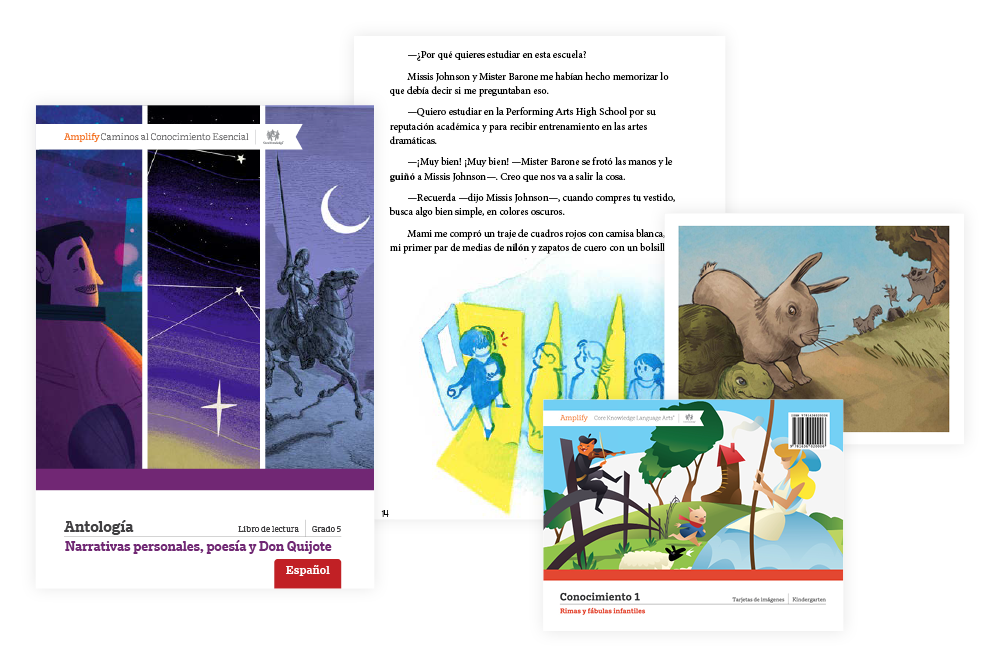
A collage of illustrated book covers, including themes of Don Quixote, space exploration, and anthropomorphic animals in various scenarios, all enriched with Spanish language elements.

Embedded differentiation for all learners

Amplify Caminos provides built-in differentiation strategies and supports in every lesson.

  • Apoyo a la enseñanza y desafío: Support and Challenge suggestions in every lesson provide assistance or opportunities for more advanced work toward the goal of the lesson.
  • Notas culturales: These point-of-use notes provide additional information about the traditions, foods, holidays, word variations, and more from across the Spanish-speaking world.
  • Apoyo adicional: Every lesson in the Lectoescritura (Skills) Strand provides additional support activities suggested to reinforce foundational skills instruction. These activities can be given to any student who requires extra help, including students with special needs.

Systematic and cohesive writing instruction

Writing instruction in Amplify Caminos builds systematically and cohesively within and across grades.

In Grades K-2, writing mechanics—including handwriting and spelling—are taught in the Amplify Caminos Lectoescritura strand. Starting in Grade 1, instruction includes four steps in the writing process: planning, drafting, editing, and publishing and features lessons that have modeling, collaboration, and sharing. As students gain skills and confidence, they are able to take on more of these steps independently. Students learn to use planning techniques, including brainstorming and graphic organizers.

Beginning in Grade 4, the Amplify Caminos writing process expands to also include sharing and evaluating. In Grades 4 and 5, the writing process is no longer conceptualized as a series of scaffolded, linear steps (an important change from the Grade 3 writing process). Rather, students move between components of the writing process in a flexible manner, similar to the process mature and experienced writers follow naturally.

young male students writing with a pencil

Amplify Caminos’ writing instruction provides a clear progression through the text types in each grade.

Because Amplify Caminos has two strands of lessons in Grades K-2, Lectoescritura and Conocimiento, students are exposed to both narrative and informational texts throughout the year. In Grades 3-5, the integrated units feature study in literary, informational, or a mix of both types of texts, depending on the content of the unit.

  • Grades K–2 introduce and establish the key elements of each text type, allowing students to gain comfort and confidence writing narratives, opinions, and informative texts. This enables students to practice thinking about content in different ways, offering more depth and breadth to their understanding of core content and of the writing text types.
  • By Grade 3, students will have gained significant practice in narrative, opinion/argumentative, and informational/explanatory forms of writing and will continue to apply those skills through Grade 5.

How does Amplify Caminos integrate with the other parts of the literacy system?

Amplify Caminos + mCLASS® Lectura

Achieve complete parity between English and Spanish assessments with mCLASS Lectura for K–6. mCLASS Lectura allows teachers to connect with their Spanish-speaking students face-to-face, one-on-one, and in the language most comfortable to them. The result? Valid and reliable student data reports
available in both English and Spanish, enabling teachers to pinpoint where their Spanish-speaking or emergent bilingual students really are in their skill development and what instruction to prioritize.

Reading assessment validated for benchmark, progress monitoring, and dyslexia screening

Amplify Caminos + Amplify Reading

Amplify Reading is an engaging, adaptive digital program that extends the learning in Amplify Caminos. Amplify Reading offers support to a large sub-group of English learners (ELs) through Spanish voice-over. Spanish voiceover instructions are available in vocabulary and sentence-level comprehension games so ELs can build their vocabulary, language, and critical comprehension skills before moving into analyzing complex texts

Spanish Support

Demo access and sample materials

Ready to explore on your own? First, watch the videos below to learn about the program’s components and how to navigate the digital platform.

Physical materials walkthrough video


Digital navigation video

Demo access

Next, follow the instructions below to access your demo account.

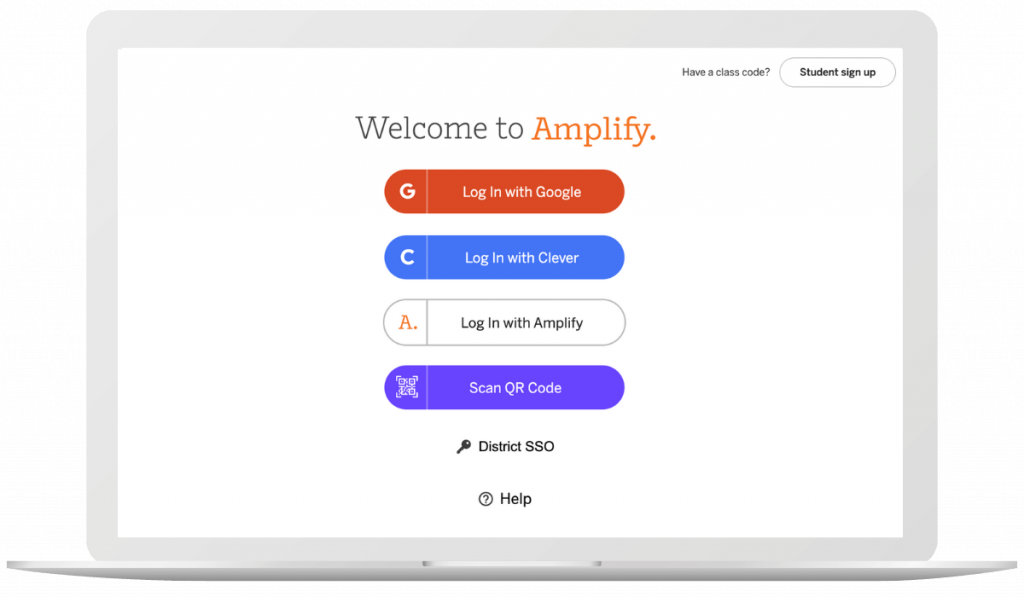
Laptop screen displaying a login page for
  • Click the CKLA and Caminos Demo button below.
  • Select Log in with Amplify.
  • To explore as a teacher, enter this username: t1.sfusdreviewer@demo.tryamplify.net
  • To explore as a student, enter this username: s1.sfusdreviewer@demo.tryamplify.net
  • Enter the password: Amplify1-sfusdreviewer
  • Click the Programs and apps menu
  • Select CKLA Teacher Resource Site
  • Select the desire grade level
  • Use the toggle to switch between English (CKLA) and Spanish (Caminos) resources.

Sample materials

Finally, click on the grade levels below to explore your requested sample units.

Each book in our authentic literature collection was selected specifically to support and enhance the content of the K-2 Conocimiento Strand. These anchor texts are intended for use as an introduction to each domain—engaging students, piquing their curiosity, and building initial background knowledge—before diving into the deeper content of the domain Read-Alouds.

Every trade book has an instructional guide that includes the following:

  • Author and illustrator
  • Book summary
  • The Essential Question of the Knowledge domain, connecting the book to the domain
  • Key Tier 2 and Tier 3 vocabulary words found in the book
  • A group activity to reinforce and extend students’ knowledge and understanding
  • A performance task to help gauge students’ comprehension of concepts in the text
  • Writing prompts to expand understanding and critical thinking
  • Text complexity ratings and descriptors for quantitative, qualitative, and reader/task categories

Download the Amplify Caminos Trade Book Collection Guide for Grades K–2.
Detailed information about text complexity ratings and descriptors; additional uses for the books before, during, and after domain instruction; and the complete list of domains and books for each grade level can be found in the More About the Books section of this guide.

Additional resources

Families and caregivers, welcome to Amplify Desmos Math K–5!

Welcome to the Amplify Desmos Math K–5 Caregiver Hub. We hope your student enjoys exploring math, working with friends to solve problems, and learning new and interesting concepts. And we hope you enjoy the math journey with them! Below are some suggestions and resources for how you can support their learning at home.

Learn more about Amplify Desmos Math.

Para la versión en español, haga clic aquí.

Three children are engaging in a math activity with a grid and orange markers. One child holds a "9-3" card. The background includes beach elements and abstract math symbols.

Caregiver Unit Resources

For every unit of the program, we’ve created a Caregiver Resource that provides a summary of key concepts, plus a problem from the lesson practice set you can work through with your student. You’ll find a Caregiver Resource for each unit, in both English and Spanish.

Unit 1: Math in Our World

Unit 2: Numbers 1–10

Unit 3: Flat Shapes All Around Us

Unit 4: Understanding Addition and Subtraction

Unit 5: Make and Break Apart Numbers Within 10

Unit 6: Numbers 0–20

Unit 7: Solid Shapes All Around Us

Unit 1: Adding, Subtracting, and Working With Data

Unit 2: Addition and Subtraction Story Problems

Unit 3: Adding and Subtracting Within 20

Unit 4: Numbers to 99

Unit 5: Adding Within 100

Unit 6: Measuring Lengths of Up to 120 Length Units

Unit 7: Geometry and Time

Unit 1: Working With Data and Solving Comparison Problems

Unit 2: Adding and Subtracting Within 100

Unit 3: Measuring Length

Unit 4: Addition and Subtraction on the Number Line

Unit 5: Numbers to 1,000

Unit 6: Geometry and Time

Unit 7: Adding and Subtracting Within 1,000

Unit 8: Equal Groups

Unit 1: Introducing Multiplication

Unit 2: Area and Multiplication

Unit 3: Wrapping Up Addition and Subtraction Within 1,000

Unit 4: Relating Multiplication to Division

Unit 5: Fractions as Numbers

Unit 6: Measuring Length, Time, Liquid Volume, and Weight

Unit 7: Two-Dimensional Shapes and Perimeter

Unit 1: Factors and Multiples

Unit 2: Fraction Equivalence and Comparison

Unit 3: Extending Operations to Fractions

Unit 4: From Hundredths to Hundred Thousands

Unit 5: Multiplicative Comparison and Measurement

Unit 6: Multiplying and Dividing Multi-Digit Numbers

Unit 7: Angles and Properties of Shapes

Unit 1: Volume

Unit 2: Fractions as Quotients and Fraction Multiplication

Unit 3: Multiplying and Dividing Fractions

Unit 4: Multiplication and Division With Multi-Digit Whole Numbers

Unit 5: Place Value Patterns and Decimal Operations

Unit 6: More Decimal and Fraction Operations

Unit 7: Shapes on the Coordinate Plane

Unit refresh videos

Unit 1

  • Sub-Unit 2 – Answering the Question “Are There Enough?”
  • Sub-Unit 3 – Counting and Cardinality

Unit 2

  • Sub-Unit 1 – Comparing 2 Groups Using the Terms More, Fewer, and Same
  • Sub-Unit 2 – Counting Objects in Different Orders
  • Sub-Unit 3 – Making Groups to Represent Numerals
  • Sub-Unit 4 – Comparing Written Numbers

Unit 3

  • Sub-Unit 1 – Identifying Circles and Triangles in Different Sizes and Orientations
  • Sub-Unit 2 – Using Positional Words to Describe the Location of Shapes

Unit 4

  • Sub-Unit 1 – Adding and Subtracting Within 10
  • Sub-Unit 2 – Representing Addition and Subtraction Story Problems
  • Sub-Unit 3 – Finding the Values of Expressions

Unit 5

Unit 1

  • Sub-Unit 1 – Organizing Data to Count How Many in Each Category
  • Sub-Unit 2 – Counting on to Add and Counting Back to Subtract
  • Sub-Unit 3 – Representing 2 Categories of Data With Addition Equations

Unit 2

  • Sub-Unit 1 – Representing and Solving Add To, Change Unknown Story Problems
  • Sub-Unit 2 – Using Addition or Subtraction to Find an Unknown Part of a Total Amount
  • Sub-Unit 3 – Solving Compare, Difference Unknown Problems
  • Sub-Unit 4 – Making Sense of Story Problems With Different Questions

Unit 3

  • Sub-Unit 1 – Finding a Difference Using the Relationship Between Addition and Subtraction
  • Sub-Unit 2 – Using the Structure of Teen Numbers to Find Missing Addends
  • Sub-Unit 3 – Breaking Apart Addends to Make 10 When Adding
  • Sub-Unit 4 – Subtracting From Teen Numbers in Parts to Get to 10

Unit 4

  • Sub-Unit 1 – Adding a Ten To and Subtracting a Ten From Multiples of 10
  • Sub-Unit 2 – Representing and Writing Two-Digit Numbers
  • Sub-Unit 3 – Comparing Two-Digit Numbers
  • Sub-Unit 4 – Representing the Same Two-Digit Number With Different Amounts of Tens and Ones

Unit 5

  • Sub-Unit 1 – Adding a Number of Tens or Ones to a Two-Digit Number
  • Sub-Unit 2 – Adding a Two-Digit Number and a One-Digit Number When Composing a Ten is Necessary
  • Sub-Unit 3 – Adding a Two-Digit Number and a Two-Digit Number When Composing a Ten is Necessary

Unit 1

  • Sub-Unit 1 – Choosing Strategies to Add Within 20
  • Sub-Unit 2 – Representing Data in a Picture Graph and Bar Graph
  • Sub-Unit 3 – Finding the Difference Between 2 Categories Shown on a Bar Graph

Unit 2

  • Sub-Unit 1 – Strategies to Solve Story Problems Involving Money
  • Sub-Unit 2 – Decomposing a Ten When Subtracting by Place
  • Sub-Unit 3 – Making Sense of Story Problems About Comparing That Use the Word More
  • Sub-Unit 4 – Making Sense of One- and Two-Step Story Problems

Unit 3

  • Sub-Unit 1 – Measuring the Length of an Object in Centimeters Using a Ruler
  • Sub-Unit 2 – Measuring Objects in Inches and Feet
  • Sub-Unit 3 – Representing Measurement Data on a Line Plot

Unit 4

  • Sub-Unit 1 – Locating Numbers on Number Lines
  • Sub-Unit 2 – Representing Addition and Subtraction Strategies on a Number Line

Unit 5

  • Sub-Unit 1 – Composing Hundreds to Represent Three-Digit Numbers
  • Sub-Unit 2 – Comparing Three-Digit Numbers

Unit 1

  • Sub-Unit 1 – Representing Equal-Groups Situations With Equal-Groups Drawings
  • Sub-Unit 2 – Representing Arrays With Multiplication Equations
  • Sub-Unit 3 – Representing Data Using Scaled Bar Graphs

Unit 2

  • Sub-Unit 1 – Determining the Area of a Rectangle Using Counting and Skip Counting
  • Sub-Unit 2 – Determining the Area of a Rectangle Using Multiplication
  • Sub-Unit 3 – Decomposing to Determine the Area of Rectilinear Figures

Unit 3

  • Sub-Unit 1 – Using the Expanded Form and Partial Sums Algorithms to Add
  • Sub-Unit 2 – Using the Expanded Form Algorithm to Subtract
  • Sub-Unit 3 – Rounding Numbers to the Nearest Hundred and Ten Using Number Lines
  • Sub-Unit 4 – Representing and Solving Two-Step Story Problems Involving Multiplication

Unit 4

  • Sub-Unit 1 – Representing Division Situations With Equal-Groups Drawings
  • Sub-Unit 2 – Representing an Equal-Groups Problem With a Division and Multiplication Equation
  • Sub-Unit 3 – Using the Distributive Property of Multiplication to Multiply a One-Digit Number by a Teen Number
  • Sub-Unit 4 – Decomposing Dividends to Divide

Unit 5

  • Sub-Unit 1 – Writing Unit and Non-Unit Fractions
  • Sub-Unit 2 – Locating Non-Unit Fractions on the Number Line
  • Sub-Unit 3 – Identifying Equivalent Fractions
  • Sub-Unit 4 – Comparing Fractions With the Same Denominator or Same Numerator

Unit 1

  • Sub-Unit 1 – Using Factor Pairs to Determine All the Possible Side Lengths of a Rectangle With a Given Area
  • Sub-Unit 2 – Finding Multiples and Common Multiples

Unit 2

  • Sub-Unit 1 – Locating Fractions with Different Denominators On the Same Number Line
  • Sub-Unit 2 – Using Multiples or Factors to Determine Equivalent Fractions
  • Sub-Unit 3 – Comparing Fractions Using Equivalent Fractions With Common Denominators

Unit 3

  • Sub-Unit 1 – Adding and Subtracting Fractions with the Same Denominator
  • Sub-Unit 2 – Multiplying Whole Numbers and Fractions
  • Sub-Unit 3 – Adding Fractions with Denominators of 10 and 100

Unit 4

  • Sub-Unit 1 – Writing Fractions With Denominators of 10 and 100 as Decimals
  • Sub-Unit 2 – Relationships Between Place Values in Multi-Digit Whole Numbers
  • Sub-Unit 3 – Comparing Multi-Digit Numbers
  • Sub-Unit 4 – Using the Standard Algorithm to Subtract When Decomposing is Required

Unit 5

  • Sub-Unit 1 – Representing Multiplicative Comparison Situations
  • Sub-Unit 2 – Converting Measurements in the Metric System
  • Sub-Unit 3 – Comparing Measurements

Unit 1

  • Sub-Unit 1 – Using the Layered Structure of a Rectangular Prism to Determine the Volume
  • Sub-Unit 2 – Determining the Volume of a Rectangular Prism
  • Sub-Unit 3 – Determining the Volume of Figures Composed of Rectangular Prisms

Unit 2

  • Sub-Unit 1 – Representing Equal-Sharing Story Problems with Fractional Quotients
  • Sub-Unit 2 – Representing Fractions with Equivalent Multiplication and Division Expressions
  • Sub-Unit 3 – Determining the Area of a Rectangle With a Fractional Side Length

Unit 3

  • Sub-Unit 1 – Representing Multiplication of 2 Unit Fractions with Diagrams
  • Sub-Unit 2 – Dividing Whole Numbers by Unit Fractions

Unit 4

  • Sub-Unit 1 – Multiplying Multi-digit Whole Numbers Using the Partial Products and Standard Algorithms
  • Sub-Unit 2 – Dividing Multi-Digit Whole Numbers Using Partial Quotients
  • Sub-Unit 3 – Representing Multi-Step Story Problems with Equations

Unit 5

  • Sub-Unit 1 – Comparing Decimals
  • Sub-Unit 2 – Using the Standard Algorithms to Add and Subtract Decimals
  • Sub-Unit 3 – Multiplying a Whole Number and a Decimal Using the Distributive Property
  • Sub-Unit 4 – Dividing Whole Numbers by Decimals Less Than 1

Access Amplify Desmos Math at home.

In addition to a print Student Edition workbook, your student will have digital access to all learning, practice, and assessment materials through the Amplify platform. The digital curriculum can be accessed in school and at home by following these instructions:

  • Click the Amplify Desmos Math button.
  • Select Log in with Amplify.
  • Enter your student’s username and password provided by your student’s teacher.
  • Select the desired grade level.

Once logged in, caregivers can view student work by opening previous assignments.

Learn how to navigate the student home page.

Materials overview

Amplify Desmos Math supports blended learning with supporting print materials and a unique digital experience. All K–5 lessons are available in a write-in Student Edition book. Many of the lessons include hands-on activities with manipulatives, tools that help students understand abstract concepts by making them tangible. Your student will also work with digital devices for an age-appropriate number of lessons.

When students use devices, teachers can monitor their work in real time, making sure they get the exact support that they need at every part of the lesson, in and outside of class.

Una interfaz digital que muestra los nombres anónimos de los estudiantes y su estado de participación en diversas actividades. La interfaz incluye opciones para realizar resúmenes, capturas de pantalla y vistas individuales de los estudiantes.

Components of a lesson

Students in an Amplify Desmos Math classroom can be seen (and heard!) asking questions, debating answers, justifying their thinking, grappling with problems, and working together and independently.

A typical Amplify Desmos Math lesson includes:

  • Warm-up: A short, attention-getting problem to pique students’ interest in the lesson.
  • Activities: One to two mini-activities that challenge students’ problem-solving skills.
  • Synthesis: Discussion to review and bring together the important concepts from the lesson.
  • Show What You Know and Reflection: Questions for students to show what they know from the lesson. (Note: The Show What You Know lesson assessment is optional for kindergarten and grade 1.)
  • Centers: Student-led activity stations that reinforce the math learned during lesson activities through interactive and often game-like formats. In kindergarten and grade 1, time for Centers is built into the last 15 minutes of every lesson.

To support, strengthen, and stretch students’ learning after the lesson, Amplify Desmos Math offers options for:

  • Differentiation: Mini-Lessons, Centers, Extensions, Boost Personalized Learning, and Fluency Practice.
  • Practice: Additional problems your student’s teacher may assign for classwork or homework.

Support math learning at home.

You can support your student’s math learning outside of school in many ways:

Your student’s teacher may assign practice problems at the end of each lesson for classwork or homework. If your student has already completed the practice problems for the lesson, ask them to walk you through how they solved each problem, or talk about any parts that were challenging for them. Ask your student follow-up questions to encourage the use of math language as they explain their thinking, such as, “How do you know?,” “How can you show your thinking?,” or “How would you describe that?” If students are stuck, ask support questions, such as, “What information do you know here?” or “How could you represent this problem?”

Your student’s teacher may introduce a Center game with students in the lesson or beyond the lesson. These games are aligned to the math of the unit and can be played with students outside of class. Your student’s teacher may introduce a Center game to students during or after completing a lesson, or you may need to teach the game before you play by using easy-to-follow instructions. Sign up for a free account to explore Centers and additional K–5 content in our Featured Collections.

Each unit in Amplify Desmos Math begins with a read-aloud story to engage students and provide context for the math of the unit. Elements and characters from the Unit Story then appear in lessons throughout the unit.

Kindergarten

Grade 1

Grade 2

Grade 3

Grade 4

Grade 5

Relate math to daily activities at home, whether grocery shopping, preparing a meal, or planning for a trip to the store. Your student can help you figure out how many more apples there are than oranges in the grocery cart, show how to split a sandwich into fourths, or figure out how much change you’ll receive in exchange for a $10 bill. Encourage your student to point out ways that you use math in your daily tasks.

Remind your student that getting stuck is part of the process and a necessary—beneficial, even!—part of learning. Many students (and adults) fear making mistakes. But research shows that making mistakes helps our brains grow. When your student gets stuck on a problem, encourage them to keep trying different strategies, even if they’re not sure if they are right.

Get more information.

Have a question about Amplify Desmos Math? Visit our help library to search for articles with answers to your program questions. For additional support, please contact your student’s teacher.

Amplify’s Subprocessors

This page provides the current list of third party service providers that Amplify engages to help us provide our services and may have access to Personal Information of our customers (“Subprocessors”) as outlined in Amplify’s Customer Privacy Policy.

How to get notified of changes

Please use the “Subscribe to Updates” functionality at the top of the page to receive emails from Amplify regarding updates to the list of Subprocessors and/or changes to the information provided on this page. Should you choose not to use this functionality to receive email notifications, it is our expectation that you check the link regularly for any updates.

Our commitments regarding Service Providers

All of the Subprocessors listed below have a legitimate need to access Personal Information in order to provide their service to Amplify as a part of Amplify’s provision of the services to our customers. With regard to Subprocessors, Amplify commits to:

  • Conduct due diligence on the data privacy and security measures of new Subprocessors before providing access to Personal Information and monitor on an annual basis thereafter. As part of this process, Amplify reviews the Subprocessor’s security documentation, practices, and posture to ensure alignment with Amplify’s information security program and standards;
  • Enter into a written agreement which requires at least the same level of protection for Personal Information and individuals as set out in Amplify’s Customer Privacy Policy and our agreements with customers, as applicable, before providing access to Personal Information;
  • Restrict the Subprocessor’s access to Personal Information to only what is necessary to fulfill our contractual obligations or as otherwise permitted under the agreements with our customers or under applicable data privacy laws; and
  • Remain liable for any processing of Personal Information carried out by Subprocessors to the same extent we would be liable if performing the services ourselves.

Subprocessors

Amplify’s Subprocessors of Personal Information are:

Subprocessor Purpose Location Student Data Educator Data
Amazon Web Services Cloud hosting services United States A large, light peach-colored checkmark on a transparent background.
A large, light peach-colored checkmark on a transparent background.
Anthology (formerly Blackboard) Video conferencing and attendee tracking for tutoring services United States A large, light peach-colored checkmark on a transparent background.
A large, light peach-colored checkmark on a transparent background.
Boomi, Inc. Data integration United States   A large, light peach-colored checkmark on a transparent background.
Datadog Performance and security monitoring United States A large, light peach-colored checkmark on a transparent background.
A large, light peach-colored checkmark on a transparent background.
dbt Labs, Inc. Run database queries United States A large, light peach-colored checkmark on a transparent background.
A large, light peach-colored checkmark on a transparent background.
Egnyte, Inc. Secure file exchange United States A large, light peach-colored checkmark on a transparent background.
A large, light peach-colored checkmark on a transparent background.
Fivetran, Inc. Database loading United States A large, light peach-colored checkmark on a transparent background.
A large, light peach-colored checkmark on a transparent background.
Gainsight, Inc. Customer support United States   A large, light peach-colored checkmark on a transparent background.
Google, LLC Cloud hosting services United States A large, light peach-colored checkmark on a transparent background.
A large, light peach-colored checkmark on a transparent background.
Google, LLC (Looker) Data warehouse analytics United States A large, light peach-colored checkmark on a transparent background.
A large, light peach-colored checkmark on a transparent background.
HubSpot Email delivery United States   A large, light peach-colored checkmark on a transparent background.
MongoDB, Inc. Database hosting United States A large, light peach-colored checkmark on a transparent background. A large, light peach-colored checkmark on a transparent background.
Salesforce Customer relationship management United States   A large, light peach-colored checkmark on a transparent background.
SchoolDay (formerly GG4L) Secure rostering United States A large, light peach-colored checkmark on a transparent background. A large, light peach-colored checkmark on a transparent background.
Snowflake, Inc. Database hosting United States A large, light peach-colored checkmark on a transparent background. A large, light peach-colored checkmark on a transparent background.
Talkdesk, Inc. Customer support United States   A large, light peach-colored checkmark on a transparent background.
Twilio, Inc. (Sendgrid) Email delivery United States A large, light peach-colored checkmark on a transparent background. A large, light peach-colored checkmark on a transparent background.

Updates

Date of Change Change Notes
October 10, 2025 Changed Blackboard to Anthology and GG4L to SchoolDay. Update MongoDB purpose. Added Datadog to the Students Subprocessor List. Created Educators Subprocessor List. Anthology and SchoolDay updated their corporate branding. Added list of Educator Data Subprocessors to clarify which partners process educator data.
June 14, 2024
Removed Desmos Studio, PBC, Qualfon Data Services Group, LLC, and Zendesk, Inc. These partners and services are no longer used for customer support.
July 27, 2023
Added Fivetran
September 15, 2022
Corrected name of Desmos Studio, PBC.
July 21, 2022 Added Desmos Collective LLC, Google, MongoDB, Twilio, and Zendesk These services support Mathigon.org and Desmos Classroom
July 20, 2022 Added Qualfon Data Services Group, LLC
October 4, 2021 Added Blackboard, Inc.
July 26, 2021 Fishtown Analytics, Inc. renamed to dbt Labs, Inc.
June 17, 2021 Updated with data warehousing and roster services providers
May 28, 2021 Initial public posting.

Amplify Desmos Math Summer bridge program

This upcoming back-to-school season is sure to be anything but normal. It will be critical to use the summer months to tend to unfinished learning and prepare students for the math to come. 

Illustration of a virtual classroom screen with nine diverse children displayed in a grid format, each in separate colored squares.
Text message conversation between two children discussing an enjoyable online math lesson, with one child admitting to cheating.

Thinking ahead

Amplify is offering free complete middle school and Algebra 1 units that support a number of typical summer school or bridge programs. The lessons are based on the highly rated Illustrative Mathematics program and designed to make problem-based instruction easier for teachers and more exciting for students.

Units available (June 2020)

COURSE UNITS  
6
Expressions and Equations (19 lessons)
Key for algebra readiness (variables)
Rational Numbers (19 lessons)
Key for algebra readiness (negatives)
7
Expressions, Equations, and Inequalities (23 lessons)
Key for algebra readiness
Angles, Triangles, and Prisms (18 lessons)
8
Associations in Data (9 lessons)
Data and modeling skills are critical
Exponents and Scientific Notation (15 lessons)
Understanding exponential behavior in today’s world is critical
Algebra 1
 Introduction to Exponentials (22 lessons)
Understanding exponential behavior in today’s world is critical
 Introduction to Quadratic Functions (23 lessons)
A key connection to physics

Find a complete list of lessons available here.

Materials available June 2020

  • Complete unit Teacher’s Guide available online or for printing
    • Delivery format: Google Docs
  • Complete unit Student Edition pages available online or for printing
    • Delivery format: Google Docs
  • Digital lessons
    • Delivery format: Desmos
  • Pre- and post-assessments
    • Delivery format: Desmos and Google Docs
A text message exchange between two individuals discussing a math work arrangement, with a friendly and supportive tone.

Making the materials work for you

We’re offering free, asynchronous professional learning resources to help your teachers quickly get up to speed with the Amplify Desmos Math lessons. These resources include:

  • Quick-start videos for each unit, including a unit overview and a walkthrough of the print and digital lessons.
  • Pacing suggestions for a variety of summer school scenarios.
  • Regularly scheduled office hours in July and August with an Amplify Desmos Math product expert.

Proposed learning models

Icons representing three educational models: in-school lessons, mix of at-home and in-school lessons, and digital lessons, each with brief descriptions.
A laptop screen displaying a presentation slide titled "detecting counterfeit coins," with graphs, text, and images of coins.

Samples

Printable Google Docs

Including Teacher Edition pages, Student Edition pages, and practice

Digital lessons powered by Desmos

Families and caregivers, welcome to Amplify Desmos Math California K–5!

Welcome to the Amplify Desmos Math California K–5 Caregiver Hub. We hope your student enjoys exploring math, working with friends to solve problems, and learning new and interesting concepts. And we hope you enjoy the math journey with them! Below are some suggestions and resources for how you can support their learning at home.

Learn more about Amplify Desmos Math California.

Para la versión en español, haga clic aquí.

Three children are engaging in a math activity with a grid and orange markers. One child holds a "9-3" card. The background includes beach elements and abstract math symbols.

Caregiver Unit Resources

For every unit of the program, we’ve created a Caregiver Resource that provides a summary of key concepts, plus a problem from the lesson practice set you can work through with your student. You’ll find a Caregiver Resource for each unit, in both English and Spanish.

Unit 1: Math in Our World

Unit 2: Numbers 1–10

Unit 3: Flat Shapes All Around Us

Unit 4: Understanding Addition and Subtraction

Unit 5: Make and Break Apart Numbers Within 10

Unit 6: Numbers 0–20

Unit 7: Solid Shapes All Around Us

Unit 1: Adding, Subtracting, and Working With Data

Unit 2: Addition and Subtraction Story Problems

Unit 3: Adding and Subtracting Within 20

Unit 4: Numbers to 99

Unit 5: Adding Within 100

Unit 6: Measuring Lengths of Up to 120 Length Units

Unit 7: Geometry and Time

Unit 1: Working With Data and Solving Comparison Problems

Unit 2: Adding and Subtracting Within 100

Unit 3: Measuring Length

Unit 4: Addition and Subtraction on the Number Line

Unit 5: Numbers to 1,000

Unit 6: Geometry and Time

Unit 7: Adding and Subtracting Within 1,000

Unit 8: Equal Groups

Unit 1: Introducing Multiplication

Unit 2: Area and Multiplication

Unit 3: Wrapping Up Addition and Subtraction Within 1,000

Unit 4: Relating Multiplication to Division

Unit 5: Fractions as Numbers

Unit 6: Measuring Length, Time, Liquid Volume, and Weight

Unit 7: Two-Dimensional Shapes and Perimeter

Unit 1: Factors and Multiples

Unit 2: Fraction Equivalence and Comparison

Unit 3: Extending Operations to Fractions

Unit 4: From Hundredths to Hundred Thousands

Unit 5: Multiplicative Comparison and Measurement

Unit 6: Multiplying and Dividing Multi-Digit Numbers

Unit 7: Angles and Properties of Shapes

Unit 1: Volume

Unit 2: Fractions as Quotients and Fraction Multiplication

Unit 3: Multiplying and Dividing Fractions

Unit 4: Multiplication and Division With Multi-Digit Whole Numbers

Unit 5: Place Value Patterns and Decimal Operations

Unit 6: More Decimal and Fraction Operations

Unit 7: Shapes on the Coordinate Plane

Unit refresh videos

Unit 1

  • Sub-Unit 2 – Answering the Question “Are There Enough?”
  • Sub-Unit 3 – Counting and Cardinality

Unit 2

  • Sub-Unit 1 – Comparing 2 Groups Using the Terms More, Fewer, and Same
  • Sub-Unit 2 – Counting Objects in Different Orders
  • Sub-Unit 3 – Making Groups to Represent Numerals
  • Sub-Unit 4 – Comparing Written Numbers

Unit 3

  • Sub-Unit 1 – Identifying Circles and Triangles in Different Sizes and Orientations
  • Sub-Unit 2 – Using Positional Words to Describe the Location of Shapes

Unit 4

  • Sub-Unit 1 – Adding and Subtracting Within 10
  • Sub-Unit 2 – Representing Addition and Subtraction Story Problems
  • Sub-Unit 3 – Finding the Values of Expressions

Unit 5

Unit 1

  • Sub-Unit 1 – Organizing Data to Count How Many in Each Category
  • Sub-Unit 2 – Counting on to Add and Counting Back to Subtract
  • Sub-Unit 3 – Representing 2 Categories of Data With Addition Equations

Unit 2

  • Sub-Unit 1 – Representing and Solving Add To, Change Unknown Story Problems
  • Sub-Unit 2 – Using Addition or Subtraction to Find an Unknown Part of a Total Amount
  • Sub-Unit 3 – Solving Compare, Difference Unknown Problems
  • Sub-Unit 4 – Making Sense of Story Problems With Different Questions

Unit 3

  • Sub-Unit 1 – Finding a Difference Using the Relationship Between Addition and Subtraction
  • Sub-Unit 2 – Using the Structure of Teen Numbers to Find Missing Addends
  • Sub-Unit 3 – Breaking Apart Addends to Make 10 When Adding
  • Sub-Unit 4 – Subtracting From Teen Numbers in Parts to Get to 10

Unit 4

  • Sub-Unit 1 – Adding a Ten To and Subtracting a Ten From Multiples of 10
  • Sub-Unit 2 – Representing and Writing Two-Digit Numbers
  • Sub-Unit 3 – Comparing Two-Digit Numbers
  • Sub-Unit 4 – Representing the Same Two-Digit Number With Different Amounts of Tens and Ones

Unit 5

  • Sub-Unit 1 – Adding a Number of Tens or Ones to a Two-Digit Number
  • Sub-Unit 2 – Adding a Two-Digit Number and a One-Digit Number When Composing a Ten is Necessary
  • Sub-Unit 3 – Adding a Two-Digit Number and a Two-Digit Number When Composing a Ten is Necessary

Unit 1

  • Sub-Unit 1 – Choosing Strategies to Add Within 20
  • Sub-Unit 2 – Representing Data in a Picture Graph and Bar Graph
  • Sub-Unit 3 – Finding the Difference Between 2 Categories Shown on a Bar Graph

Unit 2

  • Sub-Unit 1 – Strategies to Solve Story Problems Involving Money
  • Sub-Unit 2 – Decomposing a Ten When Subtracting by Place
  • Sub-Unit 3 – Making Sense of Story Problems About Comparing That Use the Word More
  • Sub-Unit 4 – Making Sense of One- and Two-Step Story Problems

Unit 3

  • Sub-Unit 1 – Measuring the Length of an Object in Centimeters Using a Ruler
  • Sub-Unit 2 – Measuring Objects in Inches and Feet
  • Sub-Unit 3 – Representing Measurement Data on a Line Plot

Unit 4

  • Sub-Unit 1 – Locating Numbers on Number Lines
  • Sub-Unit 2 – Representing Addition and Subtraction Strategies on a Number Line

Unit 5

  • Sub-Unit 1 – Composing Hundreds to Represent Three-Digit Numbers
  • Sub-Unit 2 – Comparing Three-Digit Numbers

Unit 1

  • Sub-Unit 1 – Representing Equal-Groups Situations With Equal-Groups Drawings
  • Sub-Unit 2 – Representing Arrays With Multiplication Equations
  • Sub-Unit 3 – Representing Data Using Scaled Bar Graphs

Unit 2

  • Sub-Unit 1 – Determining the Area of a Rectangle Using Counting and Skip Counting
  • Sub-Unit 2 – Determining the Area of a Rectangle Using Multiplication
  • Sub-Unit 3 – Decomposing to Determine the Area of Rectilinear Figures

Unit 3

  • Sub-Unit 1 – Using the Expanded Form and Partial Sums Algorithms to Add
  • Sub-Unit 2 – Using the Expanded Form Algorithm to Subtract
  • Sub-Unit 3 – Rounding Numbers to the Nearest Hundred and Ten Using Number Lines
  • Sub-Unit 4 – Representing and Solving Two-Step Story Problems Involving Multiplication

Unit 4

  • Sub-Unit 1 – Representing Division Situations With Equal-Groups Drawings
  • Sub-Unit 2 – Representing an Equal-Groups Problem With a Division and Multiplication Equation
  • Sub-Unit 3 – Using the Distributive Property of Multiplication to Multiply a One-Digit Number by a Teen Number
  • Sub-Unit 4 – Decomposing Dividends to Divide

Unit 5

  • Sub-Unit 1 – Writing Unit and Non-Unit Fractions
  • Sub-Unit 2 – Locating Non-Unit Fractions on the Number Line
  • Sub-Unit 3 – Identifying Equivalent Fractions
  • Sub-Unit 4 – Comparing Fractions With the Same Denominator or Same Numerator

Unit 1

  • Sub-Unit 1 – Using Factor Pairs to Determine All the Possible Side Lengths of a Rectangle With a Given Area
  • Sub-Unit 2 – Finding Multiples and Common Multiples

Unit 2

  • Sub-Unit 1 – Locating Fractions with Different Denominators On the Same Number Line
  • Sub-Unit 2 – Using Multiples or Factors to Determine Equivalent Fractions
  • Sub-Unit 3 – Comparing Fractions Using Equivalent Fractions With Common Denominators

Unit 3

  • Sub-Unit 1 – Adding and Subtracting Fractions with the Same Denominator
  • Sub-Unit 2 – Multiplying Whole Numbers and Fractions
  • Sub-Unit 3 – Adding Fractions with Denominators of 10 and 100

Unit 4

  • Sub-Unit 1 – Writing Fractions With Denominators of 10 and 100 as Decimals
  • Sub-Unit 2 – Relationships Between Place Values in Multi-Digit Whole Numbers
  • Sub-Unit 3 – Comparing Multi-Digit Numbers
  • Sub-Unit 4 – Using the Standard Algorithm to Subtract When Decomposing is Required

Unit 5

  • Sub-Unit 1 – Representing Multiplicative Comparison Situations
  • Sub-Unit 2 – Converting Measurements in the Metric System
  • Sub-Unit 3 – Comparing Measurements

Unit 1

  • Sub-Unit 1 – Using the Layered Structure of a Rectangular Prism to Determine the Volume
  • Sub-Unit 2 – Determining the Volume of a Rectangular Prism
  • Sub-Unit 3 – Determining the Volume of Figures Composed of Rectangular Prisms

Unit 2

  • Sub-Unit 1 – Representing Equal-Sharing Story Problems with Fractional Quotients
  • Sub-Unit 2 – Representing Fractions with Equivalent Multiplication and Division Expressions
  • Sub-Unit 3 – Determining the Area of a Rectangle With a Fractional Side Length

Unit 3

  • Sub-Unit 1 – Representing Multiplication of 2 Unit Fractions with Diagrams
  • Sub-Unit 2 – Dividing Whole Numbers by Unit Fractions

Unit 4

  • Sub-Unit 1 – Multiplying Multi-digit Whole Numbers Using the Partial Products and Standard Algorithms
  • Sub-Unit 2 – Dividing Multi-Digit Whole Numbers Using Partial Quotients
  • Sub-Unit 3 – Representing Multi-Step Story Problems with Equations

Unit 5

  • Sub-Unit 1 – Comparing Decimals
  • Sub-Unit 2 – Using the Standard Algorithms to Add and Subtract Decimals
  • Sub-Unit 3 – Multiplying a Whole Number and a Decimal Using the Distributive Property
  • Sub-Unit 4 – Dividing Whole Numbers by Decimals Less Than 1

Access Amplify Desmos Math California at home.

In addition to a print Student Edition workbook, your student will have digital access to all learning, practice, and assessment materials through the Amplify platform. The digital curriculum can be accessed in school and at home by following these instructions:

  • Click the Amplify Desmos Math California button.
  • Select Log in with Amplify.
  • Enter your student’s username and password provided by your student’s teacher.
  • Select the desired grade level.

Once logged in, caregivers can view student work by opening previous assignments.

Learn how to navigate the student home page.

Materials overview

Amplify Desmos Math California address blended learning with supporting print materials and a unique digital experience. All K–5 lessons are available in a write-in Student Edition book. Many of the lessons include hands-on activities with manipulatives, tools that help students understand abstract concepts by making them tangible. Your student will also work with digital devices for an age-appropriate number of lessons.

When students use devices, teachers can monitor their work in real time, making sure they get the exact support that they need at every part of the lesson, in and outside of class.

Una interfaz digital que muestra los nombres anónimos de los estudiantes y su estado de participación en diversas actividades. La interfaz incluye opciones para realizar resúmenes, capturas de pantalla y vistas individuales de los estudiantes.

Components of a lesson

Students in an Amplify Desmos Math California classroom can be seen (and heard!) asking questions, debating answers, justifying their thinking, grappling with problems, and working together and independently.

A typical Amplify Desmos Math California lesson includes:

  • Warm-up: A short, attention-getting problem to pique students’ interest in the lesson.
  • Activities: One to two mini-activities that challenge students’ problem-solving skills.
  • Synthesis: Discussion to review and bring together the important concepts from the lesson.
  • Show What You Know and Reflection: Questions for students to show what they know from the lesson. (Note: The Show What You Know lesson assessment is optional for kindergarten and grade 1.)
  • Centers: Student-led activity stations that reinforce the math learned during lesson activities through interactive and often game-like formats. In kindergarten and grade 1, time for Centers is built into the last 15 minutes of every lesson.

To support, strengthen, and stretch students’ learning after the lesson, Amplify Desmos Math California offers options for:

  • Differentiation: Mini-Lessons, Centers, Extensions, Boost Personalized Learning, and Fluency Practice.
  • Practice: Additional problems your student’s teacher may assign for classwork or homework.

Support math learning at home.

You can support your student’s math learning outside of school in many ways:

Your student’s teacher may assign practice problems at the end of each lesson for classwork or homework. If your student has already completed the practice problems for the lesson, ask them to walk you through how they solved each problem, or talk about any parts that were challenging for them. Ask your student follow-up questions to encourage the use of math language as they explain their thinking, such as, “How do you know?,” “How can you show your thinking?,” or “How would you describe that?” If students are stuck, ask support questions, such as, “What information do you know here?” or “How could you represent this problem?”

Your student’s teacher may introduce a Center game with students in the lesson or beyond the lesson. These games are aligned to the math of the unit and can be played with students outside of class. Your student’s teacher may introduce a Center game to students during or after completing a lesson, or you may need to teach the game before you play by using easy-to-follow instructions. Sign up for a free account to explore Centers and additional K–5 content in our Featured Collections.

Each unit in Amplify Desmos Math begins with a read-aloud story to engage students and provide context for the math of the unit. Elements and characters from the Unit Story then appear in lessons throughout the unit.

Kindergarten

Grade 1

Grade 2

Grade 3

Grade 4

Grade 5

Relate math to daily activities at home, whether grocery shopping, preparing a meal, or planning for a trip to the store. Your student can help you figure out how many more apples there are than oranges in the grocery cart, show how to split a sandwich into fourths, or figure out how much change you’ll receive in exchange for a $10 bill. Encourage your student to point out ways that you use math in your daily tasks.

Remind your student that getting stuck is part of the process and a necessary—beneficial, even!—part of learning. Many students (and adults) fear making mistakes. But research shows that making mistakes helps our brains grow. When your student gets stuck on a problem, encourage them to keep trying different strategies, even if they’re not sure if they are right.

Get more information.

Have a question about Amplify Desmos Math California? Visit our help library to search for articles with answers to your program questions. For additional support, please contact your student’s teacher.

Welcome Reviewers, to Amplify Desmos Math!

Amplify Desmos Math thoughtfully combines conceptual understanding, procedural fluency, and application. Each lesson is designed to tell a story by posing problems that invite a variety of approaches before guiding students to synthesize their understanding of the learning goals.

Scroll to learn more about the program and explore sample materials.

About the program

We believe in math that motivates. Our structured approach to problem-based learning builds on students’ curiosity to develop lasting grade-level understandings for all students. 

The program thoughtfully combines conceptual understanding, fluency, and application, motivating students with interesting problems they are eager to solve. Teachers can spend more time where it’s most impactful: creating a collaborative classroom of learners.

A powerful suite of math resources

Amplify Desmos Math combines the best of problem-based lessons, intervention, personalized practice, and assessments into a coherent and engaging experience for both students and teachers.

A digital interface displays a math screener report on the left and a math problem involving division, alongside a visual representation of students lined up on the right, integrating rich math resources from Amplify Desmos Math.

Screening and progress monitoring

mCLASS® Assessments, along with daily formative checks, measure not only what students know, but also how they think. The asset-based assessment system provides teachers with targeted, actionable insights, linked to core instruction and intervention resources.

Two side-by-side math activities for children: on the left, a caterpillar-themed block challenge, and on the right, a worksheet for finding pairs that sum to 10. These exercises are fantastic ways to amplify children's engagement with math concepts.

Core instruction

Amplify Desmos Math lessons provide a structured approach to problem-based learning, helping teachers create a collaborative math community with students at its center. Each lesson systematically builds on students’ curiosity to develop lasting grade-level understandings for all students.

Two pages from a New York math textbook on determining coordinates after a rotation. Includes sections on modeled review, guided practice, and teacher's notes, with diagrams and examples that amplify the learning experience.

Differentiation and intervention

Integrated resources like Mini-Lessons, Fluency Practice, and Math Adventures provide targeted intervention on a specific concept or skill connected to daily instruction. Extensions are also available to stretch students’ understanding.
Boost™ Personalized Learning activities help students access grade-level math through engaging, independent digital practice. Responsive Feedback™ adjusts to students’ work, providing item-level adaptivity to further support their learning.

Two pages from a New York math textbook on determining coordinates after a rotation. Includes sections on modeled review, guided practice, and teacher's notes, with diagrams and examples that amplify the learning experience.

An approach that supports teachers

Clear, step-by-step instructional moves help teachers plan and teach student-centered lessons that use student thinking to differentiate instruction and guide to grade-level understanding. They include:

  • Guidance on what to listen for and how to respond.
  • Clear learning objectives to keep learning on track for each activity and lesson.
  • Daily reinforcement activities to provide direct instruction when needed.

A structured approach to problem-based learning

Problem-based learning asks students to make sense of and think strategically about mathematically interesting problems. This approach allows students’ ideas to take
center stage, so they are active and engaged in their learning process. Teachers are able to hear and respond to student thinking in real time, guiding and differentiating instruction right in the moment.

Moving from “I do, We do, You do” to “You do, We do, I do”
Lessons begin by activating student’s prior knowledge and curiosity, inviting them to explore the math, collaborate, and refine their thinking. By focusing on developing student thinking first, teachers can better connect ideas, guide learning, and synthesize learning objectives.

Lessons that are rigorous and delightful

Every lesson in Amplify Desmos Math is designed to put students at the center of their learning. Utilizing research-based best practices, students engage in meaningful work based on rich problems and real-world experiences.

Two young girls build with colorful blocks at a table while an adult woman observes and assists them in a classroom setting.

Warm-Up

Lessons begin by inviting every student to contribute to the mathematical discussion. Instructional routines are often used to build fluency, set the context, activate prior knowledge, or highlight a strategy that may be helpful in the lesson. 

Rich learning activities

Math knowledge is built through experiences and meaningful interactions. Students notice, wonder, explore, calculate, predict, measure, explain their thinking, use math to settle disputes, create challenges for their classmates, and more. Teachers serve as a guide, using a Launch, Monitor, Connect framework:

  • Launch: Teachers offer a short introduction to the problem or challenge
  • Monitor: As students work individually, in pairs, or in groups, teachers ask questions and provide support to move student thinking closer to the intended math goal.
  • Connect: Teachers connect student ideas to the Key Takeaway of the activity to help students synthesize and solidify the big ideas.

Synthesis

Teachers ensure that students end the lesson with accurate and enduring understandings of the math goal through synthesis of student ideas, explicit instruction, and reflection.

A short Show What You Know assessment allows students to show what they know about the learning goals of the lesson and reveal what they are still learning.

Differentiation and practice

Lasting understanding requires reinforcement. Every lesson offers Lesson Practice instructional recommendations to Support, Strengthen, and Stretch learning.

Two side-by-side math activities for children: on the left, a caterpillar-themed block challenge, and on the right, a worksheet for finding pairs that sum to 10. These exercises are fantastic ways to amplify children's engagement with math concepts.

Print for every lesson with engaging digital experiences

Whether in print or digital form, engaging interactions enable students and teachers to openly exchange ideas. Each lesson includes student print materials, interactive teacher Presentation Screens, and digital resources for practice and differentiation. Some lessons also use manipulatives or provide options for students to use devices individually or in pairs. Device recommendations for student use are age-appropriate, with more frequent usage in middle and high school.

Demo access

Please login to the digital platform to experience our full program as part of your review. In order to access the digital platform, you’ll need to log into using your unique login credentials below.

  • Click the orange button below to access the platform.
  • Click “Log in with Amplify.”
  • Enter the username and password:
    • Username:
    • Password:
  • View the video for helpful platform navigation tips.

Assessments

By starting with what students already know, Amplify Desmos Math helps build a strong foundation for success to guide and support future learning. Teachers are empowered to transform every classroom into an engaged math community that invites, values, and develops student thinking. With explicit guidance on what to look for and how to respond, teachers can effectively support students as they develop their understanding.

Open math workbook showing an End-of-Unit Assessment with multiple-choice and written response questions on fractions and equivalent values.

Program assessments

A variety of performance data in Amplify Desmos Math provides evidence of student learning while helping students bolster their skills and understanding.

Unit-Level Assessments

Our embedded unit assessments offer key insights into students’ conceptual understanding of math. These assessments provide regular, actionable information about how students are thinking about and processing math, with both auto-scoring and in-depth rubrics that help teachers anticipate and respond to students’ learning needs.

Lesson-Level Assessments

Amplify Desmos Math lessons are centered around sense-making and in-the-moment feedback. Daily moments of assessment provide valuable evidence of learning for both the teacher and student.

Data and reporting

Amplify Desmos Math provides teachers and administrators with unified reporting and insights so that educators have visibility into what students know about grade-level math—and can plan instruction accordingly for the whole class, small groups, and individual students.

A table displays students' performance levels across various items, with a detailed score distribution for a specific assessment shown in a separate overlay. Geometric design elements accented the background, providing an engaging visual touch ideal for any math classroom using Amplify Desmos Math.

Assessment reports

Reporting functionality integrates unit assessments, lesson assessments, personalized learning, Benchmark assessments, and Progress Monitoring for a comprehensive look at student learning.

Our reports show proficiency and growth by domain, cluster, standard, and priority concept using performance data from unit assessments. Then our reports highlight areas of potential student need to allow teachers to modify their instruction and target differentiated support.

At-a-glance views of unit-level assessment results inform your instructional planning, and you can also drill down to item-level analysis.

Standards reports

Our standards report allows you to monitor proficiency at the class and individual student levels. Proficiency and growth are shown by domain, cluster, standard, and priority concepts. Areas of potential student need are highlighted to allow teachers to modify their instruction and target differentiated support.

Administrator reports

Amplify Desmos Math provides a complete picture of student, class, and district performance, allowing administrators to implement instructional and intervention plans.

  • Track student, class, and district performance with usage, completion, and assessment data.
  • Accurately group students and classes with the Benchmark and Progress Monitoring data of mCLASS Assessments and allow teachers to reliably implement and track the progress of Tier 2 and Tier 3 intervention.
  • Provide one data-driven solution that educators can rely on for high-quality math instruction.

Differentiation and intervention

Amplify Desmos Math views differentiation as an ongoing process where teachers are both reactive and proactive to student needs, ensuring that all students have clear pathways to proficiency. Through rich data and teacher support, Amplify Desmos Math uses flexible categories of intervention and enrichment that adjust daily according to student thinking.

In-the-moment differentiation supports are available for every lesson, both digitally and in the print Teacher Edition.

A teacher sits at a table with two students, using small objects and a workbook to provide individualized instruction during a Boost Math lesson in a classroom with large windows.
A table showing differentiation teacher moves with examples of representing groups in different ways, support prompts, and a stretch question about patterns with more teams.

In-lesson differentiation

Within every lesson activity, teachers can use the suggestions in the Differentiation Teacher Moves table to provide in-the-moment instructional support while students are engaged in the work of the lesson. This table can help teachers anticipate the ways students may approach the activity, and provides prompts that they can use during the lesson to Support, Strengthen, and Stretch individual students in their thinking. Teachers are provided with clear student actions and understanding to look for, each matched with immediately usable suggestions for how to respond to the student thinking illustrated in each row of the table. In addition to using these suggestions in the moment as teachers monitor student work, teachers can review the Differentiation table in advance to help them anticipate how students are likely to approach the activity.

Differentiation: Beyond the Lesson

Teachers are provided with recommendations for resources to use with each group of students needing support, strengthening, and stretching after each lesson. Support, Strengthen, and Stretch resources include:

  • Mini-Lessons: 15-minute, small-group direct instruction lessons targeted to a specific concept or skill
  • Item Banks: Space for teachers to create practice and assessments by using filters and searching for standards, summative-style items, and more
  • Fluency Practice: Adaptive, personalized practice built out for basic operations and more
  • Centers (K–5): Lesson-embedded routines and practice for students that are vertically aligned across grade levels
  • Extensions: Lesson-embedded Teacher Moves including possible stretch questions and activities for students
  • Lesson Practice: Additional practice problems support every lesson
  • Math Adventures: Strategy-based math games where students engage with math concepts and practice skills in a fun digital environment
Two pages from a math workbook on determining coordinates after a rotation, with diagrams, problem sets, and instructional text, displayed on a yellow and gray background.
A classroom teaching guide displays strategies for discussing pre-image and image in math, goals for a parallelogram lesson, and tips for supporting multilingual learners.

Multilingual/English Learner supports

Supports for multilingual/English learners (ML/ELs) are called out at intentiSupports for multilingual/English learners (ML/ELs) are called out at intentional points within each lesson. These suggested supports are specific, targeted actions that are beneficial for ML/ELs. They often describe a modification to increase access to the task or provide support with contextual or mathematical language development that can often be helpful to all learners. ML/EL supports may also be attached to Math Language Routines.onal points within each lesson. These suggested supports are specific, targeted actions that are beneficial for ML/ELs. They often describe a modification to increase access to the task or provide support with contextual or mathematical language development that can often be helpful to all learners. ML/EL supports may also be attached to Math Language Routines.

Math Language Development

Every lesson in Amplify Desmos Math includes opportunities for all students to develop mathematical language as they experience the content. Amplify Desmos Math purposefully progresses language development from lesson to lesson and across units by supporting students in making their arguments and explanations stronger, clearer, and more precise. This systematic approach to the development of math language can be broken down into the following four categories of support:

  • Vocabulary: Units and lessons start by surfacing students’ language for new concepts, then building connections between their language and the new vocabulary for that unit.
  • Language goals: Language goals attend to the mathematics students are learning, and are written through the lens of one or more of four language modalities: reading, writing, speaking, and listening.
  • Math Language Routines: Math Language Routines are used within lessons to highlight student-developed language and ideas, cultivate conversation, support mathematical sense-making, and promote meta-cognition.
  • Multilingual/English learner supports: Supports for multilingual/English learners (ML/ELs) are called out at intentional points within each lesson.
Two girls sit at a table with open books, one making hand gestures while smiling, the other looking at her and giving a thumbs up. Behind them are shelves filled with books, capturing the lively atmosphere of a math classroom.
Digital educational material showing an activity named "Hamster Homes" involving tube length and platform heights for a hamster cage. Includes a diagram with platforms measuring 9 inches.

K-5 sample materials

Click the links in the drop-down sections below to explore sample materials from each grade. For a full program review, please login to the digital platform or request physical samples.

For helpful navigation tips and more program information, download the Amplify Desmos Math Program Guide.

You can also watch a product expert walk through a lesson and the available program components.

Cover of Amplify Desmos Math Grade K Teacher Edition featuring three children playing with math-related objects and a group of rabbits sitting nearby, aligning with the engaging curriculum seen in New York math classrooms.

Teacher Edition

Planning and instructional guidance is visual, organized, and easy-to-follow. To help you preview the program, we have included samples from a complete sub-unit on this site: Unit 2, Sub-Unit 2: Counting and Comparing Images.

Cover of "Amplify Desmos Math: Student Edition Kindergarten," featuring an illustration of three children playing with math-related toys. A group of small white animals, possibly hamsters, play nearby. The scene brilliantly captures the joy of New York math exploration for young learners.

Student Edition

Motivate students with mathematics that is both rigorous and delightful. To help you preview the program, we have included samples from a complete sub-unit on this site: Unit 2, Sub-Unit 2: Counting and Comparing Images.

Cover of "Amplify Desmos Math Grade K Centers Resources" featuring a large, stylized red and pink "C" on a light pink background with simple geometric designs. This distinctive cover complements New York math curriculums with its engaging visual elements.

Ancillary sampler

Included in the ancillary sampler are examples from the program Assessment Resources, Intervention and Extension Resources, Centers Resources, Additional Practice, and Math Language Development Resources.

A digital activity screen, crafted in the style of Amplify Desmos Math, shows two paths with different quantities of mushrooms. The user is prompted to choose the path with more mushrooms. A bear is on the left side of the screen.

In this lesson, students apply their understanding of how to compare groups of images as they determine which group has more or fewer and then compare their strategies by guiding a bear through a path that has more mushrooms than the other.

Children interact with math activities on a large tablet while observing fish illustrations. The text reads "Amplify Desmos Math Grade 1 Teacher Edition, aligned with New York Math standards.

Skills Unit 2 Teacher Guide

Planning and instructional guidance is visual, organized, and easy-to-follow. To help you preview the program, we have included samples from a complete sub-unit on this site: Unit 1, Sub-Unit 1: Adding and Subtracting Within 10.

Illustration of three children engaged in math activities from the "Amplify Desmos Math: Student Edition 1" textbook. One child holds a number card, while the others manipulate counters and images, experiencing an exciting approach inspired by New York math techniques.

Student Edition

Motivate students with mathematics that is both rigorous and delightful. To help you preview the program, we have included samples from a complete sub-unit on this site: Unit 1, Sub-Unit 1: Adding and Subtracting Within 10.

Cover of "Amplify Desmos Math Centers Resources" for Grade 1, featuring a yellow and white 3D letter "C" on a light background.

Ancillary sampler

Included in the ancillary sampler are examples from the program Assessment Resources, Intervention and Extension Resources, Centers Resources, Additional Practice, and Math Language Development Resources.

An educational game screen, inspired by New York math standards, shows a subtraction problem, "4 - 1," with a frog moving along numbered lily pads to reveal the answer "3.

In this lesson, students find differences when subtracting 1 and 2 from the same number by helping a frog reach a lily pad where it can eat a bug.

Cover of the "Amplify Desmos Math" Grade 2 Teacher Edition, showcasing children measuring with rulers and a poster displaying a mathematical equation, set against whimsical scenery with a colorful dragon. Perfect for New York math classrooms.

Teacher Edition

Planning and instructional guidance is visual, organized, and easy-to-follow. To help you review the program, we have included samples from a complete sub-unit on this site: Unit 1, Sub-Unit 1: Adding and Subtracting.

Cover of "Amplify Desmos Math Student Edition 2" showing three children performing a New York math activity with blocks and measurements.

Student Edition

Motivate students with mathematics that is both rigorous and delightful. To help you preview the program, we have included samples from a complete sub-unit on this site: Unit 1, Sub-Unit 1: Adding and Subtracting.

Cover of an educational book titled "Amplify Desmos Math Grade 2 Centers Resources" featuring a green "C" on a light green background, perfect for enhancing New York math education.

Ancillary sampler

Included in the ancillary sampler are examples from the program Assessment Resources, Intervention and Extension Resources, Centers Resources, Additional Practice, and Math Language Development Resources.

An educational activity where users must select the block with the correct number to make a total of 10 using the given block numbers. The UI, inspired by New York math standards, features a caterpillar and two tree stumps to amplify engagement with Desmos Math tools.

Students continue to develop fluency by finding the number that makes 10 by helping a millipede reach its favorite food – a clump of leaves!

Cover of a "Grade 3 Amplify Desmos Math Teacher Edition" book, featuring a cutaway building with diverse students and a teacher working on New York math problems and organizing materials.

Teacher Edition

Planning and instructional guidance is visual, organized, and easy-to-follow. To help you review the program, we have included samples from a complete sub-unit on this site: Unit 1, Sub-Unit 3: Data on Scaled Graphs.

Cover of "Amplify Desmos Math Student Edition 3" showcasing illustrated children engaged in various mathematical activities inside a glass house structure, reflecting the dynamic energy of New York math.

Student Edition

Motivate students with mathematics that is both rigorous and delightful. To help you preview the program, we have included samples from a complete sub-unit on this site: Unit 1, Sub-Unit 3: Data on Scaled Graphs.

Cover of the Amplify Desmos Math Grade 3 Centers Resources book, featuring a 3D letter "C" in blue and white on a minimalistic background, perfect for aligning with New York math standards.

Ancillary sampler

Included in the ancillary sampler are examples from the program Assessment Resources, Intervention and Extension Resources, Centers Resources, Additional Practice, and Math Language Development Resources.

A page titled "Activity 2" features a table showing counts of rabbits, raccoons, and foxes, an image of animal stickers, and a bar graph representing the number of each animal, designed to amplify your New York math lesson with engaging visual data.

Students compare data represented on bar graphs with different scales by using animal stickers to create scaled bar graphs.

Cover of "Amplify Desmos Math: Teacher Edition Grade 4" showing children learning New York Math outdoors, using large mathematical tools and numbers, with one child in a wheelchair.

Teacher Edition

Planning and instructional guidance is visual, organized, and easy-to-follow. To help you review the program, we have included samples from a complete sub-unit on this site: Unit 1, Sub-Unit 2: Using Factors and Multiples.

Cover of "Amplify Desmos Math: Teacher Edition Grade 4" showing children learning New York Math outdoors, using large mathematical tools and numbers, with one child in a wheelchair.

Student Edition

Motivate students with mathematics that is both rigorous and delightful. To help you preview the program, we have included samples from a complete sub-unit on this site: Unit 1, Sub-Unit 2: Using Factors and Multiples.

Cover of the "Amplify Desmos Math" Grade 4 Centers Resources book, featuring a large, stylized blue letter "C" on a light blue background. This essential resource for New York math educators ensures engaging and effective instruction.

Ancillary sampler

Included in the ancillary sampler are examples from the program Assessment Resources, Intervention and Extension Resources, Centers Resources, Additional Practice, and Math Language Development Resources.

Interactive educational activity asking users to determine platform heights using a 3-inch tube. The interface, inspired by Desmos math tools, features a dragging function and feedback system with a checkbox and "Try another" option, amplifying the learning experience.

Students choose tube lengths to connect to platform heights for hamster homes, identifying possible heights using what they know about multiples.

Illustration of three students engaging with various math activities outdoors and around large blocks. Text at the top reads "Amplify Desmos Math, Grade 5, Teacher Edition" - a perfect resource for New York math educators.

Teacher Edition

Planning and instructional guidance is visual, organized, and easy-to-follow. To help you review the program, we have included samples from a complete sub-unit on this site: Unit 1, Sub-Unit 3: Volume of Solid Figures.

Cover of "Amplify Desmos Math: Student Edition, Grade 5" featuring students engaged in various mathematical activities outside, such as block building, measuring, and gardening—a perfect resource aligning with New York math standards.

Student Edition

Motivate students with mathematics that is both rigorous and delightful. To help you preview the program, we have included samples from a complete sub-unit on this site: Unit 1, Sub-Unit 3: Volume of Solid Figures.

Cover image of "Amplify Desmos Math Grade 5 Centers Resources" featuring a large purple letter C on a light purple background, showcasing the innovative approach of Amplify Desmos Math that's making waves in New York math education.

Ancillary sampler

Included in the ancillary sampler are examples from the program Assessment Resources, Intervention and Extension Resources, Centers Resources, Additional Practice, and Math Language Development Resources.

An interactive screen showing an activity about decomposing a figure into prisms, with a touch of Desmos Math integration. The user is asked to drag points to demonstrate the decomposition. Two prism illustrations are displayed, offering a glimpse of New York Math's approach.

Students decompose a figure into rectangular prisms and determine the volume of the figure by adding the volumes of the individual prisms.

6-A1 sample materials

Click the links in the drop-down sections below to explore sample materials from each grade. For a full program review, please login to the digital platform or request physical samples. 

For helpful navigation tips and more program information, download the Amplify Desmos Math Program Guide.

You can also watch a product expert walk through a lesson and the available program components.

A laptop displays a math warm-up activity with shapes and a scale, in front of two Amplify Desmos Math teacher edition books for grades 1 and 7.
Cover of the Grade 6 Amplify Desmos Math Teacher Edition, showcasing students engaging in various mathematical activities around a balance scale with variables, inspired by New York math educational standards.

Teacher Edition

Planning and instructional guidance is visual, organized, and easy-to-follow. To help you preview the program, we have included samples from a complete sub-unit on this site: Unit 6, Sub-Unit 1: Solving Equations.

Cover of “Amplify Desmos Math, Student Edition, Grade 6” featuring an illustration of children engaging in various New York math-related activities outdoors.

Student Edition

Motivate students with mathematics that is both rigorous and delightful. To help you preview the program, we have included samples from a complete sub-unit on this site: Unit 6, Sub-Unit 1: Solving Equations.

Cover image of "Amplify Desmos Math" for Grade 6, featuring a 3D pink letter "I" and the text "Intervention and Extension Resources." This New York math edition supports students with comprehensive resources.

Ancillary sampler

Included in the ancillary sampler are examples from the program Assessment Resources, Intervention and Extension Resources, Additional Practice, and Math Language Development Resources.

A digital math activity shows foxes on a seesaw balanced with 18-pound weights. A multiple-choice question and text box ask for the weight of a fox in pounds.

Students use equations and tape diagrams to represent seesaw situations and to determine unknown animal weights, helping them make connections between diagrams that represent equations of the form `x+p=q` or `px=q`.

Cover image of "Amplify Desmos Math Teacher Edition Grade 7" featuring an illustration of students engaging in math-related activities with geometric shapes and construction elements against a New York cityscape background.

Teacher Edition

Planning and instructional guidance is visual, organized, and easy-to-follow. To help you preview the program, we have included samples from a complete sub-unit on this site: Unit 6, Sub-Unit 3: Inequalities.

Cover of "Amplify Desmos Math, Student Edition, Grade 7" showing students engaged in math activities against a cityscape reminiscent of New York, with purple geometric structures and a crane in the background.

Student Edition

Motivate students with mathematics that is both rigorous and delightful. To help you preview the program, we have included samples from a complete sub-unit on this site: Unit 6, Sub-Unit 3: Inequalities.

Cover of "Amplify Desmos Math: Grade 7 – Intervention and Extension Resources" featuring a stylized 3D "I" on a light purple background, ideal for both New York math and national curricula.

Ancillary sampler

Included in the ancillary sampler are examples from the program Assessment Resources, Intervention and Extension Resources, Additional Practice, and Math Language Development Resources.

A digital math activity screen shows a character above a number line and a box with the inequality "x > -10" entered. A cursor points to the "Edit my response" button.

Students solve inequalities with positive and negative coefficients to solve a variety of challenges featuring a fictional sheep who eats grass according to an inequality.

Illustration of children engaging in learning activities outdoors near a large slide. The title "Amplify Desmos Math Grade 8 Teacher Edition" is shown at the top, highlighting its relevance to New York math curriculum standards.

Teacher Edition

Planning and instructional guidance is visual, organized, and easy-to-follow. To help you preview the program, we have included samples from a complete sub-unit on this site: Unit 6, Sub-Unit 2: Analyzing Numerical Data.

Cover of the "Amplify Desmos Math" Student Edition for Grade 8, featuring students engaging in various mathematical activities in a stylized outdoor New York setting.

Student Edition

Motivate students with mathematics that is both rigorous and delightful. To help you preview the program, we have included samples from a complete sub-unit on this site: Unit 6, Sub-Unit 2: Analyzing Numerical Data.

Cover of "Amplify Desmos Math Grade 8: Intervention and Extension Resources" featuring a stylized "I" on a gray background, tailored for New York math standards.

Ancillary sampler

Included in the ancillary sampler are examples from the program Assessment Resources, Intervention and Extension Resources, Additional Practice, and Math Language Development Resources.

A graph plots four robot colors by height and eye distance; on the right, matching colored robots stand side by side, labeled Red, Purple, Blue, and Green.

Students connect points on a scatter plot with individuals in a population and rows of data in a table. The analysis of scatter plots continues with data about the eye distances and heights of robots.

Cover of "Amplify Desmos Math: Algebra 1, Teacher Edition" featuring diverse characters engaged in mathematical activities, with a graph and a bridge in the background, illustrating the vibrant energy of New York math.

Teacher Edition

Planning and instructional guidance is visual, organized, and easy-to-follow. To help you preview the program, we have included samples from two complete sub-units on this site: Unit 2, Sub-Units 1–2: One-Variable Equations and Multi-Variable Equations.

Cover of "Amplify Desmos Math" Student Edition A1, featuring an illustration of diverse characters engaging in New York math activities against a backdrop of graphs and mathematical concepts.

Student Edition

Motivate students with mathematics that is both rigorous and delightful. To help you preview the program, we have included samples from two complete sub-units on this site: Unit 2, Sub-Units 1–2: One-Variable Equations and Multi-Variable Equations.

Cover of an Amplify Desmos Math Algebra 1 ancillary sampler, featuring students interacting with graphs and mathematical models, including a rocket and a parabola.

Ancillary sampler

Included in the ancillary sampler are examples from the program Assessment Resources, Intervention and Extension Resources, Additional Practice, and Math Language Development Resources.

A math activity screen shows a cartoon snail, purple blocks, and a table comparing blocks and a math equation; a cursor hovers over the "Edit my response" button.

Students represent the solutions of a situation using a table, a graph, and multiple forms of an equation to identify multiple combinations of blocks that can help Shelley the Snail cross a gap.

Amplify Science resources for Richmond Public Schools

Welcome! This site contains supporting resources designed for the Richmond Public Schools adoption of Amplify Science.

Authored by UC Berkeley’s Lawrence Hall of Science, Amplify Science is a comprehensive program that blends literacy-rich activities, hands-on investigations, and engaging digital experiences to empower Richmond students to think, read, write, and argue like 21st-century scientists and engineers.

Click here to visit Richmond Public Schools’ Science Department page.

Welcome!

This site contains supporting resources designed for the Richmond Public Schools adoption of Amplify Science for grades 3–8. Here are some resources to get you started, but make sure to check back for exciting updates!

Program-wide resources

Click the button below to explore the Amplify Science  Program Guide. You can access the full digital Teacher’s Guide from the Program Guide to explore the program.

Onboarding videos

To start using Amplify Science quickly in your classroom, check out the following onboarding videos. They cover what you need to know to get started fast, from unpacking materials to logging in and navigating the digital Teacher’s Guide.

Getting Started: K-5

This section allows you to become familiar with the program and to guide you through initial preparation for implementing Amplify in your classrooms. here you will find look-for-tools, pacing/planning guides, and editable documents to support unpacking the unit lessons.

The following materials lists and videos give you a quick look into our Amplify Science classroom kits. For each grade level, we have a video for the first unit in the scope and sequence, and we show you how to unpack the kits for all the units.

NOTE: These materials kits are not specific to the Richmond unit progression. Please reference these Richmond unit progression docs for 3–5 and 6–8 so you’ll know which kits to look for in each grade.

Materials lists

Unpacking videos

Getting Started: 6-8

This section allows you to become familiar with the program and to guide you through initial preparation for implementing Amplify in your classrooms. here you will find look-for-tools, pacing/planning guides, and editable documents to support unpacking the unit lessons.

The following materials lists and videos give you a quick look into our Amplify Science classroom kits. For each grade level, we have a video for the first unit in the scope and sequence, and we show you how to unpack the kits for all the units.

NOTE: These materials kits are not specific to the Richmond unit progression. Please reference these Richmond unit progression docs for 3–5 and 6–8 so you’ll know which kits to look for in each grade.

Materials lists

Unpacking videos

6th grade Integrated

7th grade Integrated/Physical science

Additional units

Getting Started: Admin

Admin resources

Getting Started Checklist

Administrator Reports support

K-5 Frequently-Asked Questions

6-8 Frequently-Asked Questions

Professional learning opportunities

Check back for a list of upcoming sessions!

Frequently asked questions

We get it…pacing your instruction, especially with a new program, can be really challenging. In Amplify Science, students internalize concepts through repeated exposures over multiple days with different modalities. We say students get multiple “at-bats” with each concept. As you move through the lessons, avoid looking for concept mastery each day. Instead, try to move through the lesson according to the timing guidelines, maintaining a quick pace.

In classroom discussion activities in particular, you may be tempted to keep the conversation going to ensure that your students fully master the content in that class period. We recommend, though, if the lesson overview says discuss for 10 minutes, cut it off at 10 minutes.

Every Amplify Science unit includes hands-on investigations. But, just as scientists gather evidence from many types of sources, so do students in Amplify Science. Like scientists, students using Amplify Science also gather evidence from physical models, digital models, texts, videos, photographs, maps, and data sets. Doing so requires using the full range of the practices in multi-dimensional learning. It also offers students different ways of acquiring knowledge and experience, multiple means of expressing their understanding, and a variety of resources through which to engage with the content.

Often, students enjoy hands-on investigations, but don’t sufficiently learn key concepts from those experiences. The Amplify Science investigations are designed for efficiency and effectiveness. For teachers who wish to supplement the lessons with more hands-on activities, optional hands-on “flextension” activities are included in many units. Instructional guidance, student sheets, and other supporting resources for them are included as downloadable PDF files and materials needed are either included in the unit kit or easily sourced.

First, take a breath, and know that you will gradually internalize the program routines and overall flow. Also, remember that your students are experiencing the program for the first time with you. Together, you’ll be peeling the onion one layer at a time.

It can be intimidating to begin the school year with a brand-new curriculum: where do you start? The Richmond Resources Site will help you navigate the different supports and resources we have for new Amplify Science teachers. 

The Program Hub is also a great place to direct your own, independent learning about Amplify Science instruction. Once you log into the platform, click on the directory on the top left side. Click into the Program Hub, then Professional Learning, and Getting Started. This will give you access to prioritized resources that will help you plan for your Amplify Science instruction. Additionally, the Amplify Science Help center (also accessible from the Global Navigation menu) is great for short videos about specific topics like supporting EL students, using Classwork, etc.

The variety of multimodal activities that are included in Amplify Science provides students with the opportunity to dive deeply into understanding science ideas, make science exciting to students, and allow for all students to have the benefit of multiple opportunities to access rich science content. Think about how many times you’ve taught a concept and then discovered your students had minimal recall at the end of the week. The truth is, students need multiple, varied exposures to key concepts.

In the program, we make sure that students have the opportunity to DO, TALK, READ, WRITE, and VISUALIZE every important idea. We think of this as providing students with multiple at bats— each encounter with the idea provides students with additional evidence, and the opportunity to develop deeper understanding. Students have multiple opportunities to construct their understanding of the same idea.

This multimodality may feel repetitive, but it is purposeful and impactful. Sometimes the repetition is for 1) hitting other Science and Engineering Practices, and/or 2) giving students multiple and varied opportunities to express their understanding. Many students can easily parrot back what they read and one may think they know it — but ask them to draw a model, and one might see that their understanding is only so deep.  Ultimately we believe that this approach not only serves a broader range of students but will also result in more retention in the long run.

Looking for help?

Technical or pedagogical support

Amplify provides a unique kind of free support you won’t find from other publishers. Technical and pedagogical support teams are available from 7 a.m. to 7 p.m. ET, Monday through Friday.

For your most urgent questions:

  • Use our live chat within your program
  • Call our toll-free number: (800) 823-1969

For less urgent questions, send us an email!

  • Technical support: help@amplify.com
  • Pedagogical support: edsupport@amplify.comWhat is pedagogical support? We have developed an educational support team of former teachers and administrators who provide pedagogical support for every Amplify curriculum, assessment, and intervention program. This service is completely free for all educators who are using our programs and includes:
    • Guidance for developing lesson plans and intervention plans
    • Information on where to locate standards and other planning materials
    • Recommendations and tips for day-to-day teaching with Amplify programs
    • Support with administering and interpreting assessment data and more

Order exceptions

If you need to arrange for the return or exchange of items, contact help@amplify.com and be sure to identify yourself as a Richmond Public Schools teacher.

Families & Caregivers — Welcome to Amplify Desmos Math New York for grades K–5!

This is the initial version of the Caregiver Hub for Amplify Desmos Math New York. Para la versión en español, haga clic aquí.

Welcome to the Amplify Desmos Math New York K–5 Caregiver Hub for grades K–5. We’re so excited your student’s school has chosen our program! We designed this space to help you support your student in their math journey this year. Your hard work plays an essential role in your student’s math experience.

We hope your student enjoys using technology to explore math, working with friends to solve problems, and learning all sorts of new and interesting concepts. And we hope you love experiencing it with them!

Excited to learn together,
—The Amplify Desmos Math team

A math activity interface instructs to determine platform heights using a tube length. A student workbook titled "Amplify Desmos Math, New York, Volume 1" featuring children playing is also visible.

Introducing Amplify Desmos Math

Amplify Desmos Math is a core math curriculum built for kindergarten through grade 5. We developed the program around the idea that a structured approach to problem-based learning builds on students’ curiosity to develop lasting grade-level understandings for all students. Each lesson offers opportunities to develop students’ understanding; connect their ideas; grow their skill fluency; and empower them to ask questions, explore, and make discoveries.

Amplify Desmos Math uses a student-centered approach to instruction, which has been proven to significantly increase math learning. Our mission is for your students to learn math—and to love learning math!

In every lesson, the Amplify Desmos Math curriculum poses engaging and relevant problems to solve, giving students daily opportunities to think critically, work collaboratively, and actively participate in their own learning.

Screenshot of the Amplify Desmos Math New York, K-5 section on the Desmos Classroom website displaying a list of ADM lessons for different grade levels.

About student-centered math instruction

Student-centered instruction may look different from the way students have learned math in the past, and perhaps from the way you learned math. Instead of memorizing formulas and tricks, student-centered learning focuses on giving students opportunities to figure out how math works. Research shows that students and teachers alike prefer this method, and teachers report that student-centered instruction has helped their students learn more math.

A diverse group of students, one wearing a unicorn headband, looks at a teacher pointing to an amplify math bar graph on a board.

This way of learning helps students:

  • Understand how math concepts work.
  • Remember what they learn in class and apply their knowledge to new situations.
  • Perform better on standardized tests and have more growth in their grades than their peers who learn through other methods.
  • Learn to communicate in writing and verbally, understand and challenge the opinions of others, and build confidence in solving new problems.
  • Develop key skills for success in college and the workplace, like using technology, completing projects independently and with others, and persevering through difficult problems.

What materials do students use?

Amplify Desmos Math supports blended learning with supportive print materials and a unique digital experience. All Amplify Desmos Math K–5 lessons are available in a write-in Student Edition book. Many of the lessons are designed to include hands-on activities with manipulatives. An age-appropriate number of lessons are designed for students to use digital devices like laptops or tablets. These include enhanced digital experiences that teachers can assign to students.

Three animated women of diverse ethnicities smiling and discussing a math curriculum around a laptop at a table, with colorful abstract shapes in the background.

Here’s what you can expect for your students from Amplify Desmos Math:

  • Lessons that drive classroom discussions so students can work toward a shared understanding and sense of community.
  • Responsive feedback that interprets student responses in context and encourages perseverance and revision.
  • Easy-to-follow lesson plans tested in classrooms across the country, with clear teaching suggestions, strategies, and Math Language Routines.
  • Practice problems to support fluency and help students review previous topics.
  • Recommended differentiation suggestions for teachers so that they can meet the needs of diverse learners.
  • Formative assessments that provide information on student understanding so that they can adjust their instruction to meet the needs of all students in their class.
  • Summative assessments that help teachers understand what students know about the math content they have been learning.
  • Daily lesson-level assessments so that teachers can frequently check for understanding.
  • A caregiver resource for each unit that includes explanations of key math concepts and problems to try with your student.

When students use devices, teachers can monitor students’ work in real time, making sure they get the exact support that they need at every part of the lesson, in and outside of class. Here is a sample of what a teacher sees on their dashboard to help them monitor thinking and support student learning.

Screenshot of a digital class attendance and activity tracker with student names and checkboxes indicating their participation in various New York math tasks.

Students are also able to access their digital work at home. Here’s an article on how to navigate the student home page.

What does a lesson look like?

Students in an Amplify Desmos Math classroom can be seen (and heard!)—asking questions, debating answers, justifying their thinking, grappling with problems, and working together and independently.

Two students, one male and one female, are sitting at a desk with a laptop, discussing a project under a "math club" sign, with speech bubble icons above them.

Here’s what a typical Amplify Desmos Math lesson includes:

  • Warm-up: A short, attention-getting problem to get students interested in the lesson.
  • Activities: 1-2 mini-activities that challenge students’ problem-solving skills.
  • Synthesis: Discussion to review and bring together the important concepts from the lesson.
  • Show What You Know and Reflection: Questions for students to show what they know from the lesson. (Note: The “Show What You Know” lesson assessment is optional for the teacher to assign in kindergarten and grade 1)
  • Centers: Student-led activity stations that reinforce the math learned during lesson activities through interactive and often game-like formats. In kindergarten and grade 1, time for Centers is built into the last 15 minutes of every lesson.

Here’s what is available after the lesson to support, strengthen, and stretch students’ learning:

  • Differentiation: Mini-lessons, Centers, extensions, personalized learning, and fluency practice.
  • Practice: Additional problems your student’s teacher may assign for classwork or homework.

How can caregivers support math learning at home?

Use our Unit Support for Caregivers

We’ve created a Caregiver Resource for every unit of the program that provides a summary of key concepts, plus a problem from the lesson practice set you can work through with your student. Within each of the grade-level links below, you’ll find a Caregiver Resource document for each unit, in both English and Spanish.

Grade 1
Unit 1: Adding, Subtracting, and Working With Data
English
Spanish

Grade 3
Unit 1: Introducing Multiplication
English
Spanish

Grade 5
Unit 1: Volume
English
Spanish

Review practice problems together

Your student’s teacher may assign practice problems at the end of each lesson for classwork or homework. If your student has already completed the practice problems for the lesson, ask your student to walk you through how they solved each problem, or talk about any parts that were challenging for them. Ask your students follow-up questions to encourage the use of math language as they explain their thinking, such as: “How do you know?,” “How can you show your thinking?,” or “How would you describe that?” If students are stuck, ask support questions such as, “What information do you know here?” or “How could you represent this problem?”

Getting stuck is okay!

Emphasize that getting stuck is part of the process and a necessary part of learning. Many students (and adults!) fear making mistakes. However, research shows that making mistakes helps your brain grow more. When your student gets stuck on a problem, encourage them to try different strategies, even if they are not sure if they are right.

Find the math in everyday life.

Relate math to daily activities at home, whether grocery shopping, preparing a meal, or planning for a trip to the store. Your student can help you figure out how many more apples there are than oranges in the grocery cart, show how to split a sandwich into fourths, or figure out how much change you’ll receive in exchange for a ten dollar bill. Encourage your student to point out ways that you use math in daily tasks.

Read the Unit Story with your student.

Each unit in Amplify Desmos Math K–5 begins with a read-aloud story to engage students and provide context for the math of the unit. Elements and characters from the Unit Story then appear in lessons throughout the rest of the unit.

Access our Featured Collection of free K–5 Lessons and Activities.

Explore our latest free K–5 content in our Desmos Classroom Featured Collection. With our free collection, you can access:

  • Digital Lessons: Engaging interactive lessons
  • Mini-Lessons: A mix of print and digital activities designed for small-group instruction
  • Math Routines: Short digital activities to kick-start instruction and encourage math discussions
  • Bite-Sized Math Moments: Digital practice activities that use Polypad virtual manipulatives, designed to be used flexibly

Click here to access the collection and sign up for a free account.

How do caregivers access the program at home?

Your student will have access to all learning, practice, and assessment materials through the Amplify platform. Students can access the digital curriculum in school and at home by following these simple instructions.

  • Click the orange Login to Amplify Desmos Math button below.
  • Select Log in with Amplify.
  • Enter your student’s username and password provided by your student’s teacher.
  • Select your student’s grade level.

2025

September 18, 2025

Edutopia: “Using Virtual Manipulatives in Math Class”

Read Full Article

August 19, 2025

Education Week: “Here’s Why It’s Important for Teachers to Have a Say in Curriculum”

Read Full Article

August 18, 2025

Investors Hangout: “Amplify Classroom Revolutionizes K-12 Teaching Experience”

Read Full Article

August 5, 2025

WhaTech: “K-12 Online Education Market Set for Strong Expansion, Reaching $349.77 Billion by 2029”

Read Full Article

August 4, 2025

Education Week: “Districts Using ‘High-Quality’ Reading Curricula Still Supplement With Other Materials. Why?”

Read Full Article

July 9, 2025

K-12 Dive: “Youngest students see big reading gains post-COVID on DIBELS assessment”

Read Full Article

June 25, 2025

The 74: “How Districts in Georgia, Maryland and D.C. Are Raising Reading Proficiency”

Read Full Article

May 28, 2025

Open PR: “K-12 Online Education Market Forecast 2025-2034: Comprehensive Analysis And Growth Opportunities”

Read Full Article

May 27, 2025

District Administration: “Early literacy: How to implement programs that start strong”

Read Full Article

May 20, 2025

EdSource: “California schools prepare to introduce universal reading screening”

Read Full Article

April 23, 2025

The 74: “Eric Adams Expands Reading, Math Curriculum Mandates to All NYC Middle Schools”

Read Full Article

April 21, 2025

Daily News: “NYC expanding reading, math curriculum overhaul to more schools”

Read Full Article

March 19, 2025

Education Next: “School Reinvention in Practice”

Read Full Article

February 28, 2025

K-12 Dive, “Test yourself on this week’s K-12 news”

Read Full Article

February 26, 2025

K-12 Dive: “Only 56% of K-2 students are ready to read”

Read Full Article

January 24, 2025

Chalkbeat Philadelphia: “Two AI-powered charter schools could soon open in Pennsylvania”

Read Full Article

January 16, 2025

Tech & Learning: “What is Polypad and How Can Teachers Use It?”

Read Full Article

2024

December 18, 2024

EdSource: “State takes another step toward mandatory testing for reading difficulties in 2025”

Read Full Article

December 6, 2024

Chalkbeat Philadelphia: “Philadelphia is now spending over $100 million on its curriculum overhaul. Here’s a breakdown.”

Read Full Article

November 27, 2024

Lincoln Journal Star: “Lincoln Public Schools drops a classification rating on statewide assessment”

Read Full Article

November 6, 2024

EdNC: “New K-3 literacy data shows growth in skills for North Carolina students”

Read Full Article

October 1, 2024

The 74: “As NY District Implements Science of Reading, Parents Push for New Focus on Math”

Read Full Article

September 18, 2024

Tech & Learning: “Tech & Learning Announces Winners of Best for Back to School 2024”

Read Full Article

August 22, 2024

Chalkbeat Philadelphia: “Philadelphia school board renews charters, funds tutoring and a new science curriculum”

Read Full Article

August 2, 2024

EdNC: “‘Dedication of our teachers’ praised in an update on the state’s science of reading journey”

Read Full Article

July 31, 2024

The 74: “Classroom Case Study: To Maximize the Impact of Curriculum Mandates, Follow the Science of Reading”

Read Full Article

July 23, 2024

Chalkbeat: “Should teachers customize their lessons or just stick to the ‘script’?”

Read Full Article

July 7, 2024

The Economist: “Will artificial intelligence transform school?”

Read Full Article

June 24, 2024

Chalkbeat: “Math instruction overhaul: NYC unveils new curriculum mandate for middle and high schools”

Read Full Article

June 6, 2024

EdNC: “Perspective | Teachers are the heroes of the literacy story in North Carolina”

Read Full Article

May 24, 2024

The Dallas Morning News: “How Don Quixote changed a Dallas public school classroom”

Read Full Article

May 2, 2024

Akron.com: “Tutoring program at Summit Academy Akron Elementary School attracts national interest”

Read Full Article

April 25, 2024

Edutopia: “Using Tech Tools to Energize Young Students’ Math Learning”

Read Full Article

April 4, 2024

EdNC: “State Board hears update on district ESSER spending, literacy data, and Restart schools”

Read Full Article

March 22, 2024

Thomas B Fordham Institute: “Five takeaways from Ohio’s baseline survey of elementary reading curricula”

Read Full Article

March 15, 2024

The 74: “New Data: Despite K-2 Reading Gains, Students Face a ‘Much Harder Journey’ Ahead”

Read Full Article

March 5, 2024

The 74: “Case Study: How One Texas School District Is Repurposing Staff Development Time to Embrace the Science of Reading”

Read Full Article

February 21, 2024

Times Record News: “UPDATED: Texas Education Commissioner Mike Morath likes what he sees at local school”

Read Full Article

February 19, 2024

Chalkbeat: “Chicago Public Schools recover from pandemic declines more than other districts, study shows”

Read Full Article

February 7, 2024

The 74: “Building Oral Language Skills and Equity Through High-Quality Reading Curriculum”

Read Full Article

2023

December 19, 2023

The 74: “Best Education Articles of 2023: Our 23 Most Important Stories About Students, Schools & Learning Recovery ”

Read Full Article

December 8, 2023

Education Week: “Aligned Science Curriculum, Better Scores? Research Finds a Connection”

Read Full Article

December 6, 2023

WRAL News: “Reading readiness rises in NC’s K-3 classrooms, new data shows”

Read Full Article

November 27, 2023

The Dallas Morning News: “Dallas’ new lessons aim to keep kids on track, but some worry about limiting teachers”

Read Full Article

November 2, 2023

Fort Worth Report: “Black students in Fort Worth ISD still struggle to read at grade level”

Read Full Article

October 31, 2023

Chicago Tribune: “Lake Forest-area schools take stock of state grades; ‘While we celebrate our successes, we acknowledge that the journey … is ongoing’”

Read Full Article

October 19, 2023

Chalkbeat: “NYC eyes middle and high school literacy overhaul. It’s asking families to weigh in.”

Read Full Article

October 16, 2023

The 74: “As Virginia Rolls Out Ambitious Statewide High-Dosage Tutoring Effort This Week, 3 Keys to Success”

Read Full Article

October 6, 2023

Language Magazine: “Embracing Bilingual Assessment”

Read Full Article

September 18, 2023

Tech & Learning: “Best for Back to School 2023”

Read Full Article

September 18, 2023

Chalkbeat: “Chicago Public Schools hired hundreds of tutors with federal COVID money. Can they keep them?”

Read Full Article

September 7, 2023

EdNC: “Perspective | Union County Public Schools empowers educators, elevates readers”

Read Full Article

August 14, 2023

Chicago Parent: “Common Core Math: How to Help Your Kids”

Read Full Article

August 6, 2023

The News & Observer: “NC sees big increase in reading skills among K-3 students. Is the state back on track?”

Read Full Article

August 4, 2023

The 74: “Slow Literacy Gains, Long COVID in Kids: 7 Insights into Pandemic Recovery and Aftermath in U.S. Schools”

Read Full Article

August 3, 2023

EdNC: “State Board of Education: New reading data, parental leave, and a call to support public schools”

Read Full Article

July 28, 2023

Houston Public Media: “New literacy curriculum is among the many changes coming to HISD”

Read Full Article

July 17, 2023

Houston Chronicle: “Mike Miles says HISD schools will teach the ‘science of reading.’ Here’s what that means.”

Read Full Article

July 11, 2023

The 74: “‘Education’s Long COVID’: New Data Shows Recovery Stalled for Most Students”

Read Full Article

July 6, 2023

Houston Chronicle: “HISD superintendent gives voluntary schools one last chance to back out of New Education System”

Read Full Article

June 29, 2023

The Report Card: “Larry Berger on Curriculum”

Read Full Article

June 2, 2023

EdWeek Market Brief:”K-12 Dealmaking: Substitute Teaching Startup Secures $38M; Amplify Raises Undisclosed Series C”

Read Full Article

May 25, 2023

The 74: “Expanding Access to Tutors: Nonprofit Grants $6 Million to 32 Learning Organizations Across 20 States to Help More Students”

Read Full Article

April 21, 2023

The 74: “The ‘Transformation is Real’ as Science of Reading Takes Hold in N.C. Schools”

Read Full Article

April 18, 2023

The 74: “Louisiana District Ravaged by Hurricane & COVID is Bouncing Back with Science”

Read Full Article

April 5, 2023

WFAE: “NC midyear reading data shows gains, but third-grade goals remain elusive”

Read Full Article

April 5, 2023

EdNC: “K-3 students show growth in literacy skills, mid-year DPI data show”

Read Full Article

March 24, 2023

The 74: “COVID & School Recovery: Critics Warn Washington Bill Would Reduce Classroom Learning Time By 4 Hours a Week”

Read Full Article

March 24, 2023

Edutopia: “Using Collective Leadership to Make a Major Shift in Your District”

Read Full Article

March 15, 2023

K-12 Dive: “California at center of latest push for science-based reading approaches”

Read Full Article

March 7, 2023

District Administration: “ESSER pressure: How one district intends to spend wisely as deadline looms”

Read Full Article

March 3, 2023

The 74: “‘The Other Long COVID’ Affecting Kids: Missed Opportunities”

Read Full Article

March 2, 2023

3 WTKR: “More students on track to learn to read in 2022-2023 school year since start of pandemic, researchers say”

Read Full Article

March 2, 2023

ABC 7: “Reading skills rebounding for young students following pandemic disruptions”

Read Full Article

March 1, 2023

K-12 Dive: “By The Numbers: DIBELS testing shows improved reading progress over last two years”

Read Full Article

February 27, 2023

The 74: “Exclusive: Despite K-2 Reading Gains, Results Flat for 3rd Grade ‘COVID Kids’”

Read Full Article

February 27, 2023

Education Week: “Students’ Early Literacy Skills Are Rebounding. See What the Data Show”

Read Full Article

February 7, 2023

The 74: “Using High-Quality Curriculum Doesn’t Mean You Can’t Still Have Fun Learning”

Read Full Article

January 13, 2023

NPR: “Can a middle school class help scientists create a cooler place to play?”

Read Full Article

January 6, 2023

News & Record: “After a numbing low, NC students now heading in ‘right direction’ in reading, math”

Read Full Article

January 5, 2023

CBS17.com: “K-3 students in NC make significant strides on literacy exams, DPI says”

Read Full Article

2022

December 20, 2022

District Administration: “Literacy Under the Lights: 10 ways to bring the community back together”

Read Full Article

December 14, 2022

The 74: “14 Charts This Year That Helped Us Better Understand Covid’s Impact On Students Teachers and Schools”

Read Full Article

December 14, 2022

The 74: “Learning Loss Is Worse than NAEP Showed. Middle School Math Must Be the Priority”

Read Full Article

November 21, 2022

Voicebot.ai: “SoapBox Labs Brings Child-Centered Voice AI to Dyslexia Detection Assessment”

Read Full Article

October 24, 2022

Education Week: “Two Decades of Progress, Nearly Gone: National Math, Reading Scores Hit Historic Lows”

Read Full Article

October 20, 2022

The 74: “Exclusive Literacy Data: Small Gains Since Last Fall, But No Reading Rebound”

Read Full Article

August 30, 2022

The 74: “Test English Learners in the Languages They Speak at School and at Home”

Read Full Article

August 29, 2022

WTKR TV NC: “News 3 investigates childhood literacy rates, raising money to give books to local kids for new school year”

Read Full Article

August 28, 2022

EdNC: “Elementary students made growth last year in skills that lead to reading proficiency, new data show”

Read Full Article

August 18, 2022

SHRM Blog: “The Great Resignation Skipped Us. Here’s why.”

Read Full Article

August 16, 2022

Forbes: “Curious About Knowledge-Building Curricula? Check Out This Website”

Read Full Article

July 20, 2022

District Administration: “Out-of-school STEM learning is much more powerful when it’s inclusive”

Read Full Article

July 19, 2022

Chalkbeat: “The state of learning loss: 7 takeaways from the latest data”

Read Full Article

June 28, 2022

The Preschool Podcast: “Early literacy strategies that stick with Darryl from Run-DMC and Makeda from Nickelodeon [Podcast]”

Listen To The Podcast

May 24, 2022

Forbes: “States That Want To Boost Literacy Should Keep An Eye On Texas”

Read Full Article

April 24, 2022

Business Ecosystem Alliance: “Ecosystems in Education–Collaborating to Efficiently Serve the End User”

Watch Full Video

April 18, 2022

KQED Mind Shift: “Weighing the best strategies for reading intervention”

Read Full Article

April 15, 2022

Fordham Institute: “Assessing a standards-aligned physical science curriculum”

Read Full Article

March 23, 2022

The Baltimore Sun: “National test scores show student gains from in-person learning in all but a critical group: new and pre-readers | COMMENTARY”

Read Full Article

March 15, 2022

NPR: “Two years ago schools shut down around the world. These are the biggest impacts”

Read Full Article

March 11, 2022

The Hub – Dallas ISD: “Students at Greiner and Anson Jones Elementary find success in reading and writing with a new program”

Read Full Article

March 10, 2022

NY Daily News: “Read it and weep: The new reading instruction emergency”

Read Full Article

March 10, 2022

WISH TV Indianapolis: “Study shows student performance plummeted during pandemic”

Read Full Article

March 9, 2022

New York Post: “Young students have suffered ‘alarming’ drops in reading skills during pandemic”

Read Full Article

March 9, 2022

The Daily Caller: “Childhood Literacy Plummeted Following Pandemic Shutdowns, Studies Show”

Read Full Article

March 8, 2022

The New York Times: “It’s ‘Alarming’: Children Are Severely Behind in Reading”

Read Full Article

March 7, 2022

Education Next: “The Education Exchange: Pandemic Hurt Younger Students’ Learning Worse, Amplify Data Suggest”

Listen to the Podcast

February 28, 2022

The 74: “Our 12 Best Education Articles in February: Reflections on 700 Days of COVID Chaos, Setting a Bar for Unmasking in Schools, Burying Schools in Record Requests & More”

Read Full Article

February 24, 2022

The Daily Advertiser: “Reading scores improve slightly, but pre-COVID reading levels are ‘the wrong goal’”

Read Full Article

February 24, 2022

Wall Street Journal: “The School Shutdowns and Lost Literacy”

Read Full Article

February 23, 2022

K-12 Dive: “DIBELS data illustrates pandemic reading setbacks”

Read Full Article

February 22, 2022

ABC 7 Buffalo: “Children falling behind in reading”

Read Full Article

February 18, 2022

The Carolina Journal: “Report: Elementary students lag in literacy due to pandemic”

Read Full Article

February 16, 2022

The 74: “‘We Have First-Graders Who Can’t Sing the Alphabet Song’: Pandemic Continues to Push Young Readers Off Track, New Data Shows”

Read Full Article

February 16, 2022

Education Week: “More Than 1 in 3 Children Who Started School in the Pandemic Need ‘Intensive’ Reading Help”

Read Full Article

February 4, 2022

Literary Hub: “EXCLUSIVE: Watch Joshua Bennett Discuss A.R. Ammons’s poem “Cascadilla Falls”

Read Full Article

January 26, 2022

The Ross Kaminsky Show: “Susan Lambert and the Literacy Gap”

Listen to the podcast

January 19, 2022

K-12 Dive: “Report: Colorado reading law update boosts quality of literacy curriculum”

Read Full Article

2021

December 15, 2021

Chalkbeat: “How Denver plans to address a drop in early elementary reading scores”

Read full article

December 8, 2021

The SHRM Blog: “What’s the Best Work Perk of All? Contributing to the Social Good”

Read full article

November 13, 2021

Hechinger Report: ‘The Reading Year’: First grade is critical for reading skills, but kids coming from disrupted kindergarten experiences are way behind”

Read full article

October 20, 2021

Hechinger Report: “OPINION: Younger students were among those most hurt during the pandemic”

Read full article

September 2, 2021

EdSurge: “An Edtech User’s Glossary to Speech Recognition and AI in the Classroom”

Read full article

September, 2021

SIIA Education: “ED TECH SUCCESS STORIES”

Read full article

August 23, 2021

CNN: “Irish tech firm helps kids’ voices be heard”

Read full article

August 18, 2021

SoapBox Labs: “Can Speech Recognition Help Children Learn to Read?”

Read full article

August 12, 2021

FOX Chicago Broadcast Interview: “Pandemic widens literacy gap for students”

Read full article

August 3, 2021

T.H.E Journal: “More Students of Color at Risk in Reading After Pandemic”

Read full article

July 28, 2021

The 74: “Early Reading Skills See a Rebound From In-Person Learning, But Racial Gaps Have Grown Wider, Tests Show”

Read full article

July 28, 2021

K-12 Dive: “Reports: Math, reading progress slowed during first full school year of pandemic”

Read full article

July 20, 2021

EdNC: “The mCLASS reading assessment tool is back in North Carolina classrooms, but it’s going to look different”

Read full article

July 5, 2021

WBAL: “Baltimore students from all socio-economic backgrounds get a chance to ‘Amplify’ their learning skills”

Read full article

June 15, 2021

Language Magazine: “Using Evidence to Overcome Adversity”

Read full article

May 7, 2021

The Dallas Morning News: “How can a one-minute kindergarten test help teachers tackle the ‘COVID slide’?”

Read full article

April 20, 2021

Education Week: “How Teachers and Curriculum Will Shape Ed Tech’s Future: A CEO Makes the Case”

Read full article

March 24, 2021

The Hechinger Report: “OPINION: Children will need summer tutors to make up for pandemic learning loss”

Read full article

March 23, 2021

Education Week: “Most States Fail to Measure Teachers’ Knowledge of the ‘Science of Reading,’ Report Says”

Read full article

March 17, 2021

Axios: “How online education and tutoring could fight COVID learning loss”

Read full article

March 16, 2021

USA Today: “Students are struggling to read behind masks and screens during COVID-19, but ‘expectations are no different’”

Read full article

March 16, 2021

The 74: “Schools and COVID, a Year Later: 12 Months After Classrooms Closed, 12 Key Things We’ve Learned About How the Pandemic Disrupted Student Learning”

Read full article

February 25, 2021

K–12 Dive: “Reading gaps widen in mid-year data, especially for K-1 students of color”

Read full article

February 24, 2021

The 74: “One Year into Pandemic, Far Fewer Young Students are on Target to Learn How to Read, Tests Show”

Read full article

February 17, 2021

NBC Los Angeles: “Local Students Design Rovers in Mission to Mars Student Challenge”

Read full article

February 5, 2021

District Administration: “To save literacy, focus first on high-quality core instruction”

Read full article

February 4, 2021

The Hechinger Report: “5 ways schools hope to fight Covid-19 learning loss”

Read full article

January 5, 2021

The 74: “Science Matters Now More than Ever. The Time to Start Teaching It Is in Elementary School”

Read full article

2020

December 15, 2020

Education Week: “Students’ Reading Losses Could Strain Schools’ Capacity to Help Them Catch Up”

Read full article

December 9, 2020

Education Post: “How to Help Beginning Readers During the Pandemic”

Read full article

December 3, 2020

American Consortium for Equity in Education: “The Importance of Quality Curriculum With Industry Voice”

Read full article

September 29, 2020

The 74: “Beyond the Scantron: Ed Tech CEO Larry Berger on Why the Pandemic Is No Excuse to Abscond Accountability and ‘Disruptions Are Great Opportunities to Try Something New’”

Read full article

May 25, 2020

The 74: “Class Disrupted Podcast Episode 2: Why Is My Child Doing So Many Worksheets Right Now?”

Read full article

February 5, 2020

Getting Smart Podcast: “Larry Berger on EdTech Past and Future”

Read full article

Teaching tips for educators, from educators

Every teacher remembers one piece of advice they received from a mentor or colleague. And maybe every teacher has a couple of priceless nuggets they love to offer others.

It probably won’t surprise you, then, to learn that there’s also loads of research proving the power of teacher collaboration and co-learning—including its positive impact on students. That’s why we’re excited to present Teacher Connections, our new and always-growing collection of videos with practical advice and tools from educators just like you.

Whether you want advice on bringing literacy instruction into the science classroom, or introducing new high-quality instructional materials (HQIM) or approaches based on the Science of Reading, there’s an educator in our portal with something to offer.

Keep reading to hear more about this exciting new tool!

Educators sharing advice: A win-win

John Hattie’s seminal book, Visible Learning: A Synthesis of Over 800 Meta-Analyses Relating to Achievement, brings together numerous studies to identify the strongest influences on student success. Key among them? Teachers working collaboratively and sharing their expertise with one another.

Hattie’s book is part of a body of research that shows that when teachers engage in collaborative practices such as sharing advice, exchanging ideas, and reflecting on their teaching practices, they become better teachers—which translates to better outcomes for students.

Bonus: When teachers collaborate and support one another, they develop a shared belief in their ability to make a difference in students’ lives. That belief motivates them to continuously adapt and improve to meet the diverse needs of their students.

Professional development on demand

Professional development for teachers comes in many forms. And it’s important that educators get opportunities to take quality time out of the classroom to dive into trainings, seminars, webinars, structured mentorships, professional learning communities, and more. But now, with Teacher Connections, educators can also get advice whenever they like. You can look specifically for advice by academic topic or program, or surprise yourself with tips you didn’t know you needed—such as California 6th-grade teacher Ryan Rudkin’s unique reward system she calls “phone Fridays.” You can also grab coffee and a snack and binge-watch them all.

Amplify Caminos for SFUSD

Amplify Caminos is an authentic elementary Spanish language arts program. Like its English language counterpart, Amplify CKLA, Amplify Caminos provides explicit, systematic foundational skills instruction sequenced with deep knowledge-building content to foster comprehension. When used with Amplify CKLA, Amplify Caminos provides full parity across English and Spanish that’s suitable for any dual language implementation model.

Colorful illustration featuring a child in traditional Andean clothing, tropical plants, a volcano, a toucan, a horse rider, and the word "Gracias!" written in Spanish.

Amplify and SFUSD Partnership

We recognize and respect the unique differences of each of our partnering districts—and that includes San Francisco USD.

Out of the box, Amplify Caminos offers districts a rich, comprehensive, research-based SELA experience. That said, no two districts are exactly alike. To that end, we are committed to working with San Francisco USD to ensure that Amplify Caminos addresses the needs of your community. This includes providing implementation guidance and support, as well as collaborating with your staff to determine which domains need to be modified or exchanged.

What is Amplify Caminos?

Amplify Caminos is a core Spanish language arts program for grades TK–5 that delivers:

  • Authentic instruction built from the ground up for the Spanish language.
  • A unique research-based approach truly built on the Science of Reading.
  • A combination of explicit foundational skills with meaningful knowledge-building.
  • Embedded support and differentiation that gets all students reading grade-level texts together.
  • Opportunities for students to see the strengths and experiences that all people share while also celebrating each others’ unique identities and experiences.

Watch the video below to learn more about Amplify Caminos for Grades K–2.

Watch the video below to learn more about Amplify Caminos for Grades 3–5.

How does Amplify Caminos work?

Amplify Caminos is built on the science of how kids learn to read—in Spanish.

Amplify Caminos is all about helping you teach students how to read, all while giving them authentic and engaging reasons to read. That’s why Amplify Caminos develops foundational skills and builds knowledge in tandem.

  • Knowledge: Through complex and authentic Spanish read-alouds with an emphasis on classroom interactivity, oral comprehension, and contextual vocabulary, students start to build their awareness of the world around them—and the way the reading skills they’re building give them access to it.
  • Skills: Starting with the sounds at the core of the Spanish
    language, students practice their phonemic awareness, handwriting skills, vocabulary, spelling, and grammar. Through daily practice, students become aware of the connection between reading and writing, building confidence as they go.
A diagram illustrating reading development as intertwined strands: language comprehension and word recognition, progressing from basic skills to increasingly strategic and automatic reading.

Respecting the development differences between grade ranges, Amplify Caminos teaches foundational skills and background knowledge as two distinct strands in grades K–2, and combines them into one integrated strand in grades 3–5.

Grades K–2:
Every day, students in grades K–2 complete one full lesson that explicitly and systematically builds foundational reading skills in the Amplify Caminos Lectoescritura strand, as well as one full lesson that builds robust background knowledge to access complex text in the Amplify Caminos Conocimiento strand. Through learning in each of these strands, students develop the early literacy skills necessary to help them become confident readers and build the context to understand what they’re reading.

Grades 3–5:
In grades 3–5, the Amplify Caminos Lectoescritura and Conocimiento strands are integrated in one set of instructional materials. Lessons begin to combine skills and knowledge with increasingly complex texts, close reading, and a greater writing emphasis. Students can then use their skills to go on their own independent reading adventures.

What do Amplify Caminos students explore?

Amplify Caminos builds students’ knowledge about the world.

In addition to teaching all students to crack the written code (which is vital for fairness), the Amplify Caminos program helps students see the strengths and experiences we all share while celebrating their own unique identities and experiences.

This is accomplished through the exploration of topics and text that feature people who resemble students and familiar situations or experiences while also exposing them to people whose appearances, lives, beliefs, and backgrounds differ from their own.

Engaging domains

Amplify Caminos builds knowledge coherently across subjects and grades.

Throughout the program, students use their skills to explore domains that relate to storytelling, science, and the history of our world as seen through the eyes of many different groups.

Carefully selected to build from year-to-year, our grade-appropriate topics help students make and deepen connections while also reading, writing, and thinking creatively and for themselves.

Curriculum flowchart showing reading themes and activities from Kindergarten to Grade 5, organized by grade level and literary theme, with interconnected boxes for each topic.

New Knowledge Research Units for Grades K–5

Our brand-new Knowledge Research units carry forward Amplify Caminos’ powerful and proven instructional approach while also:

  • Adding more content for students from all walks of life. The rich topics and highly visual components featured in these units provide students with even more “windows and mirrors” and perspectives as they work to build knowledge.
  • Adding more authentic literature. Each new research unit revolves around a collection of high-interest authentic trade books that will spark more curiosity and inspire more inquiry.
  • Adding more flexibility. Units can be implemented for extended core instruction during flex periods, district-designated Pausing Points, or enrichment periods.

Units cover a variety of rich and relevant topics:

With these new units, students will soar to new heights with Dr. Ellen Ochoa, Amelia Earhart, and the Tuskegee Airmen. They’ll feel the rhythm as they learn about Jazz legends Miles Davis, Tito Puente, and Duke Ellington. And they’ll explore the far reaches of the world with Jacques Cousteau, Matthew Henson, and Eugenie Clark.

  • Grade K: El arte y el mundo que nos rodea
  • Grade 1: Cuentos de aventuras: relatos desde los confines de la Tierra
  • Grade 2: ¡A volar! La era de la aviación
  • Grade 3: Jazz y más
  • Grade 4: Energía: pasado, presente y futuro
  • Grade 5: Más allá de Juneteenth: de 1865 al presente

Units will be made available in English and Spanish, and will include the following components:

  • Teacher Guide
  • Student Activity Books
  • Image Cards
  • Trade Book Collection
  • Digital Components (for Grades K–3 and Grade 5 only)

Why we added this unit:
“Every child is an artist,” said Picasso, meaning that every child uses art to explore and understand the world around them. El arte y el mundo que nos rodea honors that truth by introducing Kindergarten students to some of the ways in which artists have explored and understood the world around them.

This domain introduces students to artists from different time periods, countries, and cultures. Throughout the unit, students learn about different kinds of art and how artists use the world around them as they make art. They also connect this to what they have already learned about the earth, plants, and animals in other Caminos domains: GranjasPlantas, and Cuidar el planeta Tierra. In addition, students connect this to what they have learned about sculptors in the Presidentes y símbolos de los Estados Unidos domain. As they explore different artists and artistic traditions, they develop their ideas about how humans are connected to each other and to the world around them.

As you read the texts in this unit, students may observe ways in which the characters or subjects are both similar to and different from students. This is a good opportunity to teach students awareness and sensitivity, building on the idea that all people share some things in common, even as they have other things that make them unique. This unit also offers an excellent opportunity to collaborate with your school’s art teacher, as many lessons have suggested activities to help students understand the kind of art they are studying.

Within this unit, students have opportunities to:

  • Use details to describe art.
  • Identify three ways to create art.
  • Identify characteristics of cave art.
  • Sequence the steps of making pottery.
  • Describe how artists can create work connected to the world around them.
  • Describe what makes Kehinde Wiley’s portraits unique.
  • Explain how the texture of a surface can affect artwork created on it.
  • Explain what a sculpture is.
  • Describe what makes James Turrell’s artwork about the sky unique.
  • Explain what a museum is and what kinds of things you can see or do there.

Trade books in this unit:
Instruction in this unit revolves around the following collection of high-interest authentic trade books. One copy of each trade book is included with the unit materials.

  • Georgia O’Keeffe por Erica Salcedo
  • Yayoi Kusama: De aquí al infinito por Sarah Suzuki
  • Tejedora del arcoíris por Linda Elovitz Marshall
  • Las tijeras de Matisse por Jeanette Winter
  • El museo por Susan Verde
  • Quizás algo hermoso: Cómo el arte transformó un barrio por F. Isabel Campoy

Sample materials:
Take a sneak peek at the rich instruction and engaging activities for this unit by viewing the PDFs below.

Why we added this unit:
This domain introduces students to adventure stories set around the world and challenges students to dig into the adventures through research. By listening to the Read-Alouds and trade books, students increase their vocabulary and reading comprehension skills, learn valuable lessons about perseverance and teamwork, and become familiar with gathering information for research.

In this unit, students study the careers of real-world explorers Dr. Eugenie Clark and Sophia Danenberg, marvel at the inventions of Jacques Cousteau, think critically about how teamwork and collaboration can make greater adventures possible, learn about the science and technology that enable adventures, and research some of the ways humans have confronted challenges at the edges of the world, from the oceans below to space above.

Each lesson in the domain builds students’ research skills as they ask questions, gather information, and write a paragraph about their findings. Students share what they have learned about adventures in an Adventure Gallery Walkthrough. By taking on the persona of one of the adventurers they meet in the Read-Alouds and trade books, students deliver their final paragraphs as if they are a “speaking portrait” of that person. Students are invited to dress up as that adventurer if they desire.

In addition, teachers can set aside time outside the instructional block to create the picture frames students will hold as they present to the Adventure Gallery Walk guests. Frames can be made from shirt boxes, cardboard, construction paper, or any art supplies that are on hand. This might be an opportunity to collaborate with the school’s art department if resources are available. Another option is to ask students to make their frames at home with their caregivers. On the day of the Adventure Gallery Walk, students will be the hosts and take on specific jobs, such as welcoming the guests, describing their work throughout the unit, and pointing out the areas of study on the domain bulletin board. You can find a complete list of student jobs in Lesson 13.

How this unit builds knowledge:
This unit builds upon the following Caminos units that students will have encountered in the previous grade.

  • Rimas y fábulas infantiles (Kindergarten)
  • Cuentos (Kindergarten)

The specific core content targeted in these domains is particularly relevant to the Read-Alouds students will hear in Cuentos de aventuras: relatos desde los confines de la Tierra. The background knowledge students bring to this unit will greatly enhance their understanding of the trade books used in this unit.

Trade books in this unit:
Instruction in this unit revolves around the following collection of high-interest authentic trade books. One copy of each trade book is included with the unit materials.

  • My Name Is Gabito/Me llamo Gabito por Monica Brown
  • Galápagos Girl/Galapagueña por Marsha Diane Arnold
  • My Name Is Gabriela/Me llamo Gabriela por Monica Brown
  • El viaje de Kalak por María Quintana Silva y Marie-Noëlle Hébert
  • Señorita Mariposa por Ben Gundersheimer
  • Sharuko, el arqueólogo peruano/Peruvian Archaeologist Julio C. Tello por Monica Brown
  • Abuelita fue al mercado por Stella Blackstone

Sample materials:
Take a sneak peek at the rich instruction and engaging activities for this unit by viewing the PDFs below.

Why we added this unit:
With this domain, students head up, up, and away with an introduction to the soaring history of aviation. Students learn the stories of early aviators, such as the Montgolfier brothers, the Wright brothers, Aida de Acosta, and Amelia Earhart.

During the unit, students study the science of flight, including the physics concept of lift, and research the social impacts of the world of flight. Finally, students let their research skills take flight as they explore key figures from the world of aviation.

The lessons in this domain build on earlier Grade 2 Caminos domains about the westward expansion, early Greek civilizations, and Greek myths, and lay the foundation for learning about other periods of world history in future grades.

How this unit builds knowledge:
This unit builds upon the following Caminos units that students will have encountered earlier in the year.

  • La civilización griega antigua (Grade 2)
  • Mitos griegos (Grade 2)
  • La expansión hacia el oeste (Grade 2)

The specific core content targeted in these domains is particularly relevant to the Read-Alouds students will hear in ¡A volar! La era de la aviación. The background knowledge students bring to this unit will greatly enhance their understanding of the trade books used in this unit.

Trade books in this unit:
Instruction in this unit revolves around the following collection of high-interest authentic trade books. One copy of each trade book is included with the unit materials.

  • ¡A volar! Todo sobre aviones por Jennifer Prior
  • Amelia sabe volar por Mara dal Corso
  • Héroes de la aviación que cambiaron el mundo por Dan Green
  • El niño que alcanzó las estrellas por José M. Hernández
  • La niña que aprendió a volar por Sylvia Acevedo
  • Buenas Noches Capitán Mamá por Graciela Tiscareño-Sato

Sample materials:
Take a sneak peek at the rich instruction and engaging activities for this unit by viewing the PDFs below.

Why we added this unit:
This domain teaches students about the vibrant music, poetry, and culture of the Jazz Age in the United States. Students learn about famous writers and musicians like Langston Hughes, Louis Armstrong, Billie Holiday, Melba Liston, Tito Puente, and Miles Davis. They study how the jazz art form took root in the South, then spread to the North to become the sound of the Harlem Renaissance, eventually connecting people around the world in musical expression.

During this unit, students perform guided research to further explore both the history of jazz and what jazz is today. They develop research skills and then use those skills to find deeper connections between the stories and music of the Jazz Age and music today. As students learn about the world of jazz, they collaborate and share ideas with their classmates. They also practice sharing feedback focused on their written work, and, at the end of the unit, students present their research to the group.

The lessons give students opportunities to dive into the rhythms and stories of jazz, utilizing the knowledge sequence in this unit to:

  • Collaboratively generate research questions about jazz, jazz musicians, contemporary musicians from the state where they live or have lived, and the evolution of jazz music.
  • Utilize Read-Alouds, independent reading, and partner reading to learn about the Jazz Age, the Harlem Renaissance, jazz music, and biographies of celebrated jazz musicians and writers.
  • Research the answers to their generated questions, gather information, write a short research essay about a famous jazz musician, write a short essay about a contemporary musician from the state where they live or have lived, and give a presentation about their research.

How this unit builds knowledge:
Within this unit, students have opportunities to:

  • Ask relevant questions and make pertinent comments
  • Identify details in texts
  • Determine key ideas of texts by evaluating details
  • Make text-based inferences
  • Generate questions based on prior knowledge and gathered information
  • Synthesize details across texts to demonstrate comprehension
  • Discuss and explain an author’s purpose
  • Identify and cite reliable primary and secondary sources of information
  • Compose a well-organized and focused informative essay
  • Make connections between topics
  • Present information using appropriate media

Trade books in this unit:
Instruction in this unit revolves around the following collection of high-interest authentic trade books. One copy of each trade book is included with the unit materials.

  • ¡Esquivel! Un artista del sonido de la era espacial por Susan Wood
  • Ray Charles por Sharon Bell Mathis
  • Tito Puente, el Rey del Mambo por Monica Brown
  • Me llamo Celia, la vida de Celia Cruz por Monica Brown
  • ¡Azúcar! por Ivar Da Coll

In this unit, students also read the poem “Harlem” by Langston Hughes. (Available for free through the Academy of American Poets website and the Poetry Foundation website, with recorded audio available through the website for John Hancock College Preparatory High School.)

Sample materials:
Take a sneak peek at the rich instruction and engaging activities for this unit by viewing the PDFs below.

Why we added this unit:
With this domain, students become tomorrow’s problem solvers in this study of energy in the United States. Analytical reading skills are developed by examining the challenges of early energy innovators. Students then read about current energy practices and young energy change-makers across the world.

Throughout the unit, students conduct research into different sources of energy and present a proposal, putting them in the shoes of future energy innovators. They also use the knowledge sequence in this unit to:

  • Collaboratively analyze texts to identify cause-effect and problem-solution relationships.
  • Generate questions and conduct research about energy.
  • Write an opinion essay making their case for a fuel of the future.
  • Create energy proposals using primary and secondary resources.

How this unit builds knowledge:
This unit builds upon the following Caminos units that students will have encountered in previous grades as well as earlier in the year.

  • Plantas (Grade K)
  • La historia de la Tierra (Grade 1)
  • ¡Eureka! Estudiante inventor (Grade 4)

The specific core content targeted in these domains is particularly relevant to the Read-Alouds students will hear in Energía: pasado, presente y futuro. The background knowledge students bring to this unit will greatly enhance their understanding of the trade books used in this unit.

Trade books in this unit:
Instruction in this unit revolves around the following collection of high-interest authentic trade books. One copy of each trade book is included with the unit materials.

  • La historia de los combustibles fósiles por William B. Rice
  • El niño que domó el viento por William Kamkwamba y Bryan Mealer

Sample materials:
Take a sneak peek at the rich instruction and engaging activities for this unit by viewing the PDFs below.

Why we added this unit:
Within this domain, Students learn about General Granger’s announcement in Galveston, Texas on June 19, 1865, a day marked in history as Juneteenth. Texts and multimedia sources will support foundational knowledge-building about the end of slavery in the United States. A review of the first freedom announcement, President Lincoln’s Emancipation Proclamation, provides students with background knowledge to further emphasize the significance of Juneteenth in American history.

This unit also takes students on a journey beyond Juneteenth, as they study specific contributions of African Americans from 1865 to the present day. Students participate in a virtual field trip to Emancipation Park in Houston, Texas and use the knowledge sequence in this unit to:

  • Collaboratively generate research questions about Juneteenth, The Great Migration, innovators and inventors, education, the humanities, activists, and allies.
  • Use Read-Alouds, independent, and partner reading to learn about African American contributions from 1865 to the present.
  • Research to find answers to their generated questions, gather information, and write a four-chapter Beyond Juneteenth book.

How this unit builds knowledge:
This unit builds upon the following Caminos units that students will have encountered in previous grades.

  • Los nativos americanos (Grade K)
  • Una nueva nación: la independencia de los Estados Unidos (Grade 1)
  • La Guerra Civil de los Estaods Unidos (Grade 2)
  • La inmigración (Grade 2)
  • Los nativos americanos (Grade 5)

The specific core content targeted in these domains is particularly relevant to the Read-Alouds students will hear in Más allá de Juneteenth: de 1865 al presente
. The background knowledge students bring to this unit will greatly enhance their understanding of the trade books used in this unit.

Trade books in this unit:
Instruction in this unit revolves around the following collection of high-interest authentic trade books. One copy of each trade book is included with the unit materials.

  • Martí’s Song for Freedom/Martí y sus versos por la libertad escrito por Emma Otheguy
  • ¡Celebremos Juneteenth! escrito por Carole Boston Weatherford
  • Side by Side/Lado a Lado: The Story of Dolores Huerta and Cesar Chavez/La Historia de Dolores Huerta y César Chávez escrito por Monica Brown
  • Canto de alabanza para el día: Poema para la ceremonia inaugural del mandato de Barack Obama escrito por Elizabeth Alexander, traducido por Rodrigo Rojas

Sample materials:
Take a sneak peek at the rich instruction and engaging activities for this unit by viewing the PDFs below.

Wide-ranging texts

Amplify Caminos puts a variety of texts in the hands of students every day.

Amplify Caminos includes both transadaptations and authentic texts written by Latin American and Spanish authors. Our texts feature a wide variety of authors, topics, individuals and characters representing many different socioeconomic statuses, ages, abilities, races, ethnicities, countries of origin, religions, and more.

Amplify Caminos texts include:

  • Authentic literature: Authentic literature exposes students to a variety of text types and perspectives to deepen their knowledge of fascinating topics in social studies, science, literature, and the arts. Authentic texts support text-to-self, text-to-world, and text-to-text connections for readers.
  • Decodable Student Readers: Decodable Student Readers at grades K–2 are newly redesigned to include students from all walks of life and educational backgrounds. They feature characters with a broad range of backgrounds, experiences, ages, races, religions, and more.
  • ReadWorks® texts: Amplify and ReadWorks have partnered to deliver high-quality texts curated to support the Amplify Caminos Knowledge Sequence and to extend student learning. Texts include high-interest nonfiction articles in topics in social studies, science, literature, and the arts. These texts are accompanied by vocabulary supports and standards-aligned formative assessment opportunities. Teachers can monitor their students’ progress using the ReadWorks reporting features.
Three children's book covers in Spanish are shown: "La Flor de Oro," "El conejo en la Luna," and "El secreto de las hormigas," each featuring illustrated artwork.

Amplify Caminos Trade Book Collection Guide

Each book in our authentic literature collection was selected specifically to support and enhance the content of the K-2 Conocimiento Strand. These anchor texts are intended for use as an introduction to each domain—engaging students, piquing their curiosity, and building initial background knowledge—before diving into the deeper content of the domain Read-Alouds.

Every trade book has an instructional guide that includes the following:

  • Author and illustrator
  • Book summary
  • The Essential Question of the Knowledge domain, connecting the book to the domain
  • Key Tier 2 and Tier 3 vocabulary words found in the book
  • A group activity to reinforce and extend students’ knowledge and understanding
  • A performance task to help gauge students’ comprehension of concepts in the text
  • Writing prompts to expand understanding and critical thinking
  • Text complexity ratings and descriptors for quantitative, qualitative, and reader/task categories

Download the Amplify Caminos Trade Book Collection Guide for Grades K–2.

Detailed information about text complexity ratings and descriptors; additional uses for the books before, during, and after domain instruction; and the complete list of domains and books for each grade level can be found in the More About the Books section of this guide.

What makes Amplify Caminos different?

Built on the Science of Reading

Built out of the latest research in the Science of Reading, Amplify Caminos delivers explicit instruction in both foundational literacy skills (systematic phonics, decoding, and fluency) and background knowledge in grades K–2 with an integrated approach to explicit instruction in grades 3–5.

Flowchart showing "Language comprehension" times "Word recognition" equals "Skilled reading," with text in both Spanish and English inside orange boxes.

Explicit systematic skills instruction

The skills instruction in Amplify Caminos was distinctly developed with the Spanish language in mind. Its foundational lessons are specific to the language, rather than a direct translation from Amplify CKLA’s English skills instruction.

Reading instruction begins with the vowels first, then the most common consonants, and finally the least common consonants. Students will blend and segment sounds to form syllables, and syllables to form words.

Although Spanish has a highly predictable orthography, there are a few silent letters (h is always silent, u is silent after g or q), as well as letters that can make different sounds, depending on the letters that follow them. For that reason, syllables with these letters are taught somewhat later in the progression. The same is true for syllables with infrequently occurring consonants, such as z, k, x, and w.

Coherent knowledge instruction

While students are learning how to read, the Conocimiento strand gives them authentic and engaging reasons to read.

Amplify Caminos uses spiral learning to reinforce every student’s ability to develop skills like reading, writing, speaking, and listening in Spanish that can be transferred to English. As students engage with their lessons, they explore the similarities and differences in grammar, vocabulary, writing, and language use between Spanish and English. This bridge helps students learning two languages to strengthen their knowledge in both.

Through cross-curricular content, students explore units that relate to storytelling, science, and the history of our world in a holistic and thoughtful way. With these units, you’ll bring the world to your students, showing them how reading can become an exciting, rewarding, and useful part of their lives.

Embedded differentiation for all learners

Amplify Caminos provides built-in differentiation strategies and supports in every lesson.

  • Apoyo a la enseñanza y desafío: Support and Challenge suggestions in every lesson provide assistance or opportunities for more advanced work toward the goal of the lesson.
  • Notas culturales: These point-of-use notes provide additional information about the traditions, foods, holidays, word variations, and more from across the Spanish-speaking world.
  • Apoyo adicional: Every lesson in the Lectoescritura (Skills) Strand provides additional support activities suggested to reinforce foundational skills instruction. These activities can be given to any student who requires extra help, including students with special needs.

Systematic and cohesive writing instruction

Writing instruction in Amplify Caminos builds systematically and cohesively within and across grades.

In Grades K-2, writing mechanics—including handwriting and spelling—are taught in the Amplify Caminos Lectoescritura strand. Starting in Grade 1, instruction includes four steps in the writing process: planning, drafting, editing, and publishing and features lessons that have modeling, collaboration, and sharing. As students gain skills and confidence, they are able to take on more of these steps independently. Students learn to use planning techniques, including brainstorming and graphic organizers.

Beginning in Grade 4, the Amplify Caminos writing process expands to also include sharing and evaluating. In Grades 4 and 5, the writing process is no longer conceptualized as a series of scaffolded, linear steps (an important change from the Grade 3 writing process). Rather, students move between components of the writing process in a flexible manner, similar to the process mature and experienced writers follow naturally.

young male students writing with a pencil

Amplify Caminos’ writing instruction provides a clear progression through the text types in each grade.

Because Amplify Caminos has two strands of lessons in Grades K-2, Lectoescritura and Conocimiento, students are exposed to both narrative and informational texts throughout the year. In Grades 3-5, the integrated units feature study in literary, informational, or a mix of both types of texts, depending on the content of the unit.

  • Grades K–2 introduce and establish the key elements of each text type, allowing students to gain comfort and confidence writing narratives, opinions, and informative texts. This enables students to practice thinking about content in different ways, offering more depth and breadth to their understanding of core content and of the writing text types.
  • By Grade 3, students will have gained significant practice in narrative, opinion/argumentative, and informational/explanatory forms of writing and will continue to apply those skills through Grade 5.

How does Amplify Caminos integrate with the other parts of the literacy system?

Amplify Caminos + mCLASS® Lectura

Achieve complete parity between English and Spanish assessments with mCLASS Lectura for K–6. mCLASS Lectura allows teachers to connect with their Spanish-speaking students face-to-face, one-on-one, and in the language most comfortable to them. The result? Valid and reliable student data reports
available in both English and Spanish, enabling teachers to pinpoint where their Spanish-speaking or emergent bilingual students really are in their skill development and what instruction to prioritize.

A laptop screen displays a slide describing the Lectura data-driven instructional cycle with sections for Assessment, Reporting, and Instruction, each illustrated with sample interface screenshots.

Amplify Caminos + Amplify Reading

Amplify Reading is an engaging, adaptive digital program that extends the learning in Amplify Caminos. Amplify Reading offers support to a large sub-group of English learners (ELs) through Spanish voice-over. Spanish voiceover instructions are available in vocabulary and sentence-level comprehension games so ELs can build their vocabulary, language, and critical comprehension skills before moving into analyzing complex texts

Language selection screen with options for English and Spanish, and an illustrated girl saying “¡Hola!” in a speech bubble. The heading reads “Idiomas.”.

Demo access and sample materials

Ready to explore on your own? First, watch the videos below to learn about the program’s components and how to navigate the digital platform.

Physical materials walkthrough video

Digital navigation video

Demo access

Next, follow the instructions below to access your demo account.

  • Click the CKLA and Caminos Demo button below.
  • Select Log in with Amplify.
  • To explore as a teacher, enter this username: t1.sfusdreviewer@demo.tryamplify.net
  • To explore as a student, enter this username: s1.sfusdreviewer@demo.tryamplify.net
  • Enter the password: Amplify1-sfusdreviewer
  • Click the Programs and apps menu
  • Select CKLA Teacher Resource Site
  • Select the desire grade level
  • Use the toggle to switch between English (CKLA) and Spanish (Caminos) resources.

Sample materials

Finally, click on the grade levels below to explore your requested sample units.

Additional resources

Families and caregivers, welcome to Amplify Desmos Math Texas K–5!

Welcome to the Amplify Desmos Math Texas K–5 Caregiver Hub. We’re here to support your student as they explore math, work with friends to solve problems, and learn new and interesting concepts—and to support you as you go on this math journey with them! Below are some suggestions and resources for how you can support their learning at home.

Learn more about Amplify Desmos Math Texas.

Para la versión en español, haga clic aquí.

Three children are engaging in a math activity with a grid and orange markers. One child holds a "9-3" card. The background includes beach elements and abstract math symbols.

Unit Caregiver Resources

For every unit of the program, we’ve created a Caregiver Resource that provides a summary of key concepts. You’ll find a Caregiver Resource for each unit, in both English and Spanish.

Unit 1: Beginning Number Concepts

Unit 2: Numbers 1–10

Unit 3: Shapes, Coins, and Financial Literacy

Unit 4: Understanding Addition and Subtraction

Unit 5: Make and Break Apart Numbers Within 10

Unit 6: Numbers 0–20

Unit 7: Solid Shapes All Around Us

Unit 1: Adding, Subtracting, and Working With Data

Unit 2: Story Problems Within 10

Unit 3: Adding and Subtracting Within 20

Unit 4: Numbers to 99 and Financial Literacy

Unit 5: Adding Within 120

Unit 6: Length Measurement Within 120 Units

Unit 7: Geometry and Time

Unit 1: Working With Data and Developing Financial Literacy

Unit 2: Adding and Subtracting Within 100

Unit 3: Measuring and Solving Problems Using Length

Unit 4: Numbers to 1,200

Unit 5: Geometry and Time

Unit 6: Adding and Subracting Within 1,000

Unit 7: Equal Groups and Area

Unit 1: Introducing Multiplication

Unit 2: Adding, Subtracting, and Rounding Larger Numbers

Unit 3: Relating Multiplication to Division

Unit 4: Fractions as Numbers

Unit 5: Measurement and Financial Literacy

Unit 6: Sorting and Classifying Shapes

Unit 1: Fraction Equivalence and Comparison

Unit 2: Extending Operations to Fractions

Unit 3: From Hundredths to One Billion

Unit 4: Mathematical Relationships and Financial Literacy

Unit 5: Multiplying and Dividing Multi-Digit Numbers

Unit 6: Angles and Properties of Shapes

Unit 1: Volume, Factors, and Expresssions

Unit 2: Multiplying and Dividing Fractions

Unit 3: Multi-Digit Multiplication and Division and Financial Literacy

Unit 4: Place Value Patterns and Decimal Operations

Unit 5: Measurement, Fraction Operations, and Data

Unit 6: Geometry and Algebraic Reasoning

Sub-Unit Summaries

Access Amplify Desmos Math at home.

In addition to a print Student Edition workbook, your student will have digital access to all learning, practice, and assessment materials through the Amplify platform. The digital curriculum can be accessed in school and at home by following these instructions:

  • Select the Amplify Desmos Math button.
  • Select Log in with Amplify.
  • Enter your student’s username and password provided by your student’s teacher.
  • Select the desired grade level.

Once logged in, caregivers can view student work by opening previous assignments.

Learn how to navigate the student home page.

Materials overview

Amplify Desmos Math Texas supports blended learning with supporting print materials and a unique digital experience. All K–5 lessons are available in a write-in Student Edition book. Many of the lessons include hands-on activities with manipulatives, tools that help students understand abstract concepts by making them tangible. Your student will also work with digital devices for an age-appropriate number of lessons.

When students use devices, teachers can monitor their work in real time, making sure they get the exact support that they need at every part of the lesson, in and outside of class.

Una interfaz digital que muestra los nombres anónimos de los estudiantes y su estado de participación en diversas actividades. La interfaz incluye opciones para realizar resúmenes, capturas de pantalla y vistas individuales de los estudiantes.

Components of a lesson

Students in an Amplify Desmos Math Texas classroom can be seen (and heard!) asking questions, debating answers, justifying their thinking, grappling with problems, and working together and independently.

A typical Amplify Desmos Math Texas lesson includes:

  • Warm-up: A short, attention-getting problem to pique students’ interest in the lesson.
  • Activities: One to two mini-activities that challenge students’ problem-solving skills.
  • Synthesis: Discussion to review and bring together the important concepts from the lesson.
  • Show What You Know and Reflection: Questions for students to show what they know from the lesson. (Note: The Show What You Know lesson assessment is optional for kindergarten and grade 1.)
  • Centers: Student-led activity stations that reinforce the math learned during lesson activities through interactive and often game-like formats. In kindergarten and grade 1, time for Centers is built into the last 15 minutes of every lesson.

To support, strengthen, and stretch students’ learning after the lesson, Amplify Desmos Math Texas offers options for:

  • Differentiation: Mini-Lessons, Centers, Extensions, Boost Personalized Learning, and Fluency Practice.
  • Practice: Additional problems your student’s teacher may assign for classwork or homework.

Support math learning at home.

You can support your student’s math learning outside of school in many ways:

Your student’s teacher may assign practice problems at the end of each lesson for classwork or homework. If your student has already completed the practice problems for the lesson, ask them to walk you through how they solved each problem, or talk about any parts that were challenging for them. Ask your student follow-up questions to encourage the use of math language as they explain their thinking, such as, “How do you know?,” “How can you show your thinking?,” or “How would you describe that?” If students are stuck, ask support questions, such as, “What information do you know here?” or “How could you represent this problem?”

Your student’s teacher may introduce a Center game with students in the lesson or beyond the lesson. These games are aligned to the math of the unit and can be played with students outside of class. Your student’s teacher may introduce a Center game to students during or after completing a lesson, or you may need to teach the game before you play by using easy-to-follow instructions. Try out the following Center games with your student!

Each unit in Amplify Desmos Math begins with a Read-Aloud to engage students and provide context for the math of the unit. Elements and characters from the Unit Story then appear in lessons throughout the unit.

Kindergarten

Grade 1

Grade 2

Grade 3

Grade 4

Grade 5

Relate math to daily activities at home, whether grocery shopping, preparing a meal, or planning for a trip to the store. Your student can help you figure out how many more apples there are than oranges in the grocery cart, show how to split a sandwich into fourths, or figure out how much change you’ll receive in exchange for a $10 bill. Encourage your student to point out ways that you use math in your daily tasks.

Remind your student that getting stuck is part of the process—a necessary and beneficial part of learning. Many students (and adults) fear making mistakes, but research shows that mistakes help our brains grow! When your student gets stuck on a problem, encourage them to keep trying different strategies even if they’re not sure they’re right.

1. Scope

These Customer Terms and Conditions are a legal agreement between Amplify Education, Inc. (“Amplify”) and the local education agency or authority, school district, school network, independent school, or other regional education system (“Customer”) for the license and use of one or more of Amplify products or services (the “Products”), as specified in the receipt, price quote, proposal, renewal letter, or other ordering document containing the details of this purchase (the “Quote”). These Customer Terms and Conditions, all addenda, attachments, and the Quote, as applicable (together, the “Agreement”), constitute the entire agreement between the parties relating to the subject matter hereof. The provisions of this Agreement will supersede any conflicting terms and conditions in any Customer purchase order, other correspondence or verbal communication, and will supersede and cancel all prior agreements, written or oral, between the parties relating to the subject matter hereof.

2. Agreement Acceptance

This Agreement becomes effective at the earliest of the following: (i) issuing a purchase order, shipment request, or payment against the Quote; (ii) accessing, downloading, or using the Products; or (iii) otherwise accepting this Agreement. This term of the Agreement will be as specified in the Quote and may be renewed or extended by mutual agreement of the parties. Customer represents and warrants that: (1) Customer is of legal age to accept this Agreement; (2) Customer is authorized to accept this Agreement and to access and use the Products; and (3) Customer’s use of the Products will comply at all times with Amplify’s Acceptable Use Policy available at amplify.com/acceptable-use (“AUP”). The Customer may not access, download, or use the Products if the Customer does not agree to this Agreement.
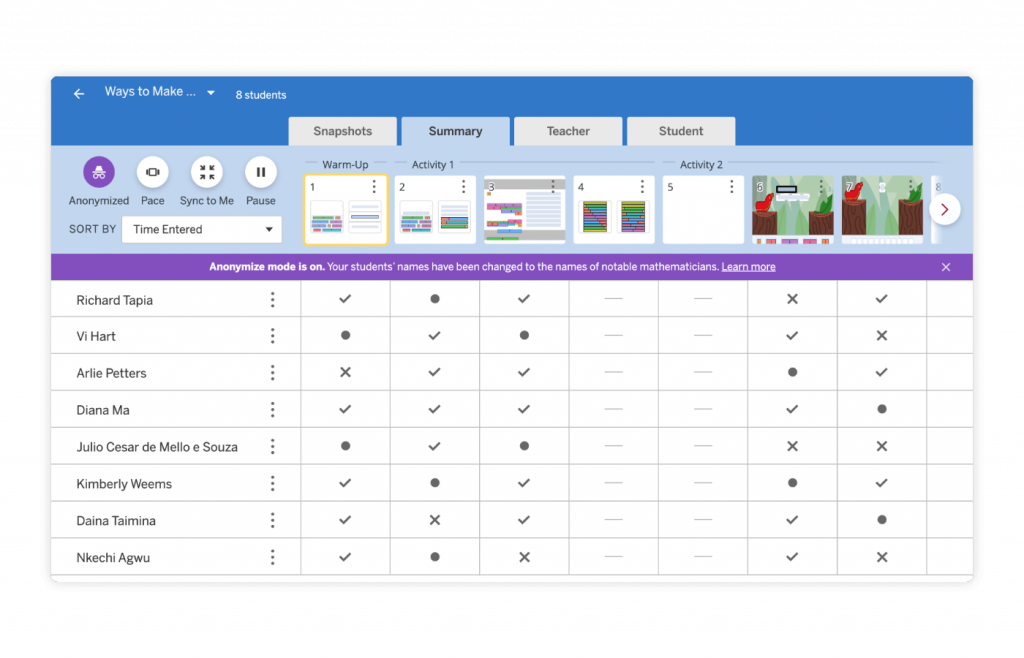
3. License

Subject to the terms and conditions of the Agreement, Amplify grants to Customer a non-exclusive, non-transferable, non-sublicensable license to access and use, and permit Authorized School Users, as defined below, to access and use the Products in accordance with the AUP, for the duration specified in the Quote (the “Term”), and for the number of Authorized School Users specified in the Quote for whom Customer has paid the applicable fees to Amplify. “Authorized School User” means the K–12 students registered or authorized for instruction with Customer and the educators, agents and staff members who use the Products as authorized by Customer who Customer permits to access and use the Products subject to the terms and conditions of the Agreement, solely while such individual is so employed or so registered. Each Authorized School User’s access and use of the Products will be subject to the AUP in addition to the terms and conditions of the Agreement. Violations of this Agreement or the AUP may result in suspension or termination of the applicable account.

4. Restrictions

Customer may access and use the Products solely for non-commercial instructional and administrative purposes. Guidelines for such purposes may be set forth at
https://amplify.com/amplify-program-usage-guidelines/ and additional guidelines may be detailed in materials associated with the Product the Customer is accessing. Further, Customer may not, except as expressly authorized by Amplify: (a) copy, modify, translate, distribute, disclose, or create derivative works based on the contents of, sell, or otherwise exploit, the Products, or any part thereof; (b) decompile, disassemble, reverse engineer the Products, or otherwise use the Products to develop functionally similar products or services; (c) modify, alter, or delete any of the copyright, trademark, or other proprietary notices in or on the Products; (d) rent, lease, or lend the Products or use the Products for the benefit of any third party; (e) avoid, circumvent, or disable any security or digital rights management device, procedure, protocol, or mechanism in the Products; (f) use any content from the Products, including but not limited to text, images, videos, assessments, lesson plans, or code, as input or training material for any machine learning or artificial intelligence system, including large language models, neural networks, or other algorithmic models, for any purposes, commercial or non-commercial; or (g) permit any Authorized School User or third party to do any of the foregoing. Customer also agrees that any works created in violation of this section are derivative works, and, as such, Customer agrees to assign, and hereby assigns, all right, title, and interest in such works to Amplify. The Products and derivatives thereof may be subject to export control laws, restrictions, regulations, and orders of the U.S. and other jurisdictions (together, “Export Laws”). Customer agrees to comply with all applicable Export Laws, and will not, and will not permit Authorized School Users to, export, or transfer for the purpose of re-export, any Product to any prohibited or embargoed country in violation of any U.S. export law or regulation. Further, Customer represents that it is not a party subject to sanctions by the U.S. Office of Foreign Assets Control or included on any restricted party list maintained by the U.S. Bureau of Industry and Security. The software and associated documentation portions of the Products are “commercial items” (as defined at 48 CFR 2.101), comprising “commercial computer software” and “commercial computer software documentation,” as those terms are used in 48 CFR 12.212. Accordingly, if Customer is the U.S. Government or its contractor, Customer will receive only those rights set forth in this Agreement in accordance with 48 CFR 227.7201-227.7204 (for Department of Defense and their contractors) or 48 CFR 12.212 (for other U.S. Government licensees and their contractors).

5. Reservation of Rights

SUBSCRIPTION PRODUCTS ARE LICENSED, NOT SOLD. Subject to the limited rights expressly granted hereunder, all rights, title, and interest in and to all Products, including all related IP Rights, are and will remain the sole and exclusive property of Amplify or its third-party licensors. “IP Rights” means, collectively, rights under patent, trademark, copyright, and trade secret laws, and any other intellectual property or proprietary rights recognized in any country or jurisdiction worldwide. Customer must promptly notify Amplify of any violation of Amplify’s IP Rights in the Products, and will reasonably assist Amplify as necessary to remedy any such violation. Amplify Products are protected by patents (see amplify.com/virtual-patent-marking). Amplify reserves the right to update or modify the Products at any time and to discontinue the Products upon reasonable notice.

6. Payments

In consideration of the Products, Customer will pay to Amplify (or other party designated on the Quote) the fees specified in the Quote in full within 30 days of the date of invoice, except as otherwise agreed by the parties or for those amounts that are subject to a good faith dispute of which Customer has notified Amplify in writing. Customer will be responsible for all state or local sales, use or gross receipts taxes, and federal excise taxes unless Customer provides a then-current tax exemption certificate in advance of the delivery, license, or performance of any Product, as applicable.

7. Shipments

Unless otherwise specified on the Quote, physical Products will be shipped FOB origin in the US (Incoterms 2010 EXW outside of the US) and are deemed accepted by Customer upon receipt. Upon acceptance of such Products, orders are non-refundable, non-returnable, and non-exchangeable, except in the case of defective or missing materials reported to Amplify by Customer within 60 days of receipt. In such case, Customer may not return Products without Amplify’s written authorization.

8. Account Information

For subscription Products, the authentication of Authorized School Users is based in part upon information supplied by Customer or Authorized School Users, as applicable. Customer will and will cause its Authorized School Users to (a) provide accurate information to Amplify or a third-party service as applicable, and promptly report any changes to such information, (b) not share login credentials or otherwise allow others to use their account, (c) maintain the confidentiality and security of their account information, and (d) use the Products solely via such authorized accounts. Customer agrees to notify Amplify immediately of any unauthorized use of its or its Authorized School Users’ accounts or related authentication information. Amplify will not be responsible for any losses arising out of the unauthorized use of accounts created by or for Customer and its Authorized School Users. 

9. Confidentiality

Customer acknowledges that, in connection with this Agreement, Amplify has provided or will provide to Customer and its Authorized School Users certain sensitive or proprietary information, including software, source code, assessment instruments, research, designs, methods, processes, customer lists, training materials, product documentation, know-how, or trade secrets, in whatever form (“Confidential Information”). Customer agrees (a) not to use Confidential Information for any purpose other than use of the Products in accordance with this Agreement and (b) to take all steps reasonably necessary to maintain and protect the Confidential Information of Amplify in strict confidence. Confidential Information shall not include information that, as evidenced by Customer’s contemporaneous written records: (i) is or becomes publicly available through no fault of Customer; (ii) is rightfully known to Customer prior to the time of its disclosure; (iii) has been independently developed by Customer without any use of the Confidential Information; or (iv) is subsequently learned from a third party not under any confidentiality obligation. 

10. Student Data

The parties acknowledge and agree that in the course of providing the Products to the Customer, Amplify may collect, receive, or generate information that directly relates to an identifiable student of Customer (“Student Data”). Student Data may include personal information from a student’s “educational records,” as defined by the Family Educational Rights and Privacy Act of 1974 (“FERPA”). Student Data is owned and controlled by the Customer and Amplify receives Student Data as a “school official” under Section 99.31 of FERPA for the purpose of providing the Products hereunder. Individually and collectively, Amplify and Customer agree to uphold our obligations, as applicable, under FERPA, the Children’s Online Privacy Protection Act (“COPPA”), the Protection of Pupil Rights Amendment (“PPRA”), and applicable state laws relating to student data privacy. Amplify’s Customer Privacy Policy at amplify.com/customer-privacy (“Privacy Policy”) will govern collection, use, and disclosure of Student Data collected or stored on behalf of Customer under this Agreement. In addition, Amplify has entered into the data privacy agreements listed at amplify.com/privacy-security aligned with state and national templates to facilitate compliance with applicable state laws and help expedite Customer’s student data privacy documentation process. Customer is responsible for providing notice and obtaining appropriate consents under applicable laws to authorize Authorized School Users’ use of the Products, including making a copy of the Privacy Policy available to the parents or guardians of users who are under the age of 13.  

11. Customer Materials and Requirements

Customer represents, warrants, and covenants that it has all the necessary rights, including consents and IP Rights, in connection with any data, information, content, and other materials provided to or collected by Amplify on behalf of Customer or its Authorized School Users using the Products or otherwise in connection with this Agreement (“Customer Materials”), and that Amplify has the right to use such Customer Materials as contemplated hereunder or for any other purposes required by Customer. Customer is solely responsible for the accuracy, integrity, completeness, quality, legality, and safety of such Customer Materials. Customer is responsible for meeting hardware, software, telecommunications, and other requirements listed at amplify.com/customer-requirements

12. Warranty Disclaimer

PRODUCTS ARE PROVIDED “AS IS” AND WITHOUT WARRANTY OF ANY KIND BY AMPLIFY. AMPLIFY EXPRESSLY DISCLAIMS ALL WARRANTIES, EXPRESS OR IMPLIED, INCLUDING ANY WARRANTY AS TO TITLE, NON-INFRINGEMENT, MERCHANTABILITY, OR FITNESS FOR A PARTICULAR PURPOSE OR USE. CUSTOMER ASSUMES RESPONSIBILITY FOR SELECTING THE PRODUCTS TO ACHIEVE CUSTOMER’S INTENDED RESULTS AND FOR THE ACCESS AND USE OF THE PRODUCTS, INCLUDING THE RESULTS OBTAINED FROM THE PRODUCTS. WITHOUT LIMITING THE FOREGOING, AMPLIFY MAKES NO WARRANTY THAT THE PRODUCTS WILL BE ERROR-FREE OR FREE FROM INTERRUPTIONS OR OTHER FAILURES OR WILL MEET CUSTOMER’S REQUIREMENTS. AMPLIFY IS NEITHER RESPONSIBLE NOR LIABLE FOR ANY THIRD-PARTY CONTENT OR SOFTWARE INCLUDED IN PRODUCTS, INCLUDING THE ACCURACY, INTEGRITY, COMPLETENESS, QUALITY, LEGALITY, USEFULNESS, OR SAFETY OF, OR IP RIGHTS RELATING TO, SUCH THIRD-PARTY CONTENT AND SOFTWARE. ANY ACCESS TO OR USE OF SUCH THIRD-PARTY CONTENT AND SOFTWARE MAY BE SUBJECT TO THE TERMS AND CONDITIONS AND INFORMATION COLLECTION, USAGE, AND DISCLOSURE PRACTICES OF THIRD PARTIES.

13. Limitation of Liability

 TO THE EXTENT SUCH LIMITATION IS NOT PROHIBITED BY APPLICABLE LAW, IN NO EVENT WILL AMPLIFY BE LIABLE TO CUSTOMER OR TO ANY AUTHORIZED SCHOOL USER FOR ANY INCIDENTAL, SPECIAL, CONSEQUENTIAL, PUNITIVE, RELIANCE, OR COVER DAMAGES, DAMAGES FOR LOST PROFITS, LOST DATA OR LOST BUSINESS, OR ANY OTHER INDIRECT DAMAGES, EVEN IF AMPLIFY HAS BEEN ADVISED OF THE POSSIBILITY OF SUCH DAMAGES. TO THE EXTENT SUCH LIMITATION IS NOT PROHIBITED BY APPLICABLE LAW, AMPLIFY’S ENTIRE LIABILITY TO CUSTOMER OR ANY AUTHORIZED USER ARISING OUT OF PERFORMANCE OR NONPERFORMANCE BY AMPLIFY OR IN ANY WAY RELATED TO THE SUBJECT MATTER OF THIS AGREEMENT, REGARDLESS OF WHETHER THE CLAIM FOR SUCH DAMAGES IS BASED IN CONTRACT, TORT, STRICT LIABILITY, OR OTHERWISE, MAY NOT EXCEED THE AGGREGATE OF CUSTOMER’S OR ANY AUTHORIZED USER’S DIRECT DAMAGES UP TO THE FEES PAID BY CUSTOMER TO AMPLIFY FOR THE AFFECTED PORTION OF THE PRODUCTS IN THE PRIOR 12-MONTH PERIOD. UNDER NO CIRCUMSTANCES WILL AMPLIFY BE LIABLE FOR ANY CONSEQUENCES OF ANY UNAUTHORIZED USE OF THE PRODUCTS BY AN AUTHORIZED SCHOOL USER THAT VIOLATES THIS AGREEMENT OR ANY APPLICABLE LAW OR REGULATION.

14. Termination

Without prejudice to any rights either party may have under this Agreement, in law, equity, or otherwise, a party will have the right to terminate this Agreement if the other party (or in the case of Amplify, an Authorized School User) materially breaches any term, provision, warranty, or representation under this Agreement and fails to correct the breach within 30 days of its receipt of written notice thereof. Upon termination, Customer will: (a) cease using the Products, (b) return, purge, or destroy (as directed by Amplify) all copies of any Products and, if so requested, certify to Amplify in writing that such surrender or destruction has occurred, (c) pay any fees due and owing hereunder, and (d) not be entitled to a refund of any fees previously paid, unless otherwise specified in the Quote. Customer will be responsible for the cost of any continued use of the Products following termination. Upon termination, Amplify will return or destroy any Student Data provided to Amplify hereunder. Notwithstanding the foregoing, nothing will require Amplify to return or destroy any data that does not include Student Data, including de-identified information or data that is derived from access to Student Data but which does not contain Student Data. Sections 3–14 will survive the termination of this Agreement.

15. Miscellaneous

This Agreement may not be modified except in writing signed by both parties. All defined terms in this Agreement will apply to their singular and plural forms, as applicable. The word “including” means “including without limitation.” For United States-based Customers, this Agreement will be governed by  and construed and enforced in accordance with the laws of the U.S., state, commonwealth, or territory in which Customer resides based on the address set forth in the Quote, without regard to that state’s, commonwealth’s, or territory’s choice of law rules. For Customers based outside of the United States, this Agreement will be governed by the laws of the U.S., state of New York, without giving effect to the choice of law rules thereof. This Agreement will be binding upon and inure to the benefit of the parties and their respective successors and assigns. The parties expressly understand and agree that their relationship is that of independent contractors. Nothing in this Agreement will constitute one party as an employee, agent, joint venture partner, or servant of another. Each party is solely responsible for all of its employees and agents and its labor costs and expenses arising in connection herewith. Neither this Agreement nor any of the rights, interests or obligations hereunder may be assigned or delegated by Customer or any Authorized School User without the prior written consent of Amplify. If one or more of the provisions contained in this Agreement will for any reason be held to be unenforceable at law, such provisions will be construed by the appropriate judicial body to limit or reduce such provision or provisions so as to be enforceable to the maximum extent compatible with applicable law. Amplify will have no liability to Customer or to third parties for any failure or delay in performing any obligation under this Agreement due to circumstances beyond its reasonable control, including acts of God or nature, fire, earthquake, flood, epidemic, pandemic, strikes, labor stoppages or slowdowns, civil disturbances or terrorism, national or regional emergencies, supply shortages or delays, action by any governmental authority, or interruptions in power, communications, satellites, the Internet, or any other network. Each party represents and warrants that it has all necessary right, power, and authority to enter into this Agreement and to comply with the obligations hereunder.

Last Modified: February 2, 2026

Season 1, Episode 3

Teaching with resilience, starring Fawn Nguyen

Today on Beyond My Years, host Ana Torres learns from Fawn Nguyen, a math educator with over 30 years of classroom experience! Fawn tells Ana the story of her near-death experience being lost at sea while escaping Vietnam, and explains how it shaped the sense of gratitude she leads with in the classroom. She also discusses what it means to be yourself in the classroom, the importance of sharing your mistakes with your students, and the merits of practicing advocacy vs. authority with students. Taking all those lessons back to the classroom, Ana and Classroom Insider Eric Cross then discuss connecting with students through shared struggles and challenges.

Portrait of a woman smiling in front of a plain background, with a circular border and a patterned backdrop of books, apples, and stars—perfect for content on how to teach resilience.

Meet Our Guest(s):

Smiling woman with shoulder-length brown hair wearing a light pink collared shirt, posing in front of a plain grey background.

Fawn Nguyen

Fawn Nguyen is Director of STEM Initiatives at Amplify. Before joining our team, she was a math coach in a K–8 school district for three years, and a middle school math teacher for 30 years. She has received many accolades, including being named the 2014 Ventura County Teacher of the Year, Raytheon’s 2009 Math Teacher Hero, and the 2005 Sarah D. Barder Fellow at the Johns Hopkins Center for Talented Youth. She has also been a keynote speaker and workshop facilitator at math conferences nationwide. In 2012, she co-founded the Math Teacher’s Circle in Thousand Oaks, California. From 2015–2018, Fawn served as a member of NCTM’s Professional Development Services Committee.

Meet our host, Ana Torres.

Ana has been an educator for 30 years, working in both the K–8 and higher education sectors. She served as an administrator and instructor at various public and private colleges and universities and as a bilingual and dual language teacher, dual language math and reading interventionist, dual language instructional coach, assistant principal, and principal in K–8 schools. Ana is currently the Senior Biliteracy and Multilingual Product Specialist on Amplify’s Product Specialist team, and delivers literacy and biliteracy presentations across the nation. Ana’s passion and advocacy for biliteracy and multiculturalism has led her to educate leaders, teachers, and parents about the positive impact of bilingualism and biliteracy in our world.

A woman with long dark hair and hoop earrings smiles at the camera while wearing a black blazer, standing outdoors—ready to discuss classroom challenges or share insights on her teacher podcast.
A man with short, closely-cropped hair and a trimmed beard smiles at the camera against a light gray background, ready to inspire diverse learners in the math classroom.

Meet our Classroom Insider, Eric Cross.

Eric Cross is a middle school science teacher who hopes to someday be a lifelong educator, like the guests on Beyond My Years! In each episode, Eric connects with host Ana Torres to discuss her guests’ best insights gleaned from their long and rewarding careers in the classroom. Then, Eric talks about bringing some of their wisdom into his current classroom and busy life.

Quotes

“In my next lifetime, I would still teach, I would go back to teaching. That’s how much I love it.’”

—Fawn Nguyen

“It has to be an exchange. We can’t be just receiving, asking kids to be [themselves] and yet we ourselves are not.”

—Fawn Nguyen

“[Seasoned educators] are experienced and experience means good and bad. We want to learn from both. I certainly didn’t want a mentor who never made a mistake, ‘cause I’m not gaining anything.”

—Fawn Nguyen

“It’s about separating the behavior from the person. And another thing, separate what they don’t know at the time from what they’re capable of.”

—Fawn Nguyen