AMPLIFY DESMOS MATH FLORIDA
Welcome, Florida reviewers!
We’re honored to introduce you to Amplify Desmos Math Florida. We’re confident that this comprehensive program will be a powerful tool in classrooms across the state.
Please start with the video on the right to learn more.
Algebra 1 course
Welcome, Florida reviewers!
Grade 6 Florida math state review
Welcome, reviewers of Amplify Desmos Math Florida!
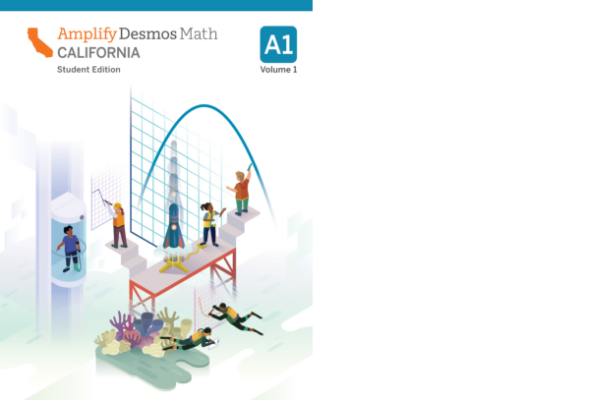
Welcome to Amplify Desmos Math California!
California educators, welcome to math that motivates. Introducing Amplify Desmos Math California, a curiosity-driven TK–12 program that builds lifelong math proficiency. Each lesson poses problems that invite a variety of approaches before guiding students to synthesize their understanding of the learning goals. Students encounter math problems they’re eager to solve, while teachers spend more time where it’s most impactful—creating a collaborative classroom of learners.
Keep reading to learn more about the program and explore sample materials.
About the program
Amplify Desmos Math California is a TK–12 core math program designed to meet the CA Math Framework and the Common Core State Standards for Mathematics. Amplify Desmos Math California thoughtfully combines conceptual understanding, procedural fluency, and application through a structured approach to problem-based learning. Through engaging activities, Amplify Desmos Math California invites curiosity and math discourse into the classroom to create lifelong math proficiency.
Continue reading to learn more about the K–8, Algebra 1, and Math 1 programs and to explore sample materials. (Spanish, TK and high school materials are in development and will be available in the 2026–27 school year. Geometry and Algebra 2 beta pilots will be available in the 2025–26 school year.)
A powerful math suite
Amplify Desmos Math California combines the best of assessment, problem-based core lessons, personalized practice, and intervention into a coherent and engaging experience for both students and teachers.

Screening and progress monitoring
mCLASSⓇ Math benchmark assessments, along with the embedded program assessments, measure not just what students know, but how they think. The asset-based assessment system provides teachers with targeted, actionable insights, linked to core instruction and intervention resources. Unit- and lesson-level core assessments give teachers data at their fingertips to guide and differentiate instruction. In grades 3–8, core assessments and performance tasks are designed to prepare students for success on the Smarter Balanced Assessment Consortium (SBAC) testing.
Core instruction
Amplify Desmos Math California core lessons pair problems students are eager to solve with clear instructional moves for teachers. Each lesson is designed to tell a story by posing problems that invite a variety of approaches before guiding students to synthesize their understanding of the learning goals. With built-in differentiation and multilingual/English learner support, Amplify Desmos Math California enables every student to find success in the math classroom.


Personalized Learning
Boost Personalized Learning activities help students access grade-level math through engaging, independent digital practice. Responsive Feedback adjusts to students’ work, providing item-level adaptivity to further support their learning.
Differentiation and intervention
Amplify Desmos Math views differentiation as an ongoing process where teachers are both reactive and proactive to student needs, ensuring that all students have clear pathways to proficiency. Through rich data and teacher support, Amplify Desmos Math uses flexible categories of intervention and enrichment that adjust daily according to student thinking.
In-the-moment differentiation supports are available for every lesson, both digitally and in the print Teacher Edition.

An approach that supports teachers
Clear, step-by-step instructional moves help teachers plan and teach student-centered lessons that use
student thinking to differentiate instruction and guide to grade-level understanding. They include:
- Guidance on what to listen for and how
to respond. - Clear learning objectives to keep learning on
track for each activity and lesson. - Daily reinforcement activities to provide direct
instruction when needed.


Big Ideas
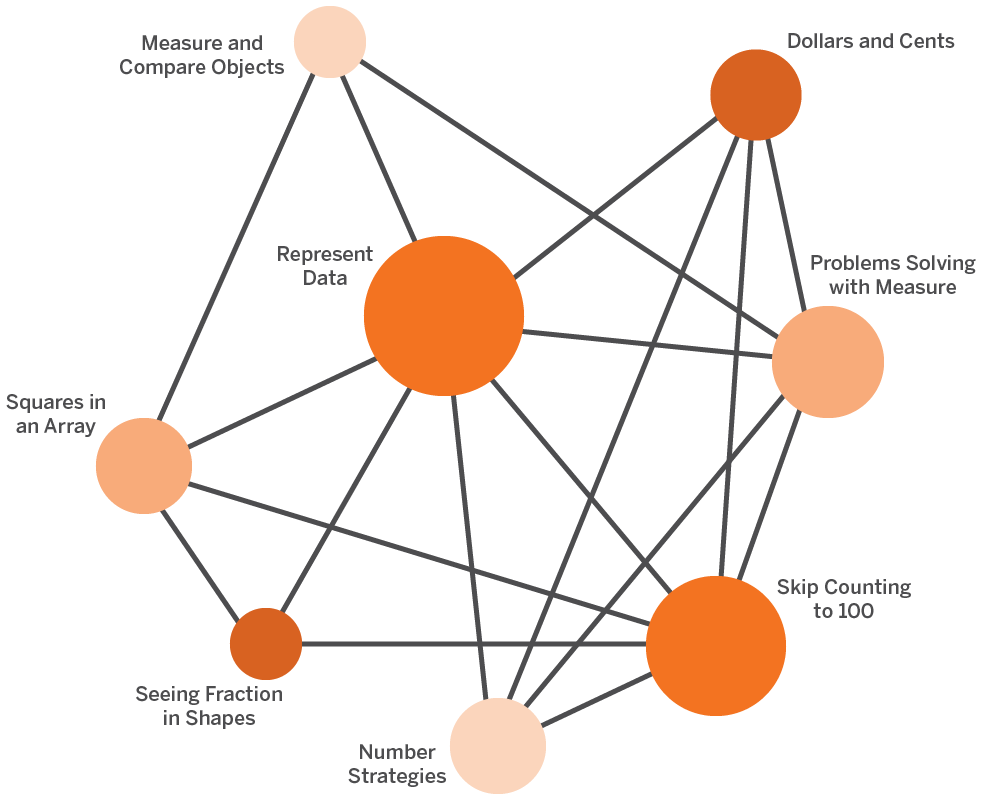
The CA Mathematics Framework encourages a shift from power standards to thinking about math as a series of connected Big Ideas. Each Amplify Desmos Math California lesson supports one or more Big Ideas and the connections between them. The grade-level diagram changes through the course based on the math concepts addressed within.
Click here to see how the Big Ideas are represented within the K–8 core lessons.
Focus, coherence, and rigor
Amplify Desmos Math California incorporates the Drivers of Investigation (DIs) and Content Connection (CCs) throughout the program. Throughout the year, students engage with open and authentic tasks of varying durations—from lesson activities to unit-level Explore lessons and longer course-level Investigations. Every lesson and investigation opportunity is grounded in the why, how, and what of the learning experience, and helps teachers bring mathematical concepts to life.


Built-in authentic tasks
Mathematics is not learning in isolation. Students are connected to each other’s thinking and can use math to understand the world. With accessible invitations to authentic tasks, all students can experience mathematical success. Amplify Desmos Math California provides these authentic invitations in a variety of ways:
Each unit begins with an “Explore” lesson, which allows students to engage with authentic exploration in low-floor, high-ceiling tasks. These tasks are designed to promote an inclusive and differentiated learning environment—allowing all students to access basic mathematical concepts, while offering advanced exploration and problem-solving for those ready for more complex work.
Our innovative course-level investigations are designed to facilitate multi-part exploration. Students grapple with Big Ideas, diving deep into key concepts that encourage comprehensive understanding. Data science is infused into the approach, giving students a solid foundation from which to interpret and apply data-driven solutions. They’re also encouraged to understand and appreciate the interrelatedness of Earth’s environmental systems via our lesson’s focus on the Environmental Principles and Concepts (EP&Cs).
Explicit support for multilingual/English learners

Amplify partnered with the English Learner Success Forum (ELSF), a national nonprofit organization that advocates for high-quality instructional materials that are inclusive of multilingual/English learners (ML/ELs). ELSF reviewed Amplify Desmos Math California, and provided directional guidance and feedback to ensure that the program reflects their research-based instructional strategies for multilingual/English learners.
Amplify Desmos Math California recognizes the diverse language needs of our students and is designed to be inclusive. Each lesson in the program features a parallel language activity, designed to be available to all students, in the form of teacher guidance and student activities. The activities in the Math Language Development Resources have level ELD differentiation to support all levels of ML/ELs. This approach ensures that all students, regardless of their language skills, can participate fully, grasp the material, and excel in their mathematical journey.
Our Multilingual Glossary includes, in addition to Spanish, nine languages: Simplified Mandarin, Tagalog, Vietnamese, Arabic, European French, Russian, Brazilian-Portuguese, Haitian-Creole, and Urdu.
Amplify Desmos Math California will include Spanish student-facing materials beginning in the 2026–27 school year.
Assessments
By starting with what students already know, Amplify Desmos Math helps build a strong foundation for success to guide and support future learning. Teachers are empowered to transform every classroom into an engaged math community that invites, values, and develops student thinking. With explicit guidance on what to look for and how to respond, teachers can effectively support students as they develop their understanding.

Program assessments
A variety of performance data in Amplify Desmos Math provides evidence of student learning while helping students bolster their skills and understanding.
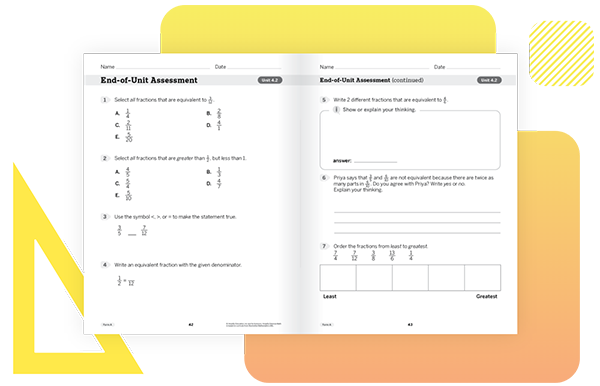
Unit-Level Assessments
Our embedded unit assessments offer key insights into students’ conceptual understanding of math. These assessments provide regular, actionable information about how students are thinking about and processing math, with both auto-scoring and in-depth rubrics that help teachers anticipate and respond to students’ learning needs.
Lesson-Level Assessments
Amplify Desmos Math lessons are centered around sense-making and in-the-moment feedback. Daily moments of assessment provide valuable evidence of learning for both the teacher and student.
Data and reporting
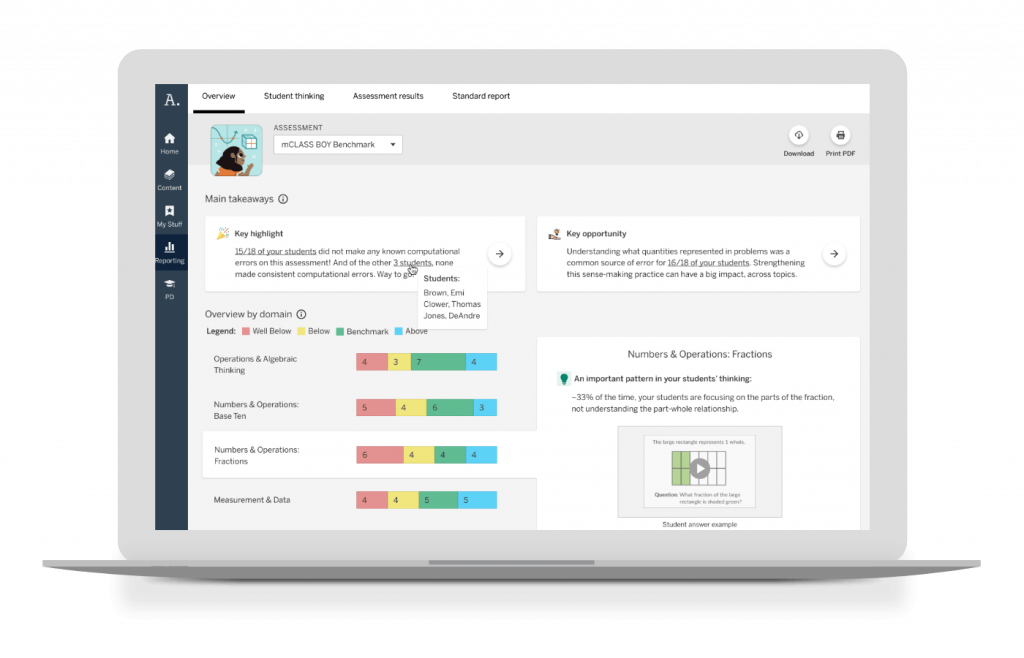
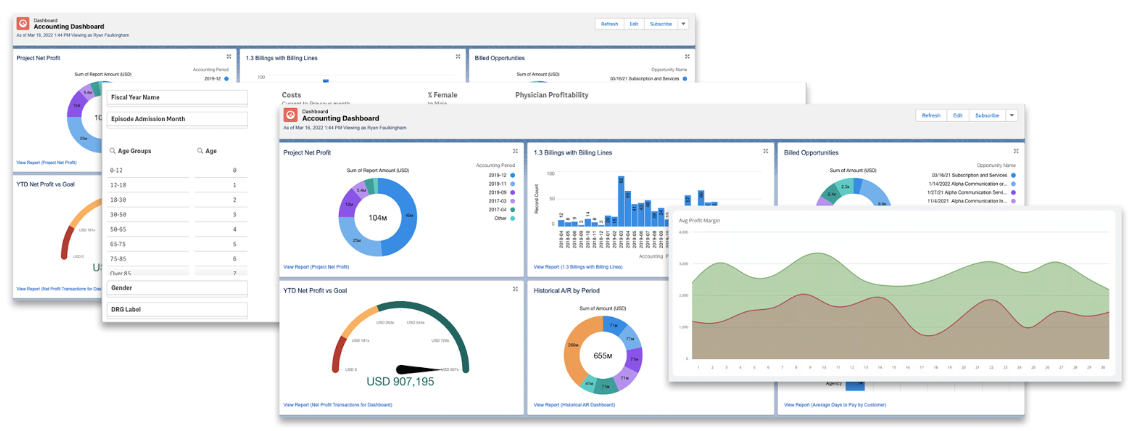
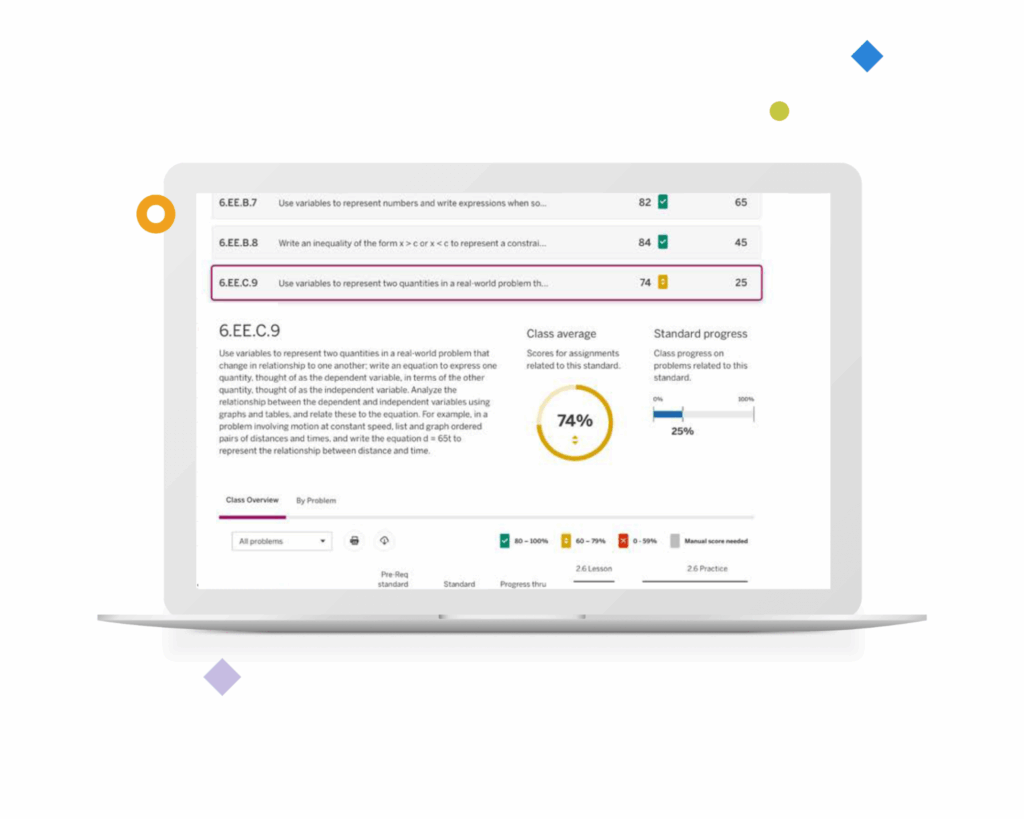
Amplify Desmos Math provides teachers and administrators with unified reporting and insights so that educators have visibility into what students know about grade-level math—and can plan instruction accordingly for the whole class, small groups, and individual students.

Assessment reports
Reporting functionality integrates unit assessments, lesson assessments, personalized learning, Benchmark assessments, and Progress Monitoring for a comprehensive look at student learning.
Our reports show proficiency and growth by domain, cluster, standard, and priority concept using performance data from unit assessments. Then our reports highlight areas of potential student need to allow teachers to modify their instruction and target differentiated support.
At-a-glance views of unit-level assessment results inform your instructional planning, and you can also drill down to item-level analysis.
Standards reports
Our standards report allows you to monitor proficiency at the class and individual student levels. Proficiency and growth are shown by domain, cluster, standard, and priority concepts. Areas of potential student need are highlighted to allow teachers to modify their instruction and target differentiated support.
Administrator reports
Amplify Desmos Math provides a complete picture of student, class, and district performance, allowing administrators to implement instructional and intervention plans.
- Track student, class, and district performance with usage, completion, and assessment data.
- Accurately group students and classes with the Benchmark and Progress Monitoring data of mCLASS Assessments and allow teachers to reliably implement and track the progress of Tier 2 and Tier 3 intervention.
- Provide one data-driven solution that educators can rely on for high-quality math instruction.
Elementary review resources
To learn about the elementary program, please start by watching the Amplify Desmos Math California Elementary Program Overview video.
For additional program information and helpful navigation tips, download the Amplify Desmos Math California Elementary Program Guide.
Middle School review resources
To learn about the middle school program, please start by watching the Amplify Desmos Math California Middle School Program Overview video.
For additional program information and helpful navigation tips, download the Amplify Desmos Math California Middle School Program Guide.
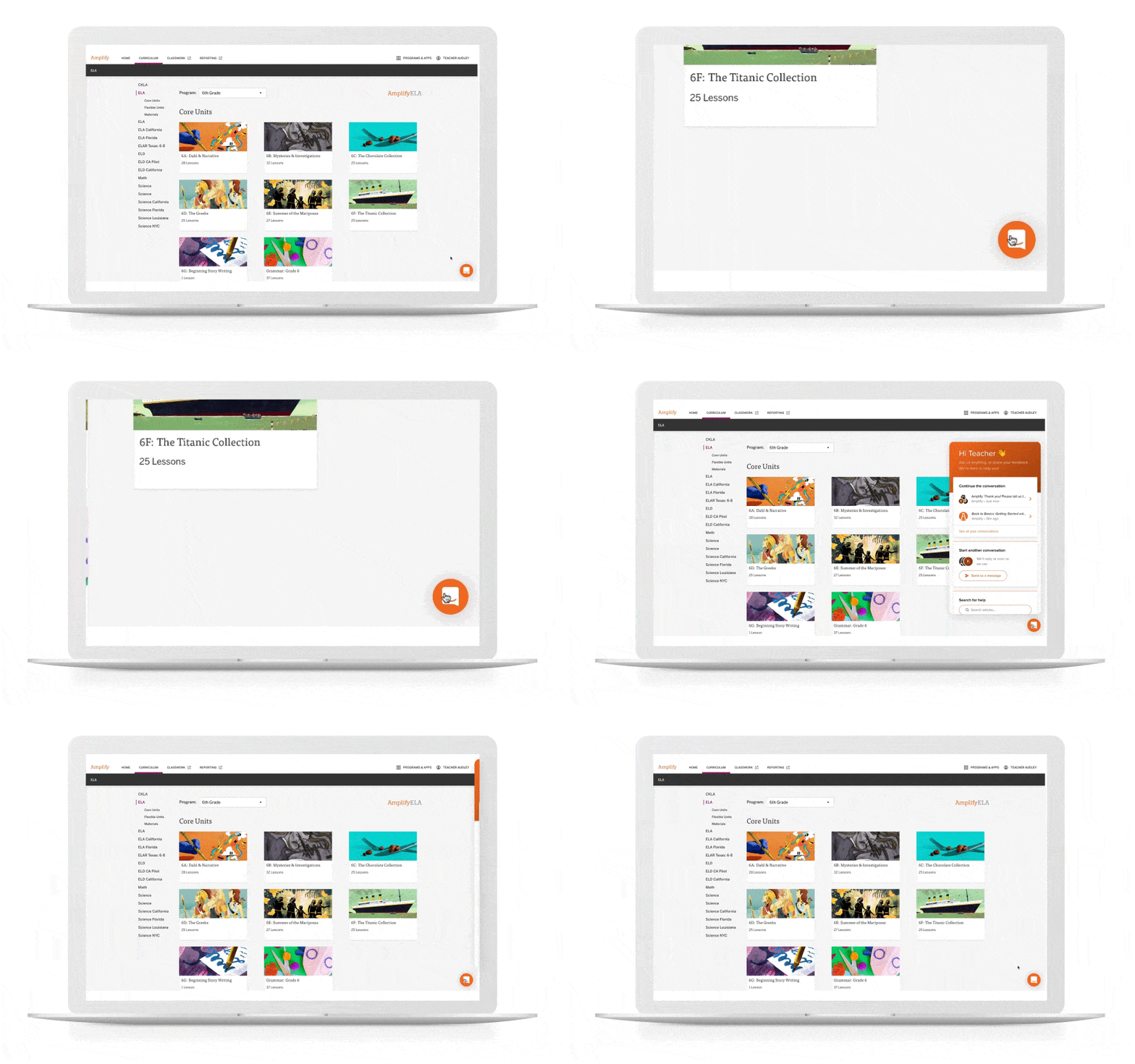
The digital experience
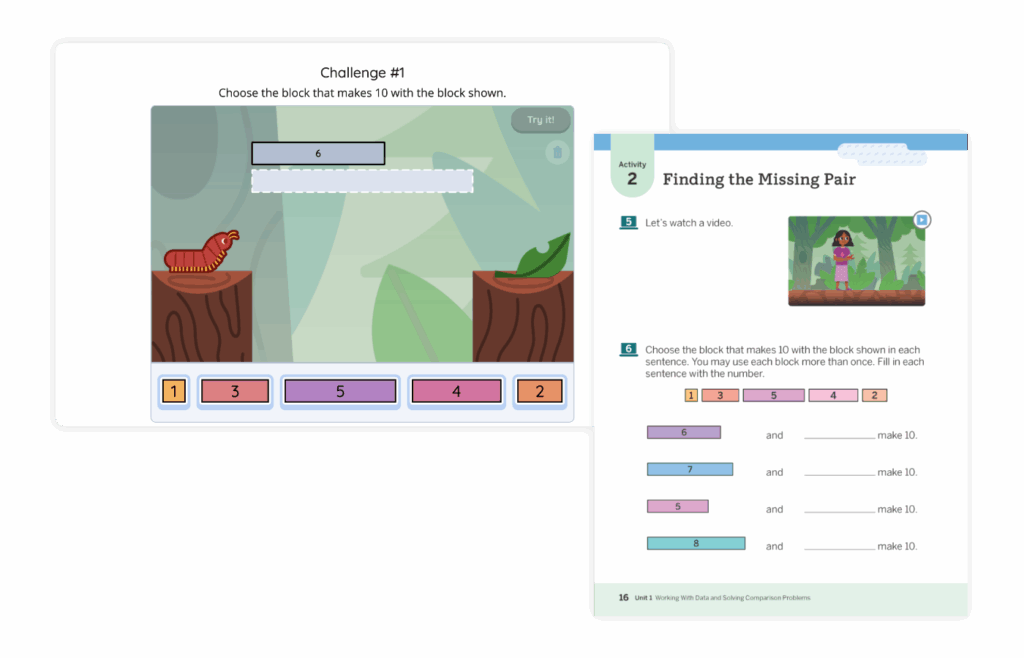
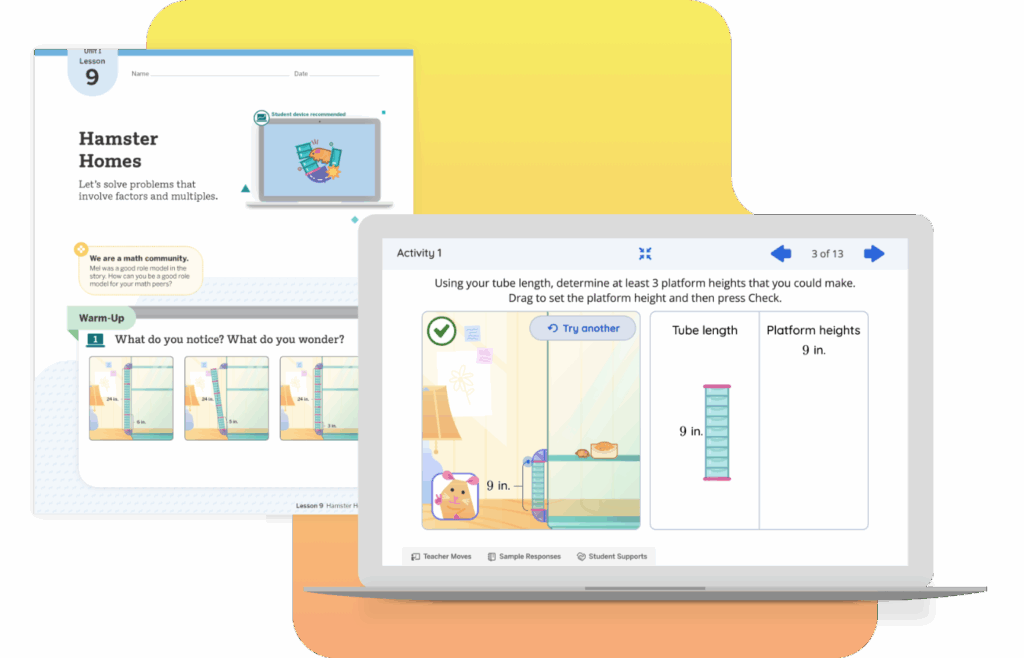
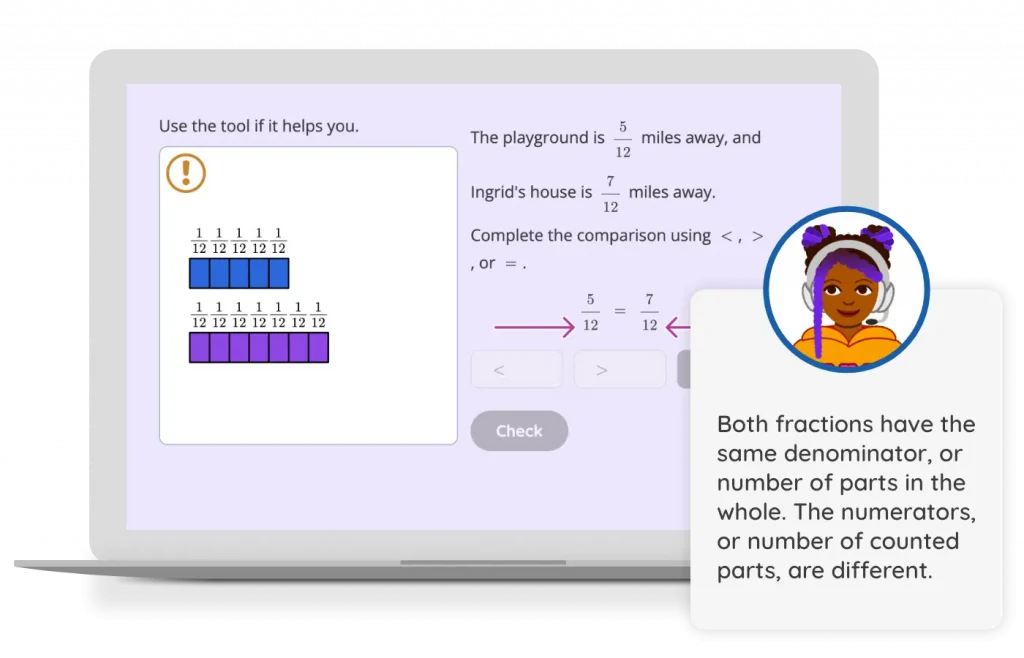
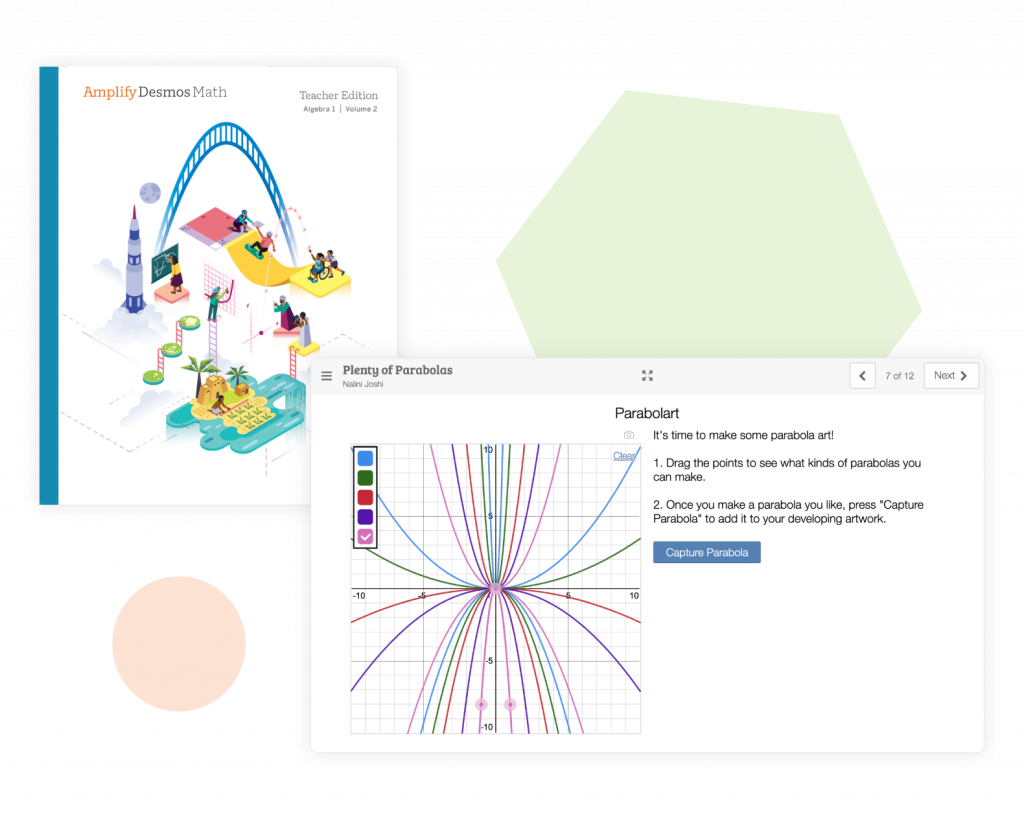
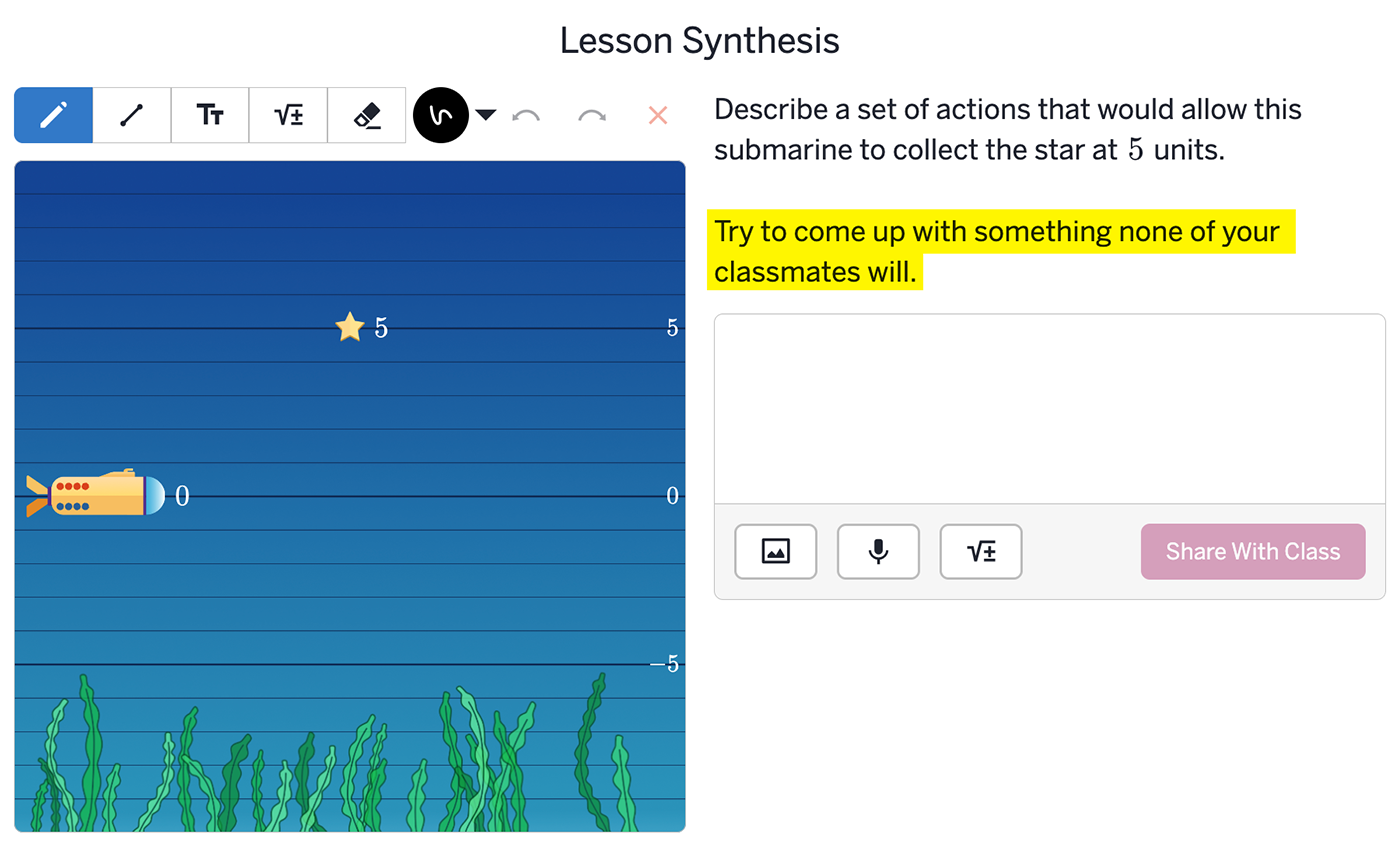
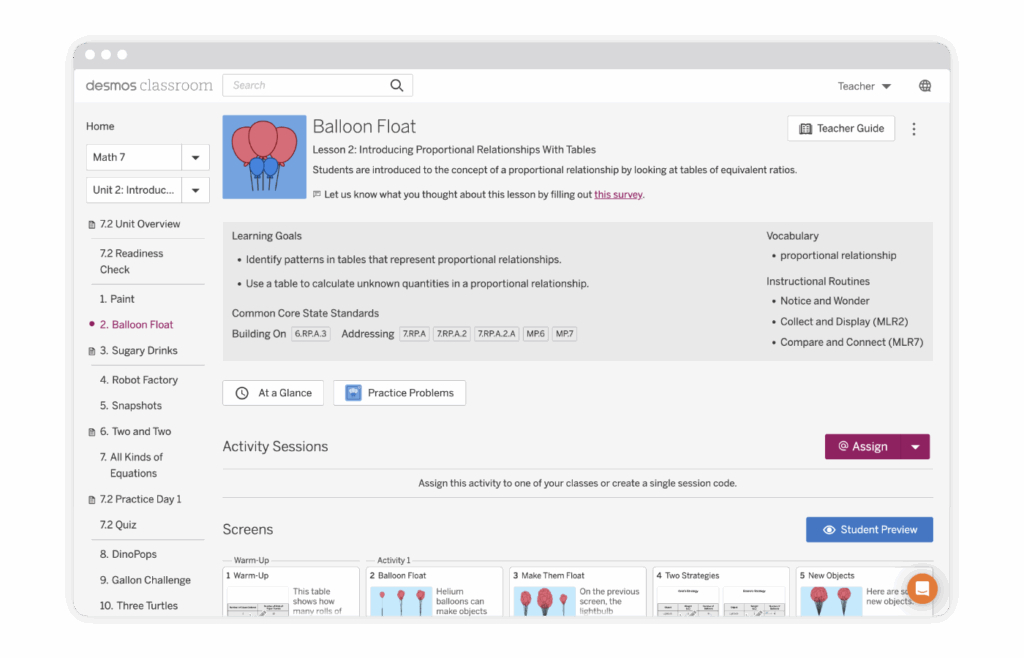
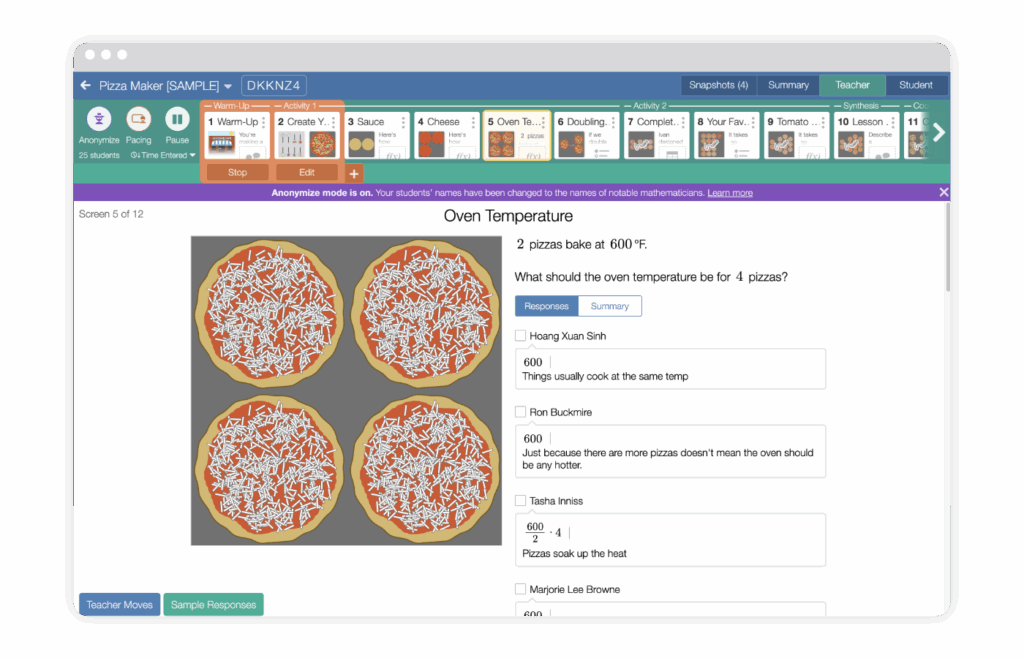
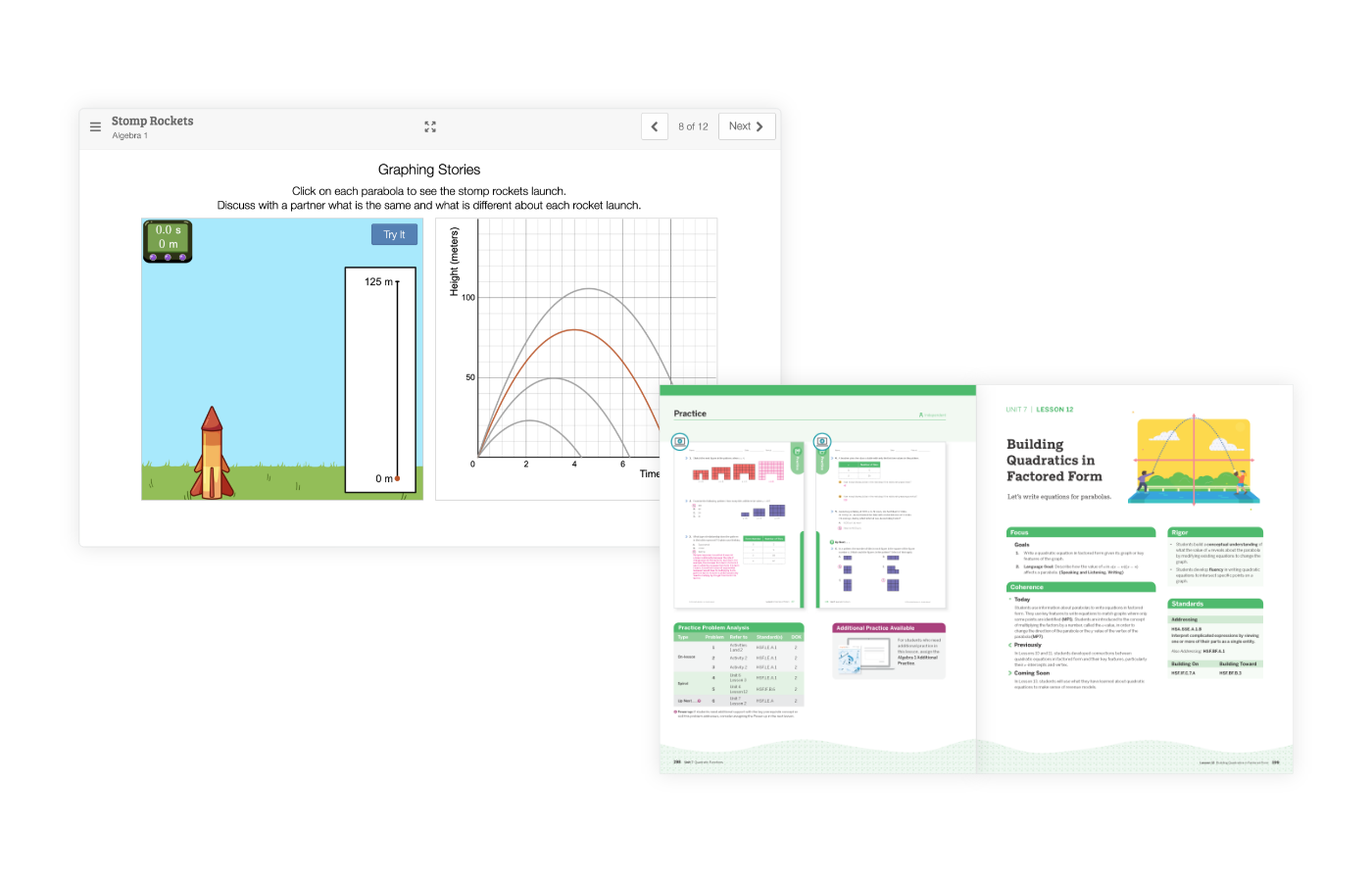
In Amplify Desmos Math, embedded interactions and animations allow students to test predictions, get feedback, share ideas, and connect representations.
The digital interactions included in lesson activities are designed to elicit student thinking in a way that feels fun and inviting. As students play and explore math concepts, teachers can highlight the ideas that students share, connect those ideas to other students’ ideas, and build on their thinking through productive class discussion.
Watch the video to preview the digital experience and for helpful platform navigation tips.

Explore grade level samples
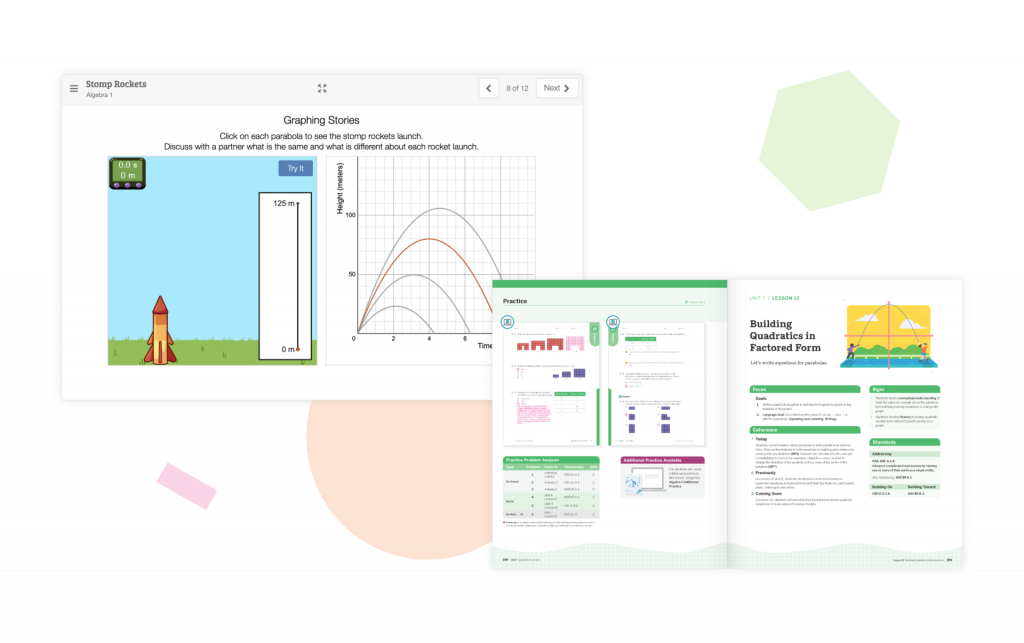
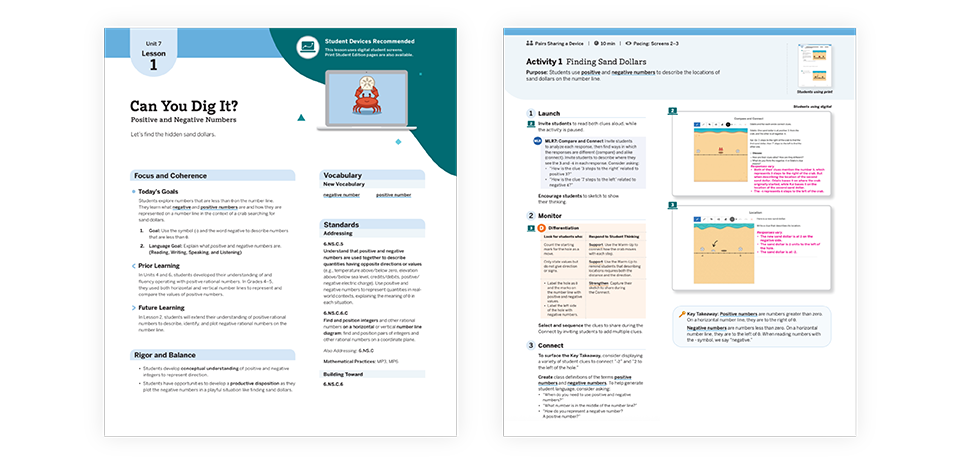
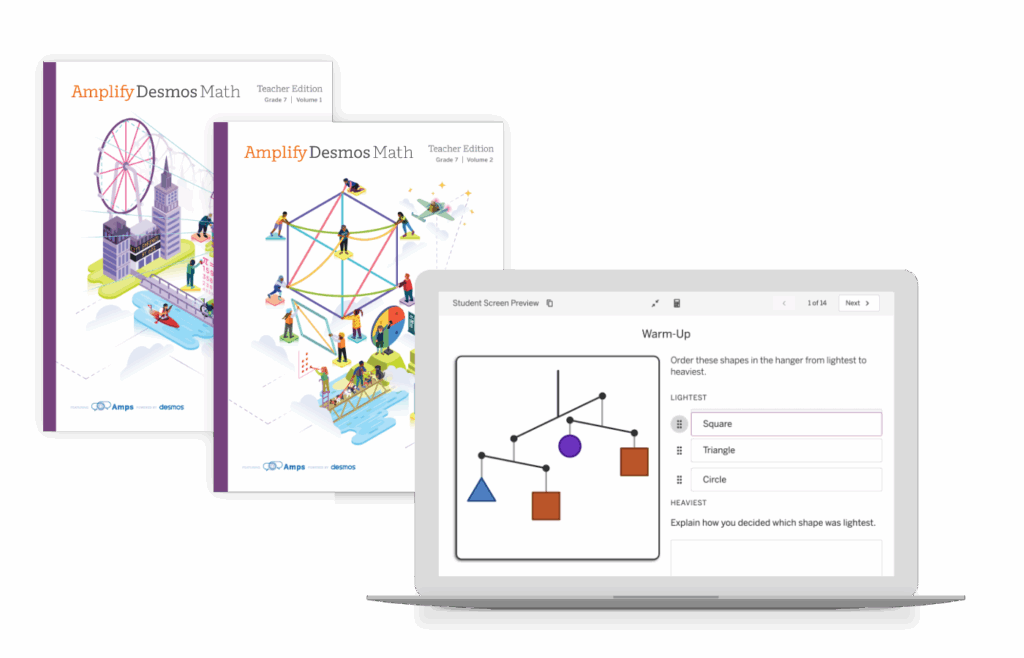
All lessons in Amplify Desmos Math California include print materials and rich digital experiences. Every lesson is supported with Student Edition pages, teacher presentation screens, and interactive digital resources for practice and differentiation. Some lessons also enable students to use devices to interact with lesson content.
You’ll find sample materials by grade level in the following drop-downs. Please refer to your physical samples and the digital platform (accessed through the demo account provided by your account executive) for a comprehensive program review.
Math 2–3 is currently being developed and will be available in the 2026–27 school year.
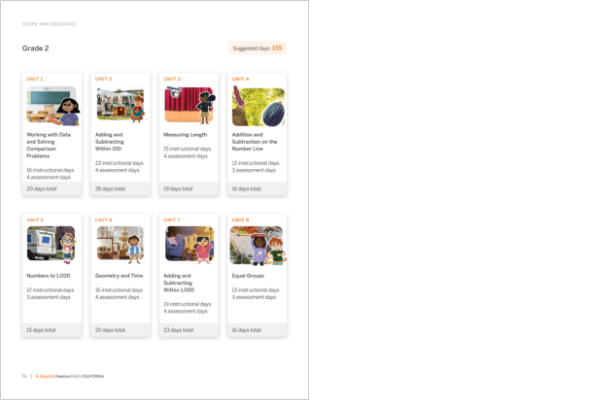
Scope and Sequence (National Edition)
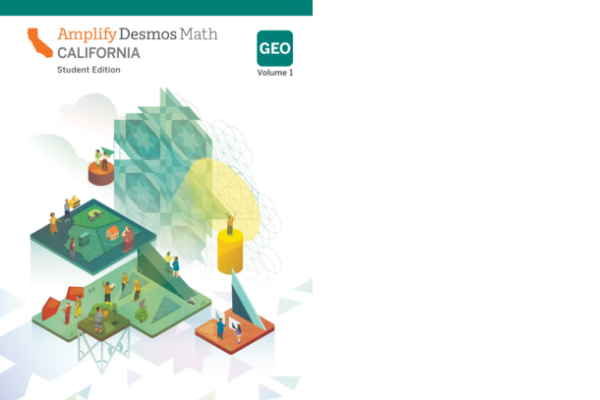
The Amplify Desmos Math Geometry Beta National Edition is available for piloting in the 2025–26 school year. Amplify Desmos Math California Geometry will be available in the 2026–27 school year.
Geometry sampler
This sampler includes Teacher Edition front matter for program overview information, plus Teacher Edition and Student Edition pages for Units 1–2.
Scope and sequence (National Edition)
The Amplify Desmos Math Algebra 2 Beta National Edition is available for piloting in the 2025–26 school year. Amplify Desmos Math California Algebra 2 will be available in the 2026–27 school year.
Algebra 2 sampler
This sampler includes Teacher Edition front matter for program overview information, plus Teacher Edition and Student Edition pages for Units 1–2.
Contact us
For questions, samples, or more information, please contact your local Amplify account executive:
Erin King
Sales Director, CA
(512) 736-3162
eking@amplify.com
Northern CA
Wendy Garcia
Senior Account Executive
(510) 368-7666
wgarcia@amplify.com
Bay Area
Lance Burbank
Account Executive
(415) 830-5348
lburbank@amplify.com
Central Valley and Central Coast
Demitri Gonos
Senior Account Executive
(559) 355-3244
dgonos@amplify.com
Ventura and L.A. County
Jeff Sorenson
Associate Account Executive
(310) 902-1407
jsorenson@amplify.com
Orange and L.A. County
Lauren Sherman
Senior Account Executive
(949) 397-5766
lsherman@amplify.com
San Bernardino and L.A. County
Michael Gruber
Senior Account Executive
(951) 520-6542
migruber@amplify.com
Riverside and L.A. County
Brian Roy
Senior Account Executive
(818) 967-1674
broy@amplify.com
San Diego County
Kirk Van Wagoner
Senior Account Executive
(760) 696-0709
kvanwagoner@amplify.com
Under 2300 students in Bay Area, Sacramento Valley, and Northern Counties
Kevin Mauser
Lead Account Executive
(815) 534-0148
kmauser@amplify.com
Under 2300 students in Southern CA, Central Coast, and Southern Central Valley Counties
Charissa Snyder
Account Executive
(720) 936-6802
chsnyder@amplify.com
E komo mai, Hawai’i review committees!
Aloha Hawai’i teachers and educators,
We’re excited to be part of your review process for curriculum, assessment, and professional learning.
Amplify programs are designed to make a difference—and the results are undeniable. Explore our unique research-based approaches built right into these high-quality instructional materials that are aligned to Hawai’i State Department of Education standards.
With great respect for what you do, mahalo.
The Hawai’i Amplify team

Amplify CKLA
Using a fundamentally different approach to language arts, Amplify Core Knowledge Language Arts (CKLA) is a PreK–5 program that sequences deep content knowledge with research-based foundational skills. Amplify CKLA met expectations and received all-green ratings from EdReports. Read the review on EdReports.
Amplify ELA
Amplify ELA is the only program truly designed to support middle school students at this critical developmental moment. We ensure that skills are taught, standards are covered, and the test is prepped—all while bringing texts to life and differentiating instruction. Read the review on EdReports.

mCLASS Dibels 8th Edition
mCLASS® is an all-in-one system for universal screening, dyslexia screening, progress monitoring, and instruction for grades K–6 based on the Science of Reading. Powered by DIBELS® 8th Edition, mCLASS helps you measure and strengthen the foundational skills that all students need to become confident readers.
Science of Reading professional development
Build your knowledge of the Science of Reading.
Virtual | 90-minute session
This introductory session provides educators with a foundational overview of what the Science of Reading means and what it tells us about how to teach using evidence-based reading practices.
Participants will learn to:
- Define the Science of Reading by examining evidence-based research.
- Explain how two frameworks, the Simple View of Reading and the Reading Rope, work in tandem to guide effective literacy instruction.
- Identify instructional principles aligned to the Science of Reading.


Deepen your knowledge of the Science of Reading.
On-site or virtual | 3-hour session
This session will build a base of common knowledge about the Reading Rope and support educators in identifying effective instruction grounded in the Science of Reading.
Participants will learn to:
- Identify the strands in the Reading Rope.
- Describe how each strand plays an important role in developing skilled readers and writers.
- Identify key look-fors in effective Science of Reading instruction.
Science of Reading: The Learning Lab online courses
This series of three self-paced online courses, crafted by literacy expert Susan Lambert and built around International Dyslexia Association (IDA) Knowledge and Practice Standards, guides you through the essential Science of Reading skills and knowledge needed to teach students to read proficiently. It also offers advanced strategies to aid struggling readers. Each course builds on the last, equipping you with the tools and confidence to make a lasting impact on your students’ literacy journeys.
Benefit from flexible learning on an interactive platform—each course spans 20–25 hours of instruction and is accessible for 12 months. Upon completion, you’ll be provided with a downloadable certificate, validating your new expertise in the Science of Reading.

Contact us
Support is always available. Our team is dedicated to helping you every step of the way. Contact your dedicated Hawai’i representative here for program access, samples, and additional information.
Laina Armbruster
Senior Account Executive, Hawai’i
Email: larmbruster@amplify.com
Phone: (602) 791-4135

Science of Reading professional development for Maine educators
Hello, Maine educators,
We’re excited to be part of your Science of Reading journey!
The following professional learning sessions are designed to support all educators—regardless of the program used—in enhancing their instructional practices. These Science of Reading courses offer research-based strategies to deepen understanding that supports students’ reading development. All are approved by the Maine Department of Education.


Build your knowledge of the Science of Reading
Virtual | 90-minute session
This introductory session provides educators with a foundational overview of what the Science of Reading means and what it tells us about how to use evidence-based reading practices in the classroom.
Participants will learn to:
- Define the Science of Reading, examining evidence-based research.
- Explain how two frameworks, the Simple View of Reading and the Reading Rope, work in tandem to guide effective literacy instruction.
- Identify instructional principles aligned to the Science of Reading.
Deepen your knowledge of the Science of Reading
On-site or virtual | 3-hour session
This session will build a base of common knowledge about the Reading Rope and support educators in identifying effective instruction grounded in the Science of Reading.
Participants will learn to:
- Identify the strands in the Reading Rope.
- Describe how each strand plays an important role in developing skilled readers and writers.
- Identify key look-fors in effective Science of Reading instruction.


Science of Reading: The Learning Lab online courses
This series of three self-paced online courses, crafted by literacy expert Susan Lambert and built around the International Dyslexia Association (IDA)’s Knowledge and Practice Standards, guides you through the essential Science of Reading knowledge and skills needed to teach students to read proficiently; the series also offers advanced strategies for aiding struggling readers. Each course builds on the last, equipping you with the tools and confidence to make a lasting impact on your students’ literacy journeys.
Benefit from flexible learning on an interactive platform. Each course spans 20 to 25 hours of instruction and is accessible for 12 months. Upon completion, you’ll receive a downloadable certificate, validating your expertise in the Science of Reading.
Contact us
Support is always available. Our team is dedicated to helping you every step of the way. Contact your dedicated representative here for program access, samples, and additional information.
Ali Weis
Lead Account Executive,
Northern Northeast
Email: aweis@amplify.com
Phone: (480) 510-6703

Personalized instruction and intervention for every K–5 student
Boost Math™ is a powerful intervention system that advances student growth and ensures access to grade-level math for all students.
Boost Math offers differentiation and personalized learning that build on students’ existing understanding, while scaffolding instruction allows every student to succeed with grade-level content. Teachers spend less time planning and more time ensuring that every student’s specific needs are
met—with customizable intervention resources that help differentiate when and how it matters most.
About the Boost Math system
Boost Math helps teachers as they implement effective daily differentiation and intervention—minimal planning time required. The system provides access to ready-to-go,
core-aligned resources including:
- Personalized practice to support student growth.
- Intervention resources for small-group personalized instruction.
- Assessment insights to inform teaching.

Personalized instruction for all students
Boost Personalized Learning activities complement your core instruction by supporting understanding of your daily learning goal. The asset-based technology responds to each student’s unique needs based on prior assessment data and student responses.

Ready-to-go math intervention you can trust
Build grade-level proficiency through targeted math intervention with teacher-led, 15-minute Mini-Lessons. Support or re-engage small groups of students through explicit, guided practice designed around the extensive research of faded, worked examples.

Actionable data with diagnostic screening
Gain valuable insight into what students know with mCLASS® Assessments. Through the
whole-class, digital mCLASS Beginning-of-Year Screener, teachers can leverage reliable,
actionable data to inform tiered intervention.
Aligned to your core instruction
The structure and recommendations of Boost Math help teachers quickly personalize learning that works alongside your core instruction.
The flexible instructional model is designed around teacher and student needs, with everyday intervention resources connected to the math you’re teaching.
The built-in math intervention gives students what they need with guided Mini-Lessons; digital, independent Fluency Practice; collaborative Centers (K–5) and Extensions; strategy-based games called Math Adventures; and more—minimal planning time required.
Our approach
Boost Math empowers all learners to experience success—and actually enjoy—grade-level math, with activities that complement core instruction and support understanding of the daily learning goal.
The Support, Strengthen, and Stretch model provides differentiation for every core skill, with alignment to your core math program.
A single, integrated math solution
Amplify’s comprehensive math suite, Amplify Desmos Math Texas, provides seamless alignment to help teachers diagnose and capitalize on student strengths, foster deep investment, and build student agency.
Everything is in one place—with screening and progress monitoring, core instruction, integrated personalized learning, and embedded intervention teachers can trust.
Desmos Classroom
Desmos Classroom is a free teaching and learning platform that places student engagement at the center of instruction.
Desmos Classroom features free lessons, lesson-building tools, sharing features, and more. Built by math educators, the platform makes differentiation in realtime easier for
teachers—personalizing instruction for students at the moments that matter most.
Explore Boost Math content and create your teacher account on teacher.desmos.com.
Explore more programs.
Amplify programs are designed to support and complement each other. Learn more about our related programs.
Welcome to Amplify Desmos Math!
Your Amplify Desmos Math Experience Kit includes teacher and student materials for one sub-unit of instruction to try in your classroom. Click the orange button below to access the digital lessons for your grade.

About the program
Our structured approach to problem-based learning systematically builds on students’ curiosity to develop lasting grade-level understanding.
Amplify Desmos Math combines and connects conceptual understanding, procedural fluency, and application. Lessons are designed with the Proficiency Progression™, a model that provides teachers with clear instructional moves to build from students’ prior knowledge to grade-level learning.


Structured approach to problem-based learning
- Differentiation and personalized practice
- Easy-to-follow instructional guidance
- Robust assessments and reports
- Spanish student materials

Math that motivates
- Powerful teacher-facilitation supports and tools
- Students talking and building from each other’s ideas
- Every lesson has fully compatible print and digital materials for a collaborative classroom

Student thinking is made evident
- Curiosity-driven lessons that motivate students with interesting problems they are eager to solve
- Explicit guidance for teachers on what to look for and how to respond
- Technology that provides Responsive Feedback and is designed to reveal mathematical thinking
Experience Kit digital lessons
Use the grade-specific links below to explore our interactive digital lessons. Learn more about assigning a lesson to your class using a single-session code.
In addition to the sample lessons below, you can view the Experience Kit brochure, which includes helpful print and digital navigation tips.


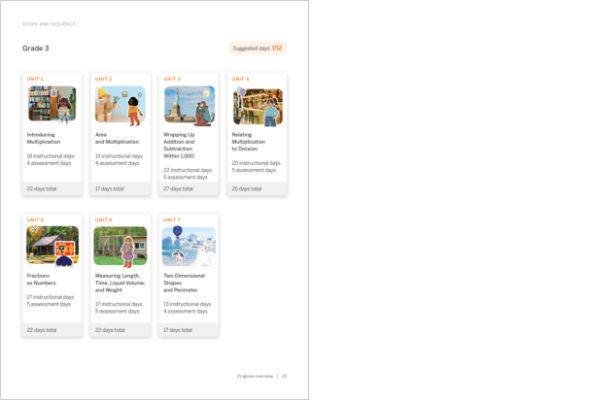
Grade 3, Unit 6: Measuring Length, Time, Liquid Volume, and Weight

Grade 4, Unit 6: Multiplying and Dividing Multi-Digit Numbers
Looking for help?
Support is always within reach. Our team is dedicated to supporting you throughout your review and can be reached at any time by emailing or calling us directly.
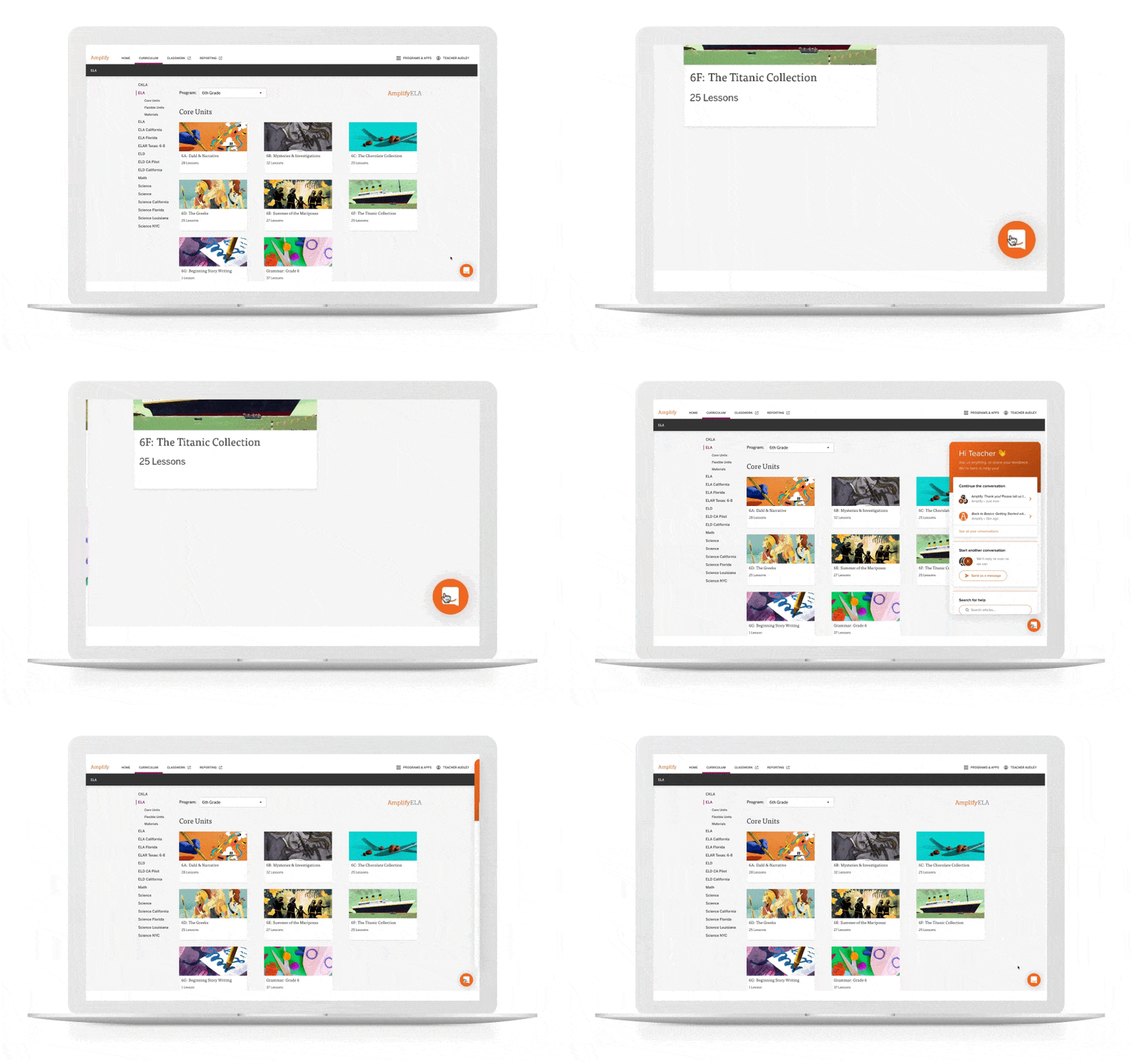
- Live chat: Click the orange icon while logged in to get immediate help.
- Phone: Call our toll-free number: (800) 823-1969.
- Email: Send an email to help@amplify.com. In the message body, please include your name and question. Provide as much detail as possible, so we can more quickly help you find a solution.

Ready to learn more?
Sign up to be among the first to receive updates about Amplify Desmos Math.
Discovering and exploring mathematics in every story
Making reading comprehension connections
Rethinking reading comprehension

Have you ever listened to a student read aloud fluently about something—say, the life cycle of sea turtles—only to discover afterward that they couldn’t explain a single thing about…the life cycle of sea turtles? It’s a familiar classroom moment, and it reveals how easy it is to misunderstand what comprehension really is.
Comprehension is often framed only as the product of reading: the answers students give when asked to find the main idea, identify a theme, or summarize a passage.
But the Science of Reading tells us that comprehension is more than an outcome. Comprehension is also a dynamic process that unfolds as readers move through a text, powered by the interactions among words on the page and the knowledge and reasoning they bring to it. That’s why we like to think of it as the heartbeat of literacy.
Why comprehension is both product and process
For decades, much of classroom instruction has focused on language comprehension products: the demonstrations of understanding that happen after reading. Those are important, but they don’t tell the whole story.
That’s because products depend on processes. If students do not build a coherent mental model of what they’re reading—while they’re reading—they may succeed at reading, but not at comprehending.
This is the missing link that researchers like Hugh Catts, Ph.D., and Jane Oakhill, Ph.D., have revealed: Comprehension isn’t something readers suddenly have at the end of a passage. It’s also something they do all along the way.
What comprehension processes look like
Comprehension processes are the mental moves students make to construct meaning as they read. All students need explicit instruction and practice in order to learn to do this automatically. Some of the most important processes include:
- Inference-making: Filling in gaps the author leaves unsaid. If a story says “Carlos forgot his umbrella and got wet,” readers must supply the missing piece: It rained.
- Anaphora resolution: Figuring out who pronouns such as he or she refer to. For instance, in a passage where “Charmaine passed the ball to Kendra, and she scored,” not all readers may track that she refers to Kendra.
- Monitoring meaning: Noticing when something doesn’t make sense and rereading to fix it. Think of a student breezing through a science lab procedure but not realizing they’ve misunderstood a key step.
- Recognizing connectives: Using words like because, however, or meanwhile to understand how ideas fit together in a text about history, math, or literature.
- Visualizing: Building a mental picture—whether that’s of how a caterpillar becomes a butterfly, or how a character’s feelings shift across a story.
When these processes don’t happen, comprehension breaks down—even for students who can decode fluently. That’s why teaching comprehension can’t mean just assigning comprehension questions. It has to mean teaching students how to think with text in real time.
The role of knowledge and writing
Processes don’t exist in isolation. They depend on, and are strengthened by, what students already know and what they can express in writing.
- Knowledge: The more background students bring to a text, the easier it is for them to make inferences and connect ideas. A child who already knows a little about baseball will understand a passage about a pitcher’s strategy much more readily than one encountering the game for the first time.
- Writing: Writing about reading reinforces comprehension. When students summarize a biography in their own words, draft a response to a novel, or synthesize ideas from multiple sources, they are practicing the very processes—like making connections and organizing ideas—that skilled readers rely on.
This interplay—reading feeding knowledge, knowledge feeding comprehension, writing reinforcing both—creates a cycle of literacy growth that goes far beyond the end-of-text quiz.
Rethinking classroom practice
Working on individual comprehension skills can help in the short term. But long-term literacy success—for all students—requires explicit instruction and practice in all the comprehension processes needed to build comprehension products.
So what does it mean to teach comprehension as a process, not just a product?
Weaving effective instruction in comprehension strategies into everyday literacy work. A few examples:
- Model your thinking. Pause mid-reading to ask, “Who does she refer to here?” or “That didn’t make sense—let’s go back.”
- Highlight connectives. Teach words like although or consequently explicitly, showing how they signal relationships between ideas.
- Promote monitoring. Encourage students to ask themselves, “Does this make sense?” and to reread when it doesn’t.
- Build knowledge deliberately. Use content-rich texts in science, history, and the arts to give students the context they need for stronger comprehension.
- Pair reading with writing. Even short written responses—“Why do you think the character acted that way?”—help solidify understanding and make comprehension processes visible.
These practices shift comprehension instruction from an after-the-fact check to an in-the-moment skill set students can carry into every subject.
Want to dig deeper?
Expanding our understanding of comprehension as both product and process is one of the most important shifts the Science of Reading has brought to literacy instruction. It reminds us that comprehension isn’t just a mysterious outcome at the end of reading—it’s the ongoing work of making meaning along the way.
To help educators explore this shift, we’ve created the new Science of Reading: Comprehension 101 bundle. These resources break down the research and provide strategies you can use right away. When we teach comprehension as the ongoing process it truly is, we keep the heartbeat of literacy strong for every reader.
Inside, you’ll find the following resources:
- Our anchor ebook: Understanding Comprehension: The Heartbeat of Literacy
- Infographic: The missing link in reading comprehension
- Ebook: Knowledge, Reading, and Writing: The Secret Recipe for Literacy Success
- Podcast: “Science of Reading Essentials: Comprehension” episode and listening guide
- Webinar: Rethinking Reading Comprehension: Reflections on Hugh Catts’ and Jane Oakhill’s Research

Our research
Amplify Desmos Math
Amplify Desmos Math is a curiosity-driven K–12 program that builds students’ lifelong math proficiency. Our structured, problem-based approach builds on students’ curiosity while strategically developing math fluency and lasting grade-level understanding.
Efficacy
The Effect of Desmos Math Curriculum on Middle School Mathematics Achievement in Nine States
Research base
Case studies

Explore more of our research.
Learn more about the research behind our programs.
Fomente y exalte el razonamiento de los estudiantes aprovechando su curiosidad natural.
Amplify Desmos Math ayuda a los maestros a fomentar un aula con estudiantes entusiastas y cooperativos, partiendo de sus ideas y desarrollando diaria y firmemente los conocimientos del grado académico correspondiente de cada estudiante. For English version, please click here.

Amplify Classroom
Para los grados K a 12.º
Gratuito
Una plataforma de enseñanza y aprendizaje que ofrece una colección de lecciones digitales gratuitas y herramientas para diseñar lecciones.
- Los maestros pueden crear sus propias lecciones con la herramienta Activity Builder.
- También pueden explorar contenido creado por otros maestros, por ejemplo:
- Las lecciones que crean los usuarios y se almacenan en la biblioteca.
- Las lecciones de la Colección destacada que produce el equipo de Amplify Classroom.
Más información en classroom.amplify.com

Amplify Desmos Math
Para los grados K a Álgebra 2
De Pago
Próximamente: Un nuevo programa básico de prekindergarten a 12.º grado de Amplify y Desmos Classroom.
- Un método basado en problemas que produce resultados mediante el desarrollo de una comprensión conceptual sólida, fluidez procedimental y ejemplos de uso.
- Tecnología que inspira conexiones en el aula, fomentando la colaboración, el diálogo y la perseverancia en la resolución de problemas.
- La curiosidad natural de los estudiantes propicia una comprensión cabal de las matemáticas y un aprendizaje que dura toda la vida.
- Disponible en inglés y español.
- Programma piloto para los grados K a A1 para el regreso a clases en el 2024.

Un nuevo programa básico para los grados preK al 12.º de Amplify y Desmos Classroom.
Amplify Desmos Math facilita tanto a los maestros como a los estudiantes la migración a un método basado en el planteamiento y la resolución de problemas, proporcionando actividades atractivas, eficaces herramientas de facilitación para el maestro y muchos apoyos para la diferenciación y la práctica.
Hemos combinado lecciones interactivas basadas en problemas con enseñanzas explícitas, refuerzos y prácticas para que los estudiantes dominen auténticamente las matemáticas. Las lecciones sientan una base sólida en cuanto a la fluidez en los procedimientos y cálculos, afianzan la comprensión de los conceptos y permiten a los estudiantes aplicar lo aprendido a situaciones del mundo real.
Amplify Desmos Math estará disponible a partir del curso escolar 2025–26. Los distritos interesados podrán probar la versión Beta a partir del otoño del 2024.
Más de lo que espera de un programa de matemáticas.
Integral
- Plan de estudios basado en Illustrative Mathematics® IM K-12™
- Diferenciación y práctica personalizadas
- Evaluaciones e informes exhaustivos
- Material didáctico en español


Cooperativo
- Apoyos y herramientas eficaces para la facilitación docente
- Los estudiantes analizan y aprenden de las ideas de los demás
- Cada lección cuenta con materiales impresos y digitales totalmente compatibles con un aula inclusiva
Fascinante
- Lecciones que promueven la curiosidad e inspiran a los estudiantes a resolver problemas del mundo real
- Tecnología de Desmos Classroom que proporciona información instantánea e interactiva para potenciar el razonamiento de los estudiantes
- Vistosas instrucciones gráficas para maestros y estudiantes

Qué incluye
Aprovechamos los alcances tecnológicos y las lecciones de Desmos y añadimos simples pero fascinantes componentes impresos y digitales para crear un programa sin precedentes que simplifica la enseñanza.
- Edición para estudiantes (varios volúmenes)
- Páginas de actividades interactivas para el estudiante
- Interacciones enriquecidas (más información en la página 5)
- Herramientas de colaboración
- Práctica personalizada
- Edición para maestros (varios volúmenes)
- Herramientas de facilitación y seguimiento del progreso
- Páginas de presentación
- Apoyos pedagógicos
- Evaluación
- Prácticas adicionales y material fotocopiable en blanco y negro para evaluaciones
Manténgase al día con las últimas novedades sobre Amplify Desmos Math y Desmos Classroom.
Las lecciones digitales deben potenciar el razonamiento de los estudiantes y generar debates interesantes y productivos. Regístrese para obtener más información sobre cómo Amplify Desmos Math y Desmos Classroom incitan a los estudiantes a interesarse por las matemáticas.
¡El Math Teacher Lounge está disponible!
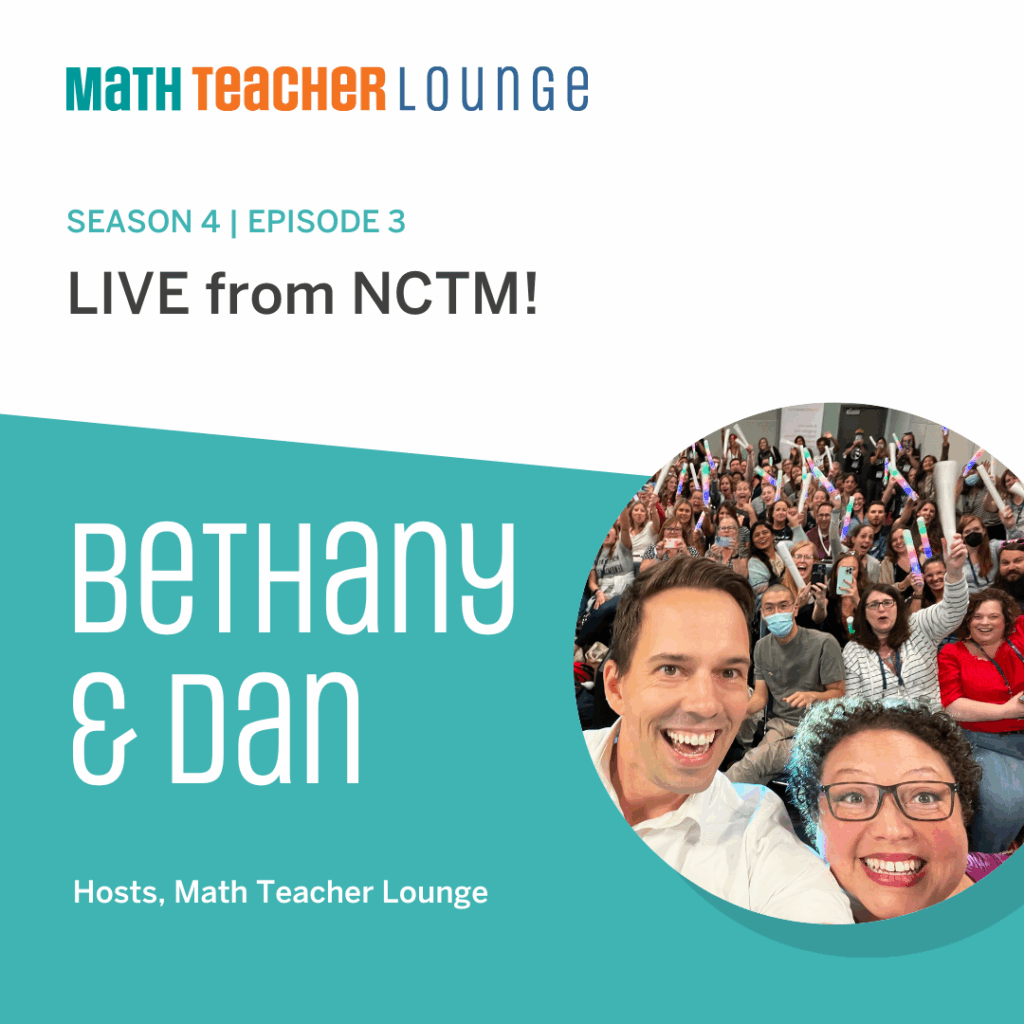
Amplify presenta Math Teacher Lounge, un podcast con los presentadores Bethany Lockhart Johnson y Dan Meyer.

Introducing Amplify Classroom

Feeling crunched for lesson-planning time? You’re not imagining it. A recent EdSurge report found that teachers get, on average, just 266 minutes of dedicated planning time a week—under an hour a day. And that’s before the meetings, paperwork, and “Got a minute?” queries start rolling in.
When teachers have so little space to craft high-quality interactive lessons, any tool that streamlines planning or teaching can make a huge difference.
Enter Amplify Classroom (formerly Desmos Classroom), launched for the 2025–26 school year and available for free! Already used by more than 300,000 teachers, this all-in-one platform brings together free resources for K–12 students; teacher guides and real-time teaching tools; and interactive lessons across math, literacy, and science—helping educators focus less on logistics and lesson plans and more on student engagement.
Interactive lessons that stick
Amplify Classroom’s free teaching resources go far beyond static worksheets or “entertaining” electronics. The platform’s library of more than 1,000 lessons features a wide range of free K–12 resources, including K–5 activities, middle school science explorations, and high school math challenges. Highlights include:
- A grade 1 math activity called Leaping Lily Pads!, in which students help a purple frog hop toward a golden crown while making connections between subtracting 1 and subtracting 2—and practicing subtracting 2 and adding 2.
- A grade 4 science activity called Food Chains, in which students create their own sequences of organisms, then line up those organisms to model how energy flows through an ecosystem, tracing that energy from start to finish.
- Literacy practice that explores how the letter “y” sounds in words like myth.
- Classic Desmos math challenges, like balancing raccoons on a seesaw against a 21-pound weight.
- Hands-on Polypad manipulatives that let students experiment with tangrams, grids, and colorful geometric shapes.
These types of activities are not just engaging in the moment. They can also set the stage for lifelong math enjoyment. “I’ve been wary about making my kids not hate math,” says kindergarten teacher Martin Joyce. “No ‘drill-n-kill.’ [Now] they’re asking if they can do math on the computer before bed!”
What you can do with these free resources
Once you create a free teacher account, you can:
- Teach more than 1,000 free interactive lessons across math, literacy, and science.
- Customize any premade lesson or build your own with the drag-and-drop editor.
- Monitor student thinking in real time with intuitive dashboards.
- Share snapshots of student work—names optional—to prompt discussion and highlight ideas.
- Control the pacing of lessons, pausing to dive deeper into a concept or syncing everyone to the same spot.
Here’s how it works in practice:
- Find a lesson. Browse by subject, grade level, or topic until you land on one that fits your plan for the day.
- Share it with your class. Assign the activity so students can join from their own devices.
- Teach and adapt in the moment. Use the dashboard to see student thinking in real time, highlight responses, and pace the lesson as you go.
Grade 5 teacher Traci Jackson saw how these K–5 activities boosted collaboration and learning in her class: “After an audible groan when the activity was paused, students made sense of ordered pairs through a purposeful Amplify Classroom experience. One student pair wrote without any prompting!”
More to explore
- Explore Amplify Classroom, the free platform for grades K–12.
- Learn how Amplify Classroom is supporting teachers across math, literacy, and science.
- Find free professional learning resources for educators and free activities for students in our Problem-Based Learning Starter Pack.
A curiosity-driven K–8 science curriculum
Amplify Science is a K–8 phenomena-based science curriculum that blends hands-on investigations, literacy-rich activities, and interactive digital tools. The result? Elementary and middle school students who think, read, write, and argue like real scientists.
Amplify Science for grades K–8 has been rated all green by EdReports.
Our approach
Each unit of Amplify Science engages all learners in a relevant, real-world problem where they assume the role of a scientist to investigate scientific phenomena, engage in collaboration and discussion, and develop models or explanations to arrive at solutions.
A research-backed approach to 3D learning
The research-based Do, Talk, Read, Write, Visualize instructional approach—developed by UC Berkeley’s Lawrence Hall of Science—provides students with multiple opportunities and modalities with which to access science instruction. Independent research proves that this model of learning benefits all learners, and our efficacy research shows improved student achievement.
Students take on roles of scientists and engineers.
In each unit, students take on the role of a scientist or engineer to investigate a realistic problem. These problems provide relevant contexts through which students investigate real-world phenomena that are seamlessly integrated throughout the unit. By positioning students as engineers or scientists, they are actively engaged in designing innovative solutions and making sense of the world around them.


Authentic 3D learning brought to life
Amplify Science integrates the NGSS—and state standards based on them—not just at a surface level, but throughout every lesson of the unit. Students engage with science and engineering practices, figure out disciplinary core ideas, and make connections when they apply Crosscutting Concepts across thoughtfully structured, multimodal lessons.
Developed by science education experts
Amplify Science was developed by The Lawrence Hall of Science at UC Berkeley in partnership with Amplify. It reflects state-of-the-art practices in science teaching and learning, which lays the foundation for our high quality instructional materials (HQIM).

A flexible, blended program
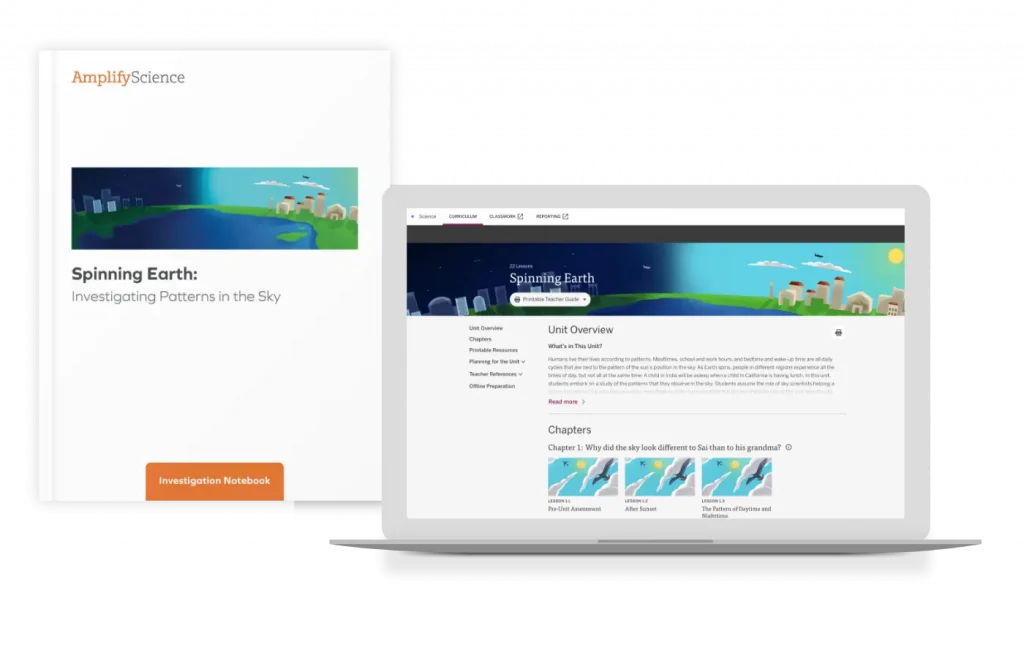
Amplify Science includes hands-on activities, print materials, and powerful digital tools to support online and offline teaching and learning. Highly adaptable and user-friendly, the program gives schools and individual teachers flexibility based on their technology resources and preferences.
What’s included
Our flexible resources work seamlessly together.

Teacher’s Guides
Available digitally and in print, the Teacher’s Guides contain all of the information teachers need to facilitate classroom instruction, including:
- Detailed lesson plans.
- Unit and chapter overview documentation.
- Differentiation strategies.
- Standards alignments.
- In-context professional development.

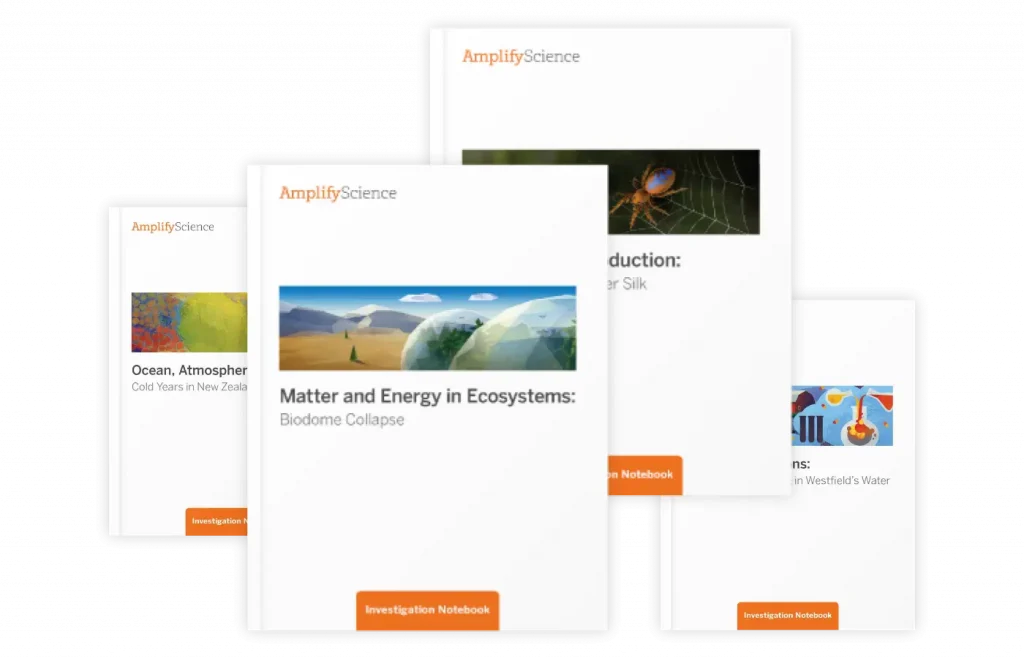
Student Investigation Notebooks
Available for every unit, the Student Investigation Notebooks provide space for students to:
- Record data.
- Reflect on ideas from texts and investigations.
- Construct explanations and arguments.

Student Books
Age-appropriate Student Books allow students to:
- Engage with content-rich texts.
- Obtain evidence.
- Develop research and close-reading skills.
- Construct arguments and explanations.

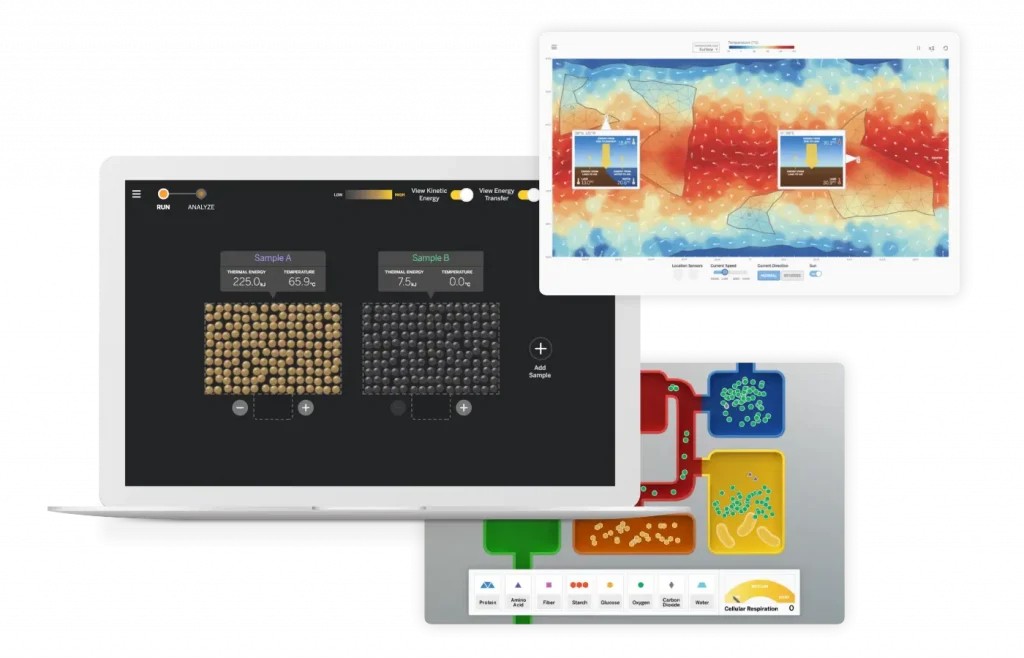
Simulations and Modeling Tools
Developed exclusively for the Amplify Science program, these engaging digital tools:
- Serve as venues for exploration.
- Enable data collection.
- Allow students to explore scientific concepts.
- Show what might be impossible to see with the naked eye.
Hands-on materials kits
Hands-on learning is at the heart of Amplify Science. Each unit kit contains:
- Consumable and non-consumable hands-on materials.
- Print classroom display materials.
- Premium print materials for student use (sorting cards, maps, etc.).

Teacher’s Guides
Available digitally and in print, the Teacher’s Guides contain all of the information teachers need to facilitate classroom instruction, including:
- Detailed lesson plans.
- Unit and chapter overview documentation.
- Differentiation strategies.
- Standards alignments.
- In-context professional development.

Student Investigation Notebooks
Available for every unit, the Student Investigation Notebooks provide space for students to:
- Record data.
- Reflect on ideas from texts and investigations.
- Construct explanations and arguments.
Available with full-color article compilations for middle school units

Hands-on materials kits
Hands-on learning is at the heart of Amplify Science. Each unit kit contains:

- Consumable and non-consumable hands-on materials.
- Print classroom display materials.
- Premium print materials for student use (sorting cards, maps, etc.).

Digital student experience
Students access the digital simulations and Modeling Tools, as well as lesson activities and assessments, through the digital student experience. Students can interact with the digital student experience as they:
- Conduct hands-on investigations.
- Engage in active reading and writing activities.
- Participate in discussions.
- Record observations.
- Craft end-of-unit scientific arguments.

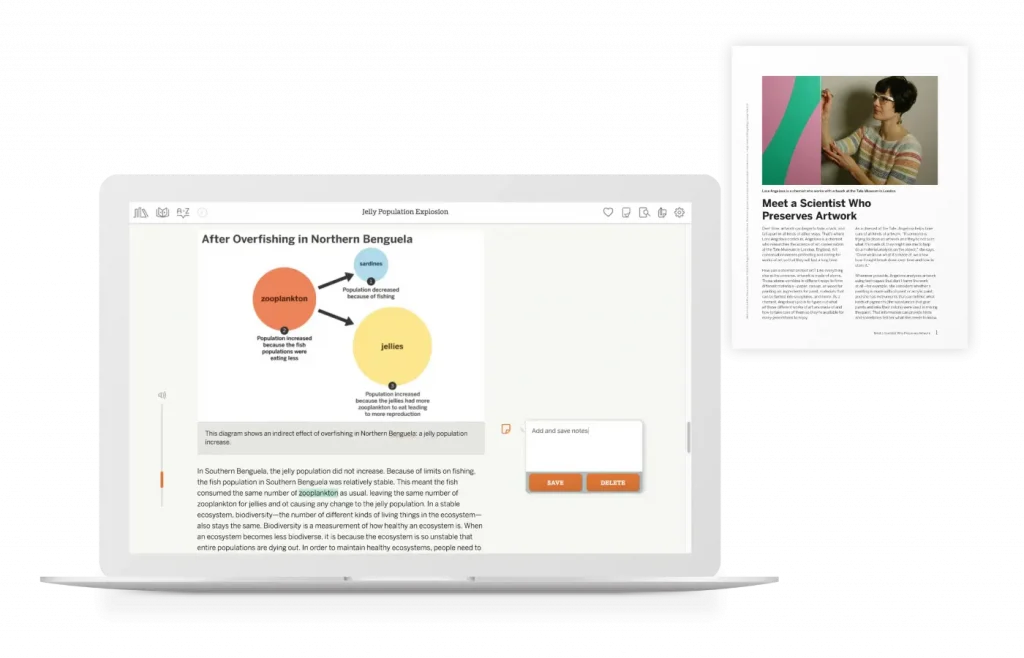
Science articles
The middle school science articles serve as sources for evidence collection and were authored by science and literacy experts at the Lawrence Hall of Science.

Explore more programs.
Our programs are designed to support and complement one another. Learn more about our related programs.
Lorem Ipsum
Lorem Ipsum
Lorem ipsum is placeholder text commonly used in the graphic, print, and publishing industries for previewing layouts and visual mockups. Lorem ipsum is placeholder text commonly used in the graphic, print, and publishing industries for previewing layouts and visual mockups.
Lorem ipsum is placeholder text commonly used in the graphic, print, and publishing industries for previewing layouts and visual mockups.

Update
Update 2
Lorem ipsum is placeholder text commonly used in the graphic, print, and publishing industries for previewing layouts and visual mockups. Lorem ipsum is placeholder text commonly used in the graphic, print, and publishing industries for previewing layouts and visual mockups.
Lorem ipsum is placeholder text commonly used in the graphic, print, and publishing industries for previewing layouts and visual mockups.
Lorem ipsum is placeholder text commonly used in the graphic, print, and publishing industries for previewing layouts and visual mockups. Lorem ipsum is placeholder text commonly used in the graphic, print, and publishing industries for previewing layouts and visual mockups.
Lorem ipsum is placeholder text commonly used in the graphic, print, and publishing industries for previewing layouts and visual mockups.
Image and text

Lorem ipsum is placeholder text commonly used in the graphic, print, and publishing industries for previewing layouts and visual mockups. Lorem ipsum is placeholder text commonly used in the graphic, print, and publishing industries for previewing layouts and visual mockups.
Lorem ipsum is placeholder text commonly used in the graphic, print, and publishing industries for previewing layouts and visual mockups.
Table
| Lorem Ipsum | Lorem Ipsum | Lorem Ipsum |
|---|---|---|
| Lorem ipsum is placeholder text commonly used in the graphic, print, and publishing industries for previewing layouts and visual mockups. | Lorem ipsum is placeholder text commonly used in the graphic, print, and publishing industries for previewing layouts and visual mockups. | Lorem ipsum is placeholder text commonly used in the graphic, print, and publishing industries for previewing layouts and visual mockups. |
| Lorem ipsum is placeholder text commonly used in the graphic, print, and publishing industries for previewing layouts and visual mockups. | Lorem ipsum is placeholder text commonly used in the graphic, print, and publishing industries for previewing layouts and visual mockups. | Lorem ipsum is placeholder text commonly used in the graphic, print, and publishing industries for previewing layouts and visual mockups. |
| Lorem ipsum is placeholder text commonly used in the graphic, print, and publishing industries for previewing layouts and visual mockups. | Lorem ipsum is placeholder text commonly used in the graphic, print, and publishing industries for previewing layouts and visual mockups. | Lorem ipsum is placeholder text commonly used in the graphic, print, and publishing industries for previewing layouts and visual mockups. |
| Lorem Ipsum | Lorem Ipsum | Lorem Ipsum |
Lists
Accordion
- One
- Two
- One
- Two
- One
- Two
- One
- Two
- One
- Two
- One
- Two
- One
- Two
- One
- Two
- One
- Two
- One
- Two
Quote
Lorem ipsum is placeholder text commonly used in the graphic, print, and publishing industries for previewing layouts and visual mockups.
George Washington
Lorem ipsum is placeholder text commonly used in the graphic, print, and publishing industries for previewing layouts and visual mockups.
George Washington
Callout
Callout title
Lorem ipsum is placeholder text commonly used in the graphic, print, and publishing industries for previewing layouts and visual mockups.
Columns
Lorem ipsum is placeholder text commonly used in the graphic, print, and publishing industries for previewing layouts and visual mockups.

Contact
Lorem ipsum is placeholder text commonly used in the graphic, print, and publishing industries for previewing layouts and visual mockups. Lorem ipsum is placeholder text commonly used in the graphic, print, and publishing industries for previewing layouts and visual mockups.
Free professional learning to support your Science of Reading journey
We know you seek the best research-tested methods for your students—and want to start applying them as quickly and easily as possible. Whether you’re looking to improve your students’ writing or understand how to boost their comprehension, here are a few resources designed to save precious time!


Science of Reading: The Podcast Essentials episodes
Looking for a roundup of the latest research on key topics? Look no further! Our Science of Reading Essentials episodes can unlock insights that can truly transform your instruction. Each episode is just over 30 minutes. You can also download our discussion guides to fuel your own professional learning sessions.
Comprehension episode
Comprehension podcast listening guide
Explore the Science of Writing
Discover the captivating journey of writing with our new guide, Science of Writing: A Primer. Explore the history of writing to understand the crucial link between reading and writing instruction—and why handwriting still matters in today’s digital world.


A year’s professional learning from Science of Reading: The Podcast
Looking for ways to bring Science of Reading: The Podcast into your professional learning communities? Here’s one starting place: Share a presentation of top takeaways to jump-start your discussions.
Science of Reading professional development on your own schedule
Science of Reading: Learning Lab offers unparalleled research-backed instruction crafted to the standards of the International Dyslexia Association. Explore enriching activities, curated resources, and guidance from Susan Lambert, Chief Academic Officer of Literacy and Host of Science of Reading: The Podcast.

Supporting multilingual learners—by supporting their families

Teachers know that multilingual/English learners (ML/ELs) are an important and fast-growing population in today’s classrooms. In 2021, more than 10% of students enrolled in public schools across the U.S. were identified as English language learners, with some projections suggesting this number could reach 40% by 2030.
But when it comes to partnering with the families of ML/ELs for student success, we’re just beginning to tap into what’s possible.
I’m an ML/EL teacher and former homeroom teacher at a school serving many ML/ELs.
Here’s what I’ve learned about best practices for bridging the school-to-home communication gap and partnering with families (all families!) to ensure their child’s success.
Recognizing the communication gap: Common challenges with multilingual families
In my experience, three common barriers can stand in the way of strong family engagement and student success:
- Cultural expectations around parent-teacher communication: In many cultures, school is considered the teacher’s domain. Reaching out may be seen as crossing a line—or simply not expected at all.
- Logistical challenges: Unpredictable schedules may lead to missed messages, delayed responses, or inconsistent availability.
- Language barriers: If a message isn’t in a language a caregiver understands, it’s unlikely they’ll respond—not because they don’t care, but because they can’t fully engage.
Supporting multilingual learners starts with recognizing these barriers not as signs of disconnection, but as invitations to shift our approach. There are best practices we can adopt to help bridge the gap—and build the trust and relationships our students need to thrive.
Tools and strategies for better parent-teacher communication
If you want to communicate with families who speak a variety of different languages, the first step is finding the method of contact that works best for each of them. My school uses an auto-translating app called ParentSquare for home communications—but not all families I’ve worked with respond to ParentSquare messages. So if a family isn’t responsive to one mode of communication, try another!
It’s a good idea to ask families on Back-to-School Night—or whenever your students first arrive—if they have a preferred mode of communication. I’ve found I get the best response rate by creating a Google Voice number and communicating via text, first translating through an app if needed.
Keep a log of this information so you have it on hand when you need it. In the long run, this will be easier for both you and your students’ caregivers than you chasing them down to get them to download, log into, or check a specific app.
The important thing is to consider making contact essential, and to keep trying until you find the mode that works for both you and the parents of your ML/EL students.
Setting the tone for strong family engagement
If you want to forge a strong family-school partnership (and you should!), you also need to set the tone. When families have a different cultural understanding of school engagement than what you’re used to, I’ve found that it helps to explicitly solicit parent input, explaining how a partnership between caregiver and teacher will help support their child’s success.
Let them know how and why they should get in touch with you, and make it easy by reaching out proactively with brief, positive updates.
What multilingual families really want to know
Perhaps most importantly, ask families what they want to know! I’ve attended many parent-teacher conferences—both for my own students and as an interpreter—and I’m frequently struck by how many multilingual families respond when I ask what questions they have. Many families who haven’t previously reached out are suddenly overflowing with questions.
The most common one I get is how they can support their child’s academic journey at home. Parents also frequently request updates about behavior. Understand that just because a family isn’t asking these questions proactively doesn’t mean they don’t care. When I explicitly ask parents what they need, their responses make it abundantly clear that they are deeply invested in their child’s schooling and success.
I’ve also learned that many families—especially those who speak a language other than English at home—may not know that there are many ways to support their child’s growth, even if classroom instruction is not in their home language.
Think about what tips and resources you can most easily provide: Do your students’ parents know that reading or reciting poems, songs, or chants in their home language helps literacy growth? Could you send home simple board games from the classroom to reinforce key skills? Would signing up for a library card give them access to resources they didn’t know were available? Many caregivers of ML/EL students have told me they lack the tools to get involved—but are eager to engage once given tangible strategies.
How teachers can go the extra mile
In order to give our students and their families the support they need, it’s critical that we challenge our internal biases and assumptions. If we assume parents are uninterested or uninvolved, we avoid an opportunity to think creatively about how to bridge communication gaps and facilitate family involvement. We also cut off a world of possibility for our students and limit their access to the academic success that comes from parent involvement.
Working with the families of ML/ELs may bring added responsibilities—but it’s also a unique privilege, full of new opportunities. In teaching ML/ELs, I’ve found that I get to be a cultural bridge—one of the people providing warmth, stability, and welcome to families navigating a new culture. School can be overwhelming in a new country or different language—but a teacher who goes the extra mile can ensure success for both students and families.
Additional resources
- Let’s keep the conversation going! Join the discussion in our Amplify learning communities.
- Discover a suite of Spanish literacy curriculum and assessment programs designed to build confident readers with Amplify’s biliteracy suite.
- Read how you can use the Science of Reading to boost your biliteracy instruction in this blog post.
How asset-based assessments can revolutionize math instruction

Many of today’s math classrooms are facing a perfect storm: declining scores, widening learning gaps, and growing pressure on teachers to deliver solutions. According to the National Assessment of Educational Progress, students are experiencing the steepest drop in math scores since 1990. EdWeek Research Center reports that a persistent gap between educational theory and day-to-day practice is putting added stress on teachers, often leaving them to navigate complex pedagogical demands without adequate support.
So how can we provide both students and teachers with the tools they need to succeed? How can math assessments and math intervention programs provide real help and drive student progress—without piling on more work?
One promising answer lies in rethinking how we assess what students know.
Rethinking the role of math assessments
Traditional assessments tend to focus on correctness alone. Did the student get it right or wrong? How many points did they earn?
But this binary approach misses a lot. A skipped question could mean a tech hiccup or a moment of confusion—not a lack of understanding. A wrong answer might come at the end of otherwise solid problem-solving.
An asset-based assessment approach shifts the focus from mistakes to meaning. It looks beyond outcomes to understanding how students think—their strategies, reasoning, and partial understandings. And when teachers can see that thinking, they gain far more useful data to guide instruction and inform their math intervention program.
This approach doesn’t lower expectations—it raises the quality of insight and gives struggling students (and really all students) a better shot at meeting standards with instruction that’s tailored to their actual needs.
Honoring students’ thinking and teachers’ time
Every student thinks differently. Asset-based assessments help reveal individual thinking, often through short-answer or open-response formats that ask students to explain how they solved a problem.
But this shift isn’t just for students. Teachers can benefit enormously when assessments are designed to surface trends in student thinking. If 30% of a class misinterprets the same concept, that result reveals a teaching opportunity. Rather than reteach an entire unit, teachers can adjust with focused, targeted support. That means less time spent diagnosing, and more time actually helping.
And when technology in the math classroom makes this data easy to collect, analyze, and act on, teachers get a level of consistent insight that is not only helpful, but actionable.
From student performance to student performance + thinking
The ultimate goal of asset-based assessments isn’t to replace performance data—it’s to enhance it. Knowing how a student got to an answer (or why they didn’t) can make all the difference in determining what to do next.
Here’s an example involving a division problem:

When real students were given this problem, they responded with answers like:
- 33/4 = 8.25, round up to 9 so all kids can sit!
- 33/4 = 8 with a remainder of 1. She needs 8 tables.
- 8 x 4 = 32, but 9 x 4 = 36. I don’t know if we can leave one student sitting lonely on the floor, though.
Traditional grading might stop at “correct” or “incorrect” for these responses. But when students are asked to explain their thinking, teachers can uncover a range of reasoning—from successful multiplication strategies to misunderstandings about remainders.
These glimpses into student thinking aren’t just informative—they’re transformative. They can illuminate the performance of students in a deeper, more actionable way. They can help teachers take smarter next steps, and they can help students feel understood, capable, and more like “math people” every day.
More to explore
- Download our ebook Asset-Based Assessment: What It Is and Why It’s Needed in K–12 Classrooms.
- Amplify is investing in assessment and intervention tools that make this kind of insight possible. Our latest suite was designed with asset-based thinking at its core. You can learn more here:
How differentiation drives success

I’d like to share a favorite success story from my ELA class that brings home the true power of differentiation.
There was one boy—let’s call him Dipper. (It’s not his real name; I just really like the show “Gravity Falls.”) Dipper was the sweetest, kindest, most wholesome eighth grader I have ever met. He was absolutely precious.
Dipper also suffered from fairly severe academic struggles. He was well below his middle school reading level, struggled to express ideas in writing, and took longer than other students to break down basic concepts. When Dipper first came to me, he couldn’t start or complete a written sentence. He was easily frustrated and often overwhelmed to the point of tears.
Spoiler: By the end of the school year, Dipper was writing multiple paragraphs and starting to connect them with transition sentences.
Here’s how he got that much closer to grade level.
Using sentence starters and scaffolds to build success
My school district had recently adopted Amplify ELA (6–8). At the outset, I placed Dipper at the differentiation level with the most support. When we talked about how a character reacted to a moment in the story, Dipper had corresponding smiley, frowny, and disgusted faces to identify feelings. He had his own lesson plan with example quotes, shortened readings, alternative questions to spark thinking, and sentence starters to help him focus on comprehension instead of getting stuck at the start.
All of these supports helped him comprehend, share his responses, and contribute to discussions.
So far, so good.
But putting those thoughts to paper—or text box—was a completely different hurdle.
Facing academic struggles with patience and persistence
I can’t talk about Dipper without talking about his one-to-one aide. Let’s call her Ms. Mabel. (Again, “Gravity Falls.” I’m telling you, check it out.)
Ms. Mabel had sat beside Dipper during every ELA class since sixth grade. She helped him stay focused and generate ideas, and she even transcribed his answers when needed. Ms. Mabel’s devotion to Dipper’s success was profound and inspirational.
And it made all the difference when it came to Writing Prompts. At first, the prompts were met with tears and tantrums, panic and disdain, all the joyful wholesomeness ripped from Dipper.
Ms. Mabel would console him and redirect his passions to the work. She would point out the sentence starters, help him copy and paste them to the text box, and have him fill in the blanks. Again and again.
And then, little by little: Less panic. Fewer tears. Sentence starters, fill in the blank. Progress.
Sentence starters, fill in the blank. Success.
Day by day, Dipper, stacking wins like pancakes at an all-you-can-eat breakfast buffet, found confidence in himself, his reading, and his writing. He went from barely being able to complete a sentence to writing multiple paragraphs with evidence to support his ideas.
We had seen Dipper grow from a tiny sixth grader into a less tiny eighth grader and had watched his initial tenacity meet with stagnation, frustration, and defeat—until this year. This year with Amplify was different.
Why it takes more than just an awesome teacher
Obviously, you can’t pin success on one factor. Dipper had many supports in place: two blocks in the resource room, a dedicated aide, supportive peers and family, and—above all—a fierce drive and work ethic.
But if you asked Ms. Mabel, she would tell you that Amplify helped, too. She found that the way the questions were broken down allowed her to teach Dipper what he misunderstood better than she had been able to in previous years. We discovered very quickly how much autonomy was built in. It wasn’t rigid. It gave us structure and trust. It made differentiation easier, clearer, and more meaningful.
Sure, maybe Dipper was also maturing. Maybe I’m just an awesome teacher. Or maybe, just maybe, we need every little bit of help we can get to do the hard work in life. Maybe we need someone to push us in the right direction. Maybe we need those guardrails to keep us on course. Some of us can start our own engines, but we all need to be able to race.
Sometimes, we need someone who can help us start our sentences so we can learn how to be the ones to finish them.
More to explore
- Let’s keep the conversation going! Join the discussion in our Amplify learning communities.
- Looking for inspiration? Watch Teacher Connections, a video series featuring practical advice and tools straight from fellow educators—our very own Amplify Ambassadors.
- Dive into our podcast hub to hear from top thought leaders and educators and uncover cross-disciplinary insights to support your instruction.
An Aussie teaching American phonemes

Ever heard of bidialectalism? It means the ability to fluently switch between two dialects.
It was a new word for me when I first started teaching in the U.S.—but I figured it out fast, just by opening my mouth in the classroom.
Bringing my own Australian dialect to teaching six-year-olds deepened my capacity to help struggling readers and multilingual readers. It has also strengthened our classroom community and provided surprising, even amusing opportunities to learn—for all of us.
“What if they get an Australian accent?”
When I first entered an American classroom, I was nervous about teaching phonemes to kids. I kept wondering, “What if they get an Australian accent?” (That never happened.)
I remember my first year teaching Amplify CKLA, standing in front of my students and trying to figure out why the word “from” seemed tricky. For me, it sounded exactly how it was spelled. I kept saying “from,” but my students said: “/f/ /r/ /u/ /m/.”
That was the first of many times I realized how different my dialect really was.
The next one came during our Animals and Habitats unit. We were deep into the lesson when I casually said what sounded like “Pythin,” and a student turned and said, “Don’t you mean PythOn?”
Then came the r-controlled vowels. (R-controlled vowels, also called r-influenced vowels, are vowels that change their sound when followed by an “r” in the same syllable. Instead of sounding short or long, the vowel is “controlled” by the “r”—like in “car,” “bird,” “corn,” “turn,” and “her.”)
Because of my accent, when I said those sounds, they almost always came out as “uh.” (I think that’s why I’ve been told Aussies were responsible for the schwa!) While that got a good laugh—and gave students lots of chances to mimic my accent—it drove home the real importance of phonological awareness.
Learning together: Teaching phonemes and pronunciation
I spent the rest of that first year going over the phoneme videos on the Amplify resources hub, practicing my r-controlled vowels. I did my best to learn to switch between the Australian and American dialects. I even started challenging my students to correct me more often. (“Wait, did I say that right?”)
That led to more intentional practice when teaching grade-level spelling patterns for those individual sounds. I started adding silly actions to go with each one. For example, we’d say, “‘e’ and ‘r’ are friends and together they go ‘errrrr,’” and we’d pretend to turn a key into either side of our cheeks.
Those small quirks helped my students remember the sounds—and they helped me just as much.
Don’t dread it—use it!
So, to any teacher who’s dreading teaching phonemes or teaching kids to read because of their speech or dialect—don’t!
Learning with your students, blending Amplify’s tools with your own quirks and personality, builds classroom memories and creates powerful literacy instruction.
You don’t have to erase your accent to be effective. In fact, embracing your uniqueness might just make you a better teacher.
From one teacher to another: Don’t be afraid of the greatness you already have.
To close out, here’s my favorite use of what I believe is the greatest phoneme/diphthong of all time: Aussie! Aussie! Aussie! Oi! Oi! Oi!
Teach your students to think critically about everything they read.
Amplify’s middle school literacy programs were designed to prepare students in grades 6–8 for high school and beyond by immersing them in complex texts and teaching them to think for themselves about everything they read. Learn more about Amplify ELA (our core English language arts curriculum) and Boost Close Reading (our supplemental reading program).


Amplify ELA
Amplify ELA is a blended English language arts curriculum designed for grades 6–8. With Amplify ELA, students learn to tackle any complex text and make observations, grapple with interesting ideas, and build connections.
Boost Close Reading
Boost Close Reading is an immersive supplemental reading program that engages students with an interactive graphic novel. Through high-interest storytelling and guided instruction, students build their close reading skills.

Explore more programs based on the Science of Reading.
Our early literacy suite programs based on the Science of Reading are designed to support and complement each other. Learn more about integrated programs below.
Why hands-on learning matters in science

Science should be more than just reading about concepts—it should be something students can see, touch, and explore. When students actively engage with science through hands-on activities, technology, and even literature connections, they develop not only essential science skills, but also deeper understanding and lasting curiosity.
Bringing science to life: Hands-on activities
Perhaps the most effective way to engage students in science is to combine a high-quality curriculum with an interactive teaching style to make it experiential. In my classroom, we use the Amplify CKLA Geology unit to dive into earth science concepts. While these strategies can be applied across grade levels and scientific topics, the following is an example from my fourth-grade classroom’s geology lessons:
- Examining geodes: Students predict what they will find inside before breaking geodes open. Then they analyze the crystal structures, connecting their observations to Amplify CKLA’s science concepts.
- Writing about Earth’s layers: After learning about the Earth’s structure, students reinforce their understanding by writing creative descriptions or short stories from the perspective of different layers.
- Diagramming volcanoes and the rock cycle: Drawing detailed diagrams, students visualize how rocks change over time and how volcanic eruptions shape the Earth’s surface.
Connecting literacy skills to science skills
Incorporating literature deepens students’ understanding of science. I use a mix of trade books and digital resources to bring concepts to life through storytelling and informational texts. These books help students connect scientific ideas with real-world applications, fostering both literacy and science skills.
Literacy skills like reading comprehension and critical thinking are key to understanding complex scientific ideas. When students dive into science-related materials, they practice making sense of data, thinking critically about evidence, and building arguments. These practices boost students’ overall literacy, expanding their vocabulary, sparking their curiosity, and developing their media literacy.
Digital resources for students: Exploring science with Google Earth
To further engage students, I integrate Google Earth into our lesson plans. This allows them to explore real-world scientific phenomena—such as geological formations, ecosystems, and weather patterns—making abstract concepts more tangible. Students love zooming in on famous landscapes, discussing how they were formed, and identifying scientific features. This interactive approach using relevant digital tools helps make science feel relevant and exciting.
Final thoughts: The power of engagement in science
By combining hands-on activities, literature, and technology, I’ve helped my students develop a genuine curiosity about science. As the school year progresses, they ask more questions, make deeper connections, and take ownership of their learning.
Engaging students in science doesn’t have to be complicated—it just has to be meaningful. By making learning interactive, Amplify (through Amplify CKLA and Amplify Science) helps students connect with scientific concepts in meaningful ways. I encourage other educators to bring Amplify’s lessons to life with interactive approaches that spark wonder and excitement in young scientists.
Explore more
- Let’s keep the conversation going! Join the discussion in our Amplify learning communities.
- Looking for inspiration? Watch Teacher Connections, a video series featuring practical advice and tools straight from fellow educators—our very own Amplify Ambassadors.
- Dive into our podcast hub to hear from top thought leaders and educators and uncover cross-disciplinary insights to support your instruction.
Science of Reading
Welcome, Reviewers to Amplify Desmos Math California!
Please select your grade levels below. On each site, you will find detailed information about the program’s development, a comprehensive overview of reviewer materials, and instructions on how to access the digital curriculum.
Select the grade band you are reviewing:
Reading scores show slow—but steady— improvement in early grades.
The most recent beginning-of-year data show overall progress in reading readiness for K–2 students. Insights show:
- More young readers are on track and fewer are far behind than at any time since the pandemic.
- K–2 students who are far behind at the beginning of the school year, but on track by the end of the year, are likely to stay on track through third grade.
- Overall, fewer than half of K–2 students are on track to learn to read, a troubling national trend.

Explore Amplify’s beginning-of-year research brief.
Research briefs for the 2024–2025 school year
October 2024
BOY: Summer instructional loss highlights the importance of quality core instruction for the youngest grades.
February 2025
MOY: Early literacy gains offer hope for COVID recovery, though broader literacy challenges persist nationwide.
July 2025
EOY: Reading scores rise overall; gender disparities present a complex picture.
October 2025
BOY: More students start the school year on track for learning to read, though momentum is slow.
Read more research and case studies.
Amplify’s high-quality programs benefit millions of students every day using methods that are evidence-based, ESSA-aligned, and showing efficacy in a variety of contexts. Read more research and case studies and see more briefs on early literacy.
Expect more from your assessments with mCLASS Math.
Understanding student thinking is the key to accelerating student performance.
Welcome to mCLASS® Math, the benchmarking and progress monitoring system for grades K–8 that measures proficiency, reveals underlying mathematical thinking, and informs instructional support for every learner. Analyzing student responses to reveal valid underlying mathematical thinking—even in wrong answers—helps better target individualized instructional recommendations that build grade-level proficiency.
Meet mCLASS Math.
mCLASS Math’s research-based benchmark and progress monitoring assessment system tracks performance against grade-level expectations to help predict later growth outcomes.
With screening and diagnostic capabilities and empirically established cut scores to assess risk, mCLASS Math reporting helps educators pinpoint strengths and areas of growth for individualized instructional support for every student. Together, these establish a strong Multi-Tiered System of Supports (MTSS).
This powerful assessment is digitally assigned to the whole class three times annually: beginning-of-year (BOY), middle-of-year (MOY), and end-of-year (EOY). The open responses of the assessment give more robust data-points gathered from each item, and it only takes 30 to 40 minutes to complete.
Designed to target critical grade-level skills that predict success, the rich data can be used as a diagnostic tool for Tier 2 and Tier 3 intervention and flags for the potential risk of dyscalculia.
mCLASS Progress Monitoring assessments help teachers chart students’ progression between benchmark assessment windows. For students receiving targeted support, mCLASS Progress Monitoring determines if intervention is effective or adjustments are needed to enhance student learning.
These short yet effective assessments enable teachers to monitor a student’s math performance between mCLASS Benchmark assessments. mCLASS Progress Monitoring assessments can be assigned to a select group of students needing targeted support in a specific skill or Tier 2 or Tier 3 intervention, and are aligned around crucial math domains for each grade level.
Assess in less time.
With the groundbreaking digital analysis of student thinking, mCLASS Math teachers can rely on the predictive validity of assessments in less time.
The powerful Student Response Analysis of open-ended questions provides deep insight into what and how students think—faster and with fewer questions.

Access deeper insights.
mCLASS Math’s dynamic data reports offer a window into student thinking, reliably guiding intervention across Tiers 1–3.
The more teachers understand how their students think, the better they can support their growth. The assessment system recognizes students’ individual strengths, experiences, understandings, and strategies—or assets, as we collectively refer to them—to inform the robust data that powers mCLASS Math.
Educator and caregiver reports
Empirically established cut scores and domain-specific measures help teachers plan for tiered intervention with classroom, school, and district-level performance reports set to predict end-of-year outcomes.
To reinforce learning at home, Home Connect letters provide caregivers with easy-to-use reports on their child’s math development.
Student Thinking Report
The Student Thinking Report gives teachers actionable recommendations tailored to how individual students or groups of students approach problems. By understanding the different ways of thinking in skimmable, yet robust, reports, teachers have the tools they need to efficiently plan differentiation to achieve instructional targets.
Actionable recommendations enable teachers to quickly differentiate with intervention resources aligned to common misconceptions.
Research behind mCLASS Math
Based on decades of research for best practices in math, mCLASS Math efficiently assesses students’ skills and thinking to give teachers instant recommendations for small group and individualized instruction.
Following research from leading math experts and an in-depth validation analysis through WestEd, a technical report will be released summer 2025.

A dedicated team at Amplify with over 500 combined years of classroom teaching, school leadership, and assessment experience thoughtfully created mCLASS Math with teachers and students in mind.
Following research from leading math experts and an in-depth validation analysis through WestEd, data will be continuously released starting in spring 2025.

Sandra Pappas
Associate Director of Research

Patrick Callahan, Ph.D.
Educator and Founder of Math ANEX

Jason Zimba, Ph.D.
Chief Academic Officer of STEM
at Amplify
The mCLASS Math K–5 assessment system is designed to provide educators with reliable and valid measures to identify students needing additional support in mathematics and to inform instructional decisions. Preliminary data presents evidence supporting the psychometric quality of the assessment using the technical standards outlined by the National Center on Intensive Intervention (NCII) and state requirements for screening measures.
Data informs
instruction
mCLASS Math works alongside your core instruction, differentiation, and intervention. The data model behind mCLASS Math provides comprehensive data for each student across grades K–8, easily connecting teachers to the immediate next steps that will support, strengthen, and stretch all learners.

Boost Personalized Learning accelerates student growth with daily, targeted 15-minute digital activities. Supported by a virtual tutor, students tackle individualized tasks linked to daily lessons, receiving just-in-time support to foster grade-level success.

Teacher-led, 15-minute Mini-Lessons can build grade-level proficiency by providing research-based, targeted intervention to small groups of students who need additional support.

Reinforce students’ understanding of concepts through collaborative, hands-on Centers (grades K–5). These student-led routines provide additional practice with vertical alignment across grade levels.
Fluency Practice uses spaced repetition, an evidence-based approach to promoting memory retention, to teach basic facts. The adaptive nature of the practice allows students to focus less and less on the facts they already know. We’ve partnered with Math for Love to iterate on the popular Multiplication by Heart to create Division by Heart and Addition and Subtraction by Heart I & II. These proven fluency decks—plus Skills Fluency for supporting procedural fluency practice—help students practice crucial skills independently.

Item Banks provide space for teachers to create custom practice and assessments by using filters and searching for standards, summative-style items, and more.

All students should have access to fun and challenging problems. Extensions are 10- to 15-minute activities aligned to the most critical topics for the grade, providing flexible, low-lift activities for the whole class or targeted intervention to small groups of students ready for an extra challenge.
One cohesive math experience
As part of Amplify Desmos Math, Amplify’s comprehensive math suite, mCLASS Math provides a strong foundation of actionable data to help teachers diagnose and capitalize on student strengths. Amplify Desmos Math ensures that you have all the core, intervention, and personalized instruction you need to support each stage of a student’s math journey.
Amplify Desmos Math for the Archdiocese of Miami
Welcome Catholic school educators,
Amplify Desmos Math thoughtfully combines conceptual understanding, procedural fluency, and application. Each math lesson is designed to tell a story by posing problems that invite a variety of approaches before guiding students to synthesize their understanding of the learning goals.
What is Amplify Desmos Math?
Amplify Desmos Math supports teachers in building students’ lifelong math proficiency. The program:
- Supports social classrooms, invites mathematical creativity, and evokes wonder, creating a welcoming learning space where students are empowered to see themselves and their classmates as having brilliant mathematical ideas.
- Provides teachers with clear, step-by-step moves to build systematically from students’ prior knowledge to grade-level learning.
- Connects students to each other’s thinking and to an understanding that they can use math to make sense of the world.
- Enables access to grade-level understanding for every student, every day.
A powerful suite of math resources
Amplify Desmos Math combines the best of problem-based lessons, intervention, personalized practice, and assessments into a coherent and engaging experience for both students and teachers.
Data informs instruction. Comprehensive student profiles provide full data on students’ assets and skills, empowering teachers to provide just-in-time scaffolds throughout core instruction and targeted intervention when needed.
Ready to Explore?
Ready to explore as a teacher? Follow these instructions:
- Visit learning.amplify.com
- Select Log in with Amplify.
- Enter the username: t1.diocese_of_miami_adm@demo.tryamplify.net
- Enter the password: Amplify1-diocese_of_miami_adm
Ready to explore as a student? Follow these instructions:
- Enter the password: Amplify1-diocese_of_miami_adm
- Visit learning.amplify.com
- Select Log in with Amplify.
- Enter the username: s1.diocese_of_miami_adm@demo.tryamplify.net

Experience Amplify Desmos Math
Click the links below to explore our interactive digital lessons, where you’ll also find print Teacher Edition and Student Edition pages for each lesson.
For helpful navigation tips and more program information, download our Grades K–5 and Grades 6–Algebra 1 program guides.
You can also watch a product expert walk through a lesson and the available program components with a lesson walkthrough video.
Personalized learning and support
Amplify Desmos Math includes digital, adaptive practice that provides the personalized support a student needs to access grade-level math every day. Boost Personalized Learning activities target a skill or concept aligned to the day’s core lesson, with each student receiving personalized scaffolds based on what they already know. This technology complements daily learning and provides another layer of support to the in-lesson differentiation and instructional guidance provided to teachers. Click here to try a Boost Personalized Learning activity. More activities coming soon!
The Fluency Practice of Amplify Desmos Math uses an evidence-based approach to memory retention—spaced repetition—for the basic operations. Students around the world have answered more than 120 million multiplication questions within our application. Try it now!

Contact us
Support is always available. Our team is dedicated to helping you every step of the way. Contact your dedicated Florida representative here for program access, samples, and additional information.

Jeff Rutter
Field Manager
Miami-Dade and Monroe Counties
jrutter@amplify.com
(727) 407-5801

Amanda Shelley
Account Executive
Broward County Schools
ashelley@amplify.com
(321)-693-3518

Tom Gantt
District Manager
Miami Resident
tgantt@amplify.com
(305)-546-2979

Piloting mCLASS Lectura and Boost Lectura
Pilot educator,
Thank you for taking the time to sample Amplify’s Spanish language universal and dyslexia screener with personalized instruction. Making this important shift shows your commitment and dedication to your students. We truly appreciate the work you’re doing and are here to help you along the way.
This website is designed to set you up for success as you take this critical step to better understand your students and help them grow as confident, life-long readers.
Thank you for all you do,
—The Amplify team
Getting started

Ensure you’ve completed the following before launching your pilot programs:
- Participated in pilot training | Participant Notebook
- Logged into mCLASSⓇ Lectura and Boost Lectura via learning.amplify.com and confirmed your classes are set up as intended
- Talked with your pilot team about your benchmark dates and pilot goals
Then review the following implementation guidance for what to do before, after, and between benchmarks. Note that some recommendations are indicated as “Optional” to help narrow the focus of your pilot experience to the most critical elements of the mCLASS suite.
Implementing mCLASS Lectura and Boost Lectura

Gather Materials

Integrate Boost Reading into your classroom routine
Biliteracy considerations
(Note: Only applicable if your school or district is also piloting or using mCLASS Lectura with Boost Lectura)

Integrate Boost Reading and Boost Lectura into your classroom routine

Piloting Boost Lectura
Pilot educator,
Thank you for taking the time to sample Boost Lectura – Amplify’s new personalized Spanish literacy instruction program for students in grades K–2. Making this important shift shows your commitment and dedication to your students. We truly appreciate the work you’re doing and are here to help you along the way.
This website is designed to set you up for success as you take this critical step to help your students grow as confident, life-long readers.
Thank you for all you do,
—The Amplify team
Getting started
Ensure you’ve completed the following before launching your pilot program:
- Participated in pilot training | Participant Notebook
- Logged into Boost Lectura via learning.amplify.com and confirmed your classes are set up as intended
- Talked with your pilot team about your pilot schedule and goals
Then review the following implementation guidance for what to do before, during and towards the end of your pilot. Note that some recommendations are indicated as “Optional” to help narrow the focus of your pilot experience to the most critical elements of Boost Lectura.

Implementing Boost Lectura

Develop your plan for integrating Boost Lectura into your classroom routine
(Note: Only applicable if your school or district is also piloting or using mCLASS Lectura with Boost Lectura)

Integrate Boost Reading and Boost Lectura into your classroom routine
Welcome to Amplify Desmos Math California!
California educators, welcome to math that motivates. Introducing Amplify Desmos Math California, a new, curiosity-driven TK–12 program that builds lifelong math proficiency. Each lesson poses problems that invite a variety of approaches before guiding students to synthesize their understanding of the learning goals. Students encounter math problems they are eager to solve; teachers spend more time where it’s most impactful: creating a collaborative classroom of learners.
Scroll to learn more about the program and explore sample materials.
About the program
Amplify Desmos Math California is a TK–12 core math program designed to meet the CA Math Framework and the Common Core State Standards for Mathematics. Offered in English and Spanish, Amplify Desmos Math California thoughtfully combines conceptual understanding, procedural fluency, and application through a structured approach to problem-based learning. Through engaging activities, Amplify Desmos Math California invites curiosity and math discourse into the classroom to create lifelong math proficiency.
Please scroll to learn more about the K–8 program and explore sample materials. (TK and high school materials are in development and will be available soon.)
A powerful math suite
Amplify Desmos Math California combines the best of assessment, problem-based core lessons, personalized practice, and intervention into a coherent and engaging experience for both students and teachers.

Assessment
mCLASS benchmark assessments, along with daily formative checks, measure not only what students know, but also how they think. The asset-based assessment system provides teachers with targeted, actionable insights, linked to core instruction and intervention resources. Unit- and lesson-level core assessments give teachers data at their fingertips to guide and differentiate instruction. In grades 3–8, core assessments and performance tasks are designed to prepare students for success on the Smarter Balanced Assessment Consortium (SBAC) testing.
Core instruction
Amplify Desmos Math California core lessons pair problems students are eager to solve with clear instructional moves for teachers. Each lesson is designed to tell a story by posing problems that invite a variety of approaches before guiding students to synthesize their understanding of the learning goals. With built-in differentiation and Multilingual / English Learner support, Amplify Desmos Math California will allow every student to find success in the math classroom.


Personalized learning
Boost Personalized Learning activities help students access grade-level math through engaging, independent digital practice. Responsive Feedback adjusts to students’ work, providing item-level adaptivity to further support their learning.
Intervention
Integrated resources like Mini-Lessons, Fluency Practice, and Math Adventures provide targeted intervention on a specific concept or skill connected to the daily lesson. Extensions are also available to stretch students’ understanding.


Big Ideas
The CA Mathematics Framework encourages a shift from power standards to thinking about math as a series of connected Big Ideas. Each Amplify Desmos Math California lesson supports one or more Big Ideas and the connections between Big Ideas. The grade-level diagram changes through the course based on the math concepts being addressed.
Focus, coherence, and rigor
Each lesson highlights why the content being covered is important, how students will engage with the mathematics, and what students will do with the learning. Our lesson opener helps teachers understand the most important concepts of the lesson, and includes the Drivers of Investigation (DI), Content Connections (CC), and Standards for Mathematical Practice (SMP) that drive learning in each lesson.


Built-in authentic tasks
Mathematics is not learning in isolation. Students are connected to each other’s thinking and can use math to understand the world. With accessible invitations to authentic tasks, all students can experience mathematical success. Amplify Desmos Math California provides these authentic invitations in a variety of ways:
Each unit begins with an “Explore” lesson, which allows students to engage with authentic exploration in low-floor, high-ceiling tasks. These tasks are designed in such a way that all students can access the basic mathematical concepts, but they also offer possibilities for advanced exploration and problem-solving for those ready for more complex work, promoting an inclusive and differentiated learning environment.
Our innovative course-level investigations are designed to facilitate multipart exploration. Students grapple with Big Ideas, diving deep into key concepts that encourage comprehensive understanding. Data science is infused into the approach, equipping students with a strong foundation in interpreting and applying data-driven solutions. The Environmental Principles and Concepts (EP&Cs) are also a focus of our investigations, enabling students to understand and appreciate the coherence and interrelationship of Earth’s environmental systems.
A focus on multilingual and English learners

In building Amplify Desmos Math California, we partnered with the English Learner Success Forum (ELSF) to provide guidance on our multilingual/English learner support for teachers. ELSF is a national nonprofit organization that advocates for high-quality instructional materials that are inclusive of multilingual learners. ELSF’s guiding documents reflect research-based instructional strategies that are critical to curriculum design and were created by researchers, linguists, and practitioners from across the country. ELSF reviewed our materials and provided directional guidance and feedback to ensure that the program fully supports multilingual/English learners.
A component of our K–5 curriculum is the engaging unit stories that interweave mathematics with real-life situations and relatable narratives. These unit stories are specifically crafted to inspire curiosity and foster a deep connection between the learner and the math concepts being explored. This unique approach not only makes learning fun and interesting, but also allows our young learners to see themselves in the math.
To help students grow their domain-specific and academic vocabulary, Amplify Desmos Math California provides embedded vocabulary routines, such as prompting teachers to use a Frayer Model. These routines allow students to make connections to new language and offer repeated opportunities to develop and refine language.
Amplify Desmos Math California recognizes the diverse language needs of our students and is designed to be inclusive. Each lesson in the program features a parallel language activity, designed to be available to all students, in the form of teacher guidance and student activities. The activities in the Math Language Development Resource has leveled ELD (Emerging, Expanding, Bridging) differentiation to support all levels of Multilingual and English Learners. This approach ensures that all students, regardless of their language skills, can participate fully, grasp the material, and excel in their mathematical journey.
Uploaded digital glossary for languages other than Spanish. Up to nine languages of translations will be provided for.
Amplify Desmos Math California will include support resources for Spanish-speaking students across TK–Algebra 1/Integrated I beginning in the 20262027 school year.

K–5 sample materials
Click the links in the drop-down sections below to explore sample materials from each grade.
For helpful navigation tips and more program information, download the Amplify Desmos Math Program Guide.
You can also watch a product expert walk through a lesson and the available program components.

Program structure
Get to know the content and structure of Kindergarten Amplify Desmos Math California.

Teacher Edition pages
Planning and instructional guidance is visual, organized, and easy-to-follow. To help you review the program, we have included samples from a complete sub-unit on this site: Unit 2, Sub-Unit 1: Counting and Comparing Objects.

Digital experience
Explore our digital experience! Every lesson in Amplify Desmos Math California has student print materials and digital recommendations.

Student Edition pages
Motivate students with mathematics that is both rigorous and delightful.

Centers Resources
Engaging, hands-on games for students to play collaboratively to strengthen their understanding of key skills and concepts.

Intervention and Extension Resources
Additional resources to reinforce and extend key concepts, including Mini-Lessons and Extensions.

Featured digital lesson: Forest Friends
In this lesson, students apply their understanding of how to compare groups of images as they determine which group has more or fewer and then compare their strategies by guiding a bear through a path that has more mushrooms than the other.

Hands-on manipulative kit
An optional add-on to your Amplify Desmos Math California program, the manipulative kit provides hands-on learning tools designed to simplify and illustrate complex mathematical concepts.

Program structure
Get to know the content and structure of Grade 1 Amplify Desmos Math California.

Teacher Edition pages
Planning and instructional guidance is visual, organized, and easy-to-follow. To help you review the program, we have included samples from a complete sub-unit on this site: Unit 2, Sub-Unit 1: Story Problems in Maui.

Digital experience
Explore our digital experience! Every lesson in Amplify Desmos Math California has student print materials and digital recommendations.

Student Edition pages
Motivate students with mathematics that is both rigorous and delightful.

Centers Resources
Engaging, hands-on games for students to play collaboratively to strengthen their understanding of key skills and concepts.

Intervention and Extension Resources
Additional resources to reinforce and extend key concepts, including Mini-Lessons and Extensions.

Featured digital lesson: Leaping Lily Pads!
In this lesson, students find differences when subtracting 1 and 2 from the same number by helping a frog reach a lily pad where it can eat a bug.

Hands-on manipulative kit
An optional add-on to your Amplify Desmos Math California program, the manipulative kit provides hands-on learning tools designed to simplify and illustrate complex mathematical concepts.

Program structure
Get to know the content and structure of Grade 2 Amplify Desmos Math California.

Teacher Edition pages
Planning and instructional guidance is visual, organized, and easy-to-follow. To help you review the program, we have included samples from a complete sub-unit on this site: Unit 2, Sub-Unit 1: Adding and Subtracting.

Digital experience
Explore our digital experience! Every lesson in Amplify Desmos Math California has student print materials and digital recommendations.

Student Edition pages
Motivate students with mathematics that is both rigorous and delightful.

Centers Resources
Engaging, hands-on games for students to play collaboratively to strengthen their understanding of key skills and concepts.

Intervention and Extension Resources
Additional resources to reinforce and extend key concepts, including Mini-Lessons and Extensions.

Featured digital lesson: Ways to Make 10
Students continue to develop fluency by finding the number that makes 10 by helping a millipede reach its favorite food – a clump of leaves!

Hands-on manipulative kit
An optional add-on to your Amplify Desmos Math California program, the manipulative kit provides hands-on learning tools designed to simplify and illustrate complex mathematical concepts.

Program structure
Get to know the content and structure of Grade 3 Amplify Desmos Math California.

Teacher Edition pages
Planning and instructional guidance is visual, organized, and easy-to-follow. To help you review the program, we have included samples from a complete sub-unit on this site: Unit 2, Sub-Unit 1: Concepts of Area Measurement.

Digital experience
Explore our digital experience! Every lesson in Amplify Desmos Math California has student print materials and digital recommendations.

Student Edition pages
Motivate students with mathematics that is both rigorous and delightful.

Centers Resources
Engaging, hands-on games for students to play collaboratively to strengthen their understanding of key skills and concepts.

Intervention and Extension Resources
Additional resources to reinforce and extend key concepts, including Mini-Lessons and Extensions.

Featured digital lesson: Puppy Pile
Students compare data represented on bar graphs with different scales by using animal stickers to create scaled bar graphs.

Hands-on manipulative kit
An optional add-on to your Amplify Desmos Math California program, the manipulative kit provides hands-on learning tools designed to simplify and illustrate complex mathematical concepts.

Program structure
Get to know the content and structure of Grade 4 Amplify Desmos Math California.

Teacher Edition pages
Planning and instructional guidance is visual, organized, and easy-to-follow. To help you review the program, we have included samples from a complete sub-unit on this site: Unit 2, Sub-Unit 1: Size and Location of Fractions.

Digital experience
Explore our digital experience! Every lesson in Amplify Desmos Math California has student print materials and digital recommendations.

Student Edition pages
Motivate students with mathematics that is both rigorous and delightful.

Centers Resources
Engaging, hands-on games for students to play collaboratively to strengthen their understanding of key skills and concepts.

Intervention and Extension Resources
Additional resources to reinforce and extend key concepts, including Mini-Lessons and Extensions.

Featured digital lesson: Hamster Homes
Students choose tube lengths to connect to platform heights for hamster homes, identifying possible heights using what they know about multiples.

Hands-on manipulative kit
An optional add-on to your Amplify Desmos Math California program, the manipulative kit provides hands-on learning tools designed to simplify and illustrate complex mathematical concepts.

Program structure
Get to know the content and structure of Grade 5 Amplify Desmos Math California.

Teacher Edition pages
Planning and instructional guidance is visual, organized, and easy-to-follow. To help you review the program, we have included samples from a complete sub-unit on this site: Unit 2, Sub-Unit 1: Fractions as Quotients.

Digital experience
Explore our digital experience! Every lesson in Amplify Desmos Math California has student print materials and digital recommendations.

Student Edition pages
Motivate students with mathematics that is both rigorous and delightful.

Centers Resources
Engaging, hands-on games for students to play collaboratively to strengthen their understanding of key skills and concepts.

Intervention and Extension Resources
Additional resources to reinforce and extend key concepts, including Mini-Lessons and Extensions.

Featured digital lesson: Figures Made of Prisms
Students decompose a figure into rectangular prisms and determine the volume of the figure by adding the volumes of the individual prisms.

Hands-on manipulative kit
An optional add-on to your Amplify Desmos Math California program, the manipulative kit provides hands-on learning tools designed to simplify and illustrate complex mathematical concepts.
6–A1 sample materials
Click the links in the drop-down sections below to explore sample materials from each grade.
For helpful navigation tips and more program information, download the Amplify Desmos Math Program Guide.
You can also watch a product expert walk through a lesson and the available program components.


Program structure
Get to know the content and structure of Grade 6 Amplify Desmos Math California.

Teacher Edition pages
Planning and instructional guidance is visual, organized, and easy-to-follow. To help you review the program, we have included samples from three sub-units on this site: Unit 1, Sub-Unit 1: Area; Unit 3, Sub-Unit 1: Units and Measurement; and Unit 6, Sub-Unit 1: Solving Equations.

Digital experience
Explore our digital experience! Every lesson in Amplify Desmos Math California has student print materials and digital recommendations.

Student Edition pages
Motivate students with mathematics that is both rigorous and delightful.

Intervention and Extension Resources
Additional resources to reinforce and extend key concepts, including Mini-Lessons and Extensions.

Featured digital lesson: Weight for It
Students use equations and tape diagrams to represent seesaw situations and to determine unknown animal weights, helping them make connections between diagrams that represent equations of the form `x+p=q` or `px=q`.

Hands-on manipulative kit
An optional add-on to your Amplify Desmos Math California program, the manipulative kit provides hands-on learning tools designed to simplify and illustrate complex mathematical concepts.

Program structure
Get to know the content and structure of Grade 7 Amplify Desmos Math California.

Teacher Edition pages
Planning and instructional guidance is visual, organized, and easy-to-follow. To help you review the program, we have included samples from three sub-units on this site: Unit 1, Sub-Unit 1: Scaled Copies; Unit 4, Sub-Unit 1: Percentages as Proportional Relationships; and Unit 6, Sub-Unit 1: Equations and Tape Diagrams.

Digital experience
Explore our digital experience! Every lesson in Amplify Desmos Math California has student print materials and digital recommendations.

Student Edition pages
Motivate students with mathematics that is both rigorous and delightful.

Intervention and Extension Resources
Additional resources to reinforce and extend key concepts, including Mini-Lessons and Extensions.

Featured digital lesson: Shira the Sheep
Students solve inequalities with positive and negative coefficients to solve a variety of challenges featuring a fictional sheep who eats grass according to an inequality.

Hands-on manipulative kit
An optional add-on to your Amplify Desmos Math California program, the manipulative kit provides hands-on learning tools designed to simplify and illustrate complex mathematical concepts.

Program structure
Get to know the content and structure of Grade 7 Amplify Desmos Math California.

Teacher Edition pages
Planning and instructional guidance is visual, organized, and easy-to-follow. To help you review the program, we have included samples from three sub-units on this site: Unit 1, Sub-Unit 1: Rigid Transformations; Unit 3, Sub-Unit 2: Linear Relationships; and Unit 6, Sub-Unit 2: Analyzing Numerical Data.

Digital experience
Explore our digital experience! Every lesson in Amplify Desmos Math California has student print materials and digital recommendations.

Student Edition pages
Motivate students with mathematics that is both rigorous and delightful.

Intervention and Extension Resources
Additional resources to reinforce and extend key concepts, including Mini-Lessons and Extensions.

Featured digital lesson: Robots
Students connect points on a scatter plot with individuals in a population and rows of data in a table. The analysis of scatter plots continues with data about the eye distances and heights of robots.

Hands-on manipulative kit
An optional add-on to your Amplify Desmos Math California program, the manipulative kit provides hands-on learning tools designed to simplify and illustrate complex mathematical concepts.

Program structure
Get to know the content and structure of Algebra 1 Amplify Desmos Math California.

Teacher Edition pages
Planning and instructional guidance is visual, organized, and easy-to-follow. To help you review the program, we have included samples from two complete sub-units on this site: Unit 2, Sub-Units 1–2: One-Variable Equations and Multi-Variable Equations.

Digital experience
Explore our digital experience! Every lesson in Amplify Desmos Math California has student print materials and digital recommendations.

Student Edition pages
Motivate students with mathematics that is both rigorous and delightful.

Featured digital lesson: Shelley the Snail
Students represent the solutions of a situation using a table, a graph, and multiple forms of an equation to identify multiple combinations of blocks that can help Shelley the Snail cross a gap.
Contact us
For questions, samples, or more information, please contact your local Amplify Account Executive:
Erin King
Sales Director, CA
(512) 736-3162
eking@amplify.com
Northern CA
Wendy Garcia
Senior Account Executive
(510) 368-7666
wgarcia@amplify.com
Bay Area
Lance Burbank
Account Executive
(415) 830-5348
lburbank@amplify.com
Central Valley and Central Coast
Demitri Gonos
Senior Account Executive
(559) 355-3244
dgonos@amplify.com
Ventura and L.A. County
Jeff Sorenson
Associate Account Executive
(310) 902-1407
jsorenson@amplify.com
Orange and L.A. County
Lauren Sherman
Senior Account Executive
(949) 397-5766
lsherman@amplify.com
San Bernardino and L.A. County
Michael Gruber
Senior Account Executive
(951) 520-6542
migruber@amplify.com
Riverside and L.A. County
Brian Roy
Account Executive
(818) 967-1674
broy@amplify.com
San Diego County
Kirk Van Wagoner
Senior Account Executive
(760) 696-0709
kvanwagoner@amplify.com
Under 2300 students in Bay Area, Sacramento Valley, and Northern Counties
Kevin Mauser
Lead Account Executive
(815) 534-0148
kmauser@amplify.com
Under 2300 students in Southern CA, Central Coast, and Southern Central Valley Counties
Charissa Snyder
Account Executive
(720) 936-6802
chsnyder@amplify.com
Amplify Desmos Math for KIPP
We’re thrilled that you’re reviewing Amplify Desmos Math for use with your students.
We’re confident you’ll find this to be a powerful and effective program for getting all your students talking and thinking about math concepts together.
Michael Kasloff
Regional Vice President, Strategic Sales
Expect more from your math program.

For students
Every student feels connected and a part of the conversation when participating in an Amplify Desmos Math lesson. And when students are actively engaged with the content, they achieve more.

For teachers
The program delivers what math educators want and need:
- Standards-aligned print and digital lessons that capture students’ interest every day
- The right mix of informal and substantive diagnostic and summative assessments
- Differentiation support
- Extensive practice in print and digital
- Multilingual learner support

For leaders
The program delivers what school and district leaders want and need:
- A coherent core program based on the industry-leading IM K–12 Math™ by Illustrative Mathematics®
- A comprehensive suite of usage and performance reports to identify school- and district-wide trends
- A team from Amplify dedicated to making your implementation a success
What’s included
We’ve taken the power of Desmos’ technology and lessons and added beautiful, easy-to-use print and digital components to make a game-changing program that makes teaching a breeze.
Student materials
- Student Editions (2 volumes)
- Digital lessons, practice, assessment, and differentiation, built with Desmos technology
Program components subject to change.
Teacher materials
- Teacher Edition (2 volumes)
- Digital tools and support
- Classroom monitoring and management
- Reporting
- Assessment customization
- Differentiation, including just-in-time prerequisite supports
- Additional practice and Assessment blackline masters (print and digital)
Program components subject to change.
Start your review
Ready to explore the program? Watch our quick walkthrough video and follow these simple instructions to access your demo account.
- Preview K–5 digital lessons here.
- Download the draft K–5 scope and sequence here.
- Preview digital lessons for grades 6–Algebra 1 here.
- You can also preview both the student edition and teacher edition of a grade 3 lesson in print.
View our help articles on running your first lesson and the Teacher dashboard for more information.

mCLASS Math (Assessment)
All digital (grades K–6)
The all new mCLASS Math is an online screener and diagnostic. It provides granular data, targeted grouping suggestions, teacher-led activities and places students in Boost Math.
Click here to view the mCLASS Math scope and sequence and skills coverage across grades K–6. To the right, preview a sample item and program overview information.
Contact us
Support is always within reach. Our team is dedicated to supporting KIPP and can be reached at any time by emailing or calling us directly.
![]() |
|
Michael Kasloff Regional Vice President, Strategic Sales 862-215-4505 mkasloff@amplify.com |
Welcome to Amplify Desmos Math!
Welcome, Oregon educators!
Thank you for taking the time to review Amplify’s K–8 science programs for Oregon. This site will allow your committees to easily access grade-level teacher and student resources digitally, and experience all that our high-quality instructional materials have to offer.
Amplify Science for grades K–8 has been rated all-green by EdReports. Read the review on EdReports.
Contact us
Support is always within reach. Our team is dedicated to supporting districts across Oregon and can be reached at any time by emailing HelloOregon@amplify.com or by calling us directly.

Erin Elfving-Strayhan
Senior Account Executive
Districts over 3,000 students
(971) 291-9854

Kristen Rockstroh, M.Ed.
Account Executive
Districts under 3,000 students
(480) 639-8367
Science of Reading Resources
Watching students learn to read: magic. Knowing how they get there: science.
As you consider your next core ELA program, it’s critically important to understand what the Science of Reading really means and what it tells us about how to teach more effectively. Unlike other programs, Amplify CKLA was built upon these insights and practices, making it easier for teachers to implement this proven approach.

Welcome, Idaho ELA Review Committee!
Amplify CKLA and Amplify ELA aren’t your traditional core programs. They’re different to make a difference — and the results are undeniable. Truly built on the Science of Reading, our high-quality ELA solutions help teachers bring evidence-based practices to life in the classroom.
This site includes everything you need for your review, including digital access to teacher and student materials and additional review resources.

Welcome, Davis ELA Reviewers!
Amplify’s ELA solutions aren’t your traditional core programs. They’re different to make a difference — and the results are undeniable. Truly built on the Science of Reading, our high-quality ELA solutions help teachers bring evidence-based practices to life in the classroom.
This site includes information for your review, including digital access to teacher and student materials and additional review resources. Click below to get started.

Contact Us
Looking to speak directly with your Amplify representative? Please contact…
Bob McCarty
Senior Account Executive
435-655-1731
rmccarty@amplify.com
Welcome, Washington County ELA Review Committee!
Amplify CKLA and Amplify ELA aren’t your traditional core programs. They’re different to make a difference — and the results are undeniable. Truly built on the Science of Reading, our high-quality ELA solutions help teachers bring evidence-based practices to life in the classroom.
This site includes everything you need for your review, including digital access to teacher and student materials and additional review resources.

Amplify ELA Review for Washington County
Amplify ELA is the only ELA curriculum that takes the Science of Reading to the next level.
Truly designed for students entering the middle grades, Amplify ELA engages and empowers learners, and addresses the very specific and unique needs of students in grades 6–8.
Scroll down to learn how ELA is uniquely designed to help all your middle schoolers make learning leaps in literacy.
Meet Amplify ELA
Developed specifically for the needs of students entering the middle grades, Amplify ELA is a blended curriculum that promises:
- A structured, yet flexible approach.
- Carefully crafted, age-appropriate materials and activities that aren’t too “babyish” or too mature.
- Complex, content-rich literature and informational texts that ensure ample opportunities for students to encounter both “windows and mirrors”.
- Highly engaging lessons that keep adolescents plugged in and motivated to learn.
- An instructional design that levels the playing field for every student.
- Superior results.
Access, engagement, and equity
In Amplify ELA, all students read the same text with the help of differentiated supports. In other words, we don’t dumb things down; we bring students up. Our robust collection of diverse texts and research-based approach to instruction not only engage students, but build confidence.

ELLs
With Amplify ELA’s integrated and designated ELD support, English language learners are given a chance to shine.
Embedded supports enable students to engage with and participate in discussion of grade-level texts with their grade-level peers.

Access demo
Ready to explore on your own? Follow the instructions below to access your demo account.
Access the ELA Teacher Digital Platform
First, watch the quick navigation video to the right. Then login using the directions below.
- Click the ELA Teacher Platform button below.
- Select Log in with Amplify.
- Enter this username: t1.washcolangarts@demo.tryamplify.net
- Enter this password: Amplify1-washcolangarts
- Select Grade 6
Aloha, Hawaii educators!
Assessment
In Amplify ELA, all units include a robust system of embedded assessment that provides teachers with actionable student performance data long before end-of-unit or benchmark exams. The Embedded Assessment Measure (EAM) reports allow teachers to easily track and interpret student performance without ever interrupting the flow of daily instruction to test students.
Clear and actionable student performance data
With intelligent feedback tools and embedded assessments, Amplify ELA makes it easy to monitor student progress and intervene where needed—no matter where teaching and learning is taking place.
Automated Writing Assessment
Amplify’s Automated Writing Evaluation assesses student writing for Focus, Use of Evidence, and Conventions, providing critical feedback for teachers and data for Amplify’s writing reports.
Reporting
Amplify ELA Reporting provides teachers with clear data to understand patterns of student performance and deliver scaffolds and supports as students need them.
Click this link for more information on assessments in Amplify ELA.
Access demo
Ready to explore on your own? Follow the instructions below to access your demo account.
Explore as a teacher
To access the teacher digital platform, first watch the quick navigation video to the right. Then login using the directions below.
- Click the ELA Teacher Platform button below.
- Select Log in with Amplify.
- Enter this username: t1.kyrenerfp@demo.tryamplify.net
- Enter this password: Amplify1-kyrenerfp
Explore as a student
To access the student digital platform, follow the login directions below.
- Click the ELA Student Platform button below.
- Select Log in with Amplify.
- Enter this username: s1.kyrenerfp@demo.tryamplify.net
- Enter this password: Amplify1-kyrenerfp
Contact Us
If you have any questions about Amplify ELA, please don’t hesitate to contact:
Tommy Gearhart
Senior Account Executive
505-206-7661
tgearhart@amplify.com
Welcome to Amplify ELA!
Amplify ELA is the only ELA curriculum that takes the Science of Reading to the next level.
Truly designed for students entering the middle grades, Amplify ELA engages and empowers learners, and addresses the very specific and unique needs of students in grades 6–8.
Scroll down to learn how ELA is uniquely designed to help all your middle schoolers make learning leaps in literacy.
Meet Amplify ELA
Developed specifically for the needs of students entering the middle grades, Amplify ELA is a blended curriculum that promises:
- A structured, yet flexible approach.
- Carefully crafted, age-appropriate materials and activities that aren’t too “babyish” or too mature.
- Complex, content-rich literature and informational texts that ensure ample opportunities for students to encounter both “windows and mirrors”.
- Highly engaging lessons that keep adolescents plugged in and motivated to learn.
- An instructional design that levels the playing field for every student.
- Superior results.
Access, engagement, and equity
In Amplify ELA, all students read the same text with the help of differentiated supports. In other words, we don’t dumb things down; we bring students up. Our robust collection of diverse texts and research-based approach to instruction not only engage students, but build confidence.

ELLs
With Amplify ELA’s integrated and designated ELD support, English language learners are given a chance to shine.
Embedded supports enable students to engage with and participate in discussion of grade-level texts with their grade-level peers.

Access Demo
Ready to explore on your own? Follow the instructions below to access your demo account.
Access the ELA Teacher Digital Platform
First, watch the quick navigation video to the right. Then login using the button below.
- Click the ELA Teacher Platform button below.
- Select Log in with Amplify.
- Enter this username: t1.davislangarts@demo.tryamplify.net
- Enter this password: Amplify1-davislangarts
- From the homepage, click “ELA” on the left hand side.
Access the ELA Student Digital Platform
To access the Student Digital Platform, follow these directions below:
- Click the ELA Student Platform button below.
- Select Log in with Amplify.
- Enter this username: s1.davislangarts@demo.tryamplify.net
- Enter this password: Amplify1-davislangarts
How does it engage all students?
Watching students mature into adolescents: inspiring. Knowing how to engage and motivate their changing brains: science.
The middle-school years are marked by a period of tremendous growth and change for students—physically, emotionally, and socially. Amplify ELA understands and embraces these changes, and delivers instruction specifically designed to tap into adolescents’ natural inclinations toward collaboration, exploration, and autonomy.
Differentiation
Amplify believes all students are capable of reading grade-level text together.
Amplify ELA ensures all students have access to the same text. With six distinct levels of differentiation, your student is supported or challenged in a way that meets their unique needs. This includes ELLs at the Developing, Expanding, and Bridging levels, as well as students needing substantial support or an extra challenge.
Assessment
In Amplify ELA, all units include a robust system of embedded assessment that provides teachers with actionable student performance data long before end-of-unit or benchmark exams. The Embedded Assessment Measure (EAM) reports allow teachers to easily track and interpret student performance without ever interrupting the flow of daily instruction to test students.
Clear and actionable student performance data
With intelligent feedback tools and embedded assessments, Amplify ELA makes it easy to monitor student progress and intervene where needed—no matter where teaching and learning is taking place.
Automated Writing Assessment
Amplify’s Automated Writing Evaluation assesses student writing for Focus, Use of Evidence, and Conventions, providing critical feedback for teachers and data for Amplify’s writing reports.
Reporting
Amplify ELA Reporting provides teachers with clear data to understand patterns of student performance and deliver scaffolds and supports as students need them.
Click this link for more information on assessments in Amplify ELA.
Access demo
Ready to explore on your own? Follow the instructions below to access your demo account.
Explore as a teacher
First, watch the quick teacher navigation video to the right. Then, follow the instructions below to access your demo account.
- Click this link: Amplify ELA Online Demo Access
- Select Teacher
- Select Get Started
- Select the desired grade level once logged in.
Explore as a student
First, watch the quick student navigation video to the right. Then, follow the instructions below to access your demo account.
- Click this link: Amplify ELA Online Demo Access
- Select Student
- Select Get Started
- Select the desired grade level once logged in.
Idaho ELA Review for Grades 6-8
Amplify ELA is the only ELA curriculum that takes the Science of Reading to the next level.
Truly designed for students entering the middle grades, Amplify ELA engages and empowers learners, and addresses the very specific and unique needs of students in grades 6–8.
Scroll down to learn how ELA is uniquely designed to help all your Idaho middle schoolers make learning leaps in literacy.
Meet Amplify ELA
Developed specifically for the needs of students entering the middle grades, Amplify ELA is a blended curriculum that promises:
- A structured, yet flexible approach.
- Carefully crafted, age-appropriate materials and activities that aren’t too “babyish” or too mature.
- Complex, content-rich literature and informational texts that ensure ample opportunities for students to encounter both “windows and mirrors”.
- Highly engaging lessons that keep adolescents plugged in and motivated to learn.
- An instructional design that levels the playing field for every student.
- Superior results.
Access, engagement, and equity
In Amplify ELA, all students read the same text with the help of differentiated supports. In other words, we don’t dumb things down; we bring students up. Our robust collection of diverse texts and research-based approach to instruction not only engage students, but build confidence.

ELLs
With Amplify ELA’s integrated and designated ELD support, English language learners are given a chance to shine.
Embedded supports enable students to engage with and participate in discussion of grade-level texts with their grade-level peers.

Access demo
Ready to explore on your own? Follow the instructions below to access your demo account.
Access the ELA Teacher Digital Platform
First, watch the quick navigation video to the right. Then login using the directions below.
- Click the ELA Teacher Platform button below.
- Select Log in with Amplify.
- Enter this username: t1.elaidaho@tryamplify.net
- Enter this password: AmplifyNumber1
Access the ELA Student Digital Platform
To access the student digital platform, follow the login directions below.
- Click the ELA Student Platform button below.
- Select Log in with Amplify.
- Enter this username: s1.elaidaho@tryamplify.net
- Enter this password: AmplifyNumber1
Welcome, Jefferson County, to Amplify Science!
Thank you for taking the time to review Amplify’s K–8 science programs for Jefferson County Public Schools. This site will allow your committees to easily access grade-level teacher and student resources digitally, and experience all that our high-quality instructional materials have to offer.

Contact us
Want to speak to your Amplify representative for Jefferson County Public Schools? Please contact…

Monty Lammers
Senior Account Executive
(719) 964-4501
Creating lasting change in K–5 math and literacy instruction

Transforming math and literacy education takes more than just tips and tricks—it requires vision, commitment, and the right support. Whether you’re rethinking early literacy skills instruction, refining math core curriculum, or fostering a culture of collaboration, you need strong leadership and proven strategies for real change to occur.
“Sustained, meaningful change doesn’t happen overnight,” said Kymyona Burk, Ed.D., a senior policy fellow at ExcelinEd and the keynote speaker at our recent Leading With Vision symposium. “It requires commitment, collaboration, and a clear vision for supporting both educators and students.”
At the symposium—which included keynotes, panels, and math and literacy tracks—education experts from across the country shared experiences navigating instructional shifts, leading curriculum implementation, and setting schools up for success. From building buy-in to making data-driven decisions, their actionable insights can empower you with the knowledge and tools to create lasting change in your district.
Read on for a recap of the core presentations. You can also watch or listen along—and, for extra credit, download the workbook to deepen your learning.
Opening keynote: Key Factors for Successful Transformation in Literacy and Math
Kymyona Burk, Ed.D.
Senior Policy Fellow, ExcelinEd
In her session, Kymona Burk made the case that real student learning progress in literacy and math doesn’t come from policy alone—it requires systemic, research-based change in classrooms. Too often, schools focus on interventions for struggling students instead of strengthening core instruction to prevent gaps in the first place. She pointed to Mississippi’s success in narrowing achievement gaps as proof that evidence-based teaching, teacher support, and family engagement drive meaningful, lasting improvement.
A key factor in that success, she argued, was a firm commitment to the Science of Reading. “We have decades of research on how children learn to read, and we can’t afford to ignore it,” she said.
Burk also stressed math’s similarities to literacy when it comes to effective teaching methods. Just as students need structured, research-backed reading instruction, they also need math teaching and instructional materials that build deep understanding rather than rely on rote memorization. Achieving this, she said, requires strong materials, better teacher training, and a commitment to using data to refine strategies. The path to better outcomes isn’t a mystery—what’s needed is leadership and persistence.
Key takeaways:
- Tier 1 instruction is the foundation. Schools must prioritize high-quality core instruction to prevent learning gaps.
- Literacy and math both need urgent attention. Math reform has lagged behind literacy efforts, but both require evidence-based teaching and structured support.
- Teachers need more than just training. Professional development must be paired with coaching, collaboration, and access to the right materials.
- Sustained effort leads to results. Mississippi’s success proves that achievement gaps can be closed with consistent investment in people, resources, and accountability.
Leadership Lessons Learned in Baltimore City Schools That Impact Change Everywhere
Janise Lane
VP of Customer Transformation, Amplify; former Executive Director of Teaching and Learning, Baltimore City Schools
Janise Lane’s talk centered on Baltimore City Schools’ multi-year effort to implement a more effective literacy curriculum, highlighting the importance of managing both the logistical and emotional aspects of change. While the district had strong, committed educators, student performance remained stagnant, prompting a curriculum audit and a shift toward evidence-based instruction.
Lane described how to build buy-in and sustainability by ensuring that change is not dictated solely by district leadership. “We had to shift from a system where decisions were made at the top, to one where teachers, families, and community members were true decision-makers,” Lane said.
She also emphasized the need to recognize and address resistance. “Everybody approaches change differently, and it’s our job as leaders to attend to all of those emotions,” Lane said. The key to success, she noted, is creating structured pathways for implementation while remaining adaptable and open to feedback and real classroom experiences.
Key takeaways:
- Balance structure with flexibility. A clear plan is necessary, but it must adapt based on feedback, data, and the realities of implementation.
- Small wins build momentum. Celebrating early progress helps shift mindsets from skepticism to belief in the change.
- Trust and transparency matter. Educators need to see that leadership is engaged, responsive, and committed to making change work for everyone.
Making Math People: Key Shifts in How We Think of Math Assessment
Patrick Callahan, Ph.D.
Educator; Founder, Math ANEX
During his talk, Patrick Callahan emphasized the ways that asset-based assessments measure not just what students don’t know, but the depths of their mathematical thinking. Instead of relying on traditional multiple-choice tests, his approach encourages open-ended responses, allowing teachers to analyze how students arrive at their answers.
Callahan noted that by looking beyond correctness to understand reasoning, teachers can better target instruction. “If all I see is that 37% of my students got an area problem right, I might think I need to reteach area,” Callahan explained. “But if I analyze responses, I see that some kids are correctly multiplying but misunderstanding overlapping rectangles, while others are actually calculating perimeter instead. That tells me exactly where to focus my instruction.”
His research also shows a correlation between students who demonstrated conceptual understanding (such as interpreting remainders in division problems) and higher performance on standardized tests—evidence that fostering deep thinking supports both engagement and achievement.
Key takeaways:
- Assessments should focus on thinking, not just accuracy. Open-ended questions provide deeper learning opportunities.
- Targeted teaching saves time. Knowing why students struggle prevents unnecessary reteaching.
- Classroom discussions boost comprehension. Encouraging students to explain their thinking deepens understanding.
Creating a Supportive Environment for Educators During Times of Instructional Change
Ricky Robertson
Educator; author; consultant
“The number one influence on team effectiveness is psychological safety,” Ricky Robertson said during his symposium session. “Not how talented the individuals are, but how they interact with one another.” His talk focused on how the knowledge that one can speak up without fear of punishment or humiliation affects school culture, educator well-being, and student success, citing research such as Google’s Project Aristotle that demonstrates how high-performing teams thrive not on individual expertise but the quality of interactions among team members.
He also noted that toxic workplace dynamics—such as fear-based leadership, cliques, and bullying—contribute to burnout, disengagement, and resistance to change. Stressing that “strategies don’t transform schools, systems do,” he shared case studies of schools that changed their culture by fostering open communication, restructuring leadership teams, and implementing clear decision-making processes. Creating a safe environment isn’t just about being nice, Robertson said. Robertson noted that creating a safe environment isn’t just about being nice, but about building systems that allow educators to collaborate, support one another, and better serve their students.
Key takeaways:
- Psychological safety boosts performance. Schools that report a high sense of psychological safety see increased collaboration, innovation, and teacher retention.
- Structured collaboration matters. Schools with clear communication protocols and leadership structures create more productive teams.
- Change starts with educators. Supporting teachers’ well-being and professional growth is the foundation for student success.
More to explore
Meet the 2025 Science of Reading Star Awards finalists

Celebrating the 2025 Science of Reading Star Awards finalists
Every day, teachers and education leaders across the country are guiding students toward a future lit up by literacy.
It’s not always easy—especially when they’re the ones championing and implementing shifts toward literacy programs grounded in the Science of Reading.
That’s why we’re thrilled to celebrate the finalists of the 2025 Science of Reading Star Awards!
These awards recognize the educators who go above and beyond to make evidence-based reading instruction a reality for students learning in their schools and districts. Whether they’re rolling out new district-wide literacy programs, coaching fellow educators, or introducing innovative teaching practices, these education leaders are making a real difference for students.
And just like the light from distant stars, the impact of their efforts reaches far and wide, shaping futures for years to come.
Empowering students through literacy
The Science of Reading Star Awards aim a beacon on the champions of literacy—teachers, administrators, and education leaders who are putting the best literacy research into action.
Studies show that systematic phonics instruction—one of the key components of the Science of Reading—leads to significantly higher reading achievement than alternative methods, particularly for struggling readers. Literacy instruction grounded in the Science of Reading strengthens critical thinking by systematically building the language comprehension skills—like vocabulary, syntax, and background knowledge—that students need to make meaning, draw inferences, and evaluate ideas in complex texts. And when you teach knowledge in tandem with literacy, you inspire students to become confident readers, writers, and thinkers.
But shifting to instruction aligned to the Science of Reading isn’t just about swapping one program for another or bringing innovative teaching methods into one classroom—it’s about leading change, engaging stakeholders, and being an inspiration to others.
These awards celebrate the educators, schools, and districts whose innovative approach to literacy is doing just that. Here’s a look at this year’s categories and finalists:
- District: The District Captain For the leaders bringing Science of Reading practices to life across entire districts
- Puyallup School District, WA
- Celina City Schools, OH
- Waukegan CUSD #60, IL
- Madison County School District, MS
- School: The Literacy Legend For the school that has seen significant reading gains among their students school-wide when using the Science of Reading
- Angie Grant Elementary School, Benton School District, AR
- Bataan Memorial Primary School, Port Clinton City School District, OH
- Bruin Point Elementary School, Carbon School District, UT
- Individual: The Changemaker For showcasing exemplary Science of Reading routines and practices, and serving as an inspiration to others on the journey
- Stephanie Wilcox, District Elementary School Improvement Specialist, Redmond School District, OR
- Emily Tessalone Garcia, Grade 8 Teacher, Passaic City Public School District, NJ
- Reena Mathew, Literacy Coach, Suffern Central School District, NY
- Individual: The Language Luminary For outstanding success in developing the skills and strengths of multilingual/English learners
- Johanna Quinde, Teacher, The Nancy DeBenedittis School, NY
- Dayana Orozco Rojas, Kindergarten Dual Language Teacher, Kannapolis City School District, NC
- Eimy Maria Galindo Medina, Grade 2 DLI Teacher, Denver Public Schools, CO
- Individual: The Background Knowledge Builder For showing the world that the Science of Reading empowers students with knowledge, context, and vocabulary from elementary through middle school
- Ann Ingham, Grade 3 Teacher, Cedarburg School District, WI
- Katie Chappell. Grade 5 Teacher, Rome City School District, GA
- Demi Grosely, Teacher, Clarkston School District, WA
- Individual: The MTSS Maestro For implementing a data-driven Multi-Tiered System of Supports (MTSS) framework that creates a thriving and robust literacy ecosystem
- Samantha Umali, Special Education Teacher and Elementary K–4 General Education Teacher, Bering Strait School District, AK
- Kylie Altier, Grade 1 Teacher, East Baton Rouge Parish School System, LA
- Erin Custadio, Elementary Literacy Manager, Falmouth Public School District, MA
- Victoria Green, Reading Specialist, Roswell Independent School District, NM
- Individual: The Science of Reading Rookie For a teacher in their first year already making strides with the Science of Reading
- Miracle Austin, Kindergarten Teacher, Guilford Preparatory Academy, NC
- Pei-Ching Peng, Instructional Apprentice, Uplift Elevate Preparatory, TX
- Todd Payne, Elementary Teacher, Renaissance School, WI
- Individual: The Cross-Disciplinarian For skilled weaving of literacy practices across subject areas in the classroom
- Katie Kirkpatrick, Teacher, Graham Dustin Public Schools, OK
- Laura Horvath, K–12 Science & Social Studies Curriculum Coordinator, Harrison School District 2, CO
- Christina Miller, Lower Elementary Teacher, South Bend Community School Corporation, IN
- Individual: The Writing Whiz For integrating writing instruction with the Science of Reading and cultivating articulate and confident writers through innovative and effective practices
- Michelle Luebbering, Grade 5 Teacher, Jefferson City School District, MO
- Jennifer Dove, Grade 3 Teacher, Rockingham County Public School District, VA
- Daphne Long, Teacher, St. Clair County School District, AL
From districts undergoing transformations to educators supporting professional development on the ground, these finalists are proving that with the right approach—and the right support—every child can become a strong reader.
Congratulations, finalists! We know the long hours, extra effort, and deep belief in your students that fuels your work. You’re making the future brighter, one reader at a time!
Learn more on our Science of Reading Star Awards page.
LITERACY CHAMPIONS
The Science of Reading Star Awards
Making the shift to the Science of Reading is no small feat. Every day, educators like you are successfully improving student outcomes in schools and communities, and we’re eager to celebrate your accomplishments with the Science of Reading Star Awards.
We are accepting nominations through Feb. 13, 2026, at 11:59 p.m. ET.


Get excited for the prizes!
Exceptional accomplishments deserve to be rewarded.
All award winners will receive:
- Honorary Amplify Ambassadorship.
- Amplification on our website and social media.
- A Science of Reading starter library.
- Enrollment in Science of Reading: The Learning Lab for each winner and a friend.
- Tons of swag!
The grand prize winners in the District and School categories will receive access to an exclusive library of professional development resources. The grand prize winner in the Individual category will be given full conference registration and associated travel costs to The Annual Conference of The Reading League.
Recognizing leaders in education
Learning to read is nothing short of a transformation—and at the heart of this transformation are literacy educators harnessing the Science of Reading to ignite lifelong learning.
Science of Reading Star Award winners shine bright, going above and beyond to light the path for students nationwide. Be part of the celebration—help us recognize these heroes!
An award category for everyone!

District:
The District Captain
This award honors a district that exemplifies strong Science of Reading practices across the board.

School:
The Literacy Legend
This award honors a school that has seen significant reading gains among their students school-wide when using the Science of Reading.

Individual:
The Background Knowledge Builder
This award is for showing the world that the Science of Reading empowers students with knowledge, context, and vocabulary from elementary through middle school.

Individual:
The Changemaker
This award is for showcasing exemplary Science of Reading routines and practices, and serving as an inspiration to others on the journey.

Individual:
The Comprehension Champion
This award is for fostering deep understanding and critical thinking by expertly guiding students to make meaning from complex texts, ask thoughtful questions, and connect reading to their world and experiences.

Individual:
The Data Dynamo
This award is for expertly using data to drive instruction within an MTSS framework, identifying student needs with precision, and implementing targeted interventions that accelerate literacy growth for every learner.

Individual:
The Language Luminary
This award is for outstanding success in developing the skills and strengths of emergent bilingual students and multilingual/English learners.

Individual:
The Science of Reading Rookie
This award is for a teacher in their first three years of teaching, already making strides with the Science of Reading.

Individual:
The Writing Whiz
This award is for integrating writing instruction with the Science of Reading, cultivating articulate and confident writers through innovative and effective practices.
Submit a nomination to the Science of Reading Star Awards!
Entry is quick and simple—just provide the required information and an overview of the nominee you think deserves recognition.
- You may submit multiple entries, but please nominate for only one category at a time.
- Your submission can include an overview of the educator, school, or district’s journey with the Science of Reading; how they overcame challenges; how they are empowering their students with the Science of Reading; how they implemented strong Science of Reading practices; and/or what results they are seeing.
- The more specific you can be in your submission, the better! If data is a big part of your story, we’d love to hear about it.
- As part of your entry, you agree to allow us to contact you about the details of your application.
- A member of the team will be in contact by March 2026 if you are short-listed as a finalist.
Unleash the potential of knowledge building in language comprehension
Every child is capable of becoming a skilled reader. Every classroom can provide that opportunity and drive student success, through a content-rich literacy curriculum.
We’ll show you how.
The relationship among knowledge, language comprehension, and literacy skills
The Science of Reading shows that early literacy skills are best built deliberately, on a foundation of knowledge. Knowledge building is not a result of reading and language comprehension; it’s a vital prerequisite and a fundamental part of the process. When students read a text on a familiar topic–event a tough one–they’re more likely to comprehend it. In other words: The more you know, the more, and faster, you learn.
Why is building knowledge so important?
Background knowledge—coupled with comprehension strategies—fuels students’ capacity to understand texts, answer questions, and grapple with ideas.

Students bring different bodies of knowledge into school. Some are whizzes at baseball or mechanics; some visit museums, have tons of books at home, and know the word “yacht.” That means their comprehension of a given topic or text will correlate with what they already know. But what happens when they learn the same content together? A recent independent study showed that a knowledge-building literacy curriculum in elementary school raised test scores and helped eliminate income-based opportunity gaps.
It is our responsibility as educators to bring the world into the classroom for all students and help them grow their literacy skills.
Literacy instruction has typically focused on decontextualized skills—finding the main idea, making inferences—before, or instead of, the content of texts and resources that students engage with. Many teachers may have been trained to “put the skills and strategies in the foreground, like a skill of the week, then bring in texts that they find suited for demonstrating the skill or strategy,” says Natalie Wexler, author of The Knowledge Gap. But science shows that harnessing skills and strategies to content is actually more effective. That is, using a coherent and systematic progression of content that helps knowledge and skills build on each other has been shown to result in better student outcomes.
“The advantage of a coherent curriculum is that the topics it covers can build on one another, with one unit providing a foundation of knowledge for others that come later, both throughout a single school year and across grade levels,” according to Barbara Davidson and David Liben. Along the way, students also cultivate curiosity and confidence, accelerating the entire process. So the more you know, the faster you learn—and that lasts a lifetime.

Getting started with knowledge based learning
Effective literacy instruction must celebrate the experiences students have but not assume each student has specific pieces of prior knowledge. Rather, it must build knowledge in the classroom. Students (and teachers) need curricula that expose them to a diverse array of new topics—spanning history, science, literature, culture, and the arts—in an intentional sequence that builds a rich and common knowledge base from which all students can draw.
Want to get started now? We’ve got an ebook to help you out.
Professional development to support your shift to the Science of Reading
Ignite literacy transformation with Amplify’s Science of Reading: The Learning Lab—an inspiring three-course series.
- Course 1: Foundations to the Science of Reading
- Course 2: Advanced Topics in the Science of Reading: Assessment and Reading Difficulties
- Course 3: Applied Structured Literacy
Crafted to the standards of the International Dyslexia Association, this self-paced online series provides unparalleled, research-backed instruction. Explore enriching activities, curated resources, and learn from Susan Lambert, chief academic officer and host of Science of Reading: The Podcast.
The best investment you can make is in knowledge, and the returns are priceless.

Learn more about the online courses or request a quote!

Tap into individual online course seats.
Before and after knowledge building: What knowledge looks like in the classroom

Making connections to what students already know
Before: Teachers “activate” students’ prior knowledge before reading.
After: Teachers build students’ knowledge explicitly for students to leverage later as background knowledge.

Developing reading comprehension
Before: Teachers focus instruction on comprehension strategies (e.g., “strategy of the day” instruction).
After: Teachers focus on content and use comprehension strategies to help students gain knowledge of that content.

Introduction of new topics and information
Before: Students learn about content-area topics individually in disconnected units of instruction.
After: Students learn topics through a coherent approach that builds knowledge within and across units of instruction.
See the remarkable difference shifting to a knowledge-building approach can make in your school. Our enlightening flyer guides you through a before-and-after journey, illustrating the profound impact of knowledge building on learning. Check it out!
What to look for in a knowledge-building literacy curriculum:

It develops content knowledge.
The program should immerse students in a given domain for weeks—that’s how they acquire academic knowledge. The content should also develop from grade to grade, so that students learning about Renaissance art can reflect on and compare to what they previously learned about art in the Middle Ages.

It leverages read-alouds for exposure to complex language.
In early grades, students’ listening comprehension outpaces their reading comprehension. Interactive read-alouds can be used to expose students to academic language and rich vocabulary. With background knowledge, vocabulary words are “the main support beams in the comprehension house.” This approach also helps teachers introduce students to new information and experiences—in a supportive and interactive environment.

It introduces students to a wide variety of topics and content.
A content-rich curriculum exposes students to broad knowledge over time in a systematic, cumulative way, which is more effective than spending several months on just one topic. And while that’s happening, students are participating in enriching discussions and writing activities so they can further interact with the content, promoting deeper engagement and supporting retention of both the knowledge and associated vocabulary.

It builds both knowledge and foundational skills.
Knowledge building is just one component of literacy development. A content-rich curriculum that helps students build both knowledge (language comprehension) and skills (word recognition) takes into account both sides of the Reading Rope, giving students everything they need to build the foundation for a lifetime of literacy success. Instead of learning to read so they can read to learn, students who use a content-rich curriculum learn to read and learn about the world at the same time, enabling them to understand what they’re reading.
Thank you for requesting our Science of Reading Resources!
You may now download them using the links below.
- Change Management Playbook
- Science of Reading: A Primer, Part One
- Science of Reading: A Primer, Part Two
- Reading Rope placemat
- Science of Reading: Making the Shift ebook
- Five shifts for true Science of Reading instruction
- Science of Reading principles
- MTSS principles
- The Importance of Dual Language Assessment infographic
Seleccione un programa a continuación:
Amplify Desmos Math New York
Amplify Desmos Math New York supports teachers in building students’ lifelong math proficiency. The program:
- Supports social classrooms, invites mathematical creativity, and evokes wonder, creating a welcoming learning space where students are empowered to see themselves and their classmates as having brilliant mathematical ideas.
- Provides math teachers with clear step-by-step moves to build systematically from students’ prior knowledge to grade-level learning.
- Connects students to each other’s thinking and to an understanding that they can use math to make sense of the world.
- Enables access to grade-level understanding for every student, every day.
Math that motivates
Picture a classroom where students are so engaged in a math lesson that they protest when the teacher pauses their work on a problem. A classroom is buzzing with the sounds of natural curiosity. This is what we regularly see with Amplify Desmos Math. This is math that motivates.

Review program samplers (Grades K–5)
Experience the beautiful, easy-to-use print components that add to the power of Desmos Classroom technology and instruction by downloading the print samplers below. The samplers include print pages from Amplify Desmos Math New York lessons.
Grade 1
- Teacher Edition sampler
- Student Edition sampler
- Ancillary sampler
- Assessment Resources, Unit 3
- Centers, Unit 3
- Mini-Lessons, Unit 3
Grade 3
- Teacher Edition sampler
- Student Edition sampler
- Ancillary sampler
- Assessment Resources, Unit 2
- Centers, Unit 2
- Mini-Lessons, Unit 2
Grade 5
Review program samplers (Grades 6–8)
Experience the beautiful, easy-to-use print components that add to the power of Desmos Classroom technology and instruction by downloading the print samplers below. The samplers include print pages from Amplify Desmos Math New York lessons.
Grades 6–8
Mini-Lesson sampler
Grade 6
Teacher Edition sampler
Student Edition sampler
Assessment Guide sampler
Grade 7
Teacher Edition sampler
Student Edition sampler
Assessment Guide sampler
Grade 8
Teacher Edition sampler
Student Edition sampler
Assessment Guide sampler

Experience Amplify Desmos Math New York
Explore our digital program to review content from grades K–8. Watch our quick walkthrough videos for helpful navigation tips: Grades K–5 and Grades 6–8.
To log in, click the orange “Review now” button below, select “Log in with Amplify” and use the following login credentials:
Username: t1.ny-state-adm@demo.tryamplify.net
Password: Amplify1-ny-state-adm


Standards
Once you’ve logged in to your reviewer account, download the documents correlating Amplify Desmos Math New York to the New York State Next Generation Math Learning Standards.
Personalized learning
Amplify Desmos Math includes digital, adaptive practice that provides the personalized support a student needs to access grade-level math every day. Boost Personalized Learning activities target a skill or concept aligned to the day’s core lesson, with each student receiving personalized scaffolds based on what they already know. This technology complements daily learning and provides another layer of support to the in-lesson differentiation and instructional guidance provided to teachers. Try out free Boost Personalized Learning activities.
The Fluency Practice of Amplify Desmos Math uses an evidence-based approach to memory retention—spaced repetition—for the basic operations. Students around the world have answered more than 120 million multiplication questions within our application. Try it now!


Help
Support is always within reach. Our team is dedicated to supporting you throughout your review and can be reached by email or phone 7 a.m. to 7 p.m. ET.
- Live chat: Once logged into the program, click the orange icon to get immediate help.
- Phone: Call our toll-free number: (888) 960-0380.
- Email: Send an email to help@amplify.com. In the message body, please include your name and question. Provide as much detail as possible, so we can more quickly help you find a solution.
Amplify Desmos Math New York
Amplify Desmos Math New York supports teachers in building students’ lifelong math proficiency. The program:
- Supports social classrooms, invites mathematical creativity, and evokes wonder, creating a welcoming learning space where students are empowered to see themselves and their classmates as having brilliant mathematical ideas.
- Provides teachers with clear step-by-step moves to build systematically from students’ prior knowledge to grade-level learning.
- Connects students to each other’s thinking and to an understanding that they can use math to make sense of the world.
- Enables access to grade-level understanding for every student, every day.
[New!] The following additional program content has been added to this site to support your review of the program:
- Digital access to one full unit from each submitted grade (grades 1, 3, and 5)
- Additional ancillary materials (Assessment Resources, Centers, and Mini-Lessons) for one unit from each submitted grade
- Access to the Amplify Desmos Math New York Caregiver Hub
Math that motivates
Picture a classroom where are so engaged in a math lesson that they protest when the teacher pauses their work on a problem. A classroom is buzzing with the sounds of natural curiosity. This is what we regularly see with Amplify Desmos Math. This is math that motivates.

Review program samplers
Information about the program and highlighted content was prepared in response to New York City’s curriculum request for K–5 math programs. Easily explore the PDF resources below for grades 1, 3, and 5. Ancillary samplers include sample assessment resources, information on reporting tools and personalized learning, mini-lessons, and Centers resources.
Grade 1
- Teacher Edition sampler, Vol. 1
- Teacher Edition sampler, Vol. 2
- Teacher Edition sampler, Vol. 3
- Student Edition sampler, Vol. 1
- Student Edition sampler, Vol. 2
- Student Edition sampler, Vol. 3
- Ancillary sampler
- [New!] Assessment Resources, Unit 3
- [New!] Centers, Unit 3
- [New!] Mini-Lessons, Unit 3
Grade 3
- Teacher Edition sampler, Vol. 1
- Teacher Edition sampler, Vol. 2
- Teacher Edition sampler, Vol. 3
- Student Edition sampler, Vol. 1
- Student Edition sampler, Vol. 2
- Student Edition sampler, Vol. 3
- Ancillary sampler
- [New!] Assessment Resources, Unit 2
- [New!] Centers, Unit 2
- [New!] Mini-Lessons, Unit 2
Grade 5
Experience Amplify Desmos Math New York
Explore our digital program to review content from all grades, K–5. Watch our quick walkthrough video for helpful navigation tips. To log in, click the orange “Review now” button below, select “Log in with Amplify” and use the following login credentials:
Username: t.nycadmsample-01@tryamplify.net
Password: AmplifyNumber1
[New!] Review access now includes one additional complete unit for Grades 1, 3, and 5.
To log in as a student, use the following credentials (you must first log out if you have already logged in as a teacher):
Username: s.nycadmsample-01@tryamplify.net
Password: AmplifyNumber1

About the program
To learn more about Amplify Desmos Math New York, including pedagogical philosophy, origins, implementation examples, and independent, nationally-recognized reviews, download the following documents:
- Curriculum overview and background
- Translation options
- Professional learning plan
- Examples of implementation
- Implementation considerations
- Schools list
- Curriculum reviews
- [New!] Instructional Routines and Math Language Routines Facilitation Guide
- [New!] Amplify Desmos Math New York Caregiver Hub (also available in Spanish)


Standards
Once you’ve logged in to your reviewer account, download our program scope and sequence and a document correlating Amplify Desmos Math New York to the New York State Next Generation Math Learning Standards.
Grades K–5 standards correlation
The program is well aligned with the expectations outlined in the New York City Department of Education Definition of Culturally Responsive-Sustaining Education and the New York State Culturally Responsive-Sustaining Education Framework. Download the CR-SE alignment.
The program is also well aligned with the research-informed math practices outlined in the New York City Public Schools Shifts in Mathematics. Download the program’s alignment to the Shifts in Mathematics.
Personalized Learning
Amplify Desmos Math includes digital, adaptive practice that provides the personalized support a student needs to access grade-level math every day. Boost Personalized Learning activities target a skill or concept aligned to the day’s core lesson, with each student receiving personalized scaffolds based on what they already know. This technology complements daily learning and provides another layer of support to the in-lesson differentiation and instructional guidance provided to teachers. Try out a sample Boost Personalized Learning activity.
The Fluency Practice of Amplify Desmos Math uses an evidence-based approach to memory retention—spaced repetition—for the basic operations. Students around the world have answered more than 120 million multiplication questions within our application. Try it now!


Help
Support is always within reach. Our team is dedicated to supporting you throughout your review and can be reached at any time by emailing or calling us directly.
- Live chat: Click the orange icon while logged in to get immediate help.
- Phone: Call our toll-free number: (888)-960-0380.
- Email: Send an email to help@amplify.com. In the message body, please include your name and question. Provide as much detail as possible, so we can more quickly help you find a solution.
Get struggling K–6 readers on track with our reading intervention program.
mCLASS® Intervention is a staff-led reading intervention that does the heavy lifting of data analysis and lesson sequencing, freeing up teachers to teach the reading skills each student needs.
Research-based, classroom-tested
K–2 students in mCLASS® Intervention grew by up to 8 student growth percentile points more in early literacy skills than similar peers not enrolled in mCLASS Intervention, according to a study by the Institute of Education Sciences (IES).
PROVEN RESULTS
K–2 students in mCLASS® Intervention grew by up to 8 student growth percentile points more in early literacy skills.

About mCLASS Intervention
Getting students caught up on reading skills requires more than just “extra help” in small groups. It requires teaching that directly targets the specific skills each group needs to learn next. How does mCLASS Intervention help? It does the heavy lifting of data analysis and lesson generation.
Our approach
mCLASS® Intervention follows a research-based skills progression and uses software to analyze results, form small groups, build engaging lessons for each group, and update skill profiles and groups every 10 days.
Measure skills
Every 10 days, educators progress-monitor students on the skills they’re working to build. mCLASS Intervention analyzes these results, updates students’ placement on the learning progression, and identifies what they should focus on next.


Group students
Once each student’s profile is updated, mCLASS® Intervention analyzes the results of other students and arranges students by skill into small groups of 4–6.
Generate lessons
Once groups are formed, mCLASS® Intervention determines the ideal focus for each group and automatically prepares two weeks of targeted lessons. See a sample here.


Teach students
Staff then deliver the lessons to the small group of students—either with the interventionist coming into the room or the students going to a different room.
What’s included
mCLASS Intervention covers the five big ideas of reading: phonological awareness, phonics, fluency, vocabulary, and comprehension. The program comes with a mix of print and digital components to help you serve students.
Targeted lesson plans
mCLASS Intervention provides a bank of more than 4,000 research-backed activities, including multisensory activities that use auditory, visual, tactile, and kinesthetic techniques.
Lesson builder
The lesson builder automatically assembles activities into detailed lessons that target the skills each group is ready to learn.

Easy-to-use lesson materials
mCLASS Intervention provides both print kit materials and a digital card app to help you streamline lesson preparation.
Practice app
The practice app allows students to continue to improve their automaticity in decoding with engaging games.

Progress monitoring
Standardized diagnostic probes allow educators to closely monitor progress.
Educator and administrator reports
Analytical reporting allows educators to see each student’s progress throughout the year.


Training resources
Embedded training modules and a pedagogical help desk get you started and maximize your students’ success.
Explore more programs based on the Science of Reading
Our literacy programs are designed to support and complement each other. Learn more about our related programs.
Be a changemaker for science.
Profound science learning experiences have the power to transcend classroom walls—cultivating students’ curiosity, fostering critical thinking and creativity, building knowledge about the real world, and supporting students on their pathway to college and beyond. Unfortunately, science continues to fight for sufficient instructional time and resources.
The good news? Intentional shifts, combined with evidence-based practices and effective high-quality instructional materials, can help teachers make the most of the time they do have—transforming students into concerned global citizens ready to take on the world.


Science instruction designed for all students
K–8 science instruction is the crucial foundation that prepares students for high school learning. Our change management playbook details manageable and realistic changes to your process and practice that will make your K–8 instruction even more powerful.
Establishing high-quality teaching and learning
Access to high-quality instructional materials (HQIM) is a vital piece of the change management puzzle. Support the leaders who are on a mission to identify HQIM and set up the best possible conditions for implementation success.


Connecting science and literacy
Want to make every instructional moment count? Integrate science and literacy more deeply—and witness the transformation in student learning. Find out how with this resource pack.
The foundation for long-lasting and sustainable change
Change is more likely to stick and get results when you take a systemic approach. Partner with us to do just that by developing a learning plan that will drive your program implementation, enrich your instructional practices, and increase student impact. Amplify’s high-quality programs make it easier for you to teach inspiring, impactful lessons that celebrate and develop the brilliance of your students.


Science free resource library
Find free K–8 activities, posters, and guides to engage all students in science.

2024 Science Symposium
Access best practices and tips from science leaders through our on-demand Science Symposium.

Science Connections archives
Hear more strategies from educator Eric Cross and other experts in this podcast.
Tap into your Arkansas math students’ curiosity and brilliance.
As a math teacher, you work every day to celebrate student brilliance, build deep conceptual understanding, and create the conditions for every student to be successful.
We’re here to help.


Desmos Classroom
Grades 3+
Free
A teaching and learning platform offering a collection of free digital lessons and lesson building tools
- Teachers can build their own lessons using the Activity Builder tool
- Teachers can explore lessons including:
- Library of user created lessons
- Featured Collection lessons authored by the Desmos Classroom team
Learn more at teacher.desmos.com

Desmos Math 6–A1
Grades 6–8, Algebra 1
Paid
A year-long, blended middle school math curriculum delivered through the Desmos Classroom platform
- A rigorous curriculum based on Illustrative Mathematics® IM K–12™, authored by the Desmos Classroom team
- Grades 6–8 courses rated perfect scores on EdReports (Algebra 1 not yet reviewed)
- Pre-made, fully customizable lessons, available in English and Spanish
- Powerful facilitation tools to allow for real-time insight and feedback
Learn more amplify.com/desmosmath

Amplify Desmos Math
Grades K–Algebra 2
Paid
Coming Soon: A new core PreK–12 program from Amplify and Desmos Classroom
- The power of Desmos Classroom technology and instruction with additional easy-to-use print and digital components
- Based on Illustrative Mathematics® IM K–12™
- Aligned to standards
- Available in English and Spanish
- K–A1 pilots available back-to-school 2024
A new core PreK–12 program from Amplify and Desmos Classroom
Amplify Desmos Math taps into students’ natural curiosity from the start of every lesson. When students are presented with age-appropriate, interactive, social learning experiences, spaces open up for creative thinking in which they can fully engage with interesting and important math ideas.
Key features of Amplify Desmos Math:
- Interactive, 45-minute lessons in print and online based on Illustrative Mathematics® IM K–12™
- Powerful facilitation tools at point-of-use in the lesson, including:
- Teacher dashboard, providing real-time insights into student thinking
- Sharing student work features to highlight student thinking
- Classroom conversation toolkit to facilitate productive classroom discussions
- Differentiation, including just-in-time prerequisite supports
- Instructional and language development routines
- Assessment customization
- Reporting
Expect more from your math program.

For students
Every student feels connected and a part of the conversation when participating in an Amplify Desmos Math lesson. And when students are actively engaged with the content, they achieve more.

For teachers
The program delivers what math educators want and need, including:
- Standards-aligned print and digital lessons that capture students’ interest every day.
- The right mix of informal and more substantive diagnostic and summative assessments.
- Differentiation support
- Additional practice sets
- Spanish language supports

For leaders
The program delivers what school and district leaders want and need, including:
- A coherent core program based on the industry-leading IM K–12 Math™ by Illustrative Mathematics®.
- A comprehensive suite of usage and performance reports that gives educators a better sense of which students might be at risk of falling behind.
- A team from Amplify dedicated to making your implementation a success.
What’s included
We’ve taken the power of Desmos’ technology and lessons and added beautiful, easy-to-use print and digital components to make a game-changing program that makes teaching a breeze.
- Student Editions (two volumes)
- Digital lessons, practice, assessment, and differentiation, built with Desmos technology
- Teacher Edition
- Digital tools and support
- Classroom monitoring and management
- Reporting
- Assessment customization
- Differentiation, including just-in-time prerequisite supports and mini-lessons
- Additional practice and Assessment blackline masters (print and digital)
Stay up-to-date on the latest Amplify Desmos Math and Desmos Classroom news.
Digital lessons should be powerful in their ability to surface student thinking and spark interesting and productive discussions. Sign up to learn more about how Amplify Desmos Math and Desmos Classroom bring all students into the math conversation.
The Math Teacher Lounge is open!
Amplify presents the Math Teacher Lounge, a podcast with hosts Bethany Lockhart Johnson and Dan Meyer.

Amplify is excited to introduce our complete Amplify Desmos Math Texas suite of products!
We’re proud to announce we recently submitted our core math program, Amplify Desmos Math Texas K-5, for the state IMRA review! It will be ready for implementation in Texas schools for the 2026-27 school year. In the meantime, explore some of our free Desmos Classroom activities to get a feel for what’s to come in the core program!
But you don’t have to wait to start implementing our Texas math suite! mCLASS Math Texas K-5, our robust math screener and Boost Math K-5, our new personalized instruction and intervention program, are ready to purchase now and implement in the 2025-26 school year!
Click below to learn more.
Math that motivates
Picture a classroom where students are so eagerly engaged in a lesson, they wish it wouldn’t end. The room is buzzing with the sounds of natural curiosity. This is what an Amplify Desmos Math Texas classroom looks and sounds like. This is math that motivates.
A structured approach to problem-based learning
Amplify Desmos Math Texas combines and connects conceptual understanding, procedural fluency, and application. Lessons are designed with the Proficiency Progression™, a model that provides teachers with clear instructional moves to build from students’ prior knowledge to grade-level learning.
A powerful suite of math resources
Amplify Desmos Math Texas combines the best of problem-based lessons, intervention, personalized practice, and assessments into a coherent and engaging experience for both students and teachers.
Data informs instruction. Comprehensive student profiles provide full data on students’ assets and skills, empowering teachers to provide just-in-time scaffolds throughout core instruction and targeted intervention when needed.
Student thinking is valuable and can be made evident.
We believe that math class is a place where teachers can elicit, celebrate, and build on their students’ interesting ideas. Those ideas fuel meaningful classroom conversations and drive the learning process.


Robust assessments that drive learning and inform instruction
A variety of performance data in Amplify Desmos Math Texas provides evidence of student learning, while helping students bolster their skills. With explicit guidance on what to look for and how to respond, teachers can effectively support students as they develop their understanding.
Diagnostic screening and progress monitoring assessments identify what math students know and can do.
Integrated mCLASS® Assessments go beyond accuracy to reveal students’ math thinking through an asset-based approach. This data provides better insights about what students know, what math assets to leverage, and where students need support.


Amplify Desmos Math Reporting and insights
Teachers and administrators have visibility into what students know about grade-level math with a variety of data reports. By evaluating not only what students know about grade-level math but also providing insight into how they think, teachers can confidently plan whole-class instruction and targeted intervention.
Access to grade-level math for every student, every day
Amplify Desmos Math Texas provides teachers with lessons, strategies, and resources to eliminate barriers and increase access to grade-level content without reducing the mathematical demand of tasks.


Differentiation when and where it matters most
Teachers are provided with clear student actions to look for, matched with immediately usable suggestions for how to respond to student thinking. Each lesson also includes recommendations for resources to use with students to support, strengthen, and stretch their understanding of the lesson goal.
Boost Personalized Learning
Boost Personalized Learning™ activities in Amplify Desmos Math Texas target a skill or concept aligned to the day’s core lesson, with each student receiving personalized scaffolds based on what they already know. Activities adapt to each student’s unique needs.

Intervention Mini-Lessons aligned to core instruction
Amplify Desmos Math Texas Mini-Lessons are aligned to the most critical topics throughout a unit and provide targeted intervention for small groups of students who need additional support or need more time.
Immerse your Arkansas middle school students in close reading.
Middle school students are learning to immerse themselves in text—and learning to articulate what resonates and matters to them in what they read. Boost Close Reading is an immersive supplemental reading program that engages students through an interactive graphic novel. With high-interest storytelling and guided instruction, the program motivates middle schoolers to question what they read, think critically, and build the close reading skills that will ensure success in high school and beyond.


In this future, reading is adventure.
Each student’s journey through this action-packed world depends on their ability to read literary and informational texts critically. Boost Close Reading develops a deep understanding of essential middle school skills—such as identifying the parts of a valid argument—that will prepare them for success in high school and in the broader world.
And every student can be the hero.
Every chapter provides integrated instruction, guided close reading, and a creative application. You set the difficulty level for each student. Assign English Learners and struggling readers to the Extra Support path. When they’re ready, switch them back to the Core Path.

Science of Reading resources hub
The Science of Reading is complex, so your understanding of it should be, too. That’s why our resource pages break it all down for you, from word recognition and comprehension to dyslexia and Multi-Tiered Systems of Supports. Equip yourself with the knowledge you need to make the greatest difference to your students!

Select a resource:

Amplify’s Science of Reading overview
Learn the ins and outs of the Science of Reading—what it means, and why its principles matter.

Science of Reading: The Podcast
Listen to the latest insights from researchers and practitioners in early reading.

Science of Reading programs
Achieve next-level literacy growth with a cohesive Science of Reading suite.

Science of Reading success stories
We’ve helped thousands of Science of Reading champions make the shift, and they’re eager to share the secrets of their long-term success with fellow educators like you.

Science of Reading webinars
Get on-demand professional development to build and refine your toolkit of Science of Reading resources and instructional practices.

Science of Reading Star Awards
Nominate a literacy changemaker for our prestigious Science of Reading Star Awards!

Science of Reading data and MTSS
Fortify your Science of Reading implementation using essential data and a Multi-Tiered System of Supports (MTSS).

Change management
Educational change doesn’t happen overnight, or by itself. We’ll walk you through the process to help you make literacy success a lasting reality in your classroom.

Knowledge building
Learn the ins and outs of the Science of Reading—what it means, and why its principles matter.

Dyslexia and the Science of Reading
Discover how assessment and instruction grounded in the Science of Reading helps identify children at risk of developing dyslexia at the earliest possible moments, creating the widest opportunity for intervention.

Science of Reading professional development course
Learn everything you need to know about Science of Reading instruction with Amplify’s Chief Academic Officer and host of Science of Reading: The Podcast Susan Lambert.
Supporting multilingual & English language learners
Multilingual/English learners (ML/ELs) bring unique strengths to classrooms, enriching the learning experiences for all.
At Amplify, we empower educators with tools that honor the strengths and capabilities of ML/ELs. Our curriculum and assessments meet students where they are and help them develop their skills, propelling them on their learning journeys.
Amplify supports ML/ELs across all subjects, from English language arts to math and science. For students who speak Spanish, we also provide a comprehensive biliteracy suite.


Amplify CKLA core literacy curriculum for grades K–5
Amplify Core Knowledge Language Arts (CKLA) is a K–5 core curriculum built on the science of how students learn to read and write. Amplify CKLA supports ML/ELs in a variety of ways.

Scaffolding at five levels of proficiency
In addition to core instruction, Amplify CKLA provides lesson supports for Entering/Emerging, Transitioning/ Expanding, and Bridging levels.

Lesson differentiation
Lessons include Support and Challenge suggestions that provide assistance or opportunities for more advanced work toward the goal of the lesson. These resources are suitable for all learners, including ML/ELs.

Phonological awareness and phonics supports
The digital Sound Library easily facilitates sound development through videos showing mouth movements and songs that help students practice articulating new sounds with catchy lyrics.

Frequent oral language development opportunities
Amplify CKLA boosts language development with complex read-alouds, interactive discussion, writing activities, and explicit teaching of academic and domain vocabulary.
Amplify CKLA pairs with Amplify Caminos, its companion K–5 Spanish literacy program that supports biliteracy instruction.
Language Studio, an English Language Development companion program for Amplify CKLA
Language Studio, Amplify CKLA’s dedicated K–5 English language development companion program, offers daily 30-minute lessons to help ML/ELs practice reading, writing, speaking, and listening skills. Aligned to the World-Class Instructional Design and Assessment (WIDA) framework, Language Studio previews and reinforces language and content from core instruction, so that ML/ELs of all proficiency levels are able to access grade-level content as they develop academic English.


Interactive language development
Language Studio provides opportunities for classroom discussions, oral presentations, and writing tasks, promoting comprehension and learning by connecting with students’ cultural and linguistic backgrounds.

Explicit vocabulary instruction
Interactive vocabulary and academic language support is provided before each lesson to deepen students’ understanding of text.

Multimodal comprehension support
Students can preview content, interact with physical materials, compare text types, receive explicit grammar instruction, and have access to extensive vocabulary exercises.

Skill proficiency monitoring
Language Studio facilitates evaluation with an understanding of what students should produce at each level.

mCLASS DIBELS 8th Edition literacy assessment for grades K–6
mCLASS® is an all-in-one system for Science of Reading-based universal screening, dyslexia screening, and progress monitoring for grades K–6. Powered by DIBELS 8th Edition, mCLASS provides valuable data on your ML/ELs’ literacy in English, helping you build a robust system of tiered supports. With a single tool, you can access the data and instructional support you need for each student’s literacy development, from phonics to comprehension, catering to all readers, from beginner to advanced.

Screening and reporting
mCLASS’s one-minute measures and dyslexia screening identify risk as early as possible, providing you with the right data to make informed decisions.

Language considerations
mCLASS provides specific language guidance, offers ML/EL instructional strategies, and considers each student’s unique language background, never penalizing for language variety, accent, or articulation, and extending this understanding into small-group practices.

Performance and reporting transparency
Understand student performance through direct observation and detailed reports which offer growth insights, including district-wide student achievement data that can be filtered by EL status, Home Language, or English Proficiency status.
mCLASS pairs with mCLASS Lectura, an authentic Spanish literacy assessment for K–6 that measures key foundational skills and supports Spanish-speaking bilingual students.
mCLASS Intervention for grades K–6
mCLASS Intervention is our K–6 reading intervention program, designed to support you in providing effective Tier 2 and 3 instruction and getting readers on track. mCLASS Intervention does the heavy lifting of data analysis and lesson planning for you. This lets you focus on what you do best: teaching the skills each student needs to become a confident reader.


Effective lessons with built-in support
Lessons are equipped with best practices and guidance targeting language and literacy development for ML/ELs. The program also includes materials and resources that make content accessible to Spanish-speaking students.

Structured small groups
Once groups are formed, mCLASS Intervention determines the ideal focus for each group and automatically prepares two weeks of targeted lessons.

Keeps you updated on student progress
Track student growth with reliable progress-monitoring tools and reporting that provides a clear view of each student’s progress.

Boost Reading personalized reading program for grades K–5
A key component of Amplify’s early literacy suite, Boost Reading is a personalized learning program for K–5 that offers comprehensive targeted practice, built-in benchmark assessments, and powerful reporting. Boost Reading provides practice in the full progression of key phonics and comprehension skills critical to literacy development.
Boost Reading works. Results of a year-long study show that students in grades K–5—including ML/ELs—who used Boost Reading for 30 minutes a week significantly outperformed their peers.

Systematic instruction in foundational skills and comprehension
Reinforce core instruction with explicit practice in phonics and phonological awareness. Boost Reading is the only program that focuses on comprehension processes—what readers do while reading that allows them to make sense of text—which is especially beneficial for ML/EL students.

Mouth formation modeling for articulation support
Boost Reading includes specific scaffolds and supports—such as a modeling of mouth formations for articulation—that are proven to be beneficial for ML/ELs.

Vocabulary practice
Targeted morphology practice for independent vocabulary building and explicit instruction with Tier 2 vocabulary words are proven to be supportive for ML/ELs.
Boost Reading pairs with Boost Lectura, a Spanish literacy program for K–2 that provides students with personalized practice to develop Spanish literacy skills.
Amplify ELA core literacy curriculum for grades 6–8
With Amplify ELA, students learn to tackle any complex text and make observations, grapple with interesting ideas, and find relevance for themselves. Amplify ELA is a grade 6–8 English language arts program designed to bridge language gaps and enhance learning for ML/ELs. With integrated supports in every lesson, Amplify ELA empowers educators to deliver grade-level content while maintaining rigorous standards, thus reducing barriers to language acquisition and boosting student success.


Built-in scaffolds
Background documents (in English and Spanish) establish context and support comprehension before students begin to read. Features such as audio assessments, read-aloud, and Reveal words ensure that all students have the opportunity to engage with and understand grade-level materials.

Differentiated writing prompts
Simplified language, sentence starters, word banks, and visual cues offer the necessary levels of support to help students meet their writing goals.

Multi-language glossaries
Available in 11 languages—English, Arabic, Chinese, French, Haitian Creole, Portuguese, Russian, Spanish, Tagalog, Urdu, and Vietnamese—these glossaries support vocabulary development and comprehension.
Amplify Desmos Math core curriculum for grades K–12
Amplify Desmos Math is a new, curiosity-driven K–12 program that builds students’ lifelong math proficiency. Every lesson in Amplify Desmos Math includes opportunities for all students to develop mathematical language as they experience the content, while providing intentional support for ML/ELs. We purposefully progress language development from lesson to lesson and across units by supporting students in making their arguments and explanations stronger, clearer, and more precise.

Multilingual/English learner support
Supports for ML/ELs are called out at intentional points within each lesson. These specific, targeted suggestions support ML/ELs with modifications that increase access to a task, or through development of contextual or mathematical language (both of which can be supportive of all learners). ML/EL supports may also be attached to Math Language Routines.

Math Language Routines (MLRs)
Math Language Routines are used within lessons to highlight student-developed language and ideas, cultivate conversation, support mathematical sense-making, and promote metacognition. Tips for facilitating MLRs are included when they would be helpful within lessons.

Language goals and vocabulary
Language goals attend to the mathematics students are learning, and are written through the lens of one (or more) of four language modalities: reading, writing, speaking, and listening. Units and lessons start by surfacing students’ language for new concepts, then building connections between their language and the new vocabulary for that unit. This honors the language assets that students bring into their learning.
Amplify Science core curriculum for grades
K–8
Amplify Science is a curiosity-driven science curriculum that empowers students to Do, Talk, Read, Write, and Visualize like scientists. Through phenomena-based, literacy-rich, and interactive learning experiences, it develops students into critical thinkers who will gain the skills they need to solve real problems in their communities and the world. For students who need additional support, Amplify Science provides specialized instructional approaches, activities, and resources that take into account English learners’ level of language proficiency.


Instructional design built on five key principles
Amplify Science leverages background knowledge, capitalizes on student knowledge of language, provides explicit instruction about the language of science, gives students opportunities with scaffolded practice, and enables students to access science content and express science knowledge through a multimodal approach.

Do, Talk, Read, Write, Visualize instructional model
Our multimodal instructional approach caters to diverse learning needs and promotes active engagement for all learners.

Honoring multilingualism
Amplify Science honors multilingualism as students are invited to share in their native language at strategic points in instruction. Teacher-led instruction on cognates and a multilingual glossary in 10 languages offer additional support.

Spanish instructional materials
Carefully translated materials use academic Spanish, with attention to consistency and grade-level appropriate language, to support language development.
A biliteracy suite grounded in the Science of Reading
Discover a suite of Spanish literacy curriculum and assessment programs designed to build confident readers with Amplify Caminos, mCLASS Lectura, and Boost Lectura. Amplify’s biliteracy suite includes assessment, core instruction, and personalized learning built on the Science of Reading.
Explore more programs in Amplify’s literacy and biliteracy suites.
All of the programs in our literacy suite and our biliteracy suite are designed to support and complement each other. Learn more about our related programs:
Desmos Classroom Fellows Cohort 2025
Are you a Amplify Classroom super user or a math teacher who loves incorporating technology to improve the teaching and learning process? If so, consider applying to join the next Desmos Classroom Fellows cohort!
Applications will open Winter 2025. If you have any questions, feel free to reach out to us at desmoseducators@amplify.com.

What is the Desmos Classroom Fellowship program?

Desmos Classroom Fellows are:
- A diverse community of like-minded K–12 math educators with firsthand experience using Amplify Classroom.
- Educators who love to support students in math classrooms as they learn.
- Educators who enjoy sharing their insights and experiences.
As a Desmos Fellow, you’ll receive:
- Invitations to unique PD experiences, both online and in person.
- Access to the Amplify Classroom Fellows community.
- Opportunities to learn about new features and updates to Amplify Classroom and our math products before other educators.


Desmos Classroom Fellows are asked to:
- Participate in presentations, publications, and share experiences with other K–12 educators over the course of the school year.
- Connect and collaborate with other Desmos Classroom Fellows and Amplify teams.
- Attend an in-person New Fellows Orientation event.
Interested in becoming a Desmos Classroom Fellow?
Applications will open Winter 2025. If you have any questions, feel free to reach out to us at desmoseducators@amplify.com.
Unlock possibility with the Science of Writing
The reality is…writing is hard. It’s hard to learn, it’s hard to teach, it’s hard to do.
Natalie Wexler, author of The Knowledge Gap and The Writing Revolution, says, “Writing is the hardest thing we ask students to do.” Fortunately, we have decades of research that shows us how best to teach and learn how to write, known as the Science of Writing. As an educator your job is to make this hard task easier and more fulfilling for students. And our job is to help you.

Why writing matters: Connection, expression, and better reading comprehension
Without writing, there would be no need for reading, and of course, writing is a part of literacy.
Through writing, students can express their ideas, connect with others, and deepen and communicate their understanding of what they are reading and thinking.
Having strong writing skills ensures students can engage fully in all settings, share their opinions and information, tell stories, and have a voice.
What is the Science of Writing?
Learning to write (and read) isn’t natural but it can be taught—and research shows us how. Like the Science of Reading, the Science of Writing is the collection of research and evidence-based practices that explains how writing develops along with the teaching strategies that help students develop into skilled writers.
Writing proficiency involves mastering the use of a complex set of skills that must be taught explicitly, again just like reading proficiency. The Simple View of Writing breaks down these processes into transcription and composition, and provides us with a framework for guiding instruction.


The relationship between reading and writing
Reading and writing reinforce and support each other. When reading, students are exposed to vocabulary, grammar, and syntax. And when writing, students can get more practice to improve the fluency and efficiency of their handwriting, and apply their knowledge of spelling and their understanding of vocabulary, grammar, and syntax.
Readers use comprehension skills such as summarizing, predicting, and making inferences to help them create meaning as they read. Writers use those same skills to develop a piece of writing that is clear and concise for the reader.
The benefits of applying reading skills and strategies when writing
- If you teach students decoding skills, then they become better spellers.
- If students learn strategies for planning, drafting, and revising during composition, then their reading comprehension improves.
- If students have word and vocabulary knowledge, then they’re better at expressing their ideas in writing.


Oral language and writing
Oral language is the foundation for literacy, and its development begins in infancy. As their oral language develops, children learn how to string words into phrases and sentences, which progresses into telling stories and answering questions in detail. And as they listen to stories, children develop vocabulary and understanding of syntax and grammar. All of these build a foundation for writing.
Discovering the Science of Writing
Explore helpful resources to learn more about the Science of Writing, and the importance of implementing evidence-based instructional practices into your classroom, school, and district.


Books:

Articles:

Webinars:
- The Science of Reading: The Next Chapter
- The Science of Reading + Writing: Turning a New Page Together
- The Writing Chapter: Sparking the Writing Revolution with the Latest Insights and Research
- Writing and the Science of Reading Forum Panel Discussion: How does Writing Intersect with Reading?, Education Week
Join our User Research Community!
Help shape Amplify products.
Educators and students are at the center of what we do. That’s why we test our products with real users, visit classrooms across the country, and gather ideas and feedback from educators like you! This is how we ensure that we’re developing new products that meet your needs, as well as continuously improving our existing products to better support your classrooms.
That’s where our User Research Community comes in. This is a group of valued educators we look to for their expertise! They regularly participate in research and feedback opportunities and share their insights with our Product teams.
We hope you’ll consider joining Amplify’s User Research Community. When we have a study that’s a good fit for you, our team will reach out with details and next steps.

Why participate in user research?
Make an impact
Help influence and improve Amplify products by sharing your feedback and ideas
Get sneak peeks
Learn about new products and features that Amplify teams are working on
Connect with us
Share your thoughts and feedback directly with Amplify product development teams
Enjoy thank-you gifts
Receive incentives as a thank you for your time
What to expect
When you sign up to join the Amplify User Research Community, we’ll ask you some questions that will help us match you with research studies. When an opportunity sounds like a good fit, we’ll send you an email and share the details up front, such as study topic, research format, time commitment, and compensation. Then, you can decide if you’d like to participate.


Frequently asked questions
We’re looking for all types of educators to join our User Research Community: new Amplify users, power users, and everyone in between. We’re also looking for people who don’t use our products. If you work in a school setting or support schools, we want to hear from you. Here are some of the people we’d love to connect with:
- Classroom teachers (PreK–12)
- Biliteracy teachers
- Special education teachers
- Interventionists
- Coaches
- Curriculum directors
- School administrators
- District administrations
- Parents and caregivers
We have a separate research program for K–12 students. Learn more about our Playtesting program below.
Amplify runs a variety of research studies, and we’ll include the details of the study in our email. When you participate in one of our studies, you might be invited to:
- Talk to a researcher in a video call: Share your experiences with a specific product.
- Share your screen: Show us how you use Amplify’s products, try out a prototype, or test new features.
- Complete a survey: Answer questions about your current practices and/or preferences.
- Host a school visit: Have a few Amplify employees visit your classroom to observe our programs in action.
- Participate in a long-form study: These studies may involve a small commitment for several days or over a few weeks. You may be asked to review new materials or designs or to try something out in your classroom. Our researchers may ask you to respond to questions or take notes based on your experience using a product.
The information you provide will only be used to match you with suitable research studies and won’t be shared or sold to external parties. All data is stored on a secure server. See our Privacy Policy for more detail.
Amplify’s goal is to design welcoming product experiences. To do this well, it’s important for us to get feedback from everyone. We collect demographic information to help ensure that study participants represent the educators, students, and school environments we serve. All questions are optional and your information is kept confidential in accordance with our Privacy Policy.
You can opt out at any time by clicking unsubscribe in any of our research emails.
We typically offer e-gift cards as a way of saying thank you to those who participate in our research studies. We’ll include the exact details of the thank-you gift in the email invitation for the session. If your session is eligible for a thank-you gift card, you should receive it within five business days after completing your session. Please note that not all study participants will receive a thank-you gift.
Amplify Playtesting Program
A fun and empowering experience for kids
Students in our Playtesting Program provide feedback on new Amplify games and features as they’re being developed. Our researchers work one-on-one with students for 30 minutes at a time, inviting them to interact with new games and designs and gathering their feedback. We then integrate that feedback directly into our product development. It’s a chance for students to share their thoughts and ideas and have a real impact on the programs we’re building.

Who can participate?
Any students in kindergarten through grade 12 this school year can be part of our playtesting program, with parental permission.
What are the perks?
Aside from a fun time and a sneak peek at what’s in development, all students receive a $20 Amazon gift card for participating in a playtesting session.
When, where, and how do kids participate?
When playtesting needs arise, our User Research team will reach out to parents/caregivers to schedule a Google Meet session at a time that’s convenient for you and your child.
How can I sign my child up?
To enroll your student, please fill out this consent form. Your child will then be added to our playtesting program database. When a playtesting opportunity arises that we think would be a good fit, we’ll reach out!
Meet our Amplify Education Ambassadors.
We’re proud to showcase our amazing team of Amplify Education Ambassadors! These innovative educators are the heart of Amplify, representing a wide range of backgrounds and expertise. They are teachers and leaders who understand the impact of using our programs and care about supporting other educators and their students.
Learn more about each of these innovative educators and the essential work they do.