Inspiring the next generation of scientists, engineers, and curious citizens

Amplify Science is a breakthrough curriculum designed to address the NYS Science Learning Standards. Authored by the industry-leading team at the Lawrence Hall of Science, Amplify Science is a highly-engaging, phenomena-based curriculum for grades K-8 that integrates the latest research and practices in science education, as well as interactive digital tools and hands-on activities, to teach students to think, read, write, and argue like real scientists and engineers.

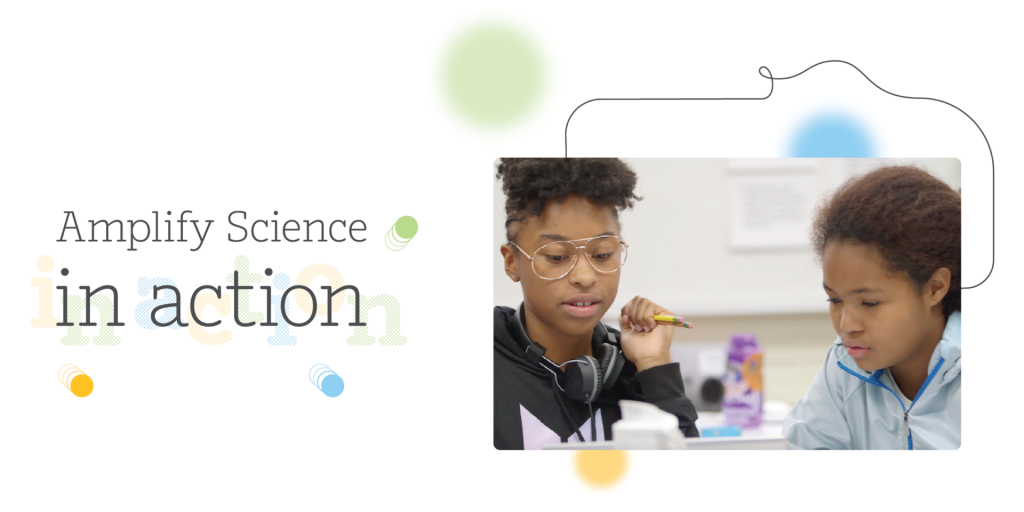
  • Dos niños están sentados en una mesa redonda en un salón de clases, mirando juntos la pantalla de una computadora portátil. Ambos parecen comprometidos y están sonriendo.
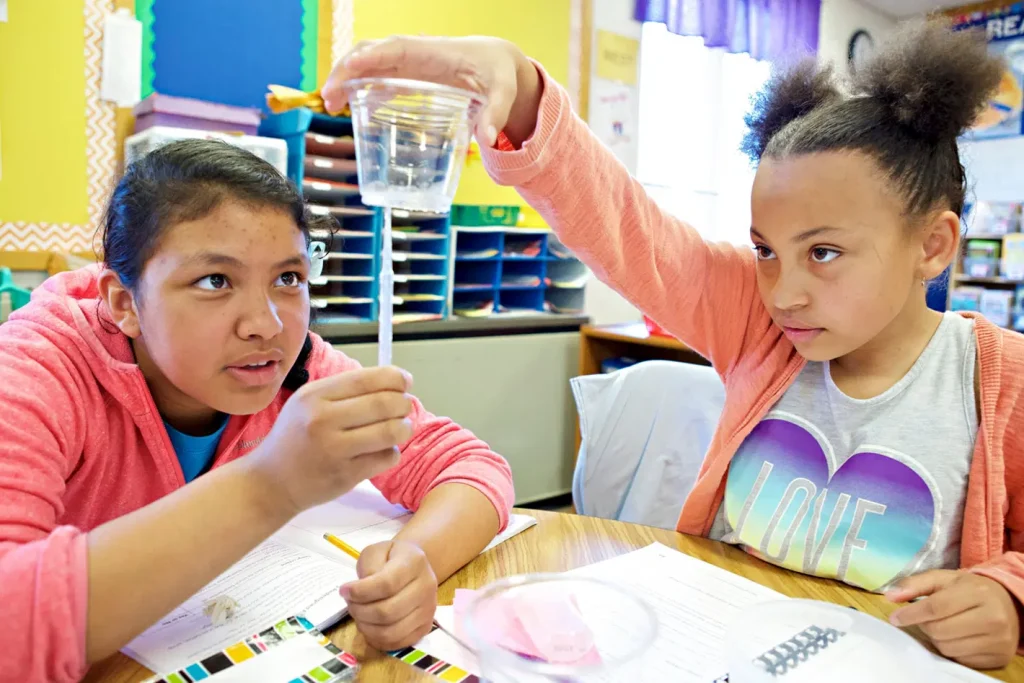
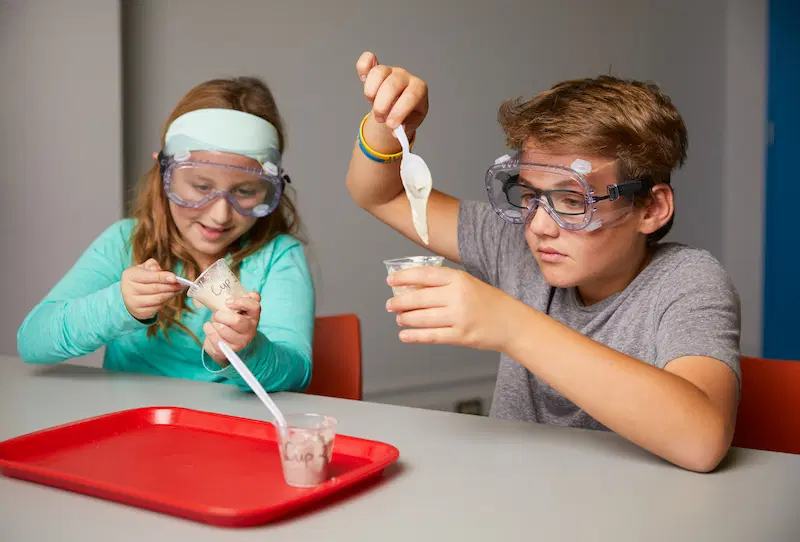
  • Dos niñas en un salón de clases realizan un experimento científico con agua y una pajita, una sostiene una taza y la otra observa. Las hojas de trabajo y los materiales están sobre la mesa.
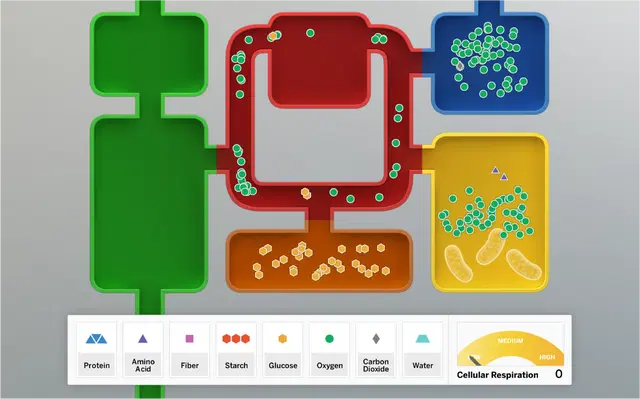
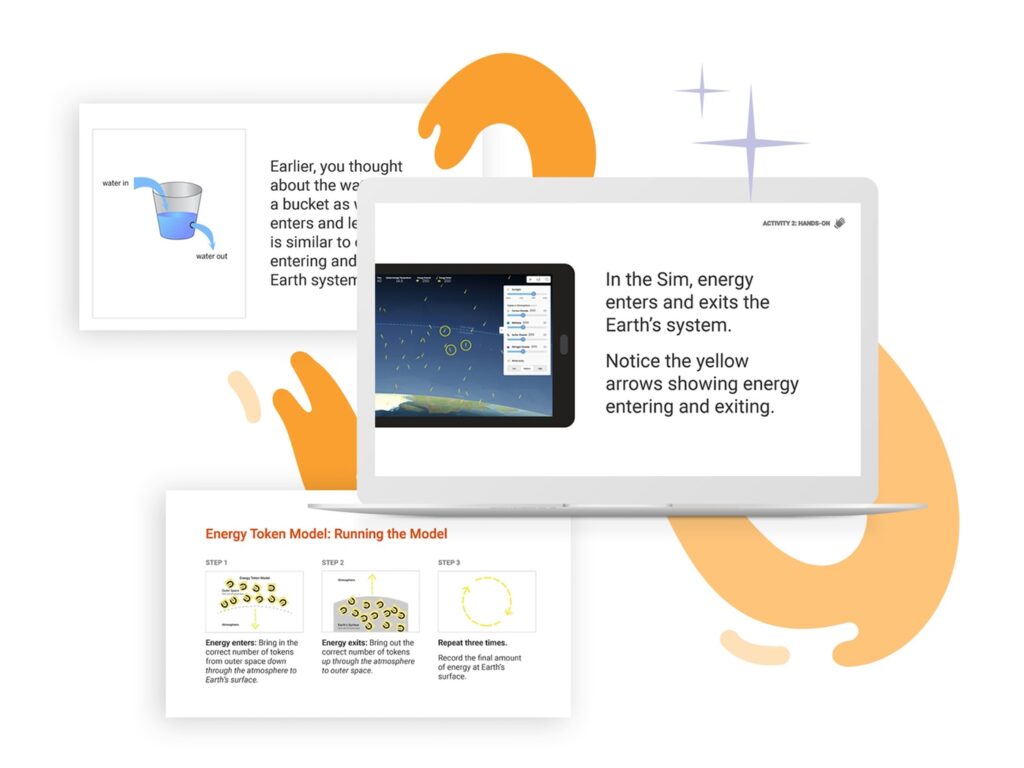
  • Ocean, Atmosphere, and Climate digital simulation

Explore Amplify Science

Explore Amplify Science

Amplify Science for elementary school

Our complete program for Grades K-5 recognizes the importance of students’ engagement with hands-on experiences, and amplifies those with literacy-rich activities, closely aligned digital materials and award-winning, informational books.

Amplify Science for middle school

Our complete program for grades 6-8 is a new curriculum that integrates the latest strategies in science teaching and learning with phenomena-driven storylines, hands-on investigations, and interactive digital tools to inspire the next generation of scientists and engineers.

Transitioning to the NGSS and 3-Dimensional Learning

Join us for the “Transitioning to the NGSS and 3-Dimensional Learning” workshop!

While at the event:

  • Build your knowledge around the NGSS and 3-Dimensional learning
  • See how Amplify Science embodies the instructional shifts
  • Enjoy lunch with colleagues and Amplify Science partners
  • Get preview access to Amplify Science K–8 for your school

Thursday, October 18, 2018
Sheraton Niagara Falls
300 3rd St
Niagara Falls, NY 14303

See the full agenda and register today!

Amplify Science California parents

Authored by UC Berkeley’s Lawrence Hall of Science, Amplify Science was designed from the ground up for the Next Generation Science Standards to teach students to think, read, write, and argue like real scientists and engineers.

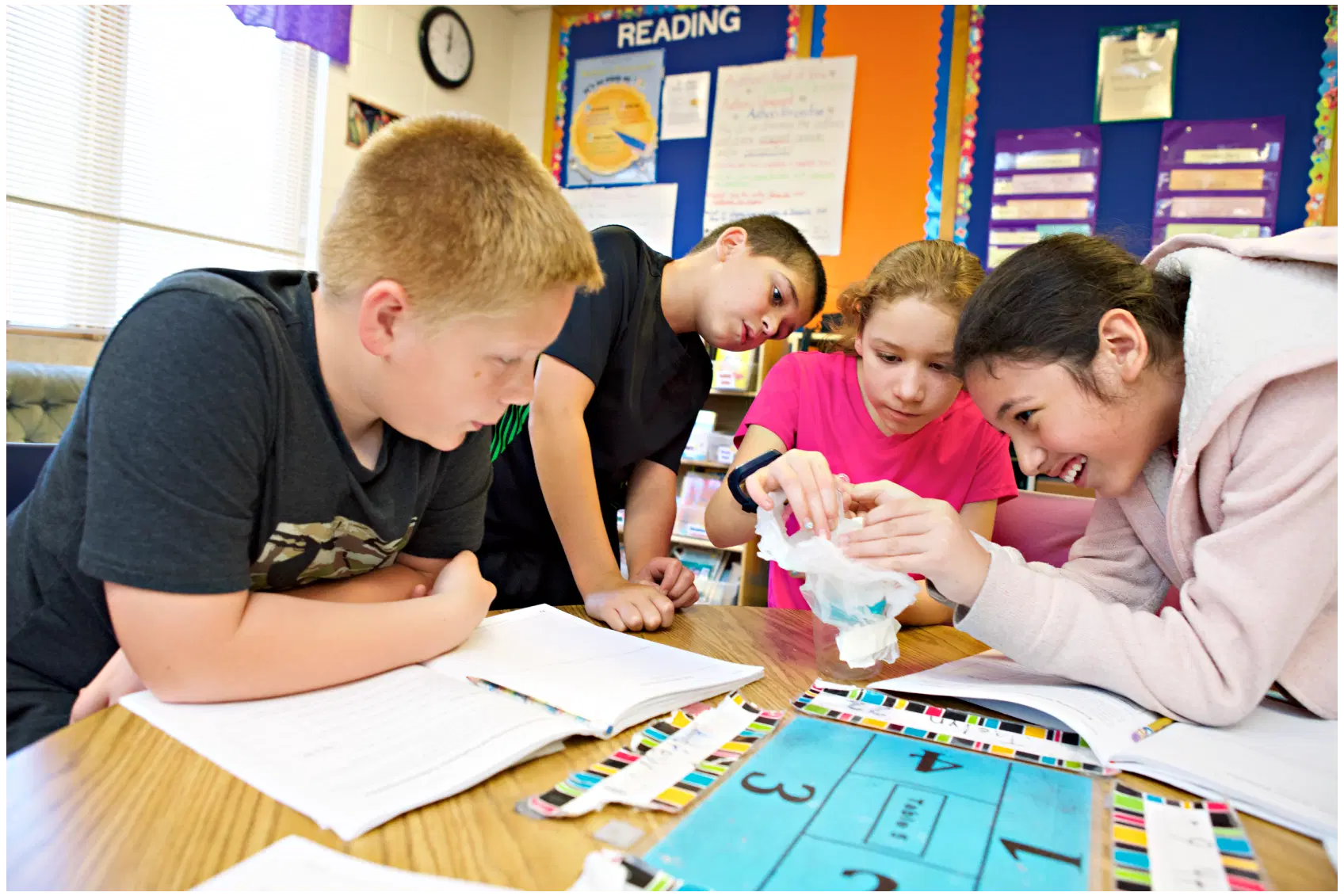
  • Four students work together to perform a scientific experiment
  • Amplify Science Student Book What My Sister Taught Me About Magnets
  • Two middle school girls conduct a science experiment
  • Ocean, Atmosphere, and Climate digital simulation

Introducing Amplify Science

The program combines literacy-rich activities with hands-on learning and digital tools to engage students in exploring a compelling real-world phenomenon in every unit.

Amplify Science K-5

Our complete program for Grades K-5 recognizes the importance of students’ engagement with hands-on experiences, and amplifies those with literacy-rich activities, closely aligned digital materials and award-winning, informational books.

Watch now

Four middle school students around a table in a classroom, engaged in a group science project with Amplify Science materials spread out in front of them.
Two girls in elementary school are using Amplify Science on a laptop

Amplify Science 6-8

Our complete program for grades 6-8, available now, was designed to meet 100 percent of the NGSS, and features curriculum units that make use of a rich collection of evidence sources, including digital simulations, engaging media, physical models and more.

Watch now

Parent letters

Help your child experience success with science by reviewing the parent letters about the content covered in each grade.

Four middle school science students gather around a desk, engaged in an interactive group project, investigating an object together in a colorful classroom setting.

Welcome to Amplify Science!

This site contains resources designed to support Clark County’s use of Amplify Science for grades K–8. Check back for exciting updates!

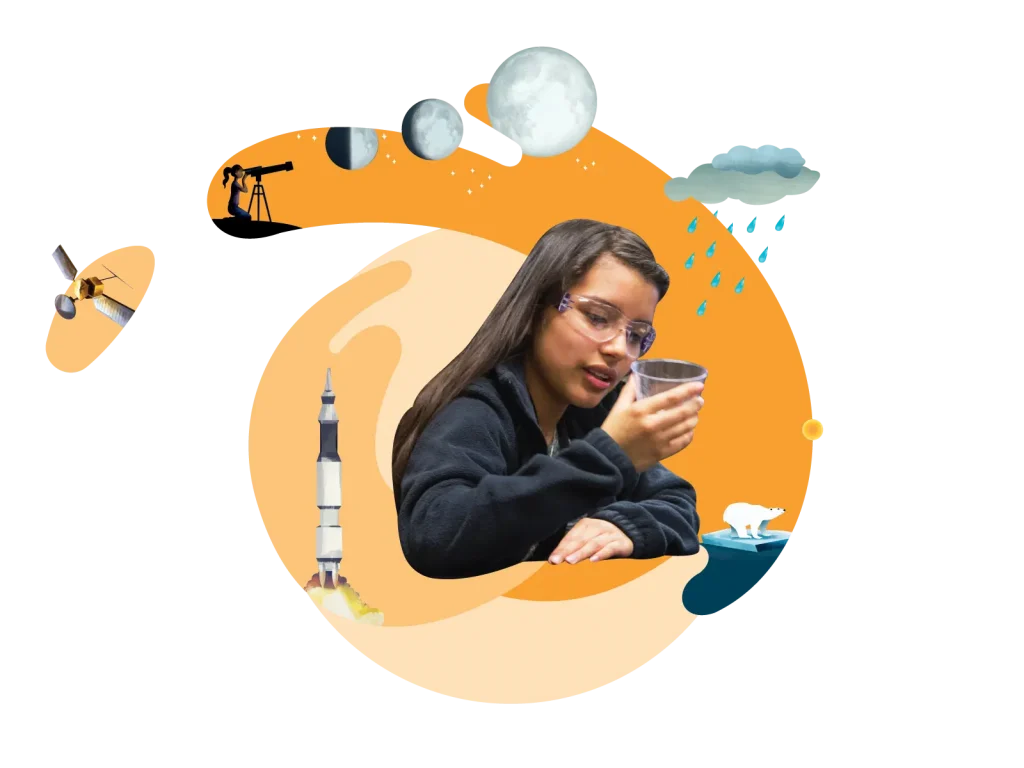
A woman holding a glass, overlaid with illustrations of a telescope, rocket, polar bear, and rain.

Program Introduction

Learn more about Amplify Science

Click the buttons below to explore the Amplify Science Program Guide. You can access the full digital Teacher’s Guide from the Program Guide to explore the program.

Clark County Training Sessions – Reference Materials

2021-2022 Session Materials

Unit 2: Standard Curriculum Relaunch / Guided Planning

New Teacher Training Part 1

2020-2021 Session Materials

New Teacher Orientation Part I

Returning and New Teacher Part II

Orientation Sessions

Remote Learning Session

Unit 2 Unpacking Session Materials

Unit 3 Unpacking the Unit Phenomenon

Unit 4 Unpacking Amplify Science for Hybrid Learning

2021-2022 Session Materials

Unit 2: Standard Curriculum Relaunch / Guided Planning

New Teacher Training Part 1

2020-2021 Session Materials

New Teacher Orientation Part I

Returning and New Teacher Part II

Orientation Sessions

Remote Learning Session

Unit 2 Unpacking Session Materials

Unit 3 Unpacking the Unit Phenomenon

Unit 4 Unpacking Amplify Science for Hybrid Learning

2021-2022 Session Materials

Unit 2: Standard Curriculum Relaunch / Guided Planning

New Teacher Training Part 1

2020-2021 Session Materials

New Teacher Orientation Part I

Returning and New Teacher Part II

Orientation Sessions

Remote Learning Session

Unit 2 Unpacking Session Materials

Unit 3 Unpacking the Unit Phenomenon

Unit 4 Unpacking Amplify Science for Hybrid Learning

2021-2022 Session Materials

Gr 8 Scope and Sequence 2021-22

2020-2021 Session Materials

Grade Level Orientation and Refresher

[Synchronous Session Agenda] LAUSD MS, Summer 21

Navigating Program Essentials

[Asynchronous Session Agenda] LAUSD MS, Summer 21

Remote Learning Session (6-8)

Grade 6

Gr 6 Scope and Sequence 2021-22

Grade 7

Gr 7 Scope and Sequence 2021-22

Grade 8

Gr 8 Scope and Sequence 2021-22

New! Lesson Prep Videos

Unit 1

Grade 3 Lesson Prep Videos can be found in the Resources section in the Amplify Science- Elementary group in Schoology. Access code: W4PK-W466-63F5B

Grade 4 Lesson Prep Videos can be found in the Resources section in the Amplify Science- Elementary group in Schoology. Access code: W4PK-W466-63F5B

Grade 5 Lesson Prep Videos can be found in the Resources section in the Amplify Science- Elementary group in Schoology. Access code: W4PK-W466-63F5B

Remote Learning Resources

We’ve created some guidance on resources you can send home with students and ways for you to adapt our K-5 or 6-8 curriculum for remote learning.

Learn more at Remote Learning Resources for Amplify Science

Onboarding: What to expect

Welcome to Amplify Science! To help you know what’s coming next, we created the following visual that outlines the steps of the onboarding process. You can use it as a reference.

Icons illustrating steps for teachers: attend workshop, log into guide, gather materials, ensure student access to tools, prepare lesson.

Onboarding videos

To start using Amplify Science quickly in your classroom, check out the following onboarding videos. They cover what you need to know to get started fast, from unpacking materials to logging in and navigating the digital Teacher’s Guide.

Unpacking your first hands-on materials kit

The following videos give you a quick look into our Amplify Science classroom kits. For each grade level, we have a video for the first unit in the scope and sequence, and we show you how to unpack the kits for all the units.

A woman in a classroom setting demonstrates a large book with illustrations while sitting at a desk. She gestures towards the book, which is held open. An orange play button overlay is centered on the image.

Looking for help?

Powerful (and free!) pedagogical support

Amplify provides a unique kind of support you won’t find from other publishers. We have developed an educational support team of former teachers and administrators who provide pedagogical support for every Amplify curriculum, assessment, and intervention program. This service is completely free for all educators who are using our programs and includes:

  • Guidance for developing lesson plans and intervention plans
  • Information on where to locate standards and other planning materials
  • Recommendations and tips for day-to-day teaching with Amplify programs
  • Support with administering and interpreting assessment data and more

To reach our pedagogical team, use our live chat within your program, call (800) 823-1969, or email edsupport@amplify.com

Timely technical and program support

Our technical and program support is included and available from 7 a.m. to 7 p.m. ET, Monday through Friday, through a variety of channels, including a live chat program that enables teachers to get immediate help in the middle of the school day.

For your most urgent questions:

  • Use our live chat within your program
  • Call our toll-free number: (800) 823-1969

For less urgent questions:

Inspiring the next generation of Massachusetts scientists, engineers, and curious citizens

Amplify Science is an engaging new core curriculum designed for three-dimensional, phenomena-based learning.

Collage of four images: a jungle illustration with a giraffe, students using computers, a boy studying with classmates, and an animated hillside with kites flying.

A powerful partnership

Amplify Science was developed by the science education experts at UC Berkeley’s Lawrence Hall of Science and the digital learning team at Amplify. This partnership extends to 2032, allowing us to continuously improve our program and provide our customers with the most up-to-date enhancements, free of charge. Get a glimpse at our latest back-to-school updates here.

Instructional model

The Amplify Science program is rooted in the proven, research-based pedagogy of Do, Talk, Read, Write, Visualize. Here’s how each element works:

Three blue panels describing educational activities: "hands-on science" with lab experiments, "discuss" with collaborative learning, and "read" with literacy in science articles.

Phenomena-based approach

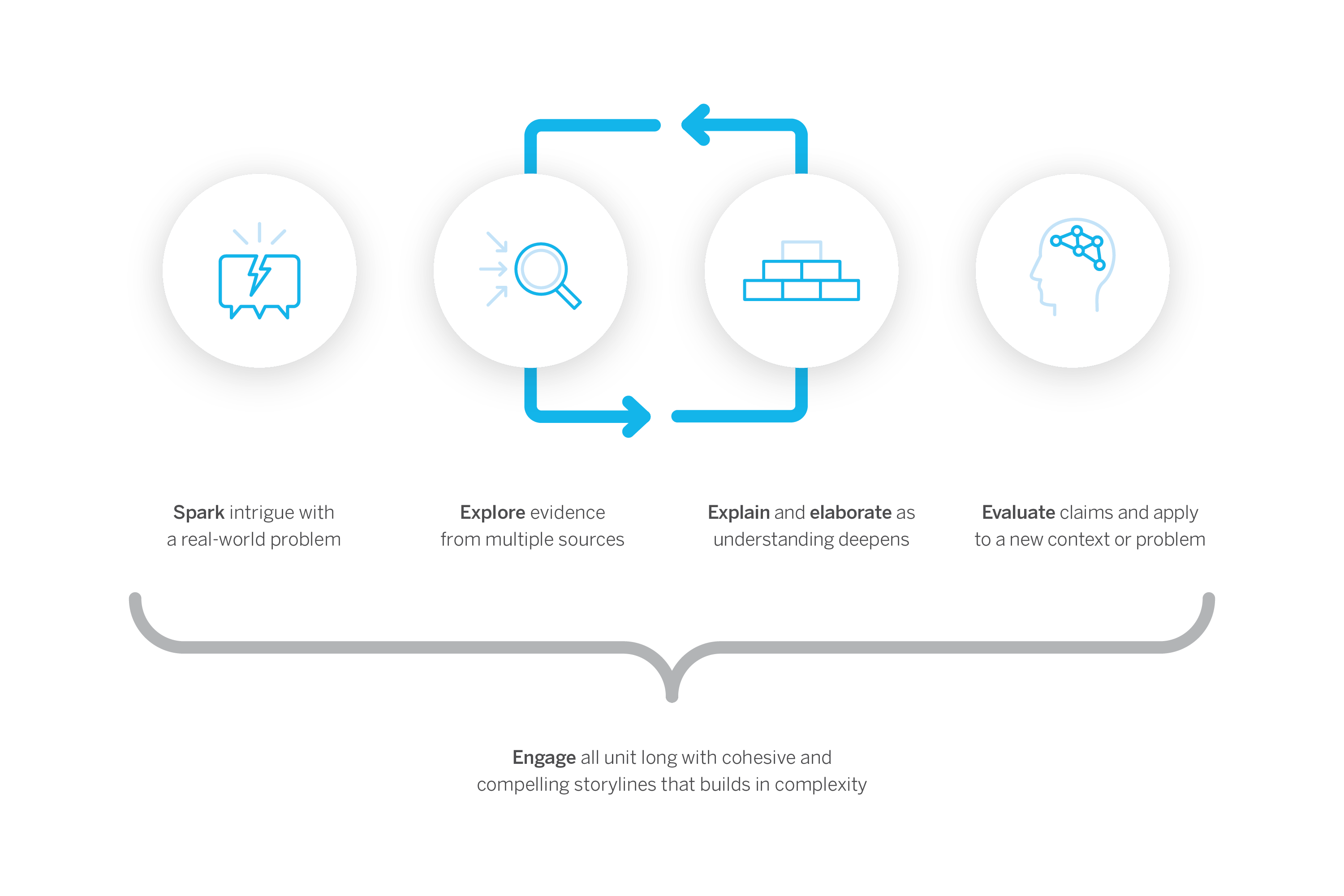
In each Amplify Science unit, students take on the roles of scientists or engineers in order to investigate a real-world problem. Students work to define the problem and collect and make sense of evidence. Once the context is clear, students collect evidence from multiple sources and through a variety of modalities. At the end of the unit, students are presented with a brand new problem, giving them an opportunity to apply what they’ve learned over the course of the unit to a new context. This represents a shift from asking students to learn about science to supporting students in figuring out the science.

Flowchart of a learning unit divided into four chapters, showing stages of student engagement from introduction to application, with assessments indicated at various points.

Resources to support your review

Scope and Sequence

GRADE

Kindergarten

UNITS

  • Needs of Plants and Animals
  • Pushes and Pulls
  • Sunlight and Water

Grade 1

  • Needs of Plants and Animals
  • Pushes and Pulls
  • Sunlight and Water

Grade 2

  • Plant and Animal Relationships
  • Properties of Materials
  • Changing Landforms

Grade 3

  • Balancing Forces
  • Inheritance and Traits
  • Environments and Survival
  • Weather and Climate

Grade 4

  • Energy Conversions
  • Vision and Light
  • Earth’s Features
  • Waves, Energy, and Information

Grade 5

  • Patterns of Earth and Sky
  • Modeling Matter
  • The Earth System
  • Ecosystem Restoration

Flexible implementation

One of the key features of Amplify Science is the flexibility that it offers. We give students authentic opportunities to experience the full breadth of what it means to be a scientist or engineer. Just as scientists gather evidence from many types of sources, so do students in our program. Like scientists, students gather evidence not just from physical models, but also from digital models, texts, videos, photographs, maps, data sets, and even their peers!
Simply put, real scientists don’t just get messy—they read, write, analyze, hypothesize, model, test, and communicate with purpose, too.

Illustration of the indirect effects of overfishing on northern benguela jelly populations displayed on a laptop screen.

Student Books
Beginning and young readers have unique developmental needs, and science instruction should support these students in reading more independently as they progress through sections of content, the school year, and each grade. One way Amplify Science meets these needs is by strategically deploying different modes of reading throughout each unit: Read-Aloud, Shared Reading, and Partner Reading.

A collage of various educational book covers related to science and math, featuring illustrated themes like sports, nature, and energy.

Student Investigation Notebooks

Available for every unit, the Student Investigation Notebooks provide space for students to:

  • record data.
  • reflect on ideas from texts and investigations.
  • construct explanations and arguments.
Collection of educational books from 'amplify science' on topics including ocean atmosphere, matter and energy ecosystems, and insect interactions, displayed in various angles.

Digital student experience

Students access the digital simulations and Modeling Tools, as well as lesson activities and assessments, through the digital student experience. Students can interact with the digital student experience as they:

  • conduct hands-on investigations.
  • engage in Active Reading and writing activities.
  • participate in discussions.
  • record observations.
  • craft end-of-unit scientific arguments.

Dive into a quick example of our powerful simulations

Grades K–5 simulation

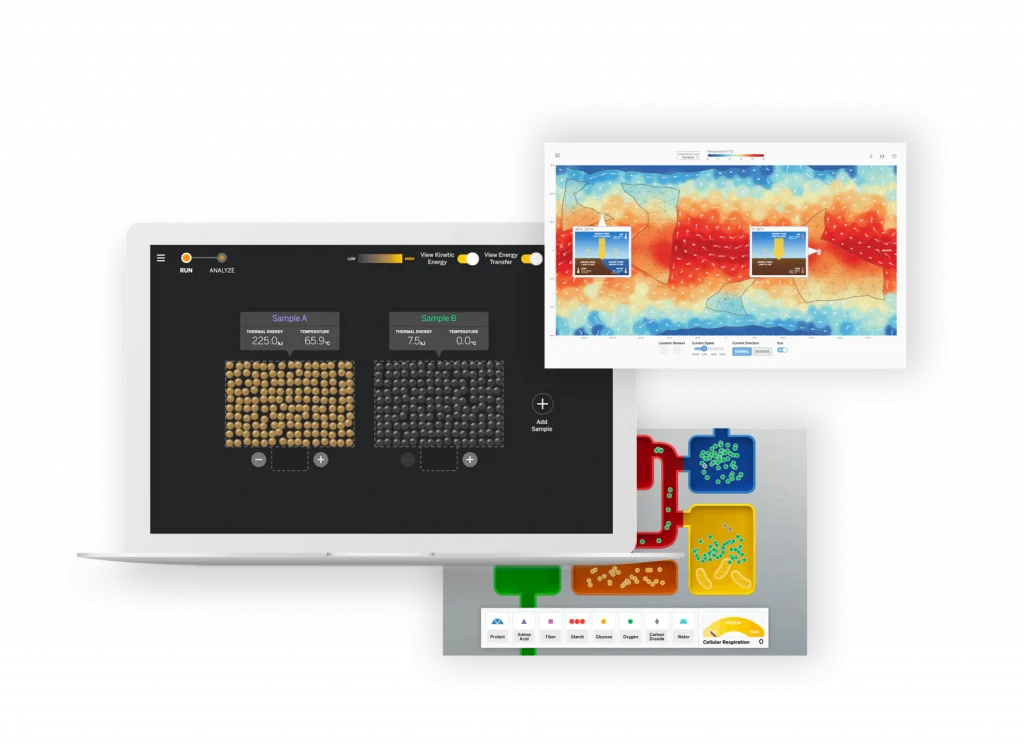
A digital illustration showcasing a laptop and a tablet displaying complex data analysis software interfaces with graphs and heatmaps.

Hands-on materials kits

Hands-on learning is at the heart of Amplify Science and is integrated
into every unit. Students actively take on the roles of scientists and engineers as they gather evidence, think critically, solve problems, and develop and defend claims about the world around them.

Check out this 2-minute video to see an Amplify Science hands-on investigation in action.

Each unit kit contains:

  • consumable and non-consumable hands-on materials.
  • print classroom display materials.
  • premium print materials for student use (sorting cards, maps, etc.).
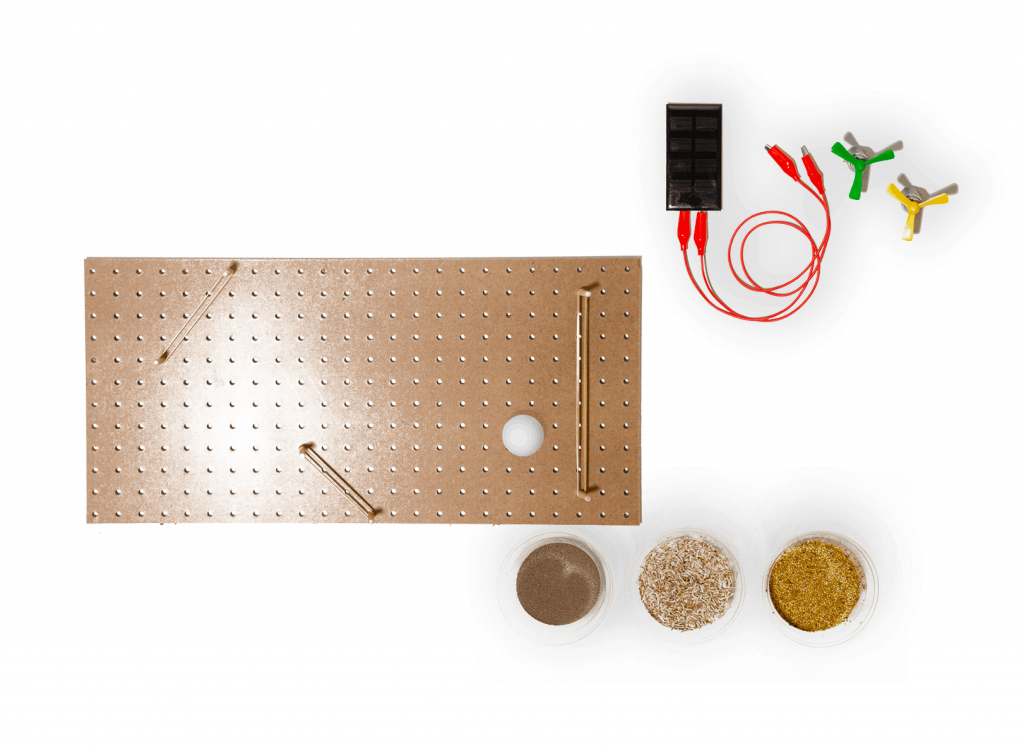
A perforated rectangular board, three small containers with different powders, a black battery holder with red wires, and three colored alligator clips are arranged on a white background.

Teaching support

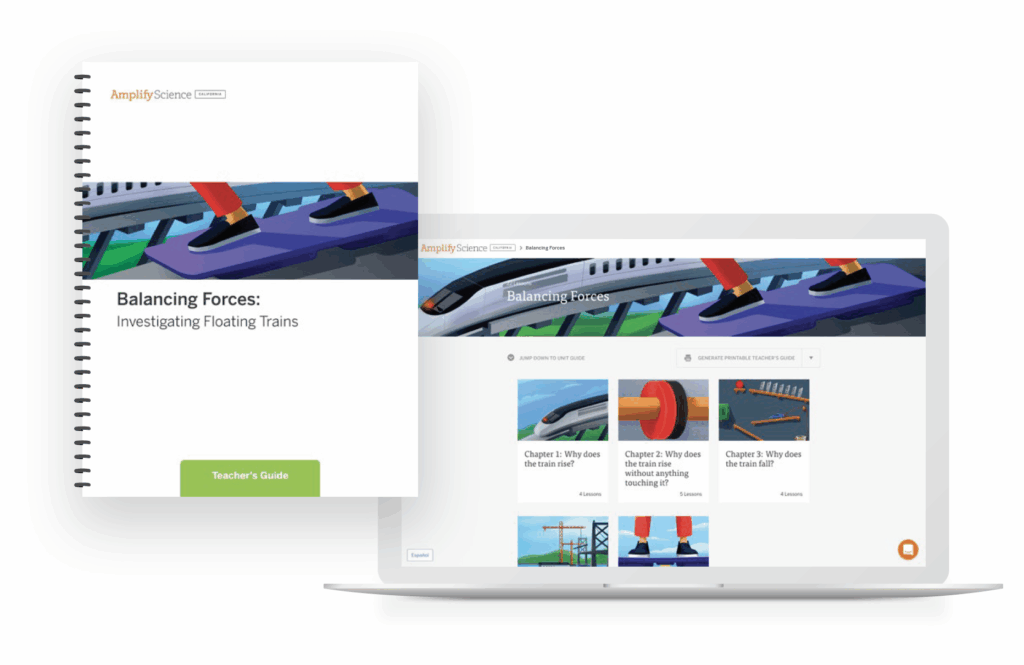
Available digitally and in print, the Teacher’s Guides contain all of the information teachers need to facilitate classroom instruction, including:

  • detailed lesson plans.
  • unit and chapter overview documentation.
  • differentiation strategies.
  • standards alignments.
  • in-context professional development.
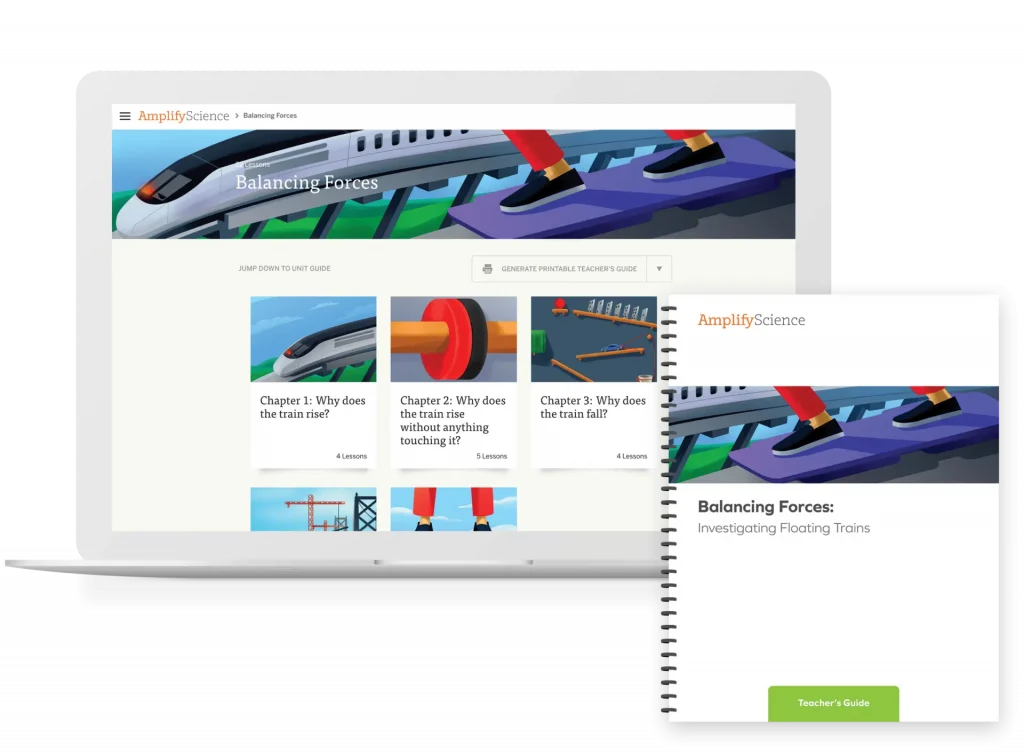
A laptop displaying the Geology on Mars webpage sits beside a book titled "Geology on Mars," both featuring the same cover image of Mars and a spacecraft, perfect for enhancing three-dimensional learning in any science classroom.

Massachusetts Academic Standards in Science coverage

Amplify Science was designed from the ground up to meet the NGSS, a set of standards that closely align with the Massachusetts Learning Standards for Science coverage. Most grade levels’ respective set of Amplify Science units therefore address the necessary MASS (see correlation). 

For grades K, 1, 2, 3, and 5, teachers should plan to also use the resources provided in the sections below to achieve full coverage of the appropriate standards before their students move on to the next grade band. Organized by grade level, each section outlines:

  • companion lesson materials that were written to support 100% alignment to the Massachusetts Learning Standards for Science coverage when used with the core Amplify Science units for the grade level
  • the standard being addressed with each companion lesson; and
  • the recommended placement of each companion lesson within a specific Amplify Science unit

Standard: K-PS1-1(MA). Investigate and communicate the idea that different kinds of materials can be solid or liquid depending on temperature.

Recommended placement: Following Lesson 5.6 of Sunlight and Weather

Resources: After students finish reflecting on their unit-long exploration of energy and temperature, play and discuss this read-aloud video of the student book Can you Change it Back?, which is featured in the grade 2 unit Properties of Materials. You might also consider borrowing the physical books from a grade 2 colleague’s Properties of Materials kit and reading it as a class instead of or in addition to playing the video.

Using the book, you will introduce students to the idea that heating and cooling can cause changes to materials. In the book, students are presented with a variety of materials and asked to predict whether a certain change caused by heating or cooling is reversible or irreversible.

Companion lesson: “Seasonal Changes”

Standard: 1-ESS1-2– Analyze provided data to identify relationships among seasonal patterns of change, including relative sunrise and sunset time changes, seasonal temperature and rainfall or snowfall patterns, and seasonal changes to the environment.

Recommended placement: Following Lesson 5.1 of Spinning Earth

Resources: Season Changes Classroom Slides and Student Sheet

Companion lesson: “Properties and Weight”

Standard: 2-PS1-3– Analyze a variety of evidence to conclude that when a chunk of material is cut or broken into pieces, each piece is still the same material and, however small each piece is, has weight. Show that the material properties of a small set of pieces do not change when the pieces are used to build larger objects.

Recommended placement: Following Lesson 4.4 of Properties of Materials.

Resources: Weight and Properties Classroom SlidesResources, and Student Sheet

Companion lesson 1: Extinct Insects

Standard: 3-LS4-1: Use fossils to describe types of organisms and their environments that existed long ago and compare those to living organisms and their environments. Recognize that most kinds of plants and animals that once lived on Earth are no longer found anywhere.

Recommended placement: Following Lesson 2.3 of Environments and Survival

Resources: Extinct Insects Classroom Slides and Student Sheet

Companion lesson 2: Friction

Standard: 3-PS2-1: Provide evidence to explain the effect of multiple forces, including friction, on an object. Include balanced forces that do not change the motion of the object and unbalanced forces that do change the motion of the object.

Recommended placement: Following Lesson 1.1 of Balancing Forces

Resources: Friction Classroom SlidesResources, and Student Sheet

Companion lesson 1: Composters

Standard: 5-LS2-2(MA)– Compare at least two designs for a composter to determine which is most likely to encourage decomposition of materials.

Recommended placement: Following Lesson 3.7 of Ecosystem Restoration

Resources: Composters Classroom Slides and Student Sheet

Companion lesson 2: Properties of Materials

Standard: 5-PS1-3 (MA) – Make observations and measurements of substances to describe characteristic properties of each, including color, hardness, reflectivity, electrical conductivity, thermal conductivity, response to magnetic forces, and solubility.

Recommended placement: Following Lesson 1.3 of Modeling Matter

Resources: Properties of Materials Classroom SlidesResourcesArticlesCopymaster, and Student Sheet

Companion lesson 3: Water Filters

Standard: 5-ESS3-2(MA)– Test a simple system designed to filter particulates out of water and propose one change to the design to improve it.

Recommended placement: Following Lesson 5.6 of The Earth System

Resources: Water Filters Classroom Slides and Student Sheet

Benchmark Assessments

Amplify’s Benchmark Assessments are designed to help teachers measure student progress toward the three dimensions—Disciplinary Core Ideas (DCIs), Science and Engineering Practices (SEPs), and Crosscutting Concepts(CCCs)—and performance expectations (PEs) of the NGSS. The assessments provide important insight into how students are progressing toward mastery of different standards ahead of high-stakes, end-of-year assessments.

The Benchmark Assessments are built to be delivered after specific units in the recommended Amplify Science scope and sequence.* They are given three or four times per year, depending on the grade level. The benchmarks are intended to show progress at various points in time across a school year, and are therefore not summative in nature. Digital items and item clusters are also tagged to specific NGSS standards, allowing customization to align with other course sequences. The assessments are available via the following platforms:

Print
PDF files: For administering Benchmark Assessments on paper

Digital platforms

  • Illuminate
  • SchoolCity
  • Otus
  • QTI (“Question and Test Interoperability”) files
    Not sure whether QTI files are compatible with your assessment platform? Contact your school IT or assessment platform representative for more information.
    Please note that Amplify is able to provide access to the QTI files themselves, but is not able to support the integration process. Your assessment platform provider should be able to assist with QTI file integration.

Remote and hybrid learning support

A child sits at a desk using a laptop. Next to the desk is a bookshelf with books, a fishbowl, and a soccer ball.

See an example of our remote and hybrid learning support below:

Intended to make extended remote and hybrid learning easier, Amplify Science @Home includes two useful options for continuing instruction: @Home Videos and @Home Units.
Amplify Science @Home Videos are recordings of real Amplify Science teachers teaching the lessons. For those teachers who are unable to meet synchronously with their students, the recorded lessons are a great way to keep their students on track and engaged with Amplify Science while at home.

Amplify Science @Home Units are modified versions of Amplify Science units, strategically designed to highlight key activities from the program. The @Home Units take significantly less instructional time than the complete Amplify Science program and allow students to engage with science at home. Each @Home unit includes:

  • Teacher overviews explaining how to use the materials, including suggestions for enhancing the @Home Units if synchronous learning or in-class time with students is available
  • Overviews to send home to families

Student materials will be available in two formats:

  • @Home Slides (PDF/PPT) + Student Sheets (PDF) for students with access to technology at home
  • Downloadable @Home Packets (PDF) for students without access to technology at home

Download the remote and hybrid learning guide

Explore the digital Teacher’s Guide

To familiarize yourself with navigation of the digital Teacher’s Guide, watch our navigational guide videos:

Grades K–5:

Looking for help?

Powerful (and free!) pedagogical support

Amplify provides a unique kind of support you won’t find from other publishers. We’ve developed an educational support team of former teachers and administrators who provide pedagogical support for every Amplify curriculum, assessment, and intervention program. This service is completely free for all educators who are using our programs and includes:

  • Guidance for developing lesson plans and intervention plans.
  • Information on where to locate standards and other planning materials.
  • Recommendations and tips for day-to-day teaching with Amplify programs.
  • Support with administering and interpreting assessment data and more.

Timely technical and program support

Our technical and program support is included and available Monday through Friday, from 7 a.m. to 7 p.m. ET, through a variety of channels, including a live chat program that enables teachers to get immediate help in the middle of the school day.

Ready to dive in?

Contact your Massachusetts representative:

Tracy Yefimenko
518-466-3497
tyefimenko@amplify.com

Amplify Science resources for Richmond Public Schools

Welcome! This site contains supporting resources designed for the Richmond Public Schools adoption of Amplify Science.

Authored by UC Berkeley’s Lawrence Hall of Science, Amplify Science is a comprehensive program that blends literacy-rich activities, hands-on investigations, and engaging digital experiences to empower Richmond students to think, read, write, and argue like 21st-century scientists and engineers.

Click here to visit Richmond Public Schools’ Science Department page.

Welcome!

This site contains supporting resources designed for the Richmond Public Schools adoption of Amplify Science for grades 3–8. Here are some resources to get you started, but make sure to check back for exciting updates!

Program-wide resources

Click the button below to explore the Amplify Science  Program Guide. You can access the full digital Teacher’s Guide from the Program Guide to explore the program.

Onboarding videos

To start using Amplify Science quickly in your classroom, check out the following onboarding videos. They cover what you need to know to get started fast, from unpacking materials to logging in and navigating the digital Teacher’s Guide.

Getting Started: K-5

This section allows you to become familiar with the program and to guide you through initial preparation for implementing Amplify in your classrooms. here you will find look-for-tools, pacing/planning guides, and editable documents to support unpacking the unit lessons.

The following materials lists and videos give you a quick look into our Amplify Science classroom kits. For each grade level, we have a video for the first unit in the scope and sequence, and we show you how to unpack the kits for all the units.

NOTE: These materials kits are not specific to the Richmond unit progression. Please reference these Richmond unit progression docs for 3–5 and 6–8 so you’ll know which kits to look for in each grade.

Materials lists

Unpacking videos

Getting Started: 6-8

This section allows you to become familiar with the program and to guide you through initial preparation for implementing Amplify in your classrooms. here you will find look-for-tools, pacing/planning guides, and editable documents to support unpacking the unit lessons.

The following materials lists and videos give you a quick look into our Amplify Science classroom kits. For each grade level, we have a video for the first unit in the scope and sequence, and we show you how to unpack the kits for all the units.

NOTE: These materials kits are not specific to the Richmond unit progression. Please reference these Richmond unit progression docs for 3–5 and 6–8 so you’ll know which kits to look for in each grade.

Materials lists

Unpacking videos

6th grade Integrated

7th grade Integrated/Physical science

Additional units

Getting Started: Admin

Admin resources

Getting Started Checklist

Administrator Reports support

K-5 Frequently-Asked Questions

6-8 Frequently-Asked Questions

Professional learning opportunities

Check back for a list of upcoming sessions!

Frequently asked questions

We get it…pacing your instruction, especially with a new program, can be really challenging. In Amplify Science, students internalize concepts through repeated exposures over multiple days with different modalities. We say students get multiple “at-bats” with each concept. As you move through the lessons, avoid looking for concept mastery each day. Instead, try to move through the lesson according to the timing guidelines, maintaining a quick pace.

In classroom discussion activities in particular, you may be tempted to keep the conversation going to ensure that your students fully master the content in that class period. We recommend, though, if the lesson overview says discuss for 10 minutes, cut it off at 10 minutes.

Every Amplify Science unit includes hands-on investigations. But, just as scientists gather evidence from many types of sources, so do students in Amplify Science. Like scientists, students using Amplify Science also gather evidence from physical models, digital models, texts, videos, photographs, maps, and data sets. Doing so requires using the full range of the practices in multi-dimensional learning. It also offers students different ways of acquiring knowledge and experience, multiple means of expressing their understanding, and a variety of resources through which to engage with the content.

Often, students enjoy hands-on investigations, but don’t sufficiently learn key concepts from those experiences. The Amplify Science investigations are designed for efficiency and effectiveness. For teachers who wish to supplement the lessons with more hands-on activities, optional hands-on “flextension” activities are included in many units. Instructional guidance, student sheets, and other supporting resources for them are included as downloadable PDF files and materials needed are either included in the unit kit or easily sourced.

First, take a breath, and know that you will gradually internalize the program routines and overall flow. Also, remember that your students are experiencing the program for the first time with you. Together, you’ll be peeling the onion one layer at a time.

It can be intimidating to begin the school year with a brand-new curriculum: where do you start? The Richmond Resources Site will help you navigate the different supports and resources we have for new Amplify Science teachers. 

The Program Hub is also a great place to direct your own, independent learning about Amplify Science instruction. Once you log into the platform, click on the directory on the top left side. Click into the Program Hub, then Professional Learning, and Getting Started. This will give you access to prioritized resources that will help you plan for your Amplify Science instruction. Additionally, the Amplify Science Help center (also accessible from the Global Navigation menu) is great for short videos about specific topics like supporting EL students, using Classwork, etc.

The variety of multimodal activities that are included in Amplify Science provides students with the opportunity to dive deeply into understanding science ideas, make science exciting to students, and allow for all students to have the benefit of multiple opportunities to access rich science content. Think about how many times you’ve taught a concept and then discovered your students had minimal recall at the end of the week. The truth is, students need multiple, varied exposures to key concepts.

In the program, we make sure that students have the opportunity to DO, TALK, READ, WRITE, and VISUALIZE every important idea. We think of this as providing students with multiple at bats— each encounter with the idea provides students with additional evidence, and the opportunity to develop deeper understanding. Students have multiple opportunities to construct their understanding of the same idea.

This multimodality may feel repetitive, but it is purposeful and impactful. Sometimes the repetition is for 1) hitting other Science and Engineering Practices, and/or 2) giving students multiple and varied opportunities to express their understanding. Many students can easily parrot back what they read and one may think they know it — but ask them to draw a model, and one might see that their understanding is only so deep.  Ultimately we believe that this approach not only serves a broader range of students but will also result in more retention in the long run.

Looking for help?

Technical or pedagogical support

Amplify provides a unique kind of free support you won’t find from other publishers. Technical and pedagogical support teams are available from 7 a.m. to 7 p.m. ET, Monday through Friday.

For your most urgent questions:

  • Use our live chat within your program
  • Call our toll-free number: (800) 823-1969

For less urgent questions, send us an email!

  • Technical support: help@amplify.com
  • Pedagogical support: edsupport@amplify.comWhat is pedagogical support? We have developed an educational support team of former teachers and administrators who provide pedagogical support for every Amplify curriculum, assessment, and intervention program. This service is completely free for all educators who are using our programs and includes:
    • Guidance for developing lesson plans and intervention plans
    • Information on where to locate standards and other planning materials
    • Recommendations and tips for day-to-day teaching with Amplify programs
    • Support with administering and interpreting assessment data and more

Order exceptions

If you need to arrange for the return or exchange of items, contact help@amplify.com and be sure to identify yourself as a Richmond Public Schools teacher.

Welcome to Amplify Science 6–8!

Amplify Science is an engaging core curriculum designed for three-dimensional, phenomena-based learning.

With Amplify Science, Oregon students don’t just passively learn about science concepts. Instead, they take on the role of scientists and engineers to actively investigate and figure out real-world phenomena. They do this through a blend of cohesive and compelling storylines, hands-on investigations, collaborative discussions, literacy-rich activities, and interactive digital tools.

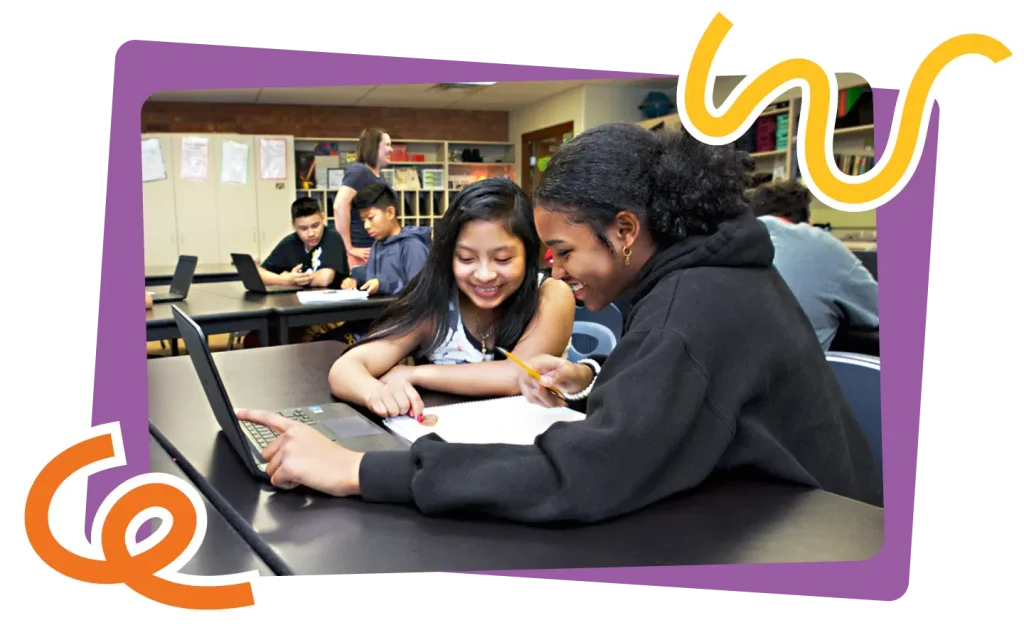
Two students, one black and one asian, smiling and studying together at a laptop in a classroom with other students in background.

Publisher presentation

The Lawrence Hall of Science

Developed by the science education experts at UC Berkeley’s Lawrence Hall of Science and the digital learning team at Amplify, our program features:

  • phenomena-based approach where students construct a complex understanding of each unit’s anchor phenomenon.
  • A blend of cohesive storylines, hands-on investigations, rich discussions, literacy-rich activities, and digital tools.
  • Carefully crafted units, chapters, lessons, and activities designed to deliver true 3-dimensional learning.
  • An instructional design that supports all learners in accessing all standards.
Aerial view of the lawrence hall of science at the university of california, berkeley, showcasing the building and surrounding trees with a foggy city backdrop.

Proven to work

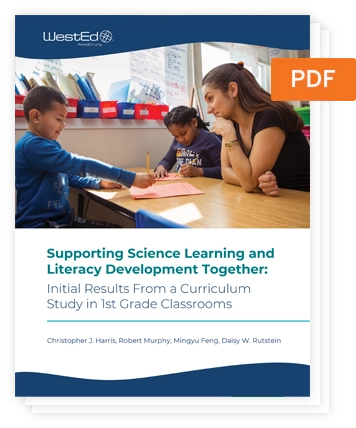
A pdf cover from wested titled "learning and literacy development together: initial results from a curriculum study," featuring an adult helping children with schoolwork in a classroom.

WestEd Randomized
Control Trial for Grade 1

Read More

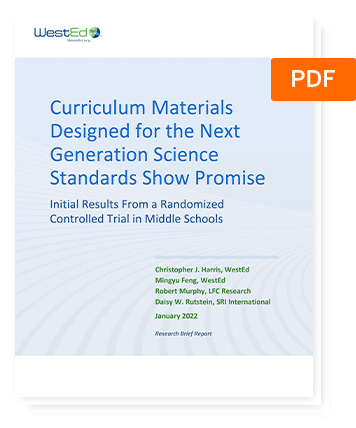
Pdf cover titled "curriculum materials designed for the next generation science standards: initial results from gold standard research trials", published by wested.

WestEd Randomized
Control Trial for Grade 7

Read More

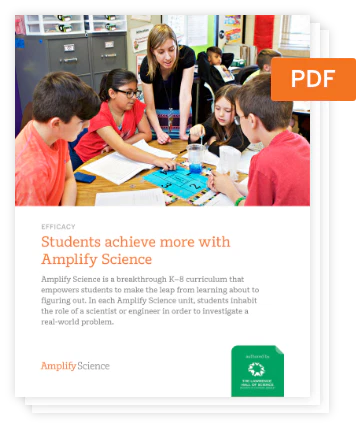
A teacher and students engage in a science activity around a table. The text promotes the Amplify Science K–8 curriculum, highlighting its focus on hands-on learning and real-world problem-solving.

Amplify Science NE
Grades K–5

Read More

Instructional model

The Amplify Science program is rooted in the proven, research-based pedagogy of Do, Talk, Read, Write, Visualize. Here’s how each element works:

Do

First-hand investigations are an important part of any science classroom, and Amplify Science has students getting hands-on in every unit—from building models of protein molecules to experimenting with electrical systems.

Talk

Student-to-student discourse and full-class discussions are an integral part of the program. Students are provided with numerous opportunities to engage in meaningful oral scientific argumentation, all while fostering a collaborative classroom environment.

Read

Students read scientific articles, focusing their reading activities on searching for evidence related to their investigation and, importantly, on asking and recording questions as they read through fascinating texts on 21st-century topics.

Write

Following real-world practices, students write scientific arguments based on evidence they’ve collected, making clear their reasoning about how a given piece of evidence connects to one of several claims.

Visualize

By manipulating digital simulations and using modeling tools to craft visualizations of their thinking— just as real scientists and engineers
do—students take their learning far beyond the confines of what they can physically see in the classroom in an exciting and authentic way.

Program structure

Our cyclical lesson design ensures students receive multiple exposures to concepts through a variety of modalities. As they progress through the lessons within a unit, students build and deepen their understanding, increasing their ability to develop and refine complex explanations of the unit’s phenomenon.

It’s this proven program structure and lesson design that enables Amplify Science to address 100% of the NGSS, and support students in mastering the Oregon Science Standards.

Flowchart depicting a critical thinking process with four circular nodes connected by arrows, each node representing a step: posing a real-world problem, exploring evidence, elaborating concepts, and evaluating claims.

Unit types

While every unit delivers three-dimensional learning experiences and engages students in gathering evidence from a rich collection of sources, each unit also serves a unique instructional purpose.

In grades 6–8:

  • One unit is a launch unit.
  • Three units are core units.
  • Two units are engineering internships.

Launch units are the first units taught in each year of Amplify Science. The goal of the Launch unit is to introduce students to norms, routines, and practices that will be built on throughout the year, including argumentation, active reading, and using the program’s technology. For example, rather than taking the time to explain the process of active reading in every unit in a given year, it is explained thoroughly in the Launch unit, thereby preparing students to read actively in all subsequent units.

Core units establish the context of the unit by introducing students to a real-world problem. As students move through lessons in a Core unit, they figure out the unit’s anchoring phenomenon, gain an understanding of the unit’s disciplinary core ideas and science and engineering practices, and make linkages across topics through the crosscutting concepts. Each Core unit culminates with a Science Seminar and final writing activity.

Engineering Internship units invite students to design solutions for real-world problems as interns for a fictional company called Futura. Students figure out how to help those in need, from tsunami victims in Sri Lanka to premature babies, through the application of engineering practices. In the process, they apply and deepen their learning from Core units.

Unit sequence

Our lessons follow a structure that is grounded in regular routines while still being flexible enough to allow for a variety of learning experiences.

In fact, our multi-modal instruction offers more opportunities for students to construct meaning, and practice and apply concepts than any other program. What’s more, our modular design means our units can be flexibly arranged to support your instructional goals.

Three columns listing education curriculum topics for grades 6, 7, and 8, focusing on science themes such as microbiomes, mars geology, and harnessing human energy.

Program components

Available digitally and in print, our unit-specific reference guides are chock full of helpful resources, including scientific background knowledge, planning information and resources, color-coded 3D Statements, detailed lesson plans, tips for delivering instruction, and differentiation strategies.

Amplify Science TG

Hands-on learning is an essential part of Amplify Science, and is integrated into every unit. Students actively participate in science, playing the roles of scientists and engineers as they gather evidence, think critically, solve problems, and develop and defend claims about the world around them. Every unit includes hands-on investigations that are critical to achieving the unit’s learning goals.

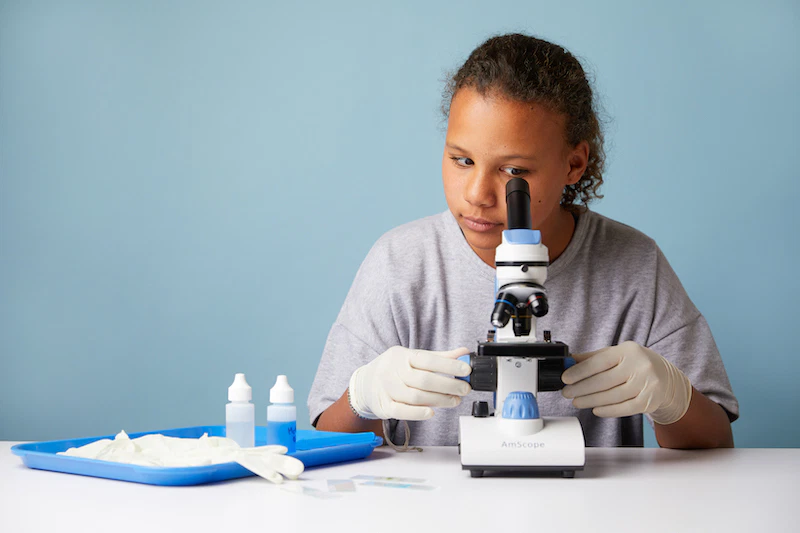
A young person wearing gloves looks through a microscope at a table with laboratory supplies, including bottles, slides, and a tray, against a plain blue background.

More hands-on with Flextensions:
Hands-on Flextensions are additional, optional investigations that are included at logical points in the learning progression and give students an opportunity to dig deeper if time permits. These activities offer teachers flexibility to choose to dedicate more time to hands-on learning. Materials referenced in Hands-on Flextension activities will either be included in the unit kit or are easily sourced. Supporting resources such as student worksheets will be included as downloadable PDF files.

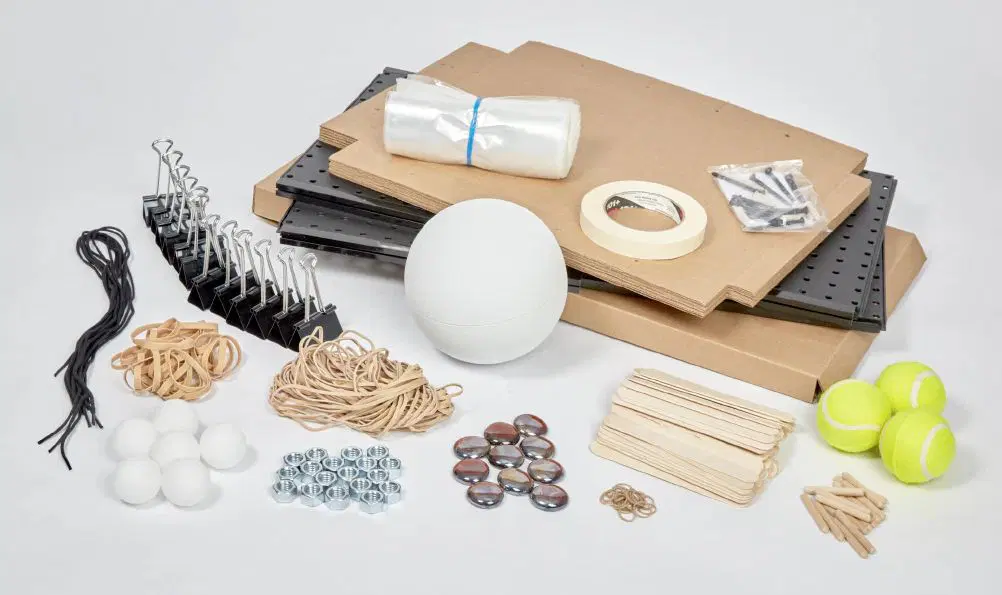
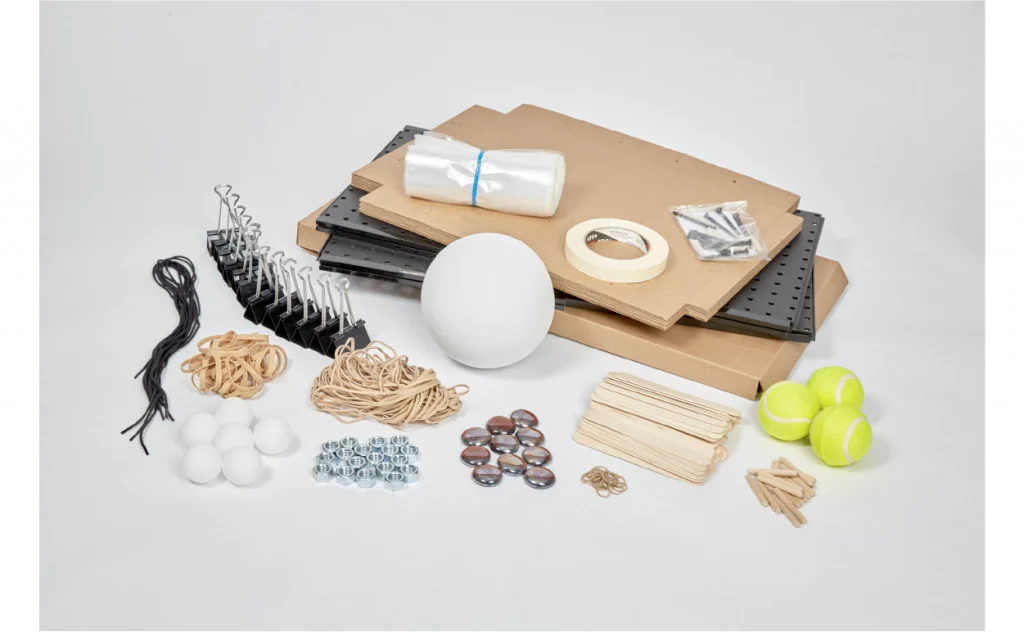
Assorted office and household items displayed on a white background, including rubber bands, binder clips, cardboard, and sports balls.

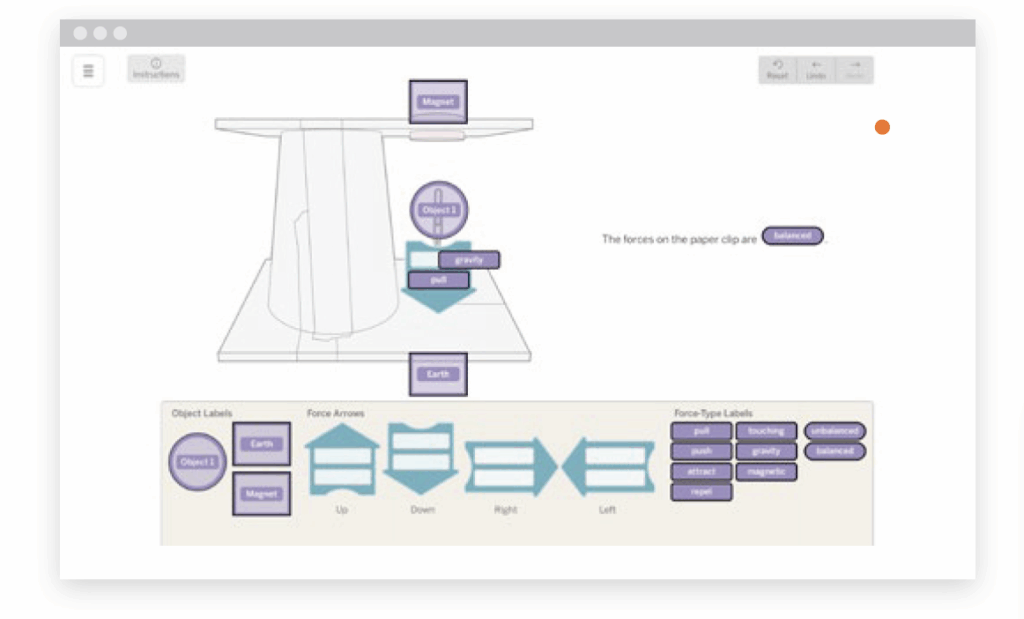
Our digital Simulations and Practice Tools are powerful resources for exploration, data collection, and student collaboration. They allow students the ability to explore scientific concepts that might otherwise be invisible or impossible to see with the naked eye.

Available for every unit, our Student Investigation Notebooks contain instructions for activities and space for students to record data and observations, reflect on ideas from texts and investigations, and construct explanations and arguments.

In grades 6–8, one copy of the Student Investigation Notebook is included in each unit’s materials kit for use as a blackline master. Each notebook is also available as a downloadable PDF on the Unit Guide page of the digital Teacher’s Guide.

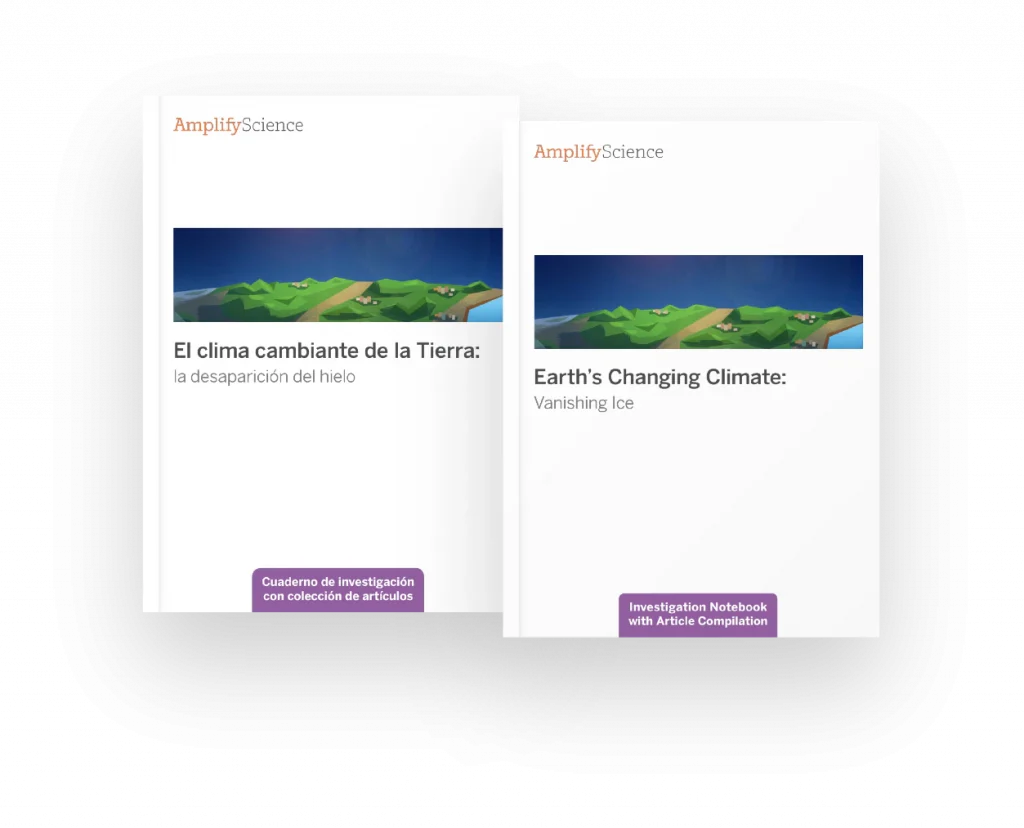
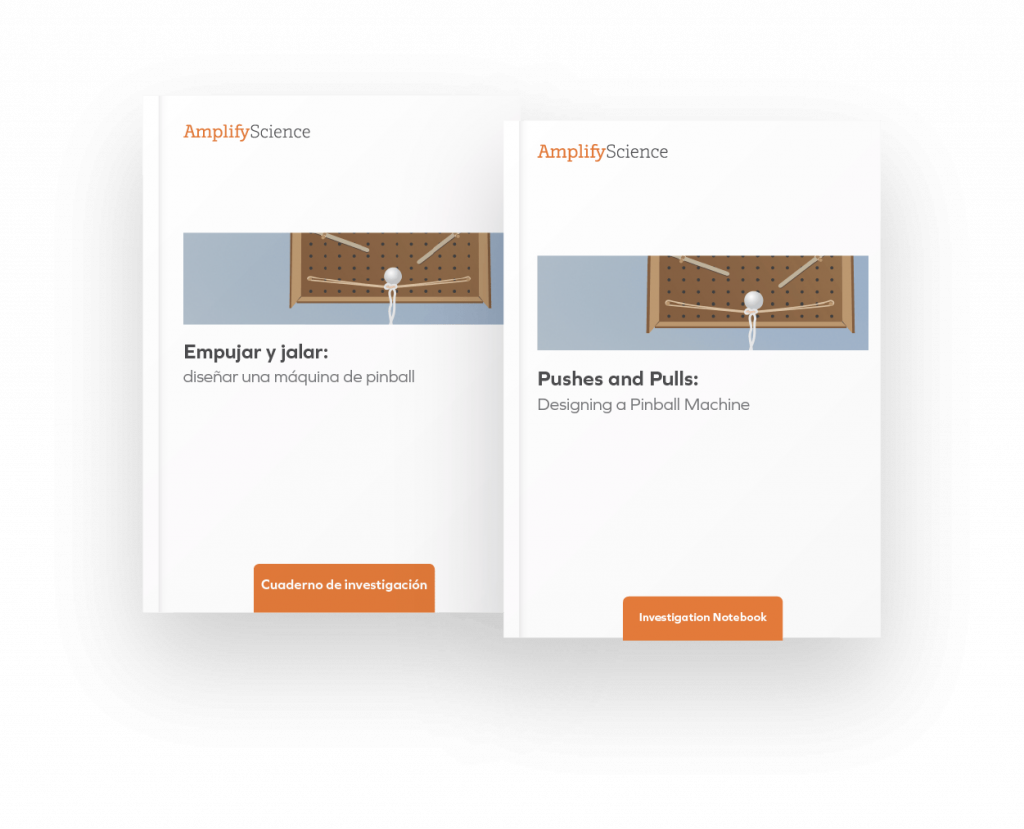
Two booklets titled "El clima cambiante de la Tierra: la desaparición del hielo" and "Earth’s Changing Climate: Vanishing Ice" with landscape illustrations on the covers.

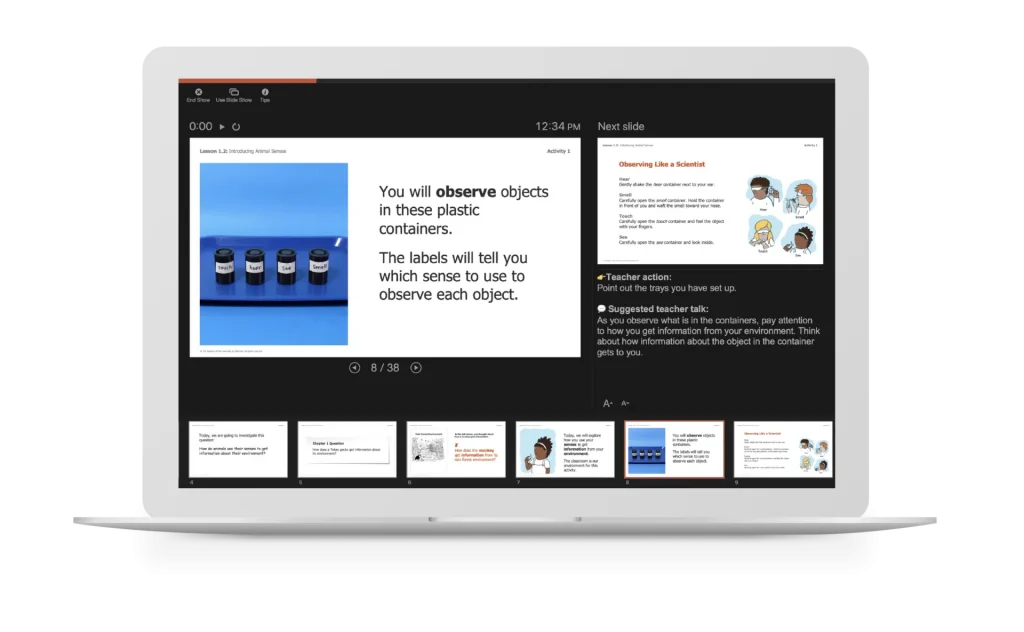
These customizable PowerPoints are available for every lesson of the program and make delivering instruction a snap with visual prompts, colorful activity instructions, investigation set-up videos and animations, and suggested teacher talk in the notes section of each slide.

Amplify Science Classroom Slides

Full coverage of the Oregon Science Standards

Amplify Science was designed from the ground up to meet the Next Generation Science Standards (NGSS). As such, it aligns to the Oregon Science Standards, which were also borne out of the NGSS.

The guidance below is meant to provide support for integrating additional activities that support full coverage of Oregon’s standards. Organized by grade level, each section below will outline:

  • Additional activities that support 100% alignment to the Oregon Science Standards.
  • The standard being addressed with the activities.
  • The recommended placement of the activities within a specific Amplify Science unit.
  • PDFs of any accompanying materials that are necessary to implement the activities.

Activity Title: Meet a Scientist Who Changed How We Think About Brain Cells

About this activity: In this activity, students read a short article about a scientist who studied the nervous system.

Recommended placement: Metabolism unit, Lesson 3.2

Materials:

Instructions: Download the PDF “Meet a Scientist Who Changed How We Think About Brain Cells” above and remind students of the Active Reading guidelines. Before students read the article, invite them to share prior experiences. Then have students complete the copymaster above.

Activity Title: Meet a Scientist Who Studies Underwater Currents

About this activity: In this activity, students read a short article about a scientist who studies ocean currents.

Recommended placement: Oceans, Atmosphere, and Climate unit, Lesson 2.1

Materials:

Instructions: Download the PDF “Meet a Scientist Who Studies Underwater Currents” above and remind students of the Active Reading guidelines. Before students read the article, invite them to share prior experiences. Then have students complete the copymaster above.

Activity Title: Meet a Scientist Who Studies How the Environment Affects Our Traits

About this activity: In this activity, students read two short articles, one about current research on genes and proteins, and one about a scientist who is studying how the environment can affect our traits.

Recommended placement: Traits and Reproduction unit, Lesson 2.4

Materials:

Instructions: Download the PDF “Meet a Scientist Who Studies How the Environment Affects Our Traits” above and remind students of the Active Reading guidelines. Before students read the article, invite them to share prior experiences. Then have students complete the copymaster above.

Activity Title: Who Becomes a Space Scientist?

About this activity: In this activity, Students read a short article about a scientist who studies space.

Recommended placement: Geology on Mars unit, Lesson 3.1

Materials:

Instructions: Download the PDF “Who Becomes a Space Scientist?” above and remind students of the Active Reading guidelines. Before students read the article, invite them to share prior experiences. Then have students complete the copymaster above.

Activity Title: Meet a Scientist Who Studies How Plants Find Water Underground

About this activity: In this activity, students read a short article about a scientist who studies how plants’ roots get water.

Recommended placement: Matter and Energy in Ecosystems unit, Lesson 1.6

Materials:

Instructions: Download the PDF “Meet a Scientist Who Studies How Plants Find Water Underground” above and remind students of the Active Reading guidelines. Before students read the article, invite them to share prior experiences. Then have students complete the copymaster above.

Activity Title: Bringing Back the Buffalo

About this activity: In this activity, students change one competing population to try to decrease the other in the Sim, and read a short article about a scientist who studies buffalo.

Recommended placement: Populations and Resources unit, Lesson 3.2

Materials:

Instructions: Download the PDF “Bringing Back the Buffalo” above and remind students of the Active Reading guidelines. Before students read the article, invite them to share prior experiences. Then have students complete the copymaster above.

Activity Title: Rereading “A Continental Puzzle”

About this activity: In this activity, students reread “A Continental Puzzle” and think about how patterns were helpful to Wegener’s work.

Recommended placement: Plate Motion unit, Lesson 3.2

Materials:

Instructions: Direct students back to “A Continental Puzzle” above and remind students of the Active Reading guidelines. Before students re-read the article, invite them to share prior experiences. Then have students complete the copymaster above.

Activity Title: Meet a Scientist Who Studies Variation in Monkey Populations

About this activity: In this activity, students read a short article about a scientist who studies variation of traits in monkey populations.

Recommended placement: Natural Selection unit, Lesson 1.6

Materials:

Instructions: Download the PDF “Meet a Scientist Who Studies Variation in Monkey Populations” above and remind students of the Active Reading guidelines. Before students read the article, invite them to share prior experiences. Then have students complete the copymaster above.

Activity Title: Extinctions and Human Impacts

About this activity: The purpose of this lesson is for students to see how increases in human population and consumption of natural resources can negatively impact Earth’s systems.

Recommended placement: Natural Selection unit, Lesson 4.5

Materials:

Instructions: Download the PDF “Extinctions and Human Impacts” above and remind students of the Active Reading guidelines. Before students read the article, invite them to share prior experiences. Then have students complete the copymaster above.

Activity Title: Steno and the Shark

About this activity: In this activity, students read a short article about Nicolas Steno, a scientist from the 1600s whose studies of fossilized sharks’ teeth embedded in rock layers laid the foundation for the modern understanding of stratigraphy.

Recommended placement: Evolutionary History unit, Lesson 2.4

Materials:

Instructions: Download the PDF “Steno and the Shark” above and remind students of the Active Reading guidelines. Before students read the article, invite them to share prior experiences. Then have students complete the copymaster above.

Activity Title: Scale in the Solar System

About this activity: In this activity, students read and annotate the articles “Scale in the Solar System” and “The Solar System Is Huge.”

Recommended placement: Earth, Moon, and Sun unit, Lesson 1.2

Materials:

Instructions: Download the PDF “Scale in the Solar System” above and remind students of the Active Reading guidelines. Before students read the article, invite them to share prior experiences. Then have students complete the copymaster above.

Explore your print samples

With your Amplify Science print samples, you’ll find unit-specific Teacher’s References Guides and Student Investigation Notebooks for each grade level.

A note about the Teacher’s Reference Guides:

It’s important that your committee sees the full breadth and depth of our instruction. For that reason, we provided a copy of each of our unit-specific Teacher Reference Guides.

Rest assured that teachers do not use these robust reference guides for day-to-day teaching. For that, we have a hands-free TG!

Three laptop screens displaying educational content on earth's energy system, including diagrams and text annotations.
  • Teacher Reference Guide: Unlike a typical TG that requires a series of supplemental books to support it, our encyclopedic reference guide is chock-full of everything a teacher needs to fully implement our program and the NGSS.
  • Ready-to-Teach Lesson Slides: For daily instruction, teachers need their hands free. That’s why we created ready-to-teach lesson slides for every single lesson. What’s more, they are editable and include suggested teacher talk and point-of-use differentiation and other instructional tips. Click to learn more.

A note about the Materials Kits:

Hands-on learning is at the heart of Amplify Science, and is integrated into every unit. In order to make hands-on learning more manageable for busy teachers, Amplify Science materials are organized into unit-specific kits.

Our unit-specific kits:

  • Include more materials — We give teachers enough materials to support 200 student uses.
  • Are more manageable — Unlike other programs that require large groups of students to share limited sets of materials, our kits include enough to support small groups of 4–5 students.
  • Include supportive videos — Each hands-on activity provides clear instructions for the teacher, with more complex activities supported by video demonstrations and illustrations.

At your request, we did not include our materials kits with our submissions samples. However, we did provide grade-specific lists of all materials included in each kit, which you can also find with the links below.

Access your digital samples

Explore as a teacher

Follow these instructions to explore the Amplify Science digital platform as a teacher.

  • Click the Access Amplify Science Platform button below and bookmark it.
  • Select Log in with Amplify.
  • Enter the username: t.or68sci@tryamplify.net
  • Enter the password: Science5OR
  • Click the Science icon.
  • Click on the Grade Menu in the top center of the screen and select any grade.
  • Select any unit.

To help familiarize yourself with navigating the digital platform, watch the below navigational video.

Explore as a student

Follow these instructions to explore the Amplify Science digital platform as a student.

  • Click the Access Amplify Science Platform button below and bookmark it.
  • Select Log in with Amplify.
  • Enter the username: s.or68sci@tryamplify.net
  • Enter the password: Science5OR
  • Click the Science icon.
  • Click on the Grade Menu in the top center of the screen and select any grade.
  • Select any unit.

Resources to support your review

Amplify Science Overview

The Lawrence Hall of Science

Developed by the science education experts at UC Berkeley’s Lawrence Hall of Science and the digital learning team at Amplify, our program features:

  • phenomena-based approach where students construct a complex understanding of each unit’s anchor phenomenon.
  • A blend of cohesive storylines, hands-on investigations, rich discussions, literacy-rich activities, and digital tools.
  • Carefully crafted units, chapters, lessons, and activities designed to deliver true 3-dimensional learning.
  • An instructional design that supports all learners in accessing all standards.
The logo for The Lawrence Hall of Science, University of California, Berkeley, features blue text on a light background and is recognized by educators using Amplify Science for middle school science programs.

Instructional model

The Amplify Science program is rooted in the proven, research-based pedagogy of Do, Talk, Read, Write, Visualize. Here’s how each element works:

DO

First-hand investigations are an important part of any science classroom, and Amplify Science has students getting hands-on in every unit—from building models of protein molecules to experimenting with electrical systems.

TALK

Student-to-student discourse and full-class discussions are an integral part of the program. Students are provided with numerous opportunities to engage in meaningful oral scientific argumentation, all while fostering a collaborative classroom environment.

READ

Students read scientific articles, focusing their reading activities on searching for evidence related to their investigation and, importantly, on asking and recording questions as they read through fascinating texts on 21st-century topics.

WRITE

Following real-world practices, students write scientific arguments based on evidence they’ve collected, making clear their reasoning about how a given piece of evidence connects to one of several claims.

VISUALIZE

By manipulating digital simulations and using modeling tools to craft visualizations of their thinking— just as real scientists and engineers do—students take their learning far beyond the confines of what they can physically see in the classroom in an exciting and authentic way.

Program structure

Our cyclical lesson design ensures students receive multiple exposures to concepts through a variety of modalities. As they progress through the lessons within a unit, students build and deepen their understanding, increasing their ability to develop and refine complex explanations of the unit’s phenomenon.

It’s this proven program structure and lesson design that enables Amplify Science to address 100% of the NGSS, and support students in mastering the standards.

Graphic showing a research process with four steps: spark intrigue with a real-world problem, explore evidence, explain and elaborate, and evaluate claims, connected in a cycle with arrows.

Unit types

While every unit delivers three-dimensional learning experiences and engages students in gathering evidence from a rich collection of sources, each unit also emphasizes a particular science and engineering practice.

In grades K–2:

  • One unit emphasizes the practice of investigation.
  • One unit emphasizes the practice of modeling.
  • One unit emphasizes the practice of engineering design.

In grades 3–5, students experience the three unit types above, plus:

  • One additional unit that emphasizes the practice of argumentation.

Investigation units focus on the process of strategically developing investigations and gathering data to answer questions. Students are first asked to consider questions about what happens in the natural world and why, and are then involved in designing and conducting investigations that produce data to help answer those questions.

Modeling units provide extra support to students engaging in the practice of modeling. Students use physical models, investigate with computer models, and create their own diagrams to help them visualize what might be happening on the nanoscale.

Engineering design units provide opportunities for students to solve complex problems by applying science principles to the design of functional solutions, and iteratively testing those solutions to determine how well they meet preset criteria.

Argumentation units provide students with regular opportunities to explore and discuss available evidence, time and support to consider how evidence may be leveraged in support of claims, and independence that increases as they mount written arguments in support of their claims.

Unit sequence

Our lessons follow a structure that is grounded in regular routines while still being flexible enough to allow for a variety of learning experiences.

In fact, our multi-modal instruction offers more opportunities for students to construct meaning, and practice and apply concepts than any other program. What’s more, our modular design means our units can be flexibly arranged to support your instructional goals.

A chart showing science topics by grade: K covers plants, weather, and forces; 1 covers animals, sound, and Earth; 2 covers relationships, materials, and landforms; 3–5 cover energy, traits, systems, and climate.

Program components

Available digitally and in print, our unit-specific reference guides are chock full of helpful resources, including scientific background knowledge, planning information and resources, color-coded 3-D Statements, detailed lesson plans, tips for delivering instruction, and differentiation strategies.

Amplify Science TG

Hands-on learning is an essential part of Amplify Science, and is integrated into every unit. Students actively participate in science, playing the roles of scientists and engineers as they gather evidence, think critically, solve problems, and develop and defend claims about the world around them. Every unit includes hands-on investigations that are critical to achieving the unit’s learning goals.

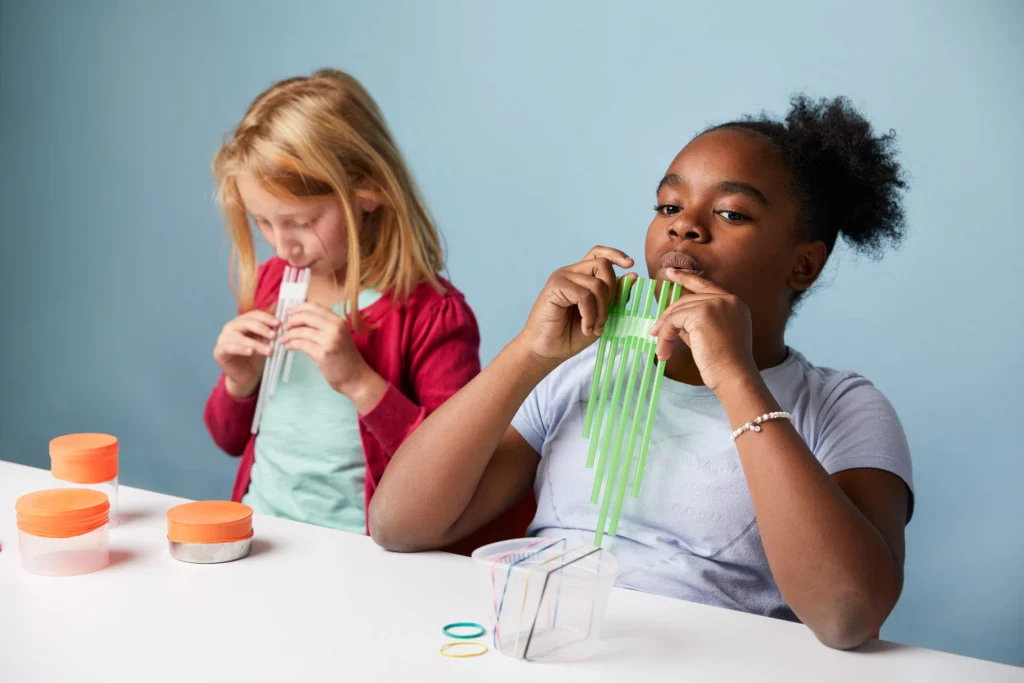
Two children sit at a table blowing into plastic straws held together, likely making musical sounds, with containers and rubber bands on the table.

More hands-on with Flextensions:
Hands-on Flextensions are additional, optional investigations that are included at logical points in the learning progression and give students an opportunity to dig deeper if time permits. These activities offer teachers flexibility to choose to dedicate more time to hands-on learning. Materials referenced in Hands-on Flextension activities will either be included in the unit kit or are easily sourced. Supporting resources such as student worksheets will be included as downloadable PDF files.

Our kits include enough non-consumable materials to support a class of 36 students and enough consumable items to support 72 students. In other words, each kit can last two years! Plus, our unit-specific kits mean teachers just grab the tub they need for the unit and then put it all back with ease.

Amplify Science California supports 3-D learning with more materials than any other program.

Each unit of Amplify Science K–5 includes six unique Student Books written by the Lawrence Hall of Science specifically for the program. These content-rich nonfiction and informational texts provide opportunities for students to search for evidence relevant to their firsthand investigations, see science practices and dispositions modeled, extend their science knowledge, provide real world connections as they master reading-to-learn and close reading skills, and construct evidence-based arguments.

Important note:
Students in grades K–5 are never asked to read alone. Rather, books are read to, with, and by students with ample scaffolding and support provided by the teacher. Big Books are read aloud or together with the class to introduce ideas. Student Books allow for small-group reading and reading in pairs.

Illustrations of two children's book covers displayed on a tablet, titled "on dia ocupado en villa empuja" and "a busy day in pushville," showing a busy street scene.

Available for every unit, our Student Investigation Notebooks contain instructions for activities and space for students to record data and observations, reflect on ideas from texts and investigations, and construct explanations and arguments.

In grades K–5, one copy of the Student Investigation Notebook is included in each unit’s materials kit for use as a blackline master. Each notebook is also available as a downloadable PDF on the Unit Guide page of the digital Teacher’s Guide.

Amplify Science Student Investigation Notebooks

Amplify Science offers digital experience licenses that make elementary instruction more flexible for students and teachers, as well as providing additional means to engage in remote, hybrid, or in-person learning!

Student-facing digital lessons
With the digital experience, students can engage with digital lesson content in one cohesive experience. It’s the same content from Amplify science in a new, integrated format where students can interact with slides, Sims, modeling tools, videos, books, and more.

Ecosystem Restoration digital simulation

Digital student notebook pages
Students can draw, write, record audio, and insert images into their Investigation Notebook pages. Their work is automatically saved and delivered to you in real time. When students edit their work, those edits are immediately reflected on your teacher work review page. You can access student responses by clicking “View Work,” where you can see students’ Investigation Notebook pages from the lesson, updating live.

[IMAGE TO COME]

Assign in Amplify
The digital experience allows flexibility with optional features like scheduling assignments in advance and setting due dates. Teacher can use Scheduling to determine the date and time that the assignment appears in Student Home. They also have the flexibility to schedule when assignments appear and use dates to remove assignments from Student Home.

Assign in LMS
You can also assign lessons via our integrations with Google Classroom and Microsoft Teams, or by copying a lesson link and sharing it with students through the platform of your choice. The assignment link you send will provide students with direct access to the full lesson—slides, videos, digital tools, and worksheet activities—no student platform navigation required!

Teacher platform and presentation
Teacher-facing lesson content—including sample teacher talk, student responses, pedagogical support, and possible student responses—shows on a teacher’s private Teacher Guide tab. Students only see the lesson slides that are being presented.

Graphic depicting a teacher's device synced with a class presentation for K—5 students. The teacher's laptop displays an Amplify Science lesson on environments, which is mirrored on a larger screen for the class

Explore your print samples

With your Amplify Science print samples, you’ll find unit-specific Teacher’s References Guides, Student Investigation Notebooks, and sets of Student Books for each grade level.

A note about the Teacher’s Reference Guides:

It’s important that you see the full breadth and depth of our instruction. For that reason, we provide a copy of each of our unit-specific Teacher Reference Guides.

Rest assured that teachers do not use these robust reference guides for day-to-day teaching. For that, we have a hands-free TG!

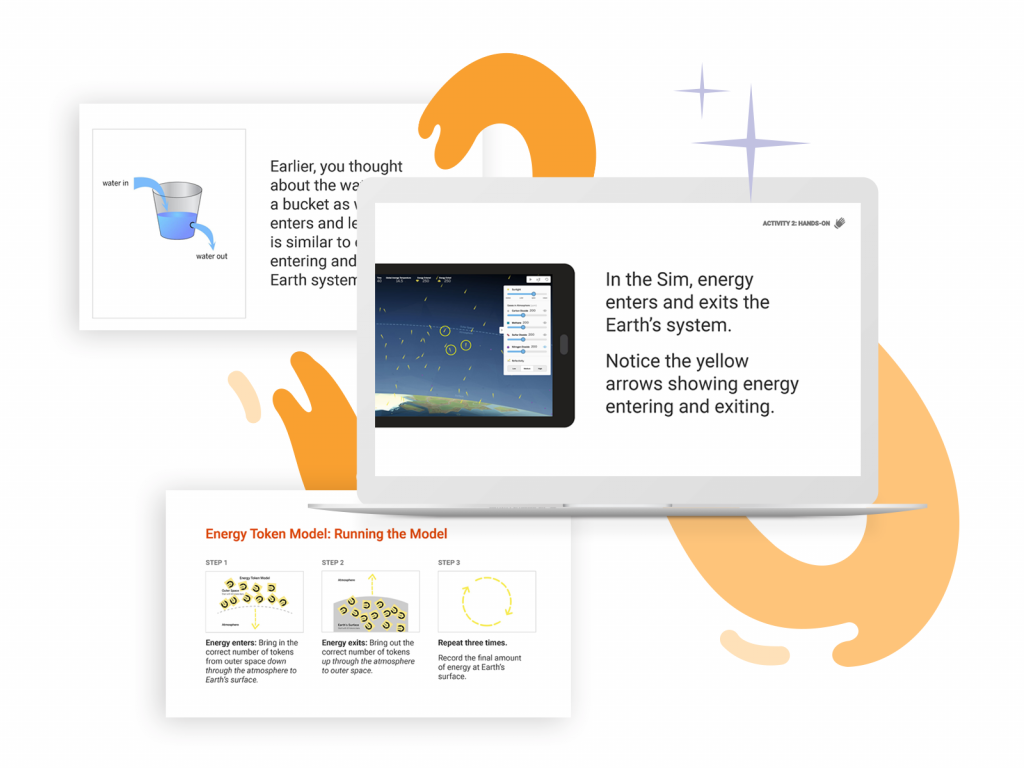
A laptop screen shows an energy simulation, with surrounding text and diagrams explaining the Earth's system and energy flow.
  • Teacher Reference Guide: Unlike a typical TG that requires a series of supplemental books to support it, our encyclopedic reference guide is chock-full of everything a teacher needs to fully implement our program and the NGSS.
  • Ready-to-Teach Lesson Slides: For daily instruction, teachers need their hands free. That’s why we created ready-to-teach lesson slides for every single lesson. What’s more, they are editable and include suggested teacher talk and point-of-use differentiation and other instructional tips. Click to learn more.

A note about the Materials Kits:

Hands-on learning is at the heart of Amplify Science, and is integrated into every unit. In order to make hands-on learning more manageable for busy teachers, Amplify Science materials are organized into unit-specific kits.

Stacked storage bins with labels, arranged neatly; caption notes they are a sample and may not reflect actual quantities or sizes.

What’s different about Amplify’s unit-specific material kits?  They…

  • Include more materials — We give teachers enough non-consumable materials to support a class of 36 students and enough consumables to support 72 student uses. In other words, each kit will last two years.
  • Are more manageable — Unlike other programs that require large groups of students to share limited sets of materials, our kits include enough to support small groups of 4–5 students.
  • Include supportive videos — Each hands-on activity provides clear instructions for the teacher, with more complex activities supported by video demonstrations and illustrations.

Grade-specific lists of all materials included in each kit:

Access your digital samples

Explore as a teacher

When you’re ready to explore the teaching experience on your own, follow these instructions to access the Amplify Science digital teacher platform.

  • Click the Access Amplify Science Platform button below and bookmark the page.
  • Select Log in with Amplify.
  • Enter the username: t1.jeffersoncounty@demo.tryamplify.net
  • Enter the password: Amplify1-jeffersoncounty
  • Click on Science on the left hand side.
  • Click on the Program Menu in the top center of the screen and select any grade.
  • Select any unit.

To help familiarize yourself with navigating the digital platform,watch the below navigational video.

Explore as a student

When you’re ready to explore the student learning experience on your own, follow these instructions to access the Amplify Science digital student platform.

  • Click the Access Amplify Science Platform button below and bookmark the page.
  • Select Log in with Amplify.
  • Enter the username: s1.jeffersoncounty@demo.tryamplify.net
  • Enter the password: Amplify1-jeffersoncounty
  • Click the backpack icon on the top right.
  • Click Science K-5
  • Select any unit.

Resources to support your review

Publisher presentation

The Lawrence Hall of Science

Developed by the science education experts at UC Berkeley’s Lawrence Hall of Science and the digital learning team at Amplify, our program features:

  • phenomena-based approach where students construct a complex understanding of each unit’s anchor phenomenon.
  • A blend of cohesive storylines, hands-on investigations, rich discussions, literacy-rich activities, and digital tools.
  • Carefully crafted units, chapters, lessons, and activities designed to deliver true 3-dimensional learning.
  • An instructional design that supports all learners in accessing all standards.
Amplify Science and Lawrence Hall of Science

Instructional model

The Amplify Science program is rooted in the proven, research-based pedagogy of Do, Talk, Read, Write, Visualize. Here’s how each element works:

DO

First-hand investigations are an important part of any science classroom, and Amplify Science has students getting hands-on in every unit—from building models of protein molecules to experimenting with electrical systems.

TALK

Student-to-student discourse and full-class discussions are an integral part of the program. Students are provided with numerous opportunities to engage in meaningful oral scientific argumentation, all while fostering a collaborative classroom environment.

READ

Students read scientific articles, focusing their reading activities on searching for evidence related to their investigation and, importantly, on asking and recording questions as they read through fascinating texts on 21st-century topics.

WRITE

Following real-world practices, students write scientific arguments based on evidence they’ve collected, making clear their reasoning about how a given piece of evidence connects to one of several claims.

VISUALIZE

By manipulating digital simulations and using modeling tools to craft visualizations of their thinking— just as real scientists and engineers do—students take their learning far beyond the confines of what they can physically see in the classroom in an exciting and authentic way.

Program structure

Our cyclical lesson design ensures students receive multiple exposures to concepts through a variety of modalities. As they progress through the lessons within a unit, students build and deepen their understanding, increasing their ability to develop and refine complex explanations of the unit’s phenomenon.

It’s this proven program structure and lesson design that enables Amplify Science to address 100% of the NGSS, and support students in mastering the Oregon Science Standards.

Graphic showing a research process with four steps: spark intrigue with a real-world problem, explore evidence, explain and elaborate, and evaluate claims, connected in a cycle with arrows.

Unit types

While every unit delivers three-dimensional learning experiences and engages students in gathering evidence from a rich collection of sources, each unit also serves a unique instructional purpose.

In grades 6–8:

  • One unit is a launch unit.
  • Three units are core units.
  • Two units are engineering internships.

Launch units are the first units taught in each year of Amplify Science. The goal of the Launch unit is to introduce students to norms, routines, and practices that will be built on throughout the year, including argumentation, active reading, and using the program’s technology. For example, rather than taking the time to explain the process of active reading in every unit in a given year, it is explained thoroughly in the Launch unit, thereby preparing students to read actively in all subsequent units.

Core units establish the context of the unit by introducing students to a real-world problem. As students move through lessons in a Core unit, they figure out the unit’s anchoring phenomenon, gain an understanding of the unit’s disciplinary core ideas and science and engineering practices, and make linkages across topics through the crosscutting concepts. Each Core unit culminates with a Science Seminar and final writing activity.

Engineering Internship units invite students to design solutions for real-world problems as interns for a fictional company called Futura. Students figure out how to help those in need, from tsunami victims in Sri Lanka to premature babies, through the application of engineering practices. In the process, they apply and deepen their learning from Core units.

Unit sequence

Our lessons follow a structure that is grounded in regular routines while still being flexible enough to allow for a variety of learning experiences.

In fact, our multi-modal instruction offers more opportunities for students to construct meaning, and practice and apply concepts than any other program. What’s more, our modular design means our units can be flexibly arranged to support your instructional goals.

Three columns listing education curriculum topics for grades 6, 7, and 8, focusing on science themes such as microbiomes, mars geology, and harnessing human energy.

Program components

Available digitally and in print, our unit-specific reference guides are chock full of helpful resources, including scientific background knowledge, planning information and resources, color-coded 3-D Statements, detailed lesson plans, tips for delivering instruction, and differentiation strategies.

Amplify Science TG

Hands-on learning is an essential part of Amplify Science, and is integrated into every unit. Students actively participate in science, playing the roles of scientists and engineers as they gather evidence, think critically, solve problems, and develop and defend claims about the world around them. Every unit includes hands-on investigations that are critical to achieving the unit’s learning goals.

A young person wearing gloves looks through a microscope at a table with laboratory supplies, including bottles, slides, and a tray, against a plain blue background.

More hands-on with Flextensions:
Hands-on Flextensions are additional, optional investigations that are included at logical points in the learning progression and give students an opportunity to dig deeper if time permits. These activities offer teachers flexibility to choose to dedicate more time to hands-on learning. Materials referenced in Hands-on Flextension activities will either be included in the unit kit or are easily sourced. Supporting resources such as student worksheets will be included as downloadable PDF files.

Our kits include enough materials to support 200 student uses. In other words, teachers can easily support all five periods and small groups of 4-5 students each. Plus, our unit-specific kits mean teachers just grab the tub they need and then put it all back with ease.

Amplify Science California supports 3-D learning with more materials than any other program.

Our digital Simulations and Practice Tools are powerful resources for exploration, data collection, and student collaboration. They allow students the ability to explore scientific concepts that might otherwise be invisible or impossible to see with the naked eye.

Available for every unit, our Student Investigation Notebooks contain instructions for activities and space for students to record data and observations, reflect on ideas from texts and investigations, and construct explanations and arguments.

In grades 6–8, one copy of the Student Investigation Notebook is included in each unit’s materials kit for use as a blackline master. Each notebook is also available as a downloadable PDF on the Unit Guide page of the digital Teacher’s Guide.

Two booklets titled "El clima cambiante de la Tierra: la desaparición del hielo" and "Earth’s Changing Climate: Vanishing Ice" with landscape illustrations on the covers.

These customizable PowerPoints are available for every lesson of the program and make delivering instruction a snap with visual prompts, colorful activity instructions, investigation set-up videos and animations, and suggested teacher talk in the notes section of each slide.

A laptop displays a PowerPoint presentation in presenter view, with slides about observing objects in plastic containers and related sensory instructions.

Full coverage of the Oregon Science Standards

Amplify Science was designed from the ground up to meet the Next Generation Science Standards (NGSS). As such, it aligns to the Oregon Science Standards, which were also borne out of the NGSS.

The guidance below is meant to provide support for integrating additional activities that support full coverage of Oregon’s standards. Organized by grade level, each section below will outline:

  • Additional activities that support 100% alignment to the Oregon Science Standards.
  • The standard being addressed with the activities.
  • The recommended placement of the activities within a specific Amplify Science unit.
  • PDFs of any accompanying materials that are necessary to implement the activities.

Activity Title: Meet a Scientist Who Changed How We Think About Brain Cells

About this activity: In this activity, students read a short article about a scientist who studied the nervous system.

Recommended placement: Metabolism unit, Lesson 3.2

Materials:

Instructions: Download the PDF “Meet a Scientist Who Changed How We Think About Brain Cells” above and remind students of the Active Reading guidelines. Before students read the article, invite them to share prior experiences. Then have students complete the copymaster above.

Activity Title: Meet a Scientist Who Studies Underwater Currents

About this activity: In this activity, students read a short article about a scientist who studies ocean currents.

Recommended placement: Oceans, Atmosphere, and Climate unit, Lesson 2.1

Materials:

Instructions: Download the PDF “Meet a Scientist Who Studies Underwater Currents” above and remind students of the Active Reading guidelines. Before students read the article, invite them to share prior experiences. Then have students complete the copymaster above.

Activity Title: Meet a Scientist Who Studies How the Environment Affects Our Traits

About this activity: In this activity, students read two short articles, one about current research on genes and proteins, and one about a scientist who is studying how the environment can affect our traits.

Recommended placement: Traits and Reproduction unit, Lesson 2.4

Materials:

Instructions: Download the PDF “Meet a Scientist Who Studies How the Environment Affects Our Traits” above and remind students of the Active Reading guidelines. Before students read the article, invite them to share prior experiences. Then have students complete the copymaster above.

Activity Title: Who Becomes a Space Scientist?

About this activity: In this activity, Students read a short article about a scientist who studies space.

Recommended placement: Geology on Mars unit, Lesson 3.1

Materials:

Instructions: Download the PDF “Who Becomes a Space Scientist?” above and remind students of the Active Reading guidelines. Before students read the article, invite them to share prior experiences. Then have students complete the copymaster above.

Activity Title: Meet a Scientist Who Studies How Plants Find Water Underground

About this activity: In this activity, students read a short article about a scientist who studies how plants’ roots get water.

Recommended placement: Matter and Energy in Ecosystems unit, Lesson 1.6

Materials:

Instructions: Download the PDF “Meet a Scientist Who Studies How Plants Find Water Underground” above and remind students of the Active Reading guidelines. Before students read the article, invite them to share prior experiences. Then have students complete the copymaster above.

Activity Title: Bringing Back the Buffalo

About this activity: In this activity, students change one competing population to try to decrease the other in the Sim, and read a short article about a scientist who studies buffalo.

Recommended placement: Populations and Resources unit, Lesson 3.2

Materials:

Instructions: Download the PDF “Bringing Back the Buffalo” above and remind students of the Active Reading guidelines. Before students read the article, invite them to share prior experiences. Then have students complete the copymaster above.

Activity Title: Rereading “A Continental Puzzle”

About this activity: In this activity, students reread “A Continental Puzzle” and think about how patterns were helpful to Wegener’s work.

Recommended placement: Plate Motion unit, Lesson 3.2

Materials:

Instructions: Direct students back to “A Continental Puzzle” above and remind students of the Active Reading guidelines. Before students re-read the article, invite them to share prior experiences. Then have students complete the copymaster above.

Activity Title: Meet a Scientist Who Studies Variation in Monkey Populations

About this activity: In this activity, students read a short article about a scientist who studies variation of traits in monkey populations.

Recommended placement: Natural Selection unit, Lesson 1.6

Materials:

Instructions: Download the PDF “Meet a Scientist Who Studies Variation in Monkey Populations” above and remind students of the Active Reading guidelines. Before students read the article, invite them to share prior experiences. Then have students complete the copymaster above.

Activity Title: Extinctions and Human Impacts

About this activity: The purpose of this lesson is for students to see how increases in human population and consumption of natural resources can negatively impact Earth’s systems.

Recommended placement: Natural Selection unit, Lesson 4.5

Materials:

Instructions: Download the PDF “Extinctions and Human Impacts” above and remind students of the Active Reading guidelines. Before students read the article, invite them to share prior experiences. Then have students complete the copymaster above.

Activity Title: Steno and the Shark

About this activity: In this activity, students read a short article about Nicolas Steno, a scientist from the 1600s whose studies of fossilized sharks’ teeth embedded in rock layers laid the foundation for the modern understanding of stratigraphy.

Recommended placement: Evolutionary History unit, Lesson 2.4

Materials:

Instructions: Download the PDF “Steno and the Shark” above and remind students of the Active Reading guidelines. Before students read the article, invite them to share prior experiences. Then have students complete the copymaster above.

Activity Title: Scale in the Solar System

About this activity: In this activity, students read and annotate the articles “Scale in the Solar System” and “The Solar System Is Huge.”

Recommended placement: Earth, Moon, and Sun unit, Lesson 1.2

Materials:

Instructions: Download the PDF “Scale in the Solar System” above and remind students of the Active Reading guidelines. Before students read the article, invite them to share prior experiences. Then have students complete the copymaster above.

Explore your print samples

Amplify Science physical samples can be found at the Hamersley Library at Western Oregon University. There you’ll find unit-specific Teacher’s References Guides and Student Investigation Notebooks for each grade level.

A note about the Teacher’s Reference Guides:

It’s important that your committee sees the full breadth and depth of our instruction. For that reason, we provided a copy of each of our unit-specific Teacher Reference Guides.

Rest assured that teachers do not use these robust reference guides for day-to-day teaching. For that, we have a hands-free TG!

A laptop screen shows an energy simulation, with surrounding text and diagrams explaining the Earth's system and energy flow.
  • Teacher Reference Guide: Unlike a typical TG that requires a series of supplemental books to support it, our encyclopedic reference guide is chock-full of everything a teacher needs to fully implement our program and the NGSS.
  • Ready-to-Teach Lesson Slides: For daily instruction, teachers need their hands free. That’s why we created ready-to-teach lesson slides for every single lesson What’s more, they are editable and include suggested teacher talk and point-of-use differentiation and other instructional tips. Click to learn more.

A note about the Materials Kits:

Hands-on learning is at the heart of Amplify Science, and is integrated into every unit. In order to make hands-on learning more manageable for busy teachers, Amplify Science materials are organized into unit-specific kits.

Stacked storage bins with labels, arranged neatly; caption notes they are a sample and may not reflect actual quantities or sizes.

Our unit-specific kits:

  • Include more materials — We give teachers enough materials to support 200 student uses.
  • Are more manageable — Unlike other programs that require large groups of students to share limited sets of materials, our kits include enough to support small groups of 4–5 students.
  • Include supportive videos — Each hands-on activity provides clear instructions for the teacher, with more complex activities supported by video demonstrations and illustrations.

At your request, we did not include our materials kits with our submissions samples. However, we did provide grade-specific lists of all materials included in each kit, which you can also find with the links below.

Access your digital samples

Explore as a teacher

Follow these instructions to explore the Amplify Science digital platform as a teacher.

  • Click the Access Amplify Science Platform button below.
  • Select Log in with Amplify.
  • Enter the teacher username and password found on your unique login flyer enclosed in your physical sample box.
  • Click the Science icon.
  • Click on the Grade Menu in the top center of the screen and select any grade.
  • Select any unit.

To help familiarize yourself with navigating the digital platform, watch the below navigational video.

Explore as a student

Follow these instructions to explore the Amplify Science digital platform as a student.

  • Click the Access Amplify Science Platform button below.
  • Select Log in with Amplify.
  • Enter the student username and password found on your unique login flyer enclosed in your physical sample box.
  • Click the Science icon.
  • Click on the Grade Menu in the top center of the screen and select any grade.
  • Select any unit.

Resources to support your review

Oregon standards correlation for grades 6–8

QCD Science Adoption Criteria 2022 for grades 6-8

QCD IMET Citation guidance for grades 6-8

Oregon Science IMET for grades 6-8 (Excel download)

Oregon QCD-IMET Citation guidance for grades 6-8

Research behind Amplify Science

Phenomena in grades 6–8

Program structure for grades 6–8

Active Reading in grades 6–8

Engineering in Amplify Science

Approaches to assessment in grades 6–8

Welcome, Amplify Science elementary school families!

Para la versión en español, haga clic aquí.

Two middle school girls conduct a science experiment

Next Generation Science Standards letter

Two documents side by side, one in English and one in Spanish, both titled with information about the NGSS for parents and guardians and containing paragraphs of text.

Each unit includes a letter describing the Next Generation Science Standards and how they’re reflected in all units at a particular grade.

Click on your student’s grade below to download the letter for that grade:

Unit Maps

Two pages of a document titled "Needs of Plants and Animals: Planning for the Unit," featuring an "Unit Map" label and blocks of text in black on a white background.

Each unit in Amplify Science has a Unit Map for the teacher. This document outlines the scientific questions the students come across in the unit, and how they will figure out the answers.

Click on your student’s grade to download all of the Unit Maps for that grade:

Simulations

In grades 3–5, students use interactive digital apps as one way of figuring out unit phenomena. This short video shows an example of a simulation.

Resource for back-to-school night

A webpage for Amplify Science displays a grid of colorful nature-themed illustrations and text promoting a core curriculum for grades K-8.

This presentation (available for download) provides a general overview of the Amplify Science curriculum. Your student’s teacher may have used this resource during back-to-school night.

Home investigations

Four educational posters for Amplify Science show students engaging in hands-on science activities and a scientist in a lab coat with worksheets on the right.

If you’re interested in extending the Amplify Science classroom experience at home use the Scientist Profile Cards to spark discussions about careers in science and engineering!

The Amplify Science program also includes several Home Investigations that you can explore with your students outside of the school day. Your student’s teacher may assign the Home Investigations as the class progresses through the units, but if you’d like to explore them on your own, you can do so by clicking on your student’s grade below:

Questions for at-home discussion

For Amplify Science families, the Questions for At-Home Discussion documents for every unit in grades K–5 contain questions for families to ask their students to help guide continued discussion and learning outside the classroom.

Kindergarten

Grade 1

Grade 2

Grade 3

Grade 4

Grade 5

Contact us

We’re here to help you!

Have a question about Amplify Science? Visit our help library to search for articles with answers to your program questions. For additional curriculum support, contact your student’s teacher.

Digital Teacher’s Guide – grades K–5

Click below and select “Teacher” on the login screen to preview the curriculum

View the full program guide.

Click here to view a materials list.

If you have logged in to Amplify Science in the past, you will need to log in with the new credentials above.

When you are finished reviewing, sign out of the digital curriculum. Need help?

Student digital resources – grades K–5

Students in elementary school work primarily offline. Students in grades 2 through 5 have access to digital simulations and modeling tools through the Student Apps page. Click below to view the Amplify Science Digital Student Library.

When you are finished reviewing, sign out of the digital curriculum. Need help?

Course structure for grades K–5

  • Needs of Plants and Animals
  • Pushes and Pulls
  • Sunlight and Weather
  • Animal and Plant Defenses
  • Light and Sound
  • Spinning Earth
  • Plant and Animal Relationships
  • Properties of Materials
  • Changing Landforms
  • Balancing Forces
  • Inheritance and Traits
  • Environments and Survival
  • Weather and Climate
  • Energy and Conversions
  • Vision and Light
  • Earth’s Features
  • Waves, Energy, and Information
  • Patterns of Earth and Sky
  • Modeling Matter
  • The Earth System
  • Ecosystem Restoration

Contact your Redmond representative directly

Patrick Momsen
District Manager

Email: pmomsen@amplify.com
Phone: 541-207-2148

Welcome Amplify Science educators!

To view this protected page, enter the password below:


Welcome Amplify Science educators! Test

To view this protected page, enter the password below:


Inspiring the next generation of California scientists, engineers, and curious citizens

Amplify Science California is an immersive and engaging core curriculum authored by UC Berkeley’s Lawrence Hall of Science and built specifically for the California NGSS.

An illustration of a whale with jellyfish and turtles from Amplify Science

Program overview

Amplify Science California is a brand-new blended science curriculum for grades TK–8 that meets 100 percent of the Next Generation Science Standards and the California Science Framework. With Amplify Science California, students learn to talk, read, write, think, and argue like real scientists and engineers through investigations of real-world problems and scientific phenomena, gaining the skills needed to master the California NGSS.

In Amplify Science, students take on the role of a scientist or engineer and are introduced to a relevant, real-world problem. They engage in investigations using hands-on materials, reading selections, rich media, and more to draft, strengthen, and defend their claims about the unit anchor phenomenon and how to solve the problem.

The Amplify Science assessment system is grounded in the principle that students benefit from regular and varied opportunities to demonstrate understanding through performance. Read more about Amplify assessments in Grades K-5 and 6-8.

A powerful partnership

Amplify Science California was developed by the science education experts at the University of California, Berkeley’s Lawrence Hall of Science and the digital learning team at Amplify.

The logo for The Lawrence Hall of Science, University of California, Berkeley, features blue text on a light background and is recognized by educators using Amplify Science for middle school science programs.

The University of California, Berkeley’s Lawrence Hall of Science is a recognized leader in PreK-12 science education, producing groundbreaking curriculum products for more than 40 years, including the international award-winning Seeds of Science/Roots of Reading®. The Hall’s curriculum materials are used in one in four classrooms across the nation.

Read more about The Hall’s research-proven Do, Talk, Read, Write, Visualize multimodal learning model.

Amplify logo

Amplify has been pioneering digital education products for more than 15 years, empowering teachers across the country to offer more personalized instruction and accelerate the potential of their students to become more active, engaged learners. Amplify has supported more than 200,000 educators and three million students in all 50 states.

Designed in California for California

Since their release in 2013, the Next Generation Science Standards (NGSS) have raised the bar for science education. Moving the focus of instruction away from memorization and toward active engagement and critical thinking, the standards teach students to think like scientists and engineers and grapple with core scientific principles, in addition to supporting deep learning of concepts that cut across science domains. Amplify Science has been designed from the ground up to meet 100 percent of the Next Generation Science Standards and respond to the instructional shifts called for by the National Research Council’s Framework for K–12 science education (2012).

Classroom Slides (grades K–8)

Digital collage of various devices displaying educational content about earth’s energy system, including graphs and text explanations.

Science time just got a whole lot easier. With our new Classroom Slides, you can put down the Teacher’s Guide and focus on what matters most—your students. Plus, with Classroom Slides, lesson prep is as quick as a click!

Classroom Slides are:

  • Available for back to school 2020–2021, for grades 6–8. Classroom slides are already rolling out for grades K–5.
  • Downloadable for offline use, which means no more sweating unreliable internet connections.
  • Streamlined for easy lesson delivery, including lesson visuals, activity instructions and transitions, animations, investigation setup videos, technology support, and more.
  • Fully editable, allowing you to incorporate your own flavor, flair, and favorite resources.

Classroom Slides are available as downloadable PowerPoint files to help guide you and your students through the lesson with images, videos, questions, and instructions. Slides for grades 6–8 will be released on a rolling basis over the course of the 2020-2021 school year. Below you’ll find a prototype from the Earth’s Changing Climate unit.

A brochure on K–5 slides can be downloaded here.
A flyer on 6–8 slides can be downloaded here.

Transitional Kindergarten

Amplify Science TK includes three units, one for each science domain: Earth science, life science, and physical science. The physical science unit includes an engineering design challenge.

Three circular icons representing Earth Science (sun over horizon), Life Science (butterfly and leaf), and Physical Science (book and magnet), each labeled below with its respective field.

Units are structured to allow you to make decisions about how best to teach your students and include options for whole-group, small-group, and center-based instruction.

Learn more about the program.

Start your review

If you have received Amplify Science California materials for review, fill out the form and select the course model you are interested in to access the digital Program Guide and supporting materials. For technical questions regarding your review, contact support at (844) 505-4621 or CAreviewersupport@amplify.com.

Amplify Science

A new core curriculum designed from the ground up for the NGSS.

The Ellis School – Pittsburgh, Pennsylvania

PRODUCTDESCRIPTIONISBN
Amplify Science Elementary School: Fifth Grade Earth Science – The Earth System KitCurriculum kit: Outfits 1 teacher with 2 classes of 36 students each, or 72 total. Includes all hands-on materials, as well as 18 copies of 5 unit-specific information books, and 1 student investigation notebook.978-1-64089-539-3
Amplify Science Elementary School: Second Grade Life Science – Plant and Animal Relationships Kit
Curriculum kit: Outfits 1 teacher with 2 classes of 36 students each, or 72 total. Includes all hands-on materials, as well as 18 copies of 5 unit-specific information books, and 1 student investigation notebook.
978-1-64089-530-0
Amplify Science Elementary School: Third Grade Earth Science – Weather and Climate KitCurriculum kit: Outfits 1 teacher with 2 classes of 36 students each, or 72 total. Includes all hands-on materials, as well as 18 copies of 5 unit-specific information books, and 1 student investigation notebook.978-1-64089-532-4
Contact a sales representative for a quote.

Find more information about Amplify Science for grades K–5.

S3-04: Using AI and ChatGPT in the science classroom

A graphic with the text "Science Connections" and "Amplify" features colorful circles and curved lines on a dark gray background.

In the latest episode of the Science Connections podcast, we explore AI in education and its impact on students. Listen as I sit down with teachers Donnie Piercey and Jennifer Roberts to discuss ChatGPT and how we can use it to build science and literacy skills in K–12 classrooms while preparing students for the real world.

And don’t forget to grab your Science Connections study guide to track your learning and find additional resources!

We hope you enjoy this episode and explore more from Science Connections by visiting our main page!

DOWNLOAD TRANSCRIPT

Jennifer Roberts (00:00:00):

If a kid graduates from school without knowing that AI exists, they’re not gonna be prepared for what they face out in the world.

Eric Cross (00:00:07):

Welcome to Science Connections. I’m your host, Eric Cross.

Eric Cross (00:00:12):

This season of the podcast, we’re making the case for everyone’s favorite underdog, science. Recently we’ve been highlighting the magic that can come from integrating science and literacy. So if you haven’t checked out those recent episodes, definitely go back in your feed after you’re done with this one. This time around, we’re going to deep dive into what artificial intelligence means for literacy instruction, and how science can be a force for good, in responsibly exposing students to AI. To help me out, I’m joined by two extremely accomplished educators. Jen Roberts, a veteran high-school English teacher from San Diego, who among many things runs the website LitAndTech.com. And I’m also joined by fifth-grade teacher Donnie Piercey. In addition to being Kentucky’s 2021 Teacher of the Year, Donnie also has an upcoming book about bringing AI into the classroom. Whether you’ve never heard of ChatGPT or whether you’re already using it every day, I think you’ll find this a valuable discussion about the intersection of science, English, and technology. Here’s Jen and Donnie.

Eric Cross (00:01:17):

So first off, welcome to the show. It’s good to see you all. What I wanna do is kind of start off by introducing both of you. And so we’ll just go K–12. So <laugh>, Donnie.

Jennifer Roberts (00:01:30):

Donnie goes first.

Eric Cross (00:01:31):

Donnie’s gonna go first. Donnie out in Kentucky. Just a little background. What do you teach; how long you’ve been in the classroom; and what are you having fun with right now?

Donnie Piercey (00:01:38):

Yeah, so my name is Donnie Piercey. I’m a fifth-grade teacher from Kentucky. Live and teach right here in Lexington, Kentucky, right in the center of the state. I’m the 2021 Kentucky Teacher of the Year. But I’ve been teaching elementary school for the past … I think this is year 16 or 17. It’s long enough where I’ve lost count, and I can’t even count on fingers anymore. My friends like to joke that I’ve taught long enough where now I can count down. You know, it’s like, “All right, only so many more years left.” But yeah, teach all subjects. Science definitely is one of the subjects that I don’t just try to squeeze into my day, but make sure that … it’s not even a devoted subject, but one that I definitely try to — don’t just have that set time, but also try to do some cross-curricular stuff with it. So definitely the rise of AI in these past few months, which feels like years by this point, has definitely played quite the role, in not just changing the way that I’ve been teaching science, but really all my subjects. So, excited to chat with y’all about it.

Eric Cross (00:02:47):

Nice. I’m excited that you’re here. And Jen?

Jennifer Roberts (00:02:51):

Hi, I’m Jen Roberts. I teach ninth-grade English at Point Loma High School, and that’s where I usually stop when I introduce myself. But for your sake—

Eric Cross (00:03:00):

I will keep introducing you if you stop there. <laugh>

Jennifer Roberts (00:03:04):

I am nationally board-certified in English Language Arts for early adolescence. I am the co-author of a book called Power Up: Making the Shift to 1:1 Teaching and Learning, from Stenhouse, with my fabulous co-author Diana Neebe. Shout out to Diana. I blog at LitAndTech.com about teaching and technology and literacy and the intersection of those things. And I’m looking forward to talking about how AI is showing up in my classroom and the fun things I’m doing with it.

Donnie Piercey (00:03:31):

And one of us is actually secretly a robot, and you have to guess which one.

Jennifer Roberts (00:03:35):

Have to guess which one. Yes. <laugh>

Eric Cross (00:03:37):

That would be super-meta. And you were the CUE — Computer-Using Educator — outstanding teacher or educator? Whatever. Either one. Of the year.

Jennifer Roberts (00:03:45):

I was the CUE ’22 Outstanding Educator. Yes. And I’ve won a few other things as well.

Eric Cross (00:03:53):

The gaming backpack.

Jennifer Roberts (00:03:54):

I’ve won a gaming backpack recently! Yes. I once won an iPad in a Twitter chat.

Eric Cross (00:03:58):

What?

Donnie Piercey (00:03:58):

What’s a gaming backpack? Hold on. We need to talk about that.

Jennifer Roberts (00:04:01):

We will talk about that. <laugh> And then, I was once a finalist for county Teacher of the Year. That’s as close as I got to Donnie. Donnie was the Kentucky Teacher of the Year. He got to go to the White House and stuff. That was exciting.

Donnie Piercey (00:04:13):

<laugh> I mean, to be fair, there’s only three million people in Kentucky, and about what, 50 million people that live in California? <Laugh> So odds are definitely stacked in my favor, I think.

Jennifer Roberts (00:04:23):

So you’re saying we’re even there? Is that, is that what you’re going for?

Donnie Piercey (00:04:25):

Yeah, evens out. Evens out.

Eric Cross (00:04:27):

So I’ve been looking forward to talking to you both for a while now, and talking about artificial intelligence. It’s like the big thing. And both of you, at different ends of the spectrum and in my life, have contributed to this. Donnie, you’ve been sharing so much great information online about how you’re using AI in elementary. Jen, you are the reason I got into education technology years ago, right when I was becoming a teacher. And so being able to talk with you both about it excites me a lot. So first off, for the listeners who may not have any experience with it — and there’s still a lot of people out there who have not been exposed to it, haven’t got their feet wet with it yet — I’m hoping we could start off maybe with an explanation of … we could do AI, ChatGPT, I know that’s the big one. But simply explaining what it is, just for the new person. And whoever wants to start off can tell us about it. Or maybe we’ll start … we’ll, let’s actually, let’s do this: Let’s continue going like K–12? So Donnie, maybe you could … what’s your pitch to the new person of, “Hey, this is what it is”?

Donnie Piercey (00:05:31):

All right. So, AI, artificial intelligence, probably the way that most people are exposed to it, at least since November when it launched, is through ChatGPT. Where if you Google it, you know it’s made by a company called OpenAI. The best way to describe what it is … when you go there for the first time, make an account, it’s free. You have like a little search window, looks like a Google search bar. And instead of searching for information, you can ask it to create stuff for you. So for example, like on Google search, you might type in a question like, “Who was the 19th president of the United States?” Where on ChatGPT, instead of just searching for information, it creates stuff for you. So you could say, you could ask it to, “Hey, write a poem about the 19th president of the United States.” Or, “Write a short little essay comparing, I don’t know, Frederick Douglass to Martin Luther King Jr.” And it would do that for you. You know, that’s most people’s first exposure to AI, at least in these past few months. Instead of … you know, it’s artificial intelligence, but it’s not just chatbots. There’s lots of other AI that exist out there.

Jennifer Roberts (00:06:47):

And I think that’s the thing: that people don’t realize how much AI is already in their lives.

Donnie Piercey (00:06:51):

For sure. Yeah.

Jennifer Roberts (00:06:52):

You know, they just haven’t seen … the term that I see being used a lot now is “generative AI.” AI that can produce something. It can produce writing, it can produce art, it can produce a script, it can produce a character. But the AI that has been helping you pick what to watch next on Netflix and the AI that’s helping Google help you get where you wanna go on Google Maps faster, those are forms of artificial intelligence as well.

Donnie Piercey (00:07:21):

Yeah. I mean, even those, when you get that that message in Gmail, and instead of having to type out that response that says, “Yeah, that sounds great,” you can just click the little button that says, “Yeah, that sounds great.” I mean, that’s been in Gmail for years, but that’s artificial intelligence too.

Eric Cross (00:07:39):

Absolutely. So why is it important, do you think, for educators to, to be familiar with it? Like, why are we all so excited about it?

Jennifer Roberts (00:07:47):

So, educators need to know what kids are into, and kids are obviously into ChatGPT. And anyone who’s an educator right now has probably already had something cross their desk — or more likely their computer screen — that was written by AI and passed off as a student’s own work. And that is, of course, the great fear among teachers everywhere, that this is what kids are just gonna do these days and they won’t be able to catch it and children won’t be doing their own work and this and this. But I think the big reason teachers need to know what’s going on is because teachers need to be futurists. Our clientele will live in the future. We teach kids, kids will become adults, adults will live in the world. And so if we’re not thinking about and trying to predict on some level what’s gonna happen 5, 10, 15 years from now … we might be wrong, but what if we’re right?

Jennifer Roberts (00:08:38):

And if we’re not at least trying to think about what is their future world gonna look like, then we’re not serving our students well. I did a whole night talk on that. So I think ChatGPT is part of that. I teach seniors. I had this moment of realization I felt a few months ago. I’m like, “This is gonna be the world they graduate into. They need to know what this is before they leave me.” If I don’t teach them how to use this well, and not the way they’re using it — which is to copy and paste the teacher’s assignment and drop it into ChatGPT and take whatever it spits out and turning that in without even looking at it — if I don’t teach ’em how to use it critically, if I don’t teach them how to write effective prompts, if I don’t teach them how to use the AI as a tool, as a collaborator, then they’re gonna graduate into a world where they lose out to people who do know how to do that. And I think the advantage goes to kids who have access and knowledge of what’s in front of them and what’s available, and can use all of the tools at their disposal. Because when you’re writing in school and you write with a collaborator, that could be considered cheating. But when you do that out in the adult world, that’s considered doing a good job. <Laugh> Being a team player. <Laugh> You know, adults don’t work alone for the most part. And adults are expected to churn out beautiful, perfect content no matter how they got there. So if I’m not teaching my kids how to use this, they’re not being ready. They’re not gonna be ready to be the adults that I want them to be.

Donnie Piercey (00:10:07):

A hundred percent agree. And I also believe … as you know, I teach elementary school. I also don’t think anybody is saying that on the first day of kindergarten, you hand a kid a Chromebook and load up an AI chatbot or ChatGPT and say, Hey, this thing’s gonna do all your work for you for the next 12 years; just coast through life. You don’t have to think creatively. You don’t have to learn how to develop a paragraph or learn how to write a speech or develop an idea. Like, I don’t think anybody’s saying that, because as an elementary school teacher, there’s many days when I’m like, “Y’all, we’re just putting the Chromebooks away today and we’re just gonna go old-school. We’re just gonna maybe just jot down five quick ideas and stand up and present those ideas to the class.”

Donnie Piercey (00:10:54):

Because while AI definitely will, like you were saying, Jen, play a significant role in the lives of our students who are, not just graduating, but the 10- and 11-year-olds in my classroom this year. A significant role in their lives. It’s also really important to recognize that we’re not saying that this means that “Hey, kids don’t have to work anymore.” They still have to put forth that effort. There’s still — one of the ways that you become a good writer is by trial and error. And sometimes that trial and error comes through talking to a teacher or talking like you were saying to a peer or collaborating with a peer and saying to them, “Well, this sentence here, this paragraph here, really doesn’t make sense.” And I do believe one of the ways — especially as AI starts to become more fine-tuned and starts to be embedded more and more in tools like Google Docs and Microsoft Word — is it’s almost going to be a tutor to students.

Donnie Piercey (00:11:56):

Mm-hmm. <affirmative> Where I could very easily see in a few years, or maybe a few months, who knows what Google or any of these other big companies has rolling out, where a student could highlight a paragraph that they wrote simply, and then say, “Hey, proofread this for me,” or “Check for coherence.” Or even just ask a simple question: “Does this paragraph make sense?” Because you can already do that. You can copy a paragraph over into a chatbot and say, “Hey, does this make sense?” You know, “Rate my idea from one to 10,” and it’ll do that for ’em.

Jennifer Roberts (00:12:26):

We did that last week <laugh>.

Donnie Piercey (00:12:28):

Yeah. Right. I mean, that’s the thing. That technology exists now. It’s just not totally embedded yet. But based on what I’ve read and what I’ve seen, that’s gonna happen sooner rather than later. And it’s really, really important that we teach our students that, “No, you’re not just gonna use this, this tool to cheat, but you can use this tool to help you become a more creative student.”

Jennifer Roberts (00:12:50):

This is the use case in my classroom. Can I talk about that? You ready for that?

Eric Cross (00:12:53):

Please.

Jennifer Roberts (00:12:54):

OK.

Eric Cross (00:12:54):

Please.

Jennifer Roberts (00:12:55):

So my ninth graders are writing a comparative analysis essay, where I took them to the student art gallery and I made them pick two pieces of completely unknown student art and take notes on it, so they could go back and write this essay. And as soon as we got back to class, I said, can ChatGPT write this for you? And they all kind of froze ’cause I didn’t tell them what ChatGPT was. And they weren’t sure if they were allowed to know or not. And finally one of them kind of bravely raised his hand and said, “No.” And I said, “Why not?” And he said, “Well, the AI hasn’t seen the art. How can it write an essay about art when the art is completely original that we just went and looked at?” I said, “It’s almost like I planned it that way, isn’t it?” And they laughed nervously. And then I said, “Does that mean it can’t help us with this assignment?” And they said, “Well, no — of course it can’t help us, because it has not seen the art.” And I said, “Well. …” And I open ChatGPT, and I typed in what they were trying to do: “I need to write a comparative analysis essay comparing two pieces of student art on these reasons. And I need to choose which one did it better, basically. Can you help me with an outline?” and ChatGPT produced a lovely outline. And I looked at that with my students and we looked at it together and I said, “This is what it gave us. Would this be helpful to you?” And they’re like, “Yeah, that would be helpful to us.” So we — to be clear here, I was the only one using ChatGPT in the room. They were not actually using it. We were using it together. I copied and pasted the outline that it gave us and put it in their learning management system where they could access it so they could use the outline that the robot provided, and then they could use that to make their own writing better. So then I let them write for a little while, and, after they’d written for a little while, I said, “Does anybody wanna let me share your first paragraph with ChatGPT and see what it thinks of how you’re doing?” And a brave student raised his hand and we took his paragraph and we put it in ChatGPT, and it spit back advice. We said, “This is what I have so far for my first paragraph. Do you have any advice for me?” And we gave it the writing, and the first piece of advice it gave back was very generic, you know, “Add a hook,” you know, like kind of thing. But after that, it started to get more specific about things he was actually doing in his writing. And it started to give him some feedback. And we looked at that together as a class. And I said, “Does any of that feedback help you?” And he said, “Oh yeah, absolutely. I’m gonna go add some revisions to my paragraph.” And other students did too. They looked at the feedback he got and used that to improve their writing. And so everybody went and revised. And I said, “Look, if you take what the robot gives you and you copy and paste it, and you turn it in as your own work, it’s gonna get flagged for plagiarism. And that’s not gonna go well. But if it gives you writing advice the same way I would give you writing advice, and you decide that advice is good, and you take that advice and you incorporate it into your own writing yourself, then the robot’s making you better, but you’re still the one doing your own writing.” And the writing they turned in from that assignment was, was better. It wasn’t written by ChatGPT; it was still about the student art that they found in the gallery. But I showed them a path. Like, it can help you with an outline, it can help you with feedback. Right? These are fair ways to use it that’s gonna make you better. And they really liked that. They really liked — no one had shown them that before. The idea that you don’t just take the teacher’s prompt and give it to it … like, these are new uses to students and worked well.

Eric Cross (00:16:17):

So right now, you both just laid out these ways that you’re using it. And I do this with people that I’m trying to introduce to ChatGPT or AI. ‘Cause I get excited. Anyone could write a 500-word persuasive essay on the use of color in The Great Gatsby or The Outsiders, and they can get something back within seconds. But for a lot of educators, it might feel like the sky is falling.

Donnie Piercey (00:16:43):

Oh, understandably! Understandably. I mean, that totally makes sense.

Eric Cross (00:16:49):

What would you say to them? Donnie, go ahead.

Donnie Piercey (00:16:51):

Yeah. Well, I feel like every teacher kind of goes through the same experience when they see like a generative chatbot. I mean, all these major companies are gonna start incorporating AI, the generative AI piece. And a lot of times, when they see it for the first time, two things. First they’ll say “Oh, but I’ll know that that’s not my students’ writing.” Which, frankly, I think is a good thing, because that tells me that the teachers know their students’ writing. They’ve seen them write in person. They’ve conferenced with them one-on-one. And if a student were to turn something in to me, who I know might be a struggling writer, maybe it’s not their strength, and all of a sudden they’re turning in this10-page dissertation-worthy thesis written at a PhD level, I’m like, “All right, man, you’re nine. Can we talk about where this came from?” <laugh> But I also don’t think that at like the heart, I don’t feel like kids want to cheat. I really don’t. I feel like sometimes like kids are in a situation where they’re like, “OK, I’ve got nothing left. I gotta get this assignment done.” And when those kind of things happen, that’s when we as teachers, we have those one-on-one conversations. Even when I showed my students ChatGPT and even some of the AI image-generating stuff for the first time, and I talked to them about, “What do y’all think about this?” Because, you know, they’re under 13. In my district, ChatGPT is blocked for students. Staff, we have access to it. And that’s just because one, it’s so new, and at the same time, we need to figure out, “What’s the best way they can go about using this tool?” But when we were talking about it as a class, you know, I didn’t want to ignore the elephant in the room. So I asked them, I said, “Hey, do you feel like this is something that you all would use to. …” I mean, I used the word. I said “cheat.” And to be honest, the majority of the students in my class, they were taken aback. They’re like, “What? You think we just would cheat all the time?” Right? <Laugh> And I’m like, “Oh, well good. I’m glad to know that integrity is still alive and well.” But yeah, that’s definitely my thoughts on it, as far as not only the student integrity piece — I think that that’s the big thing that you need to just bring up with your students. Because again, I like to think that I’ve seen my students write enough that if they were going to turn something in that wasn’t their voice, or it didn’t sound like them, like I could have that conversation. And don’t be surprised, too, if in the next … I don’t know, one month to a year, there’s lots of AI detectors that exist. A lot of them are these like third-party things. You can go ahead, but I would not be surprised if in the next year or so, like you start to see those AI detectors be built into Google Docs, into Microsoft Word, into even Canva. And honestly, it’s almost like a fail-safe button for teachers, that we could say “All right, this is telling me that this is 99% probably written by AI.” So you can have that conversation with a student that way.

Jennifer Roberts (00:20:03):

I mean, if you’re worried about it, Formative, right now, will even tell you if something is copy-and-pasted into the boxes that they give you for students to write in. I find that kids who cheat are desperate, you know. Especially at the high school level. They’re panic mode. And, and usually their panic comes from, “I have no idea how to even start this assignment.” And so part of what I wanna use ChatGPT for is to lower that barrier for them. Like, you’ve got an assignment, you don’t know where to start. Tell the robot, tell ChatGPT, about the assignment and ask it for a list of steps. You know, ask it for an outline. Ask it for a time management plan. I see so much tremendous potential for this to help many of my students with IEPs who have executive functioning issues.

Donnie Piercey (00:20:49):

Oh, a hundred percent, right?

Jennifer Roberts (00:20:51):

Yes, a hundred percent. This can be their personal assistant who, you know, instead of me sitting with them one-on-one and saying, you know, “This is the task you need to do, let’s break it down into these six discrete chunks,” the artificial intelligence can do that for them. And it can do that for teachers too. <laugh>

Donnie Piercey (00:21:09):

Jen, I was just thinking about, how long until we see like the phrase artificial intelligence written onto a student’s IEP? I could see that happening very, very soon.

Jennifer Roberts (00:21:20):

Right? They should be able to use that. And then, also, of course, all of its amazing beneficials for teachers. I had to completely rewrite a unit of my curriculum. I knew what I wanted to do. I had some ideas of things I wanted to put in there. And I resorted to, I went to EducationCopilot.com and typed in my stuff that I had: You know, what standards I wanted to cover, what outcomes I was hoping for mm-hmm. <affirmative>. And it generated an eight-week unit for me. And I actually told it then to go back and do it as a 12-week unit so that I’d have more stuff in there to go and cherry-pick to decide what I really wanted to do. But it gave me ideas. It gave me places to start. It saved me an hour of just brainstorming. And I don’t think that was cheating. I still got to go in and decide which ideas were valid. And I still got to … you know, I mean, I’m a teacher. Can I get accused of cheating? I don’t think that’s a thing. It’s—

Eric Cross (00:22:18):

That’s collaborating! It’s collaborating!

Donnie Piercey (00:22:20):

Collaborating! It’s a feature! It’s a feature.

Jennifer Roberts (00:22:22):

It’s Tony Stark talking to Jarvis. You know, they’re figuring it out together.

Donnie Piercey (00:22:26):

Oh, when you use the AI, Jennifer, do you call yours Jarvis? In my class we call him Jeeves. ‘Cause remember Ask Jeeves?

Jennifer Roberts (00:22:33):

I think Eric calls it Jarvis.

Eric Cross (00:22:35):

Yeah. Jarvis is gonna be the AI’s name when, when I can get that fully functioning. There are some things that you had said, I just wanna circle back on. Donnie, Jen — so what I heard was like, best intentions. The part you said about integrity and students wanting to cheat … even the mindset that we go in assuming our students, what they would want to do and assuming best intentions, really kind of frames how you look at this kind of technology. And then Jen, you kind of brought up why students cheat, and realizing that either they don’t feel equipped, or maybe it’s time management, or something else. But most people — and I believe this as an educator — most students want to learn, and they want to be able to perform and achieve. And when they cheat, it’s because they didn’t feel like they could, for whatever reason. Whether it’s it’s outside factors, whether it’s something internal, motivation, whatever it is.

Jennifer Roberts (00:23:24):

Or they were very disconnected and just didn’t care.

Eric Cross (00:23:27):

Sure.

Jennifer Roberts (00:23:27):

This is just busy work the teacher’s giving me, so I’m gonna give it very little of my time and energy. But I think, yeah, it can be that. But if the kid cares about it, if they wanna learn, they wanna learn, you know?

Eric Cross (00:23:40):

Right.

Jennifer Roberts (00:23:40):

This is the day of the internet. Any kid can learn anything they really want to learn. And we see that all the time in our classes. The kid who has zero interest in what I’m teaching in English, but he is an expert coder, and that’s what he wants to spend his time learning. He’s like, “Can I read this C++ book as my independent reading book?” And I’m like, “You know, actually, you can. Go ahead.” <Laugh>

Eric Cross (00:24:01):

Yeah. And for both of you, saying that this makes content more accessible … and I think Donnie, or Jen, you said something about IEPs. I actually put in having it write an IEP to see what would happen. I gave it a prompt for a student’s ability level and I asked it to create a plan. And then I asked it to create a rationale. And it did! And it was good! I went through and vetted it. And right now … you know, a lot of it is funny, ’cause the conversation I’m having with different teachers is kind of like the Wikipedia one. Remember when Wikipedia first got out and everyone was like trying to discourage everybody from using it, because, well, it could be changed by anybody? And now everyone’s like, “Oh, check Wikipedia, and then steal the sources, ’cause they’re already done for you.” Like, the mindset has shifted since then. And I was talking to someone and they said, “Well. …” And I said, “We can use AI, it could be a tutor, these other things. …” And they said, “Yeah, but what happens?” And then insert apocalyptic scenario. Like, what happens if you don’t have access to wifi? And it reminded me of, for some reason, cooking classes. So in the 1700s you probably had to be able to farm to be able to generate your food. Right? Like, you had to get it from somewhere. But if you take a culinary class now, you just go to the grocery store. And someone might say, “Well, but you should know how to farm, ’cause what if there was this worldwide apocalypse and nobody could go to the grocery stores?” <Laugh> And you’re like, “Well, balance of probability though.” You know, it’s like we’ve been really been living in these iterations of life, and I think this next step for some folks … like, we don’t even realize, even like something like bank statements, right? So many folks are paperless. And there’s always a what-if scenario. What if you need it and the internet goes down. But we get so used to to to technology advancing and making our lives different. This kind of seems like that next iteration. And I wanna ask you this question: Are we looking at like the next calculator? The next internet, with this tech? Or do you think it’s too early to say?

Donnie Piercey (00:26:01):

Well, I’ve seen a lot of people compare ChatGPT to a calculator. I’ve seen that pop up on social media. There’s, “Oh well, no, this is like when the calculator was invented. Everyone was up in arms about how ‘that’s not what math students should do.’ Math should be pencil and paper, math should be this.’” However, you can give a kid a calculator and you can give ’em a word problem and they can punch in all the numbers, but they could do the wrong operation or they could put the decimal point in the wrong place, ’cause the student is still the one who’s controlling what’s on the calculator. Where with AI, all you gotta do is just copy it and then paste it into the bot and it’ll spit out whatever the question asked it for. Whether it was, you know, a 500-word rationale or proof for something in geometry, or if it’s analyzing data on a chart, it’ll do all that.

Jennifer Roberts (00:27:00):

Yes. But it’s not that magical. It’s back to what Eric did with the IEP. He put in a prompt and then he knew enough to ask for a rationale and then he knew enough about IEPs to critically read the results he got and make sure they actually worked for what he needed. He had to know all that. He was an expert using it to do an expert thing. My husband’s a computer scientist; he got ChatGPT to help him write an app, and it was a new programming language to him, and he could put in the data and he could ask for things that I would’ve never thought to ask for. But because he knows the language of computer science, he knew what to ask for. And when it gave him results that were bad, he could see that, and he could say, “Yes, but do it again, but without this,” or “make this part more efficient.” He, again, knew what to ask for. So I think the generative AI is, as a partner with humans, a powerful thing. But if the human doesn’t know what they’re doing, yeah. You’re still not gonna get great results.

Donnie Piercey (00:28:03):

<laugh> And I think that’s why I’m coming at this from the elementary school perspective, right? Because in K–5 students are still learning, like, “Hey, where does the decimal point go?” They’re still learning, you know, if you’re dividing by a two-digit number, where does the first digit go, if you go in the old long-division algorithm? And so they’re still acquiring that base-level knowledge that … I don’t know, maybe this is similar to in Jurassic Park when Jeff Goldblum says, “It didn’t take any knowledge to attain,” you know, “they stood on the shoulders of geniuses,” that whole thing. Like they had to acquire the knowledge for themselves, was his whole point. And so that’s why I don’t think it’s exactly the same as the calculator. It is definitely going to change things, in a similar way that the calculator did. But to me it’s just a whole new animal. And I don’t know if it’s going to be like the next internet, Eric — if you’re gonna get little devices that have AI built into it, like a Star Wars kind of thing, like a droid or something that follows you around — all that would be kind of cool, not gonna lie. But whether it’s something that you’ll access through the internet, something that’s built into your TV, that part I don’t know. But I do know that there’s a reason why all of these apps and all these companies are investing so much — not just energy, but time and money into it. Because they’re recognizing. “OK, this really has the potential to change things.” But if used well, and used safely, to change people’s lives for the better.

Eric Cross (00:29:41):

So I definitely hear that you both agree with the statement that if AI ChatGPT was used in the classroom, it could be a force for good. And literacy development. And I wanna shift gears a bit and then come back to the AI. So with that said — and we’re gonna get into some best practices in a minute — in Science Connections right now in this season, we’re making the case for how science can do more in classrooms and in schools. And so I’m I’m curious about what both of you think about the role in science fostering a better future when it comes to AI and education. And this season we’re really talking a lot about literacy. You know, in schools, so often it’s taught in a siloed way. And Donnie, you’re doing multi-subject. Jen, you’re single-subject: English. And we’ve really been trying to make this case for how science can actually support literacy, and these skills that students are trying to develop. So we’re going a little old-school, kind of diving into your content specialty, but maybe even pre-AI, or maybe AI has a component in this. But Don, maybe we’ll start with you. How has science been a way that has been helpful for your own literacy instruction? I know you do a lot of science, because I see your Google Earth stuff and the thing you did with the solar systems back in the day. And I think —.

Donnie Piercey (00:30:54):

Oh my gosh! You remember my <laugh> … wow.

Eric Cross (00:30:58):

That was amazing!

Donnie Piercey (00:31:00):

We haven’t done that since the pandemic. But I had my students go out, and using Google Earth, we built a scale model. Each of the students partnered up and they planned out on Google Earth a scale model of the solar system. They picked an object from around their house and we talked about like, “Don’t pick something bigger than a beach ball, or else, you know, your Neptune’s gonna end up like 10 miles away.” But you know, they just picked like a small ball, like a basketball, soccer ball, something like that. Or football, for international friends. And then we calculated the size of every other planet. And then on Google Earth, using their front lawn as where the sun was, then we went and we calculated where other planets would be, and then we actually drove to those locations and like held up the objects that would represent Neptune, Jupiter, Saturn, and all that. But it was a lot of fun.

Eric Cross (00:31:59):

And is that still accessible? ‘Cause I know you have some websites that you put resources out there.

Donnie Piercey (00:32:03):

Yeah. Yeah, I can … I wanna say on my Resources page — Resources.MrPiercey.com — I’ve got a link on there to a couple of student examples that I can share. And if not, when we get off this call, I’m gonna go on and put them on there <laugh> so people can find it. I’ll even throw on there just the assignment itself. So if you wanted to copy that and do that with your students, you could.

Eric Cross (00:32:27):

Donnie, the reason why I brought that up is because I saw that you had posted that or shared it a long time ago, and I just thought it was the coolest thing that you could totally do with middle-school students or high-school students. Jen, when I became a teacher, you said, “We’re all teachers of literacy.”

Jennifer Roberts (00:32:43):

<laugh> Yeah. I think we forgot to tell them that I was one of your professors.

Eric Cross (00:32:47):

Yes. <Jennifer laughs> One of the people who’ve definitely influenced and shaped my teaching. And that statement has never left my mind: that we’re all teachers of literacy. And I want to ask you, at the high-school level, how can science educators, or how can science — how have you seen it, or how does it, support literacy, when it’s done right?

Jennifer Roberts (00:33:09):

Like I said, I think we’re all teachers of literacy, but I think literacy is bigger than just reading and writing. I don’t think someone is literate if they can’t talk somewhat knowledgeably about what’s happening with climate change. I don’t think someone’s literate if they don’t know what’s going on in the world. And I think so much of what’s going on in the world has to do with science. We’re doing that all the time. If I could teach English just by giving kids articles about science, things to read, that would make my day. Right? We would never read another piece of fiction again. It would all be, you know, what’s happening to the ice sheet in Greenland. My students thrive on reading non-fiction. And then whenever that non-fiction touches on science is even more interesting. And whenever I can get them writing about data, particularly their own data that they collected, I think that’s building those science literacy skills as well. So I think science and English blend together very, very well. I think the literacy aspects of that are fantastic. There are more subject-specific vocabulary words, advanced vocabulary words, in science than any other discipline. And I don’t see why those shouldn’t come up in English as well. You know, my seniors will do a unit at the end of the year on the new space race. Unless I replace it with a unit about generative AI, which I’m seriously considering doing, ’cause I think they really need to learn about bias in AI algorithms and things like that. And I would like to have them read a whole bunch about that stuff. And I wanna give them the open letter that all those CEOs signed that said that AI research should slow down, and make them part of that live conversation about what’s happening in that field. So science comes into that. You know, when we read Into the Wild, we start talking about a whole bunch of scientific concepts. And when it rains in Southern California, we pull up weather maps and look at radar and talk about that and how that works.

Donnie Piercey (00:34:59):

That’s like once every 10 years, Jen? <Laugh>

Jennifer Roberts (00:35:02):

Well, actually, this year it rained a lot. It rained a lot in San Diego. Which is actually very high-interest for them. ‘Cause they wanna know, is it gonna be raining at lunchtime?

Eric Cross (00:35:12):

Jen, you said something … you have your students writing about data?

Jennifer Roberts (00:35:16):

Oh yeah.

Eric Cross (00:35:17):

Can you tell me more about that?

Jennifer Roberts (00:35:19):

So, this is something we’ve done with the ninth grade team for a long time now, is writing about their own data. So it started with a unit about stereotypes and stereotype threat. And they would collect data individually and then they would enter that data into a Google form and then we would give them the spreadsheet of the aggregate data from the whole ninth grade. And then we morphed that unit into one about academic honesty, and they filled out a survey at the beginning of the unit about their feelings about academic honesty and about experiences with academic honesty and cheating and homework and things like that. And then we would do the unit. We’d do all the readings in the unit. And they’d have these “aha” moments about things that were happening at other schools. And then at the end of the unit, we would give them back their own aggregate data and ask them to write about whether or not academic honesty was an issue at our school. And then to support that answer with evidence from their own dataset. So they had that spreadsheet to comb through and figure out, you know, where am I gonna stand on this? We give them the multiple-choice questions we gave them as the graphs, in Google Slides, so that they could write about them and talk about them, too. So yeah, getting kids to write about data. And the the sentence frames we gave them were sentence frames out of, They Say, I Say, from the chapter on writing about science. And <laugh> as they write this stuff, they’re like, “I feel so smart writing this way.” And I’m like, “I know, ’cause you’re writing about big important topics!” Right? And writing about their own data come to think of it is another great way to make an assignment both very personal to them, but also make it ChatGPT-proof, you know, if you’re looking for something that kids can’t just hand to the robot, the robot doesn’t have that data set.

Eric Cross (00:37:08):

Absolutely. And Donnie, at the elementary level, do you, do you make connections between science and literacy? In your class? You talked about with math, definitely with the solar system, but now, I’m curious, what are your newer projects? What have you been working on lately?

Jennifer Roberts (00:37:23):

What’s up now, Donnie?

Eric Cross (00:37:24):

Yeah, what are you doing?

Donnie Piercey (00:37:25):

Oh, man. Well, let me think. I’m just trying to think of some fun projects that we’ve done this year. Science that we can tie in Literacy and also some student creation. Just recently we had a … so I’ve wanted to expose my students to famous scientists that weren’t just white dudes from Europe. So for this year, what I did — and I actually used AI for this — I went into ChatGPT and I asked for 64 famous scientists and it listed them all off. And then I asked it, like, how many of these were white? And I think it said like 61 of them. You know, it had like Neil DeGrasse Tyson, and a couple of other … I didn’t know who they were. So I’m like, “All right, so we need to make this more diverse and make this more equitable.” ‘Cause you know, with the student population in my classroom, try to find equal representation to make sure they can see themselves in some of these scientists. So, eventually got it narrowed down to where I had about 64 scientists. Half are women, half are men from all continents except Antarctica. I assigned these scientists to my students. Some got two; some got three. And their assignment was to go and one, do some individual research on this person, find out what they were famous for, what they were most well-known for, turn it actually into a persuasive piece, where I said, “Hey, you’re gonna have one slide.” And I’ll tell you why I gave him one slide in a minute. On that one slide, you’ve gotta convince the person who sees it that this scientist is the most important scientist since the dawn of creation. I said, “You could use images, text — I don’t care if they were famous for something that you didn’t even understand what it was. It’s a persuasive piece. You’re 10. Go all out. Add gifs, do that whole thing.

Eric Cross (00:39:21):

This is awesome.

Jennifer Roberts (00:39:21):

I wanna do this project.

Donnie Piercey (00:39:23):

And if you picked up on the number 64, and I did this in March, so what we did was throughout the weeks of March Madness of the women’s and men’s NCAA tournament, whenever a game was going on, we had another round of voting. I just paired ’em up. I was gonna like seed them, like 1 to 64 — that’s just way too much work for me <laugh>. So I just kind of did random kind of thing. But all the students had to do — they just saw the slides side-by-side, and the only question they had was, “Based on what you see here, who is the most important scientist? This person or this person?” And it eventually came down to Carl Sagan going up against Marie Curie.

Eric Cross (00:40:04):

OK, that’s a good matchup.

Donnie Piercey (00:40:06):

Yeah, well, the Marie Curie slide, they just liked the radium piece. So they added like some green glowing gifs. And I said, “Guys, it doesn’t always grow glow green.” But whatever. Anyway, eventually Carl Sagan, in case you wanted to know, according to the 10-year-olds in my classroom, is the most important scientist in the history of the world. So I don’t know if I agree with that per se — I think maybe Newton or somebody else might have had something else to say about it — but fun assignment. It was a unique way to expose my students to a bunch of ideas. I remember the student that I assigned Newton, the only thing that that she knew about Isaac Newton was “Didn’t he get hit in the head with an apple?” And I said, “Well, not exactly, I think you might have read or maybe seen too many like old-school cartoons or whatever.” But she ended up doing some research. She’s like, “Oh, I’ve heard of that before! That equal and opposite reaction thing.” Didn’t know what it meant. I had another student that just got really … you know, if you’ve ever been on one of those YouTube kicks where it’s just, you go like nine levels deep onto like, “What does this theorem mean?” Student sits in back of my classroom, I walked by one day and he’s just watching something on like the fifth dimension and what it might be. And I said, “Oh, your scientist got you started on that.” So definitely was a lot of fun. Unique way to combine reading, writing, but also expose my students to some ideas. And we’re definitely gonna do it again. I’ve actually done this assignment before. I picked 64 random elements on the periodic table. But their only slide that they have to make is “What’s your element? What is it used for? And then, why is this the most important element since the dawn of creation?” <Laugh> And, you know, there’s always that student that gets hydrogen. They’re just like “Sweet!” Right? They get excited about that one. <laugh>

Eric Cross (00:41:59):

Explosions.

Donnie Piercey (00:42:00):

Yeah. But then, for that kid who likes a challenge, or that student with the “gifted” label, you give them, like, einsteinium or palladium. Some of the more challenging ones. And they go all out with this. I didn’t use AI for that one, but it was kind of fun, and I figured it’d be neat to share an idea that another teacher could try.

Eric Cross (00:42:20):

Well you probably have at least two teachers right now that are gonna go and try that. And we’re both looking at you. So.

Donnie Piercey (00:42:24):

Go for it.

Eric Cross (00:42:25):

Thanks for that idea. I’m imagining my students coming in with jerseys with “neon.”

Donnie Piercey (00:42:29):

Oh yeah. <laugh>

Eric Cross (00:42:30):

“Neon” on it. Just all ’80s out.

Donnie Piercey (00:42:33):

The game behind it, too, is you tell kids — again, this is just so the 10-year-olds in my class don’t get their feelings hurt — but I say, “Hey, and if your element gets knocked out, you just have to start cheering for whoever beats you in the tournament.” So by the end, you kind of got half the class cheering for one and half the class cheering for whatever.

Jennifer Roberts (00:42:53):

So the only thing I got outta that whole story that I’ve got for you is, as a child I met Carl Sagan. That’s all I got.

Donnie Piercey (00:43:02):

For real?

Jennifer Roberts (00:43:02):

For real.

Donnie Piercey (00:43:03):

So did he talk with that cadence and tone?

Jennifer Roberts (00:43:06):

Yes.

Donnie Piercey (00:43:06):

Like in real life? Wow.

Jennifer Roberts (00:43:07):

Yes. My father was one of the cinematographers on the original Cosmos. And I got to go to the set a few times.

Donnie Piercey (00:43:14):

That’s incredible!

Jennifer Roberts (00:43:15):

I did not appreciate what I was seeing as a child. But as an adult, I’m like, “That was cool. I was there.”

Donnie Piercey (00:43:20):

“You can see my shadow off in the distance.”

Jennifer Roberts (00:43:23):

I mean, maybe that’s part of why I’ve always had an interest in science. I’ve always had fantastic science teachers. Every science teacher I ever had was amazing.

Donnie Piercey (00:43:31):

I credit mine to Mr. Wizard. I don’t know if you ever watched Mr. Wizard and Beakman’s World?

Eric Cross (00:43:35):

I remember Mr. Wizard. Yep. Yep. I definitely remember Mr. Wizard, Beakman’s World, all those. That was on Nickelodeon back in the day. I had to get up early to watch that one. But there’s a YouTube video—

Donnie Piercey (00:43:44):

Six am!

Eric Cross (00:43:44):

<laugh> It was! It was super-early! But there was one, Don, I don’t know if you’ve seen this on YouTube, but it said “Mr. Wizard Is Mean,” and it’s just clips of when he’s—

Donnie Piercey (00:43:56):

Yelling at kids!

Eric Cross (00:43:56):

Chastising. Or being really direct. It’s just one after another.

Donnie Piercey (00:44:02):

He always asked ’em a question and if the kid, you know, didn’t answer it right, he’d be like, “Well, you’re not right, but you’re wrong.” You know, whatever. <Laugh>

Eric Cross (00:44:14):

I have to make sure I’m not subconsciously saying Mr. Wizard quotes when I’m talking in the classroom, when things are happening. But yeah, that video’s hilarious. So I just want to bring us back to AI, and ask this question: Do you think science has a special role to play when it comes to teaching kids about AI responsibly? Does science have a special role in that?

Jennifer Roberts (00:44:36):

I think the responsible piece of AI I wanna teach my students about is the part about the bias in the algorithms and the bias in the training. And I want them to understand how it works, well enough to make informed decisions about how it impacts their lives.

Donnie Piercey (00:44:56):

Hmm.

Jennifer Roberts (00:44:57):

Because I do have concerns about a tool that was trained on the internet. And the answers it gives you is the average of the internet. And do we trust the internet? And the answer from kids is always, “Well sorta, no.” <Laugh> So I want them to understand the social science behind that.

Donnie Piercey (00:45:18):

Yeah. And just along that same point, having the students recognize that just because, you know, you copy-and-paste a question in, the answer it spits out might not always be correct. So, teaching them that just like you would with a source that you find about a topic that you’re researching, you’ve gotta fact-check.

Jennifer Roberts (00:45:44):

It’s just like being a good scientist. A good scientist wouldn’t always accept a single result or the first result. You know, you would look at multiple angles. You would try things different ways. Last week I took the article my seniors were reading about victim compensation after 9-11, and in front of them, I gave ChatGPT, I said, “Are you familiar with this article by Amanda Ripley? And ChatGPT came back and said, “Oh yes, this was written in the Atlantic in 2020 and it’s about these things, blah, blah blah.” And my students looked at that and went, “That’s not the article we read.” And I said, “I know. It got it wrong. That’s amazing!” Yeah. And I was so happy that it got it wrong! ‘Cause I wanted them to see that happen.

Donnie Piercey (00:46:21):

And I guess one of the big science questions there, or one of the big science components there, is that idea of inquiry. Right? It’s almost like you have to teach students how to ask those deep questions about what AI spits out.

Eric Cross (00:46:35):

All of those tips are great. And it leads me to this last question I want to ask. New teachers that are out there — it actually doesn’t even matter; new teachers, experienced teachers, all of us are kind of new at different levels of this race. We’re all kind of starting it together. I mean, it hit mainstream. We’re all getting exposed to it. You all really dive into it. When tech comes out, I know you two really like, “OK, how can we use this to transform education and do awesome things for kids?”

Donnie Piercey (00:47:04):

Usually, when new tech comes out, “How can this make my life easier?” is usually the question. Yeah.

Jennifer Roberts (00:47:09):

“How can I save myself time with this?” Yes.

Donnie Piercey (00:47:11):

“How can this result in me watching more TV and you know, less grading,” sometimes.

Eric Cross (00:47:16):

And I start there like you, but then I end up more time that I fill with another project. And I need to learn how to stop doing that. I’m like, “Oh! I got more free time! … to go take on this other task.”

Jennifer Roberts (00:47:28):

Oh, all of my tech adoption is driven by “how can I work less?”

Eric Cross (00:47:32):

So you’re you’re talking to a new teacher, teacher’s getting exposed to this, they’re starting the school year or they’re just getting their feet wet with it. What advice would you give them about AI, incorporated into content or even just best practices? Where you’re at right now in your own journey, and someone’s asking you about it —what would you share with ’em? And Jen, I want to start with you.

Jennifer Roberts (00:47:53):

So, the first thing I did is I was in the middle of grading, you know, 62 essays from my seniors about Into the Wild, when ChatGPT became a thing last November. And I wanted to see what would happen. So the first thing I did was take the prompt that I had given my students and gave it to ChatGPT, ’cause I had just graded a whole bunch of those essays and my brain was very attuned to what my rubric was doing and what I was expecting as the outcome. So I could take what ChatGPT gave me as that quote unquote “essay” and evaluate it critically. And I was ready to do that. So my first advice is take something you’re already asking students to do and ask ChatGPT to do the same thing. So that as you look at the student results, you can compare that to what ChatGPTgives you. If what you’re finding is that ChatGPT can generate something that would earn a decent grade from you, you might need to change that assignment. And it doesn’t need to be a big change, but it might need a tweak or something, so that it, it does rely on the student voice, the students to do something more personal. I’m finding very helpful in my classroom is having my kids do projects where they are recording themselves on — I like Flip. So they’re writing a scene together and they’re having to record the scene together. And I’m emphasizing more of the speaking roles than the writing roles necessarily. So yes, first, take something you’re already doing, paste in to ChatGPT, see what the results are, see how that fits with what your students are doing, and then do that for every assignment you give and just sort of see what comes out of that, and see which assignments are failing and which assignments are working. ‘Cause that’s gonna give you a sense, when you do see one of those results from your students, you’ll be able to recognize it. But it’ll also help you tweak your assignments and decide, “How can I make this a little more original or a little bit more authentic for my students?” And if the robot, if the AI, can’t generate a response, what could the AI do that would be helpful to your students? Would be my next question. So can you use the AI to help them generate an outline? Can you use the AI to help them generate a list of steps to help them get started? And when you’re comfortable enough doing that by yourself, then don’t be afraid to open it in front of your class. If it’s not blocked at your school site, which I hope it’s not. Because I think the advantage goes to kids who have access to this in the long run, or at least see what it is and know what it is. Right? Because if a kid graduates from school without knowing that AI exists, they’re not gonna be prepared for what they face out in the world. So give them a chance to see you using it. Model effectively using it. I have a blog post about that. I just wrote it. LitAndTech.com. You can check that out. “Introducing 9th graders to ChatGPT.” How it went, right? There’s a chart there you can have. It’s my very first draft of this, but it seems to be very popular. So, you know, show students how it can be used as their mentor. If I can’t come read your paragraph because I have 36 kids in my classroom and I cannot stop and read everybody’s first paragraph, can you, if you want to, give your first paragraph to ChatGPT and ask for advice? And will that advice be helpful to you? So showing students how it can be used responsibly is, I think, something every teacher should be doing right now. And don’t hold back just because you’re afraid you’re gonna be teaching them what this is. They know what this is. Right?

Donnie Piercey (00:51:13):

They know what it is.

Jennifer Roberts (00:51:13):

Especially if you teach high school. They know what it is. I’ve had parents thank me for showing them how to use it responsibly. You know, this can actually be a really useful tool, but if you’re trying to make it do your work for you, it will probably fail you. If you’re trying to use it to help you do your work, it will probably be helpful. Sort of the way I’m breaking it down for them at this point. You want the great metaphor? The great metaphor is if you build a robot and send it to the top of a mountain, did you climb that mountain? No. If you build a robot and ask it to help you get to the top of the mountain, and you and the robot go together, did you climb that mountain? Yes.

Eric Cross (00:51:53):

I like that. I’m thinking through this. I’m processing that now.

Donnie Piercey (00:51:57):

Me too.

Eric Cross (00:51:59):

Yeah. I just imagine a robot holding my hand climbing Mount Everest and I’m like, “Yeah, I did it.”

Donnie Piercey (00:52:04):

If I got a robot though, like I would have to dress it like Arnold Schwarzenegger in Terminator 2. Like I would just have to.

Eric Cross (00:52:10):

Of course.

Donnie Piercey (00:52:10):

Of course.

Eric Cross (00:52:13):

Donnie, same question. Advice. Teachers getting immersed into it. Tips. What would you say?

Donnie Piercey (00:52:20):

So, I would definitely agree with everything that Jen said. Just, if anything else, to familiarize yourself with it. Almost like pretend like it’s a student in your classroom and it’s answering questions, just so that way you can see what it can do. And you’re kind of training yourself, like, “Oh, well, if I ever need examples, exemplars.” If you’re in a writing piece and you don’t wanna sit there and write out four different types of student responses — you know, advanced writer, beginning writer, whatever — great way to to do that is you just—

Jennifer Roberts (00:52:48):

Oh yeah. We did that.

Donnie Piercey (00:52:48):

—copy the prompt in and give a beautifully written piece that a fifth grader would be impressed with. Boom. It’ll do it for you. In my classroom, the way that I approach it is I kinda look at AI as almost like this butler that I don’t have to pay. That if I need it to do something for me, it’s just bookmarked. I can click it. And I mean, sometimes I just talk to it like it’s a person. And it’s almost like, in the chat window, I’m just rambling at it, what I’m trying to do. And it’s almost like I’m talking to a coworker, and I’m trying to hedge out some ideas for a lesson. Simple example: For a science lesson, if you’re trying to come up with … let’s say you’re a fifth-grade — or, sorry, I teach fifth grade. Say you’re a seventh-grade science teacher. And you’re trying to teach the students in your class about Newton’s third law of motion. You know, every action [has an ] equal and opposite reaction. Look around your room. See what you have. Maybe look around and you’re like, “All right, I got a whiteboard, microscope, I’ve got magnets, a cylinder. …” And you just copy all this stuff into ChatGPT. Say, like, “Hey, I have all of these items. Cotton balls, peanut butter, whatever.” And say, “I’m trying to teach students Newton’s third law of motion. Give me some ideas of some ways I could teach it using some of these materials.” And it’ll do it! It’ll give you like five to 10 ideas!

Jennifer Roberts (00:54:15):

And then tell it what your students are into. Like, my students are really into basketball. Can you work that into this lesson?

Donnie Piercey (00:54:21):

Yeah! They’re into the Avengers! Hey, find some way to tie Spider-Man into this. You know, that was a pun that didn’t go so well. But, you know <laugh> figure out some way that you could incorporate this and it’ll do it. And Eric, like you said, it won’t be perfect. Right? But if anything else, if you’re a starting teacher and you’re trying to brainstorm ideas — try it.

Eric Cross (00:54:44):

And Donnie, as you were saying that, I was thinking — first, I imagined Spider-Man shooting cotton balls with peanut butter all over them — and then my mind went to having students have these items, like you were saying. And then they create labs, working alongside AI. To do inquiry. To create a lab about something, and then going and performing and collecting data. OK, that’s — now I wanna go do that tomorrow!

Donnie Piercey (00:55:10):

Listen, it is so easy to do. If you have an extra computer in your classroom. … We were talking about Jarvis and Iron Man and Tony Stark earlier. Make a new chat in ChatGPT. Tell it, “I want you to pretend that you are Tony Stark. Only answer questions as if you are Tony Stark.” Or “Pretend you’re Jarvis.” Whatever. “Stay in character the whole time. I’m going to have sixth grade students come up to you and ask you questions about science or forces of nature, and only answer questions like you’re Iron Man.” And guess what? You keep that station in your classroom. Students are working on a project — you know, in elementary school, a lot of times we’ll have that, “ask three before me” — you’re supposed to ask three friends before you go and bug the teacher. Well, maybe one of those “three before me” can be that little computer station, where they go up and ask Tony Stark a question, and then it answers them as Jarvis or Iron Man. I mean, we’re really just scratching the surface with all this AI stuff. And as more and more companies and more and more creatives are gonna start to realize everything that it can do, we’re gonna start to see it more and more. And hopefully we as teachers can really figure out how to use this tool to, of course, help students, but also help them be creative and explore and learn on their own.

Eric Cross (00:56:35):

That’s amazing. And just both of you are just dropping gems right now. And I wanna wrap up by saying — and I’ve said this before on earlier podcasts I’ve done — but at this phase in my life, the people that I’m the biggest fans of are teachers. And it’s true. I don’t mean that in a cliche way. When I watch celebrities and things like that, when I watch professional sports, that doesn’t fill me the way it used to when I was a kid. At this point, as a professional, I get inspired by other educators who are just doing awesome things. And when I think about educators who are doing that, you two are on that list of people that make me better. And when I get better, I can do better things for my kids. And so, one, I want to thank you for staying in the classroom and continue to support students. They’re so lucky to have you both. The second thing I wanted to say is, Jen, I wanna start with you. Where can people — and I know we said at the beginning — but where can people find the stuff that you put out? You got blogs, your social, your book.

Jennifer Roberts (00:57:28):

I got lots of social. Twitter, I’m JenRoberts1 on Twitter. And then my blog is LitAndTech.com. And then I’m on lots of the new social too, the Mastodons, the Spoutables, the Posts — those kinds of things — as just Jen Roberts, because I got in early and I got my real name without a 1. And there was some other one I’m on recently that I’ve forgotten about. But there’s lots of ’em. They’re fun. And I’m Jen Roberts. You can find me there.

Donnie Piercey (00:57:56):

And I’m SergeantPepperD on AOL, if anyone’s interested.

Eric Cross (00:58:00):

If you wanna hit Donnie up on AIM. <Laugh>

Donnie Piercey (00:58:03):

SergeantPepperD.

Jennifer Roberts (00:58:04):

You know, speaking of rock stars and people who do amazing things, I did write a blog post about using ChatGPT in the classroom, but I hear Donnie wrote a whole book.

Eric Cross (00:58:13):

Oh yeah. So, Donnie! Donnie, that’s a great segue. Thanks Jen. Donnie, how do people find out more? And can you tell us about this book you wrote, that’s coming out in the summer?

Donnie Piercey (00:58:22):

Yeah, so the book I wrote is called 50 Strategies for Integrating AI Into the Classroom. It’s published by Teacher Created Materials. They reached out to me. They had seen some of the stuff that I was doing, not just with ChatGPT, but also some image-generating AI stuff. You know, I got featured on Good Morning America, which was kind of cool. And they saw that and they said, ‘Hey, that looks really neat.” Reached out to me and asked me to write a book. And the idea behind the book, that launches this summer, it’s just 50 ideas, 50 prompts, different things that, as a classroom teacher, that you can do. So, you know, I think there’s so many AI books that are out there now. A lot of them are big ideas, which I think are important. Definitely important discussions that need to be, have around, the ethics of AI. What’s the role that AI should play in the classroom. But I just wanted to write a book, kind of like the discussion that, that Jen and I were just having, which is like, “Can we just share a whole bunch of ideas, different things that we could try with our students?” So definitely check it out. And I appreciate you giving me a shout-out too. That was cool, Eric. Thank you.

Eric Cross (00:59:35):

Of course. Definitely. And Donnie, your Twitter is again. …

Donnie Piercey (00:59:39):

Oh, @MrPiercey, M R P I E R C E Y.

Eric Cross (00:59:44):

Follow Donnie. Follow Jen. Tons of stuff on there. Both of you, thank you so much. For your time, for talking about students and how we can take care of them, science, literacy, AI. I hope we can talk about this again. I feel like even if in just six months, we might be saying different things. In a year, the landscape might completely change. And that makes it really fun. But thank you both for being on the show.

Jennifer Roberts (01:00:04):

Thank you for having us, Eric.

Donnie Piercey (01:00:05):

Thank you so much, Eric. We appreciate it, bud.

Eric Cross (01:00:10):

Thanks so much for listening to my conversation with Jen Roberts and Donnie Piercey. Jen Roberts is a veteran English teacher at San Diego’s Point Loma High School and author of the book Power Up: Making the Shift to 1:1 Teaching and Learning. You can keep up with her at LitAndTech.com. And Donnie Piercey is a fifth-grade teacher from Lexington, Kentucky. He hosts the podcast Teachers Passing Notes. Stay up-to-date with him at Resources.MrPiercey.com. And let us know what you think of this episode in our Facebook discussion group, Science Connections: The Community. Make sure you don’t miss any new episodes of Science Connections by subscribing to the show, wherever you get podcasts. And as always, we’d really appreciate it if you can leave us a review. It’ll help more people and AI robots find the show. You can find more information on all of Amplify’s shows on our podcast hub, Amplify.com/hub. Thanks again for listening.

Stay connected!

Join our community and get new episodes every other Wednesday!

We’ll also share new and exciting free resources for your classroom every month!

What Jennifer Roberts says about science

“If I’m not teaching my students how to use this, then they’re not going to turn into the adults we need them to be… If we’re not at least trying to think about what our future world is going to look like, then we’re not serving our students well.”

– Jennifer Roberts

High School English Teacher

Meet the guests

Jen Roberts is a Nationally Board Certified high school English teacher with 25+ years of experience teaching Social Science and English Language Arts in grades 7-12. She has had 1:1 laptops for her students since 2008 and is the co-author of Power Up: Making the Shift to 1:1 Teaching and Learning. A Google for Education Certified Innovator since 2011, Jen was named the CUE Outstanding Educator in 2022. Her interests include literacy instruction, standards based grading, and leveraging Google tools to make her teaching more efficient and effective.

A woman with light skin and blond hair stands outdoors, framed by illustrated graphics including a blue flask and curved lines. Green foliage is visible in the background.

Donnie Piercey, the 2021 Kentucky Teacher of the Year, is a fifth-grade teacher in Lexington, Kentucky.  With a passion for utilizing technology to promote student inquiry, learning, and engagement, he has been teaching since 2007. In addition to being in the classroom, he runs a podcast, Teachers Passing Notes that is produced by the Peabody Award winning GZMShows, and holds several recognitions, including a National Geographic Fellowship to Antarctica in 2018. His most recent work in Artificial Intelligence has not gone unnoticed, earning him multiple appearances on Good Morning America, the Associated Press, and PBS. His upcoming book, “50 Strategies for Integrating AI in the Classroom” published by Teacher Created Materials, is written for educators looking for practical classroom approaches to using AI. All told, Donnie has been invited to keynote and present at schools in thirty-three states and on five continents.

A man with short brown hair and a beard smiles at the camera, wearing a red shirt, framed by a circular graphic with a blue flask icon.
A laptop screen displays the “Science Connections: The Community” private group page, with science-themed icons decorating the background and edges.

About Science Connections

Welcome to Science Connections! Science is changing before our eyes, now more than ever. So…how do we help kids figure that out? We will bring on educators, scientists, and more to discuss the importance of high-quality science instruction. In this episode, hear from our host Eric Cross about his work engaging students as a K-8 science teacher. 

S3-01: Science as the underdog, and the research behind it

A graphic with the text "Science Connections" and "Amplify" features colorful circles and curved lines on a dark gray background.

Get ready for season 3 of Science Connections: The Podcast!

In our first episode, we unpack the research around our season theme of science as the underdog with Horizon Research, Inc. Vice President Eric R. Banilower and  Senior Researcher Courtney Plumley. Eric and Courtney dive into the research they’ve found and their experiences as former educators to show how science is often overlooked in K–12 classrooms. We discuss how the science classroom compares to other subjects in terms of time and resources, how schools are a reflection of society, and what’s needed to change science and its impact on a larger scale.

We hope you enjoy this episode and explore more from Science Connections by visiting our main page!

DOWNLOAD TRANSCRIPT

Courtney Plumley (00:00):

We asked teachers how much science, professional development, they’ve had in the last three years, and nearly half of elementary teachers said none.

Eric Cross (00:10):

Welcome to Science Connections. I’m your host, Eric Cross. I am super-excited to be kicking off the third season with the show. This entire season will be exploring the theme of science as the underdog. And we’re gonna make the case for science, by showing how and why it can be used more effectively. In the coming episodes, we’re gonna talk about how science can be better integrated into other content areas like literacy and math, and explore some of the benefits that you might not be thinking about good science instruction. But first, science as the underdog. I bet some of you out there feel like science is the underdog in your community at school. I know I have at times. To kick off this season, I’m gonna talk to two people who really studied this question by looking at the state of science instruction across the US. Eric Banilower is Vice President of Horizon Research and Courtney Plumley is Senior Researcher at Horizon Research. Eric was the principal investigator and Courtney an author of the latest in a series of studies called “The National Survey of Science and Mathematics Education.” We’re gonna dive into the findings of their most recent report to see what the data’s showing us. Please enjoy my discussion with Eric Banilower and Courtney Plumley. Courtney, hello. And thank you so much for joining us.

Courtney Plumley (01:25):

Hi Eric. It’s nice to be here.

Eric Cross (01:26):

And Eric, welcome.

Eric R. Banilower (01:27):

We’re thrilled to be here, so thank you for having us.

Eric Cross (01:30):

I was reading through the report. Four hundred…a very thorough report, 471 pages, I think, as I got it?

Eric R. Banilower (01:37):

And that’s only one of the many reports from that study.

Eric Cross (01:40):

Yeah. You all have done your work, so I’m really excited to to talk to you about this. And on this season of the show, we’re exploring the theme of science as the underdog. And I think a lot of our listeners, we feel like science is an underdog either in their school or in their district. But you’ve actually done some research on this, in a 2018 study, “The National Survey of Science and Mathematics Education.” So I wanna talk about this report. But first I was hoping you can kind of set the stage. How did you come to work on this report, and then, big picture, what were you hoping to find out?

Eric R. Banilower (02:10):

So the 2018 study that you just mentioned was actually the sixth iteration of a series of studies dating back to 1977. And we collect data every decade or so—you know, plus or minus a few years. And really, what we’re trying to do is get a snapshot of what the science and math education system looks like in in the nation. So my role grew. I started working at Horizon in about 1998, after teaching high school for five years in California. And then going to graduate school. And right about that time, the company was doing the 2000 iteration of the survey. And I worked on it with the team here at Horizon. And then we did it again in 2012. And I had a much more prominent role in that study, and became the kind of leader of the study. And in 2018, the most recent version, we just did it again. So the goal of this study is really to kind of examine key aspects of the K–12 STEM education system. And the main audience of the work has traditionally been policy makers, researchers, and practitioners who work at the federal, state, and district level.

Eric Cross (03:30):

So this study, you took kind of a sample size, but it’s reflective of trends that we tend to see across the nation as a whole. Would that be fair to say?

Eric R. Banilower (03:38):

Yes, definitely it is. It is a random sample of schools in the country. So we start with a list of all the public and private schools in the nation, and then do a random sample of those schools, and then work really, really hard to recruit schools to agree to be in the study. And that has gotten harder every time we’ve done the study, for many understandable reasons. And then once we have schools on board, we sample teachers within schools. So we don’t even survey every teacher in a school. It’s really a sub-sample. So that we can make inferences about the nation as a whole.

Eric Cross (04:14):

Makes sense. And so Courtney, what did you find out about the time spent on science instruction in US schools?

Courtney Plumley (04:22):

So, I’m gonna talk about elementary teachers to begin with.

Eric Cross (04:26):

Because that was your past life, right?

Courtney Plumley (04:28):

I am a former elementary teacher, yeah. So that’s kind of where my head is. And that’s relatable for me. Right? So we asked teachers, like, how many days of the week or weeks of the year that they teach elementary school. And fewer than 20% teach science every day of the school year. They kind of do one or two things, for the most part. They teach a couple days a week or they teach every day of the week, but only for, like, maybe six weeks, and then they swap with social studies and they kind of do that across the school year. Which is really different from, like, math, right? We also asked elementary teachers, how often do they teach math, and it’s every day of the year. Then we also asked them how many minutes they teach when they’re teaching, and we kind of did the math to figure out, all right, if they taught science every day of the school year, how many minutes would it be in a single day, so that we could make a more comparable comparison with math and ELA. If you were to work it out, how many minutes of science an elementary teacher teaches across the year, and break it down to per day, it’s like 18 minutes for the lower elementary grades, 27 for the upper elementary grades. Which is not a lot. But it’s pretty much an hour a day in math, and 80 plus minutes in ELA. So, a lot less. And then, you know, when I was teaching, the first thing to go was always science, right? If there was an assembly, if there was early release or whatever, that was the first thing to go. So those numbers might even be higher. Just because they aren’t factoring that kind of thing in, too.

Eric Cross (06:05):

So, now I’m curious. That is something that I’ve seen just anecdotally, science being the first thing to go. I feel like I’ve seen that almost…it’s almost become a meme, that I’ve heard that so often. Just in your experience, why do you think that is that huge disparity between the two?

Courtney Plumley (06:26):

Well, I mean, when I was teaching, I was teaching third grade. I had an end-of-grade test in math and ELA for my kids. I didn’t have one in science. So the administration said, “Hey, if you’re gonna drop something, drop something that’s not tested.”

Eric Cross (06:41):

Simple as that. And Eric, you, past life: physics teacher. High school. What did you see? ‘Cause our listeners run the gamut from elementary all the way up to high school. What did you see, as far as relative science instruction in the secondary level?

Eric R. Banilower (07:00):

Sure. You know, secondary is just a whole different situation than elementary. Rght? Because you have departmentalization. I taught science. I didn’t have to teach other subjects. And students had periods, and they still do, sorry, they still have periods, even though it’s been a long time since I taught. And you know, they rotate from one class to another. So all the classes were essentially the same length. So, you know, when I was teaching, it was about 50-minute periods. So in terms of minutes of a class or minutes on a subject, it’s not really different. But what is different is what students are required to take in order to graduate high school. One of the things we asked schools about in this study was how many years of a subject do students have to take in order to graduate? And what we saw was in mathematics, over half the schools in the nation require students to take four years of mathematics to graduate. OK? And the vast majority of the rest, about 44%, require three years in science. Most schools require three years. Very few require four years. And many, or a fair number, still only require two years to graduate. So the expectation of what students are taking is lower in science than it is in mathematics.

Eric Cross (08:20):

So you were seeing the same trend in secondary, essentially.

Eric R. Banilower (08:24):

Yes.

Eric Cross (08:24):

The amount of time devoted to the instruction of science…we’re kind of seeing it mirrored just across K–12 across the board.

Eric R. Banilower (08:33):

That’s correct.

Eric Cross (08:34):

And that’s across the country. ‘Cause the sample size represents teachers from Alaska, Hawaii, the South, SoCal, everywhere. So what’s been the reaction to that number? Like 18 to 20 minutes is…I mean, it’s, it’s half of my lunch at our school. What’s been the reaction to that number since this data has been published?

Eric R. Banilower (08:58):

I don’t know, Courtney, if you want to take that…

Courtney Plumley (09:00):

It’s a lot of what you just did. Like, what??? Like, how is it possible to teach all the things you need to teach in such a little amount of time?

Eric R. Banilower (09:08):

What’s really kind of surprising to me, though — though now that I’ve worked on three iterations of the study, it no longer surprises me, but it did at first — is that these numbers really aren’t changing since we’ve started doing this study. You know, people thought maybe with No Child Left Behind and the increase in accountability, time on science might actually go down, because there was more testing in math and English Language Arts. It didn’t happen. It was pretty much constant, that this has been kind of the state of science education for a long time.

Eric Cross (09:44):

So Eric, if I’m hearing you right: The past studies, we’re not seeing an increase or a decline. This has been this way for how many years, roughly, would you say? Since it’s been studied?

Eric R. Banilower (09:54):

You know, I’d have to go back to the 1977 report to get the numbers, but I’m gonna say since then, it has not changed much, if at all.

Eric Cross (10:03):

So this has kind of been entrenched. This has been the norm for almost for the career of a teacher, almost generationally. We’re looking at anyone who’s been in the highest levels of leadership to someone just entering the classroom, this has been the way it’s always been. This is kind of for many people what they’ve only known.

Eric R. Banilower (10:20):

Right.

Eric Cross (10:21):

Kind of become the norm.

Courtney Plumley (10:21):

We didn’t even have science when I was in elementary school. We had science on a cart that came by, you know, every other week.

Eric Cross (10:28):

Was that like a food truck, but like the science version of it? It shows up and does quick science and takes off?

Courtney Plumley (10:35):

And New York was, I mean — we always watched Voyage of the Mimi. I don’t know if you ever watched that. But that’s what we watched every single time the Science on the Cart came. So it’s like a marine biology show. Ben Affleck was on it when he was a kid.

Eric Cross (10:48):

<laugh> Really? For me it was, Mr. Wizard. For some of my students, even now, Bill Nye. You know, the Bill Nye show or something would come on. So what happens when you look at less wealthy districts? Is there a relationship between community resources and science instruction, or is it pretty much equal no matter what the district resources are, the school’s resources are? Did you see any data there?

Eric R. Banilower (11:12):

Yes. We actually did a lot of disaggregating the data by community type, student demographics in the schools, to look to see whether there were areas of inequities across the country. And, you know, one of the factors we looked at was kind of a measure of socioeconomic status. You know, wealth in the community. By looking at percentage of students eligible for free or reduced-price lunch. And interestingly, in terms of time on science instruction, there is actually not a relationship between income level and how much time is spent at the elementary level on science, which actually surprised us.

Eric Cross (11:54):

Because you might have expected it to be the other way now. And granted, it’s 18 to 20 minutes, there isn’t much more to shave off off of that. But were there other differences, like when you compared those communities? Maybe it wasn’t the amount of science instruction, but was there anything else, like teacher preparedness, resources? Were there anything else that you did see discrepancies in? Or was it equal across the board?

Eric R. Banilower (12:13):

No, unfortunately there, there have been, and still are, a number of areas where community resources are related to pretty substantial differences in educational opportunities that students have. So, you know, we’re talking about the high school science requirements. One of the things that we saw was that high schools in less wealthy communities tend to offer less rigorous science courses than high schools in better-off-financially communities. So they may not be AP courses or second year advanced courses to the same extent that there are in the wealthier communities. That’s one big difference that we saw. Another one was what you were just saying about, sort of, the teachers who teach in these communities. You know, I think that for many years people have had a feeling that the best teachers go to the better off schools because it’s easier to teach there. Well, we see that the schools with the most poverty, they tend to have the newer teachers, who are just starting their career. They tend to have teachers who are less well prepared to teach their subject. And there’s a host of other differences we found. And you know, you mentioned the report being 400 pages. This other report that looks at these differences is also quite long, and, you know, identified a number of areas where there are these disparities in the system.

Eric Cross (13:43):

Well, we appreciate you synthesizing this for us, because this is super-important. And you’ve fleshed out a lot of things. And the fact that it’s driven by data, we as science teachers, we as scientists, being objective, really, really value that. Because this is actually validating a lot of the things that our listeners and myself, we experience anecdotally. But you don’t have a lot of things to network you. And sometimes, when you see this, you wonder if it’s just you, or is are other people experiencing this? And so as you start talking about this data, realizing, oh wow, this is not something in isolation. This is systemic. This is something that’s impacted. And then Eric, what you said about schools that were lower-income, that were under-resourced, and didn’t offer those advanced classes, what are some of the impacts of that, maybe downstream, of doing that? Not having those AP classes? I just kind of wanted to put that out there and ask you.

Eric R. Banilower (14:31):

You know, this is a really…this is a current debate right now, about what the goals of schooling K–12 should be. You know, are all kids meant to go to college? Should there be alternative paths? And you know, I know when I was teaching, I would have students say, “Why do I need to know this? I’m not gonna go into science. I’m not gonna study physics. Why do I need to take this?” And, you know, the answer I used to give them was, “You never know where your life is gonna end up and what opportunities you’ll have. And by having these educational experiences, you have more opportunities available to you. Whether or not you choose to go down those paths, you have opportunities. And when you don’t take this kind of coursework, you know, even if you don’t want to go to college, you limit your potential careers. Because so many careers nowadays require some technical knowledge, some knowledge of science, even if it’s not explicitly a science job. It is embedded in our society now. We are a technological and science-based society.”

Eric Cross (15:37):

It reminds me of something that I’ve told my students, that if you become a scientist, that’s awesome. I love that. But if you don’t, and you want to be a dancer or an actor or a lawyer or anything that may not be directly related to STEM, I want you to choose it because it was a choice, and not a lack of options. So as long as you’re choosing not to go in STEM, and you don’t make that decision because you can’t, or because you weren’t given the opportunity. So that’s how I’ve always had this mindset as a teacher. And I’ve explained it to my students. So if you say, “Cross, you know what I want to do, I wanna be an awesome chef,” which, you know, low-key that’s science, right? <laugh> Molecular gastronomy, we know that. But like, you be the best chef. But as long as you’re being a chef because you choose that, and you’re like, “I love science, but I don’t wanna go that direction,” we’re good.

Eric R. Banilower (16:26):

Right. And if you think about, a lot of social justice issues with pollution and climate change, and you look at which communities are more affected by some of these larger environmental problems and challenges, it tends to be the lower socioeconomic communities, the more poverty-stricken communities have worse water, have worse air quality. And so if, if people from these communities are going to make informed decisions about who they’re gonna vote for, about what policies they’re gonna support, those are science topics that you have to have some understanding in order to make informed decisions in your life.

Eric Cross (17:09):

Courtney, you were one of the Swiss Army Knife teachers. This is how I perceive it for elementary. You had to teach everything. And shout out to all of my elementary school teachers that have to be mathematicians and grammar whizzes and scientists and PE instructors and social emotional, all of those different things. you also looked at teacher preparedness. How did teachers feel about teaching science compared to other subjects like language arts and math? Did you see anything there?

Courtney Plumley (17:39):

We did, we did. And I’m glad you said, “How did they feel about it?” Because one thing that, you know, in a survey you can’t really do is capture how someone actually…how good someone actually…the quality of someone’s instruction. But you can ask them how prepared they feel. And you can even ask them like stats, like, “What did you major in in college?” You know. But you really are going on based on what what they say. So we ask them how prepared they feel to teach all the core subjects. And two-thirds of elementary teachers felt very well prepared to teach reading. They felt very well prepared to teach math. But when it comes to science, it’s less than a third felt very well prepared. And you know, like you said, when you’re teaching elementary school, you’re teaching all the subjects. But also in science, there’s usually four main instructional units in a school year. And they’re all from different science disciplines. So not only are you going on, like, “Maybe in college took a lot of bio classes, but I didn’t take any physics classes, and now I have to teach physics to my kids and I have no experience there.” So, you know, we also ask them how well-prepared they felt in these different disciplines. And the numbers are even smaller, you know. Fewer than a quarter felt very well-prepared in life science. And like 13% felt very well-prepared in physical science. So there’s definitely a big difference between how much teachers feel prepared for ELA and math versus science.

Eric Cross (19:08):

And just from a human perspective, when we don’t feel prepared for something, we’re not really gonna probably lean into it as much as we are into our strengths. Like, that’s just kind of how we are across the board.

Courtney Plumley (19:18):

Yeah.

Eric Cross (19:18):

I’m even like that with my own chores in the house. Or when I have things I need to get done, and I might not be as good at doing those things—it’s gonna be a heavy cognitive load; I’m gonna have to do some background research—I tend to find other areas to excel in. Like, I’m gonna be productive in this other area. I’m gonna really crush it here. But this other thing gets put to the back burner.

Courtney Plumley (19:36):

Totally. And the same reason I might skip science today, <laugh> ’cause it’s scary.

Eric Cross (19:41):

Yeah, exactly. But I love this book. <Laugh> Or we could do this math, and let’s really, really dive deep into it. Now, did you also look at professional development and instructional resources that are being provided?

Courtney Plumley (19:53):

We did.

Eric Cross (19:54):

And on the whole, how was the amount—and I’m seeing a trend here, so I’m kind of feeling like I know where this might go—but I wanted to ask it, did the amount of professional development and resources for science, was there much of a difference between that and other subjects?

Eric R. Banilower (20:10):

Well, I’ll start on this, and Courtney, feel free to jump in. You know, one of the things that we asked was how much kind of discretionary funding do schools devote to science and how much to mathematics? So, for consumables or equipment and supplies or computer software for teachers to use in the classroom. And it’s hard to compare, I think, across subjects because the demands for this kind of supplies, et cetera, is very different, I think, in science than it is in mathematics. Right? We have a lot of, you know, equipment for doing investigations, consumable supplies in science. And those things need to be replenished on a regular basis. It turns out, when we look at the data for school discretionary spending on this kind of stuff, the median school spends less than $2 per student at the elementary level on science, compared to over $6 for mathematics. At the high school level, it’s kind of reversed. Schools spend more money on high school science than they do on high school math. but even still, at the high school, it’s less than $7 per student. Which is not a lot of money being devoted to thinking about all the materials, supplies, chemicals, et cetera, that you need to teach science well, at the high school level. More disturbing is the fact that, you know, we were talking about inequities before, schools that serve less well-off communities spend less than schools that serve wealthier communities, by quite a big amount.

Eric Cross (21:46):

So essentially the per-student thing just kind of popped out to me: So, like, an expensive Starbucks drink is what we’re spending on science per student.

Eric R. Banilower (21:57):

At the high school level. Yes.

Eric Cross (21:58):

At the high school level. And I get those catalogs in the mail, from all of those big science companies. You can’t get much for seven bucks. At least, nothing high-level. And I know I do a lot of 99-cent store science. I go down the street, go to the 99-cent store. Thankfully we could do a lot of awesome science with just, you know, cheap things. But a lot of the higher level experiences, they’re pricey. But the experiences are so rich! And $7 at the high school level is nothing. It’s not much at all.

Eric R. Banilower (22:28):

Yeah. It is definitely, you know, kind of shocking to think about what we’re investing in our children’s future.

Eric Cross (22:37):

Now, just to put you both on the spot, ’cause I feel like that we’ve identified some…we’re seeing a trend here, we’re seeing a pattern. We’re talking about, you know, being science teachers. There’s a pattern going on here. Do you think it’s fair to characterize science as the underdog?

Courtney Plumley (22:52):

I think in elementary school, it is a fair statement. Because, like we said before, I mean they’re gonna preference math and ELA almost all the time. I mean, the other thing you’d asked a little bit ago was about professional development, too. And we do have some data on that. And we ask teachers, you know, how much science professional development they’ve had in the last three years. And nearly half of elementary teachers said none. And I know I didn’t have any science professional development. If I was gonna pick from among the catalog, I was picking one that I needed more, like math. Math and ELA. I keep making that statement, but just over and over, it’s the truth.

Eric Cross (23:31):

And going back to what you said earlier, because that’s where the accountability was, right? And that kind of came top-down.

Courtney Plumley (23:38):

Yes.

Eric Cross (23:38):

And influenced everything else.

Eric R. Banilower (23:40):

Yeah. Now, really interesting thing that we did, a year or so ago, ’cause someone asked us, you know, “Hey, could you look at this?” is we compared elementary science instructional time among states where science counted towards accountability versus states where science doesn’t count towards accountability. And at the upper elementary grades, more time was spent on science in schools in states where they had science accountability. Now I’m not arguing for adding science to accountability systems. But that’s a pretty telling piece of data.

Eric Cross (24:19):

What gets measured gets done.

Eric R. Banilower (24:20):

Yeah.

Eric Cross (24:20):

Or what was getting evaluated was getting done. And that raises, that opens up a myriad of other questions about testing, and what that reveals, and all of those different things. But at the end of the day, what you’re finding is that the things that were getting tested were the things that were getting the priority.

Eric R. Banilower (24:36):

That’s right.

Eric Cross (24:37):

How did we get to this point? And Eric, you said it goes back at least to ’77, but we look at society and we’re…I wanna say we’re post-pandemic, but we’re we’re not. but we’re trying to, we’re trying to get past that. But we’re looking at…we had innovations in biology, we have innovations right now in green energy and electric cars and all of these things that are STEM-based. We know that these are things that have moved humanity forward. And we look at the pipeline of people who are in STEM and we, we see the disparities and things like that. Why was science given less of a priority? I’m just curious. Maybe, Courtney, we could start with you, if you have any ideas. Or Eric. Either one. But how did we get here?

Eric R. Banilower (25:22):

<laugh> I think Courtney wants me to take that one. I’m older so I’ve seen more <laugh>. So, you know, I have the gray hair. She doesn’t. I think it’s complicated. And I know this sounds cliche, but but schools are a reflection of society, right? And, and so science education, you know, if you think back when Sputnik was launched, there became this great demand in America to improve and produce more scientists and engineers in response to this Cold War threat. Right? And then in the ’80s there was rising, oh, the gathering storm was an economic argument that we needed to increase science and math, you know, education and people going into those fields in order to compete economically against the global competitors. And I think that America has always produced a fair number, a large number, of high-quality scientists and engineers, you know. And we still lead the world in many ways. But where we’ve identified as a problem is who has those opportunities to go into those fields. You know, it used to be a very select, a very male-dominated, white male-dominated field. Right? And other people didn’t have the opportunity, or they were shown the way out pretty early. And we, I think, have come to realize as a country that, you know, the, the greater the diversity of thought that we can get into these discussions, the more innovative we can be and the more productive as a society we can be. And so I think we’ve had this shift in the country to, instead of thinking about just the quality for the select few, but to be thinking about the quality for everyone. And so that makes it seem like some of these challenges are greater than they used to be. And I think they’re different challenges, right? We’ve evolved as a society and I think schools have evolved.

Eric Cross (27:40):

There is a conversation I was in on a plane with a person who was a materials manager for a company that made the adhesive for sandpaper. And we were flying…I was flying to Denmark and he was flying to some other Scandinavian country. And we were just talking about it. And he came from another industry, and somehow the conversation led to science. I don’t know how that happened. But somehow I just started talking about science and I asked him about, Eric, kind of what you said about the US kind of leading the way in science innovation versus the rest of the world. And I asked him why. And he said one of the reasons why is because the heterogeneous thought. The different groups of people that are coming to a problem actually create more innovative and novel solutions. Versus when it’s more homogeneous. And everyone’s either culturally or just for whatever reason, kind of thinks a certain way. While they might have a more efficient way, the variety of solutions are not as varied and not as novel. I was reminded of that story based on what you just said. So it’s really interesting. So it seems to be that it benefits if we have more heterogeneous groups, more folks who are contributing to STEM, because that’s gonna be solving the next problem more efficiently. Or I guess maybe in my head it seems like the next we need…we do really well when we have a dragon to slay. I mean, it seems like we come together when that’s the case, right? Like, I dunno.

Eric R. Banilower (29:06):

No, I think that’s…I think that’s accurate.

Eric Cross (29:09):

Later on the season of the podcast, we’re gonna explore ways to better integrate science with other subjects like literacy and math. Were you able to study at all any more integrated approaches to science instruction? Does any of your research support that approach?

Courtney Plumley (29:25):

Not on the national survey, we didn’t study that. And it’s something that we’ve talked about before, because it’s difficult to get teachers to…we were talking about instructional time. It’s hard for teachers to put a number on it when they’re integrating, because, you know, it’s not like I have my science block from 3 to 3:30 anymore. Now it’s kind of scattered about. But it’s something that has been in the ether. We’ve been looking at it in a couple of projects. So there’s some evidence that it can be effective, especially for getting more, you know…the idea is you can get more time for science if you are integrating with other subjects. But one thing to kind of caution is like, students need to have opportunities to learn each discipline when they’re doing integrated instruction. So you don’t wanna just have, like, math in your science. Kids already know to just, like, support it. Then it’s hard to take time from math to put it into science when they’re not actually learning anything new. That’s the easy thing to do, though, is say, “Oh, my kids already know how to measure. We did that in a previous unit. So now we’ll we’ll do it as part of our science instruction.” So it’s a lot of work to make it so they’re learning something new, mathematics and science, at the same time. And it’s not really something that we think that teachers should be having to do on their own, with all the other things that teachers have to do. The last thing they need to do is be creating their own, you know, curriculum. Something that’s already…you know, it’s not straightforward. So we’ve been talking about it, we think it’s really something that instructional materials maybe need to be focusing on instead of teachers having to do that on their own,

Eric Cross (31:01):

Teachers would implement it, but asking them to create it is a whole different thing, and it’s a huge ask.

Courtney Plumley (31:08):

Yes.

Eric Cross (31:08):

Yeah. And, did I hear you right? So the ideal situation would’ve been the students learning a newer math concept, but embedded in a science kind of context? Or was that the better way? Versus, “I’m gonna take a math concept they already know and then just put it into the science setting?”

Courtney Plumley (31:26):

Well, if the idea is that you can get more science time if you’re, you know, integrating things, so you can maybe take time away from a specific math block by putting it with science, or whatever, then if the math is something that the kids already know, now you’re just taking away. I think that that has to be new in both cases, in order to justify having more time.

Eric Cross (31:49):

Right. Eric, in the secondary level, any thoughts on that? On integrating these disciplines together?

Eric R. Banilower (31:56):

I think, you know, just like at the elementary level, it can be challenging to do it well. When I taught, I taught my last couple years in a kind of school-within-a-school kind of situation, where our goal was to try to integrate science, mathematics, and language arts. And it’s hard to do that in a meaningful way. And we did not have curriculum materials given to us to help us do this. We were trying to figure out how to do this on our own, while we were teaching 200 kids a day in our subjects. Right? And five preparations. And you know, it’s a big ask of any teacher. And there are teachers who thrive on this and are great at this. And, you know, that’s one thing I wanna, make clear: our data is about the system, and we are former teachers. Almost everyone who works at Horizon is a former teacher. We have the greatest respect for teachers and what they do. And what our data is showing is are kind of like areas where the system isn’t providing teachers and their students the opportunities to do great things. I think at the high school level, there has been this idea of project-based learning where students are bringing together different skills, different ideas from across disciplines. And I think there’s, again, a lot of potential in doing that. But trying to develop those experiences so that they are doing service to the different subjects, so students are learning what they’re supposed to learn in English Language Arts, that they’re learning, important mathematics, and that this is in a science context, where they are getting to do and understand what science is and how science, as a discipline, operates…that’s just a really hard thing to develop.

Eric Cross (33:53):

So what I’m hearing—and I really appreciate the nuance in this, because it’s not a simple “Yes. Integrated is better,”—I’m hearing “Yes. Quality control.” “Yes. It needs to be written not by teachers; they’re the practitioners.” It’s “Yes. And,” not just simply binary. Which…it’s so easy to wanna chunk things and say yes or no on things. But this one seems a much more nuanced approach. And in a future episode, you mentioned project-based learning, we’re gonna try and talk to people who have thoughts on this. And I really appreciate that you talked about project-based learning, because also, how do you evaluate that? How do you evaluate whether or not it is high quality? Is this is something I see? You know, high-quality standards, highest quality science teaching, highly qualified teachers. It’s something that I see often. Now, based on all your research, this is kind of the 30,000-foot view. What advice might you have for people who are thinking about changing the way science is taught in this country? Which hasn’t changed since 1977, at least since we’ve been measuring it. Any advice for people who do want to act? Another way to ask, it might be, if you were given a magic wand, <laugh>, you have all power, what might you do if you can control the entire vertical system?

Eric R. Banilower (35:07):

Yeah, so a clarification, I do think science instruction has changed. It has evolved. I think there’s a lot of really good things going on in different pockets of the country. One of the challenges is bringing those good ideas and good practices to scale. Right? There are approximately 1.2 million teachers of science K–12 in this country. That’s a lot of people. And about 80% of those are elementary teachers who are responsible for teaching other subjects as well. So my thinking is often about, “How do we take what we know and that we’ve learned through decades of research is effective, and impact a large number of teachers, and therefore a large number of students?” And you know, Courtney I think has hinted at this already. And you’ve mentioned it too, Eric, is that teaching is a profession, right? And it’s a craft. But in no other profession do practitioners have the expectation that they’re developing their own tools and methods for their work. I know when I was in my teacher preparation program, and it’s still extremely common, one of the assignments perspective teachers are given is to develop a unit and develop a lesson, right? You don’t have doctors being asked to develop new treatments and new tests to use. Their job is to get to know their patient, assess what’s going on, and then using research-based methods to develop a plan of action, right? And I think that analogy works really well in education and is a way that we could have a scalable approach for kind of raising the floor across the country for the quality of science education. Giving teachers research-based materials, high-quality instructional materials, that they can then use and adapt to meet the needs of their students, would allow them to focus on getting to know their students, seeing what their strengths are, seeing where they have room for growth, and using the materials they’re given to help those students progress. And I think that is definitely a way where we could have a big impact at a large scale.

Eric Cross (37:39):

Courtney, same question: Magic wand, all power. You can change systems from the elementary perspective. What would you do? I’m assuming part of it’s gonna be changing that 18 to 20 minute time. But even for that to happen, what would you do? What would you change?

Courtney Plumley (37:57):

Well, I don’t know. Like, for it to change, I don’t know the answer to that. But yes, increasing the time would be great. And like Eric was saying, giving teachers— ’cause again, I’m coming in, not enough probably background in science—and then, you know, when I was, when I was teaching, we had one set of textbooks for the entire grade. Six classes, right? Like, share them. But third graders aren’t gonna read textbooks anyway, right? So instead I’m going to the teacher store. I’m pulling things off the shelf. And like, “OK, yeah, sure, I’ll use this.” And nowadays, teachers are going to Teachers Pay Teachers or whatever. Because I didn’t have anything good to use. So like Eric is saying, if I had instructional materials that were good instructional materials that were gonna teach my kids, that they were gonna be engaged, that they weren’t sitting and listening to science, but they were doing science, you know, and I had professional development to actually help me do it? That’s what I think we need to have. And I mean, I know there are some people out there that are working on that, but it’s not a lot. I mean, if you look at Ed Reports, they rate how well-aligned science curriculum are to standards. And there are two right now that have Ed Reports green lights. There’s Amplify and there’s OpenSciEd. You know, so there’s not much out there for teachers to use. And, so it’s hard. It’s hard. Where am I gonna go and get this stuff if it doesn’t exist? And so I’m making it up by myself. Which we already said is not the best use of teachers’ time, when they’ve got so many other demands on their time.

Eric Cross (39:27):

Eric and Courtney, listening to both of your responses, it created a visual in my mind. And Eric, I loved your analogy of…I started thinking of a chef, a welder, and a farmer. And I thought about the chef saying like, “You’re a great chef! Now, can you go farm, and make your own food, so that you can cook it?” Or the welder who has to make his own welding tools and go smelting. You know, making the different rods. I’m not a welder. But you know, all those different parts. Or the farmer who has to build his own tractor and innovate all that stuff. You’re absolutely right, the way you articulated that. And then Courtney, you essentially said, “Give them the tools and then teach them how to use it so they can go and actually be effective with it, because you’re in front of kids doing so many different things.” There’s only so much time in the day, and teachers want to do these things; they want to, but you end up having to triage when you’re asked to. Going back to Eric’s analogy, if you’re in the ER, but you’re also creating the vaccines and you’re also doing the research on which types of vaccines are gonna be the most effective, that’s, that’s a lot to ask. And so, I appreciate both your responses on that. Now, last question, what are you both working on now? This report came out in 2018. What’s, what’s next on the horizon? Actually literally, that’s no pun intended. <laugh> What’s next? <laugh> What’s next for, for you both? What are you working on?

Eric R. Banilower (40:42):

Well, you know, we would love to do another national survey, in a few years. We have to get funding to do it. And you know, that’s always something that takes effort and isn’t a guarantee. We’ve written grants to do these studies in the past, and there’s also the dealing with the reality of the situation. I think a lot of schools, still coming off the tail end of dealing with Covid, are overwhelmed. And we’ve had a hard time, I mentioned before, recruiting schools, and it gets harder every time, just ’cause they have so much on their plate. And I couldn’t see going to a school now and saying, “Hey, one more thing. Do you mind?” So I think we have to kind of wait a little bit for things to settle down before we can do another one of these studies. It just doesn’t seem feasible right now. But we’d love to in the not-too-distant future. Other than that, Courtney and I actually work on some projects together and some projects not together. One of the things that we’re working on together is a study of a fifth grade science curriculum that was developed by Okhee Lee at NYU and her colleagues, that is both aligned with the NGSS and purposely designed to support multilingual learners in developing both their science knowledge and skills as well as their language skills. And we’ve been working with the crew at NYU to study this curriculum and try to figure out, how well it’s working and under what circumstances. So that’s been a really interesting project that’s going on right now.

Courtney Plumley (42:26):

I recently worked on a report with the Carnegie Corporation in New York that actually I think, compliments what we’ve been talking about a lot. It’s about the status of K–12 education in the US—or science education in the US! <Laugh>—and so as part of that report we interviewed like 50 science education experts across the country. We surveyed teachers, people in the university settings, researchers, and everything to kind of get a little bit more update of the state of science education right now. And so a lot of the things we’ve been talking about, we still are talking about with the people in this report four years later. So, work in progress. <Laugh>

Eric Cross (43:09):

And again, going back to 1977, based on what Eric was saying earlier, we’re looking at these large systems, these systemic changes don’t happen overnight.

Eric R. Banilower (43:20):

That’s right.

Eric Cross (43:21):

It’s very slow-moving.

Eric R. Banilower (43:22):

That’s right. I would say there is progress. I think we’ve learned a lot. We are getting better. Are we there yet? No, we’re not happy with where we are. But I think, you know, I think it’s important to be hopeful about the direction things are going in.

Eric Cross (43:37):

Well-said. I agree. Courtney. Eric, thank you so much for unpacking that report that speaks to, that validates what so many teachers across the country are experiencing. And thank you for your advocacy for high-quality science education and your passion for supporting teachers and being that voice from a data-driven perspective of what teachers experience and then advocating for solutions for them. It’s super-encouraging for me, and I know it’s gonna be really encouraging for a lot of our listeners. So thank you.

Eric R. Banilower (44:10):

Thank you for having us.

Courtney Plumley (44:12):

Yeah. Thank you, Eric.

Eric Cross (44:15):

Thanks so much for listening to my conversation with Eric Banilower, Vice President of Horizon Research, and Courtney Plumley, Senior Researcher at Horizon Research. For much more, check out the show notes for a link to the 2018 National Survey of Science and Mathematics Education. And please remember to subscribe to Science Connections wherever you get podcasts, so that you’re not missing any of the upcoming episodes in Season three. Next time on the show, we’re gonna start laying out the road map for using science more effectively. And we’ll start by looking at the how and the why of integrating literacy instruction.

Susan Gomez Zwiep (44:49):

When we look at Science First and build language development around it, the experience tends to be more authentic and organic.

Eric Cross (44:58):

That’s next time on Science Connections: The Podcast. Thanks so much for listening.

Stay connected!

Join our community and get new episodes every other Wednesday!

We’ll also share new and exciting free resources for your classroom every month!

What Eric R. Banilower says about science

“Our data is showing us places where the system needs to provide teachers and their students the opportunities to do great things.”

– Eric R. Banilower

Vice President of Horizon Research, Inc.

Meet the guests

Eric R. Banilower is a Vice President at Horizon Research, Inc. (HRI), and has worked in education for over 30 years. Eric was previously a high school physics and physical science teacher before he joined HRI in 1997, where he has worked on a number of research and evaluation projects. Most recently, he has been the Principal Investigator of the 2012 and 2018 iterations of the National Survey of Science and Mathematics Education, a nationally representative survey focusing on the status of the K–12 STEM education system.

A middle-aged man with light hair, glasses, and a short beard is smiling, wearing a plaid shirt. The photo has a circular frame with a star and decorative lines.

Courtney Plumley is a Senior Researcher at Horizon Research, Inc. She began her career in education as an elementary school teacher before starting at HRI in 2009. In her time at HRI she has worked on many K-12 STEM research and evaluation projects. Most recently, Ms. Plumley has worked with Carnegie Corporation of New York on mapping the landscape of K-12 science education in the US and is managing the field test for the OpenSciEd elementary materials.

A woman with wavy brown hair and a red top smiles at the camera, framed by a circular graphic with a star and accent lines.
A laptop screen displays the “Science Connections: The Community” private group page, with science-themed icons decorating the background and edges.

About Science Connections

Welcome to Science Connections! Science is changing before our eyes, now more than ever. So…how do we help kids figure that out? We will bring on educators, scientists, and more to discuss the importance of high-quality science instruction. In this episode, hear from our host Eric Cross about his work engaging students as a K-8 science teacher. 

Welcome, Portland K–5 Science Reviewers!

Thank you for taking the time to review Amplify Science for grades K–5. On this site, you’ll find all the resources you need to learn more about this engaging and robust NGSS program. Plus, we make it easy to experience our program firsthand with a live demo account that features our interactive learning platform.

A boy reads a book titled "Gary's Seed Journal," surrounded by illustrated elements like a globe, trees, and clouds. Upper left shows an illustration of a dinosaur skull.

Review Materials

Teacher Reference Guides

It’s important that your committee sees the full breadth and depth of our instruction. For that reason, we provided a copy of each of our unit-specific Teacher Reference Guides. Before you panic, rest assured that teachers do not use these robust reference guides for day-to-day teaching. For that, we have a hands-free TG!

A laptop screen shows an energy simulation, with surrounding text and diagrams explaining the Earth's system and energy flow.
  • Teacher Reference Guide: Unlike a typical TG that requires a series of supplemental books to support it, our encyclopedic reference guide is chock-full of everything a teacher needs to fully implement our program and the NGSS.
  • Ready-to-Teach Lesson Slides: For daily instruction, teachers need their hands free. That’s why we created ready-to-teach lesson slides for every single lesson What’s more, they are editable and include suggested teacher talk and point-of-use differentiation and other instructional tips. Click to learn more.

Hands-on kits

Knowing how important hands-on learning is to your district, we provided your committee every kit included in our K–5 program. While it looks like a lot of materials to manage, our unit-specific kits enable teachers to grab the tub they need and then put it all back with ease. Plus, items needed for multiple units are duplicated and found in each tub.

Amplify Science hands-on kits

Our unit-specific kits:

  • Include more materials — We give you enough non-consumable materials to support a class of 36 students and enough consumables to support 72 student uses. In other words, each kit will last two years.
  • Are more manageable — Unlike other programs that require large groups of students to share limited sets of materials, our kits include enough to support small groups of 4–5 students.
  • Include supportive videos — Each hands-on activity provides clear instructions for the teacher, with more complex activities supported by video demonstrations and illustrations.

Overview

Developed by UC Berkeley’s Lawrence Hall of Science, our program features:

  • phenomena-based approach where students construct a more complex understanding of each unit’s anchor phenomenon.
  • A blend of cohesive storylines, hands-on investigations, rich discussions, literacy-rich activities, and digital tools.
  • Cohesive units, chapters, lessons, and activities designed to deliver true 3-dimensional learning.
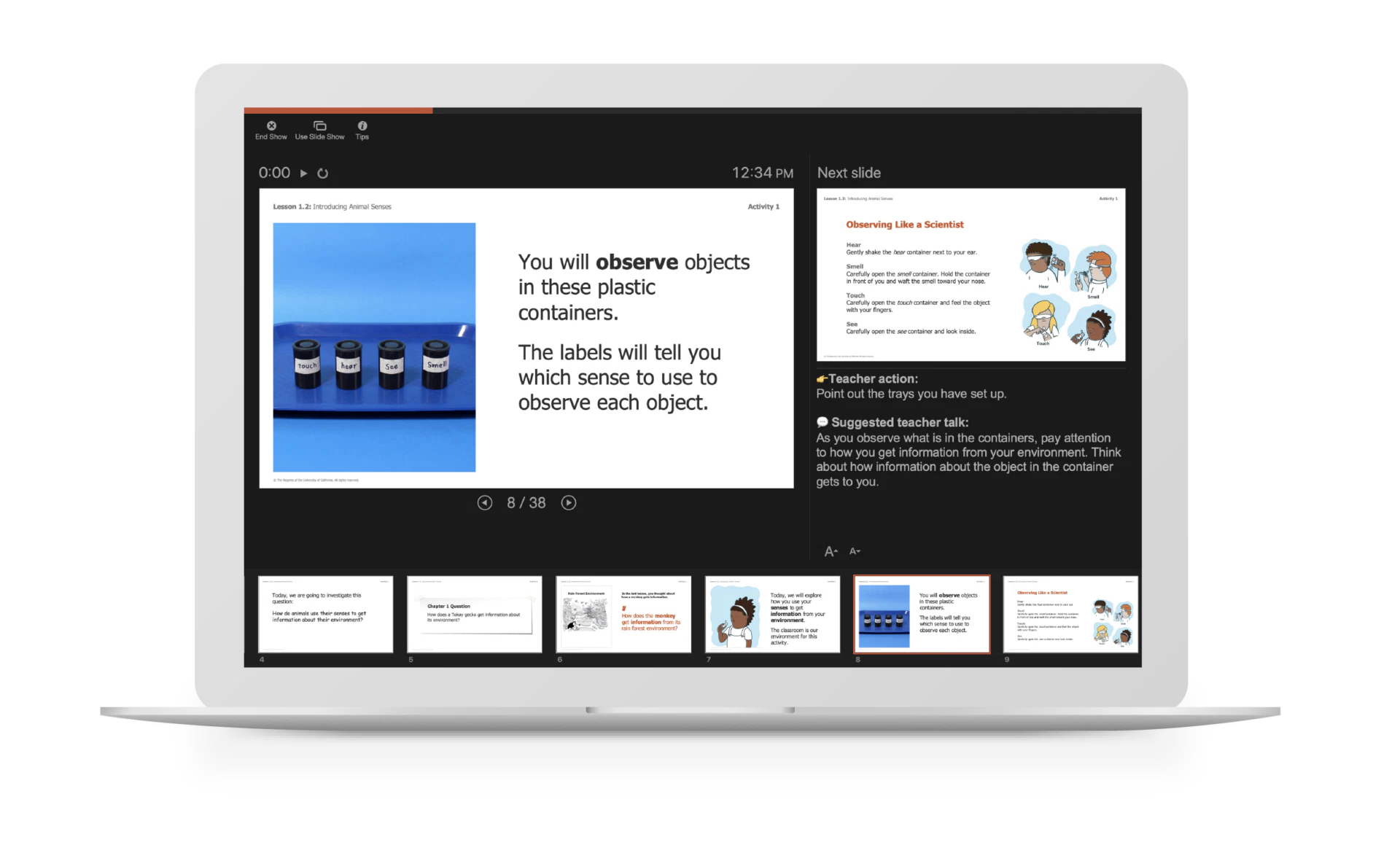
  • An instructional design that supports all learners in accessing all standards.

Hands-on investigations

Classroom discussions

Vocabulary

Simulations and digital modeling tools

Program structure

Our cyclical lesson design ensures students receive multiple exposures to concepts through a variety of modalities. As they progress through the lessons within a unit, students build and deepen their understanding, increasing their ability to develop and refine complex explanations of the unit’s phenomenon.

It’s this proven program structure and lesson design that enables Amplify Science to teach less, but achieve more. We designed our program to address 100% of the NGSS in just 66 days for grades K–2 and 88 days for grades 3–5.

Graphic showing a research process with four steps: spark intrigue with a real-world problem, explore evidence, explain and elaborate, and evaluate claims, connected in a cycle with arrows.

Unit sequence

Our lessons follow a structure that is grounded in regular routines while still being flexible enough to allow for a variety of learning experiences.

In fact, our multi-modal instruction offers more opportunities for students to construct meaning, practice and apply concepts than any other program. What’s more, our modular design means our units can be flexibly arranged to support your instructional goals.

Four images: a hair dryer blowing on a stick structure; an illustration of an orangutan climbing; two children playing a wall-mounted game; and hands with toy dinosaurs sorting paper strips.
An illustration from Needs of Plants and Animals unit
Needs of Plants and Animals

Domains: Life Science, Earth and Space Science, Engineering Design

Unit type: Investigation

Student role: Scientists

Phenomenon: There are no monarch caterpillars in the Mariposa Grove community garden since vegetables were planted.  

An illustration from the Pushes and Pulls unit
Pushes and Pulls

Domains: Physical Science, Engineering Design

Unit type: Engineering design

Student role: Pinball engineers

Phenomenon: Pinball machines allow people to control the direction and strength of forces on a ball.

Silueta de una estructura de parque infantil contra un cielo azul con nubes y tres soles amarillos.
Sunlight and Weather

Domains: Earth and Space Science, Life Science, Engineering Design

Unit type: Modeling

Student role: Weather scientists

Phenomenon: Students at Carver Elementary School are too cold during morning recess, while students at Woodland Elementary School are too hot during afternoon recess.  

Illustration of sea turtles swimming among seaweed in the ocean, with a large shark in the background.
Animal and Plant Defenses

Domain: Life Science

Unit type: Modeling

Student role: Marine scientists

Phenomenon: Spruce the Sea Turtle lives in an aquarium and will soon be released back into the ocean, where she will survive despite ocean predators.  

An illustration from the Light and Sound unit
Light and Sound

Domains: Physical Science, Engineering Design

Unit type: Engineering design

Student role: Light and sound engineers

Phenomenon: A puppet show company uses light and sound to depict realistic scenes in puppet shows.

An illustration from the Spinning Earth unit
Spinning Earth

Domain: Earth and Space Science

Unit type: Investigation

Student role: Sky scientists

Phenomenon: The sky looks different to Sai and his grandma when they talk on the phone.

An elephant standing next to a tree uses its trunk to pick a fruit from a branch while more fruit hangs above.
Plant and Animal Relationships

Domains: Life Science, Engineering Design

Unit type: Investigation

Student role: Plant scientists

Phenomenon: No new chalta trees are growing in the fictional Bengal Tiger Reserve in India.

A hand holds a red bean on a table, while a wooden stick spreads white glue and scattered beans. Also on the table are a white cup and a yellow pen.
Properties of Materials

Domains: Physical Science, Engineering Design

Unit type: Engineering design

Student role: Glue engineers

Phenomenon: Different glue recipes result in glues that have different properties.

Ilustración de una costa con acantilados, un edificio de centro recreativo con un techo rojo y un letrero, árboles de hoja perenne, una bandera azul y una playa de arena debajo.
Changing Landforms

Domain: Earth and Space Science

Unit type: Modeling

Student role: Geologists

Phenomenon: The cliff that Oceanside Recreation Center is situated on appears to be receding over time.

Una ilustración de un tren de alta velocidad moderno y aerodinámico que viaja por una vía elevada con un paisaje verde de fondo.
Balancing Forces

Domain: Physical Science

Unit type: Modeling

Student role: Engineers

Phenomenon: The town of Faraday is getting a new train that floats above its tracks.  

An illustration from the Inheritance and Traits unit
Inheritance and Traits

Domain: Life Science

Unit type: Investigation

Student role: Wildlife biologists

Phenomenon: An adopted wolf in Graystone National Park (“Wolf 44”) has some traits that appear similar to one wolf pack in the park and other traits that appear to be similar to a different wolf pack.

An illustration from the Environments and Survival unit
Environments and Survival

Domains: Life Science, Engineering Design

Unit type: Engineering design

Student role: Biomimicry engineers

Phenomenon: Over the last 10 years, a population of grove snails has changed: The number of grove snails with yellow shells has decreased, while the number of snails with banded shells has increased.

An illustration from the Weather and Climate unit
Weather and Climate

Domains: Earth and Space Science, Engineering Design

Unit type: Argumentation

Student role: Meteorologists

Phenomenon: Three different islands, each a contender for becoming an Orangutan reserve, experience different weather patterns.

An illustration from the Energy Conversions unit
Energy Conversions

Domains: Physical Science, Earth and Space Science, Engineering Design

Unit type: Engineering design

Student role: System engineers

Phenomenon: The fictional town of Ergstown experiences frequent blackouts.

An illustration from the Vision and Light unit
Vision and Light

Domain: Physical Science, Life Science, Engineering Design

Unit type: Investigation

Student role: Conservation biologists

Phenomenon: The population of Tokay geckos in a rain forest in the Philippines has decreased since the installation of new highway lights.

An illustration from the Earth's Features unit
Earth’s Features

Domain: Earth and Space Science

Unit type: Argumentation

Student role: Geologists

Phenomenon: A mysterious fossil is discovered in a canyon within the fictional Desert Rocks National Park.

An illustration from the Waves, Energy, and Information unit
Waves, Energy, and Information

Domains: Physical Science, Life Science, Earth and Space Science, Engineering Design

Unit type: Modeling

Student role: Marine scientists

Phenomenon: Mother dolphins in the fictional Blue Bay National Park seem to be communicating with their calves when they are separated at a distance underwater.

An illustration from the Patterns of Earth and Sky unit
Patterns of Earth and Sky

Domains: Physical Science, Earth and Space Science

Unit type: Investigation

Student role: Astronomers

Phenomenon: An ancient artifact depicts what we see in the sky at different times — the sun during the daytime and different stars during the nighttime — but it is missing a piece.

An illustration from the Modeling Matter unit
Modeling Matter

Domain: Physical Science

Unit type: Modeling

Student role: Food scientists

Phenomenon: Chromatography is a process for separating mixtures. Some solids dissolve in a salad dressing while others do not. Oil and vinegar appear to separate when mixed in a salad dressing.

An illustration from the Earth System unit
The Earth System

Domains: Earth and Space Science, Physical Science, Engineering Design

Unit type: Engineering Design

Student role: Water resource engineers

Phenomenon: East Ferris, a city on one side of the fictional Ferris Island, is experiencing a water shortage, while West Ferris is not.

An illustration from the Ecosystem Restoration unit
Ecosystem Restoration

Domains:Physical Science, Life Science, Earth and Space Science, Engineering Design

Unit type: Argumentation

Student role: Ecologists

Phenomenon: The jaguars, sloths, and cecropia trees in a reforested section of a Costa Rican rain forest are not growing and thriving.
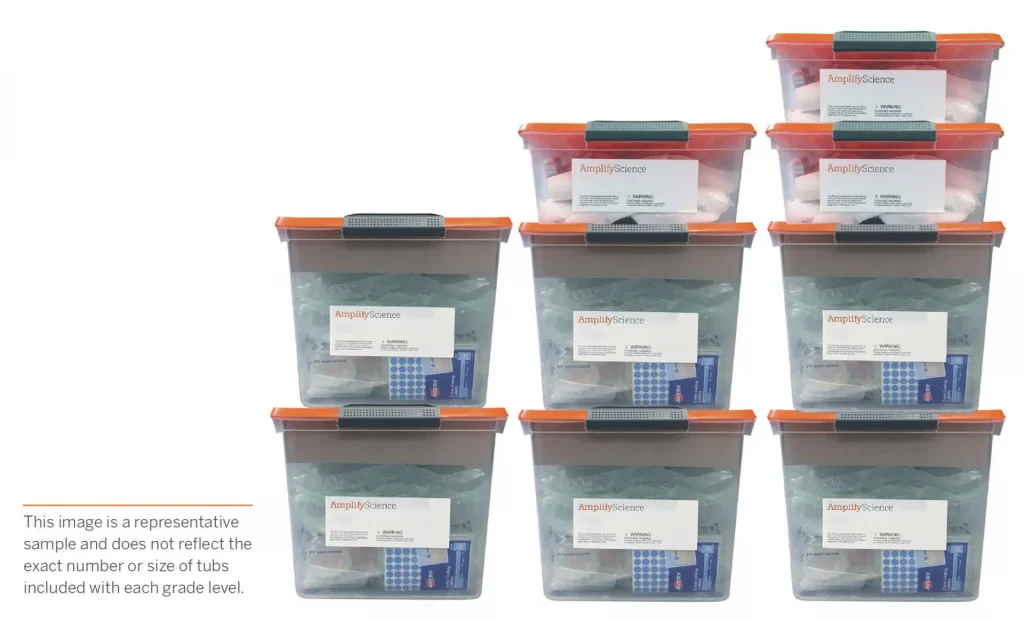
Access program

Watch the video to the right showing you how to navigate our digital platform. When you’re ready, follow the instructions below to log into our live demo account.

  • Click the orange button below to access the program digitally.
  • Choose the resources you’d like to review.
  • Pick your grade level from the drop-down menu.
  • Scroll down to find additional grade-level resources.

Contact us

A smiling woman with blond hair, wearing a blue top and a light brown jacket, with autumn leaves in the background.

Have questions? Please contact:

Erin Elfving-Strayhan
Senior Account Executive

971-291-9854
estrayhan@amplify.com

Overview

With Amplify Science, students don’t just passively learn about science concepts. Instead, they take on the role of scientists and engineers to actively investigate and figure out real-world phenomena. They do this through a blend of cohesive and compelling storylines, hands-on investigations, collaborative discussions, literacy-rich activities, and interactive digital tools.

Watch the videos below to learn how our program empowers students to think, read, write, and argue like real scientists and engineers every day.

Overview

What Educators Say

The NGSS classroom

EdReports

Amplify Science for grades K–8 has been rated all-green by EdReports..

Read the review on Edreports.

Program structure

Our cyclical lesson design ensures students receive multiple exposures to concepts through a variety of modalities. As they progress through the lessons within a unit, students build and deepen their understanding, increasing their ability to develop and refine complex explanations of the unit’s phenomenon.

It’s this proven program structure and lesson design that enables Amplify Science to teach less, but achieve more. We designed our program to address 100% of the NGSS in just 66 days for grades K–2 and 88 days for grades 3–5.

Unit sequence

Our lessons follow a structure that is grounded in regular routines while still being flexible enough to allow for a variety of learning experiences.

In fact, our multi-modal instruction offers more opportunities for students to construct meaning, and practice and apply concepts than any other program. What’s more, our modular design means our units can be flexibly arranged to support your instructional goals.

Unit sequence
Mariposa en vuelo sobre plantas en macetas sobre una mesa, con una oruga en un tallo frondoso cerca, una regadera roja a la izquierda y un paisaje brillante al fondo.

Needs of Plants and Animals

Domains: Life Science, Earth and Space Science, Engineering Design

Unit type: Investigation

Student role: Scientists

Phenomenon: There are no monarch caterpillars in the Mariposa Grove community garden since vegetables were planted. 
Una mano tirando de una cuerda atada a una bola blanca, que interactúa con un tablero de madera con varias clavijas y bandas elásticas.

Pushes and Pulls

Domains: Physical Science, Engineering Design

Unit type: Engineering design

Student role: Pinball engineers

Phenomenon: Pinball machines allow people to control the direction and strength of forces on a ball. 
An illustration from the Sunlight and Weather unit

Sunlight and Weather

Domains: Earth and Space Science, Life Science, Engineering Design

Unit type: Modeling

Student role: Weather scientists

Phenomenon: Students at Carver Elementary School are too cold during morning recess, while students at Woodland Elementary School are too hot during afternoon recess. 
Una ilustración de una tortuga marina nadando bajo el agua, acompañada por una tortuga más pequeña, una tortuga más grande y un tiburón distante. Al fondo se ven algas.

Animal and Plant Defenses

Domain: Life Science

Unit type: Modeling

Student role: Marine scientists

Phenomenon: Spruce the Sea Turtle lives in an aquarium and will soon be released back into the ocean, where she will survive despite ocean predators. 
An illustration from the Light and Sound unit

Light and Sound

Domains: Physical Science, Engineering Design

Unit type: Engineering design

Student role: Light and sound engineers

Phenomenon: A puppet show company uses light and sound to depict realistic scenes in puppet shows. 
Ilustración que muestra un paisaje urbano dividido en noche a la izquierda con una luna y estrellas, y día a la derecha con un sol, nubes y un avión.

Spinning Earth

Domain: Earth and Space Science

Unit type: Investigation

Student role: Sky scientists

Phenomenon: The sky looks different to Sai and his grandma when they talk on the phone. 
Un elefante se encuentra debajo de un árbol y usa su trompa para arrancar un trozo de fruta.

Plant and Animal Relationships

Domains: Life Science, Engineering Design

Unit type: Investigation

Student role: Plant scientists

Phenomenon: No new chalta trees are growing in the fictional Bengal Tiger Reserve in India. 
A hand holds a red bean on a table, while a wooden stick spreads white glue and scattered beans. Also on the table are a white cup and a yellow pen.

Properties of Materials

Domains: Physical Science, Engineering Design

Unit type: Engineering design

Student role: Glue engineers

Phenomenon: Different glue recipes result in glues that have different properties. 
An illustration from the Changing Landforms unit

Changing Landforms

Domain: Earth and Space Science

Unit type: Modeling

Student role: Geologists

Phenomenon: The cliff that Oceanside Recreation Center is situated on appears to be receding over time. 
An illustration from the Balancing Forces unit

Balancing Forces

Domain: Physical Science

Unit type: Modeling

Student role: Engineers

Phenomenon: The town of Faraday is getting a new train that floats above its tracks. 
An illustration from the Inheritance and Traits unit

Inheritance and Traits

strong>Domain: Life Science

Unit type: Investigation

Student role: Wildlife biologists

Phenomenon: An adopted wolf in Graystone National Park (Wolf 44) has some traits that appear similar to one wolf pack in the park and other traits that appear to be similar to a different wolf pack. 
An illustration from the Environments and Survival unit

Environments and Survival

Domains: Life Science, Engineering Design

Unit type: Engineering design

Student role: Biomimicry engineers

Phenomenon: Over the last 10 years, a population of grove snails has changed: The number of grove snails with yellow shells has decreased, while the number of snails with banded shells has increased. 
Un orangután con un pelaje naranja cuelga de una enredadera en una densa y verde jungla con árboles y plantas, mientras el sol brilla de fondo.

Weather and Climate

Domains: Earth and Space Science, Engineering Design

Unit type: Argumentation

Student role: Meteorologists

Phenomenon: Three different islands, each a contender for becoming an Orangutan reserve, experience different weather patterns. 
An illustration from the Energy Conversions unit

Energy Conversions

Domains: Physical Science, Earth and Space Science, Engineering Design

Unit type: Engineering design

Student role: System engineers

Phenomenon: The fictional town of Ergstown experiences frequent blackouts. 
An illustration from the Vision and Light unit

Vision and Light

Domain: Physical Science, Life Science, Engineering Design

Unit type: Investigation

Student role: Conservation biologists

Phenomenon: The population of Tokay geckos in a rain forest in the Philippines has decreased since the installation of new highway lights. 
Ilustración de una costa rocosa con acantilados angulares en tonos rojizos a la izquierda y una masa de agua azul debajo.

Earth's Features

Domain: Earth and Space Science

Unit type: Argumentation

Student role: Geologists

Phenomenon: A mysterious fossil is discovered in a canyon within the fictional Desert Rocks National Park. 
An illustration from the Waves, Energy, and Information unit

Waves, Energy, and Information

Domains: Physical Science, Life Science, Earth and Space Science, Engineering Design

Unit type: Modeling

Student role: Marine scientists

Phenomenon: Mother dolphins in the fictional Blue Bay National Park seem to be communicating with their calves when they are separated at a distance underwater. 
An illustration from the Patterns of Earth and Sky unit

Patterns of Earth and Sky

Domains: Physical Science, Earth and Space Science

Unit type: Investigation

Student role: Astronomers

Phenomenon: An ancient artifact depicts what we see in the sky at different times — the sun during the daytime and different stars during the nighttime — but it is missing a piece. 
An illustration from the Modeling Matter unit

Modeling Matter

Domain: Physical Science

Unit type: Modeling

Student role: Food scientists

Phenomenon: Chromatography is a process for separating mixtures. Some solids dissolve in a salad dressing while others do not. Oil and vinegar appear to separate when mixed in a salad dressing. 
An illustration from the Earth System unit

The Earth System

Domains: Earth and Space Science, Physical Science, Engineering Design

Unit type: Engineering Design

Student role: Water resource engineers

Phenomenon: East Ferris, a city on one side of the fictional Ferris Island, is experiencing a water shortage, while West Ferris is not. 
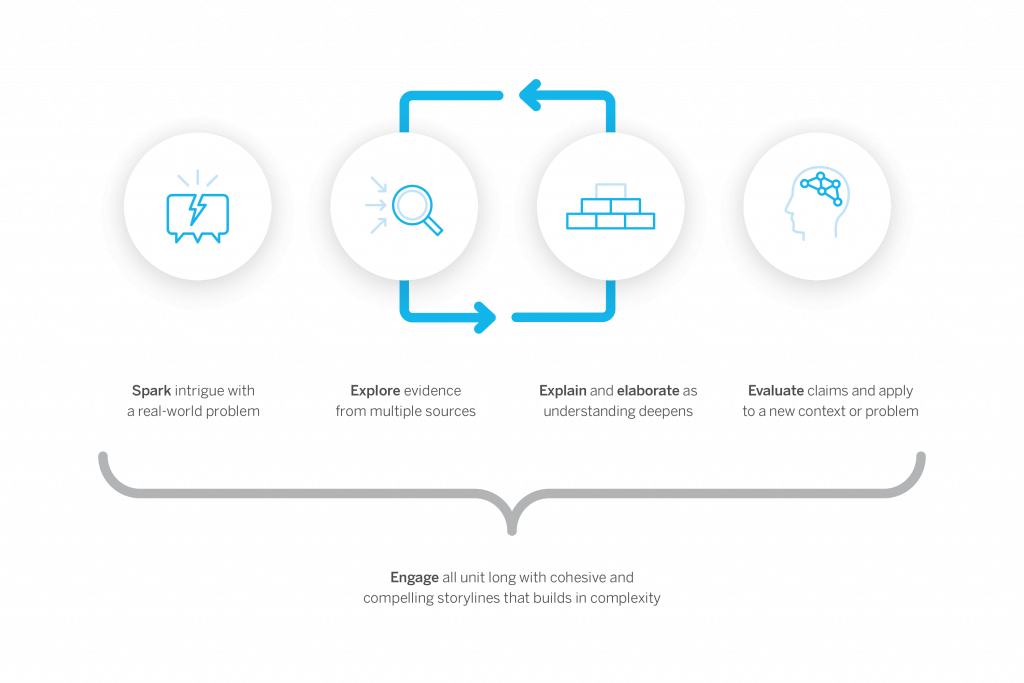
An illustration from the Ecosystem Restoration unit

Ecosystem Restoration

Domains:Physical Science, Life Science, Earth and Space Science, Engineering Design

Unit type: Argumentation

Student role: Ecologists

Phenomenon: The jaguars, sloths, and cecropia trees in a reforested section of a Costa Rican rain forest are not growing and thriving. 

Access program

Watch the video to the right showing you how to navigate our digital platform. When you’re ready, follow the instructions below to log into your live demo account.

  • Click the orange button below to access the platform.
  • Explore as a teacher with this username (t1.cartwrightsd@demo.tryamplify.net) and this password (Amplify1-cartwrightsd).
  • Explore as a student with this username (s1.cartwrightsd@demo.tryamplify.net) and this password (Amplify1-cartwrightsd).
  • Choose your grade level from the drop-down menu.


Access the digital platform now

Resources

Welcome to Grade 3

BACK TO MAIN TK–5 PAGE

Amplify Science California is so effective you can cover 100% of the NGSS in half the time of other programs.

You can breathe a sigh of relief knowing all you need is:

  • 88 days per year
  • 2-3 lessons per week
  • 45 minutes per lesson
Four images: a hair dryer blowing on a stick structure; an illustration of an orangutan climbing; two children playing a wall-mounted game; and hands with toy dinosaurs sorting paper strips.

What students learn

When you’re ready:

  • Find a summary of each unit below including each unit’s student role and anchor phenomenon.
  • Click on the orange “See how the unit works” link to download a helpful Unit Guide. These guides make great companions to busy reviewers looking for a big-picture understanding of how each unit works.
An illustration of a modern, streamlined high-speed train traveling on an elevated track with a green landscape in the background.

Unit 1

Balancing Forces


Student role: Engineers

Phenomenon: The fictional town of Faraday is getting a new train. Unlike typical trains, this one floats, which is causing some concern among the town’s citizens.

See how this unit works

Illustration of a forest scene with a bear, a moose, birds on a branch, and a pack of wolves in the foreground. Hills and trees are in the background under a clear sky.

Unit 2

Inheritance and Traits


Student role: Wildlife biologists

Phenomenon: An adopted wolf in Graystone National Park has some traits in common with one wolf pack in the park and other traits in common with a different pack.

See how this unit works

Illustration of a bird looking at a snail on the ground, with green leaves on the left side and a blue sky background.

Unit 3

Environments and Survival

Student role: Biomimicry engineers

Phenomenon: Over 10 years, a population of grove snails has changed. Populations with yellow shells have decreased, while those with banded shells have increased.

See how this unit works

An orangutan with orange fur hangs from a vine in a dense, green jungle with trees and plants, while the sun shines in the background.

Unit 4

Weather and Climate


Student role: Meteorologists

Phenomenon: Three different islands, each a contender for becoming an orangutan reserve, experience different weather patterns.

See how this unit works

How teachers teach

When you’re ready:

  • Scroll down and take a closer look at your classroom resources.
  • Click on the orange links below each component to see grade-specific samples.
A laptop displays a PowerPoint presentation in presenter view, with slides about observing objects in plastic containers and related sensory instructions.

Classroom Slides

These customizable PowerPoints are available for every lesson of the program and make delivering instruction a snap with visual prompts, colorful activity instructions, investigation set-up videos and animations, and suggested teacher talk in the notes section of each slide.

Video introduction to Classroom Slides

Sample Classroom Slides

Sample Classroom Slides (Spanish)

Spiral-bound teacher’s guide and a laptop display both showing Amplify Science’s “Balancing Forces: Investigating Floating Trains” educational materials.

Teacher’s Reference Guide

Available digitally and in print, our unit-specific reference guides are chock full of helpful resources, including scientific background knowledge, planning information and resources, color-coded 3-D Statements, detailed lesson plans, tips for delivering instruction, and differentiation strategies.

Login to platform below to access

Materials Kits

Our kits include enough non-consumable materials to support a class of 36 students and enough consumable items to support 72 students. In other words, each kit can last two years! Plus, our unit-specific kits mean you just grab the tub you need and then put it all back with ease.

List of investigations by unit

List of materials by unit

Two book covers, one in Spanish titled "Tabla Voladora" and one in English titled "Hoverboard," both showing a boy riding a futuristic hoverboard.

Student Books

Our award-winning Student Books include content-rich nonfiction and informational texts designed to introduce concepts and also deepen understanding. Books are read to, with, and by students with ample scaffolding and support provided by the teacher in whole-class, small-groups, and student pairs.

List of Student Books by unit

Sample Student Book

Sample Student Book (Spanish)

A diagram shows labeled forces acting on an object, with arrows indicating directions and a key for object, force, and force-type labels at the bottom.

Practice Tools

Our digital Practice Tools feature easy-to-use drag-and-drop and data-entry activities that support the practice of important SEPs like sorting, modeling, or visualizing information. Practice Tools can be used as a whole group, in small groups, or with a partner.

Video overview of digital tools

List of digital tools by unit

Device calendars by unit

Two science notebooks, one in Spanish and one in English, titled "Balancing Forces: Investigating Floating Trains," with a cover image of feet standing on a hovering platform.

Consumable Notebooks

Available for every unit, our Student Investigation Notebooks contain instructions for activities and space for students to record data and observations, reflect on ideas from texts and investigations, and construct explanations and arguments.

Sample Student Investigation Notebook

Sample Student Investigation Notebook (Spanish)

A man wearing glasses and a maroon shirt smiles at the camera on a laptop screen with the words "MYSTERY doug" and a speech bubble saying "Doug.

Mystery Science

Our exclusive partnership with Mystery Science means you get our NGSS core curriculum plus two years of free access to Mystery Doug and his extensive library of captivating videos that deepen students’ understanding of each unit’s phenomenon.

Mystery Science lesson alignment

A person with headphones works on a laptop; a line from their head transforms into a rocket, symbolizing imagination, innovation, and the foundational skills essential for multilingual learners.


Coming Soon

Unlike other publishers, we don’t make you wait until your next adoption to get the latest and greatest from Amplify. We’re always launching new and exciting features. What’s more, we’ll push them out to you even after you adopt us!

See what’s coming for 2020-2021

Elementary

Watch how Amplify Science integrates hands-on learning, classroom discussions, digital modeling tools, and more.

Classroom discussions


As part of Amplify Science’s Weather and Climate unit, students take on the role of meteorologists to determine which of three fictional islands has weather most like that of orangutans’ existing habitats, Borneo and Sumatra. In this video featuring Lesson 3.7, third-grade students from Chicago Public Schools are discussing the data they collected, as well as which Science and Engineering Practices they used during the lesson.

Simulations and modeling tools


As part of Amplify Science’s Earth’s Features unit, students take on the role of geologists to investigate how a mysterious fossil formed and when it came to be in its current location. In this video, fourth-grade students from Chicago Public Schools are using digital modeling tools to investigate how fossils and rocks can be used to make inferences about past environments.

A week in the life

What does a week in the life of an Amplify Science teacher look like? We asked Keneisha Charleston, a second-grade teacher from Chicago Public Schools, to talk through an example of what one week of using Amplify Science is like in her classroom.

From the classroom

Hear from teachers, administrators, and students across the country who are using Amplify Science in their classrooms right now.

Middle School

Watch how Amplify Science integrates hands-on learning, literacy, digital modeling tools, and more.

Literacy integration


As part of Amplify Science’s Matter and Energy in Ecosystems unit, students take on the role of ecologists to figure out what caused the collapse of the biodome ecosystem. In this video, sixth-grade students from Denver Public Schools are reading science articles, and then using writing prompts to create arguments using evidence.

Classroom discussions


As part of Amplify Science’s Matter and Energy in Ecosystems unit, students take on the role of ecologists to figure out what caused the collapse of the biodome ecosystem. In this video, sixth-grade students from Denver Public Schools are using evidence to support their claims as part of a classroom discussion.

A week in the life

What does a week in the life of an Amplify Science teacher look like? We asked Amy Trujillo, a sixth-grade teacher from Denver Public Schools, to talk through an example of what one week of using Amplify Science is like in her classroom.

From the classroom

Hear from teachers, administrators, and students across the country who are using Amplify Science in their classrooms right now.

Access a free sample

Ready to take a closer look at Amplify Science? No problem. Just complete the form for instant digital access to two sample units.

A closer look at grades 3–5

Amplify Science is based on the latest research on teaching and learning and helps teachers deliver age-appropriate, high-quality, literacy-rich instruction that enables students to take on the roles of scientists and engineers to solve real-world phenomena every day.

In the 3–5 classroom, this looks like students:

  • Collecting evidence from a variety of sources.
  • Making sense of evidence in a variety of ways.
  • Formulating convincing scientific arguments.
Un collage de cuatro imágenes que muestran a estudiantes realizando experimentos científicos: secando estructuras, trabajando con plantas, vertiendo la mezcla en un vaso de precipitados y regando plantas en contenedores.
A four-step process diagram: Spark, Explore, Explain and elaborate, and Evaluate, each with an icon and description, connected by arrows, ending with a summary statement below.

Program structure

Our cyclical lesson design ensures students receive multiple exposures to concepts through a variety of modalities. As they progress through the lessons within a unit, students build and deepen their understanding, increasing their ability to develop and refine complex explanations of the unit’s phenomenon.

It’s this proven program structure and lesson design that enables Amplify Science to teach less, but achieve more. Rather than asking teachers to wade through unnecessary content, we designed our 3–5 program to address 100% of the NGSS in just 88 days.

Scope and sequence

Every year of our grades 3–5 sequence consists of 4 units and 88 lessons. Said another way, each unit contains 20 lessons plus two dedicated assessment days (a Pre-Unit Assessment and End-of-Unit Assessment).

Lessons for grades 3–5 are written to last a minimum of 60 minutes, though teachers can expand or contract the timing to meet their needs.

Grid of nine educational lesson cards, each featuring a different science topic like "balancing forces" and "weather systems" with grade levels and lesson durations listed.

Unit types

Each unit delivers three-dimensional learning experiences and engages students in gathering evidence from a rich collection of sources, while also emphasizing a particular science and engineering practice.

In grades 3–5:

  • One unit emphasizes the practice of investigation.
  • One unit emphasizes the practice of modeling.
  • One unit emphasizes the practice of engineering design.
  • One unit emphasizes the practice of argumentation.
Investigation Units

Investigation units focus on the process of strategically developing investigations and gathering data to answer questions. Students are first asked to consider questions about what happens in the natural world and why, and are then involved in designing and conducting investigations that produce data to help answer those questions.

Modeling Units

Modeling units provide extra support to students engaging in the practice of modeling. Students use physical models, investigate with computer models, and create their own diagrams to help them visualize what might be happening on the nanoscale.

Engineering Design Units

Engineering design units provide opportunities for students to solve complex problems by applying science principles to the design of functional solutions, and iteratively testing those solutions to determine how well they meet preset criteria.

Argumentation units

Argumentation units provide students with regular opportunities to explore and discuss available evidence, time and support to consider how evidence may be leveraged in support of claims, and independence that increases as they mount written arguments in support of their claims.

Units at a glance

Illustration of a high-speed train traveling on an elevated track with a red light on the front, set against a blue sky and green landscape.
Balancing Forces

Domain: Physical Science

Unit type: Modeling

Student role: Engineers

Phenomenon: The town of Faraday is getting a new train that floats above its tracks.  

Illustration of wolves in the foreground, quail perched on a branch, a bear, and elk in a grassy, wooded landscape with hills in the background.
Inheritance and Traits

Domains: Life Science

Unit type: Investigation

Student role: Wildlife biologists

Phenomenon: An adopted wolf in Graystone National Park (“Wolf 44”) has some traits that appear similar to one wolf pack in the park and other traits that appear to be similar to a different wolf pack. 

A bird stands on the ground, looking down at a yellow snail near some green grass against a blue background.
Environments and Survival

Domains: Life Science, Engineering Design

Unit type: Engineering design

Student role: Biomimicry engineers

Phenomenon: Over the last 10 years, a population of grove snails has changed: The number of grove snails with yellow shells has decreased, while the number of snails with banded shells has increased.  

An orange orangutan climbs a vine in a dense green jungle with tall trees and the sun visible in the background.
Weather and Climate

Domains: Earth and Space Science, Engineering Design

Unit type: Argumentation

Student role: Meteorologists

Phenomenon: Three different islands, each a contender for becoming an Orangutan reserve, experience different weather patterns.  

City buildings at night with lit windows, a full moon, stars in the sky, and a person standing by a window on the left.
Energy Conversions

Domains: Physical Science, Earth and Space Science, Engineering Design

Unit type: Engineering design

Student role: System engineers

Phenomenon: The fictional town of Ergstown experiences frequent blackouts.  

A streetlight shines at night; arrows show its light reflecting off a cricket to a gecko, illustrating how the gecko sees its prey.
Vision and Light

Domain: Physical Science, Life Science, Engineering Design

Unit type: Investigation

Student role: Conservation biologists

Phenomenon: The population of Tokay geckos in a rain forest in the Philippines has decreased since the installation of new highway lights.  

Illustration of rocky cliffs with reddish and brown tones beside a flowing blue river under a clear sky.
Earth’s Features

Domain: Earth and Space Science

Unit type: Argumentation

Student role: Geologists

Phenomenon: A mysterious fossil is discovered in a canyon within the fictional Desert Rocks National Park.  

Two dolphins are facing each other underwater against a blue background.
Waves, Energy, and Information

Domains: Physical Science, Life Science, Earth and Space Science, Engineering Design

Unit type: Modeling

Student role: Marine scientists

Phenomenon: Mother dolphins in the fictional Blue Bay National Park seem to be communicating with their calves when they are separated at a distance underwater.

Earth orbits the Sun in space, shown by a dashed blue line; an arrow on Earth indicates its rotation direction.
Patterns of Earth and Sky

Domains: Physical Science, Earth and Space Science

Unit type: Investigation

Student role: Astronomers

Phenomenon: An ancient artifact depicts what we see in the sky at different times — the sun during the daytime and different stars during the nighttime — but it is missing a piece.  

Red blood cells scattered over a swirling red and white background, creating an abstract representation of blood flow.
Modeling Matter

Domain: Physical Science

Unit type: Modeling

Student role: Food scientists

Phenomenon: Chromatography is a process for separating mixtures. Some solids dissolve in a salad dressing while others do not. Oil and vinegar appear to separate when mixed in a salad dressing.  

Illustration of wind carrying particles from the ocean, over a coastal town, and up a steep, green mountain slope under a clear blue sky.
The Earth System

Domains: Earth and Space Science, Physical Science, Engineering Design

Unit type: Engineering Design

Student role: Water resource engineers

Phenomenon: East Ferris, a city on one side of the fictional Ferris Island, is experiencing a water shortage, while West Ferris is not.  

Illustration of a cheetah standing on the ground and a sloth hanging from a tree surrounded by various plants and mushrooms in a jungle scene.
Ecosystem Restoration

Domains:Physical Science, Life Science, Earth and Space Science, Engineering Design

Unit type: Argumentation

Student role: Ecologists

Phenomenon: The jaguars, sloths, and cecropia trees in a reforested section of a Costa Rican rain forest are not growing and thriving.  

What’s included in our phenomena-based science curriculum

Amplify Science is a phenomena-based science curriculum for grades K-8. This program is designed to give students engaging, realistic experiences that mirror how scientists and engineers actually work. To do this, the Lawrence Hall of Science and Amplify created compelling print and digital resources that work seamlessly together to enable students’ investigations and explorations.

Year at a glance

Amplify Science is organized around units where students are introduced to compelling phenomena and real-world problems, develop and strengthen claims by collecting evidence and testing assumptions, and apply their learning in new contexts.

Un gráfico que muestra secuencias de lecciones de ciencias desde jardín de infantes hasta quinto grado, detallando temas, números de lecciones, días de evaluación y duración de las lecciones para cada grado.

Units at a glance

In each Amplify Science unit, students are asked to inhabit the role of a scientist or engineer in order to investigate a real-world problem. These problems provide relevant, 21st-century contexts through which students investigate different scientific phenomena.

1

Needs of Plants and Animals

Students take on the role of scientists in order to figure out why there have been no monarch caterpillars in the community garden since vegetables were planted. They investigate how plants and animals get what they need to live and grow, and make a new plan for the community garden that provides for the needs of the monarch caterpillars in addition to producing vegetables for humans.

2

Pushes and Pulls

Students take on the role of pinball machine engineers as they investigate the effects of forces on the motion of an object. They conduct tests in their own prototypes (models) of a pinball machine and use what they learn to contribute to the design of a class pinball machine. Over the course of the unit, students construct a foundational understanding of why things move in different ways

Silueta de una estructura de parque infantil contra un cielo azul con nubes y tres soles amarillos.

3

Sunlight and Weather

The principals of Woodland Elementary and Carver Elementary need student weather scientists to help them explain why Woodland’s playground is warmer than Carver’s at recess. Students gather data from models of the sun and Earth’s surface and observe their own playgrounds to figure out how sunlight causes changes in the temperatures of different surfaces. Students then use models to figure out why Woodland’s playground sometimes floods.

1

Animal and Plant Defenses

Students play the role of marine scientists. In their role, students apply their understanding of plant and animal defense structures to explain to aquarium visitors how a sea turtle and her offspring can defend themselves from ocean predators when they are released into the wild.

Dos manos sosteniendo un papel con un dibujo de pirámide y árbol, iluminado por una linterna, proyectando otra sombra de la imagen en la pared.

2

Light and Sound

Students take on the role of light and sound engineers for a puppet show company as they investigate cause and effect relationships to learn about the nature of light and sound. They apply what they learn to design shadow scenery and sound effects for a puppet show.

Ilustración que muestra un paisaje urbano dividido en noche a la izquierda con una luna y estrellas, y día a la derecha con un sol, nubes y un avión.

3

Spinning Earth

As sky scientists, students explain why a boy living in a place near them sees different things in the sky than his grandma does when he talks to her on the phone. Students record, organize, and analyze observations of the sun and other sky objects as they look for patterns and make sense of the cycle of daytime and nighttime.

1

Plant and Animal Relationships

In their role as plant scientists, students work to figure out why there are no new chalta trees growing in the Bengal Tiger Reserve, which is part of a broadleaf forest. Students investigate what the chalta tree needs to survive, then collect and analyze qualitative and quantitative data to solve the mystery.

Una mano sostiene un frijol rojo sobre una mesa, mientras un palo de madera esparce pegamento blanco y frijoles esparcidos. Sobre la mesa también hay una taza blanca y una pluma amarilla.

2

Properties of Materials

As glue engineers, students are challenged to create a glue for use at their school that meets a set of design goals. Students present an evidence-based argument for why their glue mixture will be good for their school to use.

Ilustración de una costa con acantilados, un edificio de centro recreativo con un techo rojo y un letrero, árboles de hoja perenne, una bandera azul y una playa de arena debajo.

3

Changing Landforms

The director of the Oceanside Recreation Center gets a scare when a nearby cliff collapses overnight. Research reveals that the distance between the Recreation Center’s flagpole and the edge of the cliff have changed over time. Students play the role of geologists and work to figure out why the cliff has changed over time. Based on what they learn about erosion, they advise on whether it is safe to keep the center open even though the cliff is changing.

Una ilustración de un tren de alta velocidad moderno y aerodinámico que viaja por una vía elevada con un paisaje verde de fondo.

1

Balancing Forces

People in Faraday are excited to hear that a new train service will be built for their city, but concerned when they hear that it will be a floating train. Students are challenged to figure out how a floating train works in order to explain it to the citizens of Faraday. They develop models of how the train rises, floats, and then falls back to the track, and then write an explanation of how the train works.

Ilustración de una escena de bosque con un oso, un alce, pájaros en una rama y un grupo de lobos en primer plano. Las colinas y los árboles están al fondo bajo un cielo despejado.

2

Inheritance and Traits

Students play the role of wildlife biologists working in Greystone National Park. They study two wolf packs and are challenged to figure out why an adopted wolf (“Wolf 44”) in one of the packs has certain traits. Students observe variation between and within different species, investigate inherited traits and those that result from the environment, and explain the origin of several of the adopted wolf’s traits.

Ilustración de un pájaro mirando un caracol en el suelo, con hojas verdes en el lado izquierdo y un fondo de cielo azul.

3

Environments and Survival

In their role as biomimicry engineers, students work to figure out how the traits of grove snails affect their survival in different environments. They then explore how the traits of different organisms make them more likely or less likely to survive, collecting and interpreting data to understand how organisms’ traits affect their survival in different environments. Students then apply their understanding to a new challenge: designing effective solutions for the removal of invasive plants.

4

Weather and Climate

In their role as meteorologists, students gather evidence to decide where to build an orangutan reserve by analyzing patterns in weather data. After choosing the strongest evidence, students use data to make arguments about which of three fictional islands has weather most like that of orangutans’ existing habitats, Borneo and Sumatra. They then discern patterns in the locations of natural hazards in order to figure out which ones the Wildlife Protection Organization must prepare for.

Ilustración de un paisaje urbano nocturno con ventanas iluminadas y farolas, una luna visible y estrellas en el cielo. Una figura solitaria se recorta en una de las ventanas.

1

Energy Conversions

Students take on the role of systems engineers for Ergstown, a fictional town that experiences frequent blackouts, and explore reasons why an electrical system can fail. Students apply what they learned as they choose new energy sources and energy converters for the town, then write arguments for why their design choices will make the town’s electrical system more reliable.

Un gecko se prepara para atrapar un grillo bajo una farola por la noche. Las flechas amarillas ilustran la luz de la lámpara que golpea al grillo y se refleja en los ojos del gecko.

2

Vision and Light

As conservation biologists, students work to figure out why a population of Tokay geckos has decreased since the installation of new highway lights in the rainforest. Students use their understanding of vision, light, and information processing to figure out why an increase in light in the geckos’ habitat is affecting the population.

3

Earth’s Features

Playing the role of geologists, students help the director of Desert Rocks National Park explain how and when a particular fossil formed and how it came to be in its current location. Students figure out what the environment of the park was like in the past and why it has so many visible rock layers.

Dos delfines nadan bajo el agua en un ambiente teñido de azul, uno frente al otro, y uno parece abrir ligeramente la boca.

4

Waves, Energy, and Information

In their role as marine scientists, students work to figure out how mother dolphins communicate with their calves. They write a series of scientific explanations with diagrams to demonstrate their growing understanding of how sound waves travel. Then they apply what they’ve learned about waves, energy, and patterns in communication to figure out how to create patterns that can communicate information over distances.

1

Patterns of Earth and Sky

Playing the role of astronomers, students help a team of archaeologists figure out what the missing piece of a recently discovered artifact might have depicted. As they learn about the sun and other stars and the movement of Earth, students can explain what is shown on the artifact and what might be on the missing piece.

2

Modeling Matter

In their role as food scientists at a fictional company, students are introduced to the idea that all matter is made of particles too small to see, and that each different substance is made of particles (molecules) that are unique. They are then challenged to solve two problems: one requires them to separate a mixture, and the other requires them to make unmixable substances mix. Students are challenged to use the particulate model of matter to explain their work to the CEO of the company.

Ilustración de un paisaje costero con una montaña y flechas que representan el flujo del viento sobre y alrededor de la montaña, lo que indica la dinámica del flujo de aire.

3

The Earth System

The cities of East Ferris and West Ferris are located on different sides of a mountain on the fictional Ferris Island. East Ferris is having a water shortage while West Ferris is not. As water resource engineers, students learn about the Earth system to help figure out what is causing the water shortage problem and design possible solutions, including freshwater collection systems and proposals for using chemical reactions to treat wastewater.

Ilustración de una escena de la jungla en la que aparecen un guepardo y un perezoso entre un denso follaje verde y varias plantas coloridas.

4

Ecosystem Restoration

As ecologists, students work to figure out why the organisms in a part of a Costa Rican rainforest ecosystem aren’t growing and thriving. As they solve this problem, students learn more generally how organisms in an ecosystem get the matter and energy they need to survive, and then write a series of restoration plans that include arguments about why the rainforest ecosystem is not thriving and recommend actions to restore its health.

Print & digital components

The program includes instructional guidance and student materials for a year of instruction, with lessons and activities that keep students engaged every day.

Component

Format

Teacher’s Guides

Available digitally and in print, the Teacher’s Guides contain all of the information teachers need to facilitate classroom instruction, including detailed lesson plans, high-level overview documentation, differentiation strategies, standards alignments, materials and preparation steps, teacher support strategies and in-context professional development, possible student responses, and more.

Print and digital

Hands-on materials kits

Hands-on learning is integrated into every unit of Amplify Science. Each hands-on activity is supported through clear instructions for the teacher, as well as easily accessible materials in unit-specific kits. Each kit contains hands-on materials, both consumable and nonconsumable, and various print materials (e.g., Vocabulary and Key Concept cards). With Amplify Science, students can actively participate in science: gathering evidence, thinking critically, making observations, and communicating their claims.

Kit

A collection of gardening supplies including a blue bucket, soil bags, plastic cups, hose, fertilizer pellets, and a black tray on a white background.

Component

Format

Student Investigation Notebooks

Available for every unit, the Student Investigation Notebooks contain instructions for activities and space for students to record data, reflect on ideas from texts and investigations, and construct explanations and arguments.

Print and digital

Student books

The age-appropriate Student Books in Amplify Science allow students to engage with content-rich text, obtain evidence, develop research and close reading skills, and construct arguments and explanations about the ideas they are learning in class.

Print and digital

Simulations and practice tools (grades 2+)

Developed exclusively for the Amplify Science program, these serve as venues for exploration and data collection, allowing students to explore scientific concepts that might otherwise be invisible or impossible to see with the naked eye.

Digital

Laptop screen displaying a geographical simulation of a river system with zones: Upper River, Floodplain, and River Delta, including an elevation chart and controls for speed and time adjustment.

Explore more programs

Our programs are designed to support and complement one another. Learn more about our related programs.

Our Instructional model

The Amplify Science Alabama program is rooted in the proven, research-based pedagogy of Do, Talk, Read, Write, Visualize. Here’s how each element works:

DO
First-hand investigations are an important part of any science classroom, and Amplify Science Alabama has students getting hands-on in every unit, from building models of protein molecules to experimenting with electrical systems.

TALK
Student-to-student discourse and full class discussions are an integral part of the program. Students are provided with numerous opportunities to engage in meaningful oral scientific argumentation, all while fostering a collaborative classroom environment.

READ
Students read scientific articles, focusing their reading activities on searching for evidence related to their investigation, and importantly, on asking and recording questions as they read through fascinating texts on 21st-century topics.

WRITE
Following real-world practices, students write scientific arguments based on evidence they’ve collected, making clear their reasoning about how a given piece of evidence connects to one of several claims.

VISUALIZE
By manipulating digital simulations and using modeling tools to craft visualizations of their thinking— just as real scientists and engineers do—students take their learning far beyond the confines of what they can physically see in the classroom in an exciting and authentic way.

Supporting resources

To review the digital program, visit learning.amplify.com.

Click Login with Amplify, and use the following credentials:

Teacher view

Additional Materials to support your review:

Scientific Literacy

Literacy-rich science instruction

Scope and sequence

GRADE

UNITS

Kindergarten

  • Needs of Plants and Animals
  • Pushes and Pulls
  • Sunlight and Water

Grade 1

  • Animal and Plant Defenses
  • Light and Sound
  • Spinning Earth

Grade 2

  • Plant and Animal Relationships
  • Properties of Materials
  • Changing Landforms

Grade 3

  • Balancing Forces
  • Inheritance and Traits
  • Environments and Survival
  • Weather and Climate

Grade 4

  • Energy Conversions
  • Vision and Light
  • Earth’s Features
  • Waves, Energy, and Information

Grade 5

  • Patterns of Earth and Sky
  • Modeling Matter
  • The Earth System
  • Ecosystem Restoration

GRADES K-5

Grade K: Pushes and Pulls

Grade 1: Animal and Plant Defenses

Grade 2: Properties of Materials

Grade 3: Balancing Forces

Grade 4: Investigating Wavelength

Grade 5: Introducing Food Science

Hands On Investigations

Hands-on Investigations
Hands-on learning is an essential part of Amplify Science Alabama, and is integrated into every unit. Students actively participate in science, acting like scientists and engineers as they gather evidence, think critically, solve problems, and develop and defend claims about the world around them. Every unit includes hands-on investigations which are critical to achieving the unit’s learning goals.

Amplify offers hands-on material kits as well as the option to use AMSTI Kit Resources for many of the student investigations.

Digital Experience

Digital student experience
Students access the digital simulations and modeling tools, as well as lesson activities and assessments, through the digital student experience. Students can interact with the digital student experience as they:

  • Conduct hands-on investigations
  • Engage in active reading and writing activities
  • Participate in discussions
  • Record observations
  • Craft end-of-unit scientific arguments

Alabama Teacher’s Guides
Available digitally and in print, the Teacher’s Guides contain all of the information teachers need to facilitate classroom instruction, including:

  • Classroom Slides
  • Detailed lesson plans
  • Unit and chapter overview documentation
  • Differentiation strategies
  • Standards alignments
  • In-context professional development

Looking for help?

Powerful (and free!) pedagogical support

Amplify provides a unique kind of support you won’t find from other publishers. We have developed an educational support team of former teachers and administrators who provide pedagogical support for every Amplify curriculum, assessment, and intervention program. This service is completely free for all educators who are using our programs and includes:

  • Guidance for developing lesson plans and intervention plans
  • Information on where to locate standards and other planning materials
  • Recommendations and tips for day-to-day teaching with Amplify programs
  • Support with administering and interpreting assessment data and more

To reach our pedagogical team, use our live chat within your program, call (800) 823-1969, or email edsupport@amplify.com

Timely technical and program support

Our technical and program support is included and available from 7 a.m. to 7 p.m. ET, Monday through Friday, through a variety of channels, including a live chat program that enables teachers to get immediate help in the middle of the school day.

For your most urgent questions:

  • Use our live chat within your program
  • Call our toll-free number: (800) 823-1969

For less urgent questions:

See what an interactive 21st-century science curriculum looks like.

In Amplify Science, students take on the role of a scientist or engineer to actively investigate compelling phenomena through engaging hands-on activities, immersive digital simulations, comprehensive reading and writing activities, and lively classroom discussions.

This video library will give you a sense of what Amplify Science looks like in the classroom.

Two students, one wearing headphones, closely observe a science experiment in a classroom setting with the text "amplify science in action" above them.

Immersive experiences

Watch how Amplify Science integrates hands-on learning and digital modeling tools to support three-dimensional (3D) learning in elementary and middle school.

Inspiring curiosity with hands-on investigations

Grades K-5: As part of Amplify Science’s Animal and Plant Relationships unit, students take on the role of plant scientists. In this video, second-grade students from Chicago Public Schools are engaging with a hands-on model in which they simulate animal dispersal of seeds, measure how many seeds were dispersed to places where the seeds are likely to grow, and analyze their results.

Grades 6-8: As part of Amplify Science’s Populations and Resources unit, students take on the role of ecologists. In this video, sixth-grade students from Denver Public Schools are conducting a hands-on investigation involving yeast to test the effects of the availability of food on the size of a population.

Collecting evidence with simulations and modeling tools

Grades K-5: As part of Amplify Science’s Earth’s Features unit, students take on the role of geologists. In this video, fourth-grade students from Chicago Public Schools are using digital modeling tools to investigate how fossils and rocks can be used to make inferences about past environments.

Grades 6-8: As part of Amplify Science’s Chemical Reactions unit, students take on the role of chemists. In this video, seventh-grade students from Chicago Public Schools are using a digital simulation to find and observe substances that do and do not react when mixed together.

Literacy connections

Watch how Amplify Science integrates literacy and discourse to support three-dimensional (3D) learning in elementary and middle school.

Making cross-curricular connections with literacy

Grades K-5: As part of Amplify Science’s Animal and Plant Relationships unit, students take on the role of plant scientists. In this video, second-grade students from Chicago Public Schools use Student Books to gather information, practice reading skills, and respond to writing prompts to construct evidence-based arguments.

Grades 6-8: As part of Amplify Science’s Matter and Energy in Ecosystems unit, students take on the role of ecologists. In this video, sixth-grade students from Denver Public Schools are reading science articles, then responding to writing prompts to create arguments using evidence.

Talking like scientists

Grades K-5: As part of Amplify Science’s Weather and Climate unit, students take on the role of meteorologist. In this video, third-grade students from Chicago Public Schools are discussing the data they collected, as well as which Science and Engineering Practices they used during the lesson.

Grades 6-8: As part of Amplify Science’s Matter and Energy in Ecosystems unit, students take on the role of ecologists. In this video, sixth-grade students from Denver Public Schools are using evidence to support their claims as part of a classroom discussion.

Hear from teachers.

Hear from teachers, administrators, and students across the country who are using Amplify Science in their classrooms right now.

A week in the life

Grades K-5: We asked Keniesha Charleston, a second-grade teacher from Chicago Public Schools, to talk through an example of what one week of using Amplify Science is like in her classroom.

Grades 6-8: We asked Amy Trujillo, a sixth-grade teacher from Denver Public Schools, to talk through an example of what one week of using Amplify Science is like in her classroom.

From the classroom

Grades K-5: Hear from elementary school teachers, administrators, and students about the impact of using Amplify Science in their districts.

Grades 6-8: Hear from middle school teachers, administrators, and students about the impact of using Amplify Science in their districts.

Access a free sample

Ready to take a closer look at Amplify Science? No problem. Just complete the form for instant digital access to two sample units.

Una computadora portátil muestra un programa científico titulado "Equilibrio de fuerzas" con capítulos de lecciones sobre trenes. Frente a la computadora portátil, hay una guía para maestros encuadernada en espiral con imágenes y títulos coincidentes.

Season 1, Episode 1

Teaching with heart, starring Joyce Abbott

Today on Beyond My Years, host Ana Torres soaks up wisdom from Joyce Abbott, an educator so passionate about her students that she inspired one of them to go on and write the hit show “Abbott Elementary.” Joyce tells Ana all about her experiences working in a Title I school and what it means to know the community of Philadelphia. They also discuss how Joyce’s time serving in the military informed her work as an educator, how she transformed a challenging classroom during her first year teaching, how it has felt to witness the success of “Abbott Elementary,” and the passion she sees as her driving force. Taking all those lessons back to the classroom, Eric and Ana then discuss teaching tips and strategies for connecting with students.

Joyce Abbott, with a bob hairstyle and pearl necklace, smiles in front of an orange wall, framed by a graphic background with books, apples, and stars.

Meet Our Guest(s):

A woman with straight black hair and a pearl necklace is smiling in front of an orange wall with gold picture frames, ready to share educational insights on her teaching podcast.

Joyce Abbott

Joyce Abbott is a dynamic retired educator from the School District of Philadelphia. Her journey began with a ten-year service in the U.S. Army, earning her the rank of Staff Sergeant. Following her honorable discharge and numerous awards, her pathway to education was paved through the nationally acclaimed Troops to Teachers program. Joyce commanded respect and admiration for her instructional practices and classroom management, leading to multiple awards and features in the Philadelphia Daily News.

In her role as Climate Manager at Andrew Hamilton School, Joyce made commendable strides in improving the school’s climate and culture. She was also the inspiration behind the Emmy-winning show “Abbott Elementary,” created by her former student Quinta Brunson. She recently received recognition for her work from the city of Philadelphia, which proclaimed Sept. 26 Joyce Abbott Day. Joyce holds a Bachelor of Science in business and economics from the University of Maryland Eastern Shore and a Master of Education from Cheyney University.

Meet our host, Ana Torres.

Ana has been an educator for 30 years, working in both the K–8 and higher education sectors. She served as an administrator and instructor at various public and private colleges and universities and as a bilingual and dual language teacher, dual language math and reading interventionist, dual language instructional coach, assistant principal, and principal in K–8 schools. Ana is currently the Senior Biliteracy and Multilingual Product Specialist on Amplify’s Product Specialist team, and delivers literacy and biliteracy presentations across the nation. Ana’s passion and advocacy for biliteracy and multiculturalism has led her to educate leaders, teachers, and parents about the positive impact of bilingualism and biliteracy in our world.

A woman with long dark hair and hoop earrings smiles at the camera while wearing a black blazer, standing outdoors—ready to discuss classroom challenges or share insights on her teacher podcast.
A man with short, closely-cropped hair and a trimmed beard smiles at the camera against a light gray background, ready to inspire diverse learners in the math classroom.

Meet our Classroom Insider, Eric Cross.

Eric Cross is a middle school science teacher who hopes to someday be a lifelong educator, like the guests on Beyond My Years! In each episode, Eric connects with host Ana Torres to discuss her guests’ best insights gleaned from their long and rewarding careers in the classroom. Then, Eric talks about bringing some of their wisdom into his current classroom and busy life.

Quotes

“Sometimes your bad days are going to outweigh your good days, but when you … remain focused and see what your goal is, and you look at those students and say, ‘This is my main focus,’ that can be the greatest motivator.”

—Joyce Abbott

“A lot of times they are dependent upon you to teach them in every aspect of their life. When you understand the community, you can serve.”

—Joyce Abbott

“Me and my military buddies definitely had respect for each other. And we operated as a team, regardless of our differences, because sometimes you may not agree with every teacher on your team, which many times I did not. But you have to keep your focus toward our mission, [which] is to move a certain child or do this for the student body.”

—Joyce Abbott

“They know when you care. And they will have a whole different level of respect for you when they know you care. And you set the bar high for them. That shows that you care, because you know that they can do it and you believe in them.” —Joyce Abbott

—Joyce Abbott

“I think it’s so important in the schools that they embrace the younger teachers, because you only get better through learning and through support.”

—Joyce Abbott

“When you’re passionate about a profession and committed to the goal of the whole school, you’re going to do what you can to help these new teachers because they have to learn. So many leave because they’re encountering so many problems and they don’t feel that they’re supported effectively.”

—Joyce Abbott

Amplify raises $215 million in a growth funding round from Learn Capital, A-Street Ventures, and current investor Emerson Collective

(Brooklyn, NY – October 26, 2021) Amplify, a publisher of next-generation curriculum and assessment programs, announced today it has raised $215 million in a growth funding round with Learn Capital and A-Street Ventures, joining current investor Emerson Collective in this round. The funding will accelerate Amplify’s remarkable growth in providing students and teachers with high-quality, digital-forward instructional programs and helping districts address unfinished learning from the pandemic. Rob Hutter from Learn Capital and Marc Sternberg from A-Street Ventures have joined the company’s board, currently made up of Emerson Collective Managing Director and XQ Institute CEO Russlynn Ali, Amplify CEO Larry Berger, Monarch Global Strategies President and CEO Michael Camuñez, Emerson Collective Managing Director Brad Powell, and former Secretary of Education Margaret Spellings.

Amplify currently reaches more than 10 million students in 4,000 districts across all 50 states, with a growing international presence. All three of Amplify’s existing core programs have garnered top ratings on third-party curriculum evaluation site EdReports.org, resulting in strong demand across the country, including in California, where Amplify Science was the lead publisher and won approximately 35 percent of the market in the most recent adoption. Digital supplemental program Amplify Reading also continues to gain traction, as does Amplify’s gold-standard early reading assessment, mCLASS®, which was recently selected as the K–3 formative and diagnostic assessment for North Carolina’s Read to Achieve program. By meeting the demand for research-based, technology-enabled programs, Amplify’s bookings have grown by 50 percent year-over-year for the last four years (2017-2020).

“Our educators and our students have been hit hard by the events of the last two years, which have only exacerbated existing gaps in reading and math skills. Amplify is working to provide the best resources possible to schools and districts while they work to recover and support all students in achieving at high levels,” said board member and former secretary of education Margaret Spellings. “We are deeply grateful for our new partners, their K–12 expertise, and their ongoing commitment to investing in the high-quality, digital-forward learning our students need now and in the future.”

Amplify plans to use the funds to make strategic acquisitions in best-of-breed education companies and to accelerate product development across its portfolio, with a focus on its digital supplemental programs.

“Amplify has experienced remarkable growth for six years in a row, is profitable, and is earning the trust of teachers and students. This moment is urgent for accelerating our ability to serve the needs of schools and districts. The magnitude of learning loss and the range of hybrid models for delivering instruction call for the kinds of products that Amplify builds,” said Larry Berger, chief executive officer of Amplify. “As impact-oriented investors, Emerson, Learn Capital, and A-Street Ventures raised a significant round in order to help us address these urgent needs by being a rapid reaction partner for districts across the country.”

Learn Capital, based in Silicon Valley, is one of the world’s leading venture capital funds with a dedicated focus on education technology and companies that leverage technology for better and smarter learning worldwide.

“We focus on finding the most extraordinary teams working in education, and Amplify is a natural fit,” said Rob Hutter, head of Learn Capital. “Amplify stands at the center of a profound shift in K–12 curriculum delivery that pairs an acceleration of digital learning with an unprecedented emphasis on quality in core instructional materials design. Amplify is uniquely positioned to benefit from both of these trends, and we’re thrilled to have this opportunity to participate in the company’s journey. ”

A-Street Ventures is a privately sponsored investment fund with a strategic focus on seeding and scaling innovative K–12 student learning and achievement solutions for students, families, and schools with a current focus on digital-first instructional materials in curriculum and new paradigms for student assessment.

“At A-Street, we believe education can serve as a powerful engine of mobility, and now is the time for big leaps forward in transforming how students learn and how teachers teach,” said Marc Sternberg, Founder and Managing Director of A-Street Ventures. “That’s why we are excited to partner with Amplify, a company that is lifting up the quality of daily instruction and leaning into digital-forward tools to accelerate learning.”

“We could not be happier to have Rob Hutter and Marc Sternberg join the team,” said Brad Powell, board member and managing director of Emerson Collective. “Rob and Marc each bring deep knowledge about K–12 education and share a long-term, impact-oriented vision to investment in this industry. They, along with their firms, will bring important new expertise to our governance, our network, and our brain trust. We are grateful to have such strong partners supporting Amplify’s future growth.”

About Amplify
A pioneer in K–12 education since 2000, Amplify is leading the way in next-generation curriculum and assessment. Our captivating core and supplemental programs in ELA, math, and science engage all students in rigorous learning and inspire them to think deeply, creatively, and for themselves. Our formative assessment products turn data into practical instructional support to help all students build a strong foundation in early reading and math. All of our programs provide teachers with powerful tools that help them understand and respond to the needs of every student. Today, Amplify reaches more than ten million students in all 50 states. To learn more, visit https://amplify.com.

About Emerson Collective
Emerson Collective deploys a wide range of tools—from impact investing to philanthropy to advocacy—in pursuit of a more equal and just America. Emerson focuses on creating systemic change in education, immigration, climate, and cancer research and treatment. To learn more, visit https://www.emersoncollective.com.

About Learn Capital
Learn Capital, based in Silicon Valley, is one of the world’s leading venture capital funds with a dedicated focus on education technology and companies that leverage technology for better and smarter learning worldwide. Since 2009, Learn Capital has backed extraordinary teams building market transforming services for every age and stage of learning, on nearly every continent. The company’s practice spans seed, early stage and emerging growth companies that are committed to the improvement of individual and societal capacities at scale, propelling the generation of inclusive prosperity worldwide. For more information and to view the fund’s portfolio, please visit http://www.learncapital.com.

About A-Street Ventures
A-Street Ventures is a privately sponsored investment fund with a strategic focus on seeding and scaling innovative K- 12 student learning and achievement solutions for students, families, and schools. A-Street intends to invest in a mix of early-, growth- and late-stage ventures, with a current focus on digital-first instructional materials in curriculum and new paradigms for student assessment. A-Street was founded because the time is now for big leaps forward in how students learn, and for what teaching and learning can look like; for lifting up the teaching profession by reorienting the teacher to his or her most sacred task: the human-centered work of facilitating learning; for leveraging digital-forward tools to accelerate learning; and for leaning into the surging digital access, breakthrough, and platforms that can transform at long last the Industrial Age classroom and into the modern hub of learning. For additional information about A-Street Ventures, please visit https://www.astreet.ventures and on Twitter @astreetventures.

Contact:
Kay Moffett
Chief Marketing Officer
kmoffett@amplify.com