Families and caregivers, welcome to Amplify Desmos Math California TK–5!
Welcome to the Amplify Desmos Math California TK–5 Caregiver Hub. We hope your student enjoys exploring math, working with friends to solve problems, and learning new and interesting concepts. And we hope you enjoy the math journey with them! Below are some suggestions and resources for how you can support their learning at home.
Learn more about Amplify Desmos Math California.
Para la versión en español, haga clic aquí.

Caregiver Unit Resources
For every unit of the program, we’ve created a Caregiver Resource that provides a summary of key concepts, plus a problem from the lesson practice set you can work through with your student. You’ll find a Caregiver Resource for each unit, in both English and Spanish.
Unit 1: Math All Around Us
- Caregiver Support Resource – English
Unit 2: Exploring Flat Shapes
- Caregiver Support Resource – English
Unit 3: Counting and Finding Patterns
- Caregiver Support Resource – English
Unit 4: Adding, Subtracting, and Sharing
- Caregiver Support Resource – English
Unit 5: Measuring and Comparing
- Caregiver Support Resource – English
Unit 6: Composing, Decomposing, and Sharing
- Caregiver Support Resource – English
Unit 7: Data and Solid Shapes
- Caregiver Support Resource – English
Unit 1: Math in Our World
- Caregiver Support Resource – English, Spanish
- Unit Glossary (English and Spanish)
- Unit 1 Story: The First Day of School
Unit Refresh Videos
- Sub-Unit 2 – Answering the Question “Are There Enough?”
- Sub-Unit 3 – Counting and Cardinality
Unit 2: Numbers 1–10
- Caregiver Support Resource – English, Spanish
- Unit Glossary (English and Spanish)
- Unit 2 Story: What’s in a Restaurant?
Unit Refresh Videos
- Sub-Unit 1 – Comparing Two Groups Using the Terms “More,” “Fewer,” and “Same”
- Sub-Unit 2 – Counting Objects in Different Orders
- Sub-Unit 3 – Making Groups to Represent Numerals
- Sub-Unit 4 – Comparing Written Numbers
Unit 3: Flat Shapes All Around Us
- Caregiver Support Resource – English, Spanish
- Unit Glossary (English and Spanish)
- Unit 3 Story: A Great Shape Adventure
Unit Refresh Videos
- Sub-Unit 1 – Identifying Circles and Triangles in Different Sizes and Orientations
- Sub-Unit 2 – Using Positional Words to Describe the Location of Shapes
Unit 4: Understanding Addition and Subtraction
- Caregiver Support Resource – English, Spanish
- Unit Glossary (English and Spanish)
- Unit 4 Story: Casey’s Town
Unit Refresh Videos
- Sub-Unit 1 – Adding and Subtracting Within 10
- Sub-Unit 2 – Representing Addition and Subtraction Story Problems
- Sub-Unit 3 – Finding the Values of Expressions
Unit 5: Make and Break Apart Numbers Within 10
- Caregiver Support Resource – English, Spanish
- Unit Glossary (English and Spanish)
- Unit 5 Story: Where is Harry?
Unit Refresh Videos
- Sub-Unit 1 – Decomposing Numbers in More Than One Way
- Sub-Unit 2 – Solving for Both Parts
- Sub-Unit 3 – Breaking Apart 10
Unit 6: Numbers 0–20
- Caregiver Support Resource – English, Spanish
- Unit Glossary (English and Spanish)
- Unit 6 Story: Winners
Unit Refresh Videos
- Sub-Unit 1 – Determine the Quantities of Groups of 11–20 Objects
- Sub-Unit 2 – Determining the Missing Total and Missing Parts in Equations
Unit 7: Solid Shapes All Around Us
- Caregiver Support Resource – English, Spanish
- Unit Glossary (English and Spanish)
- Unit 7 Story: Everybody Needs Help Sometimes
Unit Refresh Videos
- Sub-Unit 1 – Identifying Three-Dimensional Shapes
- Sub-Unit 2 – Solving Story Problems
Unit 1: Adding, Subtracting, and Working With Data
- Caregiver Support Resource – English, Spanish
- Unit Glossary (English and Spanish)
- Unit Story: Ying’s New Town
Unit Refresh Videos
- Sub-Unit 1 – Organizing Data to Count How Many in Each Category
- Sub-Unit 2 – Counting on to Add and Counting Back to Subtract
- Sub-Unit 3 – Representing 2 Categories of Data With Addition Equations
Unit 2: Addition and Subtraction Story Problems
- Caregiver Support Resource – English, Spanish
- Unit Glossary (English and Spanish)
- Unit Story: Let’s Grow!
Unit Refresh Videos
- Sub-Unit 1 – Representing and Solving Add To, Change Unknown Story Problems
- Sub-Unit 2 – Using Addition or Subtraction to Find an Unknown Part of a Total Amount
- Sub-Unit 3 – Solving Compare, Difference Unknown Problems
- Sub-Unit 4 – Making Sense of Story Problems With Different Questions
Unit 3: Adding and Subtracting Within 20
- Caregiver Support Resource – English, Spanish
- Unit Glossary (English and Spanish)
- Unit Story: Impossible
Unit Refresh Videos
- Sub-Unit 1 – Finding a Difference Using the Relationship Between Addition and Subtraction
- Sub-Unit 2 – Using the Structure of Teen Numbers to Find Missing Addends
- Sub-Unit 3 – Breaking Apart Addends to Make 10 When Adding
- Sub-Unit 4 – Subtracting From Teen Numbers in Parts to Get to 10
Unit 4: Numbers to 99
- Caregiver Support Resource – English, Spanish
- Unit Glossary (English and Spanish)
- Unit Story: The Collectors
Unit Refresh Videos
- Sub-Unit 1 – Adding a Ten to and Subtracting a Ten From Multiples of 10
- Sub-Unit 2 – Representing and Writing Two-Digit Numbers
- Sub-Unit 3 – Comparing Two-Digit Numbers
- Sub-Unit 4 – Representing the Same Two-Digit Number With Different Amounts of Tens and Ones
Unit 5: Adding Within 100
- Caregiver Support Resource – English, Spanish
- Unit Glossary (English and Spanish)
- Unit Story: The Day of the Wazzle-Squash
Unit Refresh Videos
- Sub-Unit 1 – Adding a Number of Tens or Ones to a Two-Digit Number
- Sub-Unit 2 – Adding a Two-Digit Number and a One-Digit Number When Composing a Ten is Necessary
- Sub-Unit 3 – Adding a Two-Digit Number and a Two-Digit Number When Composing a Ten is Necessary
Unit 6: Measuring Lengths of Up to 120 Length Units
- Caregiver Support Resource – English, Spanish
- Unit Glossary (English and Spanish)
- Unit Story: Side by Side
Unit Refresh Videos
- Sub-Unit 1 – Measuring Length Using Non-Standard Units
- Sub-Unit 2 – Writing and Interpreting Lengths Between 100 and 120 Length Units
- Sub-Unit 3 – Represent and Solve Take From and Add To Story Problems With Unknowns in All Positions
Unit 7: Geometry and Time
- Caregiver Support Resource – English, Spanish
- Unit Glossary (English and Spanish)
- Unit Story: A Potluck for Pia
Unit Refresh Videos
- Sub-Unit 1 – Identifying Defining Attributes of Rectangles, Squares, and Triangles
- Sub-Unit 2 – Partitioning Circles and Rectangles Into Halves and Fourths
- Sub-Unit 3 – Using the Hour Hand to Tell Time to the Hour and Half Hour
Unit 1: Working With Data and Solving Comparison Problems
- Caregiver Support Resource – English, Spanish
- Unit Glossary (English and Spanish)
- Unit 1 Story: A New Class Pet
Unit Refresh Videos
- Sub-Unit 1 – Choosing Strategies to Add Within 20
- Sub-Unit 2 – Representing Data in a Picture Graph and Bar Graph
- Sub-Unit 3 – Finding the Difference Between Two Categories Shown on a Bar Graph
Unit 2: Adding and Subtracting Within 100
- Caregiver Support Resource – English, Spanish
- Unit Glossary (English and Spanish)
- Unit 2 Story: The Heroes of Pineapple Street
Unit Refresh Videos
- Sub-Unit 1 – Strategies to Solve Story Problems Involving Money
- Sub-Unit 2 – Decomposing a Ten When Subtracting by Place
- Sub-Unit 3 – Making Sense of Story Problems About Comparing That Use the Word More
- Sub-Unit 4 – Making Sense of One- and Two-Step Story Problems
Unit 3: Measuring Length
- Caregiver Support Resource – English, Spanish
- Unit Glossary (English and Spanish)
- Unit 3 Story: What Orson Imagined
Unit Refresh Videos
- Sub-Unit 1 – Measuring the Length of an Object in Centimeters Using a Ruler
- Sub-Unit 2 – Measuring Objects in Inches and Feet
- Sub-Unit 3 – Representing Measurement Data on a Line Plot
Unit 4: Addition and Subtraction on the Number Line
- Caregiver Support Resource – English, Spanish
- Unit Glossary (English and Spanish)
- Unit 4 Story: A Seed’s Journey
Unit Refresh Videos
- Sub-Unit 1 – Locating Numbers on Number Lines
- Sub-Unit 2 – Representing Addition and Subtraction Strategies on a Number Line
Unit 5: Numbers to 1,000
- Caregiver Support Resource – English, Spanish
- Unit Glossary (English and Spanish)
- Unit 5 Story: 302 Ricotta Drive
Unit Refresh Videos
- Sub-Unit 1 – Composing Hundreds to Represent Three-Digit Numbers
- Sub-Unit 2 – Comparing Three-Digit Numbers
Unit 6: Geometry and Time
- Caregiver Support Resource – English, Spanish
- Unit Glossary (English and Spanish)
- Unit 6 Story: Arjun the Artist
Unit Refresh Videos
- Sub-Unit 1 – Identifying Shapes by Their Attributes
- Sub-Unit 2 – Creating Equal Parts in Multiple Ways
- Sub-Unit 3 – Telling Time in Five-Minute Increments
Unit 7: Adding and Subtracting Within 1,000
- Caregiver Support Resource – English, Spanish
- Unit Glossary (English and Spanish)
- Unit 7 Story: Where Eli Went
Unit Refresh Videos
- Sub-Unit 1 – Adding Numbers Within 1,000
- Sub-Unit 2 – Decomposing a Hundred When Subtracting Within 1,000
- Sub-Unit 3 – Adding Within 1,000 Using Different Strategies
Unit 8: Equal Groups
- Caregiver Support Resource – English, Spanish
- Unit Glossary (English and Spanish)
- Unit 8 Story: On Clementine Court
Unit Refresh Videos
- Sub-Unit 1 – Determining the Amount of Objects as Even or Odd
- Sub-Unit 2 – Finding Total Amounts of Objects in Arrays
Unit 1: Introducing Multiplication
- Caregiver Support Resource – English, Spanish
- Unit Glossary (English and Spanish)
- Unit 1 Story: My Name Is Harper
Unit Refresh Videos
- Sub-Unit 1 – Representing Equal-Groups Situations With Equal-Groups Drawings
- Sub-Unit 2 – Representing Arrays With Multiplication Equations
- Sub-Unit 3 – Representing Data Using Scaled Bar Graphs
Unit 2: Area and Multiplication
- Caregiver Support Resource – English, Spanish
- Unit Glossary (English and Spanish)
- Unit 2 Story: Cheri’s New Home
Unit Refresh Videos
- Sub-Unit 1 – Determining the Area of a Rectangle Using Counting and Skip Counting
- Sub-Unit 2 – Determining the Area of a Rectangle Using Multiplication
- Sub-Unit 3 – Decomposing to Determine the Area of Rectilinear Figures
Unit 3: Wrapping Up Addition and Subtraction Within 1,000
- Caregiver Support Resource – English, Spanish
- Unit Glossary (English and Spanish)
- Unit 3 Story: The View From Up Here
Unit Refresh Videos
- Sub-Unit 1 – Using the Expanded Form and Partial Sums Algorithms to Add
- Sub-Unit 2 – Using the Expanded Form Algorithm to Subtract
- Sub-Unit 3 – Rounding Numbers to the Nearest Hundred and Ten Using Number Lines
- Sub-Unit 4 – Representing and Solving Two-Step Story Problems Involving Multiplication
Unit 4: Relating Multiplication to Division
- Caregiver Support Resource – English, Spanish
- Unit Glossary (English and Spanish)
- Unit 4 Story: Home Cooking
Unit Refresh Videos
- Sub-Unit 1 – Representing Division Situations With Equal-Groups Drawings
- Sub-Unit 2 – Representing an Equal-Groups Problem With a Division and Multiplication Equation
- Sub-Unit 3 – Using the Distributive Property of Multiplication to Multiply a One-Digit Number by a Teen Number
- Sub-Unit 4 – Decomposing Dividends to Divide
Unit 5: Fractions as Numbers
- Caregiver Support Resource – English, Spanish
- Unit Glossary (English and Spanish)
- Unit 5 Story: Coen and Obita
Unit Refresh Videos
- Sub-Unit 1 – Writing Unit and Non-Unit Fractions
- Sub-Unit 2 – Locating Non-Unit Fractions on the Number Line
- Sub-Unit 3 – Identifying Equivalent Fractions
- Sub-Unit 4 – Comparing Fractions With the Same Denominator or Same Numerator
Unit 6: Measuring Length, Time, Liquid Volume, and Weight
- Caregiver Support Resource – English, Spanish
- Unit Glossary (English and Spanish)
- Unit 6 Story: Just Stick With It, Sasha
Unit Refresh Videos
- Sub-Unit 1 – Measuring the Length of an Object in Halves and Quarters of an Inch
- Sub-Unit 2 – Measuring Liquid Volume
- Sub-Unit 3 – Solving Time Problems
- Sub-Unit 4 – Representing and Solving Problems Involving Weight
Unit 7: Two-Dimensional Shapes and Perimeter
- Caregiver Support Resource – English, Spanish
- Unit Glossary (English and Spanish)
- Unit 7 Story: Through Piho’s Eyes
Unit Refresh Videos
- Sub-Unit 1 – Identifying Rectangles, Squares, and Rhombuses
- Sub-Unit 2 – Determining the Perimeter of a Polygon
- Sub-Unit 3 – Solving Real-World Problems Involving Perimeter and Area of Rectangles
Unit 1: Factors and Multiples
- Caregiver Support Resource – English, Spanish
- Unit Glossary (English and Spanish)
- Unit 1 Story: I Contain Multitudes
Unit Refresh Videos
- Sub-Unit 1 – Using Factor Pairs to Determine All the Possible Side Lengths of a Rectangle With a Given Area
- Sub-Unit 2 – Finding Multiples and Common Multiples
Unit 2: Fraction Equivalence and Comparison
- Caregiver Support Resource – English, Spanish
- Unit Glossary (English and Spanish)
- Unit 2 Story: One Step at a Time
Unit Refresh Videos
- Sub-Unit 1 – Locating Fractions With Different Denominators On the Same Number Line
- Sub-Unit 2 – Using Multiples or Factors to Determine Equivalent Fractions
- Sub-Unit 3 – Comparing Fractions Using Equivalent Fractions With Common Denominators
Unit 3: Extending Operations to Fractions
- Caregiver Support Resource – English, Spanish
- Unit Glossary (English and Spanish)
- Unit 3 Story: Finny
Unit Refresh Videos
- Sub-Unit 1 – Adding and Subtracting Fractions With the Same Denominator
- Sub-Unit 2 – Multiplying Whole Numbers and Fractions
- Sub-Unit 3 – Adding Fractions With Denominators of 10 and 100
Unit 4: From Hundredths to Hundred Thousands
- Caregiver Support Resource – English, Spanish
- Unit Glossary (English and Spanish)
- Unit 4 Story: Myles and the Loggerheads
Unit Refresh Videos
- Sub-Unit 1 – Writing Fractions With Denominators of 10 and 100 as Decimals
- Sub-Unit 2 – Relationships Between Place Values in Multi-Digit Whole Numbers
- Sub-Unit 3 – Comparing Multi-Digit Numbers
- Sub-Unit 4 – Using the Standard Algorithm to Subtract When Decomposing is Required
Unit 5: Multiplicative Comparison and Measurement
- Caregiver Support Resource – English, Spanish
- Unit Glossary (English and Spanish)
- Unit 5 Story: Just for Fun
Unit Refresh Videos
- Sub-Unit 1 – Representing Multiplicative Comparison Situations
- Sub-Unit 2 – Converting Measurements in the Metric System
- Sub-Unit 3 – Comparing Measurements
Unit 6: Multiplying and Dividing Multi-Digit Numbers
- Caregiver Support Resource – English, Spanish
- Unit Glossary (English and Spanish)
- Unit 6 Story: Special Day, Special Lei
Unit Refresh Videos
- Sub-Unit 1 – Multiplying Using Partial Products
- Sub-Unit 2 – Dividing with Partial Quotients
- Sub-Unit 3 – Solving Division Problems Involving Remainders
Unit 7: Angles and Properties of Shapes
- Caregiver Support Resource – English, Spanish
- Unit Glossary (English and Spanish)
- Unit 7 Story: Captain Bogwart’s Treasure
Unit Refresh Videos
- Sub-Unit 1 – Identifying Parallel and Perpendicular Lines
- Sub-Unit 2 – Identifying Acute, Right, Obtuse, and Straight Angles
- Sub-Unit 3 – Drawing Lines of Symmetry for Figures
Unit 1: Volume
- Caregiver Support Resource – English, Spanish
- Unit Glossary (English and Spanish)
- Unit 1 Story: Joyful Green
Unit Refresh Videos
- Sub-Unit 1 – Using the Layered Structure of a Rectangular Prism to Determine the Volume
- Sub-Unit 2 – Determining the Volume of a Rectangular Prism
- Sub-Unit 3 – Determining the Volume of Figures Composed of Rectangular Prisms
Unit 2: Fractions as Quotients and Fraction Multiplication
- Caregiver Support Resource – English, Spanish
- Unit Glossary (English and Spanish)
- Unit 2 Story: The More the Merrier
Unit Refresh Videos
- Sub-Unit 1 – Representing Equal-Sharing Story Problems With Fractional Quotients
- Sub-Unit 2 – Representing Fractions With Equivalent Multiplication and Division Expressions
- Sub-Unit 3 – Determining the Area of a Rectangle With a Fractional Side Length
Unit 3: Multiplying and Dividing Fractions
- Caregiver Support Resource – English, Spanish
- Unit Glossary (English and Spanish)
- Unit 3 Story: Princess Sweetsocks
Unit Refresh Videos
- Sub-Unit 1 – Representing Multiplication of Two Unit Fractions With Diagrams
- Sub-Unit 2 – Dividing Whole Numbers by Unit Fractions
Unit 4: Multiplication and Division With Multi-Digit Whole Numbers
- Caregiver Support Resource – English, Spanish
- Unit Glossary (English and Spanish)
- Unit 4 Story: Andrea
Unit Refresh Videos
- Sub-Unit 1 – Multiplying Multi-Digit Whole Numbers Using the Partial Products and Standard Algorithms
- Sub-Unit 2 – Dividing Multi-Digit Whole Numbers Using Partial Quotients
- Sub-Unit 3 – Representing Multi-Step Story Problems with Equations
Unit 5: Place Value Patterns and Decimal Operations
- Caregiver Support Resource – English, Spanish
- Unit Glossary (English and Spanish)
- Unit 5 Story: Market Day
Unit Refresh Videos
- Sub-Unit 1 – Comparing Decimals
- Sub-Unit 2 – Using the Standard Algorithms to Add and Subtract Decimals
- Sub-Unit 3 – Multiplying a Whole Number and a Decimal Using the Distributive Property
- Sub-Unit 4 – Dividing Whole Numbers by Decimals Less Than 1
Unit 6: More Decimal and Fraction Operations
- Caregiver Support Resource – English, Spanish
- Unit Glossary (English and Spanish)
- Unit 6 Story: The Monarchs
Unit Refresh Videos
- Sub-Unit 1 – Representing Powers of 10 With Exponents, Expressions, and Standard Form
- Sub-Unit 2 – Converting Customary Lengths
- Sub-Unit 3 – Adding Fractions With Unlike Denominators
Unit 7: Shapes on the Coordinate Plane
- Caregiver Support Resource – English, Spanish
- Unit Glossary (English and Spanish)
- Unit 7 Story: Hanan Pacha
Unit Refresh Videos
- Sub-Unit 1 – Classifying Quadrilaterals
- Sub-Unit 2 – Plotting and Recording Ordered Pairs
- Sub-Unit 3 – Interpreting Ordered Pairs in Context
Access Amplify Desmos Math California at home.
In addition to a print Student Edition workbook, your student will have digital access to all learning, practice, and assessment materials through the Amplify platform. The digital curriculum can be accessed in school and at home by following these instructions:
- Click the Amplify Desmos Math California button.
- Select Log in with Amplify.
- Enter your student’s username and password provided by your student’s teacher.
- Select the desired grade level.
Once logged in, caregivers can view student work by opening previous assignments.
Learn how to navigate the student home page.
Materials overview
Amplify Desmos Math California address blended learning with supporting print materials and a unique digital experience. All K–5 lessons are available in a write-in Student Edition book. Many of the lessons include hands-on activities with manipulatives, tools that help students understand abstract concepts by making them tangible. Your student will also work with digital devices for an age-appropriate number of lessons.
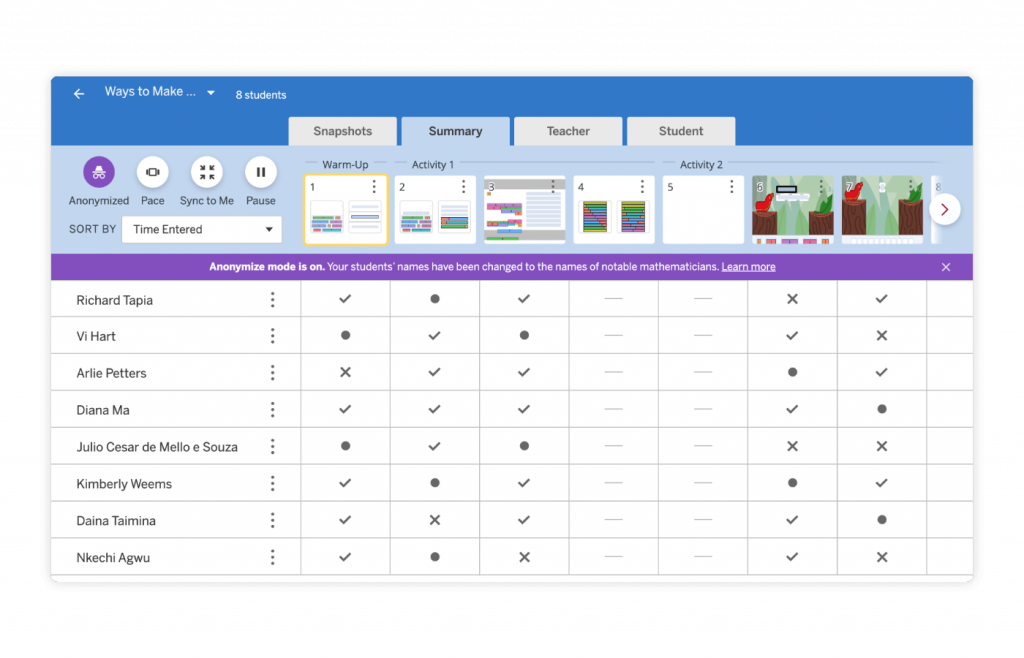
When students use devices, teachers can monitor their work in real time, making sure they get the exact support that they need at every part of the lesson, in and outside of class.
Components of a lesson
Students in an Amplify Desmos Math California classroom can be seen (and heard!) asking questions, debating answers, justifying their thinking, grappling with problems, and working together and independently.
A typical Amplify Desmos Math California lesson includes:
- Warm-up: A short, attention-getting problem to pique students’ interest in the lesson.
- Activities: One to two mini-activities that challenge students’ problem-solving skills.
- Synthesis: Discussion to review and bring together the important concepts from the lesson.
- Show What You Know and Reflection: Questions for students to show what they know from the lesson. (Note: The Show What You Know lesson assessment is optional for kindergarten and grade 1.)
- Centers: Student-led activity stations that reinforce the math learned during lesson activities through interactive and often game-like formats. In kindergarten and grade 1, time for Centers is built into the last 15 minutes of every lesson.
To support, strengthen, and stretch students’ learning after the lesson, Amplify Desmos Math California offers options for:
- Differentiation: Mini-Lessons, Centers, Extensions, Boost Personalized Learning, and Fluency Practice.
- Practice: Additional problems your student’s teacher may assign for classwork or homework.
Support math learning at home.
You can support your student’s math learning outside of school in many ways:
Your student’s teacher may assign practice problems at the end of each lesson for classwork or homework. If your student has already completed the practice problems for the lesson, ask them to walk you through how they solved each problem, or talk about any parts that were challenging for them. Ask your student follow-up questions to encourage the use of math language as they explain their thinking, such as, “How do you know?,” “How can you show your thinking?,” or “How would you describe that?” If students are stuck, ask support questions, such as, “What information do you know here?” or “How could you represent this problem?”
Your student’s teacher may introduce a Center game with students in the lesson or beyond the lesson. These games are aligned to the math of the unit and can be played with students outside of class. Your student’s teacher may introduce a Center game to students during or after completing a lesson, or you may need to teach the game before you play by using easy-to-follow instructions. Sign up for a free account to explore Centers and additional K–5 content in our Featured Collections.
Each unit in Amplify Desmos Math begins with a read-aloud story to engage students and provide context for the math of the unit. Elements and characters from the Unit Story then appear in lessons throughout the unit.
Kindergarten
- Unit 1 Story: The First Day of School
- Unit 2 Story: What’s in a Restaurant?
- Unit 3 Story: A Great Shape Adventure
- Unit 4 Story: Casey’s Town
- Unit 5 Story: Where is Harry?
- Unit 6 Story: Winners
- Unit 7 Story: Everybody Needs Help Sometimes
Grade 1
- Unit 1 Story: Ying’s New Town
- Unit 2 Story: Let’s Grow!
- Unit 3 Story: Impossible
- Unit 4 Story: The Collectors
- Unit 5 Story: The Day of the Wazzle-Squash
- Unit 6 Story: Side by Side
- Unit 7 Story: A Potluck for Pia
Grade 2
- Unit 1 Story: A New Class Pet
- Unit 2 Story: The Heroes of Pineapple Street
- Unit 3 Story: What Orson Imagined
- Unit 4 Story: A Seed’s Journey
- Unit 5 Story: 302 Ricotta Drive
- Unit 6 Story: Arjun the Artist
- Unit 7 Story: Where Eli Went
- Unit 8 Story: On Clementine Court
Grade 3
- Unit 1 Story: My Name Is Harper
- Unit 2 Story: Cheri’s New Home
- Unit 3 Story: The View From Up Here
- Unit 4 Story: Home Cooking
- Unit 5 Story: Coen and Obita
- Unit 6 Story: Just Stick With It, Sasha
- Unit 7 Story: Through Piho’s Eyes
Grade 4
- Unit 1 Story: I Contain Multitudes
- Unit 2 Story: One Step at a Time
- Unit 3 Story: Finny
- Unit 4 Story: Myles and the Loggerheads
- Unit 5 Story: Just for Fun
- Unit 6 Story: Special Day, Special Lei
- Unit 7 Story: Captain Bogwart’s Treasure
Grade 5
Relate math to daily activities at home, whether grocery shopping, preparing a meal, or planning for a trip to the store. Your student can help you figure out how many more apples there are than oranges in the grocery cart, show how to split a sandwich into fourths, or figure out how much change you’ll receive in exchange for a $10 bill. Encourage your student to point out ways that you use math in your daily tasks.
Remind your student that getting stuck is part of the process and a necessary—beneficial, even!—part of learning. Many students (and adults) fear making mistakes. But research shows that making mistakes helps our brains grow. When your student gets stuck on a problem, encourage them to keep trying different strategies, even if they’re not sure if they are right.
Get more information.
Have a question about Amplify Desmos Math California? Visit our help library to search for articles with answers to your program questions. For additional support, please contact your student’s teacher.