Showing results for krista kristi

USBE Data Analysis for K-3 Reading Assessment Program

Introduction

mCLASS Assessment: Acadience™ Reading

How it works: Quickly identify the needs of each student and inform next steps with instant analysis, reports, and instructional planning tools included in the only licensed mobile version of the research-based Acadience Reading assessment.

  • Use short, 1-minute fluency measures for foundational reading skills.
  • Replace manual calculations with instant results and recommended activities.
  • Compare student progress with predictive, research-based benchmark goals.
  • Track progress and target instruction to individual student needs.
  • Support decision-making at every level using aggregate reports.
  • Translate class- and student-level reports into individualized instruction using the Now What?Tools.
  • Get a more complete view of early literacy skills with the new mCLASS:Early Literacy Measures (ELM).
Enrollment for mClass

Please review the Utah Enrollment for mCLASS document for important information about the rostering process for LEAs in Utah.

Benchmark Windows

The USBE has required that each Acadience Reading testing benchmark window occur within the below dates:

BOY — the first benchmark before October 14
MOY — the second benchmark between December 1 and February 5
EOY — the third benchmark between the middle of April and June 15

Benchmark windows for LEAs are set to the state benchmark window dates in mCLASS. Each LEA is to have 2-4 week benchmark period that is within the state benchmark window dates and LEA leaders are to share those dates with staff. The benchmark windows in mCLASS are set to the state benchmark window dates; not the LEA benchmark window dates and this can not be changed in mCLASS. If a student moves into your LEA and your benchmark window is closed, but the state benchmark period is still open, the student must be benchmarked. Should your LEA need an extension of a benchmark window beyond the close of the state benchmark windows, that must be approved by the USBE Assessment Department. Once the benchmark window closes, do not give the benchmark to a student, instead, educators can progress monitor the student on the measures they would have received a benchmark in order to get the students current instructional levels.

If you have questions regarding your current benchmark window dates, feel free to reach out to Amplify Customer Services at help@amplify.com.

Acadience Reading Benchmark Invalidations

Before you invalidate a benchmark probe, review the USBE’s list of acceptable reasons for invalidating on the Frequently Asked Questions: Acadience Reading Invalidations document. If a district/charter has a significant percentage of invalidations, contact and further action will be deployed. If you believe an invalidation is required, please contact your District/Charter Literacy Director. If they need support, they can contact Sara Wiebke, sara.wiebke@schools.utah.gov, to request an invalidation.

Progress Monitoring

The impact of progress monitoring

Progress monitoring is the most powerful tool we offer with regards to student achievement.

“Scores for Daze increase more slowly than they do for other Acadience Reading measures, so more frequent monitoring may not be as informative. For students who need to be monitored on Daze, we recommend monitoring once per month.”
Progress Monitoring with Acadience Reading 
© Acadience Learning
October 2012

The Acadience Reading authors recommend progress monitoring students in the Well Below Benchmark category once every 7-10 days (and once every 10-12 days for students in the Below Benchmark category).

Progress monitoring is the practice of testing students briefly but frequently on the skill areas in which they are receiving instruction, to ensure that they are making adequate progress. When students are identified as at risk for reading difficulties, they can receive progress monitoring testing more frequently to ensure that the instruction they are receiving is helping them make progress. (Acadience Learning/October 2012, Progress Monitoring Guide)

The purposes of progress monitoring are:

  • to provide ongoing feedback about the effectiveness of instruction,
  • to determine students’ progress toward important and meaningful goals, and
  • to make timely decisions about changes to instruction so that students will meet those goals.

How to progress monitor?

  • Select students for progress monitoring
  • Select Acadience Reading materials for progress monitoring
  • Set progress monitoring goals
  • Determine the frequency of progress monitoring
  • Conduct progress monitoring assessment
  • Access data through class and student reports
  • Evaluate progress and modify instruction.

The key to progress monitoring: Instruction should link to progress monitoring and progress monitoring should link to instruction. They should run parallel and merge as one to confirm student growth in reading.

Check your progress monitoring fidelity report in mCLASS to ensure you are on track with these students. For more information regarding progress monitoring guidelines, visit the official progress monitoring guidelines.

Support Team

Amplify Customer Services

(800) 823-1969
Monday to Friday, 5 a.m. to 5 p.m. MT
help@amplify.com

Educational Support Team

Pedagogical Questions
(800) 823-1969
Monday to Friday, 5 a.m. to 5 p.m. MT
edsupport@amplify.com

For more information, please contact:

Sarah McCarty
Associate Director, Educational Partnership
(812) 593-5776
smccarty@amplify.com

Donna Bright
Educational Partnership Manager
(303) 960-3772
dbright@amplify.com

Robert McCarty
Regional Director of Educational Partnership
(435) 655-1731
rmccarty@amplify.com

Cydnee Carter
Assessment Development Coordinator
(801) 538-7654
cydnee.carter@schools.utah.gov

Liz Williams
Elementary ELA Assessment Specialist
(801) 538-7542
Liz.williams@schools.utah.gov

Sara Wiebke
Literacy Coordinator
(801) 538-7935
sara.wiebke@schools.utah.gov

Krista Hotelling
K-3 Literacy Specialist
(801) 538-7794
krista.hotelling@schools.utah.gov

Christine Elegante
K-3 Literacy Specialist
(801) 538-7551
christine.elegante@schools.utah.gov

Julie Clark
K-3 Literacy Specialist
801-499-2515
julie.clark@schools.utah.gov

Melissa Preziosi
Assessment Data Specialist
(801) 538-7949
melissa.preziosi@schools.utah.gov

Resources

Helpful tips and guides
mCLASS:Acadience Reading tutorials
Technical resources

Amplify Enrollment This guide walks you through the necessary steps to complete enrollment using the manual enrollment tools on Amplify Home. It shows you how to manage staff, student, and class assignment information, and maintain the accuracy of your staff, student, and class assignments.

Devices & Requirements Ensure mCLASS is compatible with your devices and systems for optimal performance and support.

Remote Assessing

Videos:

Remote Assessment Guidance from the Acadience Team:  
mCLASS®: Acadience® Reading (formerly known as DIBELS Next)

Key Points:

Before you assess:

1. Determine how you will show student materials and score in mCLASS at the same time. 

  Description

Description

Recommended set up

  • One computer for video conferencing and sharing student materials.
  • One touchscreen device for scoring in mCLASS.
Modified set up
  • One computer.

Note: mCLASS app is optimized for touchscreen; scoring with a mouse may need more practice.

2. Familiarize yourself with the digital copies of student materials.

3. Schedule virtual meetings with students. To communicate with English-speaking caregivers, consider sending this email or video. To communicate with Spanish-speaking caregivers, consider sending this email or video.

4. Determine how you will handle scenarios where there’s a lag:

  Description
Record the meeting
  • Before the assessment begins, press the recording button on your video conferencing tool.
  • After the virtual meeting, listen to recording and rescore in mCLASS if needed.
  • Pick a decision rule for how to score ambiguous items and be consistent. For example, if you decide that you will give a student the benefit of the doubt and mark ambiguous similar sounding items correct when you can’t quite hear their answer, do this for all students you assess.
Use a phone
  • Before the assessment begins, call caregiver’s phone using your phone (type *67 before your number if you want your number to be hidden).
  • Ask the caregiver to press the speaker button. 
  • Mute yourself and your student on the virtual learning platform.

While you assess: 

1. Take the opportunity to connect individually with your students as they experience so much change. Don’t make the session solely about testing, and remind caregivers and students that the assessment is a way to see how you can best tailor instruction.

2. Make student materials visible to your student.

For Maze, choose the model that works best for you:

Enter results into the mCLASS web reports

  • Students complete online Maze during a video conference
    • Put a link to the student assessment site (mclass.amplify.com/student) and the student’s credentials into the chat box (learn how to generate student credentials in this video)
    • Ask your student to complete Maze.
  • Students complete online Maze outside of a video conference (caregiver support is needed with log-in)
    • To provide student credentials and instructions to English-speaking caregivers, consider sending this email and video. To provide student credentials and instructions to Spanish-speaking caregivers, consider sending this email and video.
  • Students complete Maze on paper
    • Locate the benchmark Maze Acadience Learning’s site.
    • Print a copy of the form you need (e.g. BOY) for each student in your class.
    • Send the form home in a sealed envelope with students, mail the form to caregivers, or have caregivers get forms via school-based pick-up. Provide instructions not to open the envelope until the student is ready to take the assessment.
    • Provide parents with instructions on how to proctor the assessment for their child. They need to:
      • Give the form to their child
      • Sit with their child and read the instructions and practice items
      • Tell their child to stop when 3 minutes has elapsed
      • Send screenshots of their child’s work via email or text, or return the completed form to the school in a sealed envelope provided by the school.
  Guidance
Acadience:Reading 

Use the share screen feature to display student materials on your screen.

Optional next step for measures that have student materials:

Zoom users: grant your student control of your screen so you can see their cursor as they read:

  • Click “Remote Control” and select your student’s name in the dropdown.
  • Ask your student to use their cursor to point to words as they read.

Note: For Mac OSX, you will need to give Zoom access in the Accessibility tab in the Privacy and Security preferences of your Mac. For more information on giving Zoom access in Security and Privacy, click here.

3. Score in mCLASS.

Student materials

  Benchmark Progress monitoring
Acadience Reading (formerly known as DIBELS Next) Available for free download on the Acadience Learning website

Utah – USBE Data Analysis for K-3 Reading Assessment Program – New

To view this protected page, enter the password below:


Mississippi Department of Education approves Amplify’s mCLASS programs for dyslexia screening

Amplify, a company that creates next-generation curriculum and assessment programs, announced that the Mississippi Department of Education (MDE) approved its mCLASS literacy assessments for the state-mandated dyslexia screening in kindergarten and first grade. Amplify’s mCLASS assessments were already approved for Mississippi’s universal early literacy screenings for grades K–3, making Amplify and mCLASS the only assessment provider approved on both lists.

“We’re excited to be able to further support Mississippi educators with mCLASS,” said Krista Curran, SVP and General Manager, Assessment and Intervention, at Amplify. “Having both universal screening and screening for dyslexia on the mCLASS platform should make it easy for Mississippi schools to address two different needs in one tool. We continue to evolve mCLASS to better support our teachers and students – these mCLASS advances to support the early identification of students at risk for dyslexia have been embraced in schools across the country.”

Researchers estimate that 5-15% of students struggle with dyslexia. The recent trends in legislation across the country are a great step forward for early screening and identification of students at risk. As of of this writing, 21 states have have enacted dyslexia screening legislation, and more states are positioned to do to in the coming years. These states recognize that early screening, along with early intervention in areas like phonological awareness and decoding, are essential in providing students with the support they need, closing any gaps, and preventing further difficulty.

mCLASS delivers what educators need to help every student read fluently and confidently. Based on over 30 years of research, mCLASS assessments dive deep, giving educators a complete view of each student and insight into student response patterns. Unlike other programs that rely on inferences, mCLASS lets educators know exactly which aspect of a skill a student is struggling with. mCLASS instruction, driven by mCLASS assessment results, provides teachers and students with targeted lessons and activities to support students on their journey to become confident readers.

In addition to MDE’s recent approval of mCLASS assessments, Amplify has served the state since 2014 through the Mississippi Data Coaching Program. The Program is designed to address the varied needs of teachers and leaders to strengthen their understanding and use of data to enhance instruction and improve student outcomes. As a result of Amplify’s work in Mississippi, third grade reading assessment pass scores have increased by 8.9% and high school graduation rates have increased by 12.4% in participating schools. Amplify is committed to to continuing to support vital initiatives designed to strengthen K-12 education in the State of Mississippi. To learn more about the MS Data Coaching program, please visit the following link. For more regarding Amplify’s mCLASS assessment programs, click here.

About Amplify
A pioneer in K–12 education since 2000, Amplify is leading the way in next-generation curriculum and assessment. Our captivating core and supplemental programs in ELA, math, and science engage all students in rigorous learning and inspire them to think deeply, creatively, and for themselves. Our formative assessment products turn data into practical instructional support to help all students build a strong foundation in early reading and math. All of our programs provide teachers with powerful tools that help them understand and respond to the needs of every student. Today, Amplify serves more than three million students in all 50 states. For more information, visit amplify.com.

Contact: media@amplify.com

Amplify’s mCLASS® Texas Edition chosen to support Texas’ youngest learners

Brooklyn, NY (April 27, 2020) — Amplify, a publisher of next-generation curriculum and assessment programs, announced today that mCLASS® Texas Edition has been selected as the Texas Education Agency (TEA)-approved alternative free Reading Diagnostic Tool for Kindergarten and as one of the free options for grades 1–2, as legislated by HB3.

mCLASS Texas Edition provides a full K–6 assessment solution, enabling Texas educators to leverage and connect valuable student data from the beginning of a student’s literacy journey to later grades, reflecting a reliable and valid view of every student’s progression.

“Amplify is honored to partner with TEA,” said Krista Curran, senior vice president & general manager, assessment and intervention at Amplify. “mCLASS Texas Edition helps educators in the state of Texas know how to support their students’ journey in becoming confident readers.”

In addition to English assessments, mCLASS Texas Edition provides screening and diagnostic assessments for Spanish literacy, with Spanish assessment and instruction tools that are unique to Spanish language development and support biliteracy development in dual language settings. 

mCLASS Texas Edition includes:

  • Efficient one-minute DIBELS® 8th Edition and IDEL (Spanish) measures, plus additional Amplify-developed measures that fulfill TEA’s Language and Literacy requirements
  • Engaging, personalized instruction to provide remediation and enrichment for all students
  • A built-in dyslexia screener with a risk indicator that clearly shows at-risk students and meets the state’s K–1 requirements
  • Instruction that highlights observed patterns from students’ assessment results and recommends activities to target skill deficits
  • Robust classroom and administrator-level reports that give instant results and clear next steps for each student

Amplify is offering a free demo of mCLASS Texas Edition, along with live weekly webinars covering topics such as: Getting Started with mCLASS Texas, Data and Reporting, Dyslexia Measures, and Grouping and Instruction.

About Amplify

A pioneer in K–12 education since 2000, Amplify is leading the way in next-generation curriculum and assessment. Our captivating core and supplemental programs in ELA, math, and science engage all students in rigorous learning and inspire them to think deeply, creatively, and for themselves. Our formative assessment products turn data into practical instructional support to help all students build a strong foundation in early reading and math. All of our programs provide teachers with powerful tools that help them understand and respond to the needs of every student. Today, Amplify serves more than five million students in all 50 states. 

For more information, visit amplify.com.

Contact: media@amplify.com

Math that motivates: Amplify Desmos Math success stories

It’s no secret that student engagement and the prevalence of math anxiety are real problems in math classrooms. Incorporating more problem-based learning can help, but it can feel intimidating and difficult to know where to start. That’s why we’re here!

Amplify Desmos Math is a curiosity-driven K–12 math program that introduces a structured approach to problem-based learning and builds students’ lifelong math proficiency. Teachers help students build off of each other’s ideas and find confidence in their math identities, creating a community of math learners.

But don’t take our word for it—see how real teachers and students are unlocking new levels of engagement and comprehension, proving that everyone can be a math person.

A woman with straight, shoulder-length blonde hair smiles at the camera, wearing a striped sweater and hoop earrings. Shelves with books are visible in the background.
“With Amplify Desmos Math, I’ve noticed a huge shift of engagement because there’s so much interaction. Yes, there is pencil and paper, but there’s so much more. They’re getting immediate feedback and motivation to continue on. So if they don’t get something right the first time, they want to! ”

—Kristi Melick

Sixth-grade teacher, San Diego Unified School District, CA

School spotlight: Decatur Classical Elementary School

See how Amplify Desmos Math is making an impact in Chicago, Illinois, with our latest case study.

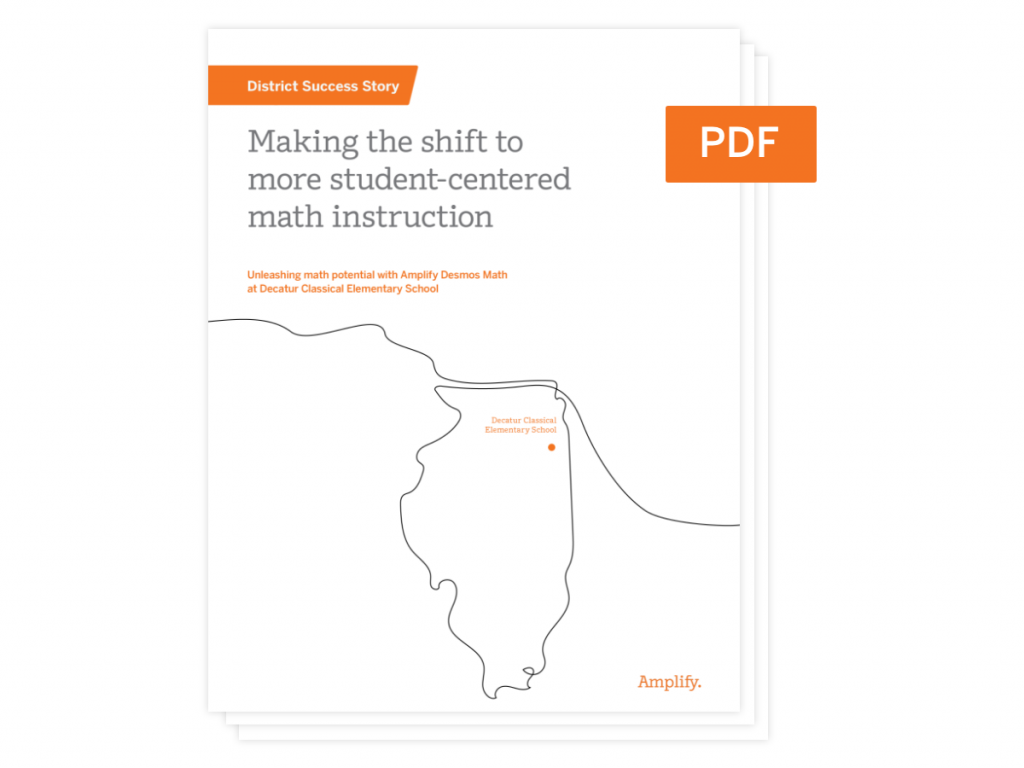
Cover page of a PDF titled "Making the shift to more student-centered math instruction," featuring an outline of Illinois and text about Decatur Classical Elementary School.

A structured approach to problem-based learning

Witness teachers and students working together and see how Amplify Desmos Math revolutionizes K–12 math education through a structured approach to problem-based learning that fosters a collaborative math community.

The power of the pause

See what happens when teachers use the pause–one of the teacher facilitation tools and core differentiators in Amplify Desmos Math. You won’t believe how students react!

Everyone’s a math person.

See how Amplify Desmos Math helps every student see themselves as a math person.

What Teachers Say

What educators say about Amplify Desmos Math

Shifting to this problem-based curriculum now is allowing students to open up. I think they’re taking control and ownership. They’re coming up with the strategies, they’re sharing the strategies. It offers an opportunity for the students to look around the classroom to see what their friends are doing. And in turn, if they’re stuck, they’re comfortable turning to other students and problem-solving through sharing.

Joseph Croce

Seaford School District, DE

What educators say about Amplify Desmos Math

When we went district-wide with our Amplify Desmos Math curriculum our teachers became the facilitators of learning. And our students are the doers of mathematics. And what we’ve seen, what I’ve seen in the classroom, is kids are engaged in a problem, they’re collaborative, and they’re having fun. And it’s like they’re not even realizing that they’re really doing math.

Jessica Walsh

San Diego Unified School District, CA

What educators say about Amplify Desmos Math

So many kids have stated, ‘Oh, I’m not a math person.’ Or they’re scared of getting the answer incorrect. And I think with this curriculum, they feel safe.

Brendan Simon

Assistant Principal, San Diego Unified School District, CA

Best practices from real educators like you

Learn tried and true strategies for leveling up math instruction from Beyond My Years podcast guests like Amplify’s own Dan Meyer, teacher and My Kindergarten Math Workbook author Keri Brown, educator and speaker Mike Flynn, teacher and I Hate Math author Ian Brown, and more!

Two women work together at a desk with a laptop and papers; the image appears on the cover of a document titled “Foundational research” for Amplify Desmos Math Grades K–Al.

Program efficacy

Explore the research behind Amplify Desmos Math.

Ready to make the shift to curiosity-driven learning?

Get access to free digital samples today.

Request a sample or demo

Inspiring the next generation of Massachusetts scientists, engineers, and curious citizens

To view this protected page, enter the password below:


A powerful partnership

Amplify Science was developed by the science education experts at UC Berkeley’s Lawrence Hall of Science and the digital learning team at Amplify. This partnership extends to 2032, allowing us to continuously improve our program and provide our customers with the most up-to-date enhancements, free of charge. Get a glimpse at our latest back-to-school updates here.

Instructional model

The Amplify Science program is rooted in the proven, research-based pedagogy of Do, Talk, Read, Write, Visualize. Here’s how each element works:

Three blue panels describing educational activities: "hands-on science" with lab experiments, "discuss" with collaborative learning, and "read" with literacy in science articles.

Phenomena-based approach

In each Amplify Science unit, students take on the roles of scientists or engineers in order to investigate a real-world problem. Students work to define the problem and collect and make sense of evidence. Once the context is clear, students collect evidence from multiple sources and through a variety of modalities. At the end of the unit, students are presented with a brand new problem, giving them an opportunity to apply what they’ve learned over the course of the unit to a new context. This represents a shift from asking students to learn about science to supporting students in figuring out the science.

Flowchart of a learning unit divided into four chapters, showing stages of student engagement from introduction to application, with assessments indicated at various points.

Resources to support your review

Remote and hybrid learning support

A child sits at a desk using a laptop. Next to the desk is a bookshelf with books, a fishbowl, and a soccer ball.

See an example of our remote and hybrid learning support below:

This fall, Amplify launched a new remote learning solution called Amplify Science@Home. Intended to make extended remote and hybrid learning easier, Amplify Science @Home includes two useful options for continuing instruction: @Home Videos and @Home Units.
Amplify Science @Home Videos are recordings of real Amplify Science teachers teaching the lessons. For those teachers who are unable to meet synchronously with their students, the recorded lessons are a great way to keep their students on track and engaged with Amplify Science while at home. These videos will be produced for all K–5 units, and for the first four units of each 6–8 grade level. Their release will be rolling, beginning in August.

Amplify Science @Home Units are modified versions of Amplify Science units, strategically designed to highlight key activities from the program. The @Home Units take significantly less instructional time than the complete Amplify Science program and allow students to engage with science at home. @Home Units will be developed for all Amplify Science K–8 units. Each @Home unit includes:

  • Teacher overviews explaining how to use the materials, including suggestions for enhancing the @Home Units if synchronous learning or in-class time with students is available
  • Overviews to send home to families

Student materials will be available in two formats:

  • @Home Slides (PDF/PPT) + Student Sheets (PDF) for students with access to technology at home
  • Downloadable @Home Packets (PDF) for students without access to technology at home

Download the remote and hybrid learning guide

Benchmark Assessments

Amplify’s Benchmark Assessments are designed to help teachers measure student progress toward the three dimensions—Disciplinary Core Ideas (DCIs), Science and Engineering Practices (SEPs), and Crosscutting Concepts(CCCs)—and performance expectations (PEs) of the NGSS. The assessments provide important insight into how students are progressing toward mastery of different standards ahead of high-stakes, end-of-year assessments.

The Benchmark Assessments are built to be delivered after specific units in the recommended Amplify Science scope and sequence.* They are given three or four times per year, depending on the grade level. The benchmarks are intended to show progress at various points in time across a school year, and are therefore not summative in nature. Digital items and item clusters are also tagged to specific NGSS standards, allowing customization to align with other course sequences. The assessments are available via the following platforms:

Print
PDF files: For administering Benchmark Assessments on paper

Digital platforms

  • Illuminate
  • SchoolCity
  • Otus
  • QTI (“Question and Test Interoperability”) files
    Not sure whether QTI files are compatible with your assessment platform? Contact your school IT or assessment platform representative for more information.
    Please note that Amplify is able to provide access to the QTI files themselves, but is not able to support the integration process. Your assessment platform provider should be able to assist with QTI file integration.

Flexible implementation

One of the key features of Amplify Science is the flexibility that it offers. We give students authentic opportunities to experience the full breadth of what it means to be a scientist or engineer. Just as scientists gather evidence from many types of sources, so do students in our program. Like scientists, students gather evidence not just from physical models, but also from digital models, texts, videos, photographs, maps, data sets, and even their peers!
Simply put, real scientists don’t just get messy—they read, write, analyze, hypothesize, model, test, and communicate with purpose, too.

Science articles

The middle school science articles serve as sources for evidence collection and were authored by science and literacy experts at the Lawrence Hall of Science.

Illustration of the indirect effects of overfishing on northern benguela jelly populations displayed on a laptop screen.

Student Books
Beginning and young readers have unique developmental needs, and science instruction should support these students in reading more independently as they progress through sections of content, the school year, and each grade. One way Amplify Science meets these needs is by strategically deploying different modes of reading throughout each unit: Read-Aloud, Shared Reading, and Partner Reading.

A collage of various educational book covers related to science and math, featuring illustrated themes like sports, nature, and energy.

Student Investigation Notebooks

Available for every unit, the Student Investigation Notebooks provide space for students to:

  • record data.
  • reflect on ideas from texts and investigations.
  • construct explanations and arguments.

Available with full-color article compilations for middle school units.

Collection of educational books from 'amplify science' on topics including ocean atmosphere, matter and energy ecosystems, and insect interactions, displayed in various angles.

Digital student experience

Students access the digital simulations and Modeling Tools, as well as lesson activities and assessments, through the digital student experience. Students can interact with the digital student experience as they:

  • conduct hands-on investigations.
  • engage in Active Reading and writing activities.
  • participate in discussions.
  • record observations.
  • craft end-of-unit scientific arguments.

Dive into a quick example of our powerful simulations

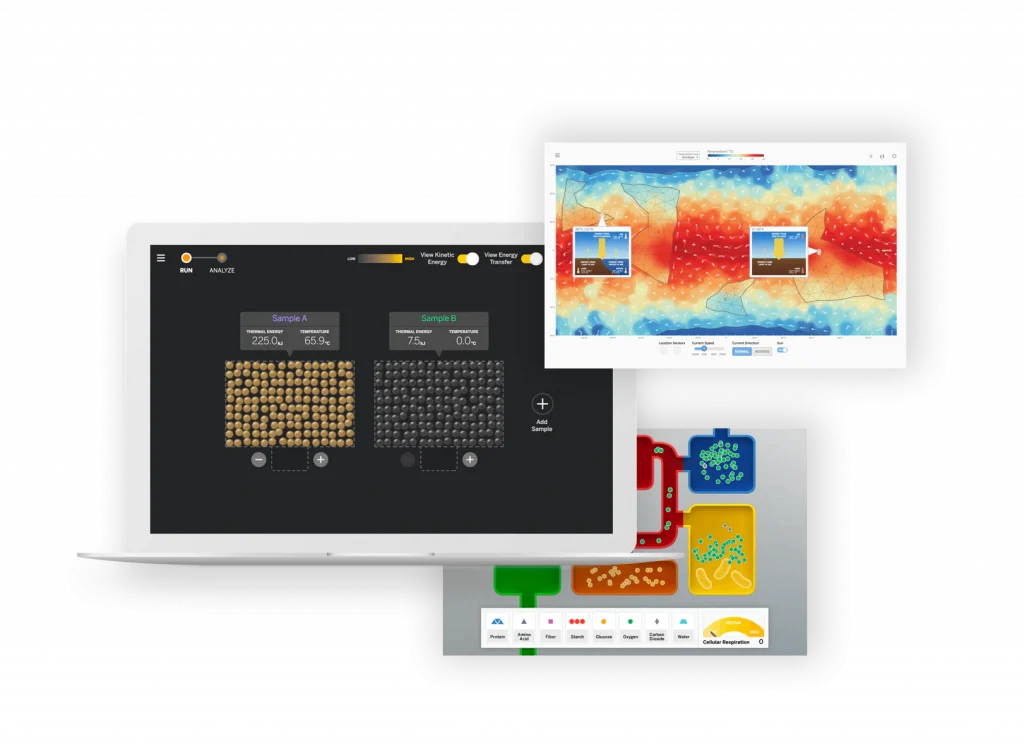
A digital illustration showcasing a laptop and a tablet displaying complex data analysis software interfaces with graphs and heatmaps.

Hands-on materials kits

Hands-on learning is at the heart of Amplify Science and is integrated
into every unit. Students actively take on the roles of scientists and engineers as they gather evidence, think critically, solve problems, and develop and defend claims about the world around them.

Check out these 2-minute videos to see an Amplify Science hands-on investigation in action.

Each unit kit contains:

  • consumable and non-consumable hands-on materials.
  • print classroom display materials.
  • premium print materials for student use (sorting cards, maps, etc.).
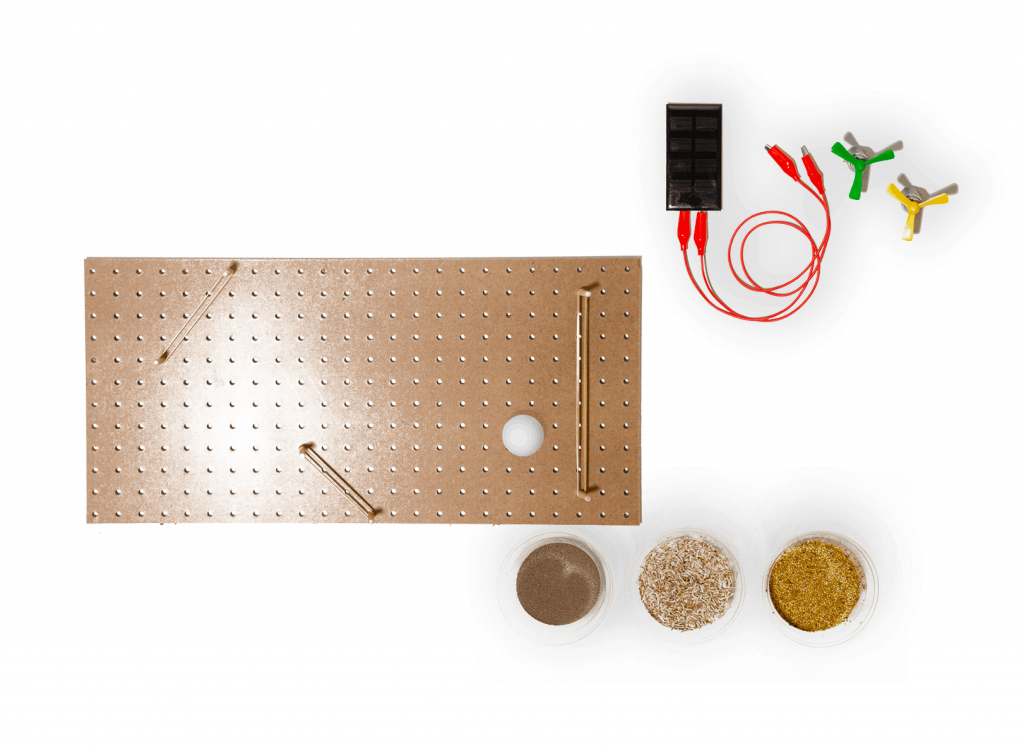
A perforated rectangular board, three small containers with different powders, a black battery holder with red wires, and three colored alligator clips are arranged on a white background.

Teacher’s Guides

Available digitally and in print, the Teacher’s Guides contain all of the information teachers need to facilitate classroom instruction, including:

  • detailed lesson plans.
  • unit and chapter overview documentation.
  • differentiation strategies.
  • standards alignments.
  • in-context professional development.
A laptop displaying the Geology on Mars webpage sits beside a book titled "Geology on Mars," both featuring the same cover image of Mars and a spacecraft, perfect for enhancing three-dimensional learning in any science classroom.

Scope and Sequence

GRADE UNITS
Kindergarten
  • Needs of Plants and Animals
  • Pushes and Pulls
  • Sunlight and Water
Grade 1
  • Animal and Plant Defenses
  • Light and Sound
  • Spinning Earth
Grade 2
  • Plant and Animal Relationships
  • Properties of Materials
  • Changing Landforms
Grade 3
  • Balancing Forces
  • Inheritance and Traits
  • Environments and Survival
  • Weather and Climate
Grade 4
  • Energy Conversions
  • Vision and Light
  • Earth’s Features
  • Waves, Energy, and Information
Grade 5
  • Patterns of Earth and Sky
  • Modeling Matter
  • The Earth System
  • Ecosystem Restoration
GRADE UNITS
Grade 6: Earth Science
  • Launch: Geology on Mars
  • Plate Motion
  • Plate Motion: Engineering Internship
  • Rock Transformations
  • Earth, Moon, and Sun
  • Ocean, Atmosphere, and Climate
  • Weather Patterns
  • Earth’s Changing Climate
  • Earth’s Changing Climate: Engineering Internship
Grade 7: Life Science
  • Launch: Microbiome
  • Metabolism
  • Metabolism: Engineering Internship
  • Traits and Reproduction
  • Populations and Resources
  • Matter and Energy in Ecosystems
  • Natural Selection
  • Natural Selection: Engineering Internship
  • Evolutionary History
Grade 8: Physical Science 
  • Launch: Harnessing Human Energy
  • Force and Motion
  • Force and Motion: Engineering Internship
  • Magnetic Fields
  • Thermal Energy
  • Phase Change
  • Phase Change: Engineering Internship
  • Chemical Reactions
  • Light Waves

Minnesota Academic Standards in Science coverage

Amplify Science was designed from the ground up to meet the NGSS, a set of standards that closely align with the K–8 Minnesota Academic Standards in Science (MASS). Therefore, most grade levels’ respective set of Amplify Science units address the necessary MASS (see K–5 reverse alignment and/or correlations for K–5 and 6–8). However, for grades 2–4, teachers should also use the resources provided in the sections below to achieve full coverage of the appropriate standards before their students move on to the next grade level. Organized by grade level, each section outlines:

  • companion lesson materials that were written to support 100% alignment to the Minnesota Academic Standards in Science when used with the core Amplify Science units for the grade level
  • the standard being addressed with each companion lesson; and
  • the recommended placement of each companion lesson within a specific Amplify Science unit 

Companion lesson: “Shelter”

Standard: 1P.4.2.2.1 Communicate solutions that use materials to provide shelter, food, or warmth needs for communities including Minnesota American Indian tribes and communities.* (P: 8, CC: 2, CI: PS1, ETS2)

Recommended placement: Following Lesson 5.1 of Spinning Earth

Materials: Shelter Classroom Slides and Student Sheet

Companion lesson: “Describing Climates”

Standard: 2E.4.2.1.2 Obtain and use information from multiple sources, including electronic sources, to describe climates in different regions of the world.** (P: 8, CC: 1, CI: ESS2)

Recommended placement: Following Lesson 4.5 of Changing Landforms

Materials: Describing Climates Classroom Slides and Student Sheet

Note: Students will further investigate the content in this standard, and revisit the book used in this companion lesson, in 3rd grade (Weather and Climate unit)

Companion lesson 1: Light and Vision

Standard: 3P.3.1.1.1 Develop a model to describe that light reflecting from objects and entering the eye allows objects to be seen. (P: 2, CC: 2, CI: PS4)

Recommended placement: Following Lesson 4.5 of Environments and Survival

Materials: Light and Vision Part 1 Classroom Slides and Student Sheet; Light and Vision Part 2 Classroom Slides and Student Sheet 

Note: Students will further investigate the content in this standard, and revisit the book used in this companion lesson, in 4th grade (Vision and Light unit)

Companion lesson 2: Studying Stars

Standard: 3E.4.2.2.1 Gather information and communicate how Minnesota American Indian Tribes and communities and other cultures use patterns in stars to make predictions and plans. (P 8, CC: 1, CI: ESS1) 

Recommended placement: Following Lesson 4.4 of Weather and Climate

Materials: Studying Stars Classroom Slides and Student Sheet

Note: Students will further investigate the content in this standard, and revisit the book used in this companion lesson, in 5th grade (Patterns of Earth and Sky unit)

Companion lesson 1: Salt Water and Freshwater

Standard: 4E.2.2.1.1 Interpret charts, maps and/or graphs of the amounts of salt water and fresh water in various reservoirs to provide evidence about the distribution of water on Earth.** (P: 5, CC: 4, CI: ESS2) 

Recommended placement: Following Lesson 2.6 of Earth’s’ Features

Materials: Salt Water and Freshwater Classroom Slides and Student Sheet

Note: Students will further investigate the content in this standard, and revisit the book used in this companion lesson, in 5th grade (The Earth System unit)

Companion lesson 2: How Raindrops Form

Standard: 4E.1.1.1.2 Ask questions about how water moves through the Earth system and identify the type of question. (P: 1, CC: 5, CI: ESS2) 

Recommended placement: Following Lesson 4.5 of Earth’s’ Features

Materials: How Raindrops Form Classroom Slides and Student Sheet

Note: Students will further investigate the content in this standard, and revisit the book used in this companion lesson, in 5th grade (The Earth System unit)

Explore the digital Teacher’s Guide

To familiarize yourself with navigation of the digital Teacher’s Guide, watch our navigational guide videos:

Grades K–5:

Grades 6–8:

Looking for help?

Powerful (and free!) pedagogical support

Amplify provides a unique kind of support you won’t find from other publishers. We’ve developed an educational support team of former teachers and administrators who provide pedagogical support for every Amplify curriculum, assessment, and intervention program. This service is completely free for all educators who are using our programs and includes:

  • Guidance for developing lesson plans and intervention plans.
  • Information on where to locate standards and other planning materials.
  • Recommendations and tips for day-to-day teaching with Amplify programs.
  • Support with administering and interpreting assessment data and more.

Timely technical and program support

Our technical and program support is included and available Monday through Friday, from 7 a.m. to 7 p.m. ET, through a variety of channels, including a live chat program that enables teachers to get immediate help in the middle of the school day.

Ready to dive in?

Contact your Minnesota representative:
Kristi Stengel
Account Executive
kstengel@amplify.com
(612) 306-3941

Tammy Sigwarth
Account Executive
tsigwarth@amplify.com
(563) 663-0056

Amplify announces launch of new integrated mCLASS® early literacy suite to support all students in reading on grade level by third grade

Brooklyn, NY – (January 28, 2019) Amplify, a company that creates next-generation curriculum and assessment programs, announced today that it is launching a new mCLASS suite that includes both teacher-led and adaptive student-driven instruction, as well as the mobile version of the DIBELS 8th Edition assessment developed by the Center on Teaching and Learning at the University of Oregon’s College of Education. The updated mCLASS early literacy suite integrates assessment, instruction, and intervention programs to help educators easily provide rich, differentiated reading instruction for all students. The new mCLASS suite is available for educators to begin using in the 2019–2020 school year.

“At Amplify, we are laser-focused on early literacy and research-based identification of risk, and we are committed to providing teachers with highly effective, time-saving tools to help every student read on grade level by the end of third grade, ” said Krista Curran, senior vice president and general manager, Assessment and Intervention, at Amplify. “For this reason, we’re excited to launch an enhanced version of our gold-standard mCLASS early literacy suite to better support the more than 120,000 educators and 1.65 million students who are using the program across the country today. We have improved our mCLASS assessments and reporting, and added screening for reading difficulties such as dyslexia as well as adaptive instruction tailored to each student’s specific needs. This integrated suite means schools can help support all students in becoming confident readers with one easy-to-use tool.”

Amplify launched the first version of mCLASS in 2001, making mCLASS one of the longest-running and most extensively researched early literacy programs on the market today. mCLASS has served more than 14 million students in all 50 states over the last 18 years.

Developed by the University of Oregon, where DIBELS research has been going on for decades, DIBELS 8th Edition is founded on a substantially strong, valid and reliable research base for identifying and supporting struggling readers, including those at risk for dyslexia. As of fall 2018, approximately 21 states have passed legislation for dyslexia screening in order to support the early identification of students at risk for dyslexia, and more states are currently considering enacting similar legislation. The screening tools in the new edition of mCLASS help educators meet the demands of the new legislation.

“We are excited to deepen our partnership with Amplify with the introduction of mCLASS DIBELS 8th Edition,” said Hank Fien, director, Center on Teaching and Learning at University of Oregon. “Our launch of DIBELS 8th Edition represents our continued commitment to providing evidence-based assessments, reporting, coaching and interventions as part of our education extension mission. This partnership, along with the Center on Teaching and Learning’s ongoing commitment to the highest standards of evidence, make DIBELS 8th Edition a powerful tool for educators.”

mCLASS with DIBELS 8th Edition features improved assessments, deeper insight into students’ instructional needs, and more intuitive reporting. It offers reduced assessment time and more useful data through adaptive test design and new skill profiles that better support differentiated instruction.

The updated mCLASS suite also offers adaptive, student-led instruction for the first time in the form of mCLASS: Amplify Reading Edition, in which mCLASS results send students on a highly engaging, game-based journey to learn the specific skills they need to advance their literacy skills. This new option enhances the mCLASS instructional experience, which will also include even more resources for teacher-led instruction.

About Amplify
A pioneer in K–12 education since 2000, Amplify is leading the way in next-generation curriculum and assessment. Our captivating core and supplemental programs in ELA, math, and science engage all students in rigorous learning and inspire them to think deeply, creatively, and for themselves. Our formative assessment products turn data into practical instructional support to help all students build a strong foundation in early reading and math. All of our programs provide teachers with powerful tools that help them understand and respond to the needs of every student. Today, Amplify serves four million students in all 50 states. For more information, visit amplify.com.

About University of Oregon’s Center on Teaching and Learning
The Center on Teaching and Learning (CTL), one of the largest research centers at the University of Oregon (UO), was established in 2000 as part of the College of Education. Over the last decade, CTL has been awarded 75+ state and federal research grants. CTL is committed to conducting rigorous research on the design, delivery and efficacy of curriculum, instruction, and assessment as individual elements used in schools, especially in the primary, elementary, and middle school grades. CTL’s mission is to conduct, translate, and disseminate research that focuses on the solutions to serious but practical problems in school systems.

Media contact: media@amplify.com

Amplify’s mCLASS®DIBELS® 8th Edition and mCLASS Lectura selected as the early literacy assessment tool for Colorado schools

Brooklyn, NY (February 10, 2023) — Amplify, a publisher of next-generation curriculum and assessment programs, announced today that the Colorado Department of Education (CDE) has selected mCLASS DIBELS 8th Edition and the corresponding Spanish-language assessment, mCLASS Lectura, as its K–3 interim and diagnostic assessment. The 2012 Colorado Reading to Ensure Academic Development (READ) Act provides the state with the structure and resources to ensure Colorado’s students are reading at grade level by the time they enter the fourth grade. mCLASS will serve as the state’s READ Early Learning Assessment Tool (ELAT), providing educators with immediate access to the kind of data and analysis they need in order to support their students and provide for intervention where appropriate.

“Amplify is honored to partner with CDE on this important literacy initiative,” said Krista Curran, senior vice president of state partnerships at Amplify. “When teachers are provided with a reliable diagnostic tool, they are equipped with the data to better understand how to support all students in becoming confident readers. Having the kind of data, analysis, and instruction that mCLASS offers in English and Spanish is not only nice to have but also absolutely essential.”

CDE implemented a rigorous review process for this selection. The selection committee for this solicitation included educators and assessment professionals from several districts in Colorado as well as representatives from the Dyslexia Working Group.

mCLASS offers complete parity across languages, reporting, and robust instructional guidance. After each administration of the assessment to students, educators receive granular diagnostic observations, instant targeted groups and lessons for each. With this implementation, CDE educators can be certain they will retain access to all historical and longitudinal data from previous versions of mCLASS.

mCLASS with DIBELS 8th Edition is an integrated literacy system based on the Science of Reading and validated for universal screening, progress monitoring, and screening for risk of dyslexia. DIBELS (Dynamic Indicators of Basic Early Literacy Skills), which is automated through the collection of data through the mCLASS platform, is a widely-used series of short tests developed by the University of Oregon that assess K–8 literacy. DIBELS is an observational assessment collected by teachers interacting with students one-on-one, either live or over video. The assessment is typically administered three times per year (beginning, middle, and end of year), and is used to identify reading difficulty, monitor progress, and inform instruction, especially for struggling readers.

About Amplify

A pioneer in K–12 education since 2000, Amplify is leading the way in next-generation curriculum and assessment. Our core and supplemental programs in ELA, math, and science engage all students in rigorous learning and inspire them to think deeply, creatively, and for themselves. Our formative assessment products help teachers identify the targeted instruction students need to build a strong foundation in early reading and math. All of our programs and services provide educators with powerful tools that help them understand and respond to the needs of every student. Today, Amplify serves more than 10 million students in all 50 states. For more information, visit amplify.com.

Media Contact
Kristine Frech
media@amplify.com