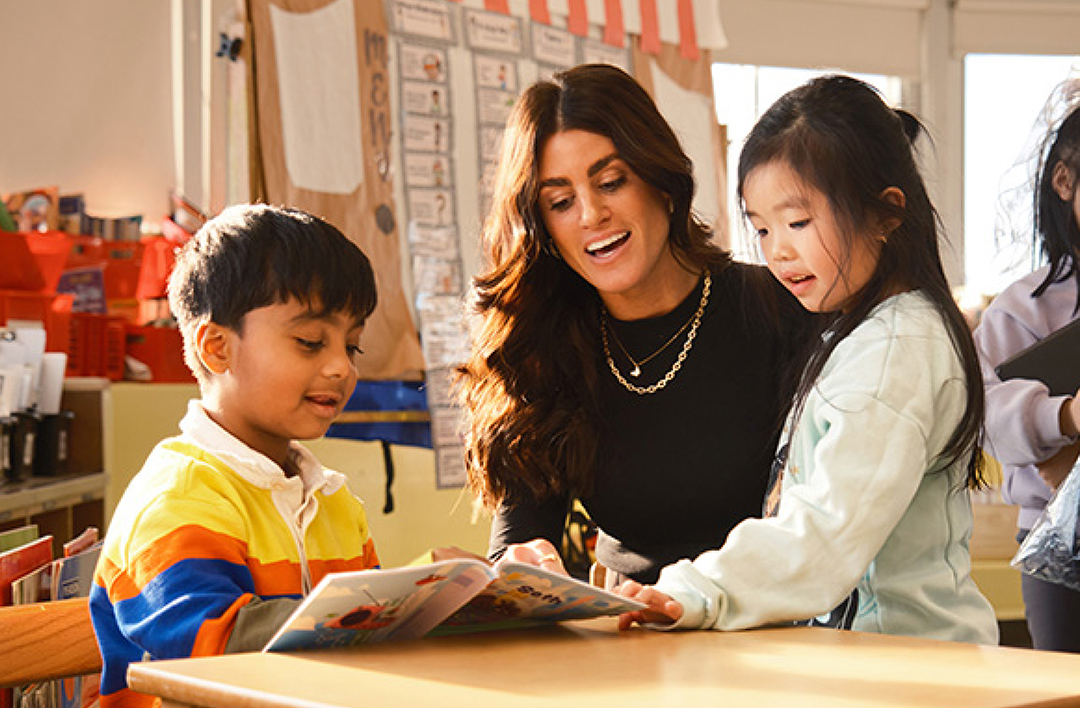
Grantsburg Elementary School sits in a rural area of Wisconsin beloved by birders. The school serves 235 students from early childhood through third grade.
For years, the school’s reading proficiency hovered around 35%, roughly in line with the Wisconsin state average. But for principal Elizabeth Moritz, who has been in education for 28 years and at Grantsburg for 12, that wasn’t good enough.
“At Grantsburg, we weren’t satisfied with being average,” she says. “In a community where 50% of our students live in poverty, literacy is the only permanent way out.”
The school had been relying on guided reading for years, with no vertical scope and sequence and instructional materials that were almost entirely teacher-created. “We worked with immense heart,” says Moritz, “but our traditional methods weren’t reaching every child.”
But today, they are. And Moritz’s leadership, along with the dedication of her team, have earned the school our 2026 Literacy Legend Award. They join the other winners of our annual Science of Reading Star Awards, which recognize educators, schools, and districts revolutionizing literacy through practices grounded in the Science of Reading.
Starting the shift to evidence-based literacy instruction
Moritz and her team recognized what was missing. “We realized that while our high-achieving students were doing pretty good, our average and struggling learners were being left behind by a system that lacked explicit, systematic instruction,” she says. “We needed a systemic change that prioritized foundational reading skills and deep background knowledge.”
In the 2021–22 school year, they made the decision to move to Amplify Core Knowledge Language Arts (CKLA)—and committed to implementing it with fidelity.
It wasn’t easy to let go of old habits, she says. “But my staff leaned into the research. I am surrounded by a team that is constantly looking for ways to help our students grow.”
She adds, “That refusal to settle—that choice to choose fidelity over what’s comfortable—is what changed our trajectory.”
What changed in the classroom
Moritz had worried that the Amplify CKLA content might be too challenging. Instead, students fell in love with it. “They actually play out the things they learn in the Knowledge units during recess and playtime,” she says.
The culture across the staff changed too, she notes. Classroom teachers, special ed teachers, interventionists, and aides—they all shifted from saying “my classroom” to “our students.”
Measurable outcomes followed. After years of hovering at 35%, Grantsburg’s reading proficiency climbed to nearly 75% in the 2023–24 school year. The school sustained those levels in 2024–25, while increasing its percentage of advanced learners by more than 10%.
What it takes to reshape literacy outcomes
Moritz’s top takeaways for other teachers and leaders:
- Cultivate a culture of shared accountability.
- Don’t let your staff settle for good enough or state averages.
- Encourage curiosity.
It’s also about initiative and intention, she says. “I realize that for a long time we were waiting for kind of a miracle. But we found that we don’t need a miracle; we need a method.”
For Grantsburg, that method was Amplify CKLA, which provided what Moritz calls “the rigorous framework that allowed our teachers to stop creating all those materials and start delivering expertise. It gave us the tools to match our teachers’ passions with proven results.”
Says Moritz: “When you pair a high-quality curriculum like [Amplify] CKLA with a team that refuses to be complacent and insists on finding answers for every child, student potential becomes limitless.”