Amplify Caminos 3rd Edition Pilot Packs
Welcome, reviewers of Amplify Desmos Math Florida!
We’re honored to introduce you to Amplify Desmos Math Florida. On each grade-level site, you will find student materials and instructions for accessing the student digital resources.

Select the grade level you are reviewing:
Gilbert Unified School District, welcome to Amplify CKLA and Amplify Caminos!
Thank you Gilbert educators for reviewing the original Science of Reading program, Amplify Core Knowledge Language Arts (CKLA), as well as our authentically designed Spanish Language Arts program for grades K–5, Amplify Caminos.
Amplify CKLA and Amplify Caminos work together to provide one aligned biliteracy system across K–5 classrooms. With brand-new copyrights, the programs work together to provide instruction in two authentic languages, with shared instructional coherence and stronger opportunities for students to become confident readers, writers, and thinkers in both English and Spanish.
Amplify CKLA aligns with Arizona’s K–5 English Language Arts Standards and is GREEN on Arizona’s Move On When Reading (MOWR) Vetted Core Program List.

Demo access
Explore the digital platform and resources.
First, watch our quick Amplify CKLA navigation video. Then, use the following directions to access resources for Amplify CKLA and Amplify Caminos.
- Go to learning.amplify.com or select the Digital access button below.
- Select Log in with Amplify and enter the credentials below:
- Username t1.gilbert_usd_41_ckla_caminos3e@demo.tryamplify.net
- Password Amplify1-gilbert_usd_41_ckla_caminos3e
- Select Amplify CKLA 3rd Edition or Amplify Caminos 3rd Edition from the Your Programs menu on the left in the platform.
- Select your desired grade level to explore program resources.
Our approach
Improve outcomes with a program built on a decade of research that meets the strongest ESSA Tier I criteria.

Grounded in the Science of Reading
As the original Science of Reading program, Amplify CKLA puts research into action with explicit, systematic foundational skills instruction and a proven knowledge-building sequence. In collaboration with education experts and practitioners, we provide powerful resources that deliver real results.
Background knowledge drives results.
Amplify CKLA follows the Core Knowledge Sequence, a content-specific, cumulative, and coherent approach to knowledge building. This approach improves reading scores and closes achievement gaps by establishing a robust knowledge base that strengthens comprehension.
In Amplify CKLA 3rd Edition, we’ve enriched our Knowledge Sequence with a wider range of perspectives and high-quality texts in new and enhanced units.


Build foundational skills for long-term success.
Students progress from simple to complex skill development starting with phonological and phonemic awareness. Instruction in Grades K–2 explicitly teaches the 150 spellings for the 44 sounds of English, following an intentional progression to ensure student success.
In our 3rd Edition, we’ve added dedicated Grade 3 foundational skills instruction that can either support core lessons or function as an intervention, based on student needs.
Daily writing deepens learning.
Grounded in the Science of Writing (the research on how kids learn to write), instruction is explicit, daily, and woven into the curriculum’s rich content. Covering both transcription (handwriting and spelling) and composition (organizing ideas into narratives), the program includes high-impact activities like sentence-level combining and expanding, and pre-writing exercises. Writing and reading instruction are integrated so students simultaneously strengthen their communication skills, comprehension, and confidence.


Varied high-quality texts
Amplify CKLA students are immersed in a variety of texts—complex read-alouds, decodable chapter books, trade books, and content-rich readers—that reflect broad experiences and connect to learning goals.
Readers are 100% decodable for Grades K–2, empowering students to directly apply what they’ve learned. Novel Study units for Grades 3–5 offer a mix of contemporary and classic literature, and Culminating Research Units in every grade include a set of authentic texts and trade books.
Reach all learners with differentiated support.
Scaffolds and challenges, developed in collaboration with education experts, make content accessible to every student—including multilingual/English learners. With strategies embedded right in the curriculum, teachers can deliver in-the-moment, individualized instruction to meet a broad range of student needs.
Language Studio is Amplify CKLA’s dedicated English language development program. Through daily 30-minute lessons, Language Studio strengthens reading, writing, speaking, and listening skills while reinforcing core instruction. This tailored support empowers students to confidently access grade-level content as they develop academic English.

What’s included
Amplify CKLA provides comprehensive, easy-to-use resources that make teaching effective and engaging in every classroom.


Teacher materials
Everything educators need to plan, teach, assess, and adapt instruction is included in one place:
- Teacher Guides.
- Assessment Guides.
- Authentic texts and trade books.
- Image Cards and Flip Books.
- Read-Aloud Big Books (K–1).
- Presentation Screens.
- Remediation and intervention resources.
- On-demand professional learning.

Student materials
Students engage with a full set of print and digital tools that build skills, knowledge, and confidence across grades:
- Decodable readers (K–2)
- Student Readers and novels (3–5)
- Activity Books
- Poet’s and Writer’s Journals (3–5)
- eReaders
- The Sound Library
- Practice games

Literary experiences
A rich collection of authentic texts invites students to read widely, think deeply, and explore ideas across subjects, including the following:
- Nonfiction trade book collections
- Poetry units (2–5)
- Classic and contemporary novel studies (3–5)

Hands-on phonics materials
The following multisensory tools help students internalize sound-symbol relationships and practice foundational skills with repetition and variety:
- Chaining Folders with Letter Cards (K)
- Blending Picture Cards (K)
- Large Letter Cards (K–1)
- Sound Cards (K–2)
- Consonant and Vowel Code Posters and Spelling Cards (1–2)

Digital platform
The Amplify Classroom platform brings planning, assessment, reporting, and student practice together in one accessible hub accessible hub that is home to all of the following:
- Presentation Screens
- Auto-scored assessments and reporting
- Assignable practice games
- eReaders
- Sound library (K–2)
- On-demand professional development

Professional development
Amplify offers program-aligned professional learning for planning, practice, assessment, supporting all learners, biliteracy instruction, coaching, observations, and implementation leadership.
Amplify’s digital PD Library is designed to fully support your shift to the Science of Reading and Amplify CKLA. Deepen your understanding with the following tools:
- Program and planning resources
- Model lesson videos from real classrooms
- Guidance on using Amplify’s literacy suite to provide multi-tiered support

Curriculum Maps
- Curriculum Maps by Grade and Strand:
Amplify Caminos
¡El futuro es bilingüe! | The future is bilingual!
Flexible across transitional, dual language, and immersion programs, Amplify Caminos pairs with Amplify CKLA to deliver a complete, research-based K–5 biliteracy solution.
The site linked here will allow you to access key materials designed to support your review of Amplify Caminos.
Password: TheFutureIsBilingual

A complete biliteracy suite
One system and two languages to meet the needs of every learner.
Unite core instruction, assessment, and intervention that are aligned across Spanish and English and grounded in the Science of Reading to support every student within your Multi-Tiered System of Supports (MTSS) framework.
- Instruct with Amplify Caminos + Amplify CKLA: Partnered programs build knowledge and skills—with shared structure and distinct content where it matters.
- Screen with mCLASS® Lectura + DIBELS® 8th Edition, the only screener with a dual-language report that connects student strengths across Spanish and English.
- Practice with Boost Lectura + Boost Reading: Digital, student-led intervention that adapts to each learner, reinforcing core skills in both languages.
- Grow with Amplify professional development that offers biliteracy-focused training based on the Science of Reading and real educator communities which grow and learn together.
Celebrate bilingualism
Bilingualism strengthens brains and bridges cultures. Amplify Caminos and CKLA honor bilingual identities and support academic growth in both Spanish and English.
Guided by our core biliteracy principles, Amplify Caminos delivers instruction that’s structured, intentional, and aligned with how Spanish language learning develops.
What’s included
Explore the tools, texts, and tech that power great Spanish language arts instruction.


High-quality teacher materials
Teacher Guides, biliteracy implementation support, assessments, and lesson screens

Immersive student resources
Decodables, authentic and transadapted texts, activity books, and multisensory phonics tools

Robust digital platform
eBooks, interactive tools, teacher resources, and on-demand professional development with support for dual language implementation

Optional: Grade 6 with Amplify
Amplify California Language Arts Spanish Grade 6 will be available for the 2027–28 school year. Grade 6 delivers a research-based, curriculum aligned to the Science of Reading that builds on K–5 foundations through a combination of close reading of authentic, complex literary and informational texts with integrated vocabulary, grammar, and frequent writing across cohesively sequenced units that build knowledge and skills within and across grades.
Boost Math
Lack of progress in reading readiness underscores the importance of data-driven strategies

Data from Amplify’s end-of-year research brief for 2025–26 show that K–2 gains in reading readiness over the last five years have flattened. For the first time since the low point in 2020–21, overall reading readiness in the early grades has not improved from the prior year.
The data show that 66% of kindergarten, first, and second grade students are on track to learn to read, compared to 68% at the end of 2024–25. The percentage of K–2 students who are far behind in learning to read rose from 21% at the end of 2024–25 to 22% at the end of this school year.
A progress plateau
The percentage of kindergarteners who were at or above benchmark levels for reading was unchanged from 2024-25, and early reading proficiency for students in grades 1 and 2 decreased slightly:
- Kindergarten: 70% of students are at or above benchmark (no change from last year)
- First grade: 68% of students are at or above benchmark (-2% change from last year)
- Second grade: 64% of students are at or above benchmark (-1% change from last year)
Below benchmark percentages hold steady
The data show similar results for K–2 students who are far behind in learning to read. The percentage of kindergartners and second graders who were at risk for not learning to read was unchanged from EOY 2024–25; slightly more first graders were far behind.
- Kindergarten: 20% of students scored below or well below benchmark in learning to read (no change from last year).
- First grade: 20% of students scored below or well below benchmark (+1% change from last year).
- Second grade: 23% of students scored below or well below benchmark (unchanged from last year).
While the overall percentage of students on track to learn to read is eleven points higher than the pandemic low point in 2020–21, the plateau in gains is concerning.
To support early readers, educators need data-driven insights into student reading development and instructional practices that are grounded in the Science of Reading.
An approach that extends beyond the classroom
“As year-over-year literacy gains pause, it’s a call to look deeper into the mechanics of student growth and understanding,” said Susan Lambert, chief academic officer of literacy at Amplify and host of Science of Reading: The Podcast. “Metrics like oral reading fluency show us where to target instruction and resources for the upcoming school year. That’s why meaningful data is everything; it equips schools with the insights needed to intervene as effectively as possible.”
Supporting all young readers requires a coordinated approach that extends beyond the classroom. Schools and districts must implement a Multi-Tiered System of Supports (MTSS) that aligns instruction, intervention, progress monitoring, and guidance and professional development for teachers.
Here are the steps schools should be taking:
- Investing in a reliable universal screener and administering benchmark assessments to all students three times per year, to monitor levels of risk for reading difficulties.
- Analyzing student data at individual, classroom, grade, and district levels, to identify needs and make instructional decisions that support all learners.
- Ensuring that all students receive grade-level instruction with proven, evidence-based effectiveness.
- Allocating resources to support students who are at risk, spending additional time in literacy intervention beyond grade-level instruction that addresses these students’ specific needs.
- Regularly monitoring progress for students at risk, making instructional adjustments based on their progress.
- Supporting instructional staff in gaining knowledge about the Science of Reading.
- Instilling a love of reading and books during all school-based programs, with the support of caregivers and the community.
Which of these steps feel most urgent in your community? Let’s keep the conversation going! Join the discussion in our Amplify learning communities.
Dive into the findings in our End of Year Report.
More to explore
Science of Reading: The Podcast
Beyond My Years podcast
An overview of the Science of Reading
Science of Reading: A New Teacher’s Guide ebook
Welcome, Tucson Unified School District, to Amplify CKLA and Amplify Caminos!
Tucson educators, thank you for reviewing the ORIGINAL Science of Reading program, Amplify Core Knowledge Language Arts (CKLA), and our authentically designed Spanish Language Arts program, Amplify Caminos, for grades K–5.
With brand-new copyrights, Amplify CKLA and Amplify Caminos work together to provide one aligned biliteracy system across K–5 classrooms: two authentic languages, shared instructional coherence, and stronger opportunities to become confident readers, writers, and thinkers in both English and Spanish.
Amplify CKLA aligns with Arizona’s K–5 English Language Arts Standards and is GREEN on Arizona’s Move On When Reading (MOWR) Vetted Core Program List.
Demo access
Explore the digital platform and resources.
First, watch the quick Amplify CKLA navigation video to the right. Then, follow the directions below to access program resources.
- Go to learning.amplify.com or click the Digital access button below.
- Select Log in with Amplify and enter the credentials below:
- Username t1.azliteracy@demo.tryamplify.net
- Password Amplify1-azliteracy
- From the Your Programs menu on the left, select Amplify CKLA 3rd Edition or Amplify Caminos 3rd Edition for core program review, Boost for supplemental resource review, or mCLASS Biliteracy for Spanish literacy assessment review.
Our approach
Improve outcomes with a program that’s built on a decade of research and meets the strongest ESSA Tier I criteria.
Grounded in the Science of Reading
As the original Science of Reading program, Amplify CKLA puts research into action with explicit, systematic foundational skills instruction and a proven knowledge-building sequence. In collaboration with education experts and practitioners, we provide powerful resources that deliver real results.
Background knowledge drives results.
Amplify CKLA follows the Core Knowledge Sequence, a content-specific, cumulative, and coherent approach to knowledge building. This approach improves reading scores and closes achievement gaps by establishing a robust knowledge base that strengthens comprehension.
In Amplify CKLA 3rd Edition, we’ve enriched our Knowledge Sequence with a wider range of perspectives and high-quality texts in new and enhanced units.
Build foundational skills for long-term success.
Students progress from simple to complex skill development starting with phonological and phonemic awareness. Instruction in Grades K–2 explicitly teaches the 150 spellings for the 44 sounds of English, following an intentional progression to ensure student success.
In our 3rd Edition, we’ve added dedicated Grade 3 foundational skills instruction that can either support core lessons or function as an intervention, based on student needs.
Daily writing deepens learning.
Grounded in the Science of Writing—the research on how kids learn to write—instruction is explicit, daily, and woven into the curriculum’s rich content. It covers both transcription (handwriting and spelling) and composition (organizing ideas into narratives) with high-impact activities like sentence-level combining and expanding, and pre-writing exercises. Writing and reading instruction are integrated so students simultaneously strengthen their communication skills, comprehension, and confidence.
High-quality, varied texts
Amplify CKLA students are immersed in a variety of texts—complex read-alouds, decodable chapter books, trade books, and content-rich readers—that reflect broad experiences and connect to learning goals.
Readers are 100% decodable for Grades K–2, empowering students to directly apply what they’ve learned. Novel Study units for Grades 3–5 offer a mix of contemporary and classic literature, and Culminating Research Units in every grade include a set of authentic texts and trade books.
Reach all learners with differentiated support.
Scaffolds and challenges, developed in collaboration with education experts, make content accessible to every student—including multilingual and English learners. With strategies embedded right in the curriculum, teachers can deliver in-the-moment, individualized instruction to meet a broad range of student needs.
Language Studio is Amplify CKLA’s dedicated English language development program. Through daily 30-minute lessons, it strengthens reading, writing, speaking, and listening skills while reinforcing core instruction. This tailored support empowers students to confidently access grade-level content as they develop academic English.
What’s included
Amplify CKLA provides comprehensive, easy-to-use resources that make teaching effective and engaging in every classroom.
Teacher materials
Everything educators need to plan, teach, assess, and adapt instruction is included in one place:
- Teacher Guides
- Assessment Guides
- Authentic texts and trade books
- Image cards and flip books
- Read-Aloud Big Books (K–1)
- Presentation screens
- Remediation and intervention resources
- On-demand professional learning
Student materials
Students engage with a full set of print and digital tools that build skills, knowledge, and confidence across grades:
- Decodable readers (K–2)
- Student Readers and novels (3–5)
- Activity Books
- Poet’s and Writer’s Journals (3–5)
- eReaders
- The Sound Library
- Practice games
Literary experiences
A rich collection of authentic texts invites students to read widely, think deeply, and explore ideas across subjects, including the following:
- Trade book nonfiction collections
- Poetry units (2–5)
- Classic and contemporary novel studies (3–5)
Hands-on phonics materials
Multisensory tools help students internalize sound-symbol relationships and practice foundational skills with repetition and variety:
- Chaining folders with letter cards (K)
- Blending picture cards (K)
- Large letter cards (K–1)
- Sound Cards (K–2)
- Consonant and Vowel Code Posters and Spelling Cards (1–2)
Digital platform
The Amplify Classroom platform brings planning, assessment, reporting, and student practice together in one accessible hub:
- Presentation screens
- Auto-scored assessments and reporting
- Assignable practice games
- eReaders
- Sound library (K–2)
- On-demand professional development
Professional development
Amplify offers program-aligned professional learning for planning, practice, assessment, supporting all learners, biliteracy instruction, coaching, observations, and implementation leadership.
Amplify’s digital PD Library, designed to fully support your shift to the Science of Reading and Amplify CKLA. Deepen your understanding with:
- Program and planning resources.
- Model lesson videos from real classrooms.
- Guidance on using Amplify’s literacy suite to provide multi-tiered support.
Curriculum Maps
- Curriculum Maps by Grade and Strand:
Amplify Caminos
¡El futuro es bilingüe! | The future is bilingual!
Flexible across transitional, dual language, and immersion programs, Amplify Caminos pairs with Amplify CKLA to deliver a complete, research-based K–5 biliteracy solution.
The site linked below will allow you to access key materials designed to support your review of Amplify Caminos.
Password: TheFutureIsBilingual
A complete biliteracy suite
One system. Two languages. Every learner.
Unite core instruction, assessment, and intervention—aligned across Spanish and English, grounded in the Science of Reading, and built to support every student within your MTSS framework.
- Instruct with Amplify Caminos + Amplify CKLA: Partnered programs build knowledge and skills—with shared structure and distinct content where it matters.
- Screen with mCLASS® Lectura + DIBELS® 8th Edition: The only screener with a dual-language report that connects student strengths across Spanish and English.
- Practice with Boost Lectura + Boost Reading: Digital, student-led intervention that adapts to each learner—reinforcing core skills in both languages.
- Grow with Amplify professional development: Science of Reading and biliteracy-focused training—plus real educator communities to grow and learn together.
Celebrate bilingualism.
Bilingualism strengthens brains and bridges cultures. Amplify Caminos and Amplify CKLA honor bilingual identities and support academic growth in both Spanish and English.
Guided by our core biliteracy principles, Amplify Caminos delivers instruction that’s structured, intentional, and aligned with how Spanish language learning develops.
What’s included
Explore the tools, texts, and tech that power great Spanish language arts instruction.
High-quality teacher materials
Teacher Guides, biliteracy implementation support, assessments, and lesson screens
Immersive student resources
Decodables, authentic and transadapted texts, activity books, and multisensory phonics tools
Robust digital platform
eBooks, interactive tools, teacher resources, and on-demand professional development with support for dual language implementation
Shifting to asset-based numeracy screeners

It’s no mystery that we have a crisis in K–8 math instruction in this country. NAEP scores, NCES scores, employer concerns about skills and knowledge gaps, and dwindling U.S. competitiveness point to an underlying problem: our youngest students are unable to adequately grasp and apply mathematical concepts. This disconnect between instruction and student understanding poses a major policy challenge and seems overwhelming to address. Yet, like mathematical problems, we can break down complex policy issues, and the first step is an asset-based numeracy screener.
How universal numeracy screeners are unique
Unlike high-stakes end-of-year assessments, which come back after the school year ends—too late to adjust instruction—a universal numeracy screener is a short assessment typically administered three times throughout the year. And, while through-year assessments also evaluate students more frequently, these assessments measure a student’s grasp of recent course content, such as material covered over the previous week or month. In contrast, a numeracy screener pinpoints foundational math skills to flag specific areas of struggle, enabling teachers to make timely, targeted instructional adjustments throughout the school year while keeping parents informed of their student’s progress well before year-end high-stakes testing.
Why asset-based numeracy screeners go further
An asset-based numeracy screener goes one step further, enhancing and elevating teachers’ ability to adapt instruction because it doesn’t just flag struggling students; it helps pinpoint why they are struggling. This approach saves time and money by leveraging students’ responses to key grade-level problems, offering a more efficient, effective, and transparent assessment.
- It’s more efficient because teachers gain more knowledge about a student’s math skills with fewer questions, requiring much less time to administer than a typical numeracy screener. (Typically 30-40 minutes versus up to 60 minutes)
- It’s more effective because teachers understand both what students know and do not know so they don’t have to reteach already mastered skills, and interventions can be more targeted.
- It’s more transparent because it shows teachers how students tried to solve individual problems and, therefore, what they were thinking, rather than labeling them merely right or wrong.
Evolving our approach
After several years of declining math scores, a Massachusetts school district recently launched a new approach: using an asset-based numeracy screener three times a year. This tool is helping teachers pinpoint exact student needs, create precise instructional groups based on those needs, and completely transforming administrative data meetings. The result? Early signs of promising student growth, empowered kids who look forward to showing off what they’ve learned, and parents who feel genuinely welcomed into their child’s learning journey.
Evolving our approach to numeracy screening from deficit-focused to asset-based assessment represents a manageable, targeted intervention that can begin to address the broader math crisis in American education. Rather than attempting to overhaul the entire system at once, implementing asset-based screeners that reveal student thinking may offer a concrete first step toward more effective instruction and improved outcomes. When we shift from asking “What did the student get wrong?” to “What does the student understand, and how can we build from there?” we create a foundation for meaningful change that benefits teachers, students, and the educational system as a whole.
This article was first published in EdNote, an education policy blog by Education Commission of the States.
A longtime leader in evidence-based literacy instruction

Some people collect baseball cards, others vintage shoes. Literacy coach Amy Sell collects old phonics books: “I’ve always been fascinated by the evolution and history of reading instruction,” she says.
Now she’s part of that history herself. At Lower Dauphin School District in Hershey, Pennsylvania, Sell recently led the shift to evidence-based literacy instruction—and her success is part of what makes her this year’s winner of our Changemaker Award recognizing educators who move literacy forward in their schools and communities.
Becoming a reading leader
Sell has spent 28 years immersed in early childhood literacy education. “I honestly can’t remember a time when I didn’t want to be a teacher,” she says. Sell recalls her first-grade teacher, the person who taught her to read, as one of her biggest cheerleaders. “And now,” she adds, “one of my greatest joys and inspirations is seeing former students grow up and join me as colleagues down the hall. That’s when it really hits me that what we do matters.”
In addition to coaching at schools, Sell has also brought her expertise in literacy skills to the local Children’s Dyslexia Center. That’s what helped her become a believer—and leader—in the Science of Reading. “Watching my students graduate, knowing the challenges they overcame, was a moment that lit a fire in me to share the science with the world,” she says.
“As much as I love the history,” Sell continues, “I’ve learned that we have to keep evolving. We have a responsibility to learn, grow, and adjust as new evidence emerges. Effective reading instruction follows the science. Children deserve explicit instruction that aligns with how the brain learns.”
Turning research into classroom practice
Sell has learned that understanding the “why” behind an instructional method supports teachers in using it effectively. Her advice for other literacy leaders: Let data drive your decisions. “Ground everything in the science, and never lose sight of your vision for students. When instruction is intentional, evidence-aligned, and delivered with belief in what children can achieve, extraordinary things can happen.”
She is also always learning from her peers and colleagues. “We are part of an incredible community of humble, passionate literacy leaders who collaborate, question, share, and grow together,” she says.
And she’s also always learning from national experts. “Louisa Moats reminds us that teaching reading is rocket science, and she’s right,” Sell says. “This work is complex, but it’s also deeply rewarding, especially when we tackle it together.”
Advocacy beyond the classroom
As a board member of The Reading League Pennsylvania, Sell has joined rallies and action days at the state Capitol, meeting with legislators to advocate for policy that supports structured literacy instruction statewide.
“Literacy is a human right. Every child—every single one—deserves instruction grounded in the research, aligned with how the brain learns, and delivered with intention and belief,” she says. “Being a changemaker means believing that literacy is a right, not just a privilege, and acting accordingly.”
How Sell found success with Amplify
Sell points to Amplify’s materials and professional development as reliable partners in her district’s shift to evidence-based literacy instruction. “Their programs are grounded in the Science of Reading and designed to translate and bring the research to life in the classroom,” she says. “Amplify has truly been an important part of my journey.”
Lower Dauphin School District is part of the Amplify Transformer Cohort, and Sell credits the structured guidance it provides with keeping everyone—teachers, coaches, and administrators alike—moving in the same direction.
And when she’s working through a tricky question with colleagues, she has a go-to line: “Hold on, Amplify has a document for that.”
Read more about the 2026 Amplify Changemaker Award, explore the Science of Reading resource hub, or browse more Science of Reading success stories from educators across the country.
Uncover student thinking with a Foundation to Year 8 maths assessment system
Expect more from your assessments with mCLASS® Math, a complete F–8 benchmark and progress monitoring assessment system that shows how students performed, reveals their maths thinking, and provides teachers with recommendations to drive year-level success.
About the program
mCLASS Math is a digital assessment system designed to evaluate student performance and growth against year-level expectations throughout the year. The program empowers educators and students with:
- Valid, reliable, and research-based assessments that take less time, so you can measure student proficiency and growth without taking time away from instruction.
- Valuable insights into student maths thinking that move beyond right or wrong answers, revealing students’ processes so you can accelerate year-level learning by building on what they already know.
- Data that drives instruction, turning assessment results into clear next steps for differentiation and intervention—all aligned with your core maths program and MTSS framework.
Access deeper insights into students’ understanding
Traditional assessments focus only on right or wrong answers. mCLASS Math goes deeper, revealing how students think about year-level maths and what they already understand.
This asset-based approach recognises that every student has their own ways of thinking. Their individual strengths, experiences, understandings, and strategies—or assets, as we collectively refer to them—inform the robust data that powers mCLASS Math. By focusing on what students already know and where they need support, teachers can build on each target area for growth and accelerate year-level learning with confidence.

Traditional assessments |
mCLASS Math’s asset-based assessments |
| Focus on student deficits | Highlight what students already know and how they think to build on their strengths |
| Require lengthy assessments with separate questions to address each skill | Efficiently gather multiple data points per item, reducing assessment time |
| Judge answers solely as correct or incorrect | Reveal students’ thinking and understanding behind their answers |
| Provide data disconnected from core instruction and intervention | Deliver data-driven recommendations aligned with core instruction and tiered intervention |
mCLASS Benchmark Assessments
- Digitally administered to the whole class three times a year to measure growth against year-level expectations
- Provide real-time visibility into student work and responses
- Diagnostic and screening tools to identify strengths and areas for Tier 2 and Tier 3 learning support
- Flag potential risk of dyscalculia for early support
mCLASS Progress Monitoring
- Quick, targeted assessments administered between benchmarks
- Track student performance in specific skills and concepts over time
- Inform instructional adjustments with in-the-moment recommendations
- Ensure learning support and interventions are effective to keep students on track
Instructional supports for Tiers 1–3
Support, Strengthen, and Stretch model: Flexible framework for effective differentiation and learning support
- Mini-Lessons: 15-minute teacher-led interventions to build year-level proficiency in small groups
- Maths Centres: collaborative, hands-on activities for concept reinforcement (Years F–5)
- Fluency Practice: adaptive digital practice to build number sense and procedural fluency
- Item Bank: customisable practice and assessments filtered by standards and skills
- Extensions: student-choice activities to challenge and extend learning

A research-backed approach
mCLASS Math assessments provide valid, reliable measures of student proficiency and thinking, offering clear insight into growth and performance against year-level expectations.
Developed by a team of researchers, mCLASS Math has undergone rigorous psychometric validity studies and is backed by the latest iteration of curriculum-based measurement tools and a state-of-the-art approach for efficiently assessing students’ mathematical thinking.
Additionally, Foundation to Year 5 progress monitoring and Years 6 to 8 benchmark assessments are part of ongoing, large-scale field trials, reflecting our commitment to continuous improvement and evidence-based design. Learn more.
Data that informs instruction
mCLASS Math transforms each student’s assessment results into clear, actionable next steps, empowering teachers to provide timely scaffolds and targeted instruction where they’re needed most. Integrated insights align with your core maths program and MTSS framework, making it easy to differentiate and support every learner with confidence.
Maximize assessment impact with mCLASS PL.
Amplify offers focused professional learning to help educators leverage mCLASS Math data effectively. Gain strategies to enhance instruction, drive student success, and fully utilise assessment insights.

One integrated maths solution
Amplify’s comprehensive maths suite, Amplify Desmos Math, provides seamless alignment to help teachers capitalise on strengths, foster deep investment, and build agency for all students.
Everything is in one place—with screening and progress monitoring, core instruction, integrated targeted learning, and embedded tiered intervention teachers can trust.
Welcome, Hillsborough reviewers of Amplify Desmos Math Florida!
We’re honored to introduce you to Amplify Desmos Math Florida. Amplify Desmos Math Florida is a rigorous, curiosity-driven curriculum purpose-built for Florida students and educators, fully aligned to the Florida B.E.S.T. Standards and Benchmarks.
Please select a grade level below to access the student materials.
Select the grade level you’re reviewing:
Welcome, reviewers of Amplify Desmos Math Florida!
Welcome, reviewers of Amplify Desmos Math Florida!
Welcome, reviewers of Amplify Desmos Math Florida!
We’re honored to introduce you to Amplify Desmos Math Florida. Start with the video on the right to learn how to navigate the site.
On each grade-level site, you will find detailed information about the program’s development, a comprehensive overview of reviewer materials, and instructions on how to access the curriculum.
Select the grade level you are reviewing:
Small ways to make K–5 math more student-centered

Say you’ve got 24 crayons to share among four tables in your classroom, and you want your students to help you figure out how to split them up equally.
One approach would be to use the crayons to show students how to divide, then have students work on similar practice problems until the method sticks. This method is common in math classrooms.
But another way would be to simply ask your students how they’d split them up. One might deal them out one at a time, one might count by fours, and another might split them in half and go from there. Once you’ve heard multiple different answers, you can ask your students to compare how they got their answers.
It’s the same math problem and the same numerical answer—but in the second example, students bring their own thinking to the table.
That’s what student-centered math looks like, and it’s the approach that Amplify Desmos Math is built on—the idea that student thinking is valuable and belongs at the center of learning.
Curious about shifting to a student-centered approach? Our Advice for the Math Classroom YouTube channel is here to help, with a student-centered math practices playlist full of quick clips from K–5 math teachers who’ve made this move. Here are just a few of the practical ways you can bring student-centered math into your classroom, each with a short video to help you get started.
1. Make students the main characters.
Amplify Senior Fellow in Learning Innovation Dan Meyer takes the math problems he solves in his daily life and puts students at the center of the story.
Example: sizing up which grocery line will move fastest. He took photos of a line at the store one day, then asked students: What do you notice? What do you wonder? Which line would you choose, and why?
This approach means that students are seeking and spotting what matters, forming a question, and defending a choice.
Watch: “Make students the main characters in your math class”
2. Invite disagreement.
Meyer also has a move for the moment students hit something tough. Example: In an Amplify Desmos Math card sort, the activity can tell him which card trips students up most. Instead of stepping in to fix it, he says it out loud: This is the one people find trickiest. Where did you put it, and why?
That question changes the room. Students compare answers, defend their reasoning, and talk each other through it. Meyer calls it “making the students the curriculum.” The buzz—and, ultimately, the answer—comes from challenges and disagreement, not from the teacher.
Watch: “How Dan Meyer embraces ‘controversy’ in math class”
3. Use metaphors to clarify math concepts and strategies.
Second-grade teacher and author Ian Brown invites students to picture and describe two ways to get where they’re going: the regular lane, and the fast lane. The slow lane might be more foolproof, but it takes a while. The fast lane gets you there quicker, but has risks. Applied to math, this thinking can help students name their strategy, choose it on purpose, and explain why they did, highlighting the difference between simply following directions and truly doing math.
Watch: “Using metaphors to power math instruction”
4. Rethink memorization.
Brown also puts a new spin on memorization, comparing it to knowing his commute. While he does have the route memorized, he doesn’t panic if he hits a detour. He is confident that if he stays calm, he has what he needs to find another way around. That’s his goal for his students in math class, too—not a memorized path, but the deeper understanding and problem-solving tools to keep going when a usual route is blocked.
Watch: “Rethinking memorization in math”
5. Get your youngest students talking.
Author, national presenter, and Alabama K–2 educator Keri Brown uses a simple counting routine with her kindergartners in which the class counts to 100, one student at a time. She also turns it into a game, shifts it to a group activity, and adjusts the difficulty as they go, making it fun for the class while also seeing which students need more support.
She uses a similar technique to get young students talking: Looking at a picture of a farm, she asks how many of each animal they see. Saying the number out loud is part of the work, as is showing how they counted. This gives five- and six-year-olds the space to start explaining their thinking, even before they can write it down.
Watch: “A guide to math talks with children”
How to keep centering students
Subscribe to Advice for the Math Classroom for a steady supply of K–5 math teaching resources you can use in your own classroom the very next morning!
Plus: We often pull clips from our Beyond My Years podcast, where host Ana Torres talks with teachers like Ian Brown and Keri Brown about what they’ve learned. If you like the ideas in this playlist, subscribe to Beyond My Years for more advice from fellow teachers.
Welcome, reviewers of Amplify Desmos Math Florida!
How an MTSS for literacy ensures every reader gets the support they need

Picture a third grader who jumps happily into class discussions. This student understands stories read aloud and uses context clues to figure out new words in The Lorax. On the surface, they look like a strong reader.
But this student’s foundational literacy skills—perhaps in phonemic awareness, vocabulary, or fluency—haven’t yet developed to grade level. And as classroom texts become more complex, their existing strengths might not be enough to sustain their reading growth.
Students with profiles like this can go a long time without their needs becoming apparent, and it’s not because their teachers aren’t paying attention. Most literacy intervention systems are reactive by design: Support begins when a need becomes visible. By then, valuable time has passed.
The Multi-Tiered System of Supports (MTSS) framework for literacy works differently. It’s built to identify needs early and provide the right support at the right time, closing small gaps before they become big ones.
What an MTSS framework for literacy looks like
The name is a bit of a mouthful, but the idea is simple: Having an MTSS means that instead of waiting for needs to become visible, schools use regular assessment data to understand where every student is and proactively match them with the right level of support.
The MTSS framework is organized into three tiers:
- Tier 1 is the foundation: high-quality core instruction for all students. This level meets approximately 80% of students’ needs and is where strong literacy outcomes begin.
- Tier 2 adds targeted, small-group intervention for students who need more than core instruction provides.
- Tier 3 delivers intensive, individualized support for students who need the highest level of targeted instruction.
Rather than permanent placements, these tiers are designed to be responsive. A student in Tier 3 today might move to Tier 2 in a few months, and then eventually thrive in Tier 1.
Screening: Where it all starts
Because the students who would most benefit from additional support aren’t always the most visible, every student gets assessed under this framework. This is essential, as many students develop ways of engaging with text that draw on their existing strengths but mask the areas where they could use more support. As reading demands increase, these students may not be able to keep up.
Early screening changes that. By giving educators concrete data on every student’s foundational reading skills early, the framework ensures that support can begin before additional challenges arise. It also removes the guesswork from decisions about who needs support and what kind would best suit them.
From there, data drives everything—how to group students, how to set goals, how to track progress, and when it’s time to shift the intensity of intervention. Unlike frameworks that rely on intuition or informal observation, an MTSS runs on evidence.
The shift that matters most for busy teachers
The promise of an MTSS isn’t more work for teachers, but more clarity for everyone. Progress monitoring keeps you connected to how students are responding in real time. When something isn’t working, you find out sooner. When something is working, you build on it. Goals are specific and measurable. Decisions are grounded in data, not just gut feeling.
That shift from reactive to proactive is what makes an MTSS for literacy more than a framework—it’s a different way of thinking about what instruction can be.
Ready to see how it all fits together?
The MTSS framework for literacy works because every piece is connected: screening, goal setting, and tiered intervention. But understanding the framework in the abstract is different from seeing how it transforms a real student’s reading trajectory.
Download Amplify’s free ebook Implementing a Multi-Tiered System of Supports for Literacy to follow one student’s journey from initial assessment through intervention and into confident, grade-level reading. The guide will walk you through each component of an MTSS in detail—and show you how you can put one to work in your school.
Amplify Science
Recognizing Grantsburg Elementary: A Science of Reading Star Award winner

Grantsburg Elementary School sits in a rural area of Wisconsin beloved by birders. The school serves 235 students from early childhood through third grade.
For years, the school’s reading proficiency hovered around 35%, roughly in line with the Wisconsin state average. But for principal Elizabeth Moritz, who has been in education for 28 years and at Grantsburg for 12, that wasn’t good enough.
“At Grantsburg, we weren’t satisfied with being average,” she says. “In a community where 50% of our students live in poverty, literacy is the only permanent way out.”
The school had been relying on guided reading for years, with no vertical scope and sequence and instructional materials that were almost entirely teacher-created. “We worked with immense heart,” says Moritz, “but our traditional methods weren’t reaching every child.”
But today, they are. And Moritz’s leadership, along with the dedication of her team, have earned the school our 2026 Literacy Legend Award. They join the other winners of our annual Science of Reading Star Awards, which recognize educators, schools, and districts revolutionizing literacy through practices grounded in the Science of Reading.
Starting the shift to evidence-based literacy instruction
Moritz and her team recognized what was missing. “We realized that while our high-achieving students were doing pretty good, our average and struggling learners were being left behind by a system that lacked explicit, systematic instruction,” she says. “We needed a systemic change that prioritized foundational reading skills and deep background knowledge.”
In the 2021–22 school year, they made the decision to move to Amplify Core Knowledge Language Arts (CKLA)—and committed to implementing it with fidelity.
It wasn’t easy to let go of old habits, she says. “But my staff leaned into the research. I am surrounded by a team that is constantly looking for ways to help our students grow.”
She adds, “That refusal to settle—that choice to choose fidelity over what’s comfortable—is what changed our trajectory.”
What changed in the classroom
Moritz had worried that the Amplify CKLA content might be too challenging. Instead, students fell in love with it. “They actually play out the things they learn in the Knowledge units during recess and playtime,” she says.
The culture across the staff changed too, she notes. Classroom teachers, special ed teachers, interventionists, and aides—they all shifted from saying “my classroom” to “our students.”
Measurable outcomes followed. After years of hovering at 35%, Grantsburg’s reading proficiency climbed to nearly 75% in the 2023–24 school year. The school sustained those levels in 2024–25, while increasing its percentage of advanced learners by more than 10%.
What it takes to reshape literacy outcomes
Moritz’s top takeaways for other teachers and leaders:
- Cultivate a culture of shared accountability.
- Don’t let your staff settle for good enough or state averages.
- Encourage curiosity.
It’s also about initiative and intention, she says. “I realize that for a long time we were waiting for kind of a miracle. But we found that we don’t need a miracle; we need a method.”
For Grantsburg, that method was Amplify CKLA, which provided what Moritz calls “the rigorous framework that allowed our teachers to stop creating all those materials and start delivering expertise. It gave us the tools to match our teachers’ passions with proven results.”
Says Moritz: “When you pair a high-quality curriculum like [Amplify] CKLA with a team that refuses to be complacent and insists on finding answers for every child, student potential becomes limitless.”
Celebrating Keppel Union: A Science of Reading Star Award winner

For years, Keppel Union School District approached reading instruction the way many districts did: using practices educators knew, trusted, and had been taught to use.
Then district leaders took a closer look at the data.
After the pandemic, curriculum and instruction coordinator Lisa Martinez began digging into student reading outcomes. What she found was hard to ignore: 177 students in grades 3–8 were not yet reading on multiple measures. And looking more closely, district leaders discovered that 156 of those students did not have Individualized Education Programs (IEPs).
That told leaders something important: The challenge wasn’t limited to specialized support. They realized that they needed to take a closer look at core reading instruction from the start of early childhood education, across the entire district.
Ultimately, Keppel Union shifted from a balanced literacy approach to one of structured literacy grounded in the Science of Reading. Martinez helps lead that work across the district’s five schools, supporting educators as they bring evidence-based literacy instruction into classrooms to support early literacy skills.
At the direction of Superintendent Darbari and with the help of an amazing Instructional Services team, Keppel Union’s district-wide commitment to turning reading research into practice—has earned the district a 2026 Science of Reading Star Award, which recognizes educators, schools, and districts transforming early literacy development through practices grounded in the Science of Reading. Together, they’re leveraging research to improve student literacy outcomes.
“When we know better,” Martinez says, “we do better.”
Leading a district-wide shift to research-based instruction
Keppel Union serves approximately 2,500 students across five schools in a community Martinez describes as remote. “If you drive to Vegas on the 138 and blink, you’ll miss us,” she says. The district also serves a student population that includes 32% multilingual/English learners (ML/ELs) and 73% economically disadvantaged students.
The teachers of Keppel Union care deeply about their students. And like Martinez, they were approaching classroom instruction with a system they’d been trained to use and believed in. Any new approach would need to engender the same kind of trust from the teaching community.
“Buy-in is pivotal,” Martinez says. “Understanding is pivotal.”
To build both, district leaders focused first on teacher learning. They built shared understanding around reading research, studied implementation examples from similar districts, and brought educators and administrators into the work together.
The district also invested in tools to help teachers act on what they were learning. One early step was implementing mCLASSⓇ Literacy assessments to better understand which students needed support and identify patterns across schools. The district later incorporated additional literacy supports and is now offering educators in the district the opportunity to pilot Amplify Core Knowledge Language Arts (CKLA). Today, Keppel Union is also participating in research exploring the impact of Amplify CKLA on ML/ELs.
From stronger instruction to stronger readers
The district is already showing encouraging signs. This year, Keppel Union saw positive growth at all schools from beginning-of-year to middle-of-year measures, including a 10% increase in third-grade students scoring at or above grade level and a 21% increase in students scoring advanced. At the pilot school where the work began, the district also saw a 37% decrease in students scoring well below basic.
But for Martinez, the most meaningful changes aren’t just visible in the data—they show up in conversations with students.
In classrooms, Martinez reports, students can now explain the strategies they use to break apart multisyllabic words. They talk about vocabulary with confidence. They describe the content they’re learning in language arts and make connections across topics. That kind of ownership is one of the clearest signs that the shift is working, Martinez says.
A commitment beyond implementation
Martinez’s advice to other districts is practical:
- Know your “why.”
- Start with the data.
- Learn from others.
- Expect bumps in the road.
- Bring people into the process.
And document the journey! “Take pictures, write articles, celebrate,” she says. “When you look back you can see how far you’ve come, and on those difficult days you can remind yourself of the wins.”
Keppel Union’s work continues, and their story is a reminder that shifting to the Science of Reading isn’t about changing everything overnight, but about working together to build sustainable change over time—and, ultimately, providing robust, research-backed instruction so more students have the opportunity to become confident, capable readers.
Our new activity page: Inside the renovation
We all love a good before-and-after story—it’s the reason we watch those home improvement shows, right? You see a space that could use some love, a design team works their magic, there’s a grand reveal (often with tears), and the result is breathtaking. Most importantly, if it’s a good reno, the design successfully meets the family’s unique needs. It’s one of the best parts of our work as designers, product managers, and engineers: the opportunity to make something both enjoyable and practical for a group of real people that needed something better in their lives.
That’s just what we’ve done for this coming school year: put on our Joanna Gaines pants and did an overhaul of the Amplify Classroom activity page.
It’s a big change! So before the official release on June 26, we wanted to share this before-and-after story—what this page is, why it needed some love, how we ran our process, and what renovation moves we made.
And while we don’t necessarily expect tears of joy, we are very eager to hear your reactions!
Wait, what is the activity page?
It’s the essential page that so many of you use every day to deliver interactive lessons that drive student engagement and success. Our math, literacy, and science teams create so many rich learning resources for educators teaching kindergarten through high school—and this page is where those Amplify Classroom activities come together.
This is what it looks like today:

Within a given activity page, you might find:
- At-a-glance lesson information, such as timing and device needs.
- Details about pedagogical approach, such as goals, routines, and standards.
- Thumbnail previews of screens, organized by section.
- PDFs, videos, or images to accompany the lesson.
- Links to related lessons, practices, or assessments.
- The students and classes to which you’ve assigned the lesson.
Amplify’s curriculum teams spend years ensuring teachers have everything they need to be successful in the classroom, which is evident in our activity pages (and in long lists like the one above).
Ok…what’s the issue?
With so many resources comes the risk of overwhelm. Imagine buying a small starter home and filling it with all of your treasures. You might get a work-from-home office, perhaps a cat, maybe a kid or two, eventually a woodworking hobby—and suddenly all the goodness is a bit much. You’re wrestling with too much stuff, digging through piles to find the one thing you need.
Our teachers are feeling this overwhelm in the activity page, and they don’t have the luxury of time to dig around for what they need—not when they have 30 impatient students waiting for them to start, or 10 minutes to prepare for tomorrow.
Here’s what we were hearing:
- “The Assign and Teach buttons are hard to find. I don’t think I would’ve noticed them without someone pointing them out.” —7th- and 8th-grade math teacher
- “It causes me some anxiety that I can’t see the entire lesson at once. I would prefer knowing how many slides there are because it gives me a whole picture.” —7th- and 11th-grade math teacher
- “It’s like Amplify took every suggestion and put them all in. We need it to be more streamlined, as in, ‘Here’s what you need to get through the day in one area, here’s extra stuff in another area.’” —2nd-grade CKLA teacher
We want this page to be a useful guide, not a scavenger hunt. Something had to change.
So what did we do?
Talked to you—we connected with nearly 400 teachers (through surveys and live conversations) to understand your needs, to share our ideas, and to test whether these designs made sense for real teachers using this page.
We dug into the pain points to understand them in more detail. We examined 15 other products to understand how content landing pages are typically laid out, including great ones like Canva, Pear Practice, Notion, YouTube, and more. We talked to our curriculum authors across all subjects to understand their priorities and future plans. We sketched diagrams organizing categories of information on the page, developed them into varied options and clickable prototypes, and refined and iterated and tried again, on repeat.
Throughout these iterations, we heard loud and clear that we needed to:
- Organize the page elements more intuitively, to make it simpler to find things faster.
- Clearly emphasize the actions teachers should take, so there’s never any doubt in the moment of teaching.
Here are some of the design options we explored.

Click to expand each image.


While you gave us some really excellent critique (as all great teachers do, and for which we are forever grateful), you also gave us encouraging signs that we were on the right track. When we shared our final design concept, you said:
- “This activity page seems less overwhelming. It’s just easier on my nervous system.” —3rd-grade CKLA teacher
- “It reads a lot cleaner. I don’t feel like I have to scroll around to find what I’m looking for.” —6th-grade science teacher
- “I love the layout. It’s so easy to see the flow and it got me thinking about pacing and how to chunk student work.” —6th- and 7th-grade math teacher
What does it look like now?
After almost two years of work with your needs at the forefront, we felt confident making three big moves.
- We used tabs to drive page organization, so there are no more long scrolls. Each tab has a clear job to do, and answers a key question for lesson planning:
- What am I teaching? (Screens tab)
- What context do I need to understand? (About tab)
- Which students have access to this? (Sessions tab)
- What additional resources do I need? (Resources tab)
- We created a sticky left sidebar for always-present facilitation actions. The sidebar surfaces high-value information that teachers need quick access to, regardless of which tab they are on.
- We made the lesson flow clearly visible. We gave maximum real estate to screen thumbnails and organized them into sections to show teachers the flow in just one glance.
And now it’s almost your turn to try it!
On June 26, 2026, we will cut the ribbon, open the door, and give you your turn to explore.
If you are a free Amplify Classroom user, you’ll see the new activity page by default. If you’re a paid Amplify customer, you’ll need to opt in to see the new activity page this year. At the end of the upcoming 2026-27 school year, the old page will be retired.
So walk around, live in it for a bit, then tell us what you think! We have more improvements coming, and we are always listening—please contact us here with any thoughts. Thank you to every single educator who joined us on this journey.
Eli and Gretchen are writing on behalf of a huge team of people who delivered this project.
Gretchen Keillor is a Product Design Manager for Amplify Classroom.
Eli Sheldon is a Senior Product Manager for Amplify Classroom.
Slow and steady progress at middle-of-year highlights the urgency of data-driven instruction.

Amplify’s middle-of-year research brief for the 2025–26 school year shows overall gains among the youngest readers, with more kindergarten, first, and second grade students on track to learn to read, and fewer far behind, than at any time since the pandemic.
Year-over-year progress remains flat, and only the youngest students have narrowly surpassed pre-pandemic reading benchmarks. Close to a third of all K–2 students are at risk of failing to learn to read by the end of third grade, demonstrating how literacy rates in the United States remain a concern.
“Middle-of-year assessments are an ideal window for schools to analyze student performance, identify any needed adjustments in instruction, and implement them in time to catch students up before the start of the next academic year,” said Susan Lambert, Ed.D., Chief Academic Officer of Elementary Humanities at Amplify and host of Science of Reading: The Podcast. “Schools that have meaningful data from a universal screener can make more informed decisions about how to support students who are most at risk for reading difficulties.”
Students who are on track to learn to read
With only 57% of K–2 students on track to learn to read, and three in ten far behind, literacy rates remain a concern. Particularly worrisome is the number of students at risk for failing to learn to read by the end of third grade, an important indicator for future academic success.
- Kindergarten students have made the most progress, with 10% more students on track to learn to read than in 2021–22 (57% in 2025–26 vs. 47% in 2021–22).
- First graders are also making progress overall, with an increase of eight percentage points from the low point in 2021–22 (56% on track to learn to read in 2025–26 vs. 48% on track in 2021–22).
- The number of second grade students on track to learn to read is improving slowly, but steadily, rising six percentage points from the low point in 2021–22 (58% on track to learn to read in 2025–26 vs. 52% in 2021–22).
Year-over-year progress
Middle-of-year assessment data showed a similar trend in year-over-year improvement, with the youngest readers making the most progress.
The number of kindergarten students on track to learn to read (57%) was two percentage points higher than in 2024–25.
Between last year and this year, first graders went from 55% on track to learn to read in 2024-25 to 56% on track to learn to read in 2025-26—one percentage point higher.
Second graders saw no improvement from last year, with 58% on track in both 2024-25 and 2025-26.
Students who are far behind compared to last year
The number of young readers who are far behind in learning to read fell modestly compared to last year:
- Kindergarten: 29% far behind in learning to read in 2024–25 compared to 27% in 2025–26
- First grade: 29% far behind in learning to read in 2024–25 compared to 27% in 2025–26
- Second grade: 29% far behind in learning to read in 2024–25 compared to 28% in 2025–26
Kindergarten students demonstrating pre-pandemic reading readiness
Kindergarten students narrowly surpassed pre-pandemic benchmark reading levels, with 57% on track to learn to read in 2025–26—a gain of two percentage points from 2019–20.
Other young readers, however, have not yet returned to 2019–20 benchmarks. Only 56% of first grade students and 58% of second grade students are on track to learn to read, both two percentage points lower than 2019–20.
Middle-of-year data as a catalyst for improved literacy outcomes
Middle-of-year data is uniquely positioned to help schools plan and implement instructional changes before the following school year.
Changing literacy outcomes requires that districts and schools review the processes and practices they have in place at all levels: They should analyze middle-of-year data by school, grade, and classroom, and create comprehensive plans that keep student learning in focus.
Districts and schools should invest in a reliable universal screener, high-quality core curriculum, evidence-based interventions, and professional development for educators.
If schools do not use a universal screener or administer middle-of-year assessments, those should become part of the district’s plan. Educators can use the data from universal screeners to evaluate core instruction.
With these resources, Amplify recommends that districts and schools employ:
- Universal screening: Administering assessments three times per year to monitor risk levels for reading difficulties.
- Targeted resource allocation: Assigning staff to support at-risk students with additional literacy instruction beyond grade-level requirements.
- Evidence-based instruction: Ensuring staff are trained in the Science of Reading and implementing high-quality core curriculum.
- Progress monitoring: Regularly tracking at-risk students and making real-time instructional adjustments.
- Reading empowerment: Instilling a love of reading through school programs supported by caregivers and the community.
Let’s keep the conversation going! Join the discussion in our Amplify learning communities.
Dive into the findings and recommendations in our Middle-Of-Year Report.
More to explore
Science of Reading: The Podcast
Implementing evidence-based instruction: 5 essential tips

The evidence is in: Evidence-based instruction works. Research shows that evidence-based strategies boost student learning and achievement.
But there’s also evidence that putting these practices into action requires real work.
We’re here to help you avoid common pitfalls and make it work—for you and your students.
What evidence-based practice actually means
Evidence-based instruction means using teaching practices that have been tested and proven to work. These aren’t just good ideas—they’re strategies that extensive educational research has shown to improve student outcomes consistently.
In reading, this might be systematic vocabulary instruction. In math, it could be using concrete examples before moving to abstract concepts.
The key word here is systematic. Evidence-based practices in schools follow specific sequences and use clear instructional routines. They also include ongoing assessment.
Ready to put this into practice? Here are the most common implementation challenges teachers face, and how to work through them.
Tip 1: Tackle the pacing challenge.
Evidence-based practices may require different timing from what you’re used to.
Professional development for these practices is intensive. Training programs often require significant teacher time, and district leaders may have to get creative to fit sessions into schedules. And even when training ends, it takes time to master implementation of these practices.
Many teachers find themselves rushing through components to cover everything, while others slow down so much that they fall behind curriculum maps.
The solution: Work within your existing schedule by choosing one component to focus on each week. If you’re required to cover all components, start by implementing just the opening routine consistently before adding closing routines. Talk with your administrator about which elements are highest priority when time is tight, and build fluency with essential pieces before worrying about everything else.
Tip 2: Avoid the over-scaffolding trap.
Evidence-based instruction emphasizes meeting students where they are. When students struggle with reading, teachers naturally want to help by providing lots of support.
But sometimes we scaffold so much that we accidentally remove the productive challenge students need to grow. We might pre-read texts for them, give away too many answers, or break tasks into such small pieces that students never practice putting it all together.
The solution: Find balance between support and independence. Use data to determine when students are ready for less support, not just when they’re struggling. Gradually release responsibility as students show they can handle more challenge.
Tip 3: Align your professional development with curriculum realities.
You learn useful strategies in professional development. But the gap between research and practice in education means that sometimes you return to a curriculum that doesn’t quite align, or your school has adopted multiple initiatives that pull you in different directions.
Without clear guidance on how these pieces fit together, teachers have to figure out the best path forward on their own.
The solution: Start conversations with colleagues about how new practices fit with existing curriculum, and ask for clarification on priorities when initiatives seem to conflict. Ensure that district leaders are creating clear and consistent structures that support teachers.
Tip 4: Start small and build systems.
These practices aren’t guaranteed to work for everyone, and they aren’t easy to implement with fidelity over time.
The solution: Success comes from peer-led, sustained, practice-based approaches. Pick one evidence-based strategy and practice until this becomes automatic before adding another. Build implementation into your existing routines rather than treating it as an add-on.
Tip 5: Connect with colleagues for support.
Even when teachers get the best training, implementing evidence-based instruction can feel isolating. You might be excited to try new approaches, but also not sure if you’re doing it right.
The solution: Find your implementation buddies. Look for colleagues who are also working on evidence-based practices, and meet regularly to discuss what’s working and what isn’t.
Teachers commit to sustaining programs when they experience success implementing them. Success builds commitment. Colleagues can help you find those early wins.
Using evidence-based practices isn’t about perfect implementation from day one. It’s the long game: thoughtful, gradual improvement that serves your students better over time. The research is on your side—and so are we.
What instructional coherence really looks like

Picture this: Your third-graders are studying Arctic fox adaptations in science. They’re reading about tundra ecosystems in literacy. They’re analyzing temperature data from polar regions in math.
Perfect alignment, right? Maybe, maybe…not. Even when topics naturally connect like this, many schools still teach them as separate, unrelated subjects.
The solution isn’t more meetings—it’s instructional coherence, the practice of designing learning experiences in which literacy, math, and science build on each other naturally.
So what does instructional coherence look like in practice? And how can teachers make it happen when time is limited and connections across classes aren’t always obvious?
Key components and benefits of instructional coherence
Instructional coherence happens when students use the same thinking processes, vocabulary, and problem-solving approaches across subjects.
In literacy, students analyze evidence, construct arguments, and communicate findings clearly. In science, they apply these same skills to investigate phenomena and draw conclusions from data. In math, they use evidence-based reasoning to justify their thinking and explain their strategies.
These aren’t three different skill sets—they’re the same thinking processes, transferring seamlessly from subject to subject.
Here’s one example of cross-disciplinary coherence from our curriculum: Amplify Science embeds literacy practices right into science investigations, encouraging students to read and write like scientists, analyze multiple sources, and compare evidence.
Why instructional coherence matters
When instruction is coherent across subjects, students don’t have to keep switching cognitive gears. The thinking they practice in science transfers to literary analysis, and the communication skills they use in math help them write scientific explanations.
Research shows that interdisciplinary instructional practices challenge students to find meaningful connections among content areas that are usually separate, helping them apply concepts and understandings in novel ways. Interdisciplinary instruction develops cognitive ability and boosts engagement, both of which lead to greater student achievement.
Research conducted by Shanahan et al. (2011) shows that while basic literacy skills work across classes, each subject has its own way of reading and writing. Science writing looks different from history writing, which looks different from math writing. Instructional coherence helps students master the shared thinking skills and unique approaches each subject requires.
Examples in practice across literacy, math, and science
Consider a unit where students explore the question: “How do animals survive in different environments?”
In science, students collect and analyze data about adaptations. In math, they create graphs showing temperature variations across habitats. In literacy, they read articles about adaptation, write research-based explanations, and present findings.
In this scenario, the vocabulary (data, evidence, conclusion), thinking processes (hypothesis, analysis, persuasion), and end goals (understanding how living things adapt) align across all subjects.
Making cross-disciplinary instructional coherence work
Building coherence doesn’t require a total curriculum overhaul or all-new instructional materials. It starts with shifting how educators think about goals and practices.
- Start with shared goals. Instead of asking “What should students learn in math?” ask “What thinking skills do students need to succeed across all subjects?”
- Plan together. Even small conversations among teachers can reveal natural connections between subjects.
- Focus on process and content. When students practice the same reasoning skills across subjects, they transfer and deepen those skills more effectively.
Instructional coherence helps students develop and value their own thinking, whether they’re applying it to equations, texts, or Arctic foxes. In this way, they’re not just learning subjects—they’re learning how to learn.
What my wedding taught me about choosing curriculum

Before my wedding over 20 years ago, my mom offered me a bit of advice: Choose a wedding photographer that you like. She didn’t mean one who’d win a Pulitzer for her work covering our special day. What she did mean was this: Make sure you like their personality, because you will spend a lot of time with them on your wedding day—maybe even more time than you’ll spend with your future spouse.
Why am I talking about my wedding in a blog about education?
Because choosing a curriculum company is like choosing a wedding photographer. You are not just purchasing a stack of books—you are starting a relationship with a company that will extend far beyond the initial purchase.
Here’s why I think the Amplify team are the education equivalent of ideal wedding photographers.
When our team decided to pilot Core Knowledge Language Arts (CKLA) 3rd Edition as our reading and writing curriculum, I soon began working with the Amplify CKLA pilot team because I knew our classroom teachers needed to be trained quickly. I created a timeline, outlined action steps, and noted questions about the process. I was confident in the product and had a sense of what needed to happen, but it felt like a lot.
At our first meeting, the pilot team presented a detailed brochure. What a comfort it was to read, “Your district’s Amplify CKLA pilot specialist will guide you through every step of the pilot support process.”
Sure enough, Amplify’s live in-person CKLA training was invaluable. The teachers got so excited about the new product that they literally cheered.
Because of our complex pilot schedule, I wanted to make sure our primary students weren’t leaving the year with gaps in their learning. The CKLA pilot team worked closely with me to create a unique unit that would leave no holes in student learning.
After six weeks of piloting the product, a team of experienced CKLA pilot team coaches visited all our pilot classrooms. They affirmed the teachers in their work toward CKLA implementation. They highlighted strengths in classrooms and celebrated the use of the product in our district. The meeting after school was joyful.
The CKLA pilot team also gave our teachers a crucial tip: Because you can’t memorize the lesson, it’s ok to teach with the manual in your hand. Teachers still do this, and we continue to compliment them if we see it during walk-throughs.
The online pilot tool kit provided all of the other resources we might need. This included a Q&A section in which teachers could enter questions as they came up, and receive a response from the support team quickly. I breathed easier during our pilot knowing that CKLA was caring for us.
After our school board officially adopted CKLA 3rd Edition, we transitioned from the CKLA pilot team to the Onboarding Support and Customer Success team. Leaving the pilot team felt like losing a friend, but I trusted Amplify and knew the new team would be just as strong.
The brochure for the development plan confirmed that we would remain in good hands. It read: “This custom professional development package is designed to support teachers, schools, and district leaders in helping teachers feel confident using CKLA in their classrooms. Our professional development opportunities go far beyond initial product training and take participants through different stages of learning.”
At our Launch training in August, teachers learned the core features, rationale, and Science of Reading research, and had time to dive into the CKLA materials. At the Strengthen trainings in October and March, teachers learned about additional tools to deepen their knowledge, planning, and use of the materials. At the Coach sessions, an Amplify coach visited every school, which included meeting with teachers during planning time, visiting classrooms and offering supportive feedback, and modeling lessons.
After each training session, a CKLA team met with me to discuss the success of the training and talk about the feedback from teachers and my next steps to support them in their implementation. Throughout the process, my goal was to help teachers feel successful and confident using this new tool, and Amplify supported me every step of the way.
In addition to the responsive customer service, Amplify also offers plenty of online tools. The PD Library is continually adding resources, while Amplify podcasts highlight the latest research and insights on language comprehension, reading comprehension, and so much more. Amplify also just added a series of instructional routine modeling videos that quickly demonstrate the best practices found in CKLA. The support systems are varied and always developing, yet never overwhelming.
If you’re in the market for a new reading curriculum, take my mom’s advice: Pick the one you love spending time with. Trust me—Amplify is the curriculum you’ll want by your side all day, every day.
Welcome, Palm Beach reviewers of Amplify Desmos Math Florida!
We’re honored to introduce you to Amplify Desmos Math Florida. Start with the video provided here to learn how to navigate the site.
On each grade-level site, you will find detailed information about the program’s development, a comprehensive overview of reviewer materials, and instructions on how to access the curriculum.
Select the grade level you’re reviewing:
Note: Student Spanish Samplers are available in Grade 7 and Algebra 1
Texas ELAR Literacy Adoption
The power of high-quality math assessments

When students learn math, it’s crucial for them to understand not only right and wrong, but why and how. The same is true of math assessments.
High-quality, asset-based math assessments can show you how each student thinks, where their strengths lie, and what their next learning step should be.
And we need them now more than ever. Math scores have hit their lowest point since 2005, with nearly half of high school seniors scoring below “basic” achievement in 2024. This moment presents our biggest opportunity yet to transform K–12 math assessments.
Keep reading to explore how asset-based assessments help all students succeed—by starting with their strengths.
K–12 math assessments: True or false
Let’s establish some facts about math assessment first:
True or false: Math assessments can tell you only “right” or “wrong.”
False. Asset-based assessments go way beyond simple correct/incorrect scoring, showing you how students work through problems to give you insight into their thinking and what they already know. This provides a much clearer path for next steps.
True or false: Understanding student thinking is the key to improved student performance.
True. The path to math proficiency requires more than just benchmark scores. The better you understand how your students think, the better you can support their growth. When assessments recognize students’ individual strengths and strategies, the data becomes more helpful and complete.
The good news? We don’t have to throw out everything we’re doing, but we do need to enhance it. The current achievement trends aren’t telling us to stop what we’re doing. They’re telling us to do even better.
What high-quality math assessments actually look like
So what makes a math assessment truly powerful? Here are the key ingredients:
They show student thinking. Great assessments don’t just capture right and wrong answers—they reveal the “why” behind student responses. You get to see the logic, the creativity, and the problem-solving strategies each student brings to math. This visibility helps you understand not just what students know, but how they know it.
They welcome different approaches. There’s rarely just one way to solve a math problem. Quality assessments celebrate multiple solution paths and help you understand how each student’s mind works. This flexibility creates more opportunities for students to demonstrate their mathematical understanding.
They work for all learners. Research shows that 3–7% of students experience dyscalculia, meaning that they process numbers differently. The best assessments are designed so every student can show what they really know about math concepts, regardless of how their brain processes numerical information.
They connect to real life. When math problems relate to students’ actual experiences, engagement soars and understanding deepens. Students see math as relevant and useful, not just something they have to endure.
They guide your next teaching move. Instead of functioning like traditional summative assessments that just give you a grade, high-quality assessments tell you exactly what to teach next. They transform assessment from a final judgment into a roadmap for growth.
How asset-based assessment approaches change the game
Here’s where things get really exciting. What if your assessments started by looking for what students can do, instead of what they can’t?
That’s asset-based assessment. And it can change everything.
This approach recognizes that every student walks into your classroom with mathematical knowledge. Even the student who “hates math” or “isn’t good with numbers” has mathematical thinking waiting to be discovered and built upon.
Asset-based assessment strategies help you spot the sophisticated reasoning your students already have, even when they don’t use formal math language yet. Instead of starting with gaps, you start with strengths; instead of deficit thinking, you build from abundance.
When you weave asset-based approaches into your assessment practice through formative assessment lessons, magic happens. Students feel more confident. Their mathematical identities grow stronger. And you get clearer insights into how to help each learner thrive. Perhaps most importantly, these approaches help close achievement gaps by ensuring every student’s mathematical contributions are valued and developed.
The data tells a clear story: Our students need assessment approaches that match not just their current performance, but their true potential.
More to explore
Ready to unlock the full potential of your math assessments? We’ve put together everything you need in our Math Assessment Power Pack, featuring practical tools, proven strategies, and ready-to-use resources that’ll make it simple and easy to enhance your assessments.
- Dive into our Math Assessment Power Pack.
- Watch our 2025 Assessment Week on demand.
- Check out our Advice for the Math Classroom channel for bite-size professional learning.
Celebrating our 2026 Activity Builder Spotlight Contest winners
Teachers in our community have built over a million activities in Amplify Classroom, and our annual Activity Builder Spotlight Contest helps educators across the globe discover these resources. Each year, teachers submit custom activities in one of two categories: Beginner (for users just starting their activity-building journey) or Pro (for those who’ve mastered Computation Layer or embedded advanced graphs to create student interactions). Our community votes on their favorites, and winners receive a prize plus permanent placement in our Featured Collection.
Meet this year’s winners! Try these incredible teacher-created activities in your classroom, or copy and edit them to fit your grade level(s) or unique classroom needs:
Fractions NF5-13 by Krystal Centinello
Beginner category
Students build conceptual understanding by interpreting a fraction as the division of the numerator by the denominator.
Balance This by Wes Overton
Beginner category
Using an interactive balance scale, students experiment with properties of equality and learn to solve equations with variables on both sides.
Exploring Expressions and Like Terms With Coins! by Michael Felias
Beginner category
By sorting coins and calculating their total value, students discover what expressions are and how to combine like terms.
The Accumulator Function by Pablo Garcia
Beginner category
This activity prepares students for the Fundamental Theorem of Calculus and applications of integration by introducing accumulator functions.
Bike Jumps! by Michael Bostick
Beginner category
This modeling activity introduces lines, parabolas, and rates of change through the context of bike jumps.
SWEEP! – Coding Introduction by Nathaniel Heading
Pro submission
This introduction to coding for beginners builds foundational skills in sequential thinking, functions, and loops.
Combining Like Terms (With Algebra Tiles) by Kayla Skidmore
Pro submission
Through visual algebra tiles, students learn to model expressions and practice combining like terms.
Coordinate Plane Darts by Richard Hung
Pro category
Students sharpen their coordinate graphing skills through an engaging game of darts! The teacher dashboard will show a checkmark if students score at least one point in three rounds.
Metroid Trig by Matthew Stack
Pro category
Students apply trigonometric ratios and the Pythagorean Theorem to calculate side lengths of right triangles.
Bath Time! by Bryn Humberstone
Pro category
This activity takes students through real-world application of linear graphs exploring the relationship between bath volume and time.
Thinking about joining other Amplify Classroom users and building your own activity? Our on-demand Lesson Building Toolkit has bite-size tutorials to get you started.
Celebrating the 2026 Science of Reading Star Awards finalists

Every day, teachers and education leaders guide students toward a future lit up by literacy. It’s not always easy, especially for those championing shifts toward programs grounded in the Science of Reading.
That’s why we’re thrilled to celebrate the finalists of the 2026 Science of Reading Star Awards! These awards recognize educators, schools, and districts who go above and beyond to make evidence-based instruction a reality.
Empowering students through literacy
The Science of Reading Star Awards shine a beacon on the champions of literacy—the educators putting research into action.
Studies show that systematic phonics instruction leads to significantly higher achievement, particularly for students experiencing reading difficulties. Literacy instruction grounded in the Science of Reading strengthens critical thinking by building the vocabulary and background knowledge students need to make meaning from complex texts.
But shifting to this instruction is about more than swapping programs—it’s about leading change and inspiring others. With these awards, we celebrate the educators and districts whose innovative approach does just that.
Here are this year’s categories and finalists:
- The District Captain: For the district that exemplifies strong Science of Reading practices across the board
- Keppel Union School District, CA
- Traverse City Area Public Schools, MI
- DeSoto County School District, MS
- Colton Joint Unified School District, CA
- The Literacy Legend: For the school that’s seen significant reading gains among their students school-wide when using the Science of Reading
- Albuquerque Collegiate Charter School, NM
- Faircrest Memorial Elementary School, OH
- Grantsburg Elementary School, WI
- The Background Knowledge Builder: For showing the world that the Science of Reading empowers students with knowledge, context, and vocabulary from elementary through middle school
- Sara Allen, Spring Hill Unified School District 230, KS
- Joy Villahermosa, North Slope Borough School District, AL
- Jesse Muehler, St. John-Emmanuel Lutheran School, IN
- The Changemaker: For showcasing exemplary Science of Reading routines and practices, and serving as an inspiration to others on the journey
- Olivia Eastwood, Dedham Public School District, MA
- Amy Sell, Lower Dauphin School District, PA
- Rob Murray, Romeo Community School District, MI
- The Comprehension Champion: For fostering deep understanding and critical thinking by expertly guiding students to make meaning from complex texts, ask thoughtful questions, and connect reading to their world and experiences
- Kiera Bridley, Webster School District, WI
- Sandi Bourque, Ascension Parish School District, LA
- Rebecca Zandbergen, Kamaile Academy Public Charter School, HI
- The Data Dynamo: For expertly using data to drive instruction within a Multi-Tiered System of Supports framework, identifying student needs with precision, and implementing targeted interventions that accelerate literacy growth for every learner
- ZaTaya Rivenbark, Charleston County School District, SC
- Yaneth Acosta, Buncombe County School District, NC
- Diana Van Osdell, Northwestern School Corporation, IN
- Kelly Scheurich, Stratford Public Schools, CT
- The Language Luminary: For outstanding success in developing the skills and strengths of multilingual/English learners
- Melissa García, Passaic Public Schools, NJ
- Maria Monsivais, Cicero School District 99, IL
- Yessenia Viera, Carthage R9 School District, MO
- Jennifer Gomez Vallejos, Buncombe County School District, NC
- The Science of Reading Rookie: For a teacher in their first three years of teaching already making strides with the Science of Reading
- Johanna Vargas, Grand Island Public Schools, NE
- Christian Watkins, Cornerstone Prep Denver, TN
- Marissa Riley, Urbana School District 116, IL
- The Writing Whiz: For integrating writing instruction with the Science of Reading, cultivating articulate and confident writers through innovative and effective practices
- Joandra Mendoza, Rome City School District, GA
- Jennifer Csolkovits, Walton-Verona Independent School District, KY
- Caitlyn Bacom Dominguez, Cambridge Public School District, MA
- William Strunk, South Bend Community School Corporation, IN
The power of high-quality instructional materials for K–8 science

Simply put, quality teaching means quality learning. But there is another key part of the equation: quality curriculum.
Research confirms that the instructional materials used in classrooms play a powerful role in shaping how teachers teach, and how students learn.
Shifting from low-quality or pieced-together materials to well-designed, high-quality instructional materials can significantly improve student achievement. This growing evidence—sometimes described as “the curriculum effect”—is one reason that states and districts across the country are paying closer attention to the quality of the materials they adopt.
So what does high-quality instructional materials actually mean? And what does it look like in a real science classroom?
What does HQIM mean in science education?
High-quality instructional materials (often called HQIM) are curriculum materials intentionally designed to support student learning: aligned to rigorous standards, grounded in research, and built to support teachers.
High-quality instructional materials work alongside teachers, shaping instructional practices in ways that reduce guesswork, support consistency, and free up time and energy. This lets teachers do what they do best: interact with students. HQIM provide a coherent system that supports both teaching and learning over time.
And high-quality science curriculum materials go the extra mile, clearly articulating learning goals, providing guidance for facilitation and discussion, and including embedded opportunities to check for understanding. They also support a range of learners by offering scaffolds, differentiation strategies, and multiple ways for students to engage with content.
How HQIM align with NGSS science standards
The Next Generation Science Standards (NGSS) define what students should know and be able to do in science. At their core, these academic standards emphasize three-dimensional learning, integrating science practices, core ideas, and crosscutting concepts.
In science, HQIM are designed for three-dimensional learning: where students don’t just learn about science, but actively figure out how the natural world works. Three-dimensional learning integrates:
- Science and engineering practices (what scientists do).
- Disciplinary core ideas (what scientists know).
- Crosscutting concepts (how scientific ideas connect).
HQIM are designed from the ground up to weave these dimensions together, rather than adding them on as an afterthought. That coherence helps students build understanding over time, and helps teachers see how each lesson fits into a larger learning story.
What do HQIM look like in a science classroom?
One of the best ways to recognize high-quality instructional content is to look not only at the materials, but also at the students using them.
Instead of memorizing disconnected facts, students taught with HQIM are engaged in the kinds of practices scientists use every day.
In classrooms using HQIM for science, you’ll often see students:
- Investigating real-world phenomena that spark curiosity.
- Asking questions, analyzing data, and building explanations.
- Using evidence from multiple sources—texts, simulations, discussions, and investigations.
- Revisiting ideas over time to deepen understanding.
“It is so encouraging to hear students engaged in conversation and building their ideas off of one another,” says classroom teacher Sarah Loessl of Big Hollow School District 38 in Illinois. “Students finding the confidence to challenge one another and use evidence to support their thinking is so much fun to watch.”
How HQIM support teachers
A key feature of high-quality instructional materials is that they’re designed by teachers, with teachers in mind.
This means materials that:
- Clearly articulate learning goals.
- Provide guidance for facilitation and discussion.
- Include embedded formative assessment opportunities.
- Support a range of learners, including multilingual/English learners and students who need additional scaffolds or challenges.
When materials shoulder this heavy lifting, teachers can spend less time creating from scratch and more time engaging with students.
How can teachers start engaging with HQIM?
Even if curriculum adoption decisions happen at the district level, teachers play a critical role in bringing HQIM to life.
Getting familiar with high-quality instructional materials can start with questions like:
- What are students expected to figure out in this lesson?
- How does this activity connect to a larger phenomenon or question?
- Where are students using evidence to explain their thinking?
- How does the curriculum support discussion, sense-making, and revision of ideas?
Developing a shared understanding of what high-quality science instruction looks like helps everyone—teachers, coaches, and leaders—move in the same direction.
Where does Amplify Science fit in?
Amplify Science is an example of high-quality instructional materials designed specifically for K–8 science and aligned to NGSS science standards.
It’s built around phenomena-based, three-dimensional learning and developed with educators, researchers, and scientists to support both student learning and teacher practice. The goal is coherence, engagement, and understanding that grows over time.
Ready to learn more?
To support educators and leaders in building a shared understanding of HQIM, we’ve created a free science HQIM resource bundle, including:
- A classroom look-fors checklist.
- A three-dimensional learning explainer.
- An NGSS alignment overview.
- A closer look at the HQIM student experience.
- Registration for two upcoming webinars focused on HQIM in science.
Whether you’re new to the concept or ready to deepen your practice, these resources are designed to make high-quality instructional materials highly understandable and accessible to all.
Explore the HQIM bundle and upcoming webinars to learn more.
Shifting to problem-based learning in K–5 math

Math is all about getting the right answer. Right?
Wrong! Getting the correct answer matters, of course—accuracy is part of proficiency—but when math instruction focuses primarily on correctness, students can miss something essential: the opportunity to think deeply, share ideas, and make sense of problems for themselves.
Many K–5 math classrooms follow a familiar and well-established rhythm: The teacher demonstrates a strategy, students practice it, and the class moves on. This approach is widely used for good reason—it can feel clear, efficient, and reassuring. But over time, it can leave fewer opportunities for students to reason, deepen problem-solving skills, explore different approaches, and develop understanding that lasts.
This is where problem-based learning comes in.
What problem-based learning means in K–5 math
Problem-based learning places rich mathematical problems at the center of instruction. Instead of starting with a demonstrated method, students encounter a problem first, then draw on what they already know, try strategies, and make sense of the math through discussion and reflection.
As students tackle complex problems, they explain their thought processes, compare approaches, and revise ideas. The right answer still matters, but it emerges through critical thinking and sense-making, not just following steps. The result is learning that feels purposeful, engaging, and durable.
This approach reflects how math works beyond the classroom. People begin by understanding a situation, not by choosing a procedure. Problem-based learning helps students build that habit early.
Why shifting to problem-based learning matters
When student thinking stays private, happening only in heads or notebooks, it’s hard to assess understanding or guide learning in the moment. Problem-based learning brings thinking into the open.
As students share strategies, representations, and explanations, teachers gain insight into how they’re reasoning. Instruction can respond to real understanding rather than relying solely on correct or incorrect answers. And students benefit, too, by seeing that their ideas matter and math is something they can actively participate in.
Over time, this approach supports deeper understanding, stronger engagement, and lasting mathematical proficiency.
Three practices that support problem-based learning
Shifting to problem-based learning doesn’t require a complete overhaul all at once. A few core practices can help math teachers support the transition in K–5 classrooms.
- Establish norms for learning math together. Productive problem-solving depends on a classroom culture where students feel comfortable sharing ideas, even when those ideas are unfinished. Norms that emphasize listening, explaining reasoning, and revising thinking help create a collaborative learning community.
- Use tasks that invite curiosity and access. Effective problems allow all students to get started while still offering opportunities to extend thinking. Open prompts such as “What do you notice?” or “What do you wonder?” encourage students to connect prior knowledge to new situations and engage meaningfully with the math at hand.
- Make learning goals explicit at the right moments. Problem-based learning includes purposeful instructional moments. Synthesizing student ideas near the end of a lesson helps students see how their thinking connects to the mathematical goal, bringing clarity without cutting short exploration.
Rethinking the teacher’s role
Problem-based learning also involves a shift in how teachers support instruction.
In classrooms grounded in problem-based learning, teachers guide learning by selecting meaningful problems, monitoring student thinking, and facilitating discussion. Strategic questioning helps students clarify ideas and make connections. Well-timed synthesis highlights important mathematical relationships and supports accurate understanding.
This approach allows teachers to focus less on delivering steps and more on supporting sense-making—while gaining clearer insight into where students are in their learning.
A gradual, supported shift
Shifting to problem-based learning is a process. Many classrooms begin by adjusting how lessons start, increasing opportunities for discussion, or rethinking how students share their thinking.
Over time, these changes add up. Instruction becomes more student-centered. Students engage more deeply. Fluency develops alongside understanding, and productive struggle becomes part of everyday learning.
When classrooms shift toward problem-based learning, math becomes more than getting the right answer. It becomes a way for students to reason, collaborate, and make sense of the world.
The power of productive struggle in K–5 math

Struggling is not necessarily fun. It can be uncomfortable and frustrating. It can even feel like a great reason to give up.
But struggling and learning often go hand in hand. The key is for that struggle to be productive—for it to feel like something you worked through until you were successful, providing the confidence you need to tackle the next hard task.
That’s especially true—and essential—in math learning.
The key is productive struggle: the kind of effort that stretches students’ thinking without shutting them down. When designed intentionally, math activities for elementary students can challenge learners while still supporting confidence, curiosity, and persistence.
Here’s more about how productive struggle helps math students succeed.
What is productive struggle?
Productive struggle refers to students grappling with challenging problems that are not immediately solvable, but still within reach. It’s the space where students test ideas, make mistakes, revise strategies, and slowly build understanding.
Research shows that productive struggle helps learners move beyond surface-level memorization and toward deeper, more durable learning.
Rather than being told exactly what to do, students are encouraged to reason, explain, and persevere.
This doesn’t mean leaving students to flounder. Productive struggle requires clear goals, thoughtful scaffolds, and meaningful tasks so students know what they’re working toward and believe they can get there.
The role of growth mindset in math learning
Productive struggle is closely tied to another key idea: growth mindset.
A growth mindset is the belief that ability comes not from innate, baked-in talent, but through effort, strategies, and learning from mistakes. In the math classroom, this mindset helps students see challenges not as threats, but as opportunities.
When teachers communicate high expectations and normalize mistakes as part of learning, students are more willing to take risks. They begin to stop saying, “I can’t do this math problem,” and start saying, “I’m not there yet.”
This shift matters, especially in elementary grades. Students who develop a growth mindset early may be better equipped to avoid math anxiety and to handle increasingly complex math concepts, because they’ve learned that struggle is not a sign of failure, but part of the process.
Why struggle feels risky—and why it’s worth it
Supporting productive struggle can feel risky for teachers. Classrooms are busy. Time is limited. And no one wants students to feel frustrated or discouraged.
But avoiding struggle altogether creates its own problems. When math activities are too procedural or overly scaffolded, students may complete tasks without truly understanding them. Over time, students may come to believe that math is about following steps rather than making sense of ideas.
By contrast, well-designed struggle builds investment. Students engage more deeply when they’re asked to think, explain, and choose strategies. They develop problem-solving skills, perseverance, confidence, and a stronger sense of ownership over their learning.
What productive struggle looks like in practice
In classrooms that support productive struggle, students are actively involved, even when tasks are challenging. You might hear students explaining their reasoning, comparing strategies, or revising their thinking after a mistake.
Effective math activities for elementary students include:
- Multiple entry points so all learners can begin.
- Opportunities for students to explain why their strategy works.
- Support for more than one correct approach.
- Clear expectations paired with flexible pathways.
Even in kindergarten math activities, productive struggle for the youngest learners might look like counting, sorting, or representing numbers in different ways, paired with questions that prompt reasoning rather than quick answers.
Students need tasks that are mathematically meaningful, paired with structures that help them persist: opportunities to talk, visual representations, strategic questioning, and time to reflect.
In this way, struggle builds math muscle. Productive struggle helps students feel on top of their math game—and ready to learn more.
Why fluency matters in K–5 math education

If you’re fluent in Farsi, let’s say, you don’t search for every word or stop to translate every sentence in your head. You understand, process, and respond automatically, in real time.
Math fluency works the same way. This kind of fluency is something you can use naturally to understand what’s presented and respond to it meaningfully.
In K–5 math, fluency allows students to move beyond getting through the problem toward real mathematical thinking. Without it, even confident students can get stuck. With it, students gain access to deeper understanding, flexibility, and confidence.
What is math fluency?
Fluency in math is sometimes misunderstood as speed or memorization—but research and classroom experience tell a fuller story.
The National Council of Teachers of Mathematics defines procedural fluency as the ability to: “…apply procedures efficiently, flexibly, and accurately; to transfer procedures to different problems and contexts; to build or modify procedures from other procedures; and to recognize when one strategy or procedure is more appropriate to apply than another.”
In other words, the skills often referred to as computational fluency and math fact fluency tell only part of the story. Full mathematical fluency means knowing how and why strategies work, and being able to choose among them.
Memorization does have a role in math learning, but it alone does not lead to fluency. A student who has memorized facts but doesn’t understand relationships between numbers may still struggle when problems change slightly or require reasoning.
By contrast, a fluent student can adapt. They can explain their thinking, check whether an answer makes sense, and shift strategies when needed.
This is why fluency acts as a bridge between conceptual understanding and procedural application. It connects what students know to what they can do, and helps them do it with confidence.
Why procedural fluency matters in K–5 math
In the elementary grades, students are building the foundational math skills they’ll rely on for years to come. When procedural fluency is weak, students can feel overwhelmed by basic calculations, leaving little mental energy for problem-solving or new concepts.
Students without strong procedural fluency often feel stuck. For them, math can start to feel like an endless series of obstacles rather than a meaningful, engaging exploration—and that experience does not set anyone up to feel like a math person.
Fluency is what frees students up to focus on the heart of a problem. When they’re not bogged down by calculations, they’re able to reason, explore patterns, and tackle more complex tasks. Fluency opens doors—to higher-level math, to confidence, and to a more positive math identity.
In their paper, “Eight Unproductive Practices in Developing Fact Fluency,” Gina King and Jennifer Bay-Williams write: “Being fluent contributes to a productive disposition about mathematics, opens doors to a range of mathematics topics, and arms students with a skillset applicable to whatever they wish to pursue.”
What teaching math fluency looks like in the classroom
Effective K–5 math instruction treats fluency as something that develops over time, through meaningful practice, discussion, and reflection. Students need opportunities to explore number relationships, explain their thinking, and revisit strategies in different contexts.
In classrooms where math fluency is developing, instruction consistently supports flexible thinking, reflection, and revisiting ideas over time. You might see and hear the following:
- Revisiting strategies across problems. Students are encouraged to solve the same problem in more than one way and to compare approaches. Classroom discussions focus on how strategies work and when one might be more efficient than another, helping students build strategic thinking and confidence.
- Frequent, well-spaced opportunities for practice. Key facts and strategies reappear over time rather than being practiced once and set aside. This spacing helps students retain learning and apply it more accurately and efficiently when they encounter familiar ideas in new contexts.
- Regular routines that emphasize reasoning. Short, consistent routines invite students to mentally compute, explain their thinking, and listen to others’ ideas. The focus is on understanding number relationships and reasoning through solutions rather than relying on memorized steps.
- Thoughtful use of visual representations. Tools such as number lines, arrays, and other models help students see how numbers and operations relate. These representations support flexible thinking and make procedures more meaningful and accessible.
Across these experiences, fluency is something you can hear as well as see. Students explain their reasoning, reference strategies they’ve used before, and check whether their answers make sense, building accuracy, efficiency, and flexibility over time.
Math fluency helps students open their minds to the richness of math, and to their own power as math learners.
Building math lessons: The playful side you never knew existed

When you think of what goes on behind the scenes of building Amplify Classroom lessons, you probably envision carefully calculated math formulas and complicated equations, right?
Not exactly. Meet Sara Barring and Sean Sweeney from our interaction development team! They create animations and interactions for many of our most popular math lessons, and one day they decided to record some of their work sessions. What began as a simple “Wouldn’t it be fun…” conversation turned into something pretty remarkable: a front row seat to their joyous exploration of math.
Sean and Sara spend their days bringing math problems to life using Activity Builder, Amplify Classroom’s lesson-building tool. Their goal is to encourage students to explore their own thinking, moving beyond traditional right-and-wrong feedback. Instead of being told “no” when a guess is off, students get visual Responsive Feedback that demonstrates the meaning behind their thinking. In the grade 6 lesson Weight for It, for example, the animation shows them what would happen if the dog actually weighed what they guessed!
Sean and Sara help create a safe, playful space where making a mistake isn’t a failure, but a visual stepping stone that encourages students to try again. This creative process is exactly what they decided to capture on camera. Their video series, “Graph Time With Sara and Sean,” reveals what happens when pure curiosity guides work in graphing mathematics. Each episode opens the window into a genuine, surprising discovery, showing the magic happens when you stop worrying about perfection. Watching these videos, even those who feel intimidated by math or think math isn’t for them may feel inspired to try it themselves.
Redefining mistakes as happy accidents
In any field, the word “mistake” can feel loaded. But for Sara and Sean, the process of creating math animations is less about avoiding mistakes and more about seeing what happens.
A great thing about working in Activity Builder’s graphing calculator, Sara notes, is that you can immediately see how every adjustment affects the animation. This instant visibility helps shift your perspective—an unexpected result isn’t a failure, but a happy accident. According to Sara, these moments provide a pivot point into a new, unplanned direction.
Take one episode of “Graph Time” that wouldn’t exist without a happy accident Sean had while trying to create a firework animation for one of our lessons. That “mistake” led to the discovery of unexpected mathematical patterns that the team may not have found otherwise. These patterns seem to magically emerge from simple sine and cosine functions, revealing flower-like designs, perfect circles, and intricate geometric shapes that feel limitless in their variety, proving that mathematical beauty often reveals itself through curious experimentation rather than careful planning.
Sara and Sean hope to show viewers the reality of their work–with all the struggles, detours, and joy. You might expect someone who creates math animations all day to have their steps carefully mapped out. “We don’t,” Sean says, “and that’s part of what we like about it.”
The ripple effect: Transforming math culture
Sara and Sean’s playful approach to building curriculum content creates waves they hope will extend beyond their own creative joy, inspiring a new generation of math explorers.
For teachers, these videos offer more than just creative techniques—they provide a blueprint for shifting classroom culture. Sean emphasizes that viewers are seeing “the real work they do every day,” providing educators with an authentic model for bringing genuine excitement to mathematical learning. Sara, drawing from her teaching background, recognizes the transformative power of just changing the narrative: “Math gets such a bad rep a lot of the time, so even if Graph Time with Sara and Sean just offers a positive rebrand on some things, I think that’s powerful, too.”
When students see people having fun with math, through teachers or videos like “Graph Time With Sara and Sean,” they begin to see math as an invitation to explore. Sean and Sara are hoping they can help students find their own magic, making math less about intimidation and more about fun.
Check out Sara and Sean’s videos to see their graphing creations in action!
Ready to create your own amazing math adventures? Check out our Lesson Building Toolkit for bite-size tutorials on making your own lesson creations with Amplify Classroom.
What is the Science of Reading?

The Science of Reading is a large body of research that helps answer a key question about the human experience: How do people learn to read?
It also helps answer a fundamental question for educators: How should we teach reading?
The Science of Reading draws on decades of research from fields like cognitive science, neuroscience, linguistics, psychology, and education. This vast (and still growing) body of research describes our up-to-date understanding of what reading requires, and therefore shapes our approach to effective literacy instruction.
Two frameworks are widely used to capture and communicate those core takeaways:
- The Simple View of Reading
- The Reading Rope
In this overview, we’ll walk you through both.
Why reading needs science
Spoken language develops naturally. Children typically learn to understand and use language simply by being around other people who talk.
Reading, on the other hand, works differently. Written language is a human invention; our brains did not evolve to read. When we are born, the parts of our brain that see letters are completely separate from the parts that hear sounds. So to become readers, students require explicit instruction. They have to be taught specifically to build new connections between what they see on the page and the language they already know.
For a brain to read words, it needs to create new pathways that connect letters with sounds. For example, when a child sees the letter “f” and connects it to the /f/ sound in “funny,” their brain builds a new bridge between the areas that handle sight and sound. Reading actually rewires the brain, bringing together the regions for vision, speech, sound, and meaning into one coordinated reading system.
The Science of Reading explains what those new connections involve—and why some students need more support than others to build them.
The Simple View of Reading
At the heart of the Science of Reading is one of the most widely accepted frameworks in reading research: the Simple View of Reading, first proposed by experts Philip Gough and Bill Tunmer in the 1980s.
The Simple View answers a basic question: What has to be in place for a reader to understand a text?
According to the Simple View, reading comprehension depends on two essential components:
- Decoding: the ability to turn written words into spoken language
- Language comprehension: the ability to understand the meaning of that language
Both are necessary, and neither works on its own. One reader may decode words accurately but struggle to understand what they read, while another may understand spoken language well but be unable to read the words on the page. In either case, comprehension breaks down.
The Simple View captures this core finding of reading research: Skilled reading depends on both word reading and language understanding working together.
Decoding: Reading the words on the page
Decoding involves learning how letters and letter patterns represent sounds. This task is complex in alphabetic writing systems like English, where many letters represent more than one sound, and many sounds can be spelled in different ways.
When children begin learning to read, they already understand a great deal of spoken language. What they don’t yet understand is written language. Letters and printed words are unfamiliar in a way that speech is not.
As students practice decoding, they become more accurate and more fluent. Over time, decoding becomes increasingly automatic.
And this automaticity matters—when students no longer have to focus most of their attention on reading the words, they can devote more mental energy to understanding what the text means.
Language comprehension: Understanding what you read
Language comprehension includes vocabulary, knowledge about the world, and an understanding of how language works across sentences and texts.
Research shows that what readers already know plays a major role in comprehension. As shown in the baseball experiment, students understood and remembered more when the text described a familiar activity—even when their reading skills were relatively weak.
When students read about unfamiliar topics, comprehension becomes more difficult. This is true even for students who can read the words on the page accurately.
So what’s the best way to teach reading comprehension? Combine both elements of the Simple View. In other words, reading comprehension grows alongside vocabulary and knowledge, and exposure to a wide range of topics supports reading development.
The Reading Rope
The Simple View of Reading identifies what reading requires, while the Reading Rope reflects how those requirements develop and become integrated over time.
The Reading Rope organizes reading into two broad strands:
- Word recognition, which includes phonological awareness, decoding, and fluent word reading
- Language comprehension, which includes vocabulary, background knowledge, and the ability to make meaning from text
Each strand of the Rope is made up of multiple interconnected skills. With effective instruction and practice, these skills become more coordinated and more automatic. As that happens, reading becomes smoother and less effortful, allowing readers to focus more fully on meaning.
The Reading Rope builds on the Simple View by showing how skilled reading emerges as these components strengthen and work together.
Instructional practices: Putting it all to work
The Science of Reading is the broad body of research on how reading develops, and the Simple View of Reading and Reading Rope capture the core takeaways of that research.
Together, they show that skilled reading depends on both accurate word reading and strong language comprehension, and that these abilities develop through explicit and systematic instruction, practice, and growing knowledge over time.
For educators, this understanding provides the strongest possible foundation for reading instruction. When students become skilled readers, new possibilities open up—in their classrooms today, and for the rest of their lives.
Apply for the 2026 Science of Reading Star Awards!
When you look up at the night sky, you see some stars that shine especially bright. They guide travelers, inspire wonder, and illuminate galaxies.
That’s how we think of the literacy educators who champion the Science of Reading. They brighten the path for countless students and light their way to lifelong literacy.
Making the shift to the Science of Reading is no small feat. It requires thoughtful engagement, systematic implementation, and the courage to change long-standing practices. Most importantly, it requires every part of an educational system to work in cosmic alignment for student success.
That’s why the Amplify Science of Reading Star Awards honor outstanding educators, schools, and districts who have transformed their classrooms with the Science of Reading.
We’re excited to celebrate another constellation of remarkable leaders in literacy development—and to invite you to be a part of it.
Leaders in early literacy skills at all levels
Successful Science of Reading implementation happens when everyone is on board. That means: classroom teachers mastering evidence-based teaching techniques, principals supporting school-wide initiatives, districts providing professional development, and entire communities supporting the shift.
Because this transformation requires such coordinated effort, our Science of Reading Star Awards recognize excellence across every level of education, with categories that reflect this multi-level approach.
Individual categories
- Teachers who exemplify Science of Reading principles in daily instruction
- Instructional coaches driving literacy transformation
- Administrators leading successful reading initiatives
School categories
- Schools demonstrating significant reading growth through Science of Reading implementation
- Educational teams working together to strengthen early literacy skills
District categories
- Districts orchestrating system-wide literacy development improvements
- Large-scale Science of Reading transformations with measurable results
How our educator awards honor the winners
All award winners receive a comprehensive package designed to support their leadership and amplify their impact. Recognition includes:
- Honorary Amplify Ambassadorship, which provides access to our community of literacy leaders.
- Your story featured on our website and social media.
- Science of Reading starter library of resources to continue your journey.
- Enrollment in Science of Reading: The Learning Lab (for you and a friend).
- Tons of swag, of course!
Grand prize winners in the District and School categories will also get access to an exclusive library of professional development resources. The grand prize winner in the Individual category will be our guest, all expenses paid, at the Reading League’s 10th annual conference in Chicago next fall.
How to nominate the literacy stars in your sky
Do you know educators whose Science of Reading work deserves recognition—like our 2025 winners? A school team that has transformed reading outcomes? A district that has successfully implemented evidence-based literacy practices system-wide?
These are the stars guiding us toward a future where every child can read with confidence and joy. Help us get to know them!
We are accepting nominations through Feb. 13, 2026, 11:59 p.m. ET. Submit your nomination today!
More to explore
Other publishers say they have “Desmos.” What’s the difference between what Amplify has and what they have?

If you’ve been in the math world for a while, you know the name Desmos. It’s synonymous with free dynamic math tools.
And lately, you’ve probably also been hearing about Amplify and Desmos together. But other publishers also say they have Desmos, so what’s the deal?
Let’s clear it up.
The most important thing to know is that, back in 2022, the original Desmos split into two separate parts. Think of them like a calculators and other tools part and a classroom activities and curriculum part.
The tools part: Desmos Studio
This is the Desmos you first fell in love with.
What it is: Desmos Studio is the name of the company that builds and maintains the powerful, free Desmos calculators. This is an independent Public Benefit Corporation, and can be found at www.desmos.com. That team builds and maintains a collection of free math tools:

What it’s for: This is your go-to for exploration, demonstrations, and “What if I change this?” moments. It’s the blank canvas you use on your smartboard or the tool your students use for homework.
The bottom line: The calculators are run by an independent company called Desmos Studio PBC. You can find their tools for free at their website, desmos.com; on state tests; and in curriculum programs (including ours).

The lessons: Amplify Classroom & Amplify Desmos Math
What it is: In 2022, Amplify acquired the Desmos instructional platform (then called Desmos Classroom, now called Amplify Classroom) as well as their math curriculum for grades 6–8 and the teams that built those resources. We had already been working on our own math curriculum, decided to combine forces with the Desmos curriculum team, and created Amplify Desmos Math, now available for grades K–12.
When other publishers may talk about having “Desmos,” what they mean is they license the calculators and Geometry tool from Desmos Studio.
What it’s for: Amplify has these tools, too, but we also have the Activity Builder, which integrates these tools much more deeply than is possible with other Desmos Studio partnerships. We take this powerful Desmos technology and layer instruction, student collaboration, and dynamic teaching tools on top, creating classrooms that buzz with excitement and learning.
What’s available for free:
- The “Desmos activities” platform (you might know it from teacher.desmos.com), now Amplify Classroom. This is where you can find hundreds of free lessons and activities. You can also use the Activity Builder tool to create your own custom activities from scratch.
- The beloved, pre-built “Activity Builder” activities like “Marbleslides” and more are still available for free on Amplify Classroom.
The bottom line: Educators can still use the vast library of free activities and build their own on Amplify Classroom. This is not changing.

The core curriculum: Amplify Desmos Math
This is the new, comprehensive curriculum available to districts and schools.
What it is: This is a full core math curriculum for grades K–12 that Amplify has built in collaboration with the Desmos curriculum team that joined us a few years ago. It uses the Desmos instructional philosophy and tools as its backbone, but it’s much more than a collection of activities.
What it’s for: This program is designed to be your primary, day-to-day curriculum. It includes a complete, standards-aligned scope and sequence, print materials, digital lessons (with activities enhanced and aligned to standards), assessments, intervention resources, and personalized practice.
The bottom line: If you want a complete curriculum in which every lesson is built on polished Desmos-style activities, you want Amplify Desmos Math K–12. This core curriculum is offered exclusively by Amplify.

Quick-reference chart
| What is it? | Where to find it? | Cost | |
| Desmos Studio Tools | Powerful math tools and calculators (graphing, scientific, etc.) for graphing, calculations, and geometry visualizations. | Access via desmos.com or embedded in partner products | Free for individual use |
| Amplify Classroom | A teaching and learning platform that couples Desmos Studio tools with instruction and collaboration tools – Rich activities and lessons that develop understanding with Responsive Feedback™ – Collaboration and facilitation tools designed for the classroom – Student ideas used to build new problems and scenarios Browse free activities and lessons or build your own with Activity Builder. | Only available from Amplify at amplify.com/classroom (previously Desmos Classroom) | Free |
| Amplify Desmos Math | A comprehensive K–12 math curriculum built on the Amplify Classroom platform – Ready-to-teach print and digital curriculum built on the Amplify Classroom platform – Comprehensive coverage of all standards without the searching. – Additional support for your classroom, including assessment, differentiation, practice, professional development, and more. | Try lessons for free on Amplify Classroom Contact us for more information on purchasing for your district | With a paid subscription |
Meet Reena Mathew, a changemaker supporting early literacy with the Science of Reading.

For years, Reena Mathew taught reading the way many educators were trained to—using traditional practices that were familiar and common, but not grounded in up-to-date research.
That changed when she began studying how children actually learn to read. What she discovered reshaped not only her instruction, but her approach to supporting teachers.
Today, Mathew is the K–2 literacy coach helping Suffern Central School District in New York State make a major shift toward research-based early literacy instruction.
Her leadership, dedication, and hands-on support—as well as the key role she plays in creating measurable student success—have earned her a 2025 Amplify Science of Reading Star Award, which specifically recognizes her as Changemaker of the year. These awards honor outstanding educators, schools, and districts who are transforming classrooms and students with literacy practices grounded in the Science of Reading.
“Once I dug into the science,” Mathew says, “I realized that explicit, systematic instruction in phonemic awareness, phonics, vocabulary, and knowledge building isn’t just beneficial, it’s essential.”
Helping teachers shift to research-based instruction
Suffern Central serves nearly 4,000 students in grades K–12, and Mathew has been a leading force in strengthening early literacy development across the district’s youngest grades.
“I shifted my focus to supporting both foundational skills and language comprehension,” she says. “Students need both pieces, phonics and content-rich instruction, to truly become strong, confident readers.” Mathew also dedicated herself to targeted professional development, helping teachers implement the University of Florida Literacy Institute (UFLI) Foundations and the Amplify Core Knowledge Language Arts (CKLA) Knowledge strand.
To lead that shift for teachers, Mathew approached change collaboratively, not prescriptively. She modeled lessons, coached side-by-side, and broke big shifts into manageable steps.
It didn’t take long. “Within weeks, teachers saw students who had struggled with decoding and spelling [already] reading and spelling words with more accuracy and fluency,” she says.
From early literacy skills to independence and confidence for all
What’s more, students figured out that they could use those same strategies elsewhere.
“[Teachers] saw kids using the strategies they were taught not just during the phonics lessons,” Mathew says, “but in their independent reading and writing as well.”
Incorporating Amplify CKLA’s Knowledge strand helped deepen student learning, as well as teachers’ confidence in the approach.
“Teachers shared stories of students using academic vocabulary in ways they never had before and making connections between read-alouds and real-world discussions,” Mathew says. “When a classroom teacher sees a student who is struggling suddenly apply a decoding strategy or use academic vocabulary in conversation, they realize their instruction is working.”
According to Mathew, her greatest achievement has been helping teachers see the impact of using research-based instruction in real time.
A commitment beyond instruction
Mathew is driven not just by the science, but by what she believes every child deserves. Students arrive at school with different levels of language exposure and background knowledge, and research-based instruction provides the explicit foundational skills and systematic knowledge-building all students need to read.
“We can’t control our students’ home lives, what experiences they come in with, and what support they have outside of school, but we can control what happens in our classrooms. We can make sure they get explicit instruction in foundational skills, build the vocabulary and knowledge they need to comprehend complex texts, and leave our schools as confident readers,” Mathew says. “Educators should make the shift to the Science of Reading because good instruction levels the playing field and gives every child an equal opportunity to succeed.”
More to explore
Become an Amplify Classroom Fellow!
Are you an Amplify Classroom (formerly Desmos Classroom) superfan or a math educator who loves using technology to make learning come alive? If so, consider applying to join the next Amplify Classroom Fellows cohort, a passionate community of math educators who inspire one another and help shape the future of Amplify’s products!
If you have any questions, reach out to amplifyclassroomfellows@amplify.com.

What is the Amplify Classroom Fellowship?

The Amplify Classroom Fellowship is a professional learning community of K–12 math educators who:
- Use Amplify Classroom to empower students’ mathematical thinking.
- Share insights, strategies, and inspiration with peers.
- Care deeply about making math learning accessible and engaging for all students.
As an Amplify Classroom Fellow, you’ll receive:
- Invitations to unique professional development experiences, both online and in person.
- Opportunities to connect with the Amplify Classroom Fellows community of peers and Amplify teams.
- Early access to learn about new features before other educators.


We ask participants to:
- Share experiences through presentations, publications, and educator events during the school year.
- Connect and collaborate with like-minded educators and Amplify teams.
- Attend an in-person New Fellows Orientation event in mid-July 2026.
Interested in becoming an Amplify Classroom Fellow?
Applications for Cohort 9 will open next winter.
If you have any questions, reach out to amplifyclassroomfellows@amplify.com.
Leading in early literacy with science-based practices
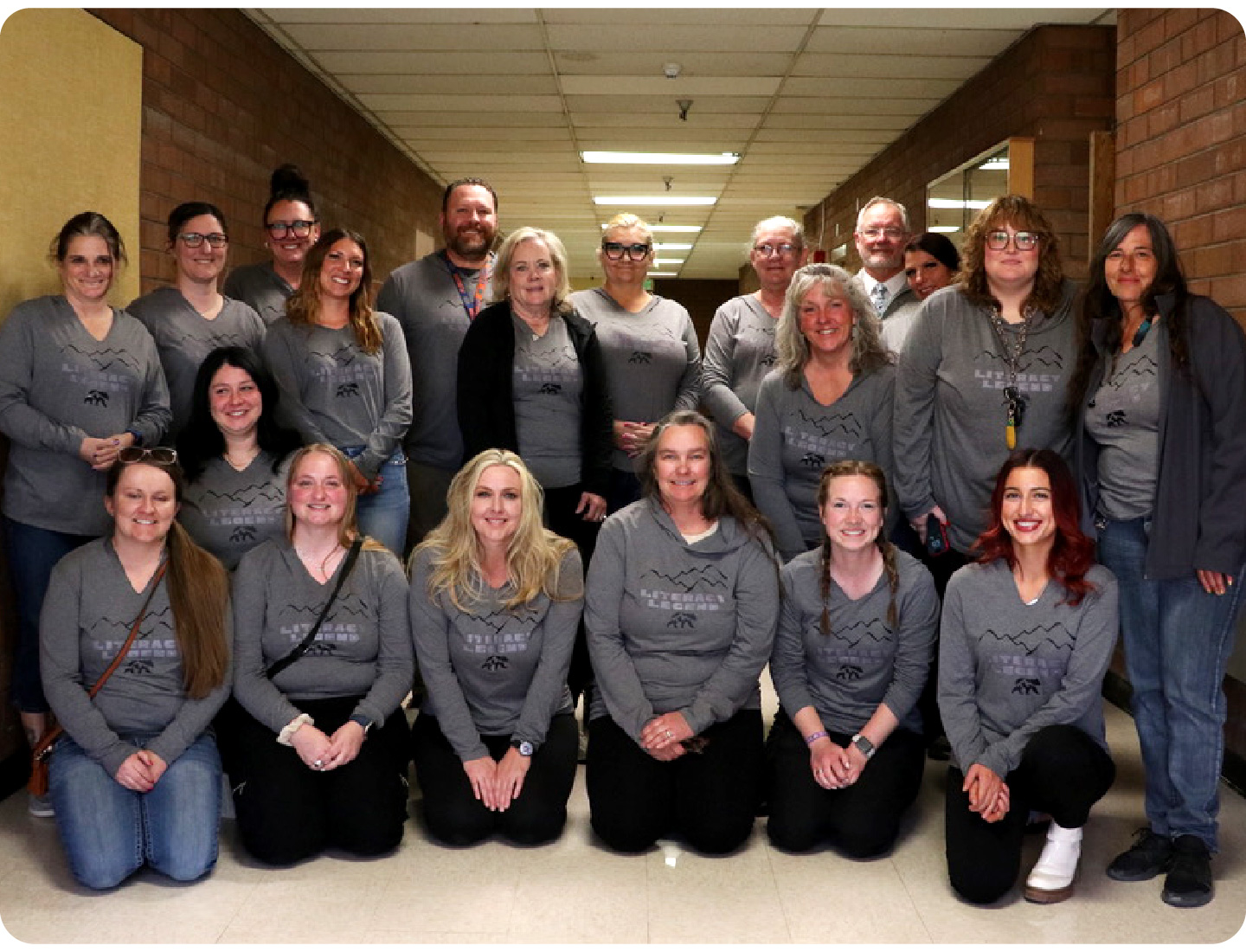
Bruin Point Elementary sits at the base of Utah’s Book Cliff Mountain Range in the small mining town of Sunnyside, 30 miles from the nearest district hub. With just 107 students, and one teacher per grade, it’s Carbon School District’s smallest school—and now one of its brightest early literacy success stories.
All of Bruin Point’s students face significant systemic barriers, with 100% qualifying for free lunch. Yet when it comes to literacy development, the school’s educators have achieved something remarkable.
In just one year, their student literacy proficiency rates jumped 19 percentage points—from 39% at the beginning of the year to 58% by mid-year.
That’s why Bruin Point Elementary has been named a Literacy Legend in our 2025 Science of Reading Star Awards. These awards honor educators, schools, and districts that have transformed classrooms and empowered students through the Science of Reading.
Teaching early literacy skills in a community with challenges
Sunnyside tells the story of many rural American communities. “Since the closing of the local mines, there has been an increase in the number of unemployed family members,” says Cindy Garcia, Bruin Point’s principal.
As a result, an already high poverty rate has risen still further, along with levels of substance abuse, neglect, behavioral issues, and more. Parent involvement in school is extremely low, according to Garcia. “Basic needs take priority.”
Yet Garcia and her six-teacher team saw potential where others might have seen obstacles. They understood that their students deserved the strongest possible foundation in early literacy skills. And they knew they had to make a change.
The importance of relying on data
“Many of us had been trained in methods that didn’t fully meet the needs of all students, and shifting the mindset required trust, training, and time,” says fifth-grade teacher Tyler Grundy. “Our biggest challenge wasn’t just learning a new approach. It was unlearning old ones. But we stayed the course.”
Four of the six teachers completed LETRS training, with two more currently working through it. Teachers began to trade guesswork for systematic, explicit classroom instruction, using data to guide their early literacy program.
“We equipped our teachers with the knowledge and tools to teach reading explicitly and systematically,” Grundy says. “We relied on data, not assumptions, to guide our instruction and interventions.”
Building literacy and knowledge together
The school implemented Amplify Core Knowledge Language Arts (CKLA), providing systematic phonics instruction and rich content knowledge that builds comprehension.
“CKLA weaves literacy skills together to help make my students proficient readers and writers,” says first-grade teacher Chelsea Timothy. “They’re making connections between the Greek myth of Arachne and spiders being arachnids. They put together a web of knowledge.”
Just having a wealth of content at their fingertips made a huge difference, too, and the instructors learned quickly how to leverage it.
“I didn’t have to spend countless hours looking for content,” said Julia Sanders, a first-year kindergarten teacher. “It saved me time, so I could focus on making it more encouraging for the kids.”
For second-grade teacher Francie Aufdemorte, having comprehensive materials meant being able to focus on instruction. “It reduced the stress of creating lesson plans from scratch,” she says. “I was nervous about the rigor, but my students have excelled with it.”
Building a culture in which “success is expected”
The 19-point proficiency jump speaks to real student growth, but Garcia knows the impact goes beyond test scores.
“Struggling students who once guessed at words began to decode with confidence,” she said. “We built a culture where reading success is expected and not left to chance.”
Bruin Point’s success rests on ongoing commitment to evidence-based practices. Garcia and her team continue meeting regularly for data discussions, sustaining the mindset shift that began their journey to improved student outcomes.
“Our interventions and extensions are like a well-oiled machine,” Garcia said. “We can see that the young ones are off to a much better start.”
She adds: “We didn’t just change our curriculum, we changed lives. And that is a legacy worth celebrating.”