Customer Privacy Policy

Last Modified: January 23, 2026 | Update History

Most recent update: This Privacy Policy has been updated to address additional rights for individuals in the European Union/UK.

We advise you to read this Privacy Policy in its entirety, including the jurisdiction-specific provisions in the appendix. Click here to review Our U.S. Notice At Collection.

Customer Privacy Policy: K–12 Schools

Who We Are

Amplify Education, Inc. (“Amplify”) is leading the way in next-generation curriculum and assessment. Amplify’s programs provide teachers with powerful tools that help them understand and respond to the needs of each student and use data in a way that is safe, secure, and effective.

Our Products and Services

Amplify’s products support classroom instruction and learning and include Amplify CKLA, Amplify ELA, Amplify Caminos, Amplify Science, Amplify Desmos Math, Boost Reading, Boost Math, mCLASS, Mathigon, associated professional development and tutoring services, and services at classroom.amplify.com (for creating and assigning activities) and student.amplify.com (for use of the activities or curricula as directed by an instructor), and any other product or service that links to this Privacy Policy (together, the “Products”).

Our Approach to Student Data Privacy 

In the course of providing the Products to Schools and their Authorized School Users, Amplify collects, receives, generates, or has access to Student Data (defined below). We consider Student Data to be confidential and we collect and use Student Data solely for educational purposes in connection with providing our Products to, or on behalf of the School as described in this Privacy Policy and our Agreements (defined below). We work to maintain the security and confidentiality of Student Data that we collect or store, and we enable Schools to control the use, access, sharing, and retention of Student Data.

Our Products are geared towards K–12 students (“Students”), and the educators, agents and staff members who use the Products as authorized by their School (“Educators”). Information that directly relates to an identifiable Student (“Student Data”) is owned and controlled by the School, and Amplify receives Student Data as a “school official” under Section 99.31 of the Family Educational Rights and Privacy Act of 1974 (“FERPA”) for the purpose of providing the Products hereunder. In addition, we rely on the School acknowledging that it is acting as the parent’s agent and consenting on the parent’s behalf to process personal information of Students under the age of 13 (“Child Users”) in accordance with the Children’s Online Privacy Protection Act (“COPPA”).

Our collection and use of Student Data is governed by our Agreements with Schools, including this Privacy Policy (“Privacy Policy”), and applicable laws which may include FERPA, COPPA, the Protection of Pupil Rights Amendment (“PPRA”), as well as other applicable federal, state, and local privacy laws and regulations (“Applicable Laws”). As noted above, with respect to FERPA, Amplify receives Student Data as a “school official” under Section 99.31 of FERPA for the purpose of providing its Products, and such Student Data is owned and controlled by the School.

Schools may provide authorization in two ways:

  1. by the School agreeing to our Customer Terms and Conditions located at amplify.com/customer-terms or another written agreement between Amplify and the School, as applicable; or
  2. by an Educator agreeing to the Acceptable Use Policy located at amplify.com/acceptable-use-policy/ (“AUP”) on behalf of the School as outlined in the AUP.

In each case, we collect Student Data and provide these Products solely for the use and benefit of the School and for no other commercial purpose. We require all Schools to review this Privacy Policy, available at amplify.com/customer-privacy, and to make a copy of the Privacy Policy available to the parents or guardians of Child Users.

We also provide limited opportunities for individual users to sign up for an account for use of our Products at-home or otherwise outside of the authorization of a School (“Home Users”). See the Appendix–Supplemental Disclosures for additional information that applies to our Home Users.

What This Privacy Policy Covers 

This Customer Privacy Policy (“Privacy Policy”) describes how Amplify collects, uses, and discloses personal information through the provision of Products.

For purposes of this Privacy Policy, “you” and “your” means Authorized Users (defined below).

This Privacy Policy does not apply to Amplify’s handling of:

  • information collected from users of Amplify’s company website, which is governed by our Website Privacy Policy.
  • job applicant data that we process in accordance with our applicant privacy notice.

There may be different contractual terms or privacy policies in place with some Schools. Such other terms or policies supersede this Privacy Policy for information collected or released under those terms. If you have any questions as to which legal agreement or privacy policy controls the collection and use of your personal information, please contact us using the information provided below. Unless expressly superseded, this Privacy Policy is incorporated into and is subject to the Agreement that governs your use of the Products.

Our Role

Amplify as a processor/service provider: Our School customers are the controllers of Student Data (as well as certain other Educator personal information to the extent required by law or Amplify’s agreement with the School) (together “School Data”).

Amplify acts as a processor/service provider for our School customers with respect to School Data, which means when we use School Data, we do so solely on the instruction of the School. School Data is subject to the School’s privacy policies; therefore, you will need to contact the School directly if you have any questions or would like to exercise your rights with respect to School Data.

Amplify as a controller: We are the controller of all other personal information we collect from non-Student Authorized Users (“Amplify Data”) and can be reached by email at privacy@amplify.com or by mail at Amplify Education, Inc., 55 Washington St.#800, Brooklyn, NY, 11201.

Policy

1. Definitions

Capitalized terms not defined in this section or elsewhere in this Privacy Policy will have the meaning set forth by Applicable Laws.

Agreement” means the underlying contractual agreement between Amplify and the School.

Authorized Users” means all users of our Products, including Authorized School Users, parents and legal guardians, and Home Users.

Authorized School Users” means Students and Educators.

Local Education Authority” means a local education agency or authority, school district, school network, independent school, or other regional education system.

Non-Student Data” means information that is linked or linkable to Authorized Users who are not Students.

School” means the Local Education Authority or State Agency.

State Agency” means the educational agency primarily responsible for the supervision of public elementary and secondary schools in any of the 50 states, the Commonwealth of Puerto Rico, the District of Columbia, or other territories and possessions of the United States, as well as a national or regional ministry or department of education in other countries, as applicable.

2. What personal information do we collect?

When you access or use our Products, you may choose to provide us with personal information, including Student Data. This information may be provided to us directly (e.g. when an account is created or through communications with us) or through your interactions with our Products.

Student Data. Below is a list of the categories of Student Data that may be collected by Amplify or its Products, either directly or through the Authorized School User’s use of the various features and configurations of the Products:

  • Identifier and Enrollment Data, such as name, email, school / state ID number, username and password, grade level, homeroom, courses, teacher names.
    • Why? Most of Amplify’s Products require some basic information about who is in a classroom and who teaches the class—Student or teacher Identifier and Enrollment data. This information is provided to Amplify by the School, either directly from the School’s student information system or via a third party with whom the School contracts to provide that information.
  • Demographic Data, such as date of birth, socioeconomic status, race, national origin, and preferred or primary language.
    • Why? To support school instructional and reporting requirements, Amplify’s Products allow Schools to view reports and analyze data using Demographic Data. Generally, Demographic Data is provided on a voluntary basis by the School. For example, a School may wish to analyze Student literacy assessment results based on English Language Learner status to better tailor classroom instruction, and in that case, the School may provide Demographic Data to enable that reporting.
  • School Records, such as grades, attendance, assessment results, and whether an Individualized Education Plan (IEP or local equivalent) is in place.
    • Why? Some of our Products support grading assignments and administering formative, diagnostic, and curriculum-based assessments. Teachers use that information to support Students’ progress in the program or help with instructional decisions. We do not collect specific details from an IEP, nor do we collect protected health information or other sensitive information.
  • Schoolwork and Student Generated Content, which includes any information contained in Student assignments and assessments, including information in response to instructional activities and participation in collaborative or interactive features of our Products, such as Student responses to academic questions and Student-written essays, as well as images, video, and audio recordings.
    • Why? As part of the digital learning experience, some of our Products may enable Students to write text and create and upload images, video, and audio recordings. For example, in Amplify ELA, students may write essays or submit short-form responses in our platform as part of a lesson on literature. As another example, in Boost Reading, student interactions with reading skills games are recorded to keep track of the student’s progress to level up in the program and to provide visibility to teachers on how students are mastering the skills.
  • Teacher Comments and Feedback, such as scores, written comments, or other feedback that Educators may provide about Student responses or student course performance.
    • Why? To enable teachers to track the performance and provide feedback to their students.
  • Non-Student Data. We may collect the following types of personal information from all other Authorized Users:
    • Contact Information, such as name and email address, as well as grade level taught, school name and school location, whether you are an Educator or Home User that creates an account or uses our Products or communicates with us.
    • Account Information, such as user login and password, for account creation and access purposes.
    • Survey Responses, which you provide in response to surveys or questionnaires.
  • Device and Usage Data. Depending on the Product, we may collect certain information about the device used to connect to our Product, such as device type and model, browser configurations, and persistent identifiers, such as IP addresses and unique device identifiers. We may collect device diagnostic information, such as battery level, usage logs, and error logs, as well as usage, viewing, and technical information (e.g., email open rates), such as the number of requests a device makes, to ensure proper system capacity for all Authorized Users. We may collect IP addresses and use that information to approximate device location to support operation of the Product. To the extent that we collect this information, this data is solely used to support operation of the Product and is not linked to Student Data. For purposes of clarity, Amplify does not use Student Data for marketing or advertising purposes (see section 6 of this Privacy Policy for more information about our commitments regarding Student Data).
    • Why? We use this information to remember returning users and facilitate ease of login, to customize the function and appearance of the Products, and to improve the learning experience. This information also helps us track product usage for various purposes, including website optimization, to ensure proper system capacity, troubleshoot and fix errors, provide technical assistance and customer support, provide and monitor the effectiveness of our Products, monitor and address security concerns, and compile analytics for product improvement and other internal purposes.
    • How? Cookies and Similar Technologies. We collect device and usage data through “cookies,” Web beacons, HTML5 local storage, and other similar technologies, which are used in some of our Products solely to support operation of the Products as described above. While we may use third party cookies and similar technologies for advertising and marketing purposes on our website (in accordance with our Website Privacy Policy), we do not permit such tracking technologies to be present on Student-facing portions of the Products. In particular, we only use the following types of cookies in our Products:
      • Strictly necessary cookies – These are cookies that are required for the operation of our websites and applications that host our Products. They include, for example, cookies that enable you to log into secure areas of our Products. These cookies are not generally stored beyond the browser session and are less likely to include personal information. This category of cookies cannot be disabled.
      • Functionality Cookies – We use these cookies so that we recognize you on the websites and apps that host our Products and remember your previously selected preferences. These cookies are stored on your device between browsing sessions but expire after a pre-defined period. These cookies enable us to “recognize” you when you use our Products, including your preferences such as your preferred language, time, and location. A mix of first party (placed by us) and third-party cookies (placed by third parties) are used.
      • Performance Cookies – These cookies help us and service providers acting on our behalf compile statistics and analytics about users of our Products that are accessed via websites and apps, including Device and Usage Information.
    • Learn how to opt out of cookies and similar technologies by reading the “What Rights and Choices Do You Have?” section of this Privacy Policy below.

3. How do we use personal information?

Student Data. Amplify uses Student Data for educational purposes, to provide the Products, and to ensure secure and effective operation of our Products, including:

  • to provide and improve our educational Products;
  • to support School and Authorized School Users’ activities;
  • to ensure secure and effective operation of our Products;
  • for purposes requested or authorized by the School or Authorized School User or as otherwise permitted by Applicable Laws;
  • for customer support purposes, to respond to the inquiries and fulfill the requests of the School and their Authorized School Users;
  • to enforce Product access and security controls; and
  • to conduct system audits and improve protections against the misuse of our Products, or to detect and prevent fraud and other harmful activities.
  • to enable the adaptive and personalized learning features of the Products.

Non-Student Data. Amplify may use Non-Student Data for the purposes for which Student Data is used as set forth above. In addition, Amplify may use Non-Student Data to provide customized content, advertising and marketing in limited circumstances (e.g. to periodically send newsletters and other promotional materials) directed to Educators and Home Users. For sake of clarity, we do not use Student Data for marketing purposes and we do not direct marketing to Students. Amplify may also use Non-Student Data for internal research and analytics, including generating insights on the use of our Products by Educators in certain Schools so that we can better serve those communities. We will also use Non-Student Data as otherwise required or permitted by law, or as we may notify you at the time of collection. Learn how to opt out of these communications by reading the “What Rights and Choices Do You Have?” section of this Privacy Policy below.

Amplify may use aggregate or de-identified data as described in the Aggregate/De-identified Data section below.

4. To whom do we disclose personal information?

Student Data. We disclose Student Data to third parties only as needed to provide the Products under the Agreement, as directed or permitted by the School or Authorized School User, and as required by law. Such disclosures may include but are not limited to the following:

  • to other Authorized School Users of the School entitled to access such data in connection with the Products;
  • to our service providers, subprocessors, or vendors who have a legitimate need to access such data in order to assist us in providing or supporting our Products, such as platform, infrastructure, and application software. We contractually bind such parties to protect Student Data in a manner consistent with those practices set forth in this Privacy Policy and in accordance with Applicable Laws. A list of Amplify subprocessors is available at https://www.amplify.com/subprocessors;
  • to comply with the law, respond to requests in legal or government enforcement proceedings (such as complying with a subpoena), protect our rights in a legal dispute, or seek assistance of law enforcement in the event of a threat to our rights, security, or property or that of our affiliates, customers, Authorized Users, or others;
  • in the event Amplify or all or part of its assets are acquired or transferred to another party, including in connection with any bankruptcy or similar proceedings, provided that successor entity will be required to comply with the privacy protections in this Privacy Policy with respect to information collected under this Privacy Policy, or we will provide the School with notice and an opportunity to opt out of the transfer of such data prior to the transfer; and
  • except as restricted by Applicable Laws or contracts with the School, we may also share Student Data with Amplify’s affiliated education companies, provided that such disclosure is solely for the purposes of providing Products and at all times is subject to this Policy.

Non-Student Data. Amplify discloses Non-Student Data for the purposes for which Student Data is used as set forth above. Amplify may also disclose Non-Student Data as otherwise required or permitted, or as disclosed at the time of collection. Please note that we do not share mobile information or opt-in consent with third parties / affiliates for their own marketing or promotional purposes.

5. Aggregate/De-identified data

Amplify may use de-identified or aggregate data for purposes allowed under FERPA and other Applicable Laws, to research, develop, and improve educational sites, services, and applications and to demonstrate the effectiveness of the Amplify Products. Amplify will not attempt to re-identify de-identified data. We may use aggregate information (which is information that has been collected in summary form such that the data cannot be associated with any individual) for analytics and reports. For example, our promotional materials may note the total number of students served by our programs in the prior year, but that information cannot be used to identify any one student. We may also share de-identified or aggregate data with research partners to help us analyze the information for product improvement and development purposes.

Records and information are de-identified when all personal information has been removed or obscured, such that the remaining information does not reasonably identify a specific individual. We de-identify Student Data in compliance with Applicable Laws and in accordance with the guidelines of NIST SP 800-122. Amplify has implemented internal procedures and controls to protect against the re-identification of de-identified Student Data. Amplify does not disclose de-identified data to its research partners unless that party has agreed in writing not to attempt to re-identify such data.

6. Data prohibitions, Advertising, Advertising limitations

Amplify will not:

  • sell Student Data to third parties;
  • use or disclose Student Data to inform, influence, or enable targeted advertising to a Student based on Student Data or information or data inferred over time from the Student’s usage of the Products;
  • use Student Data to develop a profile of a Student for any purpose other than providing the Products to a School or Authorized School User, or as authorized by a parent or legal guardian;
  • use Student Data for any commercial purpose other than to provide the Products to the School or Authorized School User, or as permitted by Applicable Laws.

7. External third-party services

This Privacy Policy applies solely to Amplify’s Products and practices. Schools and other Authorized Users may choose to connect or use our Products in conjunction with third-party services and Products. Additionally, our sites and Products may contain links to third-party websites or services . This Privacy Policy does not address, and Amplify is not responsible for, the privacy, information, or other practices of such third parties. Schools should carefully consider which third-party applications to include among the Products and services they provide to Students and vet the privacy and data security standards of those providers.

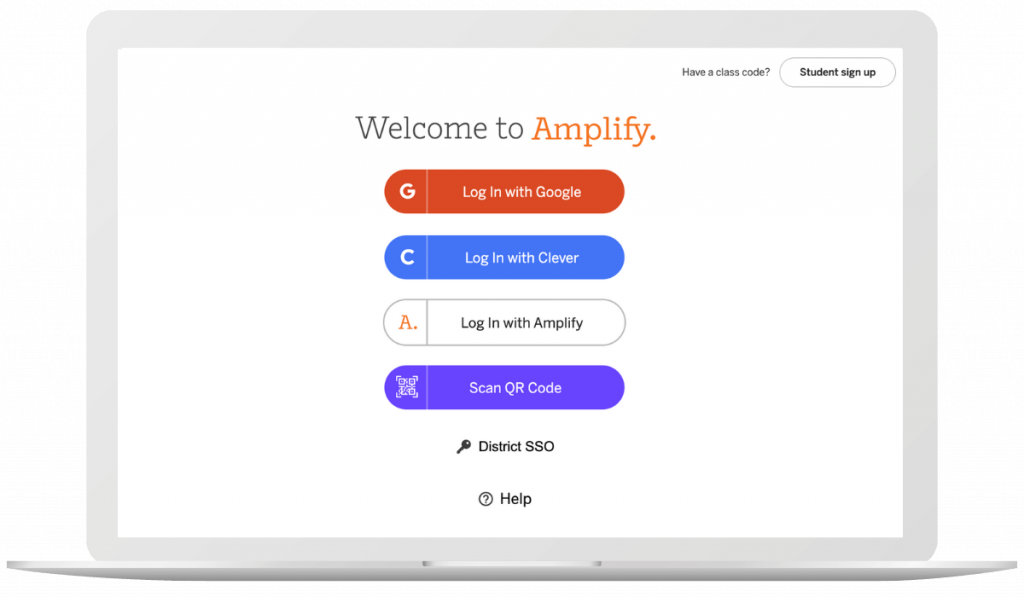
Authorized Users may be able to log in to our Products using third-party sign-in services such as Clever, ClassLink or Google. These services authenticate your identity and provide you with the option to share certain personal information with us, including your name and email address, to pre-populate our account sign-up form. If you choose to enable a third party to share your third-party account credentials with Amplify, we may obtain personal information via that mechanism. You may configure your accounts on these third-party platform services to control what information they share.

8. Security

Amplify maintains a comprehensive information security program and uses industry standard administrative, technical, operational, and physical measures to safeguard Student Data in its possession against loss, theft and unauthorized use, disclosure, or modification. Amplify performs periodic risk assessments of its information security program and prioritizes the remediation of identified security vulnerabilities. Please see https://amplify.com/security for a detailed description of Amplify’s security program.

In the event Amplify discovers or is notified that Student Data within our possession or control was disclosed to, or acquired by, an unauthorized party, we will investigate the incident, take steps to mitigate the potential impact, and notify the School in accordance with Applicable Laws.

Non-Student Data

Outside of Student Data, Amplify uses commercially reasonable administrative, technical, personnel, and physical measures to safeguard personal information in its possession against loss, theft, and unauthorized use, disclosure or modification.

9. Data Storage and Transfers

We are a United States Company, and our servers are hosted, managed, and controlled by us in the United States. If you are outside of the United States, we use industry standards to protect your data when it leaves your country of residence and your data will always be protected in accordance with this Privacy Policy, Applicable Laws and our Agreement regardless of the storage location.

Additionally, where we transfer your personal information to service providers outside of the United Kingdom (UK), European Economic Area (EEA), or other region that offers similar protections, we use specific appropriate safeguards to contractually obligate such service providers to protect personal information in accordance with Amplify’s commitment to privacy and security and applicable data protection laws.

If you have questions or wish to obtain more information about the international transfer of your personal information or the implemented safeguards, please contact us using the contact information below.

10. Data Retention / Deletion

Student Data

Upon request, we provide the School the opportunity to review and delete the personal information collected from Students. We will retain Student Data for the period necessary to fulfill the purposes outlined in this Privacy Policy and our Agreement with the School. We do not knowingly retain Student Data beyond the time period required to support the School or Authorized School User’s educational purpose, unless authorized by the School or Authorized School User. Upon request, Amplify will return, delete, or destroy Student Data stored by Amplify in accordance with applicable law and customer requirements. We may not be able to delete all data in all circumstances, such as information retained in technical support records, customer service records, back-ups, and similar business records. All such information will be protected in accordance with this Privacy Policy and our Agreement until it has been permanently deleted. Unless otherwise notified by the School, we will delete or de-identify Student Data after termination of our Agreement with the School.

Non-Student Data

Outside of Student Data, we keep personal information as long as it is necessary or relevant for the practices described in this Privacy Policy or as otherwise required by our Agreement with the School, if applicable. We determine the appropriate retention period for personal information on the basis of the amount, nature and sensitivity of the personal information being processed, the potential risk of harm from unauthorized use or disclosure of the personal information, whether we can achieve the purposes of the processing through other means, and on the basis of applicable legal requirements (such as applicable statutes of limitations).

11. What rights and choices do you have?

What Choices Do You Have?

Marketing/Advertising

As noted above, we do not use Student Data for marketing purposes and we do not direct marketing to Students. Amplify does not use third party cookies and similar technologies for advertising and marketing purposes on Student-facing portions of the Products. The choices below apply to Non-Student Authorized Users.

Opt-out of Marketing Communications. If you want to stop receiving promotional materials from Amplify, you can follow the unsubscribe instructions at the bottom of each email or email us at privacy@amplify.com. Amplify does not send marketing communications to Students.

Opt-out of Cookies and Similar Tracking Technologies. With respect to cookies, you may be able to reject cookies through your browser or device controls. Note that you have to opt-out of cookies on each browser or device that you use. If you replace, change, or upgrade your browser or device, or delete your cookies, you may need to use these opt-out tools again. Please be aware that disabling cookies may negatively impact your experience as some features may not work properly. To learn more about browser cookies, including how to manage or delete them, check the “Help,” “Tools,” or similar section of your browser.

What Rights Do You Have?

Individuals in the U.S.

  • What Rights Do You Have With Respect to Student Data?
    • Review and Correction. FERPA requires schools to provide parents with access to their children’s education records, and parents may request that the school correct records that they believe to be inaccurate or misleading.
    • If you are a parent or guardian and would like to review, correct, or update your child’s data stored in our Products, contact your School. Amplify will work with your School to enable your access to and, if applicable, correction of your child’s education records.
    • If you have any questions about whom to contact or other questions about your child’s data, you may contact us using the information provided below.
    • Other Privacy Rights? Please see section 3 of our supplemental disclosures: “Additional U.S. State Privacy Law Rights” for more information about your U.S. privacy rights

Individuals in the EU/UK

Please see section 4 of our supplemental disclosures: “Notice for European Economic Area and United Kingdom Customers” for more information about your EU/UK privacy rights.

12. COPPA

We do not knowingly collect personal information from a Child User unless and until a School or Educator, with the permission of the School, has authorized us to collect such information to provide the Products. Amplify relies on the School acknowledging that it is acting as the parent’s agent and consenting on the parent’s behalf to process personal information of Child Users in accordance with all applicable provisions of COPPA. To the extent COPPA applies to the information we collect, we process such information for educational purposes only, and no other commercial purpose, at the direction of the School and on the basis of the School’s authorization. If you are a parent or guardian and have questions about your child’s use of the Products and any personal information collected, please direct these questions to your child’s school.

Please refer to the Appendix–Supplemental Disclosures if you are a Home User.

13. Updates to this Privacy Policy

We may change this Privacy Policy in the future. For example, we may update it to comply with new laws or regulations, to conform to industry best practices, or to reflect changes in our product offerings. When these changes do not reflect material changes in our practices with respect to use and/or disclosure of Authorized Users’ personal information, including Student Data, such changes to the Privacy Policy will become effective when we post the revised Privacy Policy on our website. In the event there are material changes in our practices that would result in Authorized Users’ personal information being used in a materially different manner than was disclosed when the information was collected, with respect to Student Data, we will notify the School, and with respect to other information, we will notify you via email and provide an opportunity to opt out before such changes take effect.

14. Contact us

If you have questions about this Privacy Policy, please contact us at:

Email: privacy@amplify.com
Mail: Amplify Education, Inc.
55 Washington St.#800
Brooklyn, NY, 11201
Phone: (800) 823-1969
Attn: General Counsel

To report a security vulnerability, visit https://amplify.com/report-a-vulnerability/.

Appendix – Supplemental Disclosures

1. Mathigon and Amplify Classroom accounts

While our Products are geared towards Schools we do provide a limited opportunity for Home Users to use the Products at home—outside of the school context. We do not allow persons under the age of 13 (or those under the age of consent in any applicable jurisdiction) to register for an account with us outside the school context.

If you are a Home User, you are prohibited from collecting or providing any personal information from students or minors. You are permitted to access the platform for instructional purposes, but you may not enroll or roster minors, create accounts for minors, or input any personal information of minors into the Product.

Please note that most parts of Mathigon can be used without creating an account or providing any personal information that directly identifies you.

What Rights Do You Have? If you are a Child User who is 13 or older with a legacy Mathigon account (or the parent or guardian of a Child User with a legacy Mathigon account), you may request that we provide for your review, delete from our records, or cease collecting any Child User personal information. To the extent that you are unable to exercise these rights through self-service features within your account with us, please contact us by sending an email to: help@amplify.com and we will provide assistance.

2. U.S. Notice at Collection

Personal Information We Collect How We Use Personal Information

Student Data, which includes:

  • Roster Information
  • Demographic Data, such as race and national origin
  • School Records
  • Account Information
  • Schoolwork and Student Generated Content
  • Teacher Comments and Feedback
  • Device and Usage Data
  • To provide and improve our educational Products;
  • To support Schools’ and Authorized School Users’ activities;
  • To ensure secure and effective operation of our Products;
  • For purposes requested or authorized by the School or Authorized School Users, or as otherwise permitted by Applicable Laws;
  • For adaptive or personalized learning features of the Products; provided that Student Data is not disclosed;
  • For customer support purposes, to respond to the inquiries and fulfill the requests of the School and their Authorized School Users;
  • To enforce product access and security controls; and
  • To conduct system audits and improve protections against the misuse of our Products, or to detect and prevent fraud and other harmful activities.

Authorized Users, which includes:

  • Contact Information
  • Account Information
  • Survey Responses
  • Device and Usage Data
  • For the purposes for which Student Data is used as set forth above;
  • For marketing purposes in limited circumstances (e.g. to periodically send newsletters and other promotional materials), which will not be based on Student Data or directed to K–12 students;
  • For internal research and analytics; and
  • As otherwise required or permitted, or as we may notify you at the time of collection.

Some of the information described above may be considered “sensitive” under the laws of certain jurisdictions (i.e., account credentials and race/national origin) (“Sensitive Information”). We use Sensitive Information for necessary or reasonably expected purposes – specifically, to provide you with our Services (i.e., account credentials are used to allow account logins and race/national origin are used for the School’s reporting purposes when voluntarily provided by the School).

We do not sell or share your personal information, as described in California law.

We retain your personal information for as long as reasonably necessary for the purposes disclosed in the chart above. Additional information about our retention of Student Data and personal information from other Authorized Users can be found in Section 10 of this Privacy Policy.

Please see the Additional U.S. State Privacy Law Rights section of this appendix for information about your privacy rights pursuant to applicable U.S. law.

Notice of Financial Incentive

From time to time, to support our services, we offer opportunities to complete surveys and questionnaires. As an incentive for completing the survey or questionnaire, you can voluntarily provide personal information as an entry into a raffle drawing or to obtain other benefits, discounts, offers, or deals that may constitute a financial incentive under California law (“Financial Incentive”). The categories of personal information required for us to provide the Financial Incentives include: contact information and any other information that you choose to provide when you complete the survey.

Participation is voluntary and you can opt out at any time before the survey is complete. We do not allow students to participate in our surveys.

The value of the personal information we collect in connection with our Financial Incentives is equivalent to the value of the benefit offered.

3. Additional U.S. State Privacy Law Rights

Note for Requests Relating to Student Data: Because Amplify provides the Products to Schools as a “School Official,” we collect, retain, use, and disclose Student Data only for or on behalf of the School for educational purposes, including the purpose of providing the Products specified in our Agreement with the School and for no other commercial purpose. Accordingly, we act as a “service provider” for the School with respect to School Data. We work with the School to support and assist them in addressing privacy requests relating to School Data. Please reach out to your School directly if you wish to exercise any privacy rights that may be available to you.

For all other requests: With respect to Amplify Data, individuals residing in certain U.S. states have the following rights, regarding your personal information (each of which is subject to various exceptions and limitations):

  • Access. You have the right to request, up to two times every 12 months, that we disclose to you the categories of personal information collected about you; the categories of sources from which the personal information is collected; the categories of personal information sold or shared; the business or commercial purpose for collecting, selling, or sharing the personal information; the categories of third parties with whom personal information was shared; and the specific pieces of personal information collected about you.
  • Correction. You have the right to request that we correct inaccurate personal information collected from you.
  • Deletion. You have the right to request that we delete the personal information that we maintain about you. Even after the deletion of your account, some personal information may remain on our servers, such as in technical support logs, server caches, data backups, or email conversations. These will be automatically deleted after a reasonable amount of time, unless we are legally required to retain information for longer, or unless there is a legitimate business reason (e.g. security and fraud prevention or financial record-keeping). We are not required to delete any information which has been aggregated or de-identified in accordance with Section 5.
  • No Discrimination. You have the right not to be discriminated against for exercising these rights.
  • Appeals. You have a right to appeal decisions concerning your ability to exercise your consumer rights.

See Submitting Requests section below for details on submitting a request to exercise these rights.

4. Notice for European Economic Area (EEA) and United Kingdom (UK) Customers

As detailed at the beginning of our Privacy Policy (under the section titled “Our Role”), Amplify operates primarily as a processor that collects personal information on behalf of the School, and we act as a controller in limited circumstances where we offer Products outside the school context.

If you represent a School in the EEA or the UK, please note that we process personal information in accordance with this Privacy Policy, our Acceptable Use Policy, and our standard Data Protection Agreement, which sets out our responsibilities when it comes to our processing activities. Schools must send an email to privacy@amplify.com to enter into that DPA.

Lawful Basis for Processing

We rely on the following lawful bases for our processing activities:

  • Consent;
    • We obtain your consent to use cookies to collect and process device and usage data to understand how individuals use our Products.
  • Pursuant to a contract for use of our Products;
    • We process School Data to provide our Products (e.g., to create, authenticate and manage your account, to verify your identity, to manage our Products) pursuant to the Agreement between us and the School, as required in order for us to perform our obligations.
  • To comply with our legal obligations;
    • We process all categories of personal information that we collect to ensure the safety and security of our Products where we are complying with security requirements under data protection and cyber and information security law.
    • We process all categories of personal information that we collect to comply with our legal obligations which includes, for example, to access, retain or share certain personal information where we receive a valid request from a government body, law enforcement body, judicial body regulator or similar, to deal with legal claims and prospective legal claims, and to ensure we are complying with applicable laws.
  • When we have a legitimate interest in doing so, which is not outweighed by the risks to the individual.
    • We process all categories of personal information that we collect to support the provision, effective management, and improvement of our Products where such activities are not strictly required under our contract. This is in our legitimate interests to ensure that we are providing the best possible service.
    • We process all categories of personal information that we collect to ensure the safety and security of our services where this is important but not required under the data protection law or cyber and information security laws. This is in our legitimate interests to ensure the security of our services and systems, to prevent threats, abuse or fraudulent or unlawful activity, to promote safety and security and to ensure our Products are used in accordance with our terms and conditions.
    • We process the contact information of Non-Student Authorized Users to manage our relationship, including to respond to queries or otherwise communicate with you in relation to our Products and the operation of our business where this is not strictly required under a contract with you. This is in our legitimate interests to communicate with and resolve queries from users of our Products and to ensure that we are providing the best possible service.

We process the contact information and survey data of Non-Student Authorized Users for internal research and marketing purposes in limited circumstances (e.g. to periodically send newsletters and other promotional materials), which will not be based on Student Data or directed to Students. This is in our legitimate interests to understand our customers and prospective customers, understand how our products and services are perceived in the market, to promote our products, and to grow and develop our business.

Your Data Subject Rights

Note for Requests Relating to School Data: Amplify acts as processor to its School customers with respect to all School Data. We work with our School customers to support and assist them in addressing privacy requests relating to School Data. Please reach out to your School directly if you wish to exercise any privacy rights that may be available to you.

For all other Requests With respect to Amplify Data, you have the following rights if you are in the EEA or UK, subject to certain exceptions:

  • Right of access: You have the right to ask us for confirmation on whether we are processing your personal information and access to that personal information.
  • Right to correction: You have the right to have your personal information corrected.
  • Right to erasure: You have the right to ask us to delete your personal information.
  • Right to withdraw consent: You have the right to withdraw consent that you have provided.
  • Right to lodge a complaint with a supervisory authority: You have the right to lodge a complaint with a supervisory authority.
  • Right to restriction of processing: You have the right to request the limiting of our processing under limited circumstances.
  • Right to data portability: You have the right to receive the personal information that you have provided to us, in a structured, commonly used, and machine-readable format, and you have the right to transmit that information to another controller, including to have it transmitted directly, where technically feasible.
  • Right to object: You have the right to object to our processing of your personal information

See Submitting Requests section below for details on submitting a request to exercise these rights.

5. Submitting Requests

To exercise any of the rights described in sections 2 and 3 of this appendix, email us at privacy@amplify.com and specify which privacy right you intend to exercise. We may require additional information from you to allow us to confirm your identity. The verification steps will vary depending on the sensitivity of the personal information and whether you have an account with us. Please note that your rights may not apply in all cases. For example, we may need to retain your personal information to comply with our legal obligations, resolve disputes, prevent fraud and enforce our agreements. We will inform you if we are not able to fully respond to your requests. You may designate an authorized agent to make a request on your behalf. When submitting the request, please ensure the authorized agent identifies himself/herself/itself as an authorized agent and can show written permission from you to represent you. We may contact you directly to confirm that you have authorized the agent to act on your behalf or confirm your identity.

Complaints

If you have any issues, you have the right to lodge a complaint with an EEA or UK supervisory authority. We would, however, appreciate the opportunity to address your concerns before you approach a data protection regulator and would welcome you directing an inquiry first to us. To do so, please contact us by email at privacy@amplify.com or by mail at Amplify Education, Inc., 55 Washington St.#800, Brooklyn, NY, 11201.

6. Google APIs

Amplify uses Google’s Application Programming Interface (API) Services to enable Authorized Users to log in to Amplify, import classes and rosters from Google Classroom, create assignments in Google Classroom, and copy, edit, and publish Amplify content using Google Slides. Amplify will use and transfer information received from Google’s API in accordance with Google API Service User Data Policy, including the Limited Use requirements.

Update History:

Update: 6/13/2025: This Policy has been updated to align with product updates and to provide additional context for authorized educational use of Amplify’s Products.

Update 6/27/2024: The Policy has been updated to include an explanation regarding Google APIs in the Appendix — Supplemental Disclosures section.

Update 6/30/2023: This Privacy Policy has been updated to address new state law data privacy requirements.


Website Privacy Policy

Last Modified:  February 2026

Update: February 2, 2026: This Privacy Policy has been updated to address additional rights for individuals in the European Union/UK.

Below is the Website Privacy Policy for the amplify.com site (“Privacy Policy”). For purposes of clarity and as further outlined below, this Privacy Policy does not apply to student data. You can visit this page to read about the principles and policy governing student data collected and maintained on behalf of our school customers.

We advise you to read this Privacy Policy in its entirety, including the jurisdiction-specific provisions in the appendix. Our Notice at Collection for California Residents is available in the Notice for our California Customers.

Who We Are / What This Privacy Policy Covers

Amplify Education, Inc. (“Amplify”) recognizes the importance of protecting the privacy and security of your personal information. This Privacy Policy describes our practices in connection with information that we may collect through your use of this website (the “Site”).

This Privacy Policy does not apply to Amplify’s handling of:

  • student data or other information collected from users of Amplify’s products that support classroom instruction and learning, which are governed by our Customer Privacy Policy.
  • staff or applicant data that we process in accordance with our staff or applicant privacy notice, respectively.

If you have any question as to what legal agreement or privacy policy controls the collection and use of your information, please contact us using information below in the Contact Us section.

This Privacy Policy is incorporated into and is subject to our Website Terms of Use, which governs your use of the Site.

Our Role: We are the controller of all personal information (as defined below) that we receive through our Site and can be reached by email at privacy@amplify.com or by mail at Amplify Education, Inc., 55 Washington St.#800, Brooklyn, NY, 11201.

1. What personal information do we collect?

When you visit and / or interact with our Site, we may collect the following information about you that, alone or in combination, could be used to identify you or your device (“personal information”):

  • Contact Information, such as name, district / school name, professional affiliation, title / role, email address, shipping address, address and phone number.
  • Account Information, such as customer user login and password. 
  • Demographic Information, such as age and gender.
  • Information You Submit, such as information voluntarily provided on message boards, feedback sections, and other public areas of the Site.
  • Site Activity Information, which is collected when you access and interact with the Site, we and our Service Providers (as defined below) may collect certain information about those visits. For example, we or our Service Providers may receive and record information about your computer and browser, including your IP address, browser type, and other software or hardware information. If you access the Site from a mobile or other device, we may collect a unique device identifier assigned to that device, or other characteristics of the device hardware, operating system and configurations for that device. On certain pages of the Site, we may use third party tools to help us look at mouse movements, clicks, keystrokes, data or text entered, and the pages you visit.
  • Location Information, such as state, country and / or zip code, which we use to help us customize your experience, as well as to help us facilitate your privacy rights.
  • Audio, electronic, visual, or similar information: such as customer service interactions, call recordings, chat transcripts, files you attach, and email, text, or other correspondence.

If you make a purchase through our online store, you may provide payment and other information directly to our third party e-commerce platform to complete your purchase.

We ask that you not send us, and you not disclose, any government identifiers (such as social security numbers) or information related to racial or ethnic origin, health, or criminal background on or through the Site or otherwise.

2. Where/How do we collect personal information?

Amplify may collect personal information directly from you at various points, including the following:

  • Product Information and Newsletters. When you submit a request to obtain information about our products, services or other informational material or subscribe to one of our newsletters, you may be asked to submit information such as name, professional affiliation, email address, company name, address and phone and details on your query or interests in our products and services. This information is collected to help us process your request.
  • Customer Support. When you submit a form to contact our customer service, you may be asked to submit information such as name, e-mail, district, customer user login and password and details on your query. In addition, some features of our Site, such as our customer live chat functionality or other customer service systems may allow you to voluntarily provide personal information to us. This information is collected to help us process your request. Please only provide what is needed to facilitate the support request.
  • Product Orders. If you use e-commerce areas of our Site to order our products, we request information from you on our order form. To purchase products through the Site, you must provide contact information (such as name and shipping address) and financial information (such as credit card number). This information is used for billing purposes and to fill your orders. We will also use this information to contact you to confirm your order or to inform you of any issues or delays.
  • Registration. You may be asked to submit information to use certain parts of the Site (such as posting comments on certain areas of the Site), register for an event or webinar, or view restricted content that may be available on the Site. For instance, you may be asked to provide your name, email address and event or webinar-related preferences to help us process your registration or content request.
  • Public Areas and Discussion Forums. Any information you share in public areas, such as message boards or feedback sections, becomes public. Please be careful about what you disclose and do not post any personal information that you expect to keep private.
  • Contests and Sweepstakes. When we run a contest or sweepstakes relating to the Site or Amplify, it will be accompanied by a set of rules. The rules for each contest/sweepstakes will specify how the information gathered from you for your entry will be used and disclosed.

As you visit or use our Site, we may collect Site activity information through cookies and similar technologies.

  • Cookies, Pixels, and Other Tracking Technologies. Cookies and other tracking technologies (such as pixels, beacons, and Adobe Flash technology) are small data files that are placed on your computer or mobile device when you visit a website. They allow the website or mobile app to remember your actions and preferences over a period of time. We use the following types of cookies:
    • Strictly necessary cookies – These are cookies that are required for the operation of our Site. They include, for example, cookies that enable you to log into secure areas of our Site. These cookies are not generally stored beyond the browser session and are less likely to include personal information. This category of cookies cannot be disabled.
    • Functionality Cookies – We use these cookies so that we recognize you on our Site and remember your previously selected preferences. These cookies are stored on your device between browsing sessions but expire after a pre-defined period. These cookies enable our Site to “recognize” you when you use our Site, including your preferences such as your preferred language , time, and location. A mix of first party (placed by us) and third-party cookies (placed by third parties) are used.
    • Analytics Cookies – These cookies help us and our Service Providers compile statistics and analytics about users of the Site, including Site Activity Information. For example, we use Google Analytics to help us understand how users interact with the Platform. Google Analytics uses cookies to track your interactions with the Site, then collects that information and reports it to us. This information helps us improve the Site so that we can better serve you. To learn more about Google Analytics, visit https://support.google.com/analytics/answer/6004245?hl=en. If you wish, you can opt-out of Google Analytics by installing the Google Analytics Opt-out Browser Add-on, available on https://tools.google.com/dlpage/gaoptout.
    • Advertising Cookies – We use these cookies to collect information about your visit to our Site, the content you viewed, the links you followed and information about your browser, device, and your IP address. We sometimes share some limited aspects of this data with third parties for advertising purposes. We may also share Site Activity Information collected through cookies with our advertising partners. This means that when you visit another website, you may be shown advertising based on your browsing patterns on our Site.

For information on how to opt-out of these technologies, please see What Choices Do You Have? below.

  • Social Plugins. Certain areas of our Site permit you to utilize social media functionality, such as the Facebook “Like” or Google “+1” buttons (“Social Plugins”). To use a Social Plugin, you must authorize the third-party provider of that Social Plugin, e.g. Facebook or Google, to access, collect, and/or disclose your information related to your use of that Social Plugin, subject to that company’s privacy policies, which may differ from this Privacy Policy. In addition, such providers may be able to collect information about you, including your activity on the Site, and they may notify your connections on their social networking platform about your use of the Site. Such services may also employ unique identifiers that allow your activity to be monitored across multiple websites for purposes of delivering more targeted advertising to you.

Amplify also receives information from other sources.

  • Information from Other Sources. We may supplement any information we collect via this Site with information from publicly or commercially available sources.

3. How do we use personal information?

We may use any personal information and other information we collect from and about you for the following purposes and as described elsewhere in this Privacy Policy:

  • To provide and manage the Site. We use the personal information we collect from and about you to provide the Site and features to you, including to measure and improve its services and features, to personalize your experience by delivering relevant content, to deliver marketing messages, to allow you to comment on content, to provide you with customer support, and to respond to inquiries. We may also use and disclose aggregate or anonymous data about your use of and activity on the Site to assist us in this regard and for any other purpose.
  • To contact you. Amplify may periodically send promotional materials (e.g., newsletters) or notifications related to the Site and to Amplify’s business to the contact information you provided to us at registration.
  • To improve our products and services. We may use your personal information for our business purposes, such as data analysis, audits, developing new products and services, enhancing the Site, improving our services, identifying usage trends, and determining the effectiveness of our promotional campaigns.
  • For marketing and advertising. We may use your personal information to help us market our products to you or your school district.

4. To whom do we disclose personal information?

We may disclose any personal information and other information we collect from and about you for the following purposes and as described elsewhere in this Privacy Policy:

  • To share with our affiliated education companies. Amplify may share your personal information with Amplify’s affiliated education companies for the purposes described in this Privacy Policy.
  • To allow service providers to assist us. We may engage third party service providers, agents and partners (“Service Providers”) to perform functions on our behalf, such as analytics, credit card processing, shipping or stocking orders and providing customer service. We may disclose your personal information to such Service Providers to enable them to assist us in these efforts.
  • To allow our marketing and advertising partners to assist us. We may engage marketing and advertising partners to help us market and advertise our products and services, including via digital ads sent in connection with your visit to the Site. We may disclose Site Activity information, as well as contact information and other aggregate insights to such partners to enable them to assist us in these efforts.
  • To protect the rights of Amplify and our users. There may be instances when Amplify may disclose your personal information, in situations where Amplify has a good faith belief that such disclosure is necessary or appropriate in order to: (i) protect, enforce, or defend the legal rights, privacy, safety, operations, or property of Amplify, our parents, subsidiaries or affiliates or our or their employees, agents and contractors (including enforcement of our agreements, including our terms of use); (ii) protect the rights, safety, privacy, security or property of users of the Site or others; (iii) protect against fraud or for risk management purposes; (iv) comply with the law or legal process, including laws outside your country of residence; (v) respond to requests from public and government authorities, including those outside your country of residence; or (vi) allow us to pursue available remedies or limit the damages that we may sustain.
  • To complete a merger or sale of assets. If Amplify sells all or part of its business or makes a sale or transfer of its assets or is otherwise involved in a merger, transfer or other disposition of all or part of its business, assets or stock (including in connection with any bankruptcy or similar proceedings), Amplify may transfer your personal information to the party or parties involved in the transaction.

5. What rights and choices do you have?

Opt-out of Marketing Communications. If you want to stop receiving promotional materials from Amplify, you can follow the unsubscribe instructions at the bottom of each email. There are certain service notification emails that you may not opt-out of, such as notifications of changes to the Site or policies. If you have additional questions, please contact us using information below in the Contact Us section.

Opt-of Cookies and Similar Tracking Technologies. There are a few ways to opt out or delete cookies.

  • On Your Browser. Most browsers are initially set to accept cookies, but your browser may permit you to change your settings to notify you of a cookie being set or updated, or to block cookies altogether. Please consult the “Help” section of your browser for more information. Please note that by blocking any or all cookies you may not have access to certain features, content or personalization that may be available through the Site. Please also note that you must opt out separately on each device (including each web browser on each device) that you use to access our Site if you wish to opt out, and if you clear your cookies or if you use a different browser or device, you will need to renew your opt-out preferences.
  • Interest-Based Advertising. Some advertisers and marketing companies participate in the self-regulatory programs of the Digital Advertising Alliance (“DAA”) and European Interactive Digital Advertising Alliance (“eDAA”) in connection with online interest-based advertising. DAA and eDAA provide consumers with the ability to opt out of receiving interest-based advertising from their program participants at the following links:

What Rights Do You Have?

6. Security

Amplify uses commercially reasonable administrative, technical, personnel and physical measures to safeguard personal information in its possession against loss, theft and unauthorized use, disclosure or modification.

7. Data retention / Deletion

We will retain your personal information for the period necessary to fulfill the purposes outlined in this Privacy Policy unless a longer retention period is required or allowed by law. Even after we have deleted your personal information from our systems, copies of some information from your account may remain viewable in some circumstances – where, for example, you have shared information with social media platforms and other unaffiliated services. We may also retain backup information related to your account on our servers for some time after cancellation for fraud detection or to comply with applicable law or our internal security policies. Because of the nature of caching technology, your account may not be instantly inaccessible to others, and there may be a delay in the removal of the content from elsewhere on the Internet and from search engines.

8. Data Storage and Transfers

We are a United States Company, and our servers are hosted, managed, and controlled by us in the United States. If you are outside of the United States, we use industry standards to protect your data when it leaves your country of residence and your data will always be protected in accordance with this Privacy Policy, Applicable Laws and our Agreement regardless of the storage location.

Additionally, where we transfer your personal information to service providers outside of the United Kingdom (UK), European Economic Area (EEA), or other region that offers similar protections, we use specific appropriate safeguards to contractually obligate such service providers to protect personal information in accordance with Amplify’s commitment to privacy and security and applicable data protection laws.

If you have questions or wish to obtain more information about the international transfer of your personal information or the implemented safeguards, please contact us using the contact information below.

9. External third-party services

The Site may be linked to sites operated by unaffiliated companies, and may carry advertisements or offer content, functionality, games, newsletters, contests or sweepstakes, or applications developed and maintained by unaffiliated companies. Amplify is not responsible for the privacy practices of unaffiliated companies, and once you leave the Site via a link or enable an unaffiliated service, you are subject to the applicable privacy policy of the unaffiliated service.

10. Updates to this policy

Amplify may modify this Privacy Policy. Please look at the Last Revised Date at the top of this Privacy Policy to see when this Privacy Policy was last revised. Any changes to this Privacy Policy will become effective when we post the revised Privacy Policy on the Site. If you do not wish to be bound by the terms of the revised Privacy Policy, you must discontinue your use of the Site.

11. Contact us

If you have questions about this Privacy Policy, please contact us at:

Email: privacy@amplify.com
Mail: Amplify Education, Inc.
55 Washington St.#800
Brooklyn, NY, 11201
Phone: (800) 823-1969
Attn: General Counsel

Appendix – Supplemental Disclosures

1. Notice for our California Customers

We retain your personal information for as long as you are an active user of our Site or continue to have an account with us, and in accordance with our legal obligations (which may require us to hold information to provide financial and other reporting and to defend against potential claims). If you are a California resident, please see below for information about your rights pursuant to California law.

Personal Information We Collect
How We Use Personal Information
Contact Information
  • To provide you with customer support and respond to inquiries.
  • To contact you with promotional emails (e.g. newsletters) or notifications related to the Site
  • To help us verify the identity of our user
  • As otherwise required or permitted by law, or as we may notify you at the time of collection
Account Information
  • To provide and manage the Site
  • To improve our products and services
  • As otherwise required or permitted by law, or as we may notify you at the time of collection
Payment Information
  • To complete your payment of purchases made through the Site
  • For internal operations (e.g. to improve and update our products)
  • For security and fraud prevention
  • As otherwise required or permitted by law, or as we may notify you at the time of collection
Information You Submit
  • To provide the Site and features to you, including to allow you to comment
  • To improve our products and services
  • As otherwise required or permitted by law, or as we may notify you at the time of collection.
Site Activity Information
  • We sell or share information about your Site activity with third parties for targeted advertisements on and off of Amplify. We also use this information to:
    • To provide and manage the Site
    • To improve our products and services
    • For internal operations (e.g. to improve and update our products)
    • For security, safety, and due diligence purposes
    • As otherwise required or permitted by law, or as we may notify you at the time of collection
Location Information
  • We use location information , such as state, country and / or zip code, which we use to help us customize your experience, as well as to help us facilitate your privacy rights.
Inferences
  • We may make inferences about your interests and personal preferences (such as the content you like to consume). We also use this information to:
    • To personalize your experience on the Site
    • For internal operations (e.g. to improve and update our products)
    • As otherwise required or permitted by law, or as we may notify you at the time of collection

Some of the information described above may be considered “sensitive” under the laws of certain jurisdictions (including payment information and account login credentials (“Sensitive Information”). Whether information is Sensitive Information will depend on the laws of your jurisdiction. We only use Sensitive Information, such as payment information and account credentials for necessary or reasonably expected purposes – specifically, to provide you with our Services (i.e., fulfill purchases and to allow account logins).

Shine the Light

California’s Shine the Light law (Civil Code § 1798.83) permits California residents to request certain information regarding our disclosure of certain categories of personal information to third parties for their own direct marketing purposes in the preceding calendar year. We do not share personal information, as defined by California’s Shine the Light law, with third parties for their own direct marketing purposes.

Notice of Financial Incentive 

 As part of our services, there may be opportunities for you to complete surveys and questionnaires. As an incentive for completing the survey or questionnaire, you can voluntarily provide your personal information, which in turn enters you into a raffle drawing or enables us to provide you with other benefits, discounts, offers, or deals that may constitute a financial incentive under California law (“Financial Incentive”). The categories of personal information required for us to provide the Financial Incentives include: contact information and any other information that you choose to provide when you complete the survey.

Participation is voluntary and you can opt out at any time before your survey is complete.

The value of the personal information we collect in connection with our Financial Incentives is equivalent to the value of the benefit offered.

2. Additional U.S. State Privacy Law Rights

Residents of certain U.S. states have the following rights, regarding your personal information (each of which are subject to various exceptions and limitations):

  • Access. You have the right to request, up to two times every 12 months, that we disclose to you the categories of personal information collected about you, the categories of sources from which the personal information is collected, the categories of personal information sold or shared, the business or commercial purpose for collecting, selling, or sharing the personal information, the categories of third parties with whom personal information was shared, and the specific pieces of personal information collected about you.
  • Correct. You have the right to request that we correct inaccurate personal information collected from you. 
  • Deletion. You can request that we delete your personal information that we maintain about you.
  • Opt-out (Do Not Sell or Share My Personal Information). Under several U.S. state privacy laws, consumers have the right to opt-out of the “sale” of their personal information (defined very broadly to include situations where we provide personal information to partners who provide advertising services to us) and the “sharing” of personal information in connection with the display of targeted advertising across third party websites. While we do not sell your personal information, we do share it in connection with our advertising efforts. Please also note that we do not knowingly sell or share the Personal Information of minors under 16 years of age.

We also honor the Global Privacy Control, a browser-based opt-out signal. We do not respond to other browser-based signals that do not meet applicable state law requirements, which may include older Do Not Track signals.

  • No Discrimination. You have the right not to be discriminated against for exercising these rights.
  • Appeals. You have a right to appeal decisions concerning your ability to exercise your consumer rights. 
  • Submission of Requests. You may exercise the above rights by emailing us at privacy@amplify.com. Note that we may deny certain requests, or fulfill a request only in part, based on our legal rights and obligations. For example, we may retain personal information as permitted by law, such as for tax or other record keeping purposes, to maintain an active account, and to process transactions and facilitate customer requests.
  • Authorized Agent. You may designate an authorized agent to make a request on your behalf. When submitting the request, please ensure the authorized agent identifies himself/herself/itself as an authorized agent and can show written permission from you to represent you. We may contact you directly to confirm that you have authorized the agent to act on your behalf or confirm your identity.
  • Verification. Whether you submit a request directly on your own behalf, or through an authorized agent, we will take reasonable steps to verify your identity prior to responding to your requests. The verification steps will vary depending on the sensitivity of the personal information and whether you have an account with us.
3. Notice for European Economic Area and United Kingdom Customers

As detailed at the beginning of our Privacy Policy (under the section titled “Our Role”), Amplify acts as a controller with respect to personal information collected as you interact with our Site.

Lawful Basis for Processing

We rely on the following lawful bases for our processing activities:

  • Consent;
    • We obtain your consent to collect and process device and usage data via cookies on our Site to understand how individuals use our Site and to help us measure the effectiveness of our advertising and marketing campaigns.
  • Pursuant to a contract with the user of our Site;
    • We process all categories of personal information that we collect to provide and manage our Site, including payment processing, where this is required in order for us to perform our obligations under our contract with you.
  • To comply with our legal obligations;
    • We process all categories of personal information that we collect to ensure the safety and security of our Site where we are complying with security requirements under data protection and cyber and information security law.
    • We process all categories of personal information that we collect to comply with our legal obligations which includes, for example, to access, retain or share certain personal information where we receive a valid request from a government body, law enforcement body, judicial body regulator or similar, to deal with legal claims and prospective legal claims, and to ensure we are complying with applicable laws.
  • When we have a legitimate interest in doing so, which is not outweighed by the risks to the individual. We rely on our legitimate interest to process all categories of personal information:
    • to provide, manage, and improve the Site where such activities are not strictly required under our contract, including personalizing your experience on the Site.
    • to ensure the safety and security of our Site where this is important but not required under the data protection law or cyber and information security laws.
    • to respond to queries or otherwise communicate with you in relation to our Site and the operation of our business where this is not strictly required under a contract with you.
    • internal research and certain marketing purposes (e.g. to periodically send newsletters and other promotional materials), which will not be based on Student Data or directed to K–12 students.

Your Data Subject Rights

If you are located in the EEA/UK, you have the following rights, subject to certain exceptions:

  • Right of access: You have the right to ask us for confirmation on whether we are processing your personal information and access to that personal information.
  • Right to correction: You have the right to have your personal information corrected.
  • Right to erasure: You have the right to ask us to delete your personal information.
  • Right to withdraw consent: You have the right to withdraw consent that you have provided.
  • Right to lodge a complaint with a supervisory authority: You have the right to lodge a complaint with a supervisory authority.
  • Right to restriction of processing: You have the right to request the limiting of our processing under limited circumstances.
  • Right to data portability: You have the right to receive the personal information that you have provided to us, in a structured, commonly used, and machine-readable format, and you have the right to transmit that information to another controller, including to have it transmitted directly, where technically feasible.
  • Right to object: You have the right to object to our processing of your personal information

To exercise any of these rights, contact us as set forth in the section entitled “Contact Us” above and specify which European privacy right you intend to exercise. We may require additional information from you to allow us to confirm your identity. Please note that we store information as necessary to fulfill the purposes for which it was collected, and may continue to retain and use the information even after a data subject request for purposes of our legitimate interests, including to comply with our legal obligations, resolve disputes, prevent fraud, and enforce our agreements.

Complaints

If you have any issues with our compliance, you have the right to lodge a complaint with an EEA or UK supervisory authority. We would, however, appreciate the opportunity to address your concerns before you approach a data protection regulator, and would welcome you directing an inquiry first to us. To do so, please contact us by email at privacy@amplify.com or by mail at Amplify Education, Inc., 55 Washington St.#800, Brooklyn, NY, 11201.

Vulnerability Disclosure Policy

As a provider of technology solutions to schools, Amplify’s commitment to data privacy and security is essential to our organization. Amplify demonstrates that commitment in part through the physical, technical, and administrative safeguards we maintain to protect student data and other sensitive information entrusted to our care.

Amplify looks forward to working with the security community to find security vulnerabilities and support our efforts to keep our data and systems safe and secure.

Before reporting a vulnerability, please read our program rules, eligibility overview, report submission rules and guidelines, legal terms, and out-of-scope list set out below.

General Rules

  • We appreciate reports on any Amplify-owned asset, but only vulnerabilities that prove to be outside of expected behavior are eligible for acceptance.
  • Reports involving third party services or providers not under Amplify’s control are out-of-scope for submission.
  • Amplify places a high priority on privacy. Vulnerabilities in the areas of inadvertent exposure of our customers’ personally identifiable information (PII) are considered to be of Critical severity.
  • We classify vulnerability severity per CVSS (the Common Vulnerability Scoring Standard). These are general guidelines, and the ultimate decision over a reward – whether to give one and in what amount – is a decision that lies entirely within our discretion on a case-by-case basis.
  • In order to receive an award for validated reports, you must have a HackerOne account. Please note reward decisions are subject to the discretion of Amplify. Please note these are general guidelines, and that reward decisions are subject to the discretion of Amplify.
  • Only interact with test accounts that you created via self sign-up or were provided by Amplify. The use of any credentials outside of these areas for testing purposes, including legacy credentials supplied through the program and leaked credentials from third parties is strictly prohibited.
  • Do not contact Amplify’s customer support for questions or to submit a vulnerability report.
  • Amplify may, in its sole discretion, disqualify you if you breach this policy or fail to comply with any of the program’s rules and terms.
  • Amplify reserves the right to cancel or modify this program without notice at any time.

Eligibility

  • You are not eligible for participation if you 1) are employed by Amplify or any of its affiliates 2) are an immediate family member of a person employed by Amplify or any of its affiliates or 3) left the employment of Amplify or its affiliates or subsidiaries within the past (12) months.
  • You are not eligible for participation if you have been prohibited in writing from participating in the Bug Bounty Program by Amplify at any time.
  • You may not be in violation of any national, state, or local law or regulation with respect to any activities directly or indirectly related to conducting your tests.
  • You may not compromise the privacy or safety of our customer and the operation of our services;
  • You may not cause harm to Amplify, our customers, or others;
  • You must follow the policy guidelines to responsibly disclose vulnerabilities to Amplify.

Vulnerability Submission Rules & Guidelines

  • Any testing conducted on customer data or accounts is strictly prohibited and will result in removal from the program.
  • If during the course of testing you encounter any sensitive data outside of your test accounts (including student or teacher names, login info, assessment data, activity data, and student work, etc.), please cease testing immediately and report what you have found. DO NOT include any text, screenshots, etc. with PII in the report. This action safeguards both potentially vulnerable data and yourself.
  • Do not access, download, or share any data you encounter in your testing.
  • Only interact with test accounts that you created or that we provided. The use of any credentials outside of these areas for testing purposes is strictly prohibited.
  • Provide detailed reports with reproducible steps. If the report is not detailed enough to reproduce the issue, the issue will not be eligible for a reward.
  • In some cases, you may not have all of the context information to assess the impact of a vulnerability. If you’re unsure of the direct impact but are reasonably certain that you have identified a vulnerability, we encourage you to submit a detailed report and state the open questions on impact.
  • When duplicate submissions for the same vulnerability occur, we only award the first report that was received, provided that it can be fully reproduced.
  • Multiple reports describing the same vulnerability against multiple assets or endpoints must be submitted within a single report.
  • Avoid destruction of data and interruption or degradation of our service.
  • Proof of Concept (POC) videos that do not include PII are highly recommended to help verify the issue, provide clarity, and save time on triage.
  • Please provide timely responses to any follow-up questions and requests for additional information.
  • Understand that there could be submissions for which we accept the risk, have other compensating controls, or will not address in the manner expected. When this happens, we will act as transparently as we can to provide you with the necessary context as to how the decision was made.
  • Reports submitted using methods that violate policy rules will not be accepted and may result in account suspension from/denial of entrance to the program.
  • Please refer to any noted out-of-scope areas listed under Out-of-Scope Vulnerabilities.

Out-of-Scope Vulnerabilities

When reporting vulnerabilities, please consider (1) attack scenario / exploitability, and (2) security impact of the bug. The following issues are considered out-of scope. In addition, please refer to any noted Out of Scope areas listed under the program assets.

  • Social engineering (e.g. phishing, vishing, smishing) is prohibited.
  • Clickjacking on pages with no sensitive actions.
  • Unauthenticated/logout/login CSRF.
  • Attacks requiring MITM or physical access to a user’s device.
  • Previously known vulnerable libraries without a working Proof of Concept.
  • Comma Separated Values (CSV) injection without demonstrating a vulnerability.
  • Missing best practices in SSL/TLS configuration.
  • Any activity that could lead to the disruption of our service (DoS).
  • Content spoofing and text injection issues without showing an attack vector/without being able to modify HTML/CSS.
  • XSRF that requires the knowledge of a secret.
  • Automated tools that could generate significant traffic and possibly impair the functioning of our services.
  • Testing or demonstrating the ability to upload unlimited audio/video files to exhaust resources.
  • Leaked credentials from third party providers, including invalid or stale employee credential dumps, and/or leaked personal information of Amplify staff.
  • Leaked credentials for Amplify customers not caused by vulnerabilities in our systems.
  • Vulnerabilities identified via third party services or providers where Amplify is not the owner.
  • Issues that merely result in spam/annoyance without additional impact (e.g sending emails without sufficient rate limiting)
  • Attempts to access our offices or data centers.
  • Any activity that could contribute to the disruption of our service (DoS). Automated scanning tests should be kept to 10 requests per second or less.
  • Self XSS.
  • Broken links and/or crashes in general.
  • Issues that require unlikely user interaction.
  • Issues that do not affect the latest version of modern browsers
  • Issues that require physical access to a victim’s computer/device.
  • Disclosure of information that does not present a significant risk
  • Please refer to any noted out-of-scope areas listed under program assets.

Legal

  • Any information you receive or collect about us, our affiliates or any of our users, employees or agents in connection with the Bug Bounty Program (“Confidential Information”) must be kept confidential and only used in connection with the Bug Bounty Program. You may not use, disclose or distribute any such Confidential Information, including without limitation any information regarding your Submission, without our prior written consent. You must get written consent by submitting a disclosure request through the HackerOne platform.
  • Researchers must follow HackerOne’s disclosure guidelines. Public disclosure or disclosure to other third parties without the explicit permission of Amplify is prohibited.
  • We will not take legal action against you if vulnerabilities are found and responsibly reported in compliance with all of the terms and conditions outlined in this policy.
  • Amplify reserves the right to modify the terms and conditions of this program without notice at any time, and your participation in the Program constitutes acceptance of all terms.

Submit Vulnerability Report

Oregon Enhanced ELA State Review for K–5

To view this protected page, enter the password below:


mCLASS®

Starting in 2025–2026, California Education Code Section 53008 requires LEAs to annually screen K-2 students for reading difficulties, including dyslexia, using CDE-approved instruments. LAUSD implements the Reading Difficulties Risk Screener through mCLASS DIBELS 8th Edition and mCLASS Lectura.

These research-backed assessments provide real-time insights into literacy development, enabling educators to identify at-risk learners, differentiate instruction, and implement targeted interventions. This ensures state compliance while reinforcing LAUSD’s commitment to evidence-based literacy instruction for all students.

Click here to go back to the LAUSD homepage.

A teacher helping a student use mCLASS on a tablet

Getting Started

One Amplify app for everything.

Educators can log into Schoology, using their LAUSD Single Sign-On (SSO), to access the Amplify app. One click into the Amplify app takes you to the Educator Home page and into the mCLASS Portal.

White letter "a" with a modern design on an orange background.

Attention iOS device users:

You must sync your device before upgrading your iOS version. If you update your iOS version before syncing, all unsynced mCLASS data will be lost since any Apple-related software updates clear Safari’s cache memory. If your device prompts you to upgrade your iOS version, tap cancel or close to decline and then sync your assessments. We encourage you to follow best practices and sync your assessment data regularly. Establishing a regular sync routine helps ensure that your assessment data isn’t lost due to device changes, software updates, or any unforeseen issues.

  • DIBELS 8 Help Guide
  • mCLASS Classes and Groups Help – Refer to our mCLASS Help system for instructions on using Amplify’s enrollment tools for administrators and other staff with school-wide or system access. If you need to help teachers administer mCLASS or assist substitute teachers with assessing a class, you can add yourself to a class. You can also create student groups to organize students within classes or to share students across classes with other staff.

mCLASS Instruction

How mCLASS® Instruction works

All schools in LAUSD have access to mCLASS® Instruction, which can help you use your benchmark data to individualize instruction for each student. You can access the following tools at Amplify Home > My Assessments > DIBELS 8th Edition (in the upper-left corner you will see an Instruction button). View our Instruction webcast for overviews of the tools.

  • mCLASS® Item-Level Advisor automatically highlights important patterns, offering detailed analysis and suggesting next steps for targeted instruction.
  • mCLASS® Small-Group Advisor uses results to create optimal groups of students with similar needs and selects targeted instructional activities at the appropriate level.
  • mCLASS® Home Connect® allows you to easily provide parents with progress reports and specific activities to help bolster students’ learning at home.

Student Online Assessments

How to enable the mCLASS Student Online Assessments Video

Online Assessments:

  • MAZE Online (required for DIBELS 8 composite)
  • Spelling Online (available in Spanish)- In the Spelling assessment, students hear a target word and use letter tiles to spell the word. These words include the phoneme-grapheme correspondences that students at each grade level are expected to learn over the course of a year based upon the scopes and sequences of published reading and spelling curricula. The final score is the number of words spelled correctly, with partial credit provided for correct spelling sequences within a word. This makes the Spelling measure more sensitive to students’ actual spelling skills, giving more information about their progress.
  • Vocabulary Online (available in Spanish)- In the Vocabulary assessment, students demonstrate their knowledge of grade-specific words, as well as their skill at deriving meaning from context. The assessment covers words that are high utility (i.e. Tier 2) and content specific (i.e. Tier 3). Depending on grade level, students may be asked to answer questions about the word, to fill in a blank correctly with the word, or to match the word with its definition.

Progress Monitoring

DIBELS 8 Progress Monitoring

  • Progress monitoring materials are included in the DIBELS 8 benchmark booklets.

Introduction

Amplify Education, Inc. (“Amplify” or “we”) recognizes the importance of protecting the privacy and security of your personal information. This App Privacy Policy describes our practices in connection with information that we may collect through your use of the Cell Simulator iOS application (the “App”).

This App Privacy Policy describes Amplify’s practices for handling non-personal information (e.g., site activity) in connection with the App.

Children. The App does not collect personal information from any users, including children under 13 years of age.

By using the App, you agree to the terms and conditions of this App Privacy Policy. If you do not agree to this App Privacy Policy, please discontinue your use of the App.

Collection of information

Amplify may collect information from you at various points, including the following:

App activity information. When you access and interact with the App, we and our Third Party Agents (as defined below) may collect certain information about those visits. For example, we or our Third Party Agents may receive and record information about your computing device, including potentially your IP address, a unique application identifier assigned to that copy of the App (the “App ID”), or other characteristics of the device hardware, operating system and configurations for that device. The App ID and any other persistent identifiers we collect will be used solely for the purpose of recording information about your usage of the App, and will not be used to collect information through any other product or service.

Notice and choice

Updates to App Privacy Policy; Choice. Amplify may modify this App Privacy Policy. Please look at the Last Revised Date at the top of this App Privacy Policy to see when this App Privacy Policy was last revised. Any changes to this App Privacy Policy will become effective when we post the revised App Privacy Policy to this URL: http://amplify.com/curriculum/cell-module/privacy. If you do not wish to be bound by the terms of the revised App Privacy Policy, you must discontinue your use of the App.

Location of Data. The App is hosted in and managed and controlled by us from the United States and is not intended to subject us to the laws or jurisdiction of any jurisdiction other than that of the United States. If you are a user located outside the United States, you understand and consent to having any personal information processed in the United States. United States data protection and other relevant laws may not be the same as those in your jurisdiction.

Linked Services.The App may be linked to sites operated by unaffiliated companies. Amplify is not responsible for the privacy practices of unaffiliated companies, and once you leave the App via a link, you are subject to the applicable privacy policy of the unaffiliated service.

Use and disclosure

We may use and/or disclose any information we collect from you for the following purposes and as described elsewhere in this App Privacy Policy:

To provide and manage the App. We use the usage information we collect from you to provide the App and features to you, including to measure and improve its services and features, and to personalize your experience by delivering relevant content. We may also use and disclose aggregate or anonymous data about your use of and activity in the App to assist us in this regard and for any other purpose.

To improve our products and services. We may use your usage information for our internal business purposes, such as data analysis, developing new products and services, enhancing the App, and improving our services. To share with our affiliated education companies. Amplify may share your usage information with Amplify’s affiliated education companies for the purposes described in this App Privacy Policy.

To allow Third Party Agents to assist us. We may engage third party service providers, agents and partners (“Third Party Agents”) to perform functions on our behalf, such as analytics. We may disclose your usage information to such Third Party Agents to enable them to assist us in these efforts, for the purposes described in this App Privacy Policy.

To protect the rights of Amplify and our users. There may be instances when Amplify may disclose your usage information, in situations where Amplify has a good faith belief that such disclosure is necessary or appropriate in order to: (i) protect, enforce, or defend the legal rights, privacy, safety, operations, or property of Amplify, our parents, subsidiaries or affiliates or our or their employees, agents and contractors (including enforcement of our agreements, including our terms of use); (ii) protect the rights, safety, privacy, security or property of users of the Site or others; (iii) protect against fraud or for risk management purposes; (iv) comply with the law or legal process, including laws outside your country of residence; (v) respond to requests from public and government authorities, including those outside your country of residence; or (vi) allow us to pursue available remedies or limit the damages that we may sustain.

To complete a merger or sale of assets. If Amplify sells all or part of its business or makes a sale or transfer of its assets or is otherwise involved in a merger, transfer or other disposition of all or part of its business, assets or stock (including in connection with any bankruptcy or similar proceedings), Amplify may transfer your information to the party or parties involved in the transaction.

Security

Amplify uses commercially reasonable administrative, technical, personnel and physical measures to safeguard information in its possession against loss, theft and unauthorized use, disclosure or modification.

Sensitive information

We ask that you not send or disclose to us any personal and/or sensitive information (e.g., name, address, social security numbers, information related to racial or ethnic origin, health, or criminal background) on or through the App or otherwise.

Contact us

If you have questions about this App Privacy Policy, please contact us at:

Email: privacy@amplify.com

Mail: Amplify, 55 Washington St., Ste 900, Brooklyn, NY, 11201 Attn: General Counsel

S5-05. Math technology & hacks for math anxiety: research-based tips for caregivers

A blue graphic with text reading "Math Teacher Lounge" in multicolored letters and "Amplify." at the bottom, with abstract geometric shapes and lines as decoration.

We’ve been very lucky to have so many prolific and brilliant researchers on this season of Math Teacher Lounge, and our next guest is no exception.

Listen as we sit down with Dr. Marjorie Schaeffer to discuss what causes math anxiety, math hacks, and how the right math technology can make an incredible impact in children and caregivers coping with math anxiety.

Listen today and don’t forget to grab your MTL study guide to track your learning and make the most of this episode!

Download Transcript

Marjorie Schaeffer (00:00):

I think the most important thing we know from literature right now is that high math-anxious parents, when they interact with their children, their children learn less math over the course of the school year.

Bethany Lockhart Johnson (00:12):

Welcome back to Math Teacher Lounge. I’m Bethany Lockhart Johnson.

Dan Meyer (00:15):

And I’m Dan Meyer.

Bethany Lockhart Johnson (00:16):

We’re onto Episode 5, Dan, of our series on math anxiety. And I wanna say it feels so lovely to imagine all of these people out there doing work to help combat math anxiety. I dunno, it just makes me feel excited about the possibilities. This work is out there; it’s happening! Kids and teachers and caregivers are being impacted by these conversations. Not just — I mean, I don’t just mean the conversations we’re having on Math Teacher Lounge, but I mean, that these researchers are doing. Like, yes, we can change this!

Dan Meyer (00:53):

This is great. Yeah. We have people who are extremely smart, who have dedicated their professional lives to studying math anxiety and resolving it. And each of them that we’ve chatted with — they share lots of ideas in common, but I’ve loved how they each have their own different flavor or take or area of emphasis on a problem that hits everybody everywhere. It’s in your home, with kids and caregivers. It’s in schools. It’s in our places of teacher preparation and professional learning. Every place is a place where we can focus on resolving issues of math anxiety. It’s exciting.

Bethany Lockhart Johnson (01:26):

Yeah, I feel like … if there could be a course in — we all know that our teacher prep programs, in MOST teacher prep programs, there’s not nearly enough math methods or time to cover <laugh> — it’s like ready, set, go! And depending on who your mentor teacher is or what your math methods course … I mean, it can totally shape the way that you are prepared or really not prepared for going out there to teach math! And so I love that we’re having these conversations.

Dan Meyer (01:55):

What I love about today’s conversation is, one, it’s got a little bit of a technology flavor, so there’s that. But I also love, it’s got one of my favorite features about change, which is that it focuses on change to action, change to routine, rather than change to belief. Rather than saying like, “OK, everybody! Everybody stop thinking bad beliefs about math and transmitting them to your kids!” Instead, it says, “What we’ll do is just, hey, we’ll set that aside for a second and we’re gonna do a certain thing every day and watch as those actions make your beliefs change.” That to me is extremely cool. And I think it has a higher likelihood of success than just, like, me telling parents, “Hey, stop thinking these thoughts!”

Bethany Lockhart Johnson (02:37):

“Ready, set, stop being anxious!”

Dan Meyer (02:39):

Exactly. Exactly. So it’s an exciting conversation we’re gonna have here.

Bethany Lockhart Johnson (02:43):

Right. So it’s not a, you know, “wave the wand and all of a sudden, you’re not anxious about math anymore.” But these incremental changes, these incremental conversations, this validation, can really, really impact change. I’m with you on it, Dan. I hear what you’re saying.

Dan Meyer (03:01):

To help us talk through all of these ideas and more, we’re joined by Dr. Marjorie Schaeffer, Assistant Professor of Psychology at St. Mary’s College in Indiana.

Bethany Lockhart Johnson (03:10):

Enjoy. <Jaunty music> So, yes, Dan, we are so excited to welcome Marjorie Schaeffer. She’s Assistant Professor of Psychology at St. Mary’s College. Dr. Schaeffer, we’re so excited you’re here. Hello!

Marjorie Schaeffer (03:28):

Thank you so much for inviting me.

Dan Meyer (03:29):

Yeah. We are super-lucky to have had so many prolific and brilliant researchers about math anxiety on our show. You’ll be no exception. And every time, we love to find out about how you came to study math anxiety, which winds up being a really interesting glimpse into your backstory bio. So tell us, what is the route by which you came toward studying math anxiety?

Marjorie Schaeffer (03:51):

Oh, I love that question. I’m really interested in how the attitudes and beliefs of parents and teachers influence children, especially around math. And I actually became interested in this idea in college, when no Child Left Behind was actually first starting to be implemented in schools with high-stakes standardized testing. So much so that I actually did my thesis on this thinking about, “Do children understand the importance of high-stakes testing? Do they have anxiety around that idea?” And so that was really my first foray into the anxiety literature. And that was kind of the entry point into math anxiety for me.

Dan Meyer (04:28):

So you started by studying a very high-stakes assessment, like our students connecting with this. And the assessment is once per year. And classroom instruction is every day. So how did you move from the assessments to the everyday instruction?

Marjorie Schaeffer (04:44):

That’s a great question. So, after college, I actually taught kindergarten. And so from that, I saw the day-to-day impact of instruction and the day-to-day impact of children’s individual attitudes and beliefs. And so I really became interested in thinking about, “How do we understand why some children are really successful from the instruction happening in classrooms and why other children need a little bit more support?” And so math anxiety was one way for me to really think about the individual differences I saw in my kindergarten classroom.

Dan Meyer (05:18):

It feels like you headed … you went farther upstream, is what it feels like. Where assessment … there’s like some kind of anxiety around assessment, let’s say. And then you ventured farther up the stream to classroom instruction and then still farther into kids’ homes. It seems like your research invokes a lot of curiosity about the sources of a kind of amorphous, flowing phenomenon called math anxiety. And I’d love to hear a bit about what you know about how caregivers transfer, transmit — whatever the word is — math anxiety to their kids.

Marjorie Schaeffer (05:55):

For parents … we think that the attitudes and beliefs of parents matter. And we see that for lots of areas, not just math anxiety. But I think math anxiety, we see that really clearly. And so, we can think about it both in terms of what kind of input parents provide. So, how do families talk about math with their children? What kind of support do they provide around homework? And those are ones that I think are a little obvious. But we can also think about the offhanded comments that parents say to children when they’re talking about math generally. Right? So, we see lots of memes going around, talking about how hard math homework is. And so, I think when parents say offhanded comments like, “I’m not a math person,” or “We’re just bad at math,” that communicates values to children. I think the most important thing we know from literature right now is that high math-anxious parents, when they interact with their children, their children learn less math over the course of the school year. And this specific mechanism by which that happens is still an area for a lot of research. And so some people think it’s about input. So maybe if I’m math anxious, I’m avoiding math. And so, when I have an option to read a picture book that has math content, I focus on the colors instead. And so, my child is actually getting less math than other children. We can also think it’s about these messages that are provided. So, when I talk about math, I send the message to my child, it’s not for them, and therefore the child wants to engage in it less. And some of my work looks at things like expectations and values. So, thinking about, “Do math-anxious families actually value math less than other families unintentionally?” And so, we have some support for this idea that they expect less of their children. And so maybe when they struggle, they respond in different ways than a family who’s lower in math anxiety.

Bethany Lockhart Johnson (07:53):

This is so fascinating to me. I also was a kindergarten teacher. And I remember a mom who just … she had such like palpable math anxiety. And during one of our conversations, she was talking about these homework sessions with her daughter. And I may have mentioned this on the podcast before. But she was talking about how every night they would sit together and they would do all this math. They’d do, like, extra math together. And it always ended in tears. And despite her math anxiety, she didn’t want her daughter to experience the math anxiety that she did. So she was trying to pile it on, so her daughter was more proficient and comfortable. And instead, it was perpetuating this anxiety about it. And so, it’s a phenomenon then, right? Even if a parent is saying, like you said, maybe completely unwilling, this mother was actually trying to do the opposite. She was trying to help, you know, imbue the love and comfort with math. Right?

Marjorie Schaeffer (09:01):

Absolutely. This is why I think in my research, it’s really important that we find low-stakes, low-stress ways for high math-anxious families to do math. They absolutely can support their children in doing math. But they need a little support. We want it to be a fun, low-stakes environment, right? So maybe that’s the connection back to high-stakes testing, that I want children to have fun math experiences.

Dan Meyer (09:28):

Yeah. This is challenging, because it feels like the more caregivers know about math anxiety, and its pernicious effects on students, and how easily transmitted it is, one could become quite anxious about math anxiety. And, you know, no one makes great decisions when they’re anxious. So if I’m recalling our various episodes we’ve done, we’ve heard from people say, “Well, you need to validate students’ math anxiety. This is not something to just ignore or brush past. But also, not validate it in a way that says, you know, ‘This is OK and generational and inevitable.’” Which presents parents with a very thin path to follow, it seems like. So I love what you’re saying about how we gotta just de-stress the whole process.

Bethany Lockhart Johnson (10:11):

You’re avoiding the whole, “I wasn’t a math person either” kind of thing. <laugh>

Dan Meyer (10:15):

Right, right, right. Yeah. So I’d love to know more. We’re excited about the technology that you have studied and helped develop, presumably, called Bedtime Math, anapp for caregivers. And I’d love to know more about what that is and what it offers parents who know enough about math to know that they don’t want to transmit math anxiety to their children, but also want to support. So what does that offer them?

Marjorie Schaeffer (10:39):

So Bedtime Math is an app. It’s freely available on iTunes or the Apple Store or Google Play. And what it’s designed to do is to provide a nightly topical passage. So one of my favorites is the one about Groundhogs Day. And so it talks a little bit about the history of Groundhogs Day, and then it asks math-related follow-up questions. So starting at a preschool level, going through late fifth grade. And it’s really meant for parents to pick the one that meets their children where they are. And so the preschool-level question asks children to pretend to be a groundhog and walk to the left and walk to the right. So a skill that families might not think about as being math, but we actually think that IS part of understanding math. Understanding left and right directionality. And then the next question can ask questions like, “If it took the groundhog three seconds to climb out of the hole, and then two more seconds to see its shadow, how much time did it take all together?” So a simple addition problem, but it’s phrased in a fun way. And so the hope is that for high math-anxious families, these interactions are fun and playful. They don’t look like fights over homework. They’re just conversations that families can have around topics that are naturally interesting to children. And our hope is that when families have lots of these positive low-stakes interactions, they actually can see that we can talk about math in unstressful ways. In lots of ways, right? We can also do this at the grocery store. We can also do this while we’re cooking in the kitchen. It doesn’t just have to be fights over homework.

Bethany Lockhart Johnson (12:14):

And I actually have the Bedtime Math — one of the Bedtime Math books. And I was so excited to find out that there’s an app. And I think one of the things that I loved about the book is that these are invitations, right? They’re exactly that. Low pressure <laugh>, and they’re invitations to have a conversation. And if we were just to tell parents, “Oh, just count!” or, “Hey, just count wherever you go!” You know? No. It’s, in a way, I think, like you said, it’s retraining the parents on what math could look like. Like, “Oh, I didn’t even think we could just kind of have this conversation and we’re actually doing math together.”

Marjorie Schaeffer (12:55):

Yes, absolutely. I absolutely agree. We want it to be fun and playful and not stressful. And we want it to also be things that are meaningful to children’s lives. So these are topics children are interested in. It’s not that we are using flashcards or making children practice math facts over and over again. These are things children should wanna do that can naturally fit into a child’s routine. So almost all families read books before bed, and what we hope is that math can also be a part of the nighttime routine.

Dan Meyer (13:27):

There’s something really subtle here going on that I just wanna name and ask a question about. First of all, it’s cool that you started with studying high-stakes stuff and now you are developing low-stakes stuff. And I’m really curious what makes a thing low-stakes? Like, a few things I’m hearing from you is that there’s, like … I have a small child that I read literature to on a nightly basis. And I feel very anxiety-free doing that. And it’s almost as though, because each of the — tasks is the wrong word for this, but experiences — involve some reading, it puts me, the parent, in a mode that is comfortable and familiar to me. I’m curious: Are there other, as you design, what, one per day for a year? All these different experiences. What are some of the principles that you lean on that help make a thing low-stakes for kids and for parents?

Marjorie Schaeffer (14:17):

Yeah, that’s a great question. So one thing we wanted to be really intentional about is that our app doesn’t look like a lot of traditional apps. There isn’t noises that go off. You don’t enter an answer. And so one of the things that we thought made it low-stakes is that while there is a right or wrong answer — there is a correct answer — we aren’t giving children upsetting feedback. Instead, what we wanna encourage families to do is, if you struggle to remember how many seconds it took the groundhog to come out of the hole, you can work through that with a parent. So it doesn’t feel like you’re getting negative feedback; you’re being told you’re bad at math; you did it wrong. Instead, you’re just getting natural support moving forward. And so that’s one thing we wanted to be really intentional about, was that it wasn’t going to be a negative experience for children. And we are trying to build on all of the positive interactions families are having around nightly book reading. So many ways this can look very similar. You get to read another story that’s topical and hopefully interesting. And then do these little questions together. And so for a lot of families, their children don’t actually really look at the question. It almost feels like the parent is just asking them on their own. Like, they just came up with it. They just wanted to know what would happen to the groundhog. If there were three more groundhogs? How many groundhogs would we have all together? Not like it’s gonna be like homework or other parts.

Dan Meyer (15:38):

So my understanding is that there isn’t a blank into which people type a number in, press “submit” for evaluation, receive the red X, the green check. That’s a key part of the design here.

Marjorie Schaeffer (15:50):

Yes, absolutely. And for research purposes, we would’ve loved to know what families were saying. But we think it’s really important that it’s fun, interactive, that families are working together to get to the right answer, that it’s not a test for children.

Bethany Lockhart Johnson (16:03):

In your research, when you were — maybe you could walk us through the study a little bit. But I’m also curious if you heard from parents that it was carrying over beyond the bedtime routine. Because I would imagine, if I am building these skills and reading these questions and learning that I could talk to my kid like this about math in a fun way, that’s gonna happen then, like you said, when I’m in the grocery store. Or when I’m waiting in line for at the bank. Or whatever, you know? People go into banks now still, right?

Marjorie Schaeffer (16:35):

Yeah, absolutely. So in our study, we recruited almost 600 families and we randomly assigned them. So they had an equal chance of getting both our math app and what we call our control app. And that’s really just a math app without the math. We think of it as a reading control app. And that’s because we wanna make sure that families are having a similar experience, that it’s not just that having high-quality, fun interactions with your child is actually impacting children’s math achievement. And so what we then did is followed those children over the course of early elementary school. And so we worked with them in schools in the fall and spring of first, second, and third grade, really to look at their math learning. And so what we find is that children of high math-anxious adults, when they have the reading app, so what we think of as what’s happening in the real world, we see that really classic gap between children of high math-anxious adults and children of low math-anxious adults. So if you have a high math-anxious parent, you’re learning about three months less math over the course of first grade. But for children who receive this math app, we see this gap as closed. Those children look no different than a low math-anxious parent. And so that’s leading us to think that we’ve helped families talk about math in fundamentally different ways. We did a little bit of just talking to families to see a little bit about what might be going on. And a lot of families do report exactly what you’re describing, where they say this did help them talk about math in different ways they were doing it other times.

Dan Meyer (18:10):

That’s a really extraordinary study design. I don’t know … I love that you folks gave the control group not nothing. Like it’s possible that just parents and kids bonding over a thing regularly would be enough to provoke some kind of academic gain. But you gave the control group a thing that had them interacting socially, bonding, and still this large common gap between high-anxious and low-anxious parents, their kids shrunk together. Is that what I’m gathering here?

Marjorie Schaeffer (18:41):

Yeah, absolutely. So we’re basically seeing we can no longer, when we look at children’s data, say that parents’ math anxiety explains individual differences. So these children look really similar. They’re learning more than children who has a high math-anxious parent and just got our reading control app.

Dan Meyer (19:01):

just diving into the study a little bit more here, what is the time commitment? Or, did you guide parents to say, “All right, we’re gonna do this do this delightful story about a badger for an hour”? Or did people do it for five minutes? And what was the time commitment, roughly, for people?

Marjorie Schaeffer (19:17):

So we tell families to do it however they see fit. Because it is an app, we are able to get some sense of how long, and we are talking about three to six minutes for many families. For a lot of families, they’re reading a paragraph, the paragraph and a half, and then answering one or two questions. They’re not going through every possible question. They’re just doing a little bit, really meeting their kids where they are.

Dan Meyer (19:39):

Roughly how many times per week was that?

Marjorie Schaeffer (19:41):

So we asked families to do it as much as it fit. But we’re seeing about two and a half on average in the first year. And so families are fitting it in a couple of nights a week. It’s not every night.

Bethany Lockhart Johnson (19:52):

So what it sounds like you’re saying is what really was powerful about this app is that it was the space and time and prompts between the caregiver and the child, that chance to really sit down and have some of these meaningful and positive math interactions. How did it shift those relationships?

Marjorie Schaeffer (20:12):

So one of the things I think that makes the app effective is the changing of expectations. After a year, families are really using the app a lot less. And I think that’s OK, that they have found other ways to incorporate math into their lives. And we find that we don’t see an impact on their math anxiety, that they aren’t becoming less math anxious from this experience. Which I think makes sense, because they have had a lifetime of math anxiety. But we do see a change in parents’ expectations and value of math. So they expect their children will be better at math, and they also report that math is more important in their children’s lives. And so I think that’s an important part of it, which is, we can change these values for families, even if we aren’t able to change the math anxiety of the adults in children’s lives.

Bethany Lockhart Johnson (21:01):

I want to for a second before — because I’m loving this idea of the app, and I’m excited to find out more ways to cultivate these conversations in my home and also share this with other folks. Because even folks who don’t even maybe realize they have math anxiety … like you said, so often it’s unconscious. So often we’re putting these little snippets into our everyday conversation, like, “Oh yeah, I’m not a math person.” And we don’t even realize how much is impacting our kiddos and ourselves, right? So I am really curious: What do you think … in your research, what were some other takeaways that you feel like are really strategies that we can think about for combating math anxiety in general?

Marjorie Schaeffer (21:47):

So I’m particularly interested in thinking about how math-anxious adults can help tone down their anxiety so that they can have high-quality interactions with their children, that they interact with. And so one of the big takeaways for my research, I think, is that math-anxious families can help their children with math. They just need support. And so I think there are lots of ways for that support to look like. One, I think it can be an app, but I also think reading a little bit about math can be really helpful. So it’s not new. So the first time you aren’t thinking about some of these ideas is as your child has their homework open in front of you. And so you can process your own feelings separately before you have to do it with a child. I also think reminding parents that math is everywhere and that math is actually lots of things that we all love to do. Math isn’t just calculus. Not that calculus isn’t wonderful. But that math is measuring, math is counting ducks at the park. Math is talking about how many times did I go down this slide. And talking about math in this way, I think reminds families that they are great at that. That even if maybe they’ve had bad math experiences before, they can do math. Especially the way their preschool or early childhood, early elementary school student needs them to. And I think that can then set the foundation for being really successful later.

Dan Meyer (23:13):

So is your research then, your subsequent studies, your line of inquiry, is moving more towards how to support parents, then? Is that what I’m hearing?

Marjorie Schaeffer (23:22):

Yeah. So I’m really interested in both understanding how the math anxiety of parents and teachers influences children. And so math anxiety is really common and we know that it’s particularly common in early elementary school teachers. And so it’s very likely that children are interacting with a highly math-anxious adult. And so I’m really interested in thinking about how we can support those individuals in doing it. And so both, I think, things like Bedtime Math, which provide fun, unscripted ways to do that, but I’m also interested in the teacher equivalent. So, thinking about whether having things like a math coach can help teachers have more positive experiences with math. So if you see someone else play math games with your students, can that help you do it as well?

Dan Meyer (24:09):

It makes me wonder a lot about an app for teachers or an app for parents, one that’s not designed to be co-consumed with kids and their parents. But what that would look like … yeah, that’s really interesting.

Bethany Lockhart Johnson (24:21):

If we have a parent who, let’s say they have a third grader, fourth grader, fifth grader, or a middle schooler, right? Outside of early education. And they say, “OK, but what do I do? I’m with my kiddo; I don’t remember this math.” And they’re realizing that their anxiety may be influencing their kiddos’ disposition of mathematics, Or maybe they’re just in the midst of the battle <laugh>. What would you say to those folks, especially if it’s math that maybe they’re not comfortable with?

Marjorie Schaeffer (24:56):

One, I think we should like tone down the stress, right? Remind ourselves that it’s homework and homework feels really high-stakes, but these other outcomes are really high-stakes too, right? And so I’m really interested in the idea that can we help parents feel more comfortable about math by watching their own children teach it to them. So what’s a concept that the fourth grader actually feels really good about? And can they remind their parent how to do it? Can, together, they problem-solve the math homework? And so it’s not just on the parent to give the child the right answer. We know that’s a recipe for communicating some negative things about math. But instead, help the parent-child pair figure it out together. So what are some resources we can do? Can we look it up on the internet together? Can we write an email to the teacher together? Can we think about what are other problems that maybe we know how to do, and therefore we can use that same model here? So I want parents to feel like they are not solely responsible for it. That they can help figure it out with their child together. And so it’s a fun interaction.

Bethany Lockhart Johnson (26:02):

I love that. I love that.

Dan Meyer (26:03):

Yeah. Yeah. That’s wonderful. Yeah. A conviction that I have, and I think it’s true, is that any math that we’re learning at middle school, the attraction can be dialed down to a degree that a very small child, or a parent who has a very small child’s understanding of math, can appreciate. So instead of calculation, estimation. Instead of proof, just make a claim about something. And it makes me wonder about a companion to the work that’s happening in schools that parents feel inadequate to support, that students might not want to teach their parents. But which they could both, on a daily basis, say, “Here’s a way we can engage in this at a level that is comfortable to both of us.” Just dreaming out loud here. No question asked. No response needed. I just love your work. And made me wonder about that. Can you let me know your thoughts about technology? It is very rare that we have someone on the call who is an academic and very well-versed in research, but who also is published not just in in papers and textbooks, but also in digital media. It’s consumed by lots of people. So I am trusting that you have opinions about how math looks in technology. And I wonder if you’d offer some thoughts about how it goes, right? How it goes wrong from your own eyes.

Marjorie Schaeffer (27:14):

OK. That’s a great question. I think that we need more research. I first wanna say that I think that technology has really exploded in the last few years. How children have access to technology and screen times has really changed. And what we need is high-quality research happening. That said, I think that all of the things we know from child-development research still apply to technology. And so we know that children learn best when they are engaging in interactions with their parents. And so when families can use technology together, or at least can talk about what’s happening, it can be really effective. I also think technology, especially math apps, are best at teaching concrete skills with very clear answers. So I think practicing math facts is a great use of technology. So I love that Sushi math app where you solve multiplication problems and then get to quickly pull the sushi off the cart, right? But for higher-level questions, where we’re thinking about word problems or where what we’re helping to teach students is complex thinking, apps have a harder time doing that. Because students can often figure out the answer without engaging in the thinking that we are hoping that they’ll learn. And so I think technology absolutely has a piece. I think technology is helpful for parents. I think the logistics of helping parents live their lives is a good reason to use technology. But I think we need to be conscious of what it’s replacing. And so I think a world in which we think fourth graders can learn math only from apps is not realistic. But absolutely apps can be a great supplement to what’s already happening in the classroom.

Dan Meyer (28:56):

Yeah, that’s super-helpful. We have done a lot of work in digital curriculum here at Amplify, and often face the question on a daily basis, “Should this math be digital or on paper? Should we have the students stand up and talk or type something?” And those decisions are way too crucial and way more sensitive than a lot of the app-based education gives credit to. So appreciate your perspective there.

Marjorie Schaeffer (29:22):

OK. And I don’t think there’s one answer, or one answer for all classrooms. I think it’s like always a balancing act. I do think that one of the reasons our work is successful is because the parent-child interaction. And we want parents to learn from these experiences. And I think the same thing is true for for teachers.

Bethany Lockhart Johnson (29:41):

Dr. Schaeffer, thank you so much for being with us today and for sharing about your research, and again, for inviting us to reconsider ways that we can develop a more positive relationship with math. And that parent or caregiver or teacher relationship with a child, we’re seeing just how incredibly impactful that is. And I really appreciate your work and your voice on this. Thank you so much for your time.

Dan Meyer (30:07):

Thank you.

Marjorie Schaeffer (30:08):

Thank you for having me.

Bethany Lockhart Johnson (30:12):

Thank you again, Dr. Schaeffer, and thank you all for listening to our conversation. You can check out the show notes for more on Dr. Schaeffer’s work and to see a link to the app that we shared about Bedtime Math.

Dan Meyer (30:25):

Please keep in touch with us on Facebook at Math Teacher Lounge Community, and on Twitter at MTLShow.

Bethany Lockhart Johnson (30:32):

We would love to hear … you’ve been listening to this series; we’re dipping our toe into all these aspects of math anxiety. Is there something that you’re still wondering about? Something you wanna share about your own story with math anxiety?

Dan Meyer (30:43):

And if you haven’t already, if this is your first exposure to the Math Teacher Lounge podcast, please subscribe to Math Teacher Lounge, wherever you get your fine podcast products. And if you like what you’re hearing, please rate us! Leave us a review. You’ll help more listeners find the show.

Bethany Lockhart Johnson (31:01):

And let a friend know. But you know, it’s, it’s nice and cozy here in the Lounge, right? There’s no pressure. We’re hanging out. It’s all about learning. We’re learning together. We’re glad you’re here and we want others in your community to join us in the Lounge as well. You can find more information on all of Amplify’s shows at our podcast hub. Go to amplifycom.wpengine.com/hub. Next time on Math Teacher Lounge, we’re gonna be chatting about where we are today that we weren’t a few months ago in this topic.

Dan Meyer (31:31):

We’ll be chatting about this last series about math anxiety, and trading our favorite insights and observations from the run of the season.

Bethany Lockhart Johnson (31:41):

I just love this series, Dan. And thanks, all, for listening. We really appreciate having you in the Lounge.

Stay connected!

Join our community and get new episodes every other Tuesday!

We’ll also share new and exciting free resources for your classroom every month.

What Marjorie Schaeffer says about math

“We want it to be a fun, low-stakes environment, especially in high-stakes scenarios like testing. We want children to have fun math experiences.”

– Marjorie Schaeffer

Assistant Professor of Psychology at Saint Mary’s College

Meet the guest

Marjorie Schaeffer is an assistant professor of psychological sciences at Saint Mary’s College. She received her Ph.D in developmental psychology from the University of Chicago. Marjorie is interested in the role parents and teachers play in the development of children’s math attitudes and performance. She is specifically interested in the impact of expectations and anxiety and on children’s academic performance. Her work has been published in outlets including ScienceJournal of Experimental Psychology: General, and Developmental Science.

A laptop displaying a Facebook group page for "Math Teacher Lounge Community," featuring profile photos, a group banner, and geometric shapes in the image background.

About Math Teacher Lounge

Math Teacher Lounge is a biweekly podcast created specifically for K–12 math educators. In each episode co-hosts Bethany Lockhart Johnson (@lockhartedu) and Dan Meyer (@ddmeyer) chat with guests, taking a deep dive into the math and educational topics you care about.

Join the Math Teacher Lounge Facebook group to continue the conversation, view exclusive content, interact with fellow educators, participate in giveaways, and more!

CKLA – Knowledge Research Units for K–5

To view this protected page, enter the password below:


Introducing new units for Amplify CKLA and Amplify Caminos K–5

As part of our commitment to creating even richer and more wide-ranging curricula, we are excited to release six new units for both Amplify CKLA and Amplify Caminos!

Click here to learn more about Amplify CKLA.

Click here to learn more about Amplify Caminos.

About these units

Our brand-new Knowledge Research units carry forward the powerful and proven instructional approach of both Amplify CKLA and Amplify Caminos while also:

  • Adding more variety to engage students from many walks of life. The rich topics and highly visual components featured in these units provide students with even more “windows and mirrors” and perspectives as they work to build knowledge.
  • Adding more authentic literature. Each new research unit revolves around a collection of high-interest authentic trade books that will spark more curiosity and inspire more inquiry.
  • Adding more flexibility. Units can be implemented for extended core instruction during flex periods, district-designated Pausing Points, or enrichment periods.

Units cover a variety of rich and relevant topics:

Three illustrations: one shows people at a gaming session, the middle depicts a diverse group standing together, and the third portrays a group gardening outdoors.

With these new units, students will soar to new heights with Dr. Ellen Ochoa, Amelia Earhart, and the Tuskegee Airmen. They’ll feel the rhythm as they learn about Jazz legends Miles Davis, Tito Puente, and Duke Ellington. And they’ll explore the far reaches of the world with Jacques Cousteau, Matthew Henson, and Eugenie Clark.

  • Grade K: Art and the World Around Us/El arte y el mundo que nos rodea
  • Grade 1: Adventure Stories: Tales from the Edge of the World/Cuentos de aventuras: relatos desde los confines de la Tierra
  • Grade 2: Up, Up, and Away: The Age of Aviation/¡A volar! La era de la aviación
  • Grade 3: All That Jazz/Jazz y más
  • Grade 4: Energy: Past, Present, and Future/Energía: pasado, presente y futuro
  • Grade 5: Beyond Juneteenth: 1865 to present/Más allá de Juneteenth: de 1865 al presente

Units are available in English and Spanish, and will include the following components:

  • Teacher Guide
  • Student Activity Books
  • Image Cards
  • Trade Book Collection
  • Digital Components (grades K–3 and 5)

Grade K: Art and the World Around Us/El arte y el mundo que nos rodea

“Every child is an artist,” said Picasso, meaning that every child uses art to explore and understand the world around them. Art and the World Around Us honors that truth by introducing Kindergarten students to some of the ways in which artists have explored and understood the worlds around them, too.

This domain introduces students to artists from different time periods, countries, and cultures. Throughout the unit, students learn about different kinds of art and how artists use the world around them as they make art. They also connect this to what they have already learned about the earth, plants, and animals in other Amplify CKLA and Amplify Caminos domains: Farms/Granjas, Plants/Plantas, and Taking Care of the Earth/Cuidar el planeta Tierra. In addition, students connect this to what they have learned about sculptors in the Presidents and American Symbols/Presidentes y símbolos de los Estados Unidos domain. As they explore different artists and artistic traditions, they develop their ideas about how humans are connected to each other and to the world around them.

As you read the texts in this unit, students may observe ways in which the characters or subjects are both similar to and different from students. This is a good opportunity to teach students awareness and sensitivity, building on the idea that all people share some things in common, and have other things that make them unique. This unit also offers an excellent opportunity to collaborate with your school’s art teacher, as many lessons have suggested activities to help students understand the kind of art they are studying.

Within this unit, students have opportunities to:

  • Use details to describe art.
  • Identify three ways to create art.
  • Identify characteristics of cave art.
  • Sequence the steps of making pottery.
  • Describe how artists can create work connected to the world around them.
  • Describe what makes Kehinde Wiley’s portraits unique.
  • Explain how the texture of a surface can affect artwork created on it.
  • Explain what a sculpture is.
  • Describe what makes James Turrell’s artwork about the sky unique.
  • Explain what a museum is and what kinds of things you can see or do there.

Instruction in this unit revolves around the following collection of high-interest authentic trade books. One copy of each trade book is included with the unit materials.

  • The First Drawing by Mordicai Gerstein
  • Van Gogh and the Sunflowers by Laurence Anholt
  • My Name is Georgia by Jeanette Winter
  • A Life Made by Hand by Andrea D’Aquino
  • Rainbow Weaver by Linda Elovitz Marshall
  • Luna Loves Art by Joseph Coelho

Grade 1: Adventure Stories: Tales from the Edge of the World/Cuentos de aventuras: relatos desde los confines de la Tierra

This domain introduces students to adventure stories set around the world and challenges students to dig into the adventures through research. By listening to the Read-Alouds and trade books, students increase their vocabulary and reading comprehension skills, learn valuable lessons about perseverance and teamwork, and become familiar with gathering information for research.

In this unit, students study the careers of real-world explorers Dr. Eugenie Clark and Sophia Danenberg, marvel at the inventions of Jacques Cousteau, think critically about how teamwork and collaboration can make greater adventures possible, learn about the science and technology that enable adventures, and research some of the ways humans have confronted challenges at the edges of the world, from the oceans below to space above.

Each lesson in the domain builds students’ research skills as they ask questions, gather information, and write a paragraph about their findings. Students share what they have learned about adventures in an Adventure Gallery Walkthrough. By taking on the persona of one of the adventurers they meet in the Read-Alouds and trade books, students deliver their final paragraphs as if they are a “speaking portrait” of that person. Students are invited to dress up as that adventurer if they desire.

In addition, teachers can set aside time outside of the instructional block to create the picture frames students will hold as they present to the Adventure Gallery Walk guests. Frames can be made from shirt boxes, cardboard, construction paper, or any art supplies that are on hand. This might be an opportunity to collaborate with the school’s art department if resources are available. Another option is to ask students to make their frames at home with their caregivers. On the day of the Adventure Gallery Walk, students will be the hosts and take on specific jobs, such as welcoming the guests, describing their work throughout the unit, and pointing out the areas of study on the domain bulletin board. You can find a complete list of student jobs in Lesson 13.

This unit builds upon the following Amplify CKLA and Amplify Caminos units that students will have encountered in the previous grade.

  • Nursery Rhymes and Fables/Rimas y fábulas infantiles (Kindergarten)
  • Stories/Cuentos (Kindergarten)

The specific core content targeted in these domains is particularly relevant to the Read-Alouds students will hear in Adventure Stories: Tales from the Edge of the World. The background knowledge students bring to this unit will greatly enhance their understanding of the trade books used in this unit.

Instruction in this unit revolves around the following collection of high-interest authentic trade books. One copy of each trade book is included with the unit materials.

  • My Name is Gabito/Me llamo Gabito by Monica Brown
  • Tomas and the Galápagos Adventure by Carolyn Lunn
  • The Astronaut with a Song for the Stars: The Story of Dr. Ellen Ochoa by Julia Finley Mosca
  • Mae Among the Stars by Roda Ahmed
  • Shark Lady: The True Story of How Eugenie Clark Became the Ocean’s Most Fearless Scientist by Jess Keating
  • Manfish by Jennifer Berne
  • Keep On! The Story of Matthew Henson, Co-Discoverer of the North Pole by Deborah Hopkinson
  • The Top of the World: Climbing Mount Everest by Steve Jenkins

Grade 2: Up, Up, and Away: The Age of Aviation/¡A volar! La era de la aviación

With this domain, students head up, up, and away with an introduction to the soaring history of aviation. Students learn the stories of early aviators, such as the Montgolfier brothers, the Wright brothers, Aída de Acosta, and Amelia Earhart.

During the unit, students study the science of flight, including the physics concept of lift, and research the social impacts of the world of flight. Finally, students let their research skills take flight as they explore key figures from the world of aviation.

The lessons in this domain build on earlier Grade 2 CKLA and Amplify Caminos domains about the westward expansion, early Greek civilizations, and Greek myths, and lay the foundation for learning about other periods of world history in future grades.

This unit builds upon the following Amplify CKLA and Amplify Caminos units that students will have encountered earlier in the year.

  • The Ancient Greek Civilization/La civilización griega antigua (Grade 2)
  • Greek Myths/Mitos griegos (Grade 2)
  • Westward Expansion/La expansión hacia el oeste (Grade 2)

The specific core content targeted in these domains is particularly relevant to the Read-Alouds students will hear in Up, Up, and Away: The Age of Aviation. The background knowledge students bring to this unit will greatly enhance their understanding of the trade books used in this unit.

Instruction in this unit revolves around the following collection of high-interest authentic trade books. One copy of each trade book is included with the unit materials.

  • Up and Away!: How Two Brothers Invented the Hot-Air Balloon by Jason Henry
  • The Glorious Flight: Across the Channel with Louis Blériot by Alice and Martin Provensen
  • The Flying Girl: How Aída de Acosta Learned to Soar by Margarita Engle
  • Wood, Wire, Wings: Emma Lilian Todd Invents an Airplane by Kirsten Larson
  • Helicopter Man: Igor Sikorsky and His Amazing Invention by Edwin Brit Wyckoff
  • The Tuskegee Airmen Story by Lynn Homan and Thomas Reilly
  • Skyward: The Story of Female Pilots in WWII by Sally Deng
  • Aim for the Skies: Jerrie Mock and Joan Merriam Smith’s Race to Complete Amelia Earhart’s Quest by Aimee Bissonette

Grade 3: All That Jazz/Jazz y más

This domain teaches students about the vibrant music, poetry, and culture of the Jazz Age in the United States. Students learn about famous writers and musicians like Langston Hughes, Louis Armstrong, Billie Holiday, Melba Liston, Tito Puente, and Miles Davis. They study how the jazz art form took root in the South, then spread to the North to become the sound of the Harlem Renaissance, eventually connecting people around the world in musical expression.

During this unit, students perform guided research to further explore both the history of jazz and what jazz is today. They develop research skills and then use those skills to find deeper connections between the stories and music of the Jazz Age and music today. As students learn about the world of jazz, they collaborate and share ideas with their classmates. They also practice sharing feedback focused on their written work, and, at the end of the unit, students present their research to the group.

The lessons give students opportunities to dive into the rhythms and stories of jazz, utilizing the knowledge sequence in this unit to:

  • Collaboratively generate research questions about jazz, jazz musicians, contemporary musicians from the state where they live or have lived, and the evolution of jazz music.
  • Utilize Read-Alouds, independent reading, and partner reading to learn about the Jazz Age, the Harlem Renaissance, jazz music, and biographies of celebrated jazz musicians and writers.
  • Research the answers to their generated questions, gather information, write a short research essay about a famous jazz musician, write a short essay about a contemporary musician from the state where they live or have lived, and give a presentation about their research.

Within this unit, students have opportunities to:

  • Ask relevant questions and make pertinent comments
  • Identify details in texts
  • Determine key ideas of texts by evaluating details
  • Make text-based inferences
  • Generate questions based on prior knowledge and gathered information
  • Synthesize details across texts to demonstrate comprehension
  • Discuss and explain an author’s purpose
  • Identify and cite reliable primary and secondary sources of information
  • Compose a well-organized and focused informative essay
  • Make connections between topics
  • Present information using appropriate media

Instruction in this unit revolves around the following collection of high-interest authentic trade books. One copy of each trade book is included with the unit materials.

  • Birth of the Cool: How Jazz Great Miles Davis Found His Sound by Kathleen Cornell Berman
  • Little Melba and Her Big Trombone by Kathryn Russell-Brown
  • Benny Goodman and Teddy Wilson: Taking the Stage as the First Black and White Jazz Band in History by Lesa Cline-Ransome
  • Tito Puente, Mambo King by Monica Brown
  • Drum Dream Girl: How One Girl’s Courage Changed Music by Margarita Engle
  • Duke Ellington: The Piano Prince and His Orchestra by Andrea Pinkney

In this unit, students also read the poem “Harlem” by Langston Hughes. (Available for free through the Academy of American Poets website and the Poetry Foundation website, with recorded audio available through the website for John Hancock College Preparatory High School.)

Grade 4: Energy: Past, Present, and Future/Energía: pasado, presente y futuro

With this domain, students become tomorrow’s problem solvers in this study of energy in the United States. Analytical reading skills are developed by examining the challenges of early energy innovators. Students then read about current energy practices and young energy change-makers across the world.

Throughout the unit, students conduct research into different sources of energy and present a proposal, putting them in the shoes of future energy innovators. They also use the knowledge sequence in this unit to:

  • Collaboratively analyze texts to identify cause-effect and problem-solution relationships.
  • Generate questions and conduct research about energy.
  • Write an opinion essay making their case for a fuel of the future.
  • Create energy proposals using primary and secondary resources.

This unit builds upon the following Amplify CKLA units that students will have encountered in previous grades as well as earlier in the year.

  • Plants/Plantas (Grade K)
  • The History of the Earth/La historia de la Tierra (Grade 1)
  • Eureka! Student Inventor/¡Eureka! El arte de la invención (Grade 4)

The specific core content targeted in these domains is particularly relevant to the Read-Alouds students will hear in Energy: Past, Present, and Future. The background knowledge students bring to this unit will greatly enhance their understanding of the trade books used in this unit.

Instruction in this unit revolves around the following collection of high-interest authentic trade books. One copy of each trade book is included with the unit materials.

  • Buried Sunlight: How Fossil Fuels Have Changed the Earth by Molly Bang and Penny Chisholm
  • Energy Island: How One Community Harnessed the Wind and Changed their World by Allan Drummond
  • The Boy Who Harnessed the Wind: Picture Book Edition by William Kamkwamba and Bryan Mealer

Grade 5: Beyond Juneteenth: 1865 to present/Más allá de Juneteenth: de 1865 al presente

Within this domain, Students learn about General Granger’s announcement in Galveston, Texas on June 19, 1865, a day marked in history as Juneteenth. Texts and multimedia sources will support foundational knowledge-building about the end of slavery in the United States. A review of the first freedom announcement, President Lincoln’s Emancipation Proclamation, provides students with background knowledge to further emphasize the significance of Juneteenth in American history.

This unit also takes students on a journey beyond Juneteenth, as they study specific contributions of African Americans from 1865 to the present day. Students participate in a virtual field trip to Emancipation Park in Houston, Texas and use the knowledge sequence in this unit to:

  • Collaboratively generate research questions about Juneteenth, The Great Migration, innovators and inventors, education, the humanities, activists, and allies.
  • Use Read-Alouds, independent, and partner reading to learn about African American contributions from 1865 to the present.
  • Research to find answers to their generated questions, gather information, and write a four-chapter Beyond Juneteenth book.

This unit builds upon the following Amplify CKLA units that students will have encountered in previous grades.

  • Native Americans/Los nativos americanos (Grade K)
  • A New Nation: American Independence/Una nueva nación: la independencia de los Estados Unidos
    (Grade 1)
  • The U.S. Civil War/La Guerra Civil de los Estados Unidos (Grade 2)
  • Immigration/La inmigración (Grade 2)
  • Native Americans/Los nativos americanos (Grade 5)

The specific core content targeted in these domains is particularly relevant to the Read-Alouds students will hear in Beyond Juneteenth: 1865 to present. The background knowledge students bring to this unit will greatly enhance their understanding of the trade books used in this unit.

Instruction in this unit revolves around the following collection of high-interest authentic trade books. One copy of each trade book is included with the unit materials.

  • All Different Now: Juneteenth, the First Day of Freedom by Angela Johnson
  • The Great Migration: An American Story by Jacob Lawrence
  • Sing a Song: How “Lift Every Voice and Sing” Inspired Generations by Kelly Starling Lyons
  • Side by Side/ Lado a lado: The Story of Dolores Huerta and Cesar Chavez/ La Historia de Dolores Huerta y Cesar Chavez by Monica Brown
  • Of Thee I Sing: A Letter to My Daughters by Barack Obama

Amplify CKLA Review for Alabama

To view this protected page, enter the password below:


Amplify and SFUSD Partnership

We recognize and respect the unique differences of each of our partnering districts—and that includes San Francisco USD.

Out of the box, Amplify Caminos offers districts a rich, comprehensive, research-based SELA experience. That said, no two districts are exactly alike. To that end, we are committed to working with San Francisco USD to ensure that Amplify Caminos addresses the needs of your community. This includes providing implementation guidance and support, as well as collaborating with your staff to determine which domains need to be modified or exchanged.

What is Amplify Caminos?

Amplify Caminos is a core Spanish language arts program for grades TK–5 that delivers:

  • Authentic instruction built from the ground up for the Spanish language.
  • A unique research-based approach truly built on the Science of Reading.
  • A combination of explicit foundational skills with meaningful knowledge-building.
  • Embedded support and differentiation that gets all students reading grade-level texts together.
  • Opportunities for students to see the strengths and experiences that all people share while also celebrating each others’ unique identities and experiences.


Watch the video below to learn more about Amplify Caminos for Grades K–2.


Watch the video below to learn more about Amplify Caminos for Grades 3–5.

How does Amplify Caminos work?

Amplify Caminos is built on the science of how kids learn to read—in Spanish.

Amplify Caminos is all about helping you teach students how to read, all while giving them authentic and engaging reasons to read. That’s why Amplify Caminos develops foundational skills and builds knowledge in tandem.

  • Knowledge: Through complex and authentic Spanish read-alouds with an emphasis on classroom interactivity, oral comprehension, and contextual vocabulary, students start to build their awareness of the world around them—and the way the reading skills they’re building give them access to it.
  • Skills: Starting with the sounds at the core of the Spanish
    language, students practice their phonemic awareness, handwriting skills, vocabulary, spelling, and grammar. Through daily practice, students become aware of the connection between reading and writing, building confidence as they go.
Illustration depicting the flow of genetic information, represented by ribbons transitioning from dna to rna, connected to various educational images and diagrams.

Respecting the development differences between grade ranges, Amplify Caminos teaches foundational skills and background knowledge as two distinct strands in grades K–2, and combines them into one integrated strand in grades 3–5.

Grades K–2:
Every day, students in grades K–2 complete one full lesson that explicitly and systematically builds foundational reading skills in the Amplify Caminos Lectoescritura strand, as well as one full lesson that builds robust background knowledge to access complex text in the Amplify Caminos Conocimiento strand. Through learning in each of these strands, students develop the early literacy skills necessary to help them become confident readers and build the context to understand what they’re reading.

Grades 3–5:
In grades 3–5, the Amplify Caminos Lectoescritura and Conocimiento strands are integrated in one set of instructional materials. Lessons begin to combine skills and knowledge with increasingly complex texts, close reading, and a greater writing emphasis. Students can then use their skills to go on their own independent reading adventures.

What do Amplify Caminos students explore?

Amplify Caminos builds students’ knowledge about the world.

In addition to teaching all students to crack the written code (which is vital for equity), the Amplify Caminos program helps students see the strengths and experiences we all share while celebrating their own unique identities and experiences.

This is accomplished through the exploration of topics and text that feature people who resemble students and familiar situations or experiences while also exposing them to people whose appearances, lives, beliefs, and backgrounds differ from their own.
 

Engaging domains

Amplify Caminos builds knowledge coherently across subjects and grades.

Throughout the program, students use their skills to explore domains that relate to storytelling, science, and the history of our world as seen through the eyes of many different groups.

Carefully selected to build from year-to-year, our grade-appropriate topics help students make and deepen connections while also reading, writing, and thinking creatively and for themselves.

Curriculum flowchart for Kindergarten to Grade 5, showing subject progression in language, science, and social studies, with highlighted and connected units.

New Knowledge Research Units for Grades K–5

Our brand-new Knowledge Research units carry forward Amplify Caminos’ powerful and proven instructional approach while also:

  • Adding more diversity. The rich topics and highly visual components featured in these units provide students with even more “windows and mirrors” and perspectives as they work to build knowledge.
  • Adding more authentic literature. Each new research unit revolves around a collection of high-interest authentic trade books that will spark more curiosity and inspire more inquiry.
  • Adding more flexibility. Units can be implemented for extended core instruction during flex periods, district-designated Pausing Points, or enrichment periods.

Units cover a variety of rich and relevant topics:

With these new units, students will soar to new heights with Dr. Ellen Ochoa, Amelia Earhart, and the Tuskegee Airmen. They’ll feel the rhythm as they learn about Jazz legends Miles Davis, Tito Puente, and Duke Ellington. And they’ll explore the far reaches of the world with Jacques Cousteau, Matthew Henson, and Eugenie Clark.

  • Grade K: El arte y el mundo que nos rodea
  • Grade 1: Cuentos de aventuras: relatos desde los confines de la Tierra
  • Grade 2: ¡A volar! La era de la aviación
  • Grade 3: Jazz y más
  • Grade 4: Energía: pasado, presente y futuro
  • Grade 5: Más allá de Juneteenth: de 1865 al presente

Units will be made available in English and Spanish, and will include the following components:

Why we added this unit:
“Every child is an artist,” said Picasso, meaning that every child uses art to explore and understand the world around them. El arte y el mundo que nos rodea honors that truth by introducing Kindergarten students to some of the ways in which artists have explored and understood the world around them.

This domain introduces students to artists from different time periods, countries, and cultures. Throughout the unit, students learn about different kinds of art and how artists use the world around them as they make art. They also connect this to what they have already learned about the earth, plants, and animals in other Caminos domains: GranjasPlantas, and Cuidar el planeta Tierra. In addition, students connect this to what they have learned about sculptors in the Presidentes y símbolos de los Estados Unidos domain. As they explore different artists and artistic traditions, they develop their ideas about how humans are connected to each other and to the world around them.

As you read the texts in this unit, students may observe ways in which the characters or subjects are both similar to and different from students. This is a good opportunity to teach students awareness and sensitivity, building on the idea that all people share some things in common, even as they have other things that make them unique. This unit also offers an excellent opportunity to collaborate with your school’s art teacher, as many lessons have suggested activities to help students understand the kind of art they are studying.

Within this unit, students have opportunities to:

  • Use details to describe art.
  • Identify three ways to create art.
  • Identify characteristics of cave art.
  • Sequence the steps of making pottery.
  • Describe how artists can create work connected to the world around them.
  • Describe what makes Kehinde Wiley’s portraits unique.
  • Explain how the texture of a surface can affect artwork created on it.
  • Explain what a sculpture is.
  • Describe what makes James Turrell’s artwork about the sky unique.
  • Explain what a museum is and what kinds of things you can see or do there.

Trade books in this unit:
Instruction in this unit revolves around the following collection of high-interest authentic trade books. One copy of each trade book is included with the unit materials.

  • Georgia O’Keeffe por Erica Salcedo
  • Yayoi Kusama: De aquí al infinito por Sarah Suzuki
  • Tejedora del arcoíris por Linda Elovitz Marshall
  • Las tijeras de Matisse por Jeanette Winter
  • El museo por Susan Verde
  • Quizás algo hermoso: Cómo el arte transformó un barrio por F. Isabel Campoy

Sample materials:
Take a sneak peek at the rich instruction and engaging activities for this unit by viewing the PDFs below.

Why we added this unit:
This domain introduces students to adventure stories set around the world and challenges students to dig into the adventures through research. By listening to the Read-Alouds and trade books, students increase their vocabulary and reading comprehension skills, learn valuable lessons about perseverance and teamwork, and become familiar with gathering information for research.

In this unit, students study the careers of real-world explorers Dr. Eugenie Clark and Sophia Danenberg, marvel at the inventions of Jacques Cousteau, think critically about how teamwork and collaboration can make greater adventures possible, learn about the science and technology that enable adventures, and research some of the ways humans have confronted challenges at the edges of the world, from the oceans below to space above.

Each lesson in the domain builds students’ research skills as they ask questions, gather information, and write a paragraph about their findings. Students share what they have learned about adventures in an Adventure Gallery Walkthrough. By taking on the persona of one of the adventurers they meet in the Read-Alouds and trade books, students deliver their final paragraphs as if they are a “speaking portrait” of that person. Students are invited to dress up as that adventurer if they desire.

In addition, teachers can set aside time outside the instructional block to create the picture frames students will hold as they present to the Adventure Gallery Walk guests. Frames can be made from shirt boxes, cardboard, construction paper, or any art supplies that are on hand. This might be an opportunity to collaborate with the school’s art department if resources are available. Another option is to ask students to make their frames at home with their caregivers. On the day of the Adventure Gallery Walk, students will be the hosts and take on specific jobs, such as welcoming the guests, describing their work throughout the unit, and pointing out the areas of study on the domain bulletin board. You can find a complete list of student jobs in Lesson 13.

How this unit builds knowledge:
This unit builds upon the following Caminos units that students will have encountered in the previous grade.

  • Rimas y fábulas infantiles (Kindergarten)
  • Cuentos (Kindergarten)

The specific core content targeted in these domains is particularly relevant to the Read-Alouds students will hear in Cuentos de aventuras: relatos desde los confines de la Tierra. The background knowledge students bring to this unit will greatly enhance their understanding of the trade books used in this unit.

Trade books in this unit:
Instruction in this unit revolves around the following collection of high-interest authentic trade books. One copy of each trade book is included with the unit materials.

  • My Name Is Gabito/Me llamo Gabito por Monica Brown
  • Galápagos Girl/Galapagueña por Marsha Diane Arnold
  • My Name Is Gabriela/Me llamo Gabriela por Monica Brown
  • El viaje de Kalak por María Quintana Silva y Marie-Noëlle Hébert
  • Señorita Mariposa por Ben Gundersheimer
  • Sharuko, el arqueólogo peruano/Peruvian Archaeologist Julio C. Tello por Monica Brown
  • Abuelita fue al mercado por Stella Blackstone

Sample materials:
Take a sneak peek at the rich instruction and engaging activities for this unit by viewing the PDFs below.

Why we added this unit:
With this domain, students head up, up, and away with an introduction to the soaring history of aviation. Students learn the stories of early aviators, such as the Montgolfier brothers, the Wright brothers, Aida de Acosta, and Amelia Earhart.

During the unit, students study the science of flight, including the physics concept of lift, and research the social impacts of the world of flight. Finally, students let their research skills take flight as they explore key figures from the world of aviation.

The lessons in this domain build on earlier Grade 2 Caminos domains about the westward expansion, early Greek civilizations, and Greek myths, and lay the foundation for learning about other periods of world history in future grades.

How this unit builds knowledge:
This unit builds upon the following Caminos units that students will have encountered earlier in the year.

  • La civilización griega antigua (Grade 2)
  • Mitos griegos (Grade 2)
  • La expansión hacia el oeste (Grade 2)

The specific core content targeted in these domains is particularly relevant to the Read-Alouds students will hear in ¡A volar! La era de la aviación. The background knowledge students bring to this unit will greatly enhance their understanding of the trade books used in this unit.

Trade books in this unit:
Instruction in this unit revolves around the following collection of high-interest authentic trade books. One copy of each trade book is included with the unit materials.

  • ¡A volar! Todo sobre aviones por Jennifer Prior
  • Amelia sabe volar por Mara dal Corso
  • Héroes de la aviación que cambiaron el mundo por Dan Green
  • El niño que alcanzó las estrellas por José M. Hernández
  • La niña que aprendió a volar por Sylvia Acevedo
  • Buenas Noches Capitán Mamá por Graciela Tiscareño-Sato

Sample materials:
Take a sneak peek at the rich instruction and engaging activities for this unit by viewing the PDFs below.

Why we added this unit:
This domain teaches students about the vibrant music, poetry, and culture of the Jazz Age in the United States. Students learn about famous writers and musicians like Langston Hughes, Louis Armstrong, Billie Holiday, Melba Liston, Tito Puente, and Miles Davis. They study how the jazz art form took root in the South, then spread to the North to become the sound of the Harlem Renaissance, eventually connecting people around the world in musical expression.

During this unit, students perform guided research to further explore both the history of jazz and what jazz is today. They develop research skills and then use those skills to find deeper connections between the stories and music of the Jazz Age and music today. As students learn about the world of jazz, they collaborate and share ideas with their classmates. They also practice sharing feedback focused on their written work, and, at the end of the unit, students present their research to the group.

The lessons give students opportunities to dive into the rhythms and stories of jazz, utilizing the knowledge sequence in this unit to:

  • Collaboratively generate research questions about jazz, jazz musicians, contemporary musicians from the state where they live or have lived, and the evolution of jazz music.
  • Utilize Read-Alouds, independent reading, and partner reading to learn about the Jazz Age, the Harlem Renaissance, jazz music, and biographies of celebrated jazz musicians and writers.
  • Research the answers to their generated questions, gather information, write a short research essay about a famous jazz musician, write a short essay about a contemporary musician from the state where they live or have lived, and give a presentation about their research.

How this unit builds knowledge:
Within this unit, students have opportunities to:

  • Ask relevant questions and make pertinent comments
  • Identify details in texts
  • Determine key ideas of texts by evaluating details
  • Make text-based inferences
  • Generate questions based on prior knowledge and gathered information
  • Synthesize details across texts to demonstrate comprehension
  • Discuss and explain an author’s purpose
  • Identify and cite reliable primary and secondary sources of information
  • Compose a well-organized and focused informative essay
  • Make connections between topics
  • Present information using appropriate media

Trade books in this unit:
Instruction in this unit revolves around the following collection of high-interest authentic trade books. One copy of each trade book is included with the unit materials.

  • ¡Esquivel! Un artista del sonido de la era espacial por Susan Wood
  • Ray Charles por Sharon Bell Mathis
  • Tito Puente, el Rey del Mambo por Monica Brown
  • Me llamo Celia, la vida de Celia Cruz por Monica Brown
  • ¡Azúcar! por Ivar Da Coll

In this unit, students also read the poem “Harlem” by Langston Hughes. (Available for free through the Academy of American Poets website and the Poetry Foundation website, with recorded audio available through the website for John Hancock College Preparatory High School.)

Sample materials:
Take a sneak peek at the rich instruction and engaging activities for this unit by viewing the PDFs below.

Why we added this unit:
With this domain, students become tomorrow’s problem solvers in this study of energy in the United States. Analytical reading skills are developed by examining the challenges of early energy innovators. Students then read about current energy practices and young energy change-makers across the world.

Throughout the unit, students conduct research into different sources of energy and present a proposal, putting them in the shoes of future energy innovators. They also use the knowledge sequence in this unit to:

  • Collaboratively analyze texts to identify cause-effect and problem-solution relationships.
  • Generate questions and conduct research about energy.
  • Write an opinion essay making their case for a fuel of the future.
  • Create energy proposals using primary and secondary resources.

How this unit builds knowledge:
This unit builds upon the following Caminos units that students will have encountered in previous grades as well as earlier in the year.

  • Plantas (Grade K)
  • La historia de la Tierra (Grade 1)
  • ¡Eureka! Estudiante inventor (Grade 4)

The specific core content targeted in these domains is particularly relevant to the Read-Alouds students will hear in Energía: pasado, presente y futuro. The background knowledge students bring to this unit will greatly enhance their understanding of the trade books used in this unit.

Trade books in this unit:
Instruction in this unit revolves around the following collection of high-interest authentic trade books. One copy of each trade book is included with the unit materials.

  • La historia de los combustibles fósiles por William B. Rice
  • El niño que domó el viento por William Kamkwamba y Bryan Mealer

Sample materials:
Take a sneak peek at the rich instruction and engaging activities for this unit by viewing the PDFs below.

Why we added this unit:
Within this domain, Students learn about General Granger’s announcement in Galveston, Texas on June 19, 1865, a day marked in history as Juneteenth. Texts and multimedia sources will support foundational knowledge-building about the end of slavery in the United States. A review of the first freedom announcement, President Lincoln’s Emancipation Proclamation, provides students with background knowledge to further emphasize the significance of Juneteenth in American history.

This unit also takes students on a journey beyond Juneteenth, as they study specific contributions of African Americans from 1865 to the present day. Students participate in a virtual field trip to Emancipation Park in Houston, Texas and use the knowledge sequence in this unit to:

  • Collaboratively generate research questions about Juneteenth, The Great Migration, innovators and inventors, education, the humanities, activists, and allies.
  • Use Read-Alouds, independent, and partner reading to learn about African American contributions from 1865 to the present.
  • Research to find answers to their generated questions, gather information, and write a four-chapter Beyond Juneteenth book.

How this unit builds knowledge:
This unit builds upon the following Caminos units that students will have encountered in previous grades.

  • Los nativos americanos (Grade K)
  • Una nueva nación: la independencia de los Estados Unidos (Grade 1)
  • La Guerra Civil de los Estaods Unidos (Grade 2)
  • La inmigración (Grade 2)
  • Los nativos americanos (Grade 5)

The specific core content targeted in these domains is particularly relevant to the Read-Alouds students will hear in Más allá de Juneteenth: de 1865 al presente
. The background knowledge students bring to this unit will greatly enhance their understanding of the trade books used in this unit.

Trade books in this unit:
Instruction in this unit revolves around the following collection of high-interest authentic trade books. One copy of each trade book is included with the unit materials.

  • Martí’s Song for Freedom/Martí y sus versos por la libertad escrito por Emma Otheguy
  • ¡Celebremos Juneteenth! escrito por Carole Boston Weatherford
  • Side by Side/Lado a Lado: The Story of Dolores Huerta and Cesar Chavez/La Historia de Dolores Huerta y César Chávez escrito por Monica Brown
  • Canto de alabanza para el día: Poema para la ceremonia inaugural del mandato de Barack Obama escrito por Elizabeth Alexander, traducido por Rodrigo Rojas

Sample materials:
Take a sneak peek at the rich instruction and engaging activities for this unit by viewing the PDFs below.

Diverse texts

Amplify Caminos puts a variety of texts in the hands of students every day.

Amplify Caminos includes both transadaptations and authentic texts written by Latin American and Spanish authors. In addition to featuring a diverse range of authors and topics, our texts represent individuals and characters with a broad range of identity factors, including socioeconomic status, age, ability, race, ethnicity, country of origin, religion, and more.

Amplify Caminos texts include:

  • Authentic literature: Authentic literature exposes students to a variety of text types and perspectives to deepen their knowledge of fascinating topics in social studies, science, literature, and the arts. Authentic texts support text-to-self, text-to-world, and text-to-text connections for readers.
  • Decodable Student Readers: Amplify Caminos is built on the conviction that equitable instruction is vital to an effective program. Decodable Student Readers at grades K–2 are newly re-designed to celebrate students’ diverse experiences and feature individuals with a broad range of identity factors, including socioeconomic status, age, ability, race, ethnicity, country of origin, religion, and more.
  • ReadWorks® texts: Amplify and ReadWorks have partnered to deliver high-quality texts curated to support the Amplify Caminos Knowledge Sequence and to extend student learning. Texts include high-interest nonfiction articles in topics in social studies, science, literature, and the arts. These texts are accompanied by vocabulary supports and standards-aligned formative assessment opportunities. Teachers can monitor their students’ progress using the ReadWorks reporting features.
Three book covers displaying children's books in spanish, each featuring colorful and stylized illustrations related to cultural stories.

Amplify Caminos Trade Book Collection Guide

Each book in our authentic literature collection was selected specifically to support and enhance the content of the K-2 Conocimiento Strand. These anchor texts are intended for use as an introduction to each domain—engaging students, piquing their curiosity, and building initial background knowledge—before diving into the deeper content of the domain Read-Alouds.

Every trade book has an instructional guide that includes the following:

  • Author and illustrator
  • Book summary
  • The Essential Question of the Knowledge domain, connecting the book to the domain
  • Key Tier 2 and Tier 3 vocabulary words found in the book
  • A group activity to reinforce and extend students’ knowledge and understanding
  • A performance task to help gauge students’ comprehension of concepts in the text
  • Writing prompts to expand understanding and critical thinking
  • Text complexity ratings and descriptors for quantitative, qualitative, and reader/task categories

Download the Amplify Caminos Trade Book Collection Guide for Grades K–2.

Detailed information about text complexity ratings and descriptors; additional uses for the books before, during, and after domain instruction; and the complete list of domains and books for each grade level can be found in the More About the Books section of this guide.

What makes Amplify Caminos different?

Built on the Science of Reading

Built out of the latest research in the Science of Reading, Amplify Caminos delivers explicit instruction in both foundational literacy skills (systematic phonics, decoding, and fluency) and background knowledge in grades K–2 with an integrated approach to explicit instruction in grades 3–5.

Three connected orange blocks labeled

Explicit systematic skills instruction

The skills instruction in Amplify Caminos was distinctly developed with the Spanish language in mind. Its foundational lessons are specific to the language, rather than a direct translation from Amplify CKLA’s English skills instruction.

Reading instruction begins with the vowels first, then the most common consonants, and finally the least common consonants. Students will blend and segment sounds to form syllables, and syllables to form words.

Although Spanish has a highly predictable orthography, there are a few silent letters (h is always silent, u is silent after g or q), as well as letters that can make different sounds, depending on the letters that follow them. For that reason, syllables with these letters are taught somewhat later in the progression. The same is true for syllables with infrequently occurring consonants, such as z, k, x, and w.

Coherent knowledge instruction

While students are learning how to read, the Conocimiento strand gives them authentic and engaging reasons to read.

Amplify Caminos uses spiral learning to reinforce every student’s ability to develop skills like reading, writing, speaking, and listening in Spanish that can be transferred to English. As students engage with their lessons, they explore the similarities and differences in grammar, vocabulary, writing, and language use between Spanish and English. This bridge helps students learning two languages to strengthen their knowledge in both.

Through cross-curricular content, students explore units that relate to storytelling, science, and the history of our world in a holistic and thoughtful way. With these units, you’ll bring the world to your students, showing them how reading can become an exciting, rewarding, and useful part of their lives.

A collage of illustrated book covers, including themes of Don Quixote, space exploration, and anthropomorphic animals in various scenarios, all enriched with Spanish language elements.

Embedded differentiation for all learners

Amplify Caminos provides built-in differentiation strategies and supports in every lesson.

  • Apoyo a la enseñanza y desafío: Support and Challenge suggestions in every lesson provide assistance or opportunities for more advanced work toward the goal of the lesson.
  • Notas culturales: These point-of-use notes provide additional information about the traditions, foods, holidays, word variations, and more from across the Spanish-speaking world.
  • Apoyo adicional: Every lesson in the Lectoescritura (Skills) Strand provides additional support activities suggested to reinforce foundational skills instruction. These activities can be given to any student who requires extra help, including students with special needs.

Systematic and cohesive writing instruction

Writing instruction in Amplify Caminos builds systematically and cohesively within and across grades.

In Grades K-2, writing mechanics—including handwriting and spelling—are taught in the Amplify Caminos Lectoescritura strand. Starting in Grade 1, instruction includes four steps in the writing process: planning, drafting, editing, and publishing and features lessons that have modeling, collaboration, and sharing. As students gain skills and confidence, they are able to take on more of these steps independently. Students learn to use planning techniques, including brainstorming and graphic organizers.

Beginning in Grade 4, the Amplify Caminos writing process expands to also include sharing and evaluating. In Grades 4 and 5, the writing process is no longer conceptualized as a series of scaffolded, linear steps (an important change from the Grade 3 writing process). Rather, students move between components of the writing process in a flexible manner, similar to the process mature and experienced writers follow naturally.

young male students writing with a pencil

Amplify Caminos’ writing instruction provides a clear progression through the text types in each grade.

Because Amplify Caminos has two strands of lessons in Grades K-2, Lectoescritura and Conocimiento, students are exposed to both narrative and informational texts throughout the year. In Grades 3-5, the integrated units feature study in literary, informational, or a mix of both types of texts, depending on the content of the unit.

  • Grades K–2 introduce and establish the key elements of each text type, allowing students to gain comfort and confidence writing narratives, opinions, and informative texts. This enables students to practice thinking about content in different ways, offering more depth and breadth to their understanding of core content and of the writing text types.
  • By Grade 3, students will have gained significant practice in narrative, opinion/argumentative, and informational/explanatory forms of writing and will continue to apply those skills through Grade 5.

How does Amplify Caminos integrate with the other parts of the literacy system?

Amplify Caminos + mCLASS® Lectura

Achieve complete parity between English and Spanish assessments with mCLASS Lectura for K–6. mCLASS Lectura allows teachers to connect with their Spanish-speaking students face-to-face, one-on-one, and in the language most comfortable to them. The result? Valid and reliable student data reports
available in both English and Spanish, enabling teachers to pinpoint where their Spanish-speaking or emergent bilingual students really are in their skill development and what instruction to prioritize.

Reading assessment validated for benchmark, progress monitoring, and dyslexia screening

Amplify Caminos + Amplify Reading

Amplify Reading is an engaging, adaptive digital program that extends the learning in Amplify Caminos. Amplify Reading offers support to a large sub-group of English learners (ELs) through Spanish voice-over. Spanish voiceover instructions are available in vocabulary and sentence-level comprehension games so ELs can build their vocabulary, language, and critical comprehension skills before moving into analyzing complex texts

Spanish Support

Demo access and sample materials

Ready to explore on your own? First, watch the videos below to learn about the program’s components and how to navigate the digital platform.

Physical materials walkthrough video


Digital navigation video

Demo access

Next, follow the instructions below to access your demo account.

Laptop screen displaying a login page for
  • Click the CKLA and Caminos Demo button below.
  • Select Log in with Amplify.
  • To explore as a teacher, enter this username: t1.sfusdreviewer@demo.tryamplify.net
  • To explore as a student, enter this username: s1.sfusdreviewer@demo.tryamplify.net
  • Enter the password: Amplify1-sfusdreviewer
  • Click the Programs and apps menu
  • Select CKLA Teacher Resource Site
  • Select the desire grade level
  • Use the toggle to switch between English (CKLA) and Spanish (Caminos) resources.

Sample materials

Finally, click on the grade levels below to explore your requested sample units.

Each book in our authentic literature collection was selected specifically to support and enhance the content of the K-2 Conocimiento Strand. These anchor texts are intended for use as an introduction to each domain—engaging students, piquing their curiosity, and building initial background knowledge—before diving into the deeper content of the domain Read-Alouds.

Every trade book has an instructional guide that includes the following:

  • Author and illustrator
  • Book summary
  • The Essential Question of the Knowledge domain, connecting the book to the domain
  • Key Tier 2 and Tier 3 vocabulary words found in the book
  • A group activity to reinforce and extend students’ knowledge and understanding
  • A performance task to help gauge students’ comprehension of concepts in the text
  • Writing prompts to expand understanding and critical thinking
  • Text complexity ratings and descriptors for quantitative, qualitative, and reader/task categories

Download the Amplify Caminos Trade Book Collection Guide for Grades K–2.
Detailed information about text complexity ratings and descriptors; additional uses for the books before, during, and after domain instruction; and the complete list of domains and books for each grade level can be found in the More About the Books section of this guide.

Additional resources

Amplify Caminos for SFUSD

Amplify Caminos is an authentic elementary Spanish language arts program. Like its English language counterpart, Amplify CKLA, Amplify Caminos provides explicit, systematic foundational skills instruction sequenced with deep knowledge-building content to foster comprehension. When used with Amplify CKLA, Amplify Caminos provides full parity across English and Spanish that’s suitable for any dual language implementation model.

Colorful illustration featuring a child in traditional Andean clothing, tropical plants, a volcano, a toucan, a horse rider, and the word "Gracias!" written in Spanish.

Amplify and SFUSD Partnership

We recognize and respect the unique differences of each of our partnering districts—and that includes San Francisco USD.

Out of the box, Amplify Caminos offers districts a rich, comprehensive, research-based SELA experience. That said, no two districts are exactly alike. To that end, we are committed to working with San Francisco USD to ensure that Amplify Caminos addresses the needs of your community. This includes providing implementation guidance and support, as well as collaborating with your staff to determine which domains need to be modified or exchanged.

What is Amplify Caminos?

Amplify Caminos is a core Spanish language arts program for grades TK–5 that delivers:

  • Authentic instruction built from the ground up for the Spanish language.
  • A unique research-based approach truly built on the Science of Reading.
  • A combination of explicit foundational skills with meaningful knowledge-building.
  • Embedded support and differentiation that gets all students reading grade-level texts together.
  • Opportunities for students to see the strengths and experiences that all people share while also celebrating each others’ unique identities and experiences.

Watch the video below to learn more about Amplify Caminos for Grades K–2.

Watch the video below to learn more about Amplify Caminos for Grades 3–5.

How does Amplify Caminos work?

Amplify Caminos is built on the science of how kids learn to read—in Spanish.

Amplify Caminos is all about helping you teach students how to read, all while giving them authentic and engaging reasons to read. That’s why Amplify Caminos develops foundational skills and builds knowledge in tandem.

  • Knowledge: Through complex and authentic Spanish read-alouds with an emphasis on classroom interactivity, oral comprehension, and contextual vocabulary, students start to build their awareness of the world around them—and the way the reading skills they’re building give them access to it.
  • Skills: Starting with the sounds at the core of the Spanish
    language, students practice their phonemic awareness, handwriting skills, vocabulary, spelling, and grammar. Through daily practice, students become aware of the connection between reading and writing, building confidence as they go.
A diagram illustrating reading development as intertwined strands: language comprehension and word recognition, progressing from basic skills to increasingly strategic and automatic reading.

Respecting the development differences between grade ranges, Amplify Caminos teaches foundational skills and background knowledge as two distinct strands in grades K–2, and combines them into one integrated strand in grades 3–5.

Grades K–2:
Every day, students in grades K–2 complete one full lesson that explicitly and systematically builds foundational reading skills in the Amplify Caminos Lectoescritura strand, as well as one full lesson that builds robust background knowledge to access complex text in the Amplify Caminos Conocimiento strand. Through learning in each of these strands, students develop the early literacy skills necessary to help them become confident readers and build the context to understand what they’re reading.

Grades 3–5:
In grades 3–5, the Amplify Caminos Lectoescritura and Conocimiento strands are integrated in one set of instructional materials. Lessons begin to combine skills and knowledge with increasingly complex texts, close reading, and a greater writing emphasis. Students can then use their skills to go on their own independent reading adventures.

What do Amplify Caminos students explore?

Amplify Caminos builds students’ knowledge about the world.

In addition to teaching all students to crack the written code (which is vital for fairness), the Amplify Caminos program helps students see the strengths and experiences we all share while celebrating their own unique identities and experiences.

This is accomplished through the exploration of topics and text that feature people who resemble students and familiar situations or experiences while also exposing them to people whose appearances, lives, beliefs, and backgrounds differ from their own.

Engaging domains

Amplify Caminos builds knowledge coherently across subjects and grades.

Throughout the program, students use their skills to explore domains that relate to storytelling, science, and the history of our world as seen through the eyes of many different groups.

Carefully selected to build from year-to-year, our grade-appropriate topics help students make and deepen connections while also reading, writing, and thinking creatively and for themselves.

Curriculum flowchart showing reading themes and activities from Kindergarten to Grade 5, organized by grade level and literary theme, with interconnected boxes for each topic.

New Knowledge Research Units for Grades K–5

Our brand-new Knowledge Research units carry forward Amplify Caminos’ powerful and proven instructional approach while also:

  • Adding more content for students from all walks of life. The rich topics and highly visual components featured in these units provide students with even more “windows and mirrors” and perspectives as they work to build knowledge.
  • Adding more authentic literature. Each new research unit revolves around a collection of high-interest authentic trade books that will spark more curiosity and inspire more inquiry.
  • Adding more flexibility. Units can be implemented for extended core instruction during flex periods, district-designated Pausing Points, or enrichment periods.

Units cover a variety of rich and relevant topics:

With these new units, students will soar to new heights with Dr. Ellen Ochoa, Amelia Earhart, and the Tuskegee Airmen. They’ll feel the rhythm as they learn about Jazz legends Miles Davis, Tito Puente, and Duke Ellington. And they’ll explore the far reaches of the world with Jacques Cousteau, Matthew Henson, and Eugenie Clark.

  • Grade K: El arte y el mundo que nos rodea
  • Grade 1: Cuentos de aventuras: relatos desde los confines de la Tierra
  • Grade 2: ¡A volar! La era de la aviación
  • Grade 3: Jazz y más
  • Grade 4: Energía: pasado, presente y futuro
  • Grade 5: Más allá de Juneteenth: de 1865 al presente

Units will be made available in English and Spanish, and will include the following components:

  • Teacher Guide
  • Student Activity Books
  • Image Cards
  • Trade Book Collection
  • Digital Components (for Grades K–3 and Grade 5 only)

Why we added this unit:
“Every child is an artist,” said Picasso, meaning that every child uses art to explore and understand the world around them. El arte y el mundo que nos rodea honors that truth by introducing Kindergarten students to some of the ways in which artists have explored and understood the world around them.

This domain introduces students to artists from different time periods, countries, and cultures. Throughout the unit, students learn about different kinds of art and how artists use the world around them as they make art. They also connect this to what they have already learned about the earth, plants, and animals in other Caminos domains: GranjasPlantas, and Cuidar el planeta Tierra. In addition, students connect this to what they have learned about sculptors in the Presidentes y símbolos de los Estados Unidos domain. As they explore different artists and artistic traditions, they develop their ideas about how humans are connected to each other and to the world around them.

As you read the texts in this unit, students may observe ways in which the characters or subjects are both similar to and different from students. This is a good opportunity to teach students awareness and sensitivity, building on the idea that all people share some things in common, even as they have other things that make them unique. This unit also offers an excellent opportunity to collaborate with your school’s art teacher, as many lessons have suggested activities to help students understand the kind of art they are studying.

Within this unit, students have opportunities to:

  • Use details to describe art.
  • Identify three ways to create art.
  • Identify characteristics of cave art.
  • Sequence the steps of making pottery.
  • Describe how artists can create work connected to the world around them.
  • Describe what makes Kehinde Wiley’s portraits unique.
  • Explain how the texture of a surface can affect artwork created on it.
  • Explain what a sculpture is.
  • Describe what makes James Turrell’s artwork about the sky unique.
  • Explain what a museum is and what kinds of things you can see or do there.

Trade books in this unit:
Instruction in this unit revolves around the following collection of high-interest authentic trade books. One copy of each trade book is included with the unit materials.

  • Georgia O’Keeffe por Erica Salcedo
  • Yayoi Kusama: De aquí al infinito por Sarah Suzuki
  • Tejedora del arcoíris por Linda Elovitz Marshall
  • Las tijeras de Matisse por Jeanette Winter
  • El museo por Susan Verde
  • Quizás algo hermoso: Cómo el arte transformó un barrio por F. Isabel Campoy

Sample materials:
Take a sneak peek at the rich instruction and engaging activities for this unit by viewing the PDFs below.

Why we added this unit:
This domain introduces students to adventure stories set around the world and challenges students to dig into the adventures through research. By listening to the Read-Alouds and trade books, students increase their vocabulary and reading comprehension skills, learn valuable lessons about perseverance and teamwork, and become familiar with gathering information for research.

In this unit, students study the careers of real-world explorers Dr. Eugenie Clark and Sophia Danenberg, marvel at the inventions of Jacques Cousteau, think critically about how teamwork and collaboration can make greater adventures possible, learn about the science and technology that enable adventures, and research some of the ways humans have confronted challenges at the edges of the world, from the oceans below to space above.

Each lesson in the domain builds students’ research skills as they ask questions, gather information, and write a paragraph about their findings. Students share what they have learned about adventures in an Adventure Gallery Walkthrough. By taking on the persona of one of the adventurers they meet in the Read-Alouds and trade books, students deliver their final paragraphs as if they are a “speaking portrait” of that person. Students are invited to dress up as that adventurer if they desire.

In addition, teachers can set aside time outside the instructional block to create the picture frames students will hold as they present to the Adventure Gallery Walk guests. Frames can be made from shirt boxes, cardboard, construction paper, or any art supplies that are on hand. This might be an opportunity to collaborate with the school’s art department if resources are available. Another option is to ask students to make their frames at home with their caregivers. On the day of the Adventure Gallery Walk, students will be the hosts and take on specific jobs, such as welcoming the guests, describing their work throughout the unit, and pointing out the areas of study on the domain bulletin board. You can find a complete list of student jobs in Lesson 13.

How this unit builds knowledge:
This unit builds upon the following Caminos units that students will have encountered in the previous grade.

  • Rimas y fábulas infantiles (Kindergarten)
  • Cuentos (Kindergarten)

The specific core content targeted in these domains is particularly relevant to the Read-Alouds students will hear in Cuentos de aventuras: relatos desde los confines de la Tierra. The background knowledge students bring to this unit will greatly enhance their understanding of the trade books used in this unit.

Trade books in this unit:
Instruction in this unit revolves around the following collection of high-interest authentic trade books. One copy of each trade book is included with the unit materials.

  • My Name Is Gabito/Me llamo Gabito por Monica Brown
  • Galápagos Girl/Galapagueña por Marsha Diane Arnold
  • My Name Is Gabriela/Me llamo Gabriela por Monica Brown
  • El viaje de Kalak por María Quintana Silva y Marie-Noëlle Hébert
  • Señorita Mariposa por Ben Gundersheimer
  • Sharuko, el arqueólogo peruano/Peruvian Archaeologist Julio C. Tello por Monica Brown
  • Abuelita fue al mercado por Stella Blackstone

Sample materials:
Take a sneak peek at the rich instruction and engaging activities for this unit by viewing the PDFs below.

Why we added this unit:
With this domain, students head up, up, and away with an introduction to the soaring history of aviation. Students learn the stories of early aviators, such as the Montgolfier brothers, the Wright brothers, Aida de Acosta, and Amelia Earhart.

During the unit, students study the science of flight, including the physics concept of lift, and research the social impacts of the world of flight. Finally, students let their research skills take flight as they explore key figures from the world of aviation.

The lessons in this domain build on earlier Grade 2 Caminos domains about the westward expansion, early Greek civilizations, and Greek myths, and lay the foundation for learning about other periods of world history in future grades.

How this unit builds knowledge:
This unit builds upon the following Caminos units that students will have encountered earlier in the year.

  • La civilización griega antigua (Grade 2)
  • Mitos griegos (Grade 2)
  • La expansión hacia el oeste (Grade 2)

The specific core content targeted in these domains is particularly relevant to the Read-Alouds students will hear in ¡A volar! La era de la aviación. The background knowledge students bring to this unit will greatly enhance their understanding of the trade books used in this unit.

Trade books in this unit:
Instruction in this unit revolves around the following collection of high-interest authentic trade books. One copy of each trade book is included with the unit materials.

  • ¡A volar! Todo sobre aviones por Jennifer Prior
  • Amelia sabe volar por Mara dal Corso
  • Héroes de la aviación que cambiaron el mundo por Dan Green
  • El niño que alcanzó las estrellas por José M. Hernández
  • La niña que aprendió a volar por Sylvia Acevedo
  • Buenas Noches Capitán Mamá por Graciela Tiscareño-Sato

Sample materials:
Take a sneak peek at the rich instruction and engaging activities for this unit by viewing the PDFs below.

Why we added this unit:
This domain teaches students about the vibrant music, poetry, and culture of the Jazz Age in the United States. Students learn about famous writers and musicians like Langston Hughes, Louis Armstrong, Billie Holiday, Melba Liston, Tito Puente, and Miles Davis. They study how the jazz art form took root in the South, then spread to the North to become the sound of the Harlem Renaissance, eventually connecting people around the world in musical expression.

During this unit, students perform guided research to further explore both the history of jazz and what jazz is today. They develop research skills and then use those skills to find deeper connections between the stories and music of the Jazz Age and music today. As students learn about the world of jazz, they collaborate and share ideas with their classmates. They also practice sharing feedback focused on their written work, and, at the end of the unit, students present their research to the group.

The lessons give students opportunities to dive into the rhythms and stories of jazz, utilizing the knowledge sequence in this unit to:

  • Collaboratively generate research questions about jazz, jazz musicians, contemporary musicians from the state where they live or have lived, and the evolution of jazz music.
  • Utilize Read-Alouds, independent reading, and partner reading to learn about the Jazz Age, the Harlem Renaissance, jazz music, and biographies of celebrated jazz musicians and writers.
  • Research the answers to their generated questions, gather information, write a short research essay about a famous jazz musician, write a short essay about a contemporary musician from the state where they live or have lived, and give a presentation about their research.

How this unit builds knowledge:
Within this unit, students have opportunities to:

  • Ask relevant questions and make pertinent comments
  • Identify details in texts
  • Determine key ideas of texts by evaluating details
  • Make text-based inferences
  • Generate questions based on prior knowledge and gathered information
  • Synthesize details across texts to demonstrate comprehension
  • Discuss and explain an author’s purpose
  • Identify and cite reliable primary and secondary sources of information
  • Compose a well-organized and focused informative essay
  • Make connections between topics
  • Present information using appropriate media

Trade books in this unit:
Instruction in this unit revolves around the following collection of high-interest authentic trade books. One copy of each trade book is included with the unit materials.

  • ¡Esquivel! Un artista del sonido de la era espacial por Susan Wood
  • Ray Charles por Sharon Bell Mathis
  • Tito Puente, el Rey del Mambo por Monica Brown
  • Me llamo Celia, la vida de Celia Cruz por Monica Brown
  • ¡Azúcar! por Ivar Da Coll

In this unit, students also read the poem “Harlem” by Langston Hughes. (Available for free through the Academy of American Poets website and the Poetry Foundation website, with recorded audio available through the website for John Hancock College Preparatory High School.)

Sample materials:
Take a sneak peek at the rich instruction and engaging activities for this unit by viewing the PDFs below.

Why we added this unit:
With this domain, students become tomorrow’s problem solvers in this study of energy in the United States. Analytical reading skills are developed by examining the challenges of early energy innovators. Students then read about current energy practices and young energy change-makers across the world.

Throughout the unit, students conduct research into different sources of energy and present a proposal, putting them in the shoes of future energy innovators. They also use the knowledge sequence in this unit to:

  • Collaboratively analyze texts to identify cause-effect and problem-solution relationships.
  • Generate questions and conduct research about energy.
  • Write an opinion essay making their case for a fuel of the future.
  • Create energy proposals using primary and secondary resources.

How this unit builds knowledge:
This unit builds upon the following Caminos units that students will have encountered in previous grades as well as earlier in the year.

  • Plantas (Grade K)
  • La historia de la Tierra (Grade 1)
  • ¡Eureka! Estudiante inventor (Grade 4)

The specific core content targeted in these domains is particularly relevant to the Read-Alouds students will hear in Energía: pasado, presente y futuro. The background knowledge students bring to this unit will greatly enhance their understanding of the trade books used in this unit.

Trade books in this unit:
Instruction in this unit revolves around the following collection of high-interest authentic trade books. One copy of each trade book is included with the unit materials.

  • La historia de los combustibles fósiles por William B. Rice
  • El niño que domó el viento por William Kamkwamba y Bryan Mealer

Sample materials:
Take a sneak peek at the rich instruction and engaging activities for this unit by viewing the PDFs below.

Why we added this unit:
Within this domain, Students learn about General Granger’s announcement in Galveston, Texas on June 19, 1865, a day marked in history as Juneteenth. Texts and multimedia sources will support foundational knowledge-building about the end of slavery in the United States. A review of the first freedom announcement, President Lincoln’s Emancipation Proclamation, provides students with background knowledge to further emphasize the significance of Juneteenth in American history.

This unit also takes students on a journey beyond Juneteenth, as they study specific contributions of African Americans from 1865 to the present day. Students participate in a virtual field trip to Emancipation Park in Houston, Texas and use the knowledge sequence in this unit to:

  • Collaboratively generate research questions about Juneteenth, The Great Migration, innovators and inventors, education, the humanities, activists, and allies.
  • Use Read-Alouds, independent, and partner reading to learn about African American contributions from 1865 to the present.
  • Research to find answers to their generated questions, gather information, and write a four-chapter Beyond Juneteenth book.

How this unit builds knowledge:
This unit builds upon the following Caminos units that students will have encountered in previous grades.

  • Los nativos americanos (Grade K)
  • Una nueva nación: la independencia de los Estados Unidos (Grade 1)
  • La Guerra Civil de los Estaods Unidos (Grade 2)
  • La inmigración (Grade 2)
  • Los nativos americanos (Grade 5)

The specific core content targeted in these domains is particularly relevant to the Read-Alouds students will hear in Más allá de Juneteenth: de 1865 al presente
. The background knowledge students bring to this unit will greatly enhance their understanding of the trade books used in this unit.

Trade books in this unit:
Instruction in this unit revolves around the following collection of high-interest authentic trade books. One copy of each trade book is included with the unit materials.

  • Martí’s Song for Freedom/Martí y sus versos por la libertad escrito por Emma Otheguy
  • ¡Celebremos Juneteenth! escrito por Carole Boston Weatherford
  • Side by Side/Lado a Lado: The Story of Dolores Huerta and Cesar Chavez/La Historia de Dolores Huerta y César Chávez escrito por Monica Brown
  • Canto de alabanza para el día: Poema para la ceremonia inaugural del mandato de Barack Obama escrito por Elizabeth Alexander, traducido por Rodrigo Rojas

Sample materials:
Take a sneak peek at the rich instruction and engaging activities for this unit by viewing the PDFs below.

Wide-ranging texts

Amplify Caminos puts a variety of texts in the hands of students every day.

Amplify Caminos includes both transadaptations and authentic texts written by Latin American and Spanish authors. Our texts feature a wide variety of authors, topics, individuals and characters representing many different socioeconomic statuses, ages, abilities, races, ethnicities, countries of origin, religions, and more.

Amplify Caminos texts include:

  • Authentic literature: Authentic literature exposes students to a variety of text types and perspectives to deepen their knowledge of fascinating topics in social studies, science, literature, and the arts. Authentic texts support text-to-self, text-to-world, and text-to-text connections for readers.
  • Decodable Student Readers: Decodable Student Readers at grades K–2 are newly redesigned to include students from all walks of life and educational backgrounds. They feature characters with a broad range of backgrounds, experiences, ages, races, religions, and more.
  • ReadWorks® texts: Amplify and ReadWorks have partnered to deliver high-quality texts curated to support the Amplify Caminos Knowledge Sequence and to extend student learning. Texts include high-interest nonfiction articles in topics in social studies, science, literature, and the arts. These texts are accompanied by vocabulary supports and standards-aligned formative assessment opportunities. Teachers can monitor their students’ progress using the ReadWorks reporting features.
Three children's book covers in Spanish are shown: "La Flor de Oro," "El conejo en la Luna," and "El secreto de las hormigas," each featuring illustrated artwork.

Amplify Caminos Trade Book Collection Guide

Each book in our authentic literature collection was selected specifically to support and enhance the content of the K-2 Conocimiento Strand. These anchor texts are intended for use as an introduction to each domain—engaging students, piquing their curiosity, and building initial background knowledge—before diving into the deeper content of the domain Read-Alouds.

Every trade book has an instructional guide that includes the following:

  • Author and illustrator
  • Book summary
  • The Essential Question of the Knowledge domain, connecting the book to the domain
  • Key Tier 2 and Tier 3 vocabulary words found in the book
  • A group activity to reinforce and extend students’ knowledge and understanding
  • A performance task to help gauge students’ comprehension of concepts in the text
  • Writing prompts to expand understanding and critical thinking
  • Text complexity ratings and descriptors for quantitative, qualitative, and reader/task categories

Download the Amplify Caminos Trade Book Collection Guide for Grades K–2.

Detailed information about text complexity ratings and descriptors; additional uses for the books before, during, and after domain instruction; and the complete list of domains and books for each grade level can be found in the More About the Books section of this guide.

What makes Amplify Caminos different?

Built on the Science of Reading

Built out of the latest research in the Science of Reading, Amplify Caminos delivers explicit instruction in both foundational literacy skills (systematic phonics, decoding, and fluency) and background knowledge in grades K–2 with an integrated approach to explicit instruction in grades 3–5.

Flowchart showing "Language comprehension" times "Word recognition" equals "Skilled reading," with text in both Spanish and English inside orange boxes.

Explicit systematic skills instruction

The skills instruction in Amplify Caminos was distinctly developed with the Spanish language in mind. Its foundational lessons are specific to the language, rather than a direct translation from Amplify CKLA’s English skills instruction.

Reading instruction begins with the vowels first, then the most common consonants, and finally the least common consonants. Students will blend and segment sounds to form syllables, and syllables to form words.

Although Spanish has a highly predictable orthography, there are a few silent letters (h is always silent, u is silent after g or q), as well as letters that can make different sounds, depending on the letters that follow them. For that reason, syllables with these letters are taught somewhat later in the progression. The same is true for syllables with infrequently occurring consonants, such as z, k, x, and w.

Coherent knowledge instruction

While students are learning how to read, the Conocimiento strand gives them authentic and engaging reasons to read.

Amplify Caminos uses spiral learning to reinforce every student’s ability to develop skills like reading, writing, speaking, and listening in Spanish that can be transferred to English. As students engage with their lessons, they explore the similarities and differences in grammar, vocabulary, writing, and language use between Spanish and English. This bridge helps students learning two languages to strengthen their knowledge in both.

Through cross-curricular content, students explore units that relate to storytelling, science, and the history of our world in a holistic and thoughtful way. With these units, you’ll bring the world to your students, showing them how reading can become an exciting, rewarding, and useful part of their lives.

Embedded differentiation for all learners

Amplify Caminos provides built-in differentiation strategies and supports in every lesson.

  • Apoyo a la enseñanza y desafío: Support and Challenge suggestions in every lesson provide assistance or opportunities for more advanced work toward the goal of the lesson.
  • Notas culturales: These point-of-use notes provide additional information about the traditions, foods, holidays, word variations, and more from across the Spanish-speaking world.
  • Apoyo adicional: Every lesson in the Lectoescritura (Skills) Strand provides additional support activities suggested to reinforce foundational skills instruction. These activities can be given to any student who requires extra help, including students with special needs.

Systematic and cohesive writing instruction

Writing instruction in Amplify Caminos builds systematically and cohesively within and across grades.

In Grades K-2, writing mechanics—including handwriting and spelling—are taught in the Amplify Caminos Lectoescritura strand. Starting in Grade 1, instruction includes four steps in the writing process: planning, drafting, editing, and publishing and features lessons that have modeling, collaboration, and sharing. As students gain skills and confidence, they are able to take on more of these steps independently. Students learn to use planning techniques, including brainstorming and graphic organizers.

Beginning in Grade 4, the Amplify Caminos writing process expands to also include sharing and evaluating. In Grades 4 and 5, the writing process is no longer conceptualized as a series of scaffolded, linear steps (an important change from the Grade 3 writing process). Rather, students move between components of the writing process in a flexible manner, similar to the process mature and experienced writers follow naturally.

young male students writing with a pencil

Amplify Caminos’ writing instruction provides a clear progression through the text types in each grade.

Because Amplify Caminos has two strands of lessons in Grades K-2, Lectoescritura and Conocimiento, students are exposed to both narrative and informational texts throughout the year. In Grades 3-5, the integrated units feature study in literary, informational, or a mix of both types of texts, depending on the content of the unit.

  • Grades K–2 introduce and establish the key elements of each text type, allowing students to gain comfort and confidence writing narratives, opinions, and informative texts. This enables students to practice thinking about content in different ways, offering more depth and breadth to their understanding of core content and of the writing text types.
  • By Grade 3, students will have gained significant practice in narrative, opinion/argumentative, and informational/explanatory forms of writing and will continue to apply those skills through Grade 5.

How does Amplify Caminos integrate with the other parts of the literacy system?

Amplify Caminos + mCLASS® Lectura

Achieve complete parity between English and Spanish assessments with mCLASS Lectura for K–6. mCLASS Lectura allows teachers to connect with their Spanish-speaking students face-to-face, one-on-one, and in the language most comfortable to them. The result? Valid and reliable student data reports
available in both English and Spanish, enabling teachers to pinpoint where their Spanish-speaking or emergent bilingual students really are in their skill development and what instruction to prioritize.

A laptop screen displays a slide describing the Lectura data-driven instructional cycle with sections for Assessment, Reporting, and Instruction, each illustrated with sample interface screenshots.

Amplify Caminos + Amplify Reading

Amplify Reading is an engaging, adaptive digital program that extends the learning in Amplify Caminos. Amplify Reading offers support to a large sub-group of English learners (ELs) through Spanish voice-over. Spanish voiceover instructions are available in vocabulary and sentence-level comprehension games so ELs can build their vocabulary, language, and critical comprehension skills before moving into analyzing complex texts

Language selection screen with options for English and Spanish, and an illustrated girl saying “¡Hola!” in a speech bubble. The heading reads “Idiomas.”.

Demo access and sample materials

Ready to explore on your own? First, watch the videos below to learn about the program’s components and how to navigate the digital platform.

Physical materials walkthrough video

Digital navigation video

Demo access

Next, follow the instructions below to access your demo account.

  • Click the CKLA and Caminos Demo button below.
  • Select Log in with Amplify.
  • To explore as a teacher, enter this username: t1.sfusdreviewer@demo.tryamplify.net
  • To explore as a student, enter this username: s1.sfusdreviewer@demo.tryamplify.net
  • Enter the password: Amplify1-sfusdreviewer
  • Click the Programs and apps menu
  • Select CKLA Teacher Resource Site
  • Select the desire grade level
  • Use the toggle to switch between English (CKLA) and Spanish (Caminos) resources.

Sample materials

Finally, click on the grade levels below to explore your requested sample units.

Additional resources

1. Scope

These Customer Terms and Conditions are a legal agreement between Amplify Education, Inc. (“Amplify”) and the local education agency or authority, school district, school network, independent school, or other regional education system (“Customer”) for the license and use of one or more of Amplify products or services (the “Products”), as specified in the receipt, price quote, proposal, renewal letter, or other ordering document containing the details of this purchase (the “Quote”). These Customer Terms and Conditions, all addenda, attachments, and the Quote, as applicable (together, the “Agreement”), constitute the entire agreement between the parties relating to the subject matter hereof. The provisions of this Agreement will supersede any conflicting terms and conditions in any Customer purchase order, other correspondence or verbal communication, and will supersede and cancel all prior agreements, written or oral, between the parties relating to the subject matter hereof.

2. Agreement Acceptance

This Agreement becomes effective at the earliest of the following: (i) issuing a purchase order, shipment request, or payment against the Quote; (ii) accessing, downloading, or using the Products; or (iii) otherwise accepting this Agreement. This term of the Agreement will be as specified in the Quote and may be renewed or extended by mutual agreement of the parties. Customer represents and warrants that: (1) Customer is of legal age to accept this Agreement; (2) Customer is authorized to accept this Agreement and to access and use the Products; and (3) Customer’s use of the Products will comply at all times with Amplify’s Acceptable Use Policy available at amplify.com/acceptable-use (“AUP”). The Customer may not access, download, or use the Products if the Customer does not agree to this Agreement.

3. License

Subject to the terms and conditions of the Agreement, Amplify grants to Customer a non-exclusive, non-transferable, non-sublicensable license to access and use, and permit Authorized School Users, as defined below, to access and use the Products in accordance with the AUP, for the duration specified in the Quote (the “Term”), and for the number of Authorized School Users specified in the Quote for whom Customer has paid the applicable fees to Amplify. “Authorized School User” means the K–12 students registered or authorized for instruction with Customer and the educators, agents and staff members who use the Products as authorized by Customer who Customer permits to access and use the Products subject to the terms and conditions of the Agreement, solely while such individual is so employed or so registered. Each Authorized School User’s access and use of the Products will be subject to the AUP in addition to the terms and conditions of the Agreement. Violations of this Agreement or the AUP may result in suspension or termination of the applicable account.

4. Restrictions

Customer may access and use the Products solely for non-commercial instructional and administrative purposes. Guidelines for such purposes may be set forth at
https://amplify.com/amplify-program-usage-guidelines/ and additional guidelines may be detailed in materials associated with the Product the Customer is accessing. Further, Customer may not, except as expressly authorized by Amplify: (a) copy, modify, translate, distribute, disclose, or create derivative works based on the contents of, sell, or otherwise exploit, the Products, or any part thereof; (b) decompile, disassemble, reverse engineer the Products, or otherwise use the Products to develop functionally similar products or services; (c) modify, alter, or delete any of the copyright, trademark, or other proprietary notices in or on the Products; (d) rent, lease, or lend the Products or use the Products for the benefit of any third party; (e) avoid, circumvent, or disable any security or digital rights management device, procedure, protocol, or mechanism in the Products; (f) use any content from the Products, including but not limited to text, images, videos, assessments, lesson plans, or code, as input or training material for any machine learning or artificial intelligence system, including large language models, neural networks, or other algorithmic models, for any purposes, commercial or non-commercial; or (g) permit any Authorized School User or third party to do any of the foregoing. Customer also agrees that any works created in violation of this section are derivative works, and, as such, Customer agrees to assign, and hereby assigns, all right, title, and interest in such works to Amplify. The Products and derivatives thereof may be subject to export control laws, restrictions, regulations, and orders of the U.S. and other jurisdictions (together, “Export Laws”). Customer agrees to comply with all applicable Export Laws, and will not, and will not permit Authorized School Users to, export, or transfer for the purpose of re-export, any Product to any prohibited or embargoed country in violation of any U.S. export law or regulation. Further, Customer represents that it is not a party subject to sanctions by the U.S. Office of Foreign Assets Control or included on any restricted party list maintained by the U.S. Bureau of Industry and Security. The software and associated documentation portions of the Products are “commercial items” (as defined at 48 CFR 2.101), comprising “commercial computer software” and “commercial computer software documentation,” as those terms are used in 48 CFR 12.212. Accordingly, if Customer is the U.S. Government or its contractor, Customer will receive only those rights set forth in this Agreement in accordance with 48 CFR 227.7201-227.7204 (for Department of Defense and their contractors) or 48 CFR 12.212 (for other U.S. Government licensees and their contractors).

5. Reservation of Rights

SUBSCRIPTION PRODUCTS ARE LICENSED, NOT SOLD. Subject to the limited rights expressly granted hereunder, all rights, title, and interest in and to all Products, including all related IP Rights, are and will remain the sole and exclusive property of Amplify or its third-party licensors. “IP Rights” means, collectively, rights under patent, trademark, copyright, and trade secret laws, and any other intellectual property or proprietary rights recognized in any country or jurisdiction worldwide. Customer must promptly notify Amplify of any violation of Amplify’s IP Rights in the Products, and will reasonably assist Amplify as necessary to remedy any such violation. Amplify Products are protected by patents (see amplify.com/virtual-patent-marking). Amplify reserves the right to update or modify the Products at any time and to discontinue the Products upon reasonable notice.

6. Payments

In consideration of the Products, Customer will pay to Amplify (or other party designated on the Quote) the fees specified in the Quote in full within 30 days of the date of invoice, except as otherwise agreed by the parties or for those amounts that are subject to a good faith dispute of which Customer has notified Amplify in writing. Customer will be responsible for all state or local sales, use or gross receipts taxes, and federal excise taxes unless Customer provides a then-current tax exemption certificate in advance of the delivery, license, or performance of any Product, as applicable.

7. Shipments

Unless otherwise specified on the Quote, physical Products will be shipped FOB origin in the US (Incoterms 2010 EXW outside of the US) and are deemed accepted by Customer upon receipt. Upon acceptance of such Products, orders are non-refundable, non-returnable, and non-exchangeable, except in the case of defective or missing materials reported to Amplify by Customer within 60 days of receipt. In such case, Customer may not return Products without Amplify’s written authorization.

8. Account Information

For subscription Products, the authentication of Authorized School Users is based in part upon information supplied by Customer or Authorized School Users, as applicable. Customer will and will cause its Authorized School Users to (a) provide accurate information to Amplify or a third-party service as applicable, and promptly report any changes to such information, (b) not share login credentials or otherwise allow others to use their account, (c) maintain the confidentiality and security of their account information, and (d) use the Products solely via such authorized accounts. Customer agrees to notify Amplify immediately of any unauthorized use of its or its Authorized School Users’ accounts or related authentication information. Amplify will not be responsible for any losses arising out of the unauthorized use of accounts created by or for Customer and its Authorized School Users. 

9. Confidentiality

Customer acknowledges that, in connection with this Agreement, Amplify has provided or will provide to Customer and its Authorized School Users certain sensitive or proprietary information, including software, source code, assessment instruments, research, designs, methods, processes, customer lists, training materials, product documentation, know-how, or trade secrets, in whatever form (“Confidential Information”). Customer agrees (a) not to use Confidential Information for any purpose other than use of the Products in accordance with this Agreement and (b) to take all steps reasonably necessary to maintain and protect the Confidential Information of Amplify in strict confidence. Confidential Information shall not include information that, as evidenced by Customer’s contemporaneous written records: (i) is or becomes publicly available through no fault of Customer; (ii) is rightfully known to Customer prior to the time of its disclosure; (iii) has been independently developed by Customer without any use of the Confidential Information; or (iv) is subsequently learned from a third party not under any confidentiality obligation. 

10. Student Data

The parties acknowledge and agree that in the course of providing the Products to the Customer, Amplify may collect, receive, or generate information that directly relates to an identifiable student of Customer (“Student Data”). Student Data may include personal information from a student’s “educational records,” as defined by the Family Educational Rights and Privacy Act of 1974 (“FERPA”). Student Data is owned and controlled by the Customer and Amplify receives Student Data as a “school official” under Section 99.31 of FERPA for the purpose of providing the Products hereunder. Individually and collectively, Amplify and Customer agree to uphold our obligations, as applicable, under FERPA, the Children’s Online Privacy Protection Act (“COPPA”), the Protection of Pupil Rights Amendment (“PPRA”), and applicable state laws relating to student data privacy. Amplify’s Customer Privacy Policy at amplify.com/customer-privacy (“Privacy Policy”) will govern collection, use, and disclosure of Student Data collected or stored on behalf of Customer under this Agreement. In addition, Amplify has entered into the data privacy agreements listed at amplify.com/privacy-security aligned with state and national templates to facilitate compliance with applicable state laws and help expedite Customer’s student data privacy documentation process. Customer is responsible for providing notice and obtaining appropriate consents under applicable laws to authorize Authorized School Users’ use of the Products, including making a copy of the Privacy Policy available to the parents or guardians of users who are under the age of 13.  

11. Customer Materials and Requirements

Customer represents, warrants, and covenants that it has all the necessary rights, including consents and IP Rights, in connection with any data, information, content, and other materials provided to or collected by Amplify on behalf of Customer or its Authorized School Users using the Products or otherwise in connection with this Agreement (“Customer Materials”), and that Amplify has the right to use such Customer Materials as contemplated hereunder or for any other purposes required by Customer. Customer is solely responsible for the accuracy, integrity, completeness, quality, legality, and safety of such Customer Materials. Customer is responsible for meeting hardware, software, telecommunications, and other requirements listed at amplify.com/customer-requirements

12. Warranty Disclaimer

PRODUCTS ARE PROVIDED “AS IS” AND WITHOUT WARRANTY OF ANY KIND BY AMPLIFY. AMPLIFY EXPRESSLY DISCLAIMS ALL WARRANTIES, EXPRESS OR IMPLIED, INCLUDING ANY WARRANTY AS TO TITLE, NON-INFRINGEMENT, MERCHANTABILITY, OR FITNESS FOR A PARTICULAR PURPOSE OR USE. CUSTOMER ASSUMES RESPONSIBILITY FOR SELECTING THE PRODUCTS TO ACHIEVE CUSTOMER’S INTENDED RESULTS AND FOR THE ACCESS AND USE OF THE PRODUCTS, INCLUDING THE RESULTS OBTAINED FROM THE PRODUCTS. WITHOUT LIMITING THE FOREGOING, AMPLIFY MAKES NO WARRANTY THAT THE PRODUCTS WILL BE ERROR-FREE OR FREE FROM INTERRUPTIONS OR OTHER FAILURES OR WILL MEET CUSTOMER’S REQUIREMENTS. AMPLIFY IS NEITHER RESPONSIBLE NOR LIABLE FOR ANY THIRD-PARTY CONTENT OR SOFTWARE INCLUDED IN PRODUCTS, INCLUDING THE ACCURACY, INTEGRITY, COMPLETENESS, QUALITY, LEGALITY, USEFULNESS, OR SAFETY OF, OR IP RIGHTS RELATING TO, SUCH THIRD-PARTY CONTENT AND SOFTWARE. ANY ACCESS TO OR USE OF SUCH THIRD-PARTY CONTENT AND SOFTWARE MAY BE SUBJECT TO THE TERMS AND CONDITIONS AND INFORMATION COLLECTION, USAGE, AND DISCLOSURE PRACTICES OF THIRD PARTIES.

13. Limitation of Liability

 TO THE EXTENT SUCH LIMITATION IS NOT PROHIBITED BY APPLICABLE LAW, IN NO EVENT WILL AMPLIFY BE LIABLE TO CUSTOMER OR TO ANY AUTHORIZED SCHOOL USER FOR ANY INCIDENTAL, SPECIAL, CONSEQUENTIAL, PUNITIVE, RELIANCE, OR COVER DAMAGES, DAMAGES FOR LOST PROFITS, LOST DATA OR LOST BUSINESS, OR ANY OTHER INDIRECT DAMAGES, EVEN IF AMPLIFY HAS BEEN ADVISED OF THE POSSIBILITY OF SUCH DAMAGES. TO THE EXTENT SUCH LIMITATION IS NOT PROHIBITED BY APPLICABLE LAW, AMPLIFY’S ENTIRE LIABILITY TO CUSTOMER OR ANY AUTHORIZED USER ARISING OUT OF PERFORMANCE OR NONPERFORMANCE BY AMPLIFY OR IN ANY WAY RELATED TO THE SUBJECT MATTER OF THIS AGREEMENT, REGARDLESS OF WHETHER THE CLAIM FOR SUCH DAMAGES IS BASED IN CONTRACT, TORT, STRICT LIABILITY, OR OTHERWISE, MAY NOT EXCEED THE AGGREGATE OF CUSTOMER’S OR ANY AUTHORIZED USER’S DIRECT DAMAGES UP TO THE FEES PAID BY CUSTOMER TO AMPLIFY FOR THE AFFECTED PORTION OF THE PRODUCTS IN THE PRIOR 12-MONTH PERIOD. UNDER NO CIRCUMSTANCES WILL AMPLIFY BE LIABLE FOR ANY CONSEQUENCES OF ANY UNAUTHORIZED USE OF THE PRODUCTS BY AN AUTHORIZED SCHOOL USER THAT VIOLATES THIS AGREEMENT OR ANY APPLICABLE LAW OR REGULATION.

14. Termination

Without prejudice to any rights either party may have under this Agreement, in law, equity, or otherwise, a party will have the right to terminate this Agreement if the other party (or in the case of Amplify, an Authorized School User) materially breaches any term, provision, warranty, or representation under this Agreement and fails to correct the breach within 30 days of its receipt of written notice thereof. Upon termination, Customer will: (a) cease using the Products, (b) return, purge, or destroy (as directed by Amplify) all copies of any Products and, if so requested, certify to Amplify in writing that such surrender or destruction has occurred, (c) pay any fees due and owing hereunder, and (d) not be entitled to a refund of any fees previously paid, unless otherwise specified in the Quote. Customer will be responsible for the cost of any continued use of the Products following termination. Upon termination, Amplify will return or destroy any Student Data provided to Amplify hereunder. Notwithstanding the foregoing, nothing will require Amplify to return or destroy any data that does not include Student Data, including de-identified information or data that is derived from access to Student Data but which does not contain Student Data. Sections 3–14 will survive the termination of this Agreement.

15. Miscellaneous

This Agreement may not be modified except in writing signed by both parties. All defined terms in this Agreement will apply to their singular and plural forms, as applicable. The word “including” means “including without limitation.” For United States-based Customers, this Agreement will be governed by  and construed and enforced in accordance with the laws of the U.S., state, commonwealth, or territory in which Customer resides based on the address set forth in the Quote, without regard to that state’s, commonwealth’s, or territory’s choice of law rules. For Customers based outside of the United States, this Agreement will be governed by the laws of the U.S., state of New York, without giving effect to the choice of law rules thereof. This Agreement will be binding upon and inure to the benefit of the parties and their respective successors and assigns. The parties expressly understand and agree that their relationship is that of independent contractors. Nothing in this Agreement will constitute one party as an employee, agent, joint venture partner, or servant of another. Each party is solely responsible for all of its employees and agents and its labor costs and expenses arising in connection herewith. Neither this Agreement nor any of the rights, interests or obligations hereunder may be assigned or delegated by Customer or any Authorized School User without the prior written consent of Amplify. If one or more of the provisions contained in this Agreement will for any reason be held to be unenforceable at law, such provisions will be construed by the appropriate judicial body to limit or reduce such provision or provisions so as to be enforceable to the maximum extent compatible with applicable law. Amplify will have no liability to Customer or to third parties for any failure or delay in performing any obligation under this Agreement due to circumstances beyond its reasonable control, including acts of God or nature, fire, earthquake, flood, epidemic, pandemic, strikes, labor stoppages or slowdowns, civil disturbances or terrorism, national or regional emergencies, supply shortages or delays, action by any governmental authority, or interruptions in power, communications, satellites, the Internet, or any other network. Each party represents and warrants that it has all necessary right, power, and authority to enter into this Agreement and to comply with the obligations hereunder.

Last Modified: February 2, 2026

Getting Started

One Amplify app for everything.

Educators can log into Schoology, using their LAUSD Single Sign-On (SSO), to access the Amplify app. One click into the Amplify app takes you to the Educator Home page and into the mCLASS Portal.

White letter "a" with a modern design on an orange background.

Attention iOS device users:

You must sync your device before upgrading your iOS version. If you update your iOS version before syncing, all unsynced mCLASS data will be lost since any Apple-related software updates clear Safari’s cache memory. If your device prompts you to upgrade your iOS version, tap cancel or close to decline and then sync your assessments. We encourage you to follow best practices and sync your assessment data regularly. Establishing a regular sync routine helps ensure that your assessment data isn’t lost due to device changes, software updates, or any unforeseen issues.

  • DIBELS 8 Help Guide
  • mCLASS Classes and Groups Help – Refer to our mCLASS Help system for instructions on using Amplify’s enrollment tools for administrators and other staff with school-wide or system access. If you need to help teachers administer mCLASS or assist substitute teachers with assessing a class, you can add yourself to a class. You can also create student groups to organize students within classes or to share students across classes with other staff.

mCLASS Instruction

How mCLASS® Instruction works

All schools in LAUSD have access to mCLASS® Instruction, which can help you use your benchmark data to individualize instruction for each student. You can access the following tools at Amplify Home > My Assessments > DIBELS 8th Edition (in the upper-left corner you will see an Instruction button). View our Instruction webcast for overviews of the tools.

  • mCLASS® Item-Level Advisor automatically highlights important patterns, offering detailed analysis and suggesting next steps for targeted instruction.
  • mCLASS® Small-Group Advisor uses results to create optimal groups of students with similar needs and selects targeted instructional activities at the appropriate level.
  • mCLASS® Home Connect® allows you to easily provide parents with progress reports and specific activities to help bolster students’ learning at home.

Student Online Assessments

How to enable the mCLASS Student Online Assessments Video

Online Assessments:

  • MAZE Online (required for DIBELS 8 composite)
  • Text Reading Online (TRO) is a new computer-administered assessment for grades 1-6 that measures oral reading fluency, accuracy, and comprehension to evaluate students’ reading proficiency against grade level expectations. TRO employs innovative voice recognition technology that automatically and immediately scores the recording of students reading as they progress through the assessment. REMINDER: Students must read out loud while reading.
  • Decoding Online (DO) is a new computed-administered assessment for grades 1-6 that measures students’ skill in reading grade-level words in isolation. The results help educators plan decoding instruction by providing information about the specific word types where students may need more practice at a given point in time. Click HERE to view online help for DO.
  • Spelling Online (available in Spanish)- In the Spelling assessment, students hear a target word and use letter tiles to spell the word. These words include the phoneme-grapheme correspondences that students at each grade level are expected to learn over the course of a year based upon the scopes and sequences of published reading and spelling curricula. The final score is the number of words spelled correctly, with partial credit provided for correct spelling sequences within a word. This makes the Spelling measure more sensitive to students’ actual spelling skills, giving more information about their progress.
  • Vocabulary Online (available in Spanish)- In the Vocabulary assessment, students demonstrate their knowledge of grade-specific words, as well as their skill at deriving meaning from context. The assessment covers words that are high utility (i.e. Tier 2) and content specific (i.e. Tier 3). Depending on grade level, students may be asked to answer questions about the word, to fill in a blank correctly with the word, or to match the word with its definition.

Progress Monitoring

DIBELS 8 Progress Monitoring

  • Progress monitoring materials are included in the DIBELS 8 benchmark booklets.

TRC Progress Monitoring

  • Teachers should add the titles they will use to their Book List on mCLASS (located at the top right by the Support button). If the publisher of the books you use for TRC progress monitoring made digital copies of materials available, you will be sharing the digital book as you assess your student remotely.
  • Reading/Learning A-Z books are on mCLASS (2300+ titles). LAUSD purchased for all schools. Teachers will need to add them to their Book List on mCLASS.

Reading 3D

Text Reading Comprehension (TRC)

How TRC (Text Reading & Comprehension) works

After completing the mCLASS foundational skills assessment, teachers record observations with a running record to quickly analyze reading comprehension. They assign reading levels and monitor progress to support mastery of increasingly complex texts.

  • Quickly log observations and easily identify error patterns for any level.
  • Compare student progress with predictive, research-based benchmark goals.
  • Translate assessment data into instructional support.
  • Track progress and target instruction to individual student needs.

Additional Links:

1. Service Overview

As a provider of technology solutions to schools, Amplify’s commitment to data privacy and security is essential to our organization. This overview of Amplify’s Information Security Program describes physical, technical and administrative safeguards Amplify implements to protect student data in our care.

Company profile

Amplify Education, Inc. (Amplify) is a privately held company founded in 2000 as Wireless Generation. Amplify’s products include curriculum and instruction, assessment and intervention, professional development services and consulting services for K-12 education.

Service hosting

Amplify leverages Amazon Web Services (AWS) as its cloud hosting provider. Within AWS, Amplify utilizes Virtual Private Clouds (VPCs), which provide an isolated cloud environment within the AWS infrastructure. External network traffic to a VPC is managed via gateway and firewall rules, which are maintained in source code control to ensure that the configuration remains in compliance with Amplify security policy. In addition, the production VPCs and the development VPCs are isolated from each other and maintained in separate AWS accounts.

2. Policies & standards

Information security program

Amplify maintains a comprehensive information security program based on the National Institute of Standards and Technology (NIST) Cybersecurity Framework and the NIST SP 800-53 Rev. 5 family of information security controls. These provide a robust framework of best practices from which an organization can build its security policies and protocols based on identified risks, compliance requirements, and business needs. They cover critical practice areas, including access control, configuration management, incident response, security training, and other information security domains.

Governance

Amplify’s Information Security Committee has primary responsibility for the development, maintenance, and implementation of the Amplify information security program. The Information Security Committee is responsible for all information risk management activities within the company and is composed of technology, business and legal leaders from the organization. The Committee meets weekly and includes a dedicated VP of Information Security and a program manager to oversee, direct and coordinate its activities.

Policy execution

Adherence to the internal Amplify information security policy is an obligation of every Amplify employee. Amplify conducts a series of internal monitoring procedures to verify compliance with internal information security policies, and all Amplify employees undergo annual criminal background checks. In addition, any third-party contractors who come into contact with systems that may contain student data are contractually bound to maintain security and privacy of the data.

3. Data access controls

Access control

Amplify’s access control principles dictate that all student data we store on behalf of customers is only accessible to district-authorized users and to a limited set of internal Amplify users who may only access the data for purposes authorized by the district. Districts maintain control over their internal users and may grant or revoke access.

In limited circumstances and strictly for the purposes of supporting school districts and maintaining the functionality of systems, certain Amplify users may access Amplify systems with student data. All such access to student data by Amplify technicians or customer support requires both authentication and authorization to view the information.

Encryption

Data encryption is an important element of our protection of sensitive data at rest and in transit, and is reviewed and updated as appropriate annually, based on the latest standards and guidelines published by OWASP and NIST.

  • In transit: Amplify encrypts all student data in transit over public connections, using Transport Layer Security (TLS), commonly known as SSL, using industry-standard protocols, ciphers, algorithms, and key sizes.
  • At rest: Amplify encrypts student data at rest using the industry-standard AES-256 encryption algorithm.

4. Application security by design

Building the right roles into applications

Permissions within Amplify applications are designed on the principle that school districts control access to all student data. To facilitate this, Amplify applications are designed so that roles and permissions flow from the district to the individual user. For example, applications that offer schools a way to collect and report on assessment results have a web interface that requires district administrators to authorize individuals to view student data.

Security controls within applications are used to ensure that the desired privacy protections are technically enforced within the system. For example, if a principal is supposed to see only the data related to his or her school, Amplify ensures that, throughout the design and development process, our products restrict principals from seeing records for any students outside his or her school.

To make sure Amplify applications properly enforce permissions and roles, our development teams conduct reviews early in the design process to ensure roles and permissions are an essential component of the design of new applications.

Building security controls into applications

Amplify applications are also developed to minimize security vulnerabilities and ensure industry-standard application security controls are in place.

As part of the development process, Amplify has a set of application security standards that all applications handling student data are required to follow, including:

  • Student data is secured using industry standard encryption when in transit between end-users and Amplify systems.
  • Applications are built with password brute-force attack prevention.
  • User sessions expire after a fixed period of time.

We also conduct manual and automated static code analysis as well as dynamic application security testing to preemptively identify vulnerabilities published by industry leaders such as OWASP (Open Web Application Security Project)

5. Proactive security

Risk assessments

Amplify periodically engages a security consulting firm to conduct risk assessments, aimed at identifying and prioritizing security vulnerabilities. The Information Security Committee coordinates remediation of the vulnerabilities. The security consulting firm also provides ongoing advice on current risks and advises on remediation of vulnerabilities and incident response.

Penetration testing

Amplify engages third-party firms to continually conduct application penetration testing.  The purpose of this testing is to test for application security vulnerabilities in the production environment.  We work with third party penetration testing program partners. Third-party testing involves a combination of automated and manual testing.

Vulnerability management

Amplify ensures that its systems are free of known vulnerabilities in several ways. Every production server runs vulnerability detection software that compares the installed software against a global database of known vulnerabilities. Secondly, we employ real time network monitoring that reports on any potentially malicious traffic. In addition, a third-party security firm continually reviews all of our system logs for potential security breaches. Lastly we continually test our applications against common malicious internet traffic. Violations in any of these areas will alert one of our operations teams, who are available around the clock.

In addition, Amplify participates in a private bug bounty program through HackerOne, working with the security community to find security vulnerabilities and support our efforts to keep our data and systems safe and secure.

Endpoint security

Access to production systems at Amplify is restricted to a limited set of internal Amplify users to support technical infrastructure, troubleshoot customer issues, or other purposes authorized by the district. In addition, Amplify requires multi-factor (MFA) authentication methods for access to all production systems. MFA involves a combination of something only the user knows and something only the user can access. For example, MFA for administrative access could involve entering a password as well as entering a one-time passcode sent via text message to the administrator’s mobile phone. The use of MFA reduces the possibility that an unauthorized individual could use a compromised password to access a system.

Infrastructure security

Network filtering technologies are used to ensure that production environments with student data are properly segmented from the rest of the network. Production environments only have limited external access to enable customers to use our web interfaces and other services. In addition, Amplify uses firewalls to ensure that development servers have no access to production environments.

Other measures that Amplify takes to secure its operational environment include system monitoring to detect anomalous activity that could indicate potential attacks and breaches.

Security training

At Amplify, we believe that protecting student data is the responsibility of all employees. We implemented a comprehensive information security awareness training program that all employees  undergo upon initial hire, with an annual refresher training. We also provide information security training and annual social engineering tests for specific departments based on role.

6. Reactive security

Monitoring

Intrusion detection and prevention systems (IDS/IPS) are in place to analyze the network device logs, monitor the network and report anomalous activity for appropriate resolution.

Incident response

Amplify maintains a comprehensive Security Incident Response Policy Plan, which sets out roles, responsibilities and procedures for reporting, investigation, containment, remediation and notification of security incidents. Amplify works with reputable firms for incident response and digital forensics support, as well as annual table-top exercises in coordination with cybersecurity experts.

Business Continuity Planning and Disaster Recovery

Amplify maintains a comprehensive Business Continuity Planning and Disaster Recovery Plan (BCP/DR), to guide personnel in procedures to protect against business disruptions caused by an unexpected event. The plans and related operations processes are tested on a semiannual basis, with ensuing operations improvement and remediation work.

7. Compliance

Audits

In addition to penetration testing and other proactive security testing and monitoring outlined above, Amplify undergoes annual SOC 2 Type 2 examinations of controls relevant to security. The examination is formally known as a Type 2 Independent Service Auditor’s Report on Controls Relevant to Security. The most recent examination was conducted by Schellman & Company, LLC and covers the period from April 1, 2024–March 31, 2025. The report states that Amplify’s systems meet the criteria for the security principle and opine on management’s description of the organization’s system and the suitability of the design of controls to protect against unauthorized access, use, or modification.

The Type 2 report also opines on the operating effectiveness of controls over the review period. This means that our auditors confirmed that we have continued to follow established security controls over the period of time of the review.

Certifications

SOC 2: Amplify successfully completed the SOC 2 Type 2 examination of controls relevant to security (see above, under “Audits”).

Privacy

Amplify’s products are built to facilitate district compliance with applicable data privacy laws, including FERPA and state laws related to the collection, access and review and disclosure of student data. Amplify’s Customer Privacy Policy describes the types of information collected and maintained on behalf of our school district customers and limitations on use and sharing of that data.

8. Supporting documentation

In the course of customer security assessment, the following documentation can be provided by Amplify upon customers’ request:

  • Penetration Testing Report
  • Risk Assessment Report
  • SOC 2 Type 2 Report

9. Report a vulnerability

To report a security vulnerability, click here.

Acceptable Use Policy

Amplify Education, Inc. (“Amplify”) products support classroom instruction and learning and include Amplify CKLA, Amplify ELA, Amplify Science, Amplify Desmos Math, Desmos Math, Boost Reading, Boost Math, mCLASS, Mathigon, services at classroom.amplify.com (for creating and assigning activities) and student.amplify.com (for use of the activities or curricula as directed by an instructor), and any other product or service that links to this Acceptable Use Policy (together, the “Products”). This Acceptable Use Policy (the “AUP”) provides the general terms and conditions applicable to your use of the Products. By accessing, downloading, or using the Products, you agree to be bound by the terms of this AUP. 

Notwithstanding the foregoing, nothing in this AUP supersedes or limits your rights under the terms of any other agreement you or your institution have entered into with Amplify regarding the use of Products. In the event of any conflict between the AUP and the terms and conditions of an applicable agreement that you or your institution have entered into with Amplify, the terms and conditions of such agreement shall control.

Our Products are geared towards K–12 students, educators, and staff who use the Products as authorized by their School District or State Agency (each as defined in the Privacy Policy (defined below), and together, “School”) (“Authorized School Users”). Student Data (defined below) is owned and controlled by the School, and Amplify receives Student Data as a “school official” under Section 99.31 of the Family Educational Rights and Privacy Act of 1974 (“FERPA”) for the purpose of providing the Products hereunder. In addition, we rely on the School acknowledging that it is acting as the parent’s agent and consenting on the parent’s behalf to process personal information of students under the age of 13 (“Child Users”) in accordance with the Children’s Online Privacy Protection Act (“COPPA”). 

Schools may provide authorization in two ways: 

(1) by the School agreeing to our Customer Terms and Conditions located at amplify.com/customer-terms or another agreement between Amplify and the School, as applicable; or 

(2) by an educator, staff member, or agent of a School (“Educator”) agreeing to this AUP. If you are an Educator and wish to use the Products in your classroom, you represent and warrant that the use of the Products in your classroom has been authorized by your School, and that you are authorized to accept this AUP on behalf of the School.

In each case, we provide these Products solely for the benefit of the School and for no other commercial purpose. We require all Schools to review our Privacy Policy, available at amplify.com/customer-privacy (“Privacy Policy”), and to make a copy of the Privacy Policy available to the parents or guardians of Child Users.

We also provide limited opportunities for individual users to sign up for a restricted account for at-home use of our Products (together, with Authorized School Users, “Authorized Users”). Please see Additional terms for Mathigon and Amplify Classroom accounts (Section 18) for additional information.

1. License

Subject to compliance with this AUP, you are granted a non-transferable, non-exclusive, non-sublicensable license to access and use the Products. You understand that your use of the Products does not confer to you any intellectual property rights held by Amplify or its licensors. Unless otherwise indicated, any future release, update, or other addition to functionality or content of the Products will be subject to this AUP. 

2. Restrictions

You may access and use the Products solely for non-commercial instructional and administrative purposes. Guidelines for such purposes may be set forth at http://amplify.com/amplify-program-usage-guidelines and additional guidelines may be detailed in materials associated with the Product You are accessing. Further, You may not, except as expressly authorized by Amplify: (a) copy, modify, translate, distribute, disclose, or create derivative works based on the contents of, sell, or otherwise exploit, the Products, or any part thereof; (b) decompile, disassemble, reverse engineer the Products, or otherwise use the Products to develop functionally similar products or services; (c) modify, alter, or delete any of the copyright, trademark, or other proprietary notices in or on the Products; (d) rent, lease, or lend the Products or use the Products for the benefit of any third party; (e) avoid, circumvent, or disable any security or digital rights management device, procedure, protocol, or mechanism in the Products; (f) use any content from the Products, including but not limited to text, images, videos, assessments, lesson plans, or code, as input or training material for any machine learning or artificial intelligence system, including large language models, neural networks, or other algorithmic models, for any purposes, commercial or non-commercial; or (g) permit any Authorized User or third party to do any of the foregoing. You also agree that any works created in violation of this section are derivative works, and, as such, You agree to assign, and hereby assign, all right, title, and interest in such works to Amplify. The Products and derivatives thereof may be subject to export control laws, restrictions, regulations, and orders of the U.S. and other jurisdictions (together, “Export Laws”). You agree to comply with all applicable Export Laws, and will not, and will not permit Authorized Users to, export, or transfer for the purpose of re-export, any Product to any prohibited or embargoed country in violation of any U.S. export law or regulation. Further, You represent that You are not located in a country that is subject to a U.S. Government embargo, subject to sanctions by the U.S. Office of Foreign Assets Control, or included on any restricted party list maintained by the U.S. Bureau of Industry and Security. The software and associated documentation portions of the Products are “commercial items” (as defined at 48 CFR 2.101), comprising “commercial computer software” and “commercial computer software documentation,” as those terms are used in 48 CFR 12.212. Accordingly, if You are associated with the U.S. Government or its contractor, You will receive only those rights set forth in this Agreement in accordance with 48 CFR 227.7201-227.7204 (for Department of Defense and their contractors) or 48 CFR 12.212 (for other U.S. Government licensees and their contractors).

3. Use of the products

In connection with your access to and use of the Products, you agree not to: (a) post, upload, or otherwise transmit or link to content that is: unlawful; threatening; harmful; abusive; pornographic or includes nudity; offensive; harassing; excessively violent; tortious; defamatory; false or misleading; obscene; vulgar; libelous; hateful; or discriminatory; (b) violate the rights of others, including patent, trademark, trade secret, copyright, privacy, publicity, contract, or other proprietary rights; (c) harass or harm another person; (d) exploit or endanger a minor; (e) impersonate any person or entity; (f) introduce or engage in activity that involves the use of viruses, bots, worms, Trojan horses, time bombs, spyware, or any other computer code, files, or programs that interrupt, destroy, or limit the functionality of any computer software or hardware or telecommunications equipment, or otherwise permit the unauthorized access to or use of a computer or a computer network; (g) interfere with, damage, disable, disrupt, impair, create an undue burden on, or gain unauthorized access to the Products or any account (as defined below), or Amplify’s servers or networks; (h) restrict or inhibit any other person from using the Products (including by hacking or defacing the Products); (i) remove, disable, block, or obscure any portion of the Products; (j) use technology or any automated system, such as scripts or bots, to collect user names, passwords, email addresses, or any other data from or through the Products, or to circumvent or modify any security technology or software that is part of the Products; (k) send or cause to send (directly or indirectly) unsolicited bulk messages or other unsolicited bulk communications of any kind through the Products; (l) solicit, collect, or request any information for commercial or unlawful purposes; (m) post, upload, or otherwise transmit an image, audio recording, or video of another person without that person’s consent; (n) use the Products to advertise, promote, or engage in any commercial activity (including engaging in advertising, sales, contests, sweepstakes, or other promotions) without Amplify’s prior written consent; (o) frame or mirror the Products without Amplify’s express prior written consent; (p) use the Products in a manner inconsistent with any applicable law, rule, or regulation; (q) use any robot, spider, search/retrieval application, or other manual or automatic device to retrieve, index, “scrape,” “data mine,” or in any way gather content of the Products or reproduce or circumvent the navigational structure or presentation of the Products; (r) attempt, facilitate, or encourage others to do any of the foregoing. In addition to the foregoing restrictions, your use of the Products may also be subject to an additional acceptable use policy provided to you by your School, as applicable. You are responsible for meeting the hardware, software, telecommunications, and other requirements listed at amplify.com/customer-requirements.
4. Intellectual property

The Products and any Product logo, and certain other of the names, logos, and materials displayed in the Products, may constitute trademarks, trade names, or service marks (“Marks”) of Amplify or other entities. You are not authorized to use any such Marks. Ownership of all such Marks and the goodwill associated therewith remains with Amplify or those other entities. The content provided to you in the Products, including the software, graphs, text, and graphics, is protected under copyright laws, is subject to other intellectual property and proprietary rights and laws, and is owned by Amplify or its licensors. Your access to the Products does not transfer to you or any third party any rights, title, or interest in or to such intellectual property rights. You may not use the content of the Products, in whole or in part, to train or fine-tune any machine learning or artificial intelligence model or system, including for research, product development, commercial services, or any other purpose, commercial or non-commercial. Such use constitutes unauthorized derivative work and a violation of Amplify’s intellectual property rights. Your rights to make use of the Products are limited to those provided under this AUP, any additional terms as may be agreed upon between your School and Amplify, and any available exceptions under applicable intellectual property laws. Amplify Products are protected by patents (see amplify.com/virtual-patent-marking).

5. Account information

Your authentication to enable your access and use of these Products is based in part upon information supplied by you. You are required to (a) provide accurate information to Amplify and promptly report any changes to such information, (b) not share or allow others to use your account, (c) maintain the confidentiality and security of your account information, and (d) use the Products solely via such authorized accounts. You may not share your credentials (i.e., username and password) to access the Products with anyone except the person for whom that account was created. You agree to notify Amplify immediately of any unauthorized use of your account or related authentication information. Amplify will not be responsible for any losses arising out of the unauthorized use of your account.

6. Student data

The parties acknowledge and agree that in the course of providing the Products, Amplify may collect, receive, or generate information that directly relates to an identifiable current or former student of a School (“Student Data”). Student Data may include personal information from a student’s “educational records,” as defined by FERPA. Student Data is owned and controlled by the School and Amplify receives Student Data as a “school official” under Section 99.31 of FERPA for the purpose of providing the Products hereunder. Individually and collectively, Amplify and School agree to uphold our obligations, as applicable, under FERPA, COPPA, the Protection of Pupil Rights Amendment (“PPRA”), and applicable state laws relating to Student Data privacy. Amplify’s Privacy Policy governs the collection, use, and disclosure of Student Data collected or stored on behalf of the School under this AUP. The School is responsible for providing notice or obtaining appropriate consents under applicable laws to authorize Authorized School Users’ use of the Products, including making a copy of the Privacy Policy available to the parents or guardians of Child Users. Please see Additional Terms for Mathigon and Amplify Classroom accounts (Section 18) for additional information.

7. Confidentiality

You acknowledge that in connection with these terms, Amplify may provide you with certain sensitive or proprietary information (“Confidential Information”), including software, source code, assessment instruments, research, designs, methods, processes, customer lists, training materials, product documentation, know-how, or trade secrets, in whatever form. You agree (a) not to use Confidential Information for any purpose other than use of the Products in accordance with the AUP, and (b) to take all steps reasonably necessary to maintain and protect the Confidential Information of Amplify in strict confidence. Confidential Information shall not include information that, as evidenced by your contemporaneous written records: (i) is or becomes publicly available through no fault of your own; (ii) is rightfully known to you prior to the time of its disclosure; (iii) has been independently developed by you without any use of the Confidential Information; or (iv) is subsequently learned from a third party not under any confidentiality obligation.  

8. User materials

You represent, warrant, and covenant that you have all the necessary rights, including consents and intellectual property rights, in connection with any data, information, content, and other materials provided to or collected by Amplify from you or on your behalf in connection with your use of the Products, including materials and content that you post, upload, transmit, email, or otherwise make available on, through, or in connection with the Products (“User Materials”), and that except as otherwise agreed by your School and Amplify, you retain any ownership rights that you have in your User Materials. You hereby grant to Amplify and its affiliates, licensees, and authorized users, a perpetual, non-exclusive, fully paid-up, royalty-free, sublicensable (through multiple tiers), transferable (in whole or in part), worldwide license to use, modify, excerpt, adapt, create derivative works and compilations based upon, publicly perform, publicly display, reproduce, and distribute such User Materials in connection with the Products, subject to Amplify’s Privacy Policy. You and your School are responsible for the accuracy, integrity, completeness, quality, legality, and safety of such User Materials. You further represent and warrant that the posting of such User Materials through or in connection with the Products does not violate the privacy rights, publicity rights, copyrights, contract rights, or any other rights of any person or entity. Amplify and your School reserve the right (but have no obligation) to monitor the Products, including for inappropriate content or conduct, and to remove any content in their discretion without liability to you or any third party. Further, Amplify reserves the right to investigate and take appropriate legal action against anyone who, in Amplify’s discretion, violates this AUP or attempts to do so, including terminating or suspending a user’s account or access to or use of the Products, or reporting any content or conduct to law enforcement authorities. You are solely responsible for creating and maintaining your own backup copies of your User Materials. Amplify is not responsible for any loss, theft, or damage of any kind to any User Materials. 

9. Feedback

If you provide us with any ideas, proposals, or suggestions related to the Products (“Feedback”), you hereby acknowledge and agree that your provision of any Feedback is gratuitous, unsolicited, and without restriction, and does not place Amplify under any fiduciary or other obligation. You hereby grant to Amplify a worldwide, royalty-free, fully paid-up, exclusive, perpetual, irrevocable, transferable, and fully sublicensable (through multiple tiers) license to reproduce, distribute, perform and/or display (publicly or otherwise), adapt, modify, and otherwise use such Feedback, in any format or media now known or hereafter developed, and you hereby represent and warrant that you have all necessary rights to grant the foregoing license.

10. Third party links and services

The Products may make available, or third parties may provide, links to websites, software, applications, resources, advertisements, content, or other products or services created, hosted, or made available by third parties (“Third Party Services”). When you access or use a Third-Party Service, you are interacting with the applicable third party, not with Amplify, and you do so at your own risk. Inclusion of any Third-Party Service or a link thereto within the Products does not imply approval or endorsement of such Third-Party Service. Amplify does not control any content that is not Amplify content, and as such, you may be exposed to offensive, indecent, inaccurate, or otherwise objectionable content in the course of accessing or using such Third-Party Services linked from the Products. You are solely responsible for your interactions with other users of the Products, providers of Third-Party Services, and any other third parties with whom you interact on, through, or in connection with the Products. AMPLIFY IS NEITHER RESPONSIBLE NOR LIABLE FOR ANY THIRD-PARTY SERVICES, INCLUDING THE ACCURACY, INTEGRITY, COMPLETENESS, QUALITY, LEGALITY, USEFULNESS, OR SAFETY OF, OR INTELLECTUAL PROPERTY RIGHTS RELATING TO, SUCH THIRD-PARTY SERVICES. ANY ACCESS TO OR USE OF SUCH THIRD-PARTY SERVICES MAY BE SUBJECT TO THE TERMS AND CONDITIONS AND INFORMATION COLLECTION, USAGE, AND DISCLOSURE PRACTICES OF THIRD PARTIES. THIS AUP DOES NOT CREATE ANY RELATIONSHIP BETWEEN YOU AND ANY PROVIDER OF THIRD-PARTY SERVICES, AND NOTHING IN THIS AUP WILL BE DEEMED TO BE A REPRESENTATION OR WARRANTY BY AMPLIFY WITH RESPECT TO ANY THIRD-PARTY SERVICE.

11. Digital Millennium Copyright Act

The Digital Millennium Copyright Act of 1998 (“DMCA”) provides recourse for copyright owners who believe that material appearing on the Internet infringes their rights under U.S. copyright law. If you believe that any material residing on or linked to from the Products infringes your copyright, please send (or have your agent send) to Amplify’s Copyright Agent, by email, fax, or regular mail, a written notification of claimed infringement with all of the following information: (a) identification of the copyrighted work claimed to have been infringed, or, if multiple copyrighted works are covered by a single notification, a representative list of such works; (b) identification of the claimed infringing material and information reasonably sufficient to permit us to locate the material on the Products (such as the URL(s) of the claimed infringing material); (c) information reasonably sufficient to permit us to contact you, such as an address, telephone number, and, if available, an e-mail address; (d) a statement by you that you have a good-faith belief that the disputed use is not authorized by the copyright owner, the copyright owner’s agent or the law; (e) a statement by you that the above information in your notification is accurate, and a statement by you, made under penalty of perjury, that you are the owner of an exclusive right that is allegedly infringed, or that you are authorized to act on such owner’s behalf; and (f) your physical or electronic signature. Amplify’s Copyright Agent for notification of claimed infringement can be reached as follows: Amplify Education, Inc., 55 Washington Street #800, Brooklyn NY 11201; Attn: Copyright Agent. Amplify’s Copyright Agent for notification of claimed infringement can also be reached electronically at legal@amplify.com. Amplify reserves the right to terminate infringers’ and suspected infringers’ accounts or their access to or use of the Products.

12. Changes to the products

Amplify may, without prior notice, change any Product or stop providing any features of any Product. We may permanently or temporarily terminate or suspend your access to any Product features without notice for any reason, including if in our sole determination you violate any provision of this AUP. Upon termination, you continue to be bound by this AUP.

13. Warranty disclaimer

PRODUCTS ARE PROVIDED “AS IS” AND WITHOUT WARRANTY OF ANY KIND BY AMPLIFY. AMPLIFY EXPRESSLY DISCLAIMS ALL WARRANTIES, EXPRESS OR IMPLIED, INCLUDING ANY WARRANTY AS TO TITLE, NON-INFRINGEMENT, MERCHANTABILITY, OR FITNESS FOR A PARTICULAR PURPOSE OR USE. YOU ASSUME RESPONSIBILITY FOR SELECTING THE PRODUCTS TO ACHIEVE YOUR INTENDED RESULTS AND FOR THE ACCESS AND USE OF THE PRODUCTS, INCLUDING THE RESULTS OBTAINED FROM THE PRODUCTS. WITHOUT LIMITING THE FOREGOING, AMPLIFY MAKES NO WARRANTY THAT THE PRODUCTS WILL BE ERROR-FREE OR FREE FROM INTERRUPTIONS OR OTHER FAILURES OR WILL MEET YOUR REQUIREMENTS. AMPLIFY IS NEITHER RESPONSIBLE NOR LIABLE FOR ANY THIRD-PARTY CONTENT OR SOFTWARE INCLUDED IN PRODUCTS, INCLUDING THE ACCURACY, INTEGRITY, COMPLETENESS, QUALITY, LEGALITY, USEFULNESS, OR SAFETY OF, OR IP RIGHTS RELATING TO, SUCH THIRD-PARTY CONTENT AND SOFTWARE. ANY ACCESS TO OR USE OF SUCH THIRD-PARTY CONTENT AND SOFTWARE MAY BE SUBJECT TO THE TERMS AND CONDITIONS AND INFORMATION COLLECTION, USAGE, AND DISCLOSURE PRACTICES OF THIRD PARTIES.

14. Limitation of liability

IN NO EVENT WILL AMPLIFY BE LIABLE TO YOU FOR ANY INCIDENTAL, SPECIAL, CONSEQUENTIAL, PUNITIVE, RELIANCE, OR COVER DAMAGES, DAMAGES FOR LOST PROFITS, LOST DATA, LOST BUSINESS, OR ANY OTHER INDIRECT DAMAGES, EVEN IF AMPLIFY HAS BEEN ADVISED OF THE POSSIBILITY OF SUCH DAMAGES. TO THE EXTENT PERMITTED BY APPLICABLE LAW, AMPLIFY’S ENTIRE LIABILITY TO YOU ARISING OUT OF PERFORMANCE OR NONPERFORMANCE BY AMPLIFY OR IN ANY WAY RELATED TO THE SUBJECT MATTER OF THIS AUP, REGARDLESS OF WHETHER THE CLAIM FOR SUCH DAMAGES IS BASED IN CONTRACT, TORT, STRICT LIABILITY, OR OTHERWISE, WILL NOT EXCEED $100 IN AGGREGATE. UNDER NO CIRCUMSTANCES WILL AMPLIFY BE LIABLE FOR ANY CONSEQUENCES OF ANY UNAUTHORIZED USE OF THE PRODUCTS THAT VIOLATES THIS AUP OR ANY APPLICABLE LAW OR REGULATION.

15. Termination

Amplify may terminate or suspend your access to the Products at any time for any reason, including if Amplify believes that you have violated the AUP or have engaged in conduct that violates applicable law or is otherwise harmful to the interests of Amplify, any other Amplify user, or any third party. Upon termination, you will: cease using the Products and return, purge, or destroy all copies of any Products and, if so requested, certify to Amplify in writing that such surrender or destruction has occurred. Sections 3–13, 16, and 17 will survive the termination of this Agreement.

16. Governing Law

This Agreement will be governed by and construed and enforced in accordance with the laws of the U.S., state of New York, without giving effect to the choice of law rules thereof.

17. Additional terms for iOS apps

By downloading any Products through Apple, Inc.’s App Store (“iOS Products”), you agree that the following additional terms apply to your use of our iOS Products:

  1. This AUP is not a legal agreement with Apple, Inc. (“Apple”). As between Amplify and Apple, Amplify (not Apple) is responsible for the iOS Products and the contents thereof.
  2. The license to use the iOS Products under Section 3 above is limited to use (i) on iOS devices that you or your School owns or controls, separate from and in addition to any specific technical requirements for any iOS Product, and (ii) as permitted by the Usage Rules set forth in Apple Media Services Terms and Conditions.
  3. You must comply with applicable third-party terms of agreement when using the Products.
  4. Without limiting Section 13 above and solely as between Amplify and Apple, you acknowledge that: (i) Apple has no obligation whatsoever to furnish any maintenance and support services with respect to the iOS Products; (ii) Amplify (not Apple) is responsible for addressing any claims of yours or of any third party relating to the iOS Products or your possession and/or use of the iOS products, including but not limited to (1) product liability claims, (2) any claim that the iOS Products fail to conform to any applicable legal or regulatory requirement, and (3) claims arising under consumer protection, privacy, or similar legislation; (iii) in the event of any failure of the iOS Products to conform to any applicable warranty, you may notify Apple, and Apple will refund the purchase price for the iOS Products to you; to the maximum extent permitted by applicable law, Apple will have no other warranty obligation whatsoever with respect to the iOS Products, and any other claims, losses, liabilities, damages, costs, or expenses attributable to any failure to conform to any warranty will be Amplify’s sole responsibility; and (iv) in the event of any third-party claim that the iOS Products or your possession and use of the iOS Products infringes that third party’s intellectual property rights, Amplify (not Apple) will be responsible for any investigation, defense, settlement, and discharge of any such intellectual property infringement claim.
  5. You represent and warrant that: (i) you are not located in a country that is subject to a U.S. Government embargo, or that has been designated by the U.S. Government as a “terrorist supporting” country; and (ii) you are not listed on any U.S. Government list of prohibited or restricted parties.
  6. Apple and Apple’s subsidiaries are third-party beneficiaries of these Terms, and upon your acceptance of these Terms, Apple will have the right (and will be deemed to have accepted the right) to enforce these Terms against you as a third-party beneficiary thereof.
  7.  Any questions, complaints, or claims with respect to the Products should be directed to: 

Email: privacy@amplify.comMail: Amplify Education, Inc., 55 Washington St. #800, Brooklyn, NY, 11201

18. Additional terms for Mathigon and Amplify Classroom accounts.

a. Mathigon updates: Amplify no longer offers accounts for Child Users, but we will continue to allow Child Users to access their active legacy Mathigon accounts where verifiable parental consent was obtained. We will continue to protect personal information in accordance with the Privacy Policy and applicable law.

b. Mathigon and Amplify Classroom:

i. School Use:

  1. Educators: If you are an Educator, you can create a Mathigon or an Amplify Classroom account using any existing email or through an existing third-party account (e.g. Google, Microsoft). Go to https://mathigon.org/signup#teacher  to sign up for Mathigon. Go to classroom.amplify.com to sign up for Amplify Classroom.
  2. Students can also sign up using a unique class code provided by an Educator. Educators are responsible for gaining appropriate authorization or permission from their School to use the Products with students, including Child Users, before providing their unique class code or linking the Products to a third-party service like Google Classroom. For such use in the school context, we do not request additional consent from parents in accordance with the “school official” exception under FERPA and relevant COPPA guidance. For more information, visit our Privacy Policy, which describes how we collect, use, and disclose personal information and data through the provision of our Products in schools. 

ii. Outside of School Use: If you are an individual user using the Products at home or otherwise outside of the school context, you are prohibited from collecting or providing any personal information from students or minors. You are permitted to access the platform for instructional purposes, but you may not enroll or roster minors, create accounts for minors, or input any personal information of minors into the Product.

19. Updates to this policy

We may change this Acceptable Use Policy in the future. For example, we may update it to address changes in our product offerings, or to address changes in the law or best practices. If we make changes that materially impact your legal rights or use of our products, we will provide prominent notification to you (e.g. via the Site or by email).  Otherwise, we will post any updates to the policy with an updated “Last Revised Date” and all changes will become effective immediately. Please check the Last Revised Date to confirm if the policy has been revised.

Last Modified: February 2, 2026