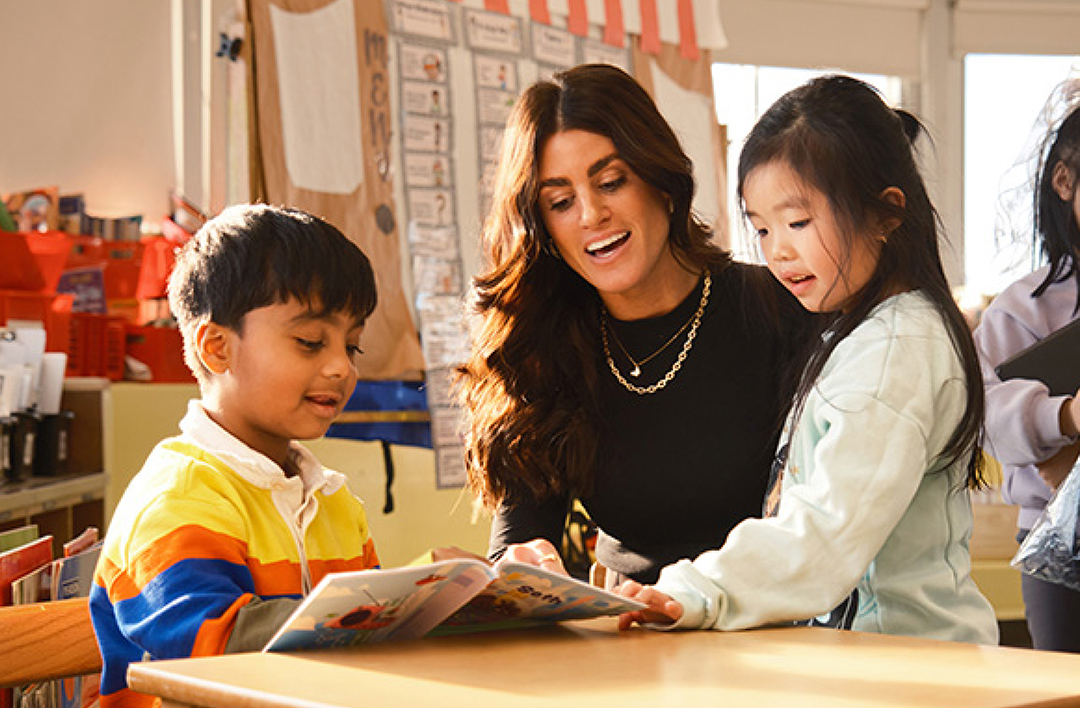
For years, Reena Mathew taught reading the way many educators were trained to—using traditional practices that were familiar and common, but not grounded in up-to-date research.
That changed when she began studying how children actually learn to read. What she discovered reshaped not only her instruction, but her approach to supporting teachers.
Today, Mathew is the K–2 literacy coach helping Suffern Central School District in New York State make a major shift toward research-based early literacy instruction.
Her leadership, dedication, and hands-on support—as well as the key role she plays in creating measurable student success—have earned her a 2025 Amplify Science of Reading Star Award, which specifically recognizes her as Changemaker of the year. These awards honor outstanding educators, schools, and districts who are transforming classrooms and students with literacy practices grounded in the Science of Reading.
“Once I dug into the science,” Mathew says, “I realized that explicit, systematic instruction in phonemic awareness, phonics, vocabulary, and knowledge building isn’t just beneficial, it’s essential.”
Helping teachers shift to research-based instruction
Suffern Central serves nearly 4,000 students in grades K–12, and Mathew has been a leading force in strengthening early literacy development across the district’s youngest grades.
“I shifted my focus to supporting both foundational skills and language comprehension,” she says. “Students need both pieces, phonics and content-rich instruction, to truly become strong, confident readers.” Mathew also dedicated herself to targeted professional development, helping teachers implement the University of Florida Literacy Institute (UFLI) Foundations and the Amplify Core Knowledge Language Arts (CKLA) Knowledge strand.
To lead that shift for teachers, Mathew approached change collaboratively, not prescriptively. She modeled lessons, coached side-by-side, and broke big shifts into manageable steps.
It didn’t take long. “Within weeks, teachers saw students who had struggled with decoding and spelling [already] reading and spelling words with more accuracy and fluency,” she says.
From early literacy skills to independence and confidence for all
What’s more, students figured out that they could use those same strategies elsewhere.
“[Teachers] saw kids using the strategies they were taught not just during the phonics lessons,” Mathew says, “but in their independent reading and writing as well.”
Incorporating Amplify CKLA’s Knowledge strand helped deepen student learning, as well as teachers’ confidence in the approach.
“Teachers shared stories of students using academic vocabulary in ways they never had before and making connections between read-alouds and real-world discussions,” Mathew says. “When a classroom teacher sees a student who is struggling suddenly apply a decoding strategy or use academic vocabulary in conversation, they realize their instruction is working.”
According to Mathew, her greatest achievement has been helping teachers see the impact of using research-based instruction in real time.
A commitment beyond instruction
Mathew is driven not just by the science, but by what she believes every child deserves. Students arrive at school with different levels of language exposure and background knowledge, and research-based instruction provides the explicit foundational skills and systematic knowledge-building all students need to read.
“We can’t control our students’ home lives, what experiences they come in with, and what support they have outside of school, but we can control what happens in our classrooms. We can make sure they get explicit instruction in foundational skills, build the vocabulary and knowledge they need to comprehend complex texts, and leave our schools as confident readers,” Mathew says. “Educators should make the shift to the Science of Reading because good instruction levels the playing field and gives every child an equal opportunity to succeed.”