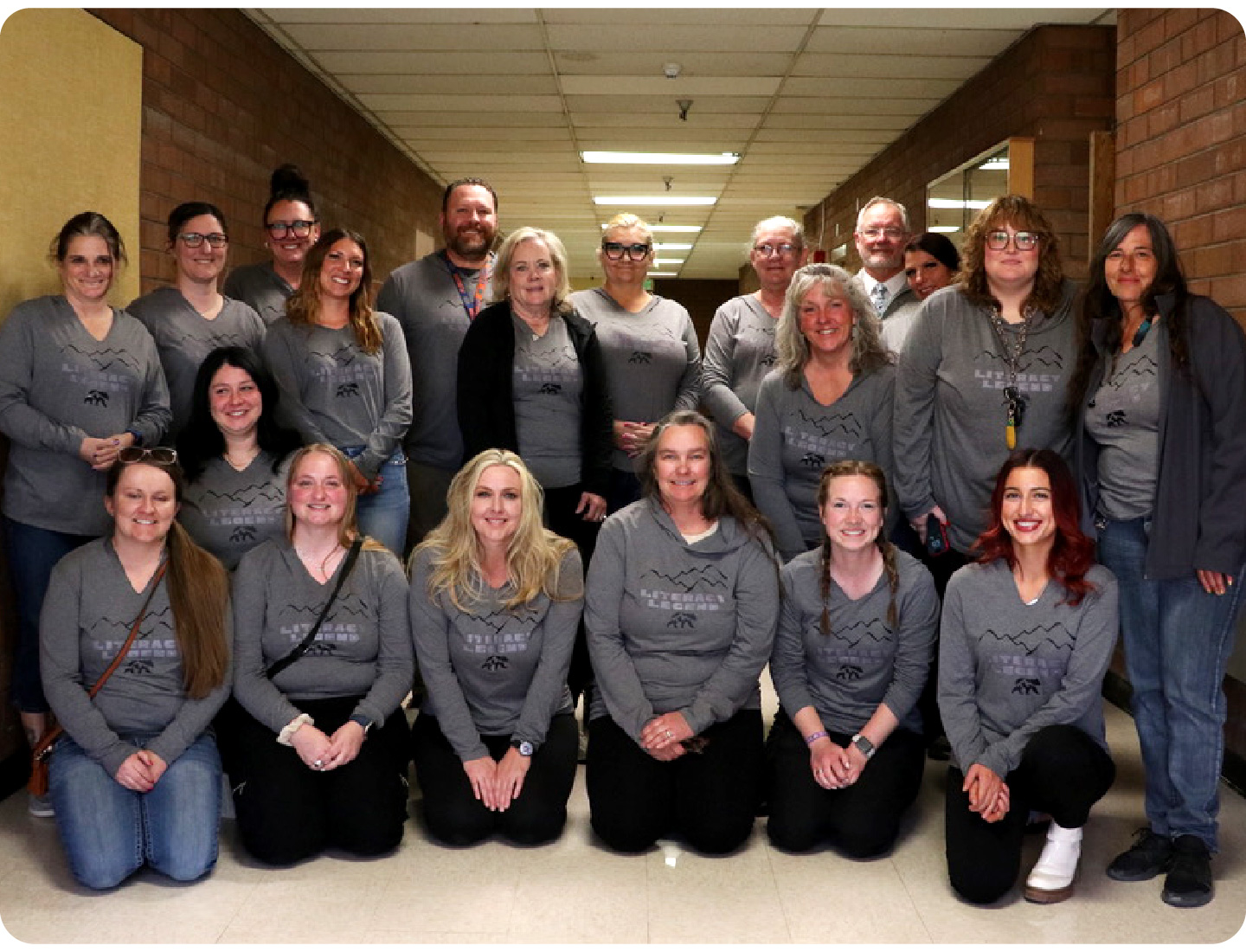
Bruin Point Elementary sits at the base of Utah’s Book Cliff Mountain Range in the small mining town of Sunnyside, 30 miles from the nearest district hub. With just 107 students, and one teacher per grade, it’s Carbon School District’s smallest school—and now one of its brightest early literacy success stories.
All of Bruin Point’s students face significant systemic barriers, with 100% qualifying for free lunch. Yet when it comes to literacy development, the school’s educators have achieved something remarkable.
In just one year, their student literacy proficiency rates jumped 19 percentage points—from 39% at the beginning of the year to 58% by mid-year.
That’s why Bruin Point Elementary has been named a Literacy Legend in our 2025 Science of Reading Star Awards. These awards honor educators, schools, and districts that have transformed classrooms and empowered students through the Science of Reading.
Teaching early literacy skills in a community with challenges
Sunnyside tells the story of many rural American communities. “Since the closing of the local mines, there has been an increase in the number of unemployed family members,” says Cindy Garcia, Bruin Point’s principal.
As a result, an already high poverty rate has risen still further, along with levels of substance abuse, neglect, behavioral issues, and more. Parent involvement in school is extremely low, according to Garcia. “Basic needs take priority.”
Yet Garcia and her six-teacher team saw potential where others might have seen obstacles. They understood that their students deserved the strongest possible foundation in early literacy skills. And they knew they had to make a change.
The importance of relying on data
“Many of us had been trained in methods that didn’t fully meet the needs of all students, and shifting the mindset required trust, training, and time,” says fifth-grade teacher Tyler Grundy. “Our biggest challenge wasn’t just learning a new approach. It was unlearning old ones. But we stayed the course.”
Four of the six teachers completed LETRS training, with two more currently working through it. Teachers began to trade guesswork for systematic, explicit classroom instruction, using data to guide their early literacy program.
“We equipped our teachers with the knowledge and tools to teach reading explicitly and systematically,” Grundy says. “We relied on data, not assumptions, to guide our instruction and interventions.”
Building literacy and knowledge together
The school implemented Amplify Core Knowledge Language Arts (CKLA), providing systematic phonics instruction and rich content knowledge that builds comprehension.
“CKLA weaves literacy skills together to help make my students proficient readers and writers,” says first-grade teacher Chelsea Timothy. “They’re making connections between the Greek myth of Arachne and spiders being arachnids. They put together a web of knowledge.”
Just having a wealth of content at their fingertips made a huge difference, too, and the instructors learned quickly how to leverage it.
“I didn’t have to spend countless hours looking for content,” said Julia Sanders, a first-year kindergarten teacher. “It saved me time, so I could focus on making it more encouraging for the kids.”
For second-grade teacher Francie Aufdemorte, having comprehensive materials meant being able to focus on instruction. “It reduced the stress of creating lesson plans from scratch,” she says. “I was nervous about the rigor, but my students have excelled with it.”
Building a culture in which “success is expected”
The 19-point proficiency jump speaks to real student growth, but Garcia knows the impact goes beyond test scores.
“Struggling students who once guessed at words began to decode with confidence,” she said. “We built a culture where reading success is expected and not left to chance.”
Bruin Point’s success rests on ongoing commitment to evidence-based practices. Garcia and her team continue meeting regularly for data discussions, sustaining the mindset shift that began their journey to improved student outcomes.
“Our interventions and extensions are like a well-oiled machine,” Garcia said. “We can see that the young ones are off to a much better start.”
She adds: “We didn’t just change our curriculum, we changed lives. And that is a legacy worth celebrating.”