Season 8, Episode 12

Language and literacy, with Catherine Snow

Harvard School of Education professor of cognition and education Catherine E. Snow, Ph.D., joins Susan Lambert on this episode to reflect on the state of language and literacy instruction in the U.S. They begin their conversation discussing early literacy and linguistics, then dive into Snow’s work on the National Research Council report “Preventing Reading Difficulties in Young Children.” Lambert and Snow talk about building vocabulary, growing student curiosity in reading, and exposing students to academic language. Snow talks about the specific tools educators need for meaningful help in the classroom, shares her hopes (and fears) for the future of reading instruction in the U.S., and explains why she encourages teachers to let their classrooms be noisier.

Meet Our Guest(s):

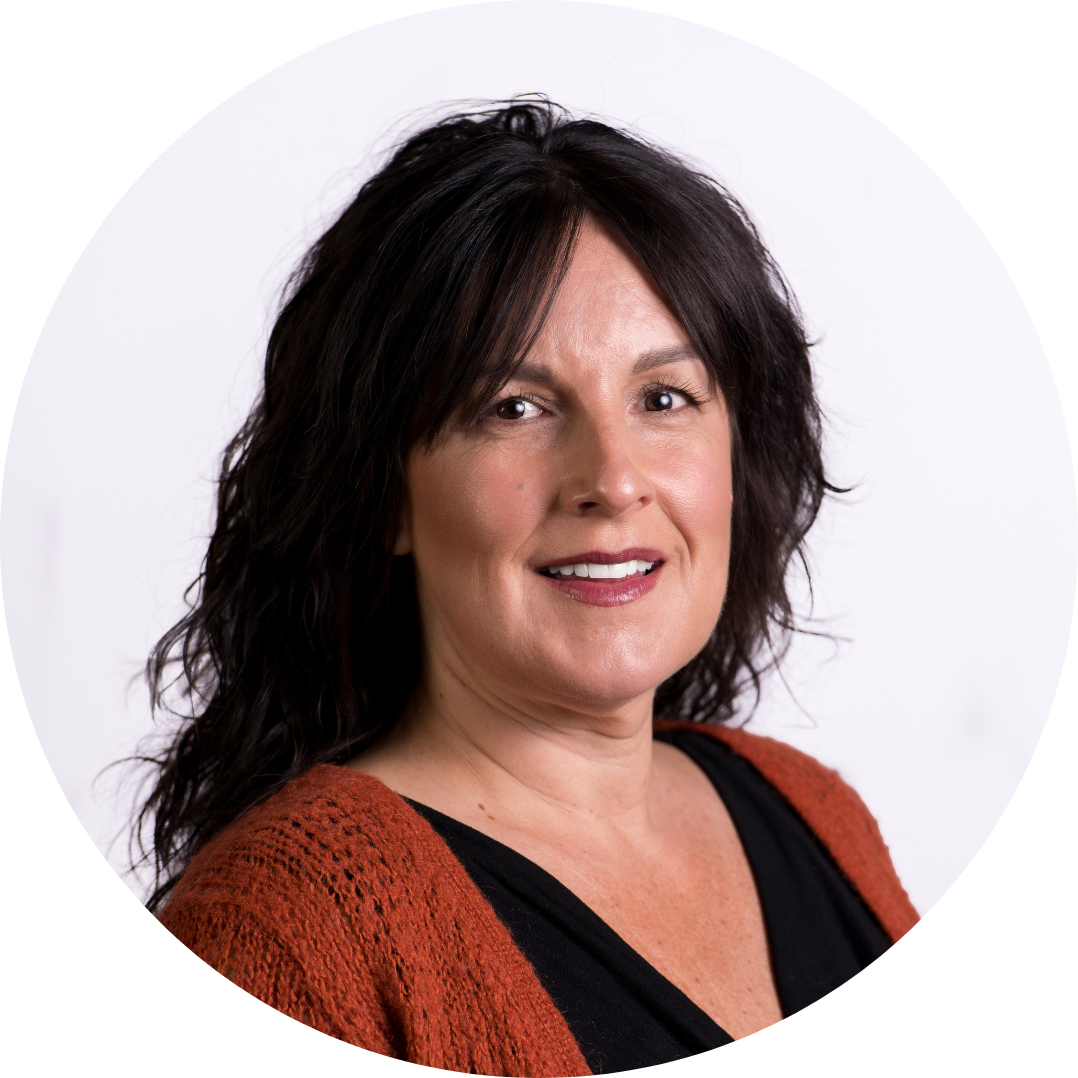
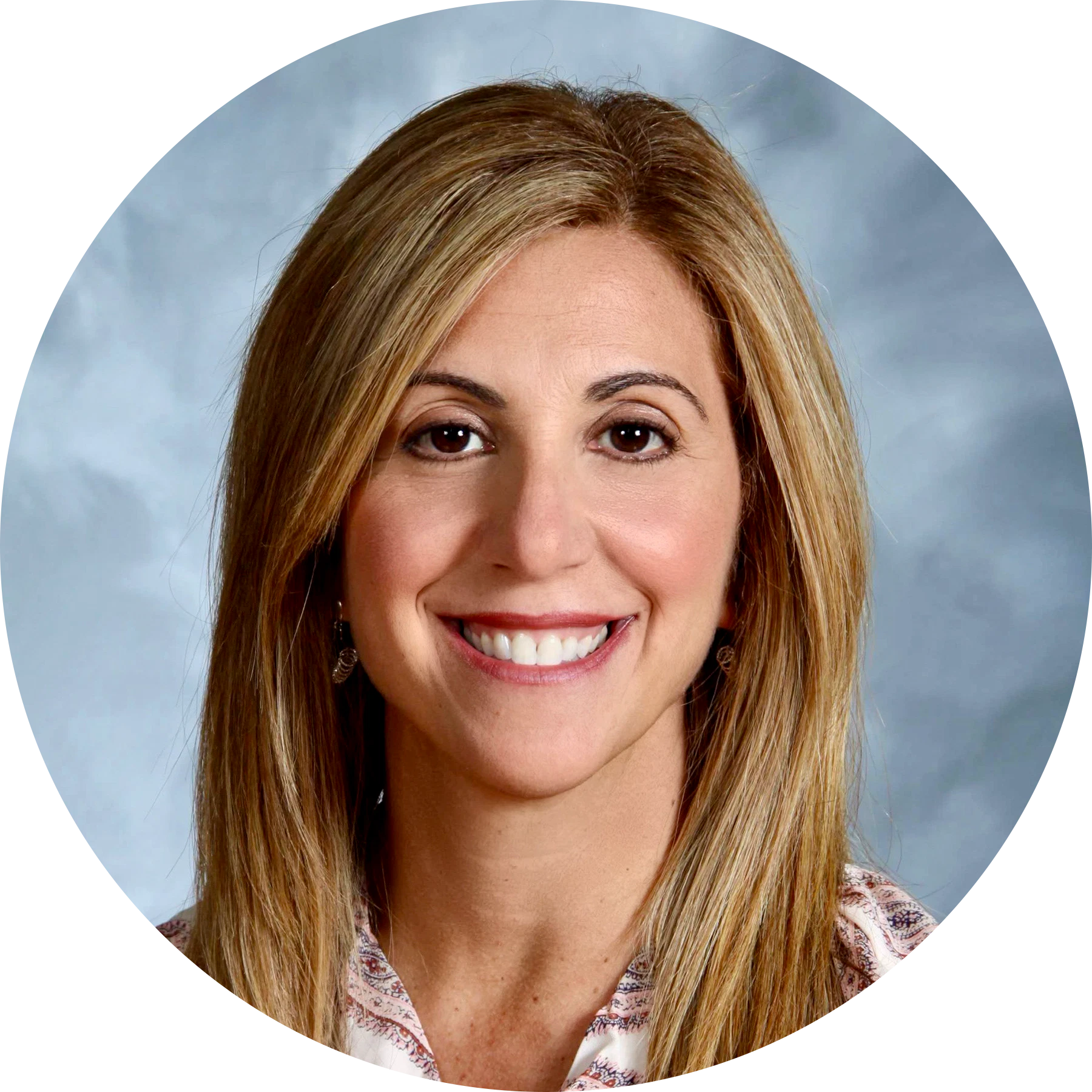
image of Catherine Snow, Science of Reading: The Podcast guest in the episode Language and Literacy

Catherine E. Snow, Ph.D.

Catherine E. Snow received her doctorate in developmental psychology from McGill University, where she wrote her thesis on how adult speech supports early language development. She subsequently worked for several years in the linguistics department of the University of Amsterdam before moving to Harvard, where her interests expanded to include language and literacy development. She chaired the National Academy of Sciences Committee that produced the report “Preventing Reading Difficulties in Young Children” (1998) and the RAND Reading Study Group that produced Reading for Understanding: Toward an R&D Program for Reading Comprehension (2000), a volume that influenced the federal education funding agenda for the next 20 years. Her work has been characterized by a willingness to defend unpopular positions about language learning and teaching, early childhood education, and literacy instruction. Much of her recent work has been carried out in collaboration with educational practitioners and other researchers focused on understanding the most urgent problems of practice in literacy education, under the auspices of the Strategic Education Research Partnership (SERP) Institute and Boston Public Schools.

Meet our host, Susan Lambert

Susan Lambert is the Chief Academic Officer of Elementary Humanities at Amplify, and the host of Science of Reading: The Podcast. Her career has been focused on creating high-quality learning environments using evidence-based practices. Lambert is a mom of four, a grandma of four, a world traveler, and a collector of stories.

As the host of Science of Reading: The Podcast, Lambert explores the increasing body of scientific research around how reading is best taught. As a former classroom teacher, administrator, and curriculum developer, Lambert is dedicated to turning theory into best practices that educators can put right to use in the classroom, and to showcasing national models of reading instruction excellence.

Retrato de una mujer caucásica sonriente con cabello rubio corto, involucrada en un podcast sobre la ciencia de la lectura, con gafas, lápiz labial rojo y un collar de perlas.

Quotes

“Part of preventing reading difficulties means focusing on programs to ensure that all children have access to books from birth and that they have access to adults who will read those books with them and discuss them.”

—Catherine E. Snow, Ph.D.

“I see academic language and exposure to academic language as an expansion of children's language skills that both contributes to successful literacy—successful reading comprehension—and gets built through encounters with texts, but also encounters with oral activities.”

—Catherine E. Snow, Ph.D.

“Let your classroom be noisier. Let the kids be more engaged and more socially engaged, because that is actually a contribution to their language development and to their motivation to keep working.”

—Catherine E. Snow, Ph.D.

Episode 3: The Reading League and the Science of Reading with Maria Murray and Pamela Snow

In our first international episode, join The Reading League CEO and President Maria Murray and La Trobe University professor of cognitive psychology Pamela Snow as they reflect on the long history of the Science of Reading. They’ll explain the true definition of “the Science of Reading” and explore why this knowledge has not been translated for the practitioners that need it the most—teachers. Our guests will also discuss the pandemic’s silver lining: the opportunity to reflect on instructional practices and how to best support educators and students now and in the future.

Season 8, Episode 1

Knowledge and comprehension: Never one without the other, with Reid Smith and Pamela Snow

In the premiere episode of Season 8 of Science of Reading: The Podcast, Susan Lambert is joined by guests Reid Smith and Pamela Snow to lay the groundwork for a season entirely centered on knowledge and knowledge-building. Reid and Pamela—of the SOLAR Lab at La Trobe University in Melbourne, Australia—recently co-authored (along with many others) a review of the literature on background knowledge and literacy. In this discussion, they share what they learned, including some surprising takeaways. This episode examines the  complexity of building background knowledge, the important role it plays in literacy, and the reasons we’ve decided to spend a whole season exploring it!

Meet Our Guest(s):

Pamela Snow

Pamela Snow

Pamela Snow, Ph.D., is a professor of cognitive psychology in the School of Education at La Trobe University in Australia and co-director of the Science of Language and Reading (SOLAR) Lab. She is both a speech-language pathologist and a registered psychologist, and her research focuses on ensuring language and literacy success across the school years.

Reid Smith

Reid Smith is an elementary school teacher and curriculum leader at a school in Australia, and is also a doctoral candidate at La Trobe University’s Science of Language and Reading (SOLAR) Lab. His research focuses on the contribution of background knowledge to the act of reading. He is also co-CEO of Ochre Education, a not-for-profit organization committed to closing educational gaps by providing teachers with free, high-quality curriculum materials.

Meet our host, Susan Lambert

Susan Lambert is the Chief Academic Officer of Elementary Humanities at Amplify, and the host of Science of Reading: The Podcast. Her career has been focused on creating high-quality learning environments using evidence-based practices. Susan is a mom of four, a grandma of four, a world traveler, and a collector of stories.

As the host of Science of Reading: The Podcast, Susan explores the increasing body of scientific research around how reading is best taught. As a former classroom teacher, administrator, and curriculum developer, Susan is dedicated to turning theory into best practices that educators can put right to use in the classroom, and to showcasing national models of reading instruction excellence.

Retrato de una mujer caucásica sonriente con cabello rubio corto, involucrada en un podcast sobre la ciencia de la lectura, con gafas, lápiz labial rojo y un collar de perlas.

Quotes

“This idea of having a coherent curriculum that systematically builds knowledge and skills over time is something that we think is really important for our kids.”

—Reid Smith

“I'd just point to making sure that you really give students the opportunity to learn more about the world that they're in and the cultures that we have in the past, present, and future. They're all really important things for our kids. And, you know, from an instrumentalist point of view, because it helps their reading comprehension.”

—Pamela Snow

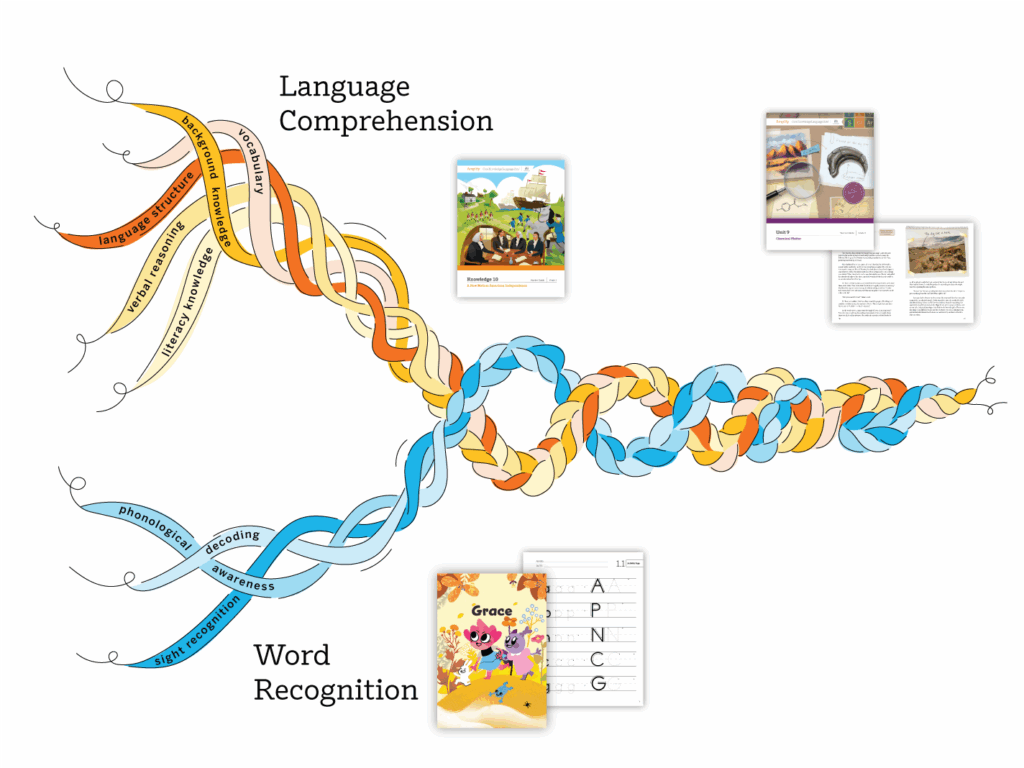
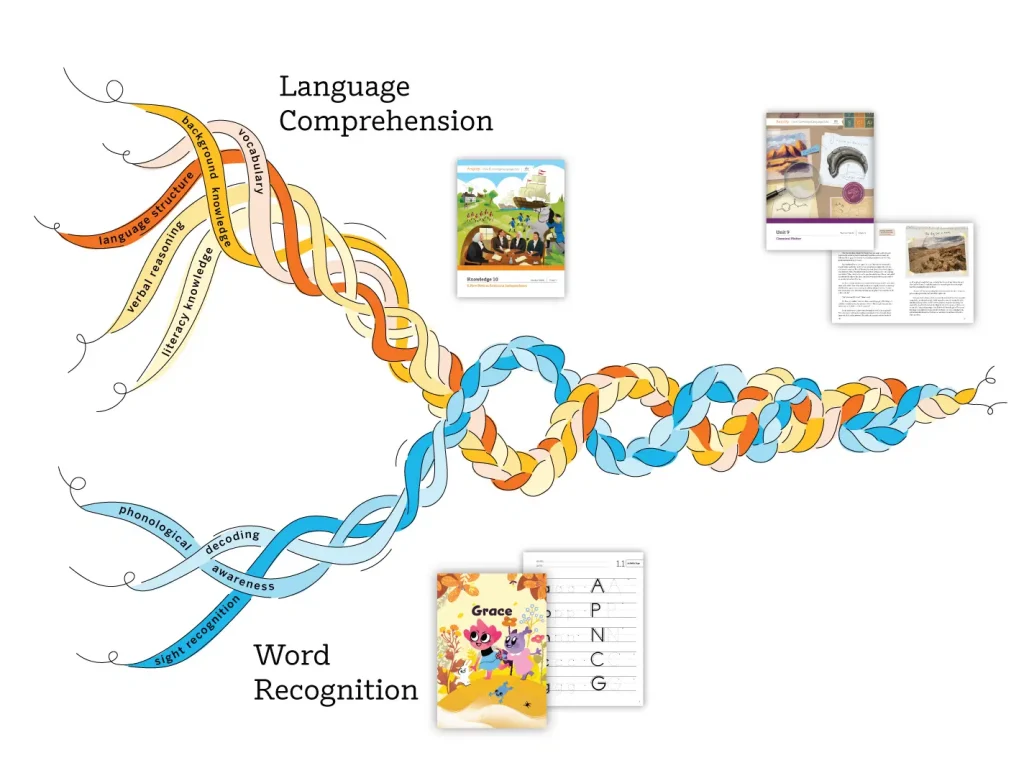
"I think we respect teacher autonomy when we give them the knowledge that they need about how the English writing system works, right across the Reading Rope, and how the English language works, right across the Reading Rope.”

—Pamela Snow

A closer look at grades 6–8 (domain)

Amplify Science is based on the latest research on teaching and learning and helps teachers deliver rigorous and riveting lessons through hands-on investigations, literacy-rich activities, and interactive digital tools that empower students to think, read, write, and argue like real scientists.

In the 6–8 classroom, this looks like students:

  • Collecting evidence from a variety of sources.
  • Making sense of evidence in a variety of ways.
  • Formulating convincing scientific arguments.

Is your school implementing the domain model? Click here.

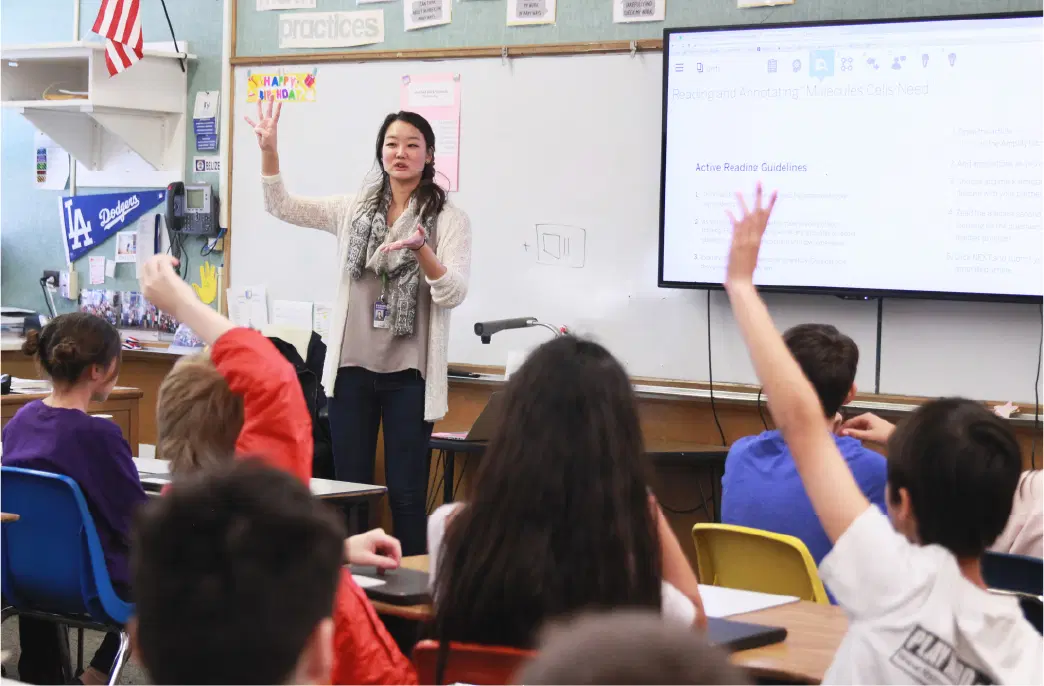
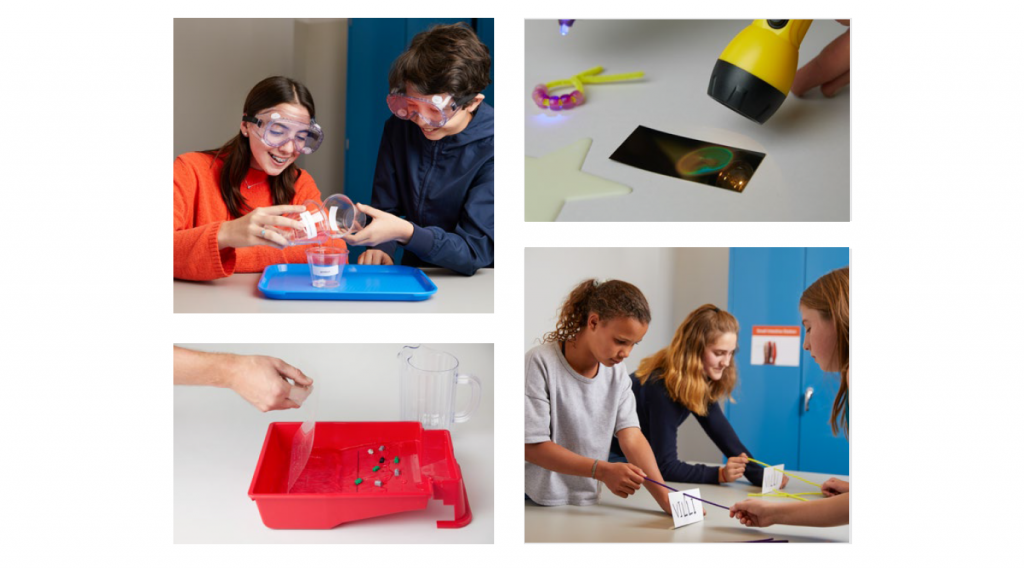
Collage of four images showing children engaged in educational activities such as conducting experiments and crafting in a classroom setting.
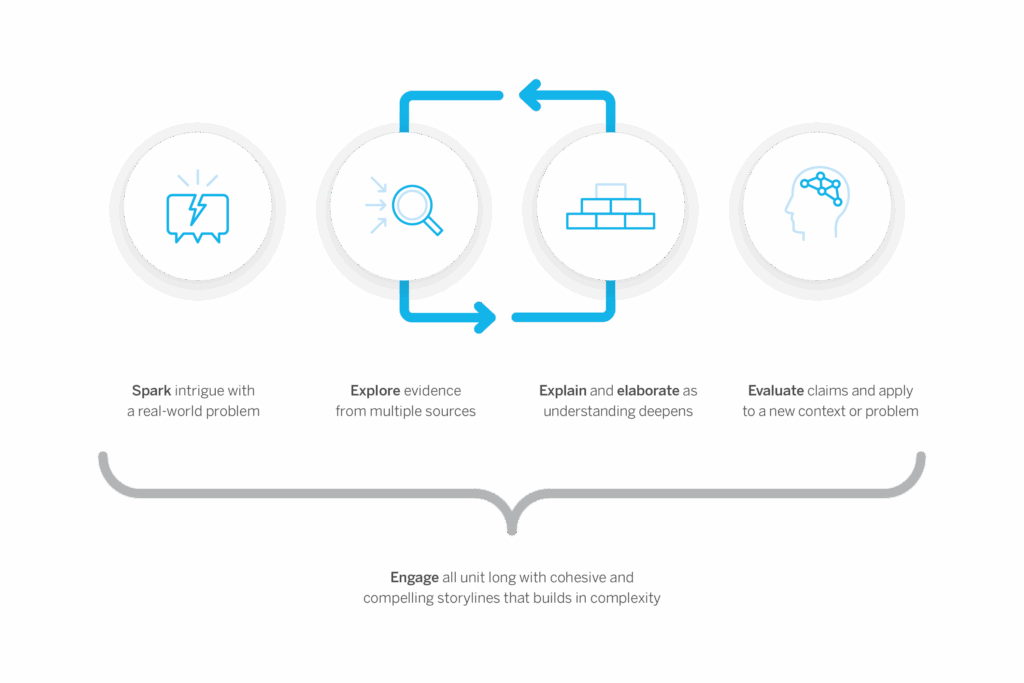
A four-step process: Spark intrigue, Explore evidence, Explain and elaborate, and Evaluate claims, leading to ongoing engagement and building complexity.

Program structure

Our cyclical lesson design ensures students receive multiple exposures to concepts through a variety of modalities. As they progress through the lessons within a unit, students build and deepen their understanding, increasing their ability to develop and refine complex explanations of the unit’s phenomenon.

It’s this proven program structure and lesson design that enables Amplify Science to teach less, but achieve more. Rather than asking teachers to wade through unnecessary content, we designed our 6–8 program to address 100% of the NGSS in fewer lessons than other programs.

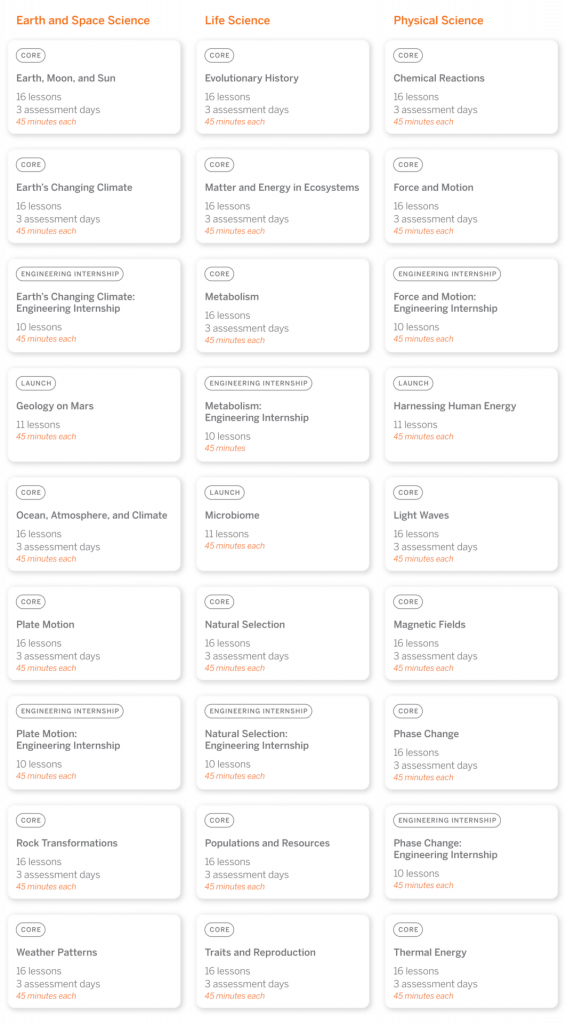
Scope and sequence

Every year our grades 6–8 sequence consists of 9 units, with each unit containing 10–19 lessons. Lessons are written to last a minimum of 45-minutes, though teachers can expand or contract the timing to meet their needs.

A grid of educational icons, each representing a different science topic, such as earth and space science, life science, and physical science, with titles and lesson counts.

Unit types

Each unit delivers three-dimensional learning experiences and engages students in gathering evidence from a rich collection of sources, while also serving a unique purpose.

In grades 6–8, there are three types of units:

  • One unit is a launch unit.
  • Three units are core units.
  • Two units are engineering internships.
Launch units

Launch units are the first units taught in each year of Amplify Science. The goal of the Launch unit is to introduce students to norms, routines, and practices that will be built on throughout the year, including argumentation, active reading, and using the program’s technology. For example, rather than taking the time to explain the process of active reading in every unit in a given year, it is explained thoroughly in the Launch unit, thereby preparing students to actively read in all subsequent units.

Core units

Core units establish the context of the unit by introducing students to a real-world problem. As students move through lessons in a Core unit, they figure out the unit’s anchoring phenomenon, gain an understanding of the unit’s disciplinary core ideas and science and engineering practices, and make linkages across topics through the crosscutting concepts. Each Core unit culminates with a Science Seminar and final writing activity.

Engineering Internship units

Engineering Internship units invite students to design solutions for real-world problems as interns for a fictional company called Futura. Students figure out how to help those in need, from tsunami victims in Sri Lanka to premature babies, through the application of engineering practices. In the process, they apply and deepen their learning from Core units.

Units at a glance

A rover sits on a rocky, reddish hill under a hazy sky, leaving visible tire tracks across the barren landscape.
Geology on Mars

Domain: Earth and Space Science

Unit type: Launch

Student role: Planetary geologists

Phenomenon: Analyzing data about landforms on Mars can provide evidence that Mars may have once been habitable.    

Two prehistoric marine reptiles with long snouts are near a rocky shoreline, one on land and one in the water, with an island and clouds in the background.
Plate Motion

Domain: Earth and Space Science

Unit type: Core

Student role: Geologists

Phenomenon: Mesosaurus fossils have been found on continents separated by thousands of kilometers of ocean, even though the Mesosaurus species once lived all together.    

A geometric badge with a mountain, telescope, and audio wave icons on a purple background with polygonal shapes.
Plate Motion Engineering Internship

Domain: Earth and Space Science

Unit type: Engineering internship

Student role: Mechanical engineering interns

Phenomenon: Patterns in earthquake data can be used to design an effective tsunami warning system.    

Illustration of a volcano by the sea with smoke, trees, mountains, and a cross-section showing a fault line beneath the ground.
Rock Transformations

Domain: Earth and Space Science

Unit type: Core

Student role: Geologists

Phenomenon: Rock samples from the Great Plains and from the Rocky Mountains — regions hundreds of miles apart — look very different, but have surprisingly similar mineral compositions.    

Illustration of a city skyline at night with buildings, a bridge, and a large full moon in a starry sky.
Earth, Sun, and Moon

Domain: Earth and Space Science

Unit type: Core

Student role: Astronomers

Phenomenon: An astrophotographer can only take pictures of specific features on the Moon at certain times.    

Abstract digital painting of a landscape with green hills, a red-orange horizon, and a large yellow sun surrounded by blue and orange swirling shapes on the right.
Ocean, Atmosphere, and Climate

Domain: Earth and Space Science

Unit type: Core

Student role: Climatologists

Phenomenon: During El Niño years, the air temperature in Christchurch, New Zealand is cooler than usual.    

Illustration of a town with houses and fields under a sky with large clouds and swirling wind patterns, set against a backdrop of hills and mountains.
Weather Patterns

Domain: Earth and Space Science

Unit type: Core

Student role: Forensic meteorologists

Phenomenon: In recent years, rainstorms in Galetown have been unusually severe.    

A polar bear stands on a small ice floe surrounded by water and floating ice under a red sun in an Arctic landscape.
Earth’s Changing Climate

Domain: Earth and Space Science

Unit type: Core

Student role: Climatologists

Phenomenon: The ice on Earth’s surface is melting.    

Hexagonal badge with icons including a wrench, building, sun, screwdriver, paint can, and molecules on a purple geometric background.
Earth’s Changing Climate Engineering Internship

Domain: Earth and Space Science

Unit type: Engineering internship

Student role: Civil engineers

Phenomenon: Designing rooftops with different modifications can reduce a city’s impact on climate change.    

Colorful abstract digital artwork featuring a yellow figure holding a device, with blue and red shapes and textured patterns in the background.
Microbiome

Domain: Life Science

Unit type: Launch

Student role: Microbiological researchers

Phenomenon: The presence of 100 trillion microorganisms living on and in the human body may keep the body healthy.    

An abstract illustration of a person having their mouth and throat examined with a tongue depressor, surrounded by colorful shapes, with an eye chart in the background.
Metabolism

Domain: Life Science

Unit type: Core

Student role: Medical researchers

Phenomenon: Elisa, a young patient, feels tired all the time.    

Geometric orange background with a hexagon icon displaying symbols for statistics, farming, healthcare, safety vest, chemistry, and agriculture.
Metabolism Engineering Internship

Domain: Life Science

Unit type: Engineering internship

Student role: Food engineers

Phenomenon: Designing health bars with different molecular compositions can effectively meet the metabolic needs of patients or rescue workers.    

Six spiders with different colors and stripe patterns are arranged in a grid pattern on a dark background, showing variations in leg and body color.
Traits and Reproduction

Domain: Life Science

Unit type: Core

Student role: Biomedical students

Phenomenon: Darwin’s bark spider offspring have different silk flexibility traits, even though they have the same parents.    

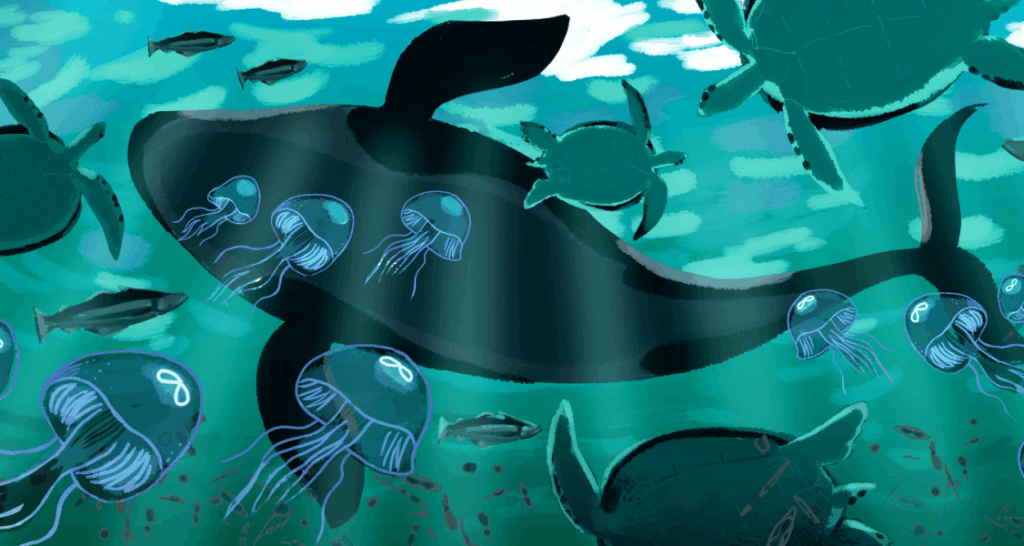
An underwater scene shows a whale surrounded by jellyfish, sea turtles, and fish, with sunlight filtering through the water.
Populations and Resources

Domain: Life Science

Unit type: Core

Student role: Biologists

Phenomenon: The size of the moon jelly population in Glacier Sea has increased.    

A low-poly landscape with trees, mushrooms, a rabbit sitting, and a fox bending down near another rabbit under a sunny sky with mountains in the background.
Matter and Energy in Ecosystems

Domain: Life Science

Unit type: Core

Student role: Ecologists

Phenomenon: What caused the mysterious crash of a biodome ecosystem?    

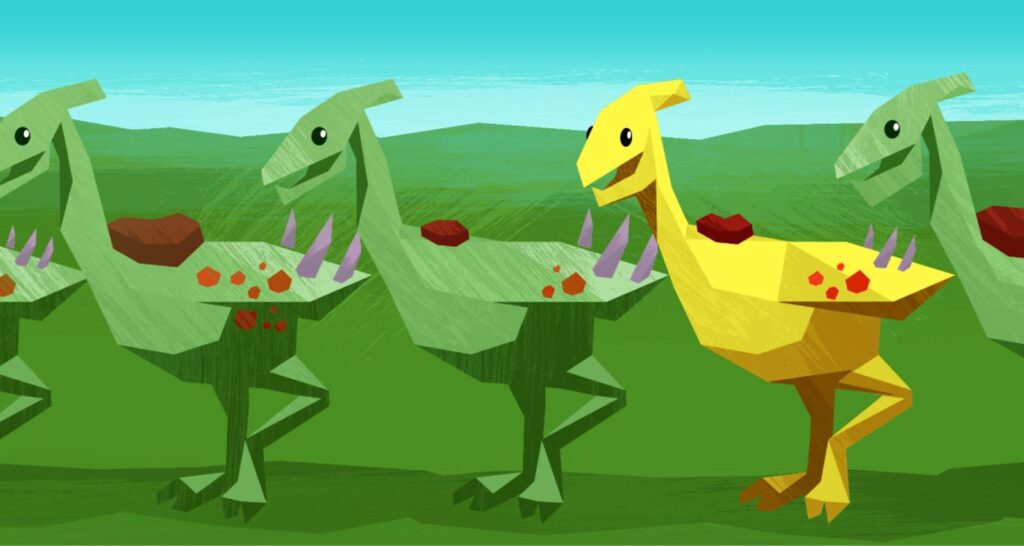
Three green dinosaurs and one yellow dinosaur stand in a row on grass, each with purple spikes and a red spot on their backs. The sky is blue with light clouds.
Natural Selection

Domain: Life Science

Unit type: Core

Student role: Biologists

Phenomenon: The newt population in Oregon State Park has become more poisonous over time.    

Red-toned graphic with hexagonal badge featuring a world map, a mosquito, a DNA strand, charts, cubes, and circular icons. Geometric background pattern.
Natural Selection Engineering Internship

Domain: Life Science

Unit type: Engineering internship

Student role: Clinical engineers

Phenomenon: Designing malaria treatment plans that use different combinations of drugs can reduce drug resistance development while helping malaria patients.  

Two giant tortoises are near a river; one is by the water and the other is standing on land and stretching its neck toward a leafy tree.

Evolutionary History

Domain: Life Science

Unit type: Core

Student role: Paleontologists

Phenomenon: A mystery fossil at the Natural History Museum has similarities with both wolves and whales.    

Two people climb over rocky terrain strewn with electronic waste, with illustrated insets showing a hiking boot, a solar-powered device, and a person adjusting a belt-like gadget.
Harnessing Human Energy

Domain: Physical Science

Unit type: Launch

Student role: Energy scientists

Phenomenon: Rescue workers can use their own human kinetic energy to power the electrical devices they use during rescue missions.    

A spacecraft approaches a modular space station with large solar panels, set against a backdrop of outer space.
Force and Motion

Domain: Physical Science

Unit type: Core

Student role: Physicists

Phenomenon: The asteroid sample-collecting pod failed to dock at the space station as planned.    

Green geometric background with a hexagonal badge showing a parachute, a box, a ruler, a bandage, and stacked layers.
Force and Motion Engineering Internship

Domain: Physical Science

Unit type: Engineering internship

Student role: Mechanical engineering interns

Phenomenon: Designing emergency supply delivery pods with different structures can maintain the integrity of the supply pods and their contents. 

Illustration of a roller coaster car full of people with raised arms, speeding down a loop against a blue sky with clouds.
Magnetic Fields

Domain: Physical Science

Unit type: Core

Student role: Physicists

Phenomenon: During a test launch, a spacecraft traveled much faster than expected.    

Illustration of a person in a red coat and hat with arms crossed, eyes closed, surrounded by large orange and brown circles, possibly representing snow or lights.
Thermal Energy

Domain: Physical Science

Unit type: Core

Student role: Thermal scientists

Phenomenon: One of two proposed heating systems for Riverdale School will best heat the school.    

An orange popsicle gradually melts, shown in four stages from solid to completely melted, with wooden sticks visible, against a purple background.
Phase Change

Domain: Physical Science

Unit type: Core

Student role: Chemists

Phenomenon: A methane lake on Titan no longer appears in images taken by a space probe two years apart.    

A green background with a picture of a person and a sandwich.
Phase Change Engineering Internship

Domain: Physical Science

Unit type: Engineering internship

Student role: Chemical engineering interns

Phenomenon: Designing portable baby incubators with different combinations of phase change materials can keep babies at a healthy temperature.    

Digital illustration showing red and blue molecules on a blue background transitioning to a lighter background, representing molecular diffusion across a boundary.
Chemical Reactions

Domain: Physical Science

Unit type: Core

Student role: Forensic chemists

Phenomenon: A mysterious brown substance has been detected in the tap water of Westfield.    

Illustration of Earth with yellow arrows and colored waves approaching from the left, representing incoming solar or cosmic radiation.
Light Waves

Domain: Physical Science

Unit type: Core

Student role: Spectroscopists

Phenomenon: The rate of skin cancer is higher in Australia than in other parts of the world.    

A closer look at grades 6–8

Amplify Science is based on the latest research on teaching and learning and helps teachers deliver rigorous and riveting lessons through hands-on investigations, literacy-rich activities, and interactive digital tools that empower students to think, read, write, and argue like real scientists.

In the 6–8 classroom, this looks like students:

  • Collecting evidence from a variety of sources.
  • Making sense of evidence in a variety of ways.
  • Formulating convincing scientific arguments.

Is your school implementing the domain model? Click here.

Collage of four images showing children engaged in educational activities such as conducting experiments and crafting in a classroom setting.
A four-step process diagram: Spark intrigue, Explore evidence, Explain and elaborate, and Evaluate claims, connected by arrows, with an engagement statement below.

Program structure

Our cyclical lesson design ensures students receive multiple exposures to concepts through a variety of modalities. As they progress through the lessons within a unit, students build and deepen their understanding, increasing their ability to develop and refine complex explanations of the unit’s phenomenon.

It’s this proven program structure and lesson design that enables Amplify Science to teach less, but achieve more. Rather than asking teachers to wade through unnecessary content, we designed our 6–8 program to address 100% of the NGSS in fewer lessons than other programs.

Scope and sequence

Every year our grades 6–8 sequence consists of 9 units, with each unit containing 10–19 lessons. Lessons are written to last a minimum of 45-minutes, though teachers can expand or contract the timing to meet their needs.

A grid of educational icons, each representing a different science topic, such as earth and space science, life science, and physical science, with titles and lesson counts.

Unit types

Each unit delivers three-dimensional learning experiences and engages students in gathering evidence from a rich collection of sources, while also serving a unique purpose.

In grades 6–8, there are three types of units:

  • One unit is a launch unit.
  • Three units are core units.
  • Two units are engineering internships.
Launch units

Launch units are the first units taught in each year of Amplify Science. The goal of the Launch unit is to introduce students to norms, routines, and practices that will be built on throughout the year, including argumentation, active reading, and using the program’s technology. For example, rather than taking the time to explain the process of active reading in every unit in a given year, it is explained thoroughly in the Launch unit, thereby preparing students to read actively in all subsequent units.

Core units

Core units establish the context of the unit by introducing students to a real-world problem. As students move through lessons in a Core unit, they figure out the unit’s anchoring phenomenon, gain an understanding of the unit’s disciplinary core ideas and science and engineering practices, and make linkages across topics through the crosscutting concepts. Each Core unit culminates with a Science Seminar and final writing activity.

Engineering Internship units

Engineering Internship units invite students to design solutions for real-world problems as interns for a fictional company called Futura. Students figure out how to help those in need, from tsunami victims in Sri Lanka to premature babies, through the application of engineering practices. In the process, they apply and deepen their learning from Core units.

Units at a glance

Abstract digital artwork featuring a yellow human figure, red shapes, and a blue-toned screen, with vibrant, multicolored patterns and textures in the background.
Microbiome

Domain: Life Science

Unit type: Launch

Student role: Microbiological researchers

Phenomenon: The presence of 100 trillion microorganisms living on and in the human body may keep the body healthy.  

An abstract illustration of a person receiving an oral examination, with colorful geometric shapes and an eye chart in the background.
Metabolism

Domain: Life Science

Unit type: Core

Student role: Medical researchers

Phenomenon: Elisa, a young patient, feels tired all the time.  

Abstract orange background with geometric shapes, featuring icons of a vest, bar chart, leaf, beaker, fruit, medical stethoscope, and an envelope within a hexagonal frame.
Metabolism Engineering Internship

Domains: Life Science, Engineering Design

Unit type: Engineering internship

Student role: Food engineers

Phenomenon: Designing health bars with different molecular compositions can effectively meet the metabolic needs of patients or rescue workers.  

Six spiders with varying body colors (brown, yellow, blue, and red) and patterns are arranged on a dark, textured background, seemingly in a diagram or chart formation.
Traits and Reproduction

Domain: Life Science

Unit type: Core

Student role: Biomedical students

Phenomenon: Darwin’s bark spider offspring have different silk flexibility traits, even though they have the same parents.  

Illustration of a person with closed eyes in a red winter coat and hat, surrounded by falling snow and orange circles on a dark background.
Thermal Energy

Domain: Physical Science

Unit type: Core

Student role: Thermal scientists

Phenomenon: One of two proposed heating systems for Riverdale School will best heat the school. 

Abstract illustration of a sun with blue and orange rays over a colorful landscape featuring green hills and a vibrant sky.
Ocean, Atmosphere, and Climate

Domains: Earth and Space Science, Physical Science

Unit type: Core

Student role: Climatologists

Phenomenon: During El Niño years, the air temperature in Christchurch, New Zealand is cooler than usual.  

Illustration of clouds above a small town and farmland, with wind currents depicted swirling through the landscape under a blue sky.
Weather Patterns

Domains: Earth and Space Science, Physical Science

Unit type: Core

Student role: Forensic meteorologists

Phenomenon: In recent years, rainstorms in Galetown have been unusually severe.  

A polar bear stands on a small floating ice sheet in the ocean, surrounded by melting ice, with a red sun in the sky.
Earth’s Changing Climate

Domains: Earth and Space Science, Life Science

Unit type: Core

Student role: Climatologists

Phenomenon: The ice on Earth’s surface is melting.  

A purple hexagonal graphic with icons including a building, wrench, screwdriver, sun, molecules, paint bucket, and tiles on a geometric patterned background.
Earth’s Changing Climate Engineering Internship

Domains: Earth and Space Science, Engineering Design

Unit type: Engineering internship

Student role: Civil engineers

Phenomenon: Designing rooftops with different modifications can reduce a city’s impact on climate change.  

A robotic rover sits on a hill in a rocky, reddish landscape, with visible tracks in the dust leading to its current position under a hazy sky.
Geology on Mars

Domain: Earth and Space Science

Unit type: Launch

Student role: Planetary geologists

Phenomenon: Analyzing data about landforms on Mars can provide evidence that Mars may have once been habitable. 

Two green prehistoric reptiles with long snouts are near the shore; one is on land while the other swims in blue water, with plants, rocks, and an island in the background.
Plate Motion

Domain: Earth and Space Science

Unit type: Core

Student role: Geologists

Phenomenon: Mesosaurus fossils have been found on continents separated by thousands of kilometers of ocean, even though the Mesosaurus species once lived all together.  

A purple geometric background featuring a hexagonal badge with a telescope, mountain, audio wave, and star symbols inside.
Plate Motion Engineering Internship

Domains: Earth and Space Science, Engineering Design

Unit type: Engineering internship

Student role: Mechanical engineering interns

Phenomenon: Patterns in earthquake data can be used to design an effective tsunami warning system.  

Illustration showing an ocean, forest, and mountains with a smoking volcano, plus a cross-section of underground tectonic plates.
Rock Transformations

Domain: Earth and Space Science

Unit type: Core

Student role: Geologists

Phenomenon: Rock samples from the Great Plains and from the Rocky Mountains — regions hundreds of miles apart — look very different, but have surprisingly similar mineral compositions.  

Four stages of an orange popsicle melting on a stick, from fully frozen on the left to completely melted on the right, against a plain background.
Phase Change

Domains: Physical Science, Earth and Space Science

Unit type: Core

Student role: Chemists

Phenomenon: A methane lake on Titan no longer appears in images taken by a space probe two years apart

Green geometric background with an outlined hexagon containing icons: a parachute, ruler, letter "A," bandage, stacked blocks, and a folded corner paper.
Force and Motion Engineering Internship

Domains: Engineering Design, Physical Science

Unit type: Engineering internship

Student role: Chemical engineering interns

Phenomenon: Designing portable baby incubators with different combinations of phase change materials can keep babies at a healthy temperature. Domains: Engineering Design, Physical Science

Abstract illustration showing red and blue circles on a split blue and light background, representing molecular movement across a membrane or barrier.
Chemical Reactions

Domains: Physical Science, Life Science, Earth and Space Science

Unit type: Core

Student role: Forensic chemists

Phenomenon: A mysterious brown substance has been detected in the tap water of Westfield.  

An underwater scene with a large whale surrounded by turtles, jellyfish, and various fish swimming in different directions.
Populations and Resources

Domains: Life Science, Earth and Space Science

Unit type: Core

Student role: Biologists

Phenomenon: The size of the moon jelly population in Glacier Sea has increased. 

Low-poly digital illustration of a fox hunting a rabbit in a forest with pine trees, mushrooms, mountains, and the sun in the background. Another rabbit sits near the trees.
Matter and Energy in Ecosystems

Domains: Life Science, Earth and Space Science, Physical Science

Unit type: Core

Student role: Ecologists

Phenomenon: The biodome ecosystem has collapsed.  

Two people climb over rocks filled with electronic devices; inset illustrations show a boot, a belt of batteries, and a radio.
Harnessing Human Energy

Domains: Physical Science, Earth and Space Science, Engineering Design

Unit type: Launch

Student role: Energy scientists

Phenomenon: Rescue workers can use their own human kinetic energy to power the electrical devices they use during rescue missions.  

A spacecraft approaches and docks with a modular space station featuring large blue solar panels, set against a black space background.
Force and Motion

Domain: Physical Science

Unit type: Core

Student role: Physicists

Phenomenon: The asteroid sample-collecting pod failed to dock at the space station as planned.

Green graphic with hexagonal emblem showing an infant, a thermometer, layered materials, a medical symbol, and a flame icon.
Force and Motion Engineering Internship

Domains: Engineering Design, Physical Science

Unit type: Engineering internship

Student role: Chemical engineering interns

Phenomenon: Designing emergency supply delivery pods with different structures can maintain the integrity of the supply pods and their contents.

Illustration of a roller coaster car with passengers raising their arms as they descend a steep track against a blue sky with clouds.
Magnetic Fields

Domain: Physical Science

Unit type: Core

Student role: Physicists

Phenomenon: During a test launch, a spacecraft traveled much faster than expected.  

Illustration of the Earth with arrows representing radiation or energy entering the atmosphere from space, focused on the Asia-Pacific region.
Light Waves

Domains: Physical Science, Life Science, Earth and Space Science

Unit type: Core

Student role: Spectroscopists

Phenomenon: The rate of skin cancer is higher in Australia than in other parts of the world.

A city skyline at night with illuminated windows, a large full moon, stars in the sky, and a bridge visible on the left side.
Earth, Moon, and Sun

Domains: Earth and Space Science, Physical Science

Unit type: Core

Student role: Astronomers

Phenomenon: An astrophotographer can only take pictures of specific features on the Moon at certain times.  

Four polygonal dinosaurs walking in a row, three green and one yellow, each with a rock and purple spikes on their backs, set against a grassy background with a blue sky.
Natural Selection

Domains: Life Science, Earth and Space Science

Unit type: Core

Student role: Biologists

Phenomenon: The newt population in Oregon State Park has become more poisonous over time.  

Red geometric background featuring a hexagonal emblem with icons of a world map, mosquito, DNA strand, bar chart, and interconnected blocks.
Natural Selection Engineering Internship

Domains: Engineering Design, Life Science

Unit type: Engineering internship

Student role: Clinical engineers

Phenomenon: Designing malaria treatment plans that use different combinations of drugs can reduce drug resistance development while helping malaria patients.  

Two tortoises with long necks are by a river; one is browsing leaves from a bush while the other is walking near the water's edge.
Evolutionary History

Domains: Life Science, Earth and Space Science

Unit type: Core

Student role: Paleontologists

Phenomenon: A mystery fossil at the Natural History Museum has similarities with both wolves and whales.    

S5-02. Uncovering the causes of math anxiety

A blue graphic with text reading "Math Teacher Lounge" in multicolored letters and "Amplify." at the bottom, with abstract geometric shapes and lines as decoration.

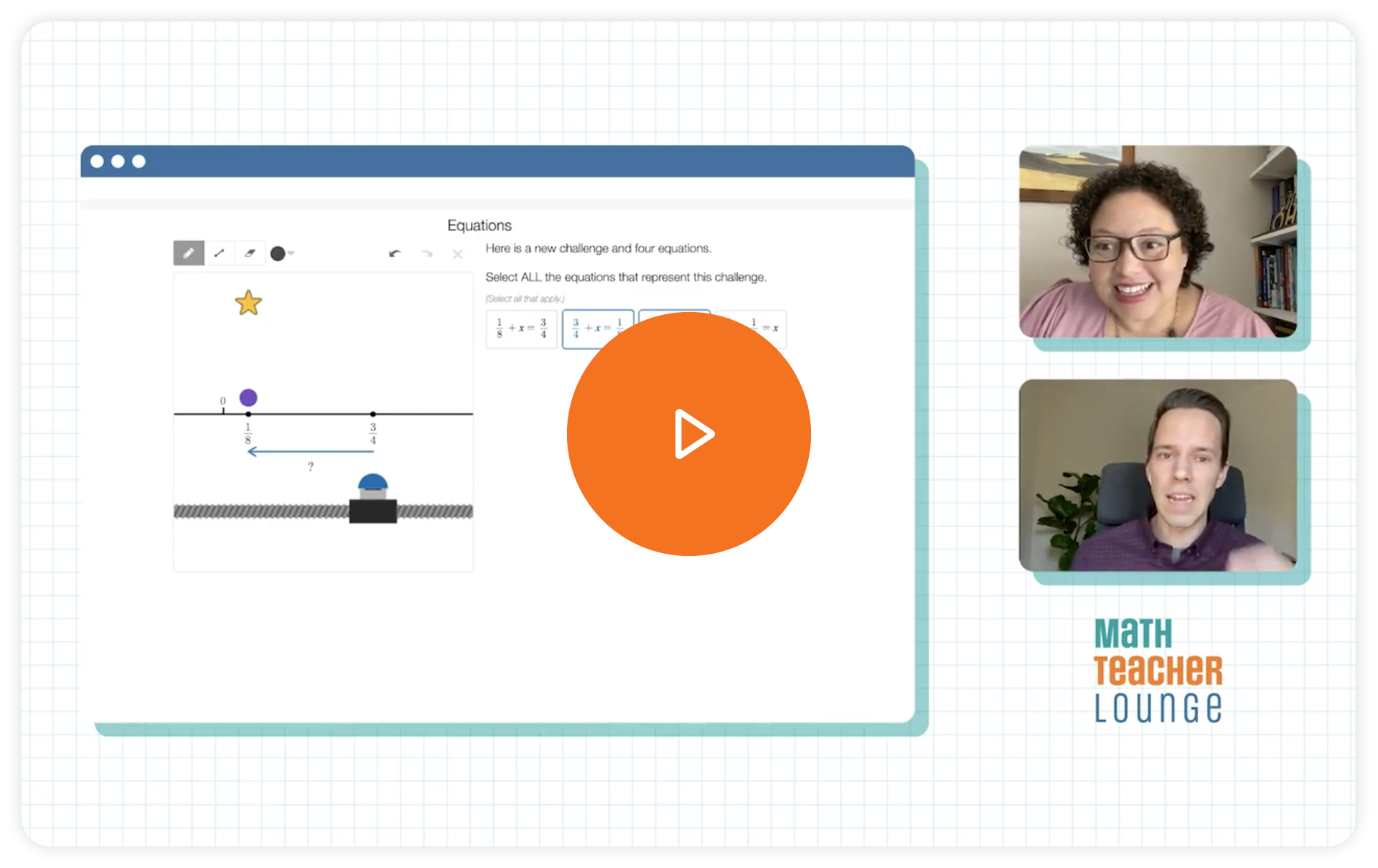
We’re continuing our season theme of math anxiety, going beyond the basics, diving deeper into what causes it, and how we can help students move forward. In this episode, we talk to Dr. Erin Maloney from the University of Ottawa to better understand what’s actually happening in the brain when a person experiences math anxiety, and how we can take steps to shift student mindsets in a positive direction.
 
Listen now and don’t forget to grab your MTL study guide to track your learning and make the most of this episode!
 
Enjoy this episode and explore more from Math Teacher Lounge by visiting our main page. 

Download Transcript

Dr. Erin Maloney (00:00):

It’s the anxiety itself in many ways that can cause people to underperform.

Bethany Lockhart Johnson (00:06):

Welcome back to Math Teacher Lounge. I’m Bethany Lockhart Johnson.

Dan Meyer (00:10):

And I’m Dan Meyer.

Bethany Lockhart Johnson (00:11):

This is episode two of our new season, all about math anxiety. Who has it? What is it? What do we do about it?

Dan Meyer (00:20):

I’m learning so much, learning a ton.

Bethany Lockhart Johnson (00:22):

I loved our first conversation with Dr. Gerardo Ramirez, episode one, our first episode of the season. Really, our goal with that conversation was just to—we need to talk about the basics of it, for reals. Like, what is math anxiety?

Dan Meyer (00:36):

What is it? How do you measure it? How’s it defined? Super-helpful stuff.

Bethany Lockhart Johnson (00:40):

There’s not only one way that it’s measured. But it’s like, in active research right now, how are folks making sense of it? And I think Dr. Ramirez did such a fantastic job of sharing that with our listeners. And I learned a lot. You learned a lot, Dan?

Dan Meyer (00:56):

I did. And I’m also super-excited to take that knowledge that we have developed together and go and build on top of it and keep on climbing up up the mountain here, and learn more about math anxiety. Which is why we’re super-excited to have a guest on, Dr. Maloney, who is going to help us learn more—especially about what happens to the brain when it’s experiencing math anxiety. There’s some really complex stuff that happens there, including the role of parents and educators in creating and resolving math anxiety. And I think we’ll also learn that the whole situation is a bit of a hot mess. And we’ll try to make it a little bit less messy together.

Bethany Lockhart Johnson (01:34):

Little bit less messy. Dan, if we do nothing else, can we make it a little less messy?

Dan Meyer (01:41):

I sometimes prefer more mess, but in this case I prefer less. So.

Bethany Lockhart Johnson (01:45):

I have a two-year-old, so everything is a mess.

Dan Meyer (01:47):

Your life is mess. Yes. <laugh> Right. Well, I’m excited for you folks to hear this. It was a delightful conversation, so yeah, tune in. We are joined by Dr. Erin Maloney.

Bethany Lockhart Johnson (01:56):

Let’s go. We are joined by Dr. Erin Maloney, associate professor in the School of Psychology at the University of Ottawa, where she directs the Cognition and Emotion Laboratory, as well as serving as the Canada Research Chair in Academic Achievement and Well-being. Welcome to the show, Dr. Maloney. We’re so excited to have you in the Lounge.

Dr. Erin Maloney (02:20):

Yeah, thank you so much for having me. This is fantastic.

Bethany Lockhart Johnson (02:24):

So our last season was all about math and joy. And even when I read your title, I felt more joyful. Like, somebody is thinking about academic achievement, but with well-being in mind. I love it.

Dr. Erin Maloney (02:39):

Aw, thank you.

Dan Meyer (02:40):

Cognition and emotion!

Bethany Lockhart Johnson (02:42):

E-mo-tion!

Dr. Erin Maloney (02:43):

I don’t think they can be separate. I think that you have to think about them together, ’cause they’re so intricately connected.

Dan Meyer (02:49):

Love that. People try, but we love that. Yeah. That’s our vibe here, too.

Bethany Lockhart Johnson (02:52):

People try. That was a big problem with my math anxiety. They just wanted…there was no room for my emotion. They’re like, stop weeping at your desk—

Dan Meyer (03:00):

It’s rearranging neurons….

Bethany Lockhart Johnson (03:01):

—you’re distracting the other children. So would you mind telling us the story of how you even got interested in this topic? You know, when you tell people that you study math anxiety—or, actually, I don’t know how you describe it to them; I’m hopeful you bring in that well-being part—but how did you get here? What do you, what do you, what do you…yeah, tell us! We love it!

Dr. Erin Maloney (03:23):

<laugh> I feel like what you’re actually asking is, “How did you make life choices that got you to here?” <Laugh>

Bethany Lockhart Johnson (03:29):

Justify your life choices! Ready? Go!

Dr. Erin Maloney (03:32):

<laugh> Whoo. OK. So, all right. So we often, in psychology, we joke that instead of doing research, we do “me-search.” And that’s, that’s admittedly true in my case. I was a student who absolutely loved math up until about eighth grade, and then something changed, and all of a sudden I was terrified of math and I had absolutely no sense of self-efficacy in it. Despite trying really hard, I was extremely anxious about it. And so I initially, I set out…my parents were completely convinced that I was absolutely capable of doing mathematics and that I was getting in my own way. And when I went to university, I decided to prove them wrong. So I set out to prove that some people just can’t do math, and that’s the end of it. And, you know, 20 plus years later, my parents were right. And it turns out that many people—well, I would argue virtually everyone—can do math. And that if you are really anxious about it, it can get in the way. And interestingly, you know, in, in the years that we’ve been doing this research, there’s really good strategies that can be used—that hopefully we get a chance to chat about—that can really help reduce the amount of anxiety that students are experiencing. But I really did set out, like the bold teenager that I was, to prove my parents wrong. And that backfired <laugh>. So I know it’s kind of a strange answer, but it’s the truth. So I was really interested in understanding why it was some people just could not do math.

Dan Meyer (05:10):

That makes two for two so far, on guests for this season who did a version of me-search. And I feel like this is pretty common for a lot of researchers. Like, I wanna figure out…my experience as a teacher, the part where you, I think, diverge from a lot of people I knew in grad school, myself included, is that you actually let counter evidence change your perspective on things. Whereas I feel like a lot of us go in: “I know this is true and I’m gonna gather data!” and lo and behold, I’m true! But only now, with the research TM, you know, trademarked research, attached to it. So that’s, really exciting. Thanks for sharing that.

Dr. Erin Maloney (05:43):

No, you’re welcome.

Bethany Lockhart Johnson (05:44):

But don’t people say that the more personal you get, the more universal it is? Right? So if you go and get your doctorate about something that you think is just your experience or in your brain, then people are gonna be gonna be like, “Wait a second; you think that too?” “Wait, that math anxiety isn’t just you?” I don’t know, it sounds like a pretty great path to me. When you tell folks that you study math anxiety or when you’re speaking to folks about your research, do you find that there is a lot of folks who relate to what you’re studying? Or how does that conversation typically go?

Dr. Erin Maloney (06:20):

Yeah, so it is I think an extremely relatable topic. Not in the sense that everyone experiences anxiety about math, but everyone seems to know somebody who’s really anxious about math. Or everyone’s at least aware of the stereotype that like some people are math people and some people aren’t, and that’s just the way it is. So it feels like everyone has feelings about math and everyone seems very happy to share those feelings. So one thing I’ve always found really interesting, and actually, so I, I know you mentioned that you had Gerardo on recently. Gerardo and I have had really interesting conversations about how people are really quick to tell you that they hate math and they can’t do math, and they’re anxious about math. And I’ve yet to have anyone ever tell me they hate reading, they can’t read, they’re really anxious about reading as an adult. So for some reason math seems really different. And in that sense people always seem to be pretty excited to talk about their feelings towards math.

Dan Meyer (07:23):

Yeah, definitely. Been on an airplane or two myself and had those conversations. You know, people asking to be reseated because they found out that I do math for a living or whatever. Or just unburdening themselves, for sure. I’m super-curious: I think that the fact that you are doing the me-search is reason enough to want to dedicate your life to this study. But I am curious: If you were gonna justify to someone else, why is math anxiety important to study? What are its consequences, even outside of math education? What would you say to that?

Dr. Erin Maloney (07:57):

So I think it’s probably not hard to convince people that success in math is important, right? So we know that children who start elementary school behind in mathematics tend to stay behind in mathematics, unless they have any kind of very targeted intervention. We know that children who do worse in mathematics throughout K to 12 education in general get lower-paying jobs when they’re older. We also know that when they do worse than mathematics relative to their peers, there’s fewer jobs that are open to them, relative to if they excelled in math. Right? And so I think in many ways there are really clear consequences for students who are not comfortable with math and who avoid it. But I think one of the really, really interesting things about math anxiety, and maybe part of why I’ve fallen in love with it as a research topic is that it’s the anxiety itself in many ways that can cause people to underperform. So it’s not just the case that people who are bad at math are anxious about it. It’s actually that the anxiety itself can cause you to do worse in math. And that for me is really exciting, ’cause it means that if we can change your mindset, then we can really set you on a path with several more options available to you career-wise. And I think that is really empowering.

Dan Meyer (09:18):

Hmm. Yeah, definitely. And I’d love for you to explore — your laboratory is the cognition and emotion laboratory, which I love, how you’re creating those linkages between how you feel about a thing and what your opportunities or your aptitude for learning it. I’m really curious, can you say more about the, the relationship there? How does feeling anxiety impair your ability to do mathematics?

Dr. Erin Maloney (09:41):

Yeah, so feeling anxiety, typically what you tend to experience is these negative thoughts and ruminations. So you can imagine, you’re somebody who doesn’t really love math, you’re pretty anxious about it; you know, Bethany, maybe you’ve had this kind of experience before. I’m gonna call you out on it. I’ve had it many times, where you sit down to do a math test and all of a sudden you’re not focusing on the actual math test in front of you. You’re focusing on things like the consequences of not doing well on this. Right? Or “my parents are gonna be really disappointed if I don’t pass this test,” or “my teacher is gonna think negatively negative of me,” or sometimes we see things like, “I’m a girl, girls don’t do math.” These types of stereotypes. And what happens is that those thoughts actually tie up really important cognitive resources, like, really important memory resources, that you need to do the math test. And so if you are trying to essentially do two things at once, right? You’re trying to deal with all these negative thoughts that are distracting you and you’re trying to do the math test, then you’re not going to do as well as someone who’s sitting down and doesn’t have all of these distracting thoughts to deal with. And we actually know that from research that we have in our lab right now, where we just ask people like, “Hey, when you did this math test, what kind of stuff are you thinking about?” what we find is that the people who are really anxious about math report a whole bunch of thoughts that are unrelated really to the math test, per se. It’s more about the consequences of doing poorly. And as a result of those thoughts, they actually end up doing worse.

Dan Meyer (11:14):

This has been really helpful to figure out, how the emotional state of doing math affects the ability to do math. And it’s really interesting how you’re saying that the direction of the causality can go from the emotions to the cognition. And I’m just curious then, what is the source of the bad emotions about math? Where does that come from? Is it nature? Is it nurture? Some combination? How do you see it?

Dr. Erin Maloney (11:39):

Yeah, so one, that’s a fantastic question. And there’s been a whole bunch of people all around the world that have been spending a lot of time really trying to pinpoint that down. And I think the answer is that it’s, you know, it’s complex. So most of what it’s looking like right now is that it is a combination of both. So essentially what we find is that kids who start elementary school who are a little bit behind in math—and for the question of why they’re behind, that’s also complex; it could be genetics, it could be just environmental input, before the child ever entered formal schooling kind of thing—but in essence, what we find is that kids that start school behind in mathematics, those are the children who are most likely to develop anxiety about math by the time they’re finished first grade. OK? But we also know that once they’ve developed the anxiety about math, then that’s when they get these thoughts and ruminations that kind of tie up those memory resources, that then is gonna make it harder for them to succeed in math tests. So you get into this sort of vicious cycle, right? Where maybe you start behind a little bit and then you develop the anxiety, the anxiety causes you to underperform relative to what you should be able to, so now you’re even further behind, you get more anxious because you’re not doing as well as you’d like to…but again, kind of coming back to the “Why are the children starting behind in the first place?” Some of that seems to be the role that parents are playing in the household. So some kids come from a household where parents are playing a lot more math games with them, talking about mathematical concepts on a regular basis. Maybe they have older siblings who are, you know, practicing arithmetic and, and mathematical processing in front of them. And so those kids are exposed to more math before they ever even start formal schooling. Those kids seem to do better. And then we also know that the parents’ attitudes matter a lot too. So what we find is that when parents are high in math anxiety themselves, especially when they help their children a lot with their math homework in really early ages, we find that those kids end up being more anxious about math by the end of the school year, and they also end up doing worse in mathematics. So it really does seem to be, you know, kind of a complex set of factors that have something to do with both maybe genetic predisposition to success in math and genetic predisposition to anxiety, but then also the social attitudes and stereotypes about math to which you’re exposed at home that really seem to be coming together to create this anxiety in young children.

Bethany Lockhart Johnson (14:24):

I feel like everything you’re saying is <laugh>…it makes so much sense and yet it’s so often not talked about, right? Because it’s just more like, it gets boiled down to, “Oh, they’re just not a math person,” instead of all these other factors that are at play. And I completely remember the anxiety I felt, whether it was a test or not, walking into my math classroom when I was in ninth grade. And there’s no way I was set up and ready to learn. Right? <Laugh>. And something with—we mentioned Dr. Ramirez, he was talking about validating that anxiety. If teachers validate that like, “Oh, you know what, sometimes you might feel stumped, or this might feel overwhelming.” Even the power in creating space for that in the classroom, right? And acknowledging that it doesn’t—math doesn’t have to “come easy” to you in order for you to have access or make sense, is such a powerful concept. And I love the way that you are looking at all these different factors and saying, “Hey, it’s both simple and also a lot more complicated than we’re we’re making it.” Right?

Dr. Erin Maloney (15:36):

No, and I agree with that sentiment so much. Like, I think, though—one thing I will sort of caution is that I think when teachers are validating the anxiety, or when parents are validating the anxiety, I think there’s a very fine line that needs to be walked where we need to be able to say, you know, “It’s OK to struggle with something. That’s, that is completely OK.” And as we’re, you know, as we’re working towards something that’s really valuable, right? We can, we can work hard at something and by working hard at it, we’re going to get better. And I think that type of validating is really, really important and valuable. I think what we wanna be careful of is not to say things like, “Oh, it’s OK. I also never loved math.” And, you know, “Oh, I was never a math person either.” And so even though we might be bringing comfort to the the child, I think that that’s sending the wrong message. And so sometimes it’s really well intentioned and really not great—

Bethany Lockhart Johnson (16:37):

A hundred percent.

Dr. Erin Maloney (16:38):

—in terms of the messaging. So that’s the only…so just for people listening, the only sort of caution that I would give there is that I think there’s nuances to the validating of the feelings that are important.

Bethany Lockhart Johnson (16:50):

I am so glad you said that because as a kindergarten teacher, I vividly remember—and this is as early as, you know, the kids are five years old, right?—and I remember in a parent-teacher conference, a parent saying, “Oh, I wasn’t a math person either,” or, “Oh, no, ugh.” And they were so quick, like you said, they wouldn’t say that about reading, but they were so quick to talk about their lack of natural math aptitude, right? And, and it was really interesting because you know that even if they’re not saying that specific thing at home, those attitudes are absolutely carrying over at home. And they’re absolutely carrying over to, to how they interact with their kiddo around math and around what’s happening in the conversations about math. And I felt like a lot of times my work as a teacher was also to help support parents through their own math anxiety, and help give them some new language for how they can talk about math. And that math is more than just getting to an answer quickly. Like, let’s talk about, let’s go on math walks, let’s go on number walks, what numbers are around the home? Or oh, is that bigger than this? Do you have more of this? And even those little things, I, my hope was that it was starting to shift the conversation around what math was possible in the home, particularly when you saw that it was the parents who had palpable math anxiety. Right? And how much you know that that’s gonna impact what’s happening when you sit down to do homework together.

Dr. Erin Maloney (18:22):

Yeah. And I love that you have worked to encourage parents to do that. So we do similarly. Like even from a research perspective, where I will often give talks to parents and teachers and we talk about the idea of trying to mathematize everything, right? So just the idea that math is absolutely everywhere, and you know, whether it’s a matter of playing games in the car with your kids where you’re thinking of a number and it’s “My number is higher than 42, but lower than 80, and what number do you think I might be thinking of?” And, and gradually trying to get the child to that number. Or, you know, asking questions like, “What’s your favorite even number and why?” And just little things like that that, that I think can make math fun for kids, that help—I don’t even know how to explain it, but just that idea of bringing joy into it, so it’s not always this heavy subject that kids have to come to. So we definitely try to talk to parents about the idea of, like I said, mathematizing everything. And usually it’s well-received, ’cause often parents find it empowering, right? They’re like, “Oh, well, I could do that! But like, that’s not math!” And you’re like, “No, but it is.”

Dan Meyer (19:33):

Yep.

Dr. Erin Maloney (19:34):

Like, it is! And sometimes parents will say like, “Well, I don’t know how to do fractions.” And you’re like, “OK, but how do you bake?” “Well, I don’t know! I just, like, I know how to do those fractions!” And you’re like, “OK, but that’s the starting point. Let’s work with that.” Like, let’s, you know. And I think a lot of times, it’s reminding the parents that they’re actually far more capable than what they think they are, despite the fact that maybe they struggled with math when they were younger.

Dan Meyer (19:58):

Yeah. This is so interesting. And I feel like part of the challenge around conversations about anxiety and math and how to, how to resolve it and where it comes from, is that it, like, it presupposes a single definition of math. And so, you know, we’re talking about like how to be more mindful about math. But you know, like if kids were walking every day through a treacherous street, you know, the solution might not be become more mindful about that street. It’s just like, we gotta fix the treacherous nature of the street, really. You know, I love that we’re talking also about redefining what math is, making it more playful. That feels like a super-important component here. I’d love to know more about what you know about the role of gender in all of this. Are there differences in the way boys and girls experience math anxiety and how it relates to achievement in math?

Dr. Erin Maloney (20:48):

Yeah, so, there’s really, really interesting research on gender in math anxiety. So in general, we find that girls tend to experience more anxiety about math than boys do. So one hypothesis is that it has to do with just social stereotypes that, you know, girls are, are good at reading; boys are good at math, kind of thing. So there’s some evidence to suggest that that might be playing a role. There’s other evidence to suggest as well that maybe boys actually do experience as much anxiety, they just don’t really own up to it.

Dan Meyer (21:20):

Ooh, yikes.

Dr. Erin Maloney (21:21):

So thoughts are, you know, there’s a bit of an apprehension for males to admit experiencing the anxiety. But I think one of the things that is extremely interesting about it—at least to me—is that we don’t tend to see gender differences in young children. So in early elementary school, even though we’ll see that kids as young as six years old will experience anxiety about math, and that that anxiety is related to how well they do in math and how much they enjoy math, it doesn’t seem to vary as a function of gender at that young age. It doesn’t seem to be related to gender until kids are at about sixth, seventh grade that we really start to see this gender difference coming online. And so that, to me, suggests that it’s probably something more social than biological at play. It probably has something more to do with these stereotypes and stuff. But another really interesting—or at least, I’m biased, but to me—another really interesting line of research that comes into play—and some of this is stuff out of my own lab—so we know that boys in general tend to do better at spatial processing than girls. And we know that spatial processing is really important for math, right? So math and space are pretty connected. And by spatial processing, I mean things like being able to picture something rotating in your mind or, you know, envisioning how these puzzle pieces might fit together. And so we know that boys tend to do better at that type of processing. And the gender difference there seems to be related to gender differences in math anxiety. So there’s some speculation, too, that it might be that as the math starts to become more reliant on spatial processing, that that’s when we see this separation between boys and girls with respect to how much anxiety they feel about math. So a lot of this is to say, I think the answer to the gender question right now is what I think what we would officially call a bit of a hot mess, <laugh> where I think there’s probably more questions than answers. But I think that there’s definitely something going on. And it really seems to be coming on later in elementary school.

Dan Meyer (23:32):

That’s a refreshingly honest admission from a social scientist, that it’s a hot mess and not perfectly clear, <laugh> so I appreciate that. It’s interesting what you said about the spatial reasoning. In our work creating curriculum at Amplify, I find we lean a lot on trying to tie abstract math towards spatial topics. Like, can you estimate a quantity before you calculate it? Can you identify a pattern and where it breaks before you prove it abstractly? And, I dunno, it’s just interesting to me. I’m just thinking out loud about how I feel like math becomes more abstract rather than more spatial. The farther you venture into secondary math…I’m wondering if I misunderstand what you’re meaning by spatial, and the progression of math from K–12.

Dr. Erin Maloney (24:20):

Yeah, so I think you can still have—you can have math be abstract, but still really relying on spatial processing. Right? And I think part of that is maybe a bit of us having different definitions of when we say “spatial.” So in cognitive science, when we talk about spatial representations or spatial reasoning, it’s really like anything you’re picturing in your mind, any time you’re really picturing these things in your mind and manipulating those images at all. So if you imagine, even like at a simple level, but it’s gonna hold when you’re going more complex as well. So doing like equivalence problems, for example, where you have to balance the equations.

Dan Meyer (24:58):

Yeah.

Dr. Erin Maloney (24:59):

Even just being able to envision things kind of moving around that equal sign and bringing one piece of the equation from this side to the other is actually an extremely spatial kind of reasoning. Right? Or when you’re expanding, that’s actually extremely extremely spatial, despite the fact that it might not feel like it initially. Obviously anything in geometry is going to be very spatial. So I think, in that sense, we would argue that the spatial processing is still playing a pretty important role. But it’s maybe a different type of spatial processing than what we’re seeing at a very early level in elementary school. That said, you can completely disagree with me too. ‘Cause I could also just be wrong, and that’s fair. My kids tell me I’m wrong all the time. So I’m used to <laugh> being told that I’m wrong.

Dan Meyer (25:47):

Well, we’re a bit more deferential on this here show, with our guests. So I would not do that. But it makes sense, what you’re saying about how these are things that you manipulate in your mind, whether they are Xs and Ys or numbers and fractions. These are all things that we manipulate. That ties into differences in this spacial reasoning category, it sounds like, which then contributes to math anxiety. And it does start to feel like there’s a lot going on here, is what it feels like.

Bethany Lockhart Johnson (26:14):

You mean hot mess?

Dan Meyer (26:16):

I meant hot mess.

Dr. Erin Maloney (26:17):

Yeah. <laugh>, I think that’s the technical term, right? I’m pretty sure that’s the technical term for it.

Dan Meyer (26:21):

I didn’t know the citation for it. So I didn’t say it. But I knew who in literature named that. But yeah.

Dr. Erin Maloney (26:28):

I’ll write something at some point.

Dan Meyer (26:30):

We’ll cite Maloney, 2022. Yeah. Yes.

Bethany Lockhart Johnson (26:34):

So I will say that one of my dreams in thinking about this season and last season, but particularly this season, since we’re really getting to talk to some researchers who get to think about this, and have really interesting conversations about it all the time…one of my dreams is that we’re bringing—’cause we do have some folks who are researchers that are listening, right? But then we also have teachers and folks who are in the classroom every day, and parents and caregivers listening. And so I think one of the beautiful things about the way that I hear you talking about it is you’re thinking about the research, but it’s so applicable. Right? And I wonder if there’s anything else you can say around it. I wanna reduce that divide, that gap, between the research that’s happening and then what’s happening with the kiddos and in the classroom and at home. And I don’t know if it’s like a magic wand thing where like <laugh> if there were changes you’d wanna see at a societal level, to try to combat math anxiety, but you see where I’m going. You know, it’s like <laugh>….

Dr. Erin Maloney (27:39):

  1. So I’m gonna answer maybe in two ways. So I think the first thing that I’m hearing from you is that idea of diminishing this divide, right? And so one thing I try to keep in mind, as someone who’s a researcher and working in the lab, I will often be called in to talk to teachers and give professional development sessions. And they often want the sage-on-the-stage academic, that stands up there and tells you the answers to things. And one of the first things that I’m gonna admit when I get up there is, “I am not on the front lines.” So what I do in the lab, for me to tell you that that’s gonna work in a classroom of 30 kids who may or may not have eaten dinner that day, and may or may not have snow pants, and may or not…like it’s–

Bethany Lockhart Johnson (28:23):

Mmm, yes.

Dr. Erin Maloney (28:24):

You know, I think we also need to be a little bit reasonable. So I try really hard in my own program of research to make sure that I’m always talking to teachers and to principals and to curriculum designers to make sure that the ideas that I have make sense. In fact, one of the most recent book chapters that I wrote, I wrote in collaboration with a really good friend of mine who’s a principal, an elementary school principal, and a former math consultant. And we wrote it together, to really say like, “Hey, here’s how we can help each other inform how research can inform practice and how practice can also inform research.” ‘Cause he can come to me and say, “I’m doing this. I can’t find anything in the literature to support this, but I’m sure it works!” And we can design something in the lab to test whether or not it seems like it’s gonna work.

Bethany Lockhart Johnson (29:11):

That’s huge. Yeah.

Dr. Erin Maloney (29:12):

Empirically. And so I think that open communication is massive. One thing that we’re doing in my own lab to try to keep that open communication available. So to anyone listening who’s ever tried to get access to a journal article, they’re held behind paywalls, right? So one, the way it works, my understanding of this anyway, is that the journal owns the formatted version of the paper. So what we do is we put up audio recordings of all of the research papers that we ever publish. So I’m pretty sure I own the words as the author, and the journal owns the prettified version that you can buy. So we audio-record all of our papers, so that if teachers or parents ever want to hear the actual science that’s going into some of these decisions, they have access to at least the stuff that we do in our lab. And we also put up an infographic for every paper, just highlighting kind of the main questions and main findings. And we do that because I think that the only way for the information to actually be useful is if it gets into the hands of the stakeholders that actually need that information.

Bethany Lockhart Johnson (30:21):

And is accessible. That’s huge. That’s huge!

Dr. Erin Maloney (30:24):

Yeah. Yeah. So that’s one way that we try to do it. And like I said, the other thing, we try to always be working with principals and with teachers. I joke that the way that I remedied this in my own life…so my husband’s a teacher; it’s like, I just married one! It’s fine! <laugh> I can grill him on a regular basis, and be like, “I wanna try this experiment. Do you think it’s gonna work?” And he can say, like, “It’s not going to. Here’s why.”

Dan Meyer (30:47):

That’s awesome. Marrying a participant—you know, a research participant—is unethical, of course. Would not clear IRB. But turning your partner into a participant? Like, what are you gonna do? That’s great.

Dr. Erin Maloney (30:57):

Yeah, no, that’s fair game.

Dan Meyer (30:58):

Yep.

Dr. Erin Maloney (30:59):

Yeah. So that’s—I think we we compensate each other <laugh>. So, no…so I do joke a little bit about that. He was a teacher simply ’cause he wanted to be one. Not ’cause I needed him to be one. But, I think that communication part is, is really key. That’s one thing. Then the other part of the question or the other sort of piece of the question that I was hearing is that idea of, how do we fix math anxiety. Right? Like, what’s the great, “I’m glad that there’s a whole bunch of time and effort and energy going into trying to understand this, but what, where are we at?” And I think with that, it’s really, really promising. So there’s been a lot of research coming out looking at how best to help children or even adults manage their own anxiety about math. And there’s a few really interesting strategies that seem to be quite effective. So one, and I don’t know if—um, it feels weird calling him Dr. Ramirez, just ’cause I know him well!—but I don’t know if Dr. Ramirez would’ve talked about this when he chatted with you, but he has some really interesting work on expressive writing. Did he chat about that at all?

Bethany Lockhart Johnson (32:07):

He didn’t, but I’ve read some of his work about it and I think it’s so fascinating.

Dr. Erin Maloney (32:11):

Yeah! So, OK, well, I’ll tell you about his work on it.

Bethany Lockhart Johnson (32:13):

Yes, please. Please.

Dr. Erin Maloney (32:14):

Because it’s super-useful. So when we talked about that idea of how anxiety causes these thoughts and ruminations, and they tie up the memory resources that you need, what Gerardo has found is that when you get students to write about their anxiety for about 10 minutes before they do a test, what ends up happening is they end up doing better on the test, relative to if they would not have written about their anxiety at all. And this is particularly true for students who are really high in anxiety. OK? And the idea is that all of those thoughts that they were going to have about the test or the consequences of the test, et cetera, you just kind of get ’em…it’s like a mind dump where you get ’em all onto the page at first before you even go to do the test. And now when you go to do the test, you’re not having to do two things at once. You’re no longer dealing with these thoughts ’cause you got ’em all out on the paper beforehand. And so Gerardo has some really interesting work showing that that works for math anxiety. And then it also works for just testing anxiety in general. And so that’s a strategy that I love. I also—part of what I really love about it is it’s so low-cost, right? You need a paper and a pencil and it’s great. So those are always my favorite strategies, the ones that don’t really cost us anything. So that’s one way of dealing with like the cognitive part of the anxiety. The other thing you can do is try to deal with the anxiety part of the anxiety. So for that, what we find is that the typical strategies that you’re gonna see for anxiety tend to work for math anxiety. So things like focused breathing. Right? Making sure you’re doing deep inhales and exhales. That really diaphragmatic breathing seems to be quite helpful. We know that what we call progressive desensitization is really key. That’s the idea of doing things, you know, starting with the questions that you know how to handle. And then gradually working up to the more difficult questions. So you’re sort of gradually exposing yourself to the more complex stuff. And how that can play out on an actual test at school is, you sit down, and instead of just starting with question number one, you actually read the whole test, see which questions you feel like you know the best, start with those questions, and that helps build your confidence so that you’re better able to tackle the questions that are maybe a little bit outside of where you’re currently at. So that seems to be really helpful. The other part that I will say, too, that’s extremely helpful: So we know that anxiety really ties up those memory resources. And so the more you can make the math automatic, the more immune it’s going to be to anxiety in the moment. And so I know that this part can be a little bit controversial, because we don’t wanna necessarily demotivate children, and kill the enthusiasm for math that we’re trying to cultivate…but really, you know, really committing your arithmetic facts to memory can be extremely helpful. So really learning those times tables, really learning your addition and subtraction facts. ‘Cause what happens is, then when you’re in a situation where you need that information, even if you’re anxious and you’re working with fewer cognitive resources than what you would normally have, you actually don’t need that many cognitive resources to be able to pull something from memory that you’ve memorized. So it really helps to kind of protect you against some of the negative impacts of the anxiety while you’re doing that test.

Bethany Lockhart Johnson (35:37):

And you’re not using all your cognitive resources to figure out seven times eight, because you can really focus on what you’re trying to do with that. Oh, that’s fascinating. Yeah. Yeah.

Dr. Erin Maloney (35:47):

Yes. No, a hundred percent right. And so I know that’s one that, like I said, I know it can be somewhat controversial because it’s…you know, we’ve talked about—or we haven’t talked about in this conversation, but we often talk about—the idea of drilling and killing. Right? So you drill the facts, you kill the, the enthusiasm. But I think that there are ways that we can drill arithmetic facts, or help make them automatic, but still fun, right? It doesn’t have to always be in a high-pressure kind of way.

Bethany Lockhart Johnson (36:16):

Totally. And we’ve talked about fluency, and I’m sure we’ll talk about it more in the Lounge. And that is interesting, that link between anxiety when the fluency isn’t there, that—or, of course we hear about anxiety with timed tests, but the idea of that IS something you can do to reduce it, because you have those facts just at your ready. Right?

Dr. Erin Maloney (36:37):

Yeah. So I actually, again, I’m gonna be a little bit controversial. So I don’t hate timed tests in the way that a lot of people do. But I love time to practice. So I think once we’ve got to a point where children have a fairly decent understanding of skills, of a skill, once they’ve got a fairly decent grasp on it, then I love the idea of the timed practice. So it can be still in a low-pressure situation, where in many ways it doesn’t matter if you get the answer to the question correct. But we’re practicing doing it in a situation in which you might be feeling a little bit of pressure, but it’s not real pressure, if that makes sense. And I think that can be really, really useful for students. And again, it can be done in a fun way, right? It doesn’t have to be these super-intense ways. It can be fun. But I think that in life there are situations in which the time that it takes you to complete a problem matter. And I think that we have to make sure that we don’t get too far away from that.

Dan Meyer (37:40):

Yeah. It feels like we should do an entire other episode thinking about ways to develop that fluency and automaticity that don’t contribute to anxiety, or create further disparities between people who are high math anxiety and low math anxiety. Not a small question, I’m sure. And I appreciate you alluding to all of that. You know, this whole thing, as you said, is quite the hot mess. And I feel like you, Dr. Maloney, have helped us make this a little less messy, in our heads, and hopefully the listeners’ heads. I really appreciate that. I just love…you’ve mentioned lots of resources that you have. You’ve alluded to them: audiobook-style readings of your research, which I need ’cause I just finished, you know, Harry Potter, the seventh book, so I need a new thing to listen to like that. Also infographics. Can you tell our listeners where they can find this work of yours, and if there are any other kinds of resources that you wanna plug for our listeners here?

Dr. Erin Maloney (38:32):

Yeah, for sure. So all of our resources can be found on my lab website. So the address for that is www.ErinMaloney.ca. So there we have, like you said, the infographics and the audio articles and all that stuff. And then we also have a link to a new kids’ book out, actually, that a colleague of mine and I have published recently, that really walks through some of these strategies on combating math anxiety. The book is written as a children’s book, so it’s Peyton & Charlie Challenge Math. But it secretly is a book that would also work for adults. So if you are a parent that’s a little bit anxious about math, or a teacher that maybe is a little bit anxious, and you wanna see how some of these strategies can play out, in that book—we linked to it on the website, but it is available for purchase on Amazon. And the one thing I will say about the book, ’cause this is something that we were pretty proud of, so Sheri-Lynn Skwarchuk, who is a school psychologist, and I wrote the book. And it’s available for purchase at our cost price, so we don’t actually make any money on the book. It was literally just a way of getting some of the science out to people who might be able to benefit from it.

Bethany Lockhart Johnson (39:45):

Reducing that divide!

Dr. Erin Maloney (39:46):

Yeah, well that’s what we’re trying to do! Right? So I think in the U.S., I think it’s like $6 on Amazon. And then in terms of other resources, we’re in the process right now of creating some informational videos and and stuff like that that hopefully will be useful for parents and for teachers, just in terms of understanding a little bit more about the anxiety and understanding how to deal with the anxiety in the classroom more, at home or wherever it might be coming up.

Dan Meyer (40:15):

Well, thanks so much. I really appreciate—we appreciate!—you coming on, and hearing about how you’re trying to bridge so many different barriers from research to practice, and school to home. It’s just really inspiring. And we’d love to have you back on sometime. So thank you so much for joining us.

Bethany Lockhart Johnson (40:29):

I feel like we’ve just hung out! Don’t you, Dan?

Dan Meyer (40:31):

Are we rolling here? Oh my gosh, we’re rolling. I just thought we’re just hanging. Yeah,

Bethany Lockhart Johnson (40:34):

I thought we were just hanging!

Dr. Erin Maloney (40:36):

I know, I do, I really appreciate that it has a very kind of chill vibe to it.

Dan Meyer (40:41):

Chill vibe. Like a lounge.

Bethany Lockhart Johnson (40:42):

It’s the lounge!

Dan Meyer (40:43):

Thank you. You get us; you get us. <laugh>

Bethany Lockhart Johnson (40:45):

Dan Meyer. I was shopping for children’s books, and there was this book, and it was talking about being at home with Mom. And it’s going through all the things that the child did that day with Mom. It’s like, “We played outside, we ran through the sprinklers, we even did some homework.” And it shows them sitting at the table with the homework, that’s clearly math homework, in front of them. And the mom is like, “Harrumph!” Like a very perplexed, anxious face. And there’s all these question marks above her. And it’s just like,

Dan Meyer (41:24):

“There should not be numbers on that paper!”

Bethany Lockhart Johnson (41:25):

Exactly. And the child is like, “Ohhhh,” you know. And I mean, I have to give credit to the illustrator, because they really did capture the clear message of this interaction, which was sitting down to do math homework or think about math together is a source of angst. Right? According to this author and according to too many people. And so I think what’s really important is that we recognize those images when we see them out there and speak back to them, and say, “Hey, wait a second.” Yeah, it can feel like that, and it doesn’t have to. And what’s going on that that’s just the assumed way that it’s gonna feel, to sit down and math together. You know?

Dan Meyer (42:11):

Yeah. It feels like we all have a lot of work to do on the whole math-anxiety front. Dr. Maloney helped us see how parents play a part, educators play a part, society and how they create people plays its own part in how we all define math as a thing where we evaluate student thought or where students play it with their thoughts, has its own huge part as well. So yeah, it was a really fantastic conversation with Dr. Maloney. I hope you folks will check out the show notes, where you will find links to Dr. Maloney’s website. A lot of her work, which as you heard, is very geared towards practitioners and parents and even directly at kids, especially the new children’s book she co-authored, Peyton & Charlie Challenge Math.

Bethany Lockhart Johnson (42:55):

Next time we’re gonna dive even more into the nitty gritty of combating math anxiety. To do that, we’re actually gonna be joined—I am so excited about this—by Dr. Rosemarie Truglio from Sesame Workshop.

Rosemarie Truglio (43:09):

Our core audience are two- to four-year-olds, and they love math. And what’s not to love? Children don’t come with this math anxiety. Math anxiety is learned.

Dan Meyer (43:23):

So excited.

Dr. Erin Maloney (43:24):

Sesame Street was a huge part of my childhood and my toddler doesn’t know it yet, but Sesame Street is coming. It’s coming. Like, we’re we’re gonna introduce Sesame Street to him. We just haven’t yet.

Dan Meyer (43:37):

Sesame Street straight raised me.

Bethany Lockhart Johnson (43:38):

Right?

Dan Meyer (43:39):

Yeah. Don’t tell my parents. But that’s, yeah, that’s true. I’m excited, too. It’s gonna be a blast.

Bethany Lockhart Johnson (43:45):

I’m really excited. I think that the more we dive into this topic—which, again, we’re gonna look at math anxiety from a lot of different angles—and I’m excited to talk to Dr. Truglio about how we can take this research and these conversations that are happening about math and how it can actually impact what’s happening in homes. ‘Cause we wanna help create positive relationships with mathematics, with kids in math. I’m so excited. And I hope you folks keep listening. We love having you here in the Lounge. And if you haven’t already, please subscribe to Math Teacher Lounge, wherever you get podcasts. And if you like what you’re hearing, please leave us a rating and a review. It helps more listeners to find the show, and let other folks know about this show. Recommendations are great. Thanks so much for listening.


Stay connected!

Join our community and get new episodes every other Tuesday!

We’ll also share new and exciting free resources for your classroom every month.

What Dr. Erin Maloney says about math

“If we can change their mindset, then we can set students on a path to more opportunities and success.”

–Dr. Erin Maloney

Associate Professor in the School of Psychology, Director of the Cognition and Emotion Laboratory, and the Canada Research Chair (Tier II) in Academic Achievement and Well-Being, all at the University of Ottawa

Meet the guest

Erin Maloney is an Associate Professor and Canada Research Chair at the University of Ottawa. Her research sits at the intersection of Cognitive Psychology, Developmental Psychology, and Education and focuses on cognitive and emotional factors that relate to academic achievement. She is a world-renowned expert on the study of math anxiety, conducting research in the lab, in homes, and in classrooms with children, parents, and their teachers. She is passionate about both knowledge mobilization and equity, diversity, and inclusion within education and science.

A woman with straight, shoulder-length light brown hair smiles at the camera, framed by a circular graphic with geometric accents on a white background—perfect for a math teacher lounge or sharing math teacher resources.
A laptop displaying a Facebook group page for "Math Teacher Lounge Community," featuring profile photos, a group banner, and geometric shapes in the image background.

About Math Teacher Lounge

Math Teacher Lounge is a biweekly podcast created specifically for K–12 math educators. In each episode co-hosts Bethany Lockhart Johnson (@lockhartedu) and Dan Meyer (@ddmeyer) chat with guests, taking a deep dive into the math and educational topics you care about.

Join the Math Teacher Lounge Facebook group to continue the conversation, view exclusive content, interact with fellow educators, participate in giveaways, and more!

Amplify CKLA Review for Alabama

To view this protected page, enter the password below:


What is Amplify CKLA?

Amplify CKLA is a core ELA program for grades PK–5 that delivers:

  • A unique research-based approach truly built on the Science of Reading.
  • A combination of explicit foundational skills with meaningful knowledge-building.
  • Embedded support and differentiation that gets all students reading grade-level texts together.
  • Opportunities for students to see the strengths and experiences that all people share while also celebrating each others’ unique identities and experiences.
A colorful rope diagram shows strands for language comprehension and word recognition, with images of reading and phonics materials near respective strands.

How does Amplify CKLA work?

Daily instruction

Grade PreK: Developmentally appropriate foundational knowledge

Our PreK program delivers developmentally appropriate instruction and activities that do more than lay the groundwork for foundational skills—they offer content knowledge, incorporating research that shows true literacy requires background knowledge in history, science, art, and literature. Amplify CKLA PreK easily fits into any class routine, with 45 minutes of interactive instruction designed to accommodate full-day or half-day schedules.

Grades K–2: Dedicated knowledge-building and explicit skills instruction
Every day, students in Grades K–2 complete one full lesson that explicitly and systematically builds foundational reading skills in the Skills Strand, as well as one full lesson that builds robust background knowledge to access complex text in the Knowledge Strand. Through learning in each of these strands, students develop the early literacy skills necessary to help them become confident readers and build the context to understand what they’re reading.

Grades 3–5: Integrated instruction
In Grades 3–5, Knowledge and Skills are integrated in one set of instructional materials. Lessons begin to combine skills and knowledge with increasingly complex texts, close reading, and a greater writing emphasis. Students can then use their skills to go on their own independent reading adventures.

Formative and summative assessments

A young boy in a light blue shirt writes in a notebook at his desk in a classroom, with other students working nearby.

Amplify CKLA features a progression of moment-by-moment assessments to benchmark assessments. Assessment and feedback give teachers the information they need to differentiate instruction effectively.

Checks for Understanding
Each lesson segment incorporates checks for understanding to increase engagement and to let teachers make real-time adjustments to their instruction.

Formative Assessment
Each lesson goal is tied to a formative assessment opportunity, allowing teachers to see which students need more support with a benchmark.

Mid- and End-of-Unit Assessments
Mid-Unit and End-of-Unit Assessments provide valuable information on the skills and content students have mastered. Digital end-of-unit assessments are available on a variety of platforms.

Benchmark and Placement Assessments
Benchmark and Placement Assessments help teachers set goals and monitor the growth of each student, providing a baseline at the beginning of the year and ensuring students are advancing toward grade-level objectives.

Download our CKLA Assessment Sampler

What makes Amplify CKLA different?

Integration with mCLASS DIBELS 8

Amplify CKLA is the only core ELA program that integrates with mCLASS DIBELS 8th Edition.

The CKLA Connect feature matches your students with targeted CKLA lessons based on their mCLASS DIBELS 8th Edition assessment data. In other words, it aligns your assessments more closely with your core curriculum while recommending effective differentiated instruction.

Download this guide to connecting mCLASS DIBELS 8 with Amplify CKLA

A digital dashboard displays lesson plans for CKLA Connect and a group labeled "Letter Sound Knowledge" with two students, showing progress and learning needs.

Built on the Science of Reading

Built out of the latest research in the Science of Reading, Amplify CKLA delivers explicit instruction in foundational knowledge in PreK, both foundational literacy skills (systematic phonics, decoding, and fluency) and background knowledge in grades K–2, and an integrated approach to explicit instruction in grades 3–5.

Review this Science of Reading toolkit to learn more about the Science of Reading best practices integrated throughout CKLA.

Explicit systematic skills instruction

Great reading instruction starts with helping kids develop great decoding skills. By building a solid foundation of phonological awareness and phonics, reading the words on the page becomes automatic so that comprehension and critical thinking can happen. Our instruction is supported by:

  • Step-by-step lessons with multisensory approaches, clear lesson objectives, and embedded formative assessments.
  • Decodable books and student readers with ebook and audiobook versions that feature interesting plots and relatable characters.
  • An engaging sound library with fun songs and videos that develop phonological awareness.
  • An interactive Vocab App featuring engaging activities with immediate feedback and automated, customized instruction based on student performance.

Coherent knowledge instruction

Students build grade-appropriate subject-area knowledge and vocabulary in history, science, literature, and the arts while learning to read, write, and think creatively and for themselves. Our instruction is supported by:

  • Knowledge builders that provide a quick overview of each domain with its key ideas.
  • Interactive Read-Alouds designed to build knowledge and vocabulary.
  • Content-rich anchor texts that support students as they tackle increasingly complex text and sharpen their analytical skills.
  • Social and emotional learning paired with lessons in civic responsibility.
Illustration montage featuring scenes of learning: a cartoon character with books, two people shoveling snow under the stars, and an astronaut on a lunar landscape, with educational interfaces.

Embedded differentiation for all learners

Amplify CKLA provides built-in differentiation strategies in every lesson for all students, including supports for English language learners and Standard English learners.

  • Access supports for ELLs: Integrated ELD supports in each lesson segment for English learners and Standard English learners are specific to students’ mastery of the lesson’s objectives.
  • Support and Challenge for all learners: Lessons include Support and Challenge suggestions that provide assistance or opportunities for more advanced work toward the goal of the lesson. These supports are suitable for all learners, including ELLs.
  • 30 minutes of Additional Support in every Skills lesson: In the Skills Strand, every lesson concludes with an Additional Support section of recommendations for 30 minutes of extended instruction and activities, directly aligned to the skills taught in the lesson to assist students who need more support in mastering the lesson’s objectives.
  • Intervention Toolkit: The Intervention Toolkit provides easy-to-use resources to assist teachers in filling gaps in students’ foundational skills. Teachers will find of hundreds of activities to support phonics, fluency, comprehension, handwriting, and other key skills.

Designated ELD with Language Studio

Amplify CKLA’s designated English Language Development (ELD) component—Language Studio—helps English learners preview and revisit key content within core instruction, building a foundation of academic vocabulary and background knowledge. Core instruction lessons include point-of-use supports for English learners and Support and Challenge strategies for all learners.

Young boy with his hands over his mouth, looking up in wonder, beside a diagram labeled "language studio" with educational elements.

This carefully developed program follows the CKLA Knowledge domains, previewing and reinforcing skills and content from core instruction using instruction specifically built for English learners. The program is also designed around frequent formative assessment, including assessment of language proficiency, giving you effective ways to guide and support your English learners.

Language Studio supports teachers and English learners through the following:

  • 30 minutes of instruction with lesson segments are carefully designed around Content Knowledge, Meaning Making, Language Development, Effective Expression, and Foundational Skills.
  • Every Language Studio lesson accompanies a core lesson, helping English learners deepen domain and academic vocabulary that will help them access core content.
  • Culminating tasks support core projects and target the same skills as primary instruction.

Writing emphasis with Writing Studio

With Writing Studio, students in Grades K-5 focus deeply on the three key text types informative, narrative, and opinion–while applying both the skills and knowledge from the core program.

Writing Studio supports students through:

  • Expanding on core writing instruction to develop analytical thinking through writing.
  • Lessons that focus on writing standards, providing intensive focus and application to strengthen skills.
  • Opportunities to apply knowledge in new contexts and deepen comprehension through writing.
  • Scaffolded writing projects to help all students find success within the stages of the writing process.
Covers of four "Writing Studio Teacher Guide" books for different grades, featuring educational icons in orange, purple, blue, and teal color schemes.

Writing Studio lessons:

  • Allow teachers to differentiate through Support and Challenge prompts for students at all levels, and Access Supports for ELLs.
  • Spark creativity with authentic writing projects that call on students to engage deeply with rich topics and sources.
  • Implement careful design and provide rubrics so that students’ writing skills can visibly grow throughout the year.

A culminating project in each grade asks students to apply their knowledge and understanding of text types and to select the appropriate text type for a final piece of writing.

Personalized practice with Boost Reading

Boost Reading is the student-driven skill practice program within CKLA, providing differentiated, digital instruction in both foundational skills and comprehension strategies. Because Boost Reading is built on the same approach to reading as CKLA, students are able to extend their learning from the core program further, at their own pace.

Amplify CKLA and Boost Reading reinforce each other through:

  • An aligned scope and sequence and instructional approach: In both programs, students get instruction and practice in phonological awareness and phonics, with the most common, least ambiguous spellings first.
  • Consistent vocabulary words: Many Amplify CKLA words are taught and practiced in Boost Reading vocabulary games.
  • Complementary texts: Fiction and nonfiction books within Boost Reading reinforce Amplify CKLA knowledge domains.
  • Seamless integrations between platforms: Students can easily access Boost Reading directly from the Amplify CKLA Student Hub.
Educational website interface showing icons for theater, sounds, library, and activities with a greeting "hello student!" and a grade level indicator.

Ready-to-go slides and all-in-one platform

The slides-based Amplify CKLA digital experience enhances instruction while saving you time. Everything you need is all in one place, making it easier than ever to plan lessons, present digital content, and review student work.

  • Simplify planning and instruction: Teachers have access to ready-to-use and customizable lesson presentation slides, complete with all the prompts from the print Teacher Guide embedded in the teacher view. As teachers deliver each lesson, students can engage with the content in one cohesive
    experience—through Activity Books, slides, digital components, videos, Student Readers, and more.
  • Interactive student activities: Through the Student Home, students can easily access digital lessons with slides, Activity Pages, ebooks, videos, and other interactive resources from one simple dashboard.
  • Your teacher command center: You’re provided with the tools you need to ensure a productive digital experience that’s personalized to meet your students’ needs. This includes a teacher home from which to launch and track lessons, LMS integrations such as Google Classroom and Microsoft Teams, and other customizations based on classroom needs.
  • Get real-time insights into your students’ work: The innovative live review tool enables you to keep an eye on students drawing, recording audio, uploading and capturing images, and typing or writing in pre-placed text boxes in their Activity Pages.

Navigating the program

Digital navigation walkthrough

Physical materials walkthrough

Sample materials

Demo access

A laptop screen displays the Amplify login page with options to log in using Google, Clever, Amplify, QR code, or District SSO. Help and sign-up links are also visible.

Follow the instructions below to access your demo account.

  • Click the CKLA Demo button below.         s1.mcps2024@demo.tryamplify.net
    • Enter the password: Amplify1-mcps2024
    • Click the desired program on the left side of the page.

Additional resources

Amplify CKLA review resources:

Amplify CKLA for Anchorage

To view this protected page, enter the password below:


What is Amplify CKLA?

Amplify CKLA is a core ELA program for grades K–5 that delivers:

  • A unique research-based approach truly built on the Science of Reading.
  • A combination of explicit foundational skills with meaningful knowledge-building.
  • Embedded support and differentiation that gets all students reading grade-level texts together.
  • Opportunities for students to see the strengths and experiences that all people share while also celebrating each others’ unique identities and experiences.
Reading rope showing knowledge-building and skill development strands, and the merging of language comprehension and word recognition

How does Amplify CKLA work?

Grades K–2: Dedicated knowledge-building and explicit skills instruction
Every day, students in Grades K–2 complete one full lesson that explicitly and systematically builds foundational reading skills in the Skills Strand, as well as one full lesson that builds robust background knowledge to access complex text in the Knowledge Strand. Through learning in each of these strands, students develop the early literacy skills necessary to help them become confident readers and build the context to understand what they’re reading.

Grades 3–5: Integrated instruction
In Grades 3–5, Knowledge and Skills are integrated in one set of instructional materials. Lessons begin to combine skills and knowledge with increasingly complex texts, close reading, and a greater writing emphasis. Students can then use their skills to go on their own independent reading adventures.

How does Amplify CKLA integrate with the other parts of the literacy system?

Amplify CKLA + mCLASS® with DIBELS® 8th Edition

Amplify CKLA integrates with your mCLASS assessment through the CKLA Connect feature, which matches your students with targeted CKLA lessons based on their mCLASS assessment data. In other words, it aligns your assessments more closely with your core curriculum while recommending effective differentiated instruction.

Screenshot of an educational platform. It shows lesson plans for a group on "Letter Sound Knowledge" under the heading "CKLA Connect." Group 2 has 2 students. Activities for phonics skills are listed below.

Amplify CKLA + Amplify Reading

Amplify Reading is the student-driven skill practice program within CKLA, providing differentiated, digital instruction in both foundational skills and comprehension strategies. Because Amplify Reading is built on the same approach to reading as CKLA, students are able to extend their learning from the core program further, at their own pace.

Amplify CKLA and Amplify Reading reinforce each other through:

  • An aligned scope and sequence and instructional approach: In both programs, students get instruction and practice in phonological awareness and phonics, with the most common, least ambiguous spellings first.
  • Consistent vocabulary words: Many Amplify CKLA words are taught and practiced in Amplify Reading vocabulary games.
  • Complementary texts: Fiction and nonfiction books within Amplify Reading reinforce Amplify CKLA knowledge domains.
  • Seamless integrations between platforms: Students can easily access Amplify Reading directly from the Amplify CKLA Student Hub.
Educational website interface showing icons for theater, sounds, library, and activities with a greeting "hello student!" and a grade level indicator.

What makes Amplify CKLA different?

Built on the Science of Reading

Built out of the latest research in the Science of Reading, Amplify CKLA delivers explicit instruction in both foundational literacy skills (systematic phonics, decoding, and fluency) and background knowledge in grades K–2 with an integrated approach to explicit instruction in grades 3–5.

Review this Science of Reading toolkit to learn more about the Science of Reading best practices integrated throughout CKLA.

Explicit systematic skills instruction

Great reading instruction starts with helping kids develop great decoding skills. By building a solid foundation of phonological awareness and phonics, reading the words on the page becomes automatic so that comprehension and critical thinking can happen. Our instruction is supported by:

  • Step-by-step lessons with multisensory approaches, clear lesson objectives, and embedded formative assessments.
  • Decodable books and student readers with ebook and audiobook versions that feature interesting plots and relatable characters.
  • An engaging sound library with fun songs and videos that develop phonological awareness.
  • An interactive Vocab App featuring engaging activities with immediate feedback and automated, customized instruction based on student performance.

Coherent knowledge instruction

Students build grade-appropriate subject-area knowledge and vocabulary in history, science, literature, and the arts while learning to read, write, and think creatively and for themselves. Our instruction is supported by:

  • Knowledge builders that provide a quick overview of each domain with its key ideas.
  • Interactive Read-Alouds designed to build knowledge and vocabulary.
  • Content-rich anchor texts that support students as they tackle increasingly complex text and sharpen their analytical skills.
  • Social and emotional learning paired with lessons in civic responsibility.
Illustration montage featuring scenes of learning: a cartoon character with books, two people shoveling snow under the stars, and an astronaut on a lunar landscape, with educational interfaces.

Embedded differentiation for all learners

Amplify CKLA provides built-in differentiation strategies in every lesson for all students, including supports for English learners and Standard English learners.

  • Access supports for ELs: Integrated ELD supports in each lesson segment
    for English learners and Standard English learners are specific to students’ mastery of the lesson’s objectives.
  • Support and Challenge for all learners: Lessons include Support and Challenge suggestions that provide assistance or opportunities for more advanced work toward the goal of the lesson. These supports are suitable for all learners, including ELs.
  • 30 minutes of Additional Support in every Skills lesson: In the Skills Strand, every lesson concludes with an Additional Support section of recommendations for 30 minutes of extended instruction and activities, directly aligned to the skills taught in the lesson to assist students who need more support in mastering the lesson’s objectives.
  • Intervention Toolkit: The Intervention Toolkit provides easy-to-use resources to assist teachers in filling gaps in students’ foundational skills. Teachers will find of hundreds of activities to support phonics, fluency, comprehension, handwriting, and other key skills.

Designated ELD

Amplify CKLA’s designated English Language Development (ELD) component—Language Studio—helps English learners preview and revisit key content within core instruction, building a foundation of academic vocabulary and background knowledge. Core instruction lessons include point-of-use supports for English learners and Support and Challenge strategies for all learners.

Young boy with his hands over his mouth, looking up in wonder, beside a diagram labeled "language studio" with educational elements.

This carefully developed program follows the CKLA Knowledge domains, previewing and reinforcing skills and content from core instruction using instruction specifically built for English learners. The program is also designed around frequent formative assessment, including assessment of language proficiency, giving you effective ways to guide and support your English learners.

Language Studio supports teachers and English learners through the following:

  • 30 minutes of instruction with lesson segments are carefully designed around Content Knowledge, Meaning Making, Language Development, Effective Expression, and Foundational Skills.
  • Every Language Studio lesson accompanies a core lesson, helping English learners deepen domain and academic vocabulary that will help them access core content.
  • Culminating tasks support core projects and target the same skills as primary instruction.

Ready-to-go slides and all-in-one platform

The slides-based Amplify CKLA digital experience enhances instruction while saving you time. Everything you need is all in one place, making it easier than ever to plan lessons, present digital content, and review student work.

  • Simplify planning and instruction: Teachers have access to ready-to-use and customizable lesson presentation slides, complete with all the prompts from the print Teacher Guide embedded in the teacher view. As teachers deliver each lesson, students can engage with the content in one cohesive
    experience—through Activity Books, slides, digital components, videos, Student Readers, and more.
  • Interactive student activities: Through the Student Home, students can easily access digital lessons with slides, Activity Pages, ebooks, videos, and other interactive resources from one simple dashboard.
  • Your teacher command center: You’re provided with the tools you need to ensure a productive digital experience that’s personalized to meet your students’ needs. This includes a teacher home from which to launch and track lessons, LMS integrations such as Google Classroom and Microsoft Teams, and other customizations based on classroom needs.
  • Get real-time insights into your students’ work: The innovative live review tool enables you to keep an eye on students drawing, recording audio, uploading and capturing images, and typing or writing in pre-placed text boxes in their Activity Pages.

Navigating the program

Digital navigation walkthrough

Physical materials walkthrough

Sample materials

Demo access

Laptop screen displaying a login page for "amplify" with multiple sign-in options including google, clever, a qr code, and district sso.

Follow the instructions below to access your demo account.

  • Click the CKLA Demo button below.
  • Select Log in with Amplify.
  • To explore as a teacher, enter this username: t1.alaskareads@demo.tryamplify.net
  • To explore as a student, enter this username: s1.alaskareads@demo.tryamplify.net
  • Enter the password: Amplify1-alaskareads
  • Click the Programs and apps menu
  • Select CKLA Teacher Resource Site
  • Select the desire grade level

Check out these additional resources

Amplify CKLA review resources:

What is Amplify CKLA?

Amplify CKLA is a core ELA program for grades TK–5 that delivers:

  • A unique research-based approach truly built on the Science of Reading.
  • A combination of explicit foundational skills with meaningful knowledge-building.
  • Embedded support and differentiation that gets all students reading grade-level texts together.
  • Opportunities for students to see the strengths and experiences that all people share while also celebrating each others’ unique identities and experiences.
  • Equitable and authentic Spanish language arts instruction with Amplify Caminos.
Reading rope showing knowledge-building and skill development strands, and the merging of language comprehension and word recognition

How does Amplify CKLA work?

Grades K–2: Dedicated knowledge-building and explicit skills instruction
Every day, students in Grades K–2 complete one full lesson that explicitly and systematically builds foundational reading skills in the Skills Strand, as well as one full lesson that builds robust background knowledge to access complex text in the Knowledge Strand. Through learning in each of these strands, students develop the early literacy skills necessary to help them become confident readers and build the context to understand what they’re reading.

Grades 3–5: Integrated instruction
In Grades 3–5, Knowledge and Skills are integrated in one set of instructional materials. Lessons begin to combine skills and knowledge with increasingly complex texts, close reading, and a greater writing emphasis. Students can then use their skills to go on their own independent reading adventures.

What makes Amplify CKLA different?

Built on the Science of Reading

Built out of the latest research in the Science of Reading, Amplify CKLA delivers explicit instruction in both foundational literacy skills (systematic phonics, decoding, and fluency) and background knowledge in grades K–2 with an integrated approach to explicit instruction in grades 3–5.

Review this Science of Reading toolkit to learn more about the Science of Reading best practices integrated throughout CKLA.

Explicit systematic skills instruction

Great reading instruction starts with helping kids develop great decoding skills. By building a solid foundation of phonological awareness and phonics, reading the words on the page becomes automatic so that comprehension and critical thinking can happen. Our instruction is supported by:

  • Step-by-step lessons with multisensory approaches, clear lesson objectives, and embedded formative assessments.
  • Decodable books and student readers with ebook and audiobook versions that feature interesting plots and relatable characters.
  • An engaging sound library with fun songs and videos that develop phonological awareness.
  • An interactive Vocab App featuring engaging activities with immediate feedback and automated, customized instruction based on student performance.

Coherent knowledge instruction

Students build grade-appropriate subject-area knowledge and vocabulary in history, science, literature, and the arts while learning to read, write, and think creatively and for themselves. Our instruction is supported by:

  • Knowledge builders that provide a quick overview of each domain with its key ideas.
  • Interactive Read-Alouds designed to build knowledge and vocabulary.
  • Content-rich anchor texts that support students as they tackle increasingly complex text and sharpen their analytical skills.
  • Social and emotional learning paired with lessons in civic responsibility.
Illustration montage featuring scenes of learning: a cartoon character with books, two people shoveling snow under the stars, and an astronaut on a lunar landscape, with educational interfaces.

Embedded differentiation for all learners

Amplify CKLA provides built-in differentiation strategies in every lesson for all students, including supports for English learners and Standard English learners.

  • Access supports for ELs: Integrated ELD supports in each lesson segment
    for English learners and Standard English learners are specific to students’ mastery of the lesson’s objectives.
  • Support and Challenge for all learners: Lessons include Support and Challenge suggestions that provide assistance or opportunities for more advanced work toward the goal of the lesson. These supports are suitable for all learners, including ELs.
  • 30 minutes of Additional Support in every Skills lesson: In the Skills Strand, every lesson concludes with an Additional Support section of recommendations for 30 minutes of extended instruction and activities, directly aligned to the skills taught in the lesson to assist students who need more support in mastering the lesson’s objectives.
  • Intervention Toolkit: The Intervention Toolkit provides easy-to-use resources to assist teachers in filling gaps in students’ foundational skills. Teachers will find of hundreds of activities to support phonics, fluency, comprehension, handwriting, and other key skills.

Designated ELD

Amplify CKLA’s designated English Language Development (ELD) component—Language Studio— helps English learners preview and revisit key content within core instruction, building a foundation of academic vocabulary and background knowledge. Core instruction lessons include point-of-use supports for English learners and Support and Challenge strategies for all learners.

Young boy with his hands over his mouth, looking up in wonder, beside a diagram labeled

Built on the California ELA/ELD Framework, our carefully developed program follows the CKLA Knowledge domains, previewing and reinforcing skills and content from core instruction using instruction specifically built for English learners. The program is also designed around frequent formative assessment, including assessment of language proficiency, giving you effective ways to guide and support your English learners.

Language Studio supports teachers and English learners through the following:

  • 30 minutes of instruction with lesson segments are carefully designed around Content Knowledge, Meaning Making, Language Development, Effective Expression, and Foundational Skills.
  • Every Language Studio lesson accompanies a core lesson, helping English learners deepen domain and academic vocabulary that will help them access core content.
  • Culminating tasks support core projects and target the same skills as primary instruction.

Ready-to-go slides and all-in-one platform

The slides-based Amplify CKLA digital experience enhances instruction while saving you time. Everything you need is all in one place, making it easier than ever to plan lessons, present digital content, and review student work.

  • Simplify planning and instruction: Teachers have access to ready-to-use and customizable lesson presentation slides, complete with all the prompts from the print Teacher Guide embedded in the teacher view. As teachers deliver each lesson, students can engage with the content in one cohesive
    experience—through Activity Books, slides, digital components, videos, Student Readers, and more.
  • Interactive student activities: Through the Student Home, students can easily access digital lessons with slides, Activity Pages, ebooks, videos, and other interactive resources from one simple dashboard.
  • Your teacher command center: You’re provided with the tools you need to ensure a productive digital experience that’s personalized to meet your students’ needs. This includes a teacher home from which to launch and track lessons, LMS integrations such as Google Classroom and Microsoft Teams, and other customizations based on classroom needs.
  • Get real-time insights into your students’ work: The innovative live review tool enables you to keep an eye on students drawing, recording audio, uploading and capturing images, and typing or writing in pre-placed text boxes in their Activity Pages.

How does Amplify CKLA integrate with the other parts of the literacy system?

Amplify CKLA + mCLASS® with DIBELS® 8th Edition

Amplify CKLA integrates with your mCLASS assessment through the CKLA Connect feature, which matches your students with targeted CKLA lessons based on their mCLASS assessment data. In other words, it aligns your assessments more closely with your core curriculum while recommending effective differentiated instruction.

Screenshot of an educational platform. It shows lesson plans for a group on "Letter Sound Knowledge" under the heading "CKLA Connect." Group 2 has 2 students. Activities for phonics skills are listed below.

Amplify CKLA + Amplify Reading

Amplify Reading is the student-driven skill practice program within CKLA, providing differentiated, digital instruction in both foundational skills and comprehension strategies. Because Amplify Reading is built on the same approach to reading as CKLA, students are able to extend their learning from the core program further, at their own pace.

Amplify CKLA and Amplify Reading reinforce each other through:

  • An aligned scope and sequence and instructional approach: In both probrams, students get instruction and practice in phonological awareness and phonics, with the most common, least ambiguous spellings first.
  • Consistent vocabulary words: Many Amplify CKLA words are taught and practiced in Amplify Reading vocabulary games.
  • Complementary texts: Fiction and nonfiction books within Amplify Reading reinforce Amplify CKLA knowledge domains.
  • Seamless integrations between platforms: Students can easily access Amplify Reading directly from the Amplify CKLA Student Hub.
Educational website interface showing icons for theater, sounds, library, and activities with a greeting "hello student!" and a grade level indicator.

Navigating the program

Digital navigation walkthrough

Physical materials walkthrough

Check out these additional resources

Amplify CKLA review resources:

What is Amplify CKLA?

Amplify CKLA is a core ELA program for grades TK–5 that delivers:

  • A unique research-based approach truly built on the Science of Reading.
  • A combination of explicit foundational skills with meaningful knowledge-building.
  • Embedded support and differentiation that gets all students reading grade-level texts together.
  • Opportunities for students to see the strengths and experiences that all people share while also celebrating each others’ unique identities and experiences.
  • Authentic Spanish language arts instruction with Amplify Caminos.
A visual diagram shows strands for language comprehension and word recognition skills intertwining, with related educational materials pictured alongside each set of skills.

How does Amplify CKLA work?

Grades K–2: Dedicated knowledge-building and explicit skills instruction
Every day, students in Grades K–2 complete one full lesson that explicitly and systematically builds foundational reading skills in the Skills Strand, as well as one full lesson that builds robust background knowledge to access complex text in the Knowledge Strand. Through learning in each of these strands, students develop the early literacy skills necessary to help them become confident readers and build the context to understand what they’re reading.

Grades 3–5: Integrated instruction
In Grades 3–5, Knowledge and Skills are integrated in one set of instructional materials. Lessons begin to combine skills and knowledge with increasingly complex texts, close reading, and a greater writing emphasis. Students can then use their skills to go on their own independent reading adventures.

What makes Amplify CKLA different?

Built on the Science of Reading

Built out of the latest research in the Science of Reading, Amplify CKLA delivers explicit instruction in both foundational literacy skills (systematic phonics, decoding, and fluency) and background knowledge in grades K–2 with an integrated approach to explicit instruction in grades 3–5.

Review this Science of Reading toolkit to learn more about the Science of Reading best practices integrated throughout CKLA.

Explicit systematic skills instruction

Great reading instruction starts with helping kids develop great decoding skills. By building a solid foundation of phonological awareness and phonics, reading the words on the page becomes automatic so that comprehension and critical thinking can happen. Our instruction is supported by:

  • Step-by-step lessons with multisensory approaches, clear lesson objectives, and embedded formative assessments.
  • Decodable books and student readers with ebook and audiobook versions that feature interesting plots and relatable characters.
  • An engaging sound library with fun songs and videos that develop phonological awareness.
  • An interactive Vocab App featuring engaging activities with immediate feedback and automated, customized instruction based on student performance.

Coherent knowledge instruction

Students build grade-appropriate subject-area knowledge and vocabulary in history, science, literature, and the arts while learning to read, write, and think creatively and for themselves. Our instruction is supported by:

  • Knowledge builders that provide a quick overview of each domain with its key ideas.
  • Interactive Read-Alouds designed to build knowledge and vocabulary.
  • Content-rich anchor texts that support students as they tackle increasingly complex text and sharpen their analytical skills.
  • Social and emotional learning paired with lessons in civic responsibility.
Illustration montage featuring scenes of learning: a cartoon character with books, two people shoveling snow under the stars, and an astronaut on a lunar landscape, with educational interfaces.

Embedded differentiation for all learners

Amplify CKLA provides built-in differentiation strategies in every lesson for all students, including supports for English learners and Standard English learners.

  • Access supports for ELs: Integrated ELD supports in each lesson segment
    for English learners and Standard English learners are specific to students’ mastery of the lesson’s objectives.
  • Support and Challenge for all learners: Lessons include Support and Challenge suggestions that provide assistance or opportunities for more advanced work toward the goal of the lesson. These supports are suitable for all learners, including ELs.
  • 30 minutes of Additional Support in every Skills lesson: In the Skills Strand, every lesson concludes with an Additional Support section of recommendations for 30 minutes of extended instruction and activities, directly aligned to the skills taught in the lesson to assist students who need more support in mastering the lesson’s objectives.
  • Intervention Toolkit: The Intervention Toolkit provides easy-to-use resources to assist teachers in filling gaps in students’ foundational skills. Teachers will find of hundreds of activities to support phonics, fluency, comprehension, handwriting, and other key skills.

Designated ELD

Amplify CKLA’s designated English Language Development (ELD) component—Language Studio— helps English learners preview and revisit key content within core instruction, building a foundation of academic vocabulary and background knowledge. Core instruction lessons include point-of-use supports for English learners and Support and Challenge strategies for all learners.

Young boy with his hands over his mouth, looking up in wonder, beside a diagram labeled

Built on the California ELA/ELD Framework, our carefully developed program follows the CKLA Knowledge domains, previewing and reinforcing skills and content from core instruction using instruction specifically built for English learners. The program is also designed around frequent formative assessment, including assessment of language proficiency, giving you effective ways to guide and support your English learners.

Language Studio supports teachers and English learners through the following:

  • 30 minutes of instruction with lesson segments are carefully designed around Content Knowledge, Meaning Making, Language Development, Effective Expression, and Foundational Skills.
  • Every Language Studio lesson accompanies a core lesson, helping English learners deepen domain and academic vocabulary that will help them access core content.
  • Culminating tasks support core projects and target the same skills as primary instruction.

Ready-to-go slides and all-in-one platform

The slides-based Amplify CKLA digital experience enhances instruction while saving you time. Everything you need is all in one place, making it easier than ever to plan lessons, present digital content, and review student work.

  • Simplify planning and instruction: Teachers have access to ready-to-use and customizable lesson presentation slides, complete with all the prompts from the print Teacher Guide embedded in the teacher view. As teachers deliver each lesson, students can engage with the content in one cohesive
    experience—through Activity Books, slides, digital components, videos, Student Readers, and more.
  • Interactive student activities: Through the Student Home, students can easily access digital lessons with slides, Activity Pages, ebooks, videos, and other interactive resources from one simple dashboard.
  • Your teacher command center: You’re provided with the tools you need to ensure a productive digital experience that’s personalized to meet your students’ needs. This includes a teacher home from which to launch and track lessons, LMS integrations such as Google Classroom and Microsoft Teams, and other customizations based on classroom needs.
  • Get real-time insights into your students’ work: The innovative live review tool enables you to keep an eye on students drawing, recording audio, uploading and capturing images, and typing or writing in pre-placed text boxes in their Activity Pages.

How does Amplify CKLA integrate with the other parts of the literacy system?

Amplify CKLA + mCLASS® with DIBELS® 8th Edition

Amplify CKLA integrates with your mCLASS assessment through the CKLA Connect feature, which matches your students with targeted CKLA lessons based on their mCLASS assessment data. In other words, it aligns your assessments more closely with your core curriculum while recommending effective differentiated instruction.

A digital dashboard shows lesson summaries for CKLA Connect and a group of two students focusing on letter sound knowledge and related activities.

Amplify CKLA + Amplify Reading

Amplify Reading is the student-driven skill practice program within CKLA, providing differentiated, digital instruction in both foundational skills and comprehension strategies. Because Amplify Reading is built on the same approach to reading as CKLA, students are able to extend their learning from the core program further, at their own pace.

Amplify CKLA and Amplify Reading reinforce each other through:

  • An aligned scope and sequence and instructional approach: In both probrams, students get instruction and practice in phonological awareness and phonics, with the most common, least ambiguous spellings first.
  • Consistent vocabulary words: Many Amplify CKLA words are taught and practiced in Amplify Reading vocabulary games.
  • Complementary texts: Fiction and nonfiction books within Amplify Reading reinforce Amplify CKLA knowledge domains.
  • Seamless integrations between platforms: Students can easily access Amplify Reading directly from the Amplify CKLA Student Hub.
Screenshot of the CKLA Hub interface showing options for Theater, Sounds, Library, and Activities, with a note indicating access to Amplify Reading.

Navigating the program

Digital navigation walkthrough

Physical materials walkthrough

Sample materials

Demo access

A laptop screen displays the Amplify login page with options to log in using Google, Clever, Amplify, QR code, or District SSO.

Follow the instructions below to access your demo account.

  • Click the CKLA and Caminos Demo button below.
  • Select Log in with Amplify.
  • To explore as a teacher, enter this username: t1.westadackla@demo.tryamplify.net
  • To explore as a student, enter this username: s1.westadackla@demo.tryamplify.net
  • Enter the password: Amplify1-westadackla
  • Click the Programs and apps menu
  • Select CKLA Teacher Resource Site
  • Select the desire grade level
  • Use the toggle to switch between English (CKLA) and Spanish (Caminos) resources.

Note: Your demo account access expires on January 19, 2023.

Check out these additional resources

Amplify CKLA review resources:

Welcome, Louisiana reviewers

mCLASS Intervention is an evidence-based program for helping struggling K-6 readers catch up to grade level. Importantly, it:

  1. Uses data from the Louisiana state-approved early literacy screening assessment, DIBELS 8th Edition, when collected on the mCLASS platform.
  2. Aligns with CKLA, a Tier 1 K–5 Core Curriculum reviewed by the Louisiana Department of Education that uses similar approaches to teach reading skills.
  3. Gives teachers time back in the day by doing the heavy lifting of data analysis and lesson sequencing, helping make effective staff-led intervention a reality.

A collaboration between Amplify, classroom practitioners, and leading researchers including Dr. Catherine Snow, mCLASS Intervention offers Louisiana schools a standards-aligned program grounded in the science of reading. As a trusted partner across the state, we look forward to working with you to ensure teachers and students have access to high-quality instructional materials.

Program overview

mCLASS Intervention is a staff-led, supplemental Tier 2/3 intervention program that covers the five big ideas of reading, using the continuum illustrated below. Each hexagon represents a skill taught in mCLASS Intervention. Skills to the left are generally precursors to skills on the right.

The strength of mCLASS Intervention comes from its technology-powered algorithm. Using sophisticated software algorithms, mCLASS Intervention automatically:

  • Analyzes DIBELS 8th Edition and diagnostic measure results collected via the mCLASS platform.
  • Determines which skills each student already knows and which they are ready to learn next.
  • Puts students into small homogeneous groups of 4–6.
  • Compiles detailed lessons that target the specific needs of each group.

Here is a brief example of how mCLASS Intervention identifies the right target for each student.  The image below shows the MOY Nonsense Word Fluency (NWF) results for two first-grade students—Student A and Student B.

They both scored 29, which is Well Below Benchmark for this time of year. In spite of the students having the same score, mCLASS Intervention employs automatic analysis of item-level responses to detect that they are actually at different points in the continuum. For Student A, mCLASS Intervention recommends a focus on letter-sound knowledge, and sounding out and blending. For Student B,  mCLASS Intervention recommends a focus on Regular & Irregular Word recognition. (mCLASS Intervention spirals instruction by having students work in two strands at the same time.) Without mCLASS Intervention, this type of analysis would take educators hours to complete and, as a result, could only be completed sporadically. The automatic nature of mCLASS Intervention’s data analysis algorithm makes it possible for busy educators to complete this analysis regularly, which in turn enables them to continually target intervention instruction at students’ evolving needs, day after day. 

The mCLASS Intervention algorithm not only determines the ideal instructional focus for each student, but also automatically forms small groups of 4–6 students who share the same instructional focus and builds a 10-day plan with detailed lessons that target the specific needs of each group.

Each 10-day plan systematically builds skills. For example, in the 10-day plan below, mCLASS Intervention has a particular group of students work on phonological awareness and letter sound knowledge. And within phonological awareness, mCLASS Intervention first introduces the group to phoneme segmentation; moves students through phoneme identification and substitution in subsequent days; then finishes with first, last, and middle sound segmentation.

This systematic move from less advanced to more advanced skills allows for spaced practice over time, which research has shown to have significant impact on student literacy growth. 

In a Tier 2 intensity, mCLASS Intervention lessons last 30 minutes per day and are delivered daily in groups of 4–6 students. Each session has five activities and each activity is 5–8 minutes long. In a Tier 3 intensity, mCLASS Intervention lessons can be 30 or 60 minutes per day and are delivered daily in groups of 3–4 students. 

Below is an example of a middle sound segmentation activity.

We want to highlight two things from this example: 1) The instructional approach is explicit, and 2) the guidance provided is very detailed.

Explicit instructional approach: All mCLASS Intervention activities begin with a Model (“I Do”) followed by a Practice (“You Do”). During the Model section, the instructor demonstrates how to do the activity. During the Practice section, the instructor has students practice. mCLASS Intervention uses subtle but impactful moves to maximize students’ independent thinking during the Practice portion of an activity. For example, in this activity, mCLASS Intervention has the instructor call on a student only after posing the question to all students in the group and giving the group 3–5 seconds of “think time.” This approach helps instructors keep all students mentally engaged because, should they take the opposite approach of calling on one student and then asking the question, the students who were not called on would tune out and inadvertently rob themselves of crucial practice opportunities they need to catch up to their grade-level peers.  

Detailed guidance: Because mCLASS Intervention activities are detailed, both certified educators and paraprofessionals with little or no training in early elementary reading can deliver mCLASS Intervention with impact. This detailed guidance gives schools a range of options when it comes to staffing intervention, and that added flexibility is vital—especially for moderate and high need schools, which often struggle to provide intervention to all students in need.

Keep in mind that an activity such as the one above represents just 1/5th of a lesson. The additional four activities that round out a 30-minute intervention lesson are short (5–8 minutes each) and varied. Some cover one skill of focus, while others cover the other skill of focus. mCLASS Intervention also regularly incorporates game-based, kinesthetic, peer-to-peer approaches to further increase student engagement and, as a result, educators often report that mCLASS Intervention is their students’ favorite part of the day.  We think this is because students get more attention in a small group; the instruction is targeted to their needs so they are neither bored nor overly frustrated; and the 30 minutes are filled with short, varying, fast-paced, high-energy activities.

The swift pace of mCLASS Intervention is present in the activities that older students work on as well. These students often work on fluency and comprehension at the same time. In the 10-day plan below, you can see how their lessons include the same structure of short and varying activities.

Program components

Site License

Each school needs a site license to the mCLASS Intervention software.  This provides access to the tools interventionists use throughout the year, such as:

  • An assessment app for conducting progress monitoring.
  • A grouping tool that forms small groups of 4–6 students with similar skill profiles.
  • A lesson builder that delivers customized 10-day lesson plans for groups.

See sample 10-day lesson plans

  • Analytical reports for reviewing progress.
  • A practice app for K–2 students to use outside of intervention time.

mCLASS Intervention Kit

mCLASS Intervention kits are recommended, but optional. These kits include the following materials that interventionists bring to lessons:

  • Picture cards
  • Letter cards
  • Regular word cards
  • Irregular word cards
  • Letter combination cards
  • Vocabulary cards
  • Fluency cards
  • Puppet 
  • Resealable bags
  • Magnifying glass
  • Portable whiteboard
  • Dry-erase markers
  • Counting chips
  • Decoding assessment book
  • Vocabulary assessment books
  • Comprehension assessment book

We recommend one mCLASS Intervention kit per interventionist serving K–3 and one mCLASS Intervention kit per interventionist serving 4–6. 

If a school is not able to purchase one kit per interventionist, educators can assemble the materials themselves using our directions here.

DIBELS 8th Edition Kit

Educators administer DIBELS 8th Edition and proprietary diagnostic probes to place intervention students into the program.

Schools can purchase DIBELS 8th Edition kits through Amplify or download forms from the University of Oregon’s site here

For the proprietary diagnostic probes, educators can find the assessment forms in the mCLASS Intervention kit or download them from our teacher portal here

Getting mCLASS Intervention up and running

We have step-by-step guides with training videos and detailed FAQs to help educators get mCLASS Intervention running smoothly in their schools.

  • Schools that screen with DIBELS via mCLASS follow these steps to get Intervention up and running.

  • Schools that screen with another reading assessment (e.g., paper/pencil DIBELS, iReady, NWEA MAP) follow these steps to get Intervention up and running.

Take a tour

Find step-by-step instructions for reviewing lessons and placement materials in our navigation guide

This short video below shows you what those steps look like.

Professional development

For more than a decade, Amplify has provided high-quality customized professional development to meet the specific needs of educators at all levels and improve student outcomes across multiple schools, districts, and states. Our professional development opportunities extend beyond initial product trainings and are proven to leverage data to support effective implementation, consistent administration, focused progress monitoring, skill-focused data analysis, and instructional planning.

There are two distinct roles in mCLASS Intervention critical to ensuring its success at a school site. Professional development is designed to target these different roles:

  • Intervention Coordinator:
    Oversees the mCLASS Intervention program, groups students, determines group assignments, adjusts schedules, and works closely with Interventionists. 
  • Interventionists:
    Instructors who deliver the daily mCLASS Intervention program to small groups of students and monitor students’ progress every two weeks. 

We deliver professional development sessions through multiple formats, including:

  • Onsite:
    Sessions are delivered in person (30 participants).
  • Virtual:
    Sessions are delivered remotely through webinars (15 participants).
  • On demand:
    Resources are posted on the training platform and can be accessed anytime (Individually).

We offer two types of training to support implementation of mCLASS Intervention: Initial Training Sessions and Coaching Sessions.

TRAINING TYPEPURPOSEDATE
Initial Training SessionsIntroduce all stakeholders to mCLASS Intervention and the responsibilities of their individual roles.Beginning of year
Coaching SessionsSupport Intervention Coordinators with data management and fidelity, and support teachers with lesson delivery, progress monitoring, and data analysis.As identified by school

Initial Training Sessions

Training title

Modality

Objectives

Comprehensive Initial Training

1.5 days

Hybrid model*

  • ½-day remote webinar for Intervention Coordinators
  • 1-day onsite training for Interventionists

Interventionist coordinator objectives:

  • Understand how mCLASS Intervention works and what is required to maximize student progress.
  • Learn how to optimize groups and staff schedules to serve all students in need of intervention.
  • Develop the implementation work plan for the school.

Interventionist objectives:

  • Learn how mCLASS Intervention works.
  • Deliver lessons that maximize student progress.
  • Improve lesson delivery, with feedback from certified trainer.
  • Monitor progress with Intervention measures.
  • Increase accuracy of administration of measures.

Comprehensive Initial Training

1.5 days

Remote model*

  • ½-day remote webinar for Intervention Coordinators
  • 1-day remote training for Interventionists
 

*Depending on your needs, Amplify can also deliver these sessions in a Training of Trainers (TOT) model, where sessions are delivered to select leaders from each school, and participants will turn-key training content to their colleagues.

Our Coaching Sessions are also offered in multiple formats, to include full- and half-day in-person sessions, and hourly remote sessions.

Coaching Sessions

Training title

Modality

Objectives

One-day Coaching 1-day onsite

Objectives for these sessions will depend on the content needs determined by the school. Topics can include but are not limited to:

  • Observing Intervention lessons and providing feedback.
  • Analyzing mCLASS Intervention data.
  • Reviewing student progress, and planning next steps.
  • Refining groups and schedules.
  • Co-planning and modeling Intervention lessons.

Half-day Coaching ½-day onsite
Hourly Coaching 1-hour remote

FAQ’s

Do schools need to screen with mCLASS DIBELS 8th Edition to use mCLASS Intervention?

No. Amplify has an mCLASS Intervention offering designed for schools that use their own reading screener. These schools use the results from their own reading assessment to determine who’s at risk. Then they administer DIBELS 8th Edition and Amplify’s proprietary diagnostic measure via mCLASS to the students who will receive mCLASS Intervention. Of course, we highly recommend using mCLASS DIBELS 8th Edition for screening the entire class, as it would efficiently serve as both a screener and placement tool into mCLASS Intervention.

How does placement into mCLASS Intervention work?

You can learn on our teacher portal site. Here are the placement procedures for schools that:

Screen with mCLASS DIBELS 8

Screen with their own reading assessment

Does mCLASS Intervention teach skills that are taught in previous grades?

Yes, mCLASS Intervention was designed to detect students’ earliest skill gaps and provide teachers with high-quality resources for addressing them. 

How do teachers set goals?

mCLASS Intervention comes with a goal-setting tool that helps educators choose goals for students. It does this by providing score ranges that represent average, above average, and well above average growth in the skills being worked on.

Welcome, West Ada reviewers!

To view this protected page, enter the password below:


Welcome NYC Literacy Collaborative and Division of Multilingual Learners!

To view this protected page, enter the password below:


Welcome, California educators!

Thank you for taking the time to review Amplify’s complete early literacy system for TK–5.

Our curriculum, assessment, practice, and intervention solutions work in tandem to ensure classroom teachers have what they need to provide multi-tiered literacy support to every student.

On this site, you’ll find a variety of resources designed to support your review and evaluation, including links to sample materials, demo access, and additional materials.

Illustration of diverse children and animated creatures, with a large friendly robot, engaged in playful activities in a vibrant, imaginative setting.

Complete literacy system

Strong core instruction is crucial–but in isolation, even that’s not enough. A truly effective literacy system needs to bring together assessment, core instruction, personalized practice, targeted intervention, and ongoing professional development.
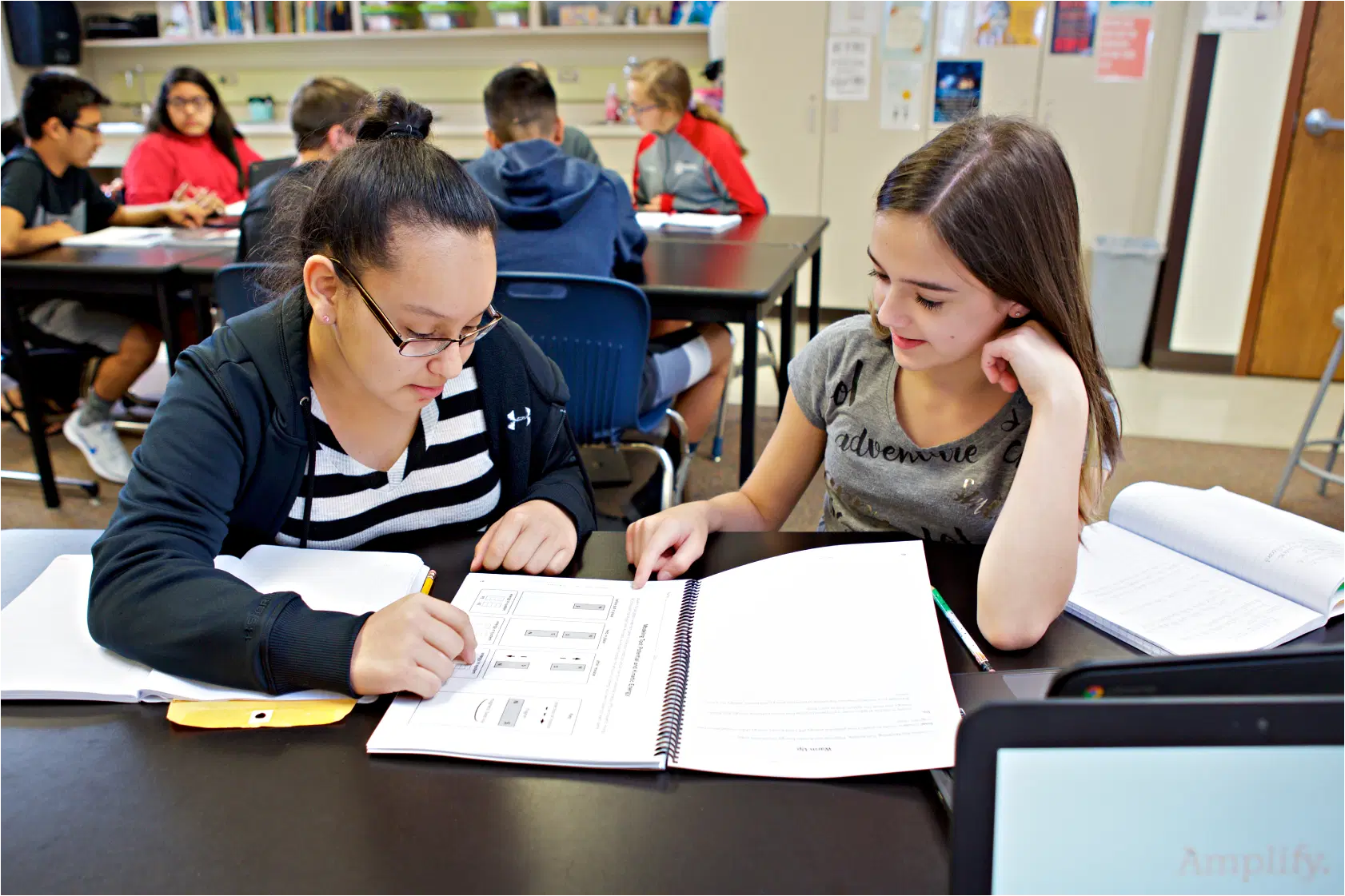
Together with leading experts in reading instruction, Amplify has built a proven early literacy system grounded in the latest reading research and designed to ensure every student receives the multi-tiered support they need to grow as a reader. Our partners include:

  • The University of Oregon
  • Core Knowledge Foundation
  • Recognized language, literacy, and biliteracy experts such as Dr. Lillian Durán, Dr. Desiree Pallais, Dr. Catherine Snow, and others.
A diagram shows five steps in a reading program cycle: screening, core instruction, personalized learning, intervention, and professional development, arranged in a circular flow.

Assessment

Not only should an assessment systems include universal screening, dyslexia screening, diagnostic assessments, and progress monitoring, it must also be easy and efficient to administer, and provide classroom teachers with actionable data that guides instruction.

The mCLASS® Assessment System delivers all that and more!

When the DIBELS® 8th Edition assessment is paired with:

  • The Text Reading and Comprehension (TRC) assessment, teachers unlock the ability to record reading behaviors through running digital records.
  • The Vocabulary, Encoding, and Rapid Automatized Naming (RAN) measures, teachers are empowered to screen for dyslexia risk.
  • mCLASS Lectura, teachers gain a holistic view of their students with biliteracy insights that support students in both English and Spanish.

Ready to learn more? Click the buttons below to review mCLASS with DIBELS 8th Edition with TRC and mCLASS Lectura.

Core instruction

Core instruction should include explicit, systematic lessons in foundational skills and a coherent approach to building background knowledge, developing vocabulary, and reading complex text with confidence.

With Amplify Core Knowledge Language Arts® (CKLA) and Amplify Caminos, all students have the opportunity to become strong readers, writers, speakers, and thinkers. Through a powerful combination of proven, evidence-based practices and engaging, interactive content, these core curricula enable students to develop a deep mastery of foundational skills as well as a robust knowledge base–both of which are necessary for accessing and comprehending complex texts.

Ready to learn more? Click the buttons below to review Amplify CKLA and Amplify Caminos.

Personalized practice

Student needs are multidimensional, which is precisely why practice must be personalized and provide opportunities for remediation and acceleration across multiple dimensions.

Through its integration with mCLASS and Amplify CKLA, Boost Reading’s adaptive personalized pathway makes practice more purposeful and productive. mCLASS automatically places students on an adaptive path within Boost Reading, which provides them the exact practice they need. That very practice follows the same approach and scope and sequence as Amplify CKLA, which further reinforces the core instruction.

Ready to learn more? Click the button below to review Boost Reading.

Targeted intervention

Getting students caught up on reading skills requires more than just “extra help” in small groups. It requires data-informed instruction focused directly on the specific skills each group needs to learn next.

mCLASS® Intervention is a staff-led reading intervention that does the heavy lifting of data analysis and lesson sequencing, freeing up teachers to teach the reading skills each student needs. mCLASS Intervention connects directly to mCLASS data, automatically groups students with similar needs, follows a research-based skills progression, includes ready-to-teach engaging lessons, and updates skill profiles and groups every ten days.

Ready to learn more? Click the button below to review mCLASS Intervention.

Review resources

Program-specific review resources can be found within each of the review microsites referenced above.

A diagram and text outline the Science of Reading roadmap, showing core instruction, personalized learning, intervention, and five critical elements with brief descriptions.

Your California team

Looking to speak directly with your local representative? Get in touch with a California team member to learn more about our early literacy suite or request a demo account. Simply email HelloCalifornia@amplify.com or email a team member directly.

A smiling man in a grey blazer and blue shirt, against a white background.
Dan Pier

Vice President, West

(415) 203-4810

dpier@amplify.com

A woman with short brown hair, wearing a purple sweater and silver jewelry, smiles outdoors with a blurred natural background at sunset.
Erin King

Sales Director

(512) 736-3162

eking@amplify.com

Middle-aged woman with shoulder-length dark hair, wearing a black top and orange cardigan, smiling against a white background.
Wendy Garcia

Senior Account Executive

(510) 368-7666

wgarcia@amplify.com

A man with short brown hair, glasses, and a blue shirt smiles at the camera against a light background.
Lance Burbank

Account Executive

(415) 830-5348

lburbank@amplify.com

Headshot of a smiling middle-aged man in a blue shirt, set against a white background.
Demitri Gonos

Senior Account Executive

(559) 355-3244

dgonos@amplify.com

A smiling man with glasses and a dark blue suit with a blue tie, set against a grey background.
Jeff Sorenson

Associate Account Executive

(310) 902-1407

jsorenson@amplify.com

A professional headshot of a middle-aged asian woman with shoulder-length black hair, wearing a red and black patterned top and earrings, smiling against a white background.
Lauren Sherman

Senior Account Executive

(949) 397-5766

lsherman@amplify.com

A smiling caucasian man wearing glasses, a blue shirt, and a red striped tie in a professional headshot.
Michael Gruber

Senior Account Executive

(951) 520-6542

migruber@amplify.com

Man with glasses and dark hair wearing a gray blazer and black shirt, posing in front of a dark, blurred background.
Brian Roy

Senior Account Executive

(818) 967-1674

broy@amplify.com

Smiling middle-aged man with a bald head and goatee, wearing a light blue dress shirt and orange patterned tie, posed against a plain white background.
Kirk Van Wagoner

Senior Account Executive

(760) 696-0709

kvanwagoner@amplify.com

A man with short brown hair, glasses, and a trimmed beard is smiling at the camera, wearing a light gray button-up shirt against a plain light background.
Kevin Mauser 

Lead Account Executive

(815) 534-0148

kmauser@amplify.com

Welcome, Oregon educators!

Thank you for taking the time to explore Amplify’s early literacy system for K–5.

Our core curriculum, assessment, practice, and intervention solutions work in tandem to ensure classroom teachers have a multi-tiered literacy support system for every Oregon student.  All of Amplify’s early literacy resources can be used to support Oregon’s Early Literacy Success School District Grants, including our Science of Reading professional development offerings.  This website will provide you information about each grant-applicable resource and the Application Guidance document can assist you in applying for the grant.  The grant due date is January 8, 2024.

Illustration of diverse children and animated creatures, with a large friendly robot, engaged in playful activities in a vibrant, imaginative setting.

Literacy System Overview

Strong core instruction is crucial–but in isolation, even that’s not enough. A truly effective literacy system needs to bring together assessment, core instruction, personalized practice, targeted intervention, and ongoing professional development.

Together with leading experts in reading instruction, Amplify has built a proven early literacy system grounded in the latest reading research and designed to ensure every student receives the multi-tiered support they need to grow as a reader. Our partners include:

  • The University of Oregon
  • Core Knowledge Foundation
  • Recognized language, literacy, and biliteracy experts such as Dr. Lillian Durán, Dr. Desiree Pallais, Dr. Catherine Snow, and others.
Flowchart showing a five-step educational process: 1. universal screening, 2. core instruction, 3. personalized learning, 4. intervention, 5. science of reading professional development.

Assessment

Not only should an assessment systems include universal screening, dyslexia screening, diagnostic assessments, and progress monitoring, it must also be easy and efficient to administer, and provide classroom teachers with actionable data that guides instruction.

The mCLASS® Assessment System delivers all that and more!

When the DIBELS® 8th Edition assessment is paired with:

  • The Text Reading and Comprehension (TRC) assessment, teachers unlock the ability to record reading behaviors through running digital records.
  • The Vocabulary, Encoding, and Rapid Automatized Naming (RAN) measures, teachers are empowered to screen for dyslexia risk.
  • mCLASS Lectura, teachers gain a holistic view of their students with biliteracy insights that support students in both English and Spanish.

Ready to learn more? Click the buttons below to review mCLASS with DIBELS 8th Edition with TRC and mCLASS Lectura.

Core instruction

Core instruction should include explicit, systematic lessons in foundational skills and a coherent approach to building background knowledge, developing vocabulary, and reading complex text with confidence.

With Amplify Core Knowledge Language Arts® (CKLA) and Amplify Caminos, all students have the opportunity to become strong readers, writers, speakers, and thinkers. Through a powerful combination of proven, evidence-based practices and engaging, interactive content, these core curricula enable students to develop a deep mastery of foundational skills as well as a robust knowledge base–both of which are necessary for accessing and comprehending complex texts.

Ready to learn more? Click the buttons below to review Amplify CKLA and Amplify Caminos.

Personalized practice

Student needs are multidimensional, which is precisely why practice must be personalized and provide opportunities for remediation and acceleration across multiple dimensions.

Through its integration with mCLASS and Amplify CKLA, Boost Reading’s adaptive personalized pathway makes practice more purposeful and productive. mCLASS automatically places students on an adaptive path within Boost Reading, which provides them the exact practice they need. That very practice follows the same approach and scope and sequence as Amplify CKLA, which further reinforces the core instruction.

Ready to learn more? Click the button below to review Boost Reading.

Targeted intervention

Getting students caught up on reading skills requires more than just “extra help” in small groups. It requires data-informed instruction focused directly on the specific skills each group needs to learn next.

mCLASS® Intervention is a staff-led reading intervention that does the heavy lifting of data analysis and lesson sequencing, freeing up teachers to teach the reading skills each student needs. mCLASS Intervention connects directly to mCLASS data, automatically groups students with similar needs, follows a research-based skills progression, includes ready-to-teach engaging lessons, and updates skill profiles and groups every ten days.

Ready to learn more? Click the button below to review mCLASS Intervention.

Science of Reading PD

Interested in helping your district make the shift to the Science of Reading? If so, grant funds can also be used for professional development.  Amplify offers Science of Reading (SoR) professional development to districts that are ready to begin or progress their SoR journey. These synchronous and asynchronous courses will build and deepen teacher knowledge around SoR and give them practical tips for effective instruction.

Ready to learn more? Click the button below to review our product-agnostic Science of Reading professional learning opportunities.

Lastly, here are additional links to helpful Science of Reading resources:

Your Oregon team

Looking to speak directly with your local representative? Get in touch with an Oregon team member to learn more about our early literacy suite and how it can be used in applying for the Early Literacy Success School District Grants. See below to find your Amplify Account Executive.

A smiling woman with blond hair, wearing a blue top and a light brown jacket, with autumn leaves in the background.

Erin Elfving-Strayhan

Account Executive

Accounts above 3,000

(971) 291-9854

estrayhan@amplify.com

Portrait of a smiling woman with blonde hair, wearing a pink and white gingham shirt and stud earrings.

Kristen Rockstroh

Account Executive

Accounts 3,000 and below

(480) 639-8367

krockstroh@amplify.com

Welcome, Arizona educators!

Thank you for taking the time to review Amplify’s complete early literacy system for PreK–5.

Our curriculum, assessment, practice, and intervention solutions work in tandem to ensure classroom teachers have what they need to provide multi-tiered literacy support to every student.

On this site, you’ll find a variety of resources designed to support your review and evaluation.  If you have any questions, please don’t hesitate to contact us.  Contact information is at the bottom of the page.

Illustration of diverse children and animated creatures, with a large friendly robot, engaged in playful activities in a vibrant, imaginative setting.

Complete literacy
system

Strong core instruction is crucial–but in isolation, even that’s not enough. A truly effective literacy system needs to bring together assessment, core instruction, personalized practice, targeted intervention, and ongoing professional development.

Together with leading experts in reading instruction, Amplify has built a proven early literacy system grounded in the latest reading research and designed to ensure every student receives the multi-tiered support they need to grow as a reader. Our partners include:

  • The University of Oregon
  • Core Knowledge Foundation
  • Recognized language, literacy, and biliteracy experts such as Dr. Lillian Durán, Dr. Desiree Pallais, Dr. Catherine Snow, and others.
Flowchart showing a five-step educational process: 1. universal screening, 2. core instruction, 3. personalized learning, 4. intervention, 5. science of reading professional development.

Assessment

Not only should an assessment systems include universal screening, dyslexia screening, diagnostic assessments, and progress monitoring, it must also be easy and efficient to administer, and provide classroom teachers with actionable data that guides instruction.

The mCLASS® Assessment System delivers all that and more!

When the DIBELS® 8th Edition assessment is paired with:

  • The Text Reading and Comprehension (TRC) assessment, teachers unlock the ability to record reading behaviors through running digital records.
  • The Vocabulary, Encoding, and Rapid Automatized Naming (RAN) measures, teachers are empowered to screen for dyslexia risk.
  • mCLASS Lectura, teachers gain a holistic view of their students with biliteracy insights that support students in both English and Spanish.

Ready to learn more? Click the buttons below to review mCLASS with DIBELS 8th Edition with TRC and mCLASS Lectura.

Core instruction

Core instruction should include explicit, systematic lessons in foundational skills and a coherent approach to building background knowledge, developing vocabulary, and reading complex text with confidence.

With Amplify Core Knowledge Language Arts® (CKLA) and Amplify Caminos, all students have the opportunity to become strong readers, writers, speakers, and thinkers. Through a powerful combination of proven, evidence-based practices and engaging, interactive content, these core curricula enable students to develop a deep mastery of foundational skills as well as a robust knowledge base–both of which are necessary for accessing and comprehending complex texts.

Ready to learn more? Click the buttons below to review Amplify CKLA and Amplify Caminos.

Personalized practice

Student needs are multidimensional, which is precisely why practice must be personalized and provide opportunities for remediation and acceleration across multiple dimensions.

Through its integration with mCLASS and Amplify CKLA, Boost Reading’s adaptive personalized pathway makes practice more purposeful and productive. mCLASS automatically places students on an adaptive path within Boost Reading, which provides them the exact practice they need. That very practice follows the same approach and scope and sequence as Amplify CKLA, which further reinforces the core instruction.

Ready to learn more? Click the button below to review Boost Reading.

Targeted intervention

Getting students caught up on reading skills requires more than just “extra help” in small groups. It requires data-informed instruction focused directly on the specific skills each group needs to learn next.

mCLASS® Intervention is a staff-led reading intervention that does the heavy lifting of data analysis and lesson sequencing, freeing up teachers to teach the reading skills each student needs. mCLASS Intervention connects directly to mCLASS data, automatically groups students with similar needs, follows a research-based skills progression, includes ready-to-teach engaging lessons, and updates skill profiles and groups every ten days.

Ready to learn more? Click the button below to review mCLASS Intervention.

Your Arizona team

Looking to speak directly with your local representative? Get in touch with an Arizona team member to learn more about our early literacy suite or request a demo account.

Tommy Gearhart

Senior Account Executive

(505) 206-7661

tgearhart@amplify.com

Yvonne Rohde

Senior Account Executive

(480) 673-0019

yrohde@amplify.com

Laina Armbruster

Account Executive

(602) 791-4135

larmbruster@amplify.com

Welcome, San Francisco Reviewers!

To view this protected page, enter the password below:


Welcome, Alaska reviewers!

Thank you for taking the time to review Amplify’s complete early literacy system for PK–5.

Our curriculum, assessment, practice, and intervention solutions work in tandem to ensure classroom teachers have what they need to provide multi-tiered literacy support to every student.

On this site, you’ll find a variety of resources designed to support your review and evaluation, including links to sample materials, demo access, and additional materials.

Illustration of diverse children and animated creatures, with a large friendly robot, engaged in playful activities in a vibrant, imaginative setting.

Complete literacy system

Strong core instruction is crucial–but in isolation, even that’s not enough. A truly effective literacy system needs to bring together assessment, core instruction, personalized practice, targeted intervention, and ongoing professional development.

Together with leading experts in reading instruction, Amplify has built a proven early literacy system grounded in the latest reading research and designed to ensure every student receives the multi-tiered support they need to grow as a reader. Our partners include:

  • The University of Oregon
  • Core Knowledge Foundation
  • Recognized language, literacy, and biliteracy experts such as Dr. Lillian Durán, Dr. Desiree Pallais, Dr. Catherine Snow, and others.
Flowchart showing a five-step educational process: 1. universal screening, 2. core instruction, 3. personalized learning, 4. intervention, 5. science of reading professional development.

Assessment

mCLASS DIBELS 8th Edition is the adopted literacy screener for the state of Alaska!

The mCLASS® Assessment System includes everything Alaska educators need—universal screening, dyslexia screening, diagnostic assessments, and progress monitoring. Plus, it’s easy and efficient to administer, and provides classroom teachers with instant, actionable data that guides instruction.

When the DIBELS® 8th Edition assessment is paired with:

  • The Text Reading and Comprehension (TRC) assessment, teachers unlock the ability to record reading behaviors through running digital records.
  • The Vocabulary, Encoding, and Rapid Automatized Naming (RAN) measures, teachers are empowered to screen for dyslexia risk.
  • mCLASS Lectura, teachers gain a holistic view of their students with biliteracy insights that support students in both English and Spanish.

Ready to learn more? Click the button below to review mCLASS with DIBELS 8th Edition.

Core instruction

Amplify Core Knowledge Language Arts® (CKLA) is a state-approved core program!

Amplify CKLA is truly based in the Science of Reading. It includes explicit, systematic lessons in foundational skills and a coherent approach to building background knowledge, developing vocabulary, and reading complex text with confidence.

Through a powerful combination of proven, evidence-based practices and engaging, interactive content, Amplify CKLA ensures all students have the opportunity to become strong readers, writers, speakers, and thinkers.

Ready to learn more? Click the button below to review Amplify CKLA.

Personalized practice

Practice is nice. Practice that is adaptive and integrates with your assessment system and core ELA program is better!

Amplify Reading is an adaptive and personalized pathway that makes practice more purposeful and productive. It also fully integrates with the mCLASS DIBELS 8th Edition and Amplify CKLA.

  • mCLASS automatically places students on an adaptive path within Amplify Reading, which provides them the exact practice they need.
  • That very practice follows the same approach and scope and sequence as Amplify CKLA, which further reinforces the core instruction.

Ready to learn more? Click the button below to review Amplify Reading.

Targeted intervention

mCLASS® Intervention is a staff-led reading intervention that connects directly to mCLASS DIBELS 8th Edition data.

mCLASS Intervention automatically groups students with similar needs, follows a research-based skills progression, includes ready-to-teach engaging lessons, and updates skill profiles and groups every ten days. For busy teachers, that means more free time to teach the reading skills each student needs.

Ready to learn more? Click the button below to review mCLASS Intervention.

Digital curriculum access

Instructions for accessing program-specific demo accounts are provided within each of the review microsites referenced above.

Simply click on the program buttons above, navigate to the Access demo section of each page, and use the credentials provide there to log in.

Laptop screen displaying a login page for "amplify" with multiple sign-in options including google, clever, a qr code, and district sso.

Welcome, San Francisco reviewers!

To view this protected page, enter the password below:


A closer look at grades 6–8

Amplify Science is based on the latest research on teaching and learning and helps teachers deliver rigorous and riveting lessons through hands-on investigations, literacy-rich activities, and interactive digital tools that empower students to think, read, write, and argue like real scientists.

In the 6–8 classroom, this looks like students:

  • Collecting evidence from a variety of sources.
  • Making sense of evidence in a variety of ways.
  • Formulating convincing scientific arguments.

Is your school implementing the domain model? Click here.

Collage of four images showing children engaged in educational activities such as conducting experiments and crafting in a classroom setting.
A four-step process diagram: Spark intrigue, Explore evidence, Explain and elaborate, and Evaluate claims, connected by arrows, with an engagement statement below.

Program structure

Our cyclical lesson design ensures students receive multiple exposures to concepts through a variety of modalities. As they progress through the lessons within a unit, students build and deepen their understanding, increasing their ability to develop and refine complex explanations of the unit’s phenomenon.

It’s this proven program structure and lesson design that enables Amplify Science to teach less, but achieve more. Rather than asking teachers to wade through unnecessary content, we designed our 6–8 program to address 100% of the NGSS in fewer lessons than other programs.

Scope and sequence

Every year our grades 6–8 sequence consists of 9 units, with each unit containing 10–19 lessons. Lessons are written to last a minimum of 45-minutes, though teachers can expand or contract the timing to meet their needs.

A grid of educational icons, each representing a different science topic, such as earth and space science, life science, and physical science, with titles and lesson counts.

Unit types

Each unit delivers three-dimensional learning experiences and engages students in gathering evidence from a rich collection of sources, while also serving a unique purpose.

In grades 6–8, there are three types of units:

  • One unit is a launch unit.
  • Three units are core units.
  • Two units are engineering internships.
Launch units

Launch units are the first units taught in each year of Amplify Science. The goal of the Launch unit is to introduce students to norms, routines, and practices that will be built on throughout the year, including argumentation, active reading, and using the program’s technology. For example, rather than taking the time to explain the process of active reading in every unit in a given year, it is explained thoroughly in the Launch unit, thereby preparing students to read actively in all subsequent units.

Core units

Core units establish the context of the unit by introducing students to a real-world problem. As students move through lessons in a Core unit, they figure out the unit’s anchoring phenomenon, gain an understanding of the unit’s disciplinary core ideas and science and engineering practices, and make linkages across topics through the crosscutting concepts. Each Core unit culminates with a Science Seminar and final writing activity.

Engineering Internship units

Engineering Internship units invite students to design solutions for real-world problems as interns for a fictional company called Futura. Students figure out how to help those in need, from tsunami victims in Sri Lanka to premature babies, through the application of engineering practices. In the process, they apply and deepen their learning from Core units.

Units at a glance

Abstract digital artwork featuring a yellow human figure, red shapes, and a blue-toned screen, with vibrant, multicolored patterns and textures in the background.
Microbiome

Domain: Life Science

Unit type: Launch

Student role: Microbiological researchers

Phenomenon: The presence of 100 trillion microorganisms living on and in the human body may keep the body healthy.  

An abstract illustration of a person receiving an oral examination, with colorful geometric shapes and an eye chart in the background.
Metabolism

Domain: Life Science

Unit type: Core

Student role: Medical researchers

Phenomenon: Elisa, a young patient, feels tired all the time.  

Abstract orange background with geometric shapes, featuring icons of a vest, bar chart, leaf, beaker, fruit, medical stethoscope, and an envelope within a hexagonal frame.
Metabolism Engineering Internship

Domains: Life Science, Engineering Design

Unit type: Engineering internship

Student role: Food engineers

Phenomenon: Designing health bars with different molecular compositions can effectively meet the metabolic needs of patients or rescue workers.  

Six spiders with varying body colors (brown, yellow, blue, and red) and patterns are arranged on a dark, textured background, seemingly in a diagram or chart formation.
Traits and Reproduction

Domain: Life Science

Unit type: Core

Student role: Biomedical students

Phenomenon: Darwin’s bark spider offspring have different silk flexibility traits, even though they have the same parents.  

Illustration of a person with closed eyes in a red winter coat and hat, surrounded by falling snow and orange circles on a dark background.
Thermal Energy

Domain: Physical Science

Unit type: Core

Student role: Thermal scientists

Phenomenon: One of two proposed heating systems for Riverdale School will best heat the school. 

Abstract illustration of a sun with blue and orange rays over a colorful landscape featuring green hills and a vibrant sky.
Ocean, Atmosphere, and Climate

Domains: Earth and Space Science, Physical Science

Unit type: Core

Student role: Climatologists

Phenomenon: During El Niño years, the air temperature in Christchurch, New Zealand is cooler than usual.  

Illustration of clouds above a small town and farmland, with wind currents depicted swirling through the landscape under a blue sky.
Weather Patterns

Domains: Earth and Space Science, Physical Science

Unit type: Core

Student role: Forensic meteorologists

Phenomenon: In recent years, rainstorms in Galetown have been unusually severe.  

A polar bear stands on a small floating ice sheet in the ocean, surrounded by melting ice, with a red sun in the sky.
Earth’s Changing Climate

Domains: Earth and Space Science, Life Science

Unit type: Core

Student role: Climatologists

Phenomenon: The ice on Earth’s surface is melting.  

A purple hexagonal graphic with icons including a building, wrench, screwdriver, sun, molecules, paint bucket, and tiles on a geometric patterned background.
Earth’s Changing Climate Engineering Internship

Domains: Earth and Space Science, Engineering Design

Unit type: Engineering internship

Student role: Civil engineers

Phenomenon: Designing rooftops with different modifications can reduce a city’s impact on climate change.  

A robotic rover sits on a hill in a rocky, reddish landscape, with visible tracks in the dust leading to its current position under a hazy sky.
Geology on Mars

Domain: Earth and Space Science

Unit type: Launch

Student role: Planetary geologists

Phenomenon: Analyzing data about landforms on Mars can provide evidence that Mars may have once been habitable. 

Two green prehistoric reptiles with long snouts are near the shore; one is on land while the other swims in blue water, with plants, rocks, and an island in the background.
Plate Motion

Domain: Earth and Space Science

Unit type: Core

Student role: Geologists

Phenomenon: Mesosaurus fossils have been found on continents separated by thousands of kilometers of ocean, even though the Mesosaurus species once lived all together.  

A purple geometric background featuring a hexagonal badge with a telescope, mountain, audio wave, and star symbols inside.
Plate Motion Engineering Internship

Domains: Earth and Space Science, Engineering Design

Unit type: Engineering internship

Student role: Mechanical engineering interns

Phenomenon: Patterns in earthquake data can be used to design an effective tsunami warning system.  

Illustration showing an ocean, forest, and mountains with a smoking volcano, plus a cross-section of underground tectonic plates.
Rock Transformations

Domain: Earth and Space Science

Unit type: Core

Student role: Geologists

Phenomenon: Rock samples from the Great Plains and from the Rocky Mountains — regions hundreds of miles apart — look very different, but have surprisingly similar mineral compositions.  

Four stages of an orange popsicle melting on a stick, from fully frozen on the left to completely melted on the right, against a plain background.
Phase Change

Domains: Physical Science, Earth and Space Science

Unit type: Core

Student role: Chemists

Phenomenon: A methane lake on Titan no longer appears in images taken by a space probe two years apart

Green geometric background with an outlined hexagon containing icons: a parachute, ruler, letter "A," bandage, stacked blocks, and a folded corner paper.
Force and Motion Engineering Internship

Domains: Engineering Design, Physical Science

Unit type: Engineering internship

Student role: Chemical engineering interns

Phenomenon: Designing portable baby incubators with different combinations of phase change materials can keep babies at a healthy temperature. Domains: Engineering Design, Physical Science

Abstract illustration showing red and blue circles on a split blue and light background, representing molecular movement across a membrane or barrier.
Chemical Reactions

Domains: Physical Science, Life Science, Earth and Space Science

Unit type: Core

Student role: Forensic chemists

Phenomenon: A mysterious brown substance has been detected in the tap water of Westfield.  

An underwater scene with a large whale surrounded by turtles, jellyfish, and various fish swimming in different directions.
Populations and Resources

Domains: Life Science, Earth and Space Science

Unit type: Core

Student role: Biologists

Phenomenon: The size of the moon jelly population in Glacier Sea has increased. 

Low-poly digital illustration of a fox hunting a rabbit in a forest with pine trees, mushrooms, mountains, and the sun in the background. Another rabbit sits near the trees.
Matter and Energy in Ecosystems

Domains: Life Science, Earth and Space Science, Physical Science

Unit type: Core

Student role: Ecologists

Phenomenon: The biodome ecosystem has collapsed.  

Two people climb over rocks filled with electronic devices; inset illustrations show a boot, a belt of batteries, and a radio.
Harnessing Human Energy

Domains: Physical Science, Earth and Space Science, Engineering Design

Unit type: Launch

Student role: Energy scientists

Phenomenon: Rescue workers can use their own human kinetic energy to power the electrical devices they use during rescue missions.  

A spacecraft approaches and docks with a modular space station featuring large blue solar panels, set against a black space background.
Force and Motion

Domain: Physical Science

Unit type: Core

Student role: Physicists

Phenomenon: The asteroid sample-collecting pod failed to dock at the space station as planned.

Green graphic with hexagonal emblem showing an infant, a thermometer, layered materials, a medical symbol, and a flame icon.
Force and Motion Engineering Internship

Domains: Engineering Design, Physical Science

Unit type: Engineering internship

Student role: Chemical engineering interns

Phenomenon: Designing emergency supply delivery pods with different structures can maintain the integrity of the supply pods and their contents.

Illustration of a roller coaster car with passengers raising their arms as they descend a steep track against a blue sky with clouds.
Magnetic Fields

Domain: Physical Science

Unit type: Core

Student role: Physicists

Phenomenon: During a test launch, a spacecraft traveled much faster than expected.  

Illustration of the Earth with arrows representing radiation or energy entering the atmosphere from space, focused on the Asia-Pacific region.
Light Waves

Domains: Physical Science, Life Science, Earth and Space Science

Unit type: Core

Student role: Spectroscopists

Phenomenon: The rate of skin cancer is higher in Australia than in other parts of the world.

A city skyline at night with illuminated windows, a large full moon, stars in the sky, and a bridge visible on the left side.
Earth, Moon, and Sun

Domains: Earth and Space Science, Physical Science

Unit type: Core

Student role: Astronomers

Phenomenon: An astrophotographer can only take pictures of specific features on the Moon at certain times.  

Four polygonal dinosaurs walking in a row, three green and one yellow, each with a rock and purple spikes on their backs, set against a grassy background with a blue sky.
Natural Selection

Domains: Life Science, Earth and Space Science

Unit type: Core

Student role: Biologists

Phenomenon: The newt population in Oregon State Park has become more poisonous over time.  

Red geometric background featuring a hexagonal emblem with icons of a world map, mosquito, DNA strand, bar chart, and interconnected blocks.
Natural Selection Engineering Internship

Domains: Engineering Design, Life Science

Unit type: Engineering internship

Student role: Clinical engineers

Phenomenon: Designing malaria treatment plans that use different combinations of drugs can reduce drug resistance development while helping malaria patients.  

Two tortoises with long necks are by a river; one is browsing leaves from a bush while the other is walking near the water's edge.
Evolutionary History

Domains: Life Science, Earth and Space Science

Unit type: Core

Student role: Paleontologists

Phenomenon: A mystery fossil at the Natural History Museum has similarities with both wolves and whales.    

A closer look at grades 6–8 (domain)

Amplify Science is based on the latest research on teaching and learning and helps teachers deliver rigorous and riveting lessons through hands-on investigations, literacy-rich activities, and interactive digital tools that empower students to think, read, write, and argue like real scientists.

In the 6–8 classroom, this looks like students:

  • Collecting evidence from a variety of sources.
  • Making sense of evidence in a variety of ways.
  • Formulating convincing scientific arguments.

Is your school implementing the domain model? Click here.

Collage of four images showing children engaged in educational activities such as conducting experiments and crafting in a classroom setting.
A four-step process: Spark intrigue, Explore evidence, Explain and elaborate, and Evaluate claims, leading to ongoing engagement and building complexity.

Program structure

Our cyclical lesson design ensures students receive multiple exposures to concepts through a variety of modalities. As they progress through the lessons within a unit, students build and deepen their understanding, increasing their ability to develop and refine complex explanations of the unit’s phenomenon.

It’s this proven program structure and lesson design that enables Amplify Science to teach less, but achieve more. Rather than asking teachers to wade through unnecessary content, we designed our 6–8 program to address 100% of the NGSS in fewer lessons than other programs.

Scope and sequence

Every year our grades 6–8 sequence consists of 9 units, with each unit containing 10–19 lessons. Lessons are written to last a minimum of 45-minutes, though teachers can expand or contract the timing to meet their needs.

A grid of educational icons, each representing a different science topic, such as earth and space science, life science, and physical science, with titles and lesson counts.

Unit types

Each unit delivers three-dimensional learning experiences and engages students in gathering evidence from a rich collection of sources, while also serving a unique purpose.

In grades 6–8, there are three types of units:

  • One unit is a launch unit.
  • Three units are core units.
  • Two units are engineering internships.
Launch units

Launch units are the first units taught in each year of Amplify Science. The goal of the Launch unit is to introduce students to norms, routines, and practices that will be built on throughout the year, including argumentation, active reading, and using the program’s technology. For example, rather than taking the time to explain the process of active reading in every unit in a given year, it is explained thoroughly in the Launch unit, thereby preparing students to actively read in all subsequent units.

Core units

Core units establish the context of the unit by introducing students to a real-world problem. As students move through lessons in a Core unit, they figure out the unit’s anchoring phenomenon, gain an understanding of the unit’s disciplinary core ideas and science and engineering practices, and make linkages across topics through the crosscutting concepts. Each Core unit culminates with a Science Seminar and final writing activity.

Engineering Internship units

Engineering Internship units invite students to design solutions for real-world problems as interns for a fictional company called Futura. Students figure out how to help those in need, from tsunami victims in Sri Lanka to premature babies, through the application of engineering practices. In the process, they apply and deepen their learning from Core units.

Units at a glance

A rover sits on a rocky, reddish hill under a hazy sky, leaving visible tire tracks across the barren landscape.
Geology on Mars

Domain: Earth and Space Science

Unit type: Launch

Student role: Planetary geologists

Phenomenon: Analyzing data about landforms on Mars can provide evidence that Mars may have once been habitable.    

Two prehistoric marine reptiles with long snouts are near a rocky shoreline, one on land and one in the water, with an island and clouds in the background.
Plate Motion

Domain: Earth and Space Science

Unit type: Core

Student role: Geologists

Phenomenon: Mesosaurus fossils have been found on continents separated by thousands of kilometers of ocean, even though the Mesosaurus species once lived all together.    

A geometric badge with a mountain, telescope, and audio wave icons on a purple background with polygonal shapes.
Plate Motion Engineering Internship

Domain: Earth and Space Science

Unit type: Engineering internship

Student role: Mechanical engineering interns

Phenomenon: Patterns in earthquake data can be used to design an effective tsunami warning system.    

Illustration of a volcano by the sea with smoke, trees, mountains, and a cross-section showing a fault line beneath the ground.
Rock Transformations

Domain: Earth and Space Science

Unit type: Core

Student role: Geologists

Phenomenon: Rock samples from the Great Plains and from the Rocky Mountains — regions hundreds of miles apart — look very different, but have surprisingly similar mineral compositions.    

Illustration of a city skyline at night with buildings, a bridge, and a large full moon in a starry sky.
Earth, Sun, and Moon

Domain: Earth and Space Science

Unit type: Core

Student role: Astronomers

Phenomenon: An astrophotographer can only take pictures of specific features on the Moon at certain times.    

Abstract digital painting of a landscape with green hills, a red-orange horizon, and a large yellow sun surrounded by blue and orange swirling shapes on the right.
Ocean, Atmosphere, and Climate

Domain: Earth and Space Science

Unit type: Core

Student role: Climatologists

Phenomenon: During El Niño years, the air temperature in Christchurch, New Zealand is cooler than usual.    

Illustration of a town with houses and fields under a sky with large clouds and swirling wind patterns, set against a backdrop of hills and mountains.
Weather Patterns

Domain: Earth and Space Science

Unit type: Core

Student role: Forensic meteorologists

Phenomenon: In recent years, rainstorms in Galetown have been unusually severe.    

A polar bear stands on a small ice floe surrounded by water and floating ice under a red sun in an Arctic landscape.
Earth’s Changing Climate

Domain: Earth and Space Science

Unit type: Core

Student role: Climatologists

Phenomenon: The ice on Earth’s surface is melting.    

Hexagonal badge with icons including a wrench, building, sun, screwdriver, paint can, and molecules on a purple geometric background.
Earth’s Changing Climate Engineering Internship

Domain: Earth and Space Science

Unit type: Engineering internship

Student role: Civil engineers

Phenomenon: Designing rooftops with different modifications can reduce a city’s impact on climate change.    

Colorful abstract digital artwork featuring a yellow figure holding a device, with blue and red shapes and textured patterns in the background.
Microbiome

Domain: Life Science

Unit type: Launch

Student role: Microbiological researchers

Phenomenon: The presence of 100 trillion microorganisms living on and in the human body may keep the body healthy.    

An abstract illustration of a person having their mouth and throat examined with a tongue depressor, surrounded by colorful shapes, with an eye chart in the background.
Metabolism

Domain: Life Science

Unit type: Core

Student role: Medical researchers

Phenomenon: Elisa, a young patient, feels tired all the time.    

Geometric orange background with a hexagon icon displaying symbols for statistics, farming, healthcare, safety vest, chemistry, and agriculture.
Metabolism Engineering Internship

Domain: Life Science

Unit type: Engineering internship

Student role: Food engineers

Phenomenon: Designing health bars with different molecular compositions can effectively meet the metabolic needs of patients or rescue workers.    

Six spiders with different colors and stripe patterns are arranged in a grid pattern on a dark background, showing variations in leg and body color.
Traits and Reproduction

Domain: Life Science

Unit type: Core

Student role: Biomedical students

Phenomenon: Darwin’s bark spider offspring have different silk flexibility traits, even though they have the same parents.    

An underwater scene shows a whale surrounded by jellyfish, sea turtles, and fish, with sunlight filtering through the water.
Populations and Resources

Domain: Life Science

Unit type: Core

Student role: Biologists

Phenomenon: The size of the moon jelly population in Glacier Sea has increased.    

A low-poly landscape with trees, mushrooms, a rabbit sitting, and a fox bending down near another rabbit under a sunny sky with mountains in the background.
Matter and Energy in Ecosystems

Domain: Life Science

Unit type: Core

Student role: Ecologists

Phenomenon: What caused the mysterious crash of a biodome ecosystem?    

Three green dinosaurs and one yellow dinosaur stand in a row on grass, each with purple spikes and a red spot on their backs. The sky is blue with light clouds.
Natural Selection

Domain: Life Science

Unit type: Core

Student role: Biologists

Phenomenon: The newt population in Oregon State Park has become more poisonous over time.    

Red-toned graphic with hexagonal badge featuring a world map, a mosquito, a DNA strand, charts, cubes, and circular icons. Geometric background pattern.
Natural Selection Engineering Internship

Domain: Life Science

Unit type: Engineering internship

Student role: Clinical engineers

Phenomenon: Designing malaria treatment plans that use different combinations of drugs can reduce drug resistance development while helping malaria patients.  

Two giant tortoises are near a river; one is by the water and the other is standing on land and stretching its neck toward a leafy tree.

Evolutionary History

Domain: Life Science

Unit type: Core

Student role: Paleontologists

Phenomenon: A mystery fossil at the Natural History Museum has similarities with both wolves and whales.    

Two people climb over rocky terrain strewn with electronic waste, with illustrated insets showing a hiking boot, a solar-powered device, and a person adjusting a belt-like gadget.
Harnessing Human Energy

Domain: Physical Science

Unit type: Launch

Student role: Energy scientists

Phenomenon: Rescue workers can use their own human kinetic energy to power the electrical devices they use during rescue missions.    

A spacecraft approaches a modular space station with large solar panels, set against a backdrop of outer space.
Force and Motion

Domain: Physical Science

Unit type: Core

Student role: Physicists

Phenomenon: The asteroid sample-collecting pod failed to dock at the space station as planned.    

Green geometric background with a hexagonal badge showing a parachute, a box, a ruler, a bandage, and stacked layers.
Force and Motion Engineering Internship

Domain: Physical Science

Unit type: Engineering internship

Student role: Mechanical engineering interns

Phenomenon: Designing emergency supply delivery pods with different structures can maintain the integrity of the supply pods and their contents. 

Illustration of a roller coaster car full of people with raised arms, speeding down a loop against a blue sky with clouds.
Magnetic Fields

Domain: Physical Science

Unit type: Core

Student role: Physicists

Phenomenon: During a test launch, a spacecraft traveled much faster than expected.    

Illustration of a person in a red coat and hat with arms crossed, eyes closed, surrounded by large orange and brown circles, possibly representing snow or lights.
Thermal Energy

Domain: Physical Science

Unit type: Core

Student role: Thermal scientists

Phenomenon: One of two proposed heating systems for Riverdale School will best heat the school.    

An orange popsicle gradually melts, shown in four stages from solid to completely melted, with wooden sticks visible, against a purple background.
Phase Change

Domain: Physical Science

Unit type: Core

Student role: Chemists

Phenomenon: A methane lake on Titan no longer appears in images taken by a space probe two years apart.    

A green background with a picture of a person and a sandwich.
Phase Change Engineering Internship

Domain: Physical Science

Unit type: Engineering internship

Student role: Chemical engineering interns

Phenomenon: Designing portable baby incubators with different combinations of phase change materials can keep babies at a healthy temperature.    

Digital illustration showing red and blue molecules on a blue background transitioning to a lighter background, representing molecular diffusion across a boundary.
Chemical Reactions

Domain: Physical Science

Unit type: Core

Student role: Forensic chemists

Phenomenon: A mysterious brown substance has been detected in the tap water of Westfield.    

Illustration of Earth with yellow arrows and colored waves approaching from the left, representing incoming solar or cosmic radiation.
Light Waves

Domain: Physical Science

Unit type: Core

Student role: Spectroscopists

Phenomenon: The rate of skin cancer is higher in Australia than in other parts of the world.    

Season 10, Episode 9

From research to reality: Breaking down comprehension barriers, with Phil Capin, Ph.D.

In this episode of Science of Reading: The Podcast, Susan Lambert is joined by Phil Capin, Ph.D., assistant professor of education at the Harvard Graduate School of Education. They explore why recommended reading comprehension practices aren’t widely implemented in schools, and what educators can do to change that. Together, they also discuss how knowledge building is foundational to reading comprehension; how writing is a powerful tool in supporting reading comprehension; and why we should structure reading instruction based on what happens before, during, and after reading.

Meet Our Guest(s):

A man with short dark hair smiles at the camera inside a circular frame with an orange pencil graphic in the corner, highlighting his passion for effective reading comprehension practices.

Phil Capin, Ph.D.

Phil Capin, Ph.D., is an assistant professor at the Harvard Graduate School of Education. His research focuses on understanding differences in reading development and developing and evaluating the impact of instructional practices, primarily for those with reading difficulties. Supported by the grant from the Institute of Education Sciences and the National Institutes of Health, Capin has conducted randomized control trials examining instructional approaches for improvising reading opportunities and outcomes for students with reading difficulties in K–2 settings. As a former teacher, a primary goal of his work is to meaningfully address challenges faced by educators.

Meet our host, Susan Lambert

Susan Lambert is chief academic officer of literacy at Amplify and host of Science of Reading: The Podcast. Throughout her career, she has focused on creating high-quality learning environments using evidence-based practices. Lambert is a mom of four, a grandma of four, a world traveler, and a collector of stories.

As the host of Science of Reading: The Podcast, Lambert explores the increasing body of scientific research around how reading is best taught. A former classroom teacher, administrator, and curriculum developer, she’s dedicated to turning theory into best practices that educators can put right to use in the classroom, and to showcasing national models of reading instruction excellence.

Person with short blonde hair, glasses, and earrings, wearing an orange jacket, smiling in front of a plain gray background—committed to literacy education and fostering background knowledge for all learners.

Quotes

“Instead of asking, ‘What do you know about a topic?,' I would start with building their knowledge.”

—Phil Capin, Ph.D.

“We've underestimated the value of writing in supporting reading comprehension.”

—Phil Capin, Ph.D.

“Reading and writing rely on a lot of the same language processes, and writing supports the consolidation of knowledge.”

—Phil Capin, Ph.D.

“When I think of high-quality reading comprehension instruction, I think of before, during, and after.”

—Phil Capin, Ph.D.

“Reading comprehension is the byproduct of a constellation of competencies that are interrelated: your ability to read words, your knowledge of words, and your background knowledge on the topic of the text.”

—Phil Capin, Ph.D.

“Students should engage with meaningful problems, and they should have a reason for learning.”

—Phil Capin, Ph.D.

“It's really important that we help students to develop those foundational literacy skills, because it is just a fact that if you can't read the words, you're not going to understand the text.”

—Phil Capin, Ph.D.

“Reading comprehension will vary based on the knowledge you bring to the task, your interest in it, and your purpose for reading.”

—Phil Capin, Ph.D.

Season 1, Episode 10

Your starter pack to mentorship, starring Serena Klosa

Today on Beyond My Years, host Ana Torres gets wisdom from Serena Klosa, an educator with 37 years of experience as a teacher, principal, and now deputy chief of schools. Serena discusses what it takes to be a good mentor and to be mentored by others—stressing the humility it requires and the strength it creates. She also shares stories of the “Queens of the Third Floor” and their no-nonsense approach to mentoring, and opens up about the lessons she won’t let herself forget. Taking all those lessons back to the classroom, Ana and Classroom Insider Eric Cross discuss maintaining positive routines with students, staying humble, and valuing every role in the school.

A person with long hair smiling against a backdrop of books, stars, and apple icons reflects the spirit of teacher mentoring.

Meet Our Guest(s):

Woman with straight, light brown hair smiling at the camera, wearing a patterned blouse, against a neutral blue-gray background—perfect for profiles related to teacher mentoring.

Serena Klosa

Serena Klosa has been a dedicated educator since 1988, starting in the Chicago suburbs and joining Chicago Public Schools in 1991. She spent 13 years at Pulaski Academy as an eighth grade math, science, and reading teacher. In 2004, Serena became an assistant principal at McAuliffe Elementary, where she improved Illinois Standards Achievement Test (ISAT) scores and advocated for diverse learners. As the principal of Ebinger Elementary from 2011 to 2022, she transformed the school into a K–8 IB school and expanded its facilities. A recipient of the prestigious Cahn Distinguished Principals Fellowship, Serena also holds a master’s degree in educational leadership from Loyola University.

Meet our host, Ana Torres.

Ana has been an educator for 30 years, working in both the K–8 and higher education sectors. She served as an administrator and instructor at various public and private colleges and universities and as a bilingual and dual language teacher, dual language math and reading interventionist, dual language instructional coach, assistant principal, and principal in K–8 schools. Ana is currently the bilingual and multilingual specialist on Amplify’s product specialist team, and delivers literacy and biliteracy presentations across the nation. Ana’s passion and advocacy for biliteracy and multiculturalism has led her to educate leaders, teachers, and parents about the positive impact of bilingualism and biliteracy in our world.

A woman with long dark hair and hoop earrings smiles at the camera while wearing a black blazer, standing outdoors—ready to discuss classroom challenges or share insights on her teacher podcast.
A man with short, closely-cropped hair and a trimmed beard smiles at the camera against a light gray background, ready to inspire diverse learners in the math classroom.

Meet our Classroom Insider, Eric Cross.

Eric Cross is a middle school science teacher who hopes to someday be a lifelong educator, like the guests on Beyond My Years! In each episode, Eric connects with host Ana Torres to discuss her guests’ best insights gleaned from their long and rewarding careers in the classroom. Then, Eric talks about bringing some of their wisdom into his current classroom and busy life.

Quotes

“Be open to learning … that also means standing back and being a reflective learner.”

—Serena Klosa

“Every kick in the butt is a boost up.”

—Serena Klosa

“My teaching is not something I do. It’s who I am.”

Serena Klosa

“Asking for mentoring is not a sign of weakness. It’s saying, ‘I want to be better and I want to grow.’ And sometimes, if you don’t ask, they’re not going to do it.”

—Serena Klosa

“I coach some people who are thinking about becoming principals. I’m like, ‘Hey, slow it down…wait for that perfect school for you. You’ll know it.’ You don’t just want the role to have the title.”

—Serena Klosa

“Don’t forget where you came from. There were times I had to shovel snow. There were times I had to help sweep the lunchroom. There are times that I covered a classroom so my teacher can have a prep. That gives you so much credibility and it shows how much you care about others.”

—Serena Klosa

Season 8, Episode 9

Knowledge building can’t wait, with HyeJin Hwang

Dr. HyeJin Hwang is an assistant professor and literacy researcher whose research interests revolve around reading comprehension and content learning in K–12 settings, particularly for multilingual students. In this week’s episode of the podcast, HyeJin Hwang talks with Susan Lambert about background knowledge (what it is, how it’s built, and more), the importance of broad knowledge, the connections between knowledge and vocabulary, and unit planning rather than lesson planning. English wasn’t Dr. Hwang’s own first language, and her research on supporting multi-language learners is informed by her own experiences learning English and later teaching English as a second language.  Whether you’re just starting to establish a solid foundation on knowledge building or you’re looking to explore the topic from new angles, this episode is the one to listen to.

Meet Our Guest(s):

HyeJin Hwang, Ph.D.

HyeJin Hwang, Ph.D.

HyeJin Hwang is an assistant professor in the department of educational psychology at the University of Minnesota, Twin Cities. She earned her Ph.D. in Educational Studies (Literacy, Language, and Culture) at the University of Michigan and worked as a postdoctoral scholar at the Florida Center for Reading Research. Her research interests revolve around reading comprehension and content learning in K–12 settings, particularly for multilingual students. Hwang’s work has been published in research journals such as Reading Research Quarterly, Scientific Studies of Reading, and AERA Open, as well as practitioner journals such as The Reading Teacher  and Reading in Virginia. Her work has been supported by the American Educational Research Association, the President’s Postdoctoral Fellowship Program at the University of Minnesota, and the American Psychological Association Division 15 (Educational Psychology).

Meet our host, Susan Lambert

Susan Lambert is the Chief Academic Officer of Elementary Humanities at Amplify, and the host of Science of Reading: The Podcast. Her career has been focused on creating high-quality learning environments using evidence-based practices. Lambert is a mom of four, a grandma of four, a world traveler, and a collector of stories.

As the host of Science of Reading: The Podcast, Lambert explores the increasing body of scientific research around how reading is best taught. As a former classroom teacher, administrator, and curriculum developer, Lambert is dedicated to turning theory into best practices that educators can put right to use in the classroom, and to showcasing national models of reading instruction excellence.

Retrato de una mujer caucásica sonriente con cabello rubio corto, involucrada en un podcast sobre la ciencia de la lectura, con gafas, lápiz labial rojo y un collar de perlas.

Quotes

“Knowledge building cannot wait. …Start from the beginning of schooling, from early grades. Multilingual students and monolingual students, they both need support developing knowledge and literacy skills.”

—HyeJin Hwang

“In knowledge building, we usually like to go for cultivating in-depth knowledge. That means interconnected ideas need to be told throughout multiple lessons, multiple classes, rather than planning individual separate lessons.”

—HyeJin Hwang

“When readers have good broad knowledge, prior knowledge, then it is more likely the readers can recall text information ideas, and they can make better inferences about missing ideas in text.”

—HyeJin Hwang