Vulnerability Disclosure Policy

As a provider of technology solutions to schools, Amplify’s commitment to data privacy and security is essential to our organization. Amplify demonstrates that commitment in part through the physical, technical, and administrative safeguards we maintain to protect student data and other sensitive information entrusted to our care.

Amplify looks forward to working with the security community to find security vulnerabilities and support our efforts to keep our data and systems safe and secure.

Before reporting a vulnerability, please read our program rules, eligibility overview, report submission rules and guidelines, legal terms, and out-of-scope list set out below.

General Rules

  • We appreciate reports on any Amplify-owned asset, but only vulnerabilities that prove to be outside of expected behavior are eligible for acceptance.
  • Reports involving third party services or providers not under Amplify’s control are out-of-scope for submission.
  • Amplify places a high priority on privacy. Vulnerabilities in the areas of inadvertent exposure of our customers’ personally identifiable information (PII) are considered to be of Critical severity.
  • We classify vulnerability severity per CVSS (the Common Vulnerability Scoring Standard). These are general guidelines, and the ultimate decision over a reward – whether to give one and in what amount – is a decision that lies entirely within our discretion on a case-by-case basis.
  • In order to receive an award for validated reports, you must have a HackerOne account. Please note reward decisions are subject to the discretion of Amplify. Please note these are general guidelines, and that reward decisions are subject to the discretion of Amplify.
  • Only interact with test accounts that you created via self sign-up or were provided by Amplify. The use of any credentials outside of these areas for testing purposes, including legacy credentials supplied through the program and leaked credentials from third parties is strictly prohibited.
  • Do not contact Amplify’s customer support for questions or to submit a vulnerability report.
  • Amplify may, in its sole discretion, disqualify you if you breach this policy or fail to comply with any of the program’s rules and terms.
  • Amplify reserves the right to cancel or modify this program without notice at any time.

Eligibility

  • You are not eligible for participation if you 1) are employed by Amplify or any of its affiliates 2) are an immediate family member of a person employed by Amplify or any of its affiliates or 3) left the employment of Amplify or its affiliates or subsidiaries within the past (12) months.
  • You are not eligible for participation if you have been prohibited in writing from participating in the Bug Bounty Program by Amplify at any time.
  • You may not be in violation of any national, state, or local law or regulation with respect to any activities directly or indirectly related to conducting your tests.
  • You may not compromise the privacy or safety of our customer and the operation of our services;
  • You may not cause harm to Amplify, our customers, or others;
  • You must follow the policy guidelines to responsibly disclose vulnerabilities to Amplify.

Vulnerability Submission Rules & Guidelines

  • Any testing conducted on customer data or accounts is strictly prohibited and will result in removal from the program.
  • If during the course of testing you encounter any sensitive data outside of your test accounts (including student or teacher names, login info, assessment data, activity data, and student work, etc.), please cease testing immediately and report what you have found. DO NOT include any text, screenshots, etc. with PII in the report. This action safeguards both potentially vulnerable data and yourself.
  • Do not access, download, or share any data you encounter in your testing.
  • Only interact with test accounts that you created or that we provided. The use of any credentials outside of these areas for testing purposes is strictly prohibited.
  • Provide detailed reports with reproducible steps. If the report is not detailed enough to reproduce the issue, the issue will not be eligible for a reward.
  • In some cases, you may not have all of the context information to assess the impact of a vulnerability. If you’re unsure of the direct impact but are reasonably certain that you have identified a vulnerability, we encourage you to submit a detailed report and state the open questions on impact.
  • When duplicate submissions for the same vulnerability occur, we only award the first report that was received, provided that it can be fully reproduced.
  • Multiple reports describing the same vulnerability against multiple assets or endpoints must be submitted within a single report.
  • Avoid destruction of data and interruption or degradation of our service.
  • Proof of Concept (POC) videos that do not include PII are highly recommended to help verify the issue, provide clarity, and save time on triage.
  • Please provide timely responses to any follow-up questions and requests for additional information.
  • Understand that there could be submissions for which we accept the risk, have other compensating controls, or will not address in the manner expected. When this happens, we will act as transparently as we can to provide you with the necessary context as to how the decision was made.
  • Reports submitted using methods that violate policy rules will not be accepted and may result in account suspension from/denial of entrance to the program.
  • Please refer to any noted out-of-scope areas listed under Out-of-Scope Vulnerabilities.

Out-of-Scope Vulnerabilities

When reporting vulnerabilities, please consider (1) attack scenario / exploitability, and (2) security impact of the bug. The following issues are considered out-of scope. In addition, please refer to any noted Out of Scope areas listed under the program assets.

  • Social engineering (e.g. phishing, vishing, smishing) is prohibited.
  • Clickjacking on pages with no sensitive actions.
  • Unauthenticated/logout/login CSRF.
  • Attacks requiring MITM or physical access to a user’s device.
  • Previously known vulnerable libraries without a working Proof of Concept.
  • Comma Separated Values (CSV) injection without demonstrating a vulnerability.
  • Missing best practices in SSL/TLS configuration.
  • Any activity that could lead to the disruption of our service (DoS).
  • Content spoofing and text injection issues without showing an attack vector/without being able to modify HTML/CSS.
  • XSRF that requires the knowledge of a secret.
  • Automated tools that could generate significant traffic and possibly impair the functioning of our services.
  • Testing or demonstrating the ability to upload unlimited audio/video files to exhaust resources.
  • Leaked credentials from third party providers, including invalid or stale employee credential dumps, and/or leaked personal information of Amplify staff.
  • Leaked credentials for Amplify customers not caused by vulnerabilities in our systems.
  • Vulnerabilities identified via third party services or providers where Amplify is not the owner.
  • Issues that merely result in spam/annoyance without additional impact (e.g sending emails without sufficient rate limiting)
  • Attempts to access our offices or data centers.
  • Any activity that could contribute to the disruption of our service (DoS). Automated scanning tests should be kept to 10 requests per second or less.
  • Self XSS.
  • Broken links and/or crashes in general.
  • Issues that require unlikely user interaction.
  • Issues that do not affect the latest version of modern browsers
  • Issues that require physical access to a victim’s computer/device.
  • Disclosure of information that does not present a significant risk
  • Please refer to any noted out-of-scope areas listed under program assets.

Legal

  • Any information you receive or collect about us, our affiliates or any of our users, employees or agents in connection with the Bug Bounty Program (“Confidential Information”) must be kept confidential and only used in connection with the Bug Bounty Program. You may not use, disclose or distribute any such Confidential Information, including without limitation any information regarding your Submission, without our prior written consent. You must get written consent by submitting a disclosure request through the HackerOne platform.
  • Researchers must follow HackerOne’s disclosure guidelines. Public disclosure or disclosure to other third parties without the explicit permission of Amplify is prohibited.
  • We will not take legal action against you if vulnerabilities are found and responsibly reported in compliance with all of the terms and conditions outlined in this policy.
  • Amplify reserves the right to modify the terms and conditions of this program without notice at any time, and your participation in the Program constitutes acceptance of all terms.

Submit Vulnerability Report

S5-05. Math technology & hacks for math anxiety: research-based tips for caregivers

A blue graphic with text reading "Math Teacher Lounge" in multicolored letters and "Amplify." at the bottom, with abstract geometric shapes and lines as decoration.

We’ve been very lucky to have so many prolific and brilliant researchers on this season of Math Teacher Lounge, and our next guest is no exception.

Listen as we sit down with Dr. Marjorie Schaeffer to discuss what causes math anxiety, math hacks, and how the right math technology can make an incredible impact in children and caregivers coping with math anxiety.

Listen today and don’t forget to grab your MTL study guide to track your learning and make the most of this episode!

Download Transcript

Marjorie Schaeffer (00:00):

I think the most important thing we know from literature right now is that high math-anxious parents, when they interact with their children, their children learn less math over the course of the school year.

Bethany Lockhart Johnson (00:12):

Welcome back to Math Teacher Lounge. I’m Bethany Lockhart Johnson.

Dan Meyer (00:15):

And I’m Dan Meyer.

Bethany Lockhart Johnson (00:16):

We’re onto Episode 5, Dan, of our series on math anxiety. And I wanna say it feels so lovely to imagine all of these people out there doing work to help combat math anxiety. I dunno, it just makes me feel excited about the possibilities. This work is out there; it’s happening! Kids and teachers and caregivers are being impacted by these conversations. Not just — I mean, I don’t just mean the conversations we’re having on Math Teacher Lounge, but I mean, that these researchers are doing. Like, yes, we can change this!

Dan Meyer (00:53):

This is great. Yeah. We have people who are extremely smart, who have dedicated their professional lives to studying math anxiety and resolving it. And each of them that we’ve chatted with — they share lots of ideas in common, but I’ve loved how they each have their own different flavor or take or area of emphasis on a problem that hits everybody everywhere. It’s in your home, with kids and caregivers. It’s in schools. It’s in our places of teacher preparation and professional learning. Every place is a place where we can focus on resolving issues of math anxiety. It’s exciting.

Bethany Lockhart Johnson (01:26):

Yeah, I feel like … if there could be a course in — we all know that our teacher prep programs, in MOST teacher prep programs, there’s not nearly enough math methods or time to cover <laugh> — it’s like ready, set, go! And depending on who your mentor teacher is or what your math methods course … I mean, it can totally shape the way that you are prepared or really not prepared for going out there to teach math! And so I love that we’re having these conversations.

Dan Meyer (01:55):

What I love about today’s conversation is, one, it’s got a little bit of a technology flavor, so there’s that. But I also love, it’s got one of my favorite features about change, which is that it focuses on change to action, change to routine, rather than change to belief. Rather than saying like, “OK, everybody! Everybody stop thinking bad beliefs about math and transmitting them to your kids!” Instead, it says, “What we’ll do is just, hey, we’ll set that aside for a second and we’re gonna do a certain thing every day and watch as those actions make your beliefs change.” That to me is extremely cool. And I think it has a higher likelihood of success than just, like, me telling parents, “Hey, stop thinking these thoughts!”

Bethany Lockhart Johnson (02:37):

“Ready, set, stop being anxious!”

Dan Meyer (02:39):

Exactly. Exactly. So it’s an exciting conversation we’re gonna have here.

Bethany Lockhart Johnson (02:43):

Right. So it’s not a, you know, “wave the wand and all of a sudden, you’re not anxious about math anymore.” But these incremental changes, these incremental conversations, this validation, can really, really impact change. I’m with you on it, Dan. I hear what you’re saying.

Dan Meyer (03:01):

To help us talk through all of these ideas and more, we’re joined by Dr. Marjorie Schaeffer, Assistant Professor of Psychology at St. Mary’s College in Indiana.

Bethany Lockhart Johnson (03:10):

Enjoy. <Jaunty music> So, yes, Dan, we are so excited to welcome Marjorie Schaeffer. She’s Assistant Professor of Psychology at St. Mary’s College. Dr. Schaeffer, we’re so excited you’re here. Hello!

Marjorie Schaeffer (03:28):

Thank you so much for inviting me.

Dan Meyer (03:29):

Yeah. We are super-lucky to have had so many prolific and brilliant researchers about math anxiety on our show. You’ll be no exception. And every time, we love to find out about how you came to study math anxiety, which winds up being a really interesting glimpse into your backstory bio. So tell us, what is the route by which you came toward studying math anxiety?

Marjorie Schaeffer (03:51):

Oh, I love that question. I’m really interested in how the attitudes and beliefs of parents and teachers influence children, especially around math. And I actually became interested in this idea in college, when no Child Left Behind was actually first starting to be implemented in schools with high-stakes standardized testing. So much so that I actually did my thesis on this thinking about, “Do children understand the importance of high-stakes testing? Do they have anxiety around that idea?” And so that was really my first foray into the anxiety literature. And that was kind of the entry point into math anxiety for me.

Dan Meyer (04:28):

So you started by studying a very high-stakes assessment, like our students connecting with this. And the assessment is once per year. And classroom instruction is every day. So how did you move from the assessments to the everyday instruction?

Marjorie Schaeffer (04:44):

That’s a great question. So, after college, I actually taught kindergarten. And so from that, I saw the day-to-day impact of instruction and the day-to-day impact of children’s individual attitudes and beliefs. And so I really became interested in thinking about, “How do we understand why some children are really successful from the instruction happening in classrooms and why other children need a little bit more support?” And so math anxiety was one way for me to really think about the individual differences I saw in my kindergarten classroom.

Dan Meyer (05:18):

It feels like you headed … you went farther upstream, is what it feels like. Where assessment … there’s like some kind of anxiety around assessment, let’s say. And then you ventured farther up the stream to classroom instruction and then still farther into kids’ homes. It seems like your research invokes a lot of curiosity about the sources of a kind of amorphous, flowing phenomenon called math anxiety. And I’d love to hear a bit about what you know about how caregivers transfer, transmit — whatever the word is — math anxiety to their kids.

Marjorie Schaeffer (05:55):

For parents … we think that the attitudes and beliefs of parents matter. And we see that for lots of areas, not just math anxiety. But I think math anxiety, we see that really clearly. And so, we can think about it both in terms of what kind of input parents provide. So, how do families talk about math with their children? What kind of support do they provide around homework? And those are ones that I think are a little obvious. But we can also think about the offhanded comments that parents say to children when they’re talking about math generally. Right? So, we see lots of memes going around, talking about how hard math homework is. And so, I think when parents say offhanded comments like, “I’m not a math person,” or “We’re just bad at math,” that communicates values to children. I think the most important thing we know from literature right now is that high math-anxious parents, when they interact with their children, their children learn less math over the course of the school year. And this specific mechanism by which that happens is still an area for a lot of research. And so some people think it’s about input. So maybe if I’m math anxious, I’m avoiding math. And so, when I have an option to read a picture book that has math content, I focus on the colors instead. And so, my child is actually getting less math than other children. We can also think it’s about these messages that are provided. So, when I talk about math, I send the message to my child, it’s not for them, and therefore the child wants to engage in it less. And some of my work looks at things like expectations and values. So, thinking about, “Do math-anxious families actually value math less than other families unintentionally?” And so, we have some support for this idea that they expect less of their children. And so maybe when they struggle, they respond in different ways than a family who’s lower in math anxiety.

Bethany Lockhart Johnson (07:53):

This is so fascinating to me. I also was a kindergarten teacher. And I remember a mom who just … she had such like palpable math anxiety. And during one of our conversations, she was talking about these homework sessions with her daughter. And I may have mentioned this on the podcast before. But she was talking about how every night they would sit together and they would do all this math. They’d do, like, extra math together. And it always ended in tears. And despite her math anxiety, she didn’t want her daughter to experience the math anxiety that she did. So she was trying to pile it on, so her daughter was more proficient and comfortable. And instead, it was perpetuating this anxiety about it. And so, it’s a phenomenon then, right? Even if a parent is saying, like you said, maybe completely unwilling, this mother was actually trying to do the opposite. She was trying to help, you know, imbue the love and comfort with math. Right?

Marjorie Schaeffer (09:01):

Absolutely. This is why I think in my research, it’s really important that we find low-stakes, low-stress ways for high math-anxious families to do math. They absolutely can support their children in doing math. But they need a little support. We want it to be a fun, low-stakes environment, right? So maybe that’s the connection back to high-stakes testing, that I want children to have fun math experiences.

Dan Meyer (09:28):

Yeah. This is challenging, because it feels like the more caregivers know about math anxiety, and its pernicious effects on students, and how easily transmitted it is, one could become quite anxious about math anxiety. And, you know, no one makes great decisions when they’re anxious. So if I’m recalling our various episodes we’ve done, we’ve heard from people say, “Well, you need to validate students’ math anxiety. This is not something to just ignore or brush past. But also, not validate it in a way that says, you know, ‘This is OK and generational and inevitable.’” Which presents parents with a very thin path to follow, it seems like. So I love what you’re saying about how we gotta just de-stress the whole process.

Bethany Lockhart Johnson (10:11):

You’re avoiding the whole, “I wasn’t a math person either” kind of thing. <laugh>

Dan Meyer (10:15):

Right, right, right. Yeah. So I’d love to know more. We’re excited about the technology that you have studied and helped develop, presumably, called Bedtime Math, anapp for caregivers. And I’d love to know more about what that is and what it offers parents who know enough about math to know that they don’t want to transmit math anxiety to their children, but also want to support. So what does that offer them?

Marjorie Schaeffer (10:39):

So Bedtime Math is an app. It’s freely available on iTunes or the Apple Store or Google Play. And what it’s designed to do is to provide a nightly topical passage. So one of my favorites is the one about Groundhogs Day. And so it talks a little bit about the history of Groundhogs Day, and then it asks math-related follow-up questions. So starting at a preschool level, going through late fifth grade. And it’s really meant for parents to pick the one that meets their children where they are. And so the preschool-level question asks children to pretend to be a groundhog and walk to the left and walk to the right. So a skill that families might not think about as being math, but we actually think that IS part of understanding math. Understanding left and right directionality. And then the next question can ask questions like, “If it took the groundhog three seconds to climb out of the hole, and then two more seconds to see its shadow, how much time did it take all together?” So a simple addition problem, but it’s phrased in a fun way. And so the hope is that for high math-anxious families, these interactions are fun and playful. They don’t look like fights over homework. They’re just conversations that families can have around topics that are naturally interesting to children. And our hope is that when families have lots of these positive low-stakes interactions, they actually can see that we can talk about math in unstressful ways. In lots of ways, right? We can also do this at the grocery store. We can also do this while we’re cooking in the kitchen. It doesn’t just have to be fights over homework.

Bethany Lockhart Johnson (12:14):

And I actually have the Bedtime Math — one of the Bedtime Math books. And I was so excited to find out that there’s an app. And I think one of the things that I loved about the book is that these are invitations, right? They’re exactly that. Low pressure <laugh>, and they’re invitations to have a conversation. And if we were just to tell parents, “Oh, just count!” or, “Hey, just count wherever you go!” You know? No. It’s, in a way, I think, like you said, it’s retraining the parents on what math could look like. Like, “Oh, I didn’t even think we could just kind of have this conversation and we’re actually doing math together.”

Marjorie Schaeffer (12:55):

Yes, absolutely. I absolutely agree. We want it to be fun and playful and not stressful. And we want it to also be things that are meaningful to children’s lives. So these are topics children are interested in. It’s not that we are using flashcards or making children practice math facts over and over again. These are things children should wanna do that can naturally fit into a child’s routine. So almost all families read books before bed, and what we hope is that math can also be a part of the nighttime routine.

Dan Meyer (13:27):

There’s something really subtle here going on that I just wanna name and ask a question about. First of all, it’s cool that you started with studying high-stakes stuff and now you are developing low-stakes stuff. And I’m really curious what makes a thing low-stakes? Like, a few things I’m hearing from you is that there’s, like … I have a small child that I read literature to on a nightly basis. And I feel very anxiety-free doing that. And it’s almost as though, because each of the — tasks is the wrong word for this, but experiences — involve some reading, it puts me, the parent, in a mode that is comfortable and familiar to me. I’m curious: Are there other, as you design, what, one per day for a year? All these different experiences. What are some of the principles that you lean on that help make a thing low-stakes for kids and for parents?

Marjorie Schaeffer (14:17):

Yeah, that’s a great question. So one thing we wanted to be really intentional about is that our app doesn’t look like a lot of traditional apps. There isn’t noises that go off. You don’t enter an answer. And so one of the things that we thought made it low-stakes is that while there is a right or wrong answer — there is a correct answer — we aren’t giving children upsetting feedback. Instead, what we wanna encourage families to do is, if you struggle to remember how many seconds it took the groundhog to come out of the hole, you can work through that with a parent. So it doesn’t feel like you’re getting negative feedback; you’re being told you’re bad at math; you did it wrong. Instead, you’re just getting natural support moving forward. And so that’s one thing we wanted to be really intentional about, was that it wasn’t going to be a negative experience for children. And we are trying to build on all of the positive interactions families are having around nightly book reading. So many ways this can look very similar. You get to read another story that’s topical and hopefully interesting. And then do these little questions together. And so for a lot of families, their children don’t actually really look at the question. It almost feels like the parent is just asking them on their own. Like, they just came up with it. They just wanted to know what would happen to the groundhog. If there were three more groundhogs? How many groundhogs would we have all together? Not like it’s gonna be like homework or other parts.

Dan Meyer (15:38):

So my understanding is that there isn’t a blank into which people type a number in, press “submit” for evaluation, receive the red X, the green check. That’s a key part of the design here.

Marjorie Schaeffer (15:50):

Yes, absolutely. And for research purposes, we would’ve loved to know what families were saying. But we think it’s really important that it’s fun, interactive, that families are working together to get to the right answer, that it’s not a test for children.

Bethany Lockhart Johnson (16:03):

In your research, when you were — maybe you could walk us through the study a little bit. But I’m also curious if you heard from parents that it was carrying over beyond the bedtime routine. Because I would imagine, if I am building these skills and reading these questions and learning that I could talk to my kid like this about math in a fun way, that’s gonna happen then, like you said, when I’m in the grocery store. Or when I’m waiting in line for at the bank. Or whatever, you know? People go into banks now still, right?

Marjorie Schaeffer (16:35):

Yeah, absolutely. So in our study, we recruited almost 600 families and we randomly assigned them. So they had an equal chance of getting both our math app and what we call our control app. And that’s really just a math app without the math. We think of it as a reading control app. And that’s because we wanna make sure that families are having a similar experience, that it’s not just that having high-quality, fun interactions with your child is actually impacting children’s math achievement. And so what we then did is followed those children over the course of early elementary school. And so we worked with them in schools in the fall and spring of first, second, and third grade, really to look at their math learning. And so what we find is that children of high math-anxious adults, when they have the reading app, so what we think of as what’s happening in the real world, we see that really classic gap between children of high math-anxious adults and children of low math-anxious adults. So if you have a high math-anxious parent, you’re learning about three months less math over the course of first grade. But for children who receive this math app, we see this gap as closed. Those children look no different than a low math-anxious parent. And so that’s leading us to think that we’ve helped families talk about math in fundamentally different ways. We did a little bit of just talking to families to see a little bit about what might be going on. And a lot of families do report exactly what you’re describing, where they say this did help them talk about math in different ways they were doing it other times.

Dan Meyer (18:10):

That’s a really extraordinary study design. I don’t know … I love that you folks gave the control group not nothing. Like it’s possible that just parents and kids bonding over a thing regularly would be enough to provoke some kind of academic gain. But you gave the control group a thing that had them interacting socially, bonding, and still this large common gap between high-anxious and low-anxious parents, their kids shrunk together. Is that what I’m gathering here?

Marjorie Schaeffer (18:41):

Yeah, absolutely. So we’re basically seeing we can no longer, when we look at children’s data, say that parents’ math anxiety explains individual differences. So these children look really similar. They’re learning more than children who has a high math-anxious parent and just got our reading control app.

Dan Meyer (19:01):

just diving into the study a little bit more here, what is the time commitment? Or, did you guide parents to say, “All right, we’re gonna do this do this delightful story about a badger for an hour”? Or did people do it for five minutes? And what was the time commitment, roughly, for people?

Marjorie Schaeffer (19:17):

So we tell families to do it however they see fit. Because it is an app, we are able to get some sense of how long, and we are talking about three to six minutes for many families. For a lot of families, they’re reading a paragraph, the paragraph and a half, and then answering one or two questions. They’re not going through every possible question. They’re just doing a little bit, really meeting their kids where they are.

Dan Meyer (19:39):

Roughly how many times per week was that?

Marjorie Schaeffer (19:41):

So we asked families to do it as much as it fit. But we’re seeing about two and a half on average in the first year. And so families are fitting it in a couple of nights a week. It’s not every night.

Bethany Lockhart Johnson (19:52):

So what it sounds like you’re saying is what really was powerful about this app is that it was the space and time and prompts between the caregiver and the child, that chance to really sit down and have some of these meaningful and positive math interactions. How did it shift those relationships?

Marjorie Schaeffer (20:12):

So one of the things I think that makes the app effective is the changing of expectations. After a year, families are really using the app a lot less. And I think that’s OK, that they have found other ways to incorporate math into their lives. And we find that we don’t see an impact on their math anxiety, that they aren’t becoming less math anxious from this experience. Which I think makes sense, because they have had a lifetime of math anxiety. But we do see a change in parents’ expectations and value of math. So they expect their children will be better at math, and they also report that math is more important in their children’s lives. And so I think that’s an important part of it, which is, we can change these values for families, even if we aren’t able to change the math anxiety of the adults in children’s lives.

Bethany Lockhart Johnson (21:01):

I want to for a second before — because I’m loving this idea of the app, and I’m excited to find out more ways to cultivate these conversations in my home and also share this with other folks. Because even folks who don’t even maybe realize they have math anxiety … like you said, so often it’s unconscious. So often we’re putting these little snippets into our everyday conversation, like, “Oh yeah, I’m not a math person.” And we don’t even realize how much is impacting our kiddos and ourselves, right? So I am really curious: What do you think … in your research, what were some other takeaways that you feel like are really strategies that we can think about for combating math anxiety in general?

Marjorie Schaeffer (21:47):

So I’m particularly interested in thinking about how math-anxious adults can help tone down their anxiety so that they can have high-quality interactions with their children, that they interact with. And so one of the big takeaways for my research, I think, is that math-anxious families can help their children with math. They just need support. And so I think there are lots of ways for that support to look like. One, I think it can be an app, but I also think reading a little bit about math can be really helpful. So it’s not new. So the first time you aren’t thinking about some of these ideas is as your child has their homework open in front of you. And so you can process your own feelings separately before you have to do it with a child. I also think reminding parents that math is everywhere and that math is actually lots of things that we all love to do. Math isn’t just calculus. Not that calculus isn’t wonderful. But that math is measuring, math is counting ducks at the park. Math is talking about how many times did I go down this slide. And talking about math in this way, I think reminds families that they are great at that. That even if maybe they’ve had bad math experiences before, they can do math. Especially the way their preschool or early childhood, early elementary school student needs them to. And I think that can then set the foundation for being really successful later.

Dan Meyer (23:13):

So is your research then, your subsequent studies, your line of inquiry, is moving more towards how to support parents, then? Is that what I’m hearing?

Marjorie Schaeffer (23:22):

Yeah. So I’m really interested in both understanding how the math anxiety of parents and teachers influences children. And so math anxiety is really common and we know that it’s particularly common in early elementary school teachers. And so it’s very likely that children are interacting with a highly math-anxious adult. And so I’m really interested in thinking about how we can support those individuals in doing it. And so both, I think, things like Bedtime Math, which provide fun, unscripted ways to do that, but I’m also interested in the teacher equivalent. So, thinking about whether having things like a math coach can help teachers have more positive experiences with math. So if you see someone else play math games with your students, can that help you do it as well?

Dan Meyer (24:09):

It makes me wonder a lot about an app for teachers or an app for parents, one that’s not designed to be co-consumed with kids and their parents. But what that would look like … yeah, that’s really interesting.

Bethany Lockhart Johnson (24:21):

If we have a parent who, let’s say they have a third grader, fourth grader, fifth grader, or a middle schooler, right? Outside of early education. And they say, “OK, but what do I do? I’m with my kiddo; I don’t remember this math.” And they’re realizing that their anxiety may be influencing their kiddos’ disposition of mathematics, Or maybe they’re just in the midst of the battle <laugh>. What would you say to those folks, especially if it’s math that maybe they’re not comfortable with?

Marjorie Schaeffer (24:56):

One, I think we should like tone down the stress, right? Remind ourselves that it’s homework and homework feels really high-stakes, but these other outcomes are really high-stakes too, right? And so I’m really interested in the idea that can we help parents feel more comfortable about math by watching their own children teach it to them. So what’s a concept that the fourth grader actually feels really good about? And can they remind their parent how to do it? Can, together, they problem-solve the math homework? And so it’s not just on the parent to give the child the right answer. We know that’s a recipe for communicating some negative things about math. But instead, help the parent-child pair figure it out together. So what are some resources we can do? Can we look it up on the internet together? Can we write an email to the teacher together? Can we think about what are other problems that maybe we know how to do, and therefore we can use that same model here? So I want parents to feel like they are not solely responsible for it. That they can help figure it out with their child together. And so it’s a fun interaction.

Bethany Lockhart Johnson (26:02):

I love that. I love that.

Dan Meyer (26:03):

Yeah. Yeah. That’s wonderful. Yeah. A conviction that I have, and I think it’s true, is that any math that we’re learning at middle school, the attraction can be dialed down to a degree that a very small child, or a parent who has a very small child’s understanding of math, can appreciate. So instead of calculation, estimation. Instead of proof, just make a claim about something. And it makes me wonder about a companion to the work that’s happening in schools that parents feel inadequate to support, that students might not want to teach their parents. But which they could both, on a daily basis, say, “Here’s a way we can engage in this at a level that is comfortable to both of us.” Just dreaming out loud here. No question asked. No response needed. I just love your work. And made me wonder about that. Can you let me know your thoughts about technology? It is very rare that we have someone on the call who is an academic and very well-versed in research, but who also is published not just in in papers and textbooks, but also in digital media. It’s consumed by lots of people. So I am trusting that you have opinions about how math looks in technology. And I wonder if you’d offer some thoughts about how it goes, right? How it goes wrong from your own eyes.

Marjorie Schaeffer (27:14):

OK. That’s a great question. I think that we need more research. I first wanna say that I think that technology has really exploded in the last few years. How children have access to technology and screen times has really changed. And what we need is high-quality research happening. That said, I think that all of the things we know from child-development research still apply to technology. And so we know that children learn best when they are engaging in interactions with their parents. And so when families can use technology together, or at least can talk about what’s happening, it can be really effective. I also think technology, especially math apps, are best at teaching concrete skills with very clear answers. So I think practicing math facts is a great use of technology. So I love that Sushi math app where you solve multiplication problems and then get to quickly pull the sushi off the cart, right? But for higher-level questions, where we’re thinking about word problems or where what we’re helping to teach students is complex thinking, apps have a harder time doing that. Because students can often figure out the answer without engaging in the thinking that we are hoping that they’ll learn. And so I think technology absolutely has a piece. I think technology is helpful for parents. I think the logistics of helping parents live their lives is a good reason to use technology. But I think we need to be conscious of what it’s replacing. And so I think a world in which we think fourth graders can learn math only from apps is not realistic. But absolutely apps can be a great supplement to what’s already happening in the classroom.

Dan Meyer (28:56):

Yeah, that’s super-helpful. We have done a lot of work in digital curriculum here at Amplify, and often face the question on a daily basis, “Should this math be digital or on paper? Should we have the students stand up and talk or type something?” And those decisions are way too crucial and way more sensitive than a lot of the app-based education gives credit to. So appreciate your perspective there.

Marjorie Schaeffer (29:22):

OK. And I don’t think there’s one answer, or one answer for all classrooms. I think it’s like always a balancing act. I do think that one of the reasons our work is successful is because the parent-child interaction. And we want parents to learn from these experiences. And I think the same thing is true for for teachers.

Bethany Lockhart Johnson (29:41):

Dr. Schaeffer, thank you so much for being with us today and for sharing about your research, and again, for inviting us to reconsider ways that we can develop a more positive relationship with math. And that parent or caregiver or teacher relationship with a child, we’re seeing just how incredibly impactful that is. And I really appreciate your work and your voice on this. Thank you so much for your time.

Dan Meyer (30:07):

Thank you.

Marjorie Schaeffer (30:08):

Thank you for having me.

Bethany Lockhart Johnson (30:12):

Thank you again, Dr. Schaeffer, and thank you all for listening to our conversation. You can check out the show notes for more on Dr. Schaeffer’s work and to see a link to the app that we shared about Bedtime Math.

Dan Meyer (30:25):

Please keep in touch with us on Facebook at Math Teacher Lounge Community, and on Twitter at MTLShow.

Bethany Lockhart Johnson (30:32):

We would love to hear … you’ve been listening to this series; we’re dipping our toe into all these aspects of math anxiety. Is there something that you’re still wondering about? Something you wanna share about your own story with math anxiety?

Dan Meyer (30:43):

And if you haven’t already, if this is your first exposure to the Math Teacher Lounge podcast, please subscribe to Math Teacher Lounge, wherever you get your fine podcast products. And if you like what you’re hearing, please rate us! Leave us a review. You’ll help more listeners find the show.

Bethany Lockhart Johnson (31:01):

And let a friend know. But you know, it’s, it’s nice and cozy here in the Lounge, right? There’s no pressure. We’re hanging out. It’s all about learning. We’re learning together. We’re glad you’re here and we want others in your community to join us in the Lounge as well. You can find more information on all of Amplify’s shows at our podcast hub. Go to amplifycom.wpengine.com/hub. Next time on Math Teacher Lounge, we’re gonna be chatting about where we are today that we weren’t a few months ago in this topic.

Dan Meyer (31:31):

We’ll be chatting about this last series about math anxiety, and trading our favorite insights and observations from the run of the season.

Bethany Lockhart Johnson (31:41):

I just love this series, Dan. And thanks, all, for listening. We really appreciate having you in the Lounge.

Stay connected!

Join our community and get new episodes every other Tuesday!

We’ll also share new and exciting free resources for your classroom every month.

What Marjorie Schaeffer says about math

“We want it to be a fun, low-stakes environment, especially in high-stakes scenarios like testing. We want children to have fun math experiences.”

– Marjorie Schaeffer

Assistant Professor of Psychology at Saint Mary’s College

Meet the guest

Marjorie Schaeffer is an assistant professor of psychological sciences at Saint Mary’s College. She received her Ph.D in developmental psychology from the University of Chicago. Marjorie is interested in the role parents and teachers play in the development of children’s math attitudes and performance. She is specifically interested in the impact of expectations and anxiety and on children’s academic performance. Her work has been published in outlets including ScienceJournal of Experimental Psychology: General, and Developmental Science.

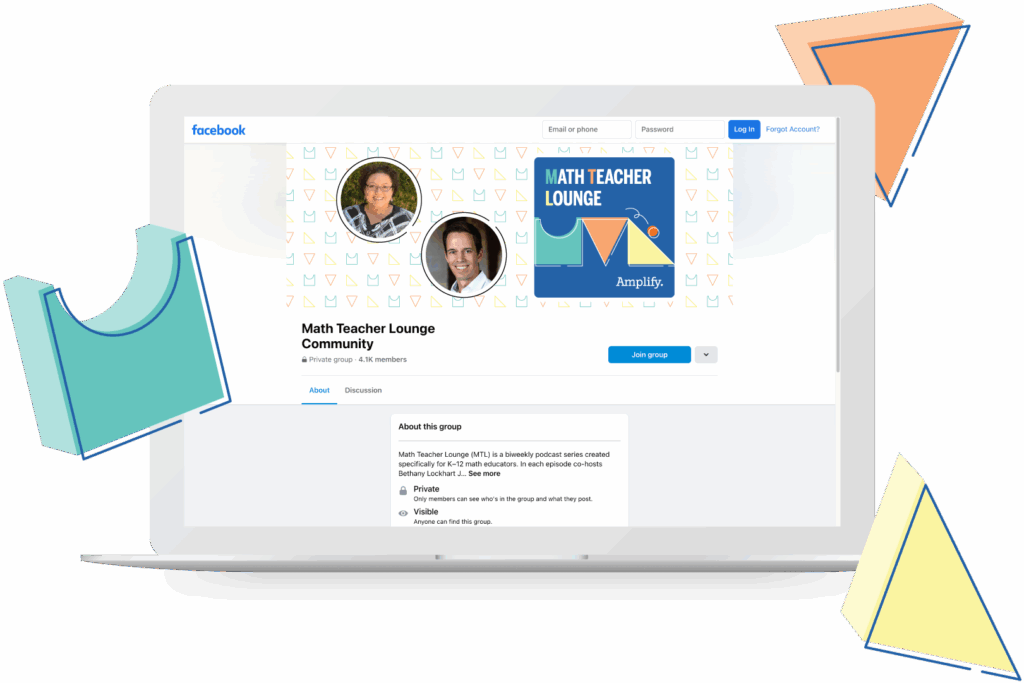
A laptop displaying a Facebook group page for "Math Teacher Lounge Community," featuring profile photos, a group banner, and geometric shapes in the image background.

About Math Teacher Lounge

Math Teacher Lounge is a biweekly podcast created specifically for K–12 math educators. In each episode co-hosts Bethany Lockhart Johnson (@lockhartedu) and Dan Meyer (@ddmeyer) chat with guests, taking a deep dive into the math and educational topics you care about.

Join the Math Teacher Lounge Facebook group to continue the conversation, view exclusive content, interact with fellow educators, participate in giveaways, and more!

Season 5, Episode 5

Math technology & hacks for math anxiety: research-based tips for caregivers

We’ve been very lucky to have so many prolific and brilliant researchers on this season of Math Teacher Lounge, and our next guest is no exception.

Listen as we sit down with Dr. Marjorie Schaeffer to discuss what causes math anxiety, math hacks, and how the right math technology can make an incredible impact in children and caregivers coping with math anxiety.

Listen today and don’t forget to grab your MTL study guide to track your learning and make the most of this episode!

A smiling woman with long brown hair, wearing a red top, framed by a circular border with a geometric pattern background.

Meet Our Guest(s):

A woman with long brown hair and a red top smiles at the camera, framed by a circular graphic with geometric accents.

Marjorie Schaeffer

Marjorie Schaeffer is an assistant professor of psychological sciences at Saint Mary’s College. She received her Ph.D in developmental psychology from the University of Chicago. Marjorie is interested in the role parents and teachers play in the development of children’s math attitudes and performance. She is specifically interested in the impact of expectations and anxiety and on children’s academic performance. Her work has been published in outlets including ScienceJournal of Experimental Psychology: General, and Developmental Science.

Meet our hosts: Bethany Lockhart Johnson and Dan Meyer

Bethany Lockhart Johnson is an elementary school educator and author. Prior to serving as a multiple-subject teacher, she taught theater and dance, and now loves incorporating movement and creative play into her classroom. Bethany is committed to helping students find joy in discovering their identities as mathematicians. In addition to her role as a full-time classroom teacher, Bethany is a Student Achievement Partners California Core Advocate and is active in national and local mathematics organizations. Bethany is a member of the Illustrative Mathematics Elementary Curriculum Steering Committee and serves as a consultant, creating materials to support families during distance learning.

Dan Meyer taught high school math to students who didn’t like high school math. He has advocated for better math instruction on CNN, Good Morning America, Everyday With Rachel Ray, and TED.com. He earned his doctorate from Stanford University in math education and is currently the Dean of Research at Desmos, where he explores the future of math, technology, and learning. Dan has worked with teachers internationally and in all 50 United States and was named one of Tech & Learning’s 30 Leaders of the Future.

Two people smiling at the camera, each in a separate circular frame, with geometric shapes decorating the background—perfect for a math teacher lounge or highlighting fresh math teacher resources.

Quotes

We want it to be a fun, low-stakes environment, especially in high-stakes scenarios like testing. We want children to have fun math experiences.

—Marjorie Schaeffer

Stay connected!

Invest in high-quality professional development.

Amplify’s professional development (PD) provides a variety of learning experiences over multiple years to incrementally develop and apply the knowledge and skills needed for effective and self-sustaining implementation.

Gain insights into effective instructional techniques and develop a deeper understanding of your Amplify program(s) by investing in PD.

The foundation for long-lasting and sustainable change

Partner with us to plan long-lasting and sustainable change for your school or district. Change achieved deliberately is much more likely to stick and get results. We can support you through this journey to drive your professional improvement, enrich your instructional practice, and increase student impact.

Professional learning journey

Prepare

You’ll understand research-based practices to support new program implementation.

Prepare learning experiences will help shift literacy and math instruction in areas such as the Science of Reading and/or problem-based approaches to math.

Begin

You’ll build the foundational knowledge and skills necessary to begin teaching with your Amplify program(s).

Program-aligned packages will support those who are new to Amplify’s programs.

Practice

You’ll refine instrucional skills, expand knowledge of your Amplify program(s), and explore more advanced insturctional strategies.

Program-aligned packages will support those who have experience using Amplify’s programs.

Advance

You’ll deepen understanding of content and pedagogy and build-in house capacity to support a robust, sustainable implementation.

Program-aligned offerings will support advanced implementation, build capacity for instructional leaders, certify in-house trainers to deliver Launch sessions, and more.

Learn more about our curated catalog of packages and sessions to support each stage of your learning journey.

Multi-program, suite packages

Core program packages

Literacy

  • Amplify Texas ELAR/SLAR K–5
  • Amplify Texas ELAR 6–8

STEM

  • Amplify Math
  • Amplify Desmos Math (K–A2)
  • Amplify Science
 

Supplemental program sessions

  • Boost Reading Texas K–8
  • Boost Lectura K–2

Assessment program packages

  • mCLASS Texas Edition
  • mCLASS Lectura Texas

mCLASS Intervention K–6 program sessions


Empower teachers to continuously improve.

Professional development helps teachers stay motivated and inspired to grow professionally. Demonstrate your commitment to your staff by empowering them with professional development packages that include on-site or virtual Launch, Strengthen, or Coach sessions, all of which will orient you and your team to the full features of Amplify programs.

You can also personalize your learning experience by adding enhancement sessions to base packages.

Launch

Launch sessions introduce Amplify programs and support strong implementation.

After learning about the program’s foundational principles and key features, you’ll practice administering the program within a collaborative environment.

Strengthen

Strengthen sessions deepen understanding of the program. Session offerings are targeted and meant to take your practice—and your students’ learning—to the next level.

Offered as part of core packages, as well as enhancements, Strengthen sessions are intended to effectively address your students’ needs. Examples include:

  • A focus on data analysis.
  • Examining student writing.
  • Targeted intervention instruction.

Coach

Coach sessions elevate instructional practice and help meet teachers’ and schools’ specific needs.

Partner with an Amplify coach who will support you in planning a day tailored to meet the needs of teachers and/or leaders. Your customized session will leverage our menu of support, which can include:

  • Lesson modeling by an Amplify facilitator.
  • Classroom observations and debriefs.
  • Grade-level planning.

Coach sessions are customized to you with an Amplify facilitator.

Commit to sustainable change for long-term impact.

Learning may ebb and flow between phases depending on your teachers’ and leaders’ needs, experiences, and professional goals. Amplify PD aims to continually grow, develop, and refine instructional practices to support student learning and achievement.

Frequently asked questions

We value your partnership and aim to provide you with the highest quality learning experiences. Check out our frequently asked PD questions below, along with responses.

Additional learning

Once you become an Amplify customer, you’ll have access to many opportunities to continue learning how to get the most out of your Amplify program(s).

To get a sense of our support, check out some of our free resources:

Three children sitting on the floor, reading a book together.

Biliteracy supports

Sessions are available to support educators teaching with both Amplify ELAR and Amplify SLAR core programs, or both mCLASS Texas Edition and mCLASS Lectura Texas assessment programs.

Facilitated in both English and Spanish, these specialized sessions should be scheduled for biliteracy teachers using both curriculums and/or assessments. Substitute a biliteracy session for the six-hour initial training in your package, or add these sessions on to your package for your biliteracy teachers.

Speak to our team to learn more!

Order and payment support

If you’re ready to submit your price quote, purchase order, or payment, please visit our Ordering Support site for more information.

Sample invoice document with orange Accenture logo and text. Includes fields like quote number, PO number, contract details, and invoice number highlighted as INV-123456.

Community of collaboration

Connect with fellow Science of Reading, math, or science advocates in one of our public Facebook groups. Join a community or tune into one of our podcasts today:

Amplify customers can join our exclusive, program-specific Facebook communities to ask pedagogical questions, share Amplify teaching hacks, and more!

Our experts

We are educators supporting educators. Every member of Amplify’s national team of highly experienced and qualified facilitators is a former educator with years of hands-on classroom and/or administrative experience. Our facilitators are passionate about supporting educators in the implementation of their Amplify programs and creating transformational change for all students.

Get in touch with a PD expert

We’re here to provide answers and guidance as you explore your PD journey. Fill out the form to connect with us and discover how Amplify PD can enhance your educational journey.

S2-04: Gamification in the K–8 classroom

Podcast episode graphic featuring guest Fabian Hofmann, titled "Gamification in the K–8 classroom," from Science Connections Season 2, Episode 4, with an illustration of a planet.

In this episode, Eric Cross sits down with his colleague and friend Fabian Hofmann to talk through gamification in the K–8 classroom. They discuss Fabian’s experience teaching outside of the United States, and the differences in classrooms outside of the country. Fabian explains the integration of game mechanisms in the classroom, standard-based grading, and shifting student thinking about learning by forming strong relationships. Fabian also shares how he created a new STEM course at his school revolving around his own passion for Star Wars. Explore more from Science Connections by visiting our main page.

DOWNLOAD TRANSCRIPT >

Fabian Hofmann (00:00):

In Mr. Hofmann’s class, I get to earn points and I get to be a Jedi. I can suspend my disbelief and I’m learning history, but at the same time, I’m traveling through the galaxy.

Eric Cross (00:13):

Welcome to Science Connections. I’m your host, Eric Cross. My guest today is Fabian Hofmann. Fabian is a middle school IB educator, currently teaching seventh grade multimedia design and history at Albert Einstein Academy’s middle school here in San Diego, California. He also hosts the podcast Rebel Teacher Alliance, a podcast dedicated to encouraging and supporting teachers to rethink student engagement. Fabian’s one of the most innovative teachers that I’ve ever met. His use of technology and gamification makes learning fun and accessible for our students. And I have firsthand experience with these students because we teach on the same team and have worked alongside each other during my entire career as a teacher. In this episode, we discuss gamification of the classroom, how he approaches grading from an innovator’s mindset, and his newest STEM class, Immersive Design, where his students are working with former Disney Imagineers to completely renovate their classroom into an interactive Star Wars-themed learning environment. And now, please enjoy my conversation with my good friend and colleague, Fabian Hofmann. We’ve worked together for how many years now? How many years have you been at Einstein?

Fabian Hofmann (01:23):

Well, I started when you started, like after you were student teaching, so 2014.

Eric Cross (01:28):

OK, so it’s been a while.

Fabian Hofmann (01:30):

Yeah. And then I took two years off and I went to Hawaii. I couldn’t handle the pressure. And then I came back. So we’ve worked together for six years but known each other for eight.

Eric Cross (01:39):

What’s your origin story? We’re gonna talk about your origin story. I told you.

Fabian Hofmann (01:42):

All right, cool. Right. So when I was a little boy…no. <Laugh>

Eric Cross (01:46):

This podcast is not that long!

Fabian Hofmann (01:49):

So no, I started out, teaching in 2009. I started student teaching in Germany and was teaching history and English. Did this two-year student-teaching program there. And then, when I was done, my wife and I, she’s American, we got married and we decided to move to the States. And then I started teaching at a German cultural center called the Goethe-Institut in San Francisco. We lived in the Bay Area. And from there, after a year we moved down to San Diego; I started subbing; I worked for a year at High Tech High. I taught humanities there. And then, after that year, I ended up at Einstein teaching German because that was what was available. I didn’t want to teach German. That wasn’t like, on the top of my list. But it made sense because I had taught German in San Francisco and it kind of was like, “Well, I can do that, I guess.” And then, yeah, and then I went back to—we went to Hawaii for a couple of years and then I came back here to start teaching history. So I’ve taught like a million things essentially.

Eric Cross (02:52):

And then during that time, what’s your evolution been like in the classroom? Kind of like your view of education? And how does that play out in your day-to-day with kids?

Fabian Hofmann (02:59):

So when I started teaching here in the States, I noticed that it’s very different. Technology was much further along here than it was in Germany. So when I got here and we had like an iPad cart; I helped setting up the iPad carts. And I worked with the Chromebooks and I was like, holy, holy crap, this is so cool. Like, kids can like actually do things with this technology. And then, I mean, I love technology. I’ve had an iPad when it came out and stuff like that. And so I was like, “Oh, so how about we use this in our classroom?” And so I always moved—I moved very quickly to having students create on the iPad. And at first it was like, “Oh, we use the Apple apps and stuff.” And then I went to an ed-tech teacher summit here in San Diego and my eyes were like opened to, “Oh my God, there’s so much more than just the Apple apps.” And ever since then I was like, “OK, we’re gonna use this; we’re gonna do that.” It’s just crazy stuff that I thought was cool and that students really seemed to enjoy, because it wasn’t like a typical language class; it was more like, “Well, what can we do to create, and how can we somehow still use the language but we are learning coding at the same time, or we are creating something in 3D at the same time?” Like, I was always trying to make it have two angles: the language angle, obviously, and then also the technology angle.

Eric Cross (04:25):

What was it that kept you kind of pushing? ‘Cause I remember the beginning in the Classcraft days to where you are now, I feel like you’re like light-years ahead of where you started.

Fabian Hofmann (04:37):

So you were actually the one who showed me Classcraft, which is like a gamification portal, kind of off-the-shelf thing that you can subscribe to. It has some free features and it’s like a gamification platform where students can create characters. And then these characters go on adventures. That’s like their avatar, and they get experience points in the classroom game and stuff happens. You can create, like, adventure paths for them. So if you have an assignment that you want students to do that has different steps, so, that could be an adventure path. That’s what I liked about Classcraft, is like this idea of like, “OK, we’re taking a game and applying it.” But it wasn’t enough for me. And so I started developing my own classroom game. I did some reading. I met online with John Meehan, worked with him. I read the book by Michael Matera, Explore Like a Pirate. And so it just broadened my whole world to, or just opened the world of gamification to me.

Eric Cross (05:38):

You present on gamification; you mentor other teachers on gamification. You host a podcast where you talk about it. But for those people who haven’t done it or gotten into it or maybe have a perception of it maybe that’s not quite accurate, can you talk a little bit about like what gamification is and what it’s not?

Fabian Hofmann (05:54):

  1. So the biggest difference…we all know game-based learning, because we all do it. We use Quizlet; we use quizzes; we use Gimkit, Blookit, Jeopardy, anything like that. Those are game based. That’s game-based learning. So using a game to facilitate learning. Which is great. I love game-based learning too. But the difference is with gamification, in the pure definition of gamification, is that you’re using game mechanics and elements and apply them to a non-game setting. A couple of smart educators were like, “Why don’t we just do that in our classroom?” And so we borrow these elements, these mechanics, these game mechanics, like getting experience points, and applying them to the classroom. So anything that students do, they earn points. So they turn in an assignment, that gets you a hundred points. They go and do something extra for the class, they get 50 points. Whatever it is, whatever your value is. That’s one aspect, like a leaderboard, virtual money, stuff like that that just in reality is not necessary, but you’re putting it somewhere where it doesn’t exist. And all of a sudden students have this weird shift in their view where it’s like, “Well, school is school, but in Mr. Hofmann’s class, I get to earn points and I get to be a Jedi and I can suspend my disbelief and I’m learning history, but at the same time I’m like traveling through the galaxy.” And it’s just amazing how that shift happens just because we’re changing the language a little bit.

Eric Cross (07:29):

Yeah. You seem to have like tapped into something that is already kind of in that zeitgeist culture thing. We’re gaming and it appeals to—I know it appeals to our students regardless of how they feel about even the subject that’s being taught, the fact that they’re immersed into this environment where they’re taking on this character role and they’re part of this bigger narrative. And you’ve so dynamically constructed this whole storyline and these experiences, and they’re learning experiences, like, they’re learning, but they’re enjoying it in a different way. But I wanted to ask you about something that I really admire that you do, and it’s how you grade. And I remember the first time you said this, we were in a parent-teacher conference and we’re all talking on Zoom with these parents and we’re all sharing our spiel. And you go, I don’t grade kids. They grade themselves. Can you talk a little bit about your conferencing with students? The rubric you use like that that, I’ve really been paying close attention to lately.

Fabian Hofmann (08:24):

Yeah. So, when I was working in Hawaii, I noticed I was teaching English, and grading papers in English is really not fun. Like, that is like my least favorite thing. Some teachers are like, “Yeah, it’s grading! Awesome! I can read stuff!” For me, it’s like, yes, I like to read stuff, but I—and it was the same in German class. I gave them feedback. Sometimes I would use oral feedback, I would, like, record stuff for them, and they would listen to it, and then they would work on it. And so I noticed when I’m giving them feedback and its oral feedback, they’re more inclined to actually work on the stuff that I was critiquing, versus when I sat down and I wrote something. They would never read it. Or some would, and most of them would not. And so I was like, this sucks. <Laughs> And I encountered this book called Hacking Assessment, because it’s such a waste of time, right? You spend so much time, because you wanna do the due diligence. And for those few kids who actually do care, that benefits them. But I want this to benefit everybody. And so I read this book called Hacking Assessment, by Starr Sackstein. And she talks about how she put the onus of grading into the student hands, essentially. And so she did standard-based grading and essentially said, “You know what? Here’s the thing. I am not going to grade you anymore. You are going to get a rubric that we are going to dissect and explain and make sure that you understand. And then you sit down and you give yourself a grade based on this rubric.” And I was like, “Wow, what? That is….I can do that? And the cool thing about this book is that she covers all the roadblocks that we as teachers have. And she explains, like, she gives examples on what we can do to convince parents, to convince admin, to convince the community, convince other teachers why what we’re doing is much, much better for a student than the previous system is. If you think about it, when a student comes into school, they start at a hundred, they start the year at a hundred, and all they’re doing is just lose points. And they’re just trying to keep up. Right? And it kind of flips this on its head, because not only with the gamification, I’m changing the name of the game, literally, but I’m also now with ungrading, I’m giving them the responsibility and the accountability to really look at their stuff and really be critical about how they’re doing. And I taught like normal in my first year in Hawaii when I was teaching English, by me grading everything and turning it and giving it to them. And I used peer grade and I did all that kind of stuff. But in the end, I was always the one responsible for the grade. But then I started to do the ungrading move and I just started to conference with kids and started giving them feedback, with the help of gamification, because there’s like a bunch of rubrics you can use to make it more fun. But all of a sudden, kids that in the year before would’ve failed my class in English, because they were English learners; they were just not into it; they didn’t care as much…all of a sudden that flipped completely. I did the exact same content again. We had to write an essay and all of a sudden, the essays were all like, up there, because we sat down, we talked about it, we went through this review process, gave them feedback. In the end, they could say, “Hey, I want this grade. And then I still have the last say. I would say, say, “Yep, sounds good.” Or “If you wanna get an A on this, or whatever it was, a 4, then here are the things you still need to do.” And because I did that, all of a sudden, the students are like, “Oh, that’s all I need to do?” And then they did it and turned it in, and all of a sudden, they got a 4. It’s, it’s amazing how that the conferencing with students, how that shifted their attitude. And I got to know my students way better than I ever had.

Eric Cross (12:20):

Yeah. That’s, that’s one of the things that I’ve noticed. And I watch you get so much more facetime with students having conferences than I do. I find myself grading…and, you know, at our school, it’s mastery-based instruction, so students can retake assessments, but you’re absolutely right: I give a grade; they get a score; and some of ’em score lower, but in their minds it’s like, OK, I’m done with that. And even though they can retake it, such a small percentage actually do. But the information that I give them in the feedback is often not read. But you’re sitting down and having a conversation and really listening and there’s so much more of a connection that you have. I just think it’s so rich. But the question I have now is how do you make the time for those conversations with those kids in your class?

Fabian Hofmann (13:01):

Yeah, it’s definitely a learning curve. Like the first year I did it, it was horrible. Like <laugh>, it cost so much time. Because kids came, because when it was time to grading, because I had not figured it out yet, I had not streamlined it. And I’m still learning. I’m still trying to figure this out and do it even better. But the idea is that you do something, you check in with me really quick. That doesn’t have to be like a full-on conference. It’s—I walk around or I call them up and say, “Hey, I saw you working on this. How did, how are you doing there? How many—” Like, let’s say I use a rubric that gives them crystals for different parts. They write the introduction; they write a bibliography; whatever, so I can bring them up and say, “Hey, how is the bibliography looking?” And they’re like, “Oh yeah, I’m missing…like, I only have like one or two sources.” And then we say, “OK, so right now you would get two crystals out of three because you have something. When you come back, you get all the crystals.” And so that’s a gamified aspect again, right? They’re coming back to get more crystals, not because they wanna do better necessarily. But because they’re like, “Hey, I wanna get those crystals because it gives me points in the game.” They are very good about like grading themselves and kind of like, they’re really hard on themselves sometimes too. And I have students who are like—

Eric Cross (14:08):

Yeah, they are.

Fabian Hofmann (14:09):

“Well, how can you make sure that people don’t just give themselves an eight?” And I’m like, “Because there’s a system in place that that does not happen. Like, there is a rubric, and if they cannot back up what they want, then it’s not gonna happen. They can write an eight all day long. I’m still the person entering it into the grade book!” <Laugh>

Eric Cross (14:27):

And let me premise this for listeners who don’t teach at IB schools, which is probably like most people.

Fabian Hofmann (14:31):

Yeah.

Eric Cross (14:32):

So IB, we teach zero through eight on a rubric system. And seven-eight is kind of like the A, kind of, quote-unquote. I know IB people are probably cringing when I say that, but <laugh>, you know, when you transfer it to like a high school? Seven, eight would be the highest score, you know. Four, five, six. So when we say eight, we’re talking about the highest score.

Fabian Hofmann (14:49):

Yeah. And so it’s really interesting because I can call them out on stuff, and it’s a one-on-one conversation, right? And if, especially if they turn something in that is not great, and they give themselves like a—I don’t know, like a C, let’s say, or a four, or whatever it is—and they’re like, “And you’re happy with that?” And then they’re standing there and they’re like, like, “No…?” <Laugh> And all of a sudden there’s a conversation. Where it’s like, and then I can be very intentionally like, “Hey man, I know you can do better. I would not—I’m not gonna accept this. I’m gonna push you to turn this in again.” And most of them actually sit down and do more. It’s a process. It takes a while. It’s not pretty in the beginning. But the payout is, so it’s incredible. Just like the amount of time that I get to spend with students, like specifically talking to them about things that they still need to work on, celebrating stuff they do, it’s incredible. Like the relationships are just so different than what I had years ago.

Eric Cross (15:50):

And you’ve also created a system where we preach—and schools always talk about this Dweck growth mindset and not having a fixed mindset, but I wonder how many opportunities or how systems are set up that are actually fixed, where it’s like one and done, OK, you did this exam and then that’s it, but there’s no opportunities to grow until the next exam! Which is gonna be….or whatever the assessment is, which is a whole different area of content or different topic or whatever. But here, you’re actually able to facilitate this growth mindset and push back if a student says, like, “Well that’s—I just got a four,” and you can actually pour into them and talk to them. And do you ever hear more about a student’s story as to why they were where they’re at, as you’re having these conferences?

Fabian Hofmann (16:29):

Oh, absolutely. Like for some kids who, who are just like not getting the work done or whatever, there’s always something where it’s not because they’re not smart or because they’re lazy. It’s like, sometimes, literally they tell you, well, ’cause I ask them, “Hey, can you work on this at home?” Or “Can you come in during lunch, after school, whatever? I’m always here.” And then they drop some bombs on you, like, “Hey, my parents, like, divorced. My mom lives in Mexico.” ‘Cause we live in San Diego. So some students live in Mexico and come to school here in San Diego and they get stuck at the border or, even though they have internet at home, they have to share. It’s like kind of what we experienced during the pandemic, where it’s like, there’s like three kids at home and one computer. Stuff like that. Right? And it’s these stories where you’re like, first of all, it’s very humbling ’cause they’re going through stuff that I never had to go through. I mean, my childhood was not amazing, but compared to what they’re going through, it’s like, “Oh yeah, that exists.” And it kind of like puts you in your place a little bit. It’s also because of the system that I use. There’s no late, really, in my class. Some of the students are like, “I need to subtract points from my grade because I turned it in late.” And I’m like, “No, no, no, no, no. The fact that you’re doing it is quote-unquote punishment enough ’cause you have to do it outside of class, you have to do it at home; you have to do it during lunch. Like, that is, that is not comfortable. You’re still doing it. So why would I punish you by taking a grade away? That doesn’t make sense. You got the work done. That’s all that matters.” I try to be that person that like is understanding. It’s still pushing them to do their best and reminding them and harping on them. And with the spark that I threw in there and fanning that flame of them becoming a better student because I’m supporting them. You’re supporting them. We’re all—our seventh-grade team is incredibly supportive. And then some people might push back, like “That’s not preparing them for the real world.” This is the real world.

Eric Cross (18:20):

There’s a lot of life skills that they’re gonna need…but like, they’re 12 right now! Or 11 or six, you know, whatever it is! Let’s—we can hold off on taxes and the crushing weight of adult reality later on. You got it done! Well-done! I do wanna talk about this thing that is your baby lately, this embryonic thing that you’ve been growing and I’ve been fortunate to be able to watch it since its inception. But you have this class that you created from scratch that’s essentially a STEM class. Two questions: Why did you create the class? And you’ve done some uncommon things. I’m gonna leave it wide open just for you to talk about it because it’s your baby and I’ve been fortunate to be able to watch it from the start. So can you talk about that?

Fabian Hofmann (19:01):

So yeah, so I’m obsessed with Star Wars. I think that’s putting it mildly. I love Star Wars. Always have. My classroom game is called Jedi Academy. And I’ve been playing around with this idea of creating a room that is more immersive. So I put a space, like a window to space, on my wall. I have the Millennium Falcon in my room. I have like a bunch of Resistance stuff or whatever. Anything Star Wars, you can find in my classroom. It’s not like overloaded, but I was very intentional in the things that I put in there, because I want my students to come in and feel like they are playing the game. And one of those things that I used was like smells; I used sounds to try to immerse them more. And then so one day I was like, wouldn’t it be cool to create a classroom that looks literally like a Star Wars set? Like you walked onto a set. Onto a spaceship, onto a rebel base, onto whatever it is. And how can I, how can I make that happen? And then we talked about it and you were like, “Yeah, how about you let the kids do it?” And that’s kind of how the course was born. And now I have students in my classroom who are in the process of designing a classroom based on Star Wars. And they’re gonna build everything. And we’re all learning at the same time. I’ve never done anything like this. I do like STEM, but I’ve never like actually made it a class. And so I contacted a bunch of people on LinkedIn ’cause I was like, it would be cool to talk to an Imagineer and to get like my foot in the door at Disney and then have an Imagineer come in and tell us about what they did. I have this book called The Art of Galaxy’s Edge, which is like the Star Wars land in Disneyland. And I just looked at the list and was like, “Who could be a good person to contact here?” And it said one of them was Eric Baker, and it said, “Executive Creative Director.” And I googled him or I looked for him on LinkedIn and I found him and I was like, “I’m just gonna send him a message. I’m just gonna tell him what I do in my class in history, gamification and all that, and they’re Jedi, and blah, blah, blah.” And he wrote back! Like, he was the only person that wrote back. I wrote a bunch of people and he was like, “Yeah, I’d be super-interested. I don’t know what you want me to do, but I’m down.” And so it created this relationship between me and Eric Baker who used to work for Imagineering, who are like the people at Disney who create the rides in the park and all that. And I talked to him and he gave me some feedback on the room. And then he was like, “Oh, so if you ever want me to talk to students, I’m down.” I was like, “Uh, yes!” And so we had him Zoom in. He talked about his life and how he became one of the people to look for when it comes to theme park design and to create immersive experiences. And I contacted other people on YouTube, like somebody who is like a Star Wars room builder. He’s willing to chat with us about this project. And then, I discovered that there is this thing called Imagination Campus at Disneyland, which they offer workshops on immersive storytelling. And I was like, “Oh, that’s what I want! I want my students to tell a story with my room!” And so I wrote up a proposal. Took a long time, but they signed—our admin signed it off. We kind of financed it. And then, about two weeks ago, you came along, another teacher, and we took 30something students to Disneyland and they did this workshop where they learned all about like how the Imagineers design story elements and put them in the parks. And then we took all of the kids to Galaxy’s Edge. And we took a bunch of photos. We went on the rides together. We had this collective experience. And it was life-changing for a lot of students. Because, I mean, we’re a Title One school; there’s like, we have about 60% free or reduced lunch. And a lot of them had never been to Disneyland. About half of them had never been. Some of them went when they were little. And so just watching their faces, going to Disneyland, watching them walk into Galaxy’s Edge, experiencing all these things, it was just, my mind was just blown. And I like literally, I don’t know if you noticed, but I was just smiling. Literally.

Eric Cross (23:19):

You were loving it.

Fabian Hofmann (23:20):

Yeah. Then we come back and we have these amazing conversations about design and what they noticed and how they created this immersive experience in their world. And we talk about how we can bring this back to our classroom. And parents are sending emails saying, “Oh my God, we’re so happy that you did this for our kids and you’re the coolest teacher.”

Eric Cross (23:39):

You touched on something that I wanted to ask you about. So you stay connected to people that inspire you, I feel like, or you have a pretty broad network of educators and professionals. Like, how much does that play into what you do in the classroom and the ideas that you have, as your network or your community of people?

Fabian Hofmann (23:57):

So the one network that helped me the most is Twitter. And I know people have opinions about Twitter, for good reason. But when I started to gamify, I just started to follow specific hashtags for areas that interested me. And that was gamification; eXPdup, which is like Explore like a Pirate—it’s an acronym. And it just opened up all these people, all these people, all these educators who are out there just like doing cool stuff and sharing it on Twitter. And I started connecting with them. And one of them is on my podcast. We met through Twitter; we started sharing stuff. We started talking about the things that we do. We both happened to have a gamified classroom. And so we connected over this thing Twitter, and now we’re like friends and we’re presenting together at Q and all those places. Teacher Twitter is incredibly supportive and people want to show you the stuff that they work on, just like I do. Like when I have stuff that I worked out, I shared it on there. And it’s so fun to hear back from teachers saying, “Hey, this looks awesome.” It’s just, it makes you feel good and it makes you feel like, “Oh, what I’m doing is not a total waste of time.” <Laugh>

Eric Cross (25:10):

<laugh> Those thoughts do creep in, right? Like, even though you’re doing something awesome and you might think so, we become our own worst critic sometimes, or we always see the things that we can improve and we overlook the things that we’re doing well. Fabian, where can people hear more about you, about gamification, about what you’re doing in the classroom, about how you’re innovating? I know you talk about this stuff with some—and you talk about it with some pretty legit people in the education industry. So can you tell some folks where they can hear more about it?

Fabian Hofmann (25:37):

So you can find me on Twitter at Hofmann edu—one F, two Ns—edu, and then I also host a podcast called Rebel Teacher Alliance. There’s three of us, where we talk all things gamification. But we also talk to teachers who don’t gamify at all. And we just, we just invite people who are interesting, who have stuff to share, who do cool stuff. You can find the podcast on the internet at Rebel Teacher Alliance dot com. Follow us there. If you wanna be a guest, just send a message and we’ll get you on.

Eric Cross (26:10):

Fabian, I’m gonna gush on you right now, but when you came back to Einstein, I was so happy because I knew that you sharpened me; you make me a better science teacher. Your innovation, your passion for kids, your sense of humor, your outside-the-box thinking, all of that. And when you got onto the seventh-grade team and you were here, I just knew that it was going to be awesome. And it has been. And so as a teaching colleague, as a friend, dude, you just rock, man. I’m super proud of you. And thank you for making me better.

Fabian Hofmann (26:40):

Aw, now I’m starting to cry. It’s like, don’t…

Eric Cross (26:43):

<laugh>. All true, dude. All true, my brother.

Fabian Hofmann (26:46):

Thank you.

Eric Cross (26:46):

All true. And thank you for letting me be part of the journey and I will definitely be walking down the hall asking you questions as I try to implement some of these great ideas that you’re doing with kids. Thanks so much for listening. And now we wanna hear more about you. Do you know any inspiring educators? Nominate them as a future guest on Science Connections by emailing STEM at amplifycom.wpengine.com. That’s S T E M at amplifycom.wpengine.com. Make sure to click subscribe wherever you listen to podcasts and join our Facebook group, Science Connections: The Community. Until next time.

Stay connected!

Join our community and get new episodes every other Wednesday!

We’ll also share new and exciting free resources for your classroom every month!

What Fabian Hofmann says about science

“I want my students to come in and feel like they are playing the game. I used smells. I used sounds to try to immerse them more. And then so one day I was like, wouldn’t it be cool to create a classroom that looks literally like a set?”

– Fabian Hofmann

Middle School Educator, Albert Einstein Academies Middle School

Meet the guest

Fabian Hofmann is a middle school International Baccalaureate teacher and host of the Podcast, Rebel Teacher Alliance. He is currently teaching 7th grade History and Multimedia Design just down the hall from Eric Cross at Albert Einstein Academies Middle School in San Diego. To engage students, he uses technology and gamification. Students embark on a year-long journey through a galaxy far, far away to learn the ways of the “Force” and some world history along the way. Follow him on Twitter and check out the Rebel Teacher Alliance podcast.

A man with short gray hair and a beard is smiling at the camera, photographed against a neutral background inside a circular frame with a small yellow sparkle accent, evoking the playful spirit of gamification.

About Science Connections

Welcome to Science Connections! Science is changing before our eyes, now more than ever. So…how do we help kids figure that out? We will bring on educators, scientists, and more to discuss the importance of high-quality science instruction. In this episode, hear from our host Eric Cross about his work engaging students as a K-8 science teacher.

San Diego Caregivers — Welcome to Amplify Desmos Math!

Welcome to the Amplify Desmos Math Caregiver Hub for San Diego USD. We’re excited to partner with San Diego USD teachers, principals, and district leaders to provide your student with exceptional opportunities to learn math. We designed this hub to help you in supporting your student along their math journey this year.

Introducing Amplify Desmos Math

Amplify Desmos Math is a new core math curriculum built for grades 6, 7, 8. Designed to help students learn math in a way, Amplify Desmos Math uses a student-centered approach to instruction, which has been proven to significantly increase math learning.

In every lesson, Amplify Desmos Math poses engaging and relevant problems to solve, giving students daily opportunities to think critically, work collaboratively, and actively participate in their own learning.

Amplify Desmos Math was built upon the highly rated Illustrative Mathematics curricula: IM K-12 Math™️, which earned an all-green score on EdReports.

About student-centered math instruction

Student-centered instruction may look different from the way students have learned math for decades, and maybe even the way you learned math. Instead of memorizing formulas and tricks, student-centered learning focuses on giving student opportunities to figure out how math works. Plus, research shows that students and teachers alike prefer this method, and teachers report that student-centered instruction has helped their students learn more math.

This way of learning helps students:

  • Understand how math concepts work.
  • Remember what they learn in class and apply their knowledge to new situations.
  • Perform better on standardized tests and have more growth in their grades than their peers who learn through other methods.
  • Learn to communicate in writing and verbally, understand and challenge the opinions of others, and build confidence in solving new problems.
  • Develop key skills for success in college and the workplace, like using technology, completing projects independently and with others, and persevering through difficult problems.

What materials do students use?

Amplify Desmos Math supports blended learning with supportive print materials and a unique digital experience. In addition to a consumable Student Edition, students are invited to use our interactive online platform to solve open-ended tasks and challenging problems.

Here are some key highlights of the digital platform:

  • Digital activities that allow students to explore and make sense of math
  • Digital calculator and virtual manipulatives that support students of all levels
  • Immediate feedback that guides students in understanding challenging concepts
  • Ability to access instructional materials in English or Spanish

With access to their own special online dashboard, teachers can monitor students’ work in real time, making sure they get the exact support that they need at every part of the lesson.

What does a lesson look like?

Students in an Amplify Desmos Math classroom can be seen (and heard!) — asking questions, debating answers, justifying their thinking, grappling with problems, and working together and independently.

In class, your student will spend their time working on challenging problems while the teacher acts as a guide, highlighting different strategies for solving problems and helping students to understand the reasoning behind the math they do in class. Your student will be pushed to think more deeply about the math in their class as the teacher and other students question them on why their ideas make sense. Research has proven that this method helps students become better problem solvers, critical thinkers, and have a stronger conceptual understanding of what they are learning.

Here’s what a typical Amplify Desmos Math lesson includes:

  • Warm-up: A short, attention-getting problem to get students interested in the lesson
  • Activities: 1-3 mini-activities that challenge students’ problem-solving skills
  • Synthesis: Discussion to review and bring together the important concepts from the lesson
  • Exit Ticket and Reflection: Questions for students to show what they know from the lesson
  • Practice: Additional problems your student’s teacher may assign for classwork or homework

How can families support math learning at home?

Find the math in everyday life

Relate math to daily activities at home, whether it be baking, grocery shopping, or planning for a road trip. Your student can help you figure out the price of an item after a coupon, cut a recipe in half, or figure out how much gas you’ll need to make it to your destination. Encourage your student to point out ways that your family uses math in your daily tasks.

Review practice problems together

Your student’s teacher may assign practice problems at the end of each lesson for classwork or homework. Ask your student to walk you through how they solved each problem, or talk about any parts that were challenging for them.

Remember getting stuck is okay

Emphasize that getting stuck is part of the process and a necessary part of learning. Many students (and adults!) fear making mistakes, however, research shows that making mistakes helps your brain grow more. When your student gets stuck on a problem, encourage them to try different strategies, even if they are not sure if they are right.

Use our Unit Summaries for Families

We’ve created a Family Resource for every unit of the program that provides a summary of key concepts plus examples for how to work through problems.

Within each of the grade-level links below, you’ll find a Family Resource document for each unit, in both English and Spanish.

Unit 1: Area and Surface Area

Unit 2: Introducing Ratios

Unit 3: Rates and Percentages

Unit 4: Dividing Fractions

Unit 5: Arithmetic in Base Ten

Unit 6: Expressions and Equations

Unit 7: Rational Numbers

Unit 8: Data Sets and Distributions

Unit 1: Scale Drawings

Unit 2: Introducing Proportional Relationships

Unit 3: Measuring Circles

Unit 4: Percentages

Unit 5: Rational Number Arithmetic

Unit 6: Expressions, Equations, and Inequalities

Unit 7: Angles, Triangles, and Prisms

Unit 8: Probability and Sampling

Unit 1: Rigid Transformations and Congruence

Unit 2: Dilations and Similarity

Unit 3: Linear Relationships

Unit 4: Linear Equations and Systems of Linear Equations

Unit 5: Functions and Volume

Unit 6: Exponents and Scientific Notation

Unit 7: Irrationals and the Pythagorean Theorem

Unit 8: Associations in Data

Note: The below links are for our Volume 2 units, which most students are working in currently. Additional units will be coming soon!

Unit 1: Coming Soon!

Unit 2: Coming Soon!

Unit 3: Fractions and Decimals

Unit 4: Expressions and Equations

Unit 5: Proportional Relationships

Unit 6: Percentages

Unit 7: Positive and Negative Numbers

Unit 8: Describe Data

Note: The below links are for our Volume 2 units, which most students are working in currently. Additional units will be coming soon!

Unit 1: Coming Soon!

Unit 2: Coming Soon!

Unit 3: Coming Soon!

Unit 4: Linear Relationships and Systems of Linear Equations

Unit 5: Functions

Unit 6: Associations in Data

Unit 7: Volume and Surface Area

Unit 8: Exponent and Scientific Notation

Unit 9: Pythagorean Theorem and Irrational Numbers 

Listen to our podcast

Our Math Teacher Lounge is a biweekly podcast created specifically for K–12 math teachers. In each episode, co-hosts Bethany Lockhart Johnson (@lockhartedu) and Dan Meyer (@ddmeyer) chat with expert guests, taking a deep dive into the math and educational topics.

From time-to-time, the topic of an episode is perfect for families. For example, the episode below features Dr. Marjorie Schaeffer. She discusses what causes math anxiety, math hacks, and how the right math technology can make an incredible impact in children and family members who struggle with math anxiety.

Listen today and don’t forget to grab your MTL study guide to track your learning and make the most of this episode!

Download Transcript

How do families access the program at home?

Your student will have access to all learning, practice, and assessment materials through the Amplify platform. Students can access the digital curriculum in school and at home by following these simple instructions.

  • Click the Amplify Desmos Math button.
  • Select Log in with Amplify.
  • Enter this username and password provided by your student’s teacher.
  • Select the desired grade level.

S1-02: Community and joy within K–8 science instruction: Desiré Whitmore

Promotional graphic for "Science Connections" Season 1, Episode 2 featuring Desiré Whitmore, focusing on community and joy in K–8 science instruction.

In this episode, we join Eric Cross as he sits down with physicist and science education specialist, Desiré Whitmore. Listen in as Desiré explains her work at the Exploratorium, a public learning laboratory. Eric and Desiré discuss finding passion in science, the importance of meeting students we’re they’re at, and K–8 science instruction with real-life connections. Desiré chats with Eric about her work on supporting the science of teaching science content at the Exploratorium museum.

Explore more from Science Connections by visiting our main page.

Download Transcript

Desiré Whitmore (00:00):

I think it’s really amazing when we can realize as teachers, like, no, our job is not to just enforce rules on our students, right? Our job is to help students to achieve more learning.

Eric Cross (00:37):

Welcome to Science Connections. I’m your host, Eric Cross. My guest today is Desiré Whitmore. Desiré has held positions as a science curriculum specialist with Amplify Science, a professor of laser and photonics technology at Irvine Valley College, and is now the senior physics educator in the Teacher Institute at the Exploratorium in San Francisco. Her current work is focused on providing support and professional development to middle and high school science teachers to help them teach through inquiry. In this episode, we discussed Desiré’s pathway into physics, the impact of educators in her life, and the importance of representation for students in the classroom. I’m so excited for you to meet my physicist friend, Dr. Desiré Whitmore. All right. So just like a superhero, STEM superhero, you have an origin story and so—

Desiré Whitmore (01:36):

How long is this podcast gonna be? ‘Cause, you know, I can talk for days, so you—

Eric Cross (01:40):

I know, I know! But it’s, it’s…so, OK. We can give us a highlight. So, you know, 30 minutes. But what would be the origin story? You can start from any point in time, but what’s that journey like?

Desiré Whitmore (01:51):

I’m gonna start at the beginning, when I was really young, just because I think it’s important. Neither of my parents were college-educated. My mother didn’t finish high school. My father went back and got a GED later. But my father’s grandmother, her name was Claudia Pairs, and she was a teacher, right? So when I was a kid, she actually kind of raised me from, I don’t know, until I was around seven or eight. And so she was very important in who I became, I think because she taught me that college is important and she taught me to think. She taught me to ask questions. She taught me how to ask questions. Just the Exploratorium likes to do. Which is why I fit so well here. She taught me to always wonder and always think about things. And I remember as a kid, she taught me to count and read and write when I was, like, three. And she would always have bubbles at her house. And I was obsessed with bubbles. I thought bubbles were the coolest thing in the world. And just how you can take your breath and create this thing that now you can see, and it’s your breath, right? It’s your breath inside of a bubble and it’s flying around and it has all these cool colors, and then it would fly up and then eventually just pop. And you’re like, where did it go? Now my breath is just up there. Not understanding, as a kid, but my breath is always everywhere. I didn’t understand any of that, but I understood that my breath was inside of a bubble. That’s my earliest memory of thinking about science, was from that. And she was not a science teacher. She was—I don’t even know what she taught. I think she was an elementary school teacher, maybe. She died when I was 12. So I don’t have super-strong memories or of understanding who she was, only that she raised me and what she taught me as a kid. But that in itself really helped me because then when I was in the environment that I was in at home with my parents, which was not at all the environment she provided for me, I always had the things she taught me in my head, right? So I was always asking questions. My mother hated it. I was always taking things apart and putting them back together. So I used to take apart TVs and VCRs and vacuum cleaners and telephones, and my mother’s like, “Oh my God, I’m gonna murder you.” And she tried a couple times, too.

Eric Cross (04:25):

Did you ever put ’em back together and realize you had extra parts? You’re like, oh, hi.

Desiré Whitmore (04:29):

Oh yeah. All the time. Yeah. Yeah. VCRs have a lot of extra pieces. You’re like, “What do you even…it still works. It’s fine.” <laugh> You know? And vacuum cleaners too. They had a lot of extra parts, <laugh> all the time. And TVs. I should not have been playing with TVs. But like I said, I didn’t have a lot of parental, guidance as a child. So, like, whatever—I’m opening up TVs.

Eric Cross (04:54):

There’s a lot of open inquiry going on in your household. Yeah. Unsupervised.

Desiré Whitmore (04:59):

Unsupervised. But I didn’t know what it was or what it meant as a kid. I mean, I used to put things in the microwave. I did so many microwave experiments as a child, trying to cook different foods or melt different things. And so I think those kinds of experiences, where I was allowed to just be curious, kind of shaped who I am today. And then I kind of got into…you know, when I was in school, I loved math. In 10th grade, I had my first Black teacher, he was my chemistry teacher. His name was Mr. Strickland. And I was like, chemistry is cool, dude. And he was not the best teacher, but he was fun. Like you were saying, he was me, and he was talking to us the way I speak. And he was so like, just kind of chill and happy-go-lucky, I guess. But he wasn’t…he hadn’t taught chemistry in a long time. So he wasn’t a very good teacher. And me and one other kid in the class were in love with chemistry. And so we would read the book and do all the homework and he’d be in class lecturing and we’re like, “That’s not right, Mr. Strickland, like, what are you talking about?” And then he’d be like, “Oh, really, Desiré? Do you wanna teach the class, then?” And I’d be like, “Yeah.” And so I would go up and I would teach my chemistry class in high school, because the teacher was trying to make an example out of me. But he was also, I think, willing to be like, “I really don’t know.” And I really appreciated that. That he wasn’t just like, “I know all of the answers and you’re wrong.” Like, he wasn’t being a jerk, right? Like, the fact that I said, “Yes, I do wanna teach it,” and he actually let me do it? That’s pretty dope. And then I liked physics in my senior year in high school, but I didn’t think it was where I was gonna go or anything. I loved music and I loved math. Those were my two subjects.

Eric Cross (06:51):

What was it about math that resonated with you?

Desiré Whitmore (06:55):

I think it helped me understand the world a lot better. I didn’t have strong science teachers, I guess, growing up. It was a lot of reading out of books or watching laser discs in class. That’s how old I am.

Eric Cross (07:12):

Laser discs.

Desiré Whitmore (07:13):

Laser discs. And you know, so there wasn’t a lot of…I moved around a lot as a kid. I didn’t have this straight curriculum. You know, in one year, in the third grade, I went to three different schools.

Eric Cross (07:25):

Mm. Oh wow.

Desiré Whitmore (07:26):

It was kinda hard for me to latch onto school. But with math, because I could look at math and actually understand the world in it, I could see how math can be used to describe how things work.

Eric Cross (07:40):

I almost imagine, especially with so much transition in your life, it helped make sense of things. You had a lot of transition going on, but you were able to understand the world through the process of math. And then this early exposure, it kind of reminds me my own story too. Because there were these books that would do these cross sections of a cruise ship or a machine; that’s what got me really into engineering. Kind of How Stuff Works. I would watch that on Nova, How Stuff Works. I’d always be fascinated. Even Sesame Street had a segment where they would show you crayons and how the dye was added. You remember that?

Desiré Whitmore (08:19):

Yep. Yeah.

Eric Cross (08:20):

Young Desiré, doing photronics…photronics?

Desiré Whitmore (08:24):

Photonics.

Eric Cross (08:24):

Photonics. Photonics at home with the microwave and all these other things.

Desiré Whitmore (08:29):

Sure. How ’bout that.

Eric Cross (08:30):

<laugh> Right. And then loving math. So, early, I could see this combination, sort of this alchemy, happening inside you. And then, how did that lead to you becoming a physicist?

Desiré Whitmore (08:46):

It’s not as straightforward as it seems it should be. It’s obvious to everyone. <laugh>. But it wasn’t obvious to me. ‘Cause I wanted to be a lawyer. You know, because my parents weren’t educated, they didn’t really know…both of my parents and their subsequent spouses when they broke up—so my parents and my stepparents—are all bus drivers. And so they don’t know what options are. Right? So for them it’s like, “You have to be—you can be a doctor. You can be a lawyer. ‘Cause you’re smart. I know you’re smart, so you’re gonna be one of those things.” And I was like, “I don’t wanna be a doctor. That’s not actually interesting to me.” I did wanna be a teacher when I was younger, because I knew that my grandmother was one. But yeah, I went in and I was like, “I’m gonna be a lawyer. I’m gonna be a lawyer.” And then I go to college and I was like, ‘Eh, I don’t. I hate writing.” <Laugh> Like, I love reading, but I don’t writing. So I don’t think I wanna be a lawyer. I love music and I love math. I was originally going to major in music and math, but then I went to community college because I missed my opportunity to go to university for…long story. And so I’m at community college and I was like, “You know what? I’m gonna just do something new. I’m gonna be a marine biologist.” So my major was marine biology, and then they’re helping me pick out my classes. And they had zero math there. And I was like, “Pardon me. I think there’s a mistake, but I’m not taking any math.” And they were like, “No, you’re done with all your math. For marine biology, you only need calculus. And you took all of that in high school, so you’re done.” And I was like, “No, this is not gonna work for me, dude.” So I continued taking calculus anyway and moving on in math. And then I realized that biology wasn’t what I needed, but I did love my chemistry and I loved my physics classes. So I asked those teachers—chemistry, physics, and math teachers in community college, my professors—”I don’t wanna be a marine biologist and I don’t wanna be a lawyer. What do I do? What do you think I could study? I really like chemistry and math and physics.” And so all of them, all three of these professors told me, “Oh, it sounds chemical engineering would be good for you, so you should be a chemical engineer.” And I was like, “OK, cool. No problem.” That’s what I did. So I got my degree in chemical engineering. Right. And I finished community college, studying chemical engineering. I was like, “This is really cool. This is a lot of fun. I love engineering.” And then I transferred to UCLA as a chemical engineering major. And I was like, “I hate this.” <Laugh>. “I hate it a lot.” It was just…

Eric Cross (11:07):

What was it about chemical engineering that you were just not feeling anymore? What was it that just made you go, “nope”?

Desiré Whitmore (11:12):

It didn’t—at least the way it was taught to me—it wasn’t as as…exploratory, I guess. There wasn’t a lot of theory in it. There was just a lot of “OK, pull out a ruler and you’re gonna draw a thing and then this is how you’re gonna build a reactor.” And it didn’t seem very scientific to me. The science was missing. And don’t get me wrong, I understand, now that I have a degree in chemical engineering, that it’s not that chemical engineering is not scientific. But it’s that you build up the science and then you don’t focus on it. You focus on the engineering aspect of it. Which is, you have the science and the scientists will work on that aspect. But then how can WE do kind of larger batch chemistry. And for me, that was just less interesting. It was a lot of pushing buttons and just plug-and-play equations stuff. Instead of diving into first principles of why things happen in chemical engineering. There was no “why things happen”; it was “this is what happens, so this is the next step.”

Eric Cross (12:25):

You had to go so far into your academic career to realize that this is what chemical engineering is. And we were talking about representation, and not having examples or parents; your families were bus drivers. My mom was a receptionist and executive assistant, things like that. And I was the first of many, like you…we kind of had to go through and invest all this time and money to finally get to this place to realize, “This ain’t it.”

Desiré Whitmore (12:58):

This is not for me, yeah.

Eric Cross (12:59):

This is not for me. That was a long journey to get to that point.

Desiré Whitmore (13:03):

It was. Especially because I went through community college and I took a long time in community college, ’cause I was working full-time. So I was working full-time, going to community college. Took me a while. And then I finally get to UCLA. I’m like, “Yeah, I’m finally gonna get my degree and go make money!” And then I was like, “Ooh, no.” I mean, I could go and make money, don’t get me wrong. I could have graduated and made a ton of money. But I was not happy at all and I did not enjoy what I was doing. So, while I was in undergrad, I realized I don’t wanna do chemical engineering anymore. But what do I wanna do? But then I was taking…I took a quantum mechanics class. And that class blew my whole mind. And I was like, “This is the coolest thing that I’ve ever learned in my life, and this is what I wanna do.” And so I went and talked to my professor and I was like, “Can I work for you? Can I do research? Because this is amazing and I wanna do this.” I felt it was too late for me. I had been in school for so long and I was already kind of burnt out. So I was, “I’m not going to change my major. That’s just outta the question for me right now. It costs so much money for this degree and I don’t have—I’m not just gonna waste my time and keep working all these jobs.” So I had three jobs in college. And it was like, I worked at Radio Shack, I did research for this professor, and I worked in the library, the chemistry and physics library.

Eric Cross (14:28):

I love the fact that we’ve talked about laser discs; you said Radio Shack; and we talked about the analog internet of the encyclopedia salespeople. And I know all of those things. And I’ve been through all of those things together.

Desiré Whitmore (14:43):

Just in case people don’t know how old I am. <Laugh>

Eric Cross (14:47):

For our listeners who are way younger, yeah, this is how we grew up. This is how we—these things are extinct now. There’s this element of this kind of cultural connection. I think that we experience that. It kind of it flies under the radar. People don’t really realize it until you’re in an environment that’s different from what you’re used to. And you realize that, “Oh wow. this is not what I’m used to.” And the things that I’m finding funnier, the things that I connect with, it’s not what everybody else connects with. And as a teacher, it’s the same thing, right? Like, we go in the classroom and you know, you and I are rapping about laser discs and Radio Shack and I’m trying to talk to my kids about it. And they’re like, “Yo, Cross, what is that? Are you gonna give us a history lesson? What are these things?”

Desiré Whitmore (15:35):

Yeah.

Eric Cross (15:36):

And I found myself having to stay connected to pop culture, because I teach 12- and 13-year-olds all day. And it’s great for keeping things relevant for my students. But when I talk to my friends that are my peers, they’re like, unless they’re a teacher, they’re like, “I got no idea what you’re talking about.”

Desiré Whitmore (15:55):

Yeah. I have a friend who’s also a middle-school teacher and she’s always coming to me with all this. I’m like, “What are you talking about?” She did the Glow-up Challenge, but she did the Glow-down Challenge. So she invented a new thing. She’s like, “No, I couldn’t do Glow Up ’cause that’s too much. So I did the Glow-Down Challenge.” And it’s the cutest thing ever. And the students think it’s amazing. And I’m like, “That’s awesome. But I have no idea what the point of that is.” <Laugh>

Eric Cross (16:21):

And there’s this theme, too, that when we talk about teaching kids STEM, there’s this soft part of it, this relational piece of it that you mentioned, of this connective aspect that in a certain way kind of even superseded the content knowledge that your teacher even had at that point, where you’re going up and teaching the class. But just the fact that someone looked like you or spoke like you or connected with you in a certain way made a big difference to who you are as…well, the trajectory of where you went.

Desiré Whitmore (16:57):

Yeah.

Eric Cross (16:57):

“I like chemistry. It resonates with me.” And it’s something I think can get lost. And I think just to kind of a good segue, I use Amplify my classroom, and one of the reasons why is because of the representation that is in these videos. And you were part of crafting this for…was it the fifth grade?

Desiré Whitmore (17:21):

I mean, it was K–8. So I was—

Eric Cross (17:23):

OK, so you were doing the whole thing.

Desiré Whitmore (17:24):

Yeah, I was a part of the K–8 science team. My title was science curriculum specialist. But in reality I was hired to do the engineering internships, mostly. Which are middle school. And to be a sim developer. So sims K–8. I worked on several of them in both middle school and elementary. Yeah.

Eric Cross (17:47):

What was that like for you? When you were designing curriculum? ‘Cause as a teacher, it’s, you know, I think with teachers it’s kind of…I would consider myself, if I was gonna use hip hop as a metaphor, I’m more of a DJ than an MC. Where I wanna remix things that exist, versus, I don’t wanna write the lyrics in freestyle. So I don’t want to go and write the curriculum completely; I wanna take something that’s solid and then I want to go ahead and remix it. You are great at both. What was the process for you, being on that team, designing? How did you go about making, “OK, we’re gonna create this experience for kids”?

Desiré Whitmore (18:25):

It was, it was amazing. I learned so much, so much. It was the best job I had before I came to the Exploratorium. The process was amazing, because it wasn’t just me, right? It wasn’t just me. It was a whole team. And each unit had its own team. So we had a scientist, which I was the scientist we had. So we had a scientist; we had a literacy specialist, because it was really important to increase science literacy so that students understand not just that science exists, but “What are the terms that are used in science and how can I speak and act a scientist? What are the things that scientists actually do in their real life?” Then we had an assessment specialist and then we had a simulation specialist. And so, on the units that I was on, sometimes I was both the sim developer and the scientist, or sometimes I was just the sim developer and I got to work alongside another scientist, which was always fun. And so it was really nice, because I was working alongside master teachers. People who had been teaching for years, and they were able to help me better understand. ‘Cause I’ll come in and I’ll be like, “Yeah, there’s a unit on light waves, let’s come in and teach this unit on light waves!” <laugh> I was the sim developer and scientist on that unit, and there was another scientist working on the unit, but they were like, “Well, Desiré literally builds lasers, so I think she should be the science developer.” So we kinda had two science developers on that one, which was fun. But I come in and she’ll come in and she’ll be like, “Yeah, I think this is where we wanna go and this is what we wanna teach.” I’m like, “No way! Like, that’s not accurate, right?” And so I can come in, but then I’m coming in with all this crazy lingo, right? I’m up here. But then also I have taught kids about lasers and optics and photonics my whole career. So I’m also very capable of bringing it down to where kids need it to be. What I don’t know is how effective that is, right? When to do it and when not to do it. When to bring the level up; when to bring the level down. And so working alongside these other teachers and assessors really helped me to do that. And so for me it was just two years of deep learning experience. I learned—every single day at work, I learned something new. Which is something that I value and I’ve wanted in my career, my whole life. We made active decisions in that room. Like, “We want to interview scientists who are scientists of color or who have different abilities or who have different representations in all kinds of ways.” Right? And then we also have these fake internships, or not even the internships, but just in the general units. And we actively wrote scripts for those. And we actively wrote in those scripts, like, “This is a Black woman. This is an Indian woman. This is a Jewish man in a wheelchair.” Like, we specifically dictated exactly who we wanted in these videos, because we knew that representation was super-important and we knew that we wanted students to be able to connect.

Eric Cross (21:35):

Right. One of the things, I appreciate what I’m hearing a lot in that is the amount of intentionality that went into this. But even now as you’re reliving it, you’re still almost iterating on how could we improve it or how can we make it different or reach more people. And I think that goes towards when we’re talking about including more people and inclusion. Like, it’s not a binary thing. You’re always modifying; you’re always iterating; you’re always redesigning and improving to be more inclusive, to reach more students. Because you know, to your point, part of it is, “Yes, we wanna do this really awesome science curriculum,” but the other part of it is there’s more to it than just your content. And I think now more than ever…I use—we just finished the food bar unit. Metabolism. And in there there’s a simulator. They always ask me when I show the videos, “Are these, are these real people? Are these real situations?” And I tell ’em, “Well, the story is real, but these are all fictional actors. But what’s actually happening happens. It’s real.” And they get really into it. And I think one of the other things is with your simulations—especially the engineering units—there’s no one right answer. And so my students who want to go, “Mr. Cross, I wanna make the best bar! Perfect 10, best taste, cheapest!” And I’m like, “All right, good luck!”

Desiré Whitmore (23:06):

Yeah. Go do that.

Eric Cross (23:09):

Casue there’s something called trade-offs! It could happen! And they’re like, they’re trying. They get into the code. They try to open up the Inspect Element, when they feel like hackers.

Desiré Whitmore (23:17):

Yeah, they do. But these kids like, they’re so smart and they’re so resourceful. And I’m just thinking like, maybe that’s how we challenge them more, right? Sometimes we can give them these kinds of things where it’s like, “Go and create a program, ’cause that’s the level you’re at <laugh>. Go and create this program to do something similar that’s related to the work that we’re doing.”

Eric Cross (23:38):

I’ve had some of my own students redesign—I have one student who redesigns every assessment I give him. I give the project; I give the options for the final goal; and he always chooses—if I give three options, he always chooses option four. If I choose two options, he’s choosing option three. And so he’ll go into Google Sheets, he’ll pull all the data and then he’ll construct his own kind of spreadsheet with all the probabilities of different things.

Desiré Whitmore (24:06):

You tell this kid to make a GitHub right now <laugh> so that he can get a job as soon as he’s done with high school. <laugh>.

Eric Cross (24:12):

He’s amazing. And we did this one project where students had to design a Netflix show to show their understanding of metabolism. And they had to do four episodes. So I gave him a template. It’s not from me; it’s from, I think, EdTechPicks.org or something. And it looks like the whole Netflix splash page. They took photos, did the whole deal. He created NOTflix. Everyone else did Google Slides. His Google Slides was interactive. So when you clicked on different boxes, it actually took you to the next splash page of that show. I mean, it was….

Desiré Whitmore (24:48):

That’s fantastic.

Eric Cross (24:49):

It was, it was. I recorded his presentation. It was brilliant.

Desiré Whitmore (24:53):

But that’s amazing. And that speaks to your strengths as a teacher and why you’re an amazing teacher. Because you see the students and what they’re trying to do and you work with them; you meet them where they are. Right? There are so many teachers who would just be frustrated with that student. And it’d be like, “No, these are not your options. Your option was to do what I told you to do.” And there are many teachers who would do that. And I think it’s really amazing when we can realize as teachers, “No, our job is not to just enforce rules on our students. I mean, that is part of the job, because that’s what school was when it was created. But our job is to help students to achieve more learning in what we’re trying to do. And so the fact that you are so good with this student and that you encourage him to go above and beyond when he can, I think it’s so amazing.

Eric Cross (25:49):

Well, that brings me to my favorite group, organization, and the phase of your career of where you are now: The Exploratorium. And I wanted to kind of rap, talking about what you do now. Because the Exploratorium—I tell people, they go, what is that place? And maybe you can tell us what it is and then what you do. But for me, I’ll just tell everybody: It’s Disneyland for science teachers. And I love going there. I not only love going there because of what I receive from it professionally. Many of the PDs, I don’t even call ’em PDs—just communal learning experiences, that I’ve had that have been led by you and Lori and, and Tammy and the rest, and everybody that’s there have been incredible. And I have so much fun. Emotionally, I get excited when I go. When I’m on the plane, I’m like, “Here we go!” And then we go and we’re making fudge or we’re blowing darts with marshmallows across the room in the theme of Boba Fett. There’s just these rad things that are going on there. And it’s not like anything I’ve ever experienced before. So maybe we can close with talking about what the Exploratorium is, what you do there, for people who’ve never been and have been a part of it.

Desiré Whitmore (27:19):

I’m gonna give you what my definition of the Exploratorium is.

Eric Cross (27:21):

That’s what we want.

Desiré Whitmore (27:22):

So, the actual definition is, we are a public learning laboratory. We are known as the Museum of Art, Science and Human Perception. Cool. But, like, what does that all mean? Right? And I think your description of the Disneyland for science teachers, I think that’s a perfect description. ‘Cause for me, I tell people like, “Oh, I wanna go to the happiest place on earth.” And for me, that is the Exploratorium. And yes, I work there, and yes, it’s still true for me. So the Exploratorium is this huge museum. It’s an interactive science museum. And art—we have a lot of art. And it’s all about learning through doing. It’s not about learning science by going up to an exhibit and reading the little paper next to it. It’s like, no, you go up to an exhibit and you interact with it and you teach yourself science. The goal of the Exploratorium is really to help people understand that learning science, doing science, isn’t reserved for only scientists. Doing science is something that everyone in the world should and does do. And so helping people understand that everything we do is science is kind of the point of the Exploratorium to me.

Eric Cross (28:35):

Even the building itself…one of the other cool things too is, for people that don’t know, it’s the size of Costco or two.

Desiré Whitmore (28:43):

Yeah. Yeah.

Eric Cross (28:44):

It’s immense! And even the building itself teaches. Like, you have that whole workshop, dead-center in the middle of the floor where they’re designing things. It’s like inside-out. And then I remember going to the one experience where I think it was Eric who showed us that it’s one of the few facilities that is actually cooled by the Bay water. And there’s only a couple of those in the state that can do that. And it has a platinum rating, something wild that. So even just the building itself…everything that if they can extract every ounce of science teaching in that, it’s in there. And you are in a very important program for me. And can you talk a little bit about maybe what you’re doing in T.I.?

Desiré Whitmore (29:33):

So I am in the Teacher Institute. I’m a physicist in the Teacher Institute. And the Teacher Institute is a group of teachers and scientists. And our job is to basically support middle school and high school science teachers and teacher leaders in the state of California, but science teachers around the world, in their pursuit of science teaching. And by support, I mean we provide professional development. We provide other things, communities of practice, and we go and do workshops in certain places. We go to India to teach Tibetan monks and nuns science. And we go to Costa Rica to teach teachers all over the country of Costa Rica about science. And so our job is really, to help science teachers feel more secure in their science teaching and help to retain them in the field, because a good science teacher is so important in helping our students thrive. And so our job—and we take this very seriously—is to help science teachers thrive. And we are made up of PhD scientists and veteran classroom teachers. So we have on the one side teachers who have been teaching middle school or high school for years. One of my coworkers, Zeke, who I work with the most, he was a high school physics and environmental science teacher for 21 years before coming to the Exploratorium. And then me, I was never a classroom teacher. I was a professor; I was a physics professor at a community college, and I was a researcher. So my deep knowledge of physics and current knowledge of physics—or knowledge of current physics—combined with Zeke’s extremely experienced pedagogy is really how we work together as a team. And it’s not just Zeke, right? We’ve got a geologist on the team, Eric Muller. We’ve got Tammy, who’s a middle-school bio teacher. We’ve got, Julie Yu, who is a chemical engineer, PhD, and also a prior middle school teacher, former middle school teacher. We’ve got Hilleary Osheroff, who was a PhD biologist who used to work at the American Museum of Natural History. We’ve got Lori Lambertson, who was a middle-school math teacher. And so, you know, we all come together to bring our experiences both in and out of the classroom and in and out of the research lab to provide teachers with the best inquiry-driven stuff we can. And we’re very—we’re so equity-focused, because we believe that that’s important, right? We know that the impact of our work is, I think, why most of us are here. It’s why I’m here. In undergrad, my grad school, and my postdoc, I would go into classrooms. I would go into science museums and teach science to people. And I probably reached out to maybe…over that whole time, I would say a couple thousand people, right? Maybe a couple thousand people total. That’s great. But over 15 years of reaching out and only reaching a couple thousand people, that’s rough, right? And now I’m at the Exploratorium, and I know that if I reach one teacher, right? If I can teach one teacher…let’s say you. How many students do you have in your classes a year?

Eric Cross (33:11):

Two hundred a year.

Desiré Whitmore (33:12):

You have 200 students a year that you teach. So if you teach for 10 years, that’s 2000. That’s 2000 students. So I have, by teaching you today, assuming that I’m actually teaching you something that’s gonna be useful for you—

Eric Cross (33:29):

You do! And you are!

Desiré Whitmore (33:30):

You are going to be impacting these 2000 students over the next 10 years. And of course you’re gonna be in teaching for much longer than that. But let’s just say in 10 years, that payoff is so much higher, right? And you’re one teacher. But I have 30 of you in my workshop! And so if all of these 30 teachers each teach 2000 kids over the next 10 years, then I’m actually doing something. I’m actually changing the way that students see science, through changing the way that you see science. Right? And so I take my job very seriously, as we all do. Like, we’re so invested in our teachers. And it’s not that we don’t care about students, ’cause we absolutely do. But we understand that without good teachers, students aren’t going to be able to thrive, as often as they would otherwise. I was able to do it somehow. But I’m one. There are so many other kids who could have gone into science who didn’t because they felt they never connected to it. So our job is to try to help teachers connect to it. And an important part of that is allowing you all to experience science as a learner. We want you to play and have joyful experiences. We want you to enjoy science and to try to think about it from the perspective of your students. Walk in their shoes. So that when you then go back to your classroom, you are able to think about like, “Oh yeah, you know, my students totally asked the same question that I asked, or that another teacher asked in the workshop because they had the foresight to think about that’s what my students would ask.” Right?

Eric Cross (35:02):

Well, I think it’s really effective to create empathy for the learner. Because I find myself in that position. I don’t know if some kind of memory displacement field happens to me when I sit in those workshops, but Hillary will ask a question that I know the answer to and I’m like, “I don’t want to answer the question. I don’t—I might be wrong.” And I teach the subject! And I embody what it’s like to be a student. And when I leave, I might have to go back and reference exactly what the lesson was, but I remember how I felt when I didn’t know. And very rarely as teachers do we get put in positions like that. And so it helps me be in the position of my students emotionally, of what it’s like. Even even the intentionality of how do you ask questions and not showing an affect on your face when somebody says the right answer or the wrong answer.

Desiré Whitmore (35:55):

Well, I’m still learning that. I’m not great at it. Julie is the mast.

Eric Cross (35:59):

Julie’s got it nailed.

Desiré Whitmore (36:00):

I’m still trying to learn from her. She’s amazing. And I really would like to get there one day. But I’m still not there. I’ll be like, “Oh! Oh! Well, that’s…”. I have a terrible poker face. So I’ll be like, “Oh yeah, but you think that? Maybe…”. That’s a piece of it that’s really important, right? It’s this not giving away the answer, even when you have the right answer. Allowing people to ask the questions and explore and become invested in the problem, before giving away the answer. That’s something that I learn here at the Exploratorium. And like I said, I learn every day. And it’s something that I think is so important for us as teachers to learn and try to implement. Because oftentimes you’ll come and you’ll have students who are like, “I’m too stupid. I don’t know the answer.” And then somebody else will say the answer, and then the student is like, “Yeah, I was right. I’m too stupid.’” But it’s like no! But if you have that student actually think about it, then the student—once they do hear the right answer—they might be like, “Oh yeah, that would make sense.” Instead of “I’m stupid.” It’s like, no, this is, “I explored this and I figured it out on my own.”

Eric Cross (37:08):

Things keep coming back to how this experience and the process of them learning science even outweighs the content of it. ‘Cause the content is almost easier to share, it’s easier to get, you can look it up really quickly. But in your story and in many other people’s stories, the exposure, the experience, how they’re going through that process—I know that’s something that I’ve learned a lot in just watching. Not teaching science, but actually the science of teaching. Sitting in the workshops and watching how we’re treated as students, how you interact with us, and then being able to take that back to the classroom. And just to add onto the value that it’s created, I think one thing that it’s also done is given us community. And in addition to being able to impact students, it’s also been able to build resilience in teachers. Because we as teachers can feel very isolated. And especially now when things are incredibly difficult, and every teacher’s experiencing Covid and shutdowns and low staffing across the country in different ways, when you don’t feel you have community or people that you can connect with, it just makes everything feel exponentially harder. And you’ve done a great job at being able to build community with us in our community of practice. The Exploratorium has been able to do that. And it’s something that I’m super-grateful for probably more than anything else is that through these last two years, being able to connect really made me feel like, “OK, we’re gonna be able to do this.” And it’s not just about Cross or my other teacher in eighth grade or my sixth grade teacher who’s doing this. That message, I think, is really, really important. I wanna ask this: Was there a teacher or an experience that impacted you or inspired you throughout your educational career? You know, kindergarten all the way to college? Was there a moment or a person or anything that that really stuck with you, that you felt maybe influenced who you became? Met you where you were at? I know you mentioned your chemistry teacher at that point, but is there anyone else, or was it that person that was really the person who sticks out for you?

Desiré Whitmore (39:21):

There actually have been a few. Of course, the first is my great-grandmother, Claudia Pairs. But I think in the fourth and fifth grade I had the same teacher. She stayed with us going from fourth to fifth grade. And fourth grade was a new school for me. New town. I was the only Black child in the school, me and my sister. And my teacher recognized that I had no real help at home, I guess? And she really kind of…she saw that I was really smart. She would give me extra assignments when she could tell I was bored. It meant that someone outside of my house cared about me in a way that I didn’t feel cared about at home. Her name is Ms. Comet. Mrs. Comet.

Eric Cross (40:11):

Like…comet?

Desiré Whitmore (40:13):

Yeah. Mrs. Fran Comet. And I’ve tried looking her up as an adult and I can’t find her. But I work with so many teachers, and I know how hard teaching is and how degrading it can be…or demoralizing, I guess, to not be appreciated. And so I know what it feels to me when a student has reached out and shown me like, “Hey, I’m now in dental school,” or “I’m now getting a PhD in science,” and I’m just like….

Eric Cross (40:40):

I got a message this morning on Instagram from a student. And none of my students use their real names in their Instagram handles. So I got a message from Moonshine. <Laugh> And I was a seventh grade teacher. And through deduction, deductive reasoning, I figured out who it was. This person’s now in college and they responded in that…you know, you get one of those every once in a while. And I feel it just fills your tank. It’s just so important that we—it’s funny because, kind of to your point, we don’t realize who or how we’re making impacts on people. And in what ways. We just know that we are. And I tell other teachers, I said, “You have one of the few professions where you fall asleep worrying about other people’s kids.” And it’s the words that we speak, the things that we do, people are always watching. I know, no pressure, right!? Hopefully, someone listening can find Ms. Comet.

Desiré Whitmore (41:37):

Ms. Comet. Teacher at Buena Vista Elementary School back in the ’80s. But your talk about this impact, it reminds me of the thing I wanted to say, but I didn’t. But I’m gonna tell you right now. I mentioned how science was not a priority when I went to school, in my hometown. That’s Lancaster, California. But recently I got a phone call from a family friend and she was so excited. And she called me to tell me that her daughter was super-excited when she picked her up from school. Because I was in her classroom. She said, “Auntie Desiré was in my class today! And she works on lasers! And she does spectroscopy! And I wanna learn about spectroscopy now. So can we call Auntie Desiré?” And I was like, “Wait, what?” My friend was kind of confused. She’s like, “Desiré didn’t tell me she was in town.” She had no idea why her daughter was saying I was in her classroom, ’cause I was not physically there. And then I had to put the pieces together and I was like, “Oh my God, your daughter’s in eighth grade already.” It made me feel really old, ’cause I know this girl from a little baby. But I was like, “Oh my God, that’s the eighth grade unit on light waves for Amplify that I wrote, and I’m featured as the scientist.” Because we have real scientists in the units. And they featured me in that one, in my laser lab. And so this little girl who knows me really well, who lives in my hometown, is seeing representation in science. She doesn’t necessarily know I’m a scientist. She knows that—I don’t know what she knows about me. She just knows I’m Auntie Desiré and, you know, I like gumbo at Christmas. That’s what she knows about me. <Laugh>. And so she comes back and she’s so excited ’cause now she knows so much more about me. And she knows that if I can do it and I came from where she’s at, she can do it too. And she was super-excited. And I was just…it brought me to tears. I was just crying in the car. I was driving <laugh> at the time and I was like, “This is amazing. Work that I did is teaching you and all of your friends in this tiny little town that you live in. And that to me is so important because now this little girl knows that, like, she knows me as just a normal human right. Who likes Star Trek and Star Wars and The Owl House. And now she’s over here like, “Oh my gosh, this normal human wrote the science curriculum that I’m learning from.” Which I think is just so fantastic. And it really brought home for me kind of the importance of my work and why I’m doing what I’m doing. And that’s pretty awesome. And I get messages from Instagram, you know, from teachers who are like, “Hey, did you work on this? ‘Cause you were featured in the video, but did you write this light waves unit?” And I’m like, “Yeah.” And they’ll tell me, “I have students, this is their favorite unit. I’ve gotten notes from students saying, ‘This was my favorite unit in all of middle school.’” And I’m like, “Ohhhhhh!”<Laugh>

Eric Cross (44:33):

That story just gives me chills. Because I just can imagine how surreal that must feel. And you’re directly making that impact on those kids. And I’m glad that you shared that story so that everyone can hear it, because it’s a powerful story and I lived—I feel I was living it through you, just now, as you were discussing it.

Desiré Whitmore (44:54):

Yeah.

Eric Cross (44:54):

And I feel that way in the classroom to a small degree, because I get to have—when my students create posters of scientists that we don’t typically see, I’ve got you on my list of scientists, and I’m they’re like…And I’m like, “I can call her!” Like, “Mr. Cross, you KNOW her?!” I’m like, “Yeah, she’s a friend of mine! I was talking to her the other day!” And they’re like, “Whoa. She works with lasers?!”

Desiré Whitmore (45:17):

<Whispers> I do.

Eric Cross (45:18):

Desiré. I’ve held you for so long and—

Desiré Whitmore (45:23):

Yes, I’m sorry! I told you, I talk so much! I’m a teacher!

Eric Cross (45:26):

No! No, no, no, no. It was great! I wanna honor your time. Can you tell everybody where they can find out more about you again?

Desiré Whitmore (45:33):

So first off, you can find me on Twitter at Darth Science, D A R T H S C I E N C E, and you can also find me at Instagram at Dr. Laser Chick: D R dot laser chick. Even though I don’t post on Instagram that much. I also have a website, which is laser chick dot net. I’m still working on it. It’s not the best website yet. But, you know, it’ll, it’ll be better in the future.

Eric Cross (46:02):

Would you be willing to come back later on in the year and do a part two?

Desiré Whitmore (46:07):

Oh, for sure. Yeah. So I can actually finish telling you the story of how I got into physics! ‘Cause I totally didn’t. ‘Cause I’m all over the place.

Eric Cross (46:15):

So, everybody, cliffhanger! Next time she comes back, she’ll continue to tell us the story. Desiré, thank you so much.
Stay connected!

Join our community and get new episodes every other Tuesday!

We’ll also share new and exciting free resources for your classroom every month.

What Desiré Whitmore says about science

“I think it’s really amazing when we can realize as teachers… our job is not just to enforce rules on our students… our job is is to help students achieve more learning.”

– Desiré Whitmore

Senior Physics Educator, aka “LaserChick”, Exploratorium

Meet the guest

A Southern California native, Desiré earned an associate of science from Antelope Valley College, a bachelor of science in chemical engineering from UCLA, and a master of science and Ph.D. in chemical and material physics from UC Irvine. Her research focused on developing very fast laser and microscope systems that could capture molecules vibrating and rotating in real time. She was a postdoctoral fellow at UC Berkeley, where she designed and built attosecond lasers (the fastest laser pulses, which emit x-ray light, ever measured). At the Lawrence Hall of Science she wrote an all-digital K–8 science curriculum (Amplify Science), which aligned to the NGSS, with the Learning Design Group (LDG). Desiré left LDG to teach hands-on laser technology and physics courses at Irvine Valley College before joining the TI staff. She is the proud mom of Stella, a four-year-old boxer-pit mix. In her spare time, Desiré is restoring her 1967 VW bug.

Person with curly hair wearing a blue jacket, smiling at the camera with a blurred background.

About Science Connections

Welcome to Science Connections! Science is changing before our eyes, now more than ever. So…how do we help kids figure that out? We will bring on educators, scientists, and more to discuss the importance of high-quality science instruction. In this episode, hear from our host Eric Cross about his work engaging students as a K-8 science teacher. Listen here!

1. Service Overview

As a provider of technology solutions to schools, Amplify’s commitment to data privacy and security is essential to our organization. This overview of Amplify’s Information Security Program describes physical, technical and administrative safeguards Amplify implements to protect student data in our care.

Company profile

Amplify Education, Inc. (Amplify) is a privately held company founded in 2000 as Wireless Generation. Amplify’s products include curriculum and instruction, assessment and intervention, professional development services and consulting services for K-12 education.

Service hosting

Amplify leverages Amazon Web Services (AWS) as its cloud hosting provider. Within AWS, Amplify utilizes Virtual Private Clouds (VPCs), which provide an isolated cloud environment within the AWS infrastructure. External network traffic to a VPC is managed via gateway and firewall rules, which are maintained in source code control to ensure that the configuration remains in compliance with Amplify security policy. In addition, the production VPCs and the development VPCs are isolated from each other and maintained in separate AWS accounts.

2. Policies & standards

Information security program

Amplify maintains a comprehensive information security program based on the National Institute of Standards and Technology (NIST) Cybersecurity Framework and the NIST SP 800-53 Rev. 5 family of information security controls. These provide a robust framework of best practices from which an organization can build its security policies and protocols based on identified risks, compliance requirements, and business needs. They cover critical practice areas, including access control, configuration management, incident response, security training, and other information security domains.

Governance

Amplify’s Information Security Committee has primary responsibility for the development, maintenance, and implementation of the Amplify information security program. The Information Security Committee is responsible for all information risk management activities within the company and is composed of technology, business and legal leaders from the organization. The Committee meets weekly and includes a dedicated VP of Information Security and a program manager to oversee, direct and coordinate its activities.

Policy execution

Adherence to the internal Amplify information security policy is an obligation of every Amplify employee. Amplify conducts a series of internal monitoring procedures to verify compliance with internal information security policies, and all Amplify employees undergo annual criminal background checks. In addition, any third-party contractors who come into contact with systems that may contain student data are contractually bound to maintain security and privacy of the data.

3. Data access controls

Access control

Amplify’s access control principles dictate that all student data we store on behalf of customers is only accessible to district-authorized users and to a limited set of internal Amplify users who may only access the data for purposes authorized by the district. Districts maintain control over their internal users and may grant or revoke access.

In limited circumstances and strictly for the purposes of supporting school districts and maintaining the functionality of systems, certain Amplify users may access Amplify systems with student data. All such access to student data by Amplify technicians or customer support requires both authentication and authorization to view the information.

Encryption

Data encryption is an important element of our protection of sensitive data at rest and in transit, and is reviewed and updated as appropriate annually, based on the latest standards and guidelines published by OWASP and NIST.

  • In transit: Amplify encrypts all student data in transit over public connections, using Transport Layer Security (TLS), commonly known as SSL, using industry-standard protocols, ciphers, algorithms, and key sizes.
  • At rest: Amplify encrypts student data at rest using the industry-standard AES-256 encryption algorithm.

4. Application security by design

Building the right roles into applications

Permissions within Amplify applications are designed on the principle that school districts control access to all student data. To facilitate this, Amplify applications are designed so that roles and permissions flow from the district to the individual user. For example, applications that offer schools a way to collect and report on assessment results have a web interface that requires district administrators to authorize individuals to view student data.

Security controls within applications are used to ensure that the desired privacy protections are technically enforced within the system. For example, if a principal is supposed to see only the data related to his or her school, Amplify ensures that, throughout the design and development process, our products restrict principals from seeing records for any students outside his or her school.

To make sure Amplify applications properly enforce permissions and roles, our development teams conduct reviews early in the design process to ensure roles and permissions are an essential component of the design of new applications.

Building security controls into applications

Amplify applications are also developed to minimize security vulnerabilities and ensure industry-standard application security controls are in place.

As part of the development process, Amplify has a set of application security standards that all applications handling student data are required to follow, including:

  • Student data is secured using industry standard encryption when in transit between end-users and Amplify systems.
  • Applications are built with password brute-force attack prevention.
  • User sessions expire after a fixed period of time.

We also conduct manual and automated static code analysis as well as dynamic application security testing to preemptively identify vulnerabilities published by industry leaders such as OWASP (Open Web Application Security Project)

5. Proactive security

Risk assessments

Amplify periodically engages a security consulting firm to conduct risk assessments, aimed at identifying and prioritizing security vulnerabilities. The Information Security Committee coordinates remediation of the vulnerabilities. The security consulting firm also provides ongoing advice on current risks and advises on remediation of vulnerabilities and incident response.

Penetration testing

Amplify engages third-party firms to continually conduct application penetration testing.  The purpose of this testing is to test for application security vulnerabilities in the production environment.  We work with third party penetration testing program partners. Third-party testing involves a combination of automated and manual testing.

Vulnerability management

Amplify ensures that its systems are free of known vulnerabilities in several ways. Every production server runs vulnerability detection software that compares the installed software against a global database of known vulnerabilities. Secondly, we employ real time network monitoring that reports on any potentially malicious traffic. In addition, a third-party security firm continually reviews all of our system logs for potential security breaches. Lastly we continually test our applications against common malicious internet traffic. Violations in any of these areas will alert one of our operations teams, who are available around the clock.

In addition, Amplify participates in a private bug bounty program through HackerOne, working with the security community to find security vulnerabilities and support our efforts to keep our data and systems safe and secure.

Endpoint security

Access to production systems at Amplify is restricted to a limited set of internal Amplify users to support technical infrastructure, troubleshoot customer issues, or other purposes authorized by the district. In addition, Amplify requires multi-factor (MFA) authentication methods for access to all production systems. MFA involves a combination of something only the user knows and something only the user can access. For example, MFA for administrative access could involve entering a password as well as entering a one-time passcode sent via text message to the administrator’s mobile phone. The use of MFA reduces the possibility that an unauthorized individual could use a compromised password to access a system.

Infrastructure security

Network filtering technologies are used to ensure that production environments with student data are properly segmented from the rest of the network. Production environments only have limited external access to enable customers to use our web interfaces and other services. In addition, Amplify uses firewalls to ensure that development servers have no access to production environments.

Other measures that Amplify takes to secure its operational environment include system monitoring to detect anomalous activity that could indicate potential attacks and breaches.

Security training

At Amplify, we believe that protecting student data is the responsibility of all employees. We implemented a comprehensive information security awareness training program that all employees  undergo upon initial hire, with an annual refresher training. We also provide information security training and annual social engineering tests for specific departments based on role.

6. Reactive security

Monitoring

Intrusion detection and prevention systems (IDS/IPS) are in place to analyze the network device logs, monitor the network and report anomalous activity for appropriate resolution.

Incident response

Amplify maintains a comprehensive Security Incident Response Policy Plan, which sets out roles, responsibilities and procedures for reporting, investigation, containment, remediation and notification of security incidents. Amplify works with reputable firms for incident response and digital forensics support, as well as annual table-top exercises in coordination with cybersecurity experts.

Business Continuity Planning and Disaster Recovery

Amplify maintains a comprehensive Business Continuity Planning and Disaster Recovery Plan (BCP/DR), to guide personnel in procedures to protect against business disruptions caused by an unexpected event. The plans and related operations processes are tested on a semiannual basis, with ensuing operations improvement and remediation work.

7. Compliance

Audits

In addition to penetration testing and other proactive security testing and monitoring outlined above, Amplify undergoes annual SOC 2 Type 2 examinations of controls relevant to security. The examination is formally known as a Type 2 Independent Service Auditor’s Report on Controls Relevant to Security. The most recent examination was conducted by Schellman & Company, LLC and covers the period from April 1, 2024–March 31, 2025. The report states that Amplify’s systems meet the criteria for the security principle and opine on management’s description of the organization’s system and the suitability of the design of controls to protect against unauthorized access, use, or modification.

The Type 2 report also opines on the operating effectiveness of controls over the review period. This means that our auditors confirmed that we have continued to follow established security controls over the period of time of the review.

Certifications

SOC 2: Amplify successfully completed the SOC 2 Type 2 examination of controls relevant to security (see above, under “Audits”).

Privacy

Amplify’s products are built to facilitate district compliance with applicable data privacy laws, including FERPA and state laws related to the collection, access and review and disclosure of student data. Amplify’s Customer Privacy Policy describes the types of information collected and maintained on behalf of our school district customers and limitations on use and sharing of that data.

8. Supporting documentation

In the course of customer security assessment, the following documentation can be provided by Amplify upon customers’ request:

  • Penetration Testing Report
  • Risk Assessment Report
  • SOC 2 Type 2 Report

9. Report a vulnerability

To report a security vulnerability, click here.

Website Terms of Use

Description of Site Services; Acceptance of Terms of Use

Welcome to www.amplify.com (together with any successor sites and the Site Services and Company Content (each as defined below), in whole and in part, the “Site”). The Site is operated by Amplify Education, Inc. (“Company” or “we”). The services that Company makes available on or through the Site include education-related articles, information and instructional services, purchasing functionality, support chat functionality and any other features, content, services, functionality and applications offered from time to time by Company on or through the Site (collectively, “Site Services”).

BY ACCESSING OR USING THE SITE, YOU REPRESENT AND WARRANT THAT YOU ARE OF LEGAL AGE TO ENTER INTO THIS TERMS OF USE AGREEMENT (“AGREEMENT”) AND YOU AGREE TO BE BOUND BY THE TERMS AND CONDITIONS OF THIS AGREEMENT. BY PURCHASING GOODS AND SERVICES ON THE SITE, YOU ARE ACCEPTING THE PRACTICES DESCRIBED IN THIS AGREEMENT AS WELL AS ANY ADDITIONAL TERMS OF USE THAT MAY BE ASSOCIATED WITH THE PARTICULAR GOODS AND SERIVICES YOU ARE PURCHASING.

Please read this Agreement carefully. If you are an employee or other representative of a school or other organization who is accessing or using the Site on behalf of such organization, then you are agreeing to this Agreement on behalf of yourself and such organization. We may modify this Agreement at any time in our discretion, and we may provide such modifications to you by any reasonable means, including by posting the revised version of this Agreement on the Site. You can determine when this Agreement was last revised by referring to the “LAST UPDATED” legend at the top of this Agreement. Your access to or use of the Site following any changes to this Agreement will constitute your acceptance of those changes. Notwithstanding the foregoing, any changes to this Agreement shall not apply to any dispute between you and us arising prior to the date on which we posted the revised version of this Agreement incorporating such changes or otherwise notified you of such changes. If you do not agree to be bound by this Agreement, you must not access or use the Site. Your access to and use of certain parts of the Site may require you to accept additional terms and conditions, and may require you to download certain Software or Content (each as defined below).

Jurisdictional Issues

The Site is controlled and operated by Company from the United States, and is not intended to subject Company to the laws or jurisdiction of any state, country or territory other than that of the United States. Company does not represent or warrant that the Site is appropriate or available for use in any particular jurisdiction other than the United States. In choosing to access and use the Site, you do so on your own initiative and at your own risk, and you are responsible for complying with all local laws, rules and regulations. You are also subject to United States export controls and are responsible for any violations of such controls, including any United States embargoes and other federal rules and regulations restricting exports. We may limit the Site’s availability to any person, geographic area or jurisdiction we choose, at any time and in our discretion. Not all products or services described on the Site are available in all states or territories.

Company content

The Site contains information, text, files, images, video, sounds, musical works, computer code, works of authorship, applications, and other materials and content (collectively, “Content”) of Company or its licensors (“Company Content”). The Site (including the Company Content) is protected by copyright, trademark, trade secret and other laws, and as between you and Company, Company owns and retains all rights in the Site. Company hereby grants to you a limited, revocable, non-sublicensable license, during the term of the Agreement, to access, display and perform the Company Content (excluding any computer code) solely for your personal, non-commercial use and solely as necessary to access and use the Site. Except as expressly permitted by Company in this Agreement or on the Site, you may not copy, download, stream, capture, reproduce, duplicate, archive, upload, modify, translate, create derivative works based upon, publish, broadcast, transmit, retransmit, distribute, perform, display, sell or otherwise use or transfer any Content. You may not, either directly or through the use of any device, software, online resource or other means, remove, alter, bypass, avoid, interfere with or circumvent any copyright, trademark or other proprietary notice on the Content or any digital rights management mechanism, device, or other content protection or access control measure associated with the Content.

User content

You may not access or use the Site for any commercial purpose. You are responsible for all Content that you post, upload, transmit, e-mail or otherwise make available on, through or in connection with the Site (collectively, “User Content”). Please choose carefully the Content that you make available on, through or in connection with the Site. Company does not control any Content other than Company Content, and as such you may be exposed to offensive, indecent, inaccurate or otherwise objectionable Content by accessing or using the Site. Company is not responsible or liable for any Content or the conduct of any Site user. If you become aware of any misuse of the Site, please report such misuse immediately to Company at general@amplify.com. Company reserves the right (but has no obligation) to monitor the Site, including for inappropriate Content or conduct, and to remove any Content in Company’s discretion and without liability to you or any third party.

Your proprietary rights

You retain any ownership rights that you have in your User Content. You hereby grant to Company and its affiliates, licensees and authorized users, a perpetual, non-exclusive, fully paid-up and royalty-free, sublicensable (through multiple tiers), transferable (in whole or in part), worldwide license to use, modify, excerpt, adapt, create derivative works and compilations based upon, publicly perform, publicly display, reproduce and distribute such User Content on, through or in connection with the Site and/or any other commercial or non-commercial endeavor of Company or any of its affiliates, including in connection with any distribution or syndication thereof to Third Party Services (as defined below), on and through all media formats now known or hereafter devised, for any and all purposes including promotional, marketing, trade and commercial purposes. The exercise of such rights shall not require any further permission or notice, payment or attribution to you or any third party. Company reserves the right to limit the storage capacity made available for User Content.

You represent and warrant that: (a) you own the User Content made available by you, or otherwise have the right to grant the license set forth in this Section, and (b) the posting of such User Content through or in connection with the Site does not violate the privacy rights, publicity rights, copyrights, contract rights or any other rights of any person or entity. You agree to pay for all royalties, fees and any other monies owing to any person or entity by reason of the use of such User Content.

Use of the site

You agree not to:

  • Post, upload or otherwise transmit or link to Content that is: unlawful; threatening; harmful; abusive; pornographic or includes nudity; offensive; harassing; excessively violent; tortious; defamatory; false or misleading; obscene; vulgar; libelous; hateful; or discriminatory.
  • Violate the rights of others, including patent, trademark, trade secret, copyright, privacy, publicity, contract or other proprietary rights.
  • Harass or harm another person.
  • Exploit or endanger a minor.
  • Impersonate any person or entity.
  • Introduce or engage in activity that involves the use of viruses, bots, worms, Trojan horses, Easter eggs, time bombs, spyware or any other computer code, files or programs that interrupt, destroy or limit the functionality of any computer software or hardware or telecommunications equipment, or otherwise permit the unauthorized access to or use of a computer or a computer network.
  • Interfere with, damage, disable, disrupt, impair, create an undue burden on, or gain unauthorized access to the Site or any Account, or Company’s servers or networks;
  • Restrict or inhibit any other person from using the Site (including by hacking or defacing the Site). Cover, remove, disable, block or obscure the Site (including advertisements on the Site).
  • Use technology or any automated system, such as scripts or bots, to collect user names, passwords, e-mail addresses or any other data from or through the Site, or to circumvent or modify any security technology or software that is part of the Site.
  • Send or cause to send (directly or indirectly) unsolicited bulk messages or other unsolicited bulk communications of any kind through the Site. If you do so, you acknowledge you will have caused substantial harm to Company, and that the amount of such harm would be extremely difficult to measure. As a reasonable estimation of such harm, you agree to pay to Company $50.00 for each actual or intended recipient of such communication.
  • Modify, adapt, translate, reverse engineer, decompile or disassemble the Site.
  • Solicit, collect or request any information for commercial or unlawful purposes.
  • Post, upload or otherwise transmit an image or video of another person without that person’s consent.
  • Use the Site to advertise, promote or engage in any commercial activity (including engaging in sales, contests or sweepstakes) without Company’s prior written consent.
  • Frame or mirror the Site without Company’s express prior written consent.
  • Use the Site in a manner inconsistent with any applicable law, rule or regulation.
  • Use any robot, spider, site search/retrieval application or other manual or automatic device to retrieve, index, “scrape,” “data mine,” or in any way gather content of the Site or reproduce or circumvent the navigational structure or presentation of the Site without Company’s express prior written consent. Notwithstanding the foregoing, Company grants to the operators of public search engines the permission to use spiders to copy material from the Site for the sole purpose of, and solely to the extent necessary for, creating publicly-available searchable indices of such material, but not caches or archives of such material. Company reserves the right to revoke these exceptions either generally or in specific cases.
  • Attempt, facilitate or encourage others to do any of the foregoing.

Company reserves the right to investigate and take appropriate legal action against anyone who, in Company’s discretion, violates this Agreement or attempts to do so, including terminating or suspending a user’s Account or access to or use of the Site, or reporting any User Content or conduct to law enforcement authorities.

You (and not Company) are responsible for obtaining and maintaining all telecommunications, broadband and computer hardware, equipment and services needed to access and use the Site, and for paying all charges related thereto.

User disputes

You are solely responsible for your interactions with other users of the Site, providers of Third Party Services (as defined below) or any other third parties with whom you interact on, through or in connection with the Site.

Purchases

Company may make available products and services for purchase through the Site, and may use third-party suppliers and service providers to enable e-commerce functionality on the Site. You may only purchase products and services that appear on the Site and that are delivered to an address located in the United States. You may only purchase products and services for personal, non-commercial use by you, your educational institution or students of your educational institution. We may limit quantities or refuse any order for any reason or no reason, including if we have reasonable cause to believe an order is for onward sale or resale other than through distribution channels approved by us. We make no promise that products or services available on the Site are appropriate or available for use in locations outside the United States, and purchasing products or services for delivery to or use in territories where their contents are unlawful is prohibited. If you choose to purchase products or services from locations outside the United States, you do so at your own risk. It is your responsibility to ascertain and obey all applicable local, state, federal and international laws (including minimum age requirements) in regard to the possession, use and sale of any product or service made available through the Site.

If you wish to purchase any product or service made available through the Site, you may be asked to supply certain information relevant to your transaction, including your credit card number, the expiration date of your credit card, your billing address and your shipping information. YOU REPRESENT AND WARRANT THAT YOU HAVE THE LEGAL RIGHT TO USE ANY CREDIT CARD(S) USED IN CONNECTION WITH ANY TRANSACTION. By submitting such information, you grant to Company the right to provide such information to third parties for purposes of facilitating the completion of transactions initiated by you or on your behalf. Verification of information may be required prior to the acknowledgement or completion of any transaction. While it is our practice to confirm orders by e-mail, the receipt of an e-mail order confirmation does not constitute our acceptance of an order or our confirmation of an offer to sell a product or service.

Details of the products and services available for purchase are set forth on the Site. All prices are displayed exclusive of all taxes and shipping/freight charges. Available payment methods, methods of shipping and shipping charges (including charges for expedited shipping, if available) are detailed on the Site. Company may also collect and remit sales tax on your purchase as required by United States law. If you are a tax-exempt entity, please enter the appropriate information where requested on your order form and we will not collect sales tax on your purchase.

Generally, credit and debit cards are not charged until we either ship the product(s) or confirm store availability (at which time you will be charged only for the products we have actually shipped along with any applicable taxes and shipping charges). However, we may pre-authorize your order amount with your credit or debit card issuer at the time you place the order, which may have an effect on your available credit line. When paying for a preorder with a debit card, you will be charged at the time you place your preorder. Please contact your credit or debit card issuer for more information. If you ordered a special delivery product, you will be charged once a delivery time is confirmed. For digitally delivered orders, your credit or debit card will be charged at the time that you initiate the download of the product.

All purchases made through the Site are made pursuant to a shipment contract. As a result, risk of loss and title for products purchased through the Site pass to you upon delivery of the products to the carrier. You are responsible for filing any claims with carriers for damaged and/or lost shipments. Please note that all shipping addresses must be compliant with the shipping restrictions contained on the Site.

Products, services and specifications

All products and services described or depicted on the Site, and all related features, content, specifications and prices, are subject to change at any time without notice. Certain weights, measures and similar descriptions are approximate and are provided for convenience purposes only. Packaging may vary from that shown. We make reasonable efforts to accurately display the attributes of our products, including the applicable colors; however, the actual color you see will depend on your computer system, and we cannot guarantee that your computer will accurately display such colors. The inclusion of any product or service on the Site at a particular time does not imply or warrant that such product or service will be available at any time. Occasionally, the manufacture or distribution of a certain product or service may be delayed for a number of reasons. In such event, we will make reasonable efforts to notify you of the delay and keep you informed of the revised delivery schedule. By placing an order, you represent that the products and services ordered will be used only in a lawful manner. All DVDs and similar products are sold for private, non-commercial home use (where no admission fee is charged), non-public performance, or classroom or instructional use only, and may not be duplicated.

Return and exchange policy

Unless otherwise specified in the terms associated with a particular product, you may return or exchange any product purchased through the Site within fourteen (14) days of receipt, by calling our customer service hotline, 1–800–823–1969, in the event that the purchased product is defective or you received the wrong product. Except for the foregoing, you may not return, cancel or exchange any product or service. Certain jurisdictions may provide additional statutory rights. Nothing herein is meant to limit your return or cancellation rights under local law. In the event that a return or exchange is due to an incorrect order or faulty product, we will be responsible for the shipping costs associated with such return. We will ship a replacement product upon receiving your defective or incorrect product and verifying the reason for the return or exchange.

Accuracy of information

We attempt to ensure that information on the Site is complete, accurate and current. Despite our efforts, the information on the Site may occasionally be inaccurate, incomplete or out of date. We make no representation as to the completeness, accuracy or currency of any information on the Site. For example, products or services included on the Site may be unavailable, may have different attributes than those listed, or may carry a different price than that stated on the Site. If an item’s correct price is higher than our stated price, we will, at our discretion, either contact you for instructions before shipping or cancel your order and notify you of such cancellation. Items in your “Shopping Bag” reflect the current price displayed on the item’s product detail page. Please note that this price may differ from the price displayed when the item was first placed in your Shopping Bag. In addition, we may make changes in information about price and availability without notice.

Chemicals, agricultural materials, and other hazardous materials

Certain products made available through the Site may include chemicals, agricultural materials or other material that may be subject to regulations or restrictions with respect to import or export, or to whom we may sell such material or where or how such material may be used. It is your responsibility to read and abide by all warning notices that accompany any products that you purchase. In addition, we reserve the right to request additional information from you, verify your identity, limit sales to certified educational or research institutions, or cancel or delay your order if required by law or if we believe it is necessary or advisable. Due to special shipping and handling requirements, freight companies routinely impose a surcharge on each package of hazardous material shipped. In such event, we will add such surcharge to your order.

Registration and account security

You may have the ability to create an account on or through the Site (an “Account”). If you submit registration information to create an Account, you represent and warrant that all information submitted to Company in connection with such registration is complete and accurate, and that you will update such information if it changes. If you create an Account, you are responsible for all use of your Account, and for maintaining the confidentiality of the information used to access your Account (including user name and password). You agree not to share your user name or password with anyone, or use anyone else’s Account at any time. You agree to notify Company immediately if you suspect any unauthorized use of, or access to, your Account (including your user name and password). You acknowledge that the reuse of your password in connection with accounts on other websites increases the risk that the security of your Account may be compromised.

The Site may make available, or third parties may provide, links to other websites, applications, resources, advertisements, Content or other products or services created, hosted or made available by third parties (“Third Party Services”), and such third party may use other third parties to provide portions of the Third Party Service to you, such as technology, development or payment services. When you access or use a Third Party Service, you are interacting with the applicable third party, not with Company, and you do so at your own risk. Company is not responsible for and makes no warranties, express or implied, as to the Third Party Services or the providers of such Third Party Services (including the accuracy or completeness of the information provided by such Third Party Service or the privacy practices of any third party). Inclusion of any Third Party Service or a link thereto on the Site does not imply approval or endorsement of such Third Party Service. Company is not responsible or liable for the content or practices of any Third Party Service or third party, even if such Third Party Service links to or is linked by the Site, and even if such Third Party Service is operated by an affiliate of Company or a company otherwise connected with us or the Site

Feedback

Unless we expressly agree otherwise in writing, if you provide us with any ideas, proposals, suggestions or materials (“Feedback”), whether related to the Site or otherwise, you hereby acknowledge and agree that (a) your provision of any Input is gratuitous, unsolicited and without restriction and does not place Company under any fiduciary or other obligation; and (b) any Feedback is not confidential and Company has no confidentiality obligations with respect to such Feedback.. You hereby grant to us a world-wide, royalty-free, fully paid-up, exclusive, perpetual, irrevocable, transferable and fully sublicensable (through multiple tiers) license, without additional consideration to you or any third party, to reproduce, distribute, perform and display (publicly or otherwise), adapt, modify and otherwise use and exploit such Feedback, in any format or media now known or hereafter developed, and you hereby represent and warrant that you have all necessary rights to grant the foregoing license. We may use Feedback for any purpose whatsoever without permission or notice, compensation or attribution to you or any third party. You are and remain responsible and liable for the content of any Feedback.

Privacy

Please review the Privacy Policy for the Site, available at http://www.amplify.com/privacy, to learn about our information collection, usage and disclosures practices with respect to information collected by us through the Site. Please note that certain products or services made available by us, other than the Site, may be subject to different privacy policies. In addition, the Site’s Privacy Policy does not address, and we are not responsible or liable for, the information collection, usage and disclosures practices of any third party or Third Party Service.

Disclaimers

THE SITE, USER CONTENT, THIRD PARTY SERVICES, AND ALL PRODUCTS AND SERVICES SOLD THROUGH THE SITE (COLLECTIVELY, THE “SITE PRODUCTS”) ARE MADE AVAILABLE “AS-IS” AND “AS AVAILABLE” AND COMPANY DOES NOT GUARANTEE OR PROMISE ANY SPECIFIC RESULTS FROM USE OF THE SITE PRODUCTS. COMPANY AND ITS AFFILIATES EXPRESSLY DISCLAIM ANY WARRANTIES AND CONDITIONS OF ANY KIND, WHETHER EXPRESS OR IMPLIED, INCLUDING THE IMPLIED WARRANTIES OF MERCHANTABILITY, FITNESS FOR A PARTICULAR PURPOSE AND NON-INFRINGEMENT. IN PARTICULAR, COMPANY AND ITS AFFILIATES MAKE NO WARRANTY THAT THE SITE OR USER CONTENT OR THIRD PARTY SERVICES, OR YOUR ACCESS TO OR USE THEREOF, WILL BE UNINTERRUPTED, TIMELY, SECURE, ERROR-FREE, ACCURATE OR RELIABLE. UNDER NO CIRCUMSTANCES SHALL WE BE LIABLE FOR ANY CONSEQUENCES OF ANY UNAUTHORIZED USE OF THE SITE PRODUCTS THAT VIOLATES ANY APPLICABLE LAW OR REGULATION. CERTAIN STATE LAWS DO NOT ALLOW LIMITATIONS ON IMPLIED WARRANTIES OR THE EXCLUSION OR LIMITATION OF CERTAIN DAMAGES. IF THESE LAWS APPLY TO YOU, SOME OR ALL OF THE ABOVE DISCLAIMERS, EXCLUSIONS, OR LIMITATIONS MAY NOT APPLY TO YOU, AND YOU MIGHT HAVE ADDITIONAL RIGHTS.

Under no circumstances will Company or its affiliates be responsible for any loss or damage, including property damage, personal injury or death, resulting from use of the Site, Products, problems or technical malfunction in connection with use of the Site, Products, attendance at any Company event or the conduct of any Site users, whether online or offline. Your use of the Site, Products is solely your responsibility and at your own risk. The User Content and Third Party Services do not necessarily reflect the opinions or policies of Company or its affiliates.

Limitations on liability

IN NO EVENT WILL COMPANY OR ITS AFFILIATES BE LIABLE TO YOU OR ANY THIRD PARTY FOR ANY INDIRECT, CONSEQUENTIAL, EXEMPLARY, INCIDENTAL, SPECIAL OR PUNITIVE DAMAGES, INCLUDING LOST PROFIT DAMAGES, ARISING FROM YOUR USE OF THE SITE PRODUCTS, EVEN IF COMPANY OR ONE OF ITS AFFILIATES HAS BEEN ADVISED OF THE POSSIBILITY OF SUCH DAMAGES. NOTWITHSTANDING ANYTHING TO THE CONTRARY CONTAINED HEREIN, THE TOTAL LIABILITY OF COMPANY AND ITS AFFILIATES TO YOU FOR ANY CAUSE WHATSOEVER AND REGARDLESS OF THE FORM OF THE ACTION, WILL AT ALL TIMES BE LIMITED TO THE AMOUNT PAID, IF ANY, BY YOU TO COMPANY FOR THE SITE PRODUCTS.

Indemnity

You agree to indemnify and hold harmless Company, its affiliates, subcontractors and other partners, and each of their respective officers, agents, partners and employees, from any losses, costs, expenses (including reasonable attorneys’ fees), liabilities, claims or demands, due to or arising out of your use of the Site, your breach or alleged breach of this Agreement, your violation or alleged violation of any rights of another, or any Content that you post or otherwise submit on, through or in connection with the Site.

Termination

This Agreement remains in full force and effect while you access or use the Site. If you create an Account, you may terminate your Account at any time, for any reason, by contacting us at general@amplify.com. Company may terminate or suspend your Account and/or your access to or use of the Site at any time, for any or no reason, with or without prior notice or explanation, and without liability. Upon any such suspension or termination, your right to access and use the Site will immediately cease, and Company may immediately deactivate or delete your Account and all files and other information associated with it, and/or bar any further access to such files and other information. Company shall not be liable to you or any third party for any suspension or termination of your Account or of access to or use of the Site or any such files or other information, and shall not be required to make such files and other information available to you after any such suspension or termination. Sections 2, 5, 13, 17, 18, 19, 22, and 26 shall survive any expiration or termination of this Agreement.

U.S. export controls

All software made available in connection with the Site (“Software”) may be subject to United States export controls. No Software may be downloaded from or through the Site or otherwise exported or re-exported in violation of U.S. export laws.

Governing law

The terms of this Agreement are governed by the laws of the State of New York, U.S.A., without regard to its conflicts of law provisions, and regardless of your location.

Arbitration

EXCEPT FOR DISPUTES THAT QUALIFY FOR SMALL CLAIMS COURT, ALL DISPUTES ARISING OUT OF OR RELATED TO THIS AGREEMENT, WHETHER BASED IN CONTRACT, TORT, STATUTE, FRAUD, MISREPRESENTATION OR ANY OTHER LEGAL THEORY, WILL BE RESOLVED THROUGH FINAL AND BINDING ARBITRATION BEFORE A NEUTRAL ARBITRATOR INSTEAD OF IN A COURT BY A JUDGE OR JURY, AND YOU AGREE THAT COMPANY AND YOU ARE EACH WAIVING THE RIGHT TO TRIAL BY A JURY. YOU AGREE THAT ANY ARBITRATION UNDER THIS AGREEMENT WILL TAKE PLACE ON AN INDIVIDUAL BASIS; CLASS ARBITRATIONS AND CLASS ACTIONS ARE NOT PERMITTED AND YOU ARE AGREEING TO GIVE UP THE ABILITY TO PARTICIPATE IN A CLASS ACTION.

Arbitration procedure

Any arbitration under Section 23 above will be administered by the American Arbitration Association under its Commercial Arbitration Rules and Supplementary Procedures for Consumer-Related Disputes (“Supplementary Procedures”), as amended by this Agreement. The Supplementary Procedures are available online at http://www.adr.org/aaa/ShowPDF?doc=ADRSTG_015820. The arbitrator will conduct hearings, if any, by teleconference or videoconference, rather than by personal appearances, unless the arbitrator determines upon request by you or by us that an in-person hearing is appropriate. Any in-person appearances will be held at a location which is reasonably convenient to both parties with due consideration of their ability to travel and other pertinent circumstances. If the parties are unable to agree on a location, such determination should be made by the AAA or by the arbitrator. The arbitrator’s decision will follow the terms of this Agreement and will be final and binding. The arbitrator will have authority to award temporary, interim or permanent injunctive relief or relief providing for specific performance of this Agreement, but only to the extent necessary to provide relief warranted by the individual claim before the arbitrator. The award rendered by the arbitrator may be confirmed and enforced in any court having jurisdiction thereof. Notwithstanding any of the foregoing, nothing in this Agreement will preclude you from bringing issues to the attention of federal, state, or local agencies, and, if the law allows, they can seek relief against us for you.

Employment opportunities

Company may, from time to time, post Company employment opportunities on the Site and/or invite users to submit resumes to Company. If you choose to submit your name, contact information, resume and/or other personal information to Company in response to such employment listings, you are authorizing Company to use this information for all lawful and legitimate hiring, employment and other business purposes. Company also reserves the right, at its discretion, to forward such information to Company’s affiliates for their legitimate business purposes. Nothing in this Agreement or contained on the Site will constitute a promise by Company to review any such information, or to contact, interview, hire or employ any individual who submits such information.

The Digital Millennium Copyright Act of 1998 (“DMCA”) provides recourse for copyright owners who believe that material appearing on the Internet infringes their rights under U.S. copyright law. If you believe that any material residing on or linked to from the Site infringes your copyright, please send (or have your agent send) to Company’s Copyright Agent a notification of claimed infringement with all of the following information: (a) identification of the copyrighted work claimed to have been infringed, or, if multiple copyrighted works are covered by a single notification, a representative list of such works; (b) identification of the claimed infringing material and information reasonably sufficient to permit us to locate the material on the Site (such as the URL(s) of the claimed infringing material); (c) information reasonably sufficient to permit us to contact you, such as an address, telephone number, and, if available, an e-mail address; (d) a statement by you that you have a good-faith belief that the disputed use is not authorized by the copyright owner, the copyright owner’s agent or the law; (e) a statement by you that the above information in your notification is accurate and a statement by you, made under penalty of perjury, that you are the owner of an exclusive right that is allegedly infringed or are authorized to act on such owner’s behalf; and (f) your physical or electronic signature. Company’s Copyright Agent for notification of claimed infringement can be reached as follows: Copyright Agent, Amplify Education, Inc., 55 Washington Street, Brooklyn, NY 11201; Facsimile: 212-796-2311; Attn: Legal. Company’s Copyright Agent for notification of claimed infringement can also be reached electronically at: legal@amplify.com. Company reserves the right to terminate infringers’ and suspected infringers’ Accounts or their access to or use of the Site.

Notice for California residents

Under California Civil Code Section 1789.3, California users are entitled to the following consumer rights notice: If you have a question or complaint regarding the Site, please contact us by writing to Amplify Education, Inc., 55 Washington Street, Brooklyn, NY 11201 or by calling us at 212–213–8177 or sending a fax to 212–796–2311. California residents may reach the Complaint Assistance Unit of the Division of Consumer Services of the California Department of Consumer Affairs by mail at 1625 North Market Blvd., Sacramento, CA 95834, or by telephone at (916) 445–1254 or (800) 952–5210.

Other terms

This Agreement does not, and shall not be construed to, create any partnership, joint venture, employer-employee, agency or franchisor-franchisee relationship between you and Company. You may not assign, transfer or sublicense any or all of your rights or obligations under this Agreement without our express prior written consent. We may assign, transfer or sublicense any or all of our rights or obligations under this Agreement without restriction. The failure of Company to exercise or enforce any right or provision of this Agreement will not operate as a waiver of such right or provision. The Section titles in this Agreement are for convenience only and have no legal or contractual effect. References to and mentions of the word “include,” “includes,” “including,” or “e.g.” will mean “including, without limitation.” References to “discretion” will mean “sole discretion.” This Agreement operates to the fullest extent permissible by law. If any provision of this Agreement is unlawful, void or unenforceable, that provision is deemed severable from this Agreement and does not affect the validity or enforceability of any remaining provisions. Without limitation, you agree that a printed version of this Agreement and of any notice given in electronic form shall be admissible in judicial or administrative proceedings based upon or relating to this Agreement to the same extent and subject to the same conditions as other business documents and records originally generated and maintained in printed form. Company will not be responsible for failures to fulfill any obligations due to causes beyond its control.

Please contact us at legal@amplify.com with any questions regarding this Agreement.

Acceptable Use Policy

Amplify Education, Inc. (“Amplify”) products support classroom instruction and learning and include Amplify CKLA, Amplify ELA, Amplify Science, Amplify Desmos Math, Desmos Math, Boost Reading, Boost Math, mCLASS, Mathigon, services at classroom.amplify.com (for creating and assigning activities) and student.amplify.com (for use of the activities or curricula as directed by an instructor), and any other product or service that links to this Acceptable Use Policy (together, the “Products”). This Acceptable Use Policy (the “AUP”) provides the general terms and conditions applicable to your use of the Products. By accessing, downloading, or using the Products, you agree to be bound by the terms of this AUP. 

Notwithstanding the foregoing, nothing in this AUP supersedes or limits your rights under the terms of any other agreement you or your institution have entered into with Amplify regarding the use of Products. In the event of any conflict between the AUP and the terms and conditions of an applicable agreement that you or your institution have entered into with Amplify, the terms and conditions of such agreement shall control.

Our Products are geared towards K–12 students, educators, and staff who use the Products as authorized by their School District or State Agency (each as defined in the Privacy Policy (defined below), and together, “School”) (“Authorized School Users”). Student Data (defined below) is owned and controlled by the School, and Amplify receives Student Data as a “school official” under Section 99.31 of the Family Educational Rights and Privacy Act of 1974 (“FERPA”) for the purpose of providing the Products hereunder. In addition, we rely on the School acknowledging that it is acting as the parent’s agent and consenting on the parent’s behalf to process personal information of students under the age of 13 (“Child Users”) in accordance with the Children’s Online Privacy Protection Act (“COPPA”). 

Schools may provide authorization in two ways: 

(1) by the School agreeing to our Customer Terms and Conditions located at amplify.com/customer-terms or another agreement between Amplify and the School, as applicable; or 

(2) by an educator, staff member, or agent of a School (“Educator”) agreeing to this AUP. If you are an Educator and wish to use the Products in your classroom, you represent and warrant that the use of the Products in your classroom has been authorized by your School, and that you are authorized to accept this AUP on behalf of the School.

In each case, we provide these Products solely for the benefit of the School and for no other commercial purpose. We require all Schools to review our Privacy Policy, available at amplify.com/customer-privacy (“Privacy Policy”), and to make a copy of the Privacy Policy available to the parents or guardians of Child Users.

We also provide limited opportunities for individual users to sign up for a restricted account for at-home use of our Products (together, with Authorized School Users, “Authorized Users”). Please see Additional terms for Mathigon and Amplify Classroom accounts (Section 18) for additional information.

1. License

Subject to compliance with this AUP, you are granted a non-transferable, non-exclusive, non-sublicensable license to access and use the Products. You understand that your use of the Products does not confer to you any intellectual property rights held by Amplify or its licensors. Unless otherwise indicated, any future release, update, or other addition to functionality or content of the Products will be subject to this AUP. 

2. Restrictions

You may access and use the Products solely for non-commercial instructional and administrative purposes. Guidelines for such purposes may be set forth at http://amplify.com/amplify-program-usage-guidelines and additional guidelines may be detailed in materials associated with the Product You are accessing. Further, You may not, except as expressly authorized by Amplify: (a) copy, modify, translate, distribute, disclose, or create derivative works based on the contents of, sell, or otherwise exploit, the Products, or any part thereof; (b) decompile, disassemble, reverse engineer the Products, or otherwise use the Products to develop functionally similar products or services; (c) modify, alter, or delete any of the copyright, trademark, or other proprietary notices in or on the Products; (d) rent, lease, or lend the Products or use the Products for the benefit of any third party; (e) avoid, circumvent, or disable any security or digital rights management device, procedure, protocol, or mechanism in the Products; (f) use any content from the Products, including but not limited to text, images, videos, assessments, lesson plans, or code, as input or training material for any machine learning or artificial intelligence system, including large language models, neural networks, or other algorithmic models, for any purposes, commercial or non-commercial; or (g) permit any Authorized User or third party to do any of the foregoing. You also agree that any works created in violation of this section are derivative works, and, as such, You agree to assign, and hereby assign, all right, title, and interest in such works to Amplify. The Products and derivatives thereof may be subject to export control laws, restrictions, regulations, and orders of the U.S. and other jurisdictions (together, “Export Laws”). You agree to comply with all applicable Export Laws, and will not, and will not permit Authorized Users to, export, or transfer for the purpose of re-export, any Product to any prohibited or embargoed country in violation of any U.S. export law or regulation. Further, You represent that You are not located in a country that is subject to a U.S. Government embargo, subject to sanctions by the U.S. Office of Foreign Assets Control, or included on any restricted party list maintained by the U.S. Bureau of Industry and Security. The software and associated documentation portions of the Products are “commercial items” (as defined at 48 CFR 2.101), comprising “commercial computer software” and “commercial computer software documentation,” as those terms are used in 48 CFR 12.212. Accordingly, if You are associated with the U.S. Government or its contractor, You will receive only those rights set forth in this Agreement in accordance with 48 CFR 227.7201-227.7204 (for Department of Defense and their contractors) or 48 CFR 12.212 (for other U.S. Government licensees and their contractors).

3. Use of the products

In connection with your access to and use of the Products, you agree not to: (a) post, upload, or otherwise transmit or link to content that is: unlawful; threatening; harmful; abusive; pornographic or includes nudity; offensive; harassing; excessively violent; tortious; defamatory; false or misleading; obscene; vulgar; libelous; hateful; or discriminatory; (b) violate the rights of others, including patent, trademark, trade secret, copyright, privacy, publicity, contract, or other proprietary rights; (c) harass or harm another person; (d) exploit or endanger a minor; (e) impersonate any person or entity; (f) introduce or engage in activity that involves the use of viruses, bots, worms, Trojan horses, time bombs, spyware, or any other computer code, files, or programs that interrupt, destroy, or limit the functionality of any computer software or hardware or telecommunications equipment, or otherwise permit the unauthorized access to or use of a computer or a computer network; (g) interfere with, damage, disable, disrupt, impair, create an undue burden on, or gain unauthorized access to the Products or any account (as defined below), or Amplify’s servers or networks; (h) restrict or inhibit any other person from using the Products (including by hacking or defacing the Products); (i) remove, disable, block, or obscure any portion of the Products; (j) use technology or any automated system, such as scripts or bots, to collect user names, passwords, email addresses, or any other data from or through the Products, or to circumvent or modify any security technology or software that is part of the Products; (k) send or cause to send (directly or indirectly) unsolicited bulk messages or other unsolicited bulk communications of any kind through the Products; (l) solicit, collect, or request any information for commercial or unlawful purposes; (m) post, upload, or otherwise transmit an image, audio recording, or video of another person without that person’s consent; (n) use the Products to advertise, promote, or engage in any commercial activity (including engaging in advertising, sales, contests, sweepstakes, or other promotions) without Amplify’s prior written consent; (o) frame or mirror the Products without Amplify’s express prior written consent; (p) use the Products in a manner inconsistent with any applicable law, rule, or regulation; (q) use any robot, spider, search/retrieval application, or other manual or automatic device to retrieve, index, “scrape,” “data mine,” or in any way gather content of the Products or reproduce or circumvent the navigational structure or presentation of the Products; (r) attempt, facilitate, or encourage others to do any of the foregoing. In addition to the foregoing restrictions, your use of the Products may also be subject to an additional acceptable use policy provided to you by your School, as applicable. You are responsible for meeting the hardware, software, telecommunications, and other requirements listed at amplify.com/customer-requirements.

4. Intellectual property

The Products and any Product logo, and certain other of the names, logos, and materials displayed in the Products, may constitute trademarks, trade names, or service marks (“Marks”) of Amplify or other entities. You are not authorized to use any such Marks. Ownership of all such Marks and the goodwill associated therewith remains with Amplify or those other entities. The content provided to you in the Products, including the software, graphs, text, and graphics, is protected under copyright laws, is subject to other intellectual property and proprietary rights and laws, and is owned by Amplify or its licensors. Your access to the Products does not transfer to you or any third party any rights, title, or interest in or to such intellectual property rights. You may not use the content of the Products, in whole or in part, to train or fine-tune any machine learning or artificial intelligence model or system, including for research, product development, commercial services, or any other purpose, commercial or non-commercial. Such use constitutes unauthorized derivative work and a violation of Amplify’s intellectual property rights. Your rights to make use of the Products are limited to those provided under this AUP, any additional terms as may be agreed upon between your School and Amplify, and any available exceptions under applicable intellectual property laws. Amplify Products are protected by patents (see amplify.com/virtual-patent-marking).

5. Account information

Your authentication to enable your access and use of these Products is based in part upon information supplied by you. You are required to (a) provide accurate information to Amplify and promptly report any changes to such information, (b) not share or allow others to use your account, (c) maintain the confidentiality and security of your account information, and (d) use the Products solely via such authorized accounts. You may not share your credentials (i.e., username and password) to access the Products with anyone except the person for whom that account was created. You agree to notify Amplify immediately of any unauthorized use of your account or related authentication information. Amplify will not be responsible for any losses arising out of the unauthorized use of your account.

6. Student data

The parties acknowledge and agree that in the course of providing the Products, Amplify may collect, receive, or generate information that directly relates to an identifiable current or former student of a School (“Student Data”). Student Data may include personal information from a student’s “educational records,” as defined by FERPA. Student Data is owned and controlled by the School and Amplify receives Student Data as a “school official” under Section 99.31 of FERPA for the purpose of providing the Products hereunder. Individually and collectively, Amplify and School agree to uphold our obligations, as applicable, under FERPA, COPPA, the Protection of Pupil Rights Amendment (“PPRA”), and applicable state laws relating to Student Data privacy. Amplify’s Privacy Policy governs the collection, use, and disclosure of Student Data collected or stored on behalf of the School under this AUP. The School is responsible for providing notice or obtaining appropriate consents under applicable laws to authorize Authorized School Users’ use of the Products, including making a copy of the Privacy Policy available to the parents or guardians of Child Users. Please see Additional Terms for Mathigon and Amplify Classroom accounts (Section 18) for additional information.

7. Confidentiality

You acknowledge that in connection with these terms, Amplify may provide you with certain sensitive or proprietary information (“Confidential Information”), including software, source code, assessment instruments, research, designs, methods, processes, customer lists, training materials, product documentation, know-how, or trade secrets, in whatever form. You agree (a) not to use Confidential Information for any purpose other than use of the Products in accordance with the AUP, and (b) to take all steps reasonably necessary to maintain and protect the Confidential Information of Amplify in strict confidence. Confidential Information shall not include information that, as evidenced by your contemporaneous written records: (i) is or becomes publicly available through no fault of your own; (ii) is rightfully known to you prior to the time of its disclosure; (iii) has been independently developed by you without any use of the Confidential Information; or (iv) is subsequently learned from a third party not under any confidentiality obligation.  

8. User materials

You represent, warrant, and covenant that you have all the necessary rights, including consents and intellectual property rights, in connection with any data, information, content, and other materials provided to or collected by Amplify from you or on your behalf in connection with your use of the Products, including materials and content that you post, upload, transmit, email, or otherwise make available on, through, or in connection with the Products (“User Materials”), and that except as otherwise agreed by your School and Amplify, you retain any ownership rights that you have in your User Materials. You hereby grant to Amplify and its affiliates, licensees, and authorized users, a perpetual, non-exclusive, fully paid-up, royalty-free, sublicensable (through multiple tiers), transferable (in whole or in part), worldwide license to use, modify, excerpt, adapt, create derivative works and compilations based upon, publicly perform, publicly display, reproduce, and distribute such User Materials in connection with the Products, subject to Amplify’s Privacy Policy. You and your School are responsible for the accuracy, integrity, completeness, quality, legality, and safety of such User Materials. You further represent and warrant that the posting of such User Materials through or in connection with the Products does not violate the privacy rights, publicity rights, copyrights, contract rights, or any other rights of any person or entity. Amplify and your School reserve the right (but have no obligation) to monitor the Products, including for inappropriate content or conduct, and to remove any content in their discretion without liability to you or any third party. Further, Amplify reserves the right to investigate and take appropriate legal action against anyone who, in Amplify’s discretion, violates this AUP or attempts to do so, including terminating or suspending a user’s account or access to or use of the Products, or reporting any content or conduct to law enforcement authorities. You are solely responsible for creating and maintaining your own backup copies of your User Materials. Amplify is not responsible for any loss, theft, or damage of any kind to any User Materials. 

9. Feedback

If you provide us with any ideas, proposals, or suggestions related to the Products (“Feedback”), you hereby acknowledge and agree that your provision of any Feedback is gratuitous, unsolicited, and without restriction, and does not place Amplify under any fiduciary or other obligation. You hereby grant to Amplify a worldwide, royalty-free, fully paid-up, exclusive, perpetual, irrevocable, transferable, and fully sublicensable (through multiple tiers) license to reproduce, distribute, perform and/or display (publicly or otherwise), adapt, modify, and otherwise use such Feedback, in any format or media now known or hereafter developed, and you hereby represent and warrant that you have all necessary rights to grant the foregoing license.

10. Third party links and services

The Products may make available, or third parties may provide, links to websites, software, applications, resources, advertisements, content, or other products or services created, hosted, or made available by third parties (“Third Party Services”). When you access or use a Third-Party Service, you are interacting with the applicable third party, not with Amplify, and you do so at your own risk. Inclusion of any Third-Party Service or a link thereto within the Products does not imply approval or endorsement of such Third-Party Service. Amplify does not control any content that is not Amplify content, and as such, you may be exposed to offensive, indecent, inaccurate, or otherwise objectionable content in the course of accessing or using such Third-Party Services linked from the Products. You are solely responsible for your interactions with other users of the Products, providers of Third-Party Services, and any other third parties with whom you interact on, through, or in connection with the Products. AMPLIFY IS NEITHER RESPONSIBLE NOR LIABLE FOR ANY THIRD-PARTY SERVICES, INCLUDING THE ACCURACY, INTEGRITY, COMPLETENESS, QUALITY, LEGALITY, USEFULNESS, OR SAFETY OF, OR INTELLECTUAL PROPERTY RIGHTS RELATING TO, SUCH THIRD-PARTY SERVICES. ANY ACCESS TO OR USE OF SUCH THIRD-PARTY SERVICES MAY BE SUBJECT TO THE TERMS AND CONDITIONS AND INFORMATION COLLECTION, USAGE, AND DISCLOSURE PRACTICES OF THIRD PARTIES. THIS AUP DOES NOT CREATE ANY RELATIONSHIP BETWEEN YOU AND ANY PROVIDER OF THIRD-PARTY SERVICES, AND NOTHING IN THIS AUP WILL BE DEEMED TO BE A REPRESENTATION OR WARRANTY BY AMPLIFY WITH RESPECT TO ANY THIRD-PARTY SERVICE.

11. Digital Millennium Copyright Act

The Digital Millennium Copyright Act of 1998 (“DMCA”) provides recourse for copyright owners who believe that material appearing on the Internet infringes their rights under U.S. copyright law. If you believe that any material residing on or linked to from the Products infringes your copyright, please send (or have your agent send) to Amplify’s Copyright Agent, by email, fax, or regular mail, a written notification of claimed infringement with all of the following information: (a) identification of the copyrighted work claimed to have been infringed, or, if multiple copyrighted works are covered by a single notification, a representative list of such works; (b) identification of the claimed infringing material and information reasonably sufficient to permit us to locate the material on the Products (such as the URL(s) of the claimed infringing material); (c) information reasonably sufficient to permit us to contact you, such as an address, telephone number, and, if available, an e-mail address; (d) a statement by you that you have a good-faith belief that the disputed use is not authorized by the copyright owner, the copyright owner’s agent or the law; (e) a statement by you that the above information in your notification is accurate, and a statement by you, made under penalty of perjury, that you are the owner of an exclusive right that is allegedly infringed, or that you are authorized to act on such owner’s behalf; and (f) your physical or electronic signature. Amplify’s Copyright Agent for notification of claimed infringement can be reached as follows: Amplify Education, Inc., 55 Washington Street #800, Brooklyn NY 11201; Attn: Copyright Agent. Amplify’s Copyright Agent for notification of claimed infringement can also be reached electronically at legal@amplify.com. Amplify reserves the right to terminate infringers’ and suspected infringers’ accounts or their access to or use of the Products.

12. Changes to the products

Amplify may, without prior notice, change any Product or stop providing any features of any Product. We may permanently or temporarily terminate or suspend your access to any Product features without notice for any reason, including if in our sole determination you violate any provision of this AUP. Upon termination, you continue to be bound by this AUP.

13. Warranty disclaimer

PRODUCTS ARE PROVIDED “AS IS” AND WITHOUT WARRANTY OF ANY KIND BY AMPLIFY. AMPLIFY EXPRESSLY DISCLAIMS ALL WARRANTIES, EXPRESS OR IMPLIED, INCLUDING ANY WARRANTY AS TO TITLE, NON-INFRINGEMENT, MERCHANTABILITY, OR FITNESS FOR A PARTICULAR PURPOSE OR USE. YOU ASSUME RESPONSIBILITY FOR SELECTING THE PRODUCTS TO ACHIEVE YOUR INTENDED RESULTS AND FOR THE ACCESS AND USE OF THE PRODUCTS, INCLUDING THE RESULTS OBTAINED FROM THE PRODUCTS. WITHOUT LIMITING THE FOREGOING, AMPLIFY MAKES NO WARRANTY THAT THE PRODUCTS WILL BE ERROR-FREE OR FREE FROM INTERRUPTIONS OR OTHER FAILURES OR WILL MEET YOUR REQUIREMENTS. AMPLIFY IS NEITHER RESPONSIBLE NOR LIABLE FOR ANY THIRD-PARTY CONTENT OR SOFTWARE INCLUDED IN PRODUCTS, INCLUDING THE ACCURACY, INTEGRITY, COMPLETENESS, QUALITY, LEGALITY, USEFULNESS, OR SAFETY OF, OR IP RIGHTS RELATING TO, SUCH THIRD-PARTY CONTENT AND SOFTWARE. ANY ACCESS TO OR USE OF SUCH THIRD-PARTY CONTENT AND SOFTWARE MAY BE SUBJECT TO THE TERMS AND CONDITIONS AND INFORMATION COLLECTION, USAGE, AND DISCLOSURE PRACTICES OF THIRD PARTIES.

14. Limitation of liability

IN NO EVENT WILL AMPLIFY BE LIABLE TO YOU FOR ANY INCIDENTAL, SPECIAL, CONSEQUENTIAL, PUNITIVE, RELIANCE, OR COVER DAMAGES, DAMAGES FOR LOST PROFITS, LOST DATA, LOST BUSINESS, OR ANY OTHER INDIRECT DAMAGES, EVEN IF AMPLIFY HAS BEEN ADVISED OF THE POSSIBILITY OF SUCH DAMAGES. TO THE EXTENT PERMITTED BY APPLICABLE LAW, AMPLIFY’S ENTIRE LIABILITY TO YOU ARISING OUT OF PERFORMANCE OR NONPERFORMANCE BY AMPLIFY OR IN ANY WAY RELATED TO THE SUBJECT MATTER OF THIS AUP, REGARDLESS OF WHETHER THE CLAIM FOR SUCH DAMAGES IS BASED IN CONTRACT, TORT, STRICT LIABILITY, OR OTHERWISE, WILL NOT EXCEED $100 IN AGGREGATE. UNDER NO CIRCUMSTANCES WILL AMPLIFY BE LIABLE FOR ANY CONSEQUENCES OF ANY UNAUTHORIZED USE OF THE PRODUCTS THAT VIOLATES THIS AUP OR ANY APPLICABLE LAW OR REGULATION.

15. Termination

Amplify may terminate or suspend your access to the Products at any time for any reason, including if Amplify believes that you have violated the AUP or have engaged in conduct that violates applicable law or is otherwise harmful to the interests of Amplify, any other Amplify user, or any third party. Upon termination, you will: cease using the Products and return, purge, or destroy all copies of any Products and, if so requested, certify to Amplify in writing that such surrender or destruction has occurred. Sections 3–13, 16, and 17 will survive the termination of this Agreement.

16. Governing Law

This Agreement will be governed by and construed and enforced in accordance with the laws of the U.S., state of New York, without giving effect to the choice of law rules thereof.

17. Additional terms for iOS apps

By downloading any Products through Apple, Inc.’s App Store (“iOS Products”), you agree that the following additional terms apply to your use of our iOS Products:

  1. This AUP is not a legal agreement with Apple, Inc. (“Apple”). As between Amplify and Apple, Amplify (not Apple) is responsible for the iOS Products and the contents thereof.
  2. The license to use the iOS Products under Section 3 above is limited to use (i) on iOS devices that you or your School owns or controls, separate from and in addition to any specific technical requirements for any iOS Product, and (ii) as permitted by the Usage Rules set forth in Apple Media Services Terms and Conditions.
  3. You must comply with applicable third-party terms of agreement when using the Products.
  4. Without limiting Section 13 above and solely as between Amplify and Apple, you acknowledge that: (i) Apple has no obligation whatsoever to furnish any maintenance and support services with respect to the iOS Products; (ii) Amplify (not Apple) is responsible for addressing any claims of yours or of any third party relating to the iOS Products or your possession and/or use of the iOS products, including but not limited to (1) product liability claims, (2) any claim that the iOS Products fail to conform to any applicable legal or regulatory requirement, and (3) claims arising under consumer protection, privacy, or similar legislation; (iii) in the event of any failure of the iOS Products to conform to any applicable warranty, you may notify Apple, and Apple will refund the purchase price for the iOS Products to you; to the maximum extent permitted by applicable law, Apple will have no other warranty obligation whatsoever with respect to the iOS Products, and any other claims, losses, liabilities, damages, costs, or expenses attributable to any failure to conform to any warranty will be Amplify’s sole responsibility; and (iv) in the event of any third-party claim that the iOS Products or your possession and use of the iOS Products infringes that third party’s intellectual property rights, Amplify (not Apple) will be responsible for any investigation, defense, settlement, and discharge of any such intellectual property infringement claim.
  5. You represent and warrant that: (i) you are not located in a country that is subject to a U.S. Government embargo, or that has been designated by the U.S. Government as a “terrorist supporting” country; and (ii) you are not listed on any U.S. Government list of prohibited or restricted parties.
  6. Apple and Apple’s subsidiaries are third-party beneficiaries of these Terms, and upon your acceptance of these Terms, Apple will have the right (and will be deemed to have accepted the right) to enforce these Terms against you as a third-party beneficiary thereof.
  7.  Any questions, complaints, or claims with respect to the Products should be directed to: 

Email: privacy@amplify.comMail: Amplify Education, Inc., 55 Washington St. #800, Brooklyn, NY, 11201

18. Additional terms for Mathigon and Amplify Classroom accounts.

a. Mathigon updates: Amplify no longer offers accounts for Child Users, but we will continue to allow Child Users to access their active legacy Mathigon accounts where verifiable parental consent was obtained. We will continue to protect personal information in accordance with the Privacy Policy and applicable law.

b. Mathigon and Amplify Classroom:

i. School Use:

  1. Educators: If you are an Educator, you can create a Mathigon or an Amplify Classroom account using any existing email or through an existing third-party account (e.g. Google, Microsoft). Go to https://mathigon.org/signup#teacher  to sign up for Mathigon. Go to classroom.amplify.com to sign up for Amplify Classroom.
  2. Students can also sign up using a unique class code provided by an Educator. Educators are responsible for gaining appropriate authorization or permission from their School to use the Products with students, including Child Users, before providing their unique class code or linking the Products to a third-party service like Google Classroom. For such use in the school context, we do not request additional consent from parents in accordance with the “school official” exception under FERPA and relevant COPPA guidance. For more information, visit our Privacy Policy, which describes how we collect, use, and disclose personal information and data through the provision of our Products in schools. 

ii. Outside of School Use: If you are an individual user using the Products at home or otherwise outside of the school context, you are prohibited from collecting or providing any personal information from students or minors. You are permitted to access the platform for instructional purposes, but you may not enroll or roster minors, create accounts for minors, or input any personal information of minors into the Product.

19. Updates to this policy

We may change this Acceptable Use Policy in the future. For example, we may update it to address changes in our product offerings, or to address changes in the law or best practices. If we make changes that materially impact your legal rights or use of our products, we will provide prominent notification to you (e.g. via the Site or by email).  Otherwise, we will post any updates to the policy with an updated “Last Revised Date” and all changes will become effective immediately. Please check the Last Revised Date to confirm if the policy has been revised.

Last Modified: February 2, 2026