Say you’ve got 24 crayons to share among four tables in your classroom, and you want your students to help you figure out how to split them up equally.
One approach would be to use the crayons to show students how to divide, then have students work on similar practice problems until the method sticks. This method is common in math classrooms.
But another way would be to simply ask your students how they’d split them up. One might deal them out one at a time, one might count by fours, and another might split them in half and go from there. Once you’ve heard multiple different answers, you can ask your students to compare how they got their answers.
It’s the same math problem and the same numerical answer—but in the second example, students bring their own thinking to the table.
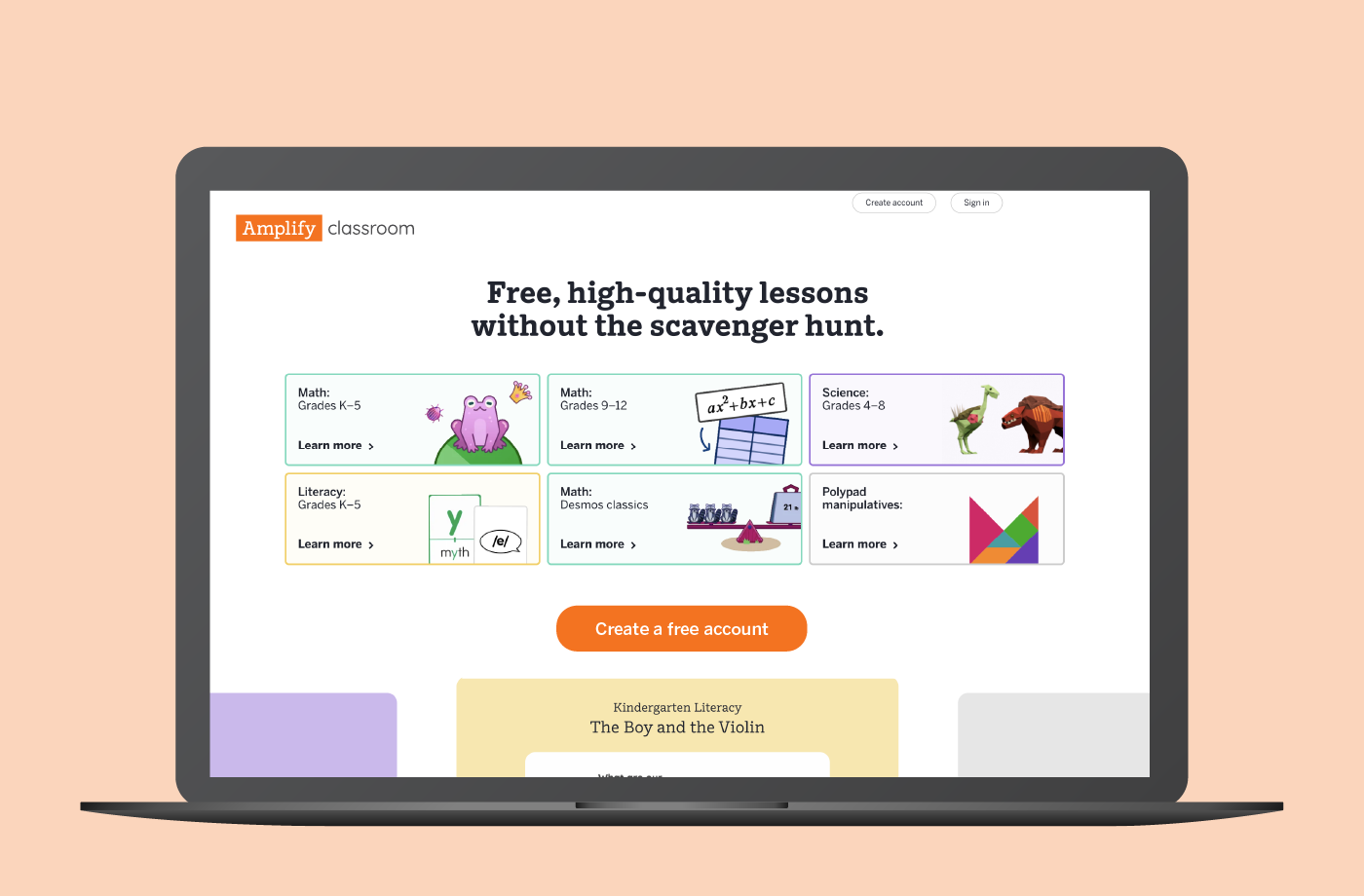
That’s what student-centered math looks like, and it’s the approach that Amplify Desmos Math is built on—the idea that student thinking is valuable and belongs at the center of learning.
Curious about shifting to a student-centered approach? Our Advice for the Math Classroom YouTube channel is here to help, with a student-centered math practices playlist full of quick clips from K–5 math teachers who’ve made this move. Here are just a few of the practical ways you can bring student-centered math into your classroom, each with a short video to help you get started.
1. Make students the main characters.
Amplify Senior Fellow in Learning Innovation Dan Meyer takes the math problems he solves in his daily life and puts students at the center of the story.
Example: sizing up which grocery line will move fastest. He took photos of a line at the store one day, then asked students: What do you notice? What do you wonder? Which line would you choose, and why?
This approach means that students are seeking and spotting what matters, forming a question, and defending a choice.
Watch: “Make students the main characters in your math class”
2. Invite disagreement.
Meyer also has a move for the moment students hit something tough. Example: In an Amplify Desmos Math card sort, the activity can tell him which card trips students up most. Instead of stepping in to fix it, he says it out loud: This is the one people find trickiest. Where did you put it, and why?
That question changes the room. Students compare answers, defend their reasoning, and talk each other through it. Meyer calls it “making the students the curriculum.” The buzz—and, ultimately, the answer—comes from challenges and disagreement, not from the teacher.
Watch: “How Dan Meyer embraces ‘controversy’ in math class”
3. Use metaphors to clarify math concepts and strategies.
Second-grade teacher and author Ian Brown invites students to picture and describe two ways to get where they’re going: the regular lane, and the fast lane. The slow lane might be more foolproof, but it takes a while. The fast lane gets you there quicker, but has risks. Applied to math, this thinking can help students name their strategy, choose it on purpose, and explain why they did, highlighting the difference between simply following directions and truly doing math.
Watch: “Using metaphors to power math instruction”
4. Rethink memorization.
Brown also puts a new spin on memorization, comparing it to knowing his commute. While he does have the route memorized, he doesn’t panic if he hits a detour. He is confident that if he stays calm, he has what he needs to find another way around. That’s his goal for his students in math class, too—not a memorized path, but the deeper understanding and problem-solving tools to keep going when a usual route is blocked.
Watch: “Rethinking memorization in math”
5. Get your youngest students talking.
Author, national presenter, and Alabama K–2 educator Keri Brown uses a simple counting routine with her kindergartners in which the class counts to 100, one student at a time. She also turns it into a game, shifts it to a group activity, and adjusts the difficulty as they go, making it fun for the class while also seeing which students need more support.
She uses a similar technique to get young students talking: Looking at a picture of a farm, she asks how many of each animal they see. Saying the number out loud is part of the work, as is showing how they counted. This gives five- and six-year-olds the space to start explaining their thinking, even before they can write it down.
Watch: “A guide to math talks with children”
How to keep centering students
Subscribe to Advice for the Math Classroom for a steady supply of K–5 math teaching resources you can use in your own classroom the very next morning!
Plus: We often pull clips from our Beyond My Years podcast, where host Ana Torres talks with teachers like Ian Brown and Keri Brown about what they’ve learned. If you like the ideas in this playlist, subscribe to Beyond My Years for more advice from fellow teachers.