
Welcome to Transitional Kindergarten
Amplify Science California jump-starts a lifelong love of science with developmentally and pedagogically appropriate instruction featuring:
- Real-world problems and scientific phenomena.
- An experiential approach with lots of hands-on.
- Explicit support for building oral language and early literacy skills.

What students learn
Our program is comprised of three units: one life science, one physical science, one Earth science.
As students take on the role of a scientist or engineer to figure out real-world phenomenon, each unit:
- Sparks curiosity and engagement.
- Encourages students to wonder, think, and talk.
- Builds a solid foundation for future success with science.
Look below for a summary of each unit.

Unit 1

Unit: Wondering About Noises in Trees
Student role: Life scientists
Phenomenon: Strange noises appear to be coming from the trees outside.
Unit 2

Unit: Wondering About Buildings
Student role: Building engineers
Phenomenon: One class made a play city. Some of the buildings stayed up, while others fell down.
Unit 3

Unit: Wondering About Puddles
Student role: Weather scientists
Phenomenon: Puddles exist in some places but not in other places along a girl’s walk to school
Program structure
To meet the unique needs of little learners, our program follows a unique structure.
Each unit:
- Begins with an Introductory Activity that
introduces the phenomenon. - Includes a series of three Explorations that are comprised of a Kickoff Discussion, four activities, and a Shared Drawing and Discussion.
- Ends with a Culminating Activity that consolidates students’ understanding.
Each activity is designed to span 15 minutes. Depending on how the program is implemented, an entire unit generally takes 4–6 weeks.

How teachers teach
Tom Teacher feels confident delivering 3-D instruction with our resources by his side. Watch this video to learn more. >
When you’re ready, scroll down to take a closer look at sample resources.
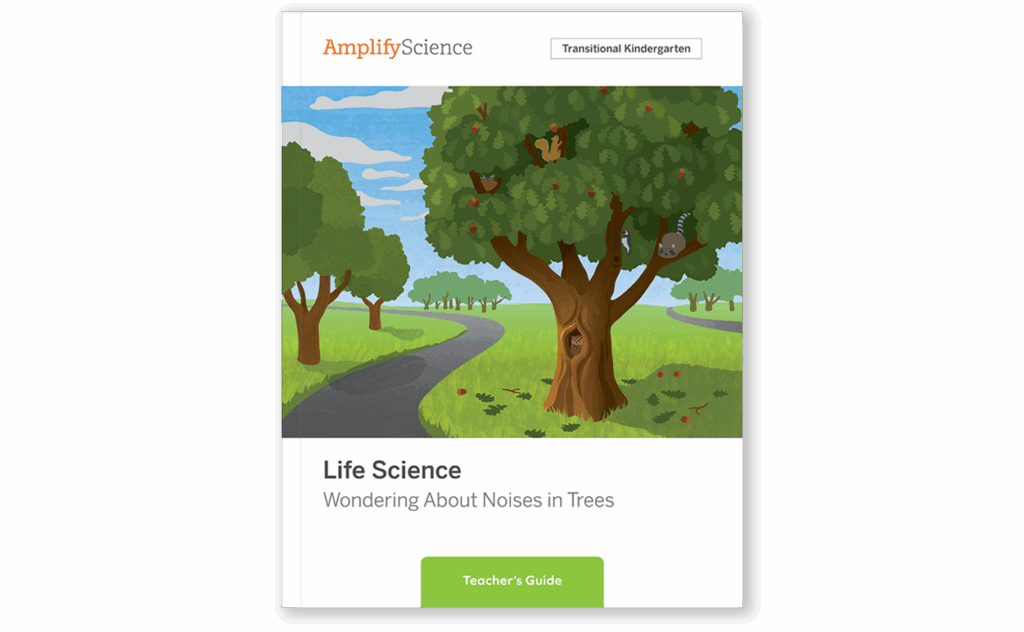
Printed Teacher’s Guide
Our unit-specific Teacher’s Guides are chock full of helpful resources, including scientific background knowledge, planning information and resources, detailed lesson plans, tips for delivering instruction, differentiation strategies, additional classroom resources, and copymasters.

Big Books
Big Books contain vivid photographs and are used to introduce topics, facilitate group discussions, and support students’ firsthand investigations. Each Big Book is an integral part of instruction and is used multiple times for multiple purposes across a unit.

Science Questions
Each unit includes three printed Science Question cards, one for each Exploration of the unit. The cards can be posted on classroom walls and support the class as they are introduced to and revisit the focus of their investigations over the course of an Exploration and, ultimately, the unit.
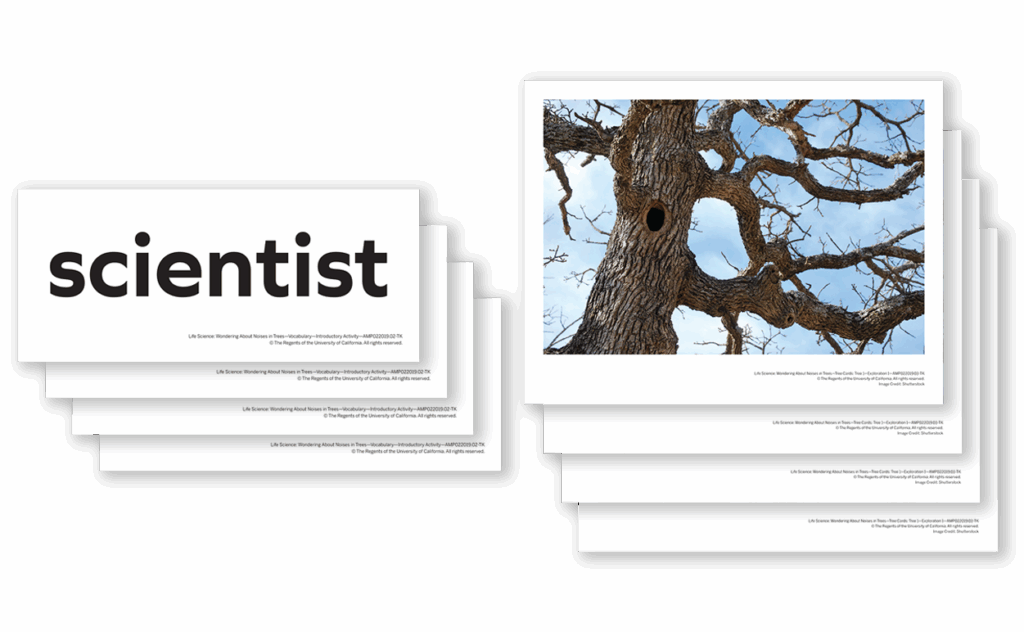
Vocabulary and Picture Cards
Each unit includes six or seven printed Vocabulary Cards and a set of colorful Picture Cards that can be posted on classroom word walls and concept walls. Cards are used for a variety of purposes, including gathering evidence, building background knowledge, and introducing the focal phenomenon.


