
Every discussion teaches kids about math—and about themselves.
Among many other reasons, discussions are important because they’re moments when the teacher assigns value to students. In a discussion, the teacher says, “Hey—I have precious little time to teach what I know. Still, I’m going to dedicate some of that time for you to share and talk about what you know.” That’s a moment when students learn about math, but also that their own ideas have value.
Discussions are difficult, and “more wait time” is rarely the reason.
There are a few reasons why discussions frequently fail, and it’s rarely because the teacher didn’t give students enough “wait time” to respond, as is commonly believed.
1. The question was hard to understand or find your way into. For a long time, I’d ask my kids at dinner, “How was your day? What happened?” And my kids wouldn’t have much to say. Lately, I ask them to tell me two things about their day that happened and one thing that didn’t, and we all guess which was which. It’s an easier prompt, one that kids can find their way into with ease and then use as a launching pad into a larger conversation.
2. There isn’t enough to talk about. If your math class consists of a lot of binary, right/wrong questions, what is there for anyone to talk about? “A lot of us got this one wrong. Here’s a pie chart that shows how wrong we were. How about I show you how to do it?” That’s fine, but it isn’t a discussion, and it’s quite often a very dreary classroom environment for children.
In Amplify Desmos Math, a curriculum I work on, kids generally have plenty to talk about. Our interactives stir a kid’s imagination for even the most abstract areas of math. For example, this submarine interactive stirs up a kid’s ideas about adding positive and negative integers.

And then we ask kids, “Hey, what do you think about the star at +5? Can you come up with something that none of your classmates do?”
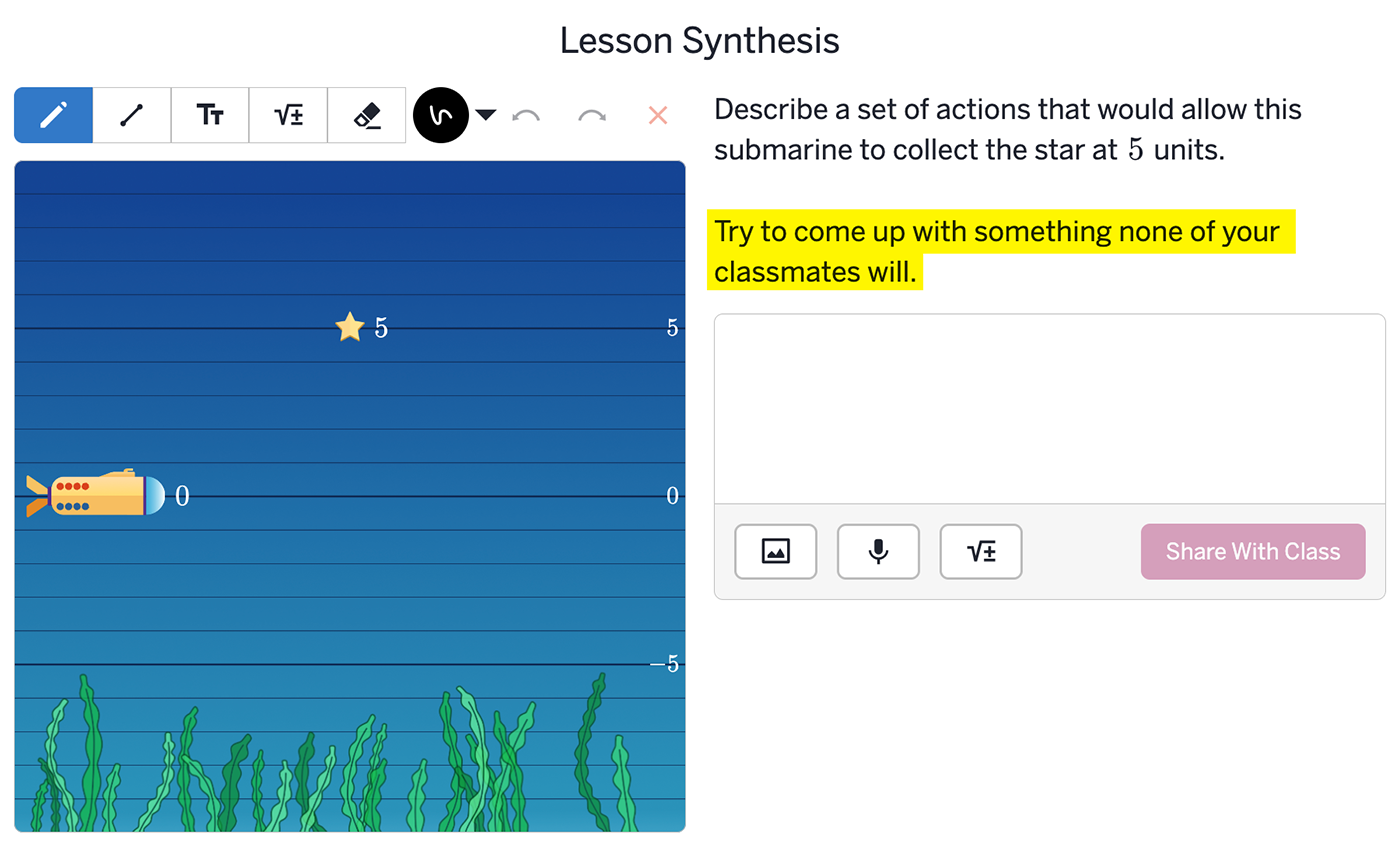
Let me tell you: Kids accept that challenge.
3. There is too much to talk about.
This is a good problem to have, but it’s still a problem. In the class screenshotted below, 25 students have put 300 thoughtful words in front of the teacher, every response different from every other!
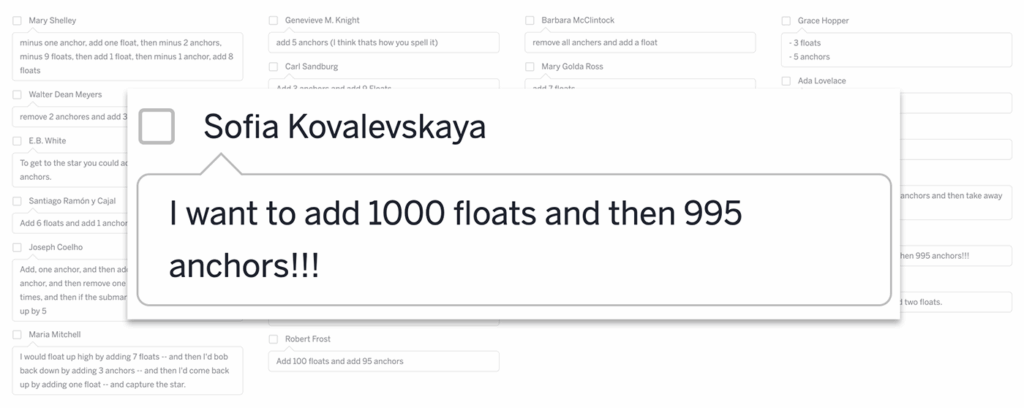
Teachers now have a problem of abundance, not scarcity. They have to decide which responses to select, and why, in an environment of cognitive overload.
This is very hard work for teachers, especially novices, especially teachers who lack mathematical content knowledge, especially teachers who are hanging onto the school year by their fingernails.
We offer teachers lots of different support for discussions throughout our curriculum—both in print and digital activities—but our new discussion support for digital activities is first-of-its-kind and best-in-class.
Discussion Moments.
- Student responses stream into the teacher’s dashboard.
- A message appears: “Analyzing Student Responses.”
- Shortly after, the message changes: “Open Discussion Moment.”

You click the message and see a classroom-ready discussion screen.
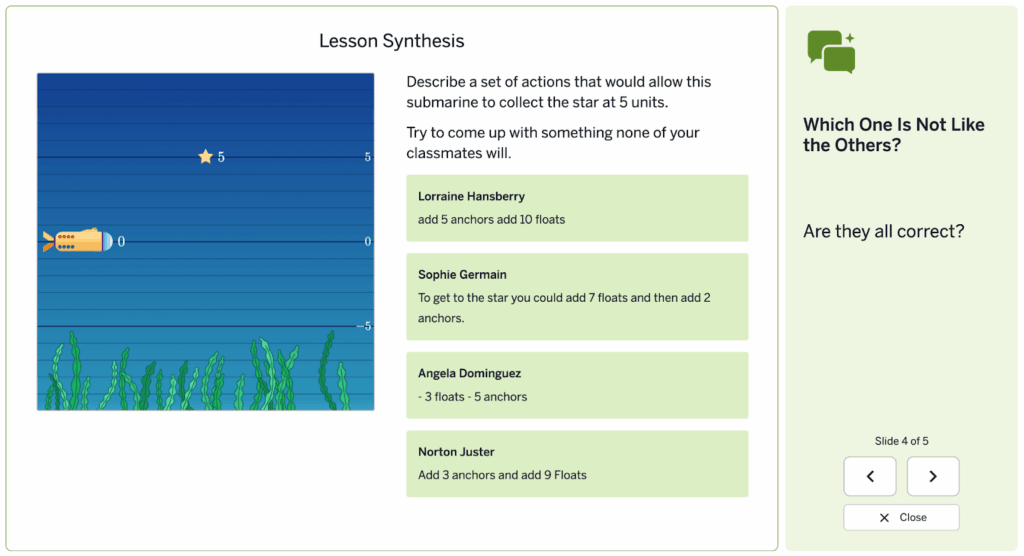
First, you see four student responses, each one authored by a student in the class, each one interesting on its own. This was not luck. Those responses were curated by a large language model at the direction of our curriculum experts. “Find three responses that capture the star in different ways,” our experts prompted the AI. “Responses that add anchors. That remove anchors. Find one response that might not capture the star.”
Next to those responses you see a question: ”Which one is not like the others?” That question feels surprisingly well-matched for this math and for those student responses. This, also, isn’t an accident. Curriculum experts made that decision.
You click the right arrow and see a suggested narration for the Discussion Moment, narration which was authored, again, by our human authors for this particular problem, to help novices learn to facilitate productive discussions in math.
That’s a “Discussion Moment.”
In the past, coaches, experts, and publishers have all asked teachers to . . .
- Select and sequence student responses.
- Construct a student-facing discussion resource.
- Lead the conversation.
Now we are asking teachers to . . .
- Lead the conversation.
In our experience, computers do quite well with the first two jobs while teachers obliterate computers at the work of leading a conversation, at connecting student ideas, at asking one kid what they think of another kid’s idea, at pulling ideas out of a kid who maybe doesn’t think they have ideas to offer. Discussion Moments delegate to humans and computers the best work for each of them.
Discussion Moments are different.
Lots of edtech companies are putting AI to work in lots of different ways. Discussion Moments are unique.
First, they’re designed to work through rather than around the teacher, during class rather than outside of class. They’re designed to support social interactions between students and teachers in the moment of instruction. This is the action.
Second, this is a classroom-ready resource. So many AI applications just output a ChatGPT-style resource. Lots of text. Several main bullets. Lots of sub-bullets. An emoji or two. And I am very sorry, but they are not useful in class. The teacher has to read all of that text, copy and paste and edit it, and then construct the student-facing resource all in the middle of class. That’s fantasyland, folks. At Amplify, we have, instead, created a one-click, classroom-ready resource.
Third, we’ve fortified these digital Discussion Moments with gallons of human expertise. Since December, I’ve worked with several of our curriculum experts—Casey Nelson, Brian Kam, and Tom Snarsky—and for every problem across several units of middle school math, they:
- Reviewed thousands of student responses to each problem.
- Identified thematic trends in the student responses.
- Decided whether or not those themes demand a discussion.
- Decided which of several discussion frames would be most appropriate, given those themes.
- Wrote an AI prompt specific to each problem to increase the odds that the large language model will curate useful student responses.
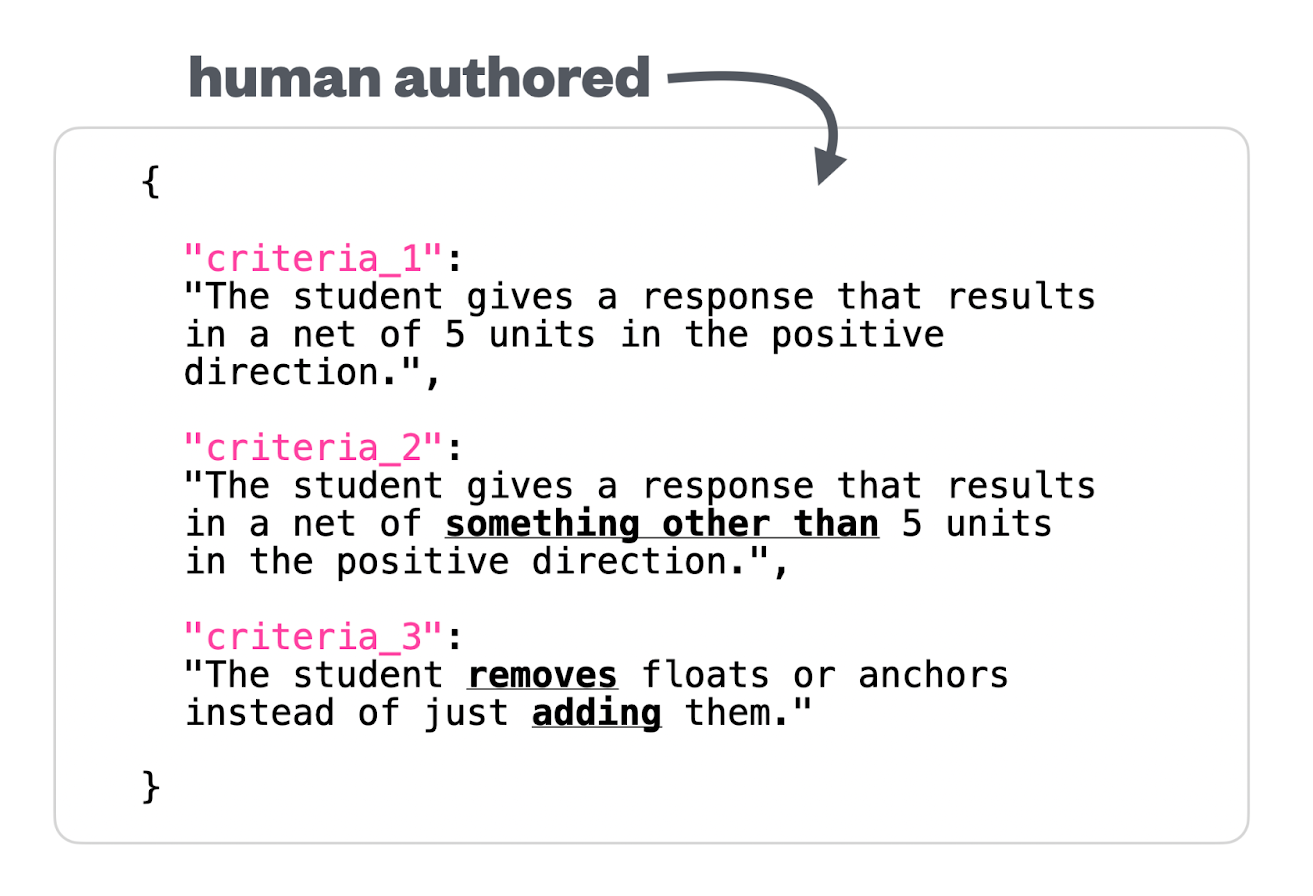
Most edtech companies would prefer to let AI lead this process from end to end, using the same prompt for every problem, even at the cost of the teacher and student experience. Meanwhile, we only ask AI to execute instructions and construct a resource. The nature of those instructions, the type of resource, and how it’s used—that is all determined by different humans and their expertise.
What do teachers and administrators think?
I ran a small-scale pilot of this feature last spring and kicked off a larger-scale pilot last week. A couple hundred teachers overall. I have never had an easier time recruiting teachers for a project than with this one. Every district math curriculum lead knows how challenging it is for teachers to lead discussions, and every one I asked was eager to support.
Two other examples of Discussion Moments.
Compare and Connect. We asked a large language model to locate responses that have one of a couple of important features but ideally not both. Then we constructed a Discussion Moment asking students to write a response that combines the best of both answers.

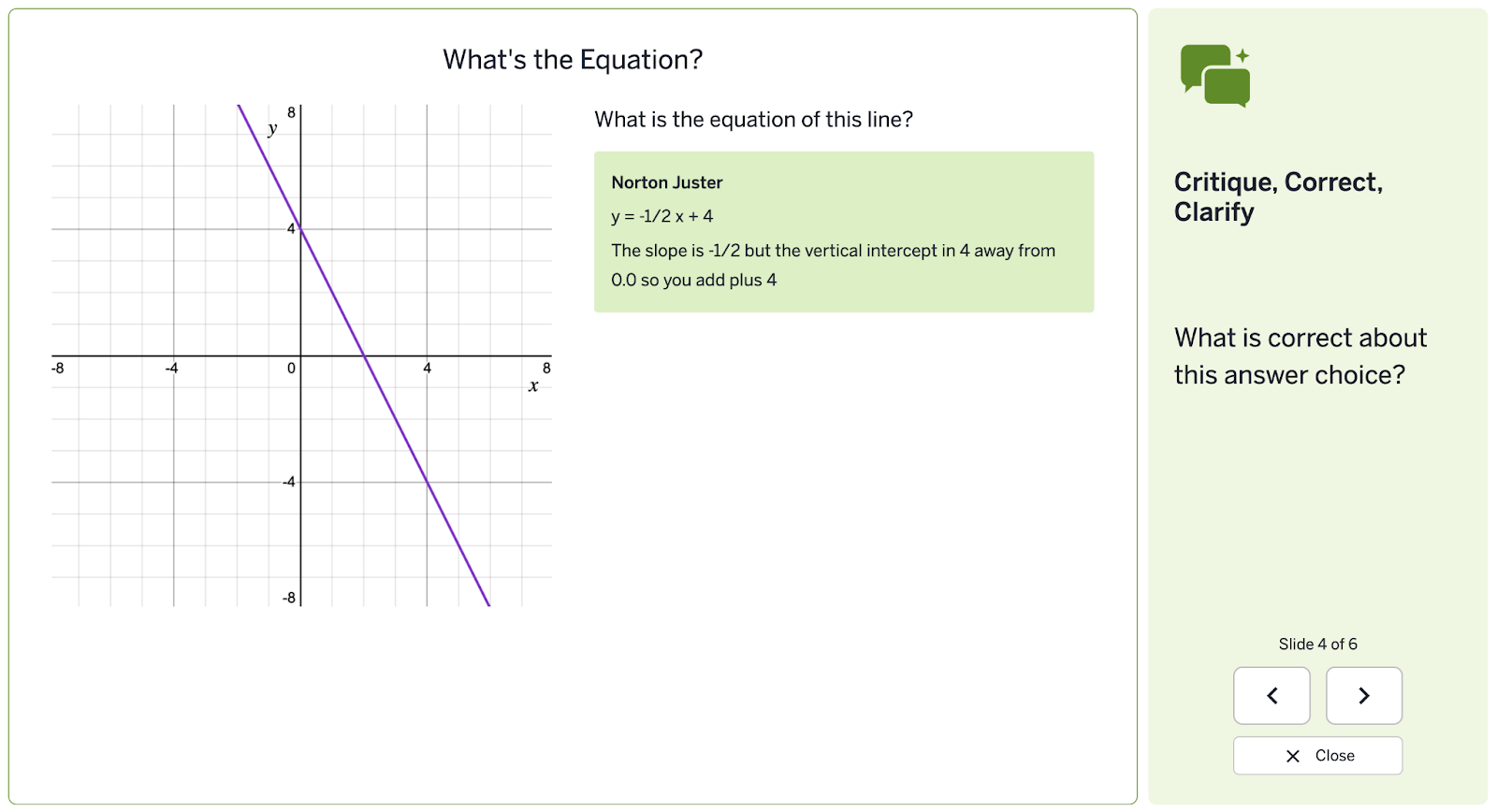
Critique, Correct, Clarify. Our curriculum authors noticed a frequent incorrect answer to a question. We told the LLM to watch out for it and frame it in a Discussion Moment where the class is asked to find value in the wrong answer before correcting it. Try to imagine what it does to a kid to hear their incorrect answer described as valuable.
Wait—don’t you hate AI?
I get why you might ask me that, but no. I think generative AI is perhaps the most overrated education technology of my lifetime; I don’t think the chatbot tutors or lessonslop generators are going to transform K–12 education. But I do think generative AI is neat. And look, I have tried to support discussion work with K–12 teachers for the last ten years in other ways, too. I have run in-person and remote PD. I have written math lessons and teacher supports for those lessons. I have sent nifty little customized email sequences tailored to teacher usage. None of those supports have been as promising as AI is here. None of them has moved the needle like Discussion Moments because none of them has been able to meet teachers in their moment of need, at the point of use.
That’s it. You can find Discussion Moments in Amplify Desmos Math next school year.


