S5-05. Math technology & hacks for math anxiety: research-based tips for caregivers
A blue graphic with text reading "Math Teacher Lounge" in multicolored letters and "Amplify." at the bottom, with abstract geometric shapes and lines as decoration.

We’ve been very lucky to have so many prolific and brilliant researchers on this season of Math Teacher Lounge, and our next guest is no exception.

Listen as we sit down with Dr. Marjorie Schaeffer to discuss what causes math anxiety, math hacks, and how the right math technology can make an incredible impact in children and caregivers coping with math anxiety.

Listen today and don’t forget to grab your MTL study guide to track your learning and make the most of this episode!

Download Transcript

Marjorie Schaeffer (00:00):

I think the most important thing we know from literature right now is that high math-anxious parents, when they interact with their children, their children learn less math over the course of the school year.

Bethany Lockhart Johnson (00:12):

Welcome back to Math Teacher Lounge. I’m Bethany Lockhart Johnson.

Dan Meyer (00:15):

And I’m Dan Meyer.

Bethany Lockhart Johnson (00:16):

We’re onto Episode 5, Dan, of our series on math anxiety. And I wanna say it feels so lovely to imagine all of these people out there doing work to help combat math anxiety. I dunno, it just makes me feel excited about the possibilities. This work is out there; it’s happening! Kids and teachers and caregivers are being impacted by these conversations. Not just — I mean, I don’t just mean the conversations we’re having on Math Teacher Lounge, but I mean, that these researchers are doing. Like, yes, we can change this!

Dan Meyer (00:53):

This is great. Yeah. We have people who are extremely smart, who have dedicated their professional lives to studying math anxiety and resolving it. And each of them that we’ve chatted with — they share lots of ideas in common, but I’ve loved how they each have their own different flavor or take or area of emphasis on a problem that hits everybody everywhere. It’s in your home, with kids and caregivers. It’s in schools. It’s in our places of teacher preparation and professional learning. Every place is a place where we can focus on resolving issues of math anxiety. It’s exciting.

Bethany Lockhart Johnson (01:26):

Yeah, I feel like … if there could be a course in — we all know that our teacher prep programs, in MOST teacher prep programs, there’s not nearly enough math methods or time to cover <laugh> — it’s like ready, set, go! And depending on who your mentor teacher is or what your math methods course … I mean, it can totally shape the way that you are prepared or really not prepared for going out there to teach math! And so I love that we’re having these conversations.

Dan Meyer (01:55):

What I love about today’s conversation is, one, it’s got a little bit of a technology flavor, so there’s that. But I also love, it’s got one of my favorite features about change, which is that it focuses on change to action, change to routine, rather than change to belief. Rather than saying like, “OK, everybody! Everybody stop thinking bad beliefs about math and transmitting them to your kids!” Instead, it says, “What we’ll do is just, hey, we’ll set that aside for a second and we’re gonna do a certain thing every day and watch as those actions make your beliefs change.” That to me is extremely cool. And I think it has a higher likelihood of success than just, like, me telling parents, “Hey, stop thinking these thoughts!”

Bethany Lockhart Johnson (02:37):

“Ready, set, stop being anxious!”

Dan Meyer (02:39):

Exactly. Exactly. So it’s an exciting conversation we’re gonna have here.

Bethany Lockhart Johnson (02:43):

Right. So it’s not a, you know, “wave the wand and all of a sudden, you’re not anxious about math anymore.” But these incremental changes, these incremental conversations, this validation, can really, really impact change. I’m with you on it, Dan. I hear what you’re saying.

Dan Meyer (03:01):

To help us talk through all of these ideas and more, we’re joined by Dr. Marjorie Schaeffer, Assistant Professor of Psychology at St. Mary’s College in Indiana.

Bethany Lockhart Johnson (03:10):

Enjoy. <Jaunty music> So, yes, Dan, we are so excited to welcome Marjorie Schaeffer. She’s Assistant Professor of Psychology at St. Mary’s College. Dr. Schaeffer, we’re so excited you’re here. Hello!

Marjorie Schaeffer (03:28):

Thank you so much for inviting me.

Dan Meyer (03:29):

Yeah. We are super-lucky to have had so many prolific and brilliant researchers about math anxiety on our show. You’ll be no exception. And every time, we love to find out about how you came to study math anxiety, which winds up being a really interesting glimpse into your backstory bio. So tell us, what is the route by which you came toward studying math anxiety?

Marjorie Schaeffer (03:51):

Oh, I love that question. I’m really interested in how the attitudes and beliefs of parents and teachers influence children, especially around math. And I actually became interested in this idea in college, when no Child Left Behind was actually first starting to be implemented in schools with high-stakes standardized testing. So much so that I actually did my thesis on this thinking about, “Do children understand the importance of high-stakes testing? Do they have anxiety around that idea?” And so that was really my first foray into the anxiety literature. And that was kind of the entry point into math anxiety for me.

Dan Meyer (04:28):

So you started by studying a very high-stakes assessment, like our students connecting with this. And the assessment is once per year. And classroom instruction is every day. So how did you move from the assessments to the everyday instruction?

Marjorie Schaeffer (04:44):

That’s a great question. So, after college, I actually taught kindergarten. And so from that, I saw the day-to-day impact of instruction and the day-to-day impact of children’s individual attitudes and beliefs. And so I really became interested in thinking about, “How do we understand why some children are really successful from the instruction happening in classrooms and why other children need a little bit more support?” And so math anxiety was one way for me to really think about the individual differences I saw in my kindergarten classroom.

Dan Meyer (05:18):

It feels like you headed … you went farther upstream, is what it feels like. Where assessment … there’s like some kind of anxiety around assessment, let’s say. And then you ventured farther up the stream to classroom instruction and then still farther into kids’ homes. It seems like your research invokes a lot of curiosity about the sources of a kind of amorphous, flowing phenomenon called math anxiety. And I’d love to hear a bit about what you know about how caregivers transfer, transmit — whatever the word is — math anxiety to their kids.

Marjorie Schaeffer (05:55):

For parents … we think that the attitudes and beliefs of parents matter. And we see that for lots of areas, not just math anxiety. But I think math anxiety, we see that really clearly. And so, we can think about it both in terms of what kind of input parents provide. So, how do families talk about math with their children? What kind of support do they provide around homework? And those are ones that I think are a little obvious. But we can also think about the offhanded comments that parents say to children when they’re talking about math generally. Right? So, we see lots of memes going around, talking about how hard math homework is. And so, I think when parents say offhanded comments like, “I’m not a math person,” or “We’re just bad at math,” that communicates values to children. I think the most important thing we know from literature right now is that high math-anxious parents, when they interact with their children, their children learn less math over the course of the school year. And this specific mechanism by which that happens is still an area for a lot of research. And so some people think it’s about input. So maybe if I’m math anxious, I’m avoiding math. And so, when I have an option to read a picture book that has math content, I focus on the colors instead. And so, my child is actually getting less math than other children. We can also think it’s about these messages that are provided. So, when I talk about math, I send the message to my child, it’s not for them, and therefore the child wants to engage in it less. And some of my work looks at things like expectations and values. So, thinking about, “Do math-anxious families actually value math less than other families unintentionally?” And so, we have some support for this idea that they expect less of their children. And so maybe when they struggle, they respond in different ways than a family who’s lower in math anxiety.

Bethany Lockhart Johnson (07:53):

This is so fascinating to me. I also was a kindergarten teacher. And I remember a mom who just … she had such like palpable math anxiety. And during one of our conversations, she was talking about these homework sessions with her daughter. And I may have mentioned this on the podcast before. But she was talking about how every night they would sit together and they would do all this math. They’d do, like, extra math together. And it always ended in tears. And despite her math anxiety, she didn’t want her daughter to experience the math anxiety that she did. So she was trying to pile it on, so her daughter was more proficient and comfortable. And instead, it was perpetuating this anxiety about it. And so, it’s a phenomenon then, right? Even if a parent is saying, like you said, maybe completely unwilling, this mother was actually trying to do the opposite. She was trying to help, you know, imbue the love and comfort with math. Right?

Marjorie Schaeffer (09:01):

Absolutely. This is why I think in my research, it’s really important that we find low-stakes, low-stress ways for high math-anxious families to do math. They absolutely can support their children in doing math. But they need a little support. We want it to be a fun, low-stakes environment, right? So maybe that’s the connection back to high-stakes testing, that I want children to have fun math experiences.

Dan Meyer (09:28):

Yeah. This is challenging, because it feels like the more caregivers know about math anxiety, and its pernicious effects on students, and how easily transmitted it is, one could become quite anxious about math anxiety. And, you know, no one makes great decisions when they’re anxious. So if I’m recalling our various episodes we’ve done, we’ve heard from people say, “Well, you need to validate students’ math anxiety. This is not something to just ignore or brush past. But also, not validate it in a way that says, you know, ‘This is OK and generational and inevitable.’” Which presents parents with a very thin path to follow, it seems like. So I love what you’re saying about how we gotta just de-stress the whole process.

Bethany Lockhart Johnson (10:11):

You’re avoiding the whole, “I wasn’t a math person either” kind of thing. <laugh>

Dan Meyer (10:15):

Right, right, right. Yeah. So I’d love to know more. We’re excited about the technology that you have studied and helped develop, presumably, called Bedtime Math, anapp for caregivers. And I’d love to know more about what that is and what it offers parents who know enough about math to know that they don’t want to transmit math anxiety to their children, but also want to support. So what does that offer them?

Marjorie Schaeffer (10:39):

So Bedtime Math is an app. It’s freely available on iTunes or the Apple Store or Google Play. And what it’s designed to do is to provide a nightly topical passage. So one of my favorites is the one about Groundhogs Day. And so it talks a little bit about the history of Groundhogs Day, and then it asks math-related follow-up questions. So starting at a preschool level, going through late fifth grade. And it’s really meant for parents to pick the one that meets their children where they are. And so the preschool-level question asks children to pretend to be a groundhog and walk to the left and walk to the right. So a skill that families might not think about as being math, but we actually think that IS part of understanding math. Understanding left and right directionality. And then the next question can ask questions like, “If it took the groundhog three seconds to climb out of the hole, and then two more seconds to see its shadow, how much time did it take all together?” So a simple addition problem, but it’s phrased in a fun way. And so the hope is that for high math-anxious families, these interactions are fun and playful. They don’t look like fights over homework. They’re just conversations that families can have around topics that are naturally interesting to children. And our hope is that when families have lots of these positive low-stakes interactions, they actually can see that we can talk about math in unstressful ways. In lots of ways, right? We can also do this at the grocery store. We can also do this while we’re cooking in the kitchen. It doesn’t just have to be fights over homework.

Bethany Lockhart Johnson (12:14):

And I actually have the Bedtime Math — one of the Bedtime Math books. And I was so excited to find out that there’s an app. And I think one of the things that I loved about the book is that these are invitations, right? They’re exactly that. Low pressure <laugh>, and they’re invitations to have a conversation. And if we were just to tell parents, “Oh, just count!” or, “Hey, just count wherever you go!” You know? No. It’s, in a way, I think, like you said, it’s retraining the parents on what math could look like. Like, “Oh, I didn’t even think we could just kind of have this conversation and we’re actually doing math together.”

Marjorie Schaeffer (12:55):

Yes, absolutely. I absolutely agree. We want it to be fun and playful and not stressful. And we want it to also be things that are meaningful to children’s lives. So these are topics children are interested in. It’s not that we are using flashcards or making children practice math facts over and over again. These are things children should wanna do that can naturally fit into a child’s routine. So almost all families read books before bed, and what we hope is that math can also be a part of the nighttime routine.

Dan Meyer (13:27):

There’s something really subtle here going on that I just wanna name and ask a question about. First of all, it’s cool that you started with studying high-stakes stuff and now you are developing low-stakes stuff. And I’m really curious what makes a thing low-stakes? Like, a few things I’m hearing from you is that there’s, like … I have a small child that I read literature to on a nightly basis. And I feel very anxiety-free doing that. And it’s almost as though, because each of the — tasks is the wrong word for this, but experiences — involve some reading, it puts me, the parent, in a mode that is comfortable and familiar to me. I’m curious: Are there other, as you design, what, one per day for a year? All these different experiences. What are some of the principles that you lean on that help make a thing low-stakes for kids and for parents?

Marjorie Schaeffer (14:17):

Yeah, that’s a great question. So one thing we wanted to be really intentional about is that our app doesn’t look like a lot of traditional apps. There isn’t noises that go off. You don’t enter an answer. And so one of the things that we thought made it low-stakes is that while there is a right or wrong answer — there is a correct answer — we aren’t giving children upsetting feedback. Instead, what we wanna encourage families to do is, if you struggle to remember how many seconds it took the groundhog to come out of the hole, you can work through that with a parent. So it doesn’t feel like you’re getting negative feedback; you’re being told you’re bad at math; you did it wrong. Instead, you’re just getting natural support moving forward. And so that’s one thing we wanted to be really intentional about, was that it wasn’t going to be a negative experience for children. And we are trying to build on all of the positive interactions families are having around nightly book reading. So many ways this can look very similar. You get to read another story that’s topical and hopefully interesting. And then do these little questions together. And so for a lot of families, their children don’t actually really look at the question. It almost feels like the parent is just asking them on their own. Like, they just came up with it. They just wanted to know what would happen to the groundhog. If there were three more groundhogs? How many groundhogs would we have all together? Not like it’s gonna be like homework or other parts.

Dan Meyer (15:38):

So my understanding is that there isn’t a blank into which people type a number in, press “submit” for evaluation, receive the red X, the green check. That’s a key part of the design here.

Marjorie Schaeffer (15:50):

Yes, absolutely. And for research purposes, we would’ve loved to know what families were saying. But we think it’s really important that it’s fun, interactive, that families are working together to get to the right answer, that it’s not a test for children.

Bethany Lockhart Johnson (16:03):

In your research, when you were — maybe you could walk us through the study a little bit. But I’m also curious if you heard from parents that it was carrying over beyond the bedtime routine. Because I would imagine, if I am building these skills and reading these questions and learning that I could talk to my kid like this about math in a fun way, that’s gonna happen then, like you said, when I’m in the grocery store. Or when I’m waiting in line for at the bank. Or whatever, you know? People go into banks now still, right?

Marjorie Schaeffer (16:35):

Yeah, absolutely. So in our study, we recruited almost 600 families and we randomly assigned them. So they had an equal chance of getting both our math app and what we call our control app. And that’s really just a math app without the math. We think of it as a reading control app. And that’s because we wanna make sure that families are having a similar experience, that it’s not just that having high-quality, fun interactions with your child is actually impacting children’s math achievement. And so what we then did is followed those children over the course of early elementary school. And so we worked with them in schools in the fall and spring of first, second, and third grade, really to look at their math learning. And so what we find is that children of high math-anxious adults, when they have the reading app, so what we think of as what’s happening in the real world, we see that really classic gap between children of high math-anxious adults and children of low math-anxious adults. So if you have a high math-anxious parent, you’re learning about three months less math over the course of first grade. But for children who receive this math app, we see this gap as closed. Those children look no different than a low math-anxious parent. And so that’s leading us to think that we’ve helped families talk about math in fundamentally different ways. We did a little bit of just talking to families to see a little bit about what might be going on. And a lot of families do report exactly what you’re describing, where they say this did help them talk about math in different ways they were doing it other times.

Dan Meyer (18:10):

That’s a really extraordinary study design. I don’t know … I love that you folks gave the control group not nothing. Like it’s possible that just parents and kids bonding over a thing regularly would be enough to provoke some kind of academic gain. But you gave the control group a thing that had them interacting socially, bonding, and still this large common gap between high-anxious and low-anxious parents, their kids shrunk together. Is that what I’m gathering here?

Marjorie Schaeffer (18:41):

Yeah, absolutely. So we’re basically seeing we can no longer, when we look at children’s data, say that parents’ math anxiety explains individual differences. So these children look really similar. They’re learning more than children who has a high math-anxious parent and just got our reading control app.

Dan Meyer (19:01):

just diving into the study a little bit more here, what is the time commitment? Or, did you guide parents to say, “All right, we’re gonna do this do this delightful story about a badger for an hour”? Or did people do it for five minutes? And what was the time commitment, roughly, for people?

Marjorie Schaeffer (19:17):

So we tell families to do it however they see fit. Because it is an app, we are able to get some sense of how long, and we are talking about three to six minutes for many families. For a lot of families, they’re reading a paragraph, the paragraph and a half, and then answering one or two questions. They’re not going through every possible question. They’re just doing a little bit, really meeting their kids where they are.

Dan Meyer (19:39):

Roughly how many times per week was that?

Marjorie Schaeffer (19:41):

So we asked families to do it as much as it fit. But we’re seeing about two and a half on average in the first year. And so families are fitting it in a couple of nights a week. It’s not every night.

Bethany Lockhart Johnson (19:52):

So what it sounds like you’re saying is what really was powerful about this app is that it was the space and time and prompts between the caregiver and the child, that chance to really sit down and have some of these meaningful and positive math interactions. How did it shift those relationships?

Marjorie Schaeffer (20:12):

So one of the things I think that makes the app effective is the changing of expectations. After a year, families are really using the app a lot less. And I think that’s OK, that they have found other ways to incorporate math into their lives. And we find that we don’t see an impact on their math anxiety, that they aren’t becoming less math anxious from this experience. Which I think makes sense, because they have had a lifetime of math anxiety. But we do see a change in parents’ expectations and value of math. So they expect their children will be better at math, and they also report that math is more important in their children’s lives. And so I think that’s an important part of it, which is, we can change these values for families, even if we aren’t able to change the math anxiety of the adults in children’s lives.

Bethany Lockhart Johnson (21:01):

I want to for a second before — because I’m loving this idea of the app, and I’m excited to find out more ways to cultivate these conversations in my home and also share this with other folks. Because even folks who don’t even maybe realize they have math anxiety … like you said, so often it’s unconscious. So often we’re putting these little snippets into our everyday conversation, like, “Oh yeah, I’m not a math person.” And we don’t even realize how much is impacting our kiddos and ourselves, right? So I am really curious: What do you think … in your research, what were some other takeaways that you feel like are really strategies that we can think about for combating math anxiety in general?

Marjorie Schaeffer (21:47):

So I’m particularly interested in thinking about how math-anxious adults can help tone down their anxiety so that they can have high-quality interactions with their children, that they interact with. And so one of the big takeaways for my research, I think, is that math-anxious families can help their children with math. They just need support. And so I think there are lots of ways for that support to look like. One, I think it can be an app, but I also think reading a little bit about math can be really helpful. So it’s not new. So the first time you aren’t thinking about some of these ideas is as your child has their homework open in front of you. And so you can process your own feelings separately before you have to do it with a child. I also think reminding parents that math is everywhere and that math is actually lots of things that we all love to do. Math isn’t just calculus. Not that calculus isn’t wonderful. But that math is measuring, math is counting ducks at the park. Math is talking about how many times did I go down this slide. And talking about math in this way, I think reminds families that they are great at that. That even if maybe they’ve had bad math experiences before, they can do math. Especially the way their preschool or early childhood, early elementary school student needs them to. And I think that can then set the foundation for being really successful later.

Dan Meyer (23:13):

So is your research then, your subsequent studies, your line of inquiry, is moving more towards how to support parents, then? Is that what I’m hearing?

Marjorie Schaeffer (23:22):

Yeah. So I’m really interested in both understanding how the math anxiety of parents and teachers influences children. And so math anxiety is really common and we know that it’s particularly common in early elementary school teachers. And so it’s very likely that children are interacting with a highly math-anxious adult. And so I’m really interested in thinking about how we can support those individuals in doing it. And so both, I think, things like Bedtime Math, which provide fun, unscripted ways to do that, but I’m also interested in the teacher equivalent. So, thinking about whether having things like a math coach can help teachers have more positive experiences with math. So if you see someone else play math games with your students, can that help you do it as well?

Dan Meyer (24:09):

It makes me wonder a lot about an app for teachers or an app for parents, one that’s not designed to be co-consumed with kids and their parents. But what that would look like … yeah, that’s really interesting.

Bethany Lockhart Johnson (24:21):

If we have a parent who, let’s say they have a third grader, fourth grader, fifth grader, or a middle schooler, right? Outside of early education. And they say, “OK, but what do I do? I’m with my kiddo; I don’t remember this math.” And they’re realizing that their anxiety may be influencing their kiddos’ disposition of mathematics, Or maybe they’re just in the midst of the battle <laugh>. What would you say to those folks, especially if it’s math that maybe they’re not comfortable with?

Marjorie Schaeffer (24:56):

One, I think we should like tone down the stress, right? Remind ourselves that it’s homework and homework feels really high-stakes, but these other outcomes are really high-stakes too, right? And so I’m really interested in the idea that can we help parents feel more comfortable about math by watching their own children teach it to them. So what’s a concept that the fourth grader actually feels really good about? And can they remind their parent how to do it? Can, together, they problem-solve the math homework? And so it’s not just on the parent to give the child the right answer. We know that’s a recipe for communicating some negative things about math. But instead, help the parent-child pair figure it out together. So what are some resources we can do? Can we look it up on the internet together? Can we write an email to the teacher together? Can we think about what are other problems that maybe we know how to do, and therefore we can use that same model here? So I want parents to feel like they are not solely responsible for it. That they can help figure it out with their child together. And so it’s a fun interaction.

Bethany Lockhart Johnson (26:02):

I love that. I love that.

Dan Meyer (26:03):

Yeah. Yeah. That’s wonderful. Yeah. A conviction that I have, and I think it’s true, is that any math that we’re learning at middle school, the attraction can be dialed down to a degree that a very small child, or a parent who has a very small child’s understanding of math, can appreciate. So instead of calculation, estimation. Instead of proof, just make a claim about something. And it makes me wonder about a companion to the work that’s happening in schools that parents feel inadequate to support, that students might not want to teach their parents. But which they could both, on a daily basis, say, “Here’s a way we can engage in this at a level that is comfortable to both of us.” Just dreaming out loud here. No question asked. No response needed. I just love your work. And made me wonder about that. Can you let me know your thoughts about technology? It is very rare that we have someone on the call who is an academic and very well-versed in research, but who also is published not just in in papers and textbooks, but also in digital media. It’s consumed by lots of people. So I am trusting that you have opinions about how math looks in technology. And I wonder if you’d offer some thoughts about how it goes, right? How it goes wrong from your own eyes.

Marjorie Schaeffer (27:14):

OK. That’s a great question. I think that we need more research. I first wanna say that I think that technology has really exploded in the last few years. How children have access to technology and screen times has really changed. And what we need is high-quality research happening. That said, I think that all of the things we know from child-development research still apply to technology. And so we know that children learn best when they are engaging in interactions with their parents. And so when families can use technology together, or at least can talk about what’s happening, it can be really effective. I also think technology, especially math apps, are best at teaching concrete skills with very clear answers. So I think practicing math facts is a great use of technology. So I love that Sushi math app where you solve multiplication problems and then get to quickly pull the sushi off the cart, right? But for higher-level questions, where we’re thinking about word problems or where what we’re helping to teach students is complex thinking, apps have a harder time doing that. Because students can often figure out the answer without engaging in the thinking that we are hoping that they’ll learn. And so I think technology absolutely has a piece. I think technology is helpful for parents. I think the logistics of helping parents live their lives is a good reason to use technology. But I think we need to be conscious of what it’s replacing. And so I think a world in which we think fourth graders can learn math only from apps is not realistic. But absolutely apps can be a great supplement to what’s already happening in the classroom.

Dan Meyer (28:56):

Yeah, that’s super-helpful. We have done a lot of work in digital curriculum here at Amplify, and often face the question on a daily basis, “Should this math be digital or on paper? Should we have the students stand up and talk or type something?” And those decisions are way too crucial and way more sensitive than a lot of the app-based education gives credit to. So appreciate your perspective there.

Marjorie Schaeffer (29:22):

OK. And I don’t think there’s one answer, or one answer for all classrooms. I think it’s like always a balancing act. I do think that one of the reasons our work is successful is because the parent-child interaction. And we want parents to learn from these experiences. And I think the same thing is true for for teachers.

Bethany Lockhart Johnson (29:41):

Dr. Schaeffer, thank you so much for being with us today and for sharing about your research, and again, for inviting us to reconsider ways that we can develop a more positive relationship with math. And that parent or caregiver or teacher relationship with a child, we’re seeing just how incredibly impactful that is. And I really appreciate your work and your voice on this. Thank you so much for your time.

Dan Meyer (30:07):

Thank you.

Marjorie Schaeffer (30:08):

Thank you for having me.

Bethany Lockhart Johnson (30:12):

Thank you again, Dr. Schaeffer, and thank you all for listening to our conversation. You can check out the show notes for more on Dr. Schaeffer’s work and to see a link to the app that we shared about Bedtime Math.

Dan Meyer (30:25):

Please keep in touch with us on Facebook at Math Teacher Lounge Community, and on Twitter at MTLShow.

Bethany Lockhart Johnson (30:32):

We would love to hear … you’ve been listening to this series; we’re dipping our toe into all these aspects of math anxiety. Is there something that you’re still wondering about? Something you wanna share about your own story with math anxiety?

Dan Meyer (30:43):

And if you haven’t already, if this is your first exposure to the Math Teacher Lounge podcast, please subscribe to Math Teacher Lounge, wherever you get your fine podcast products. And if you like what you’re hearing, please rate us! Leave us a review. You’ll help more listeners find the show.

Bethany Lockhart Johnson (31:01):

And let a friend know. But you know, it’s, it’s nice and cozy here in the Lounge, right? There’s no pressure. We’re hanging out. It’s all about learning. We’re learning together. We’re glad you’re here and we want others in your community to join us in the Lounge as well. You can find more information on all of Amplify’s shows at our podcast hub. Go to amplifycom.wpengine.com/hub. Next time on Math Teacher Lounge, we’re gonna be chatting about where we are today that we weren’t a few months ago in this topic.

Dan Meyer (31:31):

We’ll be chatting about this last series about math anxiety, and trading our favorite insights and observations from the run of the season.

Bethany Lockhart Johnson (31:41):

I just love this series, Dan. And thanks, all, for listening. We really appreciate having you in the Lounge.

Stay connected!

Join our community and get new episodes every other Tuesday!

We’ll also share new and exciting free resources for your classroom every month.

What Marjorie Schaeffer says about math

“We want it to be a fun, low-stakes environment, especially in high-stakes scenarios like testing. We want children to have fun math experiences.”

– Marjorie Schaeffer

Assistant Professor of Psychology at Saint Mary’s College

Meet the guest

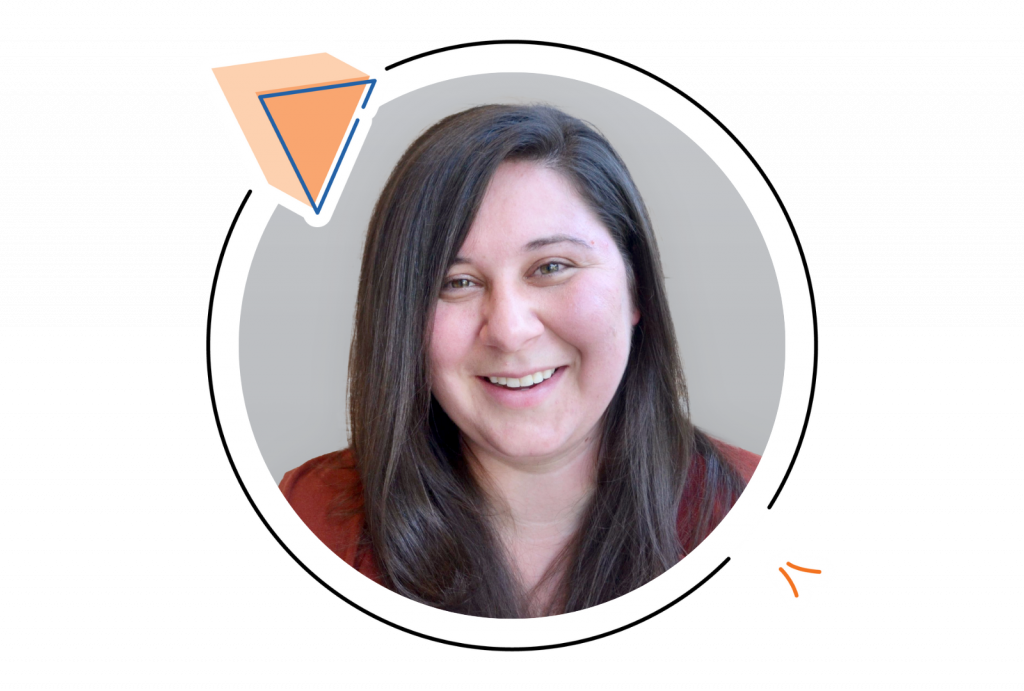
Marjorie Schaeffer is an assistant professor of psychological sciences at Saint Mary’s College. She received her Ph.D in developmental psychology from the University of Chicago. Marjorie is interested in the role parents and teachers play in the development of children’s math attitudes and performance. She is specifically interested in the impact of expectations and anxiety and on children’s academic performance. Her work has been published in outlets including ScienceJournal of Experimental Psychology: General, and Developmental Science.

A laptop displaying a Facebook group page for "Math Teacher Lounge Community," featuring profile photos, a group banner, and geometric shapes in the image background.

About Math Teacher Lounge

Math Teacher Lounge is a biweekly podcast created specifically for K–12 math educators. In each episode co-hosts Bethany Lockhart Johnson (@lockhartedu) and Dan Meyer (@ddmeyer) chat with guests, taking a deep dive into the math and educational topics you care about.

Join the Math Teacher Lounge Facebook group to continue the conversation, view exclusive content, interact with fellow educators, participate in giveaways, and more!

Winter Wrap-Up 03: Ideas to build math fluency

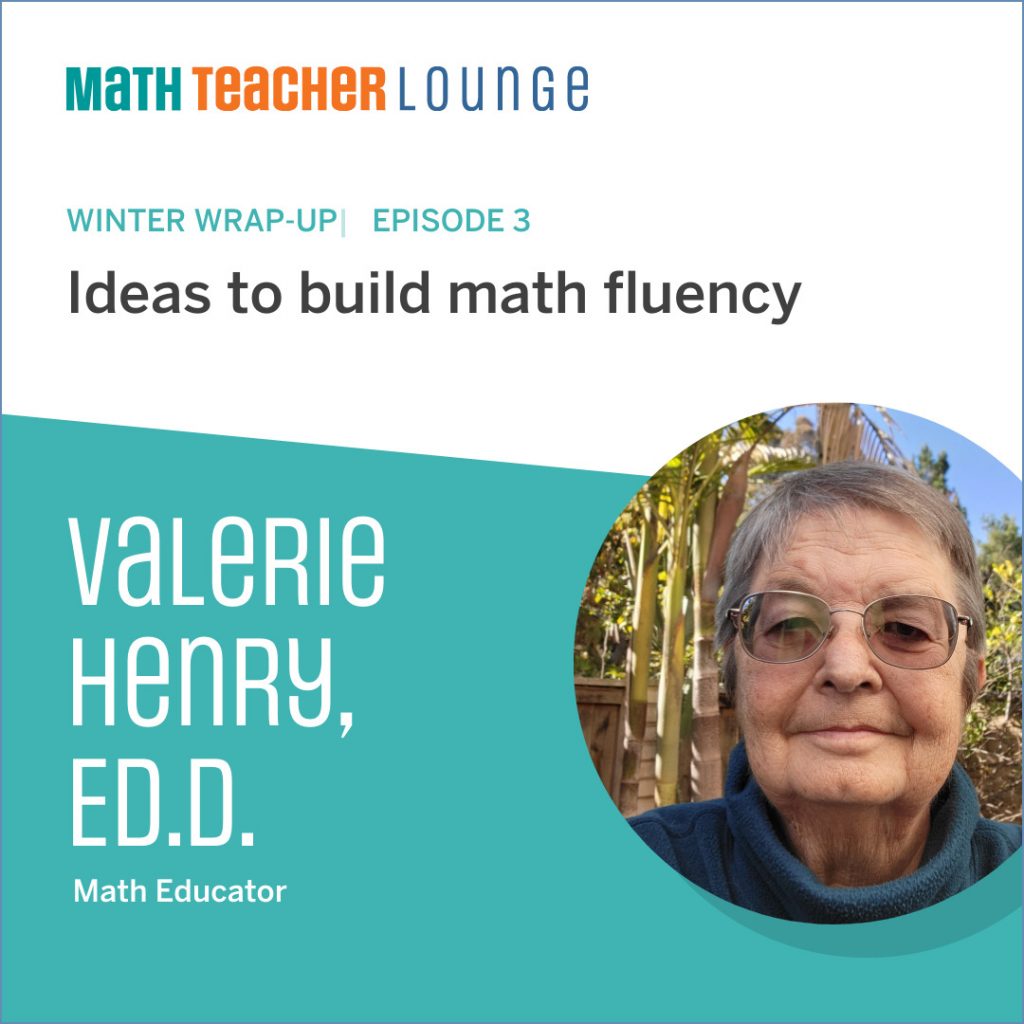
Promotional graphic for "Math Teacher Lounge" episode featuring Valerie Henry, Ed.D., on ideas to build math fluency, with a photo of Valerie Henry in the bottom right corner.

Join us for the third episode in our Winter Wrap-Up! In this episode from season 3 of Math Teacher Lounge: The Podcast, we sit down with Dr. Valerie Henry to talk about math fluency and what that means for students. Listen as we dig into the research, hear Val’s three-part definition of fluency, and explore her five principles for developing it.

Explore more from Math Teacher Lounge by visiting our main page

Download Transcript

Dan Meyer (00:03)

Hey folks. Welcome back. This is Math Teacher Lounge, and I am one of your hosts, Dan Meyer.

Bethany Lockhart Johnson (00:07):

And I’m your other host, Bethany Lockhart Johnson. Hi, Dan.

Dan Meyer (00:11):

Hey, great to see you. We have a big one this week to chat about and some fantastic guests. We are chatting about fluency, which is the sort of word and concept that I feel like people have very, very non-neutral associations with it. A lot of them are very negative, for a lot of people.

Bethany Lockhart Johnson (00:26):

I saw you frown a little. What’s up with that, Dan? You kind of, like, shrank.

Dan Meyer (00:30):

I have strong feelings about it. You know, there’s lots of ways that people go about helping people become fluent in mathematics. And a lot of them are harmful for students, and ineffective. And it got me thinking about fluency as it exists outside of the world of mathematics, where we have a lot of very clear images of it. We’re getting fluent in things all the time. Like, as humans. Human development is the story of fluency. And I just was wondering….Bethany, would you describe yourself as fluent at something outside of the world of mathematics? What is that? How’d you get fluent at it? What was the process?

Bethany Lockhart Johnson (01:05):

Hmm, I think I’m a pretty fluent reader. I read all the time. I’m a happier person if I’ve read that day. I once saw this poster in a classroom; it said “10 Ways to Become a Better Reader: Read, Read, Read, Read, Read…you know, 10 times. Get it? Reading? You get better at reading by reading! So I would say reading. And it’s been kind of cool—I have a one-year-old who, it’s been really exciting slash overwhelmingly anxiety-producing to see him get very fluent with walking slash running, ’cause he’s getting faster every day. And it’s kind of fun. When I think of what’s something somebody’s trying to get fluent with…walking! He’s trying to be more fluid. He’s practicing transitions. He doesn’t wanna hold my hand while he traverses rocky terrain. He’s getting better at it. He’s practicing. What about you? What’s something…?

Dan Meyer (02:08):

I think about driving a lot. I’m a very fluent driver and I think a lot about when I was first a driver, you know? And how l have my hands on 10 and 2, vice grip, and do not talk to me; do not ask me anything; don’t ask me my NAME. I need to focus so hard. And then a year later, you know, I’m driving with one hand, smash the turn signal, take a sip off of whatever, change the CD. And then it’s no big deal.

Bethany Lockhart Johnson (02:38):

Wait, did you pass the first time? Your test?

Dan Meyer (02:40):

Yeah, I don’t like to brag about it. <laugh> But I do all the time. <laugh> But I got a hundred on my driving test. I don’t care who knows it. And I hope it’s everybody. But I guess all of this is just to say there are areas of life where fluency feels natural, with the case of walking. There’s areas of life where fluency feels motivating, with like driving—I wanna be able to switch the CD out or whatever. And there’s areas where fluency feels terrifying and hard to come by, like mathematics, sometimes. So we have a set of guests here. Our first guest will help us figure out what do we mean by fluency? And what’s the research say about what fluency is and how students develop it in mathematics? And then our other guests will help us think about what it looks like in practice in the classroom. What are some novel, new ways to work on fluency? So first up we have Val Henry, Dr. Val Henry.

Bethany Lockhart Johnson (03:32):

So we knew we needed help with the fluency definition, because when we think about it, it’s kind of big, right? And we wanted to look at what research about fluency really says. So we called on Valerie Henry. Val is a nationally board-certified teacher, taught middle school for 17 years, and since 2002 has worked with undergraduates graduates, credential candidates as a lecturer at the University of California, Irvine, one of my alma maters. So after doing her dissertation on addition and subtraction fluency in first grade, Val created a project to study ways to build addition and subtraction and multiplication and division fluency while also developing number sense in algebraic thinking. And the pilot grew and grew over the last 18 years into a powerful daily mini-lesson approach to facts fluency called FactsWise. And when we thought of fluency, the first person I thought of was Val. Welcome, Val Henry, to the Lounge! I’m so excited to have you here. Welcome.

Valerie Henry (04:36):

Thanks, Bethany. And thanks to you, Dan. It’s great to be here today.

Dan Meyer (04:41):

Great to have you; help yourself to whatever you find in the fridge. The names that people write down on those things in the bags are just recommendations. It’s potluck-style here. I’m curious, Val, if you’re, like, on an airplane, someone asks you what you do, and you say you study fluency…what is the layperson’s definition of what does it mean to be fluent in mathematics? And if you can give a brief tour through what the research says about what works and what doesn’t that would really help us orient our conversation here.

Valerie Henry (05:12):

The first thing I have to do when I talk to somebody on a plane is define the idea of fluency. And I often use an example of tying your shoelaces. Because that works with first graders as well as adults. This idea that when we first start trying to put our shoes on and get those shoelaces tied, somebody tries to, first of all, just do it for us. But then of course maybe tries to teach us the bunny-ears approach. And we struggle and struggle as little kids and eventually either the bunny-ears approach or something else starts to work for us. But we still have to pay attention to it. We have to think hard and it’s not easy. And then over time we get to the point where we basically don’t even think about it. When I tie my shoes in the morning. I’m not thinking about right-over-left and left-over-right and all of those things. I just do it. And so that’s a good, easy example of becoming fluent with something. I think what we’re talking about today though, is the basics, the adding and subtracting that we hope kids are going to have mastered maybe by second grade, and the multiplication and division facts that we wanna maybe have mastered by third, maybe fourth grade. So now what does that mean to become fluent with those basics? I have a three-part definition that seems to match up really nicely with the common core approach to fluency. Which is, first of all, we want the answers to be correct. And then second, we want the answers to be easy to know. And so what does that mean? Well, to me, it means without needing to count,

Bethany Lockhart Johnson (07:12):

You mean without having to kind of muscle through it? Or say more about you mean.

Valerie Henry (07:16):

Well, I guess what I mean is that when you watch a young child try and solve something even as simple as two plus three, they might put up two fingers and then go 3, 4, 5 with three more fingers winding up on their hand, one or the other of their hands. While they’re doing that, they don’t really have a sense of whether even their answer is right or not, quite often. Especially when you get to the larger adding and subtracting problems, you can see a lot of errors happening as they’re trying to count. And it’s taking up cognitive energy to do that counting process, especially as you get to the larger quantities. So my definition of fluency now is “getting it right without needing to do that hard work like counting.” Now, some people might say, well, we just want them to have ’em memorized. But in my research, I’ve learned that a lot of very fluid adults don’t always have every fact memorized. In fact, if you ask a room full of adults, what’s seven plus nine, you might learn that they can all get it correct quickly, quickly…but they don’t all have it memorized. And so when you ask them, “How did you get that?” Many of them will say, “Well, I just gave one from the 7 to the 9 and I know that 10 plus 6 is 16.”

Bethany Lockhart Johnson (08:53):

That’s such an important distinction. My brain literally just did that actually!

Valerie Henry (08:58):

<laugh> Right? <laugh> But you’re fluid with it, because it doesn’t take you much cognitive energy at all.

Bethany Lockhart Johnson (09:05):

Right.

Valerie Henry (09:07):

So now we have “correct without needing to put that cognitive energy,” which usually means that you’re counting. And then the third thing is “relatively quickly,” so that you’re not spending 15 seconds trying to figure it out. Even that part-whole strategy approach can be done really quickly, almost instantaneously. Or it can take a long time. So if a student can get the answer correct within, you know, three or four seconds— is I’m pretty generous—I figure that they’re pretty darn fluent with that fact. So that’s my three-part definition of these basics, fluency.

Dan Meyer (09:55):

I love the distinction between getting it correct and getting it quick. It’s possible to be quick with wrong answers. It’s possible to be like, “Those are separate components there.” And I echo Bethany’s appreciation for this third option in between knowing it instantaneously through memorization and muscling through it. But there’s like a continuum there of how much energy it took you to come up with it that all feels extremely helpful.

Valerie Henry (10:21):

And you know, one of the things that I’ve noticed is that when kids are pressured to come up with those instantaneous answers, they often default to guessing and get it wrong.

Bethany Lockhart Johnson (10:30):

Mm, yeah.

Valerie Henry (10:30):

So that’s one of the things that I’ve learned is that as we’re trying to help students develop fluency, it’s important to start with building their conceptual understanding of what it means to do, you know, 3 times 9 and what the correct answer is, maybe using manipulatives or representations of some sort. Not skip-counting! I really have found that skip-counting just perpetuates itself in many students’ minds and that they never stop skip-counting, which means they’re putting in not very much mental energy if it’s 2 times 3 but a ton of mental energy if it’s 7 times 8. Because frankly, it’s really hard to skip count by sevens. And by eights.

Bethany Lockhart Johnson (11:18):

I can get to 14 and then I’m like, wait, wait, what was next? Right? No, no, no…21! What do you feel are some misconceptions that maybe teachers, maybe parents have about fluency in math?

Valerie Henry (11:30):

I think maybe one of the first ones is that if students count or skip-count, their answers repetitively over and over and over and over, that they’re bound to memorize them. And the study that I did back in 2004, I actually had a school that had decided that they were going to do time tests with their students every day, all year. And that undoubtedly by the end of the year, those students would be fluent.

Bethany Lockhart Johnson (12:06):

And to clarify by time test, you mean like, sit down, pencil, paper, ready, go, worksheet kind of thing.

Valerie Henry (12:15):

Yes.

Bethany Lockhart Johnson (12:16):

Some of us might remember quite vividly.

Valerie Henry (12:18):

<laugh> Very vividly. And you know, you have to get it done within a certain amount of time. So they made it fun for the students. Apparently the students enjoyed it. I was a little leery about that, but in the end, when I went and checked on the students and I did one-on-one assessments with half of the students in every class that were randomly selected so that I could get a sense of where they were with their fluency—and these were first graders—they basically had nothing memorized. They were simply counting as fast as they possibly could. And, you know, mostly getting the right answers. But they had not memorized. So that’s one of the myths, I think, is that repetitive practice of counting gets you to memorization.

Bethany Lockhart Johnson (13:10):

If I put it in front of you enough times, you’ll become fluent.

Valerie Henry (13:14):

Right, right. Now these students didn’t really get any instruction, any help learning these. They just simply tested over and over and over. So that’s another thing that I think is a misconception. It’s that if we test students, but don’t really teach them fluency, then they’re going to become fluent. If we just test them every Friday or that kind of thing. And that they’ll learn them at home. But really what that means is a few lucky kids who have parents who have the time and the energy and the background to know how to help will take that job on at home. Not that many students are really that fortunate.

Dan Meyer (14:01):

It’s almost like the traditional approach, or the approach you’re describing, confuses process and product. It says, “Well, the product is that eventually fluent students will be able to do something like this, see these problems and answer them, answer them quickly,” and says, “Well, that must be the process then as well; let’s give them that products a whole lot.” But as I hear you describe fluency with bunny ears on shoelaces, there’s these images and approaches and techniques that require a very active teacher presence to support the development of it. That’s just kind of interesting to me.

Valerie Henry (14:35):

My initial project, the pilot project that I tried, was to simply ask teachers to follow five key principles. And the first one was to do something in the classroom every day for—I told them, even if you’ve only got five or 10 minutes, work on fluency for five or 10 minutes a day, and let’s see what happens. So that was one key element was just to teach it and to give students opportunities to get what the research calls for when you’re trying to memorize, which is actually immediate feedback. When I talk about immediate feedback with my student teachers, I say, “I’m talking about within one or two seconds of trying a problem, and then sort of immediately knowing, getting feedback of whether you got the answer right or not so that your brain can kind of gain that confidence. ‘Oh, not only did I come up with an answer, but somebody’s telling me it’s the correct answer.’”

Dan Meyer (15:38):

There’s a lot of apps now in the digital world that offer students questions about arithmetic or other kinds of mathematical concepts and give immediate feedback of a sort: the feedback of “You’re right; you’re wrong” sort. Is that effective fluency development, in your view?

Valerie Henry (15:57):

I haven’t heard and I haven’t seen them being super-effective. The ways I think about this are “Immediate feedback isn’t the only thing we need.” Probably one of the biggest things that we need is for students to develop strategies. And this is one of the other things I’ve learned from international research, from countries that do have students who become very fluent very early, is that they don’t shoot straight for memorization, but they go through this process of taking students from doing some counting and then quickly moving them to trying to use logic. So, “Hey, you really are confident that 2 + 2 is 4; so now let’s use that to think about 2 + 3.” Actually, as an algebra teacher, I would much rather have students that have a combination of memorization and these strategies, than students who’ve only memorized. Isn’t that interesting that my most successful algebra students were good strategy thinkers. Not just good memorizers.

Bethany Lockhart Johnson (17:09):

So you mentioned there were five that kind of helped root this idea in like, “What can teachers do? What is the best thing that teachers can do to support with fact fluency?” So, everyday was key.

Valerie Henry (17:22):

Then the next principle that I really focus on is switching immediately to the connected subtractions so that students—

Bethany Lockhart Johnson (17:33):

Not waiting until you’ve gotten all the way through addition. But making “Ooh!”

Valerie Henry (17:38):

Totally. And I didn’t do that the first year. And when we looked at the results of the assessments at the end of the year, we realized that our students were so much weaker in subtraction than addition. So the following pilot year, we tried this other approach of doing subtraction right after the students had developed some fluency with that small chunk of addition. And we got such better subtraction results.

Bethany Lockhart Johnson (18:11):

What are the other principles?

Valerie Henry (18:13):

The biggest one is to use these strategies. So the strategies makes the third. And then the fourth I would say is to go from concrete to representational to abstract.

Bethany Lockhart Johnson (18:27):

Don’t put away those manipulatives. Don’t put away those tools.

Valerie Henry (18:31):

Oh, so important to come back to them for multiplication and division. And my fifth principle is to wait on assessment. To use it as true assessment, but not race to start testing before students have had a chance to go through this three-phase process. Which is conceptual understanding with manipulatives; building strategies, usually with representations; and then working on building some speed until it’s just that natural fluency.

Bethany Lockhart Johnson (19:07):

I wanna say thank you so much for offering your really learned perspective, because you have not only done the research, but seen it in action and seen how shifting our notions of fluency and what fluency can be and what a powerful foundation it can be for all mathematicians. Really, that shift is so powerful. And I appreciate you sharing it with our listeners and with us. So we’re so excited that we got to talk with you today, Val—

Dan Meyer (19:35):

Thank you, Dr. Henry.

Valerie Henry (19:37):

You’re welcome!

Dan Meyer (19:41):

With us now we have Graham Fletcher and Tracy Zager, a couple of people who understand fluency at a very deep and classroom level. I wanna introduce them and get their perspective on what we’re trying to solve here with fluency. So Graham Fletcher has served in education in a lot of different roles: as a classroom teacher, math coach, math specialist, and he’s continually seeking new and innovative ways to support students and teachers in their development of conceptual understanding in elementary math. He’s the author, along with Tracy, of Building Fact Fluency, a fluency kit we’ll talk about, and openly shares so much of his wisdom and resources at gfletchy.com. Tracy Johnson Zager is a district math coach who loves to get teachers hooked on listening to kids’ mathematical ideas. She is a co-author of this toolkit, Building Fact Fluency, and the author of Becoming the Math Teacher You Wish You’d Had: Ideas and Strategies from Vibrant Classrooms. Tracy also edits professional books for teachers at Stenhouse Publishers, including, yours truly. Thank you for all that insight, Tracy, and support on the book.

Bethany Lockhart Johnson (20:49):

Dan and I were talking at the beginning of the episode about things we feel like, “Hey, I’m fluent in that. I’m fluent in that.”

Dan Meyer (20:55):

Just very curious: What’s something you would like to get fluent in outside of the world of mathematics, let’s say?

Tracy Zager (21:00):

I’ll say understanding the teenage brain, as the parent of a 13-year-old and 15-year-old. That’s the main thing I’m working on becoming fluent in!

Bethany Lockhart Johnson (21:10):

Ooh!

Dan Meyer (21:13):

A language fluency, perhaps. All right, Graham. How about you?

Graham Fletcher (21:16):

For me typing, it’s always been an Achilles heel of mine. So voice-to-text has been my friend. But it’s also been my nemesis in much of my texting here and working virtually over the last couple years. So yeah, typing.

Dan Meyer (21:33):

Do you folks have some way of helping us understand the difference in how fluency is handled by instructors and by learners?

Tracy Zager (21:40):

I would say that the lay meaning of fluency is definitely a little different than what we mean in the math education realm. When we’re talking about math fact fluency, which is just one type of fluency. So you gotta think about procedural fluency and computational fluency; there are lots of types of fluency in math. And Graham and I had the luxury of really focusing in specifically on math fact fluency. We’re looking at kind of a subset of the procedural fluency. So the words you hear in all the citations are accurate, efficient, and flexible. There’s this combination of kids get the right answer in a reasonable amount of time and with a reasonable amount of work and they can match their strategy or their approach to the situation. That’s where that flexibility comes in. And there’s like lots more I wanna say about that about sort of…I think one issue that comes up around fluency is that people are in a little bit of a rush. So they tend to think of the fluency as this automaticity or recall of known facts without having to think about it. And that is part of the end goal, but that’s not the journey to fluency. So this is one of the things that Graham and I thought about a lot was the path to fluency. The goal here it’s that student in middle school who’s learning something new doesn’t have to expend any effort to gather that fact. And they might do it because they’ve done it so many different ways that they’ve got it, and now they just know it, or they might be like my friend who’s a mathematician who still, if you say, “Six times 8,” she thinks in her head, “Twelve, 24, 48…” and she does this double-double-double associative property strategy. And it’s so efficient, you would never know. And that’s totally great. That’s fine. That’s not slowing her down. That’s not providing a drag in the middle of a more complex problem or new learning. So we’re really focused on having elementary school students be able to enter the middle and high school standards without having that pull out of the new thinking.

Graham Fletcher (23:53):

And as I think about that, I think about how so many students will memorize their facts, but then they haven’t memorized them with understanding. So that when they move into middle school and they move into high school, it’s almost like new knowledge and new understanding that’s applied from a stand-alone skill.

Bethany Lockhart Johnson (24:10):

So something that felt really unique to me, Graham, as I was diving into the toolkit, is your use of images, Tracy, Graham, is the way that you use images to help students notice and wonder to start making sense of these quantities and the decomposition of numbers using images. Can you talk a little bit about how images played a part in the way that you think about this building a fact fluency?

Graham Fletcher (24:41):

What I realized is so many times when we approach math with just naked numbers with so many of our elementary students, the numbers aren’t visible. The quantities. They can’t see them; they can’t move them. They’re just those squiggly figures that we were talking about earlier on. So how is it that we make the quantities visible, to where students feel as if they can grab an apple and move it around? Because a lot of times we start with the naked numbers and then if kids don’t get the naked numbers, then we kind of backfill it. But what would happen if we start with the images? And then from there, these rich, flourishing mathematical conversations develop from the images. And I think that was the premise and the goal of the toolkit.

Tracy Zager (25:22):

When you look at how fact fluency has traditionally been taught, it’s all naked numbers. And sometimes we wrote ’em sideways. Like, that’s it. That was our variety of task type. Right? Sometimes it’s vertical; sometimes it’s horizontal. And that was it. And I’ve just known way too many kids who couldn’t find a hook to hang their hat on with that. It didn’t connect to anything. And so part of why I knew Graham was the perfect person for this project was his strength in multimedia photography, art, video. And so we started from this idea of contexts that for each lesson string in the toolkit, there’s some kind of context. An everyday object, arranged in some kind of a way that reveals mathematical structure and invites students to notice the properties. So we start with images of everyday objects: tennis balls, paint pots…um, help me out; here are a million of them. Crayons—

Bethany Lockhart Johnson (26:18):

Crayons, markers.

Tracy Zager (26:18):

Shoes, right? Sushi, origami paper, all kinds of things in the different toolkits. So there’s a series of images or a three-act task or both around those everyday objects, and then story problems grounded in that context. And then there are images with mathematical tools that bring out different ideas, but relate in some way to the image talks. And we do all of that before we get to the naked number talk. Which we do, and by the time you get to the number talk, it’s pretty quick, ’cause they’ve been reasoning about cups of lemonade. And now when you give them the actual numerals, they’re all over it.

Bethany Lockhart Johnson (27:03):

I have to say too, as somebody who—particularly in middle school—navigated math anxiety, we recently talked with Allison Hintz and Anthony Smith about their amazing book Mathematizing Children’s Literature.

Tracy Zager (27:14):

Yay!

Bethany Lockhart Johnson (27:14):

And I was explaining, like, if I sat down at the beginning of a math class and my teacher opened a picture book and said, “We’re gonna start here,” I felt my whole body relax. And if we start with this image, if we start with just looking at an image and making sense of an image, I feel like that could be such a powerful touchstone for all the work you do from there.

Tracy Zager (27:41):

That’s core. That’s a core design principle, is that invitational access. There are no barriers to entry. There’s nothing to decode. There’s nothing formal. We’ve been learning from Dan for years about this, right? Of starting with the informal and then eventually layering in the formal. I was in a class in Maine where they were doing an image talk and it’s these boxes of pencils. It’s a stack of boxes of pencils and they’re open and you can see there are 10 pencils in each box. And so there are five boxes of pencils each with 10 pencils in it. And then the next image is 10 boxes of pencils and each box is half full. So now it’s 10 boxes each with five. And the kids are talking and talking and then the third image, I think there are seven boxes each with 10 pencils in it. And she said, “What do you think the next picture’s gonna be?” And this girl said, “You just never know with these people!” <laugh> I dunno!”

Bethany Lockhart Johnson (28:37):

That’s kinda true. Knowing you both, it’s kinda true.

Tracy Zager (28:42):

Like if it’s seven boxes with 10 in it, one kid said, I think it’s gonna be 14 boxes of five. And other kids are like, I think it’s gonna be 10 boxes with seven. And they start talking about which of those there are and the relationships between—

Bethany Lockhart Johnson (28:58):

But they’re making sense of numbers!

Tracy Zager (28:59):

Totally. So all the kids felt invited. They can offer something up. They’re noticing and wondering about that image. They’re talking about it in whatever informal language or home language that they speak. And that was core to us. That was a huge priority, because honestly, one of the motivations to talk about fluency is that it’s always been this gatekeeper. It has served to keep kids out of meaningful math. Particularly kids from marginalized or historically excluded communities. So they’re back at the round table, doing Mad Minutes, while the more advantaged kids are getting to do rich problem solving. And so, we thought, what if we could teach fact fluency through rich problem solving that everybody could access? That was like square one for us.

Bethany Lockhart Johnson (29:45):

That’s huge.

Dan Meyer (29:46):

That’s great to hear. What’s been helpful for me is to understand that students who are automatic, that’s just kind of what’s on the surface of things. And that below that might be some really robust kind of foundation or scaffolding that bleeds to a larger building being built, or it might be just really rickety and not offer a sturdy place to build farther up. It’s been really exciting to hear that. I wonder if you’d comment for a moment about, in the digital age and—I’m at Desmos and our sponsors are Amplify and we all work in the digital world quite a bit. There are a lot of what report to be solutions to the fluency issue, to developing fluency in the digital world. Just lots and lots of them. Some that are quite well used, others that are just like X, Y, or Z app on the market. You can find something. Do you have perspectives on these kinds of digital fluency building apps? Like, what about them works or doesn’t work? Let us know. Graham, how about you? And then Tracy, I’d love to hear your thoughts too.

Graham Fletcher (30:47):

Yeah, I think that’s a great question, ’cause there’s a lot of shiny bells and whistles out there right now that can really excite a lot of teachers. But I always come back to what works for me as a classroom teacher is probably gonna work in a digital world as well. So what are the things that I love and honor most about being in front of students, and how can I capture that in that virtual world? I think one of the things that really helps students make connections is coherence. I think coherence, especially when you leave students for—you don’t get to talk with them after the lesson is done—so I think about how we can purposefully sequence things through a day-to-day basis. I think coherence is something that gets really lost when we talk about fluency, especially with whether it be digital or whether it be print, because what ends up happening is we say, “OK, we have all these strategies we need to teach,” and it becomes a checklist. So how is it that we can just provide students the opportunity to play around in a space, whether it be digital or in person, but in a meaningful way that allows them the time and the space and that area to breathe and think, but be coherent. And connecting those lessons along the way. And I think coherence is one thing that a lot of the times it’s harder to—when we’re in the weeds, it’s so hard and difficult to zoom back out and say, “Do all these lessons connect? How do they intentionally connect? And how do they purposefully connect?” And without coherence, everything’s kind of broken down into that granular level. So when looking at—I think about Desmos and I think about the Toolkit and I think about how Tracy and I talked a lot about, “Well, this, does it connect with the context problem, does it connect with the image talk, or the lessons? Like, how does it all connect and how are we providing students an opportunity to make connections between the day-to-day instruction and lessons that we tackle?”

Tracy Zager (32:44):

I’m reminded of a conversation that Dan, you and I had a long time ago, in Portland, Maine, in a bar. I’ll just be honest. <laugh> And we were talking about how, in the earlier days of Desmos, you were stressed out by what you saw, which was kids one-on-one, on a device, in a silent room. And you were like, no, this is not it. This is not what technology is here to serve. We can do so many things better using technology appropriately, but we can’t lose talk and we can’t lose relationships and we can’t lose formative assessment and teachers listening to kids and kids listening to each other and helping each other understand their thinking. Right? So when I think about the tech that’s out there for fact fluency, most of it is gonna violate all rules I have around time testing. So that a whole bunch of it, I would just toss on that premise. They’re really no different than flashcards. It’s just flashcards set in junkyard heaps. Or, you know, underground caverns. Or with a volcano or whatever. It’s the same thing. There are some lovely visuals—I’m thinking of Berkeley Everett’s Math Flips. Those are really pretty. Mathigon has some really nice stuff that’s digital. And I think that those resources invite you to kind of ponder and notice things and talk about them. All the tools that we design in the toolkit are designed to get people talking to each other, and give teachers opportunities to pull alongside kids and listen in and understand where they are. For example, our games, we didn’t design the games to be played digitally, even though you could, and people did during COVID, because we want kids on the rug, next to each other, on their knees; I’ve seen kids like across tables. I was in a school recently where a kid was like, “I hope you believe in God, ’cause you’re going…!” You know what I mean? <laugh>. Like they’re all pumped up.

Bethany Lockhart Johnson (34:41):

They’re invested!

Tracy Zager (34:45):

They’re psyching each other up and down and they’re interacting and it’s social and the teacher’s walking around and she’s listening to the games. And they don’t actually need any bells and whistles. They need dice and they need counters and they need this game that is actually a game. In all of our conversations, games have to actually be games. Games cannot be “roll and record.” Games have to involve strategy. They have to be fun. So in designing those games, we didn’t feel like it brought any advantage to make that a digital platform. But things that did bring advantages digitally, like the ability to project these beautiful images or to use short video in the classroom, that really was a value-add that enabled us to do something different in math class than we had done before, and to get kids talking in a different way than they ever had before. When I think about fluency, historically, if you say like, “OK, it’s time to practice our math facts,” you hear a lot of groans. And when I see a Building Fact Fluency classroom and I say, “OK, it’s BFF time!” There’s like a “YEAAAAHHH!” You know? And so that’s what we’re after.

Graham Fletcher (35:47):

It’s all about kids, really, for us. And I think at the heart of it, we made all the decisions with teachers and kids at the forefront of it.

Tracy Zager (35:55):

I know of high schoolers who are newcomers, who have experienced very little formal education, and speak in other languages, are using it as high schoolers, because it involves language and math and all the deep work in the properties and it’s accessible, but it’s also not at all condescending or patronizing. Like we designed it to be appropriate for older kids. So that’s just something that I think we’re both really proud of. One thing we thought a lot about, especially in the multiplication-division kit is how a classroom teacher could use it and a coordinating educator in EL, Title, special education, intervention could also use it because there’s so much in it, that students could get to be experts, if they got extra time in it, using something that’s related and would give them additional practice. So they could play a game a little bit earlier than the rest of the classes. And they could come in already knowing about that game, or they could do a related task. We have all these optional tasks that no classroom teacher would ever have time to teach it all. So the special educator could use it and have kids doing a Same and Different or a True/False, or some of the optional games. And then the work in both special education and general education could connect.

Dan Meyer (37:20):

I just wanna say that this is an area that for so many students, as you’ve said, Tracy, it presents a barrier. It’s a very emotionally fraught area of mathematics. And we really appreciate the wisdom you brought here. And just the care you’ve brought to the product itself. Your knowledge of teaching, knowledge of math, and yeah, especially a love for students feels like it’s really infused throughout Building Fact Fluency. If our listeners want to know more outside of this podcast, outside of the product itself, where can they find your words, your voice? Where you folks at these days? Tell ’em, Graham would you?

Graham Fletcher (37:57):

You can find us at Stenhouse, Building Fact Fluency. And then Tracy and I, currently playing around, sharing ideas a lot on Twitter, under the hashtag #BuildingFactFluency. That’s kind of where we can all come together and share ideas. And then also on the Facebook community, where there’s lots of teachers sharing ideas.

Bethany Lockhart Johnson (38:19):

If you were to ask our listeners like, “Hey, if you wanna keep thinking about this, here’s something you could try or here’s something you could go do,” what could be a challenge that we could share that could help us continue this conversation?

Graham Fletcher (38:35):

Online you can actually download a full lesson string. And a lesson string is a series of activities and resources that are purposefully connected. You can pick one or two of those from the Stenhouse web site, Building Fact Fluency. You can try the game. You can try one of those strategy-based games. You can try an image talk and just see how it goes. And just share and reflect back, whether on Twitter or on Facebook. But it’s kind of there, if you wanna give it a whirl. And as Tracy was sharing, even if you’re a middle-school teacher or a high-school teacher, we really tried to think about those middle-school and high-school students keeping it grade level-agnostic. Just so every student has those opportunities for those mathematical conversations. So download a lesson string and give it a whirl, and we’d love to hear how it goes.

Dan Meyer (39:25):

Bethany and I will be working the same challenge with people in our life.

Bethany Lockhart Johnson (39:29):

Yes.

Dan Meyer (39:29):

Enjoying some fact fluency with people in our homes, perhaps. We’ll see. And we’ll be sharing the results in the Math Teacher Lounge Facebook group. Graham and Tracy, thanks so much for being here. It was such a treat to chat with you both.

Bethany Lockhart Johnson (39:42):

I love learning with you and just helping to shift this idea of fluency into something that can be accessible and powerful and positive.

Stay connected!

Join our community and get new episodes every other Tuesday!

We’ll also share new and exciting free resources for your classroom every month.

What Valerie Henry says about math

“A lot of very fluent adults don’t always have every fact memorized. ”

– Val Henry

Meet the guest

Valerie Henry has been a math educator since 1986. She taught middle school math for 17 years and has worked as a lecturer at University of California Irvine since 2002. After doing her 2004 dissertation research on addition/subtraction fluency in first grade, Valerie created FactsWise, a daily mini-lesson approach that simultaneously develops  fluency,  number sense, and algebraic thinking. Additionally, she has provided curriculum and math professional development for K-12 teachers throughout her career, working with individual schools, districts, county offices of education, Illustrative Mathematics, the SBAC Digital Library, and the UCI Math Project.

An older person with short gray hair and glasses, wearing a blue sweater, is outdoors with greenery and a fence in the background.
Podcast cover for "Math Teacher Lounge" with Bethany Lockhart Johnson and Dan Meyer; bold text on orange and teal semicircle background.

About Math Teacher Lounge: The podcast

Math Teacher Lounge is a biweekly podcast created specifically for K–12 math educators. In each episode co-hosts Bethany Lockhart Johnson (@lockhartedu) and Dan Meyer (@ddmeyer) chat with guests, taking a deep dive into the math and educational topics you care about.

Join the Math Teacher Lounge Facebook group to continue the conversation, view exclusive content, interact with fellow educators, participate in giveaways, and more!
S3 – 04. Ideas to build math fluency with Valerie Henry, Graham Fletcher, and Tracy Zager

Promotional image for "Math Teacher Lounge" Season 3, Episode 4 titled "Ideas to Build Math Fluency," featuring Valerie Henry, Tracy J. Zager, and Graham Fletcher.

Fluency in math can oftentimes be associated with negative experiences with its development— timed worksheets, for example. Bethany and Dan are joined by three guests to better understand fluency and how to make its approach fun. Dr. Val Henry shares her three-part definition of fluency and her five principles for developing it. Additionally, Tracy Zager and Graham Fletcher join Bethany and Dan to better understand fluency through a lens of equity and using multimedia as a tool.

Explore more from Math Teacher Lounge by visiting our main page

Download Transcript

Dan Meyer (00:03)

Hey folks. Welcome back. This is Math Teacher Lounge, and I am one of your hosts, Dan Meyer.

Bethany Lockhart Johnson (00:07):

And I’m your other host, Bethany Lockhart Johnson. Hi, Dan.

Dan Meyer (00:11):

Hey, great to see you. We have a big one this week to chat about and some fantastic guests. We are chatting about fluency, which is the sort of word and concept that I feel like people have very, very non-neutral associations with it. A lot of them are very negative, for a lot of people.

Bethany Lockhart Johnson (00:26):

I saw you frown a little. What’s up with that, Dan? You kind of, like, shrank.

Dan Meyer (00:30):

I have strong feelings about it. You know, there’s lots of ways that people go about helping people become fluent in mathematics. And a lot of them are harmful for students, and ineffective. And it got me thinking about fluency as it exists outside of the world of mathematics, where we have a lot of very clear images of it. We’re getting fluent in things all the time. Like, as humans. Human development is the story of fluency. And I just was wondering….Bethany, would you describe yourself as fluent at something outside of the world of mathematics? What is that? How’d you get fluent at it? What was the process?

Bethany Lockhart Johnson (01:05):

Hmm, I think I’m a pretty fluent reader. I read all the time. I’m a happier person if I’ve read that day. I once saw this poster in a classroom; it said “10 Ways to Become a Better Reader: Read, Read, Read, Read, Read…you know, 10 times. Get it? Reading? You get better at reading by reading! So I would say reading. And it’s been kind of cool—I have a one-year-old who, it’s been really exciting slash overwhelmingly anxiety-producing to see him get very fluent with walking slash running, ’cause he’s getting faster every day. And it’s kind of fun. When I think of what’s something somebody’s trying to get fluent with…walking! He’s trying to be more fluid. He’s practicing transitions. He doesn’t wanna hold my hand while he traverses rocky terrain. He’s getting better at it. He’s practicing. What about you? What’s something…?

Dan Meyer (02:08):

I think about driving a lot. I’m a very fluent driver and I think a lot about when I was first a driver, you know? And how l have my hands on 10 and 2, vice grip, and do not talk to me; do not ask me anything; don’t ask me my NAME. I need to focus so hard. And then a year later, you know, I’m driving with one hand, smash the turn signal, take a sip off of whatever, change the CD. And then it’s no big deal.

Bethany Lockhart Johnson (02:38):

Wait, did you pass the first time? Your test?

Dan Meyer (02:40):

Yeah, I don’t like to brag about it. <laugh> But I do all the time. <laugh> But I got a hundred on my driving test. I don’t care who knows it. And I hope it’s everybody. But I guess all of this is just to say there are areas of life where fluency feels natural, with the case of walking. There’s areas of life where fluency feels motivating, with like driving—I wanna be able to switch the CD out or whatever. And there’s areas where fluency feels terrifying and hard to come by, like mathematics, sometimes. So we have a set of guests here. Our first guest will help us figure out what do we mean by fluency? And what’s the research say about what fluency is and how students develop it in mathematics? And then our other guests will help us think about what it looks like in practice in the classroom. What are some novel, new ways to work on fluency? So first up we have Val Henry, Dr. Val Henry.

Bethany Lockhart Johnson (03:32):

So we knew we needed help with the fluency definition, because when we think about it, it’s kind of big, right? And we wanted to look at what research about fluency really says. So we called on Valerie Henry. Val is a nationally board-certified teacher, taught middle school for 17 years, and since 2002 has worked with undergraduates graduates, credential candidates as a lecturer at the University of California, Irvine, one of my alma maters. So after doing her dissertation on addition and subtraction fluency in first grade, Val created a project to study ways to build addition and subtraction and multiplication and division fluency while also developing number sense in algebraic thinking. And the pilot grew and grew over the last 18 years into a powerful daily mini-lesson approach to facts fluency called FactsWise. And when we thought of fluency, the first person I thought of was Val. Welcome, Val Henry, to the Lounge! I’m so excited to have you here. Welcome.

Valerie Henry (04:36):

Thanks, Bethany. And thanks to you, Dan. It’s great to be here today.

Dan Meyer (04:41):

Great to have you; help yourself to whatever you find in the fridge. The names that people write down on those things in the bags are just recommendations. It’s potluck-style here. I’m curious, Val, if you’re, like, on an airplane, someone asks you what you do, and you say you study fluency…what is the layperson’s definition of what does it mean to be fluent in mathematics? And if you can give a brief tour through what the research says about what works and what doesn’t that would really help us orient our conversation here.

Valerie Henry (05:12):

The first thing I have to do when I talk to somebody on a plane is define the idea of fluency. And I often use an example of tying your shoelaces. Because that works with first graders as well as adults. This idea that when we first start trying to put our shoes on and get those shoelaces tied, somebody tries to, first of all, just do it for us. But then of course maybe tries to teach us the bunny-ears approach. And we struggle and struggle as little kids and eventually either the bunny-ears approach or something else starts to work for us. But we still have to pay attention to it. We have to think hard and it’s not easy. And then over time we get to the point where we basically don’t even think about it. When I tie my shoes in the morning. I’m not thinking about right-over-left and left-over-right and all of those things. I just do it. And so that’s a good, easy example of becoming fluent with something. I think what we’re talking about today though, is the basics, the adding and subtracting that we hope kids are going to have mastered maybe by second grade, and the multiplication and division facts that we wanna maybe have mastered by third, maybe fourth grade. So now what does that mean to become fluent with those basics? I have a three-part definition that seems to match up really nicely with the common core approach to fluency. Which is, first of all, we want the answers to be correct. And then second, we want the answers to be easy to know. And so what does that mean? Well, to me, it means without needing to count,

Bethany Lockhart Johnson (07:12):

You mean without having to kind of muscle through it? Or say more about you mean.

Valerie Henry (07:16):

Well, I guess what I mean is that when you watch a young child try and solve something even as simple as two plus three, they might put up two fingers and then go 3, 4, 5 with three more fingers winding up on their hand, one or the other of their hands. While they’re doing that, they don’t really have a sense of whether even their answer is right or not, quite often. Especially when you get to the larger adding and subtracting problems, you can see a lot of errors happening as they’re trying to count. And it’s taking up cognitive energy to do that counting process, especially as you get to the larger quantities. So my definition of fluency now is “getting it right without needing to do that hard work like counting.” Now, some people might say, well, we just want them to have ’em memorized. But in my research, I’ve learned that a lot of very fluid adults don’t always have every fact memorized. In fact, if you ask a room full of adults, what’s seven plus nine, you might learn that they can all get it correct quickly, quickly…but they don’t all have it memorized. And so when you ask them, “How did you get that?” Many of them will say, “Well, I just gave one from the 7 to the 9 and I know that 10 plus 6 is 16.”

Bethany Lockhart Johnson (08:53):

That’s such an important distinction. My brain literally just did that actually!

Valerie Henry (08:58):

<laugh> Right? <laugh> But you’re fluid with it, because it doesn’t take you much cognitive energy at all.

Bethany Lockhart Johnson (09:05):

Right.

Valerie Henry (09:07):

So now we have “correct without needing to put that cognitive energy,” which usually means that you’re counting. And then the third thing is “relatively quickly,” so that you’re not spending 15 seconds trying to figure it out. Even that part-whole strategy approach can be done really quickly, almost instantaneously. Or it can take a long time. So if a student can get the answer correct within, you know, three or four seconds— is I’m pretty generous—I figure that they’re pretty darn fluent with that fact. So that’s my three-part definition of these basics, fluency.

Dan Meyer (09:55):

I love the distinction between getting it correct and getting it quick. It’s possible to be quick with wrong answers. It’s possible to be like, “Those are separate components there.” And I echo Bethany’s appreciation for this third option in between knowing it instantaneously through memorization and muscling through it. But there’s like a continuum there of how much energy it took you to come up with it that all feels extremely helpful.

Valerie Henry (10:21):

And you know, one of the things that I’ve noticed is that when kids are pressured to come up with those instantaneous answers, they often default to guessing and get it wrong.

Bethany Lockhart Johnson (10:30):

Mm, yeah.

Valerie Henry (10:30):

So that’s one of the things that I’ve learned is that as we’re trying to help students develop fluency, it’s important to start with building their conceptual understanding of what it means to do, you know, 3 times 9 and what the correct answer is, maybe using manipulatives or representations of some sort. Not skip-counting! I really have found that skip-counting just perpetuates itself in many students’ minds and that they never stop skip-counting, which means they’re putting in not very much mental energy if it’s 2 times 3 but a ton of mental energy if it’s 7 times 8. Because frankly, it’s really hard to skip count by sevens. And by eights.

Bethany Lockhart Johnson (11:18):

I can get to 14 and then I’m like, wait, wait, what was next? Right? No, no, no…21! What do you feel are some misconceptions that maybe teachers, maybe parents have about fluency in math?

Valerie Henry (11:30):

I think maybe one of the first ones is that if students count or skip-count, their answers repetitively over and over and over and over, that they’re bound to memorize them. And the study that I did back in 2004, I actually had a school that had decided that they were going to do time tests with their students every day, all year. And that undoubtedly by the end of the year, those students would be fluent.

Bethany Lockhart Johnson (12:06):

And to clarify by time test, you mean like, sit down, pencil, paper, ready, go, worksheet kind of thing.

Valerie Henry (12:15):

Yes.

Bethany Lockhart Johnson (12:16):

Some of us might remember quite vividly.

Valerie Henry (12:18):

<laugh> Very vividly. And you know, you have to get it done within a certain amount of time. So they made it fun for the students. Apparently the students enjoyed it. I was a little leery about that, but in the end, when I went and checked on the students and I did one-on-one assessments with half of the students in every class that were randomly selected so that I could get a sense of where they were with their fluency—and these were first graders—they basically had nothing memorized. They were simply counting as fast as they possibly could. And, you know, mostly getting the right answers. But they had not memorized. So that’s one of the myths, I think, is that repetitive practice of counting gets you to memorization.

Bethany Lockhart Johnson (13:10):

If I put it in front of you enough times, you’ll become fluent.

Valerie Henry (13:14):

Right, right. Now these students didn’t really get any instruction, any help learning these. They just simply tested over and over and over. So that’s another thing that I think is a misconception. It’s that if we test students, but don’t really teach them fluency, then they’re going to become fluent. If we just test them every Friday or that kind of thing. And that they’ll learn them at home. But really what that means is a few lucky kids who have parents who have the time and the energy and the background to know how to help will take that job on at home. Not that many students are really that fortunate.

Dan Meyer (14:01):

It’s almost like the traditional approach, or the approach you’re describing, confuses process and product. It says, “Well, the product is that eventually fluent students will be able to do something like this, see these problems and answer them, answer them quickly,” and says, “Well, that must be the process then as well; let’s give them that products a whole lot.” But as I hear you describe fluency with bunny ears on shoelaces, there’s these images and approaches and techniques that require a very active teacher presence to support the development of it. That’s just kind of interesting to me.

Valerie Henry (14:35):

My initial project, the pilot project that I tried, was to simply ask teachers to follow five key principles. And the first one was to do something in the classroom every day for—I told them, even if you’ve only got five or 10 minutes, work on fluency for five or 10 minutes a day, and let’s see what happens. So that was one key element was just to teach it and to give students opportunities to get what the research calls for when you’re trying to memorize, which is actually immediate feedback. When I talk about immediate feedback with my student teachers, I say, “I’m talking about within one or two seconds of trying a problem, and then sort of immediately knowing, getting feedback of whether you got the answer right or not so that your brain can kind of gain that confidence. ‘Oh, not only did I come up with an answer, but somebody’s telling me it’s the correct answer.’”

Dan Meyer (15:38):

There’s a lot of apps now in the digital world that offer students questions about arithmetic or other kinds of mathematical concepts and give immediate feedback of a sort: the feedback of “You’re right; you’re wrong” sort. Is that effective fluency development, in your view?

Valerie Henry (15:57):

I haven’t heard and I haven’t seen them being super-effective. The ways I think about this are “Immediate feedback isn’t the only thing we need.” Probably one of the biggest things that we need is for students to develop strategies. And this is one of the other things I’ve learned from international research, from countries that do have students who become very fluent very early, is that they don’t shoot straight for memorization, but they go through this process of taking students from doing some counting and then quickly moving them to trying to use logic. So, “Hey, you really are confident that 2 + 2 is 4; so now let’s use that to think about 2 + 3.” Actually, as an algebra teacher, I would much rather have students that have a combination of memorization and these strategies, than students who’ve only memorized. Isn’t that interesting that my most successful algebra students were good strategy thinkers. Not just good memorizers.

Bethany Lockhart Johnson (17:09):

So you mentioned there were five that kind of helped root this idea in like, “What can teachers do? What is the best thing that teachers can do to support with fact fluency?” So, everyday was key.

Valerie Henry (17:22):

Then the next principle that I really focus on is switching immediately to the connected subtractions so that students—

Bethany Lockhart Johnson (17:33):

Not waiting until you’ve gotten all the way through addition. But making “Ooh!”

Valerie Henry (17:38):

Totally. And I didn’t do that the first year. And when we looked at the results of the assessments at the end of the year, we realized that our students were so much weaker in subtraction than addition. So the following pilot year, we tried this other approach of doing subtraction right after the students had developed some fluency with that small chunk of addition. And we got such better subtraction results.

Bethany Lockhart Johnson (18:11):

What are the other principles?

Valerie Henry (18:13):

The biggest one is to use these strategies. So the strategies makes the third. And then the fourth I would say is to go from concrete to representational to abstract.

Bethany Lockhart Johnson (18:27):

Don’t put away those manipulatives. Don’t put away those tools.

Valerie Henry (18:31):

Oh, so important to come back to them for multiplication and division. And my fifth principle is to wait on assessment. To use it as true assessment, but not race to start testing before students have had a chance to go through this three-phase process. Which is conceptual understanding with manipulatives; building strategies, usually with representations; and then working on building some speed until it’s just that natural fluency.

Bethany Lockhart Johnson (19:07):

I wanna say thank you so much for offering your really learned perspective, because you have not only done the research, but seen it in action and seen how shifting our notions of fluency and what fluency can be and what a powerful foundation it can be for all mathematicians. Really, that shift is so powerful. And I appreciate you sharing it with our listeners and with us. So we’re so excited that we got to talk with you today, Val—

Dan Meyer (19:35):

Thank you, Dr. Henry.

Valerie Henry (19:37):

You’re welcome!

Dan Meyer (19:41):

With us now we have Graham Fletcher and Tracy Zager, a couple of people who understand fluency at a very deep and classroom level. I wanna introduce them and get their perspective on what we’re trying to solve here with fluency. So Graham Fletcher has served in education in a lot of different roles: as a classroom teacher, math coach, math specialist, and he’s continually seeking new and innovative ways to support students and teachers in their development of conceptual understanding in elementary math. He’s the author, along with Tracy, of Building Fact Fluency, a fluency kit we’ll talk about, and openly shares so much of his wisdom and resources at gfletchy.com. Tracy Johnson Zager is a district math coach who loves to get teachers hooked on listening to kids’ mathematical ideas. She is a co-author of this toolkit, Building Fact Fluency, and the author of Becoming the Math Teacher You Wish You’d Had: Ideas and Strategies from Vibrant Classrooms. Tracy also edits professional books for teachers at Stenhouse Publishers, including, yours truly. Thank you for all that insight, Tracy, and support on the book.

Bethany Lockhart Johnson (20:49):

Dan and I were talking at the beginning of the episode about things we feel like, “Hey, I’m fluent in that. I’m fluent in that.”

Dan Meyer (20:55):

Just very curious: What’s something you would like to get fluent in outside of the world of mathematics, let’s say?

Tracy Zager (21:00):

I’ll say understanding the teenage brain, as the parent of a 13-year-old and 15-year-old. That’s the main thing I’m working on becoming fluent in!

Bethany Lockhart Johnson (21:10):

Ooh!

Dan Meyer (21:13):

A language fluency, perhaps. All right, Graham. How about you?

Graham Fletcher (21:16):

For me typing, it’s always been an Achilles heel of mine. So voice-to-text has been my friend. But it’s also been my nemesis in much of my texting here and working virtually over the last couple years. So yeah, typing.

Dan Meyer (21:33):

Do you folks have some way of helping us understand the difference in how fluency is handled by instructors and by learners?

Tracy Zager (21:40):

I would say that the lay meaning of fluency is definitely a little different than what we mean in the math education realm. When we’re talking about math fact fluency, which is just one type of fluency. So you gotta think about procedural fluency and computational fluency; there are lots of types of fluency in math. And Graham and I had the luxury of really focusing in specifically on math fact fluency. We’re looking at kind of a subset of the procedural fluency. So the words you hear in all the citations are accurate, efficient, and flexible. There’s this combination of kids get the right answer in a reasonable amount of time and with a reasonable amount of work and they can match their strategy or their approach to the situation. That’s where that flexibility comes in. And there’s like lots more I wanna say about that about sort of…I think one issue that comes up around fluency is that people are in a little bit of a rush. So they tend to think of the fluency as this automaticity or recall of known facts without having to think about it. And that is part of the end goal, but that’s not the journey to fluency. So this is one of the things that Graham and I thought about a lot was the path to fluency. The goal here it’s that student in middle school who’s learning something new doesn’t have to expend any effort to gather that fact. And they might do it because they’ve done it so many different ways that they’ve got it, and now they just know it, or they might be like my friend who’s a mathematician who still, if you say, “Six times 8,” she thinks in her head, “Twelve, 24, 48…” and she does this double-double-double associative property strategy. And it’s so efficient, you would never know. And that’s totally great. That’s fine. That’s not slowing her down. That’s not providing a drag in the middle of a more complex problem or new learning. So we’re really focused on having elementary school students be able to enter the middle and high school standards without having that pull out of the new thinking.

Graham Fletcher (23:53):

And as I think about that, I think about how so many students will memorize their facts, but then they haven’t memorized them with understanding. So that when they move into middle school and they move into high school, it’s almost like new knowledge and new understanding that’s applied from a stand-alone skill.

Bethany Lockhart Johnson (24:10):

So something that felt really unique to me, Graham, as I was diving into the toolkit, is your use of images, Tracy, Graham, is the way that you use images to help students notice and wonder to start making sense of these quantities and the decomposition of numbers using images. Can you talk a little bit about how images played a part in the way that you think about this building a fact fluency?

Graham Fletcher (24:41):

What I realized is so many times when we approach math with just naked numbers with so many of our elementary students, the numbers aren’t visible. The quantities. They can’t see them; they can’t move them. They’re just those squiggly figures that we were talking about earlier on. So how is it that we make the quantities visible, to where students feel as if they can grab an apple and move it around? Because a lot of times we start with the naked numbers and then if kids don’t get the naked numbers, then we kind of backfill it. But what would happen if we start with the images? And then from there, these rich, flourishing mathematical conversations develop from the images. And I think that was the premise and the goal of the toolkit.

Tracy Zager (25:22):

When you look at how fact fluency has traditionally been taught, it’s all naked numbers. And sometimes we wrote ’em sideways. Like, that’s it. That was our variety of task type. Right? Sometimes it’s vertical; sometimes it’s horizontal. And that was it. And I’ve just known way too many kids who couldn’t find a hook to hang their hat on with that. It didn’t connect to anything. And so part of why I knew Graham was the perfect person for this project was his strength in multimedia photography, art, video. And so we started from this idea of contexts that for each lesson string in the toolkit, there’s some kind of context. An everyday object, arranged in some kind of a way that reveals mathematical structure and invites students to notice the properties. So we start with images of everyday objects: tennis balls, paint pots…um, help me out; here are a million of them. Crayons—

Bethany Lockhart Johnson (26:18):

Crayons, markers.

Tracy Zager (26:18):

Shoes, right? Sushi, origami paper, all kinds of things in the different toolkits. So there’s a series of images or a three-act task or both around those everyday objects, and then story problems grounded in that context. And then there are images with mathematical tools that bring out different ideas, but relate in some way to the image talks. And we do all of that before we get to the naked number talk. Which we do, and by the time you get to the number talk, it’s pretty quick, ’cause they’ve been reasoning about cups of lemonade. And now when you give them the actual numerals, they’re all over it.

Bethany Lockhart Johnson (27:03):

I have to say too, as somebody who—particularly in middle school—navigated math anxiety, we recently talked with Allison Hintz and Anthony Smith about their amazing book Mathematizing Children’s Literature.

Tracy Zager (27:14):

Yay!

Bethany Lockhart Johnson (27:14):

And I was explaining, like, if I sat down at the beginning of a math class and my teacher opened a picture book and said, “We’re gonna start here,” I felt my whole body relax. And if we start with this image, if we start with just looking at an image and making sense of an image, I feel like that could be such a powerful touchstone for all the work you do from there.

Tracy Zager (27:41):

That’s core. That’s a core design principle, is that invitational access. There are no barriers to entry. There’s nothing to decode. There’s nothing formal. We’ve been learning from Dan for years about this, right? Of starting with the informal and then eventually layering in the formal. I was in a class in Maine where they were doing an image talk and it’s these boxes of pencils. It’s a stack of boxes of pencils and they’re open and you can see there are 10 pencils in each box. And so there are five boxes of pencils each with 10 pencils in it. And then the next image is 10 boxes of pencils and each box is half full. So now it’s 10 boxes each with five. And the kids are talking and talking and then the third image, I think there are seven boxes each with 10 pencils in it. And she said, “What do you think the next picture’s gonna be?” And this girl said, “You just never know with these people!” <laugh> I dunno!”

Bethany Lockhart Johnson (28:37):

That’s kinda true. Knowing you both, it’s kinda true.

Tracy Zager (28:42):

Like if it’s seven boxes with 10 in it, one kid said, I think it’s gonna be 14 boxes of five. And other kids are like, I think it’s gonna be 10 boxes with seven. And they start talking about which of those there are and the relationships between—

Bethany Lockhart Johnson (28:58):

But they’re making sense of numbers!

Tracy Zager (28:59):

Totally. So all the kids felt invited. They can offer something up. They’re noticing and wondering about that image. They’re talking about it in whatever informal language or home language that they speak. And that was core to us. That was a huge priority, because honestly, one of the motivations to talk about fluency is that it’s always been this gatekeeper. It has served to keep kids out of meaningful math. Particularly kids from marginalized or historically excluded communities. So they’re back at the round table, doing Mad Minutes, while the more advantaged kids are getting to do rich problem solving. And so, we thought, what if we could teach fact fluency through rich problem solving that everybody could access? That was like square one for us.

Bethany Lockhart Johnson (29:45):

That’s huge.

Dan Meyer (29:46):

That’s great to hear. What’s been helpful for me is to understand that students who are automatic, that’s just kind of what’s on the surface of things. And that below that might be some really robust kind of foundation or scaffolding that bleeds to a larger building being built, or it might be just really rickety and not offer a sturdy place to build farther up. It’s been really exciting to hear that. I wonder if you’d comment for a moment about, in the digital age and—I’m at Desmos and our sponsors are Amplify and we all work in the digital world quite a bit. There are a lot of what report to be solutions to the fluency issue, to developing fluency in the digital world. Just lots and lots of them. Some that are quite well used, others that are just like X, Y, or Z app on the market. You can find something. Do you have perspectives on these kinds of digital fluency building apps? Like, what about them works or doesn’t work? Let us know. Graham, how about you? And then Tracy, I’d love to hear your thoughts too.

Graham Fletcher (30:47):

Yeah, I think that’s a great question, ’cause there’s a lot of shiny bells and whistles out there right now that can really excite a lot of teachers. But I always come back to what works for me as a classroom teacher is probably gonna work in a digital world as well. So what are the things that I love and honor most about being in front of students, and how can I capture that in that virtual world? I think one of the things that really helps students make connections is coherence. I think coherence, especially when you leave students for—you don’t get to talk with them after the lesson is done—so I think about how we can purposefully sequence things through a day-to-day basis. I think coherence is something that gets really lost when we talk about fluency, especially with whether it be digital or whether it be print, because what ends up happening is we say, “OK, we have all these strategies we need to teach,” and it becomes a checklist. So how is it that we can just provide students the opportunity to play around in a space, whether it be digital or in person, but in a meaningful way that allows them the time and the space and that area to breathe and think, but be coherent. And connecting those lessons along the way. And I think coherence is one thing that a lot of the times it’s harder to—when we’re in the weeds, it’s so hard and difficult to zoom back out and say, “Do all these lessons connect? How do they intentionally connect? And how do they purposefully connect?” And without coherence, everything’s kind of broken down into that granular level. So when looking at—I think about Desmos and I think about the Toolkit and I think about how Tracy and I talked a lot about, “Well, this, does it connect with the context problem, does it connect with the image talk, or the lessons? Like, how does it all connect and how are we providing students an opportunity to make connections between the day-to-day instruction and lessons that we tackle?”

Tracy Zager (32:44):

I’m reminded of a conversation that Dan, you and I had a long time ago, in Portland, Maine, in a bar. I’ll just be honest. <laugh> And we were talking about how, in the earlier days of Desmos, you were stressed out by what you saw, which was kids one-on-one, on a device, in a silent room. And you were like, no, this is not it. This is not what technology is here to serve. We can do so many things better using technology appropriately, but we can’t lose talk and we can’t lose relationships and we can’t lose formative assessment and teachers listening to kids and kids listening to each other and helping each other understand their thinking. Right? So when I think about the tech that’s out there for fact fluency, most of it is gonna violate all rules I have around time testing. So that a whole bunch of it, I would just toss on that premise. They’re really no different than flashcards. It’s just flashcards set in junkyard heaps. Or, you know, underground caverns. Or with a volcano or whatever. It’s the same thing. There are some lovely visuals—I’m thinking of Berkeley Everett’s Math Flips. Those are really pretty. Mathigon has some really nice stuff that’s digital. And I think that those resources invite you to kind of ponder and notice things and talk about them. All the tools that we design in the toolkit are designed to get people talking to each other, and give teachers opportunities to pull alongside kids and listen in and understand where they are. For example, our games, we didn’t design the games to be played digitally, even though you could, and people did during COVID, because we want kids on the rug, next to each other, on their knees; I’ve seen kids like across tables. I was in a school recently where a kid was like, “I hope you believe in God, ’cause you’re going…!” You know what I mean? <laugh>. Like they’re all pumped up.

Bethany Lockhart Johnson (34:41):

They’re invested!

Tracy Zager (34:45):

They’re psyching each other up and down and they’re interacting and it’s social and the teacher’s walking around and she’s listening to the games. And they don’t actually need any bells and whistles. They need dice and they need counters and they need this game that is actually a game. In all of our conversations, games have to actually be games. Games cannot be “roll and record.” Games have to involve strategy. They have to be fun. So in designing those games, we didn’t feel like it brought any advantage to make that a digital platform. But things that did bring advantages digitally, like the ability to project these beautiful images or to use short video in the classroom, that really was a value-add that enabled us to do something different in math class than we had done before, and to get kids talking in a different way than they ever had before. When I think about fluency, historically, if you say like, “OK, it’s time to practice our math facts,” you hear a lot of groans. And when I see a Building Fact Fluency classroom and I say, “OK, it’s BFF time!” There’s like a “YEAAAAHHH!” You know? And so that’s what we’re after.

Graham Fletcher (35:47):

It’s all about kids, really, for us. And I think at the heart of it, we made all the decisions with teachers and kids at the forefront of it.

Tracy Zager (35:55):

I know of high schoolers who are newcomers, who have experienced very little formal education, and speak in other languages, are using it as high schoolers, because it involves language and math and all the deep work in the properties and it’s accessible, but it’s also not at all condescending or patronizing. Like we designed it to be appropriate for older kids. So that’s just something that I think we’re both really proud of. One thing we thought a lot about, especially in the multiplication-division kit is how a classroom teacher could use it and a coordinating educator in EL, Title, special education, intervention could also use it because there’s so much in it, that students could get to be experts, if they got extra time in it, using something that’s related and would give them additional practice. So they could play a game a little bit earlier than the rest of the classes. And they could come in already knowing about that game, or they could do a related task. We have all these optional tasks that no classroom teacher would ever have time to teach it all. So the special educator could use it and have kids doing a Same and Different or a True/False, or some of the optional games. And then the work in both special education and general education could connect.

Dan Meyer (37:20):

I just wanna say that this is an area that for so many students, as you’ve said, Tracy, it presents a barrier for their inclusion in mathematics. It’s a very emotionally fraught area of mathematics. And we really appreciate the wisdom you brought here. And just the care you’ve brought to the product itself. Your knowledge of teaching, knowledge of math, and yeah, especially a love for students feels like it’s really infused throughout Building Fact Fluency. If our listeners want to know more outside of this podcast, outside of the product itself, where can they find your words, your voice? Where you folks at these days? Tell ’em, Graham would you?

Graham Fletcher (37:57):

You can find us at Stenhouse, Building Fact Fluency. And then Tracy and I, currently playing around, sharing ideas a lot on Twitter, under the hashtag #BuildingFactFluency. That’s kind of where we can all come together and share ideas. And then also on the Facebook community, where there’s lots of teachers sharing ideas.

Bethany Lockhart Johnson (38:19):

If you were to ask our listeners like, “Hey, if you wanna keep thinking about this, here’s something you could try or here’s something you could go do,” what could be a challenge that we could share that could help us continue this conversation?

Graham Fletcher (38:35):

Online you can actually download a full lesson string. And a lesson string is a series of activities and resources that are purposefully connected. You can pick one or two of those from the Stenhouse web site, Building Fact Fluency. You can try the game. You can try one of those strategy-based games. You can try an image talk and just see how it goes. And just share and reflect back, whether on Twitter or on Facebook. But it’s kind of there, if you wanna give it a whirl. And as Tracy was sharing, even if you’re a middle-school teacher or a high-school teacher, we really tried to think about those middle-school and high-school students keeping it grade level-agnostic. Just so every student has those opportunities for those mathematical conversations. So download a lesson string and give it a whirl, and we’d love to hear how it goes.

Dan Meyer (39:25):

Bethany and I will be working the same challenge with people in our life.

Bethany Lockhart Johnson (39:29):

Yes.

Dan Meyer (39:29):

Enjoying some fact fluency with people in our homes, perhaps. We’ll see. And we’ll be sharing the results in the Math Teacher Lounge Facebook group. Graham and Tracy, thanks so much for being here. It was such a treat to chat with you both.

Bethany Lockhart Johnson (39:42):

I love learning with you and just helping to shift this idea of fluency into something that can be accessible and powerful and positive.

Stay connected!

Join our community and get new episodes every other Tuesday!

We’ll also share new and exciting free resources for your classroom every month.

What Valerie Henry says about math

“A lot of very fluent adults don’t always have every fact memorized. ”

– Val Henry

Meet the guests

Valerie Henry has been a math educator since 1986. She taught middle school math for 17 years and has worked as a lecturer at University of California Irvine since 2002. After doing her 2004 dissertation research on addition/subtraction fluency in first grade, Valerie created FactsWise, a daily mini-lesson approach that simultaneously develops  fluency,  number sense, and algebraic thinking. Additionally, she has provided curriculum and math professional development for K-12 teachers throughout her career, working with individual schools, districts, county offices of education, Illustrative Mathematics, the SBAC Digital Library, and the UCI Math Project.

Graham Fletcher has served in education as a classroom teacher, a math coach, and currently as a math specialist. He is continually seeking new and innovative ways to support students and teachers in their development of conceptual understanding in elementary mathematics. He is the author of Building Fact Fluency and openly shares many of his resources at gfletchy.com. Follow him on Twitter.

Tracy Johnston Zager is a district math coach who loves to get teachers hooked on listening to kids’ mathematical ideas. She is a co-author of the Building Fact Fluency toolkits and the author of Becoming the Math Teacher You Wish You’d Had: Ideas and Strategies from Vibrant Classrooms. Tracy also edits professional books by teachers, for teachers at Stenhouse Publishers. Follow her on Facebook.

A collage of three headshots: an older woman with glasses, a man with a beard in a blue shirt, and a woman with dark hair smiling in front of greenery.
A graphic with the text "Math Teacher Lounge with Bethany Lockhart Johnson and Dan Meyer" on colored overlapping circles.

About Math Teacher Lounge: The podcast

Math Teacher Lounge is a biweekly podcast created specifically for K–12 math educators. In each episode co-hosts Bethany Lockhart Johnson (@lockhartedu) and Dan Meyer (@ddmeyer) chat with guests, taking a deep dive into the math and educational topics you care about.

Join the Math Teacher Lounge Facebook group to continue the conversation, view exclusive content, interact with fellow educators, participate in giveaways, and more!