Showing results for planner
Getting started with Amplify Science California
Dear Elk Grove K–5 teachers,
Welcome to the Amplify Science California family! Below you’ll find everything you need to successfully kick off your science instruction this year.
– Your California team

Program introduction
Onboarding videos
To start using Amplify Science California quickly in your classroom, check out the following onboarding videos. They cover what you need to know to get started fast, from unpacking materials to quickly start using Amplify Science in your classroom and navigating the digital Teacher’s Reference Guide.
Program pacing
Hands-on materials kit
The following videos give you a quick look into our Amplify Science California classroom kits. For each grade level, you’ll find a “How to unpack your kit” video for the first unit of the program.

- Kindergarten: Needs of Plants and Animals unpacking video
- Grade 1: Animal and Plant Defenses unpacking video
- Grade 2: Plant and Animal Relationships unpacking video
- Grade 3: Balancing Forces unpacking video
- Grade 4: Energy Conversions unpacking video
- Grade 5: Patterns of Earth and Sky unpacking video
Teacher digital resources
Watch this video to understand the basic organization of the digital teacher experience and how to navigate the platform.
Want some practice? Download this exploration guide to practice toggling between teacher view, presentation view, and student view.
Our new digital experience also makes it easy to assign work through our LMS integrations.
Our new digital experience also makes it easy to view student work in real time.
Student digital resources
Watch this video to take a peek at the various student digital resources available to your class.
Use this Student Login Click Path document to support students and families logging in from home.
Essential resources
Your Teacher’s Reference Guide is a tremendously rich resource. It’s also packed! That’s why teachers getting started with Amplify Science love our condensed Unit Guides, lesson planners, and device calendars.
Unit Guides
These short and sweet guides provide a big picture overview of each unit’s phenomenon and storyline, the key questions that guide learning, and how the storyline develops from chapter to chapter. We even spoil the big reveal at the end by pointing out ahead of time what students figure out throughout the unit.

Kindergarten
Grade 1
Grade 2
- Plant and Animal Relationships Unit Guide
- Properties of Materials Unit Guide
- Changing Landforms Unit Guide
Grade 3
- Balancing Forces Unit Guide
- Inheritance and Traits Unit Guide
- Environments and Survival Unit Guide
- Weather and Climate Unit Guide
Grade 4
- Energy Conversions Unit Guide
- Vision and Light Unit Guide
- Earth’s Features Unit Guide
- Waves, Energy, and Information
Grade 5
- Patterns of Earth and Sky Unit Guide
- Modeling Matter Unit Guide
- Earth System Unit Guide
- Ecosystem Restoration Unit Guide
Lesson planners
Our lesson planners give you easy access to direct links to key resources within the program.
Kindergarten
- Needs of Plants and Animals lesson planner
- Pushes and Pulls lesson planner
- Sunlight and Weather lesson planner
Grade 1
- Animal and Plant Defenses lesson planner
- Light and Sound lesson planner
- Spinning Earth lesson planner
Grade 2
- Plant and Animal Relationships lesson planner
- Properties of Materials lesson planner
- Changing Landforms lesson planner
Grade 3
- Balancing Forces lesson planner
- Inheritance and Traits lesson planner
- Environments and Survival lesson planner
- Weather and Climate lesson planner
Grade 4
- Energy Conversions lesson planner
- Vision and Light lesson planner
- Earth’s Features lesson planner
- Waves, Energy, and Information lesson planner
Grade 5
- Patterns of Earth and Sky lesson planner
- Modeling Matter lesson planner
- Earth System lesson planner
- Ecosystem Restoration lesson planner
Teacher-provided materials
Your Amplify Science classroom kit includes a wide variety of consumable and non-consumable items. In fact, each kit contains enough non-consumables to support a class of 36 students working in small groups, and enough consumables to support 72 student uses.
In addition to these provided items, there are some teacher-provided items required in each unit. For a consolidated list of teacher-provided items per unit, download the appropriate PDF below.
- Kindergarten: Teacher-provided materials lists
- Grade 1: Teacher-provided materials lists
- Grade 2: Teacher-provided materials lists
- Grade 3: Teacher-provided materials lists
- Grade 4: Teacher-provided materials lists
- Grade 5: Teacher-provided materials lists
Device calendars
Our at-a-glance device calendars make device management and sharing between grade-level colleagues a breeze. With one calendar per unit (beginning in grade 2), you can easily see which lessons utilize devices.
- Grade 2: Device calendars for all units
- Grade 3: Device calendars for all units
- Grade 4: Device calendars for all units
- Grade 5: Device calendars for all units
Approach to assessment
The Amplify Science California assessment system is grounded in the principle that students benefit from regular and varied opportunities to demonstrate understanding through performance. In practice this means that conceptual understanding is revealed through engagement in the science and engineering practices.
Assessment types at a glance
In your classroom, you’ll be utilizing a variety of formative (F) and summative (S) assessments:
- End-of-Unit Assessment (S): Assessments toward the end of each unit feature a combination of targeted discussions, student-generated models, and written explanations to gauge students’ knowledge and growth.
- Pre-Unit Assessments (F): Discussion, modeling, and written explanations to gauge students’ knowledge.
- On-the-Fly Assessments (OtFA) (F): Multi-dimensional tasks integrated regularly throughout the lessons. OtFA opportunities were designed to help teachers make sense of student activity during a learning experience (e.g., student-to-student talk, writing, and model construction) and to provide evidence of how a student is coming to understand core concepts and developing dexterity with SEPs and CCCs. Three-dimensional assessment opportunities make measuring progress toward NGSS learning goals possible.
- Self-assessments (F): One per chapter; brief opportunities for students to reflect on their own learning, ask questions, and reveal ongoing wonderings about unit content.
- Critical Juncture Assessments (F): Variety of multidimensional performance tasks intended to assess student progress, occurring at the end of each chapter. Examples include writing scientific explanations, engaging in argumentation, developing and using models, and designing engineering solutions. Based on student performance on the assessment, teachers have access to recommendations for targeted student interventions, suggested follow-ups, or differentiating classroom instruction.
- End-of-Unit Assessment (S): Assessments toward the end of each unit feature a combination of targeted discussions, student-generated models, and written explanations to gauge students’ knowledge and growth.
Pre-Unit Assessments
Most Pre-Unit assessments are embedded within an activity of the first lesson of a unit. In kindergarten and grade 1, the Pre-Unit assessment (as well as the End-of-Unit assessment) is oral. In grades 2–5 they are typically written. Refer to the Digital Resources area of the Lesson Brief for materials needed for the assessment activity, such as the Clipboard Assessment Tool (K–1 only), copymasters (grades 2–5 only), and an Assessment Guide that will help you interpret and leverage students’ responses.

If you and your students have Interactive Classroom licenses, students can complete their assessment digitally instead of using the copymaster.

When students complete the assessment pages digitally, you’ll be able to review their work on the View Work page.
Critical Juncture Assessments
Critical Juncture assessments typically occur towards the end of each chapter. The Materials and Preparation section will indicate when there is a Critical Juncture to prepare for, but you can also tell when an activity is designed to be a Critical Juncture assessment by the hummingbird icon that will appear within it. Selecting the hummingbird icon will tell you how to assess students’ understanding with the activity, and how to tailor instruction based on what you find. If you need guidance on the “answers” to the assessment activity, refer to the “Possible Responses” tab.


If you are using Classroom Slides or Interactive Classroom, you’ll see a hummingbird or “Critical Juncture” label in the bottom right corner of one of the slides of the activity.

The notes about assessing understanding and tailoring instruction are located in the notes of that slide (on the right-hand side of the Teacher’s Guide tab in the Interactive Classroom experience; underneath the slide in Classroom Slides).
End-of-Unit Assessments
End-of-Unit assessments are typically the last lesson of a unit. In some units, these are two-part assessments that take place over two lessons. The easiest way to find the End-of-Unit assessment is to skim through the lesson titles. Lessons containing End-of-Unit assessments will always have that noted in the title.

Like the Pre-unit assessment, you can find materials for the End-of-unit assessments in the Digital Resources area of the Lesson Brief.
On-the-Fly Assessments
These embedded assessments leverage the formative opportunities in the learning experience students are already engaged in, such as creating models, analyzing data, actively reading, conducting investigations, and more. Refer to the Critical Juncture section above for guidance on finding information about using them.
Unit-level assessment information
You can find overall information about an individual unit’s assessments in the “Assessment System” resource, which is located within the Teacher References section on the Unit Overview page.

The Assessment System resource contains a comprehensive list of all of the assessment opportunities in the unit, including the assessment’s location, a brief indication of what students are doing in that particular activity, what type of assessment it is, which Disciplinary Core Ideas, science and engineering practices, and cross-cutting concepts it specifically addresses, and the kind of evaluation guidance you can expect for it. If you are in a kindergarten or first grade unit, you will also find information on the Clipboard Assessment Tool (used for supporting oral assessment) in this section.
If you’re interested in focusing on information related to the unit’s Critical Juncture and On-the-Fly assessments in particular, check out the “Embedded Formative Assessments” resource, also located within the Teacher References section on the Unit Overview page.

Three-dimensional assessment connections
All assessment opportunities within Amplify Science California include clear labeling around the Disciplinary Core Ideas (DCIs), Crosscutting Concepts (CCCs), and Science and Engineering Practices (SEPs) to help teachers connect formative and summative assessments to specific NGSS dimensions.
Coming soon
Unlike other publishers, we don’t make you wait until your next adoption to get the latest and greatest from Amplify. We’re always launching new and exciting features. In fact, on this page is a list of new features you can look forward to using during the 2023-2024 school year.
FAQs
Program questions
Amplify Science California is a flexible, blended K–8 science curriculum that addresses 100 percent of the Next Generation Science Standards for California and a significant number of the California English Language Development Standards and Common Core State Standards for English Language Arts, Literacy in Science and Technical Subjects, and Math. Together, the units deliver three-dimensional instruction across the following disciplines: Life Science, Earth and Space Science, Physical Science, and Engineering Design.
Amplify Science California does indeed feature some powerful and engaging digital components, which are gradually introduced beginning at grade 2. However, as a fully blended and flexible program, Amplify Science California can be (and has been) implemented in a wide variety of scenarios.
All lessons were designed with device sharing in mind, and never assume that every student has a separate device. While 1:1 scenarios are great, they aren’t required. When devices are necessary for students to fully experience a concept, teachers can opt to share devices across pairs or small groups, or simply display the Sim or Modeling Tool to the whole class and allow students to “drive” using your device.
Rather than introducing a concept on Monday, testing for mastery on Friday, and knowing students will forget everything by the next Tuesday, we set out to help students build meaningful and lasting knowledge that they can retain and transfer over the course of the entire unit. We accomplish this by giving students multiple opportunities (a.k.a. “at-bats”) to encounter, explore, and experience a concept. Said another way, Amplify Science California is actually made up of a series of multi-modal “mini-lessons.” This intentional, cyclical, and iterative design mirrors the 5Es, allows teachers the flexibility to speed up or skip ahead once students have demonstrated mastery, and empowers students to learn concepts more deeply than any other program.
Yes. Rather than separating performance expectations into physical science units, earth and space science units, and life science units, Amplify Science California units are organized around anchoring phenomena designed to give students opportunities to dive deeply into certain Disciplinary Core Ideas (DCIs) while also drawing from or applying to others. In organizing the Amplify Science California middle school units, we’ve carefully sequenced these ideas within each grade level to support the development of deep and coherent understanding.
Many real-world phenomena cross the domain boundaries of life, physical, or earth and space science (as well as engineering). Each Amplify Science California unit begins with an intriguing real-world phenomenon that poses a problem that needs to be understood and/or solved. By the end of the unit, students will have analyzed the anchor phenomenon across multiple scientific domains, possibly designed and tested an engineering solution, and applied what they’ve learned in a different context.
For example:
In the Light Waves unit, students investigate the anchoring phenomenon of why Australia has a much higher skin cancer rate than countries at similar latitudes like Brazil. The focus of this unit is on Disciplinary Core Ideas related to wave properties (PS4.A) and electromagnetic radiation (PS4.B). Students explore these physical science ideas deeply within the unit, and also draw on ideas from earth science (e.g., latitudinal variation of the sun’s energy) and life science (e.g., the effect of energy on the DNA in the nucleus of a cell) in order to explain the central phenomenon.
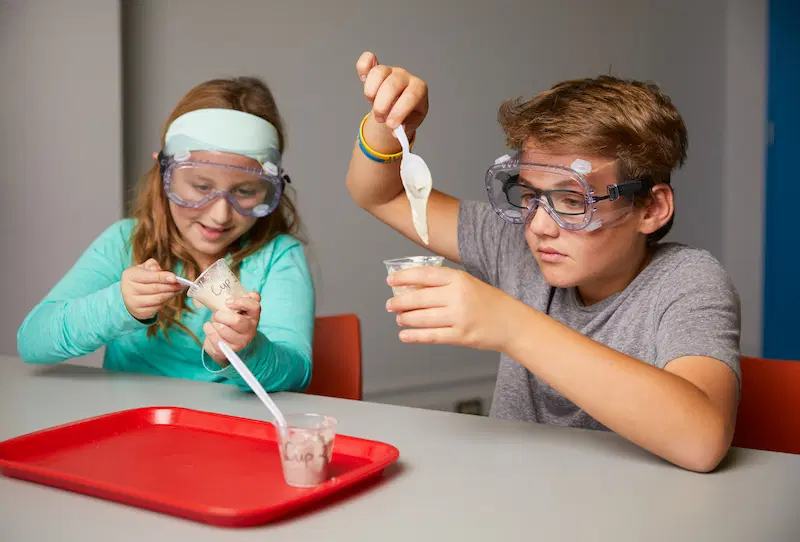
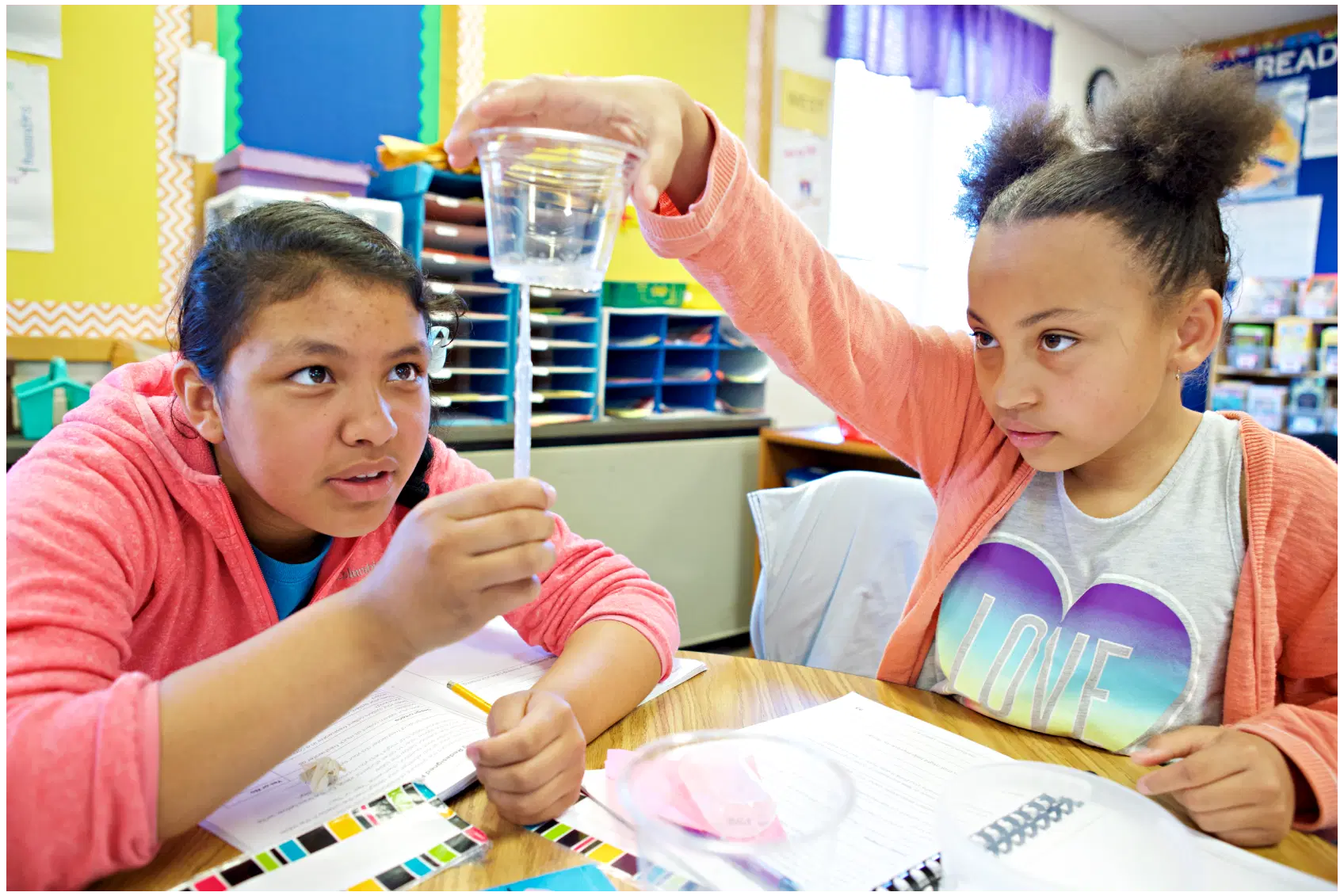
Absolutely. Hands-on learning is at the heart of Amplify Science California. Integrated into every unit are opportunities for students to take on the role of scientists and engineers as they gather evidence, think critically, solve problems, and develop and defend their claims.
In addition, our unique combination of focus and flex activities means teachers have more options, opportunities, and materials to make learning active. Each hands-on activity provides clear instructions for the teacher, with more complex activities supported by video demonstrations and illustrations.
What’s important to remember is that more hands-on doesn’t necessarily mean better, at least according to the California NGSS. That’s because only two of the eight Science and Engineering Practices (SEPs) are directly related to hands-on learning.
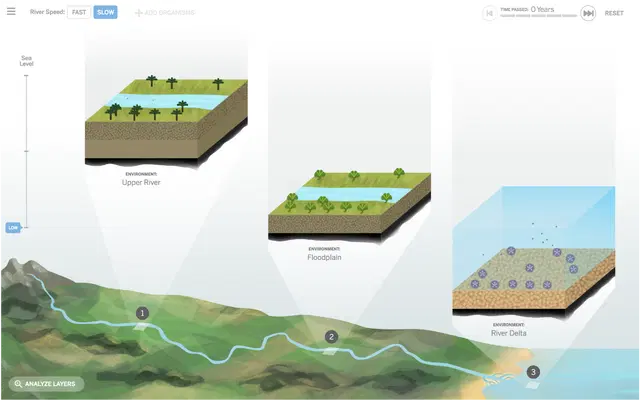
Just as scientists gather evidence from many types of sources, students in the Amplify Science California program gather evidence not just by making physical models, but also by making and interpreting digital models; reading texts; watching videos; and analyzing photographs, maps, and data sets. By doing do, students are provided with more opportunities than any other program to use all of the practices called out in the California NGSS Framework:
- Asking questions
- Developing and using models
- Planning and carrying out investigations
- Analyzing and interpreting data
- Using mathematics and computational thinking
- Constructing explanations
- Engaging in arguments from evidence
- Obtaining, evaluating, and communicating information
While all of our units engage students in gathering evidence from a rich collection of sources, the reliance on different types of evidence (and evidence sources) varies according to unit. For instance, some units lend themselves to meaningful hands-on experiences, while in other units the phenomena students are investigating are too slow, too dangerous, or too big to be observed directly. In those units, students rely more heavily on other evidence sources such a physical models or simulations.
Unit types in grades K–5
In each K–5 grade, there is one unit that emphasizes investigation, one that emphasizes modeling, and one that emphasizes design. In addition, in grades 3–5, there is also one unit that emphasizes argumentation.
Unit types in grades 6–8
Each 6–8 grade features three types of units: Launch, Core, and Engineering Internships. Each year has one Launch unit, six Core units, and two Engineering Internships.
For teachers who want to supplement the lessons with even more hands-on activities, optional “flextension” activities are included in many units.
Yes indeed. Amplify Science California integrates all four STEM disciplines—science, technology, engineering, and math, in addition to English Language Arts—throughout the curriculum. In addition, each grade level features specific units that emphasize engineering design.
Yes, the program includes multiple opportunities for summative assessments.
End-of-unit assessments: At grades K–1 these look like targeted conversations, at grades 2–5 we incorporate written responses, and at grades 6–8 we assess through a combination of auto-scored multiple-choice questions and rubric-scored written responses. These summative assessments for each unit are designed to provide valid, reliable, and fair measures of students’ progress and attainment of three-dimensional learning.
Benchmark assessments: Delivered four times per year in grades 3–5 and three times per year in grades 6–8, benchmark assessments report on students’ facilities with each of the grade appropriate DCIs, SEPs, CCCs, and performance expectations of the California NGSS.
Science Seminars and final written arguments (formative and summative components): In grades 6–8, culminating performance tasks for each core unit invite students to figure out a new real-world problem. They collect and analyze evidence, examine a number of claims, and then engage in a full-class discussion where they must state which claims are best supported by the evidence, all while making clear their reasoning that connects the evidence to the claims. After the seminar, students then individually write their final scientific argument, drawing on the DCIs, SEPs, and CCCs they have used over the course of the unit to develop a sophisticated and convincing argument that addresses the problem they’ve been investigating. Rubrics, scoring guides, and examples of student responses at each scoring level are provided to teachers to support the assessment of students’ understanding of concepts and specific practices.
Amplify Science California provides more than enough instructional content to fill 180 days of instruction. However, unlike other programs that expect you to complete 180 discrete lessons, Amplify Science California includes built-in wiggle room.
For example, the typical elementary classroom delivers science instruction only two times per week. Rather than asking teachers to wade through unnecessary content, we designed our program to address 100 percent of the California NGSS in just 66 days at grades K–2 and 88 days at grades 3–5. When it comes to middle school, we address 100 percent of the California NGSS in 146 lessons.
Some classes might last longer than one session due to a number of reasons (e.g., enthusiastic student conversations, challenging topics requiring deeper dives, more time needed to accommodate diverse learners, etc.). Also, teachers might want to supplement Amplify Science California with some of their own favorite lessons. Lastly, we’ve accounted for the inevitable assembly days, class trips, testing schedules, etc. For teachers that want to go deeper or expand upon a unit topic, we also offer a number of additional lessons that are not core to each unit.
Amplify Science California lessons are designed to be completed in the following time frames:
Lessons in grades K–1 are designed for 45 minutes of science instruction.
Lessons in grades 2–5 are designed for 60 minutes of science instruction.
That said, it’s not a problem if you can’t allocate 45 minutes of science instruction every day at K–1, or 60 minutes per day at 2–5. Since there are a total of 66 lessons to address 100 percent of California NGSS at grades K–2, and 88 lessons to address 100 percent of California NGSS at grades 3–5, you can easily teach the lessons in smaller blocks and cover all of the content over the course of the school year.
Each lesson of every Amplify Science California unit includes point-of-use differentiation strategies and embedded teacher and student supports for diverse learners, including English learners, students who need more support, and students who are ready for more challenge. These strategies and methods ensure that all students have access to the same content as their peers.
Two notable categories of suggested modifications are:
- English-learner-specific strategies such as English/Spanish glossaries, native language supports, and provision of cognates and other content-specific language scaffolds are provided in each unit.
- Relatively small alterations and additional scaffolds that provide students with greater access to the content.
These types of scaffolds benefit all learners and include suggestions such as providing graphic organizers, practice with multiple-meaning words, etc.
With Amplify Science California, the use of technology is always purposeful.
For example:
- The curriculum has a strong emphasis on literacy, with students reading and analyzing informational texts, and writing scientific explanations and arguments.
- Digital elements are gradually introduced to students in grades 2–3, with the greatest use of digital elements taking place in grades 4–5, as the phenomena at these grades become more challenging to observe directly.
- The curriculum’s readers and interactive notebook pages are available in both print and digital across all K–5 units.
This curriculum addresses a significant number of the standards as they pertain to science. Throughout each unit, students read science texts, engage in science talk and argumentation, and write evidence-based science explanations. The curriculum supports vocabulary, language, and reading comprehension development. Students also use measurement tools with precision, record and analyze data, make sense of scientific phenomena, and develop solutions to problems experienced in the real world.
Digital questions
Teacher Support notes including sample teacher talk, student responses, pedagogical support, and possible student responses are provided within your student-facing slides. Simply click “Teach” and reference your private Teacher Guide tab. Students will only see the lesson slides that you are presenting.

You, the teacher, must “Start class” to launch the presentation tab. (Remember, without the presentation tab, students would be able to see your teacher notes.)
Clicking “Starting class” also brings students to the correct slide, which is particularly important for young students who are learning to navigate.
Teachers can either press the “End class” button in the bottom right corner of the slide navigation, or they can simply close the presentation tab.
Clicking “End class” also enables students to navigate through the lesson on their own. That means they’ll be able to return to slides and books to review content, to the Sims and Modeling Tools to replay them, or to notebook pages to update their work.
You can click on the “Student preview” option in the bottom right corner (within the menu that opens when you click the three dots) to open a new browser tab where you can preview the student view using your teacher account.
Any work you complete in this student preview (or elsewhere in the teacher experience) will be automatically saved to your account.
Looking for help?
For login or technology issues, please submit an EGUSD Heat ticket. For curriculum and pedagogical questions, please refer to the support resources below.
Powerful (and free!) pedagogical support
Amplify provides a unique kind of support you won’t find from other publishers. We’ve developed an educational support team of former teachers and administrators who provide pedagogical support for every Amplify curriculum, assessment, and intervention program. This service is completely free for all educators who are using our programs and includes:
- Guidance for developing lesson plans and intervention plans.
- Information on where to locate standards and other planning materials.
- Recommendations and tips for day-to-day teaching with Amplify programs.
- Support with administering and interpreting assessment data and more.
To reach our pedagogical team, use our live chat within your program, call (800) 823-1969, or email edsupport@amplify.com
Timely technical and program support
Our technical and program support is included and available from 4 a.m. to 4 p.m. PT, Monday through Friday, through a variety of channels, including a live chat program that enables teachers to get immediate help in the middle of the school day.
For your most urgent questions:
- Use our live chat within your program.
- Call our toll-free number: (800) 823-1969.
For less urgent questions:
Connect with other teachers
Our Amplify Science Facebook group is a community of Amplify Science educators from across the country. It’s a space to share best practices, ideas, and support on everything from implementation to instruction. Join today.

A closer look at grades 3–5
Amplify Science is based on the latest research on teaching and learning and helps teachers deliver age-appropriate, high-quality, literacy-rich instruction that enables students to take on the roles of scientists and engineers to solve real-world phenomena every day.
In the 3–5 classroom, this looks like students:
- Collecting evidence from a variety of sources.
- Making sense of evidence in a variety of ways.
- Formulating convincing scientific arguments.

Program structure
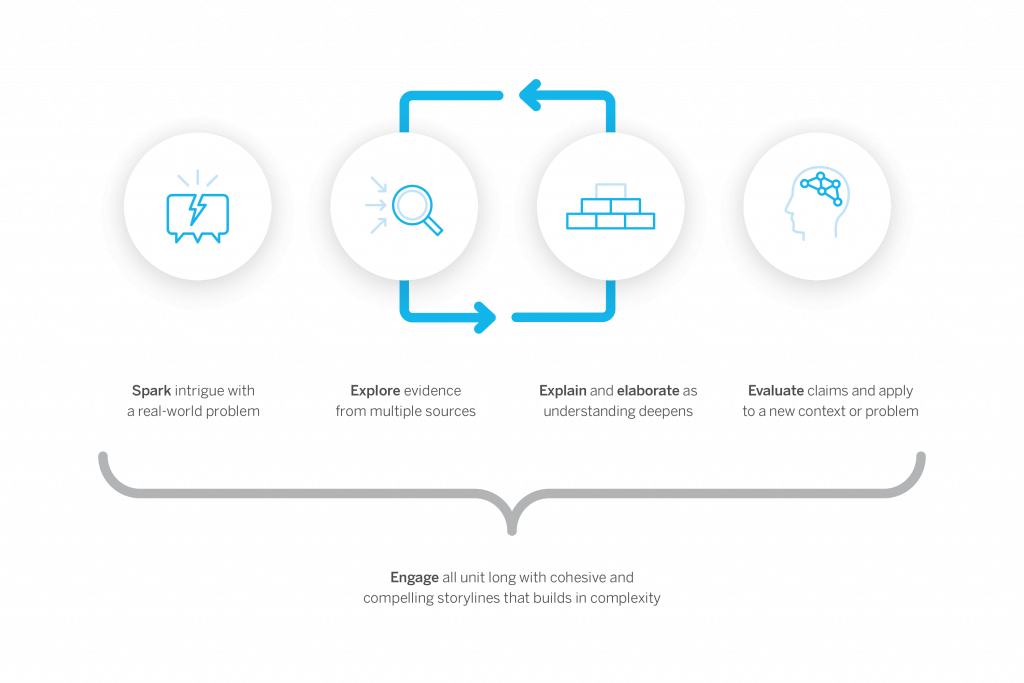
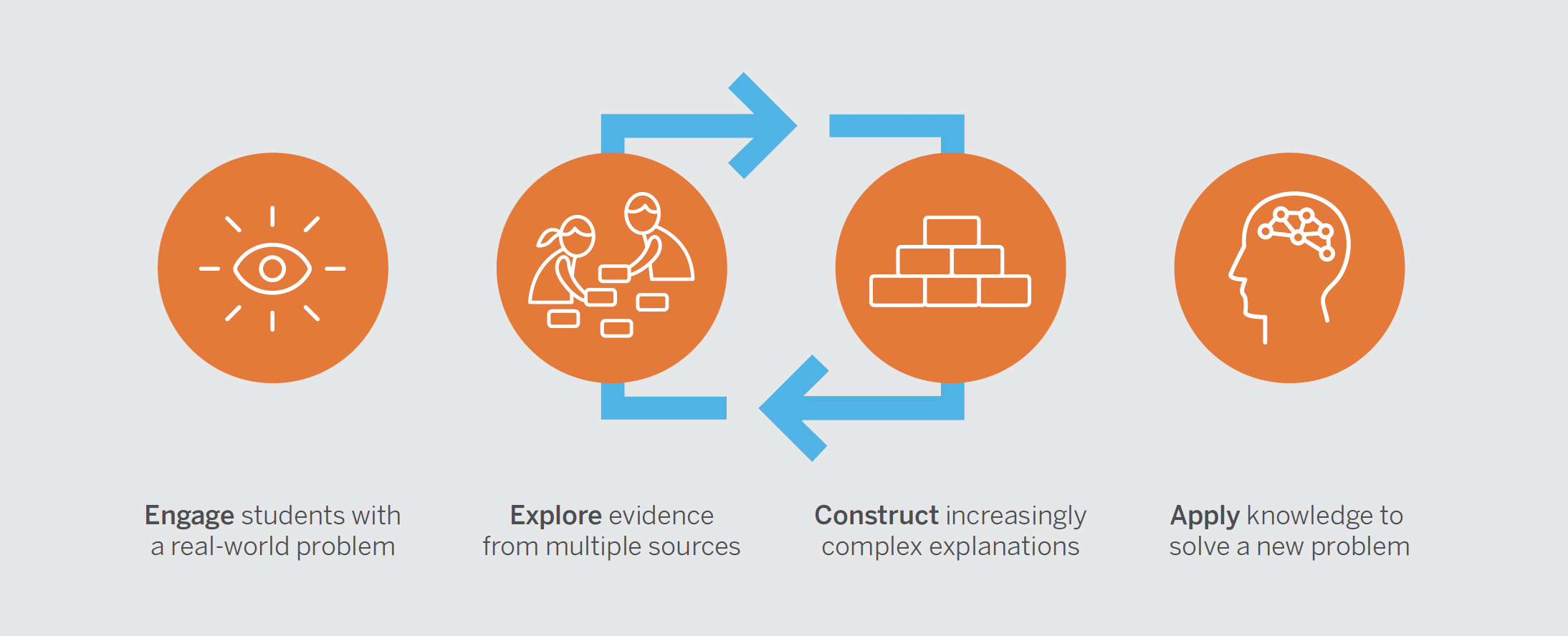
Our cyclical lesson design ensures students receive multiple exposures to concepts through a variety of modalities. As they progress through the lessons within a unit, students build and deepen their understanding, increasing their ability to develop and refine complex explanations of the unit’s phenomenon.
It’s this proven program structure and lesson design that enables Amplify Science California to teach less, but achieve more. Rather than asking teachers to wade through unnecessary content, we designed our 3–5 program to address 100% of the California NGSS in just 88 days.
Scope and sequence
Every year of our grades 3–5 sequence consists of 4 units and 88 lessons. Said another way, each unit contains 20 lessons plus two dedicated assessment days (a Pre-Unit Assessment and End-of-Unit Assessment).
Lessons for grades 3–5 are written to last a minimum of 60 minutes, though teachers can expand or contract the timing to meet their needs.

Unit types
Each unit delivers three-dimensional learning experiences and engages students in gathering evidence from a rich collection of sources, while also emphasizing a particular science and engineering practice.
In grades 3–5:
- One unit emphasizes the practice of investigation.
- One unit emphasizes the practice of modeling.
- One unit emphasizes the practice of engineering design.
- One unit emphasizes the practice of argumentation.
Investigation Units
Investigation units focus on the process of strategically developing investigations and gathering data to answer questions. Students are first asked to consider questions about what happens in the natural world and why, and are then involved in designing and conducting investigations that produce data to help answer those questions.
Modeling Units
Modeling units provide extra support to students engaging in the practice of modeling. Students use physical models, investigate with computer models, and create their own diagrams to help them visualize what might be happening on the nanoscale.
Engineering Design Units
Engineering design units provide opportunities for students to solve complex problems by applying science principles to the design of functional solutions, and iteratively testing those solutions to determine how well they meet preset criteria.
Argumentation units
Argumentation units provide students with regular opportunities to explore and discuss available evidence, time and support to consider how evidence may be leveraged in support of claims, and independence that increases as they mount written arguments in support of their claims.
Units at a glance
Balancing Forces
Domain: Physical Science
Unit type: Modeling
Student role: Engineers
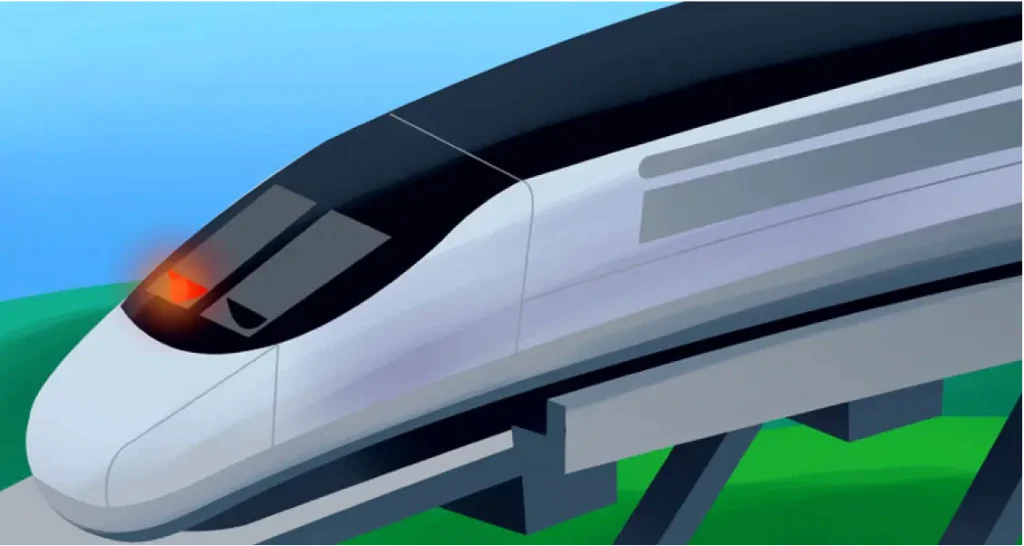
Phenomenon: The town of Faraday is getting a new train that floats above its tracks.
Inheritance and Traits
Domain: Life Science
Unit type: Investigation
Student role: Wildlife biologists
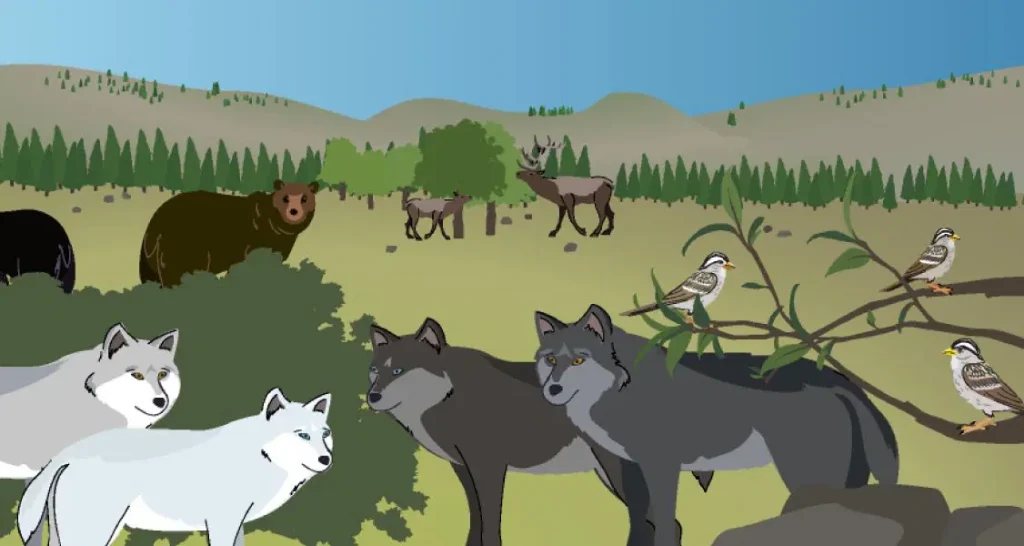
Phenomenon: An adopted wolf in Graystone National Park (“Wolf 44”) has some traits that appear similar to one wolf pack in the park and other traits that appear to be similar to a different wolf pack.
Environments and Survival
Domains: Life Science, Engineering Design
Unit type: Engineering design
Student role: Biomimicry engineers
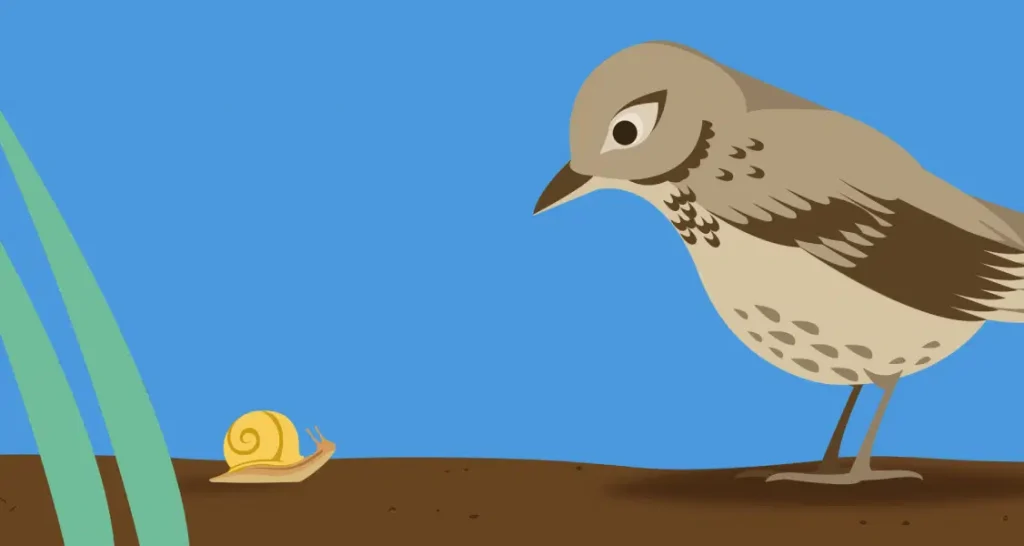
Phenomenon: Over the last 10 years, a population of grove snails has changed: The number of grove snails with yellow shells has decreased, while the number of snails with banded shells has increased.

Weather and Climate
Domains: Earth and Space Science, Engineering Design
Unit type: Argumentation
Student role: Meteorologists
Phenomenon: Three different islands, each a contender for becoming an Orangutan reserve, experience different weather patterns.

Energy Conversions
Domains: Physical Science, Earth and Space Science, Engineering Design
Unit type: Engineering design
Student role: System engineers
Phenomenon: The fictional town of Ergstown experiences frequent blackouts.

Vision and Light
Domain: Physical Science, Life Science, Engineering Design
Unit type: Investigation
Student role: Conservation biologists
Phenomenon: The population of Tokay geckos in a rain forest in the Philippines has decreased since the installation of new highway lights.

Earth’s Features
Domain: Earth and Space Science
Unit type: Argumentation
Student role: Geologists
Phenomenon: A mysterious fossil is discovered in a canyon within the fictional Desert Rocks National Park.

Waves, Energy, and Information
Domains: Physical Science, Life Science, Earth and Space Science, Engineering Design
Unit type: Modeling
Student role: Marine scientists
Phenomenon: Mother dolphins in the fictional Blue Bay National Park seem to be communicating with their calves when they are separated at a distance underwater.

Patterns of Earth and Sky
Domains: Physical Science, Earth and Space Science
Unit type: Investigation
Student role: Astronomers
Phenomenon: An ancient artifact depicts what we see in the sky at different times — the sun during the daytime and different stars during the nighttime — but it is missing a piece.
Modeling Matter
Domain: Physical Science
Unit type: Modeling
Student role: Food scientists
Phenomenon: Chromatography is a process for separating mixtures. Some solids dissolve in a salad dressing while others do not. Oil and vinegar appear to separate when mixed in a salad dressing.

The Earth System
Domains: Earth and Space Science, Physical Science, Engineering Design
Unit type: Engineering Design
Student role: Water resource engineers
Phenomenon: East Ferris, a city on one side of the fictional Ferris Island, is experiencing a water shortage, while West Ferris is not.
Ecosystem Restoration
Domains:Physical Science, Life Science, Earth and Space Science, Engineering Design
Unit type: Argumentation
Student role: Ecologists
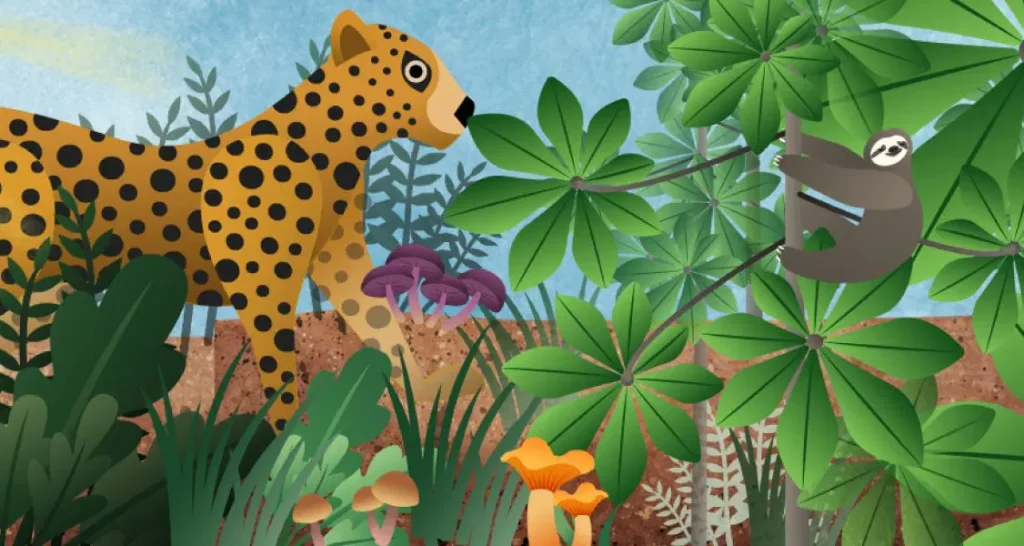
Phenomenon: The jaguars, sloths, and cecropia trees in a reforested section of a Costa Rican rain forest are not growing and thriving.
Resources






A closer look at grades 3–5
Amplify Science is based on the latest research on teaching and learning and helps teachers deliver age-appropriate, high-quality, literacy-rich instruction that enables students to take on the roles of scientists and engineers to solve real-world phenomena every day.
In the 3–5 classroom, this looks like students:
- Collecting evidence from a variety of sources.
- Making sense of evidence in a variety of ways.
- Formulating convincing scientific arguments.
Program structure
Our cyclical lesson design ensures students receive multiple exposures to concepts through a variety of modalities. As they progress through the lessons within a unit, students build and deepen their understanding, increasing their ability to develop and refine complex explanations of the unit’s phenomenon.
It’s this proven program structure and lesson design that enables Amplify Science California to teach less, but achieve more. Rather than asking teachers to wade through unnecessary content, we designed our 3–5 program to address 100% of the California NGSS in just 88 days.
Scope and sequence
Every year of our grades 3–5 sequence consists of 4 units and 88 lessons. Said another way, each unit contains 20 lessons plus two dedicated assessment days (a Pre-Unit Assessment and End-of-Unit Assessment).
Lessons for grades 3–5 are written to last a minimum of 60 minutes, though teachers can expand or contract the timing to meet their needs.
Unit types
Each unit delivers three-dimensional learning experiences and engages students in gathering evidence from a rich collection of sources, while also emphasizing a particular science and engineering practice.
In grades 3–5:
- One unit emphasizes the practice of investigation.
- One unit emphasizes the practice of modeling.
- One unit emphasizes the practice of engineering design.
- One unit emphasizes the practice of argumentation.
Investigation Units
Investigation units focus on the process of strategically developing investigations and gathering data to answer questions. Students are first asked to consider questions about what happens in the natural world and why, and are then involved in designing and conducting investigations that produce data to help answer those questions.
Modeling Units
Modeling units provide extra support to students engaging in the practice of modeling. Students use physical models, investigate with computer models, and create their own diagrams to help them visualize what might be happening on the nanoscale.
Engineering Design Units
Engineering design units provide opportunities for students to solve complex problems by applying science principles to the design of functional solutions, and iteratively testing those solutions to determine how well they meet preset criteria.
Argumentation units
Argumentation units provide students with regular opportunities to explore and discuss available evidence, time and support to consider how evidence may be leveraged in support of claims, and independence that increases as they mount written arguments in support of their claims.
Units at a glance
Balancing Forces
Domain: Physical Science
Unit type: Modeling
Student role: Engineers
Phenomenon: The town of Faraday is getting a new train that floats above its tracks.
Inheritance and Traits
Domain: Life Science
Unit type: Investigation
Student role: Wildlife biologists
Phenomenon: An adopted wolf in Graystone National Park (“Wolf 44”) has some traits that appear similar to one wolf pack in the park and other traits that appear to be similar to a different wolf pack.
Environments and Survival
Domains: Life Science, Engineering Design
Unit type: Engineering design
Student role: Biomimicry engineers
Phenomenon: Over the last 10 years, a population of grove snails has changed: The number of grove snails with yellow shells has decreased, while the number of snails with banded shells has increased.
Weather and Climate
Domains: Earth and Space Science, Engineering Design
Unit type: Argumentation
Student role: Meteorologists
Phenomenon: Three different islands, each a contender for becoming an Orangutan reserve, experience different weather patterns.
Energy Conversions
Domains: Physical Science, Earth and Space Science, Engineering Design
Unit type: Engineering design
Student role: System engineers
Phenomenon: The fictional town of Ergstown experiences frequent blackouts.
Vision and Light
Domain: Physical Science, Life Science, Engineering Design
Unit type: Investigation
Student role: Conservation biologists
Phenomenon: The population of Tokay geckos in a rain forest in the Philippines has decreased since the installation of new highway lights.
Earth’s Features
Domain: Earth and Space Science
Unit type: Argumentation
Student role: Geologists
Phenomenon: A mysterious fossil is discovered in a canyon within the fictional Desert Rocks National Park.
Waves, Energy, and Information
Domains: Physical Science, Life Science, Earth and Space Science, Engineering Design
Unit type: Modeling
Student role: Marine scientists
Phenomenon: Mother dolphins in the fictional Blue Bay National Park seem to be communicating with their calves when they are separated at a distance underwater.
Patterns of Earth and Sky
Domains: Physical Science, Earth and Space Science
Unit type: Investigation
Student role: Astronomers
Phenomenon: An ancient artifact depicts what we see in the sky at different times — the sun during the daytime and different stars during the nighttime — but it is missing a piece.
Modeling Matter
Domain: Physical Science
Unit type: Modeling
Student role: Food scientists
Phenomenon: Chromatography is a process for separating mixtures. Some solids dissolve in a salad dressing while others do not. Oil and vinegar appear to separate when mixed in a salad dressing.
The Earth System
Domains: Earth and Space Science, Physical Science, Engineering Design
Unit type: Engineering Design
Student role: Water resource engineers
Phenomenon: East Ferris, a city on one side of the fictional Ferris Island, is experiencing a water shortage, while West Ferris is not.
Ecosystem Restoration
Domains:Physical Science, Life Science, Earth and Space Science, Engineering Design
Unit type: Argumentation
Student role: Ecologists
Phenomenon: The jaguars, sloths, and cecropia trees in a reforested section of a Costa Rican rain forest are not growing and thriving.
Resources
A closer look at grades K–2
Amplify Science California is based on the latest research on teaching and learning and helps teachers deliver age-appropriate, high-quality, literacy-rich instruction that enables students to take on the roles of scientists and engineers to solve real-world phenomena every day.
In the K–2 classroom, this looks like students:
- Collecting evidence from a variety of sources.
- Making sense of evidence in a variety of ways.
- Formulating convincing scientific arguments.

Program structure
Our cyclical lesson design ensures students receive multiple exposures to concepts through a variety of modalities. As they progress through the lessons within a unit, their understanding gradually builds and deepens, ultimately leading to their ability to develop and refine increasingly complex explanations of the unit’s phenomenon.
It’s this proven program structure and lesson design that enables Amplify Science California to teach less, but achieve more. Rather than asking teachers to wade through unnecessary content, we designed our K–2 program to address 100% of the California NGSS in just 66 days.
Scope and sequence
Every year of our K–2 consists of 3 units and 66 total lessons. Said another way, each unit contains 20 lessons plus two dedicated assessment days (a Pre-Unit Assessment and End-of-Unit Assessment).
Lessons at grades K–1 are written for a minimum of 45-minutes, and grade 2 lessons are written for a minimum of 60-minutes—though teachers can expand or contract the timing to meet their needs.
Unit types
While every unit delivers three-dimensional learning experiences and engages students in gathering evidence from a rich collection of sources, each unit also emphasizes a particular science and engineering practice.
In each grade K–2:
- One unit emphasizes the practice of investigation.
- One unit emphasizes the practice of modeling.
- One unit emphasizes the practice of engineering design.
Investigation Units
Investigation units focus on the process of strategically developing investigations and gathering data to answer questions. Students are first asked to consider questions about what happens in the natural world and why, and are then involved in designing and conducting investigations that produce data to help answer those questions.
Modeling Units
Modeling units provide extra support to students engaging in the practice of modeling. Students use physical models, investigate with computer models, and create their own diagrams to help them visualize what might be happening on the nanoscale.
Engineering Design Units
Engineering design units provide opportunities for students to solve complex problems by applying science principles to the design of functional solutions, and iteratively testing those solutions to determine how well they meet preset criteria.
Units at a glance

Needs of Plants and Animals
Domains: Life Science, Earth and Space Science, Engineering Design
Unit type: Investigation
Student role: Scientists
Phenomenon: There are no monarch caterpillars in the Mariposa Grove community garden since vegetables were planted.

Pushes and Pulls
Domains: Physical Science, Engineering Design
Unit type: Engineering design
Student role: Pinball engineers
Phenomenon: Pinball machines allow people to control the direction and strength of forces on a ball.
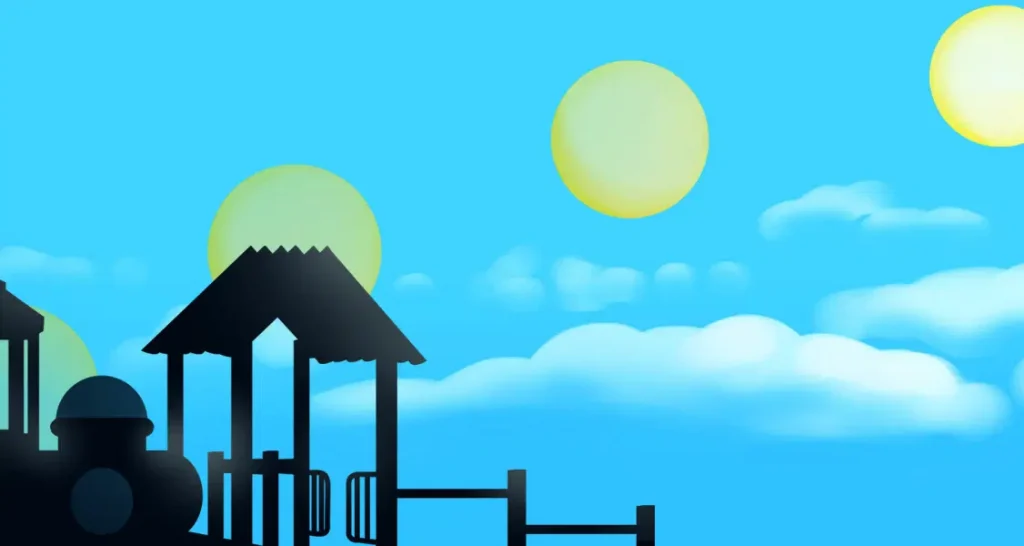
Sunlight and Weather
Domains: Earth and Space Science, Life Science, Engineering Design
Unit type: Modeling
Student role: Weather scientists
Phenomenon: Students at Carver Elementary School are too cold during morning recess, while students at Woodland Elementary School are too hot during afternoon recess.

Animal and Plant Defenses
Domain: Life Science
Unit type: Modeling
Student role: Marine scientists
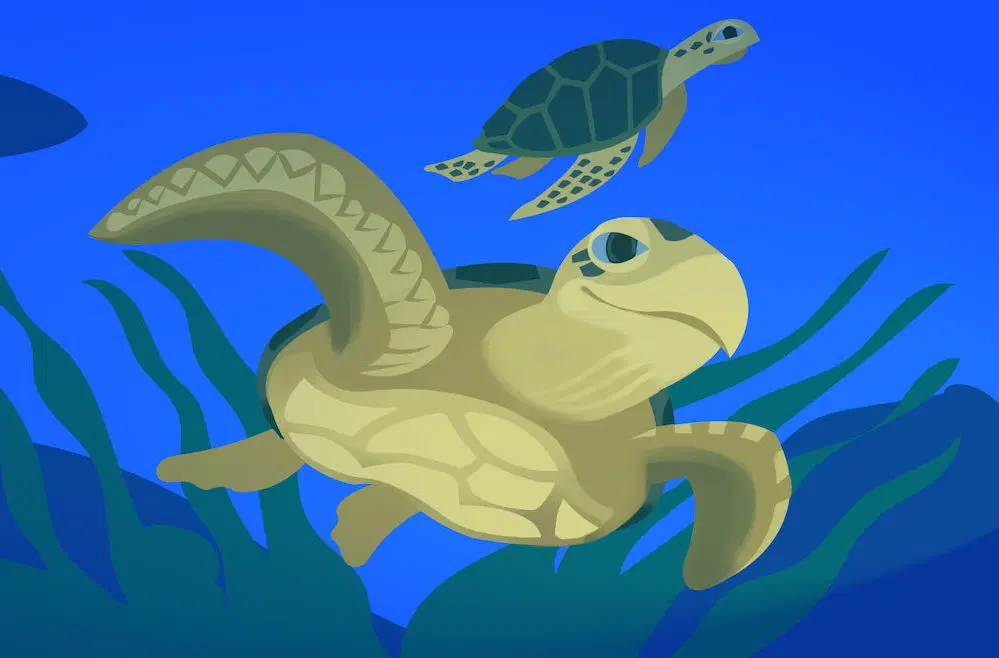
Phenomenon: Spruce the Sea Turtle lives in an aquarium and will soon be released back into the ocean, where she will survive despite ocean predators.
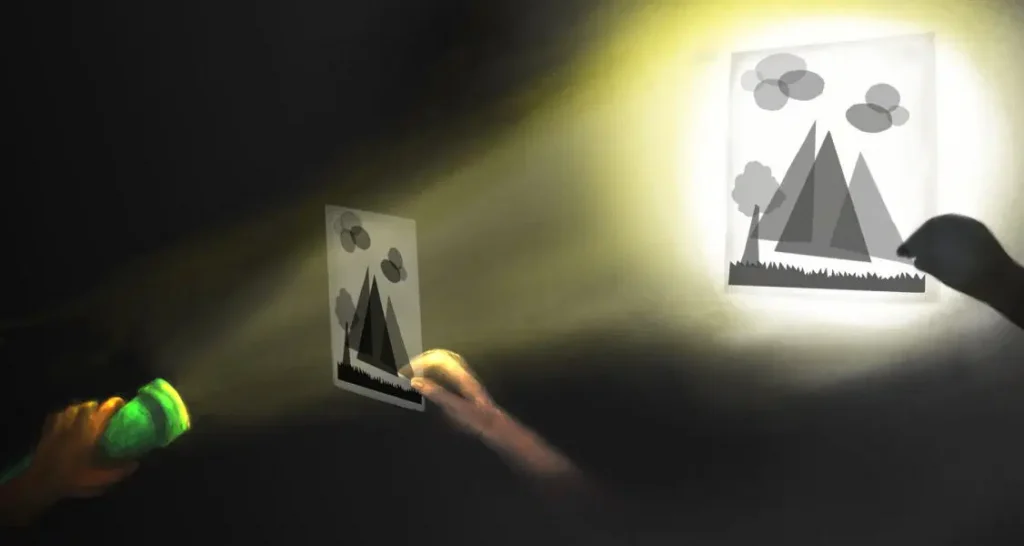
Light and Sound
Domains: Physical Science, Engineering Design
Unit type: Engineering design
Student role: Light and sound engineers
Phenomenon: A puppet show company uses light and sound to depict realistic scenes in puppet shows.

Spinning Earth
Domain: Earth and Space Science
Unit type: Investigation
Student role: Sky scientists
Phenomenon: The sky looks different to Sai and his grandma when they talk on the phone.

Plant and Animal Relationships
Domains: Life Science, Engineering Design
Unit type: Investigation
Student role: Plant scientists
Phenomenon: No new chalta trees are growing in the fictional Bengal Tiger Reserve in India.
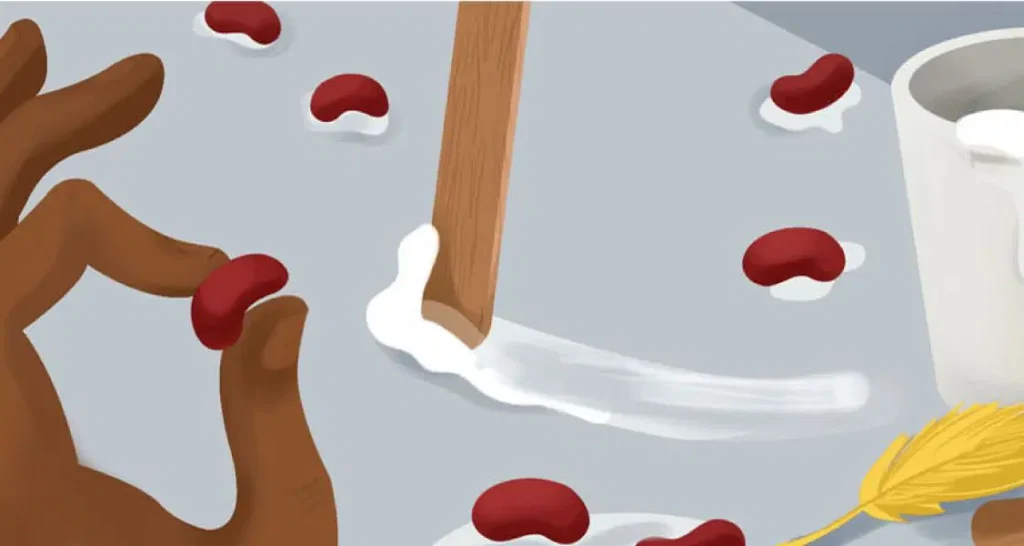
Properties of Materials
Domains: Physical Science, Engineering Design
Unit type: Engineering design
Student role: Glue engineers
Phenomenon: Different glue recipes result in glues that have different properties.
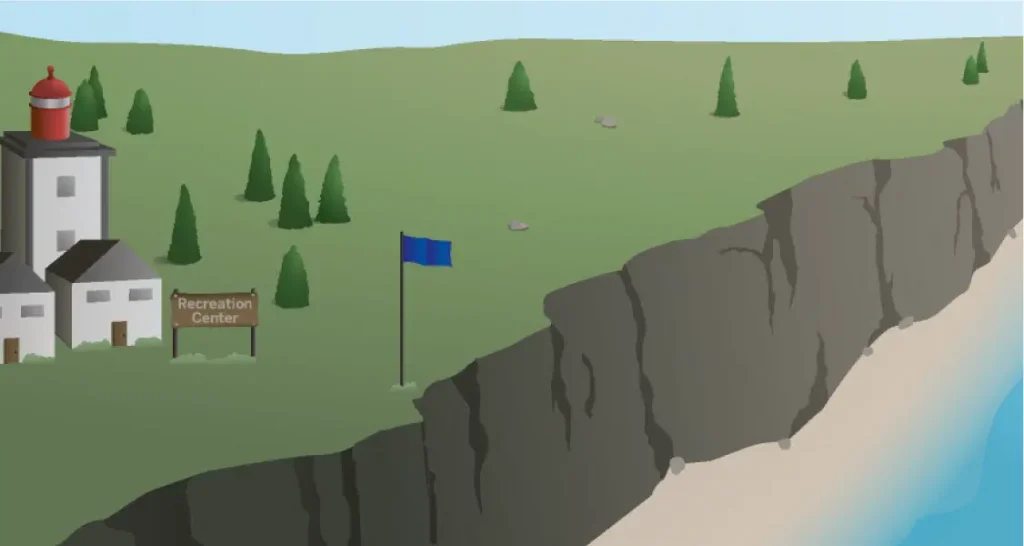
Changing Landforms
Domain: Earth and Space Science
Unit type: Modeling
Student role: Geologists
Phenomenon: The cliff that Oceanside Recreation Center is situated on appears to be receding over time.
Resources




A closer look at grades K–2
Amplify Science California is based on the latest research on teaching and learning and helps teachers deliver age-appropriate, high-quality, literacy-rich instruction that enables students to take on the roles of scientists and engineers to solve real-world phenomena every day.
In the K–2 classroom, this looks like students:
- Collecting evidence from a variety of sources.
- Making sense of evidence in a variety of ways.
- Formulating convincing scientific arguments.
Program structure
Our cyclical lesson design ensures students receive multiple exposures to concepts through a variety of modalities. As they progress through the lessons within a unit, their understanding gradually builds and deepens, ultimately leading to their ability to develop and refine increasingly complex explanations of the unit’s phenomenon.
It’s this proven program structure and lesson design that enables Amplify Science California to teach less, but achieve more. Rather than asking teachers to wade through unnecessary content, we designed our K–2 program to address 100% of the California NGSS in just 66 days.
Scope and sequence
Every year of our K–2 consists of 3 units and 66 total lessons. Said another way, each unit contains 20 lessons plus two dedicated assessment days (a Pre-Unit Assessment and End-of-Unit Assessment).
Lessons at grades K–1 are written for a minimum of 45-minutes, and grade 2 lessons are written for a minimum of 60-minutes—though teachers can expand or contract the timing to meet their needs.
Unit types
While every unit delivers three-dimensional learning experiences and engages students in gathering evidence from a rich collection of sources, each unit also emphasizes a particular science and engineering practice.
In each grade K–2:
- One unit emphasizes the practice of investigation.
- One unit emphasizes the practice of modeling.
- One unit emphasizes the practice of engineering design.
Investigation Units
Investigation units focus on the process of strategically developing investigations and gathering data to answer questions. Students are first asked to consider questions about what happens in the natural world and why, and are then involved in designing and conducting investigations that produce data to help answer those questions.
Modeling Units
Modeling units provide extra support to students engaging in the practice of modeling. Students use physical models, investigate with computer models, and create their own diagrams to help them visualize what might be happening on the nanoscale.
Engineering Design Units
Engineering design units provide opportunities for students to solve complex problems by applying science principles to the design of functional solutions, and iteratively testing those solutions to determine how well they meet preset criteria.
Units at a glance
Needs of Plants and Animals
Domains: Life Science, Earth and Space Science, Engineering Design
Unit type: Investigation
Student role: Scientists
Phenomenon: There are no monarch caterpillars in the Mariposa Grove community garden since vegetables were planted.
Pushes and Pulls
Domains: Physical Science, Engineering Design
Unit type: Engineering design
Student role: Pinball engineers
Phenomenon: Pinball machines allow people to control the direction and strength of forces on a ball.
Sunlight and Weather
Domains: Earth and Space Science, Life Science, Engineering Design
Unit type: Modeling
Student role: Weather scientists
Phenomenon: Students at Carver Elementary School are too cold during morning recess, while students at Woodland Elementary School are too hot during afternoon recess.
Animal and Plant Defenses
Domain: Life Science
Unit type: Modeling
Student role: Marine scientists
Phenomenon: Spruce the Sea Turtle lives in an aquarium and will soon be released back into the ocean, where she will survive despite ocean predators.
Light and Sound
Domains: Physical Science, Engineering Design
Unit type: Engineering design
Student role: Light and sound engineers
Phenomenon: A puppet show company uses light and sound to depict realistic scenes in puppet shows.
Spinning Earth
Domain: Earth and Space Science
Unit type: Investigation
Student role: Sky scientists
Phenomenon: The sky looks different to Sai and his grandma when they talk on the phone.
Plant and Animal Relationships
Domains: Life Science, Engineering Design
Unit type: Investigation
Student role: Plant scientists
Phenomenon: No new chalta trees are growing in the fictional Bengal Tiger Reserve in India.
Properties of Materials
Domains: Physical Science, Engineering Design
Unit type: Engineering design
Student role: Glue engineers
Phenomenon: Different glue recipes result in glues that have different properties.
Changing Landforms
Domain: Earth and Space Science
Unit type: Modeling
Student role: Geologists
Phenomenon: The cliff that Oceanside Recreation Center is situated on appears to be receding over time.
Resources
Grade 6
Chapter 1: Use Positive Rational Numbers
Chapter 2: Integers and Rational Numbers
| Lesson 1: Understand Integers | Unit 7 Lesson 1: Can You Dig it In [Free lesson] Lesson 4 Sub-Zero |
| Lesson 2: Represent Rational Numbers on the Number Line | Unit 7 Lesson 2: Digging Deeper Lesson 3: Order in the Class (Print available) [Free lesson] Practice Day 1 |
| Lesson 3: Absolute Values of Rational Numbers | Unit 7 Lesson 5: Distance on the Number Line Practice Day 1 (Print available) |
| Lesson 4: Represent Rational Numbers on the Coordinate Plane | |
| Lesson 5: Find Distances on the Coordinate Plane Lesson 6: Represent Polygons on the Coordinate Plane | Unit 7 Lesson 11: Polygon Maker |
Chapter 3: Numeric and Algebraic Expressions
| Lesson 1: Understand and Represent Exponents | Unit 6 Lesson 10: Powers Lesson 11: Exponent Expressions (Print available) Practice Day 2 (Print available) |
| Lesson 2: Find Greatest Common Factor and Least Common Multiple | Unit 5 Lesson 14: Common Multiples Lesson 15: Common Factors Practice Day 2 |
| Lesson 3: Write and Evaluate Numerical Expressions | Unit 6 Lesson 6: Vari-apples Lesson 7: Border Tiles |
| Lesson 4: Write Algebraic Expressions | Unit 6 Lesson 6: Vari-apples Lesson 8: Products and Sums [Free lesson] Lesson 9: Products, Sums, and Differences (Print available) |
| Lesson 5: Evaluate Algebraic Expressions | Unit 6 Lesson 6: Vari-apples Lesson 7: Border Tiles Lesson 12: Squares and Cubes |
| Lesson 6: Generate Equivalent Expressions | Unit 6 Lesson 7: Border Tiles Lesson 8: Products and Sums [Free lesson] Lesson 9: Products, Sums, and Differences (Print available) |
| Lesson 7: Simplify Algebraic Expressions | Unit 6 Lesson 7: Border Tiles |
Chapter 4: Represent and Solve Equations and Inequalities
Chapter 5: Understand and Use Ratio and Rate
Chapter 6: Understand and Use Percent
| Lesson 1: Understand Percent | Unit 3 Lesson 8: Lucky Duckies [Free lesson] |
| Lesson 2: Relate Fractions, Decimals, and Percents | Unit 5 Lesson 13: Grocery Prices (Print available) |
| Lesson 3: Represent Percents Greater Than 100 or Less than 1 | |
| Lesson 4: Estimate to Find Percent | |
| Lesson 5: Find the Percent of a Number Lesson 6: Find the Whole Given a Part and the Percent | Unit 3 Lesson 9: Bicycle Goals Lesson 10: What’s Missing? Lesson 11: Cost Breakdown Lesson 12: More Bicycle Goals Practice Day 2 (Print Available) |
Chapter 7: Solve Area, Surface Area, and Volume Problems
Chapter 8: Display, Describe, and Summarize data
Grade 7
Chapter 1: Rational Number Operations
Chapter 2: Analyze and Use Proportional Relationships
| Lesson 1: Connect Ratios, Rates, and Unit Rates | |
| Lesson 2: Determine Unit Rates with Ratios of Fractions | |
| Lesson 3: Understand Proportional Relationships: Equivalent Ratios | Unit 2 Lesson 1: Paint [Free lesson] Lesson 2: Balloon Float |
| Lesson 4: Describe Proportional Relationships: Constant of Proportionality | Unit 2 Lesson 3: Sugary Drinks (Print available) Lesson 4: Robot Factory Lesson 5: Snapshots Lesson 6: Two and Two (Print available) [Free lesson] Lesson 7: All Kinds of Equations Lesson 10: Three Turtles Practice Day (Print available) Unit 3 Lesson 1 Circumference of a Circle |
| Lesson 5: Graph Proportional Relationships | Unit 2 Lesson 8: Dino Pops [Free lesson] Lesson 9: Gallon Challenge Lesson 10: Three Turtles Lesson 11: Four Representations (Print available) |
| Lesson 6: Apply Proportional Reasoning to Solve Problems | Unit 2 Lesson 11: Four Representations (Print available) Lesson 12: Water Efficiency |
Chapter 3: Analyze and Solve Percent Problems
| Lesson 1: Analyze Percents of Numbers Lesson 2: Connect Percent and Proportion | Unit 4 Lesson 1: Mosaics [Free lesson] Lesson 2: Peach Cobbler (Print available) |
| Lesson 3: Represent and Use the Percent Equation | |
| Lesson 4: Solve Percent Change and Percent Error Problems | Unit 4 Lesson 4: More and Less Lesson 5: All the Equations Lesson 6: 100% (Print available) Lesson 7: Percent machines [Free lesson] Lesson 8: Tax and Tip Lesson 9: Minimum Wage (Print available) Lesson 10: Cost of College (Print available) Lesson 11: Bookcase Builder Lesson 12: Posing Percent Problems [Free lesson] |
| Lesson 5: Solve Markup and Markdown Problems | Unit 4 Lesson 7: Percent machines [Free lesson] Lesson 8: Tax and Tip Lesson 9: Minimum Wage Lesson 10: Cost of College Lesson 11: Bookcase Builder Lesson 12: Posing Percent Problems [Free lesson] Practice Day (Print available) |
| Lesson 6: Solve Simple Interest Problems |
Chapter 4: Generate Equivalent Expressions
| Lesson 1: Write and Evaluate Algebraic Expressions | Unit 6 Lesson 9: Always-Equal Machines Unit 5 Lesson 9: Expressions (Print available) |
| Lesson 2: Generate Equivalent Expressions | Unit 6 Lesson 9: Always-Equal Machines Lesson 11: Equation Roundtable (Print available) |
| Lesson 3: Simplify Expressions | Unit 6 Lesson 9: Always-Equal Machines Lesson 10: Collect the Squares [Free lesson] |
| Lesson 4: Expand Expressions | Unit 6 Lesson 2: Smudged Receipts Lesson 6: Balancing Equations Lesson 8: Factoring and Expanding Lesson 9: Always-Equal Machines (Print available) Lesson 10: Collect the Squares [Free lesson] Lesson 11: Equation Roundtable (Print available) |
| Lesson 5: Factor Expressions | Unit 6 Lesson 8: Factoring and Expanding Lesson 11: Equation Roundtable (Print available) |
| Lesson 6: Add Expressions Lesson 7: Subtract Expressions | Unit 6 Lesson 10: Collect the Squares [Free lesson] Lesson 11: Equation Roundtable (Print available) |
| Lesson 8: Analyze Equivalent Expressions | Unit 6 Lesson 11: Equation Roundtable (Print available) |
Chapter 5: Solve Problems Using Equations and Inequalities
Chapter 6: Use Sampling to Draw Inferences About Populations
| Lesson 1: Populations and Samples | Unit 8 Lesson 10: Crab Island [Free lesson] Lesson 11: Headlines |
| Lesson 2: Draw Inferences from Data | Unit 8 Lesson 8: Simulate It Lesson 9: Car, Bike, or Train? (Print available) Lesson 10: Crab Island [Free lesson] Lesson 11: Headlines Lesson 12: Flower Power |
| Lesson 3: Make Comparative Inferences About Populations Lesson 4: Make More Comparative Inferences About Populations | Unit 8 Lesson 9: Car, Bike, or Train? (Print available) Lesson 10: Crab Island [Free lesson] Lesson 13: Plots and Samples Lesson 14: School Newspaper (Print available) Lesson 15: Asthma Rates (Print available) |
Chapter 7: Probability
| Lesson 1: Understand Likelihood and Probability | Unit 8 Lesson 1 How Likely? (Print available) [Free lesson] Lesson 2 Prob-bear-bilities [Free lesson] Lesson 3 Mystery Bag |
| Lesson 2: Understand Theoretical Probability Lesson 3: Understand Experimental Probability | Unit 8 Lesson 4: Spin Class Lesson 5: Is It Fair? Lesson 6: Fair Games |
| Lesson 4: Use Probability Models | Unit 8 Lesson 6: Fair Games Lesson 7: Weather or Not Lesson 8: Simulate It Lesson 9: Car, Bike, or Train? (Print available) |
| Lesson 5: Determine Outcomes of Compound Events | Unit 8 Lesson 9: Car, Bike, or Train? (Print available) |
| Lesson 6: Find Probabilities of Compound Events Lesson 7: Simulate Compound Events | Unit 8 Lesson 8: Simulate It Lesson 9: Car, Bike, or Train? (Print available) Practice Day 1 (Print Available) |
Chapter 8: Solve Problems Involving Geometry
Grade 8
Chapter 1: Real Numbers
Chapter 2: Analyze and Solve Linear Equations
Chapter 3: Use Functions to Model Relationships
| Lesson 1: Understand Relations and Functions | Unit 5 Lesson 1: Turtle Crossing [Free lesson] Lesson 2: Guess My Rule [Free lesson] |
| Lesson 2: Connect Representations of Functions | Unit 5 Lesson 3: Function or Not? Lesson 5: The Tortoise and the Hare [Free lesson] |
| Lesson 3: Compare Linear and Nonlinear Functions | Unit 5 Lesson 4: Window Frames |
| Lesson 4: Construct Functions to Model Linear Relationships | Unit 5 Lesson 6: Graphing Stories Lesson 7: Feel the Burn (Print available) [Free lesson] Lesson 8: Charge! (Print available) |
| Lesson 5: Intervals of Increase and Decrease | Unit 5 Lesson 1: Turtle Crossing [Free lesson] Lesson 6: Graphing Stories |
| Lesson 6: Sketch Functions from Verbal Descriptions | Unit 5 Lesson 6: Graphing Stories |
Chapter 4: Investigate Bivariate Data
| Lesson 1: Construct and Interpret Scatter Plots | Unit 6 Lesson 1: Click Battle Lesson 2: Wing Span Lesson 3: Robots [Free lesson] Practice Day 1 (Print available) [Free lesson] |
| Lesson 2: Analyze Linear Association | Unit 6 Lesson 4: Dapper Cats [Free lesson] Lesson 5: Fit Fights [Free lesson] Lesson 7: Scatter Plot City |
| Lesson 3: Use Linear Models to Make Predictions | Unit 6 Lesson 6: Interpreting Slopes Lesson 8: Animal Brains Practice Day 2 (Print available) |
| Lesson 4: Interpret Two-Way Frequency Tables | Unit 6 Lesson 9: Tasty Fruit |
| Lesson 5: Interpret Two-Way Relative Frequency Tables | Unit 6 Lesson 10: Finding Associations [Free lesson] Lesson 11: Federal Budgets Practice Day 3 |
Chapter 5: Analyze and Solve Systems of Linear Equations
| Lesson 1: Estimate Solutions by Inspection | Unit 4 Lesson 7: All, Some, or None? Lesson 8: When Are They the Same? Lesson 13: All, Some, or None? Part 2 |
| Lesson 2: Solve Systems by Graphing | Unit 4 Lesson 9: On or Off the Line? Lesson 10: On Both Lines Lesson 11: Make Them Balance [Free lesson] Lesson 12: Line Zapper [Free lesson] Practice Day 2 (Print available) |
| Lesson 3: Solve Systems by Substitution | |
| Lesson 4: Solve Systems by Elimination |
Chapter 6: Congruence and Similarity
Chapter 7: Understand and Apply the Pythagorean Theorem
| Lesson 1: Understand the Pythagorean Theorem | Unit 8 Lesson 6: The Pythagorean Theorem Lesson 7: Pictures to Prove It Lesson 8: Triangle-Tracing Turtle [Free lesson] |
| Lesson 2: Understand the Converse of the Pythagorean Theorem | Unit 8 Lesson 9: Make It Right |
| Lesson 3: Apply the Pythagorean Theorem to Solve Problems | Unit 8 Lesson 10: Taco Truck [Free lesson] Practice Day 2 (Print available) |
| Lesson 4: Find Distance in the Coordinate Plane | Unit 8 Lesson 11: Pond Hopper |
Chapter 8: Solve Problems Involving Surface Area and Volume
| Lesson 1: Find Surface Area of Three-Dimensional Figures | |
| Lesson 2: Find Volume of Cylinders | Unit 5 Lesson 10: Volume Lab Lesson 11: Cylinders [Free lesson] Lesson 14: Missing Dimensions (Print available) |
| Lesson 3: Find Volume of Cones | Unit 5 Lesson 13: Cones [Free lesson] Lesson 14: Missing Dimensions (Print available) |
| Lesson 4: Find Volume of Spheres | Unit 5 Lesson 15: Spheres Practice Day 2 (Print available) |
Grade 6
Module 1: Ratios and Unit Rates
| Eureka Math | Desmos Math 6–A1 |
| Topic A Representing and Reasoning About Ratios | |
| Lesson 1: Ratios Lesson 2: Ratios | Unit 2 Lesson 1: Pizza Maker [Free lesson] Lesson 2: Ratio Rounds (Print available) |
| Lesson 3: Equivalent Ratios Lesson 4: Equivalent Ratios | Unit 2 Lesson 3: Rice Ratios Lesson 4: Fruit Lab [Free lesson] Lesson 5: Balancing Act Lesson 7: Mixing Paint, Part 1 Lesson 8 World Records (Print available) Lesson 11 Community Life (Print available) Practice Day 1 (Print available) |
| Lesson 5: Solving Problems by Finding Equivalent Ratios Lesson 6: Solving Problems by Finding Equivalent Ratios | Unit 2 Lesson 5 Balancing Act |
| Lesson 7: Associated Ratios and the Value of a Ratio Lesson 8: Equivalent Ratios Defined Through the Value of a Ratio | Unit 2 Lesson 6: Product Prices (Print available) Lesson 7: Mixing Paint, Part 1 |
| Topic B Collections of Equivalent Ratios | |
| Lesson 9: Tables of Equivalent Ratios | Unit 2 Lesson 6: Product Prices (Print available) Lesson 7: Mixing Paint, Part 1 |
| Lesson 10: The Structure of Ratio Tables-Additive and Multiplicative | Unit 2 Lesson 10: Balloons Lesson 11: Community Life (Print available) |
| Lesson 11: Comparing Ratios Using Ratio Tables | Unit 2 Lesson 10: Balloons |
| Lesson 12: From Ratio Tables to Double Number Line Diagrams | Unit 2 Lesson 6: Product Prices (Print available) Lesson 8: World Records (Print available) Lesson 12: Mixing Paint, Part 2 Lesson 14: Lunch Waste (Print available) Practice Day 2 (Print available) |
| Lesson 13: From Ratio Tables to Equations Using the Value of a Ratio | |
| Lesson 14: From Ratio Tables, Equations, and Double Number Line Diagrams to Plots on the Coordinate Plane | |
| Lesson 15: A Synthesis of Representations of Equivalent Ratio Collections | |
| Topic C Unit Rates | |
| Lesson 16: From Ratio to Rates | Unit 2 Lesson 8: World Records (Print available) Unit 3 Lesson 4: Model Trains Lesson 5: Soft Serve [Free lesson] Lesson 6: Welcome to the Robot Factory |
| Lesson 17: From Rates to Ratios | |
| Lesson 18: Finding a Rate by Dividing Two Quantities | Unit 3 Lesson 4: Model Trains Lesson 5: Soft Serve [Free lesson] Lesson 6: Welcome to the Robot Factory Lesson 7: More Soft Serve |
| Lesson 19: Comparison Shopping-Unit Price and Related Measurement Conversions Lesson 20: Comparison Shopping-Unit Price and Related Measurement Conversions Lesson 21: Getting the Job Done—Speed, Work, and Measurement Units Lesson 22: Getting the Job Done—Speed, Work, and Measurement Units | Unit 3 Lesson 2: Counting Classrooms Lesson 3: Pen Pals |
| Lesson 23: Problem-Solving Using Rates, Unit Rates, and Conversions. | Unit 3 Lesson 13: A Country as a Village |
| Topic D Percent | |
| Lesson 24: Percent and Rates per 100 | Unit 3 Lesson 8: Lucky Duckies [Free lesson] Lesson 9: Bicycle Goals |
| Lesson 25: A Fraction as a Percent | |
| Lesson 26: Percent of a Quantity. | Unit 3 Lesson 10: What´s Missing? (Print available) Lesson 11: Cost Breakdown |
| Lesson 27: Solving Percent Problems Lesson 28: Solving Percent Problems Lesson 29: Solving Percent Problems | Unit 3 Lesson 10: What´s Missing? (Print available) Lesson 11: Cost Breakdown Lesson 12: More Bicycle Goals Lesson 13: A Country as a Village Practice Day 2 (Print available) |
Module 2: Arithmetic Operations Including Division of Fractions
| Lesson 1: Interpreting Division of a Fraction by a Whole Number—Visual Models. | Unit 4 Lesson 2: Making Connections (Print available) |
| Lesson 2: Interpreting Division of a Whole Number by a Fraction —Visual Models. | Unit 4 Lesson 1: Cookie Cutter Lesson 3: Flour Planner [Free lesson] Lesson 4: Flower Planters Lesson 5: Garden Bricks (Print available) |
| Lesson 3: Interpreting and Computing Division of a Fraction by a Fraction—More Models Lesson 4: Interpreting and Computing Division of a Fraction by a Fraction—More Models | Unit 4 Lesson 5: Garden Bricks Lesson 6: Fill the Gap [Free lesson] Lesson 7: Break It Down Lesson 8: Potting Soil Lesson 9: Division Challenges Lesson 10: Swap Meet (Print available) Practice Day |
| Lesson 5: Creating Division Stories. | |
| Lesson 6: More Division Stories. | |
| Lesson 7: The Relationship Between Visual Fraction Models and Equations | |
| Lesson 8: Dividing Fractions and Mixed Numbers | Unit 4 Lesson 5: Garden Bricks (Print available) Lesson 6: Fill the Gap [Free lesson] |
| Topic B Multi-Digit Decimal Operations—Adding, Subtracting, and Multiplying | |
| Lesson 9: Sums and Differences of Decimals | Unit 5 Lesson 2: Decimal Diagrams [Free lesson] Lesson 3: Fruit by the Pound Lesson 4: Missing Digits |
| Lesson 10: The Distributive Property and the Products of Decimals | Unit 5 Lesson 5: Decimal Multiplication Lesson 6: Multiplying with Areas Lesson 7: Multiplication Methods (Print available) |
| Lesson 11: Fraction Multiplication and the Products of Decimals | Unit 5 Lesson 7: Multiplication Methods (Print available) |
| Topic C Dividing Whole Numbers and Decimals | |
| Lesson 12: Estimating Digits in a Quotient | |
| Lesson 13: Dividing Multi-Digit Numbers Using the Algorithm | Unit 5 Lesson 9: Long Division Launch Practice Day 1 (Print available) Practice Day 2 (Print available) |
| Lesson 14: The Division Algorithm—Converting Decimal Division into Whole Number Division Using Fractions. | |
| Lesson 15: The Division Algorithm—Converting Decimal Division into Whole Number Division Using Mental Math | |
| Topic D Number Theory—Thinking Logically About Multiplicative Arithmetic | |
| Lesson 16: Even and Odd Numbers | |
| Lesson 17: Divisibility Tests for 3 and 9 | |
| Lesson 18: Least Common Multiple and Greatest Common Factor | Unit 5 Lesson 14: Common Multiples Lesson 15: Common Factors Practice Day 2 (Print available) |
| Lesson 19: The Euclidean Algorithm as an Application of the Long Division Algorithm |
Module 3: Rational Numbers
| Lesson 1: Positive and Negative Numbers on the Number Line—Opposite Direction and Value | Unit 7Lesson 2: Digging Deeper |
| Lesson 2: Real-World Positive and Negative Numbers and Zero. Lesson 3: Real-World Positive and Negative Numbers and Zero. | Unit 7 Lesson 4: Sub-Zero |
| Lesson 4: The Opposite of a Number Lesson 5: The Opposite of a Number’s Opposite Lesson 6: Rational Numbers on the Number Line | Unit 7Lesson 2: Digging Deeper |
| Topic B Order and Absolute Value | |
| Lesson 7: Ordering Integers and Other Rational Numbers Lesson 8: Ordering Integers and Other Rational Numbers Lesson 9: Comparing Integers and Other Rational Numbers | Unit 7Lesson 3: Order in the Class (Print available) [Free lesson] |
| Lesson 10: Writing and Interpreting Inequality Statements Involving Rational Numbers | |
| Lesson 11: Absolute Value—Magnitude and Distance Lesson 12: The Relationship Between Absolute Value and Order | Unit 7Lesson 5: Distance on the Number Line |
| Lesson 13: Statements of Order in the Real World. | |
| Topic C Rational Numbers and the Coordinate Plane | |
| Lesson 14: Ordered Pairs Lesson 15: Locating Ordered Pairs on the Coordinate Plane | Unit 7Lesson 9: Sand Dollar SearchLesson 10: The A-maze-ing Coordinate PlaneLesson 11: Polygon Maker |
| Lesson 16: Symmetry in the Coordinate Plane. | |
| Lesson 17: Drawing the Coordinate Plane and Points on the Plane | Lesson 10: The A-maze-ing Coordinate Plane |
| Lesson 18: Distance on the Coordinate Plane | Unit 7Lesson 11: Polygon Maker |
| Lesson 19: Problem Solving and the Coordinate Plane | Unit 7Lesson 12: Graph Telephone (Print available)Practice Day 2 (Print available) |
Module 4: Expressions and Equations
| Topic A Relationships of the Operations | |
| Lesson 1: The Relationship of Addition and Subtraction | |
| Lesson 2: The Relationship of Multiplication and Division | |
| Lesson 3: The Relationship of Multiplication and Addition. | |
| Lesson 4: The Relationship of Division and Subtraction | |
| Topic B Special Notations of Operations | |
| Lesson 5: Exponents | Unit 6Lesson 10: PowersLesson 11: Exponent Expressions (Print available)Practice Day 2 (Print available) |
| Lesson 6: The Order of Operations | |
| Topic C Replacing Letters and Numbers | |
| Lesson 7: Replacing Letters with Numbers Lesson 8: Replacing Numbers with Letters | Unit 6Lesson 7: Border TilesLesson 12: Squares and Cubes |
| Topic D Expanding, Factoring, and Distributing Expressions | |
| Lesson 9: Writing Addition and Subtraction Expressions | Unit 6Lesson 6: Vari-applesLesson 8: Products and Sums [Free lesson]Lesson 9: Products, Sums, and Differences |
| Lesson 10: Writing and Expanding Multiplication Expressions Lesson 11: Factoring Expressions Lesson 12: Distributing Expressions | Unit 6Lesson 8: Products and Sums [Free lesson]Lesson 9: Products, Sums, and Differences |
| Lesson 13: Writing Division Expressions | |
| Lesson 14: Writing Division Expressions | |
| Topic E Expressing Operations in Algebraic Form | |
| Lesson 15: Read Expressions in Which Letters Stand for Numbers Lesson 16: Write Expressions in Which Letters Stand for Numbers Lesson 17: Write Expressions in Which Letters Stand for Numbers | Unit 6Lesson 6: Vari-applesLesson 7: Border Tiles |
| Topic F Writing and Evaluating Expressions and Formulas | |
| Lesson 18: Writing and Evaluating Expressions—Addition and Subtraction Lesson 19: Substituting to Evaluate Addition and Subtraction Expressions Lesson 20: Writing and Evaluating Expressions—Multiplication and Division Lesson 21: Writing and Evaluating Expressions—Multiplication and Addition | Unit 6Lesson 7: Border TilesLesson 8: Products and Sums [Free lesson]Lesson 9: Products, Sums, and DifferencesLesson 12: Squares and Cubes |
| Lesson 22: Writing and Evaluating Expressions—Exponents | Unit 6Lesson 10: PowersLesson 11: Exponent Expressions (Print available)Lesson 12: Squares and CubesPractice Day 2 (Print available) |
| Topic G Solving Equations | |
| Lesson 23: True and False Number Sentences Lesson 24: True and False Number Sentences | Unit 6Lesson 1: Weight for It [Free lesson] |
| Lesson 25: Finding Solutions to Make Equations True | Unit 6Lesson 1: Weight for It [Free lesson]Lesson 2: Five Equations |
| Lesson 26: One-Step Equations—Addition and Subtraction | Unit 6Lesson 1: Weight for It [Free lesson]Lesson 2: Five EquationsLesson 3: Hanging Around |
| Lesson 27: One-Step Equations—Multiplication and Division Lesson 28: Two-Step Problems—All Operations Lesson 29: Multi-Step Problems—All Operations | Unit 6Lesson 3: Hanging AroundLesson 4: Hanging It UpLesson 5: Swap and Solve |
| Topic H Applications of Equations | |
| Lesson 30: One-Step Problems in the Real World Lesson 31: Problems in Mathematical TermsLesson Lesson 32: Multi-Step Problems in the Real World | Unit 6Lesson 3: Hanging AroundLesson 4: Hanging It UpLesson 5: Swap and SolvePractice Day 1 (Print available) |
| Lesson 33: From Equations to Inequalities Lesson 34: Writing and Graphing Inequalities in Real-World Problems | Unit 7Lesson 6: Tunnel Travel [Free lesson]Lesson 7: Comparing WeightsLesson 8: Shira´s Solutions |
Module 5: Area, Surface Area, and Volume Problems
| Topic A: Area of Triangles, Quadrilaterals, and Polygons | |
| Lesson 1: The Area of Parallelograms Through Rectangle Facts | Unit 1Lesson 3: Exploring Parallelograms (Print available) [Free lesson]Lesson 4: Off the Grid |
| Lesson 2: The Area of Right Triangles Lesson 3: The Area of Acute Triangles Using Height and Base | Unit 1Lesson 5: Exploring Triangles (Print available)Lesson 6: Triangles and ParallelogramsLesson 7: Off the Grid, Part 2 |
| Lesson 4: The Area of All Triangles Using Height and Base | Unit 1Lesson 6: Triangles and ParallelogramsLesson 7: Off the Grid, Part 2 |
| Lesson 5: The Area of Polygons Through Composition and Decomposition | Unit 1Lesson 2: LettersLesson 8: Pile of PolygonsPractice Day 1 (Print available) |
| Lesson 6: Area in the Real World | |
| Topic B Polygons on the Coordinate Plane | |
| Lesson 7: Distance on the Coordinate Plane | Unit 1Lesson 8: Pile of Polygons |
| Lesson 8: Drawing Polygons in the Coordinate Plane | Unit 7Lesson 11: Polygon Maker |
| Lesson 9: Determining Perimeter and Area of Polygons on the Coordinate Plane | Unit 1Lesson 8: Pile of Polygons |
| Lesson 10: Distance, Perimeter, and Area in the Real World | |
| Topic C Volume of Right Rectangular Prisms | |
| Lesson 11: Volume with Fractional Edge Lengths and Unit Cubes | Unit 4Lesson 11: Classroom ComparisonsLesson 12: Puzzling Areas (Print available) [Free lesson]Lesson 13: Volume ChallengesLesson 14: Planter Planner (Print available) |
| Lesson 12: From Unit Cubes to the Formulas for Volume | |
| Lesson 13: The Formulas for Volume | |
| Lesson 14: Volume in the Real World | Unit 4Lesson 14: Planter Planner (Print available) |
| Topic D Nets and Surface Area | |
| Lesson 15: Representing Three-Dimensional Figures Using Nets Lesson 16: Constructing Nets Lesson 17: From Nets to Surface Area | Unit 1Lesson 10: Plenty of PolyhedraLesson 11: Nothing But Nets (Print available)Lesson 13: Take It To Go (Print available) |
| Lesson 18: Determining Surface Area of Three-Dimensional Figures | Unit 1Lesson 9: Renata´s Stickers [Free lesson]Lesson 10: Plenty of PolyhedraLesson 11: Nothing But Nets (Print available)Lesson 13: Take It To Go (Print available)Practice Day 2 (Print available) |
| Lesson 19: Surface Area and Volume in the Real World | |
| Lesson 19a: Addendum Lesson for Modeling―Applying Surface Area and Volume to Aquariums | |
| Lesson 3: The Area of Acute Triangles Using Height and Base | Unit 1Lesson 5 Exploring TrianglesLesson 6 Triangles and ParallelogramsLesson 7 Off the Grid, Part 2 |
Module 6: Statistics
| Topic A Understanding Distributions | |
| Lesson 1: Posing Statistical Questions | Unit 8 Lesson 1: Screen TimeLesson 2: Dot Plots |
| Lesson 2: Displaying a Data Distribution Lesson 3: Creating a Dot Plot | Unit 8 Lesson 2: Dot PlotsLesson 3: Minimum Wage (Print available) [Free lesson]Lesson 4: Lots More Dots |
| Lesson 4: Creating a Histogram Lesson 5: Describing a Distribution Displayed in a Histogram | Unit 8Lesson 5: The Plot Thickens [Free lesson]Lesson 6: DIY Histograms (Print available) |
| Topic B Summarizing a Distribution That Is Approximately Symmetric Using the Mean and Mean Absolute Deviation | |
| Lesson 6: Describing the Center of a Distribution Using the Mean Lesson 7: The Mean as a Balance Point | Unit 8Lesson 7: Snack Time |
| Lesson 8: Variability in a Data Distribution | Unit 8Lesson 8: Pop It! |
| Topic 9: The Mean Absolute Deviation (MAD). | Unit 8Lesson 9: Hoops |
| Lesson 10: Describing Distributions Using the Mean and MAD Lesson 11: Describing Distributions Using the Mean and MAD | Unit 8Lesson 10 Hollywood Part 1Practice Day 1 (Print available) |
| Topic C Summarizing a Distribution That Is Skewed Using the Median and the Interquartile Range | |
| Lesson 12: Describing the Center of a Distribution Using the Median | Unit 8Lesson 11: Toy Cars [Free lesson]Lesson 12: In the News |
| Lesson 13: Describing Variability Using the Interquartile Range (IQR) | Unit 8Lesson 13: Pumpkin Patch |
| Lesson 14: Summarizing a Distribution Using a Box Plot Lesson 15: More Practice with Box Plots | Unit 8Lesson 14: Car, Plane, Bus, or Train? (Print available) |
| Lesson 16: Understanding Box Plots | Unit 8Lesson 14: Car, Plane, Bus, or Train? (Print available)Lesson 15: Hollywood Part 2Lesson 16: Hollywood Part 3 (Print available)Practice Day 2 (Print available) |
| Topic D Summarizing and Describing Distributions | |
| Lesson 17: Developing a Statistical Project | |
| Lesson 18: Connecting Graphical Representations and Numerical Summaries | Unit 8Lesson 5: The Plot Thickens [Free lesson] |
| Lesson 19: Comparing Data Distributions | Unit 8Lesson 15: Hollywood Part 2 |
| Lesson 20: Describing Center, Variability, and Shape of a Data Distribution from a Graphical Representation Lesson 21: Summarizing a Data Distribution by Describing Center, Variability, and Shape | Unit 8Lesson 16: Hollywood Part 3 (Print available) |
| Lesson 22: Presenting a Summary of a Statistical Project | |
| Lesson 3: Creating a Dot Plot | Unit 8Lesson 2 Dot PlotsLesson 3 Minimum Wage [Free lesson]Lesson 4 Lots More Dots |
Grade 7
Module 1: Ratios and Proportional Relationships
Module 2: Rational Numbers
| Topic A Addition and Subtraction of Integers and Rational Numbers | |
| Lesson 1: Opposite Quantities Combine to Make Zero | Unit 5 Lesson 1: Floats and Anchors [Free lesson] |
| Lesson 2: Using the Number Line to Model the Addition of Integers Lesson 3: Understanding Addition of Integers Lesson 4: Efficiently Adding Integers and Other Rational Numbers Lesson 5: Understanding Subtraction of Integers and Other Rational Numbers | Unit 5 Lesson 2: More Floats and Anchors Lesson 4: Draw Your Own (Print available) [Free lesson] Lesson 5: Number Puzzles Lesson 10: Integer Puzzles [Free lesson] Lesson 11: Changing Temperatures Lesson 13: Solar Panels and More (Print available) |
| Lesson 6: The Distance Between Two Rational Numbers | |
| Lesson 7: Addition and Subtraction of Rational Numbers | Unit 5 Lesson 3: Bumpers Lesson 4: Draw Your Own (Print available) [Free lesson] Lesson 5: Number Puzzles Lesson 10; Integer Puzzles [Free lesson] Lesson 11: Changing Temperatures Lesson 13: Solar Panels and More (Print available) Practice Day 1 (Print available) |
| Lesson 8: Applying the Properties of Operations to Add and Subtract Rational Numbers | |
| Lesson 9: Applying the Properties of Operations to Add and Subtract Rational Numbers | |
| Topic B Multiplication and Division of Integers and Rational Numbers | |
| Lesson 10: Understanding Multiplication of Integers Lesson 11: Develop Rules for Multiplying Signed Numbers | Unit 5 Lesson 6: Floating in Groups Lesson 7: Back in Time Lesson 8: Speeding Turtles Lesson 10: Integer Puzzles [Free lesson] Practice Day 2 (Print available) |
| Lesson 12: Division of Integers | Unit 5 Lesson 8: Speeding Turtles |
| Lesson 13: Converting Between Fractions and Decimals Using Equivalent Fractions | |
| Lesson 14: Converting Rational Numbers to Decimals Using Long Division | Unit 4 Lesson 13: Decimal Deep Dive (Print available) |
| Lesson 15: Multiplication and Division of Rational Numbers | Unit 5 Lesson 8: Speeding Turtles Lesson 10: Integer Puzzles [Free lesson] Lesson 12: Arctic Sea Ice (Print available) Lesson 13: Solar Panels and More (Print available) Practice Day 2 (Print available) |
| Lesson 16: Applying the Properties of Operations to Multiply and Divide Rational Numbers | |
| Topic C Applying Operations with Rational Numbers to Expressions and Equations | |
| Lesson 17: Comparing Tape Diagram Solutions to Algebraic Solutions | Unit 6 Lesson 2: Smudged Receipts Lesson 3: Equations Lesson 4: Seeing Structure (Print available) |
| Lesson 18: Writing, Evaluating, and Finding Equivalent Expressions with Rational Numbers Lesson 19: Writing, Evaluating, and Finding Equivalent Expressions with Rational Numbers | Unit 5 Lesson 9 Expressions |
| Lesson 20: Investments—Performing Operations with Rational Numbers | |
| Lesson 21: If-Then Moves with Integer Number Cards | |
| Lesson 22: Solving Equations Using Algebra Lesson 23: Solving Equations Using Algebra | Unit 6 Lesson 3: Equations Lesson 4: Seeing Structure (Print available) Lesson 6: Balancing Equations Lesson 7: Keeping It True (Print available) Lesson 12: Community Day (Print available) Unit 5 Lesson 3: Bumpers |
Module 3: Expressions and Equations
Module 4: Percent and Proportional Relationships
Module 5: Statistics and Probability
| Topic A Calculating and Interpreting Probabilities | |
| Lesson 1: Chance Experiments | Unit 8Lesson 1: How Likely? (Print available) [Free lesson]Lesson 2: Prob-bear-bilities [Free lesson]Lesson 3: Mystery Bag |
| Lesson 2: Estimating Probabilities by Collecting Data Lesson 3: Chance Experiments with Equally Likely Outcomes Lesson 4: Calculating Probabilities for Chance Experiments with Equally Likely Outcomes | Unit 8Lesson 3: Mystery BagLesson 4: Spin ClassLesson 5: Is It Fair?Lesson 6: Fair Games |
| Lesson 5: Chance Experiments with Outcomes That Are Not Equally Likely | Unit 8Lesson 4: Spin ClassLesson 5: Is It Fair?Lesson 6: Fair GamesLesson 7: Weather or Not |
| Lesson 6: Using Tree Diagrams to Represent a Sample Space and to Calculate Probabilities | Unit 8Lesson 6: Fair GamesLesson 7: Weather or Not |
| Lesson 7: Calculating Probabilities of Compound Events | Unit 8Lesson 8: Simulate It! (Print available)Lesson 9: Car, Bike, or Train? (Print available)Practice Day 1 (Print available) |
| Topic B Estimating Probabilities | |
| Lesson 8: The Difference Between Theoretical Probabilities and Estimated Probabilities Lesson 9: Comparing Estimated Probabilities to Probabilities Predicted by a Model | Unit 8Lesson 6: Fair GamesLesson 7: Weather or NotLesson 8: Simulate It! (Print available)Lesson 9: Car, Bike, or Train? (Print available) |
| Lesson 10: Conducting a Simulation to Estimate the Probability of an Event | Unit 8Lesson 7: Weather or NotLesson 8: Simulate It! (Print available)Lesson 9: Car, Bike, or Train? (Print available) |
| Lesson 11: Conducting a Simulation to Estimate the Probability of an Event Lesson 12: Applying Probability to Make Informed Decisions | Unit 8Lesson 7: Weather or NotLesson 8: Simulate It! (Print available) |
| Topic C Random Sampling and Estimating Population Characteristics | |
| Lesson 13: Populations, Samples, and Generalizing from a Sample to a Population | Unit 8Lesson 9: Car, Bike, or Train? (Print available)Lesson 10: Crab Island [Free lesson]Lesson 11: HeadlinesLesson 12: Flower Power |
| Lesson 14: Selecting a Sample Lesson 15: Random Sampling Lesson 16: Methods for Selecting a Random Sample | Unit 8Lesson 10: Crab Island [Free lesson]Lesson 11: Headlines |
| Lesson 17: Sampling Variability | Unit 8Lesson 9: Car, Bike, or Train? (Print available)Lesson 13: Plots and Samples |
| Lesson 18: Sampling Variability and the Effect of Sample Size Lesson 19: Understanding Variability When Estimating a Population Proportion | Unit 8Lesson 9: Car, Bike, or Train? (Print available)Lesson 13: Plots and SamplesLesson 14: School Newspaper (Print available) |
| Lesson 20: Estimating a Population Proportion | |
| Topic D Comparing Populations | |
| Lesson 21: Why Worry About Sampling Variability? | Unit 8Lesson 9: Car, Bike, or Train? (Print available)Lesson 13: Plots and SamplesLesson 14: School Newspaper (Print available) |
| Lesson 22: Using Sample Data to Compare the Means of Two or More Populations Lesson 23: Using Sample Data to Compare the Means of Two or More Populations | Unit 8Lesson 9: Car, Bike, or Train? (Print available)Lesson 10: Crab Island [Free lesson]Lesson 13: Plots and SamplesLesson 14: School Newspaper (Print available)Lesson 15: Asthma Rates (Print available) |
Module 6: Geometry
| Topic A Unknown Angles | |
| Lesson 1: Complementary and Supplementary Angles | Unit 7Lesson 2: Friendly Angles [Free lesson]Lesson 3: Angle Diagrams |
| Lesson 2: Solving for Unknown Angles Using Equations Lesson 3: Solving for Unknown Angles Using Equations Lesson 4: Solving for Unknown Angles Using Equations | Unit 7Lesson 1: PinwheelsLesson 2: Friendly AnglesLesson 3: Angle DiagramsLesson 4: Missing Measures (Print available) [Free lesson] |
| Topic B Constructing Triangles | |
| Lesson 5: Identical Triangles | Unit 7Lesson 6: Is It Enough?Lesson 7: More Than One |
| Lesson 6: Drawing Geometric Shapes | Unit 7Lesson 6: Is It Enough?Lesson 7: More Than OneLesson 8: Can You Draw It? (Print available) |
| Lesson 7: Drawing Parallelograms | |
| Lesson 8: Drawing Triangles | Unit 7Lesson 5: Can You Build It? [Free lesson]Lesson 6: Is It Enough?Lesson 7: More Than OneLesson 8: Can You Draw It? (Print available)Practice Day 1 (Print available) |
| Lesson 9: Conditions for a Unique Triangle―Three Sides and Two Sides and the Included Lesson 10: Conditions for a Unique Triangle—Two Angles and a Given Side Angle | Unit 7Lesson 8: Can You Draw It? (Print available) |
| Lesson 11: Conditions on Measurements That Determine a Triangle | Unit 7Lesson 5: Can You Build It? [Free lesson]Lesson 6: Is It Enough?Lesson 7: More Than OneLesson 8: Can You Draw It? (Print available)Practice Day 1 (Print available) |
| Lesson 12: Unique Triangles―Two Sides and a Non-Included Angle | |
| Lesson 13: Checking for Identical Triangles Lesson 14: Checking for Identical Triangles | Unit 7Lesson 6: Is It Enough?Lesson 7: More Than OnePractice Day 1 |
| Lesson 15: Using Unique Triangles to Solve Real-World and Mathematical Problems | |
| Topic C Slicing Solids | |
| Lesson 16: Slicing a Right Rectangular Prism with a Plane Lesson 17: Slicing a Right Rectangular Pyramid with a Plane Lesson 18: Slicing on an Angle | Unit 7Lesson 9: Slicing Solids |
| Lesson 19: Understanding Three-Dimensional Figures | |
| Topic D Problems Involving Area and Surface Area | |
| Lesson 20: Real-World Area Problems | Unit 3Lesson 5: Area Strategies |
| Lesson 21: Mathematical Area Problems | Unit 3Lesson 5: Area StrategiesLesson 6: Radius Squares (Print available) |
| Lesson 22: Area Problems with Circular Regions | Unit 3Lesson 5: Area StrategiesLesson 8: Area Challenges [Free lesson] |
| Lesson 23: Surface Area Lesson 24: Surface Area | Unit 7Lesson 12: Surface Area Strategies (Print available)Lesson 13: Popcorn Possibilities |
| Topic E Problems Involving Volume | |
| Lesson 25: Volume of Right Prisms | Unit 7Lesson 10: Simple PrismsLesson 11: More Complicated PrismsLesson 13: Popcorn Possibilities |
| Lesson 26: Volume of Composite Three-Dimensional Objects | Unit 7Lesson 11: More Complicated Prisms |
| Lesson 27: Real-World Volume Problems | Unit 7Lesson 13: Popcorn Possibilities |
Grade 8
Module 1: Integer Exponents and Scientific Notation
| Eureka Math | Desmos Math 6–A1 |
| Topic A Exponential Notation and Properties of Integer Exponents | |
| Lesson 1: Exponential Notation | Unit 7 Lesson 1 Circles [Free lesson]Lesson 2 Combining Exponents |
| Lesson 2: Multiplication of Numbers in Exponential Form Lesson 3: Numbers in Exponential Form Raised to a Power | Unit 7 Lesson 2 Combining ExponentsLesson 3 Power Pairs (Print available) [Free lesson]Lesson 4 Rewriting Powers |
| Lesson 4: Numbers Raised to the Zeroth Power Lesson 5: Negative Exponents and the Laws of Exponents | Unit 7 Lesson 5 Zero and Negative ExponentsLesson 6 Write a Rule (Print available)Practice Day 1 (Print available) |
| Lesson 6: Proofs of Laws of Exponents | |
| Topic B Magnitude and Scientific Notation | |
| Lesson 7: Magnitude | Unit 7 Lesson 7 Scales and Weights |
| Lesson 8: Estimating Quantities | Unit 7 Lesson 7: Scales and WeightsLesson 8: Point ZapperLesson 9: Use Your Powers |
| Lesson 9: Scientific Notation Lesson 10: Operations with Numbers in Scientific Notation | Unit 7 Lesson 10: Solar System [Free lesson]Lesson 11: Balance the Scales [Free lesson]Lesson 13: Star Power |
| Lesson 11: Efficacy of Scientific Notation | Unit 7 Lesson 13: Star Power |
| Lesson 12: Choice of Unit | |
| Lesson 13: Comparison of Numbers Written in Scientific Notation and Interpreting Scientific Notation Using Technology | Unit 7 Lesson 13: Star Power Practice Day 2 (Print available) |
Module 2: The Concept of Congruence
| Topic A Definitions and Properties of the Basic Rigid Motions | |
| Lesson 1: Why Move Things Around? Lesson 2: Definition of Translation and Three Basic Properties | Unit 1Lesson 1: Transformers [Free lesson]Lesson 2: Spinning, Flipping, Sliding [Free lesson] |
| Lesson 3: Translating Lines | Unit 1Lesson 1: Transformers [Free lesson]Lesson 2: Spinning, Flipping, Sliding [Free lesson] Unit 3Lesson 6: Translations |
| Lesson 4: Definition of Reflection and Basic Properties Lesson 5: Definition of Rotation and Basic Properties Lesson 6: Rotations of 180 Degrees | Unit 1Lesson 1: Transformers [Free lesson]Lesson 2: Spinning, Flipping, Sliding [Free lesson]Lesson 4: Moving Day (Print available) [Free lesson]Lesson 5: Getting Coordinated |
| Topic B Sequencing the Basic Rigid Motions | |
| Lesson 7: Sequencing Translations Lesson 8: Sequencing Reflections and Translations | Unit 1Lesson 3: Transformation GolfLesson 6: Connecting the Dots [Free lesson] |
| Lesson 9: Sequencing Rotations Lesson 10: Sequences of Rigid Motions | Unit 1Lesson 3: Transformation GolfLesson 6: Connecting the Dots [Free lesson]Lesson 13: Tessellate [Free lesson]Practice Day |
| Topic C Congruence and Angle Relationships | |
| Lesson 11: Definition of Congruence and Some Basic Properties | Unit 1 Lesson 7: Are They the Same?Lesson 8: No Bending, No StretchingLesson 9: Are They Congruent?Practice Day |
| Lesson 12: Angles Associated with Parallel Lines | Unit 1 Lesson 10: Transforming Angles |
| Lesson 13: Angle Sum of a Triangle | Unit 1 Lesson 11: Tearing It Up (Print available) |
| Lesson 14: More on the Angles of a Triangle | Unit 1 Lesson 11: Tearing It Up (Print available)Lesson 12: Puzzling It Out [Free lesson] |
| Topic D: The Pythagorean Theorem | |
| Lesson 15: Informal Proof of the Pythagorean Theorem | Unit 8Lesson 7: Pictures to Prove It |
| Lesson 16: Applications of the Pythagorean Theorem | Unit 8Lesson 10: Taco TruckPractice Day 2 (Print available) |
Module 3: Similarity
Module 4: Linear Equations
Module 5: Examples of Functions from Geometry
Module 6: Linear Functions
Module 7: Introduction to Irrational Numbers Using Geometry
| Topic A Square and Cube Roots | |
| Lesson 1: The Pythagorean Theorem | Unit 8 Lesson 6: The Pythagorean Theorem |
| Lesson 2: Square Roots | Unit 8 Lesson 2: From Squares to Roots Lesson 3: Between Squares Lesson 4: Root Down [Free lesson] |
| Lesson 3: Existence and Uniqueness of Square Roots and Cube Roots | Unit 8 Lesson 5: Filling Cubes |
| Lesson 4: Simplifying Square Roots | Unit 8 Lesson 2: From Squares to Roots Lesson 3: Between Squares Lesson 4: Root Down [Free lesson] Practice Day 1 (Print available) |
| Lesson 5: Solving Equations with Radicals | |
| Topic B Decimal Expansions of Numbers | |
| Lesson 6: Finite and Infinite Decimals Lesson 7: Infinite Decimals Lesson 8: The Long Division Algorithm Lesson 9: Decimal Expansions of Fractions, Part 1 Lesson 10: Converting Repeating Decimals to Fractions | Unit 8 Lesson 12: Fractions to Decimals Lesson 13: Decimals to Fractions |
| Lesson 11: The Decimal Expansion of Some Irrational Numbers | |
| Lesson 12: Decimal Expansions of Fractions, Part 2 | |
| Lesson 13: Comparing Irrational Numbers | Unit 8 Lesson 14: Hit the Target |
| Lesson 14: Decimal Expansion of π | |
| Topic C The Pythagorean Theorem | |
| Lesson 15: Pythagorean Theorem, Revisited | Unit 8 Lesson 6: The Pythagorean Theorem Lesson 7: Pictures to Prove It |
| Lesson 16: Converse of the Pythagorean Theorem | Unit 8 Lesson 9: Make It Right |
| Lesson 17: Distance on the Coordinate Plane | Unit 8 Lesson 11: Pond Hopper |
| Lesson 18: Applications of the Pythagorean Theorem | Unit 8 Lesson 10: Taco Truck [Free lesson] Practice Day 2 (Print available) |
| Topic D Applications of Radicals and Roots | |
| Lesson 19: Cones and Spheres | |
| Lesson 20: Truncated Cones | |
| Lesson 21: Volume of Composite Solids | |
| Lesson 22: Average Rate of Change | |
| Lesson 23: Nonlinear Motion |
Overview Videos
Amplify CKLA and Caminos for K–2
After watching the K–2 video below, scroll down to learn even more, download resources, and access a demo.
Amplify CKLA and Caminos for 3–5
After watching the 3–5 video below, scroll down to learn even more, download resources, and access a demo.
What it is
Amplify CKLA is a core ELA program for grades K–5 that delivers:
- A unique research-based approach truly built on the Science of Reading.
- A combination of explicit foundational skills with meaningful knowledge building.
- Embedded support and differentiation that gets all students reading grade-level texts together.
- Opportunities for students to see the strengths and experiences that all people share while also celebrating each others’ unique identities and experiences.
- Equitable and authentic Spanish language arts instruction with Amplify Caminos.
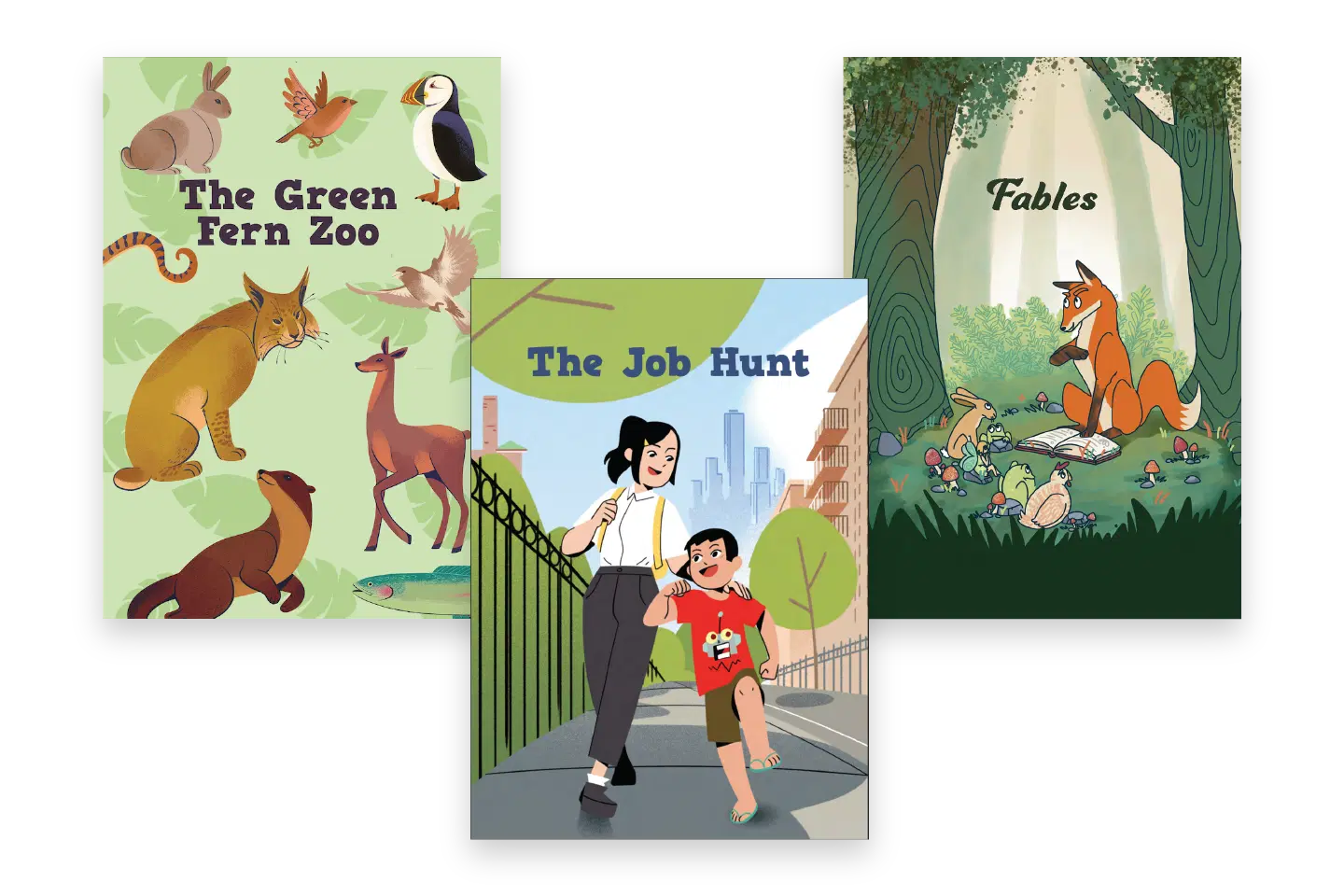


How it works
Amplify CKLA teaches both foundational skills and background knowledge in K–2 and combines them in 3–5, as required by the science of reading.
- In grades K–2, students complete one full lesson that builds foundational reading skills, as well as one full lesson that builds background knowledge.
- In grades 3–5, student complete one integrated lesson that combines skills and knowledge with increasingly complex texts, close reading, and a greater writing emphasis.





What students explore
Amplify CKLA builds knowledge coherently across subjects and grades.
Students make connections from year-to-year by exploring grade-appropriate subject-area knowledge and vocabulary in history, science, literature, and the arts while learning to read, write, and think creatively and for themselves.
Download the at-a-glance resources below to learn more.


What students read
Amplify CKLA puts a variety of texts in the hands of students every day to build and strengthen background knowledge and vocabulary, listening and reading comprehension, and decoding and fluency skills.
More than that, we ensure the texts students read represent the world around them. With a diverse range of authors, topics, and characters, all students have ample access to both windows and mirrors. Our texts include:
- Authentic books.
- Authentic text passages.
- Student Readers.
- Novel Guides (grades 3–5).
Download the lists below to explore specific grade-level texts.



Access and equity
We believe we have a responsibility to provide literacy instruction that gives every student the same opportunity to succeed and excel.
We know that early reading affects achievement throughout school and beyond—well into college and career. Yet most literacy programs continue to fall short of supporting early literacy success. That’s why we’re so proud that CKLA is helping close the reading gap between students within diverse communities.
Explore how we make learning equitable for all learners with the resources below.



Built on the Science of Reading
Watching students learn to read: magic. Knowing how they get there: science.
As you consider your next core ELA program, it’s critically important to understand what the Science of Reading really means and what it tells us about how to teach more effectively. Unlike other programs, Amplify CKLA was built upon these insights and practices, making it easier for teachers to implement this proven approach.
Download the resources below to dive deeper into the Science of Reading.




Supports Orton-Gillingham and LETRS
Amplify CKLA aligns with the instructional principles recommended by Orton-Gillingham and LETRS.
- Structured–Concepts are taught through consistent routines
- Sequential–Concepts are taught in a logical, well-planned sequence
- Systematic–Phonemes are taught from simplest to most complex
- Explicit–Decoding and encoding concepts are taught directly and explicitly
- Multi-sensory–Instruction is delivered through visual, auditory, and kinesthetic-tactile pathways
- Cumulative–Concepts are applied in decodable, connected texts with constant review and reinforcement

A comprehensive and cohesive solution
A strong literacy program is not just about a reading program or an assessment tool: it brings together curriculum, instruction, regular practice, intervention, and assessments.
Amplify has brought these components together in our early literacy suite of curriculum, ensure that you have what you need for multi-tiered support.






Access demo
Ready to explore on your own? Follow the instructions below to access your demo account.
Explore the CKLA Teacher Resource Site
First, watch the quick navigation video to the right. Then, click the “Access CKLA Teacher Resource Site” button to log in.
- Click the CKLA Teacher Resource Site button
- Select Log in with Amplify.
- Enter this username to explore as a teacher: t1.kentcaminos2021@demo.tryamplify.net
- Enter this username to explore as a student: s1.kentcaminos2021@demo.tryamplify.net
- Enter this password: Amplify1-kentcaminos2021
- Select the desired grade level
Contact us
Have questions? Your dedicated Account Executive, Patrick Momsen, is standing by and ready to help.

Patrick Momsen Senior
Account Executive
Districts over 4,500 students
(541) 207-2148
Grade 6
Chapter 2: Fractions and Decimals
| Big Ideas | Amplify Classroom |
| Lesson 2: Dividing Fractions | Unit 4 Lesson 3: Flour Planner |
| Lesson 4: Adding and Subtracting Decimals | Unit 5 Lesson 1: Dishing Out Decimals Lesson 2: Decimal Diagrams and Algorithms |
| Lesson 5: Multiplying Decimals | Unit 5 Lesson 1: Dishing Out Decimals |
| Lesson 6: Dividing Whole Numbers | Unit 5 Lesson 13: Movie Time |
| Lesson 7: Dividing Decimals | Unit 5 Lesson 13: Movie Time |
Chapter 3: Ratios and Rates
| Lesson 1: Ratios | Unit 2 Lesson 1: Pizza Maker Lesson 4: Fruit Lab Lesson 8: Products and SumsTake Away (coming soon!) |
| Lesson 3: Using Ratio Tables | Unit 2 Lesson 10: Disaster Preparation |
| Lesson 4: Graphing Ratio Relationships | Unit 2 Lesson 10: Disaster Preparation |
| Lesson 5: Rates and Unit Rates | Unit 3 Lesson 6: Soft Serve |
| Lesson 6: Converting Measures | Unit 3 Lesson 1: Many Measurements |
Chapter 4: Percents
| Lesson 1: Percent and Fractions | Unit 3 Lesson 9: Lucky Duckies |
| Lesson 2: Percent and Decimals | Unit 5 Lesson 2: Decimal Diagrams and Algorithms |
Chapter 5: Algebraic Expressions and Properties
| Lesson 2: Writing Expressions | Unit 6 Lesson 8: Products and SumsTake Away (coming soon!) |
| Lesson 3: Properties of Addition and Multiplication | Unit 6 Lesson 8: Products and SumsTake Away (coming soon!) |
| Lesson 4: The Distributive Property | Unit 6 Lesson 8: Products and SumsTake Away (coming soon!) |
Chapter 6: Equations
| Lesson 1: Writing Equations in One Variable | Unit 6 Lesson 1: Weight for It |
Chapter 7: Area, Surface Area, and Volume
| Lesson 1: Areas of Parallelograms | Unit 1 Lesson 3: Exploring Parallelograms Exploring Parallelograms, Part 2 |
| Lesson 5: Surface Area of prisms | Unit 1 Lesson 10: Renata’s Stickers |
Chapter 8: Integers, Number Lines, and the Coordinate Plane
| Lesson 1: Integers | Unit 7 Lesson 1: Can You Dig It? |
| Lesson 2: Comparing and Ordering Integers | Unit 7 Lesson 4: Order in the Class |
| Lesson 3: Rational Numbers | Unit 7 Lesson 4: Order in the Class |
| Lesson 7: Writing and Graphing Inequalities | Unit 7 Lesson 7: Tunnel Travels |
Chapter 9: Statistical Measures
| Lesson 1: Introduction to Statistics | Unit 8 Lesson 3: Minimum Wage |
| Lesson 2: Mean | Unit 8 Lesson 11: Toy Cars |
| Lesson 3: Measures of Center | Unit 8 Lesson 11: Toy Cars |
| Lesson 4: Measures of Variation | Unit 8 Lesson 11: Toy Cars |
Chapter 10: Data Displays
| Lesson 2: Histograms | Unit 8 Lesson 5: The Plot Thickens |
| Lesson 4: Choosing Appropriate Measures | Unit 8 Lesson 3: Minimum Wage Lesson 11: Toy Cars |
Grade 7
Chapter 1: Adding and Subtracting Rational Numbers
| Big Ideas | Amplify Classroom |
| Lesson 1: Rational Numbers | Unit 5 Lesson 1: Floats and Anchors |
| Lesson 2: Adding Integers Lesson 4: Subtracting Integers | Unit 5 Lesson 4: Draw Your Own Lesson 10: Integer Puzzles |
| Lesson 3: Adding Rational Numbers Lesson 5: Subtracting Rational Numbers | Unit 5 Lesson 4: Draw Your Own Lesson 10: Integer Puzzles |
Chapter 2: Multiplying and Dividing Rational Numbers
| Lesson 1: Multiplying Integers | Unit 5 Lesson 10: Integer Puzzles |
Chapter 3: Expressions
| Lesson 1: Algebraic Expressions | Unit 6 Lesson 10: Collect the Squares |
| Lesson 2: Adding and Subtracting Linear Expressions | Unit 6 Lesson 10: Collect the Squares |
| Lesson 3: The Distributive Property | Unit 6 Lesson 10: Collect the Squares |
Chapter 4: Equations and Inequalities
| Lesson 1: Solving Equations Using Addition or Subtraction Lesson 2: Solving Equations Using Multiplication or Division | Unit 6 Lesson 16: Shira the Sheep |
| Lesson 4: Writing and Graphing Inequalities | Unit 6 Lesson 16: Shira the Sheep |
| Lesson 5: Solving Inequalities Using Addition or Subtraction Lesson 6: Solving Inequalities Using Multiplication or Division | Unit 6 Lesson 16: Shira the Sheep |
| Lesson 7: Solving Two-Step Inequalities | Unit 6 Lesson 16: Shira the Sheep |
Chapter 5: Ratios and Proportions
| Lesson 1: Ratio and Ratio Tables | Unit 2 Lesson 1: Paint |
| Lesson 3: Identifying Proportional Relationships | Unit 2 Lesson 6: Two and Two Lesson 3: Measuring Around |
| Lesson 5: Graphs of Proportional Relationships | Unit 2 Lesson 8: Dino Pops |
Chapter 6: Percents
| Lesson 1: Fraction, Decimals, and Percents | Unit 4 Lesson 1: Mosaics |
| Lesson 4: Percents of Increase and Decrease | Unit 4 Lesson 5: Percent Machines Lesson 12: Posing Percent Problems (coming soon!) |
| Lesson 5: Discounts and Markups | Unit 4 Lesson 5: Percent Machines Lesson 12: Posing Percent Problems (coming soon!) |
Chapter 7: Probability
| Lesson 1: Probability | Unit 8 Lesson 1: How Likely? Lesson 2: Prob-bear-bilities |
Chapter 8: Statistics
| Lesson 1: Samples and Populations | Unit 8 Lesson 10: Crab Island |
| Lesson 2: Using Random Samples to Describe populations | Unit 8 Lesson 10: Crab Island |
| Lesson 3: Comparing Populations Lesson 4: Using Random Samples to Compare Populations | Unit 8 Lesson 10: Crab Island |
Chapter 9: Geometric Shapes and Angles
| Lesson 1: Circle and Circumference | Unit 3 Lesson 3: Measuring Around |
| Lesson 2: Areas of Circles | Unit 3 Lesson 9: Area Challenges |
| Lesson 5: Finding Unknown Angle Measures | Unit 7 Lesson 4: Missing Measures |
Grade 8
Chapter 1: Equations
| Big ideas | Amplify Classroom |
| Lesson 2: Solving Multi-Step Equations | Unit 4 Lesson 5: Equation Roundtable |
| Lesson 3: Solving Equations with Variables on Both Sides | Unit 4 Lesson 5: Equation Roundtable |
Chapter 2: Transformations
| Lesson 1: Translations | Unit 1 Lesson 1: Transformers Lesson 2: Spinning, Flipping, Sliding Lesson 4: Moving Day |
| Lesson 2: Reflections | Unit 1 Lesson 1: Transformers Lesson 2: Spinning, Flipping, Sliding Lesson 4: Moving Day |
| Lesson 3: Rotations | Unit 1 Lesson 1: Transformers Lesson 2: Spinning, Flipping, Sliding Lesson 4: Moving Day Lesson 13: Tessellate |
| Lesson 5: Dilations | Unit 2 Lesson 1: Sketchy Dilations Lesson 2: Dilation Mini Golf |
| Lesson 6: Similar Figures | Unit 2 Lesson 6: Social Scavenger Hunt |
Chapter 3: Angles and Triangles
| Lesson 2: Angles and Triangles | Unit 1 Lesson 12: Puzzling It Out |
| Lesson 4: Using Similar Triangles | Unit 2 Lesson 1: Sketchy Dilations Lesson 2: Dilation Mini Golf |
Chapter 4: Graphing and Writing Linear Equations
| Lesson 1: Graphing Linear Equations | Unit 3 Lesson 4: Flags |
| Lesson 2: Slope of a Line | Unit 3 Lesson 4: Flags |
| Lesson 3: Graphing Proportional Relationships | Unit 3 Lesson 1: Turtle Time Trials |
| Lesson 4: Graphing Linear Equations in Slope-Intercept Form | Unit 3 Lesson 4: Flags |
Chapter 5: Systems of Linear Equations
| Lesson 1: Solving Systems of Linear Equations by Graphing | Unit 4 Lesson 11: Make Them Balance Lesson 12: Line Zapper |
Chapter 6: Data Analysis and Displays
| Lesson 1: Scatter Plots | Unit 6 Lesson 3: Robots |
| Lesson 2: Lines of Fit | Unit 6 Lesson 4: Dapper Cats |
| Lesson 3: Two-Way Tables | Unit 6 Lesson 11: Finding Associations |
Chapter 7: Functions
| Lesson 1: Relations and Functions | Unit 5 Lesson 1: Turtle Crossing Lesson 2: Guess My Rule |
| Lesson 2: Representations of Functions | Unit 5 Lesson 5: The Tortoise and the Hare |
Chapter 8: Exponents and Scientific Notation
| Lesson 1: Exponents | Unit 7 Lesson 3: Power Pairs |
| Lesson 2: Products of Powers Property | Unit 7 Lesson 3: Power Pairs |
| Lesson 6: Scientific Notation Lesson 7: Operations in Scientific Notation | Unit 7 Lesson 9: Specific and Scientific Lesson 11: Balance the Scale |
Chapter 9: Real Numbers and the Pythagorean Theorem
| Lesson 1: Finding Square Roots | Unit 8 Lesson 4: Root Down |
| Lesson 3: Finding Cube Roots | Unit 8 Lesson 4: Root Down |
Chapter 10: Volume and Similar Solids
| Lesson 1: Volumes of Cylinders | Unit 5 Lesson 11: Cylinders |
| Lesson 2: Volumes of Cones | Unit 5 Lesson 13: Cones |
Algebra 1
| Launch | Visual Patterns |
Chapter 1: Solving Linear Equations
| Lesson 1.1: Solving Simple Equations | Working Backwards |
| Lesson 1.3: Solving Equations with Variables on Both Sides | Solving Strategies Same Position |
| Lesson 1.5: Rewriting Equations and Formulas | Subway Seats Various Variables |
Chapter 2: Solving Linear Inequalities
| Lesson 2.4: Solving Multi-Step Inequalities | Pizza Delivery |
Chapter 3: Graphing Linear Functions
| Lesson 3.2: Linear Functions | Shelley the Snail |
| Lesson 3.5: Graphing Linear Equations in Slope Intercept Form | Five Representations |
Chapter 4: Writing Linear Functions
| Lesson 4.4: Scatter Plots and Lines of Fit | Correlation Coefficient How Hot Is It? City Slopes |
| Lesson 4.5: Analyzing Lines of Fit | Penguin Populations Behind the Headlines City Data Residual Fruit |
| Lesson 4.6: Arithmetic Sequences | More Visual Patterns Sequence Carnival |
| Lesson 4.7: Piecewise Functions | Pumpkin Prices |
Chapter 5: Solving Systems of Linear Equations
| Lesson 5.2: Solving Systems of Linear Equations by Substitution | Shape It Up |
| Lesson 5.4: Solving Special Systems of Linear Equations | Lizard Lines |
| Lesson 5.7: Systems of Linear Inequalities | Quilts Seeking Solutions |
Chapter 6: Exponential Functions and Sequences
| Lesson 6.3: Exponential Functions | Carlos’s Fish |
| Lesson 6.6: Geometric Sequences | More Visual Patterns Sequence Carnival |
Chapter 8: Graphing Quadratic Functions
| Lesson 8.1: Solving Systems of Linear Equations by Substitution | Craft-a-Graph Quadratic Visual Patterns |
| Lesson 8.4: Solving Special Systems of Linear Equations | On the Fence Stomp Rockets Plenty of Parabolas Robot Launch |
| Lesson 8.5: Systems of Linear Inequalities | Parabola Zapper Two for One Shooting Stars |
| Lesson 8.6: Systems of Linear Inequalities | Plane, Train, and Automobile Detroit’s Population, Part 1 Detroit’s Population, Part 2 Revisiting Visual Patterns, Part 1 Sorting Relationships |
Chapter 9: Solving Quadratic Equations
| Lesson 9.4: Solving Quadratic Equations by Completing the Square | Square Tactic |
| Lesson 9.5: Solving Quadratic Equations Using the Quadratic Formula | Stomp Rockets in Space |
Chapter 10: Radical Functions and Equations
| Lesson 10.4: Inverse of a Function | Chip the Robot |
Chapter 11: Data Analysis and Displays
| Lesson 11.1: Measures of Center and Variation | Finding Desmo |
Disclaimer
This document is for informational purposes only; references to third-party programs do not imply endorsement or affiliation, and all trademarks are the property of their respective owners.
Grade 6
Unit 1: Numbers
Unit 2: Number Operations
Unit 3: Proportionality, Ratios, and Rates
Unit 4: Equivalent Expressions
| Module 9: Generating Equivalent Numerical Expressions | |
| Lesson 9.1: Exponents | Unit 6 Lesson 10: Powers Lesson 11: Exponent Expressions (Print available) Lesson 12: Squares and Cubes |
| Lesson 9.2: Prime Factorization | |
| Lesson 9.3: Order of Operations | |
| Module 10: Generating Equivalent Algebraic Expressions | |
| Lesson 10.1: Modeling and Writing Expressions Lesson 10.2: Evaluating Expressions | Unit 6 Lesson 6: Vari-apples Lesson 8: Products and Sums [Free lesson] Lesson 9: Products, Sums, and Differences (Print available) |
| Lesson 10.3: Generating Equivalent Expressions | Unit 6 Lesson 7: Border Tiles Lesson 8: Products and Sums [Free lesson] Lesson 9: Products, Sums, and Differences (Print available) |
Unit 5: Equations and Inequalities
Unit 6: Relationships in Geometry
Unit 7: Measurement and Data
| Module 16: Displaying, Analyzing, and Summarizing Data | |
| Lesson 16.1: Measures of Center | Unit 8 Lesson 4: Lots More Dots Lesson 7: Snack Time Lesson 8: Pop It! Lesson 11: Toy Cars [Free lesson] Lesson 12: In the News Lesson 16: Hollywood Part 3 (Print available) |
| Lesson 16.2: Mean Absolute Deviation | Unit 8 Lesson 8: Pop It! Lesson 9: Hoops Lesson 10: Hollywood Part 1 (Print available) Lesson 16: Hollywood Part 3 ( Print available) |
| Lesson 16.3: Box Plots | Unit 8 Lesson 14: Car, Plane, Bus, or Train? (Print available) Lesson 15: Hollywood Part 2 Lesson 16: Hollywood Part 3 (Print available) |
| Lesson 16.4: Dot Plots and Data Distribution | Unit 8 Lesson 2: Dot Plots Lesson 3: Minimum Wage (Print available) [Free lesson] Lesson 4: Lots More Dots Lesson 13: Pumpkin Patch Lesson 16: Hollywood Part 3 (Print available) |
| Lesson 16.5: Histograms | Unit 8 Lesson 5: The Plot Thickens [Free lesson] Lesson 6: DIY Histograms Lesson 16: Hollywood Part 3 (Print available) |
Grade 7
Unit 1: The Number System
Unit 2: Ratios and Proportional Relationships
Unit 3: Expressions, Equations, and Inequalities
Unit 4: Geometry
Unit 5: Statistics
| Module 10: Random Samples and Populations | |
| Lesson 10.1: Populations and Samples | Unit 8 Lesson 10: Crab Island [Free lesson] Lesson 11: Headlines Lesson 12: Flower Power Lesson 13: Plots and Samples Lesson 14: School Newspaper (Print available) Lesson 15: Asthma Rates (Print available) |
| Lesson 10.2: Making Inferences from a Random Sample Lesson 10.3: Generating Random Samples | Unit 8 Lesson 13: Plots and Samples Lesson 15: Asthma Rate (Print available) |
| Module 11: Analyzing and Comparing Data | |
| Lesson 11.1: Comparing Data Displayed in Dot Plots | Unit 8 Lesson 14: School Newspaper (Print available) Lesson 15: Asthma Rates (Print available) |
| Lesson 11.2: Comparing Data Displayed in Box Plots | Unit 8 Lesson 13: Plots and Samples Lesson 15: Asthma Rates (Print available) |
| Lesson 11.3: Using Statistical Measures to Compare Populations | Unit 8 Lesson 9: Car, Bike, or Train? (Print available) Lesson 10: Crab Island [Free lesson] Lesson 15: Asthma Rates (Print available) |
Unit 6: Probability
| Module 12: Experimental Probability | |
|---|---|
| Lesson 12.1: Probability | Unit 8 Lesson 1: How Likely? (Print available) [Free lesson] Lesson 2: Prob-bear-bilities [Free lesson] |
| Lesson 12.2: Experimental Probability of Simple Events | Unit 8 Lesson 3: Mystery Bag Lesson 4: Spin Class Lesson 5: Is It Fair? |
| Lesson 12.3: Experimental Probability of Compound Events | Unit 8 Lesson 7: Weather or Not |
| Lesson 12.4: Making Predictions with Experimental Probability | Unit 8 Lesson 3: Mystery Bag Lesson 5: Is It Fair? |
| Module 13: Theoretical Probability and Simulations | |
| Lesson 13.1: Theoretical Probability of Simple Events | Unit 8 Lesson 1: How Likely? (Print available) [Free lesson] Lesson 2: Prob-bear-bilities [Free lesson] |
| Lesson 13.2: Theoretical Probability of Compound Events | Unit 8 Lesson 6: Fair Games |
| Lesson 13.3: Making Predictions with Theoretical Probability | Unit 8 Lesson 8: Simulate It! (Print available) |
| Lesson 13.4: Using Technology to Conduct a Simulation | Unit 8 Lesson 7: Weather or Not Lesson 8: Simulate It! (Print available) |
Grade 8
Unit 1: Real Numbers, Exponents, and Scientific Notation
Unit 2: Proportional and Nonproportional Relationships and Functions
Unit 3: Solving Equations and Systems of Equations
Unit 4: Transformational Geometry
Unit 5: Measurement Geometry
Unit 6: Statistics
| Module 14: Scatter Plots | |
| Lesson 14.1: Scatter Plots and Association | Unit 6 Lesson 1: Click Battle Lesson 2: Wing Span Lesson 3: Robots [Free lesson] Lesson 6: Interpreting Slopes Lesson 7: Scatter Plot City Lesson 8: Animal Brains |
| Lesson 14.2: Trend Lines and Predictions | Unit 6 Lesson 4: Dapper Cats [Free lesson] Lesson 5: Fit Fights [Free lesson] Lesson 8: Animal Brains |
| Module 15: Two-Way Tables | |
| Lesson 15.1: Two-Way Frequency Tables | Unit 6 Lesson 9: Tasty Fruit |
| Lesson 15.2: Two-Way Relative Frequency Tables | Unit 6 Lesson 10: Finding Associations [Free lesson] Lesson 11: Federal Budgets |
Grade 6
Chapter 1: Numerical Expressions and Factors
| Big Ideas | Desmos Math 6–A1 |
|---|---|
| Lesson 1: Powers and Exponents | Unit 6 Lesson 10: Powers Lesson 11: Exponent Expressions (Print available) Practice Day 2 (Print available) |
| Lesson 2: Order of Operations | Unit 6 Lesson 11: Exponent Expressions (Print available) |
| Lesson 3: Prime Factorization | |
| Lesson 4: Greatest Common Factor | Unit 5 Lesson 15: Common factors |
| Lesson 5: Least Common Multiple | Unit 5 Lesson 14: Common Multiples Practice Day 2 (Print available) |
Chapter 2: Fractions and Decimals
Chapter 3: Ratios and Rates
| Lesson 1: Ratios | Unit 2 Lesson 1: Pizza Maker [Free lesson] Lesson 2: Ratio Rounds (Print available) Lesson 3: Rice Ratios (Print available) Lesson 4: Fruit Lab [Free lesson] Lesson 11: Community Life (Print available) Practice Day 1 (Print available) Unit 6 Lesson 7: Border Tiles Lesson 8: Products and Sums [Free lesson] Lesson 9: Products, Sums, and Differences (Print available) |
|---|---|
| Lesson 2: Using Tape Diagrams | Unit 2 Lesson 12: Mixing Paint, Part 2 Lesson 13: City Planning Lesson 14: Lunch Waste Practice Day 2 |
| Lesson 3: Using Ratio Tables | Unit 2 Lesson 9: Disaster Preparation [Free lesson] |
| Lesson 4: Graphing Ratio Relationships | Unit 2 Lesson 9: Disaster Preparation [Free lesson] Lesson 10: Balloons |
| Lesson 5: Rates and Unit Rates | Unit 3 Lesson 4: Model Trains Lesson 5: Soft Serve [Free lesson] |
| Lesson 6: Converting Measures | Unit 3 Lesson 1: Many Measurements (Print available) [Free lesson] Lesson 2: Counting Classrooms Lesson 3: Pen Pals |
Chapter 4: Percents
| Lesson 1: Percent and Fractions | Unit 3 Lesson 8: Lucky Duckies [Free lesson] |
|---|---|
| Lesson 2: Percent and Decimals | Unit 5 Lesson 2: Decimal Diagrams [Free lesson] Lesson 13: Grocery Prices (Print available) |
| Lesson 3: Comparing and Ordering Fractions, Decimals, and Percents | |
| Lesson 4: Solving Percent Problems | Unit 3 Lesson 9: Bicycle Goals Lesson 10: What’s Missing? (Print available) Lesson 11: Cost Breakdown Lesson 12: More Bicycle Goals Unit 5 Lesson 13: Grocery Prices (Print available) |
Chapter 5: Algebraic Expressions and Properties
| Lesson 1: Algebraic Expressions | |
|---|---|
| Lesson 2: Writing Expressions | Unit 6 Lesson 6: Vari-apples Lesson 8: Products and Sums [Free lesson] Lesson 9: Products, Sums, and Differences (Print available) |
| Lesson 3: Properties of Addition and Multiplication | Unit 6 Lesson 6: Vari-apples Lesson 7: Border Tiles Lesson 8: Products and Sums [Free lesson] Lesson 9: Products, Sums, and Differences (Print available) Lesson 12: Squares and Cubes |
| Lesson 4: The Distributive Property | Unit 6 Lesson 8: Products and Sums [Free lesson] Lesson 9: Products, Sums, and Differences (Print available) |
| Lesson 5: Factoring Expressions | Unit 6 Lesson 7: Border Tiles Practice Day 2 (Print available) |
Chapter 6: Equations
| Lesson 1: Writing Equations in One Variable | Unit 6 Lesson 1: Weight for It [Free lesson] Lesson 3: Hanging Around Lesson 13: Turtles All the Way |
|---|---|
| Lesson 2: Solving Equations Using Addition or Subtraction | Unit 6 Lesson 2: Five Equations (Print available) Lesson 3: Hanging Around Lesson 4: Hanging It Up Lesson 5: Swap and Solve (Print available) Practice Day 1 (Print available) |
| Lesson 3: Solving Equations Using Multiplication or Division | Unit 6 Lesson 2: Five Equations Lesson 3: Hanging Around Lesson 4: Hanging It Up Lesson 5: Swap and Solve (Print available) Practice Day 1 |
| Lesson 4: Writing Equations in Two Variables | Unit 6 Lesson 5: Swap and Solve (Print available) |
Chapter 7: Area, Surface Area, and Volume
| Lesson 1: Areas of Parallelograms | Unit 1 Lesson 3: Exploring Parallelograms (Print available) [Free lesson] Lesson 4: Off the Grid Lesson 6: Triangles and Parallelograms |
|---|---|
| Lesson 2: Areas of Triangles | Unit 1 Lesson 5: Exploring Triangles (Print available) Lesson 6: Triangles and Parallelograms Lesson 7: Off the Grid, Part 2 Practice Day 1 (Print available) |
| Lesson 3: Areas of Trapezoids and Kites | |
| Lesson 4: Three-Dimensional Figures | Unit 1 Lesson 10: Plenty of Polyhedra |
| Lesson 5: Surface Area of prisms | Unit 1 Lesson 9: Renata´s Stickers [Free lesson] Lesson 11: Nothing But Nets (Print available) Lesson 12: Face Value Lesson 13: Take It To Go (Print available) Practice Day 2 (Print available) |
| Lesson 6: Surface Area of Pyramids | Unit 1 Lesson 12: Face Value Lesson 13: Take It To Go (Print available) Practice Day 2 |
| Lesson 7: Volumes of Rectangular Prisms | Unit 4 Lesson 13: Volume Challenges |
Chapter 8: Integers, Number Lines, and the Coordinate Plane
| Lesson 1: Integers | Unit 7 Lesson 1 Can You Dig In [Free lesson] Lesson 4 Sub-Zero |
|---|---|
| Lesson 2: Comparing and Ordering Integers | Unit 7 Lesson 2 Digging Deeper Lesson 3 Order in the Class (Print available) [Free lesson] |
| Lesson 3: Rational Numbers | Unit 7 Lesson 2 Digging Deeper Lesson 3 Order in the Class (Print available) [Free lesson] Practice Day 1 (Print available) |
| Lesson 4: Absolute Value | Unit 7 Lesson 5 Distance on the Number Line Practice Day 1 (Print available) |
| Lesson 5: The Coordinate Plane | Unit 7 Lesson 9: Sand Dollar Search Lesson 10: The A-maze-ing Coordinate Plane Lesson 11: Polygon Maker Lesson 12: Graph Telephone (Print available) |
| Lesson 6: Polygons in the Coordinate Plane | Unit 1 Lesson 8: Pile of Polygons Unit 7 Lesson 11: Polygon Maker |
| Lesson 7: Writing and Graphing Inequalities | Unit 7 Lesson 6: Tunnel Travel [Free lesson] Lesson 7: Comparing Weights |
| Lesson 8: Solving Inequalities | Unit 7 Lesson 8: Shira’s Solutions |
Chapter 9: Statistical Measures
| Lesson 1: Introduction to Statistics | Unit 8 Lesson 1: Screen Time Lesson 2: Dot Plots Lesson 3: Minimum Wage (Print available) [Free lesson] Lesson 4: Lots More Dots |
|---|---|
| Lesson 2: Mean | Unit 8 Lesson 7: Snack Time Lesson 10: Hollywood Part 1 (Print available) Lesson 11: Toy Cars [Free lesson] Lesson 12: In the News |
| Lesson 3: Measures of Center | Unit 8 Lesson 7: Snack Time Lesson 10: Hollywood Part 1 (Print available) Lesson 11: Toy Cars [Free lesson] Lesson 12: In the News Lesson 13: Pumpkin Patch Practice Day 1 |
| Lesson 4: Measures of Variation | Unit 8 Lesson 8: Pop It! Lesson 11: Toy Cars [Free lesson] Lesson 14: Car, Plane, Bus, or Train? (Print available) Lesson 16: Hollywood Part 3 (Print available) |
| Lesson 5: Mean Absolute Deviation | Unit 8 Lesson 9: Hoops Lesson 10: Hollywood Part 1 (Print available) |
Chapter 10: Data Displays
| Lesson 1: Stem-and-Leaf Plots | |
|---|---|
| Lesson 2: Histograms | Unit 8 Lesson 5: The Plot Thickens [Free lesson] Lesson 6: DIY Histograms (Print available) |
| Lesson 3: Shapes of Distributions | |
| Lesson 4: Choosing Appropriate Measures | Unit 8 Lesson 2: Dot Plots Lesson 3: Minimum Wage (Print available) [Free lesson] Lesson 4: Lots More Dots Lesson 7: Snack Time Lesson 10: Hollywood Part 1 (Print available) Lesson 11: Toy Cars [Free lesson] Lesson 12: In the News Lesson 16: Hollywood Part 3 (Print available) Practice Day 1 (Print available) |
| Lesson 5: Box-and-Whisker Plots | Unit 8 Lesson 14: Car, Plane, Bus, or Train? (Print available) Lesson 15: Hollywood Part 2 |
Grade 7
Chapter 1: Adding and Subtracting Rational Numbers
| Big Ideas | Desmos Math 6–A1 |
|---|---|
| Lesson 1: Rational Numbers | Unit 5 Lesson 1: Floats and Anchors [Free lesson] Lesson 3: Bumpers |
| Lesson 2: Adding Integers Lesson 4: Subtracting Integers | Unit 5 Lesson 2: More Floats and Anchors Lesson 4: Draw Your Own (Print available) [Free lesson] Lesson 5: Number Puzzles Lesson 10: Integer Puzzles [Free lesson] Lesson 11: Changing Temperatures Lesson 13: Solar Panels and More (Print available) |
| Lesson 3: Adding Rational Numbers Lesson 5: Subtracting Rational Numbers | Unit 5 Lesson 3: Bumpers Lesson 4: Draw Your Own (Print available) [Free lesson] Lesson 5: Number Puzzles Lesson 10: Integer Puzzles [Free lesson] Lesson 11: Changing Temperatures Lesson 13: Solar Panels and More (Print available) Practice Day 1 (Print available) |
Chapter 2: Multiplying and Dividing Rational Numbers
| Lesson 1: Multiplying Integers | Unit 5 Lesson 6: Floating in Groups Lesson 7: Back in Time Lesson 8: Speeding Turtles Lesson 10: Integer Puzzles [Free lesson] Practice Day 2 (Print available) |
| Lesson 2: Dividing Integers | Unit 5 Lesson 8: Speeding Turtles |
| Lesson 3: Converting Between Fractions and Decimals | Unit 4 Lesson 13: Decimal Deep Dive (Print available) |
| Lesson 4: Multiplying Rational Numbers | Unit 5 Lesson 7: Back in Time |
| Lesson 5: Dividing Rational Numbers | Unit 5 Lesson 8: Speeding Turtles |
Chapter 3: Expressions
| Lesson 1: Algebraic Expressions | Unit 6 Lesson 9: Always-Equal Machines Lesson 10: Collect the Squares [Free lesson] Unit 5 Lesson 9: Expressions (Print available) |
| Lesson 2: Adding and Subtracting Linear Expressions | Unit 6 Lesson 2: Smudged Receipts Lesson 10: Collect the Squares [Free lesson] Lesson 11: Equation Roundtable (Print available) |
| Lesson 3: The Distributive Property | Unit 6 Lesson 2: Smudged Receipts Lesson 6: Balancing Equations Lesson 8: Factoring and Expanding (Print available) Lesson 9: Always-Equal Machines Lesson 10: Collect the Squares [Free lesson] Lesson 11: Equation Roundtable (Print available) |
| Lesson 4: Factoring Expressions | Unit 6 Lesson 8: Factoring and Expanding (Print available) Lesson 11: Equation Roundtable (Print available) |
Chapter 4: Equations and Inequalities
Chapter 5: Ratios and Proportions
| Lesson 1: Ratio and Ratio Tables | Unit 2 Lesson 1: Paint [Free lesson] Lesson 2: Balloon Float |
| Lesson 2: Rates and Unit Rates | Unit 4 (Print available)Lesson 2: Peach Cobbler |
| Lesson 3: Identifying Proportional Relationships | Unit 2 Lesson 3: Sugary Drinks Lesson 4: Robot Factory Lesson 5: Snapshots Lesson 6: Two and Two (Print available) [Free lesson] Lesson 7: All Kinds of Equations Lesson 10: Three Turtles Practice Day (Print available) Unit 3 Lesson 1: Toothpicks Lesson 3: Measuring Around [Free lesson] |
| Lesson 4: Writing and Solving Proportions | |
| Lesson 5: Graphs of Proportional Relationships | Unit 2 Lesson 8: Dino Pops [Free lesson] Lesson 9: Gallon Challenge Lesson 10: Three Turtles Lesson 11: Four Representations (Print available) |
Chapter 6: Percents
| Lesson 1: Fraction, Decimals, and Percents | Unit 4 Lesson 1: Mosaics [Free lesson] |
| Lesson 2: The Percent Proportion | |
| Lesson 3: The Percent Equation | |
| Lesson 4: Percents of Increase and Decrease | Unit 4 Lesson 4: More and Less Lesson 5: All the Equations Lesson 6: 100% (Print available) Lesson 7: Percent machines [Free lesson] Lesson 8: Tax and Tip Lesson 9: Minimum Wage (Print available) Lesson 10: Cost of College (Print available) Lesson 11: Bookcase Builder Lesson 12: Posing Percent Problems [Free lesson] |
| Lesson 5: Discounts and Markups | Unit 4 Lesson 7: Percent machines [Free lesson] Lesson 8: Tax and Tip Lesson 9: Minimum Wage (Print available) Lesson 10: Cost of College (Print available) Lesson 11: Bookcase Builder Lesson 12: Posing Percent Problems [Free lesson] Practice Day |
| Lesson 6: Simple Interest |
Chapter 7: Probability
| Lesson 1: Probability | Unit 8 Lesson 1: How Likely? (Print available) [Free lesson] Lesson 2: Prob-bear-bilities [Free lesson] Lesson 3: Mystery Bag |
| Lesson 2: Experimental and Theoretical Probability | Unit 8 Lesson 4: Spin Class Lesson 5: Is It Fair? Lesson 6: Fair Games Lesson 7: Weather or Not Lesson 8: Simulate It Lesson 9: Car, Bike, or Train? (Print available) |
| Lesson 3: Compound Events Lesson 4: Simulations | Unit 8 Lesson 8: Simulate It Lesson 9: Car, Bike, or Train? (Print available) |
Chapter 8: Statistics
| Lesson 1: Samples and Populations | Unit 8 Lesson 10: Crab Island [Free lesson] Lesson 11: Headlines |
| Lesson 2: Using Random Samples to Describe populations | Unit 8 Lesson 8: Simulate It Lesson 9: Car, Bike, or Train? (Print available) Lesson 10: Crab Island [Free lesson] Lesson 11: Headlines Lesson 12: Flower Power |
| Lesson 3: Comparing Populations Lesson 4: Using Random Samples to Compare Populations | Unit 8 Lesson 9: Car, Bike, or Train? (Print available) Lesson 10: Crab Island [Free lesson] Lesson 13: Plots and Samples Lesson 14: School Newspaper (Print available) Lesson 15: Asthma Rates (Print available) |
Chapter 9: Geometric Shapes and Angles
| Lesson 1: Circle and Circumference | Unit 3 Lesson 2: Is It a Circle? Lesson 3: Measuring Around [Free lesson] Lesson 4: Perimeter Challenges Practice Day 1 (Print available) [Free lesson] |
| Lesson 2: Areas of Circles | Unit 3 Lesson 5: Area Strategies Lesson 6: Radius Squares (Print available) Lesson 7: Why Pi? Lesson 8: Area Challenges [Free lesson] Lesson 9: Circle vs. Square Practice Day 2 (Print available) |
| Lesson 3: Perimeters and Areas of Composite Figures | Unit 3 Lesson 4: Perimeter Challenges |
| Lesson 4: Constructing Polygons | |
| Lesson 5: Finding Unknown Angle Measures | Unit 7 Lesson 1: Pinwheels Lesson 2: Friendly Angles Lesson 3: Angle Diagrams Lesson 4: Missing Measures (Print available) [Free lesson] |
Chapter 10: Surface Area and Volume
| Lesson 1: Surface Area of Prisms Lesson 2: Surface Area of Cylinders Lesson 3: Surface Area of Pyramids | Unit 7 Lesson 10: Simple Prisms Lesson 11: More Complicated Prisms Lesson 12: Surface Area Strategies (Print available) Lesson 13: Popcorn Possibilities |
| Lesson 4: Volumes of Prisms Lesson 5: Volumes of Pyramids | Unit 7 Lesson 10: Simple Prisms Lesson 11: More Complicated Prisms Lesson 13: Popcorn Possibilities Practice Day 2 (Print available) |
| Lesson 6: Cross Sections of Three-Dimensional Figures | Unit 7 Lesson 9: Slicing Solids |
Grade 8
Chapter 1: Equations
| Big ideas | Desmos Math 6–A1 |
|---|---|
| Lesson 1: Solving Simple Equations | Unit 3 Lesson 10: Solutions Unit 4 Lesson 2: Keep It Balanced Lesson 3: Balanced Moves Lesson 4: More Balanced Moves (Print available) |
| Lesson 2: Solving Multi-Step Equations | Unit 4 Lesson 5: Equation Roundtable (Print available) [Free lesson] Lesson 6: Strategic Solving (Print available) |
| Lesson 3: Solving Equations with Variables on Both Sides | Unit 4 Lesson 3: Balanced Moves Lesson 4: More Balanced Moves (Print available) Lesson 5: Equation Roundtable (Print available) [Free lesson] Lesson 6: Strategic Solving (Print available) Practice Day 1 (Print available) |
| Lesson 4: Rewriting Equations and Formulas |
Chapter 2: Transformations
Chapter 3: Angles and Triangles
| Lesson 1: Parallel Lines and Transversals | Unit 1 Lesson 10: Transforming Angles |
| Lesson 2: Angles and Triangles | Unit 1 Lesson 11: Tearing It Up (Print available) Lesson 12: Puzzling It Out [Free lesson] |
| Lesson 3: Angles of Polygons | |
| Lesson 4: Using Similar Triangles | Unit 2 Lesson 1: Sketchy Dilations [Free lesson] Lesson 2: Dilation Mini Golf [Free lesson] Lesson 3: Match My Dilation Lesson 4: Dilations on a Plane (Print available) Lesson 7: Are Angles Enough? Lesson 8: Shadows |
Chapter 4: Graphing and Writing Linear Equations
| Lesson 1: Graphing Linear Equations | Unit 3 Lesson 4 Stacking Cups Lesson 5 Flags [Free lesson] Lesson 11 Pennies and Quarters Unit 5 Lesson 8 Charge! (Print available) |
| Lesson 2: Slope of a Line | Unit 2 Lesson 9 Water Slide Lesson 10 Points on a Plane Practice Day Unit 3 Lesson 2 Water Tank Lesson 4 Stacking Cups Lesson 5 Flags [Free lesson] Lesson 6 Translations Lesson 7 Water Cooler Lesson 8 Landing Planes Lesson 9 Coin Capture Unit 6 Lesson 6 Interpreting Slopes Lesson 8 Animal Brains |
| Lesson 3: Graphing Proportional Relationships | Unit 3 Lesson 1: Turtle Time Trials [Free lesson] Lesson 2: Water Tank Lesson 4: Stacking Cups |
| Lesson 4: Graphing Linear Equations in Slope-Intercept Form | Unit 3 Lesson 2: Water Tank Lesson 3: Posters Lesson 4: Stacking Cups Lesson 5: Flags [Free lesson] Lesson 6: Translations |
| Lesson 5: Graphing Linear Equations in Standard Form | |
| Lesson 6: Writing Equations in Slope-Intercept Form | Unit 5 Lesson 8: Charge! (Print available) |
| Lesson 7: Writing Equations in Point-Slope Form |
Chapter 5: Systems of Linear Equations
| Lesson 1: Solving Systems of Linear Equations by Graphing | Unit 4 Lesson 8: When Are They the Same? Lesson 9: On or Off the Line? Lesson 10: On Both Lines Lesson 11: Make Them Balance [Free lesson] Lesson 12: Line Zapper [Free lesson] Practice Day 2 (Print available) |
| Lesson 2: Solving Systems of Linear Equations by Substitution | |
| Lesson 3: Solving Systems of Linear Equations by Elimination | |
| Lesson 4: Solving Special Systems of Linear Equations | |
| Lesson 6: Scale Drawings |
Chapter 6: Data Analysis and Displays
| Lesson 1: Scatter Plots | Unit 6 Lesson 1: Click Battle Lesson 2: Wing Span Lesson 3: Robots [Free lesson] Practice Day 1 (Print available) |
| Lesson 2: Lines of Fit | Unit 6 Lesson 4: Dapper Cats [Free lesson] Lesson 5: Fit Fights Lesson 7: Scatter Plot City |
| Lesson 3: Two-Way Tables | Unit 6 Lesson 9: Tasty Fruit Lesson 10: Finding Associations [Free lesson] Lesson 11: Federal Budgets Practice Day 3 |
| Lesson 4: Choosing a Data Display |
Chapter 7: Functions
| Lesson 1: Relations and Functions | Unit 5 Lesson 1: Turtle Crossing [Free lesson] Lesson 2: Guess My Rule [Free lesson] |
| Lesson 2: Representations of Functions | Unit 5 Lesson 3: Function or Not? Lesson 5: The Tortoise and the Hare [Free lesson] |
| Lesson 3: Linear Functions | Unit 5 Lesson 6: Graphing Stories Lesson 7: Feel the Burn (Print available) [Free lesson] Lesson 8: Charge! (Print available) |
| Lesson 4: Comparing Linear and Nonlinear Functions | Unit 5 Lesson 4: Window Frames |
| Lesson 5: Analyzing and Sketching Graphs | Unit 5 Lesson 6: Graphing Stories |
Chapter 8: Exponents and Scientific Notation
| Lesson 1: Exponents | Unit 7 Lesson 2: Combining Exponents Lesson 3: Power Pairs [Free lesson] Lesson 4: Rewriting Powers Practice Day 1 (Print available) |
| Lesson 2: Products of Powers Property | Unit 7 Lesson 2: Combining Exponents Lesson 3: Power Pairs (Print available) [Free lesson] Lesson 4: Rewriting Powers Lesson 5: Zero and Negative Exponents Lesson 6: Write a Rule (Print available) Practice Day 1 (Print available) |
| Lesson 3: Comparing Populations | |
| Lesson 4: Using Random Samples to Compare Populations | |
| Lesson 5: Estimating Quantities | Lesson 7: Scales and Weights Lesson 8: Point Zapper Lesson 9: Use Your Powers |
| Lesson 6: Scientific Notation Lesson 7: Operations in Scientific Notation | Unit 7 Lesson 10: Solar System [Free lesson] Lesson 11: Balance the Scales [Free lesson] Lesson 13: Star Power Practice Day 2 (Print available) |
Chapter 9: Real Numbers and the Pythagorean Theorem
| Lesson 1: Finding Square Roots | Unit 8 Lesson 2: From Squares to Roots Lesson 3: Between Squares Lesson 4: Root Down [Free lesson] |
| Lesson 2: The Pythagorean Theorem | |
| Lesson 3: Finding Cube Roots | Unit 8 Lesson 2: From Squares to Roots Lesson 3: Between Squares Lesson 4: Root Down [Free lesson] |
| Lesson 4: Rational Numbers | |
| Lesson 5: Irrational Numbers | Unit 8 Lesson 14: Hit the Target |
| Lesson 6: The Converse of the Pythagorean Theorem | Unit 8 Lesson 9: Make It Right |
Chapter 10: Volume and Similar Solids
| Lesson 1: Volumes of Cylinders | Unit 5 Lesson 10: Exploring Volume Lesson 11: Cylinders [Free lesson] Lesson 14: Missing Dimensions (Print available) |
| Lesson 2: Volumes of Cones | Unit 5 Lesson 10: Exploring Volume Lesson 13: Cones [Free lesson] Lesson 14: Missing Dimensions (Print available) |
| Lesson 3: Volumes of Spheres | Unit 5 Lesson 10: Exploring Volume Lesson 15: Spheres |
| Lesson 4: Surface Area and Volumes of Similar Solids | Unit 5 Lesson 12: Scaling Cylinders |
Grade 6
Unit 1: Area and Surface Area
| Illustrative Mathematics | Desmos Math 6–A1 |
|---|---|
| Topic A: Reasoning to Find Area | |
| Lesson 1: Tiling the Plane | Unit 1 Lesson 1: Shapes on a Plane [Free lesson] |
| Lesson 2: Finding Area by Decomposing and Rearranging Lesson 3: Reasoning to Find Area | Unit 1 Lesson 2: Letters |
| Topic 2: Parallelograms | |
| Lesson 4: Parallelograms Lesson 5: Bases and Heights of Parallelograms Lesson 6: Area of Parallelograms | Unit 1 Lesson 3: Exploring Parallelograms (Print available) [Free lesson] Lesson 4: Off the Grid |
| Topic 3: Triangles | |
| Lesson 7: From Parallelograms to Triangles | Unit 1 Lesson 3: Exploring Parallelograms (Print available) [Free lesson] Lesson 4: Off the Grid Lesson 6: Triangles and Parallelograms |
| Lesson 8: Area of Triangles | Unit 1 Lesson 5: Exploring Triangles (Print available) |
| Lesson 9: Formula for the Area of a Triangle Lesson 10: Bases and Heights of Triangles | Unit 1 Lesson 4: Off the Grid Lesson 6: Triangles and Parallelograms |
| Topic 4: Polygons | |
| Lesson 11: Polygons | Unit 1 Lesson 2: Letters Lesson 8: Pile of Polygons Practice Day 1 (Print available) Unit 7 Lesson 11: Polygon Maker |
| Topic 5: Surface Area | |
| Lesson 12: What is Surface Area? | Unit 1 Lesson 9: Renata´s Stickers [Free lesson] |
| Lesson 13: Polyhedra | Unit 1Lesson 10: Plenty of Polyhedra |
| Lesson 14: Nets and Surface Area | Unit 1 Lesson 10: Plenty of Polyhedra Lesson 11: Nothing But Nets (Print available) Lesson 13: Take It To Go |
| Lesson 15: More Nets, More Surface Area | Unit 1 Lesson 10: Plenty of Polyhedra Lesson 11: Nothing But Nets (Print available) Lesson 12: Face Value Lesson 13: Take It To Go (Print available) Practice Day 2 (Print available) |
| Lesson 16: Distinguishing Between Surface Area and Volume | |
| Topic 6: Squares and Cubes | |
| Lesson 17: Squares and Cubes | Unit 6 Lesson 12: Squares and Cubes |
| Lesson 18: Surface Area of a Cube | |
| Topic 7: Let’s Put It to Work | |
| Lesson 19: Designing a Tent | Unit 1 Lesson 13: Take It To Go (Print available) |
Unit 2: Introducing Ratios
Unit 3: Rates and Percentages
| Topic 1: Units of Measurement | |
| Lesson 1: The Burj Khalifa | Unit 3 Lesson 4: Model Trains |
| Topic 2: Unit Conversion | |
| Lesson 2: Anchoring Units of Measurement | Unit 3 Lesson 1: Many Measurements (Print available) [Free lesson] |
| Lesson 3: Measuring with Different-Sized Units Lesson 4: Converting Units | Unit 3 Lesson 2: Counting Classrooms Lesson 3: Pen Pals |
| Topic 3: Rates | |
| Lesson 5: Comparing Speeds and Prices | Unit 2 Lesson 8: World Records (Print available) Unit 3 Lesson 4: Model Trains Lesson 5: Soft Serve [Free lesson] Lesson 6: Welcome to the Robot Factory |
| Lesson 6: Interpreting Rates Lesson 7: Equivalent Ratios Have the Same Unit Rates | Unit 3 Lesson 4: Model Trains Lesson 5: Soft Serve [Free lesson] |
| Lesson 8: More About Constant Speed | Unit 2 Lesson 8: World Records (Print available) Unit 3 Lesson 4: Model Trains |
| Lesson 9: Solving Rate Problems | Unit 3 Lesson 7: More Soft Serve |
| Topic 4: Percentages | |
| Lesson 10: What Are percentages | Unit 3 Lesson 8: Lucky Duckies [Free lesson] Lesson 9: Bicycle Goals |
| Lesson 11: Percentages and Double Number Lines | Unit 3 Lesson 9: Bicycle Goals Lesson 10: What’s Missing? (Print available) |
| Lesson 12: Percentages and Tape Diagrams | Unit 3 Lesson 10: What’s Missing? (Print available) |
| Lesson 13: Benchmark percentages | Unit 3 Lesson 8: Lucky Duckies [Free lesson] |
| Lesson 14: Solving Percentage Problems Lesson 15: Finding This Percent of That Lesson 16: Finding the Percentage | Unit 3 Lesson 10: What’s Missing? (Print available) Lesson 11: Cost Breakdown Lesson 12: More Bicycle Goals Lesson 13: A Country as a Village |
| Topic 5: Let’s Put It to Work | |
| Lesson 17: Painting a Room | Unit 3 Lesson 13: A Country as a Village |
| Lesson 7: Equivalent Ratios Have the Same Unit Rates | Unit 3 Lesson 4: Model Trains Lesson 5: Soft Serve [Free lesson] |
Unit 4: Dividing Fractions
| Topic 1: Making Sense of Division | |
| Lesson 1: Size of Divisor and Size of Quotient Lesson 2: Meanings of Division | Unit 4Lesson 1: Cookie Cutter |
| Lesson 3: Interpreting Division Situations | Unit 4Lesson 2: Making Connections (Print available) |
| Topic 2: Meanings of Fraction Division | |
| Lesson 4: How Many Groups (Part 1) | Unit 4Lesson 3: Flour Planner [Free lesson]Lesson 4: Flower Planters |
| Lesson 5: How Many Groups (Part 2) | Unit 4Lesson 5: Garden Bricks (Print available) |
| Lesson 6: Using Diagrams to Find the Number of Groups | Unit 4Lesson 5: Garden Bricks (Print available)Lesson 6: Fill the Gap [Free lesson] |
| Lesson 7: What Fraction of a Group? Lesson 8: How Much in Each Group? (Part 1) Lesson 9: How Much in Each Group? (Part 2) | Unit 4Lesson 8: Potting Soil |
| Topic 3: Algorithm for Fraction Division | |
| Lesson 10: Dividing by Unit and Non-Unit Fractions | Unit 4Lesson 7: Break It DownLesson 8: Potting SoilLesson 9: Division Challenges |
| Lesson 11: Using an Algorithm to Divide Fractions | Unit 4Lesson 9: Division ChallengesPractice Day |
| Topic 4: Fractions in Lengths, Areas, and Volumes | |
| Lesson 12: Fractional Lengths | Unit 4Lesson 11: Classroom Comparisons |
| Lesson 13: Rectangles with Fractional Side Lengths | Unit 4Lesson 12: Puzzling Areas (Print available) [Free lesson] |
| Lesson 14: Fractional Lengths in Triangles and Prisms | |
| Lesson 15: Volume of Prisms | Unit 4Lesson 13: Volume Challenges |
| Topic 5: Let’s Put It to Work | |
| Lesson 16: Solving Problems with Fractions | Unit 4Lesson 10: Swap Meet (Print available) |
| Lesson 17: Fitting Boxes into Boxes | Unit 4Lesson 14: Planter Planner (Print available) |
Unit 5: Arithmetic in Base Ten
| Topic 1: Warming Up to Decimals | |
| Lesson 1: Using Decimals in a Shopping Context | Unit 5Lesson 1: Dishing Out Decimals (Print available) [Free lesson] |
| Topic 2: Adding and Subtracting Decimals | |
| Lesson 2: Using Decimals to Represent Addition and Subtraction | Unit 5Lesson 3: Fruit by the PoundLesson 4: Missing Digits |
| Lesson 3: Adding and Subtracting Decimals with Few Non-Zero Digits | Unit 5Lesson 4: Missing Digits |
| Lesson 4: Adding and Subtracting Decimals with Many Non-Zero Digits | |
| Topic 3: Multiplying Decimals | |
| Lesson 5: Decimal Points in Products | Unit 5Lesson 5: Decimal Multiplication |
| Lesson 6: Methods for Multiplying Decimals | Unit 5Lesson 5: Decimal MultiplicationLesson 6: Multiplying with AreasLesson 7: Multiplication methods (Print available) |
| Lesson 7: Using Diagrams to Represent Multiplication | Unit 5Lesson 5: Decimal MultiplicationLesson 6: Multiplying with Areas |
| Lesson 8: Calculating Products of Decimals | Unit 5Lesson 6: Multiplying with Areas |
| Topic 4: Dividing Decimals | |
| Lesson 9: Using the Partial Quotients Method | Unit 5Lesson 8: Division Diagrams |
| Lesson 10: Using Long Division | Unit 5Lesson 8: Division DiagramsLesson 9: Long Division Launch (Print available)Lesson 10: Return of the Long Division (Print available) |
| Lesson 11: Dividing Numbers That Result in Decimals Lesson 12: Dividing Decimals by Whole Numbers Lesson 13: Dividing Decimals by Decimals | Unit 5Lesson 9: Long Division Launch (Print available)Lesson 10: Return of the Long Division (Print available) |
| Topic 5: Let’s Put It to Work | |
| Lesson 14: Using Operations on Decimals to Solve Problems | Unit 5Lesson 11: Movie Time [Free lesson] |
| Lesson 15: Making and Measuring Boxes | |
| Lesson 12: Dividing Decimals by Whole Numbers | |
| Lesson 13: Dividing Decimals by Decimals | Unit 5Lesson 9: Long Division Launch (Print available)Lesson 10: Return of the Long Division (Print available) |
Unit 6: Expressions and Equations
Unit 7: Rational Numbers
| Topic 1: Positive and Negative Numbers | |
|---|---|
| Lesson 1: Positive and Negative Numbers | Unit 7Lesson 1: Can You Dig In [Free lesson]Lesson 2: Digging Deeper |
| Lesson 2: Points on the Number Line | Unit 7Lesson 2: Digging Deeper |
| Lesson 3: Comparing Positive and Negative Numbers Lesson 4: Ordering Rational Numbers | Unit 7Lesson 3: Order in the Class (Print available) [Free lesson] |
| Lesson 5: Using Negative Numbers to make Sense of Contexts | Unit 7 Lesson 4: Sub-Zero |
| Lesson 6: Absolute Value of Numbers Lesson 7: Comparing Numbers and Distance from Zero | Unit 7Lesson 5: Distance on the Number Line |
| Topic 2: Inequalities | |
| Lesson 8: Writing and Graphing Inequalities | Unit 7Lesson 13: Popcorn Possibilities |
| Lesson 9: Solutions of Inequalities Lesson 10: Interpreting Inequalities | Unit 7Lesson 6: Tunnel Travel [Free lesson]Lesson 7: Comparing WeightsLesson 8: Shira´s Solutions |
| Topic 3: The Coordinate Plane | |
| Lesson 11: Points on the Coordinate Plane Lesson 12: Constructing the Coordinate Plane | Unit 7Lesson 9: Sand Dollar SearchLesson 10: The A-maze-ing Coordinate Plane |
| Lesson 13: Interpreting Points on a Coordinate Plane | Unit 7Lesson 9: Sand Dollar SearchLesson 10: The A-maze-ing Coordinate PlaneLesson 11: Polygon Maker |
| Lesson 14: Distances on a Coordinate Plane | Unit 7Lesson 11: Polygon MakerLesson 12: Graph Telephone (Print available) |
| Lesson 15: Shapes on the Coordinate Plane | Unit 1Lesson 1: Shapes on a Plane [Free lesson]Lesson 2: LettersLesson 5: Exploring Triangles (Print available)Lesson 6: Triangles and ParallelogramsUnit 7Lesson 3: Exploring Parallelograms (Print available)Lesson 11: Polygon MakerLesson 12: Graph Telephone (Print available) |
| Topic 4: Common Factors and Common Multiples | |
| Lesson 16: Common Factors | Unit 5Lesson 15: Common factors |
| Lesson 17: Common Multiples | Unit 5Lesson 14: Common Multiples |
| Lesson 18: Using Common Multiples and Common Factors | Unit 5Lesson 14: Common MultiplesLesson 15: Common factorsPractice Day 2 (Print available) |
| Topic 5: Let’s Put It to Work | |
| Lesson 19: Drawing on the Coordinate Plane | Unit 7Lesson 11: Polygon MakerLesson 12: Graph Telephone (Print available) |
Unit 8: Data Sets and Distributions
| Topic 1: Data, Variability, and Statistical Questions | |
|---|---|
| Lesson 1: Got Data? Lesson 2: Statistical Questions | Unit 8Lesson 1: Screen TimeLesson 2: Dot Plots |
| Topic 2: Dot Plots and Distributions | |
| Lesson 3: Representing Data Graphically Lesson 4: Dot Plots Lesson 5: Using Dot Plots to Answer Statistical Questions | Unit 8Lesson 2: Dot PlotsLesson 3: Minimum Wage (Print available) [Free lesson]Lesson 4: Lots More Dots |
| Lesson 6: Interpreting Histograms Lesson 7: Using Histograms to Answer Statistical Questions Lesson 8: Describing Distributions on Histograms | Unit 8Lesson 5: The Plot Thickens [Free lesson]Lesson 6: DIY Histograms (Print available) |
| Topic 3: Measures of Center and Variability | |
| Lesson 9: Mean Lesson 10: Finding and Interpreting the Mean as a Balance Point | Unit 8Lesson 7: Snack Time |
| Lesson 11: Variability and MAD | Unit 8Lesson 8: Pop It! |
| Lesson 12: Using Mean and MAD to Make Comparisons | Unit 8Lesson 9: Hoops |
| Topic 4: Median and IQR | |
| Lesson 13: Median | Unit 8Lesson 11: Toy Cars [Free lesson]Lesson 12: In the News |
| Lesson 14: Comparing Mean and Median | Unit 8Lesson 12: In the News |
| Lesson 15: Quartiles and Interquartile Range | Unit 8Lesson 13: Pumpkin Patch |
| Lesson 16: Box Plots | Unit 8Lesson 14: Car, Plane, Bus, or Train? (Print available) |
| Lesson 17: Using Box Plots | Unit 8Lesson 14: Car, Plane, Bus, or Train? (Print available)Lesson 15: Hollywood Part 2Lesson 16: Hollywood Part 3 (Print available)Practice Day 2 (Print available) |
| Topic 5: Let’s Put It to Work | |
| Lesson 18: Using Data to Solve Problems | Unit 8Lesson 16: Hollywood Part 3 (Print available) |
Unit 9: Putting It All Together
| Topic 1: Making Connections | |
|---|---|
| Lesson 1: Fermi Problems Lesson 2: In Our Class Were the World | Unit 3Lesson 13: A Country as a Village |
| Lesson 3: Rectangle Madness | Unit 5Lesson 14: Common MultiplesLesson 15: Common factors |
| Topic 2: Voting | |
| Lesson 4: How Do We Choose? | Unit 2Lesson 13: City PlanningLesson 14: Lunch Waste (Print available) |
| Lesson 5: More than Two Choices | Unit 3Lesson 13: A Country as a Village |
| Lesson 6: Picking Representatives | Unit 8Lesson 16: Hollywood Part 3 (Print available) |
Grade 7
Unit 1: Scale Drawings
| Illustrative Mathematics | Desmos Math 6–A1 |
|---|---|
| Topic 1: Scaled Copies | |
| Lesson 1: What are Scaled Copies? | Unit 1Lesson 1: Scaling Machines [Free lesson] |
| Lesson 2: Corresponding Parts and Scale Factors | Unit 1Lesson 2: Scaling Robots Unit 3Lesson 1: Toothpicks |
| Lesson 3: Making Scaled Copies Lesson 4: Scaled Relationship | Unit 1Lesson 3: Make It Scale Unit 4Lesson 3: Sticker Sizes |
| Lesson 5: The Size and the Scale Factor | Unit 1Lesson 4: Scale Factor Challenges |
| Lesson 6: Scaling and Area | Unit 1Lesson 5: TilesPractice Day 1 (Print available) |
| Topic 2: Scale Drawings | |
| Lesson 7: Scale Drawings | Unit 1Lesson 6: Introducing ScaleLesson 7: Will It Fit? (Print available) [Free lesson] |
| Lesson 8: Scale Drawings and Maps | |
| Lesson 9: Creating Scale Drawings Lesson 10: Changing Scales in Scale Drawings | Unit 1Lesson 8: Scaling StatesLesson 9: Scaling BuildingsLesson 10: Room Redesign (Print available) |
| Lesson 11: Scales without Units | |
| Lesson 12: Units in Scale Drawings | Unit 1Lesson 8: Scaling StatesLesson 9: Scaling BuildingsLesson 10: Room Redesign (Print available)Practice Day 2 (Print available) |
| Topic 3: Let’s Put It to Work | |
| Lesson 13: Draw It to Scale | Unit 1Lesson 10: Room Redesign (Print available) |
Unit 2: Introducing Proportional Relationships
| Topic 1: Representing Proportional Relationships with Tables | |
| Lesson 1: One of These Things Is Not Like the Others | Unit 2Lesson 1: Paint [Free lesson] |
| Lesson 2: Introducing Proportional Relationships with Tables | Unit 2Lesson 2: Balloon FloatLesson 3: Sugary Drinks (Print available)Lesson 4: Robot Factory |
| Lesson 3: More About Constant of Proportionality | Unit 2Lesson 3: Sugary Drinks (Print available)Unit 4Lesson 3: Sticker Sizes |
| Topic 2: Representing Proportional Relationships with Equations | |
| Lesson 4: Proportional Relationships with Equations | Unit 2Lesson 4: Robot FactoryLesson 5: SnapshotsLesson 6: Two and Two (Print available) [Free lesson]Lesson 7: All Kinds of Equations |
| Lesson 5: Two Equations for Each Relationship Lesson 6: Using Equations to Solve Problems | Unit 2Lesson 6: Two and Two (Print available) [Free lesson]Lesson 7: All Kinds of EquationsPractice Day |
| Topic 3: Comparing Proportional and Nonproportional Relationships | |
| Lesson 7: Comparing Relationships with Tables | Unit 2Lesson 2: Balloon FloatLesson 3: Sugary Drinks (Print available)Lesson 4: Robot Factory |
| Lesson 8: Comparing Relationships with Equations | Unit 2Lesson 4: Robot FactoryLesson 5: SnapshotsLesson 6: Two and Two (Print available) [Free lesson]Lesson 7: All Kinds of EquationsLesson 11: Four RepresentationsLesson 12: Water Efficiency |
| Lesson 9: Solving Problems About Proportional Relationships | Unit 2Lesson 12: Water Efficiency |
| Topic 4: Representing Proportional Relationships with Graphs | |
| Lesson 10: Introducing Graphs of Proportional Relationships Lesson 11: Interpreting Graphs of Proportional Relationships Lesson 12: Using Graphs to Compare Relationships Lesson 13: Two Graphs for Each Relationship | Unit 2Lesson 8: Dino Pops [Free lesson]Lesson 9: Gallon ChallengeLesson 10: Three TurtlesLesson 11: Four RepresentationsLesson 12: Water Efficiency |
| Topic 5: Let’s Put It to Work | |
| Lesson 14: For Representations | Unit 2Lesson 11: Four Representations (Print available) |
| Lesson 15: Using Water Efficiency | Unit 2Lesson 12: Water Efficiency |
Unit 3: Measuring Circles
| Topic 1: Circumference of a Circle | |
| Lesson 1: How Well Can You Measure? | Unit 3Lesson 1: Toothpicks |
| Lesson 2: Exploring Circles Lesson 3: Exploring Circumference Lesson 4: Applying Circumference | Unit 3Lesson 2: Is It a Circle?Lesson 3: Measuring Around [Free lesson] |
| Lesson 5: Circumference and Wheels | |
| Topic 2: Area of a Circle | |
| Lesson 6: Estimating Areas | Unit 3Lesson 5: Area Strategies |
| Lesson 7: Exploring the Area of a Circle Lesson 8: Relating Area to Circumference | Unit 3Lesson 5: Area StrategiesLesson 6: Radius Squares (Print available)Lesson 7: Why Pi?Lesson 8: Area Challenges [Free lesson]Lesson 9: Circle vs. SquarePractice Day 2 (Print available) |
| Lesson 9: Applying Area of Circles | Unit 3Lesson 6: Radius Squares (Print available) |
| Topic 3: Let’s Put It to Work | |
| Lesson 10: Distinguishing Circumference and Area | Unit 3Lesson 7: Why Pi? |
| Lesson 11: Stained-Glass Windows | Unit 3Lesson 5: Area StrategiesLesson 6: Radius Squares (Print available) |
Unit 4: Proportional Relationships and Percentages
Unit 5: Rational Number Arithmetic
| Topic 1: Interpreting Negative Numbers | |
| Lesson 1: Interpreting Negative Numbers | Unit 5Lesson 1: Floats and Anchors [Free lesson] |
| Topic 2: Adding and Subtracting Rational Numbers | |
| Lesson 2: Changing Temperatures Lesson 3: Changing Elevation | Unit 5Lesson 2: More Floats and AnchorsLesson 3: BumpersLesson 4: Draw Your Own (Print available) [Free lesson] |
| Lesson 4: Money and Debts | |
| Lesson 5: Representing Subtraction | Unit 5Lesson 5: Number Puzzles |
| Lesson 6: Subtracting Rational Numbers Lesson 7: Adding and Subtracting to Solve Problems | Unit 5Lesson 3: BumpersLesson 4: Draw Your Own (Print available) [Free lesson]Lesson 5: Number PuzzlesLesson 10: Integer Puzzles [Free lesson]Lesson 11: Changing TemperaturesLesson 13: Solar Panels and More (Print available)Practice Day 1 (Print available) |
| Topic 3: Multiplying and Dividing Rational Numbers | |
| Lesson 8: Position, Speed, and Direction Lesson 9: Multiplying Rational Numbers Lesson 10: Multiply! | Unit 5Lesson 7: Back in Time |
| Lesson 11: Dividing Rational Numbers | Unit 5Lesson 8: Speeding Turtles |
| Lesson 12: Negative Rates | |
| Topic 4: Four Operations with Rational Numbers | |
| Lesson 13: Expressions with Rational Numbers | Unit 5Lesson 9: Expressions (Print available) |
| Lesson 14: Solving Problems with Rational Numbers | Lesson 11: Changing Temperatures Lesson 12: Arctic Ice Sea (Print available) Lesson 13: Solar Panels and More (Print available) |
| Topic 5: Solving Equations When There Are Negative Numbers | |
| Lesson 15: Making and Measuring Boxes | |
| Lesson 16: Representing Contexts with Equations | |
| Topic 6: Let’s Put It to Work | |
| Lesson 17: The Stock market |
Unit 6: Expressions, Equations, and Inequalities
Unit 7: Angles, Triangles, and Prisms
| Topic 1: Angle Relationships | |
|---|---|
| Lesson 1:Relationships of Angles | Unit 7 Lesson 1: Pinwheels Lesson 2: Friendly Angles [Free lesson] Lesson 3: Angle Diagrams |
| Lesson 2: Adjacent Angles Lesson 3: Nonadjacent Angles | Unit 7Lesson 2: Friendly Angles [Free lesson]Lesson 3: Angle Diagrams |
| Lesson 4: Solving for Unknown Angles | Unit 7Lesson 2: Friendly Angles [Free lesson]Lesson 3: Angle DiagramsLesson 4: Missing Measures (Print available) |
| Lesson 5: Using Equations to Solve for Unknown Angles | Unit 7Lesson 3: Angle DiagramsLesson 4: Missing Measures (Print available) [Free lesson] |
| Topic 2: Drawing Polygons with Given Conditions | |
| Lesson 6: Building Polygons (Part 1) Lesson 7: Building Polygons (Part 2) | Unit 7Lesson 6: Is It Enough? |
| Lesson 8: Triangles with 3 Common Measures | Unit 7Lesson 13: Popcorn Possibilities |
| Lesson 9: Drawing Triangles (Part 1) Lesson 10: Drawing Triangles (Part 2) | Unit 7Lesson 5: Can You Build It? [Free lesson]Lesson 6: Is It Enough?Lesson 7: More Than OneLesson 8: Can You Draw It? (Print available)Practice Day 1 (Print available) |
| Topic 3: Solid Geometry | |
| Lesson 11: Slicing Solids | Unit 7Lesson 9: Slicing Solids |
| Lesson 12: Volume of Right Prisms | Unit 7Lesson 10: Simple Prisms |
| Lesson 13: Decomposing Bases for Areas | Unit 7Lesson 11: More Complicated Prisms |
| Lesson 14: Surface Area of Right Prisms | Unit 7Lesson 10: Simple PrismsLesson 11: More Complicated PrismsLesson 12: Surface Area Strategies (Print available) |
| Lesson 15: Distinguishing Volume and Surface Area | |
| Lesson 16: Applying Volume and Surface Area | Unit 7Lesson 13: Popcorn Possibilities |
| Topic 4: Let’s Put It to Work | |
| Lesson 17: Building Prisms |
Unit 8: Probability and Sampling
Grade 8
Unit 1: Rigid Transformations and Congruence
Unit 2: Dilations, Similarity, and Introducing Slope
Unit 3: Linear Relationships
Unit 4: Linear Equations and Linear Systems
Unit 5: Functions and Volume
Unit 6: Associations in Data
Unit 7: Exponents and Scientific Notation
| Topic 1: Exponent Review | |
| Lesson 1: Exponent Review | Unit 7 Lesson 1: Circles [Free lesson]Lesson 2: Combining Exponents |
| Topic 2: Exponent Rules | |
| Lesson 2: Multiplying Powers of 10 Lesson 3: Powers of Powers of 10 Lesson 4: Dividing Powers of 10 | Unit 7 Lesson 3: Power Pairs (Print available) [Free lesson]Lesson 4: Rewriting Powers |
| Lesson 5: Negative Exponents with Powers of 10 | Unit 7 Lesson 5: Zero and Negative ExponentsLesson 6: Write a Rule (Print available)Practice Day 1 (Print available) |
| Lesson 6: What about Other Bases? | |
| Lesson 7: Practice with Rational Bases | |
| Lesson 8: Combining Bases | |
| Topic 3: Scientific Notation | |
| Lesson 9: Describing Large and Small Numbers using Powers of 10 | Unit 7 Lesson 7: Scales and Weights |
| Lesson 10: Representing Large Numbers on the Number Line Lesson 11: Representing Small Numbers on the Number Line | Unit 7 Lesson 8: Point Zapper |
| Lesson 12: Applications of Arithmetic with Powers of 10 | Unit 7 Lesson 8: Point ZapperLesson 9: Use Your Powers |
| Lesson 13: Defining Scientific Notation Lesson 14: Multiplying, Dividing, and Estimating with Scientific Notation | Unit 7 Lesson 10: Solar System [Free lesson]Lesson 11: Balance the Scales [Free lesson]Lesson 13: Star Power |
| Lesson 15: Adding and Subtracting with Scientific Notation | Unit 7 Lesson 10: Solar System [Free lesson]Lesson 11: Balance the Scales [Free lesson]Lesson 12: City LightsLesson 13: Star Power |
| Topic 4: Let’s Put It to Work | |
| Lesson 16: Is a Smartphone Smart Enough to Go to the Moon? | Lesson 13: Star Power Practice Day 2 (Print available) |
Unit 8: Pythagorean Theorem and Irrational Numbers
| Topic 1: Side Lengths and Areas of Squares | |
| Lesson 1: The Areas of Squares and Their Side Lengths | Unit 8Lesson 1: Tilted Squares |
| Lesson 2: Side Lengths and Areas | Unit 8Lesson 2: From Squares to RootsLesson 3: Between Squares |
| Lesson 3: Rational and Irrational Numbers | |
| Lesson 4: Square Roots on the Number Line | |
| Lesson 5: Reasoning about Square Roots | Unit 8Lesson 2: From Squares to RootsLesson 3: Between SquaresLesson 4: Root Down [Free lesson]Practice Day 1 (Print available) |
| Topic 2: The Pythagorean Theorem | |
| Lesson 6: Finding Side Lengths of Triangles | Unit 8Lesson 6: The Pythagorean TheoremLesson 7: Pictures to Prove ItLesson 8: Triangle-Tracing Turtle [Free lesson] |
| Lesson 7: A Proof of the Pythagorean Theorem | Unit 8Lesson 7: Pictures to Prove It |
| Lesson 8: Finding Unknown Side Lengths | Unit 8Lesson 11: Pond Hopper |
| Lesson 9: The Converse | Unit 8Lesson 9: Make It Right |
| Lesson 10: Applications of the Pythagorean Theorem | Unit 8Lesson 10: Taco Truck [Free lesson] |
| Lesson 11: Finding Distances in the Coordinate Plane | Unit 8Lesson 11: Pond Hopper |
| Topic 3: Side Lengths and Volumes of Cubes | |
| Lesson 12: Edge Lengths and Volumes Lesson 13: Cube Roots | Unit 8Lesson 5: Filling Cubes |
| Topic 4: Decimal Representation of Rational and Irrational Numbers | |
| Lesson 14: Decimal Representation of Rational and Numbers Lesson 15: Infinite Decimal expansions | Unit 8Lesson 12: Fractions to DecimalsLesson 13: Decimals to Fractions |
| Topic 5: Let’s Put It to Work | |
| Lesson 16: When Is the Same Size Not the Same Size? | Unit 8Lesson 10: Taco Truck [Free lesson] |
Unit 9: Putting It All Together
| Topic 1: Tessellations | |
| Lesson 1: Tessellations of the Plane | |
| Lesson 2: Regular Tessellations | |
| Lesson 3: Tessellating Polygons | |
| Topic 2: The Weather | |
| Lesson 4: What Influences Temperature? | |
| Lesson 5: Plotting the Weather | |
| Lesson 6: Using and Interpreting a Mathematical Model |
Grade 6
Chapter 1: Use Positive Rational Numbers
| enVision Math | Desmos Classroom |
| Lesson 1: Fluently Add, Subtract, and Multiply Decimals | Unit 5 Lesson 1: Dishing Out Decimals Lesson 2: Decimal Diagrams and Algorithms |
| Lesson 2: Fluently Divide Whole Numbers and Decimals | Unit 5 Lesson 13: Movie Time |
| Lesson 4: Understand Division with Fractions | Unit 4 Lesson 13: Movie Time |
| Lesson 6: Divide Mixed Numbers | Unit 4 Lesson 6 Fill the Gap |
| Lesson 7: Solve Problems with Rational Numbers | Unit 4 Lesson 3: Flour Planner |
Chapter 2: Integers and Rational Numbers
| Lesson 1: Understand Integers | Unit 7 Lesson 1: Can You Dig It? |
| Lesson 2: Represent Rational Numbers on the Number Line | Unit 7 Lesson 4: Order in the Class |
Chapter 3: Numeric and Algebraic Expressions
| Lesson 4: Write Algebraic Expressions | Unit 6 Lesson 8: Products and SumsTake Away (coming soon!) |
| Lesson 6: Generate Equivalent Expressions | Unit 6 Lesson 8: Products and SumsTake Away (coming soon!) |
Chapter 4: Represent and Solve Equations and Inequalities
| Lesson 1: Understand Equations and Solutions | Unit 6 Lesson 1: Weight for It |
| Lesson 6: Understand and Write Inequalities | Unit 7 Lesson 7: Tunnel Travels |
| Lesson 9: Use Patterns to Write and Solve Equations Lesson 10: Relate Tables, Graphs, and Equations | Unit 6 Lesson 16: Subway FaresTake Away (coming soon!) |
Chapter 5: Understand and Use Ratio and Rate
| Lesson 1: Understand Ratios | Unit 2 Lesson 1: Pizza Maker |
| Lesson 2: Generate Equivalent Ratios | Unit 2 Lesson 4: Fruit Lab |
| Lesson 4: Represent and Graph Ratios | Unit 2 Lesson 10: Disaster Preparation |
| Lesson 5: Understand Rates and Unit Rates | Unit 3 Lesson 6: Soft Serve |
| Lesson 6: Compare Unit Rates | Unit 3 Lesson 6: Soft Serve |
Chapter 6: Understand and Use Percent
| Lesson 1: Understand Percent | Unit 3 Lesson 9: Lucky Duckies |
Chapter 7: Solve Area, Surface Area, and Volume Problems
| Lesson 1: Find Areas of Parallelograms and Rhombuses | Unit 1 Lesson 3: Exploring Parallelograms, Part 1 Exploring Parallelograms, Part 2 |
| Lesson 5: Represent Solid Figures Using Nets | Unit 1 Lesson 10: Renata’s Stickers |
Chapter 8: Display, Describe, and Summarize data
| Lesson 2: Summarize data Using Mean, Median, and Mode | Unit 8 Lesson 11: Toy Cars |
| Lesson 4: Display Data in Frequency Tables and Histograms | Unit 8 Lesson 5: The Plot Thickens |
| Lesson 7: Summarize Data Distributions | Unit 8 Lesson 3: Minimum Wage |
Grade 7
Chapter 1: Rational Number Operations
| enVision Math | Desmos Classroom |
| Lesson 1: Relate Integers and Their Opposites | Unit 5 Lesson 1: Floats and Anchors |
| Lesson 3: Add Integers Lesson 4: Subtract Integers | Unit 5 Lesson 4: Draw Your Own Lesson 10: Integer Puzzles |
| Lesson 5: Add and Subtract Rational Numbers | Unit 5 Lesson 4: Draw Your Own Lesson 10: Integer Puzzles |
| Lesson 6: Multiply Integers | Unit 5 Lesson 10: Integer Puzzles |
| Lesson 7: Multiply Rational Numbers | Unit 5 Lesson 10: Integer Puzzles |
| Lesson 9: Divide Rational Numbers | Unit 5 Lesson 10: Integer Puzzles |
Chapter 2: Analyze and Use Proportional Relationships
| Lesson 3: Understand Proportional Relationships: Equivalent Ratios | Unit 2 Lesson 1: Paint |
| Lesson 4: Describe Proportional Relationships: Constant of Proportionality | Unit 2 Lesson 6: Two and Two |
| Lesson 5: Graph Proportional Relationships | Unit 2 Lesson 8: Dino Pops |
Chapter 3: Analyze and Solve Percent Problems
| Lesson 1: Analyze Percents of Numbers Lesson 2: Connect Percent and Proportion | Unit 4 Lesson 1: Mosaics |
| Lesson 4: Solve Percent Change and Percent Error Problems | Unit 4 Lesson 5: Percent Machines Lesson 12: Posing Percent Problems (coming soon!) |
| Lesson 5: Solve Markup and Markdown Problems | Unit 4 Lesson 5: Percent Machines Lesson 12: Posing Percent Problems (coming soon!) |
Chapter 4: Generate Equivalent Expressions
| Lesson 3: Simplify Expressions | Unit 6 Lesson 10: Collect the Squares |
| Lesson 4: Expand Expressions | Unit 6 Lesson 10: Collect the Squares |
| Lesson 6: Add Expressions Lesson 7: Subtract Expressions | Unit 6 Lesson 10: Collect the Squares |
Chapter 5: Solve Problems Using Equations and Inequalities
| Lesson 4: Solve Inequalities Using Addition or Subtraction Lesson 5: Solve Inequalities Using Multiplication or Division | Unit 6 Lesson 16: Shira the Sheep |
| Lesson 6: Solve Two-Step Inequalities Lesson 7: Solve Multi-Step Problems | Unit 6 Lesson 16: Shira the Sheep |
Chapter 6: Use Sampling to Draw Inferences About Populations
| Lesson 1: Populations and Samples | Unit 8 Lesson 10: Crab Island |
| Lesson 2: Draw Inferences from Data | Unit 8 Lesson 10: Crab Island |
| Lesson 3: Make Comparative Inferences About Populations Lesson 4: Make More Comparative Inferences About Populations | Unit 8 Lesson 10: Crab Island |
Chapter 7: Probability
| Lesson 1: Understand Likelihood and Probability | Unit 8 Lesson 1: How Likely? Lesson 2: Prob-bear-bilities |
Chapter 8: Solve Problems Involving Geometry
| Lesson 1: Solve Problems Involving Scale Drawings | Unit 1 Lesson 1: Scaling Machines Lesson 7: Will It Fit? |
| Lesson 3: Draw Triangles with Given Conditions | Unit 7 Lesson 5: Can You Build It? |
| Lesson 4: Solve Problems Using Angle Relationships | Unit 7 Lesson 2: Friendly Angles Lesson 4: Missing Measures |
| Lesson 5: Solve Problems Involving Circumference of a Circle | Unit 7 Lesson 3: Measuring Around |
| Lesson 6: Solve Problems Involving Area of a Circle | Unit 3 Lesson 9: Area Challenges |
Grade 8
Chapter 1: Real Numbers
| enVision Math | Desmos Classroom |
| Lesson 4: Evaluate Square Roots and Cube Roots | Unit 8 Lesson 4: Root Down |
| Lesson 6: Use Properties of Integer Exponents | Unit 7 Lesson 3: Power Pairs |
| Lesson 9: Understand Scientific Notation | Unit 7 Lesson 9: Specific and Scientific Lesson 11: Balance the Scale |
Chapter 2: Analyze and Solve Linear Equations
| Lesson 3: Solve Multi-Step Equations | Unit 4 Lesson 5: Equation Roundtable |
| Lesson 5: Compare Proportional Relationships | Unit 3 Lesson 1: Turtle Time Trials |
| Lesson 6: Connect proportional Relationships and Slope | Unit 3 Lesson 4: Flags |
| Lesson 8: Understand the y-intercept of a Line | Unit 3 Lesson 4: Flags |
Chapter 3: Use Functions to Model Relationships
| Lesson 1: Understand Relations and Functions | Unit 5 Lesson 1: Turtle Crossing Lesson 2: Guess My Rule |
| Lesson 2: Connect Representations of Functions | Unit 5 Lesson 5: The Tortoise and the Hare |
| Lesson 5: Intervals of Increase and Decrease | Unit 5 Lesson 1: Turtle Crossing |
Chapter 4: Investigate Bivariate Data
| Lesson 1: Construct and Interpret Scatter Plots | Unit 6 Lesson 3: Robots |
| Lesson 2: Analyze Linear Association | Unit 6 Lesson 4: Dapper Cats Lesson 6: Find the Fit |
| Lesson 5: Interpret Two-Way Relative Frequency Tables | Unit 6 Lesson 11: Finding Associations |
Chapter 5: Analyze and Solve Systems of Linear Equations
| Lesson 2: Solve Systems by Graphing | Unit 4 Lesson 11: Make Them Balance Lesson 12: Line Zapper |
Chapter 6: Congruence and Similarity
| Lesson 1: Analyze Translations | Unit 1 Lesson 1: Transformers Lesson 2: Spinning, Flipping, Sliding Lesson 4: Moving Day |
| Lesson 2: Analyze Reflections Lesson 3: Analyze Rotations | Unit 1 Lesson 1: Transformers Lesson 2: Spinning, Flipping, Sliding Lesson 4: Moving Day |
| Lesson 6: Describe Dilations | Unit 2 Lesson 1: Sketchy Dilations Lesson 2: Dilation Mini Golf |
| Lesson 7: Understand Similar Figures | Unit 2 Lesson 6: Social Scavenger Hunt |
| Lesson 9: Interior and Exterior Angles of Triangles | Unit 1 Lesson 12: Puzzling It Out |
Chapter 7: Understand and Apply the Pythagorean Theorem
| Lesson 1: Understand the Pythagorean Theorem | Unit 8 Lesson 8: Triangle-Tracing Turtle |
| Lesson 3: Apply the Pythagorean Theorem to Solve Problems | Unit 8 Lesson 10: Taco Truck |
Chapter 8: Solve Problems Involving Surface Area and Volume
| Lesson 2: Find Volume of Cylinders | Unit 5 Lesson 11: Cylinders |
| Lesson 3: Find Volume of Cones | Unit 5 Lesson 13: Cones |
Algebra 1
| Launch | Visual Patterns |
Topic 1: Solving Equations and Inequalities
| Lesson 1-2: Solving Linear Equations | Working Backwards |
| Lesson 1-3: Solving Equations with Variables on Both Sides | Solving Strategies Same Position |
| Lesson 1-4: Literal Equations and Formulas | Subway Seats Various Variables |
| Lesson 1-5: Solving Inequalities in One Variable | Pizza Delivery |
Topic 2: Linear Functions
| Lessons 2-1 to 2-3 Forms of Linear Equations | Subway Seats Five Representations |
Topic 3: Linear Functions
| Lesson 3-2: Linear Functions | Shelley the Snail Chip the Robot |
| Lesson 3-4: Arithmetic Sequences | Sequence Carnival More Visual Patterns |
| Lesson 3-6: Analyzing Lines of Fit | Correlation Coefficient How Hot Is It? City Slopes Residual Fruit Penguin Populations Behind the Headlines City Data |
Topic 4: Systems of Linear Equations and Inequalities
| Lesson 4-1: Solving Systems of Equations by Graphing | Lizard Lines |
| Lesson 4-2: Solving Systems of Equations by Substitution | Shape It Up |
| Lesson 4-5: Systems of Linear Inequalities | Quilts Seeking Solutions |
Topic 5: Piecewise Functions
| Lesson 5-2: Piecewise-Defined Functions | Pumpkin Prices |
Topic 6: Exponents and Exponential Functions
| Lesson 6-2: Exponential Functions | Carlos’s Fish Revisiting Visual Patterns, Part 1 |
| Lesson 6-4: Geometric Sequences | Sequence Carnival More Visual Patterns |
Topic 8: Quadratic Functions
| Lesson 8-1: Key Features of a Quadratic Function | Quadratic Visual Patterns |
| Lesson 8-2: Quadratic Functions in Vertex Form | On the Fence Plenty of Parabolas |
| Lesson 8-5: Linear, Exponential and Quadratic Models | Detroit’s Population, Part 1 Detroit’s Population, Part 2 Sorting Relationships |
| Lesson 8-3: Quadratic Functions in Standard Form | Robot Launch |
| Lesson 8-4: Modeling with Quadratic Functions | Stomp Rockets |
Topic 9: Solving Quadratic Equations
| Lesson 9-2: Solving Quadratic Equations by Factoring | Two for One Parabola Zapper Shooting Stars |
| Lesson 9-5: Completing the Square | Square Tactic |
| Lesson 9-6: The Quadratic Formula and the Discriminant | Stomp Rockets in Space |
Topic 10: Working with Functions
| Lesson 10-1: The Square Root function | Plane, Train, and Automobile |
| Lesson 10-3: Analyzing Functions Graphically | Craft-a-Graph |
| Lesson 10-7: Inverse Functions | Chip the Robot |
Topic 11: Statistics
| Lesson 11-4: Standard Deviation | Finding Desmo |
Disclaimer
This document is for informational purposes only; references to third-party programs do not imply endorsement or affiliation, and all trademarks are the property of their respective owners.
Reveal Math
Illustrative Mathematics-NEW
Reveal Math
Grade 6
Module 1: Ratios and Rates
| Reveal Math | Desmos Classroom |
| Lesson 1: Understand ratios | Unit 2 Lesson 1: Pizza Maker |
| Lesson 2: Tables of Equivalent Ratios | Unit 2 Lesson 10: Disaster Preparation |
| Lesson 4: Compare Ratio Relationships | Unit 2 Lesson 4: Fruit Lab |
| Lesson 6: Convert Customary Measurement Units | Unit 3 Lesson 1: Many Measurements |
| Lesson 7: Understand Rates and Unit Rates | Unit 3 Lesson 6: Soft Serve |
Module 2: Fractions, Decimals, and Percents
| Lesson 1: Understand Percents | Unit 3 Lesson 9: Lucky Duckies |
| Lesson 3: Relate Fractions, Decimals, and Percents | Unit 5 Lesson 2: Decimal Diagrams and Algorithms |
Module 3: Compute with Multi-Digit Numbers and Fractions
| Lesson 1: Divide Multi-Digit Whole Numbers | Unit 5 Lesson 13: Movie Time |
| Lesson 3: Divide Whole Numbers by Fractions | Unit 4 Lesson 3: Flour Planner |
| Lesson 4: Divide Fractions by Fractions | Unit 4 Lesson 6: Fill the Gap |
| Lesson 5: Divide with Whole and Mixed Numbers | Unit 4 Lesson 6: Fill the Gap |
Module 4: Integers, Rational Numbers, and the Coordinate Plane
| Lesson 1: Represent Integers | Unit 7 Lesson 1: Can You Dig It? |
| Lesson 3: Compare and Order Integers | Unit 7 Lesson 4: Order in the Class |
Module 5: Numerical and Algebraic Expressions
| Lesson 3: Write Algebraic Expressions Lesson 4: Evaluate Algebraic Expressions | Unit 6 Lesson 8: Products and Sums Take Away (coming soon!) |
| Lesson 6: Use the Distributive Property | Unit 6 Lesson 8: Products and Sums Take Away (coming soon!) |
| Lesson 7: Equivalent Algebraic Expressions | Unit 6 Lesson 1: Weight for It |
Module 6: Relationships in Geometry
| Lesson 2: One-Step Addition Equations Lesson 3: One-Step Subtraction Equations | Unit 6 Lesson 1: Weight for It |
| Lesson 6: Inequalities | Unit 7 Lesson 7: Tunnel Travels |
Module 7: Relationships Between Two Variables
| Lesson 4: Multiple Representations | Unit 6 Lesson 16: Subway Fares Take Away (coming soon!) |
Module 8: Area
| Lesson 1: Area of Parallelograms | Unit 1 Lesson 3: Exploring Parallelograms, Part 1 Exploring Parallelograms, Part 2 |
Module 9: Volume and Surface Area
| Lesson 2: Surface Area of Rectangular Prisms | Unit 1 Lesson 10: Renata’s Stickers |
Module 10: Statistical Measures and Displays
| Lesson 1: Statistical Questions | Unit 8 Lesson 3: Minimum Wage |
| Lesson 2: Dot Plots and Histograms | Unit 8 Lesson 5: The Plot Thickens |
| Lesson 3: Measures of Center | Unit 8 Lesson 11: Toy Cars |
| Lesson 7: Interpret Graphical Displays | Unit 8 Lesson 3: Minimum Wage |
Grade 7
Module 1: Proportional Relationships
| Reveal Math | Desmos Classroom |
| Lesson 1: Unit Rates Involving Ratios of Fractions | Unit 2 Lesson 1: Paint |
| Lesson 3: Tables of Proportional Reasoning | Unit 2 Lesson 1: Paint |
| Lesson 4: Graphs of Proportional Reasoning | Unit 2 Lesson 8: Dino Pops |
| Lesson 5: Equations of Proportional Reasoning | Unit 2 Lesson 6: Two and Two |
Module 2: Solve Percent Problems
| Lesson 1: Percent of Change | Unit 4 Lesson 5: Percent Machines Lesson 12: Posing Percent Problems (coming soon!) |
| Lesson 3: Tips and Markups | Unit 4 Lesson 5: Percent Machines |
| Lesson 4: Discounts | Unit 4 Lesson 5: Percent Machines |
Module 3: Operations with Integers
| Lesson 1: Add Integers Lesson 2: Subtract Integers | Unit 5 Lesson 4: Draw Your Own Lesson 10: Integer Puzzles |
| Lesson 3: Multiply Integers | Unit 5 Lesson 10: Integer Puzzles |
| Lesson 5: Apply Integers Operations | Unit 5 Lesson 10: Integer Puzzles |
Module 4: Operations with Rational Numbers
| Lesson 1: Add Integers Lesson 2: Subtract Integers | Unit 5 Lesson 4: Draw Your Own Lesson 10: Integer Puzzles |
| Lesson 3: Multiply Integers | Unit 5 Lesson 10: Integer Puzzles |
| Lesson 5: Apply Integers Operations | Unit 5 Lesson 10: Integer Puzzles |
Module 5: Simplify Algebraic Expressions
| Lesson 2: Add Linear Expressions Lesson 3: Subtract Linear Expressions | Unit 6 Lesson 10: Collect the Squares |
| Lesson 4: Solve Inequalities Using Addition or Subtraction | Unit 6 Lesson 16: Shira the Sheep |
Module 6: Write and Solve Equations
| Lesson 1: Write and Solve One-Step Equations | Unit 6 Lesson 16: Shira the Sheep |
Module 7: Write and Solve Inequalities
| Lesson 6: Wirte and Solve Two-Step Inequalities | Unit 6 Lesson 16: Shira the Sheep |
Module 8: Geometric Figures
| Lesson 1: Vertical and Adjacent Angles | Unit 7 Lesson 4: Missing Measures |
| Lesson 2: Complementary and Supplementary Angles | Unit 7 Lesson 2: Friendly Angles |
| Lesson 3: Triangles | Unit 7 Lesson 5: Can You Build It? |
| Lesson 4: Scale Drawings | Unit 1 Lesson 1: Scaling Machines Lesson 7: Will It Fit? |
Module 9: Measure Figures
| Lesson 1: Circumference of Circles | Unit 3 Lesson 3: Measuring Around |
| Lesson 2: Area of Circles | Unit 3 Lesson 9: Area Challenges |
Module 10: Probability
| Lesson 1: Find Likelihoods Lesson 2: Relative Frequency of Simple Events Lesson 3: Theoretical Probability of Events | Unit 8 Lesson 1: How Likely? Lesson 2: Prob-bear-bilities |
Module 11: Sampling and Statistics
| Lesson 1: Biased and Unbiased Samples | Unit 8 Lesson 10: Crab Island |
| Lesson 2: Make Predictions Lesson 3: Generate Multiple Samples | Unit 8 Lesson 10: Crab Island |
| Lesson 4: Compare Two Populations | Unit 8 Lesson 10: Crab Island |
Grade 8
Module 1: Exponents and Scientific Notation
| Reveal Math | Desmos Classroom |
| Lesson 1: Powers and Exponents | Unit 7 Lesson 1: Circles |
| Lesson 2: Multiply and Divide Monomials | Unit 7 Lesson 3: Power Pairs |
| Lesson 3: Power of Monomials | Unit 7 Lesson 3: Power Pairs |
| Lesson 5: Scientific Notation | Unit 7 Lesson 9: Specific and Scientific Lesson 11: Balance the Scale |
| Lesson 6: Compute with Scientific Notation | Unit 7 Lesson 9: Specific and Scientific Lesson 11: Balance the Scale |
Module 2: Real Numbers
| Lesson 2: Roots | Unit 8 Lesson 4: Root Down |
Module 3: Solve Equations with Variables on Each Side
| Lesson 1: Solve Equations with Variables on Each Side | Unit 4 Lesson 5: Equation Roundtable |
| Lesson 2: Write and Solve Equations with Variables on Each Side | Unit 4 Lesson 5: Equation Roundtable |
| Lesson 5: Determine the Number of Solutions |
Module 4: Linear Relationships and Slope
| Lesson 1: Proportional Relationships and Slope | Unit 3 Lesson 1: Turtle Time Trials |
| Lesson 2: Slope of a Line | Unit 3 Lesson 4: Flags |
| Lesson 5: Slope-Intercept Form | Unit 4 Lesson 5: Equation Roundtable |
| Lesson 6: Graph Linear Equations | Unit 3 Lesson 4: Flags Unit 5 Lesson 5: The Tortoise and the Hare |
Module 5: Functions
| Lesson 1: Identify Functions | Unit 5 Lesson 1: Turtle Crossing Lesson 2: Guess My Rule |
| Lesson 6: Qualitative Graphs | Unit 5 Lesson 5: The Tortoise and the Hare |
Module 6: Systems of Linear Equations
| Lesson 1: Solve Systems of Equations by Graphing | Unit 4 Lesson 11: Make Them Balance |
Module 7: Triangles and the Pythagorean Theorem
| Lesson 2: Angle Relationships and Triangles | Unit 1 Lesson 12: Puzzling It Out |
Module 8: Transformations
| Lesson 1: Translations Lesson 2: Reflections Lesson 3: Rotations | Unit 1 Lesson 1: Transformers Lesson 2: Spinning, Flipping, Sliding Lesson 4: Moving Day |
| Lesson 4: Dilations | Unit 2 Lesson 1: Sketchy Dilations Lesson 2: Dilation Mini Golf |
Module 9: Congruence and Similarity
| Lesson 3: Similarity and Transformations | Unit 2 Lesson 6: Social Scavenger Hunt |
Module 10: Volume
| Lesson 1: Volume of Cylinders | Unit 5 Lesson 11: Cylinders |
| Lesson 2: Volume of Cones | Unit 5 Lesson 13: Cones |
Module 11: Scatter Plots and Two-Way Tables
| Lesson 1: Scatter Plots | Unit 6 Lesson 3: Robots |
| Lesson 2: Draw Lines of Fit | Unit 6 Lesson 4: Dapper Cats Lesson 6: Find the Fit |
| Lesson 4: Two-Way Tables | Unit 6 Lesson 11: Finding Associations |
| Lesson 5: Associations in Two-Way Tables | Unit 6 Lesson 11: Finding Associations |
i-Ready Classroom-NEW
Eureka Math-NEW
enVision-NEW
Big Ideas
Grade 6
Chapter 2: Fractions and Decimals
| Big Ideas | Desmos Classroom |
| Lesson 2: Dividing Fractions | Unit 4 Lesson 3: Flour Planner |
| Lesson 4: Adding and Subtracting Decimals | Unit 5 Lesson 1: Dishing Out Decimals Lesson 2: Decimal Diagrams and Algorithms |
| Lesson 5: Multiplying Decimals | Unit 5 Lesson 1: Dishing Out Decimals |
| Lesson 6: Dividing Whole Numbers | Unit 5 Lesson 13: Movie Time |
| Lesson 7: Dividing Decimals | Unit 5 Lesson 13: Movie Time |
Chapter 3: Ratios and Rates
| Lesson 1: Ratios | Unit 2 Lesson 1: Pizza Maker Lesson 4: Fruit Lab Lesson 8: Products and Sums Take Away (coming soon!) |
| Lesson 3: Using Ratio Tables | Unit 2 Lesson 10: Disaster Preparation |
| Lesson 4: Graphing Ratio Relationships | Unit 2 Lesson 10: Disaster Preparation |
| Lesson 5: Rates and Unit Rates | Unit 3 Lesson 6: Soft Serve |
| Lesson 6: Converting Measures | Unit 3 Lesson 1: Many Measurements |
Chapter 4: Percents
| Lesson 1: Percent and Fractions | Unit 3 Lesson 9: Lucky Duckies |
| Lesson 2: Percent and Decimals | Unit 5 Lesson 2: Decimal Diagrams and Algorithms |
Chapter 5: Algebraic Expressions and Properties
| Lesson 2: Writing Expressions | Unit 6 Lesson 8: Products and Sums Take Away (coming soon!) |
| Lesson 3: Properties of Addition and Multiplication | Unit 6 Lesson 8: Products and Sums Take Away (coming soon!) |
| Lesson 4: The Distributive Property | Unit 6 Lesson 8: Products and Sums Take Away (coming soon!) |
Chapter 6: Equations
| Lesson 1: Writing Equations in One Variable | Unit 6 Lesson 1: Weight for It |
Chapter 7: Area, Surface Area, and Volume
| Lesson 1: Areas of Parallelograms | Unit 1 Lesson 3: Exploring Parallelograms Exploring Parallelograms, Part 2 |
| Lesson 5: Surface Area of prisms | Unit 1 Lesson 10: Renata’s Stickers |
Chapter 8: Integers, Number Lines, and the Coordinate Plane
| Lesson 1: Integers | Unit 7 Lesson 1: Can You Dig It? |
| Lesson 2: Comparing and Ordering Integers | Unit 7 Lesson 4: Order in the Class |
| Lesson 3: Rational Numbers | Unit 7 Lesson 4: Order in the Class |
| Lesson 7: Writing and Graphing Inequalities | Unit 7 Lesson 7: Tunnel Travels |
Chapter 9: Statistical Measures
| Lesson 1: Introduction to Statistics | Unit 8 Lesson 3: Minimum Wage |
| Lesson 2: Mean | Unit 8 Lesson 11: Toy Cars |
| Lesson 3: Measures of Center | Unit 8 Lesson 11: Toy Cars |
| Lesson 4: Measures of Variation | Unit 8 Lesson 11: Toy Cars |
Chapter 10: Data Displays
| Lesson 2: Histograms | Unit 8 Lesson 5: The Plot Thickens |
| Lesson 4: Choosing Appropriate Measures | Unit 8 Lesson 3: Minimum Wage Lesson 11: Toy Cars |
Grade 7
Chapter 1: Adding and Subtracting Rational Numbers
| Big Ideas | Desmos Classroom |
| Lesson 1: Rational Numbers | Unit 5 Lesson 1: Floats and Anchors |
| Lesson 2: Adding Integers Lesson 4: Subtracting Integers | Unit 5 Lesson 4: Draw Your Own Lesson 10: Integer Puzzles |
| Lesson 3: Adding Rational Numbers Lesson 5: Subtracting Rational Numbers | Unit 5 Lesson 4: Draw Your Own Lesson 10: Integer Puzzles |
Chapter 2: Multiplying and Dividing Rational Numbers
| Lesson 1: Multiplying Integers | Unit 5 Lesson 10: Integer Puzzles |
Chapter 3: Expressions
| Lesson 1: Algebraic Expressions | Unit 6 Lesson 10: Collect the Squares |
| Lesson 2: Adding and Subtracting Linear Expressions | Unit 6 Lesson 10: Collect the Squares |
| Lesson 3: The Distributive Property | Unit 6 Lesson 10: Collect the Squares |
Chapter 4: Equations and Inequalities
| Lesson 1: Solving Equations Using Addition or Subtraction Lesson 2: Solving Equations Using Multiplication or Division | Unit 6 Lesson 16: Shira the Sheep |
| Lesson 4: Writing and Graphing Inequalities | Unit 6 Lesson 16: Shira the Sheep |
| Lesson 5: Solving Inequalities Using Addition or Subtraction Lesson 6: Solving Inequalities Using Multiplication or Division | Unit 6 Lesson 16: Shira the Sheep |
| Lesson 7: Solving Two-Step Inequalities | Unit 6 Lesson 16: Shira the Sheep |
Chapter 5: Ratios and Proportions
| Lesson 1: Ratio and Ratio Tables | Unit 2 Lesson 1: Paint |
| Lesson 3: Identifying Proportional Relationships | Unit 2 Lesson 6: Two and Two Lesson 3: Measuring Around |
| Lesson 5: Graphs of Proportional Relationships | Unit 2 Lesson 8: Dino Pops |
Chapter 6: Percents
| Lesson 1: Fraction, Decimals, and Percents | Unit 4 Lesson 1: Mosaics |
| Lesson 4: Percents of Increase and Decrease | Unit 4 Lesson 5: Percent Machines Lesson 12: Posing Percent Problems (coming soon!) |
| Lesson 5: Discounts and Markups | Unit 4 Lesson 5: Percent Machines Lesson 12: Posing Percent Problems (coming soon!) |
Chapter 7: Probability
| Lesson 1: Probability | Unit 8 Lesson 1: How Likely? Lesson 2: Prob-bear-bilities |
Chapter 8: Statistics
| Lesson 1: Samples and Populations | Unit 8 Lesson 10: Crab Island |
| Lesson 2: Using Random Samples to Describe populations | Unit 8 Lesson 10: Crab Island |
| Lesson 3: Comparing Populations Lesson 4: Using Random Samples to Compare Populations | Unit 8 Lesson 10: Crab Island |
Chapter 9: Geometric Shapes and Angles
| Lesson 1: Circle and Circumference | Unit 3 Lesson 3: Measuring Around |
| Lesson 2: Areas of Circles | Unit 3 Lesson 9: Area Challenges |
| Lesson 5: Finding Unknown Angle Measures | Unit 7 Lesson 4: Missing Measures |
Grade 8
Chapter 1: Equations
| Big ideas | Desmos Classroom |
| Lesson 2: Solving Multi-Step Equations | Unit 4 Lesson 5: Equation Roundtable |
| Lesson 3: Solving Equations with Variables on Both Sides | Unit 4 Lesson 5: Equation Roundtable |
Chapter 2: Transformations
| Lesson 1: Translations | Unit 1 Lesson 1: Transformers Lesson 2: Spinning, Flipping, Sliding Lesson 4: Moving Day |
| Lesson 2: Reflections | Unit 1 Lesson 1: Transformers Lesson 2: Spinning, Flipping, Sliding Lesson 4: Moving Day |
| Lesson 3: Rotations | Unit 1 Lesson 1: Transformers Lesson 2: Spinning, Flipping, Sliding Lesson 4: Moving Day Lesson 13: Tessellate |
| Lesson 5: Dilations | Unit 2 Lesson 1: Sketchy Dilations Lesson 2: Dilation Mini Golf |
| Lesson 6: Similar Figures | Unit 2 Lesson 6: Social Scavenger Hunt |
Chapter 3: Angles and Triangles
| Lesson 2: Angles and Triangles | Unit 1 Lesson 12: Puzzling It Out |
| Lesson 4: Using Similar Triangles | Unit 2 Lesson 1: Sketchy Dilations Lesson 2: Dilation Mini Golf |
Chapter 4: Graphing and Writing Linear Equations
| Lesson 1: Graphing Linear Equations | Unit 3 Lesson 4: Flags |
| Lesson 2: Slope of a Line | Unit 3 Lesson 4: Flags |
| Lesson 3: Graphing Proportional Relationships | Unit 3 Lesson 1: Turtle Time Trials |
| Lesson 4: Graphing Linear Equations in Slope-Intercept Form | Unit 3 Lesson 4: Flags |
Chapter 5: Systems of Linear Equations
| Lesson 1: Solving Systems of Linear Equations by Graphing | Unit 4 Lesson 11: Make Them Balance Lesson 12: Line Zapper |
Chapter 6: Data Analysis and Displays
| Lesson 1: Scatter Plots | Unit 6 Lesson 3: Robots |
| Lesson 2: Lines of Fit | Unit 6 Lesson 4: Dapper Cats |
| Lesson 3: Two-Way Tables | Unit 6 Lesson 11: Finding Associations |
Chapter 7: Functions
| Lesson 1: Relations and Functions | Unit 5 Lesson 1: Turtle Crossing Lesson 2: Guess My Rule |
| Lesson 2: Representations of Functions | Unit 5 Lesson 5: The Tortoise and the Hare |
Chapter 8: Exponents and Scientific Notation
| Lesson 1: Exponents | Unit 7 Lesson 3: Power Pairs |
| Lesson 2: Products of Powers Property | Unit 7 Lesson 3: Power Pairs |
| Lesson 6: Scientific Notation Lesson 7: Operations in Scientific Notation | Unit 7 Lesson 9: Specific and Scientific Lesson 11: Balance the Scale |
Chapter 9: Real Numbers and the Pythagorean Theorem
| Lesson 1: Finding Square Roots | Unit 8 Lesson 4: Root Down |
| Lesson 3: Finding Cube Roots | Unit 8 Lesson 4: Root Down |
Chapter 10: Volume and Similar Solids
| Lesson 1: Volumes of Cylinders | Unit 5 Lesson 11: Cylinders |
| Lesson 2: Volumes of Cones | Unit 5 Lesson 13: Cones |
Grade 6
Unit 1: Area and Surface Area
| Amplify Math | Desmos Math 6–A1 |
|---|---|
| Unit 1: Area and Surface Area | Unit 1: Area and Surface Area Unit 7: Positive and Negative Numbers |
| Lesson 1: The Tangram | Unit 1 Lesson 1: Shapes on a Plane |
| Lesson 2: Exploring the Tangram | Unit 1 Lesson 2: Letters |
| Sub-Unit 1 : Area of Special Polygons | |
| Lesson 3: Tilting the Plane | Unit 1 Lesson 1: Shapes on a Plane |
| Lesson 4: Compositing and Rearranging to Determine Area | Unit 1 Lesson 2: Letters |
| Lesson 5: Reasoning to Determine Area | Unit 1 Lesson 2: Letters |
| Lesson 6: Parallelograms | Unit 1 Lesson 3: Exploring Parallelograms (Print available) Lesson 4: Off the Grid |
| Lesson 7: Bases and Heights of Parallelograms | Unit 1 Lesson 3: Exploring Parallelograms (Print available) Lesson 4: Off the Grid |
| Lesson 8: Bases and Heights of Parallelograms | Unit 1 Lesson 3: Exploring Parallelograms (Print available) Lesson 4: Off the Grid |
| Lesson 9: From Parallelograms to Triangles | Unit 1 Lesson 3: Exploring Parallelograms (Print available) Lesson 4: Off the Grid Lesson 6: Triangles and Parallelograms |
| Lesson 10: Bases and Heights of Triangles | Unit 1 Lesson 4: Off the Grid Lesson 6: Triangles and Parallelograms |
| Lesson 11: Formula for the Area of a Triangle | Unit 1 Lesson 5: Exploring Triangles (Print available) |
| Lesson 12: From Triangles to Trapezoids | Unit 1 Lesson 4: Off the Grid Lesson 6: Triangles and Parallelograms |
| Lesson 13: Polygons | Unit 1 Lesson 2: Letters Lesson 8: Pile of Polygons Practice Day 1 (Print available) Unit 7 Lesson 11: Polygon Maker |
| Sub-Unit 2: Nets and Surface Area | |
| Lesson 14: What is Surface Area? | Unit 1 Lesson 9: Renata’s Stickers |
| Lesson 15: Nets and Surface Area of Rectangular Prisms | Unit 1 Lesson 10: Plenty of Polyhedra Lesson 11:Nothing but Nets(Print available) Lesson 12: Face Value Lesson 13: Take It To Go (Print available) |
| Lesson 16: Nets and Surface Area of Prisms | Unit 1 Lesson 12: Face Value Lesson 13: Take It To Go (Print available) |
| Lesson 17: Constructing a Rhombicuboctahedron | Unit 1 Lesson 13: Take It To Go (Print available) |
| Lesson 18: Simplifying Expressions for Squares and Cubes | Unit 1 Lesson 11: Exponent Expressions (Print available) Lesson 12: Squares and Cubes |
| Lesson 19: Simplifying Expressions Even More Using Exponents | Unit 1 Lesson 11: Exponent Expressions (Print available) |
| Lesson 20: Designing a Suspended Tent |
Unit 2: Introducing Ratios
| Amplify Math | Desmos Math 6–A1 |
|---|---|
| Unit 2: Introducing Ratios | Unit 2: Introducing Ratios |
| Lesson 1: Fermi Problems | |
| Sub-Unit 1: What are Ratios? | |
| Lesson 2: Introducing Ratios and Ratio Language | Unit 2 Lesson 1: Pizza Maker Lesson 2: Ratio Rounds (Print available) |
| Lesson 3: Representing Ratios with Diagrams | Unit 2 Lesson 1: Pizza Maker Lesson 2: Ratio Rounds (Print available) Lesson 3:Rice Ratios (Print available) |
| Lesson 4: A Recipe for Purple Oobleck | |
| Lesson 5: Kapa Dyes | |
| Sub-Unit 2:Equivalent Ratios | |
| Lesson 6: Defining Equivalent Ratios | Unit 2 Lesson 3: Rice Ratios (Print available) Lesson 4: Fruit Lab (Print available) Lesson 11: Community Life (Print available) Practice Day 1 (Print available) |
| Lesson 7: Representing Equivalent Ratios with Tables | |
| Lesson 8: Reasoning with Multiplication and Division (optional) | |
| Lesson 9: Common Factors | |
| Lesson 10: Common Multiples | |
| Lesson 11: Navigating a Table of Equivalent Ratios | Unit 2 Lesson 6: Product Prices (Print available) Lesson 7: Mixing Paint, Part 1 |
| Lesson 12: Tables and Double Number Line Diagrams | Unit 2 Lesson 6: Product Prices (Print available) Lesson 7: Mixing Paint, Part 1 |
| Lesson 13: Tempo and Double Number Lines | Unit 2 Lesson 5: Balancing Act Lesson 6: Product Prices (Print available) |
| Sub-Unit 3: Solving Ratio Problems | |
| Lesson 14: Solving Equivalent Ratios | Unit 2 Lesson 6: Product Prices (Print available) Lesson 7: Mixing Paint, Part 1 Lesson 10: Balloons Lesson 11: Community Life (Print available) |
| Lesson 15: Part-Part-Whole Ratios | Unit 2 Lesson 12 Mixing Paint, Part 2 Lesson 13: City Planning |
| Lesson 16: Comparing Ratios | |
| Lesson 17: More Comparing and Solving | |
| Lesson 18: Measuring with Different-Sized Units | |
| Lesson 20: More Fermi Problems |
Unit 3: Rates and Percentages
| Amplify Math | Desmos Math 6–A1 |
|---|---|
| Unit 3: Rates and Percentages | Unit 2: Introducing Ratios Unit 3: Unit Rates and percentages |
| Lesson 1: Choosing Representation for Student Council | Launch Lesson |
| Sub-Unit 1: Rates | |
| Lesson 2: How Much for One? | Unit 3 Lesson 4: Model Trains |
| Lesson 3: Constant Speed | |
| Lesson 4: Comparing Speeds | Unit 2 Lesson 8: World Records (Print available) Unit 3 Lesson 4: Model Trains Lesson 5: Soft Serve Lesson 6: Welcome to the Robot Factory |
| Lesson 5: Interpreting Rates | Unit 3 Lesson 8: World Records (Print available) Unit 3 Lesson 4: Model Trains Lesson 5: Soft Serve Lesson 6: Welcome to the Robot Factory |
| Lesson 6: Comparing Rates | |
| Lesson 7: Solving Rate Problems | Unit 3 Lesson 7: More Soft Serve |
| Sub-Unit 2: Percentages | |
| Lesson 8: What Are percentages? | Unit 3 Lesson 8: Lucky Duckies Lesson 9: Bicycle Goals |
| Lesson 9: Determining Percentages | |
| Lesson 10: Benchmark Percentages | Unit 3 Lesson 7: Lucky Duckies |
| Lesson 11: Finding This Percent of That | Unit 3 Lesson 10: What’s Missing? (Print available) Lesson 11: Cost Breakdown Lesson 12: More Bicycle Goals Lesson 13: A Country as a Village |
| Lesson 12: This Percent of What | |
| Lesson 13: Solving Percentage Problems | Unit 3 Lesson: 10: What’s Missing (Print available) Lesson: 11: Cost Breakdown Lesson: 12: More Bicycle Goals Lesson: 13: A Country as a Village |
| Lesson 14: If Our Class Were the World | |
| Lesson 15: Voting for a School Mascot |
Unit 4: Dividing Fractions
| Amplify Math | Desmos Math 6–A1 |
|---|---|
| Lesson 1: Seeing Fractions | |
| Sub-Unit 1: Interpreting Division Scenarios | |
| Lesson 3: Relating Multiplication and Division | |
| Lesson 4: Size of Divisor and Size of Quotient | Unit 4 Lesson 1: Cookie Cutter |
| Sub-Unit 2: Division with Fractions | |
| Lesson 5: How Many Groups | Unit 4 Lesson 3: Flour Planner Lesson 4: Flower Planters Lesson 4: Garden Bricks (Print available) |
| Lesson 6: Using Diagrams to Find the Number of Groups | Unit 4 Lesson 5: Garden Bricks (Print available) Lesson 6: Fill the Gap |
| Lesson 7: Dividing with Common Denominators | Unit 4 Lesson 6: Fill the Gap |
| Lesson 8: How Much in Each Group? (Part 1) | Unit 4 Lesson 8: Potting Soil |
| Lesson 9: How Much in Each Group? (Part 2) | Unit 4 Lesson 8: Potting Soil |
| Lesson 10: Dividing by Unit and Non-Unit Fractions | Unit 4 Lesson 7: Break It Down Lesson 8: Potting Soil Lesson 9: Division Challenges |
| Lesson 11: Using an Algorithm to Divide Fractions | Unit 4 Lesson 9: Division Challenges Practice Day |
| Lesson 13: Fractional Lengths | Unit 4 Lesson 12: Puzzling |
| Lesson 14: Area with Fractional Lengths | Unit 4 Lesson 9: Puzzling Area (Print available) |
| Lesson 15: Volume of Prisms | Unit 4 Lesson 13: Volume Challenges (Print available) |
| Lesson 16: Fish Tanks Inside of Fish Tanks | Unit 4 Lesson 10: Swap Meet |
| Lesson 17: Now, Where Was That Bus? | Unit 4 Lesson 10: Capstone |
Unit 5: Arithmetic in Base Ten
| Amplify Math | Desmos Math 6–A1 |
|---|---|
| Lesson 1: Precision and World Records | |
| Sub-Unit 1: Adding and Subtracting Decimals | |
| Lesson 2: Speaking of Decimals… | Unit 5 Lesson 1: Dishing Out Decimals (Print available) |
| Lesson 3: Adding and Subtracting Decimals | Unit 5 Lesson 3: Fruit by the Pound Lesson 4: Missing Digits |
| Lesson 4: X Games Medal Results | Unit 5 Lesson 2: Decimal Diagrams |
| Sub-Unit 2: Multiplying Decimals | |
| Lesson 5: Decimal Points in Products | Unit 5 Lesson 5: Decimal Multiplication |
| Lesson 6: Methods for Multiplying Decimals | Unit 5 Lesson 5: Decimal Multiplication Lesson 6: Multiplying with Areas Lesson 7: Multiplication Methods (Print available) |
| Lesson 7: Using Diagrams to Represent Multiplication | Unit 5 Lesson 5: Decimal Multiplication Lesson 6: Multiplying with Areas |
| Lesson 8: Calculating Products of Decimals | Unit 5 Lesson 6: Multiplying with Areas |
| Sub-Unit 3: Dividing Decimals | |
| Lesson 9: Exploring Division | |
| Lesson 10: Using Long Division | Unit 5 Lesson 8: Division Diagrams Lesson 9: Long Division Launch (Print available) Lesson 10: Return of the Long Division (Print available) |
| Lesson 11: Dividing Numbers That Result in Decimals | Unit 5 Lesson 9: Long Division Launch (Print available) Lesson 10: Return of the Long Division (Print available) |
| Lesson 12: Using Related Expressions to Divide with Decimals | |
| Lesson 13: Dividing Multi-Digit Decimals | Unit 5 Lesson 9: Long Division Launch (Print available) Lesson 10: Return of the Long Division (Print available) |
| Lesson 14: The So-called World’s Littlest Skyscraper |
Unit 6: Expressions and Equations
Unit 7: Rational Numbers
| Amplify Math | Desmos Math 6–A1 |
| Unit 7: Rational Numbers | Unit 1: Area and Surface Area Unit 7: Positive and Negative Numbers |
| Lesson 1: How Far? Which Way? | |
| Sub-unit 1: Negative Numbers and Absolute Value | |
| Lesson 2: Positive and Negative Numbers | Unit 7 Lesson 1: Can You Dig In Lesson 2: Digging Deeper |
| Lesson 3: Points on the Number Line | Unit 7 Lesson 2: Digging Deeper |
| Lesson 4: Comparing Integers | Unit 7 Lesson 3: Order in the Class (Print available) |
| Lesson 5: Comparing and Ordering Rational Numbers | Unit 7 Lesson 3: Order in the Class (Print available) |
| Lesson 6: Using Negative Numbers to Make Sense of Contexts> | Unit 7 Lesson 4: Sub-Zero |
| Lesson 7: Absolute Value of Numbers | Unit 7 Lesson 5: Distance on the Number Line |
| Lesson 8: Comparing Numbers and Distance from Zero | Unit 7 Lesson 5: Distance on the Number Line |
| Sub-Unit 2: Inequalities | |
| Lesson 9: Writing Inequalities | |
| Lesson 10: Graphing Inequalities | |
| Lesson 11: Solutions to One or More Inequalities | Unit 7 Lesson 6: Tunnel Travel Lesson 7: Comparing Weights Lesson 8: Shira´s Solutions |
| Lesson 12: Interpreting Inequalities | Unit 7 Lesson 6: Tunnel Travel Lesson 7: Comparing Weights Lesson 8: Shira´s Solutions |
| Sub-Unit 3: The Coordinate Plane | |
| Lesson 13: Extending the Coordinate Plane | |
| Lesson 14: Points on the Coordinate Plane | Unit 7 Lesson 9: Sand Dollar Search Lesson 10: The A-maze-ing Coordinate Plane |
| Lesson 15: Interpreting Points on a Coordinate Plane | Unit 7 Lesson 9: Sand Dollar Search Lesson 10: The A-maze-ing Coordinate Plane Lesson 11: Polygon Maker |
| Lesson 16: Distances on a Coordinate Plane | Unit 7 Lesson 11: Polygon Maker Lesson 12: Graph Telephone (Print available) |
| Lesson 17: Shapes on the Coordinate Plane | Unit 1 Lesson 1: Shapes on a Plane Lesson 2: Letters Lesson 5: Exploring Triangles (Print available) Lesson 6: Triangles and Parallelograms Unit 7 Lesson 3: Exploring Parallelograms (Print available) Lesson 11: Polygon Maker Lesson 12: Graph Telephone (Print available) |
| Lesson 18: Lost and Found Puzzles | |
| Lesson 19: Drawing on the Coordinate Plane | Unit 7 Lesson 11: Polygon Maker Lesson 12: Graph Telephone (Print available) |
Unit 8: Data Sets and Distributions
| Amplify Math | Desmos Math 6–A1 |
| Unit 8: Data Sets and Distributions | Unit 8: Describing Data |
| Lesson 1: Plausible Variation or New Species? | |
| Sub-Unit 1: Statistical Questions and Representing Data | |
| Lesson 2: Statistical Questions | Unit 8 Lesson 1: Screen Time Lesson 2: Dot Plots |
| Lesson 3: Interpreting Dot Plots | Unit 8 Lesson 2: Dot Plots Lesson 3: Minimum Wage (Print available) Lesson 4: Lots More Dots |
| Lesson 4: USing Dot Plots to Answer Statistical Questions | Unit 8 Lesson 2: Dot Plots Lesson 3: Minimum Wage (Print available) Lesson 4: Lots More Dots |
| Lesson 5: Interpreting Histograms | Unit 8 Lesson 5: The Plot Thickens Lesson 6: DIY Histograms (Print available) |
| Lesson 6: Using Histograms to Answer Statistical Questions | Unit 8 Lesson 5: The Plot Thickens Lesson 6: DIY Histograms (Print available) |
| Lesson 7: Describing Distributions on Histograms | Unit 8 Lesson 5: The Plot Thickens Lesson 6: DIY Histograms (Print available) |
| Sub-Unit 2: Measures of Center | |
| Lesson 8: Mean as a Fair Share | Unit 8 Lesson 7: Snack Time |
| Lesson 9: Mean as a Balance Point | Unit 8 Lesson 7: Snack Time |
| Lesson 10: Median | Unit 8 Lesson 11: Toy Cars Lesson 12: In the News |
| Lesson 11: Comparing Mean and Median | Unit 8 Lesson 12: In the News |
| Sub-Unit 3: Measures of Variability | |
| Lesson 12: Describing Variability | |
| Lesson 13: Variability and MAD | |
| Lesson 14: Variability and IQR | Unit 8 Lesson 13: Pumpkin Patch |
| Lesson 15: Box Plots | Unit 8 Lesson 14: Car, Plane, Bus, or Train? (Print available) |
| Lesson 16: Comparing MAD and IQR | |
| Lesson 17: Asian Elephant Populations |
Grade 7
Unit 1: Scale Drawings
| Amplify Math | Desmos Math 6–A1 |
|---|---|
| Unit 1: Scale Drawings | Unit 1: Scale Drawings Unit 3: Measuring Circles Unit 4: Proportional Relationships and Percentages |
| Lesson 1: Scale-y Shapes | |
| Sub-Unit 1: Scaled Copies | |
| Lesson 2: What are Scaled Copies? | Unit 1 Lesson 1: Scaling Machines |
| Lesson 3: Corresponding Parts and Scale Factors | Unit 1 Lesson 2: Scaling Robots Unit 3 Lesson 1: Toothpicks |
| Lesson 4: Making Scaled Copies | Unit 1 Lesson 3: Make It Scale Unit 4 Lesson 3: Sticker Sizes |
| Lesson 5: The Size of the Scale Factor | Unit 1 Lesson 4: Tiles |
| Lesson 6: Scaling and Area | Unit 1 Lesson 5: Tiles Practice Day 1 (Print available) |
| Sub-Unit 2: Scale Drawings | |
| Lesson 7: Scale Drawings | Unit 1 Lesson 6: Introducing Scale Lesson 7: Will It Fit? (Print available) |
| Lesson 8: Creating Scale Drawings | Unit 1 Lesson 8: Scaling States Lesson 9: Scaling Buildings Lesson 10: Room Redesign (Print available) |
| Lesson 9: Scale Drawings and Maps | |
| Lesson 10: Changing Scale in Scale Drawings | Unit 1 Lesson 8: Scaling States Lesson 9: Scaling Buildings Lesson 10: Room Redesign (Print available) |
| Lesson 11: Scales without Units | |
| Lesson 12: Units in Scale Drawings | Unit 1 Lesson 8: Scaling States Lesson 9: Scaling Buildings Lesson 10: Room Redesign (Print available)Practice Day (Print available) |
| Lesson 13: Build Your Brand |
Unit 2: Introducing Proportional Relationships
Unit 3: Measuring Circles
| Amplify Math | Desmos Math 6–A1 |
|---|---|
| Unit 3: Measuring Circles | Unit 3: Measuring Circles |
| Lesson 1: The Wandering Goat | |
| Sub-unit 1: Circumference of a Circle | |
| Lesson 2: Exploring Circles | Unit 3 Lesson 2: Is it a Circle? Lesson 3: Measuring Around |
| Lesson 3: How Well Can You Measure? | |
| Lesson 4: Exploring Circumference | Unit 3 Lesson 2: Is It a Circle? Lesson 3: Measuring Around |
| Lesson 5: Understanding π | |
| Lesson 6: Applying Circumference | Unit 3 Lesson 2: Is It a Circle? Lesson 3: Measuring Around |
| Lesson 7: Circumference and Wheels | |
| Sub-Unit 2: Area of a Circle | |
| Lesson 8: Exploring the Area of a Circle | Unit 3 Lesson 5: Area Strategies Lesson 6: Radius Squares (Print available) Lesson 7: Why Pi? Lesson 8: Area Challenges Lesson 9: Circle vs. Square Practice Day 2 (Print available) |
| Lesson 9: Relating Area to Circumference | Unit 3 Lesson 5: Area Strategies Lesson 6: Radius Squares (Print available) Lesson 7: Why Pi? Lesson 8: Area Challenges Lesson 9: Circle vs. Square Practice Day 2 (Print available) |
| Lesson 10: Applying Area to Circles | Unit 3 Lesson 6:Radius Squares (Print available) |
| Lesson 11: Distinguishing Circumference and Area | Unit 3 Lesson 7: Why Pi? |
| Lesson 12: Capturing Space |
Unit 4: Proportional Relationships and Percentages
| Amplify Math | Desmos Math 6–A1 |
|---|---|
| Unit 4: Percentages | Unit 4: Proportional Relationships and Percentages |
| Lesson 1: (Re)Presenting the United States | |
| Lesson 2: Understanding Percentages and Decimals | |
| Lesson 3: Percent Increase and Decrease | Unit 4Lesson 4: More or Less |
| Lesson 4: Determining 100% | Unit 4Lesson 6: 100% (Print available) |
| Lesson 5: Determining Percent Change | Unit 4Lesson 7: Percent Machines |
| Lesson 6: Percent Increase and Decrease With Equations | Unit 4Lesson 5: All the Equations |
| Lesson 7: Using Equations to Solve Percent Problems | Unit 4Lesson 5: All the Equations |
| Sub-Unit 2: Applying Percentages | |
| Lesson 8: Tax and Tip | Unit 4 Lesson 8: Tax and Tip Lesson 9: Minimum Wage (Print available) Lesson 10: Cost of College (Print available) Lesson 11: Bookcase Builder Lesson 12: Posing Percent Problems |
| Lesson 9: Percent Contexts | Unit 4 Lesson 8: Tax and Tip Lesson 9: Minimum Wage (Print available) Lesson 10: Cost of College (Print available) Lesson 11: Bookcase Builder Lesson 12: Posing Percent Problems |
| Lesson 10: Determining the Percentage | Unit 4 Lesson 4: More and Less |
| Lesson 11: Measurement Error | Unit 4 Lesson 11: Bookcase Builder |
| Lesson 12: Error Intervals | Unit 4 Lesson 11: Bookcase Builder |
| Lesson 13: Writing Better Headlines |
Unit 5: Rational Number Arithmetic
| Amplify Math | Desmos Math 6–A1 |
|---|---|
| Unit 5: Rational Number Arithmetic | Unit 5: Rational Number Artithmetics |
| Lesson 1: Target: Zero | |
| Sub-Unit 1: Adding and Subtracting Rational Numbers | |
| Lesson 2: Interpreting Negative Numbers | |
| Lesson 3: Changing Temperatures | Unit 5 Lesson 2: More Floats and Anchors Lesson 3: Bumpers Lesson 4: Draw Your Own (Print available) |
| Lesson 4: Adding Rational Numbers | |
| Lesson 5: Money and Debts | |
| Lesson 6: Representing Subtraction | Unit 5 Lesson 5: Number Puzzles |
| Lesson 7: Subtracting Rational Numbers (Part 1) | Unit 5 Lesson 3: Bumpers Lesson 4: Draw Your Own (Print available) Lesson 5: Number Puzzles Lesson 10: Integer Puzzles Lesson 11: Changing Temperatures Lesson 13: Solar Panels and More (Print available) |
| Lesson 8: Subtracting Rational Numbers (Part 2) | Unit 5 Lesson 3: Bumpers Lesson 4: Draw Your Own (Print available) Lesson 5: Number Puzzles Lesson 10: Integer Puzzles Lesson 11: Changing Temperatures Lesson 13: Solar Panels and More (Print available) |
| Lesson 9: Adding and Subtracting Rational Numbers | Unit 5 Lesson 3: Bumpers Lesson 4: Draw Your Own (Print available) Lesson 5: Number Puzzles Lesson 10: Integer Puzzles Lesson 11: Changing Temperatures Lesson 13: Solar Panels and More (Print available)Practice Day 1 (Print available) |
| Sub-Unit 2: Multiplying and Dividing Rational Numbers | |
| Lesson 10: Position, Speed, and Time | Unit 5 Lesson 7: Back in Time |
| Lesson 11: Multiplying Rational Numbers | Unit 5 Lesson 7: Back in Time |
| Lesson 12: Multiply! | Unit 5 Lesson 7: Back in Time |
| Lesson 13: Dividing Rational Numbers | Unit 5 Lesson 7: Speeding Turtles |
| Lesson 14: Negative Rates | |
| Sub-Unit 3: Four Operations with Rational Numbers | |
| Lesson 15: Expressions with Rational Numbers | Unit 5 Lesson 9: Expressions (Print available) |
| Lesson 16: Say It With Decimals | |
| Lesson 17: Solving Problems with Rational Numbers | Lesson 11: Changing Temperatures Lesson 12: Arctic Ice Sea (Print available) Lesson 13: Solar Panels and More (Print available) |
| Lesson 18: Solving Equations With Rational Numbers | |
| Lesson 19: Representing Contexts With Equations | |
| Lesson 20: Summiting Everest |
Unit 6: Expressions, Equations, and Inequalities
| Amplify Math | Desmos Math 6–A1 |
|---|---|
| Unit 6: Expressions, Equations, and Inequalities | Unit 2: Introducing Proportional Relationships Unit 4: Proportional Relationships and Percentages Unit 6: Expressions, Equations, and Inequalities |
| Lesson 1: Keeping the Balance | |
| Lesson 2: Balanced and Unbalanced | Unit 6 Lesson 1: Toothpicks and Tiles |
| Lesson 2: Balanced and Unbalanced | Unit 6 Lesson 1: Toothpicks and Tiles |
| Lesson 3: Reasoning About Solving Equations (Part 1) | Unit 6 Lesson 2: Smudged Receipts |
| Lesson 4: Reasoning About Solving Equations (Part 2) | Unit 6 Lesson 2: Smudged Receipts Lesson 3: Equations Lesson 4: Seeing Structure (Print available) |
| Lesson 5: Dealing with Negative Numbers | Unit 6 Lesson 2: Smudged Receipts Lesson 3: Equations Lesson 4: Seeing Structure (Print available) |
| Lesson 5: Dealing with Negative Numbers | Unit 6 Lesson 8: Factoring and Expanding (Print available) Lesson 16: Shira the Sheep |
| Lesson 6: Two Ways to Solve One Equation | Unit 6 Lesson 4: Seeing Struction (Print available) |
| Lesson 7: Practice Solving Equations | Unit 6 Lesson 2: Smudged Receipts Lesson 3: Equations Lesson 4: Seeing Structure (Print available) |
| Sub-Unit 2: Solving Real-World Problems Using Two-Step Equations | |
| Lesson 8: Reasoning With Tape Diagrams | Unit 6 Lesson 2: Smudged Receipts |
| Lesson 9: Reasoning About Equations and Tape Diagrams (Part 1) | Unit 6 Lesson 2: Smudged Receipts |
| Lesson 10: Reasoning About Equations and Tape Diagrams (Part 2) | Unit 6 Lesson 2: Smudged Receipts |
| Lesson 11: Using Equations to Solve Problems | Unit 6 Lesson 2: Smudged Receipts Lesson 3: Equations Lesson 4: Seeing Structure (Print available) |
| Lesson 12: Solving Percent Problems in New Ways | Unit 6 Lesson 4: Seeing Structure (Print available) Unit 4 Lesson 7: Percent MachinesPractice Day 1 (Print available) Practice Day 2 (Print available) |
| Sub-Unit 3: Inequalities | |
| Lesson 13: Reintroducing Inequalities | Unit 6 Lesson 1: Toothpicks and Tiles |
| Lesson 14: Solving Inequalities | Unit 6 Lesson 5: Balancing Moves Lesson 6: Balancing Equations Lesson 13: I Saw the Signs |
| Lesson 15: Finding Solutions to Inequalities in Context | Unit 6 Lesson 13: I Saw the Signs Practice Day 1 (Print available) |
| Lesson 16: Efficiently Solving Inequalities | Unit 6 Lesson 10: Collect the Squares |
| Lesson 17: Interpreting Inequalities | Unit 6 Lesson 13: I Saw the Signs Lesson 14: Unbalanced Hangers Lesson 15: Budgeting (Print available) |
| Lesson 18: Modeling With Inequalities | |
| Sub-Unit 4: Equivalent Expressions | |
| Lesson 19: Subtraction in Equivalent Expressions |
Unit 7: Angles, Triangles, and Prisms
| Amplify Math | Desmos Math 6–A1 |
|---|---|
| Unit 7: Angles, Triangles, and Prisms | Unit 7: Angles, Triangles, and Prisms |
| Lesson 1: Shaping Up | |
| Sub-Unit 1: Angle Relationships | |
| Lesson 2: Relationships of Angles | Unit 7 Lesson 1: Pinwheels Lesson 2: Friendly Angles Lesson 3: Angle Diagrams |
| Lesson 3: Supplementary and Complementary Angles (Part 1) | |
| Lesson 4: Supplementary and Complementary Angles (Part 2) | |
| Lesson 5: Vertical Angles | Unit 7 Lesson 2: Friendly Angles Lesson 3: Angle Diagrams Lesson 4: Missing Measures (Print available) [Free lesson] |
| Lesson 6: Using Equations to Solve for Unknown Angles | Unit 7 Lesson 3: Angle Diagrams Lesson 4: Missing Measures (Print available) [Free lesson] |
| Lesson 7: Like Clockwork | |
| Sub-Unit 2: Drawing Polygons with Given Conditions | |
| Lesson 8: Building Polygons (Part 1) | Unit 7 Lesson 6: Is It Enough? |
| Lesson 9: Building Polygons (Part 2) | Unit 7 Lesson 6: Is It Enough? |
| Lesson 10: Triangles with Three Common Measures | Unit 7 Lesson 13: Popcorn Possibilities |
| Lesson 11: Drawing Triangles (Part 1) | Unit 7 Lesson 5: Can You Build It? [Free lesson] Lesson 6: Is It Enough? Lesson 7: More Than One Lesson 8: Can You Draw It? (Print available) Practice Day 1 (Print available) |
| Lesson 12: Drawing Triangles (Part 2) | Unit 7 Lesson 5: Can You Build It? [Free lesson] Lesson 6: Is It Enough? Lesson 7: More Than One Lesson 8: Can You Draw It? (Print available) Practice Day 1 (Print available) |
| Sub-Unit 3: Solid Geometry | |
| Lesson 13: Slicing Solids | Unit 7 Lesson 9: Slicing Solids |
| Lesson 14: Volume of Right Prisms | Unit 7 Lesson 10: Simple Prisms |
| Lesson 15: Decomposing Bases for Areas | Unit 7 Lesson 11: More Complicated Prisms |
| Lesson 16: Surface Area of Right Prisms | Unit 7 Lesson 10: Simple Prisms Lesson 11: More Complicated Prisms Lesson 12: Surface Area Strategies (Print available) |
| Lesson 17: Distinguishing Volume and Surface Area | |
| Lesson 18: Applying Volume and Surface Area | Unit 7 Lesson 13: Popcorn Possibilities |
Unit 8: Probability and Sampling
| Amplify Math | Desmos Math 6–A1 |
|---|---|
| Unit 8: Probability and Sampling | Unit 8: Probability and Sampling |
| Lesson 1: The Invention of Fairness | |
| Lesson 2: Chance Experiments | |
| Lesson 3: What are Probabilities? | Unit 8 Lesson 1: How Likely? (Print available) Lesson 2: Prob-bear-bilities [Free lesson Lesson 3: Mystery Bag |
| Lesson 4: Estimating Probabilities Through Repeated Experiments | Unit 8 Lesson 4: Spin Class Lesson 5: Is It Fair? Lesson 6: Fair Games |
| Lesson 5: Code Breaking (Part 1) | |
| Lesson 6: Code Breaking (Part 2) | |
| Sub-Unit 2: Probabilities of Multi-Step Events | |
| Lesson 7: Keeping Track of All Possible Outcomes | Unit 8 Lesson 4: Spin Class Lesson 5: Is it Fair? Lesson 6: Fair Games |
| Lesson 8: Experiments With Multi-Step Events | |
| Lesson 9: Simulating Multi-Step Events | |
| Lesson 10: Designing Simulations | |
| Sub-Unit 3:Sampling | |
| Lesson 11: Comparing Two Populations | Unit 8 Lesson 10: Crab Island Lesson 11: Headlines |
| Lesson 12: Larger Populations | Unit 8 Lesson 10: Crab Island Lesson 11: Headlines |
| Lesson 13: What Makes a Good Sample? | Unit 8 Lesson 10: Crab Island Lesson 11: Headlines |
| Lesson 14: Sampling in a Fair Way | Unit 8 Lesson 10: Crab Island Lesson 11: Headlines |
| Lesson 15: Estimating Population Measures of Center | Unit 8 Lesson 9: Car, Bike, or Train? Lesson 10: Crab Island Lesson 11: Headlines Lesson 12: Flower Power |
| Lesson 16: Estimating Population Proportions | Unit 8 Lesson 9: Car, Bike, or Train? Lesson 10: Crab Island Lesson 11: Headlines Lesson 12: Flower Power |
| Lesson 17: Presentation of Findings |
Grade 8
Unit 1: Rigid Transformations and Congruence
| Amplify Math | Desmos Math 6–A1 |
|---|---|
| Unit 1: Rigid Transformations and Congruence | Unit 1: Rigid Transformations and Congruence Unit 3: Proportional and Linear Relationships |
| Lesson 1: Tessellations | |
| Sub-Unit 1: Rigid Transformations | |
| Lesson 2: Moving in the Plane | Unit 1 Lesson 1: Transformers |
| Lesson 3: Symmetry and Reflection | |
| Lesson 4: Grid Moves | Unit 1 Lesson 3: Transformation Golf Lesson 4: Moving Day (Print available) Lesson 5: Getting Coordinated Unit 3 Lesson 6: Translations |
| Lesson 5: Making the Moves | Unit 1 Lesson 1: Transformers Lesson 2: Spinning, Flipping, Sliding Lesson 4: Moving Day (Print available) Lesson 5: Getting Coordinated |
| Lesson 6: Coordinate Moves (Part 1) | Unit 1 Lesson 4: Moving Day (Print available) Lesson 5: Getting Coordinated |
| Lesson 7: Coordinate Moves (Part 2) | Unit 1 Lesson 4: Moving Day (Print available) Lesson 5: Getting Coordinated |
| Lesson 6: Describing Transformations | Unit 1 Lesson 5: Getting Coordinated Lesson 6: Connecting the Dots |
| Sub-Unit 2: Rigid Transformations and Congruence | |
| Lesson 9: No Bending or Stretching | Unit 1 Lesson 7: No Bending, No Stretching |
| Lesson 10: What is the Same? | Unit 1 Lesson 7: Are They the Same? Lesson 9: Are They Congruent? |
| Lesson 11: Congruent Polygons | Unit 1 Lesson 7: Are They the Same? Lesson 9: Are They Congruent? |
| Sub-Unit 4: Angles in a Triangle | |
| Lesson 13: Line Moves | |
| Lesson 14: Rotation Patterns | |
| Lesson 15: Alternate Interior Angles | Unit 1 Lesson 11: Tearing It Up (Print available) |
| Lesson 16: Adding the Angles in a Triangle | Unit 1 Lesson 11: Tearing It Up (Print available) |
| Lesson 17: Parallel Lines and the Angles in a Triangle | Unit 1 Lesson 10: Transforming Angles |
| Lesson 18: Creating a Border Pattern Using Transformations |
Unit 2: Dilations, Similarity, and Introducing Slope
| Amplify Math | Desmos Math 6–A1 |
|---|---|
| Unit 2: Dilations and Similarity | Unit 2: Dilations and Similarity |
| Lesson 1: Projecting and Scaling | |
| Sub-Unit 1: Dilations | |
| Lesson 2: Circular Grid | Unit 2 Lesson 1: Sketchy Dilations Lesson 2: Dilation Mini Golf Lesson 3: Match My Dilation Lesson 4: Dilations on a Plane |
| Lesson 3: Dilations on a Plane | |
| Lesson 4: Dilations on a Square Grid | Unit 2 Lesson 1: Sketchy Dilations Lesson 2: Dilation Mini Golf Lesson 3: Match My Dilation Lesson 4: Dilations on a Plane |
| Lesson 5: Dilations with Coordinates | Unit 2 Lesson 4: Dilations on a Plane |
| Sub-Unit 2: Similiarity | |
| Lesson 6: Similarity | Unit 2 Lesson 5: Transformations Golf with Dilations Lesson 6: Social Scavenger Hunt (Print available) |
| Lesson 7: Similar Polygons | Unit 2 Lesson 6: Social Scavenger Hunt (Print available) |
| Lesson 8: Similar Triangles | Unit 2 Lesson 7: Are Angles Enough? Lesson 8: Shadows |
| Lesson 9: Ratios of Side Lengths in Similar Triangles | |
| Lesson 12: Optical Illusions |
Unit 3: Linear Relationships
| Amplify Math | Desmos Math 6–A1 |
|---|---|
| Unit 3: Proportional and Linear Relationships | Unit 3: Proportional and Linear Relationships Unit 4: Linear Equations and Linear Systems Unit 5: Functions and Volume |
| Lesson 1: Visual Patterns | |
| Sub-Unit 1: Proportional Relationships | |
| Lesson 2: Proportional Relationships | |
| Lesson 3: Understanding Proportional Relationships | Unit 3 Lesson 1: Turtle Time Trials |
| Lesson 4: Graphs of Proportional Relationships | Unit 3 Lesson 1: Turtle Time Trials Lesson 2: Water Tank Unit 5 Lesson 4: Window Frames |
| Lesson 5: Representing Proportional Relationships | Unit 3 Lesson 1: Turtle Time Trials Unit 5 Lesson 4: Window Frames Lesson 6: Graphing Stories Lesson 7: Feel the Burn (Print available) Lesson 8: Charge! (Print available) |
| Lesson 6: Comparing Proportional Relationships | Unit 3 Lesson 3: Posters |
| Sub-Unit 2: Linear Relationships | |
| Lesson 7: Introduction to Linear Relationships | Unit 3 Lesson 1: Turtle Time Trials Lesson 4: Stacking Cups Unit 5 Lesson 6: Graphing Stories Lesson 7: Feel the Burn (Print available) Lesson 8: Charge! (Print available) |
| Lesson 8: Comparing Linear Relationships | |
| Lesson 9: More Linear Relationships | Unit 5 Lesson 6: Graphing Stories Lesson 7: Feel the Burn (Print available) Lesson 8: Charge! (Print available) |
| Lesson 10: Representations of Linear Relationships | Unit 3 Lesson 5: Flags Lesson 6: Graphing Stories Lesson 7: Feel the Burn (Print available) Lesson 8: Charge! (Print available) |
| Lesson 11: Writing Equations for Lines Using Two Points | |
| Lesson 12: Translating y = mx + b | Unit 3 Lesson 3: Posters Lesson 6: Translations |
| Lesson 13: Slopes Don’t Have to be Positive | Unit 3 Lesson 5: Flags Lesson 6: Translations Lesson 7: Water Cooler Lesson 8: Landing Planes |
| Lesson 10: Calculating Slope | Unit 3 Lesson 7: Water Cooler Lesson 8: Landing Planes |
| Lesson 14: Writing Equations for Lines Using Two Points, Revisited | |
| Lesson 11: Equations of All Kinds of Lines | Unit 3 Lesson 3: Posters Lesson 4: Stacking Cups Lesson 5: Flags Lesson 6: Translations |
| Sub-Unit 3: Linear Equations | |
| Lesson 16: Solutions to Linear Equations | Unit 3 Lesson 3: Posters Lesson 6: Translations Lesson 10: Solutions Unit 4 Lesson 3: Balanced Moves Lesson 4: More Balanced Moves (Print available) |
| Lesson 17: More Solutions to Linear Equations | Unit 3 Lesson 4: Stacking Cups Lesson 5: Flags Lesson 6: Translations Lesson 7: Water Cooler Lesson 10: Solutions |
| Lesson 18: Coordinating Linear Relationships | |
| Lesson 19: Rogue Planes |
Unit 4: Linear Equations and Linear Systems
| Amplify Math | Desmos Math 6–A1 |
|---|---|
| Unit 4: Linear Equations and Systems of Linear Equations | Unit 4: Linear Equations and Systems of Linear Equations |
| Lesson 1: Number Puzzles | Unit 4 Lesson 1: Number machines |
| Sub-Unit 1: Linear Equations in One Variable | |
| Lesson 2: Writing Expressions and Equations | |
| Lesson 3: Keeping the Balance | Unit 4 Lesson 2: Keep It Balanced |
| Lesson 4: Balanced Moves (Part 1) | Unit 4 Lesson 3: Balanced Moves |
| Lesson 5: Balanced Moves (Part 2) | Unit 4 Lesson 4: More Balanced Moves (Print available) |
| Lesson 6: Solving Any Linear Equations | Unit 4 Lesson 4: More Balanced Moves (Print available) Lesson 5: Equation Roundtable (Print available) Lesson 6: Strategic Solving (Print available) |
| Lesson 7: How Many Solutions? (Part 1) | Unit 4 Lesson 5: Equation Roundtable (Print available) |
| Lesson 8: How Many Solutions? (Part 2) | Unit 4 Lesson 5: Equation Roundtable (Print available) |
| Lesson 9: Strategic Solving | |
| Lesson 10: When Are They the Same | Unit 4 Lesson 8: When Are They the Same? |
| Sub-Unit 2: Systems of Linear Equations | |
| Lesson 11: On or Off the Line? | Unit 4 Lesson 9: On or Off the Line? |
| Lesson 12: On Both of the Lines | Unit 4 Lesson 10: On Both Lines |
| Lesson 13: Systems of Linear Equations | Unit 4 Lesson 11: Make Them Balance |
| Lesson 14: Solving Systems of Equations (Part 1) | Unit 4 Lesson 14: All, Some, or None? Part 2 |
| Lesson 15: Solving Systems of Equations (Part 2) | Unit 4 Lesson 12: All, Some, or None? Part 2 |
| Lesson 16: Writing Systems of Linear Equations | Unit 4 Lesson 14: Strategic Solving, Part 2 (Print available) |
| Lesson 17: Pay Gaps |
Unit 5: Functions and Volume
| Amplify Math | Desmos Math 6–A1 |
|---|---|
| Unit 5: Functions and Volume | Unit 2: Dilations, Similarity, and Introducing Slope Unit 3: Proportional and Linear Relationships Unit 5: Functions and Volume |
| Lesson 1: Pick a Pitch | |
| Sub-Unit 1: Representing and Interpreting Functions | |
| Lesson 2: Introduction to Functions | Unit 5 Lesson 2: Guess My Rule |
| Lesson 3: Equations of Functions | Unit 3 Lesson 4: Window Frames |
| Lesson 4: Graphs of Functions (Part 1) | Unit 5 Lesson 3: Function or Not? |
| Lesson 5: Graphs of Functions (Part 2) | Unit 5 Lesson 5: The Tortoise and the Hare |
| Lesson 6: Graphs of Functions (Part 3) | Unit 5 Lesson 6: Graphing Stories |
| Lesson 7: Connecting Representations of Functions | Unit 5 Lesson 7: Feel the Burn (Print available)Lesson 8: Charge! (Print available) |
| Lesson 8: Comparing Linear Functions | |
| Lesson 9: Modeling with Linear Functions | |
| Lesson 10: Piecewise Linear Functions | Unit 5 Lesson 9: Piecing It Together |
| Sub-Unit 2: Cylinder, Cones, and Spheres | |
| Lesson 11: Filling Containers | |
| Lesson 12: The Volume of a Cylinder | Unit 5 Lesson 10: Volume LabLesson 11: Cylinders Lesson 12: Scaling Cylinders |
| Lesson 13: Determining Dimensions of Cylinders | Unit 5 Lesson 14: Missing Dimensions (Print available) |
| Lesson 14: The Volume of a Cone | Unit 5 Lesson 10: Volume LabLesson 13: Cones |
| Lesson 15: Determining Dimensions of Cones | Unit 5 Lesson 12: Scaling Cylinders Lesson 13: Cones Lesson 14: Missing Dimensions (Print available) |
| Lesson 16: Estimating a Hemisphere | |
| Lesson 17: The Volume of a Sphere | Unit 5 Lesson 15: Spheres |
| Lesson 18: Cylinders, Cones and Spheres | Unit 5 Lesson 15: Practice Day 2 (Print available) |
| Lesson 19: Scaling One Dimension | |
| Lesson 20: Scaling Two Dimensions | |
| Lesson 21: Packing Spheres |
Unit 6: Exponents and Scientific Notation
| Amplify Math | Desmos Math 6–A1 |
|---|---|
| Unit 6: Exponents and Scientific Notation | Unit 7: Exponents and Scienctific Notation |
| Lesson 1: Create a Sierpinski Triangle | |
| Sub-Unit 1: Exponent Rules | |
| Lesson 2: Reviewing Exponents | Unit 7 Lesson 1: Circles Lesson 2: Combining Exponents |
| Lesson 3: Multiplying Powers | Unit 7 Lesson 3: Power Pairs (Print available) Lesson 4: Rewriting Powers |
| Lesson 4: Dividing Powers | Unit 7 Lesson 3: Power Pairs (Print available) Lesson 4: Rewriting Powers |
| Lesson 5: Negative Exponents | Unit 7 Lesson 5: Zero and Negative Exponents |
| Lesson 6: Powers of Powers | Unit 7 Lesson 3: Power Pairs (Print available) |
| Lesson 7: Different Bases, Same Exponent | |
| Lesson 8: Practice with Rational Bases | Unit 7 Practice Day 1 (Print available) |
| Sub-Unit 2: Scientific Notation | |
| Lesson 9: Representing Large Numbers on the Number Line | Unit 7 Lesson 8: Point Zapper |
| Lesson 10: Representing Small Numbers on the Number Line | Unit 7 Lesson 8: Point Zapper |
| Lesson 11: Applications of Arthithmetic with Powers of 10 | Unit 7 Lesson 8: Point Zapper Lesson 9: Use Your Powers |
| Lesson 12: Definition of Scientific Notation | Unit 7 Lesson 10: Solar System Lesson 11: Balance the Scale Lesson 13: Star Power |
| Lesson 13: Multiplying, Dividing, and Estimating with Scientific Notation | Unit 7 Lesson 11: Balance the Scale Lesson 13: Star Power |
| Lesson 14: Adding and Subtracting with Scientific Notation | Unit 7 Lesson 11: Balance the Scale Lesson 12: City Lights Lesson 13: Star Power |
| Lesson 15: Is a Smartphone Smart Enough to Go to the Moon? |
Unit 7: Irrationals and the Pythagorean Theorem
Practice Day 2 (Print available)
| Amplify Math | Desmos Math 6–A1 |
|---|---|
| Unit 7: Irrationals and the Pythagorean Theorem | Unit 8: The Pythagorean Theorem and Irrational Numbers |
| Lesson 1: Sliced Bread | |
| Sub-Unit 1: Rational and Irrational Numbers | |
| Lesson 2: The Square Root | Unit 8 Lesson 2: From Squares to Roots |
| Lesson 3: The Ares of Squares and Their Side Lengths | Unit 8 Lesson 1: Tilted Squares Lesson 3: Between Squares |
| Lesson 4: Estimating Square Roots | Unit 8 Lesson 3: Between Squares Lesson 4: Root Down |
| Lesson 5: The Cube Root | Unit 8 Lesson 5: Filling Cubes |
| Lesson 6: Rational and Irrational Numbers | Unit 8 Lesson 14: Hit the Target |
| Lesson 7: Decimal Representations of Rational Numbers | Unit 8 Lesson 12: Fractions to Decimals |
| Lesson 8: Converting Repeating Decimals Into Fractions | Unit 8 Lesson 13: Decimals to Fractions |
| Sub-Unit 2: The Pythagorean Theorem | |
| Lesson 9: Observing the Pythagorean Theorem | Unit 8 Lesson 6: The Pythagorean Theorem |
| Lesson 10: Proving the Pythagorean Theorem | Unit 8 Lesson 7: Pictures to Prove It |
| Lesson 11: Determining Unknown Side Lengths | Unit 8 Lesson 8: Triangle-Tracing Turtle |
| Lesson 12: Converse of the Pythagorean Theorem | Unit 8 Lesson 9: Make it Right |
| Lesson 13: Distances on the Coordinate Plane (Part 1) | Unit 8 Lesson 11: Pond Hopper |
| Lesson 13: Distances on the Coordinate Plane (Part 1) | Unit 8 Lesson 11: Pond Hopper |
| Lesson 14: Distances on the Coordinate Plane (Part 2) | Unit 8 Lesson 11: Pond Hopper |
| Lesson 15: Applications of the Pythagorean Theorem | Unit 8 Lesson 8: Triangle-Tracing Turtle Lesson 10: Taco Truck |
| Lesson 16: Pythagorean Triples |
Unit 8: Pythagorean Theorem and Irrational Numbers
| Amplify Math | Desmos Math 6–A1 |
|---|---|
| Unit 8: Associations in Data | Unit 6: Associations in Data |
| Lesson 1: Creating a Scatter Plot | Unit 6 Lesson 1: Click Battle |
| Sub-Unit 1: Associations in Data | |
| Lesson 2: Interpreting Points on a Scatter Plot | Unit 6 Lesson 3: Robots |
| Lesson 3: Observing Patterns in a Scatter Plot | Unit 6 Lesson 7: Scatter Plot City |
| Lesson 4: Fitting a Line to Data | Unit 6 Lesson 4: Dapper Cats Lesson 5: Fit Fights |
| Lesson 5: Using a Linear Model | Unit 6 Lesson 6: Interpreting Slopes |
| Lesson 6: Interpreting Slope and y-intercept | Unit 6 Lesson 6: Interpreting Slopes |
| Lesson 7: Analyzing Bivariate Data | Unit 6 Lesson 8: Animal Brains |
| Lesson 8: Looking for Associations | Unit 6 Lesson 9: Tasty Fruit |
| Lesson 9: Using Data Displays to Find Associations | Unit 6 Lesson 10: Finding Associations Lesson 11: Federal Budgets |
Grade K
Unit 1: Math Is…
| Lesson 1-2: Math is Exploring and Thinking | Connecting Cubes |
Unit 4: Sort, Classify and Count Objects
| Lesson 4-1: Alike and Different | So Much Sorting |
| Lesson 4-2: Sort Objects into Groups | So Much Sorting |
| Lesson 4-3: Count Objects in Groups | What’s that Shape called? Another Shape |
Unit 5: 2-Dimensional Shapes
| Lesson 5-1: Triangles | What’s that Shape called? |
| Lesson 5-2: Squares and Rectangles | Another Shape |
| Lesson 5-4: Circles | What’s that Shape called? |
Unit 6: Understand Addition
| Lesson 6-1: Represent and Solve Add To Problems | How Many Objects? |
| Lesson 6-2: Represent and Solve More Add to Problems | What does it mean to add? |
| Lesson 6-3: Represent and Solve Put Together Problems | What does it mean to add? |
Unit 7: Understand Subtraction
| Lesson 7-1: Represent Take Apart Problems | What does it mean to subtract? |
| Lesson 7-2: Represent and Take From Problems | What does it mean to subtract? |
Unit 8: Addition and Subtraction Strategies
| Lesson 8-4: Ways to Decompose 6 and 7 | Harry Explores the Ocean |
| Lesson 8-6: Ways to Decompose 8 and 9 | Harry Explores the Ocean |
| Lesson 8-7: Ways to Make 10 | Harry Explores Space |
| Lesson 8-8: Ways to Decompose 10 | Showing What We Know About 10 |
Unit 13: Analyze, Compare and Compose Shapes
| Lesson 13-1: Compare and Contrast 2-Dimensional Shapes | What’s that Shape called? |
Unit 14: Compare Measurable Attributes
| Lesson 14-1: Describe Attributes of Objects | Another Shape |
Grade 1
Unit 2: Number Patterns
| Lesson 2-5: Patterns when Representing Objects in a Group | Meeting Yara |
Unit 3: Place Value
| Lesson 3-1: Numbers 11 to 19 | Same Number, Different Ways |
| Lesson 3-2: Understand 10s | Boris’s Thimbles |
| Lesson 3-4: Represent 2-Digits | Same Number, Different Ways |
| Lesson 3-5: Represent 2-Digits in Different Ways | Same Number, Different Ways |
Unit 4: Addition within 20: Facts and Strategies
| Lesson 4-1: Relate Counting to Addition | Investigate: Game Points Meeting Yara |
| Lesson 4-5: Make a Ten to Add | Making 10 |
| Lesson 4-9: Find an Unknown Number in an Addition Equation | A Community Working Together |
| Lesson 4-10: Understand The Equal Sign | Kitten Coaster |
| Lesson 4-11: True Addition Equations | Kitten Coaster Replanting Huli |
Unit 5: Subtraction within 20: Facts and Strategies
| Lesson 5-1: Relate Counting to Subtraction | Packing a Picnic |
Unit 7: Meanings of Addition
| Lesson 7-1: Represent and Solve Add to Problems | The Kalo Plants Tutu’s Garden in Maui |
| Lesson 7-2: Represent and Solve More Add to Problems | Helping Others |
Unit 8: Meanings of Subtraction
| Lesson 8-1: Represent and Solve Take From Problems | The Kalo Plants Tutu’s Garden in Maui |
| Lesson 8-2: Represent and Solve More Take From Problems | Helping Others |
Unit 13: Equal Shares
| Lesson 13-1: Understand Equal Shares | A Bigger Part |
| Lesson 13-2: Partition Shapes into Halves | Fair and Square |
| Lesson 13-3: Partition Shapes into Fourths | Fair and Square |
| Lesson 13-4: Describe the Whole | One of the Parts, All of the Parts |
| Lesson 13-5: Describe the Halves and Fourths of Shapes | One of the Parts, All of the Parts |
Grade 2
Unit 2: Place Value to 1,000
| Lesson 2-1: Understand Hundreds | What Makes a Hundred? |
| Lesson 2-2: Understand 3-digit numbers | What’s the Value? |
| Lesson 2-3: Read and Write Numbers to 1000 | All the Ways! |
| Lesson 2-4: Decompose 3-digit numbers | A New Representation |
Unit 3: Patterns within Numbers
| Lesson 3-1: Counting Patterns | Investigate: A Mistake in Mom’s Office |
| Lesson 3-2: Patterns when Skip Counting by 5? | What’s that Number? |
| Lesson 3-3: Patterns when Skip Counting by 10s and 100s | Looking for Patterns |
Unit 4: Meanings of Addition and Subtraction
| Lesson 4-7: Represent and Solve Compare Problems | Awesome Aquariums |
Unit 5: Strategies to Add Fluently Within 100
| Lesson 5-9: Add More Than Two Numbers | How Much Money? |
Unit 7: Measure and Compare Lengths
| Lesson 7-10: Solve Problems using Length | Lengths of Jungle Animals |
Unit 8: Measurement, Time and Money
| Lesson 8-1: Understand the Value of Coins | Discovering Coins (Part I) Discovering Coins (Part 2) |
| Lesson 8-2: Solving Money Problems Using Coins | How Much Money? |
Unit 9: Strategies to Add 3-Digit Numbers
| 9-2: Represent Addition with 3-Digit Numbers | There’s Something About Berries |
| 9-3: Represent Addition with 3-Digit Numbers With Regrouping | Baking with Skunk |
Unit 11: Data Analysis
| Lesson 11-5: Understand Line Plots | Messy Measurements |
| Lesson 11-6: Show Data on a Line Plot | Bracelets and Wristbands |
Grade 3
Unit 2: Use Place Value Fluently to Add and Subtract within 1001
| Lesson 2-3: Estimate Sums and Differences | Adding Strategically |
| Lesson 2-6: Use Partial Sums to Add | What is an Algorithm |
| Lesson 2-10: Fluently Add Within 1,000 | How Would You Solve It? Determining the Sum of 2 or More Addends |
Unit 3: Multiplication and Division
| Lesson 3-1: Understand Equal Groups | Equal Groups |
| Lesson 3-3: Understand the Commutative Property | Arrays of Flavor |
| Lesson 3-7: Find the Unknown | It’s Chilli In Here! |
Unit 4: Use Patterns to Multiply by 0,1, 2, 5 and 11
| Lesson 4-6: Solve Problems Using Equal Groups | Division and Multiplication Equations |
Unit 6: Connect Area and Multiplication
| Lesson 6-1: Understand Area | Tiling Figures |
| Lesson 6-2: Count Unit Squares to Determine Area | Rectangles and Arrays Unit 2: Lesson 4: Area Hunt |
Unit 7: Fractions
| Lesson 7-5: Represent Whole Numbers as Fractions | Cat Crossing |
| Lesson 7-6: Represent a Greater Than One on a Number Line | Fractions on the Number Line |
Unit 9: Use Multiplication to Divide
| Lesson 9-1: Use Multiplication to Solve Division Problems | Relating Quotients to Familar Products |
Unit 12: Measurement and Data
| Lesson 12-10: Measure to Halves or Fourths of an Inch | How Long Is It? More Precise Measurements |
| Lesson 12-11: Show Measurement Data on a Line Plot | The Plot Chickens |
Unit 13: Describe and Analyze 2-Dimensional Shapes
| Lesson 13-1: Describe and Classify Polygons | Piho’s Shapes |
| Lesson 13-2: Classify Quadrilaterals | Rectangles, Squares and Rhombuses |
Grade 4
Unit 4: Multiplication as Comparison
| Lesson 4-1: Understanding Comparing with Multiplication | Representing “Times as Many” |
| Lesson 4-2: Represent Comparison Problems | Sticker Mania |
| Lesson 4-3: Solve Comparison Problems Using Multiplication | Going Swimming |
Unit 5: Numbers and Number Patterns
| Lesson 5-1: Understand Factors of a Number | Hamster Homes |
| Lesson 5-3: Understand Multiples | Factor or Multiple |
| Lesson 5-4: Number or Shape Patterrns | How Does it Grow? |
| Lesson 5-5: Generate a Pattern | How Does it Grow? |
Unit 6: Multiplication Strategies with Multi-Digit Numbers
| Lesson 6-2: Estimate Products | A Reasonable Answer |
| Lesson 6-4: Multiply 2-Digit by 1-Digit Factors | Counting Flowers for Lei |
| Lesson 6-5: Multiply Multi-Digit 1-Digit Factors | A Lei Making Workshop |
| Lesson 6-7: Multiply 2-Digit Factors | Double Decomposition |
Unit 9: Addition and Subtractions Meanings and Strategies with Fractions
| Lesson 9-2: Represent Adding Fractions | Pizza Problems |
| Lesson 9-3: Add Fractions with Like Denominators | Pizza Problems |
| Lesson 9-4: Represent Subtracting Fractions | Pizza Problems |
| Lesson 9-5: Subtract Fractions with Like Denominators | Pizza Problems |
| Lesson 9-6: Solve Problems Using Fractions | Pizza Problems |
Unit 10: Addition and Subtraction Strategies with Mixed Numbers
| Lesson 10-1: Understand Decomposing Mixed Numbers | Math Pizzeria |
Unit 11: Multiply Fractions by Whole Numbers
| Lesson 11-1: Represent Multiplication of a Unit Fraction by a Whole Number | Equal Groups of Fractions |
Unit 12: Decimal Fractions
| Lesson 12-2: Understand Decimal Notation | A New Way to Write Tenths A New Way to Write Hundredths |
| Lesson 12-3: Compare Decimals | Can You Compare? |
Grade 5
Unit 2: Volume
| Lesson 2-2: Use Unit Cubes to Determine Volume | Putting It Together |
| Lesson 2-3: Use Formula to Determine Volume | Putting It Together |
| Lesson 2-4: Determine the Volume of Composite Figures | Figures Made of Prisms |
Unit 3: Place Value and Number Relationships
| Lesson 3-1: Generalize Place Value | Place Value Patterns |
| Lesson 3-4: Compare Decimals | Selling Collectibles |
| Lesson 3-5: Use Place Value to Round Decimals | Which Way Down the Mountain? |
Unit 5: Multiply Multi-Digit Whole Numbers
| Lesson 5-1: Understand Powers and Exponents | Monarch Butterflies |
| Lesson 5-2: Patterns When Multiplying a Whole Number by Powers of 10 | All About that Base |
| Lesson 5-5: Use Partial Products to Multiply Multi-Digit Factors | How Do They Compare? |
| Lesson 5-6: Relate Partial Products to an Algorithm | Patrial Products Everywhere |
| Lesson 5-7: Multiply Multi-Digit Factors Fluently | Patrial Products Everywhere |
Unit 6: Multiply Decimals
| Lesson 6-1: Patterns when Multiplying Decimals by Powers of 10 | Powers of 10 Parade |
Unit 7: Divide Whole Numbers
| Lesson 7-5: Use Partial Quotients to Divide | Emptying the Water Tank |
Unit 8: Divide Decimals
| Lesson 8-1: Division Patterns with Decimals and Patterns of 10 | Powers of 10 Parade |
Unit 10: Multiply Fractions
| Lesson 10-3: Represent Multiplication of a Fraction By A Fraction | Making Food |
| Lesson 10-4: Multiply a Fraction By A Fraction | Making Food |
| Lesson 10-5: Determine the Area of Rectanges with Fractional Side Lengths | Installing Turf |
| Lesson 10-6: Represent Multiplication of Mixed Numbers | Installing Turf |
| Lesson 10-7: Multiply Mixed Numbers | Installing Turf |
Unit 13: Geometry
| Lesson 13-2: Plot Ordered Pairs on the Coordinate Plane | Bullseye! |
Grade 6
Module 1: Ratios and Rates
| Reveal Math | Amplify Classroom |
| Lesson 1: Understand ratios | Unit 2 Lesson 1: Pizza Maker |
| Lesson 2: Tables of Equivalent Ratios | Unit 2 Lesson 10: Disaster Preparation |
| Lesson 4: Compare Ratio Relationships | Unit 2 Lesson 4: Fruit Lab |
| Lesson 6: Convert Customary Measurement Units | Unit 3 Lesson 1: Many Measurements |
| Lesson 7: Understand Rates and Unit Rates | Unit 3 Lesson 6: Soft Serve |
Module 2: Fractions, Decimals, and Percents
| Lesson 1: Understand Percents | Unit 3 Lesson 9: Lucky Duckies |
| Lesson 3: Relate Fractions, Decimals, and Percents | Unit 5 Lesson 2: Decimal Diagrams and Algorithms |
Module 3: Compute with Multi-Digit Numbers and Fractions
| Lesson 1: Divide Multi-Digit Whole Numbers | Unit 5 Lesson 13: Movie Time |
| Lesson 3: Divide Whole Numbers by Fractions | Unit 4 Lesson 3: Flour Planner |
| Lesson 4: Divide Fractions by Fractions | Unit 4 Lesson 6: Fill the Gap |
| Lesson 5: Divide with Whole and Mixed Numbers | Unit 4 Lesson 6: Fill the Gap |
Module 4: Integers, Rational Numbers, and the Coordinate Plane
| Lesson 1: Represent Integers | Unit 7 Lesson 1: Can You Dig It? |
| Lesson 3: Compare and Order Integers | Unit 7 Lesson 4: Order in the Class |
Module 5: Numerical and Algebraic Expressions
| Lesson 3: Write Algebraic Expressions Lesson 4: Evaluate Algebraic Expressions | Unit 6 Lesson 8: Products and Sums Take Away (coming soon!) |
| Lesson 6: Use the Distributive Property | Unit 6 Lesson 8: Products and Sums Take Away (coming soon!) |
| Lesson 7: Equivalent Algebraic Expressions | Unit 6 Lesson 1: Weight for It |
Module 6: Relationships in Geometry
| Lesson 2: One-Step Addition Equations Lesson 3: One-Step Subtraction Equations | Unit 6 Lesson 1: Weight for It |
| Lesson 6: Inequalities | Unit 7 Lesson 7: Tunnel Travels |
Module 7: Relationships Between Two Variables
| Lesson 4: Multiple Representations | Unit 6 Lesson 16: Subway Fares Take Away (coming soon!) |
Module 8: Area
| Lesson 1: Area of Parallelograms | Unit 1 Lesson 3: Exploring Parallelograms, Part 1 Exploring Parallelograms, Part 2 |
Module 9: Volume and Surface Area
| Lesson 2: Surface Area of Rectangular Prisms | Unit 1 Lesson 10: Renata’s Stickers |
Module 10: Statistical Measures and Displays
| Lesson 1: Statistical Questions | Unit 8 Lesson 3: Minimum Wage |
| Lesson 2: Dot Plots and Histograms | Unit 8 Lesson 5: The Plot Thickens |
| Lesson 3: Measures of Center | Unit 8 Lesson 11: Toy Cars |
| Lesson 7: Interpret Graphical Displays | Unit 8 Lesson 3: Minimum Wage |
Grade 7
Module 1: Proportional Relationships
| Reveal Math | Amplify Classroom |
| Lesson 1: Unit Rates Involving Ratios of Fractions | Unit 2 Lesson 1: Paint |
| Lesson 3: Tables of Proportional Reasoning | Unit 2 Lesson 1: Paint |
| Lesson 4: Graphs of Proportional Reasoning | Unit 2 Lesson 8: Dino Pops |
| Lesson 5: Equations of Proportional Reasoning | Unit 2 Lesson 6: Two and Two |
Module 2: Solve Percent Problems
| Lesson 1: Percent of Change | Unit 4 Lesson 5: Percent Machines Lesson 12: Posing Percent Problems (coming soon!) |
| Lesson 3: Tips and Markups | Unit 4 Lesson 5: Percent Machines |
| Lesson 4: Discounts | Unit 4 Lesson 5: Percent Machines |
Module 3: Operations with Integers
| Lesson 1: Add Integers Lesson 2: Subtract Integers | Unit 5 Lesson 4: Draw Your Own Lesson 10: Integer Puzzles |
| Lesson 3: Multiply Integers | Unit 5 Lesson 10: Integer Puzzles |
| Lesson 5: Apply Integers Operations | Unit 5 Lesson 10: Integer Puzzles |
Module 4: Operations with Rational Numbers
| Lesson 1: Add Integers Lesson 2: Subtract Integers | Unit 5 Lesson 4: Draw Your Own Lesson 10: Integer Puzzles |
| Lesson 3: Multiply Integers | Unit 5 Lesson 10: Integer Puzzles |
| Lesson 5: Apply Integers Operations | Unit 5 Lesson 10: Integer Puzzles |
Module 5: Simplify Algebraic Expressions
| Lesson 2: Add Linear Expressions Lesson 3: Subtract Linear Expressions | Unit 6 Lesson 10: Collect the Squares |
| Lesson 4: Solve Inequalities Using Addition or Subtraction | Unit 6 Lesson 16: Shira the Sheep |
Module 6: Write and Solve Equations
| Lesson 1: Write and Solve One-Step Equations | Unit 6 Lesson 16: Shira the Sheep |
Module 7: Write and Solve Inequalities
| Lesson 6: Wirte and Solve Two-Step Inequalities | Unit 6 Lesson 16: Shira the Sheep |
Module 8: Geometric Figures
| Lesson 1: Vertical and Adjacent Angles | Unit 7 Lesson 4: Missing Measures |
| Lesson 2: Complementary and Supplementary Angles | Unit 7 Lesson 2: Friendly Angles |
| Lesson 3: Triangles | Unit 7 Lesson 5: Can You Build It? |
| Lesson 4: Scale Drawings | Unit 1 Lesson 1: Scaling Machines Lesson 7: Will It Fit? |
Module 9: Measure Figures
| Lesson 1: Circumference of Circles | Unit 3 Lesson 3: Measuring Around |
| Lesson 2: Area of Circles | Unit 3 Lesson 9: Area Challenges |
Module 10: Probability
| Lesson 1: Find Likelihoods Lesson 2: Relative Frequency of Simple Events Lesson 3: Theoretical Probability of Events | Unit 8 Lesson 1: How Likely? Lesson 2: Prob-bear-bilities |
Module 11: Sampling and Statistics
| Lesson 1: Biased and Unbiased Samples | Unit 8 Lesson 10: Crab Island |
| Lesson 2: Make Predictions Lesson 3: Generate Multiple Samples | Unit 8 Lesson 10: Crab Island |
| Lesson 4: Compare Two Populations | Unit 8 Lesson 10: Crab Island |
Grade 8
Module 1: Exponents and Scientific Notation
| Reveal Math | Amplify Classroom |
| Lesson 1: Powers and Exponents | Unit 7 Lesson 1: Circles |
| Lesson 2: Multiply and Divide Monomials | Unit 7 Lesson 3: Power Pairs |
| Lesson 3: Power of Monomials | Unit 7 Lesson 3: Power Pairs |
| Lesson 5: Scientific Notation | Unit 7 Lesson 9: Specific and Scientific Lesson 11: Balance the Scale |
| Lesson 6: Compute with Scientific Notation | Unit 7 Lesson 9: Specific and Scientific Lesson 11: Balance the Scale |
Module 2: Real Numbers
| Lesson 2: Roots | Unit 8 Lesson 4: Root Down |
Module 3: Solve Equations with Variables on Each Side
| Lesson 1: Solve Equations with Variables on Each Side | Unit 4 Lesson 5: Equation Roundtable |
| Lesson 2: Write and Solve Equations with Variables on Each Side | Unit 4 Lesson 5: Equation Roundtable |
| Lesson 5: Determine the Number of Solutions |
Module 4: Linear Relationships and Slope
| Lesson 1: Proportional Relationships and Slope | Unit 3 Lesson 1: Turtle Time Trials |
| Lesson 2: Slope of a Line | Unit 3 Lesson 4: Flags |
| Lesson 5: Slope-Intercept Form | Unit 4 Lesson 5: Equation Roundtable |
| Lesson 6: Graph Linear Equations | Unit 3 Lesson 4: Flags Unit 5 Lesson 5: The Tortoise and the Hare |
Module 5: Functions
| Lesson 1: Identify Functions | Unit 5 Lesson 1: Turtle Crossing Lesson 2: Guess My Rule |
| Lesson 6: Qualitative Graphs | Unit 5 Lesson 5: The Tortoise and the Hare |
Module 6: Systems of Linear Equations
| Lesson 1: Solve Systems of Equations by Graphing | Unit 4 Lesson 11: Make Them Balance |
Module 7: Triangles and the Pythagorean Theorem
| Lesson 2: Angle Relationships and Triangles | Unit 1 Lesson 12: Puzzling It Out |
Module 8: Transformations
| Lesson 1: Translations Lesson 2: Reflections Lesson 3: Rotations | Unit 1 Lesson 1: Transformers Lesson 2: Spinning, Flipping, Sliding Lesson 4: Moving Day |
| Lesson 4: Dilations | Unit 2 Lesson 1: Sketchy Dilations Lesson 2: Dilation Mini Golf |
Module 9: Congruence and Similarity
| Lesson 3: Similarity and Transformations | Unit 2 Lesson 6: Social Scavenger Hunt |
Module 10: Volume
| Lesson 1: Volume of Cylinders | Unit 5 Lesson 11: Cylinders |
| Lesson 2: Volume of Cones | Unit 5 Lesson 13: Cones |
Module 11: Scatter Plots and Two-Way Tables
| Lesson 1: Scatter Plots | Unit 6 Lesson 3: Robots |
| Lesson 2: Draw Lines of Fit | Unit 6 Lesson 4: Dapper Cats Lesson 6: Find the Fit |
| Lesson 4: Two-Way Tables | Unit 6 Lesson 11: Finding Associations |
| Lesson 5: Associations in Two-Way Tables | Unit 6 Lesson 11: Finding Associations |
Disclaimer
This document is for informational purposes only; references to third-party programs do not imply endorsement or affiliation, and all trademarks are the property of their respective owners.
Grade K
Unit 1: Count Sequence and Numbers to 5
Module 1: Represent Numbers to 5 with Objects
| Lesson 1: Represent 1 and 2 | Connecting Cubes |
| Lesson 2: Represent 3 and 4 | Skye’s Style Matching Groups Designing Shoes With Skye |
Unit 2: Count Sequence and Numbers to 10
Module 7: Represent Numbers 6 to 10 with Objects
| Module Opener | Investigate: Cafeteria Math Fingers as Math Tools |
| Lesson 2: Represent 8 and 9 | Moving and Grooving |
Module 10: Compare Numbers to 10
| Lesson 4: Compare Groups Within 10 by Counting | More, Fewer, or the Same Fingers and Counters |
| Lesson 5: Compare Groups Within 10 by Matching | Comparing Words Forest Friends |
Module 11: Add To and Take From Within 10
| Module Opener | Investigate How Many Objects? |
Module 12: Put Together and Take Apart Within 10
| Lesson 3: Solve Put Together Problems Within 10 | How Many Objects in Pictures? How Will You Count? What Does It Mean to Add? |
| Lesson 4: Solve Take Apart Problems Within 10 | What Does It Mean to Subtract? |
| Lesson 5: Solve Word Problems Within 10 | The Bus Depot |
Module 13: Ways to Make Numbers to 10
| Lesson 4: Ways to Make 10 | Harry’s Hamster Wheel Harry Explores Space |
| Lesson 5: Make 10 From a Given Number | Showing What We Know About 10 |
| Lesson 1: Ways to Make 6 and 7 | Harry Explores the Ocean |
Unit 3: Geometry
Module 14: Analyze and Compare Three-Dimensional Shapes
| Module Opener | What’s That Shape? |
| Lesson 5: Build Shapes | Building Solid Shapes |
Module 15: Describe Position of Objects
| Module Opener | Putting Solid Shapes Together |
Module 16: Analyze and Compare Two-Dimensional Shapes
| Lesson 7: Compare Two-Dimensional and Three-Dimensional Shapes | So Much Sorting What’s That Shape Called? Another Shape |
Unit 4: Number and Operations in Base Ten
Module 17: Place Value Foundations-Represent Numbers to 20
| Lesson 3: Compose Ten Ones and Some More Ones to 19 | Investigate: Packing Snacks |
| Lesson 4: Represent Numbers to 20 | Getting Ready for the Game How Many on the Field? Pass, Shoot, Score |
Module 18: Place Value Foundations-Represent Number to 20 with a Written Numeral
| Lesson 1: Count and Write 11 to 14 | Jersey Jam! |
| Lesson 3: Count and Write 16-19 | People at the Park |
Grade 1
Unit 1: Ways to Add and Subtract
Module 2: Subtraction Strategies
| Lesson 2.1: Represent Subtraction | Packing a Picnic |
| Lesson 2.2: Count Back | What’s the Difference? |
| Lesson 2.3: Count on to Subtract | Leaping Lily Pads! |
Module 3: Properties of Operations
| Lesson 3.6: Determin Equatl and Not Equal | Replanting Huli |
Module 4: Apply Addition and Subtraction Relationships
| Lesson 4.2: Represent Related Facts | Same Number, Different Ways |
| Lesson 4.3: Identify Related Facts | Kitten Coaster |
| Lesson 4.6: Solve for Unknow Addend | Tutu’s Garden in Maui |
Module 5: Understand Add to and Take From Problems
| Lesson 5.4: Solve Add To and Take From Problems | A Community Working Together Helping Others Making 10 |
Module 6: Understand Put Together and Take Apart Problems
| Lesson 6.3: Represent Addend and Unknown Problems with Objects and Drawing | Investigate: Let’s Grow! |
Module 8: Data
| Lesson: 8.2 Represent Data with Picture Graphs | Shapes Ying Saw |
Unit 3: Numbers to 120
Module 10: Count and Represent Numbers
| Lesson 10.4: Decompose Numbers in Different Ways | Investigate: Game Points |
| Lesson 10.5: Represent, Read, and Write Numbers from 100 to 110 | From Head to Claw From Wing Tip to Wing Tip Measuring More Wingspans |
| Lesson 10.5: Represent, Read, and Write Numbers from 110 to 120 | From Head to Claw From Wing Tip to Wing Tip Measuring More Wingspans |
Unit 4: Addition and Subtractoin in Base Ten
Module 12: Understand Addition and Subtraction with Tens and Ones
| Lesson 12.1: Representing Adding Tens | Meeting Yara It’s a Match From Park to Table |
| Lesson 12.3: Add and Subtract Tens | How Many Cubes? Boris’s Thimbles How Many Tens? |
Module 13: Two-Digita Addition and Subtraction
| Lesson 13.1: Use Hundred Charts to Show Two-Digit Addtion and Subtraction. | Investigate: Squashes at the Playground |
| Lesson 13.2: Understand and Explain Place Value Addition | Town Helpers Making Squash Butter |
Unit 6: Measurment
Module 16: Fraction Foundations
| Lesson 16.1: TAke Apart Two-Dimensional Shapes | Fair and Square |
| Lesson 16.2: Identify Equal or Unequal Parts | One of the Parts, All of the Parts |
| Lesson 16.4: Partition Shapes into Fourths | A Bigger Part |
Grade 2
Unit 1: Numbers and Data
Module 1: Fluency for Addition and Subtraction Within 20
| Lesson 1.5: Use the Make a Ten Strategy to Add | Exploring Within 10 Ways to Make 10 |
Module 1: Fluency for Addition and Subtraction Within 21
| Lesson 1.6: Use a Tens Fact to Subtract | Exploring Within 10 Ways to Make 10 |
Module 2: Equal Groups
| Lesson 2.1: Identify Even and Odd Numbers | Can You Share? Is It Even or Odd? |
| Lesson 2.2: Write Equations to Represent Even Numbers | Everybody, Find A Partner! |
Module 3: Data
| Lesson 3.5: Draw bar graphs to Represent Data | Awesome Aquariums |
Unit 2: Place Value
Module 4: Understand Place Value
| Lesson 4.1: Group Tens as Hundreds | What Makes a Hundred? |
| Lesson 4.2: Understand Three-Digit Numbers | What’s the Value? |
| Lesson 4.4: Represent Numbers with Hundreds, Tens, and Ones | Mail Call! What’s Your Name? |
Module 5: Read, Write, and Show Numbers to 1000
| Lesson 5.3: Different Ways to Write Numbers | A New Representation |
| Lesson 5.4: Different Ways to Show Numbers | All the Ways! |
Module 6: Use Place Value
| Lesson 6.1: Count Within 1000 | Investigate Turtle Hurdle |
| Lesson 6.5: Use Symbols to Compare Numbers | Time to Line Up! |
Unit 3: Money and Time
Module 7: Coins
| Lesson 7.1: Relate Place Value to Coins | Investigate |
| Lesson 7.2 Identify and Find Value of Coins | Discovering Coins (Part 1) |
| Lesson 7.3: Compute the Value of Coin Combinations | How Much Money? |
| Lesson 7.4: Show Amounts in Different Ways | Discovering Coins (Part 2) The Toy Stand |
Module 8: Dollar Amounts
| Lesson 8.3: Solve Problems Involving Money | The Craft Stand at the Block Party |
Unit 5: Three-Digita Addition and Subtraction
Module 16: Three-Digit Addition
| Lesson 16.1: Use Drawing to Represent Three-Digit Addition | There’s Something About Berries |
| Lesson 16.2: Decomposte Three-Digit Addends | Baking With Skunk |
Unit 6: Measurement
Module 18: Lengths in Inches, Feet, and Yards
| Lesson 18.4: Make Line Ploits to Show Measurement Data | Messy Measurements Bracelets and Wristbands |
Module 20: Relate Addition and Subtraction to Length
| Lesson 20.1: Relate Inches to a Number Line | Investigate Time to Line Up! What’s That Number? |
| Lesson 20.2: Add and Subtract Lengths in Inches | Lengths of Jungle Animals |
| Lesson 20.3: Relate Centimeters to a Number Line | Investigate Time to Line Up! In Full Bloom |
Unit 7: Geometry and Fractions
Module 21: Two- and Three- Dimensional Shapes
| Lesson 21.2 Identify and Draw Three-Dimensional Shapes | More to Measure |
| Lesson 21.2: Identify and Draw Two-Dimensional Shapes | Frame It! Measure It, Draw It |
Grade 3
Unit 1: Understand Multiplication and Area
Module 1: Understand Multiplication
| Lesson 1.1: Count Equal Groups | Equal Groups |
| Lesson 1.3: Represent Multiplication with Arrays | Arrays of Flavor |
| Lesson 1.4: Understand the Commutative Property of Multiplication | Arrays of Flavor |
Module 2: Relate Multiplication and Area
| Lesson 2.1 Understand Area by Counting Unit Square | Investigate: Comparing Rugs Which Covers More Space? |
| Lesson 2.2: Measuring Area by Counting Unit Squares | Tiling Figures Area Hunt |
| Lesson 2.3: Relate Area to Addition and Multiplication | Rectangles and Arrays |
Unit 2: Multiplication and Division
Module 7: Relate Multiplication and Division
| Lesson 7.7: Build Fluency with Multiplication and Division | Relating Quotients to Familiar Products |
Module 8: Apply Multiplication and Division
| Lesson 8.3: Use Multiplication and Division to Solve Problem Situations | It’s Chili in Here! |
| Lesson 8.4: Solve Two-Step Problems | Division and Multiplication Equations |
Unit 3: Addition and Subtraction Strategies
Module 9: Addition and Subtraction Strategies
| Lesson 9.3: Use Properties to Add | How Would You Solve It? |
| Lesson 9.4: Use Mental Math to Assess Reasonableness | Adding Strategically |
Module 10: Addition and Subtraction Within 1000
| Lesson 10.1: Use Expanded Form to Add | What Is an Algorithm? |
| Lesson 10.2: Use Place Value to Add | Adding Your Way Using Fewer Digits |
| Lesson 10.5: Choose a Strategy to Add or Subtract | Determining Sums of 2 or More Addends |
Unit 4: Fractions
Module 13: Understand Fractions as Numbers
| Lesson 13.4: Represent and Name Fractions on a Number Line | Fractions on the Number Line |
| Lesson 13.5: Express Whole Numbers as Fractions | Cat Crossing |
| Lesson 13.6: Represent and Name Fractions Greater Than 1 | Location, Location, Location |
Unit 5: Measurement and Data
Module 18: Represent and Interpret Data
| Lesson 18.4: Make a Bar Graph | Puppy Pile 2, 5, or 10? Egg-cellent Pick |
| Lesson 18.5: Use Line Plots to Display Measurement Data | How Long Is It? More Precise Measurements Same Lengths, Different Names |
| Lesson 18.6: Make Line Plots to Display Measurement Data | The Plot Chickens Let’s Make a Line Plot |
Unit 6: Geometry
Module 19: Define Two-Dimensional Shapes
| Lesson 19.1: Describe Shapes | Piho’s Shapes |
| Lesson 19.4: Define Quadrilaterals | Rectangles, Squares, and Rhombuses |
Module 20: Categorize Two-Dimensional Shapes
| Lesson 20.1: Draw Quadrilaterals | More Quadrilaterals |
Grade 4
Unit 1: Place Value and Whole Number Operations
Module 3: Interpret and Solve Problem Situations
| Lesson 3.1: Explore Multiplicative Comparisons | Sticker Mania |
| Lesson 3.4: Use Comparison to Solve Problem Situations | Representing “Times as Many” Going Swimming |
Unit 2: Multiplication and Division Problems
Module 4: Mental Math and Estimation Strategies
| Lesson 4.3: Estimate Products by 1-Digit Numbers | A Reasonable Answer |
Module 5: Multiply by 1-Digit Numbers
| Lesson 5.1: Represent Multiplication | Investigate: Packing Lei |
| Lesson 5.2: Use Area Models and the Distributive Property to Multiply | Counting Flowers for Lei |
| Lesson 5.4: Multiplying Using Partial Products | Three of a Kind |
| Lesson 5.6: Multiplying 3-Digit and 4-Digit Numbers | A Lei Making Workshop |
Unit 3: Extend and Apply Multiplication
Module 8: Extend and Apply Multiplication
| Lesson 8.1: Multiply with Tens | Growing Flowers for the Lei |
| Lesson 8.3: Relate Area Model and Partial Products | Double Decomposition |
| Lesson 8.4: Multiplying Using Partial Products | Revisiting Strategies |
| Lesson 8.7: Solve Multi-step Problems and Assess Reasonableness | How Many Supplies? |
Unit 4: Fractions and Decimals
Module 10: Algebraic Thinking and Number Theory
| Lesson 10.1: Investigate Factors | Hamster Homes |
| Lesson 10.2: Identify Factors | Factor or Multiple? |
| Lesson 10.4: Identify Prime and Composite Numbers | A Number Game |
| Lesson 10.5 Generate and Analyze Number Patterns | How Does It Grow? |
Module 11: Fraction Equivalence and Comparison
| Lesson 11.1: Compare Fractions Using Viaula Models | Investigate: Building Your Own Number Line |
| Lesson 11.2: Compare Fractions Using Benchmarks | Fraction Strips |
| Lesson 11.6: Compare Fractions Using Common Denominators | Chop It |
| Lesson 11.7: Use Comparison to Order Fractions | All Kinds of Fractions |
Module 12: Relate Fractions and Decimals
| Lesson 12.1: Represent Tenths as Fractions and Decimals | A New Way to Write Tenths |
| Lesson 12.2 Represent Hundredths as Fractions and Decimals | A New Way to Write Hundredths |
| Lesson 12.3: Identify Equivalent Fractions and Decimals | Are They Equivalent? |
| Lesson 12.4: Compare Decimals | How Can You Compare? Robot Factory What’s the Order |
Module 13: Use Fractions to Understand Angles
| Lesson 13.2: Explore Angles | Angle Adventures |
| Lesson 13.3: Relate Angles to Fraction Part of a Circle | The Spin on Angles |
| Lesson 13.6: Join and Separate Angles | Angles in Motion |
Module 14: Understand Addition and Subtraction of Fractions with Like Denominators
| Lesson 14.2: Joining Parts of the Same Whole | Pizza Problems |
Module 15: Add and Subtract Fractions and Mixed Numbers with Like Denominators
| Lesson 15.1: Add and Subtract Fractions to Solve Problems | Math Pizzeria |
Unit 6: Two-Dimensional Figures and Symmetry
Module 18: Symmetry and Patterns
| Lesson 18.3: Generate and Identify Shape Patters | How Does It Grow? |
Grade 5
Unit 1: Whole Numbers, Expressions, and Volume
Module 1: Whole Number Place Value and Multiplication
| Lesson 1.3: Use a Pattern to Multiply by Multiplies of 10, 100, and 1000 | Partial Products Everywhere Monarch Butterflies All About That Base |
| Lesson 1.5: Multiply Multi-Digit Numbers | How Do They Compare? |
Module 2: Understand Division of Whole Numbers
| Lesson 2.4: Use Partial Quotients | Emptying the Water Tank |
Module 5: Volume
| Lesson 5.2: Understand Volume | Which is Largest |
| Lesson 5.3: Estimate Volume | Packing the Barge |
| Lesson 5.6: Find Volume of Composed Figures | Putting it Together Figures Made of Prisms |
Unit 3: Multiplying Fractions and Mixed Numbers
Module 8: Understand Multiplication of Fractions
| Lesson 8.1: Explore Groups of Equal Shares to Show Multiplication | Investigate: Sharing Sandwiches Investigate: Folding Paper |
| Lesson 8.2: Represent Multiplication of Whole Numbers by Fractions | Sharing More Sandwiches |
| Lesson 8.3: Represent Multiplication with Unit Fraction | One Part of One Part |
| Lesson 8.4: Represent Multiplication of Fractions | Dance Breaks Parts of Parts Making Food |
| Lesson 8.5: Use Representations of Area to Develop Procedures | One Part of One Part Installing Turf Rows and Columns |
| Lesson 8.6: Interpret Fraction Multiplication as Scaling | Chores at Animal Haven The Re-size-inator |
| Lesson 8.7: Multiplying Fractions | Messy Multiplication |
Module 9: Understand and Apply Multiplication of Mixed Numbers
| Lesson 9.3: Practice Multiplication with Fractions and Mixed Numbers | Messy Multiplication Applying Fraction Multiplication |
Unit 4: Divide Fractions and Convert Customary Units
Module 10: Understand Division with Whole Numbers and Unit Fractions
| Lesson 10.1: Interpret a Fraction as Division | Division Story Problems Making Generalizations |
Unit 5: Add and Subtract Decimals
Module 13: Decimal Place Value
| Lesson 13.1: Understand Thousandths | What Is One Thousandth? |
| Lesson 13.2: Read and Write Decimals to Thousandths | Say What? |
| Lesson 13.3: Round Decimals | Which Way Down the Mountain? Rounding Races |
| Lesson 13.4: Compare and Order Decimals | Investigate: Numbers Between Numbers The Claw Selling Collectibles |
Unit 6: Multiply Decimals
Module 15: Multiply Decimals and Whole Numbers
| Lesson 15.1: Understand Decimal Multiplication Patterns | Place Value Patterns Powers of 10 Parade |
Unit 7: Divide Decimals and Convert Customary Units
Module 17: Understand Decimal Division Patterns
| Lesson 17.1: Understand Decimal Division Patterns | Powers of 10 Parade |
Unit 8: Graphs, Patterns, and Geometry
Module 19: Graphs and Patterns
| Lesson 19.1: Describe a Coordinate System | Creating a Coordinate System |
| Lesson 19.2: Understand Ordered Pairs | Bullseye! |
| Lesson19.4: Generate and Identify Numerical Patterms | Coordinating Satellite Repairs |
Grade 6
Unit 1: Number Systems and Operations
Module 1: Integer Concepts
| Lesson 1: Identify and Interpret Integers | Can You Dig It? |
| Lesson 2: Compare and Order Integers on a Number Line | Order in the Class |
Module 3: Fraction Division
| Lesson 1: Understand Fraction Division | Flour Planner Fill the Gap |
Module 4: Fluency with Multi-Digit Decimal Operations
| Lesson 1: Add and Subtract Multi-Digit Decimals | Dishing Out Decimals Decimal Diagrams and Algorithms |
| Lesson 4: Divide Multi-Digit Decimals | Movie Time |
Unit 2: Ratio and Rate Reasoning
Module 5: Ratio and Rates
| Lesson 1: Understand the Concept and Language of Ratios | Pizza Maker |
| Lesson 2: Represent Ratios and Rates with Tables and Graphs | Fruit Lab Disaster Preparation |
| Lesson 3: Compare Ratios and Rates | Model Trains |
| Lesson 4: Find and Apply Unit Rates | World Records |
| Lesson 5: Solve Ratio and Rate Problems Using Proportional Reasoning | Welcome to the Robot Factory More Soft Serve |
Module 6: Apply Ratios and Rates to Measurement
| Lesson 2: Use Rate Reasoning to Convert withing Measurement Systems | Soft Serve Many Measurements |
Module 7: Understand, Express, and Compare Percent Ratios
| Lesson 1: Understand, Express, and Compare Percent Ratios | Lucky Duckies |
Unit 3: Expressions, Equations, and Inequalities
Module 8: Numerical and Algebraic Expressions
Module 9: Solve Problems Using Equations and Inequalities
| Lesson 1: Write Equations to Represent Situations | Weight for It Five Equations |
| Lesson 2: USe Additions and Subtraction Equations to Solve Problems | Hanging Around Hanging It Up |
| Lesson 3: Use Multiplication and Division Equations to Solve Problems | Hanging Around Hanging It Up |
| Lesson 4: Use One-Step Equations to Solve a Variety of Problems | Swap and Solve |
| Lesson 5: Write and Graph Inequalities | Tunnel Travels |
Module 10: Real-World Relationships Between Variables
| Lesson 1: Represent Equations in Tables and Graphs | Subway Fares |
| Lesson 2: Write Equations from Verbal Descriptions | Subway Fares |
Unit 4: Relationships in Geometry
Module 11: Polygons on the Coordinate Plane
| Lesson 4: Find the Perimeter and Area on the Coordinate Plane | Shapes on a Plane |
Module 12: Area of Triangles and Special Quadrilaterals
| Lesson 1: Develop and Use the Formula for Area of Parallelograms | Exploring Parallelograms, Part 1 Exploring Parallelograms, Part 2 Off the Grid, Part 1 |
| Lesson 2: Develop and Use the Formula for Area of Triangles | Exploring Triangles Triangles and Parallelograms Off the Grid, Part 2 |
| Lesson 3: Develop and Use the Formula for Area of Trapezoids | Pile of Polygons |
| Lesson 4: Find Area of Composite Figures | Puzzling Areas Letters |
Module 13: Surface Area and Volume
| Lesson 1: Explore Nets and Surface Area | Renata’s Stickers |
Unit 5: Data Collection and Analysis
Module 14: Data Collection and Displays
| Lesson 2: Display Data in Dot Plots | Minimum Wage |
| Lesson 3: Make Histograms and Frequency Tables | The Plot Thickens |
Module 15: Measure of Center
Grade 7
Unit 1: Proportional Relationships
Module 1: Identify and Represent Proportional Relationships
| Lesson 1: Explore Relationships | Paint |
| Lesson 2: Recognize Proportional Relationships in Tables | Two and Two |
| Lesson 3: Compute Unit Rates Involving Fractions | DinoPops |
| Lesson 4: Recognize Proportional Relationships in Graphs | Scale Factor Challenges |
| Lesson 5: Use Proportional Relationships to Solve Rate Problems | Scaling Robots |
| Lesson 6: Practice Proportional Reasoning with Scale Drawings | Scaling Machines Make it Scale Tiles Will It Fit |
Module 2: Proportional Reasoning with Percents
| Lesson 1: Percent Change | Mosaics Percent Machines |
| Lesson 2: Markups and Discounts | More and Less All the Equations |
| Lesson 3: Taxes and Gratuities | 100% |
| Lesson 5: Simple Interest | Back in My Day |
Unit 2: Rational Number Operations
Module 3: Understand Addition and Subtraction of Rational Numbers
| Lesson 1: Add or Subtract a Positive Integer on a Number line | Floats and Anchors |
| Lesson 3: Use a Number Line to Add and Subtract Rational Numbers | Draw Your Own |
Module 4: Add and Subtract Rational Numbers
| Lesson 1: Compute Sums of Integers | More Floats and Anchors |
| Lesson 2: Compute Differences of Integers | More Floats and Anchors |
| Lesson 4: Apply Properties to Multi-step Addition and Subtraction Problems | Integer Puzzles |
Unit 3: Model with Expressions, Equations, and Inequalities
Module 7: Solve Problems Using Expressions and Equations
| Lesson 1: Write Linear Expressions in Different Forms for Different Situations | Collect the Squares |
| Lesson 3: Write Two-Step Equations for Situations | Keeping it True |
| Lesson 5: Apply Two-Step Equations fo Find Angle Measures | Friendly Angles Missing Measures |
Module 8: Solve Problems Using Inequalities
| Lesson 1: Understand and Apply Properties to Solve One-Step Inequalities | I Saw the Signs |
| Lesson 2: Write Two-Step Inequalities for Situations | Unbalanced Hangers Shira the Sheep |
| Lesson 3: Apply Two-Step Inequalities to Solve Problems | Budgeting Write Them and Solve Them |
Unit 4: Geometry
Module 9: Draw and Analyze Two-Dimensional Figures
| Lesson 2: Draw Circles and Other Figures | Can You Build It |
Module 10: Analyze Figures to Find Circumference and Area
| Lesson 1: Derive and Apply Formulas for Circumference | Measuring Around |
| Lesson 2: Derive and Apply a Formula for the Area of a Circle | Why Pi? |
| Lesson 4: Areas of Composite Figures | Area Challenges |
Unit 5: Sampling and Data Analysis
Module 13: Use Statistics and Graphs to Compare Data
| Lesson 3: Compare Means Using MAD and Repeated Sampling | Crab Island |
Module 14: Understand and Apply Experimental Probability
| Lesson 1: Understand Probability of an Event | How Likely |
| Lesson 2: Find Experimental Probability of Simple Events | Prob-bear-bilities |
Module 15: Find Theoretical Probability of Simple Events
| Lesson 1: Find Theoretical Probability of Simple Events | Is It Fair? |
Grade 8
Unit 1: Transformational Geometry
Module 1: Transformations and Congruence
| Lesson 1: Investigate Transformations | Transformers Spinning, Flipping, Sliding |
| Lesson 2: Explore Translations | Transformation Golf Moving Day Getting Coordinated, Part 1 Getting Coordinated, Part 2 |
| Lesson 3: Explore Reflections | Transformation Golf Moving Day Getting Coordinated, Part 1 Getting Coordinated, Part 2 |
| Lesson 4: Explore Rotations | Transformation Golf Moving Day Getting Coordinated, Part 1 Getting Coordinated, Part 2 |
| Lesson 5: Understand and Recognize Congruent Figures | Tessellate |
Module 2: Transformations and Similarity
| Lesson 1: Investigate Reductions and Enlargements | Sketchy Dilations |
| Lesson 2: Explore Dilations | Dilation Mini Golf |
| Lesson 3: Understand and Recognize Similar Figures | Social Scavenger Hunt |
Unit 2: Linear Equations and Applications
Module 3: Solve Linear Equations
| Lesson 1: Solve Multi-Step Linear Equations | Equation Roundtable |
| Lesson 3: Apply Linear Equations |
Module 4: Angle Relationships
| Lesson 1: Develop Angle Relationships for Triangles | Puzzling It Out |
| Lesson 3: Explore Prarallel Lines Cut by a Transversal | Puzzling It Out |
Unit 3: Relationships and Functions
Module 5: Proportional Relationships
| Lesson 2: Derive y = mx | Turtle Time Trials |
|---|---|
| Lesson 3: Interpret and Graph Proportional Relationships | Turtle Time Trials |
| Lesson 4: Compare Proportional Relationships | Turtle Time Trials |
Module 6: Understand and Analyze Functions
| Lesson 1: Understand and Graph Functions | Guess My Rule |
| Lesson 2: Derive and Interpret y = mx + b | Flags Translations |
| Lesson 3: Interpret Rat of Change and Initial Value | Stacking Cups (Optional) |
| Lesson 4: Construct Functions | Water Cooler |
| Lesson 5: Compare Functions | Ups and Downs |
| Lesson 6: Describe and Sketch Nonlinear Functions | Turtle Crossing The Tortoise and the Hare |
Module 7: Systems of Linear Equations
| Lesson 1: Represent Systems by Graphing | Make Them Balance |
| Lesson 2: Solve Systems by Graphing | Line Zapper |
Unit 4: Statistics and Probability
Module 8: Scatter Plots
| Lesson 1: Construct Scatter Plots and Examine Association | Robots Dapper Cats |
| Lesson 2: Draw and Analyze Trend Lines | Interpreting Scatter Plots Find the Fit (called Fit Fights in Desmos Math) |
| Lesson 3: Interpret Linear Data in Context | Interpreting Slopes Scatter Plot City Animal Brains |
Module 9: Two-Way Tables
| Lesson 1: Construct and Interpret Two-Way Frequency Tables | Finding Associations |
| Lesson 3: Interpret Two-Way Relative Freqency Tables | Finding Associations |
Unit 5: Real Numbers and the Pythagorean Theorem
Module 10: Real Numbers
| Lesson 2: Investigate Roots | Root Down |
Module 11: The Pythagorean Theorem
| Lesson 1: Prove the Pythagorean Theorem | Triangle Tracing Turtle |
| Lesson 3: Apply the Pythagorean Theorem | Taco Truck |
Unit 6: Exponents, Scientific Notation, and Volume
Module 12: Exponents and Scientific Notation
| Lesson 1: Know and Apply Properties of Exponents | Circles Power Pairs |
| Lesson 2: Understand Scientific Notation | Specific and Scientific (formerly Solar System) |
| Lesson 3: Compute with Scientific Notation | Balance the Scale |
Module 13: Volume
Algebra 1
Intro/Launch
| Launch | Visual Patterns |
Unit 1: Real Numbers and Connections to Algebra
Module 2: Linear Equations and Inequalities in One Variable
| Lesson 2.2: Write and Solve Equations | Working Backwards Solving Strategies Same Position |
| Lesson 2.3: Rewrite Formulas and Solve Literal Equations | Various Variables |
| Lesson 2.4: Write and Solve Inequalities | Pizza Delivery |
Unit 2: Linear Functions and Equations
Module 3: Linear Equations in Two Variables
| Lesson 3.1: Linear Equations in Standard Form | Shelley the Snail Five Representations |
| Lesson 3.2: Slopes of Lines and Rates of Change | Plane, Train, and Automobile |
Module 4: Linear Functions and Models
| Lesson 4.3: Characteristics of Linear Functions | Craft-a-Graph |
Module 5: Relationships Among Linear Functions
| Lesson 5.3: Compare Linear Functions | Subway Seats |
| Lesson 5.4: Inverses of Linear Functions | Chip the Robot |
Unit 3: Build Linear Functions and Models
Module 6: Fit Linear Functions to Data
| Lesson 6.1: Scatter Plots, Correlation, and Fitted Lines | Correlation Coefficient How Hot Is It? City Slopes Behind the Headlines City Data |
| Lesson 6.2: Residualts and Best-Fit Lines | Residual Fruit Penguin Populations |
Module 7: Discrete Linear Functions
| Lesson 7.1: Arithmetic Sequences Defined Recursively | Sequence Carnival |
| Lesson 7.2: Arithmetic Sequences Defined Explicitly | More Visual Patterns |
Module 8: Piecewise-Defined Functions
Unit 4: Linear Systems
Module 9: Systems of Linear Equations
| Lesson 9.1: Solve Linear Systems by Graphing | Lizard Lines |
| Lesson 9.2: Solve Linear Systems by Substitution | Shape It Up |
Module 10: Linear Inequalities
| Lesson 10.2: Graph Systems of Linear Inequalities | Quilts Seeking Solutions |
Unit 5: Exponential Functions and Equations
Module 11: Exponential Functions and Models
| Lesson 11.1: Exponential Growth Functions | Carlos’s Fish |
Unit 6: Build Exponential Functions and Models
Module 13: Fit Exponential Functions to Data
| Lesson 13.1: Scatter Plots and Fitted Exponential Curves | Detroit’s Population, Part 1 Detroit’s Population, Part 2 |
Module 14: Discrete Exponential Functions
| Lesson 14.1: Geometric Sequences Defined Recursively | Sequence Carnival |
| Lesson 14.2: Geometric Sequences Defined Explicitly | More Visual Patterns |
Unit 8: Quadratic Functions and Equations
Module 17: Use Graphing and Factoring to Solve Quadratic Equations
| Lesson 17.1: Solve Quadratic Equations by Graphing Quadratic Functions | Revisiting Visual Patterns, Part 1 Quadratic Visual Patterns On the Fence Plenty of Parabolas |
| Lesson 17.3: Solve Quadratic Equations by Factoring ax^2+bx+c | Stomp Rockets Two for One Robot Launch |
| Lesson 17.4: Use Special Factoring Patterns to Solve Quadratic Equations | Parabola Zapper Shooting Stars |
Module 18: Use Square Roots to Solve Quadratic Equations
| Lesson 18.2: Solve Quadratic Equations by Completing the Square | Square Tactic |
| Lesson 18.3: Use the Quadratic Formula to Solve Equations | Stomp Rockets in Space |
Unit 9: Function Analysis
Module 20: Function Analysis
| Lesson 20.1: Choose Among Linear, Exponential, and Quadratic Models | Sorting Relationships |
Unit 10: Data Analysis
Module 22: Numerical Data
| Lesson 22.1: Data Distributions and Appropriate Statistics | Finding Desmo |
Disclaimer
This document is for informational purposes only; references to third-party programs do not imply endorsement or affiliation, and all trademarks are the property of their respective owners.
Grade 6
Unit 1: Area and Surface Area
| Lesson 2: Finding Area by Decomposing and Rearranging | Shapes on a Plane |
| Lesson 3: Reasoning to Find Area | Letters |
| Lesson 4: Parallelograms | Exploring Parallelograms, Part 2 |
| Lesson 5: Bases and Heights of Parallelograms | Exploring Parallelograms, Part 1 |
| Lesson 6: Areas of Parallelograms | Off the Grid, Part 1 |
| Lesson 7: From Parallelograms to Triangles | Triangles and Parallelograms |
| Lesson 8: Areas of Trianlge | Exploring Triangles |
| Lesson 10: Bases and Heights of Triangles | Off the Grid, Part 2 |
| Lesson 11: Polygons | Pile of Polygons |
| Lesson 15: More Nets, More Surface Area | Renata’s Stickers |
Unit 2: Introducing Rations
| Lesson 3: Recipes | Pizza Maker |
| Lesson 5: Defining Equivalent Ratios | Fruit Lab |
| Lesson 12: Navagating a Table of Equivalent Rations | Disaster Preparation |
Unit 3: Unit Rates and Percentages
| Lesson 1: Anchoring Units of Measure | Many Measurements |
| Lesson 4: Comparing Speeds and Price | World Records |
| Lesson 5: Interpreting Rates | Soft Serve |
| Lesson 6: Equivalent Ratios Have the Same Unit Rates | Welcome to the Robot Factory |
| Lesson 8: Solving Rate Problems | More Soft Serve |
| Lesson 9: More about Constant Speed | Model Trains |
| Lesson 11: Representing Percentages with Double Number Line Diagrams | Lucky Duckies |
Unit 4: Dividing Fractions
| Lesson 4: How Many Groups? (Part 1) | Flour Planner |
| Lesson 6: Using Diagrams to Find the Number of Groups | Fill the Gap |
| Lesson 13: Rectangles with Fractional Side Lengths | Puzzling Areas |
Unit 5: Arithmetic in Base 10
| Lesson 1: Using Decimals in Shopping Context | Dishing Out Decimals |
Unit 5: Arithmetic in Base 11
| Lesson 2: Using Diagrams to Represent Addition and Subtraction | Decimal Diagrams and Algorithms |
Unit 5: Arithmetic in Base 12
| Lesson 15: Making and Measuring Boxes | Movie Time |
Unit 6: Expressions and Equations
| Lesson 1: Tape Diagrams and Equations | Five Equations Weight for It |
| Lesson 3: Staying in Balance | Hanging Around |
| Lesson 4: Practice Solving Equations | Hanging It Up |
| Lesson 5: Represent Situations with Equations | Swap and Solve |
| Lesson 9: The Distributive Property: Part 1 | Products and Sums |
| Lesson 17: Two Related Quantaties, Part 2 | Subway Fares |
Unit 7: Rational Numbers
| Lesson 3: Comparing Positive and Negative Numbers | Order in the Class |
| Lesson 5: Using Negative Numbers to Make Sense in Context | Minimum Wage |
| Lesson 8: Writing and Graphing Inequalities | Tunnel Travels |
Unit 8: Data Sets and Distributions
| Lesson 5: Using Dot Plots to Answer Statistical Questions | Minimum Wage |
| Lesson 6: Interpreting Histograms | The Plot Thickens |
| Lesson 11: Variability and MAD | Hoops |
| Lesson 13: Median | Toy Cars |
Grade 7
Unit 1: Scale Drawing
| Lesson 1: What are scaled copies? | Scaling Machines |
| Lesson 2: Correspond Parts and Scale Factors | Make it Scale |
| Lesson 3: Making Scaled Copies | Scaling Robots |
| Lesson 5: The Size of the Scale Factor | Scale Factor Challenges |
| Lesson 6: Scaling Area | Tiles |
| Lesson 6: Scaling Area | Will It Fit |
Unit 2: Introducing Proportional Relationships
| Lesson 1: One of These Things is Not Like the Other | Paint |
| Lesson 5: Two Equations for Each Relationship | Two and Two |
| Lesson 10: Introducing Graphs of Proportional Relationships | DinoPops |
Unit 3: Measuring Circles
| Lesson 2: Exploring Circles | Measuring Around |
| Lesson 7: Exploring the Area of a Circle | Why Pi? |
| Lesson 9: Applying Area of a Circle | Area Challenges |
Unit 4: Proportional Relationships and Percentages
| Lesson 6: Increasing and Decreasing | Mosaics 100% |
| Lesson 7: One Hundred Percent | More and Less Back in My Day |
| Lesson 8: Percent Increase and Decrease with Equations | All the Equations |
| Lesson 11: Percentage Contexts | Percent Machines |
Unit 5: Rational Number Arithmetic
| Lesson 3: Changing Elevation | Floats and Anchors |
| Lesson 5: Representing Subtraction | More Floats and Anchors |
| Lesson 6: Finding Differences | Draw Your Own |
| Lesson 13: Expressions with Rational Numbers | Integer Puzzles |
Unit 6: Expressions, Equations, and Inequalities
| Lesson 9: Dealing with Negative Numbers | Keeping it True |
| Lesson 13: Reintroducing Inequalities | I Saw the Signs |
| Lesson 14: Finding Solutions to Inequalities in Context | Unbalanced Hangers |
| Lesson 15: Efficiently Solving Inequalities | Shira the Sheep |
| Lesson 16: Interpreting Inequalities | Budgeting |
| Lesson 17: Modeling with Inequalities | Write Them and Solve Them |
| Lesson 20: Combining Like Terms (Part 1) | Collect the Squares |
Unit 7: Angles, Triangles, and Prisms
| Lesson 2: Adjacent Angles | Friendly Angles |
| Lesson 5: Using Equations to Solve For Unknown Angles | Missing Measures |
| Lesson 7: Building Polygons (Part 2) | Can You Build It |
Unit 8: Probability and Sampling
| Lesson 1: Mystery Bags | How Likely |
| Lesson 3: What are Probabilities? | Prob-bear-bilities |
| Lesson 4: Estimating Probabilities through Repeated Experiments | Is It Fair? |
| Lesson 13: What Make a Good Sample? | Crab Island |
Grade 8
Unit 1: Rigid Transformations and Congruence
| Lesson 1: Moving the Plane | Transformers |
| Lesson 2: Naming the Moves | Spinning, Flipping, Sliding |
| Lesson 3: Grid Moves | Moving Day |
| Lesson 4: Making Moves | Transformation Golf |
| Lesson 5: Coordinate Moves | Getting Coordinated, Part 1 |
| Lesson 6: Describing Transformations | Getting Coordinated, Part 2 |
| Lesson 16: Parallel Lines and Angles in a Triangle | Puzzling It Out |
| Lesson 17: Rotate and Tesselate | Tessellate |
Unit 2: Dilations, Similarity, and Introducing Slope
| Lesson 1: Projecting and Scaling | Sketchy Dilations |
| Lesson 3: Dilations with No Grid | Dilation Mini Golf |
| Lesson 7: Similar Polygons | Social Scavenger Hunt |
Unit 3: Linear Relationships
| Lesson 1: Understanding Proportional Relationships | Turtle Time Trials |
| Lesson 5: Introductions to Linear Relationships | Flags |
| Lesson 6: More Linear Relationships | Stacking Cups (Optional) |
| Lesson 8: Translating y=mx+b | Translations |
| Lesson 9: Slopes Don’t Have to Be Positive | Water Cooler |
| Lesson 10: Calculating Slope | Ups and Downs |
Unit 4: Linear Equations and Systems
| Lesson 5: Solve Any Linear Equation | Equation Roundtable |
| Lesson 12: Systems of Equations | Make Them Balance |
| Lesson 13: Solving Systems of Equations | Line Zapper |
Unit 5: Functions and Volume
| Lesson 1: Inputs and Outputs | Guess My Rule |
| Lesson 5: More graphs of Functions | Turtle Crossing |
| Lesson 6: Even More Graphs of Functions | The Tortoise and the Hare |
| Lesson 13: The Volume of a Cylinder | Cylinders |
| Lesson 15: The Volume of a Cone | Cones |
Unit 6: Associations and Data
| Lesson 3: What a Point on a Scatter Plot Means | Robots |
| Lesson 4: Fitting a Line to Data | Dapper Cats |
| Lesson 5: Describing Trends in Scatter Plots | Interpreting Scatter Plots |
| Lesson 6: Slope of a Fitted Line | Find the FIt (called Fit Fights in Desmos Math) |
| Lesson 7: Observing More Patterns in Scatter Plots | Scatter Plot City |
| Lesson 8: Analyzing Bivariate Data | Interpreting Slopes |
| Lesson 9: Looking for Association | Animal Brains |
| Lesson 10: Using Data Displays to Find Association | Finding Associations |
Unit 7: Exponents and Scientific Notation
| Lesson 1: Exponent Review | Circles |
| Lesson 6: What about Other Bases? | Power Pairs |
| Lesson 12: Applicatios of Arithmetic with Powers of 10 | Balance the Scale |
| Lesson 13: Definition of Scientific Notation | Specific and Scientific (formerly Solar System) |
Unit 8: Pythagorean Theorem and Irrational Numbers
| Lesson 5: Square Roots on the Number Line | Root Down |
| Lesson 7: Finding Side Lengths of Triangles | Triangle Tracing Turtle |
| Lesson 11: Applications of the Pythagorean Theorem | Taco Truck |
Algebra 1
Intro/Launch
| Launch | Visual Patterns |
Unit 1: One Variable Statistics
| Lesson 12: Standard Deviation | Finding Desmo |
Unit 2: Linear Equations and Systems
| Lesson 4: Equations and Their Solutions | Working Backwards Solving Strategies Same Position |
| Lesson 5: Equations and Their Graphs | Shelley the Snail Five Representations |
| Lesson 6: Equivalent Equations | Subway Seats |
| Lesson 7: Explaining Steps for Rewriting Equations | Various Variables |
| Lesson 12: Writing and Graphing Systems of Linear Equations | Lizard Lines |
| Lesson 13: Solving Systems by Substitution | Shape It Up |
Unit 3: Two Variable Statistics
| Lesson 5: Fitting Lines | City Slopes Penguin Populations |
| Lesson 6: Residuals | Residual Fruit |
| Lesson 7: Correlation Coefficient | Correlation Coefficient City Data |
| Lesson 8: Using the Correlation Coefficient | How Hot Is It? |
| Lesson 9: Causal Relationships | Behind the Headlines |
Unit 4: Linear Inequalities and Systems
| Lessons 4-6: Graphing Linear Inequalities in Two Variables | Pizza Delivery |
| Lesson 7: Solutions to Systems of Linear Inequalities in Two Variables | Quilts Seeking Solutions |
| Lesson 8: Solving Problems with Systems of Linear Inequalities in Two Variables | Carlos’s Fish |
Unit 5: Functions
| Lesson 1: Describing and Graphing Situations | Craft-a-Graph |
| Lesson 7: Using Graphs to Find Average Rate of Change | Plane, Train, and Automobile |
| Lesson 12: Piecewise Functions | Pumpkin Prices |
| Lesson 15: Inverse Functions | Chip the Robot |
Unit 6: Introduction to Exponential Functions
| Lesson 19: Which One Changes Faster? | Detroit’s Population, Part 1 Detroit’s Population, Part 2 |
Unit 7: Introduction to Quadratic Functions
| Lesson 1: A Different Kind of Change | Revisiting Visual Patterns, Part 1 Quadratic Visual Patterns |
| Lesson 10: Graphs of Quadratic Functions in Standard and Factored Forms | On the Fence Stomp Rockets Plenty of Parabolas Two for One |
| Lesson 11: Graphing Quadratics from the Factored Form | Parabola Zapper Shooting Stars |
| Lesson 14: Quadratic Graphs that Represent Situations | Robot Launch |
Unit 8: Quadratic Equations
| Lesson 2: When and Why Do We Write Quadratic Equations? | Sorting Relationships |
| Lesson 12-14: Completing the Square | Square Tactic |
| Lesson 24: Using Quadratic Equations to Model Situation and Solve Problems | Stomp Rockets in Space |
Disclaimer
This document is for informational purposes only; references to third-party programs do not imply endorsement or affiliation, and all trademarks are the property of their respective owners.
Grade 6
Unit 1: Area and Surface Area
| Illustrative Mathematics | Amplify Classroom |
| Topic A: Reasoning to Find Area | |
| Lesson 1: Tiling the Plane | Unit 1 Lesson 1: Shapes on a Plane |
| Lesson 4: Parallelograms Lesson 5: Bases and Heights of Parallelograms Lesson 6: Area of Parallelograms | Unit 1 Lesson 3: Exploring Parallelograms |
| Topic 3: Triangles | |
| Lesson 7: From Parallelograms to Triangles | Unit 1 Lesson 3: Exploring Parallelograms |
| Topic 5: Surface Area | |
| Lesson 12: What is Surface Area? | Unit 1 Lesson 10: Renata’s Stickers |
Unit 2: Introducing Ratios
| Topic 1: Introducing Ratios | |
| Lesson 1: Introducing Ratios and Ratio Language | Unit 2 Lesson 1: Pizza Maker |
| Lesson 2: Representing Ratios with Diagrams | Unit 2 Lesson 1: Pizza Maker |
| Topic 2: Equivalent Ratios | |
| Lesson 3: Recipes | Unit 2 Lesson 4: Fruit Lab |
| Lesson 5: Defining Equivalent Ratios | Unit 2 Lesson 1: Pizza Maker |
| Topic 4: Solving Ratio and Rate Problems | |
| Lesson 11: Representing Ratios with Tables | Unit 2 Lesson 10: Disaster Preparation |
Unit 3: Rates and Percentages
| Topic 2: Unit Conversion | |
| Lesson 2: Anchoring Units of Measurement | Unit 3 Lesson 1: Many Measurements |
| Topic 3: Rates | |
| Lesson 5: Comparing Speeds and Prices | Unit 3 Lesson 6: Soft Serve |
| Lesson 6: Interpreting Rates Lesson 7: Equivalent Ratios Have the Same Unit Rates | Unit 3 Lesson 6: Soft Serve |
| Topic 4: Percentages | |
| Lesson 10: What Are percentages | Unit 3 Lesson 9: Lucky Duckies |
| Lesson 13: Benchmark percentages | Unit 3 Lesson 9: Lucky Duckies |
| Topic 5: Let’s Put It to Work | |
| Lesson 7: Equivalent Ratios Have the Same Unit Rates | Unit 3 Lesson 6: Soft Serve |
Unit 4: Dividing Fractions
| Topic 2: Meanings of Fraction Division | |
| Lesson 4: How Many Groups (Part 1) | Unit 4 Lesson 3: Flour Planner |
| Lesson 6: Using Diagrams to Find the Number of Groups | Unit 4 Lesson 6: Fill the Gap |
Unit 5: Arithmetic in Base Ten
| Topic 1: Warming Up to Decimals | |
| Lesson 1: Using Decimals in a Shopping Context | Unit 5 Lesson 1: Dishing Out Decimals |
| Topic 5: Let’s Put It to Work | |
| Lesson 14: Using Operations on Decimals to Solve Problems | Unit 5 Lesson 13: Movie Time |
Unit 6: Expressions and Equations
| Lesson 1: Tape Diagrams and Equations Lesson 2: Truth and Equations | Unit 6 Lesson 1: Weight for It |
| Lesson 3: Staying in Balance | Unit 6 Lesson 1: Weight for It |
| Topic 2: Equal and Equivalent | |
| Lesson 8: Equal and Equivalent | Unit 6 Lesson 1: Weight for It |
| Topic 9: The Distributive Property, Part 1 | Unit 6 Lesson 8: Products and Sums Take Away (coming soon!) |
| Lesson 10: The Distributive Property, Part 2 Lesson 11: The Distributive Property, Part 3 | Unit 6 Lesson 8: Products and Sums Take Away (coming soon!) |
| Topic 5: Let’s Put It to Work | |
| Lesson 19: Tables, Equations, and Graphs, Oh My! | Unit 6 Lesson 16: Subway Fares Take Away (coming soon!) |
Unit 7: Rational Numbers
| Lesson 1: Positive and Negative Numbers | Unit 7 Lesson 1: Can You Dig It? |
| Lesson 3: Comparing Positive and Negative Numbers Lesson 4: Ordering Rational Numbers | Unit 7 Lesson 4: Order in the Class |
| Topic 2: Inequalities | |
| Lesson 9: Solutions of Inequalities Lesson 10: Interpreting Inequalities | Unit 7 Lesson 7: Tunnel Travels |
| Topic 3: The Coordinate Plane | |
| Lesson 15: Shapes on the Coordinate Plane | Unit 1 Lesson 1: Shapes on a Plane |
Unit 8: Data Sets and Distributions
| Topic 2: Dot Plots and Distributions | |
| Lesson 3: Representing Data Graphically Lesson 4: Dot Plots Lesson 5: Using Dot Plots to Answer Statistical Questions | Unit 8 Lesson 3: Minimum Wage |
| Lesson 6: Interpreting Histograms Lesson 7: Using Histograms to Answer Statistical Questions Lesson 8: Describing Distributions on Histograms | Unit 8 Lesson 5: The Plot Thickens |
| Topic 4: Median and IQR | |
| Lesson 13: Median | Unit 8 Lesson 11: Toy Cars |
Grade 7
Unit 1: Scale Drawings
| Illustrative Mathematics | Amplify Classroom |
| Topic 1: Scaled Copies | |
| Lesson 1: What are Scaled Copies? | Unit 1 Lesson 1: Scaling Machines |
| Topic 2: Scale Drawings | |
| Lesson 7: Scale Drawings | Unit 1 Lesson 7: Will It Fit? |
Unit 2: Introducing Proportional Relationships
| Topic 1: Representing Proportional Relationships with Tables | |
| Lesson 1: One of These Things Is Not Like the Others | Unit 2 Lesson 1: Paint |
| Topic 2: Representing Proportional Relationships with Equations | |
| Lesson 4: Proportional Relationships with Equations | Unit 2 Lesson 6: Two and Two |
| Lesson 5: Two Equations for Each Relationship Lesson 6: Using Equations to Solve Problems | Unit 2 Lesson 6: Two and Two |
| Topic 3: Comparing Proportional and Nonproportional Relationships | |
| Lesson 8: Comparing Relationships with Equations | Unit 2 Lesson 6: Two and Two |
| Topic 4: Representing Proportional Relationships with Graphs | |
| Lesson 10: Introducing Graphs of Proportional Relationships Lesson 11: Interpreting Graphs of Proportional Relationships Lesson 12: Using Graphs to Compare Relationships Lesson 13: Two Graphs for Each Relationship | Unit 2 Lesson 8: Dino Pops |
Unit 3: Measuring Circles
| Topic 1: Circumference of a Circle | |
| Lesson 1: How Well Can You Measure? | Unit 3 Lesson 8: Toothpicks (coming soon!) |
| Lesson 2: Exploring Circles Lesson 3: Exploring Circumference Lesson 4: Applying Circumference | Unit 3 Lesson 3: Measuring Around Take Away (coming soon!) |
| Topic 2: Area of a Circle | |
| Lesson 7: Exploring the Area of a Circle Lesson 8: Relating Area to Circumference | Unit 3 Lesson 9: Area Challenges Take Away (coming soon!) |
Unit 4: Proportional Relationships and Percentages
| Topic 1: Proportional Relationships with Fractions | |
| Lesson 1: Lots of Flags Lesson 2: Ratios and Rates with Fractions Lesson 3: Revisiting Proportional Relationships Lesson 4: Half as Much Again | Unit 4 Lesson 1: Mosaics |
| Topic 2: Percent Increase and Decrease | |
| Lesson 6: Increasing and Decreasing | Unit 4 Lesson 5: Percent Machines Lesson 12: Posing Percent Problems (coming soon!) |
| Topic 3: Applying Percentages | |
| Lesson 10: Tax and Tip Lesson 11: Percentage Contexts | Unit 4 Lesson 12: Posing Percent Problems (coming soon!) |
| Topic 4: Let’s Put It to Work | |
| Lesson 16: Posing Percent Problems | Unit 4 Lesson 12: Posing Percent Problems (coming soon!) |
Unit 5: Rational Number Arithmetic
| Topic 1: Interpreting Negative Numbers | |
| Lesson 1: Interpreting Negative Numbers | Unit 5 Lesson 1: Floats and Anchors |
| Topic 2: Adding and Subtracting Rational Numbers | |
| Lesson 2: Changing Temperatures Lesson 3: Changing Elevation | Unit 5 Lesson 4: Draw Your Own |
| Lesson 6: Subtracting Rational Numbers Lesson 7: Adding and Subtracting to Solve Problems | Unit 5 Lesson 4: Draw Your Own Lesson 10: Integer Puzzles |
Unit 6: Expressions, Equations, and Inequalities
| Topic 1: Representing Situations of the Form px + q = r and p(x + q) = r | |
| Lesson 1: Relationships Between Quantities | Unit 2 Lesson 1: Paint Unit 4 Lesson 1: Mosaics |
| Topic 9 Dealing with Negative Numbers | |
| Lesson 10: Different Options for Solving One Equation | Unit 6 Lesson 10: Collect the Squares |
| Topic 3: Inequalities | |
| Lesson 13: Reintroducing Inequalities | Unit 6 Lesson 16: Shira the Sheep |
| Lesson 14: Finding Solutions to Inequalities in Context Lesson 15: Efficiency Solving Inequalities | Unit 6 Lesson 16: Shira the Sheep |
| Lesson 16: Interpreting Inequalities Lesson 17: Modeling with Inequalities | Unit 6 Lesson 16: Shira the Sheep |
| Topic 4: Writing Equivalent Expressions | |
| Lesson 18: Subtraction in Equivalent Expressions | Unit 6 Lesson 10: Collect the Squares |
| Lesson 20: Combining Like Terms (Part 1) Lesson 21: Combining Like Terms (Part 2) Lesson 22: Combining Like Terms (Part 3) | Unit 6 Lesson 10: Collect the Squares |
Unit 7: Angles, Triangles, and Prisms
| Lesson 2: Adjacent Angles Lesson 3: Nonadjacent Angles | Unit 7 Lesson 2: Friendly Angles |
| Lesson 4: Solving for Unknown Angles | Unit 7 Lesson 2: Friendly Angles |
| Lesson 5: Using Equations to Solve for Unknown Angles | Unit 7 Lesson 4: Missing Measures |
| Topic 2: Drawing Polygons with Given Conditions | |
| Lesson 9: Drawing Triangles (Part 1) Lesson 10: Drawing Triangles (Part 2) | Unit 7 Lesson 5: Can You Build It? |
Unit 8: Probability and Sampling
| Topic 1: Probabilities of Single Step Events | |
| Lesson 1: Mystery Bags Lesson 2: Chance Experiments Lesson 3: What Are Probabilities? | Unit 8 Lesson 1: How Likely? Lesson 2: Prob-bear-bilities |
| Topic 3: Sampling | |
| Lesson 11: Comparing Groups Lesson 12: Larger Populations Lesson 13: What Makes a Good Sample? Lesson 14: Sampling in a Fair Way | Unit 8 Lesson 10: Crab Island |
| Topic 4: Using Samples | |
| Lesson 15: Estimating Population Measures of Center Lesson 16: Estimating Population Proportions | Unit 8 Lesson 10: Crab Island |
| Lesson 17: More about Sampling Variability Lesson 18: Comparing Populations Using Samples Lesson 19: Comparing Populations with Friends | Unit 8 Lesson 10: Crab Island |
Grade 8
Unit 1: Rigid Transformations and Congruence
| Illustrative Mathematics | Amplify Classroom |
| Topic 1: Rigid Transformations | |
| Lesson 1: Moving in the Plane | Unit 1 Lesson 1: Transformers |
| Lesson 2: Naming the Moves | Unit 1 Lesson 2: Spinning, Flipping, Sliding |
| Lesson 3: Grid Moves | Unit 1 Lesson 4: Moving Day |
| Lesson 4: Making the Moves | Unit 1 Lesson 1: Transformers Lesson 2: Spinning, Flipping, Sliding Lesson 4: Moving Day |
| Lesson 5: Coordinate Moves | Unit 1 Lesson 4: Moving Day |
| Lesson 6: Describing Transformations | Unit 1 Lesson 6: Connecting the Dots (coming soon!) |
| Topic 2: Properties of Rigid Transformations | |
| Lesson 8: Rotation Patterns | Unit 1 Lesson 1: Transformers Lesson 2: Spinning, Flipping, Sliding Lesson 4: Moving Day |
| Topic 5: Let’s Put It to Work | |
| Lesson 17: Rotate and Tessellate | Lesson 13: Tessellate |
Unit 2: Dilations, Similarity, and Introducing Slope
| Topic 1: Dilations | |
| Lesson 1: Projecting and Scaling | Unit 2 Lesson 1: Sketchy Dilations Lesson 2: Dilation Mini Golf |
| Lesson 2: Circular Grid Lesson 3: Dilations with No Grid Lesson 4: Dilations on a Square Grid Lesson 5: More Dilations | Unit 2 Lesson 1: Sketchy Dilations Lesson 2: Dilation Mini Golf |
| Topic 2: Similarity | |
| Lesson 6: Similarity | Unit 2 Lesson 6: Social Scavenger Hunt |
| Topic 3: Slope | |
| Lesson 10: Meet Slope | Unit 3 Lesson 4: Flags |
Unit 3: Linear Relationships
| Topic 1: Proportional Relationships | |
| Lesson 1: Understanding Proportional Relationships | Unit 3 Lesson 1: Turtle Time Trials |
| Lesson 2: Graphs of Proportional Relationships | Unit 3 Lesson 1: Turtle Time Trials |
| Lesson 3: Representing Proportional Relationships | Unit 3 Lesson 1: Turtle Time Trials |
| Topic 2: Representing Linear Relationships | |
| Lesson 5: Introduction to Linear Relationships | Unit 3 Lesson 1: Turtle Time Trials |
| Lesson 7: Representations of Linear Relationships | Unit 3 Lesson 4: Flags |
| Topic 3: Finding Slopes | |
| Lesson 9: Slopes Don’t Have to be Positive | Unit 3 Lesson 4: Flags |
| Lesson 11: Equations of All Kinds of Lines | Unit 3 Lesson 4: Flags |
| Topic 4: Linear Equations | |
| Lesson 13: More Solutions to Linear Equations | Unit 3 Lesson 4: Flags |
Unit 4: Linear Equations and Linear Systems
| Topic 2: Linear Equation in One Variable | |
| Lesson 5: Solving Any Linear Equation | Unit 4 Lesson 5: Equation Roundtable |
| Lesson 6: Strategic Solving | Unit 4 Lesson 5: Equation Roundtable |
| Topic 3: Systems of Linear Equations | |
| Lesson 11: On Both of the Lines Lesson 12: Systems of Equations Lesson 13: Solving Systems of Equations | Unit 4 Lesson 11: Make Them Balance Lesson 12: Line Zapper |
Unit 5: Functions and Volume
| Topic 1: Inputs and Outputs | |
| Lesson 1: Inputs and Outputs | Unit 5 Lesson 1: Turtle Crossing Lesson 2: Guess My Rule |
| Lesson 2: Introduction to Functions | Unit 5 Lesson 1: Turtle Crossing Lesson 2: Guess My Rule |
| Topic 2: Representing and Interpreting Functions | |
| Lesson 3: Equations of Functions | Unit 3 Lesson 1: Turtle Time Trials |
| Lesson 4: Tables, Equations, and Graphs of Functions Lesson 5: More Graphs of Functions | Unit 5 Lesson 5: The Tortoise and the Hare |
| Topic 3: Linear Functions and Rates of Change | |
| Lesson 8: Linear Functions | Unit 3 Lesson 4: Flags |
| Lesson 9: Linear Models | Unit 5 Lesson 5: The Tortoise and the Hare |
| Topic 4: Cylinder and Cones | |
| Lesson 13: The Volume of a Cylinder | Unit 5 Lesson 11: Cylinders |
| Lesson 14: Finding Cylinder Dimensions | Unit 5 Lesson 11: Cylinders |
| Lesson 15: The Volume of a Cone | Unit 5 Lesson 13: Cones |
| Lesson 16: Finding Cone Dimensions | Unit 5 Lesson 13: Cones |
Unit 6: Associations in Data
| Topic 2: Associations in Numerical Data | |
| Lesson 3: What a Point in a Scatter Plot Means | Unit 6 Lesson 3: Robots |
| Lesson 4: Fitting a Line | Unit 6 Lesson 4: Dapper Cats Lesson 6: Find the Fit |
| Lesson 5: Describing Trends in Scatter Plots | Unit 6 Lesson 3: Robots |
| Lesson 7: Observing More patterns in Scatter Plots | Unit 6 Lesson 3: Robots |
| Topic 3: Associations in Categorical data | |
| Lesson 9: Looking for Associations | Unit 6 Lesson 11: Finding Associations |
| Lesson 10: Using Data Displays to Find associations | Unit 6 Lesson 11: Finding Associations |
Unit 7: Exponents and Scientific Notation
| Topic 1: Exponent Review | |
| Lesson 1: Exponent Review | Unit 7 Lesson 1: Circles |
| Lesson 2: Multiplying Powers of 10 Lesson 3: Powers of Powers of 10 Lesson 4: Dividing Powers of 10 | Unit 7 Lesson 3: Power Pairs |
| Topic 3: Scientific Notation | |
| Lesson 13: Defining Scientific Notation Lesson 14: Multiplying, Dividing, and Estimating with Scientific Notation | Unit 7 Lesson 9: Specific and Scientific Lesson 11: Balance the Scale |
| Lesson 15: Adding and Subtracting with Scientific Notation | Unit 7 Lesson 9: Specific and Scientific Lesson 11: Balance the Scale |
Unit 8: Pythagorean Theorem and Irrational Numbers
| Topic 1: Side Lengths and Areas of Squares | |
| Lesson 5: Reasoning about Square Roots | Unit 8 Lesson 4: Root Down |
| Topic 2: The Pythagorean Theorem | |
| Lesson 6: Finding Side Lengths of Triangles | Unit 8 Lesson 8: Triangle-Tracing Turtle |
| Lesson 10: Applications of the Pythagorean Theorem | Unit 8 Lesson 10: Taco Truck |
| Topic 5: Let’s Put It to Work | |
| Lesson 16: When Is the Same Size Not the Same Size? | Unit 8 Lesson 10: Taco Truck |
Disclaimer
This document is for informational purposes only; references to third-party programs do not imply endorsement or affiliation, and all trademarks are the property of their respective owners.
Grade K
Unit 1: Position, Length, Height, and Sorting
| Lesson 2: Describe and Compare Length and Height, Session 3 | Connecting Cubes |
Unit 2: Numbers to 5, Shapes and Weight
| Lesson 4: Count, Show and Write Numbers to 5, Session 2 | Skye’s Style |
| Lesson 5: Compare Numbers to 5, Session 4 | Matching Groups |
| Lesson 5: Compare Numbers to 5, Session 5 | Designing Shoes With Skye |
| Lesson 6: Three-Dimensional Shapes and Weight, Session 1 | What’s That Shape? |
| Lesson 6: Three-Dimensional Shapes and Weight, Session 2 | Building Solid Shapes |
| Lesson 6: Three-Dimensional Shapes and Weight, Session 5 | Putting Solid Shapes Together |
Unit 3: Addition and Subtractions with 5 and Shapes,
| Lesson 8: Two-Dimensional Shapes, Session 1 | So Much Sorting |
| Lesson 8: Two-Dimensional Shapes, Session 2 | What’s That Shape Called? Another Shape |
Unit 4: Numbers to 10 and Shapes
| Lesson 11: Count, Show, and Write Numbers to 10, Session 1 | Investigate: Cafeteria Math Fingers as Math Tools |
| Lesson 12: Compare Numbers to 10, Session 1 | Moving and Grooving Fingers and Counters |
| Lesson 12: Compare Numbers to 10, Session 2 | More, Fewer, or the Same Comparing Words |
| Lesson 12: Compare Numbers to 10, Session 5 | Forest Friends |
| Lesson 14: Compose and Decompose 10, Session 2 | Harry’s Hamster Wheel |
| Lesson 14: Compose and Decompose 10, Session 3 | Harry Explores Space |
| Lesson 14: Compose and Decompose 10, Session 4 | Showing What We Know About 10 |
| Lesson 14: Compose and Decompose 10, Session 5 | Harry Explores the Ocean |
Unit 6: Addition and Subtraction Within 10
| Lesson 20: Add Within 10, Session 1 | Investigate: Casey’s Town What Does It Mean to Add? |
| Lesson 20: Add Within 10, Session 2 | How Many Objects? |
| Lesson 20: Add Within 10, Session 3 | How Many Objects in Pictures? How Will You Count? |
| Lesson 21: Subtract Within 10, Session 1 | What Does It Mean to Subtract? |
| Lesson 22: Add and Subtract to Solve Wold Problems, Session 1 | The Bus Depot |
Unit 7: Teen Numbers and Shapes
| Lesson 23: Compose and Decompose Teen Numbers with Tools and Drawings, Session 2 | Investigate: Packing Snacks Getting Ready for the Game Pass, Shoot, Score |
| Lesson 23: Compose and Decompose Teen Numbers with Tools and Drawings, Session 3 | How Many on the Field? |
| Lesson 25: Compose and Decompose Teen Numbers with Symbols, Session 2 | Jersey Jam! People at the Park |
Grade 1
Unit 1: Relating Addition and Subtraction
| Lesson 2: Add and Subtract Within 10, Session 1 | What’s the Difference? Leaping Lily Pads! Investigate: Let’s Grow! |
| Lesson 2: Add and Subtract Within 10, Session 3 | Packing a Picnic |
| Lesson 5: Solve Word Problems to 10, Session 2 | Tutu’s Garden in Maui |
| Lesson 5: Solve Word Problems to 10, Session 2 | Replanting Huli |
| Lesson 5: Solve Word Problems to 10, Session 3 | The Kalo Plants |
| Lesson 5: Solve Word Problems to 10, Session 4 | A Community Working Together |
| Lesson 5: Solve Word Problems to 10, Session 5 | Helping Others |
Unit 2: Addition and Subtraction Within 20
| Lesson 6: Teen Numbers, Session 2 | Same Number, Different Ways |
| Lesson 7: Add Three Numbers, Session 2 | Making 10 Kitten Coaster |
Unit 4: Using Tens and Ones to Organize and Count
| Lesson 15: Tens and Ones, Session 1 | Investigate: Game Points |
| Lesson 15: Tens and Ones, Session 3 | Meeting Yara It’s a Match |
| Lesson 16: Numbers to 120, Session 1 | How Many Cubes? Boris’s Thimbles |
| Lesson 21: Add Two-Digit Numbers, Session 1 | How Many Tens? Investigate: Squashes at the Playground |
| Lesson 21: Add Two-Digit Numbers, Session 2 | Town Helpers |
| Lesson 21: Add Two-Digit Numbers, Session 3 | Making Squash Butter |
Unit 5: Operations with Tens and Ones
| Lesson 19: Addition with Two-Digit Numbers, Session 2 | From Park to Table |
Unit 6: Geometry and Measurement
| Lesson 22: Shapes, Session 1 | Shapes Ying Saw |
| Lesson 23: Break Shapes Into Equal Parts, Session 2 | Fair and Square One of the Parts, All of the Parts |
| Lesson 23: Break Shapes Into Equal Parts, Session 5 | A Bigger Part |
Grade 1 (ADM G2)
Unit 1: Relating Addition and Subtraction
| Lesson 1: Partner Pairs for 10, Session 3 | Ways to Make 10 |
| Lesson 2: Add and Subtract Within 10, Session 3 | Exploring Within 10 |
Grade 2
Unit 1: Numbers Within 20
| Lesson 2: Using Mental Math Strategies to Subtract, Session 1 | Awesome Aquariums |
Unit 2: Numbers Within 100
| Lesson 10: Solve Word Problems Involving Money, Session 1 | Investigate |
| Lesson 10: Solve Word Problems Involving Money, Session 2 | Discovering Coins (Part 1) The Toy Stand |
| Lesson 10: Solve Word Problems Involving Money, Session 3 | How Much Money? Discovering Coins (Part 2) |
| Lesson 10: Solve Word Problems Involving Money, Session 4 | The Craft Stand at the Block Party |
Unit 3: Numbers Within 1000
| Lesson 12: Three-Digit Numbers, Session 1 | Investigate: A Mistake in Mom’s Office What Makes a Hundred? |
| Lesson 12: Three-Digit Numbers, Session 2 | Looking for Patterns |
| Lesson 13: Read and Write Three-Digit Numbers, Session 1 | What’s the Value? |
| Lesson 13: Read and Write Three-Digit Numbers, Session 2 | Mail Call! |
| Lesson 13: Read and Write Three-Digit Numbers, Session 3 | A New Representation What’s Your Name? All the Ways! |
| Lesson 15: Mental Addition and Subtraction, Session 2 | Turtle Hurdle |
| Lesson 16: Add Three-Digit Numbers, Session 2 | There’s Something About Berries |
| Lesson 18: Using Addition and Subtraction Strategies with Three-Digit Numbers, Session 2 | Baking With Skunk |
Unit 4: Length
| Lesson 25: Solving Problems About Length, Session 2 | Lengths of Jungle Animals |
| Lesson 27: Sorting and Organizing Data, Session 1 | Messy Measurements |
| Lesson 27: Sorting and Organizing Data, Session 3 | Bracelets and Wristbands |
| Lesson 26: Add and Subtract on the Number Line, Session 1 | Investigate Time to Line Up! In Full Bloom |
| Lesson 26: Add and Subtract on the Number Line, Session 2 | What’s That Number? |
| Lesson 26: Add and Subtract on the Number Line, Session 3 | Greater Than, Less Than, or Equal to |
Unit 5: Shapes and Arrays
| Lesson 28: Recognize and Draw Shapes, Session 2 | Frame It! |
| Lesson 28: Recognize and Draw Shapes, Session 3 | Measure It, Draw It |
| Lesson 32: Even and Odd Numbers, Session 1 | Can You Share? |
| Lesson 32: Even and Odd Numbers, Session 2 | Everybody, Find A Partner! |
| Lesson 32: Even and Odd Numbers, Session 3 | Is It Even or Odd? |
Grade 2 (ADM G3)
Unit 2: Numbers Within 100
| Lesson 6: Adding Two-Digit Numbers, Session 1 | Panda Patterns |
| Lesson 12: Understand Three-Digit Numbers, Session 2 | Investigate: Creating a Photo Gallery |
| Lesson 16: Add Three-Digit Numbers, Session 2 | How Would You Solve It? Adding Your Way What Is an Algorithm? |
| Lesson 16: Add Three-Digit Numbers, Session 3 | Using Fewer Digits Determining Sums of 2 or More Addends |
| Lesson 16: Add Three-Digit Numbers, Session 3 | Adding Strategically |
Unit 4: Length
| Lesson 27: Read and Make Line Plots, Session 2 | The Plot Chickens Let’s Make a Line Plot |
Grade 3
Unit 2: Multiplication and Division
| Lesson 4: Understand the Meaning of Multiplication, Session 1 | Equal Groups |
| Lesson 6: Multiply with 3, 4, and 6, Session 2 | Rectangles and Arrays |
| Lesson 8: Use Order and Grouping to Multiply, Session 2 | Arrays of Flavor |
| Lesson 11: Understand How Multiplication and Division Are Connected, Session 1 | It’s Chili in Here! |
| Lesson 12: Multiplication and Division Facts, Session 3 | Relating Quotients to Familiar Products |
Unit 3: Multiplication
| Lesson 19: Scaled Graphs, Session 1 | Puppy Pile |
| Lesson 19: Scaled Graphs, Session 4 | 2, 5, or 10? |
| Lesson 14: Understand Area, Session 1 | Tiling Figures |
| Lesson 14: Understand Area, Session 2 | Which Covers More Space? |
| Lesson 15: Multiply to Find Area, Session 3 | Area Hunt |
| Lesson 17: Solve One-Step Word Problems Using Multiplication and Division, Session 2 | Division and Multiplication Equations |
Unit 4: Fractions
| Lesson 21: Understand Fractions on a Number Line, Session 1 | Cat Crossing |
| Lesson 21: Understand Fractions on a Number Line, Session 2 | Fractions on the Number Line |
| Lesson 21: Understand Fractions on a Number Line, Session 3 | Location, Location, Location |
Unit 6: Shapes
| Performance Task | Investigate: Comparing Rugs |
| Lesson 30: Understand Categories of Shapes, Session 1 | Piho’s Shapes |
| Lesson 31: Classify Quadrilaterals, Session 1 | Rectangles, Squares, and Rhombuses |
| Lesson 31: Classify Quadrilaterals, Session 3 | More Quadrilaterals |
Grade 4
Unit 2: Operations
| Lesson 6: Understand Multiplication as a Comparison, Session 1 | Sticker Mania |
| Lesson 6: Understand Multiplication as a Comparison, Session 2 | Representing “Times as Many” Going Swimming |
| Lesson 8: Multiples and Factors, Session 1 | Hamster Homes |
| Lesson 8: Multiples and Factors, Session 3 | Factor or Multiple? |
| Lesson 8: Multiples and Factors, Session 4 | A Number Game |
| Lesson 9: Number and Shape Patterns, Session 1 | How Does It Grow? |
Unit 3: Multi-Digit Operations and Measurement
| Lesson 11: Multiply by One-Digit Numbers, Session 1 | Investigate: Packing Lei Counting Flowers for Lei |
| Lesson 11: Multiply by One-Digit Numbers, Session 3 | A Lei Making Workshop A Reasonable Answer Three of a Kind |
| Lesson 12: Multiply by Two-Digit Numbers, Session 2 | Growing Flowers for the Lei Double Decomposition |
| Lesson 12: Multiply by Two-Digit Numbers, Session 3 | Revisiting Strategies How Many Supplies? |
Unit 4: Fractions, Decimals, and Measurement
| Lesson 17: Understand Equivalent Fractions, Session 1 | Investigate: Building Your Own Number Line Fraction Strips |
| Lesson 18: Understand Equivalent Fractions, Session 3 | Chop It All Kinds of Fractions |
| Lesson 19: Fraction Addition and Subtraction, Session 1 | Pizza Problems |
| Lesson 20: Add and Subtract Fractions, Session 4 | Math Pizzeria |
| Lesson 24: Multiply Fractions by Whole Numbers, Session 2 | Equal Groups of Fractions |
| Lesson 25: Fractions as Tenths and Hundredths, Session 3 | Investigate: Different Units |
| Lesson 26: Relate Decimals and Fractions, Session 2 | A New Way to Write Tenths A New Way to Write Hundredths |
| Lesson 26: Relate Decimals and Fractions, Session 4 | Are They Equivalent? |
| Lesson 27: Compare Decimals, Session 2 | How Can You Compare? |
| Lesson 27: Compare Decimals, Session 3 | Robot Factory |
| Lesson 27: Compare Decimals, Session 4 | What’s the Order |
Unit 5: Geometry and Measurement
| Lesson 30: Points, Lines, Rays, and Angles, Session 3 | Angle Adventures |
| Lesson 31: Angles, Session 1 | The Spin on Angles |
| Lesson 32: Add and Subtract with Angles, Session 3 | Angles in Motion |
Grade 5
Unit 1: Whole Number Operations and Applications
| Lesson 2: Find Volume Using Unit Cubes, Session 1 | Which is Largest |
| Lesson 2: Find Volume Using Unit Cubes, Session 2 | Packing the Barge |
| Lesson 3: Find Volume Using Formulas, Session 3 | Putting it Together Figures Made of Prisms |
| Lesson 4: Multiply Multi-Digit Numbers, Session 1 | Partial Products Everywhere |
| Lesson 4: Multiply Multi-Digit Numbers, Session 4 | How Do They Compare? |
| Lesson 5: Divide Multi-Digit Numbers, Session 4 | Emptying the Water Tank |
Unit 2: Decimals and Fractions
| Lesson 6: Understand Decimal Place Value, Session 1 | Investigate: Numbers Between Numbers |
| Lesson 6: Understand Decimal Place Value, Session 2 | What Is One Thousandth? |
| Lesson 8: Read and Write Decimals, Session 1 | Say What? Place Value Patterns |
| Lesson 9: Compare and Round Decimals, Session 2 | Selling Collectibles |
| Lesson 9: Compare and Round Decimals, Session 3 | The Claw Which Way Down the Mountain? |
| Lesson 9: Compare and Round Decimals, Session 4 | Rounding Races |
| Lesson 7: Understand Powers of 10, Session 1 | Monarch Butterflies All About That Base Powers of 10 Parade |
Unit 3: More Decimals & Fractions
| Lesson 18: Fractions as Division, Session 1 | Investigate: Sharing Sandwiches Division Story Problems Making Generalizations Investigate: Folding Paper |
| Lesson 18: Fractions as Division, Session 2 | Sharing More Sandwiches Dance Breaks |
| Lesson 19: Multiplication by a Fraction, Session 2 | Parts of Parts |
| Lesson 20: Multiply Fractions to Find Area, Session 2 | One Part of One Part |
| Lesson 20: Multiply Fractions to Find Area, Session 3 | Making Food |
| Lesson 22: Multiply Fractions in Word Problems, Session 3 | Installing Turf Rows and Columns |
| Lesson 22: Multiply Fractions in Word Problems, Session 4 | Messy Multiplication Applying Fraction Multiplication |
| Lesson 21: Exploring Multiplication as Scaling, Session 1 | Chores at Animal Haven The Re-size-inator |
Unit 5: Algebraic Thinking and the Coordinate Plane
| Lesson 31: Understand the Coordinate Plane, Session 1 | Bullseye! |
| Lesson 31: Understand the Coordinate Plane, Session 2 | Creating a Coordinate System Coordinating Satellite Repairs |
Grade 6
Unit 1: Expressions and Equations: Area, Algebraic Expressions, and Exponents
| iReady Classroom | Amplify Classroom |
| Lesson 1: Find the Area of a Parallelogram | Unit 1 Lesson 3: Exploring Parallelograms Exploring Parallelograms, Part 2 |
Unit 2: Decimals and Fractions: Base-Ten Operations, Division with Fractions, and Volume
| Lesson 7: Add, Subtract, and Multiply Multi-Digit Decimals | Unit 4 Lesson 1: Dishing Out Decimals |
| Lesson 8: Divide Whole Numbers and Multi-Digit Decimals | Unit 5 Lesson 13: Movie Time |
| Lesson 9: Understand Division with Fractions | Unit 4 Lesson 3: Flour Planner |
| Lesson 10: Divide Fractions | Unit 4 Lesson 6: Fill the Gap |
Unit 3: Ratio Reasoning: Ratio Concepts and Equivalent Ratios
| Lesson 12: Understand Ratio Concepts | Unit 2 Lesson 1: Pizza Maker |
| Lesson 13: Find Equivalent Ratios | Unit 2 Lesson 4: Fruit Lab Lesson 10: Disaster Preparation |
Unit 4: Ratio Reasoning: Unit Rates and Percent
| Lesson 15: Understand Rate Concepts | Unit 3 Lesson 1: Many Measurements |
| Lesson 16: Use Unit Rates to Solve Problems | Unit 3 Lesson 6: Soft Serve |
| Lesson 17: Understand Percents | Unit 3 Lesson 9: Lucky Duckies |
Unit 5: Algebraic Thinking: Equivalent Expressions and Equations with Variables
| Lesson 19: Write and Identify Equivalent Expressions | Unit 6 Lesson 8: Products and Sums Take Away (coming soon!) |
| Lesson 22: Analyze Two-Variable Relationships | Unit 6 Lesson 16: Subway Fares Take Away (coming soon!) |
Unit 6: Positive and Negative Numbers: Absolute Value, Inequalities, and the Coordinate Plane
| Lesson 23: Understand Positive and Negative Numbers | Unit 7 Lesson 1: Can You Dig It? |
| Lesson 24: Order Positive and Negative Numbers | Unit 7 Lesson 4: Order in the Class |
| Lesson 26: Write and Graph One-Variable Inequalities | Unit 7 Lesson 7: Tunnel Travels |
Unit 7: Statistical Thinking: Data Distributions and Measures of Center and Variability
| Lesson 30: Use Dot Plots and Histograms to Describe Data Distributions | Unit 8 Lesson 3: Minimum Wage Lesson 5: The Plot Thickens |
| Lesson 31: Interpret Median and Interquartile Range in Box Plots | Unit 8 Lesson 11: Toy Cars |
Grade 7
Unit 1: Proportional Relationships: Ratios, Rates, and Circles
| iReady Classroom | Amplify Classroom |
| Lesson 2: Find Unit Rates Involving Ratios and Fractions | Unit 2 Lesson 1: Paint |
| Lesson 4: Represent Proportional Relationships | Unit 2 Lesson 6: Two and Two |
| Lesson 5: Solve Proportional Relationship Problems | |
| Lesson 6: Solve Area and Circumference Problems Involving Circles | Unit 3 Lesson 3: Measuring Around Lesson 9: Area Challenges |
Unit 2: Numbers and Operations: Add and Subtract Rational Numbers
| Lesson 7: Understand Addition with Negative Numbers | Unit 5 Lesson 1: Floats and Anchors |
| Lesson 8: Add with Negative Numbers | Unit 5 Lesson 1: Floats and Anchors |
| Lesson 9: Understand Subtraction with Negative Integers | Unit 5 Lesson 1: Floats and Anchors |
| Lesson 10: Add and Subtract Positive and Negative Numbers | Unit 5 Lesson 1: Floats and Anchors |
Unit 3: Numbers and Operations: Multiply and Divide Rational Numbers
| Lesson 14: Use the Four Operations with Negative Numbers | Unit 5 Lesson 10: Integer Puzzles |
Unit 4: Algebraic Thinking: Expressions, Equations, and Inequalities
| Lesson 19: Write and Solve Inequalities | Unit 6 Lesson 16: Shira the Sheep |
Unit 5: Proportional Reasoning: Percents and Statistical Samples
| Lesson 20: Solve Problems Involving Percents | Unit 4 Lesson 5: Percent Machines Lesson 12: Posing Percent Problems (coming soon!) |
| Lesson 22: Understand Random Sampling | Unit 8 Lesson 2: Prob-bear-bilities |
| Lesson 24: Compare Populations | Unit 8 Lesson 10: Crab Island |
Unit 6: Geometry: Solids, Triangles, and Angles
| Lesson 28: Find Unknown Angle Measures | Unit 7 Lesson 2: Friendly Angles Lesson 4: Missing Measures |
Unit 7: Probability: Theoretical Probability, Experimental Probability, and Compound Events
| Lesson 30: Understand Probability | Unit 8 Lesson 1: How Likely? Lesson 2: Prob-bear-bilities |
Grade 8
Unit 1: Geometric Figures: Rigid Transformations and Congruence
| iReady Classroom | Amplify Classroom |
| Lesson 1: Understand Rigid Transformations and Their Properties | Unit 1 Lesson 1: Transformers Lesson 2: Spinning, Flipping, Sliding |
| Lesson 2: Work with Single Rigid Transformations in the Coordinate Plane | Unit 1 Lesson 4: Moving Day |
Unit 2: Geometric Figures: Transformations, Similarity, and Angle Relationships
| Lesson 4: Understand Dilations and Similarity | Unit 2 Lesson 2: Dilation Mini Golf |
| Lesson 6: Describe Angle Relationships | Unit 2 Lesson 6: Social Scavenger Hunt |
| Lesson 7: Describe Angle Relationships in Triangles | Unit 1 Lesson 12: Puzzling It Out |
Unit 3: Linear Relationships: Slope, Linear Equations, and Systems
| Lesson 8: Graph Proportional Relationships and Define Slope | Unit 3 Lesson 1: Turtle Time Trials |
| Lesson 13: Solve Systems of Linear Equations Algebraically | Unit 4 Lesson 11: Make Them Balance Lesson 12: Line Zapper |
Unit 4: Functions: Linear and Nonlinear Relationships
| Lesson 15: Understand Functions | Unit 5 Lesson 1: Turtle Crossing Lesson 2: Guess My Rule |
| Lesson 16: Use Functions to Model Linear Relationships | Unit 5 Lesson 5: The Tortoise and the Hare |
Unit 5: Integer Exponents: Properties and Scientific Notation
| Lesson 19: Apply Exponent Properties for Positive Integer Exponents | Unit 7 Lesson 1: Circles Lesson 3: Power Pairs |
| Lesson 22: Work with Scientific Notation | Unit 7 Lesson 9: Specific and Scientific Lesson 11: Balance the Scale |
Unit 6: Real Numbers: Rational Numbers, Irrational Numbers, and the Pythagorean Theorem
| Lesson 23: Find Square Roots and Cube Roots to Solve Problems | Unit 8 Lesson 4: Root Down |
| Lesson 25: Find Rational Approximations of Irrational Numbers | Unit 8 Lesson 10: Taco Truck |
| Lesson 27: Apply the Pythagorean Theorem | Unit 8 Lesson 8: Triangle-Tracing Turtle |
| Lesson 28: Solve Problems with Volumes of Cylinders, Cones, and Spheres | Unit 8 Lesson 11: Cylinders Lesson 13: Cones |
Unit 7: Statistics: Two-Variable Data and Fitting a Linear Model
| Lesson 29: Analyze Scatter Plots and Fit a Linear Model to Data | Unit 6 Lesson 3: Robots Lesson 4: Dapper Cats Lesson 6: Find the Fit |
Disclaimer
This document is for informational purposes only; references to third-party programs do not imply endorsement or affiliation, and all trademarks are the property of their respective owners.
Eureka Math²
Level K
Module 1: Counting and Cardinality
Topic A: Classify to Make Categories and Count
| Lesson 1: Compare objects based on their attributes. | Connecting Cubes |
| Lesson 3: Classify objects into two categories and count. | Skye’s Style |
Topic B: Answer How Many Questions with Up to 5 Objects
| Lesson 3: Sort by Same Color | Matching Groups |
Topic C: Write Numerals and Create Sets of Up to 5 Objects
| Lesson 10: Count out a group of objects to match a numeral. | Designing Shoes with Skye |
Topic E: Answer How Many Questions with Up to 10 Objects
| Lesson 19: Organize, count, and represent a collection of objects. | Investigate: Cafeteria Math |
| Lesson 20: Count objects in 5-group and array configurations and match to a numeral. | Fingers as Math Tools |
| Lesson 23: Conserve number regardless of the order in which objects are counted. | Moving and Grooving |
Module 2: Two- and Three- Dimensional Shapes
Topic A: Analyze and Name Two-Dimensional Shapes
| Lesson 1: Find and describe attributes of flat shapes. | So Much Sorting |
| Lesson 2: Classify shapes as triangles or nontriangles. | What’s That Shape Called? |
| Lesson 3: Classify shapes as circles, hexagons, or neither. | What’s That Shape Called? |
| Lesson 4: Classify shapes as rectangles or nonrectangles, with square rectangles as a special case. | Another Shape |
Module 3: Comparison
Topic C: Compare Sets Within 10
| Lesson 12: Relate more and fewer to length. | More, Fewer, or the Same Forest Friends |
| Lesson 13: Compare sets by using more than, fewer than, and the same number as. | Fingers and Counters Comparing Words |
Module 4: Composition and Decomposition
Topic A: Explore Composition and Decomposition
| Lesson 1: Compose flat shapes and count the parts. | Investigate: Casey’s Town |
| Lesson 2: Decompose flat shapes and count the parts. | How Many Objects? |
| Lesson 3: Decompose a group to identify parts and total. | How Many Objects in Pictures? |
Topic B: Record Composition and Decomposition
| Lesson 5: Sort to decompose a number in more than one way. | How Will You Count? |
| Lesson 6: Decompose a number in more than one way and record. | Harry Explores the Ocean |
Module 5: Addition and Subtraction
Topic A: Represent Addition
| Lesson 1: Represent add to with result unknown story problems by using drawings and numbers. | What Does It Mean to Add? |
Topic B: Represent Subtraction
| Lesson 8: Understand taking away as a type of subtraction. | What Does It Mean to Subtract? |
Topic C: Make Sense of Problems
| Lesson 15: Identify the action in a problem to represent and solve it. | The Bus Depot |
Level 1
Module 1: Counting, Comparison, and Addition
Topic A: Count and Compare with Data
| Lesson 2: Organize and represent data to compare two categories. | Shapes Ying Saw |
Module 2: Addition and Subtraction Relationships
Topic A: Reason About Take From Situations
| Lesson 1: Represent result unknown problems and record as addition or subtraction number sentences. | Packing for a Picnic |
| Lesson 3: Subtract 1 or subtract 1 less than the total. | What’s the Difference? Leaping Lily Pads! |
Topic B: Relate and Distinguish Addition and Subtraction
| Lesson 5: Use the Read–Draw–Write process to solve result unknown problems. | Investigate: Let’s Grow! |
| Lesson 6: Represent and solve related addition and subtraction result unknown problems. | Tutu’s Garden in Maui |
| Lesson 7: Count on or count back to solve related addition and subtraction problems. | The Kalo Plants |
Topic C: Find an Unknown Part in Change Unknown Problems
| Lesson 8: Interpret and find an unknown change. | Replanting Huli |
| Lesson 11: Represent and solve take from with change unknown problems. | Helping Others A Community Working Together |
Module 3: Properties of Operations to Make Easier Problems
Topic B: Make Easier Problems to Add
| Lesson 9: Make ten with either addend. | Making 10 Kitten Coaster |
Topic D: Reason about Ten as a Unit to Add or Subtract
| Lesson 16: Identify ten as a unit. | Same Number, Different Ways |
Module 5: Place Value Concepts to Compare, Add, and Subtract
Topic A: Grouping Units in Tens and Ones
| Lesson 2: Count a collection and record the total in units of tens and ones. | Investigate: Game Points Meeting Yara |
| Lesson 4: Represent a number in multiple ways by trading 10 ones for a ten. | It’s a Match |
| Lesson 6: Add 10 or take 10 from a two-digit number. | How Many Cubes? |
Topic D: Addition and Subtraction of Tens
| Lesson 15: Count on and back by tens to add and subtract. | Boris’s Thimbles |
| Lesson 16: Use related single-digit facts to add and subtract multiples of ten. | How Many Tens? |
Level 2
Module 1: Place Value Concepts Through Metric Measurement and Data · Place Value, Counting, and Comparing Within 1,000
Topic A: Representing Data to Solve Problems
| Lesson 3: Use information presented in a bar graph to solve put together and take apart problems. | Exploring Within 10 Ways to Make 10 |
| Lesson 4: Use information presented in a bar graph to solve compare problems. | Awesome Aquariums |
Topic C: Estimate, Measure, and Compare Lengths
| Lesson 12: Model and reason about the difference in length. | Lengths of Jungle Animals |
Topic D: Solve Compare Problems by Using the Ruler as a Number Line
| Lesson 15: Use a measuring tape as a number line to add efficiently. | Investigate: Where Am I? Time to Line Up! What’s That Number? |
| Lesson 17: Represent and solve comparison problems by using measurement contexts. | Greater Than, Less Than, or Equal to |
Module 2: Addition and Subtraction Within 200
Topic A: Simplifying Strategies for Addition
| Lesson 1: Reason about addition with four addends. | Investigate: Activities at the Block Party |
Module 5: Money, Data, and Customary Measurement
Topic A: Problem Solving with Coins and Bills
| Lesson 1: Organize, count, and represent a collection of coins. | Discovering Coins (Part 1) Discovering Coins (Part 2) |
| Lesson 2: Use the fewest number of coins to make a given value. | How Much Money? |
| Lesson 5: Use different strategies to make 1 dollar or to make change from 1 dollar. | The Toy Stand |
| Lesson 3: Solve one- and two-step word problems to find the total value of a group of coins. | The Craft Stand at the Block Party |
Topic B: Use Customary Units to Measure and Estimate Length
| Lesson 12: Identify unknown numbers on a number line by using the interval as a reference point. | In Full Bloom |
Topic C: Use Measurement and Data to Solve Problems
| Lesson 15: Use measurement data to create a line plot. | Messy Measurements |
| “Lesson 16: Create a line plot to represent data and ask and answer questions. 60 min | Bracelets and Wristbands |
Level 3
Module 1: Multiplication and Division with Units of 2, 3, 4, 5, and 10
Topic A: Conceptual Understanding of Multiplication
| Lesson 2: Interpret equal groups as multiplication. | Equal Groups |
Topic C: Properties of Multiplication
| Lesson 10: Demonstrate the commutative property of multiplication using a unit of 2 and the array model. | Arrays of Flavor |
Topic D: Two Interpretations of Division
| Lesson 15: Model division as an unknown factor problem. | It’s Chili in Here |
Module 2: Place Value Concepts Through Metric Measurement
Topic A: Understanding Place Value Concepts Through Metric Measurement
| Lesson 1: Connect the composition of 1 kilogram to the composition of 1 thousand. | Investigate: Create a Photo Gallery |
Topic C: Simplifying Strategies to Find Sums and Differences
| Lesson 13: Collect and represent data in a scaled bar graph and solve related problems. | Puppy Pile |
| Lesson 14: Use place value understanding to add and subtract like units. | Adding Your Way |
| Lesson 15: Use the associative property to make the next ten to add. | Panda Patterns |
| Lesson 16: Use compensation to add. | How Would You Solve It? |
Topic D: Two- and Three-Digit Measurement Addition and Subtraction
| Lesson 20: Add measurements using the standard algorithm to compose larger units once. | What is an Algorithm? Using Fewer Digits |
| Lesson 21: Add measurements using the standard algorithm to compose larger units twice. | Determining Sums of 2 or More Addends Adding Strategically |
Module 3: Multiplication and Division with Units of 0, 1, 6, 7, 8, and 9
Topic B: Multiplication and Division Concepts with an Emphasis on the Unit of 7
| Lesson 11: Use the break apart and distribute strategy to divide with units of 7. | Relating Quotients to Familiar Products |
| Lesson 12: Solve one-step word problems involving multiplication and division. | Division and Multiplication Equations |
Module 4: Multiplication and Area
Topic A: Foundations for Understanding Area
| Lesson 2: Recognize area as an attribute of polygons. | Investigate: Comparing Rugs Which Covers More Space? |
| Lesson 3: Tile polygons to find their areas. | Tiling Figures Area Hunt |
Topic B: Concepts of Area Measurement
| Lesson 6: Tile rectangles with squares to make arrays and relate the side lengths to area. | Rectangles and Arrays |
| Lesson 7: Draw rows and columns to complete a rectangular array and determine its area. | Area Hunt |
Module 6: Geometry, Measurement, and Data
Topic D: Collecting and Displaying Dat
| Lesson 23: Solve problems by creating scaled picture graphs and scaled bar graphs. | 2, 5, or 10? |
Level 4
Module 1: Place Value Concepts for Addition and Subtraction
Topic A: Multiplication as Multiplicative Comparison
| Lesson 1: Interpret multiplication as multiplicative comparison. | How Does It Grow? |
Module 2: Place Value Concepts for Multiplication and Division
Topic E: Factors and Multiples
| Lesson 24: Recognize that a number is a multiple of each of its factors. | Hamster Homes Factor or Multiple? |
| Lesson 25: Explore properties of prime and composite numbers up to 100 by using multiples. | A Number Game |
Module 4: Foundations for Fraction Operations
Lesson 1: Decompose whole numbers into a sum of unit fractions.
| Lesson 1: Decompose whole numbers into a sum of unit fractions. | Investigate: Building Your Own Number Line |
| Lesson 3: Decompose fractions into a sum of fractions. | Math Pizzeria |
| Lesson 4: Represent fractions by using various fraction models. | Fraction Strips Chop It |
| Lesson 5: Rename fractions greater than 1 as mixed numbers. | All Kinds of Fractions |
Topic D: Add and Subtract Fractions
| Lesson 21: Solve addition and subtraction word problems and estimate the reasonableness of the answers. | Pizza Problems |
Topic F: Repeated Addition of Fractions as Multiplication
| Lesson 32: Multiply a fraction by a whole number by using the associative property. | Equal Groups of Fractions |
Module 5: Place Value Concepts for Decimal Fractions
Topic A: Exploration of Tenths
| Lesson 1: Organize, count, and represent a collection of money. | Investigate: Different Units |
| Lesson 3: Represent tenths as a place value unit. | A New Way to Write Tenths |
| Lesson 4: Write mixed numbers in decimal form with tenths. | A New Way to Write Tenths |
Topic B: Tenths and Hundredths
| Lesson 5: Decompose 1 one and express hundredths in fraction form and decimal form. | Are They Equivalent? |
| Lesson 6: Represent hundredths as a place value unit. | A New Way to Write Hundredths |
| Lesson 7: Write mixed numbers in decimal form with hundredths. | A New Way to Write Hundredths |
Topic C: Comparison of Decimal Numbers
| Lesson 10: Use pictorial representations to compare decimal numbers. | How Can You Compare? |
| Lesson 11: Compare and order decimal numbers. | Robot Factory What’s the Order? |
Level 5
Module 1: Place Value Concepts for Multiplication and Division with Whole Numbers
Topic B: Multiplication of Whole Numbers
| Lesson 8: Multiply two- and three-digit numbers by two-digit numbers by using the distributive property. | Partial Products Everywhere |
| Lesson 9: Multiply two- and three-digit numbers by two-digit numbers by using the standard algorithm. | How Do They Compare? |
Topic C: Division of Whole Numbers
| Lesson 15: Divide three-digit numbers by two-digit numbers in problems that result in two-digit quotients. | Emptying the Water Tank |
Module 2: Addition and Subtraction with Fractions
Topic A: Fractions and Division
| Lesson 1: Interpret a fraction as division. | Investigate: Sharing Sandwiches Sharing More Sandwiches Dance Breaks |
| Lesson 3: Represent fractions as division by using models. | Making Generalizations |
| Lesson 4: Solve word problems involving division and fractions. | Division Story Problems |
Module 3: Multiplication and Division with Fractions
Topic B: Multiplication of Fractions
| Lesson 7: Multiply fractions less than 1 by unit fractions pictorially. | Investigate: Folding Paper |
| Lesson 8: Multiply fractions less than 1 pictorially. | Parts of Parts One Part of One Part Rows and Columns |
| Lesson 9: Multiply fractions by unit fractions by making simpler problems. | Messy Multiplication |
| Lesson 10: Multiply fractions greater than 1 by fractions. | Making Food Installing Turf |
| Lesson 11: Multiply fractions. | Applying Fraction Multiplication Chores at Animal Haven The Re-size-inator |
Module 5: Addition and Multiplication with Area and Volume
Topic C: Volume Concepts
| Lesson 17: Find the volume of right rectangular prisms by packing with unit cubes and counting. | Which is Largest |
| Lesson 18: Find the volume of right rectangular prisms by packing with improvised units. | Packing the Barge |
Topic D: Volume and the Operations of Multiplication and Addition
| Lesson 25: Find the volumes of solid figures composed of right rectangular prisms. | Putting It Together Figures Made of Prisms |
Level 6
Module 1: Ratios, Rates, and Percents
Topic A: Ratios
| Lesson 2: Introduction to Ratios | Pizza Maker |
Topic B: Collections of Equivalent Ratios
| Lesson 6: Ratios Tables and Double Number Lines | Fruit Lab |
| Lesson 9: Multiplication Patterns in Ratio Relationships | Disaster Preparation |
Topic D: Rates
| Lesson 16: Speed | World Records |
| Lesson 17: Rates | Many Measurements Soft Serve |
| Lesson 18: Comparing Rates | Welcome to the Robot Factory |
| Lesson 19: Unit Rates to Convert Units | Model Trains More Soft Serve |
| Lesson 20: Solving Rate Problems | Lucky Duckies |
Module 2: Operations with Fractions and Multi-Digit Numbers
Topic B: Dividing Fractions
| Lesson 6: Dividing a Whole Number by a Fraction | Flour Planner |
| Lesson 8: Dividing Fractions by Making Common Denominators | Fill the Gap |
Topic C: Dividing Fractions Fluently
| Lesson 9: Dividing Fractions by Using Tape Diagrams | Puzzling Areas |
Topic D: Decimal Addition, Subtraction, and Multiplication
| Lesson 13: Decimal Addition and Subtraction | Dishing Out Decimals |
| Lesson 16: Applications of Decimal Operations | Decimal Diagrams and Algorithms |
Topic F: Decimal Division
| Lesson 21: Dividing a Decimals by a Whole Number | Movie Time |
| Lesson 22: Dividing a Decimal by a Decimal Greater than 1 | Movie Time |
| Lesson 23: Dividing a Decimal by a Decimal Less than 1 | Movie Time |
Module 3: Rational Numbers
Topic A: Integers and Rational Numbers
| Lesson 1: Positive and Negative Numbers | Can You Dig It? |
| Lesson 3: Rational Numbers | Order in the Class |
Module 4: Expressions and One-Step Equations
Topic B: Expressions and Real-World Problems
| Lesson 9: Addition and Subtraction Expressions from the Real-World | Subway Fares |
Topic C: Equivalent Expressions Using the Properties of Operations
| Lesson 13: The Distributive Property | Products and Sums |
Topic D: Equations and Inequalities
| Lesson 17: Equations and Solutions | Five Equations |
| Lesson 18: Inequalities and Solutions | Hanging It Up Tunnel Travels |
| Lesson 19: Solving Equations with Addition and Subtraction | Weight for It |
| Lesson 20: Solving Equations with Multiplication and Division | Hanging Around |
| Lesson 21: Solving Problems with Equations | Swap and Solve |
Module 5: Area, Surface Area, and Volume
Topic A: Areas of Polygons
| Lesson 1: The Area of a Parallelogram | Exploring Parallelograms, Part 1 |
| Lesson 2: The Area of a Right Triangle | Off the Grid, Part 2 |
| Lesson 3: The Area of a Triangle | Exploring Parallelograms, Part 2 Off the Grid, Part 1 |
| Lesson 4: Areas of Triangles in Real-World Situations | Exploring Triangles |
Topic B: Problem Solving with Area
| Lesson 5: Perimeter and Area in the Coordinate Plane | Shapes on a Plane |
| Lesson 6: Problem Solving with Area in the Coordinate Plane | Letters |
| Lesson 7: Areas of Trapezoids and Other Polygons | Triangles and Parallelograms |
| Lesson 8: Areas of Composite Rigures in Real-World Situations | Pile of Polygons |
Topic C: Nets and Surface Area
| Lesson 12: From Nets to Surface Area | Renata’s Stickers |
Module 6: Statistics
Topic A: Understanding Distributions
| Lesson 2: Describing a Data Distribution | Hoops |
| Lesson 3: Creating a Dot Plot | Minimum Wage |
| Lesson 4: Creating a Histogram | The Plot Thickens |
Topic B: Mean and Mean Absolute Deviation
| Lesson 7: Using the Mean to Describe Center | Toy Cars |
Level 7
Module 1: Ratios and Proportional Relationships
Topic A: Understanding Proportional Relationships
| Lesson 1: An Experiment with Ratios and Rates | Paint |
| Lesson 2: Exploring Tables and Proportional Relationships | Two and Two |
| Lesson 4: Exploring Graphs of Proportional Relationships | DinoPops |
Topic C: Scale Drawing and Proportional Relationships
| Lesson 14: Extreme Bicycles | Scaling Machines |
| Lesson 15: Scale Drawing | Scaling Robots |
| Lesson 16: Using Scale Factor | Scale Factor Challenges |
| Lesson 17: Finding Actual Distances from Scale | Make it Scale |
| Lesson 18: Relating Areas of Scale Drawing | Tiles Will It Fit |
Module 2: Operations with Rational Numbers
Topic A: Adding Rational Numbers
| Lesson 2: Adding Integers | Floats and Anchors |
Topic B: Subtracting Rational Numbers
| Lesson 8: Subtracting Integers, Part 1 | More Floats and Anchors |
| Lesson 10: Subtracting Rational Numbers, Part 1 | Draw Your Own |
Topic E: Numberical Expressions with Rational Numbers
| Lesson 25: Writing and Evaluating Expressions with Rational Numbers | Integer Puzzles |
Module 3: Expressions, Equations, and Inequalities
Topic A: Equivalent Expressions
| Lesson 1: Equivalent Expressions | Collect the Squares |
Topic B: Unknown Angle Measurements
| Lesson 7: Angle Relationships and Unknown Angle Measures | Friendly Angles |
Topic C: Solving Equations
| Lesson 11: Dominoes and Dominoes | Keeping it True |
Topic D: Inequalities
| Lesson 18: Understanding Inequalities and Their Solutions | I Saw the Signs |
| Lesson 19: Using Equations to Solve Inequalities | Unbalanced Hangers |
| Lesson 20: Preserving and Reversing | Shira the Sheep |
| Lesson 21: Solving Two-Step Inequalities | Budgeting |
| Lesson 22: Solving Problems Involving Inequalities | Write Them and Solve Them |
Module 4: Geometry
Topic A: Constructing Geometric Figures
| Lesson 3: Side Lengths of a Triangle | Can You Build It |
| Lesson 4: Angles of a Triangle | Friendly Angles |
Topic C: Circumference and Areas of Circles
| Lesson 10: The Outside of a Cicle | Measuring Around |
| Lesson 11: The Inside of a Circle | Why Pi? |
| Lesson 14: Composite Figures with Circular Regions | Area Challenges |
Module 5: Percent and Applications of Percent
Topic A: Proportion and Percent
| Lesson 3: Percent as a Rate per 100 | Mosaics |
| Lesson 4: Proportion and Percent | More and Less |
Topic C: More of Less Than 100%
| Lesson 10: Percent Increase | All the Equations |
Topic D: Applications of Percent
| Lesson 16: Markups and Discount | 100% |
| Lesson 18: Simple Interest – Solving for Unknown Values | Percent Machines |
Topic E: Problems Involving Percent
| Lesson 20: Making Money, Day 1 | Back in My Day |
Module 6: Probability and Populations
Topic A: Calculating and Interpreting Probabilities
| Lesson 2: Empirical Probability | How Likely |
| Lesson 4: Theoretical Probability | Prob-bear-bilities |
Topic B: Estimating Probabilities
| Lesson 7: The Law of Large Numbers | Is It Fair? |
Topic C: Random Sampling
| Lesson 11: Populations and Samples | Crab Island |
Level 8
Module 1: Scientific Notation, Exponents, and Irrational Numbers
Topic A: Introduction to Scientific Notation
| Lesson 2: Comparing Large Numbers | Specific and Scientific (formerly Solar System) |
| Lesson 4: Adding and Subtracting Numbers Written in Scientific Notation | Balance the Scale |
Topic B: Properties and Definitions of Exponents
| Lesson 6: More Properties of Exponents | Circles |
| Lesson 7: Making Sense of the Exponent 0 | Power Pairs |
Topic D: Perfect Squares, Perfect Cubes, and the Pythagorean Theorem
| Lesson 18: The Pythagorean Theorem | Triangle Tracing Turtle |
| Lesson 19: Using the Pythagorean Theorem | Taco Truck |
| Lesson 23: Ordering Irrational Numbers | Root Down |
Module 2: Rigid Motions and Congruent Figures
Topic A: Rigid Motion and Their Properties
| Lesson 1: Motions in the Plane | Transformers Moving Day |
| Lesson 2: Translations | Spinning, Flipping, Sliding Moving Day |
| Lesson 4: Translations and Reflections on the Coordinate Plane | Getting Coordinated, Part 1 |
| Lesson 6: Rotations on the Coordinate Plane | Getting Coordinated, Part 2 |
Topic B: Rigid Motions and Congruent Figures
| Lesson 8: Sequencing the Rigid Motions | Transformation Golf |
Topic C: Angle Relationships
| Lesson 12: Lines Cut by a Transversal | Puzzling It Out |
Module 3: Dilations and Similar Figures
Topic A: Dilations
| Lesson 1: Exploring Dilations | Sketchy Dilations |
| Lesson 3: Reductions and More Enlargments | Dilation Mini Golf |
Topic B: Properties of Dilations
| Lesson 5: Figures and Dilations | Social Scavenger Hunt |
Module 4: Linear Equations in One and Two Variables
Topic A: Linear Equations in One Variable
| Lesson 3: Solving Linear Equations with Rational Coefficients | Equation Roundtable |
Topic D: Slope of a Line
| Lesson 16: Proportional Relationships and Slope | Turtle Time Trials |
| Lesson 17: Slopes of Rising Lines | Flags Ups and Downs |
| Lesson 18: Slopes of Falling Lines | Flags Water Cooler Ups and Downs |
Topic E: Different Forms of a Linear Equation
| Lesson 20: Slope-Intercept form of the Equation of a Line | Stacking Cups (Optional) |
| Lesson 21: Slopes and Parallel Lines | Translations |
Module 5: Systems of Linear Equations
Topic A: Solving Systems of Linear Equations Graphically
| Lesson 1: Solving Problems with Equations and Their Graphs | Make Them Balance |
Topic B: Solving Systems of Linear Equations Algebraically
| Lesson 6: Solving Systems of Linear Equations without Graphing | Line Zapper |
Module 6: Functions and Bivariate Statistics
Topic A: Functions
| Lesson 1: Motion and Speed | Turtle Crossing |
| Lesson 2: Definition of a Function | Guess My Rule |
Topic B: Linear and Nonlinear Functions
| Lesson 9: Increasing and Decreasing Functions | The Tortoise and the Hare |
Topic C: Bivariate Numerical Data
| Lesson 11: Scatter Plots | Robots Dapper Cats |
| Lesson 12: Patterns in Scatter Plots | Interpreting Scatter Plots |
| Lesson 13: Informally Fitting a Line to Data | Find the Fit (called Fit Fights in Desmos Math) |
| Lesson 14: Determining an Equation of a Line Fit to Data | Interpreting Slopes |
| Lesson 15: Linear Model | Animal Brains |
| Lesson 16: Using the Investigative Process | Scatter Plot City |
| Lesson 17: Analyzing the Modle | Scatter Plot City |
Topic D: Bivariate Categorical Data
| Lesson 18: Bivariate Categorical Data | Finding Associations |
Topic E: Volume
Algebra 1
Module 1: Expressions, Equations and Inequalities in One Variable
| Lesson 1: The Growing Pattern of Ducks | More Visual Patterns |
| Lesson 8: Solution Sets for Equations and Inequalities in One Variable | Same Position |
| Lesson 9: Solving Linear Equations in One Variable | Working Backwards Solving Strategies |
| Lesson 12: Rearranging Formulas | Subway Seats Various Variables Shelley the Snail Five Representations |
| Lesson 13: Solving Linear Inequalities in One Variable | Pizza Delivery |
| Lesson 21: Describing Variability in a Univariate Distribution with Standard Deviation | Finding Desmo |
Module 2: Equations and Inequalities in Two Variables
| Lesson 1: Solution Sets of Linear Equations in Two Variables | Subway Seats Various Variables Shelley the Snail Five Representations |
| Lesson 6: Applications of Linear Equations and Inequalities | Subway Seats Various Variables Shelley the Snail Five Representations Pizza Delivery |
| Lesson 8: Systems of Linear Equations in Two Variables | Shape It Up Lizard Lines |
| Lesson 12: Solution Sets of Systems of Linear Inequalities | Quilts |
| Lesson 13: Graphing Solution Sets of Systems of Linear Inequalities | Seeking Solutions |
| Lesson 16: Using Lines to Model Bivariate Quantitative Data | City Data |
| Lesson 17: Modeling Relationships with a Line | Penguin Populations |
| Lesson 18: Calculating and Analyzing Residuals | Residual Fruit |
| Lesson 20: Interpreting Correlation | Correlation Coefficient How Hot Is It? City Slopes |
| Lesson 21: Analyzing Bivariate Quantitative Data | Behind the Headlines |
Module 3: Functions and Their Representations
| Lesson 7: Exploring Key Features of a Function and Its Graph | Craft-a-Graph |
| Lesson 17: Piecewise Linear Functions in Context | Pumpkin Prices |
Module 4: Quadratic Functions
| Topic A: Quadratic Functions and Their Graphs | Robot Launch |
| Lesson 1: Falling Objects | Quadratic Visual Patterns |
| Lesson 2: Projectile Motion | Stomp Rockets |
| Lesson 3: Analyzing Functions That Model Projectile Motion | Stomp Rockets in Space |
| Lesson 4: Graphs of Quadratic Functions | On the Fence Plenty of Parabolas |
| Lesson 5: Solving Equations that Contain Factored Expressions | Shooting Stars |
| Lesson 11: Graphing Quadratic Functions from Factored Form | Two for One Parabola Zapper |
| Lesson 14: Solving Quadratic Equations by Completing the Square | Square Tactic |
| Lesson 27: Search and Rescue Helicopter | City Data |
Module 5: Linear and Exponential Functions
| Topic A: Arithmetic and Geometric Sequences | More Visual Patterns Sequence Carnival |
| Lesson 8: Exponential Functions | Carlos’s Fish |
| Topic A: Arithmetic and Geometric Sequences | Sequence Carnival |
| Topic A: Arithmetic and Geometric Sequences | Revisiting Visual Patterns, Part 1 |
| Lesson 18: Modeling Populations | Sorting Relationships |
| Lesson 20: Comparing Growth of Functions | Plane, Train, and Automobile Sorting Relationships |
Module 6: Modeling with Functions
| Topic A: Modeling Bivariate Quantitative Data | City Data |
| Topic B: Developing Models for Contexts | Detroit’s Population, Part 1 Detroit’s Population, Part 2 |
Grade 6
Module 1: Composing and Decomposing
Topic 1: Factors and Multiples
| MATHbook | Lesson 1: Taking Apart Numbers and Shapes | Products and Sums |
| MATHbook | Lesson 5: Yours IS to Reason Why! | Fill the Gap |
Topic 2: Area, Volume, and Surface Area
| MATHbook | Lesson 1: All About That Base….and Height | Exploring Triangles Triangles and Parallelograms |
| MATHbook | Lesson 2: Slicing and Dicing: Composit Figure | Shapes on a Plane Letters |
Topic 3: Decimals
| MATHbook | Lesson 1: You Have a Point | Dishing Out Decimals |
| MATHbook | Lesson 2: Get In Line | Decimal Diagrams and Algorithms |
| MATHbook | Lesson 4: Dividend In the House | Movie Time |
Topic 4: Fraction by Fraction Division
| MATHia | Lesson 1: Representing Fraction Division | Flour Planner |
Topic 5: Area of Triangles and Quadrilaterals
| MATHia | Lesson 2: Developing Area Formulas | Exploring Parallelograms, Part 1 |
| MATHia | Lesson 3: Calculating Areas of Various Figures | Exploring Parallelograms, Part 2 Off the Grid, Part 1 Off the Grid, Part 2 |
Topic 6: Composite Figures
| MATHia | Lesson 2: Calculating Area of Composite Figures | Pile of Polygons |
Topic 8: Surface Area of Regulat Prisms and Pyramids
| MATHia | Lesson 1: Determing Surface Area Using Nets | Renata’s Stickers |
Module 2: Relating Quantitites
Topic 1: Ratios
| MATHbook | Lesson 2: Going Strong | Pizza Maker |
| MATHbook | Lesson 3: Different but the Same | Pizza Maker |
| MATHbook | Lesson 4: A trip to the Moon | Fruit Lab |
Topic 2: Percents
| MATHbook | Lesson 2: Warming the Bench | Lucky Duckies |
Topic 3: Using Tables to Represent Equivalent Ratios
| MATHbook | Lesson 1: Many ways to Measure | Many Measurements Model Trains |
| MATHbook | Lesson 2: What is the Best Buy? | World Records |
| MATHbook | Lesson 3: A Trip to the Moon | Welcome to the Robot Factory |
| MATHia | Lesson 2: Using Tables to Determine Equivalent Ratios | Disaster Preparation |
| MATHia | Lesson 3: Problem Solving with Equivalent Rations and Rates using Tables | Disaster Preparation |
Topic 9: Introduction to Unit Rate
| MATHia | Lesson 2: Determining and Comparing Rates | Soft Serve More Soft Serve |
Module 3: Determining Unknown Values
Topic 2: Equations
| MATHbook | Lesson 2: Double Talk | Weight for It |
| MATHbook | Lesson 3: Play It in Reverse | Weight for It |
| MATHbook | Lesson 4: One, None, or a Ton | Tunnel Travels |
| MATHbook | Lesson 5: Getting Real | Five Equations Swap and Solve |
Topic 3: Graphing Quantitative Relationships
| MATHbook | Lesson 3: Planes, Trains, and Paychecks | Subway Fares |
Topic 6: Solving One-Step Addition and Subtraction Equations
| MATHia | Lesson 1: Exploring One-Step Equations with Double-Number Lines | Hanging Around |
Topic 7: Solving One-Step Multiplication and Division Equations
| MATHia | Lesson 1: Using Double Number Lines to Solve One-Step Multiplicaiton Equations | Hanging Around |
Topic 8: Solving One-Step Equations with Decimals and Fractions
| MATHia | Lessons 1-4: | Hanging Around |
Module 4: Moving Beyond Positive Quantities
Topic 1: Signed Numbers
| MATHbook | Lesson 1: Signed Numbers | Can You Dig It? |
Topic 1: Introduction to Negative Numbers
| MATHia | Lesson 2: Representing Integers on Number Lines | Order in the Class |
Module 5: Describing Variability of Quantities
Topic 1: The Statical Process
| MATHbook | Lesson 3: Skyscrapers | The Plot Thickens |
Topic 2: Numerical Summaries of Data
Topic 2: Analyzing Numeric Data Displays
| MATHia | Lesson 1: Creating Dot Plots | Minimum Wage |
Grade 7
Module 1: Thinking Proportionally
Topic 1: Circles and Ratios
| MATHbook | Lesson 1: Pi: The Ultimate Ratio | Measuring Around |
| MATHbook | Lesson 2: That’s a Spicy Pizza! | Why Pi? |
| MATHbook | Lesson 2: Circular Reasoning | Area Challenges |
| MATHbook | Lesson 4: Pound for Pount, Inch for Inch | Scaling Machines Tiles Scaling Robots |
Topic 2: Proportionality
| MATHbook | Lesson 1: Poultry in Motion | Paint |
| MATHbook | Lesson 6: Minding Your Ps and Qs | Two and Two |
Topic 3: Proportional Relationships
| MATHbook | Lesson 1: Markups and Markdowns | All the Equations 100% |
| MATHbook | Lesson 4: More Ups and Downs | Mosaics More and Less |
Topic 3: Scale and Scale Drawing
| MATHia | Lesson 1: Critical Attributes of Similar Figures | Scale Factor Challenges |
| MATHia | Lesson 3: Calculating Measurements Using Scale | Make it Scale Will It Fit |
Topic 4: Ratio Representations
| MATHia | Lesson 2: Determining Characteristics of Graphs of Proportional Relationships | DinoPops |
Topic 11: Introducing Proportions to Solve Percent Problems
| MATHia | Lesson 2: Solving Simple Percent Problems | Back in My Day |
Topic 13: Percent Increase and Percent Decrease
| MATHia | Lesson 1: Calculating Percent Change and Final Amounts | Percent Machines |
Module 2: Operating with Signed Numbers
Topic 1: Adding and Subtracting Rational Numbers
| MATHbook | Lesson 1: Math Football | Floats and Anchors |
| MATHbook | Lesson 2: Walk the Line | More Floats and Anchors |
| MATHbook | Lesson 4: What’s the Difference? | More Floats and Anchors |
Topic 5: Rewriting Expressions
| MATHia | Lesson 2: Evaluating Simple Numberic Expressions with Integers | Integer Puzzles |
Topic 6: Using Number Properties to Interpret Expressions with Signed Numbers
| MATHia | Lesson 2: Operating with Signed Decimals | Draw Your Own |
Module 3: Reasoning Algebraically
Topic 1: Two-Step Expressions and Equations
| MATHbook | Lesson 4: Formally Yours | Keeping it True |
Topic 2: Multiple Representations of Equations and Inequalities
| MATHbook | Lesson 3: Solving Inequalities with Inverse Operations | Unbalanced Hangers |
| MATHbook | Lesson 4: Deep Dive | Budgeting Write Them and Solve Them |
Topic 1: Rewriting Algebraic Expressions
| MATHia | Lesson 2: Rewriting Algebraic Expressions Involving Integer Coefficients | Collect the Squares |
Topic 8: Solving Inequalities with Inverse Operations
| MATHia | Lesson 3: Solving Two-Step Inequalities | I Saw the Signs Shira the Sheep |
Module 4: Analyzing Populations and Probabilities
Topic 1: Introduction to Probability
| MATHbook | Lesson 1: Rolling, Rolling, Rolling… | How Likely Prob-bear-bilities |
| MATHbook | Lesson 2: Give the Model a Chance | Is It Fair? |
Topic 3: Drawing Inferences
| MATHbook | Lesson 2: Tiles, Gumballs, and Pumpkins | Crab Island |
Module 5: Constructing and Measuring
Topic 1: Angles and Triangles
| MATHbook | Lesson 2: Special Delivery | Friendly Angles |
| MATHbook | Lesson 3: Consider Every Side | Can You Build It |
Topic 1: Special Angle Relationships
| MATHia | Lesson 2: Exploring Angle Relationships | Missing Measures |
| MATHia | Lesson 3: Solving for Angle Measures | Missing Measures |
Grade 8
Module 1: Transforming Geometric Objects
Topic 1: Rigit Motion Transformaitons
| MATHbook | Lesson 1: Patty Paper, Patty Paper | Transformers |
| MATHbook | Lesson 2: Slides, Flips, and Spins | Spinning, Flipping, Sliding |
| MATHbook | Lesson 3: Lateral Moves | Getting Coordinated, Part 1 Getting Coordinated, Part 2 |
| MATHbook | Lesson 4: Mirror, Mirror | Getting Coordinated, Part 1 Getting Coordinated, Part 2 |
| MATHbook | Lasson 5: Half Turnsa and Quarter Turns | Getting Coordinated, Part 1 Getting Coordinated, Part 2 |
| MATHbook | Lesson 6: Every Which Way | Transformation Golf |
Topic 2: Dilations
| MATHbook | Lesson 1: Pinch-Zoom Geometry | Sketchy Dilations |
| MATHbook | Lesson 2: Rising, Running, Stepping, Scaling | Dilation Mini Golf |
| MATHbook | Lesson 3: From Here to There | Social Scavenger Hunt |
Topic 3: Line and Angle Relationships
| MATHbook | Lesson 2: Crisscrsoss Applesauce | Puzzling It Out |
Topic 1: Rigid Motion in the Coordinate Plane
| MATHia | Lesson 1: Experimenting with Rigid Motion | Moving Day |
Module 2: Modeling Linear Relationships
Topic 1: From Proportions to Linear Relationships
| MATHbook | Lesson 2: Jack and Jill Went Up the Hill | Turtle Time Trials |
| MATHbook | Lesson 4: Up, Down, and All Around | Translations |
Topic 2: Modeling Linear Relationships
| MATHbook | Lesson 2: Been There, Done That, Got the T-shirt | Water Cooler |
| MATHbook | Lesson 3: Dining, Dancing, Driving | Flags Ups and Downs |
| MATHbook | Lesson 4: Derby Day | Stacking Cups (Optional) |
Topic 3: Systems of Linear Equations
| MATHbook | Lesson 1: Crossing Paths | Make Them Balance |
| MATHbook | Lesson 2: The Road Less Traveled | Line Zapper |
Topic 11: Solving Linear Equations with Variables on Both Sides
| MATHia | Lesson 3: Solving with Variables on Both Sides with Rationals | Equation Roundtable |
Module 3: Developing Function Foundations
Topic 1: Introduction to Functions
| MATHbook | Lesson 1: Patterns, Sequences, Rules… | Guess My Rule |
| MATHbook | Lesson 2: Once Upon a Graph | Turtle Crossing |
| MATHbook | Lesson 4: Over the River and Through the Woods | The Tortoise and the Hare Scatter Plot City Interpreting Slopes |
Topic 2: Patterns in Bivariate Data
| MATHbook | Lesson 1: Pass the Squeeze | Robots |
| MATHbook | Lesson 2: Off the Chain | Dapper Cats |
| MATHbook | Lesson 3: Mia is Growing Like a Weed | Find the FIt (called Fit Fights in Desmos Math) |
| MATHbook | Lesson 4: The Stroop Test | Interpreting Scatter Plots |
| MATHbook | Lesson 5: Would You Rather…? | Finding Associations |
Topic 4: Drawing Lines of Best Fit
| MATHia | Lesson 1: Estimating Lines of Best Fit | Interpreting Slopes |
| MATHia | Lesson 2: Using Lines of Best Fit | Animal Brains |
Module 4: Expanding Number Systems
Topic 2: Pythagorean Theorem
| MATHbook | Lesson 1: The Right Connection | Triangle Tracing Turtle |
| MATHbook | Lesson 4: Catty Corner | Taco Truck |
Topic 1: The Real Number System
| MATHia | Lesson 2: Graphing Real Numbers on the Number Line | Root Down |
Module 5: Applying Powers
Topic 1: Exponents and Scientific Notation
| MATHbook | Lesson 1: It’s a Generational Thing | Circles |
| MATHbook | Lesson 2: Show What You Know | Power Pairs |
| MATHbook | Lesson 3: The Big and Small of It | Specific and Scientific (formerly Solar System) |
| MATHbook | Lesson 4: How Much Larger? | Balance the Scale |
Topic 2: Volume of Curved Figures
Algebra 1
Module 1: Searching for Patterns
Topic 1: Quantities and Relationships
| Lesson 3: f of x, Recognizing Functions and Function Families | Craft-a-Graph Pumpkin Prices |
Topic 2: Sequences
| Lesson 1: Is there a Pattern Here? | Visual Patterns Revisiting Visual Patterns, Part 1 |
| Lesson 2: The Password is Operations! | Sequence Carnival Revisiting Visual Patterns, Part 2 |
| Lesson 3: Did You Mean: Recursion? | More Visual Patterns |
Topic 3: Linear Regressions
| Lesson 1: Like a Glove | Penguin Populations |
| Lesson 2: Gotta Keep It Correlatin’ | Correlation Coefficient How Hot Is It? Behind the Headlines City Data |
| Lesson 3: The Residual Effect | Residual Fruit |
| Lesson 4: To Fit or Not To Fit? That Is the Question! | City Slopes |
Module 2: Exploring Constant Change
Topic 1: Linear Functions
| Lesson 1: Connecting the Dots | Plane, Train, and Automobile |
Topic 2: Solving Linear Equations and Inequalities
| Lesson 1: Strike a Balance | Working Backwards Solving Strategies Same Position |
| Lesson 2: It’s Literally About Literal Equations | Subway Seats Various Variables Shelley the Snail Five Representations |
| Lesson 3: Not All Statements Are Made Equal | Pizza Delivery |
Topic 3: Systems of Equations and Inequalities
| Lesson 1: Double the Fun | Shape It Up Lizard Lines |
| Lesson 3: Throwing Shade | Seeking Solutions |
| Lesson 4: Working with Constraints | Quilts |
Module 3: Investigating Growth and Decay
Topic 1: Introduction to Exponential Functions
| Lesson 2: The Power Within | Carlos’s Fish |
Topic 2: Using Exponential Equations
| Lesson 4: BAC is BAD News | Detroit’s Population, Part 1 Detroit’s Population, Part 2 |
Module 4: Describing Distributions
Topic 1: One-Variable Statistics
| Lesson 2: A Skewed Reality | Finding Desmo |
Module 5: Maximizing and Minimizing
Topic 1: Introduction to Quadratic Functions
| Lesson 1: Up and Down or Down and Up | Quadratic Visual Patterns On the Fence Stomp Rockets Plenty of Parabolas Robot Launch |
| Lesson 2: Endless Forms Most Beautiful | Parabola Zapper Two for One Shooting Stars |
| Lesson 4: You Lose Some, You Lose Some | Sorting Relationships |
Topic 2: Solving Quadratic Equations
| Lesson 4: The Missing Link | Square Tactic |
| Lesson 5: The Quadratic Formula | Stomp Rockets in Space |
Disclaimer
This document is for informational purposes only; references to third-party programs do not imply endorsement or affiliation, and all trademarks are the property of their respective owners.
Eureka Math® crosswalk to Amplify Desmos Math free lessons
Grade 6
Module 1: Ratios and Unit Rates
| Eureka Math | Amplify Classroom |
| Topic A Representing and Reasoning About Ratios | |
| Lesson 3: Equivalent Ratios Lesson 4: Equivalent Ratios | Unit 2 Lesson 4: Fruit Lab |
| Topic C Unit Rates | |
| Lesson 16: From Ratio to Rates | Unit 3 Lesson 6: Soft Serve |
| Lesson 18: Finding a Rate by Dividing Two Quantities | Unit 3 Lesson 6: Soft Serve |
| Lesson 24: Percent and Rates per 100 | Unit 3 Lesson 9: Lucky Duckies |
Module 2: Arithmetic Operations Including Division of Fractions
| Topic A Dividing Fractions by Fractions | |
| Lesson 2: Interpreting Division of a Whole Number by a Fraction —Visual Models. | Unit 4 Lesson 3: Flour Planner |
| Lesson 3: Interpreting and Computing Division of a Fraction by a Fraction—More Models Lesson 4: Interpreting and Computing Division of a Fraction by a Fraction—More Models | Unit 4 Lesson 6: Fill the Gap |
| Lesson 8: Dividing Fractions and Mixed Numbers | Unit 4 Lesson 6: Fill the Gap |
| Topic B Multi-Digit Decimal Operations—Adding, Subtracting, and Multiplying | |
| Lesson 9: Sums and Differences of Decimals | Unit 5 Lesson 2: Decimal Diagrams and Algorithms |
Module 3: Rational Numbers
| Topic B Order and Absolute Value | |
| Lesson 7: Ordering Integers and Other Rational Numbers Lesson 8: Ordering Integers and Other Rational Numbers Lesson 9: Comparing Integers and Other Rational Numbers | Unit 7Lesson 4: Order in the Class |
Module 4: Expressions and Equations
| Topic D Expanding, Factoring, and Distributing Expressions | |
| Lesson 9: The Relationship of Addition and Subtraction | Unit 6 Lesson 8: Products and Sums Take Away (coming soon!) |
| Lesson 10: Writing and Expanding Multiplication Expressions Lesson 11: Factoring Expressions Lesson 12: Distributing Expressions | Unit 6 Lesson 8: Products and Sums Take Away (coming soon!) |
| Topic F Writing and Evaluating Expressions and Formulas | |
| Lesson 18: Writing and Evaluating Expressions—Addition and Subtraction Lesson 19: Substituting to Evaluate Addition and Subtraction Expressions Lesson 20: Writing and Evaluating Expressions—Multiplication and Division Lesson 21: Writing and Evaluating Expressions—Multiplication and Addition | Unit 6 Lesson 8: Products and Sums Take Away (coming soon!) |
| Topic G Solving Equations | |
| Lesson 23: True and False Number Sentences Lesson 24: True and False Number Sentences | Unit 6 Lesson 1: Weight for It |
| Lesson 25: Finding Solutions to Make Equations True | Unit 6 Lesson 1: Weight for It |
| Lesson 26: One-Step Equations—Addition and Subtraction | Unit 6 Lesson 1: Weight for It |
| Topic H Applications of Equations | |
| Lesson 33: From Equations to Inequalities Lesson 34: Writing and Graphing Inequalities in Real-World Problems | Unit 7 Lesson 7: Tunnel Travels |
Module 5: Area, Surface Area, and Volume Problems
| Topic A: Area of Triangles, Quadrilaterals, and Polygons | |
| Lesson 1: The Area of Parallelograms Through Rectangle Facts | Unit 1 Lesson 3: Exploring Parallelograms Exploring Parallelograms, Part 2 |
| Topic D Nets and Surface Area | |
| Lesson 18: Determining Surface Area of Three-Dimensional Figures | Unit 1 Lesson 10: Renata’s Stickers |
Module 6: Statistics
| Topic A Understanding Distributions | |
| Lesson 2: Displaying a Data Distribution Lesson 3: Creating a Dot Plot | Unit 8 Lesson 3: Minimum Wage |
| Lesson 4: Creating a Histogram Lesson 5: Describing a Distribution Displayed in a Histogram | Unit 8 Lesson 5: The Plot Thickens |
| Topic C Summarizing a Distribution That Is Skewed Using the Median and the Interquartile Range | |
| Lesson 12: Describing the Center of a Distribution Using the Median | Unit 8 Lesson 11: Toy Cars |
| Topic D Summarizing and Describing Distributions | |
| Lesson 18: Connecting Graphical Representations and Numerical Summaries | Unit 8 Lesson 5: The Plot Thickens |
| Lesson 3: Creating a Dot Plot | Unit 8 Lesson 3: Minimum Wage |
Grade 7
Module 1: Ratios and Proportional Relationships
| Eureka Math | Amplify Classroom |
| Topic A Proportional Relationships | |
| Lesson 1: An Experience in Relationships as Measuring Rate | Unit 2 Lesson 1: Paint Unit 4 Lesson 1: Mosaics |
| Lesson 5: Identifying Proportional and Non-Proportional Relationships in Graphs Lesson 6: Identifying Proportional and Non-Proportional Relationships in Graphs | Unit 2 Lesson 8: Dino Pops |
| Topic B Unit Rate and the Constant of Proportionality | |
| Lesson 8: Representing Proportional Relationships with Equations Lesson 9: Representing Proportional Relationships with Equations | Unit 2 Lesson 6: Two and Two |
| Lesson 10: Interpreting Graphs of Proportional Relationships | Unit 2 Lesson 8: Dino Pops |
| Topic C Ratios and Rates Involving Fractions | |
| Lesson 11: Ratios of Fractions and Their Unit Rates Lesson 12: Ratios of Fractions and Their Unit Rates | Unit 2 Lesson 6: Two and Two |
| Lesson 15: Equations of Graphs of Proportional Relationships Involving Fractions | Unit 2 Lesson 8: Dino Pops |
| Topic D Ratios of Scale Drawings | |
| Lesson 16: Relating Scale Drawings to Ratios and Rates | Unit 1 Lesson 1: Scaling Machines |
| Lesson 18: Computing Actual Lengths from a Scale Drawing | Unit 1 Lesson 7: Will It Fit? |
| Lesson 19: Computing Actual Areas from a Scale Drawing | Unit 1 Lesson 7: Will It Fit? |
Module 2: Rational Numbers
| Topic A Addition and Subtraction of Integers and Rational Numbers | |
| Lesson 1: Opposite Quantities Combine to Make Zero | Unit 5 Lesson 1: Floats and Anchors |
| Lesson 2: Using the Number Line to Model the Addition of Integers Lesson 3: Understanding Addition of Integers Lesson 4: Efficiently Adding Integers and Other Rational Numbers Lesson 5: Understanding Subtraction of Integers and Other Rational Numbers | Unit 5 Lesson 4: Draw Your Own Lesson 10: Integer Puzzles |
| Lesson 7: Addition and Subtraction of Rational Numbers | Unit 5 Lesson 4: Draw Your Own Lesson 10; Integer Puzzles |
| Topic B Multiplication and Division of Integers and Rational Numbers | |
| Lesson 10: Understanding Multiplication of Integers Lesson 11: Develop Rules for Multiplying Signed Numbers | Unit 5 Lesson 10: Integer Puzzles |
| Lesson 15: Multiplication and Division of Rational Numbers | Unit 5 Lesson 10: Integer Puzzles |
Module 3: Expressions and Equations
| Topic A Use Properties of Operations to Generate Equivalent Expressions | |
| Lesson 3: Writing Products as Sums and Sums as Products Lesson 4: Writing Products as Sums and Sums as Products | Unit 6 Lesson 10: Collect the Squares |
| Topic B Solve Problems Using Expressions, Equations, and Inequalities | |
| Lesson 8: Using If-Then Moves in Solving Equations Lesson 9: Using If-Then Moves in Solving Equations | Unit 6Lesson 10: Collect the Squares |
| Lesson 10: Angle Problems and Solving Equations | Unit 7 Lesson 2: Friendly Angles Lesson 4: Missing Measures |
| Lesson 12: Properties of Inequalities Lesson 13: Inequalities Lesson 14: Solving Inequalities | Unit 6 Lesson 16: Shira the Sheep |
| Topic C Use Equations and Inequalities to Solve Geometry Problems | |
| Lesson 16: The Most Famous Ratio of All | Unit 3 Lesson 3: Measuring Around |
| Lesson 17: The Area of a Circle | Unit 3 Lesson 9: Area Challenges |
| Lesson 18: More Problems on Area and Circumference | Unit 3 Lesson 9: Area Challenges |
Module 4: Percent and Proportional Relationships
| Topic A Finding the Whole | |
| Lesson 1: Percent | Unit 4 Lesson 1: Mosaics |
| Lesson 2: Part of a Whole as a Percent | Unit 4 Lesson 1: Mosaics |
| Lesson 3: Comparing Quantities with Percent | Unit 4 Lesson 1: Mosaics |
| Lesson 4: Percent Increase and Decrease | Unit 4 Lesson 5: Percent MachinesLesson 12: Posing Percent Problems(coming soon!) |
| Lesson 5: Finding One Hundred Percent Given Another Percent | |
| Lesson 6: Fluency with Percents | Unit 4 Lesson 5: Percent MachinesLesson 12: Posing Percent Problems(coming soon!) |
| Topic B Percent Problems Including More Than One Whole | |
| Lesson 7: Markup and Markdown Problems | Unit 4 Lesson 5: Percent MachinesLesson 12: Posing Percent Problems(coming soon!) |
| Lesson 8: Percent Error Problems Lesson 9: Problem Solving When the Percent Changes | Unit 4 Lesson 5: Percent MachinesLesson 12: Posing Percent Problems(coming soon!) |
| Lesson 10: Simple Interest | |
| Lesson 11: Tax, Commissions, Fees, and Other Real-World Percent Applications | Unit 4 Lesson 12: Posing Percent Problems (coming soon!) |
| Topic C Scale Drawings | |
| Lesson 13: Changing Scales | Unit 1 Lesson 1: Scaling Machines Lesson 7: Will It Fit? |
| Lesson 14: Computing Actual Lengths from a Scale Drawing | Unit 1 Lesson 7: Will It Fit? |
| Topic D Population, Mixture, and Counting Problems Involving Percents | |
| Lesson 16: Population Problems | Unit 8 Lesson 10: Crab Island |
Module 5: Statistics and Probability
| Topic A Calculating and Interpreting Probabilities | |
| Lesson 1: Chance Experiments | Unit 8 Lesson 1: How Likely? Lesson 2: Prob-bear-bilities |
| Topic C Random Sampling and Estimating Population Characteristics | |
| Lesson 13: Populations, Samples, and Generalizing from a Sample to a Population | Unit 8 Lesson 10: Crab Island |
| Lesson 14: Selecting a Sample Lesson 15: Random Sampling Lesson 16: Methods for Selecting a Random Sample | Unit 8 Lesson 10: Crab Island |
| Topic D Comparing Populations | |
| Lesson 22: Using Sample Data to Compare the Means of Two or More Populations Lesson 23: Using Sample Data to Compare the Means of Two or More Populations | Unit 8 Lesson 10: Crab Island |
Module 6: Geometry
| Topic A Unknown Angles | |
| Lesson 1: Complementary and Supplementary Angles | Unit 7 Lesson 2: Friendly Angles |
| Lesson 2: Solving for Unknown Angles Using Equations Lesson 3: Solving for Unknown Angles Using Equations Lesson 4: Solving for Unknown Angles Using Equations | Unit 7 Lesson 4: Missing Measures |
| Topic B Constructing Triangles | |
| Lesson 8: Drawing Triangles | Unit 7 Lesson 5: Can You Build It? |
| Lesson 11: Conditions on Measurements That Determine a Triangle | Unit 7 Lesson 5: Can You Build It? |
| Topic D Problems Involving Area and Surface Area | |
| Lesson 22: Area Problems with Circular Regions | Unit 3 Lesson 9: Area Challenges |
Grade 8
Module 1: Integer Exponents and Scientific Notation
| Eureka Math | Amplify Classroom |
| Topic A Exponential Notation and Properties of Integer Exponents | |
| Lesson 1: Exponential Notation | Unit 7 Lesson 1: Circles |
| Lesson 2: Multiplication of Numbers in Exponential Form Lesson 3: Numbers in Exponential Form Raised to a Power | Unit 7 Lesson 3: Power Pairs |
| Topic B Magnitude and Scientific Notation | |
| Lesson 9: Scientific Notation Lesson 10: Operations with Numbers in Scientific Notation | Unit 7 Lesson 9: Specific and Scientific Lesson 11: Balance the Scale |
Module 2: The Concept of Congruence
| Topic A Definitions and Properties of the Basic Rigid Motions | |
| Lesson 1: Why Move Things Around? Lesson 2: Definition of Translation and Three Basic Properties | Unit 1 Lesson 1: Transformers Lesson 2: Spinning, Flipping, Sliding |
| Lesson 3: Translating Lines | Unit 1 Lesson 1: Transformers Lesson 2: Spinning, Flipping, Sliding |
| Lesson 4: Definition of Reflection and Basic Properties Lesson 5: Definition of Rotation and Basic Properties Lesson 6: Rotations of 180 Degrees | Unit 1 Lesson 1: Transformers Lesson 2: Spinning, Flipping, Sliding Lesson 4: Moving Day |
| Topic B Sequencing the Basic Rigid Motions | |
| Lesson 9: Sequencing Rotations Lesson 10: Sequences of Rigid Motions | Unit 1 Lesson 13: Tessellate |
| Lesson 14: More on the Angles of a Triangle | Unit 1 Lesson 12: Puzzling It Out |
Module 3: Similarity
| Topic A Dilation | |
| Lesson 1: What Lies Behind “Same Shape”? | Unit 2 Lesson 1: Sketchy Dilations Lesson 2: Dilation Mini Golf |
| Lesson 2: Properties of Dilations Lesson 3: Examples of Dilations | Unit 2 Lesson 1: Sketchy Dilations Lesson 2: Dilation Mini Golf |
| Lesson 4: Fundamental Theorem of Similarity Lesson 5: First Consequences of FTS | Unit 2 Lesson 6: Social Scavenger Hunt |
| Topic B Similar Figures | |
| Lesson 8: Similarity Lesson 9: Basic Properties of Similarity | Unit 2 Lesson 6: Social Scavenger Hunt |
| Topic C The Pythagorean Theorem | |
| Lesson 13: Proof of the Pythagorean Theorem | Unit 8 Lesson 8: Triangle-Tracing Turtle |
Module 4: Linear Equations
| Topic A Writing and Solving Linear Equations | |
| Lesson 4: Solving a Linear Equation | Unit 4 Lesson 5: Equation Roundtable |
| Lesson 5: Writing and Solving Linear Equations | Unit 4 Lesson 5: Equation Roundtable |
| Lesson 6: Solutions of a Linear Equation | Unit 4 Lesson 5: Equation Roundtable |
| Topic B Linear Equations in Two Variables and Their Graphs | Unit 3 Lesson 4: Flags |
| Lesson 10: A Critical Look at Proportional Relationships | Unit 3 Lesson 1: Turtle Time TrialsLesson 4: Flags |
| Lesson 11: Constant Rate | Unit 3 Lesson 4: Flags |
| Lesson 13: The Graph of a Linear Equation in Two Variables | Unit 3 Lesson 4: Flags |
| Topic C Slope and Equations of Lines | |
| Lesson 15: The Slope of a Non-Vertical Line | Unit 3 Lesson 4: Flags |
| Lesson 18: There Is Only One Line Passing Through a Given Point with a Given Slope | Unit 3 Lesson 4: Flags |
| Lesson 19: The Graph of a Linear Equation in Two Variables Is a Line | Unit 3 Lesson 4: Flags |
| Lesson 20: Every Line Is a Graph of a Linear Equation | Unit 3 Lesson 4: Flags |
| Lesson 22: Constant Rates Revisited | Unit 3 Lesson 1: Turtle Time Trials |
| Topic D Systems of Linear Equations and Their Solutions | |
| Lesson 25: Geometric Interpretation of the Solutions of a Linear System | Unit 4 Lesson 11: Make Them Balance Lesson 12: Line Zapper |
Module 5: Examples of Functions from Geometry
| Topic A Functions | |
| Lesson 1: The Concept of a Function | Unit 5 Lesson 1: Turtle Crossing Lesson 2: Guess My Rule |
| Lesson 2: Formal Definition of a Function | Unit 5 Lesson 1: Turtle Crossing Lesson 2: Guess My Rule |
| Lesson 3: Linear Functions and Proportionality | Unit 3 Lesson 1: Turtle Time Trials |
| Lesson 5: Graphs of Functions and Equations | Unit 5 Lesson 5: The Tortoise and the Hare |
| Lesson 6: Graphs of Linear Functions and Rate of Change | Unit 3 Lesson 4: Flags |
| Lesson 7: Comparing Linear Functions and Graphs | Unit 5 Lesson 5: The Tortoise and the Hare |
| Topic B Volume | |
| Lesson 10: Volumes of Familiar Solids—Cones and Cylinders | Unit 5 Lesson 11: Cylinders |
Module 6: Linear Functions
| Topic A Linear Functions | |
| Lesson 2: Interpreting Rate of Change and Initial Value | Unit 3 Lesson 1: Turtle Time Trials |
| Lesson 4: Increasing and Decreasing Functions Lesson 5: Increasing and Decreasing Functions | Unit 5 Lesson 1: Turtle CrossingLesson 5: The Tortoise and the Hare |
| Topic B Bivariate Numerical Data | |
| Lesson 6: Scatter Plots Lesson 7: Patterns in Scatter Plots | Unit 6 Lesson 3: Robots |
| Lesson 8: Informally Fitting a Line | Unit 6 Lesson 4: Dapper Cats Lesson 6: Find the Fit |
| Lesson 10: Linear Models Lesson 11: Using Linear Models in a Data Context | Unit 5 Lesson 5: The Tortoise and the Hare |
| Topic D Bivariate Categorical Data | |
| Lesson 14: Association Between Categorical Variables | Unit 6 Lesson 11: Finding Associations |
Module 7: Introduction to Irrational Numbers Using Geometry
| Topic A Square and Cube Roots | |
| Lesson 2: Square Roots | Unit 8 Lesson 4: Root Down |
| Lesson 4: Simplifying Square Roots | Unit 8 Lesson 4: Root Down |
| Topic C The Pythagorean Theorem | |
| Lesson 18: Applications of the Pythagorean Theorem | Unit 8 Lesson 10: Taco Truck |
Algebra 1
Module 1: Relationships Between Quantities and Reasoning with Equations and Their Graphs
Topic A: Introduction to Functions Studied this Year—Graphing Stories
| Lesson 1: Graphs of Piecewise Functions | Pumpkin Prices |
| Lesson 2: Graphs of Quadratic Functions | Revisiting Visual Patterns, Part 1 Quadratic Visual Patterns |
Topic C: Solving Equations and Inequalities
| Lesson 10: True and False Equations | Same Position |
| Lesson 11: Solution Sets for Equations and Inequalities | Working Backwards Solving Strategies Shelley the Snail |
| Lesson 19: Rearranging Formulas | Subway Seats Various Variables |
| Lesson 21: Solution Sets to Inequalities with Two Variables | Pizza Delivery |
| Lesson 22 & Lesson 23: Solution Sets to Simultaneous Equations (and Inequalities) | Shape It Up Lizard Lines Quilts Seeking Solutions |
Module 2: Descriptive Statistics
Topic D: Numerical Data on Two Variables
| Lesson 14: Modeling Relationships with a Line | City Slopes Residual Fruit Penguin Populations |
| Lesson 19: Interpreting Correlation | Correlation Coefficient How Hot Is It? Behind the Headlines City Data |
Module 3: Linear and Exponential Functions
Topic A: Linear and Exponential Sequences
| Lesson 3: Arithmetic and Geometric Sequences | Sequence Carnival More Visual Patterns |
| Lesson 5: The Power of Exponential Growth | Carlos’s Fish |
Topic B: Describing Variability and Comparing Distributions
| Lesson 4: Summarizing Deviations from the Mean | Finding Desmo |
| Lesson 13: Interpreting the Graph of a Function | Craft-a-Graph |
| Lesson 14: Linear and Exponential Models – Comparing Growth Rates | Detroit’s Population, Part 1 Detroit’s Population, Part 2 |
Topic D: Using Functions and Graphs to Solve Problems
| Lesson 21: Comparing Linear and Exponential Models Again | Plane, Train, and Automobile |
| Lesson 21: Comparing Linear and Exponential Models Again | Carlos’s Fish |
Module 4: Polynomial and Quadratic Expressions, Equations, and Functions
Topic A: Quadratic Expressions, Equations, Functions, and Their Connection to Rectangles
| Lesson 8: Exploring the Symmetry in Graphs of Quadratic Functions | On the Fence Plenty of Parabolas Robot Launch |
| Lesson 9: Graphing Quadratic Functions from Factored Form, 𝑓(𝑥)=𝑎(𝑥−𝑚)(𝑥−𝑛) | Two for One Parabola Zapper Shooting Stars |
| Lesson 10: Interpreting Quadratic Functions from Graphs and Tables | Stomp Rockets |
Topic B: Using Different Forms for Quadratic Functions
| Lessons 11–12: Completing the Square | Square Tactic |
| Lesson 15: Using the Quadratic Formula | Stomp Rockets in Space |
Topic C: Function Transformations and Modeling
| Lesson 18: Graphing Cubic, Square Root, and Cube Root Functions | Sorting Relationships |
| Lesson 22: Comparing Quadratic, Square Root, and Cube Root Functions Represented in Different Ways | Sorting Relationships |
Disclaimer
This document is for informational purposes only; references to third-party programs do not imply endorsement or affiliation, and all trademarks are the property of their respective owners.
Grade 6
Unit 1: Expressions and Equations: Area, Algebraic Expressions, and Exponents
| iReady Classroom | Desmos Math 6–A1 |
|---|---|
| Lesson 1: Find the Area of a Parallelogram | Unit 1 Lesson 3: Exploring Parallelograms (Print available) [Free lesson] Lesson 4: Off the Grid |
| Lesson 2: Find the Area of Triangles and Other Polygons | Unit 1 Lesson 7: Off the Grid, Part 2 Practice Day 1 (Print available) |
| Lesson 3: Use Nets to Find Surface Area | Unit 1 Lesson 11: Nothing But Nets (Print available) Practice Day 2 (Print available) |
| Lesson 4: Work with Algebraic Expressions | Unit 6 Lesson 6: Vari-apples |
| Lesson 5: Write and Evaluate Expressions with Exponents | Unit 6 Lesson 4: Hanging it Up Lesson 5: Swap and Solve (Print available) Practice Day 2 (Print available) |
| Lesson 6: Find Greatest Common Factor and Least Common Multiple | Unit 5 Lesson 14: Common Multiples Lesson 15: Common Factors Practice Day 2 (Print available) |
Unit 2: Decimals and Fractions: Base-Ten Operations, Division with Fractions, and Volume
Unit 3: Ratio Reasoning: Ratio Concepts and Equivalent Ratios
| Lesson 12: Understand Ratio Concepts | Unit 2 Lesson 1: Pizza Maker [Free lesson] Lesson 2: Ratio Rounds (Print available) Practice Day 1 (Print available) |
| Lesson 13: Find Equivalent Ratios | Unit 2 Lesson 3: Rice Ratios (Print available) Lesson 4: Fruit Lab [Free lesson] Lesson 5: Balancing Act Lesson 9: Disaster Preparation [Free lesson] Lesson 10: Balloons Lesson 11: Community Life (Print available) Practice Day 1 (Print available) |
| Lesson 14: Use Part-to-Part and Part-to-Whole Ratios | Unit 2 Lesson 7: Mixing Paint, Part 1 Lesson 12: Mixing Paint, Part 2 Lesson 13: City Planning |
Unit 4: Ratio Reasoning: Unit Rates and Percent
| Lesson 15: Understand Rate Concepts | Unit 3 Lesson 1: Many Measurements (Print available) [Free lesson] Lesson 2: Counting Classrooms Lesson 3: Pen Pals |
| Lesson 16: Use Unit Rates to Solve Problems | Unit 3 Lesson 4: Model Trains Lesson 5: Soft Serve [Free lesson] Lesson 6: Welcome to Robot Factory Lesson 7: More Soft Serve Practice Day 1 (Print available) Practice Day 2 (Print available) |
| Lesson 17: Understand Percents | Unit 3 Lesson 8: Lucky Duckies [Free lesson] Lesson 9: Bicycle Goals Practice Day 2 |
| Lesson 18: Use Percents to Solve Problems | Unit 3 Lesson 10: What’s Missing Lesson 11: Cost Breakdown Lesson 12: More Bicycle Goals Lesson 13: A Country as a Village |
Unit 5: Algebraic Thinking: Equivalent Expressions and Equations with Variables
| Lesson 19: Write and Identify Equivalent Expressions | Unit 6 Lesson 7: Border Tiles Lesson 8: Products and Sums [Free lesson] Lesson 9: Products, Sums, and Differences (Print available) Practice Day 1 (Print available) |
| Lesson 20: Understand Solutions of Equations | Unit 6 Lesson 2: Five Equations (Print available) |
| Lesson 21: Write and Solve One-Variable Equations | Unit 6 Lesson 3: Hanging Around Lesson 4: Hanging it Up Lesson 5: Swap and Solve (Print available) |
| Lesson 22: Analyze Two-Variable Relationships | Unit 6 Lesson 13: Turtles All the Way Lesson 14: Representing Relationships Lesson 15: Connecting Relationships Lesson 16: Subway Fares [Free lesson] Practice Day 2 (Print available) |
Unit 6: Positive and Negative Numbers: Absolute Value, Inequalities, and the Coordinate Plane
| Lesson 23: Understand Positive and Negative Numbers | Unit 7 Lesson 1: Can You Dig It [Free lesson] Lesson 4: Sub-Zero |
| Lesson 24: Order Positive and Negative Numbers | Unit 7 Lesson 2: Digging Deeper Lesson 3: Order in the Class (Print available) [Free lesson] |
| Lesson 25: Understand Absolute Value | Unit 7 Lesson 5: Distance on the Number Line Practice Day 1 (Print available) |
| Lesson 26: Write and Graph One-Variable Inequalities | Unit 7 Lesson 6: Tunnel Travels [Free lesson] Lesson 7: Comparing Weights Lesson 8: Shira’s Solutions |
| Lesson 27: Understand the Four-Quadrant Coordinate Plane | Unit 7 Lesson 9: Sand Dollar Search Lesson 10: The A-maze-ing Coordinate Plane Lesson 11: Polygon Maker Practice Day 2 (Print available) |
| Lesson 28: Solve Problems in the Coordinate Plane | Unit 7 Lesson 12: Graph Telephone Practice Day 2 (Print available) |
Unit 7: Statistical Thinking: Data Distributions and Measures of Center and Variability
| Lesson 29: Understand Statistical Questions and Data Distributions | Unit 8 Lesson 1: Screen Time |
| Lesson 30: Use Dot Plots and Histograms to Describe Data Distributions | Unit 8 Lesson 2: Dot Plots Lesson 3: Minimum Wage (Print available) [Free lesson] Lesson 4: Lots More Dots Lesson 5: The Plot Thickens [Free lesson] Lesson 6: DIY Histograms (Print available) Practice Day 1 (Print available) |
| Lesson 31: Interpret Median and Interquartile Range in Box Plots | Unit 8 Lesson 11: Toy Cars [Free lesson] Lesson 13: Pumpkin Patch Lesson 14: Car, Plan, Bus, or Train? Lesson 15: Hollywood Part 2 Practice Day 2 (Print available) |
| Lesson 32: Interpret Mean and Mean Absolute Deviation | Unit 8 Lesson 7: Snack Time Lesson 8: Pop it! Lesson 9: Hoops Lesson 10: Hollywood Part 1 (Print available) Practice Day 1 (Print available) |
| Lesson 33: Use Measures of Center and Variability to Summarize Data | Unit 8 Lesson 10: Hollywood Part 1 (Print available) |
Grade 7
Unit 1: Proportional Relationships: Ratios, Rates, and Circles
Unit 2: Numbers and Operations: Add and Subtract Rational Numbers
| Lesson 7: Understand Addition with Negative Numbers | Unit 5 Lesson 1: Floats and Anchors [Free lesson] |
| Lesson 8: Add with Negative Numbers | Unit 5 Lesson 1: Floats and Anchors [Free lesson] Lesson 2: More Floats and Anchors Lesson 3: Bumpers |
| Lesson 9: Understand Subtraction with Negative Integers | Unit 5 Lesson 1: Floats and Anchors [Free lesson] |
| Lesson 10: Add and Subtract Positive and Negative Numbers | Unit 5 Lesson 1: Floats and Anchors [Free lesson] Lesson 2: More Floats and Anchors Lesson 3: Bumpers Lesson 5: Number Puzzles Practice Day 1 (Print available) Lesson 11: Changing Temperatures |
Unit 3: Numbers and Operations: Multiply and Divide Rational Numbers
| Lesson 11: Understand Multiplication with Negative Integers | Unit 5 Lesson 6: Floating in Groups Lesson 7: Back in Time |
| Lesson 12: Multiply and Divide with Negative Numbers | Unit 5 Lesson 8: Speeding Turtles |
| Lesson 13: Express Rational Numbers as Terminating or Repeating Decimals | Unit 4 Lesson 13: Decimal Deep Dive (Print available) |
| Lesson 14: Use the Four Operations with Negative Numbers | Unit 5 Lesson 10: Integer Puzzles [Free lesson] Lesson 13: Solar Panels and More (Print available) Practice Day 2 (Print available) |
Unit 4: Algebraic Thinking: Expressions, Equations, and Inequalities
| Lesson 15: Write Equivalent Expressions Involving Rational Numbers | Unit 6 Lesson 8: Factoring and Expanding Lesson 9: Always-Equal Machine |
| Lesson 16: Understand Reasons for Rewriting Expressions | |
| Lesson 17: Understand Multi-Step Equations | Unit 6 Lesson 2: Smudged Receipts Lesson 5: Balancing Moves |
| Lesson 18: Write and Solve Multi-Step Equations | Unit 6 Lesson 6: Balancing Equations Lesson 7: Keeping It True (Print available) Lesson 8: Factoring and Expanding Practice Day 1 (Print available) |
| Lesson 19: Write and Solve Inequalities | Unit 6 Lesson 14: Unbalanced Hangers Lesson 15: Budgeting (Print available) Lesson 16: Shira the Sheep [Free lesson] Lesson 17: Write Them and Solve Them (Print available) Practice Day 2 (Print available) |
Unit 5: Proportional Reasoning: Percents and Statistical Samples
| Lesson 20: Solve Problems Involving Percents | Unit 4 Lesson 7: Percent Machines [Free lesson] Lesson 8: Tax and Tip Lesson 12: Posing Percent Problems [Free lesson] |
| Lesson 21: Solve Problems Involving Percent Change and Percent Error | Unit 4 Lesson 5: All the Equations Lesson 6: 100% (Print available) Lesson 9: Minimum Wage (Print available) Lesson 10: Cost of College (Print available) Lesson 11: Bookcase Builder Practice Day (Print available) |
| Lesson 22: Understand Random Sampling | Unit 8 Lesson 2: Prob-bear-bilities [Free lesson] Lesson 3: Mystery Bag |
| Lesson 23: Reason about Random Samples | Unit 8 Lesson 6: Fair Games Lesson 11: Headlines |
| Lesson 24: Compare Populations | Unit 8 Lesson 10: Crab Island [Free lesson] Lesson 11: Headlines Lesson 12: Flower Power Lesson 13: Plots and Samples Lesson 14: School Newspaper (Print available) Lesson 15: Asthma Rates (Print available) Practice Day 2 (Print available) |
Unit 6: Geometry: Solids, Triangles, and Angles
| Lesson 25: Solve Problems Involving Area and Surface Area | Unit 7 Lesson 12: Surface Area Strategies (Print available) |
| Lesson 26: Solve Problems Involving Volume | Unit 7 Lesson 10: Simple Prisms Lesson 11: More Complicated Prisms Practice Day 2 (Print available) |
| Lesson 27: Describe Plane Sections of Three-Dimensional Figures | Unit 7 Lesson 9: Slicing Solids |
| Lesson 28: Find Unknown Angle Measures | Unit 7 Lesson 1: Pinwheels Lesson 2: Friendly Angles [Free lesson] Lesson 4: Missing Measures (Print available) [Free lesson] |
| Lesson 29: Draw Plane Figures with Given Conditions | Unit 7 Lesson 6: Is It Enough Lesson 7: More Than One? Lesson 8: Can You Draw It? (Print available) Practice Day 1 (Print available) |
Unit 7: Probability: Theoretical Probability, Experimental Probability, and Compound Events
| Lesson 30: Understand Probability | Unit 8 Lesson 1: How Likely? (Print available) [Free lesson] Lesson 2: Prob-bear-bilities [Free lesson] |
| Lesson 31: Solve Problems Involving Experimental Probability | Unit 8 Lesson 4: Spin Class Lesson 5: Is It Fair? |
| Lesson 32: Solve Problems Involving Probability Models | Unit 8 Lesson 6: Fair Games |
| Lesson 33: Solve Problems Involving Compound Events | Unit 8 Lesson 7: Weather or Not Lesson 8: Simulate It! (Print available) Practice Day 1 (Print available) |
Grade 8
Unit 1: Geometric Figures: Rigid Transformations and Congruence
| iReady Classroom | Desmos Math 6–A1 |
|---|---|
| Lesson 1: Understand Rigid Transformations and Their Properties | Unit 1 Lesson 1: Transformers [Free lesson] Lesson 2: Spinning, Flipping, Sliding [Free lesson] Lesson 3: Transformation Golf |
| Lesson 2: Work with Single Rigid Transformations in the Coordinate Plane | Unit 1 Lesson 4: Moving Day (Print available) [Free lesson] Lesson 8: No Bending, No Stretching Lesson 9: Are They Congruent? Practice Day (Print available) |
| Lesson 3: Work with Sequences of Transformations and Congruence | Unit 1 Lesson 3: Transformation Golf |
Unit 2: Geometric Figures: Transformations, Similarity, and Angle Relationships
| Lesson 4: Understand Dilations and Similarity | Unit 2 Lesson 2: Dilation Mini Golf [Free lesson] Lesson 3: Match My Dilation |
| Lesson 5: Perform and Describe Transformations Involving Dilations | Unit 2 Lesson 4: Dilations on a Plane (Print available) Lesson 5: Transformations Golf With Dilations |
| Lesson 6: Describe Angle Relationships | Unit 2 Lesson 6: Social Scavenger Hunt (Print available) [Free lesson] |
| Lesson 7: Describe Angle Relationships in Triangles | Unit 1 Lesson 11: Tearing It Up (Print available) Lesson 12: Puzzling It Out [Free lesson] Unit 2 Lesson 7: Are Angles Enough? Lesson 8: Shadows |
Unit 3: Linear Relationships: Slope, Linear Equations, and Systems
Unit 4: Functions: Linear and Nonlinear Relationships
| Lesson 15: Understand Functions | Unit 5 Lesson 1: Turtle Crossing [Free lesson] Lesson 2: Guess My Rule [Free lesson] Lesson 3: Function or Not? |
| Lesson 16: Use Functions to Model Linear Relationships | Unit 5 Lesson 4: Window Frames Lesson 5: The Tortoise and the Hare [Free lesson] Lesson 6: Graphing Stories |
| Lesson 17: Compare Different Representations of Functions Lesson 18: Analyze Functional Relationships Qualitatively | Unit 5 Lesson 7: Feel the Burn (Print available) [Free lesson] |
Unit 5: Integer Exponents: Properties and Scientific Notation
| Lesson 19: Apply Exponent Properties for Positive Integer Exponents | Unit 7 Lesson 1: Circles [Free lesson] Lesson 2: Combining Exponents Lesson 3: Power Pairs (Print available) [Free lesson] Lesson 4: Rewriting Powers |
| Lesson 20: Apply Exponent Properties for All Integer Exponents | Unit 7 Lesson 5: Zero and Negative Exponents Lesson 6: Write a Rule (Print available) Practice Day 1 (Print available) |
| Lesson 21: Express Numbers Using Integer Powers of 10 | Unit 7 Lesson 7: Scales and Weights Lesson 8: Point Zapper Lesson 9: Use Your Powers |
| Lesson 22: Work with Scientific Notation | Unit 7 Lesson 10: Solar System [Free lesson] Lesson 11: Balance the Scale [Free lesson] Lesson 12: City Lights Lesson 13: Star Power |
Unit 6: Real Numbers: Rational Numbers, Irrational Numbers, and the Pythagorean Theorem
| Lesson 23: Find Square Roots and Cube Roots to Solve Problems | Unit 8 Lesson 2: From Squares to Roots Lesson 3: Between Squares Lesson 4: Root Down [Free lesson] Lesson 5: Filling Cubes |
| Lesson 24: Express Rational Numbers as Fractions and Decimals | Unit 8 Lesson 12: Fractions to Decimals Lesson 13: Decimals to Fractions |
| Lesson 25: Find Rational Approximations of Irrational Numbers | Unit 8 Lesson 10: Taco Truck [Free lesson] |
| Lesson 26: Understand the Pythagorean Theorem and its Converse | Unit 8 Lesson 6: The Pythagorean Theorem |
| Lesson 27: Apply the Pythagorean Theorem | Unit 8 Lesson 7: Pictures to Prove It Lesson 8: Triangle-Tracing Turtle [Free lesson] Lesson 9: Make It Right Lesson 11: Pond Hopper Practice Day 2 (Print available) |
| Lesson 28: Solve Problems with Volumes of Cylinders, Cones, and Spheres | Lesson 10: Volume Lab Lesson 11: Cylinders [Free lesson] Lesson 12: Scaling Cylinders Lesson 13: Cones [Free lesson] Lesson 14: Missing Dimensions (Print available) Lesson 15: Spheres |
Unit 7: Statistics: Two-Variable Data and Fitting a Linear Model
| Lesson 29: Analyze Scatter Plots and Fit a Linear Model to Data | Unit 6 Lesson 3: Robots [Free lesson] Lesson 4: Dapper Cats [Free lesson] Practice Day 1 (Print available) [Free lesson] Lesson 5: Fit Fight [Free lesson] |
| Lesson 30: Write and Analyze an Equation for Fitting a Linear Model to Data | Unit 6 Lesson 6: Interpreting Slopes Lesson 7: Scatter Plot CityLesson 8: Animal Brains Practice Day 2 (Print available) |
| Lesson 31: Understand Two-Way Tables | Unit 6 Lesson 9: Tasty Fruit Lesson 10: Finding Associations [Free lesson] |
| Lesson 32: Construct and Interpret Two-Way Tables | Unit 6 Lesson 11: Federal Budgets Practice Day 3 |
Grade 6
Module 1: Ratios and Rates
Module 2: Fractions, Decimals, and Percents
| Lesson 1: Understand Percents | Unit 3Lesson 8: Lucky Duckies [Free lesson]Lesson 9: Bicycle Goals |
| Lesson 2: Percents Greater Than 100% and Less Than 1% | |
| Lesson 3: Relate Fractions, Decimals, and Percents | Unit 5Lesson 2: Decimal Diagrams [Free lesson]Lesson 13: Grocery Prices (Print available) |
| Lesson 4: Find the Percent of a Number | Unit 3Lesson 10: What’s Missing? (Print available)Lesson 11: Cost Breakdown |
| Lesson 5: Estimate the Percent of a Number | |
| Lesson 6: Find the Whole | Unit 3Lesson 10: What’s Missing? (Print available) |
Module 3: Compute with Multi-Digit Numbers and Fractions
| Lesson 1: Divide Multi-Digit Whole Numbers | Unit 5Lesson 8: Division DiagramsLesson 9: Long Division Launch (Print available)Lesson 10: Return of the Long Division (Print available)Lesson 11: Movie Time [Free lesson]Lesson 12: Budget Vehicles (Print available) |
| Lesson 2: Compute with Multi-Digit Decimals | |
| Lesson 3: Divide Whole Numbers by Fractions | Unit 4Lesson 1: Cookie CutterLesson 2: Making Connections (Print available)Lesson 3: Flour Planner [Free lesson]Lesson 4: Flower PlantersPractice Day |
| Lesson 4: Divide Fractions by Fractions | Unit 4Lesson 5: Garden Bricks (Print available)Lesson 6: Fill the Gap [Free lesson]Lesson 7: Break It DownLesson 8: Potting SoilLesson 9: Division ChallengesLesson 10: Swap Meet (Print available) |
| Lesson 5: Divide with Whole and Mixed Numbers | Unit 4Lesson 5: Garden Bricks (Print available)Lesson 6: Fill the Gap [Free lesson] |
Module 4: Integers, Rational Numbers, and the Coordinate Plane
| Lesson 1: Represent Integers | Unit 7Lesson 1: Can You Dig It [Free lesson]Lesson 4: Sub-Zero |
| Lesson 2: Opposites and Absolute Value | Unit 7Lesson 5: Distance on the Number Line |
| Lesson 3: Compare and Order Integers | Unit 7Lesson 2: Digging DeeperLesson 3: Order in the Class (Print available) [Free lesson] |
| Lesson 4: Rational Numbers | Unit 7Lesson 2: Digging Deeper |
| Lesson 5: The Coordinate Plane | Unit 7Lesson 9: Sand Dollar SearchLesson 10: The A-maze-ing Coordinate Plane |
| Lesson 6: Graph Reflections of Points | |
| Lesson 7: Absolute Value and Distance | Unit 7Lesson 5: Distance on the Number Line |
Module 5: Numerical and Algebraic Expressions
| Lesson 1: Powers and Exponents | Unit 6Lesson 10: PowersLesson 11: Exponent Expressions (Print available) |
| Lesson 2: Numerical Expressions | Unit 6Lesson 11: Exponent Expressions (Print available) |
| Lesson 3: Write Algebraic Expressions Lesson 4: Evaluate Algebraic Expressions | Unit 6Lesson 6: Vari-applesLesson 8: Products and Sums [Free lesson]Lesson 9: Products, Sums, and Differences (Print available)Lesson 12: Squares and Cubes |
| Lesson 5: Factors and Multiples | Unit 5Lesson 15: Common FactorsLesson 14: Common Multiples |
| Lesson 6: Use the Distributive Property | Unit 6Lesson 8: Products and Sums [Free lesson]Lesson 9: Products, Sums, and Differences (Print available) |
| Lesson 7: Equivalent Algebraic Expressions | Unit 6Lesson 1: Weight for It [Free lesson]Lesson 2: Five Equations (Print available)Lesson 3: Hanging AroundLesson 6: Vari-apples |
Module 6: Relationships in Geometry
| Lesson 1: Use Substitution to Solve One-Step Equations | |
| Lesson 2: One-Step Addition Equations Lesson 3: One-Step Subtraction Equations | Unit 6Lesson 1: Weight for It [Free lesson]Lesson 2: Five Equations (Print available)Lesson 3: Hanging AroundLesson 4: Hanging It UpLesson 5: Swap and Solve (Print available) |
| Lesson 4: One-Step Multiplication Equations | Unit 6Lesson 3: Hanging AroundLesson 4: Hanging It UpLesson 5: Swap and Solve (Print available)Lesson 4: Hanging It UpLesson 5: Swap and Solve |
| Lesson 5: One-Step Division Equations | Unit 6Lesson 3: Hanging AroundLesson 4: Hanging It UpLesson 5: Swap and Solve (Print available) |
| Lesson 6: Inequalities | Unit 7 Lesson 6: Tunnel Travel [Free lesson] Lesson 7: Comparing Weights Lesson 8: Shira’s Solutions |
Module 7: Relationships Between Two Variables
| Lesson 1: Relationships Between Two Variables Lesson 2: Write Equations to Represent Relationships Represented in Tables | Unit 6Lesson 13: Turtles All the WayLesson 14: Representing RelationshipsLesson 15: Connecting Representations (Print available) |
| Lesson 3: Graphs of Relationships | Unit 6Lesson 14: Representing Relationships |
| Lesson 4: Multiple Representations | Unit 6Lesson 13: Turtles All the WayLesson 14: Representing RelationshipsLesson 15: Connecting Representations (Print available)Lesson 16: Subway fares (Print available) [Free lesson]Practice Day 2 (Print available) |
Module 8: Area
| Lesson 1: Area of Parallelograms | Unit 1Lesson 3: Exploring Parallelograms (Print available) [Free lesson]Lesson 4: Off the GridLesson 6: Triangles and Parallelograms |
| Lesson 2: Area of Triangles | Unit 1Lesson 5: Exploring Triangles (Print available)Lesson 6: Triangles and ParallelogramsLesson 7: Off the Grid, Part 2Practice Day 1 (Print available) |
| Lesson 3: Area of Trapezoids | |
| Lesson 4: Area of Regular Polygons | Unit 1Lesson 8: Pile of PolygonsPractice Day 1 (Print available) |
| Lesson 5: Polygons in the Coordinate Plane | Unit 7Lesson 11: Polygon Maker |
Module 9: Volume and Surface Area
| Lesson 1: Volume of Rectangular Prisms | Unit 4Lesson 13: Volume Challenges |
| Lesson 2: Surface Area of Rectangular Prisms | Unit 1Lesson 9: Renata’s Stickers [Free lesson]Lesson 11: Nothing But Nets (Print available)Lesson 12: Face ValueLesson 13: Take It To Go (Print available)Practice Day 2 (Print available) |
| Lesson 3: Surface Area of Triangular Prisms | |
| Lesson 4: Surface Area of Pyramids | Unit 1Lesson 12: Face ValueLesson 13: Take It To Go (Print available)Practice Day 2 (Print available) |
Module 10: Statistical Measures and Displays
| Lesson 1: Statistical Questions | Unit 8Lesson 1: Screen TimeLesson 2: Dot PlotsLesson 3: Minimum Wage (Print available) [Free lesson]Lesson 4: Lots More Dots |
| Lesson 2: Dot Plots and Histograms | Unit 8Lesson 5: The Plot Thickens [Free lesson]Lesson 6: DIY Histograms (Print available) |
| Lesson 3: Measures of Center | Unit 8Lesson 7: Snack TimeLesson 10: Hollywood Part 1 (Print available)Lesson 11: Toy Cars [Free lesson]Lesson 12: In the NewsLesson 13: Pumpkin PatchPractice Day 1 (Print available) |
| Lesson 4: Interquartile Range and Box Plots | Unit 8Lesson 13: Pumpkin PatchLesson 14: Car, Plane, Bus, or Train? (Print available)Lesson 15: Hollywood Part 2 |
| Lesson 5: Mean Absolute Deviation | Unit 8Lesson 9: HoopsLesson 10: Hollywood Part 1 (Print available) |
| Lesson 6: Outliers | |
| Lesson 7: Interpret Graphical Displays | Unit 8Lesson 2: Dot PlotsLesson 3: Minimum Wage (Print available) [Free lesson]Lesson 4: Lots More Dots |
Grade 7
Module 1: Proportional Relationships
Module 2: Solve Percent Problems
| Lesson 1: Percent of Change | Unit 4Lesson 4: More and LessLesson 5: All the EquationsLesson 6: 100% (Print available)Lesson 7: Percent machines [Free lesson]Lesson 8: Tax and TipLesson 9: Minimum Wage (Print available)Lesson 10: Cost of College (Print available)Lesson 11: Bookcase BuilderLesson 12: Posing Percent Problems [Free lesson] |
| Lesson 2: Tax | Unit 4Lesson 8: Tax and Tip |
| Lesson 3: Tips and Markups | Unit 4Lesson 4: More and LessLesson 5: All the EquationsLesson 6: 100% (Print available)Lesson 7: Percent machines [Free lesson]Lesson 8: Tax and TipLesson 9: Minimum Wage (Print available) |
| Lesson 4: Discounts | Unit 4Lesson 4: More and LessLesson 5: All the EquationsLesson 6: 100% (Print available)Lesson 7: Percent machines [Free lesson] |
| Lesson 5: Interest | |
| Lesson 6: Commission and Fees | |
| Lesson 7: Percent Error | Unit 4Lesson 11: Bookcase Builder |
Module 3: Operations with Integers
| Lesson 1: Add Integers Lesson 2: Subtract Integers | Unit 5Lesson 2: More Floats and AnchorsLesson 4: Draw Your Own (Print available) [Free lesson]Lesson 5: Number PuzzlesLesson 10: Integer Puzzles [Free lesson]Lesson 11: Changing TemperaturesLesson 13: Solar Panels and More (Print available) |
| Lesson 3: Multiply Integers | Unit 5Lesson 6: Floating in GroupsLesson 7: Back in TimeLesson 8: Speeding TurtlesLesson 10: Integer Puzzles [Free lesson]Practice Day 2 (Print available) |
| Lesson 4: Divide Integers | Unit 5Lesson 8: Speeding Turtles |
| Lesson 5: Apply Integers Operations | Unit 5Lesson 10: Integer Puzzles [Free lesson] |
Module 4: Operations with Rational Numbers
| Lesson 1: Rational Numbers | Unit 4Lesson 13: Decimal Deep Dive (Print available) |
| Lesson 2: Add Rational Numbers Lesson 3: Subtract Rational Numbers | Unit 5Lesson 3: BumpersLesson 4: Draw Your Own (Print available) [Free lesson]Lesson 5: Number PuzzlesLesson 10: Integer Puzzles [Free lesson]Lesson 11: Changing TemperaturesLesson 13: Solar Panels and More (Print available)Practice Day 1 (Print available) |
| Lesson 4: Multiply Rational Numbers | Unit 5Lesson 6: Floating in GroupsLesson 7: Back in TimeLesson 8: Speeding TurtlesLesson 10: Integer Puzzles [Free lesson] |
| Lesson 5: Divide Rational Numbers | Unit 5Lesson 8: Speeding TurtlesLesson 10: Integer Puzzles [Free lesson]Lesson 12: Arctic Sea Ice (Print available)Lesson 13: Solar Panels and More (Print available)Practice Day 2 (Print available) |
| Lesson 6: Apply Rational Numbers Operations | Unit 5Lesson 11: Changing TemperaturesLesson 12: Arctic Sea Ice (Print available)Lesson 13: Solar Panels and More (Print available) |
Module 5: Simplify Algebraic Expressions
| Lesson 1: Simplify Algebraic Expressions | Unit 6Lesson 9: Always-Equal MachinesUnit 5Lesson 9: Expressions (Print available) |
| Lesson 2: Add Linear Expressions Lesson 3: Subtract Linear Expressions | Unit 6Lesson 10: Collect the Squares [Free lesson]Lesson 11: Equation Roundtable (Print available) |
| Lesson 4: Solve Inequalities Using Addition or Subtraction | Unit 6Lesson 14: Unbalanced HangersLesson 15 Budgeting (Print available)Lesson 16: Shira the Sheep [Free lesson]Lesson 17: Write Them and Solve Them (Print available)Practice Day 2 (Print available) |
| Lesson 5: Factor Linear Expressions | Unit 6Lesson 8: Factoring and Expanding (Print available)Lesson 11: Equation Roundtable (Print available) |
| Lesson 6: Combine Operations with Linear Expressions |
Module 6: Write and Solve Equations
| Lesson 1: Write and Solve One-Step Equations | Unit 6Lesson 3: EquationsLesson 4: Seeing Structure (Print available)Lesson 14: Unbalanced HangersLesson 15: BudgetingLesson 16: Shira the Sheep [Free lesson]Lesson 17: Write Them and Solve Them (Print available) |
| Lesson 2: Solve Two-Step Equations: px + q = r Lesson 3: Write and Solve Two-Step Equations: px + q = r Lesson 4: Solve Two-Step Equations: p(x + q) = r Lesson 5: Write and Solve Two-Step Equations: p(x + q) = r | Unit 6Lesson 4: Seeing Structure (Print available)Lesson 6: Balancing EquationsLesson 7: Keeping It True (Print available)Lesson 12: Community Day (Print available)Practice Day 1 (Print available) |
Module 7: Write and Solve Inequalities
| Lesson 1: Solve One-Step Addition and Subtraction Inequalities Lesson 2: Write and Solve One-Step Addition and Subtraction Inequalities Lesson 3: Solve One-Step Multiplication and Division Inequalities Lesson 4: Solve One-Step Multiplication and Division Inequalities with Negative Coefficients | Unit 6Lesson 14: Unbalanced HangersLesson 15: Budgeting (Print available)Lesson 16: Shira the SheepLesson 17: Write Them and Solve Them (Print available) |
| Lesson 5: Write and Solve One-Step Multiplication and Division Inequalities | Unit 6Lesson 15: Budgeting (Print available) |
| Lesson 6: Write and Solve Two-Step Inequalities | Unit 6Lesson 15: Budgeting (Print available)Lesson 16: Shira the Sheep [Free lesson]Lesson 17: Write Them and Solve Them (Print available)Practice Day 2 (Print available) |
Module 8: Geometric Figures
| Lesson 1: Vertical and Adjacent Angles | Unit 7Lesson 3: Angle DiagramsLesson 4: Missing Measures (Print available) [Free lesson] |
| Lesson 2: Complementary and Supplementary Angles | Unit 7Lesson 2: Friendly Angles [Free lesson] |
| Lesson 3: Triangles | Unit 7Lesson 5: Can You Build It? [Free lesson]Lesson 6: Is It Enough?Lesson 7: More Than OneLesson 8: Can You Draw It? (Print available)Practice Day 1 (Print available) |
| Lesson 4: Scale Drawings | Unit 1Lesson 1: Scaling Machines [Free lesson]Lesson 2: Scaling RobotsLesson 3: Make It ScaleLesson 4: Scale Factor ChallengesLesson 5: TilesLesson 6: Introducing ScaleLesson 7: Will It Fit? (Print available) [Free lesson]Lesson 8: Scaling States (Print available)Lesson 9: Scaling BuildingsLesson 10: Room Redesign (Print available)Practice Day 1 (Print available)Practice Day 2 (Print available) Unit 4Lesson 3: Sticker Sizes |
| Lesson 5: Three Dimensional Figures | Unit 7Lesson 9: Slicing Solids |
Module 9: Measure Figures
| Lesson 1: Circumference of Circles | Unit 3Lesson 2: Is It a Circle?Lesson 3: Measuring Around [Free lesson]Lesson 4: Perimeter ChallengesPractice Day 1 (Print available) [Free lesson] |
| Lesson 2: Area of Circles | Unit 3Lesson 5: Area StrategiesLesson 6: Radius Squares (Print available)Lesson 7: Why Pi?Lesson 8: Area Challenges [Free lesson]Lesson 9: Circle vs. SquarePractice Day 2 (Print available) |
| Lesson 3: Area of Composite Figures | Unit 3Lesson 4: Perimeter Challenges |
| Lesson 4: Volume | Unit 7Lesson 10: Simple PrismsLesson 11: More Complicated PrismsLesson 13: Popcorn Possibilities |
| Lesson 5: Surface Area | Unit 7Lesson 10: Simple PrismsLesson 11: More Complicated PrismsLesson 12: Surface Area Strategies (Print available)Lesson 13: Popcorn Possibilities |
| Lesson 6: Volume and Surface Area of Composite Figures | Unit 3Lesson 4: Perimeter ChallengesLesson 5: Area Strategies Unit 7Lesson 11: More Complicated PrismsLesson 13: Popcorn PossibilitiesPractice Day 2 (Print available) |
Module 10: Probability
| Lesson 1: Find Likelihoods Lesson 2: Relative Frequency of Simple Events Lesson 3: Theoretical Probability of Events | Unit 8Lesson 1: How Likely? (Print available) [Free lesson]Lesson 2: Prob-bear-bilities [Free lesson]Lesson 3: Mystery Bag |
| Lesson 4: Compare Probabilities of Simple Events | Unit 8Lesson 4: Spin ClassLesson 5: Is It Fair? |
| Lesson 5: Probability of Compound Events | Unit 8Lesson 6: Fair GamesLesson 7: Weather or NotLesson 8: Simulate It |
| Lesson 6: Simulate Chance Events | Unit 8Lesson 8: Simulate ItPractice Day 1 (Print available) |
Module 11: Sampling and Statistics
| Lesson 1: Biased and Unbiased Samples | Unit 8Lesson 10: Crab Island [Free lesson]Lesson 11: Headlines |
| Lesson 2: Make Predictions Lesson 3: Generate Multiple Samples | Unit 8 Lesson 10: Crab Island [Free lesson]Lesson 11: HeadlinesLesson 12: Flower Power |
| Lesson 4: Compare Two Populations | Unit 8Lesson 9: Car, Bike, or Train? (Print available)Lesson 10: Crab Island [Free lesson]Lesson 13: Plots and SamplesLesson 14: School Newspaper (Print available)Lesson 15: Asthma Rates (Print available) |
| Lesson 5: Assess Visual Overlap | Unit 8Lesson 13: Plots and SamplesPractice Day 2 (Print available) |
Grade 8
Module 1: Exponents and Scientific Notation
| Reveal Math | Desmos Math 6–A1 |
|---|---|
| Lesson 1: Powers and Exponents | Unit 7 Lesson 1: Circles [Free lesson]Lesson 2: Combining Exponents |
| Lesson 2: Multiply and Divide Monomials | Unit 7 Lesson 2: Combining ExponentsLesson 3: Power Pairs (Print available) [Free lesson]Lesson 4: Rewriting PowersLesson 6: Write a Rule (Print available) |
| Lesson 3: Power of Monomials | Unit 7 Lesson 3: Power Pairs (Print available) [Free lesson]Lesson 4: Rewriting PowersLesson 6: Write a Rule (Print available) |
| Lesson 4: Zero and Negative Exponents | Unit 7 Lesson 5: Zero and Negative ExponentsLesson 6: Write a Rule (Print available)Practice Day 1 (Print available) |
| Lesson 5: Scientific Notation | Unit 7 Lesson 10: Solar System [Free lesson]Lesson 11: Balance the Scales [Free lesson]Lesson 13: Star Power |
| Lesson 6: Compute with Scientific Notation | Unit 7 Lesson 10: Solar System [Free lesson]Lesson 11: Balance the Scales [Free lesson]Lesson 12: City LightsLesson 13: Star PowerPractice Day 2 (Print available) |
Module 2: Real Numbers
| Lesson 1: Terminating and Repeating Decimals | Unit 8 Lesson 12: Fractions to Decimals Lesson 13: Decimals to Fractions |
| Lesson 2: Roots | Unit 8 Lesson 2: From Squares to Roots Lesson 3: Between Squares Lesson 4: Root Down [Free lesson] Practice Day 1 (Print available) |
| Lesson 3: Real Numbers | Unit 8 Lesson 14: Hit the Target |
| Lesson 4: Estimate Irrational Numbers | Unit 8 Lesson 3: Between Squares |
| Lesson 5: Compare and Order Real Numbers | Unit 8 Lesson 14: Hit the Target |
Module 3: Solve Equations with Variables on Each Side
| Lesson 1: Solve Equations with Variables on Each Side | Unit 3 Lesson 3: Posters Lesson 6: Translations Lesson 10: Solutions Lesson 11: Pennies and Quarters Unit 4 Lesson 3: Balanced Moves Lesson 4: More Balanced Moves (Print available) Lesson 5: Equation Roundtable (Print available) [Free lesson] Lesson 6: Strategic Solving (Print available) |
| Lesson 2: Write and Solve Equations with Variables on Each Side Lesson 3: Solve Multi-Step Equations Lesson 4: Write and Solve Multi-Step Equations | Unit 4 Lesson 3: Balanced Moves Lesson 4: More Balanced Moves (Print available) Lesson 5: Equation Roundtable (Print available) [Free lesson] Lesson 6: Strategic Solving (Print available) |
| Lesson 5: Determine the Number of Solutions | Lesson 7: All, Some, or None? |
Module 4: Linear Relationships and Slope
Module 5: Functions
| Lesson 1: Identify Functions | Unit 5 Lesson 1: Turtle Crossing [Free lesson] Lesson 2: Guess My Rule [Free lesson] Lesson 3: Function or Not? |
| Lesson 2: Function Tables | Unit 5 Lesson 4: Window Frames Lesson 7: Feel the Burn (Print available) [Free lesson] |
| Lesson 3: Construct Linear Functions | Unit 2 Lesson 9: Water Slide Lesson 10: Points on a Plane Unit 3 Lesson 3: Posters Lesson 4: Stacking Cups Lesson 5: Flags Lesson 6: Translations |
| Lesson 4: Compare Functions | Unit 3 Lesson 7: (Print available)Feel the Burn |
| Lesson 5: Nonlinear Functions | Unit 5 Lesson 4: Window Frames Lesson 7: Feel the Burn (Print available) [Free lesson] |
| Lesson 6: Qualitative Graphs | Unit 5 Lesson 5: The Tortoise and the Hare [Free lesson] |
Module 6: Systems of Linear Equations
| Lesson 1: Solve Systems of Equations by Graphing | Unit 4 Lesson 9: On or Off the Line? Lesson 10: On Both Lines Lesson 11: Make Them Balance [Free lesson] Lesson 12: Line Zapper Lesson 13: All, Some, or None? Part 2 (Print available)Practice Day 2 |
| Lesson 2: Determine Number of Solutions | Unit 4 Lesson 13: All, Some, or None? Part 2 |
| Lesson 3: Solve Systems of Equations by Substitution | |
| Lesson 4: Solve Systems of Equations by Elimination | |
| Lesson 5: Write and Solve Systems of Equations | Unit 4 Lesson 14: Strategic Solving, Part 2 (Print available) |
Module 7: Triangles and the Pythagorean Theorem
| Lesson 1: Angle Relationships and Parallel Lines | Unit 1 Lesson 10: Transforming Angles |
| Lesson 2: Angle Relationships and Triangles | Unit 1 Lesson 10: Transforming Angles Lesson 11: Tearing It Up (Print available)Lesson 12: Puzzling It Out [Free lesson] |
| Lesson 3: The Pythagorean Theorem | Unit 8Lesson 6: The Pythagorean TheoremLesson 7: Pictures to Prove It |
| Lesson 4: Converse of the Pythagorean Theorem | Unit 8Lesson 9: Make It Right |
| Lesson 5: Distance on the Coordinate Plane | Unit 8Lesson 11: Pond HopperPractice day 2 (Print available) |
Module 8: Transformations
| Lesson 1: Translations Lesson 2: Reflections Lesson 3: Rotations | Unit 1Lesson 1: Transformers [Free lesson]Lesson 2: Spinning, Flipping, Sliding [Free lesson]Lesson 4: Moving Day (Print available) [Free lesson]Lesson 5: Getting Coordinated |
| Lesson 4: Dilations | Unit 2Lesson 1: Sketchy Dilations [Free lesson]Lesson 2: Dilation Mini-Golf [Free lesson]Lesson 3: Match My Dilation |
Module 9: Congruence and Similarity
| Lesson 1: Congruence and Transformations Lesson 2: Congruence and Corresponding Parts | Unit 1 Lesson 7: Are They the Same?Lesson 9: Are They Congruent? |
| Lesson 3: Similarity and Transformations | Unit 2Lesson 5: Transformations Golf with DilationsLesson 6: Social Scavenger Hunt (Print available) [Free lesson] |
| Lesson 4: Similarity and Corresponding Parts | Unit 2Lesson 7: Are Angles Enough?Lesson 8: Shadows |
| Lesson 5: Indirect Measurement | Unit 2Lesson 8: Shadows |
Module 10: Volume
| Lesson 1: Volume of Cylinders | Unit 5Lesson 10: Volume LabLesson 11: Cylinders [Free lesson]Lesson 12: Scaling Cylinders |
| Lesson 2: Volume of Cones | Unit 5Lesson 10: Volume LabLesson 13: Cones [Free lesson]Lesson 14: Missing Dimensions (Print available) |
| Lesson 3: Volume of Spheres | Unit 5Lesson 15: Spheres |
| Lesson 4: Finding Missing Dimensions | Unit 5Lesson 14: Missing Dimensions (Print available) |
| Lesson 5: Volume of Composite Solids | Unit 5Lesson 15: Spheres |
Module 11: Scatter Plots and Two-Way Tables
| Lesson 1: Scatter Plots | Unit 6 Lesson 1: Click BattleLesson 2: Wing SpanLesson 3: Robots [Free lesson]Lesson 7: Scatter Plot CityPractice Day 1 (Print available) |
| Lesson 2: Draw Lines of Fit | Unit 6 Lesson 4: Dapper Cats [Free lesson]Lesson 5: Fit Fights [Free lesson]Lesson 6: Interpreting SlopesLesson 8: Animal BrainsPractice Day 2 (Print available) |
| Lesson 3: Equations for Lines of Fit | |
| Lesson 4: Two-Way Tables | Unit 6Lesson 9: Tasty FruitLesson 10: Finding Associations [Free lesson] |
| Lesson 5: Associations in Two-Way Tables | Unit 6Lesson 9: Tasty FruitLesson 10: Finding Associations [Free lesson]Lesson 11: Federal Budgets |
Remote & hybrid learning
Rich, engaging content is at the center of Amplify CKLA instruction. Students build subject area knowledge in history, science, literature, and the arts by learning to read and write. We have built new resources to make our high-quality preK–5 program easy to use in remote or hybrid settings during the 2020–2021 school year.

Supporting back to school 2021–2022
As students return to school this fall, Amplify Core Knowledge Language Arts® (CKLA) will be offering resources to help you flexibly transition from the physical classroom to at-home learning as needed. This includes a new digital Hub for students to access videos, readers, and an interactive Vocab App from anywhere, and the Foundational Skills Boost to help students fill in gaps from spring 2020.
Amplify Core Knowledge Language Arts (CKLA) will be offering resources to help you flexibly transition from the physical classroom to at-home learning as needed. This includes a new digital Hub for students to access videos, readers, and an interactive Vocab App from anywhere, and the Foundational Skills Boost to help students fill in gaps from spring 2020.
Foundational Skills Boost website
To address foundational skills instruction missed during COVID-19 school closures, we are providing a free resource for educators and parents. This new website includes video-based instruction for students in Grades 1–3, covering the last nine weeks of the previous school year to give students the boost they need. The video-based, self-guided lessons pull from Amplify CKLA instructional resources and are designed for students to complete independently, either at home or in the classroom. Access it here!

The site features:
- Video lessons targeting phonemic awareness and phonics
- Decodable readers for practice
- Optional teacher-led small group activities
- Family resources for additional practice
- A planner for educators and caregivers to track students’ progress.
Scope and Sequences: These documents show the scope and sequence of the Foundational Skills Boost.
- Grade 1 Foundational Skills Boost Scope and Sequence
- Grade 2 Foundational Skills Boost Scope and Sequence
- Grade 3 Foundational Skills Boost Scope and Sequence
These documents show how Foundational Skills Boost aligns with the Amplify CKLA grade-level curriculum. If you’re using Amplify CKLA, download the PDFs below to use with Foundational Skills Boost.
- Grade 1 Foundational Skills Boost / Amplify CKLA Scope and Sequence
- Grade 2 Foundational Skills Boost / Amplify CKLA Scope and Sequence
- Grade 3 Foundational Skills Boost / Amplify CKLA Scope and Sequence
Back-to-school instructional recommendations
- Begin grade-level instruction with Unit 1 in every grade, utilizing recommended instructional minutes.
- In grades 1–3, CKLA instruction begins with review from the previous year.
- For grades 4–5, you may choose the optional novel guide unit to start the school year.
- For grades 1–3, we recommend you schedule an additional 30-minute instructional block for unfinished foundational skills instruction from spring 2020. We will offer the Foundational Skills Boost for use during this block.
New back-to-school features for remote and hybrid learning
Recorded daily Read-Alouds
Teachers and students will have access to video recordings of all K–2 Knowledge Read-Alouds with pictures from the Flip Books.
Digital Hub for students and teachers
Students can now access materials that support K–5 instruction from anywhere, including student Readers in an audio-enabled eReader. Teachers will find multimedia resources on the Hub and digital versions of all instructional components on the Teacher Resource Site.

Parent access
Parents will now have access to important student resources via the digital Hub. We will have a parent login available and a letter in both English and Spanish that explains how to use the resources.
Skills at home
Grade-level foundational skills guidance for parents includes instructions and materials to teach and practice grade-level phonics at home. Resources include sound videos, Readers, and a how-to video with editable instructions that teachers can customize to meet individual classroom needs.
How to use Amplify CKLA during remote learning
We’ve developed a variety of resources to ensure you have the tools you need to support students in developing foundational skills and building background knowledge—no matter where learning is happening. On the following pages, you’ll find information on using Amplify CKLA for extended periods of remote learning, both in situations where students have access to technology and those where technology is limited.
For remote learning with access to technology at home, we recommend teacher-led virtual lessons for daily Skills Strand lessons in K–2 and daily lessons in 3–5, while students access application activities, recorded Knowledge Strand Read-Alouds, and the Foundational Skills Boost online. In the Student Hub, students will have access to K–2 Skills Strand components such as student Readers and the Sound Library, K–2 Knowledge components like Knowledge Builders, and the 3–5 Vocab App.
| Grade level | Instructional resources |
|---|---|
| Kindergarten |
|
| Grades 1–2 |
|
| Grade 3 |
|
| Grades 4–5 |
|
Amplify CKLA’s resources ensure students can continue learning at home. If students have limited access to technology, Activity Books and student Readers can be sent home with editable family letters. If students have access to a smartphone, K–2 Knowledge Strand recorded Read-Alouds are mobile friendly, as are Student Readers and other multimedia on the Hub.
Grades K–2 sample daily schedule

Foundational skills lesson
Teacher-led virtual Skills lesson on Zoom or a similar platform
Independent skills practice
Students use the Hub to practice sound-spellings in the eReader, using the audio as additional support. Then, they complete an activity page.

Independent Knowledge Read-Aloud
Students engage with the daily recorded Read-Aloud

Knowledge discussion and application
Teacher-led virtual knowledge discussion and application
Foundational Skills Boost
For students in grades 1–2, we recommend setting aside an additional 30 minutes for Foundational Skills Boost lessons covering unfinished instruction from the previous year. Foundational Skills Boost lessons are video modules that students can complete on their own at home.

Grades 3–5 sample daily schedule

Daily lesson and discussion
Teacher-led virtual lesson on Zoom or a similar platform

Reading and writing application
Students use the Hub to access the eReader, using the audio as additional support. Students complete daily application activities online.
Independent vocabulary practice
Students work on vocabulary in the Vocab App on the Hub.
Optional novel study (grades 4–5)
Teacher-led virtual discussion in conjunction with independent reading and writing
Foundational Skills Boost
For students in grade 3, we recommend setting aside an additional 30 minutes for Foundational Skills Boost lessons covering unfinished instruction from the previous year. Foundational Skills Boost lessons are video modules that students can complete on their own at home.
Resources for remote learning with limited student access to technology
| Grade level | Instructional resources |
|---|---|
| Kindergarten |
|
| Grades 1–2 |
|
| Grade 3 |
|
| Grades 4–5 |
|
How to use Amplify CKLA during hybrid learning
We know that back to school will look different for every district. You may be considering staggered schedules or alternating between remote and in-person days. Amplify CKLA’s resources for hybrid learning ensure that students continue to develop critical foundational skills both in the classroom and at home.
Resources for hybrid learning with student access to technology
| Grade level | Remote days | In-person days |
|---|---|---|
| Kindergarten |
|
|
| Grades 1–2 |
|
|
| Grade 3 |
|
|
| Grades 4–5 |
|
|
We understand that access to technology is a significant barrier for many of our students. Amplify CKLA’s resources ensure students are able to continue to develop their skills in any learning environment. Following is a plan for maximizing both in-person and remote days when students have limited access to technology.
| Grade level | Remote days | In-person days |
|---|---|---|
| Kindergarten |
|
|
| Grades 1–2 |
|
|
| Grade 3 |
|
|
| Grades 4–5 |
|
|