This is one of the best things I have ever worked on.

A man in a white shirt is smiling in a circular frame, with illustrations of a person swimming and a submarine on a light blue background, capturing the lively spirit of Amplify Desmos Math and engaging classroom discussions.

Every discussion teaches kids about math—and about themselves.

Among many other reasons, discussions are important because they’re moments when the teacher assigns value to students. In a discussion, the teacher says, “Hey—I have precious little time to teach what I know. Still, I’m going to dedicate some of that time for you to share and talk about what you know.” That’s a moment when students learn about math, but also that their own ideas have value.

Discussions are difficult, and “more wait time” is rarely the reason.

There are a few reasons why discussions frequently fail, and it’s rarely because the teacher didn’t give students enough “wait time” to respond, as is commonly believed.

1. The question was hard to understand or find your way into. For a long time, I’d ask my kids at dinner, “How was your day? What happened?” And my kids wouldn’t have much to say. Lately, I ask them to tell me two things about their day that happened and one thing that didn’t, and we all guess which was which. It’s an easier prompt, one that kids can find their way into with ease and then use as a launching pad into a larger conversation.

2. There isn’t enough to talk about. If your math class consists of a lot of binary, right/wrong questions, what is there for anyone to talk about? “A lot of us got this one wrong. Here’s a pie chart that shows how wrong we were. How about I show you how to do it?” That’s fine, but it isn’t a discussion, and it’s quite often a very dreary classroom environment for children.

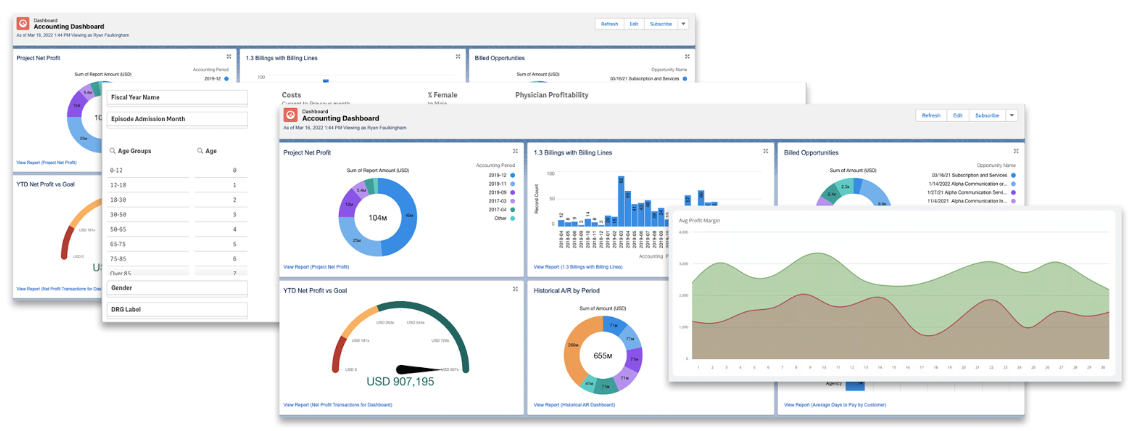
A digital dashboard displays multiple financial charts, graphs, and filters—including pie charts and bar graphs—similar to those used in Amplify Desmos Math for middle school math classroom discussions on project profitability and billing.

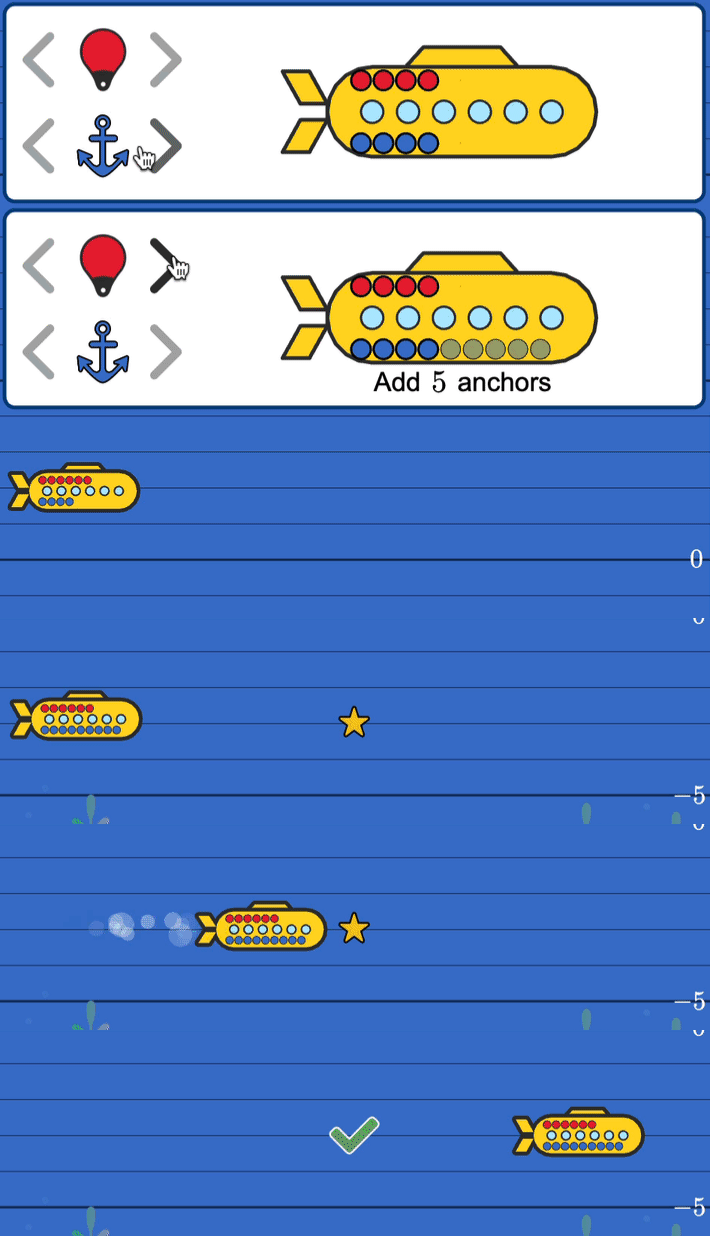
In Amplify Desmos Math, a curriculum I work on, kids generally have plenty to talk about. Our interactives stir a kid’s imagination for even the most abstract areas of math. For example, this submarine interactive stirs up a kid’s ideas about adding positive and negative integers.

A yellow submarine with five round windows, each filled with a blue dot—perfect for sparking classroom discussions in middle school math. Red and blue dots sit above and below the windows, plus an anchor and lightbulb icon on the left.

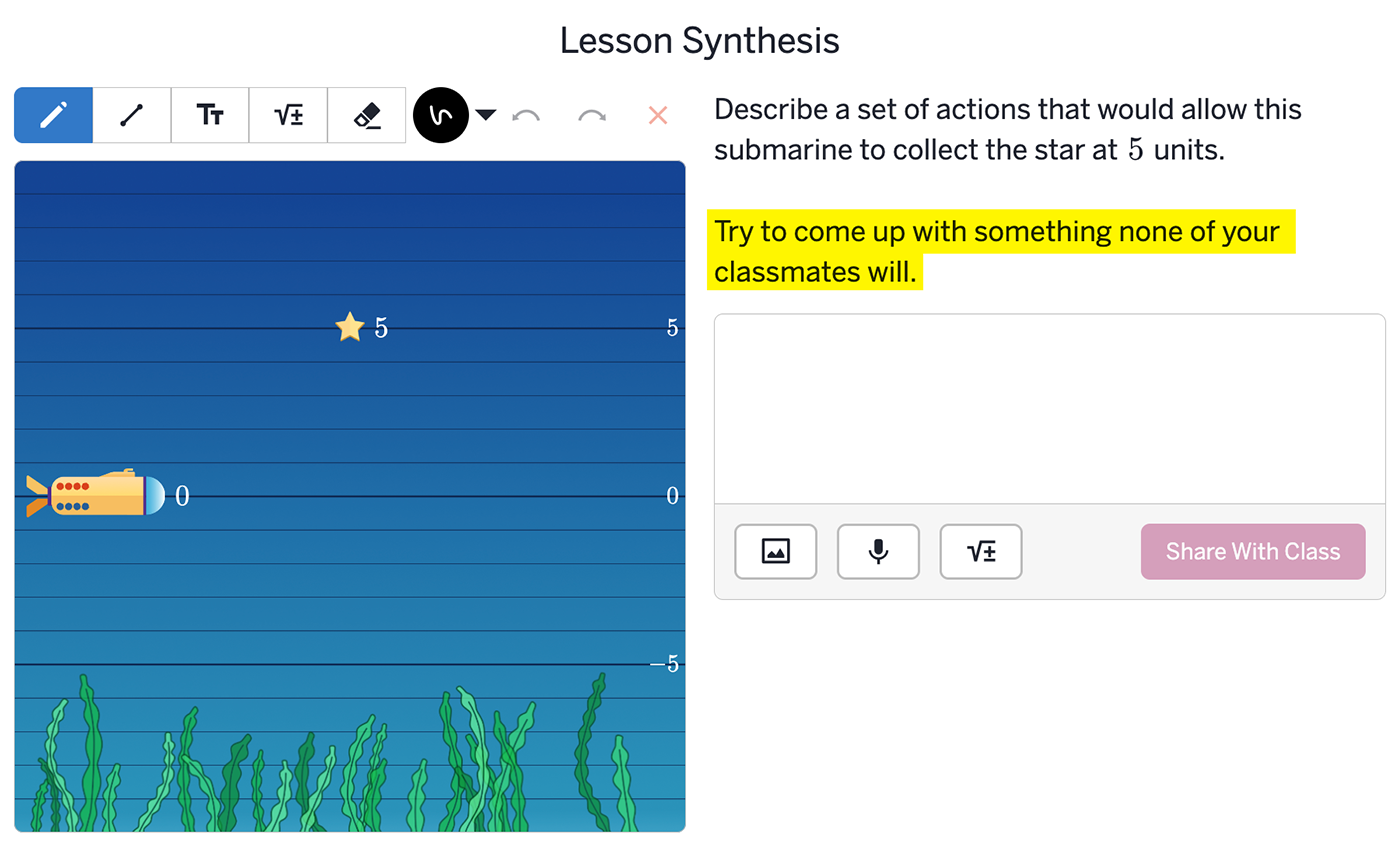
And then we ask kids, “Hey, what do you think about the star at +5? Can you come up with something that none of your classmates do?”

A digital lesson in Amplify Desmos Math shows a submarine at position 0 and a star labeled 5; instructions prompt students to collect the star using unique actions, sparking engaging middle school math classroom discussions.

Let me tell you: Kids accept that challenge.

3. There is too much to talk about.

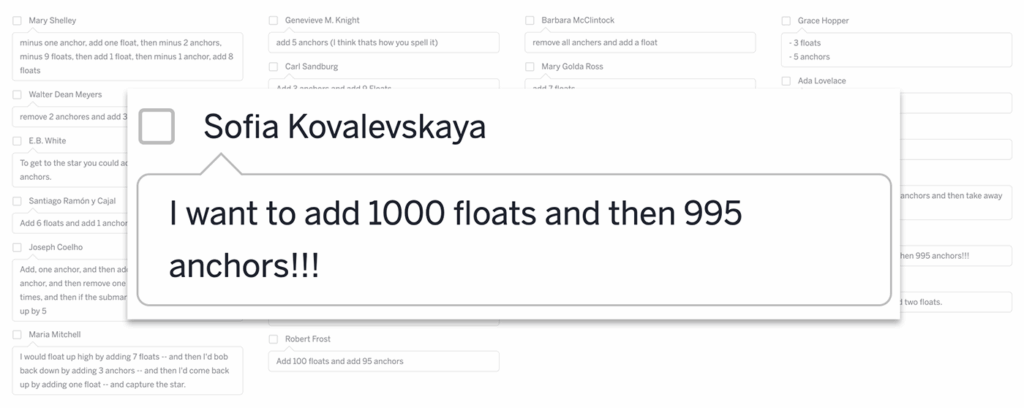
This is a good problem to have, but it’s still a problem. In the class screenshotted below, 25 students have put 300 thoughtful words in front of the teacher, every response different from every other!

A highlighted text box shows Sofia Kovalevskaya saying, "I want to add 1000 floats and then 995 anchors!!!" against a background of faded text—perfect for sparking middle school math classroom discussions with Amplify Desmos Math.

Teachers now have a problem of abundance, not scarcity. They have to decide which responses to select, and why, in an environment of cognitive overload.

This is very hard work for teachers, especially novices, especially teachers who lack mathematical content knowledge, especially teachers who are hanging onto the school year by their fingernails.

We offer teachers lots of different support for discussions throughout our curriculum—both in print and digital activities—but our new discussion support for digital activities is first-of-its-kind and best-in-class.

Discussion Moments.

  1. Student responses stream into the teacher’s dashboard.
  2. A message appears: “Analyzing Student Responses.”
  3. Shortly after, the message changes: “Open Discussion Moment.
A green banner with the text "Analyzing student responses" and two sparkles, next to a gray computer monitor icon—perfect for facilitating Classroom discussions in middle school math with Amplify Desmos Math.

You click the message and see a classroom-ready discussion screen.

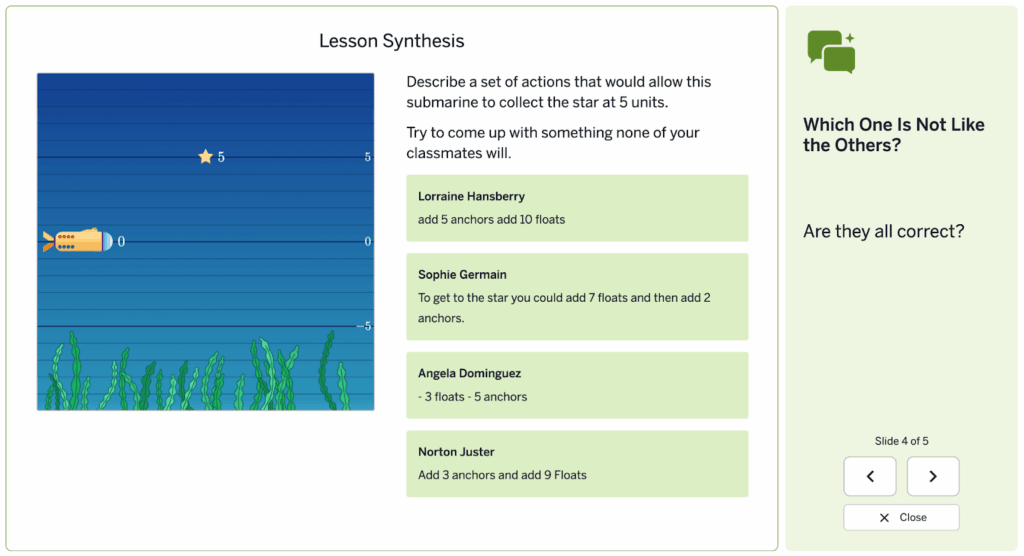
A submarine aims for a star 5 units up; students suggest combinations of floats and anchors to reach it. Amplify Desmos Math sparks engaging classroom discussions as a sidebar asks, "Are they all correct?.

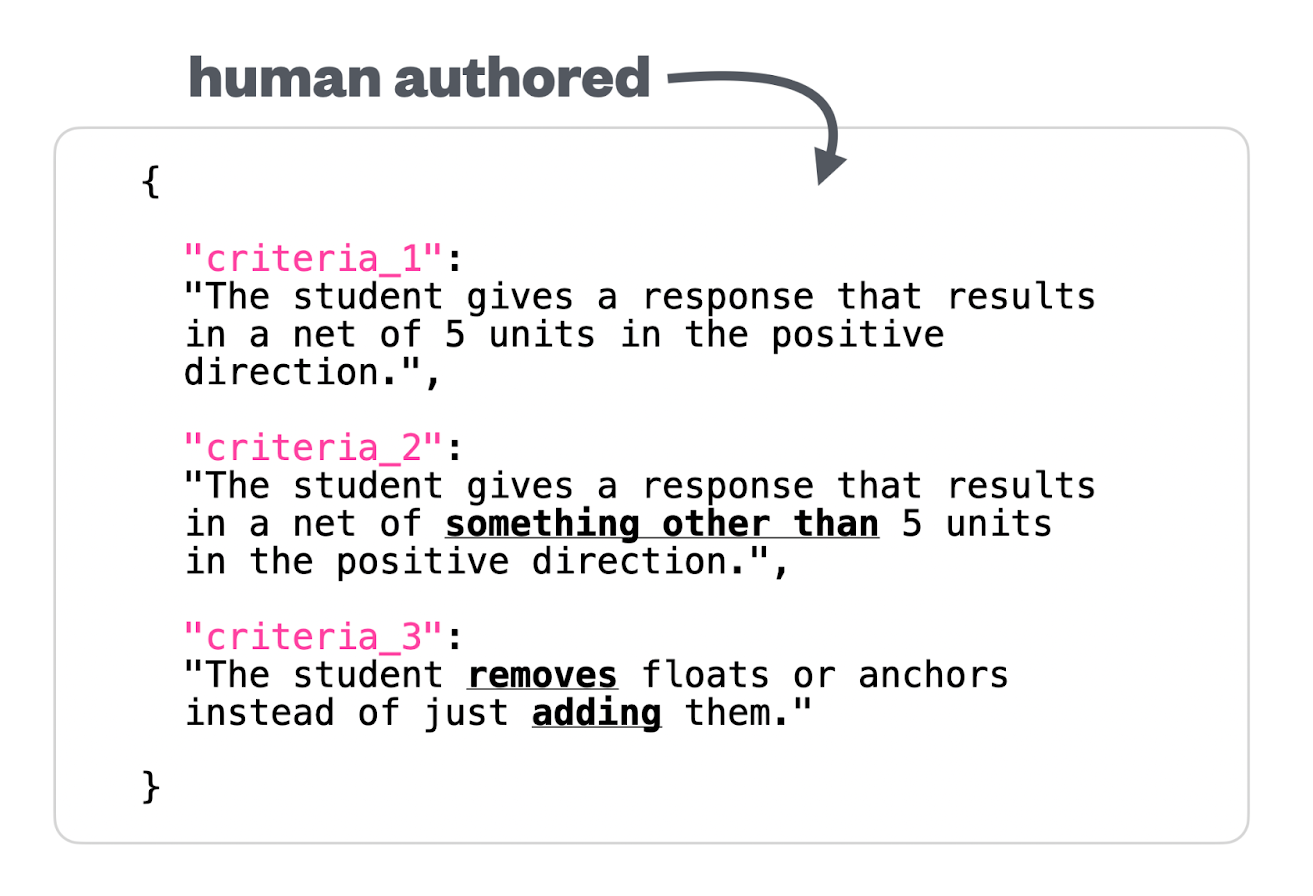
First, you see four student responses, each one authored by a student in the class, each one interesting on its own. This was not luck. Those responses were curated by a large language model at the direction of our curriculum experts. “Find three responses that capture the star in different ways,” our experts prompted the AI. “Responses that add anchors. That remove anchors. Find one response that might not capture the star.”

Next to those responses you see a question: ”Which one is not like the others?” That question feels surprisingly well-matched for this math and for those student responses. This, also, isn’t an accident. Curriculum experts made that decision.

You click the right arrow and see a suggested narration for the Discussion Moment, narration which was authored, again, by our human authors for this particular problem, to help novices learn to facilitate productive discussions in math.

That’s a “Discussion Moment.”

In the past, coaches, experts, and publishers have all asked teachers to . . .

  • Select and sequence student responses.
  • Construct a student-facing discussion resource.
  • Lead the conversation.

Now we are asking teachers to . . .

  • Lead the conversation.

In our experience, computers do quite well with the first two jobs while teachers obliterate computers at the work of leading a conversation, at connecting student ideas, at asking one kid what they think of another kid’s idea, at pulling ideas out of a kid who maybe doesn’t think they have ideas to offer. Discussion Moments delegate to humans and computers the best work for each of them.

Discussion Moments are different.

Lots of edtech companies are putting AI to work in lots of different ways. Discussion Moments are unique.

First, they’re designed to work through rather than around the teacher, during class rather than outside of class. They’re designed to support social interactions between students and teachers in the moment of instruction. This is the action.

Second, this is a classroom-ready resource. So many AI applications just output a ChatGPT-style resource. Lots of text. Several main bullets. Lots of sub-bullets. An emoji or two. And I am very sorry, but they are not useful in class. The teacher has to read all of that text, copy and paste and edit it, and then construct the student-facing resource all in the middle of class. That’s fantasyland, folks. At Amplify, we have, instead, created a one-click, classroom-ready resource.

Third, we’ve fortified these digital Discussion Moments with gallons of human expertise. Since December, I’ve worked with several of our curriculum experts—Casey Nelson, Brian Kam, and Tom Snarsky—and for every problem across several units of middle school math, they:

  • Reviewed thousands of student responses to each problem.
  • Identified thematic trends in the student responses.
  • Decided whether or not those themes demand a discussion.
  • Decided which of several discussion frames would be most appropriate, given those themes.
  • Wrote an AI prompt specific to each problem to increase the odds that the large language model will curate useful student responses.
Screenshot of code-like text outlining three criteria for student responses, with bolded and underlined terms, labeled "human authored" at the top—ideal for guiding classroom discussions in middle school math or Amplify Desmos Math activities.

Most edtech companies would prefer to let AI lead this process from end to end, using the same prompt for every problem, even at the cost of the teacher and student experience. Meanwhile, we only ask AI to execute instructions and construct a resource. The nature of those instructions, the type of resource, and how it’s used—that is all determined by different humans and their expertise.

What do teachers and administrators think?

I ran a small-scale pilot of this feature last spring and kicked off a larger-scale pilot last week. A couple hundred teachers overall. I have never had an easier time recruiting teachers for a project than with this one. Every district math curriculum lead knows how challenging it is for teachers to lead discussions, and every one I asked was eager to support.

Two other examples of Discussion Moments.

Compare and Connect. We asked a large language model to locate responses that have one of a couple of important features but ideally not both. Then we constructed a Discussion Moment asking students to write a response that combines the best of both answers.

A scatter plot titled “Radius vs. Area” from Amplify Desmos Math prompts classroom discussions about proportional relationships, as middle school math students compare line types and notice the points do not form a straight line.

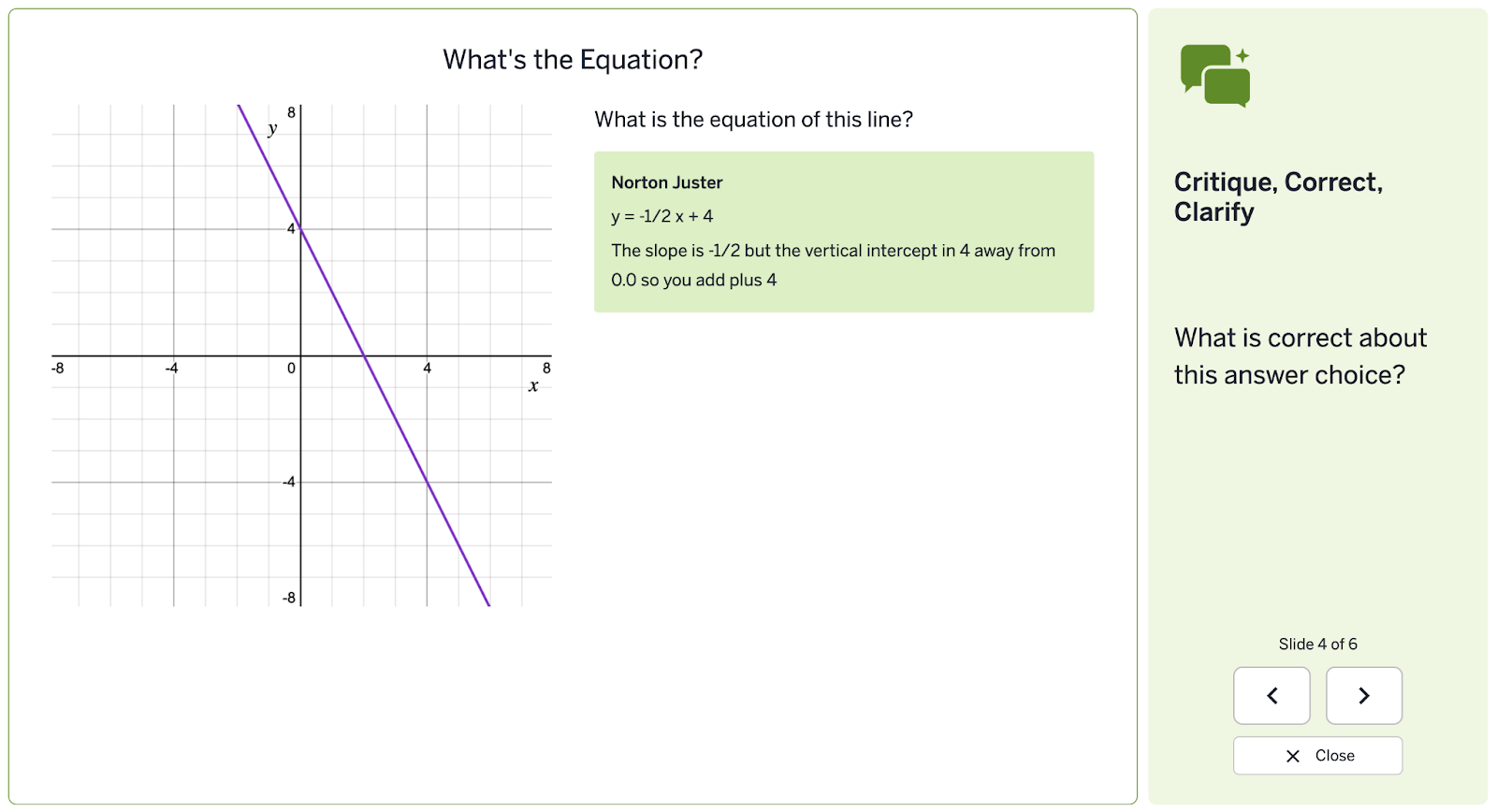
Critique, Correct, Clarify. Our curriculum authors noticed a frequent incorrect answer to a question. We told the LLM to watch out for it and frame it in a Discussion Moment where the class is asked to find value in the wrong answer before correcting it. Try to imagine what it does to a kid to hear their incorrect answer described as valuable.

A graph displays a purple straight line with negative slope crossing the y-axis at 4 and the x-axis at 8; text explains the equation y = -1/2x + 4, perfect for middle school math or engaging Amplify Desmos Math classroom discussions.

Wait—don’t you hate AI?

I get why you might ask me that, but no. I think generative AI is perhaps the most overrated education technology of my lifetime; I don’t think the chatbot tutors or lessonslop generators are going to transform K–12 education. But I do think generative AI is neat. And look, I have tried to support discussion work with K–12 teachers for the last ten years in other ways, too. I have run in-person and remote PD. I have written math lessons and teacher supports for those lessons. I have sent nifty little customized email sequences tailored to teacher usage. None of those supports have been as promising as AI is here. None of them has moved the needle like Discussion Moments because none of them has been able to meet teachers in their moment of need, at the point of use.

That’s it. You can find Discussion Moments in Amplify Desmos Math next school year.

Frequently asked questions

Still have questions? We have answers. Check out the following FAQ.

Overview

  • Amplify CKLA is based on research showing that closing the background knowledge gap is necessary for supporting the literacy development of all students. To that end, Amplify CKLA teaches literacy through the lens of cross-curricular domains in science, history, literature, and culture. It was developed in response to research that shows the critical impact of background knowledge on reading comprehension and college- and career-readiness.
  • The program also reflects the latest early reading research showing the importance of explicit foundational skills instruction. The program develops students’ foundational literacy skills through a systematic scope and sequence with a focus on phonics.

Our research-based language arts curriculum is built on findings showing that higher-level reading comprehension depends on both automatic, fluent decoding and background knowledge. Combining well-established findings from the field of early literacy research with classroom-based feedback, Amplify CKLA ensures that children will learn to listen, speak, read, and write confidently and proficiently. For more information, view the Amplify CKLA Research Guide.

Amplify CKLA is a PreK–5 program. While the PreK and K–2 materials respect the important differences between early childhood education and formal schooling, the Grades 3–5 materials ensure a smooth transition to the academic rigors of middle school.

PreK

The focus in PreK is to maintain a developmentally appropriate early childhood setting; the structures, routines, and activities are engaging and children receive a solid foundation for future language arts instruction.

K–2

The focus in K–2 is developing fluent reading and writing skills, and enhancing language comprehension by building background knowledge and vocabulary. This is accomplished through two strands: the Skills Strand and the Knowledge Strand.

The Skills Strand focuses on decoding, encoding, grammar, handwriting, and the writing process, and it contains decodable chapter books for students to practice just-learned sound-spellings.

The Knowledge Strand builds background knowledge and vocabulary through carefully sequenced read-alouds and complex texts. Teachers read aloud stories that are more complex than the text students can decode on their own, enabling children to engage with complex texts and build background knowledge of a variety of connected topics in history, science, literature, and the arts.

3–5

In Grades 3–5, students are still focused on building reading and writing skills as well as knowledge and vocabulary, but the program no longer has two strands. The various lessons in each unit include read-alouds; whole-group, small-group, and partner reading; close reading; literal, inferential, and evaluative comprehension questions; vocabulary; grammar; writing; morphology and spelling (10–15 words per week); and unit assessments.

Program design

The Skills strand provides intentional and systematic support in building decoding skills. The lessons support learning related to phonemic awareness, sound-letter patterns (or spelling patterns), decoding (both in explicit lessons and with engaging decodable texts), writing mechanics, and writing structure and processes, for 60 minutes daily.

The Knowledge Strand develops young children’s language and background knowledge. By exposing children to rich and complex texts through daily read-alouds, engaging in text-based and analytic discussions of the text and content, and building connections from the text to the work of the classroom through extension activities, the Knowledge Strand provides daily, extensive (60 minutes) broadening and deepening of children’s oral language and comprehension.

Teaching the Skills Strand and Knowledge Strand in parallel helps students avoid cognitive overload and acquire advanced, complex vocabulary in the Knowledge Strand—in essence, reading to learn from day one—while becoming expert decoders in the Skills Strand. The program is designed to bring these two strands together in grades 3–5, as foundational skills and higher-level comprehension and meaning-making gradually intertwine.

The CKLA program takes a comprehensive approach to teaching the code of the English language in the Skills strand. While the English language has only 26 letters, these letters combine to create 150 spelling patterns that represent 44 sounds of language. In most reading programs, children are explicitly taught only a fraction of this information and must glean the rest from ad hoc and incidental exposure to these spelling patterns through text. CKLA focuses on explicitly teaching each of the 44 sounds and the 150 ways that these sounds are represented (via letters and letter combinations). This comprehensive approach assures educators that children have the knowledge they need to address any text and any word.

The Knowledge Strand reflects the fact that knowledge, comprehension, and vocabulary are intimately related. The materials are designed to provide children sustained time on a variety of domains (bodies of knowledge) through shared read-alouds and discussions. This coherent organization of content is critical to building knowledge, inferring new vocabulary, and enabling comprehension. The content-rich, intentionally sequenced nature of the read-alouds within the Knowledge Strand creates the optimal context for incidental and explicit vocabulary-learning opportunities. After the read-aloud, children analyze the text through interactive discussion questions, engage in activities that foster their comprehension of complex sentences and ideas, and extend the ideas of the read-aloud into other activities in the classroom. In this way, the lessons create rich, academically oriented, oral language experiences that promote both receptive and expressive language skills.

Amplify CKLA embeds a variety of diagnostic and classroom assessments into the program materials.

There are curriculum-based assessments of both foundational skills and content knowledge, placement assessments in Grades 1 and 2 for the Skills Strand, and end-of-year Skills Strand assessments in Grades K–3. These assessments are built into the units of instruction/domains within the Teacher Guides. In Grades 4–5, there are beginning-of-year assessments, frequent spelling assessments, and comprehensive unit assessments.

Formative Assessments are integrated into every lesson, allowing teachers to understand exactly how students are doing on meeting lesson goals and standards-based objectives.

Writing in multiple genres is taught through a process that builds from three highly scaffolded steps to seven flexible steps.
In addition to explicit lessons in handwriting, spelling, and grammar, writing is taught throughout K–5. Instruction begins with a three-step writing process: plan, draft, and edit. The process is reinforced as each new writing genre is addressed. Each genre is taught through a gradual reduction in scaffolding over a set of six lessons that includes teacher modeling, group practice, independent practice, and independent application. This systematic approach allows for continued support and predictable learning as children progress in their knowledge of text types and complexity of writing. By Grade 3, students have worked their way up to a five-step writing process: planning, drafting, revising, editing, and publishing. Beginning in Grade 4, the writing process expands to seven components: planning, drafting, sharing, evaluating, revising, and editing (and the optional component of publishing). An important change between the writing process in Grades 3–5 is that the writing process is no longer conceptualized as a series of scaffolded, linear steps that students follow in a set sequence. Rather, students move back and forth between components of the writing process in a flexible manner, similar to the process that mature and experienced writers follow. In addition to specific writing lessons, there are numerous writing opportunities for students throughout the curriculum.

Alignment to the CCSS

Fully implementing the Common Core Standards requires some shifts in prevailing instructional approaches. For early grades language arts, these shifts can be summarized as (1) balancing fiction and nonfiction text, (2) building knowledge, (3) supporting students’ capacity to learn from increasingly complex texts, (4) giving text-based answers, (5) writing from sources, and (6) explicitly supporting the acquisition of academic vocabulary. The following sections document the primary ways that Amplify CKLA meets the demands of these shifts.

  1. The amount of nonfiction gradually increases, reaching the 50-50 balance of fiction and nonfiction by grade 3.
  2. Read-alouds in the Knowledge Strand are designed according to the latest research to build knowledge and vocabulary in history, science, the arts, and more.
  3. The texts in both the Knowledge Strand and the Skills strand increase in complexity as the program progresses within and across grades.
  4. In the Skills Strand, the language and knowledge demands of the texts increase, but remain decodable based on the aspects of the code that have been taught to date.
  5. Both strands engage students in appropriate means of providing text-based answers—orally, pictorially, and eventually in writing.
  6. Together, the Skills and Knowledge Strands enable students to read and digest various sources and then write by drawing on those sources.
  7. In both strands of the program, Amplify CKLA teaches children the process of using the text as a springboard for understanding.
  8. The Knowledge Strand offers repeated exposures to academic vocabulary through authentic texts and explicit word instruction.

Materials

PreK

  • Teacher Guides, Student Activity Pages, 3–4 Trade Books per domain, Flip Books, Image Cards, Transition and Center Cards, Nursery Rhymes and Songs Posters, and a Big Book (Classic Tales)

Grades K–2

  • Knowledge Strand: Teacher Guides, Flip Books, Student Activity Books, Image Cards, and online resources including supplemental lessons
  • Skills Strand: Teacher Guides, Activity Books, Student Readers, Big Books, Letter Cards, Spelling Cards, Individual Code Sheets, Code and Chaining Resources (Vowel/Consonant Code Flip Books, Student Chaining Folders), Blending Cards, and online resources including differentiation and remediation guides

Grades 3–5

  • Teacher Guides, Student Readers, Activity Books, Poet’s Journal, Writer’s Journal, Core Quests (The Viking Age in Grade 3, Eureka: Student Inventor in Grade 4 and “A Midsummer Night’s Dream” in grade 5) and Writing Quests (The Contraption in Grade 4, The Robot in Grade 5)

S2-04: Gamification in the K–8 classroom

Podcast episode graphic featuring guest Fabian Hofmann, titled "Gamification in the K–8 classroom," from Science Connections Season 2, Episode 4, with an illustration of a planet.

In this episode, Eric Cross sits down with his colleague and friend Fabian Hofmann to talk through gamification in the K–8 classroom. They discuss Fabian’s experience teaching outside of the United States, and the differences in classrooms outside of the country. Fabian explains the integration of game mechanisms in the classroom, standard-based grading, and shifting student thinking about learning by forming strong relationships. Fabian also shares how he created a new STEM course at his school revolving around his own passion for Star Wars. Explore more from Science Connections by visiting our main page.

DOWNLOAD TRANSCRIPT >

Fabian Hofmann (00:00):

In Mr. Hofmann’s class, I get to earn points and I get to be a Jedi. I can suspend my disbelief and I’m learning history, but at the same time, I’m traveling through the galaxy.

Eric Cross (00:13):

Welcome to Science Connections. I’m your host, Eric Cross. My guest today is Fabian Hofmann. Fabian is a middle school IB educator, currently teaching seventh grade multimedia design and history at Albert Einstein Academy’s middle school here in San Diego, California. He also hosts the podcast Rebel Teacher Alliance, a podcast dedicated to encouraging and supporting teachers to rethink student engagement. Fabian’s one of the most innovative teachers that I’ve ever met. His use of technology and gamification makes learning fun and accessible for our students. And I have firsthand experience with these students because we teach on the same team and have worked alongside each other during my entire career as a teacher. In this episode, we discuss gamification of the classroom, how he approaches grading from an innovator’s mindset, and his newest STEM class, Immersive Design, where his students are working with former Disney Imagineers to completely renovate their classroom into an interactive Star Wars-themed learning environment. And now, please enjoy my conversation with my good friend and colleague, Fabian Hofmann. We’ve worked together for how many years now? How many years have you been at Einstein?

Fabian Hofmann (01:23):

Well, I started when you started, like after you were student teaching, so 2014.

Eric Cross (01:28):

OK, so it’s been a while.

Fabian Hofmann (01:30):

Yeah. And then I took two years off and I went to Hawaii. I couldn’t handle the pressure. And then I came back. So we’ve worked together for six years but known each other for eight.

Eric Cross (01:39):

What’s your origin story? We’re gonna talk about your origin story. I told you.

Fabian Hofmann (01:42):

All right, cool. Right. So when I was a little boy…no. <Laugh>

Eric Cross (01:46):

This podcast is not that long!

Fabian Hofmann (01:49):

So no, I started out, teaching in 2009. I started student teaching in Germany and was teaching history and English. Did this two-year student-teaching program there. And then, when I was done, my wife and I, she’s American, we got married and we decided to move to the States. And then I started teaching at a German cultural center called the Goethe-Institut in San Francisco. We lived in the Bay Area. And from there, after a year we moved down to San Diego; I started subbing; I worked for a year at High Tech High. I taught humanities there. And then, after that year, I ended up at Einstein teaching German because that was what was available. I didn’t want to teach German. That wasn’t like, on the top of my list. But it made sense because I had taught German in San Francisco and it kind of was like, “Well, I can do that, I guess.” And then, yeah, and then I went back to—we went to Hawaii for a couple of years and then I came back here to start teaching history. So I’ve taught like a million things essentially.

Eric Cross (02:52):

And then during that time, what’s your evolution been like in the classroom? Kind of like your view of education? And how does that play out in your day-to-day with kids?

Fabian Hofmann (02:59):

So when I started teaching here in the States, I noticed that it’s very different. Technology was much further along here than it was in Germany. So when I got here and we had like an iPad cart; I helped setting up the iPad carts. And I worked with the Chromebooks and I was like, holy, holy crap, this is so cool. Like, kids can like actually do things with this technology. And then, I mean, I love technology. I’ve had an iPad when it came out and stuff like that. And so I was like, “Oh, so how about we use this in our classroom?” And so I always moved—I moved very quickly to having students create on the iPad. And at first it was like, “Oh, we use the Apple apps and stuff.” And then I went to an ed-tech teacher summit here in San Diego and my eyes were like opened to, “Oh my God, there’s so much more than just the Apple apps.” And ever since then I was like, “OK, we’re gonna use this; we’re gonna do that.” It’s just crazy stuff that I thought was cool and that students really seemed to enjoy, because it wasn’t like a typical language class; it was more like, “Well, what can we do to create, and how can we somehow still use the language but we are learning coding at the same time, or we are creating something in 3D at the same time?” Like, I was always trying to make it have two angles: the language angle, obviously, and then also the technology angle.

Eric Cross (04:25):

What was it that kept you kind of pushing? ‘Cause I remember the beginning in the Classcraft days to where you are now, I feel like you’re like light-years ahead of where you started.

Fabian Hofmann (04:37):

So you were actually the one who showed me Classcraft, which is like a gamification portal, kind of off-the-shelf thing that you can subscribe to. It has some free features and it’s like a gamification platform where students can create characters. And then these characters go on adventures. That’s like their avatar, and they get experience points in the classroom game and stuff happens. You can create, like, adventure paths for them. So if you have an assignment that you want students to do that has different steps, so, that could be an adventure path. That’s what I liked about Classcraft, is like this idea of like, “OK, we’re taking a game and applying it.” But it wasn’t enough for me. And so I started developing my own classroom game. I did some reading. I met online with John Meehan, worked with him. I read the book by Michael Matera, Explore Like a Pirate. And so it just broadened my whole world to, or just opened the world of gamification to me.

Eric Cross (05:38):

You present on gamification; you mentor other teachers on gamification. You host a podcast where you talk about it. But for those people who haven’t done it or gotten into it or maybe have a perception of it maybe that’s not quite accurate, can you talk a little bit about like what gamification is and what it’s not?

Fabian Hofmann (05:54):

  1. So the biggest difference…we all know game-based learning, because we all do it. We use Quizlet; we use quizzes; we use Gimkit, Blookit, Jeopardy, anything like that. Those are game based. That’s game-based learning. So using a game to facilitate learning. Which is great. I love game-based learning too. But the difference is with gamification, in the pure definition of gamification, is that you’re using game mechanics and elements and apply them to a non-game setting. A couple of smart educators were like, “Why don’t we just do that in our classroom?” And so we borrow these elements, these mechanics, these game mechanics, like getting experience points, and applying them to the classroom. So anything that students do, they earn points. So they turn in an assignment, that gets you a hundred points. They go and do something extra for the class, they get 50 points. Whatever it is, whatever your value is. That’s one aspect, like a leaderboard, virtual money, stuff like that that just in reality is not necessary, but you’re putting it somewhere where it doesn’t exist. And all of a sudden students have this weird shift in their view where it’s like, “Well, school is school, but in Mr. Hofmann’s class, I get to earn points and I get to be a Jedi and I can suspend my disbelief and I’m learning history, but at the same time I’m like traveling through the galaxy.” And it’s just amazing how that shift happens just because we’re changing the language a little bit.

Eric Cross (07:29):

Yeah. You seem to have like tapped into something that is already kind of in that zeitgeist culture thing. We’re gaming and it appeals to—I know it appeals to our students regardless of how they feel about even the subject that’s being taught, the fact that they’re immersed into this environment where they’re taking on this character role and they’re part of this bigger narrative. And you’ve so dynamically constructed this whole storyline and these experiences, and they’re learning experiences, like, they’re learning, but they’re enjoying it in a different way. But I wanted to ask you about something that I really admire that you do, and it’s how you grade. And I remember the first time you said this, we were in a parent-teacher conference and we’re all talking on Zoom with these parents and we’re all sharing our spiel. And you go, I don’t grade kids. They grade themselves. Can you talk a little bit about your conferencing with students? The rubric you use like that that, I’ve really been paying close attention to lately.

Fabian Hofmann (08:24):

Yeah. So, when I was working in Hawaii, I noticed I was teaching English, and grading papers in English is really not fun. Like, that is like my least favorite thing. Some teachers are like, “Yeah, it’s grading! Awesome! I can read stuff!” For me, it’s like, yes, I like to read stuff, but I—and it was the same in German class. I gave them feedback. Sometimes I would use oral feedback, I would, like, record stuff for them, and they would listen to it, and then they would work on it. And so I noticed when I’m giving them feedback and its oral feedback, they’re more inclined to actually work on the stuff that I was critiquing, versus when I sat down and I wrote something. They would never read it. Or some would, and most of them would not. And so I was like, this sucks. <Laughs> And I encountered this book called Hacking Assessment, because it’s such a waste of time, right? You spend so much time, because you wanna do the due diligence. And for those few kids who actually do care, that benefits them. But I want this to benefit everybody. And so I read this book called Hacking Assessment, by Starr Sackstein. And she talks about how she put the onus of grading into the student hands, essentially. And so she did standard-based grading and essentially said, “You know what? Here’s the thing. I am not going to grade you anymore. You are going to get a rubric that we are going to dissect and explain and make sure that you understand. And then you sit down and you give yourself a grade based on this rubric.” And I was like, “Wow, what? That is….I can do that? And the cool thing about this book is that she covers all the roadblocks that we as teachers have. And she explains, like, she gives examples on what we can do to convince parents, to convince admin, to convince the community, convince other teachers why what we’re doing is much, much better for a student than the previous system is. If you think about it, when a student comes into school, they start at a hundred, they start the year at a hundred, and all they’re doing is just lose points. And they’re just trying to keep up. Right? And it kind of flips this on its head, because not only with the gamification, I’m changing the name of the game, literally, but I’m also now with ungrading, I’m giving them the responsibility and the accountability to really look at their stuff and really be critical about how they’re doing. And I taught like normal in my first year in Hawaii when I was teaching English, by me grading everything and turning it and giving it to them. And I used peer grade and I did all that kind of stuff. But in the end, I was always the one responsible for the grade. But then I started to do the ungrading move and I just started to conference with kids and started giving them feedback, with the help of gamification, because there’s like a bunch of rubrics you can use to make it more fun. But all of a sudden, kids that in the year before would’ve failed my class in English, because they were English learners; they were just not into it; they didn’t care as much…all of a sudden that flipped completely. I did the exact same content again. We had to write an essay and all of a sudden, the essays were all like, up there, because we sat down, we talked about it, we went through this review process, gave them feedback. In the end, they could say, “Hey, I want this grade. And then I still have the last say. I would say, say, “Yep, sounds good.” Or “If you wanna get an A on this, or whatever it was, a 4, then here are the things you still need to do.” And because I did that, all of a sudden, the students are like, “Oh, that’s all I need to do?” And then they did it and turned it in, and all of a sudden, they got a 4. It’s, it’s amazing how that the conferencing with students, how that shifted their attitude. And I got to know my students way better than I ever had.

Eric Cross (12:20):

Yeah. That’s, that’s one of the things that I’ve noticed. And I watch you get so much more facetime with students having conferences than I do. I find myself grading…and, you know, at our school, it’s mastery-based instruction, so students can retake assessments, but you’re absolutely right: I give a grade; they get a score; and some of ’em score lower, but in their minds it’s like, OK, I’m done with that. And even though they can retake it, such a small percentage actually do. But the information that I give them in the feedback is often not read. But you’re sitting down and having a conversation and really listening and there’s so much more of a connection that you have. I just think it’s so rich. But the question I have now is how do you make the time for those conversations with those kids in your class?

Fabian Hofmann (13:01):

Yeah, it’s definitely a learning curve. Like the first year I did it, it was horrible. Like <laugh>, it cost so much time. Because kids came, because when it was time to grading, because I had not figured it out yet, I had not streamlined it. And I’m still learning. I’m still trying to figure this out and do it even better. But the idea is that you do something, you check in with me really quick. That doesn’t have to be like a full-on conference. It’s—I walk around or I call them up and say, “Hey, I saw you working on this. How did, how are you doing there? How many—” Like, let’s say I use a rubric that gives them crystals for different parts. They write the introduction; they write a bibliography; whatever, so I can bring them up and say, “Hey, how is the bibliography looking?” And they’re like, “Oh yeah, I’m missing…like, I only have like one or two sources.” And then we say, “OK, so right now you would get two crystals out of three because you have something. When you come back, you get all the crystals.” And so that’s a gamified aspect again, right? They’re coming back to get more crystals, not because they wanna do better necessarily. But because they’re like, “Hey, I wanna get those crystals because it gives me points in the game.” They are very good about like grading themselves and kind of like, they’re really hard on themselves sometimes too. And I have students who are like—

Eric Cross (14:08):

Yeah, they are.

Fabian Hofmann (14:09):

“Well, how can you make sure that people don’t just give themselves an eight?” And I’m like, “Because there’s a system in place that that does not happen. Like, there is a rubric, and if they cannot back up what they want, then it’s not gonna happen. They can write an eight all day long. I’m still the person entering it into the grade book!” <Laugh>

Eric Cross (14:27):

And let me premise this for listeners who don’t teach at IB schools, which is probably like most people.

Fabian Hofmann (14:31):

Yeah.

Eric Cross (14:32):

So IB, we teach zero through eight on a rubric system. And seven-eight is kind of like the A, kind of, quote-unquote. I know IB people are probably cringing when I say that, but <laugh>, you know, when you transfer it to like a high school? Seven, eight would be the highest score, you know. Four, five, six. So when we say eight, we’re talking about the highest score.

Fabian Hofmann (14:49):

Yeah. And so it’s really interesting because I can call them out on stuff, and it’s a one-on-one conversation, right? And if, especially if they turn something in that is not great, and they give themselves like a—I don’t know, like a C, let’s say, or a four, or whatever it is—and they’re like, “And you’re happy with that?” And then they’re standing there and they’re like, like, “No…?” <Laugh> And all of a sudden there’s a conversation. Where it’s like, and then I can be very intentionally like, “Hey man, I know you can do better. I would not—I’m not gonna accept this. I’m gonna push you to turn this in again.” And most of them actually sit down and do more. It’s a process. It takes a while. It’s not pretty in the beginning. But the payout is, so it’s incredible. Just like the amount of time that I get to spend with students, like specifically talking to them about things that they still need to work on, celebrating stuff they do, it’s incredible. Like the relationships are just so different than what I had years ago.

Eric Cross (15:50):

And you’ve also created a system where we preach—and schools always talk about this Dweck growth mindset and not having a fixed mindset, but I wonder how many opportunities or how systems are set up that are actually fixed, where it’s like one and done, OK, you did this exam and then that’s it, but there’s no opportunities to grow until the next exam! Which is gonna be….or whatever the assessment is, which is a whole different area of content or different topic or whatever. But here, you’re actually able to facilitate this growth mindset and push back if a student says, like, “Well that’s—I just got a four,” and you can actually pour into them and talk to them. And do you ever hear more about a student’s story as to why they were where they’re at, as you’re having these conferences?

Fabian Hofmann (16:29):

Oh, absolutely. Like for some kids who, who are just like not getting the work done or whatever, there’s always something where it’s not because they’re not smart or because they’re lazy. It’s like, sometimes, literally they tell you, well, ’cause I ask them, “Hey, can you work on this at home?” Or “Can you come in during lunch, after school, whatever? I’m always here.” And then they drop some bombs on you, like, “Hey, my parents, like, divorced. My mom lives in Mexico.” ‘Cause we live in San Diego. So some students live in Mexico and come to school here in San Diego and they get stuck at the border or, even though they have internet at home, they have to share. It’s like kind of what we experienced during the pandemic, where it’s like, there’s like three kids at home and one computer. Stuff like that. Right? And it’s these stories where you’re like, first of all, it’s very humbling ’cause they’re going through stuff that I never had to go through. I mean, my childhood was not amazing, but compared to what they’re going through, it’s like, “Oh yeah, that exists.” And it kind of like puts you in your place a little bit. It’s also because of the system that I use. There’s no late, really, in my class. Some of the students are like, “I need to subtract points from my grade because I turned it in late.” And I’m like, “No, no, no, no, no. The fact that you’re doing it is quote-unquote punishment enough ’cause you have to do it outside of class, you have to do it at home; you have to do it during lunch. Like, that is, that is not comfortable. You’re still doing it. So why would I punish you by taking a grade away? That doesn’t make sense. You got the work done. That’s all that matters.” I try to be that person that like is understanding. It’s still pushing them to do their best and reminding them and harping on them. And with the spark that I threw in there and fanning that flame of them becoming a better student because I’m supporting them. You’re supporting them. We’re all—our seventh-grade team is incredibly supportive. And then some people might push back, like “That’s not preparing them for the real world.” This is the real world.

Eric Cross (18:20):

There’s a lot of life skills that they’re gonna need…but like, they’re 12 right now! Or 11 or six, you know, whatever it is! Let’s—we can hold off on taxes and the crushing weight of adult reality later on. You got it done! Well-done! I do wanna talk about this thing that is your baby lately, this embryonic thing that you’ve been growing and I’ve been fortunate to be able to watch it since its inception. But you have this class that you created from scratch that’s essentially a STEM class. Two questions: Why did you create the class? And you’ve done some uncommon things. I’m gonna leave it wide open just for you to talk about it because it’s your baby and I’ve been fortunate to be able to watch it from the start. So can you talk about that?

Fabian Hofmann (19:01):

So yeah, so I’m obsessed with Star Wars. I think that’s putting it mildly. I love Star Wars. Always have. My classroom game is called Jedi Academy. And I’ve been playing around with this idea of creating a room that is more immersive. So I put a space, like a window to space, on my wall. I have the Millennium Falcon in my room. I have like a bunch of Resistance stuff or whatever. Anything Star Wars, you can find in my classroom. It’s not like overloaded, but I was very intentional in the things that I put in there, because I want my students to come in and feel like they are playing the game. And one of those things that I used was like smells; I used sounds to try to immerse them more. And then so one day I was like, wouldn’t it be cool to create a classroom that looks literally like a Star Wars set? Like you walked onto a set. Onto a spaceship, onto a rebel base, onto whatever it is. And how can I, how can I make that happen? And then we talked about it and you were like, “Yeah, how about you let the kids do it?” And that’s kind of how the course was born. And now I have students in my classroom who are in the process of designing a classroom based on Star Wars. And they’re gonna build everything. And we’re all learning at the same time. I’ve never done anything like this. I do like STEM, but I’ve never like actually made it a class. And so I contacted a bunch of people on LinkedIn ’cause I was like, it would be cool to talk to an Imagineer and to get like my foot in the door at Disney and then have an Imagineer come in and tell us about what they did. I have this book called The Art of Galaxy’s Edge, which is like the Star Wars land in Disneyland. And I just looked at the list and was like, “Who could be a good person to contact here?” And it said one of them was Eric Baker, and it said, “Executive Creative Director.” And I googled him or I looked for him on LinkedIn and I found him and I was like, “I’m just gonna send him a message. I’m just gonna tell him what I do in my class in history, gamification and all that, and they’re Jedi, and blah, blah, blah.” And he wrote back! Like, he was the only person that wrote back. I wrote a bunch of people and he was like, “Yeah, I’d be super-interested. I don’t know what you want me to do, but I’m down.” And so it created this relationship between me and Eric Baker who used to work for Imagineering, who are like the people at Disney who create the rides in the park and all that. And I talked to him and he gave me some feedback on the room. And then he was like, “Oh, so if you ever want me to talk to students, I’m down.” I was like, “Uh, yes!” And so we had him Zoom in. He talked about his life and how he became one of the people to look for when it comes to theme park design and to create immersive experiences. And I contacted other people on YouTube, like somebody who is like a Star Wars room builder. He’s willing to chat with us about this project. And then, I discovered that there is this thing called Imagination Campus at Disneyland, which they offer workshops on immersive storytelling. And I was like, “Oh, that’s what I want! I want my students to tell a story with my room!” And so I wrote up a proposal. Took a long time, but they signed—our admin signed it off. We kind of financed it. And then, about two weeks ago, you came along, another teacher, and we took 30something students to Disneyland and they did this workshop where they learned all about like how the Imagineers design story elements and put them in the parks. And then we took all of the kids to Galaxy’s Edge. And we took a bunch of photos. We went on the rides together. We had this collective experience. And it was life-changing for a lot of students. Because, I mean, we’re a Title One school; there’s like, we have about 60% free or reduced lunch. And a lot of them had never been to Disneyland. About half of them had never been. Some of them went when they were little. And so just watching their faces, going to Disneyland, watching them walk into Galaxy’s Edge, experiencing all these things, it was just, my mind was just blown. And I like literally, I don’t know if you noticed, but I was just smiling. Literally.

Eric Cross (23:19):

You were loving it.

Fabian Hofmann (23:20):

Yeah. Then we come back and we have these amazing conversations about design and what they noticed and how they created this immersive experience in their world. And we talk about how we can bring this back to our classroom. And parents are sending emails saying, “Oh my God, we’re so happy that you did this for our kids and you’re the coolest teacher.”

Eric Cross (23:39):

You touched on something that I wanted to ask you about. So you stay connected to people that inspire you, I feel like, or you have a pretty broad network of educators and professionals. Like, how much does that play into what you do in the classroom and the ideas that you have, as your network or your community of people?

Fabian Hofmann (23:57):

So the one network that helped me the most is Twitter. And I know people have opinions about Twitter, for good reason. But when I started to gamify, I just started to follow specific hashtags for areas that interested me. And that was gamification; eXPdup, which is like Explore like a Pirate—it’s an acronym. And it just opened up all these people, all these people, all these educators who are out there just like doing cool stuff and sharing it on Twitter. And I started connecting with them. And one of them is on my podcast. We met through Twitter; we started sharing stuff. We started talking about the things that we do. We both happened to have a gamified classroom. And so we connected over this thing Twitter, and now we’re like friends and we’re presenting together at Q and all those places. Teacher Twitter is incredibly supportive and people want to show you the stuff that they work on, just like I do. Like when I have stuff that I worked out, I shared it on there. And it’s so fun to hear back from teachers saying, “Hey, this looks awesome.” It’s just, it makes you feel good and it makes you feel like, “Oh, what I’m doing is not a total waste of time.” <Laugh>

Eric Cross (25:10):

<laugh> Those thoughts do creep in, right? Like, even though you’re doing something awesome and you might think so, we become our own worst critic sometimes, or we always see the things that we can improve and we overlook the things that we’re doing well. Fabian, where can people hear more about you, about gamification, about what you’re doing in the classroom, about how you’re innovating? I know you talk about this stuff with some—and you talk about it with some pretty legit people in the education industry. So can you tell some folks where they can hear more about it?

Fabian Hofmann (25:37):

So you can find me on Twitter at Hofmann edu—one F, two Ns—edu, and then I also host a podcast called Rebel Teacher Alliance. There’s three of us, where we talk all things gamification. But we also talk to teachers who don’t gamify at all. And we just, we just invite people who are interesting, who have stuff to share, who do cool stuff. You can find the podcast on the internet at Rebel Teacher Alliance dot com. Follow us there. If you wanna be a guest, just send a message and we’ll get you on.

Eric Cross (26:10):

Fabian, I’m gonna gush on you right now, but when you came back to Einstein, I was so happy because I knew that you sharpened me; you make me a better science teacher. Your innovation, your passion for kids, your sense of humor, your outside-the-box thinking, all of that. And when you got onto the seventh-grade team and you were here, I just knew that it was going to be awesome. And it has been. And so as a teaching colleague, as a friend, dude, you just rock, man. I’m super proud of you. And thank you for making me better.

Fabian Hofmann (26:40):

Aw, now I’m starting to cry. It’s like, don’t…

Eric Cross (26:43):

<laugh>. All true, dude. All true, my brother.

Fabian Hofmann (26:46):

Thank you.

Eric Cross (26:46):

All true. And thank you for letting me be part of the journey and I will definitely be walking down the hall asking you questions as I try to implement some of these great ideas that you’re doing with kids. Thanks so much for listening. And now we wanna hear more about you. Do you know any inspiring educators? Nominate them as a future guest on Science Connections by emailing STEM at amplifycom.wpengine.com. That’s S T E M at amplifycom.wpengine.com. Make sure to click subscribe wherever you listen to podcasts and join our Facebook group, Science Connections: The Community. Until next time.

Stay connected!

Join our community and get new episodes every other Wednesday!

We’ll also share new and exciting free resources for your classroom every month!

What Fabian Hofmann says about science

“I want my students to come in and feel like they are playing the game. I used smells. I used sounds to try to immerse them more. And then so one day I was like, wouldn’t it be cool to create a classroom that looks literally like a set?”

– Fabian Hofmann

Middle School Educator, Albert Einstein Academies Middle School

Meet the guest

Fabian Hofmann is a middle school International Baccalaureate teacher and host of the Podcast, Rebel Teacher Alliance. He is currently teaching 7th grade History and Multimedia Design just down the hall from Eric Cross at Albert Einstein Academies Middle School in San Diego. To engage students, he uses technology and gamification. Students embark on a year-long journey through a galaxy far, far away to learn the ways of the “Force” and some world history along the way. Follow him on Twitter and check out the Rebel Teacher Alliance podcast.

A man with short gray hair and a beard is smiling at the camera, photographed against a neutral background inside a circular frame with a small yellow sparkle accent, evoking the playful spirit of gamification.

About Science Connections

Welcome to Science Connections! Science is changing before our eyes, now more than ever. So…how do we help kids figure that out? We will bring on educators, scientists, and more to discuss the importance of high-quality science instruction. In this episode, hear from our host Eric Cross about his work engaging students as a K-8 science teacher.

Literacy Essentials, Episode 4

Science of Reading Essentials: The science of learning

On this Science of Reading Essentials episode, we're taking a deeper dive into the science of learning to explore how memory, cognitive load, and knowledge building can transform your literacy instruction. On this synthesis episode, host Susan Lambert, Ed.D., weaves in the insights of our expert guests—Natalie Wexler; Nathaniel Swain, Ph.D.; Hugh Catts, Ph.D.; Daniel Willingham, Ph.D.; Peter C. Brown; Jamey Peavler, Ed.D.; and David Rapp, Ph.D. With their insights, Susan reflects on how memory works and why understanding its processes is foundational to effective teaching; why cognitive load theory and background knowledge are game-changers for literacy instruction; and which evidence-based strategies—like retrieval practice, spaced repetition, and mixed practice—make learning stick.

Meet Our Guest(s):

Portrait of a woman with short, curly blonde hair, light skin, and a white top, looking at the camera with a neutral expression—an image that could illustrate modern perspectives in literacy instruction or the science of learning.

Natalie Wexler

Natalie Wexler is the author of multiple books, including Beyond the Science of Reading: Connecting Literacy Instruction to the Science of Learning and The Knowledge Gap: The Hidden Cause of America’s Broken Education System—and How to Fix It; and is the co-author, together with Judith C. Hochman, Ed.D., of The Writing Revolution: A Guide to Advancing Thinking Through Writing in All Subjects and Grades. She has a free Substack newsletter called Minding the Gap, and she was the host of the Knowledge Comprehension podcast, Season 1. More information is available on her website, www.nataliewexler.com.

A man with short brown hair and a beard, wearing a light blue collared shirt, poses in front of a blurred background, reflecting his passion for reading comprehension and literacy instruction.

Nathaniel Swain, Ph.D.

Nathaniel Swain is a teacher, instructional coach, and writer. He produces a blog for teachers called Dr. Swain’s Cognitorium and is cohost of the Chalk Dust podcast with Rebecca Birch. Nathaniel works directly with schools and systems through an online learning platform called Luminary.

He founded a community of educators committed to the science of learning, called Think Forward Educators. He also has a best-selling book, Harnessing the Science of Learning: Success Stories to Help Kickstart Your School Improvement.

A bald older man with a white goatee and mustache, wearing a dark collared shirt, smiles at the camera against a plain gray background—exuding warmth often found in dedicated literacy instruction professionals.

Hugh Catts, Ph.D.

Hugh Catts’ research interests include the early identification and prevention of reading and disabilities. He is a former board member of the International Dyslexia Association and former president of the Society for the Scientific Study of Reading. He has received the Samuel T. Orton Award, the International Dyslexia Association’s highest honor, and the Honors of the Association award from the American Speech-Language-Hearing Association, for his career contributions in these disciplines. His current research concerns the early identification of reading and language difficulties and the nature and assessment of reading comprehension problems.

A bald man with red-framed glasses and a brown jacket stands in front of a brick wall, embodying the spirit of literacy instruction as he looks at the camera.

Daniel Willingham, Ph.D.

Daniel Willingham is a professor of psychology at the University of Virginia, where he has taught since 1992. Until about 2000, his research focused solely on the brain basis of learning and memory. Today, all of his research concerns the application of cognitive psychology to K–12 education. He is the author of several books, including the best-selling Why Don’t Students Like School? and Outsmart Your Brain. His writing on education has appeared in 23 languages. In 2017, he was appointed by President Barack Obama to the National Board for Education Sciences.

An older man with white hair and a beard, wearing a blue checked shirt, stands outdoors near a body of water with trees in the background, perhaps reflecting on reading comprehension or the science of learning.

Peter C. Brown

Peter C. Brown is a bestselling writer and novelist, retired from a career as a management consultant. He is the lead author of Make It Stick: The Science of Successful Learning. Make It Stick has been translated into 17 foreign languages and received international acclaim for changing the way we understand learning.

Jamey Peavler, Ed.D.

Jamey Peavler is a co-director of and full-time instructor in the Graduate Reading Science program at Mount St. Joseph University. Before joining Mount St. Joseph, Jamey served as director of training for the M.A. Rooney Foundation. In addition, she works for the National Council for Teacher Quality (NCTQ) as a higher-education textbook and teacher licensure reviewer. Her research interests include instructional design, the impact of spaced practice and interleaving to support effortful retrieval and retention of information, the role of oral language and syntactic awareness on comprehension and written expression, and foundational skills for supporting literacy in the early childhood setting.

A woman with long brown hair is smiling at the camera, surrounded by books and plants blurred in the background—a perfect scene for anyone passionate about reading comprehension and the science of learning.
A man with short gray hair, a beard, and glasses, known for his work in literacy instruction, is wearing a purple checkered shirt and smiling slightly against a plain white background.

David Rapp, Ph.D.

David Rapp is the Walter Dill Scott Professor of Education, Social Policy, and Psychology at Northwestern University. His research examines language and memory, focusing on the cognitive mechanisms responsible for successful learning and knowledge failures. This has included investigations into the influence of inaccurate information on comprehension, the evaluation of technologies that support formal and informal learning, and the iterative development of tools and curricula intended to support literacy. Rapps’ projects have been funded by the National Science Foundation, the U.S. Department of Education, the National Institute on Aging, and Meta.

Meet our host, Susan Lambert, Ed.D.

Susan Lambert is chief academic officer of literacy at Amplify and host of Science of Reading: The Podcast. Throughout her career, she has focused on creating high-quality learning environments using evidence-based practices. Lambert is a mom of four, a grandma of four, a world traveler, and a collector of stories.

As the host of Science of Reading: The Podcast, Lambert explores the increasing body of scientific research around how reading is best taught. A former classroom teacher, administrator, and curriculum developer, she’s dedicated to turning theory into best practices that educators can put right to use in the classroom, and to showcasing national models of reading instruction excellence.

Person with short blonde hair, glasses, and earrings, wearing an orange jacket, smiling in front of a plain gray background—committed to literacy education and fostering background knowledge for all learners.

Quotes

“To build a meaningful memory of something that you can hold on to and use, you have to think about it.”

—Hugh Catts

“Memory is a cognitive process. It's the way the brain encodes, stores, and retrieves information.”

—Susan Lambert

“You can't learn something new if it doesn't connect to something you already know.”

—Peter C. Brown

“The catch about writing is it's hugely important. It can help cement knowledge and long-term memory, deep knowledge, et cetera.”

—Natalie Wexler

“When we have knowledge in our long-term memory, all of these limitations suddenly disappear.”

—Nathaniel Swain

“We can only work with a limited set of information and when there's too much happening in our working memory, we experience cognitive overload. Essentially, our system is overloaded and we shut down.”

—Susan Lambert

“Essentially, memory is what enables us to retain knowledge, skills, and experiences, forming the foundation for all learning and cognition.”

—Susan Lambert

“The resonance model of comprehension suggests when someone asks a question, lots of ideas get activated automatically in memory.”

—David Rapp

“Your mind is very good at bringing up from memory the necessary facts, the facts that will help you given the context.”

—Daniel Willingham

“A lot of our students that are having difficulty are experiencing cognitive overload. So the first thing we need to think about is how are we gonna minimize that for them?”

—Jamey Peavler