Shifting to problem-based learning in K–5 math

Illustration of a sun, a clock, a die showing six, and a multiplication equation next to a green leafy plant on soil, all on a light yellow background—perfect for introducing fun math activities for kindergarten.

Math is all about getting the right answer. Right?

Wrong! Getting the correct answer matters, of course—accuracy is part of proficiency—but when math instruction focuses primarily on correctness, students can miss something essential: the opportunity to think deeply, share ideas, and make sense of problems for themselves.

Many K–5 math classrooms follow a familiar and well-established rhythm: The teacher demonstrates a strategy, students practice it, and the class moves on. This approach is widely used for good reason—it can feel clear, efficient, and reassuring. But over time, it can leave fewer opportunities for students to reason, deepen problem-solving skills, explore different approaches, and develop understanding that lasts.

This is where problem-based learning comes in.

What problem-based learning means in K–5 math

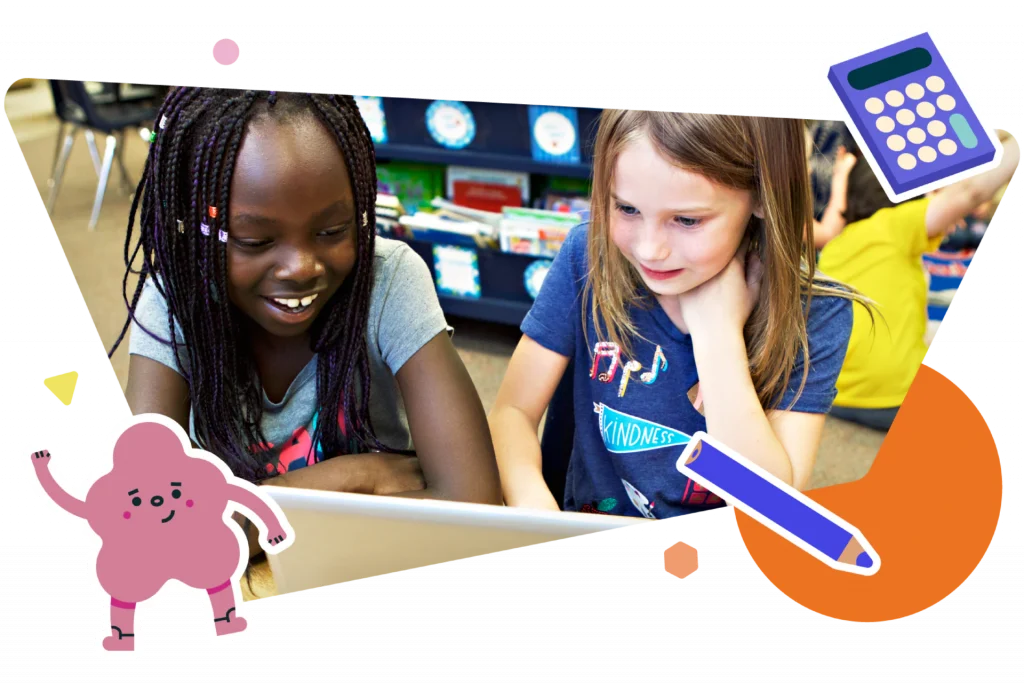
Problem-based learning places rich mathematical problems at the center of instruction. Instead of starting with a demonstrated method, students encounter a problem first, then draw on what they already know, try strategies, and make sense of the math through discussion and reflection.

As students tackle complex problems, they explain their thought processes, compare approaches, and revise ideas. The right answer still matters, but it emerges through critical thinking and sense-making, not just following steps. The result is learning that feels purposeful, engaging, and durable.

This approach reflects how math works beyond the classroom. People begin by understanding a situation, not by choosing a procedure. Problem-based learning helps students build that habit early.

Why shifting to problem-based learning matters

When student thinking stays private, happening only in heads or notebooks, it’s hard to assess understanding or guide learning in the moment. Problem-based learning brings thinking into the open.

As students share strategies, representations, and explanations, teachers gain insight into how they’re reasoning. Instruction can respond to real understanding rather than relying solely on correct or incorrect answers. And students benefit, too, by seeing that their ideas matter and math is something they can actively participate in.

Over time, this approach supports deeper understanding, stronger engagement, and lasting mathematical proficiency.

Three practices that support problem-based learning

Shifting to problem-based learning doesn’t require a complete overhaul all at once. A few core practices can help math teachers support the transition in K–5 classrooms.

  • Establish norms for learning math together. Productive problem-solving depends on a classroom culture where students feel comfortable sharing ideas, even when those ideas are unfinished. Norms that emphasize listening, explaining reasoning, and revising thinking help create a collaborative learning community.
  • Use tasks that invite curiosity and access. Effective problems allow all students to get started while still offering opportunities to extend thinking. Open prompts such as “What do you notice?” or “What do you wonder?” encourage students to connect prior knowledge to new situations and engage meaningfully with the math at hand.
  • Make learning goals explicit at the right moments. Problem-based learning includes purposeful instructional moments. Synthesizing student ideas near the end of a lesson helps students see how their thinking connects to the mathematical goal, bringing clarity without cutting short exploration.

Rethinking the teacher’s role

Problem-based learning also involves a shift in how teachers support instruction.

In classrooms grounded in problem-based learning, teachers guide learning by selecting meaningful problems, monitoring student thinking, and facilitating discussion. Strategic questioning helps students clarify ideas and make connections. Well-timed synthesis highlights important mathematical relationships and supports accurate understanding.

This approach allows teachers to focus less on delivering steps and more on supporting sense-making—while gaining clearer insight into where students are in their learning.

A gradual, supported shift

Shifting to problem-based learning is a process. Many classrooms begin by adjusting how lessons start, increasing opportunities for discussion, or rethinking how students share their thinking.

Over time, these changes add up. Instruction becomes more student-centered. Students engage more deeply. Fluency develops alongside understanding, and productive struggle becomes part of everyday learning.

When classrooms shift toward problem-based learning, math becomes more than getting the right answer. It becomes a way for students to reason, collaborate, and make sense of the world.

The power of productive struggle in K–5 math

A cartoon pizza cut into slices with a serving spatula in the center, flanked by colorful shapes and a cartoon animal on the right—an engaging way to spark curiosity about procedural fluency and fluency in math.

Struggling is not necessarily fun. It can be uncomfortable and frustrating. It can even feel like a great reason to give up.

But struggling and learning often go hand in hand. The key is for that struggle to be productive—for it to feel like something you worked through until you were successful, providing the confidence you need to tackle the next hard task.

That’s especially true—and essential—in math learning.

The key is productive struggle: the kind of effort that stretches students’ thinking without shutting them down. When designed intentionally, math activities for elementary students can challenge learners while still supporting confidence, curiosity, and persistence.

Here’s more about how productive struggle helps math students succeed.

What is productive struggle?

Productive struggle refers to students grappling with challenging problems that are not immediately solvable, but still within reach. It’s the space where students test ideas, make mistakes, revise strategies, and slowly build understanding.

Research shows that productive struggle helps learners move beyond surface-level memorization and toward deeper, more durable learning.

Rather than being told exactly what to do, students are encouraged to reason, explain, and persevere.

This doesn’t mean leaving students to flounder. Productive struggle requires clear goals, thoughtful scaffolds, and meaningful tasks so students know what they’re working toward and believe they can get there.

The role of growth mindset in math learning

Productive struggle is closely tied to another key idea: growth mindset.

A growth mindset is the belief that ability comes not from innate, baked-in talent, but through effort, strategies, and learning from mistakes. In the math classroom, this mindset helps students see challenges not as threats, but as opportunities.

When teachers communicate high expectations and normalize mistakes as part of learning, students are more willing to take risks. They begin to stop saying, “I can’t do this math problem,” and start saying, “I’m not there yet.”

This shift matters, especially in elementary grades. Students who develop a growth mindset early may be better equipped to avoid math anxiety and to handle increasingly complex math concepts, because they’ve learned that struggle is not a sign of failure, but part of the process.

Why struggle feels risky—and why it’s worth it

Supporting productive struggle can feel risky for teachers. Classrooms are busy. Time is limited. And no one wants students to feel frustrated or discouraged.

But avoiding struggle altogether creates its own problems. When math activities are too procedural or overly scaffolded, students may complete tasks without truly understanding them. Over time, students may come to believe that math is about following steps rather than making sense of ideas.

By contrast, well-designed struggle builds investment. Students engage more deeply when they’re asked to think, explain, and choose strategies. They develop problem-solving skills, perseverance, confidence, and a stronger sense of ownership over their learning.

What productive struggle looks like in practice

In classrooms that support productive struggle, students are actively involved, even when tasks are challenging. You might hear students explaining their reasoning, comparing strategies, or revising their thinking after a mistake.

Effective math activities for elementary students include:

  • Multiple entry points so all learners can begin.
  • Opportunities for students to explain why their strategy works.
  • Support for more than one correct approach.
  • Clear expectations paired with flexible pathways.

Even in kindergarten math activities, productive struggle for the youngest learners might look like counting, sorting, or representing numbers in different ways, paired with questions that prompt reasoning rather than quick answers.

Students need tasks that are mathematically meaningful, paired with structures that help them persist: opportunities to talk, visual representations, strategic questioning, and time to reflect.

In this way, struggle builds math muscle. Productive struggle helps students feel on top of their math game—and ready to learn more.

Why fluency matters in K–5 math education

An illustration showing a caterpillar, a hand matching shapes and colors on tiles, and another hand holding numbered cards—perfect for read-aloud math activities or exploring math in picture books with children.

If you’re fluent in Farsi, let’s say, you don’t search for every word or stop to translate every sentence in your head. You understand, process, and respond automatically, in real time.

Math fluency works the same way. This kind of fluency is something you can use naturally to understand what’s presented and respond to it meaningfully.

In K–5 math, fluency allows students to move beyond getting through the problem toward real mathematical thinking. Without it, even confident students can get stuck. With it, students gain access to deeper understanding, flexibility, and confidence.

What is math fluency?

Fluency in math is sometimes misunderstood as speed or memorization—but research and classroom experience tell a fuller story.

The National Council of Teachers of Mathematics defines procedural fluency as the ability to: “…apply procedures efficiently, flexibly, and accurately; to transfer procedures to different problems and contexts; to build or modify procedures from other procedures; and to recognize when one strategy or procedure is more appropriate to apply than another.”

In other words, the skills often referred to as computational fluency and math fact fluency tell only part of the story. Full mathematical fluency means knowing how and why strategies work, and being able to choose among them.

Memorization does have a role in math learning, but it alone does not lead to fluency. A student who has memorized facts but doesn’t understand relationships between numbers may still struggle when problems change slightly or require reasoning.

By contrast, a fluent student can adapt. They can explain their thinking, check whether an answer makes sense, and shift strategies when needed.

This is why fluency acts as a bridge between conceptual understanding and procedural application. It connects what students know to what they can do, and helps them do it with confidence.

Why procedural fluency matters in K–5 math

In the elementary grades, students are building the foundational math skills they’ll rely on for years to come. When procedural fluency is weak, students can feel overwhelmed by basic calculations, leaving little mental energy for problem-solving or new concepts.

Students without strong procedural fluency often feel stuck. For them, math can start to feel like an endless series of obstacles rather than a meaningful, engaging exploration—and that experience does not set anyone up to feel like a math person.

Fluency is what frees students up to focus on the heart of a problem. When they’re not bogged down by calculations, they’re able to reason, explore patterns, and tackle more complex tasks. Fluency opens doors—to higher-level math, to confidence, and to a more positive math identity.

In their paper, “Eight Unproductive Practices in Developing Fact Fluency,” Gina King and Jennifer Bay-Williams write: “Being fluent contributes to a productive disposition about mathematics, opens doors to a range of mathematics topics, and arms students with a skillset applicable to whatever they wish to pursue.”

What teaching math fluency looks like in the classroom

Effective K–5 math instruction treats fluency as something that develops over time, through meaningful practice, discussion, and reflection. Students need opportunities to explore number relationships, explain their thinking, and revisit strategies in different contexts.

In classrooms where math fluency is developing, instruction consistently supports flexible thinking, reflection, and revisiting ideas over time. You might see and hear the following:

  • Revisiting strategies across problems. Students are encouraged to solve the same problem in more than one way and to compare approaches. Classroom discussions focus on how strategies work and when one might be more efficient than another, helping students build strategic thinking and confidence.
  • Frequent, well-spaced opportunities for practice. Key facts and strategies reappear over time rather than being practiced once and set aside. This spacing helps students retain learning and apply it more accurately and efficiently when they encounter familiar ideas in new contexts.
  • Regular routines that emphasize reasoning. Short, consistent routines invite students to mentally compute, explain their thinking, and listen to others’ ideas. The focus is on understanding number relationships and reasoning through solutions rather than relying on memorized steps.
  • Thoughtful use of visual representations. Tools such as number lines, arrays, and other models help students see how numbers and operations relate. These representations support flexible thinking and make procedures more meaningful and accessible.

Across these experiences, fluency is something you can hear as well as see. Students explain their reasoning, reference strategies they’ve used before, and check whether their answers make sense, building accuracy, efficiency, and flexibility over time.

Math fluency helps students open their minds to the richness of math, and to their own power as math learners.

5 strategies to transform your math classroom

Want to shift your math teaching practices this year, but not sure where to start? That’s a good problem to have! 

You can boost your instruction this fall with problem-based learning, technology in the math classroom, and more—all in ways that put students at the center. 

“All students need the opportunity to feel like they can figure out mathematics,” says Jennifer Bay-Williams, Ph.D., an author and professor of mathematics education at University of Louisville. “That’s where they develop a math identity, [the idea] that they can do math. And they start feeling like, ‘I can figure this out.’” 

Bay-Williams spoke at our 2024 Math Symposium, along with other thought leaders and expert educators. Keep reading to see how their key takeaways can help you shift your math instruction this school year!

Center student ideas in a collaborative math classroom

Amplify Math Suite Executive Director Kristin Gray had great tips for teachers looking to center student ideas in the classroom. Simply put, it’s all about helping them make several types of connections. These can include any of the following: 

  • Connecting students’ classroom math experiences to real life
  • Connecting math ideas to one another
  • Connecting their ideas to the ideas of their classmates 

How do teachers foster these important connections? That’s where problem-based lessons come in. Rather than teaching a concept or formula in isolation, then having students practice it, try inviting students to collaborate on a real-life problem that will lead them to that math idea. (For example, you might ask them to work on designing a small traffic or subway system that requires developing ideas about distance, rate, and time.)

As a result, students build problem-solving skills collaboratively, feel their ideas are valued, develop their own ways to make math make sense, and learn from and with each other. Teachers also get to know and appreciate the different backgrounds and styles students bring to the classroom, opening up new opportunities for engagement—and connection. 

Reimagine student engagement

No matter how engaging you are as a teacher, it’s typically students who drive engagement—and that’s actually good news. You don’t have to reinvent the wheel or do somersaults to get their attention. In fact, a lot of engagement comes from creating routine and familiar opportunities for connection. And it can also come from allowing students to make mistakes. 

“We want all students to have an entry point into [math] tasks,” notes Amplify STEM Product Specialist James Oliver. “Those students that seem to always feel like they don’t fit or don’t have the identity in that math classroom, we want them to immediately have successes and have their curiosities tested.” Successes—and productive failures. “What we’ve learned is, you are not firing any synapses, nothing’s happening if you’re just getting it immediately correct.”

Nurture student curiosity

Which is better: letting students dive into a box of LEGO pieces to see what happens, or providing a step-by-step guide to building the airplane? 

It’s actually a tie. In both structured and loose approaches, the key is to spark curiosity and communication. “If we want them to be mathematicians, we should let them talk about math,” says Amplify Director of 6–12 Core Math Curriculum Kurt Salisbury, Ph.D. Here’s his 3D approach:

DISCOVER
Discovering the relationships among mathematical ideas is a key part of mathematical thinking. 

DESCRIBE
Students communicate their mathematical thinking by describing the processes, procedures, or relationships needed to work with a concept or pattern. 

DEVELOP
When students develop a strategy they can apply to a variety of contexts, their math thinking gets validation and purpose.  

So whether you lean into a more structured approach or prefer to let kids figure the LEGOS out themselves, small mindset changes like these can create more space for your students to discover, describe, and develop as mathematicians.

Make math fluency fun 

As with someone fluent in a language, someone fluent in math is able to think and calculate mathematically without struggle or effort—that is, with fluidity. 

In order to think and calculate fluently, students need to build a toolbox of strategies—and games are a great way to do that. 

While you’re making the learning fun, students are absorbing tools they’ll use throughout their lives. “When we ensure that every student has access to a range of strategies, and has regular opportunities to choose among those strategies, that’s what games do for us.” says Bay-Williams.

Elevate student voices 

When student thinking isn’t explicitly invited into the classroom, students may begin to narrow their focus, providing merely what they think their teacher wants to hear. But given genuine invitations to share, students are more likely to follow their thought process wherever it leads them, taking a more organic approach to problem-solving.

“Taking a step back as a teacher, and inviting students to take a step forward, [activates] students getting started with finding the answer,” says Stephanie Blair, vice president of Desmos Coaching. “And all of them might take a different step forward, which is okay.”

It’s time for math that does more for students

“All students need the opportunity to feel like they can figure out mathematics,” says Bay-Williams. We need to connect with our students, nurture their curiosity and comfort with math, and welcome their unique ways of thinking.

We hope the thought leaders and speakers from our Math Symposium have inspired you to do just that!