The power of high-quality instructional materials for K–8 science

A teacher helps two young students with a classroom activity involving small craft sticks at a table, demonstrating how to teach reading comprehension using engaging hands-on methods ideal for k-5 reading comprehension.

Simply put, quality teaching means quality learning. But there is another key part of the equation: quality curriculum.

Research confirms that the instructional materials used in classrooms play a powerful role in shaping how teachers teach, and how students learn.

Shifting from low-quality or pieced-together materials to well-designed, high-quality instructional materials can significantly improve student achievement. This growing evidence—sometimes described as “the curriculum effect”—is one reason that states and districts across the country are paying closer attention to the quality of the materials they adopt.

So what does high-quality instructional materials actually mean? And what does it look like in a real science classroom?

What does HQIM mean in science education?

High-quality instructional materials (often called HQIM) are curriculum materials intentionally designed to support student learning: aligned to rigorous standards, grounded in research, and built to support teachers.

High-quality instructional materials work alongside teachers, shaping instructional practices in ways that reduce guesswork, support consistency, and free up time and energy. This lets teachers do what they do best: interact with students. HQIM provide a coherent system that supports both teaching and learning over time.

And high-quality science curriculum materials go the extra mile, clearly articulating learning goals, providing guidance for facilitation and discussion, and including embedded opportunities to check for understanding. They also support a range of learners by offering scaffolds, differentiation strategies, and multiple ways for students to engage with content.

How HQIM align with NGSS science standards

The Next Generation Science Standards (NGSS) define what students should know and be able to do in science. At their core, these academic standards emphasize three-dimensional learning, integrating science practices, core ideas, and crosscutting concepts.

In science, HQIM are designed for three-dimensional learning: where students don’t just learn about science, but actively figure out how the natural world works. Three-dimensional learning integrates:

  • Science and engineering practices (what scientists do).
  • Disciplinary core ideas (what scientists know).
  • Crosscutting concepts (how scientific ideas connect).

HQIM are designed from the ground up to weave these dimensions together, rather than adding them on as an afterthought. That coherence helps students build understanding over time, and helps teachers see how each lesson fits into a larger learning story.

What do HQIM look like in a science classroom?

One of the best ways to recognize high-quality instructional content is to look not only at the materials, but also at the students using them.

Instead of memorizing disconnected facts, students taught with HQIM are engaged in the kinds of practices scientists use every day.

In classrooms using HQIM for science, you’ll often see students:

  • Investigating real-world phenomena that spark curiosity.
  • Asking questions, analyzing data, and building explanations.
  • Using evidence from multiple sources—texts, simulations, discussions, and investigations.
  • Revisiting ideas over time to deepen understanding.

“It is so encouraging to hear students engaged in conversation and building their ideas off of one another,” says classroom teacher Sarah Loessl of Big Hollow School District 38 in Illinois. “Students finding the confidence to challenge one another and use evidence to support their thinking is so much fun to watch.”

How HQIM support teachers

A key feature of high-quality instructional materials is that they’re designed by teachers, with teachers in mind.

This means materials that:

  • Clearly articulate learning goals.
  • Provide guidance for facilitation and discussion.
  • Include embedded formative assessment opportunities.
  • Support a range of learners, including multilingual/English learners and students who need additional scaffolds or challenges.

When materials shoulder this heavy lifting, teachers can spend less time creating from scratch and more time engaging with students.

How can teachers start engaging with HQIM?

Even if curriculum adoption decisions happen at the district level, teachers play a critical role in bringing HQIM to life.

Getting familiar with high-quality instructional materials can start with questions like:

  • What are students expected to figure out in this lesson?
  • How does this activity connect to a larger phenomenon or question?
  • Where are students using evidence to explain their thinking?
  • How does the curriculum support discussion, sense-making, and revision of ideas?

Developing a shared understanding of what high-quality science instruction looks like helps everyone—teachers, coaches, and leaders—move in the same direction.

Where does Amplify Science fit in?

Amplify Science is an example of high-quality instructional materials designed specifically for K–8 science and aligned to NGSS science standards.

It’s built around phenomena-based, three-dimensional learning and developed with educators, researchers, and scientists to support both student learning and teacher practice. The goal is coherence, engagement, and understanding that grows over time.

Ready to learn more?

To support educators and leaders in building a shared understanding of HQIM, we’ve created a free science HQIM resource bundle, including:

  • A classroom look-fors checklist.
  • A three-dimensional learning explainer.
  • An NGSS alignment overview.
  • A closer look at the HQIM student experience.
  • Registration for two upcoming webinars focused on HQIM in science.

Whether you’re new to the concept or ready to deepen your practice, these resources are designed to make high-quality instructional materials highly understandable and accessible to all.

Explore the HQIM bundle and upcoming webinars to learn more.

Shifting to problem-based learning in K–5 math

Illustration of a sun, a clock, a die showing six, and a multiplication equation next to a green leafy plant on soil, all on a light yellow background—perfect for introducing fun math activities for kindergarten.

Math is all about getting the right answer. Right?

Wrong! Getting the correct answer matters, of course—accuracy is part of proficiency—but when math instruction focuses primarily on correctness, students can miss something essential: the opportunity to think deeply, share ideas, and make sense of problems for themselves.

Many K–5 math classrooms follow a familiar and well-established rhythm: The teacher demonstrates a strategy, students practice it, and the class moves on. This approach is widely used for good reason—it can feel clear, efficient, and reassuring. But over time, it can leave fewer opportunities for students to reason, deepen problem-solving skills, explore different approaches, and develop understanding that lasts.

This is where problem-based learning comes in.

What problem-based learning means in K–5 math

Problem-based learning places rich mathematical problems at the center of instruction. Instead of starting with a demonstrated method, students encounter a problem first, then draw on what they already know, try strategies, and make sense of the math through discussion and reflection.

As students tackle complex problems, they explain their thought processes, compare approaches, and revise ideas. The right answer still matters, but it emerges through critical thinking and sense-making, not just following steps. The result is learning that feels purposeful, engaging, and durable.

This approach reflects how math works beyond the classroom. People begin by understanding a situation, not by choosing a procedure. Problem-based learning helps students build that habit early.

Why shifting to problem-based learning matters

When student thinking stays private, happening only in heads or notebooks, it’s hard to assess understanding or guide learning in the moment. Problem-based learning brings thinking into the open.

As students share strategies, representations, and explanations, teachers gain insight into how they’re reasoning. Instruction can respond to real understanding rather than relying solely on correct or incorrect answers. And students benefit, too, by seeing that their ideas matter and math is something they can actively participate in.

Over time, this approach supports deeper understanding, stronger engagement, and lasting mathematical proficiency.

Three practices that support problem-based learning

Shifting to problem-based learning doesn’t require a complete overhaul all at once. A few core practices can help math teachers support the transition in K–5 classrooms.

  • Establish norms for learning math together. Productive problem-solving depends on a classroom culture where students feel comfortable sharing ideas, even when those ideas are unfinished. Norms that emphasize listening, explaining reasoning, and revising thinking help create a collaborative learning community.
  • Use tasks that invite curiosity and access. Effective problems allow all students to get started while still offering opportunities to extend thinking. Open prompts such as “What do you notice?” or “What do you wonder?” encourage students to connect prior knowledge to new situations and engage meaningfully with the math at hand.
  • Make learning goals explicit at the right moments. Problem-based learning includes purposeful instructional moments. Synthesizing student ideas near the end of a lesson helps students see how their thinking connects to the mathematical goal, bringing clarity without cutting short exploration.

Rethinking the teacher’s role

Problem-based learning also involves a shift in how teachers support instruction.

In classrooms grounded in problem-based learning, teachers guide learning by selecting meaningful problems, monitoring student thinking, and facilitating discussion. Strategic questioning helps students clarify ideas and make connections. Well-timed synthesis highlights important mathematical relationships and supports accurate understanding.

This approach allows teachers to focus less on delivering steps and more on supporting sense-making—while gaining clearer insight into where students are in their learning.

A gradual, supported shift

Shifting to problem-based learning is a process. Many classrooms begin by adjusting how lessons start, increasing opportunities for discussion, or rethinking how students share their thinking.

Over time, these changes add up. Instruction becomes more student-centered. Students engage more deeply. Fluency develops alongside understanding, and productive struggle becomes part of everyday learning.

When classrooms shift toward problem-based learning, math becomes more than getting the right answer. It becomes a way for students to reason, collaborate, and make sense of the world.

The power of productive struggle in K–5 math

A cartoon pizza cut into slices with a serving spatula in the center, flanked by colorful shapes and a cartoon animal on the right—an engaging way to spark curiosity about procedural fluency and fluency in math.

Struggling is not necessarily fun. It can be uncomfortable and frustrating. It can even feel like a great reason to give up.

But struggling and learning often go hand in hand. The key is for that struggle to be productive—for it to feel like something you worked through until you were successful, providing the confidence you need to tackle the next hard task.

That’s especially true—and essential—in math learning.

The key is productive struggle: the kind of effort that stretches students’ thinking without shutting them down. When designed intentionally, math activities for elementary students can challenge learners while still supporting confidence, curiosity, and persistence.

Here’s more about how productive struggle helps math students succeed.

What is productive struggle?

Productive struggle refers to students grappling with challenging problems that are not immediately solvable, but still within reach. It’s the space where students test ideas, make mistakes, revise strategies, and slowly build understanding.

Research shows that productive struggle helps learners move beyond surface-level memorization and toward deeper, more durable learning.

Rather than being told exactly what to do, students are encouraged to reason, explain, and persevere.

This doesn’t mean leaving students to flounder. Productive struggle requires clear goals, thoughtful scaffolds, and meaningful tasks so students know what they’re working toward and believe they can get there.

The role of growth mindset in math learning

Productive struggle is closely tied to another key idea: growth mindset.

A growth mindset is the belief that ability comes not from innate, baked-in talent, but through effort, strategies, and learning from mistakes. In the math classroom, this mindset helps students see challenges not as threats, but as opportunities.

When teachers communicate high expectations and normalize mistakes as part of learning, students are more willing to take risks. They begin to stop saying, “I can’t do this math problem,” and start saying, “I’m not there yet.”

This shift matters, especially in elementary grades. Students who develop a growth mindset early may be better equipped to avoid math anxiety and to handle increasingly complex math concepts, because they’ve learned that struggle is not a sign of failure, but part of the process.

Why struggle feels risky—and why it’s worth it

Supporting productive struggle can feel risky for teachers. Classrooms are busy. Time is limited. And no one wants students to feel frustrated or discouraged.

But avoiding struggle altogether creates its own problems. When math activities are too procedural or overly scaffolded, students may complete tasks without truly understanding them. Over time, students may come to believe that math is about following steps rather than making sense of ideas.

By contrast, well-designed struggle builds investment. Students engage more deeply when they’re asked to think, explain, and choose strategies. They develop problem-solving skills, perseverance, confidence, and a stronger sense of ownership over their learning.

What productive struggle looks like in practice

In classrooms that support productive struggle, students are actively involved, even when tasks are challenging. You might hear students explaining their reasoning, comparing strategies, or revising their thinking after a mistake.

Effective math activities for elementary students include:

  • Multiple entry points so all learners can begin.
  • Opportunities for students to explain why their strategy works.
  • Support for more than one correct approach.
  • Clear expectations paired with flexible pathways.

Even in kindergarten math activities, productive struggle for the youngest learners might look like counting, sorting, or representing numbers in different ways, paired with questions that prompt reasoning rather than quick answers.

Students need tasks that are mathematically meaningful, paired with structures that help them persist: opportunities to talk, visual representations, strategic questioning, and time to reflect.

In this way, struggle builds math muscle. Productive struggle helps students feel on top of their math game—and ready to learn more.

Why fluency matters in K–5 math education

An illustration showing a caterpillar, a hand matching shapes and colors on tiles, and another hand holding numbered cards—perfect for read-aloud math activities or exploring math in picture books with children.

If you’re fluent in Farsi, let’s say, you don’t search for every word or stop to translate every sentence in your head. You understand, process, and respond automatically, in real time.

Math fluency works the same way. This kind of fluency is something you can use naturally to understand what’s presented and respond to it meaningfully.

In K–5 math, fluency allows students to move beyond getting through the problem toward real mathematical thinking. Without it, even confident students can get stuck. With it, students gain access to deeper understanding, flexibility, and confidence.

What is math fluency?

Fluency in math is sometimes misunderstood as speed or memorization—but research and classroom experience tell a fuller story.

The National Council of Teachers of Mathematics defines procedural fluency as the ability to: “…apply procedures efficiently, flexibly, and accurately; to transfer procedures to different problems and contexts; to build or modify procedures from other procedures; and to recognize when one strategy or procedure is more appropriate to apply than another.”

In other words, the skills often referred to as computational fluency and math fact fluency tell only part of the story. Full mathematical fluency means knowing how and why strategies work, and being able to choose among them.

Memorization does have a role in math learning, but it alone does not lead to fluency. A student who has memorized facts but doesn’t understand relationships between numbers may still struggle when problems change slightly or require reasoning.

By contrast, a fluent student can adapt. They can explain their thinking, check whether an answer makes sense, and shift strategies when needed.

This is why fluency acts as a bridge between conceptual understanding and procedural application. It connects what students know to what they can do, and helps them do it with confidence.

Why procedural fluency matters in K–5 math

In the elementary grades, students are building the foundational math skills they’ll rely on for years to come. When procedural fluency is weak, students can feel overwhelmed by basic calculations, leaving little mental energy for problem-solving or new concepts.

Students without strong procedural fluency often feel stuck. For them, math can start to feel like an endless series of obstacles rather than a meaningful, engaging exploration—and that experience does not set anyone up to feel like a math person.

Fluency is what frees students up to focus on the heart of a problem. When they’re not bogged down by calculations, they’re able to reason, explore patterns, and tackle more complex tasks. Fluency opens doors—to higher-level math, to confidence, and to a more positive math identity.

In their paper, “Eight Unproductive Practices in Developing Fact Fluency,” Gina King and Jennifer Bay-Williams write: “Being fluent contributes to a productive disposition about mathematics, opens doors to a range of mathematics topics, and arms students with a skillset applicable to whatever they wish to pursue.”

What teaching math fluency looks like in the classroom

Effective K–5 math instruction treats fluency as something that develops over time, through meaningful practice, discussion, and reflection. Students need opportunities to explore number relationships, explain their thinking, and revisit strategies in different contexts.

In classrooms where math fluency is developing, instruction consistently supports flexible thinking, reflection, and revisiting ideas over time. You might see and hear the following:

  • Revisiting strategies across problems. Students are encouraged to solve the same problem in more than one way and to compare approaches. Classroom discussions focus on how strategies work and when one might be more efficient than another, helping students build strategic thinking and confidence.
  • Frequent, well-spaced opportunities for practice. Key facts and strategies reappear over time rather than being practiced once and set aside. This spacing helps students retain learning and apply it more accurately and efficiently when they encounter familiar ideas in new contexts.
  • Regular routines that emphasize reasoning. Short, consistent routines invite students to mentally compute, explain their thinking, and listen to others’ ideas. The focus is on understanding number relationships and reasoning through solutions rather than relying on memorized steps.
  • Thoughtful use of visual representations. Tools such as number lines, arrays, and other models help students see how numbers and operations relate. These representations support flexible thinking and make procedures more meaningful and accessible.

Across these experiences, fluency is something you can hear as well as see. Students explain their reasoning, reference strategies they’ve used before, and check whether their answers make sense, building accuracy, efficiency, and flexibility over time.

Math fluency helps students open their minds to the richness of math, and to their own power as math learners.

Teaching tips for educators, from educators

Every teacher remembers one piece of advice they received from a mentor or colleague. And maybe every teacher has a couple of priceless nuggets they love to offer others.

It probably won’t surprise you, then, to learn that there’s also loads of research proving the power of teacher collaboration and co-learning—including its positive impact on students. That’s why we’re excited to present Teacher Connections, our new and always-growing collection of videos with practical advice and tools from educators just like you.

Whether you want advice on bringing literacy instruction into the science classroom, or introducing new high-quality instructional materials (HQIM) or approaches based on the Science of Reading, there’s an educator in our portal with something to offer.

Keep reading to hear more about this exciting new tool!

Educators sharing advice: A win-win

John Hattie’s seminal book, Visible Learning: A Synthesis of Over 800 Meta-Analyses Relating to Achievement, brings together numerous studies to identify the strongest influences on student success. Key among them? Teachers working collaboratively and sharing their expertise with one another.

Hattie’s book is part of a body of research that shows that when teachers engage in collaborative practices such as sharing advice, exchanging ideas, and reflecting on their teaching practices, they become better teachers—which translates to better outcomes for students.

Bonus: When teachers collaborate and support one another, they develop a shared belief in their ability to make a difference in students’ lives. That belief motivates them to continuously adapt and improve to meet the diverse needs of their students.

Professional development on demand

Professional development for teachers comes in many forms. And it’s important that educators get opportunities to take quality time out of the classroom to dive into trainings, seminars, webinars, structured mentorships, professional learning communities, and more. But now, with Teacher Connections, educators can also get advice whenever they like. You can look specifically for advice by academic topic or program, or surprise yourself with tips you didn’t know you needed—such as California 6th-grade teacher Ryan Rudkin’s unique reward system she calls “phone Fridays.” You can also grab coffee and a snack and binge-watch them all.

Advice for next year—for teachers, from teachers

It’s that time of the year again—when the trees are blooming, summer is coming, and already teachers are peeking ahead to next fall!

It’s also a strategic time for educational leaders, who are already beginning to set professional development goals for teachers for the coming school year.

There are lots of excellent educational resources for teachers and leaders to access at this time—including, of course, other teachers and leaders!

That’s why we took this moment to ask Amplify AmbassadorsWhat advice would you offer to educators just starting their journey with Amplify?

Here’s what they had to say, both about Amplify products and about teaching in general.

Teacher-to-teacher advice about Amplify products

—Darcey Linton, Teacher, Student Support, Wissahickon School District, Pennsylvania

“Approach Amplify with the same wonder and enthusiasm as the children in your classroom! Take advantage of the fact that everything is new to all of you, and explore and adventure through each lesson together. One of our best resources is a working document we share that is filled with ‘notes for next year,’ something that we add ideas, links, and lab ideas to each year to make them easier to retrieve and implement the next time through.”
—Kim Eich, 6th-Grade Teacher, Anoka Hennepin ISD #11, Minnesota

Amplify ELA: “Don’t skip the Quests! Especially in 7th grade, I love doing the Poe Quest and Perception Academy in [the] Brain Science [unit].”
—Christine Wallace, Teacher/Reading Specialist, North Lakeland School District, Wisconsin

“Gather read-alouds about the CKLA knowledge domain topic. The recommended trade books listed on the Family Take Home page are a great way to start. I’ve borrowed them from our school library, and asked for donations. I display the books for students to see. Students are able to grab them and read them throughout the day. Having themed, content-rich books readily available to students allows them to build on their knowledge in a meaningful way.”
—Alyssa Villalobos, 2nd-Grade Teacher, Riverside Unified School District, California

“I encouraged teachers to walk through both levels of the demo account offered in order to preview the student experience in Boost. This allowed them to see the progression of skills and expectations to know the base of what is being developed, and what they are working toward in the more advanced components.”
—Elizabeth Sillies, District Literacy Coach and Title I Supervisor, Three Rivers Local School District, Ohio

Try it with fidelity first to see what works best for your teaching style and student needs. Once you have a grasp of the curriculum, then you can better supplement or modify it for you and your students’ needs.

—Ashley Carter, Science Teacher, Indian River School District, Delaware

Amplify CKLA: “When pre-teaching vocabulary words before the Read-Aloud, come up with a simple hand motion or facial expression for each word, [for example] hugging your body for the word ‘embrace.’ Have the kids do the motions along with you and then listen for the words as you read. When they hear one of the vocabulary words, they should do the motion with you. The physical response helps cement language acquisition, especially for the majority of my students who are learning English, and listening for the words and motions keeps all students engaged. Plus, it adds a micro-movement break.”
—Kathe McCormick-Evans, 1st-Grade Teacher, Arlington Public Schools, Virginia

“For Amplify CKLA, read the Intro section of each unit!! These are so full of professional development for the teachers. It will help you understand the why behind each theme and also explain some of the phonics rules you will be teaching to the students.”
—Allie Appeal, Instructional Coach, School District of Arcadia, Wisconsin

“Don’t rush through the program to get it done. You won’t love it and your kids won’t love it. Take your time and enjoy the journey! The kids and you will appreciate [it] so much more!”
—Stephanie Schuettpelz, Teacher, Marion School District, Wisconsin

mCLASS® DIBELS® 8th Edition: “Try to progress monitor as often as possible. Weekly or every two weeks would be a great time frame based on the needs of the students.”
—Shennoy Barnett-Bell, Teacher, Johnston County Public Schools, North Carolina

Teacher-to-teacher advice about teaching (and more)

—Melba Jordan, Teacher, Richmond County School System, Georgia

“Trust the process, especially in the upper grades when you cannot yet see the end result.”
—Maria Fadden, PreK–8 Literacy Coach, Belle Plaine Public Schools, Minnesota

“Set a timer every time you allow students to work independently or in groups. This allows them to start to use and understand time management. It makes everyone work with purpose and work quietly. I also play relaxing music as a white noise in the background.”
—Kerri Lintl, Teacher, Merrimac Community School, Wisconsin

Make it fun! Your interest gets the students more involved than any fun activity you plan.

—Jadyn Kramp, 4th-Grade Teacher, Wayne County School District, Kentucky


Amplify CKLA:
 “Don’t be afraid to read word by word. You don’t have to memorize the script.”
—Denise Sandoval, Literacy Coach, Catch Up & Read partnered with Dallas ISD, Texas

“Enthusiasm and positivity are contagious!”
—Stacey Smart, Reading Specialist, Romeo Community Schools, Michigan

Top professional development picks for the summer

First priority for your summer? A bit of a break, and maybe a beach read. But summer is also the perfect time to prepare for the year ahead, and to invest in your professional growth.

During summer PD, you can take your time exploring the research-backed strategies essential to effective literacy instruction. There are lots of opportunities out there to dive deeper into everything from foundational skills and evidence-based practices to instruction based on the Science of Reading. Investing this time in your professional growth will help you not only align your methods with the most current research, but also equip you with tools to meet the individual needs of your students and create supportive learning environments in the fall.

Summer school for you: Teacher professional development

That said, we know you’d probably rather spend your summer building sandcastles than digging around for the right PD. That’s why we asked Amplify Ambassadors—educators like you—to share their top teaching resources and professional development picks for the summer. Keep reading to hear their excellent recommendations!

Danielle Hawkins, former principal of Newfane Central School District in New York, shares the value of professional development opportunities offered by Amplify for educators.

“To support the teachers I coach and deepen my knowledge of the Science of Reading, I joined the beta test of Amplify’s Science of Reading: The Learning Lab courses to monopolize on the flexibility that summer provides.”
—Miracle Foster, Literacy Coach, Armada Area Schools, Michigan

“If you haven’t listened to the Sold a Story or Knowledge Matters podcasts, they are great places to start! I purchased The Knowledge Gap and The Writing Revolution books before the school year was even over! I have Shifting the Balance in my cart as well.”
—Stephanie Schuettpelz, Teacher, Marion School District, Wisconsin

If you have a chance to participate in curriculum development, it’s a wonderful way to dig deeper and get to know different features of each unit better.

—Kim Eich, Grade 6 Teacher, Anoka Hennepin ISD #11, Minnesota

“Any online PD from The Reading League or Cox Campus is good. There are a TON of great podcasts out there, including Amplify’s Science of Reading podcast, and also Shanahan on Literacy, Melissa and Lori Love Literacy, and All for Literacy. Some great books are the Shifting the Balance books, The Knowledge GapSpeech to Print, or Structured Literacy Interventions with Spear-Swerling.”
—Lori Gray, Program Coordinator, Office of Student Learning, Yelm Community Schools, Washington

“A book study.”
—Carla Cruse, Teacher, Rock Falls Middle School, Illinois

Back to school for teachers: Webinars to get you ready

Join our Amplify experts as they walk you through all of your program essentials and share their guidance on everything from getting started in the new school year to leveling up your implementation. These series are for everyone—whether this is your first or fourth year with Amplify, you’ll walk away having learned something new. There will be a webinar for each of the following Amplify programs:

  • Amplify Science
  • mCLASS® DIBELS® 8th Edition and mCLASS Lectura
  • Amplify CKLA and Caminos
  • Amplify ELA
  • Boost Reading and Boost Lectura

Back-to-school teacher resources

The good news? There are TONS of free back-to-school resources available to dedicated teachers who want to start the year off right. How do you sift through every educators’ resource to find the ones that are right for you and your students? We’re here to help!

Role of teachers during back to school: What the research tells us

Recent studies, such as one published in Educational Leadership (2022), emphasize that the first few weeks of school are critically important in establishing trust and setting behavioral norms. A good start can lead to higher engagement and better academic outcomes. 

A 2021 Gallup survey on student engagement found that teacher enthusiasm and planning have a long-lasting impact on student motivation and achievement.

And according to a 2021 study in the Journal of School Psychology, students who start the year with clear objectives and a positive mindset are 30% more likely to meet or exceed benchmarks by the end of the school year. 

This research proves something you already know all too well—that the role of an educator isn’t just to impart knowledge, but to get students ready to learn all year long.

How Amplify can help with free resources for teachers

Whether you’re teaching Amplify in your classroom or onboarding our programs in your school or district, we’re here to support you.

Teacher Central: Educators can visit start.amplify.com/teaching/ to explore a variety of helpful tools and resources, including product highlights, guides to getting started, grade-level resources, and on-demand training videos.

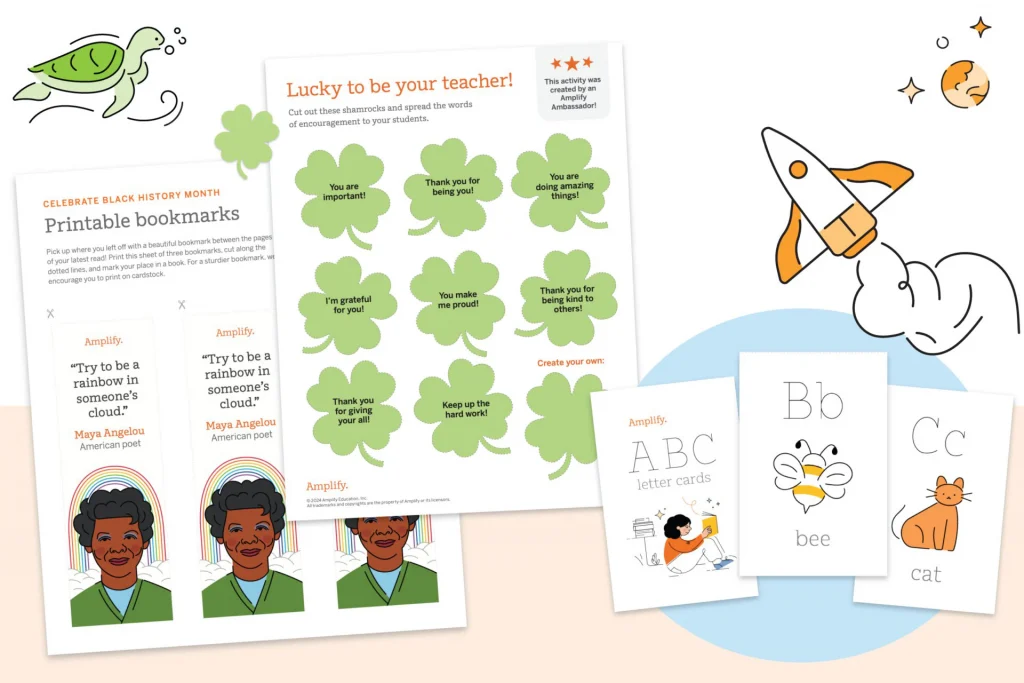
A diverse array of downloads: While we used to drop resources into our free downloads library one at a time, you can now access the whole library all at once! The get-to-know-you activities activities and name tags will help you build a connected classroom at the start of the year—and the seasonal, cultural, and program-specific offerings will help you plan out the rest. 

Product-specific guidance: Program-specific guidance: Our webinars, hosted by Amplify experts and tailored to each individual product, will help you level up your implementation and start the new year off right. Topics include Amplify Science, mCLASS® DIBELS® 8th Edition and mCLASS Lectura, Amplify CKLA and Caminos, Amplify ELA, Boost Reading, and Boost Lectura. Learn more and register here to access them on demand. 

A professional community, 24/7. Join our Facebook groups for peer engagement and weekly giveaways during the back-to-school season. Our groups include: Amplify CKLA, Amplify ELA, Amplify Science, and Boost Reading + mCLASS

Brand new podcast! Ana Torres knows firsthand how hard it is to be a teacher—that’s why, as the host of our new podcast Beyond My Years, she’s seeking out seasoned educators to share their stories and insights from inside the classroom. They’ll make you cry, make you laugh, and may even change the way you think about teaching. 

Log into your Amplify platform today to start preparing for the upcoming school year!