A curiosity-driven K–8 science curriculum

Amplify Science is a K–8 phenomena-based science curriculum that blends hands-on investigations, literacy-rich activities, and interactive digital tools. The result? Elementary and middle school students who think, read, write, and argue like real scientists.

Amplify Science for grades K–8 has been rated all green by EdReports.

Explore a unit
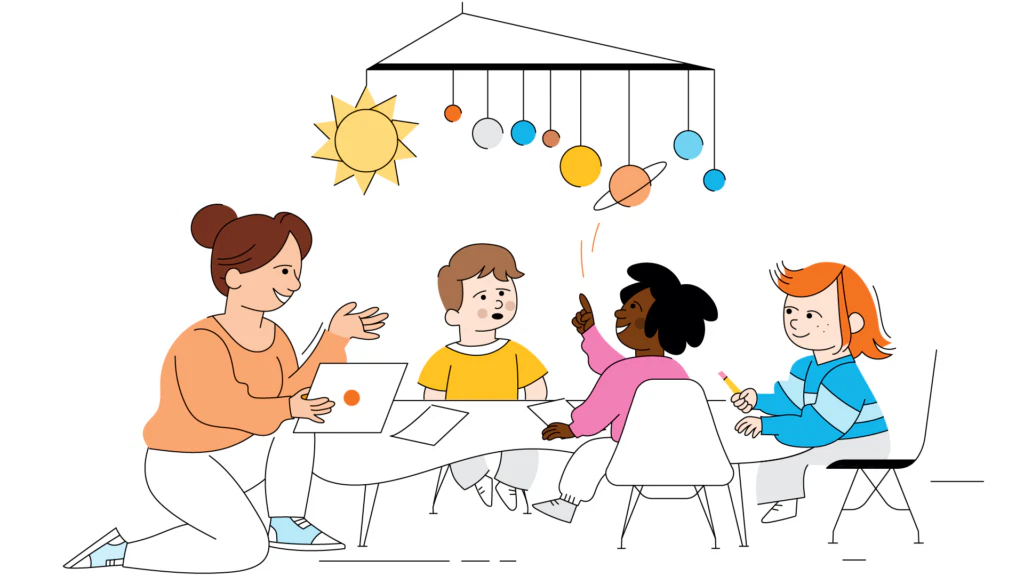
A teacher and three students explore a science tool in a classroom, highlighting the elementary school science curriculum, with icons of an avocado, Earth in space, and an EdReports Review Year 2023 badge.

Our approach

Each unit of Amplify Science engages all learners in a relevant, real-world problem where they assume the role of a scientist to investigate scientific phenomena, engage in collaboration and discussion, and develop models or explanations to arrive at solutions.

A research-backed approach to 3D learning

The research-based Do, Talk, Read, Write, Visualize instructional approach—developed by UC Berkeley’s Lawrence Hall of Science—provides students with multiple opportunities and modalities with which to access science instruction. Independent research proves that this model of learning benefits all learners, and our efficacy research shows improved student achievement.

Explore our research and success stories

Students take on roles of scientists and engineers.

In each unit, students take on the role of a scientist or engineer to investigate a realistic problem. These problems provide relevant contexts through which students investigate real-world phenomena that are seamlessly integrated throughout the unit. By positioning students as engineers or scientists, they are actively engaged in designing innovative solutions and making sense of the world around them.


EXPLORE OUR PHENOMENA AT GRADES K–5

EXPLORE OUR PHENOMENA AT GRADES 6–8

Two children wearing safety goggles conduct a science experiment, pouring liquid from one beaker into another over a blue tray on a table.
Two girls sit at a table smiling and playing with colorful modeling clay and clear containers against a light blue background.

Authentic 3D learning brought to life

Amplify Science integrates the NGSS—and state standards based on them—not just at a surface level, but throughout every lesson of the unit. Students engage with science and engineering practices, figure out disciplinary core ideas, and make connections when they apply Crosscutting Concepts across thoughtfully structured, multimodal lessons.

See it in action

Developed by science education experts

Amplify Science was developed by The Lawrence Hall of Science at UC Berkeley in partnership with Amplify. It reflects state-of-the-art practices in science teaching and learning, which lays the foundation for our high quality instructional materials (HQIM).

Children climb on a large DNA double helix sculpture outside The Lawrence Hall of Science, with the building and fountains visible in the background.

A flexible, blended program

Amplify Science includes hands-on activities, print materials, and powerful digital tools to support online and offline teaching and learning. Highly adaptable and user-friendly, the program gives schools and individual teachers flexibility based on their technology resources and preferences.

Explore the digital experience

Teach science confidently, with Amplify PD expertise.

Amplify professional development (PD) connects you with dedicated learning specialists who become genuine partners in your teaching journey. Our in-house experts work closely with your grade K–5 and 6–8 teams to understand your unique classroom needs and provide ongoing support that adapts as you grow. Choose from flexible sessions—on-site, virtual, or hybrid—to build teacher confidence, strengthen instruction, and keep student curiosity thriving—all backed by our commitment to your long-term success.

Children climb on a large DNA double helix sculpture outside The Lawrence Hall of Science, with the building and fountains visible in the background.

What’s included

Our flexible resources work seamlessly together.
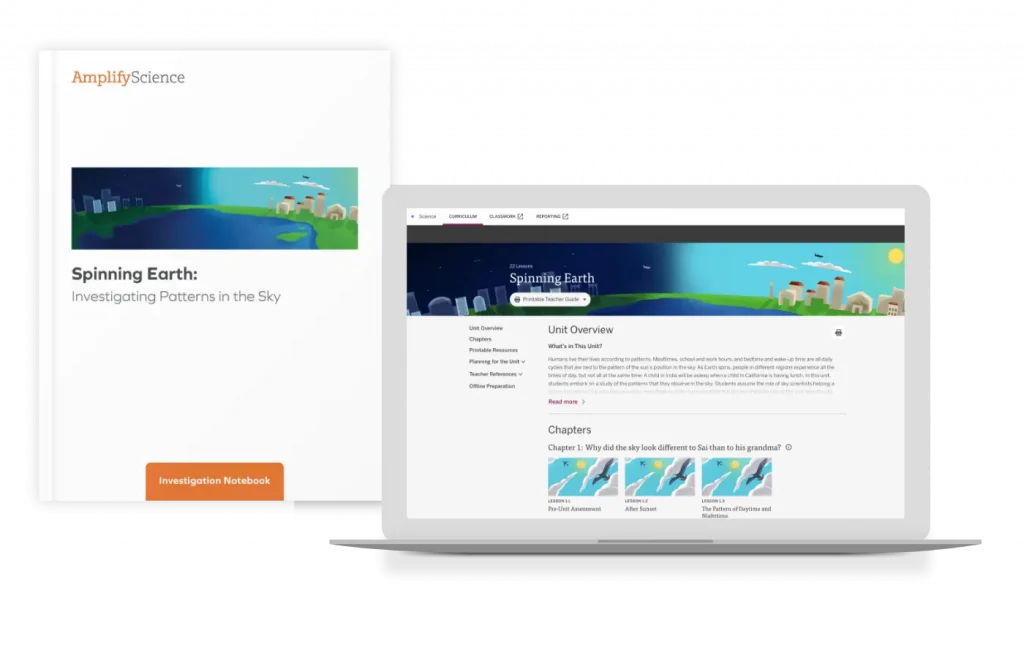
A middle school science textbook cover sits beside an open laptop displaying a digital unit overview for "Spinning Earth: Investigating Patterns in the Sky" from Amplify Science.

Teacher’s Guides

Available digitally and in print, the Teacher’s Guides contain all of the information teachers need to facilitate classroom instruction, including:

  • Detailed lesson plans.
  • Unit and chapter overview documentation.
  • Differentiation strategies.
  • Standards alignments.
  • In-context professional development.
Explore the world of middle school science with Amplify Science investigation notebooks, featuring captivating titles like "Balancing Forces: Investigating Floating Trains" and "Properties of Matter.

Student Investigation Notebooks

Available for every unit, the Student Investigation Notebooks provide space for students to:

  • Record data.
  • Reflect on ideas from texts and investigations.
  • Construct explanations and arguments.
Five educational science books with captivating covers explore fascinating topics like magnets, plants, biomimicry, and geological wonders. Perfect for middle school science enthusiasts, this series complements Amplify Science's engaging curriculum.

Student Books

Age-appropriate Student Books allow students to:

  • Engage with content-rich texts.
  • Obtain evidence.
  • Develop research and close-reading skills.
  • Construct arguments and explanations.
Explore the digital farming simulation interface, perfect for middle school science classes with Amplify Science integration. Watch plant growth stages, water flow graphics, and detailed soil analysis come to life on tablet and computer screens.

Simulations and Modeling Tools

Developed exclusively for the Amplify Science program, these engaging digital tools:

  • Serve as venues for exploration.
  • Enable data collection.
  • Allow students to explore scientific concepts.
  • Show what might be impossible to see with the naked eye.
Discover the wonders of Amplify Science with a pegboard, rubber bands, and a ball. Perfect for middle school science enthusiasts, this set also includes an electronic component with wires and clips, complemented by three containers filled with intriguing powders.

Hands-on materials kits

Hands-on learning is at the heart of Amplify Science. Each unit kit contains:

  • Consumable and non-consumable hands-on materials.
  • Print classroom display materials.
  • Premium print materials for student use (sorting cards, maps, etc.).
A laptop displaying an educational webpage titled "Geology on Mars" sits next to an "Investigation Notebook" graphic, perfect for Amplify Science lessons in middle school science.

Teacher’s Guides

Available digitally and in print, the Teacher’s Guides contain all of the information teachers need to facilitate classroom instruction, including:

  • Detailed lesson plans.
  • Unit and chapter overview documentation.
  • Differentiation strategies.
  • Standards alignments.
  • In-context professional development.
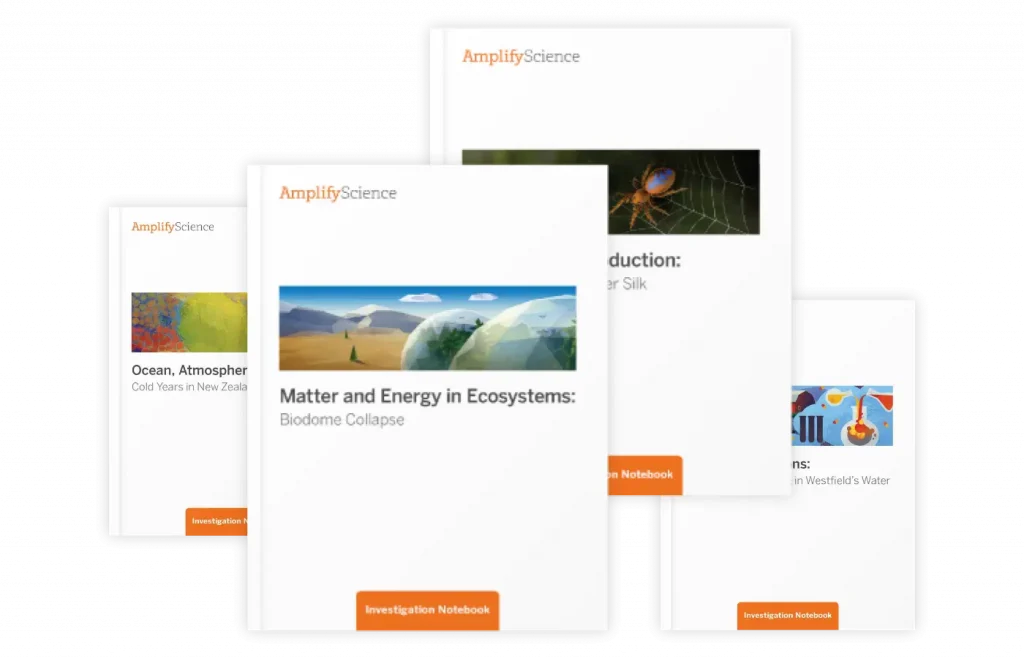
Five middle school science books from the Amplify Science series, including "Matter and Energy in Ecosystems" and "Introduction: From Silk." Each cover showcases unique images like landscapes and spiders, engaging young minds with captivating visuals.

Student Investigation Notebooks

Available for every unit, the Student Investigation Notebooks provide space for students to:

  • Record data.
  • Reflect on ideas from texts and investigations.
  • Construct explanations and arguments.

Available with full-color article compilations for middle school units

Discover the wonders of Amplify Science with a pegboard, rubber bands, and a ball. Perfect for middle school science enthusiasts, this set also includes an electronic component with wires and clips, complemented by three containers filled with intriguing powders.

Hands-on materials kits

Hands-on learning is at the heart of Amplify Science. Each unit kit contains:

  • Consumable and non-consumable hands-on materials.
  • Print classroom display materials.
  • Premium print materials for student use (sorting cards, maps, etc.).
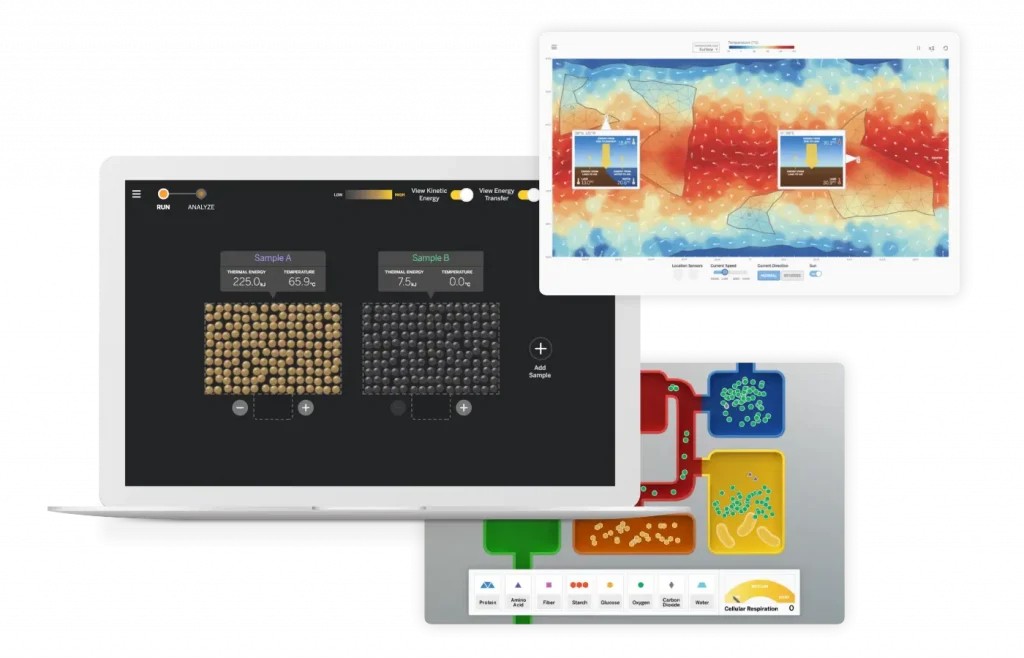
Three computer screens display data visualizations: two show charts with colored markers, and one shows percentages with color-coded grids. This setup provides an engaging way to explore middle school science concepts, making it easier for students to visually comprehend data.

Digital student experience

Students access the digital simulations and Modeling Tools, as well as lesson activities and assessments, through the digital student experience. Students can interact with the digital student experience as they:

  • Conduct hands-on investigations.
  • Engage in active reading and writing activities.
  • Participate in discussions.
  • Record observations.
  • Craft end-of-unit scientific arguments.
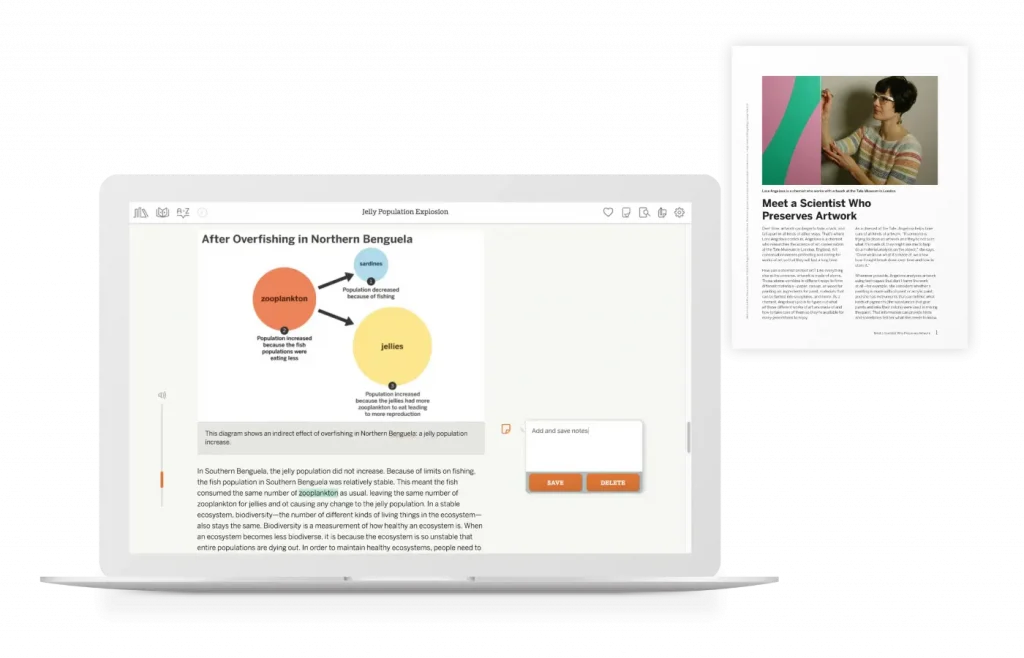
On a laptop screen, a chart titled "After Overfishing in Northern Benguela" showcases a three-circle Venn diagram, reminiscent of lessons from middle school science. In the background, a document featuring an individual in a lab coat and glasses adds to the scholarly scene, evoking elements of Amplify Science curriculum.

Science articles

The middle school science articles serve as sources for evidence collection and were authored by science and literacy experts at the Lawrence Hall of Science.

Ready to learn more?

Fill out this form and we’ll be in touch soon.

What educators say

“Just looking through the Amplify Science curriculum, I’m wishing I could go back in time and learn these concepts with these resources! I love that Amplify is more focused on diving deeper into fewer concepts over the year, rather than grazing the surface of more topics.”

Lizzie

Middle school teacher, KIPP charter network Hear from teachers

What educators say

“In using this program, I have seen that my students are completely engaged and are able to visualize models of concepts using the simulations that they otherwise would not be able to visualize. The program is not about rote memory of facts—rather, it addresses the bigger picture and assesses a deeper understanding of science concepts.”

Julie

Science teacher, Georgia Hear from teachers

What educators say

“The engineering units are engaging and really helped me better understand the new standards. I love being able to walk around and talk to students as they explore solutions, make claims, and reason with their peers.”

Karla

Science teacher, California Hear from teachers

Read more Amplify Science success stories.

Hear from teachers

Explore more programs.

Our programs are designed to support and complement one another. Learn more about our related programs.


Program pg template redesign -AI

To view this protected page, enter the password below:


LITERACY CHAMPIONS

The Science of Reading Star Awards

Making the shift to the Science of Reading is no small feat. Every day, educators like you are successfully improving student outcomes in schools and communities, and we’re eager to celebrate your accomplishments with the Science of Reading Star Awards.

We’re no longer accepting submissions for this year’s Star Awards cycle. See you next year!

A blue award plaque labeled "2026 Winner" is surrounded by colorful speech bubbles with a thumbs up and heart icon, decorative stars, and highlights achievements in the science of reading.

Get excited for the prizes!

Exceptional accomplishments deserve to be rewarded.

All award winners will receive:

  • Honorary Amplify Ambassadorship.
  • Amplification on our website and social media.
  • A Science of Reading starter library.
  • Enrollment in Science of Reading: The Learning Lab for each winner and a friend.
  • Tons of swag!

The grand prize winners in the District and School categories will receive access to an exclusive library of professional development resources. The grand prize winner in the Individual category will be given full conference registration and associated travel costs to The Annual Conference of The Reading League.

Recognizing leaders in education

Learning to read is nothing short of a transformation—and at the heart of this transformation are literacy educators harnessing the Science of Reading to ignite lifelong learning.

Science of Reading Star Award winners shine bright, going above and beyond to light the path for students nationwide. Be part of the celebration—help us recognize these heroes!

A woman with long dark hair, wearing a blazer and white top, smiles at the camera against a dark background, embodying confidence and expertise in the science of reading.
“Receiving this award is really an honor. It’s an amazing feeling to be recognized for work that I care so deeply about. At the same time I have to dedicate this award to the amazing educators that I work with, and the supportive administrators that we’ve had along the way.”

—Reena Mathew, Literacy Coach

Suffern Central School District, NY

An award category for everyone!

White icon of a school building with a clock on an orange, flag-shaped background, representing dedication to the science of reading.

District:
The District Captain

This award honors a district that exemplifies strong Science of Reading practices across the board.

A blue rectangular banner with a curled top-right corner displays a white book icon with horizontal lines, symbolizing the science of reading.

School:
The Literacy Legend

This award honors a school that has seen significant reading gains among their students school-wide when using the Science of Reading.

Yellow rectangular icon with a folded top-right corner and a white brain graphic in the center, representing the science of reading, set against a light gray background.

Individual:
The Background Knowledge Builder

This award is for showing the world that the Science of Reading empowers students with knowledge, context, and vocabulary from elementary through middle school.

A yellow, rectangular flag icon with a white graphic of a person wearing a helmet and holding a device, resembling an astronaut or robot—symbolizing exploration much like the science of reading uncovers new frontiers in literacy.

Individual:
The Changemaker

This award is for showcasing exemplary Science of Reading routines and practices, and serving as an inspiration to others on the journey.

An orange flag-shaped icon with a white pencil and ruler crossed in the center, symbolizing design or editing tools inspired by the science of reading.

Individual:
The Comprehension Champion

This award is for fostering deep understanding and critical thinking by expertly guiding students to make meaning from complex texts, ask thoughtful questions, and connect reading to their world and experiences.

A blue document icon with a white upward-trending line graph in the center, suggesting data analysis or statistics related to the science of reading.

Individual:
The Data Dynamo

This award is for expertly using data to drive instruction within an MTSS framework, identifying student needs with precision, and implementing targeted interventions that accelerate literacy growth for every learner.

Blue flag-shaped icon with two overlapping white speech bubbles in the center, representing communication or conversation, ideal for topics like the science of reading.

Individual:
The Language Luminary

This award is for outstanding success in developing the skills and strengths of emergent bilingual students and multilingual/English learners.

A yellow vertical banner with a white rocket icon in the center, a folded top-right corner, and subtle nods to the science of reading.

Individual:
The Science of Reading Rookie

This award is for a teacher in their first three years of teaching, already making strides with the Science of Reading.

An orange rectangular icon with a folded top-right corner, featuring a white fountain pen nib symbol in the center, representing tools used in the science of reading.

Individual:
The Writing Whiz

This award is for integrating writing instruction with the Science of Reading, cultivating articulate and confident writers through innovative and effective practices.

A person with wavy, shoulder-length blonde hair smiles at the camera outdoors, wearing a black top, black jacket, and a round pendant necklace. Greenery is blurred in the background, hinting at a relaxed moment away from studying the science of reading.
“I’ve been teaching for 17 years, so getting this award after starting to integrate the Science of Reading really validated what I was doing, solidified it in my classroom, and made me realize that I was doing the right thing after all.”

—Jennifer Dove, Grade 3 Teacher

Rockingham County, Virginia

Submit a nomination to the Science of Reading Star Awards!

Entry is quick and simple—just provide the required information and an overview of the nominee you think deserves recognition.

  • You may submit multiple entries, but please nominate for only one category at a time.
  • Your submission can include an overview of the educator, school, or district’s journey with the Science of Reading; how they overcame challenges; how they are empowering their students with the Science of Reading; how they implemented strong Science of Reading practices; and/or what results they are seeing.
  • The more specific you can be in your submission, the better! If data is a big part of your story, we’d love to hear about it.
  • As part of your entry, you agree to allow us to contact you about the details of your application.
  • A member of the team will be in contact by March 2026 if you are short-listed as a finalist.