The power of high-quality instructional materials for K–8 science

A teacher helps two young students with a classroom activity involving small craft sticks at a table, demonstrating how to teach reading comprehension using engaging hands-on methods ideal for k-5 reading comprehension.

Simply put, quality teaching means quality learning. But there is another key part of the equation: quality curriculum.

Research confirms that the instructional materials used in classrooms play a powerful role in shaping how teachers teach, and how students learn.

Shifting from low-quality or pieced-together materials to well-designed, high-quality instructional materials can significantly improve student achievement. This growing evidence—sometimes described as “the curriculum effect”—is one reason that states and districts across the country are paying closer attention to the quality of the materials they adopt.

So what does high-quality instructional materials actually mean? And what does it look like in a real science classroom?

What does HQIM mean in science education?

High-quality instructional materials (often called HQIM) are curriculum materials intentionally designed to support student learning: aligned to rigorous standards, grounded in research, and built to support teachers.

High-quality instructional materials work alongside teachers, shaping instructional practices in ways that reduce guesswork, support consistency, and free up time and energy. This lets teachers do what they do best: interact with students. HQIM provide a coherent system that supports both teaching and learning over time.

And high-quality science curriculum materials go the extra mile, clearly articulating learning goals, providing guidance for facilitation and discussion, and including embedded opportunities to check for understanding. They also support a range of learners by offering scaffolds, differentiation strategies, and multiple ways for students to engage with content.

How HQIM align with NGSS science standards

The Next Generation Science Standards (NGSS) define what students should know and be able to do in science. At their core, these academic standards emphasize three-dimensional learning, integrating science practices, core ideas, and crosscutting concepts.

In science, HQIM are designed for three-dimensional learning: where students don’t just learn about science, but actively figure out how the natural world works. Three-dimensional learning integrates:

  • Science and engineering practices (what scientists do).
  • Disciplinary core ideas (what scientists know).
  • Crosscutting concepts (how scientific ideas connect).

HQIM are designed from the ground up to weave these dimensions together, rather than adding them on as an afterthought. That coherence helps students build understanding over time, and helps teachers see how each lesson fits into a larger learning story.

What do HQIM look like in a science classroom?

One of the best ways to recognize high-quality instructional content is to look not only at the materials, but also at the students using them.

Instead of memorizing disconnected facts, students taught with HQIM are engaged in the kinds of practices scientists use every day.

In classrooms using HQIM for science, you’ll often see students:

  • Investigating real-world phenomena that spark curiosity.
  • Asking questions, analyzing data, and building explanations.
  • Using evidence from multiple sources—texts, simulations, discussions, and investigations.
  • Revisiting ideas over time to deepen understanding.

“It is so encouraging to hear students engaged in conversation and building their ideas off of one another,” says classroom teacher Sarah Loessl of Big Hollow School District 38 in Illinois. “Students finding the confidence to challenge one another and use evidence to support their thinking is so much fun to watch.”

How HQIM support teachers

A key feature of high-quality instructional materials is that they’re designed by teachers, with teachers in mind.

This means materials that:

  • Clearly articulate learning goals.
  • Provide guidance for facilitation and discussion.
  • Include embedded formative assessment opportunities.
  • Support a range of learners, including multilingual/English learners and students who need additional scaffolds or challenges.

When materials shoulder this heavy lifting, teachers can spend less time creating from scratch and more time engaging with students.

How can teachers start engaging with HQIM?

Even if curriculum adoption decisions happen at the district level, teachers play a critical role in bringing HQIM to life.

Getting familiar with high-quality instructional materials can start with questions like:

  • What are students expected to figure out in this lesson?
  • How does this activity connect to a larger phenomenon or question?
  • Where are students using evidence to explain their thinking?
  • How does the curriculum support discussion, sense-making, and revision of ideas?

Developing a shared understanding of what high-quality science instruction looks like helps everyone—teachers, coaches, and leaders—move in the same direction.

Where does Amplify Science fit in?

Amplify Science is an example of high-quality instructional materials designed specifically for K–8 science and aligned to NGSS science standards.

It’s built around phenomena-based, three-dimensional learning and developed with educators, researchers, and scientists to support both student learning and teacher practice. The goal is coherence, engagement, and understanding that grows over time.

Ready to learn more?

To support educators and leaders in building a shared understanding of HQIM, we’ve created a free science HQIM resource bundle, including:

  • A classroom look-fors checklist.
  • A three-dimensional learning explainer.
  • An NGSS alignment overview.
  • A closer look at the HQIM student experience.
  • Registration for two upcoming webinars focused on HQIM in science.

Whether you’re new to the concept or ready to deepen your practice, these resources are designed to make high-quality instructional materials highly understandable and accessible to all.

Explore the HQIM bundle and upcoming webinars to learn more.

Other publishers say they have “Desmos.” What’s the difference between what Amplify has and what they have?

Logo with the word "Amplify" in orange font and "desmos" in gray font, separated by a vertical line on a light background, perfect for teacher awards or to nominate a teacher for an award in early literacy.

If you’ve been in the math world for a while, you know the name Desmos. It’s synonymous with free dynamic math tools.

And lately, you’ve probably also been hearing about Amplify and Desmos together. But other publishers also say they have Desmos, so what’s the deal?

Let’s clear it up.

The most important thing to know is that, back in 2022, the original Desmos split into two separate parts. Think of them like a calculators and other tools part and a classroom activities and curriculum part.

The tools part: Desmos Studio

This is the Desmos you first fell in love with.

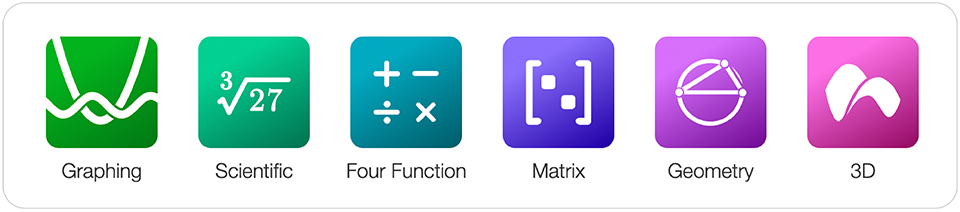
What it is: Desmos Studio is the name of the company that builds and maintains the powerful, free Desmos calculators. This is an independent Public Benefit Corporation, and can be found at www.desmos.com. That team builds and maintains a collection of free math tools:

Six colorful icons represent types of calculators—Graphing, Scientific, Four Function, Matrix, Geometry, and 3D—each featuring a distinct mathematical symbol. Perfect for desmos math enthusiasts and edtech companies alike.

What it’s for: This is your go-to for exploration, demonstrations, and “What if I change this?” moments. It’s the blank canvas you use on your smartboard or the tool your students use for homework.

The bottom line: The calculators are run by an independent company called Desmos Studio PBC. You can find their tools for free at their website, desmos.com; on state tests; and in curriculum programs (including ours).

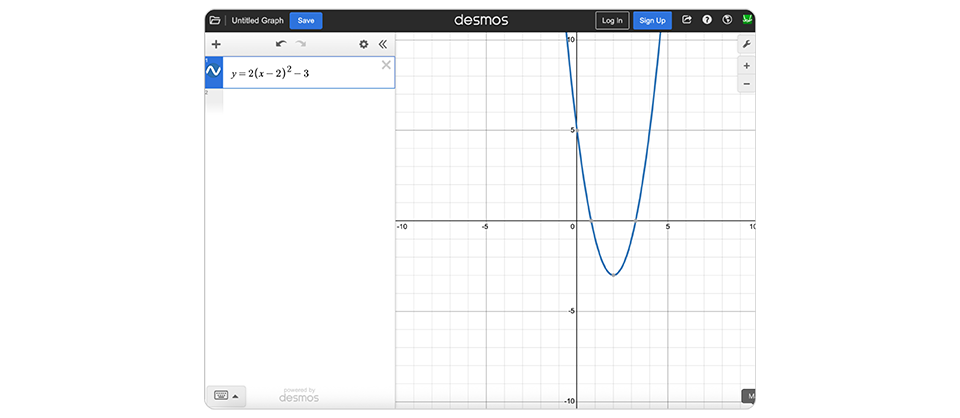
A Desmos graphing calculator displays the quadratic function y = 2x^2 - 3, showing a parabola opening upwards with its vertex at (0, -3)—a great example of how edtech companies like Desmos Math enhance classroom learning.

The lessons: Amplify Classroom & Amplify Desmos Math

What it is: In 2023, Amplify acquired the Desmos instructional platform (then called Desmos Classroom, now called Amplify Classroom) as well as their math curriculum for grades 6–8 and the teams that built those resources. We had already been working on our own math curriculum, decided to combine forces with the Desmos curriculum team, and created Amplify Desmos Math, now available for grades K–12.

When other publishers may talk about having “Desmos,” what they mean is they license the calculators and Geometry tool from Desmos Studio.

What it’s for: Amplify has these tools, too, but we also have the Activity Builder, which integrates these tools much more deeply than is possible with other Desmos Studio partnerships. We take this powerful Desmos technology and layer instruction, student collaboration, and dynamic teaching tools on top, creating classrooms that buzz with excitement and learning.

What’s available for free:

  • The “Desmos activities” platform (you might know it from teacher.desmos.com), now Amplify Classroom. This is where you can find hundreds of free lessons and activities. You can also use the Activity Builder tool to create your own custom activities from scratch.
  • The beloved, pre-built “Activity Builder” activities like “Marbleslides” and more are still available for free on Amplify Classroom.

The bottom line: Educators can still use the vast library of free activities and build their own on Amplify Classroom. This is not changing.

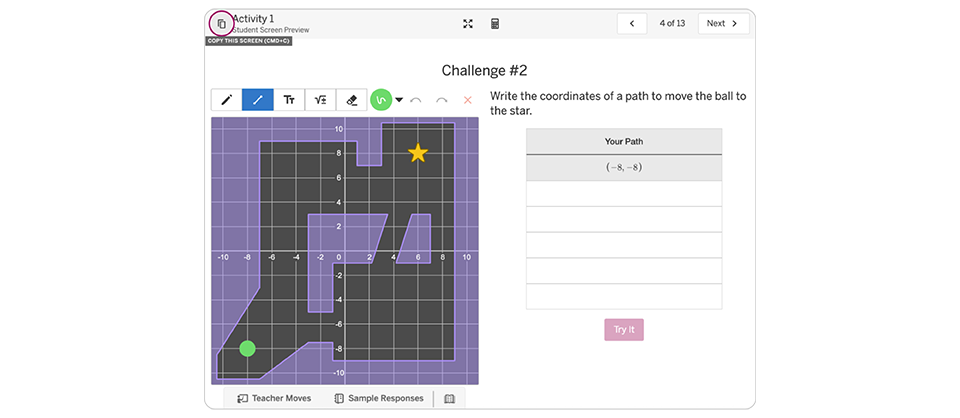
A grid-based puzzle inspired by Desmos Math, where you guide a green ball to a yellow star by entering coordinates in the answer box, offers an engaging approach popular among edtech companies.

The core curriculum: Amplify Desmos Math

This is the new, comprehensive curriculum available to districts and schools.

What it is: This is a full core math curriculum for grades K–12 that Amplify has built in collaboration with the Desmos curriculum team that joined us a few years ago. It uses the Desmos instructional philosophy and tools as its backbone, but it’s much more than a collection of activities.

What it’s for: This program is designed to be your primary, day-to-day curriculum. It includes a complete, standards-aligned scope and sequence, print materials, digital lessons (with activities enhanced and aligned to standards), assessments, intervention resources, and personalized practice.

The bottom line: If you want a complete curriculum in which every lesson is built on polished Desmos-style activities, you want Amplify Desmos Math K–12. This core curriculum is offered exclusively by Amplify.

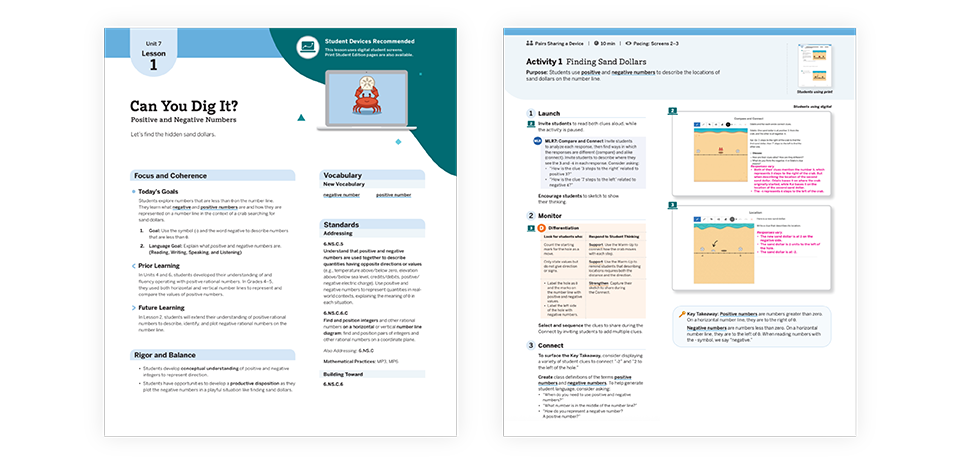
Two-page educational lesson plan titled "Can You Dig It?" covering positive and negative numbers, with objectives, vocabulary, standards, and a step-by-step activity inspired by the Desmos math curriculum.

Quick-reference chart

What is it?Where to find it?Cost
Desmos Studio ToolsPowerful math tools and calculators (graphing, scientific, etc.) for graphing, calculations, and geometry visualizations.
Access via desmos.com or embedded in partner productsFree
for individual use
Amplify ClassroomA teaching and learning platform that couples Desmos Studio tools with instruction and collaboration tools

– Rich activities and lessons that develop understanding with Responsive Feedback

– Collaboration and facilitation tools designed for the classroom

– Student ideas used to build new problems and scenarios

Browse free activities and lessons or build your own with Activity Builder.
Only available from Amplify at amplify.com/classroom
(previously Desmos Classroom)
Free
Amplify Desmos MathA comprehensive K–12 math curriculum built on the Amplify Classroom platform

– Ready-to-teach print and digital curriculum built on the Amplify Classroom platform

– Comprehensive coverage of all standards without the searching.

– Additional support for your classroom, including assessment, differentiation, practice, professional development, and more.
Try lessons for free on Amplify Classroom

Contact us for more information on purchasing for your district
With a paid subscription

Introducing Amplify Classroom

Screenshot of the Amplify Classroom Discover page displaying subject filters, grade levels, a search bar, and a list of educational activities with descriptions and tags to support family engagement.

Feeling crunched for lesson-planning time? You’re not imagining it. A recent EdSurge report found that teachers get, on average, just 266 minutes of dedicated planning time a week—under an hour a day. And that’s before the meetings, paperwork, and “Got a minute?” queries start rolling in.

When teachers have so little space to craft high-quality interactive lessons, any tool that streamlines planning or teaching can make a huge difference.

Enter Amplify Classroom (formerly Desmos Classroom), launched for the 2025–26 school year and available for free! Already used by more than 300,000 teachers, this all-in-one platform brings together free resources for K–12 students; teacher guides and real-time teaching tools; and interactive lessons across math, literacy, and science—helping educators focus less on logistics and lesson plans and more on student engagement.

Interactive lessons that stick

Amplify Classroom’s free teaching resources go far beyond static worksheets or “entertaining” electronics. The platform’s library of more than 1,000 lessons features a wide range of free K–12 resources, including K–5 activities, middle school science explorations, and high school math challenges. Highlights include:

  • A grade 1 math activity called Leaping Lily Pads!, in which students help a purple frog hop toward a golden crown while making connections between subtracting 1 and subtracting 2—and practicing subtracting 2 and adding 2.
  • A grade 4 science activity called Food Chains, in which students create their own sequences of organisms, then line up those organisms to model how energy flows through an ecosystem, tracing that energy from start to finish.
  • Literacy practice that explores how the letter “y” sounds in words like myth.
  • Classic Desmos math challenges, like balancing raccoons on a seesaw against a 21-pound weight.
  • Hands-on Polypad manipulatives that let students experiment with tangrams, grids, and colorful geometric shapes.

These types of activities are not just engaging in the moment. They can also set the stage for lifelong math enjoyment. “I’ve been wary about making my kids not hate math,” says kindergarten teacher Martin Joyce. “No ‘drill-n-kill.’ [Now] they’re asking if they can do math on the computer before bed!”

What you can do with these free resources

Once you create a free teacher account, you can:

  • Teach more than 1,000 free interactive lessons across math, literacy, and science.
  • Customize any premade lesson or build your own with the drag-and-drop editor.
  • Monitor student thinking in real time with intuitive dashboards.
  • Share snapshots of student work—names optional—to prompt discussion and highlight ideas.
  • Control the pacing of lessons, pausing to dive deeper into a concept or syncing everyone to the same spot.

Here’s how it works in practice:

  1. Find a lesson. Browse by subject, grade level, or topic until you land on one that fits your plan for the day.
  2. Share it with your class. Assign the activity so students can join from their own devices.
  3. Teach and adapt in the moment. Use the dashboard to see student thinking in real time, highlight responses, and pace the lesson as you go.

Grade 5 teacher Traci Jackson saw how these K–5 activities boosted collaboration and learning in her class: “After an audible groan when the activity was paused, students made sense of ordered pairs through a purposeful Amplify Classroom experience. One student pair wrote without any prompting!”

More to explore

  • Explore Amplify Classroom, the free platform for grades K–12.
  • Learn how Amplify Classroom is supporting teachers across math, literacy, and science.
  • Find free professional learning resources for educators and free activities for students in our Problem-Based Learning Starter Pack.