Welcome Reviewers, to Amplify Desmos Math!
Amplify Desmos Math thoughtfully combines conceptual understanding, procedural fluency, and application. Each lesson is designed to tell a story by posing problems that invite a variety of approaches before guiding students to synthesize their understanding of the learning goals.
Scroll to learn more about the program and explore sample materials.
About the program
We believe in math that motivates. Our structured approach to problem-based learning builds on students’ curiosity to develop lasting grade-level understandings for all students.
The program thoughtfully combines conceptual understanding, fluency, and application, motivating students with interesting problems they are eager to solve. Teachers can spend more time where it’s most impactful: creating a collaborative classroom of learners.
A powerful suite of math resources
Amplify Desmos Math combines the best of problem-based lessons, intervention, personalized practice, and assessments into a coherent and engaging experience for both students and teachers.

Screening and progress monitoring
mCLASS® Assessments, along with daily formative checks, measure not only what students know, but also how they think. The asset-based assessment system provides teachers with targeted, actionable insights, linked to core instruction and intervention resources.
Core instruction
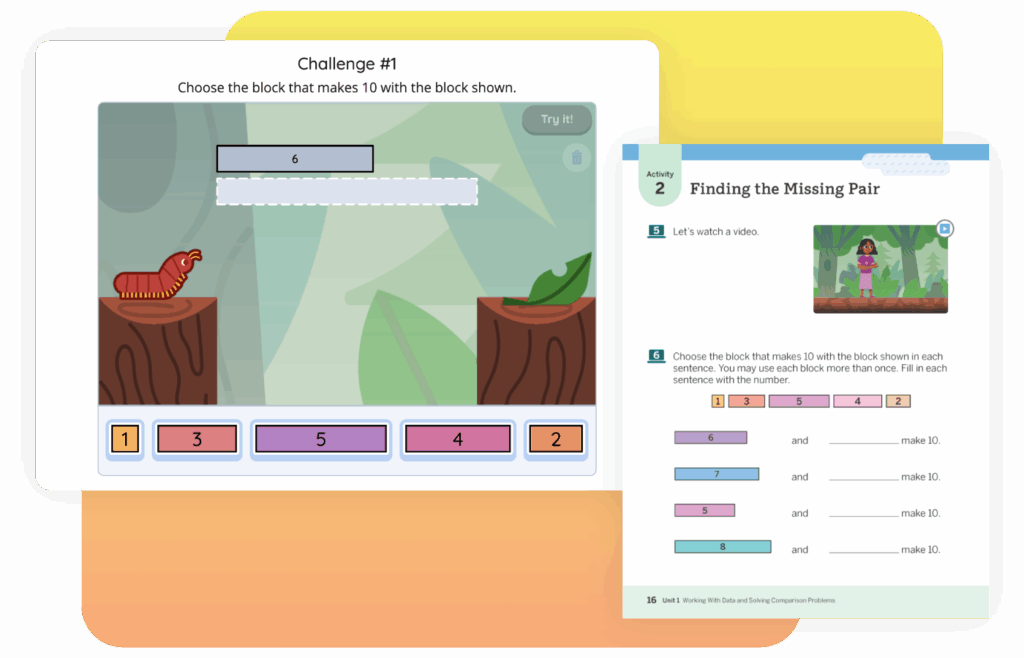
Amplify Desmos Math lessons provide a structured approach to problem-based learning, helping teachers create a collaborative math community with students at its center. Each lesson systematically builds on students’ curiosity to develop lasting grade-level understandings for all students.
Differentiation and intervention
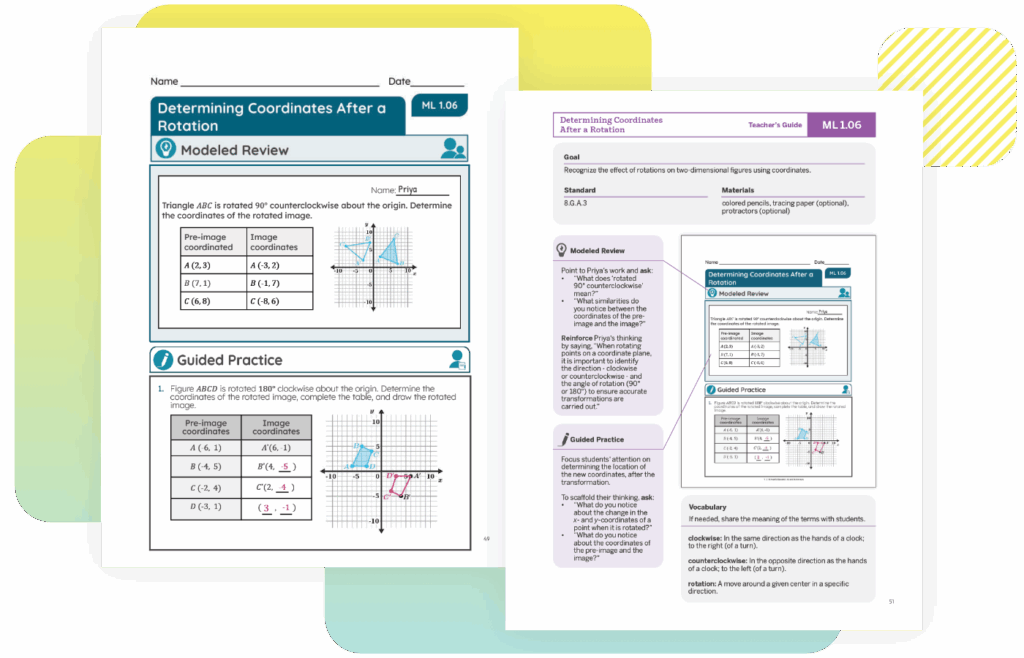
Integrated resources like Mini-Lessons, Fluency Practice, and Math Adventures provide targeted intervention on a specific concept or skill connected to daily instruction. Extensions are also available to stretch students’ understanding.
Boost™ Personalized Learning activities help students access grade-level math through engaging, independent digital practice. Responsive Feedback™ adjusts to students’ work, providing item-level adaptivity to further support their learning.
An approach that supports teachers
Clear, step-by-step instructional moves help teachers plan and teach student-centered lessons that use student thinking to differentiate instruction and guide to grade-level understanding. They include:
- Guidance on what to listen for and how to respond.
- Clear learning objectives to keep learning on track for each activity and lesson.
- Daily reinforcement activities to provide direct instruction when needed.
A structured approach to problem-based learning
Problem-based learning asks students to make sense of and think strategically about mathematically interesting problems. This approach allows students’ ideas to take
center stage, so they are active and engaged in their learning process. Teachers are able to hear and respond to student thinking in real time, guiding and differentiating instruction right in the moment.
Moving from “I do, We do, You do” to “You do, We do, I do”
Lessons begin by activating student’s prior knowledge and curiosity, inviting them to explore the math, collaborate, and refine their thinking. By focusing on developing student thinking first, teachers can better connect ideas, guide learning, and synthesize learning objectives.
Lessons that are rigorous and delightful
Every lesson in Amplify Desmos Math is designed to put students at the center of their learning. Utilizing research-based best practices, students engage in meaningful work based on rich problems and real-world experiences.
Warm-Up
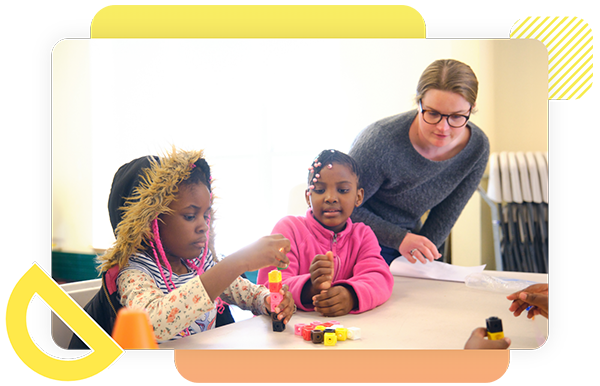
Lessons begin by inviting every student to contribute to the mathematical discussion. Instructional routines are often used to build fluency, set the context, activate prior knowledge, or highlight a strategy that may be helpful in the lesson.
Rich learning activities
Math knowledge is built through experiences and meaningful interactions. Students notice, wonder, explore, calculate, predict, measure, explain their thinking, use math to settle disputes, create challenges for their classmates, and more. Teachers serve as a guide, using a Launch, Monitor, Connect framework:
- Launch: Teachers offer a short introduction to the problem or challenge
- Monitor: As students work individually, in pairs, or in groups, teachers ask questions and provide support to move student thinking closer to the intended math goal.
- Connect: Teachers connect student ideas to the Key Takeaway of the activity to help students synthesize and solidify the big ideas.
Synthesis
Teachers ensure that students end the lesson with accurate and enduring understandings of the math goal through synthesis of student ideas, explicit instruction, and reflection.
A short Show What You Know assessment allows students to show what they know about the learning goals of the lesson and reveal what they are still learning.
Differentiation and practice
Lasting understanding requires reinforcement. Every lesson offers Lesson Practice instructional recommendations to Support, Strengthen, and Stretch learning.
Print for every lesson with engaging digital experiences
Whether in print or digital form, engaging interactions enable students and teachers to openly exchange ideas. Each lesson includes student print materials, interactive teacher Presentation Screens, and digital resources for practice and differentiation. Some lessons also use manipulatives or provide options for students to use devices individually or in pairs. Device recommendations for student use are age-appropriate, with more frequent usage in middle and high school.
Demo access
Please login to the digital platform to experience our full program as part of your review. In order to access the digital platform, you’ll need to log into using your unique login credentials below.
- Click the orange button below to access the platform.
- Click “Log in with Amplify.”
- Enter the username and password:
- Username:
- Password:
- View the video for helpful platform navigation tips.
Assessments
By starting with what students already know, Amplify Desmos Math helps build a strong foundation for success to guide and support future learning. Teachers are empowered to transform every classroom into an engaged math community that invites, values, and develops student thinking. With explicit guidance on what to look for and how to respond, teachers can effectively support students as they develop their understanding.
Program assessments
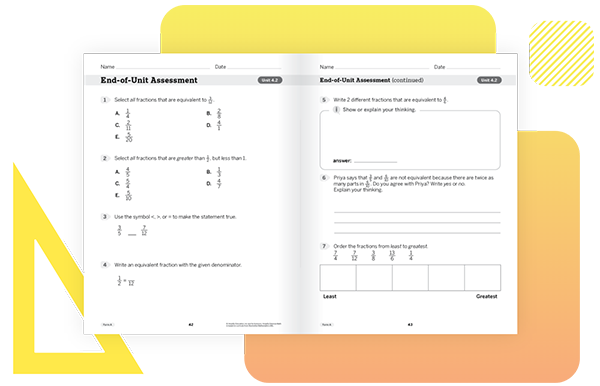
A variety of performance data in Amplify Desmos Math provides evidence of student learning while helping students bolster their skills and understanding.
Unit-Level Assessments
Our embedded unit assessments offer key insights into students’ conceptual understanding of math. These assessments provide regular, actionable information about how students are thinking about and processing math, with both auto-scoring and in-depth rubrics that help teachers anticipate and respond to students’ learning needs.
Lesson-Level Assessments
Amplify Desmos Math lessons are centered around sense-making and in-the-moment feedback. Daily moments of assessment provide valuable evidence of learning for both the teacher and student.
Data and reporting
Amplify Desmos Math provides teachers and administrators with unified reporting and insights so that educators have visibility into what students know about grade-level math—and can plan instruction accordingly for the whole class, small groups, and individual students.

Assessment reports
Reporting functionality integrates unit assessments, lesson assessments, personalized learning, Benchmark assessments, and Progress Monitoring for a comprehensive look at student learning.
Our reports show proficiency and growth by domain, cluster, standard, and priority concept using performance data from unit assessments. Then our reports highlight areas of potential student need to allow teachers to modify their instruction and target differentiated support.
At-a-glance views of unit-level assessment results inform your instructional planning, and you can also drill down to item-level analysis.
Standards reports
Our standards report allows you to monitor proficiency at the class and individual student levels. Proficiency and growth are shown by domain, cluster, standard, and priority concepts. Areas of potential student need are highlighted to allow teachers to modify their instruction and target differentiated support.
Administrator reports
Amplify Desmos Math provides a complete picture of student, class, and district performance, allowing administrators to implement instructional and intervention plans.
- Track student, class, and district performance with usage, completion, and assessment data.
- Accurately group students and classes with the Benchmark and Progress Monitoring data of mCLASS Assessments and allow teachers to reliably implement and track the progress of Tier 2 and Tier 3 intervention.
- Provide one data-driven solution that educators can rely on for high-quality math instruction.
Differentiation and intervention
Amplify Desmos Math views differentiation as an ongoing process where teachers are both reactive and proactive to student needs, ensuring that all students have clear pathways to proficiency. Through rich data and teacher support, Amplify Desmos Math uses flexible categories of intervention and enrichment that adjust daily according to student thinking.
In-the-moment differentiation supports are available for every lesson, both digitally and in the print Teacher Edition.

In-lesson differentiation
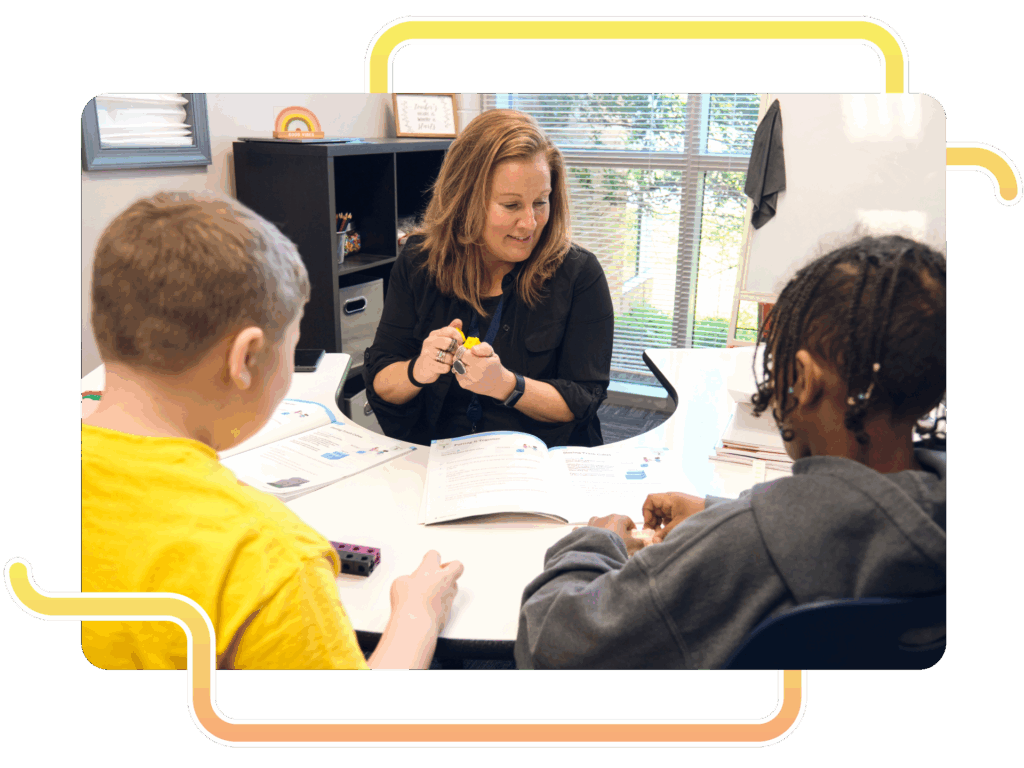
Within every lesson activity, teachers can use the suggestions in the Differentiation Teacher Moves table to provide in-the-moment instructional support while students are engaged in the work of the lesson. This table can help teachers anticipate the ways students may approach the activity, and provides prompts that they can use during the lesson to Support, Strengthen, and Stretch individual students in their thinking. Teachers are provided with clear student actions and understanding to look for, each matched with immediately usable suggestions for how to respond to the student thinking illustrated in each row of the table. In addition to using these suggestions in the moment as teachers monitor student work, teachers can review the Differentiation table in advance to help them anticipate how students are likely to approach the activity.
Differentiation: Beyond the Lesson
Teachers are provided with recommendations for resources to use with each group of students needing support, strengthening, and stretching after each lesson. Support, Strengthen, and Stretch resources include:
- Mini-Lessons: 15-minute, small-group direct instruction lessons targeted to a specific concept or skill
- Item Banks: Space for teachers to create practice and assessments by using filters and searching for standards, summative-style items, and more
- Fluency Practice: Adaptive, personalized practice built out for basic operations and more
- Centers (K–5): Lesson-embedded routines and practice for students that are vertically aligned across grade levels
- Extensions: Lesson-embedded Teacher Moves including possible stretch questions and activities for students
- Lesson Practice: Additional practice problems support every lesson
- Math Adventures: Strategy-based math games where students engage with math concepts and practice skills in a fun digital environment


Multilingual/English Learner supports
Supports for multilingual/English learners (ML/ELs) are called out at intentiSupports for multilingual/English learners (ML/ELs) are called out at intentional points within each lesson. These suggested supports are specific, targeted actions that are beneficial for ML/ELs. They often describe a modification to increase access to the task or provide support with contextual or mathematical language development that can often be helpful to all learners. ML/EL supports may also be attached to Math Language Routines.onal points within each lesson. These suggested supports are specific, targeted actions that are beneficial for ML/ELs. They often describe a modification to increase access to the task or provide support with contextual or mathematical language development that can often be helpful to all learners. ML/EL supports may also be attached to Math Language Routines.
Math Language Development
Every lesson in Amplify Desmos Math includes opportunities for all students to develop mathematical language as they experience the content. Amplify Desmos Math purposefully progresses language development from lesson to lesson and across units by supporting students in making their arguments and explanations stronger, clearer, and more precise. This systematic approach to the development of math language can be broken down into the following four categories of support:
- Vocabulary: Units and lessons start by surfacing students’ language for new concepts, then building connections between their language and the new vocabulary for that unit.
- Language goals: Language goals attend to the mathematics students are learning, and are written through the lens of one or more of four language modalities: reading, writing, speaking, and listening.
- Math Language Routines: Math Language Routines are used within lessons to highlight student-developed language and ideas, cultivate conversation, support mathematical sense-making, and promote meta-cognition.
- Multilingual/English learner supports: Supports for multilingual/English learners (ML/ELs) are called out at intentional points within each lesson.

K-5 sample materials
Click the links in the drop-down sections below to explore sample materials from each grade. For a full program review, please login to the digital platform or request physical samples.
For helpful navigation tips and more program information, download the Amplify Desmos Math Program Guide.
You can also watch a product expert walk through a lesson and the available program components.
Teacher Edition
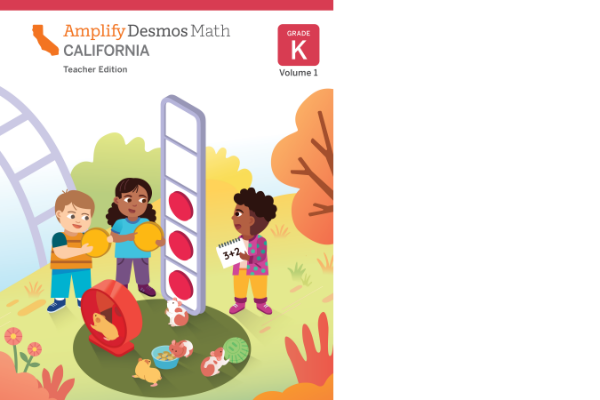
Planning and instructional guidance is visual, organized, and easy-to-follow. To help you preview the program, we have included samples from a complete sub-unit on this site: Unit 2, Sub-Unit 2: Counting and Comparing Images.

Student Edition
Motivate students with mathematics that is both rigorous and delightful. To help you preview the program, we have included samples from a complete sub-unit on this site: Unit 2, Sub-Unit 2: Counting and Comparing Images.

Ancillary sampler
Included in the ancillary sampler are examples from the program Assessment Resources, Intervention and Extension Resources, Centers Resources, Additional Practice, and Math Language Development Resources.

Featured digital lesson: Forest Friends
In this lesson, students apply their understanding of how to compare groups of images as they determine which group has more or fewer and then compare their strategies by guiding a bear through a path that has more mushrooms than the other.

Skills Unit 2 Teacher Guide
Planning and instructional guidance is visual, organized, and easy-to-follow. To help you preview the program, we have included samples from a complete sub-unit on this site: Unit 1, Sub-Unit 1: Adding and Subtracting Within 10.

Student Edition
Motivate students with mathematics that is both rigorous and delightful. To help you preview the program, we have included samples from a complete sub-unit on this site: Unit 1, Sub-Unit 1: Adding and Subtracting Within 10.

Ancillary sampler
Included in the ancillary sampler are examples from the program Assessment Resources, Intervention and Extension Resources, Centers Resources, Additional Practice, and Math Language Development Resources.

Featured digital lesson: Leaping Lily Pads!
In this lesson, students find differences when subtracting 1 and 2 from the same number by helping a frog reach a lily pad where it can eat a bug.
Teacher Edition
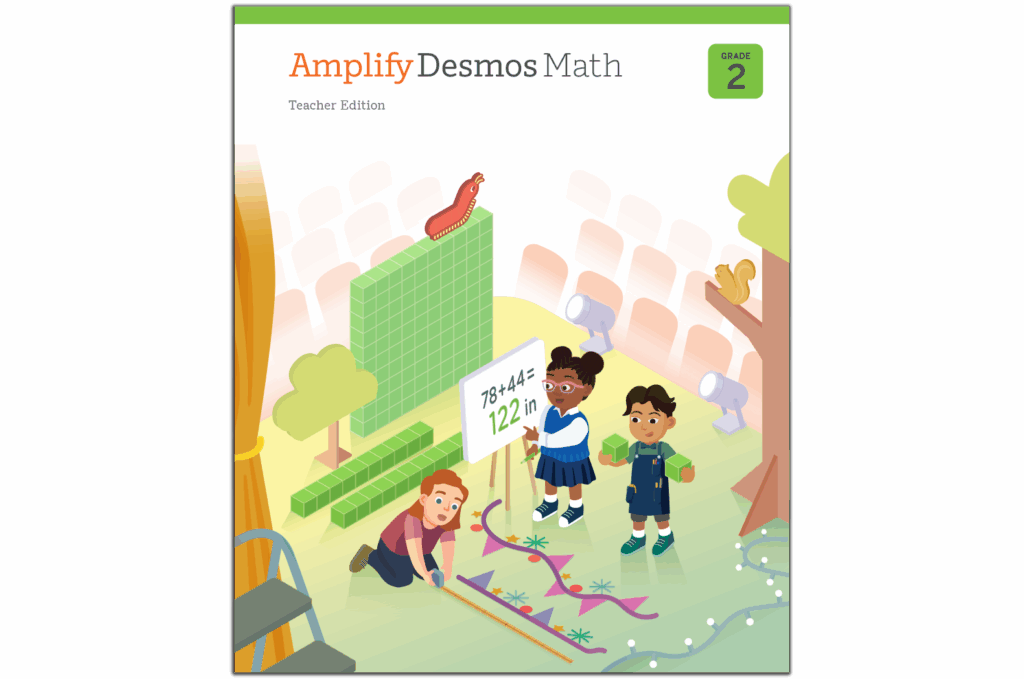
Planning and instructional guidance is visual, organized, and easy-to-follow. To help you review the program, we have included samples from a complete sub-unit on this site: Unit 1, Sub-Unit 1: Adding and Subtracting.

Student Edition
Motivate students with mathematics that is both rigorous and delightful. To help you preview the program, we have included samples from a complete sub-unit on this site: Unit 1, Sub-Unit 1: Adding and Subtracting.

Ancillary sampler
Included in the ancillary sampler are examples from the program Assessment Resources, Intervention and Extension Resources, Centers Resources, Additional Practice, and Math Language Development Resources.

Featured digital lesson: Ways to Make 10
Students continue to develop fluency by finding the number that makes 10 by helping a millipede reach its favorite food – a clump of leaves!

Teacher Edition
Planning and instructional guidance is visual, organized, and easy-to-follow. To help you review the program, we have included samples from a complete sub-unit on this site: Unit 1, Sub-Unit 3: Data on Scaled Graphs.

Student Edition
Motivate students with mathematics that is both rigorous and delightful. To help you preview the program, we have included samples from a complete sub-unit on this site: Unit 1, Sub-Unit 3: Data on Scaled Graphs.

Ancillary sampler
Included in the ancillary sampler are examples from the program Assessment Resources, Intervention and Extension Resources, Centers Resources, Additional Practice, and Math Language Development Resources.

Featured digital lesson: Puppy Pile
Students compare data represented on bar graphs with different scales by using animal stickers to create scaled bar graphs.

Teacher Edition
Planning and instructional guidance is visual, organized, and easy-to-follow. To help you review the program, we have included samples from a complete sub-unit on this site: Unit 1, Sub-Unit 2: Using Factors and Multiples.
Student Edition
Motivate students with mathematics that is both rigorous and delightful. To help you preview the program, we have included samples from a complete sub-unit on this site: Unit 1, Sub-Unit 2: Using Factors and Multiples.

Ancillary sampler
Included in the ancillary sampler are examples from the program Assessment Resources, Intervention and Extension Resources, Centers Resources, Additional Practice, and Math Language Development Resources.

Featured digital lesson: Hamster Homes
Students choose tube lengths to connect to platform heights for hamster homes, identifying possible heights using what they know about multiples.

Teacher Edition
Planning and instructional guidance is visual, organized, and easy-to-follow. To help you review the program, we have included samples from a complete sub-unit on this site: Unit 1, Sub-Unit 3: Volume of Solid Figures.
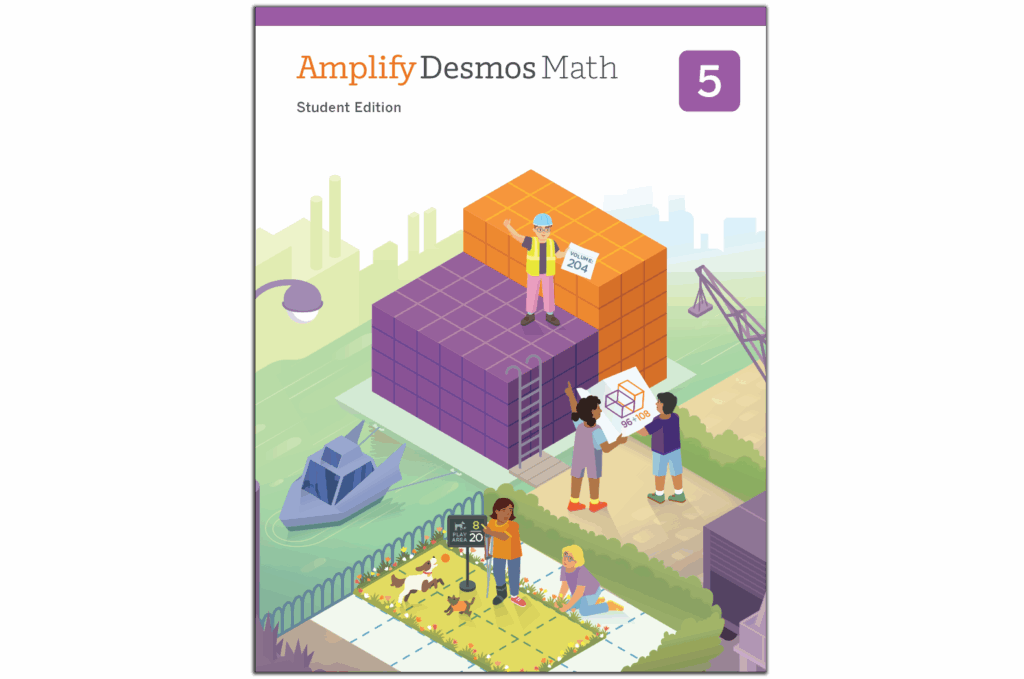
Student Edition
Motivate students with mathematics that is both rigorous and delightful. To help you preview the program, we have included samples from a complete sub-unit on this site: Unit 1, Sub-Unit 3: Volume of Solid Figures.
Ancillary sampler
Included in the ancillary sampler are examples from the program Assessment Resources, Intervention and Extension Resources, Centers Resources, Additional Practice, and Math Language Development Resources.
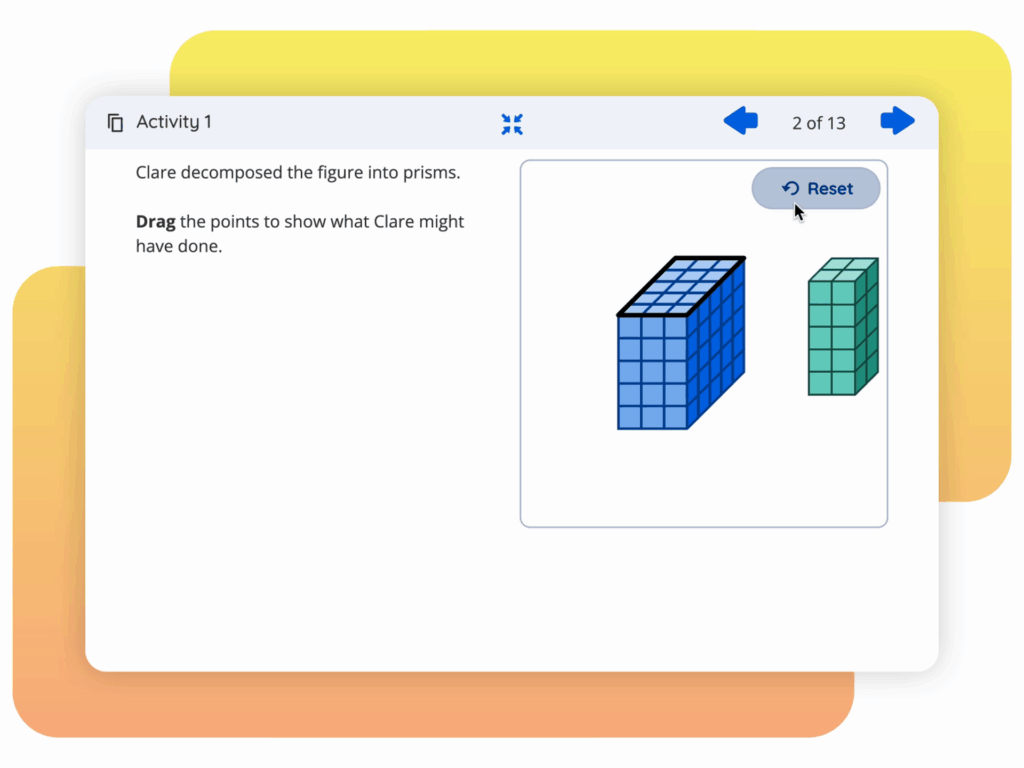
Featured digital lesson: Figures Made of Prisms
Students decompose a figure into rectangular prisms and determine the volume of the figure by adding the volumes of the individual prisms.
6-A1 sample materials
Click the links in the drop-down sections below to explore sample materials from each grade. For a full program review, please login to the digital platform or request physical samples.
For helpful navigation tips and more program information, download the Amplify Desmos Math Program Guide.
You can also watch a product expert walk through a lesson and the available program components.
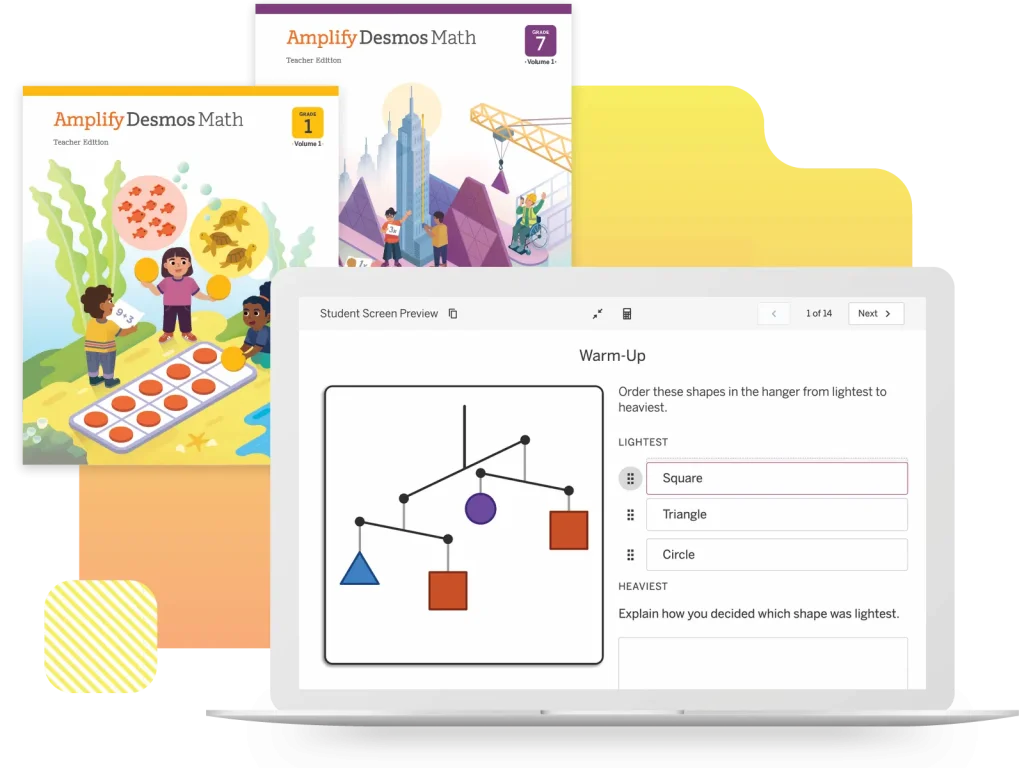

Teacher Edition
Planning and instructional guidance is visual, organized, and easy-to-follow. To help you preview the program, we have included samples from a complete sub-unit on this site: Unit 6, Sub-Unit 1: Solving Equations.

Student Edition
Motivate students with mathematics that is both rigorous and delightful. To help you preview the program, we have included samples from a complete sub-unit on this site: Unit 6, Sub-Unit 1: Solving Equations.

Ancillary sampler
Included in the ancillary sampler are examples from the program Assessment Resources, Intervention and Extension Resources, Additional Practice, and Math Language Development Resources.

Featured digital lesson: Weight for It
Students use equations and tape diagrams to represent seesaw situations and to determine unknown animal weights, helping them make connections between diagrams that represent equations of the form `x+p=q` or `px=q`.

Teacher Edition
Planning and instructional guidance is visual, organized, and easy-to-follow. To help you preview the program, we have included samples from a complete sub-unit on this site: Unit 6, Sub-Unit 3: Inequalities.

Student Edition
Motivate students with mathematics that is both rigorous and delightful. To help you preview the program, we have included samples from a complete sub-unit on this site: Unit 6, Sub-Unit 3: Inequalities.

Ancillary sampler
Included in the ancillary sampler are examples from the program Assessment Resources, Intervention and Extension Resources, Additional Practice, and Math Language Development Resources.

Featured digital lesson: Shira the Sheep
Students solve inequalities with positive and negative coefficients to solve a variety of challenges featuring a fictional sheep who eats grass according to an inequality.

Teacher Edition
Planning and instructional guidance is visual, organized, and easy-to-follow. To help you preview the program, we have included samples from a complete sub-unit on this site: Unit 6, Sub-Unit 2: Analyzing Numerical Data.

Student Edition
Motivate students with mathematics that is both rigorous and delightful. To help you preview the program, we have included samples from a complete sub-unit on this site: Unit 6, Sub-Unit 2: Analyzing Numerical Data.
Ancillary sampler
Included in the ancillary sampler are examples from the program Assessment Resources, Intervention and Extension Resources, Additional Practice, and Math Language Development Resources.

Featured digital lesson: Robots
Students connect points on a scatter plot with individuals in a population and rows of data in a table. The analysis of scatter plots continues with data about the eye distances and heights of robots.

Teacher Edition
Planning and instructional guidance is visual, organized, and easy-to-follow. To help you preview the program, we have included samples from two complete sub-units on this site: Unit 2, Sub-Units 1–2: One-Variable Equations and Multi-Variable Equations.

Student Edition
Motivate students with mathematics that is both rigorous and delightful. To help you preview the program, we have included samples from two complete sub-units on this site: Unit 2, Sub-Units 1–2: One-Variable Equations and Multi-Variable Equations.
Ancillary sampler
Included in the ancillary sampler are examples from the program Assessment Resources, Intervention and Extension Resources, Additional Practice, and Math Language Development Resources.
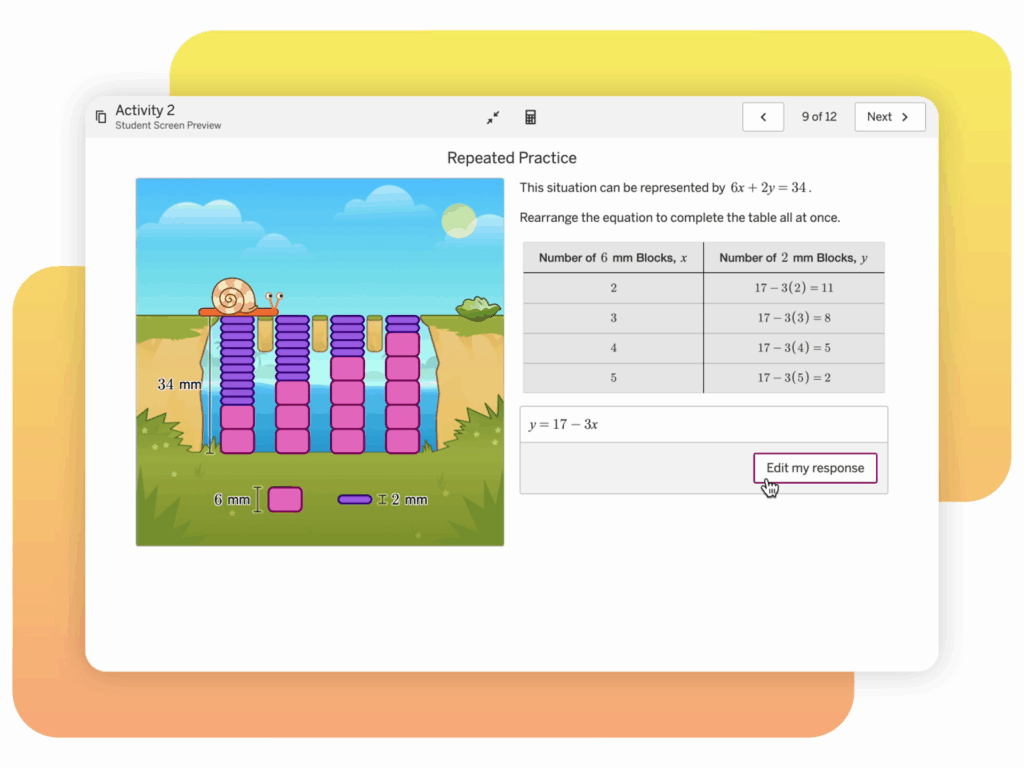
Featured digital lesson: Shelley the Snail
Students represent the solutions of a situation using a table, a graph, and multiple forms of an equation to identify multiple combinations of blocks that can help Shelley the Snail cross a gap.