S5-01. Investigating math anxiety in the classroom
A blue graphic with text reading "Math Teacher Lounge" in multicolored letters and "Amplify." at the bottom, with abstract geometric shapes and lines as decoration.

Season 5 is here! This season, we’ll be talking all about math anxiety: what it is, what causes it, and what we can do to prevent or ease this anxiety in the math classroom. To launch this very important theme, we sat down with Dr. Gerardo Ramirez, associate professor of educational psychology at Ball State University.
 
As someone who’s been studying math anxiety for more than a decade, he had some interesting research and advice to share on why math anxiety affects so many students (and adults), and tips for how to start reducing it.
 
Listen now and don’t forget to grab your MTL study guide to track your learning and make the most of this episode!
 
Enjoy this episode and explore more from Math Teacher Lounge by visiting our main page.

Download Transcript

Dan Meyer (00:01):
Hey, folks. Welcome back to Math Teacher Lounge. I’m one of your hosts, Dan Meyer.

Bethany Lockhart Johnson (00:05):
And I am your other host. I’m Bethany Lockhart Johnson. Season five! Hello!

Dan Meyer (00:11):
Bethany, how are you doing? How have you been spending the long break between our recording sessions?

Bethany Lockhart Johnson (00:16):
As much as I loved sharing content from previous seasons, I am so thrilled that we’re back for season five. I have been, you know, chasing a toddler. I think he’s already tired of me saying, “Ooh, can we count that?” He’s like [sighs] “One two, one two.” Like, he’s done already.

Dan Meyer (00:36):
Too much counting. Yeah, I worry about that so much, that my love of mathematics might be perceived by my kids as smothering. Yeah, I worry about the same. We shared with you folks some bangers of reruns, in my humble opinion. Some great guests. But, we’ve been excited—me and Bethany—to hop back on the mics, on the ones and twos, and explore some new ideas together.

Bethany Lockhart Johnson (01:01):
Well, I loved our season talking about joy in mathematics. And personally I could…like, we could turn this whole podcast into joy in mathematics. However, we’re kind of going a different route. Because if you ask folks why they don’t feel joy in mathematics, a lot of times at the root of that is some really intense math anxiety. So this whole season, we’re going to be delving into math anxiety. Exploring what it is, who has it, why do we think it happens, what do we think we can do about it, and how can we navigate through it, so that we can experience that joy in math? These are questions that we’re gonna explore over the course of the season. Dan Meyer, how do you feel about that?

Dan Meyer (01:49):
It feels big and it feels personal. I mean, as we shared in our math stories back from season…whatever it was, math anxiety was a huge part.

Bethany Lockhart Johnson (01:59):
It was last season, Dan.

Dan Meyer (02:00):
Last…? I mean, who can remember? Big part of your journey. I’ve had some very punctuated but intense moments of anxiety in math class. And socially, we have built math up to be this incredibly powerful thing. You know, restricting movement on economic ladders, preventing people from getting into careers they want. Whether or not they have much to do with math class, math anxiety is a really large part of educational but also social life. And yeah, I’m really excited to explore it with you. We’re bringing on some really excellent guests. Some researchers, yes. But not just researchers! Also people who practice in the field and know firsthand what it looks like to resolve issues of anxiety with students.

Bethany Lockhart Johnson (02:45):
Yeah, you’re right, Dan. My math story contained quite a bit of math anxiety, so I am particularly invested in this season. I mean, I still navigate math anxiety. And, you know, many of us do, and let’s talk about it. And let’s—I love that you reminded me. We’re gonna have a lot of great researchers all throughout the season, and a lot of times folks feel like the research happening, there’s sometimes a gap between researchers and what’s actually happening in the classroom. Not in all cases, but a lot of times. Right? And I remember a lot of conversation about the latest research when I was in grad school, but unless you’re actively studying something, sometimes we don’t know what’s happening. Right? We’re really focused on what’s happening right in front of us in our classroom. So let’s take some of that research; let’s break it down; let’s talk to some of the folks who are thinking about this for the bulk of their day, right?

Dan Meyer (03:41):
Yep. So we got our first guest coming up in a moment here.

Bethany Lockhart Johnson (03:45):
So to kick off this season, we’re starting episode one by talking to Dr. Gerardo Ramirez, Associate Professor of Educational Psychology at Ball State University. And he’s been researching math anxiety for more than a decade. He’s worked with so many amazing folks in the field. He’s worked with students, he’s worked with teachers, with educators…I’m just so excited to talk to him. If you look up math anxiety, you see his name as one of the folks who is really thinking about this at so many different angles, and we get to talk to him. So enjoy our conversation with Dr. Gerardo Ramirez.

Dan Meyer (04:29):
We are so excited to have Dr. Gerardo Ramirez on the show with us. Dr. Ramirez is an Associate Professor of Educational Psychology at Ball State University. Thanks so much for joining us.

Dr. Gerardo Ramirez (04:40):
Yeah, thank you for inviting me to talk about math anxiety.

Bethany Lockhart Johnson (04:43):
So with your interview, Dr. Ramirez, we are actually launching the season. We’re gonna be talking about all different aspects of math anxiety, and it feels pretty perfect that you are first guest of the season, because of the sheer breadth of research and conversations you’ve had about math anxiety. Could you start us off kind of telling us a story of how did you get interested in studying math anxiety? Or why, you know, why did you dive into this topic that, you know, I think a lot of folks might…like, if you’re on a plane, and you say, “Oh, I study math anxiety,” what kind of reaction are you gonna get?

Dr. Gerardo Ramirez (05:24):
Oh, sure. Yeah. I think most people are actually very interested because they all have their own story about feeling anxious about math, or just being anxious about evaluation situations that involve math. And, yeah, they wanna share those stories. People feel quite comfortable talking about their anxiety about math, for some reason. But for me, I started off, when I was in undergrad, I was studying to take the GRE quiz. I was hoping to go into a psych program. But I wasn’t exactly sure what direction yet. As I took some of the practice tests, there’s some situations in which I was very nervous about taking the practice test. And I just noticed that I did really poorly on some of these exams. And so I became very interested in issues like choking under pressure, which means when you underperform relative to what you expected to perform. And so, as I was researching these issues, I started to come across this whole field of math anxiety. And I saw that while there are some people who choke under pressure during tests, there are other people who just have a strong general fear of mathematics.

Dan Meyer (06:29):
That’s really helpful. I can imagine you’re doing a lot of free psychology sessions, free therapy for people on airplanes when they bring to you their own stories of math. So let’s thank you for your service in that sense. I’m super-curious. So Bethany and I have both taught math. We both have seen firsthand what it looks like when a student is anxious in math class, though maybe we don’t have kind of the clinical language to describe it. And I’m curious, from a clinical sense, how do we define math anxiety?

Dr. Gerardo Ramirez (06:57):
Sure. So first off, math anxiety is not something that you would find in the DSM, for instance. But we generally define that as a fear or apprehension to situations that involve math. So it doesn’t have to necessarily be educational situations. It could be someone asks you a math-related question during a party, or you have to calculate the tip at a restaurant, for instance. It doesn’t have to be about schooling situations, although that’s obviously where it seems to matter a lot for many people. So it is basically a fear or apprehension to situations that involve math. And I think distinguishing the term “fear” from “anxiety” is really important here. A lot of times people use those terms interchangeably, and the term “fear” is obviously within our definition of math anxiety. But oftentimes what differentiates anxiety from fear is that, anxiety is—think of it like a recipe. Anxiety is fear plus a little bit of unknown. OK? So if, for instance, if you hated snakes, and they threw a snake at you, you’d be in intense fear. Whereas if you hated snakes and they said, “There is a snake in the room, but I’m not gonna tell you where,” that’s gonna cause anxiety. And so the reason why we call it math anxiety is because a lot of times people experience this fear for a possible unknown future that involves math or possible unknown evaluations that people might have about your competence, because of math. And so for a lot of kids, they feel anxious about how they’re gonna do on a test or whether they’re gonna be able to pass a class or whether they’ll be able to understand what you’re saying in your lessons, for instance. And so the anxiety component really gets at fear of something that’s unknown, but related to mathematics situations.

Dan Meyer (08:47):
Math is somewhere in the ceiling right now. Perhaps I might be surprised with a math situation!

Dr. Gerardo Ramirez (08:52):
Yeah. yep.

Dan Meyer (08:52):
So I have this tendency to assume that every other subject that we teach has it better and easier than math does. It’s not true. I know this is not true. But I’m kind of curious here. Is math anxiety, like, part of a general just set of anxiety around schooling itself? Like, is there a reading anxiety, a writing anxiety, and does that all just flow from the same kind of fount of anxiety around schooling or situations about learning? And what makes math special in this regard? If it is its own special anxiety, for instance?

Dr. Gerardo Ramirez (09:27):
There are different…so some people obviously suffer from generalized anxiety. Right? And so they would, you know, feel anxious both for evaluative and non-evaluative situations. But in the research that we’ve done and that other people have done, there are differences between things like reading anxiety, math anxiety; I’ve also studied spatial and creativity anxiety. A lot of times what we’re trying to do in these studies is we measure all of the above, and we try to show that, look, math anxiety predicts math situations above and beyond these other things. So yeah, we definitely distinguish those things. And so what’s special about math is that, well, I think the symbolic nature is a big part of it. The abstract symbolic nature is just not as tangible to students. They can’t touch it. And so it doesn’t allow ’em to use their full cognitive faculties to play with it, as you might see, for instance, in science. Or it doesn’t allow people to relate math to their own interests the way you might see, for instance, in English. So maybe I hate reading novels, but I’m interested in zombies and you give me a book on zombies, well, ok, great, you’ve connected my personal assets to the topic. Whereas with math, either that’s harder to do or instructors don’t do such a good job of setting that connection up.

Bethany Lockhart Johnson (10:46):
Also, I think, you know, I’ve heard of students being really anxious, let’s say, during a reading session, when teachers used to do—hopefully they’re still not doing it—the popcorn reading, where you just randomly call on a student to read out a sentence. Right? But you don’t really hear students or adults talking about, “Oh, no, no, no, I don’t read; I don’t mess with reading.” You know? Whereas with math, you do hear, “Oh, I’m not a math person. Oh no, no, no, don’t ask me any math questions.” And that is such a distinction.

Dr. Gerardo Ramirez (11:18):
Yeah. And I think a lot of that’s because it’s just so common. As an adult, to be nervous about reading is kind of an uncommon thing. So people feel a stigma around admitting that. But math is something that everyone feels like they’re inadequate in. And so there’s a lot of comfort in telling you how they’re just one of the many people who don’t like math. And that, you know, can have a lot of different consequences and outcomes. I think on the one hand, I think for a lot of kids it becomes a normalized message that if you fear math, that’s OK, join the club. Right? But we have to be careful about that, ’cause a lot of math anxiety researchers will oftentimes say, part of what leads to math anxiety is adults normalizing that it’s OK to be scared of math. So I think a lot of times adults, teachers, for instance, math teachers, they’ll tell kids, “You know, if you’re scared, that’s OK.” And so a lot of the math anxiety community says, “No, no, no, you’re not supposed to do that.” But my recent view is different. I view that as a form of validation. Because math is hard. And so telling kids, “Hey, look, it’s actually easy if you just try,” I don’t think that’s true. It’s actually just hard. And I think even if it was easy, to the kid, it feels hard! And I think something that’s not really well-studied right now in our field is the value of validating people’s math negative math experiences. We don’t want to validate that, ’cause we think that we’re gonna reinforce that. But actually, I think the opposite. I think when you validate people’s negative math experiences, it helps ’em to feel that they can handle it. They can start to take control over their own emotions.

Bethany Lockhart Johnson (12:52):
I love that. And I, I actually, I think that’s so powerful, what you’re talking about, that validation. I taught kindergarten, and I vividly remember being in a parent-teacher conference and that parent saying, “Oh, I wasn’t a math person either,” right? Or, you know, their language and their experience with their own math schooling, their anxiety about math was actually impacting their students’ experience of math. Or the conversation that, when I would go to talk about a math assessment, let’s say, you could see the parent actually tensing up. And there was this moment of validation, that I felt like we needed to make space for that in the conversation with the parents, right?

Dr. Gerardo Ramirez (13:38):
Yeah.

Bethany Lockhart Johnson (13:38):
Like, this is a real thing. And we are working on teaching students that math is something that gets to—your experience with math gets to look all sorts of different ways. And it’s OK if we, you know, make a mistake, or if we kind of only get this part, but we’ve really got that part. Or let’s talk about it; let’s write about it. So I really feel like that that validation is something that’s so missing. And instead of the validation, like you said, you see folks being like, “Oh yeah, me neither. I’m not a math person either.” Right?

Dr. Gerardo Ramirez (14:10):
Yeah. I think…part of the reason why people are comfortable sharing this because they’re looking for validation also. When they say, “Oh, I’m not a math person,” you know, I think they’re hoping that, you’ll say like, “Yeah, me neither,” or “Of course not, ’cause math is terrible.” Right? They’re looking for validation, not to reinforce their perspective, but to feel that it’s OK not to be a math person. And I think that’s one of the techniques that I’m trying to work on in my research right now, is to provide evidence that actually people will work harder when you validate their math experience. You don’t have to tell them a positive story per se. If your current story is “Math is hard and I’m very, very anxious; I’m scared,” then we can just validate that and help you work through that. And it actually will strengthen our relationships. Because if you’re a student and you’re struggling with math and I tell you, “Yeah, it’s hard; it’s OK to struggle with math,” that makes you feel seen. And that’s gonna lead you to want to ask me more for help, because I’m someone who understands you. And that’s a great, you know, remediation opportunity.

Dan Meyer (15:14):
A common thread that I think I’m seeing here in several answers is that math sometimes asks students to disassociate part of themselves. Where success in math oftentimes means working from an a level of abstraction with symbols, like you said, that can feel alien. Like, who am I here? And in the same way, I love that you’re proposing we validate and reassociate people with a very deeply felt part of themselves that is anxious about mathematics.

Dr. Gerardo Ramirez (15:44):
Yeah. I mean, I think that’s what validation’s supposed to do, right? So a lot of us, when we feel these strong emotions, we wonder, “Is this even a real thing? Are other people feeling this? Is there something wrong with me?” So we feel the emotions, but we can’t actually deal with them, because we wonder if they’re legitimate. And so when someone says, like, “Yeah, this is hard,” it crystallizes that emotion. And once something is made real, you can actually choose how you want to deal with it. Some kids are gonna deal with it by staying anxious. But some people are gonna choose to deal with it by saying, “Well, there’s nothing I can do about it now; I have to take this math test, so I’m just gonna think positive.” And that’s great. If the kid can end up saying that to themselves, that’s much more effective than me telling the kid, “Hey, you just gotta think positive. You’re gonna start the test anyway.” And so we want the kid to make meaning of their experience, and the way we do that is by crystallizing their emotions through validation.

Dan Meyer (16:36):
Yeah. I love that. And so what you’re proposing there, I think, sounds like, a solution, like a post-talk solution after students are feeling anxiety.

Dr. Gerardo Ramirez (16:43):
Yes.

Dan Meyer (16:43):
To validate and empathize.

Dr. Gerardo Ramirez (16:45):
Yes.

Dan Meyer (16:45):
And over the course of our season, we hope to explore a lot about solutions to math anxiety that are preventative, that reduce the odds of anxiety arising, through instruction and curriculum, before it arises. And I’m just wondering if you’ve seen anything that would hint at either specific or general words of wisdom you wanna share with the educators, about not just addressing it after the fact, but preventing math anxiety before it arises?

Dr. Gerardo Ramirez (17:14):
To be honest, at this point, I haven’t seen enough evidence for me to recommend anything concretely as an intervention for math anxiety, or an intervention to prevent its development. All I can really do here is rely a lot on the more broad cognitive-behavioral research on anxiety, which says that one of the ways we prevent people from developing anxiety is by helping them to make more positive appraisals of challenge situations. So a lot of times, when kids are challenged, they don’t know how to interpret that. “What does it mean that I’m struggling with this thing?” And so that’s where I think a lot of teachers can help students’ interpretations of that. ‘Cause if you leave kids to their own devices, they’re gonna think, “I’m struggling because I’m stupid. I’m struggling because I’m not good enough. I’m struggling because my dad is right; I’m gonna be a failure.” You know? They’re going to impose an interpretation to a challenge situation regardless. And so, as teachers, one thing we can do is we can help shape that interpretation and say, “What does it mean to struggle with math? People will say it means you’re stupid. That’s one interpretation. What’s another one? It means that your brain is working really hard to think through something. That’s another interpretation. What’s better? What do you think is more helpful?” And then, helping students to see how interpretations matter to how you ultimately feel about something. And that’s a very metacognitive way of thinking about things. So yeah, I would say that one way to prevent it is to help students to take more positive interpretations of their experience. But another way, and I think a more successful way, I think, is to give students early experiences where they feel efficacious dealing with math. One of the ways you do that, for instance, is by obviously making sure that the students understand the material—but that’s obvious; people are trying to do that. One of my favorite recommendations is to keep reassigning assignments, the same exact assignment, for, say, three weeks, back-to-back. So if in week one you do the homework assignment, you do OK, you don’t do so great, when week two you do it, you give the exact same assignment, and now the student can see like, “Wow, OK, this was much easier.” And then, week three, you give the exact same assignment; now the kid’s feeling really confident. And the reason why that’s great is because it helps kids to see that they’re growing in confidence. A lot of times kids don’t get to see that because we’re constantly throwing new assessments at them. And so they’re never seeing that growth. All they’re seeing is a new challenge, a new challenge, a new challenge. So I think we need to set up situations where they can feel that they’re growing, when we keep the assessment static. That can be a formative assessment, for instance—doesn’t have to be a summative assessment.

Bethany Lockhart Johnson (19:55):
That feels so powerful and it feels like it really connects to that validation piece, right? We are actually helping to create a culture in our math classroom where we might struggle with something, but we keep revisiting it. And it’s not so much to reach mastery, but as Dr. Megan Franke — we talked to her about this partial understanding and about pulling on those threads of things that you do understand, so that you can build your confidence…build, not just confidence, but build your…I guess, kind of get your footing, right? You’re saying, “Well, I do understand this. I see how this works.” And if I’m revisiting an assignment, I feel like that would give me permission to like, “Hey, I don’t have to have this figured out on the first pass. You know?

Dr. Gerardo Ramirez (20:44):
Yes, yes. Yeah. I mean, I’m gonna give you a silly analogy, but I think it works. You know, a lot of times people will have nightmares, right? And they’ll keep having the same nightmare over and over again, right? And so one reason that we suspect this happens is because they haven’t worked through whatever that nightmare’s supposed to be about. So if, say, I’m scared of driving, I may be having the same dream about driving and crashing over and over. And we keep having these nightmares. And I think math anxiety is kind of like a waking nightmare, where you keep rehashing something because you haven’t had the chance to finally address that dragon. You know? And so if someone was having a lot of fear over driving, then one behavioral approach would be, you know, to work with a therapist to actually get behind the wheel and maybe drive around the same track over and over until you feel comfortable at that, and then the nightmares stop. Well, the same thing is true, I think, about math, math and math anxiety, is that you wanna give people these opportunities to feel confident by going back to that original experience that caused them to feel anxious, and saying, “This one assignment that we did in week three that really freaked you out, let’s try it again now in week five. How was that?” “Yeah, it wasn’t so bad. It was still kind of annoying.” “OK, we’ll we’ll come back to it.” “Now it’s week seven. Now let’s go back to that assignment. How is it now?” “That’s actually…it wasn’t that terrible.” And that gives people the opportunity to reflect on how they’ve grown past that nightmare.

Bethany Lockhart Johnson (22:05):
I have to say, Dan talked about you being like a therapist. I’m like, wait, “How did you know, Dr. Ramirez? I did have this recurring dream! I did! And I had to face it. No, but I had such intense math anxiety in high school and it was debilitating. And the biggest thing for me, I thought I was the only one. I thought there was something wrong with me. I thought, “Why can’t I figure this out?” There wasn’t a conversation about “Here are some tools,” or “Here are some, some, some…”. Like, “This is OK, for you to feel scared about this or overwhelmed!”

Dr. Gerardo Ramirez (22:41):
Mm-hmm. Mm-hmm.

Bethany Lockhart Johnson (22:42):
You know, I think often when we talk about how widespread math anxiety is, I think a lot of folks automatically jump to high schoolers or college students avoiding math courses. But we see this in really young kids.

Dr. Gerardo Ramirez (22:56):
Yeah. So people are…people are just constantly making meaning of themselves, regardless of the age range. And that’s true even with young kids; they are trying to figure out who they are. Right? And so one of the things you see oftentimes with young kids is you ask ’em, “What are you good at?” And they say, “Everything!” And that’s their attempt to, you know, make meaning of themselves. But sometimes they’re not good at everything. Sometimes they actually struggle in math. And I think even early on, they have to make meaning of that. They say, “Well, I’m good at everything except math.” And how do you make sense of that? Well, why not math? “Oh, because math is terrible. It’s not for everybody. You know, it’s not something that I like.” And so, yeah, in a lot of the studies that we did early on, we basically went into these first-grade classrooms with the purpose of trying to assess whether we can actually show variability in kids’ math anxiety, even early on. In other other words, do kids even report feeling anxious about math situations? Or do they tell us that they’re great at everything? And what we found was that in fact, a good chunk of kids are, again, perfectly willing to tell you that “No, certain situations involving math make me very anxious.” Counting or addition, or doing a problem on the board. And the way we do that is by—I think there are probably more sophisticated ways that can be done, but this is the best we have at this point—is we go in there and we ask them, we show them a bunch of smiley faces and anxious faces. And we say, “I want you to tell me how you feel about these different situations that involve math.” And so we say, “If you feel kind of nervous, I want you to point to this face. If you feel very nervous, point to this face.” And we basically will read to them situations. We’ll say, “How would you feel if your teacher asked you to open up your new math textbook and you saw all the numbers inside of it?” And they’ll point to the really nervous face. So right now, those are some of the more reliable assessments for math anxiety among young kids. And that work showed us that even young kids are self-reporting math anxiety.

Dan Meyer (24:51):

Obviously this is worth our study, because we would hope people would not feel anxious in general, and especially if we have a mandated…kids are mandated to be in math classes for their entire childhood. So I see the need for this study, these studies. I’m curious: What are the consequences, though? Like what, what correlates with math anxiety? What are other reasons why we should care about math anxiety and work to remediate it?

Dr. Gerardo Ramirez (25:16):
Oh, sure. So it correlates with their actual math performance. It can correlate when they choose to do homework. Right? So a lot of times, the parents report having to fight with their kids over math homework a lot. And you also oftentimes see a lot of frustration over mathematics specifically. And so it can, you know, not only affect their academic ongoing outcomes, like math tests and math assignments, but it can also affect their relationship with their parents. So if every time you come home, your dad’s screaming at you because you haven’t done your math homework, and when he asks you to solve the problem in front of them, you don’t remember, ’cause you were checked out, ’cause you’re so stressed out, that’s gonna cause a really negative experience. You know, a lot of times people grow up and they still remember their dad screaming at them over the math homework. You know, it’ll affect your relationship with your teacher. So if you’re making me feel incompetent, if you’re stressing me out, you’re not the kind of person I wanna come to for help. So it can predict relational outcomes as well as academic outcomes. And down the line, of course, when it affects students’ opportunities to get into things like AP classes, it affects students standardized test performance and their choice of colleges, as well as scholarship opportunities.

Dan Meyer (26:29):
Once you show that it correlates to performance, then that opens up a whole range of other correlations that are pretty important, it sounds like. Whether that’s career options or, you know, post-secondary education and the like.

Dr. Gerardo Ramirez (26:40):
Yeah. And a lot of times, when people are choosing a career at college, a lot of times students will make a decision specifically based on what career has less math requirements or less math courses. So I think this finding needs to be verified further. But, there’s some studies showing that, for instance, elementary ed teachers, one factor that feeds into the decision to go into elementary ed is the math requirements are very low in elementary ed. So that can…obviously it’s not what we wanna hear, because these are our first formal math teachers, right? For our kids.

Bethany Lockhart Johnson (27:16):
It feels so powerful, the impact that math anxiety can have, not only while you’re in, let’s say, elementary school, high middle school, high school, but then the impacts beyond that in terms of your career. And I shared this last season, when we talked about our personal math story, but I know when I was navigating the deepest part of my math anxiety, I really felt like, maybe this is a reason I can’t be an elementary school teacher. Because I was so worried that I wouldn’t be able…not that I wouldn’t understand the math for fourth grade, fifth grade, but that there was something about my ability to teach it or understand it or develop a love and passion for it that I wouldn’t be able to do. And I really had to reclaim it in my own way. But, you know, something that I think is so powerful about your research is just the applicability — not only to the field of mathematics, but folks’ everyday lives. And the way that you have talked in the past about math being a gatekeeper…I have a family member who, brilliant American Sign Language interpreter. I mean, amazing. Like a dance with her fingers. I could just watch it all day. And she actually didn’t complete the program because she couldn’t complete the math requirements. And I remember talking to her about like, “Well, have you gone to the free tutoring? Have you gone to, you know, this or that?” But it was a paralyzing fear, you know? So Dr. Ramirez, what do you wish educators understood about math anxiety? Or the research about math anxiety? Or maybe even the general public at large, what do you wish folks understood about math anxiety?

Dr. Gerardo Ramirez (28:58):
Oh, I think that a lot of students, they struggle with math. And I think we wanna normalize that struggle as much as possible. We want to create a culture where it’s OK to do math slow; it’s ok to take your time. And I know that’s not possible with a lot of these requirements that a lot of math teachers have to do. But I think if we want to prevent math anxiety, we have to create opportunities to tell better stories. So that’s ultimately what I tell people is, why do people develop math anxiety? Because they had experiences that challenged their competency and they told a negative story. And so making space to reflect in math classrooms about what does it mean to go slow in math, or what does it mean to make mistakes, and then helping kids to tell better stories, I think it’s really the best thing we can do as math educators. ‘Cause you know, your job is not to be a therapist ultimately. You know, there’s only so much math teachers can do. But I think one of the most powerful things we can create is setting up students’ experiences where they feel confident, and they can tell better stories, so they can have better dreams about math.

Dan Meyer (30:06):
Really appreciate this introduction to math anxiety. It’s been a fantastic kickoff to our season. Dr. Ramirez, thank you so much for joining us.

Dr. Gerardo Ramirez (30:14):
Sure. Thank you.

Dan Meyer (30:16):
Thank you folks so much for listening to that conversation with Dr. Gerardo Ramirez, Associate Professor of Educational Psychology at Ball State University.

Bethany Lockhart Johnson (30:25):
Dan, OK, if not for your frantic signaling, I would’ve probably asked another 20 questions. I need to know what you thought .

Dan Meyer (30:34):
I found it interesting at all points. And especially I think I started to understand a little bit better where the anxiety comes from for some students. I got a little bit here, which is that I think math, more than other disciplines, involves alienation. Check that word. You like that? Alienation? I’m into it. I’m feeling it. It’s like…to get good at math, to be successful in math, you gotta, as a kid, lose your attachment to the world you understand. And I mean, “got to” as in like, “you are asked to” — many times, unfortunately, by curriculum and instruction. Which is to say, you’re turning things you can hold onto into numerals. Right? You’re turning the world and its patterns that you can see and touch into Xs and Ys. And I just don’t know that other disciplines deal with that as much. Maybe I’m wrong and just guilty of, you know, “grass is always greener” syndrome here. But I think that’s an experience that kids have in math. And I thought that Dr. Ramirez got at that when he’s talking about the need to validate a student’s experience of anxiety. Like, in treating anxiety, sometimes we alienate people further by just like saying, “Oh, no, no, no, it’s just like, you need to, you know, drill yourself more, practice more,” and kind of invalidate that. So this feeling of alienation, I think permeates a lot of math instruction. I’m looking forward to learning more about that with our future episodes

Bethany Lockhart Johnson (32:00):
Alienation. That’s interesting. I definitely felt, I definitely felt isolated and alone many times in my math journey, when I was having my…you know, in high school, when I was feeling like, “Clearly everyone can look at tan, sign, cosign, and that means something to them.” Right? I think it’s really interesting, because I’m thinking about the other disciplines; I’m running through them, and I’m like, even in science, which can seem abstract, so oftentimes there’s these experiments that accompany these concepts, where you’re like, “Look at this concept made real in front of you.” Right? . And so yeah, that’s really interesting.

Dan Meyer (32:39):
You’re always one step away from blowing something up! Or, you know, dissecting something that’s tangible to you.

Bethany Lockhart Johnson (32:46):
Yeah. That’s really interesting. I did really love how he brought up the abstract. And how, I think, even validating it…he talked so much about validation. Which to me was like, YES. If somebody just said, “Hey, it’s not only possible to have math anxiety, but it also doesn’t mean that you don’t belong here.” If somebody had said that, it would’ve literally changed the trajectory, you know? And I wonder what those conversations could look like in our classrooms, where teachers celebrate that. Like, WHOA, this is a new way to think of this. This is a new way. Asking how many, or what do you notice for this image, through a mathematical lens, or looking…we talked to Alison Hintz and Antony Smith, like mathematizing books, like looking through these lenses — it’s an invitation to step into this other world, right? But there’s not only one way to do it. And I think oftentimes it’s like that anxiety of “Am I gonna say the right thing?” or “Am I gonna notice the right thing?” Right? How do we create that space more, where there’s so many possibilities and we want kiddos to notice what they notice, right?

Dan Meyer (33:54):
You gotta become a certain kind of person to be successful in math class. I feel like is part of the implied deal. Where you’ve gotta—like how you said—say a certain thing or think about a certain thing a certain kind of way. You’re trying to become someone who is not necessarily you. Which I think is fundamentally an experience of alienation, separating you from important parts of yourself.

Bethany Lockhart Johnson (34:19):
I will never, ever dive into mathematics on the scale and level that you have with your PhD. You understand math in a way that my brain just…I won’t get there, right? And yet I’m allowed to call myself a mathematician, with all of my deep dives in elementary math and my love of early numeracy and thinking about how we start thinking about counting and numbers. Right? It’s like, if we make more space for what mathematicians can look like, and what is your personal relationship with math…I mean, that to me feels really exciting. ‘Cause I think we both have something to offer each other.

Dan Meyer (35:03):
I think I have never found early math more interesting than when I talk to early math educators. And learn just like all the different ways that students come to understand a concept that I had thought was simple. Like addition of whole numbers. Whoa! There’s a lot of ways kids do that work, and their brains think those thoughts. And, yeah. That’s a good word there you’re offering us and our listeners.

Bethany Lockhart Johnson (35:27):
Yeah. Yeah. I’m really excited about this season. I think there’s — again, there’s no way we’re gonna cover all facets of math anxiety. But I think having the chance to explore it over the course of a season is going to be really fascinating. And really, I hope, destigmatize it and open up the conversation for our listeners. And, you know, if you listeners…we wanna know what you thought of this episode. Do you have any particular questions? Do you have questions related to math anxiety? Questions related to this episode? We are in development for this season, so we’re gonna do our best to get those questions answered. You can keep in touch with us in our Facebook discussion group, Math Teacher Lounge Community, and on Twitter at MTLshow.

Dan Meyer (36:14):
Next time, we’re gonna go deeper into the causes and consequences of math anxiety.

Dr. Erin Maloney (36:20):
It’s not just the case that people who are bad at math are anxious about it. It’s actually that the anxiety itself can cause you to do worse in math. And that for me is really exciting, ’cause it means that if we can change your mindset, then we can really set you on a path with several more options available to you.

Dan Meyer (36:41):
Til next time folks,

Bethany Lockhart Johnson (36:41):
Bye.

Stay connected!

Join our community and get new episodes every other Tuesday!

We’ll also share new and exciting free resources for your classroom every month.

What Dr. Gerardo Ramirez says about math

“A lot of students struggle with math, and we want to normalize that struggle as much as possible. We have to find opportunities to tell better stories and reflect on our experiences.”

– Dr. Gerardo Ramirez

Associate Professor of Educational Psychology, Ball State University

Meet the guest

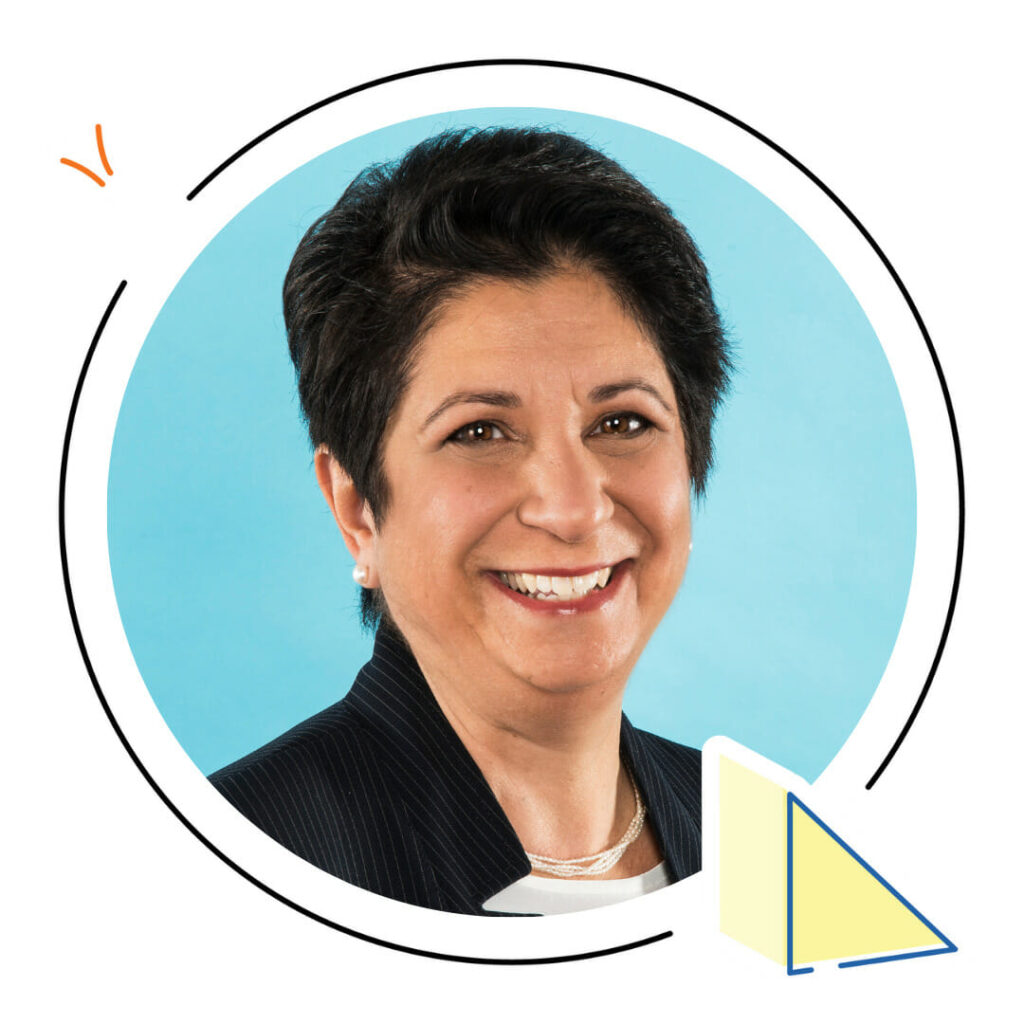
Dr. Gerardo Ramirez obtained his Ph.D. from the University of Chicago, where he studied the  role of teachers and parents in shaping the math attitudes of their students, as well as reappraisal techniques to help students cope with anxiety during testing situations.

Dr. Ramirez is currently an associate professor at Ball State, where he examines the role of frustration, empathy, and cultural capital in shaping students’ success and persistence.

A man with glasses, a beard, and a receding hairline wearing a suit and tie, pictured inside a circular frame with simple graphic accents—perfect for representing math teacher resources or the math teacher lounge.
A laptop displaying a Facebook group page for "Math Teacher Lounge Community," featuring profile photos, a group banner, and geometric shapes in the image background.

About Math Teacher Lounge

Math Teacher Lounge is a biweekly podcast created specifically for K–12 math educators. In each episode co-hosts Bethany Lockhart Johnson (@lockhartedu) and Dan Meyer (@ddmeyer) chat with guests, taking a deep dive into the math and educational topics you care about.

Join the Math Teacher Lounge Facebook group to continue the conversation, view exclusive content, interact with fellow educators, participate in giveaways, and more!

S5-03. Cultivating a joy of learning with Sesame Workshop

A blue graphic with text reading "Math Teacher Lounge" in multicolored letters and "Amplify." at the bottom, with abstract geometric shapes and lines as decoration.

Listen as we chat with Dr. Rosemarie Truglio, senior vice president of curriculum and content for Sesame Workshop! Continuing our theme of math anxiety this season, we sat down with Dr. Truglio to chat about Sesame Street and her thoughts on how to spread a growth mindset to young children and put them on course to academic achievement and long-term success.
 
Listen today and don’t forget to grab your MTL study guide to track your learning and make the most of this episode!

Download Transcript

Dr. Rosemarie Truglio (00:00):
Children don’t come with this math anxiety. Math anxiety is learned.

Bethany Lockhart Johnson (00:07):
Welcome back to Math Teacher Lounge. I’m Bethany Lockhart Johnson.

Dan Meyer (00:11):
And I’m Dan Meyer.

Bethany Lockhart Johnson (00:12):
Hello, Dan Meyer.

Dan Meyer (00:14):
Great to see you, Bethany. We are on episode three. Can you believe it?

Bethany Lockhart Johnson (00:18):
So, I feel like we’ve just started scratching the surface about math anxiety. We’ve talked to two amazing researchers. We’ve talked about what math anxiety is, how it’s often screened for some of the causes, some of the consequences … I mean, we’ve had some good conversations. Dan, what do you think?

Dan Meyer (00:38):
Definitely, I think that the consequences have only grown more dire in my head. I’m not sure how you feel about the consequences. But, you know, it is enough for me that we ask students to take mathematics for much of their childhoods, to worry about their anxiety, taking that. But to hear about from these researchers about all the different things that correlate with math achievement and math anxiety—talking about future careers, certainly, but even some other, more serious lifelong concerns? That gives me a lot of motivation to continue this study of math anxiety here with you on the show.

Bethany Lockhart Johnson (01:14):
It is really widespread. It has a big impact, not only on students, but on parents, on educators. You know, it’s—

Dan Meyer (01:23):
Multi-generational.

Bethany Lockhart Johnson (01:25):
Yes. And you know, so often when folks think of math anxiety, what I hear them say is, “Oh, yeah, in high school is when math really ramps up. That’s when anxiety starts.” But we know that it starts in our youngest learners. And our research has already backed that up. We know it. I’ve seen it in my classroom. You may have seen it with some students you work with. And let me tell you, it starts young.

Dan Meyer (01:52):
It does start early. Right now, I have a son that’s just started kindergarten, and he seems relatively math-positive, but we’ve known from our interviews on this show and other kinds of experiences that oftentimes, that feeling —that math is for me, and I am for math, and we are all friends — can turn on a single moment. It seems like one teacher says a thing that changes a student’s perception of themselves as a mathematician or of math itself. So I keep waiting with bated breath, hoping not to find that one moment that changes our current open posture towards mathematics. So now it’s time to really dive into some strategies for combating math anxiety.

Bethany Lockhart Johnson (02:34):
To help us out, we’ve called on a pretty exciting guest. I am so excited, Dan Meyer! We are being joined by Dr. Rosemarie Truglio. She is Senior Vice President of Curriculum and Content at Sesame Workshop. Sesame Workshop! As in, “Tell me how to get to Sesame Street.” Dan, I have to tell you, I spent many, many hours of my childhood watching Sesame Street. I have to ask, do you have happy Sesame Street memories? Is this part of your formation, Dan Meyer?

Dan Meyer (03:08):
At this point? In my advancing years, and the brain cells that I have left, Sesame Street is really kind of just a vibe in my head. But that vibe is such a pleasant one. One in which like nothing bad could happen. One in which learning is common and normalized and fun. And you just kind of feel at home, constantly.

Bethany Lockhart Johnson (03:33):
I don’t know about the “just the vibe” part, because for me, it is visceral. I’m there. I am actually … I mean, I might still be there.

Dan Meyer (03:42):
You could reenact some of the skits?

Bethany Lockhart Johnson (03:44):
. You didn’t watch Sesame Street with your kiddos when they were younger?

Dan Meyer (03:49):
We watched a lot of Elmo. A lot of Elmo. Yeah.

Bethany Lockhart Johnson (03:52):
Next-generation Sesame Street. Well, I think it’s so perfect that we’re gonna be talking about what Sesame Workshop does to help combat math anxiety and create a positive connection and relationship with mathematics. So I’m really excited to hear what Dr. Truglio and her team have been working on. And here’s our conversation with Dr. Truglio.

Dan Meyer (04:15):
Welcome to the show, Dr. Truglio. It is an honor.

Dr. Rosemarie Truglio (04:18):
Great to be here. Thank you for inviting me.

Dan Meyer (04:20):
You are Senior Vice President of Curriculum and Content at Sesame Workshop, which definitely sounds like the coolest job in the world to both four-year-old me and also Now me. Would you just help us help us with some backstory of how you ended up here, and what you do at Sesame Workshop?

Dr. Rosemarie Truglio (04:38):
Sure. It is a pretty cool job. And I am very fortunate that I’ve been in this position for the past 26 years. So, I am a developmental psychologist, and my job is to help Sesame Workshop identify curriculum needs, so that we could address them in the content that we create on the show and across our various platforms. So, Sesame Street is currently in its 53rd season. And we just, wrapped production for the 54th season, which we’ll debut next fall. And Sesame Street began with an experiment: Can television actually teach children school readiness skills, to have them better prepared for school? Especially those children who did not have access to formal education during the preschool years? And it is what we call a whole-child curriculum, because we’re dealing with all of the school readiness needs. So that that includes the academic needs, their social-emotional needs, and their health needs, as well as what we call these cognitive processing skills—how children learn content. Right? So it’s not just content skills, but how you approach learning and how you actually learn content. So as a grad student, I was fortunate to work at the Center for Research on the Influences of Television on Children. Very special center. It was at the University of Kansas. And my advisors, developmental psychologists, they studied the effects of television on children, both the positive effects and the negative effects. And so part of their research was to actually look at the longterm educational effects of Sesame Street. So I was working with Sesame Street content as a grad student, and then came to New York City. My first job was Assistant Professor at Teachers College, Columbia University. And when this position became available, Director of Research at the time, it was called, I took that job. And so my job was to oversee both the curriculum and the implementation of the curriculum, as well as the research. Because what we know, our co-founder, Joan Ganz Cooney has always said, for Sesame Street to be a successful educational program, production has to work closely with early childhood educators. They are the ones who know the curriculum and, and develop the curriculum goals, as well as the developmental psychologists who actually study how children are paying attention to the content. But more importantly, what are they comprehending from the content? And we all have to work together. Because even though we are the experts, the real experts are the children themselves. So nothing is deemed final until we actually show the children and see what they are learning from the content that we are producing.

Dan Meyer (07:54):
Are you referring to like, test audiences of kids then?

Dr. Rosemarie Truglio (07:57):
Yeah, I guess you could call it test audiences. I mean, I don’t. I don’t like to call it that because I see them as co-collaborators. I don’t see them as a test audience. Because, as I said, they’re the experts. It’s a collaboration. I mean, they’re the experts. And so I wanna know—

Dan Meyer (08:12):
As collaborators. I got it now. Yeah.

Dr. Rosemarie Truglio (08:14):
They help us. So that’s exactly what we tell the children too. So it’s called formative research. You know, we, we do what we call, um, storybook testing, an animated version of a storybook to have some little movement and see are they finding the story engaging, but more importantly, are they picking up on the intended educational lesson that we’re trying to teach in the story. So they are co-collaborators. they’re the ones who are helping us get the story just right for them.

Dan Meyer (08:46):
That’s really exciting, and makes me think about what classes might be like if students were regarded in that kind of lens as well. I just wanna say that my four-year-old self is on this interview as well, and is re-contextualizing all the stuff I saw as a kid. And it just felt like, at the time, you folks turned the camera on and went down to the street and we just had this real natural time. And it’s great to hear about all the intense preparation and co-construction at work and work that went into that time. Yeah,

Dr. Rosemarie Truglio (09:12):
It’s about a year preparation from start to finish. From the start of identifying, “What is the educational need? Is it an academic need? Is it a social-emotional need? Is it a health need? Is it a cognitive-processing need?” And then once we have the need identified, we have what we call a curriculum seminar. We bring in the experts who are studying this topic with preschoolers, because we wanna get it, we wanna get it right.

Bethany Lockhart Johnson (09:41):
Which, by the way, little behind the scenes: How often do you get to go to set?

Dr. Rosemarie Truglio (09:46):
So we’re in a production probably about six weeks out of the year. Covid really messed things up. ‘Cause we have to be really—we have very strict Covid protocols, but there is someone on my team—and sometimes we have to, you know, rotate for availability—but there’s always an educator on set.

Bethany Lockhart Johnson (10:06):
Awesome.

Dr. Rosemarie Truglio (10:07):
Because even though you stick to the script, questions arise; they wanna make changes; sometimes they have to cut; things are running too long and they have to cut and we gotta figure out where to cut. So there’s always an educator on set.

Bethany Lockhart Johnson (10:19):
But sometimes you go and have lunch, like—.

Dr. Rosemarie Truglio (10:21):
Oh, I go, yes. Sometimes I go—

Bethany Lockhart Johnson (10:23):
And just hang out with Big Bird, right?

Dr. Rosemarie Truglio (10:24):
Sometimes I go hang out with Big Bird. No, those are my friends!

Bethany Lockhart Johnson (10:27):
They are!

Dr. Rosemarie Truglio (10:28):
No, no, I go hang out with them. They’re my friends. Yes.

Bethany Lockhart Johnson (10:32):
When I think about Sesame Street and I think about … like, I can’t help but smile. Because I think I have such fond memories of the characters. I mean, we invited them, my mom invited them, into our home, right? And, you know, now I have a two-year-old and there’s no doubt that I’m gonna introduce him to Sesame Street. And I see how it really does feel like the folks who are doing this work, you and your team, you have a deep respect for children. So it makes sense that you call your test collaborators “collaborators,” right? They’re a part of it. And you know, I love that. And Sesame Street makes me smile. However, I’m like, we’re talking about math anxiety. And it’s so interesting, because as Dan and I were talking about our memories of Sesame Street … you know, it’s like Sesame Street feels like there’s not much anxiety. I mean, there are problems, and there’s problem solving, and it’s not like everything is perfect. But we figure it out. And it’s OK to make mistakes and it’s OK to try again. And a lot of times, we don’t see that in the math classroom—or at least, how folks talk about math. So, how do you all think about anxiety, about how to prevent it? Like, when you’re doing your work, you know that math anxiety is a real thing. But then that’s not translated in these experiences and the relationships with math that you’re building with your viewers.

Dr. Rosemarie Truglio (12:07):
Yeah, that’s a really good question, because it’s really easy, because our core audience are two- to four-year-olds and they love math. And what’s not to love, right? Because they are figuring the world out as they’re exploring the world. So you said something really interesting, that when you turn on the TV—when you turned on the TV when you were a child, and now you’re a mom of a two-year-old, we wanna make sure that the show represents content that is relevant and meaningful to our target audience. And that comes through with the characters. So all of our characters have very specific personalities, as all children do. And our characters represent all children, in terms of not only personality, but interest and learning styles, ’cause we wanna see—we wanna make sure that children see themselves in these characters. And we have a character who actually loves math. And he’s The Count.

Bethany Lockhart Johnson (13:12):
I’m like, “I know! I know who it is!” I will save you my impression. Although I have done it for my child. But I’ll save our listeners .

Dr. Rosemarie Truglio (13:20):
And you know, he’s an adult character. Some of our characters are preschoolers, like Elmo and Abby—they’re preschoolers—and Zoe. But The Count is an adult. He lives in the castle and he just loves numbers. But what’s really important is while we have The Count to explain—not explain to, but to portray to children, cause we don’t explain anything; we show children that math is more than number, right? Math is a pretty wide concept. Which is what I love about math. And the other thing about math is math language. The language of math. ‘Cause when we’re teaching children vocabulary words, we’re also teaching children the concept. Be it a math concept or a science concept or a social-emotional concept. So children don’t come with this math anxiety. Math anxiety is learned and it’s unfortunate. It’s picked up by their observations of the adults in their lives, who sometimes say out loud, “I don’t like math,” or “Math is hard,” or even worse, “I’m not good at math.” Or may even label it as math anxiety. That word won’t mean anything to a young child. But it then provides a, whaddya call it, like a negative valence for something that they never felt negative about. Because as they’re growing and interacting with the world, math is all around them. And there’s that sense of awe and wonder and joy, especially as they’re learning and they’re figuring it out. So I think we have to reframe math. Instead of saying “math anxiety,” we have to talk about the joy of math and all the wonderful joys that come with the exploration of these math concepts. Number is great. We know kids love numbers. We know that they love to count and use a big word here: enumerate . Because so many parents don’t make this distinction. They’ll say, “Oh, my child is counting!” Well, there’s rote counting, 1, 2, 3, 4, 5, 6, 7, 8, 9, 10, which is important. But then it’s like there’s an item for each number. So it’s one Cheerio, two Cheerios. And then as you point to each number, you are then figuring out what the set is, of the number of objects that you have. And then you get at what I love to call the meaningfulness of math. Right? Number has meaning. And as I said, it’s all part of your everyday activities. It’s part of—it’s in your kitchen; you’re following recipes; you’re measuring; you’re weighing. It’s at bath time, right? You could have the sorting of nested cups and you could, you know, and once again, the math language: big, bigger, biggest. These are relational concepts. You could then count what sinks and what floats, if you’re doing science. And then you could put them in two different buckets, and count. These are the items that sunk and these are the items that float. So math and bath time could be a lot of fun. And then there’s math and music. Music is so rich with math, as you talk about rhythm and tempo and dynamics and pitch and duration. That’s all math.

Bethany Lockhart Johnson (16:57):
The way that you talk about it, it is so rich, right? It is so multi-layered. And you know, I’ve shared on the podcast before: I’ve actually had parents in parent-teacher conferences say that, “Well, I wasn’t good at math either,” or “Math’s really not my thing.” And it’s really—it is, it’s rooted in that fear. And so I do see the way that you’re talking about it; I see that come through in Sesame Street. That, in a lot of ways, it’s reeducating parents, right? Because we hope that our caregivers are sitting next to their kiddo and enjoying it together and having conversations about it later. And there’s a way that parents then are also getting their own sense of what math can be, expanded. And I think there’s such a beauty in that. And I love the way that you talk about that, that you really are looking at, “Well, we wanna celebrate counting and the joyfulness of that. And let’s use math talk, you know, and let’s use these words and try out these ideas.” And it’s not because you’re trying to check some list. But you’re really exploring it and having fun together.

Dr. Rosemarie Truglio (18:03):
And you’re embracing it. And you mentioned the word “mistake.” So often when it comes to math, if you make a mistake—you make a mistake in counting or, you know, we’re not doing a lot of math equations on Sesame Street, but that’s when people feel like they can’t do math. ‘Cause they made a mistake. And that’s something that we are trying to address on Sesame Street, that it’s OK to make mistakes and you learn through mistakes. But you have to have—and I’m gonna come up with this other phrase now—you have to have what we call a growth mindset. What that means is that I may not be able to do this yet. Like, it’s called “the power of yet.” So we know that learning any concept, it takes time and practice. And how do we have children embrace the process, right? So often we focus on right and wrong. Now, there is right and wrong with math, of course. You know, there’s a right answer and there’s a wrong answer. But how do we focus, not on the end product, but the process through which you are engaging in? So let’s talk about measurement. Let’s talk about measuring the length and the width or the height of something. You might make some mistakes along the way, but you’re processing it. My son used to make all of these little structures for all his little play animals. Well, you know, he would measure and think he got it right. And then when he put the animals in, of course, you know, either the animal was too wide or it was too tall. And he would have to redo it. But you’re not redoing it from scratch, you’re redoing it now from experience. “I realize that if I’m gonna put the giraffe in with the elephant, I’m gonna need something wide as well as high.” Right? For the length, tall. And that’s process. And then, for children, when they figure it out, that “oops” and “aha”—the “aha” was like, “I did it!” And it’s so empowering, you know, giving them agency—not swooping in and saying, “All right, I’ll fix it for you. You know, we got the wide elephant and the tall giraffe and I’ll you know…”. NO! Having them do it. And another fun activity is in what we call informal measurement. And that’s like getting something of an equal size. It could be paper clips or it could be same-size blocks, and then measuring how long something is. So if it’s measured by blocks versus paperclips, you’re gonna have a lot more paperclips than you are blocks. And that kind of comparison is so fascinating for children. And so that’s measurement. And now we have counting. Like, how many paperclips long is something versus how many blocks long is something.

Dan Meyer (21:02):
So checking my understanding here, you’ve talked about how caregivers and other adults can transmit math anxiety by naming it and claiming it for themselves. And you’ve talked about, some really exciting ways that adults can involve students and kids in different kinds of math. I’d love to go upstream with you a little bit and wonder out loud, where does this anxiety come from initially? It’s gotta be more than adult one to kid two talking about anxiety, and transmitting it from human to human. What is the original spring from which all this anxiety flows?

Dr. Rosemarie Truglio (21:36):
Yeah. I do think it does—a lot of it does come from the adults in their lives. It’s unfortunate, because there is a lot of math talk about it, right? I can’t do math; I’m not good at math. Even when you’re at a restaurant and you get the bill and someone’s figuring out the tip, I can’t tell you how often it’s like, “Pass the bill, because I can’t do math.” Or if you actually then bring gender into it, you know, “Oh, girls aren’t good at math,” and that’s not true. There’s no evidence of that whatsoever, right? So in the younger grades, there’s no gender difference in terms of math ability. What’s also interesting about even socioeconomic status differences, you don’t see a lot of differences between low-income and middle-income children when it comes to math skills. Where you see differences is children’s ability to talk about their mathematical thinking. So if a child doing a math problem is asked, “How did you solve the problem?”, low-income children don’t often have the language to explain their thinking. So that’s something that we did on Sesame Street, where we focused a lot on what we call math talk. So, not just show number and show doing math, but actually narrate and giving the language. Because math literacy is one of the predictors of overall school achievement. So there’s that. They’re getting it from the adults in their lives. They’re getting it, unfortunately, sometimes from their teachers. But I think the anxiety comes from the fear of making mistakes. Because math, there is right and wrong, and always wanting to get the right answer. So that’s why this whole idea of reframing, and saying, “But really, it’s in the process.” So, you know, my son, math is not his strong suit. And I’ve been doing a lot of growth mindset with him as well. And there was a teacher that he had—I think in like 10th or 11th grade—who said, “In a test, I don’t wanna—I’m not even gonna look at the answer. I wanna see the process through which you GOT to this answer. And I’m going to grade the process. So the process could yield a right answer; it could yield a wrong answer. But you’re gonna get graded on the process. Because I wanna see how you are approaching the problem and how you’re thinking it through.” And I think that is a great example of, maybe, to try to reduce math anxiety. Because if you can get people excited about the process through which you’re learning—and that applies to all subjects, it’s not just math!

Bethany Lockhart Johnson (24:36):
I’m like, that applies to life! Right?

Dr. Rosemarie Truglio (24:38):
That applies to life!

Bethany Lockhart Johnson (24:39):
That’s so spot on. Wow. Yeah.

Dr. Rosemarie Truglio (24:41):
But I think that there’s so much focus on right and wrong, and not really understanding the value of the process. So on Sesame, we’ve been doing a lot of “oops” and “ahas.” You know, we’re gonna make mistakes, but what’s important is what do you DO when you make a mistake? So there’s a great episode with The Count. A couple of years ago. The Count was counting. Something he does every day. A lot of time, every day, ’cause he’s obsessed with counting and numbers. And he was counting an array of items.

Gladys the Cow (25:17):
I need 10 sandwiches all together.

The Count (25:22):
Well, of course.

Dr. Rosemarie Truglio (25:23):
And he made a mistake.

Elmo (25:25):
The Count?

The Count (25:25):
Hmm?

The Count (25:25):
Elmo thinks The Count made a little mistake.

The Count (25:31):
No mistake.

The Count (25:32):
Mm-hmm. Yeah.

Dr. Rosemarie Truglio (25:33):
And first time ever, did he make a mistake. And he fell apart.

The Count (25:38):
I must make sure that that never happens again. So I shall never count again.

Dr. Rosemarie Truglio (25:46):
And that’s an example of showing that, you know, you could get upset when you make a mistake, but what’s important is you gotta come back and you gotta come back to doing what you love. In his case, is counting and letting him know that it was an “oops.” But you learn that mistakes are OK. It’s OK to make a mistake and continue to do what you love.

The Count (26:13):
I must keep trying and you should, too.

Elmo (26:17):
Yeah!

The Count (26:17):
So come, let’s count the carrots together!

Elmo (26:18):
Oh, cool!

Bethany Lockhart Johnson (26:19):
And what a beautiful gift to show kiddos. Show that to kiddos, right? And to the adults. I wanna, you know, really acknowledge it, and say, “Hey look this, it’s OK.” And again, you’re giving them that language. That’s such a gift.

Dr. Rosemarie Truglio (26:34):
Thank you.

Dan Meyer (26:34):
We spend a lot of time wondering why other subjects don’t seem to suffer from this negative perception. And I think you’ve unlocked a lot of that. You’ve mentioned that there are issues that cut across different subject areas, but I think from my own experience and research and interviews, it seems that in ELA and the social sciences, there’s this aspect where you need to come up with a claim and “how are you seeing this?” And there are multiple defensible claims. And I love how you imported that generous pedagogy over into math with this example of a teacher who says, “You know what? It’s about the process here.” Disassociating answer and process.

Dr. Rosemarie Truglio (27:09):
And I think the other thing is like, when children are engaged in a project, for parents to point out: “You’re doing math!” Because they don’t realize that they’re doing math. Once again, math is so often equated solely with numbers and mathematical computations. So it was really interesting—the same is true for science. You know, when we’re talking to parents about the use of everyday—like, going to the supermarket or making dinner or bath time, there’s so much math and science in the everyday. And then when you point it out to them—”you’re doing math”—it’s like, “I’m doing math!” Like, you’re setting the table for a family of six: you’re doing math. That’s called one one-to-one correspondence. “I’m doing math: I’m setting the table.” Yeah, but you’re doing math. You can’t set the table because you have to know how many people are gonna be sitting at the table for dinner. You can’t follow a recipe without doing math. You can’t go shopping without doing math. There’s quantity; you gotta figure out how many peppers you gotta buy, or pounds. “I gotta get a bunch of potatoes and I gotta put ’em in the scale. And I have to get two pounds of potatoes.”

Bethany Lockhart Johnson (28:29):
So your book Ready for School: A Parent’s Guide to Playful Learning for Children Ages Two to Five. First, as a parent of a young toddler, I gotta say it’s such a tool; it’s such a resource. It’s very conversational. And I think about these ideas a lot, both in my work and, you know, just for fun. And yet, even if this wasn’t my chosen field, I still feel like it’s just so accessible. And I wanna flag something.

Dr. Rosemarie Truglio (29:01):
Thank you.

Bethany Lockhart Johnson (29:01):
Yeah, no. Thank YOU. . I wanna flag something that you said in the math chapter You were talking about the joy of math, and you said when it comes to our children, caregivers: “take pleasure in reading stories together, especially at bedtime, which in many households is a regular part of a child’s routine. But somehow the notion of introducing math concepts to our children seems daunting. In fact, some studies have shown that parents harbor a strong belief that while it’s important and pleasurable to support their child’s reading skills, it’s the responsibility of the schools to take care of teaching math.” And that quote, I highlighted it, I starred it! And I would love for you to say a little more about that, because you have given us already, like, a bounty of ideas that as caregivers we can do with our kiddos or the kiddos in our lives. And we’ve seen that even what they’re learning in school, it may not be the freeing, joyful math language that we hope our kiddos have access to.

Dr. Rosemarie Truglio (30:05):
Yeah, I’m glad you brought that up. Because a lot of our focus is on how children learn through playful experiences, and how they learn through play in particular. And there are so many playing, either a game or even playing ideas—like we talked about building, you know, a house for animals or building a fort. It’s just so filled with math. And I wish I could narrate for every young parent how I would hope that they would talk as they are co-engaged in this activity. And I think … we asked about, with the anxiety, the adults have to find the joy in math first. They have to see the math. That’s the problem. That’s why I hope that my book provides that. I want you to know that you are doing math and I want you to know that your child is what we call a mathematician—or in the science chapter, is a STEMist. Your child is already doing science, technology, engineering, and math. STEM is so integrated. So to acknowledge them—because babies are doing math! Babies know, they can distinguish between a small quantity and something that is a of a larger quantity and want the larger. Right? So, it’s natural for them. And they are taking it all in. I mean, the joy of watching a child just early counting: you know, one, two. And trying to then figure out the meaningfulness of two. It’s not three objects. There are actually two. And for a parent to see the joy in that I think is step one. And then to see the richness and how expansive math is, and that power of, oops, “I made a mistake, don’t freak out,” and then [not] say, “See, I’m not good at math,” but say, “Let me try again. I know I could figure this out.” Right? It’s all of that supportive language and supportive experiences that builds this mindset, a positive mindset. So that you hope that when you get into the higher grades, they’re not walking in and saying, “I can’t, I can’t do math.”

Dan Meyer (32:26):
Yeah. Super helpful. I think you point at one of the grownups—great powers in the world of kids, which is to label. To name things. And you know, you’ve talked about how grownups should ideally downplay some of their negative experiences with mathematics for the sake of the kid, but also to play up the positive stuff that they’re doing as mathematics. Like that right there, that’s math. I would love to know … you have an extremely loud megaphone to communicate messages about math and the world and everything through Sesame Street. One of the biggest that there is—and I just wonder if you could step out and imagine you had a magic wand to wave over the world in which students grow up, play and learn—what would you do like to help students have better associations or less math anxiety? And, you know, learn more about math itself?

Dr. Rosemarie Truglio (33:19):
If I had a magic wand, I would give everyone what we call a growth mindset that nothing is fixed and everything can be changed if you put the time and effort into the process, and enjoy the process. The joy of learning. I think, you know, it’s really sad. I don’t wanna be sad on your show. But when we were getting ready for the 50th anniversary, I was wondering, “What is gonna be the curriculum focus?” You know, we just came off of literacy and math literacy and social-emotional development. And we talked about the power of play. Playful learning. And building careers. Give children sophisticated play scenarios so that they could explore what they may wanna be when they grow up. Because there’s a concept: If I can see it, I can play it, I can be it. Right? So where are those portrayals? And it’s like, “What are we gonna do for the 50th?” And I had a convening of experts across all disciplines, and brought them into a room. And I said, you know, “What keeps you up at night? Like, what are you worried about?” Sort of like the State of the Union of Child Development. And this is where the sad part is. They talked about how that sense of joy, that sense of wonder, that sense of curiosity, that sense of flexible thinking and creative thinking, was disappearing in early childhood. Wow. If it’s disappearing in early childhood, we are in big, big trouble . ‘Cause I could see it disappearing later on, you know, as you advance in grade. But what do you mean, it’s disappearing in childhood? And then they talked about the fear of making mistakes. And that goes against—it’s the opposite of a growth mindset. And so we have to bring back that sense of joy, wonder, asking those why questions and embracing them. So it’s another problem parents have. They’re fine with the “why” questions until the “whys” become so difficult they don’t have the answers. And then they don’t want the “why” questions, because now they feel like they’re not smart enough to answer their child’s “why” questions. How do I flip that around to be much more positive and say, “You know, I don’t know! But let’s find out together. Let’s explore together; let’s experiment together.” That’s what I mean about the shift in the mindset, that growth mindset. We should not know all of the answers, but where’s the joy of, “Wow, I don’t know, let’s go find out together”? And that applies to math too. But you have to have that open mindset. You have to—you, as yourself, have to have that growth mindset.

Bethany Lockhart Johnson (36:20):
I love that magic wand. I want that magic wand! And I think what—like Dan said about this megaphone, this opportunity to reach so many young people, so many caregivers—what a gift! And I’m so grateful that you took time to be in the lounge with us, and that you have shared these ideas. Because truly, I think, like you said, it’s really our youngest learners, right? How can we create and cultivate these opportunities for our youngest learners to find the joy in mathematics and just in learning, right?

Dr. Rosemarie Truglio (36:54):
Yeah.

Bethany Lockhart Johnson (36:55):
So thank you. Thank you so much, Dr. Truglio. We are deeply grateful for your insight and for all the work you do. And we continue to invite the world of Sesame Street into our homes.

Dr. Rosemarie Truglio (37:08):
Thank you. Thank you for allowing us to come into your home, and for you to re-learn with your child as you’re watching Sesame Street. Because it’s very much a parenting show, as it is for a child-directed show, because we are blessed to have these wonderful human cast members who are the stand-ins for parents. And so we are often giving you the language for how to talk about and how to problem-solve together. So thank you.

Dan Meyer (37:43):
Thanks so much for listening to our conversation with Dr. Rosemarie Truglio, Senior Vice President of Curriculum and Content at Sesame Workshop.

Bethany Lockhart Johnson (37:51):
Dr. Truglio is also the author of Sesame Street Ready for School, A Parents Guide to Playful Learning for Children Ages Two to Five, and we’re gonna make sure we put a link to that in the show notes because it is really, really a rich resource. I’m diving in. I have so many ideas bookmarked that I wanna try out with my kiddo.

Dan Meyer (38:09):
Yeah, it’s really exciting to see—like, for a classroom educator, I just kinda assumed that a lot of math learning happens in the classroom context. That’s my lens. So yeah, I loved reading the book and seeing all the different opportunities for parents for just out there in the world, in front of your house, at the supermarket. All the different opportunities there are for mathematical thinking, and then to think about how to bring that into some of those routines and ideas into the classroom, into formal schooling.

Bethany Lockhart Johnson (38:35):
Exactly. Exactly. Like Dr. Truglio said, the caregivers’s disposition about mathematics matters so deeply. Your teachers’ dispositions about mathematics, their beliefs, the way that you hear people talking about math, that impacts our learners. That impacts—like, as a student, that impacts what you think is possible for yourself. So I love this, re-educating ourselves about what math can look like out in the world, in everyday conversations. I don’t know. I really, really appreciated this conversation with Dr. Truglio.

Dan Meyer (39:12):
Same. Yeah. We’d love to hear what you folks think about the work. the book, her ideas. Definitely get in touch with us. Subscribe to Math Teacher Lounge, wherever you get podcasts. And keep in touch with us on Facebook at Math Teacher Lounge Community, and on Twitter at MTL show.

Bethany Lockhart Johnson (39:27):
Also, if you haven’t already, please subscribe to Math Teacher Lounge wherever you get your podcast. And if you like what you’re hearing, please leave us a rating and a review. It’ll help more listeners find the show. And while you’re at it, let a friend know about this episode, because you enjoyed it; they might enjoy it. On our next episode, we’re gonna be chatting with Dr. Heidi Sabnani and taking a closer look at best practices for coaching teachers to reduce their own math anxiety.

Dr. Heidi Sabnani (39:56):
One of the teachers that I worked with had done her student teaching with a teacher who had math anxiety and who never taught math. And so she entered her teaching career never having taught math before or seeing it taught.

Dan Meyer (40:10):
Thanks again for listening, folks.

Bethany Lockhart Johnson (40:12):
Bye.

Stay connected!

Join our community and get new episodes every other Tuesday!

We’ll also share new and exciting free resources for your classroom every month.

What Dr. Rosemarie Truglio says about math

“We all have to work together, because even though we are the experts [on curriculum and education], the real experts are the children themselves.”

– Dr. Rosemarie Truglio

Senior Vice President of Curriculum and Content, Sesame Workshop

Meet the guest

Rosemarie T. Truglio, Ph.D. is the Senior Vice President of Curriculum and Content at Sesame Workshop. Dr. Truglio is responsible for the development of the interdisciplinary curriculum on which Sesame Street is based and oversees content development across platforms (e.g., television, publishing, toys, home video, and theme park activities).  She also oversees the curriculum development for all new show production, including  Bea’s Block, Mecha BuildersEsme & RoyHelpsters, and Ghostwriter. Dr. Truglio has written numerous articles in child and developmental psychology journals and presented her work at national and international conferences. Her current book is Ready for School! A Parent’s Guide to Playful Learning for Children Ages 2 to 5, published by Running Press (2019).

A person with short dark hair, wearing a dark blazer and white top, smiles at the camera against a blue background with graphic elements, evoking the inviting atmosphere of a math teacher lounge and highlighting useful math teacher resources.
A laptop displaying a Facebook group page for "Math Teacher Lounge Community," featuring profile photos, a group banner, and geometric shapes in the image background.

About Math Teacher Lounge

Math Teacher Lounge is a biweekly podcast created specifically for K–12 math educators. In each episode co-hosts Bethany Lockhart Johnson (@lockhartedu) and Dan Meyer (@ddmeyer) chat with guests, taking a deep dive into the math and educational topics you care about.

Join the Math Teacher Lounge Facebook group to continue the conversation, view exclusive content, interact with fellow educators, participate in giveaways, and more!

Amplify CKLA usage & branding guidelines

Welcome to Amplify’s guidelines on using CKLA materials both under its Open Education Resource (OER) license (CC BY-NC-SA) and Amplify’s license to school districts. These guidelines apply to all variants of the CKLA program, including those not authored by Amplify. These guidelines address the following programs:

  • Amplify CKLA
  • Amplify Texas ELAR/SLAR
  • TEA’s K-5 RLA Literacy / SLAR program
  • TEA’s Bluebonnet Learning K-5 Reading Language Arts
  • CKF Core Knowledge Language Arts

Amplify is committed to supporting educators in using CKLA resources to enhance classroom learning while protecting the integrity of the CKLA program and Amplify’s exclusive rights.

Our goal is to encourage impactful, efficacious use of the program while providing clear guidelines on permissible and prohibited uses.

1. Amplify’s license and what it means

Amplify partnered with the Core Knowledge Foundation (CKF) to develop the Amplify Core Knowledge Language Arts (CKLA) curriculum. You can learn more about this program and Amplify’s partnership with CKF here.

Amplify holds the exclusive commercial license to all CKLA content. In more than a decade of partnership, we have worked with CKF to enhance and supplement the program, now in its third edition nationally. Amplify licenses Amplify CKLA and Amplify ELAR/SLAR Texas to school districts, along with a full suite of assessment, intervention, and supplemental products, as well as professional development and coaching services. Learn more here.

As the exclusive commercial partner for CKLA, Amplify is the only organization permitted to use the materials commercially.

If your organization purchases CKLA materials from Amplify, you get the customary usage rights for those purchased materials specified in Amplify’s Customer Terms & Conditions.

2. Open Non-Commercial license

Some versions of the CKLA program are available under a Creative Commons NonCommercial license (CC BY-NC-SA 4.0). This includes Amplify Texas ELAR/SLAR, TEA’s K–5 RLA Literacy / SLAR program, TEA’s Bluebonnet Learning K–5 Reading Language Arts and CKF Core Knowledge Language Arts.

CC BY-NC-SA is the OER license for these materials. The license allows users to share and adapt the materials, as long you follow these terms:

  • Attribution — You must give appropriate credit, provide a link to the license, and indicate if changes were made.
  • NonCommercial — You may not use the material for commercial purposes.
  • ShareAlike — If you remix, transform, or build upon the material, you must distribute your contributions under this same CC BY-NC-SA license.

Below we explain how Amplify and CKF apply these terms to common situations — which uses are permitted under the licenses, and which uses are prohibited or require a special permission or commercial arrangement.

Materials licensed under Creative Commons licenses are known as Open Education Resources (OER), and Amplify is proud to have been one of the earliest champions of OER materials in K-12. We believe that OER materials enable a widespread adoption of high quality materials and innovative adaptations by educators for their classrooms, alongside commercial versions that include a full suite of supports.

3. Permitted uses of CKLA content

In these guidelines, when we say “CKLA Content”, we are referring to all versions of the program that was based on the original content from CKF, both those under OER licenses and commercially licensed. Many uses by educators are permissible under either the commercial or OER license. The only difference is that your rights under the commercial license only last as long as that license is maintained by your school or district.

Amplify encourages educators to leverage CKLA Content to foster innovative and effective learning experiences. Below are uses that are permitted without any additional license, as long as you follow attribution guidelines and share-alike requirements.

Classroom Activities and Custom Materials. Educators may create supplementary activities, worksheets, lesson plans, and projects based on the CKLA Content for use within their classroom or school. For these purposes, educators may incorporate portions of the CKLA Content.

Sharing and Selling Materials based on CKLA Content. Educators may also share classroom activities and custom materials with other educators, including by selling the materials on sites like Teachers Pay Teachers. However, if these materials are sold, they may not include CKLA Content.

For any materials you create, you are required to follow our attribution and disclaimer guidelines below.

If you are unsure whether your planned use qualifies as “non-commercial” or is otherwise permitted by Amplify please reach out to us directly.

4. Restricted uses of CKLA program content

To protect the CKLA program’s value and respect Amplify’s exclusive commercial rights, certain uses of the CKLA content are prohibited without first obtaining a commercial license. Amplify reserves the right to enforce these restrictions to protect our rights.

No third party may embed, republish, or incorporate any portion of the CKLA content in products or services intended for sale, licensing, or other commercial purpose. Examples of prohibited uses include embedding CKLA content as a part of digital platforms, apps, or resources marketed to educators or the public, as well as using the content as an input or training data for such products.

This prohibition applies to all types of individuals and organizations (both for-profit and non-profit), and applies to both paid and free uses.

See “Commercial License and Partnerships” below for information on commercial arrangements.

4. Commercial licenses and partnerships

For those interested in using CKLA content in a way that may be commercial, Amplify offers various licensing options. These negotiated licenses allow approved partners to use the CKLA content within their commercial products under specific terms and conditions.

To inquire about a commercial license or discuss a partnership opportunity, please contact our partnerships team at partnerships@amplify.com.

5. Attribution and branding guidelines

Our trademarks are valuable assets of Amplify and its licensors, and we want to ensure our users and partners use them correctly. These trademarks include the Amplify, Core Knowledge Language Arts, and CKLA word marks and logos.
These marks and logos may only be used if you have an existing partnership with us, and you’ve reached out to Amplify to secure our approval to use them.

If you are creating materials based on CKLA Content in accordance with the guidelines above, you are required to include the following attribution in a reasonably perceptible location on each copy of those materials:

“These materials are based on Amplify CKLA but are not affiliated with, sponsored by, reviewed, approved, or endorsed by Amplify Education, Inc. or the Core Knowledge Foundation. ‘Amplify’, ‘CKLA’ and other marks are the property of Amplify Education, Inc. and its licensors.”

Why these guidelines matter

Amplify’s goal is to support educational access to high-quality curriculum resources while protecting the intellectual property and integrity of the CKLA program. By adhering to these guidelines, you help ensure that CKLA remains an accessible and respected resource for educators while supporting its continued improvement.

For additional questions on using the program, or if you need further clarification on any of these points, please contact us.

Pseudoscience examples for critical thinking skills

MIRACLE HAIR GROWTH! 

Quantum hair activation technology: This groundbreaking innovation goes beyond conventional science, delving into the realm of quantum energy to stimulate hair growth at the subatomic level. Blended with rare botanicals from ancient civilizations for luster and shine. Limited-time offer: Act now and receive a vial of stardust-infused hair serum!

Effective product…or pseudoscience? We’ll bet you guessed it. (Sorry, no stardust serum for you!)

While this hair product itself sounds like junk, reading about it can be a valuable experience for science students.

Teaching your students to identify pseudoscience in the world around them helps them learn to protect themselves from false claims that can be money-wasting at best, dangerous at worst.

And as they learn to discern, they also develop lifelong critical thinking skills!

We say knowledge is power but it’s not enough to know things, and there’s too much to know. Being able to think and not fall for someone’s bunk is my goal for my students.

—Melanie Trecek-King, biology professor and guest in Science Connections podcast Season 3, Episode 5: Thinking is power

Let’s explore how educators can use examples of pseudoscience to develop critical thinking skills—and incorporate NGSS (Next Generation Science Standards) science and engineering practices into their approach.

What’s the difference between science and pseudoscience?

Science is grounded in empirical evidence, rigorous testing, and the scientific method. Pseudoscience presents itself as scientific but lacks the fundamental elements of genuine scientific inquiry: evidence, peer review, and the capacity to generate accurate predictions.

Though pseudoscience may make vague claims, it has clear characteristics. When something is pseudoscience, it:

  1. Can’t be proven wrong: Makes claims that are unobservable or too vague.
  2. Professes “proof” without presenting actual evidence: Presents only anecdotal evidence, if any.
  3. Uses technobabble: See: “Quantum hair activation technology.”

For more characteristics of pseudoscience, check out Melanie Trecek-King’s episode of Science Connections!

To be sure, not all pseudoscience is harmful—pursuits and activities such as aromatherapy and astrology can be positive experiences in people’s lives—it just should not be defined as or considered science.

How addressing pseudoscience encourages critical thinking

When you teach students to identify pseudoscience, you are teaching them to use an evidence- and research-based approach when analyzing claims. Which is…science!

You are also:

  • Teaching them to engage in thoughtful and educational argument/debate.
  • Encouraging them to use their knowledge of science in the real world.
  • Creating real-world impact.

When students learn to identify pseudoscience—faulty products, myths, and disprovable “discoveries”—they’ll be prepared and informed when making real-world decisions.

Critical thinking exercises inspired by pseudoscience

We’ve talked about “miracle” hair growth treatments, which are more commonly targeted to adults. Students may have more commonly encountered claims about or ads for alkaline water or detox diets, conspiracy theories and instances of science denial, astrology, and more. These examples offer great opportunities to discuss how to determine the difference between science and pseudoscience.

Suggested activities:

  • Pseudoscience Sherlock: Ask students to find examples of pseudoscience in real life via social media, products sold in stores, or on the internet. Tell them to pay close attention to “articles” that are really ads.
  • Pseudoscience lab: Prompt students to back up their claim that a given example represents pseudoscience with evidence: e.g., lack of empirical evidence, controlled experiments, or unbiased sample; absence of peer-reviewed research; reliance on anecdotes; hyperbolic and unprovable claims.
  • Snake oil! Ask students to practice identifying pseudoscience by creating their own advertisements, commercials, or news segments for fake products or scientific “advancements.”
  • Spread the word: Ask students to create flyers, PSAs, or articles on how to identify the characteristics of pseudoscience.

Other activities that incorporate the NGSS while also sniffing out pseudoscience:

  • Asking questions: Encourage students to ask probing questions about pseudoscientific claims. How does this claim defy our current understanding of the natural world? What empirical evidence is missing?
  • Developing and using models: Have students create models that illustrate the differences between a pseudoscientific claim and a well-established scientific concept. This visual representation supports understanding and critical analysis.
  • Engaging in argument from evidence: Arrange debates where students argue for or against a pseudoscientific claim using evidence-based reasoning. This practice sharpens their ability to critically evaluate information.
  • Obtaining, evaluating, and communicating information: Ask students to research the history and impact of a specific pseudoscientific belief. Have them present their findings, highlighting how critical thinking could have prevented widespread acceptance of the claim.

Using examples of pseudoscience in your science classroom can help students learn to not only think like scientists, but navigate the real world, too.

Bertha Vasquez, former teacher and current director of education at the Center for Inquiry, has used these approaches with her students. As she shared on Season 3, Episode 6 of Science Connections: “I guarantee you that those students, when they walked into a store with their parents and they saw a product [with] a money-back guarantee [that] cures way too many things, and it’s based on ‘ancient plant wisdom’ and has ‘scientific’ language on the box, they may go, ‘Mom, I think these people are trying to sell you some pseudoscience.’”

More to explore

S3 – 05. Developing an asset orientation with Lani Horn

Math Teacher Lounge podcast featuring Lani Horn, a professor at Vanderbilt University, on developing an asset orientation.

In this episode, math education professor Lani Horn shares with us what it means to have an asset orientation towards students, contrasting it with a deficit orientation, and helping Bethany and Dan understand the many ways students experience one or the other. Their conversation hit both high notes and low notes and included a challenge that Bethany and Dan both found extremely valuable for helping a teacher develop an asset orientation towards their students.

Explore more from Math Teacher Lounge by visiting our main page

Download Transcript

Dan Meyer (00:03)

Welcome back to Math Teacher Lounge, folks. My name is Dan Meyer.

Bethany Lockhart Johnson (00:07):

And I’m Bethany Lockhart Johnson.

Dan Meyer (00:09):

We’re so excited to be here with you folks and with our guest today, tackling big questions about mathematics. I wanna ask Bethany first though: Bethany, it’s been kind of a challenging couple of years for those of us in education, near education, just in life in general, of course. But I woke up this morning and the sun was out; the weather was perfect and crisp here in Oakland; and I found myself feeling optimistic, a sense of hopefulness. And I was wondering to myself, “What is Bethany feeling hopeful about in math education right now?” What’s got you juiced up a little bit?

Bethany Lockhart Johnson (00:40):

I gotta say, that optimism, Dan, look at that! I can actually feel the sunshine just pouring through the microphone! So I thank you for asking. What am I feeling optimistic about in math education? Hmm. OK, this is gonna sound a little bit cop-out-y, but I have been so completely jazzed about not only our podcast, but the conversations that I’ve been seeing circulating in other math podcasts that are out there around curriculum, around new books coming out. It just feels like despite overwhelm, despite exhaustion, that most teachers really do love learning. And so there’s like that kernel. And so I just feel like there’s books on my shelf I wanna read; there’s podcasts in the queue I wanna listen to; and summertime is the best, best time to do it.

Dan Meyer (01:39):

People still feel hungry out there for learning. They know the importance of the craft and its impact on students. And, yeah, people are tired, but also it is so cool to see people still jazzed about learning more about how to teach students more effectively. Me, I’m excited right now, I have a very specific excitement right now, which is that today we announced that Desmos, where I work, and Amplify, our sponsor, are no longer gonna be two separate things. That we are joining together. That I, and all these people who have done so much work over the last 10 years developing digital math technology, we’re gonna go and work inside of Amplify as a division called Desmos Classroom. And we’re so excited that…what we cracked, I think, at Desmos, is a way of thinking about how teachers and their tools—computers, for instance—interact with students in math. And I love what we did there. But we never really cracked the question of, “How do you support entire school systems in taking up these ideas and tools?” And Amplify has really done that. So I’m super-excited to partner up there. That’s what I’m optimistic about and happy about.

Bethany Lockhart Johnson (02:40):

Congratulations! That’s a huge transition, and I’m just so excited about the amazing work that both Amplify and Desmos do. But then, the idea of Desmos being in more classrooms? Those tools being available for more students? With the reach? I mean, I’m just excited! It’s a big day, Dan.

Dan Meyer (03:00):

Thank you. Yes, exciting day. And I’m excited about also about our guest we’re bringing on today. How’s that for a segue? I’ll be excited to hear what our guest is excited about in math education. I just wanna say that what our guest, Lani Horn, Professor Lani Horn, has exposed us to is this idea of an asset orientation and its importance. And I do think I’m not over-exaggerating or overstating to say that the idea of an asset orientation towards students and their thinking has been possibly the most transformative idea for me in the last five years of being an educator. And adopting it has led to my favorite lessons, my favorite teaching experiences, my favorite relationships with students. I say all that—you know, I don’t wanna gas things up too much; is that too high of a bar here to have expectations? But it really has been tremendous! And Lani Horn gave a talk several years ago called “An Asset Orientation Is Everything,” which really changed the game up for me. And Bethany watched it as well. So that’s why I’m so excited to have on the person who gave that talk. And who’s done so much research around what an asset orientation offers students and teachers. So we’re bringing on today Lani Horn, who is a professor of mathematics education at Vanderbilt University, Peabody College, who centers her research on ways to make authentic mathematics, ambitious math teaching, accessible to students and teachers, particularly those who have been historically marginalized by our educational system. I think Lani has just a beating heart for students, yes, but also really respects the work of teaching in ways I think are so needed and sometimes uncommon in the world of math-education research. So Lani, thank you so much for coming on and joining us in the Lounge.

Lani Horn (04:41):

Thanks for having me.

Dan Meyer (04:44):

We would love to know what you are excited about and optimistic about right now in the world of mathematics education. What’s got you a little bit gassed up?

Lani Horn (04:52):

Up, gassed up? Hmm. Let me reframe it, ’cause I don’t know if I’m gassed up, but I’m cautiously hopeful that maybe that in the wake of the interrupted learning that’s been sort of widespread during the pandemic that maybe we’ll get some traction around more strategies for teaching in heterogeneous classrooms. Which I think every classroom is, to varying extents: a heterogeneous classroom. And I was talking with a colleague the other day about this idea of hmm, maybe modeling would be a really cool thing to focus teachers on. Doing some more mathematical modeling across the grade levels. Because it just seems like there’s a lot of opportunities for kids to kind of catch up on ideas and understandings that they may not have fully grasped because of interrupted learning, interrupted schooling. But also with room to engage in a lot of ideas. So we were playing with that and I was like, “Gosh, that’d be pretty cool if people took that on more broadly.” ‘Cause I don’t think that there’s been enough conversations about meaningful differentiation in that kind of way, like at the level of curriculum. So I would love to see an upsurge in interest in that kind of stuff, ’cause that’s a big place where I have a lot of passion, so I’m ready! I’m ready for people to ask questions about that. And actually it’s really very, very, very closely related to the topic today of having an asset orientation towards students.

Bethany Lockhart Johnson (06:34):

First of all, I’m so excited to have you on Math Teacher Lounge, have you in the Lounge, and get to talk to you, because when Dan sent me this talk, my first thing was, “Oh, I think I know what asset orientation is and looks like.” You know, you kind of hypothesize about what you think it’s going to be. And then you started talking and I’m like, “Wait, wait, why am I just hearing this now?” So I thought I knew what it was, but really I felt like there was so much to unpack. And I would just love for you to share with our listeners, in case they are like, “Oh, asset orientation, I know what that is. I’ve got it. My students have got it.” What is it? And why does it matter so much to our teachers?

Lani Horn (07:19):

The most obvious point is that asset is the opposite of deficit, right? And we know that deficit thinking is very harmful to students. That there’s a real teacher-expectation bias that that kids pick up on, that we communicate indirectly to students and that impacts their learning and their ability to meet our academic expectations and, other expectations in classrooms. So an asset orientation is looking for students’ strengths and trying to work from those strengths as a basis for your teaching.

Dan Meyer (07:54):

So that’s a really fantastic starting spot there. And I think what’s initially surprising to me about the research you cited in your talk, that is built around an asset orientation, is how…I think if you come at learning from a—I guess in research, they call a cognitivist frame, where learning happens when teachers say the right things that make a transfer from the teacher’s brain to the student’s brain. A lot of what you’re describing is very counterintuitive, I think. The asset orientation describes a teacher’s kind of subtle disposition. It’s not what, like what they’re saying exactly. It’s what they communicate in the subtext and the body language, that all emanates from some perspective on students and the idea that that filters down somehow and students pick up on that—like a smell in the air—and that determines a lot of their learning, I think is one part of your talk and the research that I thought was really surprising. How close is that to like how this actually works? And can you add to that description or pivot it a little bit?

Lani Horn (08:54):

Expansion of the sort of cognitive framing of teacher and student interaction…part of what’s really hard about developing and maintaining an asset orientation is that schools are organized in ways that rank and sort children. And so when we are just using the everyday language of schooling, sometimes we’re injecting these preconceived deficit notions of students into our talk and into how we’re thinking about, interpreting, looking at students. So not only is this interruption a sort of a cognitive lens on teacher-student interaction, but it’s really looking at how the social environment is setting teacher-student interaction to take on certain kinds of framings.

Dan Meyer (09:44):

This is what I mean about Lani having such a generous frame towards teachers and the work of teaching. I wonder, though, if you could help us make concrete how an asset and deficit orientation might play out in a hypothetical classroom interaction.

Lani Horn (10:00):

Sure. A really commonplace example is a teacher has a group of students. It’s October or November. So there’s already been a few assessments. And that gives the teacher an idea who the strong students are and who the struggling students are. And they’re having a classroom conversation. And someone who hasn’t performed well, a kid who hasn’t performed well on those assessments—the teacher poses a question. A kid who hasn’t performed well on the assessments is called on. And they sort of hesitate in formulating their response. And the teacher with that lens of “this is a struggling student” then may have to make a decision: “Do I persist? Do I support this kid? Do I help them formulate an answer? Do I try to draw out their thinking anyway? Or do I move on to a kid who is academically performed better in my class?” And I would say that a lot of teachers in that situation would very understandably say, “OK, I get it. You’re not a strong math student. You’re not confident in my class. I’m gonna move on because I need to get through this lesson to somebody who I know is gonna provide me with a correct answer.” And they do it also out of, sometimes, a sense of care, of not wanting to put that student on the spot. However, part of what is another unintended result of making that choice is instead of trying out that student’s thinking, listen to their sort of, maybe, hesitant answer, and trying to find the kernel in it that maybe could be supported and amplified, that kid then loses an opportunity to have their idea be a part of the whole class’s mathematical conversation. Completely common, completely understandable kind of interaction that I see all the time.

Bethany Lockhart Johnson (11:52):

That feels so huge. And that I can actually picture that happening.

Lani Horn (11:56):

Of course. We’ve all seen it. We’ve all done it.

Bethany Lockhart Johnson (11:58):

We’ve all seen it and done it. And I think it’s so key that you mention often it’s from a place of care. Of “I want that student to—look, I called on you; you’re a part of the conversation; you’re a part of our community.” But with it, I brought all of that other information that I think I have about that kiddo. Right? And how I think they’re struggling or navigating the question. And “Here, I’ll help by…” You know? But what I immediately thought of is how much the other students also pick up on that, right?

Lani Horn (12:36):

Of course.

Bethany Lockhart Johnson (12:36):

I remember this time, this student in my class, a student who had struggled on some of the work we were doing, she came up and she shared her work. And then another student kind of like, it was almost like a strange little pat on the back, like, “Look at that! You did it!” And like really said it in a tone of…like, you’re 5, where did that come from?? How had I set up that student to be—I really had to step back and say, “What role have I played in making this student seem like she wasn’t capable of what she had just solved?” It was such a learning moment for me. Because I don’t think teachers do it maliciously, you know, or even consciously.

Lani Horn (13:33):

Absolutely.

Bethany Lockhart Johnson (13:34):

And it was so huge.

Lani Horn (13:36):

Thanks for sharing that, Bethany, wow.

Dan Meyer (13:38):

Even in your description, Lani, you mentioned how the need to keep the class moving to fit, again, a policy that teachers didn’t impose, that we have 45 minutes and way too many standards to cover in that many days…I wanna ask you about growth mindset. It feels like every last teacher on earth has finally got the memo about growth mindset. We all know it’s the good mindset and that the bad one is fixed mindset. And we have the posters. The posters have been distributed. <laugh> A nationwide mobilization.

Bethany Lockhart Johnson (14:07):

I automatically pictured the posters.

Lani Horn (14:09):

<laugh> Of course.

Dan Meyer (14:11):

We’ve got the posters up, people! So we’re good! And now here comes asset orientation, which has some of the similar kinds of happy feelings, good vibes, about teaching and students and learning. So I was just wondering if you could help us kind of differentiate those two kinds of concepts.

Lani Horn (14:28):

I think that an asset orientation is something you’re never done cultivating. I think it’s an ongoing stance that you have to constantly reset and reexamine. And it is recognizing the links to the social categories that students inhabit, the identities that they bring with them, the bodies that they live in, the different abilities and disabilities. And it’s actually a place where, when you really engage this work in a meaningful way, I think it has the potential to make you kind of a better human being. Because you have to constantly say, “Gosh, why did I do that? What is it that my expectation was? Why am I having such a hard time with this particular student, finding something that they’re smart at, something that they’re really good at?” ‘Cause that’s the question. That’s the asset orientation question. You look at your students and you say, “What is it that they are smart about? How are they smart? I understand that school values this; I understand that my assessments value this; but what are they smart at? And how could I bring that into the meaningful work of my classroom?” Which is a very hard question sometimes.

Dan Meyer (16:03):

Yeah. Oh, so many thoughts here. Like one, I just feel like it’s such a value for teachers, for anyone, to have a big, clear, unanswerable-in-your-lifetime question to motivate your work in teaching. If you don’t have that, then the job is too small, basically. So I love that it’s a question that offers ways to dig in every single day. Every interaction is an opportunity, and it will never be answered. That’s wonderful. I love how I just feel like there’s…sometimes we have conversations with Lounge guests, Bethany, where it really gets out of the realm of the school. And it starts to creep on in to the personal life. It starts to creep on in to the spiritual life. And I find, with this sort of idea—the value of a human being—I feel when I have an asset orientation towards my key relationship in my life—my best friends, my spouse, all these things—that that’s an indication to me of a really big and valuable idea. And the question of the difference between growth mindset and asset orientation, I wonder if it’s relevant here that a growth mindset is a concept that was studied and originated by an education psychologist, Carol Dweck, and you are someone who operates with a social-cultural frame that considers more than the student’s mind in the unit of a student, but like what is going on and what are Bethany’s students perceiving in that moment you described, Bethany, that was you and a student, but everyone kind of feels what’s going on. I wonder if that’s a useful differentiator here. Do you have any thoughts about that?

Lani Horn (17:30):

Yes. I do think that the anthropological perspective that I take—where I really look at the cultural sources of these perspectives and these expectations and narratives, I would say, about who can learn math—are really, really important. And they’re part of what sometimes becomes invisible in the classroom. Though those are a really, really important part of the ongoing work of developing an asset orientation. And of course, I come to it from my own personal experience. I was an undergraduate math major. And sometimes by the time I got to my senior seminars, I was the only woman in the room. And you know, I felt that. I felt the stigma of low expectations. I felt the missed opportunities to dig deeper because people were trying to protect me from being wrong and embarrassing myself. And so on. So it’s personal. And of course we see this applying to other social categories as well. We know that the bias is not just against women in math, but people of color, against people with different kinds of abilities, and so on. So I think that that’s why it’s sort of this ongoing personal work. And I think, too, that we will inevitably in the course of committing ourselves to this find students who challenge us, especially in our society right now, the way things are so fractured. You know, what if you have a student in your classroom who holds political views that you find really odious? How do you find a way to engage that student in a way that respects what they do have to offer to your class, while also making sure that the class is a safe place for everybody? I mean, those are really, really complex dynamics to manage. And, you know, I can talk a lot about that too.

Dan Meyer (19:30):

What a job; what a job. Yeah.

Bethany Lockhart Johnson (19:33):

I was really struck, too, because I feel, like Dan said, we’ve gotten the posters. And not to undermine the power of growth mindset—I think it has impacted many, many students and communities—but it sometimes stops there. The conversation stops there. Well, you know, we have a chant we do every day. We have the poster on the wall. My students have a growth mindset. And I think what I really appreciated in your talk, and as I’ve learned about your work, is the invitation to teachers to be vulnerable and to really look at… I do feel like even sharing that story, you put a certain amount of vulnerability of, like, have I failed in some way? But I care about my students. I’m committed to cultivating a safe space. So I guess something I’m really curious about is: what do you think needs to happen or needs to be possible for teachers to further cultivate an asset orientation? Because even the ability to pause and to be reflective, sometimes it doesn’t seem possible. So I think it’s beyond just the teacher, but in the school, the district…what are some things you feel?

Lani Horn (20:49):

Are you letting me be the queen of designing schools? ‘Cause that’s a job I’ve always wanted! <laugh> OK. So if I were the queen of designing schools, teachers would have fewer student contacts.

Bethany Lockhart Johnson (21:04):

Say more.

Lani Horn (21:05):

When I taught high school, I had sometimes…I think the most I got was 180 student contacts a day.

Bethany Lockhart Johnson (21:12):

Wow.

Lani Horn (21:13):

So when you’re looking at 180 kids a day, that is just sort of a capacity issue. How am I supposed to really look meaningfully at each of those individual people and find what’s valuable and strong and smart about each of them? I think that in the U.S., teachers have more instructional time than any other developed country. We need more planning time. Because that’s an opportunity to consult with colleagues. Sometimes when we encounter students where we do have that personal struggle of, “Oh, gosh, I am really having a hard time connecting with you and seeing your strengths,” wouldn’t it be great to be able to go to their last year’s teacher or their English teacher or some other teacher and say, “Can you tell me about your experiences with this student? Because I’m really wanting to connect and I’m having trouble.” And wouldn’t that be wonderful if we had resources to do that? The other thing I would do is I would get rid of a lot of the meaningless accountability, which I have found has only amplified sort of the sorting, and sort of put a technocratic veneer over kids’ deficit thinking about their own selves. Kids get a printout saying that they’re “below basic” and you say, “Hey, that was a really good idea!” And they don’t believe you ’cause they have this printout that puts them in a different category, so there’s no way they could be good at math. So I think we’ve really done a lot of harm in the annual testing of kids in that way. Especially with the individual reporting. And often the metrics we’re using to do that are not designed to be disaggregated to the individual level. So we have a lot of measurement problems. I’m kind of going back to your question before, Dan, about what’s the difference between growth mindset and an asset orientation. I think that sometimes—I don’t think this is the way Carol Dweck intended it, but I think sometimes—and I’ve seen her rebut the way it’s been used in schools—but I think sometimes the way that growth mindset has been used in schools kind of brings it back to an individual problem: “We don’t have unequal funding in our school system! We don’t have systemic racism! We don’t have childhood poverty and malnourishment! It’s just about having the right mindset!” And we know that all of those other things have a huge impact on who engages in school and who’s able to get access to schooling and the formal learning that goes on there. And so there’s a little bit of an erasure that happens in the way that growth mindset has been taken up, and putting the onus back on students and teachers as opposed to going, “Wow, we’re in this system where the cards are stacked a certain way, and I have to somehow navigate that as a teacher and figure out how to hold you up in a system that is trying to push you down.” Which is a really different kind of job than to put a poster on my wall and do a chant in the morning.

Bethany Lockhart Johnson (24:39):

And I’m wondering, if you were looking at how you would hope that asset orientation gets brought into the classroom…it’s not another poster, right? What do you think would really help make some meaningful change around the way we think about that and teachers and systems take that on?

Lani Horn (24:59):

So I think that the important thing is helping teachers develop a vocabulary for recognizing students’ mathematical strengths in particular. Recognizing a strength is not, “Wow, you did really neat work!” or “You have really nice handwriting!” Those are not authentically mathematical strengths, right? So I try to think about—ah, for color theorem, “How cool! What a great way to be systematic!” You know, that being systematic, developing a good representation, asking a good question, asking the next “what if,” all of these are profoundly mathematical ways of thinking. And there’s more—I’m just giving you a few examples—that are not always recognized in classrooms that are built around quick and accurate calculation. Right? When that is the most valued form of smartness, kids who can do all these other great things, like, “Wow, that that is such a clear way of explaining the connection between that graph and that equation! I love it. That helps me see what’s happening every time that variable increases.” You know? I love when kids do that! That’s not quick and accurate calculation, right? One of the most heartbreaking things I’ve seen sometimes is teachers doing a really good job of pumping kids up and helping them feel mathematical and seeing their mathematical strengths in the everyday lessons…but then they get a standard assessment and are told they’re a C student. How do you support the messaging you’re doing in your teaching and in your interactions so that it aligns with assessment? And this is where the sorting mechanism of school kind of inhibits some of the ways that we really should be valuing kids in a way that would support their ongoing learning and their own particular flourishing.

Dan Meyer (26:59):

I love how you describe this whole process as a career-long trajectory, how one does not ever finish creating an asset orientation in oneself. I’m wondering if there is some way for teachers who are listening to start to experience, to enter into that kind of feedback loop, that experience, of what an asset orientation offers them and their students. Do you have some way for us to start digging in here? A challenge, if you will?

Lani Horn (27:24):

Yeah, sure. This is a process I learned from teachers I’ve worked with, so I did not make this up. It’s called a roster check. It’s where you take a roster of one of your classes, and you go through student by student and see if you can specifically name a way that that student is mathematically smart. And it’s a private exercise if you want it to be. And just sort of go through. And then for the students who you really struggle to name how they’re smart, step back and see if there’s some kind of a pattern. And when I’ve done this in PD, as an exercise, I’ve had teachers have some real light-bulb moments where they go, “Oh my gosh, I really don’t know the quiet girls in my classroom,” or “I really don’t know the multilingual learners in my classroom.” So they can sort of start to see a bias in who they’re interacting with and who’s been able to engage in ways that uncover what their unconscious bias might be. And sometimes it’s not unconscious bias. Sometimes it’s not necessarily a category like that. It’s just the kids who are more outspoken, the kids who are high achieving. It doesn’t have to necessarily be linked to an obvious social category. However, I do think that then what you can do with that list of kids who you don’t have a name for their strengths, is you can kind of take a couple of them a week and make that your project to really observe them a little more intentionally and a little more closely. Try mixing things up. Have a chat with them. Say, “Hey, so what do you like to do? What are the things that you like to do in the world? What are your hobbies?” So maybe you can start to get some insight that way. You can talk to other teachers. Most kids have something that they’re passionate about, something that animates them and wakes them up in the morning, and knowing that and finding ways to meaningfully tie that to their mathematical learning can be extremely powerful.

Bethany Lockhart Johnson (29:35):

Lani. I love that idea, taking that time to reflect and allow yourself to be vulnerable as you take a look at your biases and how that’s impacting your classroom space. I have learned so much from our conversation. I know we’re just scratching the surface of the work that you do. So if folks want to learn more, want to continue engaging in these ideas, where can they find you, or where can they find more about your work?

Lani Horn (29:58):

I’m pretty active on Twitter. My handle is @ilana_horn. No “e” on that. And I’ve written a couple of books for teachers. One is called Motivated. Another is called Strength in Numbers. People can check those out.

Bethany Lockhart Johnson (30:17):

I love it. For our listeners, we are thrilled to share this conversation with you, and we wanna hear how you take up this challenge: What do you uncover? What do you notice? What are you learning about an asset orientation? And you can share that by finding us on Twitter at @MTLshow, or you can also continue the conversation with us in our Facebook group, Math Teacher Lounge. We’re so excited to keep learning with you. And thanks for listening.

Lani Horn (30:42):

Bye! Thanks for having me.

Dan Meyer (30:44):

Bye, folks. Thank you.

Stay connected!

Join our community and get new episodes every other Tuesday!

We’ll also share new and exciting free resources for your classroom every month.

What Lani Horn says about math

“An asset orientation is looking for students’ strengths and trying to work from those strengths as a basis for your teaching. ”

– Lani Horn

Professor of Mathematics Education, Vanderbilt University Peabody College

Meet the guest

Lani Horn centers her research on ways to make authentic mathematics accessible to students, particularly those who have been historically marginalized by our educational system. Professor Horn focuses primarily on mathematics teaching in two ways. First, Professor Horn looks at classroom practices that engage the most students in high-quality mathematics. Second, Professor Horn views teaching as a contextually-embedded practice –  how school environments, communities, colleagues, and policies shape what is instructionally possible. All of this is unified through a pursuit to understand teacher learning as a situative phenomenon. Follow Professor Horn on Twitter.

A graphic with the text "Math Teacher Lounge with Bethany Lockhart Johnson and Dan Meyer" on colored overlapping circles.

About Math Teacher Lounge: The podcast

Math Teacher Lounge is a biweekly podcast created specifically for K–12 math educators. In each episode co-hosts Bethany Lockhart Johnson (@lockhartedu) and Dan Meyer (@ddmeyer) chat with guests, taking a deep dive into the math and educational topics you care about.

Join the Math Teacher Lounge Facebook group to continue the conversation, view exclusive content, interact with fellow educators, participate in giveaways, and more!