1. Service Overview

As a provider of technology solutions to schools, Amplify’s commitment to data privacy and security is essential to our organization. This overview of Amplify’s Information Security Program describes physical, technical and administrative safeguards Amplify implements to protect student data in our care.

Company profile

Amplify Education, Inc. (Amplify) is a privately held company founded in 2000 as Wireless Generation. Amplify’s products include curriculum and instruction, assessment and intervention, professional development services and consulting services for K-12 education.

Service hosting

Amplify leverages Amazon Web Services (AWS) as its cloud hosting provider. Within AWS, Amplify utilizes Virtual Private Clouds (VPCs), which provide an isolated cloud environment within the AWS infrastructure. External network traffic to a VPC is managed via gateway and firewall rules, which are maintained in source code control to ensure that the configuration remains in compliance with Amplify security policy. In addition, the production VPCs and the development VPCs are isolated from each other and maintained in separate AWS accounts.

2. Policies & standards

Information security program

Amplify maintains a comprehensive information security program based on the National Institute of Standards and Technology (NIST) Cybersecurity Framework and the NIST SP 800-53 Rev. 5 family of information security controls. These provide a robust framework of best practices from which an organization can build its security policies and protocols based on identified risks, compliance requirements, and business needs. They cover critical practice areas, including access control, configuration management, incident response, security training, and other information security domains.

Governance

Amplify’s Information Security Committee has primary responsibility for the development, maintenance, and implementation of the Amplify information security program. The Information Security Committee is responsible for all information risk management activities within the company and is composed of technology, business and legal leaders from the organization. The Committee meets weekly and includes a dedicated VP of Information Security and a program manager to oversee, direct and coordinate its activities.

Policy execution

Adherence to the internal Amplify information security policy is an obligation of every Amplify employee. Amplify conducts a series of internal monitoring procedures to verify compliance with internal information security policies, and all Amplify employees undergo annual criminal background checks. In addition, any third-party contractors who come into contact with systems that may contain student data are contractually bound to maintain security and privacy of the data.

3. Data access controls

Access control

Amplify’s access control principles dictate that all student data we store on behalf of customers is only accessible to district-authorized users and to a limited set of internal Amplify users who may only access the data for purposes authorized by the district. Districts maintain control over their internal users and may grant or revoke access.

In limited circumstances and strictly for the purposes of supporting school districts and maintaining the functionality of systems, certain Amplify users may access Amplify systems with student data. All such access to student data by Amplify technicians or customer support requires both authentication and authorization to view the information.

Encryption

Data encryption is an important element of our protection of sensitive data at rest and in transit, and is reviewed and updated as appropriate annually, based on the latest standards and guidelines published by OWASP and NIST.

  • In transit: Amplify encrypts all student data in transit over public connections, using Transport Layer Security (TLS), commonly known as SSL, using industry-standard protocols, ciphers, algorithms, and key sizes.
  • At rest: Amplify encrypts student data at rest using the industry-standard AES-256 encryption algorithm.

4. Application security by design

Building the right roles into applications

Permissions within Amplify applications are designed on the principle that school districts control access to all student data. To facilitate this, Amplify applications are designed so that roles and permissions flow from the district to the individual user. For example, applications that offer schools a way to collect and report on assessment results have a web interface that requires district administrators to authorize individuals to view student data.

Security controls within applications are used to ensure that the desired privacy protections are technically enforced within the system. For example, if a principal is supposed to see only the data related to his or her school, Amplify ensures that, throughout the design and development process, our products restrict principals from seeing records for any students outside his or her school.

To make sure Amplify applications properly enforce permissions and roles, our development teams conduct reviews early in the design process to ensure roles and permissions are an essential component of the design of new applications.

Building security controls into applications

Amplify applications are also developed to minimize security vulnerabilities and ensure industry-standard application security controls are in place.

As part of the development process, Amplify has a set of application security standards that all applications handling student data are required to follow, including:

  • Student data is secured using industry standard encryption when in transit between end-users and Amplify systems.
  • Applications are built with password brute-force attack prevention.
  • User sessions expire after a fixed period of time.

We also conduct manual and automated static code analysis as well as dynamic application security testing to preemptively identify vulnerabilities published by industry leaders such as OWASP (Open Web Application Security Project)

5. Proactive security

Risk assessments

Amplify periodically engages a security consulting firm to conduct risk assessments, aimed at identifying and prioritizing security vulnerabilities. The Information Security Committee coordinates remediation of the vulnerabilities. The security consulting firm also provides ongoing advice on current risks and advises on remediation of vulnerabilities and incident response.

Penetration testing

Amplify engages third-party firms to continually conduct application penetration testing.  The purpose of this testing is to test for application security vulnerabilities in the production environment.  We work with third party penetration testing program partners. Third-party testing involves a combination of automated and manual testing.

Vulnerability management

Amplify ensures that its systems are free of known vulnerabilities in several ways. Every production server runs vulnerability detection software that compares the installed software against a global database of known vulnerabilities. Secondly, we employ real time network monitoring that reports on any potentially malicious traffic. In addition, a third-party security firm continually reviews all of our system logs for potential security breaches. Lastly we continually test our applications against common malicious internet traffic. Violations in any of these areas will alert one of our operations teams, who are available around the clock.

In addition, Amplify participates in a private bug bounty program through HackerOne, working with the security community to find security vulnerabilities and support our efforts to keep our data and systems safe and secure.

Endpoint security

Access to production systems at Amplify is restricted to a limited set of internal Amplify users to support technical infrastructure, troubleshoot customer issues, or other purposes authorized by the district. In addition, Amplify requires multi-factor (MFA) authentication methods for access to all production systems. MFA involves a combination of something only the user knows and something only the user can access. For example, MFA for administrative access could involve entering a password as well as entering a one-time passcode sent via text message to the administrator’s mobile phone. The use of MFA reduces the possibility that an unauthorized individual could use a compromised password to access a system.

Infrastructure security

Network filtering technologies are used to ensure that production environments with student data are properly segmented from the rest of the network. Production environments only have limited external access to enable customers to use our web interfaces and other services. In addition, Amplify uses firewalls to ensure that development servers have no access to production environments.

Other measures that Amplify takes to secure its operational environment include system monitoring to detect anomalous activity that could indicate potential attacks and breaches.

Security training

At Amplify, we believe that protecting student data is the responsibility of all employees. We implemented a comprehensive information security awareness training program that all employees  undergo upon initial hire, with an annual refresher training. We also provide information security training and annual social engineering tests for specific departments based on role.

6. Reactive security

Monitoring

Intrusion detection and prevention systems (IDS/IPS) are in place to analyze the network device logs, monitor the network and report anomalous activity for appropriate resolution.

Incident response

Amplify maintains a comprehensive Security Incident Response Policy Plan, which sets out roles, responsibilities and procedures for reporting, investigation, containment, remediation and notification of security incidents. Amplify works with reputable firms for incident response and digital forensics support, as well as annual table-top exercises in coordination with cybersecurity experts.

Business Continuity Planning and Disaster Recovery

Amplify maintains a comprehensive Business Continuity Planning and Disaster Recovery Plan (BCP/DR), to guide personnel in procedures to protect against business disruptions caused by an unexpected event. The plans and related operations processes are tested on a semiannual basis, with ensuing operations improvement and remediation work.

7. Compliance

Audits

In addition to penetration testing and other proactive security testing and monitoring outlined above, Amplify undergoes annual SOC 2 Type 2 examinations of controls relevant to security. The examination is formally known as a Type 2 Independent Service Auditor’s Report on Controls Relevant to Security. The most recent examination was conducted by Schellman & Company, LLC and covers the period from April 1, 2024–March 31, 2025. The report states that Amplify’s systems meet the criteria for the security principle and opine on management’s description of the organization’s system and the suitability of the design of controls to protect against unauthorized access, use, or modification.

The Type 2 report also opines on the operating effectiveness of controls over the review period. This means that our auditors confirmed that we have continued to follow established security controls over the period of time of the review.

Certifications

SOC 2: Amplify successfully completed the SOC 2 Type 2 examination of controls relevant to security (see above, under “Audits”).

Privacy

Amplify’s products are built to facilitate district compliance with applicable data privacy laws, including FERPA and state laws related to the collection, access and review and disclosure of student data. Amplify’s Customer Privacy Policy describes the types of information collected and maintained on behalf of our school district customers and limitations on use and sharing of that data.

8. Supporting documentation

In the course of customer security assessment, the following documentation can be provided by Amplify upon customers’ request:

  • Penetration Testing Report
  • Risk Assessment Report
  • SOC 2 Type 2 Report

9. Report a vulnerability

To report a security vulnerability, click here.

Welcome to the Amplify CKLA 3rd Edition program review site!

We’re excited to share everything you need to review Amplify CKLA 3rd Edition, our K–5 core literacy program. On this site, you’ll find a range of materials, including Teacher Guides, Activity Books, and Student Readers, organized by grade and unit.

Please note that the files on this site are static representations of the high-quality materials you’ll receive with your purchase.

We hope you find the site helpful! If you have any questions, please reach out to your Amplify representative.

Reviewer resources

Access key materials designed to support your review of Amplify CKLA 3rd Edition.

Kindergarten

Explore all available resources for Kindergarten, organized by strand and unit.

Knowledge Strand

Unit 1: Star Light, Star Bright: Nursery Rhymes and Fables

Unit 2: See, Hear, Smell, Taste, Touch: The Five Senses

Unit 3: Underdogs and Heroes: Stories

Unit 4: See How They Grow: Plants

Unit 5: Moo, Cluck, Oink: Farms

Unit 6: Deep Roots: Introduction to Native American Cultures

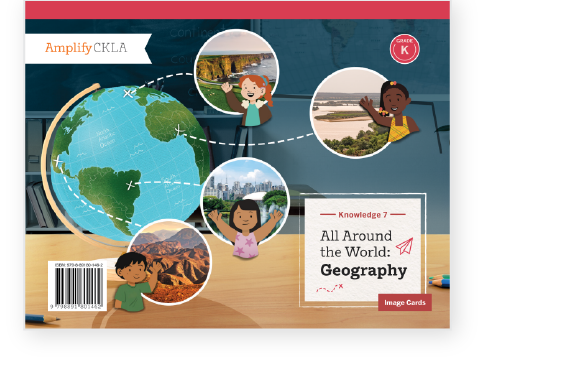
Unit 7: All Around the World: Geography

Unit 8 (Choice): Royal Tales: Monarchs

Unit 8 (Choice): National Icons: Presidents and American Symbols

Unit 9 (Choice): Our Planet: Taking Care of the Earth

Unit 9 (Choice): Rain and Rainbows: Seasons and Weather

Unit 10: Shaped by Nature: Art and the World Around Us

Skills Strand

Unit 1

Unit 2

Unit 3

Unit 4

Unit 5

Unit 6

Unit 7

Unit 8

Unit 9

Unit 10

Ancillary Components


Grade 1

Explore all available resources for Grade 1, organized by strand and unit.

Knowledge Strand

Unit 1: The Moral of the Story: Fables and Tales

Unit 2: From Nose to Toes: How Your Body Works

Unit 3: Common Threads: Different Lands, Similar Stories

Unit 4: Reach for the Stars: Astronomy

Unit 5: Charting the World: Geography

Unit 6: A World of Homes: Animals and Habitats

Unit 7: A New Nation: American Independence

Unit 8 (Choice): Once Upon a Time: Fairy Tales

Unit 8 (Choice): Our Planet: The History of the Earth

Unit 9 (Choice): From Babylon to the Nile: Early World Civilizations

Unit 9 (Choice): Early Americas: Maya, Aztec, and Inca

Unit 10: Adventure Stories: Tales from the Edge

Skills Strand

Unit 1

Unit 2

Unit 3

Unit 4

Unit 5

Unit 6

Unit 7

Ancillary Components


Grade 2

Explore all available resources for Grade 2, organized by strand and unit.

Knowledge Strand

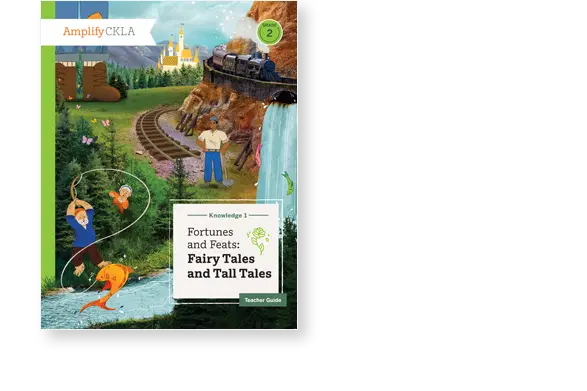
Unit 1: Fortunes and Feats: Fairy Tales and Tall Tales

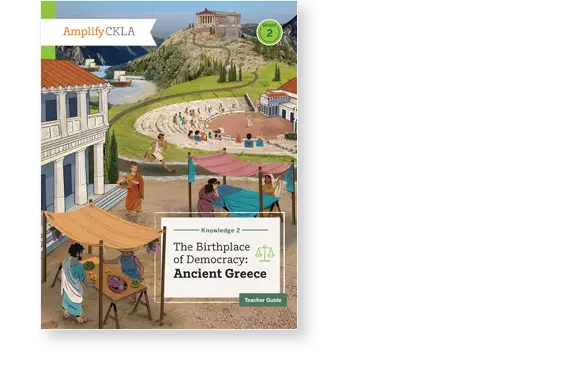
Unit 2: The Birthplace of Democracy: Ancient Greece

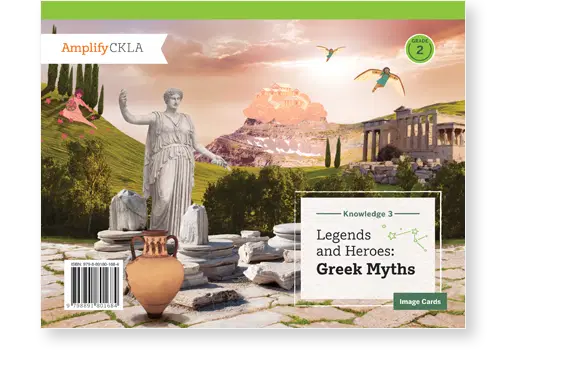
Unit 3: Legends and Heroes: Greek Myths

Unit 4: Our Planet: Cycles in Nature

Unit 5: Butterflies, Bees, and Beetles: Insects

Unit 6: A House Divided: The American Civil War

Unit 7: Sounds and Stanzas: Poetry

Unit 8 (Choice): Journeys to America: Immigration

Unit 8 (Choice): Making a Difference: Creating Change

Unit 9 (Choice): Building Blocks: All About Nutrition

Unit 9 (Choice): Early Asian Civilizations: India and China

Unit 10: Taking Flight: The Age of Aviation

Skills Strand

Unit 1

Unit 2

Unit 3

Unit 4

Unit 5

Unit 6

Ancillary Components


Grade 3

Explore all available resources for Grade 3, organized by unit.

Core Units

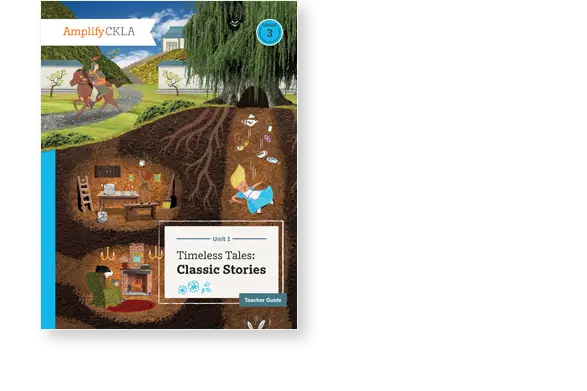
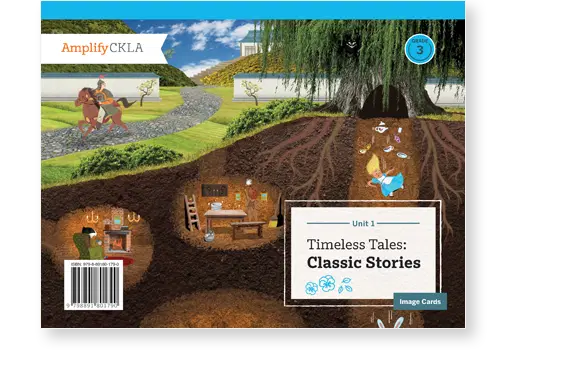
Unit 1: Timeless Tales: Classic Stories

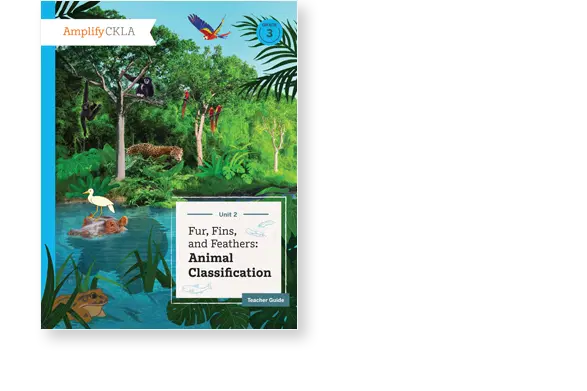
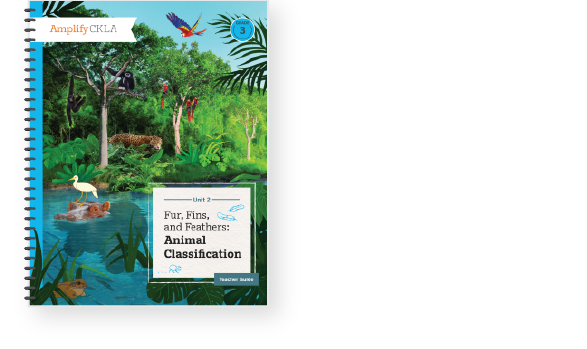
Unit 2: Fur, Fins, and Feathers: Animal Classification

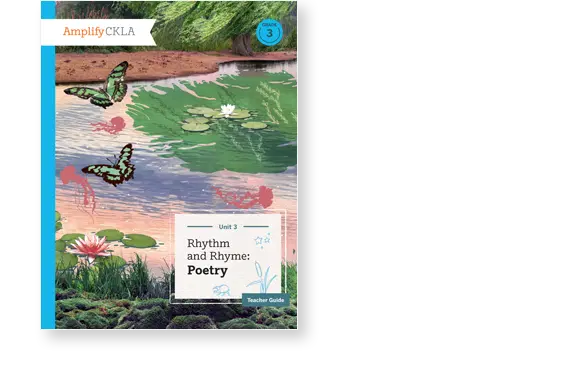
Unit 3: Rhythm and Rhyme: Poetry

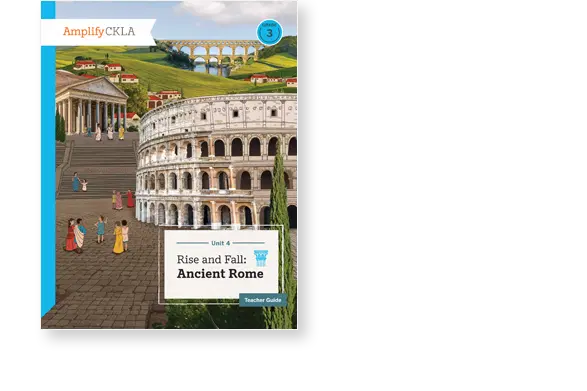
Unit 4: Rise and Fall: Ancient Rome

Unit 5: Our Solar System and Beyond: Astronomy

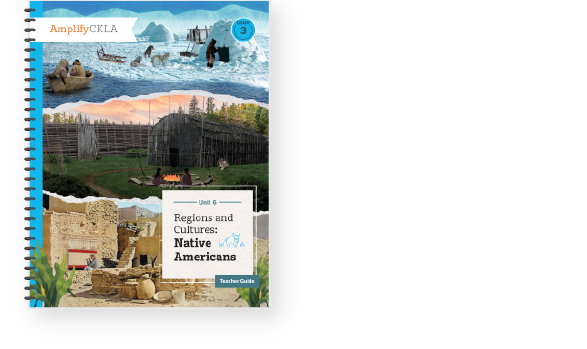
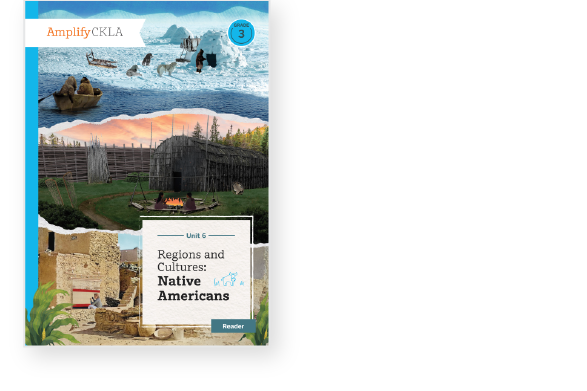
Unit 6: Regions and Cultures: Native Americans

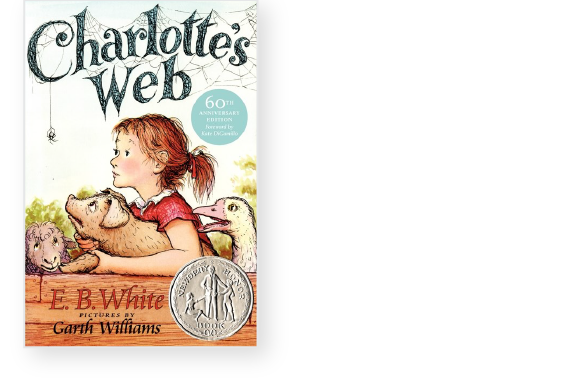
Unit 7 (Choice): Novel Study: Charlotte’s Web

Unit 7 (Choice): Novel Study: Stella Díaz Has Something to Say

Unit 8 (Choice): Systems and Senses: The Human Body

Unit 8 (Choice): From Glow to Echo: Light and Sound

Unit 9: From Blues to Bebop: All That Jazz


Supplemental Skills

Grade 3 Skills resources are included in core classroom kits, although the instruction isn’t required for Grade 3 standards coverage.

Unit 1

Unit 2

Unit 3

Unit 4


Grade 4

Explore all available resources for Grade 4, organized by unit.

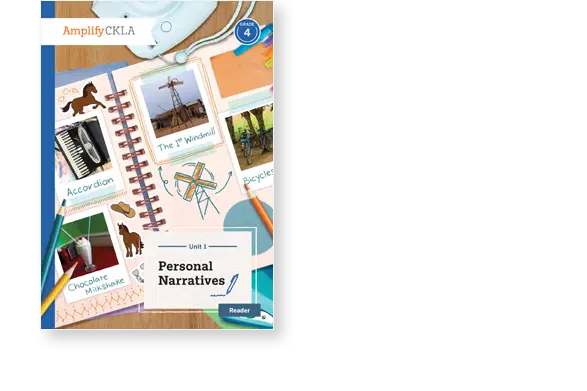
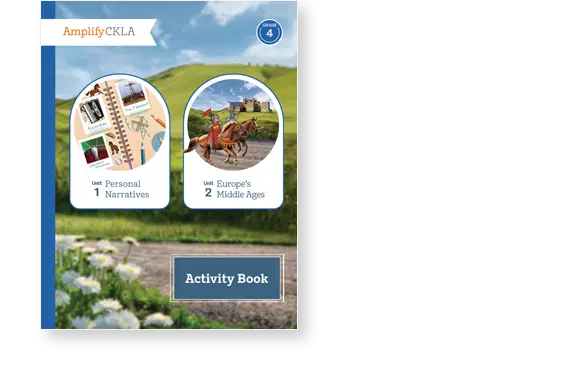
Unit 1: My Story, My Voice: Personal Narratives

Unit 2: Knights and Castles: Europe’s Middle Ages

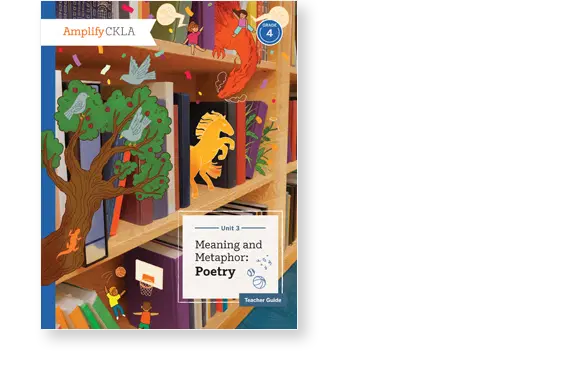
Unit 3: Meaning and Metaphor: Poetry

Unit 4: Eureka! Student Inventor

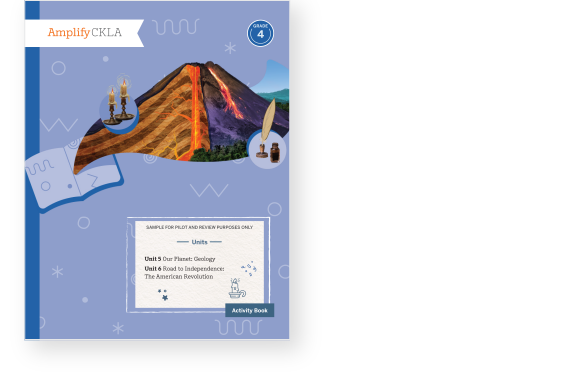
Unit 5: Our Planet: Geology

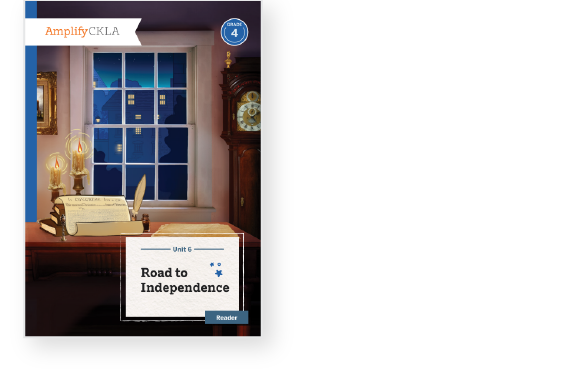
Unit 6: Road to Independence: The American Revolution

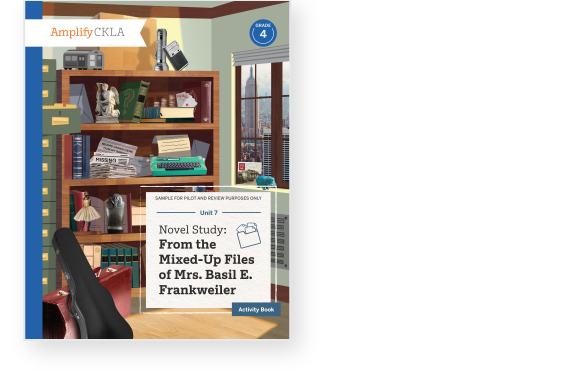
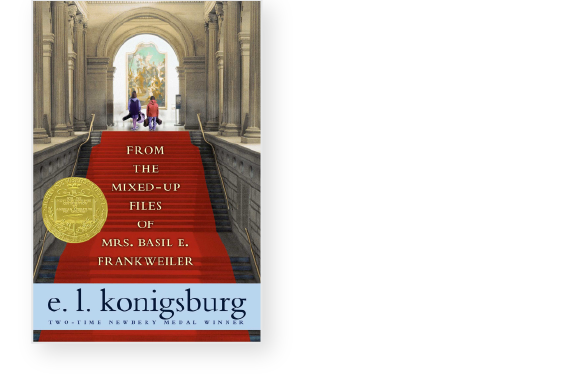
Unit 7 (Choice): Novel Study: From the Mixed-Up Files of Mrs. Basil E. Frankweiler

Unit 7 (Choice): Novel Study: The Season of Styx Malone

Unit 8 (Choice): Crafting Stories: A World of Tales

Unit 8 (Choice): Adventure on the High Seas: Treasure Island

Unit 9: Inspiration and Ingenuity: American Innovation

Grade 5

Explore all available resources for Grade 5, organized by unit.

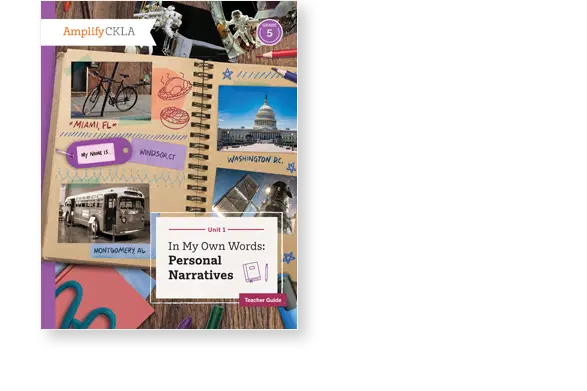
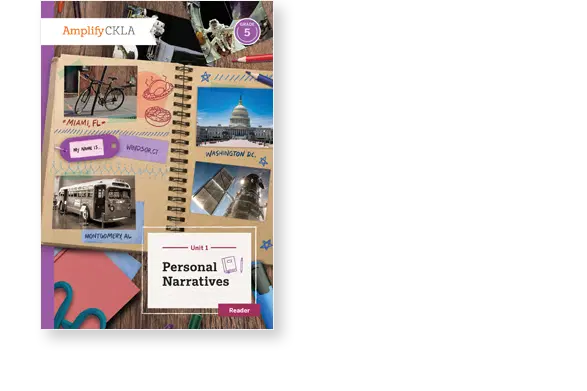
Unit 1: In My Own Words: Personal Narratives

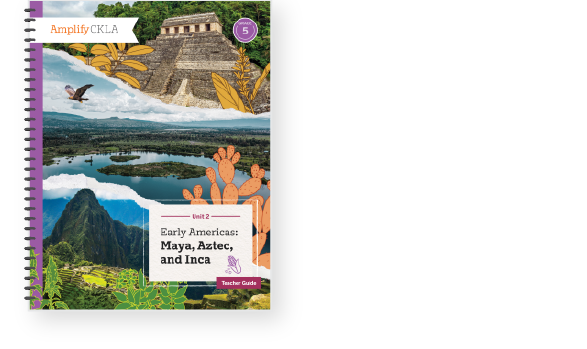
Unit 2: Early Americas: Maya, Aztec, and Inca

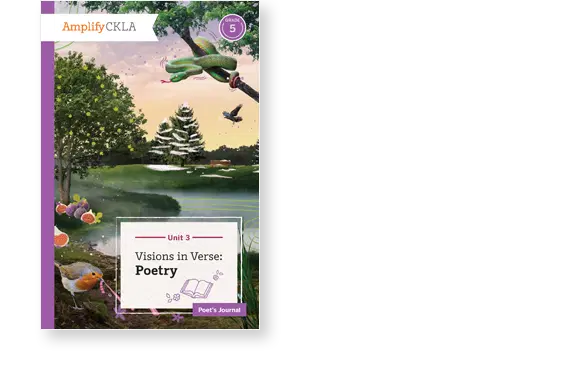
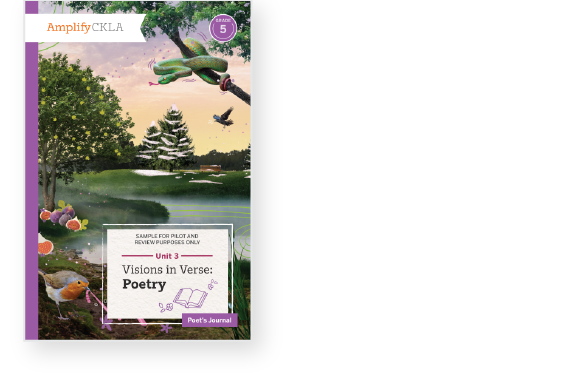
Unit 3: Visions in Verse: Poetry

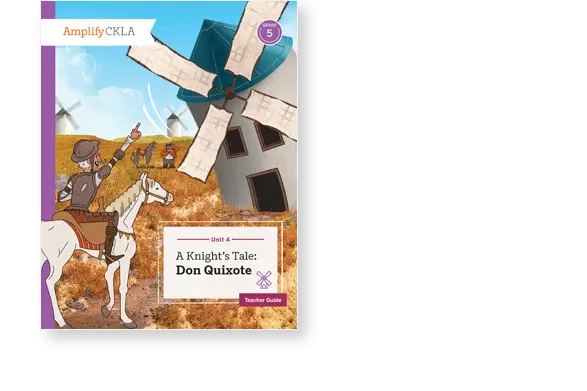
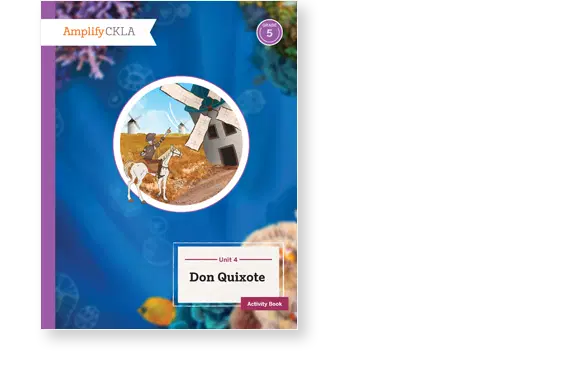
Unit 4: A Knight’s Tale: Don Quixote

Unit 5: The Deep Blue World: Oceans

Unit 6: Cultures and Histories: Native Americans

Unit 7 (Choice): Novel Study: The Phantom Tollbooth

Unit 7 (Choice): Novel Study: The Science of Breakable Things

Unit 8 (Choice): Arts and Culture: The Renaissance

Unit 8 (Choice): Through the Forest: A Midsummer Night’s Dream

Unit 9: Building Up the World: Global Architecture


Digital platform

Amplify CKLA’s all-in-one platform offers essential tools that streamline instruction for teachers and engage students with meaningful content. Teachers can plan and deliver lessons efficiently, while students can access assignments, assessments, and fun practice games.

A digital interface showing an assessment report on a monitor and a multiple-choice question on a tablet screen. Both screens display educational content from Amplify's assessment tools, providing personalized learning for multilingual learners.

Presentation Screens
Deliver interactive lessons with ready-made, customizable slides for every lesson.

Auto-scored digital assessments
Assess vocabulary, comprehension, and knowledge development at the end of each K–2 Knowledge and 3–5 Integrated Unit.

Standards-based reports
Identify strengths and growth areas for individuals, small groups, or your entire class. Interactive dashboards offer detailed results from assessments and activities.

Skill-building practice games
Engage students with interactive games that reinforce concepts and make learning fun. Powered by Boost Reading™, these games align with lessons and provide real-time feedback.

eReader
Students access texts, take notes, and use audio-enabled eReaders to enhance their reading experience.

Sound Library
Students watch articulation videos and listen to songs for each sound to support phonological awareness.

Vocab App
Helps students in Grades 3–5 practice Amplify CKLA Tier 2 vocabulary words with fun, interactive games.

Intervention Toolkit
Offers user-friendly resources designed to aid educators in identifying and addressing deficiencies in students’ foundation skills.

Welcome to the Amplify CKLA 3rd Edition program review site!

To view this protected page, enter the password below:


Welcome, Florida middle school educators!

Amplify ELA Florida is the program built for Florida middle school teachers and students. We designed the program to help ensure the B.E.S.T standards are covered; the skills are taught; the test is prepped for; and your students are scaffolded and encouraged. We want you to spend your time bringing the text to life, making the classroom hum, and letting every student know you are paying attention to their growth.

Amplify ELA Florida Program Guide

Illustration of a ship with diverse elements including human figures, nature motifs, and space elements on a black background.
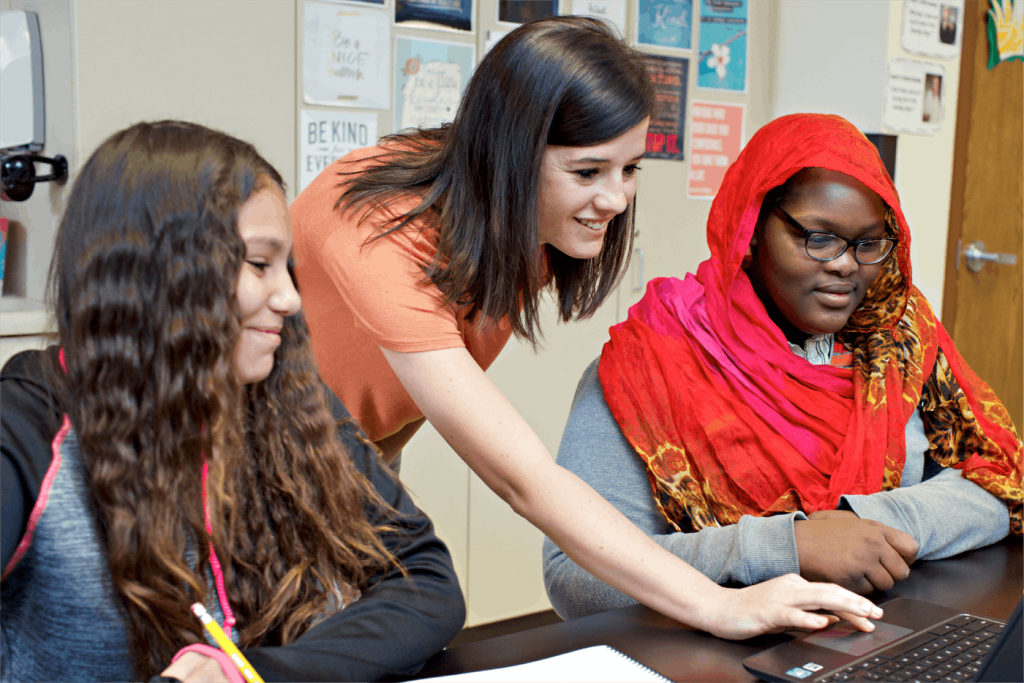
A teacher assists two students with a laptop in a classroom, one wearing a hijab, conveying a supportive educational environment.

Instruction matters

Florida’s new standards have been crafted to give your students the B.E.S.T. Amplify ELA Florida’s lessons explore the most compelling aspect of a text and target the standards that best support that analysis through reading, writing, and communication. These key standards are identified as the lesson’s Spotlight benchmark.  Strategic connections are attained in the program through:

  • Florida model texts including rich literature and compelling non-fiction, taught in engaging new ways for today’s learners.
  • Benchmark stacks that build connections within lessons and across units.
  • Foundational instruction that targets key standards and multiple learning modes.
  • Writing that builds directly from reading complex text and is evaluated by Amplify’s Automated Writing Evaluation (AWE).
  • Reading with the B.E.S.T. Modules have been built to guide teachers and students as they begin to work with Florida’s new reading standards, providing an introduction to each grade-level B.E.S.T. Reading Benchmark. (Example module: Grade 6, Understanding Rhetoric)

Knowledge matters

Texts in the Amplify ELA Florida Edition curriculum cover a wide range of topics, themes, and genres with differentiated supports that ensure that all students can work through each reading and lesson. Taken as a whole, the texts show students a diverse picture of the world and help foster a lifelong love of reading. Comprehension develops as students engage with literary and informational text selections that are complex, rich, and meaningful. 

Texts were selected for Amplify ELA Florida Edition using the following criteria: 

  • Text complexity as defined by qualitative, quantitative, and reader and task measurements as required by the B.E.S.T. Standards and the Amplify Text Complexity Index
  • Balance of literary and informational texts
  • Varied representation of genres: novels, plays, poetry, biographies, and other full-length texts
  • Diverse cultures, perspectives, and authors
  • Engaging texts that extend learning and support students as they build knowledge
  • Grade-appropriate texts, with scaffolding and compelling activities to support student engagement with 100% authentic texts
  • A library with more than 700 complete books, both classic and contemporary, encompassing a wide range of genres, topics, and cultural perspectives
Collage featuring a violinist with glowing eyes, a man with a background of space, a robotic arm, a tiger on a grassy knoll, and a city skyline under a starry sky.

Curriculum matters

Amplify ELA Florida is a blended curriculum designed specifically for grades 6–8. The heart of every lesson is the text. Each grade includes six units centered on literary or informational texts, delivered in several forms of media. Your classroom will also benefit from two or three immersive, project-based experiences and a dedicated Story Writing unit.

  • Full B.E.S.T. coverage: Standards are clearly labeled in each lesson, so teachers can save time planning and get back to what they love: teaching. Also included are Benchmark Modules that support teachers’ and students’ introduction to the new standards for Florida.
  • Five levels of differentiation: Based on each student’s needs and the performance measures within Amplify ELA reports, a teacher can choose the differentiation level that’s the right fit for everyone.
  • Embedded Assessments: Teachers benefit from uninterrupted instructional time and a continuously updated picture of each student’s progress with key skills and standards.
  • Powerful feedback tools: Comprehensive tools help teachers maximize both the quantity and quality of feedback.
  • Robust reporting: Our reporting app offers information on student progress to help inform instructional decisions.

All in one place: Embedded teacher support, differentiation tools, student data, text, and other curriculum features—they’re all right there.

Materials

Amplify ELA Florida Edition is a blended curriculum that seamlessly integrates print and digital resources to be used in any learning environment. The resources are designed to facilitate instruction for planning, teaching, learning, and assessment.

Student materials

Available digitally and in print, the student materials guide middle schoolers through complex texts and writing with the following:

  • Student Edition will engage students with high-quality narrative and informational texts.
  • Digital experience will provide videos, a library of more than 700 texts, audio supports, and other online experiences that capture their attention.
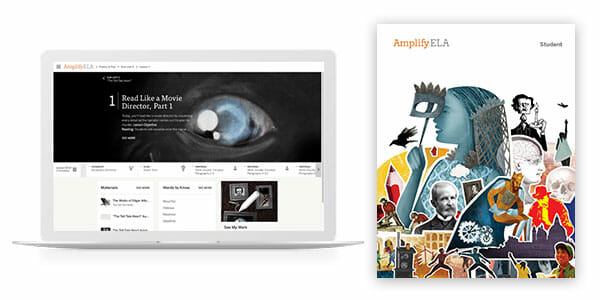
A laptop displays a web page titled "read like a movie director, part 1" from amplify ela, featuring text and an eyeball image under the lesson tab.
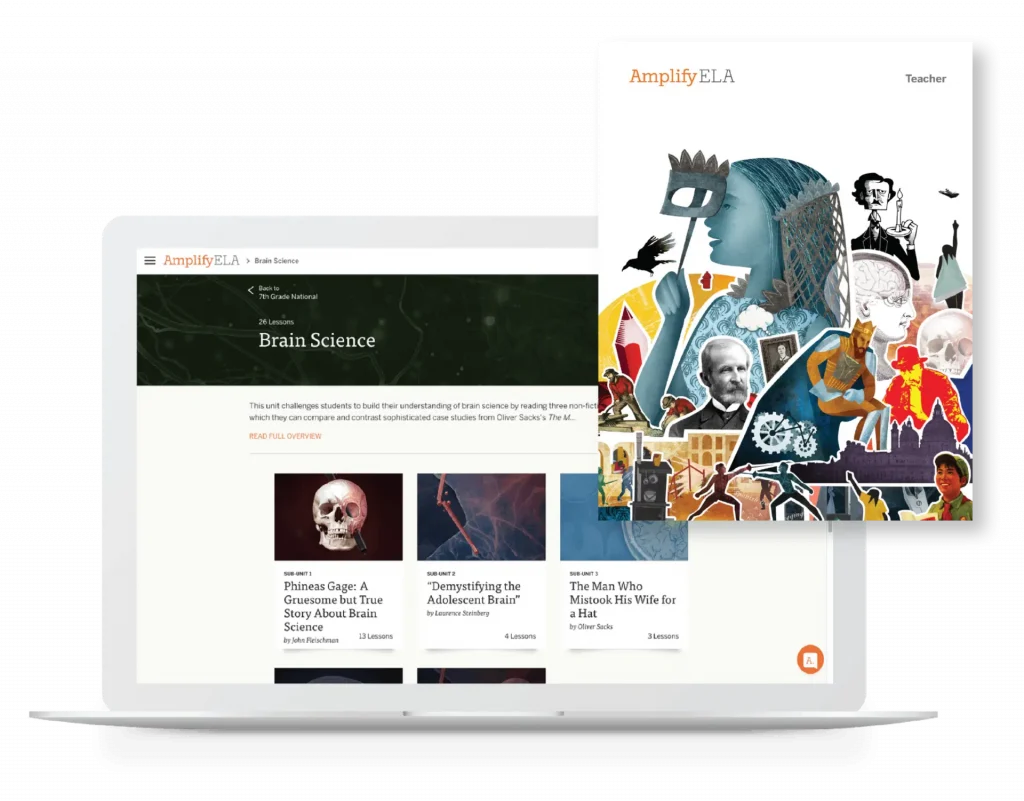
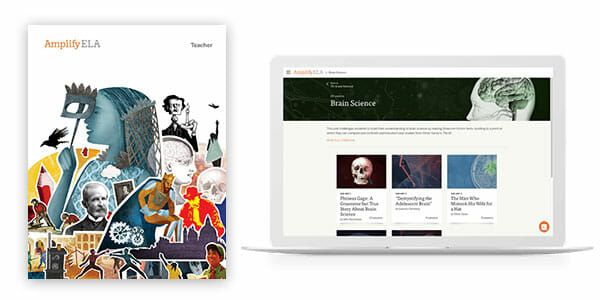
A laptop displaying a webpage from "amplify ela" featuring the title "brain science" and various educational topics alongside an illustrated collage of diverse human figures.

Teacher materials

Available digitally and in print, the Teacher Edition contains all of the information teachers need to facilitate classroom instruction, including:

  • From detailed lesson plans.
  • Video teacher tips embedded in the lesson.
  • B.E.S.T. standards alignment and assessments including exit tickets.
  • Real-time differentiation strategies.
  • Clarify and Compare lessons.
  • Robust reporting.

Professional learning

Amplify employs a national cohort of more than 50 ELA facilitators, all of whom have experience as former classroom teachers and many of whom are former school and/or district leaders. Our professional learning team has decades of experience working with large districts across the nation. Amplify has experience supporting district launches over multiple years and has partnered with districts of all sizes nationwide. We partner deeply with districts and tailor professional learning to their unique needs.

Florida ELA Implementation

Two women are seated at a desk, smiling and working together on a project with a laptop and notebook in an office setting.

Welcome, Minnesota Educators!

To view this protected page, enter the password below:


Welcome to Amplify CKLA 3rd Edition, Utah Reviewers!

We’re excited to share everything you need to review Amplify CKLA 3rd Edition, our K–5 core literacy program. On this site, you’ll find a comprehensive collection of resources and overviews to get you started, as well as a range of materials to explore the program, including Teacher Guides, Activity Books, Student Readers, and more, organized by grade and unit.

Please note that the files on this site are static representations of the high-quality materials you’ll review on the digital platform.

Reviewer resources

Access key materials designed to support your review of Amplify CKLA 3rd Edition.

Digital platform access

Amplify CKLA’s all-in-one platform offers essential tools that streamline instruction for teachers and engage students with meaningful content.

In order to access your digital materials, you’ll need to log into our platform using your unique login credentials found on the Start Here flyer inside of your Reviewer Binder. Once you have located the flyer:

  • Click the orange button below to access the platform.
  • Click “Log in with Amplify.”
  • Enter the username and password provided on your Start Here flyer.

The video below will provide you with instructions on how to access and navigate the digital platform.

Teachers can plan and deliver lessons efficiently, while students can access assignments, assessments, and fun practice games within the CKLA digital platform. The digital experience includes:

Presentation Screens
Deliver interactive lessons with ready-made, customizable slides for every lesson.

Auto-scored digital assessments
Assess vocabulary, comprehension, and knowledge development at the end of each K–2 Knowledge and 3–5 Integrated Unit.

Standards-based reports
Identify strengths and growth areas for individuals, small groups, or your entire class. Interactive dashboards offer detailed results from assessments and activities.

Skill-building practice games
Engage students with interactive games that reinforce concepts and make learning fun. Powered by Boost Reading™, these games align with lessons and provide real-time feedback.

eReader
Students access texts, take notes, and use audio-enabled eReaders to enhance their reading experience.

Sound Library
Students watch articulation videos and listen to songs for each sound to support phonological awareness.

Vocab App
Helps students in Grades 3–5 practice Amplify CKLA Tier 2 vocabulary words with fun, interactive games.

Intervention Toolkit
Offers user-friendly resources designed to aid educators in identifying and addressing deficiencies in students’ foundation skills.

Kindergarten

Explore all available resources for Kindergarten, organized by strand and unit.

Knowledge Strand

Unit 1: Star Light, Star Bright: Nursery Rhymes and Fables

Unit 2: See, Hear, Smell, Taste, Touch: The Five Senses

Unit 3: Underdogs and Heroes: Stories

Unit 4: See How They Grow: Plants

Unit 5: Moo, Cluck, Oink: Farms

Unit 6: Deep Roots: Introduction to Native American Cultures

Unit 7: All Around the World: Geography

Unit 8 (Choice): Royal Tales: Monarchs

Unit 8 (Choice): National Icons: Presidents and American Symbols

Unit 9 (Choice): Our Planet: Taking Care of the Earth

Unit 9 (Choice): Rain and Rainbows: Seasons and Weather

Unit 10: Shaped by Nature: Art and the World Around Us

Skills Strand

Unit 1

Unit 2

Unit 3

Unit 4

Unit 5

Unit 6

Unit 7

Unit 8

Unit 9

Grade 1

Explore all available resources for Grade 1, organized by strand and unit.

Knowledge Strand

Unit 1: The Moral of the Story: Fables and Tales

Unit 2: From Nose to Toes: How Your Body Works

Unit 3: Common Threads: Different Lands, Similar Stories

Unit 4: Reach for the Stars: Astronomy

Unit 5: Charting the World: Geography

Unit 6: A World of Homes: Animals and Habitats

Unit 7: A New Nation: American Independence

Unit 8 (Choice): Once Upon a Time: Fairy Tales

Unit 8 (Choice): Our Planet: The History of the Earth

Unit 9 (Choice): From Babylon to the Nile: Early World Civilizations

Unit 9 (Choice): Early Americas: Maya, Aztec, and Inca

Unit 10: Adventure Stories: Tales from the Edge

Skills Strand

Unit 1

Unit 2

Unit 3

Unit 4

Unit 5

Unit 6

Unit 7

Ancillary Components


Grade 2

Explore all available resources for Grade 2, organized by strand and unit.

Knowledge Strand

Unit 1: Fortunes and Feats: Fairy Tales and Tall Tales

Unit 2: The Birthplace of Democracy: Ancient Greece

Unit 3: Legends and Heroes: Greek Myths

Unit 4: Our Planet: Cycles in Nature

Unit 5: Butterflies, Bees, and Beetles: Insects

Unit 6: A House Divided: The American Civil War

Unit 7: Sounds and Stanzas: Poetry

Unit 8 (Choice): Journeys to America: Immigration

Unit 8 (Choice): Making a Difference: Creating Change

Unit 9 (Choice): Building Blocks: All About Nutrition

Unit 9 (Choice): Early Asian Civilizations: India and China

Unit 10: Taking Flight: The Age of Aviation

Skills Strand

Unit 1

Unit 2

Unit 3

Unit 4

Unit 5

Unit 6

Ancillary Components


Grade 3

Explore all available resources for Grade 3, organized by unit.

Core Units

Unit 1: Timeless Tales: Classic Stories

Unit 2: Fur, Fins, and Feathers: Animal Classification

Unit 3: Rhythm and Rhyme: Poetry

Unit 4: Rise and Fall: Ancient Rome

Unit 5: Our Solar System and Beyond: Astronomy

Unit 6: Regions and Cultures: Native Americans

Unit 7 (Choice): Novel Study: Charlotte’s Web

Unit 7 (Choice): Novel Study: Stella Díaz Has Something to Say

Unit 8 (Choice): Systems and Senses: The Human Body

Unit 8 (Choice): From Glow to Echo: Light and Sound

Unit 9: From Blues to Bebop: All That Jazz


Supplemental Skills

Grade 3 Skills resources are included in core classroom kits, although the instruction isn’t required for Grade 3 standards coverage.

Unit 1

Unit 2

Unit 3

Unit 4


Grade 4

Explore all available resources for Grade 4, organized by unit.

Unit 1: My Story, My Voice: Personal Narratives

Unit 2: Knights and Castles: Europe’s Middle Ages

Unit 3: Meaning and Metaphor: Poetry

Unit 4: Eureka! Student Inventor

Unit 5: Our Planet: Geology

Unit 6: Road to Independence: The American Revolution

Unit 7 (Choice): Novel Study: From the Mixed-Up Files of Mrs. Basil E. Frankweiler

Unit 7 (Choice): Novel Study: The Season of Styx Malone

Unit 8 (Choice): Crafting Stories: A World of Tales

Unit 8 (Choice): Adventure on the High Seas: Treasure Island

Unit 9: Inspiration and Ingenuity: American Innovation


Grade 5

Explore all available resources for Grade 5, organized by unit.

Unit 1: In My Own Words: Personal Narratives

Unit 2: Early Americas: Maya, Aztec, and Inca

Unit 3: Visions in Verse: Poetry

Unit 4: A Knight’s Tale: Don Quixote

Unit 5: The Deep Blue World: Oceans

Unit 6: Cultures and Histories: Native Americans

Unit 7 (Choice): Novel Study: The Phantom Tollbooth

Unit 7 (Choice): Novel Study: The Science of Breakable Things

Unit 8 (Choice): Arts and Culture: The Renaissance

Unit 8 (Choice): Through the Forest: A Midsummer Night’s Dream

Unit 9: Building Up the World: Global Architecture

Welcome to the Amplify CKLA 3rd Edition program review site!

To view this protected page, enter the password below:


Welcome to the Amplify CKLA 3rd Edition program review site!

To view this protected page, enter the password below:


Administrators, welcome to mCLASS!

Here you’ll find information about enrollment and licensing, technical requirements, professional learning resources, and more.

A young girl with curly hair smiling and holding a stylus and tablet, with colorful abstract shapes in the background.

Onboarding: What to expect

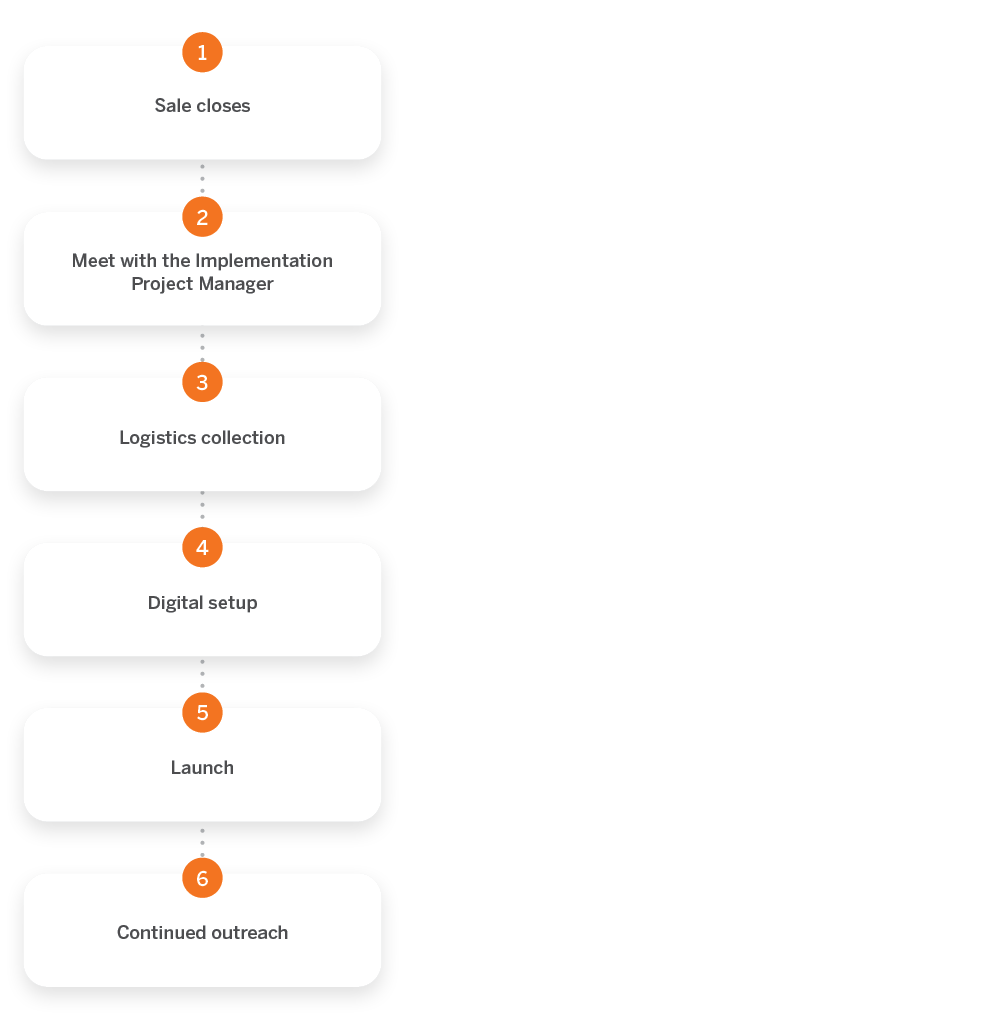
Welcome to mCLASS! There are six basic steps to onboarding. Use this visual as a reference, but also know that our dedicated implementation team will be there to support you during the entire process.

Vertical flowchart showing six sequential steps for a project, starting with "sale closes," and concluding with "continued outreach." steps are connected by dotted lines.

Technology requirements and guidelines

To ensure that your hardware and network meet the minimum technical requirements for performance and support of mCLASS, please see Amplify’s customer requirements page.

You’ll also want to add the URLs on this page to the corresponding district- or school-level filters so that your teachers and students can access their mCLASS materials.

Data sharing agreement

Partnering with Amplify through our data sharing program deepens learning outcomes and gives you the performance analysis you need to make impactful decisions within your district or school. By signing our data sharing agreement, your district will help us to better understand student performance as it relates to your state’s standards. It also allows us to compare results with the curriculum-embedded assessments and state-level assessments. These analyses will help you identify the areas where your teachers and students are excelling or may be experiencing challenges.

Stay tuned for additional updates.

Enrollment and licensing overview

During the enrollment and licensing call, your Amplify implementation partner will walk you through the enrollment process. We recommend exploring the enrollment web tool ahead of the call for suggestions on which enrollment method may be best for your district.

The following guides provide additional information about enrollment methods and the data sharing process.

Button with text "2021 Enrollment methods" and "Download PDF" in orange border. There is an icon of a document with a downward arrow.
A white and orange button with an icon of a document and downward arrow, labeled "Data sharing overview." Below it, there is a link saying "Download PDF".

You can also reference the mCLASS Enrollment Help collection for additional information.

Preparing for your materials

If you have ordered printed assessment kits, you or the materials coordinator at your school or district will receive a shipping logistics survey to ensure a smooth delivery. It is critical that this survey be completed prior to the shipment of materials. If your school or district has not received a survey, reach out to your Amplify implementation manager.

What’s included in the kits?

Below you will find a list of the print materials included in each mCLASS kit.

DIBELS 8th Edition

The mCLASS DIBELS® 8th Edition kits are grade-specific and contain the student materials for assessment with mCLASS software. K–6 (Kits for each grade sold separately):

  • How to Get Started with mCLASS one sheet
  • Student Benchmark Assessment materials
  • Student Progress Monitoring Assessment materials
  • Assessment Administration and Scoring manual

Maze administration:

  • Maze for grades 2–6 is typically administered online to a group of students, each on their own computer or device. No printed materials are needed.
  • If your school does not have sufficient student devices or if your students are not yet ready for online assessment, you may administer Maze with paper and pencil and enter the scores manually. Get more information.

Materials for additional assessments in the mCLASS suite

For customers who use Text Reading and Comprehension (TRC), IDEL®, TRC Spanish, mCLASS® Math, and/or Intervention, we provide the following:

TRC Atlas Benchmark kit

  • 76 leveled readers covering levels A–Z (both fiction and nonfiction)
  • Tabs to organize books by level grouping
  • Information pamphlet

mCLASS: Math

Kindergarten and grade 1 combination kit

  • Activities Guide
  • Counting chips
  • Screening and Progress Monitoring student materials

Grade 2 kit

  • Activities Guide
  • Counting chips
  • Screening and Progress Monitoring Teacher Guide and answer key
  • Screening and Progress Monitoring forms 1–10

Grade 3 kit

  • Activities Guide
  • Screening and Progress Monitoring teacher guide and answer key
  • Screening and Progress Monitoring forms 1–10

Multi-grade kit, including K–3

  • All materials listed above

IDEL

IDEL Multi-grade kit (K–3):

  • Kit includes K–3 student and teacher materials

TRC Spanish

TRC Spanish Benchmark kit (K–3)

  • 20 leveled readers covering Descrubriendo la Lectura (DLL) levels 1–24 (both fiction and nonfiction)
  • Information pamphlet
  • 16 additional texts available online via the mCLASS home training page

Intervention

K–3 and 4–6 kits (sold separately)

  • Printed cards
  • Puppet
  • Whiteboard
  • Sticker book
  • 25 resealable bags
  • Magnifying glass
  • Burst® binder
  • Burst messenger bag
  • User Guides
  • Accordion file
  • Burst posters
  • Light blue carrying case (includes double-tipped markers, dry erase markers, counting chips, and sand timers)
  • Assessment books

Announcements

Use stimulus funding to drive transformation
Learn about ESSER I, II, and III funding (or CARES, CRRSA, and ARP) and how to use these funds to help with learning recovery and acceleration. Districts have significant flexibility in how to use the ESSER money, with ESSER II and III specifying that some of the funds should be used to address unfinished learning. All Amplify programs and services meet the criteria for the funding. Get more information about funding and timelines.

Next steps: How do I support my teachers?

Logging in to mCLASS Home
mCLASS Home is where you will access mCLASS Reporting, Instruction, and other helpful resources. Teachers can log in by navigating to mclass.amplify.com.

Setting up your assessment device
Assessments are administered using the mCLASS app. The mCLASS app is installed by creating a shortcut from your school’s preferred web browser on the desktop or home screen of a teacher’s device. Share this link with teachers for best practices specific to their device’s operating system.

Professional development
We partner with every district to make sure the mCLASS rollout meets their unique needs. Check out our professional development site to get a better understanding of what our team has to offer.

Contact us

Powerful (and free!) pedagogical support
Amplify provides a unique kind of support you won’t find from other publishers. We’ve developed an educational support team of former teachers and administrators who provide pedagogical support at no cost to educators using our programs. This free service includes:

  • Support with administering and interpreting assessment data and more.
  • Guidance for developing lesson plans and intervention plans.
  • Recommendations and tips for day-to-day teaching with mCLASS.

To reach our pedagogical team, click the orange icon while logged into mCLASS to get immediate help, call (866) 629-2446, or email edsupport@amplify.com.

Timely technical and program support
Our Customer Care and Support team is available Monday through Friday, 7 a.m. to 9 p.m. ET, and Sunday, 10 a.m. to 6 p.m. ET, through a variety of channels:

  • Live chat: Click the orange icon while logged into mCLASS to get immediate help in the middle of the school day.
  • Phone: Call our toll-free number: (800) 823-1969.
  • Email: Send an email to help@amplify.com.

Join our community
Our mCLASS Facebook group is a community of mCLASS educators from across the country. It’s a space to share best practices, ideas, and support on everything from implementation to instruction. Join today.

Administrators, welcome to Amplify Science!

Here you’ll find information about enrollment and licensing, technical requirements, professional learning resources, and more.

Onboarding: What to expect

Welcome to Amplify Science! There are six basic steps to onboarding. Use this visual as a reference, but also know that our dedicated implementation team will be there to support you during the entire process.

Technology requirements and guidelines

To ensure that your hardware and network meet the minimum technical requirements for performance and support of your curriculum products, please see Amplify’s customer requirements page.

You’ll also want to add the URLs on this page to the corresponding district- or school-level filters so that your teachers and students can access their Amplify Science materials.

Data sharing agreement

Partnering with Amplify through our data sharing program deepens learning outcomes and gives you the performance analysis you need to make impactful decisions within your district or school. By signing our data sharing agreement, your district will help us to better understand student performance as it relates to your state’s standards. It also allows us to compare results with the curriculum-embedded assessments and state-level assessments. These analyses will help you identify the areas where your teachers and students are excelling or may be experiencing challenges.

Stay tuned for additional updates.

Enrollment and licensing overview

During the enrollment and licensing call, your Amplify implementation partner will walk you through the enrollment process. We recommend exploring the enrollment web tool ahead of the call for suggestions on which enrollment method may be best for your district.

The following guides provide additional information about enrollment methods and the data sharing process.

Preparing for your materials

Each unit of Amplify Science comes with a hands-on materials kit.

Each hands-on materials kit arrives in 1–3 boxes and contains the following:

  • Consumable materials
  • Nonconsumable materials
  • Classroom wall materials
  • Premium print materials (cards, maps, etc.)
  • 18 copies of each Student Book (K–5)
  • A blackline master copy of the Student Investigation Notebook (K–5)

You can find complete materials lists for each unit in the following PDFs. This information is also available in the digital Teacher’s Guide within the program.

Once your district’s purchase order has been sent to Amplify and is processed, Amplify will provide tracking information on your materials kits and any additional print materials you’ve ordered.

Administrator Reports

Self-service Administrator Reports allow insight into teacher and student usage and student performance data for the current school year.

Access is limited to district and school administrators. Administrators can directly access these reports at my.amplify.com/admin-reports.

Get more information.

Announcements

Summer extension
With summer fast approaching, we recognize that some districts may be extending the school year and/or continuing the use of Amplify curriculum and programs for summer instruction. If your summer instruction will continue past June 30 and/or you need to make rostering or enrollment changes, follow our guidance on extending your rollover date.

Use stimulus funding to drive transformation
Learn about ESSER I, II, and III funding (or CARES, CRRSA, and ARP) and how to use these funds to help with learning recovery and acceleration. Districts have significant flexibility in how to use the ESSER money, with ESSER II and III specifying that some of the funds should be used to address unfinished learning. All Amplify programs and services meet the criteria for the funding. Get more information about funding and guidelines.

Next steps: How do I support my teachers?

Pre-launch checklist for teachers
Please share our Program Hub with your educators. It will provide helpful information as they prepare to implement Amplify in their classrooms, including a pre-launch checklist. Note that they’ll need to be logged into Amplify Science to access the Hub. If they don’t have a login yet, you can also download and share the  Amplify Science pre-launch checklist for teachers PDF.

Professional learning
We partner with every district to make sure the Amplify Science rollout meets their unique needs. Check out these sample agendas to get a better understanding of what our team has to offer.

Advice and answers
The Science help website is filled with step-by-step resources to address educators’ questions. Encourage your educators to read through these tutorials and search for topics they want to learn more about.

Contact us

Powerful (and free!) pedagogical support
Amplify provides a unique kind of support you won’t find from other publishers. We’ve developed an educational support team of former teachers and administrators who provide pedagogical support at no cost to educators using our programs. This free service includes:

  • Information on where to locate standards and other planning materials.
  • Recommendations and tips for day-to-day teaching with Amplify Science.
  • Support with administering and interpreting assessment data and more.

To reach our pedagogical team, click the orange icon while logged into the curriculum to get immediate help, call (866) 629-2446, or email edsupport@amplify.com.

Timely technical and program support
Our Customer Care and Support team is available Monday through Friday, 7 a.m. to 9 p.m. ET, and Sunday, 10 a.m. to 6 p.m. ET, through a variety of channels:

  • Live chat: Click the orange icon while logged into the curriculum to get immediate help in the middle of the school day.
  • Phone: Call our toll-free number: (800) 823-1969.
  • Email: Send an email to help@amplify.com.

Join our community
Our Amplify Science Facebook group is a community of Amplify Science educators from across the country. It’s a space to share best practices, ideas, and support on everything from implementation to instruction. Join today.

Welcome, Michigan Committee for Literacy Achievement!

We’re excited to share everything you need to critically evaluate Amplify CKLA 3rd Edition, our K–5 core literacy program. On this site, you’ll find a range of materials and literacy tools, including Reviewer Resources and Teaching Materials (Teacher Guides, Activity Books, and Student Readers) organized by grade and unit.

We hope you find the site helpful. We welcome your thoughts and questions!

Reviewer resources

Key bid documents:

Overview and program resources:

Alignment and scope and sequence:

Curriculum maps by grade:

Kindergarten

Explore all available resources for Kindergarten, organized by strand and unit.

Knowledge Strand

Unit 1: Star Light, Star Bright: Nursery Rhymes and Fables

Unit 2: See, Hear, Smell, Taste, Touch: The Five Senses

Unit 3: Underdogs and Heroes: Stories

Unit 4: See How They Grow: Plants

Unit 5: Moo, Cluck, Oink: Farms

Unit 6: Deep Roots: Introduction to Native American Cultures

Unit 7: All Around the World: Geography

Unit 8 (Choice): Royal Tales: Monarchs

Unit 8 (Choice): National Icons: Presidents and American Symbols

Unit 9 (Choice): Our Planet: Taking Care of the Earth

Unit 9 (Choice): Rain and Rainbows: Seasons and Weather

Unit 10: Shaped by Nature: Art and the World Around Us

Skills Strand

Unit 1

Unit 2

Unit 3

Unit 4

Unit 5

Unit 6

Unit 7

Unit 8

Unit 9

Unit 10

Ancillary Components


Grade 1

Explore all available resources for Grade 1, organized by strand and unit.

Knowledge Strand

Unit 1: The Moral of the Story: Fables and Tales

Unit 2: From Nose to Toes: How Your Body Works

Unit 3: Common Threads: Different Lands, Similar Stories

Unit 4: Reach for the Stars: Astronomy

Unit 5: Charting the World: Geography

Unit 6: A World of Homes: Animals and Habitats

Unit 7: A New Nation: American Independence

Unit 8 (Choice): Once Upon a Time: Fairy Tales

Unit 8 (Choice): Our Planet: The History of the Earth

Unit 9 (Choice): From Babylon to the Nile: Early World Civilizations

Unit 9 (Choice): Early Americas: Maya, Aztec, and Inca

Unit 10: Adventure Stories: Tales from the Edge

Skills Strand

Unit 1

Unit 2

Unit 3

Unit 4

Unit 5

Unit 6

Unit 7

Ancillary Components


Grade 2

Explore all available resources for Grade 2, organized by strand and unit.

Knowledge Strand

Unit 1: Fortunes and Feats: Fairy Tales and Tall Tales

Unit 2: The Birthplace of Democracy: Ancient Greece

Unit 3: Legends and Heroes: Greek Myths

Unit 4: Our Planet: Cycles in Nature

Unit 5: Butterflies, Bees, and Beetles: Insects

Unit 6: A House Divided: The American Civil War

Unit 7: Sounds and Stanzas: Poetry

Unit 8 (Choice): Journeys to America: Immigration

Unit 8 (Choice): Making a Difference: Creating Change

Unit 9 (Choice): Building Blocks: All About Nutrition

Unit 9 (Choice): Early Asian Civilizations: India and China

Unit 10: Taking Flight: The Age of Aviation

Skills Strand

Unit 1

Unit 2

Unit 3

Unit 4

Unit 5

Unit 6

Ancillary Components


Grade 3

Explore all available resources for Grade 3, organized by unit.

Unit 1: Timeless Tales: Classic Stories

Unit 2: Fur, Fins, and Feathers: Animal Classification

Unit 3: Rhythm and Rhyme: Poetry

Unit 4: Rise and Fall: Ancient Rome

Unit 5: Our Solar System and Beyond: Astronomy

Unit 6: Regions and Cultures: Native Americans

Unit 7 (Choice): Novel Study: Charlotte’s Web

Unit 7 (Choice): Novel Study: Stella Díaz Has Something to Say

Unit 8 (Choice): Systems and Senses: The Human Body

Unit 8 (Choice): From Glow to Echo: Light and Sound

Unit 9: From Blues to Bebop: All That Jazz

Ancillary Components

Grade 4

Explore all available resources for Grade 4, organized by unit.

Unit 1: My Story, My Voice: Personal Narratives

Unit 2: Knights and Castles: Europe’s Middle Ages

Unit 3: Meaning and Metaphor: Poetry

Unit 4: Eureka! Student Inventor

Unit 5: Our Planet: Geology

Unit 6: Road to Independence: The American Revolution

Unit 7 (Choice): Novel Study: From the Mixed-Up Files of Mrs. Basil E. Frankweiler

Unit 7 (Choice): Novel Study: The Season of Styx Malone

Unit 8 (Choice): Crafting Stories: A World of Tales

Unit 8 (Choice): Adventure on the High Seas: Treasure Island

Unit 9: Inspiration and Ingenuity: American Innovation

Ancillary Components

Grade 5

Explore all available resources for Grade 5, organized by unit.

Unit 1: In My Own Words: Personal Narratives

Unit 2: Early Americas: Maya, Aztec, and Inca

Unit 3: Visions in Verse: Poetry

Unit 4: A Knight’s Tale: Don Quixote

Unit 5: The Deep Blue World: Oceans

Unit 6: Cultures and Histories: Native Americans

Unit 7 (Choice): Novel Study: The Phantom Tollbooth

Unit 7 (Choice): Novel Study: The Science of Breakable Things

Unit 8 (Choice): Arts and Culture: The Renaissance

Unit 8 (Choice): Through the Forest: A Midsummer Night’s Dream

Unit 9: Building Up the World: Global Architecture

Ancillary Components

Skills Supplement (Grades 3-5)

These supplementary units for Grades 3-5 reinforce and build on K-2 foundational skills instruction.

Unit 1

Unit 2

Unit 3

Unit 4


Digital platform

In the 2025-26 school year, Amplify CKLA’s all-in-one platform will offer essential tools that streamline instruction for teachers and engage students with meaningful content. Teachers can plan and deliver lessons efficiently, while students can access assignments, assessments, and fun practice games.

A digital interface showing an assessment report on a monitor and a multiple-choice question on a tablet screen. Both screens display educational content from Amplify's assessment tools, providing personalized learning for multilingual learners.

Presentation Screens
Deliver interactive lessons with ready-made, customizable slides for every lesson.

Auto-scored digital assessments
Assess vocabulary, comprehension, and knowledge development at the end of each K–2 Knowledge and 3–5 Integrated Unit.

Standards-based reports
Identify strengths and growth areas for individuals, small groups, or your entire class. Interactive dashboards offer detailed results from assessments and activities.

Skill-building practice games
Engage students with interactive games that reinforce concepts and make learning fun. Powered by Boost Reading™, these games align with lessons and provide real-time feedback.

eReader
Students access texts, take notes, and use audio-enabled eReaders to enhance their reading experience.

Sound Library
Students watch articulation videos and listen to songs for each sound to support phonological awareness.

Vocab App
Helps students in Grades 3–5 practice Amplify CKLA Tier 2 vocabulary words with fun, interactive games.

Intervention Toolkit
Offers user-friendly resources designed to aid educators in identifying and addressing deficiencies in students’ foundation skills.

Program support resources

Additional program resource documents:

Welcome, Indiana Department of Education!

Amplify CKLA 3rd Edition builds on the principles and instruction of previous editions to provide better-than-ever support for teaching and learning. The focus continues on delivering evidence-based instruction across a system of multi-tiered supports aligned with the Science of Reading and Writing.

We’re excited to share this site, where you’ll find a range of materials and literacy tools including Reviewer Resources and Teaching Materials (Teacher Guides, Activity Books, and Student Readers) organized by grade and unit.

We welcome your thoughts and questions!

An astronaut floats in space near the Moon, with a speech bubble displaying

Reviewer resources

Overview and program resources:

Alignment and scope and sequence:

Curriculum maps by grade:

Kindergarten

Explore all available resources for Kindergarten, organized by strand and unit.

Knowledge Strand

Unit 1: Star Light, Star Bright: Nursery Rhymes and Fables

Unit 2: See, Hear, Smell, Taste, Touch: The Five Senses

Unit 3: Underdogs and Heroes: Stories

Unit 4: See How They Grow: Plants

Unit 5: Moo, Cluck, Oink: Farms

Unit 6: Deep Roots: Introduction to Native American Cultures

Unit 7: All Around the World: Geography

Unit 8 (Choice): Royal Tales: Monarchs

Unit 8 (Choice): National Icons: Presidents and American Symbols

Unit 9 (Choice): Our Planet: Taking Care of the Earth

Unit 9 (Choice): Rain and Rainbows: Seasons and Weather

Unit 10: Shaped by Nature: Art and the World Around Us

Skills Strand

Unit 1

Unit 2

Unit 3

Unit 4

Unit 5

Unit 6

Unit 7

Unit 8

Unit 9

Unit 10

Ancillary Components

Grade 1

Explore all available resources for Grade 1, organized by strand and unit.

Knowledge Strand

Unit 1: The Moral of the Story: Fables and Tales

Unit 2: From Nose to Toes: How Your Body Works

Unit 3: Common Threads: Different Lands, Similar Stories

Unit 4: Reach for the Stars: Astronomy

Unit 5: Charting the World: Geography

Unit 6: A World of Homes: Animals and Habitats

Unit 7: A New Nation: American Independence

Unit 8 (Choice): Once Upon a Time: Fairy Tales

Unit 8 (Choice): Our Planet: The History of the Earth

Unit 9 (Choice): From Babylon to the Nile: Early World Civilizations

Unit 9 (Choice): Early Americas: Maya, Aztec, and Inca

Unit 10: Adventure Stories: Tales from the Edge

Skills Strand

Unit 1

Unit 2

Unit 3

Unit 4

Unit 5

Unit 6

Unit 7

Ancillary Components

Grade 2

Explore all available resources for Grade 2, organized by strand and unit.

Knowledge Strand

Unit 1: Fortunes and Feats: Fairy Tales and Tall Tales

Unit 2: The Birthplace of Democracy: Ancient Greece

Unit 3: Legends and Heroes: Greek Myths

Unit 4: Our Planet: Cycles in Nature

Unit 5: Butterflies, Bees, and Beetles: Insects

Unit 6: A House Divided: The American Civil War

Unit 7: Sounds and Stanzas: Poetry

Unit 8 (Choice): Journeys to America: Immigration

Unit 8 (Choice): Making a Difference: Creating Change

Unit 9 (Choice): Building Blocks: All About Nutrition

Unit 9 (Choice): Early Asian Civilizations: India and China

Unit 10: Taking Flight: The Age of Aviation

Skills Strand

Unit 1

Unit 2

Unit 3

Unit 4

Unit 5

Unit 6

Ancillary Components


Grade 3

Explore all available resources for Grade 3, organized by unit.

Core Units

Explore all available resources for Grade 3, organized by unit.

Unit 1: Timeless Tales: Classic Stories

Unit 2: Fur, Fins, and Feathers: Animal Classification

Unit 3: Rhythm and Rhyme: Poetry

Unit 4: Rise and Fall: Ancient Rome

Unit 5: Our Solar System and Beyond: Astronomy

Unit 6: Regions and Cultures: Native Americans

Unit 7 (Choice): Novel Study: Charlotte’s Web

Unit 7 (Choice): Novel Study: Stella Díaz Has Something to Say

Unit 8 (Choice): Systems and Senses: The Human Body

Unit 8 (Choice): From Glow to Echo: Light and Sound

Unit 9: From Blues to Bebop: All That Jazz

Ancillary Components

Supplemental Skills Units

Grade 3 Skills resources are included in core classroom kits, although the instruction isn’t required for Grade 3 standards coverage.

Unit 1

Unit 2

Unit 3

Unit 4


Grade 4

Explore all available resources for Grade 4, organized by unit.

Unit 1: My Story, My Voice: Personal Narratives

Unit 2: Knights and Castles: Europe’s Middle Ages

Unit 3: Meaning and Metaphor: Poetry

Unit 4: Eureka! Student Inventor

Unit 5: Our Planet: Geology

Unit 6: Road to Independence: The American Revolution

Unit 7 (Choice): Novel Study: From the Mixed-Up Files of Mrs. Basil E. Frankweiler

Unit 7 (Choice): Novel Study: The Season of Styx Malone

Unit 8 (Choice): Crafting Stories: A World of Tales

Unit 8 (Choice): Adventure on the High Seas: Treasure Island

Unit 9: Inspiration and Ingenuity: American Innovation

Ancillary Components

Grade 5

Explore all available resources for Grade 5, organized by unit.

Unit 1: In My Own Words: Personal Narratives

Unit 2: Early Americas: Maya, Aztec, and Inca

Unit 3: Visions in Verse: Poetry

Unit 4: A Knight’s Tale: Don Quixote

Unit 5: The Deep Blue World: Oceans

Unit 6: Cultures and Histories: Native Americans

Unit 7 (Choice): Novel Study: The Phantom Tollbooth

Unit 7 (Choice): Novel Study: The Science of Breakable Things

Unit 8 (Choice): Arts and Culture: The Renaissance

Unit 8 (Choice): Through the Forest: A Midsummer Night’s Dream

Unit 9: Building Up the World: Global Architecture

Ancillary Components

Digital platform

In the 2025-26 school year, Amplify CKLA’s all-in-one platform will offer essential tools that streamline instruction for teachers and engage students with meaningful content. Teachers can plan and deliver lessons efficiently, while students can access assignments, assessments, and fun practice games.

A digital interface showing an assessment report on a monitor and a multiple-choice question on a tablet screen. Both screens display educational content from Amplify's assessment tools, providing personalized learning for multilingual learners.

Presentation Screens
Deliver interactive lessons with ready-made, customizable slides for every lesson.

Auto-scored digital assessments
Assess vocabulary, comprehension, and knowledge development at the end of each K–2 Knowledge and 3–5 Integrated Unit.

Standards-based reports
Identify strengths and growth areas for individuals, small groups, or your entire class. Interactive dashboards offer detailed results from assessments and activities.

Skill-building practice games
Engage students with interactive games that reinforce concepts and make learning fun. Powered by Boost Reading™, these games align with lessons and provide real-time feedback.

eReader
Students access texts, take notes, and use audio-enabled eReaders to enhance their reading experience.

Sound Library
Students watch articulation videos and listen to songs for each sound to support phonological awareness.

Vocab App
Helps students in Grades 3-5 practice Amplify CKLA Tier 2 vocabulary words with fun, interactive games.

Intervention Toolkit
Offers user-friendly resources designed to aid educators in identifying and addressing deficiencies in students’ foundation skills.

Program support resources

Additional program resource documents:

A colorful collage featuring a globe, running sheep, ladybug, butterfly, and a princess against a grassy and book-themed background.

Amplify CKLA 3rd Edition Pilot Packs

Beginning-of-year pilot

We know it can be overwhelming to start a new curriculum, but we’re here to help every step of the way! Within this site, you’ll find resources to help you get started before your implementation training, including a materials checklist, unit and domain summaries, support videos, and more. These tools will support your core literacy instruction with Amplify CKLA during your pilot period. We hope this site is helpful in getting you started.

Beginning-of-year pilot
Get started

To get started with your new pilot of Amplify CKLA 3rd Edition, you’ll first want to review the following:

You may also find the resources below helpful as you begin your pilot:

Access key materials designed to support your review of Amplify CKLA 3rd Edition.

Amplify CKLA’s all-in-one digital platform offers essential tools that streamline instruction for teachers and engage students with meaningful content. Teachers can plan and deliver lessons efficiently, while students can access assignments, assessments, and fun practice games.

Presentation Screens
Deliver interactive lessons with ready-made, customizable slides for every lesson.

Auto-scored digital assessments
Assess vocabulary, comprehension, and knowledge development at the end of each K–2 Knowledge and 3–5 Integrated Unit.

Standards-based reports
Identify strengths and growth areas for individuals or your entire class. Interactive dashboards offer detailed results from assessments and activities.

Skill-building practice games
Engage students with interactive games that reinforce concepts and make learning fun. Powered by Boost Reading™, these games align with lessons and provide real-time feedback.

eReader
Students access texts, take notes, and use audio-enabled eReaders to enhance their reading experience.

Sound Library
Students watch articulation videos and listen to songs for each sound to support phonological awareness.

Two computer screens display educational assessment interfaces, with reports and questions on charting world geography and sentence usage.
Three book covers: "Stories" with animals, "Poetry" with butterflies, and "Knights" with a knight on horseback, linked by colorful lines and shapes.

Beginning-of-year Pilot Pack materials

Below are the components of your Amplify CKLA Pilot Pack, organized by grade level and teacher/student materials. Please click on your grade level to review the teacher and student materials listed and verify that all items have been received.

Amplify CKLA Kindergarten Skills 1 Teacher Guide cover with a large number 1, a cat, insects, a hat, a table, and speech sound symbols on a pink background.
Skills Unit 1 Teacher Guide
Book cover titled "Skills 2 Teacher Guide" with a large white number 2. Includes illustrations of a cat, insects, a hat, and phonetic symbols. Red background with "Amplify CKLA" label.
Skills Unit 2 Teacher Guide
Cover of "Skills 3" Teacher Guide by Amplify CKLA for Kindergarten featuring large number 3, phonetic symbols, a cat, insects, and a bowl on a pink background.
Skills Unit 3 Teacher Guide
Cover of "Skills 4" teacher guide with a large number 4, cat, insects, and speech sound symbols on a pink background. Top left shows "Amplify CKLA" and "Grade K.
Skills Unit 4 Teacher Guide
Cover of "Amplify CKLA Skills 5 Teacher Guide." Features a large number 5, a cat, a hat, a stand, insects, and speech balloons with phonetic symbols on a pink background.
Skills Unit 5 Teacher Guide
Illustration of three characters standing by a white fence. A man and two dressed animals observe chickens and chicks in the foreground, with a barn and tree in the background.
Skills Unit 4 Big Book
Illustrated book cover titled "Ox and Man" shows an ox and three children running through a colorful landscape with hills and trees under a blue sky with clouds.
Skills Unit 5 Big Book
Red educational card cover with "Small Letter Cards" for Grade K. Features illustrations of a cat, insects, table with an apple, and a hat. Speech bubbles showing phonetic sounds.
Small Letter Card Set
Red cover with illustrations of a cat, insects, fruit bowl, and hat. Label reads "Skills Large Letter Cards" for Grade K. Various phonetic symbols and patterns are scattered around.
Large Letter Card Set
Red educational poster with phonetic symbols. Includes illustrations of a cat, a table with an apple, and insects. Labeled "Amplify CKLA" and "Grade K" with "Skills Sound Posters" at the bottom.
Sound Posters Sample
Cover of Amplify CKLA Grade K Skills Sound Cards with a bowl, cat, hat, and insects on a pink background. ISBN and barcode displayed.
Sound Cards Sample
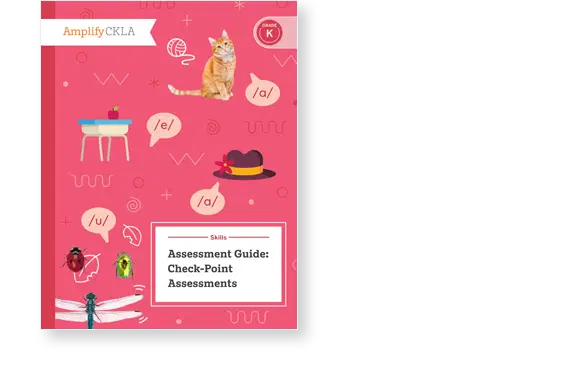
Cover of a book titled "Assessment Guide: Check-Point Assessments" with images of a cat, dragonfly, bugs, and a hat on a red background.
Skills Assessment Guide (Black Line Master)
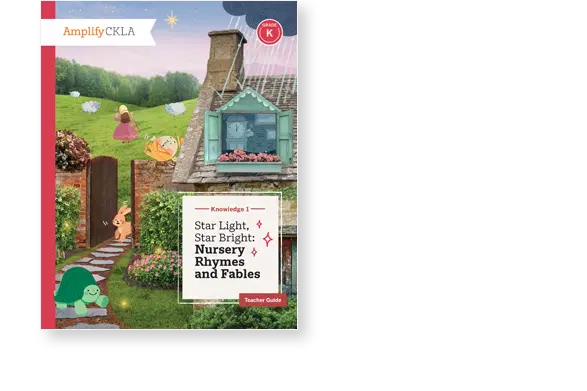
Book cover for "Star Light, Star Bright: Nursery Rhymes and Fables, Teacher Guide." Features illustrations of animals, a house, and a garden. Amplify CKLA logo is visible.
Knowledge 1 Teacher Guide
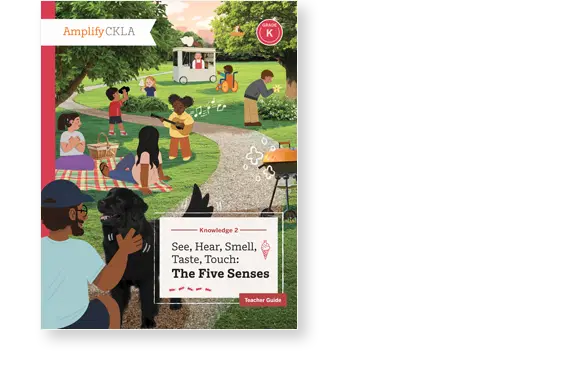
Children and adults engaging in various outdoor activities, such as playing instruments and picnicking, in a park; cover of "See, Hear, Smell, Taste, Touch: The Five Senses" teacher guide.
Knowledge 2 Teacher Guide
Children's book cover depicting a boy playing a violin outdoors with animals and trees, titled "Underdogs and Heroes: Stories.
Knowledge 3 Teacher Guide
Book cover depicting a child sitting in a garden with trees and plants, picking flowers. The title reads "See How They Grow: Plants.
Knowledge 4 Teacher Guide
A whimsical book cover featuring a countryside cottage with a red door and vibrant garden. Illustrations of Mother Goose, a tortoise, a hare, and clouds are scattered around. Title: "Nursery Rhymes and Fables.
Knowledge 1 Image Cards
A diverse group of people enjoying a park, with children playing, a person playing guitar, others cooking on a barbecue, and a person petting a dog. A small ice cream stand is nearby.
Knowledge 2 Image Cards
Illustration of a child playing a violin in a forest clearing, surrounded by animals including chickens, a sheep, and a bear. A large pink boot-shaped house is in the background.
Knowledge 3 Image Cards
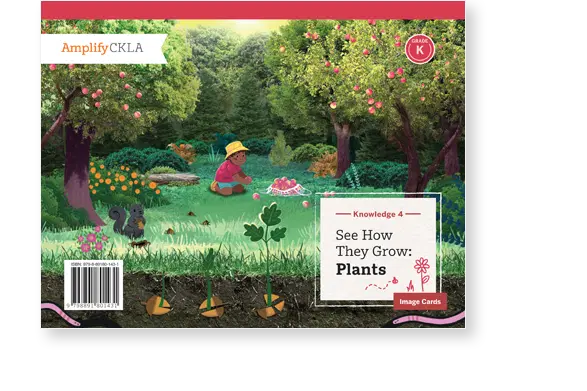
Children's book cover: a child in a hat tends a garden with trees, flowers, and a squirrel. Text reads "See How They Grow: Plants" for Grade K.
Knowledge 4 Image Cards
A screenshot of a cell phone.
Skills 1–5 Activity Book Sample
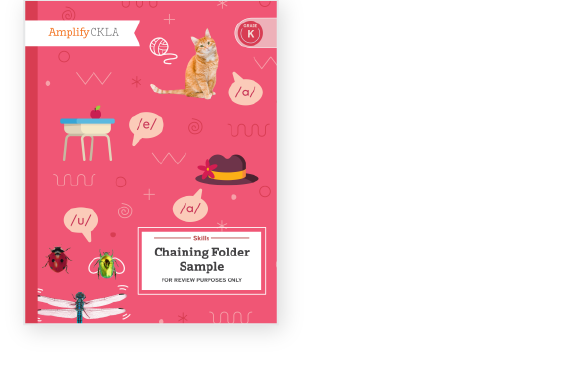
Red educational cover with illustrations of a cat, insects, a hat, and phonetic symbols. Text reads: "Amplify CKLA Skills Chaining Folder Sample For Review Purposes Only.

Student materials

Chaining Folder
Red book cover titled "Skills Picture Reader." Features illustrations of a cat, table, insects, dragonfly, and a hat with speech bubbles containing vowels. Designed for kindergarten.
Picture Reader Sample
Cover of Amplify CKLA Activity Book for Kindergarten, featuring a red design, a globe, sunflowers, and a list of topics including the five senses and geography.
Knowledge 1–4 Activity Book Sample
Cover of "Skills 1" teacher guide from Amplify CKLA. Features a large number one, knight, frog, coins, and phonetic symbols on a yellow background.

Teacher materials

Skills Unit 1 Teacher Guide
Yellow book cover titled "Skills 2: Teacher Guide" from Amplify CKLA. Features a large number "2," a frog, a knight, coins, phonetic symbols, and a moon.

Teacher materials

Skills Unit 2 Teacher Guide
Yellow book cover titled "Skills 3 Teacher Guide" with illustrations of coins, a knight, a grasshopper, and phonetic symbols. Amplify CKLA logo at top.

Teacher materials

Skills Unit 3 Teacher Guide
Illustration of two children posing with a bagpiper dressed in traditional Scottish attire; text below reads "Snap Shots.

Teacher materials

Skills Unit 1 Big Book
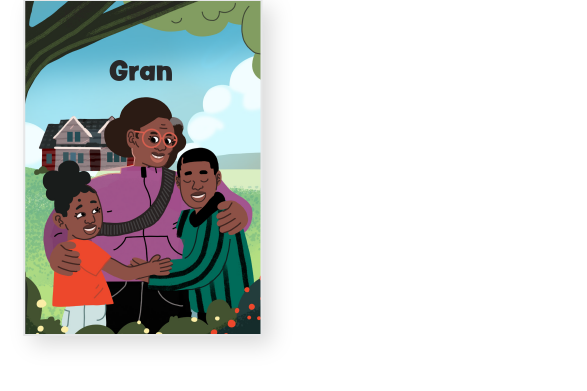
Illustration of a family hugging under a tree, with a house in the background. The word "Gran" is at the top of the image.

Teacher materials

Skills Unit 2 Big Book
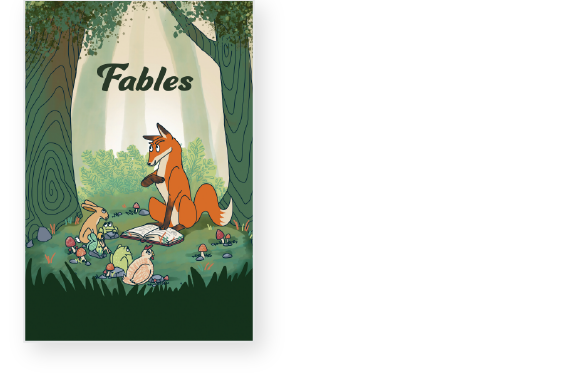
Illustrated book cover titled "Fables" shows a fox sitting on a stump, reading aloud to a rabbit and a bird, surrounded by mushrooms and grass under tall trees.

Teacher materials

Skills Unit 3 Big Book
Screenshot of a language learning webpage focusing on English consonants, including sounds such as /g/, /ch/, /j/, /v/, /s/, and /f/, displayed with example words and visual cues.

Teacher materials

Code Poster Set
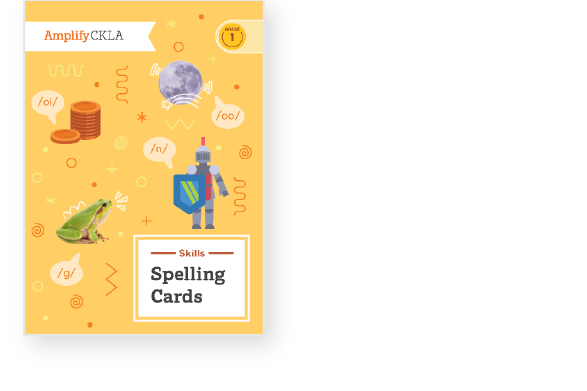
Cover of "Skills Spelling Cards" by Amplify CKLA, featuring a knight, frog, moon, and sound symbols on a yellow background.

Teacher materials

Spelling Card Set
Orange card with "Amplify CKLA Grade 1" and "Skills Large Letter Cards." Features a moon, knight, frog, coins, and phonetic symbols.

Teacher materials

Large Letter Card Set
Yellow book cover titled "Assessment Guide: Check-Point Assessments" with images of a knight, coins, a frog, and a planet. Text includes "Amplify CKLA" and "Skills.

Teacher materials

Skills Assessment Guide (Black Line Master)
Book cover with a spider web in the foreground. A red house, animals, and trees are in the background. Title reads "The Moral of the Story: Fables and Tales.

Teacher materials

Knowledge 1 Teacher Guide
Book cover titled "From Nose to Toes: How Your Body Works" featuring X-ray images of body parts.

Teacher materials

Knowledge 2 Teacher Guide
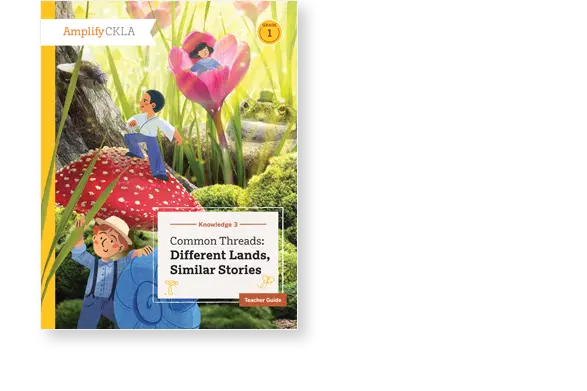
Cover of "Common Threads: Different Lands, Similar Stories" by Amplify CKLA. Features illustrations of children sitting on a red mushroom and standing near a large flower.

Teacher materials

Knowledge 3 Teacher Guide
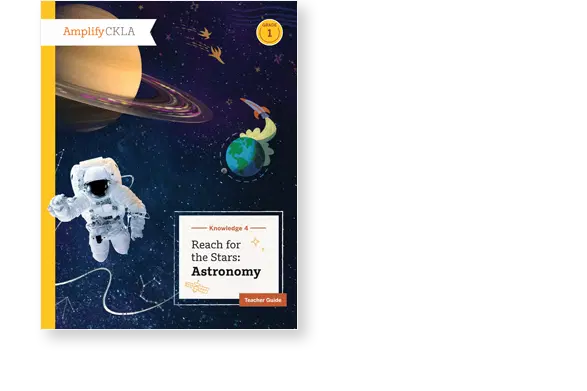
Book cover titled "Reach for the Stars: Astronomy" featuring an astronaut, a spaceship, Earth, and Saturn in space. Part of the Amplify CKLA series, Grade 4, Unit 1, Teacher Guide.

Teacher materials

Knowledge 4 Teacher Guide
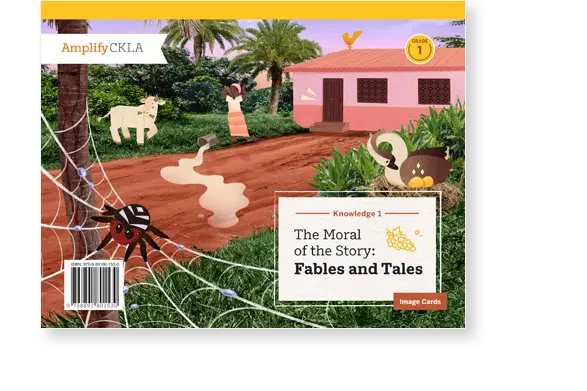
Illustration of a rural scene with a red house, cow, cat, woman, muddy path, and a spider on a web. The text reads: "The Moral of the Story: Fables and Tales, Grade 1.

Teacher materials

Knowledge 1 Image Cards
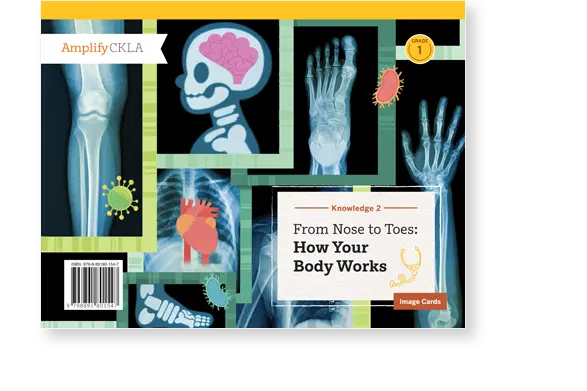
Educational book cover titled "From Nose to Toes: How Your Body Works" featuring X-ray images and illustrations of human anatomy.

Teacher materials

Knowledge 2 Image Cards
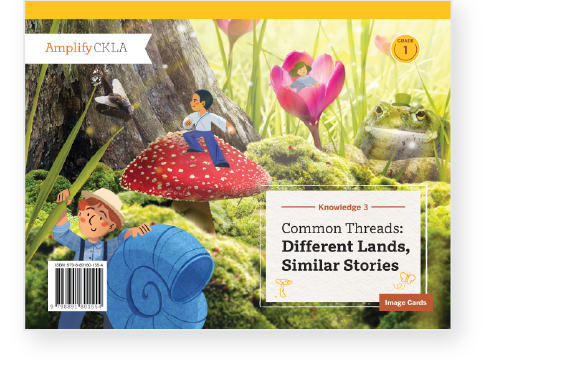
Children exploring a whimsical forest scene with oversized mushrooms and a snail shell. Text on the cover reads "Common Threads: Different Lands, Similar Stories, Grade 1, Image Cards.

Teacher materials

Knowledge 3 Image Cards
Illustrated cover of a Grade 1 astronomy book titled "Reach for the Stars," featuring a space scene with an astronaut, Earth, Saturn, and shooting stars.

Teacher materials

Knowledge 4 Image Cards
Cover of "Activity Book: Volume 1" featuring coins, a knight, and a grasshopper on a yellow background with phonetic symbols and a globe.

Student materials

Skills 1–3 Activity Book
Illustration of two children posing with a bagpiper. The background is filled with doodles, and "Snap Shots" is written at the bottom of the image.

Student materials

Skills Unit 1 Reader
Illustration of a family hugging under a tree, with a house in the background. The word "Gran" is at the top of the image.

Student materials

Skills Unit 2 Reader
Illustrated book cover titled "Fables" shows a fox sitting on a stump, reading aloud to a rabbit and a bird, surrounded by mushrooms and grass under tall trees.

Student materials

Skills Unit 3 Reader
Yellow cover of an activity book titled "Amplify CKLA Grade 1" featuring images of a map, a child with a hat, a shuttle, and a forest path. "Knowledge" sections listed on the cover.

Student materials

Knowledge 1-4 Activity Book Sample
Cover of "Skills 1" teacher guide from Amplify CKLA, featuring a large number 1, a crow, acorn, pencil, and glove clipart on a green background.

Teacher materials

Skills Unit 1 Teacher Guide
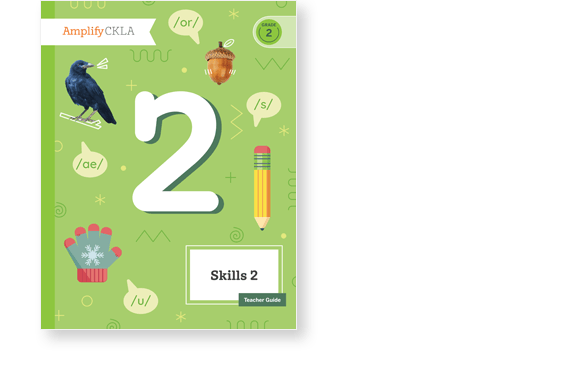
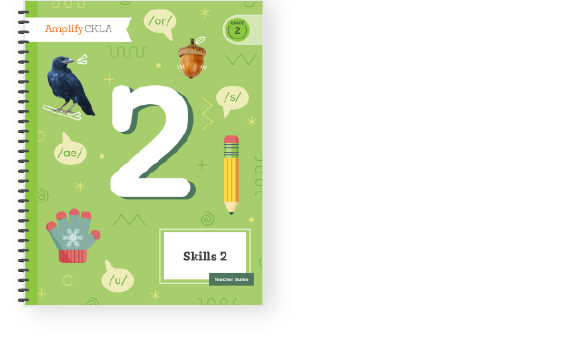
Green book cover titled "Skills 2" with illustrations of a bird, acorn, pencil, mittens, and speech symbols. Includes "Amplify CKLA" and "Grade 2 - Teacher Guide" text.

Teacher materials

Skills Unit 2 Teacher Guide
Green book cover titled "Skills 3" for Grade 2, featuring a large number 3, a crow, an acorn, a pencil, and a mitten.

Teacher materials

Skills Unit 3 Teacher Guide
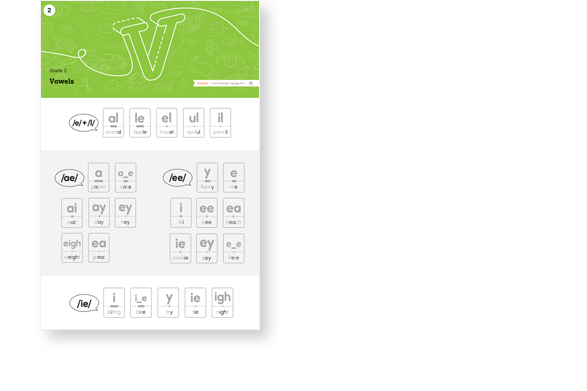
Vowels chart displaying various vowel sounds with example words in boxes on a green and white background.

Teacher materials

Code Posters
Textbook cover titled "Skills Spelling Cards" with a green background, pencil, crow, acorn, mitten, and phonetic symbols. Banner reads "Amplify CKLA, Grade 2.

Teacher materials

Spelling Card Set
Green book cover titled "Assessment Guide: Check-Point Assessments" with images of a crow, acorn, and pencil. Grade 2 is noted in the corner.

Teacher materials

Skills Assessment Guide (Black Line Master)
Book cover titled "Fortunes and Feats: Fairy Tales and Tall Tales" shows a giant boot, train, waterfall, fisherman with a fish, and a person on a giant's hand.

Teacher materials

Knowledge 1 Teacher Guide
Textbook cover reads "Amplify CKLA, Knowledge 2: The Birthplace of Democracy: Ancient Greece, Teacher Guide." Illustration depicts an ancient Greek scene with a building and people in togas.

Teacher materials

Knowledge 2 Teacher Guide
Cover of "Legends and Heroes: Greek Myths" Teacher Guide, depicting classical Greek statues, ancient ruins, and mythological figures against a marble backdrop.

Teacher materials

Knowledge 3 Teacher Guide
A book cover titled "Our Planet: Cycles in Nature," featuring a pond scene with a frog, lily pads, fish, and plants, labeled "Knowledge 4" and "Teacher Guide," by Amplify CKLA.

Teacher materials

Knowledge 4 Teacher Guide
Illustration of ancient Greece with people under tents, classical buildings, columns, and a mountainous backdrop. Text on image reads: "The Birthplace of Democracy: Ancient Greece, Grade 2.

Teacher materials

Knowledge 2 Image Cards
Cover of a book titled "Legends and Heroes: Greek Myths" featuring an ancient Greek statue, ruins, amphora, and flying birds against a sunset landscape. Grade 2 indicated.

Teacher materials

Knowledge 3 Image Cards
Book cover for "Our Planet: Cycles in Nature" by Amplify CKLA, Grade 2. Features a pond with a frog, lily pads, and flowers. ISBN and barcode visible at the bottom.

Teacher materials

Knowledge 4 Image Cards
Cover of a book titled "Amplify CKLA, Units 2-3, Activity Book." The green background features a crow, acorn, pencil, gloves, and phonetic symbols.

Student materials

Skills 1–3 Activity Book Sample
Illustration of an anthropomorphic cat dressed as a cowboy, holding a bag of gold coins, standing beside a treasure chest. Text reads "The Cat Bandit.

Student materials

Skills Unit 1 Reader
Illustration of a bearded man sitting on a bed, reading to a boy and girl. The book cover reads "Bedtime Tales" with a colorful, patterned background.

Student materials

Skills Unit 2 Reader
Illustration of children engaging in outdoor sports activities, with text "Kids Excel" above them against a backdrop of trees and a bridge.

Student materials

Skills Unit 3 Reader
Green cover of an activity book titled "Amplify CKLA," featuring a hot air balloon and a medieval castle illustration. Text includes various learning topics.

Student materials

Knowledge 1-4 Activity Book Sample
Cover of a book titled "Classics Tales: Student Edition" from Amplify, featuring a cross-section of a tree with underground rooms and a scene above of a person walking.

Teacher materials

Unit 1 Teacher Guide
The image shows the cover of a book titled "Fur, Fins, and Feathers: Animal Classification." It features illustrations of various animals and a pond surrounded by lush greenery.

Teacher materials

Unit 2 Teacher Guide
Book cover of "Amplify CKLA Teacher Guide: Rhythm and Rhyme: Poetry Unit 3" featuring butterflies, lily pads, and flowers in a pond scene.

Teacher materials

Unit 3 Teacher Guide
Illustration of Ancient Rome with people in togas, Colosseum, aqueduct, hills, and buildings. Text reads "Amplify CKLA, Unit 4, Rise and Fall: Ancient Rome, Teacher Guide.

Teacher materials

Unit 4 Teacher Guide
Cover of Amplify CKLA Grade 3 unit titled "Timeless Tales: Classic Stories" showing a cross-section of underground animal homes and a rider on a horse above ground.

Teacher materials

Unit 1 Image Cards
Cover of a poetry image cards book titled "Rhythm and Rhyme: Poetry," featuring butterflies and lily pads on a pond with a landscape background.

Teacher materials

Unit 3 Image Cards
Cover image of a textbook titled "Rise and Fall: Ancient Rome" featuring the Colosseum and ancient Roman architecture with people in historical attire and distant hills.

Teacher materials

Unit 4 Image Cards
Blue cover with geometric patterns, labeled "Amplify CKLA" at the top and "Spelling Cards" at the bottom, featuring a "Grade 3" badge.

Teacher materials

Spelling Card Set
Cover of an Amplify CKLA Grade 3 Activity Book showing two units: "Classic Stories" with an underground scene, and "Animal Classification" with a pond scene.

Student materials

Unit 1–2 Activity Book
Book cover of "Rhythm and Rhyme: Poetry," Unit 3, Grade 3, featuring a scenic illustration with a turtle, butterflies, lily pads, and flowers by a pond.

Student materials

Unit 3 Poet’s Journal
Cover of "Amplify CKLA" Grade 3 Activity Book Unit 4, featuring an illustration of Ancient Rome, including the Colosseum and Roman structures against a painted sky background.

Student materials

Unit 4 Activity Book
Book cover titled "Classic Stories" from Amplify CKLA. Illustrations show a cross-section of animals in underground homes and a landscape above with a tree, cyclist, and bridge.

Student materials

Unit 1 Reader
Children's book cover titled "Unit 2: Rattenborough's Guide to Animals" featuring jungle scenery with various animals, including a monkey, jaguar, parrots, and a crocodile.

Student materials

Unit 2 Reader
Illustrated book cover titled "Stories of Ancient Rome" by Amplify CKLA, featuring Roman architecture and people in ancient attire with hills and aqueducts in the background.

Student materials

Unit 4 Reader
Blue book cover titled "Amplify CKLA Skills 1" featuring a large number 1, a deer, a slice of cake, a comb, and trophy icons.

Teacher materials

Skills Unit 1 Teacher Guide (supplemental)
Blue "Skills 2" book cover with number 2, a deer, a comb, cakes, trophies, and phonetic symbols. Labeled "Amplify CKLA Teacher Guide.

Teacher materials

Skills Unit 2 Teacher Guide (supplemental)
Blue "Skills Assessment Guide: Unit Assessments" book cover with geometric patterns, labeled "Amplify CKLA" Edition 3 in the top left corner.

Teacher materials

Skills Assessment Guide Black Line Master (supplemental)
Blue book cover titled "Skills Activity Book: Volume 1" with images of a comb, trophies, cake, and a deer. It includes the Amplify CKLA logo at the top left corner.

Student materials

Skills Activity Book: Unit 1–2 Black Line Master (supplemental)
Textbook cover titled "Personal Narratives" with spiral binding, featuring images of an accordion, bike, windmill, chocolate milkshake, and crayons. Angle of view shows part of a rotary phone.

Teacher materials

Unit 1 Teacher Guide
Book cover featuring two knights on horses with flags, in a medieval setting. Title: "Medieval Knights and Castle Life: Europe’s Middle Ages.” Grade 4, Unit 2.

Teacher materials

Unit 2 Teacher Guide
Amplify CKLA Grade 4 book cover titled "Meaning and Metaphor: Poetry" features an illustration of a bookshelf with colorful books, a tree, and mythical creatures.

Teacher materials

Unit 3 Teacher Guide
Cover of "Amplify CKLA: Eureka! Student Inventor, Teacher Guide" featuring illustrated presenters at podiums, with a colorful wheel displaying various icons.

Teacher materials

Unit 4 Teacher Guide
Cover of an activity book titled "Amplify CKLA," with images depicting "Personal Narratives" and "Europe's Middle Ages" against a meadow background. Grade 4 indicated at the top.

Student materials

Unit 1–2 Activity Book
Book cover for "Meaning and Metaphor: Poetry" showing a tree, a book, and a horse silhouette, with colorful elements like leaves and stars on a bookshelf. Grade 4, Unit 3, Amplify CKLA.

Student materials

Unit 3 Poet’s Journal
Cover of "Inventor's Notebook," Amplify CKLA, Grade 4, Unit 4. Features a green, spiral-bound notebook with a doodle on a colorful geometric background.

Student materials

Unit 4 Inventor’s Notebook
Textbook cover titled "Personal Narratives" with spiral binding, featuring images of an accordion, bike, windmill, chocolate milkshake, and crayons. Angle of view shows part of a rotary phone.

Student materials

Unit 1 Reader
Book cover featuring two knights on horses with flags, in a medieval setting. Title: "Medieval Knights and Castle Life: Europe’s Middle Ages.” Grade 4, Unit 2.

Student materials

Unit 2 Reader
A book cover titled "Grade 4 Unit 4: Eureka! Files, Reader" with pencils and colorful tabs.

Student materials

Unit 4 Reader
Cover of an educational book titled "In My Own Words: Personal Narratives" from Amplify CKLA. It features images of bicycles, a building in Washington D.C., and an old bus in Montgomery, AL.

Teacher materials

Unit 1 Teacher Guide
Book cover featuring illustrations of ancient structures, landscapes, and plants with the title "Early Americas: Maya, Aztec, and Inca" on top.

Teacher materials

Unit 2 Teacher Guide
Cover of "Amplify CKLA" Grade 5, Unit 3: Visions in Verse; Poetry. Features a colorful landscape with trees, birds, a pond, and flowers. Labeled as a Teacher Guide.

Teacher materials

Unit 3 Teacher Guide
Illustration of Don Quixote on a horse, pointing at windmills in a field. Cover text reads, "A Knight's Tale: Don Quixote, Teacher Guide, Unit 4, Amplify CKLA.

Teacher materials

Unit 4 Teacher Guide
Cover of the Amplify CKLA Grade 5 Activity Book featuring Unit 1, Personal Narratives, and Unit 2, Maya, Aztec, and Inca topics, against a blue background with marine imagery.

Student materials

Unit 1–2 Activity Book
Book cover titled "Visions in Verse: Poetry" with birds, a snake, and varied fruit near a pond.

Student materials

Poet’s Journal
Cover of "Don Quixote" activity book, featuring a circular illustration of Don Quixote tilting at windmills, with a blue background and marine-themed border.

Student materials

Unit 4 Activity Book
Cover of "Personal Narratives" reader for Grade 5, featuring images of a bicycle, postcards from Miami, Montgomery bus, U.S. Capitol, and a space shuttle. Colorful stationery surrounds the book.

Student materials

Unit 1 Reader
Textbook cover titled "Early Americas: Civilizations and Empires" with images of a pyramid, a landscape, and plants. Part of a Grade 5 curriculum by Amplify CKLA.

Student materials

Unit 2 Reader
Cover of "Adventures of Don Quixote" shows a man in armor on a horse facing a windmill. It's labeled as a Dover Children's Thrift Classic, with easy-to-read type and by Argentine Palacios.

Student materials

Unit 4 Reader

Access the Amplify CKLA all-in-one digital platform

Teachers and students piloting CKLA 3rd Edition will receive login information to access the digital platform.

If you have not received your login information please contact your administrative team. If you are in charge of licensing and enrollment for your school/district and have not received login information please reach out to your account representative or help@amplify.com.

Contact us

Contact your account executive to sign up for implementation training.

¡Les damos la bienvenida, familias de Boost Lectura!

Nos complace darles la bienvenida a usted y a su estudiante al Caregiver Hub de Boost Lectura en este nuevo año escolar. Hemos reunido una serie de recursos y guías que ayudarán a que usted pueda brindar apoyo a su estudiante a lo largo de todo el año y a que este aproveche al máximo nuestra plataforma.

For English version, please click here.

Cartoon dog in a soccer uniform kicks a "ma" ball toward a goal, saying "¡Hola!" and "Hello!"—highlighting how the Science of Reading can help boost reading skills in fun ways.

¿Qué es Boost Lectura?

Boost Lectura es un programa de intervención digital fácil de usar. El apasionante mundo de Boost Lectura proporciona enseñanza diferenciada de la lectura en español para estudiantes de grados K a 2, adaptándose a las necesidades únicas de cada lector. Su estudiante puede usar el programa durante el horario de clase y también de forma independiente en casa.

¡Bienvenidos a Boost Lectura!

Captura de pantalla de un video de dibujos animados educativos en pausa destinado a impulsar la lectura, que muestra un pájaro en un arbusto y una niña mirando desde detrás de un árbol, con opciones de palabras "ad" y "at".

¿Cuál es mi rol?

Asegúrese de que su estudiante pueda iniciar sesión por cuenta propia.

Le recomendamos que ayude a su estudiante a iniciar sesión en casa a través de Clever u otra plataforma. El maestro también puede descargar e imprimir un código QR o un nombre de usuario y contraseña únicos que su estudiante pueda usar para iniciar sesión. Si tiene dudas sobre el proceso de inicio de sesión o no recibió los datos de ingreso, comuníquese con el maestro.

Sugerencias

  • Practique el inicio de sesión con su estudiante de manera regular hasta que pueda iniciar sesión de forma independiente.
  • Mantenga sus datos de ingreso en un solo lugar para que su estudiante sepa adónde recurrir si los olvida.
Ilustración colorida de criaturas y objetos caprichosos, incluida una bola de cristal que muestra la silueta de un paisaje urbano, libros para estimular la lectura, una poción y una criatura vibrante que se asemeja a un gato.

Procure un espacio tranquilo para que su estudiante pueda trabajar.

Prepare a su estudiante para usar Boost Lectura en casa: asegúrese de que tenga auriculares y un lugar tranquilo para jugar. Boost Lectura es un programa personalizado que responde a las necesidades de cada estudiante, así que no necesitará asistirlo con su aprendizaje. Una vez que su estudiante pueda iniciar sesión, podrá comenzar a usar el programa por cuenta propia.

Aparte tiempo para que su estudiante pueda jugar de forma independiente.

Es posible que su estudiante comience con una actividad de nivelación que ayudará al programa a asignarle el mejor contenido, de acuerdo con su nivel de lectura. Para garantizar la nivelación más precisa posible, es importante que el estudiante realice cada actividad de manera independiente. ¡Anime a su estudiante a que se esfuerce y se divierta!

Revise la seguridad digital.

Le recomendamos que revise Proteja a los niños en internet, un sitio web de la Comisión Federal de Comercio, cuyo tema es la seguridad digital.

¡Diviértanse más!

Cada estudiante tiene un compañero digital personalizable llamado Curioso. ¡Imprima estas páginas para colorear, y compártalas con su estudiante para que decore su propio Curioso!

Páginas para colorear con animales de dibujos animados vestidos con atuendos festivos y la palabra "¡Impulsa la lectura!" en un cartel en la parte superior.

Descargue las páginas para colorear Curiosos.

Cómo obtener ayuda

Página de inicio del sitio web de Amplify, que presenta una barra de búsqueda, menús de navegación e íconos para mejorar los recursos de lectura y el soporte.

¡Estamos aquí para ayudarle!

¿Tiene alguna pregunta sobre Boost Lectura?

Visite nuestra biblioteca de ayuda (en inglés) y busque respuestas a sus preguntas sobre el programa en nuestros artículos de ayuda.

Para obtener apoyo curricular adicional, comuníquese con su maestro.

Preguntas frecuentes

Es posible que su estudiante use programas durante la jornada escolar, por lo que recomendamos ponerse en contacto con el maestro para determinar cuánto tiempo debe usar estos programas en casa. En general, nuestra sugerencia es la siguiente:

Boost Lectura

Los estudiantes que solamente usan Boost Lectura deberían jugar durante un total de 30 a 45 minutos por semana, repartidos en sesiones de 10 a 15 minutos cada una.

Boost Reading y Boost Lectura

Para los estudiantes que usan tanto Boost Lectura como Boost Reading, recomendamos que usen ambos programas aproximadamente 40 minutos por semana. Sugerimos repartir el tiempo total entre ambos programas, cada uno con sesiones de 10 a 15 minutos.

Si su estudiante tiene problemas con el contenido, le recomendamos que no intervenga. Aunque sabemos que esto puede resultar difícil, Boost Lectura está diseñado para adaptarse según las respuestas de su estudiante y proporcionarle un mayor apoyo e instrucción con el fin de que pueda avanzar en el juego.

What my wedding taught me about choosing curriculum

The right curriculum choice isn’t only about the product—it’s about who’s by your side from start to finish. Here’s how one district found that with Amplify CKLA.

By Kelly Pruitt, Instructional Facilitator, Peninsula School District | May 28, 2026

A teacher leans over a group of elementary students who are working together at a classroom table under a "CKLA Skills" sign, guiding them through successful CKLA implementation.

Inspiring the next generation of Indiana scientists, engineers, and curious citizens

Amplify Science is a proven effective core curriculum designed for three-dimensional, phenomena-based learning that provides an immersive experience for science students. Amplify Science was developed in partnership with the science education experts at UC Berkeley’s Lawrence Hall of Science.

image of Amplify Science and science classroom materials for science teachers

What is Amplify Science?

Amplify Science is a curiosity-driven science curriculum that empowers students to Do, Talk, Read, Write, and Visualize like scientists. Through phenomena-based, literacy-rich, and interactive learning experiences, students develop as critical thinkers who will gain the skills they need to solve real problems in their communities and the world.

Each unit of Amplify Science engages students in a relevant, real-world problem where they investigate scientific phenomena, engage in collaboration and discussion, and develop models or explanations in order to arrive at solutions.

Grounded in research

Developed by the science education experts at UC Berkeley’s Lawrence Hall of Science in partnership with the digital learning team at Amplify, our program features:

  • A phenomena-based approach where students construct a deep understanding of each unit’s anchor phenomenon.
  • A blend of cohesive storylines, hands-on investigations, lively discussions, literacy-rich activities, and digital tools.
  • Carefully crafted units, chapters, lessons, and activities designed to deliver truly authentic three-dimensional learning.
  • An instructional design that supports all learners in accessing all standards.

See more of our research.

Aerial view of the lawrence hall of science at the university of california, berkeley, showcasing the building and surrounding trees with a foggy city backdrop.
Two boys sit at a desk using a laptop in a classroom. Insets show a close-up of sewing, and a child in rain boots splashing in water.

Instructional model

The Amplify Science program is rooted in the research-based proven effective pedagogy of Do, Talk, Read, Write, Visualize.

Here’s how each element works:

Do

Learners engage with scientific phenomena by conducting student-centered investigations.

Talk

Students engage in collaborative and inquisitive discussions and scientific argumentation.

Read

Reading scientific texts is an act of inquiry: Students ask questions, gather evidence, and make connections through literacy.

Write

Students write to share what they have learned and apply new evidence to strengthen written arguments and explanations.

Visualize

Students gather evidence through simulations, physical models, and modeling tools, allowing them to see and investigate complex, microscopic, or otherwise unobservable phenomena.

What’s included

Flexible resources that work seamlessly together

Four children gather around a desk, engaged in a hands-on activity. Two illustrations frame the main image: a storm cloud on the left and a sea turtle on the right.

Grades K–5 materials

A stack of educational science books, ideal for the curious mind of a science student, with titles like "What My Sister Taught Me About Magnets" and "Made of Matter." Perfectly aligned with any science curriculum to inspire young learners in the classroom.

Student Books

Age-appropriate Student Books allow students to:

  • engage with content-rich texts
  • obtain evidence
  • develop research and close-reading skills
  • construct arguments and explanations
Three science notebooks ideal for the science student, titled "Balancing Forces," "History of Earth and Sky," and "Properties of Matter." Each features colorful illustrated covers that enhance three-dimensional learning in the classroom.

Student Investigation Notebooks

Available for every unit, the Student Investigation Notebooks provide space for students to:

  • record data
  • reflect on ideas from texts and investigations
  • construct explanations and arguments
A digital illustration displays a laptop with screens showcasing environmental graphics, including plants and diagrams, perfect for a science student exploring rich science resources.

Simulations and practice tools (grades 2+)

Developed exclusively for the Amplify Science program, these engaging digital tools:

  • serve as venues for exploration
  • enable data collection
  • allow students to explore scientific concepts
  • show what might be impossible to see with the naked eye


A laptop displaying a web page titled "Spinning Earth" sits next to a book on investigation, ideal for the science student delving into valuable science resources.

Teacher’s Guides

Available digitally and in print, the Teacher’s Guides contain all of the information teachers need to facilitate classroom instruction, including:

  • detailed lesson plans
  • unit and chapter overview documentation
  • differentiation strategies
  • standards alignments
  • in-context professional development
A pegboard with pegs, a small solar panel with clips, and three containers with different powdered substances are perfect science resources for enhancing your science curriculum.

Hands-on materials kits

Hands-on learning is at the heart of Amplify Science. Each unit kit contains:

  • consumable and non-consumable hands-on materials
  • print classroom display materials
  • premium print materials for student use (sorting cards, maps, etc.)

Grades 6–8 materials

A laptop displays a diagram about jellyfish population explosion; next to it is a magazine page featuring a scientist who preserves artwork.

Science articles

The middle school science articles serve as sources for evidence collection and were authored by science and literacy experts at the Lawrence Hall of Science.

Four Amplify Science investigation notebooks are displayed, perfectly enhancing any science classroom with their covers showcasing diverse scientific topics.

Student Investigation Notebooks

Available for every unit, the Student Investigation Notebooks provide space for students to:

  • record data
  • reflect on ideas from texts and investigations
  • construct explanations and arguments
  • Available with full-color article compilations for middle school units
Images of data visualization tools displayed on a laptop, showcasing graphs, maps, and analytical data—essential resources for any science student looking to enhance their understanding through interactive learning.

Digital student experience

Students access the digital simulations and modeling tools, as well as lesson activities and assessments, through the digital student experience. Students can interact with the digital student experience as they:

  • conduct hands-on investigations
  • engage in active reading and writing activities
  • participate in discussions
  • record observations
  • craft end-of-unit scientific arguments


A laptop displaying the Geology on Mars webpage sits beside a book titled "Geology on Mars," both featuring the same cover image of Mars and a spacecraft, perfect for enhancing three-dimensional learning in any science classroom.

Teacher’s Guides

Available digitally and in print, the Teacher’s Guides contain all of the information teachers need to facilitate classroom instruction, including:

  • detailed lesson plans
  • unit and chapter overview documentation
  • differentiation strategies
  • standards alignments
  • in-context professional development
A pegboard with pegs, a small solar panel with clips, and three containers with different powdered substances are perfect science resources for enhancing your science curriculum.

Hands-on materials kits

Hands-on learning is at the heart of Amplify Science. Each unit kit contains:

  • consumable and non-consumable hands-on materials
  • print classroom display materials
  • premium print materials for student use (sorting cards, maps, etc.)
Collage of four images: a hairdryer testing a paper structure in a science classroom, a cartoon monkey on a vine, two kids interacting with a wall activity emblematic of three-dimensional learning, and a hand displaying dinosaur-topped pencils with math cards.

Unit Sequence

Our lessons follow a structure that is grounded in regular routines while still being flexible enough to allow for a variety of learning experiences.

In fact, our multimodal instruction offers more opportunities for students to construct meaning—and practice and apply concepts—than any other program. What’s more, our modular design means our units can be flexibly arranged to support your instructional goals.

A chart lists science topics by grade, from Kindergarten to Grade 5, covering subjects like plants, animals, forces, materials, weather, and Earth systems.
A list of science curriculum topics for Grades 6, 7, and 8, organized under each grade with bullet points for subjects like microbiome, geology, energy, and natural selection.

Contact us

Support is always available. Our team is committed to helping you every step of the way. Contact your dedicated Indiana representative here for program access, samples, and additional information.

A woman with long brown hair and a white top smiles at the camera in front of an orange background, showcasing her passion for the Science of Reading and dedication to Indiana middle school education.

Elizabeth Sillies Callahan

Southern IN
(513) 407-5801

A woman with long brown hair and blue eyes smiles gently at the camera. The background is a light purple circle, reflecting her passion for the Science of Reading and dedication to Indiana middle school education.

Jody Kammer

Central IN
(310) 402-7837

Woman with long brown hair, large black glasses, and a nose ring, wearing a striped shirt and dark blazer, posing in front of a neutral background—professional style suited for the Indiana Department of Education.

Amanda Knipper

Northern IN
(260) 894-5123

A woman with wavy red hair and blue eyes, dressed in a purple turtleneck, smiles at the camera against a dark background—reflecting the approachable spirit of Indiana middle school teachers.

Paige Lawrence

District enrollment below 1200
(980) 421-2608

Amplify’s Subprocessors

This page provides the current list of third party service providers that Amplify engages to help us provide our services and may have access to Personal Information of our customers (“Subprocessors”) as outlined in Amplify’s Customer Privacy Policy.

How to get notified of changes

Please use the “Subscribe to Updates” functionality at the top of the page to receive emails from Amplify regarding updates to the list of Subprocessors and/or changes to the information provided on this page. Should you choose not to use this functionality to receive email notifications, it is our expectation that you check the link regularly for any updates.

Our commitments regarding Service Providers

All of the Subprocessors listed below have a legitimate need to access Personal Information in order to provide their service to Amplify as a part of Amplify’s provision of the services to our customers. With regard to Subprocessors, Amplify commits to:

  • Conduct due diligence on the data privacy and security measures of new Subprocessors before providing access to Personal Information and monitor on an annual basis thereafter. As part of this process, Amplify reviews the Subprocessor’s security documentation, practices, and posture to ensure alignment with Amplify’s information security program and standards;
  • Enter into a written agreement which requires at least the same level of protection for Personal Information and individuals as set out in Amplify’s Customer Privacy Policy and our agreements with customers, as applicable, before providing access to Personal Information;
  • Restrict the Subprocessor’s access to Personal Information to only what is necessary to fulfill our contractual obligations or as otherwise permitted under the agreements with our customers or under applicable data privacy laws; and
  • Remain liable for any processing of Personal Information carried out by Subprocessors to the same extent we would be liable if performing the services ourselves.

Subprocessors

Amplify’s Subprocessors of Personal Information are:

Subprocessor Purpose Location Student Data Educator Data
Amazon Web Services Cloud hosting services United States A large, light peach-colored checkmark on a transparent background.
A large, light peach-colored checkmark on a transparent background.
Anthology (formerly Blackboard) Video conferencing and attendee tracking for tutoring services United States A large, light peach-colored checkmark on a transparent background.
A large, light peach-colored checkmark on a transparent background.
Boomi, Inc. Data integration United States   A large, light peach-colored checkmark on a transparent background.
Datadog Performance and security monitoring United States A large, light peach-colored checkmark on a transparent background.
A large, light peach-colored checkmark on a transparent background.
dbt Labs, Inc. Run database queries United States A large, light peach-colored checkmark on a transparent background.
A large, light peach-colored checkmark on a transparent background.
Egnyte, Inc. Secure file exchange United States A large, light peach-colored checkmark on a transparent background.
A large, light peach-colored checkmark on a transparent background.
Fivetran, Inc. Database loading United States A large, light peach-colored checkmark on a transparent background.
A large, light peach-colored checkmark on a transparent background.
Gainsight, Inc. Customer support United States   A large, light peach-colored checkmark on a transparent background.
Google, LLC Cloud hosting services United States A large, light peach-colored checkmark on a transparent background.
A large, light peach-colored checkmark on a transparent background.
Google, LLC (Looker) Data warehouse analytics United States A large, light peach-colored checkmark on a transparent background.
A large, light peach-colored checkmark on a transparent background.
HubSpot Email delivery United States   A large, light peach-colored checkmark on a transparent background.
MongoDB, Inc. Database hosting United States A large, light peach-colored checkmark on a transparent background. A large, light peach-colored checkmark on a transparent background.
Salesforce Customer relationship management United States   A large, light peach-colored checkmark on a transparent background.
SchoolDay (formerly GG4L) Secure rostering United States A large, light peach-colored checkmark on a transparent background. A large, light peach-colored checkmark on a transparent background.
Snowflake, Inc. Database hosting United States A large, light peach-colored checkmark on a transparent background. A large, light peach-colored checkmark on a transparent background.
Talkdesk, Inc. Customer support United States   A large, light peach-colored checkmark on a transparent background.
Twilio, Inc. (Sendgrid) Email delivery United States A large, light peach-colored checkmark on a transparent background. A large, light peach-colored checkmark on a transparent background.

Updates

Date of Change Change Notes
October 10, 2025 Changed Blackboard to Anthology and GG4L to SchoolDay. Update MongoDB purpose. Added Datadog to the Students Subprocessor List. Created Educators Subprocessor List. Anthology and SchoolDay updated their corporate branding. Added list of Educator Data Subprocessors to clarify which partners process educator data.
June 14, 2024
Removed Desmos Studio, PBC, Qualfon Data Services Group, LLC, and Zendesk, Inc. These partners and services are no longer used for customer support.
July 27, 2023
Added Fivetran
September 15, 2022
Corrected name of Desmos Studio, PBC.
July 21, 2022 Added Desmos Collective LLC, Google, MongoDB, Twilio, and Zendesk These services support Mathigon.org and Desmos Classroom
July 20, 2022 Added Qualfon Data Services Group, LLC
October 4, 2021 Added Blackboard, Inc.
July 26, 2021 Fishtown Analytics, Inc. renamed to dbt Labs, Inc.
June 17, 2021 Updated with data warehousing and roster services providers
May 28, 2021 Initial public posting.

Welcome, LAUSD educators!

Introducing Amplify Desmos Math California, a curiosity-driven TK–12 program that builds lifelong math proficiency. Each lesson poses problems that invite a variety of approaches before guiding students to synthesize their understanding of the learning goals. Students encounter math problems they’re eager to solve, while teachers spend more time where it’s most impactful—creating a collaborative classroom of learners.

Start by watching our welcome video to the right, then learn more about the program and begin your review below.

Curriculum overview

Watch the videos below for an overview of Amplify Desmos Math California:

Built for California

An educational worksheet on robots, featuring a graph with red, purple, and blue robot icons, and instructions for a warm-up activity.

The Amplify Desmos Math California program is designed around the vision articulated in the Mathematics Framework for California Public Schools: Kindergarten Through Grade Twelve to enable all California students to become powerful users of mathematics. Our program incorporates the latest research in student learning, meaning that we:

  • Focus on the Big Ideas: Amplify Desmos Math California’s courses, units, and lessons are centered around the Big Ideas. Big Ideas, like standards, are not considered in isolation. In addition to each unit and lesson’s focal Big Ideas, Amplify Desmos Math California also provides connections among the Big Ideas across units and lessons.
  • Center on open and engaging tasks: Amplify Desmos Math California is grounded in engaging tasks meant to address students’ often-asked question: “Why am I learning this?”  Students are invited into learning with low-floor, high-ceiling tasks that provide an entry point for all. Open tasks in Amplify Desmos Math California provide the space for students to try on multiple strategies and represent their thinking in different ways, and allow student explanation and discussion to serve as the center of the classroom. All lessons offer both print and digital representations.
  • Provide enhanced digital experiences: Amplify Desmos Math California includes digitally-enhanced lesson activities, incorporating interactive digital tools alongside print materials. These purposefully-placed resources allow students to visualize mathematical concepts, receive actionable feedback while practicing, encounter personalized learning support from an onscreen tutor, and engage in discussions about their thinking and approaches.
  • Treat core instruction and differentiation as integral partners: The Amplify Desmos Math California curriculum provides teachers with lessons, strategies, and resources to eliminate barriers and increase access to grade-level content without reducing the mathematical demand of tasks. Every activity has multiple entry points to ensure that all students are supported and challenged. Intervention and personalized learning activities are directly connected to lesson content and offer students individualized support as they dive into the mathematics.

About the program

Taking the IM content further.

A laptop displays a math activity about platform heights and tube length, while a worksheet titled "Hamster Homes" is visible in the background.

Amplify Desmos Math California is a curiosity-driven program that builds lifelong math proficiency. Each lesson poses problems that invite a variety of approaches before guiding students to connect their understanding of the learning goals.

Students encounter math problems they’re eager to solve, while teachers spend more time where it’s most impactful: creating a collaborative classroom of learners.

We chose to base our program on the extensively field-tested IM K–12 MathTM authored by Illustrative Mathematics. IM K–12 Math is a problem-based curriculum. It asks students to grapple with well-designed and thoughtfully sequenced real-world mathematical problems to build their understanding of how to efficiently solve them.

Begin your review to see how we’ve taken the IM K–12 Math content further.

Begin your review

Using a Google Chrome or Safari web browser, click the orange button below or navigate to learning.amplify.com and select “Log in with Amplify.” Please note, these demo accounts expire on April 04, 2026.

K–8 English credentials

  • Username: t1.lausd_adm_k8@demo.tryamplify.net
  • Password: Amplify1-lausd_adm_k8

K–8 Spanish credentials

  • Username: t1.lausd_k8_spanish@demo.tryamplify.net
  • Password: Amplify1-lausd_k8_spanish

AGA credentials

  • Username: t1.lausd_aga@demo.tryamplify.net
  • Password: Amplify1-lausd_aga

Texas State Reviewers: Welcome to Amplify Texas ELAR/SLAR 2nd Edition!

Thank you for taking the time to review Amplify Texas ELAR 2nd Edition and Amplify Texas SLAR Texas 2nd Edition. This site provides the login steps and tools you need to review the programs.

After you’ve followed the steps below to log in, watch the short orientation videos linked below to help you navigate the Amplify Texas ELAR/SLAR 2nd Edition platform.  

The helpful Navigation Guides with live links and other documents to guide your review can be found below as well.  

A grid of six illustrated scenes featuring: space exploration, Salem witch trial, ancient civilization, farm animals, recycling in nature, and a globe on a stand.

Login credentials:

Login screen for Amplify with options to log in via Google, Amplify, Clever, District SSO, QR code, plus links for help and new account sign up.

Step 1

Go to learning.amplify.com and select Log in with Amplify.

Enter the username and password:

Username: elar_slar_2e_reviewers@tryamplify.com
Password: AmplifyNumber1

Step 2

Select TX ELAR Submission (English) or TX SLAR Submission (Spanish) under Your Programs.

Dashboard for an educator reviewer shows a welcome message, a notice for upcoming recommendations, and two buttons for TX ELAR and TX SLAR Submission 2026 programs.
Screenshot showing "Amplify Texas ELAR/SLAR 2nd Edition" with tabs for ELAR in English and SLAR in Spanish, and a highlighted section marked with the number 3.

Step 3

Select ELAR Second Edition or SLAR segunda edición to access the program you will be reviewing.

Step 4

Once you’re in the program, select a grade level to explore the digital curriculum.

Screenshot of a web page showing "Amplify Texas ELAR Second Edition" with clickable options for Kindergarten, Grade 1, Grade 2, and Grade 3. An orange section and a number 4 icon are visible.

Orientation videos

View these short introductory videos to help you navigate the Amplify Texas ELAR/SLAR 2nd edition platform.

ELAR Navigation Guides

Tip: Be sure you’re logged into the Amplify Texas ELAR/SLAR platform (steps above) before clicking on the links in these documents.

SLAR Navigation Guides

Tip: Be sure you’re logged into the Amplify Texas ELAR/SLAR platform (steps above) before clicking on the links in these documents.

ELAR Components List

Access the full list of components for Amplify Texas ELAR 2nd Edition by clicking the links below.

SLAR Components List

Access the full list of components for Amplify Texas SLAR segunda edición by clicking the links below.

Welcome, LAUSD educators!

Introducing Amplify Desmos Math California, a curiosity-driven TK–12 program that builds lifelong math proficiency.

Our program fully aligns with LAUSD’s screen-time resolution. We are 100% print-based, with optional
technology resources available, in direct accordance with the school board’s newly approved guidelines.

Start by watching our welcome video to the right, then learn more about the program and begin your review below.

Curriculum overview

Watch the videos below for an overview of Amplify Desmos Math California:

Built for California

An educational worksheet on robots, featuring a graph with red, purple, and blue robot icons, and instructions for a warm-up activity.

The Amplify Desmos Math California program is designed around the vision articulated in the Mathematics Framework for California Public Schools: Kindergarten Through Grade Twelve to enable all California students to become powerful users of mathematics. Our program incorporates the latest research in student learning, meaning that we:

  • Focus on the Big Ideas: Amplify Desmos Math California’s courses, units, and lessons are centered around the Big Ideas. Big Ideas, like standards, are not considered in isolation. In addition to each unit and lesson’s focal Big Ideas, Amplify Desmos Math California also provides connections among the Big Ideas across units and lessons.
  • Center on open and engaging tasks: Amplify Desmos Math California is grounded in engaging tasks meant to address students’ often-asked question: “Why am I learning this?”  Students are invited into learning with low-floor, high-ceiling tasks that provide an entry point for all. Open tasks in Amplify Desmos Math California provide the space for students to try on multiple strategies and represent their thinking in different ways, and allow student explanation and discussion to serve as the center of the classroom. All lessons offer both print and digital representations.
  • Provide enhanced digital experiences: Amplify Desmos Math California includes digitally-enhanced lesson activities, incorporating interactive digital tools alongside print materials. These purposefully-placed resources allow students to visualize mathematical concepts, receive actionable feedback while practicing, encounter personalized learning support from an onscreen tutor, and engage in discussions about their thinking and approaches.
  • Treat core instruction and differentiation as integral partners: The Amplify Desmos Math California curriculum provides teachers with lessons, strategies, and resources to eliminate barriers and increase access to grade-level content without reducing the mathematical demand of tasks. Every activity has multiple entry points to ensure that all students are supported and challenged. Intervention and personalized learning activities are directly connected to lesson content and offer students individualized support as they dive into the mathematics.

About the program

Taking the IM content further.

A laptop displays a math activity about platform heights and tube length, while a worksheet titled "Hamster Homes" is visible in the background.

Amplify Desmos Math California is a curiosity-driven program that builds lifelong math proficiency. Each lesson poses problems that invite a variety of approaches before guiding students to connect their understanding of the learning goals.

Students encounter math problems they’re eager to solve, while teachers spend more time where it’s most impactful: creating a collaborative classroom of learners.

We chose to base our program on the extensively field-tested IM K–12 MathTM authored by Illustrative Mathematics. IM K–12 Math is a problem-based curriculum. It asks students to grapple with well-designed and thoughtfully sequenced real-world mathematical problems to build their understanding of how to efficiently solve them.

Begin your review to see how we’ve taken the IM K–12 Math content further.

Begin your review

Using a Google Chrome or Safari web browser, click the orange button below or navigate to learning.amplify.com and select “Log in with Amplify.”

English credentials

Spanish credentials

Leading in early literacy with science-based practices

A group of adults poses in a hallway, all wearing matching gray shirts with a black design, celebrating their work with early literacy and the Science of Reading curriculum. Most are smiling and kneeling or standing in two rows.

Bruin Point Elementary sits at the base of Utah’s Book Cliff Mountain Range in the small mining town of Sunnyside, 30 miles from the nearest district hub. With just 107 students, and one teacher per grade, it’s Carbon School District’s smallest school—and now one of its brightest early literacy success stories.

All of Bruin Point’s students face significant systemic barriers, with 100% qualifying for free lunch. Yet when it comes to literacy development, the school’s educators have achieved something remarkable.

In just one year, their student literacy proficiency rates jumped 19 percentage points—from 39% at the beginning of the year to 58% by mid-year.

That’s why Bruin Point Elementary has been named a Literacy Legend in our 2025 Science of Reading Star Awards. These awards honor educators, schools, and districts that have transformed classrooms and empowered students through the Science of Reading.

Teaching early literacy skills in a community with challenges

Sunnyside tells the story of many rural American communities. “Since the closing of the local mines, there has been an increase in the number of unemployed family members,” says Cindy Garcia, Bruin Point’s principal.

As a result, an already high poverty rate has risen still further, along with levels of substance abuse, neglect, behavioral issues, and more. Parent involvement in school is extremely low, according to Garcia. “Basic needs take priority.”

Yet Garcia and her six-teacher team saw potential where others might have seen obstacles. They understood that their students deserved the strongest possible foundation in early literacy skills. And they knew they had to make a change.

The importance of relying on data

“Many of us had been trained in methods that didn’t fully meet the needs of all students, and shifting the mindset required trust, training, and time,” says fifth-grade teacher Tyler Grundy. “Our biggest challenge wasn’t just learning a new approach. It was unlearning old ones. But we stayed the course.”

Four of the six teachers completed LETRS training, with two more currently working through it. Teachers began to trade guesswork for systematic, explicit classroom instruction, using data to guide their early literacy program.

“We equipped our teachers with the knowledge and tools to teach reading explicitly and systematically,” Grundy says. “We relied on data, not assumptions, to guide our instruction and interventions.”

Building literacy and knowledge together

The school implemented Amplify Core Knowledge Language Arts (CKLA), providing systematic phonics instruction and rich content knowledge that builds comprehension.

“CKLA weaves literacy skills together to help make my students proficient readers and writers,” says first-grade teacher Chelsea Timothy. “They’re making connections between the Greek myth of Arachne and spiders being arachnids. They put together a web of knowledge.”

Just having a wealth of content at their fingertips made a huge difference, too, and the instructors learned quickly how to leverage it.

“I didn’t have to spend countless hours looking for content,” said Julia Sanders, a first-year kindergarten teacher. “It saved me time, so I could focus on making it more encouraging for the kids.”

For second-grade teacher Francie Aufdemorte, having comprehensive materials meant being able to focus on instruction. “It reduced the stress of creating lesson plans from scratch,” she says. “I was nervous about the rigor, but my students have excelled with it.”

Building a culture in which “success is expected”

The 19-point proficiency jump speaks to real student growth, but Garcia knows the impact goes beyond test scores.

“Struggling students who once guessed at words began to decode with confidence,” she said. “We built a culture where reading success is expected and not left to chance.”

Bruin Point’s success rests on ongoing commitment to evidence-based practices. Garcia and her team continue meeting regularly for data discussions, sustaining the mindset shift that began their journey to improved student outcomes.

“Our interventions and extensions are like a well-oiled machine,” Garcia said. “We can see that the young ones are off to a much better start.”

She adds: “We didn’t just change our curriculum, we changed lives. And that is a legacy worth celebrating.”

More to explore

Let’s dig into your Novel Study Experience Kit!

If you’re here, you either have your Amplify CKLA Experience Kit in hand or it’s on its way. Welcome! This site pairs with your boxed kit to help you understand the unit you received; see how it fits into the full K–5 program; and access exclusive tools, pacing support, and bonus resources you won’t find in the box.

Getting started

Here you’ll find a quick tour of your Experience Kit and see how it connects to the full Amplify CKLA program.

About your boxed kit

Your kit includes print materials for you and your students to experience a full classic Novel Study unit from Amplify CKLA. Novel Studies are Choice Units—your district can choose either the classic or contemporary title. You can view all the options in your grade-level tab under Additional resources.

About the full program

Amplify CKLA is a comprehensive K–5 literacy program grounded in the Science of Reading, with three distinct strands:

  • K–2 Knowledge Strand: Builds background knowledge and vocabulary through daily read-alouds, guided discussion, and writing in context 
  • K–2 Skills Strand: Develops decoding, fluency, and transcription skills through explicit, systematic instruction with hands-on, multimodal practice
  • 3–5 Integrated Strand: Strengthens reading, writing, speaking, and listening as knowledge and skills come together with complex texts, close reading, and a focus on morphology

For a deeper dive, explore the Amplify CKLA Program Guide.

Grade 3

About this unit

Explore how Wilbur grows through his friendship with Charlotte in Charlotte’s Web, then write a fictional narrative imagining a new bond that honors Charlotte’s legacy.

What’s in your kit

Here’s what you’ll find inside—take a quick peek to make sure everything’s there!

A teacher guidebook titled "Unit 7 Novel Study: Charlotte’s Web" with a barn illustration featuring farm items, ribbons, and a spiderweb on the cover.

1 Teacher Guide

Book cover for "Charlotte’s Web Activity Book, Unit 7," featuring a barn interior illustration and the Amplify CKLA logo at the top.

1 Student Activity Book (*blackline master)

Book cover of "Charlotte's Web" showing a girl holding a pig, surrounded by a lamb and a goose, with medals and the author's and illustrator's names visible.

24 Novels

*Each student receives their own Student Activity Book in a full implementation.

Additional resources

As you prepare to teach this unit, explore the:

  • Curriculum map: Includes a unit summary, writing focus, overall learning outcomes, and standards taught and assessed.
  • Caregiver Letter: Shares an overview of the unit, plus conversation starters to keep the learning going at home.
  • Choice Unit overview: Shows the contemporary novel option for this unit, Stella Díaz Has Something to Say, and other grade-level Choice Units.

Grade 4

About this unit

Investigate a museum mystery and a bold sibling escape in From the Mixed-Up Files of Mrs. Basil E. Frankweiler, then develop an original story using techniques from the novel.

What’s in your kit

Here’s what you’ll find inside—take a quick peek to make sure everything’s there!

Cover of a teacher guide book titled "Novel Study: From the Mixed-Up Files of Mrs. Basil E. Frankweiler" with a cluttered room and bookshelf illustration.

1 Teacher Guide

Book cover titled "From the Mixed-Up Files of Mrs. Basil E. Frankweiler" with a photo of a bookshelf in a circular frame, set against a grassy hill background.

1 Student Activity Book (*blackline master)

Book cover of "From the Mixed-Up Files of Mrs. Basil E. Frankweiler" by E.L. Konigsburg, featuring a red carpeted museum staircase and a gold Newbery Medal sticker.

24 Novels

*Each student receives their own Student Activity Book in a full implementation.

Additional resources

As you prepare to teach this unit, explore the:

  • Curriculum map: Includes a unit summary, writing focus, overall learning outcomes, and standards taught and assessed.
  • Caregiver Letter: Shares an overview of the unit, plus conversation starters to keep the learning going at home.
  • Choice Unit overview: Shows the contemporary novel option for this unit, The Season of Styx Malone, and other grade-level Choice Units.

Grade 5

About this unit

Journey through the lands of logic and language in The Phantom Tollbooth, then craft a new scene featuring the novel’s characters, settings, and clever wordplay.

What’s in your kit

Here’s what you’ll find inside—take a quick peek to make sure everything’s there!

A teacher guide for "The Phantom Tollbooth" novel study, featuring a colorful room with shelves, a wrapped package, and a window showing a winding path to a castle.

1 Teacher Guide

Book cover titled "The Phantom Tollbooth," Unit 7, Activity Book, with a blue background and circular image of a suitcase on a bookshelf. Amplify CKLA logo is in the top left corner.

1 Student Activity Book (*blackline master)

Book cover of "The Phantom Tollbooth" by Norton Juster, featuring an illustration of a boy and a large creature with a clock in its side on a blue background.

24 Novels

*Each student receives their own Student Activity Book in a full implementation.

Additional resources

As you prepare to teach this unit, explore the:

  • Curriculum map: Includes a unit summary, writing focus, overall learning outcomes, and standards taught and assessed.
  • Caregiver Letter: Shares an overview of the unit, plus conversation starters to keep the learning going at home.
  • Choice Unit overview: Shows the contemporary novel option for this unit, The Science of Breakable Things, and other grade-level Choice Units.

Digital platform

Your Experience Kit pairs with an Amplify CKLA demo account in Amplify Classroom, our digital platform. Explore your unit with digital materials and interactive tools including ready-to-use, customizable lesson screens and digital assessments. 

Haven’t received your login info? No problem—check with your admin team or complete our support site form

Rethinking reading comprehension

Collage of educational web pages and images featuring children reading, book graphics, and the title “Understanding Comprehension: The Heartbeat of Literacy,” highlighting interactive lessons and free teaching resources.

Have you ever listened to a student read aloud fluently about something—say, the life cycle of sea turtles—only to discover afterward that they couldn’t explain a single thing about…the life cycle of sea turtles? It’s a familiar classroom moment, and it reveals how easy it is to misunderstand what comprehension really is.

Comprehension is often framed only as the product of reading: the answers students give when asked to find the main idea, identify a theme, or summarize a passage.

But the Science of Reading tells us that comprehension is more than an outcome. Comprehension is also a dynamic process that unfolds as readers move through a text, powered by the interactions among words on the page and the knowledge and reasoning they bring to it. That’s why we like to think of it as the heartbeat of literacy.

Why comprehension is both product and process

For decades, much of classroom instruction has focused on language comprehension products: the demonstrations of understanding that happen after reading. Those are important, but they don’t tell the whole story.

That’s because products depend on processes. If students do not build a coherent mental model of what they’re reading—while they’re reading—they may succeed at reading, but not at comprehending.

This is the missing link that researchers like Hugh Catts, Ph.D., and Jane Oakhill, Ph.D., have revealed: Comprehension isn’t something readers suddenly have at the end of a passage. It’s also something they do all along the way.

What comprehension processes look like

Comprehension processes are the mental moves students make to construct meaning as they read. All students need explicit instruction and practice in order to learn to do this automatically. Some of the most important processes include:

  • Inference-making: Filling in gaps the author leaves unsaid. If a story says “Carlos forgot his umbrella and got wet,” readers must supply the missing piece: It rained.
  • Anaphora resolution: Figuring out who pronouns such as he or she refer to. For instance, in a passage where “Charmaine passed the ball to Kendra, and she scored,” not all readers may track that she refers to Kendra.
  • Monitoring meaning: Noticing when something doesn’t make sense and rereading to fix it. Think of a student breezing through a science lab procedure but not realizing they’ve misunderstood a key step.
  • Recognizing connectives: Using words like because, however, or meanwhile to understand how ideas fit together in a text about history, math, or literature.
  • Visualizing: Building a mental picture—whether that’s of how a caterpillar becomes a butterfly, or how a character’s feelings shift across a story.

When these processes don’t happen, comprehension breaks down—even for students who can decode fluently. That’s why teaching comprehension can’t mean just assigning comprehension questions. It has to mean teaching students how to think with text in real time.

The role of knowledge and writing

Processes don’t exist in isolation. They depend on, and are strengthened by, what students already know and what they can express in writing.

  • Knowledge: The more background students bring to a text, the easier it is for them to make inferences and connect ideas. A child who already knows a little about baseball will understand a passage about a pitcher’s strategy much more readily than one encountering the game for the first time.
  • Writing: Writing about reading reinforces comprehension. When students summarize a biography in their own words, draft a response to a novel, or synthesize ideas from multiple sources, they are practicing the very processes—like making connections and organizing ideas—that skilled readers rely on.

This interplay—reading feeding knowledge, knowledge feeding comprehension, writing reinforcing both—creates a cycle of literacy growth that goes far beyond the end-of-text quiz.

Rethinking classroom practice

Working on individual comprehension skills can help in the short term. But long-term literacy success—for all students—requires explicit instruction and practice in all the comprehension processes needed to build comprehension products.

So what does it mean to teach comprehension as a process, not just a product?

Weaving effective instruction in comprehension strategies into everyday literacy work. A few examples:

  • Model your thinking. Pause mid-reading to ask, “Who does she refer to here?” or “That didn’t make sense—let’s go back.”
  • Highlight connectives. Teach words like although or consequently explicitly, showing how they signal relationships between ideas.
  • Promote monitoring. Encourage students to ask themselves, “Does this make sense?” and to reread when it doesn’t.
  • Build knowledge deliberately. Use content-rich texts in science, history, and the arts to give students the context they need for stronger comprehension.
  • Pair reading with writing. Even short written responses—“Why do you think the character acted that way?”—help solidify understanding and make comprehension processes visible.

These practices shift comprehension instruction from an after-the-fact check to an in-the-moment skill set students can carry into every subject.

Want to dig deeper?

Expanding our understanding of comprehension as both product and process is one of the most important shifts the Science of Reading has brought to literacy instruction. It reminds us that comprehension isn’t just a mysterious outcome at the end of reading—it’s the ongoing work of making meaning along the way.

To help educators explore this shift, we’ve created the new Science of Reading: Comprehension 101 bundle. These resources break down the research and provide strategies you can use right away. When we teach comprehension as the ongoing process it truly is, we keep the heartbeat of literacy strong for every reader.

Inside, you’ll find the following resources:

  • Our anchor ebook: Understanding Comprehension: The Heartbeat of Literacy
  • Infographic: The missing link in reading comprehension
  • Ebook: Knowledge, Reading, and Writing: The Secret Recipe for Literacy Success
  • Podcast: “Science of Reading Essentials: Comprehension” episode and listening guide
  • Webinar: Rethinking Reading Comprehension: Reflections on Hugh Catts’ and Jane Oakhill’s Research

Winter Wrap-Up 02: Mathematizing Children’s Literature

Promotional graphic for Math Teacher Lounge podcast, episode 2, featuring Allison Hintz and Antony Smith, discussing how mathematizing children's literature can build math fluency.

While we’re hard at work producing the exciting fifth season of Math Teacher Lounge: The Podcast, we’re continuing to share some of our favorite conversations from our first four seasons. This time around, we’re revisiting our popular episode that connected literacy and math!

In this episode, we sit down with Allison Hintz and Antony Smith, authors of Mathematizing Children’s Literature, to talk about what would happen if we were to approach children’s literature, and life, through a math lens–and how we can apply those same techniques to classroom teaching!

Explore more from Math Teacher Lounge by visiting our main page

Download Transcript

Bethany Lockhart Johnson (00:02):

Hi, I’m Bethany Lockhart Johnson.

Dan Meyer (00:04):

Hi, I’m Dan Meyer.

Bethany Lockhart Johnson (00:05):

And we are so excited for another episode of Math Teacher Lounge. And as you know, podcast format; you’re listening now. I think one beautiful thing about the podcast format is that it gives us a little bit more time to have these rich conversations. And I promise I won’t do it, but I could talk to our guests for hours, hours! Authors Allison Hintz and Tony Smith have just released Mathematizing Children’s Literature: Sparking Connections, Joy, and Wonder Through Read-Alouds and Discussion. And today we get to talk to the authors. Allison, Tony, welcome. Welcome to the lounge.

Allison Hintz (00:53):

Thank you. We’re so grateful to be here.

Bethany Lockhart Johnson (00:55):

We’re so excited to have you here. And I wanna say that my very first—was it my first math conference? Maybe it was my first math conference—up in Seattle, the CGI conference, and I’m all like, you know, wide-eyed and just like, “Can this be a place for me, this math community?” Re-envisioning my relationship with math and thinking about myself as a math teacher, what? And I went to your session on mathematizing children’s literature, and I was just so fired up. I was so wowed by your ideas, your energy, and your passion for students’ thinking. And I feel like as I read this book, I felt like I was hanging out with you. Like you were just so encouraging all the way through. Of educators, of other folks working with young people, and really guiding us how to listen with joy and with an open curious mind.

Dan Meyer (02:03):

Yeah. I would love to hear a bit about the genesis of this book for you folks. Like, I’m coming at this from a secondary educator lens. I’ve got small kids, so that’s also part of my interest here. But I love any book, any idea that seeks to merge what seems like two disparate worlds. Like it’s often the case that we feel like, well, there’s approaches for ELA and approaches for math, and they’re kind of separate disciplines. And these poor elementary teachers have to learn all of them and be experts at all of them. And here you both come along and say, “Hey, what if they are the same kind of technique?” Can you just speak to how this came about?

Allison Hintz (02:38):

Definitely. Tony, do you wanna take a try? Do you want me to start us off?

Antony Smith (02:42):

I can start. We oftentimes present and talk together and so we kinda switch back and forth. So that’s just how we are. So probably about eight or nine years ago, Allison and I, our offices were next to each other on our small campus. We’re both professors and we just happened to have a few children’s books that we looked at together and we were just thumbing through the pages. We really liked children’s literature. And we noticed that I would stop at certain points wondering about character motive or plot or sequence of events or language use. And Allison would stop at very different points in the book and notice number and concepts or something about mathematics. And that’s when we started to wonder, what would it be like if we were sharing a children’s book with a group of children and we put our ideas together? Where would we stop? What would we talk about? What would we ask children about in terms of their thinking and what they notice?

Allison Hintz (03:42):

And so we started playing with these questions that we had and started approaching stories with multiple lenses to see what kinds of things would children notice and what kinds of things might they say. And we were also on our own journey in trying to understand how to plan for and facilitate lively discussions and classrooms that surface really complex mathematics. And it felt like stories were a place where that might be a fruitful context for hearing children’s thinking. We’ve worked with a lot of teachers and students in our region. We live in the Seattle area and we’ve applied for some funding over time that’s really helped us be in a lot of community-based organizations and educational contexts and libraries and pediatricians’ offices and classrooms, various classrooms, and see what’s interesting about this and what might teachers and children do with stories that would surface complex mathematics to think about together.

Antony Smith (04:41):

Over time, we came to the realization that if we wanted to hear children’s ideas, we had to stop bombarding them with questions. <laugh> Yeah. And at first it made it worse that we were asking them math and literacy questions at the same time. And so we realized that what we needed to do was to back off and to ask children what they noticed and wondered.

Bethany Lockhart Johnson (05:01):

Can you say more about that and how that kind of evolved into mathematizing children’s literature?

Antony Smith (05:07):

We did work with a number of very thoughtful, talented classroom teachers and children’s librarians in public library systems who were just so masterful at asking open-ended prompts and questions, rather than kind of like the de facto reading quiz, that a read-aloud can become, which I’ve always disliked as a literacy educator. And we realized in our observing these read-alouds or interactive read-alouds or shared reading experiences that given the opportunity in the space and an adult who was actually listening, that children came up with all of the ideas we would have asked them about and more. So we didn’t have to be bombarding them with questions. They were already much more thoughtful than what would’ve been sufficient to answer our questions.

Allison Hintz (05:58):

And much like mathematics, it was really an iterative process. You know, we had some clunky read-aloud discussions where we were trying to accomplish so much and toggling multiple chart papers and different colored pens and all sorts of “how do we capture these ideas” and “do we separate ’em? do we keep ’em together?” And so it’s really been over time that with partners, we’ve learned these ways of having multiple reads of the same story that allow us to hear what children notice and wonder, and then to delve more deeply into their questions and their ideas through multiple reads where we might spotlight literary ideas that they notice; we might spotlight mathematical ideas that they notice. We might make purposeful integrations between those. But we found it to be most productive—and Kristin Gray really help us think about this—to have an open Notice and Wonder, get everything out much like an open-strategy share. We welcome here, record all the ideas, and it goes all over everywhere. You know, it can be a really not math-y noticing! And those are amazing! So there’s a lot of, um, yes, there is a ladybug on this page! The grandma is wearing green triangle earrings! Oh, your grandma wears green earrings! I mean, it all comes out.

Bethany Lockhart Johnson (07:27):

Wait, have you been in my classroom? ‘Cause that’s exactly— <laugh>

Allison Hintz (07:29):

<laugh> And then, you know, we think of it a lot like if math teachers might use the 5 Practices for selecting and sequencing, or if you might move from an open-strategy share to a targeted share, how can we get out all the questions that children are asking and then step back from them, take some time to really think about what they’re telling us they’re curious about, and plan some purposeful, intentional subsequent discussions that can delve more deeply into their ideas.

Dan Meyer (08:02):

I’d love to go into that a little bit more if that’s all right. Um, I’m gonna speak from someone who doesn’t have an elementary background and I’m gonna voice some worries that I had, some anxiety. One anxiety I have like in a classroom or a curriculum is when there’s no room for student ideas. Right? When it’s like, oh, there’s just room for the curriculum author or the teacher here. That is a sadness. But I when I see an instructional environment like you’re describing here, where there is openness to all kinds of different student ideas, of different levels of formality, from different kinds of cultural fonts of knowledge or wherever, I also get a little bit nervous because that, like, increases the risk that a student might come to understand that “my ideas are not good enough,” whereas in the class with no room for their ideas from their home or their language or their hobbies, like, they’re not gonna internalize the message that, “that wasn’t good enough.” And so I’m really curious as you move from the open Notice and Wonder where kids share all of themselves with you, and then you move to a targeted focus on some sort of disciplinary objective, how do you navigate that tension and help students feel like their contributions are valuable, even though we aren’t taking them up per se?

Allison Hintz (09:18):

That’s such an important question. I mean, I think we’ve grappled with this broadly in math education. I think any time we’re thinking about which ideas we choose to take up to pursue to consider, we have a responsibility to think carefully about whose ideas are being taken up and heard and considered. And so one of the tensions I hear you naming, I think, Dan, is when we engage in lively discussion where children’s thinking’s at the center, how do we make sure to upend and interrupt kinda status norms that run the risk of being deepened? Um, and I think by paying attention to whose ideas are taken up as much as which ideas are taken up, and what’s the mathematics we wanna explore is one tension. Um, another tension I might hear you naming is, you know, the complications that teachers face with time and pressure and coverage, and which mathematics ends up getting worked on. And, um, you know, it’s something we’ve really had to struggle with in mathematics education, where we move to more discussion-oriented classrooms that are really centered in sense-making to know that it takes a lot of time to do this thoughtful, thoughtful work. Um, does that begin to get at some of the tensions you’re raising? Is there, is there more you’re thinking about?

Dan Meyer (10:53):

I think it’s really helpful that you kind of broadened the scope of the question beyond your book to “this is an issue that we are, you know, really challenged by and focused on broadly in math education.” And, um, I appreciate you bringing the element in of whose idea—not just which idea is taken up, but whose idea is taken up—is an opportunity where, let’s say, multiple people raise an idea that is towards an objective the teacher has, they have the opportunity to disrupt certain kinds of status, like ideas about status, in that moment. From your perspective, like, are there techniques to say, I don’t know, parking-lot certain kinds of questions and say like, “Hey, like these are awesome”? I don’t know. I just know that I see kids at like ninth grade. They are very reticent, often. They’ve internalized totally this sense of like, “I’m not gonna just, like, share about the pants the grandma’s wearing, you know; that will not be received well.” And so I’m just kinda wondering how that happens and like, what are the ways we can disrupt that? That process?

Antony Smith (11:54):

So thinking about that, Dan, from the teacher’s perspective, in those kinds of scenarios where you wanna honor each child’s contribution, a couple of things that come to mind: One is that by, you know, initially by modeling what I as a teacher, something that I notice or wonder about, helps kind of set the expectation for what kind of response would be encouraged. And it’s broad, but it gives an example. And then also we really try to record or to chart all of the ideas that are shared so that we can revisit and honor those together. And then either later or on another day, if we choose one or two of those to explore in some way within a more focused read, then another thing that we do is have the idea investigation afterward that continues that thought, but goes back to being as open-ended as possible, so that those students or children who maybe didn’t have their idea as the one that was focused on by the group could go back to that or explore some other idea of their own, so that the idea investigation isn’t a lockstep extension activity, which is why we don’t call it that. So they could again bring in their own perspective. But I have to say from the teacher’s point of view, there is that moment of potential panic <laugh> because there is that power transfer when you’re asking children to help steer where this is going. And if you really mean it, you have to let them steer a little bit. And that can be terrifying. And, um, I always think of one teacher, Ashley, we worked with who read an adorable book, Stack the Cats, by Susie Ghahremani. And in that book, there’s a point where there are eight cats and they’re kind of trying to be a tower of cats and they fall and they’re sort of in the air on that page. And she asked her first graders—she stopped, and she asked, “How, do you think, how will the cats land?” And for about a minute and a half, the entire <laugh> class, was silent. They had their little papers; they had chart paper; they had clipboards; they had everything they needed. But that unusual phenomenon of a group of six- and seven-year-olds actually just sitting and thinking and not being peppered with activities was really stressful, but amazing. And then, after about the 90 seconds, they started out into their exploration of how the eight cats might land. They just needed a minute to think. And it’s so rare that we’re able to let children have that.

Allison Hintz (14:40):

In that same moment, Ashley, who’s a learning partner to us, she turned to us kind of quietly, like, “Should I pose a different question?” And <laugh>, we’re like, “No, let’s stick with it. Let’s see what happens.” So I think it creates this space too, this thinking culture, right? And this culture of “what does that mean to really pose a rich task?That’s open-ended, where there’s multiple access points?” Those eight cats could land in so many different ways. And there was broad access, there was a wide range of all the cats landing, and one’s on their feet, ’cause cats always land on their feet <laugh>, and there was every combination. And so, um, I think what’s really interesting—and to me, this brings back to your wonder, Dan—is, you know, “What’s the risk in openness?” And there’s always risk in openness. Um, it’s scary as a teacher, right? If I’m not the authority of knowledge and I don’t have control over where we’re gonna go, it might get into places that I didn’t anticipate. Or I don’t really feel as solid in the math as I want to. Or I don’t know what it sounds like to stick with silence and wait time, to know if my students are really in productive struggle or if that question was a flop. And so, um, I think this is some practice space for young mathematicians and teachers of mathematics, and just teachers, to explore with that openness and kind of the risk of the openness required for complex thinking to emerge.

Bethany Lockhart Johnson (16:12):

You know, it feels like the way you’re both describing this, it really is a culture shift, right? I kept feeling like I was given permission to be a beginner as I read this book. Like I was really…I loved how you said, I believe it was you, Allison, when you were in the class, you had a couple index card that you kept on your clipboard and that as you walked around, you were like, “Hey, if I don’t know what to ask, I ask one of these questions.” You know? And just this idea that, that, like Dan was saying, there is that loss of control, but that’s also a way to create this culture where students ideas are valued and we are allowing students to really generate the questions, which I thought was such an important idea to explore.

Allison Hintz (17:00):

We started this work long ago, super-excited about math-y books. And we saw a lot of potential in them and we still do. But the limitation we saw is that math-y books, they, they put forth a certain mathematics to be curious about. In some ways they tell you what mathematics to think about. So we started asking ourselves what would happen if we considered any story a chance to engage as mathematical sense-makers. And we started playing with non-math-y books and we got to a place where we could consider every story an opportunity to engage in mathematical thinking. And so we started noticing things over times, oh, these books tend to be really math-y. We call those text-dependent. We’d have to pay attention to the mathematics to understand the story. Whereas this pile of stories, these, they’re not overtly math-y. You could really enjoy the story and not pay attention to mathematics and have an amazing conversation. But what would happen if we thought of about this story as mathematical sense-makers and how might it deepen our understanding of the story? And then this other teetering pile of books, these are books where, you know, children didn’t tend to engage as overtly as mathematicians in it, but there’s opportunities in this story to go back to something—to a moment, to an illustration, to a comment—and think as mathematicians. And those were more about illustration exploring. And so, as we notice these different kinds of books, we really broaden what we thought about. And I think one of the things we really wanna think about in community through this book is what happens if we approach any story, every story, as mathematical sense-makers, because stories are alive in children’s lives, in homes and communities and in schools. And it’s a broad opportunity that we wanna take up. I was thinking, as I stay in this strait for just a moment about book selection, before we move into that process, um, Bethany in a previous MTL, you talked about representation.

Bethany Lockhart Johnson (19:12):

Mm, yeah.

Allison Hintz (19:14):

And do you remember when you shared the image of hair braiding?

Bethany Lockhart Johnson (19:19):

Yes. Vividly, yes. <laugh>.

Allison Hintz (19:22):

Yeah. And can you say just what that meant to you? What that….

Bethany Lockhart Johnson (19:27):

Yeah. Well, it was from a conference; Sunil Singh had used it and was talking about the artistry in mathematics and beauty in hair braiding. And, um, particularly, he was showing this particular image of this Black woman with her hair braided in profile and looking at the angles and the symmetry. And I shared that, you know, I spent so many hours in the beauty shop with my aunties and my mom and my grandma and continue to, to this day, that it just, it struck me immediately as familiar. And it struck me immediately as seeing an image that was reflective of my lived reality, projected as valuable and worthwhile for consideration in the world of mathematics. Which is not what I felt as a student of mathematics as a young adult or child. So it was this beautiful moment of, for me, the power of when we see images and we allow opportunities for re-envisioning what may be a common practice for that student, or may be something that they see every day.

Allison Hintz (20:44):

And in that same way, that image that was put up, we wanna think really carefully about representation in the stories that we select. And when we think of stories as mirrors or windows, we really wanna be mindful in story selection of whose stories are told and whose stories are heard. And when you said that you would sit down to listen to a story and you felt at ease or that you saw an image and you saw yourself that can be and should be something we really think carefully about when we select the stories that we select.

Dan Meyer (21:21):

It’s a wider path for representation of different kinds of people in literature, because people’s stories seem so much more present and towards the surface of their lives, versus, say, the abstractions and numbers and shapes in mathematics. It feels like more of a struggle to find ways to show people, hey, like you’re here, this, this place belongs to you. So in all these reasons, I think it’s really great you folks are using literature, which has this history of humanities, literally humanities, as a vehicle for mathematics. That seems pretty special here.

Antony Smith (21:56):

We both go to libraries and bookstores and look through books as often as we can, but also our partner, a children’s librarian, Mie-Mie Wu, helped us go through—when we would meet, she would bring three or four hundred books at a time.

Bethany Lockhart Johnson (22:13):

When you described her wheeling in the cart, oh, I wish I been in that room! <Laugh>

Antony Smith (22:18):

And the cart was, you know, probably three or four times bigger than she was sometimes. And we would go through hundreds of books and look at them and listen to her thoughts as a skilled librarian sharing with families, diverse families, and what catches the attention of a three-year-old sitting with her grandfather. And that was really a valuable, helpful experience. And it’s a partnership that continues. So in Last Stop on Market Street—and this is in the book; we talk about this, this children’s book quite a bit—in this story, CJ with his Nana, his grandmother, are riding the bus to the last stop on Market Street in San Francisco, to go, as we will find out, to help serve in a soup kitchen to help the community. And the teacher, Susan Hadreas, had the children record their ideas. She charted them in an open Notice and Wonder read. And one of the ideas that a young boy noticed was that CJ on the bus…a man with a guitar starts playing the guitar on the bus and CJ closes his eyes and it says CJ’s chest grew full. And he was lost in the sound and the sound gave him the feeling of magic. So this boy said, “I wonder, what does that feel like if you’re feeling the magic? What’s that?” And that was one of many ideas in the open Notice and Wonder, and Allison will talk about the math lens read, but first Susan went back and read with them. She had that idea, she circled it on the chart paper, and another day that week, she said, let’s go back and visit this story we really liked. And remember, we wondered what feeling the magic was like. Let’s go back through and let’s keep track of all the feelings and emotions that CJ had across the journey to the soup kitchen in this book. And so they did another read of the story; they were very familiar with it, of course, but they noticed new things and they also, every few pages, stopped and she helped chart all of the emotions that CJ experienced from envy to excitement to sadness. There’s a huge range in this book. And it was fascinating.

Allison Hintz (24:36):

I think one of the things that the children noticed was that CJ’s feelings were shaped by community. And that he shaped and shaped…he was shaped by and helped shape his community. And so the ways that he felt across the story were impacted by the other characters that he comes across. The guitar man on the bus. The bus driver who can pull a coin out from behind someone’s ear. The lady with the butterflies in the jar. Nana helping him to see the rainbow. And the students started, you know, being curious about that. How do we shape and how are we shaped by community? What communities are we a part of? This class is one community. I’m in many communities across my life. And they started to quantify the number of people in the story. So Mrs. Hedreas went back for a math lens read, and she said, let’s just keep track of and pay attention to how many people are in CJ’s life in this day. Because I can hear you starting to think about quantity. This class at the same time in other areas of the day had been working on counting collections, how to keep track, so they got out their tools. Some people pulled out ten frames, some people pulled out clipboards. They had a wide range of things they could use to help them keep track. They developed their own strategy, keep track however you want. She did a quicker read through it, flipping the pages, and then they get into these debates: <laugh> “We already counted that person!” “But they took their hat off and put it down to collect money!

Antony Smith (26:10):

“What about the dog?”

Allison Hintz (26:11):

“That’s the same person!” “Yeah, there’s a dog pound in his community!” <laugh> “Do animals count in our community?”

Bethany Lockhart Johnson (26:17):

I love it!

Allison Hintz (26:17):

“Yes, they count!” Uh, and so we went through and quantified and there was really this understanding as you saw these people throughout the story that communities can be of different sizes, but community has impact. And you have responsibility in your community to show up and to lean in and to know that bringing your full, authentic, vulnerable self, you shape people and they shape you. And what communities are people a part of. And it turned into this really interesting discussion about quantity and helped us think more about quantity and community. I think a really important moment for us and for that class was the transition from being people who almost did mathematics to a story, like counted things on a page, um, count acorns on a page in an autumn book, to being mathematicians who thought within the story.

Antony Smith (27:17):

And then two idea investigations that came from that —not at the same time, of course, but with the same group of children—one was they identified an emotion of their own and wrote and drew about that. And also, who helped them address or get out of or acknowledge that emotion. And then the other idea investigation was that all of the children drew or kind of mapped out a community that they were part of. Whether it was their neighborhood or their classroom or their soccer team or whatever it was. And so then those investigations strengthened the connections of those concepts to the lives of those children.

Bethany Lockhart Johnson (28:05):

Well, I, actually wanted to ask you about idea investigations. Because I feel like that was such an important invitation in your book. And the way I understood the idea investigation is you’re really paying attention to what’s coming up in your other reads. Right? And then these are opportunities to extend the thinking, or like you said, to extend a particular aspect: What’s your community? Can we map your community? Or what’s a particular emotion? And it was in such contrast to what I think I have probably done in my classroom more than once, which was like, “Oh, we read this story about seals. So now my story problem is gonna be about seals, right? <laugh> Like in the story, you know, Jojo, the seal had five balls. <laugh> So if Jojo still had five balls and two of them bounced away…” You know, or whatever. Right? But that’s not what an idea investigation is. Right?

Allison Hintz (29:03):

Yeah. I think this is where we also had some stumbles and can totally relate to what you’re saying as previous classroom teachers as well. We have come to a place where we are pretty in favor of a super open-ended idea investigation that takes up the things that have surfaced in the multiple reads and making sure it’s a rich task with many, many ways children can engage with that. There’s many, many, many right answers or ways to engage. Less is more there. So we moved way away from, like, even a worksheet that might have an idea from it to blank paper and math tools and places to get into some productive struggle around some of the complex things that were raised.

Antony Smith (29:59):

A challenge with worksheets is that they put a frame around children’s ideas. So either there are only three lines to write on, or there’s only a small box to draw in. Whereas a blank page really opens up the possibility. Um, and so—is it Ann Jonas who wrote Splash!? sorry, I don’t have it in front of me—the book Splash!, about animals that end up in and out of the pond, including a cat that is not happy about ending up in the pond, an idea investigation after that for very young children was, with the list of the different creatures displayed at the front of the room: On blank paper, hey, draw your own pond and decide how many of which and each type of animal you want in your pond and then write about it. Just on blank paper. And so that allowed some children to draw, like, three giant goldfish. But other children drew 17 frogs and three cats. And, and just, it lets children follow—

Bethany Lockhart Johnson (31:02):

It was theirs, right? It was theirs.

Antony Smith (31:04):

Their idea. <laugh> And that comes partly from, I think, as Allison mentioned, we both were classroom teachers before moving into academia. And I remember giving children worksheets, particularly math worksheets, where they weren’t necessarily bad, but right at the bottom, it says like, explain your strategy. And it gives two lines.

Bethany Lockhart Johnson (31:23):

Right! <laugh>

Antony Smith (31:25):

The only thing a seven-year-old can write there is “I thought.” Or “I solved it.” <laugh> And that’s not where we need to go.

Dan Meyer (31:34):

Yeah. If I could just ask the indulgence of the primary crowd here, like, I’m trying to make sense of all this. And I just wanna like, offer my perspective. My summary statement of what’s going on here. I’m trying to—I love how you both came here—

Bethany Lockhart Johnson (31:45):

<laughs> How ya doin’, Dan? How ya doin’?

Dan Meyer (31:47):

<laughs> I’m, ah, A, I’m loving this a lot. Um, B, I came in here loving how you folks are broadening the work of primary education to kind of find commonalities between these sometimes seemingly disparate kinds of teaching in ELA and math. Love that, I wanna say. But I think you folks are describing, with all these teachers you observed and your own work, is the work of attaching meaning to what students might not realize yet has meaning. Or they might think it only has one kind of meaning. But you, the teacher, with their knowledge, realizes that there are many more dimensions of meaning that can be attached to those thoughts. And I’m hearing that from you folks, when you describe A, what math is and the power of a teacher to name a thing as mathematical. Like, “Oh, you didn’t think math was that, but math is noticing; math is wondering; math is asking questions,” for one. But also this work you’re describing of how, like, first the task has to invite lots of student thoughts and then to say like, “Oh, I see that there’s a similarity to these two.” And to raise those up for a conversation or to ask a question like to extend one person’s, one student’s question a little bit more. But it’s always…I’m just hearing you folks attaching more meaning than the student might have originally thought. I appreciate the conversation. That’s really interesting.

Bethany Lockhart Johnson (33:03):

Well, and now that the book is out, I think it’s gonna keep evolving, right? Now that it’s gonna be in the hands of teachers and librarians and educators and caregivers, it’s exciting to see kind of where it goes next. Which actually brings us to our MTL challenge. Dan Meyer, do you wanna share?

Dan Meyer (33:22):

Math Teacher Lounge, we have a challenge for the folks who listen and we’d love for them to hop into the Facebook group Math Teacher Lounge, or hit us up on Twitter at @MTLShow and just, like, kind of exercise beyond listening, exercise the ideas you folks are talking about, some kind of a challenge that can help us dive deeper into your ideas. So what would you folks suggest for our crowd, for our listeners?

Allison Hintz (33:42):

I would love to invite people to playfully experiment with a favorite story, with a story that’s new to you. I would love to invite listeners to sit with a story maybe on your own, and just ask yourself as a mathematician: What do you notice and wonder in this story? Don’t feel any pressure. Maybe sit with a child or some children and listen to what they notice and wonder. Like, really listen! Don’t ask questions! But hear their questions and place children at the center and consider multiple reads. Consider continuing to pursue their questions. And we have a planning template that might support people in kind of sketching out some ideas if you’re open to playing with that too.

Bethany Lockhart Johnson (34:34):

And we will post—

Dan Meyer (34:36):

That’s awesome.

Bethany Lockhart Johnson (34:36):

—a link for that planning template in our Facebook group and on Twitter as well. So thank you so much for that resource, because I think it’ll definitely help. It could help you, like you said, it could help you kind of organize your thoughts or help you think about this work in a new way. So thank you for that resource and thank you for the amazing resource that is Mathematizing Children’s Literature. I am so excited to continue to engage with you both and with listeners as they dive into this book. If folks want to engage with you more, where can they find you? How can they reach you?

Allison Hintz (35:12):

Well, we’re on Twitter.

Bethany Lockhart Johnson (35:14):

Great.

Dan Meyer (35:15):

What’s your home address? <laugh>

Bethany Lockhart Johnson (35:24):

Wait, let me try that again. <laugh> ‘Cause it does sound like I’m like, <fake ominous voice> “Where can they find you?”

Allison Hintz (35:29):

4-2-5…. <laughs>

Antony Smith (35:32):

At the bookstore!

Bethany Lockhart Johnson (35:34):

Y’all, if folks want to continue this conversation or share these ideas or the math challenge, how can they tag you? How can they, they reach you on the World Wide Web, besides the Math Teacher Lounge Facebook group?

Antony Smith (35:50):

Yeah. Well, we are both on Twitter, and we’ve been trying to promote the hashtag #MathematizingChildrensLiterature. It’s very long, but once you type it once, your phone or computer…

Bethany Lockhart Johnson (36:01):

Easy. Yeah, those click, right? Is that what it is now?

Antony Smith (36:03):

<laugh> The other is that we do for our project, we have an Instagram account that is @MathematizeChildren’sLiterature.

Allison Hintz (36:11):

We care really deeply about hearing from people. You know, we think our ideas are constantly evolving and that there’s such exciting room to grow. And we just felt compelled to share what we were learning now so that together we could learn and build vibrant experiences for young children and teachers and families through stories. So we want to hear from people! We wanna learn about stories that are important in your lives and what children say, and grow these ideas together.

Bethany Lockhart Johnson (36:42):

And credit to Dan, you told me you went and ordered a bunch of the books they have on the suggested read list.

Dan Meyer (36:48):

Oh my gosh.

Bethany Lockhart Johnson (36:49):

You read ’em to your son.

Dan Meyer (36:50):

I got such a side-eye from my significant others around here for what I dropped on Amazon in one night! <laugh> Uh, all these books I didn’t have. Some of them I did. We are not fully illiterate around here! We do love the written word at the Meyer household! But there were a bunch that that I grabbed. I’m morseling them out day by day.

Bethany Lockhart Johnson (37:09):

Wait, at bedtime I read my one-year-old One Is a Snail, Ten Is a Crab. <laugh> And let me tell you, he had vigorous pointing and “Da? Da da da da?”

Allison Hintz (37:22):

<laugh> Aww, da da!

Bethany Lockhart Johnson (37:22):

So hey, we’re on the road. <laugh> <music> Deeply grateful, not only for your work and your beautiful book and your work, but also for the invitation to dive into the world of children’s literature in a way that many of us have not before. And it’s fun! Thank you, Tony. And thank you, Allison. And thanks for hanging out in the lounge.

Allison Hintz (37:48):

Thanks for having the lounge!

Antony Smith (37:49):

It’s been fun!

Allison Hintz (37:52):

Thank you both.

Stay connected!

Join our community and get new episodes every other Tuesday!

We’ll also share new and exciting free resources for your classroom every month.

What Allison Hintz says about math

“We started asking ourselves, “what would happen if we considered any story a chance to engage as mathematical sensemakers”.”

– Allison Hintz

Author and Associate Professor, University of Washington Bothell

Meet the guest

Allison B. Hintz: Dr. Hintz’s research and teaching are in the area of mathematics education. Her focus on mathematics came about during her years as a fifth grade teacher – it was alongside her students that she developed her own positive identity as a mathematician! Today she studies teaching and learning, specifically facilitating engaging discussion. Her research and teaching happen in partnership with educators and children in formal and informal settings and focuses on beliefs and practices that support all children in lively mathematics learning. She is a co-author, with Elham Kazemi, of Intentional Talk: How to Structure and Lead Productive Mathematical Discussions.

Twitter: @allisonhintz124

Antony T. Smith: Antony T. Smith is an associate professor of literacy education at the University of Washington, Bothell. He works alongside teachers to create engaging literacy-mathematics learning experiences through exploring and discussing children’s literature. He is committed to the concepts of motivation, engagement, challenge, and creativity in literacy teaching and learning.

 Twitter: @smithant  Instagram: mathematizechildrensliterature

Two people appear in separate circular frames; the woman is smiling and wearing headphones, while the man stands in front of bookshelves, perhaps discussing Mathematizing Children’s Literature.
Podcast cover for "Math Teacher Lounge" with Bethany Lockhart Johnson and Dan Meyer; bold text on orange and teal semicircle background.

About Math Teacher Lounge: The podcast

Math Teacher Lounge is a biweekly podcast created specifically for K–12 math educators. In each episode co-hosts Bethany Lockhart Johnson (@lockhartedu) and Dan Meyer (@ddmeyer) chat with guests, taking a deep dive into the math and educational topics you care about.

Join the Math Teacher Lounge Facebook group to continue the conversation, view exclusive content, interact with fellow educators, participate in giveaways, and more!

Winter Wrap-Up 03: Ideas to build math fluency

Promotional graphic for "Math Teacher Lounge" episode featuring Valerie Henry, Ed.D., on ideas to build math fluency, with a photo of Valerie Henry in the bottom right corner.

Join us for the third episode in our Winter Wrap-Up! In this episode from season 3 of Math Teacher Lounge: The Podcast, we sit down with Dr. Valerie Henry to talk about math fluency and what that means for students. Listen as we dig into the research, hear Val’s three-part definition of fluency, and explore her five principles for developing it.

Explore more from Math Teacher Lounge by visiting our main page

Download Transcript

Dan Meyer (00:03)

Hey folks. Welcome back. This is Math Teacher Lounge, and I am one of your hosts, Dan Meyer.

Bethany Lockhart Johnson (00:07):

And I’m your other host, Bethany Lockhart Johnson. Hi, Dan.

Dan Meyer (00:11):

Hey, great to see you. We have a big one this week to chat about and some fantastic guests. We are chatting about fluency, which is the sort of word and concept that I feel like people have very, very non-neutral associations with it. A lot of them are very negative, for a lot of people.

Bethany Lockhart Johnson (00:26):

I saw you frown a little. What’s up with that, Dan? You kind of, like, shrank.

Dan Meyer (00:30):

I have strong feelings about it. You know, there’s lots of ways that people go about helping people become fluent in mathematics. And a lot of them are harmful for students, and ineffective. And it got me thinking about fluency as it exists outside of the world of mathematics, where we have a lot of very clear images of it. We’re getting fluent in things all the time. Like, as humans. Human development is the story of fluency. And I just was wondering….Bethany, would you describe yourself as fluent at something outside of the world of mathematics? What is that? How’d you get fluent at it? What was the process?

Bethany Lockhart Johnson (01:05):

Hmm, I think I’m a pretty fluent reader. I read all the time. I’m a happier person if I’ve read that day. I once saw this poster in a classroom; it said “10 Ways to Become a Better Reader: Read, Read, Read, Read, Read…you know, 10 times. Get it? Reading? You get better at reading by reading! So I would say reading. And it’s been kind of cool—I have a one-year-old who, it’s been really exciting slash overwhelmingly anxiety-producing to see him get very fluent with walking slash running, ’cause he’s getting faster every day. And it’s kind of fun. When I think of what’s something somebody’s trying to get fluent with…walking! He’s trying to be more fluid. He’s practicing transitions. He doesn’t wanna hold my hand while he traverses rocky terrain. He’s getting better at it. He’s practicing. What about you? What’s something…?

Dan Meyer (02:08):

I think about driving a lot. I’m a very fluent driver and I think a lot about when I was first a driver, you know? And how l have my hands on 10 and 2, vice grip, and do not talk to me; do not ask me anything; don’t ask me my NAME. I need to focus so hard. And then a year later, you know, I’m driving with one hand, smash the turn signal, take a sip off of whatever, change the CD. And then it’s no big deal.

Bethany Lockhart Johnson (02:38):

Wait, did you pass the first time? Your test?

Dan Meyer (02:40):

Yeah, I don’t like to brag about it. <laugh> But I do all the time. <laugh> But I got a hundred on my driving test. I don’t care who knows it. And I hope it’s everybody. But I guess all of this is just to say there are areas of life where fluency feels natural, with the case of walking. There’s areas of life where fluency feels motivating, with like driving—I wanna be able to switch the CD out or whatever. And there’s areas where fluency feels terrifying and hard to come by, like mathematics, sometimes. So we have a set of guests here. Our first guest will help us figure out what do we mean by fluency? And what’s the research say about what fluency is and how students develop it in mathematics? And then our other guests will help us think about what it looks like in practice in the classroom. What are some novel, new ways to work on fluency? So first up we have Val Henry, Dr. Val Henry.

Bethany Lockhart Johnson (03:32):

So we knew we needed help with the fluency definition, because when we think about it, it’s kind of big, right? And we wanted to look at what research about fluency really says. So we called on Valerie Henry. Val is a nationally board-certified teacher, taught middle school for 17 years, and since 2002 has worked with undergraduates graduates, credential candidates as a lecturer at the University of California, Irvine, one of my alma maters. So after doing her dissertation on addition and subtraction fluency in first grade, Val created a project to study ways to build addition and subtraction and multiplication and division fluency while also developing number sense in algebraic thinking. And the pilot grew and grew over the last 18 years into a powerful daily mini-lesson approach to facts fluency called FactsWise. And when we thought of fluency, the first person I thought of was Val. Welcome, Val Henry, to the Lounge! I’m so excited to have you here. Welcome.

Valerie Henry (04:36):

Thanks, Bethany. And thanks to you, Dan. It’s great to be here today.

Dan Meyer (04:41):

Great to have you; help yourself to whatever you find in the fridge. The names that people write down on those things in the bags are just recommendations. It’s potluck-style here. I’m curious, Val, if you’re, like, on an airplane, someone asks you what you do, and you say you study fluency…what is the layperson’s definition of what does it mean to be fluent in mathematics? And if you can give a brief tour through what the research says about what works and what doesn’t that would really help us orient our conversation here.

Valerie Henry (05:12):

The first thing I have to do when I talk to somebody on a plane is define the idea of fluency. And I often use an example of tying your shoelaces. Because that works with first graders as well as adults. This idea that when we first start trying to put our shoes on and get those shoelaces tied, somebody tries to, first of all, just do it for us. But then of course maybe tries to teach us the bunny-ears approach. And we struggle and struggle as little kids and eventually either the bunny-ears approach or something else starts to work for us. But we still have to pay attention to it. We have to think hard and it’s not easy. And then over time we get to the point where we basically don’t even think about it. When I tie my shoes in the morning. I’m not thinking about right-over-left and left-over-right and all of those things. I just do it. And so that’s a good, easy example of becoming fluent with something. I think what we’re talking about today though, is the basics, the adding and subtracting that we hope kids are going to have mastered maybe by second grade, and the multiplication and division facts that we wanna maybe have mastered by third, maybe fourth grade. So now what does that mean to become fluent with those basics? I have a three-part definition that seems to match up really nicely with the common core approach to fluency. Which is, first of all, we want the answers to be correct. And then second, we want the answers to be easy to know. And so what does that mean? Well, to me, it means without needing to count,

Bethany Lockhart Johnson (07:12):

You mean without having to kind of muscle through it? Or say more about you mean.

Valerie Henry (07:16):

Well, I guess what I mean is that when you watch a young child try and solve something even as simple as two plus three, they might put up two fingers and then go 3, 4, 5 with three more fingers winding up on their hand, one or the other of their hands. While they’re doing that, they don’t really have a sense of whether even their answer is right or not, quite often. Especially when you get to the larger adding and subtracting problems, you can see a lot of errors happening as they’re trying to count. And it’s taking up cognitive energy to do that counting process, especially as you get to the larger quantities. So my definition of fluency now is “getting it right without needing to do that hard work like counting.” Now, some people might say, well, we just want them to have ’em memorized. But in my research, I’ve learned that a lot of very fluid adults don’t always have every fact memorized. In fact, if you ask a room full of adults, what’s seven plus nine, you might learn that they can all get it correct quickly, quickly…but they don’t all have it memorized. And so when you ask them, “How did you get that?” Many of them will say, “Well, I just gave one from the 7 to the 9 and I know that 10 plus 6 is 16.”

Bethany Lockhart Johnson (08:53):

That’s such an important distinction. My brain literally just did that actually!

Valerie Henry (08:58):

<laugh> Right? <laugh> But you’re fluid with it, because it doesn’t take you much cognitive energy at all.

Bethany Lockhart Johnson (09:05):

Right.

Valerie Henry (09:07):

So now we have “correct without needing to put that cognitive energy,” which usually means that you’re counting. And then the third thing is “relatively quickly,” so that you’re not spending 15 seconds trying to figure it out. Even that part-whole strategy approach can be done really quickly, almost instantaneously. Or it can take a long time. So if a student can get the answer correct within, you know, three or four seconds— is I’m pretty generous—I figure that they’re pretty darn fluent with that fact. So that’s my three-part definition of these basics, fluency.

Dan Meyer (09:55):

I love the distinction between getting it correct and getting it quick. It’s possible to be quick with wrong answers. It’s possible to be like, “Those are separate components there.” And I echo Bethany’s appreciation for this third option in between knowing it instantaneously through memorization and muscling through it. But there’s like a continuum there of how much energy it took you to come up with it that all feels extremely helpful.

Valerie Henry (10:21):

And you know, one of the things that I’ve noticed is that when kids are pressured to come up with those instantaneous answers, they often default to guessing and get it wrong.

Bethany Lockhart Johnson (10:30):

Mm, yeah.

Valerie Henry (10:30):

So that’s one of the things that I’ve learned is that as we’re trying to help students develop fluency, it’s important to start with building their conceptual understanding of what it means to do, you know, 3 times 9 and what the correct answer is, maybe using manipulatives or representations of some sort. Not skip-counting! I really have found that skip-counting just perpetuates itself in many students’ minds and that they never stop skip-counting, which means they’re putting in not very much mental energy if it’s 2 times 3 but a ton of mental energy if it’s 7 times 8. Because frankly, it’s really hard to skip count by sevens. And by eights.

Bethany Lockhart Johnson (11:18):

I can get to 14 and then I’m like, wait, wait, what was next? Right? No, no, no…21! What do you feel are some misconceptions that maybe teachers, maybe parents have about fluency in math?

Valerie Henry (11:30):

I think maybe one of the first ones is that if students count or skip-count, their answers repetitively over and over and over and over, that they’re bound to memorize them. And the study that I did back in 2004, I actually had a school that had decided that they were going to do time tests with their students every day, all year. And that undoubtedly by the end of the year, those students would be fluent.

Bethany Lockhart Johnson (12:06):

And to clarify by time test, you mean like, sit down, pencil, paper, ready, go, worksheet kind of thing.

Valerie Henry (12:15):

Yes.

Bethany Lockhart Johnson (12:16):

Some of us might remember quite vividly.

Valerie Henry (12:18):

<laugh> Very vividly. And you know, you have to get it done within a certain amount of time. So they made it fun for the students. Apparently the students enjoyed it. I was a little leery about that, but in the end, when I went and checked on the students and I did one-on-one assessments with half of the students in every class that were randomly selected so that I could get a sense of where they were with their fluency—and these were first graders—they basically had nothing memorized. They were simply counting as fast as they possibly could. And, you know, mostly getting the right answers. But they had not memorized. So that’s one of the myths, I think, is that repetitive practice of counting gets you to memorization.

Bethany Lockhart Johnson (13:10):

If I put it in front of you enough times, you’ll become fluent.

Valerie Henry (13:14):

Right, right. Now these students didn’t really get any instruction, any help learning these. They just simply tested over and over and over. So that’s another thing that I think is a misconception. It’s that if we test students, but don’t really teach them fluency, then they’re going to become fluent. If we just test them every Friday or that kind of thing. And that they’ll learn them at home. But really what that means is a few lucky kids who have parents who have the time and the energy and the background to know how to help will take that job on at home. Not that many students are really that fortunate.

Dan Meyer (14:01):

It’s almost like the traditional approach, or the approach you’re describing, confuses process and product. It says, “Well, the product is that eventually fluent students will be able to do something like this, see these problems and answer them, answer them quickly,” and says, “Well, that must be the process then as well; let’s give them that products a whole lot.” But as I hear you describe fluency with bunny ears on shoelaces, there’s these images and approaches and techniques that require a very active teacher presence to support the development of it. That’s just kind of interesting to me.

Valerie Henry (14:35):

My initial project, the pilot project that I tried, was to simply ask teachers to follow five key principles. And the first one was to do something in the classroom every day for—I told them, even if you’ve only got five or 10 minutes, work on fluency for five or 10 minutes a day, and let’s see what happens. So that was one key element was just to teach it and to give students opportunities to get what the research calls for when you’re trying to memorize, which is actually immediate feedback. When I talk about immediate feedback with my student teachers, I say, “I’m talking about within one or two seconds of trying a problem, and then sort of immediately knowing, getting feedback of whether you got the answer right or not so that your brain can kind of gain that confidence. ‘Oh, not only did I come up with an answer, but somebody’s telling me it’s the correct answer.’”

Dan Meyer (15:38):

There’s a lot of apps now in the digital world that offer students questions about arithmetic or other kinds of mathematical concepts and give immediate feedback of a sort: the feedback of “You’re right; you’re wrong” sort. Is that effective fluency development, in your view?

Valerie Henry (15:57):

I haven’t heard and I haven’t seen them being super-effective. The ways I think about this are “Immediate feedback isn’t the only thing we need.” Probably one of the biggest things that we need is for students to develop strategies. And this is one of the other things I’ve learned from international research, from countries that do have students who become very fluent very early, is that they don’t shoot straight for memorization, but they go through this process of taking students from doing some counting and then quickly moving them to trying to use logic. So, “Hey, you really are confident that 2 + 2 is 4; so now let’s use that to think about 2 + 3.” Actually, as an algebra teacher, I would much rather have students that have a combination of memorization and these strategies, than students who’ve only memorized. Isn’t that interesting that my most successful algebra students were good strategy thinkers. Not just good memorizers.

Bethany Lockhart Johnson (17:09):

So you mentioned there were five that kind of helped root this idea in like, “What can teachers do? What is the best thing that teachers can do to support with fact fluency?” So, everyday was key.

Valerie Henry (17:22):

Then the next principle that I really focus on is switching immediately to the connected subtractions so that students—

Bethany Lockhart Johnson (17:33):

Not waiting until you’ve gotten all the way through addition. But making “Ooh!”

Valerie Henry (17:38):

Totally. And I didn’t do that the first year. And when we looked at the results of the assessments at the end of the year, we realized that our students were so much weaker in subtraction than addition. So the following pilot year, we tried this other approach of doing subtraction right after the students had developed some fluency with that small chunk of addition. And we got such better subtraction results.

Bethany Lockhart Johnson (18:11):

What are the other principles?

Valerie Henry (18:13):

The biggest one is to use these strategies. So the strategies makes the third. And then the fourth I would say is to go from concrete to representational to abstract.

Bethany Lockhart Johnson (18:27):

Don’t put away those manipulatives. Don’t put away those tools.

Valerie Henry (18:31):

Oh, so important to come back to them for multiplication and division. And my fifth principle is to wait on assessment. To use it as true assessment, but not race to start testing before students have had a chance to go through this three-phase process. Which is conceptual understanding with manipulatives; building strategies, usually with representations; and then working on building some speed until it’s just that natural fluency.

Bethany Lockhart Johnson (19:07):

I wanna say thank you so much for offering your really learned perspective, because you have not only done the research, but seen it in action and seen how shifting our notions of fluency and what fluency can be and what a powerful foundation it can be for all mathematicians. Really, that shift is so powerful. And I appreciate you sharing it with our listeners and with us. So we’re so excited that we got to talk with you today, Val—

Dan Meyer (19:35):

Thank you, Dr. Henry.

Valerie Henry (19:37):

You’re welcome!

Dan Meyer (19:41):

With us now we have Graham Fletcher and Tracy Zager, a couple of people who understand fluency at a very deep and classroom level. I wanna introduce them and get their perspective on what we’re trying to solve here with fluency. So Graham Fletcher has served in education in a lot of different roles: as a classroom teacher, math coach, math specialist, and he’s continually seeking new and innovative ways to support students and teachers in their development of conceptual understanding in elementary math. He’s the author, along with Tracy, of Building Fact Fluency, a fluency kit we’ll talk about, and openly shares so much of his wisdom and resources at gfletchy.com. Tracy Johnson Zager is a district math coach who loves to get teachers hooked on listening to kids’ mathematical ideas. She is a co-author of this toolkit, Building Fact Fluency, and the author of Becoming the Math Teacher You Wish You’d Had: Ideas and Strategies from Vibrant Classrooms. Tracy also edits professional books for teachers at Stenhouse Publishers, including, yours truly. Thank you for all that insight, Tracy, and support on the book.

Bethany Lockhart Johnson (20:49):

Dan and I were talking at the beginning of the episode about things we feel like, “Hey, I’m fluent in that. I’m fluent in that.”

Dan Meyer (20:55):

Just very curious: What’s something you would like to get fluent in outside of the world of mathematics, let’s say?

Tracy Zager (21:00):

I’ll say understanding the teenage brain, as the parent of a 13-year-old and 15-year-old. That’s the main thing I’m working on becoming fluent in!

Bethany Lockhart Johnson (21:10):

Ooh!

Dan Meyer (21:13):

A language fluency, perhaps. All right, Graham. How about you?

Graham Fletcher (21:16):

For me typing, it’s always been an Achilles heel of mine. So voice-to-text has been my friend. But it’s also been my nemesis in much of my texting here and working virtually over the last couple years. So yeah, typing.

Dan Meyer (21:33):

Do you folks have some way of helping us understand the difference in how fluency is handled by instructors and by learners?

Tracy Zager (21:40):

I would say that the lay meaning of fluency is definitely a little different than what we mean in the math education realm. When we’re talking about math fact fluency, which is just one type of fluency. So you gotta think about procedural fluency and computational fluency; there are lots of types of fluency in math. And Graham and I had the luxury of really focusing in specifically on math fact fluency. We’re looking at kind of a subset of the procedural fluency. So the words you hear in all the citations are accurate, efficient, and flexible. There’s this combination of kids get the right answer in a reasonable amount of time and with a reasonable amount of work and they can match their strategy or their approach to the situation. That’s where that flexibility comes in. And there’s like lots more I wanna say about that about sort of…I think one issue that comes up around fluency is that people are in a little bit of a rush. So they tend to think of the fluency as this automaticity or recall of known facts without having to think about it. And that is part of the end goal, but that’s not the journey to fluency. So this is one of the things that Graham and I thought about a lot was the path to fluency. The goal here it’s that student in middle school who’s learning something new doesn’t have to expend any effort to gather that fact. And they might do it because they’ve done it so many different ways that they’ve got it, and now they just know it, or they might be like my friend who’s a mathematician who still, if you say, “Six times 8,” she thinks in her head, “Twelve, 24, 48…” and she does this double-double-double associative property strategy. And it’s so efficient, you would never know. And that’s totally great. That’s fine. That’s not slowing her down. That’s not providing a drag in the middle of a more complex problem or new learning. So we’re really focused on having elementary school students be able to enter the middle and high school standards without having that pull out of the new thinking.

Graham Fletcher (23:53):

And as I think about that, I think about how so many students will memorize their facts, but then they haven’t memorized them with understanding. So that when they move into middle school and they move into high school, it’s almost like new knowledge and new understanding that’s applied from a stand-alone skill.

Bethany Lockhart Johnson (24:10):

So something that felt really unique to me, Graham, as I was diving into the toolkit, is your use of images, Tracy, Graham, is the way that you use images to help students notice and wonder to start making sense of these quantities and the decomposition of numbers using images. Can you talk a little bit about how images played a part in the way that you think about this building a fact fluency?

Graham Fletcher (24:41):

What I realized is so many times when we approach math with just naked numbers with so many of our elementary students, the numbers aren’t visible. The quantities. They can’t see them; they can’t move them. They’re just those squiggly figures that we were talking about earlier on. So how is it that we make the quantities visible, to where students feel as if they can grab an apple and move it around? Because a lot of times we start with the naked numbers and then if kids don’t get the naked numbers, then we kind of backfill it. But what would happen if we start with the images? And then from there, these rich, flourishing mathematical conversations develop from the images. And I think that was the premise and the goal of the toolkit.

Tracy Zager (25:22):

When you look at how fact fluency has traditionally been taught, it’s all naked numbers. And sometimes we wrote ’em sideways. Like, that’s it. That was our variety of task type. Right? Sometimes it’s vertical; sometimes it’s horizontal. And that was it. And I’ve just known way too many kids who couldn’t find a hook to hang their hat on with that. It didn’t connect to anything. And so part of why I knew Graham was the perfect person for this project was his strength in multimedia photography, art, video. And so we started from this idea of contexts that for each lesson string in the toolkit, there’s some kind of context. An everyday object, arranged in some kind of a way that reveals mathematical structure and invites students to notice the properties. So we start with images of everyday objects: tennis balls, paint pots…um, help me out; here are a million of them. Crayons—

Bethany Lockhart Johnson (26:18):

Crayons, markers.

Tracy Zager (26:18):

Shoes, right? Sushi, origami paper, all kinds of things in the different toolkits. So there’s a series of images or a three-act task or both around those everyday objects, and then story problems grounded in that context. And then there are images with mathematical tools that bring out different ideas, but relate in some way to the image talks. And we do all of that before we get to the naked number talk. Which we do, and by the time you get to the number talk, it’s pretty quick, ’cause they’ve been reasoning about cups of lemonade. And now when you give them the actual numerals, they’re all over it.

Bethany Lockhart Johnson (27:03):

I have to say too, as somebody who—particularly in middle school—navigated math anxiety, we recently talked with Allison Hintz and Anthony Smith about their amazing book Mathematizing Children’s Literature.

Tracy Zager (27:14):

Yay!

Bethany Lockhart Johnson (27:14):

And I was explaining, like, if I sat down at the beginning of a math class and my teacher opened a picture book and said, “We’re gonna start here,” I felt my whole body relax. And if we start with this image, if we start with just looking at an image and making sense of an image, I feel like that could be such a powerful touchstone for all the work you do from there.

Tracy Zager (27:41):

That’s core. That’s a core design principle, is that invitational access. There are no barriers to entry. There’s nothing to decode. There’s nothing formal. We’ve been learning from Dan for years about this, right? Of starting with the informal and then eventually layering in the formal. I was in a class in Maine where they were doing an image talk and it’s these boxes of pencils. It’s a stack of boxes of pencils and they’re open and you can see there are 10 pencils in each box. And so there are five boxes of pencils each with 10 pencils in it. And then the next image is 10 boxes of pencils and each box is half full. So now it’s 10 boxes each with five. And the kids are talking and talking and then the third image, I think there are seven boxes each with 10 pencils in it. And she said, “What do you think the next picture’s gonna be?” And this girl said, “You just never know with these people!” <laugh> I dunno!”

Bethany Lockhart Johnson (28:37):

That’s kinda true. Knowing you both, it’s kinda true.

Tracy Zager (28:42):

Like if it’s seven boxes with 10 in it, one kid said, I think it’s gonna be 14 boxes of five. And other kids are like, I think it’s gonna be 10 boxes with seven. And they start talking about which of those there are and the relationships between—

Bethany Lockhart Johnson (28:58):

But they’re making sense of numbers!

Tracy Zager (28:59):

Totally. So all the kids felt invited. They can offer something up. They’re noticing and wondering about that image. They’re talking about it in whatever informal language or home language that they speak. And that was core to us. That was a huge priority, because honestly, one of the motivations to talk about fluency is that it’s always been this gatekeeper. It has served to keep kids out of meaningful math. Particularly kids from marginalized or historically excluded communities. So they’re back at the round table, doing Mad Minutes, while the more advantaged kids are getting to do rich problem solving. And so, we thought, what if we could teach fact fluency through rich problem solving that everybody could access? That was like square one for us.

Bethany Lockhart Johnson (29:45):

That’s huge.

Dan Meyer (29:46):

That’s great to hear. What’s been helpful for me is to understand that students who are automatic, that’s just kind of what’s on the surface of things. And that below that might be some really robust kind of foundation or scaffolding that bleeds to a larger building being built, or it might be just really rickety and not offer a sturdy place to build farther up. It’s been really exciting to hear that. I wonder if you’d comment for a moment about, in the digital age and—I’m at Desmos and our sponsors are Amplify and we all work in the digital world quite a bit. There are a lot of what report to be solutions to the fluency issue, to developing fluency in the digital world. Just lots and lots of them. Some that are quite well used, others that are just like X, Y, or Z app on the market. You can find something. Do you have perspectives on these kinds of digital fluency building apps? Like, what about them works or doesn’t work? Let us know. Graham, how about you? And then Tracy, I’d love to hear your thoughts too.

Graham Fletcher (30:47):

Yeah, I think that’s a great question, ’cause there’s a lot of shiny bells and whistles out there right now that can really excite a lot of teachers. But I always come back to what works for me as a classroom teacher is probably gonna work in a digital world as well. So what are the things that I love and honor most about being in front of students, and how can I capture that in that virtual world? I think one of the things that really helps students make connections is coherence. I think coherence, especially when you leave students for—you don’t get to talk with them after the lesson is done—so I think about how we can purposefully sequence things through a day-to-day basis. I think coherence is something that gets really lost when we talk about fluency, especially with whether it be digital or whether it be print, because what ends up happening is we say, “OK, we have all these strategies we need to teach,” and it becomes a checklist. So how is it that we can just provide students the opportunity to play around in a space, whether it be digital or in person, but in a meaningful way that allows them the time and the space and that area to breathe and think, but be coherent. And connecting those lessons along the way. And I think coherence is one thing that a lot of the times it’s harder to—when we’re in the weeds, it’s so hard and difficult to zoom back out and say, “Do all these lessons connect? How do they intentionally connect? And how do they purposefully connect?” And without coherence, everything’s kind of broken down into that granular level. So when looking at—I think about Desmos and I think about the Toolkit and I think about how Tracy and I talked a lot about, “Well, this, does it connect with the context problem, does it connect with the image talk, or the lessons? Like, how does it all connect and how are we providing students an opportunity to make connections between the day-to-day instruction and lessons that we tackle?”

Tracy Zager (32:44):

I’m reminded of a conversation that Dan, you and I had a long time ago, in Portland, Maine, in a bar. I’ll just be honest. <laugh> And we were talking about how, in the earlier days of Desmos, you were stressed out by what you saw, which was kids one-on-one, on a device, in a silent room. And you were like, no, this is not it. This is not what technology is here to serve. We can do so many things better using technology appropriately, but we can’t lose talk and we can’t lose relationships and we can’t lose formative assessment and teachers listening to kids and kids listening to each other and helping each other understand their thinking. Right? So when I think about the tech that’s out there for fact fluency, most of it is gonna violate all rules I have around time testing. So that a whole bunch of it, I would just toss on that premise. They’re really no different than flashcards. It’s just flashcards set in junkyard heaps. Or, you know, underground caverns. Or with a volcano or whatever. It’s the same thing. There are some lovely visuals—I’m thinking of Berkeley Everett’s Math Flips. Those are really pretty. Mathigon has some really nice stuff that’s digital. And I think that those resources invite you to kind of ponder and notice things and talk about them. All the tools that we design in the toolkit are designed to get people talking to each other, and give teachers opportunities to pull alongside kids and listen in and understand where they are. For example, our games, we didn’t design the games to be played digitally, even though you could, and people did during COVID, because we want kids on the rug, next to each other, on their knees; I’ve seen kids like across tables. I was in a school recently where a kid was like, “I hope you believe in God, ’cause you’re going…!” You know what I mean? <laugh>. Like they’re all pumped up.

Bethany Lockhart Johnson (34:41):

They’re invested!

Tracy Zager (34:45):

They’re psyching each other up and down and they’re interacting and it’s social and the teacher’s walking around and she’s listening to the games. And they don’t actually need any bells and whistles. They need dice and they need counters and they need this game that is actually a game. In all of our conversations, games have to actually be games. Games cannot be “roll and record.” Games have to involve strategy. They have to be fun. So in designing those games, we didn’t feel like it brought any advantage to make that a digital platform. But things that did bring advantages digitally, like the ability to project these beautiful images or to use short video in the classroom, that really was a value-add that enabled us to do something different in math class than we had done before, and to get kids talking in a different way than they ever had before. When I think about fluency, historically, if you say like, “OK, it’s time to practice our math facts,” you hear a lot of groans. And when I see a Building Fact Fluency classroom and I say, “OK, it’s BFF time!” There’s like a “YEAAAAHHH!” You know? And so that’s what we’re after.

Graham Fletcher (35:47):

It’s all about kids, really, for us. And I think at the heart of it, we made all the decisions with teachers and kids at the forefront of it.

Tracy Zager (35:55):

I know of high schoolers who are newcomers, who have experienced very little formal education, and speak in other languages, are using it as high schoolers, because it involves language and math and all the deep work in the properties and it’s accessible, but it’s also not at all condescending or patronizing. Like we designed it to be appropriate for older kids. So that’s just something that I think we’re both really proud of. One thing we thought a lot about, especially in the multiplication-division kit is how a classroom teacher could use it and a coordinating educator in EL, Title, special education, intervention could also use it because there’s so much in it, that students could get to be experts, if they got extra time in it, using something that’s related and would give them additional practice. So they could play a game a little bit earlier than the rest of the classes. And they could come in already knowing about that game, or they could do a related task. We have all these optional tasks that no classroom teacher would ever have time to teach it all. So the special educator could use it and have kids doing a Same and Different or a True/False, or some of the optional games. And then the work in both special education and general education could connect.

Dan Meyer (37:20):

I just wanna say that this is an area that for so many students, as you’ve said, Tracy, it presents a barrier. It’s a very emotionally fraught area of mathematics. And we really appreciate the wisdom you brought here. And just the care you’ve brought to the product itself. Your knowledge of teaching, knowledge of math, and yeah, especially a love for students feels like it’s really infused throughout Building Fact Fluency. If our listeners want to know more outside of this podcast, outside of the product itself, where can they find your words, your voice? Where you folks at these days? Tell ’em, Graham would you?

Graham Fletcher (37:57):

You can find us at Stenhouse, Building Fact Fluency. And then Tracy and I, currently playing around, sharing ideas a lot on Twitter, under the hashtag #BuildingFactFluency. That’s kind of where we can all come together and share ideas. And then also on the Facebook community, where there’s lots of teachers sharing ideas.

Bethany Lockhart Johnson (38:19):

If you were to ask our listeners like, “Hey, if you wanna keep thinking about this, here’s something you could try or here’s something you could go do,” what could be a challenge that we could share that could help us continue this conversation?

Graham Fletcher (38:35):

Online you can actually download a full lesson string. And a lesson string is a series of activities and resources that are purposefully connected. You can pick one or two of those from the Stenhouse web site, Building Fact Fluency. You can try the game. You can try one of those strategy-based games. You can try an image talk and just see how it goes. And just share and reflect back, whether on Twitter or on Facebook. But it’s kind of there, if you wanna give it a whirl. And as Tracy was sharing, even if you’re a middle-school teacher or a high-school teacher, we really tried to think about those middle-school and high-school students keeping it grade level-agnostic. Just so every student has those opportunities for those mathematical conversations. So download a lesson string and give it a whirl, and we’d love to hear how it goes.

Dan Meyer (39:25):

Bethany and I will be working the same challenge with people in our life.

Bethany Lockhart Johnson (39:29):

Yes.

Dan Meyer (39:29):

Enjoying some fact fluency with people in our homes, perhaps. We’ll see. And we’ll be sharing the results in the Math Teacher Lounge Facebook group. Graham and Tracy, thanks so much for being here. It was such a treat to chat with you both.

Bethany Lockhart Johnson (39:42):

I love learning with you and just helping to shift this idea of fluency into something that can be accessible and powerful and positive.

Stay connected!

Join our community and get new episodes every other Tuesday!

We’ll also share new and exciting free resources for your classroom every month.

What Valerie Henry says about math

“A lot of very fluent adults don’t always have every fact memorized. ”

– Val Henry

Meet the guest

Valerie Henry has been a math educator since 1986. She taught middle school math for 17 years and has worked as a lecturer at University of California Irvine since 2002. After doing her 2004 dissertation research on addition/subtraction fluency in first grade, Valerie created FactsWise, a daily mini-lesson approach that simultaneously develops  fluency,  number sense, and algebraic thinking. Additionally, she has provided curriculum and math professional development for K-12 teachers throughout her career, working with individual schools, districts, county offices of education, Illustrative Mathematics, the SBAC Digital Library, and the UCI Math Project.

An older person with short gray hair and glasses, wearing a blue sweater, is outdoors with greenery and a fence in the background.
Podcast cover for "Math Teacher Lounge" with Bethany Lockhart Johnson and Dan Meyer; bold text on orange and teal semicircle background.

About Math Teacher Lounge: The podcast

Math Teacher Lounge is a biweekly podcast created specifically for K–12 math educators. In each episode co-hosts Bethany Lockhart Johnson (@lockhartedu) and Dan Meyer (@ddmeyer) chat with guests, taking a deep dive into the math and educational topics you care about.

Join the Math Teacher Lounge Facebook group to continue the conversation, view exclusive content, interact with fellow educators, participate in giveaways, and more!

K–5 Core Knowledge Language Arts Program – K–5 Literacy Curriculum | Amplify

To view this protected page, enter the password below:


Lleve el mundo a los estudiantes con un plan de estudios de alfabetización comprobado de PreK a 5.º grado

Amplify Core Knowledge Language Arts (CKLA) es el plan de estudios líder en alfabetización temprana basado en la Ciencia de la lectura. Mediante la combinación del desarrollo de conocimientos y de destrezas fundamentales a partir de la investigación, nuestra instrucción orienta a los educadores en el desarrollo de lectores, escritores y pensadores capaces.
Con una poderosa plataforma en línea y un plan de estudios paralelo de lengua y literatura en español, Amplify CKLA ofrece una solución integral para educadores y estudiantes de PreK a 5.º grado. For English version, please click here.

Los resultados son fruto del conocimiento previo

El plan de estudios de alfabetización de Amplify CKLA de PreK a 5.º grado equipa a los estudiantes con un rico conocimiento que se construye intencionalmente para inspirar curiosidad e impulsar resultados. Explore las investigaciónes que revelan la eficacia del plan de estudios basado en el conocimiento, así como el logro de Amplify CKLA como intervención educativa de conformidad con la ESSA (nivel 1 de evidencia fuerte).

AMPLIFY CKLA

38,000+

Salones de clase

2,700,000+

Estudiantes

50

Estados de EE. UU. y D.C.

Revisado de forma independiente y rigurosa

Amplify CKLA se encuentra entre los pocos planes de estudio que es tanto reconocido por la campaña Knowledge Matters (por su excelencia en construir conocimiento intencionalmente) y como calificado verde en EdReports, obteniendo puntuaciones verdes en todos los criterios.

Leer la reseña en EdReports

Nuestro enfoque

Basado en la Ciencia de la lectura y siguiendo el principio de Core Knowledge, el plan de estudios Amplify CKLA para PreK a 5.º grado combina conocimientos de contenido rico en historia, ciencias, literatura y artes con una instrucción sistemática de destrezas fundamentales basada en la investigación.

Basado en la Ciencia de la lectura

Como la primera casa editorial en crear un plan de estudios basado en la Ciencia de la lectura, ponemos la investigación en acción con una instrucción explícita y sistemática de destrezas fundamentales junto con una secuencia comprobada de construcción de conocimientos. En colaboración con expertos y profesionales de la educación, proporcionamos recursos poderosos que generan resultados reales. Explore nuestras historias de éxito de Ciencia de la lectura.

Diagram illustrating the interplay between language comprehension and word recognition in reading, as seen in early literacy stages. It highlights pathways through knowledge, vocabulary, and sentence understanding, reflecting principles from the CKLA reading program.

Desarrolla destrezas fundamentales con instrucción explícita y sistemática

El alcance y la secuencia basados en la investigación de Amplify CKLA progresan desde el desarrollo de destrezas simples hasta el más complejo, comenzando con la conciencia fonológica y fonémica. La instrucción le guía en la enseñanza explícita de las 150 ortografías de los 44 sonidos del inglés, con una progresión intencional y una revisión de las destrezas para preparar a sus estudiantes para el éxito.

Adopta una metodología demostrada de adquisición de conocimientos

Siguiendo la Core Knowledge Sequence, un enfoque coherente, acumulativo y de contenido específico para desarrollar conocimientos, los estudiantes profundizan y hacen conexiones entre áreas de contenido para construir una base de conocimientos sólida que les permita comprender textos complejos. Vea cómo se ha demostrado que el plan de estudios Core Knowledge mejora los puntajes de lectura y elimina las brechas en el rendimiento.

Logo of Core Knowledge featuring five colorful human figures holding hands in a circle above the text "Core Knowledge," symbolizing unity and learning. This emblem embodies the spirit of early literacy and celebrates their online language arts curriculum.

Creado en colaboración con la Core Knowledge Foundation

Amplify CKLA es el líder en materiales educativos de alta calidad para lengua y literatura de primaria, creado en colaboración con la Core Knowledge Foundation para ayudar a los estudiantes a desarrollar con eficacia un conocimiento profundo del contenido y destrezas fundamentales.

CONOCER MÁS SOBRE LA CORE KNOWLEDGE FOUNDATION

Cultivar la alfabetización bilingüe con programas paralelos en inglés y español

Amplify Caminos es el compañero perfecto en lengua y literatura del idioma español para Amplify CKLA. Los programas alineados combinan un rico conocimiento del contenido con una instrucción sistemática de destrezas fundamentales basada en la Ciencia de la lectura que sigue los principios de alfabetización bilingüe, y respalda múltiples modelos de enseñanza.

CONOCER MÁS SOBRE AMPLIFY CAMINOS

Estudio de eficacia de Amplify CKLA

Evidencia de conformidad con la ESSA (nivel 1): la adquisición de
conocimientos con Amplify CKLA
mejora los logros.

Descargar ahora

Qué se incluye

El programa proporciona atractivos materiales impresos y multimedia diseñados para construir una base sólida y rica en lectoescritura en todos los salones de clase.

CoreELD y complementos

Materiales de alta calidad para los maestros

Los maestros de Amplify CKLA brindan instrucción de manera eficaz con recursos impresos y digitales, que incluyen:

  • Guías para el maestro con diferenciación integrada.
  • Evaluaciones formales e informales.
  • Diapositivas de lecciones listas para usar y personalizables.
  • Libros comerciales y Guías literarias.
  • Recursos docentes y desarrollo profesional a pedido.

Recursos inmersivos para estudiantes

Los estudiantes de Amplify CKLA se mantienen interesados con una amplia gama de recursos impresos y digitales, que incluyen:

  • Descodificables originales y Libros grandes de lectura en voz alta (K a 2.º grado), Libros de lectura (3.er a 5.º grados) y libros comerciales (K a 5.º grado).
  • Cuadernos de actividades para estudiantes con evaluaciones integradas (K a 5.º grado).
  • Unidades de investigación para investigaciones independientes desarrollados en torno a un libro comercial (K a 5.º grado).
  • Diario del poeta y Diario del escritor (libros de lectura con espacio para escribir para 4.º y 5.º grados).
  • Misiones de conocimiento para apoyar el aprendizaje inmersivo basado en problemas en los grados 3.º a 5.º.

Materiales prácticos de fonética

La fonética multisensorial y los recursos de destrezas fundamentales ayudan a los estudiantes a practicar destrezas clave utilizando enfoques divertidos y variados que desarrollan la independencia.

  •  Carpetas para la práctica de ortografía (K).
  • Tarjetas de letras (K a 2.º grado).
  • Tarjetas de sílabas (K a 2.º grado).
  • Tarjetas de imágenes (K a 3.er grado).
  • Tarjetas de combinación de imágenes (K).
  • Rotafolios de códigos de consonantes y vocales (1.er y 2.º grados).
  • Biblioteca de sonido digital exclusiva.

Experiencia digital robusta

Los recursos para maestros y estudiantes de Amplify CKLA están disponibles a través de una plataforma de experiencia digital que mejora la instrucción y le ahorra tiempo. Con todo lo que necesita en un solo lugar, puede planificar lecciones, presentar contenido y revisar el trabajo de los estudiantes de manera eficaz.

  • Presentaciones de lecciones con diapositivas listas para usar y personalizables.
  • Herramienta dinámica para estudiantes con revisión en vivo.
  • Experiencia interactiva y amigable para los estudiantes.
  • Integración LMS.
  • Videos animados de Desarrollo de conocimiento
  • Lecturas en voz alta grabadas.
  • Sitio web de desarrollo profesional.
  • Apoyo al programa en tiempo real por correo electrónico, chat en vivo y teléfono.
Four colorful educational books are displayed against a black background. Each cover has tools like pencils, papers, and letters representing various school subjects.

Programa para estudiantes del idioma inglés

Language Studio, diseñado para Amplify CKLA, brinda instrucción diaria alineada con WIDA para que los estudiantes del idioma inglés profundicen su inglés académico.

Programa de exploración de escritura

Writing Studio, un complemento único para Amplify CKLA, ofrece una inmersión profunda en la redacción de información, narrativa y opinión para formar escritores fuertes y apasionados.

Covers of four "Writing Studio Teacher Guide" books for different grades, featuring educational icons in orange, purple, blue, and teal color schemes.

Explore otros programas basados en la Ciencia de la lectura

Todos los programas de nuestro paquete de alfabetización están diseñados para que se respalden y complementen entre sí. Aprenda más sobre nuestros programas relacionados:

An Aussie teaching American phonemes

A woman smiles in a portrait overlaid on an illustrated open book with a ladybug, web, and green landscape, reflecting an interactive teaching style; a speech bubble shows "/u/".

Ever heard of bidialectalism? It means the ability to fluently switch between two dialects.
It was a new word for me when I first started teaching in the U.S.—but I figured it out fast, just by opening my mouth in the classroom.

Bringing my own Australian dialect to teaching six-year-olds deepened my capacity to help struggling readers and multilingual readers. It has also strengthened our classroom community and provided surprising, even amusing opportunities to learn—for all of us.

“What if they get an Australian accent?”

When I first entered an American classroom, I was nervous about teaching phonemes to kids. I kept wondering, “What if they get an Australian accent?” (That never happened.)

I remember my first year teaching Amplify CKLA, standing in front of my students and trying to figure out why the word “from” seemed tricky. For me, it sounded exactly how it was spelled. I kept saying “from,” but my students said: “/f/ /r/ /u/ /m/.”

That was the first of many times I realized how different my dialect really was.

The next one came during our Animals and Habitats unit. We were deep into the lesson when I casually said what sounded like “Pythin,” and a student turned and said, “Don’t you mean PythOn?”

Then came the r-controlled vowels. (R-controlled vowels, also called r-influenced vowels, are vowels that change their sound when followed by an “r” in the same syllable. Instead of sounding short or long, the vowel is “controlled” by the “r”—like in “car,” “bird,” “corn,” “turn,” and “her.”)

Because of my accent, when I said those sounds, they almost always came out as “uh.” (I think that’s why I’ve been told Aussies were responsible for the schwa!) While that got a good laugh—and gave students lots of chances to mimic my accent—it drove home the real importance of phonological awareness.

Learning together: Teaching phonemes and pronunciation

I spent the rest of that first year going over the phoneme videos on the Amplify resources hub, practicing my r-controlled vowels. I did my best to learn to switch between the Australian and American dialects. I even started challenging my students to correct me more often. (“Wait, did I say that right?”)

That led to more intentional practice when teaching grade-level spelling patterns for those individual sounds. I started adding silly actions to go with each one. For example, we’d say, “‘e’ and ‘r’ are friends and together they go ‘errrrr,’” and we’d pretend to turn a key into either side of our cheeks.

Those small quirks helped my students remember the sounds—and they helped me just as much.

Don’t dread it—use it!

So, to any teacher who’s dreading teaching phonemes or teaching kids to read because of their speech or dialect—don’t!

Learning with your students, blending Amplify’s tools with your own quirks and personality, builds classroom memories and creates powerful literacy instruction.

You don’t have to erase your accent to be effective. In fact, embracing your uniqueness might just make you a better teacher.

From one teacher to another: Don’t be afraid of the greatness you already have.

To close out, here’s my favorite use of what I believe is the greatest phoneme/diphthong of all time: Aussie! Aussie! Aussie! Oi! Oi! Oi!

USBE Data Analysis for K-3 Reading Assessment Program

Introduction

mCLASS Assessment: Acadience™ Reading

How it works: Quickly identify the needs of each student and inform next steps with instant analysis, reports, and instructional planning tools included in the only licensed mobile version of the research-based Acadience Reading assessment.

  • Use short, 1-minute fluency measures for foundational reading skills.
  • Replace manual calculations with instant results and recommended activities.
  • Compare student progress with predictive, research-based benchmark goals.
  • Track progress and target instruction to individual student needs.
  • Support decision-making at every level using aggregate reports.
  • Translate class- and student-level reports into individualized instruction using the Now What?Tools.
  • Get a more complete view of early literacy skills with the new mCLASS:Early Literacy Measures (ELM).
Enrollment for mClass

Please review the Utah Enrollment for mCLASS document for important information about the rostering process for LEAs in Utah.

Benchmark Windows

The USBE has required that each Acadience Reading testing benchmark window occur within the below dates:

BOY — the first benchmark before October 14
MOY — the second benchmark between December 1 and February 5
EOY — the third benchmark between the middle of April and June 15

Benchmark windows for LEAs are set to the state benchmark window dates in mCLASS. Each LEA is to have 2-4 week benchmark period that is within the state benchmark window dates and LEA leaders are to share those dates with staff. The benchmark windows in mCLASS are set to the state benchmark window dates; not the LEA benchmark window dates and this can not be changed in mCLASS. If a student moves into your LEA and your benchmark window is closed, but the state benchmark period is still open, the student must be benchmarked. Should your LEA need an extension of a benchmark window beyond the close of the state benchmark windows, that must be approved by the USBE Assessment Department. Once the benchmark window closes, do not give the benchmark to a student, instead, educators can progress monitor the student on the measures they would have received a benchmark in order to get the students current instructional levels.

If you have questions regarding your current benchmark window dates, feel free to reach out to Amplify Customer Services at help@amplify.com.

Acadience Reading Benchmark Invalidations

Before you invalidate a benchmark probe, review the USBE’s list of acceptable reasons for invalidating on the Frequently Asked Questions: Acadience Reading Invalidations document. If a district/charter has a significant percentage of invalidations, contact and further action will be deployed. If you believe an invalidation is required, please contact your District/Charter Literacy Director. If they need support, they can contact Sara Wiebke, sara.wiebke@schools.utah.gov, to request an invalidation.

Progress Monitoring

The impact of progress monitoring

Progress monitoring is the most powerful tool we offer with regards to student achievement.

“Scores for Daze increase more slowly than they do for other Acadience Reading measures, so more frequent monitoring may not be as informative. For students who need to be monitored on Daze, we recommend monitoring once per month.”
Progress Monitoring with Acadience Reading 
© Acadience Learning
October 2012

The Acadience Reading authors recommend progress monitoring students in the Well Below Benchmark category once every 7-10 days (and once every 10-12 days for students in the Below Benchmark category).

Progress monitoring is the practice of testing students briefly but frequently on the skill areas in which they are receiving instruction, to ensure that they are making adequate progress. When students are identified as at risk for reading difficulties, they can receive progress monitoring testing more frequently to ensure that the instruction they are receiving is helping them make progress. (Acadience Learning/October 2012, Progress Monitoring Guide)

The purposes of progress monitoring are:

  • to provide ongoing feedback about the effectiveness of instruction,
  • to determine students’ progress toward important and meaningful goals, and
  • to make timely decisions about changes to instruction so that students will meet those goals.

How to progress monitor?

  • Select students for progress monitoring
  • Select Acadience Reading materials for progress monitoring
  • Set progress monitoring goals
  • Determine the frequency of progress monitoring
  • Conduct progress monitoring assessment
  • Access data through class and student reports
  • Evaluate progress and modify instruction.

The key to progress monitoring: Instruction should link to progress monitoring and progress monitoring should link to instruction. They should run parallel and merge as one to confirm student growth in reading.

Check your progress monitoring fidelity report in mCLASS to ensure you are on track with these students. For more information regarding progress monitoring guidelines, visit the official progress monitoring guidelines.

Support Team

Amplify Customer Services

(800) 823-1969
Monday to Friday, 5 a.m. to 5 p.m. MT
help@amplify.com

Educational Support Team

Pedagogical Questions
(800) 823-1969
Monday to Friday, 5 a.m. to 5 p.m. MT
edsupport@amplify.com

For more information, please contact:

Sarah McCarty
Associate Director, Educational Partnership
(812) 593-5776
smccarty@amplify.com

Donna Bright
Educational Partnership Manager
(303) 960-3772
dbright@amplify.com

Robert McCarty
Regional Director of Educational Partnership
(435) 655-1731
rmccarty@amplify.com

Cydnee Carter
Assessment Development Coordinator
(801) 538-7654
cydnee.carter@schools.utah.gov

Liz Williams
Elementary ELA Assessment Specialist
(801) 538-7542
Liz.williams@schools.utah.gov

Sara Wiebke
Literacy Coordinator
(801) 538-7935
sara.wiebke@schools.utah.gov

Krista Hotelling
K-3 Literacy Specialist
(801) 538-7794
krista.hotelling@schools.utah.gov

Christine Elegante
K-3 Literacy Specialist
(801) 538-7551
christine.elegante@schools.utah.gov

Julie Clark
K-3 Literacy Specialist
801-499-2515
julie.clark@schools.utah.gov

Melissa Preziosi
Assessment Data Specialist
(801) 538-7949
melissa.preziosi@schools.utah.gov

Resources

Helpful tips and guides
mCLASS:Acadience Reading tutorials
Technical resources

Amplify Enrollment This guide walks you through the necessary steps to complete enrollment using the manual enrollment tools on Amplify Home. It shows you how to manage staff, student, and class assignment information, and maintain the accuracy of your staff, student, and class assignments.

Devices & Requirements Ensure mCLASS is compatible with your devices and systems for optimal performance and support.

Remote Assessing

Videos:

Remote Assessment Guidance from the Acadience Team:  
mCLASS®: Acadience® Reading (formerly known as DIBELS Next)

Key Points:

Before you assess:

1. Determine how you will show student materials and score in mCLASS at the same time. 

  Description

Description

Recommended set up

  • One computer for video conferencing and sharing student materials.
  • One touchscreen device for scoring in mCLASS.
Modified set up
  • One computer.

Note: mCLASS app is optimized for touchscreen; scoring with a mouse may need more practice.

2. Familiarize yourself with the digital copies of student materials.

3. Schedule virtual meetings with students. To communicate with English-speaking caregivers, consider sending this email or video. To communicate with Spanish-speaking caregivers, consider sending this email or video.

4. Determine how you will handle scenarios where there’s a lag:

  Description
Record the meeting
  • Before the assessment begins, press the recording button on your video conferencing tool.
  • After the virtual meeting, listen to recording and rescore in mCLASS if needed.
  • Pick a decision rule for how to score ambiguous items and be consistent. For example, if you decide that you will give a student the benefit of the doubt and mark ambiguous similar sounding items correct when you can’t quite hear their answer, do this for all students you assess.
Use a phone
  • Before the assessment begins, call caregiver’s phone using your phone (type *67 before your number if you want your number to be hidden).
  • Ask the caregiver to press the speaker button. 
  • Mute yourself and your student on the virtual learning platform.

While you assess: 

1. Take the opportunity to connect individually with your students as they experience so much change. Don’t make the session solely about testing, and remind caregivers and students that the assessment is a way to see how you can best tailor instruction.

2. Make student materials visible to your student.

For Maze, choose the model that works best for you:

Enter results into the mCLASS web reports

  • Students complete online Maze during a video conference
    • Put a link to the student assessment site (mclass.amplify.com/student) and the student’s credentials into the chat box (learn how to generate student credentials in this video)
    • Ask your student to complete Maze.
  • Students complete online Maze outside of a video conference (caregiver support is needed with log-in)
    • To provide student credentials and instructions to English-speaking caregivers, consider sending this email and video. To provide student credentials and instructions to Spanish-speaking caregivers, consider sending this email and video.
  • Students complete Maze on paper
    • Locate the benchmark Maze Acadience Learning’s site.
    • Print a copy of the form you need (e.g. BOY) for each student in your class.
    • Send the form home in a sealed envelope with students, mail the form to caregivers, or have caregivers get forms via school-based pick-up. Provide instructions not to open the envelope until the student is ready to take the assessment.
    • Provide parents with instructions on how to proctor the assessment for their child. They need to:
      • Give the form to their child
      • Sit with their child and read the instructions and practice items
      • Tell their child to stop when 3 minutes has elapsed
      • Send screenshots of their child’s work via email or text, or return the completed form to the school in a sealed envelope provided by the school.
  Guidance
Acadience:Reading 

Use the share screen feature to display student materials on your screen.

Optional next step for measures that have student materials:

Zoom users: grant your student control of your screen so you can see their cursor as they read:

  • Click “Remote Control” and select your student’s name in the dropdown.
  • Ask your student to use their cursor to point to words as they read.

Note: For Mac OSX, you will need to give Zoom access in the Accessibility tab in the Privacy and Security preferences of your Mac. For more information on giving Zoom access in Security and Privacy, click here.

3. Score in mCLASS.

Student materials

  Benchmark Progress monitoring
Acadience Reading (formerly known as DIBELS Next) Available for free download on the Acadience Learning website

Familias y cuidadores, ¡les damos la bienvenida a Amplify Desmos Math New York para los grados K–5!

Les damos la bienvenida a Amplify Desmos Math Caregiver Hub de Amplify New York, para los grados de kindergarten a 5.º. ¡Nos entusiasma que la escuela de su estudiante haya elegido nuestro programa! Hemos diseñado este espacio para ayudarle a incentivar en su estudiante el aprendizaje de las matemáticas este año. El esfuerzo que usted realice cumple un rol fundamental en la experiencia que el estudiante tenga con las matemáticas.

Esperamos que el estudiante disfrute de explorar las matemáticas usando la tecnología a su disposición, tanto como colaborar con amigos para resolver problemas y aprender todo tipo de conceptos nuevos e interesantes. ¡Y esperamos que a usted le encante acompañarlo en esta experiencia!

Reciban un afectuoso saludo, con mucho entusiasmo por este aprendizaje conjunto.

—El equipo de Amplify Desmos Math

A math activity interface instructs to determine platform heights using a tube length. A student workbook titled "Amplify Desmos Math, New York, Volume 1" featuring children playing is also visible.

Presentación de Amplify Desmos Math

Amplify Desmos Math es un plan de estudios básico de matemáticas, diseñado para estudiantes de kindergarten a 5.º grado. Desarrollamos el programa con la idea de que todo método estructurado de aprendizaje que se centra en la resolución de problemas debe tomar como base la curiosidad de los estudiantes para poder desarrollar conocimientos perdurables al nivel que corresponde en cada grado. Cada lección ofrece oportunidades de desarrollar los conocimientos de los estudiantes, conectar sus ideas, mejorar su dominio de las destrezas y darles la autonomía de plantear preguntas, explorar y hacer descubrimientos. 

Amplify Desmos Math utiliza un método de enseñanza centrado en el estudiante, el cual ha demostrado mejorar significativamente el aprendizaje de las matemáticas. Nuestra misión es que su estudiante aprenda matemáticas ¡y que le encante aprenderlas! 

En cada lección, el plan de estudios de Amplify Desmos Math plantea problemas entretenidos y relevantes que solucionar, dando diariamente a los estudiantes oportunidades para pensar críticamente, colaborar y participar activamente en su propio aprendizaje.

Página web de Desmos Classroom que muestra una lista de los módulos de Amplify Desmos Math para Nueva York, K-5, con opciones ADM K NYC, ADM 1 NYC, ADM 2 NYC y ADM 3 NYC.

Sobre la enseñanza de las matemáticas centrada en el estudiante

La enseñanza centrada en el estudiante puede parecer distinta a las formas de aprender matemáticas del pasado y a la manera en que usted aprendió matemáticas. En lugar de memorizar fórmulas y trucos, el aprendizaje centrado en el estudiante se enfoca en ofrecer oportunidades para descubrir cómo funcionan las matemáticas. Las investigaciones revelan que tanto estudiantes como maestros prefieren este método, además de que los maestros informan que la enseñanza centrada en el estudiante ha ayudado a los suyos a aprender más matemáticas.

A diverse group of students, one wearing a unicorn headband, looks at a teacher pointing to an amplify math bar graph on a board.

Esta forma de aprendizaje ayuda a los estudiantes a:

  • Comprender cómo funcionan los conceptos matemáticos.
  • Recordar lo que aprenden en clase y aplicar sus conocimientos a situaciones nuevas.
  • Obtener mejores resultados en exámenes estandarizados y tener mejores calificaciones que los estudiantes que aprenden con otros métodos.
  • Aprender a comunicarse tanto por escrito como verbalmente, comprender y replicar las opiniones de los demás y adquirir confianza para resolver nuevos problemas.
  • Desarrollar habilidades clave para la vida, por ejemplo, aprovechar la tecnología, completar proyectos de forma individual y en grupo y perseverar ante problemas difíciles.

¿Qué materiales utilizan los estudiantes?

Amplify Desmos Math promueve el aprendizaje por medio de materiales impresos de apoyo combinados con experiencias digitales singulares. Todas las lecciones de Amplify Desmos Math K-5 están disponibles en un libro de Edición del estudiante que usan para escribir. Muchas de las lecciones están diseñadas para incluir actividades prácticas que incorporan materiales manipulables, y una cierta cantidad de lecciones se diseñó para que los estudiantes usen dispositivos digitales como computadoras portátiles o tabletas, en función de sus edades. Dichas lecciones incluyen experiencias digitales enriquecidas que se recomienda que los maestros asignen a sus estudiantes.

Three animated women of diverse ethnicities smiling and discussing a math curriculum around a laptop at a table, with colorful abstract shapes in the background.

He aquí algunas características que puede esperar de Amplify Desmos Math para su estudiante: 

  • Lecciones que impulsan el debate en el aula para que los estudiantes puedan colaborar y así, lograr un aprendizaje conjunto y experimentar un sentido de comunidad.
  • Feedback receptivo que interpreta las respuestas de los estudiantes en el contexto apropiado y fomenta la perseverancia y la rectificación.
  • Planes de clase fáciles de seguir, probados en aulas de todo el país, con sugerencias y estrategias didácticas claras y rutinas de lenguaje matemático.
  • Problemas de práctica para lograr dominio y ayudar a los estudiantes a repasar temas anteriores.
  • Sugerencias de diferenciación para que los maestros puedan cubrir las necesidades de estudiantes diversos.
  • Evaluaciones formativas que proporcionan información sobre la comprensión de cada estudiante y permiten hacer ajustes a la enseñanza para atender las necesidades de toda la clase.
  • Evaluaciones sumativas que ayudan a los maestros a comprender qué saben los estudiantes sobre los contenidos matemáticos que han estudiado. 
  • Evaluaciones diarias en cada lección, con las cuales los maestros pueden verificar constantemente la comprensión. Un recurso para cuidadores en cada unidad, el cual incluye explicaciones de conceptos matemáticos clave y problemas para resolver con el estudiante.

Cuando los estudiantes utilizan dispositivos, los maestros pueden supervisar su trabajo en tiempo real para asegurarse de que cuentan con el apoyo que necesitan en cada sección de la lección, tanto dentro como fuera del aula. Aquí le presentamos un ejemplo de lo que un maestro ve en su panel de control para ayudarle a supervisar los razonamientos y estimular el aprendizaje de los estudiantes.

A classroom dashboard displays student names and their progress in activities, with checkmarks indicating completed tasks and circles showing ongoing or incomplete tasks.

Los estudiantes también pueden acceder a su trabajo digital en casa. He aquí un artículo sobre cómo navegar por la página de inicio para estudiantes.

¿Cómo es una lección?

En una clase de Amplify Desmos Math, se puede ver (¡y oír!) a los estudiantes al hacer preguntas, debatir respuestas, justificar sus razonamientos, resolver problemas y trabajar juntos o de forma individual.

Two students, one male and one female, are sitting at a desk with a laptop, discussing a project under a "math club" sign, with speech bubble icons above them.

Esto es lo que normalmente incluye una lección de Amplify Desmos Math:

  • Calentamiento: Un problema breve e interesante para que los estudiantes se sientan atraídos por la lección.
  • Actividades: Una o dos actividades cortas que desafían las habilidades de los estudiantes para resolver problemas.
  • Síntesis: Un debate que repasa y reúne los conceptos importantes de la lección.
  • Demuestra lo que sabes y Reflexión: Preguntas para que los estudiantes demuestren lo que aprendieron en la lección. (Nota: La evaluación “Demuestra lo que sabes” se imparte a criterio del maestro en kindergarten y 1.er grado).
  • Centros: Estaciones de actividades dirigidas por los estudiantes, las cuales refuerzan los conceptos matemáticos que se aprendieron durante las actividades de la lección a través de formatos interactivos, usualmente similares a juegos. En kindergarten y 1.er grado, el tiempo destinado a los Centros se incorpora a los últimos 15 minutos de cada lección. 

Este es el material disponible al término de la lección para apoyar, consolidar y ampliar el aprendizaje de los estudiantes:

  • Diferenciación: Minilecciones, Centros, actividades complementarias, aprendizaje personalizado y práctica de dominio. 
  • Práctica: Problemas adicionales que el maestro puede asignar como trabajo en clase o tareas para casa.

¿Cómo pueden los cuidadores incentivar el aprendizaje de las matemáticas en casa?

Utilice nuestros Recursos de apoyo de la unidad para cuidadores

Hemos agregado un recurso para cuidadores a cada unidad del programa, el cual proporciona un resumen de los conceptos clave, junto con un problema extraído del conjunto de ejercicios de práctica de la lección para que lo resuelva junto con el estudiante. 

En cada uno de los enlaces de los grados académicos a continuación, encontrará un documento con los recursos para cuidadores correspondientes a cada unidad, tanto en inglés como en español.

1.er grado
Unidad 1: Sumar, restar y trabajar con datos
English
Spanish

3.er grado
Unidad 1: Introducción a la multiplicación
English
Spanish

5.º grado
Unidad 1: Volumen
English
Spanish

Repasen juntos los problemas de práctica

El maestro puede asignar problemas de práctica al final de cada lección, como trabajo en clase o como tarea. Si el estudiante ya ha completado los problemas de práctica de la lección, pídale que le explique cómo resolvió cada problema o que le hable sobre las partes que le resultaron más difíciles. 

Haga preguntas de seguimiento al estudiante para fomentar el uso del vocabulario matemático al explicar sus razonamientos, por ejemplo, “¿cómo lo sabes?”, “¿cómo puedes mostrar tu razonamiento?” o “¿cómo describirías eso?”. 

Si el estudiante no consigue avanzar, hágale preguntas de apoyo, por ejemplo, “¿qué información de aquí conoces?” o “¿cómo podrías representar este problema?”.

Recuerde que es válido bloquearse

Haga hincapié en que bloquearse forma parte del proceso de aprendizaje e incluso es fundamental. Muchos estudiantes (¡al igual que adultos!) temen equivocarse. Sin embargo, las investigaciones demuestran que cometer errores ayuda a que el cerebro se desarrolle mejor. Cuando el estudiante no logre avanzar en un problema, anímelo a probar distintas estrategias, aunque no tenga certeza de si son correctas.

Descubran las matemáticas en la vida cotidiana

Relacionen las matemáticas con las actividades cotidianas del hogar, ya sea al ir de compras, preparar una comida o planificar una visita a una tienda. El estudiante puede ayudarle a calcular cuántas manzanas más que naranjas hay en el carrito; puede mostrarle cómo dividir un sándwich en cuartos o calcular cuánto cambio recibirán de un billete de diez dólares. Anime al estudiante a mencionar de qué forma la familia utiliza las matemáticas en sus tareas diarias.

Lea el Cuento de la unidad con el estudiante

Cada unidad de Amplify Desmos Math K–5 comienza con un cuento leído en voz alta que captura el interés de los estudiantes y contextualiza los conceptos matemáticos de la unidad. Los elementos y personajes del Cuento de la unidad aparecen en las lecciones de toda la unidad.

Acceda a nuestra colección de lecciones y actividades gratuitas para K–5

Explore nuestros contenidos gratuitos más recientes para estudiantes de kindergarten a 5.º grado en nuestra colección de destacados de Desmos Classroom. En nuestra colección gratuita, puede acceder a:

  • Lecciones digitales: interesantes lecciones interactivas.
  • Minilecciones: una mezcla de actividades impresas y digitales, diseñadas para la enseñanza a grupos pequeños.
  • Rutinas matemáticas: actividades digitales breves para iniciar la enseñanza y fomentar los diálogos matemáticos.
  • Momentos matemáticos manejables: actividades digitales de práctica que utilizan materiales manipulables virtuales de Polypad, que por su diseño, pueden usarse de forma flexible. 

Haga clic aquí para acceder a la colección e inscribirse gratuitamente.  

¿Cómo accede la familia al programa desde casa?

El estudiante tendrá acceso a los materiales de aprendizaje, práctica y evaluación a través de la plataforma de Amplify. El estudiante puede acceder al plan de estudios digital en la escuela y en casa siguiendo estas sencillas instrucciones.

  • Haga clic en el botón de color naranja Login to Amplify Desmos Math a continuación.
  • Seleccione Log in with Amplify.
  • Introduzca el nombre de usuario y la contraseña del estudiante que el maestro proporcionó.
  • Seleccione el grado del estudiante.

Welcome, Boost Reading families!

To view this protected page, enter the password below:


High Impact Tutoring: OH ESC Training of Trainers

To view this protected page, enter the password below:


Amplify Classroom and Polypad free and commercial use guidelines

If you’d like to use Amplify’s tools or content in your work, please review these guidelines to determine if your specific use is allowed and whether you need to submit a request for approval.

Overview

Amplify Classroom offers free prebuilt interactive and print-based lessons, interactive lesson-building tools, and Polypad virtual manipulatives. See amplify.com/classroom and polypad.amplify.com for more information.

Amplify Classroom features:

  • Activity Builder (labeled “Custom Activities” in the platform): This content-creating and publishing tool enables educators to create their own interactive lessons and edit existing lessons.
  • Polypad virtual manipulatives: These virtual manipulatives allow teachers and students to explore concepts, express their creativity, and visualize their thinking. Polypad virtual manipulatives can be embedded directly into lessons via Activity Builder or used as a stand-alone, dynamic workspace.
  • Computation Layer: This feature enables educators to further customize lessons created with Activity Builder. Computation Layer is the code that allows components within the lessons to “talk” to one another, enabling users to connect representations; customize content; and provide dynamic, interpretive feedback. Computation Layer is accessible through Activity Builder.

Amplify Classroom includes activities and lessons across many subjects, created by the thousands of educators on our platform. Content created by Amplify is tagged “By Amplify,” “By Amplify Classroom,” or “By Desmos Classroom.”

Amplify also publishes paid core curriculum programs, including Amplify Desmos MathAmplify ScienceAmplify CKLAAmplify Caminos, and Amplify ELA. These products can be reviewed and purchased by schools or districts interested in comprehensive resources aligned to standards and designed to motivate students. Some of the lessons that are free to use on Amplify Classroom (labeled Try It! lessons) are also part of these paid products. Learn more about our products and request a sample.

Amplify Classroom tools and content (other than paid products) are free for personal, educational, and non-commercial use, subject to our Acceptable Use Policy and Usage Guidelines. These guidelines also permit certain commercial uses. You generally don’t need to submit a request to use our free tools and resources for the permitted purposes covered in these guidelines. As long as you are following our Acceptable Use Policy and Usage Guidelines, as well as making appropriate Attributions and Disclaimers, you are permitted to move forward with your project. To make sure your use is permitted, please read these guidelines thoroughly and in their entirety. If you would like to explore a license for a use not permitted here, please submit this form.

Amplify does not own but partners with Desmos Studio, the maker of a suite of free math tools, including a graphing calculator used by over 75 million people around the world. (See desmos.com for more information.) Please contact Desmos Studio for information on using their content or tools.

Usage guidelines

Please adhere to the following guidelines for using Amplify Classroom tools and content in each of the scenarios set out below. You are required to follow our General Guidelines and Attribution requirements below when making permitted uses. You are responsible for clearing any third party marks and content you use in your applications or publications.

Uses labeled “PERMITTED USES” do not require permission, and you do not need to tell us about them—but we do appreciate hearing from you! Feel free to fill out this form to tell us about how you are using our tools and materials, and the ways in which you are finding them useful.

Uses labeled “CONTACT US” do require permission. If you are interested in such use, please submit this form, and someone from our team will endeavor to follow up with you as soon as possible.

Teaching and education services

This section provides guidelines on using Amplify Classroom for teaching and education services.

PERMITTED USES A green checkmark symbol on a light background. Educators creating, modifying (where permitted), and using Amplify Classroom content for classroom teaching in a school
  A green checkmark symbol on a light background. Public school districts, charter schools, and networks creating, modifying (where permitted) and using Amplify Classroom content for classroom teaching
  A green checkmark symbol on a light background. Private tutors creating or using Amplify Classroom content in 1:1 or small-group tutoring sessions
CONTACT US A large red "X" symbol on a light gray background. For-profit school or network of schools implementing Amplify Classroom for the school or network
  A large red "X" symbol on a light gray background. Education publishers and EdTech organizations (whether for profit or non-profit) using or linking to Amplify Classroom content and tools
  A large red "X" symbol on a light gray background. Any organizations or individuals embedding the teaching and learning experience from the Amplify Classroom lessons in their websites or applications (except API/iFrames Polypad integrations permitted below)
  A large red "X" symbol on a light gray background. Educators or other individuals authoring lessons for commercial purposes (e.g., to sell on Teachers Pay Teachers and similar websites)
  A large red "X" symbol on a light gray background. School districts, states, education publishers or technology providers, educators or any other individual or organization (whether for profit or non-profit) using Amplify Classroom content or platform to create paid curricula, educational courses, assessments, or any materials or curricula for submission for a state adoption list; or for offering, marketing, or sale to any schools or educational agencies or organizations, in or outside of the U.S.
  A large red "X" symbol on a light gray background. Instructional/tutoring organizations (whether for profit or non-profit), seeking to use Amplify Classroom for its tutors or instructors

Print and presentations

This section provides guidelines on including content from Amplify Classroom, such as portions of free lessons or images generated using our tools, in printed materials or presentations.

PERMITTED USES A green checkmark symbol on a light background. Books, including textbooks, up to two thousand copies
  A green checkmark symbol on a light background. Periodicals (newspapers, magazines, journals, etc.)
  A green checkmark symbol on a light background. Business documents such as company reports, proposals, presentations, etc.
  A green checkmark symbol on a light background. Academic publications, research papers, Ph.D. theses, and portfolios
  A green checkmark symbol on a light background. Conferences, presentations and accompanying slides
CONTACT US A large red "X" symbol on a light gray background. Books, more than two thousand copies, or as cover art for a book
  A large red "X" symbol on a light gray background. As content within platforms, mobile and tablet applications, PDFs, ebooks, multimedia materials, or other digital resources or products
  A large red "X" symbol on a light gray background. Consumer and retail goods or packaging (e.g., shirts, beach towels, shower curtains, mugs, posters, stationery)

Web and apps

This section provides guidelines for embedding Amplify Classroom tools into your platform.

PERMITTED USESA green checkmark symbol on a light background.Individuals and schools embedding Polypad in their materials for instructional use are permitted to do so; for integration options, see below.
 A green checkmark symbol on a light background.Organizations (whether for profit or non-profit) offering paid services embedding Polypad with <10k requests per year
CONTACT USA large red "X" symbol on a light gray background.Organizations (whether for profit or non-profit) offering paid services embedding Polypad with >10k requests per year
 A large red "X" symbol on a light gray background.Individuals or organizations looking to embed Activity Builder/Computation Layer in their applications
 A large red "X" symbol on a light gray background.Individuals or organizations looking to embed Amplify Classroom tools in larger applications, more complex integrations, white-labeling, or hosting Amplify’s JS files on their own infrastructure
 A large red "X" symbol on a light gray background.Polypad links, screenshots, iFrames, or API uses behind a paywall

Polypad integration options

There are two integration options for using Polypad within your own applications, including:

  • Using iFrames hosted by Amplify.
  • As a white-labeled JavaScript API that can be self-hosted and embedded in other websites or apps.

Developers can customize the features and behavior through numerous options and event listeners, and interact with the canvas programmatically to build custom functionality.

Visit the Polypad API page to learn more about Polypad API license terms and to generate API Key.

General guidelines

Copyright fair use

Your use of our content may be acceptable under principles of fair use (or other similar concepts in other countries). Under the fair use doctrine of the U.S. Copyright Act of 1976, it is permissible to use limited portions of a work for purposes such as commentary, criticism, news reporting, research, and scholarly reports.

Whether a particular use qualifies as fair use depends on a number of factors. For more information see resources from the U.S. Copyright Office, Circular 21Reproductions of Copyrighted Works by Educators and Librarians, and Fair Use Index. Amplify can’t tell you if your use of this content would be fair use, so you may wish to obtain your own legal advice.

Use of trademarks

Our trademarks are valuable assets of Amplify and its licensors, and we want to ensure our users and partners use them correctly. These trademarks include the Amplify word mark and logo, Polypad word mark, Core Knowledge Foundation word mark and logo, the Lawrence Hall of Science word mark and logo, and the Desmos and Amplify Classroom word marks and logos.

Logos

Our logos can only be used if you have an existing partnership, and you’ve reached out to your Amplify contact to secure formal approval from Amplify’s brand team.

Logos must never be used in a way that implies an endorsement or affiliation with Amplify where such a relationship does not exist.

Please contact media@amplify.com if you need to use an Amplify or Amplify Classroom logo.

Please contact Desmos Studio for Desmos Studio branding guidelines and licensing.

Use of product names and features

If making a use permitted under these guidelines or approved by Amplify, you may use the Amplify name or one of our product names or features in plain text to indicate that your product or service integrates with, or relates to, an Amplify product or service.

However, all references must be honest and accurate, and you can’t incorporate these names into your own name or imply an endorsement by Amplify or any of its licensors.

REQUIREDA green checkmark symbol on a light background.Use the complete name “Amplify Classroom” when referencing the platform.
 A green checkmark symbol on a light background.Use “Amplify Classroom lessons” when talking about specific lessons authored in the Amplify Classroom platform.
 A green checkmark symbol on a light background.Use “Teacher-created Amplify Classroom lessons” or “[Company name]-authored Amplify Classroom lessons” when talking about a lesson that has been authored by anyone other than Amplify personnel.
 A green checkmark symbol on a light background.Include required attribution and disclaimers.
PROHIBITEDA large red "X" symbol on a light gray background.Do not imply an endorsement or affiliation with Amplify where such a relationship does not exist.

Attribution and disclaimers

You are required to include a link to the homepage of Amplify Classroom (amplify.com/classroom) and a prominent disclaimer of affiliation when making permissible uses described above in at least one place in your materials, preferably the cover page or landing page.

Visit Amplify Classroom for free lessons, lesson-building tools, and Polypad virtual manipulatives at amplify.com/classroom. This content is not affiliated with, sponsored by, or endorsed by Amplify or any of its licensors. Amplify®, Amplify Classroom, and related trademarks are the property of Amplify Education, Inc.

If your current attribution language refers to Desmos Classroom, please update the attribution to “Amplify Classroom” instead of “Desmos Classroom.”

Contact us

Amplify Classroom and Polypad usage inquiry form for uses labeled “Contact Us”

Thank you for your interest in using Amplify Classroom and/or Polypad. If your intended use falls into one of the categories labeled “Contact us,” please fill out this form, so we can determine the appropriate permissions or licenses:

Country(Required)
Agreement and Next Steps(Required)

Amplify Classroom and Polypad usage inquiry form for uses labeled “Permitted”

Thank you for your interest in using Amplify Classroom and/or Polypad. If your intended use falls under the “Permitted” categories outlined in our use guidelines, please let us know by filling out the form below. This helps us understand how our tools are being used.

Note: If your intended use falls under one of the “CONTACT US” categories outlined in our use guidelines, please fill out this form.

Amplify Classroom and Polypad Permitted Use Form

Amplify CKLA updates for Back to School 2021

To view this protected page, enter the password below:


Amplify Science – West Virginia – state review

To view this protected page, enter the password below:


Utah – USBE Data Analysis for K-3 Reading Assessment Program – New

To view this protected page, enter the password below:


Inspiring the next generation of St. Tammany scientists, engineers, and curious citizens

To view this protected page, enter the password below:


Administrators, welcome to Amplify ELA!

Here you’ll find information about enrollment and licensing, technical requirements, professional learning resources, and more.

Onboarding: What to expect

Welcome to Amplify ELA! There are six basic steps to onboarding. Use this visual as a reference, but also know that our dedicated implementation team will be there to support you during the entire process.

Technology requirements and guidelines

To ensure that your hardware and network meet the minimum technical requirements for performance and support of your curriculum products, please see Amplify’s customer requirements page.

You’ll also want to add the URLs on this page to the corresponding district- or school-level filters so that your teachers and students can access their Amplify ELA materials.

Data sharing agreement

Partnering with Amplify through our data sharing program deepens learning outcomes and gives you the performance analysis you need to make impactful decisions within your district or school. By signing our data sharing agreement, your district will help us to better understand student performance as it relates to your state’s standards. It also allows us to compare results with the curriculum-embedded assessments and state-level assessments. These analyses will help you identify the areas where your teachers and students are excelling or may be experiencing challenges.

Stay tuned for additional updates.

Enrollment and licensing overview

During the enrollment and licensing call, your Amplify implementation partner will walk you through the enrollment process. We recommend exploring the enrollment web tool ahead of the call for suggestions on which enrollment method may be best for your district.

The following guides provide additional information about enrollment methods and the data sharing process.

Icon of a clipboard with text "2021 Enrollment methods, Download PDF" in orange border.
Icon of a clipboard with text "Data sharing overview" and a "Download PDF" link.

Preparing for your materials

If you’ve purchased the Amplify ELA blended package, each grade level will include the following print materials:

Teacher Kit—one per classroom that includes the following:

  • 6 Teacher Editions (one per unit)
  • 1 Solo Workbook blackline master
  • 6 Writing Journals (one per unit)
  • 1 novel
  • Poster set (3 posters)

Student Blended Package—one per student that includes the following:

  • 1 Student Edition
  • 6 Writing Journals (one per unit)
  • 1 novel

How many boxes will I receive?

To plan for delivery of print materials and storage space, here’s what to expect:

Teacher Kit—Components are provided in one box per classroom.

Student Blended Package—Components are shipped in cartons, which include materials for multiple students. The maximum weight for any carton is 35 pounds, though the average weight is 15–20 pounds. The number of cartons depends on the number of students in your order. Packing slips will list the contents of each carton against the whole order.

Administrator Reports

Self-service Administrator Reports allow insight into teacher and student usage and student performance data for the current school year.

Access will be limited to district and school administrators. Administrators can directly access these reports at my.amplify.com/admin-reports.

Get more information.

Next steps: How do I support my teachers?

Pre-launch checklist for teachers
Please share our Professional Learning site with your educators. It will provide them with helpful information as they prepare to implement Amplify in their classrooms, including the launch packet. You can also download and share our launch packet here. Amplify login is required to access this site.

Icon of a checklist with text: "Pre-launch checklist for teachers. Download PDF.

Professional development
We partner with every district to make sure the Amplify ELA rollout meets their unique needs. Check out our professional development roadmap to get a better understanding of what our team has to offer.

Advice and answers
The ELA help site is filled with step-by-step resources to address educators’ questions. Encourage your educators to read through these tutorials and search for topics they want to learn more about.

Contact us

Powerful (and free!) pedagogical support
Amplify provides a unique kind of support you won’t find from other publishers. We’ve developed an educational support team of former teachers and administrators who provide pedagogical support at no cost to educators using our programs. This free service includes:

  • Information on where to locate standards and other planning materials.
  • Recommendations and tips for day-to-day teaching with Amplify ELA.
  • Support with administering and interpreting assessment data and more.

To reach our pedagogical team, click the orange icon while logged into the curriculum to get immediate help, call (866) 629-2446, or email edsupport@amplify.com.

Timely technical and program support
Our Customer Care and Support team is available Monday through Friday, 7 a.m. to 9 p.m. ET, and Sunday, 10 a.m. to 6 p.m. ET, through a variety of channels:

  • Live chat: Click the orange icon while logged into the curriculum to get immediate help in the middle of the school day.
  • Phone: Call our toll-free number: (800) 823-1969.
  • Email: Send an email to help@amplify.com.

Join our community
Our Amplify ELA Facebook group is a community of Amplify ELA educators from across the country. It’s a space to share best practices, ideas, and support on everything from implementation to instruction. Join today.

Administrators, welcome to Amplify Reading!

Here you’ll find information about enrollment and licensing, technical requirements, professional learning resources, and more.

Onboarding: What to expect

Welcome to Amplify Reading! There are six basic steps to onboarding. Use this visual as a reference, but also know that our dedicated implementation team will be there to support you during the entire process.

Vertical flowchart showing six sequential steps for a project, starting with "sale closes," and concluding with "continued outreach." steps are connected by dotted lines.

Technology requirements and guidelines

To ensure that your hardware and network meet the minimum technical requirements for performance and support of your curriculum products, please see Amplify’s customer requirements page.

You’ll also want to add the URLs on this page to the corresponding district- or school-level filters so that your teachers and students can access their Amplify Reading materials.

Data sharing agreement

Partnering with Amplify through our data sharing program deepens learning outcomes and gives you the performance analysis you need to make impactful decisions within your district or school. By signing our data sharing agreement, your district will help us to better understand student performance as it relates to your state’s standards. It also allows us to compare results with the curriculum-embedded assessments and state-level assessments. These analyses will help you identify the areas where your teachers and students are excelling or may be experiencing challenges.

Stay tuned for additional updates.

Enrollment and licensing overview

During the enrollment and licensing call, your Amplify implementation partner will walk you through the enrollment process. We recommend exploring the enrollment web tool ahead of the call for suggestions on which enrollment method may be best for your district.

The following guides provide additional information about enrollment methods and the data sharing process.

Button with text "2021 Enrollment methods" and "Download PDF" in orange border. There is an icon of a document with a downward arrow.
A white and orange button with an icon of a document and downward arrow, labeled "Data sharing overview." Below it, there is a link saying "Download PDF".

Administrator Reports

Self-service Administrator Reports allow insight into activation, usage, growth, progress, and instruction overviews illustrating how students are performing within the adaptive program.

Access will be limited to district and school administrators. Administrators can directly access these reports at my.amplify.com/admin-reports.

Get more information.

Announcements

Summer extension
With summer fast approaching, we recognize that some districts may be extending the school year and/or continuing the use of Amplify curriculum and programs for summer instruction. If your summer instruction will continue past June 30 and/or you need to make rostering or enrollment changes, follow our guidance on extending your rollover date.

Use stimulus funding to drive transformation
Learn about ESSER I, II, and III funding (or CARES, CRRSA, and ARP) and how to use these funds to help with learning recovery and acceleration. Districts have significant flexibility in how to use the ESSER money, with ESSER II and III specifying that some of the funds should be used to address unfinished learning. All Amplify programs and services meet the criteria for the funding. Get more information about funding and timelines.

Next steps: How do I support my teachers?

Professional development
We partner with every district to make sure the Amplify Reading rollout meets their unique needs. Check out our professional development site to get a better understanding of what our team has to offer.

Advice and answers
We have an array of online resources available to address educators’ questions. As they get started with the curriculum, we encourage educators to visit the Amplify Reading help site to read through tutorials and search for topics they want to learn more about.

Contact us

Powerful (and free!) pedagogical support
Amplify provides a unique kind of support you won’t find from other publishers. We have developed an educational support team of former teachers and administrators who provide pedagogical support at no cost to educators using our programs. This free service includes:

  • Guidance for developing lesson plans and intervention plans.
  • Information on where to locate standards and other planning materials.
  • Recommendations and tips for day-to-day teaching with Amplify Reading.
  • Support with administering and interpreting assessment data and more.

To reach our pedagogical team, click the orange icon while logged into the curriculum to get immediate help, call (866) 629-2446, or email edsupport@amplify.com.

Timely technical and program support
Our Customer Care and Support team is available Monday through Friday, 7 a.m. to 9 p.m. ET, and Sunday, 10 a.m. to 6 p.m. ET, through a variety of channels:

  • Live chat: Click the orange icon while logged into the curriculum to get immediate help in the middle of the school day.
  • Phone: Call our toll-free number: (800) 823-1969.
  • Email: Send an email to help@amplify.com.

Join our community
Our Amplify Reading Facebook group is a community of Amplify Reading educators from across the country. It’s a space to share best practices, ideas, and support on everything from implementation to instruction. Join today.

How we build inclusive, high-quality programs

At Amplify, we support teachers in delivering inspiring, impactful lessons that celebrate and develop the thinking of all their students. We build our inclusive, high-quality programs by partnering with editorial and accessibility experts.

Editorial

Amplify has a dedicated Editorial Team that partners with product teams, subject matter experts, and an internal advisory Editorial Board to ensure that our products meet Amplify’s high standards for quality and embody our purpose and commitment. Through multiple rounds of product review, the Editorial Team coordinates input from internal and external experts and advisors to ensure that Amplify’s materials are engaging, rigorous, and accurate. The Editorial Team also makes certain that all materials are age-appropriate for students and align with current or pending state, district, and other policies.

Our approach to accessibility

Amplify creates products that serve the needs of all learners, including those with disabilities. We refine our practices regularly and incorporate feedback from our users and accessibility experts.

Amplify works with third-party experts in digital accessibility to help ensure that we build and maintain our products in accordance with the latest Web Content Accessibility Guidelines (WCAG) and other relevant legal requirements. How we do it:

  • Integrated accessibility practices: We embed accessibility considerations into our product development lifecycles. We also implement training and vendor management programs that support compliance with applicable standards, guidelines, and best practices.
  • Structured, accessible content: We create well-structured, easily navigable content that meets diverse user needs, including clear, readable text, properly labeled multimedia, and logical organization of information.
  • Development and testing for accessibility: We work with third-party experts to conduct assessments against accessibility standards and develop remediation plans if deficiencies are identified. Our internal quality assurance protocols include scenarios that test functionality for users with disabilities.
  • Comprehensive training and support: We provide continuous training and resources for team members involved in developing our products to help them understand and implement accessibility requirements. This includes training on the latest WCAG guidelines and updates on industry and legal standards.
  • Inclusive design patterns: We prioritize accessible design patterns to create interfaces that are intuitive for users.

In addition, all student-facing print components are available in the National Instructional Materials Access Center (NIMAC) database, and all student-facing PDFs in Amplify curriculum are formatted to be compatible with screen readers.

If you want to provide feedback about the accessibility of Amplify’s products or this website, or if you want to discuss accommodations to help you use our products or this website, please contact help@amplify.com or +1 (800) 823-1969 (hours: 7 a.m.–7 p.m. ET).

Learn more about the impact of our programs.

Amplify’s high-quality programs benefit millions of students every day using methods that are evidence-based, ESSA-aligned, and showing efficacy in a variety of contexts. Read more about our programs in the following case study and report.

Case study: Making an impact with Aldine ISD

Aldine Independent School District serves 62,000 students in Texas. Forty-two percent are English language learners, and more than 90 percent are economically disadvantaged. After two years of using Amplify’s early literacy suite, the number of Aldine ISD elementary students reading at or above grade level rose from 30 percent to 50 percent.

Report: Advancing Spanish literacy with Boost Lectura

Boost Lectura is proven to support Spanish literacy skills critical for reading development. Students who used Boost Lectura for 30–45 minutes a week outperformed their peers on universal screening assessments of Spanish literacy across grades K–2—and were more likely to meet or exceed benchmarks by the middle of the school year.

¡El futuro es bilingüe! | The future is bilingual!

Promueva la alfabetización bilingüe con Amplify Caminos, un plan de estudios de lengua y literatura en español para K a 5.º grado que ayuda a los maestros a infundir confianza en los estudiantes para que se conviertan en lectores, escritores y pensadores competentes en español. El programa combina un amplio conocimiento del contenido con una instrucción sistemática de destrezas fundamentales que se basa en la Ciencia de la lectura y es compatible con múltiples modelos de enseñanza. For English version, please click here.

Cultivar vías de alfabetización bilingüe

Amplify Caminos está diseñado para respaldar cualquier modelo de lectoescritura bilingüe, incluidos el inglés como segundo idioma (ESL), programas bilingües de transición, modalidades de dos idiomas y programas de inmersión en español. En combinación con su complemento en el idioma inglés, Amplify Core Knowledge Language Arts (CKLA), Amplify Caminos ofrece una solución integral de lectoescritura bilingüe.

Nuestro enfoque

Basado en la Ciencia de la lectura y siguiendo los principios de alfabetización bilingüe, Amplify Caminos combina conocimientos de contenidos de gran riqueza con enseñanza sistemática de destrezas fundamentales para ofrecer un plan de estudios de lectoescritura bilingüe basado en investigaciones.

Aprovechar la Ciencia de la lectura

Al centro de la Ciencia de la lectura se encuentra la Visión simple de la lectura, una fórmula que describe cómo una lectura hábil requiere tanto la comprensión del lenguaje como el reconocimiento de palabras. Amplify Caminos se basa en este modelo, con recursos poderosos que generan resultados reales.

Caminos_simpleviewofreading-Books
Ilustración de instrucción fonética que muestra la progresión desde sonidos simples hasta sílabas complejas, unidas por flechas con ejemplos.

Desarrollar destrezas fundamentales de forma explícita y sistemática

La instrucción de Amplify Caminos se basa en cómo funciona el idioma español. Los estudiantes aprenden los sonidos de las vocales y sonidos comunes antes de combinarlos para formar sílabas y palabras. Más adelante se presentan consonantes menos frecuentes y otros elementos complejos, con una progresión intencional que prepara a los estudiantes para el éxito.

El refuerzo de los conocimientos previos impulsa los resultados

Los estudiantes profundizan y hacen conexiones entre áreas de contenido para crear una base de conocimientos sólida para comprender textos complejos. Amplify Caminos y Amplify CKLA siguen la Core Knowledge Sequence, un enfoque coherente, acumulativo y de contenido específico para desarrollar conocimientos, con temas paralelos para respaldar la enseñanza equitativa y basada en investigaciones en español e inglés de nivel 1.

Explore cómo el plan de estudios Core Knowledge mejora los puntajes de lectura y elimina las brechas en el rendimiento.

image of core knowledge language arts knowledge sequence
Amplify-Caminos_Reader_Mosaic

Textos culturalmente relevantes y exigentes

Los estudiantes aprenden sobre una variedad de temas y géneros a la vez que se comprenden mejor a sí mismos y al mundo gracias a una extensa selección de textos. La literatura en español auténtica, que incluye textos originales de autores latinos e hispanos, y los textos transadaptados conectan los temas de conocimiento y la enseñanza de destrezas fundamentales para brindar una experiencia de aprendizaje enriquecedora.

Ser bilingüe es un superpoder

El bilingüismo es una fortaleza cognitiva: las investigaciones lo atribuyen a una mayor atención, una mejor memoria de trabajo, una mayor conciencia del lenguaje y más. Honre las destrezas, fortalezas y necesidades únicas de sus estudiantes multilingües con Amplify Caminos y Amplify CKLA.

Qué se incluye

Amplify Caminos presenta atractivos materiales impresos y multimedia, accesibles desde cualquier lugar, diseñados para proporcionar una base sólida y rica de lectoescritura en cada salón de clase.

Pantalla de computadora portátil que muestra un sitio web educativo en español titulado

Materiales docentes de alta calidad

Los maestros de Amplify Caminos imparten la enseñanza de forma eficaz con recursos impresos y digitales, que incluyen:

  • Guías del maestro con diferenciación integrada.
  • Evaluaciones formales e informales.
  • Diapositivas de lecciones listas para usar y que pueden ser personalizadas.
  • Bilingual Connections para apoyar la transferencia interlingüística.
  • Recursos para docentes y desarrollo profesional a pedido.

Recursos inmersivos para estudiantes

Los estudiantes de Amplify Caminos se mantienen interesados con una amplia gama de recursos impresos y digitales, que incluyen:

  • Libros descodificables originales y Libros grandes para leer en voz alta (K a 2.º grado), Libros de lectura (3.er a 5.º grados) y antologías de literatura española auténtica (4.º y 5.º grados).
  • Diario del poeta y Diario del escritor (libros de lectura con espacio para escribir para 4.º y 5.º grados).
  • Cuadernos de actividades para estudiantes con evaluaciones integradas.
  • Unidades de investigación para investigaciones independientes desarrolladas en torno a un libro comercial.
  • Materiales de fonética multisensorial:
    • Tarjetas de letras (K a 2.º grado).
    • Tarjetas de sílabas (K a 2.º grado).
    • Tarjetas de imágenes (K a 3.er grado).
    • Además: gráficos de anclaje digitales y una biblioteca de sonidos.
Un collage de portadas de libros que representan varias ilustraciones, incluidas escenas de don quijote y otros cuentos infantiles.
CKLA Caminos_4-Robust digital materials

Experiencia digital robusta

Al igual que Amplify CKLA, Amplify Caminos se enorgullece de ser la principal oferta de material didáctico de alta calidad (HQIM, por sus siglas en inglés) en lengua y literatura de primaria, con un contenido variado y basado en la investigación, incluida una biblioteca de atractivos materiales digitales en constante expansión, que le ayuda a apoyar, motivar y cautivar el interés genuino de sus estudiantes. Desde Guías del maestro digitales hasta materiales proyectables, proporcionamos todas las herramientas necesarias para impartir con éxito cada lección.

Explore más programas basados ​​en la Ciencia de la lectura

Todos los programas de nuestro paquete de alfabetización están diseñados para apoyarse y complementarse entre sí. Conozca más sobre nuestros programas relacionados:

Welcome, Ohio Department of Education and Workforce!

Amplify CKLA 3rd Edition builds on the principles and instruction of previous editions to provide better-than-ever support for teaching and learning. The focus continues on delivering evidence-based instruction across a system of multi-tiered supports aligned with the Science of Reading and Writing.

We’re excited to share this site, where you’ll find a range of materials and literacy tools including Reviewer Resources and Teaching Materials (Teacher Guides, Activity Books, and Student Readers) organized by grade and unit.

We welcome your thoughts and questions!

Reviewer resources

Alignment and scope and sequence

Core Comprehensive English Language Arts:

Core Foundational Skills:

Curriculum maps

Core Comprehensive English Language Arts:

Core Foundational Skills:

Kindergarten

Explore all available resources for Kindergarten, organized by strand and unit.

Core Comprehensive English Language Arts

Unit 1: Star Light, Star Bright: Nursery Rhymes and Fables

Unit 2: See, Hear, Smell, Taste, Touch: The Five Senses

Unit 3: Underdogs and Heroes: Stories

Unit 4: See How They Grow: Plants

Unit 5: Moo, Cluck, Oink: Farms

Unit 6: Deep Roots: Introduction to Native American Cultures

Unit 7: All Around the World: Geography

Unit 8 (Choice): Royal Tales: Monarchs

Unit 8 (Choice): National Icons: Presidents and American Symbols

Unit 9 (Choice): Our Planet: Taking Care of the Earth

Unit 9 (Choice): Rain and Rainbows: Seasons and Weather

Unit 10: Shaped by Nature: Art and the World Around Us

Core Foundational Skills

Unit 1

Unit 2

Unit 3

Unit 4

Unit 5

Unit 6

Unit 7

Unit 8

Unit 9

Unit 10

Ancillary Components


Grade 1

Explore all available resources for Grade 1, organized by strand and unit.

Core Comprehensive English Language Arts

Unit 1: The Moral of the Story: Fables and Tales

Unit 2: From Nose to Toes: How Your Body Works

Unit 3: Common Threads: Different Lands, Similar Stories

Unit 4: Reach for the Stars: Astronomy

Unit 5: Charting the World: Geography

Unit 6: A World of Homes: Animals and Habitats

Unit 7: A New Nation: American Independence

Unit 8 (Choice): Once Upon a Time: Fairy Tales

Unit 8 (Choice): Our Planet: The History of the Earth

Unit 9 (Choice): From Babylon to the Nile: Early World Civilizations

Unit 9 (Choice): Early Americas: Maya, Aztec, and Inca

Unit 10: Adventure Stories: Tales from the Edge

Core Foundational Skills

Unit 1

Unit 2

Unit 3

Unit 4

Unit 5

Unit 6

Unit 7

Ancillary Components


Grade 2

Explore all available resources for Grade 2, organized by strand and unit.

Core Comprehensive English Language Arts

Unit 1: Fortunes and Feats: Fairy Tales and Tall Tales

Unit 2: The Birthplace of Democracy: Ancient Greece

Unit 3: Legends and Heroes: Greek Myths

Unit 4: Our Planet: Cycles in Nature

Unit 5: Butterflies, Bees, and Beetles: Insects

Unit 6: A House Divided: The American Civil War

Unit 7: Sounds and Stanzas: Poetry

Unit 8 (Choice): Journeys to America: Immigration

Unit 8 (Choice): Making a Difference: Creating Change

Unit 9 (Choice): Building Blocks: All About Nutrition

Unit 9 (Choice): Early Asian Civilizations: India and China

Unit 10: Taking Flight: The Age of Aviation

Core Foundational Skills

Unit 1

Unit 2

Unit 3

Unit 4

Unit 5

Unit 6

Ancillary Components


Grade 3

Explore all available resources for Grade 3, organized by unit.

Core Comprehensive English Language Arts

Unit 1: Timeless Tales: Classic Stories

Unit 2: Fur, Fins, and Feathers: Animal Classification

Unit 3: Rhythm and Rhyme: Poetry

Unit 4: Rise and Fall: Ancient Rome

Unit 5: Our Solar System and Beyond: Astronomy

Unit 6: Regions and Cultures: Native Americans

Unit 7 (Choice): Novel Study: Charlotte’s Web

Unit 7 (Choice): Novel Study: Stella Díaz Has Something to Say

Unit 8 (Choice): Systems and Senses: The Human Body

Unit 8 (Choice): From Glow to Echo: Light and Sound

Unit 9: From Blues to Bebop: All That Jazz

Ancillary Components

Supplemental Skills Units

Grade 3 Supplemental Skills units are included in core classroom kits, although the instruction isn’t required for Grade 3 standards coverage.

Unit 1

Unit 2

Unit 3

Unit 4


Grade 4 Core Comprehensive ELA

Explore all available resources for Grade 4, organized by unit.

Unit 1: My Story, My Voice: Personal Narratives

Unit 2: Knights and Castles: Europe’s Middle Ages

Unit 3: Meaning and Metaphor: Poetry

Unit 4: Eureka! Student Inventor

Unit 5: Our Planet: Geology

Unit 6: Road to Independence: The American Revolution

Unit 7 (Choice): Novel Study: From the Mixed-Up Files of Mrs. Basil E. Frankweiler

Unit 7 (Choice): Novel Study: The Season of Styx Malone

Unit 8 (Choice): Crafting Stories: A World of Tales

Unit 8 (Choice): Adventure on the High Seas: Treasure Island

Unit 9: Inspiration and Ingenuity: American Innovation

Ancillary Components

Grade 5 Core Comprehensive ELA

Explore all available resources for Grade 5, organized by unit.

Unit 1: In My Own Words: Personal Narratives

Unit 2: Early Americas: Maya, Aztec, and Inca

Unit 3: Visions in Verse: Poetry

Unit 4: A Knight’s Tale: Don Quixote

Unit 5: The Deep Blue World: Oceans

Unit 6: Cultures and Histories: Native Americans

Unit 7 (Choice): Novel Study: The Phantom Tollbooth

Unit 7 (Choice): Novel Study: The Science of Breakable Things

Unit 8 (Choice): Arts and Culture: The Renaissance

Unit 8 (Choice): Through the Forest: A Midsummer Night’s Dream

Unit 9: Building Up the World: Global Architecture

Ancillary Components

Digital platform

In the 2025-26 school year, Amplify CKLA’s all-in-one platform will offer essential tools that streamline instruction for teachers and engage students with meaningful content. Teachers can plan and deliver lessons efficiently, while students can access assignments, assessments, and fun practice games.

Presentation Screens
Deliver interactive lessons with ready-made, customizable slides for every lesson.

Auto-scored digital assessments
Assess vocabulary, comprehension, and knowledge development at the end of each K–2 Knowledge and 3–5 Integrated Unit.

Standards-based reports
Identify strengths and growth areas for individuals, small groups, or your entire class. Interactive dashboards offer detailed results from assessments and activities.

Skill-building practice games
Engage students with interactive games that reinforce concepts and make learning fun. Powered by Boost Reading™, these games align with lessons and provide real-time feedback.

eReader
Students access texts, take notes, and use audio-enabled eReaders to enhance their reading experience.

Sound Library
Students watch articulation videos and listen to songs for each sound to support phonological awareness.

Vocab App
Helps students in Grades 3-5 practice Amplify CKLA Tier 2 vocabulary words with fun, interactive games.

Intervention Toolkit
Offers user-friendly resources designed to aid educators in identifying and addressing deficiencies in students’ foundation skills.

Program support resources

Additional program resource documents:

We are the program for Florida’s middle school students and teachers.

We built Amplify ELA to help you make sure the standards are covered, the skills are taught, the test is prepped for, and your students are scaffolded and encouraged. What’s more, everything is done in the background. That way, you can spend your time bringing the text to life, making the classroom hum, and letting each student know you are paying attention to their growth.

Astronaut in a space suit salutes while holding an American flag, standing amidst what appears to be splashes of liquid.

Program overview

Amplify ELA is a hybrid curriculum designed specifically for grades 6–8. The heart of every lesson is the text. Each grade includes six units centered on literary or informational texts, delivered in several forms of media. Your classroom will also benefit from two or three immersive learning experiences called Quests and a dedicated Story Writing unit.

A woman assists another woman wearing a red headscarf as they look at a laptop.
  • Full standards coverage: Standards are clearly labeled in each lesson overview, so teachers can save time planning and get back to what they love: teaching.
  • Five levels of differentiation: Based on each student’s needs and the performance measures within Amplify ELA reports, a teacher can choose the differentiation level that’s the right fit for everyone.
  • Embedded assessments: Teachers benefit from uninterrupted instructional time and a continuously updated picture of each student’s progress with key skills and standards.
  • Powerful feedback tools: Comprehensive tools help teachers maximize both the quantity and quality of feedback.
  • Robust reporting: Our reporting app offers information on student progress to help inform instructional decisions.
  • All in one place: Embedded teacher support, differentiation tools, student data, text and other curriculum features—they’re all right there.

Materials

Discover print and digital materials included in the program.

Una computadora portátil que muestra una página web con texto y una imagen de la portada de una publicación con varias ilustraciones artísticas. Un libro de texto estudiantil impreso titulado "Amplify ELA" está al lado de la computadora portátil.

Student edition
Available digitally and in print, the student materials guide middle schoolers through complex texts and writing by:

  • engaging students with high-quality narrative and informational texts, providing videos, audio supports, and digital experiences that capture their attention, and
  • keeping all of their writing in one place with the personal writing journal.

Una colorida portada de libro con la etiqueta "Amplify ELA" está al lado de una computadora portátil abierta que muestra una página web titulada "Brain Science" que muestra diferentes artículos científicos.

Teacher edition
Available digitally and in print, the Teacher edition contains all of the information teachers need to facilitate classroom instruction, including:

  • detailed lesson plans
  • video teacher tips embedded in the lesson
  • LAF standards alignment and exit tickets
  • real-time differentiation strategies
  • robust reporting
Imagen de una pantalla de computadora que muestra un curso educativo en línea titulado "¿Quién mató a Edgar Allan Poe?" con pantallas de lecciones diseñadas con un tema de detectives en blanco y negro.

Interactive Quests
Fun, week-long explorations where students practice analytical reading, writing, speaking, and listening skills, all while building a strong classroom community.

La pantalla de una computadora portátil muestra la Biblioteca Amplify con pestañas para géneros como Aventura y Fantasía, que muestran libros como "El Mago de Oz" y "Frankenstein" en un diseño de cuadrícula.

Digital library for independent reading
Amplify Library: Our expansive digital library includes more than 650 fiction and nonfiction, classic, and contemporary titles.

Resources

Learn more about Amplify ELA and how we address the unique needs of middle school students.

Program sample guide

Table of Contents

Four Principles of True Engagement in Middle School ELA

Empower students to become critical thinkers webinar recording

Provide opportunities and supports for all students to work “up” webinar recording

Support feedback systems that develop strengths webinar recording

Experts & presenters

Una mujer de mediana edad con cabello rubio sonriendo a la cámara, vestida con una camisa negra y aretes de aro sobre un fondo blanco liso.

Deb Sabin

Chief Academic Officer, Amplify ELA

Deb Sabin leads Amplify’s curriculum development teams for ELA. Previously she was Director of Instruction and Training for The Writer’s Express. She’s been an ELA teacher in a variety of classrooms from alternative high schools to elite prep schools and international dual language programs.

Un hombre con cabello castaño corto sonríe a la cámara. Lleva una camisa azul con botones y una chaqueta oscura. El fondo es completamente blanco.

Jeff Dannemiller

Product Specialists, Amplify

Jeff works with educators across the country, helping them get the most out of their middle school students with reading, writing, and developing all the other skills necessary for high school and beyond.

Person smiling in front of a colorful mural with yellow and red geometric shapes.

Dr. William McBride

National Education Consultant

Dr. Bill McBride is a well-known international speaker and educator. He has trained middle, high, and adult education teachers for over 30 years in literacy and student engagement. Some of his books include Building Literacy in Social Studies, If They Can Argue Well, They Can Write Well, Entertaining an Elephant, and two successful reading programs for secondary struggling readers. He has also been a contributing author on a number of state-adopted literature series for grades 6 through 12.

Contacts

A woman with blonde hair wearing a white blouse with floral embroidery, posing against a plain white background.

Ronda Baggett
rbaggett@amplify.com
(347) 452-6988

A woman with medium-length blonde hair and hoop earrings, wearing a white shirt and a beaded necklace, is looking directly at the camera against a plain background.

Melinda Lyon
mlyon@amplify.com
(704) 813-7757

A person with short gray hair smiles at the camera, wearing a green collared shirt against a plain background.

Jeff Rutter
jrutter@amplify.com
(727) 512-8440

A collage featuring a hot air balloon, dove, frog, parrot, rocket ship, and Earth with illustrated mountains and stars across a colorful background.

Amplify CKLA 3rd Edition Pilot Packs

Middle-of-year pilot

We know it can be overwhelming to start a new curriculum, but we’re here to help every step of the way! Within this site, you’ll find resources to help you get started before your implementation training, including a materials checklist, unit and domain summaries, support videos, and more. These tools will support your core literacy instruction with Amplify CKLA during your pilot period. We hope this site is helpful in getting you started.

Middle-of-year pilot
Get started

To get started with your new pilot of Amplify CKLA 3rd Edition, you’ll first want to review the following:

You may also find the resources below helpful as you begin your pilot:

Access key materials designed to support your review of Amplify CKLA 3rd Edition.

Amplify CKLA’s all-in-one digital platform offers essential tools that streamline instruction for teachers and engage students with meaningful content. Teachers can plan and deliver lessons efficiently, while students can access assignments, assessments, and fun practice games.

Presentation Screens
Deliver interactive lessons with ready-made, customizable slides for every lesson.

Auto-scored digital assessments
Assess vocabulary, comprehension, and knowledge development at the end of each K–2 Knowledge and 3–5 Integrated Unit.

Standards-based reports
Identify strengths and growth areas for individuals or your entire class. Interactive dashboards offer detailed results from assessments and activities.

Skill-building practice games
Engage students with interactive games that reinforce concepts and make learning fun. Powered by Boost Reading™, these games align with lessons and provide real-time feedback.

eReader
Students access texts, take notes, and use audio-enabled eReaders to enhance their reading experience.

Sound Library
Students watch articulation videos and listen to songs for each sound to support phonological awareness.

Two computer screens display educational assessment interfaces, with reports and questions on charting world geography and sentence usage.

Middle-of-year Pilot Pack materials

Below are the components of your Amplify CKLA Pilot Pack, organized by grade level and teacher/student materials. Please click on your grade level to review the teacher and student materials listed and verify that all items have been received.

A spiral-bound book cover titled "Skills 5" with a large number 5 in the center, surrounded by images of a cat, chair, bugs, and a hat, on a pink background.

Teacher materials

Skills Unit 5 Teacher Guide
A kindergarten teacher guide titled "Skills 6" with illustrations of a cat, insects, a hat, and phonetic symbols on a pink background.

Teacher materials

Skills Unit 6 Teacher Guide
Red spiral notebook cover titled "Skills 7" with illustrations of a cat, insects, a hat, and various symbols.

Teacher materials

Skills Unit 7 Teacher Guide
Illustrated book cover titled "Ox and Man" with a man riding an ox, followed by two people, set in a vibrant landscape.

Teacher materials

Skills Unit 5 Big Book
Illustrated underwater scene with a child wearing goggles, surrounded by colorful fish and coral. The word "kit" is at the top of the image.

Teacher materials

Skills Unit 6 Big Book
Illustration of three animated characters in a flying car above a futuristic cityscape with the name "Seth" in the sky.

Teacher materials

Skills Unit 7 Big Book
Educational card cover for "Small Letter Cards" from Amplify CKLA. Pink background with various icons including a hat, cat, insects, and phonetic symbols. Grade K marked in the corner.

Teacher materials

Small Letter Card Set
Red cover of a language learning book featuring a cat, hat, table, fruits, and insects with speech bubbles containing phonetic symbols. Text reads “Amplify CKLA” and “Skills Large Letter Cards.”.

Teacher materials

Large Letter Card Set
Illustrated poster with a cat, insects, a hat, and a table with an apple. Features phonetic symbols /a/, /e/, and /u/. Text reads "Amplify CKLA" and "Skills Sound Posters, Grade K".

Teacher materials

Sound Posters Sample
A red card labeled "Sound Cards" with images of a cat, insect, hat, and food, speech bubbles with "/u/", and an ISBN barcode; labeled "Amplify CKLA Grade K.

Teacher materials

Sound Cards Sample
Illustrated book cover of "The Five Senses" shows people enjoying activities in a park, such as playing music, picnicking, and interacting with animals.

Teacher materials

Knowledge 2 Teacher Guide
Illustrated book cover titled "Underdogs and Heroes: Stories." Features a child playing violin, animals, and a farmhouse in the background. Part of Amplify CKLA Knowledge 3 for Grade K.

Teacher materials

Knowledge 3 Teacher Guide
Cover of a geography teacher guide titled "All Around the World: Geography," featuring images of a globe, landscapes, and people.

Teacher materials

Knowledge 7 Teacher Guide
Cover of "Shaped by Nature: Art and the World Around Us" teacher guide for Grade K. Features colorful art supplies and nature imagery.

Teacher materials

Knowledge 10 Teacher Guide
Illustration of people in a park: children playing, adults with a barbecue, a man playing guitar, a food truck, and a person with a black dog. Text: "Knowledge 2 - The Five Senses".

Teacher materials

Knowledge 2 Image Cards
Illustrated book cover with farm animals, a child playing the violin, and a pink building in the background. Title: "Underdogs and Heroes: Stories.

Teacher materials

Knowledge 3 Image Cards
Cover of "All Around the World: Geography" book, featuring a globe, children, and photos of various landscapes and cities.

Teacher materials

Knowledge 7 Image Cards
Cover of "The First Drawing" by Mordicai Gerstein, featuring a prehistoric child drawing a mammoth on a cave wall, with a torch illuminating the scene.

Teacher materials

The First Drawing
Illustrated book cover titled "van Gogh and the Sunflowers" by Laurence Anholt, featuring a drawn man and child holding sunflowers.

Teacher materials

Van Gogh and the Sunflowers
Illustrated book cover titled "My Name is Georgia" by Jeanette Winter, featuring a woman holding a red flower against a sky with clouds.

Teacher materials

My Name is Georgia
The book cover features "A Life Made by Hand: The Story of Ruth Asawa" by Andrea D'Aquino, with abstract art and a flower design.

Teacher materials

A Life Made by Hand
Book cover of "Rainbow Weaver" featuring an illustrated girl with long hair in a colorful woven outfit, set against a bright sky. Authored by Linda Elovitz Marshall, illustrated by Elisa Chavarri.

Teacher materials

Rainbow Weaver/Tejedora del Arcoiris
Book cover of "Luna Loves Art" by Joseph Coelho and Fiona Lumbers, featuring a girl with art supplies and colorful splashes.

Teacher materials

Luna Loves Art

Cover of "Amplify CKLA" Skills activity book for Grade K, featuring illustrations of insects, a cat, and a hat on a pink background with phonetic symbols.

Student materials

Skills Unit 5, 6 and 7 Activity Book Sample
Illustration of a diver swimming among colorful fish and coral under the sea with the word "Kit" at the top.

Student materials

Skills Unit 6 Reader
A cartoon family rides in a green futuristic flying car, surrounded by tall skyscrapers and colorful sky elements. The name "Seth" is in the sky.

Student materials

Skills Unit 7 Reader
Pink sample cover for the Amplify CKLA Skills Chaining Folder. Features a cat, hat, ladybug, bee, and dragonfly illustrations, along with phonetic symbols and a warning: "FOR REVIEW PURPOSES ONLY.

Student materials

Chaining Folder
A kindergarten picture reader book with images of a cat, hat, insects, table with vase, and phonetic symbols on a pink background.

Student materials

Picture Reader Sample
Red Amplify CKLA activity book cover featuring a globe, sunflowers, and a list of contents related to geography and art.

Student materials

Knowledge 2, 3, 7 and 10 Activity Book Sample
Yellow book cover titled "Skills 2" with illustrations of a frog, knight, and coins. Part of Amplify CKLA, Grade 1, Unit 2.

Teacher materials

Skills Unit 2 Teacher Guide
Cover of "Skills 3 Teacher Guide" with a large number 3. Features images of coins, a planet, a knight, and a frog. Various phonetic symbols are scattered in the background.

Teacher materials

Skills Unit 3 Teacher Guide
Cover of a workbook titled "Skills 4" featuring a large number 4, a knight, a frog, coins, a moon, and various phonetic symbols on an orange background.

Teacher materials

Skills Unit 4 Teacher Guide
Illustrated book cover titled "Gran" showing an older woman hugging two children in front of a house.

Teacher materials

Skills Unit 2 Big Book
Illustration of a fox reading a book titled "Fables" to a rabbit and squirrel in a forest clearing with sunlight filtering through the trees.

Teacher materials

Skills Unit 3 Big Book
Cover of a workbook titled "From Nose to Toes: How Your Body Works," featuring X-ray images of skeletons and organs on a spiral-bound teacher guide.

Teacher materials

Knowledge 2 Teacher Guide
Textbook cover titled "Common Threads: Different Lands, Similar Stories," with illustrations of three children exploring nature, including a large mushroom and vibrant flowers.

Teacher materials

Knowledge 3 Teacher Guide
Cover of "Charting the World: Geography" teacher guide, featuring a hand-drawn world map with colored pins, a compass, and pencils.

Teacher materials

Knowledge 5 Teacher Guide
Cover of "Adventure Stories: Tales from the Edge" showing Earth's view with space paraphernalia and an inset of a historic building and explorers on brown horses.

Teacher materials

Knowledge 10 Teacher Guide
Educational book cover featuring X-ray images, cartoon organs, and germs. Title: "From Nose to Toes: How Your Body Works," Grade 1. Includes a cartoon of a brain in a skull.

Teacher materials

Knowledge 2 Image Cards
Illustrated book cover showing characters exploring a vibrant woodland with large mushrooms and plants. Title: "Common Threads: Different Lands, Similar Stories." Grade 1, Amplify CKLA.

Teacher materials

Knowledge 3 Image Cards
A geography workbook cover featuring a hand-drawn world map, various papers, a magnifying glass, a compass, and pencils on a wooden table.

Teacher materials

Knowledge 5 Image Cards
Educational chart for Grade 1 consonants showing pronunciation and examples like "g" in "gag" and "ch" in "chip.

Teacher materials

Code Poster Set
Cover of a yellow booklet titled "Skills Spelling Cards" with images of coins, a frog, a robot, the moon, and phonetic symbols.

Teacher materials

Spelling Card Set
Yellow educational card with a knight, frog, coins, moon, speech bubbles with phonetic symbols, and text that reads "Amplify CKLA" and "Skills Large Letter Cards.

Teacher materials

Large Letter Card Set
Book cover titled "My Name is Gabito" by Monica Brown, illustrated by Raúl Colón, featuring a boy reaching for a book under a tree.

Teacher materials

My Name is Gabito/Me llamo Gabito
Book cover of "Tomas and the Galapagos Adventure" by Carolyn Lunn, illustrated by Ashley Rades, featuring a child with a turtle and a volcanic island in the background.

Teacher materials

Tomas and the Galapagos Adventure
Book cover of "The Astronaut with a Song for the Stars," showing a person playing a flute in a spacecraft.

Teacher materials

The Astronaut with a Song
for the Stars: The Story of Dr. Ellen Ochoa
Book cover of "Mae Among the Stars" featuring an illustration of a child in a space suit against a starry background.

Teacher materials

Mae Among the Stars
Illustrated book cover titled "Shark Lady" showing a woman in scuba gear swimming with a shark, surrounded by fish and ocean plants.

Teacher materials

Shark Lady: The True Story of How Eugenie Clark Became the Ocean’s Most Fearless Scientist
Cover of "Manfish: A Story of Jacques Cousteau" by Jennifer Berne, featuring an illustration of a diver with fish, set against a deep blue background.

Teacher materials

Manfish
Book cover of "Keep On! The Story of Matthew Henson" featuring an illustration of Henson in polar gear with a dog, a sun, and a flag. Written by Deborah Hopkinson, illustrated by Stephen Alcorn.

Teacher materials

Keep On! The Story of Matthew Henson, Co-Discoverer of the North Pole
Book cover titled "The Top of the World: Climbing Mount Everest" by Steve Jenkins, featuring an illustration of a climber on a snowy peak with mountains in the background.

Teacher materials

The Top of the World: Climbing Mount Everest

Cover of a book titled "Amplify CKLA Skills Units 2-4 Activity Book" with images of a moon, coins, a frog, and a knight on a yellow background.

Student materials

Unit 2, 3 and 4 Skills Activity Book Sample
Illustration of a smiling person wearing glasses hugging two children under a tree, with a house and text "Gran" in the background.

Student materials

Skills Unit 2 Reader
Illustrated book cover titled "Fables" features a fox reading to forest animals in a woodland setting.

Student materials

Skills Unit 3 Reader
Book cover titled "The Green Fern Zoo" featuring illustrations of various animals against a leafy background.

Student materials

Skills Unit 4 Reader
Cover of an activity book titled "Amplify CKLA." It features an open book with a person, a space shuttle, and nature in the background. A list of knowledge themes is included.

Student materials

Knowledge 2, 3, 5 and 10 Activity Book Sample
Green book cover titled "Skills 2" with a large number 2, featuring images of a crow, acorn, gloves, and a pencil.

Teacher materials

Skills Unit 2 Teacher Guide
Green workbook cover titled "Skills 3" with images of a crow, acorn, pencil, and gloves. Grade 2.

Teacher materials

Skills Unit 3 Teacher Guide
Book cover for "Skills 4 Teacher Guide" from Amplify CKLA, Grade 2, featuring a large number 4, a crow, acorn, pencil, mitten, and various symbols on a green background.

Teacher materials

Skills Unit 4 Teacher Guide
A chart displays various vowel sounds with phonetic symbols and example letter combinations on a green and white background labeled "Vowels.

Teacher materials

Code Posters
Green educational card cover with a crow, acorn, pencil, mittens, and phonetic symbols. Title: "Amplify CKLA Skills Spelling Cards, Grade 2.

Teacher materials

Spelling Card Set
Book cover titled "Fortunes and Feats: Fairy Tales and Tall Tales" featuring a knight, a dragon, a train, and a castle in a whimsical landscape.

Teacher materials

Knowledge 1 Teacher Guide
Cover of "Butterflies, Bees, and Beetles: Insects" teacher guide, featuring a colorful illustration of various insects and flowers against a sky background.

Teacher materials

Knowledge 5 Teacher Guide
Cover of a book titled "Sounds and Stanzas: Poetry" with whimsical illustrations of animals and leaves emerging from an open book. It is labeled as a Teacher Guide, Level 2.

Teacher materials

Knowledge 7 Teacher Guide
Cover of "Taking Flight: The Age of Aviation" teacher guide. It features a propeller, hot air balloons, a blimp, and a sunrise above clouds.

Teacher materials

Knowledge 10 Teacher Guide
Cover of a book titled "Butterflies, Bees, and Beetles: Insects" featuring various insects, flowers, and grass under a blue sky.

Teacher materials

Knowledge 5 Image Cards
Colorful book cover with a person reading, surrounded by illustrated animals and autumn leaves. Text reads, "Amplify CKLA, Knowledge 7, Sounds and Stanzas: Poetry, Image Cards.

Teacher materials

Knowledge 7 Image Cards
Children's book cover of "Up and Away!" by Jason Henry, featuring a whimsical illustration of a flying ship with two characters and colorful birds.

Teacher materials

Up and Away! How Two Brothers Invented the Hot Air Balloon
Illustration of Louis Blériot's historic flight across the English Channel in a vintage aircraft, with people preparing the plane.

Teacher materials

The Glorious Flight: Across the Channel with Louis
Book cover of "The Flying Girl: How Aida de Acosta Learned to Soar" by Margarita Engle, illustrated by Sara Palacios, showing a girl flying an early aircraft with birds nearby.

Teacher materials

The Flying Girl: How Aída de Acosta Learned to Soar
Book cover titled "Wood, Wire, Wings." A woman looks at flying airplanes. Authors: Kirsten W. Larson and illustrator Tracy Subisak. Subheading: "Emma Lilian Todd Invents an Airplane.

Teacher materials

Wood, Wire, Wings: Emma Lilian Todd Invents an Airplane
Cover of "Helicopter Man" shows a helicopter silhouette against a sunset, with a black-and-white photo of a man holding a hat. Title in yellow, author Ellen B. text included.

Teacher materials

Helicopter Man: Igor Sikorsky and His Amazing Invention
Illustrated book cover titled "The Tuskegee Airmen Story" by Lynn M. Homan and Thomas Reilly. It shows a pilot in front of an aircraft named "Boss Lady.

Teacher materials

The Tuskegee Airmen Story
Cover of "Skyward" by Sally Deng, featuring illustrations of female pilots and planes from WWII. Subheading: "The Story of Female Pilots in WWII." Published by Flying Eye Books.

Teacher materials

Skyward: The Story of Female Pilots in WWII
Book cover titled Book cover of "Aim for the Skies" featuring portraits of Jerrie Mock and Joan Merriam Smith with an illustration of Amelia Earhart in the background.

Teacher materials

Aim for the Skies: Jerrie Mock and Joan Merriam Smith’s Race to Complete Amelia Earhart’s Quest
Cover of a book titled "Amplify CKLA, Units 2-3, Activity Book." The green background features a crow, acorn, pencil, gloves, and phonetic symbols.

Student materials

Skills Unit 2 and 3 Activity Book Sample
A green activity book cover labeled “Skills Unit 4” features a pencil, a raven, an acorn, a mitten, and phonetic symbols. The top left corner displays the Amplify CKLA logo.

Student materials

Skills Unit 4 Activity Book Sample
Illustrated book cover titled "Bedtime Tales" featuring a bearded man with two children sitting on a patterned quilt.

Student materials

Skills Unit 2 Reader
Illustrated book cover titled "Kids Excel" shows children playing double Dutch jump rope in a park setting.

Student materials

Skills Unit 3 Reader
A woman and a boy walk together on a city sidewalk. The woman is smiling and holding papers; the boy is wearing a red shirt and looks happy. Text reads "The Job Hunt.

Student materials

Skills Unit 4 Reader
Green cover of an Amplify CKLA Grade 2 Activity Book featuring a hot air balloon, magnifying glass, and list of knowledge topics.

Student materials

Knowledge 1, 5, 7 and 10 Activity Book Sample
A textbook cover titled "Fur, Fins, and Feathers: Animal Classification." It features illustrations of various animals in a lush forest and pond setting.

Teacher materials

Unit 2 Teacher Guide
A book cover titled "Rhythm and Rhyme: Poetry" for Grade 3. It features an illustration of a pond with butterflies, a frog, and water lilies.

Teacher materials

Unit 3 Teacher Guide
Textbook cover titled "Unit 6: Regions and Cultures: Native Americans" with various related images including landscapes, dwellings, and icebergs, and a Teacher Guide note.

Teacher materials

Unit 6 Teacher Guide
Cover of "Novel Study: Charlotte's Web" teacher guide, featuring a barn scene with farm tools, a spider web, ribbons, a jug, and a picnic table.

Teacher materials

Unit 7 Teacher Guide
Illustrated cover showing various Native American scenes, including boats, wildlife, a longhouse, and traditional dwellings. Text reads "Regions and Cultures: Native Americans, Unit 6, Grade 3.

Teacher materials

Unit 6 Image Cards
Illustrated cover of a book titled "Rhythm and Rhyme: Poetry" featuring a pond with butterflies, lily pads, and a barcode at the bottom left. Grade 3 and "Amplify CKLA" are noted in the corner.

Teacher materials

Unit 3 Image Cards
Cover of an activity book titled "Amplify CKLA" with images of a deer, parrot, and elephant, over a blue background.

Student materials

Unit 2 and 6 Activity Book Sample
Book cover of "Rhythm and Rhyme: Poetry" featuring a pond with butterflies and lilies. Upper left corner shows "Amplify CKLA Grade 3.

Student materials

Poet’s Journal
Cover of "Novel Study: Charlotte's Web" activity book showing a barn scene with farm decorations, a sneaker, and a window view of a pasture.

Student materials

Unit 7 Activity Book Sample
Illustrated book cover titled "Rattenborough’s Guide to Animals," featuring a jungle scene with a monkey, parrot, leopard, pelican, and alligator.

Student materials

Unit 2 Reader
Book cover titled "Regions and Cultures: Native Americans," featuring images of indigenous landscapes, canoes, teepees, and dwellings. Grade 3, Unit 6.

Student materials

Unit 6 Reader
Cover of "Charlotte's Web" by E.B. White, showing a girl holding a pig with a medal award graphic and anniversary edition label.

Student materials

Charlotte’s Web
Cover of a teacher guide titled "Meaning and Metaphor: Poetry" featuring bookshelves with colorful, imaginative illustrations.

Teacher materials

Unit 3 Teacher Guide
Textbook cover titled "Our Planet: Geology" featuring a volcano with lava, surrounded by forests, part of a 4th-grade curriculum unit from Amplify CKLA.

Teacher materials

Unit 5 Teacher Guide
Illustrated book cover titled "Road to Independence: The American Revolution." Shows a candle-lit desk with parchment, a quill, and a pendulum clock by a window with stars.

Teacher materials

Unit 6 Teacher Guide
Cover of a teacher guide titled "Novel Study: From the Mixed-Up Files of Mrs. Basil E. Frankweiler" featuring a bookshelf and various items.

Teacher materials

Unit 7 Teacher Guide
Book cover titled "Meaning and Metaphor: Poetry" for Grade 4. Features colorful illustrations of animals and trees among books on a shelf. Badge says "Poet's Journal.

Student materials

Poet’s Journal
Cover of an Amplify CKLA activity book featuring a volcano, kite, and candle illustrations. Text indicates topics: our planet, geology, road to independence, and the American Revolution.

Student materials

Unit 5 and 6 Activity Book Sample
Activity book cover for Grade 4 Unit 7, "From the Mixed-Up Files of Mrs. Basil E. Frankweiler." Features a bookshelf with various items and view of a cityscape through a window.

Student materials

Unit 7 Activity Book Sample
Textbook cover titled "The Changing Earth," unit 5, grade 4. It features an erupting volcano with a cross-section view.

Student materials

Unit 5 Reader
Book cover titled "Road to Independence" from "Amplify CKLA Grade 4, Unit 6." Features a historical setting with quill, candle, and clock by a window at night.

Student materials

Unit 6 Reader
Cover of "From the Mixed-Up Files of Mrs. Basil E. Frankweiler" featuring two children on a red carpeted museum staircase.

Student materials

From the Mixed Up Files of Mrs. Basil E. Frankweiler
Cover of a teacher's guide titled "Early Americas: Maya, Aztec, and Inca," featuring images of temples, mountains, a bird, and cacti.

Teacher materials

Unit 2 Teacher Guide
Cover of a teacher guide titled "Visions in Verse: Poetry." Features a scenic landscape with birds, trees, and a pond, plus a pink spiral binding on the left.

Teacher materials

Unit 3 Teacher Guide
Cover of "The Deep Blue World: Oceans" teacher guide featuring illustrations of marine life, including a whale shark, turtle, and various fish. The background is a vibrant ocean scene.

Teacher materials

Unit 5 Teacher Guide
Book cover titled "The Phantom Tollbooth," featuring a room with a bookshelf and a window showing a fantastical landscape.

Teacher materials

Unit 7 Teacher Guide
Purple textbook cover titled "Early Americas: Maya, Aztec, and Inca" for Grade 5, Unit 2. Features an illustration of a city, a bird, and a hand.

Student materials

Unit 2 Activity Book Sample
Activity book cover titled "The Deep Blue World: Oceans" with illustrations of a diver, sea creatures, and an open book on a purple background.

Student materials

Unit 5 Activity Book Sample
Cover of a poetry journal titled "Visions in Verse" for Grade 5, featuring a tree, birds, and a snake in a colorful landscape.

Student materials

Poet’s Journal
Cover of the "Novel Study: The Phantom Tollbooth" activity book, featuring a colorful room with bookshelves, toys, and a scenic painting on the wall.

Student materials

Unit 7 Activity Book Sample
Textbook cover titled "Early Americas: Civilizations and Empires" for Grade 5, featuring images of ancient ruins, landscapes, and a cactus.

Student materials

Unit 2 Reader
Textbook cover titled "Life in the Fathoms" featuring a diver, various sea creatures, and colorful coral reefs.

Student materials

Unit 5 Reader
Cover of "The Phantom Tollbooth" by Norton Juster, featuring a boy peering into a large clock held by a dog with a clock face.

Student materials

The Phantom Tollbooth

Access the Amplify CKLA all-in-one digital platform

Teachers and students piloting CKLA 3rd Edition will receive login information to access the digital platform.

If you have not received your login information please contact your administrative team. If you are in charge of licensing and enrollment for your school/district and have not received login information please reach out to your account representative or help@amplify.com.

Contact us

Contact your account executive to sign up for implementation training.

Overview

With Amplify Science, students don’t just passively learn about science concepts. Instead, they take on the role of scientists and engineers to actively investigate and figure out real-world phenomena. They do this through a blend of cohesive and compelling storylines, hands-on investigations, collaborative discussions, literacy-rich activities, and interactive digital tools.


Each unit of Amplify Science engages students in a relevant, real-world problem where they investigate scientific phenomena, engage in collaboration and discussion, and develop models or explanations in order to arrive at solutions.


Overview

A flexible, blended program

Amplify Science includes hands-on activities, print materials, and powerful digital tools to support online and offline teaching and learning. Highly adaptable and user-friendly, the program gives schools and individual teachers flexibility based on their technology resources and preferences.

Rooted in research

Amplify Science is rooted in the Lawrence Hall of Science’s Do, Talk, Read, Write, Visualize model of learning. This research-based approach presents students with multiple modalities through which to explore the NGSS curriculum.


EdReports

Amplify Science empowers students to think, read, and write like real scientists and engineers. Amplify Science for grades K–8 has been rated all-green by EdReports. Read the review on EdReports.

Explore the program

Thank you for your interest in Amplify Science. We have created demo accounts for you to explore our award-winning product. Below are instructions on how to log in and navigate.

Before logging in, watch this video to learn how to navigate the teacher and student digital experience.

  • How to log into the curriculum website:
    • Using a Google Chrome or Safari web browser, go to learning.amplify.com and select “Log in with Amplify”. (Note, if your school uses multiple Amplify products, you may also use my.amplify.com to locate all products in one place.)
  • Enter the following information:

Resources to support your review

Mature woman with gray hair, smiling, wearing a navy blazer and white top, against a plain white background.

Contact us

Support is always available. Our team is dedicated to helping you every step of the way.


Monica Vincent
Lead Account Executive
mvincent@amplify.com

Welcome to Life Science

BACK TO MAIN 6–8 PAGE

Amplify Science California is so effective you can cover 100% of the NGSS in half the time of other programs.

Plus, you can breathe a sigh of relief knowing we give you enough materials to support 200 students. In fact, our material kits:

  • Support small groups of 4-5 students.
  • Make organization and finding materials easy.
  • Last longer with only one of the nine kits requiring refills.
Collage of four images: underwater digital art, two students conducting a science experiment, hands constructing a structure from red straws, and an abstract painting of colorful figures.

What students learn

When you’re ready:

  • Find a summary of each unit below including each unit’s student role and anchor phenomenon.
  • Click on the orange “See how the unit works” link to download a helpful Unit Guide. These guides make great companions to busy reviewers looking for a big-picture understanding of how each unit works.
An illustration from the Microbiome unit

Unit 1

Microbiome

Student role: Microbiological researchers

Phenomenon: The presence of 100 trillion microorganisms living on and in the human body keeps the body healthy.

An illustration from the Metabolism unit

Unit 2

Metabolism

Student role: Medical students

Phenomenon: Elisa, a teenager, is tired all the time. In fact, she can’t get through the day without feeling exhausted.

See how this unit works

An illustration from the Metabolism: Engineering Internship unit

Unit 3

Metabolism Engineering Internship

Student role: Food engineers

Phenomenon: Health bars with different molecular compositions meet the metabolic needs of patients or rescue workers.

An image from the Traits and Reproduction unit

Unit 4

Traits and Reproduction

Student role: Biomedical students

Phenomenon: Darwin’s bark spider offspring have different silk flexibility traits, even though they have the same parents.

An illustration of a whale with jellyfish and turtles from Amplify Science

Unit 5

Populations and Resources

Student role: Biologists

Phenomenon: The size of the moon jelly population in the fictional Glacier Sea has experienced a puzzling increase.

See how this unit works

An illustration from the Matter and Energy unit

Unit 6

Matter and Energy in Ecosystems

Student role: Ecologists

Phenomenon: A sealed biodome built by a group of Econauts mysteriously crashed despite following the advice of experts.

See how this unit works

Cartoon image of a yellow dinosaur among green dinosaurs, all with meat and vegetables on their backs, standing in a grassy landscape.

Unit 7

Natural Selection

Student role: Biologists

Phenomenon: The rough-skinned newt population in Oregon State Park has become more poisonous over time.

See how this unit works

An illustration from the Natural Selection: Engineering Internship unit

Unit 8

Natural Selection Engineering Internship

Student role: Clinical engineers

Phenomenon: Designing malaria treatment plans that use different combinations of drugs can reduce drug resistance development.

An illustration from the Evolutionary History unit

Unit 9

Evolutionary History

Student role: Paleontologists

Phenomenon: A mystery fossil at the Natural History Museum has similarities with both wolves and whales.

See how this unit works

How teachers teach

When you’re ready:

  • Scroll down and take a closer look at your classroom resources.
  • Click on the orange links below each component to see grade-specific samples.
Most adopted curriculum for the NGSS California

Classroom Slides

These customizable PowerPoints are available for every lesson of the program and make delivering instruction a snap with visual prompts, colorful activity instructions, investigation set-up videos and animations, and suggested teacher talk in the notes section of each slide.

Video introduction to Classroom Slides

An open teacher's guide and a laptop displaying an educational website on metabolism, featuring colorful chapter thumbnails.

Teacher’s Reference Guide

Available digitally and in print, our unit-specific reference guides are chock full of helpful resources, including scientific background knowledge, planning information and resources, color-coded 3-D Statements, detailed lesson plans, tips for delivering instruction, and differentiation strategies.

Login to platform below to access

Assorted laboratory supplies including beakers, measuring cylinders, test tubes, pipettes, thermometers, and chemical reagents on a white background.

Materials Kits

Our kits include enough non-consumable materials to support 200 student uses. In other words, you have enough materials to support all five periods and small groups of 4-5 students each. Plus, our unit-specific kits mean you just grab the tub you need and then put it all back with ease.

A digital simulation from Amplify Science

Simulations and Practice Tools

Our digital Simulations and Practice Tools are powerful resources for exploration, data collection, and student collaboration. They allow students the ability to explore scientific concepts that might otherwise be invisible or impossible to see with the naked eye.

Video overview of digital tools

Two textbooks titled amplify science, one in spanish and english, featuring a spider on web the cover.

Consumable Notebooks

Available for every unit, our Student Investigation Notebooks contain instructions for activities and space for students to record data and observations, reflect on ideas from texts and investigations, and construct explanations and arguments.

Sample Student Investigation Notebook

Sample Student Investigation Notebook (Spanish)

Illustration for amplify science textbook cover, featuring a woman scientist with various science symbols like dna, parrot, rocket, and dinosaur on stylized background.

Student Edition Hardcover

This durable Student Edition is grade-level specific and contains all of the articles that students refer to throughout the year. Districts may choose to pair these traditional student texts with our digital student experience or new 2-volume consumable notebook set.

Line drawing of a person using a laptop, with headphones and a line illustration of a rocket launching above their head, symbolizing creativity or inspiration in Boost Reading.


Coming Soon

Unlike other publishers, we don’t make you wait until your next adoption to get the latest and greatest from Amplify. We’re always launching new and exciting features. What’s more, we’ll push them out to you even after you adopt us!

See what’s coming for 2020-2021

Navigating the program

  • Click the orange button below to access the platform.
  • Choose the resources you’d like to review.
  • Pick your grade level from the drop-down menu.
  • Scroll down to find additional grade-level resources.

Navigating a Launch Unit

Launch units are the first units taught in each year of the program. The goal of a Launch unit is to introduce students to norms, routines, and practices that will be built on throughout the year.

Navigating an Engineering Internship

Engineering Internship units invite students to design solutions for real-world problems as interns for a fictional company called Futura. In the process, they apply and deepen their learning from Core units.

Navigating a Core Unit

Core units introduce a real-world problem and support students as they figure out the anchoring phenomenon and gain an understanding of the unit’s DCIs, SEPs, and CCCs.

Navigating Classwork and Reporting

Classwork is our new online grading tool that gives you quick and easy access to unreviewed work, student portfolios of work, and automatically generated differentiation groups.

S1-01: The journey from student to SpaceX engineer: Juan Vivas

Illustration of Earth with text about a podcast episode featuring Juan Vivas, discussing the journey from student to SpaceX engineer. Includes a photo of a smiling person in a suit.

In this episode, we join Eric Cross as he talks to supply chain engineer Juan Vivas of SpaceX about his experiences growing up as a Latino in STEM. Juan shares his story of moving to the United States to study engineering and becoming successful in his career as a scientist. Juan openly discusses the experiences that made a difference in his life and the teachers that inspired him along the way. He also shares his experience as an engineer in different fields, as well as what it’s like to work in the supply chain during COVID.

Explore more from Science Connections by visiting our main page.

Download Transcript

Juan Vivas (00:00):

But to me, based on my experience so far, I think the best way to put it: An engineer is a technical problem-solver.

Eric Cross (00:28):

Welcome to Science Connections. I’m your host, Eric Cross. My guest today is Juan Vivas. Juan is a supply chain engineer for SpaceX. His career in STEM has pivoted from chemical engineering to working on foods like Cinnamon Toast Crunch to his current role at SpaceX, where he’s responsible for his work on Starlink, a technology that uses low-orbit satellites to provide internet access across the world. In this episode, Juan shares his story of how he became an engineer and how a thoughtful teacher used robotics to inspire him. I hope you enjoy this great conversation with Juan Vivas. Juan, thanks for being here.

Juan Vivas (01:14):

Yeah, yeah, of course! Super-excited to be here.

Eric Cross (01:19):

Hey, and starting off, I kind of like to ask your origin story. We were talking earlier about Marvel, and your journey of one working for…what I consider the closest thing that we have to SHIELD in the Marvel stories is SpaceX. Like with my own students, we talk about SpaceX like it’s a fictional thing, and we watch the rocket launches together and we watch the recovery and it’s so cool.

Juan Vivas (01:45):

Yeah.

Eric Cross (01:46):

And so when I knew that we were gonna be able to talk to you, I was excited. Like, I felt like I was a kid.

Juan Vivas (01:51):

<Laugh>

Eric Cross (01:51):

So I’d love to hear your origin story of you ultimately landing at SpaceX. And begin wherever kind of seems most natural to you.

Juan Vivas (01:59):

Yeah, yeah, of course. You know, I wasn’t one of those kids at from a young age I said “Oh, I’m gonna be an engineer.” Right? “I want to go and build all these things.” Where I grew up, and the social circle that I had, a lot of people were like doctors or lawyers. Just figured, you know, I’ll go to med school and go down the same path that 90% of like everyone else was gonna take. But in high school, I actually got into robotics. And, kind of like I mentioned, I wanted to do med school, that is what I figured I would end up doing. And then I got into robotics in high school. And I think that was what really kind of like changed my perspective of what I wanted to do, because basically these competitions were just—it was full-on driven by students. So we designed, programmed, and manufactured, like, the entire robot itself. And so through that I ended up doing a summer engineering program at the University of Maryland, the summer before going into my senior year in high school. And there we worked on a competition with underwater robots. And so we spent the entire summer, kind of similar scenario, designing a robot, manufacturing it, programming it. And then in the end it was like a competition in the buoyancy tank with different teams. And, you know, I think one thing that was really neat about that experience is that I got to hear Dr. John C. Mathers, who is a Nobel Prize physicist, speak to us in a room with, like, only 10 high school students. And just hearing his experience of where he started and the accomplishment that he’s been able to do, down in the STEM path, was really neat. And that summer was my final decision that I’m “OK, I know I want to be an engineer.” What’s interesting is I ended up choosing chemical engineering, instead of mechanical, which a lot of people, you know, based on all the experience that led me up to be an engineer, they asked me why I didn’t choose mechanical engineering. And I think one of the reasons why I chose chemical engineering is it’s very process-based. So one thing needs to happen, and there’s different inputs to that one step, and that step has an end-to-end reaction to it, right? So certain things need to happen in step one in order for step two to occur. And however the inputs happen in step one, it’s gonna affect the rest of the process. Honestly, very different than what I thought it was really gonna be. But what’s neat about chemical engineering is that it’s one of the most versatile engineering majors that you can have. Chemical engineering, because you work with a lot of process bases. Everything has a process, right? Everything needs to start with step one, and with, you know, step 10, whatever. And it’s all about optimization and improvement along those processes. So you can really take chemical engineering principles and apply ’em to different areas of a career, which is essentially the experience that I had in college. I had three internships with Dow Chemical where I did environmental health and safety, production, and supply-chain improvement. I then did research and development with Clorox. And then I did manufacturing engineering with General Mills. So really different job roles, different aspects, but same methodology applied.

Eric Cross (05:36):

I feel like there’s so much that you just said, <laugh> and I was trying to always, “I wanna ask him about that!” And in there, what I heard was there was a real pivotable, pivot moment in your life. Was the club…or was it a club, the robotics program? Or was that a class?

Juan Vivas (05:53):

You know, it was actually…it was VEX Robotics, specifically.

Eric Cross (05:56):

It was VEX! OK. Yeah, yeah. Really popular. And they still have it; I think we actually have some downstairs. So it was a club, and not necessarily a formal environment, where you were able to build. And it’s both collaborative and competitive, right? Like, there’s both aspects.

Juan Vivas (06:11):

Yep. Yep.

Eric Cross (06:11):

And, and then you had access to one of the only two facilities in the country that have these…were they buoyancy tanks?

Juan Vivas (06:20):

Buoyancy tanks, yep.

Eric Cross (06:21):

And there’s this book, Malcolm Gladwell’s Outliers, and then another similar book called Balance. It talks about how some of these innovators, like Steve Jobs and, and Bill Gates, they had access to things that other people didn’t. So, like, Bill Gates, I think at the University of Washington, had a computer that, you know, no one else did. And Jobs had one at, like, Hewlett-Packard. So it gave you this awesome headstart, where you’re able to test things in a real-life environment that kind of transfers into real-world skills. And then a few internships, so like, internships and mentors. So you had these people in the industry or people who were front-runners that were able to pour into you and give you these opportunities. And so it’s really neat to see how a program that starts as a club, kind of a competitive thing that introduced you to it and hooked you, then led to unfolding all of these opportunities that ultimately led you up to being here. And there’s one part—in looking at your LinkedIn profile, there’s a couple of really cool things that stand out. There’s a lot of cool things, but there’s two that really stood out. So one, working at SpaceX, and we’ll talk more about that, but I wanna go to General Mills and Cinnamon Toast Crunch. Because Cinnamon Toast Crunch is amazing.

Juan Vivas (07:39):

Yeah.

Eric Cross (07:39):

And you were part of the supply chain for that. In my head, I’m thinking, OK, like, what is he like responsible for? Like, getting the cinnamon and sugar?

Juan Vivas (07:51):

<Laugh>

Eric Cross (07:51):

What was, what did your job entail, when you were running that?

Juan Vivas (07:55):

There, I didn’t even know what I was gonna be doing until my first day. It was just, whatever the business need is, that’s where you’re gonna be put. So this was actually a high-priority plan for General Mills. And the production line that made Cinnamon Toast Crunch was split up into processes. So you have, they call it the process-process side, which is like literally raw materials, like making the cereal from scratch, baking it, adding the sugar, and then sending it to be packaged. And then you have the packaging-process side. so I was then placed as a packaging process lead, for the packaging side of that production line. So I was accountable for two packaging lines that packed out Cinnamon Toast Crunch. And that is where—that was actually my first real, you know, call it “real job,” like graduated college, going straight into the industry. I was a process lead for the packaging side of Cinnamon Toast Crunch.

Eric Cross (08:54):

So you went from cereal to rockets, <laugh>, which which is an amazing trajectory to have.

Juan Vivas (09:03):

Yeah. Yeah.

Eric Cross (09:04):

And when you kind of mentioned, back in your story about medical school, and, you know, it’s kinda like, what you see people doing, and you’re “OK, this is what I think I wanna do.” And then we have a perception in our mind about what a certain job’s gonna be like. And then reality hits. I think a lot of—when I ask my students, “What do you wanna do?” They think, like, “lawyer!” and when they think “lawyer!” they’re like, “I’m good at arguing!” Right? And until they find—until they talk to some lawyers and they find out like what that career can look like.

Juan Vivas (09:28):

Yeah.

Eric Cross (09:28):

You’re not just in the courtroom showing off your arguing skills. But, like, an engineer, when I talk to my students about what does it mean to be an engineer, often it’s very linear. It’s “I build bridges,” or, you know, maybe cars, but you’re a supply chain engineer. And, and that’s something that I think, now more than ever, it’s probably an incredibly critical role, especially considering that all of these supply constraints. Can you—what is a supply chain engineer? And what does it look like in your day-to-day? How is engineering rolled into that?

Juan Vivas (10:03):

Yeah, yeah. I think that’s an excellent question. I, too, once thought that engineering was just “I’m gonna be actually making something physical,” and like being super engineer-y about it. But, to me, based on my experience so far, I think the best way to put it: An engineer is a technical problem solver. As a supply chain engineer, specifically right now in my role at SpaceX…you know, as you can guess, the supply chain in the entire world is crazy. There’s no raw materials anywhere, and nothing can ever get on time. And so what I work on is I help our suppliers develop processes to meet the design criteria that we set up for like a specific part. As my job as a supply chain engineer, it’s “Can I take this design and make it manufacturable?” Right? “Can I go to any supplier and can they actually make this to the tolerance that the design engineer set them to be?” Nine out of 10 cases, the answer is no, essentially, is the best high-level way to put it.

Eric Cross (11:10):

When you’re solving these problems, is it this iterative process of going back and forth? Or is it just this aha-moment when you finally figure things out? ‘Cause I imagine they’re coming up with a design; you’re going back and saying, “Can this be manufactured?” or “Can it be done?” They’re saying no 90% of the time. And then are you the one responsible for kind of iterating on this, or changing it and then going back to them and telling them, asking them, until you get a yes? Is that—

Juan Vivas (11:33):

Yep. Yep, yep. Exactly. So we go through a process called Design for Manufacturing, DFMing. And where I essentially take, you know, the design engineer’s proposal, and then I have conversations with the suppliers, and then, that’s where the iteration begins. Where we go back and forth, back and forth, until we kind of meet in the middle to have something that can be manufacturable. Most of the times, in my experience, suppliers will always tell you no, just because they always want something that is manufactured really easily. And so you just gotta learn through experience. Like, when are they actually telling you something that’s a fact, versus when they’re just trying to you know, get out of a tolerance, or that “all right, all right, they mentioned that would just like make their jobs a little bit more difficult.”

Eric Cross (12:17):

So I’m hearing like there’s soft skills that are woven into the technical skills that you also need to be able to have.

Juan Vivas (12:23):

Oh, yes, absolutely. Yeah. I think, you know, as an engineer—and this is something, again, that I feel like you can only learn through experience—you’re gonna see that it’s not just you working to solve this one problem. Especially for a supply chain engineer. You’re talking with marketing; you’re talking with an industrial design team; you’re talking with logistics; you’re talking with procurement, materials management—just a whole set of people that don’t necessarily have technical background. Right? So sometimes, depending on the audience that I’m targeting, I’m always very, very peculiar on what is my target audience, right? How can I—how deep in my technical knowledge do I need to go? Because if I just, you know, talk straight Engineer, they either don’t care or they’re gonna be really confused about what I’m saying. So there is a stronghold of soft skills that definitely go into engineering, which I think are really important to communicate, you know, to, let’s say, students that are really interested in engineering. So you can be extremely smart and intelligent and really good at problem-solving, but if you don’t have those soft skills that you apply in the real world—’cause in the real world, you’re never only gonna be working with engineers, no matter like where you’re at—so having those soft skills to be able to manage with different backgrounds and different sort of people and different ways of thinking, it’s, I feel, really critical, for, for an engineer in the real world.

Eric Cross (13:50):

No, I think that’s a great point. It reminds me of teaching! And so many other professions where your ultimate goal is to really pour into this person in front of you and help develop them and create a sense of inquiry and wonder and personal growth and inspiration. But you’re also working within constraints and people and relationships. You know, you have your other teachers, you have parents, you have administrators, you have a district, you have communities, stakeholders. You have all of these different dynamics that you have to kind of navigate in order to ultimately help this child thrive. Versus just, like, being in the classroom: “OK, I just got <laugh>, the hundred or 200 students, just you and me. That’s it.” But that’s not the real world. And there’s this report that came out, I think Google ran it, Project Oxygen and Project Aristotle, and they asked the question, “What are the most effective traits of a good team and a manager?” And the top seven skills were all soft skills. So it is like exactly what you’re saying, where, yeah, it’s great that you have this technical aptitude, but if you’re not able to work with other people, problem-solve together, work with people of different backgrounds and perspectives, then you’re gonna run into some roadblocks. And that kind of dovetails, like, looking at things like if you looked at education from the perspective of an engineer. So you’re all about optimizing, right? Optimizing, working with what you got. When you look at education, are there any things that you would optimize to help improve the experience of students? Like, looking back, that you would fine-tune, that you think could provide better outcomes in the classroom?

Juan Vivas (15:28):

You know, I feel…I don’t know. Obviously I’m not a teacher. And I’m sure teachers just have so much stuff going on. But I think just like, finding…giving a chance to those students that you see a lot of potential in and really taking the time to mold them. You know, I did have a teacher who was able to mold me and give me that kind of one-on-one personal experience, right? I think honestly to me it just comes down to mentorship, and motivating students on what, you know, they’re passionate for. Like, putting them in front of engineers, right? Like finding engineers to come volunteer and explain to them. I genuinely believe it just takes one spark to really get a student on a trajectory where they can make an impact in the future. So to me, it comes down to, really, exposure. How much are you really exposing your students to…you know what, something I’ve learned, when I joined SpaceX, is that Elon doesn’t believe—well, you know, there there’s a lot of things that Elon believes and not believes in; there’s a whole different type of conversation!—but he doesn’t think that you can just take a curriculum, let’s say, and just apply it massively to everyone and expect like everyone to be it. That’s just naturally not how it works, right? Students learn at different paces; they have different sort of interests. This is actually why he created his own school for his kids in LA, called Ad Astra. You know, if you take that mentality, what that school is doing is that they’re working at the students’ pace and at the student’s interests, right? And I actually have a coworker who has his kids in that school. And I mean, these are one of the most brilliant kids I’ve ever known. Like, they are taking differential equations in the eighth grade. And I didn’t know what differential equations was until I was in college already and they told me, “This is a class you have to take.” <Laugh>. But it’s finding that crossway where, where is the curiosity of the student? What are they really interested in? and exposing them to that.

Eric Cross (17:51):

Yeah. And what I’m hearing of that is, in teacher-speak, a lot of personalized learning. Like you were talking about…is it Ad Astra?

Juan Vivas (17:59):

Ad Astra? Yep.

Eric Cross (18:01):

Ad Astra. You know, every student learns in their own way and they develop knowledge in their own way. And being able to personalize learning according to the students’ abilities and needs, and then accelerate or slow down, really produces some amazing effects. I know this is something that we as teachers try to do with the classroom. Scaling it is the challenge. But it’s great because even with people who are in charge of policy or people who have decision-making ability, hearing people from the top down saying, “Hey, look, this is what worked for me. This is how I was able to become successful. I had a teacher that was able to be a mentor to me because they knew me, they had a relationship with me, they were able to tap into my passions and use those passions to drive me to do or put me in programs that I might not have known about because they, they knew who I was.” And it’s not one-size-fits-all for everyone. So having—maybe it’s curriculum or learning experiences that are kind of modular, where students are able to maybe try on different things and get that exposure, I’m a big, big believer, like you are, in mentorship. That was a huge, huge thing in my life. Having mentors. It’s the reason why I became a science teacher. In seventh grade, I had a mentor who had us doing college-level science, you know, at UC San Diego. And it completely changed the trajectory of my life, in a direction that I wouldn’t have had without him. So I think that’s great. And it’s something that we as teachers would appreciate hearing. Going back to what you said…earlier you said your wife is a supply chain engineer as well. And so that means that there’s two people who are process-minded in the household. And this is kind of a lighter question, but I gotta wonder, do you have the most optimized flow for grocery shopping? <Laugh> Because…

Juan Vivas (19:49):

Yeah, I think we don’t spend more than like 20 minutes at a grocery store. Mind you, we only shop at Trader Joe’s and we have a very specific list before going in. And if you ever shop at Trader Joe’s, you just know where everything is ’cause it’s always there and it’s small, right? But yeah, like we’re, we’re in and out in like 15, 20 minutes. It’s great.

Eric Cross (20:11):

I love it. I love it. I feel like I’m that way by design. I go in with a purpose and this is exactly what I want. I know where the cookie butter is, <laugh>, I know where my coffee is, and then, OK, I’m in and out. Apple Pay or whatever I’m using. And then we’re good to go. Do you think…so as someone listening to this or some people even just becoming aware of supply chain engineering, what advice would you give someone that’s interested in pursuing this career path? If you maybe reverse-engineered your process, knowing what you know now, you were gonna give advice, you were that mentor, what are just some kind of tips or ideas or thoughts or trajectories that you’d think that they should aim for? I’m assuming like robotics….

Juan Vivas (20:56):

Yeah. You know, I think I would say definitely finding some sort of program that exposes you to a lot of things that you won’t be exposed to, like on a day-to-day basis, or something that you just can’t be exposed to naturally at school. And mentorship, honestly. I was born in Colombia and my parents were both—they’re still both professionals, but they were both professionals in Colombia. And when we moved to this country, this was like December of 1999. My parents started from scratch, and so they didn’t really grow up in the States, right? So when it was my time to go to college and do all of this stuff, it was just like me on my own figuring this stuff out. And, you know, they definitely made some mistakes when it came to college applications and whatnot. But once I was in college, I knew that the best way for my success was gonna be through mentorship. And that’s when I joined the, Society of Hispanic Professional Engineers, which is a nationwide organization. And each college, well, most college campuses, have their own chapter. In joining that, I was exposed to resume workshops, mock interviews—basically how do you even talk to a recruiter? Which is so critical, right? And personally that that organization was really what molded my actual professional career.

Eric Cross (22:19):

There’s this theme that I’m hearing, kind of weaving through this. And in addition to—as we’re talking about STEM and technical skills, in addition to that, there’s this thread that I’m receiving of…being able to form relationships with other people, for our students, is an important skill to teach and should be taught explicitly. Which isn’t…it’s not really a curriculum, right? Like, you don’t get tested on your ability to….conflict resolution or how to write an email or how to develop a relationship. And then the other part in I think what you just said is the aspect of community. Through this organization, you learned kind of some of these hidden rules, maybe I would call it.

Juan Vivas (23:04):

Yep.

Eric Cross (23:04):

It’s not that you didn’t have the…you had the aptitude. You had the drive. But there were these kind of hidden rules, and from moving to the US, you needed a community to be able to show you, so that you can kind of go through the proper steps.

Juan Vivas (23:16):

Exactly.

Eric Cross (23:17):

And so that created a lot of value for you.

Juan Vivas (23:19):

Yep.

Eric Cross (23:20):

Well, the last question that I have is, is just kind of a wondering. You have this awesome story, and the story continues to unfold. I gotta say, <laugh> I’m gonna be following your LinkedIn profile, because I think you just have kind of the coolest trajectory of going from, you know, General Mills, working in chemical engineering, and then ultimately it’s SpaceX. And every time I see the rocket taking off and landing, I’m gonna be thinking, thinking about you. So cool!

Juan Vivas (23:47):

Yeah. Yeah.

Eric Cross (23:49):

And personally, I have a hope that one day, one of my students will be at a company, you know, like SpaceX or Tesla or wherever, and one day I get to interview them and talk to them and see what they say. But the last question I want to ask is, is there, is there a teacher who inspired you, or a memorable experience that you have that made an impact on you?

Juan Vivas (24:16):

Yeah, yeah, of course. It was kind of you know, middle school going into high school. The way my school worked, everything was divided from pre-kindergarten, whatever, first to sixth grade, and then seventh grade to 12th grade. So I had a high school science teacher, Ms. Brown, Ms. Velda Brown, who, came from a small little island town on the east coast of Canada. Somehow landed, in the high school that I went to, to teach science. Going back to the beginning of the story where I mentioned that I figured whatever, I’ll go to med school. I played soccer, basketball, and, you know, I said, “I’ll figure it out once I graduate.” It might have been like life science in the eighth grade or something like that. But then she went on to teach me chemistry and physics as well. And when I was in the 10th grade, she approached me and she asked me if I wanted to join the robotics club. And I remember saying robotics? I don’t know. You know, naturally, in school, it’s different sorts of crowds: people that play sports and people that are like in like STEM clubs or whatever. And I was, “Ah, I don’t know; I don’t know how I feel about robotics; not really my thing….” But somehow she convinced me to join robotics. It’s me, coming into this group of kids that already knew each other, and they were all working on robotics. And I’m, “Yeah, I mean, I guess I’m just here to try this thing out.” It was a thing where we met every single Saturday at like seven in the morning. And there were times where I literally had to choose, “Do I go to like a soccer game or do I go to you help my team with robotics?” And I completely loved it. Like, I fell in love with the aspect of building something from scratch, and just making it operative. And she ended up just being a huge mentor for me in high school, actually. With her, with the help of her, I ended up opening the robotics club at my school. And before I left, we opened it up to middle schoolers. And then, you know, later, years later down the road when I was in college, I found out that it was now a whole-school thing. So there was an elementary robotics club at the school, the middle school one, and then the high school one were still a thing like years after I left. And that was like just so amazing to hear. But yeah, it was Ms. Velda Brown, my high school science teacher, that really took her time to mold me and get me into robotics, and really mentor me. And honestly, I’m sure you as teachers, you guys probably hear about it a lot, but you can have a lot of power in shaping a kid by just telling—believing in them, right? She believed in me so much that I would go on to be a successful engineer. And I’m. “OK, yeah, yeah, you’re just saying it.” But she spoke life into her students up to this day. I still speak about it with my wife, and when I’m in conversations about this, that if it wasn’t for my high school science teacher, I would not—well, no, I would probably not be an engineer right now.

Eric Cross (27:38):

Wow. Shout out to Ms. Velda Brown <laugh>. Would you say she spoke…I think one thing that just resonated with me is when you said she “spoke life” into you.

Juan Vivas (27:46):

Yeah.

Eric Cross (27:46):

That was really powerful. And I think we as teachers have that power and we don’t realize it. Because, you know, we get so we’re so familiar and living day-to-day, but we do have the power of life, speaking life, into our young people. And, yeah, that was—

Juan Vivas (28:03):

Absolutely, yeah. You know, I think obviously people grew up with different backgrounds, different communities, life situations, right? So imagine having like a student that is similar in that environment and then they just hear someone at their school, like, “Hey, you’re really good at this. why don’t you consider doing this?” And that’s when I feel teachers have that power. Where like they don’t necessarily know the background, but they can make that opportunity, or make that decision in the moment, to really shape a student’s life.

Eric Cross (28:37):

And we need to hear that. And I think, I hope that other teachers listening to this will be reminded that many times we don’t get to reap the harvest. We don’t get to see the <laugh> Juan Vivases at SpaceX. They just kind of go, and they disappear, and we hope for the best, and we get a new group. But every once in a while they come back, and we get to see what our watering or seed-planting was able to produce. And so, just know that you sharing your story for educators, and for definitely Ms. Brown, makes a huge difference and is a huge encouragement. So.

Juan Vivas (29:11):

You know, I think we touched on earlier, you know, how do I end up going from cereal to rockets, right? And I think it ties along with what I mentioned earlier of just taking—as an engineer, you’re really a critical problem solver, right? And you think that methodology. And if you find a way, you can apply it to different sectors. When I was doing a lot of like the packaging process stuff at General Mills, being a lead on a high-volume manufacturing line, what I do for SpaceX specifically, right now, I’m actually on the Starlink project. So if you’re up to date with Starlink, it’s, it’s essentially high reliable, fast internet that we’re providing to areas where usually people don’t have access to internet, right? Or maybe they do, but it’s extremely expensive. Because to an internet provider company, the benefit is not there, if they extend an entire internet fiber line out to their place because it’s only directed to them, right? So that’s, that’s essentially what Starlink is trying to solve. And this is the first time that SpaceX is facing a consumer packaging scenario. Before it was just rockets. And now they’re selling a product to consumers. They had never done that before, especially in a high-volume manufacturing setting. And so I am the supplier development engineer for all the consumer-facing packaging for the Starlink product itself. And that’s essentially how all those thoughts connected, where I had this experience coming from General Mills and packaging high-volume manufacturing. And then when Starlink started, they’re all, “Right, well, who knows anything about packaging?” Right? “We know so much about rockets, we need someone with this technical background.” And that’s essentially how I bridge over to SpaceX.

Eric Cross (31:11):

And so while you’re working at SpaceX, you’re working on Starlink, which I know you mentioned that—you said that it’s providing internet globally, which in and of itself, we—especially those of us that live in major cities—we kind of take for granted. Internet is like a utility. But we don’t maybe realize that in many parts of the world, internet is not reliable or even accessible.

Juan Vivas (31:33):

Right. Right.

Eric Cross (31:34):

I see every once in a while, I think, the StarlinK satellites sometimes are visible?

Juan Vivas (31:38):

Yep.

Eric Cross (31:39):

Low orbit?

Juan Vivas (31:39):

Yeah. Yeah. You can go—they’ll kind of be like a little train of bright stars that move along together. Yep.

Eric Cross (31:46):

And that must—that must feel…I mean, we all have jobs and we’re all doing different things, but you’re working on a project and you’re engineering something that actually can provide a lot of opportunities or close a gap in some parts of the world where they don’t have access to internet. They’re gonna be able to have access and be connected all over. I dunno, the word would be “existential.” Existential value. Like, what you’re doing is actually providing a service for people. Humanity. Like, addressing a critical need in many, many places around the world.

Juan Vivas (32:26):

Yeah. We’ve had stories where we have sent Starlink kids to a small school in a village in rural Chile, right in South America. And for the first time ever, they’ve had internet. We have supported disaster relief in Europe. I think this past summer, Europe had really bad floods. We sent Starlink kits out there. You know, the vision of working at an Elon Musk company and SpaceX and Starlink—this is all stuff that is being done for the first time in history. We have never, ever done anything like this before until now. And to be able to provide those that don’t have the access to—to your point, it’s kind of wild, right? Like we, we just take it for granted. “Oh yeah, I just have internet. Let me log on.” There are people on Earth right now that have never been on the internet. Or don’t even know what the internet is. And that’s essentially the, the gap that Startlink is starting to close.

Eric Cross (33:26):

Yeah. We think about that while my students are doing TikTok dances. <Laugh> And there are people who, you know, never, never been connected. And, it kind of makes me more like, just inside, if I can ask: What’s it like working at SpaceX? I showed my students what it’s like working at some of the Silicon Valley companies. ‘Cause just to show them there’s slides and food and, you know, they kind developed this ecosystem inside so that it’s really kind of homey to kind of keep you there, you know. When you’re working and there’s bikes and things like that. And that’s a very Silicon Valley type of thing. But, you know, in listening to you talk about SpaceX and Elon, you know, you’re with a really visionary kind of company, and when I hear you talk about it, there’s I can hear this passion, this, “we’re doing something.” Is that culture, like, pervasive everywhere? Are you around folks that kind of are on that same wavelength? Because I definitely get it from you as you talk about what you do.

Juan Vivas (34:28):

Yeah, yeah. Definitely. I think, as an engineer, you know, going to SpaceX and working at SpaceX, it’s essentially—personally, I believe right now in the US it’s like the mecca of engineering, right? Like, it is where engineering in this most, you know, shape and manner, it’s being applied. I think what’s really interesting is that the way that Elon looks at it is just iterate, and iterate fast, right? Like, fail and fail fast. I think as an engineer, you always want to have things perfect, right? And so you spend a lot of time in making a decision or investigating something or whatever. And working at SpaceX is the complete opposite. It’s just you know, “Assume, state your assumptions—like, what are you assuming right now? What are the risk at it? And just make a decision and then see what the result is.” You know, so it’s an environment where you learn, really quick.

Eric Cross (35:28):

You said something that I think was powerful and I hope, I think <laugh>, this is definitely, I’m gonna get a clip of this <laugh> of you saying it. Because it speaks directly to, I think, what a lot of students struggle with in the classroom, is there’s this competition or feeling that you always need to be right. And you need to be right the first try, on the first time. And a lot of times it’s because students will compare themselves to each other, or there’s a tremendous amount of pressure to be successful. But you said, “Fail and fail fast, iterate, state your assumptions.” And it sounds like this critical part of being an engineer or in what you do, like there’s no room for ego or attaching your identity or your sense of value or worth or ability to whether you’re able to solve a problem in the first try.

Juan Vivas (36:13):

Yep.

Eric Cross (36:14):

Like, you have to be OK with the cycle, is kind of what I’m hearing from you. Is that, is that right?

Juan Vivas (36:19):

Yep. Exactly. It only took six months to develop the product from scratch and launch it to the public, which is insane. Nowhere in the world will any company ever iterate that fast and come up with a brand-new project. But it’s because of that mentality—like you’re saying, it’s not about like just trying to make it perfect and have all this information. And I think Elon has learned this personally, you know, through Tesla and the beginning of SpaceX. It’s, “I can wait to have all this information, and most likely I’m still gonna be wrong after I make the decision.” So it’s, “Might as well take the risk, do the decision, and then just see where you learn from it, right?” And then you keep applying that, applying that. So it’s like you iterate, iterate, iterate, iterate until you get what you want.

Eric Cross (37:00):

I think this is even, like, great advice. I’m taking this personally because I get paralysis by analysis <laugh>.

Juan Vivas (37:06):

Yep.

Eric Cross (37:07):

You know, I’ll research something to death but then not actually execute. Like, I need to make a decision and do it and then course-correct along the way. Somebody once told me it’s a lot easier to turn a moving car than it is a car that’s sitting still. And so as you’re kind of flowing, you’re just making these adjustments along the way until you end up on the path that you want to be. So I think that there’s so many gems in the things that you’re saying right now. What I’m thinking through the lens of my seventh graders that want to work in any STEM field—I mean, really, any field in general, but especially engineering, especially the STEM fields—knowing that, pick it, make a decision, move forward, and then course-correct along the way. That’s what science looks like in the real world.

Juan Vivas (37:49):

Yep. Exactly. Yep. And definitely most important—and I feel like this is sometimes where, not necessarily education in general, but it’s just, we want students to, “OK, you need to get it right the perfect time, right?” But it’s like, every student is gonna think differently. A student is gonna take a different assumption based on their background and experiences. And I mean, you know, we can go a lot deeper in that, but the way a student is shaped, they’re gonna take certain assumptions. So that’s where it gets interesting. OK, why are you assuming that? Where’s your thought process in this?

Eric Cross (38:25):

And we all come from different backgrounds and mindsets and filters and biases that cause us to look at something a certain way. And it’s not just like calling it out, just going, “Hey look, this is what it is.” Like autopsy without blame, this is what I’m working with. Let’s discuss it openly. Right? And if we started that process earlier, you know, younger, in classrooms, we can de-stigmatize the right answer being the best answer more, as opposed to focusing on process as opposed to outcome. And then you kinda get used to wanting to go through the process. I look at it like video games and I talk to my students. I say, “You know, you don’t pick up a video game that’s brand-new and then play it and then you die once and you’re ‘Ah, I’m never gonna play this game again.’ You know, it just doesn’t work that way. You’re going through this iterative process, and no matter what you play, you’re trying things differently. You’re data collecting. And then you’re making new decisions based on the data that you collected.” And for some of my kids, they’ll just raise their hands, say, “No, I just get mad and throw the controller across the room.” <Laugh> But I go, “Yeah, and then you’ll try it again.”

Juan Vivas (39:33):

The best way to know how not to do something is to fail. And so you already…I mean, what is that famous quote? I think that’s why Thomas Edison’s, “Oh, I, did not fail 99 times. Right? I only found 99 times…” I mean, that is that is true. And I feel like at work in a SpaceX, that is something that probably the core of it comes from there. It’s you know, any failure, quote unquote, that you may take it as a failure, it’s really not. You’re just “OK, we, we tried that. It didn’t work. Like what are we gonna do next?” So it’s just like taking that learning and like moving off with it quickly.

Eric Cross (40:09):

I heard a couple of teachers say, “Things fail: First Attempt In Learning: F A I L.” And then another teacher, one of my mentor teachers, she said, “There’s no such thing as failure, just data, in science.”

Juan Vivas (40:20):

Mm-hmm. <affirmative>. Exactly. Yep.

Eric Cross (40:23):

And so I’ve always taken that to heart. And I share that with my own students, just, “A ‘no,’ a lot of times, will tell you more information than a ‘yes.’” ‘Cause if something works in the first try, you may not exactly know why it worked. It just did.

Juan Vivas (40:34):

Yeah. Yep.

Eric Cross (40:37):

So yeah. Well, I went on your time, brother. Dude. <laugh>. The time flew. It was…

Juan Vivas (40:46):

Yeah.

Eric Cross (40:47):

There were so many things I was trying to write out as you were talking, that I just felt like, “This guy is sharing so many gems!” But yeah, I want to thank you for taking time outta your day and for sharing that information for your passion for what you do. And, I don’t know, I think that students and teachers that listen to this will get an insight from a perspective that really matters. ‘Cause ultimately we’re, we’re trying to really prepare our students for real life. Maybe I’ll email you privately if I order a Tesla, if you can move me higher up the Cybertruck line. <laugh>

Juan Vivas (41:22):

Yeah. No promises.

Eric Cross (41:24):

<laugh>

Juan Vivas (41:25):

Yeah. No, I appreciate you guys having me, having me here, and be able to speak on my experience. And hopefully it sparks a couple, one, even if it’s just one teacher that will spark another student, that is already success there. So.

Eric Cross (41:42):

Well I know, I know what you said resonates with me and it fills my cup. And I’m excited. So I’m already thinking of some ideas of things that I can do, just because of this conversation, and I know other people will as well. And, again, this is Juan Vivas, who’s a supply development engineer at SpaceX. He’s worked at some amazing places. And someone who believes deeply in not only the power of the technical skills, but the heart skills, and how community makes a huge impact in his life. It made a huge impact in him ultimately becoming a scientist, and now working on a project at SpaceX, Starlink, that is going to provide access to the world, to the web. And that’ll ultimately help us solve more problems and innovate and create some solutions that will benefit everybody. Thank you, sir. Appreciate you.

Juan Vivas (42:30):

Yeah, thank you. Thank you so much, Eric. Appreciate it.

Stay connected!

Join our community and get new episodes every other Tuesday!

We’ll also share new and exciting free resources for your classroom every month.

What Juan Vivas says about engineering

“Based on my experience so far, I think the best way to put it… an engineer is a technical problem solver.”

– Juan Vivas

Supplier development engineer, SpaceX

Meet the guest

Juan Vivas is a chemical engineer currently working as a Supplier Development Engineer at SpaceX. Juan got his start at the University of Florida, where he led the Society of Hispanic Engineers (SHPE) as vice president. He’s worked for companies like Clorox, Dow Chemical, and General Mills. Juan lives in Los Angeles, California with his wife and two dogs.

Man in a suit and tie smiling at the camera with a blurred green background.

About Science Connections: The podcast

Welcome to Science Connections: The Podcast! Science is changing before our eyes, now more than ever. So…how do we help kids figure that out? We will bring on educators, scientists, and more to discuss the importance of high-quality science instruction. In this episode, hear from our host Eric Cross about his work engaging students as a K-8 science teacher.

S1-04: Connecting with students and caregivers in the science classroom: Ryan Rudkin

Promotional graphic for "science connections", season 1, episode 4, featuring a smiling woman named Ryan Rudkin, themed with science illustrations like atoms and a globe, highlighting how to engage students

In this special episode, our host Eric Cross sits down with veteran middle school teacher Ryan Rudkin. Ryan shares her expertise after almost two decades in the classroom, discussing ways to incorporate aspects of problem-based learning into the K–8 science classroom. Eric and Ryan talk about how to increase parent engagement, involve community members, and add excitement to lessons.

Explore more from Science Connections by visiting our main page.

Download Transcript

Ryan Renee Rudkin (00:00):

I know there’s other goals in mind, you know, standards and test scores. But at the end of the day, I wanna come back and I want them to come back.

Eric Cross (00:35):

My name’s Eric Cross, host of our science podcast, and I am with Ryan Rudkin, middle-school teacher out here in California just to the north up near Sacramento? El Dorado Hills?

Ryan Renee Rudkin (00:46):

Yeah. 20 miles east of Sacramento.

Eric Cross (00:49):

Nice. And I am down here in San Diego. And so Ryan, to start off, what I wanna do is ask you about your origin story, like a superhero. So how did you become a middle-school science teacher to become part of this elite profession of science folks that get to do awesome things with kids?

Ryan Renee Rudkin (01:08):

I would agree with you that it is definitely an elite profession. I got my credential and I thought I was gonna teach third or fourth grade elementary school. And the second day I got called for a sub job for middle school. And I just thought, “We’ll take it,” you know? And by second period, I knew: This is where I belong. The kids, middle school, students are just a species of their own. And you have to appreciate them. And if you do appreciate them, then you’re in the right spot. And I quickly looked at my coursework and I was able to get authorizations in science, history, and English, and I love science. So I chose science. And the rest is history. It’s been a wild ride and I wouldn’t have changed or asked for anything different. I love it.

Eric Cross (02:02):

I definitely agree with you. So, your history—you’ve been in various middle-school classrooms. Can you tell us a little bit about that? What classrooms have you been in? What disciplines of science have you taught or are currently teaching?

Ryan Renee Rudkin (02:14):

I was hired for seventh grade life science, and then I did that for a few years and then I got moved into eighth physical science, and I was there for 12 years. Love eighth grade science. I love eighth graders. Chemistry and physics are my favorite. There’s just so much opportunity for just awesome labs, great conversations, student discourse, all of that. And then the past three years I’ve been in sixth grade and now we’re integrated. So,a sixth grade integrated science and I also teach social studies and a technology design class.

Eric Cross (02:52):

Oh, nice. What do you do in your technology design class? That sounds cool.

Ryan Renee Rudkin (02:56):

Right now it’s mostly internet media and we use WeVideo, it’s an editing-video program, and we produce and put on our school weekly news bulletin. And then we weave in other projects. We do some interdisciplinary projects. Right now my students are working on a mythology God, Goddess, and Monster project that relates to our social studies curriculum. And we’re learning about Greece. So yeah, we just try to give them added projects and they’re using the WeVideo platform. By sixth grade, they’re coming to us now with wonderful skills with all the tech. I mean, if I need help, I ask them like, “How do you do something on Google Docs?” Or, “How do you do something on Drive?” The kids are definitely tech-savvy.

Eric Cross (03:49):

They must love being the teacher in the classroom. They get to—it kind of switches power roles, where they get to teach the teacher something.

Ryan Renee Rudkin (03:56):

Yes. And especially WeVideo, sometimes we’ve had some hiccups, and the kids show everybody, and that’s part of the design class. They’re trying to solve—we’re teaching them how to solve their own problems. So if there’s any kind of issue with anything with the technology, honestly, I usually tell them, “Go ask a friend,” or we kind of shout out, “Hey, who knows how to troubleshoot this?” And the kids are eager to help each other, which is nice.

Eric Cross (04:21):

And they have this authentic experience where they’re actually doing real problem-solving, as opposed to something that we manufactured. Like, those are real things that we have to deal with in life. And that’s exactly like how we solve it, right? We just go ask people! We look it up, and the ahas are genuine too. Throughout!

Ryan Renee Rudkin (04:36):

Yes, especially thinking on the fly. Especially yesterday, I was in the middle of teaching and my laptop froze, and it’s like, “OK, everybodytake a couple minutes, you know, work on this, this, or that while I switch out laptops!” And so I’m modeling, too, how to solve my own problems. And I think it teaches the kids how to do that too.

Eric Cross (04:59):

I’ve always thought it was interesting that when teachers get to teach in real time, how do we handle stress and frustration when it’s really happening? And I think the tech—at times, failure is the real one where you feel this chill or this sweat that kind of comes over you and you’re trying to present or cast or the video won’t play and things like that. I think I’ve done enough times in my years of teaching where now my students know what to do, or they want to come up and help, and we’re good with it. But I remember in the beginning when those things would kind of glitch or go wrong or the wifi goes down, and you’re like, OK, what do we need now?
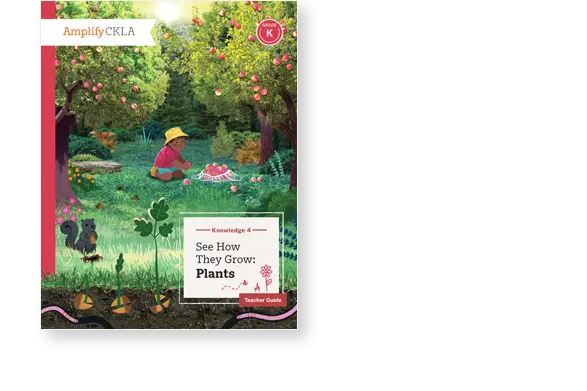
Ryan Renee Rudkin (05:33):

I think it’s honestly, after the fact, when I think in the moment, I’m not thinking of feeling stressed, but just afterwards, then I’m like, “Oh my gosh, this has just been a wild day.” But yeah, you just have to kind of go with it. And that’s just the beast of middle school. I just added to the list of why we love it.
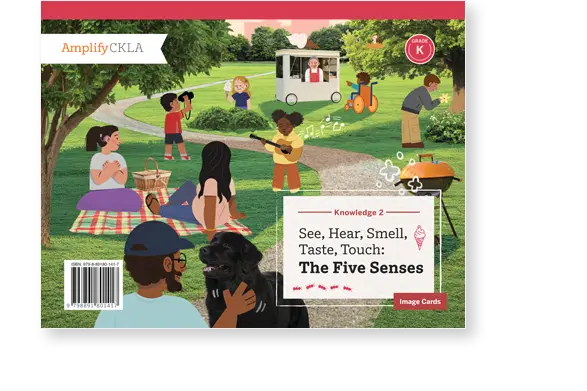
Eric Cross (05:53):

You said something about interdisciplinary work, and I wanna kind of ask about that. Because it sounds like you’ve had your hand in several different areas of science and grade levels. Working, doing design courses, working with tech. Are there certain lessons that are your favorites to teach? The ones that you really enjoy, or that no matter what, you’re like, “We need to do this; this is such a rich experience for students”?

Ryan Renee Rudkin (06:17):

Yeah. I definitely try to do lessons or activities along the way. I like to do projects at the end of my units. When I taught physics, we did a project and it was mainly an assessment tool called the Wheeling and Dealing. The kids, they would all get a different car. And then they to sell their car. And so they had to pretend to be a car salesman, and they did that with their knowledge of the physics unit. So everything we did on forces and speed and motion. So I like doing culminating projects like that. And you’re kind of tricking them into assessing them.

Eric Cross (06:57):

When I think about your car salesman project, I’m thinking of a bunch of students, but they’re like on Shark Tank, but they’re just littler versions. And they’re doing these sales pitches, but they’re speaking in scientific terms as they’re trying to do it. Do you record these or do they just exist in the classroom?

Ryan Renee Rudkin (07:12):

No…And that was a long time ago, when I taught eighth grade. I wish I had; I wish I had recorded. That was definitely—it was fun, ’cause the kids, they would get their little piece of paper and they—some of ’em didn’t know what car it was. And so they’re like “A Boo… A Boo-gatti? What’s a Boo-gatti?” And then someone from across the room would be like, “Ooh, I want it! Here, I’ll trade you my Ford Focus!” And <laugh> so they would kind of wheel-and-deal which car they would…and then once they got their choice, then they would do the project.

Eric Cross (07:44):

So they’re really embodying this persona of a car salesman. The wheeling and doing back-and-forth and trying to trade a Bugatti for a Ford Focus. <Laugh>

Ryan Renee Rudkin (07:53):

I know. <Laugh> I like to make my class, my learning environment, enjoyable. You know, I gotta be there; they gotta be there. So I know there’s other goals in mind—you know, standards and test scores—but at the end of the day, I wanna come back, and I want them to come back. And I just have that as a priority.

Eric Cross (08:18):

Well, based on the projects that you’re doing and the way that you approach education with students, I can see why middle-school students would want to come back, even if they had the option not to. Just because of the cool things that you’re doing. Now we’re on this—hopefully, fingers crossed—tail end of COVID in the classroom and schools, and I know it’s impacted all of us differently. Has student engagement changed since COVID and if so, how, and what have you done in these last two years to maybe adjust your approach, to continue that engagement and that richness that you provide for your kids?

Ryan Renee Rudkin (08:57):

I definitely—I think for me, I recognize that when the students are in my classroom, I want them to, I dunno, for lack of a better word, just escape the noise at home. And I know we’ve always had students that are going through divorce situations or their dog died, other things, but I think with COVID, it’s definitely been compounded. And just creating a safe place for the kids to want to be and…it’s hard. We’ve had a lot of students that have been out, absent, for various reasons and on quarantine. And they’re struggling with doing work from home, ’cause their parents are stressed and their parents are dealing with their work issues. And so I think just having grace for the kids and just keeping…I don’t know, I guess like I said, I’ve always had student engagement as top of my list.

Eric Cross (10:06):

It sounds like—the things I hear you say really have to do with who these students are as people.

Ryan Renee Rudkin (10:12):

Yeah.

Eric Cross (10:13):

And then as a second, who they are as students. How do relationships fit into your engagement? ‘Cause I’m hearing this connection that you seem to be making with kids as you’re talking about things that are beyond academics: their home life, how they’re impacted.

Ryan Renee Rudkin (10:28):

Yes.

Eric Cross (10:28):

Is there anything that you do to build these relationships, or to connect with your students, to make them feel wanted or feel connected to the classroom or to you?

Ryan Renee Rudkin (10:37):

Yeah, I do. I do a few things to build those connections. And again, this timeframe in their life is so out of their control, their peer relationships, relationships with their parents. And when they’re in my classroom, I want them to feel loved and appreciated. Something I do it’s called Phone Fridays. And in one of the social media groups, someone posted about it, and I’ve been doing it for over a year now, actually. So on Fridays I call parents and give good news. And so I’ll pick maybe one or two students. And it could be academic reasons. It could be behavior, I’ve seen a slight improvement of behavior. Maybe a role model in the classroom. And my goal is to get everybody every trimester. So everybody gets a phone call by the end of the trimester. And it’s funny ’cause sometimes the parents are a little like “Uh-oh”! When they pick up, they see the caller ID, and their school’s calling. ‘Cause Some kids don’t get good calls. So it’s a really—I would say every single parent that I’ve called, I usually get a follow-up email, either to me or my admin, just saying it’s such a cool idea I do this; thank you so much. And yeah, I just call and give good news and just put ’em on the spot. And usually the kids are a little embarrassed, but you can tell, even though they’re kind of—I think they’re faking it, that they’re embarrassed! ‘Cause You know that they got the Phone Friday, and everybody’s like, “Who’s gonna get the phone Friday?!” And so it’s a very big deal in my class.

Eric Cross (12:07):

What a great way to—I mean, it seems like that hits on so many levels. You’re making these positive calls home. You’re praising publicly, which a lot of times can happen where students can get criticized or redirected publicly and then praised privately, which is a lot of times the reverse what we should be doing. But here you are praising them publicly. And then you’re not only building a relationship with yourself, but you’re also connecting them with their parent or whoever is caring for them, because now when they go home, there’s this, “Hey, your teacher called; you’re doing awesome!” So it’s this kind of triangle that’s forming there. I think that’s super-cool and a great thing for teachers to do.

Ryan Renee Rudkin (12:45):

It takes, you know, the last five minutes of my class. I do it every class. And then I have a system. Like I said, I keep track of all the kids. That way, by the end of the trimester I’ve gotten everybody. Sometimes I let the students, whoever I call first, then I let them pick a peer and I tell them, “OK, we have to have a solid reason. Why are we calling?” And a couple times they’ll have a student, like one of my energized ones, they’ll raise their hand. “How About me? How about me?” And I and the kids kind of laugh a little and I said, “Well, how about this? Let’s make a goal. How about next week we’re gonna make a goal and we’re gonna have a reason to call home.” So just working on the kids that need a little push in the right direction. That’s other reasoning to it. But yeah, it’s fun. I love it.

Eric Cross (13:33):

And you have the community. You have this goal setting. We were talking a little earlier about this transition—so you’re becoming this…your school’s going through the IB process, is that right?

Ryan Renee Rudkin (13:44):

Yes.

Eric Cross (13:44):

And we were talking about the ATL skills and one of them is goal-setting management. You already kind of organically do this in your classroom, which is really neat. I know being an IB teacher, a lot of times I find the things that I’ve already been doing and find, “Oh, this is actually an approach to learning!” or “This is something that has a title!” I just thought it was just being helpful! Ah…So the kids are connected. You have this process where you’re calling parents; it’s working; students are involved, so it’s building this community. Now you’re engaging students. Do you have any favorite student engagement tools that you use in your classroom or when you’re teaching that you feel like you get a lot of bang for your buck? There’s so many things out there these days. And so many approaches, tools, web apps. Do you have any favorites that you use?

Ryan Renee Rudkin (14:40):

No. Nothing comes up top of my mind right now. Mostly just projects, like I said. And being excited. I think having my students see me excited about something…and I’m honest when we’re doing something that’s not quite my favorite, then I’m honest about that too. But just having my—like, we just started thermal energy this week and I told my students, I said, “OK guys, I’m gonna weave in some chemistry in there. I’m gonna weave in some particle motion,” and they’re like, “Oh! That’s when you taught eighth grade, huh!” Cause I talk a lot about when I taught eighth grade before. I don’t know, just showing my own enthusiasm, I think, is a good payoff to me. That’s a bang for your buck. Other things…I try to give ’em cool videos and Mark Grober, he’s definitely a favorite of mine I like to show my students. I like to bring in guest speakers from our community. When I taught eighth grade for physics, I always brought in a local CHP officer and they would bring in the radar and lidar guns and the kids would mark off the parking lot and they would calculate their speed. And then they would verify it with the radar gun. Two years ago when I taught math, I brought in a local landscaper company, a father-and-son outfit, and they showed the kids how they would do bids on jobs. And so, relate it to our chapter on volume and area. So just making that connection with real life. Plus it’s just a nice opportunity, too, for the community to come in. With our design class, put on our newscast. And then one of our units in our sixth grade curriculum is weather. And so I brought in a local weatheruh, chief meteorologist. And he actually talked to the students about his job as a meteorologist and then also being on the news and putting on a newscast. So we got him on our green screen and did a little like Mark Finan, you know, little cameo on our newscast for the week for school. So that was kind of cool.

Eric Cross (16:45):

They must have been excited.

Ryan Renee Rudkin (16:47):

Yeah. They’re pretty starstruck by him. So that was pretty fun.

Eric Cross (16:51):

This person was on their local news? So they would know him?

Ryan Renee Rudkin (16:56):

Yeah, he’s on Channel 3 out of Sacramento. Yeah. KCRA Channel 3, Mark Finan.

Eric Cross (17:00):

So all these guest speakers that you have…how do you reach out to these people? And you sound like you get a lot of success. Do you ever get nos? Like if I’m sitting here listening and that inspires me, but you’re getting celebrities and you see a few people…like, how do you reach out to them? And does everybody say yes? How does it go?

Ryan Renee Rudkin (17:21):

Well, usually at my back-to-school night, I always ask the parents if they have a career or hobby that could lend itself to the curriculum. And so sometimes I’ll hear about—students will talk about, like, “My mom’s a doctor.” And so I’ll reach out to parents and just say, “Hey, you know, your kiddo said, you’re a doctor. May I ask what type?” And most of the time the nos that I’ve received are just because of schedule conflicts. You just have to get creative! Look in your community and see what you have. People want to come and talk to kids. I’ve had some presentations that the person is so intelligent and amazing, but they just, weren’t very kid-friendly. I mean, that happens. Butsomeone knows someone. And just ask! I mean, it doesn’t hurt to ask to have ’em come out, come hang out for the day, with my students. Andone time I had a nurse practitioner she was in the cardiac unit. And so she brought in hearts and led a heart dissection with my students. And we did a station set-up. I’ve had elaborate ones like that, or just a mom come in to tell my students about her job as a nutritionist and relate it to our unit on metabolism. And so just did like a little 15-minute Q&A with the kids on nutrition. And I would just say, look at your community and/or post on social media. I always do that. Post in your school’s PTA groups. So the parents know someone, that’s for sure. Or someone’s retired. One time I had—I think he was a grandfather of one of the kids—he was into rocks. And he had a bunch of meteorites <laugh> and brought in his meteorites.

Eric Cross (19:15):

Bring in your rocks!

Ryan Renee Rudkin (19:15):

I know! Right? And he <laugh> just brought in his meteorite collection! I was like, sure, come on in!

Eric Cross (19:23):

That’s one of the things I love about being a middle-school teacher is that my students have such varied interests and I’ll get the Rock Kid every once in a while and he’ll come in and he’ll have all these rocks and crystals. And a lot of times there’s a grandfather that’s responsible for this inherited geologic treasure that they have.

Ryan Renee Rudkin (19:45):

Yeah, something like that—I mean rocks are not my favorites, but I don’t really tell the kids that. I was like, “Sure, yeah, come on in! We can have a whole-day lesson on rocks!”

Eric Cross (19:55):

<Weakly> “This is great!”

Ryan Renee Rudkin (19:58):

Just utilizing your resources. That’s all it’s about.

Eric Cross (20:02):

Well, I think the back-to-school night was really helpful. That’s something that’s super doable. You have a bunch of parents and you just simply ask, “Who do you know? What do you do?” And then just collecting that and then just asking people to come in. I’ve I’ve been reluctant to do it more often than I’ve wanted to, because I haven’t figured out—and maybe you can help me with this—I have three class periods a day plus other class periods that are not necessarily science. And I don’t want to dominate a person’s schedule. Do they tend to be willing to stay all day? Or do you do, one class gets it, and you record it? Like, how do you balance out the speakers with your school schedule?

Ryan Renee Rudkin (20:39):

Mostly they’ll they’ll just come for the whole day. When I taught eighth grade, I had five classes, so that was easy. That was an all-day thing. And then usually I’ll offer to call lunch, have lunch delivered, or snacks during the day. I mean—

Eric Cross (20:53):

Feeding them is key.

Ryan Renee Rudkin (20:54):

Yeah. Just something kind of nice. Donuts in the morning. I mean, you’d be very surprised. Most people that are in the field or retired, like I said, they’re more than willing to come. And even if they have to wait an hour, while you teach another class that doesn’t pertain to it, then they’ll either leave or come back or just hang out in the back and pretend to be a student during that history class that you have.

Eric Cross (21:20):

It’s my own limiting belief where I feel guilty. I don’t think about it. I need to think about it through the perspective that you do, that these people WANT to talk. I just assume everybody’s so busy. But I do know, the times I’ve had speakers come out, at the end of the day, they’re so energized or they’re so happy or they’re so grateful. ‘Cause They’re like, “This is what it’s like to teach every day?” I’m like, “Yeah, this is what it’s like.”
Ryan Renee Rudkin (21:42):

I think too, a lot of parents…usually being being in the stops at elementary. A Lot of parents don’t get the opportunity to come help out in the classroom, because the middle school kids, you know, it’s not very cool or it’s just not needed like in the elementary classes. So a lot of times, like I said, you’d be surprised. A lot of the parents they’re more than happy to come and hang out. And again, some students, they don’t want their mom or dad to be there, but then I talk it up. I’m like, “Everyone’s gonna be so like impressed that your dad’s a doctor,” or “your mom’s a doctor” or —so then I kind of like downplay it. Like, “Oh, whatever, you’re you’re faking it. It’ll be fine. Don’t be embarrassed.” Leading up to their parent coming into the classroom.
Eric Cross (22:36):

Right. Kind of redirect that energy toward something positive. With guest speakers, projects, pacing, all these awesome things that you have going on, how do you find balance as a teacher, as a person? And what encouragement would you give to new or aspiring teachers? We work in a profession that will take as much as you give it. And you fall asleep at night worrying about other people’s kids and we love it. And teachers by personality can just give and give and give and give. But in order for us to last—I’m thinking about those new teachers who are going into it, who are gonna go in and be there before the sun gets up and stay after the sun gets down. How do you maintain balance, taking care of yourself? You’ve been in education for—how long have you been teaching for?

Ryan Renee Rudkin (23:29):

Sixteen. This is my 16th year.

Eric Cross (23:31):

Enough to be that veteran. So how do you find balance? And then, what encouragement would you give to new or aspiring teachers?

Ryan Renee Rudkin (23:39):

I would say each year, pick one or two things to add on. You can’t add on 10 things, even though you’re gonna find 10 things that are awesome. But just make a little list, put ’em in a file, and every year, just get good at what you do and then just add on one or two things. And reflect on what’s not going well that you can get rid of to make room to add something else. Try to be patient with yourself. And don’t reinvent the wheel. There’s so many things out there that you can borrow and make it your own. Again, I think that’s a time-saver, just leaning on your colleagues. And take lots of notes, because then when you do it again next year, you can refresh yourself and, “Oh yeah, this lesson, wasn’t the best…” What can you add in to make it a little bit better? And yeah, I would say just take on one or two things each year. And then by the time you get to, you know, being a veteran, you can do all these awesome things and it’ll feel natural ’cause you’ve been practicing and just adding in one thing at a time. I coached Science Olympiad a bunch of years ago, and Science Olympiad is so rewarding. It’s just so amazing.

Eric Cross (24:59):

What is Science Olympiad, for the people who’ve never heard of it?

Ryan Renee Rudkin (25:03):

Oh, Science Olympiad is so awesome. Google it. I think it’s just ScienceOlympiad.org. It’s 23 different events across all disciplines of science, different topics. And then you have a team of 15 students. And so your 15 students have to cover the 23 events. So for example, if the student’s on the anatomy team, usually there’s a team of two kids they’re gonna study and learn. They provide all the rules and the guidelines. So the students learn and study whatever the parameters are for that year. And then they take a test. And then they compete against other schools. And there’s build events, the engineering events, they can build things like trebuchets matchbox cars or mousetrap cars. Oh gosh, there’s all kinds of things. There’s like a Rube Goldberg device. It changes every year. And it’s so rewarding to see the kids; they pick their area of science that they love. And sometimes you have to put them on an event that they don’t know, and then they end up loving it. It’s so rewarding as a teacher to see these kids that are just on fire and you know that one day they’re gonna go off and do amazing things. They just commit. They commit to their event. And then they blow it outta the water and they win medals and just the recognition…it’s super, it’s just an amazing program.

Eric Cross (26:42):

One of the competitions that’s really low-tech that I’ve taken into my classroom is Write It, Do It. Have you done that one before?

Ryan Renee Rudkin (26:50):

Oh, yes. Yeah. That’s one. Yep.

Eric Cross (26:52):

It’s such a low-tech, simple one to do, but it teaches such great skills. And for those people who haven’t heard of the Write It, Do It project, you create kinda some abstract art out of random crafts. That’s very difficult to describe. You have pipe cleaners and foam and balls and you know, all these different things. And you make it. And then one person on the team is the writer, and they look at it and they write the procedures, and then their teammate, who’s in a different room and doesn’t get to see it, gets all the materials to build it and the procedures, and they have to rebuild it as closely as possible to the actual original. Even though they don’t get to see the original. So they have to rely on their partner’s ability to write procedures step-by-step. And it was fun to watch my students become teammates in that. And they learned how to communicate in a really fun competition. So I expanded it to do it with all of my students as an activity, just to teach them how write descriptively, to write procedurally, to be technical writers. And it’s, it’s fun! It’s fun to see what they build based on what the students say. <Laugh> And it’s also fun to watch them interact with each other, which for seventh graders, usually it’s conflict. <Laugh> But, like, playful conflict. <Laugh> It’s pretty funny to see what they build.

Ryan Renee Rudkin (28:11):

They’re like, “Man, what are you talking about? That doesn’t mean this; it means this!”

Eric Cross (28:16):

<Laugh> I know part of me feels guilty, but not enough to stop the project. ‘Cause I know for some of ’em, it’s gonna be a really trial by fire being able to practice their skills with writing procedures.

Ryan Renee Rudkin (28:27):

But they’re learning among themselves how to provide more details and to be more thorough with their writing and and their thoughts, put their thoughts onto paper. So yeah, that’s a funny event. Definitely.

Eric Cross (28:41):

Earlier you had mentioned something about connecting your kids with kids and students outside of your classroom. What is it that you do with that? Because I thought that was a really cool project. Can you speak to that a little bit?

Ryan Renee Rudkin (28:57):

Yes, I’ve done—they haven’t had it in a few years, but there’s something called the Pringles Challenge. And if you Google that, I’m sure it’s on the Internet still. So you sign your class up, or your classes, and you get partnered with another school somewhere in the U.S., someplace else. And you decide individually teams, whatever they build. And they make a package to ship a single Pringle chip through the mail. And then you actually mail a Pringle chip through the mail. And then your partner team or partner school, they send their chips to you and then you open everything and then you can take pictures and video. And then there was a whole scoring process where you would score when you receive the chips. And then you input all the data on the website so you can see like how your—and most schools would trade pictures, so that the kids found out how their chip survived. March Mammal Madness is so much fun. Again, Google that.

Eric Cross (30:01):

Did you say March Mammal Madness?

Ryan Renee Rudkin (30:02):

Yes.

Eric Cross (30:03):

Like March Madness, with mammals?

Ryan Renee Rudkin (30:05):

Yes.

Eric Cross (30:05):

  1. What is this?

Ryan Renee Rudkin (30:06):

It starts up in March. And you can sign your students up. And that one—it’s not too interactive with other schools, but this is opportunity to get the kids interacting within your site or within your district. Or if you have teacher friends at other schools. There’s like 60…I think it’s 64 animals? And they have this massive bracket that they post. And then you can have the students, I did it—it would be very time-consuming to have the kids individually research each animal. So I just gave one animal per student and so as a class we researched all the animals and then, I think it’s every three days or so, they have these bouts. And it’s all posted on YouTube. Google it. It’s kind of fun.

Eric Cross (30:56):

I’ve already got the website up, ready to go! Folks, everybody who needs to Google this: <articulates carefully> March Mammal Madness. And is it Arizona State University? Is that the main site, ASU?

Ryan Renee Rudkin (31:04):

Yes.

Eric Cross (31:04):

So people, listen to this. Check it out. March Mammal Madness. Look, I’m doing this! I’m already,—you’ve already sold me on this.

Ryan Renee Rudkin (31:14):

It is so much fun, oh my gosh. And then, then the kids—each round, they pick their pick, just like basketball. They do their picks and then you wait for the video. And they do it live on—I think it’s live on Instagram, or the next day on YouTube. And then the kids get all excited. And then usually the kids, whatever animal they got as their research animal, they’re rooting for that one to win, the whole thing.

Eric Cross (31:42):

But we still have time; we still have time to—

Ryan Renee Rudkin (31:45):

You can jump in anytime. Even if it’s already started, you can jump into it. It usually lasts—I believe it’s a two-week from beginning to end. When they do the first round, the wild card, and then all the way to the winner, I believe it’s a two-week process. Oh, maybe three, actually.

Eric Cross (31:59):

I’m already seeing this lead-up to the video being watched in class to see…I’m already thinking about like, “How do I prevent my students from finding the video?” Or like, “When does it go live so that I could be the one to show them so they didn’t go find it early?”

Ryan Renee Rudkin (32:13):

It takes time out of the class, but I believe it’s one of those things where you have to just…it takes 10 minutes out of the class, but it’s important. So when they each round and then the next day, they release the YouTube video. Last year, when it got down to the final round, we were on spring break. And so I told my students, “You guys, let’s do some optional Zooms. And so I had a bunch of kids log on and we all watched the videos together. So that was kind of fun. And then this year, the other thing, the first time I’ve ever done this and it’s going really well is—on social media, I was talking with one of the teachers from Ohio who teaches science and she and I decided we’re gonna do penpals for our students this year. Paper-And-Pen penpals. So that’s been a lot of fun. We just partnered up all the students, her students and my students, and once a month we send and receive the letters to each other. So that’s been a really cool experience.

Eric Cross (33:14):

If you keep doing that, and you need more teachers to be involved, can my students be penpals with your students?

Ryan Renee Rudkin (33:20):

Yeah!

Eric Cross (33:20):

If you open it up to more people? I think that, to get a letter, old-school? Letter in the mail? It would be so exciting.

Ryan Renee Rudkin (33:28):

It is. We mail them, the teacher and I, we just put them all together in one package. But yeah, it’s an actual handwritten letter.

Eric Cross (33:37):

The only letters I feel like I get in the mail now are bills.

Ryan Renee Rudkin (33:42):

Right? Exactly.

Eric Cross (33:42):

But I feel like the digital version of that is if someone calls me, it’s probably bad news. I don’t know if I’m the only one that’s like that, but I’m like, “Who’s calling me? Why aren’t you texting me? What’s going on? Text me first, then call! I need to know who’s going on, and if you’re unknown, you’re going to voicemail.

Ryan Renee Rudkin (34:00):

Exactly. The penpals has been a lot of fun.

Eric Cross (34:03):

You’ve been in education for a while. You’re on the other side of what it’s like to be a student in the classroom. Which can be surreal in itself, when we think about our own experiences as being a student. Is there a teacher or a learning experience that’s had an impact on you while you were a student in school that really stands out to you? And you can interpret the question however you want. But is there someone that’s memorable or an experience that’s memorable that you still carry with you today?

Ryan Renee Rudkin (34:32):

Definitely. My favorite teacher, and we actually still keep in contact on social media is Mrs. Sheldon. She was my fifth and sixth grade teacher. I had the pleasure when I was in elementary school, I was in an all-day contained GATE class—Gifted and Talented Education class. I vividly remember doing so many amazing projects. We built this big, giant—she brought in a big ol’, like, TV box. It was big, big, big. And you could stick like three kids inside there, standing up shoulder-to-shoulder. And we built this big dragon. The head, and we had the whole rest of the class in a big sheet behind us, and we would do a little parade around the school. And she had that thing for years after. They had to repair it every year, and they would do the little parade around school. She did a lot of traveling and when we would go on vacation and then come back, that was always the big deal: “Where did Mrs Sheldon go?” And she had sand from Egypt and pictures from the rainforest. And later when I became a teacher and then I looked her up and we reconnected I did ask her, “Did you go to those places? Or did you, like, lie about it? <Laugh> To get us engaged?

Eric Cross (35:52):

You went for the real questions!

Ryan Renee Rudkin (35:54):

I did. And she laughed and thought that was funny. And she did travel for real. But yeah, she’s an amazing woman. We still keep in contact. And I remember, you know, little things…like we would be out there doing our PE time and she’d have her long skirt, you know, dress on, with her tennies, and she’s out there playing kickball with us. Just a very kindhearted, smart, amazing woman. I’m very fortunate and I’m grateful that we are able to keep in contact. Love social media for that reason. So.

Eric Cross (36:33):

Yeah. And that’s Miss Sheldon?

Ryan Renee Rudkin (36:35):

Mrs. Sheldon. Marlene Sheldon. Yeah.

Eric Cross (36:37):

Shout-Out to Marlene Sheldon influencing the next generation of teachers, with engagement with your world travels and all those different things.

Eric Cross (37:04):

Ryan, thank you so much for one, serving our students. And in the classroom, our middle-school students who need us. I think that middle school especially, elementary school, those years are when students are really starting to decide, “What am I good at?” And the experiences that we create for our students really shape what they believe they can do. These really cool, engaging experiences, these projects that you’re giving them, whether they’re doing these car sales, Shark Tanks, or they’re doing penpals, or you have guest speakers, or they’re designing planets. These are things that students don’t forget. And then when they move on to higher grades, they remember more than anything, I think, how they felt about something. And it sounds like you’re crafting these awesome experiences. And so I just wanna thank you for your time. I know as a teacher it’s very short. And I thank you for being on the podcast with us.

Ryan Renee Rudkin (38:04):

Thank you. This has been a great experience. I just—I really enjoy my students. And I feel very, very grateful and very blessed for finding where I belong.

Stay connected!

Join our community and get new episodes every other Tuesday!

We’ll also share new and exciting free resources for your classroom every month.

What Ryan Rudkin says about science

“I like to make my class and my learning environment enjoyable. I know there’s other goals in mind… but at the end of the day, I want to come back and I want [students] to come back. It’s so rewarding as a teacher to see these kids that are just on fire… and you know that one day they’re going to go off and do amazing things. ”

– Ryan Renee Rudkin

Middle school science teacher

Meet the guest

Ryan Rudkin is a middle school science educator near Sacremento, California. Although she originally thought she would teach elementary students, Ryan connected with middle school and never looked back. Now in her 16th year in the classroom, Ryan also supports teachers in her district with professional development. Ryan’s favorite part of teaching science is seeing students grapple with concepts and explore phenomena.

A woman with shoulder-length blonde hair smiles at the camera, wearing earrings and a dark top. The background is blurred green and gray.

About Science Connections: The podcast

Welcome to Science Connections: The Podcast! Science is changing before our eyes, now more than ever. So…how do we help kids figure that out? We will bring on educators, scientists, and more to discuss the importance of high-quality science instruction. In this episode, hear from our host Eric Cross about his work engaging students as a K-8 science teacher.

S3 – 04. Ideas to build math fluency with Valerie Henry, Graham Fletcher, and Tracy Zager

Promotional image for "Math Teacher Lounge" Season 3, Episode 4 titled "Ideas to Build Math Fluency," featuring Valerie Henry, Tracy J. Zager, and Graham Fletcher.

Fluency in math can oftentimes be associated with negative experiences with its development— timed worksheets, for example. Bethany and Dan are joined by three guests to better understand fluency and how to make its approach fun. Dr. Val Henry shares her three-part definition of fluency and her five principles for developing it. Additionally, Tracy Zager and Graham Fletcher join Bethany and Dan to better understand fluency through a lens of equity and using multimedia as a tool.

Explore more from Math Teacher Lounge by visiting our main page

Download Transcript

Dan Meyer (00:03)

Hey folks. Welcome back. This is Math Teacher Lounge, and I am one of your hosts, Dan Meyer.

Bethany Lockhart Johnson (00:07):

And I’m your other host, Bethany Lockhart Johnson. Hi, Dan.

Dan Meyer (00:11):

Hey, great to see you. We have a big one this week to chat about and some fantastic guests. We are chatting about fluency, which is the sort of word and concept that I feel like people have very, very non-neutral associations with it. A lot of them are very negative, for a lot of people.

Bethany Lockhart Johnson (00:26):

I saw you frown a little. What’s up with that, Dan? You kind of, like, shrank.

Dan Meyer (00:30):

I have strong feelings about it. You know, there’s lots of ways that people go about helping people become fluent in mathematics. And a lot of them are harmful for students, and ineffective. And it got me thinking about fluency as it exists outside of the world of mathematics, where we have a lot of very clear images of it. We’re getting fluent in things all the time. Like, as humans. Human development is the story of fluency. And I just was wondering….Bethany, would you describe yourself as fluent at something outside of the world of mathematics? What is that? How’d you get fluent at it? What was the process?

Bethany Lockhart Johnson (01:05):

Hmm, I think I’m a pretty fluent reader. I read all the time. I’m a happier person if I’ve read that day. I once saw this poster in a classroom; it said “10 Ways to Become a Better Reader: Read, Read, Read, Read, Read…you know, 10 times. Get it? Reading? You get better at reading by reading! So I would say reading. And it’s been kind of cool—I have a one-year-old who, it’s been really exciting slash overwhelmingly anxiety-producing to see him get very fluent with walking slash running, ’cause he’s getting faster every day. And it’s kind of fun. When I think of what’s something somebody’s trying to get fluent with…walking! He’s trying to be more fluid. He’s practicing transitions. He doesn’t wanna hold my hand while he traverses rocky terrain. He’s getting better at it. He’s practicing. What about you? What’s something…?

Dan Meyer (02:08):

I think about driving a lot. I’m a very fluent driver and I think a lot about when I was first a driver, you know? And how l have my hands on 10 and 2, vice grip, and do not talk to me; do not ask me anything; don’t ask me my NAME. I need to focus so hard. And then a year later, you know, I’m driving with one hand, smash the turn signal, take a sip off of whatever, change the CD. And then it’s no big deal.

Bethany Lockhart Johnson (02:38):

Wait, did you pass the first time? Your test?

Dan Meyer (02:40):

Yeah, I don’t like to brag about it. <laugh> But I do all the time. <laugh> But I got a hundred on my driving test. I don’t care who knows it. And I hope it’s everybody. But I guess all of this is just to say there are areas of life where fluency feels natural, with the case of walking. There’s areas of life where fluency feels motivating, with like driving—I wanna be able to switch the CD out or whatever. And there’s areas where fluency feels terrifying and hard to come by, like mathematics, sometimes. So we have a set of guests here. Our first guest will help us figure out what do we mean by fluency? And what’s the research say about what fluency is and how students develop it in mathematics? And then our other guests will help us think about what it looks like in practice in the classroom. What are some novel, new ways to work on fluency? So first up we have Val Henry, Dr. Val Henry.

Bethany Lockhart Johnson (03:32):

So we knew we needed help with the fluency definition, because when we think about it, it’s kind of big, right? And we wanted to look at what research about fluency really says. So we called on Valerie Henry. Val is a nationally board-certified teacher, taught middle school for 17 years, and since 2002 has worked with undergraduates graduates, credential candidates as a lecturer at the University of California, Irvine, one of my alma maters. So after doing her dissertation on addition and subtraction fluency in first grade, Val created a project to study ways to build addition and subtraction and multiplication and division fluency while also developing number sense in algebraic thinking. And the pilot grew and grew over the last 18 years into a powerful daily mini-lesson approach to facts fluency called FactsWise. And when we thought of fluency, the first person I thought of was Val. Welcome, Val Henry, to the Lounge! I’m so excited to have you here. Welcome.

Valerie Henry (04:36):

Thanks, Bethany. And thanks to you, Dan. It’s great to be here today.

Dan Meyer (04:41):

Great to have you; help yourself to whatever you find in the fridge. The names that people write down on those things in the bags are just recommendations. It’s potluck-style here. I’m curious, Val, if you’re, like, on an airplane, someone asks you what you do, and you say you study fluency…what is the layperson’s definition of what does it mean to be fluent in mathematics? And if you can give a brief tour through what the research says about what works and what doesn’t that would really help us orient our conversation here.

Valerie Henry (05:12):

The first thing I have to do when I talk to somebody on a plane is define the idea of fluency. And I often use an example of tying your shoelaces. Because that works with first graders as well as adults. This idea that when we first start trying to put our shoes on and get those shoelaces tied, somebody tries to, first of all, just do it for us. But then of course maybe tries to teach us the bunny-ears approach. And we struggle and struggle as little kids and eventually either the bunny-ears approach or something else starts to work for us. But we still have to pay attention to it. We have to think hard and it’s not easy. And then over time we get to the point where we basically don’t even think about it. When I tie my shoes in the morning. I’m not thinking about right-over-left and left-over-right and all of those things. I just do it. And so that’s a good, easy example of becoming fluent with something. I think what we’re talking about today though, is the basics, the adding and subtracting that we hope kids are going to have mastered maybe by second grade, and the multiplication and division facts that we wanna maybe have mastered by third, maybe fourth grade. So now what does that mean to become fluent with those basics? I have a three-part definition that seems to match up really nicely with the common core approach to fluency. Which is, first of all, we want the answers to be correct. And then second, we want the answers to be easy to know. And so what does that mean? Well, to me, it means without needing to count,

Bethany Lockhart Johnson (07:12):

You mean without having to kind of muscle through it? Or say more about you mean.

Valerie Henry (07:16):

Well, I guess what I mean is that when you watch a young child try and solve something even as simple as two plus three, they might put up two fingers and then go 3, 4, 5 with three more fingers winding up on their hand, one or the other of their hands. While they’re doing that, they don’t really have a sense of whether even their answer is right or not, quite often. Especially when you get to the larger adding and subtracting problems, you can see a lot of errors happening as they’re trying to count. And it’s taking up cognitive energy to do that counting process, especially as you get to the larger quantities. So my definition of fluency now is “getting it right without needing to do that hard work like counting.” Now, some people might say, well, we just want them to have ’em memorized. But in my research, I’ve learned that a lot of very fluid adults don’t always have every fact memorized. In fact, if you ask a room full of adults, what’s seven plus nine, you might learn that they can all get it correct quickly, quickly…but they don’t all have it memorized. And so when you ask them, “How did you get that?” Many of them will say, “Well, I just gave one from the 7 to the 9 and I know that 10 plus 6 is 16.”

Bethany Lockhart Johnson (08:53):

That’s such an important distinction. My brain literally just did that actually!

Valerie Henry (08:58):

<laugh> Right? <laugh> But you’re fluid with it, because it doesn’t take you much cognitive energy at all.

Bethany Lockhart Johnson (09:05):

Right.

Valerie Henry (09:07):

So now we have “correct without needing to put that cognitive energy,” which usually means that you’re counting. And then the third thing is “relatively quickly,” so that you’re not spending 15 seconds trying to figure it out. Even that part-whole strategy approach can be done really quickly, almost instantaneously. Or it can take a long time. So if a student can get the answer correct within, you know, three or four seconds— is I’m pretty generous—I figure that they’re pretty darn fluent with that fact. So that’s my three-part definition of these basics, fluency.

Dan Meyer (09:55):

I love the distinction between getting it correct and getting it quick. It’s possible to be quick with wrong answers. It’s possible to be like, “Those are separate components there.” And I echo Bethany’s appreciation for this third option in between knowing it instantaneously through memorization and muscling through it. But there’s like a continuum there of how much energy it took you to come up with it that all feels extremely helpful.

Valerie Henry (10:21):

And you know, one of the things that I’ve noticed is that when kids are pressured to come up with those instantaneous answers, they often default to guessing and get it wrong.

Bethany Lockhart Johnson (10:30):

Mm, yeah.

Valerie Henry (10:30):

So that’s one of the things that I’ve learned is that as we’re trying to help students develop fluency, it’s important to start with building their conceptual understanding of what it means to do, you know, 3 times 9 and what the correct answer is, maybe using manipulatives or representations of some sort. Not skip-counting! I really have found that skip-counting just perpetuates itself in many students’ minds and that they never stop skip-counting, which means they’re putting in not very much mental energy if it’s 2 times 3 but a ton of mental energy if it’s 7 times 8. Because frankly, it’s really hard to skip count by sevens. And by eights.

Bethany Lockhart Johnson (11:18):

I can get to 14 and then I’m like, wait, wait, what was next? Right? No, no, no…21! What do you feel are some misconceptions that maybe teachers, maybe parents have about fluency in math?

Valerie Henry (11:30):

I think maybe one of the first ones is that if students count or skip-count, their answers repetitively over and over and over and over, that they’re bound to memorize them. And the study that I did back in 2004, I actually had a school that had decided that they were going to do time tests with their students every day, all year. And that undoubtedly by the end of the year, those students would be fluent.

Bethany Lockhart Johnson (12:06):

And to clarify by time test, you mean like, sit down, pencil, paper, ready, go, worksheet kind of thing.

Valerie Henry (12:15):

Yes.

Bethany Lockhart Johnson (12:16):

Some of us might remember quite vividly.

Valerie Henry (12:18):

<laugh> Very vividly. And you know, you have to get it done within a certain amount of time. So they made it fun for the students. Apparently the students enjoyed it. I was a little leery about that, but in the end, when I went and checked on the students and I did one-on-one assessments with half of the students in every class that were randomly selected so that I could get a sense of where they were with their fluency—and these were first graders—they basically had nothing memorized. They were simply counting as fast as they possibly could. And, you know, mostly getting the right answers. But they had not memorized. So that’s one of the myths, I think, is that repetitive practice of counting gets you to memorization.

Bethany Lockhart Johnson (13:10):

If I put it in front of you enough times, you’ll become fluent.

Valerie Henry (13:14):

Right, right. Now these students didn’t really get any instruction, any help learning these. They just simply tested over and over and over. So that’s another thing that I think is a misconception. It’s that if we test students, but don’t really teach them fluency, then they’re going to become fluent. If we just test them every Friday or that kind of thing. And that they’ll learn them at home. But really what that means is a few lucky kids who have parents who have the time and the energy and the background to know how to help will take that job on at home. Not that many students are really that fortunate.

Dan Meyer (14:01):

It’s almost like the traditional approach, or the approach you’re describing, confuses process and product. It says, “Well, the product is that eventually fluent students will be able to do something like this, see these problems and answer them, answer them quickly,” and says, “Well, that must be the process then as well; let’s give them that products a whole lot.” But as I hear you describe fluency with bunny ears on shoelaces, there’s these images and approaches and techniques that require a very active teacher presence to support the development of it. That’s just kind of interesting to me.

Valerie Henry (14:35):

My initial project, the pilot project that I tried, was to simply ask teachers to follow five key principles. And the first one was to do something in the classroom every day for—I told them, even if you’ve only got five or 10 minutes, work on fluency for five or 10 minutes a day, and let’s see what happens. So that was one key element was just to teach it and to give students opportunities to get what the research calls for when you’re trying to memorize, which is actually immediate feedback. When I talk about immediate feedback with my student teachers, I say, “I’m talking about within one or two seconds of trying a problem, and then sort of immediately knowing, getting feedback of whether you got the answer right or not so that your brain can kind of gain that confidence. ‘Oh, not only did I come up with an answer, but somebody’s telling me it’s the correct answer.’”

Dan Meyer (15:38):

There’s a lot of apps now in the digital world that offer students questions about arithmetic or other kinds of mathematical concepts and give immediate feedback of a sort: the feedback of “You’re right; you’re wrong” sort. Is that effective fluency development, in your view?

Valerie Henry (15:57):

I haven’t heard and I haven’t seen them being super-effective. The ways I think about this are “Immediate feedback isn’t the only thing we need.” Probably one of the biggest things that we need is for students to develop strategies. And this is one of the other things I’ve learned from international research, from countries that do have students who become very fluent very early, is that they don’t shoot straight for memorization, but they go through this process of taking students from doing some counting and then quickly moving them to trying to use logic. So, “Hey, you really are confident that 2 + 2 is 4; so now let’s use that to think about 2 + 3.” Actually, as an algebra teacher, I would much rather have students that have a combination of memorization and these strategies, than students who’ve only memorized. Isn’t that interesting that my most successful algebra students were good strategy thinkers. Not just good memorizers.

Bethany Lockhart Johnson (17:09):

So you mentioned there were five that kind of helped root this idea in like, “What can teachers do? What is the best thing that teachers can do to support with fact fluency?” So, everyday was key.

Valerie Henry (17:22):

Then the next principle that I really focus on is switching immediately to the connected subtractions so that students—

Bethany Lockhart Johnson (17:33):

Not waiting until you’ve gotten all the way through addition. But making “Ooh!”

Valerie Henry (17:38):

Totally. And I didn’t do that the first year. And when we looked at the results of the assessments at the end of the year, we realized that our students were so much weaker in subtraction than addition. So the following pilot year, we tried this other approach of doing subtraction right after the students had developed some fluency with that small chunk of addition. And we got such better subtraction results.

Bethany Lockhart Johnson (18:11):

What are the other principles?

Valerie Henry (18:13):

The biggest one is to use these strategies. So the strategies makes the third. And then the fourth I would say is to go from concrete to representational to abstract.

Bethany Lockhart Johnson (18:27):

Don’t put away those manipulatives. Don’t put away those tools.

Valerie Henry (18:31):

Oh, so important to come back to them for multiplication and division. And my fifth principle is to wait on assessment. To use it as true assessment, but not race to start testing before students have had a chance to go through this three-phase process. Which is conceptual understanding with manipulatives; building strategies, usually with representations; and then working on building some speed until it’s just that natural fluency.

Bethany Lockhart Johnson (19:07):

I wanna say thank you so much for offering your really learned perspective, because you have not only done the research, but seen it in action and seen how shifting our notions of fluency and what fluency can be and what a powerful foundation it can be for all mathematicians. Really, that shift is so powerful. And I appreciate you sharing it with our listeners and with us. So we’re so excited that we got to talk with you today, Val—

Dan Meyer (19:35):

Thank you, Dr. Henry.

Valerie Henry (19:37):

You’re welcome!

Dan Meyer (19:41):

With us now we have Graham Fletcher and Tracy Zager, a couple of people who understand fluency at a very deep and classroom level. I wanna introduce them and get their perspective on what we’re trying to solve here with fluency. So Graham Fletcher has served in education in a lot of different roles: as a classroom teacher, math coach, math specialist, and he’s continually seeking new and innovative ways to support students and teachers in their development of conceptual understanding in elementary math. He’s the author, along with Tracy, of Building Fact Fluency, a fluency kit we’ll talk about, and openly shares so much of his wisdom and resources at gfletchy.com. Tracy Johnson Zager is a district math coach who loves to get teachers hooked on listening to kids’ mathematical ideas. She is a co-author of this toolkit, Building Fact Fluency, and the author of Becoming the Math Teacher You Wish You’d Had: Ideas and Strategies from Vibrant Classrooms. Tracy also edits professional books for teachers at Stenhouse Publishers, including, yours truly. Thank you for all that insight, Tracy, and support on the book.

Bethany Lockhart Johnson (20:49):

Dan and I were talking at the beginning of the episode about things we feel like, “Hey, I’m fluent in that. I’m fluent in that.”

Dan Meyer (20:55):

Just very curious: What’s something you would like to get fluent in outside of the world of mathematics, let’s say?

Tracy Zager (21:00):

I’ll say understanding the teenage brain, as the parent of a 13-year-old and 15-year-old. That’s the main thing I’m working on becoming fluent in!

Bethany Lockhart Johnson (21:10):

Ooh!

Dan Meyer (21:13):

A language fluency, perhaps. All right, Graham. How about you?

Graham Fletcher (21:16):

For me typing, it’s always been an Achilles heel of mine. So voice-to-text has been my friend. But it’s also been my nemesis in much of my texting here and working virtually over the last couple years. So yeah, typing.

Dan Meyer (21:33):

Do you folks have some way of helping us understand the difference in how fluency is handled by instructors and by learners?

Tracy Zager (21:40):

I would say that the lay meaning of fluency is definitely a little different than what we mean in the math education realm. When we’re talking about math fact fluency, which is just one type of fluency. So you gotta think about procedural fluency and computational fluency; there are lots of types of fluency in math. And Graham and I had the luxury of really focusing in specifically on math fact fluency. We’re looking at kind of a subset of the procedural fluency. So the words you hear in all the citations are accurate, efficient, and flexible. There’s this combination of kids get the right answer in a reasonable amount of time and with a reasonable amount of work and they can match their strategy or their approach to the situation. That’s where that flexibility comes in. And there’s like lots more I wanna say about that about sort of…I think one issue that comes up around fluency is that people are in a little bit of a rush. So they tend to think of the fluency as this automaticity or recall of known facts without having to think about it. And that is part of the end goal, but that’s not the journey to fluency. So this is one of the things that Graham and I thought about a lot was the path to fluency. The goal here it’s that student in middle school who’s learning something new doesn’t have to expend any effort to gather that fact. And they might do it because they’ve done it so many different ways that they’ve got it, and now they just know it, or they might be like my friend who’s a mathematician who still, if you say, “Six times 8,” she thinks in her head, “Twelve, 24, 48…” and she does this double-double-double associative property strategy. And it’s so efficient, you would never know. And that’s totally great. That’s fine. That’s not slowing her down. That’s not providing a drag in the middle of a more complex problem or new learning. So we’re really focused on having elementary school students be able to enter the middle and high school standards without having that pull out of the new thinking.

Graham Fletcher (23:53):

And as I think about that, I think about how so many students will memorize their facts, but then they haven’t memorized them with understanding. So that when they move into middle school and they move into high school, it’s almost like new knowledge and new understanding that’s applied from a stand-alone skill.

Bethany Lockhart Johnson (24:10):

So something that felt really unique to me, Graham, as I was diving into the toolkit, is your use of images, Tracy, Graham, is the way that you use images to help students notice and wonder to start making sense of these quantities and the decomposition of numbers using images. Can you talk a little bit about how images played a part in the way that you think about this building a fact fluency?

Graham Fletcher (24:41):

What I realized is so many times when we approach math with just naked numbers with so many of our elementary students, the numbers aren’t visible. The quantities. They can’t see them; they can’t move them. They’re just those squiggly figures that we were talking about earlier on. So how is it that we make the quantities visible, to where students feel as if they can grab an apple and move it around? Because a lot of times we start with the naked numbers and then if kids don’t get the naked numbers, then we kind of backfill it. But what would happen if we start with the images? And then from there, these rich, flourishing mathematical conversations develop from the images. And I think that was the premise and the goal of the toolkit.

Tracy Zager (25:22):

When you look at how fact fluency has traditionally been taught, it’s all naked numbers. And sometimes we wrote ’em sideways. Like, that’s it. That was our variety of task type. Right? Sometimes it’s vertical; sometimes it’s horizontal. And that was it. And I’ve just known way too many kids who couldn’t find a hook to hang their hat on with that. It didn’t connect to anything. And so part of why I knew Graham was the perfect person for this project was his strength in multimedia photography, art, video. And so we started from this idea of contexts that for each lesson string in the toolkit, there’s some kind of context. An everyday object, arranged in some kind of a way that reveals mathematical structure and invites students to notice the properties. So we start with images of everyday objects: tennis balls, paint pots…um, help me out; here are a million of them. Crayons—

Bethany Lockhart Johnson (26:18):

Crayons, markers.

Tracy Zager (26:18):

Shoes, right? Sushi, origami paper, all kinds of things in the different toolkits. So there’s a series of images or a three-act task or both around those everyday objects, and then story problems grounded in that context. And then there are images with mathematical tools that bring out different ideas, but relate in some way to the image talks. And we do all of that before we get to the naked number talk. Which we do, and by the time you get to the number talk, it’s pretty quick, ’cause they’ve been reasoning about cups of lemonade. And now when you give them the actual numerals, they’re all over it.

Bethany Lockhart Johnson (27:03):

I have to say too, as somebody who—particularly in middle school—navigated math anxiety, we recently talked with Allison Hintz and Anthony Smith about their amazing book Mathematizing Children’s Literature.

Tracy Zager (27:14):

Yay!

Bethany Lockhart Johnson (27:14):

And I was explaining, like, if I sat down at the beginning of a math class and my teacher opened a picture book and said, “We’re gonna start here,” I felt my whole body relax. And if we start with this image, if we start with just looking at an image and making sense of an image, I feel like that could be such a powerful touchstone for all the work you do from there.

Tracy Zager (27:41):

That’s core. That’s a core design principle, is that invitational access. There are no barriers to entry. There’s nothing to decode. There’s nothing formal. We’ve been learning from Dan for years about this, right? Of starting with the informal and then eventually layering in the formal. I was in a class in Maine where they were doing an image talk and it’s these boxes of pencils. It’s a stack of boxes of pencils and they’re open and you can see there are 10 pencils in each box. And so there are five boxes of pencils each with 10 pencils in it. And then the next image is 10 boxes of pencils and each box is half full. So now it’s 10 boxes each with five. And the kids are talking and talking and then the third image, I think there are seven boxes each with 10 pencils in it. And she said, “What do you think the next picture’s gonna be?” And this girl said, “You just never know with these people!” <laugh> I dunno!”

Bethany Lockhart Johnson (28:37):

That’s kinda true. Knowing you both, it’s kinda true.

Tracy Zager (28:42):

Like if it’s seven boxes with 10 in it, one kid said, I think it’s gonna be 14 boxes of five. And other kids are like, I think it’s gonna be 10 boxes with seven. And they start talking about which of those there are and the relationships between—

Bethany Lockhart Johnson (28:58):

But they’re making sense of numbers!

Tracy Zager (28:59):

Totally. So all the kids felt invited. They can offer something up. They’re noticing and wondering about that image. They’re talking about it in whatever informal language or home language that they speak. And that was core to us. That was a huge priority, because honestly, one of the motivations to talk about fluency is that it’s always been this gatekeeper. It has served to keep kids out of meaningful math. Particularly kids from marginalized or historically excluded communities. So they’re back at the round table, doing Mad Minutes, while the more advantaged kids are getting to do rich problem solving. And so, we thought, what if we could teach fact fluency through rich problem solving that everybody could access? That was like square one for us.

Bethany Lockhart Johnson (29:45):

That’s huge.

Dan Meyer (29:46):

That’s great to hear. What’s been helpful for me is to understand that students who are automatic, that’s just kind of what’s on the surface of things. And that below that might be some really robust kind of foundation or scaffolding that bleeds to a larger building being built, or it might be just really rickety and not offer a sturdy place to build farther up. It’s been really exciting to hear that. I wonder if you’d comment for a moment about, in the digital age and—I’m at Desmos and our sponsors are Amplify and we all work in the digital world quite a bit. There are a lot of what report to be solutions to the fluency issue, to developing fluency in the digital world. Just lots and lots of them. Some that are quite well used, others that are just like X, Y, or Z app on the market. You can find something. Do you have perspectives on these kinds of digital fluency building apps? Like, what about them works or doesn’t work? Let us know. Graham, how about you? And then Tracy, I’d love to hear your thoughts too.

Graham Fletcher (30:47):

Yeah, I think that’s a great question, ’cause there’s a lot of shiny bells and whistles out there right now that can really excite a lot of teachers. But I always come back to what works for me as a classroom teacher is probably gonna work in a digital world as well. So what are the things that I love and honor most about being in front of students, and how can I capture that in that virtual world? I think one of the things that really helps students make connections is coherence. I think coherence, especially when you leave students for—you don’t get to talk with them after the lesson is done—so I think about how we can purposefully sequence things through a day-to-day basis. I think coherence is something that gets really lost when we talk about fluency, especially with whether it be digital or whether it be print, because what ends up happening is we say, “OK, we have all these strategies we need to teach,” and it becomes a checklist. So how is it that we can just provide students the opportunity to play around in a space, whether it be digital or in person, but in a meaningful way that allows them the time and the space and that area to breathe and think, but be coherent. And connecting those lessons along the way. And I think coherence is one thing that a lot of the times it’s harder to—when we’re in the weeds, it’s so hard and difficult to zoom back out and say, “Do all these lessons connect? How do they intentionally connect? And how do they purposefully connect?” And without coherence, everything’s kind of broken down into that granular level. So when looking at—I think about Desmos and I think about the Toolkit and I think about how Tracy and I talked a lot about, “Well, this, does it connect with the context problem, does it connect with the image talk, or the lessons? Like, how does it all connect and how are we providing students an opportunity to make connections between the day-to-day instruction and lessons that we tackle?”

Tracy Zager (32:44):

I’m reminded of a conversation that Dan, you and I had a long time ago, in Portland, Maine, in a bar. I’ll just be honest. <laugh> And we were talking about how, in the earlier days of Desmos, you were stressed out by what you saw, which was kids one-on-one, on a device, in a silent room. And you were like, no, this is not it. This is not what technology is here to serve. We can do so many things better using technology appropriately, but we can’t lose talk and we can’t lose relationships and we can’t lose formative assessment and teachers listening to kids and kids listening to each other and helping each other understand their thinking. Right? So when I think about the tech that’s out there for fact fluency, most of it is gonna violate all rules I have around time testing. So that a whole bunch of it, I would just toss on that premise. They’re really no different than flashcards. It’s just flashcards set in junkyard heaps. Or, you know, underground caverns. Or with a volcano or whatever. It’s the same thing. There are some lovely visuals—I’m thinking of Berkeley Everett’s Math Flips. Those are really pretty. Mathigon has some really nice stuff that’s digital. And I think that those resources invite you to kind of ponder and notice things and talk about them. All the tools that we design in the toolkit are designed to get people talking to each other, and give teachers opportunities to pull alongside kids and listen in and understand where they are. For example, our games, we didn’t design the games to be played digitally, even though you could, and people did during COVID, because we want kids on the rug, next to each other, on their knees; I’ve seen kids like across tables. I was in a school recently where a kid was like, “I hope you believe in God, ’cause you’re going…!” You know what I mean? <laugh>. Like they’re all pumped up.

Bethany Lockhart Johnson (34:41):

They’re invested!

Tracy Zager (34:45):

They’re psyching each other up and down and they’re interacting and it’s social and the teacher’s walking around and she’s listening to the games. And they don’t actually need any bells and whistles. They need dice and they need counters and they need this game that is actually a game. In all of our conversations, games have to actually be games. Games cannot be “roll and record.” Games have to involve strategy. They have to be fun. So in designing those games, we didn’t feel like it brought any advantage to make that a digital platform. But things that did bring advantages digitally, like the ability to project these beautiful images or to use short video in the classroom, that really was a value-add that enabled us to do something different in math class than we had done before, and to get kids talking in a different way than they ever had before. When I think about fluency, historically, if you say like, “OK, it’s time to practice our math facts,” you hear a lot of groans. And when I see a Building Fact Fluency classroom and I say, “OK, it’s BFF time!” There’s like a “YEAAAAHHH!” You know? And so that’s what we’re after.

Graham Fletcher (35:47):

It’s all about kids, really, for us. And I think at the heart of it, we made all the decisions with teachers and kids at the forefront of it.

Tracy Zager (35:55):

I know of high schoolers who are newcomers, who have experienced very little formal education, and speak in other languages, are using it as high schoolers, because it involves language and math and all the deep work in the properties and it’s accessible, but it’s also not at all condescending or patronizing. Like we designed it to be appropriate for older kids. So that’s just something that I think we’re both really proud of. One thing we thought a lot about, especially in the multiplication-division kit is how a classroom teacher could use it and a coordinating educator in EL, Title, special education, intervention could also use it because there’s so much in it, that students could get to be experts, if they got extra time in it, using something that’s related and would give them additional practice. So they could play a game a little bit earlier than the rest of the classes. And they could come in already knowing about that game, or they could do a related task. We have all these optional tasks that no classroom teacher would ever have time to teach it all. So the special educator could use it and have kids doing a Same and Different or a True/False, or some of the optional games. And then the work in both special education and general education could connect.

Dan Meyer (37:20):

I just wanna say that this is an area that for so many students, as you’ve said, Tracy, it presents a barrier for their inclusion in mathematics. It’s a very emotionally fraught area of mathematics. And we really appreciate the wisdom you brought here. And just the care you’ve brought to the product itself. Your knowledge of teaching, knowledge of math, and yeah, especially a love for students feels like it’s really infused throughout Building Fact Fluency. If our listeners want to know more outside of this podcast, outside of the product itself, where can they find your words, your voice? Where you folks at these days? Tell ’em, Graham would you?

Graham Fletcher (37:57):

You can find us at Stenhouse, Building Fact Fluency. And then Tracy and I, currently playing around, sharing ideas a lot on Twitter, under the hashtag #BuildingFactFluency. That’s kind of where we can all come together and share ideas. And then also on the Facebook community, where there’s lots of teachers sharing ideas.

Bethany Lockhart Johnson (38:19):

If you were to ask our listeners like, “Hey, if you wanna keep thinking about this, here’s something you could try or here’s something you could go do,” what could be a challenge that we could share that could help us continue this conversation?

Graham Fletcher (38:35):

Online you can actually download a full lesson string. And a lesson string is a series of activities and resources that are purposefully connected. You can pick one or two of those from the Stenhouse web site, Building Fact Fluency. You can try the game. You can try one of those strategy-based games. You can try an image talk and just see how it goes. And just share and reflect back, whether on Twitter or on Facebook. But it’s kind of there, if you wanna give it a whirl. And as Tracy was sharing, even if you’re a middle-school teacher or a high-school teacher, we really tried to think about those middle-school and high-school students keeping it grade level-agnostic. Just so every student has those opportunities for those mathematical conversations. So download a lesson string and give it a whirl, and we’d love to hear how it goes.

Dan Meyer (39:25):

Bethany and I will be working the same challenge with people in our life.

Bethany Lockhart Johnson (39:29):

Yes.

Dan Meyer (39:29):

Enjoying some fact fluency with people in our homes, perhaps. We’ll see. And we’ll be sharing the results in the Math Teacher Lounge Facebook group. Graham and Tracy, thanks so much for being here. It was such a treat to chat with you both.

Bethany Lockhart Johnson (39:42):

I love learning with you and just helping to shift this idea of fluency into something that can be accessible and powerful and positive.

Stay connected!

Join our community and get new episodes every other Tuesday!

We’ll also share new and exciting free resources for your classroom every month.

What Valerie Henry says about math

“A lot of very fluent adults don’t always have every fact memorized. ”

– Val Henry

Meet the guests

Valerie Henry has been a math educator since 1986. She taught middle school math for 17 years and has worked as a lecturer at University of California Irvine since 2002. After doing her 2004 dissertation research on addition/subtraction fluency in first grade, Valerie created FactsWise, a daily mini-lesson approach that simultaneously develops  fluency,  number sense, and algebraic thinking. Additionally, she has provided curriculum and math professional development for K-12 teachers throughout her career, working with individual schools, districts, county offices of education, Illustrative Mathematics, the SBAC Digital Library, and the UCI Math Project.

Graham Fletcher has served in education as a classroom teacher, a math coach, and currently as a math specialist. He is continually seeking new and innovative ways to support students and teachers in their development of conceptual understanding in elementary mathematics. He is the author of Building Fact Fluency and openly shares many of his resources at gfletchy.com. Follow him on Twitter.

Tracy Johnston Zager is a district math coach who loves to get teachers hooked on listening to kids’ mathematical ideas. She is a co-author of the Building Fact Fluency toolkits and the author of Becoming the Math Teacher You Wish You’d Had: Ideas and Strategies from Vibrant Classrooms. Tracy also edits professional books by teachers, for teachers at Stenhouse Publishers. Follow her on Facebook.

A collage of three headshots: an older woman with glasses, a man with a beard in a blue shirt, and a woman with dark hair smiling in front of greenery.
A graphic with the text "Math Teacher Lounge with Bethany Lockhart Johnson and Dan Meyer" on colored overlapping circles.

About Math Teacher Lounge: The podcast

Math Teacher Lounge is a biweekly podcast created specifically for K–12 math educators. In each episode co-hosts Bethany Lockhart Johnson (@lockhartedu) and Dan Meyer (@ddmeyer) chat with guests, taking a deep dive into the math and educational topics you care about.

Join the Math Teacher Lounge Facebook group to continue the conversation, view exclusive content, interact with fellow educators, participate in giveaways, and more!

Meet the Illustrator Edel Ferri

We believe that all students have the right to read complex texts and engage in rich classroom discussions. They should also see themselves reflected and experience new worlds through reading.

This commitment guides our text selection, unique artwork, and dedication to reaching every student where they are.

A woman in a red blazer and floral blouse speaking during an interview, with illustrations and photos in background. play button icon overlay.
Young woman in a red blazer smiling at camera, holding a purple tumbler, seated at a desk with sketches on the wall behind her.

What is your name and pronoun?
Edel, she/her

What would we never be able to know about you, just by looking at you?
I have an extensive knowledge of reef aquariums. I also do a really good Jerry Seinfeld impression.

Where are you from?
I currently live in Greenpoint, Brooklyn. Throughout my life I’ve found myself constantly drifting between New York and New Jersey. I would spend many summers in the city as a child, as well as swimming and building sandcastles on the Jersey shore.

What is illustration?
Hm! The term itself is pretty expansive and ever changing, so this is a tough one. On a personal level, illustration is what happens when art meets narrative. It can take many forms: comics, editorial, storyboarding.

How does that differ from “fine art”?
Oof. I could write an entire book on this. For the sake of brevity, I would say that my main take would be that the line between illustration years that the terms could be interchangeable at this point.

Were you making art as a kid?
I’ve been drawing as long as I could hold a pencil in my hand. In many ways it was an escape, thinking up characters in my head, creating worlds where anything was possible. I continue to do that to this day.

Was your environment—your family, friends, teachers—supportive of your interest in art?
Growing up, I was mostly told to stop by many adults and even some of my peers, but I’m glad I didn’t. I am very thankful to have had close friends and parents that understood that art is what made me feel whole, and encouraged me to continue.

Illustration of a stylized white hand casting a spider web, followed by an animated warrior character wielding a spear.

The illustrating of: The Space Race

What is this unit about?
This unit has absolutely revived that wonder and fascination in me. It’s about the technological competition that took place between two superpowers, the United States and the USSR, to get human beings into space. There’s something so inspiring about the space race, ethics; the fact that our different societies were constantly looking to the future with such hope. That all feels so distant now.

How did you relate to the subject matter?
When I was a kid I was extremely fascinated by astronomy, I remember in particular buying an
atlas-sized book on nebulae, thinking that they were the most beautiful thing I’ve ever seen.

A hand holds a postcard reading "Greetings from Mars" with an image of a Mars rover on a rocky surface; simple sky elements are in the background.
Four illustrated panels show animals in space helmets floating progressively farther from a broken spaceship, ending with them drifting in open space against a starry background.
A sequence of four images shows a satellite with antennas orbiting Earth, progressing from a rough sketch to a detailed, colored rendering.

How we build our high-quality programs

At Amplify, we support teachers in delivering inspiring, impactful lessons that celebrate and develop the thinking of all their students. We build our high-quality programs by partnering with editorial and accessibility experts.

A group of people sit around a conference table with laptops. A woman stands at the front, presenting information displayed on a large screen.
Decorative image

Editorial

Amplify has a dedicated Editorial Team that partners with product teams, subject matter experts, and an internal advisory Editorial Board to ensure that our products meet Amplify’s high standards for quality and embody our purpose and commitment. Through multiple rounds of product review, the Editorial Team coordinates input from internal and external experts and advisors to ensure that Amplify’s materials are engaging, rigorous, and accurate. The Editorial Team also makes certain that all materials are age-appropriate for students and align with current or pending state, district, and other policies.

Our approach to accessibility

Amplify creates products that serve the needs of all learners, including those with disabilities. We refine our practices regularly and incorporate feedback from our users and accessibility experts.

Amplify works with third-party experts in digital accessibility to help ensure that we build and maintain our products in accordance with the latest Web Content Accessibility Guidelines (WCAG) and other relevant legal requirements. How we do it:

Decorative image
  • Integrated accessibility practices: We embed accessibility considerations into our product development lifecycles. We also implement training and vendor management programs that support compliance with applicable standards, guidelines, and best practices.
  • Structured, accessible content: We create well-structured, easily navigable content that meets diverse user needs, including clear, readable text, properly labeled multimedia, and logical organization of information.
  • Development and testing for accessibility: We work with third-party experts to conduct assessments against accessibility standards and develop remediation plans if deficiencies are identified. Our internal quality assurance protocols include scenarios that test functionality for users with disabilities.
  • Comprehensive training and support: We provide continuous training and resources for team members involved in developing our products to help them understand and implement accessibility requirements. This includes training on the latest WCAG guidelines and updates on industry and legal standards.
  • Inclusive design patterns: We prioritize accessible design patterns to create interfaces that are intuitive for users.
  • Student-facing print components: All student-facing print components are available in the National Instructional Materials Access Center (NIMAC) database, and all student-facing PDFs in Amplify curriculum are formatted to be compatible with screen readers.

To provide feedback about the accessibility of Amplify’s products or this website, or to discuss accommodations to help you use our products or this website, please contact the customer care and support team or +1 (800) 823-1969 (hours: 7 a.m.–7 p.m. ET).

Decorative image

Learn more about the impact of our programs.

Amplify’s high-quality programs benefit millions of students every day using methods that are evidence-based, ESSA-aligned, and showing efficacy in a variety of contexts. Read more about our programs in the following case study and report.

Case study: Making an impact with Aldine ISD

Aldine Independent School District serves 62,000 students in Texas. Forty-two percent are English language learners, and more than 90 percent are economically disadvantaged. After two years of using Amplify’s early literacy suite, the number of Aldine ISD elementary students reading at or above grade level rose from 30 percent to 50 percent.

Children sitting at their desks in a classroom, listening attentively. Open notebooks and pencils are on the desks.
Students in a classroom work on laptops with headphones on, while a teacher stands by their side, smiling and helping them.

Report: Advancing Spanish literacy with Boost Lectura

Boost Lectura is proven to support Spanish literacy skills critical for reading development. Students who used Boost Lectura for 30–45 minutes a week outperformed their peers on universal screening assessments of Spanish literacy across grades K–2—and were more likely to meet or exceed benchmarks by the middle of the school year.

¡Les damos la bienvenida, familias de Boost Reading!

Nos complace darles la bienvenida a usted y a su estudiante al Caregiver Hub de Boost Reading en este nuevo año escolar. Hemos reunido una serie de recursos y guías que ayudarán a que usted pueda brindar apoyo a su estudiante a lo largo de todo el año y a que este aproveche al máximo nuestra plataforma.

For English version, please click here.

A young girl wearing headphones uses a tablet, with colorful cartoon trees and a bird character in the background. A label reads "Built on the Science of Reading" and highlights how Boost Reading supports learning.

¿Qué es Boost Reading?

Boost Reading es un programa de intervención digital dirigido por estudiantes y basado en la Ciencia de la lectura (Science of Reading). El apasionante mundo de Boost Reading utiliza tecnología adaptativa para brindar apoyo de recuperación personalizado a estudiantes de grados K a 5, adaptándose a las necesidades únicas de cada lector. Su estudiante puede usar el programa durante el horario de clase y también de forma independiente en casa.

¡Le damos la bienvenida a Boost Reading!

A cartoon bird stands on a cliff in a jungle as part of Boost Reading, with “ad” and “at” text options on screen; a face and three hearts appear in the top right corner.

¿Cuál es mi rol?

Asegúrese de que su estudiante pueda iniciar sesión por cuenta propia.

Le recomendamos que ayude a su estudiante a iniciar sesión en casa a través de Clever u otra plataforma. El maestro también puede descargar e imprimir un código QR o un nombre de usuario y contraseña únicos que su estudiante pueda usar para iniciar sesión. Si tiene dudas sobre el proceso de inicio de sesión o no recibió los datos de ingreso, comuníquese con el maestro.

Sugerencias

  • Practique el inicio de sesión con su estudiante de manera regular hasta que pueda iniciar sesión de forma independiente.
  • Mantenga sus datos de ingreso en un solo lugar para que su estudiante sepa adónde recurrir si los olvida.
Colorful illustration featuring a cat, tropical bird, deer, books to boost reading, cubes, a portal with silhouettes, and abstract purple shapes in the background.

Procure un espacio tranquilo para que su estudiante pueda trabajar.

Prepare a su estudiante para usar Boost Reading en casa: asegúrese de que tenga auriculares y un lugar tranquilo para jugar. Boost Reading es un programa personalizado que responde a las necesidades de cada estudiante, así que no necesitará asistirlo con su aprendizaje. Una vez que su estudiante pueda iniciar sesión, podrá comenzar a usar el programa por cuenta propia.

Aparte tiempo para que su estudiante pueda jugar de forma independiente.

Es posible que su estudiante comience con una actividad de nivelación que ayudará al programa a asignarle el mejor contenido, de acuerdo con su nivel de lectura. Para garantizar la nivelación más precisa posible, es importante que el estudiante realice cada actividad de manera independiente. ¡Anime a su estudiante a que se esfuerce y se divierta!

Revise la seguridad digital.

Le recomendamos que revise Proteja a los niños en internet, un sitio web de la Comisión Federal de Comercio, cuyo tema es la seguridad digital.

¡Diviértanse más!

Cada estudiante tiene un compañero digital llamado Curioso. ¡Imprima estas páginas para colorear, y compártalas con su estudiante para que decore su propio Curioso!

Two coloring pages featuring cartoon fantasy animals under banners, one reading "CURIOSOS!"—perfect to boost reading skills while kids explore whimsical creatures like a bird, lizard, and deer.

Descargue las páginas para colorear Curiosos.

Cómo obtener ayuda

Screenshot of the Amplify support page with an orange header, bear illustration, search bar, and Boost Reading help article categories displayed in a grid layout.

¡Estamos aquí para ayudarle!

¿Tiene alguna pregunta sobre Boost Reading?

Visite nuestra biblioteca de ayuda (en inglés) y busque respuestas a sus preguntas sobre el programa en nuestros artículos de ayuda.

Para obtener apoyo curricular adicional, comuníquese con su maestro.

Preguntas frecuentes

Como los estudiantes pueden usar Boost Reading durante la jornada escolar, recomendamos ponerse en contacto con el maestro o la maestra de su estudiante para determinar cuánto tiempo debería usar este programa en casa. Nuestra orientación general es la siguiente:

Boost Reading
Los estudiantes que usan Boost Reading en los grados K–3.º deberían jugar durante un total de 30–45 minutos por semana, repartidos en sesiones de 10–15 minutos cada una. Los estudiantes que usan Boost Reading en los grados 4.º y 5.º deberían jugar durante un total de 40–60 minutos por semana, repartidos en sesiones de 20–30 minutos cada una.

Boost Reading y Boost Lectura
Recomendamos que, tanto en Boost Reading como en Boost Lectura, los estudiantes deben aspirar a usar ambos programas durante aproximadamente 40 minutos por semana.

Si su estudiante tiene problemas con el contenido, le recomendamos que no intervenga. Aunque sabemos que esto puede resultar difícil, Boost Reading está diseñado para adaptarse según las respuestas de su estudiante y proporcionarle un mayor apoyo e instrucción con el fin de que pueda avanzar en el juego.

Welcome to Amplify Desmos Math Cherokee CSD!

To view this protected page, enter the password below:


Lleve el mundo a los estudiantes con un plan de estudios de alfabetización comprobado de PreK a 5.º grado

Amplify Core Knowledge Language Arts (CKLA) es el plan de estudios líder en alfabetización temprana basado en la Ciencia de la lectura. Mediante la combinación del desarrollo de conocimientos y de destrezas fundamentales a partir de la investigación, nuestra instrucción orienta a los educadores en el desarrollo de lectores, escritores y pensadores capaces.
Con una poderosa plataforma en línea y un plan de estudios paralelo de lengua y literatura en español, Amplify CKLA ofrece una solución integral para educadores y estudiantes de PreK a 5.º grado. For English version, please click here.

Los resultados son fruto del conocimiento previo

El plan de estudios de alfabetización de Amplify CKLA de PreK a 5.º grado equipa a los estudiantes con un rico conocimiento que se construye intencionalmente para inspirar curiosidad e impulsar resultados. Explore las investigaciónes que revelan la eficacia del plan de estudios basado en el conocimiento, así como el logro de Amplify CKLA como intervención educativa de conformidad con la ESSA (nivel 1 de evidencia fuerte).

Amplify CKLA serves

38,000+

Salones de clase

2,700,000+

Estudiantes

50

Estados de EE. UU. y D.C.

Revisado de forma independiente y rigurosa

Amplify CKLA se encuentra entre los pocos planes de estudio que es tanto reconocido por la campaña Knowledge Matters (por su excelencia en construir conocimiento intencionalmente) y como calificado verde en EdReports, obteniendo puntuaciones verdes en todos los criterios.

Leer la reseña en EdReports

Ilustración que muestra una "campaña de alfabetización temprana" con niños participando en actividades educativas y de lectura en diferentes carteles.

Nuestro enfoque

Basado en la Ciencia de la lectura y siguiendo el principio de Core Knowledge, el plan de estudios Amplify CKLA para PreK a 5.º grado combina conocimientos de contenido ricos y diversos en historia, ciencias, literatura y artes con una instrucción sistemática de destrezas fundamentales basada en la investigación.

Basado en la Ciencia de la lectura

Como la primera casa editorial en crear un plan de estudios basado en la Ciencia de la lectura, ponemos la investigación en acción con una instrucción explícita y sistemática de destrezas fundamentales junto con una secuencia comprobada de construcción de conocimientos. En colaboración con expertos y profesionales de la educación, proporcionamos recursos poderosos que generan resultados reales. Explore nuestras historias de éxito de Ciencia de la lectura.

Desarrolla destrezas fundamentales con instrucción explícita y sistemática

El alcance y la secuencia basados en la investigación de Amplify CKLA progresan desde el desarrollo de destrezas simples hasta el más complejo, comenzando con la conciencia fonológica y fonémica. La instrucción le guía en la enseñanza explícita de las 150 ortografías de los 44 sonidos del inglés, con una progresión intencional y una revisión de las destrezas para preparar a sus estudiantes para el éxito.

Adopta una metodología demostrada de adquisición de conocimientos

Siguiendo la Core Knowledge Sequence, un enfoque coherente, acumulativo y de contenido específico para desarrollar conocimientos, los estudiantes profundizan y hacen conexiones entre áreas de contenido para construir una base de conocimientos sólida que les permita comprender textos complejos. Vea cómo se ha demostrado que el plan de estudios Core Knowledge mejora los puntajes de lectura y elimina las brechas en el rendimiento.

Creado en colaboración con la Core Knowledge Foundation

Amplify CKLA es el líder en materiales educativos de alta calidad para lengua y literatura de primaria, creado en colaboración con la Core Knowledge Foundation para ayudar a los estudiantes a desarrollar con eficacia un conocimiento profundo del contenido y destrezas fundamentales.

CONOCER MÁS SOBRE LA CORE KNOWLEDGE FOUNDATION

Cultivar la alfabetización bilingüe con programas paralelos en inglés y español

Amplify Caminos es el compañero perfecto en lengua y literatura del idioma español para Amplify CKLA. Los programas alineados combinan un rico conocimiento del contenido con una instrucción sistemática de destrezas fundamentales basada en la Ciencia de la lectura que sigue los principios de alfabetización bilingüe, y respalda múltiples modelos de enseñanza.

CONOCER MÁS SOBRE AMPLIFY CAMINOS

Estudio de eficacia de Amplify CKLA

Evidencia de conformidad con la ESSA (nivel 1): la adquisición de
conocimientos con Amplify CKLA mejora los logros.

Descargar ahora

Qué se incluye

El programa proporciona atractivos materiales impresos y multimedia diseñados para construir una base sólida y rica en lectoescritura en todos los salones de clase.

CoreELD y complementos

Materiales de alta calidad para los maestros

Los maestros de Amplify CKLA brindan instrucción de manera eficaz con recursos impresos y digitales, que incluyen:

  • Guías para el maestro con diferenciación integrada.
  • Evaluaciones formales e informales.
  • Diapositivas de lecciones listas para usar y personalizables.
  • Libros comerciales y Guías literarias.
  • Recursos docentes y desarrollo profesional a pedido.

Recursos inmersivos para estudiantes

Los estudiantes de Amplify CKLA se mantienen interesados con una amplia gama de recursos impresos y digitales, que incluyen:

  • Descodificables originales y Libros grandes de lectura en voz alta (K a 2.º grado), Libros de lectura (3.er a 5.º grados) y libros comerciales (K a 5.º grado).
  • Cuadernos de actividades para estudiantes con evaluaciones integradas (K a 5.º grado).
  • Unidades de investigación para investigaciones independientes desarrollados en torno a un libro comercial (K a 5.º grado).
  • Diario del poeta y Diario del escritor (libros de lectura con espacio para escribir para 4.º y 5.º grados).
  • Misiones de conocimiento para apoyar el aprendizaje inmersivo basado en problemas en los grados 3.º a 5.º.

Materiales prácticos de fonética

La fonética multisensorial y los recursos de destrezas fundamentales ayudan a los estudiantes a practicar destrezas clave utilizando enfoques divertidos y variados que desarrollan la independencia.

  • Carpetas para la práctica de ortografía (K).
  • Tarjetas de letras (K a 2.º grado).
  • Tarjetas de sílabas (K a 2.º grado).
  • Tarjetas de imágenes (K a 3.er grado).
  • Tarjetas de combinación de imágenes (K).
  • Rotafolios de códigos de consonantes y vocales (1.er y 2.º grados).
  • Biblioteca de sonido digital exclusiva.

Experiencia digital robusta

Los recursos para maestros y estudiantes de Amplify CKLA están disponibles a través de una plataforma de experiencia digital que mejora la instrucción y le ahorra tiempo. Con todo lo que necesita en un solo lugar, puede planificar lecciones, presentar contenido y revisar el trabajo de los estudiantes de manera eficaz.

  • Presentaciones de lecciones con diapositivas listas para usar y personalizables.
  • Herramienta dinámica para estudiantes con revisión en vivo.
  • Experiencia interactiva y amigable para los estudiantes.
  • Integración LMS.
  • Videos animados de Desarrollo de conocimiento
  • Lecturas en voz alta grabadas.
  • Sitio web de desarrollo profesional.
  • Apoyo al programa en tiempo real por correo electrónico, chat en vivo y teléfono.

Programa para estudiantes del idioma inglés

Language Studio, diseñado para Amplify CKLA, brinda instrucción diaria alineada con WIDA para que los estudiantes del idioma inglés profundicen su inglés académico.

Programa de exploración de escritura

Writing Studio, un complemento único para Amplify CKLA, ofrece una inmersión profunda en la redacción de información, narrativa y opinión para formar escritores fuertes y apasionados.

Covers of four "Writing Studio Teacher Guide" books for different grades, featuring educational icons in orange, purple, blue, and teal color schemes.

School year 2026–2027 requirements

iPad® 7+
Description: 1024 x 788 or higher, 32GB or higher
Operating system: iPadOS 18+
Browser: Safari 18+
PC
Description: 1.4 GHz dual core or greater, 1024 x 768 or higher, 4GB of RAM or higher
Operating system: Windows: 10+
Browser: Chrome (latest 2 versions)
Chromebook
Description: 1.4 GHz dual core or greater, 1024 x 768 or higher, 4GB of RAM or higher
Operating system: Chrome OS
Browser: Chrome (latest 2 versions)
Mac®
Description: 1.4 GHz dual core or greater, 1024 x 768 or higher, 4GB of RAM or higher
Operating system: macOS 15+
Browser: Safari 15+, Chrome (latest 2 versions)
iPadiPad Air® 4
iPad 8+
Chromebook™Acer Chromebook 314
Samsung Chromebook 4
Dell™ Chromebook 3120
HP Chromebook x360
MacMacBook Pro®
MacBook Air®
Interactive BoardA Google certified EDLA device, such as the SMART RX Series

The following devices are not supported due to known sub-optimal performance from older hardware or complicated settings:

MicrosoftSurface Tablet®

School year 2025–2026 requirements

iPad® 7+
Description: 1024 x 788 or higher, 32GB or higher
Operating system: iPadOS 17+
Browser: Safari 17+
PC
Description: 1.4 GHz dual core or greater, 1024 x 768 or higher, 4GB of RAM or higher
Operating system: Windows: 10+
Browser: Chrome (latest 2 versions)
Chromebook
Description: 1.4 GHz dual core or greater, 1024 x 768 or higher, 4GB of RAM or higher
Operating system: Chrome OS
Browser: Chrome (latest 2 versions)
Mac®
Description: 1.4 GHz dual core or greater, 1024 x 768 or higher, 4GB of RAM or higher
Operating system: macOS 14+
Browser: Safari 15+, Chrome (latest 2 versions)
iPadiPad Air® 4
iPad 8+
Chromebook™Acer Chromebook 314
Samsung Chromebook 4
Dell™ Chromebook 3120
HP Chromebook x360
MacMacBook Pro®
MacBook Air®
iMac®
Interactive BoardA Google certified EDLA device, such as the SMART RX Series

The following devices are not supported due to known sub-optimal performance from older hardware or complicated settings:

MicrosoftSurface Tablet®

We will provide active support of our applications on the following devices for the full school year listed below.

Device final support year

iPad 62024–2025
iPad Air 32025–2026
iPad 52022–2023
iPad Air 22021–2022
iPad 22018/2019
iPad 32018/2019
iPad 42018/2019

Network environment

MINIMUM

REQUIREMENTS
User devices:Connect to Amplify servers via ports 80 and 443.
Latency:No more than 165 ms during peak utilization.
Connection speed:2 mbps per device during peak usage (10 mbps recommended). Boost Reading requires a connection speed of 10 mbps per user for optimal performance.
URLs:For the complete list of URLs to allow, please visit https://amplify.com/allowlist/.

Requirements

mCLASS assessments are optimized for most touchscreen devices using Chrome™ or Safari® web browsers. The teacher-led, observational assessments are best conducted using touchscreen but will function using a laptop and mouse as well. Please check our device support lifecycles and purchase recommendations lists below prior to purchasing.

Boost Close Reading is currently not supported on iPads.

Due to its smaller screen, the iPad Mini is not supported.

Amplify curriculum applications require the ability to project from the teacher’s device.

Boost Reading Benchmark uses speech recognition software to analyze students’ oral reading. For the most accurate results, use a wired dual-ear headset with a boom microphone that extends in front of the student’s mouth. Avoid headsets with active noise cancellation (ANC) unless that feature can be disabled. Bluetooth headsets are currently incompatible with our speech recognition technology and should not be used.

iPhone 13 and later running iOS 17+ and Safari
Galaxy 11 and later running Android 15+ and Chrome

Program

Each grade includes six core text-based units, two to three immersive Learning Experiences called Quests, and a dedicated Story Writing unit, all of which account for 180 days of instruction.

Carefully selected for their adherence to the CCSS ELA/Literacy, the texts in the Amplify ELA curriculum balance literary and informational text, and include a rich representation of genres: novels, plays, poetry, memoirs, and other full-length texts. This English Language Arts resource will allow students to grow and develop their literacy skills.

Quests are not graded. These week-long narrative lesson plans build on the literacy skills students have been developing in traditional lessons. They also shake up classroom routines and allow students to take the lead—driving engagement and enabling students to explore new ideas.

In Amplify ELA, text selections have been carefully curated to engage students in the study of complex texts at each grade level. Lexile levels are included for each core text. The Amplify ELA program has sequenced core texts, creating a “staircase” of steadily increasing complexity as measured by quantitative measures, qualitative measures, and task consideration.

Amplify’s core middle school ELA lessons expose students to a diverse array of text types, genres, authors, and time periods. By representing a wide range of student interests and perspectives, these texts develop student curiosity while also building skills and content knowledge.

No. Access to all 650+ full length titles in the Amplify Library is included in the student license. Students can download the texts from the library onto their device and access them offline, as well.

Technology

Amplify ELA 2nd edition is a blended instructional model and can be used in classrooms with limited access to devices. Teachers can make strategic choices about when their students use devices without compromising learning, while still providing 100% standards coverage.

Our curriculum offers a hybrid approach to instruction. We have developed a robust digital platform and tools for students to interact with text in unique ways and for teachers to track and support student progress. When students are using our rich print materials, teachers can share those digital experiences through classroom projection.

Amplify ELA is a web-based, device-agnostic program, meaning that it works across any device. PCs, Chromebooks, Macs, and iPads are all compliant.

Customer Privacy Policy

Last Modified: January 23, 2026 | Update History

Most recent update: This Privacy Policy has been updated to address additional rights for individuals in the European Union/UK.

We advise you to read this Privacy Policy in its entirety, including the jurisdiction-specific provisions in the appendix. Click here to review Our U.S. Notice At Collection.

Customer Privacy Policy: K–12 Schools

Who We Are

Amplify Education, Inc. (“Amplify”) is leading the way in next-generation curriculum and assessment. Amplify’s programs provide teachers with powerful tools that help them understand and respond to the needs of each student and use data in a way that is safe, secure, and effective.

Our Products and Services

Amplify’s products support classroom instruction and learning and include Amplify CKLA, Amplify ELA, Amplify Caminos, Amplify Science, Amplify Desmos Math, Boost Reading, Boost Math, mCLASS, Mathigon, associated professional development and tutoring services, and services at classroom.amplify.com (for creating and assigning activities) and student.amplify.com (for use of the activities or curricula as directed by an instructor), and any other product or service that links to this Privacy Policy (together, the “Products”).

Our Approach to Student Data Privacy 

In the course of providing the Products to Schools and their Authorized School Users, Amplify collects, receives, generates, or has access to Student Data (defined below). We consider Student Data to be confidential and we collect and use Student Data solely for educational purposes in connection with providing our Products to, or on behalf of the School as described in this Privacy Policy and our Agreements (defined below). We work to maintain the security and confidentiality of Student Data that we collect or store, and we enable Schools to control the use, access, sharing, and retention of Student Data.

Our Products are geared towards K–12 students (“Students”), and the educators, agents and staff members who use the Products as authorized by their School (“Educators”). Information that directly relates to an identifiable Student (“Student Data”) is owned and controlled by the School, and Amplify receives Student Data as a “school official” under Section 99.31 of the Family Educational Rights and Privacy Act of 1974 (“FERPA”) for the purpose of providing the Products hereunder. In addition, we rely on the School acknowledging that it is acting as the parent’s agent and consenting on the parent’s behalf to process personal information of Students under the age of 13 (“Child Users”) in accordance with the Children’s Online Privacy Protection Act (“COPPA”).

Our collection and use of Student Data is governed by our Agreements with Schools, including this Privacy Policy (“Privacy Policy”), and applicable laws which may include FERPA, COPPA, the Protection of Pupil Rights Amendment (“PPRA”), as well as other applicable federal, state, and local privacy laws and regulations (“Applicable Laws”). As noted above, with respect to FERPA, Amplify receives Student Data as a “school official” under Section 99.31 of FERPA for the purpose of providing its Products, and such Student Data is owned and controlled by the School.

Schools may provide authorization in two ways:

  1. by the School agreeing to our Customer Terms and Conditions located at amplify.com/customer-terms or another written agreement between Amplify and the School, as applicable; or
  2. by an Educator agreeing to the Acceptable Use Policy located at amplify.com/acceptable-use-policy/ (“AUP”) on behalf of the School as outlined in the AUP.

In each case, we collect Student Data and provide these Products solely for the use and benefit of the School and for no other commercial purpose. We require all Schools to review this Privacy Policy, available at amplify.com/customer-privacy, and to make a copy of the Privacy Policy available to the parents or guardians of Child Users.

We also provide limited opportunities for individual users to sign up for an account for use of our Products at-home or otherwise outside of the authorization of a School (“Home Users”). See the Appendix–Supplemental Disclosures for additional information that applies to our Home Users.

What This Privacy Policy Covers 

This Customer Privacy Policy (“Privacy Policy”) describes how Amplify collects, uses, and discloses personal information through the provision of Products.

For purposes of this Privacy Policy, “you” and “your” means Authorized Users (defined below).

This Privacy Policy does not apply to Amplify’s handling of:

  • information collected from users of Amplify’s company website, which is governed by our Website Privacy Policy.
  • job applicant data that we process in accordance with our applicant privacy notice.

There may be different contractual terms or privacy policies in place with some Schools. Such other terms or policies supersede this Privacy Policy for information collected or released under those terms. If you have any questions as to which legal agreement or privacy policy controls the collection and use of your personal information, please contact us using the information provided below. Unless expressly superseded, this Privacy Policy is incorporated into and is subject to the Agreement that governs your use of the Products.

Our Role

Amplify as a processor/service provider: Our School customers are the controllers of Student Data (as well as certain other Educator personal information to the extent required by law or Amplify’s agreement with the School) (together “School Data”).

Amplify acts as a processor/service provider for our School customers with respect to School Data, which means when we use School Data, we do so solely on the instruction of the School. School Data is subject to the School’s privacy policies; therefore, you will need to contact the School directly if you have any questions or would like to exercise your rights with respect to School Data.

Amplify as a controller: We are the controller of all other personal information we collect from non-Student Authorized Users (“Amplify Data”) and can be reached by email at privacy@amplify.com or by mail at Amplify Education, Inc., 55 Washington St.#800, Brooklyn, NY, 11201.

Policy

1. Definitions

Capitalized terms not defined in this section or elsewhere in this Privacy Policy will have the meaning set forth by Applicable Laws.

Agreement” means the underlying contractual agreement between Amplify and the School.

Authorized Users” means all users of our Products, including Authorized School Users, parents and legal guardians, and Home Users.

Authorized School Users” means Students and Educators.

Local Education Authority” means a local education agency or authority, school district, school network, independent school, or other regional education system.

Non-Student Data” means information that is linked or linkable to Authorized Users who are not Students.

School” means the Local Education Authority or State Agency.

State Agency” means the educational agency primarily responsible for the supervision of public elementary and secondary schools in any of the 50 states, the Commonwealth of Puerto Rico, the District of Columbia, or other territories and possessions of the United States, as well as a national or regional ministry or department of education in other countries, as applicable.

2. What personal information do we collect?

When you access or use our Products, you may choose to provide us with personal information, including Student Data. This information may be provided to us directly (e.g. when an account is created or through communications with us) or through your interactions with our Products.

Student Data. Below is a list of the categories of Student Data that may be collected by Amplify or its Products, either directly or through the Authorized School User’s use of the various features and configurations of the Products:

  • Identifier and Enrollment Data, such as name, email, school / state ID number, username and password, grade level, homeroom, courses, teacher names.
    • Why? Most of Amplify’s Products require some basic information about who is in a classroom and who teaches the class—Student or teacher Identifier and Enrollment data. This information is provided to Amplify by the School, either directly from the School’s student information system or via a third party with whom the School contracts to provide that information.
  • Demographic Data, such as date of birth, socioeconomic status, race, national origin, and preferred or primary language.
    • Why? To support school instructional and reporting requirements, Amplify’s Products allow Schools to view reports and analyze data using Demographic Data. Generally, Demographic Data is provided on a voluntary basis by the School. For example, a School may wish to analyze Student literacy assessment results based on English Language Learner status to better tailor classroom instruction, and in that case, the School may provide Demographic Data to enable that reporting.
  • School Records, such as grades, attendance, assessment results, and whether an Individualized Education Plan (IEP or local equivalent) is in place.
    • Why? Some of our Products support grading assignments and administering formative, diagnostic, and curriculum-based assessments. Teachers use that information to support Students’ progress in the program or help with instructional decisions. We do not collect specific details from an IEP, nor do we collect protected health information or other sensitive information.
  • Schoolwork and Student Generated Content, which includes any information contained in Student assignments and assessments, including information in response to instructional activities and participation in collaborative or interactive features of our Products, such as Student responses to academic questions and Student-written essays, as well as images, video, and audio recordings.
    • Why? As part of the digital learning experience, some of our Products may enable Students to write text and create and upload images, video, and audio recordings. For example, in Amplify ELA, students may write essays or submit short-form responses in our platform as part of a lesson on literature. As another example, in Boost Reading, student interactions with reading skills games are recorded to keep track of the student’s progress to level up in the program and to provide visibility to teachers on how students are mastering the skills.
  • Teacher Comments and Feedback, such as scores, written comments, or other feedback that Educators may provide about Student responses or student course performance.
    • Why? To enable teachers to track the performance and provide feedback to their students.
  • Non-Student Data. We may collect the following types of personal information from all other Authorized Users:
    • Contact Information, such as name and email address, as well as grade level taught, school name and school location, whether you are an Educator or Home User that creates an account or uses our Products or communicates with us.
    • Account Information, such as user login and password, for account creation and access purposes.
    • Survey Responses, which you provide in response to surveys or questionnaires.
  • Device and Usage Data. Depending on the Product, we may collect certain information about the device used to connect to our Product, such as device type and model, browser configurations, and persistent identifiers, such as IP addresses and unique device identifiers. We may collect device diagnostic information, such as battery level, usage logs, and error logs, as well as usage, viewing, and technical information (e.g., email open rates), such as the number of requests a device makes, to ensure proper system capacity for all Authorized Users. We may collect IP addresses and use that information to approximate device location to support operation of the Product. To the extent that we collect this information, this data is solely used to support operation of the Product and is not linked to Student Data. For purposes of clarity, Amplify does not use Student Data for marketing or advertising purposes (see section 6 of this Privacy Policy for more information about our commitments regarding Student Data).
    • Why? We use this information to remember returning users and facilitate ease of login, to customize the function and appearance of the Products, and to improve the learning experience. This information also helps us track product usage for various purposes, including website optimization, to ensure proper system capacity, troubleshoot and fix errors, provide technical assistance and customer support, provide and monitor the effectiveness of our Products, monitor and address security concerns, and compile analytics for product improvement and other internal purposes.
    • How? Cookies and Similar Technologies. We collect device and usage data through “cookies,” Web beacons, HTML5 local storage, and other similar technologies, which are used in some of our Products solely to support operation of the Products as described above. While we may use third party cookies and similar technologies for advertising and marketing purposes on our website (in accordance with our Website Privacy Policy), we do not permit such tracking technologies to be present on Student-facing portions of the Products. In particular, we only use the following types of cookies in our Products:
      • Strictly necessary cookies – These are cookies that are required for the operation of our websites and applications that host our Products. They include, for example, cookies that enable you to log into secure areas of our Products. These cookies are not generally stored beyond the browser session and are less likely to include personal information. This category of cookies cannot be disabled.
      • Functionality Cookies – We use these cookies so that we recognize you on the websites and apps that host our Products and remember your previously selected preferences. These cookies are stored on your device between browsing sessions but expire after a pre-defined period. These cookies enable us to “recognize” you when you use our Products, including your preferences such as your preferred language, time, and location. A mix of first party (placed by us) and third-party cookies (placed by third parties) are used.
      • Performance Cookies – These cookies help us and service providers acting on our behalf compile statistics and analytics about users of our Products that are accessed via websites and apps, including Device and Usage Information.
    • Learn how to opt out of cookies and similar technologies by reading the “What Rights and Choices Do You Have?” section of this Privacy Policy below.

3. How do we use personal information?

Student Data. Amplify uses Student Data for educational purposes, to provide the Products, and to ensure secure and effective operation of our Products, including:

  • to provide and improve our educational Products;
  • to support School and Authorized School Users’ activities;
  • to ensure secure and effective operation of our Products;
  • for purposes requested or authorized by the School or Authorized School User or as otherwise permitted by Applicable Laws;
  • for customer support purposes, to respond to the inquiries and fulfill the requests of the School and their Authorized School Users;
  • to enforce Product access and security controls; and
  • to conduct system audits and improve protections against the misuse of our Products, or to detect and prevent fraud and other harmful activities.
  • to enable the adaptive and personalized learning features of the Products.

Non-Student Data. Amplify may use Non-Student Data for the purposes for which Student Data is used as set forth above. In addition, Amplify may use Non-Student Data to provide customized content, advertising and marketing in limited circumstances (e.g. to periodically send newsletters and other promotional materials) directed to Educators and Home Users. For sake of clarity, we do not use Student Data for marketing purposes and we do not direct marketing to Students. Amplify may also use Non-Student Data for internal research and analytics, including generating insights on the use of our Products by Educators in certain Schools so that we can better serve those communities. We will also use Non-Student Data as otherwise required or permitted by law, or as we may notify you at the time of collection. Learn how to opt out of these communications by reading the “What Rights and Choices Do You Have?” section of this Privacy Policy below.

Amplify may use aggregate or de-identified data as described in the Aggregate/De-identified Data section below.

4. To whom do we disclose personal information?

Student Data. We disclose Student Data to third parties only as needed to provide the Products under the Agreement, as directed or permitted by the School or Authorized School User, and as required by law. Such disclosures may include but are not limited to the following:

  • to other Authorized School Users of the School entitled to access such data in connection with the Products;
  • to our service providers, subprocessors, or vendors who have a legitimate need to access such data in order to assist us in providing or supporting our Products, such as platform, infrastructure, and application software. We contractually bind such parties to protect Student Data in a manner consistent with those practices set forth in this Privacy Policy and in accordance with Applicable Laws. A list of Amplify subprocessors is available at https://www.amplify.com/subprocessors;
  • to comply with the law, respond to requests in legal or government enforcement proceedings (such as complying with a subpoena), protect our rights in a legal dispute, or seek assistance of law enforcement in the event of a threat to our rights, security, or property or that of our affiliates, customers, Authorized Users, or others;
  • in the event Amplify or all or part of its assets are acquired or transferred to another party, including in connection with any bankruptcy or similar proceedings, provided that successor entity will be required to comply with the privacy protections in this Privacy Policy with respect to information collected under this Privacy Policy, or we will provide the School with notice and an opportunity to opt out of the transfer of such data prior to the transfer; and
  • except as restricted by Applicable Laws or contracts with the School, we may also share Student Data with Amplify’s affiliated education companies, provided that such disclosure is solely for the purposes of providing Products and at all times is subject to this Policy.

Non-Student Data. Amplify discloses Non-Student Data for the purposes for which Student Data is used as set forth above. Amplify may also disclose Non-Student Data as otherwise required or permitted, or as disclosed at the time of collection. Please note that we do not share mobile information or opt-in consent with third parties / affiliates for their own marketing or promotional purposes.

5. Aggregate/De-identified data

Amplify may use de-identified or aggregate data for purposes allowed under FERPA and other Applicable Laws, to research, develop, and improve educational sites, services, and applications and to demonstrate the effectiveness of the Amplify Products. Amplify will not attempt to re-identify de-identified data. We may use aggregate information (which is information that has been collected in summary form such that the data cannot be associated with any individual) for analytics and reports. For example, our promotional materials may note the total number of students served by our programs in the prior year, but that information cannot be used to identify any one student. We may also share de-identified or aggregate data with research partners to help us analyze the information for product improvement and development purposes.

Records and information are de-identified when all personal information has been removed or obscured, such that the remaining information does not reasonably identify a specific individual. We de-identify Student Data in compliance with Applicable Laws and in accordance with the guidelines of NIST SP 800-122. Amplify has implemented internal procedures and controls to protect against the re-identification of de-identified Student Data. Amplify does not disclose de-identified data to its research partners unless that party has agreed in writing not to attempt to re-identify such data.

6. Data prohibitions, Advertising, Advertising limitations

Amplify will not:

  • sell Student Data to third parties;
  • use or disclose Student Data to inform, influence, or enable targeted advertising to a Student based on Student Data or information or data inferred over time from the Student’s usage of the Products;
  • use Student Data to develop a profile of a Student for any purpose other than providing the Products to a School or Authorized School User, or as authorized by a parent or legal guardian;
  • use Student Data for any commercial purpose other than to provide the Products to the School or Authorized School User, or as permitted by Applicable Laws.

7. External third-party services

This Privacy Policy applies solely to Amplify’s Products and practices. Schools and other Authorized Users may choose to connect or use our Products in conjunction with third-party services and Products. Additionally, our sites and Products may contain links to third-party websites or services . This Privacy Policy does not address, and Amplify is not responsible for, the privacy, information, or other practices of such third parties. Schools should carefully consider which third-party applications to include among the Products and services they provide to Students and vet the privacy and data security standards of those providers.

Authorized Users may be able to log in to our Products using third-party sign-in services such as Clever, ClassLink or Google. These services authenticate your identity and provide you with the option to share certain personal information with us, including your name and email address, to pre-populate our account sign-up form. If you choose to enable a third party to share your third-party account credentials with Amplify, we may obtain personal information via that mechanism. You may configure your accounts on these third-party platform services to control what information they share.

8. Security

Amplify maintains a comprehensive information security program and uses industry standard administrative, technical, operational, and physical measures to safeguard Student Data in its possession against loss, theft and unauthorized use, disclosure, or modification. Amplify performs periodic risk assessments of its information security program and prioritizes the remediation of identified security vulnerabilities. Please see https://amplify.com/security for a detailed description of Amplify’s security program.

In the event Amplify discovers or is notified that Student Data within our possession or control was disclosed to, or acquired by, an unauthorized party, we will investigate the incident, take steps to mitigate the potential impact, and notify the School in accordance with Applicable Laws.

Non-Student Data

Outside of Student Data, Amplify uses commercially reasonable administrative, technical, personnel, and physical measures to safeguard personal information in its possession against loss, theft, and unauthorized use, disclosure or modification.

9. Data Storage and Transfers

We are a United States Company, and our servers are hosted, managed, and controlled by us in the United States. If you are outside of the United States, we use industry standards to protect your data when it leaves your country of residence and your data will always be protected in accordance with this Privacy Policy, Applicable Laws and our Agreement regardless of the storage location.

Additionally, where we transfer your personal information to service providers outside of the United Kingdom (UK), European Economic Area (EEA), or other region that offers similar protections, we use specific appropriate safeguards to contractually obligate such service providers to protect personal information in accordance with Amplify’s commitment to privacy and security and applicable data protection laws.

If you have questions or wish to obtain more information about the international transfer of your personal information or the implemented safeguards, please contact us using the contact information below.

10. Data Retention / Deletion

Student Data

Upon request, we provide the School the opportunity to review and delete the personal information collected from Students. We will retain Student Data for the period necessary to fulfill the purposes outlined in this Privacy Policy and our Agreement with the School. We do not knowingly retain Student Data beyond the time period required to support the School or Authorized School User’s educational purpose, unless authorized by the School or Authorized School User. Upon request, Amplify will return, delete, or destroy Student Data stored by Amplify in accordance with applicable law and customer requirements. We may not be able to delete all data in all circumstances, such as information retained in technical support records, customer service records, back-ups, and similar business records. All such information will be protected in accordance with this Privacy Policy and our Agreement until it has been permanently deleted. Unless otherwise notified by the School, we will delete or de-identify Student Data after termination of our Agreement with the School.

Non-Student Data

Outside of Student Data, we keep personal information as long as it is necessary or relevant for the practices described in this Privacy Policy or as otherwise required by our Agreement with the School, if applicable. We determine the appropriate retention period for personal information on the basis of the amount, nature and sensitivity of the personal information being processed, the potential risk of harm from unauthorized use or disclosure of the personal information, whether we can achieve the purposes of the processing through other means, and on the basis of applicable legal requirements (such as applicable statutes of limitations).

11. What rights and choices do you have?

What Choices Do You Have?

Marketing/Advertising

As noted above, we do not use Student Data for marketing purposes and we do not direct marketing to Students. Amplify does not use third party cookies and similar technologies for advertising and marketing purposes on Student-facing portions of the Products. The choices below apply to Non-Student Authorized Users.

Opt-out of Marketing Communications. If you want to stop receiving promotional materials from Amplify, you can follow the unsubscribe instructions at the bottom of each email or email us at privacy@amplify.com. Amplify does not send marketing communications to Students.

Opt-out of Cookies and Similar Tracking Technologies. With respect to cookies, you may be able to reject cookies through your browser or device controls. Note that you have to opt-out of cookies on each browser or device that you use. If you replace, change, or upgrade your browser or device, or delete your cookies, you may need to use these opt-out tools again. Please be aware that disabling cookies may negatively impact your experience as some features may not work properly. To learn more about browser cookies, including how to manage or delete them, check the “Help,” “Tools,” or similar section of your browser.

What Rights Do You Have?

Individuals in the U.S.

  • What Rights Do You Have With Respect to Student Data?
    • Review and Correction. FERPA requires schools to provide parents with access to their children’s education records, and parents may request that the school correct records that they believe to be inaccurate or misleading.
    • If you are a parent or guardian and would like to review, correct, or update your child’s data stored in our Products, contact your School. Amplify will work with your School to enable your access to and, if applicable, correction of your child’s education records.
    • If you have any questions about whom to contact or other questions about your child’s data, you may contact us using the information provided below.
    • Other Privacy Rights? Please see section 3 of our supplemental disclosures: “Additional U.S. State Privacy Law Rights” for more information about your U.S. privacy rights

Individuals in the EU/UK

Please see section 4 of our supplemental disclosures: “Notice for European Economic Area and United Kingdom Customers” for more information about your EU/UK privacy rights.

12. COPPA

We do not knowingly collect personal information from a Child User unless and until a School or Educator, with the permission of the School, has authorized us to collect such information to provide the Products. Amplify relies on the School acknowledging that it is acting as the parent’s agent and consenting on the parent’s behalf to process personal information of Child Users in accordance with all applicable provisions of COPPA. To the extent COPPA applies to the information we collect, we process such information for educational purposes only, and no other commercial purpose, at the direction of the School and on the basis of the School’s authorization. If you are a parent or guardian and have questions about your child’s use of the Products and any personal information collected, please direct these questions to your child’s school.

Please refer to the Appendix–Supplemental Disclosures if you are a Home User.

13. Updates to this Privacy Policy

We may change this Privacy Policy in the future. For example, we may update it to comply with new laws or regulations, to conform to industry best practices, or to reflect changes in our product offerings. When these changes do not reflect material changes in our practices with respect to use and/or disclosure of Authorized Users’ personal information, including Student Data, such changes to the Privacy Policy will become effective when we post the revised Privacy Policy on our website. In the event there are material changes in our practices that would result in Authorized Users’ personal information being used in a materially different manner than was disclosed when the information was collected, with respect to Student Data, we will notify the School, and with respect to other information, we will notify you via email and provide an opportunity to opt out before such changes take effect.

14. Contact us

If you have questions about this Privacy Policy, please contact us at:

Email: privacy@amplify.com
Mail: Amplify Education, Inc.
55 Washington St.#800
Brooklyn, NY, 11201
Phone: (800) 823-1969
Attn: General Counsel

To report a security vulnerability, visit https://amplify.com/report-a-vulnerability/.

Appendix – Supplemental Disclosures

1. Mathigon and Amplify Classroom accounts

While our Products are geared towards Schools we do provide a limited opportunity for Home Users to use the Products at home—outside of the school context. We do not allow persons under the age of 13 (or those under the age of consent in any applicable jurisdiction) to register for an account with us outside the school context.

If you are a Home User, you are prohibited from collecting or providing any personal information from students or minors. You are permitted to access the platform for instructional purposes, but you may not enroll or roster minors, create accounts for minors, or input any personal information of minors into the Product.

Please note that most parts of Mathigon can be used without creating an account or providing any personal information that directly identifies you.

What Rights Do You Have? If you are a Child User who is 13 or older with a legacy Mathigon account (or the parent or guardian of a Child User with a legacy Mathigon account), you may request that we provide for your review, delete from our records, or cease collecting any Child User personal information. To the extent that you are unable to exercise these rights through self-service features within your account with us, please contact us by sending an email to: help@amplify.com and we will provide assistance.

2. U.S. Notice at Collection

Personal Information We Collect How We Use Personal Information

Student Data, which includes:

  • Roster Information
  • Demographic Data, such as race and national origin
  • School Records
  • Account Information
  • Schoolwork and Student Generated Content
  • Teacher Comments and Feedback
  • Device and Usage Data
  • To provide and improve our educational Products;
  • To support Schools’ and Authorized School Users’ activities;
  • To ensure secure and effective operation of our Products;
  • For purposes requested or authorized by the School or Authorized School Users, or as otherwise permitted by Applicable Laws;
  • For adaptive or personalized learning features of the Products; provided that Student Data is not disclosed;
  • For customer support purposes, to respond to the inquiries and fulfill the requests of the School and their Authorized School Users;
  • To enforce product access and security controls; and
  • To conduct system audits and improve protections against the misuse of our Products, or to detect and prevent fraud and other harmful activities.

Authorized Users, which includes:

  • Contact Information
  • Account Information
  • Survey Responses
  • Device and Usage Data
  • For the purposes for which Student Data is used as set forth above;
  • For marketing purposes in limited circumstances (e.g. to periodically send newsletters and other promotional materials), which will not be based on Student Data or directed to K–12 students;
  • For internal research and analytics; and
  • As otherwise required or permitted, or as we may notify you at the time of collection.

Some of the information described above may be considered “sensitive” under the laws of certain jurisdictions (i.e., account credentials and race/national origin) (“Sensitive Information”). We use Sensitive Information for necessary or reasonably expected purposes – specifically, to provide you with our Services (i.e., account credentials are used to allow account logins and race/national origin are used for the School’s reporting purposes when voluntarily provided by the School).

We do not sell or share your personal information, as described in California law.

We retain your personal information for as long as reasonably necessary for the purposes disclosed in the chart above. Additional information about our retention of Student Data and personal information from other Authorized Users can be found in Section 10 of this Privacy Policy.

Please see the Additional U.S. State Privacy Law Rights section of this appendix for information about your privacy rights pursuant to applicable U.S. law.

Notice of Financial Incentive

From time to time, to support our services, we offer opportunities to complete surveys and questionnaires. As an incentive for completing the survey or questionnaire, you can voluntarily provide personal information as an entry into a raffle drawing or to obtain other benefits, discounts, offers, or deals that may constitute a financial incentive under California law (“Financial Incentive”). The categories of personal information required for us to provide the Financial Incentives include: contact information and any other information that you choose to provide when you complete the survey.

Participation is voluntary and you can opt out at any time before the survey is complete. We do not allow students to participate in our surveys.

The value of the personal information we collect in connection with our Financial Incentives is equivalent to the value of the benefit offered.

3. Additional U.S. State Privacy Law Rights

Note for Requests Relating to Student Data: Because Amplify provides the Products to Schools as a “School Official,” we collect, retain, use, and disclose Student Data only for or on behalf of the School for educational purposes, including the purpose of providing the Products specified in our Agreement with the School and for no other commercial purpose. Accordingly, we act as a “service provider” for the School with respect to School Data. We work with the School to support and assist them in addressing privacy requests relating to School Data. Please reach out to your School directly if you wish to exercise any privacy rights that may be available to you.

For all other requests: With respect to Amplify Data, individuals residing in certain U.S. states have the following rights, regarding your personal information (each of which is subject to various exceptions and limitations):

  • Access. You have the right to request, up to two times every 12 months, that we disclose to you the categories of personal information collected about you; the categories of sources from which the personal information is collected; the categories of personal information sold or shared; the business or commercial purpose for collecting, selling, or sharing the personal information; the categories of third parties with whom personal information was shared; and the specific pieces of personal information collected about you.
  • Correction. You have the right to request that we correct inaccurate personal information collected from you.
  • Deletion. You have the right to request that we delete the personal information that we maintain about you. Even after the deletion of your account, some personal information may remain on our servers, such as in technical support logs, server caches, data backups, or email conversations. These will be automatically deleted after a reasonable amount of time, unless we are legally required to retain information for longer, or unless there is a legitimate business reason (e.g. security and fraud prevention or financial record-keeping). We are not required to delete any information which has been aggregated or de-identified in accordance with Section 5.
  • No Discrimination. You have the right not to be discriminated against for exercising these rights.
  • Appeals. You have a right to appeal decisions concerning your ability to exercise your consumer rights.

See Submitting Requests section below for details on submitting a request to exercise these rights.

4. Notice for European Economic Area (EEA) and United Kingdom (UK) Customers

As detailed at the beginning of our Privacy Policy (under the section titled “Our Role”), Amplify operates primarily as a processor that collects personal information on behalf of the School, and we act as a controller in limited circumstances where we offer Products outside the school context.

If you represent a School in the EEA or the UK, please note that we process personal information in accordance with this Privacy Policy, our Acceptable Use Policy, and our standard Data Protection Agreement, which sets out our responsibilities when it comes to our processing activities. Schools must send an email to privacy@amplify.com to enter into that DPA.

Lawful Basis for Processing

We rely on the following lawful bases for our processing activities:

  • Consent;
    • We obtain your consent to use cookies to collect and process device and usage data to understand how individuals use our Products.
  • Pursuant to a contract for use of our Products;
    • We process School Data to provide our Products (e.g., to create, authenticate and manage your account, to verify your identity, to manage our Products) pursuant to the Agreement between us and the School, as required in order for us to perform our obligations.
  • To comply with our legal obligations;
    • We process all categories of personal information that we collect to ensure the safety and security of our Products where we are complying with security requirements under data protection and cyber and information security law.
    • We process all categories of personal information that we collect to comply with our legal obligations which includes, for example, to access, retain or share certain personal information where we receive a valid request from a government body, law enforcement body, judicial body regulator or similar, to deal with legal claims and prospective legal claims, and to ensure we are complying with applicable laws.
  • When we have a legitimate interest in doing so, which is not outweighed by the risks to the individual.
    • We process all categories of personal information that we collect to support the provision, effective management, and improvement of our Products where such activities are not strictly required under our contract. This is in our legitimate interests to ensure that we are providing the best possible service.
    • We process all categories of personal information that we collect to ensure the safety and security of our services where this is important but not required under the data protection law or cyber and information security laws. This is in our legitimate interests to ensure the security of our services and systems, to prevent threats, abuse or fraudulent or unlawful activity, to promote safety and security and to ensure our Products are used in accordance with our terms and conditions.
    • We process the contact information of Non-Student Authorized Users to manage our relationship, including to respond to queries or otherwise communicate with you in relation to our Products and the operation of our business where this is not strictly required under a contract with you. This is in our legitimate interests to communicate with and resolve queries from users of our Products and to ensure that we are providing the best possible service.

We process the contact information and survey data of Non-Student Authorized Users for internal research and marketing purposes in limited circumstances (e.g. to periodically send newsletters and other promotional materials), which will not be based on Student Data or directed to Students. This is in our legitimate interests to understand our customers and prospective customers, understand how our products and services are perceived in the market, to promote our products, and to grow and develop our business.

Your Data Subject Rights

Note for Requests Relating to School Data: Amplify acts as processor to its School customers with respect to all School Data. We work with our School customers to support and assist them in addressing privacy requests relating to School Data. Please reach out to your School directly if you wish to exercise any privacy rights that may be available to you.

For all other Requests With respect to Amplify Data, you have the following rights if you are in the EEA or UK, subject to certain exceptions:

  • Right of access: You have the right to ask us for confirmation on whether we are processing your personal information and access to that personal information.
  • Right to correction: You have the right to have your personal information corrected.
  • Right to erasure: You have the right to ask us to delete your personal information.
  • Right to withdraw consent: You have the right to withdraw consent that you have provided.
  • Right to lodge a complaint with a supervisory authority: You have the right to lodge a complaint with a supervisory authority.
  • Right to restriction of processing: You have the right to request the limiting of our processing under limited circumstances.
  • Right to data portability: You have the right to receive the personal information that you have provided to us, in a structured, commonly used, and machine-readable format, and you have the right to transmit that information to another controller, including to have it transmitted directly, where technically feasible.
  • Right to object: You have the right to object to our processing of your personal information

See Submitting Requests section below for details on submitting a request to exercise these rights.

5. Submitting Requests

To exercise any of the rights described in sections 2 and 3 of this appendix, email us at privacy@amplify.com and specify which privacy right you intend to exercise. We may require additional information from you to allow us to confirm your identity. The verification steps will vary depending on the sensitivity of the personal information and whether you have an account with us. Please note that your rights may not apply in all cases. For example, we may need to retain your personal information to comply with our legal obligations, resolve disputes, prevent fraud and enforce our agreements. We will inform you if we are not able to fully respond to your requests. You may designate an authorized agent to make a request on your behalf. When submitting the request, please ensure the authorized agent identifies himself/herself/itself as an authorized agent and can show written permission from you to represent you. We may contact you directly to confirm that you have authorized the agent to act on your behalf or confirm your identity.

Complaints

If you have any issues, you have the right to lodge a complaint with an EEA or UK supervisory authority. We would, however, appreciate the opportunity to address your concerns before you approach a data protection regulator and would welcome you directing an inquiry first to us. To do so, please contact us by email at privacy@amplify.com or by mail at Amplify Education, Inc., 55 Washington St.#800, Brooklyn, NY, 11201.

6. Google APIs

Amplify uses Google’s Application Programming Interface (API) Services to enable Authorized Users to log in to Amplify, import classes and rosters from Google Classroom, create assignments in Google Classroom, and copy, edit, and publish Amplify content using Google Slides. Amplify will use and transfer information received from Google’s API in accordance with Google API Service User Data Policy, including the Limited Use requirements.

Update History:

Update: 6/13/2025: This Policy has been updated to align with product updates and to provide additional context for authorized educational use of Amplify’s Products.

Update 6/27/2024: The Policy has been updated to include an explanation regarding Google APIs in the Appendix — Supplemental Disclosures section.

Update 6/30/2023: This Privacy Policy has been updated to address new state law data privacy requirements.

Website Privacy Policy

Last Modified:  February 2026

Update: February 2, 2026: This Privacy Policy has been updated to address additional rights for individuals in the European Union/UK.

Below is the Website Privacy Policy for the amplify.com site (“Privacy Policy”). For purposes of clarity and as further outlined below, this Privacy Policy does not apply to student data. You can visit this page to read about the principles and policy governing student data collected and maintained on behalf of our school customers.

We advise you to read this Privacy Policy in its entirety, including the jurisdiction-specific provisions in the appendix. Our Notice at Collection for California Residents is available in the Notice for our California Customers.

Who We Are / What This Privacy Policy Covers

Amplify Education, Inc. (“Amplify”) recognizes the importance of protecting the privacy and security of your personal information. This Privacy Policy describes our practices in connection with information that we may collect through your use of this website (the “Site”).

This Privacy Policy does not apply to Amplify’s handling of:

  • student data or other information collected from users of Amplify’s products that support classroom instruction and learning, which are governed by our Customer Privacy Policy.
  • staff or applicant data that we process in accordance with our staff or applicant privacy notice, respectively.

If you have any question as to what legal agreement or privacy policy controls the collection and use of your information, please contact us using information below in the Contact Us section.

This Privacy Policy is incorporated into and is subject to our Website Terms of Use, which governs your use of the Site.

Our Role: We are the controller of all personal information (as defined below) that we receive through our Site and can be reached by email at privacy@amplify.com or by mail at Amplify Education, Inc., 55 Washington St.#800, Brooklyn, NY, 11201.

1. What personal information do we collect?

When you visit and / or interact with our Site, we may collect the following information about you that, alone or in combination, could be used to identify you or your device (“personal information”):

  • Contact Information, such as name, district / school name, professional affiliation, title / role, email address, shipping address, address and phone number.
  • Account Information, such as customer user login and password. 
  • Demographic Information, such as age and gender.
  • Information You Submit, such as information voluntarily provided on message boards, feedback sections, and other public areas of the Site.
  • Site Activity Information, which is collected when you access and interact with the Site, we and our Service Providers (as defined below) may collect certain information about those visits. For example, we or our Service Providers may receive and record information about your computer and browser, including your IP address, browser type, and other software or hardware information. If you access the Site from a mobile or other device, we may collect a unique device identifier assigned to that device, or other characteristics of the device hardware, operating system and configurations for that device. On certain pages of the Site, we may use third party tools to help us look at mouse movements, clicks, keystrokes, data or text entered, and the pages you visit.
  • Location Information, such as state, country and / or zip code, which we use to help us customize your experience, as well as to help us facilitate your privacy rights.
  • Audio, electronic, visual, or similar information: such as customer service interactions, call recordings, chat transcripts, files you attach, and email, text, or other correspondence.

If you make a purchase through our online store, you may provide payment and other information directly to our third party e-commerce platform to complete your purchase.

We ask that you not send us, and you not disclose, any government identifiers (such as social security numbers) or information related to racial or ethnic origin, health, or criminal background on or through the Site or otherwise.

2. Where/How do we collect personal information?

Amplify may collect personal information directly from you at various points, including the following:

  • Product Information and Newsletters. When you submit a request to obtain information about our products, services or other informational material or subscribe to one of our newsletters, you may be asked to submit information such as name, professional affiliation, email address, company name, address and phone and details on your query or interests in our products and services. This information is collected to help us process your request.
  • Customer Support. When you submit a form to contact our customer service, you may be asked to submit information such as name, e-mail, district, customer user login and password and details on your query. In addition, some features of our Site, such as our customer live chat functionality or other customer service systems may allow you to voluntarily provide personal information to us. This information is collected to help us process your request. Please only provide what is needed to facilitate the support request.
  • Product Orders. If you use e-commerce areas of our Site to order our products, we request information from you on our order form. To purchase products through the Site, you must provide contact information (such as name and shipping address) and financial information (such as credit card number). This information is used for billing purposes and to fill your orders. We will also use this information to contact you to confirm your order or to inform you of any issues or delays.
  • Registration. You may be asked to submit information to use certain parts of the Site (such as posting comments on certain areas of the Site), register for an event or webinar, or view restricted content that may be available on the Site. For instance, you may be asked to provide your name, email address and event or webinar-related preferences to help us process your registration or content request.
  • Public Areas and Discussion Forums. Any information you share in public areas, such as message boards or feedback sections, becomes public. Please be careful about what you disclose and do not post any personal information that you expect to keep private.
  • Contests and Sweepstakes. When we run a contest or sweepstakes relating to the Site or Amplify, it will be accompanied by a set of rules. The rules for each contest/sweepstakes will specify how the information gathered from you for your entry will be used and disclosed.

As you visit or use our Site, we may collect Site activity information through cookies and similar technologies.

  • Cookies, Pixels, and Other Tracking Technologies. Cookies and other tracking technologies (such as pixels, beacons, and Adobe Flash technology) are small data files that are placed on your computer or mobile device when you visit a website. They allow the website or mobile app to remember your actions and preferences over a period of time. We use the following types of cookies:
    • Strictly necessary cookies – These are cookies that are required for the operation of our Site. They include, for example, cookies that enable you to log into secure areas of our Site. These cookies are not generally stored beyond the browser session and are less likely to include personal information. This category of cookies cannot be disabled.
    • Functionality Cookies – We use these cookies so that we recognize you on our Site and remember your previously selected preferences. These cookies are stored on your device between browsing sessions but expire after a pre-defined period. These cookies enable our Site to “recognize” you when you use our Site, including your preferences such as your preferred language , time, and location. A mix of first party (placed by us) and third-party cookies (placed by third parties) are used.
    • Analytics Cookies – These cookies help us and our Service Providers compile statistics and analytics about users of the Site, including Site Activity Information. For example, we use Google Analytics to help us understand how users interact with the Platform. Google Analytics uses cookies to track your interactions with the Site, then collects that information and reports it to us. This information helps us improve the Site so that we can better serve you. To learn more about Google Analytics, visit https://support.google.com/analytics/answer/6004245?hl=en. If you wish, you can opt-out of Google Analytics by installing the Google Analytics Opt-out Browser Add-on, available on https://tools.google.com/dlpage/gaoptout.
    • Advertising Cookies – We use these cookies to collect information about your visit to our Site, the content you viewed, the links you followed and information about your browser, device, and your IP address. We sometimes share some limited aspects of this data with third parties for advertising purposes. We may also share Site Activity Information collected through cookies with our advertising partners. This means that when you visit another website, you may be shown advertising based on your browsing patterns on our Site.

For information on how to opt-out of these technologies, please see What Choices Do You Have? below.

  • Social Plugins. Certain areas of our Site permit you to utilize social media functionality, such as the Facebook “Like” or Google “+1” buttons (“Social Plugins”). To use a Social Plugin, you must authorize the third-party provider of that Social Plugin, e.g. Facebook or Google, to access, collect, and/or disclose your information related to your use of that Social Plugin, subject to that company’s privacy policies, which may differ from this Privacy Policy. In addition, such providers may be able to collect information about you, including your activity on the Site, and they may notify your connections on their social networking platform about your use of the Site. Such services may also employ unique identifiers that allow your activity to be monitored across multiple websites for purposes of delivering more targeted advertising to you.

Amplify also receives information from other sources.

  • Information from Other Sources. We may supplement any information we collect via this Site with information from publicly or commercially available sources.

3. How do we use personal information?

We may use any personal information and other information we collect from and about you for the following purposes and as described elsewhere in this Privacy Policy:

  • To provide and manage the Site. We use the personal information we collect from and about you to provide the Site and features to you, including to measure and improve its services and features, to personalize your experience by delivering relevant content, to deliver marketing messages, to allow you to comment on content, to provide you with customer support, and to respond to inquiries. We may also use and disclose aggregate or anonymous data about your use of and activity on the Site to assist us in this regard and for any other purpose.
  • To contact you. Amplify may periodically send promotional materials (e.g., newsletters) or notifications related to the Site and to Amplify’s business to the contact information you provided to us at registration.
  • To improve our products and services. We may use your personal information for our business purposes, such as data analysis, audits, developing new products and services, enhancing the Site, improving our services, identifying usage trends, and determining the effectiveness of our promotional campaigns.
  • For marketing and advertising. We may use your personal information to help us market our products to you or your school district.

4. To whom do we disclose personal information?

We may disclose any personal information and other information we collect from and about you for the following purposes and as described elsewhere in this Privacy Policy:

  • To share with our affiliated education companies. Amplify may share your personal information with Amplify’s affiliated education companies for the purposes described in this Privacy Policy.
  • To allow service providers to assist us. We may engage third party service providers, agents and partners (“Service Providers”) to perform functions on our behalf, such as analytics, credit card processing, shipping or stocking orders and providing customer service. We may disclose your personal information to such Service Providers to enable them to assist us in these efforts.
  • To allow our marketing and advertising partners to assist us. We may engage marketing and advertising partners to help us market and advertise our products and services, including via digital ads sent in connection with your visit to the Site. We may disclose Site Activity information, as well as contact information and other aggregate insights to such partners to enable them to assist us in these efforts.
  • To protect the rights of Amplify and our users. There may be instances when Amplify may disclose your personal information, in situations where Amplify has a good faith belief that such disclosure is necessary or appropriate in order to: (i) protect, enforce, or defend the legal rights, privacy, safety, operations, or property of Amplify, our parents, subsidiaries or affiliates or our or their employees, agents and contractors (including enforcement of our agreements, including our terms of use); (ii) protect the rights, safety, privacy, security or property of users of the Site or others; (iii) protect against fraud or for risk management purposes; (iv) comply with the law or legal process, including laws outside your country of residence; (v) respond to requests from public and government authorities, including those outside your country of residence; or (vi) allow us to pursue available remedies or limit the damages that we may sustain.
  • To complete a merger or sale of assets. If Amplify sells all or part of its business or makes a sale or transfer of its assets or is otherwise involved in a merger, transfer or other disposition of all or part of its business, assets or stock (including in connection with any bankruptcy or similar proceedings), Amplify may transfer your personal information to the party or parties involved in the transaction.

5. What rights and choices do you have?

Opt-out of Marketing Communications. If you want to stop receiving promotional materials from Amplify, you can follow the unsubscribe instructions at the bottom of each email. There are certain service notification emails that you may not opt-out of, such as notifications of changes to the Site or policies. If you have additional questions, please contact us using information below in the Contact Us section.

Opt-of Cookies and Similar Tracking Technologies. There are a few ways to opt out or delete cookies.

  • On Your Browser. Most browsers are initially set to accept cookies, but your browser may permit you to change your settings to notify you of a cookie being set or updated, or to block cookies altogether. Please consult the “Help” section of your browser for more information. Please note that by blocking any or all cookies you may not have access to certain features, content or personalization that may be available through the Site. Please also note that you must opt out separately on each device (including each web browser on each device) that you use to access our Site if you wish to opt out, and if you clear your cookies or if you use a different browser or device, you will need to renew your opt-out preferences.
  • Interest-Based Advertising. Some advertisers and marketing companies participate in the self-regulatory programs of the Digital Advertising Alliance (“DAA”) and European Interactive Digital Advertising Alliance (“eDAA”) in connection with online interest-based advertising. DAA and eDAA provide consumers with the ability to opt out of receiving interest-based advertising from their program participants at the following links:

What Rights Do You Have?

6. Security

Amplify uses commercially reasonable administrative, technical, personnel and physical measures to safeguard personal information in its possession against loss, theft and unauthorized use, disclosure or modification.

7. Data retention / Deletion

We will retain your personal information for the period necessary to fulfill the purposes outlined in this Privacy Policy unless a longer retention period is required or allowed by law. Even after we have deleted your personal information from our systems, copies of some information from your account may remain viewable in some circumstances – where, for example, you have shared information with social media platforms and other unaffiliated services. We may also retain backup information related to your account on our servers for some time after cancellation for fraud detection or to comply with applicable law or our internal security policies. Because of the nature of caching technology, your account may not be instantly inaccessible to others, and there may be a delay in the removal of the content from elsewhere on the Internet and from search engines.

8. Data Storage and Transfers

We are a United States Company, and our servers are hosted, managed, and controlled by us in the United States. If you are outside of the United States, we use industry standards to protect your data when it leaves your country of residence and your data will always be protected in accordance with this Privacy Policy, Applicable Laws and our Agreement regardless of the storage location.

Additionally, where we transfer your personal information to service providers outside of the United Kingdom (UK), European Economic Area (EEA), or other region that offers similar protections, we use specific appropriate safeguards to contractually obligate such service providers to protect personal information in accordance with Amplify’s commitment to privacy and security and applicable data protection laws.

If you have questions or wish to obtain more information about the international transfer of your personal information or the implemented safeguards, please contact us using the contact information below.

9. External third-party services

The Site may be linked to sites operated by unaffiliated companies, and may carry advertisements or offer content, functionality, games, newsletters, contests or sweepstakes, or applications developed and maintained by unaffiliated companies. Amplify is not responsible for the privacy practices of unaffiliated companies, and once you leave the Site via a link or enable an unaffiliated service, you are subject to the applicable privacy policy of the unaffiliated service.

10. Updates to this policy

Amplify may modify this Privacy Policy. Please look at the Last Revised Date at the top of this Privacy Policy to see when this Privacy Policy was last revised. Any changes to this Privacy Policy will become effective when we post the revised Privacy Policy on the Site. If you do not wish to be bound by the terms of the revised Privacy Policy, you must discontinue your use of the Site.

11. Contact us

If you have questions about this Privacy Policy, please contact us at:

Email: privacy@amplify.com
Mail: Amplify Education, Inc.
55 Washington St.#800
Brooklyn, NY, 11201
Phone: (800) 823-1969
Attn: General Counsel

Appendix – Supplemental Disclosures

1. Notice for our California Customers

We retain your personal information for as long as you are an active user of our Site or continue to have an account with us, and in accordance with our legal obligations (which may require us to hold information to provide financial and other reporting and to defend against potential claims). If you are a California resident, please see below for information about your rights pursuant to California law.

Personal Information We Collect
How We Use Personal Information
Contact Information
  • To provide you with customer support and respond to inquiries.
  • To contact you with promotional emails (e.g. newsletters) or notifications related to the Site
  • To help us verify the identity of our user
  • As otherwise required or permitted by law, or as we may notify you at the time of collection
Account Information
  • To provide and manage the Site
  • To improve our products and services
  • As otherwise required or permitted by law, or as we may notify you at the time of collection
Payment Information
  • To complete your payment of purchases made through the Site
  • For internal operations (e.g. to improve and update our products)
  • For security and fraud prevention
  • As otherwise required or permitted by law, or as we may notify you at the time of collection
Information You Submit
  • To provide the Site and features to you, including to allow you to comment
  • To improve our products and services
  • As otherwise required or permitted by law, or as we may notify you at the time of collection.
Site Activity Information
  • We sell or share information about your Site activity with third parties for targeted advertisements on and off of Amplify. We also use this information to:
    • To provide and manage the Site
    • To improve our products and services
    • For internal operations (e.g. to improve and update our products)
    • For security, safety, and due diligence purposes
    • As otherwise required or permitted by law, or as we may notify you at the time of collection
Location Information
  • We use location information , such as state, country and / or zip code, which we use to help us customize your experience, as well as to help us facilitate your privacy rights.
Inferences
  • We may make inferences about your interests and personal preferences (such as the content you like to consume). We also use this information to:
    • To personalize your experience on the Site
    • For internal operations (e.g. to improve and update our products)
    • As otherwise required or permitted by law, or as we may notify you at the time of collection

Some of the information described above may be considered “sensitive” under the laws of certain jurisdictions (including payment information and account login credentials (“Sensitive Information”). Whether information is Sensitive Information will depend on the laws of your jurisdiction. We only use Sensitive Information, such as payment information and account credentials for necessary or reasonably expected purposes – specifically, to provide you with our Services (i.e., fulfill purchases and to allow account logins).

Shine the Light

California’s Shine the Light law (Civil Code § 1798.83) permits California residents to request certain information regarding our disclosure of certain categories of personal information to third parties for their own direct marketing purposes in the preceding calendar year. We do not share personal information, as defined by California’s Shine the Light law, with third parties for their own direct marketing purposes.

Notice of Financial Incentive 

 As part of our services, there may be opportunities for you to complete surveys and questionnaires. As an incentive for completing the survey or questionnaire, you can voluntarily provide your personal information, which in turn enters you into a raffle drawing or enables us to provide you with other benefits, discounts, offers, or deals that may constitute a financial incentive under California law (“Financial Incentive”). The categories of personal information required for us to provide the Financial Incentives include: contact information and any other information that you choose to provide when you complete the survey.

Participation is voluntary and you can opt out at any time before your survey is complete.

The value of the personal information we collect in connection with our Financial Incentives is equivalent to the value of the benefit offered.

2. Additional U.S. State Privacy Law Rights

Residents of certain U.S. states have the following rights, regarding your personal information (each of which are subject to various exceptions and limitations):

  • Access. You have the right to request, up to two times every 12 months, that we disclose to you the categories of personal information collected about you, the categories of sources from which the personal information is collected, the categories of personal information sold or shared, the business or commercial purpose for collecting, selling, or sharing the personal information, the categories of third parties with whom personal information was shared, and the specific pieces of personal information collected about you.
  • Correct. You have the right to request that we correct inaccurate personal information collected from you. 
  • Deletion. You can request that we delete your personal information that we maintain about you.
  • Opt-out (Do Not Sell or Share My Personal Information). Under several U.S. state privacy laws, consumers have the right to opt-out of the “sale” of their personal information (defined very broadly to include situations where we provide personal information to partners who provide advertising services to us) and the “sharing” of personal information in connection with the display of targeted advertising across third party websites. While we do not sell your personal information, we do share it in connection with our advertising efforts. Please also note that we do not knowingly sell or share the Personal Information of minors under 16 years of age.

We also honor the Global Privacy Control, a browser-based opt-out signal. We do not respond to other browser-based signals that do not meet applicable state law requirements, which may include older Do Not Track signals.

  • No Discrimination. You have the right not to be discriminated against for exercising these rights.
  • Appeals. You have a right to appeal decisions concerning your ability to exercise your consumer rights. 
  • Submission of Requests. You may exercise the above rights by emailing us at privacy@amplify.com. Note that we may deny certain requests, or fulfill a request only in part, based on our legal rights and obligations. For example, we may retain personal information as permitted by law, such as for tax or other record keeping purposes, to maintain an active account, and to process transactions and facilitate customer requests.
  • Authorized Agent. You may designate an authorized agent to make a request on your behalf. When submitting the request, please ensure the authorized agent identifies himself/herself/itself as an authorized agent and can show written permission from you to represent you. We may contact you directly to confirm that you have authorized the agent to act on your behalf or confirm your identity.
  • Verification. Whether you submit a request directly on your own behalf, or through an authorized agent, we will take reasonable steps to verify your identity prior to responding to your requests. The verification steps will vary depending on the sensitivity of the personal information and whether you have an account with us.
3. Notice for European Economic Area and United Kingdom Customers

As detailed at the beginning of our Privacy Policy (under the section titled “Our Role”), Amplify acts as a controller with respect to personal information collected as you interact with our Site.

Lawful Basis for Processing

We rely on the following lawful bases for our processing activities:

  • Consent;
    • We obtain your consent to collect and process device and usage data via cookies on our Site to understand how individuals use our Site and to help us measure the effectiveness of our advertising and marketing campaigns.
  • Pursuant to a contract with the user of our Site;
    • We process all categories of personal information that we collect to provide and manage our Site, including payment processing, where this is required in order for us to perform our obligations under our contract with you.
  • To comply with our legal obligations;
    • We process all categories of personal information that we collect to ensure the safety and security of our Site where we are complying with security requirements under data protection and cyber and information security law.
    • We process all categories of personal information that we collect to comply with our legal obligations which includes, for example, to access, retain or share certain personal information where we receive a valid request from a government body, law enforcement body, judicial body regulator or similar, to deal with legal claims and prospective legal claims, and to ensure we are complying with applicable laws.
  • When we have a legitimate interest in doing so, which is not outweighed by the risks to the individual. We rely on our legitimate interest to process all categories of personal information:
    • to provide, manage, and improve the Site where such activities are not strictly required under our contract, including personalizing your experience on the Site.
    • to ensure the safety and security of our Site where this is important but not required under the data protection law or cyber and information security laws.
    • to respond to queries or otherwise communicate with you in relation to our Site and the operation of our business where this is not strictly required under a contract with you.
    • internal research and certain marketing purposes (e.g. to periodically send newsletters and other promotional materials), which will not be based on Student Data or directed to K–12 students.

Your Data Subject Rights

If you are located in the EEA/UK, you have the following rights, subject to certain exceptions:

  • Right of access: You have the right to ask us for confirmation on whether we are processing your personal information and access to that personal information.
  • Right to correction: You have the right to have your personal information corrected.
  • Right to erasure: You have the right to ask us to delete your personal information.
  • Right to withdraw consent: You have the right to withdraw consent that you have provided.
  • Right to lodge a complaint with a supervisory authority: You have the right to lodge a complaint with a supervisory authority.
  • Right to restriction of processing: You have the right to request the limiting of our processing under limited circumstances.
  • Right to data portability: You have the right to receive the personal information that you have provided to us, in a structured, commonly used, and machine-readable format, and you have the right to transmit that information to another controller, including to have it transmitted directly, where technically feasible.
  • Right to object: You have the right to object to our processing of your personal information

To exercise any of these rights, contact us as set forth in the section entitled “Contact Us” above and specify which European privacy right you intend to exercise. We may require additional information from you to allow us to confirm your identity. Please note that we store information as necessary to fulfill the purposes for which it was collected, and may continue to retain and use the information even after a data subject request for purposes of our legitimate interests, including to comply with our legal obligations, resolve disputes, prevent fraud, and enforce our agreements.

Complaints

If you have any issues with our compliance, you have the right to lodge a complaint with an EEA or UK supervisory authority. We would, however, appreciate the opportunity to address your concerns before you approach a data protection regulator, and would welcome you directing an inquiry first to us. To do so, please contact us by email at privacy@amplify.com or by mail at Amplify Education, Inc., 55 Washington St.#800, Brooklyn, NY, 11201.