Utah ELA Review for Grades PK–5
Thank you for taking the time to review Amplify’s core ELA program for PK–5. Amplify Core Knowledge Language Arts® (CKLA) is a state-approved core ELA curriculum designated as a primary core program that fully meets the Science of Reading requirements outlined in SB 127.
Amplify CKLA, developed in partnership with the Core Knowledge Foundation, was designed to help teachers implement Science of Reading principles and evidence-based instructional practices. Scroll down to learn how CKLA is uniquely designed to help all your students make learning leaps in literacy.

Step 1: Program Introduction
Welcome to Amplify CKLA! Before you dive into our materials, watch the video below to learn about the big picture behind Amplify CKLA’s pedagogy.
In this video, Susan Lambert (Chief Academic Officer and host of Science of Reading: The Podocast) shares why Amplify CKLA was created, how it is built on the Science of Reading, and the impact it’s making across the country.
Step 2: Program Overview
Amplify CKLA is different for a reason. Watch the overview video below to learn about these differences and why educators love them.
In this video, you’ll get an in-depth look at the program’s overall structure and organization, the design behind our proven lessons, and the materials included to support teaching and learning.
The Amplify CKLA Program Guide also provides an in-depth view of how Amplify CKLA works, how it’s structured, and why it’s uniquely capable of helping you bring reading instruction based on the Science of Reading to your classroom.
Evidence-based design
Amplify CKLA is rooted in Science of Reading research. Mirroring Scarborough’s Rope, Amplify CKLA delivers a combination of explicit foundational skills with meaningful knowledge-building.
- In Grades PK–2, dedicated knowledge-building and explicit skills instruction are taught simultaneously through two distinct instructional strands.
- In Grades 3–5, dedicated knowledge-building and explicit skills instruction are woven together and delivered through one integrated strand.

Grades K–2 Skills and Knowledge Strands
Every day students in Grades K–2 complete one full lesson that explicitly and systematically builds foundational reading skills in the Skills Strand, as well as one full lesson that builds robust background knowledge to access complex text in the Knowledge Strand. Through learning in each of these strands, students develop the early literacy skills necessary to help them become confident readers and build the context to understand what they’re reading.
Grades 3–5 Integrated Strand
In Grades 3–5, Knowledge and Skills are integrated in one set of instructional materials. Lessons begin to combine skills and knowledge with increasingly complex texts, close reading, and a greater writing emphasis. Students can then use their skills to go on their own independent reading adventures.
Key features
For each Amplify CKLA key feature below, click the drop down arrow to learn more.
Built out of the latest research in the Science of Reading, Amplify CKLA delivers explicit instruction in both foundational literacy skills (systematic phonics, decoding, and fluency) and background knowledge in grades PK–2 with an integrated approach to explicit instruction in grades 3–5.
Review this Science of Reading toolkit to learn more about the Science of Reading best practices integrated throughout CKLA.
Amplify CKLA aligns with the instructional principles recommended by Orton Gillingham and LETRS.
- Structured–Concepts are taught through consistent routines
- Sequential–Concepts are taught in a logical, well-planned sequence
- Systematic–Phonemes are taught from simplest to most complex
- Explicit–Decoding and encoding concepts are taught directly and explicitly
- Multi-sensory–Instruction is delivered through visual, auditory, and kinesthetic-tactile pathways
- Cumulative–Concepts are applied in decodable, connected texts with constant review and reinforcement
Watch this video to learn more!
Additionally, great reading instruction starts with helping kids develop great decoding skills. Our instruction is supported by:
- Step-by-step lessons with multi-sensory approaches, clear lesson objectives, and embedded formative assessments.
- Decodable books and student readers with ebook and audiobook versions that feature engaging plots and relatable characters.
The Science of Reading reveals knowledge as an essential pillar of reading comprehension and lifelong literacy. Hear from author Natalie Wexler and CKLA customers on edWebinar about the importance of knowledge-building in reading instruction.
Students build grade-appropriate subject-area knowledge and vocabulary in history, science, literature, and the arts while learning to read, write, and think creatively and for themselves. Our instruction is supported by:
- Knowledge builders that provide a quick overview of each domain with its key ideas.
- Interactive Read-Alouds designed to build knowledge and vocabulary.
- Content-rich anchor texts that support students as they tackle increasingly complex text and sharpen their analytical skills.
- Social and emotional learning paired with lessons in civic responsibility.
Amplify CKLA not only received an all-green rating from the rigorous evaluators at EdReports, but it was also recently recognized by the Knowledge Matters Campaign as a high-quality literacy program that excels in building knowledge. Our shared message: background knowledge is essential to literacy and learning.
Student-led reading practice should be purposeful and connected to the core. That’s why Amplify createdBoost Reading. As an optional add-on to Amplify CKLA, students have the opportunity to practice skills directly tied to the skills they’ve been working on during core reading time. Boost Reading also adapts to each student to address their personal gaps and bolsters foundational skills at a pace that supports their individual development.
Boost Reading’s collection of 40+ adaptive games target foundational reading skills and develops them in alignment with Science of Reading principles. Unlike other adaptive games, we ensure students:
- Practice the right skills at the right time. Our embedded placement tool ensures students receive the content and skill practice most appropriate for their current reading level. From there, students move through our curriculum along their own learning pathway where they encounter personalized content tailored to their evolving skill and grade levels.
- Progress along a pathway that adapts on multiple dimensions, not just one. For example, a student can work on early first-grade decoding in one game while building more advanced vocabulary knowledge in another.
- Practice skills in tandem. For example, a student is never forced to master one skill area before proceeding to the next. Instead, we offer students that opportunity to work on multiple skills concurrently.
- Feel supported with scaffolding, instruction, and practice that adapts based on student performance.
- Stay engaged by giving them immediate and clear feedback. These results are never punitive. Instead our always-positive feedback is delivered in the context of the game world and is designed to motivate students to keep trying.
Click the buttons below to learn more:
Step 3: Program Resources
Easy-to-use print materials
Amplify CKLA’s easy-to-use materials bring foundational skills and knowledge to life in the classroom.
Download the Amplify CKLA Components guide to see components by grade and watch the print materials walkthrough below.
Engaging CKLA digital experience
The top-rated content of Amplify CKLA is now live with the digital experience that enhances instruction and saves time.
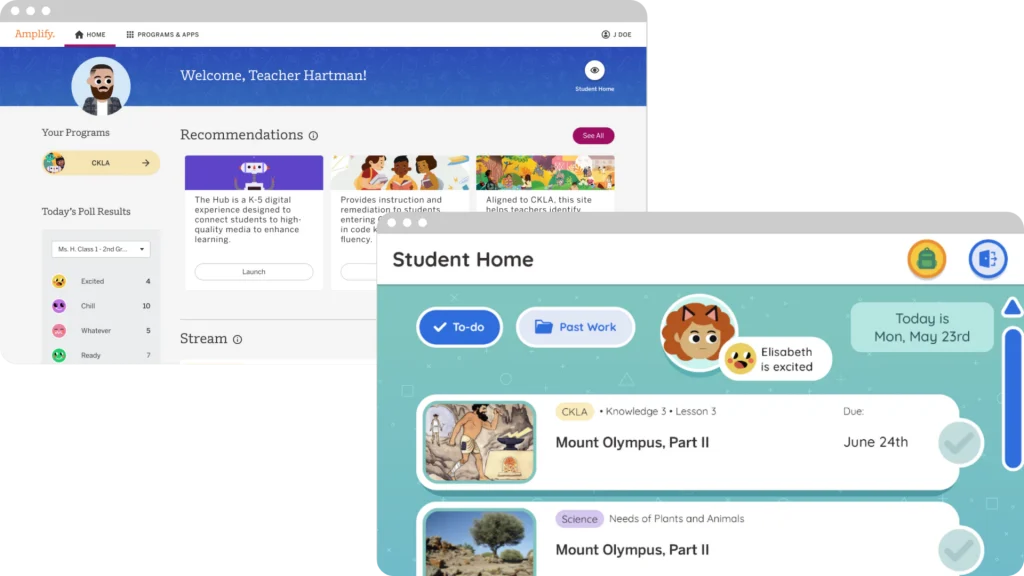
With the digital experience, everything is in one place, making it easier and more engaging than ever to plan lessons, present digital content, and review student work. Click the arrows below to learn more.
With the digital experience, teachers have access to ready-to-use and customizable lesson presentation slides, complete with all the prompts from the print Teacher Guide embedded in the teacher view. As teachers deliver each lesson, students can engage with the content in one cohesive experience—through these CKLA resources: Activity Books, slides, digital components, videos, Student Readers, and more.
The innovative live review tool found in the digital experience enables you to keep an eye on all of your students as they work on drawing, recording audio, uploading and capturing images, and typing or writing in pre-placed textboxes in their Activity Pages. This dynamic tool provides countless classroom management benefits, enabling you to spot and correct common mistakes as they’re happening, praise your students for thoughtful work, and identify students who are not engaged in the task at hand. Simply put, it will give you those valuable “eyes in the back of your head” you’ve warned your students about!
The digital experience integrates with various LMSs, allowing you and your students to access Amplify CKLA with the software you’re already comfortable using.
In the Amplify CKLA student digital experience, your students have one intuitive access point to fully engage with classroom instruction. Through the Student Home, students can easily access digital lessons with slides, Activity Pages, ebooks, videos, and other interactives from one simple dashboard. Students can draw, record audio, upload and capture images, and type or write in pre-placed text boxes in their Activity Pages.
CKLA review resources
- CKLA Program Guide
- Language Studio (ELD)
- Writing Studio (Writing)
- CKLA Research Hub (Efficacy and Case Studies)
- Text complexity in CKLA
- Trade books in CKLA
- Assessments in CKLA
- Amplify Caminos (K-5 Spanish Language Arts Program)
- Amplify CKLA Video for Families and Caregivers
- Amplify CKLA Caregivers Hub
- ELA Curriculum Evaluation Tools
- Remote and hybrid learning with CKLA
- CKLA Scopes and Sequences
- Grade K Skills and Knowledge
- Grade 1 Skills and Knowledge
- Grade 2 Skills and Knowledge
- Grade 3 Integrated
- Grade 4 Integrated
- Grade 5 Integrated
Step 4: State Review Resources
- Utah State Standards Alignment K-5
- Utah Instructional Strategies and Routines
- Utah Science of Reading Evidence-Informed Core Criteria Checklist (Amplify created)
- Utah Critical Features of Tiered Literacy Interventions (featuring Boost Reading)
- Amplify ELA Technical Specifications
Step 5: Program Access
Explore as a teacher
Before logging in, watch this brief video on navigating the CKLA Teacher Platform.
Ready to explore as a teacher? Follow these instructions:
- Click the Amplify CKLA Teacher Platform button below.
- Select Log in with Amplify.
- Enter the teacher username: t1.utcklapk5@demo.tryamplify.net
- Enter the teacher password: Amplify1-utcklapk5
- Choose CKLA from the “Your Programs” menu on Educator Home.
- Select a grade level from the drop-down menu at the top of the page.
Ready to explore as a Student? Follow these instructions:
- Click the Amplify CKLA Teacher Platform button below.
- Select Log in with Amplify.
- Enter the student username: s1.utahcklapk5@demo.tryamplify.net
- Enter the student password: Amplify1-utahcklapk5
A digital experience exclusively for Amplify CKLA 2nd Edition
Amplify Core Knowledge Language Arts (CKLA) 2nd Edition’s top-rated content is available with a digital experience that enhances instruction and saves time. With everything you need in one place, this platform makes it easier and more engaging to plan lessons, present digital content, and review student work.
Information on this page relates to Amplify CKLA 2nd Edition. Access Amplify CKLA 3rd Edition here.

Simplify planning and instruction
With the digital experience, teachers have access to ready-to-use and customizable lesson presentation slides, complete with all the prompts from the print Teacher Guide embedded in the teacher view. As teachers deliver each lesson, students can engage with the content in one cohesive experience—through these CKLA resources: Activity Books, slides, digital components, videos, Student Readers, and more.
Get real-time insights into your students’ work
The innovative live review tool found in the digital experience enables you to keep an eye on all of your students as they work on drawing, recording audio, uploading and capturing images, and typing or writing in pre-placed textboxes in their Activity Pages. This dynamic tool provides countless classroom management benefits, enabling you to spot and correct common mistakes as they’re happening, praise your students for thoughtful work, and identify students who are not engaged in the task at hand. Simply put, it will give you those valuable “eyes in the back of your head” you’ve warned your students about!
Learning Management System integrations
The digital experience integrates with various LMSs, allowing you and your students to access Amplify CKLA with the software you’re already comfortable using.
Engage your students with one easy-to-use access point
In the Amplify CKLA student digital experience, your students have one intuitive access point to fully engage with classroom instruction. Through the Student Home, students can easily access digital lessons with slides, Activity Pages, ebooks, videos, and other interactives from one simple dashboard. Students can draw, record audio, upload and capture images, and type or write in pre-placed text boxes in their Activity Pages.
Website Terms of Use
Description of Site Services; Acceptance of Terms of Use
Welcome to www.amplify.com (together with any successor sites and the Site Services and Company Content (each as defined below), in whole and in part, the “Site”). The Site is operated by Amplify Education, Inc. (“Company” or “we”). The services that Company makes available on or through the Site include education-related articles, information and instructional services, purchasing functionality, support chat functionality and any other features, content, services, functionality and applications offered from time to time by Company on or through the Site (collectively, “Site Services”).
BY ACCESSING OR USING THE SITE, YOU REPRESENT AND WARRANT THAT YOU ARE OF LEGAL AGE TO ENTER INTO THIS TERMS OF USE AGREEMENT (“AGREEMENT”) AND YOU AGREE TO BE BOUND BY THE TERMS AND CONDITIONS OF THIS AGREEMENT. BY PURCHASING GOODS AND SERVICES ON THE SITE, YOU ARE ACCEPTING THE PRACTICES DESCRIBED IN THIS AGREEMENT AS WELL AS ANY ADDITIONAL TERMS OF USE THAT MAY BE ASSOCIATED WITH THE PARTICULAR GOODS AND SERIVICES YOU ARE PURCHASING.
Please read this Agreement carefully. If you are an employee or other representative of a school or other organization who is accessing or using the Site on behalf of such organization, then you are agreeing to this Agreement on behalf of yourself and such organization. We may modify this Agreement at any time in our discretion, and we may provide such modifications to you by any reasonable means, including by posting the revised version of this Agreement on the Site. You can determine when this Agreement was last revised by referring to the “LAST UPDATED” legend at the top of this Agreement. Your access to or use of the Site following any changes to this Agreement will constitute your acceptance of those changes. Notwithstanding the foregoing, any changes to this Agreement shall not apply to any dispute between you and us arising prior to the date on which we posted the revised version of this Agreement incorporating such changes or otherwise notified you of such changes. If you do not agree to be bound by this Agreement, you must not access or use the Site. Your access to and use of certain parts of the Site may require you to accept additional terms and conditions, and may require you to download certain Software or Content (each as defined below).
Jurisdictional Issues
The Site is controlled and operated by Company from the United States, and is not intended to subject Company to the laws or jurisdiction of any state, country or territory other than that of the United States. Company does not represent or warrant that the Site is appropriate or available for use in any particular jurisdiction other than the United States. In choosing to access and use the Site, you do so on your own initiative and at your own risk, and you are responsible for complying with all local laws, rules and regulations. You are also subject to United States export controls and are responsible for any violations of such controls, including any United States embargoes and other federal rules and regulations restricting exports. We may limit the Site’s availability to any person, geographic area or jurisdiction we choose, at any time and in our discretion. Not all products or services described on the Site are available in all states or territories.
Company content
The Site contains information, text, files, images, video, sounds, musical works, computer code, works of authorship, applications, and other materials and content (collectively, “Content”) of Company or its licensors (“Company Content”). The Site (including the Company Content) is protected by copyright, trademark, trade secret and other laws, and as between you and Company, Company owns and retains all rights in the Site. Company hereby grants to you a limited, revocable, non-sublicensable license, during the term of the Agreement, to access, display and perform the Company Content (excluding any computer code) solely for your personal, non-commercial use and solely as necessary to access and use the Site. Except as expressly permitted by Company in this Agreement or on the Site, you may not copy, download, stream, capture, reproduce, duplicate, archive, upload, modify, translate, create derivative works based upon, publish, broadcast, transmit, retransmit, distribute, perform, display, sell or otherwise use or transfer any Content. You may not, either directly or through the use of any device, software, online resource or other means, remove, alter, bypass, avoid, interfere with or circumvent any copyright, trademark or other proprietary notice on the Content or any digital rights management mechanism, device, or other content protection or access control measure associated with the Content.
User content
You may not access or use the Site for any commercial purpose. You are responsible for all Content that you post, upload, transmit, e-mail or otherwise make available on, through or in connection with the Site (collectively, “User Content”). Please choose carefully the Content that you make available on, through or in connection with the Site. Company does not control any Content other than Company Content, and as such you may be exposed to offensive, indecent, inaccurate or otherwise objectionable Content by accessing or using the Site. Company is not responsible or liable for any Content or the conduct of any Site user. If you become aware of any misuse of the Site, please report such misuse immediately to Company at general@amplify.com. Company reserves the right (but has no obligation) to monitor the Site, including for inappropriate Content or conduct, and to remove any Content in Company’s discretion and without liability to you or any third party.
Your proprietary rights
You retain any ownership rights that you have in your User Content. You hereby grant to Company and its affiliates, licensees and authorized users, a perpetual, non-exclusive, fully paid-up and royalty-free, sublicensable (through multiple tiers), transferable (in whole or in part), worldwide license to use, modify, excerpt, adapt, create derivative works and compilations based upon, publicly perform, publicly display, reproduce and distribute such User Content on, through or in connection with the Site and/or any other commercial or non-commercial endeavor of Company or any of its affiliates, including in connection with any distribution or syndication thereof to Third Party Services (as defined below), on and through all media formats now known or hereafter devised, for any and all purposes including promotional, marketing, trade and commercial purposes. The exercise of such rights shall not require any further permission or notice, payment or attribution to you or any third party. Company reserves the right to limit the storage capacity made available for User Content.
You represent and warrant that: (a) you own the User Content made available by you, or otherwise have the right to grant the license set forth in this Section, and (b) the posting of such User Content through or in connection with the Site does not violate the privacy rights, publicity rights, copyrights, contract rights or any other rights of any person or entity. You agree to pay for all royalties, fees and any other monies owing to any person or entity by reason of the use of such User Content.
Use of the site
You agree not to:
- Post, upload or otherwise transmit or link to Content that is: unlawful; threatening; harmful; abusive; pornographic or includes nudity; offensive; harassing; excessively violent; tortious; defamatory; false or misleading; obscene; vulgar; libelous; hateful; or discriminatory.
- Violate the rights of others, including patent, trademark, trade secret, copyright, privacy, publicity, contract or other proprietary rights.
- Harass or harm another person.
- Exploit or endanger a minor.
- Impersonate any person or entity.
- Introduce or engage in activity that involves the use of viruses, bots, worms, Trojan horses, Easter eggs, time bombs, spyware or any other computer code, files or programs that interrupt, destroy or limit the functionality of any computer software or hardware or telecommunications equipment, or otherwise permit the unauthorized access to or use of a computer or a computer network.
- Interfere with, damage, disable, disrupt, impair, create an undue burden on, or gain unauthorized access to the Site or any Account, or Company’s servers or networks;
- Restrict or inhibit any other person from using the Site (including by hacking or defacing the Site). Cover, remove, disable, block or obscure the Site (including advertisements on the Site).
- Use technology or any automated system, such as scripts or bots, to collect user names, passwords, e-mail addresses or any other data from or through the Site, or to circumvent or modify any security technology or software that is part of the Site.
- Send or cause to send (directly or indirectly) unsolicited bulk messages or other unsolicited bulk communications of any kind through the Site. If you do so, you acknowledge you will have caused substantial harm to Company, and that the amount of such harm would be extremely difficult to measure. As a reasonable estimation of such harm, you agree to pay to Company $50.00 for each actual or intended recipient of such communication.
- Modify, adapt, translate, reverse engineer, decompile or disassemble the Site.
- Solicit, collect or request any information for commercial or unlawful purposes.
- Post, upload or otherwise transmit an image or video of another person without that person’s consent.
- Use the Site to advertise, promote or engage in any commercial activity (including engaging in sales, contests or sweepstakes) without Company’s prior written consent.
- Frame or mirror the Site without Company’s express prior written consent.
- Use the Site in a manner inconsistent with any applicable law, rule or regulation.
- Use any robot, spider, site search/retrieval application or other manual or automatic device to retrieve, index, “scrape,” “data mine,” or in any way gather content of the Site or reproduce or circumvent the navigational structure or presentation of the Site without Company’s express prior written consent. Notwithstanding the foregoing, Company grants to the operators of public search engines the permission to use spiders to copy material from the Site for the sole purpose of, and solely to the extent necessary for, creating publicly-available searchable indices of such material, but not caches or archives of such material. Company reserves the right to revoke these exceptions either generally or in specific cases.
- Attempt, facilitate or encourage others to do any of the foregoing.
Company reserves the right to investigate and take appropriate legal action against anyone who, in Company’s discretion, violates this Agreement or attempts to do so, including terminating or suspending a user’s Account or access to or use of the Site, or reporting any User Content or conduct to law enforcement authorities.
You (and not Company) are responsible for obtaining and maintaining all telecommunications, broadband and computer hardware, equipment and services needed to access and use the Site, and for paying all charges related thereto.
User disputes
You are solely responsible for your interactions with other users of the Site, providers of Third Party Services (as defined below) or any other third parties with whom you interact on, through or in connection with the Site.
Purchases
Company may make available products and services for purchase through the Site, and may use third-party suppliers and service providers to enable e-commerce functionality on the Site. You may only purchase products and services that appear on the Site and that are delivered to an address located in the United States. You may only purchase products and services for personal, non-commercial use by you, your educational institution or students of your educational institution. We may limit quantities or refuse any order for any reason or no reason, including if we have reasonable cause to believe an order is for onward sale or resale other than through distribution channels approved by us. We make no promise that products or services available on the Site are appropriate or available for use in locations outside the United States, and purchasing products or services for delivery to or use in territories where their contents are unlawful is prohibited. If you choose to purchase products or services from locations outside the United States, you do so at your own risk. It is your responsibility to ascertain and obey all applicable local, state, federal and international laws (including minimum age requirements) in regard to the possession, use and sale of any product or service made available through the Site.
If you wish to purchase any product or service made available through the Site, you may be asked to supply certain information relevant to your transaction, including your credit card number, the expiration date of your credit card, your billing address and your shipping information. YOU REPRESENT AND WARRANT THAT YOU HAVE THE LEGAL RIGHT TO USE ANY CREDIT CARD(S) USED IN CONNECTION WITH ANY TRANSACTION. By submitting such information, you grant to Company the right to provide such information to third parties for purposes of facilitating the completion of transactions initiated by you or on your behalf. Verification of information may be required prior to the acknowledgement or completion of any transaction. While it is our practice to confirm orders by e-mail, the receipt of an e-mail order confirmation does not constitute our acceptance of an order or our confirmation of an offer to sell a product or service.
Details of the products and services available for purchase are set forth on the Site. All prices are displayed exclusive of all taxes and shipping/freight charges. Available payment methods, methods of shipping and shipping charges (including charges for expedited shipping, if available) are detailed on the Site. Company may also collect and remit sales tax on your purchase as required by United States law. If you are a tax-exempt entity, please enter the appropriate information where requested on your order form and we will not collect sales tax on your purchase.
Generally, credit and debit cards are not charged until we either ship the product(s) or confirm store availability (at which time you will be charged only for the products we have actually shipped along with any applicable taxes and shipping charges). However, we may pre-authorize your order amount with your credit or debit card issuer at the time you place the order, which may have an effect on your available credit line. When paying for a preorder with a debit card, you will be charged at the time you place your preorder. Please contact your credit or debit card issuer for more information. If you ordered a special delivery product, you will be charged once a delivery time is confirmed. For digitally delivered orders, your credit or debit card will be charged at the time that you initiate the download of the product.
All purchases made through the Site are made pursuant to a shipment contract. As a result, risk of loss and title for products purchased through the Site pass to you upon delivery of the products to the carrier. You are responsible for filing any claims with carriers for damaged and/or lost shipments. Please note that all shipping addresses must be compliant with the shipping restrictions contained on the Site.
Products, services and specifications
All products and services described or depicted on the Site, and all related features, content, specifications and prices, are subject to change at any time without notice. Certain weights, measures and similar descriptions are approximate and are provided for convenience purposes only. Packaging may vary from that shown. We make reasonable efforts to accurately display the attributes of our products, including the applicable colors; however, the actual color you see will depend on your computer system, and we cannot guarantee that your computer will accurately display such colors. The inclusion of any product or service on the Site at a particular time does not imply or warrant that such product or service will be available at any time. Occasionally, the manufacture or distribution of a certain product or service may be delayed for a number of reasons. In such event, we will make reasonable efforts to notify you of the delay and keep you informed of the revised delivery schedule. By placing an order, you represent that the products and services ordered will be used only in a lawful manner. All DVDs and similar products are sold for private, non-commercial home use (where no admission fee is charged), non-public performance, or classroom or instructional use only, and may not be duplicated.
Return and exchange policy
Unless otherwise specified in the terms associated with a particular product, you may return or exchange any product purchased through the Site within fourteen (14) days of receipt, by calling our customer service hotline, 1–800–823–1969, in the event that the purchased product is defective or you received the wrong product. Except for the foregoing, you may not return, cancel or exchange any product or service. Certain jurisdictions may provide additional statutory rights. Nothing herein is meant to limit your return or cancellation rights under local law. In the event that a return or exchange is due to an incorrect order or faulty product, we will be responsible for the shipping costs associated with such return. We will ship a replacement product upon receiving your defective or incorrect product and verifying the reason for the return or exchange.
Accuracy of information
We attempt to ensure that information on the Site is complete, accurate and current. Despite our efforts, the information on the Site may occasionally be inaccurate, incomplete or out of date. We make no representation as to the completeness, accuracy or currency of any information on the Site. For example, products or services included on the Site may be unavailable, may have different attributes than those listed, or may carry a different price than that stated on the Site. If an item’s correct price is higher than our stated price, we will, at our discretion, either contact you for instructions before shipping or cancel your order and notify you of such cancellation. Items in your “Shopping Bag” reflect the current price displayed on the item’s product detail page. Please note that this price may differ from the price displayed when the item was first placed in your Shopping Bag. In addition, we may make changes in information about price and availability without notice.
Chemicals, agricultural materials, and other hazardous materials
Certain products made available through the Site may include chemicals, agricultural materials or other material that may be subject to regulations or restrictions with respect to import or export, or to whom we may sell such material or where or how such material may be used. It is your responsibility to read and abide by all warning notices that accompany any products that you purchase. In addition, we reserve the right to request additional information from you, verify your identity, limit sales to certified educational or research institutions, or cancel or delay your order if required by law or if we believe it is necessary or advisable. Due to special shipping and handling requirements, freight companies routinely impose a surcharge on each package of hazardous material shipped. In such event, we will add such surcharge to your order.
Registration and account security
You may have the ability to create an account on or through the Site (an “Account”). If you submit registration information to create an Account, you represent and warrant that all information submitted to Company in connection with such registration is complete and accurate, and that you will update such information if it changes. If you create an Account, you are responsible for all use of your Account, and for maintaining the confidentiality of the information used to access your Account (including user name and password). You agree not to share your user name or password with anyone, or use anyone else’s Account at any time. You agree to notify Company immediately if you suspect any unauthorized use of, or access to, your Account (including your user name and password). You acknowledge that the reuse of your password in connection with accounts on other websites increases the risk that the security of your Account may be compromised.
Third party links and services
The Site may make available, or third parties may provide, links to other websites, applications, resources, advertisements, Content or other products or services created, hosted or made available by third parties (“Third Party Services”), and such third party may use other third parties to provide portions of the Third Party Service to you, such as technology, development or payment services. When you access or use a Third Party Service, you are interacting with the applicable third party, not with Company, and you do so at your own risk. Company is not responsible for and makes no warranties, express or implied, as to the Third Party Services or the providers of such Third Party Services (including the accuracy or completeness of the information provided by such Third Party Service or the privacy practices of any third party). Inclusion of any Third Party Service or a link thereto on the Site does not imply approval or endorsement of such Third Party Service. Company is not responsible or liable for the content or practices of any Third Party Service or third party, even if such Third Party Service links to or is linked by the Site, and even if such Third Party Service is operated by an affiliate of Company or a company otherwise connected with us or the Site
Feedback
Unless we expressly agree otherwise in writing, if you provide us with any ideas, proposals, suggestions or materials (“Feedback”), whether related to the Site or otherwise, you hereby acknowledge and agree that (a) your provision of any Input is gratuitous, unsolicited and without restriction and does not place Company under any fiduciary or other obligation; and (b) any Feedback is not confidential and Company has no confidentiality obligations with respect to such Feedback.. You hereby grant to us a world-wide, royalty-free, fully paid-up, exclusive, perpetual, irrevocable, transferable and fully sublicensable (through multiple tiers) license, without additional consideration to you or any third party, to reproduce, distribute, perform and display (publicly or otherwise), adapt, modify and otherwise use and exploit such Feedback, in any format or media now known or hereafter developed, and you hereby represent and warrant that you have all necessary rights to grant the foregoing license. We may use Feedback for any purpose whatsoever without permission or notice, compensation or attribution to you or any third party. You are and remain responsible and liable for the content of any Feedback.
Privacy
Please review the Privacy Policy for the Site, available at http://www.amplify.com/privacy, to learn about our information collection, usage and disclosures practices with respect to information collected by us through the Site. Please note that certain products or services made available by us, other than the Site, may be subject to different privacy policies. In addition, the Site’s Privacy Policy does not address, and we are not responsible or liable for, the information collection, usage and disclosures practices of any third party or Third Party Service.
Disclaimers
THE SITE, USER CONTENT, THIRD PARTY SERVICES, AND ALL PRODUCTS AND SERVICES SOLD THROUGH THE SITE (COLLECTIVELY, THE “SITE PRODUCTS”) ARE MADE AVAILABLE “AS-IS” AND “AS AVAILABLE” AND COMPANY DOES NOT GUARANTEE OR PROMISE ANY SPECIFIC RESULTS FROM USE OF THE SITE PRODUCTS. COMPANY AND ITS AFFILIATES EXPRESSLY DISCLAIM ANY WARRANTIES AND CONDITIONS OF ANY KIND, WHETHER EXPRESS OR IMPLIED, INCLUDING THE IMPLIED WARRANTIES OF MERCHANTABILITY, FITNESS FOR A PARTICULAR PURPOSE AND NON-INFRINGEMENT. IN PARTICULAR, COMPANY AND ITS AFFILIATES MAKE NO WARRANTY THAT THE SITE OR USER CONTENT OR THIRD PARTY SERVICES, OR YOUR ACCESS TO OR USE THEREOF, WILL BE UNINTERRUPTED, TIMELY, SECURE, ERROR-FREE, ACCURATE OR RELIABLE. UNDER NO CIRCUMSTANCES SHALL WE BE LIABLE FOR ANY CONSEQUENCES OF ANY UNAUTHORIZED USE OF THE SITE PRODUCTS THAT VIOLATES ANY APPLICABLE LAW OR REGULATION. CERTAIN STATE LAWS DO NOT ALLOW LIMITATIONS ON IMPLIED WARRANTIES OR THE EXCLUSION OR LIMITATION OF CERTAIN DAMAGES. IF THESE LAWS APPLY TO YOU, SOME OR ALL OF THE ABOVE DISCLAIMERS, EXCLUSIONS, OR LIMITATIONS MAY NOT APPLY TO YOU, AND YOU MIGHT HAVE ADDITIONAL RIGHTS.
Under no circumstances will Company or its affiliates be responsible for any loss or damage, including property damage, personal injury or death, resulting from use of the Site, Products, problems or technical malfunction in connection with use of the Site, Products, attendance at any Company event or the conduct of any Site users, whether online or offline. Your use of the Site, Products is solely your responsibility and at your own risk. The User Content and Third Party Services do not necessarily reflect the opinions or policies of Company or its affiliates.
Limitations on liability
IN NO EVENT WILL COMPANY OR ITS AFFILIATES BE LIABLE TO YOU OR ANY THIRD PARTY FOR ANY INDIRECT, CONSEQUENTIAL, EXEMPLARY, INCIDENTAL, SPECIAL OR PUNITIVE DAMAGES, INCLUDING LOST PROFIT DAMAGES, ARISING FROM YOUR USE OF THE SITE PRODUCTS, EVEN IF COMPANY OR ONE OF ITS AFFILIATES HAS BEEN ADVISED OF THE POSSIBILITY OF SUCH DAMAGES. NOTWITHSTANDING ANYTHING TO THE CONTRARY CONTAINED HEREIN, THE TOTAL LIABILITY OF COMPANY AND ITS AFFILIATES TO YOU FOR ANY CAUSE WHATSOEVER AND REGARDLESS OF THE FORM OF THE ACTION, WILL AT ALL TIMES BE LIMITED TO THE AMOUNT PAID, IF ANY, BY YOU TO COMPANY FOR THE SITE PRODUCTS.
Indemnity
You agree to indemnify and hold harmless Company, its affiliates, subcontractors and other partners, and each of their respective officers, agents, partners and employees, from any losses, costs, expenses (including reasonable attorneys’ fees), liabilities, claims or demands, due to or arising out of your use of the Site, your breach or alleged breach of this Agreement, your violation or alleged violation of any rights of another, or any Content that you post or otherwise submit on, through or in connection with the Site.
Termination
This Agreement remains in full force and effect while you access or use the Site. If you create an Account, you may terminate your Account at any time, for any reason, by contacting us at general@amplify.com. Company may terminate or suspend your Account and/or your access to or use of the Site at any time, for any or no reason, with or without prior notice or explanation, and without liability. Upon any such suspension or termination, your right to access and use the Site will immediately cease, and Company may immediately deactivate or delete your Account and all files and other information associated with it, and/or bar any further access to such files and other information. Company shall not be liable to you or any third party for any suspension or termination of your Account or of access to or use of the Site or any such files or other information, and shall not be required to make such files and other information available to you after any such suspension or termination. Sections 2, 5, 13, 17, 18, 19, 22, and 26 shall survive any expiration or termination of this Agreement.
U.S. export controls
All software made available in connection with the Site (“Software”) may be subject to United States export controls. No Software may be downloaded from or through the Site or otherwise exported or re-exported in violation of U.S. export laws.
Governing law
The terms of this Agreement are governed by the laws of the State of New York, U.S.A., without regard to its conflicts of law provisions, and regardless of your location.
Arbitration
EXCEPT FOR DISPUTES THAT QUALIFY FOR SMALL CLAIMS COURT, ALL DISPUTES ARISING OUT OF OR RELATED TO THIS AGREEMENT, WHETHER BASED IN CONTRACT, TORT, STATUTE, FRAUD, MISREPRESENTATION OR ANY OTHER LEGAL THEORY, WILL BE RESOLVED THROUGH FINAL AND BINDING ARBITRATION BEFORE A NEUTRAL ARBITRATOR INSTEAD OF IN A COURT BY A JUDGE OR JURY, AND YOU AGREE THAT COMPANY AND YOU ARE EACH WAIVING THE RIGHT TO TRIAL BY A JURY. YOU AGREE THAT ANY ARBITRATION UNDER THIS AGREEMENT WILL TAKE PLACE ON AN INDIVIDUAL BASIS; CLASS ARBITRATIONS AND CLASS ACTIONS ARE NOT PERMITTED AND YOU ARE AGREEING TO GIVE UP THE ABILITY TO PARTICIPATE IN A CLASS ACTION.
Arbitration procedure
Any arbitration under Section 23 above will be administered by the American Arbitration Association under its Commercial Arbitration Rules and Supplementary Procedures for Consumer-Related Disputes (“Supplementary Procedures”), as amended by this Agreement. The Supplementary Procedures are available online at http://www.adr.org/aaa/ShowPDF?doc=ADRSTG_015820. The arbitrator will conduct hearings, if any, by teleconference or videoconference, rather than by personal appearances, unless the arbitrator determines upon request by you or by us that an in-person hearing is appropriate. Any in-person appearances will be held at a location which is reasonably convenient to both parties with due consideration of their ability to travel and other pertinent circumstances. If the parties are unable to agree on a location, such determination should be made by the AAA or by the arbitrator. The arbitrator’s decision will follow the terms of this Agreement and will be final and binding. The arbitrator will have authority to award temporary, interim or permanent injunctive relief or relief providing for specific performance of this Agreement, but only to the extent necessary to provide relief warranted by the individual claim before the arbitrator. The award rendered by the arbitrator may be confirmed and enforced in any court having jurisdiction thereof. Notwithstanding any of the foregoing, nothing in this Agreement will preclude you from bringing issues to the attention of federal, state, or local agencies, and, if the law allows, they can seek relief against us for you.
Employment opportunities
Company may, from time to time, post Company employment opportunities on the Site and/or invite users to submit resumes to Company. If you choose to submit your name, contact information, resume and/or other personal information to Company in response to such employment listings, you are authorizing Company to use this information for all lawful and legitimate hiring, employment and other business purposes. Company also reserves the right, at its discretion, to forward such information to Company’s affiliates for their legitimate business purposes. Nothing in this Agreement or contained on the Site will constitute a promise by Company to review any such information, or to contact, interview, hire or employ any individual who submits such information.
Digital Millennium Copyright Act
The Digital Millennium Copyright Act of 1998 (“DMCA”) provides recourse for copyright owners who believe that material appearing on the Internet infringes their rights under U.S. copyright law. If you believe that any material residing on or linked to from the Site infringes your copyright, please send (or have your agent send) to Company’s Copyright Agent a notification of claimed infringement with all of the following information: (a) identification of the copyrighted work claimed to have been infringed, or, if multiple copyrighted works are covered by a single notification, a representative list of such works; (b) identification of the claimed infringing material and information reasonably sufficient to permit us to locate the material on the Site (such as the URL(s) of the claimed infringing material); (c) information reasonably sufficient to permit us to contact you, such as an address, telephone number, and, if available, an e-mail address; (d) a statement by you that you have a good-faith belief that the disputed use is not authorized by the copyright owner, the copyright owner’s agent or the law; (e) a statement by you that the above information in your notification is accurate and a statement by you, made under penalty of perjury, that you are the owner of an exclusive right that is allegedly infringed or are authorized to act on such owner’s behalf; and (f) your physical or electronic signature. Company’s Copyright Agent for notification of claimed infringement can be reached as follows: Copyright Agent, Amplify Education, Inc., 55 Washington Street, Brooklyn, NY 11201; Facsimile: 212-796-2311; Attn: Legal. Company’s Copyright Agent for notification of claimed infringement can also be reached electronically at: legal@amplify.com. Company reserves the right to terminate infringers’ and suspected infringers’ Accounts or their access to or use of the Site.
Notice for California residents
Under California Civil Code Section 1789.3, California users are entitled to the following consumer rights notice: If you have a question or complaint regarding the Site, please contact us by writing to Amplify Education, Inc., 55 Washington Street, Brooklyn, NY 11201 or by calling us at 212–213–8177 or sending a fax to 212–796–2311. California residents may reach the Complaint Assistance Unit of the Division of Consumer Services of the California Department of Consumer Affairs by mail at 1625 North Market Blvd., Sacramento, CA 95834, or by telephone at (916) 445–1254 or (800) 952–5210.
Other terms
This Agreement does not, and shall not be construed to, create any partnership, joint venture, employer-employee, agency or franchisor-franchisee relationship between you and Company. You may not assign, transfer or sublicense any or all of your rights or obligations under this Agreement without our express prior written consent. We may assign, transfer or sublicense any or all of our rights or obligations under this Agreement without restriction. The failure of Company to exercise or enforce any right or provision of this Agreement will not operate as a waiver of such right or provision. The Section titles in this Agreement are for convenience only and have no legal or contractual effect. References to and mentions of the word “include,” “includes,” “including,” or “e.g.” will mean “including, without limitation.” References to “discretion” will mean “sole discretion.” This Agreement operates to the fullest extent permissible by law. If any provision of this Agreement is unlawful, void or unenforceable, that provision is deemed severable from this Agreement and does not affect the validity or enforceability of any remaining provisions. Without limitation, you agree that a printed version of this Agreement and of any notice given in electronic form shall be admissible in judicial or administrative proceedings based upon or relating to this Agreement to the same extent and subject to the same conditions as other business documents and records originally generated and maintained in printed form. Company will not be responsible for failures to fulfill any obligations due to causes beyond its control.
Please contact us at legal@amplify.com with any questions regarding this Agreement.
Acceptable Use Policy
Amplify Education, Inc. (“Amplify”) products support classroom instruction and learning and include Amplify CKLA, Amplify ELA, Amplify Science, Amplify Desmos Math, Desmos Math, Boost Reading, Boost Math, mCLASS, Mathigon, services at classroom.amplify.com (for creating and assigning activities) and student.amplify.com (for use of the activities or curricula as directed by an instructor), and any other product or service that links to this Acceptable Use Policy (together, the “Products”). This Acceptable Use Policy (the “AUP”) provides the general terms and conditions applicable to your use of the Products. By accessing, downloading, or using the Products, you agree to be bound by the terms of this AUP.
Notwithstanding the foregoing, nothing in this AUP supersedes or limits your rights under the terms of any other agreement you or your institution have entered into with Amplify regarding the use of Products. In the event of any conflict between the AUP and the terms and conditions of an applicable agreement that you or your institution have entered into with Amplify, the terms and conditions of such agreement shall control.
Our Products are geared towards K–12 students, educators, and staff who use the Products as authorized by their School District or State Agency (each as defined in the Privacy Policy (defined below), and together, “School”) (“Authorized School Users”). Student Data (defined below) is owned and controlled by the School, and Amplify receives Student Data as a “school official” under Section 99.31 of the Family Educational Rights and Privacy Act of 1974 (“FERPA”) for the purpose of providing the Products hereunder. In addition, we rely on the School acknowledging that it is acting as the parent’s agent and consenting on the parent’s behalf to process personal information of students under the age of 13 (“Child Users”) in accordance with the Children’s Online Privacy Protection Act (“COPPA”).
Schools may provide authorization in two ways:
(1) by the School agreeing to our Customer Terms and Conditions located at amplify.com/customer-terms or another agreement between Amplify and the School, as applicable; or
(2) by an educator, staff member, or agent of a School (“Educator”) agreeing to this AUP. If you are an Educator and wish to use the Products in your classroom, you represent and warrant that the use of the Products in your classroom has been authorized by your School, and that you are authorized to accept this AUP on behalf of the School.
In each case, we provide these Products solely for the benefit of the School and for no other commercial purpose. We require all Schools to review our Privacy Policy, available at amplify.com/customer-privacy (“Privacy Policy”), and to make a copy of the Privacy Policy available to the parents or guardians of Child Users.
We also provide limited opportunities for individual users to sign up for a restricted account for at-home use of our Products (together, with Authorized School Users, “Authorized Users”). Please see Additional terms for Mathigon and Amplify Classroom accounts (Section 18) for additional information.
1. License
Subject to compliance with this AUP, you are granted a non-transferable, non-exclusive, non-sublicensable license to access and use the Products. You understand that your use of the Products does not confer to you any intellectual property rights held by Amplify or its licensors. Unless otherwise indicated, any future release, update, or other addition to functionality or content of the Products will be subject to this AUP.
2. Restrictions
You may access and use the Products solely for non-commercial instructional and administrative purposes. Guidelines for such purposes may be set forth at http://amplify.com/amplify-program-usage-guidelines and additional guidelines may be detailed in materials associated with the Product You are accessing. Further, You may not, except as expressly authorized by Amplify: (a) copy, modify, translate, distribute, disclose, or create derivative works based on the contents of, sell, or otherwise exploit, the Products, or any part thereof; (b) decompile, disassemble, reverse engineer the Products, or otherwise use the Products to develop functionally similar products or services; (c) modify, alter, or delete any of the copyright, trademark, or other proprietary notices in or on the Products; (d) rent, lease, or lend the Products or use the Products for the benefit of any third party; (e) avoid, circumvent, or disable any security or digital rights management device, procedure, protocol, or mechanism in the Products; (f) use any content from the Products, including but not limited to text, images, videos, assessments, lesson plans, or code, as input or training material for any machine learning or artificial intelligence system, including large language models, neural networks, or other algorithmic models, for any purposes, commercial or non-commercial; or (g) permit any Authorized User or third party to do any of the foregoing. You also agree that any works created in violation of this section are derivative works, and, as such, You agree to assign, and hereby assign, all right, title, and interest in such works to Amplify. The Products and derivatives thereof may be subject to export control laws, restrictions, regulations, and orders of the U.S. and other jurisdictions (together, “Export Laws”). You agree to comply with all applicable Export Laws, and will not, and will not permit Authorized Users to, export, or transfer for the purpose of re-export, any Product to any prohibited or embargoed country in violation of any U.S. export law or regulation. Further, You represent that You are not located in a country that is subject to a U.S. Government embargo, subject to sanctions by the U.S. Office of Foreign Assets Control, or included on any restricted party list maintained by the U.S. Bureau of Industry and Security. The software and associated documentation portions of the Products are “commercial items” (as defined at 48 CFR 2.101), comprising “commercial computer software” and “commercial computer software documentation,” as those terms are used in 48 CFR 12.212. Accordingly, if You are associated with the U.S. Government or its contractor, You will receive only those rights set forth in this Agreement in accordance with 48 CFR 227.7201-227.7204 (for Department of Defense and their contractors) or 48 CFR 12.212 (for other U.S. Government licensees and their contractors).
3. Use of the products
In connection with your access to and use of the Products, you agree not to: (a) post, upload, or otherwise transmit or link to content that is: unlawful; threatening; harmful; abusive; pornographic or includes nudity; offensive; harassing; excessively violent; tortious; defamatory; false or misleading; obscene; vulgar; libelous; hateful; or discriminatory; (b) violate the rights of others, including patent, trademark, trade secret, copyright, privacy, publicity, contract, or other proprietary rights; (c) harass or harm another person; (d) exploit or endanger a minor; (e) impersonate any person or entity; (f) introduce or engage in activity that involves the use of viruses, bots, worms, Trojan horses, time bombs, spyware, or any other computer code, files, or programs that interrupt, destroy, or limit the functionality of any computer software or hardware or telecommunications equipment, or otherwise permit the unauthorized access to or use of a computer or a computer network; (g) interfere with, damage, disable, disrupt, impair, create an undue burden on, or gain unauthorized access to the Products or any account (as defined below), or Amplify’s servers or networks; (h) restrict or inhibit any other person from using the Products (including by hacking or defacing the Products); (i) remove, disable, block, or obscure any portion of the Products; (j) use technology or any automated system, such as scripts or bots, to collect user names, passwords, email addresses, or any other data from or through the Products, or to circumvent or modify any security technology or software that is part of the Products; (k) send or cause to send (directly or indirectly) unsolicited bulk messages or other unsolicited bulk communications of any kind through the Products; (l) solicit, collect, or request any information for commercial or unlawful purposes; (m) post, upload, or otherwise transmit an image, audio recording, or video of another person without that person’s consent; (n) use the Products to advertise, promote, or engage in any commercial activity (including engaging in advertising, sales, contests, sweepstakes, or other promotions) without Amplify’s prior written consent; (o) frame or mirror the Products without Amplify’s express prior written consent; (p) use the Products in a manner inconsistent with any applicable law, rule, or regulation; (q) use any robot, spider, search/retrieval application, or other manual or automatic device to retrieve, index, “scrape,” “data mine,” or in any way gather content of the Products or reproduce or circumvent the navigational structure or presentation of the Products; (r) attempt, facilitate, or encourage others to do any of the foregoing. In addition to the foregoing restrictions, your use of the Products may also be subject to an additional acceptable use policy provided to you by your School, as applicable. You are responsible for meeting the hardware, software, telecommunications, and other requirements listed at amplify.com/customer-requirements.
4. Intellectual property
The Products and any Product logo, and certain other of the names, logos, and materials displayed in the Products, may constitute trademarks, trade names, or service marks (“Marks”) of Amplify or other entities. You are not authorized to use any such Marks. Ownership of all such Marks and the goodwill associated therewith remains with Amplify or those other entities. The content provided to you in the Products, including the software, graphs, text, and graphics, is protected under copyright laws, is subject to other intellectual property and proprietary rights and laws, and is owned by Amplify or its licensors. Your access to the Products does not transfer to you or any third party any rights, title, or interest in or to such intellectual property rights. You may not use the content of the Products, in whole or in part, to train or fine-tune any machine learning or artificial intelligence model or system, including for research, product development, commercial services, or any other purpose, commercial or non-commercial. Such use constitutes unauthorized derivative work and a violation of Amplify’s intellectual property rights. Your rights to make use of the Products are limited to those provided under this AUP, any additional terms as may be agreed upon between your School and Amplify, and any available exceptions under applicable intellectual property laws. Amplify Products are protected by patents (see amplify.com/virtual-patent-marking).
5. Account information
Your authentication to enable your access and use of these Products is based in part upon information supplied by you. You are required to (a) provide accurate information to Amplify and promptly report any changes to such information, (b) not share or allow others to use your account, (c) maintain the confidentiality and security of your account information, and (d) use the Products solely via such authorized accounts. You may not share your credentials (i.e., username and password) to access the Products with anyone except the person for whom that account was created. You agree to notify Amplify immediately of any unauthorized use of your account or related authentication information. Amplify will not be responsible for any losses arising out of the unauthorized use of your account.
6. Student data
The parties acknowledge and agree that in the course of providing the Products, Amplify may collect, receive, or generate information that directly relates to an identifiable current or former student of a School (“Student Data”). Student Data may include personal information from a student’s “educational records,” as defined by FERPA. Student Data is owned and controlled by the School and Amplify receives Student Data as a “school official” under Section 99.31 of FERPA for the purpose of providing the Products hereunder. Individually and collectively, Amplify and School agree to uphold our obligations, as applicable, under FERPA, COPPA, the Protection of Pupil Rights Amendment (“PPRA”), and applicable state laws relating to Student Data privacy. Amplify’s Privacy Policy governs the collection, use, and disclosure of Student Data collected or stored on behalf of the School under this AUP. The School is responsible for providing notice or obtaining appropriate consents under applicable laws to authorize Authorized School Users’ use of the Products, including making a copy of the Privacy Policy available to the parents or guardians of Child Users. Please see Additional Terms for Mathigon and Amplify Classroom accounts (Section 18) for additional information.
7. Confidentiality
You acknowledge that in connection with these terms, Amplify may provide you with certain sensitive or proprietary information (“Confidential Information”), including software, source code, assessment instruments, research, designs, methods, processes, customer lists, training materials, product documentation, know-how, or trade secrets, in whatever form. You agree (a) not to use Confidential Information for any purpose other than use of the Products in accordance with the AUP, and (b) to take all steps reasonably necessary to maintain and protect the Confidential Information of Amplify in strict confidence. Confidential Information shall not include information that, as evidenced by your contemporaneous written records: (i) is or becomes publicly available through no fault of your own; (ii) is rightfully known to you prior to the time of its disclosure; (iii) has been independently developed by you without any use of the Confidential Information; or (iv) is subsequently learned from a third party not under any confidentiality obligation.
8. User materials
You represent, warrant, and covenant that you have all the necessary rights, including consents and intellectual property rights, in connection with any data, information, content, and other materials provided to or collected by Amplify from you or on your behalf in connection with your use of the Products, including materials and content that you post, upload, transmit, email, or otherwise make available on, through, or in connection with the Products (“User Materials”), and that except as otherwise agreed by your School and Amplify, you retain any ownership rights that you have in your User Materials. You hereby grant to Amplify and its affiliates, licensees, and authorized users, a perpetual, non-exclusive, fully paid-up, royalty-free, sublicensable (through multiple tiers), transferable (in whole or in part), worldwide license to use, modify, excerpt, adapt, create derivative works and compilations based upon, publicly perform, publicly display, reproduce, and distribute such User Materials in connection with the Products, subject to Amplify’s Privacy Policy. You and your School are responsible for the accuracy, integrity, completeness, quality, legality, and safety of such User Materials. You further represent and warrant that the posting of such User Materials through or in connection with the Products does not violate the privacy rights, publicity rights, copyrights, contract rights, or any other rights of any person or entity. Amplify and your School reserve the right (but have no obligation) to monitor the Products, including for inappropriate content or conduct, and to remove any content in their discretion without liability to you or any third party. Further, Amplify reserves the right to investigate and take appropriate legal action against anyone who, in Amplify’s discretion, violates this AUP or attempts to do so, including terminating or suspending a user’s account or access to or use of the Products, or reporting any content or conduct to law enforcement authorities. You are solely responsible for creating and maintaining your own backup copies of your User Materials. Amplify is not responsible for any loss, theft, or damage of any kind to any User Materials.
9. Feedback
If you provide us with any ideas, proposals, or suggestions related to the Products (“Feedback”), you hereby acknowledge and agree that your provision of any Feedback is gratuitous, unsolicited, and without restriction, and does not place Amplify under any fiduciary or other obligation. You hereby grant to Amplify a worldwide, royalty-free, fully paid-up, exclusive, perpetual, irrevocable, transferable, and fully sublicensable (through multiple tiers) license to reproduce, distribute, perform and/or display (publicly or otherwise), adapt, modify, and otherwise use such Feedback, in any format or media now known or hereafter developed, and you hereby represent and warrant that you have all necessary rights to grant the foregoing license.
10. Third party links and services
The Products may make available, or third parties may provide, links to websites, software, applications, resources, advertisements, content, or other products or services created, hosted, or made available by third parties (“Third Party Services”). When you access or use a Third-Party Service, you are interacting with the applicable third party, not with Amplify, and you do so at your own risk. Inclusion of any Third-Party Service or a link thereto within the Products does not imply approval or endorsement of such Third-Party Service. Amplify does not control any content that is not Amplify content, and as such, you may be exposed to offensive, indecent, inaccurate, or otherwise objectionable content in the course of accessing or using such Third-Party Services linked from the Products. You are solely responsible for your interactions with other users of the Products, providers of Third-Party Services, and any other third parties with whom you interact on, through, or in connection with the Products. AMPLIFY IS NEITHER RESPONSIBLE NOR LIABLE FOR ANY THIRD-PARTY SERVICES, INCLUDING THE ACCURACY, INTEGRITY, COMPLETENESS, QUALITY, LEGALITY, USEFULNESS, OR SAFETY OF, OR INTELLECTUAL PROPERTY RIGHTS RELATING TO, SUCH THIRD-PARTY SERVICES. ANY ACCESS TO OR USE OF SUCH THIRD-PARTY SERVICES MAY BE SUBJECT TO THE TERMS AND CONDITIONS AND INFORMATION COLLECTION, USAGE, AND DISCLOSURE PRACTICES OF THIRD PARTIES. THIS AUP DOES NOT CREATE ANY RELATIONSHIP BETWEEN YOU AND ANY PROVIDER OF THIRD-PARTY SERVICES, AND NOTHING IN THIS AUP WILL BE DEEMED TO BE A REPRESENTATION OR WARRANTY BY AMPLIFY WITH RESPECT TO ANY THIRD-PARTY SERVICE.
11. Digital Millennium Copyright Act
The Digital Millennium Copyright Act of 1998 (“DMCA”) provides recourse for copyright owners who believe that material appearing on the Internet infringes their rights under U.S. copyright law. If you believe that any material residing on or linked to from the Products infringes your copyright, please send (or have your agent send) to Amplify’s Copyright Agent, by email, fax, or regular mail, a written notification of claimed infringement with all of the following information: (a) identification of the copyrighted work claimed to have been infringed, or, if multiple copyrighted works are covered by a single notification, a representative list of such works; (b) identification of the claimed infringing material and information reasonably sufficient to permit us to locate the material on the Products (such as the URL(s) of the claimed infringing material); (c) information reasonably sufficient to permit us to contact you, such as an address, telephone number, and, if available, an e-mail address; (d) a statement by you that you have a good-faith belief that the disputed use is not authorized by the copyright owner, the copyright owner’s agent or the law; (e) a statement by you that the above information in your notification is accurate, and a statement by you, made under penalty of perjury, that you are the owner of an exclusive right that is allegedly infringed, or that you are authorized to act on such owner’s behalf; and (f) your physical or electronic signature. Amplify’s Copyright Agent for notification of claimed infringement can be reached as follows: Amplify Education, Inc., 55 Washington Street #800, Brooklyn NY 11201; Attn: Copyright Agent. Amplify’s Copyright Agent for notification of claimed infringement can also be reached electronically at legal@amplify.com. Amplify reserves the right to terminate infringers’ and suspected infringers’ accounts or their access to or use of the Products.
12. Changes to the products
Amplify may, without prior notice, change any Product or stop providing any features of any Product. We may permanently or temporarily terminate or suspend your access to any Product features without notice for any reason, including if in our sole determination you violate any provision of this AUP. Upon termination, you continue to be bound by this AUP.
13. Warranty disclaimer
PRODUCTS ARE PROVIDED “AS IS” AND WITHOUT WARRANTY OF ANY KIND BY AMPLIFY. AMPLIFY EXPRESSLY DISCLAIMS ALL WARRANTIES, EXPRESS OR IMPLIED, INCLUDING ANY WARRANTY AS TO TITLE, NON-INFRINGEMENT, MERCHANTABILITY, OR FITNESS FOR A PARTICULAR PURPOSE OR USE. YOU ASSUME RESPONSIBILITY FOR SELECTING THE PRODUCTS TO ACHIEVE YOUR INTENDED RESULTS AND FOR THE ACCESS AND USE OF THE PRODUCTS, INCLUDING THE RESULTS OBTAINED FROM THE PRODUCTS. WITHOUT LIMITING THE FOREGOING, AMPLIFY MAKES NO WARRANTY THAT THE PRODUCTS WILL BE ERROR-FREE OR FREE FROM INTERRUPTIONS OR OTHER FAILURES OR WILL MEET YOUR REQUIREMENTS. AMPLIFY IS NEITHER RESPONSIBLE NOR LIABLE FOR ANY THIRD-PARTY CONTENT OR SOFTWARE INCLUDED IN PRODUCTS, INCLUDING THE ACCURACY, INTEGRITY, COMPLETENESS, QUALITY, LEGALITY, USEFULNESS, OR SAFETY OF, OR IP RIGHTS RELATING TO, SUCH THIRD-PARTY CONTENT AND SOFTWARE. ANY ACCESS TO OR USE OF SUCH THIRD-PARTY CONTENT AND SOFTWARE MAY BE SUBJECT TO THE TERMS AND CONDITIONS AND INFORMATION COLLECTION, USAGE, AND DISCLOSURE PRACTICES OF THIRD PARTIES.
14. Limitation of liability
IN NO EVENT WILL AMPLIFY BE LIABLE TO YOU FOR ANY INCIDENTAL, SPECIAL, CONSEQUENTIAL, PUNITIVE, RELIANCE, OR COVER DAMAGES, DAMAGES FOR LOST PROFITS, LOST DATA, LOST BUSINESS, OR ANY OTHER INDIRECT DAMAGES, EVEN IF AMPLIFY HAS BEEN ADVISED OF THE POSSIBILITY OF SUCH DAMAGES. TO THE EXTENT PERMITTED BY APPLICABLE LAW, AMPLIFY’S ENTIRE LIABILITY TO YOU ARISING OUT OF PERFORMANCE OR NONPERFORMANCE BY AMPLIFY OR IN ANY WAY RELATED TO THE SUBJECT MATTER OF THIS AUP, REGARDLESS OF WHETHER THE CLAIM FOR SUCH DAMAGES IS BASED IN CONTRACT, TORT, STRICT LIABILITY, OR OTHERWISE, WILL NOT EXCEED $100 IN AGGREGATE. UNDER NO CIRCUMSTANCES WILL AMPLIFY BE LIABLE FOR ANY CONSEQUENCES OF ANY UNAUTHORIZED USE OF THE PRODUCTS THAT VIOLATES THIS AUP OR ANY APPLICABLE LAW OR REGULATION.
15. Termination
Amplify may terminate or suspend your access to the Products at any time for any reason, including if Amplify believes that you have violated the AUP or have engaged in conduct that violates applicable law or is otherwise harmful to the interests of Amplify, any other Amplify user, or any third party. Upon termination, you will: cease using the Products and return, purge, or destroy all copies of any Products and, if so requested, certify to Amplify in writing that such surrender or destruction has occurred. Sections 3–13, 16, and 17 will survive the termination of this Agreement.
16. Governing Law
This Agreement will be governed by and construed and enforced in accordance with the laws of the U.S., state of New York, without giving effect to the choice of law rules thereof.
17. Additional terms for iOS apps
By downloading any Products through Apple, Inc.’s App Store (“iOS Products”), you agree that the following additional terms apply to your use of our iOS Products:
- This AUP is not a legal agreement with Apple, Inc. (“Apple”). As between Amplify and Apple, Amplify (not Apple) is responsible for the iOS Products and the contents thereof.
- The license to use the iOS Products under Section 3 above is limited to use (i) on iOS devices that you or your School owns or controls, separate from and in addition to any specific technical requirements for any iOS Product, and (ii) as permitted by the Usage Rules set forth in Apple Media Services Terms and Conditions.
- You must comply with applicable third-party terms of agreement when using the Products.
- Without limiting Section 13 above and solely as between Amplify and Apple, you acknowledge that: (i) Apple has no obligation whatsoever to furnish any maintenance and support services with respect to the iOS Products; (ii) Amplify (not Apple) is responsible for addressing any claims of yours or of any third party relating to the iOS Products or your possession and/or use of the iOS products, including but not limited to (1) product liability claims, (2) any claim that the iOS Products fail to conform to any applicable legal or regulatory requirement, and (3) claims arising under consumer protection, privacy, or similar legislation; (iii) in the event of any failure of the iOS Products to conform to any applicable warranty, you may notify Apple, and Apple will refund the purchase price for the iOS Products to you; to the maximum extent permitted by applicable law, Apple will have no other warranty obligation whatsoever with respect to the iOS Products, and any other claims, losses, liabilities, damages, costs, or expenses attributable to any failure to conform to any warranty will be Amplify’s sole responsibility; and (iv) in the event of any third-party claim that the iOS Products or your possession and use of the iOS Products infringes that third party’s intellectual property rights, Amplify (not Apple) will be responsible for any investigation, defense, settlement, and discharge of any such intellectual property infringement claim.
- You represent and warrant that: (i) you are not located in a country that is subject to a U.S. Government embargo, or that has been designated by the U.S. Government as a “terrorist supporting” country; and (ii) you are not listed on any U.S. Government list of prohibited or restricted parties.
- Apple and Apple’s subsidiaries are third-party beneficiaries of these Terms, and upon your acceptance of these Terms, Apple will have the right (and will be deemed to have accepted the right) to enforce these Terms against you as a third-party beneficiary thereof.
- Any questions, complaints, or claims with respect to the Products should be directed to:
Email: privacy@amplify.comMail: Amplify Education, Inc., 55 Washington St. #800, Brooklyn, NY, 11201
18. Additional terms for Mathigon and Amplify Classroom accounts.
a. Mathigon updates: Amplify no longer offers accounts for Child Users, but we will continue to allow Child Users to access their active legacy Mathigon accounts where verifiable parental consent was obtained. We will continue to protect personal information in accordance with the Privacy Policy and applicable law.
b. Mathigon and Amplify Classroom:
i. School Use:
- Educators: If you are an Educator, you can create a Mathigon or an Amplify Classroom account using any existing email or through an existing third-party account (e.g. Google, Microsoft). Go to https://mathigon.org/signup#teacher to sign up for Mathigon. Go to classroom.amplify.com to sign up for Amplify Classroom.
- Students can also sign up using a unique class code provided by an Educator. Educators are responsible for gaining appropriate authorization or permission from their School to use the Products with students, including Child Users, before providing their unique class code or linking the Products to a third-party service like Google Classroom. For such use in the school context, we do not request additional consent from parents in accordance with the “school official” exception under FERPA and relevant COPPA guidance. For more information, visit our Privacy Policy, which describes how we collect, use, and disclose personal information and data through the provision of our Products in schools.
ii. Outside of School Use: If you are an individual user using the Products at home or otherwise outside of the school context, you are prohibited from collecting or providing any personal information from students or minors. You are permitted to access the platform for instructional purposes, but you may not enroll or roster minors, create accounts for minors, or input any personal information of minors into the Product.
19. Updates to this policy
We may change this Acceptable Use Policy in the future. For example, we may update it to address changes in our product offerings, or to address changes in the law or best practices. If we make changes that materially impact your legal rights or use of our products, we will provide prominent notification to you (e.g. via the Site or by email). Otherwise, we will post any updates to the policy with an updated “Last Revised Date” and all changes will become effective immediately. Please check the Last Revised Date to confirm if the policy has been revised.
Last Modified: February 2, 2026
Welcome to your Amplify Science pilot!
CKLA Review for Scottsdale
Thank you for taking the time to review Amplify’s core ELA program for K–5.
Amplify Core Knowledge Language Arts (CKLA) is a cutting-edge and effective core ELA program for students in grades K–5. It was developed in partnership with the Core Knowledge Foundation, was specifically designed to help teachers implement Science of Reading principles, and features proven evidence-based instructional practices.

Step 1: Program Introduction
Welcome to Amplify CKLA! Before you dive into our materials, watch the video below to learn about the big picture behind Amplify CKLA’s pedagogy.
In this video, Susan Lambert (Chief Academic Officer and host of Science of Reading: The Podocast) shares why Amplify CKLA was created, how it is built on the Science of Reading, and the impact it’s making across the country.
Step 2: Program Overview
Amplify CKLA is different for a reason. Watch the overview video below to learn about these differences and why educators love them.
In this video, you’ll get an in-depth look at the program’s overall structure and organization, the design behind our proven lessons, and the materials included to support teaching and learning.
The Amplify CKLA Program Guide also provides an in-depth view of how Amplify CKLA works, how it’s structured, and why it’s uniquely capable of helping you bring reading instruction based on the Science of Reading to your classroom.
Evidence-based design
Amplify CKLA is rooted in Science of Reading research. Mirroring Scarborough’s Rope, Amplify CKLA delivers a combination of explicit foundational skills with meaningful knowledge-building.
- In Grades PK–2, dedicated knowledge-building and explicit skills instruction are taught simultaneously through two distinct instructional strands.
- In Grades 3–5, dedicated knowledge-building and explicit skills instruction are woven together and delivered through one integrated strand.
Grades K–2 Skills and Knowledge Strands
Every day students in Grades K–2 complete one full lesson that explicitly and systematically builds foundational reading skills in the Skills Strand, as well as one full lesson that builds robust background knowledge to access complex text in the Knowledge Strand. Through learning in each of these strands, students develop the early literacy skills necessary to help them become confident readers and build the context to understand what they’re reading.
Grades 3–5 Integrated Strand
In Grades 3–5, Knowledge and Skills are integrated in one set of instructional materials. Lessons begin to combine skills and knowledge with increasingly complex texts, close reading, and a greater writing emphasis. Students can then use their skills to go on their own independent reading adventures.
Key features
Built out of the latest research in the Science of Reading, Amplify CKLA delivers explicit instruction in both foundational literacy skills (systematic phonics, decoding, and fluency) and background knowledge in grades K–2 with an integrated approach to explicit instruction in grades 3–5.
Review this Science of Reading toolkit to learn more about the Science of Reading best practices integrated throughout CKLA.
Great reading instruction starts with helping kids develop great decoding skills. By building a solid foundation of phonological awareness and phonics, reading the words on the page becomes automatic so that comprehension and critical thinking can happen. Our instruction is supported by:
- Step-by-step lessons with multi-sensory approaches, clear lesson objectives, and embedded formative assessments.
- Decodable books and student readers with ebook and audiobook versions that feature engaging plots and relatable characters.
- An engaging sound library with fun songs and videos that develop phonological awareness.
- An interactive Vocab App featuring engaging activities with immediate feedback and automated, customized instruction based on student performance.
Students build grade-appropriate subject-area knowledge and vocabulary in history, science, literature, and the arts while learning to read, write, and think creatively and for themselves. Our instruction is supported by:
- Knowledge builders that provide a quick overview of each domain with its key ideas.
- Interactive Read-Alouds designed to build knowledge and vocabulary.
- Content-rich anchor texts that support students as they tackle increasingly complex text and sharpen their analytical skills.
- Social and emotional learning paired with lessons in civic responsibility.
Getting students caught up on reading skills requires more than just an extra mini-lesson here or there. It requires targeted and intensive instruction delivered in short bursts. Our intervention component:
- Assesses and analyzes students’ areas of mastery and growth.
- Automatically groups students with like needs.
- Provides educators with ready-to-teach, research-based instructional progressions that last 10-days.
- Progress monitors students, updates their skill profiles, and reforms groups for the next 10-day period.
Student-led reading practice should be purposeful and connected to the core. In addition to practicing skills directly tied to the skills they’ve been working on during ELA time, Amplify CKLA students have opportunities to interact with adaptive content that addresses their personal gaps and bolsters foundational skills at a pace that supports their individual development.
Our collection of 40+ adaptive games target foundational reading skills and develops them in alignment with Science of Reading principles. Unlike other adaptive games, we ensure students:
- Practice the right skills at the right time. Our embedded placement tool ensures students receive the content and skill practice most appropriate for their current reading level. From there, students move through our curriculum along their own learning pathway where they encounter personalized content tailored to their evolving skill and grade levels.
- Progress along a pathway that adapts on multiple dimensions, not just one. For example, a student can work on early first-grade decoding in one game while building more advanced vocabulary knowledge in another.
- Practice skills in tandem. For example, a student is never forced to master one skill area before proceeding to the next. Instead, we offer students that opportunity to work on multiple skills concurrently.
- Feel supported with scaffolding, instruction, and practice that adapts based on student performance.
- Stay engaged by giving them immediate and clear feedback. These results are never punitive. Instead our always-positive feedback is delivered in the context of the game world and is designed to motivate students to keep trying.
From the printed page to the screen, we bring foundational skills and knowledge to life in the classroom.
Download the Amplify CKLA Components guide to see components by grade.
Download the Remote and hybrid learning guide to learn how we support in-person, remote, and hybrid instruction.
Engaging digital experience
The top-rated content of Amplify CKLA is now live with the digital experience that enhances instruction and saves time.
With the digital experience, everything is in one place, making it easier and more engaging than ever to plan lessons, present digital content, and review student work. Click the arrows below to learn more.
With the digital experience, teachers have access to ready-to-use and customizable lesson presentation slides, complete with all the prompts from the print Teacher Guide embedded in the teacher view. As teachers deliver each lesson, students can engage with the content in one cohesive experience—through these CKLA resources: Activity Books, slides, digital components, videos, Student Readers, and more.
The innovative live review tool found in the digital experience enables you to keep an eye on all of your students as they work on drawing, recording audio, uploading and capturing images, and typing or writing in pre-placed textboxes in their Activity Pages. This dynamic tool provides countless classroom management benefits, enabling you to spot and correct common mistakes as they’re happening, praise your students for thoughtful work, and identify students who are not engaged in the task at hand. Simply put, it will give you those valuable “eyes in the back of your head” you’ve warned your students about!
The digital experience integrates with various LMSs, allowing you and your students to access Amplify CKLA with the software you’re already comfortable using.
In the Amplify CKLA student digital experience, your students have one intuitive access point to fully engage with classroom instruction. Through the Student Home, students can easily access digital lessons with slides, Activity Pages, ebooks, videos, and other interactives from one simple dashboard. Students can draw, record audio, upload and capture images, and type or write in pre-placed text boxes in their Activity Pages.
Step 3: Program Resources
Digital navigation walkthrough
Physical materials walkthrough
Step 4: Arizona Review Resources
Arizona resources:
CKLA review resources:
- CKLA Program guide
- Digital Navigation guide
- CKLA Components guide
- Literacy Suite brochure: How CKLA, mClass Intervention, and Boost Reading work together
- DEI in CKLA
- Text complexity in CKLA
- Trade books in CKLA
- Assessments in CKLA
- CKLA Scopes and Sequences
- Grade K Skills and Knowledge
- Grade 1 Skills and Knowledge
- Grade 2 Skills and Knowledge
- Grade 3 Integrated
- Grade 4 Integrated
- Grade 5 Integrated
Step 5: Demo Program Access
Explore as a teacher
Before logging in, watch this brief video on navigating the CKLA Teacher Platform.
Ready to explore as a teacher? Follow these instructions:
- Click the Amplify CKLA Teacher Platform button below.
- Select Log in with Amplify.
- Enter the teacher username: t1.scottsdaleunified@demo.tryamplify.net
- Enter the password: Amplify1-scottsdaleunified
- Click the CKLA icon.
- Select a grade level from the drop-down menu at the top of the page.
Explore as a student
Before logging in, watch this brief video on navigating the CKLA Student Hub.
Ready to explore as a student? Follow these instructions:
- Click the CKLA Student Hub button below.
- Select Log in with Amplify.
- Enter the student username: s1.scottsdaleunified@demo.tryamplify.net
- Enter the password: Amplify1-scottsdaleunified
- Click the Hub icon
- Select a grade level.
Welcome, Granite SD, to Amplify CKLA!
Thank you for taking the time to review Amplify’s core ELA program for K–5. Amplify Core Knowledge Language Arts® (CKLA) is a state-approved core ELA curriculum designated as a primary core program that fully meets the Science of Reading requirements outlined in SB 127.
Amplify CKLA, developed in partnership with the Core Knowledge Foundation, was designed to help teachers implement Science of Reading principles and evidence-based instructional practices. Scroll down to learn how CKLA is uniquely designed to help all your students make learning leaps in literacy.
Step 1: Program Introduction
Welcome to Amplify CKLA! Before you dive into our materials, watch the video below to learn about the big picture behind Amplify CKLA’s pedagogy.
In this video, Susan Lambert (Chief Academic Officer and host of Science of Reading: The Podcast) shares why Amplify CKLA was created, how it is built on the Science of Reading, and the impact it’s making across the country.
Step 2: Program Overview
Amplify CKLA is different for a reason. Watch the overview video below to learn about these differences and why educators love them.
In this video, you’ll get an in-depth look at the program’s overall structure and organization, the design behind our proven lessons, and the materials included to support teaching and learning.
The Amplify CKLA Program Guide also provides an in-depth view of how Amplify CKLA works, how it’s structured, and why it’s uniquely capable of helping you bring reading instruction based on the Science of Reading to your classroom.
Evidence-based design
Amplify CKLA is rooted in Science of Reading research. Mirroring Scarborough’s Rope, Amplify CKLA delivers a combination of explicit foundational skills with meaningful knowledge-building.
- In Grades K–2, dedicated knowledge-building and explicit skills instruction are taught simultaneously through two distinct instructional strands.
- In Grades 3–5, dedicated knowledge-building and explicit skills instruction are woven together and delivered through one integrated strand.
Grades K–2 Skills and Knowledge Strands
Every day students in Grades K–2 complete one full lesson that explicitly and systematically builds foundational reading skills in the Skills Strand, as well as one full lesson that builds robust background knowledge to access complex text in the Knowledge Strand. Through learning in each of these strands, students develop the early literacy skills necessary to help them become confident readers and build the context to understand what they’re reading.
Grades 3–5 Integrated Strand
In Grades 3–5, Knowledge and Skills are integrated in one set of instructional materials. Lessons begin to combine skills and knowledge with increasingly complex texts, close reading, and a greater writing emphasis. Students can then use their skills to go on their own independent reading adventures.
Key features
For each Amplify CKLA key feature below, click the drop down arrow to learn more.
Built out of the latest research in the Science of Reading, Amplify CKLA delivers explicit instruction in both foundational literacy skills (systematic phonics, decoding, and fluency) and background knowledge in grades K–2 with an integrated approach to explicit instruction in grades 3–5.
Review this Science of Reading toolkit to learn more about the Science of Reading best practices integrated throughout CKLA.
Amplify CKLA aligns with the instructional principles recommended by Orton Gillingham and LETRS.
- Structured–Concepts are taught through consistent routines
- Sequential–Concepts are taught in a logical, well-planned sequence
- Systematic–Phonemes are taught from simplest to most complex
- Explicit–Decoding and encoding concepts are taught directly and explicitly
- Multi-sensory–Instruction is delivered through visual, auditory, and kinesthetic-tactile pathways
- Cumulative–Concepts are applied in decodable, connected texts with constant review and reinforcement
Watch this video to learn more!
Additionally, great reading instruction starts with helping kids develop great decoding skills. Our instruction is supported by:
- Step-by-step lessons with multi-sensory approaches, clear lesson objectives, and embedded formative assessments.
- Decodable books and student readers with ebook and audiobook versions that feature engaging plots and relatable characters.
The Science of Reading reveals knowledge as an essential pillar of reading comprehension and lifelong literacy. Hear from author Natalie Wexler and CKLA customers on edWebinar about the importance of knowledge-building in reading instruction.
Students build grade-appropriate subject-area knowledge and vocabulary in history, science, literature, and the arts while learning to read, write, and think creatively and for themselves. Our instruction is supported by:
- Knowledge builders that provide a quick overview of each domain with its key ideas.
- Interactive Read-Alouds designed to build knowledge and vocabulary.
- Content-rich anchor texts that support students as they tackle increasingly complex text and sharpen their analytical skills.
- Social and emotional learning paired with lessons in civic responsibility.
Amplify CKLA not only received an all-green rating from the rigorous evaluators at EdReports, but it was also recently recognized by the Knowledge Matters Campaign as a high-quality literacy program that excels in building knowledge. Our shared message: background knowledge is essential to literacy and learning.
Student-led reading practice should be purposeful and connected to the core. That’s why Amplify createdBoost Reading. As an optional add-on to Amplify CKLA, students have the opportunity to practice skills directly tied to the skills they’ve been working on during core reading time. Boost Reading also adapts to each student to address their personal gaps and bolsters foundational skills at a pace that supports their individual development.
Boost Reading’s collection of 40+ adaptive games target foundational reading skills and develops them in alignment with Science of Reading principles. Unlike other adaptive games, we ensure students:
- Practice the right skills at the right time. Our embedded placement tool ensures students receive the content and skill practice most appropriate for their current reading level. From there, students move through our curriculum along their own learning pathway where they encounter personalized content tailored to their evolving skill and grade levels.
- Progress along a pathway that adapts on multiple dimensions, not just one. For example, a student can work on early first-grade decoding in one game while building more advanced vocabulary knowledge in another.
- Practice skills in tandem. For example, a student is never forced to master one skill area before proceeding to the next. Instead, we offer students that opportunity to work on multiple skills concurrently.
- Feel supported with scaffolding, instruction, and practice that adapts based on student performance.
- Stay engaged by giving them immediate and clear feedback. These results are never punitive. Instead our always-positive feedback is delivered in the context of the game world and is designed to motivate students to keep trying.
Click the buttons below to learn more:
Step 3: Program Resources
Easy-to-use print materials
Amplify CKLA’s easy-to-use materials bring foundational skills and knowledge to life in the classroom.
Download the Amplify CKLA Components guide to see components by grade and watch the print materials walkthrough below.
Engaging CKLA digital experience
The top-rated content of Amplify CKLA is now live with the digital experience that enhances instruction and saves time.
With the digital experience, everything is in one place, making it easier and more engaging than ever to plan lessons, present digital content, and review student work. Click the arrows below to learn more.
With the digital experience, teachers have access to ready-to-use and customizable lesson presentation slides, complete with all the prompts from the print Teacher Guide embedded in the teacher view. As teachers deliver each lesson, students can engage with the content in one cohesive experience—through these CKLA resources: Activity Books, slides, digital components, videos, Student Readers, and more.
The innovative live review tool found in the digital experience enables you to keep an eye on all of your students as they work on drawing, recording audio, uploading and capturing images, and typing or writing in pre-placed textboxes in their Activity Pages. This dynamic tool provides countless classroom management benefits, enabling you to spot and correct common mistakes as they’re happening, praise your students for thoughtful work, and identify students who are not engaged in the task at hand. Simply put, it will give you those valuable “eyes in the back of your head” you’ve warned your students about!
The digital experience integrates with various LMSs, allowing you and your students to access Amplify CKLA with the software you’re already comfortable using.
In the Amplify CKLA student digital experience, your students have one intuitive access point to fully engage with classroom instruction. Through the Student Home, students can easily access digital lessons with slides, Activity Pages, ebooks, videos, and other interactives from one simple dashboard. Students can draw, record audio, upload and capture images, and type or write in pre-placed text boxes in their Activity Pages.
CKLA review resources
- CKLA Program Guide
- Language Studio (ELD)
- Writing Studio (Writing)
- Text complexity in CKLA
- Trade books in CKLA
- Assessments in CKLA
- ELA Curriculum Evaluation Tools
- Remote and hybrid learning with CKLA
- CKLA Scopes and Sequences
- Grade K Skills and Knowledge
- Grade 1 Skills and Knowledge
- Grade 2 Skills and Knowledge
- Grade 3 Integrated
- Grade 4 Integrated
- Grade 5 Integrated
Step 4: State Review Resources
- Utah State Standards Alignment K-5
- Utah Instructional Strategies and Routines
- Utah Science of Reading Evidence-Informed Core Criteria Checklist (Amplify created)
- Utah Critical Features of Tiered Literacy Interventions (featuring Boost Reading)
- Amplify ELA Technical Specifications
Step 5: Program Access
Explore as a teacher
Before logging in, watch this brief video on navigating the CKLA Teacher Platform.
Ready to explore as a teacher? Follow these instructions:
- Click the Amplify CKLA Teacher Platform button below.
- Select Log in with Amplify.
- Enter the teacher username: t1.graniteckla@demo.tryamplify.net
- Enter the teacher password: Amplify1-graniteckla
- Choose CKLA from the “Your Programs” menu on Educator Home.
- Select a grade level from the drop-down menu at the top of the page.
CKLA Review for Arizona
Thank you for taking the time to review Amplify’s core ELA program for K–5.
Amplify Core Knowledge Language Arts (CKLA) is a cutting-edge and effective core ELA program for students in grades K–5. It was developed in partnership with the Core Knowledge Foundation, was specifically designed to help teachers implement Science of Reading principles, and features proven evidence-based instructional practices.
Step 1: Program Introduction
Welcome to Amplify CKLA! Before you dive into our materials, watch the video below to learn about the big picture behind Amplify CKLA’s pedagogy.
In this video, Susan Lambert (Chief Academic Officer and host of Science of Reading: The Podcast) shares why Amplify CKLA was created, how it is built on the Science of Reading, and the impact it’s making across the country.
Step 2: Program Overview
Amplify CKLA is different for a reason. Watch the overview video below to learn about these differences and why educators love them.
In this video, you’ll get an in-depth look at the program’s overall structure and organization, the design behind our proven lessons, and the materials included to support teaching and learning.
The Amplify CKLA Program Guide also provides an in-depth view of how Amplify CKLA works, how it’s structured, and why it’s uniquely capable of helping you bring reading instruction based on the Science of Reading to your classroom.
Evidence-based design
Amplify CKLA is rooted in Science of Reading research. Mirroring Scarborough’s Rope, Amplify CKLA delivers a combination of explicit foundational skills with meaningful knowledge-building.
- In Grades K–2, dedicated knowledge-building and explicit skills instruction are taught simultaneously through two distinct instructional strands.
- In Grades 3–5, dedicated knowledge-building and explicit skills instruction are woven together and delivered through one integrated strand.
Grades K–2 Skills and Knowledge Strands
Every day students in Grades K–2 complete one full lesson that explicitly and systematically builds foundational reading skills in the Skills Strand, as well as one full lesson that builds robust background knowledge to access complex text in the Knowledge Strand. Through learning in each of these strands, students develop the early literacy skills necessary to help them become confident readers and build the context to understand what they’re reading.
Grades 3–5 Integrated Strand
In Grades 3–5, Knowledge and Skills are integrated in one set of instructional materials. Lessons begin to combine skills and knowledge with increasingly complex texts, close reading, and a greater writing emphasis. Students can then use their skills to go on their own independent reading adventures.
Key features
Built out of the latest research in the Science of Reading, Amplify CKLA delivers explicit instruction in both foundational literacy skills (systematic phonics, decoding, and fluency) and background knowledge in grades K–2 with an integrated approach to explicit instruction in grades 3–5.
Review this Science of Reading toolkit to learn more about the Science of Reading best practices integrated throughout CKLA.
Great reading instruction starts with helping kids develop great decoding skills. By building a solid foundation of phonological awareness and phonics, reading the words on the page becomes automatic so that comprehension and critical thinking can happen. Our instruction is supported by:
- Step-by-step lessons with multi-sensory approaches, clear lesson objectives, and embedded formative assessments.
- Decodable books and student readers with ebook and audiobook versions that feature engaging plots and relatable characters.
- An engaging sound library with fun songs and videos that develop phonological awareness.
- An interactive Vocab App featuring engaging activities with immediate feedback and automated, customized instruction based on student performance.
Students build grade-appropriate subject-area knowledge and vocabulary in history, science, literature, and the arts while learning to read, write, and think creatively and for themselves. Our instruction is supported by:
- Knowledge builders that provide a quick overview of each domain with its key ideas.
- Interactive Read-Alouds designed to build knowledge and vocabulary.
- Content-rich anchor texts that support students as they tackle increasingly complex text and sharpen their analytical skills.
- Lessons in civic responsibility.
Getting students caught up on reading skills requires more than just an extra mini-lesson here or there. It requires targeted and intensive instruction delivered in short bursts. Our intervention component:
- Assesses and analyzes students’ areas of mastery and growth.
- Automatically groups students with like needs.
- Provides educators with ready-to-teach, research-based instructional progressions that last 10-days.
- Progress monitors students, updates their skill profiles, and reforms groups for the next 10-day period.
Student-led reading practice should be purposeful and connected to the core. In addition to practicing skills directly tied to the skills they’ve been working on during ELA time, Amplify CKLA students have opportunities to interact with adaptive content that addresses their personal gaps and bolsters foundational skills at a pace that supports their individual development.
Our collection of 40+ adaptive games target foundational reading skills and develops them in alignment with Science of Reading principles. Unlike other adaptive games, we ensure students:
- Practice the right skills at the right time. Our embedded placement tool ensures students receive the content and skill practice most appropriate for their current reading level. From there, students move through our curriculum along their own learning pathway where they encounter personalized content tailored to their evolving skill and grade levels.
- Progress along a pathway that adapts on multiple dimensions, not just one. For example, a student can work on early first-grade decoding in one game while building more advanced vocabulary knowledge in another.
- Practice skills in tandem. For example, a student is never forced to master one skill area before proceeding to the next. Instead, we offer students that opportunity to work on multiple skills concurrently.
- Feel supported with scaffolding, instruction, and practice that adapts based on student performance.
- Stay engaged by giving them immediate and clear feedback. These results are never punitive. Instead our always-positive feedback is delivered in the context of the game world and is designed to motivate students to keep trying.
From the printed page to the screen, we bring foundational skills and knowledge to life in the classroom.
Download the Amplify CKLA Components guide to see components by grade.
Download the Remote and hybrid learning guide to learn how we support in-person, remote, and hybrid instruction.
Engaging digital experience
The top-rated content of Amplify CKLA is now live with the digital experience that enhances instruction and saves time.
With the digital experience, everything is in one place, making it easier and more engaging than ever to plan lessons, present digital content, and review student work.
With the digital experience, teachers have access to ready-to-use and customizable lesson presentation slides, complete with all the prompts from the print Teacher Guide embedded in the teacher view. As teachers deliver each lesson, students can engage with the content in one cohesive experience—through these CKLA resources: Activity Books, slides, digital components, videos, Student Readers, and more.
The innovative live review tool found in the digital experience enables you to keep an eye on all of your students as they work on drawing, recording audio, uploading and capturing images, and typing or writing in pre-placed textboxes in their Activity Pages. This dynamic tool provides countless classroom management benefits, enabling you to spot and correct common mistakes as they’re happening, praise your students for thoughtful work, and identify students who are not engaged in the task at hand. Simply put, it will give you those valuable “eyes in the back of your head” you’ve warned your students about!
The digital experience integrates with various LMSs, allowing you and your students to access Amplify CKLA with the software you’re already comfortable using.
In the Amplify CKLA student digital experience, your students have one intuitive access point to fully engage with classroom instruction. Through the Student Home, students can easily access digital lessons with slides, Activity Pages, ebooks, videos, and other interactives from one simple dashboard. Students can draw, record audio, upload and capture images, and type or write in pre-placed text boxes in their Activity Pages.
Step 3: Program Resources
Digital navigation walkthrough
Physical materials walkthrough
Step 4: Arizona Review Resources
Arizona resources:
CKLA review resources:
- CKLA Program guide
- Digital Navigation guide
- CKLA Components guide
- Literacy Suite brochure: How CKLA, mClass Intervention, and Boost Reading work together
- Text complexity in CKLA
- Trade books in CKLA
- Assessments in CKLA
- CKLA Scopes and Sequences
- Grade K Skills and Knowledge
- Grade 1 Skills and Knowledge
- Grade 2 Skills and Knowledge
- Grade 3 Integrated
- Grade 4 Integrated
- Grade 5 Integrated
Integrating AI in the science classroom
How can you create new science lesson plans, adjust assessments, and design labs using only objects kids have at home?
Just ask—ChatGPT, that is.
In this recent Science Connections webinar, Science Connections podcast host Eric Cross tackles the topic of ChatGPT for teachers, along with other specific AI tools that (when used with your existing standards-aligned curriculum) can help make teaching more efficient, targeted, and interactive.
AI for science can save teachers time, deepen student engagement, and inspire collaboration and creativity all around, says Science Connections podcast host Eric Cross.
Eric describes some of the many ways science teachers can use AI in the classroom—as both shortcut and partner. “We can use it for personalized learning,” he begins. “We can generate questions and give instant feedback. We can differentiate. We can support our students with special learning needs. And that’s just a start. The more you use it to collaborate with other educators, the more fun it becomes.”
Generative artificial intelligence 101
There are a lot of AI tools out there, but the new one is generative AI. As Eric explains, the difference is that generative AI—unlike, say, AI that gives you driving directions—creates something that didn’t exist before: text, images, music, and, yes, new science experiences for the classroom.
As with any technology, the practically infinite uses and applications of AI raise important questions about accuracy, equity, biases, and more. In this webinar, though, we focus only on AI’s practical uses for science teachers.
Generative AI relies on and responds to prompts.
You’re telling it to do something and it communicates back to you in human language. The way you craft your prompts determines your output, so the better your prompt is, the better your output.
– Eric Cross
Host, Science Connections; Adjunct Professor of Learning and Technology, University of San Diego
Let’s see what AI has produced for Eric as a science educator, and the kind of prompts he’s used to get there.
How science teachers can use AI to prepare and engage
Teachers can use generative AI to create personalized learning materials, generate more practice questions, and explain topics at any level and depth.
In this webinar, Eric focuses on the AI tools that have given him the most mileage as an educator and that he thinks can provide the most value for others.
These include:
- Modifying assessments when students have used all the ones that a curriculum provides. A sample prompt: “You are a science teacher creating an assessment for middle school students. I will upload an assessment. Please recreate it in a similar tone and voice as the original with a similar level of rigor.” Response: Brand-new multiple-choice and written questions on the same topics, all adhering to the same NGSS. With a little more back and forth, Eric will have the exact number, style, and focus of questions that he needs—along with an answer key.
- Creating relevant, accessible lab ideas. Eric prompts AI for lab and hands-on project ideas to fit exact specs: topic, grade level, desired outcome, and objects found in a typical classroom or home. Result: Hands-on activity ideas students can do at home, like exploring lung capacity with a balloon and a ruler (delivered by AI complete with full supply lists, instructions, and more).
- Helping students connect. To support a student who’s stuck, you might prompt the AI by saying: “I’m a fifth grader and my teacher is talking about claim evidence reasoning and I don’t really understand it. Can you explain it to me in a way that would help me? And then: “Now can you help me explain it to my mom, but in Spanish?”
Eric also uses AI to interpret graphs, collate student data, build graphic organizers, create science games, and more.
Is everything AI provides him flawless and 100% accurate? No, says Eric. “You have to vet, and it helps to have a high-quality curriculum already in place. But it gets me 80 to 90% there—and that’s pretty good.”
More to explore
- Hear more about AI from Eric and fellow educators Donnie Piercey and Jennifer Roberts in Science Connections, Season 3, Episode 4: Using AI and ChatGPT in the science classroom
- Science Connections podcast
- Amplify Science webinars
Amplify Desmos Math California
Welcome, K–8 Reviewers!
We’re honored to introduce you to Amplify Desmos Math California. We’re confident you’ll find this comprehensive program to be a powerful tool for bringing the vision of the California Math Framework to life in classrooms across the state.
Please start with the video on the right to learn how to navigate the program and access key features referenced within our submission. Below you’ll find additional resources to support your review.
Your Review Samples
As a curriculum that incorporates both print and digital resources, it’s important that you explore both our physical materials (delivered to you in grade-specific tubs) and our digital materials (accessible through our platform). We invite you to explore both types of resources using the instructions and tips below.
Print Samples
Your print samples should have arrived in grade-specific tubs with a copy of two Reviewer binders. The K-5 Reviewer binder is contained within the Grade K shipping box and the Grade 6-8 Reviewer binder can be located in the Grade 6 shipping box. As you begin the process of organizing your materials, please refer to the inventory checklist found inside each tub as well as within your Reviewer Binder.
Digital Samples
In order to access your digital samples, you’ll need to log into our platform using your unique login credentials found on a Digital Access Flyer inside of your Reviewer Binder. Once you have located the flyer:
- Click the orange button below to access the platform.
- Click “Log in with Amplify.”
- Enter the username and password provided on your Digital Access Flyer.
Navigation Tips
Below you will find helpful tips for navigating Amplify Desmos Math California. We recommend reading these pages alongside the program’s print materials and digital experience to gain a deeper understanding of the program.
Click the links below to read about navigating program features including:
- Navigating the print program (Grades K–1)
- Navigating the print program (Grades 2–5)
- Navigating the print program (Grades 6–8)
- Navigating the digital program
Built for California
The Amplify Desmos Math California program is designed around the vision articulated in the California Mathematics Framework to enable all California students to become powerful users of mathematics. Our program incorporates the latest research in student learning, meaning that we:
- Focus on the Big Ideas: Amplify Desmos Math California’s courses, units, and lessons are centered around the Big Ideas. Big Ideas, like standards, are not considered in isolation. In addition to each unit and lesson’s focal Big Ideas, Amplify Desmos Math California also provides connections among the Big Ideas across units and lessons.
- Center on open and engaging tasks: Amplify Desmos Math California is grounded in engaging tasks meant to address students’ often-asked question: “Why am I learning this?” Students are invited into learning with low-floor, high-ceiling tasks that provide an entry point for all. Open tasks in Amplify Desmos Math California provide the space for students to try on multiple strategies and represent their thinking in different ways, and allow student explanation and discussion to serve as the center of the classroom. All lessons offer both print and digital representations of lessons.
- Provide enhanced digital experiences: Amplify Desmos Math California includes digitally-enhanced lesson activities, incorporating interactive digital tools alongside print materials. These purposefully-placed resources allow students to visualize mathematical concepts, receive actionable feedback while practicing, encounter personalized learning support from an onscreen tutor, and engage in discussions about their thinking and approaches.
- Treat core instruction and differentiation as integral partners: The Amplify Desmos Math California curriculum provides teachers with lessons, strategies, and resources to eliminate barriers and increase access to grade-level content without reducing the mathematical demand of tasks. Every activity has multiple entry points to ensure that all students are supported and challenged. Intervention and personalized learning activities are directly connected to lesson content and offer students the individualized support as they dive into the mathematics.
Category 1: Mathematics Content/Alignment with the Standards
Standards Maps
The links below provide the Standards Maps for Amplify Desmos Math California for each grade level.
Evaluation Criteria Map
Linked here is the Evaluation Criteria Map for grades K–8. Please note that you will need to be logged into the digital platform to access the links in the Evaluation Criteria Map.
Standards for Mathematical Practice
The links below provide the alignment of Amplify Desmos Math California to the Standards for Mathematical Practice at each grade level.
Drivers of Investigation and Content Connections
Amplify Desmos Math California incorporates the Drivers of Investigation (DIs) and Content Connection (CCs) throughout the program. Throughout the year, students engage with open and authentic tasks of varying durations — from lesson activities to unit-level Explore lessons and longer course-level Investigations. Every lesson and investigation opportunity is grounded around the why, how, and what of the learning experience, and helps teachers bring mathematical concepts to life.

California English Language Development Standards
The links below provide the alignment of Amplify Desmos Math California to the California English Language Development Standards at each grade level.
California Environmental Principles and Concepts
Select lessons, performance tasks, and investigations across grade levels in Amplify Desmos Math California are aligned to one or more of the California Environmental Principles and Concepts. Click the links below to view how the California Environmental Principles and Concepts are represented in each grade level.
Category 2: Program Organization
Amplify Desmos Math California thoughtfully combines conceptual understanding, procedural fluency, and application. Each lesson is designed to tell a story by posing problems that invite a variety of approaches before guiding students to synthesize their understanding of the learning goals.
Big Ideas
Amplify Desmos Math California’s courses, units, and lessons are centered around the Big Ideas. In addition to each unit and lesson’s focal Big Ideas, Amplify Desmos Math California also provides connections among the Big Ideas across units and lessons. Please refer to Keeping the Big Ideas at the Center (linked below) for specific lesson designs and alignment with the Big Ideas for each grade level.
Program Structure
Amplify Desmos Math California combines the best of problem-based lessons, intervention, personalized practice, and assessments into a coherent and engaging experience for both students and teachers.

Lessons and units in Amplify Desmos Math California are designed around a Proficiency Progression, a model that steps out problem-based learning by systematically building students’ curiosity into lasting grade-level understanding.

In the Proficiency Progression, lessons begin by activating students’ natural curiosity and offering opportunities to generate new ideas through collaboration. Teachers are then able to refine ideas through intentional facilitation and guide students to grade-level understanding, while students retain the ability to use different strategies and methods to show their comprehension of the content. Students are provided ample opportunities to develop lasting understanding.
Scope and Sequence
Below you can view the scope and sequence for each grade level.


Lesson Design and Structure

Amplify Desmos Math California is designed with a structured approach to problem-based learning that systematically builds on students’ curiosity and allows students to grapple with the Big Ideas of the California Framework. Every lesson activity is organized into a Launch, Monitor, Connect format.
- Launch: The launch is a short, whole-class conversation that creates a need or excitement, provides clarity, or helps students connect their prior knowledge or personal experience, which ensures that everyone has access to the upcoming work.
- Monitor: As students work individually, in pairs, or in groups, teachers explore student thinking, ask questions, and provide support to help move the conversations closer to the intended math learning goal.
- Connect: Teachers connect students’ ideas to the key learning goals of the lesson, facilitating class discussions that help synthesize and solidify the Big Ideas.
Each lesson within Amplify Desmos Math California follows the same structure.
- Warm-Up: Every Amplify Desmos Math California lesson begins with a whole class Warm-Up. Warm-Ups are an invitational Instructional Routine intended to provide a social moment at the start of the lesson in which every student has an opportunity to contribute. Warm-Ups may build fluency or highlight a strategy that may be helpful in the current lesson or act as an invitation into the math of the lesson.
- Lesson Activities: Each lesson includes one or two activities. These activities are the heart of each lesson. Students notice, wonder, explore, calculate, predict, measure, explain their thinking, use math to settle disputes, create challenges for their classmates, and more. Guidance is provided to help teachers launch, monitor, and connect student thinking over the course of the activity.
- Synthesis and Show What You Know: The Synthesis is an opportunity for the teacher and students to pull all the learning of the lesson together into a lesson takeaway. Students engage in a facilitated discussion to consolidate and refine their ideas about the learning goals, and the teacher synthesizes students’ learning. Show What You Know is a daily assessment opportunity for students to show what they know about the learning goals and what they are still learning.
- Centers (K–5): Centers are hands-on activities for students in grades K–5 to play collaboratively to strengthen their understanding of key skills and concepts. In grades K–1, students have Daily Center Time built into every lesson.
- Practice and Differentiation: Daily practice problems for the day’s lesson are included both online and in the print Student Edition, including fluency, test practice, and spiral review.
Kindergarten–Grade 1

Grades 2–5

Grades 6–8

Routines
Amplify Desmos Math California features a variety of lesson routines. Instructional routines and Math Language Routines (MLRs) are used within lessons to highlight student-developed language and ideas, cultivate conversation, support mathematical sense-making, and promote meta-cognition. Both are called out at point-of-use within the Teacher Edition and Teacher Presentation Screens. Below are the types of routines used throughout the Amplify Desmos Math California curriculum:
Math Language Routines
- MLR1: Stronger and Clearer Each Time
- MLR2: Collect and Display
- MLR3: Critique, Correct, Clarify
- MLR5: Co-Craft Questions
- MLR6: Three Reads
- MLR7: Compare and Connect
- MLR 8: Discussion Supports
Instructional Routines
- Decide and Defend
- Notice and Wonder
- Number Talk
- Tell a Story
- Think-Pair-Share
- Which One Doesn’t Belong?
Category 3: Assessments
A variety of performance data in Amplify Desmos Math California provides evidence of student learning, while helping students bolster their skills and understanding.
Unit-Level Assessment
Amplify Desmos Math California has embedded unit assessments that offer key insights into students’ conceptual understanding of math. These assessments provide regular, actionable information about how students are thinking about and processing math, with both auto-scoring and in-depth rubrics that help teachers anticipate and respond to students’ learning needs.
- Pre-Unit Check: Each unit in grades 2–8 begins with a formative assessment designed to identify the student skills that will be particularly relevant to the upcoming unit. This check is agnostic to the standards covered in the following unit and serves not as a deficit-based acknowledgment of what students do not know, but rather as an affirmation of the knowledge and skills with which students come in.
- End-of-Unit Assessment: Students engage with rigorous grade-level mathematics through a variety of formats and tasks in the summative End-of-Unit Assessment. A combination of auto-scored (when completed digitally) and rubric-scored items provides deep insights into student thinking. All Amplify Desmos Math California End-of-Unit Assessments include two forms.
- Sub-Unit Quizzes: Sub-Unit Quizzes are formative assessments embedded regularly in Grades Kindergarten through Algebra 1. In these checks, students are assessed on a subset of conceptual understandings from the unit, with rubrics that help illuminate students’ current understanding and provide guidance for responding to student thinking.
- Sub-Unit Checklists: These checklists enable teachers to observe key skills and concepts that cannot be assessed on a pencil-and-paper assessment in Kindergarten–Grade 1. The checklists outline the supports students need to achieve mathematical growth and success.
- Performance Tasks: At the end of each unit in grades 3–8, there is a summative assessment performance task provided to evaluate students’ proficiency with the concepts and skills addressed in the unit.
Lesson-Level Assessments
Amplify Desmos Math California lessons include daily moments of assessment to provide valuable evidence of learning for both the teacher and student. Beyond formative, summative, and benchmark assessments, students also have opportunities for self-reflection with Watch Your Knowledge Grow. Students take ownership of their learning by reflecting and tracking their progress before and after each unit.
- Show What You Know: Each lesson has a daily formative assessment focused on one of the key concepts in the lesson. Show What You Know moments are carefully designed to minimize completion time for students while maximizing daily teacher insights to attend to student needs during the following class.
- Responsive Feedback™: Teachers have the ability to see and provide in-the-moment feedback as students progress through a digital lesson. Responsive Feedback motivates students and engages them in the learning process.
Diagnostic Assessment
Every grade level features an asset-based diagnostic assessment designed to be administered at the beginning of the year. Delivered digitally and to the whole class, our diagnostic assessment is uniquely designed to reveal underlying math thinking and identify what students know about grade-level math. With data beyond just right and wrong, teachers have the type of deeper level of insights need to take the right next step.
CAASPP-Aligned Assessment Preparation
Amplify Desmos Math is designed to support students’ mathematical development through problem-based learning, differentiation, and embedded assessments. The program’s emphasis on conceptual understanding, procedural fluency, and application aligns with the mathematical practices and content standards assessed by the CAASPP.
Amplify Desmos Math California includes a CAASPP-aligned Item Bank. This standards-aligned bank of questions allows teachers to filter and search by grade and standard to find items. Once assigned on the digital platform, students will experience CAASPP-like practice with the online digital tools.
Data and Reporting
Amplify Desmos Math California provides teachers and administrators with unified reporting and insights so that educators have visibility into what students know about grade-level math—and can plan instruction accordingly for the whole class, small groups, and individual students. Reporting functionality integrates unit assessments, lesson assessments, diagnostic data, and progress monitoring for a comprehensive look at student learning. Program reports show proficiency and growth by domain, cluster, standard, and priority concept using performance data from unit assessments, then highlight areas of potential student need to allow teachers to modify their instruction and target differentiated support.
Administrator reporting provides a complete picture of student, class, and district performance, allowing administrators to implement instructional and intervention plans.
Category 4: Access and Equity
The Amplify Desmos Math California curriculum provides teachers with lessons, strategies, and resources to eliminate barriers and increase access to grade-level content without reducing the mathematical demand of tasks. Our lessons are developed using the Universal Design for Learning (UDL) framework to proactively ensure that all learners can access and participate in meaningful, challenging learning opportunities.
Every activity has multiple entry points to ensure that all students are supported and challenged. Intervention and personalized learning activities are directly connected to the day’s content and offer students the individualized supports they need to be successful.
Each lesson and unit contains guidance for teachers on how to identify students who may need support, students who need to keep strengthening their understanding, and students who may be ready to stretch their learning. In addition, teachers are provided with recommendations for resources to use with each group of students.
Universal Design for Learning
Each lesson in the program incorporates opportunities for engagement, representation, action, and expression based on the guidelines of Universal Design for Learning (UDL).
- Multiple Means of Engagement: Students engage in both print and digital learning, and are regularly participating in discussions and hands-on activities. Students are invited to build their own challenge for other students to solve, which provides opportunities for choice and
autonomy, as well as joy and play. - Multiple Means of Representation: Students are encouraged to demonstrate their learning using mathematical representations, both print and digital, and regularly engage with their peers in analyzing multiple possible solutions. Classes engage in open-ended discussions about what individual students notice and wonder about mathematical concepts.
- Multiple Means of Action and Expression: Learners differ in how they navigate learning environments and express what they know. Students can communicate their ideas in multiple ways, including in print, sketching, uploading photos, or recording an audio response.
Accessibility
Lesson facilitation supports
Every lesson includes at least one specific suggestion the teacher can use to increase access to the lesson without reducing the mathematical demand of the tasks. These suggestions address the following areas:
- Visual-spatial processing
- Conceptual processing
- Executive functioning
- Memory and attention
- Fine motor skills
Accessibility tools
Students have the ability to control accessibility tools so that each learning experience is customized to their individual needs. In many instances, these tools can be turned on or off at any point of instruction.
- Text to speech: Reads text instructions to students in multiple languages
- Enlarged font: Increases the size of all text on screen
- Braille mode: Includes narration of digital interactions
- Language selection: Toggles between languages
Differentiation: In-Lesson Teacher Moves
Within every lesson activity, teachers can use the suggestions in the Differentiation Teacher Moves table to provide in-the-moment instructional support while students are engaged in the work of the lesson. This table can help teachers anticipate the ways students may approach the activity, and provides prompts that they can use during the lesson to Support, Strengthen, and Stretch individual students in their thinking. Teachers are provided with clear student actions and understanding to look for, each matched with immediately usable suggestions for how to respond to the student thinking illustrated in each row of the table. In addition to using these suggestions in the moment as teachers monitor student work, teachers can review the Differentiation table in advance to help them anticipate how students are likely to approach the activity.

Differentiation: Beyond the Lesson
Teachers are provided with recommendations for resources to use with each group of students needing support, strengthening, and stretching after each lesson. Support, Strengthen, and Stretch resources include:
- Mini-Lessons: 15-minute, small-group direct instruction lessons targeted to a specific concept or skill
- Item Banks: Space for teachers to create practice and assessments by using filters and searching for standards, summative-style items, and more
- Fluency Practice: Adaptive, personalized practice built out for basic operations and more
- Centers (K–5): Lesson-embedded routines and practice for students that are vertically aligned across grade levels
- Extensions: Lesson-embedded Teacher Moves including possible stretch questions and activities for students
- Lesson Practice: Additional practice problems support every lesson
- Math Adventures: Strategy-based math games where students engage with math concepts and practice skills in a fun digital environment
- Lesson Summary Support: Support for students and caregivers that provides efficient explanation of the learning goal with clear examples
Math Identity and Community
The Math Identity and Community feature supports teachers in helping students build confidence in their own mathematical thinking, develop skills to work with and learn from others when doing math, and learn how math is an interwoven part of their broader community. The embedded prompts throughout the lessons are designed to highlight what it means to be good at math, the value of sharing ideas, and the power of flexible and creating thinking. Here are some examples of the Math Identity and Community supports embedded in each lesson:
- I can be all of me in math class. You will work with partners every day in math class. What do you want your partners to know about you?
- We are a math community. What does good listening look like and sound like in a math community?
- I am a doer of math. What math strengths did you use today?
Unit Stories
Every unit in grades K–5 contains a Unit Story. These Unit Stories are brief fiction stories read aloud by the teacher at the beginning of each unit that connect to the math of the unit and introduce characters that students will get to know as they engage in the unit. Teachers read the story aloud from their Teacher Edition while projecting illustrations for students from the story, found in the Teacher Presentation Screens for the story. Across the unit, the Unit Story context and characters are used at appropriate points to inspire and engage students in the math as well as in reflections about their math identity and community.
Math Language Development
Every lesson in Amplify Desmos Math California includes opportunities for all students to develop mathematical language as they experience the content. Amplify Desmos Math California purposefully progresses language development from lesson to lesson and across units by supporting students in making their arguments and explanations stronger, clearer, and more precise. This systematic approach to the development of math language can be broken down into the following four categories of support:
- Vocabulary: Units and lessons start by surfacing students’ language for new concepts, then building connections between their language and the new vocabulary for that unit. This honors the language assets that students bring into their learning.
- Language goals: Language goals attend to the mathematics students are learning, and are written through the lens of one or more of four language modalities: reading, writing, speaking, and listening.
- Math Language Routines: Math Language Routines are used within lessons to highlight student-developed language and ideas, cultivate conversation, support mathematical sense-making, and promote meta-cognition.
- Multilingual/English learner supports: Supports for multilingual/English learners (ML/ELs) are called out at intentional points within each lesson. These specific, targeted suggestions support ML/ELs with modifications that increase access to a task, or through development of contextual or mathematical language (both of which can be supportive of all learners).
Multilingual and English Learner Supports
Partnership with English Learner Success Forum
Amplify partnered with the English Learner Success Forum (ELSF), a national nonprofit organization that advocates for high-quality instructional materials that are inclusive of multilingual learners. ELSF reviewed Amplify Desmos Math California, and provided directional guidance and feedback to ensure that the program reflects their research-based instructional strategies for multilingual/English learners.
Math Language Development Resources
Our Math Language Development Resources book contains lesson-specific strategies and activities for all levels of English Learners (i.e., Emerging, Expanding, Bridging). With support for every lesson, teachers are empowered to help all students, regardless of their language skills, to participate fully, grasp the material, and excel in their mathematical journey.
Multilingual Glossary
Amplify Desmos Math California includes a digital glossary for languages other than Spanish. Translations will be provided for up to nine languages.
Spanish Version
Amplify Desmos Math California will include Spanish student-facing materials beginning in the 2026–27 school year.
Category 5: Instructional Planning and Support
Amplify Desmos Math California includes a variety of embedded instructional supports to empower teachers to lead effectively and gain actionable insights into student growth and progress. Teachers are equipped with a comprehensive set of resources designed to fulfill the requirements of Category 5.
Grade-level concepts
Within the Teacher Edition front matter:
- Scope and sequence
- Big Ideas, Drivers of Investigation, and Content Connections
- Grade level standards
- Standards for Mathematical Practice
- English Language Development Standards
- Environmental Principals and Concepts
Within each Unit and Sub-Unit Overview:
- Big Ideas, Drivers of Investigation, and Content Connections
- Math that Matters Most
- Grade level standards
- Standards for Mathematical Practice
- English Language Development Standards
- Environmental Principals and Concepts
Within each Lesson:
- Big Ideas, Drivers of Investigation, and Content Connections
- Grade level standards
- Standards for Mathematical Practice
- English Language Development Standards
- Environmental Principals and Concepts
How to implement the program
At the course level (within the Teacher Edition front matter):
- Navigating the Program (both print and digital)
- Facilitating Lesson Activities with Launch, Monitor and Connect
- Overview of the Digital Facilitation Tools
At the lesson level:
- Suggestions for timing
- What materials to prep
- How to organize and group students
- Key lesson takeaways with the Synthesis
- Recommendations for Differentiation
- Strategies for intervention and extensions (in the Intervention, Extensions, and Investigation Resources book)
At the activity level:
- Differentiation recommendations
- Accessibility tips
- ML / EL tips
- Teacher look-fors
- Recommended Teacher Moves
- Prompts for guiding student thinking
- Sample student responses
Development of Math Language
A variety of language development supports are provided within the Student and Teacher Editions and Math Language Development Resources book.
At the lesson level:
- Diagrams and visuals
- Sentence frames and word banks
- Graphic organizers, including Frayer models
- Vocabulary routines
- Embedded language supports aligned to the CA ELDs
- Lesson-specific strategies for Emerging, Expanding, and Bridging
At the unit level:
- Words With Multiple Meanings
- Contextual vocabulary
At the course level:
- English/Spanish cognates
- Multilingual Glossary
Other Curriculum Guidance
- Additional Practice Resources book
- Assessment Resources book
- Assess and Respond guidance paired with each assessment opportunity
- Show-What-You-Know activities
- Answer keys and rubrics
- Performance tasks
Coming soon for 2023!
The Amplify Caminos digital experience
Launching for the 2023 school year, Amplify Caminos will include a digital experience that enhances instruction and saves you time. With the digital experience, everything you need will be in one place, making it easier and more engaging than ever to plan lessons, present digital content, and review student work.
Scroll down to explore how the digital experience works for Amplify CKLA—the English language arts counterpart to Caminos.
Simplify planning and instruction
With the digital experience, teachers have access to ready-to-use and customizable lesson presentation slides, complete with all the prompts from the print Teacher Guide embedded in the teacher view. As teachers deliver each lesson, students can engage with the content in one cohesive experience—through these CKLA resources: Activity Books, slides, digital components, videos, Student Readers, and more.
Get real-time insights into your students’ work
The innovative live review tool found in the digital experience enables you to keep an eye on all of your students as they work on drawing, recording audio, uploading and capturing images, and typing or writing in pre-placed textboxes in their Activity Pages. This dynamic tool provides countless classroom management benefits, enabling you to spot and correct common mistakes as they’re happening, praise your students for thoughtful work, and identify students who are not engaged in the task at hand. Simply put, it will give you those valuable “eyes in the back of your head” you’ve warned your students about!
Learning Management System integrations
The digital experience integrates with various LMSs, allowing you and your students to access Amplify CKLA with the software you’re already comfortable using.
Engage your students with one easy-to-use access point
In the Amplify CKLA student digital experience, your students have one intuitive access point to fully engage with classroom instruction. Through the Student Home, students can easily access digital lessons with slides, Activity Pages, ebooks, videos, and other interactives from one simple dashboard. Students can draw, record audio, upload and capture images, and type or write in pre-placed text boxes in their Activity Pages.
Welcome to the Baltimore Tutoring Project!
Baltimore City Schools and Amplify have partnered to provide virtual reading tutoring services. Amplify Tutoring aligns with the mission of Amplify in extending the reach of classroom teachers and supporting rigorous and riveting learning experiences for students. The purpose of this high impact tutoring is to support and accelerate student achievement in foundational literacy skills in order to address unfinished learning and achievement gaps. Classroom teachers teach foundational literacy skills in whole group and small group settings; Amplify tutoring is one way to support teachers in meeting the needs of their students by providing additional opportunities for struggling students to work in small groups with a tutor.

Welcome, Baltimore Educators!
We’ve created this website with resources that will help ensure the success of your high-impact tutoring program.

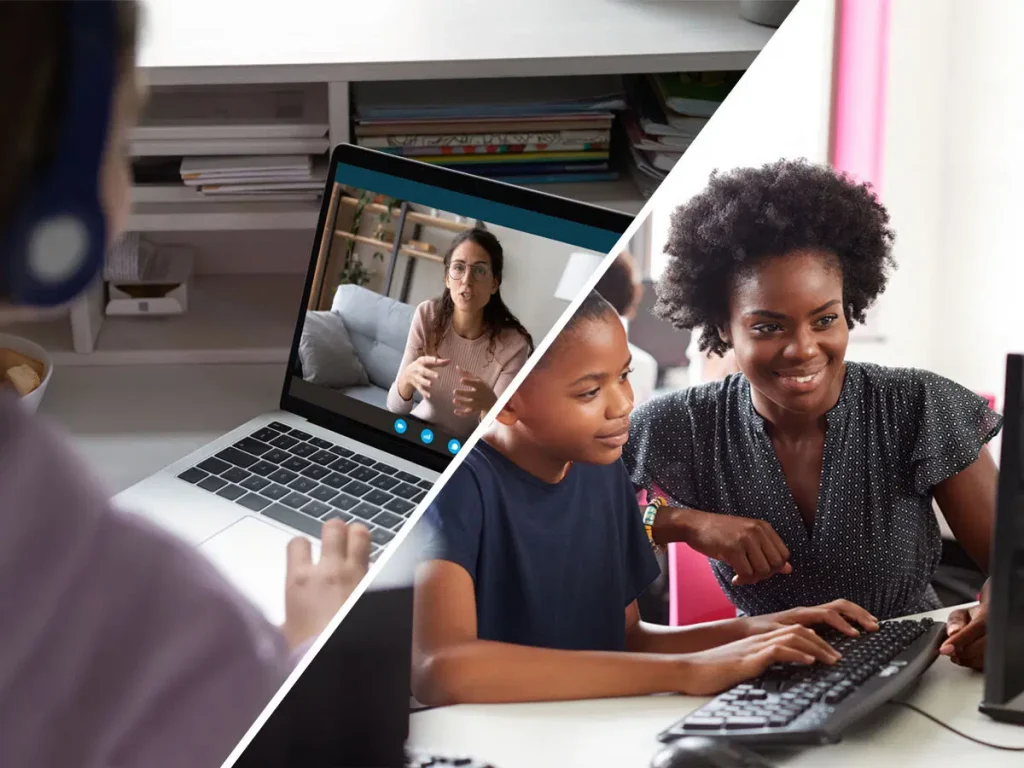


Additional resources
Log In to Amplify Tutoring
Logging in with a personal device
- If you’re already logged into Clever, go to tutor.amplify.com and click Log In with Clever. You will be taken directly to Amplify Tutoring.
- If you’re NOT logged into Clever, go to tutor.amplify.com and click Log In with Clever.
- Scan the Clever badge OR enter your school name and your Clever username and password and click Log in


Logging in with a shared device
- If you’re using a shared device, go to tutor.amplify.com and click Log In with Amplify.
- Enter your Amplify Reading username and password.
- Click Log in.
Logging in for the first time
After you log in for the first time, scroll down to complete the welcome tutorial.

Join a Tutoring Session
- After you log in, click your class.
- Click Blackboard Collaborate and then click Join session.
- In the list that displays, click your class name to join the scheduled session. Note: You can only join a session at the time it is scheduled. If the scheduled session isn’t in progress, you will see “Room disabled” under Blackboard Collaborate.
- If you’re joining for the first time, click Allow to give your browser permission to use the microphone and camera. Check to make sure each is working.
- To stop seeing onscreen instructions: click Later under Start Tutorial, then click X on the next prompt.
You should now be able to see and hear your tutor and the other students in your session.

Test Session Audio and Video
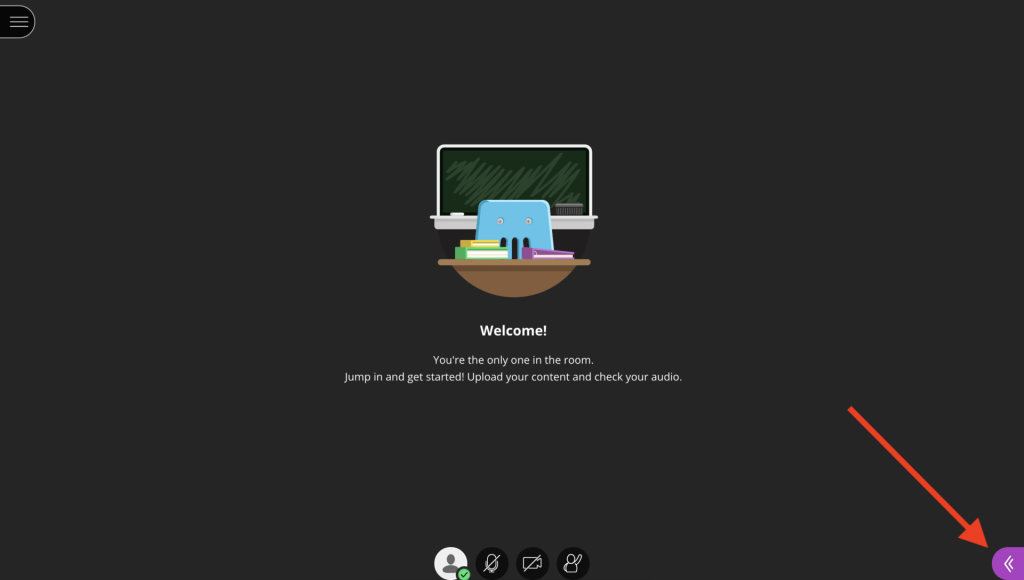
- To test audio and video, you must first join a session. Audio and video settings can only be tested in a session.
- Open the Collaborate panel by clicking the purple icon in the lower-right corner of the page.
- Click the My Settings icon in the panel that opens.
- Click Set up your camera and microphone.
- Test your microphone, and grant permission to your microphone if asked.
- Test your camera, and grant permission to your camera if asked.
Your tutor and the other students in your session should now be able to see and hear you.

Webinars
View our latest webinars for more information
Student-friendly resources

Additional resources

Student inventory of devices
How to obtain an additional inventory of student devices PDF


Family Letter- Pivoting to Remote Learning
Here is an Amplify Family Letter- Pivoting to Remote Learning for your use.
Connect, Reflect, Share!

Complete this optional Google form to share highlights from tutoring. We would love to capture and share your a-ha moments, the practices/strategies/resources you have found helpful, and/or celebrations of your students’ growth as readers and your development as a tutor!
Please use the form below to alert us of issues and concerns. We will look at trends, solutions, and reach out to schools if needed.
Welcome, San Jose USD, to Amplify Desmos Math California
Amplify Desmos Math California core math program is designed to meet the California Mathematics Framework and the California Common Core State Standards for Mathematics. Scroll down and click to view the K–5 student materials.
K–5 student materials
- Student Edition Volume 1
- Student Edition Volume 2
- Spanish Student Edition Volume 1 (National Edition)
- Spanish Student Edition Volume 2 (National Edition) – Coming: November 2025
- Additional Practice Student Resources
- Center Resources
- Intervention, Extension, and Investigation Resources
- Math Language Development Resources
- Student Edition Volume 1
- Student Edition Volume 2
- Spanish Student Edition Volume 1 (National Edition)
- Spanish Student Edition Volume 2 (National Edition) – Coming: November 2025
- Additional Practice Student Resources
- Center Resources
- Intervention, Extension, and Investigation Resources
- Math Language Development Resources
- Student Edition Volume 1
- Student Edition Volume 2
- Spanish Student Edition Volume 1 (National Edition)
- Spanish Student Edition Volume 2 (National Edition) – Coming: November 2025
- Additional Practice Student Resources
- Center Resources
- Intervention, Extension, and Investigation Resources
- Math Language Development Resources
- Student Edition Volume 1
- Student Edition Volume 2
- Spanish Student Edition Volume 1 (National Edition)
- Spanish Student Edition Volume 2 (National Edition) – Coming: November 2025
- Additional Practice Student Resources
- Center Resources
- Intervention, Extension, and Investigation Resources
- Math Language Development Resources
Please note that the Grade 5 Student Edition Volume 2 has been divided by unit in order to be posted on this site due to file size upload restrictions.
- Student Edition Volume 1
- Student Edition Volume 2 (Unit 5)
- Student Edition Volume 2 (Unit 6)
- Student Edition Volume 2 (Unit 7)
- Spanish Student Edition Volume 1 (National Edition)
- Spanish Student Edition Volume 2 (National Edition) – Coming: November 2025
- Additional Practice Student Resources
- Center Resources
- Intervention, Extension, and Investigation Resources
- Math Language Development Resources
Welcome to your Amplify Desmos Math Pilot!
We’re thrilled to welcome you to the Amplify family, and we look forward to making your experience with Amplify Desmos Math successful from day one.
On this site, you’ll find resources, tips, videos, and other helpful information designed to support you throughout your pilot experience.

Tips for getting started
It takes time to learn any new program and get used to its patterns and flow—time that you aren’t always afforded in a pilot situation. Based on our work with pilot teachers who are now happy users, we can tell you with 100% confidence that it gets easier. In no time, you’ll be preparing and delivering all your lessons with ease.
As you get comfortable with the organization of each unit and the ways one lesson flows into the next, you’ll find the following resources helpful.
Helpful links for getting started
Support resources you may want to use during your pilot

Want to learn more from Amplify experts?
Amplify offers a wide variety of learning opportunities outside our pilot meeting times:
Our math webinar library hosts all our past sessions.
Our Events page is where you can search for and register to attend upcoming math webinars.
The Amplify Blog is a great resource for helpful articles and research-based information.
Nevada ELA Review for grades K–5
Thank you for taking the time to review Amplify’s core ELA program for K–5.
Amplify Core Knowledge Language Arts (CKLA) is a cutting-edge and effective core ELA program for students in grades K–5. It was developed in partnership with the Core Knowledge Foundation, was specifically designed to help teachers implement Science of Reading principles, and features proven evidence-based instructional practices.
Getting started
On this site, you’ll find a variety of resources designed to support your review and evaluation of the program. Before you start scrolling, watch the video below to learn about CKLA’s alignment to Nevada’s literacy initiatives as well as where to find key program resources.
Curriculum background
Pedagogical overview
In the video below, Amplify’s Chief Academic Officer Susan Lambert shares the big picture of CKLA, and explains why it was created and the impact it’s making across the country.
Program overview
In the video below, learn about CKLA’s structure and materials, as well the research behind the curriculum.
Program features
Built out of the latest research in the Science of Reading, Amplify CKLA delivers explicit instruction in both foundational literacy skills (systematic phonics, decoding, and fluency) and background knowledge in grades K–2 with an integrated approach to explicit instruction in grades 3–5.
Review this Science of Reading toolkit to learn more about the Science of Reading best practices integrated throughout CKLA.
Great reading instruction starts with helping kids develop great decoding skills. By building a solid foundation of phonological awareness and phonics, reading the words on the page becomes automatic so that comprehension and critical thinking can happen. Our instruction is supported by:
- Step-by-step lessons with multisensory approaches, clear lesson objectives, and embedded formative assessments.
- Decodable books and student readers with ebook and audiobook versions that feature engaging plots and relatable characters.
- An engaging sound library with fun songs and videos that develop phonological awareness.
- An interactive Vocab App featuring engaging activities with immediate feedback and automated, customized instruction based on student performance.
Students build grade-appropriate subject-area knowledge and vocabulary in history, science, literature, and the arts while learning to read, write, and think creatively and for themselves. Our instruction is supported by:
- Knowledge builders that provide a quick overview of each domain with its key ideas.
- Interactive Read-Alouds designed to build knowledge and vocabulary.
- Content-rich anchor texts that support students as they tackle increasingly complex text and sharpen their analytical skills.
- Social and emotional learning paired with lessons in civic responsibility.
Amplify CKLA provides built-in differentiation strategies in every lesson for all students,
including supports for ELLs.
- Access supports for ELLs—Integrated ELD supports in each lesson segment
for ELLs are specific to students’ mastery of the lesson’s objectives. - Support and Challenge for all learners—Lessons include Support and Challenge suggestions that provide assistance or opportunities for more advanced work toward the goal of the lesson. These supports are suitable for all learners, including ELLs.
- 30 minutes of Additional Support in every Skills lesson–In the Skills Strand, every lesson concludes with an Additional Support section of recommendations for 30 minutes of extended instruction and activities, directly aligned to the skills taught in the lesson to assist students who need more support in mastering the lesson’s objectives.
- Intervention Toolkit–The Intervention Toolkit provides easy-to-use resources to assist teachers in filling gaps in students’ foundational skills. Teachers will find of hundreds of activities to support phonics, fluency, comprehension, handwriting, and other key skills.
The slides-based Amplify CKLA digital experience enhances instruction while saving you time. Everything you need is all in one place, making it easier than ever to plan lessons, present digital content, and review student work.
- Simplify planning and instruction–Teachers have access to ready-to-use and customizable lesson presentation slides, complete with all the prompts from the print Teacher Guide embedded in the teacher view. As teachers deliver each lesson, students can engage with the content in one cohesive
experience—through Activity Books, slides, digital components, videos, Student Readers, and more. - Interactive student activities–Through the Student Home, students can easily access digital lessons with slides, Activity Pages, ebooks, videos, and other interactive resources from one simple dashboard.
- Your teacher command center–You’re provided with the tools you need to ensure a productive digital experience that’s personalized to meet your students’ needs. This includes a teacher home from which to launch and track lessons, LMS integrations such as Google Classroom and Microsoft Teams, and other customizations based on classroom needs.
- Get real-time insights into your students’ work–The innovative live review tool enables you to keep an eye on students drawing, recording audio, uploading and capturing images, and typing or writing in pre-placed text boxes in their Activity Pages.
Curriculum review
Digital experience overview
In the video below, learn about CKLA’s digital tools for teachers and students across both classroom and asynchronous environments.
Digital navigation walkthrough
Physical materials walkthrough
Curriculum implementation
See our Science of Reading solutions in action! Click here to see a real example of how one Ohio district is implementing and educating their K–8 community on the Science of Reading as a response to Ohio’s Plan to Raise Literacy Achievement Initiative.
Access the program
Explore as a teacher
Before logging in, watch this brief video on navigating the CKLA Teacher Resource Site.
Ready to explore as a teacher? Follow these instructions:
- Click the CKLA Teacher Resource Site button below.
- Select Log in with Amplify.
- Enter the username: t1.nvk5@tryamplify.net
- Enter the password: AmplifyNumber1
- Click the CKLA Teacher Resource icon
- Select a grade level
Explore as a student
Before logging in, watch this brief video on navigating the CKLA Student Hub.
Ready to explore as a student? Follow these instructions:
- Click the CKLA Teacher Resource Site button below.
- Select Log in with Amplify.
- Enter the username: s1.nvk5@tryamplify.net
- Enter the password: AmplifyNumber1
- Click the CKLA Teacher Resource icon
- Select a grade level
Check out these additional resources
Nevada submission resources:
- CKLA Program Alignment to the Standards (Nevada Rubric: Category 1)
- CKLA Program Social Justice Alignment (Nevada Rubric 2: Category 2)
- CKLA Grade K Lesson Alignment to the Nevada Academic Content Standards for English Language Arts
- CKLA Grade 1 Lesson Alignment to the Nevada Academic Content Standards for English Language Arts
- CKLA Grade 2 Lesson Alignment to the Nevada Academic Content Standards for English Language Arts
- CKLA Grade 3 Lesson Alignment to the Nevada Academic Content Standards for English Language Arts
- CKLA Grade 4 Lesson Alignment to the Nevada Academic Content Standards for English Language Arts
- CKLA Grade 5 Lesson Alignment to the Nevada Academic Content Standards for English Language Arts
CKLA review resources:
- CKLA Program guide
- Diversity, equity, and inclusion in CKLA
- Text complexity in CKLA
- Trade books in CKLA
- Assessments in CKLA
- Remote and hybrid learning with CKLA
- Amplify ELA Technical Specifications
- CKLA Scopes and Sequences
- Grade K Skills and Knowledge
- Grade 1 Skills and Knowledge
- Grade 2 Skills and Knowledge
- Grade 3 Integrated
- Grade 4 Integrated
- Grade 5 Integrated
Virginia Instructional Materials Review-Cycle II
South Carolina review for grades K–5
Virginia Instructional Materials Review, Cycle II
South Carolina review for grades K–5
Thank you for taking the time to review Amplify’s CKLA resources for K–5.
Amplify Core Knowledge Language Arts (CKLA) is a cutting-edge and effective core literacy resource for students in grades K–5. It was developed in partnership with the Core Knowledge Foundation, was specifically designed to help teachers implement Science of Reading principles, and features proven evidence-based instructional practices.

Getting started
On this site, you’ll find a variety of resources designed to support your review and evaluation of the program. Before you start scrolling, watch the video below to learn about CKLA’s alignment to South Carolina literacy initiatives and what included in your physical samples.
South Carolina review documents
SC College and Career Readiness Correlations K-5:
Please use the provided Amplify credentials to access the CKLA content cited below.
Each Skills unit or Knowledge domain is linked to its corresponding Teacher Guide. The bolded lessons are linked to lesson segments or direct examples of the SC College- and Career-Readiness standards expressed in the Amplify CKLA South Carolina Edition Teacher Guides.
SC Instructional Strategies & Routines K-5
Scope and Sequence
K Skills Scope and Sequence
K Knowledge Scope and Sequence
1st Skills Scope and Sequence
1st Knowledge Scope and Sequence
2nd Skills Scope and Sequence
2nd Knowledge Scope and Sequence
What is Amplify CKLA K-5?
In the video below, Amplify’s Chief Academic Officer Susan Lambert shares the big picture of CKLA, and explains why it was created and the impact it’s making across the country.
How does CKLA work?
Through a unique, evidence-based two-strand approach, Amplify CKLA helps students master foundational skills and build a robust knowledge base–both of which are necessary for accessing and comprehending complex texts.
Grades K–2: Dedicated knowledge building and explicit skills instruction
Every day, students in Grades K–2 complete one full lesson that builds foundational reading skills in the Amplify CKLA Skills Strand, as well as one full lesson that builds background knowledge in the Amplify CKLA Knowledge Strand. Through learning in each of these strands, students develop the early literacy skills necessary to help them become confident readers and build the context to understand what they’re reading.
Grades 3–5: Integrated instruction
In Grades 3–5, Knowledge and Skills are integrated in one set of instructional materials. Lessons begin to combine skills and knowledge with increasingly complex texts, close reading, and a greater writing emphasis. Students can then use their skills to go on their own independent reading adventures.
Why review CKLA K-5?
Built out of the latest research in the Science of Reading, Amplify CKLA delivers explicit instruction in both foundational literacy skills (systematic phonics, decoding, and fluency) and background knowledge in grades K–2 with an integrated approach to explicit instruction in grades 3–5.
Review this Science of Reading toolkit to learn more about the Science of Reading best practices integrated throughout CKLA.
Students build grade-appropriate subject-area knowledge and vocabulary in history, science, literature, and the arts while learning to read, write, and think creatively and for themselves. Our instruction is supported by:
- Knowledge builders that provide a quick overview of each domain with its key ideas.
- Interactive Read-Alouds designed to build knowledge and vocabulary.
- Content-rich anchor texts that support students as they tackle increasingly complex text and sharpen their analytical skills.
- Social and emotional learning paired with lessons in civic responsibility.
Amplify CKLA provides built-in differentiation strategies in every lesson for all students,
including supports for Multi Language Learners.
- Access supports for Multi Language Learners—Integrated ELD supports in each lesson segment
for Multi Language Learners are specific to students’ mastery of the lesson’s objectives. - Support and Challenge for all learners—Lessons include Support and Challenge suggestions that provide assistance or opportunities for more advanced work toward the goal of the lesson. These supports are suitable for all learners, including ELLs.
- 30 minutes of Additional Support in every Skills lesson–In the Skills Strand, every lesson concludes with an Additional Support section of recommendations for 30 minutes of extended instruction and activities, directly aligned to the skills taught in the lesson to assist students who need more support in mastering the lesson’s objectives.
- Intervention Toolkit–The Intervention Toolkit provides easy-to-use resources to assist teachers in filling gaps in students’ foundational skills. Teachers will find of hundreds of activities to support phonics, fluency, comprehension, handwriting, and other key skills.
The slides-based Amplify CKLA digital experience enhances instruction while saving you time. Everything you need is all in one place, making it easier than ever to plan lessons, present digital content, and review student work.
- Simplify planning and instruction–Teachers have access to ready-to-use and customizable lesson presentation slides, complete with all the prompts from the print Teacher Guide embedded in the teacher view. As teachers deliver each lesson, students can engage with the content in one cohesive
experience—through Activity Books, slides, digital components, videos, Student Readers, and more. - Interactive student activities–Through the Student Home, students can easily access digital lessons with slides, Activity Pages, ebooks, videos, and other interactive resources from one simple dashboard.
- Your teacher command center–You’re provided with the tools you need to ensure a productive digital experience that’s personalized to meet your students’ needs. This includes a teacher home from which to launch and track lessons, LMS integrations such as Google Classroom and Microsoft Teams, and other customizations based on classroom needs.
- Get real-time insights into your students’ work–The innovative live review tool enables you to keep an eye on students drawing, recording audio, uploading and capturing images, and typing or writing in pre-placed text boxes in their Activity Pages.
Digital navigation walkthrough
Access the resources
Ready to explore as a teacher? Follow these instructions:
- Visit learning.amplify.com
- Select Log in with Amplify.
- Enter the username: t.southcarolina@tryamplify.net
- Enter the password: AmplifyNumber1
- Select CKLA
Ready to explore as a student? Follow these instructions:
- Visit learning.amplify.com
- Select Log in with Amplify.
- Enter the username: s.southcarolina@tryamplify.net
- Enter the password: AmplifyNumber1
- Select CKLA
Amplify literacy success K-8
See our Science of Reading solutions in action! Click here to see a real example of how one Ohio district is implementing and educating their K–8 community on the Science of Reading as a response to Ohio’s Plan to Raise Literacy Achievement Initiative.
Welcome, Georgia educators!
Program introduction
Professional learning
What will you find in the Professional Learning section?
Whether you’re launching into a new program or looking to strengthen your skills, Amplify’s professional learning sessions will support your needs.
- Register now to join new and upcoming learning sessions.
- On-demand sessions offer timely insights to support your mCLASS implementation.
- Webinar recordings from 2020-2021 or 2021-2022 ensure you don’t miss a thing.
Amplify is working in partnership with the Kindergarten Assessment Support (KAS) Initiative to provide virtual professional development trainings to teacher, specialists, and campus/district leader users of mCLASS Texas Kindergarten across the state of Texas. These trainings are funded by the KAS Grant and will be provided at no charge to participants. Please note that all content will be focused on kindergarten only.
You will find a list of sessions below that you can register for. Sessions will be updated on an ongoing basis. To register, educators can enter the Session ID number into the Region 4 ESC search bar (https://www.escweb.net/tx_esc_04/) to sign up for the session(s) and to secure a spot or type ‘mclass’ into the search bar; all virtual sessions are capped at 30 participants.
For more information about the KAS Initiative, please visit https://tea.texas.gov/academics/early-childhood-education/data-driven-instruction-best-practices.
View the on-demand sessions for below to gain timely insights to support your mCLASS implementation.
All mCLASS Texas Edition users will have access to free online modules. Contact your district for details about accessing these modules.
For those districts that want to support teachers in a more comprehensive approach we will work to ensure that the professional learning section supporting each mCLASS Texas Edition rollout meets each district’s unique needs. Here is a professional learning catalog to show the breadth and depth of what we offer.
Remote assessment
mCLASS Texas Edition can be administered in many ways, including remotely. This site will give guidance on the various ways to administer mCLASS Texas Edition to best support your students in any learning environment.
Watch the Remote Assessment Guidance Office Hours recording here.
Documents referenced during Office Hours are linked below.
Administrators, welcome to mCLASS Texas Edition!
Here you’ll find information about enrollment and licensing, technical requirements, professional learning resources, and more.
Onboarding: What to expect
Welcome to mCLASS Texas Edition! To help you know what’s coming next, we created the following visual that outlines the steps of the onboarding process. You can use it as a reference.

Enrollment and licensing
Amplify provides services to fit the different types of enrollment needs for various times of year:
- Self-Service Enrollment (SSE) is a batch enrollment tool that you can use to import large amounts of student, staff, and class information into the Amplify system at the beginning of the school year or any time you need to update your enrollment data.
- Auto Self-Service Enrollment (Auto SSE) is a service for automatically sending enrollment data from your computer to Amplify, which does not require intervention after you initiate the process, and which can be run at any time of year. You must have the ability to run scripts in order to use Auto SSE.
- Amplify also offers the Manual Enrollment tools on the Amplify Administration page, which you can use at any time of year to add or update enrollment information by entering the information directly into Amplify, rather than uploading spreadsheets.
Preparing your materials
Click here to access a list of the print materials included in each mCLASS Texas Edition kit.

Technology requirements and guidelines
To ensure that your hardware and network meet the minimum technical requirements for optimal performance and support of your digital curriculum products, please see Amplify’s customer requirements page.
To ensure access to mCLASS, add the URLs on this page to your corresponding district or school-level filters.
Teachers, welcome to mCLASS Texas Edition!
Here you’ll learn about the program, how to set up your device, and how to get help when using mCLASS Texas Edition.
Onboarding: What to expect

Logging in to mCLASS Home
mCLASS Home is where you access mCLASS reporting, instruction, and other helpful resources. Follow these steps to log in:
1. Navigate to mclass.amplify.com.
2. You will need your Amplify user name and password to log in. If you forget your password, you can follow the instructions below to generate a new one.
- Click “Forgot Password”
- Enter your Amplify username and your district or school email address. Click Send. Then follow the instructions in the email you receive to reset your password.
If you have not received an Amplify username and password, please contact your
school or district administrator.
Setting up your assessment device
Assessments are administered using the mCLASS app. The mCLASS app is installed by creating a shortcut from Chrome™ (Safari for iPads) on your device’s desktop or home screen. Click the link for your device for installation instructions:
iPad
Chromebook
Windows device
Note that you need your Amplify username and password to install the mCLASS app. If you have not received it, please contact your school or district administrator.
Dyslexia screening
mCLASS® Texas DIBELS® 8 and IDEL assess the updated skills required for dyslexia screening. We’ve got you covered!
Click here to learn more about the Texas Dyslexia handbook updates.
Looking for help?
Our technical and pedagogical support teams are available from 7 a.m. to 7 p.m. ET, Monday through Friday.
For your most urgent questions
- Use our live chat within your program
- Call our toll-free number: (800) 823-1969
For less urgent questions, send us an email!
- Technical support: help@amplify.com
- Pedagogical support: edsupport@amplify.com
Amplify CKLA Review for Alabama
Digital experience for Amplify Science
The Amplify Science digital experience unlocks a whole new level of engagement and impact. With the digital experience, everything you need is in one place, saving you time and making it easier than ever to plan lessons, present digital content, and review student work. Students engage with content in one access point, unlocking deep engagement through digital books, simulations, and practice tools.
Read the review on EdReports.
Streamline planning and supercharge instruction
Make lesson planning easier with slides-based lessons and integrated teacher guidance.
- Educator Home helps you stay organized with quick access to your programs, recently taught lessons, student work, and upcoming assignments.
- Ready-to-use and customizable presentation slides support lesson prep, planning, and instruction.
- Embedded prompts within the digital slides offer additional support through suggested teacher talk, teacher actions, and embedded assessment opportunities.
Instant insight into student learning
View student thinking in real time with the live review tool embedded within every student experience lesson.
- Keep an eye on all of your students as they write, record audio, draw, upload and capture images, and more.
- Spot and correct common misconceptions as they’re happening.
- Anonymously share student work with the entire class to spark productive discussions and praise students for their hard work.
Ignite student engagement
Student Home offers one intuitive access point for students to fully engage with classroom instruction. Students can:
- Easily access all lessons from one simple dashboard.
- Connect to student books, simulations (“sims”), and digital practice tools embedded at point of use.
- Allow students to explore lesson slides through a self-paced or automatically navigated learning path, predetermined by the teacher.
Assign lessons your way with LMS integrations
The digital experience integrates with various LMSs, allowing you and your students to access Amplify Science with the software you’re already comfortable using.
- Easily create and send assignments and specify due dates.
- Tailor your digital experience to meet your classroom’s needs.
What is Amplify CKLA?
Amplify CKLA is a core ELA program for grades PK–5 that delivers:
- A unique research-based approach truly built on the Science of Reading.
- A combination of explicit foundational skills with meaningful knowledge-building.
- Embedded support and differentiation that gets all students reading grade-level texts together.
- Opportunities for students to see the strengths and experiences that all people share while also celebrating each others’ unique identities and experiences.
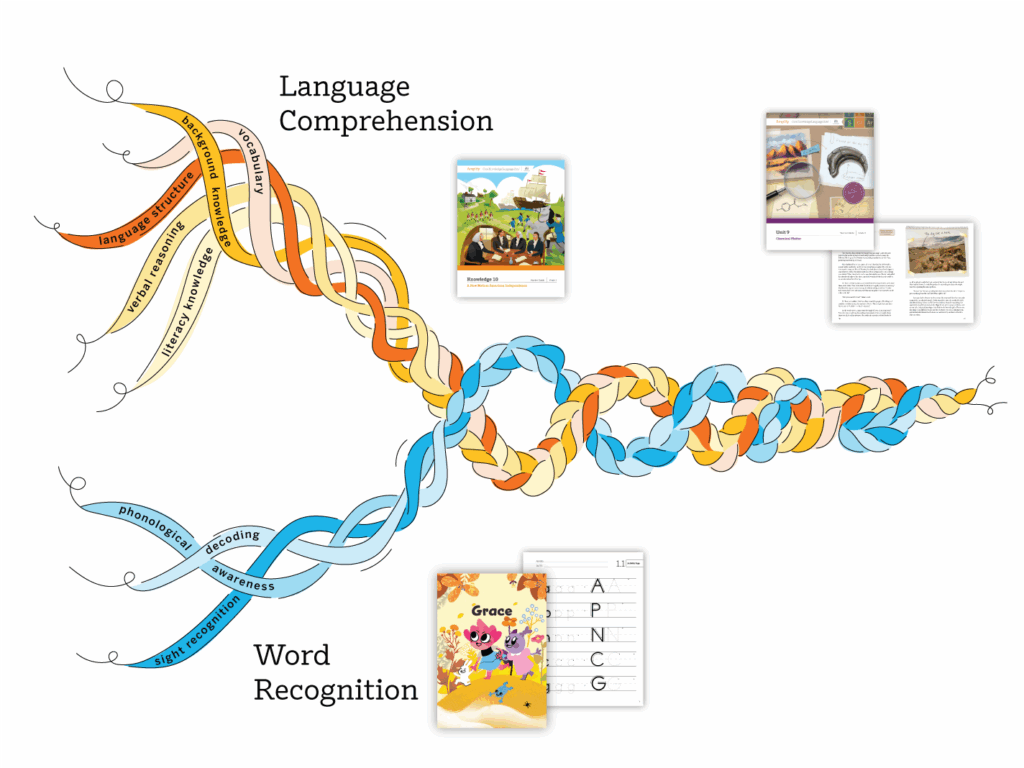
How does Amplify CKLA work?
Daily instruction
Grade PreK: Developmentally appropriate foundational knowledge
Our PreK program delivers developmentally appropriate instruction and activities that do more than lay the groundwork for foundational skills—they offer content knowledge, incorporating research that shows true literacy requires background knowledge in history, science, art, and literature. Amplify CKLA PreK easily fits into any class routine, with 45 minutes of interactive instruction designed to accommodate full-day or half-day schedules.
Grades K–2: Dedicated knowledge-building and explicit skills instruction
Every day, students in Grades K–2 complete one full lesson that explicitly and systematically builds foundational reading skills in the Skills Strand, as well as one full lesson that builds robust background knowledge to access complex text in the Knowledge Strand. Through learning in each of these strands, students develop the early literacy skills necessary to help them become confident readers and build the context to understand what they’re reading.
Grades 3–5: Integrated instruction
In Grades 3–5, Knowledge and Skills are integrated in one set of instructional materials. Lessons begin to combine skills and knowledge with increasingly complex texts, close reading, and a greater writing emphasis. Students can then use their skills to go on their own independent reading adventures.
Formative and summative assessments

Amplify CKLA features a progression of moment-by-moment assessments to benchmark assessments. Assessment and feedback give teachers the information they need to differentiate instruction effectively.
Checks for Understanding
Each lesson segment incorporates checks for understanding to increase engagement and to let teachers make real-time adjustments to their instruction.
Formative Assessment
Each lesson goal is tied to a formative assessment opportunity, allowing teachers to see which students need more support with a benchmark.
Mid- and End-of-Unit Assessments
Mid-Unit and End-of-Unit Assessments provide valuable information on the skills and content students have mastered. Digital end-of-unit assessments are available on a variety of platforms.
Benchmark and Placement Assessments
Benchmark and Placement Assessments help teachers set goals and monitor the growth of each student, providing a baseline at the beginning of the year and ensuring students are advancing toward grade-level objectives.
Download our CKLA Assessment Sampler
What makes Amplify CKLA different?
Integration with mCLASS DIBELS 8
Amplify CKLA is the only core ELA program that integrates with mCLASS DIBELS 8th Edition.
The CKLA Connect feature matches your students with targeted CKLA lessons based on their mCLASS DIBELS 8th Edition assessment data. In other words, it aligns your assessments more closely with your core curriculum while recommending effective differentiated instruction.
Download this guide to connecting mCLASS DIBELS 8 with Amplify CKLA
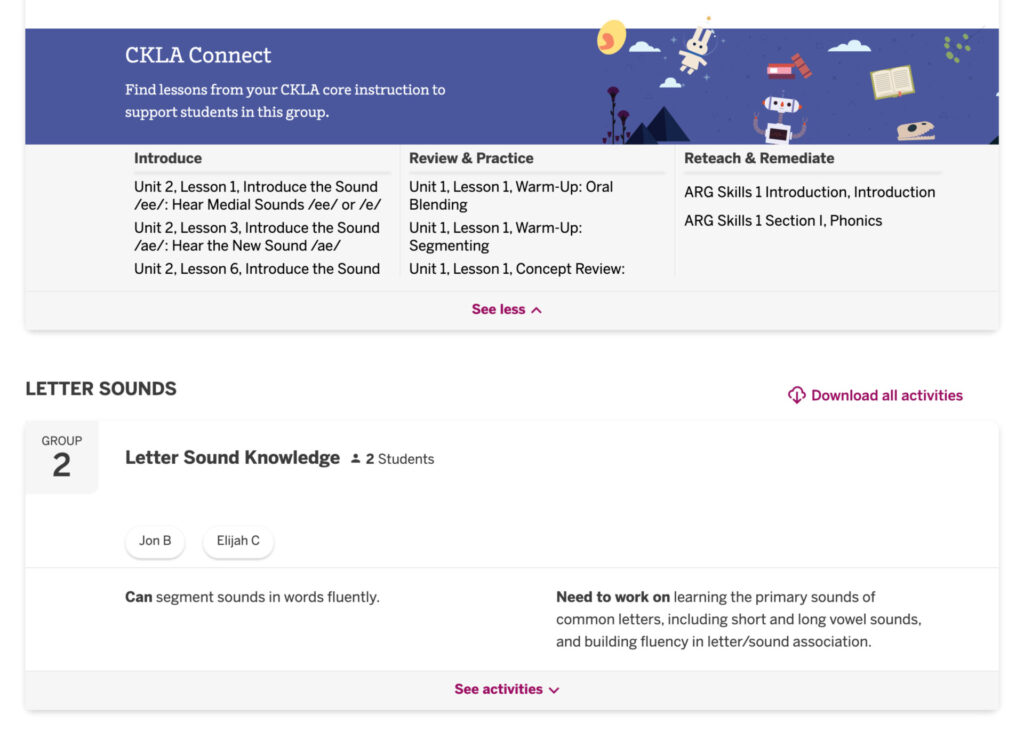
Built on the Science of Reading
Built out of the latest research in the Science of Reading, Amplify CKLA delivers explicit instruction in foundational knowledge in PreK, both foundational literacy skills (systematic phonics, decoding, and fluency) and background knowledge in grades K–2, and an integrated approach to explicit instruction in grades 3–5.
Review this Science of Reading toolkit to learn more about the Science of Reading best practices integrated throughout CKLA.
Explicit systematic skills instruction
Great reading instruction starts with helping kids develop great decoding skills. By building a solid foundation of phonological awareness and phonics, reading the words on the page becomes automatic so that comprehension and critical thinking can happen. Our instruction is supported by:
- Step-by-step lessons with multisensory approaches, clear lesson objectives, and embedded formative assessments.
- Decodable books and student readers with ebook and audiobook versions that feature interesting plots and relatable characters.
- An engaging sound library with fun songs and videos that develop phonological awareness.
- An interactive Vocab App featuring engaging activities with immediate feedback and automated, customized instruction based on student performance.
Coherent knowledge instruction
Students build grade-appropriate subject-area knowledge and vocabulary in history, science, literature, and the arts while learning to read, write, and think creatively and for themselves. Our instruction is supported by:
- Knowledge builders that provide a quick overview of each domain with its key ideas.
- Interactive Read-Alouds designed to build knowledge and vocabulary.
- Content-rich anchor texts that support students as they tackle increasingly complex text and sharpen their analytical skills.
- Social and emotional learning paired with lessons in civic responsibility.

Embedded differentiation for all learners
Amplify CKLA provides built-in differentiation strategies in every lesson for all students, including supports for English language learners and Standard English learners.
- Access supports for ELLs: Integrated ELD supports in each lesson segment for English learners and Standard English learners are specific to students’ mastery of the lesson’s objectives.
- Support and Challenge for all learners: Lessons include Support and Challenge suggestions that provide assistance or opportunities for more advanced work toward the goal of the lesson. These supports are suitable for all learners, including ELLs.
- 30 minutes of Additional Support in every Skills lesson: In the Skills Strand, every lesson concludes with an Additional Support section of recommendations for 30 minutes of extended instruction and activities, directly aligned to the skills taught in the lesson to assist students who need more support in mastering the lesson’s objectives.
- Intervention Toolkit: The Intervention Toolkit provides easy-to-use resources to assist teachers in filling gaps in students’ foundational skills. Teachers will find of hundreds of activities to support phonics, fluency, comprehension, handwriting, and other key skills.
Designated ELD with Language Studio
Amplify CKLA’s designated English Language Development (ELD) component—Language Studio—helps English learners preview and revisit key content within core instruction, building a foundation of academic vocabulary and background knowledge. Core instruction lessons include point-of-use supports for English learners and Support and Challenge strategies for all learners.

This carefully developed program follows the CKLA Knowledge domains, previewing and reinforcing skills and content from core instruction using instruction specifically built for English learners. The program is also designed around frequent formative assessment, including assessment of language proficiency, giving you effective ways to guide and support your English learners.
Language Studio supports teachers and English learners through the following:
- 30 minutes of instruction with lesson segments are carefully designed around Content Knowledge, Meaning Making, Language Development, Effective Expression, and Foundational Skills.
- Every Language Studio lesson accompanies a core lesson, helping English learners deepen domain and academic vocabulary that will help them access core content.
- Culminating tasks support core projects and target the same skills as primary instruction.
Writing emphasis with Writing Studio
With Writing Studio, students in Grades K-5 focus deeply on the three key text types informative, narrative, and opinion–while applying both the skills and knowledge from the core program.
Writing Studio supports students through:
- Expanding on core writing instruction to develop analytical thinking through writing.
- Lessons that focus on writing standards, providing intensive focus and application to strengthen skills.
- Opportunities to apply knowledge in new contexts and deepen comprehension through writing.
- Scaffolded writing projects to help all students find success within the stages of the writing process.

Writing Studio lessons:
- Allow teachers to differentiate through Support and Challenge prompts for students at all levels, and Access Supports for ELLs.
- Spark creativity with authentic writing projects that call on students to engage deeply with rich topics and sources.
- Implement careful design and provide rubrics so that students’ writing skills can visibly grow throughout the year.
A culminating project in each grade asks students to apply their knowledge and understanding of text types and to select the appropriate text type for a final piece of writing.
Personalized practice with Boost Reading
Boost Reading is the student-driven skill practice program within CKLA, providing differentiated, digital instruction in both foundational skills and comprehension strategies. Because Boost Reading is built on the same approach to reading as CKLA, students are able to extend their learning from the core program further, at their own pace.
Amplify CKLA and Boost Reading reinforce each other through:
- An aligned scope and sequence and instructional approach: In both programs, students get instruction and practice in phonological awareness and phonics, with the most common, least ambiguous spellings first.
- Consistent vocabulary words: Many Amplify CKLA words are taught and practiced in Boost Reading vocabulary games.
- Complementary texts: Fiction and nonfiction books within Boost Reading reinforce Amplify CKLA knowledge domains.
- Seamless integrations between platforms: Students can easily access Boost Reading directly from the Amplify CKLA Student Hub.
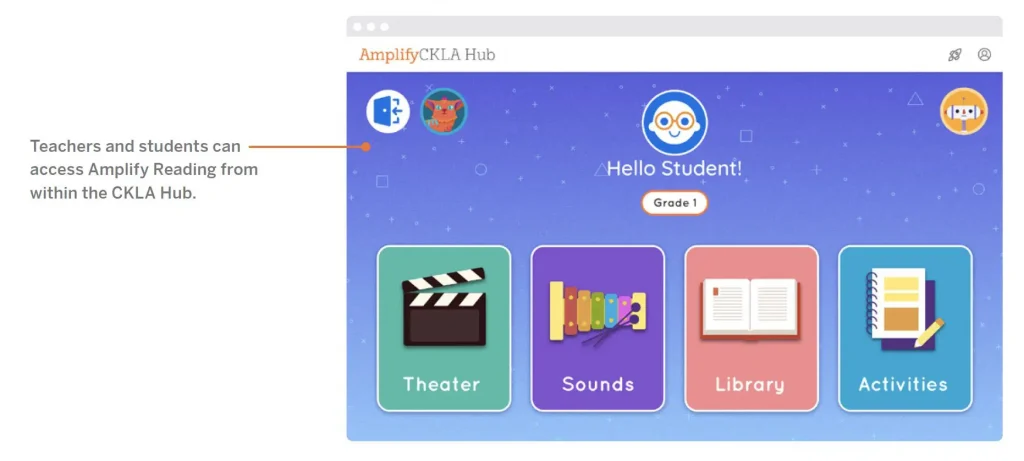
Ready-to-go slides and all-in-one platform
The slides-based Amplify CKLA digital experience enhances instruction while saving you time. Everything you need is all in one place, making it easier than ever to plan lessons, present digital content, and review student work.
- Simplify planning and instruction: Teachers have access to ready-to-use and customizable lesson presentation slides, complete with all the prompts from the print Teacher Guide embedded in the teacher view. As teachers deliver each lesson, students can engage with the content in one cohesive
experience—through Activity Books, slides, digital components, videos, Student Readers, and more. - Interactive student activities: Through the Student Home, students can easily access digital lessons with slides, Activity Pages, ebooks, videos, and other interactive resources from one simple dashboard.
- Your teacher command center: You’re provided with the tools you need to ensure a productive digital experience that’s personalized to meet your students’ needs. This includes a teacher home from which to launch and track lessons, LMS integrations such as Google Classroom and Microsoft Teams, and other customizations based on classroom needs.
- Get real-time insights into your students’ work: The innovative live review tool enables you to keep an eye on students drawing, recording audio, uploading and capturing images, and typing or writing in pre-placed text boxes in their Activity Pages.
Navigating the program
Digital navigation walkthrough
Physical materials walkthrough
Sample materials
Integrated Strand
Demo access
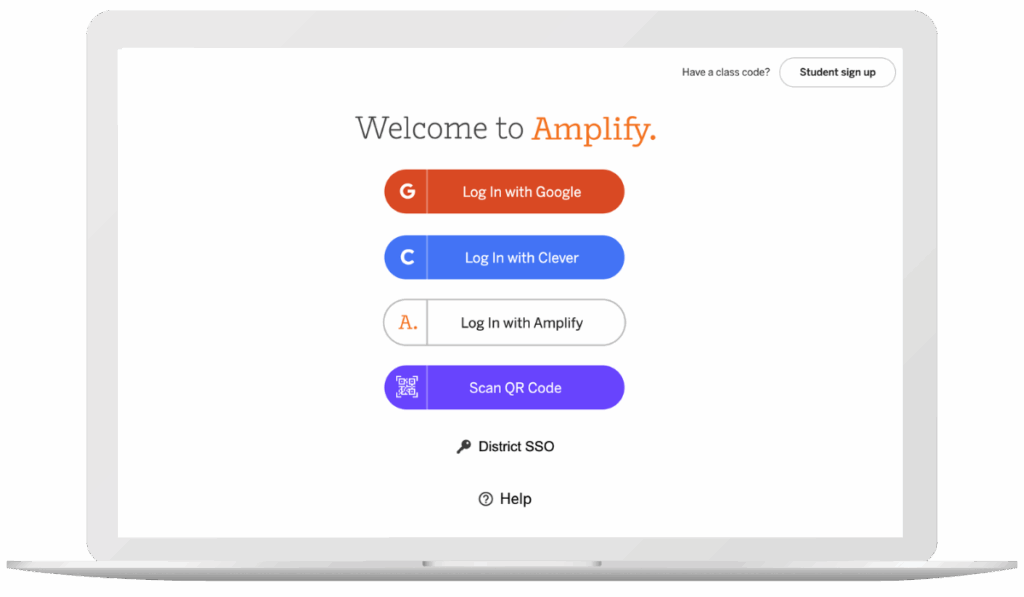
Follow the instructions below to access your demo account.
- Click the CKLA Demo button below.
- Go to learning.amplify.com
- Select Log in with Amplify
- To explore as a student, enter this username:
- Enter the password: Amplify1-mcps2024
- Click the desired program on the left side of the page.
Additional resources
Amplify CKLA review resources:
- CKLA Program Guide for Grades K–5
- CKLA Program Guide for PreK
- Diversity, equity, and inclusion in CKLA
- CKLA Culturally Responsive Curriculum Scorecard
- CKLA Equity Guide for Grades K–5
- CKLA and Social Emotional Competencies
- Text complexity in CKLA
- CKLA Caregiver Hub
- CKLA Sample Caregiver Letters
- Assessments in CKLA for Grades K–5
- Assessments in CKLA PreK
- Remote and hybrid learning with CKLA
- Amplify CKLA Scopes and Sequences
- Grade K Skills and Knowledge
- Grade 1 Skills and Knowledge
- Grade 2 Skills and Knowledge
- Grade 3 Integrated
- Grade 4 Integrated
- Grade 5 Integrated
Amplify CKLA for Anchorage
What is Amplify CKLA?
Amplify CKLA is a core ELA program for grades K–5 that delivers:
- A unique research-based approach truly built on the Science of Reading.
- A combination of explicit foundational skills with meaningful knowledge-building.
- Embedded support and differentiation that gets all students reading grade-level texts together.
- Opportunities for students to see the strengths and experiences that all people share while also celebrating each others’ unique identities and experiences.
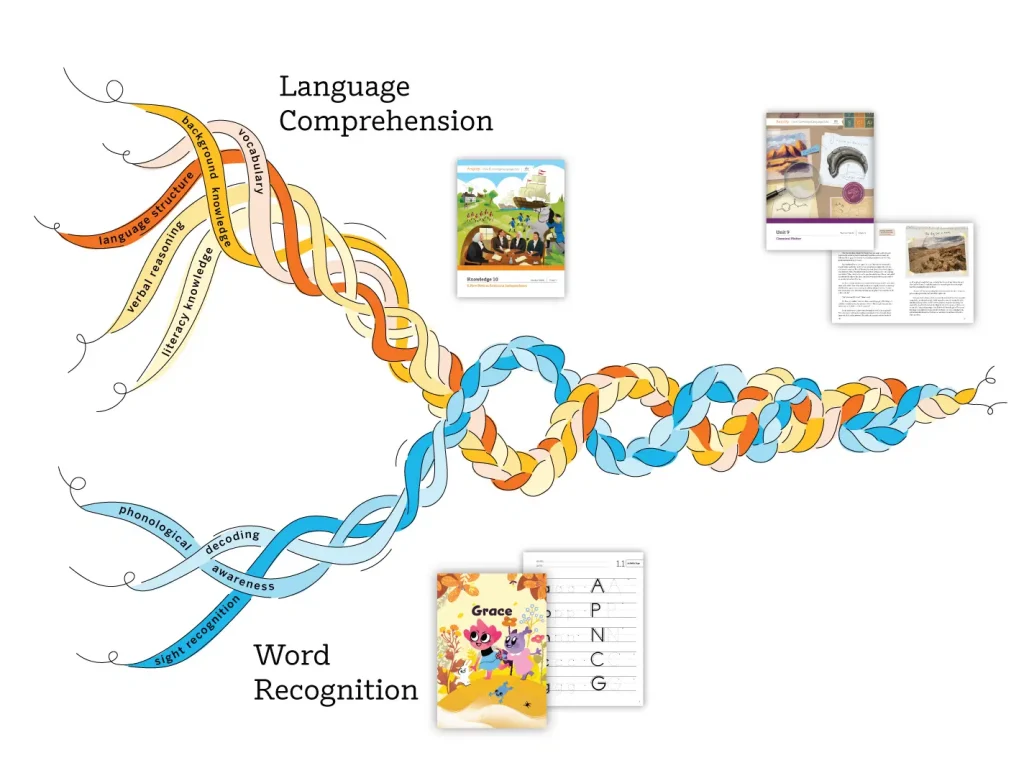
How does Amplify CKLA work?
Grades K–2: Dedicated knowledge-building and explicit skills instruction
Every day, students in Grades K–2 complete one full lesson that explicitly and systematically builds foundational reading skills in the Skills Strand, as well as one full lesson that builds robust background knowledge to access complex text in the Knowledge Strand. Through learning in each of these strands, students develop the early literacy skills necessary to help them become confident readers and build the context to understand what they’re reading.
Grades 3–5: Integrated instruction
In Grades 3–5, Knowledge and Skills are integrated in one set of instructional materials. Lessons begin to combine skills and knowledge with increasingly complex texts, close reading, and a greater writing emphasis. Students can then use their skills to go on their own independent reading adventures.
How does Amplify CKLA integrate with the other parts of the literacy system?
Amplify CKLA + mCLASS® with DIBELS® 8th Edition
Amplify CKLA integrates with your mCLASS assessment through the CKLA Connect feature, which matches your students with targeted CKLA lessons based on their mCLASS assessment data. In other words, it aligns your assessments more closely with your core curriculum while recommending effective differentiated instruction.

Amplify CKLA + Amplify Reading
Amplify Reading is the student-driven skill practice program within CKLA, providing differentiated, digital instruction in both foundational skills and comprehension strategies. Because Amplify Reading is built on the same approach to reading as CKLA, students are able to extend their learning from the core program further, at their own pace.
Amplify CKLA and Amplify Reading reinforce each other through:
- An aligned scope and sequence and instructional approach: In both programs, students get instruction and practice in phonological awareness and phonics, with the most common, least ambiguous spellings first.
- Consistent vocabulary words: Many Amplify CKLA words are taught and practiced in Amplify Reading vocabulary games.
- Complementary texts: Fiction and nonfiction books within Amplify Reading reinforce Amplify CKLA knowledge domains.
- Seamless integrations between platforms: Students can easily access Amplify Reading directly from the Amplify CKLA Student Hub.
What makes Amplify CKLA different?
Built on the Science of Reading
Built out of the latest research in the Science of Reading, Amplify CKLA delivers explicit instruction in both foundational literacy skills (systematic phonics, decoding, and fluency) and background knowledge in grades K–2 with an integrated approach to explicit instruction in grades 3–5.
Review this Science of Reading toolkit to learn more about the Science of Reading best practices integrated throughout CKLA.
Explicit systematic skills instruction
Great reading instruction starts with helping kids develop great decoding skills. By building a solid foundation of phonological awareness and phonics, reading the words on the page becomes automatic so that comprehension and critical thinking can happen. Our instruction is supported by:
- Step-by-step lessons with multisensory approaches, clear lesson objectives, and embedded formative assessments.
- Decodable books and student readers with ebook and audiobook versions that feature interesting plots and relatable characters.
- An engaging sound library with fun songs and videos that develop phonological awareness.
- An interactive Vocab App featuring engaging activities with immediate feedback and automated, customized instruction based on student performance.
Coherent knowledge instruction
Students build grade-appropriate subject-area knowledge and vocabulary in history, science, literature, and the arts while learning to read, write, and think creatively and for themselves. Our instruction is supported by:
- Knowledge builders that provide a quick overview of each domain with its key ideas.
- Interactive Read-Alouds designed to build knowledge and vocabulary.
- Content-rich anchor texts that support students as they tackle increasingly complex text and sharpen their analytical skills.
- Social and emotional learning paired with lessons in civic responsibility.
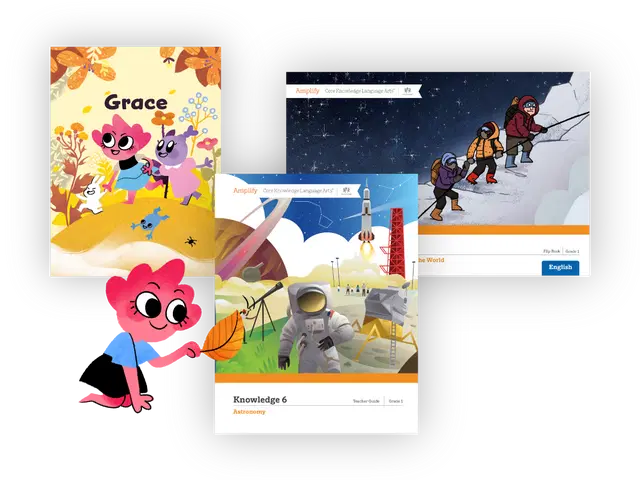
Embedded differentiation for all learners
Amplify CKLA provides built-in differentiation strategies in every lesson for all students, including supports for English learners and Standard English learners.
- Access supports for ELs: Integrated ELD supports in each lesson segment
for English learners and Standard English learners are specific to students’ mastery of the lesson’s objectives. - Support and Challenge for all learners: Lessons include Support and Challenge suggestions that provide assistance or opportunities for more advanced work toward the goal of the lesson. These supports are suitable for all learners, including ELs.
- 30 minutes of Additional Support in every Skills lesson: In the Skills Strand, every lesson concludes with an Additional Support section of recommendations for 30 minutes of extended instruction and activities, directly aligned to the skills taught in the lesson to assist students who need more support in mastering the lesson’s objectives.
- Intervention Toolkit: The Intervention Toolkit provides easy-to-use resources to assist teachers in filling gaps in students’ foundational skills. Teachers will find of hundreds of activities to support phonics, fluency, comprehension, handwriting, and other key skills.
Designated ELD
Amplify CKLA’s designated English Language Development (ELD) component—Language Studio—helps English learners preview and revisit key content within core instruction, building a foundation of academic vocabulary and background knowledge. Core instruction lessons include point-of-use supports for English learners and Support and Challenge strategies for all learners.
This carefully developed program follows the CKLA Knowledge domains, previewing and reinforcing skills and content from core instruction using instruction specifically built for English learners. The program is also designed around frequent formative assessment, including assessment of language proficiency, giving you effective ways to guide and support your English learners.
Language Studio supports teachers and English learners through the following:
- 30 minutes of instruction with lesson segments are carefully designed around Content Knowledge, Meaning Making, Language Development, Effective Expression, and Foundational Skills.
- Every Language Studio lesson accompanies a core lesson, helping English learners deepen domain and academic vocabulary that will help them access core content.
- Culminating tasks support core projects and target the same skills as primary instruction.
Ready-to-go slides and all-in-one platform
The slides-based Amplify CKLA digital experience enhances instruction while saving you time. Everything you need is all in one place, making it easier than ever to plan lessons, present digital content, and review student work.
- Simplify planning and instruction: Teachers have access to ready-to-use and customizable lesson presentation slides, complete with all the prompts from the print Teacher Guide embedded in the teacher view. As teachers deliver each lesson, students can engage with the content in one cohesive
experience—through Activity Books, slides, digital components, videos, Student Readers, and more. - Interactive student activities: Through the Student Home, students can easily access digital lessons with slides, Activity Pages, ebooks, videos, and other interactive resources from one simple dashboard.
- Your teacher command center: You’re provided with the tools you need to ensure a productive digital experience that’s personalized to meet your students’ needs. This includes a teacher home from which to launch and track lessons, LMS integrations such as Google Classroom and Microsoft Teams, and other customizations based on classroom needs.
- Get real-time insights into your students’ work: The innovative live review tool enables you to keep an eye on students drawing, recording audio, uploading and capturing images, and typing or writing in pre-placed text boxes in their Activity Pages.
Navigating the program
Digital navigation walkthrough
Physical materials walkthrough
Sample materials
Demo access
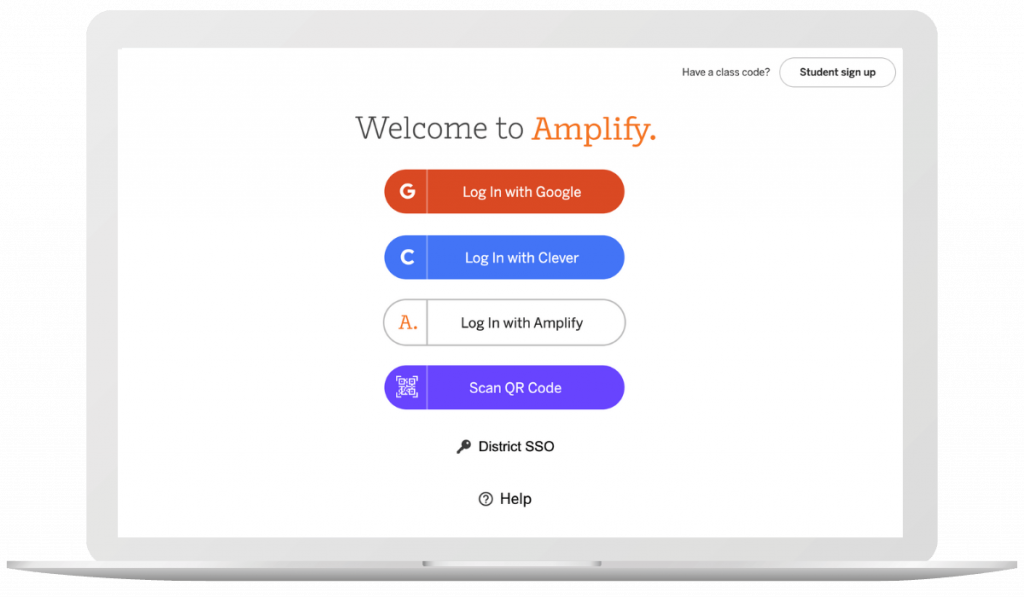
Follow the instructions below to access your demo account.
- Click the CKLA Demo button below.
- Select Log in with Amplify.
- To explore as a teacher, enter this username: t1.alaskareads@demo.tryamplify.net
- To explore as a student, enter this username: s1.alaskareads@demo.tryamplify.net
- Enter the password: Amplify1-alaskareads
- Click the Programs and apps menu
- Select CKLA Teacher Resource Site
- Select the desire grade level
Check out these additional resources
Amplify CKLA review resources:
- Correlations to the Alaska English Language Arts Standards
- CKLA Program Guide
- Text complexity in CKLA
- Trade books in CKLA
- Assessments in CKLA
- Remote and hybrid learning with CKLA
- Amplify CKLA Scopes and Sequences
- Grade K Skills and Knowledge
- Grade 1 Skills and Knowledge
- Grade 2 Skills and Knowledge
- Grade 3 Integrated
- Grade 4 Integrated
- Grade 5 Integrated
What is Amplify CKLA?
Amplify CKLA is a core ELA program for grades TK–5 that delivers:
- A unique research-based approach truly built on the Science of Reading.
- A combination of explicit foundational skills with meaningful knowledge-building.
- Embedded support and differentiation that gets all students reading grade-level texts together.
- Opportunities for students to see the strengths and experiences that all people share while also celebrating each others’ unique identities and experiences.
- Equitable and authentic Spanish language arts instruction with Amplify Caminos.
How does Amplify CKLA work?
Grades K–2: Dedicated knowledge-building and explicit skills instruction
Every day, students in Grades K–2 complete one full lesson that explicitly and systematically builds foundational reading skills in the Skills Strand, as well as one full lesson that builds robust background knowledge to access complex text in the Knowledge Strand. Through learning in each of these strands, students develop the early literacy skills necessary to help them become confident readers and build the context to understand what they’re reading.
Grades 3–5: Integrated instruction
In Grades 3–5, Knowledge and Skills are integrated in one set of instructional materials. Lessons begin to combine skills and knowledge with increasingly complex texts, close reading, and a greater writing emphasis. Students can then use their skills to go on their own independent reading adventures.
What makes Amplify CKLA different?
Built on the Science of Reading
Built out of the latest research in the Science of Reading, Amplify CKLA delivers explicit instruction in both foundational literacy skills (systematic phonics, decoding, and fluency) and background knowledge in grades K–2 with an integrated approach to explicit instruction in grades 3–5.
Review this Science of Reading toolkit to learn more about the Science of Reading best practices integrated throughout CKLA.
Explicit systematic skills instruction
Great reading instruction starts with helping kids develop great decoding skills. By building a solid foundation of phonological awareness and phonics, reading the words on the page becomes automatic so that comprehension and critical thinking can happen. Our instruction is supported by:
- Step-by-step lessons with multisensory approaches, clear lesson objectives, and embedded formative assessments.
- Decodable books and student readers with ebook and audiobook versions that feature interesting plots and relatable characters.
- An engaging sound library with fun songs and videos that develop phonological awareness.
- An interactive Vocab App featuring engaging activities with immediate feedback and automated, customized instruction based on student performance.
Coherent knowledge instruction
Students build grade-appropriate subject-area knowledge and vocabulary in history, science, literature, and the arts while learning to read, write, and think creatively and for themselves. Our instruction is supported by:
- Knowledge builders that provide a quick overview of each domain with its key ideas.
- Interactive Read-Alouds designed to build knowledge and vocabulary.
- Content-rich anchor texts that support students as they tackle increasingly complex text and sharpen their analytical skills.
- Social and emotional learning paired with lessons in civic responsibility.

Embedded differentiation for all learners
Amplify CKLA provides built-in differentiation strategies in every lesson for all students, including supports for English learners and Standard English learners.
- Access supports for ELs: Integrated ELD supports in each lesson segment
for English learners and Standard English learners are specific to students’ mastery of the lesson’s objectives. - Support and Challenge for all learners: Lessons include Support and Challenge suggestions that provide assistance or opportunities for more advanced work toward the goal of the lesson. These supports are suitable for all learners, including ELs.
- 30 minutes of Additional Support in every Skills lesson: In the Skills Strand, every lesson concludes with an Additional Support section of recommendations for 30 minutes of extended instruction and activities, directly aligned to the skills taught in the lesson to assist students who need more support in mastering the lesson’s objectives.
- Intervention Toolkit: The Intervention Toolkit provides easy-to-use resources to assist teachers in filling gaps in students’ foundational skills. Teachers will find of hundreds of activities to support phonics, fluency, comprehension, handwriting, and other key skills.
Designated ELD
Amplify CKLA’s designated English Language Development (ELD) component—Language Studio— helps English learners preview and revisit key content within core instruction, building a foundation of academic vocabulary and background knowledge. Core instruction lessons include point-of-use supports for English learners and Support and Challenge strategies for all learners.

Built on the California ELA/ELD Framework, our carefully developed program follows the CKLA Knowledge domains, previewing and reinforcing skills and content from core instruction using instruction specifically built for English learners. The program is also designed around frequent formative assessment, including assessment of language proficiency, giving you effective ways to guide and support your English learners.
Language Studio supports teachers and English learners through the following:
- 30 minutes of instruction with lesson segments are carefully designed around Content Knowledge, Meaning Making, Language Development, Effective Expression, and Foundational Skills.
- Every Language Studio lesson accompanies a core lesson, helping English learners deepen domain and academic vocabulary that will help them access core content.
- Culminating tasks support core projects and target the same skills as primary instruction.
Ready-to-go slides and all-in-one platform
The slides-based Amplify CKLA digital experience enhances instruction while saving you time. Everything you need is all in one place, making it easier than ever to plan lessons, present digital content, and review student work.
- Simplify planning and instruction: Teachers have access to ready-to-use and customizable lesson presentation slides, complete with all the prompts from the print Teacher Guide embedded in the teacher view. As teachers deliver each lesson, students can engage with the content in one cohesive
experience—through Activity Books, slides, digital components, videos, Student Readers, and more. - Interactive student activities: Through the Student Home, students can easily access digital lessons with slides, Activity Pages, ebooks, videos, and other interactive resources from one simple dashboard.
- Your teacher command center: You’re provided with the tools you need to ensure a productive digital experience that’s personalized to meet your students’ needs. This includes a teacher home from which to launch and track lessons, LMS integrations such as Google Classroom and Microsoft Teams, and other customizations based on classroom needs.
- Get real-time insights into your students’ work: The innovative live review tool enables you to keep an eye on students drawing, recording audio, uploading and capturing images, and typing or writing in pre-placed text boxes in their Activity Pages.
How does Amplify CKLA integrate with the other parts of the literacy system?
Amplify CKLA + mCLASS® with DIBELS® 8th Edition
Amplify CKLA integrates with your mCLASS assessment through the CKLA Connect feature, which matches your students with targeted CKLA lessons based on their mCLASS assessment data. In other words, it aligns your assessments more closely with your core curriculum while recommending effective differentiated instruction.
Amplify CKLA + Amplify Reading
Amplify Reading is the student-driven skill practice program within CKLA, providing differentiated, digital instruction in both foundational skills and comprehension strategies. Because Amplify Reading is built on the same approach to reading as CKLA, students are able to extend their learning from the core program further, at their own pace.
Amplify CKLA and Amplify Reading reinforce each other through:
- An aligned scope and sequence and instructional approach: In both probrams, students get instruction and practice in phonological awareness and phonics, with the most common, least ambiguous spellings first.
- Consistent vocabulary words: Many Amplify CKLA words are taught and practiced in Amplify Reading vocabulary games.
- Complementary texts: Fiction and nonfiction books within Amplify Reading reinforce Amplify CKLA knowledge domains.
- Seamless integrations between platforms: Students can easily access Amplify Reading directly from the Amplify CKLA Student Hub.
Navigating the program
Digital navigation walkthrough
Physical materials walkthrough
Check out these additional resources
Amplify CKLA review resources:
- CKLA Program Guide
- Diversity, equity, and inclusion in CKLA
- Text complexity in CKLA
- Trade books in CKLA
- Assessments in CKLA
- Remote and hybrid learning with CKLA
- Amplify ELA technical specifications
- Amplify CKLA Scopes and Sequences
- Grade K Skills and Knowledge
- Grade 1 Skills and Knowledge
- Grade 2 Skills and Knowledge
- Grade 3 Integrated
- Grade 4 Integrated
- Grade 5 Integrated
What is Amplify CKLA?
Amplify CKLA is a core ELA program for grades TK–5 that delivers:
- A unique research-based approach truly built on the Science of Reading.
- A combination of explicit foundational skills with meaningful knowledge-building.
- Embedded support and differentiation that gets all students reading grade-level texts together.
- Opportunities for students to see the strengths and experiences that all people share while also celebrating each others’ unique identities and experiences.
- Authentic Spanish language arts instruction with Amplify Caminos.

How does Amplify CKLA work?
Grades K–2: Dedicated knowledge-building and explicit skills instruction
Every day, students in Grades K–2 complete one full lesson that explicitly and systematically builds foundational reading skills in the Skills Strand, as well as one full lesson that builds robust background knowledge to access complex text in the Knowledge Strand. Through learning in each of these strands, students develop the early literacy skills necessary to help them become confident readers and build the context to understand what they’re reading.
Grades 3–5: Integrated instruction
In Grades 3–5, Knowledge and Skills are integrated in one set of instructional materials. Lessons begin to combine skills and knowledge with increasingly complex texts, close reading, and a greater writing emphasis. Students can then use their skills to go on their own independent reading adventures.
What makes Amplify CKLA different?
Built on the Science of Reading
Built out of the latest research in the Science of Reading, Amplify CKLA delivers explicit instruction in both foundational literacy skills (systematic phonics, decoding, and fluency) and background knowledge in grades K–2 with an integrated approach to explicit instruction in grades 3–5.
Review this Science of Reading toolkit to learn more about the Science of Reading best practices integrated throughout CKLA.
Explicit systematic skills instruction
Great reading instruction starts with helping kids develop great decoding skills. By building a solid foundation of phonological awareness and phonics, reading the words on the page becomes automatic so that comprehension and critical thinking can happen. Our instruction is supported by:
- Step-by-step lessons with multisensory approaches, clear lesson objectives, and embedded formative assessments.
- Decodable books and student readers with ebook and audiobook versions that feature interesting plots and relatable characters.
- An engaging sound library with fun songs and videos that develop phonological awareness.
- An interactive Vocab App featuring engaging activities with immediate feedback and automated, customized instruction based on student performance.
Coherent knowledge instruction
Students build grade-appropriate subject-area knowledge and vocabulary in history, science, literature, and the arts while learning to read, write, and think creatively and for themselves. Our instruction is supported by:
- Knowledge builders that provide a quick overview of each domain with its key ideas.
- Interactive Read-Alouds designed to build knowledge and vocabulary.
- Content-rich anchor texts that support students as they tackle increasingly complex text and sharpen their analytical skills.
- Social and emotional learning paired with lessons in civic responsibility.
Embedded differentiation for all learners
Amplify CKLA provides built-in differentiation strategies in every lesson for all students, including supports for English learners and Standard English learners.
- Access supports for ELs: Integrated ELD supports in each lesson segment
for English learners and Standard English learners are specific to students’ mastery of the lesson’s objectives. - Support and Challenge for all learners: Lessons include Support and Challenge suggestions that provide assistance or opportunities for more advanced work toward the goal of the lesson. These supports are suitable for all learners, including ELs.
- 30 minutes of Additional Support in every Skills lesson: In the Skills Strand, every lesson concludes with an Additional Support section of recommendations for 30 minutes of extended instruction and activities, directly aligned to the skills taught in the lesson to assist students who need more support in mastering the lesson’s objectives.
- Intervention Toolkit: The Intervention Toolkit provides easy-to-use resources to assist teachers in filling gaps in students’ foundational skills. Teachers will find of hundreds of activities to support phonics, fluency, comprehension, handwriting, and other key skills.
Designated ELD
Amplify CKLA’s designated English Language Development (ELD) component—Language Studio— helps English learners preview and revisit key content within core instruction, building a foundation of academic vocabulary and background knowledge. Core instruction lessons include point-of-use supports for English learners and Support and Challenge strategies for all learners.
Built on the California ELA/ELD Framework, our carefully developed program follows the CKLA Knowledge domains, previewing and reinforcing skills and content from core instruction using instruction specifically built for English learners. The program is also designed around frequent formative assessment, including assessment of language proficiency, giving you effective ways to guide and support your English learners.
Language Studio supports teachers and English learners through the following:
- 30 minutes of instruction with lesson segments are carefully designed around Content Knowledge, Meaning Making, Language Development, Effective Expression, and Foundational Skills.
- Every Language Studio lesson accompanies a core lesson, helping English learners deepen domain and academic vocabulary that will help them access core content.
- Culminating tasks support core projects and target the same skills as primary instruction.
Ready-to-go slides and all-in-one platform
The slides-based Amplify CKLA digital experience enhances instruction while saving you time. Everything you need is all in one place, making it easier than ever to plan lessons, present digital content, and review student work.
- Simplify planning and instruction: Teachers have access to ready-to-use and customizable lesson presentation slides, complete with all the prompts from the print Teacher Guide embedded in the teacher view. As teachers deliver each lesson, students can engage with the content in one cohesive
experience—through Activity Books, slides, digital components, videos, Student Readers, and more. - Interactive student activities: Through the Student Home, students can easily access digital lessons with slides, Activity Pages, ebooks, videos, and other interactive resources from one simple dashboard.
- Your teacher command center: You’re provided with the tools you need to ensure a productive digital experience that’s personalized to meet your students’ needs. This includes a teacher home from which to launch and track lessons, LMS integrations such as Google Classroom and Microsoft Teams, and other customizations based on classroom needs.
- Get real-time insights into your students’ work: The innovative live review tool enables you to keep an eye on students drawing, recording audio, uploading and capturing images, and typing or writing in pre-placed text boxes in their Activity Pages.
How does Amplify CKLA integrate with the other parts of the literacy system?
Amplify CKLA + mCLASS® with DIBELS® 8th Edition
Amplify CKLA integrates with your mCLASS assessment through the CKLA Connect feature, which matches your students with targeted CKLA lessons based on their mCLASS assessment data. In other words, it aligns your assessments more closely with your core curriculum while recommending effective differentiated instruction.

Amplify CKLA + Amplify Reading
Amplify Reading is the student-driven skill practice program within CKLA, providing differentiated, digital instruction in both foundational skills and comprehension strategies. Because Amplify Reading is built on the same approach to reading as CKLA, students are able to extend their learning from the core program further, at their own pace.
Amplify CKLA and Amplify Reading reinforce each other through:
- An aligned scope and sequence and instructional approach: In both probrams, students get instruction and practice in phonological awareness and phonics, with the most common, least ambiguous spellings first.
- Consistent vocabulary words: Many Amplify CKLA words are taught and practiced in Amplify Reading vocabulary games.
- Complementary texts: Fiction and nonfiction books within Amplify Reading reinforce Amplify CKLA knowledge domains.
- Seamless integrations between platforms: Students can easily access Amplify Reading directly from the Amplify CKLA Student Hub.

Navigating the program
Digital navigation walkthrough
Physical materials walkthrough
Sample materials
Demo access

Follow the instructions below to access your demo account.
- Click the CKLA and Caminos Demo button below.
- Select Log in with Amplify.
- To explore as a teacher, enter this username: t1.westadackla@demo.tryamplify.net
- To explore as a student, enter this username: s1.westadackla@demo.tryamplify.net
- Enter the password: Amplify1-westadackla
- Click the Programs and apps menu
- Select CKLA Teacher Resource Site
- Select the desire grade level
- Use the toggle to switch between English (CKLA) and Spanish (Caminos) resources.
Note: Your demo account access expires on January 19, 2023.
Check out these additional resources
Amplify CKLA review resources:
- CKLA Program Guide
- Text complexity in CKLA
- Trade books in CKLA
- Assessments in CKLA
- Remote and hybrid learning with CKLA
- Amplify ELA technical specifications
- Amplify CKLA Scopes and Sequences
- Grade K Skills and Knowledge
- Grade 1 Skills and Knowledge
- Grade 2 Skills and Knowledge
- Grade 3 Integrated
- Grade 4 Integrated
- Grade 5 Integrated
- Corrleations to the Idaho Content Standards English Language Arts/Literacy
The High-Impact Tutoring Implementation Workshop Series
Welcome!
As the 2021-2022 school year continues to pose new challenges, you’re likely thinking about making your classroom responsive to student needs due to the covid-19 pandemic.
- CLRT in Amplify Science
- SEL in Amplify Science
- Responsive Relaunch Introduction Video
- Responsive Relaunch NYC Brief
Got additional questions? Use Zoom to attend office hours with Nadya Awadallah, the DOE’s Elementary Science Lead on Fridays from 12-1pm.
Meeting ID: 835 9458 3142
Passcode: 263518
NYC Newsletters
- February 2022
- January 2022
- December 2021
- October 2021
- September 2021
- June 2021
- May 2021
- April 2021
- March 2021
- February 2021
- January 2021
- December 2020
- October 2020
Educator Spotlight Submission
Calling all NYC DOE educators! Do you know an educator who has gone above and beyond? Would you like to highlight your teaching experience for others? Submit nominations here to see them featured as a spotlight in a future edition of our monthly newsletter and on our Instagram pages!
Introduction
This page includes planning, implementation, and professional learning resources for NYC schools using Amplify Science. Please take a moment to familiarize yourself with the categories in the navigation bar on the left side of the page so that you’ll be able to easily find what you need.
Most New York City educators come here looking for specific information, but if you’re new to Amplify Science, we recommend you read through the program guide to learn a little about the program.
New to Amplify? – Start HERE!
Teachers and Administrators
Step 1: Review the Amplify Science Navigation Essentials K-5 Video
Step 2: Review your Scope and sequence/course structure calendar
Step 3: Review the Unpacking the Kit Videos listed below to understand what’s in your unit 1 kit
Step 4: Access your unique log in information to log-in to the Amplify Science Curriculum outlined below under Login support
Step 5: Log into the platform and access our Program Hub. Select Using this site for self study for a complete suite of training videos and resources for an initial orientation video series
Step 6: Log into the curriculum and begin studying the Unit Map and Teacher’s Guide resources and begin planning your first lesson. Print out the NYC Program Guide for essential program information.
Step 7: Administrator’s ONLY – Review the K-5 Admin Orientation presentation for an overview on the program. Review materials under Admin Resources.
NOTE: Should you need any additional guidance on how to get started with prep (or anything else!), please feel free to get in touch with our pedagogical support team. They are available Monday-Friday from 7AM-7PM EST. You can reach them via the chat icon in the lower right- hand corner of your screen when logged in, through email (help@amplify.com), or via phone (800-823-1969).
Getting started resources
NYC Resource Site overview – quick links
Login support
- Login video: classroom teacher login via Amplify
- Classroom teachers: Login with Amplify or TeachHub (district preferred login method)
- Cluster teachers: Login with Amplify
- K-5 administrators: Login with Amplify or TeachHub (district preferred login method)
- K-5 students: Shared student logins login with Amplify
- Other staff (co-teachers, ICT, etc.): Administrator instructions for creating a Shared Teacher Login
Materials
- Materials lists – lists of kit contents by unit
K | 1 | 2 | 3 | 4 | 5 - Spanish materials lists – lists of Spanish print kit contents by unit
K | 1 | 2 | 3 | 4 | 5 - Kit-level packing detail (chart) – high-level information regarding kits including dimensions, weights, etc.
Unpacking your first Amplify Science classroom kit
All Amplify Science units coming with kits that include hands-on and print materials. The number of boxes (sometimes referred to as “tubs”) varies depending on the unit.
- Kindergarten: Needs of Plants and Animals
- Grade 1: Plant and Animal Defenses
- Grade 2: Animal and Plant Relationships
- Grade 3: Balancing Forces
- Grade 4: Energy Conversion
- Grade 5: Patterns of Earth and Sky
21-22 Login Update
The temporary login credentials for fall ’21 have been deactivated.
Please make sure you check out the Getting started resources > Login support below for instructions around teacher and the NYC shared student logins.
If there are any issues, please confirm with your STARS programmer that your classes are finalized and then contact the Amplify Help Desk at help@amplify.com or at 1-800-823-1969.
Planning and implementation resources
Use our NYC Field Trip List to plan an engaging field trip for your students!
Use the resources below to plan out your year and ensure you are teaching each standard to mastery.
- K–5 Course Structure Calendar
- Planning and Implementation Guide – Kindergarten
- Planning and Implementation Guide – Grade 1
- Planning and Implementation Guide – Grade 2
- Planning and Implementation Guide – Grade 3
- Planning and Implementation Guide – Grade 4
- Planning and Implementation Guide – Grade 5
NYC DOE Supplemental Guiding Documents: Curriculum Gaps
- Grade K Curriculum Gaps
- Grade 3 Curriculum Gaps
- “Where do we find water on Earth?” slideshow (Unit 3, L. 1 of 2)
- Water Cycle Lesson (Unit 3, L. 2 of 2)
- Grade 4 Curriculum Gaps
- Water Cycle Powerpoint (Ch.1, L. 1)
Admin resources
- Implementation Rubric
- Look-for Tool (1 page)
- Look-for Tool (3 pages)
- NYC Resource Site overview – quick links
- Introduction to Amplify Science for Administrators K-5 Webinar
- 2021 Fall Administrators’ Orientation: Introduction to K-5 Amplify Science Participant notebook and presentation
- 2021 Spring Utilizing the Amplify Science Assessment System Webinar
- 2020 Summer New Administrator Orientation Agenda, Presentation, Webinar, and Participant Notebook
- 2020 Summer Returning Administrator Orientation Agenda, Presentation, and Webinar
Remote and hybrid learning resources
In response to the shifts towards remote learning, Amplify has created resources for using our programs remotely. Please visit our Program Hub accessible via your Teacher Platform for all of our hybrid and remote learning supports which includes guidance for teachers and parents/guardians.
Additionally, please see below where you’ll find the recordings from our recently held webinars on our remote learning resources and some best practices for implementing Amplify Science in a distance learning setting.
Resource guides
On-demand remote learning videos
Professional Learning Opportunities
Interested in attending training? Check out and sign up for this year’s PL offerings here!
All 2021-2022 PL session materials will be uploaded below under Professional learning resources.
Amplify Science Back-to-School Recorded Webinars – Amplify held a series of national office hours throughout the summer and fall to share information about our new resources to support remote and hybrid learning– including recommendations about what to prioritize from your curriculum and essential refresher topics, such as how to navigate your program and find the best planning resources. Feel free to watch all recorded sessions at your convenience.
21-22 Professional learning resources
Fall 2021 materials:
- Make Science Accessible for All Learners K-2 Presentation
- Three-Dimensional Learning in Amplify Science: Kindergarten Agenda, K Presentation, Participant notebook, and Webinar
Summer 2021 materials:
- Exploring the Amplify Science K-2 Presentation pt.1, pt. 2, pt. 3, and Participant notebook
- Exploring the Amplify Science K-2 Curriculum Webinar: Digging Deeper Presentation and Participant notebook
Fall 2021 materials:
- Make Science Accessible for All Learners K-2 Presentation
- Three-Dimensional Learning in Amplify Science: 1st Grade Agenda, Grade 1 Presentation, Participant notebook, and Webinar,
Summer 2021 materials:
- Exploring the Amplify Science K-2 Presentation pt.1, pt. 2, pt. 3, and Participant notebook
- Exploring the Amplify Science K-2 Curriculum Webinar: Digging Deeper Presentation and Participant notebook
Fall 2021 materials:
- Make Science Accessible for All Learners K-2 Presentation
- Three-Dimensional Learning in Amplify Science: 2nd Grade Agenda, Grade 2 Presentation, Participant notebook, and Webinar
Summer 2021 materials:
- Exploring the Amplify Science K-2 Presentation pt.1, pt. 2, pt. 3, and Participant notebook
- Exploring the Amplify Science K-2 Curriculum Webinar: Digging Deeper Presentation and Participant notebook
Fall 2021 materials:
- Make Science Accessible for All Learners 3-5 Presentation
- Three-Dimensional Learning in Amplify Science: 3rd Grade Agenda, Grade 3 Presentation, Participant notebook, and Webinar
Summer 2021 materials:
- Exploring the Amplify Science 3-5 Curriculum Presentation pt.1, pt. 2, pt. 3, and Participant notebook
- Exploring the Amplify Science 3-5 Curriculum Webinar: Digging Deeper Presentation and Participant notebook
Fall 2021 materials:
- Make Science Accessible for All Learners 3-5 Presentation
- Three-Dimensional Learning in Amplify Science: 4th Grade Agenda, Grade 4 Presentation, Participant notebook, and Webinar
Summer 2021 materials:
- Exploring the Amplify Science 3-5 Curriculum Presentation pt.1, pt. 2, pt. 3, and Participant notebook
- Exploring the Amplify Science 3-5 Curriculum Webinar: Digging Deeper Presentation and Participant notebook
Fall 2021 materials:
- Make Science Accessible for All Learners 3-5 Presentation
- Three-Dimensional Learning in Amplify Science: 5th Grade Agenda, Grade 5 Presentation, Participant notebook, and Webinar
Summer 2021 materials:
- Exploring the Amplify Science 3-5 Curriculum Presentation pt.1, pt. 2, pt. 3, and Participant notebook
- Exploring the Amplify Science 3-5 Curriculum Webinar: Digging Deeper Presentation and Participant notebook
20-21 Professional learning resources
Winter 2021 materials:
- K-2 Introduction to Amplify Science Webinar, Agenda and Presentation
- Unit 3: Supporting Diverse Learner Needs Webinar, Agenda, K Presentation, and Participant workspace
- Unit 3: Focusing on the Assessment System Webinar, Agenda and K Presentation
- Supporting ELLs in the Amplify Science Classroom Agenda, Presentation, and Webinar
- Analyzing Student Assessment Data Agenda and K Presentation
Fall 2020 materials:
- Accessing Complex Texts Webinar, Agenda, K Presentation, and Participant Notebook
- Unit 2: Understanding the Storyline & Coherence Webinar, Agenda, Presentation, Planning Doc, and Note catcher (Election Day PL)
- Unit 2: Guided Unit Internalization with @Home Resources Presentation and Planning Doc (Election Day PL)
- Teaching with Technology Webinar with Agenda and K Presentation
- Amplify@Home Planning Tool – Teaching with Technology
- The Amplify Science Approach: Practicing Multiple-Modalities & 3-Dimensional LearningWebinar with Agenda and Grade K Presentation
- Practicing Multiple-Modalities & 3-Dimensional Learning Participant Notebook
- Academic Discourse & Questioning Strategies in the Amplify Science ClassroomAgenda and Grade K Presentation
- Academic Discourse & Questioning Strategies Participant Materials
Summer 2020 materials:
- Remote and Hybrid LearningAgenda with K Presentation
- Amplify@Home Planning Tool and Amplify@Home Note Catcher
- Grades K-1 Utilizing Program Assessments Effectively Webinar
- Reaching All Learners for Grades K-1 Webinar
- Kindergarten New Teacher Orientation Webinar with Participant Notebook
- Kindergarten Returning Teacher Remote Learning: Guided Planning Workshop Webinar
Winter 2021 materials:
- K-2 Introduction to Amplify Science Webinar, Agenda and Presentation
- Unit 3: Supporting Diverse Learner Needs Webinar, Agenda, 1st Grade Presentation, and Participant workspace
- Supporting ELLs in the Amplify Science Classroom Agenda, Presentation, and Webinar
- Unit 3: Focusing on the Assessment System Webinar, Agenda and 1st Grade Presentation
- Analyzing Student Assessment Data Agenda and 1st Grade Presentation
Fall 2020 materials:
- Accessing Complex Texts Webinar, Agenda, 1st Grade Presentation, and Participant Notebook
- Unit 2: Understanding the Storyline & Coherence Agenda, Presentation, Planning Doc, and Note catcher (Election Day PL)
- Unit 2: Guided Unit Internalization with @Home Resources Presentation and Planning Doc (Election Day PL)
- Teaching with Technology Webinar with Agenda and Grade 1 Presentation
- Amplify@Home Planning Tool – Teaching with Technology
- The Amplify Science Approach: Practicing Multiple-Modalities & 3-Dimensional LearningAgenda and Grade 1 Presentation
- Practicing Multiple-Modalities & 3-Dimensional Learning Participant Notebook
- Academic Discourse & Questioning Strategies in the Amplify Science ClassroomWebinar, Agenda and Grade 1 Presentation
- Academic Discourse & Questioning Strategies Participant Materials
Summer 2020 materials:
- Remote and Hybrid LearningAgenda with Grade 1 Presentation
- Amplify@Home Planning Tool and Amplify@Home Note Catcher
- Grades K-1 Utilizing Program Assessments Effectively Webinar
- Reaching All Learners for Grades K-1 recorded webinar
- Grade 1 New Teacher Orientation Webinar with Participant Notebook
- Grade 1 Returning Teacher Remote Learning: Guided Planning Workshop Webinar
Winter 2021 materials:
- K-2 Introduction to Amplify Science Webinar, Agenda and Presentation
- Unit 3: Supporting Diverse Learner Needs Webinar, Agenda, 2nd Grade Presentation, and Participant workspace
- Unit 3: Focusing on the Assessment System Webinar, Agenda and 2nd Grade Presentation
- Supporting ELLs in the Amplify Science Classroom Agenda and Presentation
- Analyzing Student Assessment Data Agenda and 2nd Grade Presentation
Fall 2020 materials:
- Accessing Complex Texts Agenda, 2nd Grade Presentation, and Participant Notebook
- Unit 2: Understanding the Storyline & Coherence Agenda, Presentation, Planning Doc, and Note catcher (Election Day PL)
- Unit 2: Guided Unit Internalization with @Home Resources Presentation and Planning Doc (Election Day PL)
- Teaching with TechnologyWebinar with Agenda and Grade 2 Presentation
- Amplify@Home Planning Tool – Teaching with Technology
- The Amplify Science Approach: Practicing Multiple-Modalities & 3-Dimensional LearningWebinar with Agenda and Grade 2 Presentation
- Practicing Multiple-Modalities & 3-Dimensional Learning Participant Notebook
- Academic Discourse & Questioning Strategies in the Amplify Science ClassroomWebinar with Agenda and Grade 2 Presentation
- Academic Discourse & Questioning Strategies Participant Materials
Summer 2020 materials:
- Remote and Hybrid LearningAgenda with Grade 2 Presentation
- Amplify@Home Planning Tool and Amplify@Home Note Catcher
- K-5 New Teacher Orientation with Participant Notebook
- Grades 2-3 Utilizing Program Assessments Effectively Webinar
- Reaching All Learners for Grades 2-3 Webinar
- Grade 2 Returning Teacher Remote Learning: Guided Planning Workshop Webinar
Spring 2021 materials:
- Unit 4: Focusing on Evidence of Learning for New Teachers Webinar
Winter 2021 materials:
- Grades 3-5 Introduction to Amplify Science Agenda and Presentation
- Unit 3: Supporting Diverse Learner Needs Webinar, Agenda, 3rd Grade Presentation, and Participant workspace
- Unit 3: Focusing on the Assessment System Webinar, Agenda and 3rd Grade Presentation
- Supporting ELLs in the Amplify Science Classroom Agenda and Presentation
- Analyzing Student Assessment Data Agenda and 3rd Grade Presentation
Fall 2020 materials:
- Progress Builds and Embedded Assessments Webinar
- Accessing Complex Texts Agenda, 3rd Grade Presentation, and Participant Notebook
- Unit 2: Understanding the Storyline & Coherence Agenda, Presentation, Planning Doc, and Note catcher (Election Day PL)
- Unit 2: Guided Unit Internalization with @Home Resources Presentation and Planning Doc (Election Day PL)
- Teaching with TechnologyWebinar with Agenda and Grade 3 Presentation
- Amplify@Home Planning Tool – Teaching with Technology
- The Amplify Science Approach: Practicing Multiple-Modalities & 3-Dimensional LearningAgenda and Grade 3 Presentation
- Practicing Multiple-Modalities & 3-Dimensional Learning Participant Notebook
- Academic Discourse & Questioning Strategies in the Amplify Science ClassroomWebinar, Agenda and Grade 3 Presentation
- Academic Discourse & Questioning Strategies Participant Materials
Summer 2020 materials:
- Remote and Hybrid LearningAgenda with Grade 3 Presentation
- Amplify@Home Planning Tool and Amplify@Home Note Catcher
- Grade 3 New Teacher Orientation Webinar with Participant Notebook
- Grades 2-3 Utilizing Program Assessments Effectively Webinar
- Reaching All Learners for Grades 2-3 Webinar
- Grade 3 Returning Teacher Remote Learning: Guided Planning Workshop Webinar
Winter 2021 materials:
- Grades 3-5 Introduction to Amplify Science Agenda and Presentation
- Unit 3: Supporting Diverse Learner Needs Agenda, 4th Grade Presentation, and Participant workspace
- Supporting ELLs in the Amplify Science Classroom Agenda, Presentation, and Webinar
- Unit 3: Focusing on the Assessment System Webinar, Agenda and 4th Grade Presentation
- Analyzing Student Assessment Data Agenda and 4th Grade Presentation
Fall 2020 materials:
- Accessing Complex Texts Webinar, Agenda, 4th Grade Presentation, and Participant Notebook
- Unit 2: Understanding the Storyline & Coherence Agenda, Presentation, Planning Doc, and Note catcher (Election Day PL)
- Unit 2: Guided Unit Internalization with @Home Resources Webinar, Presentation and Planning Doc (Election Day PL)
- Teaching with TechnologyWebinar, Agenda and Grade 4 Presentation
- Amplify@Home Planning Tool – Teaching with Technology
- The Amplify Science Approach: Practicing Multiple-Modalities & 3-Dimensional LearningWebinar with Agenda and Grade 4 Presentation
- Practicing Multiple-Modalities & 3-Dimensional Learning Participant Notebook
- Academic Discourse & Questioning Strategies in the Amplify Science ClassroomAgenda and Grade 4 Presentation
- Academic Discourse & Questioning Strategies Participant Materials
Summer 2020 materials:
- Remote and Hybrid LearningAgenda with Grade 4 Presentation
- Amplify@Home Planning Tool and Amplify@Home Note Catcher
- Grade 4 New Teacher Orientation Webinar with Participant Notebook
- Grades 4-5 Utilizing Program Assessments Effectively Webinar
- Reaching All Learners for Grades 4-5 Webinar
- Grade 4 Returning Teacher Remote Learning: Guided Planning Workshop Webinar
Winter 2021 materials:
- Grades 3-5 Introduction to Amplify Science Agenda and Presentation
- Unit 3: Supporting Diverse Learner Needs Webinar, Agenda, 5th Grade Presentation, and Participant workspace
- Unit 3: Focusing on the Assessment System Webinar, Agenda and 5th Grade Presentation
- Analyzing Student Assessment Data Webinar, Agenda, 5th Grade Presentation, and Webinar
- Supporting ELLs in the Amplify Science Classroom Agenda and Presentation
Fall 2020 materials:
- Teaching with TechnologyAgenda and Grade 5 Presentation
- Amplify@Home Planning Tool – Teaching with Technology
- The Amplify Science Approach: Practicing Multiple-Modalities & 3-Dimensional LearningWebinar with Agenda and Grade 5 Presentation
- Practicing Multiple-Modalities & 3-Dimensional Learning Participant Notebook
- Academic Discourse & Questioning Strategies in the Amplify Science ClassroomWebinar, Agenda and Grade 5 Presentation
- Academic Discourse & Questioning Strategies Participant Materials
Summer 2020 materials:
- Remote and Hybrid LearningAgenda with Grade 5 Presentation
- Amplify@Home Planning Tool and Amplify@Home Note Catcher
- Grade 5 New Teacher Orientation Webinar with Participant Notebook
- Grades 4-5 Utilizing Program Assessments Effectively Webinar
- Reaching All Learners for Grades 4-5 Webinar
- Grade 5 Returning Teacher Remote Learning: Guided Planning Workshop Webinar
19-20 Professional learning resources
Summer 2019 materials:
- Needs of Plants and Animals (Year 1 schools)
- Needs of Plants and Animals (Year 2 schools)
Fall 2019 materials:
- Pushes and Pulls (Year 1 schools) with Participant Notebook
- Pushes and Pulls (Year 2 schools) with Participant Notebook
Spring 2020 materials:
- Reaching ALL Learners: Utilizing Program Assessments Effectively in Grades K & 1 – Participant Notebook
Summer 2019 materials:
- Animal and Plant Defenses (Year 1 schools)
- Animal and Plant Defenses (Year 2 schools)
Fall 2019 materials:
- Light and Sound (Year 1 schools) with Participant Notebook
- Light and Sound (Year 2 schools) with Participant Notebook
Spring 2020 materials:
- Reaching ALL Learners: Utilizing Program Assessments Effectively in Grades K & 1 – Participant Notebook
Summer 2019 materials:
- Plant and Animal Relationships (Year 1 schools)
- Plant and Animal Relationships (Year 2 schools)
Fall 2019 materials:
- Properties of Materials (Year 1 schools) with Participant Notebook
- Properties of Materials (Year 2 schools) with Participant Notebook
Spring 2020 materials:
- Reaching ALL Learners: Utilizing Program Assessments Effectively in Grades 2 & 3 – Participant Notebook
Summer 2019 materials:
- Balancing Forces (Year 1 schools)
- Balancing Forces (Year 2 schools)
Fall 2019 materials:
- Inheritance and Traits (Year 1 schools) with Participant Notebook
- Inheritance and Traits (Year 2 schools) with Participant Notebook
Spring 2020 materials:
- Reaching ALL Learners: Utilizing Program Assessments Effectively in Grades 2 & 3 – Participant Notebook
Summer 2019 materials:
- Energy Conversions (Year 1 schools)
- Energy Conversions (Year 2 schools)
Fall 2019 materials:
- Vision and Light (Year 1 schools) with Participant Notebook
- Vision and Light (Year 2 schools) with Participant Notebook
Summer 2019 materials:
- Patterns of Earth and Sky (Year 1 schools)
- Patterns of Earth and Sky (Year 2 schools)
Fall 2019 materials;
- Modeling Matter (Year 1 schools) with Participant Notebook
- Modeling Matter (Year 2 schools) with Participant Notebook
Caregiver Resources
Caregiver letters – information about Next Generation Science Standards by grade level
Questions
For general questions about the Amplify program (navigation, pedagogy, login), please reach out:
Email – scihelp@amplify.com
Phone – call toll-free at (800) 823-1969, Monday to Friday 7 a.m.–7 p.m. ET
Amplify Chat – click the Amplify Chat icon within the individual teacher account
Vulnerability Disclosure Policy
As a provider of technology solutions to schools, Amplify’s commitment to data privacy and security is essential to our organization. Amplify demonstrates that commitment in part through the physical, technical, and administrative safeguards we maintain to protect student data and other sensitive information entrusted to our care.
Amplify looks forward to working with the security community to find security vulnerabilities and support our efforts to keep our data and systems safe and secure.
Before reporting a vulnerability, please read our program rules, eligibility overview, report submission rules and guidelines, legal terms, and out-of-scope list set out below.
General Rules
- We appreciate reports on any Amplify-owned asset, but only vulnerabilities that prove to be outside of expected behavior are eligible for acceptance.
- Reports involving third party services or providers not under Amplify’s control are out-of-scope for submission.
- Amplify places a high priority on privacy. Vulnerabilities in the areas of inadvertent exposure of our customers’ personally identifiable information (PII) are considered to be of Critical severity.
- We classify vulnerability severity per CVSS (the Common Vulnerability Scoring Standard). These are general guidelines, and the ultimate decision over a reward – whether to give one and in what amount – is a decision that lies entirely within our discretion on a case-by-case basis.
- In order to receive an award for validated reports, you must have a HackerOne account. Please note reward decisions are subject to the discretion of Amplify. Please note these are general guidelines, and that reward decisions are subject to the discretion of Amplify.
- Only interact with test accounts that you created via self sign-up or were provided by Amplify. The use of any credentials outside of these areas for testing purposes, including legacy credentials supplied through the program and leaked credentials from third parties is strictly prohibited.
- Do not contact Amplify’s customer support for questions or to submit a vulnerability report.
- Amplify may, in its sole discretion, disqualify you if you breach this policy or fail to comply with any of the program’s rules and terms.
- Amplify reserves the right to cancel or modify this program without notice at any time.
Eligibility
- You are not eligible for participation if you 1) are employed by Amplify or any of its affiliates 2) are an immediate family member of a person employed by Amplify or any of its affiliates or 3) left the employment of Amplify or its affiliates or subsidiaries within the past (12) months.
- You are not eligible for participation if you have been prohibited in writing from participating in the Bug Bounty Program by Amplify at any time.
- You may not be in violation of any national, state, or local law or regulation with respect to any activities directly or indirectly related to conducting your tests.
- You may not compromise the privacy or safety of our customer and the operation of our services;
- You may not cause harm to Amplify, our customers, or others;
- You must follow the policy guidelines to responsibly disclose vulnerabilities to Amplify.
Vulnerability Submission Rules & Guidelines
- Any testing conducted on customer data or accounts is strictly prohibited and will result in removal from the program.
- If during the course of testing you encounter any sensitive data outside of your test accounts (including student or teacher names, login info, assessment data, activity data, and student work, etc.), please cease testing immediately and report what you have found. DO NOT include any text, screenshots, etc. with PII in the report. This action safeguards both potentially vulnerable data and yourself.
- Do not access, download, or share any data you encounter in your testing.
- Only interact with test accounts that you created or that we provided. The use of any credentials outside of these areas for testing purposes is strictly prohibited.
- Provide detailed reports with reproducible steps. If the report is not detailed enough to reproduce the issue, the issue will not be eligible for a reward.
- In some cases, you may not have all of the context information to assess the impact of a vulnerability. If you’re unsure of the direct impact but are reasonably certain that you have identified a vulnerability, we encourage you to submit a detailed report and state the open questions on impact.
- When duplicate submissions for the same vulnerability occur, we only award the first report that was received, provided that it can be fully reproduced.
- Multiple reports describing the same vulnerability against multiple assets or endpoints must be submitted within a single report.
- Avoid destruction of data and interruption or degradation of our service.
- Proof of Concept (POC) videos that do not include PII are highly recommended to help verify the issue, provide clarity, and save time on triage.
- Please provide timely responses to any follow-up questions and requests for additional information.
- Understand that there could be submissions for which we accept the risk, have other compensating controls, or will not address in the manner expected. When this happens, we will act as transparently as we can to provide you with the necessary context as to how the decision was made.
- Reports submitted using methods that violate policy rules will not be accepted and may result in account suspension from/denial of entrance to the program.
- Please refer to any noted out-of-scope areas listed under Out-of-Scope Vulnerabilities.
Out-of-Scope Vulnerabilities
When reporting vulnerabilities, please consider (1) attack scenario / exploitability, and (2) security impact of the bug. The following issues are considered out-of scope. In addition, please refer to any noted Out of Scope areas listed under the program assets.
- Social engineering (e.g. phishing, vishing, smishing) is prohibited.
- Clickjacking on pages with no sensitive actions.
- Unauthenticated/logout/login CSRF.
- Attacks requiring MITM or physical access to a user’s device.
- Previously known vulnerable libraries without a working Proof of Concept.
- Comma Separated Values (CSV) injection without demonstrating a vulnerability.
- Missing best practices in SSL/TLS configuration.
- Any activity that could lead to the disruption of our service (DoS).
- Content spoofing and text injection issues without showing an attack vector/without being able to modify HTML/CSS.
- XSRF that requires the knowledge of a secret.
- Automated tools that could generate significant traffic and possibly impair the functioning of our services.
- Testing or demonstrating the ability to upload unlimited audio/video files to exhaust resources.
- Leaked credentials from third party providers, including invalid or stale employee credential dumps, and/or leaked personal information of Amplify staff.
- Leaked credentials for Amplify customers not caused by vulnerabilities in our systems.
- Vulnerabilities identified via third party services or providers where Amplify is not the owner.
- Issues that merely result in spam/annoyance without additional impact (e.g sending emails without sufficient rate limiting)
- Attempts to access our offices or data centers.
- Any activity that could contribute to the disruption of our service (DoS). Automated scanning tests should be kept to 10 requests per second or less.
- Self XSS.
- Broken links and/or crashes in general.
- Issues that require unlikely user interaction.
- Issues that do not affect the latest version of modern browsers
- Issues that require physical access to a victim’s computer/device.
- Disclosure of information that does not present a significant risk
- Please refer to any noted out-of-scope areas listed under program assets.
Legal
- Any information you receive or collect about us, our affiliates or any of our users, employees or agents in connection with the Bug Bounty Program (“Confidential Information”) must be kept confidential and only used in connection with the Bug Bounty Program. You may not use, disclose or distribute any such Confidential Information, including without limitation any information regarding your Submission, without our prior written consent. You must get written consent by submitting a disclosure request through the HackerOne platform.
- Researchers must follow HackerOne’s disclosure guidelines. Public disclosure or disclosure to other third parties without the explicit permission of Amplify is prohibited.
- We will not take legal action against you if vulnerabilities are found and responsibly reported in compliance with all of the terms and conditions outlined in this policy.
- Amplify reserves the right to modify the terms and conditions of this program without notice at any time, and your participation in the Program constitutes acceptance of all terms.
Submit Vulnerability Report
Exciting updates are coming for Desmos Math 6–A1!
As you return to school in 2023, Desmos Math 6–A1 will be releasing new and exciting features that save you time, extend your reach, and support you with delivering grade-level math to all students.
Collaborate on collections
We love connection and creativity for students and teachers. Now, teachers can work together to collaboratively create collections of activities. Get your whole department involved! To get started, find the dropdown menu in your collection and select “manage editors.” Add as many editors as you want, then dive in.
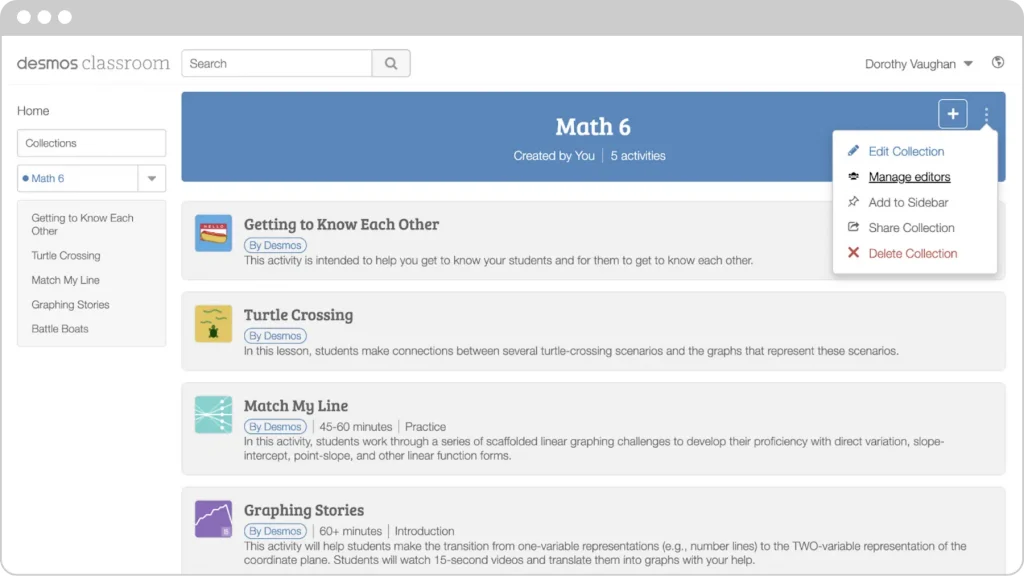
Algebra 1 is now available
Students can now meet the complete cast of Algebra 1 characters, from Shelley the Snail to Carlos’s fish, while deepening their understanding of algebraic relationships, functions, and statistics.

Hablamos español!
The full Desmos 6–A1 curriculum is available in Spanish. To access, click on the globe icon in the top right-hand corner and select Español (LATAM).
Beautiful new design updates
We’ve updated the appearance of our entire digital platform to provide a cohesive experience for users across Amplify and Desmos Classroom. We’re continuing to improve accessibility while considering use of color, contrast, font sizes, text spacing, and hierarchy. These exciting navigation updates will mean an updated look and feel. You’ll still be able to access every feature you know, plus more!

New features you can add to your lessons
Polypad
Using Polypad inside Desmos Math 6–A1 activities is easy—just add a Polypad component! You can start by creating Polypad content, or easily importing pre-made Polypad content.
Learn more in our latest Polypad Pointer video:
Challenge Creator
Add a social and creative experience to lessons with Challenge Creator! Teachers can now design their own challenges for students to create, share, and discuss ideas in activities. Check out our activity or try building your own.

Students can now share their thinking in more ways!
With our improved Free Response components, students can now share responses using text, uploaded images, or recorded audio.

Live chat support
If you need help, just click on the Amplify chat icon in the button right-hand corner of your screen. You can ask a question or share your feedback. Our team is here to help you!
Amplify Desmos Math California
Welcome, Algebra 1 Reviewers!
We’re honored to introduce you to Amplify Desmos Math California. We’re confident you’ll find this comprehensive program to be a powerful tool for bringing the vision of the California Math Framework to life in classrooms across the state.
Please start with the video on the right to learn how to navigate the program and access key features referenced within our submission. Below you’ll find additional resources to support your review.
Your Review Samples
As a curriculum that incorporates both print and digital resources, it’s important that you explore both our physical materials (delivered to you in grade-specific tubs) and our digital materials (accessible through our platform). We invite you to explore both types of resources using the instructions and tips below.
Print Samples
Your print samples should have arrived in grade-specific tubs with a copy of your Reviewer Binder contained within the Algebra 1 shipping box. As you begin the process of organizing your materials, please refer to the inventory checklist found inside the tub as well as within your Reviewer Binder.
Digital Samples
In order to access your digital samples, you’ll need to log into our platform using your unique login credentials found on a Digital Access Flyer inside of your Reviewer Binder. Once you have located the flyer:
- Click the orange button below to access the platform.
- Click “Log in with Amplify.”
- Enter the username and password provided on your Digital Access Flyer.
Navigation Tips
Below you will find helpful tips for navigating Amplify Desmos Math California. We recommend reading these pages alongside the program’s print materials and digital experience to gain a deeper understanding of the program.
Click the links below to read about navigating program features including:
Built for California
The Amplify Desmos Math California program is designed around the vision articulated in the California Mathematics Framework to enable all California students to become powerful users of mathematics. Our program incorporates the latest research in student learning, meaning that we:
- Focus on the Big Ideas: Amplify Desmos Math California’s courses, units, and lessons are centered around the Big Ideas. Big Ideas, like standards, are not considered in isolation. In addition to each unit and lesson’s focal Big Ideas, Amplify Desmos Math California also provides connections among the Big Ideas across units and lessons.
- Center on open and engaging tasks: Amplify Desmos Math California is grounded in engaging tasks meant to address students’ often-asked question: “Why am I learning this?” Students are invited into learning with low-floor, high-ceiling tasks that provide an entry point for all. Open tasks in Amplify Desmos Math California provide the space for students to try on multiple strategies and represent their thinking in different ways, and allow student explanation and discussion to serve as the center of the classroom. All lessons offer both print and digital representations of lessons.
- Provide enhanced digital experiences: Amplify Desmos Math California includes digitally-enhanced lesson activities, incorporating interactive digital tools alongside print materials. These purposefully-placed resources allow students to visualize mathematical concepts, receive actionable feedback while practicing, encounter personalized learning support from an onscreen tutor, and engage in discussions about their thinking and approaches.
- Treat core instruction and differentiation as integral partners: The Amplify Desmos Math California curriculum provides teachers with lessons, strategies, and resources to eliminate barriers and increase access to grade-level content without reducing the mathematical demand of tasks. Every activity has multiple entry points to ensure that all students are supported and challenged. Intervention and personalized learning activities are directly connected to lesson content and offer students the individualized support as they dive into the mathematics.
Category 1: Mathematics Content/Alignment with the Standards
Standards Map
Linked here is the Standards Map for Amplify Desmos Math California for Algebra 1.
Evaluation Criteria Map
Linked here is the Evaluation Criteria Map Algebra 1. Please note that you will need to be logged into the digital platform to access the links in the Evaluation Criteria Map.
Standards for Mathematical Practice
Linked here is the alignment of Amplify Desmos Math California to the Standards for Mathematical Practice at Algebra 1.
Drivers of Investigation and Content Connections
Amplify Desmos Math California incorporates the Drivers of Investigation (DIs) and Content Connection (CCs) throughout the program. Throughout the year, students engage with open and authentic tasks of varying durations — from lesson activities to unit-level Explore lessons and longer course-level Investigations. Every lesson and investigation opportunity is grounded around the why, how, and what of the learning experience, and helps teachers bring mathematical concepts to life.
California English Language Development Standards
Linked here is the alignment of Amplify Desmos Math California to the California English Language Development Standards for Algebra 1.
California Environmental Principles and Concepts
Select lessons, performance tasks, and investigations across grade levels in Amplify Desmos Math California are aligned to one or more of the California Environmental Principles and Concepts. Click this link to view how the California Environmental Principles and Concepts are represented in Amplify Desmos Math California Algebra 1.
Category 2: Program Organization
Amplify Desmos Math California thoughtfully combines conceptual understanding, procedural fluency, and application. Each lesson is designed to tell a story by posing problems that invite a variety of approaches before guiding students to synthesize their understanding of the learning goals.
Big Ideas
Amplify Desmos Math California’s courses, units, and lessons are centered around the Big Ideas. Big Ideas, like standards, are not considered in isolation. In addition to each unit and lesson’s focal Big Ideas, Amplify Desmos Math California also provides connections among the Big Ideas across units and lessons. Please refer to Keeping the Big Ideas at the Center, linked here, for the Amplify Desmos Math California Algebra 1 lesson design and alignment to the Big Ideas.
Program Structure
Amplify Desmos Math California combines the best of problem-based lessons, intervention, personalized practice, and assessments into a coherent and engaging experience for both students and teachers.
Lessons and units in Amplify Desmos Math California are designed around a Proficiency Progression, a model that steps out problem-based learning by systematically building students’ curiosity into lasting grade-level understanding.
In the Proficiency Progression, lessons begin by activating students’ natural curiosity and offering opportunities to generate new ideas through collaboration. Teachers are then able to refine ideas through intentional facilitation and guide students to grade-level understanding, while students retain the ability to use different strategies and methods to show their comprehension of the content. Students are provided ample opportunities to develop lasting understanding.
Scope and Sequence
Below you can view the scope and sequence for Amplify Desmos Math California Algebra 1.

Lesson Design and Structure
Amplify Desmos Math California is designed with a structured approach to problem-based learning that systematically builds on students’ curiosity and allows students to grapple with the Big Ideas of the California Framework. Every lesson activity is organized into a Launch, Monitor, Connect format.
Launch: The launch is a short, whole-class conversation that creates a need or excitement, provides clarity, or helps students connect their prior knowledge or personal experience, which ensures that everyone has access to the upcoming work.
Monitor: As students work individually, in pairs, or in groups, teachers explore student thinking, ask questions, and provide support to help move the conversations closer to the intended math learning goal.
Connect: Teachers connect students’ ideas to the key learning goals of the lesson, facilitating class discussions that help synthesize and solidify the Big Ideas.
Each lesson within Amplify Desmos Math California follows the same structure.
Warm-Up: Every Amplify Desmos Math California lesson begins with a whole class Warm-Up. Warm-Ups are an invitational Instructional Routine intended to provide a social moment at the start of the lesson in which every student has an opportunity to contribute. Warm-Ups may build fluency or highlight a strategy that may be helpful in the current lesson or act as an invitation into the math of the lesson.
Lesson Activities: Each lesson includes one or two activities. These activities are the heart of each lesson. Students notice, wonder, explore, calculate, predict, measure, explain their thinking, use math to settle disputes, create challenges for their classmates, and more. Guidance is provided to help teachers launch, monitor, and connect student thinking over the course of the activity.
Synthesis and Show What You Know: The Synthesis is an opportunity for the teacher and students to pull all the learning of the lesson together into a lesson takeaway. Students engage in a facilitated discussion to consolidate and refine their ideas about the learning goals, and the teacher synthesizes students’ learning. Show What You Know is a daily assessment opportunity for students to show what they know about the learning goals and what they are still learning.
Practice and Differentiation: Daily practice problems for the day’s lesson are included both online and in the print Student Edition, including fluency, test practice, and spiral review.

Routines
Amplify Desmos Math California features a variety of lesson routines. Instructional routines and Math Language Routines (MLRs) are used within lessons to highlight student-developed language and ideas, cultivate conversation, support mathematical sense-making, and promote meta-cognition. Both are called out at point-of-use within the Teacher Edition and Teacher Presentation Screens. Below are the types of routines used throughout the Amplify Desmos Math California curriculum:
Math Language Routines
- MLR1: Stronger and Clearer Each Time
- MLR2: Collect and Display
- MLR3: Critique, Correct, Clarify
- MLR5: Co-Craft Questions
- MLR6: Three Reads
- MLR7: Compare and Connect
- MLR 8: Discussion Supports
Instructional Routines
- Decide and Defend
- Notice and Wonder
- Number Talk
- Tell a Story
- Think-Pair-Share
- Which One Doesn’t Belong?
Category 3: Assessments
A variety of performance data in Amplify Desmos Math California provides evidence of student learning, while helping students bolster their skills and understanding.
Unit-Level Assessment
Amplify Desmos Math California has embedded unit assessments that offer key insights into students’ conceptual understanding of math. These assessments provide regular, actionable information about how students are thinking about and processing math, with both auto-scoring and in-depth rubrics that help teachers anticipate and respond to students’ learning needs.
Pre-Unit Check: Each unit begins with a formative assessment designed to identify the student skills that will be particularly relevant to the upcoming unit. This check is agnostic to the standards covered in the following unit and serves not as a deficit-based acknowledgment of what students do not know, but rather as an affirmation of the knowledge and skills with which students come in.
End-of-Unit Assessment: Students engage with rigorous grade-level mathematics through a variety of formats and tasks in the summative End-of-Unit Assessment. A combination of auto-scored (when completed digitally) and rubric-scored items provides deep insights into student thinking. All Amplify Desmos Math California End-of-Unit Assessments include two forms.
Sub-Unit Quizzes: Sub-Unit Quizzes are formative assessments embedded regularly in Algebra 1. In these checks, students are assessed on a subset of conceptual understandings from the unit, with rubrics that help illuminate students’ current understanding and provide guidance for responding to student thinking.
Performance Tasks: At the end of each unit there is a summative assessment performance task provided to evaluate students’ proficiency with the concepts and skills addressed in the unit.
Lesson-Level Assessments
Amplify Desmos Math California lessons include daily moments of assessment to provide valuable evidence of learning for both the teacher and student. Beyond formative, summative, and benchmark assessments, students also have opportunities for self-reflection with Watch Your Knowledge Grow. Students take ownership of their learning by reflecting and tracking their progress before and after each unit.
Show What You Know: Each lesson has a daily formative assessment focused on one of the key concepts in the lesson. Show What You Know moments are carefully designed to minimize completion time for students while maximizing daily teacher insights to attend to student needs during the following class.
Responsive Feedback™: Teachers have the ability to see and provide in-the-moment feedback as students progress through a digital lesson. Responsive Feedback motivates students and engages them in the learning process.
Diagnostic Assessment
Every grade level features an asset-based diagnostic assessment designed to be administered at the beginning of the year. Delivered digitally and to the whole class, our diagnostic assessment is uniquely designed to reveal underlying math thinking and identify what students know about grade-level math. With data beyond just right and wrong, teachers have the type of deeper level of insights need to take the right next step.
CAASPP-Aligned Assessment Preparation
Amplify Desmos Math is designed to support students’ mathematical development through problem-based learning, differentiation, and embedded assessments. The program’s emphasis on conceptual understanding, procedural fluency, and application aligns with the mathematical practices and content standards assessed by the CAASPP.
Amplify Desmos Math California includes a CAASPP-aligned Item Bank. This standards-aligned bank of questions allows teachers to filter and search by grade and standard to find items. Once assigned on the digital platform, students will experience CAASPP-like practice with the online digital tools.
Data and Reporting
Amplify Desmos Math California provides teachers and administrators with unified reporting and insights so that educators have visibility into what students know about grade-level math—and can plan instruction accordingly for the whole class, small groups, and individual students. Reporting functionality integrates unit assessments, lesson assessments, diagnostic data and progress monitoring for a comprehensive look at student learning. Program reports show proficiency and growth by domain, cluster, standard, and priority concept using performance data from unit assessments, then highlight areas of potential student need to allow teachers to modify their instruction and target differentiated support.
Administrator reporting provides a complete picture of student, class, and district performance, allowing administrators to implement instructional and intervention plans.
Category 4: Access and Equity
The Amplify Desmos Math California curriculum provides teachers with lessons, strategies, and resources to eliminate barriers and increase access to grade-level content without reducing the mathematical demand of tasks. Our lessons are developed using the Universal Design for Learning (UDL) framework to proactively ensure that all learners can access and participate in meaningful, challenging learning opportunities.
Every activity has multiple entry points to ensure that all students are supported and challenged. Intervention and personalized learning activities are directly connected to the day’s content and offer students the individualized supports they need to be successful.
Each lesson and unit contains guidance for teachers on how to identify students who may need support, students who need to keep strengthening their understanding, and students who may be ready to stretch their learning. In addition, teachers are provided with recommendations for resources to use with each group of students.
Universal Design for Learning
Each lesson in the program incorporates opportunities for engagement, representation, action, and expression based on the guidelines of Universal Design for Learning (UDL).
- Multiple Means of Engagement: Students engage in both print and digital learning, and are regularly participating in discussions and hands-on activities. Students are invited to build their own challenge for other students to solve, which provides opportunities for choice and autonomy, as well as joy and play.
- Multiple Means of Representation: Students are encouraged to demonstrate their learning using mathematical representations, both print and digital, and regularly engage with their peers in analyzing multiple possible solutions. Classes engage in open-ended discussions about what individual students notice and wonder about mathematical concepts.
- Multiple Means of Action and Expression: Learners differ in how they navigate learning environments and express what they know. Students can communicate their ideas in multiple ways, including in print, sketching, uploading photos, or recording an audio response.
Accessibility
Lesson facilitation supports
Every lesson includes at least one specific suggestion the teacher can use to increase access to the lesson without reducing the mathematical demand of the tasks. These suggestions address the following areas:
- Conceptual Processing
- Visual-Spatial Processing
- Executive Functioning
- Memory and Attention
- Fine Motor Skills
Accessibility tools
Students have the ability to control accessibility tools so that each learning experience is customized to their individual needs. In many instances, these tools can be turned on or off at any point of instruction.
- Text to speech: Reads text instructions to students in multiple languages
- Enlarged font: Increases the size of all text on screen
- Braille mode: Includes narration of digital interactions
- Language selection: Toggles between languages
Differentiation: In-Lesson Teacher Moves
Within every lesson activity, teachers can use the suggestions in the Differentiation Teacher Moves table to provide in-the-moment instructional support while students are engaged in the work of the lesson. This table can help teachers anticipate the ways students may approach the activity, and provides prompts that they can use during the lesson to Support, Strengthen, and Stretch individual students in their thinking. Teachers are provided with clear student actions and understanding to look for, each matched with immediately usable suggestions for how to respond to the student thinking illustrated in each row of the table. In addition to using these suggestions in the moment as teachers monitor student work, teachers can review the Differentiation table in advance to help them anticipate how students are likely to approach the activity.

Differentiation: Beyond the Lesson
Teachers are provided with recommendations for resources to use with each group of students needing support, strengthening, and stretching after each lesson. Support, Strengthen, and Stretch resources include:
- Mini-Lessons: 15-minute, small-group direct instruction lessons targeted to a specific concept or skill
- Item Banks: Space for teachers to create practice and assessments by using filters and searching for standards, summative-style items, and more
- Fluency Practice: Adaptive, personalized practice built out for basic operations and more
- Extensions: Lesson-embedded Teacher Moves including possible stretch questions and activities for students
- Lesson Practice: Additional practice problems support every lesson
- Math Adventures: Strategy-based math games where students engage with math concepts and practice skills in a fun digital environment
- Lesson Summary Support: Support for students and caregivers that provides efficient explanation of the learning goal with clear examples
Math Identity and Community
The Math Identity and Community feature supports teachers in helping students build confidence in their own mathematical thinking, develop skills to work with and learn from others when doing math, and learn how math is an interwoven part of their broader community. The embedded prompts throughout the lessons are designed to highlight what it means to be good at math, the value of sharing ideas, and the power of flexible and creating thinking. Here are some examples of the Math Identity and Community supports embedded in each lesson:
- I can be all of me in math class. You will work with partners every day in math class. What do you want your partners to know about you?
- We are a math community. What does good listening look like and sound like in a math community?
- I am a doer of math. What math strengths did you use today?
Math Language Development
Every lesson in Amplify Desmos Math California includes opportunities for all students to develop mathematical language as they experience the content. Amplify Desmos Math California purposefully progresses language development from lesson to lesson and across units by supporting students in making their arguments and explanations stronger, clearer, and more precise. This systematic approach to the development of math language can be broken down into the following four categories of support:
- Vocabulary: Units and lessons start by surfacing students’ language for new concepts, then building connections between their language and the new vocabulary for that unit. This honors the language assets that students bring into their learning.
- Language Goals: Language goals attend to the mathematics students are learning, and are written through the lens of one or more of four language modalities: reading, writing, speaking, and listening.
- Math Language Routines: Math Language Routines are used within lessons to highlight student-developed language and ideas, cultivate conversation, support mathematical sense-making, and promote meta-cognition.
- Multilingual/English Learner Supports: Supports for multilingual/English learners (ML/ELs) are called out at intentional points within each lesson. These specific, targeted suggestions support ML/ELs with modifications that increase access to a task, or through development of contextual or mathematical language (both of which can be supportive of all learners).
Multilingual and English Learner Supports
Partnership with English Learner Success Forum
Amplify partnered with the English Learner Success Forum (ELSF), a national nonprofit organization that advocates for high-quality instructional materials that are inclusive of multilingual learners. ELSF reviewed Amplify Desmos Math California, and provided directional guidance and feedback to ensure that the program reflects their research-based instructional strategies for multilingual/English learners.
Math Language Development Resource
Our Math Language Development Resources book contains lesson-specific strategies and activities for all levels of English Learners (i.e., Emerging, Expanding, Bridging). With support for every lesson, teachers are empowered to help all students, regardless of their language skills, to participate fully, grasp the material, and excel in their mathematical journey.
Multilingual glossary
Amplify Desmos Math California includes a digital glossary for languages other than Spanish. Translations will be provided for up to nine languages.
Spanish version
Amplify Desmos Math California will include Spanish student-facing materials beginning in the 2026–27 school year.
Category 5: Instructional Planning and Support
Amplify Desmos Math California includes a variety of embedded instructional supports to empower teachers to lead effectively and gain actionable insights into student growth and progress. Teachers are equipped with a comprehensive set of resources designed to fulfill the requirements of Category 5.
Grade-level concepts
Within the Teacher Edition front matter:
- Scope and sequence
- Big Ideas, Drivers of Investigation, and Content Connections
- Grade level standards
- Standards for Mathematical Practice
- English Language Development Standards
- Environmental Principals and Concepts
Within each Unit and Sub-Unit Overview:
- Big Ideas, Drivers of Investigation, and Content Connections
- Math that Matters Most
- Grade level standards
- Standards for Mathematical Practice
- English Language Development Standards
- Environmental Principals and Concepts
Within each Lesson:
- Big Ideas, Drivers of Investigation, and Content Connections
- Grade level standards
- Standards for Mathematical Practice
- English Language Development Standards
- Environmental Principals and Concepts
How to implement the program
At the course level (within the Teacher Edition front matter):
- Navigating the Program (both print and digital)
- Facilitating Lesson Activities with Launch, Monitor and Connect
- Overview of the Digital Facilitation Tools
At the lesson level:
- Suggestions for timing
- What materials to prep
- How to organize and group students
- Key lesson takeaways with the Synthesis
- Recommendations for Differentiation
- Strategies for intervention and extensions (in the Intervention, Extensions, and Investigation Resources book)
At the activity level:
- Differentiation recommendations
- Accessibility tips
- ML / EL tips
- Teacher look-fors
- Recommended Teacher Moves
- Prompts for guiding student thinking
- Sample student responses
Development of Math Language
A variety of language development supports are provided within the Student and Teacher Editions and Math Language Development Resources book.
At the lesson level:
- Diagrams and visuals
- Sentence frames and word banks
- Graphic organizers, including Frayer models
- Vocabulary routines
- Embedded language supports aligned to the CA ELDs
- Lesson-specific strategies for Emerging, Expanding, and Bridging
At the unit level:
- Words With Multiple Meanings
- Contextual vocabulary
At the course level:
- English/Spanish cognates
- Multilingual Glossary
Other Curriculum Guidance
- Additional Practice Resources book
- Assessment Resources book
- Assess and Respond guidance paired with each assessment opportunity
- Show-What-You-Know activities
- Answer keys and rubrics
- Performance tasks
Welcome to Amplify Desmos Math California!
California educators, welcome to math that motivates. Introducing Amplify Desmos Math California, a new, curiosity-driven TK–12 program that builds lifelong math proficiency. Each lesson poses problems that invite a variety of approaches before guiding students to synthesize their understanding of the learning goals. Students encounter math problems they are eager to solve; teachers spend more time where it’s most impactful: creating a collaborative classroom of learners.
Scroll to learn more about the program and explore sample materials.
About the program
Amplify Desmos Math California is a TK–12 core math program designed to meet the CA Math Framework and the Common Core State Standards for Mathematics. Offered in English and Spanish, Amplify Desmos Math California thoughtfully combines conceptual understanding, procedural fluency, and application through a structured approach to problem-based learning. Through engaging activities, Amplify Desmos Math California invites curiosity and math discourse into the classroom to create lifelong math proficiency.
Please scroll to learn more about the K–8 program and explore sample materials. (TK and high school materials are in development and will be available soon.)
A powerful math suite
Amplify Desmos Math California combines the best of assessment, problem-based core lessons, personalized practice, and intervention into a coherent and engaging experience for both students and teachers.

Assessment
mCLASS benchmark assessments, along with daily formative checks, measure not only what students know, but also how they think. The asset-based assessment system provides teachers with targeted, actionable insights, linked to core instruction and intervention resources. Unit- and lesson-level core assessments give teachers data at their fingertips to guide and differentiate instruction. In grades 3–8, core assessments and performance tasks are designed to prepare students for success on the Smarter Balanced Assessment Consortium (SBAC) testing.
Core instruction
Amplify Desmos Math California core lessons pair problems students are eager to solve with clear instructional moves for teachers. Each lesson is designed to tell a story by posing problems that invite a variety of approaches before guiding students to synthesize their understanding of the learning goals. With built-in differentiation and Multilingual / English Learner support, Amplify Desmos Math California will allow every student to find success in the math classroom.


Personalized learning
Boost Personalized Learning activities help students access grade-level math through engaging, independent digital practice. Responsive Feedback adjusts to students’ work, providing item-level adaptivity to further support their learning.
Intervention
Integrated resources like Mini-Lessons, Fluency Practice, and Math Adventures provide targeted intervention on a specific concept or skill connected to the daily lesson. Extensions are also available to stretch students’ understanding.

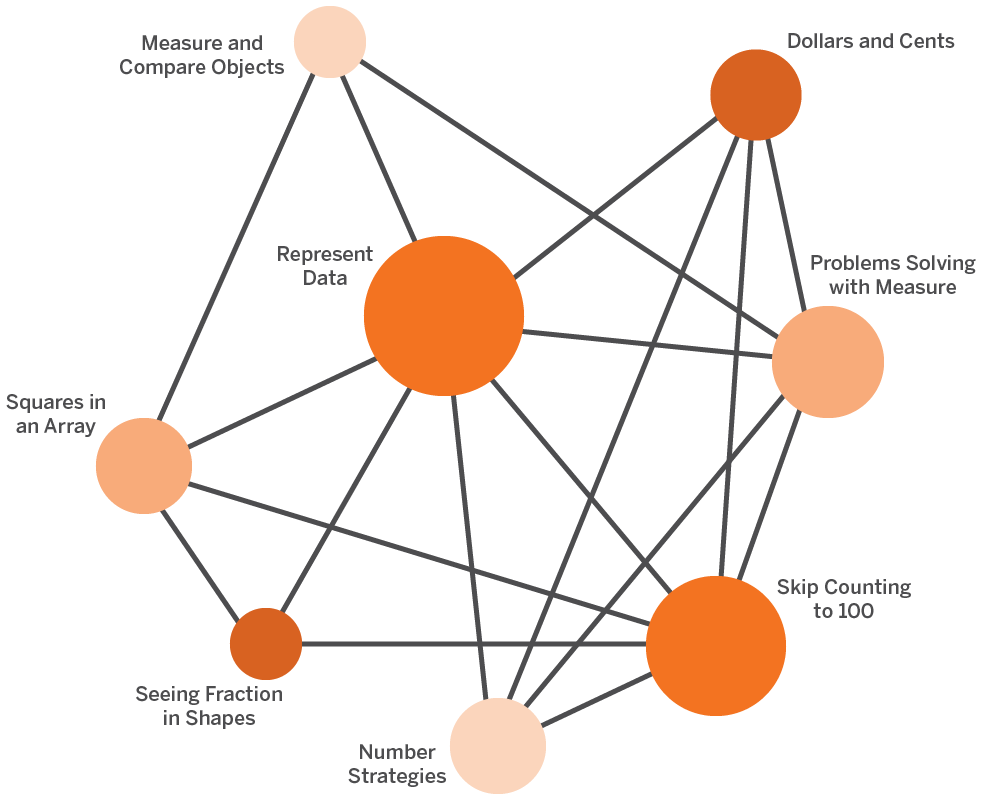
Big Ideas
The CA Mathematics Framework encourages a shift from power standards to thinking about math as a series of connected Big Ideas. Each Amplify Desmos Math California lesson supports one or more Big Ideas and the connections between Big Ideas. The grade-level diagram changes through the course based on the math concepts being addressed.
Focus, coherence, and rigor
Each lesson highlights why the content being covered is important, how students will engage with the mathematics, and what students will do with the learning. Our lesson opener helps teachers understand the most important concepts of the lesson, and includes the Drivers of Investigation (DI), Content Connections (CC), and Standards for Mathematical Practice (SMP) that drive learning in each lesson.


Built-in authentic tasks
Mathematics is not learning in isolation. Students are connected to each other’s thinking and can use math to understand the world. With accessible invitations to authentic tasks, all students can experience mathematical success. Amplify Desmos Math California provides these authentic invitations in a variety of ways:
Each unit begins with an “Explore” lesson, which allows students to engage with authentic exploration in low-floor, high-ceiling tasks. These tasks are designed in such a way that all students can access the basic mathematical concepts, but they also offer possibilities for advanced exploration and problem-solving for those ready for more complex work, promoting an inclusive and differentiated learning environment.
Our innovative course-level investigations are designed to facilitate multipart exploration. Students grapple with Big Ideas, diving deep into key concepts that encourage comprehensive understanding. Data science is infused into the approach, equipping students with a strong foundation in interpreting and applying data-driven solutions. The Environmental Principles and Concepts (EP&Cs) are also a focus of our investigations, enabling students to understand and appreciate the coherence and interrelationship of Earth’s environmental systems.
A focus on multilingual and English learners

In building Amplify Desmos Math California, we partnered with the English Learner Success Forum (ELSF) to provide guidance on our multilingual/English learner support for teachers. ELSF is a national nonprofit organization that advocates for high-quality instructional materials that are inclusive of multilingual learners. ELSF’s guiding documents reflect research-based instructional strategies that are critical to curriculum design and were created by researchers, linguists, and practitioners from across the country. ELSF reviewed our materials and provided directional guidance and feedback to ensure that the program fully supports multilingual/English learners.
A component of our K–5 curriculum is the engaging unit stories that interweave mathematics with real-life situations and relatable narratives. These unit stories are specifically crafted to inspire curiosity and foster a deep connection between the learner and the math concepts being explored. This unique approach not only makes learning fun and interesting, but also allows our young learners to see themselves in the math.
To help students grow their domain-specific and academic vocabulary, Amplify Desmos Math California provides embedded vocabulary routines, such as prompting teachers to use a Frayer Model. These routines allow students to make connections to new language and offer repeated opportunities to develop and refine language.
Amplify Desmos Math California recognizes the diverse language needs of our students and is designed to be inclusive. Each lesson in the program features a parallel language activity, designed to be available to all students, in the form of teacher guidance and student activities. The activities in the Math Language Development Resource has leveled ELD (Emerging, Expanding, Bridging) differentiation to support all levels of Multilingual and English Learners. This approach ensures that all students, regardless of their language skills, can participate fully, grasp the material, and excel in their mathematical journey.
Uploaded digital glossary for languages other than Spanish. Up to nine languages of translations will be provided for.
Amplify Desmos Math California will include support resources for Spanish-speaking students across TK–Algebra 1/Integrated I beginning in the 20262027 school year.

K–5 sample materials
Click the links in the drop-down sections below to explore sample materials from each grade.
For helpful navigation tips and more program information, download the Amplify Desmos Math Program Guide.
You can also watch a product expert walk through a lesson and the available program components.
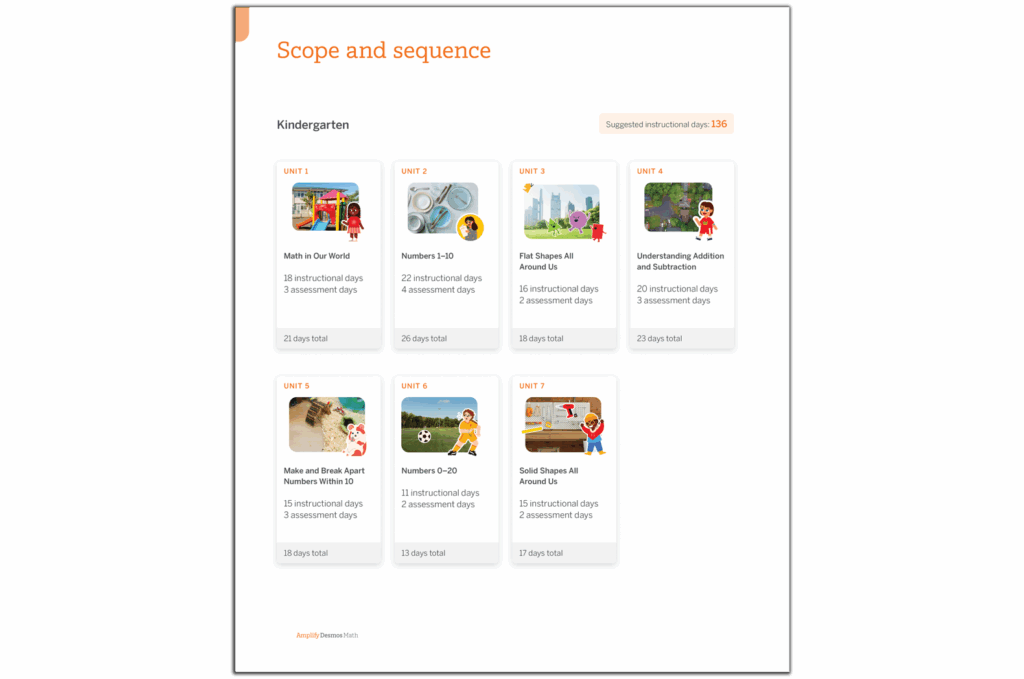
Program structure
Get to know the content and structure of Kindergarten Amplify Desmos Math California.
Teacher Edition pages
Planning and instructional guidance is visual, organized, and easy-to-follow. To help you review the program, we have included samples from a complete sub-unit on this site: Unit 2, Sub-Unit 1: Counting and Comparing Objects.

Digital experience
Explore our digital experience! Every lesson in Amplify Desmos Math California has student print materials and digital recommendations.

Student Edition pages
Motivate students with mathematics that is both rigorous and delightful.

Centers Resources
Engaging, hands-on games for students to play collaboratively to strengthen their understanding of key skills and concepts.
Intervention and Extension Resources
Additional resources to reinforce and extend key concepts, including Mini-Lessons and Extensions.
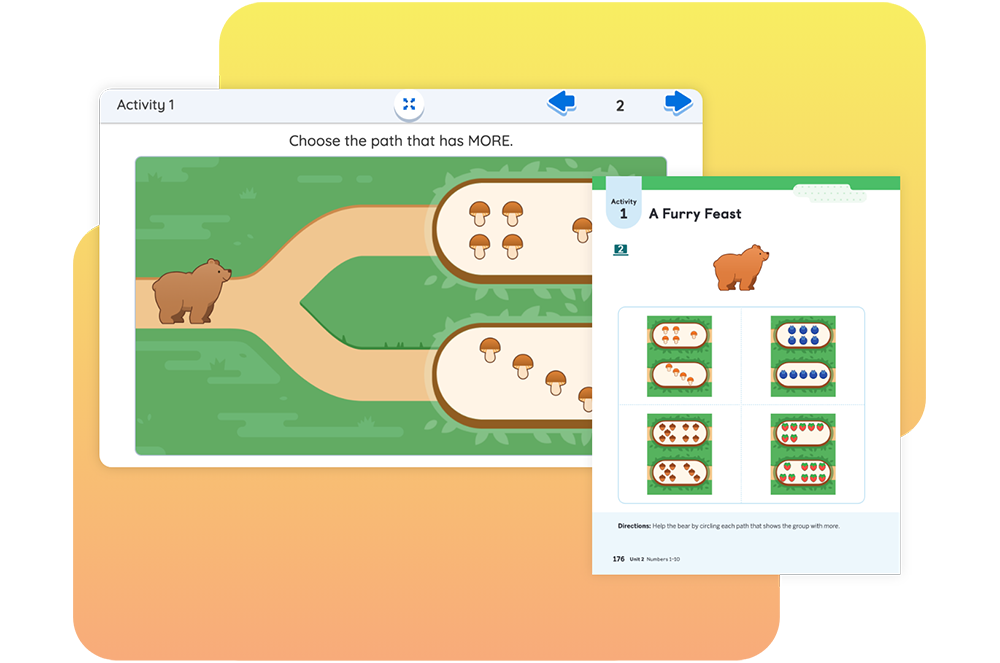
Featured digital lesson: Forest Friends
In this lesson, students apply their understanding of how to compare groups of images as they determine which group has more or fewer and then compare their strategies by guiding a bear through a path that has more mushrooms than the other.
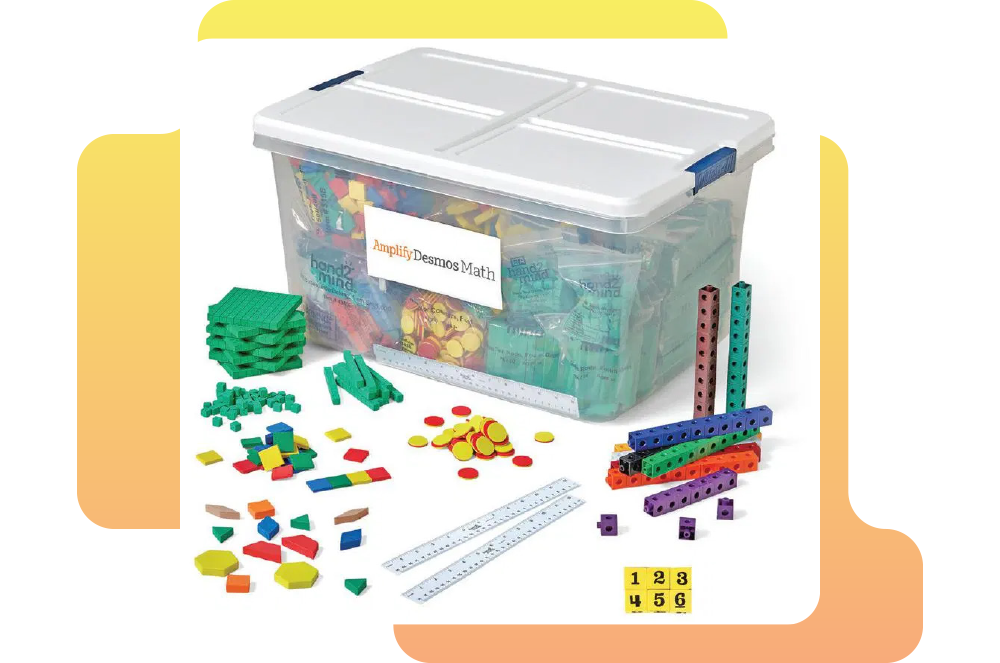
Hands-on manipulative kit
An optional add-on to your Amplify Desmos Math California program, the manipulative kit provides hands-on learning tools designed to simplify and illustrate complex mathematical concepts.
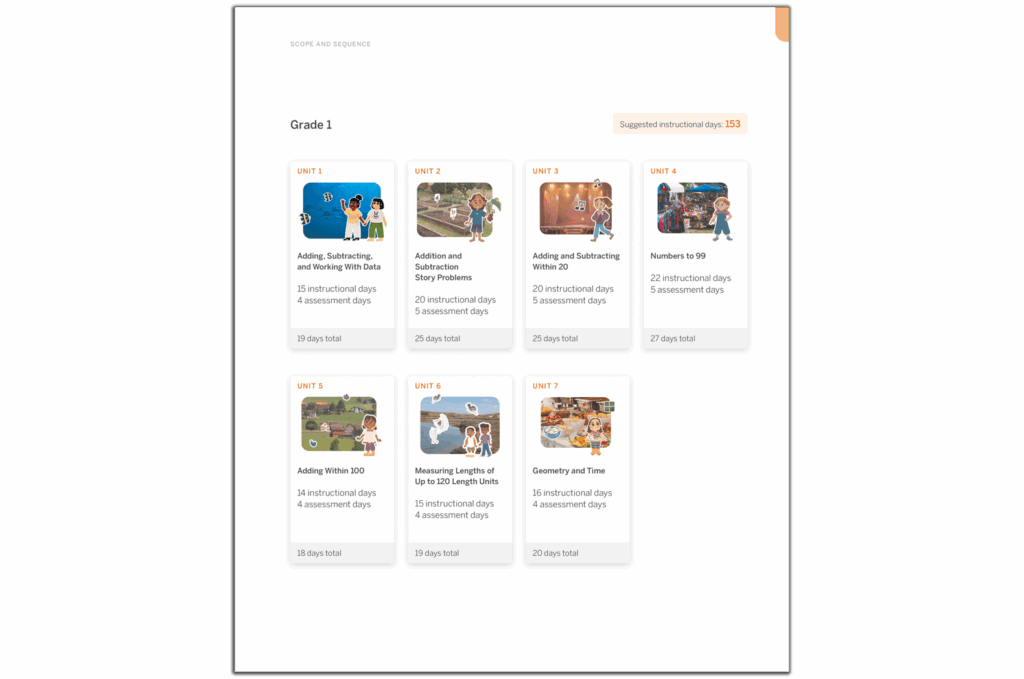
Program structure
Get to know the content and structure of Grade 1 Amplify Desmos Math California.

Teacher Edition pages
Planning and instructional guidance is visual, organized, and easy-to-follow. To help you review the program, we have included samples from a complete sub-unit on this site: Unit 2, Sub-Unit 1: Story Problems in Maui.
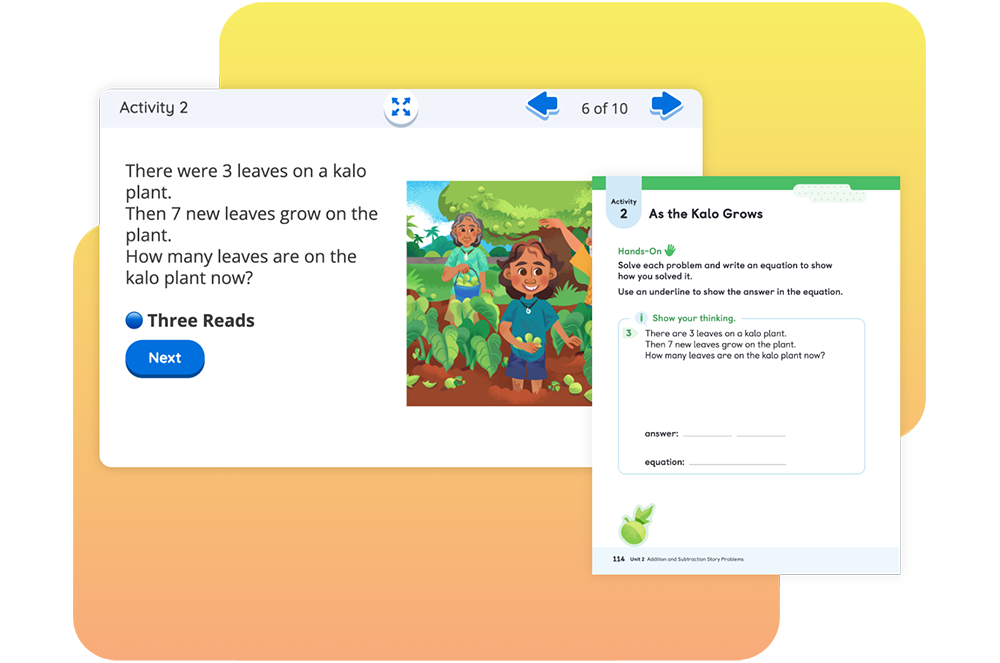
Digital experience
Explore our digital experience! Every lesson in Amplify Desmos Math California has student print materials and digital recommendations.

Student Edition pages
Motivate students with mathematics that is both rigorous and delightful.

Centers Resources
Engaging, hands-on games for students to play collaboratively to strengthen their understanding of key skills and concepts.

Intervention and Extension Resources
Additional resources to reinforce and extend key concepts, including Mini-Lessons and Extensions.
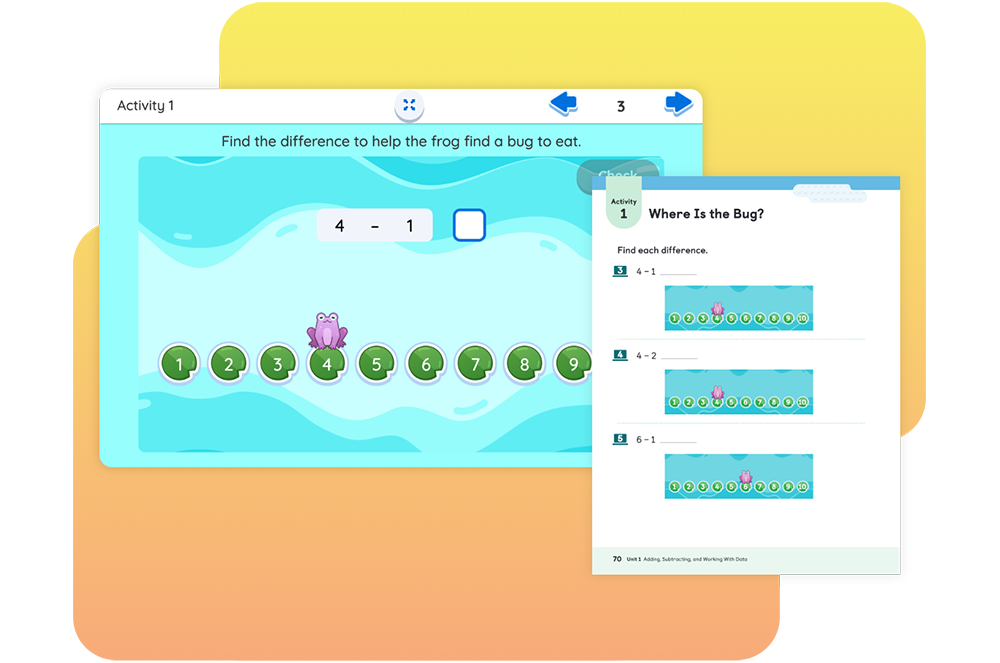
Featured digital lesson: Leaping Lily Pads!
In this lesson, students find differences when subtracting 1 and 2 from the same number by helping a frog reach a lily pad where it can eat a bug.
Hands-on manipulative kit
An optional add-on to your Amplify Desmos Math California program, the manipulative kit provides hands-on learning tools designed to simplify and illustrate complex mathematical concepts.
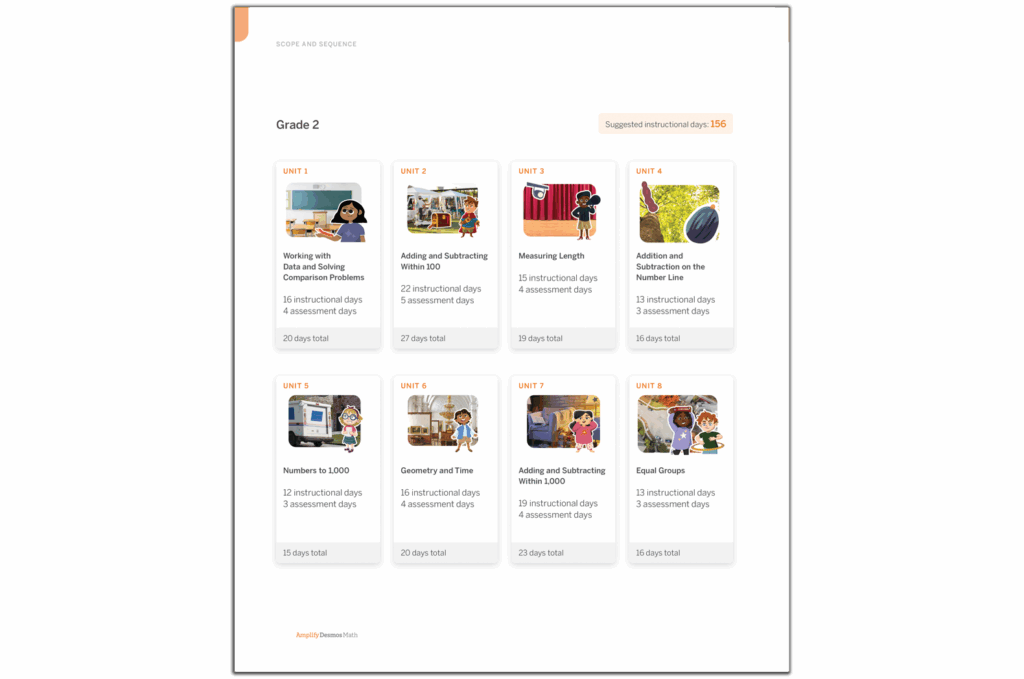
Program structure
Get to know the content and structure of Grade 2 Amplify Desmos Math California.
Teacher Edition pages
Planning and instructional guidance is visual, organized, and easy-to-follow. To help you review the program, we have included samples from a complete sub-unit on this site: Unit 2, Sub-Unit 1: Adding and Subtracting.
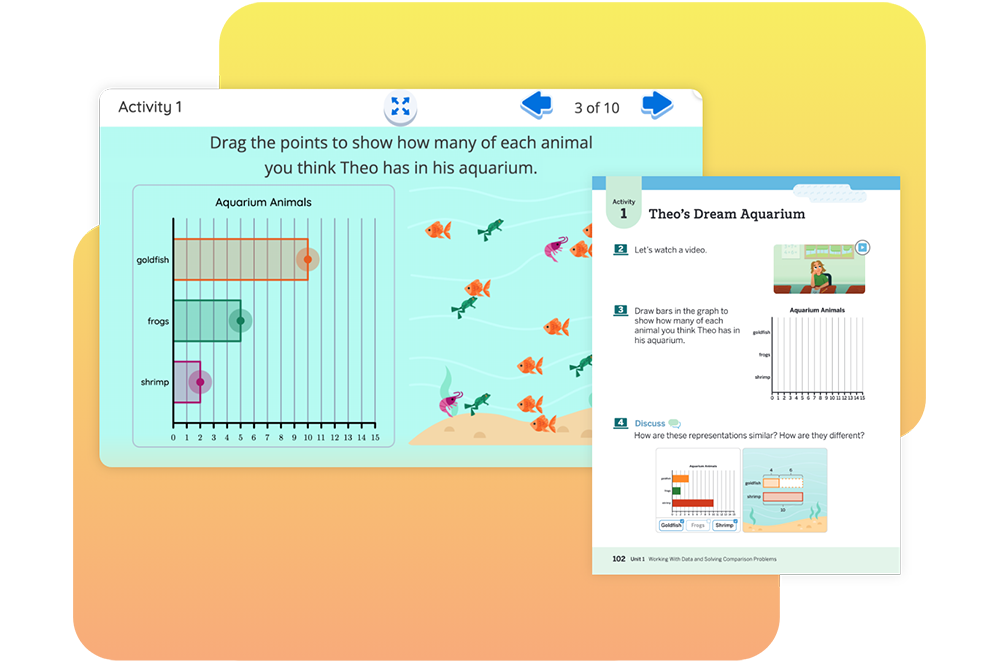
Digital experience
Explore our digital experience! Every lesson in Amplify Desmos Math California has student print materials and digital recommendations.

Student Edition pages
Motivate students with mathematics that is both rigorous and delightful.

Centers Resources
Engaging, hands-on games for students to play collaboratively to strengthen their understanding of key skills and concepts.

Intervention and Extension Resources
Additional resources to reinforce and extend key concepts, including Mini-Lessons and Extensions.

Featured digital lesson: Ways to Make 10
Students continue to develop fluency by finding the number that makes 10 by helping a millipede reach its favorite food – a clump of leaves!
Hands-on manipulative kit
An optional add-on to your Amplify Desmos Math California program, the manipulative kit provides hands-on learning tools designed to simplify and illustrate complex mathematical concepts.
Program structure
Get to know the content and structure of Grade 3 Amplify Desmos Math California.

Teacher Edition pages
Planning and instructional guidance is visual, organized, and easy-to-follow. To help you review the program, we have included samples from a complete sub-unit on this site: Unit 2, Sub-Unit 1: Concepts of Area Measurement.
Digital experience
Explore our digital experience! Every lesson in Amplify Desmos Math California has student print materials and digital recommendations.

Student Edition pages
Motivate students with mathematics that is both rigorous and delightful.

Centers Resources
Engaging, hands-on games for students to play collaboratively to strengthen their understanding of key skills and concepts.
Intervention and Extension Resources
Additional resources to reinforce and extend key concepts, including Mini-Lessons and Extensions.
Featured digital lesson: Puppy Pile
Students compare data represented on bar graphs with different scales by using animal stickers to create scaled bar graphs.
Hands-on manipulative kit
An optional add-on to your Amplify Desmos Math California program, the manipulative kit provides hands-on learning tools designed to simplify and illustrate complex mathematical concepts.

Program structure
Get to know the content and structure of Grade 4 Amplify Desmos Math California.

Teacher Edition pages
Planning and instructional guidance is visual, organized, and easy-to-follow. To help you review the program, we have included samples from a complete sub-unit on this site: Unit 2, Sub-Unit 1: Size and Location of Fractions.

Digital experience
Explore our digital experience! Every lesson in Amplify Desmos Math California has student print materials and digital recommendations.
Student Edition pages
Motivate students with mathematics that is both rigorous and delightful.

Centers Resources
Engaging, hands-on games for students to play collaboratively to strengthen their understanding of key skills and concepts.
Intervention and Extension Resources
Additional resources to reinforce and extend key concepts, including Mini-Lessons and Extensions.

Featured digital lesson: Hamster Homes
Students choose tube lengths to connect to platform heights for hamster homes, identifying possible heights using what they know about multiples.
Hands-on manipulative kit
An optional add-on to your Amplify Desmos Math California program, the manipulative kit provides hands-on learning tools designed to simplify and illustrate complex mathematical concepts.
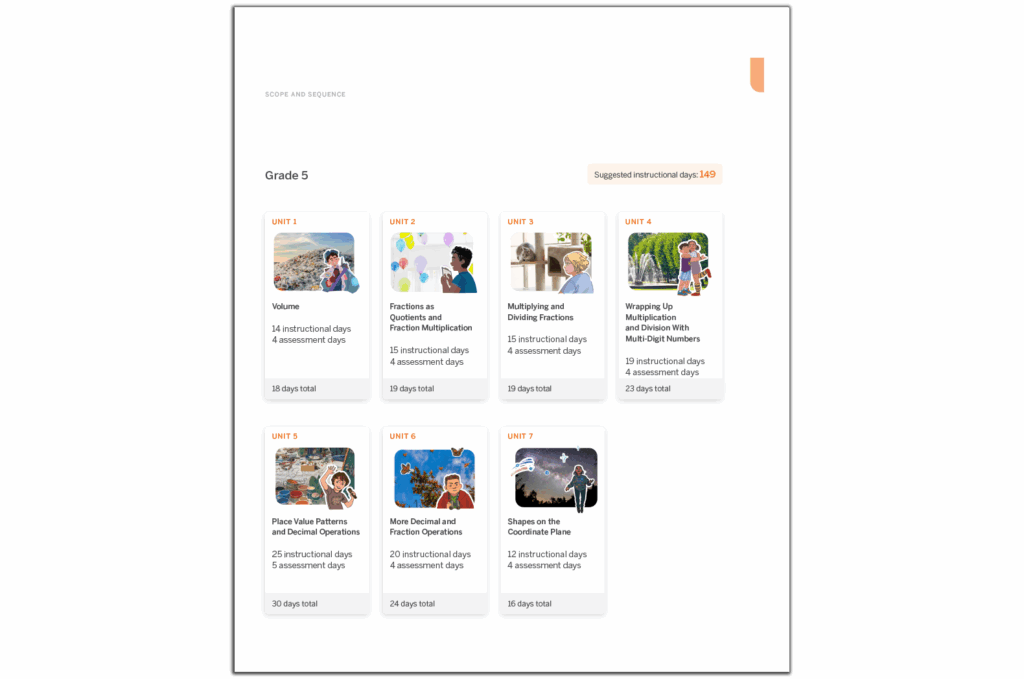
Program structure
Get to know the content and structure of Grade 5 Amplify Desmos Math California.

Teacher Edition pages
Planning and instructional guidance is visual, organized, and easy-to-follow. To help you review the program, we have included samples from a complete sub-unit on this site: Unit 2, Sub-Unit 1: Fractions as Quotients.

Digital experience
Explore our digital experience! Every lesson in Amplify Desmos Math California has student print materials and digital recommendations.
Student Edition pages
Motivate students with mathematics that is both rigorous and delightful.

Centers Resources
Engaging, hands-on games for students to play collaboratively to strengthen their understanding of key skills and concepts.

Intervention and Extension Resources
Additional resources to reinforce and extend key concepts, including Mini-Lessons and Extensions.
Featured digital lesson: Figures Made of Prisms
Students decompose a figure into rectangular prisms and determine the volume of the figure by adding the volumes of the individual prisms.
Hands-on manipulative kit
An optional add-on to your Amplify Desmos Math California program, the manipulative kit provides hands-on learning tools designed to simplify and illustrate complex mathematical concepts.
6–A1 sample materials
Click the links in the drop-down sections below to explore sample materials from each grade.
For helpful navigation tips and more program information, download the Amplify Desmos Math Program Guide.
You can also watch a product expert walk through a lesson and the available program components.

Program structure
Get to know the content and structure of Grade 6 Amplify Desmos Math California.

Teacher Edition pages
Planning and instructional guidance is visual, organized, and easy-to-follow. To help you review the program, we have included samples from three sub-units on this site: Unit 1, Sub-Unit 1: Area; Unit 3, Sub-Unit 1: Units and Measurement; and Unit 6, Sub-Unit 1: Solving Equations.

Digital experience
Explore our digital experience! Every lesson in Amplify Desmos Math California has student print materials and digital recommendations.

Student Edition pages
Motivate students with mathematics that is both rigorous and delightful.

Intervention and Extension Resources
Additional resources to reinforce and extend key concepts, including Mini-Lessons and Extensions.
Featured digital lesson: Weight for It
Students use equations and tape diagrams to represent seesaw situations and to determine unknown animal weights, helping them make connections between diagrams that represent equations of the form `x+p=q` or `px=q`.

Hands-on manipulative kit
An optional add-on to your Amplify Desmos Math California program, the manipulative kit provides hands-on learning tools designed to simplify and illustrate complex mathematical concepts.
Program structure
Get to know the content and structure of Grade 7 Amplify Desmos Math California.

Teacher Edition pages
Planning and instructional guidance is visual, organized, and easy-to-follow. To help you review the program, we have included samples from three sub-units on this site: Unit 1, Sub-Unit 1: Scaled Copies; Unit 4, Sub-Unit 1: Percentages as Proportional Relationships; and Unit 6, Sub-Unit 1: Equations and Tape Diagrams.
Digital experience
Explore our digital experience! Every lesson in Amplify Desmos Math California has student print materials and digital recommendations.

Student Edition pages
Motivate students with mathematics that is both rigorous and delightful.

Intervention and Extension Resources
Additional resources to reinforce and extend key concepts, including Mini-Lessons and Extensions.
Featured digital lesson: Shira the Sheep
Students solve inequalities with positive and negative coefficients to solve a variety of challenges featuring a fictional sheep who eats grass according to an inequality.
Hands-on manipulative kit
An optional add-on to your Amplify Desmos Math California program, the manipulative kit provides hands-on learning tools designed to simplify and illustrate complex mathematical concepts.
Program structure
Get to know the content and structure of Grade 7 Amplify Desmos Math California.

Teacher Edition pages
Planning and instructional guidance is visual, organized, and easy-to-follow. To help you review the program, we have included samples from three sub-units on this site: Unit 1, Sub-Unit 1: Rigid Transformations; Unit 3, Sub-Unit 2: Linear Relationships; and Unit 6, Sub-Unit 2: Analyzing Numerical Data.

Digital experience
Explore our digital experience! Every lesson in Amplify Desmos Math California has student print materials and digital recommendations.

Student Edition pages
Motivate students with mathematics that is both rigorous and delightful.
Intervention and Extension Resources
Additional resources to reinforce and extend key concepts, including Mini-Lessons and Extensions.
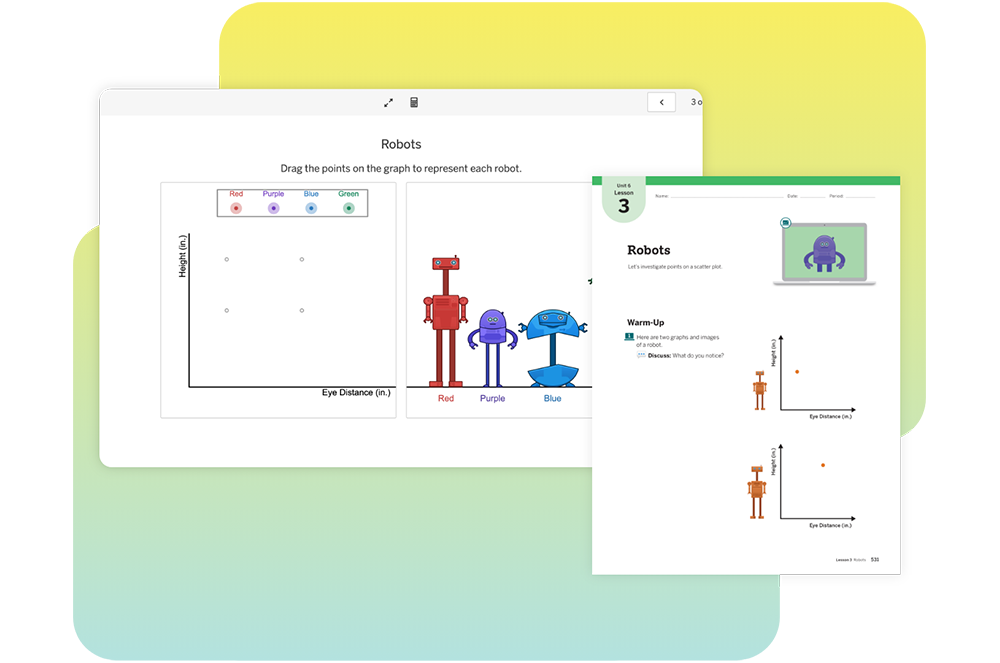
Featured digital lesson: Robots
Students connect points on a scatter plot with individuals in a population and rows of data in a table. The analysis of scatter plots continues with data about the eye distances and heights of robots.
Hands-on manipulative kit
An optional add-on to your Amplify Desmos Math California program, the manipulative kit provides hands-on learning tools designed to simplify and illustrate complex mathematical concepts.
Program structure
Get to know the content and structure of Algebra 1 Amplify Desmos Math California.

Teacher Edition pages
Planning and instructional guidance is visual, organized, and easy-to-follow. To help you review the program, we have included samples from two complete sub-units on this site: Unit 2, Sub-Units 1–2: One-Variable Equations and Multi-Variable Equations.
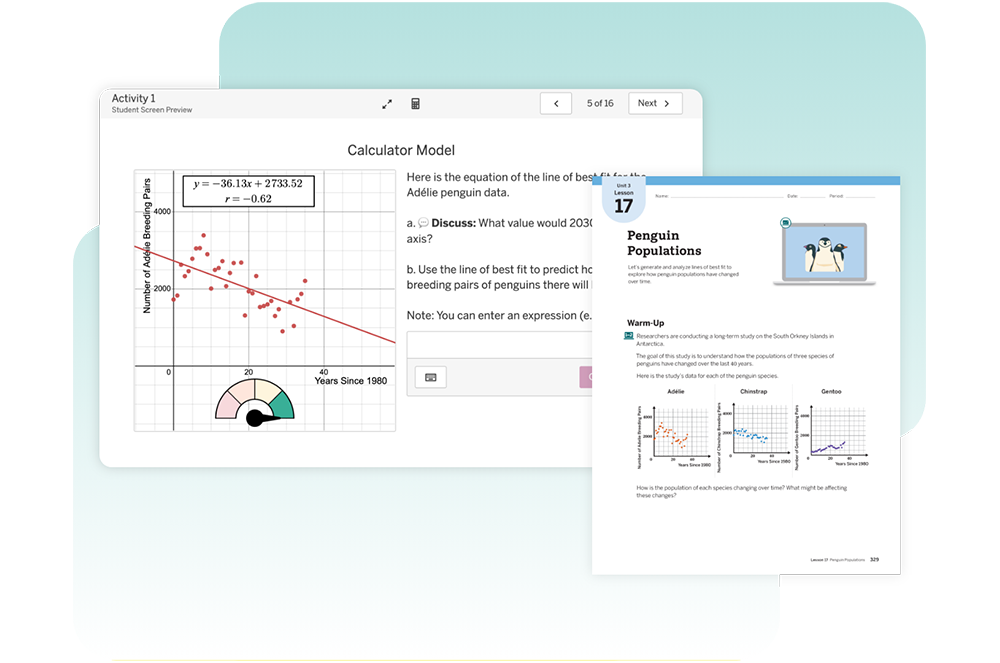
Digital experience
Explore our digital experience! Every lesson in Amplify Desmos Math California has student print materials and digital recommendations.

Student Edition pages
Motivate students with mathematics that is both rigorous and delightful.

Featured digital lesson: Shelley the Snail
Students represent the solutions of a situation using a table, a graph, and multiple forms of an equation to identify multiple combinations of blocks that can help Shelley the Snail cross a gap.
Contact us
For questions, samples, or more information, please contact your local Amplify Account Executive:
Erin King
Sales Director, CA
(512) 736-3162
eking@amplify.com
Northern CA
Wendy Garcia
Senior Account Executive
(510) 368-7666
wgarcia@amplify.com
Bay Area
Lance Burbank
Account Executive
(415) 830-5348
lburbank@amplify.com
Central Valley and Central Coast
Demitri Gonos
Senior Account Executive
(559) 355-3244
dgonos@amplify.com
Ventura and L.A. County
Jeff Sorenson
Associate Account Executive
(310) 902-1407
jsorenson@amplify.com
Orange and L.A. County
Lauren Sherman
Senior Account Executive
(949) 397-5766
lsherman@amplify.com
San Bernardino and L.A. County
Michael Gruber
Senior Account Executive
(951) 520-6542
migruber@amplify.com
Riverside and L.A. County
Brian Roy
Account Executive
(818) 967-1674
broy@amplify.com
San Diego County
Kirk Van Wagoner
Senior Account Executive
(760) 696-0709
kvanwagoner@amplify.com
Under 2300 students in Bay Area, Sacramento Valley, and Northern Counties
Kevin Mauser
Lead Account Executive
(815) 534-0148
kmauser@amplify.com
Under 2300 students in Southern CA, Central Coast, and Southern Central Valley Counties
Charissa Snyder
Account Executive
(720) 936-6802
chsnyder@amplify.com
Explore Amplify CKLA K–5 Phonics
Thank you for reviewing the top-rated Amplify CKLA for grades K-3 phonics instruction. Built on the Science of Reading, Amplify Core Knowledge Language Arts (CKLA) is a highly-effective, foundational phonics program that will give NYC teachers unmatched support in delivering systematic, explicit, and research-based phonics instruction.
Amplify CKLA is systematic – built on a scope and sequence of sound-spelling patterns to ensure all students have access to the same instruction – and Amplify CKLA is explicit – delivering instruction with learning goals that are clear to teachers and students. Beginning with phonological awareness and progressing through phonemic awareness and phonics instruction, Amplify CKLA comprehensively covers foundational skills.
As you explore the Amplify CKLA Grades K-3 phonics materials, you will see high-quality instructional support needed for every child to master the 44 sounds and 150 sound-spellings of the English language by the end of third grade.

Access your demo account
To explore the Amplify CKLA Skills digital experience and Boost Reading K-3, visit learning.amplify.com and select Log in with Amplify; using the credentials provided here:
- Username: t.nyc-ckla-skills@tryamplify.net
- Password: AmplifyNumber1
Click here for demo login and Amplify CKLA navigation support.
Principles of Amplify CKLA phonics instruction
Amplify CKLA phonics instruction ensures students learn to read words automatically and achieve complete coverage of the Reading Standards for Foundational Skills in the Common Core State Standards.
Explicit instruction in the spelling patterns of the English language transitions students from spending excess mental energy on decoding (learning to read) to fluent automaticity so they can focus on comprehension and analysis (reading to learn).
Amplify CKLA designs reading experiences to maximize practice in newly taught sound spellings, which is achieved in three ways:
- Organization of Instruction: CKLA teaches the most frequent sound spellings first in order to maximize the words students can read and move them into engaging, well-written, decodable texts halfway through Kindergarten.
- Systematic Coverage: Students who master both the Basic and Advanced Code taught in CKLA Skills will have all the decoding skills necessary to succeed. Lessons teach print and phonological awareness, sound-letter patterns (or sound spellings), decoding and encoding, writing mechanics, and writing structure and processes for 60 minutes each day.
- Decodable Readers: CKLA Decodable Readers are uniquely designed to provide intensive practice with the CKLA code while engaging students with authentic, compelling, and varied stories.
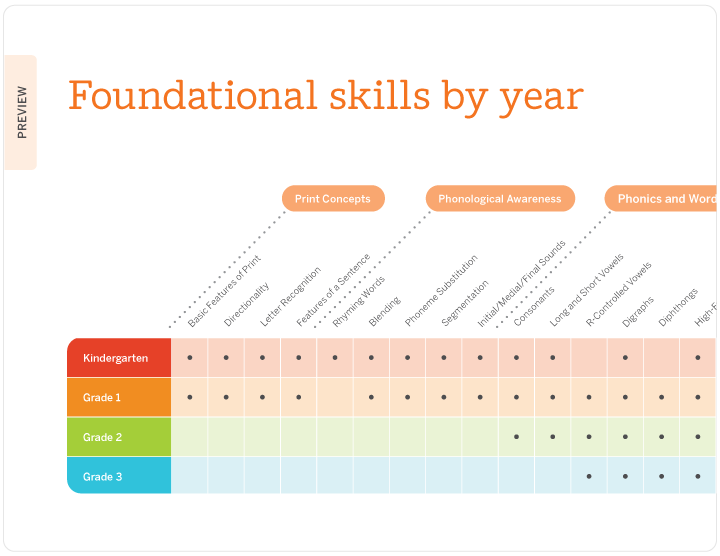
Grade 3 phonics support
In grades K-2, Amplify CKLA Skills offers explicit and systematic foundational skills and language instruction. Explicitly teaching foundational skills from the early grades is essential to helping students master the code and learn to read words automatically and effortlessly.
In grade 3, CKLA recognizes that instructional needs will vary widely, particularly for students with gaps in code knowledge and fluency. Through a more integrated language arts approach, students have daily opportunities for explicit, teacher-led phonics instruction as they transition to developing and applying literacy skills and deepening background knowledge.
By the end of grade 2, Amplify CKLA has covered all basic and advanced code, while grade 3 provides differentiated instruction and assessment resources to best support all students in becoming fluent, automatic readers:
- Unit 1 instruction reviews the phonics instruction from the previous year
- The Assessment and Remediation Guide provides hundreds of activities and assessments to determine the ideal instructional path for each student
- Fluency Packet supplements instruction with additional text selections and opportunities for students to practice reading with fluency and expression (prosody)
- Spelling Cards support decoding and encoding lessons
- Individual Code Chart gives students practice recording the consonant and vowel sound-spelling correspondences they’ve learned
If selected, Amplify would welcome the opportunity to partner with the New York City DOE on updating our program with a standalone skills program for grade 3.
The Amplify CKLA digital experience
Amplify CKLA offers an easy to use and interactive teaching and learning experience for grades K-3 that supports teachers with ready-made and student friendly lesson presentation slides.
Everything needed to teach the lesson is included within the slides that teachers project and students access. Students engage directly with the slides via embedded Activity Pages. Students can respond in multiple ways, including drawing, writing, typing, audio recording, or uploading pictures. They can even engage with the sound library, with fun songs and videos that develop phonological awareness and the eReader library of decodable texts.
The digital experience makes instruction easier, more immersive, and flexible for both students and teachers!
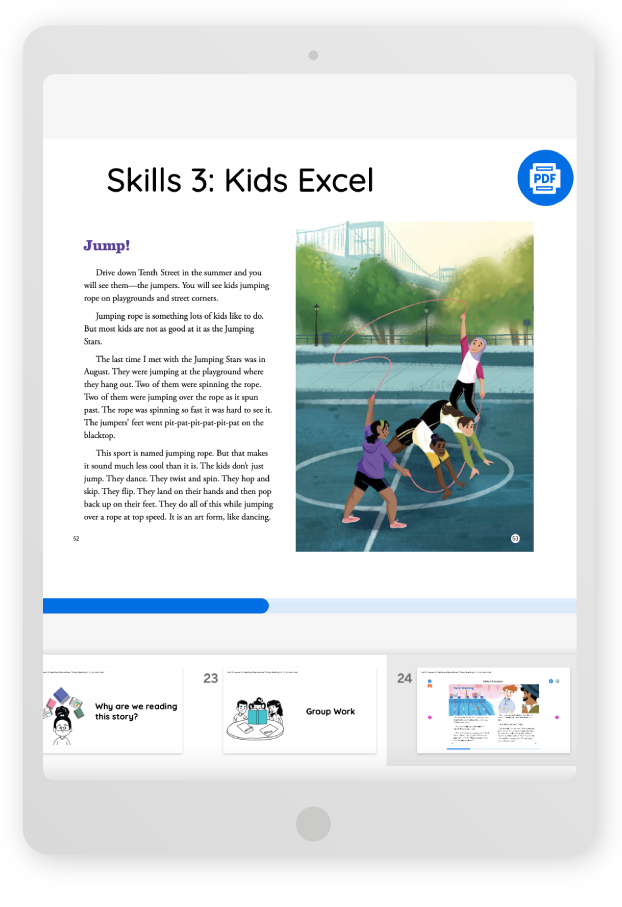
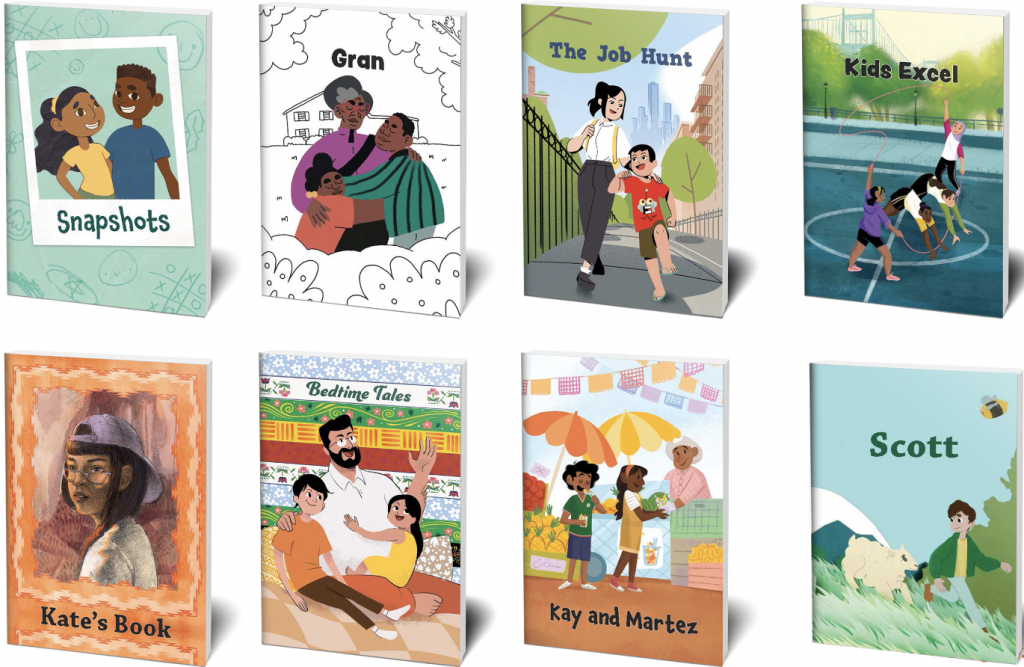
Instruction for students from all walks of life
Our goal is to make education, and thereby the world, more accessible to all students, regardless of background.
As part of our commitment to creating richer and more wide-ranging curricula, Amplify CKLA K-2 Skills Readers have been designed to increase student engagement and students’ sense of connection with the decodable stories and their characters. Stories with human characters introduce students to individuals with a broad range of identity factors, including socio-economic status, age, ability, race, ethnicity, country or origin, religion and more. Other decodable stories have fantastical creatures to bring more excitement and whimsy to the tale. These readers reflect New York City classrooms, giving students windows and mirrors while they practice and apply their skills with 100% decodable texts.
Learn more about the decodable readers here.
View the Amplify CKLA K-3 alignment to NYC Culturally Responsive-Sustaining Education Framework..
The power of Amplify CKLA + Boost Reading
Boost Reading is a student-driven skill practice program that pairs with Amplify CKLA, to provide differentiated, digital instruction in both foundational skills and comprehension strategies. Because Boost Reading is built on the same approach to reading as Amplify CKLA and shares an aligned scope and sequence, students are able to extend their learning from the core program, at their own pace.
In Boost Reading, students enter a captivating narrative where each storyline requires them to apply foundational skills to navigate a series of games. Each game focuses on a specific skill learned in CKLA, allowing students to practice that skill to mastery. Progression from game to game is based on individual student learning needs—a personalized path where they gain expertise by unlocking new quests at just the right time. This path ensures that each student gets the amount of practice they need to master foundational skills.
Embedded benchmark and progress-monitoring assessments give educators actionable data insights on how their students are progressing through their literacy journey. Easy-to-use reports provide proficiency, growth and risk data individually and in aggregate to further drive classroom instruction.
In a recent study, students who used Boost Reading outperformed non-Boost students on all DIBELS 8th Edition measures.
Explore the Boost Reading teacher and student experience:
- Visit learning.amplify.com and select Log in using the same Amplify credentials provided in the demo access section above:
- Username:t.nyc-ckla-skills@tryamplify.net
- Password:AmplifyNumber1
- Select the Reading icon; this will open the program without data as your class has not yet played Boost Reading. Select Explore Demo in the pop up.
- In the navigation bar, choose the grade band and experience (Educator or Student) you wish to demo.
- The Educator experience will show you the Teacher Dashboard with sample student data and a recommended guided tour.
- The Student experience will bring you to a start screen; simply select PLAY to begin.

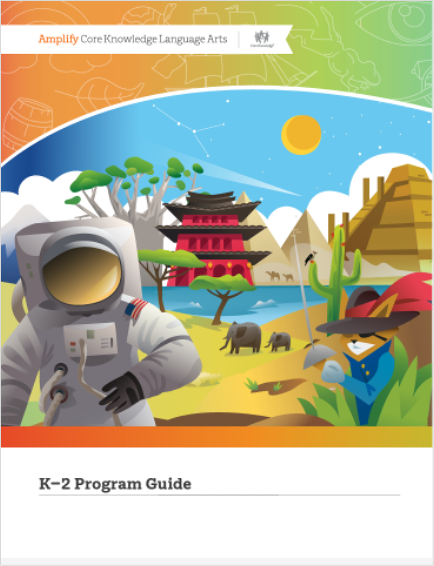
New York City Review Materials
The Amplify CKLA Grades K-2 Program Guide provides you with more details on how CKLA Skills works, how it is structured, and the need for explicit instruction in phonics in order to build strong readers in classrooms.
Additional Review Materials:
Amplify CKLA Skills K-2 One-Pager
Amplify CKLA Skills – Grade K Scope and Sequence
Amplify CKLA Skills – Grade K Curriculum Map (pages 1-10)
Amplify CKLA Skills – Grade 1 Scope and Sequence
Amplify CKLA Skills – Grade 1 Curriculum Map (pages 1-7)
Amplify CKLA Skills – Grade 2 Scope and Sequence
Amplify CKLA Skills – Grade 2 Curriculum Map (pages 1-6)
Amplify CKLA – Grade 3 Unit 1 Teacher Guide
Amplify CKLA decodable readers
Amplify CKLA alignment to New York State Next Generation ELA Learning Standards
CKLA Skills – Grade K; Unit 1 – Assessment and Remediation Guide (differentiation example)
Boost Reading alignment to New York State Next Generation ELA Learning Standards

S1-06: Supporting students with a creative twist: A conversation with Kentucky Science Teacher of the Year, Shad Lacefield
In this episode, Eric sits down with the Kentucky Science Teacher of the Year, Shad Lacefield. Shad shares his experience teaching during the first year of the pandemic, where Shad dressed up in over 100 costumes to create a unique and engaging online learning experience for his students. Shad also explains ways he connects with his students to celebrate student success, as well as large-scale efforts he leads within his school to cultivate the love of learning science content. Explore more from Science Connections by visiting our main page.
Shad Lacefield (00:00):
When you stay relevant, it’s being engaged with your students and figuring out, or what are, what are they liking? And every year it’s gonna be different. And that helps you stay relevant. When you have conversations and you build relationships with your kids,Eric Cross (00:13):
Welcome to science connections. I’m your host. Eric Cross. My guest today is Shad Layfield. Shad is a teacher at garden Springs elementary and a part-time professor at Asbury University in Kentucky during the first year of the pandemic, Mr. Layfield dressed up in over a hundred costumes to create a unique and engaging online learning experience for his students. He also created Vader visits, where he visited students at their homes, dressed as Darth Vader to celebrate their online successes and keep them encouraged. During a challenging time. In this episode, we discuss how creativity impacts engagement, transferring lessons learned from distance teaching back to in-person instruction, and how upper grades can apply the same principles to improve student learning. I hope you enjoy this discussion with shad lays field. So you’ve been in fourth grade for four years, and then you were in second grade and fifth grade. And so like how long have you been teaching for like total?
Shad Lacefield (01:09):
So this is my 15th year teaching.
Eric Cross (01:12):
Really? Yeah. You’ve been in the game for a while.
Shad Lacefield (01:15):
Yeah. Yep. It, it doesn’t, and it’s always surprising to parents too during that, that first like, come in and meet your teacher. And I walk in, I’m like, yeah, I’ve been teaching for 15 years and every time it gets ’em, they’re like no way. And I’m like, yeah,
Eric Cross (01:28):
That’s, that’s a good thing though. That’s a good thing. Right?
Eric Cross (01:31):
You know? So like, well the energy and then, and you’re just how you’re perceived. Like you’re, they’re just, I don’t know. It’s something about work with young people. Like it keeps you young.
Shad Lacefield (01:39):
That’s what it is. Absolutely.
Eric Cross (01:41):
So how did, how, like, what’s your origin story? Like, how did you become a teacher? Like what, what was it? Was it something like you knew second career, like right outta school? Like how did you end up in the classroom?
Shad Lacefield (01:53):
Yeah. No, and I love this question cause I’m a big Marvel and, and superhero. So origin stories are all, I love a good origin story. So I grew up on a 13 acre farm in a little bitty town called Gustin, Kentucky, and very early on, like we were instilled my parents, amazing, amazing parents. But they really instilled like a, a super important work ethic in our lives of like, it’s, it’s all about hard work and it’s important that you’re working hard in whatever it is that you do. And I’m one of six kids as well in my family.
Eric Cross (02:24):
Where are you in the–
Shad Lacefield (02:25):
I’m second to last.
Eric Cross (02:26):
Second to last. Okay. So you’re the second youngest.
Shad Lacefield (02:29):
Yes. Okay. And and so, and so growing up, like with that, like, you know, I worked in tobacco, I worked in hay, you know, we did things being on the farm and stuff like that. And within my family as well, there’s four boys. And so when I decided to go to college I was the first guy in my family to go to college. And the first and only boy that ended up going to college. And so it was like this big deal, like, oh, you know, we got one of our boys gonna go to college. So what is he gonna be? And I was like, well, if I’m gonna put forth the, the time and effort and then the financial strain that it would cause cuz we were not poor at all. My dad worked two jobs to make sure, but I really felt the responsibility of like, if I’m gonna go, I’m gonna work in a profession.
Shad Lacefield (03:09):
That’s gonna make a lot of money. And here I am as a teacher now. So I didn’t go to college to be a teacher. I actually was pre dentistry. I thought, now here’s a profession. You can, a lot of money. You don’t work weekends or holidays, you know, I can still be the doctor thing. And so I’m gonna be pre dentistry. But like all good origin stories. There was a, there was a flip. So in my first year I started working at the most majestic place that you will ever go. It’s called Squire, boon, caverns. It’s a cave in Southern Indiana. And it’s an amazingly beautiful little place. You have to like one lane highway, like road to go back there up and down. Like you, you think you’re never gonna make it. And if it rains too much, the bridge will flood and you actually can’t even get back there.
Shad Lacefield (03:52):
So that’s how we’re talking like way back in the sticks. But once you get back, back there totally worth it. And as part of the job you were a tour I also did grist mill demonstrations and gym mining adventures, or, you know, as they’re gym mining and stuff like that. And within that, I started working with school aged kids and on very large tours and stuff. And my manager at the time, Claudia, I’m still great friends with and we still take our kids back there. Every summer she, to me, you’re really good with kids. Like you’re really good with kids. We have this scout program that’s on the weekends. And then during the summers and you would be teaching kindergarten through eighth grade kids, geology and forestry. What do you think about doing that? And I said, well, right, let’s try that out. And then I got the teaching bug and it hit and I was like, oh my gosh, like I don’t wanna spend my life doing something that is all about money or, or that is like, this is where it’s at. Like, I love this, I enjoy this. I enjoy the response that I get when I’m talking. And kids are excited about learning and getting new information and learning new stuff. And so then I change my major and here I am now, all these years later teaching instead of being a dentist,
Eric Cross (05:04):
Are there, are there days, do you ever have days where you’re like, you know, dentistry, it’s still an option. Like I can, I can go back.
Shad Lacefield (05:12):
Oh, rare, rare occasions. Rarely. Yeah.
Eric Cross (05:16):
Okay. Yeah. All right. All right. Fair enough. I, I, I always joke and say that like we have, you know, sometimes I have my, my alternate job on the hard days, which is for me, it’s working at the gap where I just want to fold clothes and go home at the end of the day, you know, on those really rough days. And you know, it’s never the kids, right. It’s always other things. The kids are like the great part. And then there’s all these other things. And I just wanna work at the gap. I just wanna work at the gap. Fold some clothes. Yes, sir. Yes. Ma’am absolutely. I can find that size for you. And then I just go home cause about their job when they go home at the end of the day, when you work at the gap, at least sorry, gap workers. I’m sure hard of that, but my perception in my mind is that you close up shop and then you’re done. Yeah,
Shad Lacefield (05:52):
Absolutely. Like you said, they can turn it, like it’s a turnoff at the end. Exactly. As teachers we know, like you don’t ever turn it off, it’s always there.
Eric Cross (06:00):
Yeah. So one of the things that I was super excited about when I, when I first heard about you is I went on your website and there’s so many things I feel like I can just talk about your website and just the, the content that you’ve produced. I, I, there’s so many directions I can go. But one, one of the things I want to ask you is, is about that. Now, one of the things that’s on there, and this is coming from a fellow star wars, Fisha who finished Bobba FET and the Mandalorian recently and is Jones in four OB one to come out.
Shad Lacefield (06:33):
Oh, so yes,
Eric Cross (06:35):
I live in Southern California next to Disneyland visited Galaxy’s edge star wars. You have these things called VA Vader visits. And so what do you do in those? And like, where did you get the idea for these Vader visits?
Shad Lacefield (06:50):
So the costumes were bringing the kids into the classroom. But when they left my room because you would, we only had them for a certain amount of time. There was still a lot of extra work that they needed to get done. And what I was seeing was I could get them to come in and they were really engaged during my lesson. But then afterwards, when it came to work completion or getting things done, there was, it was starting to fall off. As you know, we were experiencing, you know, more and more craziness of what’s going on. So then as an incentive, I decided if you have everything turned in, by the end of the day, I’m gonna dress up in my Darth Vader outfit, full costume, the, you know, the, the full helmet, like everything. And I’m gonna show up to your house and we’re gonna hang out and play any game at all that you wanna play.
Shad Lacefield (07:34):
So then it was a way of rewarding. My kids for getting everything turned in. But same time I felt like it would also help me build a relationship with them. That was a very challenging part of online learning. Like, again, I want you to feel like you’re a part of my classroom. I wanna feel like I’m invested in you and wanna learn about you. And it was a commitment because some of those kids put me through the ringer, whether it was we’re gonna do gymnastics on a trampoline. And again, I’m in full costume doing gymnast on the trampoline, or we’re doing soccer drills with their soccer coach at their house playing football games. I mean, all kinds of stuff. I made a Yachty game for a kid that loves Harry Potter. And it was really a big part of getting work turned in because, and it’s the crazy thought they wanted to spend time with me. Like that’s what it was. And so it was like, yeah, absolutely. I’ll keep dressing up. I did over 50 plus Vater visits. It wasn’t just for my homeroom. It was for all of fourth grade. So I went over 50 visits and it was cool to see kids in their home and talk to them and meet their parents. It was a great opportunity for me to engage with parents as well. How is online learning, going, what can I do to support you? Do you guys have any questions and stuff like that? So
Eric Cross (08:39):
This thing of relationships is like leading to work completion, which isn’t, which isn’t always the, the thing that we think to as educators of like how, you know, work completion. A lot of times we think of like structures or you know, certain protocols that you do in class get work completion, but here you are addressing as Darth Vader. And, and you said students were turning in more work because they’re connected to, you saw an increase in, in yeah. Engagement.
Shad Lacefield (09:07):
And absolutely. And, and I remember even saying that to myself, like this is, this is what’s getting them. But it, it was, and as part of the Vader visit as well with the videos we recorded all of them and I said, I’m gonna make you a YouTube star. And so I would, I, I recorded them. I put ’em on my YouTube channel. And so a lot of the videos that are on my website, all those Vader visits are like the kids showing off and playing against the teacher. And I promise you, I didn’t take it easy on any one of those kids. Like when it was like a verse match, I went all out and I told ’em. I was like, if you beat me, you know, it’s gonna be like, you earned it.
Eric Cross (09:38):
What a great way to leverage, just what, what is relevant to our students? Like you used your platform and then now you’re showcasing them on your, you know, your platform or what you were using. And then they’re seeing each other. And I could just see, regardless of the grade level, like just students, like beam from, from getting that kind of positive praise through, through, you know a medium that doesn’t, that tends to be more of a, just content consumption, but you’re kind of watching other folks do stuff, but now it’s about them. Like, and they’re, they’re getting that attention directly. Now I have to ask about the Vader costume. Did you, did you buy it for this event or did you already have that Darth Vader costume in your closet?
Shad Lacefield (10:19):
I had parts of the costume, but not the complete costume. And honestly, the very first Vader visit I had, I had the Vader mask that makes sounds, and like you could talk and it makes you sound like Vader.
Eric Cross (10:29):
My dark saber is on order. Yes. And it keeps getting delayed from best buy. It’s supposed to arrive in April, but I do have dark staple and order that I ordered back in November. So the best to your point, I don’t know who doesn’t have one, I’m waiting for mine though.
Shad Lacefield (10:42):
There you go, come on. Best buy come through for us. So
Eric Cross (10:44):
You, you did all this investment in time and, and you created all this content, but then we went back in person. Were, were you able to bring this back into the classroom or any of the things that you had generated during distance learning back in the classroom? Or are you, are you using some of the things that you learned? Like what, or is it just completely separate and you’re just doing something completely different. Now
Shad Lacefield (11:04):
That’s a great question. So I still try to dress up at least once every week, if not once every other week just to make whatever we’re doing fun, cuz I already have costumes that were connected to the content that I was doing. So had I had made a character called captain Soundwave that will use when I’m teaching my amplify lessons over sound. And so then I, you know, I have that or I would have, you know, specific characters that were designed for certain lessons that I would do. And so I still
Eric Cross (11:32):
Lemme interrupt you real quick. Where did you get these character ideas from? Cause they are super creative. I clicked on one random one. And you have had like a, a knitted like skull cap and like some blue shiny like cloak and I like who is this guy? I think, is that him? Is that captain sound wave? That’s
Shad Lacefield (11:48):
That’s hilarious. That was, that was my attempted Elsa. Oh, that was yeah. Started buying more and more costumes and and making characters and putting costumes together. And so yeah, it just ends up being this thing where you never know when I’m gonna show up in a completely random costume and be like today, we’re getting ready to learn about how sedimentary rocks form. And I dressed in my rock outfit, which is the old school rock with the turtleneck and the gold chain with,
Eric Cross (12:16):
Wait, do you have a Fanny pack too?
Shad Lacefield (12:17):
I have a Fanny pack. Yes you have. Yep. You nailed it. And they’re like, what does this guy
Eric Cross (12:22):
Do? He raise the one eyebrow. Can you do the, the rock eyebrow? Oh yeah, you got this. Oh, people on the podcast. Can’t see. Chad’s got it down. He’s got it down. He’s got the, he’s got the eyebrow going. Okay, so you, so I feel like I can go on a tangent and talk about all your costumes that you have, but the thinking about this. So tons of engagement, younger people now taking like some of the principles that you’ve learned from this, how can, how can upper grades like bring this joy to their classroom? Like middle school students, you know, older kids sometimes, you know, they can, they’re still kids, but you know, they might not be the same thing as fourth graders. Like would you, do you have any ideas of like how teachers and upper grades can kind of take these elements that you’ve done and, and apply them?
Shad Lacefield (13:04):
Absolutely. So some of the things that you had talked about, like with YouTube can also be applied to like TikTok videos and things like that, that kids are, are willing to watch and, and be engaged in. And so those things, I feel like I’ve seen other middle and high school teachers really utilize in their classroom. But honestly, and this is a new initiative that we’ve started in our district. Minecraft has been something that a lot of kids play and are really engaged in and has shown an amazing engagement for all of our kids when it comes to science engagement, particularly. And so with that, so there’s 126 million active Minecraft players right now in the world. And Minecraft is one of the largest selling video games. The average age, cuz they’re always like, oh, Minecraft is for kids who actually the average age is like 24.
Shad Lacefield (13:51):
So a lot of the older kids are playing Minecraft as well with the younger kids. And with that in mind, it was a way when I looked at Minecraft and specifically like Minecraft educational edition came out and it was during COVID and it was free. So if you had a school email or it’s like the, what the go 365 account, you could get it for free and all of our kids got it for free. And so then, then we went from playing Minecraft on the computer as like a fun game to me looking at it and saying like, wait a minute. I feel like when I’m doing energy conversions, we can take Redstone and Minecraft and kids can now show how a simple system using different parts and devices can work and understand even more con creates how energy is converted from one form to another.
Shad Lacefield (14:39):
And so let’s make this a, a, a, an actual activity. Let’s take what I’m teaching in the classroom. And if they get done early as an enrichment piece, because there’s not a ton of science and enrichment activities at times for kids to be able to do, like, what do I do when I’m done, Minecraft ended up being that. And so I could have these elaborate worlds that I would build for them that they could then go and play and be super engaged in and show me way more on this Minecraft world, what they knew than what they were writing on paper sometimes, cuz I, you know, you’d get like a sentences out of them on paper, but then all of a sudden when they would build this elaborate system and you just had them record and talk, it was like, oh my gosh, you understand way more than I was thinking that you did with that last exit slip, an assessment that we did.
Shad Lacefield (15:25):
And so like, this is awesome. So then I went to my district and I actually proposed an idea what if we did tire Minecraft build challenges for the whole district? So our district has 37 elementary schools and I was like, I think this could be something that, you know, as we’re looking for science, curriculum engagement and making kids excited about learning science and stuff again, cuz that was always the hard part. I feel like sometimes with COVID everything kids lost this love of, of being in the classroom and, and, and learning and that it was like, you know, getting them to come back into the classroom and, and finding, learning fun again. It was like this, this started to get ’em excited and like, yeah, I get to play in Minecraft and I’m learning at the same time. And it was working for all kinds of content areas.
Shad Lacefield (16:07):
We’re doing a blast off to, to Mars. We it’s called blast off to us. We’re partnering with CLO of the future. They’re working with SpaceX. Our kids will actually get to send postcards to space and yes, it’s, it’s a super cool thing. And I love my district and all of the office of technology, individuals, Ashley Josh and Kelly for putting this together. And so it asks this question if you could a community in space, what would it be like? And the goal is that kids will write on the back what they want. And then we send this postcard off to space, they stamp it saying it’s been in space and the kids get to have it back and, and be able to use it. But what, what we decided, what we could do with Minecraft is what if they actually built the colony on Mars, like really research put time and effort into reading scientific articles about plants and how plants would grow and, and water and, and structures and apply all of that in a massive build challenge. And then that be, you know what we’re doing? That can be the answer to the question. And so it’s not just a couple sentences on a postcard, but it’s like a week or two week unit that pulls all this scientific content and standards that we’re working with and really allows kids to show so much creativity like on my Twitter I’ve been posting like pictures and stuff like that of some of the students builds. And I’m gonna continue to do that throughout the build challenge.
Eric Cross (17:26):
Now, are you using Minecraft EDU?
Shad Lacefield (17:28):
Yes. That is correct.
Eric Cross (17:29):
I love Minecraft EDU. Like it, it, you talking about it inspires me to, to try to dive back into it. One of the things sometimes I feel limited by is the time that I have and the things that we’re trying to cover. And it’s almost, it almost feels like we’re doing something wrong using a video game to teach, but it’s such a great educational tool. Like you said, you just said that students are able to show what they know in, in a way by creating something that’s different than if they would’ve just written it, but they’re actually creating, and this is one of the things, I guess you kind of hit on this, but I wanted to probe it a little more. Is do you have your students creating content like you do? Cause I kind of heard that they, you were, did you say that they were explaining or doing a video recording or describing it? How are they, how are they, how are they doing that work?
Shad Lacefield (18:17):
Yeah. So what they actually do is they’ll write a script and they will use Screencastify to record and then upload to Flipgrid. And then that way they can actually show their build to all of fourth grade. Since we weren’t allowed to be in the same class, like we were all departmentalized, so then we will have voting challenges. So after you record, you get to see everyone’s videos, you get to like and comment and leave feedback on their builds. So you can see what the other kids created. And then then from those initial videos and voting, we selected a certain of kids that then go on to the district level for our Minecraft build challenge. And then those videos are viewed by administration and other teachers to vote again. And then you end up having grade level winners and then an overall winner, which shout out to my boy in fourth grade, who was our overall winner, Eli, super proud of him.
Shad Lacefield (19:07):
He, he made this really, really space saving system, which was hidden stairs that ran off of Redstone and used motion, energy. And again, in his video, he talks about like how motion energy has changed to electrical energy and then back into motion through the process of how this hidden staircase would be in the wall. And then you’d be able to use this lever to then release that staircase. So you could go up and down but it was just, and again, when you, when you let kids talk about energy conversions and you let them build all of a sudden, you have kids making security systems for banks. Another kid that made a feeding system for kids for animals at the zoo, and it was just like, oh my gosh, I had no idea that this was what you guys could run out and do. When I, when I taught you how energy conversions work, that this is what you could produce and come over, like this is mind blowing. I love it,
Eric Cross (19:56):
What our kids can do and what they can create always kind of blows us away when we give them an opportunity to kind of have that freedom to, to create and take their knowledge and actually do something with it versus channel it into what, show me what, you know, but only do it like this. This is, this is the lane that you have to stay in. How do you get these ideas and, and stay, stay relevant? Like so many of the things like you’re touching, like pop culture, you, you have this hand in education technology, you have you’re, you’re doing video editing. Like where are you drawing from? Cause I’m just thinking like, as a teacher listening to this, that might be newer. And they go to the side like, oh my gosh, this, this guy is doing these so many things like where are you drawing from for inspiration or ideas?
Shad Lacefield (20:39):
I think a lot of it is like you say, when, when you stay relevant, it’s being engaged with your students and figuring out, or what are, what are they liking? And every year it’s gonna be different. And that helps you stay relevant. When you have conversations and you build relationships with your kids to figure out, you know, what’s going on. Because I was not a big Minecraft person. It was the group that came in that really challenged me to do Minecraft because it, it showed up on their Chromebooks one day and all of a sudden it’s like, oh, we can play Minecraft all the time. And I said, no, you can’t play Minecraft until that I’ve had training. And I know what’s going on because I’m super nervous about this new thing. And I wanna make sure you guys aren’t doing something that you’re not supposed to.
Shad Lacefield (21:13):
And like, they hounded me hardcore about you better do you need to do that training, Mr. Lacefield, you need to, we wanna play Minecraft. You better be doing this. Right. And so I was like, all right, man, I’ll, I’ll invest. I’ll, I’ll put some time into this training. And I’m so glad that I did yeah, again, that’s it just like building relationships and having those conversations help you realize like, what’s, what’s what are they interested in? What what’s going on and what would be really funny, even connecting that back to the costumes. What would it be really funny if I showed up in you know, today, princess Jasmine.
Eric Cross (21:42):
Yeah.
Shad Lacefield (21:43):
Been yes. Done that. That’s a great one. I,
Eric Cross (21:45):
I, I just went to the social studies page. I, and I stop laughing while you were talking. Cause I saw the princess Jasmine.
Shad Lacefield (21:52):
Oh yeah. Folks.
Eric Cross (21:53):
I’m telling you, you have to go, you have to go to his videos and see what he’s done. I mean, they’re just, they’re just amazing with my middle school students. They, I, I find myself having to be into things that I’m not normally into. And we have these intergenerational relationships, right? Like I think teachers are unique in this I aspect where I can connect with a 12 year old with what 12 year olds are in no matter where this 12 year old’s from. Cuz I get 12 year old culture. But sometimes when I go back into my adult world, like I forget that like, Hey yeah, haven’t watched a new anime you know, or, or whatever, you know, up
Shad Lacefield (22:26):
That. Yeah. No said too. And a kid will show up wearing a, a shirt to school and I’m like, I wasn’t the world’s that like, I’ve never even seen that before. And you’re like, okay, I’m gonna have to learn what that is cuz that yeah.
Eric Cross (22:38):
And then the next student asks you about, Hey, do you like, do you like these this game? I’m like, yeah, yeah, let me go Google that game real quick. Yeah, I’m totally into it. I’m downloading on my phone real quick. And, and now I’m connected to all kinds of obscure random interests, but to your, to what you said, it like, it helps keep us fresh, right? With I, with ideas, there, there is something that is super practical that you’ve done that you’ve created that I’ve encouraged teachers to do. And I think you really nailed it. On your site, you have these video tutorials. When I look at those, I, I think about how much time you must have saved yourself of not having to explain the same exact thing multiple times. Because you’ve created this virtual help section that allows students to log in amplify earth, check, Flipgrid, whatever. Like do you, when you’re, when you’re teaching students, do you, do you use those in direct students there so they can kind of support themselves? Or is that, what, how did that come to be when you, when you made these, these virtual tools? Because I could just imagine these are time savers for you.
Shad Lacefield (23:49):
Absolutely. Cuz again, like you said, it’s it saves on time. So a lot of when you have kids that are already visual learners as well, and they love watching YouTube and they learn stuff from YouTube, why not? I mean, make the video and then attach it to my Google classroom, keeping everything online. Everyone always has access. And by still having those videos, it allows kids to hear the directions multiple time, but on their time and at their pace. So then it’s posted on the assignment. So even though I probably still will give those directions verbally out loud if a kid forgets and maybe they feel a little nervous about asking in front of their peers, like, oh, how do I do this again? Or, oh, I don’t remember how to do that. That video is linked on there. So that way they can go back and watch it.
Eric Cross (24:28):
It’s almost like a little co-teacher that you have like a little aide that’s like, but it’s you, but it’s like a mini you who’s helping you out. I found that putting sometimes those tutorial videos on ed puzzle, where at different points in time, you can set it up so that at a certain timestamp, it asks a question and you can control it. So they can’t move faster past it until they respond to the question and you have the question be about whatever you just said. And then it, it syncs with Google classroom. So you can import all the grades and you can see how far through the video they got. But that was one other layer that I was able to do. So I can have some accountability and make sure that okay, everybody watched it and they answered all five questions of like, how do you do this?
Shad Lacefield (25:07):
Oh, see, now you’re sharing stuff with me, Eric, because I, I’m not as familiar with ed puzzle. I’ve used like near pod and per deck, but I mean just you saying that I’m like, okay, I need to check out ed puzzle and, and see what, what this is all about. Cause that sounds awesome.
Eric Cross (25:20):
Hey, I shared something with Chad and it it’s useful. I’m I’m feeling good right now. I’m feel I’m feeling good. So as we, as we kind of wind down one, couple questions I wanna ask. One of ’em is you’ve been in teaching for, for 15 years and I, I talk to you like right now and I get this energy and this vibe that’s just so upbeat, so positive. How do you stay fresh, fresh. And how did you stay fresh during a time when things have been so hard, you know, and it, and still is for so many educators, how do you stay encouraged? Like what, what have you done and, and to stay in, in education for, for this long,
Shad Lacefield (26:00):
I think it, it even goes back to like when I made my initial decision to switch my major to education, like I, I really felt like I found so thing that I thoroughly loved and enjoyed, and I always feel like you go through seasons. Like, and I definitely, when, when COVID hit, like you went through a season of where you start to feel again, that pressure like do I really like doing this as much as I thought that I like doing this and am I ready for this next thing? And then I just go back to just the, well, why did I do this to begin with? And, and it gets me, you know, excited to be like, I did it for the kids, like, and it’s about the kids. And I get joy when they’re laughing and smiling. So again, with the videos, it’s like, how can I make ’em laugh and smile because if they’re laughing and smiling and having a good time, I’m gonna get, you know, jacked and ready to start teaching again.
Eric Cross (26:48):
And I just hear that so much in what you’re saying is you’re serving your kids is, is being more than that building the relationship, that connection. And then through all that, the learning happens. The last question I wanna ask you is who’s one teacher that created a memorable experience for you or inspired you. Is it someone that you remember when you were in school or learn experience that just, that stands out to you to this day? Cuz as teachers, we remember thi like our kids remember us and it’s weird to be in that position to think that we’re gonna be that person. So is there anybody or anything that stands out to you that you remember from a, a teacher and experience?
Shad Lacefield (27:27):
Gosh, I have, I have a lot that you know, from my fifth grade science teacher, Mr. Goodman, who we did the ecology meet and the ecology team, and we went to OT Creek park and we competed against other schools about science, connected materials to my physics teacher in high school that let us build boats out of cardboard and take it to the only hotel in our town and the pool. And we had like boat races with the cardboard boats that we did. But really I, I go back to Squire boon and Claudia my manager and I remember not only was, she’s such a, a pivotal like getting me into teaching. But I remember the, the curriculum that we were using at the time that I was. And again, it goes back to what if I was to teach that curriculum, I would not still be a teacher because again, as sometimes you experience with curriculum, it can be boring and not engaging. And I was already putting my own flare on it at SQUI boon during the scout lessons. And I said, what if I just completely rewrote this curriculum? What if I made it really fun and put my own, spin on it? And, and she was like, absolutely, absolutely do that. And I feel like that encouragement as teachers, when we encourage kids to be creative when we encourage kids to, to take risk and to try new things we end up getting such amazing results that we didn’t even expect
Eric Cross (28:45):
Thought I out to Mr. Goodman for the ecology meet the physics teacher for the, the boat races, which are hilarious, by the way, if you’ve ever been able to watch students, did you make ’em at a cardboard?
Shad Lacefield (28:53):
We did. Yep.
Eric Cross (28:54):
Yeah. Those are hilarious to watch. And Claudia for giving the freedom to let you be a educational DJ and remix things to make it fun. Thanks for being on the podcast. Thanks for your inspiration and for sharing your stuff like publicly and letting other people see it and, and get ideas. It’s, I’m sure there’s more people than, you know, and more teachers than, you know, that are looking at that and getting their own ideas and coming up with their own. It might not be star wars, but coming up with their own inspiration, maybe it’s like Harry Potter or Lord of the rings or some like that.
Shad Lacefield (29:26):
Yeah. Whatever. You’re passionate about. Pull that in.
Eric Cross (29:31):
Thanks so much for joining me and Shad today. We want to hear more about you. If you have any great lessons or ways to keep student engagement high, please email us at stem@amplify.com. That’s STEM@amplify.com and make sure to click, subscribe wherever you listen to podcasts until next time.
Stay connected!
Join our community and get new episodes every other Tuesday!
We’ll also share new and exciting free resources for your classroom every month.


Meet the guest
Shad Lacefield is a teacher at Garden Springs Elementary and part-time professor at Asbury University in Kentucky. Mr. Lacefield leads professional development in his district, and has been a guest speaker for Eastern Kentucky University, Campbellsville University, and Amplify Education. His topics include classroom managment, integrating techology, and student engagement. He earned his bachelor’s degree in elementary education from Campbellsville University in 2007, and his master’s in science from Southwest Baptist University in 2011. Shad has either taught or coached every grade K-12, and in his 14 years in education he has served as a lead teacher in literacy, math, science, and social studies. He currently coordiantes with the FCPS Office of Instructional Technology to plan Minecraft build challenges for elementary students, and is working on setting up a science field trip that turns a golf course into a STEM lab. During the first year of the pandemic, Shad dressed up in over 100 costumes to create a unique and engaging online learning experience for his students. He also created Vader Visits where he visited students at their homes dressed as Darth Vader to celebrate their online successes, and keep them encouraged during a challenging time. His creative teaching style, and over 50 “Vader Visits” with students, have been featured on WKYT-TV, LEX-18, Spectrum 1 News, and several local and college news publications. Shad lives in Lexington Kentucky with his wife Whitney Lacefield and their three children.
Check out his website, YouTube channel, and Facebook account!

About Science Connections
Welcome to Science Connections! Science is changing before our eyes, now more than ever. So…how do we help kids figure that out? We will bring on educators, scientists, and more to discuss the importance of high-quality science instruction. In this episode, hear from our host Eric Cross about his work engaging students as a K-8 science teacher. Listen here!


Amplify Desmos Math California
Welcome, Math 1 Reviewers!
We’re honored to introduce you to Amplify Desmos Math California. We’re confident you’ll find this comprehensive program to be a powerful tool for bringing the vision of the California Math Framework to life in classrooms across the state.
Please start with the video on the right to learn how to navigate the program and access key features referenced within our submission. Below you’ll find additional resources to support your review.
Your Review Samples
As a curriculum that incorporates both print and digital resources, it’s important that you explore both our physical materials (delivered to you in grade-specific tubs) and our digital materials (accessible through our platform). We invite you to explore both types of resources using the instructions and tips below.
Print Samples
Your print samples should have arrived in grade-specific tubs with a copy of your Reviewer Binder contained within the Math 1 shipping box. As you begin the process of organizing your materials, please refer to the inventory checklist found inside the tub as well as within your Reviewer Binder.
Digital Samples
- In order to access your digital samples, you’ll need to log into our platform using your unique login credentials found on a Digital Access Flyer inside of your Reviewer Binder. Once you have located the flyer:
- Click the orange button below to access the platform.
- Click “Log in with Amplify.”
- Enter the username and password provided on your Digital Access Flyer.
Navigation Tips
Below you will find helpful tips for navigating Amplify Desmos Math California. We recommend reading these pages alongside the program’s print materials and digital experience to gain a deeper understanding of the program.
Click the links below to read about navigating program features including:
Built for California
The Amplify Desmos Math California program is designed around the vision articulated in the California Mathematics Framework to enable all California students to become powerful users of mathematics. Our program incorporates the latest research in student learning, meaning that we:
- Focus on the Big Ideas: Amplify Desmos Math California’s courses, units, and lessons are centered around the Big Ideas. Big Ideas, like standards, are not considered in isolation. In addition to each unit and lesson’s focal Big Ideas, Amplify Desmos Math California also provides connections among the Big Ideas across units and lessons.
- Center on open and engaging tasks: Amplify Desmos Math California is grounded in engaging tasks meant to address students’ often-asked question: “Why am I learning this?” Students are invited into learning with low-floor, high-ceiling tasks that provide an entry point for all. Open tasks in Amplify Desmos Math California provide the space for students to try on multiple strategies and represent their thinking in different ways, and allow student explanation and discussion to serve as the center of the classroom. All lessons offer both print and digital representations of lessons.
- Provide enhanced digital experiences: Amplify Desmos Math California includes digitally-enhanced lesson activities, incorporating interactive digital tools alongside print materials. These purposefully-placed resources allow students to visualize mathematical concepts, receive actionable feedback while practicing, encounter personalized learning support from an onscreen tutor, and engage in discussions about their thinking and approaches.
- Treat core instruction and differentiation as integral partners: The Amplify Desmos Math California curriculum provides teachers with lessons, strategies, and resources to eliminate barriers and increase access to grade-level content without reducing the mathematical demand of tasks. Every activity has multiple entry points to ensure that all students are supported and challenged. Intervention and personalized learning activities are directly connected to lesson content and offer students the individualized support as they dive into the mathematics.
Category 1: Mathematics Content/Alignment with the Standards
Standards Map
Linked here is the Standards Map for Amplify for Math 1.
Evaluation Criteria Map
Linked here is the Evaluation Criteria Map for Math 1. Please note that you will need to be logged into the digital platform to access the links in the Evaluation Criteria Map.
Standards of Mathematical Practice
Linked here is the alignment of Amplify Desmos Math California to the Standards for Mathematical Practice at Math 1.
Drivers of Investigation and Content Connections
Amplify Desmos Math California incorporates the Drivers of Investigation (DIs) and Content Connection (CCs) throughout the program. Throughout the year, students engage with open and authentic tasks of varying durations — from lesson activities to unit-level Explore lessons and longer course-level Investigations. Every lesson and investigation opportunity is grounded around the why, how, and what of the learning experience, and helps teachers bring mathematical concepts to life.

California English Language Development Standards
Linked here is the alignment of Amplify Desmos Math California to the California English Language Development Standards for Math 1.
California Environmental Principles and Concepts
Select lessons, performance tasks, and investigations across grade levels in Amplify Desmos Math California are aligned to one or more of the California Environmental Principles and Concepts. Click this link to view how the California Environmental Principles and Concepts are represented in Amplify Desmos Math California Math 1.
Category 2: Program Organization
Amplify Desmos Math California thoughtfully combines conceptual understanding, procedural fluency, and application. Each lesson is designed to tell a story by posing problems that invite a variety of approaches before guiding students to synthesize their understanding of the learning goals.
Big Ideas
Amplify Desmos Math California’s courses, units, and lessons are centered around the Big Ideas. Big Ideas, like standards, are not considered in isolation. In addition to each unit and lesson’s focal Big Ideas, Amplify Desmos Math California also provides connections among the Big Ideas across units and lessons. Please refer to Keeping the Big Ideas at the Center, linked here, for the Amplify Desmos Math California Math 1 lesson design and alignment to the Big Ideas.
Program Structure
Amplify Desmos Math combines the best of problem-based lessons, intervention, personalized practice, and assessments into a coherent and engaging experience for both students and teachers.
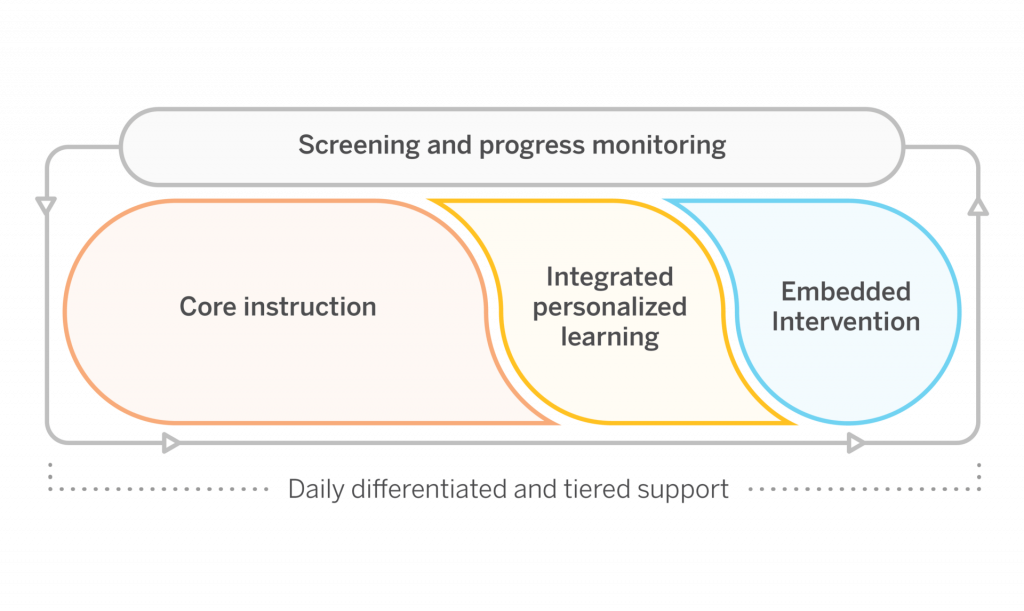
Lessons and units in Amplify Desmos Math California are designed around a Proficiency Progression, a model that steps out problem-based learning by systematically building students’ curiosity into lasting grade-level understanding.
In the Proficiency Progression, lessons begin by activating students’ natural curiosity and offering opportunities to generate new ideas through collaboration. Teachers are then able to refine ideas through intentional facilitation and guide students to grade-level understanding, while students retain the ability to use different strategies and methods to show their comprehension of the content. Students are provided ample opportunities to develop lasting understanding.
Scope and Sequence
Below you can view the scope and sequence for Amplify Desmos Math California Math 1.
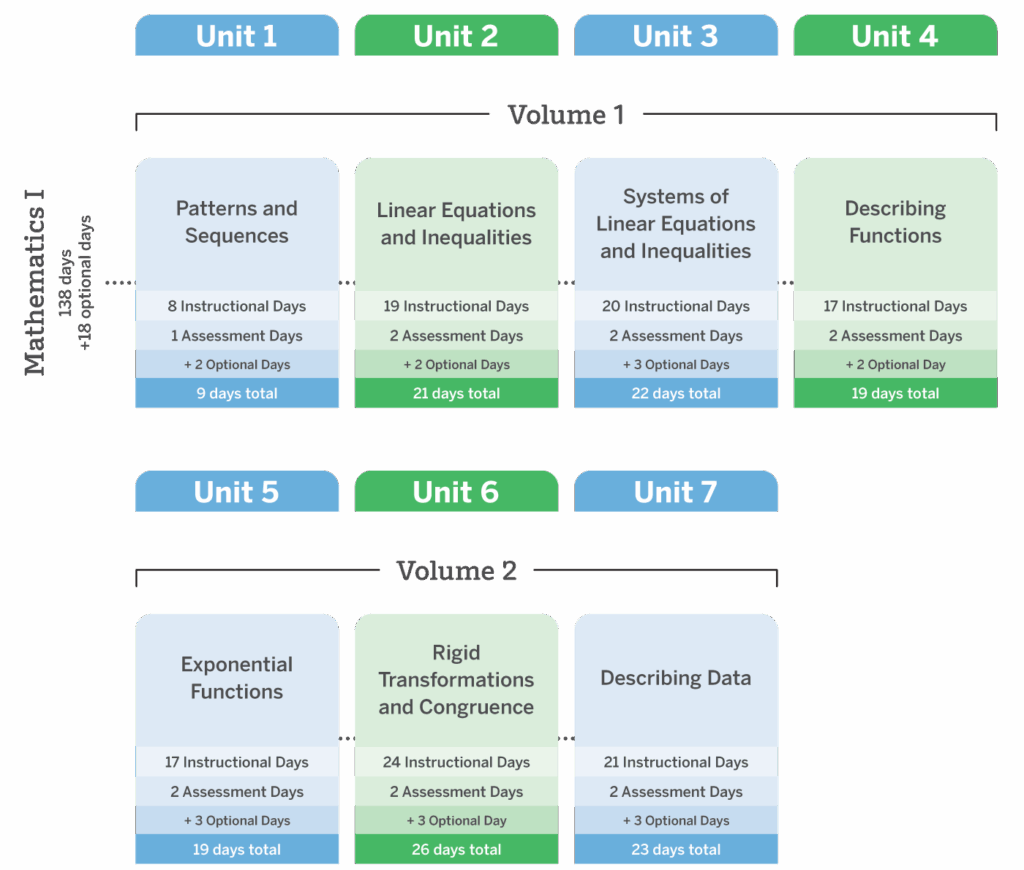
Lesson Design and Structure

Amplify Desmos Math California is designed with a structured approach to problem-based learning that systematically builds on students’ curiosity and allows students to grapple with the Big Ideas of the California Framework. Every lesson activity is organized into a Launch, Monitor, Connect format.
Launch: The launch is a short, whole-class conversation that creates a need or excitement, provides clarity, or helps students connect their prior knowledge or personal experience, which ensures that everyone has access to the upcoming work.
Monitor: As students work individually, in pairs, or in groups, teachers explore student thinking, ask questions, and provide support to help move the conversations closer to the intended math learning goal.
Connect: Teachers connect students’ ideas to the key learning goals of the lesson, facilitating class discussions that help synthesize and solidify the Big Ideas.
Each lesson within Amplify Desmos Math California follows the same structure.
Warm-Up: Every Amplify Desmos Math California lesson begins with a whole class Warm-Up. Warm-Ups are an invitational Instructional Routine intended to provide a social moment at the start of the lesson in which every student has an opportunity to contribute. Warm-Ups may build fluency or highlight a strategy that may be helpful in the current lesson or act as an invitation into the math of the lesson.
Lesson Activities: Each lesson includes one or two activities. These activities are the heart of each lesson. Students notice, wonder, explore, calculate, predict, measure, explain their thinking, use math to settle disputes, create challenges for their classmates, and more. Guidance is provided to help teachers launch, monitor, and connect student thinking over the course of the activity.
Synthesis and Show What You Know: The Synthesis is an opportunity for the teacher and students to pull all the learning of the lesson together into a lesson takeaway. Students engage in a facilitated discussion to consolidate and refine their ideas about the learning goals, and the teacher synthesizes students’ learning. Show What You Know is a daily assessment opportunity for students to show what they know about the learning goals and what they are still learning.
Practice and Differentiation: Daily practice problems for the day’s lesson are included both online and in the print Student Edition, including fluency, test practice, and spiral review.
Routines
Amplify Desmos Math California features a variety of lesson routines. Instructional routines and Math Language Routines (MLRs) are used within lessons to highlight student-developed language and ideas, cultivate conversation, support mathematical sense-making, and promote meta-cognition. Both are called out at point-of-use within the Teacher Edition and Teacher Presentation Screens. Below are the types of routines used throughout the Amplify Desmos Math California curriculum:
Math Language Routines
- MLR1: Stronger and Clearer Each Time
- MLR2: Collect and Display
- MLR3: Critique, Correct, Clarify
- MLR5: Co-Craft Questions
- MLR6: Three Reads
- MLR7: Compare and Connect
- MLR 8: Discussion Supports
Instructional Routines
- Decide and Defend
- Notice and Wonder
- Number Talk
- Tell a Story
- Think-Pair-Share
- Which One Doesn’t Belong?
Category 3: Assessments
A variety of performance data in Amplify Desmos Math California provides evidence of student learning, while helping students bolster their skills and understanding.
Unit-Level Assessment
Amplify Desmos Math California has embedded unit assessments that offer key insights into students’ conceptual understanding of math. These assessments provide regular, actionable information about how students are thinking about and processing math, with both auto-scoring and in-depth rubrics that help teachers anticipate and respond to students’ learning needs.
Pre-Unit Check: Each unit begins with a formative assessment designed to identify the student skills that will be particularly relevant to the upcoming unit. This check is agnostic to the standards covered in the following unit and serves not as a deficit-based acknowledgment of what students do not know, but rather as an affirmation of the knowledge and skills with which students come in.
End-of-Unit Assessment: Students engage with rigorous grade-level mathematics through a variety of formats and tasks in the summative End-of-Unit Assessment. A combination of auto-scored (when completed digitally) and rubric-scored items provides deep insights into student thinking. All Amplify Desmos Math California End-of-Unit Assessments include two forms.
Sub-Unit Quizzes: Sub-Unit Quizzes are formative assessments embedded regularly in Math 1. In these checks, students are assessed on a subset of conceptual understandings from the unit, with rubrics that help illuminate students’ current understanding and provide guidance for responding to student thinking.
Performance Tasks: At the end of each unit there is a summative assessment performance task provided to evaluate students’ proficiency with the concepts and skills addressed in the unit.
Lesson-Level Assessments
Amplify Desmos Math California lessons include daily moments of assessment to provide valuable evidence of learning for both the teacher and student. Beyond formative, summative, and benchmark assessments, students also have opportunities for self-reflection with Watch Your Knowledge Grow. Students take ownership of their learning by reflecting and tracking their progress before and after each unit.
Show What You Know: Each lesson has a daily formative assessment focused on one of the key concepts in the lesson. Show What You Know moments are carefully designed to minimize completion time for students while maximizing daily teacher insights to attend to student needs during the following class.
Responsive Feedback™: Teachers have the ability to see and provide in-the-moment feedback as students progress through a digital lesson. Responsive Feedback motivates students and engages them in the learning process.
Diagnostic Assessment
Every grade level features an asset-based diagnostic assessment designed to be administered at the beginning of the year. Delivered digitally and to the whole class, our diagnostic assessment is uniquely designed to reveal underlying math thinking and identify what students know about grade-level math. With data beyond just right and wrong, teachers have the type of deeper level of insights need to take the right next step.
CAASPP-Aligned Assessment Preparation
Amplify Desmos Math is designed to support students’ mathematical development through problem-based learning, differentiation, and embedded assessments. The program’s emphasis on conceptual understanding, procedural fluency, and application aligns with the mathematical practices and content standards assessed by the CAASPP.
Amplify Desmos Math California includes a CAASPP-aligned Item Bank. This standards-aligned bank of questions allows teachers to filter and search by grade and standard to find items. Once assigned on the digital platform, students will experience CAASPP-like practice with the online digital tools.
Data and Reporting
Amplify Desmos Math California provides teachers and administrators with unified reporting and insights so that educators have visibility into what students know about grade-level math—and can plan instruction accordingly for the whole class, small groups, and individual students. Reporting functionality integrates unit assessments, lesson assessments, diagnostic data, and progress monitoring for a comprehensive look at student learning. Program reports show proficiency and growth by domain, cluster, standard, and priority concept using performance data from unit assessments, then highlight areas of potential student need to allow teachers to modify their instruction and target differentiated support.
Administrator reporting provides a complete picture of student, class, and district performance, allowing administrators to implement instructional and intervention plans.
Category 4: Access and Equity
The Amplify Desmos Math California curriculum provides teachers with lessons, strategies, and resources to eliminate barriers and increase access to grade-level content without reducing the mathematical demand of tasks. Our lessons are developed using the Universal Design for Learning (UDL) framework to proactively ensure that all learners can access and participate in meaningful, challenging learning opportunities.
Every activity has multiple entry points to ensure that all students are supported and challenged. Intervention and personalized learning activities are directly connected to the day’s content and offer students the individualized supports they need to be successful.
Each lesson and unit contains guidance for teachers on how to identify students who may need support, students who need to keep strengthening their understanding, and students who may be ready to stretch their learning. In addition, teachers are provided with recommendations for resources to use with each group of students.
Universal Design for Learning
Each lesson in the program incorporates opportunities for engagement, representation, action, and expression based on the guidelines of Universal Design for Learning (UDL).
- Multiple Means of Engagement: Students engage in both print and digital learning, and are regularly participating in discussions and hands-on activities. Students are invited to build their own challenge for other students to solve, which provides opportunities for choice and
autonomy, as well as joy and play. - Multiple Means of Representation: Students are encouraged to demonstrate their learning using mathematical representations, both print and digital, and regularly engage with their peers in analyzing multiple possible solutions. Classes engage in open-ended discussions about what individual students notice and wonder about mathematical concepts.
- Multiple Means of Action and Expression: Learners differ in how they navigate learning environments and express what they know. Students can communicate their ideas in multiple ways, including in print, sketching, uploading photos, or recording an audio response.
Accessibility
Lesson Facilitation Supports
Every lesson includes at least one specific suggestion the teacher can use to increase access to the lesson without reducing the mathematical demand of the tasks. These suggestions address the following areas:
- Conceptual Processing
- Visual-Spatial Processing
- Executive Functioning
- Memory and Attention
- Fine Motor Skills
Accessibility Tools
Students have the ability to control accessibility tools so that each learning experience is customized to their individual needs. In many instances, these tools can be turned on or off at any point of instruction.
- Text to speech: Reads text instructions to students in multiple languages
- Enlarged font: Increases the size of all text on screen
- Braille mode: Includes narration of digital interactions
- Language selection: Toggles between languages
Differentiation: In-Lesson Teacher Moves
Within every lesson activity, teachers can use the suggestions in the Differentiation Teacher Moves table to provide in-the-moment instructional support while students are engaged in the work of the lesson. This table can help teachers anticipate the ways students may approach the activity, and provides prompts that they can use during the lesson to Support, Strengthen, and Stretch individual students in their thinking. Teachers are provided with clear student actions and understanding to look for, each matched with immediately usable suggestions for how to respond to the student thinking illustrated in each row of the table. In addition to using these suggestions in the moment as teachers monitor student work, teachers can review the Differentiation table in advance to help them anticipate how students are likely to approach the activity.

Differentiation: Beyond the Lesson
Teachers are provided with recommendations for resources to use with each group of students needing support, strengthening, and stretching after each lesson. Support, Strengthen, and Stretch resources include:
- Mini-Lessons: 15-minute, small-group direct instruction lessons targeted to a specific concept or skill
- Item Banks: Space for teachers to create practice and assessments by using filters and searching for standards, summative-style items, and more
- Fluency Practice: Adaptive, personalized practice built out for basic operations and more
- Extensions: Lesson-embedded Teacher Moves including possible stretch questions and activities for students
- Lesson Practice: Additional practice problems support every lesson
- Math Adventures: Strategy-based math games where students engage with math concepts and practice skills in a fun digital environment
- Lesson Summary Support: Support for students and caregivers that provides efficient explanation of the learning goal with clear examples
Math Identity and Community
The Math Identity and Community feature supports teachers in helping students build confidence in their own mathematical thinking, develop skills to work with and learn from others when doing math, and learn how math is an interwoven part of their broader community. The embedded prompts throughout the lessons are designed to highlight what it means to be good at math, the value of sharing ideas, and the power of flexible and creating thinking. Here are some examples of the Math Identity and Community supports embedded in each lesson:
- I can be all of me in math class. You will work with partners every day in math class. What do you want your partners to know about you?
- We are a math community. What does good listening look like and sound like in a math community?
- I am a doer of math. What math strengths did you use today?
Math Language Development
Every lesson in Amplify Desmos Math California includes opportunities for all students to develop mathematical language as they experience the content. Amplify Desmos Math California purposefully progresses language development from lesson to lesson and across units by supporting students in making their arguments and explanations stronger, clearer, and more precise. This systematic approach to the development of math language can be broken down into the following four categories of support:
- Vocabulary: Units and lessons start by surfacing students’ language for new concepts, then building connections between their language and the new vocabulary for that unit. This honors the language assets that students bring into their learning.
- Language Goals: Language goals attend to the mathematics students are learning, and are written through the lens of one or more of four language modalities: reading, writing, speaking, and listening.
- Math Language Routines: Math Language Routines are used within lessons to highlight student-developed language and ideas, cultivate conversation, support mathematical sense-making, and promote meta-cognition.
- Multilingual/English Learner Supports: Supports for multilingual/English learners (ML/ELs) are called out at intentional points within each lesson. These specific, targeted suggestions support ML/ELs with modifications that increase access to a task, or through development of contextual or mathematical language (both of which can be supportive of all learners).
Multilingual and English Learner Supports
Partnership with English Learner Success Forum
Amplify partnered with the English Learner Success Forum (ELSF), a national nonprofit organization that advocates for high-quality instructional materials that are inclusive of multilingual learners. ELSF reviewed Amplify Desmos Math California, and provided directional guidance and feedback to ensure that the program reflects their research-based instructional strategies for multilingual/English learners.
Math Language Development Resource
Our Math Language Development Resources book contains lesson-specific strategies and activities for all levels of English Learners (i.e., Emerging, Expanding, Bridging). With support for every lesson, teachers are empowered to help all students, regardless of their language skills, to participate fully, grasp the material, and excel in their mathematical journey.
Multilingual Glossary
Amplify Desmos Math California includes a digital glossary for languages other than Spanish. Translations will be provided for up to nine languages.
Spanish Version
Amplify Desmos Math California will include Spanish student-facing materials beginning in the 2026–27 school year.
Category 5: Instructional Planning and Support
Amplify Desmos Math California includes a variety of embedded instructional supports to empower teachers to lead effectively and gain actionable insights into student growth and progress. Teachers are equipped with a comprehensive set of resources designed to fulfill the requirements of Category 5.
Grade-level concepts
Within the Teacher Edition front matter:
- Scope and sequence
- Big Ideas, Drivers of Investigation, and Content Connections
- Grade level standards
- Standards for Mathematical Practice
- English Language Development Standards
- Environmental Principals and Concepts
Within each Unit and Sub-Unit Overview:
- Big Ideas, Drivers of Investigation, and Content Connections
- Math that Matters Most
- Grade level standards
- Standards for Mathematical Practice
- English Language Development Standards
- Environmental Principals and Concepts
Within each Lesson:
- Big Ideas, Drivers of Investigation, and Content Connections
- Grade level standards
- Standards for Mathematical Practice
- English Language Development Standards
- Environmental Principals and Concepts
How to implement the program
At the course level (within the Teacher Edition front matter):
- Navigating the Program (both print and digital)
- Facilitating Lesson Activities with Launch, Monitor and Connect
- Overview of the Digital Facilitation Tools
At the lesson level:
- Suggestions for timing
- What materials to prep
- How to organize and group students
- Key lesson takeaways with the Synthesis
- Recommendations for Differentiation
- Strategies for intervention and extensions (in the Intervention, Extensions, and Investigation Resources book)
At the activity level:
- Differentiation recommendations
- Accessibility tips
- ML / EL tips
- Teacher look-fors
- Recommended Teacher Moves
- Prompts for guiding student thinking
- Sample student responses
Development of Math Language
A variety of language development supports are provided within the Student and Teacher Editions and Math Language Development Resources book.
At the lesson level:
- Diagrams and visuals
- Sentence frames and word banks
- Graphic organizers, including Frayer models
- Vocabulary routines
- Embedded language supports aligned to the CA ELDs
- Lesson-specific strategies for Emerging, Expanding, and Bridging
At the unit level:
- Words With Multiple Meanings
- Contextual vocabulary
At the course level:
- English/Spanish cognates
- Multilingual Glossary
Other Curriculum Guidance
- Additional Practice Resources book
- Assessment Resources book
- Assess and Respond guidance paired with each assessment opportunity
- Show-What-You-Know activities
- Answer keys and rubrics
- Performance tasks
Welcome to Amplify Desmos Math California
Amplify Desmos Math California core math program is designed to meet the California Mathematics Framework and the California Common Core State Standards for Mathematics. Scroll down and click to view the K–8, Algebra 1, and Math 1 student materials.
K–8 student materials
Please note that the Grade 5 Student Edition Volume 2 has been divided by unit in order to be posted on this site due to file size upload restrictions.
Algebra I student materials
Math I student materials
Collaborate on collections
We love connection and creativity for students and teachers. Now, teachers can work together to collaboratively create collections of activities. Get your whole department involved! To get started, find the dropdown menu in your collection and select “manage editors.” Add as many editors as you want, then dive in.

Algebra 1 is now available
Students can now meet the complete cast of Algebra 1 characters, from Shelley the Snail to Carlos’s fish, while deepening their understanding of algebraic relationships, functions, and statistics.

Hablamos español!
The full Desmos 6–A1 curriculum is available in Spanish. To access, click on the globe icon in the top right-hand corner and select Español (LATAM).

Beautiful new design updates
We’ve updated the appearance of our entire digital platform to provide a cohesive experience for users across Amplify and Desmos Classroom. We’re continuing to improve accessibility while considering use of color, contrast, font sizes, text spacing, and hierarchy. These exciting navigation updates will mean an updated look and feel. You’ll still be able to access every feature you know, plus more!

New features you can add to your lessons
Polypad
Using Polypad inside Desmos Math 6–A1 activities is easy—just add a Polypad component! You can start by creating Polypad content, or easily importing pre-made Polypad content.
Learn more in our latest Polypad Pointer video:

Challenge Creator
Add a social and creative experience to lessons with Challenge Creator! Teachers can now design their own challenges for students to create, share, and discuss ideas in activities. Check out our activity or try building your own.

Students can now share their thinking in more ways!
With our improved Free Response components, students can now share responses using text, uploaded images, or recorded audio.

Live chat support
If you need help, just click on the Amplify chat icon in the button right-hand corner of your screen. You can ask a question or share your feedback. Our team is here to help you!

Customer Privacy Policy
Last Modified: January 23, 2026 | Update History
Most recent update: This Privacy Policy has been updated to address additional rights for individuals in the European Union/UK.
We advise you to read this Privacy Policy in its entirety, including the jurisdiction-specific provisions in the appendix. Click here to review Our U.S. Notice At Collection.
Customer Privacy Policy: K–12 Schools
Who We Are
Amplify Education, Inc. (“Amplify”) is leading the way in next-generation curriculum and assessment. Amplify’s programs provide teachers with powerful tools that help them understand and respond to the needs of each student and use data in a way that is safe, secure, and effective.
Our Products and Services
Amplify’s products support classroom instruction and learning and include Amplify CKLA, Amplify ELA, Amplify Caminos, Amplify Science, Amplify Desmos Math, Boost Reading, Boost Math, mCLASS, Mathigon, associated professional development and tutoring services, and services at classroom.amplify.com (for creating and assigning activities) and student.amplify.com (for use of the activities or curricula as directed by an instructor), and any other product or service that links to this Privacy Policy (together, the “Products”).
Our Approach to Student Data Privacy
In the course of providing the Products to Schools and their Authorized School Users, Amplify collects, receives, generates, or has access to Student Data (defined below). We consider Student Data to be confidential and we collect and use Student Data solely for educational purposes in connection with providing our Products to, or on behalf of the School as described in this Privacy Policy and our Agreements (defined below). We work to maintain the security and confidentiality of Student Data that we collect or store, and we enable Schools to control the use, access, sharing, and retention of Student Data.
Our Products are geared towards K–12 students (“Students”), and the educators, agents and staff members who use the Products as authorized by their School (“Educators”). Information that directly relates to an identifiable Student (“Student Data”) is owned and controlled by the School, and Amplify receives Student Data as a “school official” under Section 99.31 of the Family Educational Rights and Privacy Act of 1974 (“FERPA”) for the purpose of providing the Products hereunder. In addition, we rely on the School acknowledging that it is acting as the parent’s agent and consenting on the parent’s behalf to process personal information of Students under the age of 13 (“Child Users”) in accordance with the Children’s Online Privacy Protection Act (“COPPA”).
Our collection and use of Student Data is governed by our Agreements with Schools, including this Privacy Policy (“Privacy Policy”), and applicable laws which may include FERPA, COPPA, the Protection of Pupil Rights Amendment (“PPRA”), as well as other applicable federal, state, and local privacy laws and regulations (“Applicable Laws”). As noted above, with respect to FERPA, Amplify receives Student Data as a “school official” under Section 99.31 of FERPA for the purpose of providing its Products, and such Student Data is owned and controlled by the School.
Schools may provide authorization in two ways:
- by the School agreeing to our Customer Terms and Conditions located at amplify.com/customer-terms or another written agreement between Amplify and the School, as applicable; or
- by an Educator agreeing to the Acceptable Use Policy located at amplify.com/acceptable-use-policy/ (“AUP”) on behalf of the School as outlined in the AUP.
In each case, we collect Student Data and provide these Products solely for the use and benefit of the School and for no other commercial purpose. We require all Schools to review this Privacy Policy, available at amplify.com/customer-privacy, and to make a copy of the Privacy Policy available to the parents or guardians of Child Users.
We also provide limited opportunities for individual users to sign up for an account for use of our Products at-home or otherwise outside of the authorization of a School (“Home Users”). See the Appendix–Supplemental Disclosures for additional information that applies to our Home Users.
What This Privacy Policy Covers
This Customer Privacy Policy (“Privacy Policy”) describes how Amplify collects, uses, and discloses personal information through the provision of Products.
For purposes of this Privacy Policy, “you” and “your” means Authorized Users (defined below).
This Privacy Policy does not apply to Amplify’s handling of:
- information collected from users of Amplify’s company website, which is governed by our Website Privacy Policy.
- job applicant data that we process in accordance with our applicant privacy notice.
There may be different contractual terms or privacy policies in place with some Schools. Such other terms or policies supersede this Privacy Policy for information collected or released under those terms. If you have any questions as to which legal agreement or privacy policy controls the collection and use of your personal information, please contact us using the information provided below. Unless expressly superseded, this Privacy Policy is incorporated into and is subject to the Agreement that governs your use of the Products.
Our Role
Amplify as a processor/service provider: Our School customers are the controllers of Student Data (as well as certain other Educator personal information to the extent required by law or Amplify’s agreement with the School) (together “School Data”).
Amplify acts as a processor/service provider for our School customers with respect to School Data, which means when we use School Data, we do so solely on the instruction of the School. School Data is subject to the School’s privacy policies; therefore, you will need to contact the School directly if you have any questions or would like to exercise your rights with respect to School Data.
Amplify as a controller: We are the controller of all other personal information we collect from non-Student Authorized Users (“Amplify Data”) and can be reached by email at privacy@amplify.com or by mail at Amplify Education, Inc., 55 Washington St.#800, Brooklyn, NY, 11201.
Policy
1. Definitions
Capitalized terms not defined in this section or elsewhere in this Privacy Policy will have the meaning set forth by Applicable Laws.
“Agreement” means the underlying contractual agreement between Amplify and the School.
“Authorized Users” means all users of our Products, including Authorized School Users, parents and legal guardians, and Home Users.
“Authorized School Users” means Students and Educators.
“Local Education Authority” means a local education agency or authority, school district, school network, independent school, or other regional education system.
“Non-Student Data” means information that is linked or linkable to Authorized Users who are not Students.
“School” means the Local Education Authority or State Agency.
“State Agency” means the educational agency primarily responsible for the supervision of public elementary and secondary schools in any of the 50 states, the Commonwealth of Puerto Rico, the District of Columbia, or other territories and possessions of the United States, as well as a national or regional ministry or department of education in other countries, as applicable.
2. What personal information do we collect?
When you access or use our Products, you may choose to provide us with personal information, including Student Data. This information may be provided to us directly (e.g. when an account is created or through communications with us) or through your interactions with our Products.
Student Data. Below is a list of the categories of Student Data that may be collected by Amplify or its Products, either directly or through the Authorized School User’s use of the various features and configurations of the Products:
- Identifier and Enrollment Data, such as name, email, school / state ID number, username and password, grade level, homeroom, courses, teacher names.
- Why? Most of Amplify’s Products require some basic information about who is in a classroom and who teaches the class—Student or teacher Identifier and Enrollment data. This information is provided to Amplify by the School, either directly from the School’s student information system or via a third party with whom the School contracts to provide that information.
- Demographic Data, such as date of birth, socioeconomic status, race, national origin, and preferred or primary language.
- Why? To support school instructional and reporting requirements, Amplify’s Products allow Schools to view reports and analyze data using Demographic Data. Generally, Demographic Data is provided on a voluntary basis by the School. For example, a School may wish to analyze Student literacy assessment results based on English Language Learner status to better tailor classroom instruction, and in that case, the School may provide Demographic Data to enable that reporting.
- School Records, such as grades, attendance, assessment results, and whether an Individualized Education Plan (IEP or local equivalent) is in place.
- Why? Some of our Products support grading assignments and administering formative, diagnostic, and curriculum-based assessments. Teachers use that information to support Students’ progress in the program or help with instructional decisions. We do not collect specific details from an IEP, nor do we collect protected health information or other sensitive information.
- Schoolwork and Student Generated Content, which includes any information contained in Student assignments and assessments, including information in response to instructional activities and participation in collaborative or interactive features of our Products, such as Student responses to academic questions and Student-written essays, as well as images, video, and audio recordings.
- Why? As part of the digital learning experience, some of our Products may enable Students to write text and create and upload images, video, and audio recordings. For example, in Amplify ELA, students may write essays or submit short-form responses in our platform as part of a lesson on literature. As another example, in Boost Reading, student interactions with reading skills games are recorded to keep track of the student’s progress to level up in the program and to provide visibility to teachers on how students are mastering the skills.
- Teacher Comments and Feedback, such as scores, written comments, or other feedback that Educators may provide about Student responses or student course performance.
- Why? To enable teachers to track the performance and provide feedback to their students.
- Non-Student Data. We may collect the following types of personal information from all other Authorized Users:
- Contact Information, such as name and email address, as well as grade level taught, school name and school location, whether you are an Educator or Home User that creates an account or uses our Products or communicates with us.
- Account Information, such as user login and password, for account creation and access purposes.
- Survey Responses, which you provide in response to surveys or questionnaires.
- Device and Usage Data. Depending on the Product, we may collect certain information about the device used to connect to our Product, such as device type and model, browser configurations, and persistent identifiers, such as IP addresses and unique device identifiers. We may collect device diagnostic information, such as battery level, usage logs, and error logs, as well as usage, viewing, and technical information (e.g., email open rates), such as the number of requests a device makes, to ensure proper system capacity for all Authorized Users. We may collect IP addresses and use that information to approximate device location to support operation of the Product. To the extent that we collect this information, this data is solely used to support operation of the Product and is not linked to Student Data. For purposes of clarity, Amplify does not use Student Data for marketing or advertising purposes (see section 6 of this Privacy Policy for more information about our commitments regarding Student Data).
- Why? We use this information to remember returning users and facilitate ease of login, to customize the function and appearance of the Products, and to improve the learning experience. This information also helps us track product usage for various purposes, including website optimization, to ensure proper system capacity, troubleshoot and fix errors, provide technical assistance and customer support, provide and monitor the effectiveness of our Products, monitor and address security concerns, and compile analytics for product improvement and other internal purposes.
- How? Cookies and Similar Technologies. We collect device and usage data through “cookies,” Web beacons, HTML5 local storage, and other similar technologies, which are used in some of our Products solely to support operation of the Products as described above. While we may use third party cookies and similar technologies for advertising and marketing purposes on our website (in accordance with our Website Privacy Policy), we do not permit such tracking technologies to be present on Student-facing portions of the Products. In particular, we only use the following types of cookies in our Products:
- Strictly necessary cookies – These are cookies that are required for the operation of our websites and applications that host our Products. They include, for example, cookies that enable you to log into secure areas of our Products. These cookies are not generally stored beyond the browser session and are less likely to include personal information. This category of cookies cannot be disabled.
- Functionality Cookies – We use these cookies so that we recognize you on the websites and apps that host our Products and remember your previously selected preferences. These cookies are stored on your device between browsing sessions but expire after a pre-defined period. These cookies enable us to “recognize” you when you use our Products, including your preferences such as your preferred language, time, and location. A mix of first party (placed by us) and third-party cookies (placed by third parties) are used.
- Performance Cookies – These cookies help us and service providers acting on our behalf compile statistics and analytics about users of our Products that are accessed via websites and apps, including Device and Usage Information.
- Learn how to opt out of cookies and similar technologies by reading the “What Rights and Choices Do You Have?” section of this Privacy Policy below.
3. How do we use personal information?
Student Data. Amplify uses Student Data for educational purposes, to provide the Products, and to ensure secure and effective operation of our Products, including:
- to provide and improve our educational Products;
- to support School and Authorized School Users’ activities;
- to ensure secure and effective operation of our Products;
- for purposes requested or authorized by the School or Authorized School User or as otherwise permitted by Applicable Laws;
- for customer support purposes, to respond to the inquiries and fulfill the requests of the School and their Authorized School Users;
- to enforce Product access and security controls; and
- to conduct system audits and improve protections against the misuse of our Products, or to detect and prevent fraud and other harmful activities.
- to enable the adaptive and personalized learning features of the Products.
Non-Student Data. Amplify may use Non-Student Data for the purposes for which Student Data is used as set forth above. In addition, Amplify may use Non-Student Data to provide customized content, advertising and marketing in limited circumstances (e.g. to periodically send newsletters and other promotional materials) directed to Educators and Home Users. For sake of clarity, we do not use Student Data for marketing purposes and we do not direct marketing to Students. Amplify may also use Non-Student Data for internal research and analytics, including generating insights on the use of our Products by Educators in certain Schools so that we can better serve those communities. We will also use Non-Student Data as otherwise required or permitted by law, or as we may notify you at the time of collection. Learn how to opt out of these communications by reading the “What Rights and Choices Do You Have?” section of this Privacy Policy below.
Amplify may use aggregate or de-identified data as described in the Aggregate/De-identified Data section below.
4. To whom do we disclose personal information?
Student Data. We disclose Student Data to third parties only as needed to provide the Products under the Agreement, as directed or permitted by the School or Authorized School User, and as required by law. Such disclosures may include but are not limited to the following:
- to other Authorized School Users of the School entitled to access such data in connection with the Products;
- to our service providers, subprocessors, or vendors who have a legitimate need to access such data in order to assist us in providing or supporting our Products, such as platform, infrastructure, and application software. We contractually bind such parties to protect Student Data in a manner consistent with those practices set forth in this Privacy Policy and in accordance with Applicable Laws. A list of Amplify subprocessors is available at https://www.amplify.com/subprocessors;
- to comply with the law, respond to requests in legal or government enforcement proceedings (such as complying with a subpoena), protect our rights in a legal dispute, or seek assistance of law enforcement in the event of a threat to our rights, security, or property or that of our affiliates, customers, Authorized Users, or others;
- in the event Amplify or all or part of its assets are acquired or transferred to another party, including in connection with any bankruptcy or similar proceedings, provided that successor entity will be required to comply with the privacy protections in this Privacy Policy with respect to information collected under this Privacy Policy, or we will provide the School with notice and an opportunity to opt out of the transfer of such data prior to the transfer; and
- except as restricted by Applicable Laws or contracts with the School, we may also share Student Data with Amplify’s affiliated education companies, provided that such disclosure is solely for the purposes of providing Products and at all times is subject to this Policy.
Non-Student Data. Amplify discloses Non-Student Data for the purposes for which Student Data is used as set forth above. Amplify may also disclose Non-Student Data as otherwise required or permitted, or as disclosed at the time of collection. Please note that we do not share mobile information or opt-in consent with third parties / affiliates for their own marketing or promotional purposes.
5. Aggregate/De-identified data
Amplify may use de-identified or aggregate data for purposes allowed under FERPA and other Applicable Laws, to research, develop, and improve educational sites, services, and applications and to demonstrate the effectiveness of the Amplify Products. Amplify will not attempt to re-identify de-identified data. We may use aggregate information (which is information that has been collected in summary form such that the data cannot be associated with any individual) for analytics and reports. For example, our promotional materials may note the total number of students served by our programs in the prior year, but that information cannot be used to identify any one student. We may also share de-identified or aggregate data with research partners to help us analyze the information for product improvement and development purposes.
Records and information are de-identified when all personal information has been removed or obscured, such that the remaining information does not reasonably identify a specific individual. We de-identify Student Data in compliance with Applicable Laws and in accordance with the guidelines of NIST SP 800-122. Amplify has implemented internal procedures and controls to protect against the re-identification of de-identified Student Data. Amplify does not disclose de-identified data to its research partners unless that party has agreed in writing not to attempt to re-identify such data.
6. Data prohibitions, Advertising, Advertising limitations
Amplify will not:
- sell Student Data to third parties;
- use or disclose Student Data to inform, influence, or enable targeted advertising to a Student based on Student Data or information or data inferred over time from the Student’s usage of the Products;
- use Student Data to develop a profile of a Student for any purpose other than providing the Products to a School or Authorized School User, or as authorized by a parent or legal guardian;
- use Student Data for any commercial purpose other than to provide the Products to the School or Authorized School User, or as permitted by Applicable Laws.
7. External third-party services
This Privacy Policy applies solely to Amplify’s Products and practices. Schools and other Authorized Users may choose to connect or use our Products in conjunction with third-party services and Products. Additionally, our sites and Products may contain links to third-party websites or services . This Privacy Policy does not address, and Amplify is not responsible for, the privacy, information, or other practices of such third parties. Schools should carefully consider which third-party applications to include among the Products and services they provide to Students and vet the privacy and data security standards of those providers.
Authorized Users may be able to log in to our Products using third-party sign-in services such as Clever, ClassLink or Google. These services authenticate your identity and provide you with the option to share certain personal information with us, including your name and email address, to pre-populate our account sign-up form. If you choose to enable a third party to share your third-party account credentials with Amplify, we may obtain personal information via that mechanism. You may configure your accounts on these third-party platform services to control what information they share.
8. Security
Amplify maintains a comprehensive information security program and uses industry standard administrative, technical, operational, and physical measures to safeguard Student Data in its possession against loss, theft and unauthorized use, disclosure, or modification. Amplify performs periodic risk assessments of its information security program and prioritizes the remediation of identified security vulnerabilities. Please see https://amplify.com/security for a detailed description of Amplify’s security program.
In the event Amplify discovers or is notified that Student Data within our possession or control was disclosed to, or acquired by, an unauthorized party, we will investigate the incident, take steps to mitigate the potential impact, and notify the School in accordance with Applicable Laws.
Non-Student Data
Outside of Student Data, Amplify uses commercially reasonable administrative, technical, personnel, and physical measures to safeguard personal information in its possession against loss, theft, and unauthorized use, disclosure or modification.
9. Data Storage and Transfers
We are a United States Company, and our servers are hosted, managed, and controlled by us in the United States. If you are outside of the United States, we use industry standards to protect your data when it leaves your country of residence and your data will always be protected in accordance with this Privacy Policy, Applicable Laws and our Agreement regardless of the storage location.
Additionally, where we transfer your personal information to service providers outside of the United Kingdom (UK), European Economic Area (EEA), or other region that offers similar protections, we use specific appropriate safeguards to contractually obligate such service providers to protect personal information in accordance with Amplify’s commitment to privacy and security and applicable data protection laws.
If you have questions or wish to obtain more information about the international transfer of your personal information or the implemented safeguards, please contact us using the contact information below.
10. Data Retention / Deletion
Student Data
Upon request, we provide the School the opportunity to review and delete the personal information collected from Students. We will retain Student Data for the period necessary to fulfill the purposes outlined in this Privacy Policy and our Agreement with the School. We do not knowingly retain Student Data beyond the time period required to support the School or Authorized School User’s educational purpose, unless authorized by the School or Authorized School User. Upon request, Amplify will return, delete, or destroy Student Data stored by Amplify in accordance with applicable law and customer requirements. We may not be able to delete all data in all circumstances, such as information retained in technical support records, customer service records, back-ups, and similar business records. All such information will be protected in accordance with this Privacy Policy and our Agreement until it has been permanently deleted. Unless otherwise notified by the School, we will delete or de-identify Student Data after termination of our Agreement with the School.
Non-Student Data
Outside of Student Data, we keep personal information as long as it is necessary or relevant for the practices described in this Privacy Policy or as otherwise required by our Agreement with the School, if applicable. We determine the appropriate retention period for personal information on the basis of the amount, nature and sensitivity of the personal information being processed, the potential risk of harm from unauthorized use or disclosure of the personal information, whether we can achieve the purposes of the processing through other means, and on the basis of applicable legal requirements (such as applicable statutes of limitations).
11. What rights and choices do you have?
What Choices Do You Have?
Marketing/Advertising
As noted above, we do not use Student Data for marketing purposes and we do not direct marketing to Students. Amplify does not use third party cookies and similar technologies for advertising and marketing purposes on Student-facing portions of the Products. The choices below apply to Non-Student Authorized Users.
Opt-out of Marketing Communications. If you want to stop receiving promotional materials from Amplify, you can follow the unsubscribe instructions at the bottom of each email or email us at privacy@amplify.com. Amplify does not send marketing communications to Students.
Opt-out of Cookies and Similar Tracking Technologies. With respect to cookies, you may be able to reject cookies through your browser or device controls. Note that you have to opt-out of cookies on each browser or device that you use. If you replace, change, or upgrade your browser or device, or delete your cookies, you may need to use these opt-out tools again. Please be aware that disabling cookies may negatively impact your experience as some features may not work properly. To learn more about browser cookies, including how to manage or delete them, check the “Help,” “Tools,” or similar section of your browser.
What Rights Do You Have?
Individuals in the U.S.
- What Rights Do You Have With Respect to Student Data?
- Review and Correction. FERPA requires schools to provide parents with access to their children’s education records, and parents may request that the school correct records that they believe to be inaccurate or misleading.
- If you are a parent or guardian and would like to review, correct, or update your child’s data stored in our Products, contact your School. Amplify will work with your School to enable your access to and, if applicable, correction of your child’s education records.
- If you have any questions about whom to contact or other questions about your child’s data, you may contact us using the information provided below.
- Other Privacy Rights? Please see section 3 of our supplemental disclosures: “Additional U.S. State Privacy Law Rights” for more information about your U.S. privacy rights
Individuals in the EU/UK
Please see section 4 of our supplemental disclosures: “Notice for European Economic Area and United Kingdom Customers” for more information about your EU/UK privacy rights.
12. COPPA
We do not knowingly collect personal information from a Child User unless and until a School or Educator, with the permission of the School, has authorized us to collect such information to provide the Products. Amplify relies on the School acknowledging that it is acting as the parent’s agent and consenting on the parent’s behalf to process personal information of Child Users in accordance with all applicable provisions of COPPA. To the extent COPPA applies to the information we collect, we process such information for educational purposes only, and no other commercial purpose, at the direction of the School and on the basis of the School’s authorization. If you are a parent or guardian and have questions about your child’s use of the Products and any personal information collected, please direct these questions to your child’s school.
Please refer to the Appendix–Supplemental Disclosures if you are a Home User.
13. Updates to this Privacy Policy
We may change this Privacy Policy in the future. For example, we may update it to comply with new laws or regulations, to conform to industry best practices, or to reflect changes in our product offerings. When these changes do not reflect material changes in our practices with respect to use and/or disclosure of Authorized Users’ personal information, including Student Data, such changes to the Privacy Policy will become effective when we post the revised Privacy Policy on our website. In the event there are material changes in our practices that would result in Authorized Users’ personal information being used in a materially different manner than was disclosed when the information was collected, with respect to Student Data, we will notify the School, and with respect to other information, we will notify you via email and provide an opportunity to opt out before such changes take effect.
14. Contact us
If you have questions about this Privacy Policy, please contact us at:
Email: privacy@amplify.com
Mail: Amplify Education, Inc.
55 Washington St.#800
Brooklyn, NY, 11201
Phone: (800) 823-1969
Attn: General Counsel
To report a security vulnerability, visit https://amplify.com/report-a-vulnerability/.
Appendix – Supplemental Disclosures
1. Mathigon and Amplify Classroom accounts
While our Products are geared towards Schools we do provide a limited opportunity for Home Users to use the Products at home—outside of the school context. We do not allow persons under the age of 13 (or those under the age of consent in any applicable jurisdiction) to register for an account with us outside the school context.
If you are a Home User, you are prohibited from collecting or providing any personal information from students or minors. You are permitted to access the platform for instructional purposes, but you may not enroll or roster minors, create accounts for minors, or input any personal information of minors into the Product.
Please note that most parts of Mathigon can be used without creating an account or providing any personal information that directly identifies you.
What Rights Do You Have? If you are a Child User who is 13 or older with a legacy Mathigon account (or the parent or guardian of a Child User with a legacy Mathigon account), you may request that we provide for your review, delete from our records, or cease collecting any Child User personal information. To the extent that you are unable to exercise these rights through self-service features within your account with us, please contact us by sending an email to: help@amplify.com and we will provide assistance.
2. U.S. Notice at Collection
| Personal Information We Collect | How We Use Personal Information |
|
Student Data, which includes:
|
|
|
Authorized Users, which includes:
|
|
Some of the information described above may be considered “sensitive” under the laws of certain jurisdictions (i.e., account credentials and race/national origin) (“Sensitive Information”). We use Sensitive Information for necessary or reasonably expected purposes – specifically, to provide you with our Services (i.e., account credentials are used to allow account logins and race/national origin are used for the School’s reporting purposes when voluntarily provided by the School).
We do not sell or share your personal information, as described in California law.
We retain your personal information for as long as reasonably necessary for the purposes disclosed in the chart above. Additional information about our retention of Student Data and personal information from other Authorized Users can be found in Section 10 of this Privacy Policy.
Please see the Additional U.S. State Privacy Law Rights section of this appendix for information about your privacy rights pursuant to applicable U.S. law.
Notice of Financial Incentive
From time to time, to support our services, we offer opportunities to complete surveys and questionnaires. As an incentive for completing the survey or questionnaire, you can voluntarily provide personal information as an entry into a raffle drawing or to obtain other benefits, discounts, offers, or deals that may constitute a financial incentive under California law (“Financial Incentive”). The categories of personal information required for us to provide the Financial Incentives include: contact information and any other information that you choose to provide when you complete the survey.
Participation is voluntary and you can opt out at any time before the survey is complete. We do not allow students to participate in our surveys.
The value of the personal information we collect in connection with our Financial Incentives is equivalent to the value of the benefit offered.
3. Additional U.S. State Privacy Law Rights
Note for Requests Relating to Student Data: Because Amplify provides the Products to Schools as a “School Official,” we collect, retain, use, and disclose Student Data only for or on behalf of the School for educational purposes, including the purpose of providing the Products specified in our Agreement with the School and for no other commercial purpose. Accordingly, we act as a “service provider” for the School with respect to School Data. We work with the School to support and assist them in addressing privacy requests relating to School Data. Please reach out to your School directly if you wish to exercise any privacy rights that may be available to you.
For all other requests: With respect to Amplify Data, individuals residing in certain U.S. states have the following rights, regarding your personal information (each of which is subject to various exceptions and limitations):
- Access. You have the right to request, up to two times every 12 months, that we disclose to you the categories of personal information collected about you; the categories of sources from which the personal information is collected; the categories of personal information sold or shared; the business or commercial purpose for collecting, selling, or sharing the personal information; the categories of third parties with whom personal information was shared; and the specific pieces of personal information collected about you.
- Correction. You have the right to request that we correct inaccurate personal information collected from you.
- Deletion. You have the right to request that we delete the personal information that we maintain about you. Even after the deletion of your account, some personal information may remain on our servers, such as in technical support logs, server caches, data backups, or email conversations. These will be automatically deleted after a reasonable amount of time, unless we are legally required to retain information for longer, or unless there is a legitimate business reason (e.g. security and fraud prevention or financial record-keeping). We are not required to delete any information which has been aggregated or de-identified in accordance with Section 5.
- No Discrimination. You have the right not to be discriminated against for exercising these rights.
- Appeals. You have a right to appeal decisions concerning your ability to exercise your consumer rights.
See Submitting Requests section below for details on submitting a request to exercise these rights.
4. Notice for European Economic Area (EEA) and United Kingdom (UK) Customers
As detailed at the beginning of our Privacy Policy (under the section titled “Our Role”), Amplify operates primarily as a processor that collects personal information on behalf of the School, and we act as a controller in limited circumstances where we offer Products outside the school context.
If you represent a School in the EEA or the UK, please note that we process personal information in accordance with this Privacy Policy, our Acceptable Use Policy, and our standard Data Protection Agreement, which sets out our responsibilities when it comes to our processing activities. Schools must send an email to privacy@amplify.com to enter into that DPA.
Lawful Basis for Processing
We rely on the following lawful bases for our processing activities:
- Consent;
- We obtain your consent to use cookies to collect and process device and usage data to understand how individuals use our Products.
- Pursuant to a contract for use of our Products;
- We process School Data to provide our Products (e.g., to create, authenticate and manage your account, to verify your identity, to manage our Products) pursuant to the Agreement between us and the School, as required in order for us to perform our obligations.
- To comply with our legal obligations;
- We process all categories of personal information that we collect to ensure the safety and security of our Products where we are complying with security requirements under data protection and cyber and information security law.
- We process all categories of personal information that we collect to comply with our legal obligations which includes, for example, to access, retain or share certain personal information where we receive a valid request from a government body, law enforcement body, judicial body regulator or similar, to deal with legal claims and prospective legal claims, and to ensure we are complying with applicable laws.
- When we have a legitimate interest in doing so, which is not outweighed by the risks to the individual.
- We process all categories of personal information that we collect to support the provision, effective management, and improvement of our Products where such activities are not strictly required under our contract. This is in our legitimate interests to ensure that we are providing the best possible service.
- We process all categories of personal information that we collect to ensure the safety and security of our services where this is important but not required under the data protection law or cyber and information security laws. This is in our legitimate interests to ensure the security of our services and systems, to prevent threats, abuse or fraudulent or unlawful activity, to promote safety and security and to ensure our Products are used in accordance with our terms and conditions.
- We process the contact information of Non-Student Authorized Users to manage our relationship, including to respond to queries or otherwise communicate with you in relation to our Products and the operation of our business where this is not strictly required under a contract with you. This is in our legitimate interests to communicate with and resolve queries from users of our Products and to ensure that we are providing the best possible service.
We process the contact information and survey data of Non-Student Authorized Users for internal research and marketing purposes in limited circumstances (e.g. to periodically send newsletters and other promotional materials), which will not be based on Student Data or directed to Students. This is in our legitimate interests to understand our customers and prospective customers, understand how our products and services are perceived in the market, to promote our products, and to grow and develop our business.
Your Data Subject Rights
Note for Requests Relating to School Data: Amplify acts as processor to its School customers with respect to all School Data. We work with our School customers to support and assist them in addressing privacy requests relating to School Data. Please reach out to your School directly if you wish to exercise any privacy rights that may be available to you.
For all other Requests – With respect to Amplify Data, you have the following rights if you are in the EEA or UK, subject to certain exceptions:
- Right of access: You have the right to ask us for confirmation on whether we are processing your personal information and access to that personal information.
- Right to correction: You have the right to have your personal information corrected.
- Right to erasure: You have the right to ask us to delete your personal information.
- Right to withdraw consent: You have the right to withdraw consent that you have provided.
- Right to lodge a complaint with a supervisory authority: You have the right to lodge a complaint with a supervisory authority.
- Right to restriction of processing: You have the right to request the limiting of our processing under limited circumstances.
- Right to data portability: You have the right to receive the personal information that you have provided to us, in a structured, commonly used, and machine-readable format, and you have the right to transmit that information to another controller, including to have it transmitted directly, where technically feasible.
- Right to object: You have the right to object to our processing of your personal information
See Submitting Requests section below for details on submitting a request to exercise these rights.
5. Submitting Requests
To exercise any of the rights described in sections 2 and 3 of this appendix, email us at privacy@amplify.com and specify which privacy right you intend to exercise. We may require additional information from you to allow us to confirm your identity. The verification steps will vary depending on the sensitivity of the personal information and whether you have an account with us. Please note that your rights may not apply in all cases. For example, we may need to retain your personal information to comply with our legal obligations, resolve disputes, prevent fraud and enforce our agreements. We will inform you if we are not able to fully respond to your requests. You may designate an authorized agent to make a request on your behalf. When submitting the request, please ensure the authorized agent identifies himself/herself/itself as an authorized agent and can show written permission from you to represent you. We may contact you directly to confirm that you have authorized the agent to act on your behalf or confirm your identity.
Complaints
If you have any issues, you have the right to lodge a complaint with an EEA or UK supervisory authority. We would, however, appreciate the opportunity to address your concerns before you approach a data protection regulator and would welcome you directing an inquiry first to us. To do so, please contact us by email at privacy@amplify.com or by mail at Amplify Education, Inc., 55 Washington St.#800, Brooklyn, NY, 11201.
6. Google APIs
Amplify uses Google’s Application Programming Interface (API) Services to enable Authorized Users to log in to Amplify, import classes and rosters from Google Classroom, create assignments in Google Classroom, and copy, edit, and publish Amplify content using Google Slides. Amplify will use and transfer information received from Google’s API in accordance with Google API Service User Data Policy, including the Limited Use requirements.
Update History:
Update: 6/13/2025: This Policy has been updated to align with product updates and to provide additional context for authorized educational use of Amplify’s Products.
Update 6/27/2024: The Policy has been updated to include an explanation regarding Google APIs in the Appendix — Supplemental Disclosures section.
Update 6/30/2023: This Privacy Policy has been updated to address new state law data privacy requirements.