S2-06: Making time for science in the K–5 classroom

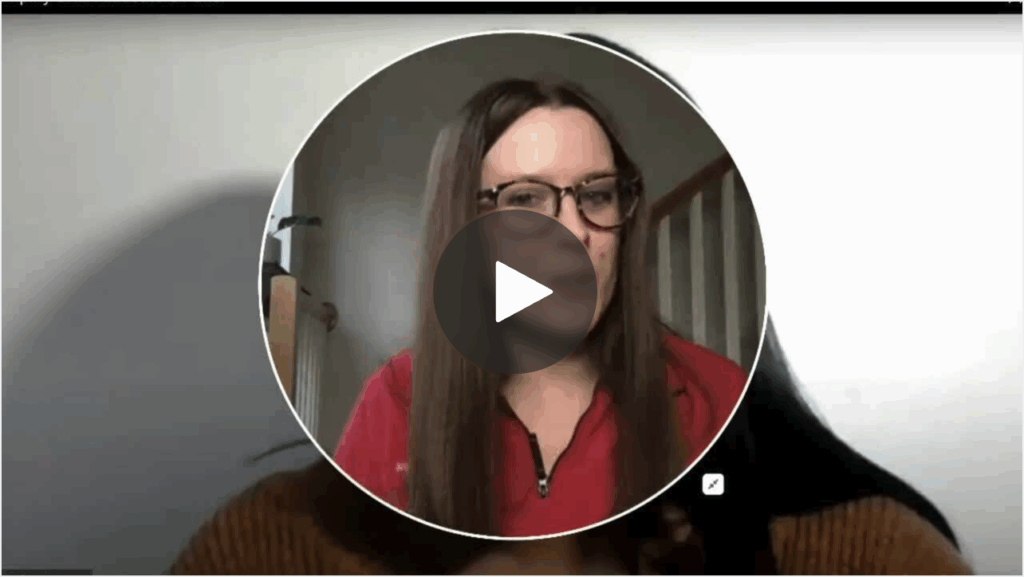
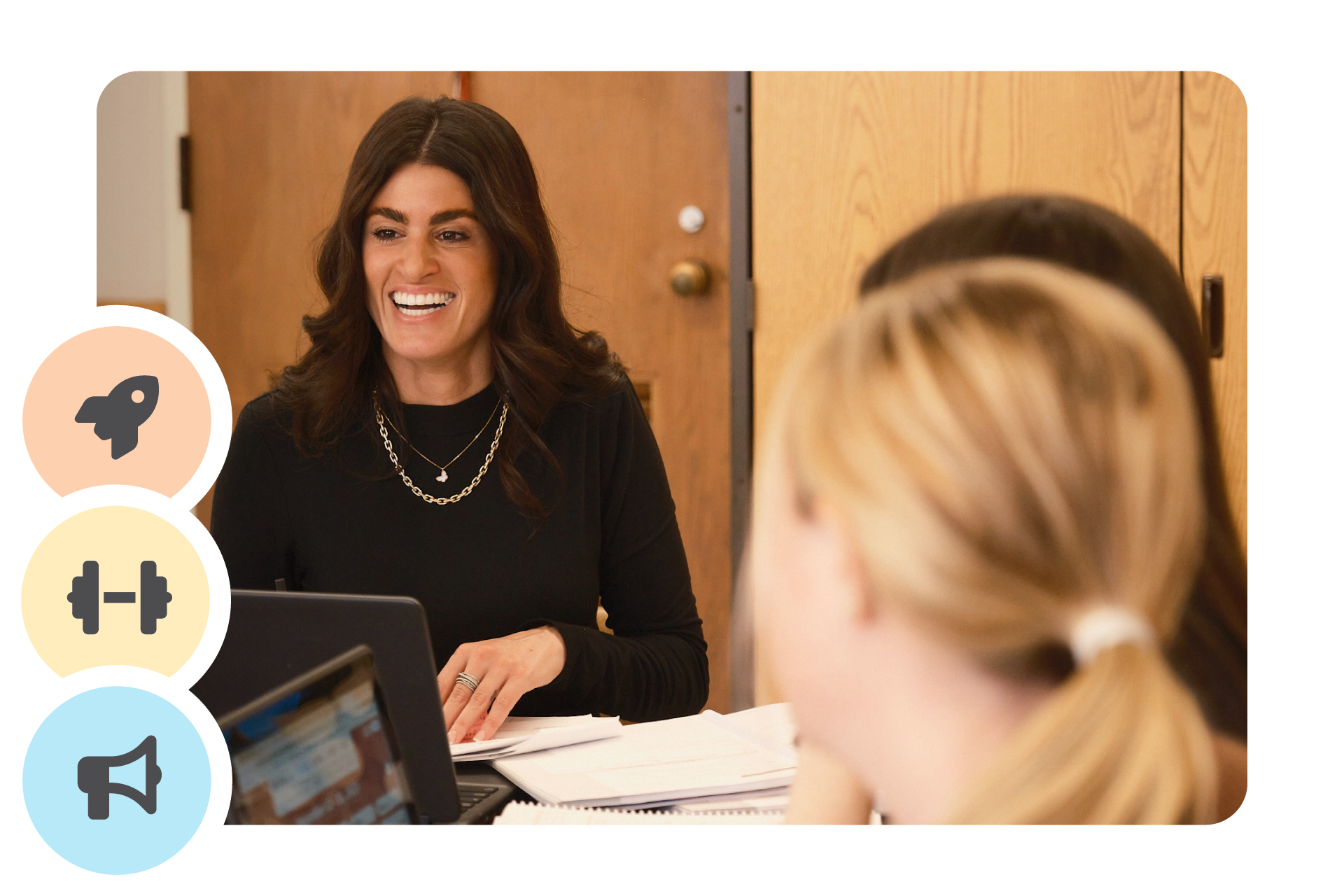
Promotional graphic for "Science Connections" podcast, Season 2 Episode 6, featuring Lauran Woolley discussing making time for science in K–5 classrooms.

In this episode,  Eric Cross sits down with TikTok star and podcast host Lauran Woolley about her experience teaching science content within her K–5 classroom. Lauran shares how she’s learned how to make time for science, and what most K–5 teachers experience when creating their own science curriculum. Lauran also talks about her rise in popularity on TikTok, her podcast, Teachers Off Duty, and establishing strong relationships with her 5th grade students. Explore more from Science Connections by visiting our main page.

DOWNLOAD TRANSCRIPT

Lauran Woolley (00:00):

I wanna make sure that they’re ready for the real world, and I wanna make sure that they’re able to apply these things that I’m teaching them in their life, not on a multiple choice test.

Eric Cross (00:11):

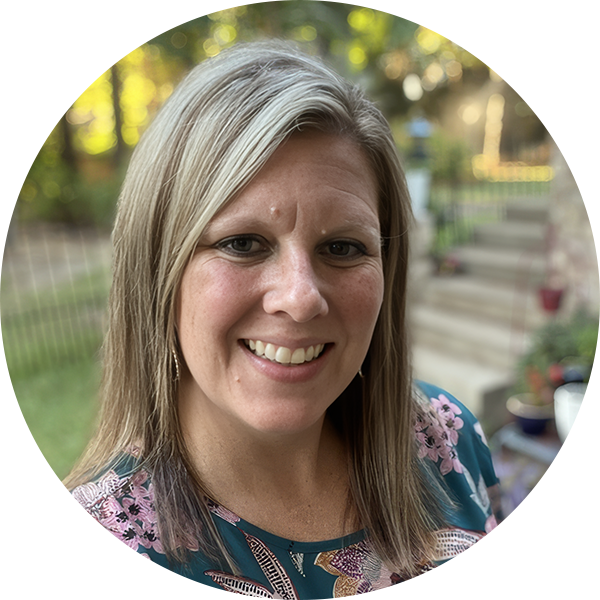
Welcome to Science Connections. I’m your host Eric Cross. My guest today is Lauren Woolley. Lauren is a full-time fifth grade teacher in Leetonia, Ohio, who has amassed a following of 5.5 million subscribers on TikTok and over 1 million followers on YouTube. She’s also co-host of the podcast, Teachers Off Duty. Lauren has combined her teaching vocation and her talent for entertaining to connect with her students and encourage teachers across the world using her own unique style of edutainment. My most vivid memory from our discussion was her sincerity and openness about her experiences. It quickly became obvious to me that her personal transparency was a characteristic that she has remained grounded in despite her social media success. And now, please enjoy my discussion with Lauren Woolley.

Eric Cross (00:53):

You’re currently teaching fifth grade?

Lauran Woolley (00:55):

Yes.

Eric Cross (00:55):

What is it like to teach all content areas? ‘Cause I’m a middle school science teacher.

Lauran Woolley (00:59):

I didn’t always teach all content areas. First I started in second grade, so I used to teach like primary. I taught that for about three years. And I only really got my 4-5 endorsement because it was told to me that it would make me more marketable as a teacher. So I got it <laugh>. I was like, I’m never gonna use that. And then, my second year teaching, my class had low numbers and they collapsed my second grade classroom, split up my students, and then moved me to fifth grade in January. I had to take over a fifth grade class with all content areas in the middle of a school year. And it was really hard. It was like probably one of the most challenging things I’ve ever had to do teaching. When I got my job at my current school, it was only language arts, social studies.

Lauran Woolley (01:46):

So we only have two fifth grade classes. My other teacher would teach math, science. I taught language arts, social studies, and then the timeframes weren’t matching up. Like, I didn’t have enough time in my schedule for all the things we had to do in our curriculum. And she had like a little bit too much time. We realized as a district that it would be better for our fifth grade classes to just be self-contained. And last year was the first year I taught all five subjects. And I liked the variety of teaching everything because when I taught just language arts, social studies, I just felt like I was repeating myself twice a day. <laugh>. It was kind of boring for me. So like, I like doing all of it. <laugh>.

Eric Cross (02:24):

Yeah. With all of your talents and like your background and what I’ve seen, I could totally see why having all the different content areas would like make sense. Are you using a set curriculum? How do you come up with what to teach? Do you do it with teams? Like who comes up with that?

Lauran Woolley (02:36):

Uh, me, myself and I.

Eric Cross (02:38):

Well done.

Lauran Woolley (02:39):

My school, for literacy we’re using literacy collaborative. Then for math, we just adopted bridges, which I love and it’s very hands-on, very like student-led. For science, we had nothing. And I am not a science, or was not a science teacher at the time when I took over. So I panicked a bit and I was like, “Hey, can we have some kind of science curriculum? ‘Cause I got nothing.” And it’s not hard to look at the state standards and figure out what you need to teach them, but having no resources to go off of is extremely difficult. And luckily I have an older brother, he’s like three years older than me and he’s also a teacher. He actually is a science teacher. ‘Cause that first year that I was teaching all subjects, I was like, “Hey Ryan, can you just like send me all of your Google Drive files for science <laugh>?

Lauran Woolley (03:33):

And he’s like, “Yeah, sure.” So he kind of was like a mentor for like the first year that I taught science. And this year being my second full year teaching science, I feel much more confident. I’m still using his resources. We don’t have a dedicated curriculum at my school. So that’s like one thing I’ve been fighting my school on. And not that they don’t wanna get us one, but like they were focused on getting the math curriculum last year. And then I was told, okay, this year will be science because in my state, fifth grade is a tested area for science and we have no curriculum.

Eric Cross (04:04):

Ryan, keep doing what you’re doing big bro. Second, thank you to every teacher who’s had a Google Drive folder full of curriculum that you graciously shared to a new teacher or someone else that they could have.

Lauran Woolley (04:18):

Can we just say like, can schools, like schools, please get your teacher’s science curriculums.

Eric Cross (04:24):

No, absolutely right. And there is this way of thinking that, especially as a science teacher, it’s something that is dear to my heart, but we do want to develop these math and English skills that’s important and we need that for science. But we’ve always taught so siloed for so long, but that’s not the way that we learn and that’s not the way life works. Something that intrigued me about what you said, and I think a lot of people can relate to it, and I know I can because that was me, is you created your own content or your science content. Like you’re kind of piecing that together from what Ryan had shared with you. How do you make time for that with all of the other things that you’re doing and pressures of state testing and things like that. Like how do you weave that into your teaching?

Lauran Woolley (05:02):

So we have like things that are non-negotiable in our schedules. Like we have to have so many minutes of this, so many minutes of that, so many minutes of whatever else. Well, the first year, I was self-contained. I was like, okay, my main goal, because science is a tested area, I wanna make sure that I get in science every single day, 90% of the time I’m able to get anywhere from 30 to 45 minutes of science every day. But this year it was my goal to make sure that I was getting science done and like we were doing meaningful lessons. And last year I didn’t do this, but this year I’m doing a Christmas center for STEM. So I got it off of Teachers Pay Teachers. I’m sorry, I can’t remember who it was made by, but it’s called Jingle All the Way and it’s like building Santa’s new sleigh. And so like the kids have an activity where they have popsicle sticks, straws, a plastic cup and then like tape. And they have to build a new sleigh for Santa and see how many pennies their sleigh can hold. Like talk about a sleigh being lightweight but also strong and like what would make it strong and different things like that. So I’ve been trying to incorporate a lot more STEM activities. And then something I really like to use for experiment days, I call them lab days, is Gizmo. Have you heard of Gizmo?

Eric Cross (06:15):

Yeah. The simulations.

Lauran Woolley (06:16):

Yeah. My brother showed me that too and he was using it in his class. I mean there’s so many different ones that they have that align with the standards and they have like student lab sheets that go with them and teacher guides and stuff. I’ve just been trying to like up my game a little bit more this year, because last year I was like struggling to get all of the standards in before state testing came around because, can we agree, state testing should not be as early as it is? Our state test happens in like March and we have two months of school left. So like, we better be done with standards by February so we could review, because otherwise we’re kind of outta luck because we run outta time.

Eric Cross (06:59):

Yes. That and there’s all kinds of other things that state testing brings with it that we could spend a lot of time probably critiquing and talking about like as far as what’s ideal for kids and what’s the best way to measure and assess learning. That is one question I wanna ask you though, because I know with your work on TikTok and Instagram and YouTube, you must be connected to a pretty vast teacher network and maybe you have like, kinda like more of an inner circle of people, but you must come across so many different perspectives and get into great discussions. Is there <laugh>, is there anything that kind of stands out to you as far as if you were in charge of what we’re doing? Because that’s kind of the system that we all live in and we kind of are trying to internally change it, but it’s been that way for a long time and we just kind of have to work within it until we can make changes. But if you were to, I dunno from an elementary school perspective, change or modify the way kids are learning, what would you do if you had Monarch ability?

Lauran Woolley (07:54):

Okay, I got three main things I’m thinking in my head. Okay, first things first, we got Maslow’s hierarchy of needs. Okay. If kids are coming to school hungry, if they’re coming to school and don’t have, you know, fresh clothing to put on, if they’re coming to school and they have issues at home that they are dealing with, that they are not okay with, the learning is not happening. That’s secondary. They don’t, it doesn’t matter to them. It doesn’t matter to me because what’s most important is that child as a human being and whether or not they’re okay. If I had unlimited resources, I would love to be able to build like a little mini village inside a school and have like a clothing store that kids could grab stuff from. Or like a, you know how I know how school have like closets and food pantries, but like a real place they could get some new clothes, not like hand-me-down clothes, like a store they could go and grab some food if they needed food for their homes or whatever. We have like an onsite counselor but not like a school counselor, like a therapist-type counselor for like mental health. Having some kind of like health clinic, not just like a school nurse because, let’s be real, our school nurses see everything <laugh> and they do not get enough credit, but like to have like a little like urgent care clinic, like basically a small town <laugh> inside a school that like kids would have all of the resources that they need met. Like that would be my number one thing that I would love to do. I have taught in, you know, I’ve only taught in two different schools, but like I’ve seen a lot of things and the number one thing that keeps coming back is just like home lives and mental health and having someone to talk to.

Lauran Woolley (09:41):

And I think our kids don’t have enough of that. Second of all, would be obviously state testing. Because I mean, it’s good to see like where our kids are at. I don’t think it should be used punitively and I don’t think that it should be putting as much pressure on teachers and students the way that it is. It’s not effective that way at all. Let teachers do their jobs without us having to, like, ’cause honestly, who’s not gonna say that they’re not trying to set their students up to do the best on that test. Our evaluation depends on it. I’m gonna make sure my students are prepared for it. I’m gonna teach all the standards, but like, I shouldn’t have to be teaching so that they could do well on a test. I wanna make sure that they’re ready for the real world and I wanna make sure that they’re able to apply these things that I’m teaching them in their life, not on a multiple choice test. Third of all, <laugh>.

Eric Cross (10:33):

This, this is great. And I think a lot of teachers will listen and be like, “That’s what I’m talking about right there.” Keep going. You’re on three.

Lauran Woolley (10:40):

That would be two teachers in every classroom. Either two teachers in each room or like a teacher and a paraprofessional in each room, because there’s not even an argument that teachers are more effective when they have help.

Eric Cross (10:54):

I would even carry the math on further and say that it’s a force multiplier, like exponentially, that it’s not just, it’s not just like a one plus one equals two teachers. It’s almost like you can almost have like three or four just because of the energy and the synergy that can be created between the two. And you can push off of each other, encourage one another and both support different types of students. So I agree a hundred percent. I think that if you had two teachers that were in sync and planning together and talking about kids all of the time, you would be able to go deeper with students. You’d be able to find out those things that you talked about in Maslow’s because sometimes we don’t find out about it until a parent-teacher conference or kids left our classroom. I wish I would’ve known that. The student was without these things in the very beginning.

Lauran Woolley (11:41):

Absolutely. Mm-hmm.

Eric Cross (11:42):

So when do you start in the school and do we go on LinkedIn to sign up and apply or is it like a lottery system? Like, ’cause you know, I was gonna get a lot of attention.

Lauran Woolley (11:52):

I would love to Oprah Winfrey this and like build my own school <laugh>.

Eric Cross (11:56):

We gotta get those followers up. We gotta build up the sponsorships. We gotta get you up to a hundred million.

Lauran Woolley (12:01):

Listen, if all of my followers across all my platforms donated like $2, we could have $12 million to build a school. <laugh>.

Eric Cross (12:10):

Think about like, DonorsChoose, right? People do that. And I know there’s mixed feelings about it because we need stuff in our classroom. I’m just gonna say that. All right. So, whether I have to ask for it on a website or whatever, but people want to give directly to kids, or people who need it. And I think when there’s opportunities like that, that are visible, people are more likely to want to.

Lauran Woolley (12:29):

In reality, should other people have to fund education in classrooms? No. That’s literally what your taxes are for. A government-funded classroom versus a teacher-funded classroom are two different things. And we know that. But if teachers are asking for things or asking for donations on Amazon or on DonorsChoose, just know in your heart that that teacher has probably already shelled out a lot of their own cash to do that. It’s not that they’re, you know, asking for handouts or anything like that. They’re trying to give their students the best that they can and that’s the thought process behind it. And until we get changes in our education system or changes in legislature that will allow us to do that or will allow classroom budgets, I mean, our hands are tied. Like there’s only so much teachers can do. I’m very fortunate to teach in a district that sees the value in spending money on their teachers and students. And, like my school, like I said, they just shelled out thousands of dollars on a new math curriculum. They bought school supplies. Literally every teacher made their school supply list this year. And then the district went in and paid for every single student’s school supplies in the entire district.

Eric Cross (13:49):

Can we get a shout out to your district real quick?

Lauran Woolley (13:51):

Uh, yeah. I mean, shout out Leetonia schools like, I mean, you guys are awesome and I’ll shout that from the rooftops. I love where I teach. Like I really do think that they value our students and they care about our students and our admin is great. We got a new superintendent a couple years ago. He’s been doing a phenomenal job and I really love it and I’m glad I teach there.

Eric Cross (14:12):

When you move out of the classroom, you know, in any position of leadership, you do have the microscope or magnifying glass on you and a lot of times it’s critical. And not unjustifiably so, I mean, there’s a lot of things that can be critiqued. However, what we don’t always hear is the success stories or where it’s working for teachers and why. And we need leaders to be able to talk to each other and find, “Hey, it’s working in your district? Oh, I just heard, I just heard this district get shot out. I’m gonna go reach out to those people. Hey, what are you doing?” Because we connect with each other, but I think when you go like a level up, that kind of getting up the top of the mountain, the, the connection sometimes can become more difficult for people. There’s not a lot of, I don’t know, maybe there are, but admin influencers.

Lauran Woolley (14:54):

Oh yeah, there definitely are. And I’ve met some really incredible ones. I’m on a committee at my school, it’s called NNPS, it’s the National Network of Partnership Schools. It was started out of Ohio State University. Essentially it is a committee in the school that’s dedicated to bringing together the community and businesses and partnering with people to make our school as strong as it can be. We started last year and we did a bear breakfast, ’cause our mascot is a bear. And we had Christmas things and we had the choir caroling, and we had pancake breakfast for everybody and it was completely free. It was just really nice to see everybody come together. And it feels like the culture changes when people work together and come together for the betterment of the school and for the students. And I think what’s challenging is that so many people have such a negative experience from their schooling that they’re hesitant to get involved in their kids’ schooling. I urge any parents out there, any guardians out there that are, you know, in that mindset where you’re like, I didn’t like my teachers in school, or I had this, this, this and happened to me at school. Give it a chance to know that things have changed and things are changing.

Eric Cross (16:11):

I definitely agree with you about parent engagement and getting involved and sometimes parents, they just don’t know that they should. But wow, your voice is so powerful, especially at board meetings and things like that. Getting stakeholders involved, creating community, which it sounds like your school did a great job or your district did a great job of. The last question I wanna ask you, and it’s kind of going back to who your influencer was, is you now are in a position where your impact exceeds more than, you know. You’re planting so many seeds you’re sharing, and you’ll hear maybe a few, or I’m sure you’ll hear the things that kind of come back to you, but that’s only a fraction. But I wanted to ask you, like, as you think back on your career as an educator or when you were in school K through five or K through 12, is there anyone who stands out to you or who was maybe your influencer or teacher who made a big difference that was memorable? And if so, who was it and what was it about them or what did they do?

Lauran Woolley (17:01):

So I had a lot of teachers that I really had good relationships with and I loved school growing up. But one always stood out in particular, and that was my ninth grade English teacher and her name is Andrea Reid. She was the first person who really told me that I was talented at something and that I could succeed in something because she was the English teacher. She was also a coach of the speech and debate team at my high school. Just one day after school. She was like, “Hey, like you should come to speech tryouts.” So I went to tryouts, like I did it not thinking like I cared if I made it or didn’t, and then I made the team. And honestly, I feel like speech was the starting point of all of it. I competed in speech and debate for four years of high school and she was my coach.

Lauran Woolley (17:49):

I always have horrible nervousness with public speaking, even though I do it a lot. And she would always give me like the best hype speeches and the best confidence boosters. And I feel like speech started my love of acting and started my love of like, you know, comedy and stuff like that. And so therefore TikTok happened and I don’t think any of this would’ve happened had it not been for her and her opening that door for me and telling me, “Hey, you would be good at this. You should try it.” We’re still friends to this day, 15 years later, and she is like an older sister to me and I love it.

Eric Cross (18:26):

That’s amazing. Andrea Reed, that’s her name.

Lauran Woolley (18:28):

Andrea, yep.

Eric Cross (18:29):

Andrea. Andrea Reid. Ms. Reid, thank you, for inspiring Lauran and <laugh> because of your impact, now it’s impacting so many others and as teachers, like, we don’t even, we don’t know, but it’s so humbling to know that like the words that we say to people have that impact and power. It’s so, it’s, it’s so inspiring to me. One of the things that resonate with you so much is your transparency. Like in your depth. Like even as just listening to you talk, you normalize and humanize so many things that we experience and I’m sure that’s what a lot of the people that watch you connect with. You show your life, your family, your house, all these things that are happening. And I was just looking through the comments and there’s just so many people that are warmed. Not just your students, but like so many teachers. So thank you for doing what you’re doing and I wish you tremendous success. Thank you for your time.

Lauran Woolley (19:17):

No, thank you so much for having me. This was awesome. I just wish everybody a great school year and I hope that we all make it through winter break. <laugh>.

Eric Cross (19:27):

Thanks so much for listening to this season of Science Connections. I love learning about science educators just like you. You can nominate educators that inspire you to become a future guest on Science Connections by emailing STEM@amplify.com. That’s S T E M at amplifycom.wpengine.com. Make sure to click subscribe wherever you listen to podcasts and tune in for a brand new season of Science Connections coming soon.

Stay connected!

Join our community and get new episodes every other Wednesday!

We’ll also share new and exciting free resources for your classroom every month!

What Lauran Woolley says about science

“I want to make sure they’re ready for the real world and I want to make sure they’re ready to apply these things I’m teaching them in their life, not just on a multiple choice test.”

– Lauran Woolley

5th Grade Teacher, Northeast Ohio

Meet the guest

Lauran Woolley is a fifth grade teacher in Northeast Ohio. She has loved being able to combine her love of education and entertainment into one career. Her goal is not only to humanize educators to both families and students, but to create a safe space for her students on the internet. She has had the privilege of collaborating with educators around the world to shed a light on this amazing career. You can listen and watch the Teachers Off Duty podcast here!

A woman with long dark hair smiles at the camera, wearing a black top and lanyard, with a colorful blurred background.

About Science Connections

Welcome to Science Connections! Science is changing before our eyes, now more than ever. So…how do we help kids figure that out? We will bring on educators, scientists, and more to discuss the importance of high-quality science instruction. In this episode, hear from our host Eric Cross about his work engaging students as a K-8 science teacher. 
Language comprehension: Building mental models

©Alexander Huth / The Regents of the University of California

Throughout this five-part series, we will cover the main components of the Science of Reading (SoR) and provide additional resources and research to guide your exploration and implementation of this important movement.

Say you’re given a passage of text to read. This particular paragraph describes half an inning of a made-up baseball game.

After you read the passage, you are asked to reenact the scene.

Which is more likely to aid your success?

A. Your ability to read

B. Your knowledge of baseball

C. It makes no difference

Would you be surprised to know the answer is actually B?

In part one of our series, “What is the Science of Reading anyway?,” we discussed the two main components of the Science of Reading: decoding (converting written words into speech) and language comprehension (understanding that speech). We also provided in-depth coverage of both learning and teaching how to decode the symbols of the English alphabet and strengthen the reading muscle.

LANGUAGE COMPREHENSION

In 1988, two young researchers and 64 students took part in an experiment that has forever changed how we think about reading and comprehension. One by one, the students were handed the same story covering half an inning of a made-up baseball game and asked to reenact it.

To the researchers’ surprise, they found that reading ability had little impact on how well kids understood the story—but knowledge of baseball did. In fact, students who were weak readers did as well as strong readers if they had knowledge of baseball.

Teaching knowledge explicitly improves reading comprehension. As Willingham has said, “Reading tests are knowledge tests in disguise.”

Researchers at the Haskins Lab at Yale tested this theory and found an extraordinarily high correlation between how well a 7-to-9-year-old child can recognize words and how well they comprehend text.

Common teaching mistake — Strategy instruction

So if reading comprehension is driven by a student’s vocabulary and knowledge, are widely taught strategies like finding the main idea equally critical?

Many strategies make intuitive sense: Stopping and re-reading when comprehension breaks down, for instance, is helpful for many children. But teaching the main idea strategy over and over is less helpful.

It is hard to find the main idea of a piece of writing if you don’t really understand any of the ideas in it. And even if you know a strategy — like re-reading when stuck — you also need to be well-versed in when to apply the strategy. You need to notice that you didn’t understand the text.

Often, strategy instruction neglects to offer students practice with identifying the situations in which they should use the strategy.

In the 1940s, a skills shift began to take place in education systems throughout the world. Its effects can be traced in the U.K., Sweden, Germany, and, most recently, France. This shift brought an emphasis on reading and math, squeezing out the broader knowledge taught in the sciences and social sciences. Some have linked the decline in standardized test scores—the SAT in the U.S. and the DEPP national exam in France—to this shift.

The National Survey of Science and Mathematics Education reported that today, classes in grades K–3 spend just 19 minutes per day on science and 16 minutes per day on social science.

To counter this loss of broader knowledge in our students, research suggests that we teach comprehension strategies in moderation and use the freed-up time to build knowledge (and vocabulary).

But simply exposing students to everyday speech doesn’t build a strong vocabulary. In a typical conversation, there are around 20 unusual words—such as dismayed or zeal—per 1000 words. Newspapers and books contain more than twice as many. Rich vocabulary, then, is gained not solely through speech, but through reading. Rich vocabulary, then, is gained not solely through speech, but through reading—especially when reading a variety of text types.

Mental models

Some readers with good word recognition, vocabulary, and knowledge are still weak comprehenders. Why might this be the case?

After students read a passage, they aren’t likely to recall the precise wording, but they will probably remember the ideas. Researchers use the term mental model to describe the structure you create in your mind to perform this feat of comprehension. Think of the process of building a mental model as a sort of micro-comprehension. Weak comprehenders build poor models. Hence, when asked prediction or mapping character development questions, they answer poorly.

There are four critical skills students need to improve their mental modeling:

  1. Decoding the usage of anaphoras (she, they, him). Some early readers can’t reliably figure out who the pronoun is referring to, especially in ambiguous text.
  2. Understanding the use of markers to signal ways that the text fits together — connectives, (like so, though, whenever) structure cues, and directions. Inexperienced readers may not know that but, though, yet, and however signal that something opposite follows.
  3. Writers make assumptions about what can be left unstated. For instance, when they read “Carla forgot her umbrella and got very wet today,” good readers will use their prior knowledge to conclude that it rained. Weaker readers who fail to make these gap-filling inferences wind up with gaps in their mental model.
  4. When something doesn’t make sense, you stop, re-read, and try to figure it out. Weaker readers just keep going—not because they’ve failed to figure it out, but because they’ve failed to notice that they don’t understand. They need explicit instruction in monitoring comprehension as they read.

Overview

Think of reading as a suitcase that you need two keys to open. The first key is word-level decoding, a skill that becomes automatic and fluent. The second key is language, vocabulary, and domain-specific knowledge. The more words you can decode, the more new words — and their meanings — you can learn. Similarly, the more knowledge you have on a topic, the more you can soak up on the same topic — and on related topics.

These two keys make up the Science of Reading. When schools focus heavily on one key or the other, the suitcase doesn’t open. So now the greater task of applying this knowledge in the classroom awaits us.

For more in-depth examples, brain scans, and information about the Science of Reading, download our free primer:

Science of Reading – Make the Shift Today

Amplify launches custom speech recognition technology using AI to power next-generation voice-enabled learning

Brooklyn, NY – Amplify, a publisher of next-generation curriculum and assessment programs, announced the development of a custom Automatic Speech Recognition (ASR) system designed to power voice-enabled education products.

The Amplify ASR system converts spoken language into written text, enabling users to interact with educational software using voice command while providing detailed feedback on pronunciation, prosody, and more. The technology supports multiple applications, including reading assessment, conversational tutoring, digital activity input, and classroom monitoring. Amplify’s ASR application will also compare student speech to target texts and identify areas where teachers can provide additional support for reading fluency and comprehension.

“Voice interaction is becoming increasingly important for young students using educational software, and we’re seeing tremendous potential for growth in this area,” said Amplify’s Chief Product Officer, Alexandra Walsh. “By developing our own ASR solution, we can test, refine, and deliver voice-enabled features that directly support student learning outcomes while meeting our high standards for safety, accountability, fairness, and efficacy.”

The Amplify ASR application will support Amplify’s voice-interactive instructional programs for the 2025-2026 school year across four key categories:

1. Reading assessment and practice, focusing on phonics, automaticity, and prosody

2. Conversational tutoring systems

3. Voice input for digital activities and assessments

4. Classroom monitoring tools that provide teacher feedback and student insights

The Amplify ASR application will initially replace Soapbox’s ASR functionality in Amplify’s mCLASS Literacy and Boost Reading programs, with plans for organization-wide expansion.

About Amplify

A pioneer in K–12 education since 2000, Amplify is leading the way in next-generation curriculum and assessment. Our core and supplemental programs in ELA, math and science engage all students in rigorous learning and inspire them to think deeply, creatively and for themselves. Our formative assessment products help teachers identify the targeted instruction students need to build a strong foundation in early reading and math. All of our programs and services provide educators with powerful tools that help them understand and respond to the needs of every student. Today, Amplify serves more than 15 million students in all 50 states and on six continents. For more information, visit Amplify.com.

Media Contact: Kristine Frech; media@amplify.com

Next-generation speech recognition technology

Text Reading Online was created in partnership by Amplify and SoapBox Labs, a Dublin-based developer of accuracy and privacy driven voice technology for children. Text Reading Online represents the first literacy assessment of its kind to enable remote evaluation of reading accuracy, fluency, and comprehension. 

Logo of soapbox labs featuring an orange microphone alongside the company name in black and orange text.

Assess remotely with Text Reading Online

How it works

To perform the Text Reading Online assessment, students read two texts aloud. The first text is at the student’s grade level and the read-aloud is evaluated for reading accuracy and fluency through SoapBox Lab’s speech recognition technology.

Students then answer a set of text-dependent comprehension questions to evaluate their degree of understanding. This is repeated with the second text, which is adapted based on the student’s performance on the initial text, including their accuracy, fluency, and comprehension.

A digital reading comprehension activity shows a passage about a Texas heatwave and multiple-choice questions for students to answer, with an owl cartoon giving instructions.

Data from the oral reading fluency assessment, including reading rate and specific error types, provides educators with near-real-time feedback, which they can use to identify areas of focus and cater lessons to each student’s needs.

Learn about mCLASS

Text Reading Online is a measure available within mCLASS, a K–6 universal assessment, instruction, and intervention suite. To learn how to bring mCLASS to your school or district, visit this page to fill out a contact form. 

Amplify CKLA

To view this protected page, enter the password below:


Science of Reading:
A glossary

The Science of Reading reflects decades of research on how children best learn to read and which instructional practices best support their journey. Understanding common Science of Reading definitions can help fast-track your instruction, so we’ve put together this glossary as a starting point.

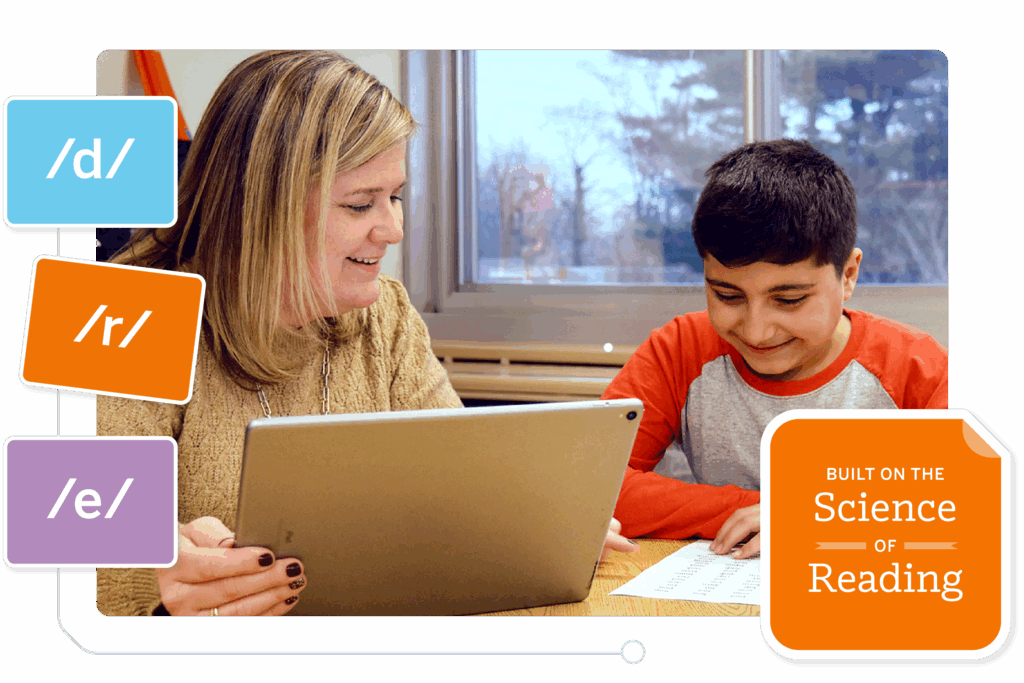
Two girls in green uniforms look at a notebook together in a classroom. Educational icons and a "Built on the Science of Reading" label are overlaid on the image.

Common Science of Reading terms

Some of the most important terms for building your understanding of the Science of Reading:

Alphabetic principle: The understanding that specific sounds can be mapped onto specific letters
Biliteracy: The ability to communicate effectively in two different languages
Composition: The creation or organization of a written piece, short or long
Comprehension: The ability to understand what is written or said
Decoding: Translating a word from print to speech by understanding sound-spelling correspondences
Domain-specific knowledge: Understanding of the key principles in a specific subject area (such as scientific principles, poetry conventions)
Domain-specific vocabulary: Words key to understanding a specific subject area (such as scientific terms, poetic terms, technical terms)

Dyslexia: A language-based learning disorder or set of learning differences that makes it difficult to learn to read, write, or spell

Encoding: Translating a word from speech to print by understanding sound-spelling correspondences

Fluency: The ability to read a text with accuracy, speed, and expression

Inferences: Conclusions drawn through reasoning, without their being stated directly in a text

Learning differences: The unique ways in which brains can process information and the different rates at which they do it

Mental model: A general idea or structure of information that can be applied to many texts

Metacognition: Being mindful of one’s own thinking processes, including using knowledge of a given task, knowledge of cognitive strategies, and knowledge of one’s self, to successfully learn

Morphology: The study of word parts and how words are formed

MTSS (Multi-Tiered Systems of Support): A comprehensive framework designed to provide systematic and differentiated support to all students

Phoneme: The smallest unit of sound that distinguishes one word from another

Phonemic awareness: The ability to identify and work with individual sounds (phonemes) within a word

Phonics: Teaching the relationship between the sounds in oral language and the letters in written language

Reading Rope: A visual representation of the way decoding and comprehension skills work together in the brain of a skilled reader

Reasoning: The ability to apply knowledge based on new or existing information to comprehend the meaning of a passage

Science of Reading: The body of ongoing scientific research about how the brain works when one is learning to read, and how reading is best taught

Science of Writing: The body of ongoing scientific research about how the brain works when one is learning to write, and how writing is best taught

Sight recognition: The ability to recognize a written word without having to sound it out (also called word recognition)

Simple View of Reading: A framework that explains how word recognition and language comprehension work together to produce skilled reading

Simple View of Writing: A framework that explains how transcription and composition skills work together to produce skilled writing

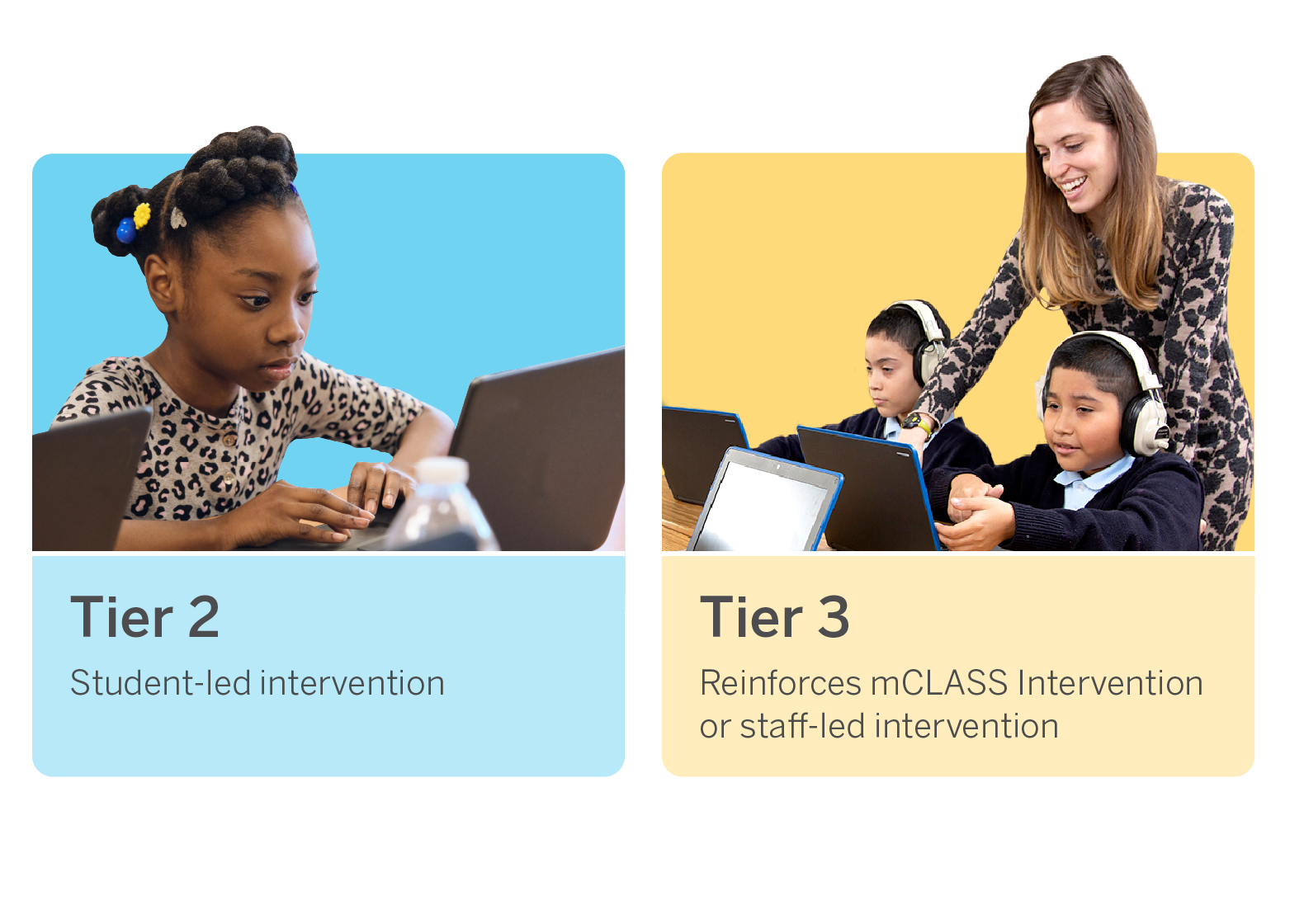
Tier 1 instruction: Core grade-level instruction

Tier 2 instruction: Additional support for small groups of students to reinforce grade-level instruction

Tier 3 instruction: Intensive, more individualized intervention

Transcription: The process of converting speech into written text

Vocabulary: The quantity and quality of words a student knows

Word recognition: The ability to recognize a written word without having to sound it out (also called sight recognition)

Your guide to getting started with the Science of Reading

Looking for more grounding in the Science of Reading? Download our free ebook.

Cover of a guide titled "Science of Reading: A New Teacher’s Guide," featuring a teacher reading to two children, pencil and book icons, and helpful K-5 teaching resources. Perfect for those asking, "What is the science of reading?.

The #1 foundational skill for the Science of Reading

The first of five: Phonemic and phonological awareness

Phonemic awareness and phonological awareness—together, they’re the first of the five foundational reading skills articulated by the Science of Reading

The two are intertwined, but not interchangeable. Even though they combine to form one skill, they have distinct meanings and play different roles in helping children become proficient readers.

 In the first of this five-part series on foundational skills, we’ll look at where the path to literacy begins—and why it all starts with sounds. 

What the Science of Reading tells us about the brain

First, an essential reminder: Our brains are not hard-wired for reading. They do not intrinsically know that marks on a page are designed to represent sounds, or meaning. That’s why reading must be taught, explicitly and systematically. 

But when we teach reading using what science tells us, the brain wires itself to start recognizing those letters, syllables, and words.  

“Reading comes through building new neural pathways,” says Alice Wiggins, vice president of instructional design and products at UnboundEd and our guest on Season 3, Episode 2 of Science of Reading: The Podcast. “That’s what happens,” she says, “when we’re taught to read.”  

Why it starts with sound

The Simple View of Reading establishes that if you can’t decode the symbols (letters and combinations of letters) that make up a sentence, you can’t read it—even if you know the language in which it’s written.

And when it comes to spoken language, those symbols were created to capture sounds. 

“Teaching kids that letters represent the sounds in speech has the most potent logic, because written language was invented to represent speech,” says Dr. Louisa Moats, an expert on how children learn to read and our guest on Season 3, Episode 3 of Science of Reading: The Podcast. “We don’t learn to talk from reading. We already know how to talk. We have to learn this system that is mapped onto speech.”

Phonemic awareness and phonological awareness form the building blocks for understanding the relationship between sounds and letters, paving the way for successful reading acquisition.

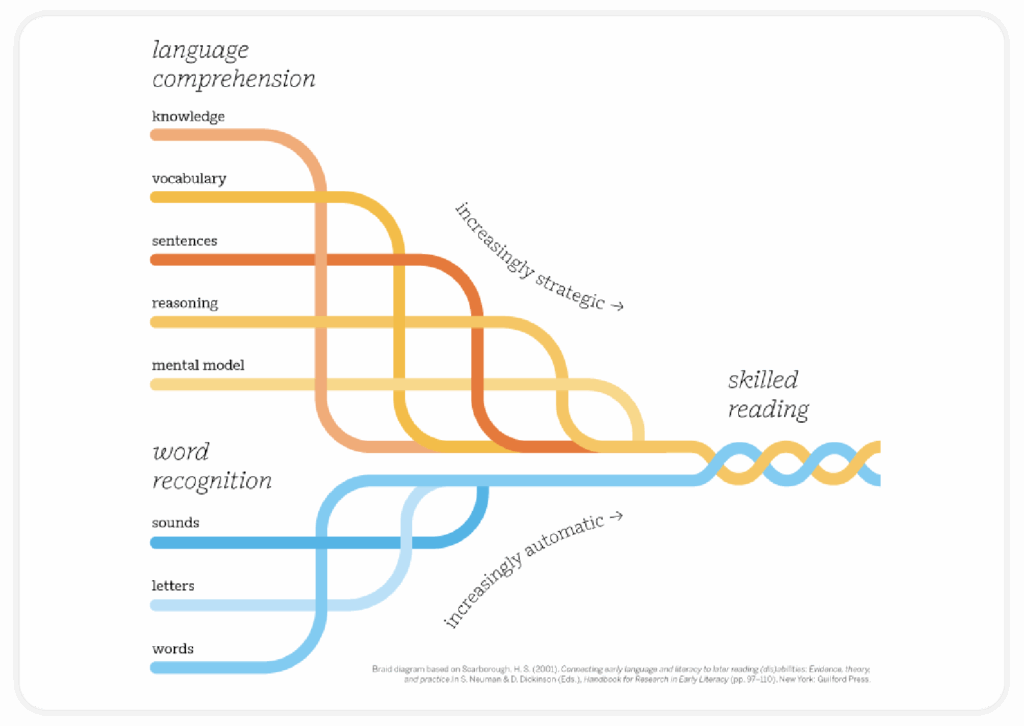
To understand how important they are, look no further than the Reading Rope, a visual representation of the key skills involved in reading. The strands of the rope represent various interconnected components, including phonological awareness, phonicsvocabularyfluency, and comprehension.

Phonological awareness and phonemic awareness are positioned as the foundational strands.

To understand why, we’ll need to get more specific.

What is phonemic awareness?

Phonemes are the smallest units of sound that make up words. Phonemic awareness refers to the ability to identify and manipulate individual sounds (phonemes) in spoken words.

Phonemic awareness plays a vital role in the early stages of reading. By recognizing and manipulating individual sounds within spoken words, kids come to understand how sounds combine to form words.

This ability to segment and blend sounds lays the foundation for phonics, and the ability to decode and read unfamiliar words.

What is phonological awareness?

Phonological awareness encompasses a range of skills that go beyond manipulating individual phonemes. It includes abilities such as recognizing and manipulating larger units of sound, such as syllables, rhymes, onset and rime, and even entire words. It involves tasks like clapping out the syllables in a word, identifying words that rhyme, recognizing words with the same initial sound, and blending or segmenting words into syllables.

This awareness of larger sound units enhances readers’ ability to identify and manipulate individual phonemes. That, in turn, sets the stage for word recognition and decoding.

Phonology and equality

Alice Wiggins notes that just as reading skills start with sound, so does equality. It’s important to acknowledge that students speak and are exposed to a wide variety of pronunciations of English letters and words.

“Being explicit and systematic attends to those differences for all students,” she says. 

More ways to learn

Welcome to Amplify Desmos Math!

To view this protected page, enter the password below:


Welcome to Amplify Desmos Math Cherokee CSD!

To view this protected page, enter the password below:


Texas SLAR Literacy Adoption

To view this protected page, enter the password below:


What is the Science of Reading?

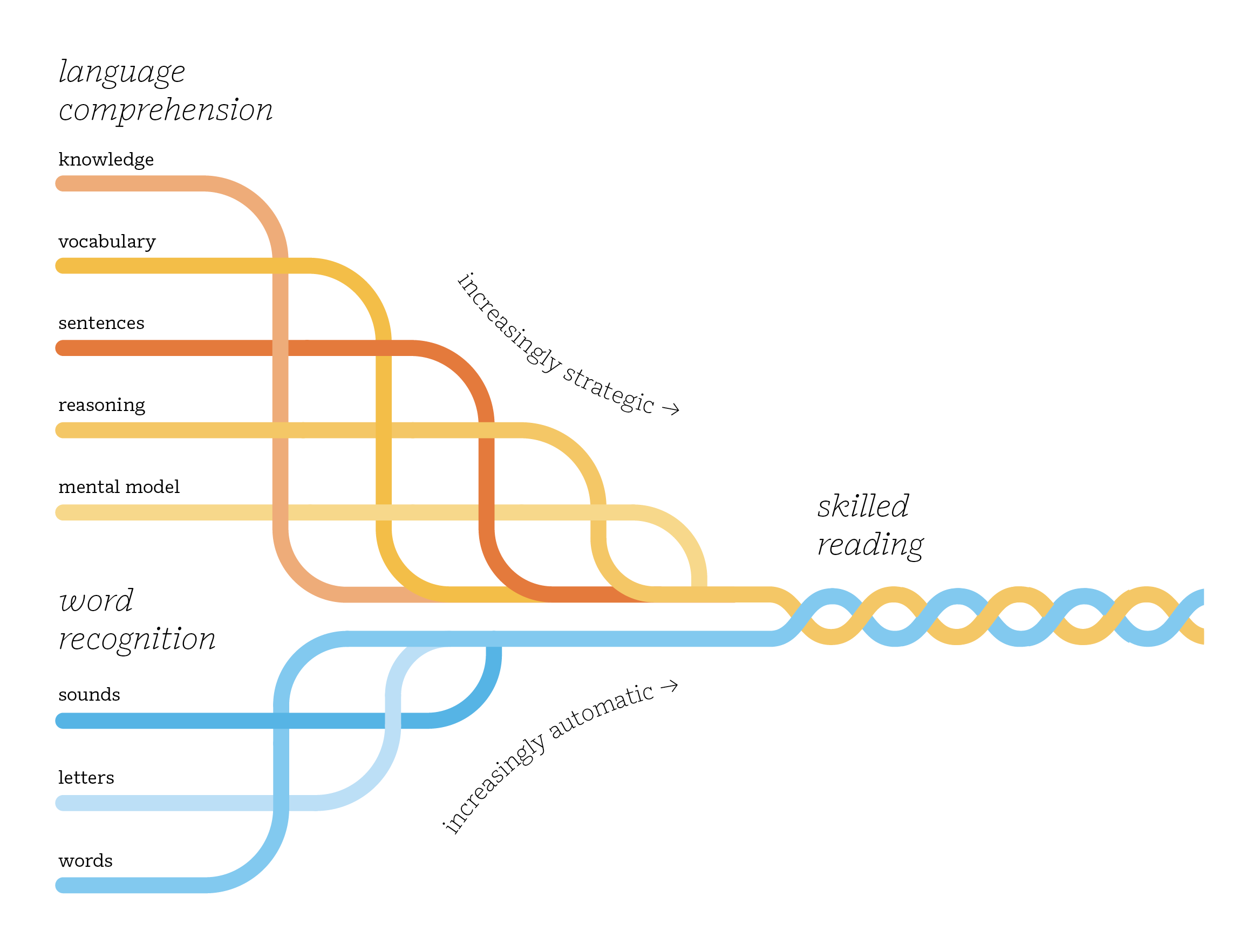
Diagram illustrating the pathways of language comprehension and word recognition merging into skilled reading, with processes becoming increasingly strategic or automatic.

The Science of Reading is a large body of research that helps answer a key question about the human experience: How do people learn to read?

It also helps answer a fundamental question for educators: How should we teach reading?

The Science of Reading draws on decades of research from fields like cognitive science, neuroscience, linguistics, psychology, and education. This vast (and still growing) body of research describes our up-to-date understanding of what reading requires, and therefore shapes our approach to effective literacy instruction.

Two frameworks are widely used to capture and communicate those core takeaways:

  • The Simple View of Reading
  • The Reading Rope

In this overview, we’ll walk you through both.

Why reading needs science

Spoken language develops naturally. Children typically learn to understand and use language simply by being around other people who talk.

Reading, on the other hand, works differently. Written language is a human invention; our brains did not evolve to read. When we are born, the parts of our brain that see letters are completely separate from the parts that hear sounds. So to become readers, students require explicit instruction. They have to be taught specifically to build new connections between what they see on the page and the language they already know.

For a brain to read words, it needs to create new pathways that connect letters with sounds. For example, when a child sees the letter “f” and connects it to the /f/ sound in “funny,” their brain builds a new bridge between the areas that handle sight and sound. Reading actually rewires the brain, bringing together the regions for vision, speech, sound, and meaning into one coordinated reading system.

The Science of Reading explains what those new connections involve—and why some students need more support than others to build them.

The Simple View of Reading

At the heart of the Science of Reading is one of the most widely accepted frameworks in reading research: the Simple View of Reading, first proposed by experts Philip Gough and Bill Tunmer in the 1980s.

The Simple View answers a basic question: What has to be in place for a reader to understand a text?

According to the Simple View, reading comprehension depends on two essential components:

  • Decoding: the ability to turn written words into spoken language
  • Language comprehension: the ability to understand the meaning of that language

Both are necessary, and neither works on its own. One reader may decode words accurately but struggle to understand what they read, while another may understand spoken language well but be unable to read the words on the page. In either case, comprehension breaks down.

The Simple View captures this core finding of reading research: Skilled reading depends on both word reading and language understanding working together.

Decoding: Reading the words on the page

Decoding involves learning how letters and letter patterns represent sounds. This task is complex in alphabetic writing systems like English, where many letters represent more than one sound, and many sounds can be spelled in different ways.

When children begin learning to read, they already understand a great deal of spoken language. What they don’t yet understand is written language. Letters and printed words are unfamiliar in a way that speech is not.

As students practice decoding, they become more accurate and more fluent. Over time, decoding becomes increasingly automatic.

And this automaticity matters—when students no longer have to focus most of their attention on reading the words, they can devote more mental energy to understanding what the text means.

Language comprehension: Understanding what you read

Language comprehension includes vocabulary, knowledge about the world, and an understanding of how language works across sentences and texts.

Research shows that what readers already know plays a major role in comprehension. As shown in the baseball experiment, students understood and remembered more when the text described a familiar activity—even when their reading skills were relatively weak.

When students read about unfamiliar topics, comprehension becomes more difficult. This is true even for students who can read the words on the page accurately.

So what’s the best way to teach reading comprehension? Combine both elements of the Simple View. In other words, reading comprehension grows alongside vocabulary and knowledge, and exposure to a wide range of topics supports reading development.

The Reading Rope

The Simple View of Reading identifies what reading requires, while the Reading Rope reflects how those requirements develop and become integrated over time.

The Reading Rope organizes reading into two broad strands:

  • Word recognition, which includes phonological awareness, decoding, and fluent word reading
  • Language comprehension, which includes vocabulary, background knowledge, and the ability to make meaning from text

Each strand of the Rope is made up of multiple interconnected skills. With effective instruction and practice, these skills become more coordinated and more automatic. As that happens, reading becomes smoother and less effortful, allowing readers to focus more fully on meaning.

The Reading Rope builds on the Simple View by showing how skilled reading emerges as these components strengthen and work together.

Instructional practices: Putting it all to work

The Science of Reading is the broad body of research on how reading develops, and the Simple View of Reading and Reading Rope capture the core takeaways of that research.

Together, they show that skilled reading depends on both accurate word reading and strong language comprehension, and that these abilities develop through explicit and systematic instruction, practice, and growing knowledge over time.

For educators, this understanding provides the strongest possible foundation for reading instruction. When students become skilled readers, new possibilities open up—in their classrooms today, and for the rest of their lives.

¡El futuro es bilingüe! | The future is bilingual!

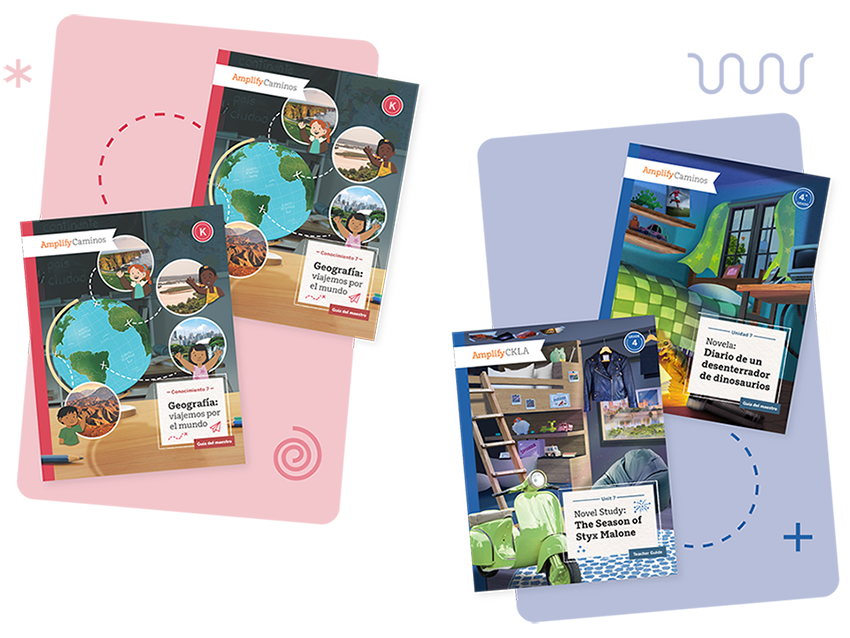
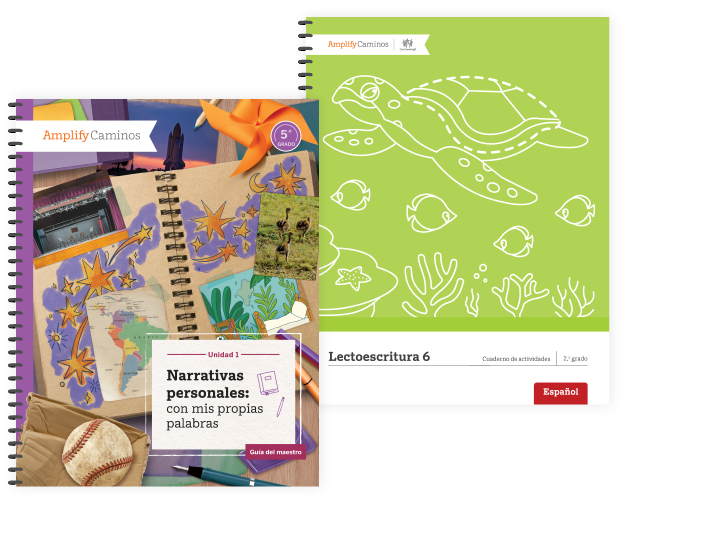
Promote biliteracy with Amplify Caminos, a K–5 Spanish language arts curriculum that helps teachers inspire students as they become confident readers, writers, and thinkers in Spanish. The program combines rich content knowledge with systematic foundational skills instruction that is grounded in the Science of Reading and supports multiple teaching models. Para la versión en español, haga clic aquí.

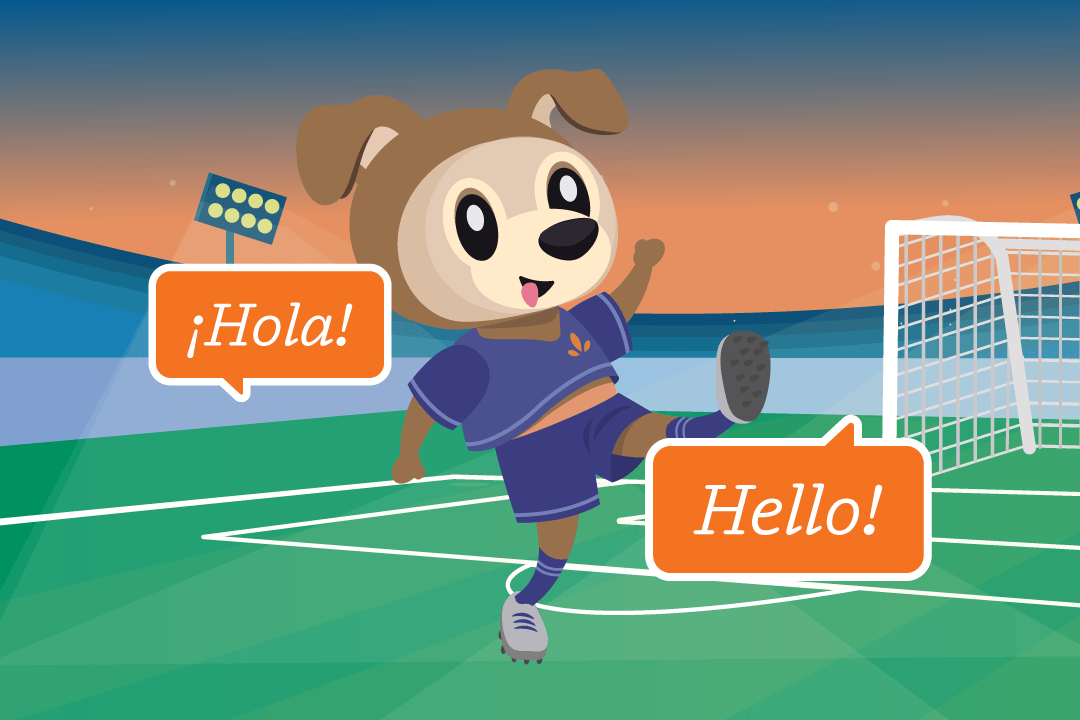
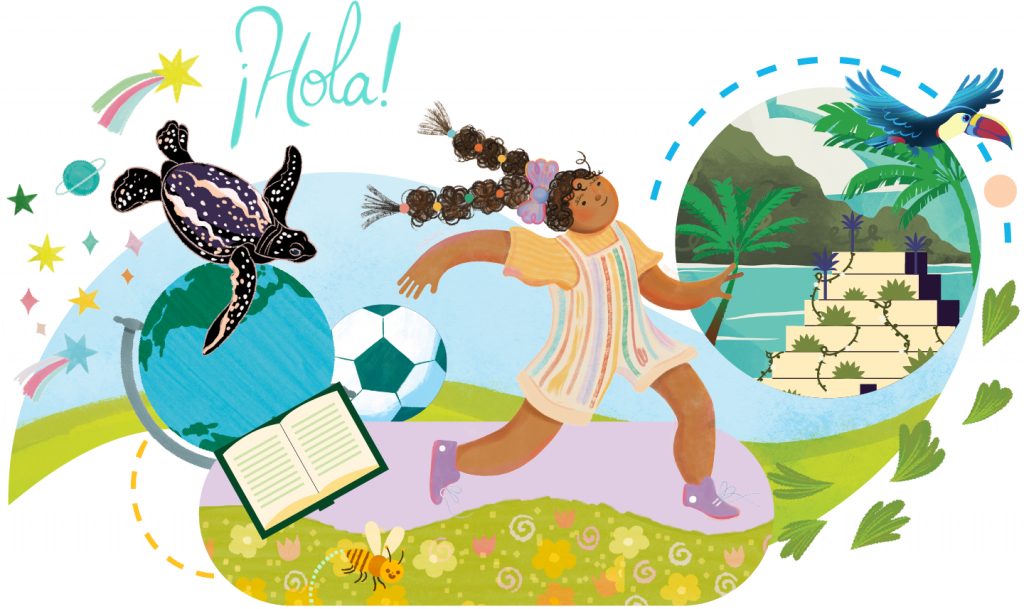
A girl runs joyfully surrounded by a turtle, a soccer ball, an open book, and tropical scenery with a toucan and ancient ruins, with "¡Hola!" written above.

Cultivating biliteracy pathways

Amplify Caminos is designed to support any biliteracy model, including English as a Second Language (ESL), transitional bilingual programs, dual language strands, and Spanish immersion programs. Combined with its English language partner, Amplify Core Knowledge Language Arts (CKLA), Amplify Caminos provides a comprehensive biliteracy solution.

Our approach

Grounded in the Science of Reading and following biliteracy principles, Amplify Caminos combines rich, varied content knowledge with systematic foundational skills instruction to deliver a research-based biliteracy curriculum

Leveraging the Science of Reading

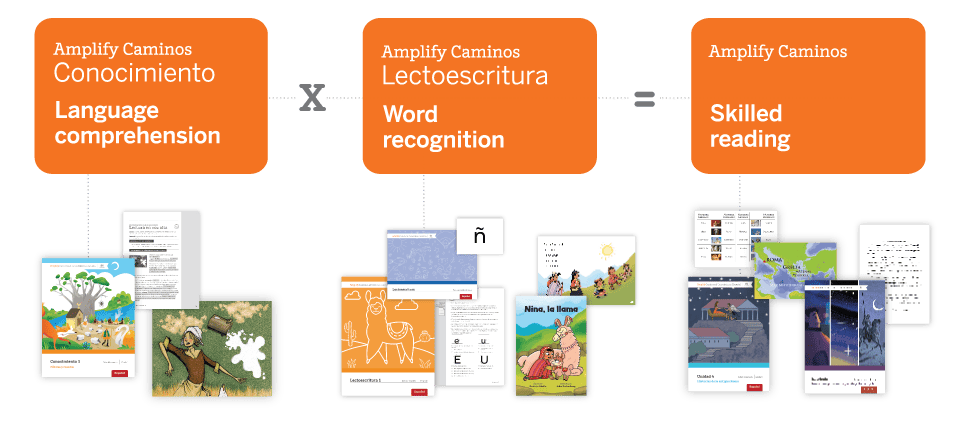
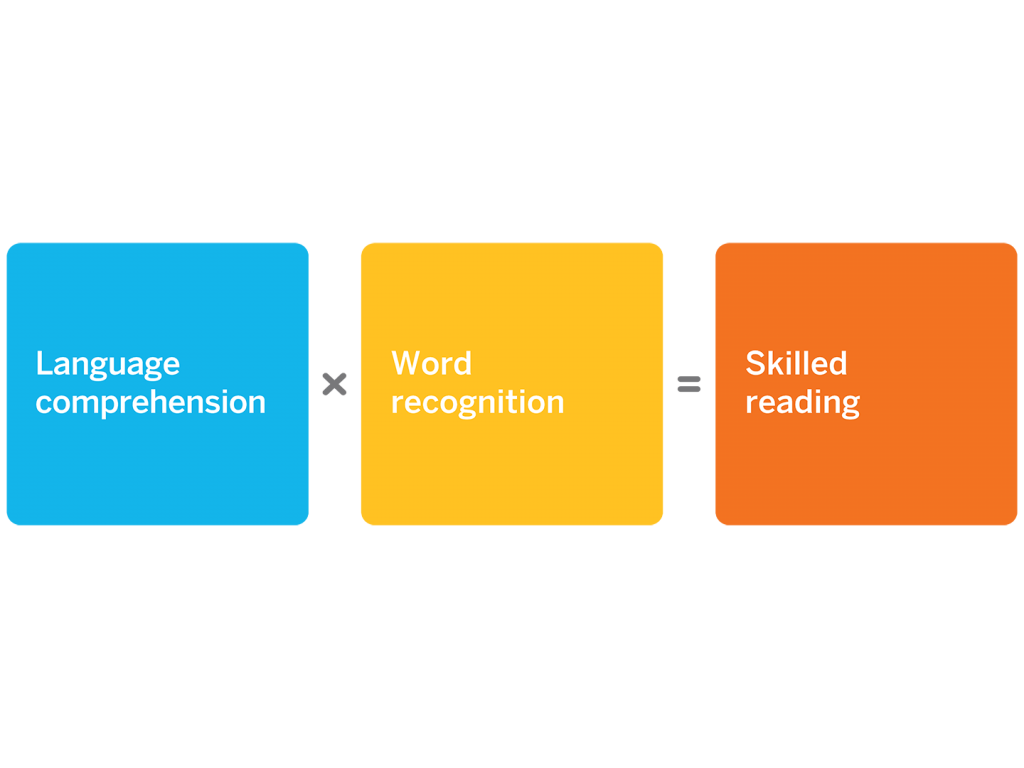
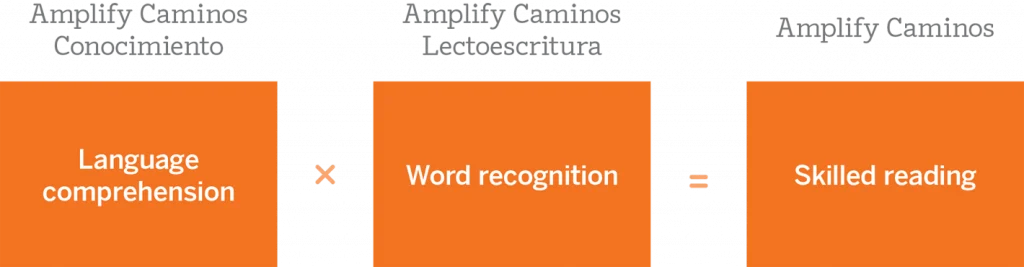
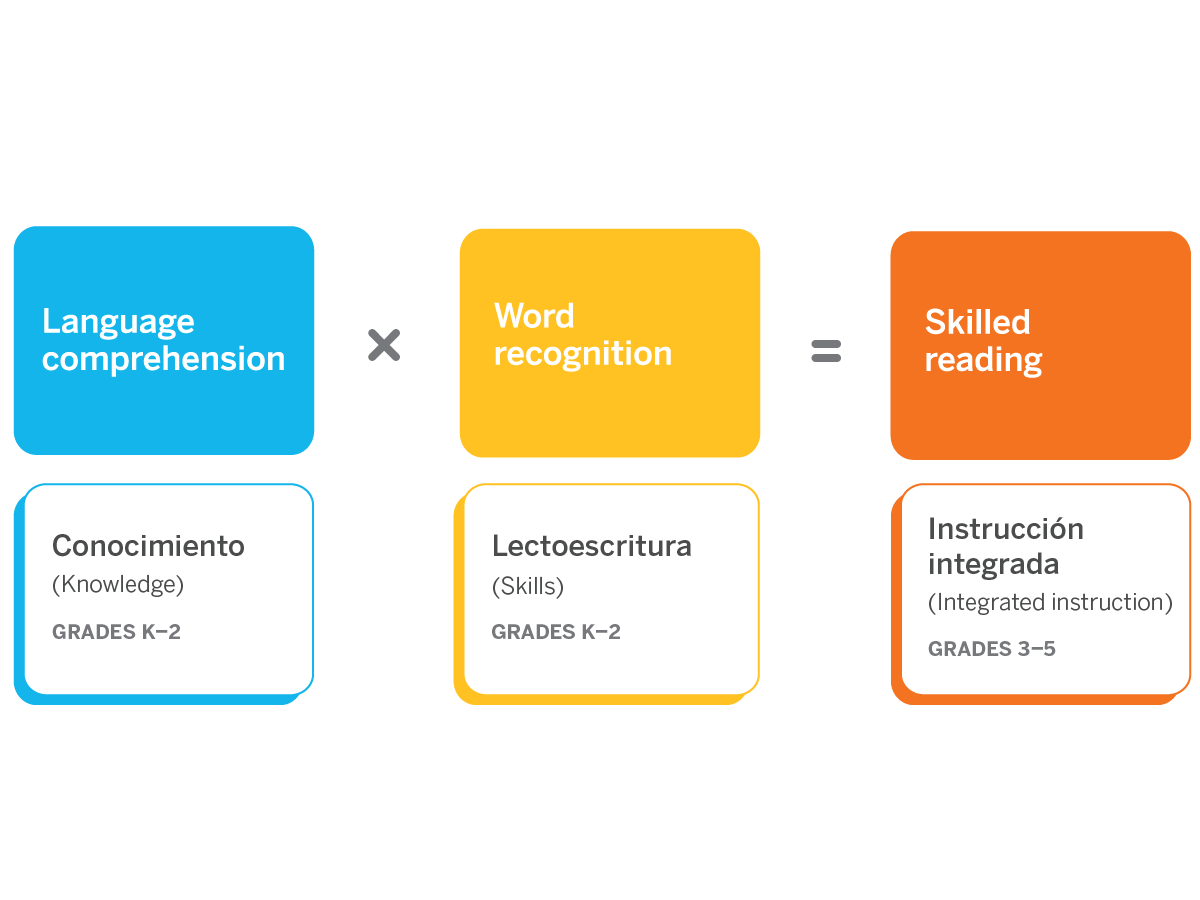
At the heart of the Science of Reading is the Simple View of Reading, a formula describing how skilled reading requires both language comprehension and word recognition. Amplify Caminos is built on this model, with powerful resources that drive real results.

A diagram showing "Language comprehension" and "Word recognition" factors combining to result in "Skilled reading," with associated Amplify Caminos educational materials illustrated below each term.
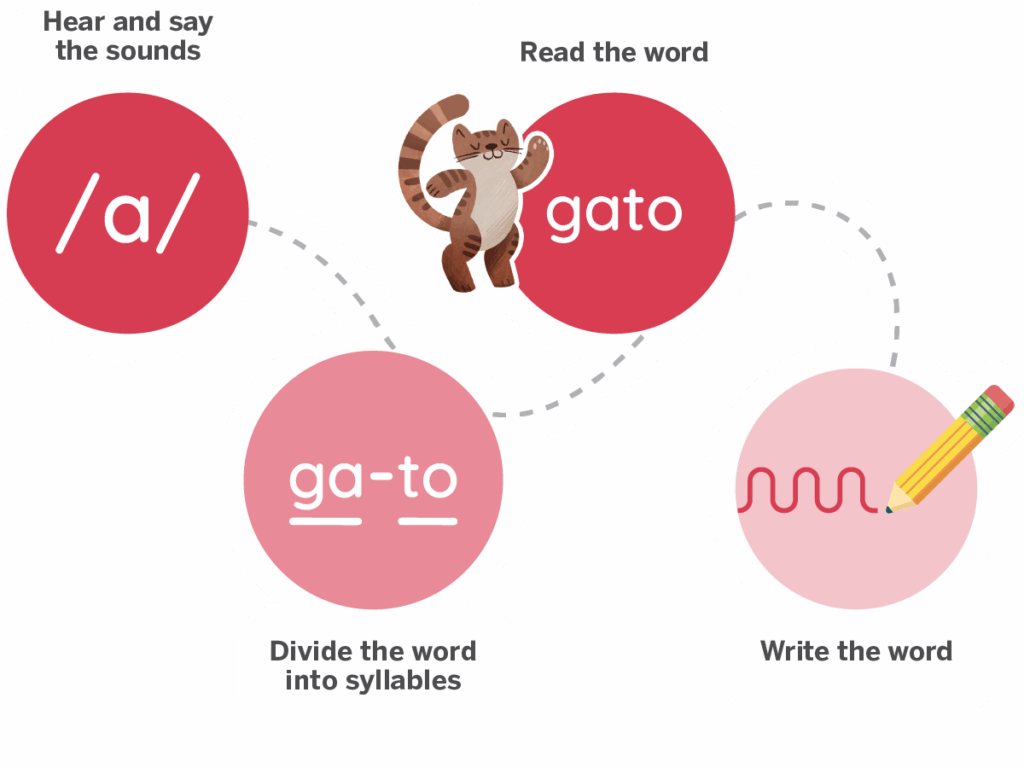
A four-step diagram shows language learning: starting with sounds, building to phonemes and syllables, cracking the code, and growing in complexity, using "piñata" as an example.

Developing foundational skills explicitly and systematically

Amplify Caminos instruction is based on how the Spanish language works. Students learn vowel sounds and common sounds before blending them to form syllables and words. Less frequent consonants and other complex elements are presented later, with an intentional progression that sets students up for success.

Building background knowledge drives results

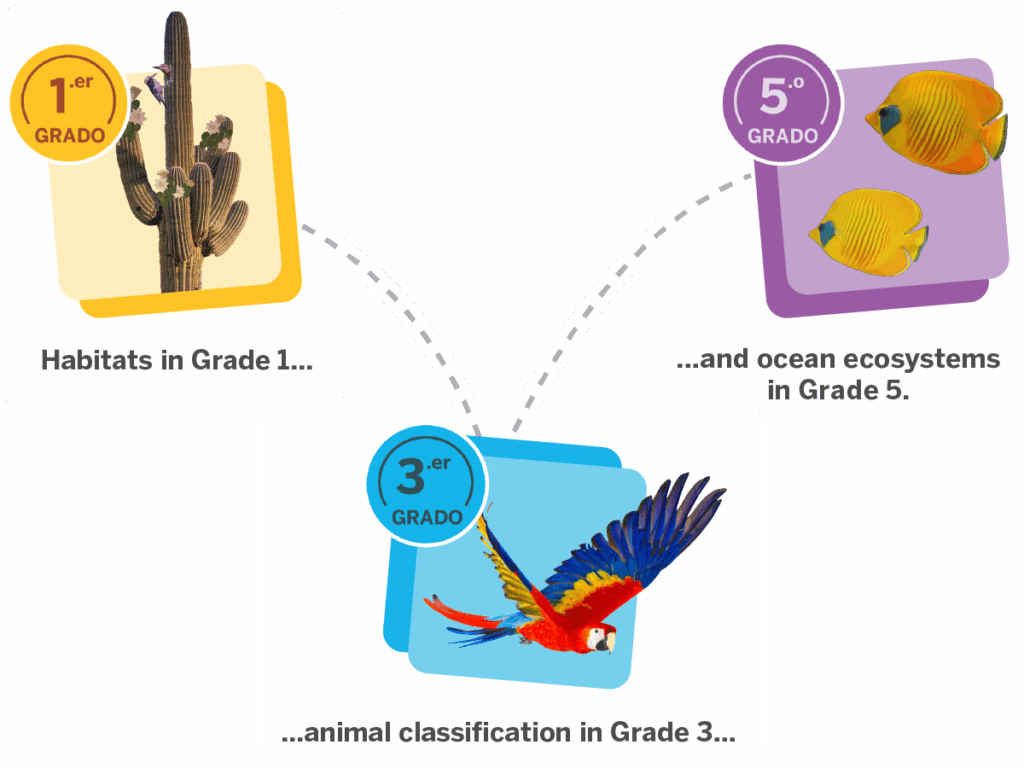
Students dig deeper and make connections across content areas to build a robust knowledge base for comprehending complex texts. Amplify Caminos and Amplify CKLA follow the Core Knowledge Sequence—a content-specific, cumulative, and coherent approach to building knowledge—with parallel topics to support research-based and supportive Tier 1 instruction in Spanish and English.

Explore how Core Knowledge curriculum improves reading scores and eliminates achievement gaps.

Three circles show stages of science education: plants in kindergarten, ecology with birds in grade 3, and layered rock formations for geology in grade 4.
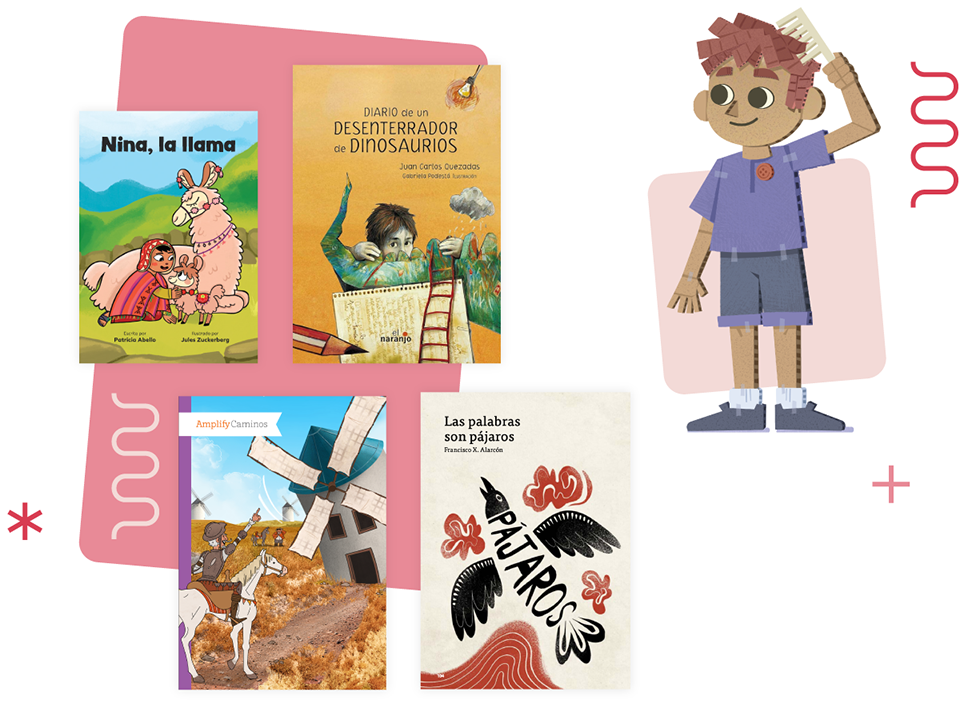
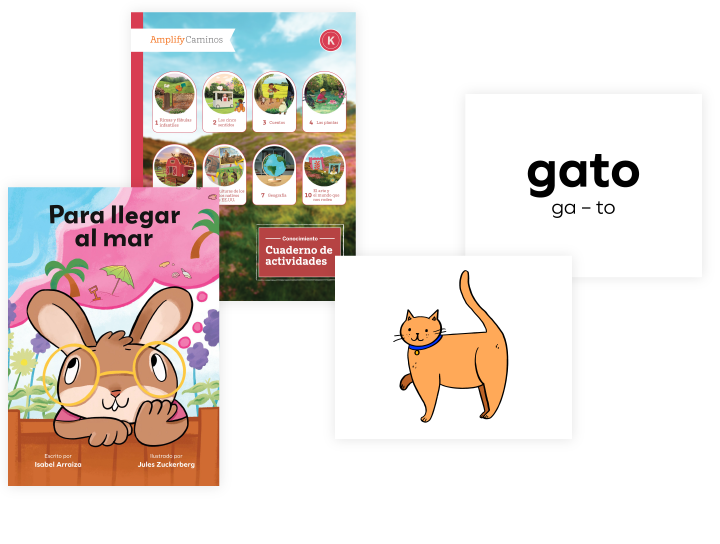
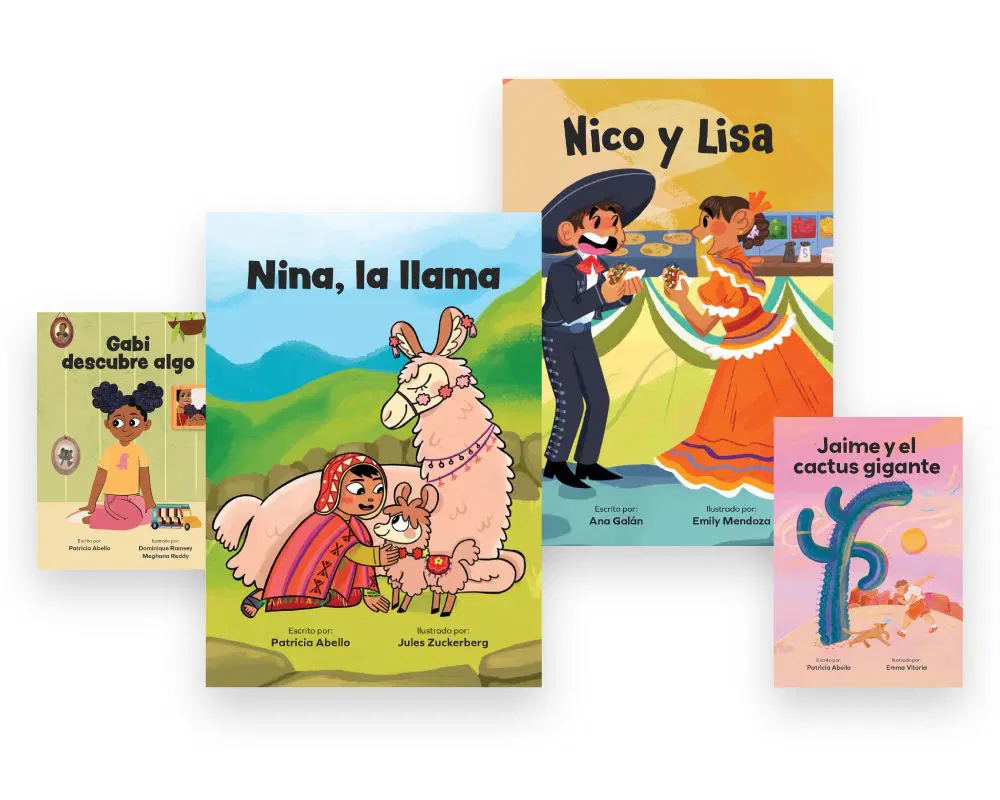
Five illustrated children's books with colorful covers, featuring titles in Spanish and cartoon characters including a llama, children, dancers, and a large cactus.

Culturally relevant and challenging texts

Students learn about diverse topics and genres while better understanding themselves and the world with a variety of texts. Authentic Spanish literature, including original decodables by Latino and Hispanic authors, and transadapted texts connect knowledge topics and foundational skills instruction to provide a rich learning experience.

Being bilingual is a superpower

Bilingualism is a cognitive strength: Research attributes it to increased attention, improved working memory, greater awareness of language, and more. Honor the unique skills, strengths, and needs of your multilingual learners with Amplify Caminos and Amplify CKLA.

What’s included

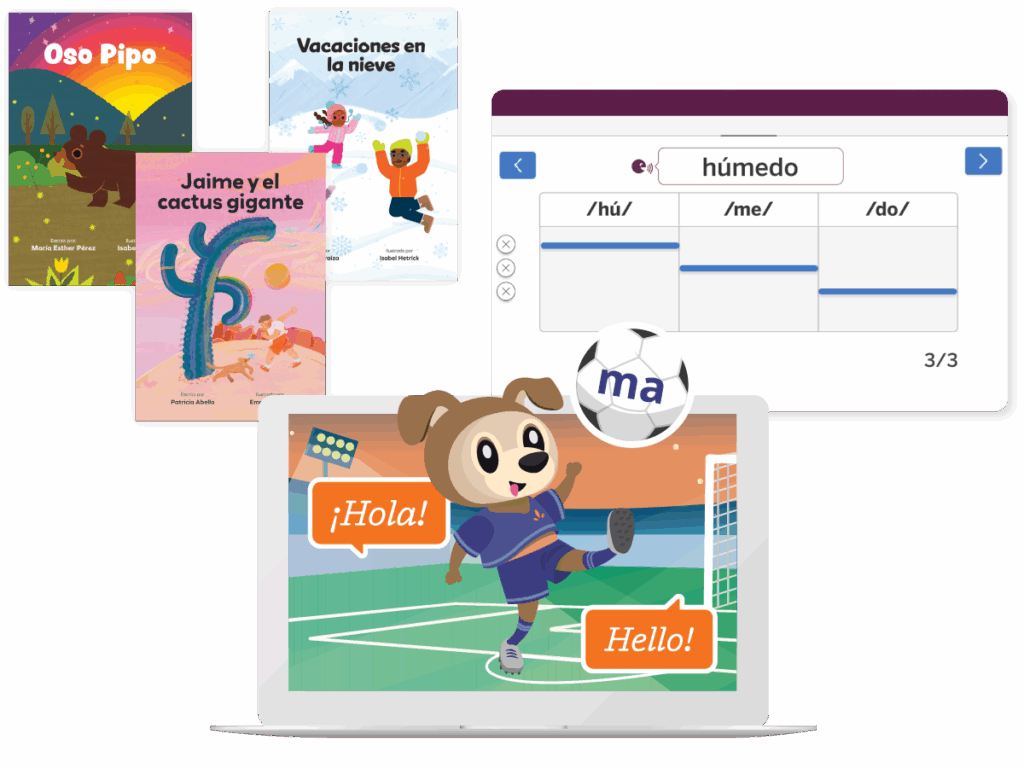
Amplify Caminos features engaging print and multimedia materials—accessible from anywhere—designed to provide a robust literacy-rich foundation in every classroom.

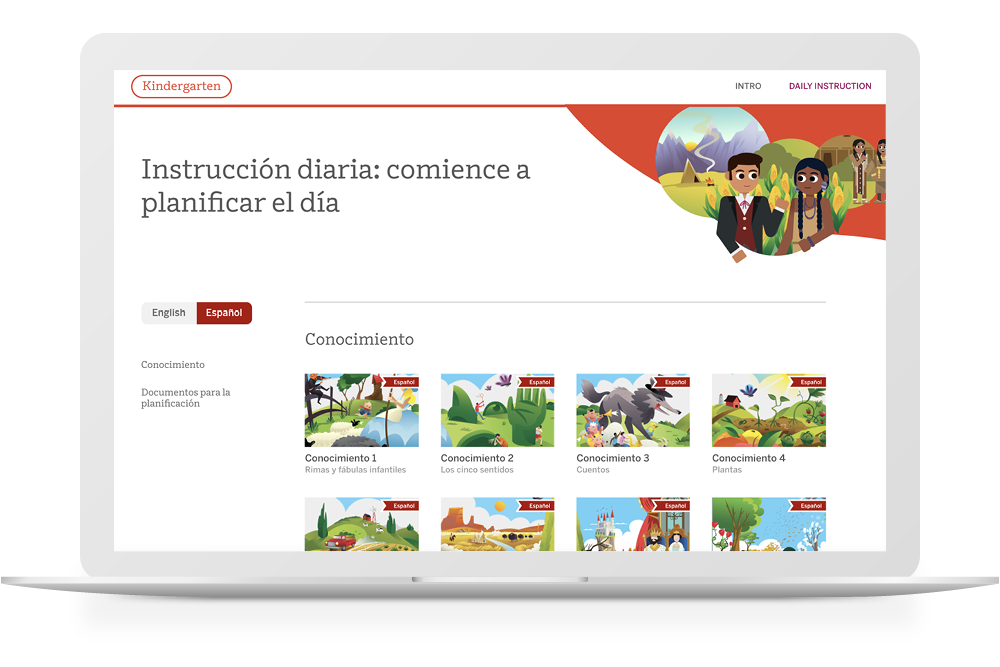
A laptop screen displays a kindergarten daily instruction webpage in Spanish, showing lesson categories with colorful illustrated thumbnails.

High-quality teacher materials

Amplify Caminos teachers effectively deliver instruction with print and digital resources, including:

  • Teacher resources and on-demand professional development.
  • Teacher Guides with embedded differentiation.
  • Formal and informal assessments.
  • Ready-made and customizable lesson slides.
  • Bilingual Connections to support cross-linguistic transfer.

Immersive student resources

Amplify Caminos students stay engaged with a variety of print and digital resources, including:

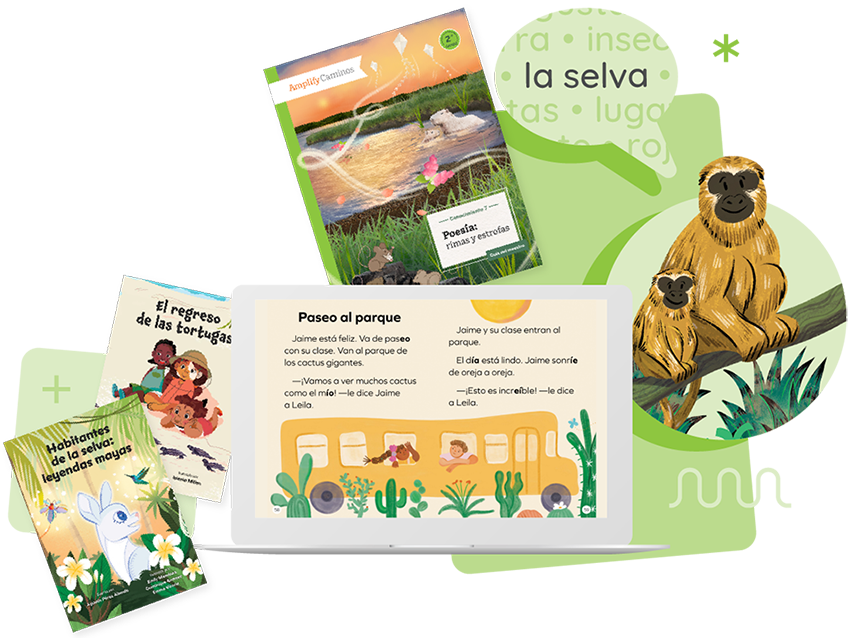
  • Original decodables and read-aloud Big Books (K–2), Student Readers (3–5), and authentic Spanish literature anthologies (4–5).
  • Poet’s Journal and Writer’s Journal (write-in Student Readers for Grades 4–5).
  • Student Activity Books with embedded assessments.
  • Research units for independent research built around a trade book.
  • Multisensory phonics materials:
    • Letter Cards (K–2)
    • Syllable Cards (K–2)
    • Image Cards (K–3)
    • Plus, digital anchor charts and a Sound Library.
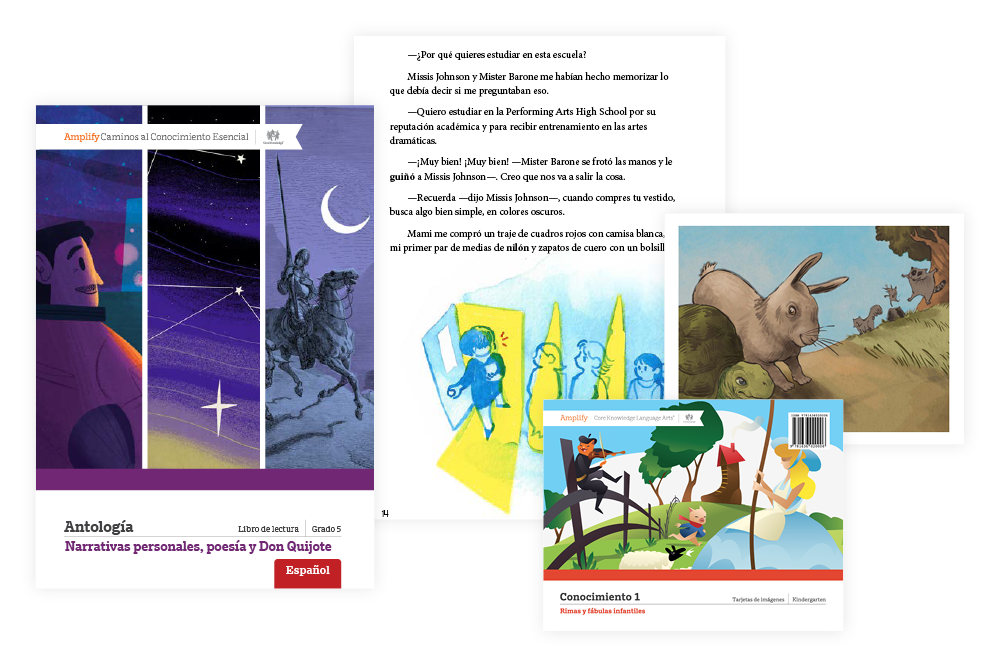
A collage of illustrated Spanish-language educational book covers and pages, featuring a knight, a rabbit, and children playing, alongside Spanish text excerpts.
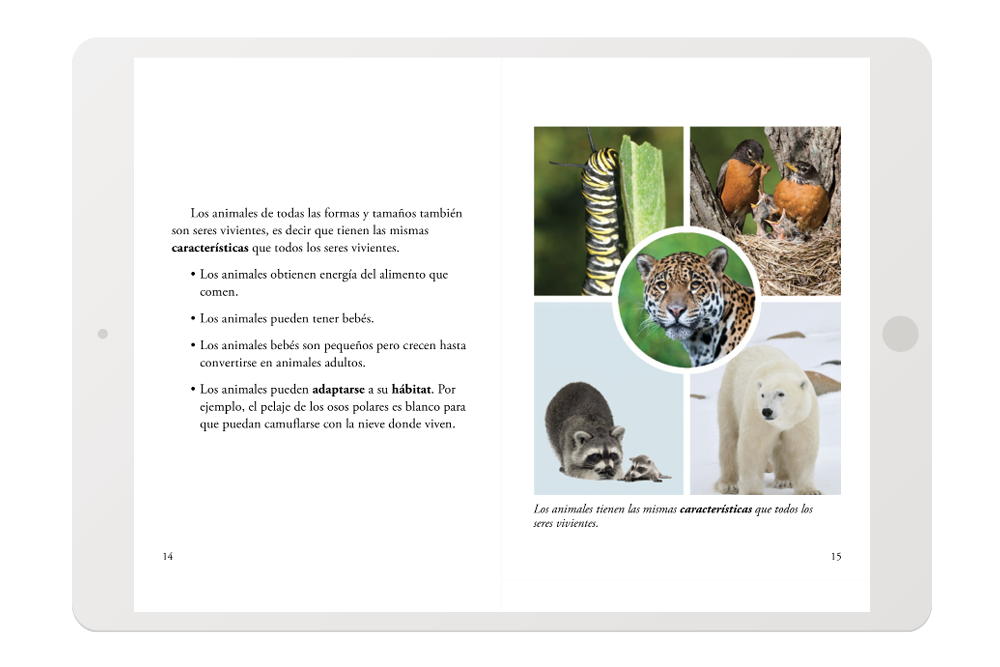
An open ebook on a tablet displays Spanish text about animals, accompanied by photos of a caterpillar, birds, a jaguar, raccoons, a polar bear, and a fox.

Robust digital experience

Like Amplify CKLA, Amplify Caminos is proud to be a premier high-quality instructional material (HQIM) offering in elementary language arts, with rich and research-based content—including an expanding library of engaging digital materials—that helps you authentically support, challenge, and engage your students. From digital Teacher Guides to lesson projectables, we provide all the tools needed to successfully deliver every lesson.

Explore more programs based on the Science of Reading

All of the programs in our literacy suite are designed to support and complement each other. Learn more about our related programs:

How to implement the Science of Reading in your classroom today

How to implement the Science of Reading in your classroom today

To view this protected page, enter the password below:


Artificial intelligence at Amplify

Amplify is committed to using artificial intelligence (AI) capabilities transparently, safely, responsibly, and ethically to deliver tools and resources that continue to fulfill our purpose. We are also committed to aiding students, teachers, and our staff with the skills and understanding required to use AI technology effectively and fairly.

Thoughtful and intentional integration of AI technology supports Amplify’s purpose by extending teachers’ reach, saving them time, enhancing their understanding of each student, and providing new ways to engage students in powerful and rigorous learning experiences.

At the core of our work is our belief that these technologies, if used wisely, can support teachers in creating the kind of classroom experiences every student deserves—collaborative, interesting, and personalized.

Amplify’s AI principles

Governance and risk management: Amplify is developing and maintaining a governance and risk-management program aligned to EDSAFE AI Alliance’s S.A.F.E. Benchmarks Framework and the NIST AI Risk Management Framework, which includes internal policies and procedures to support compliance and safe and responsible use of AI. Amplify’s program guides the design, development, deployment, and overall implementation of AI in Amplify’s products and the tools used in Amplify’s operations. The governance program applies both to Amplify-developed capabilities and third-party development and integrations.

Amplify aligns to EDSAFE AI Alliance’s S.A.F.E. Benchmarks Framework as follows:

SAFETY: Uphold privacy, security, and reliability.
ACCOUNTABILITY: Be human-centered, responsive to human guidance, and transparent.
FAIRNESS AND TRANSPARENCY: Avoid creating or reinforcing unfair bias, and assess for impact.
EFFICACY: Be purposeful and rigorous.

Privacy and security: Amplify ensures that privacy protections are included by default in AI systems, including ensuring that data collection conforms to reasonable expectations and that only data strictly necessary for the specific context is collected, in conformance with our policies around the collection, use, and sharing of personal information. Amplify’s applications use student personal information solely for the purpose of performing the service, in alignment with Family Educational Rights and Privacy Act (FERPA) and applicable state law and district policies and contracts. In addition, Amplify monitors security risks specific to AI systems, including dataset poisoning, prompt injection, and adversarial attacks, and shores up resilience against attempts to alter use, behavior, or performance, or to compromise security properties. Read more about Amplify privacy and security programs.

AI in Amplify’s products and services

Amplify uses AI in our programs in ways that respond to the demonstrated needs of districts, teachers, and students and that meet our high standards for safety, accountability, fairness, and efficacy. Amplify has established an AI Center of Excellence, with AI scientists, engineers, product managers, and designers dedicated to establishing best practices and guiding development in key areas that meet these criteria. 

Some ways Amplify leverages AI in products and services:

Amplify ELA: Amplify ELA’s Automated Writing Evaluation (AWE) tools give teachers the ability to understand, track, and support student progress with key foundational skills, which are strong indicators of students’ analytic writing proficiency. Developed in conjunction with the Writing Prompts in Amplify ELA, AWE assesses student writing for Focus, Use of Evidence, and Conventions, providing critical feedback for teachers and data for Amplify’s writing reports.

Boost Reading: Students in grades K–5 may take the Boost Reading Benchmark Assessment to determine their placement in Boost when they first log in. Students receive a set of word recognition, fluency, and comprehension activities, supported by automatic speech recognition.

Boost Math: Personalized Learning activities feature Spark, a virtual tutor that uses text-to-speech to provide personalized, engaging support to help students build mastery. The tutor incorporates student numerical responses in its conversation, but does not use student personal information.

An Aussie teaching American phonemes

A woman smiles in a portrait overlaid on an illustrated open book with a ladybug, web, and green landscape, reflecting an interactive teaching style; a speech bubble shows "/u/".

Ever heard of bidialectalism? It means the ability to fluently switch between two dialects.
It was a new word for me when I first started teaching in the U.S.—but I figured it out fast, just by opening my mouth in the classroom.

Bringing my own Australian dialect to teaching six-year-olds deepened my capacity to help struggling readers and multilingual readers. It has also strengthened our classroom community and provided surprising, even amusing opportunities to learn—for all of us.

“What if they get an Australian accent?”

When I first entered an American classroom, I was nervous about teaching phonemes to kids. I kept wondering, “What if they get an Australian accent?” (That never happened.)

I remember my first year teaching Amplify CKLA, standing in front of my students and trying to figure out why the word “from” seemed tricky. For me, it sounded exactly how it was spelled. I kept saying “from,” but my students said: “/f/ /r/ /u/ /m/.”

That was the first of many times I realized how different my dialect really was.

The next one came during our Animals and Habitats unit. We were deep into the lesson when I casually said what sounded like “Pythin,” and a student turned and said, “Don’t you mean PythOn?”

Then came the r-controlled vowels. (R-controlled vowels, also called r-influenced vowels, are vowels that change their sound when followed by an “r” in the same syllable. Instead of sounding short or long, the vowel is “controlled” by the “r”—like in “car,” “bird,” “corn,” “turn,” and “her.”)

Because of my accent, when I said those sounds, they almost always came out as “uh.” (I think that’s why I’ve been told Aussies were responsible for the schwa!) While that got a good laugh—and gave students lots of chances to mimic my accent—it drove home the real importance of phonological awareness.

Learning together: Teaching phonemes and pronunciation

I spent the rest of that first year going over the phoneme videos on the Amplify resources hub, practicing my r-controlled vowels. I did my best to learn to switch between the Australian and American dialects. I even started challenging my students to correct me more often. (“Wait, did I say that right?”)

That led to more intentional practice when teaching grade-level spelling patterns for those individual sounds. I started adding silly actions to go with each one. For example, we’d say, “‘e’ and ‘r’ are friends and together they go ‘errrrr,’” and we’d pretend to turn a key into either side of our cheeks.

Those small quirks helped my students remember the sounds—and they helped me just as much.

Don’t dread it—use it!

So, to any teacher who’s dreading teaching phonemes or teaching kids to read because of their speech or dialect—don’t!

Learning with your students, blending Amplify’s tools with your own quirks and personality, builds classroom memories and creates powerful literacy instruction.

You don’t have to erase your accent to be effective. In fact, embracing your uniqueness might just make you a better teacher.

From one teacher to another: Don’t be afraid of the greatness you already have.

To close out, here’s my favorite use of what I believe is the greatest phoneme/diphthong of all time: Aussie! Aussie! Aussie! Oi! Oi! Oi!

Science of Reading

To view this protected page, enter the password below:


Achieve life-changing results with the
Science of Reading—we’ll show you how.

Watching students learn to read is magic. But knowing how they get there? That’s science.

Making the shift to the Science of Reading is commendable, but it is no small feat. Our extensive experience, field-tested resources, and stories of literacy success will help you deliver the true transformation you need in your district—and see the results your students deserve.

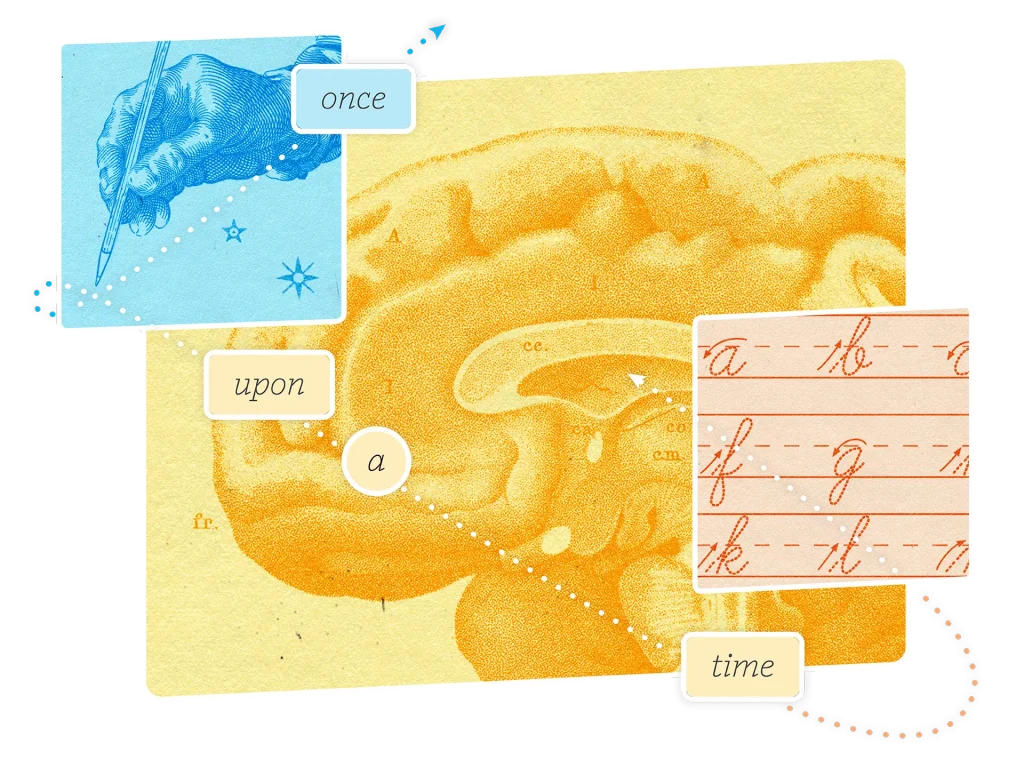
An illustration of a brain with superimposed images: handwriting, cursive letters, and the words "once upon a time" arranged in a sequence.

Exploring the Science of Writing

Discover the captivating journey of writing with our new guide, Science of Writing: A Primer. This resource delves into the history of writing, highlights the crucial link between combining reading and writing instruction, and reveals why handwriting still matters in today’s digital world. Designed to complement CKLA 3rd Edition and our other literacy tools, this primer is set to become a trusted companion, just like those before it.

MTSS Playbook

Explore our new ebook designed to help you build an evidence-based Multi-Tiered System of Supports (MTSS) tailored to diverse literacy goals. This resource provides actionable steps and essential questions to fortify your MTSS with the Science of Reading, enhancing its effectiveness and achieving better outcomes for your students.

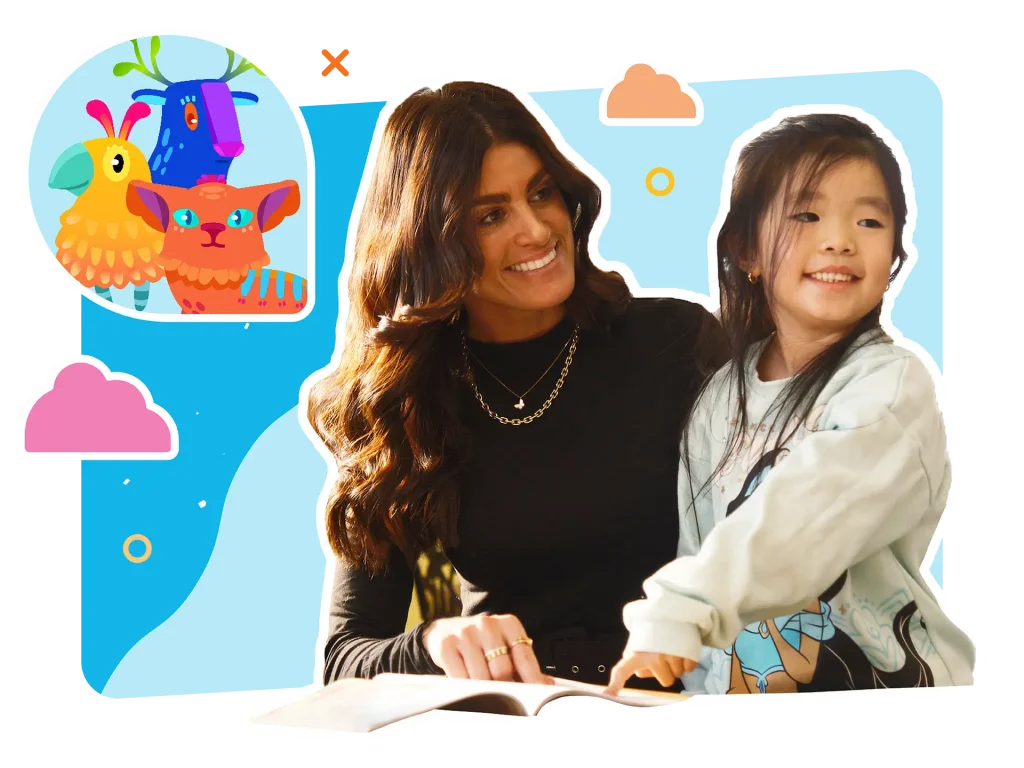
Woman and child smiling while reading a book, with colorful cartoon animals in the background.
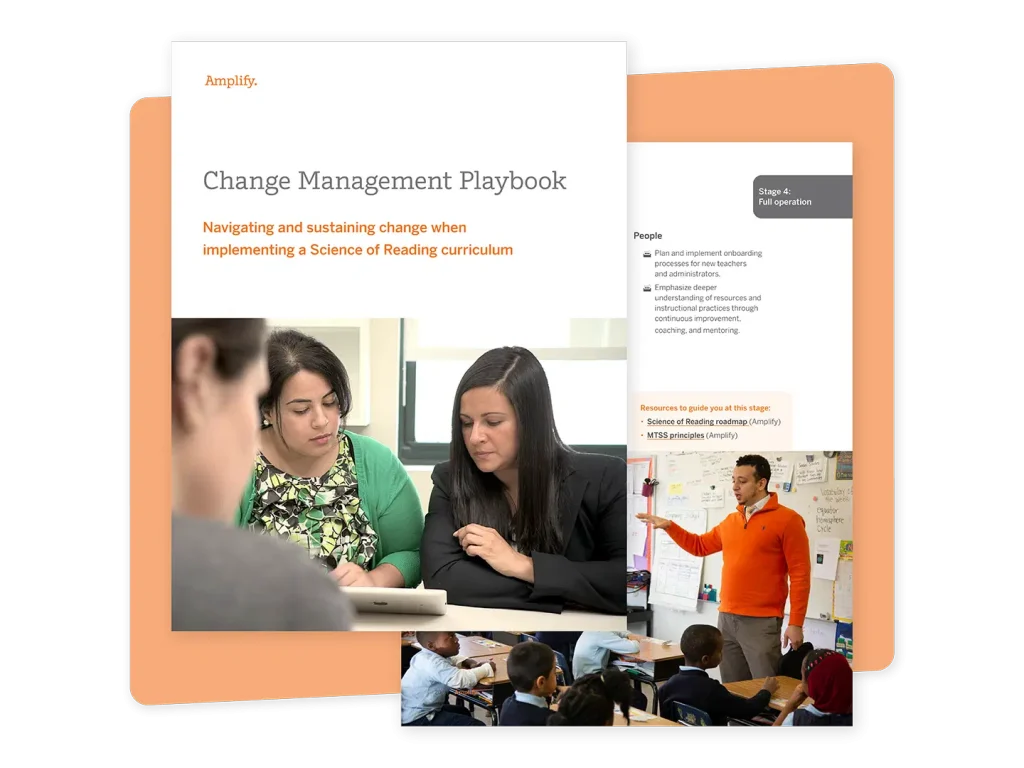
Cover of a "Change Management Playbook" guide, featuring two women reviewing a tablet and a teacher in an orange sweater instructing a classroom—highlighting K–5 literacy instruction and effective science of reading resources.

The science of teaching reading, coupled with the art of change management

Shifting to the Science of Reading isn’t just an overnight curriculum swap—it’s a profound culture change with multiple stages and stakeholders. We’ve helped educators succeed in that shift for years, and now we’re here to guide you every step of the way. Through each stage of implementation, our Change Management Playbook will help you mobilize your practice, process, and people to make the shift that matters most.

What is the Science of Reading?

Learning to read is not innate, but it can be taught—and science tells us how. The Science of Reading refers to the vast body of growing research that deconstructs how children learn to read, and the instructional practices that can get them there.

Reading fluency requires a complex combination of skills, taught explicitly and systematically. There are two main frameworks that can help us break it all down: The Simple View of Reading and Scarborough’s Rope.

Two schoolgirls in green uniforms look at a notebook together in a classroom. Science of Reading and book icons are overlaid on the image.
Cover of a guide titled "Science of Reading: A New Teacher’s Guide" by Amplify, featuring a teacher with two children and educational icons.

Science of Reading starter kit for new teachers

New to the classroom? We’ve compiled a collection of resources and insights about the Science of Reading to help you acquire more knowledge and build confidence. You’ll find the tools, information, and support you need to foster successful readers and writers in your classroom this school year—and beyond.

The Simple View of Reading

The Simple View of Reading, formulated by Philip Gough and William Tunmer in 1986, is the theory that proficient reading requires two main components:

Flowchart illustrating skilled reading as the product of language comprehension and word recognition, grounded in the science of reading.
A diagram with intertwining orange, yellow, and blue lines converging and diverging, illustrating interconnected pathways on a black background—reflecting the dynamic flow of ideas found in Core Knowledge or Amplify CKLA curricula.

The Reading Rope

The Reading Rope, developed by Dr. Hollis Scarborough in 2001, helps us visualize the strands of specific skills and instruction that support students in decoding and comprehension.

Professional development to support your shift to the Science of Reading

Ignite literacy transformation with Amplify’s Science of Reading: The Learning Lab—an inspiring three-course series.

  • Dive into a comprehensive overview with course one, Foundations to the Science of Reading.
  • Examine assessments and their roles in course two, Advanced Topics in the Science of Reading: Assessment and Reading Difficulties.
  • Apply effective literacy instruction to your classroom in course three, Applied Structured Literacy.

Crafted to the standards of the International Dyslexia Association, this self-paced online series provides unparalleled, research-backed instruction. Explore enriching activities, curated resources, and learn from Susan Lambert, chief academic officer and host of Science of Reading: The Podcast.

The best investment you can make is in knowledge, and the returns are priceless.

Illustration of a webpage titled "Science of Reading: The Learning Lab series" with icons of a book, paper, and other subjects below the title.

Learn more about the online courses or request a quote!

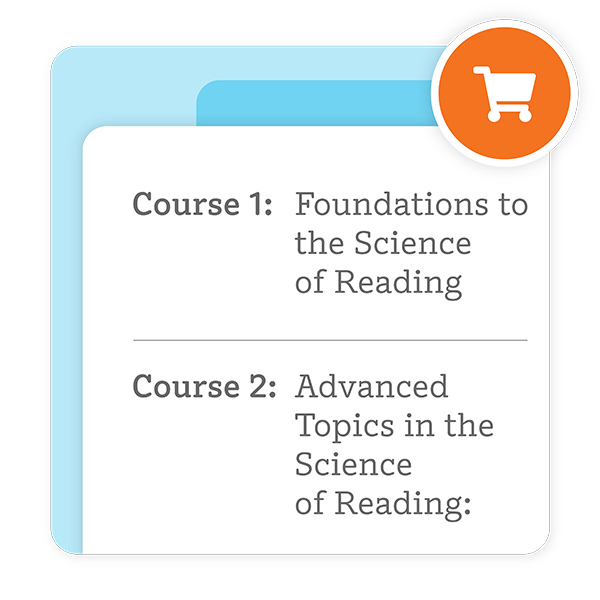
Two labeled course cards: "Course 1: Foundations to the Science of Reading" and "Course 2: Advanced Topics in the Science of Reading," with a shopping cart icon in the top right.

Tap into individual online course seats.

Science of Reading podcast cover image open book

Science of Reading: The Podcast

Tune in to hear the latest insights and trends in early reading, right from leading literacy experts and practitioners.

Listen now

Build your background knowledge of the Science of Reading.

Our Science of Reading principles and primers explain the essentials: what the Science of Reading is, how it works, and why it matters for every student.

An infographic titled "Science of Reading principles" showcases ten evidence-based K–5 literacy instruction strategies, informed by interdisciplinary research, in color-coded boxes with a "NEW" badge in the top right corner.

New Science of Reading principles placemat!

Decades of research inform the updated Science of Reading principles placemat. Use these insights as a guide for evidence-based literacy instruction—perfect for committed educators aiming to achieve real improvements in student reading outcomes.

Download principles

An illustration of a girl running with a colorful kite, with text reading "Science of Reading: A Primer | Part One" and "Amplify" in the top left corner, highlighting K–5 literacy instruction.

Science of Reading
A Primer: Part 1

In part 1 of our definitive Science of Reading primer, we discuss literacy as a societal goal, walk you through how the brain learns to decode and comprehend text, and present the patterns that top-performing schools and districts follow to achieve early reading success.

Download primer 1

Illustration of two people atop a yellow pyramid, with text reading "Science of Reading: A Primer | Part Two"—an engaging look at K–5 literacy instruction. "Amplify" appears in the top left corner.

Science of Reading
A Primer: Part 2

In part 2 of our Science of Reading primer, we establish the importance of prior knowledge for comprehension, lay out the process of micro-comprehension, and demonstrate how literacy skills build on and accelerate themselves.

Download primer 2

A woman with long dark hair smiles in front of a plain background, reflecting the joy she finds in interdisciplinary research. She is wearing a dark green top and earrings.
“If you’re looking for a Science of Reading training, the [Science of Reading: Foundations to the Science of Reading] online course is great. It helps you build background knowledge on learning how students learn how to read, and then it goes deeper and it gives you strategies that correlate with those findings that you can implement right into your classroom.”

—Allie Appel, Instructional Coach

School District of Arcadia, WI

Why undertake this crucial change?

When we bring proven methods based on the Science of Reading into schools, we make sure kids are learning to read and help teachers and caregivers support a culture of reading. Together, we can solve the reading crisis and make literacy a reality everywhere.

You’ll change lives with literacy.

According to the National Assessment of Educational Progress (NAEP), only 35% of fourth graders in the United States are proficient in reading. But schools using a Science of Reading approach have seen significant improvements in literacy rates. Using research-based methods, educators can help give all children the chance to become successful readers.

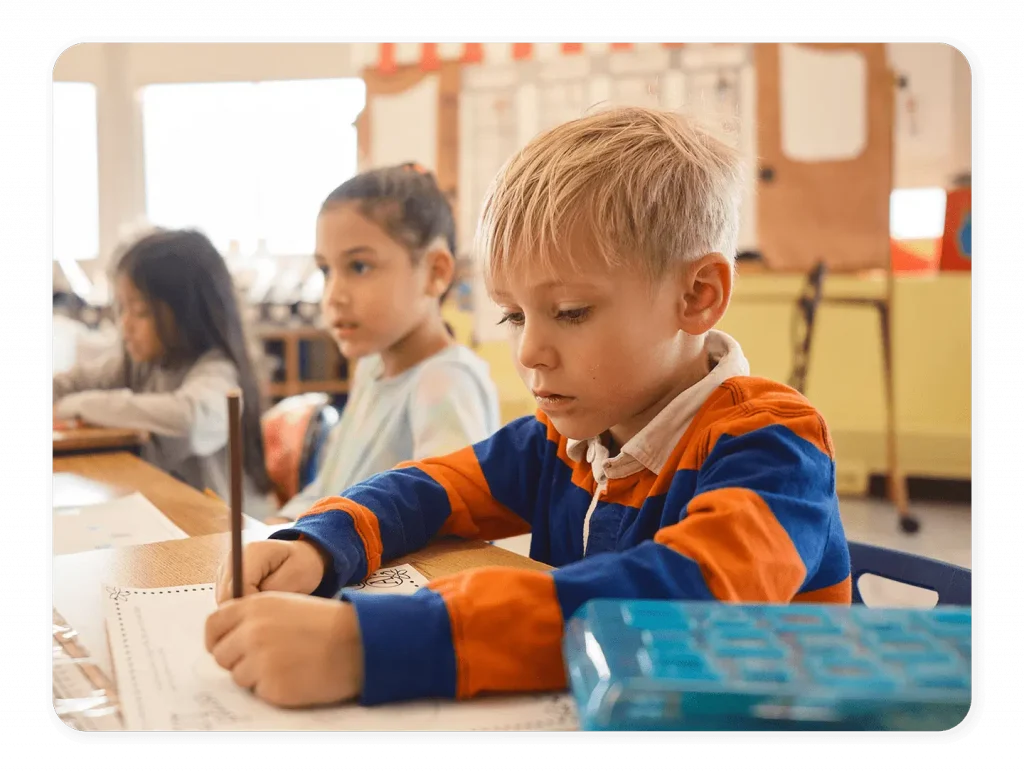
Young boy in a classroom sits at a desk and writes on a worksheet, with other children working at nearby desks in the background.
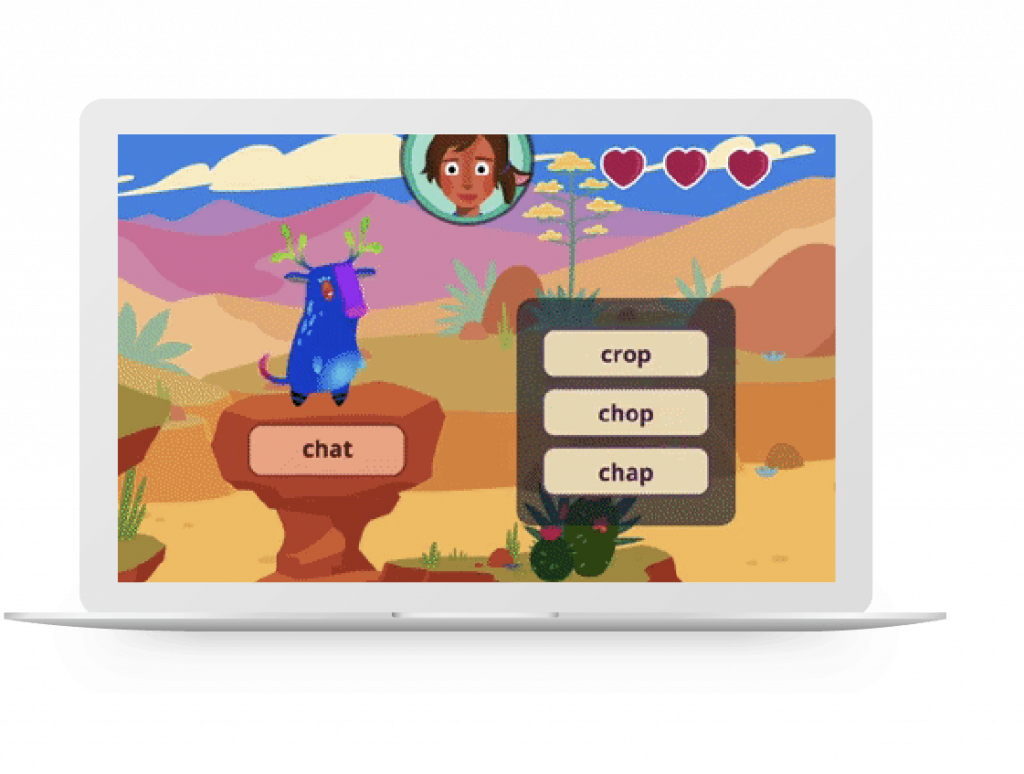
A laptop screen displaying a literacy intervention game with a cartoon llama in a desert setting and a word selection task presented to a child’s avatar in the corner.

You’ll build a foundation with explicit, systematic skills instruction.

Reading skills don’t come naturally. We actually need to rewire our brains with intentional, structured literacy instruction—starting with sounds.

You’ll improve outcomes with knowledge building.

Longitudinal research shows that knowledge building doesn’t just happen as a result of reading, but is also a vital prerequisite for and component of it. And when delivered intentionally and systematically, knowledge delivers literacy results.

Illustration depicting diverse people engaged in various activities, including astronauts in space, a musician engaged in interdisciplinary research, and a child drawing, set against a whimsical celestial backdrop.
A person with long braided hair, wearing oversized glasses, earrings, a necklace, and a red top, smiles at the camera against a plain background.
“It’s not just about the curriculum. It’s about the science behind how people, how children, and how we as humans learn to read… It’s working. I wish I had this years ago. ”

—Javonna Mack, Lead Content Teacher

Caddo Parish Schools, Louisiana

Science of Reading & Early Literacy Resources FAQ

Amplify understands that making the shift to the Science of Reading is no small feat. Get some early literacy resources and guidance with our Science of Reading FAQ.

Learning to read is not innate. It needs to be taught intentionally and systematically—and science tells us how. The vast and growing body of research on early literacy is referred to as the Science of Reading. It draws on extensive research in cognitive science, linguistics, and neuroscience. It emphasizes the systematic teaching of foundational skills—such as phonics, phonological awareness, and decoding—in building vocabulary and comprehension. In other words, it deconstructs the processes behind how children learn to read, and provides evidence for the instructional practices and early literacy resources that can get them there.

Read more 

The Science of Reading refers to the pedagogy and practices proven by extensive research to effectively teach children how to read. It places a strong emphasis on both components of the Simple View of Reading, demonstrating that systematic and explicit instruction in phonics and and intentionally sequenced knowledge building are critical to reading success.

In a balanced literacy environment, learning happens through reading and writing immersion, where the need for explicit instruction in phonics is recognized but is not the primary focus.

The key difference between the approaches lies in their emphasis on foundational reading skills and a coherent approach to building language comprehension.

A balanced literacy approach typically includes a combination of whole language approaches (emphasizing meaning and context) and phonics instruction. Balanced literacy instruction is designed to be flexible and open to interpretation by the instructor. It may include the three-cueing system, which encourages students to rely on syntactic and semantic clues in a text to read an unfamiliar word, rather than decoding (Does it look right? Does it sound right? Does it make sense?). Balanced literacy practitioners may also use leveled reading to differentiate instruction, which can can limit vocabulary exposure, hinder in-depth comprehension skills, and further widen achievement gaps.

Balanced literacy has long been a popular approach to reading instruction, with educators appreciating its openness to variation. But advocates for the Science of Reading argue that an evidence-based approach aligned with known cognitive processes and a focus on foundational skills and language comprehension provides the most solid foundation for reading instruction—for confident and struggling readers alike.

Read more

According to our friends at The Reading League, the Science of Reading is important not because it gives us an effective way to teach reading, but because it gives us the most effective way to teach reading.

“The Science of Reading is critical because it emphasizes evidence-based instruction. Decades of scientific research on reading have consistently shown the most effective ways to teach reading. The Science of Reading incorporates this research, which includes phonemic awareness, phonics, fluency, vocabulary, and comprehension.”

The Reading League also takes it to the next level: What happens when all children have access to the most effective early literacy and reading education? “We believe in a future where a collective focus on applying the Science of Reading through teacher and leader preparation, classroom application, and community engagement will elevate and transform every community, every nation, through the power of literacy.”

The Science of Reading has identified five foundational reading skills that are considered crucial for early reading development. One of those skills is phonics. In other words, the Science of Reading has established that phonics are crucial, but the Science of Reading is not the same as phonics.

Phonics instruction helps students learn how to sound out and blend letters to read words accurately. As we know from the Simple View of Reading, two fundamental skills are required for reading with comprehension:

  1. Decoding—the ability to recognize written words (via phonics)
  2. Language comprehension—understanding what words mean

And the Science of Reading also reminds us that students do not have to learn phonics or decoding before knowledge comes into the equation. “The background knowledge that children bring to a text is also a contributor to language comprehension,” says Sonia Cabell, Ph.D., associate professor at Florida State University’s School of Teacher Education, on Science of Reading: The Podcast.

The Science of Reading is an evolving field built on decades of high-quality, evidence-based research that continually integrates new insights gathered from cognitive neuroscience, psychology, and linguistics. These ongoing studies constantly refine our understanding of how the human brain processes language and learning, enabling more personalized and effective teaching strategies that can adapt to the wide-ranging learning needs of students.

Like other sciences such as medicine, astronomy, or engineering – new advancements in reading technology allow us to understand how the brain works and refine our practices. Every scientific advancement in this field of reading science deepens our comprehension of reading-related challenges like dyslexia and informs the development of evidence-based interventions. We don’t believe that the Science of Reading can be reduced to a fad or trend. Rather, it is a continually evolving, enduringly effective discipline, grounded in rigorous research and driven by the quest for better comprehension of how we read and learn.

Assessment grounded in the Science of Reading can help identify children at risk of dyslexia at the earliest possible moments, creating the widest opportunity for intervention.

People with dyslexia often experience challenges in phonological awareness. They may struggle to break down words into their component sounds and to recognize the relationships between letters and sounds. Systematic and explicit instruction in phonics and phonological awareness can help individuals with dyslexia develop necessary phonological skills. This evidence-based instruction can also help students who have difficulty with decoding.

Further, evidence-based comprehension instruction, including explicit instruction in vocabulary and comprehension strategies, can support students with dyslexia in understanding and making meaning from text.

Download our free dyslexia toolkit

The Science of Reading can be integrated with a Multi-Tiered System of Supports (MTSS) to provide comprehensive and targeted reading instruction for all students. The Science of Reading aligns with a tiered model by providing evidence-based practices for instruction at each tier. An MTSS includes universal screening to identify students at risk of reading difficulties; the Science of Reading can also guide the selection of screening measures to assess specific foundational skills. Aligning the Science of Reading with an MTSS framework can also enhance instructional practices and interventions, ensure data-driven decision making, and help meet the needs of all students.

Read more

Integrating the Science of Reading and the Science of Writing strengthens our approach to teaching literacy. Reading and writing are interdependent. Understanding how sentences are built not only contributes to better reading comprehension, it also helps writers develop clear, logical text. As students grow as readers, they also grow as writers, leading to a comprehensive literacy education. Clear thinking and effective writing are crucial for expressing ideas. By fostering both skills, teachers better support students in becoming confident readers and writers, prepared for academic challenges and beyond.

One of the research-based frameworks used in the Science of Reading is the Simple View of Reading. According to the Simple View, two cognitive capacities are needed for proficient reading: (1) understanding the language (comprehension) and (2) recognizing words in print (decoding). A true Science of Reading program is designed from the start for students to build these skills, in a developmentally appropriate way.

It will also emphasize the importance of knowledge building by exposing students to a diverse array of new topics spanning history, science, and literature, organized intentionally and coherently within and across grades. Deep and intentionally sequenced knowledge domains will help build a student’s vocabulary and understanding of complex texts. And it will include instruction in  all five foundational skills: phonics, phonemic awareness, vocabulary, fluency, and comprehension.

Download our free ebookScience of Reading: Making the Shift, which includes a checklist of what to look for in a curriculum based on the Science of Reading. Learn more from our friends at The Reading League.

Actually, we have a full literacy suite built on the Science of Reading! It includes:

  • mCLASS® assessment, powered by DIBELS® 8th Edition, a gold-standard universal and dyslexia screener, plus a progress monitoring tool, all in one.
  • Amplify Core Knowledge Language Arts (CKLA), which provides explicit, systematic foundational skills instruction combined with intentional knowledge building.
  • Boost Reading, a highly adaptive personalized reading program that reinforces the core curriculum and supports enrichment, remediation, and intervention for each student in your classroom.
  • mCLASS Intervention, a staff-led intervention program targeted to Tiers 2 and 3, made easy with automatic data-driven grouping and sequenced explicit, systematic skills lesson plans to support at-risk students.

Reading requires deliberate, systematic attention—and so does shifting to the Science of Reading in your school or district. It requires not only the right curriculum, but also all-new mindsets, metrics, and more. Reflecting years of experience supporting real educators, our resources will walk you through the process of change management in your community—and show you why the shift is worth it. View our Science of Reading change management playbook.

Scope and Sequence for Lectoescritura

Amplify Caminos is grounded in the Science of Reading and offers a powerful, evidence-based instructional approach.

The new Lectoescritura Strand specifically teaches students the decoding skills needed for independent reading. Each lesson begins with a warm-up that reviews previously taught content in phonics, reading, grammar, writing, and spelling.

A diagram showing "Language comprehension" times "Word recognition" equals "Skilled reading," with headings in Spanish above each term.

Foundational skills year by year

By building a solid foundation of phonological awareness and phonics, students will learn the sounds of vowels and common consonants first, and blend them to form syllables. Syllables will also be blended to form words. Less frequent consonants and other complex elements of the Spanish language will be presented at a later stage of the program.

A chart shows language skill categories by grade, with dots indicating focus areas for each grade from Kindergarten to Grade 5 in four categories: Print Concepts, Phonological Awareness, Phonics and Word Recognition, and Grammar.

Kindergarten

In Kindergarten, students develop reading comprehension, writing, listening and speaking, language, and foundational skills in the following ways:

  • Reading comprehension: Students answer literal, evaluative, and inferential story questions. Halfway through Kindergarten, students move from whole class reading instruction in Big Books to teacher guided independent and partner reading in decodable Student Readers, still using the Big Book as a model and support.
  • Writing: As students learn new sounds, they will also learn the phoneme to grapheme correspondence of each. The embedded activities and Activity Book provide a daily opportunity to practice the formation of individual letters, syllables, words and eventually sentences that contain the sound being taught in each lesson. In later units, students are guided through the Plan-Draft-Edit writing process.
  • Listening and speaking: Students engage in a range of whole group, small group, and partner discussions about text and daily lesson content.
  • Language: Students receive explicit instruction that introduces vocabulary and common words, or palabras comunes, to support decoding. Instruction also includes attention to the conventions of Spanish, including the use of question words, prepositions and plural nouns in oral speech, as well as capitalization and end punctuation in writing.
  • Foundational skills: Students begin with awareness of vowels and the most frequent consonant sounds, then practice blending those sounds into syllables, then blend those syllables into words with the ultimate goal of reading multisyllabic (2-3) words and complete sentences.

Click to take a closer look at the Kindergarten Scope and Sequence.

Grade 1

In Grade 1, students develop reading comprehension, writing, listening and speaking, language, and foundational skills in the following ways:

  • Reading comprehension: Students answer literal, evaluative, and inferential questions, including textual citations, and read with increasing independence and expression of individual interpretation of text. Reading instruction utilizes both the Student Reader and Big Book until Unit 5 when students transition into solely using the Student Reader.
  • Listening and speaking: Students engage in a range of whole group, small group, and partner discussions about text and daily lesson content.
  • Language: Students receive explicit instruction that introduces vocabulary and common words, or palabras comunes, to support decoding. Students also work to increase the use of new vocabulary in their written responses. In addition, discussions require the use of words in context. Explicit grammar instruction includes using parts of speech, such as nouns and verbs, and different forms of sentences, tenses, and punctuation.
  • Foundational skills: Students review vowels and the most frequent consonant sounds and are introduced complications like multisyllabic words, digraphs, accents, diphthongs, and hiatus.

Click to take a closer look at the Grade 1 Scope and Sequence.

Grade 2

In Grade 2, students develop reading comprehension, writing, listening and speaking, language, and foundational skills in the following ways:

  • Listening and speaking: Students engage in a range of whole group, small group, and partner discussions about text and daily lesson content.
  • Language: Students receive explicit instruction that introduces vocabulary and common words, or palabras comunes, to support decoding. Students also work to increase the nuanced use of new vocabulary in their written responses. In addition, discussions require the use of words in context in a range of settings. Explicit grammar instruction includes subjects and predicates, sentence expansion with adjectives and adverbs, and more advanced punctuation.
  • Foundational skills: Students continue to learn additional spelling complications as well as the tools needed to decode more challenging multi-syllable words; increasing emphasis on developing fluency, automaticity, and prosody in reading more complex texts.

Click to take a closer look at the Grade 2 Scope and Sequence.

The answer is a big YES!

You’ve probably taken a look through your Teacher Guide and thought: Will my students even be able to understand these higher-level CKLA topics (e.g., Early World Civilizations in Grade 1)? Will my students even be interested in this?

The answer is a big YES!

Students can listen on a higher language level than they can read, so listening provides a way to improve student’s language skills <link open in new tab>, making complex ideas more accessible and exposing students to vocabulary and language patterns that are not part of their everyday speech. 

Consider this new CKLA case study conducted in Hamilton Local School District, just outside of Columbus. You can observe these changes in their literacy growth since implementing CKLA, especially in students not just passing the state test, but placing at an Advanced level.

Watch this video with a few tips and a segment from the educator panel.

Screenshot of a paused video call showing a woman with long brown hair and glasses, wearing a red top, with a play button overlay in the center.

Watch the full panel on CKLA

You can also watch the full Amplify CKLA educators panel.

The topics in CKLA are powerful and help students build background knowledge on a variety of different subjects. Your students will love these topics, and you shouldn’t be afraid to make them your own. As Natalie Wexler states in The Knowledge Gap, “Kids love stories,” especially when referencing texts about science and social studies during core ELA instruction. 

“These stories are such a fun, magical part of CKLA’s lessons. As a former K–2 CKLA teacher, I loved doing this with my students. It gives students the opportunity to read-to-learn early on to develop background knowledge that will directly impact comprehension.”

—Megan

CKLA’s instructional road map empowers teachers to deliver content-rich stories about science, history, literature, and art in a developmentally appropriate manner that engages the whole classroom. Students are then able to access and think critically about the wide range of texts they will encounter throughout their lives. The CKLA Knowledge Lesson video  provides insight into how students are active, engaged participants during the read-aloud. 

See some inspiration for making CKLA your own on Twitter with #CKLA, plus a few of my favorites in the Pictures section below!

Program details

Get started with Amplify Reading: 6–8 Edition.

Cuatro personajes con distintos disfraces y una gran máquina robótica con garras visibles se encuentran juntos sobre un fondo blanco.

Introduction

Amplify Reading 6–8 is a digital reading program laser-focused on helping students find deeper meaning in texts by teaching them to question everything they read.

To capture students’ imagination, Amplify Reading 6–8 takes the form of an interactive graphic novel called The Last Readers. This story is set in a dystopian future world run by Machines, where people are told what to read and what to think. But dissent is afoot. Recruited for the rebellion, students are trained in the powerful ways authors convey meaning and affect their audience.

What students learn

Exploring texts from literary classics to propaganda, from great speeches to scientific articles, students learn to analyze the moves that authors make to achieve their purposes. Chapter topics alternate between the close analysis of arguments and literary analysis.

Each chapter should take approximately one hour for students to complete.

How to integrate this program into your curriculum

Amplify Reading 6–8 is designed for students to work independently as they progress through the chapters of The Last Readers. For the last chapter of each book, teachers have the option to build on independent work through group and whole-class activities.

For the best experience, students should complete the chapters in order. The chapters and concepts build on each other and were designed to help students master close reading skills. While teachers can unlock chapters so students can work on specific concepts at any given moment, doing so may result in a less-than-ideal experience. Later lessons are locked by default, but we will provide the ability to unlock lessons from within the teacher dashboard.

How teachers are using Amplify Reading 6–8

Reinforcement of concepts

Many teachers find the program extremely helpful for reinforcing key reading skills in the core curriculum. They use it in class one or two times a week for 20 to 30 minutes over the course of a year.

Test preparation

The program features extensive practice with text-dependent questions, providing a fun and effective way for students to get comfortable answering those kinds of questions.

Other common uses

Teachers also use the program to introduce key close reading concepts, for extra practice or homework, as response to intervention, and for after-school and summer school programs.

Routines

  • Devoting one class period every week or two to having students work independently on The Last Readers. While students are working independently on devices, teachers can work with small groups who need extra support with their core curriculum work. Teachers can also assign students work in Practice Mode during class or for homework.
  • Treating each book of The Last Readers as a 2–3 week mini-unit that can be inserted between units of core curriculum instruction. In addition to having students work on the chapters during class, teachers can assign students work in Practice Mode in between chapters or for homework.
  • Regularly assigning The Last Readers to students as homework. Because students may move through the chapters at different paces, teachers may want to assign one chapter per week and ask students to work in Practice Mode for the rest of the week after they complete a chapter.

Pedagogical approach

In Amplify Reading 6–8:

  1. Students learn to question everything they read by engaging with a story-based adventure in which understanding every piece of text and every article, billboard, speech and poem is essential to the narrative.
  2. Students learn to leverage the same devices used by authors to convey meaning by creating new content that integrates seamlessly with the story.

Unlike other reading supplementals that rely solely on assessment questions and feedback, Amplify Reading 6–8 weaves digital instruction together with assessment, all within an immersive story where the analysis of text is a critical element of the plot. The storytelling is vivid, suspenseful, and complex, designed to provide students with purpose and agency as they take on ever more challenging and high-stakes close reading tasks.

Each mission includes three steps:

  1. Interactive instruction: Students engage with a specific close reading concept using digital manipulatives.
  2. Guided close reading: Students apply knowledge of the concept to a complex text.
  3. Creative application: Students use their knowledge of the concept to create new content that solves a story-based problem.

Literary and informational passages are paired with carefully crafted, text-dependent questions and technology-enhanced items that prepare students for the same types of questions they’ll face on high stakes assessments. All along the way, teachers receive reports that visualize activity and progress, and highlight areas of improvement. Teachers can also leverage the original content generated by students in each mission as a rich classroom discussion piece.

Combining content and pedagogy with the creativity and purpose of storytelling results in an experience that truly motivates students and gives them the skills and confidence to tackle complex text.

Standards and alignments

Download the complete scope and sequence.

The practice of close reading lies at the heart of the Common Core and many other state standards for English Language Arts. Instruction in close reading enables students to become attuned to the essential elements of authentic texts: from key ideas and claims to specific details and evidence; from the effects of single words to those of larger textual structures; from the significance of individual texts to the interrelated meanings of entire corpora.

The recent focus on close reading is reflected in the text-dependent questions that populate many recent state assessments of ELA proficiency. Text-dependent questions address students’:

  • understanding of vocabulary
  • understanding of syntax and structure
  • understanding of literary and argumentative devices
  • understanding of themes and central ideas

Amplify Reading 6–8 gives students the essential skills and confidence they need to address text-dependent questions and the standards to which they refer.

Additionally, each book of The Last Readers emphasizes at least one Common Core reading anchor standards associated with each of the ELA standards strands:

Book 1: KID 1 / C&S 4 / IKI 8

Book 2: KID 1, 2, 3 / C&S 4, 5, 6 / IKI 8

Book 3: KID 1, 2, 3 / C&S 4, 5, 6 / IKI 6, 7, 8

Levels

Because each classroom represents a wide range of reading abilities, teachers can assign students to unique learning tracks that are tailored to provide the level of support each student needs.

After your students have enrolled in a class, you can assign them to a particular level in Reporting. All students will be automatically enrolled in the Core level. It is recommended that you assign all students to whatever level is most appropriate for them before they begin chapter 1. You can change a student’s level at any time.

LEVELDESIGNED FOR

CORE

Students whose reading levels fall within the middle school band.

EXTRA SUPPORT

Students who are reading below middle school level or with limited English proficiency. The instructional content and texts have been adapted or replaced to support students who “can engage in complex, cognitively demanding social and academic activities requiring language when provided moderate linguistic support.” Support includes streamlined, scaffolded content that integrates the built-in-dictionary tool, so students can access content and academic vocabulary at their language level and above. For productive written activities, students are given supports such as sentence frames to help them develop structured academic responses.


ADVANCED (coming soon)

We are developing an advanced level that will challenge readers with more complex texts and prompts, and with additional content.

Included texts

Book 1

Book 2

Book 3

Empowering multilingual learners

Welcome back to Science of Reading: The Podcast!

For most teachers, it’s no longer a question of if you’ll have a multilingual learner in your classroom, but rather a question of how many, and what languages they bring with them. While the Science of Reading can help all learners, its insights should be applied differently when students are learning a home language as well. The more we’re able to read, the more we’re able to learn.

—Dr. Elsa Cárdenas-Hagan

In this episode, Susan Lambert is joined by Dr. Elsa Cárdenas-Hagan to discuss the unique challenges and opportunities presented when teaching multilingual learners how to read. Dr. Cárdenas-Hagan is a bilingual speech-language pathologist and certified academic language therapist who serves as director of Valley Speech Language and Learning Center in Brownsville, Texas. In this episode, she discusses how teachers can make connections between students’ home languages and English in order to celebrate their language and give them new tools to better understand English. She also stresses the importance of teachers educating themselves on their students’ home languages so they can spot orthographic and phonological similarities and differences. She also highlights the importance of educator collaboration for student success.

Listen now!

For more wisdom and research on the best ways to teach reading, subscribe to Science of Reading: The Podcast.

2025

September 18, 2025

Edutopia: “Using Virtual Manipulatives in Math Class”

Read Full Article

August 19, 2025

Education Week: “Here’s Why It’s Important for Teachers to Have a Say in Curriculum”

Read Full Article

August 18, 2025

Investors Hangout: “Amplify Classroom Revolutionizes K-12 Teaching Experience”

Read Full Article

August 5, 2025

WhaTech: “K-12 Online Education Market Set for Strong Expansion, Reaching $349.77 Billion by 2029”

Read Full Article

August 4, 2025

Education Week: “Districts Using ‘High-Quality’ Reading Curricula Still Supplement With Other Materials. Why?”

Read Full Article

July 9, 2025

K-12 Dive: “Youngest students see big reading gains post-COVID on DIBELS assessment”

Read Full Article

June 25, 2025

The 74: “How Districts in Georgia, Maryland and D.C. Are Raising Reading Proficiency”

Read Full Article

May 28, 2025

Open PR: “K-12 Online Education Market Forecast 2025-2034: Comprehensive Analysis And Growth Opportunities”

Read Full Article

May 27, 2025

District Administration: “Early literacy: How to implement programs that start strong”

Read Full Article

May 20, 2025

EdSource: “California schools prepare to introduce universal reading screening”

Read Full Article

April 23, 2025

The 74: “Eric Adams Expands Reading, Math Curriculum Mandates to All NYC Middle Schools”

Read Full Article

April 21, 2025

Daily News: “NYC expanding reading, math curriculum overhaul to more schools”

Read Full Article

March 19, 2025

Education Next: “School Reinvention in Practice”

Read Full Article

February 28, 2025

K-12 Dive, “Test yourself on this week’s K-12 news”

Read Full Article

February 26, 2025

K-12 Dive: “Only 56% of K-2 students are ready to read”

Read Full Article

January 24, 2025

Chalkbeat Philadelphia: “Two AI-powered charter schools could soon open in Pennsylvania”

Read Full Article

January 16, 2025

Tech & Learning: “What is Polypad and How Can Teachers Use It?”

Read Full Article

2024

December 18, 2024

EdSource: “State takes another step toward mandatory testing for reading difficulties in 2025”

Read Full Article

December 6, 2024

Chalkbeat Philadelphia: “Philadelphia is now spending over $100 million on its curriculum overhaul. Here’s a breakdown.”

Read Full Article

November 27, 2024

Lincoln Journal Star: “Lincoln Public Schools drops a classification rating on statewide assessment”

Read Full Article

November 6, 2024

EdNC: “New K-3 literacy data shows growth in skills for North Carolina students”

Read Full Article

October 1, 2024

The 74: “As NY District Implements Science of Reading, Parents Push for New Focus on Math”

Read Full Article

September 18, 2024

Tech & Learning: “Tech & Learning Announces Winners of Best for Back to School 2024”

Read Full Article

August 22, 2024

Chalkbeat Philadelphia: “Philadelphia school board renews charters, funds tutoring and a new science curriculum”

Read Full Article

August 2, 2024

EdNC: “‘Dedication of our teachers’ praised in an update on the state’s science of reading journey”

Read Full Article

July 31, 2024

The 74: “Classroom Case Study: To Maximize the Impact of Curriculum Mandates, Follow the Science of Reading”

Read Full Article

July 23, 2024

Chalkbeat: “Should teachers customize their lessons or just stick to the ‘script’?”

Read Full Article

July 7, 2024

The Economist: “Will artificial intelligence transform school?”

Read Full Article

June 24, 2024

Chalkbeat: “Math instruction overhaul: NYC unveils new curriculum mandate for middle and high schools”

Read Full Article

June 6, 2024

EdNC: “Perspective | Teachers are the heroes of the literacy story in North Carolina”

Read Full Article

May 24, 2024

The Dallas Morning News: “How Don Quixote changed a Dallas public school classroom”

Read Full Article

May 2, 2024

Akron.com: “Tutoring program at Summit Academy Akron Elementary School attracts national interest”

Read Full Article

April 25, 2024

Edutopia: “Using Tech Tools to Energize Young Students’ Math Learning”

Read Full Article

April 4, 2024

EdNC: “State Board hears update on district ESSER spending, literacy data, and Restart schools”

Read Full Article

March 22, 2024

Thomas B Fordham Institute: “Five takeaways from Ohio’s baseline survey of elementary reading curricula”

Read Full Article

March 15, 2024

The 74: “New Data: Despite K-2 Reading Gains, Students Face a ‘Much Harder Journey’ Ahead”

Read Full Article

March 5, 2024

The 74: “Case Study: How One Texas School District Is Repurposing Staff Development Time to Embrace the Science of Reading”

Read Full Article

February 21, 2024

Times Record News: “UPDATED: Texas Education Commissioner Mike Morath likes what he sees at local school”

Read Full Article

February 19, 2024

Chalkbeat: “Chicago Public Schools recover from pandemic declines more than other districts, study shows”

Read Full Article

February 7, 2024

The 74: “Building Oral Language Skills and Equity Through High-Quality Reading Curriculum”

Read Full Article

2023

December 19, 2023

The 74: “Best Education Articles of 2023: Our 23 Most Important Stories About Students, Schools & Learning Recovery ”

Read Full Article

December 8, 2023

Education Week: “Aligned Science Curriculum, Better Scores? Research Finds a Connection”

Read Full Article

December 6, 2023

WRAL News: “Reading readiness rises in NC’s K-3 classrooms, new data shows”

Read Full Article

November 27, 2023

The Dallas Morning News: “Dallas’ new lessons aim to keep kids on track, but some worry about limiting teachers”

Read Full Article

November 2, 2023

Fort Worth Report: “Black students in Fort Worth ISD still struggle to read at grade level”

Read Full Article

October 31, 2023

Chicago Tribune: “Lake Forest-area schools take stock of state grades; ‘While we celebrate our successes, we acknowledge that the journey … is ongoing’”

Read Full Article

October 19, 2023

Chalkbeat: “NYC eyes middle and high school literacy overhaul. It’s asking families to weigh in.”

Read Full Article

October 16, 2023

The 74: “As Virginia Rolls Out Ambitious Statewide High-Dosage Tutoring Effort This Week, 3 Keys to Success”

Read Full Article

October 6, 2023

Language Magazine: “Embracing Bilingual Assessment”

Read Full Article

September 18, 2023

Tech & Learning: “Best for Back to School 2023”

Read Full Article

September 18, 2023

Chalkbeat: “Chicago Public Schools hired hundreds of tutors with federal COVID money. Can they keep them?”

Read Full Article

September 7, 2023

EdNC: “Perspective | Union County Public Schools empowers educators, elevates readers”

Read Full Article

August 14, 2023

Chicago Parent: “Common Core Math: How to Help Your Kids”

Read Full Article

August 6, 2023

The News & Observer: “NC sees big increase in reading skills among K-3 students. Is the state back on track?”

Read Full Article

August 4, 2023

The 74: “Slow Literacy Gains, Long COVID in Kids: 7 Insights into Pandemic Recovery and Aftermath in U.S. Schools”

Read Full Article

August 3, 2023

EdNC: “State Board of Education: New reading data, parental leave, and a call to support public schools”

Read Full Article

July 28, 2023

Houston Public Media: “New literacy curriculum is among the many changes coming to HISD”

Read Full Article

July 17, 2023

Houston Chronicle: “Mike Miles says HISD schools will teach the ‘science of reading.’ Here’s what that means.”

Read Full Article

July 11, 2023

The 74: “‘Education’s Long COVID’: New Data Shows Recovery Stalled for Most Students”

Read Full Article

July 6, 2023

Houston Chronicle: “HISD superintendent gives voluntary schools one last chance to back out of New Education System”

Read Full Article

June 29, 2023

The Report Card: “Larry Berger on Curriculum”

Read Full Article

June 2, 2023

EdWeek Market Brief:”K-12 Dealmaking: Substitute Teaching Startup Secures $38M; Amplify Raises Undisclosed Series C”

Read Full Article

May 25, 2023

The 74: “Expanding Access to Tutors: Nonprofit Grants $6 Million to 32 Learning Organizations Across 20 States to Help More Students”

Read Full Article

April 21, 2023

The 74: “The ‘Transformation is Real’ as Science of Reading Takes Hold in N.C. Schools”

Read Full Article

April 18, 2023

The 74: “Louisiana District Ravaged by Hurricane & COVID is Bouncing Back with Science”

Read Full Article

April 5, 2023

WFAE: “NC midyear reading data shows gains, but third-grade goals remain elusive”

Read Full Article

April 5, 2023

EdNC: “K-3 students show growth in literacy skills, mid-year DPI data show”

Read Full Article

March 24, 2023

The 74: “COVID & School Recovery: Critics Warn Washington Bill Would Reduce Classroom Learning Time By 4 Hours a Week”

Read Full Article

March 24, 2023

Edutopia: “Using Collective Leadership to Make a Major Shift in Your District”

Read Full Article

March 15, 2023

K-12 Dive: “California at center of latest push for science-based reading approaches”

Read Full Article

March 7, 2023

District Administration: “ESSER pressure: How one district intends to spend wisely as deadline looms”

Read Full Article

March 3, 2023

The 74: “‘The Other Long COVID’ Affecting Kids: Missed Opportunities”

Read Full Article

March 2, 2023

3 WTKR: “More students on track to learn to read in 2022-2023 school year since start of pandemic, researchers say”

Read Full Article

March 2, 2023

ABC 7: “Reading skills rebounding for young students following pandemic disruptions”

Read Full Article

March 1, 2023

K-12 Dive: “By The Numbers: DIBELS testing shows improved reading progress over last two years”

Read Full Article

February 27, 2023

The 74: “Exclusive: Despite K-2 Reading Gains, Results Flat for 3rd Grade ‘COVID Kids’”

Read Full Article

February 27, 2023

Education Week: “Students’ Early Literacy Skills Are Rebounding. See What the Data Show”

Read Full Article

February 7, 2023

The 74: “Using High-Quality Curriculum Doesn’t Mean You Can’t Still Have Fun Learning”

Read Full Article

January 13, 2023

NPR: “Can a middle school class help scientists create a cooler place to play?”

Read Full Article

January 6, 2023

News & Record: “After a numbing low, NC students now heading in ‘right direction’ in reading, math”

Read Full Article

January 5, 2023

CBS17.com: “K-3 students in NC make significant strides on literacy exams, DPI says”

Read Full Article

2022

December 20, 2022

District Administration: “Literacy Under the Lights: 10 ways to bring the community back together”

Read Full Article

December 14, 2022

The 74: “14 Charts This Year That Helped Us Better Understand Covid’s Impact On Students Teachers and Schools”

Read Full Article

December 14, 2022

The 74: “Learning Loss Is Worse than NAEP Showed. Middle School Math Must Be the Priority”

Read Full Article

November 21, 2022

Voicebot.ai: “SoapBox Labs Brings Child-Centered Voice AI to Dyslexia Detection Assessment”

Read Full Article

October 24, 2022

Education Week: “Two Decades of Progress, Nearly Gone: National Math, Reading Scores Hit Historic Lows”

Read Full Article

October 20, 2022

The 74: “Exclusive Literacy Data: Small Gains Since Last Fall, But No Reading Rebound”

Read Full Article

August 30, 2022

The 74: “Test English Learners in the Languages They Speak at School and at Home”

Read Full Article

August 29, 2022

WTKR TV NC: “News 3 investigates childhood literacy rates, raising money to give books to local kids for new school year”

Read Full Article

August 28, 2022

EdNC: “Elementary students made growth last year in skills that lead to reading proficiency, new data show”

Read Full Article

August 18, 2022

SHRM Blog: “The Great Resignation Skipped Us. Here’s why.”

Read Full Article

August 16, 2022

Forbes: “Curious About Knowledge-Building Curricula? Check Out This Website”

Read Full Article

July 20, 2022

District Administration: “Out-of-school STEM learning is much more powerful when it’s inclusive”

Read Full Article

July 19, 2022

Chalkbeat: “The state of learning loss: 7 takeaways from the latest data”

Read Full Article

June 28, 2022

The Preschool Podcast: “Early literacy strategies that stick with Darryl from Run-DMC and Makeda from Nickelodeon [Podcast]”

Listen To The Podcast

May 24, 2022

Forbes: “States That Want To Boost Literacy Should Keep An Eye On Texas”

Read Full Article

April 24, 2022

Business Ecosystem Alliance: “Ecosystems in Education–Collaborating to Efficiently Serve the End User”

Watch Full Video

April 18, 2022

KQED Mind Shift: “Weighing the best strategies for reading intervention”

Read Full Article

April 15, 2022

Fordham Institute: “Assessing a standards-aligned physical science curriculum”

Read Full Article

March 23, 2022

The Baltimore Sun: “National test scores show student gains from in-person learning in all but a critical group: new and pre-readers | COMMENTARY”

Read Full Article

March 15, 2022

NPR: “Two years ago schools shut down around the world. These are the biggest impacts”

Read Full Article

March 11, 2022

The Hub – Dallas ISD: “Students at Greiner and Anson Jones Elementary find success in reading and writing with a new program”

Read Full Article

March 10, 2022

NY Daily News: “Read it and weep: The new reading instruction emergency”

Read Full Article

March 10, 2022

WISH TV Indianapolis: “Study shows student performance plummeted during pandemic”

Read Full Article

March 9, 2022

New York Post: “Young students have suffered ‘alarming’ drops in reading skills during pandemic”

Read Full Article

March 9, 2022

The Daily Caller: “Childhood Literacy Plummeted Following Pandemic Shutdowns, Studies Show”

Read Full Article

March 8, 2022

The New York Times: “It’s ‘Alarming’: Children Are Severely Behind in Reading”

Read Full Article

March 7, 2022

Education Next: “The Education Exchange: Pandemic Hurt Younger Students’ Learning Worse, Amplify Data Suggest”

Listen to the Podcast

February 28, 2022

The 74: “Our 12 Best Education Articles in February: Reflections on 700 Days of COVID Chaos, Setting a Bar for Unmasking in Schools, Burying Schools in Record Requests & More”

Read Full Article

February 24, 2022

The Daily Advertiser: “Reading scores improve slightly, but pre-COVID reading levels are ‘the wrong goal’”

Read Full Article

February 24, 2022

Wall Street Journal: “The School Shutdowns and Lost Literacy”

Read Full Article

February 23, 2022

K-12 Dive: “DIBELS data illustrates pandemic reading setbacks”

Read Full Article

February 22, 2022

ABC 7 Buffalo: “Children falling behind in reading”

Read Full Article

February 18, 2022

The Carolina Journal: “Report: Elementary students lag in literacy due to pandemic”

Read Full Article

February 16, 2022

The 74: “‘We Have First-Graders Who Can’t Sing the Alphabet Song’: Pandemic Continues to Push Young Readers Off Track, New Data Shows”

Read Full Article

February 16, 2022

Education Week: “More Than 1 in 3 Children Who Started School in the Pandemic Need ‘Intensive’ Reading Help”

Read Full Article

February 4, 2022

Literary Hub: “EXCLUSIVE: Watch Joshua Bennett Discuss A.R. Ammons’s poem “Cascadilla Falls”

Read Full Article

January 26, 2022

The Ross Kaminsky Show: “Susan Lambert and the Literacy Gap”

Listen to the podcast

January 19, 2022

K-12 Dive: “Report: Colorado reading law update boosts quality of literacy curriculum”

Read Full Article

2021

December 15, 2021

Chalkbeat: “How Denver plans to address a drop in early elementary reading scores”

Read full article

December 8, 2021

The SHRM Blog: “What’s the Best Work Perk of All? Contributing to the Social Good”

Read full article

November 13, 2021

Hechinger Report: ‘The Reading Year’: First grade is critical for reading skills, but kids coming from disrupted kindergarten experiences are way behind”

Read full article

October 20, 2021

Hechinger Report: “OPINION: Younger students were among those most hurt during the pandemic”

Read full article

September 2, 2021

EdSurge: “An Edtech User’s Glossary to Speech Recognition and AI in the Classroom”

Read full article

September, 2021

SIIA Education: “ED TECH SUCCESS STORIES”

Read full article

August 23, 2021

CNN: “Irish tech firm helps kids’ voices be heard”

Read full article

August 18, 2021

SoapBox Labs: “Can Speech Recognition Help Children Learn to Read?”

Read full article

August 12, 2021

FOX Chicago Broadcast Interview: “Pandemic widens literacy gap for students”

Read full article

August 3, 2021

T.H.E Journal: “More Students of Color at Risk in Reading After Pandemic”

Read full article

July 28, 2021

The 74: “Early Reading Skills See a Rebound From In-Person Learning, But Racial Gaps Have Grown Wider, Tests Show”

Read full article

July 28, 2021

K-12 Dive: “Reports: Math, reading progress slowed during first full school year of pandemic”

Read full article

July 20, 2021

EdNC: “The mCLASS reading assessment tool is back in North Carolina classrooms, but it’s going to look different”

Read full article

July 5, 2021

WBAL: “Baltimore students from all socio-economic backgrounds get a chance to ‘Amplify’ their learning skills”

Read full article

June 15, 2021

Language Magazine: “Using Evidence to Overcome Adversity”

Read full article

May 7, 2021

The Dallas Morning News: “How can a one-minute kindergarten test help teachers tackle the ‘COVID slide’?”

Read full article

April 20, 2021

Education Week: “How Teachers and Curriculum Will Shape Ed Tech’s Future: A CEO Makes the Case”

Read full article

March 24, 2021

The Hechinger Report: “OPINION: Children will need summer tutors to make up for pandemic learning loss”

Read full article

March 23, 2021

Education Week: “Most States Fail to Measure Teachers’ Knowledge of the ‘Science of Reading,’ Report Says”

Read full article

March 17, 2021

Axios: “How online education and tutoring could fight COVID learning loss”

Read full article

March 16, 2021

USA Today: “Students are struggling to read behind masks and screens during COVID-19, but ‘expectations are no different’”

Read full article

March 16, 2021

The 74: “Schools and COVID, a Year Later: 12 Months After Classrooms Closed, 12 Key Things We’ve Learned About How the Pandemic Disrupted Student Learning”

Read full article

February 25, 2021

K–12 Dive: “Reading gaps widen in mid-year data, especially for K-1 students of color”

Read full article

February 24, 2021

The 74: “One Year into Pandemic, Far Fewer Young Students are on Target to Learn How to Read, Tests Show”

Read full article

February 17, 2021

NBC Los Angeles: “Local Students Design Rovers in Mission to Mars Student Challenge”

Read full article

February 5, 2021

District Administration: “To save literacy, focus first on high-quality core instruction”

Read full article

February 4, 2021

The Hechinger Report: “5 ways schools hope to fight Covid-19 learning loss”

Read full article

January 5, 2021

The 74: “Science Matters Now More than Ever. The Time to Start Teaching It Is in Elementary School”

Read full article

2020

December 15, 2020

Education Week: “Students’ Reading Losses Could Strain Schools’ Capacity to Help Them Catch Up”

Read full article

December 9, 2020

Education Post: “How to Help Beginning Readers During the Pandemic”

Read full article

December 3, 2020

American Consortium for Equity in Education: “The Importance of Quality Curriculum With Industry Voice”

Read full article

September 29, 2020

The 74: “Beyond the Scantron: Ed Tech CEO Larry Berger on Why the Pandemic Is No Excuse to Abscond Accountability and ‘Disruptions Are Great Opportunities to Try Something New’”

Read full article

May 25, 2020

The 74: “Class Disrupted Podcast Episode 2: Why Is My Child Doing So Many Worksheets Right Now?”

Read full article

February 5, 2020

Getting Smart Podcast: “Larry Berger on EdTech Past and Future”

Read full article

Embracing artificial intelligence in the math classroom

Artificial intelligence seems to be everywhere these days. We use it when we ask Alexa or Siri for the morning weather report. We use it when GPS tells us how to best avoid traffic. We use it when we chill at the end of the day with a recommendation from Netflix. 

But what about during the day—and specifically, at school? Even more specifically, can AI be leveraged to enhance the math classroom? 

“While AI is an amazing tool, you’ve really got to make sure that you are focusing in on your expertise as well,” says veteran math educator and STEM instructional coach Kristen Moore, “And saying, ‘How can I use this to make something better?’ and not just, ‘How can I use this to make something?’” 

In this post, we’ll talk about the current state of AI in math education, and how it can support educators in making math better. (SPOILER: It’s not going to replace you!) 

First, some STEM learning for us: What is artificial intelligence? 

Artificial intelligence, or AI, refers to the development of computer systems able to perform tasks that typically require human intelligence. 

It involves creating algorithms and systems that enable computers to learn from data, adapt to new situations, and make decisions or predictions.

AI aims to mimic human cognitive functions such as understanding language, recognizing patterns, solving problems, and making decisions. It encompasses a range of techniques and technologies, including machine learning, neural networks, natural language processing, and robotics.

The term “artificial intelligence” was introduced in 1956.  The availability of vast amounts of data and advancements in computer power in the 2010s led to additional breakthroughs. And with the proliferation of smartphones, smart devices, and the internet, AI technologies began to work their way into our homes, cars, pockets, and everyday lives.

What’s the state of AI in education? 

AI is already commonplace in schools and classrooms. Here are just a few examples:

  • Adaptive learning: This software uses AI algorithms to adjust the difficulty and content of lessons based on a student’s performance, helping students remain engaged and challenged at their optimal level.
  • Assistive technologies: AI helps students with disabilities by providing assistive technologies like text-to-speech and speech-to-text tools, making educational content more accessible.
  • Plagiarism detection: These tools use AI algorithms to identify instances of copied or unoriginal content in students’ assignments, essays, and projects. 
  • Data analysis for teachers: AI analyzes data from student assessments to identify trends and insights, helping teachers make informed decisions about instructional strategies. It can also predict students’ performance trends, helping teachers identify at-risk students early and intervene to provide additional support.
  • Grammar, spelling, and style checkers: AI can provide real-time feedback to students (and teachers!) on their writing work.

Embracing AI technology in your math classroom

While AI is not here to replace teachers, it is here to stay. And experts say it’s only going to become more commonplace. But despite how common AI is already—both outside and inside school—not all teachers are familiar with its numerous applications and potential. Now is a great time for educators to start exploring its uses and get ahead of the curve.

Here are a few easy entry points for math teachers. 

ChatGPT: A common AI tool, ChatGPT is designed to understand and generate human-like text based on the input it receives. It’s trained on a wide range of internet text, which enables it to generate responses to a vast array of prompts and questions. 

Most students have likely experimented with ChatGPT, while teachers—though aware of it—are less likely to use it. ChatGPT has highly practical applications for both groups, though—including in the math (and science) classroom. 

It can, for example, help teachers plan interesting, relevant math lessons for their students. Kristen Moore, who discusses this topic on Math Teacher Lounge, suggests that math teachers use ChatGPT to:

  • Connect topics to student interests and vice-versa. (Teachers can ask ChatGPT for real-life applications of polynomials and select those that might pique student interest, or ask about math applications derived from students’ hobbies and pursuits.) 
  • Generate word problems (including step-by-step solutions), lessons, projects and rubrics, and more.

Toward the (near) future

As AI advances, it will continue to revolutionize education. Here are a few time-saving ways that educators can look forward to using it in their classrooms.

  • AI tutors: AI-powered virtual tutors will help math students with homework questions and provide explanations for various concepts. These tutors can be available at home 24/7, allowing students to seek an AI homework helper whenever they need it.
  • Automatic graders: Some AI tools can automatically grade math work, including multiple-choice and short-answer assignments. These tutors can be available at home 24/7 in any household with internet access, allowing students to seek more personalized instruction.
  • Personalized learning paths: These AI-powered platforms will work particularly well for math students by adapting to each student’s skill level and pace, offering tailored exercises and challenges that cater to their strengths and identify areas of improvement. They will analyze students’ performance and adjust the difficulty of content, ensuring that students get targeted support and opportunities to progress.

More to explore

To dive deeper into AI in math education—and get rolling with AI in your classroom—check out this two-episode mini-series on our Math Teacher Lounge podcast focused on just that: 

“I’m a believer that learning is inherently social,” says Carolan, who is quick to emphasize how technology can enhance that quality, not replace it. The same can be said for the role teachers play in the classroom—a role technology can support, but never take away. To learn more about this topic (and discuss it with your fellow educators!), head to our Math Teacher Lounge community

Welcome, Indiana Department of Education!

Amplify CKLA 3rd Edition builds on the principles and instruction of previous editions to provide better-than-ever support for teaching and learning. The focus continues on delivering evidence-based instruction across a system of multi-tiered supports aligned with the Science of Reading and Writing.

We’re excited to share this site, where you’ll find a range of materials and literacy tools including Reviewer Resources and Teaching Materials (Teacher Guides, Activity Books, and Student Readers) organized by grade and unit.

We welcome your thoughts and questions!

An astronaut floats in space near the Moon, with a speech bubble displaying

Reviewer resources

Overview and program resources:

Alignment and scope and sequence:

Curriculum maps by grade:

Kindergarten

Explore all available resources for Kindergarten, organized by strand and unit.

Knowledge Strand

Unit 1: Star Light, Star Bright: Nursery Rhymes and Fables

Unit 2: See, Hear, Smell, Taste, Touch: The Five Senses

Unit 3: Underdogs and Heroes: Stories

Unit 4: See How They Grow: Plants

Unit 5: Moo, Cluck, Oink: Farms

Unit 6: Deep Roots: Introduction to Native American Cultures

Unit 7: All Around the World: Geography

Unit 8 (Choice): Royal Tales: Monarchs

Unit 8 (Choice): National Icons: Presidents and American Symbols

Unit 9 (Choice): Our Planet: Taking Care of the Earth

Unit 9 (Choice): Rain and Rainbows: Seasons and Weather

Unit 10: Shaped by Nature: Art and the World Around Us

Skills Strand

Unit 1

Unit 2

Unit 3

Unit 4

Unit 5

Unit 6

Unit 7

Unit 8

Unit 9

Unit 10

Ancillary Components

Grade 1

Explore all available resources for Grade 1, organized by strand and unit.

Knowledge Strand

Unit 1: The Moral of the Story: Fables and Tales

Unit 2: From Nose to Toes: How Your Body Works

Unit 3: Common Threads: Different Lands, Similar Stories

Unit 4: Reach for the Stars: Astronomy

Unit 5: Charting the World: Geography

Unit 6: A World of Homes: Animals and Habitats

Unit 7: A New Nation: American Independence

Unit 8 (Choice): Once Upon a Time: Fairy Tales

Unit 8 (Choice): Our Planet: The History of the Earth

Unit 9 (Choice): From Babylon to the Nile: Early World Civilizations

Unit 9 (Choice): Early Americas: Maya, Aztec, and Inca

Unit 10: Adventure Stories: Tales from the Edge

Skills Strand

Unit 1

Unit 2

Unit 3

Unit 4

Unit 5

Unit 6

Unit 7

Ancillary Components

Grade 2

Explore all available resources for Grade 2, organized by strand and unit.

Knowledge Strand

Unit 1: Fortunes and Feats: Fairy Tales and Tall Tales

Unit 2: The Birthplace of Democracy: Ancient Greece

Unit 3: Legends and Heroes: Greek Myths

Unit 4: Our Planet: Cycles in Nature

Unit 5: Butterflies, Bees, and Beetles: Insects

Unit 6: A House Divided: The American Civil War

Unit 7: Sounds and Stanzas: Poetry

Unit 8 (Choice): Journeys to America: Immigration

Unit 8 (Choice): Making a Difference: Creating Change

Unit 9 (Choice): Building Blocks: All About Nutrition

Unit 9 (Choice): Early Asian Civilizations: India and China

Unit 10: Taking Flight: The Age of Aviation

Skills Strand

Unit 1

Unit 2

Unit 3

Unit 4

Unit 5

Unit 6

Ancillary Components


Grade 3

Explore all available resources for Grade 3, organized by unit.

Core Units

Explore all available resources for Grade 3, organized by unit.

Unit 1: Timeless Tales: Classic Stories

Unit 2: Fur, Fins, and Feathers: Animal Classification

Unit 3: Rhythm and Rhyme: Poetry

Unit 4: Rise and Fall: Ancient Rome

Unit 5: Our Solar System and Beyond: Astronomy

Unit 6: Regions and Cultures: Native Americans

Unit 7 (Choice): Novel Study: Charlotte’s Web

Unit 7 (Choice): Novel Study: Stella Díaz Has Something to Say

Unit 8 (Choice): Systems and Senses: The Human Body

Unit 8 (Choice): From Glow to Echo: Light and Sound

Unit 9: From Blues to Bebop: All That Jazz

Ancillary Components

Supplemental Skills Units

Grade 3 Skills resources are included in core classroom kits, although the instruction isn’t required for Grade 3 standards coverage.

Unit 1

Unit 2

Unit 3

Unit 4


Grade 4

Explore all available resources for Grade 4, organized by unit.

Unit 1: My Story, My Voice: Personal Narratives

Unit 2: Knights and Castles: Europe’s Middle Ages

Unit 3: Meaning and Metaphor: Poetry

Unit 4: Eureka! Student Inventor

Unit 5: Our Planet: Geology

Unit 6: Road to Independence: The American Revolution

Unit 7 (Choice): Novel Study: From the Mixed-Up Files of Mrs. Basil E. Frankweiler

Unit 7 (Choice): Novel Study: The Season of Styx Malone

Unit 8 (Choice): Crafting Stories: A World of Tales

Unit 8 (Choice): Adventure on the High Seas: Treasure Island

Unit 9: Inspiration and Ingenuity: American Innovation

Ancillary Components

Grade 5

Explore all available resources for Grade 5, organized by unit.

Unit 1: In My Own Words: Personal Narratives

Unit 2: Early Americas: Maya, Aztec, and Inca

Unit 3: Visions in Verse: Poetry

Unit 4: A Knight’s Tale: Don Quixote

Unit 5: The Deep Blue World: Oceans

Unit 6: Cultures and Histories: Native Americans

Unit 7 (Choice): Novel Study: The Phantom Tollbooth

Unit 7 (Choice): Novel Study: The Science of Breakable Things

Unit 8 (Choice): Arts and Culture: The Renaissance

Unit 8 (Choice): Through the Forest: A Midsummer Night’s Dream

Unit 9: Building Up the World: Global Architecture

Ancillary Components

Digital platform

In the 2025-26 school year, Amplify CKLA’s all-in-one platform will offer essential tools that streamline instruction for teachers and engage students with meaningful content. Teachers can plan and deliver lessons efficiently, while students can access assignments, assessments, and fun practice games.

A digital interface showing an assessment report on a monitor and a multiple-choice question on a tablet screen. Both screens display educational content from Amplify's assessment tools, providing personalized learning for multilingual learners.

Presentation Screens
Deliver interactive lessons with ready-made, customizable slides for every lesson.

Auto-scored digital assessments
Assess vocabulary, comprehension, and knowledge development at the end of each K–2 Knowledge and 3–5 Integrated Unit.

Standards-based reports
Identify strengths and growth areas for individuals, small groups, or your entire class. Interactive dashboards offer detailed results from assessments and activities.

Skill-building practice games
Engage students with interactive games that reinforce concepts and make learning fun. Powered by Boost Reading™, these games align with lessons and provide real-time feedback.

eReader
Students access texts, take notes, and use audio-enabled eReaders to enhance their reading experience.

Sound Library
Students watch articulation videos and listen to songs for each sound to support phonological awareness.

Vocab App
Helps students in Grades 3-5 practice Amplify CKLA Tier 2 vocabulary words with fun, interactive games.

Intervention Toolkit
Offers user-friendly resources designed to aid educators in identifying and addressing deficiencies in students’ foundation skills.

Program support resources

Additional program resource documents:

A collage featuring a hot air balloon, dove, frog, parrot, rocket ship, and Earth with illustrated mountains and stars across a colorful background.

Amplify CKLA 3rd Edition Pilot Packs

Middle-of-year pilot

We know it can be overwhelming to start a new curriculum, but we’re here to help every step of the way! Within this site, you’ll find resources to help you get started before your implementation training, including a materials checklist, unit and domain summaries, support videos, and more. These tools will support your core literacy instruction with Amplify CKLA during your pilot period. We hope this site is helpful in getting you started.

Middle-of-year pilot
Get started

To get started with your new pilot of Amplify CKLA 3rd Edition, you’ll first want to review the following:

You may also find the resources below helpful as you begin your pilot:

Access key materials designed to support your review of Amplify CKLA 3rd Edition.

Amplify CKLA’s all-in-one digital platform offers essential tools that streamline instruction for teachers and engage students with meaningful content. Teachers can plan and deliver lessons efficiently, while students can access assignments, assessments, and fun practice games.

Presentation Screens
Deliver interactive lessons with ready-made, customizable slides for every lesson.

Auto-scored digital assessments
Assess vocabulary, comprehension, and knowledge development at the end of each K–2 Knowledge and 3–5 Integrated Unit.

Standards-based reports
Identify strengths and growth areas for individuals or your entire class. Interactive dashboards offer detailed results from assessments and activities.

Skill-building practice games
Engage students with interactive games that reinforce concepts and make learning fun. Powered by Boost Reading™, these games align with lessons and provide real-time feedback.

eReader
Students access texts, take notes, and use audio-enabled eReaders to enhance their reading experience.

Sound Library
Students watch articulation videos and listen to songs for each sound to support phonological awareness.

Two computer screens display educational assessment interfaces, with reports and questions on charting world geography and sentence usage.

Middle-of-year Pilot Pack materials

Below are the components of your Amplify CKLA Pilot Pack, organized by grade level and teacher/student materials. Please click on your grade level to review the teacher and student materials listed and verify that all items have been received.

A spiral-bound book cover titled "Skills 5" with a large number 5 in the center, surrounded by images of a cat, chair, bugs, and a hat, on a pink background.

Teacher materials

Skills Unit 5 Teacher Guide
A kindergarten teacher guide titled "Skills 6" with illustrations of a cat, insects, a hat, and phonetic symbols on a pink background.

Teacher materials

Skills Unit 6 Teacher Guide
Red spiral notebook cover titled "Skills 7" with illustrations of a cat, insects, a hat, and various symbols.

Teacher materials

Skills Unit 7 Teacher Guide
Illustrated book cover titled "Ox and Man" with a man riding an ox, followed by two people, set in a vibrant landscape.

Teacher materials

Skills Unit 5 Big Book
Illustrated underwater scene with a child wearing goggles, surrounded by colorful fish and coral. The word "kit" is at the top of the image.

Teacher materials

Skills Unit 6 Big Book
Illustration of three animated characters in a flying car above a futuristic cityscape with the name "Seth" in the sky.

Teacher materials

Skills Unit 7 Big Book
Educational card cover for "Small Letter Cards" from Amplify CKLA. Pink background with various icons including a hat, cat, insects, and phonetic symbols. Grade K marked in the corner.

Teacher materials

Small Letter Card Set
Red cover of a language learning book featuring a cat, hat, table, fruits, and insects with speech bubbles containing phonetic symbols. Text reads “Amplify CKLA” and “Skills Large Letter Cards.”.

Teacher materials

Large Letter Card Set
Illustrated poster with a cat, insects, a hat, and a table with an apple. Features phonetic symbols /a/, /e/, and /u/. Text reads "Amplify CKLA" and "Skills Sound Posters, Grade K".

Teacher materials

Sound Posters Sample
A red card labeled "Sound Cards" with images of a cat, insect, hat, and food, speech bubbles with "/u/", and an ISBN barcode; labeled "Amplify CKLA Grade K.

Teacher materials

Sound Cards Sample
Illustrated book cover of "The Five Senses" shows people enjoying activities in a park, such as playing music, picnicking, and interacting with animals.

Teacher materials

Knowledge 2 Teacher Guide
Illustrated book cover titled "Underdogs and Heroes: Stories." Features a child playing violin, animals, and a farmhouse in the background. Part of Amplify CKLA Knowledge 3 for Grade K.

Teacher materials

Knowledge 3 Teacher Guide
Cover of a geography teacher guide titled "All Around the World: Geography," featuring images of a globe, landscapes, and people.

Teacher materials

Knowledge 7 Teacher Guide
Cover of "Shaped by Nature: Art and the World Around Us" teacher guide for Grade K. Features colorful art supplies and nature imagery.

Teacher materials

Knowledge 10 Teacher Guide
Illustration of people in a park: children playing, adults with a barbecue, a man playing guitar, a food truck, and a person with a black dog. Text: "Knowledge 2 - The Five Senses".

Teacher materials

Knowledge 2 Image Cards
Illustrated book cover with farm animals, a child playing the violin, and a pink building in the background. Title: "Underdogs and Heroes: Stories.

Teacher materials

Knowledge 3 Image Cards
Cover of "All Around the World: Geography" book, featuring a globe, children, and photos of various landscapes and cities.

Teacher materials

Knowledge 7 Image Cards
Cover of "The First Drawing" by Mordicai Gerstein, featuring a prehistoric child drawing a mammoth on a cave wall, with a torch illuminating the scene.

Teacher materials

The First Drawing
Illustrated book cover titled "van Gogh and the Sunflowers" by Laurence Anholt, featuring a drawn man and child holding sunflowers.

Teacher materials

Van Gogh and the Sunflowers
Illustrated book cover titled "My Name is Georgia" by Jeanette Winter, featuring a woman holding a red flower against a sky with clouds.

Teacher materials

My Name is Georgia
The book cover features "A Life Made by Hand: The Story of Ruth Asawa" by Andrea D'Aquino, with abstract art and a flower design.

Teacher materials

A Life Made by Hand
Book cover of "Rainbow Weaver" featuring an illustrated girl with long hair in a colorful woven outfit, set against a bright sky. Authored by Linda Elovitz Marshall, illustrated by Elisa Chavarri.

Teacher materials

Rainbow Weaver/Tejedora del Arcoiris
Book cover of "Luna Loves Art" by Joseph Coelho and Fiona Lumbers, featuring a girl with art supplies and colorful splashes.

Teacher materials

Luna Loves Art

Cover of "Amplify CKLA" Skills activity book for Grade K, featuring illustrations of insects, a cat, and a hat on a pink background with phonetic symbols.

Student materials

Skills Unit 5, 6 and 7 Activity Book Sample
Illustration of a diver swimming among colorful fish and coral under the sea with the word "Kit" at the top.

Student materials

Skills Unit 6 Reader
A cartoon family rides in a green futuristic flying car, surrounded by tall skyscrapers and colorful sky elements. The name "Seth" is in the sky.

Student materials

Skills Unit 7 Reader
Pink sample cover for the Amplify CKLA Skills Chaining Folder. Features a cat, hat, ladybug, bee, and dragonfly illustrations, along with phonetic symbols and a warning: "FOR REVIEW PURPOSES ONLY.

Student materials

Chaining Folder
A kindergarten picture reader book with images of a cat, hat, insects, table with vase, and phonetic symbols on a pink background.

Student materials

Picture Reader Sample
Red Amplify CKLA activity book cover featuring a globe, sunflowers, and a list of contents related to geography and art.

Student materials

Knowledge 2, 3, 7 and 10 Activity Book Sample
Yellow book cover titled "Skills 2" with illustrations of a frog, knight, and coins. Part of Amplify CKLA, Grade 1, Unit 2.

Teacher materials

Skills Unit 2 Teacher Guide
Cover of "Skills 3 Teacher Guide" with a large number 3. Features images of coins, a planet, a knight, and a frog. Various phonetic symbols are scattered in the background.

Teacher materials

Skills Unit 3 Teacher Guide
Cover of a workbook titled "Skills 4" featuring a large number 4, a knight, a frog, coins, a moon, and various phonetic symbols on an orange background.

Teacher materials

Skills Unit 4 Teacher Guide
Illustrated book cover titled "Gran" showing an older woman hugging two children in front of a house.

Teacher materials

Skills Unit 2 Big Book
Illustration of a fox reading a book titled "Fables" to a rabbit and squirrel in a forest clearing with sunlight filtering through the trees.

Teacher materials

Skills Unit 3 Big Book
Cover of a workbook titled "From Nose to Toes: How Your Body Works," featuring X-ray images of skeletons and organs on a spiral-bound teacher guide.

Teacher materials

Knowledge 2 Teacher Guide
Textbook cover titled "Common Threads: Different Lands, Similar Stories," with illustrations of three children exploring nature, including a large mushroom and vibrant flowers.

Teacher materials

Knowledge 3 Teacher Guide
Cover of "Charting the World: Geography" teacher guide, featuring a hand-drawn world map with colored pins, a compass, and pencils.

Teacher materials

Knowledge 5 Teacher Guide
Cover of "Adventure Stories: Tales from the Edge" showing Earth's view with space paraphernalia and an inset of a historic building and explorers on brown horses.

Teacher materials

Knowledge 10 Teacher Guide
Educational book cover featuring X-ray images, cartoon organs, and germs. Title: "From Nose to Toes: How Your Body Works," Grade 1. Includes a cartoon of a brain in a skull.

Teacher materials

Knowledge 2 Image Cards
Illustrated book cover showing characters exploring a vibrant woodland with large mushrooms and plants. Title: "Common Threads: Different Lands, Similar Stories." Grade 1, Amplify CKLA.

Teacher materials

Knowledge 3 Image Cards
A geography workbook cover featuring a hand-drawn world map, various papers, a magnifying glass, a compass, and pencils on a wooden table.

Teacher materials

Knowledge 5 Image Cards
Educational chart for Grade 1 consonants showing pronunciation and examples like "g" in "gag" and "ch" in "chip.

Teacher materials

Code Poster Set
Cover of a yellow booklet titled "Skills Spelling Cards" with images of coins, a frog, a robot, the moon, and phonetic symbols.

Teacher materials

Spelling Card Set
Yellow educational card with a knight, frog, coins, moon, speech bubbles with phonetic symbols, and text that reads "Amplify CKLA" and "Skills Large Letter Cards.

Teacher materials

Large Letter Card Set
Book cover titled "My Name is Gabito" by Monica Brown, illustrated by Raúl Colón, featuring a boy reaching for a book under a tree.

Teacher materials

My Name is Gabito/Me llamo Gabito
Book cover of "Tomas and the Galapagos Adventure" by Carolyn Lunn, illustrated by Ashley Rades, featuring a child with a turtle and a volcanic island in the background.

Teacher materials

Tomas and the Galapagos Adventure
Book cover of "The Astronaut with a Song for the Stars," showing a person playing a flute in a spacecraft.

Teacher materials

The Astronaut with a Song
for the Stars: The Story of Dr. Ellen Ochoa
Book cover of "Mae Among the Stars" featuring an illustration of a child in a space suit against a starry background.

Teacher materials

Mae Among the Stars
Illustrated book cover titled "Shark Lady" showing a woman in scuba gear swimming with a shark, surrounded by fish and ocean plants.

Teacher materials

Shark Lady: The True Story of How Eugenie Clark Became the Ocean’s Most Fearless Scientist
Cover of "Manfish: A Story of Jacques Cousteau" by Jennifer Berne, featuring an illustration of a diver with fish, set against a deep blue background.

Teacher materials

Manfish
Book cover of "Keep On! The Story of Matthew Henson" featuring an illustration of Henson in polar gear with a dog, a sun, and a flag. Written by Deborah Hopkinson, illustrated by Stephen Alcorn.

Teacher materials

Keep On! The Story of Matthew Henson, Co-Discoverer of the North Pole
Book cover titled "The Top of the World: Climbing Mount Everest" by Steve Jenkins, featuring an illustration of a climber on a snowy peak with mountains in the background.

Teacher materials

The Top of the World: Climbing Mount Everest

Cover of a book titled "Amplify CKLA Skills Units 2-4 Activity Book" with images of a moon, coins, a frog, and a knight on a yellow background.

Student materials

Unit 2, 3 and 4 Skills Activity Book Sample
Illustration of a smiling person wearing glasses hugging two children under a tree, with a house and text "Gran" in the background.

Student materials

Skills Unit 2 Reader
Illustrated book cover titled "Fables" features a fox reading to forest animals in a woodland setting.

Student materials

Skills Unit 3 Reader
Book cover titled "The Green Fern Zoo" featuring illustrations of various animals against a leafy background.

Student materials

Skills Unit 4 Reader
Cover of an activity book titled "Amplify CKLA." It features an open book with a person, a space shuttle, and nature in the background. A list of knowledge themes is included.

Student materials

Knowledge 2, 3, 5 and 10 Activity Book Sample
Green book cover titled "Skills 2" with a large number 2, featuring images of a crow, acorn, gloves, and a pencil.

Teacher materials

Skills Unit 2 Teacher Guide
Green workbook cover titled "Skills 3" with images of a crow, acorn, pencil, and gloves. Grade 2.

Teacher materials

Skills Unit 3 Teacher Guide
Book cover for "Skills 4 Teacher Guide" from Amplify CKLA, Grade 2, featuring a large number 4, a crow, acorn, pencil, mitten, and various symbols on a green background.

Teacher materials

Skills Unit 4 Teacher Guide
A chart displays various vowel sounds with phonetic symbols and example letter combinations on a green and white background labeled "Vowels.

Teacher materials

Code Posters
Green educational card cover with a crow, acorn, pencil, mittens, and phonetic symbols. Title: "Amplify CKLA Skills Spelling Cards, Grade 2.

Teacher materials

Spelling Card Set
Book cover titled "Fortunes and Feats: Fairy Tales and Tall Tales" featuring a knight, a dragon, a train, and a castle in a whimsical landscape.

Teacher materials

Knowledge 1 Teacher Guide
Cover of "Butterflies, Bees, and Beetles: Insects" teacher guide, featuring a colorful illustration of various insects and flowers against a sky background.

Teacher materials

Knowledge 5 Teacher Guide
Cover of a book titled "Sounds and Stanzas: Poetry" with whimsical illustrations of animals and leaves emerging from an open book. It is labeled as a Teacher Guide, Level 2.

Teacher materials

Knowledge 7 Teacher Guide
Cover of "Taking Flight: The Age of Aviation" teacher guide. It features a propeller, hot air balloons, a blimp, and a sunrise above clouds.

Teacher materials

Knowledge 10 Teacher Guide
Cover of a book titled "Butterflies, Bees, and Beetles: Insects" featuring various insects, flowers, and grass under a blue sky.

Teacher materials

Knowledge 5 Image Cards
Colorful book cover with a person reading, surrounded by illustrated animals and autumn leaves. Text reads, "Amplify CKLA, Knowledge 7, Sounds and Stanzas: Poetry, Image Cards.

Teacher materials

Knowledge 7 Image Cards
Children's book cover of "Up and Away!" by Jason Henry, featuring a whimsical illustration of a flying ship with two characters and colorful birds.

Teacher materials

Up and Away! How Two Brothers Invented the Hot Air Balloon
Illustration of Louis Blériot's historic flight across the English Channel in a vintage aircraft, with people preparing the plane.

Teacher materials

The Glorious Flight: Across the Channel with Louis
Book cover of "The Flying Girl: How Aida de Acosta Learned to Soar" by Margarita Engle, illustrated by Sara Palacios, showing a girl flying an early aircraft with birds nearby.

Teacher materials

The Flying Girl: How Aída de Acosta Learned to Soar
Book cover titled "Wood, Wire, Wings." A woman looks at flying airplanes. Authors: Kirsten W. Larson and illustrator Tracy Subisak. Subheading: "Emma Lilian Todd Invents an Airplane.

Teacher materials

Wood, Wire, Wings: Emma Lilian Todd Invents an Airplane
Cover of "Helicopter Man" shows a helicopter silhouette against a sunset, with a black-and-white photo of a man holding a hat. Title in yellow, author Ellen B. text included.

Teacher materials

Helicopter Man: Igor Sikorsky and His Amazing Invention
Illustrated book cover titled "The Tuskegee Airmen Story" by Lynn M. Homan and Thomas Reilly. It shows a pilot in front of an aircraft named "Boss Lady.

Teacher materials

The Tuskegee Airmen Story
Cover of "Skyward" by Sally Deng, featuring illustrations of female pilots and planes from WWII. Subheading: "The Story of Female Pilots in WWII." Published by Flying Eye Books.

Teacher materials

Skyward: The Story of Female Pilots in WWII
Book cover titled Book cover of "Aim for the Skies" featuring portraits of Jerrie Mock and Joan Merriam Smith with an illustration of Amelia Earhart in the background.

Teacher materials

Aim for the Skies: Jerrie Mock and Joan Merriam Smith’s Race to Complete Amelia Earhart’s Quest
Cover of a book titled "Amplify CKLA, Units 2-3, Activity Book." The green background features a crow, acorn, pencil, gloves, and phonetic symbols.

Student materials

Skills Unit 2 and 3 Activity Book Sample
A green activity book cover labeled “Skills Unit 4” features a pencil, a raven, an acorn, a mitten, and phonetic symbols. The top left corner displays the Amplify CKLA logo.

Student materials

Skills Unit 4 Activity Book Sample
Illustrated book cover titled "Bedtime Tales" featuring a bearded man with two children sitting on a patterned quilt.

Student materials

Skills Unit 2 Reader
Illustrated book cover titled "Kids Excel" shows children playing double Dutch jump rope in a park setting.

Student materials

Skills Unit 3 Reader
A woman and a boy walk together on a city sidewalk. The woman is smiling and holding papers; the boy is wearing a red shirt and looks happy. Text reads "The Job Hunt.

Student materials

Skills Unit 4 Reader
Green cover of an Amplify CKLA Grade 2 Activity Book featuring a hot air balloon, magnifying glass, and list of knowledge topics.

Student materials

Knowledge 1, 5, 7 and 10 Activity Book Sample
A textbook cover titled "Fur, Fins, and Feathers: Animal Classification." It features illustrations of various animals in a lush forest and pond setting.

Teacher materials

Unit 2 Teacher Guide
A book cover titled "Rhythm and Rhyme: Poetry" for Grade 3. It features an illustration of a pond with butterflies, a frog, and water lilies.

Teacher materials

Unit 3 Teacher Guide
Textbook cover titled "Unit 6: Regions and Cultures: Native Americans" with various related images including landscapes, dwellings, and icebergs, and a Teacher Guide note.

Teacher materials

Unit 6 Teacher Guide
Cover of "Novel Study: Charlotte's Web" teacher guide, featuring a barn scene with farm tools, a spider web, ribbons, a jug, and a picnic table.

Teacher materials

Unit 7 Teacher Guide
Illustrated cover showing various Native American scenes, including boats, wildlife, a longhouse, and traditional dwellings. Text reads "Regions and Cultures: Native Americans, Unit 6, Grade 3.

Teacher materials

Unit 6 Image Cards
Illustrated cover of a book titled "Rhythm and Rhyme: Poetry" featuring a pond with butterflies, lily pads, and a barcode at the bottom left. Grade 3 and "Amplify CKLA" are noted in the corner.

Teacher materials

Unit 3 Image Cards
Cover of an activity book titled "Amplify CKLA" with images of a deer, parrot, and elephant, over a blue background.

Student materials

Unit 2 and 6 Activity Book Sample
Book cover of "Rhythm and Rhyme: Poetry" featuring a pond with butterflies and lilies. Upper left corner shows "Amplify CKLA Grade 3.

Student materials

Poet’s Journal
Cover of "Novel Study: Charlotte's Web" activity book showing a barn scene with farm decorations, a sneaker, and a window view of a pasture.

Student materials

Unit 7 Activity Book Sample
Illustrated book cover titled "Rattenborough’s Guide to Animals," featuring a jungle scene with a monkey, parrot, leopard, pelican, and alligator.

Student materials

Unit 2 Reader
Book cover titled "Regions and Cultures: Native Americans," featuring images of indigenous landscapes, canoes, teepees, and dwellings. Grade 3, Unit 6.

Student materials

Unit 6 Reader
Cover of "Charlotte's Web" by E.B. White, showing a girl holding a pig with a medal award graphic and anniversary edition label.

Student materials

Charlotte’s Web
Cover of a teacher guide titled "Meaning and Metaphor: Poetry" featuring bookshelves with colorful, imaginative illustrations.

Teacher materials

Unit 3 Teacher Guide
Textbook cover titled "Our Planet: Geology" featuring a volcano with lava, surrounded by forests, part of a 4th-grade curriculum unit from Amplify CKLA.

Teacher materials

Unit 5 Teacher Guide
Illustrated book cover titled "Road to Independence: The American Revolution." Shows a candle-lit desk with parchment, a quill, and a pendulum clock by a window with stars.

Teacher materials

Unit 6 Teacher Guide
Cover of a teacher guide titled "Novel Study: From the Mixed-Up Files of Mrs. Basil E. Frankweiler" featuring a bookshelf and various items.

Teacher materials

Unit 7 Teacher Guide
Book cover titled "Meaning and Metaphor: Poetry" for Grade 4. Features colorful illustrations of animals and trees among books on a shelf. Badge says "Poet's Journal.

Student materials

Poet’s Journal
Cover of an Amplify CKLA activity book featuring a volcano, kite, and candle illustrations. Text indicates topics: our planet, geology, road to independence, and the American Revolution.

Student materials

Unit 5 and 6 Activity Book Sample
Activity book cover for Grade 4 Unit 7, "From the Mixed-Up Files of Mrs. Basil E. Frankweiler." Features a bookshelf with various items and view of a cityscape through a window.

Student materials

Unit 7 Activity Book Sample
Textbook cover titled "The Changing Earth," unit 5, grade 4. It features an erupting volcano with a cross-section view.

Student materials

Unit 5 Reader
Book cover titled "Road to Independence" from "Amplify CKLA Grade 4, Unit 6." Features a historical setting with quill, candle, and clock by a window at night.

Student materials

Unit 6 Reader
Cover of "From the Mixed-Up Files of Mrs. Basil E. Frankweiler" featuring two children on a red carpeted museum staircase.

Student materials

From the Mixed Up Files of Mrs. Basil E. Frankweiler
Cover of a teacher's guide titled "Early Americas: Maya, Aztec, and Inca," featuring images of temples, mountains, a bird, and cacti.

Teacher materials

Unit 2 Teacher Guide
Cover of a teacher guide titled "Visions in Verse: Poetry." Features a scenic landscape with birds, trees, and a pond, plus a pink spiral binding on the left.

Teacher materials

Unit 3 Teacher Guide
Cover of "The Deep Blue World: Oceans" teacher guide featuring illustrations of marine life, including a whale shark, turtle, and various fish. The background is a vibrant ocean scene.

Teacher materials

Unit 5 Teacher Guide
Book cover titled "The Phantom Tollbooth," featuring a room with a bookshelf and a window showing a fantastical landscape.

Teacher materials

Unit 7 Teacher Guide
Purple textbook cover titled "Early Americas: Maya, Aztec, and Inca" for Grade 5, Unit 2. Features an illustration of a city, a bird, and a hand.

Student materials

Unit 2 Activity Book Sample
Activity book cover titled "The Deep Blue World: Oceans" with illustrations of a diver, sea creatures, and an open book on a purple background.

Student materials

Unit 5 Activity Book Sample
Cover of a poetry journal titled "Visions in Verse" for Grade 5, featuring a tree, birds, and a snake in a colorful landscape.

Student materials

Poet’s Journal
Cover of the "Novel Study: The Phantom Tollbooth" activity book, featuring a colorful room with bookshelves, toys, and a scenic painting on the wall.

Student materials

Unit 7 Activity Book Sample
Textbook cover titled "Early Americas: Civilizations and Empires" for Grade 5, featuring images of ancient ruins, landscapes, and a cactus.

Student materials

Unit 2 Reader
Textbook cover titled "Life in the Fathoms" featuring a diver, various sea creatures, and colorful coral reefs.

Student materials

Unit 5 Reader
Cover of "The Phantom Tollbooth" by Norton Juster, featuring a boy peering into a large clock held by a dog with a clock face.

Student materials

The Phantom Tollbooth

Access the Amplify CKLA all-in-one digital platform

Teachers and students piloting CKLA 3rd Edition will receive login information to access the digital platform.

If you have not received your login information please contact your administrative team. If you are in charge of licensing and enrollment for your school/district and have not received login information please reach out to your account representative or help@amplify.com.

Contact us

Contact your account executive to sign up for implementation training.

Georgia educators, achieve life-changing results with the Science of Reading—we’ll show you how.

To view this protected page, enter the password below:


Welcome, K–8 Reviewers!

We’re honored to introduce you to Amplify Desmos Math California. We’re confident you’ll find this comprehensive program to be a powerful tool for bringing the vision of the California Math Framework to life in classrooms across the state.

Please start with the video on the right to learn how to navigate the program and access key features referenced within our submission. Below you’ll find additional resources to support your review.

Your Review Samples

As a curriculum that incorporates both print and digital resources, it’s important that you explore both our physical materials (delivered to you in grade-specific tubs) and our digital materials (accessible through our platform). We invite you to explore both types of resources using the instructions and tips below.

Print Samples

Your print samples should have arrived in grade-specific tubs with a copy of two Reviewer binders. The K-5 Reviewer binder is contained within the Grade K shipping box and the Grade 6-8 Reviewer binder can be located in the Grade 6 shipping box. As you begin the process of organizing your materials, please refer to the inventory checklist found inside each tub as well as within your Reviewer Binder.

Digital Samples

In order to access your digital samples, you’ll need to log into our platform using your unique login credentials found on a Digital Access Flyer inside of your Reviewer Binder. Once you have located the flyer:

  • Click the orange button below to access the platform.
  • Click “Log in with Amplify.”
  • Enter the username and password provided on your Digital Access Flyer.

Navigation Tips

Below you will find helpful tips for navigating Amplify Desmos Math California. We recommend reading these pages alongside the program’s print materials and digital experience to gain a deeper understanding of the program. 

Click the links below to read about navigating program features including:

Built for California

The Amplify Desmos Math California program is designed around the vision articulated in the California Mathematics Framework to enable all California students to become powerful users of mathematics. Our program incorporates the latest research in student learning, meaning that we:

  • Focus on the Big Ideas: Amplify Desmos Math California’s courses, units, and lessons are centered around the Big Ideas. Big Ideas, like standards, are not considered in isolation. In addition to each unit and lesson’s focal Big Ideas, Amplify Desmos Math California also provides connections among the Big Ideas across units and lessons.
  • Center on open and engaging tasks: Amplify Desmos Math California is grounded in engaging tasks meant to address students’ often-asked question: “Why am I learning this?”  Students are invited into learning with low-floor, high-ceiling tasks that provide an entry point for all. Open tasks in Amplify Desmos Math California provide the space for students to try on multiple strategies and represent their thinking in different ways, and allow student explanation and discussion to serve as the center of the classroom. All lessons offer both print and digital representations of lessons.
  • Provide enhanced digital experiences: Amplify Desmos Math California includes digitally-enhanced lesson activities, incorporating interactive digital tools alongside print materials. These purposefully-placed resources allow students to visualize mathematical concepts, receive actionable feedback while practicing, encounter personalized learning support from an onscreen tutor, and engage in discussions about their thinking and approaches.
  • Treat core instruction and differentiation as integral partners: The Amplify Desmos Math California curriculum provides teachers with lessons, strategies, and resources to eliminate barriers and increase access to grade-level content without reducing the mathematical demand of tasks. Every activity has multiple entry points to ensure that all students are supported and challenged. Intervention and personalized learning activities are directly connected to lesson content and offer students the individualized support as they dive into the mathematics.

Category 1: Mathematics Content/Alignment with the Standards

Standards Maps

The links below provide the Standards Maps for Amplify Desmos Math California for each grade level.

Evaluation Criteria Map

Linked here is the Evaluation Criteria Map for grades K–8. Please note that you will need to be logged into the digital platform to access the links in the Evaluation Criteria Map.

Standards for Mathematical Practice

The links below provide the alignment of Amplify Desmos Math California to the Standards for Mathematical Practice at each grade level.

Drivers of Investigation and Content Connections

Amplify Desmos Math California incorporates the Drivers of Investigation (DIs) and Content Connection (CCs) throughout the program. Throughout the year, students engage with open and authentic tasks of varying durations — from lesson activities to unit-level Explore lessons and longer course-level Investigations. Every lesson and investigation opportunity is grounded around the why, how, and what of the learning experience, and helps teachers bring mathematical concepts to life. 

A three-column chart details: Drivers of Investigation, Standards for Mathematical Practice, and Content Connections, each with their respective codes and brief descriptions.

California English Language Development Standards

The links below provide the alignment of Amplify Desmos Math California to the California English Language Development Standards at each grade level.

California Environmental Principles and Concepts

Select lessons, performance tasks, and investigations across grade levels in Amplify Desmos Math California are aligned to one or more of the California Environmental Principles and Concepts. Click the links below to view how the California Environmental Principles and Concepts are represented in each grade level.

Category 2: Program Organization

Amplify Desmos Math California thoughtfully combines conceptual understanding, procedural fluency, and application. Each lesson is designed to tell a story by posing problems that invite a variety of approaches before guiding students to synthesize their understanding of the learning goals.

Big Ideas

Amplify Desmos Math California’s courses, units, and lessons are centered around the Big Ideas. In addition to each unit and lesson’s focal Big Ideas, Amplify Desmos Math California also provides connections among the Big Ideas across units and lessons. Please refer to Keeping the Big Ideas at the Center (linked below) for specific lesson designs and alignment with the Big Ideas for each grade level.

Program Structure

Amplify Desmos Math California combines the best of problem-based lessons, intervention, personalized practice, and assessments into a coherent and engaging experience for both students and teachers.

A diagram showing three stages: Core instruction, Integrated personalized learning, and Embedded intervention, under Screening and progress monitoring with daily tiered support.

Lessons and units in Amplify Desmos Math California are designed around a Proficiency Progression, a model that steps out problem-based learning by systematically building students’ curiosity into lasting grade-level understanding.

Five steps for learning: 1. Activate prior knowledge, 2. Collaborate, 3. Refine ideas, 4. Guide to understanding, 5. Practice and extend for lasting understanding.

In the Proficiency Progression, lessons begin by activating students’ natural curiosity and offering opportunities to generate new ideas through collaboration. Teachers are then able to refine ideas through intentional facilitation and guide students to grade-level understanding, while students retain the ability to use different strategies and methods to show their comprehension of the content. Students are provided ample opportunities to develop lasting understanding.

Scope and Sequence

Below you can view the scope and sequence for each grade level. 

A chart displaying seven kindergarten math units with themes, number of instructional days, and assessment days, totaling 136 suggested instructional days.
Grade 1 instructional units overview showing 7 units on math topics, total suggested days is 153, with each unit listing instructional and assessment days.
Grade 2 math curriculum map showing 8 units with topics, number of instructional and assessment days, and total days; suggested instructional days: 156.
Seven instructional units are shown, each with a title, icon, number of instructional and assessment days, and total days; a note suggests 150 instructional days in total.
A Grade 4 math curriculum overview showing seven units with titles, number of instructional days, and assessment days; the suggested total instructional days is 152.
A curriculum map displays seven math units with icons, titles, instructional days, and assessment days, totaling 149 suggested instructional days.
A chart showing Grade 6 math units, each with instructional days, assessment days, and optional days. Total suggested instructional days is 142, plus 19 optional days.
Overview of Grade 7 math curriculum units, showing unit titles, number of instructional, assessment, and optional days for each, with a total of 125 instructional days plus 22 optional days.
Eight illustrated cards display Grade 8 math units, each with the unit title, topics covered, number of instructional and assessment days, and a total of 131 suggested instructional days.
Curriculum chart showing eight units split into two volumes, with topics, instructional days, assessment days, and optional days listed for each unit over an accelerated 6th-grade year.
A chart displays the breakdown of Accelerated 7 math units, indicating topics, number of instructional days, assessment days, and optional days for each of the nine units across two volumes.

Lesson Design and Structure

A four-part diagram shows: Warm-Up, Activities with a graph of student ideas to grade-level understanding, Synthesis with notes, and Practice and differentiation with students building a structure.

Amplify Desmos Math California is designed with a structured approach to problem-based learning that systematically builds on students’ curiosity and allows students to grapple with the Big Ideas of the California Framework. Every lesson activity is organized into a Launch, Monitor, Connect format.

  • Launch: The launch is a short, whole-class conversation that creates a need or excitement, provides clarity, or helps students connect their prior knowledge or personal experience, which ensures that everyone has access to the upcoming work.  
  • Monitor: As students work individually, in pairs, or in groups, teachers explore student thinking, ask questions, and provide support to help move the conversations closer to the intended math learning goal. 
  • Connect: Teachers connect students’ ideas to the key learning goals of the lesson, facilitating class discussions that help synthesize and solidify the Big Ideas 

Each lesson within Amplify Desmos Math California follows the same structure. 

  • Warm-Up: Every Amplify Desmos Math California lesson begins with a whole class Warm-Up. Warm-Ups are an invitational Instructional Routine intended to provide a social moment at the start of the lesson in which every student has an opportunity to contribute. Warm-Ups may build fluency or highlight a strategy that may be helpful in the current lesson or act as an invitation into the math of the lesson.
  • Lesson Activities: Each lesson includes one or two activities. These activities are the heart of each lesson. Students notice, wonder, explore, calculate, predict, measure, explain their thinking, use math to settle disputes, create challenges for their classmates, and more. Guidance is provided to help teachers launch, monitor, and connect student thinking over the course of the activity.
  • Synthesis and Show What You Know: The Synthesis is an opportunity for the teacher and students to pull all the learning of the lesson together into a lesson takeaway. Students engage in a facilitated discussion to consolidate and refine their ideas about the learning goals, and the teacher synthesizes students’ learning. Show What You Know is a daily assessment opportunity for students to show what they know about the learning goals and what they are still learning.
  • Centers (K–5): Centers are hands-on activities for students in grades K–5 to play collaboratively to strengthen their understanding of key skills and concepts. In grades K–1, students have Daily Center Time built into every lesson. 
  • Practice and Differentiation: Daily practice problems for the day’s lesson are included both online and in the print Student Edition, including fluency, test practice, and spiral review.

Kindergarten–Grade 1

A lesson plan timeline showing phases: Warm-Up (5–10 min, whole class), Lesson Activities (25–30 min), Synthesis (10 min), Centers (15 min), and Practice (time varies).

Grades 2–5

A horizontal flowchart shows a classroom lesson sequence: Warm-Up (5–10 min), Lesson Activities (35 min), Synthesis (10 min), and Practice (time varies); groupings vary.

Grades 6–8

A horizontal timeline shows four lesson segments: Warm-Up (5 min), Lesson Activities (30 min), Synthesis (10 min), and Practice (time varies).

Routines

Amplify Desmos Math California features a variety of lesson routines. Instructional routines and Math Language Routines (MLRs) are used within lessons to highlight student-developed language and ideas, cultivate conversation, support mathematical sense-making, and promote meta-cognition. Both are called out at point-of-use within the Teacher Edition and Teacher Presentation Screens. Below are the types of routines used throughout the Amplify Desmos Math California curriculum:

  • MLR1: Stronger and Clearer Each Time
  • MLR2: Collect and Display
  • MLR3: Critique, Correct, Clarify
  • MLR5: Co-Craft Questions
  • MLR6: Three Reads
  • MLR7: Compare and Connect
  • MLR 8: Discussion Supports
  • Decide and Defend
  • Notice and Wonder
  • Number Talk
  • Tell a Story
  • Think-Pair-Share
  • Which One Doesn’t Belong?

Category 3: Assessments

A variety of performance data in Amplify Desmos Math California provides evidence of student learning, while helping students bolster their skills and understanding.

Unit-Level Assessment

Amplify Desmos Math California has embedded unit assessments that offer key insights into students’ conceptual understanding of math. These assessments provide regular, actionable information about how students are thinking about and processing math, with both auto-scoring and in-depth rubrics that help teachers anticipate and respond to students’ learning needs.

  • Pre-Unit Check: Each unit in grades 2–8 begins with a formative assessment designed to identify the student skills that will be particularly relevant to the upcoming unit. This check is agnostic to the standards covered in the following unit and serves not as a deficit-based acknowledgment of what students do not know, but rather as an affirmation of the knowledge and skills with which students come in.
  • End-of-Unit Assessment: Students engage with rigorous grade-level mathematics through a variety of formats and tasks in the summative End-of-Unit Assessment. A combination of auto-scored (when completed digitally) and rubric-scored items provides deep insights into student thinking. All Amplify Desmos Math California End-of-Unit Assessments include two forms.
  • Sub-Unit Quizzes: Sub-Unit Quizzes are formative assessments embedded regularly in Grades Kindergarten through Algebra 1. In these checks, students are assessed on a subset of conceptual understandings from the unit, with rubrics that help illuminate students’ current understanding and provide guidance for responding to student thinking.
  • Sub-Unit Checklists: These checklists enable teachers to observe key skills and concepts that cannot be assessed on a pencil-and-paper assessment in Kindergarten–Grade 1. The checklists outline the supports students need to achieve mathematical growth and success.
  • Performance Tasks: At the end of each unit in grades 3–8, there is a summative assessment performance task provided to evaluate students’ proficiency with the concepts and skills addressed in the unit. 

Lesson-Level Assessments

Amplify Desmos Math California lessons include daily moments of assessment to provide valuable evidence of learning for both the teacher and student. Beyond formative, summative, and benchmark assessments, students also have opportunities for self-reflection with Watch Your Knowledge Grow. Students take ownership of their learning by reflecting and tracking their progress before and after each unit.

  • Show What You Know: Each lesson has a daily formative assessment focused on one of the key concepts in the lesson. Show What You Know moments are carefully designed to minimize completion time for students while maximizing daily teacher insights to attend to student needs during the following class. 
  • Responsive Feedback™: Teachers have the ability to see and provide in-the-moment feedback as students progress through a digital lesson. Responsive Feedback motivates students and engages them in the learning process.

Diagnostic Assessment

Every grade level features an asset-based diagnostic assessment designed to be administered at the beginning of the year.  Delivered digitally and to the whole class, our diagnostic assessment is uniquely designed to reveal underlying math thinking and identify what students know about grade-level math. With data beyond just right and wrong, teachers have the type of deeper level of insights need to take the right next step.

CAASPP-Aligned Assessment Preparation

Amplify Desmos Math is designed to support students’ mathematical development through problem-based learning, differentiation, and embedded assessments. The program’s emphasis on conceptual understanding, procedural fluency, and application aligns with the mathematical practices and content standards assessed by the CAASPP.

Amplify Desmos Math California includes a CAASPP-aligned Item Bank. This standards-aligned bank of questions allows teachers to filter and search by grade and standard to find items. Once assigned on the digital platform, students will experience CAASPP-like practice with the online digital tools.

Data and Reporting

Amplify Desmos Math California provides teachers and administrators with unified reporting and insights so that educators have visibility into what students know about grade-level math—and can plan instruction accordingly for the whole class, small groups, and individual students. Reporting functionality integrates unit assessments, lesson assessments, diagnostic data, and progress monitoring for a comprehensive look at student learning. Program reports show proficiency and growth by domain, cluster, standard, and priority concept using performance data from unit assessments, then highlight areas of potential student need to allow teachers to modify their instruction and target differentiated support.

Administrator reporting provides a complete picture of student, class, and district performance, allowing administrators to implement instructional and intervention plans.

Category 4: Access and Equity

The Amplify Desmos Math California curriculum provides teachers with lessons, strategies, and resources to eliminate barriers and increase access to grade-level content without reducing the mathematical demand of tasks. Our lessons are developed using the Universal Design for Learning (UDL) framework to proactively ensure that all learners can access and participate in meaningful, challenging learning opportunities.

Every activity has multiple entry points to ensure that all students are supported and challenged. Intervention and personalized learning activities are directly connected to the day’s content and offer students the individualized supports they need to be successful.

Each lesson and unit contains guidance for teachers on how to identify students who may need support, students who need to keep strengthening their understanding, and students who may be ready to stretch their learning. In addition, teachers are provided with recommendations for resources to use with each group of students.

Universal Design for Learning

Each lesson in the program incorporates opportunities for engagement, representation, action, and expression based on the guidelines of Universal Design for Learning (UDL).

  • Multiple Means of Engagement: Students engage in both print and digital learning, and are regularly participating in discussions and hands-on activities. Students are invited to build their own challenge for other students to solve, which provides opportunities for choice and
    autonomy, as well as joy and play.
  • Multiple Means of Representation: Students are encouraged to demonstrate their learning using mathematical representations, both print and digital, and regularly engage with their peers in analyzing multiple possible solutions. Classes engage in open-ended discussions about what individual students notice and wonder about mathematical concepts.
  • Multiple Means of Action and Expression: Learners differ in how they navigate learning environments and express what they know. Students can communicate their ideas in multiple ways, including in print, sketching, uploading photos, or recording an audio response.

Accessibility

Lesson facilitation supports

Every lesson includes at least one specific suggestion the teacher can use to increase access to the lesson without reducing the mathematical demand of the tasks. These suggestions address the following areas:

  • Visual-spatial processing
  • Conceptual processing
  • Executive functioning
  • Memory and attention
  • Fine motor skills

Accessibility tools

Students have the ability to control accessibility tools so that each learning experience is customized to their individual needs. In many instances, these tools can be turned on or off at any point of instruction.

  • Text to speech: Reads text instructions to students in multiple languages
  • Enlarged font: Increases the size of all text on screen
  • Braille mode: Includes narration of digital interactions
  • Language selection: Toggles between languages

Differentiation: In-Lesson Teacher Moves

Within every lesson activity, teachers can use the suggestions in the Differentiation Teacher Moves table to provide in-the-moment instructional support while students are engaged in the work of the lesson. This table can help teachers anticipate the ways students may approach the activity, and provides prompts that they can use during the lesson to Support, Strengthen, and Stretch individual students in their thinking. Teachers are provided with clear student actions and understanding to look for, each matched with immediately usable suggestions for how to respond to the student thinking illustrated in each row of the table. In addition to using these suggestions in the moment as teachers monitor student work, teachers can review the Differentiation table in advance to help them anticipate how students are likely to approach the activity.

A table showing differentiation teacher moves with examples of representing groups in different ways, support prompts, and a stretch question about patterns with more teams.

Differentiation: Beyond the Lesson

Teachers are provided with recommendations for resources to use with each group of students needing support, strengthening, and stretching after each lesson. Support, Strengthen, and Stretch resources include:

  • Mini-Lessons: 15-minute, small-group direct instruction lessons targeted to a specific concept or skill
  • Item Banks: Space for teachers to create practice and assessments by using filters and searching for standards, summative-style items, and more
  • Fluency Practice: Adaptive, personalized practice built out for basic operations and more
  • Centers (K–5): Lesson-embedded routines and practice for students that are vertically aligned across grade levels
  • Extensions: Lesson-embedded Teacher Moves including possible stretch questions and activities for students
  • Lesson Practice: Additional practice problems support every lesson
  • Math Adventures: Strategy-based math games where students engage with math concepts and practice skills in a fun digital environment
  • Lesson Summary Support: Support for students and caregivers that provides efficient explanation of the learning goal with clear examples

Math Identity and Community

The Math Identity and Community feature supports teachers in helping students build confidence in their own mathematical thinking, develop skills to work with and learn from others when doing math, and learn how math is an interwoven part of their broader community. The embedded prompts throughout the lessons are designed to highlight what it means to be good at math, the value of sharing ideas, and the power of flexible and creating thinking. Here are some examples of the Math Identity and Community supports embedded in each lesson:

  • I can be all of me in math class. You will work with partners every day in math class. What do you want your partners to know about you? 
  • We are a math community. What does good listening look like and sound like in a math community? 
  • I am a doer of math. What math strengths did you use today?

Unit Stories

Every unit in grades K–5 contains a Unit Story. These Unit Stories are brief fiction stories read aloud by the teacher at the beginning of each unit that connect to the math of the unit and introduce characters that students will get to know as they engage in the unit. Teachers read the story aloud from their Teacher Edition while projecting illustrations for students from the story, found in the Teacher Presentation Screens for the story. Across the unit, the Unit Story context and characters are used at appropriate points to inspire and engage students in the math as well as in reflections about their math identity and community.

Math Language Development

Every lesson in Amplify Desmos Math California includes opportunities for all students to develop mathematical language as they experience the content. Amplify Desmos Math California purposefully progresses language development from lesson to lesson and across units by supporting students in making their arguments and explanations stronger, clearer, and more precise. This systematic approach to the development of math language can be broken down into the following four categories of support:

  • Vocabulary: Units and lessons start by surfacing students’ language for new concepts, then building connections between their language and the new vocabulary for that unit. This honors the language assets that students bring into their learning.
  • Language goals: Language goals attend to the mathematics students are learning, and are written through the lens of one or more of four language modalities: reading, writing, speaking, and listening.
  • Math Language Routines: Math Language Routines are used within lessons to highlight student-developed language and ideas, cultivate conversation, support mathematical sense-making, and promote meta-cognition.
  • Multilingual/English learner supports: Supports for multilingual/English learners (ML/ELs) are called out at intentional points within each lesson. These specific, targeted suggestions support ML/ELs with modifications that increase access to a task, or through development of contextual or mathematical language (both of which can be supportive of all learners). 

Multilingual and English Learner Supports

Amplify partnered with the English Learner Success Forum (ELSF), a national nonprofit organization that advocates for high-quality instructional materials that are inclusive of multilingual learners. ELSF reviewed Amplify Desmos Math California, and provided directional guidance and feedback to ensure that the program reflects their research-based instructional strategies for multilingual/English learners.

Our Math Language Development Resources book contains lesson-specific strategies and activities for all levels of English Learners (i.e., Emerging, Expanding, Bridging). With support for every lesson, teachers are empowered to help all students, regardless of their language skills, to participate fully, grasp the material, and excel in their mathematical journey.

Amplify Desmos Math California includes a digital glossary for languages other than Spanish. Translations will be provided for up to nine languages.

Amplify Desmos Math California will include Spanish student-facing materials beginning in the 2026–27 school year.

Category 5: Instructional Planning and Support

Amplify Desmos Math California includes a variety of embedded instructional supports to empower teachers to lead effectively and gain actionable insights into student growth and progress. Teachers are equipped with a comprehensive set of resources designed to fulfill the requirements of Category 5.

Within the Teacher Edition front matter:

  • Scope and sequence
  • Big Ideas, Drivers of Investigation, and Content Connections
  • Grade level standards
  • Standards for Mathematical Practice
  • English Language Development Standards
  • Environmental Principals and Concepts

Within each Unit and Sub-Unit Overview:

  • Big Ideas, Drivers of Investigation, and Content Connections
  • Math that Matters Most
  • Grade level standards
  • Standards for Mathematical Practice
  • English Language Development Standards
  • Environmental Principals and Concepts

Within each Lesson:

  • Big Ideas, Drivers of Investigation, and Content Connections
  • Grade level standards
  • Standards for Mathematical Practice
  • English Language Development Standards
  • Environmental Principals and Concepts

At the course level (within the Teacher Edition front matter):

  • Navigating the Program (both print and digital)
  • Facilitating Lesson Activities with Launch, Monitor and Connect
  • Overview of the Digital Facilitation Tools

At the lesson level:

  • Suggestions for timing
  • What materials to prep
  • How to organize and group students 
  • Key lesson takeaways with the Synthesis
  • Recommendations for Differentiation
  • Strategies for intervention and extensions (in the Intervention, Extensions, and Investigation Resources book)

At the activity level:

  • Differentiation recommendations
  • Accessibility tips
  • ML / EL tips
  • Teacher look-fors
  • Recommended Teacher Moves
  • Prompts for guiding student thinking 
  • Sample student responses

A variety of language development supports are provided within the Student and Teacher Editions and Math Language Development Resources book. 

At the lesson level:

  • Diagrams and visuals
  • Sentence frames and word banks
  • Graphic organizers, including Frayer models
  • Vocabulary routines
  • Embedded language supports aligned to the CA ELDs
  • Lesson-specific strategies for Emerging, Expanding, and Bridging

At the unit level: 

  • Words With Multiple Meanings
  • Contextual vocabulary

At the course level:

  • English/Spanish cognates
  • Multilingual Glossary 
  • Additional Practice Resources book
  • Assessment Resources book 
  • Assess and Respond guidance paired with each assessment opportunity
  • Show-What-You-Know activities
  • Answer keys and rubrics 
  • Performance tasks

What my wedding taught me about choosing curriculum

The right curriculum choice isn’t only about the product—it’s about who’s by your side from start to finish. Here’s how one district found that with Amplify CKLA.

By Kelly Pruitt, Instructional Facilitator, Peninsula School District | May 28, 2026

A teacher leans over a group of elementary students who are working together at a classroom table under a "CKLA Skills" sign, guiding them through successful CKLA implementation.

School year 2026–2027 requirements

iPad® 7+
Description: 1024 x 788 or higher, 32GB or higher
Operating system: iPadOS 18+
Browser: Safari 18+
PC
Description: 1.4 GHz dual core or greater, 1024 x 768 or higher, 4GB of RAM or higher
Operating system: Windows: 10+
Browser: Chrome (latest 2 versions)
Chromebook
Description: 1.4 GHz dual core or greater, 1024 x 768 or higher, 4GB of RAM or higher
Operating system: Chrome OS
Browser: Chrome (latest 2 versions)
Mac®
Description: 1.4 GHz dual core or greater, 1024 x 768 or higher, 4GB of RAM or higher
Operating system: macOS 15+
Browser: Safari 15+, Chrome (latest 2 versions)
iPadiPad Air® 4
iPad 8+
Chromebook™Acer Chromebook 314
Samsung Chromebook 4
Dell™ Chromebook 3120
HP Chromebook x360
MacMacBook Pro®
MacBook Air®
Interactive BoardA Google certified EDLA device, such as the SMART RX Series

The following devices are not supported due to known sub-optimal performance from older hardware or complicated settings:

MicrosoftSurface Tablet®

School year 2025–2026 requirements

iPad® 7+
Description: 1024 x 788 or higher, 32GB or higher
Operating system: iPadOS 17+
Browser: Safari 17+
PC
Description: 1.4 GHz dual core or greater, 1024 x 768 or higher, 4GB of RAM or higher
Operating system: Windows: 10+
Browser: Chrome (latest 2 versions)
Chromebook
Description: 1.4 GHz dual core or greater, 1024 x 768 or higher, 4GB of RAM or higher
Operating system: Chrome OS
Browser: Chrome (latest 2 versions)
Mac®
Description: 1.4 GHz dual core or greater, 1024 x 768 or higher, 4GB of RAM or higher
Operating system: macOS 14+
Browser: Safari 15+, Chrome (latest 2 versions)
iPadiPad Air® 4
iPad 8+
Chromebook™Acer Chromebook 314
Samsung Chromebook 4
Dell™ Chromebook 3120
HP Chromebook x360
MacMacBook Pro®
MacBook Air®
iMac®
Interactive BoardA Google certified EDLA device, such as the SMART RX Series

The following devices are not supported due to known sub-optimal performance from older hardware or complicated settings:

MicrosoftSurface Tablet®

We will provide active support of our applications on the following devices for the full school year listed below.

Device final support year

iPad 62024–2025
iPad Air 32025–2026
iPad 52022–2023
iPad Air 22021–2022
iPad 22018/2019
iPad 32018/2019
iPad 42018/2019

Network environment

MINIMUM

REQUIREMENTS
User devices:Connect to Amplify servers via ports 80 and 443.
Latency:No more than 165 ms during peak utilization.
Connection speed:2 mbps per device during peak usage (10 mbps recommended). Boost Reading requires a connection speed of 10 mbps per user for optimal performance.
URLs:For the complete list of URLs to allow, please visit https://amplify.com/allowlist/.

Requirements

mCLASS assessments are optimized for most touchscreen devices using Chrome™ or Safari® web browsers. The teacher-led, observational assessments are best conducted using touchscreen but will function using a laptop and mouse as well. Please check our device support lifecycles and purchase recommendations lists below prior to purchasing.

Boost Close Reading is currently not supported on iPads.

Due to its smaller screen, the iPad Mini is not supported.

Amplify curriculum applications require the ability to project from the teacher’s device.

Boost Reading Benchmark uses speech recognition software to analyze students’ oral reading. For the most accurate results, use a wired dual-ear headset with a boom microphone that extends in front of the student’s mouth. Avoid headsets with active noise cancellation (ANC) unless that feature can be disabled. Bluetooth headsets are currently incompatible with our speech recognition technology and should not be used.

iPhone 13 and later running iOS 17+ and Safari
Galaxy 11 and later running Android 15+ and Chrome

A curiosity-driven K–12 program that builds lifelong math proficiency

Amplify Desmos Math thoughtfully combines conceptual understanding, procedural fluency, and application. Each math lesson is designed to tell a story by posing problems that invite a variety of approaches before guiding students to synthesize their understanding of the learning goals.

What is Amplify Desmos Math?

Amplify Desmos Math supports teachers in building students’ lifelong math proficiency. The program:

  • Supports social classrooms, invites mathematical creativity, and evokes wonder, creating a welcoming learning space where students are empowered to see themselves and their classmates as having brilliant mathematical ideas.
  • Provides teachers with clear, step-by-step moves to build systematically from students’ prior knowledge to grade-level learning.
  • Connects students to each other’s thinking and to an understanding that they can use math to make sense of the world.
  • Enables access to grade-level understanding for every student, every day.

A powerful suite of math resources

Amplify Desmos Math combines the best of problem-based lessons, intervention, personalized practice, and assessments into a coherent and engaging experience for both students and teachers.

Data informs instruction. Comprehensive student profiles provide full data on students’ assets and skills, empowering teachers to provide just-in-time scaffolds throughout core instruction and targeted intervention when needed.

Educational software interface featuring a New York math problem about measuring platform heights using a 9-inch tube, illustrated with a playful, colorful design.

Experience Amplify Desmos Math

Click the links below to explore our interactive digital lessons, where you’ll also find print Teacher Edition and Student Edition pages for each lesson.

For helpful navigation tips and more program information, download our Grades K–5, Grades 6–Algebra 1, and Grades 9–12 program guides.

You can also watch a product expert walk through a lesson and the available program components with a lesson walkthrough video.

Diagnostic screening and progress monitoring assessments

Integrated mCLASS® Assessments go beyond accuracy to reveal students’ math thinking through an asset-based approach. This data provides better insights about what students know, what math assets to leverage, and where students need support.

A laptop displays a math problem with illustrated students and a virtual keyboard. Behind it, a chart shows percentages for a Math 2 Beginning-of-Year Screener assessment.

Personalized learning and support

Amplify Desmos Math includes digital, adaptive practice that provides the personalized support a student needs to access grade-level math every day. Boost Personalized Learning activities target a skill or concept aligned to the day’s core lesson, with each student receiving personalized scaffolds based on what they already know. This technology complements daily learning and provides another layer of support to the in-lesson differentiation and instructional guidance provided to teachers. Click here to try a Boost Personalized Learning activity. More activities coming soon!

The Fluency Practice of Amplify Desmos Math uses an evidence-based approach to memory retention—spaced repetition—for the basic operations. Students around the world have answered more than 120 million multiplication questions within our application. Try it now! 

Contact us

Support is always available. Our team is committed to helping you every step of the way. Contact your dedicated Indiana representative here for program access, samples, and additional information.

A woman with long brown hair and a white top smiles at the camera in front of an orange background, showcasing her passion for the Science of Reading and dedication to Indiana middle school education.

Elizabeth Sillies Callahan

Southern IN
(513) 407-5801

A woman with long brown hair and blue eyes smiles gently at the camera. The background is a light purple circle, reflecting her passion for the Science of Reading and dedication to Indiana middle school education.

Jody Kammer

Central IN
(310) 402-7837

Woman with long brown hair, large black glasses, and a nose ring, wearing a striped shirt and dark blazer, posing in front of a neutral background—professional style suited for the Indiana Department of Education.

Amanda Knipper

Northern IN
(260) 894-5123

A woman with wavy red hair and blue eyes, dressed in a purple turtleneck, smiles at the camera against a dark background—reflecting the approachable spirit of Indiana middle school teachers.

Paige Lawrence

District enrollment below 1200
(980) 421-2608

Prepare Professional Development (PD)

Learning experiences to prepare for literacy and math instructional shifts

The following literacy and math sessions are designed to support all educators—regardless of the program used—in enhancing their instructional practices.

  • Sessions devoted to Science of Reading offer research-based strategies to deepen understanding that support students’ reading development.
  • Sessions focusing on a problem-based approach to math empower educators to facilitate meaningful learning experiences and foster critical thinking skills in their students.
  • Sessions supporting multilingual/English learners enable educators to make a meaningful impact on students’ multiliteracy development.
An open book with stars on the left and a math-themed scene with numbers and shapes on the right, separated by a circular sync icon in the center.

Professional learning journey

Four circular icons in sequence—a lightbulb, pencil, whiteboard, and podium—are linked by arrows, illustrating professional learning steps ideal for professional development for teachers or Science of Reading initiatives.
Prepare
Begin
Practice
Advance
Learning sessions will help shift literacy and math instruction in areas such as the Science of Reading and/or problem-based approaches to math. Program-aligned packages will support those who are new to Amplify programs. Program-aligned packages will support those who have experience using Amplify programs. Offerings will support advanced implementation, build capacity for instructional leaders, certify in-house trainers to deliver Launch sessions, and more.
“Gain the literacy knowledge and skills you need to thrive and help your students thrive. Through these sessions, you’ll understand typical literacy development and how to describe and address literacy difficulties.”

—Susan Lambert, Chief Academic Officer, Elementary Humanities

Host, Science of Reading: The Podcast

Science of Reading learning experiences

Listening to students read is magic. But knowing how to get them reading? That’s science.

Making the shift to the Science of Reading is no small feat, but participating in professional development sessions can help you make this change seamlessly.

Amplify Science of Reading sessions offer flexible professional learning experiences for teachers that incorporate engaging activities grounded in what science tells us about literacy development.

A chart outlining nine Science of Reading principles is shown, with a note to prepare for a virtual session and an estimated time of 90 minutes.

Build your knowledge of the Science of Reading

Virtual | 90-minute session

This introductory session provides educators with a foundational overview of what the Science of Reading means and what it tells us about how to teach using evidence-based reading practices.

Participants will learn to:

  • Define the Science of Reading by examining evidence-based research.
  • Explain how two frameworks, the Simple View of Reading and the Reading Rope, work in tandem to guide effective literacy instruction.
  • Identify instructional principles aligned to the Science of Reading.
A graphic outlines elements of early reading, showing how skills like vocabulary and reasoning support language comprehension and word recognition; “3 hours” is noted for session duration.

Deepen your knowledge of the Science of Reading

On-site or virtual | 3-hour session

This session will build a base of common knowledge about the Reading Rope and support educators in identifying effective instruction grounded in the Science of Reading.

Participants will learn to:

  • Identify the strands in the Reading Rope.
  • Describe how each strand plays an important role in developing skilled readers and writers.
  • Identify key look-fors in effective Science of Reading instruction.

Science of Reading: The Learning Lab online courses

This series of three self-paced online courses, crafted by literacy expert Susan Lambert and built around International Dyslexia Association (IDA) Knowledge and Practice Standards, guides you through the essential Science of Reading skills and knowledge needed to teach students to read proficiently, as well as advanced strategies for aiding struggling readers. Each course builds on the last, equipping you with the tools and confidence to make a lasting impact on your students’ literacy journeys.

Benefit from flexible learning on an interactive platform—each course spans 25–30 hours of instruction and is accessible for 12 months. Upon completion, you’ll be provided with a downloadable certificate, validating your new expertise in the Science of Reading.

A boy kneels and reads a book near stacked books, while a girl stands with folded arms; both observe a mobile with colorful shapes and letters, reflecting elements of classroom instruction inspired by the Science of Reading.

Foundations to the Science of Reading

This course offers a comprehensive overview of research in the field. Each of the eight modules contains three lessons covering the foundations of literacy acquisition.

Explore the scope and sequence of Foundations to the Science of Reading with a  Pacing Guide.

Access the free Preview Pass for this course.

A child points at large outlined letters on a board with a pointer stick, next to a stack of books—capturing an engaging moment in classroom instruction.

Advanced topics in the Science of Reading: Assessment and reading difficulties

The second course is aimed at providing an in-depth examination of assessments, a deeper understanding of reading difficulties, and familiarity with pertinent legal frameworks for educators, all of which influence instructional decision-making.

Explore the scope and sequence of Advanced topics in the Science of Reading with our Pacing Guide

Access the free Preview Pass for this course.

Three people in lab coats stand around a lab table with test tubes and a flask, engaging in classroom instruction as they discuss and gesture to each other.

Applied structured literacy

The final course in the series is designed to review key concepts and knowledge from previous coursework, explore fundamental aspects of structured literacy within lessons, observe and analyze structured literacy instruction in action, and investigate how data informs instructional decisions.

Explore the scope and sequence of Applied structured literacy with our Pacing Guide.

Access the free Preview Pass for this course.

“Amplify’s Science of Reading online course builds background knowledge on how students read, then goes deeper to give you strategies that correlate with current research that can be implemented into your classroom right away. The course opened my thinking to new ways of teaching and I can’t wait to try it with students! If you want to walk away feeling successful with helping kids read, take this course! ”

Allie Appel

Coach, WI

Sessions supporting multiliterate learners

Unlock the magic of teaching multiliterate learners with evidence-based literacy practices. Making the shift to effectively support diverse readers in multiple languages is no small feat, but our professional development sessions are here to guide you effortlessly.

Empower your teaching with these engaging sessions, and make a meaningful impact on your multiliterate students’ literacy development.

Graphic showing speech bubbles with "Hello!" and "¡Hola!" and text reading "Prepare: Virtual session" and "90 minutes.

Build your knowledge of multilingual/English learners

Virtual | 90-minute session

This session provides educators with a foundational overview of how to teach multiliterate learners using evidence-based literacy practices.

Contact us to request a quote.

Graphic showing text bubbles with "¡Hola!" and "Hello!" and a note indicating to prepare for an on-site or virtual session lasting 3 hours.

Deepen your knowledge of multilingual/English learners

On-site or virtual | 3-hour session

This session will build an understanding of how the brain learns to read in multiple languages, as well as how to leverage cross-linguistic transfer and align instruction to best practices for multiliterate learners.

Contact us to request a quote.

Sessions focusing on a problem-based approach to math instruction

Elevate educational experiences by placing students’ ideas at the core of math lessons through problem-based learning. These sessions offer flexible professional learning experiences, allowing you to gain firsthand experience with a problem-based approach as a learner. You then learn to integrate this approach seamlessly into your teaching practices, bringing renewed energy to your math classroom.

A graphic showing steps for a virtual learning session: Warm-Up, Activities, Synthesis, and Reinforce, with a progress bar and "90 minutes" indicated.

Build your knowledge of a problem-based approach for grades K–5 or 6–8

Virtual | 90-minute session

This session provides you with a foundational overview of what an engaging problem-based approach in math entails.

During this session you’ll learn to:

  • Explain how a problem-based approach to math brings delight to both teaching and learning and builds lasting student understanding.
  • Identify actionable strategies for using a problem-based approach in a math classroom.

Contact us to request a quote.

Screenshot of a math practice activity showing an equation with blocks, a table to fill in values, and a note indicating a 3-hour preparation for on-site or virtual sessions.

Deepen your knowledge of a problem-based approach for grades K–5 or 6–8

On-site or virtual | 3-hour session

This session provides you with hands-on experience facilitating problem-solving in math, leaving you with an increased understanding of how to teach conceptual understanding, procedural skill and fluency, and applications of math.

During this session you’ll learn to:

  • Explain how a problem-based approach to math brings delight to both teaching and learning and builds lasting student understanding.
  • Identify actionable strategies for using a problem-based approach in a math classroom.
  • Connect your current teaching practice to a problem-based approach, and choose a next step to implement a more problem-based approach.

Contact us to request a quote.

Get in touch with a PD expert

Welcome, Arkansas educators!

We are excited to introduce Amplify Core Knowledge Language Arts (CKLA) 3rd Edition, now an Arkansas-approved HQIM core literacy program within Amplify’s literacy suite. For more than a decade, Amplify CKLA has transformed classrooms nationwide with its intentional knowledge building and systematic skills instruction.

Rest assured that Amplify CKLA 2nd Edition remains a robust, trusted option, and our high-quality professional development and ever-growing PD Library of resources continue to be available to all CKLA partners.

Whether you’re continuing with the 2nd edition or exploring the 3rd, you’ve chosen a proven and research-based curriculum designed for lasting impact.  Together, let’s write the next chapter in the Science of Reading.

A correlation of the Arkansas English Language Arts Standards to Amplify CKLA 3rd Edition is now available!

An astronaut in space extending a hand toward the camera, with the moon in the background and a speech bubble containing “/oo/.”.

Amplify ckla servers

150,000+

Classrooms

4,000,000+

students

50+

us states and d.c.

Our approach

Improve outcomes with a program built on decades of research, that meets the strongest ESSA Tier I criteria.

A diagram showing the simple view of reading by combining language comprehension and word recognition at various levels, leading to expert reading.

Grounded in the Science of Reading

As the original Science of Reading program, Amplify CKLA puts research into action with explicit, systematic foundational skills instruction and a proven knowledge-building sequence. In collaboration with education experts and practitioners, we provide powerful resources that deliver real results.

Background knowledge drives results for Arkansas students

Amplify CKLA follows the Core Knowledge Sequence, a content-specific, cumulative, and coherent approach to knowledge building. This approach improves reading scores and closes achievement gaps by establishing a robust knowledge base that strengthens comprehension.

In Amplify CKLA 3rd Edition, we’ve enriched our Knowledge Sequence with a wider range of perspectives and high-quality texts in new and enhanced units.

A diagram shows the steps for learning a sound: hear /a/, say the sound, read "c-a-t," and write "cat" with a pencil, featuring a cartoon cat image.

Build foundational skills for long-term success.

Students progress from simple to complex skill development, starting with phonological and phonemic awareness. Instruction in Grades K–2 explicitly teaches the 150 spellings for the 44 sounds of English, following an intentional progression to ensure student success.

In our 3rd Edition, we’ve added dedicated Grade 3 foundational skills instruction that can either support core lessons or function as an intervention, based on student needs.

Daily writing deepens learning.

Grounded in the Science of Writing—the research on how kids learn to write—instruction is explicit, daily, and woven into the curriculum’s rich content. It covers both transcription (handwriting and spelling) and composition (organizing ideas into narratives) with high-impact activities like sentence-level combining and expanding, and pre-writing exercises. Writing and reading instruction are integrated, so students simultaneously strengthen their communication skills, comprehension, and confidence.

A young boy sits at a desk in a classroom, writing in a notebook with a pencil, while other students are visible in the background.
A laptop displays a children's story titled "Seth's Sled." Surrounding it are five book covers, including "Duke Ellington" and "Patricia's Vision.

High-quality texts

Amplify CKLA students are immersed in a variety of texts—complex read-alouds, decodable chapter books, trade books, and content-rich readers—that reflect varying experiences and backgrounds, and connect to learning goals.

Readers are 100% decodable for Grades K–2, empowering students to directly apply what they’ve learned. Novel Study units for Grades 3–5 offer a mix of contemporary and classic literature, and Culminating Research Units in every grade include a set of authentic texts and trade books.

Reach all learners with differentiated support.

Scaffolds and challenges, developed in collaboration with education experts, make content available to every student—including multilingual and English learners. With strategies embedded right in the curriculum, teachers can deliver in-the-moment, individualized instruction to meet all student needs.

For a dedicated English language development program aligned to Amplify CKLA, explore Language Studio.

Four children sit cross-legged on a classroom rug, two with hands raised. They appear engaged and attentive, with posters and shelves visible in the background.

What’s included

The comprehensive resources in Amplify CKLA 3rd Edition support effective literacy instruction in every classroom.

A laptop displaying an assessment report is surrounded by books, an astronaut illustration, and a large moon graphic on a white background.
A collection of educational materials, including spiral notebooks, textbooks, a lesson plan, and a laptop displaying an educational screen with the title "Let's Explore.

Easy-to-use teacher materials

Amplify CKLA teachers are empowered to deliver effective instruction with the following print and digital resources:

  • Teacher Guides (K–5)
  • Assessment Guides (K–5)
  • Authentic texts and trade books (K–5)
  • Knowledge Image Cards (K–2)
  • Knowledge Flip Books (K–2, digital)
  • Ready-made and customizable Presentation Screens (K–5, digital)
  • Remediation and intervention resources (K–5)
  • On-demand professional development (K–5, digital)

Immersive Amplify CKLA student resources

Amplify CKLA students stay engaged with the following print and digital resources:

  • Decodable readers (K–2)
  • Student Readers and novels (3–5)
  • Student Activity Books (K–5)
  • Poet’s Journal and Writer’s Journal (3–5)
  • eReaders (K–5, digital)
  • Sound Library featuring articulation videos and songs (K–2, digital)
  • Skill-building practice games (K–5)
A collage shows a poetry workbook, an open book with a dog illustration, a butterfly, and a laptop displaying a digital poem.
Six children's and young adult book covers arranged in two rows, featuring titles about animals, exploration, and adventure.

Rich literary experiences

The high-quality texts in Amplify CKLA foster students’ curiosity, reflect the wide variety of their backgrounds and experiences, and help them learn to read with confidence.

  • Trade Book Collections (K–5) inspire student research in each grade’s Culminating Research Unit.
  • Classic and contemporary literature (3–5) delights students in Novel Study Units.
  • Increasingly complex Student Readers (K–5) develop students’ literacy across grades.

Hands-on phonics materials

Multisensory phonics and foundational skills resources engage students with fun, varied approaches that promote mastery and build independence.

  • Chaining Folders and Small Letter Cards (K)
  • Read-Aloud Big Books (K–1)
  • Large Letter Cards (K–2)
  • Sound Cards (K–2)
  • Image Cards (K–3)
  • Blending Picture Cards (K)
  • Consonant and Vowel Code Posters and Spelling Cards (1–2)
  • Sound Library (K–2, digital)
A digital learning interface displays vowel sounds, word-building activities, and phonics flashcards, with an illustrated brown weasel on the right.

All-in-one digital platform

Our comprehensive platform simplifies your day-to-day tasks and makes it easier to plan and deliver lessons.

  • Ready-made and customizable Presentation Screens
  • Auto-scored digital assessments
  • Standards-based reporting
  • Assignable skill-building games
  • Sound Library
  • eReaders

Professional Development

We look forward to working alongside our Arkansas partners to build a strong foundation in Amplify CKLA. Our dedicated professional development team will continue collaborating with the ADE to provide job-embedded, on-site support that aligns with the Arkansas ELA standards and the Science of Reading.

Explore Amplify’s Effective PD Solutions

Two women sit indoors at a table; one is focused on her work while the other is smiling. Papers and a water bottle are visible in the foreground.
A circular flow chart titled

A true Science of Reading early literacy suite for Grades K–5

Amplify has combined the critical elements of a Science of Reading system: assessment, core curriculum, personalized learning, and intervention. Based on 20 years of experience with the Science of Reading, this complete system saves you time and aligns your literacy practices.

  • Assess with mCLASS®: A universal and dyslexia screener, powered by DIBELS® 8th Edition
  • Instruct with Amplify CKLA: Core curriculum to build foundational skills and knowledge
  • Practice with Boost Reading: Personalized learning program to extend and reinforce core
  • Intervene with mCLASS Intervention: Staff-led Tier 2 and 3 intervention for intensive support

Language Studio: Multilingual and English learner support

Language Studio is Amplify CKLA’s dedicated K–5 program for multilingual and English learners. Through daily 30-minute lessons, it strengthens reading, writing, speaking, and listening skills while reinforcing core instruction. This tailored support empowers students to confidently access grade-level content as they develop academic English.

A young girl immerses herself in the science of reading at a classroom desk, surrounded by peers and diverse educational materials.

Explore more programs in Amplify’s literacy and biliteracy suite.

All of the programs in our literacy suite and our biliteracy suite are designed to support and complement each other. Learn more about our related programs:

Get a demo

Fill out this form and your Account Executive Paige Benoy will contact you to set up a demo, send samples, or answer questions about Amplify CKLA.

A woman with straight blonde hair smiles outdoors, standing in front of steps and greenery. She is wearing a patterned top.

Paige Benoy
Arkansas Account Executive
pbenoy@amplify.com

Illustration of a woman with architectural plans, a child reading a book, and sketches of diverse people, symbolizing creativity and learning.

Welcome, Florida K–5 educators!

Amplify Core Knowledge Language Arts (CKLA) Florida is the program built on the latest Science of Reading research. Using a fundamentally different approach to language arts, Amplify CKLA Florida sequences deep content knowledge with research-based foundational skills.

Amplify CKLA Florida Program Guide

Built on the science of reading

The cornerstones of reading comprehension in Florida assert that foundational instruction matters; knowledge matters; and curriculum matters. Amplify CKLA Florida is built on the Science of Reading. To support you before your review, we put together a Science of Reading Toolkit that will provide some insight into the research behind the Science of Reading. It will also show why we designed Amplify CKLA for Florida educators to mirror this critical research.

Promotional graphic for "science of reading: the podcast" featuring text alongside colorful, diagonal lines with education-related words.
Illustration depicting two overlapping learning curves labeled "knowledge" and "skills," with stages like "vocabulary," "connections," and "words" leading to integration in an online language arts curriculum.

Foundational instruction matters

Amplify CKLA Florida’s first design principle is a research-based, explicit, and systematic approach to foundational skills that gets real results.

  • Explicit.
  • Learning isn’t left to chance. All 44 sounds and their 150 spellings in the English language are taught, practiced, and mastered, with ample opportunity for students to encounter each sound-spelling in diverse settings.
  • Sequential.
  • By moving in a sequence from easier to more complex in phonics and foundational reading skills, students master concepts before moving forward and gradually become more independent.
  • Rewarding
  • Learning to read should be fun. Decodable chapter books that feature dynamic plots and characters make kids want to read more. The engaging stories feature children who discover fossils, a grandmother who flies hang gliders, and more.

Knowledge matters

Amplify CKLA Florida’s second design principle is that reading comprehension depends more on relevant background knowledge than on mastery of reading strategies. Knowledge builds on knowledge.

Our approach to building background knowledge is based on three pillars often overlooked in other programs. It is:

  • Content-specific.
    Clearly outlined content objectives are specific and support the development of knowledge in history, science, literature, culture, and the arts.
  • Cumulative.
    Topics and vocabulary connect within and across grades, allowing students to extend knowledge and revisit topics in increasing depth in later grades.
  • Coherent.
    When curriculum is fragmentary and disconnected, students face repetitions as well as gaps that can hinder learning. An intentional design ensures the curriculum fits together as a whole.
  • Amplify and ReadWorks have partnered to provide Amplify CKLA Florida classrooms a way to expand knowledge in connected yet varied ways.
    • ReadWorks
      • Login Credentials for ReadWorks
        Username:  t.floridackla@tryamplify.net
        Password: FLReviewer
Three children looking at an open book

Curriculum matters

Amplify CKLA was built on the science of reading research to meet the all standards in a vertically and horizontally aligned, coherent, and cumulative knowledge-based curriculum. To encourage a broader view of literacy, our intentional design embraces history, art, science, music and other disciplines to ensure that all West Virginia students have a level playing field. 

What’s included

Amplify CKLA provides engaging print and multimedia materials—accessible from anywhere—that are designed to provide a robust, literacy-rich foundation in every classroom.

Proven high-quality teacher materials

Teacher supports include research-based lessons that integrate foundational literacy skills and cross-curricular content knowledge.

A collection of colorful educational books, including a shakespeare activity book and various teacher's guides, displayed with subjects like language arts and skills.
A laptop displaying a cartoon of a character running along a path, next to images of a historical architectural drawing and a person practicing calligraphy.

Student materials

Engaging student resources include dynamic decodable chapter books and content-rich, cross-curricular Readers.

Digital resources

Access the program’s online resources anywhere, anytime, from any device.

  • Digital Hub
  • Knowledge Builder animated videos (example from Grade 2)
  • Sound Library songs and videos (examples from Kindergarten)
  • eReader
  • Vocabulary App
  • Recorded Read-Alouds
  • Professional development website
  • Real-time program support via email, live chat, and phone
Screen capture of the amplify ckla portal home page displaying vibrant icons for theater, sounds, and library, with a welcoming message "hello student!" for a 2nd grader.
Close-up of a woman's lower face speaking, with a speech bubble saying "let's say it together!" and abstract shapes in the background.

Hands-on phonics materials

Multisensory phonics and foundational skills resources give students the opportunity to practice key skills using diverse, fun approaches that build independence.

  • Large and Small Letter Cards
  • Spelling Cards
  • Chaining Folders
  • Digital Big Books

Florida Resources

Woman in a floral shirt using a tablet, surrounded by graphical elements including flowers, a feather, and a dinosaur skull.

Professional learning

Amplify employs a national cohort of more than 50 ELA facilitators, all of whom have experience as former classroom teachers and many of whom are former school and/or district leaders. Our professional learning team has decades of experience working with large districts across the nation. Amplify has experience supporting district launches over multiple years and has partnered with districts of all sizes nationwide. We partner deeply with districts and tailor professional learning to their unique needs.

Amplify CKLA Florida Implementation Guide

Two women are seated at a desk, smiling and working together on a project with a laptop and notebook in an office setting.

WV CKLA

To view this protected page, enter the password below:


Blog Archive

Explore our library of posts on teaching and learning topics in STEM and literacy.

Texas ELAR Literacy Adoption

To view this protected page, enter the password below:


The next chapter in the Science of Reading

Introducing Amplify CKLA 3rd Edition, a K–5 core literacy program within Amplify’s literacy suite. For more than a decade, Amplify CKLA has transformed classrooms nationwide with its intentional knowledge building and systematic skills instruction. Available for the 2025–2026 school year, the 3rd Edition builds on this successful foundation to better support all students in becoming confident readers, writers, and thinkers. Together, let’s write the next chapter in the Science of Reading.

An astronaut floats in space near the Moon, with a speech bubble displaying

Amplify CKLA serves

150,000+

Classrooms

4,000,000+

Students

50

U.S. States and D.C.

Our approach

Improve outcomes with a program built on a decade of research, and that meets the strongest ESSA Tier I criteria.

Diagram illustrating the Simple View of Reading model, depicting language comprehension and word recognition pathways converging into skilled reading, with processes becoming increasingly strategic and automatic—a foundational concept in literacy curriculum for elementary education.

Grounded in the Science of Reading

As the original Science of Reading program, Amplify CKLA puts research into action with explicit, systematic foundational skills instruction and a proven knowledge-building sequence. In collaboration with education experts and practitioners, we provide powerful resources that deliver real results.

Background knowledge drives results

Amplify CKLA follows the Core Knowledge Sequence, a content-specific, cumulative, and coherent approach to knowledge building. This approach improves reading scores and closes achievement gaps by establishing a robust knowledge base that strengthens comprehension.

In Amplify CKLA 3rd Edition, we’ve enriched our Knowledge Sequence with a wider range of perspectives and high-quality texts in new and enhanced units.

An infographic showing the steps to pronounce

Build foundational skills for long-term success.

Students progress from simple to complex skill development starting with phonological and phonemic awareness. Instruction in Grades K–2 explicitly teaches the 150 spellings for the 44 sounds of English, following an intentional progression to ensure student success.

In our 3rd Edition, we’ve added dedicated Grades 3–5 foundational skills instruction that can either support core lessons or function as an intervention, based on student needs.

Daily writing deepens learning.

Grounded in the Science of Writing—the research on how kids learn to write—instruction is explicit, daily, and woven into the curriculum’s rich content. It covers both transcription (handwriting and spelling) and composition (organizing ideas into narratives) with high-impact activities like sentence-level combining and expanding, and pre-writing exercises. Writing and reading instruction are integrated so students simultaneously strengthen their communication skills, comprehension, and confidence.

A child in a green shirt smiles while writing in a notebook at a classroom desk, engaged in their k–5 literacy curriculum, with another student visible in the background.
An open laptop displaying a children's story titled

High-quality, diverse texts

Amplify CKLA students are immersed in a variety of texts—complex read-alouds, decodable chapter books, trade books, and content-rich readers—that reflect varied experiences and connect to learning goals.

Readers are 100% decodable for Grades K–2, empowering students to directly apply what they’ve learned. Novel Study units for Grades 3–5 offer a mix of contemporary and classic literature, and Culminating Research Units in every grade include a set of authentic texts and trade books.

Reach all learners with differentiated support.

Scaffolds and challenges, developed in collaboration with education experts, make content available to every student—including multilingual and English learners. With strategies embedded right in the curriculum, teachers can deliver in-the-moment, individualized instruction to meet all student needs.

For a dedicated English language development program aligned to Amplify CKLA, explore Language Studio.

Children sit on the floor in a classroom, some raising their hands, smiling and engaged. The lively atmosphere reflects the effectiveness of the k–5 literacy curriculum being implemented.

What’s included

The comprehensive resources in Amplify CKLA 3rd Edition support effective literacy instruction in every classroom.

Image of a laptop displaying an assessment report, surrounded by books about astronomy, an illustration of the moon, and a
Various educational materials, including textbooks, workbooks, a picture book, documents, and a laptop displaying a slide titled

Easy-to-use teacher materials

Amplify CKLA teachers are empowered to deliver effective instruction with the following print and digital resources:

  • Teacher Guides (K–5)
  • Assessment Guides (K–5)
  • Authentic texts and trade books (K–5)
  • Knowledge Image Cards (K–2)
  • Knowledge Flip Books (K–2, digital)
  • Ready-made and customizable Presentation Screens (K–5, digital)
  • Remediation and intervention resources (K–5)
  • On-demand professional development (K–5, digital)

Immersive Amplify CKLA student resources

Amplify CKLA students stay engaged with the following print and digital resources:

  • Decodable readers (K–2)
  • Student Readers and novels (3–5)
  • Student Activity Books (K–5)
  • Poet’s Journal and Writer’s Journal (3–5)
  • eReaders (K–5, digital)
  • Sound Library featuring articulation videos and songs (K–2, digital)
  • Assignable Practice Games (K–5)
An open laptop displaying a poem and a person, alongside two educational booklets and a green butterfly, depicts the essence of a rich core knowledge language arts curriculum. The background includes simple graphic elements enhancing the scene.
A collection of six book covers including

Rich literary experiences

All of the high-quality, diverse texts in Amplify CKLA connect to the curriculum, fostering your students’ curiosity and helping them learn to read with confidence.

  • Trade Book Collections (K–5) inspire student research in each grade’s Culminating Research Unit.
  • Classic and contemporary literature (3–5) delight students in Novel Study Units.
  • Increasingly complex Student Readers (K–5) develop students’ literacy across grades.

Hands-on phonics materials

Multisensory phonics and foundational skills resources engage students with fun, varied approaches that promote mastery and build independence.

  • Chaining Folders and Small Letter Cards (K)
  • Read-Aloud Big Books (K–1)
  • Large Letter Cards (K–2)
  • Sound Cards (K–2)
  • Image Cards (K–3)
  • Blending Picture Cards (K)
  • Consonant and Vowel Code Posters and Spelling Cards (1–2)
  • Sound Library (K–2, digital)
Image includes various vowel sounds and combinations on flashcards and worksheets, along with a playful illustrated mammal, all part of a comprehensive literacy curriculum for elementary students.

All-in-one digital platform

Our comprehensive platform simplifies your day-to-day tasks and makes it easier to plan and deliver lessons.

  • Ready-made and customizable Presentation Screens
  • Auto-scored digital assessments
  • Standards-based reporting
  • Assignable Practice Games
  • Sound Library
  • eReaders

Professional Development

Move beyond traditional program training with Amplify’s digital PD Library, designed to fully support your shift to the Science of Reading and Amplify CKLA. Deepen your understanding with:

  • Program and planning resources
  • Model lesson videos from real classrooms
  • Guidance on using Amplify’s literacy suite to provide multi-tiered support
Two women are seated at a table with papers and a laptop. One woman is working on the literacy curriculum for elementary grades, while the other is smiling.

Ready to continue your learning journey?

We also offer live, tailored professional learning sessions by expert partners to expand your Science of Reading expertise, strengthen implementation, and improve student outcomes.

“Teachers love the ease of implementing the program, and students have fun while learning. Growth is evident in our data, and we have the support of Amplify experts who are available to answer questions and provide top-notch professional development.”

Bridget Vaughan, District K–8 Coordinator of ELA and Literacy

Quincy Public Schools, Massachusetts

A circular flow chart titled

A true Science of Reading early literacy suite for Grades K–5

Amplify has combined the critical elements of a Science of Reading system: assessment, core curriculum, personalized learning, and intervention. Based on 20 years of experience with the Science of Reading, this complete system saves you time and aligns your literacy practices.

  • Assess with mCLASS®: A universal and dyslexia screener, powered by DIBELS 8th Edition
  • Instruct with Amplify CKLA: Core curriculum to build foundational skills and knowledge
  • Practice with Boost Reading™: Personalized learning program to extend and reinforce core
  • Intervene with mCLASS Intervention: Staff-led Tier 2 and 3 intervention for intensive support
“There were other programs that claimed to be [based on the] Science of Reading, but no other vendor provided the suite of products together. We did not want to be picking from here, picking from there. [Amplify’s literacy suite] met our needs, because it aligned and provided us the best suite of products, hands down.”

Nicole Peterson, Principal, Midway Middle School

Sampson County Schools, North Carolina

Language Studio: Multilingual and English language learner support

Language Studio is Amplify CKLA’s dedicated K–5 program for multilingual and English language learners. Through daily 30-minute lessons, it strengthens reading, writing, speaking, and listening skills while reinforcing core instruction. This tailored support empowers students to confidently access grade-level content as they develop academic English.

A young girl immerses herself in the science of reading at a classroom desk, surrounded by peers and diverse educational materials.

Explore more programs in Amplify’s literacy and biliteracy suite.

All of the programs in our literacy suite and our biliteracy suite are designed to support and complement each other. Learn more about our related programs:

A digital reading intervention that delivers growth across every tier of instruction

Boost Reading is a student-led K–5 digital intervention, built on the Science of Reading, that delivers systematic instruction. Students receive targeted, adaptive practice that meets them where they are, while teachers get simple and meaningful insights into student progress without extra work. Fully aligned to Amplify CKLA and mCLASS®, Boost Reading brings powerful support to every tier of instruction. Para la versión en español, haga clic aquí.

A young girl wearing headphones smiles while using a laptop, with colorful graphics and badges indicating "Moderate ESSA Evidence" and "Built on the Science of Reading," highlighting a K–5 personalized reading curriculum.

Proven impact for students who need it most

Boost Reading meets ESSA’s Moderate (Tier 2) Evidence criteria and consistently moves students who score below and well-below benchmark toward benchmark with just 30 minutes of use per week. Boost Reading provides extra support to students (including multilingual/English learners and students with dyslexia) struggling with reading, with practice that builds a strong foundation for future reading success from the ground up. Learn more about the program’s impact on the Boost Reading research page.

Nearly 65% of kindergarten students who started the year at risk and used Boost Reading reached benchmark by the end of the year, compared to 48% of the comparison group.

Learn more

English language learners who started the year below benchmark were 43% more likely to finish the year on track compared to those who did not use Boost Reading.
“My students love the program, and they don’t even realize they are learning some tough concepts. Their reading scores are improving even since the beginning of the year.”

Amber

Junior High ELA teacher, California

Critical to MTSS with differentiated support for every learner

Boost Reading adapts automatically, so students practice the right skills at the right moment. Tier 2 students get meaningful independent intervention support, while Tier 3 students receive additional skill reinforcement between their staff-led sessions with mCLASS Intervention. Boost Reading follows the same foundational skills sequence as Amplify CKLA, which means that students practice skills unique to them, making Boost Reading an effective part of a Multi-Tiered System of Support (MTSS).

Split image: On the left, a girl uses a laptop with the label “Tier 2 Student-led intervention” featuring a K–5 personalized reading curriculum. On the right, a teacher assists two boys with laptops, labeled “Tier 3 staff-led intervention.”.

Data you can actually use in your classroom

Boost Reading shows you exactly what you need to know about student progress, through simple growth reporting on the Teacher Dashboard. See who’s improving, who needs support, and which skills to target next without having to spend time digging through complicated data.

Aligned to Amplify CKLA and mCLASS DIBELS 8th Edition

Boost Reading follows Amplify CKLA’s scope and sequence, making it easy to integrate into your daily routines by reinforcing the same skills you’re already teaching. It uses mCLASS DIBELS® 8th Edition data to provide targeted support and placement, giving teachers a clear view of how students progress across all instructional tiers.

Three text boxes display the names of K–5 literacy resources: "Boost Reading," "Amplify CKLA," and "mCLASS," with the words "Boost," "Amplify," and "mCLASS" in orange font.
Oso de dibujos animados jugando al fútbol, pateando una pelota con la etiqueta "ma", con burbujas de discurso que dicen "¡hola!" en español e inglés, al lado de una portería con un letrero "Currículo de lectura personalizado para jardín de infantes a 5.º grado".

Closing the gap for
K–2 multilingual/English learners

Boost Reading’s Spanish literacy partner, Boost Lectura, strengthens early literacy for Spanish-speaking multilingual/English learners. When used together, the two programs give teachers side-by-side insight into skill progression in Spanish and English, helping accelerate learning across both languages.

Boost Reading efficacy study

Closing the literacy gap for K–5 students

Download now

What’s included

A dashboard section titled "Trouble Spots" lists students under "Early Decoding" by skill, showing names and resource links for decoding and spelling word skills from a K–5 personalized reading curriculum.

Pinpoint the skills that need your attention

The Trouble Spots section makes it easy to see which students are struggling and what skills they need to work on. Printable, ready-to-teach lessons allow you to pull together small groups in minutes.

Watch your students grow

Never miss a moment of your students’ literacy development, with monthly growth reporting! You’ll be able to track how students are developing skills month over month, and see their reading trajectory unfold.

Line graph titled "Monthly Growth" shows three risk categories—At Risk, Some Risk, Minimal Risk—from September to January. Visualize student progress using this K–5 personalized reading curriculum as your supplemental reading curriculum.
A chart compares Student 1, who demonstrates mastery in decoding blends, with Student 2, who needs targeted practice and reinforcement to decode words with blends using a K–5 personalized reading curriculum.

A program that grows with your students

Boost Reading continuously tailors instruction based on individual student performance. That means scaffolding foundational skills while building proficiency, one engaging activity at a time. There’s no stalled practice, and you’ll see steady progress across key reading skills.

Benchmark and growth assessments

Boost Reading combines built-in benchmark assessments with monthly skill scans to give teachers a holistic view of progress from the beginning of the year to the end of the year. The monthly skill scans act as check-ins between benchmark windows, so you’ll always know where students stand with a complete picture of their learning.

A chart titled "Benchmark Performance" shows equal 25% scores for four categories at the beginning and middle of the year when using a K–5 personalized reading curriculum; no data is available for end of year.
A flow chart shows language comprehension and word recognition strands merging into skilled reading, highlighting progression from basic to advanced skills—a clear visual for any K–5 literacy resource.

Science of Reading scope and sequence

Boost Reading introduces skills in the order research shows students learn best. Phonological awareness builds into phonics, vocabulary, and comprehension for a solid foundation and confident readers.

Administrator and caregiver reports

Administrators and caregivers are welcomed into the student reading journey with data on program usage, reading progress, and skill mastery.

Pie chart titled "Grades 2–5 Growth" shows 45% below, 31% typical, and 24% above. Legend explains growth percentiles for a K–5 personalized reading curriculum: above, typical, below.
Insignia de premio con el texto "Premios de excelencia en tecnología y aprendizaje 2023, regreso a clases, ganador del plan de estudios de lectura personalizado K-5".

Award-winning technology that drives student growth

Learn more

Explore more programs based on the Science of Reading.

All of the programs in our literacy suite are designed to support and complement each other. Learn more about our related programs:

Welcome, Oak Park USD, to the next chapter in the Science of Reading, with Amplify CKLA 3rd Edition!

For more than a decade, Amplify CKLA has transformed classrooms nationwide with its intentional knowledge building and systematic skills instruction.

Scroll down to learn how CKLA is uniquely designed to help all your students make learning leaps in literacy.

An astronaut floats in space near the Moon, with a speech bubble displaying

Our approach

Improve outcomes with a program that’s built on a decade of research and meets the strongest ESSA Tier I criteria.

Diagram illustrating the Simple View of Reading model, depicting language comprehension and word recognition pathways converging into skilled reading, with processes becoming increasingly strategic and automatic—a foundational concept in literacy curriculum for elementary education.

Grounded in the Science of Reading

As the original Science of Reading program, Amplify CKLA puts research into action with explicit, systematic foundational skills instruction and a proven knowledge-building sequence. In collaboration with education experts and practitioners, we provide powerful resources that deliver real results.

Background knowledge drives results

Amplify CKLA follows the Core Knowledge Sequence, a content-specific, cumulative, and coherent approach to knowledge building. This approach improves reading scores and closes achievement gaps by establishing a robust knowledge base that strengthens comprehension.

In Amplify CKLA 3rd Edition, we’ve enriched our Knowledge Sequence with a wider range of perspectives and high-quality texts in new and enhanced units.

An illustrated person in a yellow shirt looks at a colorful map of Puerto Rico. Above them are two educational posters about world geography and animals, integrating elements from the k–5 literacy curriculum to enhance learning experiences.
An infographic showing the steps to pronounce

Build foundational skills for long-term success.

Students progress from simple to complex skill development starting with phonological and phonemic awareness. Instruction in Grades K–2 explicitly teaches the 150 spellings for the 44 sounds of English, following an intentional progression to ensure student success.

In our 3rd Edition, we’ve added dedicated Grade 3 foundational skills instruction that can either support core lessons or function as an intervention, based on student needs.

Daily writing deepens learning.

Grounded in the Science of Writing—the research on how kids learn to write—instruction is explicit, daily, and woven into the curriculum’s rich content. It covers both transcription (handwriting and spelling) and composition (organizing ideas into narratives) with high-impact activities like sentence-level combining and expanding, and pre-writing exercises. Writing and reading instruction are integrated so students simultaneously strengthen their communication skills, comprehension, and confidence.

A child in a green shirt smiles while writing in a notebook at a classroom desk, engaged in their k–5 literacy curriculum, with another student visible in the background.
An open laptop displaying a children's story titled

High-quality, diverse texts

Amplify CKLA students are immersed in a variety of texts—complex read-alouds, decodable chapter books, trade books, and content-rich readers—that reflect varied experiences and connect to learning goals.

Readers are 100% decodable for Grades K–2, empowering students to directly apply what they’ve learned. Novel Study units for Grades 3–5 offer a mix of contemporary and classic literature, and Culminating Research Units in every grade include a set of authentic texts and trade books.

Reach all learners with differentiated support.

Scaffolds and challenges, developed in collaboration with education experts, make content accessible to every student—including multilingual and English learners. With strategies embedded right in the curriculum, teachers can deliver in-the-moment, individualized instruction to meet diverse student needs.

For a dedicated English language development program aligned to Amplify CKLA, explore Language Studio.

Children sit on the floor in a classroom, some raising their hands, smiling and engaged. The lively atmosphere reflects the effectiveness of the k–5 literacy curriculum being implemented.
Image of a laptop displaying an assessment report, surrounded by books about astronomy, an illustration of the moon, and a

What’s included with Amplify CKLA

The comprehensive resources in Amplify CKLA 3rd Edition support effective literacy instruction in every classroom.

Easy-to-use teacher materials

Amplify CKLA teachers are empowered to deliver effective instruction with the following print and digital resources:

  • Teacher Guides (K–5)
  • Assessment Guides (K–5)
  • Authentic texts and trade books (K–5)
  • Knowledge Image Cards (K–2)
  • Knowledge Flip Books (K–2, digital)
  • Ready-made and customizable Presentation Screens (K–5, digital)
  • Remediation and intervention resources (K–5)
  • On-demand professional development (K–5, digital)
Various educational materials, including textbooks, workbooks, a picture book, documents, and a laptop displaying a slide titled
An open laptop displaying a poem and a person, alongside two educational booklets and a green butterfly, depicts the essence of a rich core knowledge language arts curriculum. The background includes simple graphic elements enhancing the scene.

Immersive Amplify CKLA student resources

Amplify CKLA students stay engaged with the following print and digital resources:

  • Decodable readers (K–2)
  • Student Readers and novels (3–5)
  • Student Activity Books (K–5)
  • Poet’s Journal (3–5)
  • eReaders (K–5, digital)
  • Sound Library featuring articulation videos and songs (K–2, digital)
  • Skill-building practice games (K–5)

Rich literary experiences

All the high-quality, diverse texts in Amplify CKLA connect to the curriculum, fostering your students’ curiosity and helping them learn to read with confidence.

  • Trade Book Collections (K–5) inspire student research in each grade’s Culminating Research Unit.
  • Classic and contemporary literature (3–5) delight students in Novel Study Units.
  • Increasingly complex Student Readers (K–5) develop students’ literacy across grades.
A collection of six book covers including
Image includes various vowel sounds and combinations on flashcards and worksheets, along with a playful illustrated mammal, all part of a comprehensive literacy curriculum for elementary students.

Hands-on phonics materials

Multisensory phonics and foundational skills resources engage students with fun, varied approaches that promote mastery and build independence.

  • Chaining Folders and Small Letter Cards (K)
  • Read-Aloud Big Books (K–1)
  • Large Letter Cards (K–2)
  • Sound Cards (K–2)
  • Image Cards (K–3)
  • Blending Picture Cards (K)
  • Consonant and Vowel Code Posters and Spelling Cards (1–2)
  • Sound Library (K–2, digital)

All-in-one digital platform

Our comprehensive platform simplifies your day-to-day tasks and makes it easier to plan and deliver lessons.

  • Ready-made and customizable Presentation Screens
  • Auto-scored digital assessments
  • Standards-based reporting
  • Assignable skill-building games
  • Sound Library
  • eReaders
A laptop displays a student screen showing a quiz question about word usage, part of a literacy curriculum for elementary students. Behind it, a computer monitor shows an assessment report interface. Abstract decorative elements are in the background.
Two women are seated at a table with papers and a laptop. One woman is working on the literacy curriculum for elementary grades, while the other is smiling.

Professional development

Move beyond traditional program training with Amplify’s digital PD Library, designed to fully support your shift to the Science of Reading and Amplify CKLA. Deepen your understanding with:

  • Program and planning resources
  • Model lesson videos from real classrooms
  • Guidance on using Amplify’s literacy suite to provide multi-tiered support
“Teachers love the ease of implementing the program, and students have fun while learning. Growth is evident in our data, and we have the support of Amplify experts who are available to answer questions and provide top-notch professional development.”

Bridget Vaughan, District K–8 Coordinator of ELA and Literacy

Quincy Public Schools, Massachusetts

Language Studio: Multilingual and English language learner support

Language Studio is Amplify CKLA’s dedicated K–5 program for multilingual and English language learners. Through daily 30-minute lessons, it strengthens reading, writing, speaking, and listening skills while reinforcing core instruction. This tailored support empowers students to confidently access grade-level content as they develop academic English.

A young girl immerses herself in the science of reading at a classroom desk, surrounded by peers and diverse educational materials.

Amplify CKLA serves

150,000+

Classrooms

4,000,000+

Students

50

U.S. States and D.C.

“There were other programs that claimed to be [based on the] Science of Reading, but no other vendor provided the suite of products together. We did not want to be picking from here, picking from there. [Amplify’s literacy suite] met our needs, because it aligned and provided us the best suite of products, hands down.”

Nicole Peterson, Principal, Midway Middle School

Sampson County Schools, North Carolina

Welcome!

Welcome! This site contains supporting resources for the New York City Public Schools Amplify Caminos and mCLASS®adoption for grades K-2.

Guided by our core biliteracy principles, Amplify Caminos, and mCLASS® deliver instruction, assessment, and intervention that fits with how Spanish language learning develops.

Through aligned instruction, these tools and materials provide educators with everything they need to screen, instruct, and provide students with targeted practice in Spanish literacy.

Learn more about each of our programs here:

Two overlapping orange speech bubbles, one with the text "Hello!" and the other with "¡Hola!", connected by arrows, symbolizing translation or communication between languages.

Coming soon: An FAQ document to answer your top questions about access, implementation, and features for Amplify’s Spanish literacy programs.

Need help? Go here to find support specific to what you need, or call our dedicated phone number, just for NYC: 1-888-960-0380.

Illustration of a bear standing on grass with a lake in the background, saying "O-SO" in a speech bubble, with a bee in a smaller bubble nearby.

Amplify Caminos Lectoescritura

Amplify Caminos isn’t just a translation of English instruction; it’s an authentic Spanish language arts program designed for Spanish literacy development. Flexible across transitional, dual-language, and immersion programs, it pairs with Amplify CKLA to deliver a complete, research-based K–2 biliteracy solution.

Foundational skills built for Spanish reading fluency starts with a sounds-first approach—beginning with the most common vowels and consonants before moving to syllables and words. In grades K–2, Lectoescritura lessons develop decoding with 100% decodable readers.

mCLASS: Early literacy assessment and intervention, grounded in the Science of Reading

Amplify’s Spanish language assessment, mCLASS Lectura® highlights areas of growth as students develop into bilingual readers. mCLASS Lectura provides complete parity with English mCLASS assessments in grade coverage (K–8), skill coverage, instructional tools, and reporting.

A teacher sits at a table holding cards, instructing three young students; sound symbols and a "Built on the Science of Reading" label are overlaid on the image.

Program highlights to know about

Planning for instruction

Ready to learn more?

Fill out this form and we’ll be in touch with you shortly.

mCLASS for Missouri

To view this protected page, enter the password below:


The next chapter in the Science of Reading

Introducing Amplify CKLA 3rd Edition, a K–5 core literacy program within Amplify’s literacy suite. For more than a decade, Amplify CKLA has transformed classrooms nationwide with its intentional knowledge building and systematic skills instruction. Available for the 2025–2026 school year, the 3rd Edition builds on this successful foundation to better support all students in becoming confident readers, writers, and thinkers. Together, let’s write the next chapter in the Science of Reading.

An astronaut floats in space near the Moon, with a speech bubble displaying

Amplify CKLA serves

150,000+

Classrooms

4,000,000+

Students

50

U.S. States and D.C.

Our approach

Improve outcomes with a program built on a decade of research, and that meets the strongest ESSA Tier I criteria.

Diagram illustrating the Simple View of Reading model, depicting language comprehension and word recognition pathways converging into skilled reading, with processes becoming increasingly strategic and automatic—a foundational concept in literacy curriculum for elementary education.

Grounded in the Science of Reading

As the original Science of Reading program, Amplify CKLA puts research into action with explicit, systematic foundational skills instruction and a proven knowledge-building sequence. In collaboration with education experts and practitioners, we provide powerful resources that deliver real results.

Background knowledge drives results

Amplify CKLA follows the Core Knowledge Sequence, a content-specific, cumulative, and coherent approach to knowledge building. This approach improves reading scores and closes achievement gaps by establishing a robust knowledge base that strengthens comprehension.

In Amplify CKLA 3rd Edition, we’ve enriched our Knowledge Sequence with a wider range of perspectives and high-quality texts in new and enhanced units.

An infographic showing the steps to pronounce

Build foundational skills for long-term success.

Students progress from simple to complex skill development starting with phonological and phonemic awareness. Instruction in Grades K–2 explicitly teaches the 150 spellings for the 44 sounds of English, following an intentional progression to ensure student success.

In our 3rd Edition, we’ve added dedicated Grades 3–5 foundational skills instruction that can either support core lessons or function as an intervention, based on student needs.

Daily writing deepens learning.

Grounded in the Science of Writing—the research on how kids learn to write—instruction is explicit, daily, and woven into the curriculum’s rich content. It covers both transcription (handwriting and spelling) and composition (organizing ideas into narratives) with high-impact activities like sentence-level combining and expanding, and pre-writing exercises. Writing and reading instruction are integrated so students simultaneously strengthen their communication skills, comprehension, and confidence.

A child in a green shirt smiles while writing in a notebook at a classroom desk, engaged in their k–5 literacy curriculum, with another student visible in the background.
An open laptop displaying a children's story titled

High-quality, diverse texts

Amplify CKLA students are immersed in a variety of texts—complex read-alouds, decodable chapter books, trade books, and content-rich readers—that reflect varied experiences and connect to learning goals.

Readers are 100% decodable for Grades K–2, empowering students to directly apply what they’ve learned. Novel Study units for Grades 3–5 offer a mix of contemporary and classic literature, and Culminating Research Units in every grade include a set of authentic texts and trade books.

Reach all learners with differentiated support.

Scaffolds and challenges, developed in collaboration with education experts, make content available to every student—including multilingual and English learners. With strategies embedded right in the curriculum, teachers can deliver in-the-moment, individualized instruction to meet all student needs.

For a dedicated English language development program aligned to Amplify CKLA, explore Language Studio.

Children sit on the floor in a classroom, some raising their hands, smiling and engaged. The lively atmosphere reflects the effectiveness of the k–5 literacy curriculum being implemented.

What’s included

The comprehensive resources in Amplify CKLA 3rd Edition support effective literacy instruction in every classroom.

Image of a laptop displaying an assessment report, surrounded by books about astronomy, an illustration of the moon, and a
Various educational materials, including textbooks, workbooks, a picture book, documents, and a laptop displaying a slide titled

Easy-to-use teacher materials

Amplify CKLA teachers are empowered to deliver effective instruction with the following print and digital resources:

  • Teacher Guides (K–5)
  • Assessment Guides (K–5)
  • Authentic texts and trade books (K–5)
  • Knowledge Image Cards (K–2)
  • Knowledge Flip Books (K–2, digital)
  • Ready-made and customizable Presentation Screens (K–5, digital)
  • Remediation and intervention resources (K–5)
  • On-demand professional development (K–5, digital)

Immersive Amplify CKLA student resources

Amplify CKLA students stay engaged with the following print and digital resources:

  • Decodable readers (K–2)
  • Student Readers and novels (3–5)
  • Student Activity Books (K–5)
  • Poet’s Journal and Writer’s Journal (3–5)
  • eReaders (K–5, digital)
  • Sound Library featuring articulation videos and songs (K–2, digital)
  • Assignable Practice Games (K–5)
An open laptop displaying a poem and a person, alongside two educational booklets and a green butterfly, depicts the essence of a rich core knowledge language arts curriculum. The background includes simple graphic elements enhancing the scene.
A collection of six book covers including

Rich literary experiences

All of the high-quality, diverse texts in Amplify CKLA connect to the curriculum, fostering your students’ curiosity and helping them learn to read with confidence.

  • Trade Book Collections (K–5) inspire student research in each grade’s Culminating Research Unit.
  • Classic and contemporary literature (3–5) delight students in Novel Study Units.
  • Increasingly complex Student Readers (K–5) develop students’ literacy across grades.

Hands-on phonics materials

Multisensory phonics and foundational skills resources engage students with fun, varied approaches that promote mastery and build independence.

  • Chaining Folders and Small Letter Cards (K)
  • Read-Aloud Big Books (K–1)
  • Large Letter Cards (K–2)
  • Sound Cards (K–2)
  • Image Cards (K–3)
  • Blending Picture Cards (K)
  • Consonant and Vowel Code Posters and Spelling Cards (1–2)
  • Sound Library (K–2, digital)
Image includes various vowel sounds and combinations on flashcards and worksheets, along with a playful illustrated mammal, all part of a comprehensive literacy curriculum for elementary students.

All-in-one digital platform

Our comprehensive platform simplifies your day-to-day tasks and makes it easier to plan and deliver lessons.

  • Ready-made and customizable Presentation Screens
  • Auto-scored digital assessments
  • Standards-based reporting
  • Assignable Practice Games
  • Sound Library
  • eReaders

Professional Development

Move beyond traditional program training with Amplify’s digital PD Library, designed to fully support your shift to the Science of Reading and Amplify CKLA. Deepen your understanding with:

  • Program and planning resources
  • Model lesson videos from real classrooms
  • Guidance on using Amplify’s literacy suite to provide multi-tiered support
Two women are seated at a table with papers and a laptop. One woman is working on the literacy curriculum for elementary grades, while the other is smiling.
“Teachers love the ease of implementing the program, and students have fun while learning. Growth is evident in our data, and we have the support of Amplify experts who are available to answer questions and provide top-notch professional development.”

Bridget Vaughan, District K–8 Coordinator of ELA and Literacy

Quincy Public Schools, Massachusetts

A circular flow chart titled

A true Science of Reading early literacy suite for Grades K–5

Amplify has combined the critical elements of a Science of Reading system: assessment, core curriculum, personalized learning, and intervention. Based on 20 years of experience with the Science of Reading, this complete system saves you time and aligns your literacy practices.

  • Assess with mCLASS®: A universal and dyslexia screener, powered by DIBELS 8th Edition
  • Instruct with Amplify CKLA: Core curriculum to build foundational skills and knowledge
  • Practice with Boost Reading™: Personalized learning program to extend and reinforce core
  • Intervene with mCLASS Intervention: Staff-led Tier 2 and 3 intervention for intensive support
“There were other programs that claimed to be [based on the] Science of Reading, but no other vendor provided the suite of products together. We did not want to be picking from here, picking from there. [Amplify’s literacy suite] met our needs, because it aligned and provided us the best suite of products, hands down.”

Nicole Peterson, Principal, Midway Middle School

Sampson County Schools, North Carolina

Language Studio: Multilingual and English language learner support

Language Studio is Amplify CKLA’s dedicated K–5 program for multilingual and English language learners. Through daily 30-minute lessons, it strengthens reading, writing, speaking, and listening skills while reinforcing core instruction. This tailored support empowers students to confidently access grade-level content as they develop academic English.

A young girl immerses herself in the science of reading at a classroom desk, surrounded by peers and diverse educational materials.

Explore more programs in Amplify’s literacy and biliteracy suite.

All of the programs in our literacy suite and our biliteracy suite are designed to support and complement each other. Learn more about our related programs:

Apply for the 2026 Science of Reading Star Awards!

Two rectangular badges, one orange with a trophy icon and one blue with speech bubble icons, appear against a light background with stars and a yellow ribbon—perfect for celebrating teacher awards or to nominate a teacher for an award in early literacy.

When you look up at the night sky, you see some stars that shine especially bright. They guide travelers, inspire wonder, and illuminate galaxies.

That’s how we think of the literacy educators who champion the Science of Reading. They brighten the path for countless students and light their way to lifelong literacy.

Making the shift to the Science of Reading is no small feat. It requires thoughtful engagement, systematic implementation, and the courage to change long-standing practices. Most importantly, it requires every part of an educational system to work in cosmic alignment for student success.

That’s why the Amplify Science of Reading Star Awards honor outstanding educators, schools, and districts who have transformed their classrooms with the Science of Reading.

We’re excited to celebrate another constellation of remarkable leaders in literacy development—and to invite you to be a part of it.

Leaders in early literacy skills at all levels

Successful Science of Reading implementation happens when everyone is on board. That means: classroom teachers mastering evidence-based teaching techniques, principals supporting school-wide initiatives, districts providing professional development, and entire communities supporting the shift.

Because this transformation requires such coordinated effort, our Science of Reading Star Awards recognize excellence across every level of education, with categories that reflect this multi-level approach.

Individual categories

  • Teachers who exemplify Science of Reading principles in daily instruction
  • Instructional coaches driving literacy transformation
  • Administrators leading successful reading initiatives

School categories

  • Schools demonstrating significant reading growth through Science of Reading implementation
  • Educational teams working together to strengthen early literacy skills

District categories

  • Districts orchestrating system-wide literacy development improvements
  • Large-scale Science of Reading transformations with measurable results

How our educator awards honor the winners

All award winners receive a comprehensive package designed to support their leadership and amplify their impact. Recognition includes:

  • Honorary Amplify Ambassadorship, which provides access to our community of literacy leaders.
  • Your story featured on our website and social media.
  • Science of Reading starter library of resources to continue your journey.
  • Enrollment in Science of Reading: The Learning Lab (for you and a friend).
  • Tons of swag, of course!

Grand prize winners in the District and School categories will also get access to an exclusive library of professional development resources. The grand prize winner in the Individual category will be our guest, all expenses paid, at the Reading League’s 10th annual conference in Chicago next fall.

How to nominate the literacy stars in your sky

Do you know educators whose Science of Reading work deserves recognition—like our 2025 winners? A school team that has transformed reading outcomes? A district that has successfully implemented evidence-based literacy practices system-wide?

These are the stars guiding us toward a future where every child can read with confidence and joy. Help us get to know them!

We are accepting nominations through Feb. 13, 2026, 11:59 p.m. ET. Submit your nomination today!

More to explore

Program pg template redesign -AI

To view this protected page, enter the password below:


Welcome, Idaho SMART educators and schools!

In alignment with the Idaho Department of Education’s K–3 Idaho SMART Project, mCLASS DIBELS 8th Edition has been selected to support the initiative’s goals. This selection reinforces Idaho’s commitment to ensuring every child reads proficiently by the end of third grade using evidence-based practices grounded in the Science of Reading.

Log in to access your mCLASS program and hundreds of resources at learning.amplify.com.

What’s new?

Want advice and answers from the Amplify team?

A teacher sits at a table with three young students, holding a tablet. Colorful cards above them display phonetic symbols: /e/, /d/, and /r/.

About mCLASS in Idaho

mCLASS DIBELS 8th Edition will enable the early identification of students requiring additional reading support, providing the data and insights needed to build the strong literacy foundations envisioned in Idaho’s SMART Project through its collaborative work with leadership, district/building coaches, and educators.

mCLASS in Idaho is committed to providing literacy instruction for all by:

  • Aligning core curriculum, instruction, and assessments with the Science of Reading.
  • Providing appropriate literacy interventions to address the varying needs and challenges of reading development.
  • Implementing practices based on the Science of Reading in every classroom, every day.
  • Providing aligned resources to parents, guardians, and family members.

mCLASS is built on decades of research from the Center on Teaching and Learning at the University of Oregon, a national center for early childhood assessment and instruction. The measures are already in use in many districts in Idaho. The additional mCLASS suite includes reporting, grouping, lessons, and caregiver support.

Interested in more information? Watch the recording of the Idaho Department of Education’s overview of what is being offered to educators.

Transform your assessment and instructional skills with mCLASS DIBELS 8th Edition training.

Ready to master one of education’s most powerful assessment tools? Join our comprehensive mCLASS DIBELS 8th Edition training sessions and unlock the full potential of data-driven instruction!

You’ll gain:

  • Complete mastery of mCLASS essentials, from administration to scoring.
  • Confidence in using standardized assessment guidelines.
  • Expertise in leveraging powerful mCLASS reports and lessons.
  • Proven strategies to accelerate student outcomes through data-driven decisions.

Perfect for: Teachers, reading specialists, interventionists, and administrators who want to maximize student growth through precise assessment and targeted instruction.

Walk away ready to: Immediately implement what you’ve learned and start making a measurable impact on student reading achievement in your classroom or school.

Explore the abundant learning opportunities available for Idaho teachers and leaders below, including session recordings, training resources, and more. Don’t miss this opportunity to elevate your assessment expertise and drive real results for your students!

Interest Survey

Interested in hearing more and determining your school or district’s eligibility? Complete the interest survey below.

What to expect next: 

  • An email from Amplify will be sent to schedule professional development based on your survey responses
  • Idaho SMART Project will verify school eligibility
  • Once approved, an Amplify representative will reach out to your technical contact and yourself and provide information on completing the Digital Onboarding
  • Schools or districts will then share roster data with Amplify 

Register now—limited spots available!

Support your implementation with our half-day virtual mCLASS DIBELS 8th Edition training sessions offered throughout the 2025–26 school year. Various session topics will be offered at strategic times to support teachers at critical times. Sessions will be conducted via Zoom, providing a convenient online format for districts seeking flexible professional development without full-site commitments.

mCLASS DIBELS 8th Edition initial training (3 hrs)

Participants will dive into the essentials of mCLASS DIBELS 8th Edition and leave ready to administer and score the assessment to collect data using standardized guidelines.

Register now!


mCLASS DIBELS 8th Edition: Creating a data-driven culture for teachers (3 hrs)

What’s next? Dive deep into mCLASS DIBELS 8th Edition reports and instructional recommendations to drive stronger student outcomes in your classroom. You will leave ready to leverage mCLASS progress monitoring and grouping tools to support a robust MTSS program.

Sessions coming soon.

mCLASS DIBELS 8th Edition: Administration and reporting training for leaders (3 hrs)

Prepare to implement mCLASS with your school or district. Determine systems-level actions that will ensure assessment fidelity and leave ready to leverage key admin reports to support data-informed decision making.

Sessions coming soon.


mCLASS DIBELS 8th Edition: Creating a data-driven culture for leaders (3 hrs)

Cultivate a school-wide culture of data-driven practices. Use mCLASS reports to drill into key school-level data and leave with a systems-level action plan to drive stronger student and teacher outcomes.

Sessions coming soon.

Looking for additional training? No problem. Reach out to your local Account Executive to explore our flexible training alternatives that work with your district’s unique schedule.

Coming soon!

Training resources

A teacher reads with two children while another teacher converses with a student; icons of an ear and a speech bubble are shown.

Explore the complete professional development library and the Amplify webinar library.

View the mCLASS DIBELS 8th Edition Benchmark Scoring in action:

Learn about additional assessment measures (RAN, Spelling, Vocabulary, Oral Language).

Explore more programs.

Flowchart showing five steps: mCLASS Assessment, Amplify CKLA, Boost Reading, mCLASS Intervention, and Science of Reading professional development in a circular progression.

Amplify’s proven suite of assessment, instruction, and intervention is the gold standard in early literacy. Our programs are designed to enable students to build robust foundational skills and grow at all reading levels. Unlock the full suite and learn more about our related programs today!

Contact us!

Yvonne Rhode
Senior Account Executive
yrohde@amplify.com

Skyler Dario
Account Executive
sdario@amplify.com

Welcome, Seattle Public Schools, to the next chapter in the Science of Reading, with Amplify CKLA 3rd Edition!

Amplify Core Knowledge Language Arts (CKLA) helps implement the Washington State K–12 Learning Standards for English Language Arts (Common Core State Standards) by translating the Science of Reading into manageable, engaging, and effective classroom practices. For more than a decade, Amplify CKLA has transformed classrooms nationwide with its intentional knowledge building and systematic skills instruction.

Scroll down to learn how Amplify CKLA is uniquely designed to help all your students make learning leaps in literacy.

An astronaut floats in space near the Moon, with a speech bubble displaying

Our approach

Improve outcomes with a program that’s built on a decade of research and meets the strongest Every Student Succeeds Act (ESSA) Tier I criteria.

Diagram illustrating the Simple View of Reading model. It shows that skilled reading results from increasingly strategic language comprehension and increasingly automatic word recognition.

Grounded in the Science of Reading

As the original Science of Reading program, Amplify CKLA puts research into action with explicit, systematic foundational skills instruction and a proven knowledge-building sequence. In collaboration with education experts and practitioners, we provide powerful resources that deliver real results.

Background knowledge drives results.

Amplify CKLA follows the Core Knowledge Sequence, a content-specific, cumulative, and coherent approach to knowledge building. This approach improves reading scores and closes achievement gaps by establishing a robust knowledge base that strengthens comprehension.

In Amplify CKLA 3rd Edition, we’ve enriched our Knowledge Sequence with a wider range of perspectives and high-quality texts in new and enhanced units.

An illustrated person in a yellow shirt looks at a colorful map of Puerto Rico. Above them are two educational posters about world geography and animals, integrating elements from the k–5 literacy curriculum to enhance learning experiences.
An infographic showing the steps to pronounce

Build foundational skills for long-term success.

Students progress from simple to complex skill development starting with phonological and phonemic awareness. Instruction in Grades K–2 explicitly teaches the 150 spellings for the 44 sounds of English, following an intentional progression to ensure student success.

In our 3rd Edition, we’ve added dedicated Grade 3 foundational skills instruction that can either support core lessons or function as an intervention, based on student needs.

Daily writing deepens learning.

Grounded in the Science of Writing—the research on how kids learn to write—instruction is explicit, daily, and woven into the curriculum’s rich content. It covers both transcription (handwriting and spelling) and composition (organizing ideas into narratives) with high-impact activities like sentence-level combining and expanding, and pre-writing exercises. Writing and reading instruction are integrated so students simultaneously strengthen their communication skills, comprehension, and confidence.

A child in a green shirt smiles while writing in a notebook at a classroom desk, engaged in their k–5 literacy curriculum, with another student visible in the background.
An open laptop displaying a children's story titled

High-quality, diverse texts

Amplify CKLA students are immersed in a variety of texts—complex read-alouds, decodable chapter books, trade books, and content-rich readers—that reflect varied experiences and connect to learning goals.

Readers are 100% decodable for Grades K–2, empowering students to directly apply what they’ve learned. Novel Study units for Grades 3–5 offer a mix of contemporary and classic literature, and Culminating Research Units in every grade include a set of authentic texts and trade books.

Reach all learners with differentiated support.

Scaffolds and challenges, developed in collaboration with education experts, make content accessible to every student, including multilingual and English learners. With strategies embedded right in the curriculum, teachers can deliver in-the-moment, individualized instruction to meet diverse student needs.

For a dedicated English language development program aligned to Amplify CKLA, explore Language Studio.

Children sit on the floor in a classroom, some raising their hands, smiling and engaged. The lively atmosphere reflects the effectiveness of the k–5 literacy curriculum being implemented.

What’s included with Amplify CKLA

The comprehensive resources in Amplify CKLA 3rd Edition support effective literacy instruction in every classroom.

Download Amplify CKLA Components Guide

Download Amplify CKLA Writing Brochure

Image of a laptop displaying an assessment report, surrounded by books about astronomy, an illustration of the moon, and a
Various educational materials, including textbooks, workbooks, a picture book, documents, and a laptop displaying a slide titled

Easy-to-use teacher materials

Amplify CKLA teachers are empowered to deliver effective instruction with the following print and digital resources:

  • Teacher Guides (K–5)
  • Assessment Guides (K–5)
  • Authentic texts and trade books (K–5)
  • Knowledge Image Cards (K–2)
  • Knowledge Flip Books (K–2, digital)
  • Ready-made and customizable Presentation Screens (K–5, digital)
  • Remediation and intervention resources (K–5)
  • On-demand professional development (K–5, digital)

Immersive Amplify CKLA student resources

Amplify CKLA students stay engaged with the following print and digital resources:

  • Decodable readers (K–2)
  • Student Readers and novels (3–5)
  • Student Activity Books (K–5)
  • Poet’s Journal (3–5)
  • eReaders (K–5, digital)
  • Sound Library featuring articulation videos and songs (K–2, digital)
  • Skill-building practice games (K–5)
An open laptop displaying a poem and a person, alongside two educational booklets and a green butterfly, depicts the essence of a rich core knowledge language arts curriculum. The background includes simple graphic elements enhancing the scene.
A collection of six book covers including

Rich literary experiences

The array of high-quality, varied texts in Amplify CKLA connect to the curriculum, sparking students’ curiosity and empowering them to learn to read with confidence.

  • Trade Book Collections (K–5) inspire student research in each grade’s Culminating Research Unit.
  • Classic and contemporary literature (3–5) delight students in Novel Study Units.
  • Increasingly complex Student Readers (K–5) develop students’ literacy across grades.

Hands-on phonics materials

Multisensory phonics and foundational skills resources engage students with fun, varied approaches that promote mastery and build independence.

  • Chaining Folders and Small Letter Cards (K)
  • Read-Aloud Big Books (K–1)
  • Large Letter Cards (K–2)
  • Sound Cards (K–2)
  • Image Cards (K–3)
  • Blending Picture Cards (K)
  • Consonant and Vowel Code Posters and Spelling Cards (1–2)
  • Sound Library (K–2, digital)
Image includes various vowel sounds and combinations on flashcards and worksheets, along with a playful illustrated mammal, all part of a comprehensive literacy curriculum for elementary students.
A laptop displays a student screen showing a quiz question about word usage, part of a literacy curriculum for elementary students. Behind it, a computer monitor shows an assessment report interface. Abstract decorative elements are in the background.

All-in-one digital platform

Our comprehensive platform simplifies your day-to-day tasks and makes it easier to plan and deliver lessons.

  • Ready-made and customizable Presentation Screens
  • Auto-scored digital assessments
  • Standards-based reporting
  • Assignable skill-building games
  • Sound Library
  • eReaders

Professional development (PD)

Move beyond traditional program training with Amplify’s digital PD Library, designed to fully support your shift to the Science of Reading and Amplify CKLA. Deepen your understanding with:

  • Program and planning resources.
  • Model lesson videos from real classrooms.
  • Guidance on using Amplify’s literacy suite to provide multi-tiered support.
Two women are seated at a table with papers and a laptop. One woman is working on the literacy curriculum for elementary grades, while the other is smiling.
“Teachers love the ease of implementing the program, and students have fun while learning. Growth is evident in our data, and we have the support of Amplify experts who are available to answer questions and provide top-notch professional development.”

Bridget Vaughan, District K–8 Coordinator of ELA and Literacy

Quincy Public Schools, Massachusetts

Language Studio: Multilingual and English language learner support

Language Studio is Amplify CKLA’s dedicated K–5 program for multilingual and English language learners. Through daily 30-minute lessons, it strengthens reading, writing, speaking, and listening skills while reinforcing core instruction. This tailored support empowers students to confidently access grade-level content as they develop academic English.

A young girl immerses herself in the science of reading at a classroom desk, surrounded by peers and diverse educational materials.

Amplify Caminos program overview

¡El futuro es bilingüe! | The future is bilingual!

Amplify Caminos is a research-based core curriculum essential for Spanish literacy and grounded in the Science of Reading.

View our Amplify Caminos Program Guide to learn our approach to foundational skills by year, view skills practice with student readers and writing, and understand how the program supports teachers in meeting the needs of all students with embedded differentiation.

Amplify Caminos offers a robust and authentic elementary Spanish language arts program for grades K–5 that promotes
biliteracy and helps teachers inspire students as they become confident readers, writers, and thinkers in Spanish.

Using the program’s two strands, Caminos Conocimiento and Caminos Lectoescritura, teachers develop student
comprehension in Spanish through a program rich in background knowledge and foundational skills activities. The texts students encounter include authentic Spanish literary works that honor Spanish language development and build deep content knowledge in social studies, science, literature, and the arts.

Amplify Caminos is designed to support a variety of bilingual and dual language instructional models to meet every student’s biliteracy needs. Combined with its English language partner, Amplify Core Knowledge Language Arts (CKLA), Amplify Caminos provides a comprehensive biliteracy solution.

A girl runs joyfully surrounded by a turtle, a soccer ball, an open book, and tropical scenery with a toucan and ancient ruins, with "¡Hola!" written above.
Illustration of the amplify caminos language comprehension model, featuring step-by-step progression from simple word recognition to skilled reading, with educational graphics and text excerpts.

Amplify Caminos delivers rich, authentic experiences.

With a robust digital experience and an expanding library of online materials, Amplify Caminos provides everything needed to support, challenge, and engage your students. From digital Teacher Guides to lesson projectables, the program includes all the tools needed to successfully deliver every lesson.

How Amplify Caminos works with Amplify CKLA

Through direct instruction, both Amplify Caminos and Amplify CKLA develop reading, writing, speaking, and listening skills in their respective languages. Together, the programs empower educators to effectively foster biliteracy with:

  • Intentional knowledge building that connects topics throughout the program.
  • Increased metalinguistic awareness from students exploring the similarities and differences in each language while strengthening their knowledge across both.
  • Instruction with high-quality Spanish and English decodable readers that provide every student with opportunities to apply skills learned and grow competency in reading.
“There were other programs that claimed to be [based on the] Science of Reading, but no other vendor provided the suite of products together. We did not want to be picking from here, picking from there. [Amplify’s literacy suite] met our needs, because it aligned and provided us the best suite of products, hands down.”

Nicole Peterson, Principal, Midway Middle School

Sampson County Schools, North Carolina

Demo access

Explore the Amplify CKLA teacher digital resources.

First, watch the quick navigation video to the right. Then, follow the directions below.

  • Go to: learning.amplify.com or click the Access CKLA Teacher Digital button below.
  • Select Log in with Amplify.
  • Enter the following information:
    • Teacher username: t1.seattle_sd_ckla@demo.tryamplify.net
    • Teacher password: Amplify1-seattle_sd_ckla
    • Student username: s1.seattle_sd_ckla@demo.tryamplify.net
    • Student password: Amplify1-seattle_sd_ckla
  • Please note, these demo accounts expire on: February 26, 2026
  • Click the CKLA button.
  • Select your desired grade level from the Program drop down.

Follow the directions below to access the Student Resource Site:

  • Go to: learning.amplify.com or click the Access CKLA Student Digital button below.
  • Select Log in with Amplify.
  • Enter the following information:
    • Teacher username: t1.seattle_sd_ckla@demo.tryamplify.net
    • Teacher password: Amplify1-seattle_sd_ckla
    • Student username: s1.seattle_sd_ckla@demo.tryamplify.net
    • Student password: Amplify1-seattle_sd_ckla
  • Please note, these demo accounts expire on: February 26, 2026
  • From the main page, click the backpack in the top right corner.
  • Click on the grade level to select your desired grade.

10 books to get you started with the Science of Reading

10 books to get you started with the Science of Reading

To view this protected page, enter the password below:


Hello, California teachers and leaders!

We’re excited to support California (CA) schools implementing literacy assessment tools that will both screen students for risk of reading difficulties (including dyslexia), while also gaining critical information about how to support learning.

The CA legislature enacted SB 114 in 2023 (Education Code (EC) 53008) to require the early identification of reading difficulties, including dyslexia, for students in kindergarten through grade 2. This requirement will help educators identify students at risk for reading difficulties so they can provide timely, targeted support to help every student succeed.

Log in to access your mCLASS® program and hundreds of resources at learning.amplify.com.

Need help logging in? Visit our Teacher Central site for help and instructions on navigating the platform.

Want advice and answers from the Amplify team?

A teacher sits at a table holding a tablet, speaking with a young student in a classroom. Text reads "Group 1 Fluency" and "Group 2 Phonics.
A teacher shows a book to two young students while another teacher speaks with a student; icons of an ear and a speech bubble are included.

Introduction to mCLASS DIBELS 8th Edition

mCLASS DIBELS® 8th Edition is an all-in-one system of evidence-based literacy and reading difficulties screening, progress monitoring, and instruction for grades K–6. Amplify’s Spanish language assessment, mCLASS Lectura, works in tandem with DIBELS 8th Edition’s English assessments to help teachers understand where their Spanish-speaking students are on their English and Spanish literacy paths.

Please visit our technical onboarding website for information regarding enrollment and licensing.

Access information here regarding what types of permissions teachers, principals, and district administrators need to assess students and access data in mCLASS.

California Screening for Risk of Reading Difficulties legislation

According to EC 53008(e) and (f), LEAs must screen all students in kindergarten and grades 1 and 2 at least once each school year.

EC 53008(e) also states that when determining the right time during the school year to administer state-approved screening instruments, an LEA must consider whether students “have received sufficient instruction in foundational reading skills to support a valid assessment.” This section further notes that this requirement does not “restrict LEAs from providing pupils additional screenings or diagnostic evaluations, as appropriate.”

Amplify’s recommendations for selecting mCLASS benchmark window dates is as follows:

Schedule three benchmark assessments per year:

  • Beginning of year (BOY, Benchmark 1): Months 1–3
  • Middle of year (MOY, Benchmark 2): Months 4–6
  • End of year (EOY, Benchmark 3): Months 7–9

The following are suggested dates using as an example a Sept.–June school calendar:

  • September (BOY)
  • January (MOY)
  • May (EOY)

For instructions on setting mCLASS Benchmark Windows within the platform, refer to this help article.

Students enrolled after screening occurs:

When you have a late-enrolling student who needs to be screened for reading difficulties within 45 days of enrollment due to legislative requirements, you will likely follow one of the following example approaches:

If your next scheduled benchmark window falls within the required 45-day window, you can wait and screen the student during that regular assessment period along with all other students.

If your benchmark window recently closed and you don’t have strict benchmarks enabled in your mCLASS platform, you can still assess the student using that same benchmark assessment.

  • This gives you the most comprehensive picture of where the student stands. The assessment will be administered in the same manner it was during the window. NOTE: This could create an incongruent aggregate data set that does not reflect the same instructional time period for all students being screened.

Conduct progress monitoring using the same measures that would have been required at your most recent benchmark assessment for the student’s grade level and time of year.

  • This approach helps you quickly identify the student’s current skill set and plan appropriate next steps for instruction while screening for reading difficulties as required by law. NOTE: Home Connect Letters will not be available for a student who only has progress-monitoring data.

We know that every situation is unique. If you’re unsure which option works best for your specific circumstances, reach out to Emily Lutrick.

Access the mCLASS DIBELS 8th Edition materials here.

Access both mCLASS DIBELS 8th Edition and mCLASS Lectura materials by navigating to learning.amplify.com/pdlibrary. NOTE: Login is required.

  1. Select Explore Programs, then mCLASS.
  2. Choose Assessment materials: mCLASS Lectura or mCLASS DIBELS 8.

Home Connect letters: Information and translations

EC 53008(k) states that an LEA must make student results from screening assessments available to parents or guardians “in a timely manner, but no more than 45 calendar days from the date the assessment was administered.” The results must include information about how to interpret the results, as well as the next steps.

mCLASS and mCLASS Lectura Home Connect letters will support districts in meeting this legislative requirement. Did you know you can generate In addition to English, these letters are available for California schools in the following languages: Armenian, Cantonese, Filipino, Hmong, Japanese, Korean, Mandarin, Punjabi, Russian, Ukrainian, and Vietnamese. Learn more here!

The notifications an LEA provides to parents/guardians regarding the screening must also comply with California translation requirements in EC 48985(a). If you need resources to support this requirement, please contact Emily Lutrick.

You can now access several enhancements to Home Connect letters. Based on feedback from California educators:

  • mCLASS DIBELSHome Connect letters will be available in several additional translated languages for teachers to download and share with caregivers.
  • mCLASS Lectura Home Connect letters will now be able to be downloadable via batch download!
An adult woman shows a tablet to a young girl seated beside her in a classroom with a whiteboard in the background.
A collage featuring students and teachers working together, an illustration of a duck, a green teacup, and the word "cup" on a yellow background.

Reporting

mCLASS gives you detailed insight into your students’ reading development across foundational literacy skills, empowering educators with instructional recommendations specific to each student’s unique needs.

Access the mCLASS Reporting Guide to find a wealth of valuable reporting information that mCLASS provides for everyone—from classroom teachers and literacy specialists to principals and district leaders, as well as parents and guardians at home.

Resources

To learn more about California’s K–2 screening requirements, please see the CDE FAQ for more. Check out Amplify for the most up-to-date information and to access further resources related to our programs, such as:

Square podcast cover for "Science of Reading: The Podcast" with an open book, abstract shapes, and the word "Amplify" on a yellow background.

Professional learning opportunities

Coming soon!

Meet the team

Rachel Scott

Vice President, PD Service Delivery
rscott@amplify.com

Local representatives

California account executives
amplify.com/mclass-dyslexia-screener-ca/

Emily Lutrick

Director, Assessment & Intervention Adoption Strategy
elutrick@amplify.com

Need more help?

Log in at learning.amplify.com, and select the gray chat button in the bottom-right corner to chat live with our Support team.

Our Help Center contains searchable articles and resources to answer many of your questions.

If you have other questions or need additional assistance, please contact our Support team.

¡El futuro es bilingüe! | The future is bilingual!

Pave the path to biliteracy with Amplify Caminos 3rd
Edition—a K–5 Spanish language arts program grounded in the Science of Reading and aligned with Amplify CKLA. It builds deep content knowledge and foundational skills through daily opportunities to read, write, and speak in Spanish.

Coming soon: Early release begins in the 2026–27 school year

Illustration of a brown bear cub standing on grass near flowers and water, with a speech bubble that says "o-so," designed to support foundational skills in science of reading instruction.

Built for biliteracy success

Amplify Caminos isn’t just a translation of English instruction; it’s an authentic Spanish language arts program designed for Spanish literacy development. Flexible across transitional, dual language, and immersion programs, it pairs with Amplify CKLA to deliver a complete, research-based K–5 biliteracy solution.

Our approach

Guided by our core biliteracy principles, Amplify Caminos delivers instruction that’s structured, intentional, and aligned with how Spanish language learning develops.

Rooted in biliteracy research

At the heart of the Science of Reading is the Simple View of Reading: language comprehension x word recognition = skilled reading. Amplify Caminos and CKLA support both from day one—starting with two-strand instruction in grades K–2 and moving to an integrated approach in grades 3–5.

A chart showing that foundational skills like language comprehension and word recognition together lead to skilled reading, with grade levels and terms in English and Spanish—ideal for a Spanish language arts curriculum like Amplify Caminos.
Diagram showing steps to learn the word "gato": hear and say /a/, read "gato," divide into syllables "ga-to," and write the word, emphasizing foundational skills often taught in bilingual programs.

Foundational skills built for Spanish

Reading fluency starts with a sounds-first approach—beginning with the most common vowels and consonants before moving to syllables and words. In grades K–2, Lectoescritura lessons develop decoding with 100% decodable readers. In grades 3–5, foundational skills are woven into content-rich lessons.

Knowledge that sticks

Topic-based instruction across science, social studies, literature, and the arts helps students develop the knowledge they need to understand complex texts. Amplify Caminos and CKLA follow the Core Knowledge Sequence with aligned—but not identical—topics for consistent Tier 1 instruction in both languages.

Illustration of a cactus, macaw, and fish representing topics for grades 1, 3, and 5: habitats, animal classification, and ocean ecosystems in the context of the Amplify Caminos Spanish language arts curriculum.
A_Website_Caminos_3E_081325_M7

Stories that reflect and connect

From 100% decodable readers in grades K–2 to authentic poetry and novel studies in grades 3–5, each selection is either written in Spanish or transadapted to reflect students’ language, culture, and lived experiences.

Aligned, not identical

Amplify Caminos mirrors Amplify CKLA with intentional unit-level alignment and authentic Spanish content where it matters most. The result? A seamless biliteracy path that honors each language and promotes cross-linguistic transfer.

Four illustrated educational book covers are displayed; two focus on geography, and two feature novels—one in Spanish and one in English—each with colorful designs, showcasing the Spanish language arts curriculum Amplify Caminos.
Four young children sit on a classroom floor, two with their hands raised, participating in an activity. Shelves of books and educational posters highlight the classroom’s focus on bilingual programs in the background.

Reach every learner, every day

Built-in scaffolds, multilingual supports, and small-group guidance help teachers reach students who need more support—and those who are ready for a challenge. Amplify Caminos and CKLA make it easy to differentiate in the moment and keep every student growing.

Celebrate bilingualism

Bilingualism strengthens brains and bridges cultures. Amplify Caminos and CKLA honor bilingual identities and support academic growth in both Spanish and English.

Three children's books in Spanish, a digital vocabulary activity for the word "húmedo," and an illustrated dog playing soccer on a laptop screen with "¡Hola!" and "Hello!" speech bubbles—perfect for building foundational skills with Amplify Caminos.

A complete biliteracy suite

One system. Two languages. Every learner.

Unite core instruction, assessment, and intervention—aligned across Spanish and English, grounded in the Science of Reading, and built to support every student within your MTSS framework.

  • Instruct with Amplify Caminos + Amplify CKLA: Partnered programs build knowledge and skills—with shared structure and distinct content where it matters.
  • Screen with mCLASS® Lectura + DIBELS® 8th Edition: The only screener with a dual-language report that connects student strengths across Spanish and English.
  • Practice with Boost Lectura + Boost Reading: Digital, student-led intervention that adapts to each learner—reinforcing core skills in both languages.
  • Grow with Amplify professional development: Science of Reading and biliteracy-focused training—plus real educator communities to grow and learn together.

Maximize bilingual education with Amplify PD.

Amplify Caminos offers targeted professional development (PD) to help educators deliver bilingual education effectively. Our sessions provide strategies and insights to support biliteracy and maximize student engagement.

What’s included

Explore the tools, texts, and tech that power great Spanish language arts instruction.

A laptop displays an illustrated children's story. Surrounding it are three children's books with animal and nature themes, highlighting foundational skills in reading, and an illustrated monkey with a baby.
Two educational book covers for Amplify Caminos: one featuring a scrapbook, sports gear, and craft materials, and another with a line drawing of a sea turtle and fish on green—perfect for Spanish language arts curriculum.

High-quality teacher materials

Teacher Guides, biliteracy implementation support, assessments, and lesson screens

A Spanish language arts curriculum set includes a worksheet, the book "Para llegar al mar" featuring a rabbit, a flashcard with the word "gato" and its syllables, plus a cartoon cat—perfect for bilingual programs.

Immersive student resources

Decodables, authentic and transadapted texts, activity books, and multisensory phonics tools

A laptop displays the words "Amplify classroom" on its screen, with abstract shapes in the background—highlighting tools for building foundational skills in literacy.

Robust digital platform

eBooks, interactive tools, teacher resources, and on-demand professional development with support for dual language implementation

Explore more programs based on the Science of Reading

All of the programs in our literacy suite are designed to support and complement each other. Learn more about our related programs:

Early literacy assessment and intervention, grounded in the Science of Reading

mCLASS® is an all-in-one system for Science of Reading-based universal screening, dyslexia screening, progress monitoring, and instruction for grades K–8. Powered by DIBELS® 8th Edition, mCLASS helps you measure and strengthen the foundational skills that all students need to become confident readers.

What is mCLASS?

mCLASS, the only digital provider of DIBELS 8th edition assessments, provides universal screening, dyslexia screening and progress monitoring to assess your students on their reading trajectory and what skills they need to develop.

You’ll observe students as they form sounds or read words and text. Then, mCLASS instantly scores and analyzes student response patterns to provide you with diagnostic data and instructional focus for each student and group.

With mCLASS, you’ll have everything you need to support every type of learner in your classroom, including advanced learners, multilingual learners, and students with signs of dyslexia.

What educators say

“If you’re trying to shift the balance and move into the Science of Reading, mCLASS is going to give you a great way to group kids by skill.”

–Angela

Lufkin Independent School District, Director of Early Childhood Education

What educators say

“Getting the human brain to read is very complex, and mCLASS has helped me problem-solve with my PLC and the strategies I’m using in the classroom.”

Anne

Teacher, Wake County School District, Oakview Elementary School

What educators say

“One of the things that I think the data dashboard has really helped us to do is to work smarter not harder.”

Natalie

Supervisor of Elementary Ed, K-12 Instructional Technology and K-12 ELL, Metuchen School District

Valid and reliable DIBELS 8th Edition assessments

Developed in partnership with the University of Oregon, mCLASS DIBELS 8th Edition is founded on the strongest-ever research base for predicting reading proficiency, including identifying those at risk for dyslexia.

For more than 30 years, the University of Oregon has led the research behind DIBELS (Dynamic Indicators of Basic Early Literacy Skills). mCLASS is the only licensed digital provider of the evidence-based DIBELS 8th Edition assessment. See more of our research.

Our approach

mCLASS provides rich data to help you match Science of Reading-based instruction with your students’ precise needs. You’ll be able to monitor the effectiveness of instruction and make timely decisions when students or classrooms need extra support.

Grounded in the Science of Reading

From phonics to fluency and comprehension, mCLASS assesses the skills that are most critical for students to become successful readers. Once students are assessed, you’ll have the data you need to drive instructional decisions at the classroom, school, and district level.

  • Data you can trust, with teacher-administered assessments
  • Skill-level data aligned with the Science of Reading
  • Data-driven instructional recommendations to support intervention, remediation, and enrichment

Precise, trustworthy data through direct observation

Our approach to assessment is focused on providing you with immediate insights you can trust. Through direct observation of students and detailed reports, including assessment transcripts and diagnostic error patterns, you’ll have total transparency into each student’s performance.

Instant analysis and next steps

With mCLASS, you can interpret and act on data in real time with instant instructional guidance based on benchmark and progress-monitoring results. In one click, teachers can access differentiated skill-based groups and targeted resources to develop students’ foundational literacy skills.

A complete picture of English and Spanish biliteracy

Amplify’s Spanish language assessment, mCLASS Lectura (K–6), works in tandem with DIBELS 8th Edition’s English assessments to highlight areas of growth as students develop into bilingual readers. mCLASS Lectura provides complete parity with English mCLASS assessments, skill coverage, instructional tools, and reporting.

Ready to continue your learning journey?

Help build teacher confidence and improve effectiveness of intervention delivery with mCLASS professional development. Launch sessions help your team get up and running, while Strengthen sessions help teachers go beyond the basics.

Need evidence-based Tier 2 and 3 instruction?

Explore mCLASS Intervention.

Learn more

What’s included

The mCLASS program includes quick assessments of critical reading skills, real-time reporting, and data-driven instructional recommendations.

Efficient one-minute measures

DIBELS 8th Edition’s predictive one-minute assessments of phonemic awareness, phonics, fluency, and comprehension are proven to identify risk as early as possible.

  • Phonological awareness
  • Alphabetic principle/phonics
  • Reading fluency
  • Reading accuracy
  • Reading comprehension

Early detection of dyslexia symptoms

With mCLASS, you can efficiently screen students and assess the full range of skills linked to dyslexia risk factors at the same time. mCLASS DIBELS 8th Edition and mCLASS Lectura are both validated as dyslexia screeners for English and Spanish, with additional Vocabulary, Spelling, RAN, and Language Comprehension measures available at no additional cost.

Learn more about mCLASS’s dyslexia screening.

Progress monitoring and goal setting

To help you target the right skills and areas of instruction, mCLASS recommends progress-monitoring measures and automatically sets meaningful, attainable goals for each student. Our Zones of Growth goal setting framework examines your student’s DIBELS scores to predict the rate of growth they need to reach end-of-year goals.

  • Automatic progress monitoring recommendations
  • Customizable goals
  • Semester and full-year growth reports

Differentiated instruction for all students

Our library of more than 500 evidence-based activities makes it easy to plan lessons that reinforce your core instruction. The embedded professional development supports consider the varied language backgrounds of all students and provide cross-linguistic transfer and language variety guidance to inform phonological awareness instruction.

One-of-a-kind dual language reporting

When you use mCLASS DIBELS 8th Edition with mCLASS Lectura, you can identify and develop students’ English and Spanish literacy skills regardless of your own Spanish-language proficiency. With the dual language report, you can see a side-by-side view of students’ assessment results and receive instructional guidance based on the data.

Educator and caregiver reports

Easy-to-use reports, ranging from classroom-level to school- and district-wide, help you evaluate each student’s reading skills over time and pinpoint exactly when a change in instruction is needed.

To reinforce learning at home, the Home Connect feature provides letters to caregivers about their child’s reading development in English and Spanish, and includes activities for reinforcement at home or on the go.

Learn more about mCLASS reporting.

Instructional alignment across all tiers

Amplify’s early literacy system ensures that you have all the core, intervention, and personalized instruction you need to support each stage of a student’s literacy journey. mCLASS data drives placement into mCLASS Intervention and Boost Reading personalized learning. It also recommends core instruction resources within Amplify CKLA core curriculum based on the skills in which students need additional practice.

Learn why dual language assessment is critical to your MTSS strategy.

Download now

Explore more programs based on the Science of Reading

Our literacy programs are designed to support and complement each other. Learn more about our related programs.

Free, high-quality lessons without the scavenger hunt.

Discover more than a thousand free lessons bursting with interactivity—across K–12 math, literacy, and science.

Math: Grades K–5
A cartoon purple frog sits on a green hill with a purple bug on the left and a yellow crown on the right, all on a bright green background.
Math: Grades 9–12
A quadratic equation, ax² + bx + c, appears above a blue and purple table with an arrow pointing from the equation to the table.
Science: Grades 4–8
Two low-poly, fictional creatures face off: a green, bird-like animal with spikes and a red, bear-like beast with sharp teeth and orange markings—perfect for sparking imagination using free teaching resources.
Literacy: Grades K–5
A card with the letter u0022yu0022 labeled as in u0022mythu0022 next to a speech bubble card showing the phonetic symbol /e/.
Math: Desmos classics Grades 6–8
Three raccoons balance on one side of a seesaw, while a 21 lb weight balances the other side on a grassy surface.
Polypad manipulatives:
A square divided into seven colorful geometric shapes: two triangles, two parallelograms, one square, and two smaller triangles in green, red, purple, orange, teal, and magenta.

More than 300,000 teachers turn to Amplify Classroom for captivating lessons and virtual manipulatives.

Grade 1 Math

Leaping Lily Pads

Grade 6 Science

Behaviors and Structures Support Survival

Kindergarten Literacy

The Boy and the Violin

Grades K–12

Polypad manipulatives

Algebra 1

Shelley the Snail

Get your classroom buzzing with our powerful teaching tools.

Tailor lessons to fit your needs.

Share and celebrate student ideas.

Take snapshots of classwork to foster discussion and highlight student thinking.

Gain insights into student thinking.

Monitor your students’ ideas in real time so you can adapt instruction on the fly.

Control the flow of instruction.

Pace students to specific parts of the lesson, or pause to explore concepts more deeply.

What are people saying?

A purple octopus with eight tentacles, each holding a clam, is shown above a row of number buttons labeled 5, 6, 7, 8, and 9. The number 8 is highlighted.

Martin Joyce

@martinsean

Love this #AmplifyClassroom kindergarten activity! First the octopus checks sums of 8 then the sea urchin comes out. Great job. I’ve been wary about making my kids not hate math (no drill n kill) and they’re asking can we do math on the computer before bed. Yes! Cc @ddmeyer

A user interface with four circular icons—Anonymize, Pace, Sync to Me, and Paused—above a dropdown menu labeled "Sort by Time Entered," designed as a free teaching platform for easy access to lesson plans.

Traci Jackson

@traciteacher

After an audible groan b/c the activity was paused, Ss made sense of ordered pairs through a purposeful #AmplifyClassroom experience! This S pair wrote without any prompting. Great collaboration and learning in 5th grade today!

Mark Labuda

@mrmlabuda

Hands down the best virtual manipulatives I’ve ever come across.

Screenshot of the Facebook group "Amplify Classroom Educators (formerly Desmos Educators)" with a join group button, highlighting educational images, group details, and access to free teaching resources.

Join our community

More than 30,000 educators share advice, lessons, wins, and more in our Amplify Classroom Educators Group. Be a part of the conversation!

Interested in learning about the benefits of being an Amplify customer?

Amplify Classroom FAQ

Amplify Classroom (formerly Desmos Classroom) is a free K–12 teaching platform that gives educators access to a library of high-quality, interactive lessons in math, literacy, and science. The platform is built with tools that promote student engagement and collaboration, while giving teachers real-time visibility into student thinking.

Amplify Classroom supports K–12 educators across math, science, and literacy. The platform offers more than 1,000 free interactive lessons, with content designed to build deeper understanding and student engagement at every grade level.

No. Teachers can create a free Amplify Classroom account and immediately access teaching tools and hundreds of lessons without a district license or subscription. Paid programs such as Amplify Desmos Math and Amplify Core Knowledge Language Arts (CKLA) also run on Amplify Classroom, and you can access that content through the same platform if your school or district subscribes to these programs.

Some schools and districts require that specific URLs be added to their allowlist before teachers can access Amplify Classroom. A full list of permitted domains can be found at amplify.com/allowlist. Teachers should share this information with their school or district IT team.

Amplify Classroom offers built-in tools that promote real-time teacher visibility and student engagement. Key features include:

  • Real-time student insights: See student responses and thinking as they happen, all in one easy-to-use teacher dashboard.
  • Teacher pacing controls: Pause a lesson or advance all student screens simultaneously.
  • Select and sequence student work: Highlight student ideas live by selecting and sharing student work during a discussion.
  • Anonymous student sharing: Display student work to the class without showing students’ real names.
  • Lesson customization: Copy and edit pre-built K–12 lessons or build your own from scratch using our drag-and-drop lesson builder.
  • Class management tools: Create and manage multiple classes, add co-teachers, and organize rosters.

Yes. Teachers can customize our K–12 lessons or even create lessons from scratch to meet their students’ unique needs. This includes adding things like pre-made screens, images, multiple-choice questions, graphs, and more with our drag-and-drop lesson builder.

Yes. Many teachers use Amplify Classroom to supplement their existing curriculum. The platform can be integrated into any part of a teacher’s day, with a wide library of lessons and tools for core or supplemental instruction.

For schools seeking a full core curriculum, Amplify also offers paid programs including Amplify Desmos Math and Amplify CKLA, both fully integrated into the platform.

Yes. Amplify Classroom supports signing in with Google. Teachers can import class rosters directly from Google Classroom to streamline setup. For Amplify customers, Clever integration is available for school and district rostering. You can learn more about our integrations here.

Amplify Classroom is built to facilitate compliance with applicable student data privacy laws, including FERPA, COPPA and other applicable laws related to the collection and use of student data. To provide Amplify Classroom to students, Amplify receives Student Data as a “school official” in accordance with Section 99.31 of FERPA and COPPA guidance, and operates at the direction of the school. You can read more about this in our Acceptable Use Policy and Customer Privacy Policy.

Puyallup families, welcome to Amplify CKLA!

Welcome to the Amplify CKLA Caregiver Hub for Puyallup School District. This site is designed to help you learn about Amplify CKLA—a core English Language Arts curriculum.

We want to hear from you! Please share your thoughts by completing this district survey.

Illustration showing a man with a tree, colorful abstract shapes, and various scientific and nature-related icons including a laboratory setup, an animal skeleton, and marine life.

What is Amplify CKLA?

Amplify Core Knowledge Language Arts (CKLA) is a language arts program for Grades PreK-5 that combines a multi-sensory approach to phonics with rich texts carefully sequenced to build content knowledge—so that students learn to read and read to learn at the same time. 

Every day in Grades PreK–2, students complete one full lesson that builds foundational reading skills, as well as one full lesson that builds background knowledge. In Grades 3–5, students start to master the skills of reading, further opening up their worlds.

Illustrative circles depicting educational stages from prek to grade 5, each showing children engaged in age-appropriate activities or learning themes.

CKLA in Action

There’s no better way to understand the power of Amplify CKLA than seeing it in action. Watch Ms. Lehman’s second graders in the video below as they learn how to decode and spell words with the long /ā/ sound.

Unit Overviews

Below are quick overviews of the units your student will be working through in their grade throughout the year. Next to each unit are downloadable guides which provide a more in-depth look at the content covered and how you can help your student advance their understanding of the topics.

Materials overview

Amplify CKLA is a blended program, which means your student will be interacting with both print and digital materials.

Print materials

Student Readers

These readers are uniquely designed to provide intensive practice while reading simple but authentic stories. All readers are also available as ebooks and audiobooks on the teacher resource site, which caregivers can now access.

In grades K-2, these readers are chapter books that allow students to practice just-learned sound-spellings within an authentic reading experience that incorporates compelling plots and interesting characters.

In grades 3-5, readers develop close reading and other literacy skills through a selection of diverse, content-rich literary and informational texts.

A collage of kindergarten-level reading books titled Kit and Seth, with illustrated pages showing children, plants, and scenes of reading and eating grapes and cake.
Grade 1 reading materials featuring illustrated children, a Snapshots cover, two open storybooks showing kids and activities, and a page about a holiday with text and drawings.
Open educational book for grade 2, showing illustrations and text about a chicken nugget story and the war of 1812.

Student Activity Books

Part of the daily lessons, these activity pages ask students to respond to the text they’ve read and apply skills and knowledge. They also include assessments that track students’ skills development, to which teachers have access.

Two illustrated pages titled Knowledge 1-6 and Knowledge 7-12, each showing colorful scenes representing different educational topics in numbered circles.

Digital materials

CKLA Hub for grades K–5

We are excited to announce that students will be able to access multimedia resources and engage in a new digital experience on the CKLA Hub. Unlike ever before, students can access digital resources independently from anywhere, taking full advantage of the instructional multimedia experiences that Amplify CKLA has to offer. Students can access the Hub at home, in the classroom, and on the go, making it ideal for remote learning. It’s compatible with laptops, Chromebooks, tablets, and desktops—we’ve also optimized it for mobile devices.

Knowledge Builder videos for grades K–2

Each Knowledge Domain starts with a Knowledge Builder video: a short, fun, animated story that enriches the lesson and motivates students with new characters, places, and concepts.

A cartoon scientist stands next to a sparking robot in a laboratory, displayed on a laptop screen with purple-themed laboratory equipment in the background.

Recorded daily read-alouds for grades K–2

Teachers and students will have access to video recordings of all K–2 Knowledge Read-Alouds with pictures from the Flip Books.

Cover image for Cycles in Nature by Amplify CKLA. Features illustrations of a dinosaur, plant, wagon, book, fish, cat on desk, and various nature-related items against a pink background.

Sound Library for grades K-2

The Sound Library uses audio sounds, catchy songs, and animated articulation videos to help students learn and master sounds.

A webpage titled Sound Library displays search bar and sound cards for different phonemes, each with example words and buttons for sound, video, and song.

Foundational Skills Boost for grades 1–3

Designed for grades 1–3, these video-based, self-guided lessons target critical foundational skills from the previous year’s instruction in order to fill in any gaps. They offer approximately nine weeks of instruction organized as daily lessons, with additional teacher-led small-group activities and family resources.

A chocolate chip cookie in a glass of milk, a person speaking, a speech bubble saying Let's say it together!, and two illustrated eyes on a green background.

Vocab App for grades 3-5

The Vocabulary App is designed for independent practice with vocabulary. Students can use the Vocabulary App for game-like activities that challenge them.

Screenshot of the Amplify Vocab App webpage, showing interactive vocabulary tools for students in grades 3-5, with a Launch App button and navigation menu at the top.

Quests for grades 3–5

Each of the grade levels in 3–5 contains a Core Quest. In these special units, all the normal rules of the classroom change, and students engage with language in surprising new ways. For example, in grade 5, they learn to love the dense Shakespearian language of A Midsummer Night’s Dream through imagery, close reading, and performance.

A collage showing illustrated cards of Titania, Puck, and Athens, a lesson on performing Shakespeare, and two photos of actors performing on stage.

Support your child at home

Read and talk at home

  • If possible, read with your child daily; even 15 minutes of reading together each day can make a huge impact. 
  • You can read sections of the text aloud together. If your child struggles, you might try reading the text to them with expression, and then have them read it aloud back to you. 
  • For additional practice, watch the recorded read-alouds with your K-2 student or have your grade 3-5 student use the Vocabulary App. 
  • Find moments to discuss what they are reading and discovering. Examples of questions you could ask: What stood out to you from what you read today? Were any sentences or words confusing? What was most surprising? What do you think the writer was trying to communicate? Do you agree with the writer’s ideas or descriptions? What connections can you make between what you are reading and your own life or other issues?
  • Listen to your child read their written responses or have them share with a friend over video chat. 
  • We recommend reviewing this Protecting Kids Online article by the Federal Trade Commission addressing digital safety.

Skills practice at home

We’ve developed a set of resources for caregivers to use with their students that includes instructions and materials to teach and practice grade-level phonics at home. Resources include sound videos, Readers, and a how-to video with editable instructions that caregivers can customize to meet individual student needs.

Parent and child at home working on sofa

Where to go for help

Whether you have questions about your technology or want to know more about the program, Amplify’s Support Team is here to help!

Contact Support via telephone at (833) 97-Care-8 (833-972-2738) or caregiver@amplify.com.

Our support hours are Monday – Friday, 7 am – 9 PM ET, and Sunday, 10 – 6 ET.

Inspiring the next generation of Florida scientists, engineers, and curious citizens

Amplify Science Florida is a brand-new blended science curriculum for grades 6-8 that meets 100 percent of the Next Generation Sunshine State Standards for Science.

The national edition of Amplify Science for middle school was recently rated all green by EdReports. Read the review on EdReports.

  • Un rover robótico está colocado en un terreno arenoso y lleno de rocas bajo un cielo brumoso, dejando huellas de neumáticos tras él.
  • Dos niños con gafas de seguridad participan en una actividad científica; uno sostiene una taza de líquido y hace gestos mientras el otro toma notas con un lápiz.
  • Dos niños están sentados en una mesa redonda en un salón de clases, mirando juntos la pantalla de una computadora portátil. Ambos parecen comprometidos y están sonriendo.
  • Una ilustración digital de una araña muestra el proceso de producción de veneno dentro de una célula de glándula venenosa. El diagrama del cuerpo de la araña está a la izquierda, con una vista celular detallada a la derecha, resaltando los componentes celulares.

Grounded in research and proven effective

UC Berkeley’s Lawrence Hall of Science, the authors behind Amplify Science Florida, developed the Do, Talk, Read, Write, Visualize approach, and gold standard research shows that it works. Our own efficacy research is pretty exciting, too.

What educators say

“Just looking through the Amplify Science curriculum, I’m wishing I could go back in time and learn these concepts with these resources! I love that Amplify is more focused on diving deeper into fewer concepts over the year, rather than grazing the surface of more topics.”

Lizzie

Middle school teacher, KIPP charter network

What educators say

“In using this program, I have seen that my students are completely engaged and are able to visualize models of concepts using the simulations that they otherwise would not be able to visualize. The program is not about rote memory of facts—rather, it addresses the bigger picture and assesses a deeper understanding of science concepts.”

Julie

Science teacher, Georgia

What educators say

“The engineering units are engaging and really helped me better understand the new standards. I love being able to walk around and talk to students as they explore solutions, make claims, and reason with their peers.”

Karla

Science teacher, California

A powerful partnership

Amplify Science Florida was developed by the science education experts at UC Berkeley’s Lawrence Hall of Science and the digital learning team at Amplify. As the Hall’s first curriculum designed to address the Next Generation Sunshine State Standards for Science, Amplify Science Florida reflects state-of-the-art practices in science teaching and learning.

Our approach

Each unit of Amplify Science Florida engages students in a relevant, real-world problem where they investigate scientific phenomena, engage in collaboration and discussion, and develop models or explanations in order to arrive at solutions.

Rooted in research

Amplify Science Florida is rooted in the Lawrence Hall of Science’s Do, Talk, Read, Write, Visualize model of learning. This research-based approach presents students with multiple modalities through which to explore the curriculum.

Four middle school science students gather around a desk, engaged in an interactive group project, investigating an object together in a colorful classroom setting.
Two middle school girls conduct a science experiment

A flexible, blended program

Amplify Science Florida includes hands-on activities, print materials, and powerful digital tools to support online and offline teaching and learning. Highly adaptable and user-friendly, the program gives schools and individual teachers flexibility based on their technology resources and preferences.

Students take on the roles of scientists and engineers.

In each unit, students take on the role of a scientist or engineer to investigate a real-world problem. These problems provide relevant contexts through which students investigate phenomena.

Two middle school girls use a Student Investigation Notebook to take on the role of scientists and engineers

Phenomena-based teaching and learning

Download the “What’s so phenomenal about phenomena?” e-book

Download a free e-book

What’s included

Flexible resources that work seamlessly together

Science articles

The middle school science articles serve as sources for evidence collection and were authored by science and literacy experts at the Lawrence Hall of Science.

Student Investigation Notebooks

Available for every unit, the Student Investigation Notebooks provide space for students to:

  • record data
  • reflect on ideas from texts and investigations
  • construct explanations and arguments

Available with full-color article compilations for middle school units

Digital student experience

Students access the digital simulations and modeling tools, as well as lesson activities and assessments, through the digital student experience. Students can interact with the digital student experience as they:

  • conduct hands-on investigations
  • engage in active reading and writing activities
  • participate in discussions
  • record observations
  • craft end-of-unit scientific arguments

Teacher’s Guides

Available digitally and in print, the Teacher’s Guides contain all of the information teachers need to facilitate classroom instruction, including:

  • detailed lesson plans
  • unit and chapter overview documentation
  • differentiation strategies
  • standards alignments
  • in-context professional development

Hands-on materials kits

Hands-on learning is at the heart of Amplify Science Florida. Each unit kit contains:

  • consumable and non-consumable hands-on materials
  • print classroom display materials
  • premium print materials for student use (sorting cards, maps, etc.)

Explore more programs.

Our programs are designed to support and complement one another. Learn more about our related programs.

NEW AND NOTEWORTHY UPDATES

mCLASS Texas Edition, mCLASS Lectura, and mCLASS Intervention!

mCLASS® Texas Edition, mCLASS Lectura, and mCLASS® Intervention are introducing enhancements for the next school year. Explore the following improvements designed to save you time, extend your reach, and support your efforts to deliver the learning experiences your students deserve.

Updates

mCLASS Texas Edition expands to support grades 7–8.

This expansion supports a full K–8 literacy model (alongside Amplify Texas ELAR 6–8), to help you identify where both elementary and middle school students need support and to guide you on the next steps. With mCLASS Texas Edition for grades 7–8, you can support middle school students with reading fundamentals, monitor progress for grade-level and below-grade-level skills, and find instructional guidance based on best practices for middle school.

mCLASS Texas Edition Home Connect available in 15 additional languages

Starting Sept. 1, all mCLASS Texas Edition customers can generate Home Connect letters in 15 additional languages: Simplified Chinese (Mandarin), Traditional Chinese (Cantonese), Vietnamese, Russian, Punjabi, Filipino, Armenian, Korean, Hmong, Japanese, Ukrainian, Arabic, Farsi, Dari, and Pashto.

These translated letters include all essential features of our English and Spanish versions, ensuring every family receives their student’s complete mCLASS Texas Edition results, including: Vocabulary, Spelling, RAN, and Oral Language scores, plus targeted activities to support their child’s learning at home.

A student reading assessment report for Alex Phan shows overall DIBELS score, test details, decoding accuracy and fluency scores, explanations of each reading skill assessed, and notes that mCLASS Lectura is coming soon.

Enhanced district-level insights: New mCLASS Texas Edition progress monitoring data columns launch July 1.

Starting July 1, the mCLASS Texas Edition Progress Monitoring Download Your Data (DYD) Report will include three new columns that bring student growth insights to school and district leadership:

Aimline Status—Description of the progress monitoring result’s position in relation to the aimline

Aimline Value By Date—Score on the aimline on the day that the progress monitoring test is administered

Growth Goal Set—Score the student is striving to achieve by the start date of the next benchmark period

School and district leaders will gain the same detailed progress monitoring visibility teachers have relied on, now scaled across the entire district. This means data-driven decisions can be made faster, and students who need additional support will be identified as soon as possible.

A spreadsheet displays student assessment data with columns for score, aimline status, aimline value by date, growth goal set, and date of birth. Stay tuned—mCLASS coming soon will enhance these insights even further.

mCLASS Reading becomes mCLASS Literacy.

Starting July 10, 2026, the brand name in our platform will shift from mCLASS Reading to mCLASS Literacy. This change is intended to reflect the importance of both reading and comprehension.

Dashboard interface showing a navigation menu on the left, user welcome message, recently visited modules, recommendations, and program options—including mCLASS Lectura and a preview of mCLASS coming soon—for an education platform.

Updated Zones of Growth framework

On Sept. 1, 2026, the Zones of Growth framework will be updated using a recent national data set. Predictive growth rates will be based on students with the exact same scores, ensuring prediction accuracy is even more precise. Zones of Growth will also be updated for DIBELS Data System users.

A student performance report displays growth outcomes, benchmark scores, and progress monitoring data for Marco Acosta in multiple literacy skill areas using mCLASS Lectura.

New mCLASS Intervention Demo Mode available

We’ve also launched Demo Mode in mCLASS Intervention, which will help you explore the grouping and lesson generation platform through either self-guided exploration or a guided tour. To access the demo, log into your mCLASS program, navigate to the Intervention tab, and select “Try Demo.”

A pop-up message explains how to start forming mCLASS Intervention groups, with a highlighted “Create Groups” button below it. Look out for mCLASS Lectura, coming soon to further enhance your intervention experience.

mCLASS Lectura update: phonemic awareness measure option for kindergarten and grade 1

Fluidez en la segmentación de fonemas (FSF) will be added to mCLASS Lectura as an optional measure for kindergarten and grade 1. FSF is a standardized, individually-administered phonemic awareness assessment that measures students’ ability to fluently segment words, a skill which is predictive of Spanish reading proficiency and is also transferable to support the development of English phonemic awareness.

FSF does not impact the overall mCLASS Lectura Composite Score.

Instructional card showing a speech bubble with a Spanish phonemic awareness activity from mCLASS Lectura, and "Incorrecto" and "Correcto" buttons at the bottom.

Noteworthy features

PD Library

You’ll find helpful professional development (PD) resources in the PD Library to ensure your mCLASS implementation runs smoothly. When you’re logged into mCLASS, the PD Library can be accessed by clicking the PD Library button on the left navigation bar.

A webpage introducing Amplify’s PD Library, with text describing its resources for educators and a video titled “Welcome educators!” on an orange background.

Demo mode in English Classroom Reporting

mCLASS English Classroom Reporting features a demo mode that guides teachers through sample classroom and student reports, highlighting realistic student data within the complete set of mCLASS instructional tools. This demo mode is especially helpful for onboarding purposes with teachers new to using mCLASS.

A demo mode dashboard for a classroom report tool, with a yellow pop-up instruction and highlighted "Benchmark" tab at the bottom.

NEW AND NOTEWORTHY UPDATES

mCLASS DIBELS 8th Edition, mCLASS Lectura, and mCLASS Intervention!

mCLASS® DIBELS® 8th Edition, mCLASS Lectura, and mCLASS® Intervention are introducing enhancements for the next school year. Explore the following improvements designed to save you time, extend your reach, and support your efforts to deliver the learning experiences your students deserve.

Updates

mCLASS DIBELS 8th Edition expands to support grades 7–8.

This expansion supports a full K–8 literacy model (alongside Amplify ELA), to help you identify where both elementary and middle school students need support and to guide you on the next steps. With mCLASS DIBELS 8th Edition for grades 7–8, you can support middle school students with reading fundamentals, monitor progress for grade-level and below-grade-level skills, and find instructional guidance based on best practices for middle school.

mCLASS DIBELS 8th Edition Home Connect available in 15 additional languages

Starting Sept. 1, all mCLASS DIBELS 8th Edition customers can generate Home Connect letters in 15 additional languages: Simplified Chinese (Mandarin), Traditional Chinese (Cantonese), Vietnamese, Russian, Punjabi, Filipino, Armenian, Korean, Hmong, Japanese, Ukrainian, Arabic, Farsi, Dari, and Pashto.

These translated letters include all essential features of our English and Spanish versions, ensuring every family receives their student’s complete mCLASS DIBELS 8th Edition results, including: Vocabulary, Spelling, RAN, and Oral Language scores, plus targeted activities to support their child’s learning at home.

A student progress report showing name, school, scores, and colored bar graphs for literacy skills: Letter Naming Fluency and Phonemic Awareness—including mCLASS Lectura—with some text in English and Persian. mCLASS coming soon.

Enhanced district-level insights: New mCLASS DIBELS 8th Edition progress monitoring data columns launch July 1.

Starting July 1, the mCLASS DIBELS 8th Edition Progress Monitoring Download Your Data (DYD) Report will include three new columns that bring student growth insights to school and district leadership:

Aimline Status—Description of the progress monitoring result’s position in relation to the aimline

Aimline Value By Date—Score on the aimline on the day that the progress monitoring test is administered

Growth Goal Set—Score the student is striving to achieve by the start date of the next benchmark period

School and district leaders will gain the same detailed progress monitoring visibility teachers have relied on, now scaled across the entire district. This means data-driven decisions can be made faster, and students who need additional support will be identified as soon as possible.

A spreadsheet displays student assessment data with columns for score, aimline status, aimline value by date, growth goal set, and date of birth. Stay tuned—mCLASS coming soon will enhance these insights even further.

mCLASS Reading becomes mCLASS Literacy.

Starting July 10, 2026, the brand name in our platform will shift from mCLASS Reading to mCLASS Literacy. This change is intended to reflect the importance of both reading and comprehension.

Screenshot of an educational dashboard showing recent activity, recommended tasks, and a navigation menu on the left side, with a highlight for mCLASS Lectura and an announcement that mCLASS coming soon.

Updated Zones of Growth framework

On Sept. 1, 2026, the Zones of Growth framework will be updated using a recent national data set. Predictive growth rates will be based on students with the exact same scores, ensuring prediction accuracy is even more precise. Zones of Growth will also be updated for DIBELS Data System users.

A student performance report displays growth outcomes, benchmark scores, and progress monitoring data for Marco Acosta in multiple literacy skill areas using mCLASS Lectura.

New mCLASS Intervention Demo Mode available

We’ve also launched Demo Mode in mCLASS Intervention, which will help you explore the grouping and lesson generation platform through either self-guided exploration or a guided tour. To access the demo, log into your mCLASS program, navigate to the Intervention tab, and select “Try Demo.”

A popup window explains how to create mCLASS Intervention groups with the "Create Groups" button, and notes that mCLASS Lectura integration is coming soon.

mCLASS Lectura update: phonemic awareness measure option for kindergarten and grade 1

Fluidez en la segmentación de fonemas (FSF) will be added to mCLASS Lectura as an optional measure for kindergarten and grade 1. FSF is a standardized, individually-administered phonemic awareness assessment that measures students’ ability to fluently segment words, a skill which is predictive of Spanish reading proficiency and is also transferable to support the development of English phonemic awareness.

FSF does not impact the overall mCLASS Lectura Composite Score.

Instructional card showing a speech bubble with a Spanish phonemic awareness activity from mCLASS Lectura, and "Incorrecto" and "Correcto" buttons at the bottom.

Revised print materials for two mCLASS Lectura progress monitoring forms

We’ve corrected typos in the print materials for two Fluidez en Palabras (FEP) student progress monitoring forms. Beginning July 1, 2026, you will see a pop-up when you begin assessing students for these two forms which will provide instructions on how to find and print updated student materials.

Noteworthy features

PD Library

You’ll find helpful professional development (PD) resources in the PD Library to ensure your mCLASS implementation runs smoothly. When you’re logged into mCLASS, the PD Library can be accessed by clicking the PD Library button on the left navigation bar.

A webpage introducing Amplify’s PD Library, with text describing its resources for educators and a video titled “Welcome educators!” on an orange background.

Demo mode in English Classroom Reporting

mCLASS English Classroom Reporting features a demo mode that guides teachers through sample classroom and student reports, highlighting realistic student data within the complete set of mCLASS instructional tools. This demo mode is especially helpful for onboarding purposes with teachers new to using mCLASS.

A demo mode dashboard for a classroom report tool, with a yellow pop-up instruction and highlighted "Benchmark" tab at the bottom.

New and noteworthy updates to your Amplify programs!

This back-to-school season, explore new updates and exciting features that will save you time, extend your reach, and enhance your ability to deliver the types of rigorous and riveting learning experiences you and your students deserve.

Select an Amplify program below to learn what’s coming, and to read about other notable features to keep in mind as you head into a new year of learning!

A teacher in a red shirt assists a student using a laptop in a classroom, where others work at desks in the background—capturing the Back to School spirit and highlighting the benefits of the Amplify program.

Ready to learn more about our Amplify products? Fill out this form and we’ll be in touch with you shortly.

mCLASS dyslexia screener for CA

To view this protected page, enter the password below:


Professional development for core programs

Amplify professional development provides learning experiences that intentionally develop the knowledge and skills you need for effective and self-sustaining implementation.

Learn and apply impactful instructional techniques and develop a deeper understanding of your Amplify program(s) by investing in professional development.

Professional Learning Partner Guide Certified Provider

Amplify professional development has been vetted by Rivet Education’s team through a rigorous three-step process and is listed in the Professional Learning Partner Guide.

Two women smiling and looking at a laptop screen, sitting at a desk with a water bottle and notepad. decorative yellow and orange speech bubbles and shapes overlay the image.

About Amplify core programs

Amplify’s high-quality programs make it easier for you to teach inspiring, impactful lessons that celebrate and develop the brilliance of your students. By equipping teachers with resources and strategies to provide robust scaffolding and differentiated instruction, Amplify’s core programs ensure that all students can fully engage with rigorous subject matter.

Literacy

  • Amplify ELAR K–5
  • Amplify SLAR K–5
  • Amplify ELAR 6–8

STEM

  • Amplify Math
  • Desmos Math
  • Amplify Desmos Math (for Grades K–Algebra 1)*
  • Amplify Science

We provide PD sessions for all Amplify programs. Contact your account executive to discuss the extended catalog of PD session options or request a quote.

*Amplify Desmos Math is a new core PreK–12 program from Amplify and Desmos Classroom—available in English and Spanish—that applies a problem-based approach to get results by developing deep conceptual understanding, procedural fluency, and application. Contact us to learn more about the packages and sessions currently available.

About Amplify Professional Development (PD)

Change is more likely to stick and get results when you take a systemic approach. Partner with us to do just that by developing a learning plan that will drive your program implementation, enrich your instructional practices, and increase student impact. Begin and Practice packages are available for core programs.


Prepare

Begin

Practice

Advance
Program-agnostic sessions will set up educators for success in areas such as the Science of Reading and/or problem-based approaches to math. Program-aligned packages will support those who are new to Amplify’s programs. Program-aligned packages will support those who have experience using Amplify’s programs. Offerings will support advanced implementation, build capacity for instructional leaders, certify in-house trainers to deliver Launch sessions, and more.

At each phase of implementation, we offer a range of unique packages and offerings. Sessions are strategically bundled for multiple touch points throughout the year. A variety of high-quality sessions set educators up for success with Amplify programs—whether you’re years into using them or just starting out.

Session types

Select a package to uncover the benefits of a customizable Coach session.

LAUNCH STRENGTHEN COACH
Beginning of year Mid-year, end of year Mid-year, end of year
Illustration of a rocket ship with a red tip, gray fins, and orange flames, featuring a person with red hair visible through a window.
Illustration of a woman with red hair lifting a dumbbell, sweating and flexing her arm to show a muscle.
Three people are in a rowboat; two are rowing while the third faces them, appearing to give instructions or shout.
Propel your teachers into the new school year with sessions that introduce them to their Amplify program and support them in a strong implementation.
Boost implementation with sessions that target specific instructional practices.
Guide teachers and leaders with targeted learning tailored to their specific needs.
Before teaching
After 6+ weeks of teaching
 
Select a package to reveal the components of a launch session. To explore the core strengthen sessions, select your program: Select a package to uncover the benefits of a customizable Coach session.

Interactive sessions empower teachers and leaders implementing Amplify programs, giving them the tools and skills they need to inspire all students to think deeply, creatively, and for themselves.

Explore enhancement options to see how you can further customize your package to build capacity in teachers and leaders and meet the needs of all learners within Amplify literacy, biliteracy, and/or STEM program(s).

Begin packages

You’re in your first year of implementation. You’re ready to start making the shift to evidence-based practices, using your Amplify program(s). You know that individual change is critical to organizational change. Let us support educators with professional development that develops new skills, knowledge, and a positive orientation to change.

Explore the program-aligned package options below to learn more about the modality and duration of each Launch, Strengthen, and Coach session available to you during your first year of implementation.

Select from flexible on-site, hybrid, or virtual packages, including:

  • Launch sessions to introduce Amplify programs and support strong implementation.
  • Strengthen sessions to deepen understanding of the program.
  • Coach sessions to elevate instructional practice and help meet teachers’ and schools’ specific needs.

Each package supports up to 30 participants in similar grade bands.

Overview: Begin packages for Amplify core programs

Package title and duration On-site package (15 hours) Hybrid
on-site package
(15 hours)
Hybrid 10 package (10 hours) Hybrid virtual package (15 hours) Virtual package   (7 hours)
Launch
One session per package
On-site
6 hr.
On-site
6 hr.
On-site
3 hr.
Virtual
6 hr.
(2 half-days)
Virtual
3 hr.
Strengthen
One session per package
On-site
3 hr.
Virtual
3 hr.
Virtual
1 hr.
Virtual
3 hr.
Virtual
1 hr.
Coach
One session per package
On-site
6 hr.
On-site
6 hr.
On-site
6 hr.
On-site
6 hr.
Virtual
3 hr.
Suggested enhancements
Launch add-on On-site or virtual,
3 hr. session
Program overview for leaders

On-site package

Begin: On-site packages include program-aligned, on-site Launch, Strengthen, and Coach sessions. Providing 15 hours of professional development for up to 30 participants, this package will build understanding of research-based practices supported by Amplify program(s) and develop knowledge and skills through a variety of curated sessions.

Begin: On-site package

(15 hours for 30 participants)
    Select the session to learn more.
Launch (1) On-site, 6-hr. session Initial training for teachers
Strengthen (1) On-site, 3-hr. session Explore Core Literacy and Core STEM Strengthen sessions. Session titles scheduled upon request.
Coach (1) On-site, 6-hr. session Coach session
Suggested enhancements On-site or virtual,
3-hr. session
Program overview for leaders

Launch

Propel your school or district into the new school year. Program-aligned Launch sessions introduce teachers and leaders to their unique Amplify program(s) and support a strong implementation.

Initial training for teachers

On-site, 6 hours

Initial training sessions are designed for educators who are new to our program. In our initial training session, educators are oriented to the key components of their program(s), including learning how to navigate, teach, and monitor student progress, while exploring content and program resources. Participants will leave the session with foundational knowledge and skills necessary to begin teaching with the program.

Session options: Amplify ELAR, Amplify SLAR, or Amplify ELAR/SLAR biliteracy, Amplify ELAR 6–8, Amplify Math, Amplify Desmos Math (Grades K–5 or 6–A1), Amplify Science (Grades K–5 or 6–8)

Audience: Teachers, instructional staff (maximum 30 participants)

Suggested enhancement: Program overview for leaders

On-site or virtual, 3 hours

The program overview for leaders session supports district and school-level instructional leaders in effectively coordinating the implementation of the program. Leaders will learn the foundational elements of the program, build an understanding of the key teacher and student practices to look for in classrooms, and develop an implementation plan.

Session options: Amplify ELAR, Amplify SLAR, or Amplify ELAR/SLAR biliteracy; Amplify ELAR 6–8, Amplify Math, Amplify Desmos Math (Grades K–5 or 6–A1), Amplify Science (Grades K–5 or 6–8)

Audience: Leaders (maximum 30 participants)

Strengthen

Strengthen your Amplify implementation with program-specific sessions that support personalized learning and practice in your classroom.

To explore the core strengthen sessions, select your program:

Amplify will partner closely with you to select the appropriate session(s) that will deepen educators’ understanding of Amplify program(s) and equip them with the tools they need to improve students’ learning outcomes. Each package includes one Strengthen session. Additional sessions can be added as Enhancements.

Coach

Elevate instructional practice and help meet teachers’ and schools’ specific needs with customizable Coach sessions.

Coach session

On-site, 6 hours

Coaching sessions focus on building internal school and district capacity and leadership excellence. Coaching is customized to meet a school or district’s needs and can include model lessons, observations, walk-throughs, and/or co-planning.

Session options: Amplify ELAR, Amplify SLAR, or Amplify ELAR/SLAR biliteracy, Amplify Math, Amplify Desmos Math, Amplify Science (Grades K–5 or 6–8)

Audience: Individual teachers, grade-level teams, PLCs,
and/or instructional leaders (maximum 30 participants)

Hybrid 15 on-site package

Begin: Hybrid 15 on-site packages include program-aligned, on-site Launch, Strengthen, and Coach sessions. Providing 15 hours of professional development for up to 30 participants, this package will build understanding of research-based practices supported by Amplify program(s) and develop knowledge and skills through a variety of curated sessions.

Begin: Hybrid 15 on-site package

(15 hours for 30 participants)
    Select the session to learn more.
Launch (1) On-site, 6-hr. session Initial training for teachers
Strengthen (1) Virtual, 3-hr. session Explore the Core Literacy and Core STEM Strengthen sessions. Session titles scheduled upon request.
Coach (1) On-site, 6-hr. session Coach session
Suggested enhancements On-site or virtual,
3-hr. session
Program overview for leaders

Launch

Propel yourself into the new school year. Program-aligned Launch sessions introduce teachers and leaders to their unique Amplify program(s) and support a strong implementation.

Initial training for teachers

On-site, 6 hours

Initial training sessions are designed for educators who are new users. In our initial training session, educators are oriented to the key components of the program, including learning how to navigate, teach, and monitor student progress, while exploring content and program resources. Participants will leave the session with foundational knowledge and skills necessary to begin teaching with the program.

Session options: Amplify ELAR, Amplify SLAR, or Amplify ELAR/SLAR biliteracy, Amplify ELAR 6–8, Amplify Math, Amplify Desmos Math (Grades K–5 or 6–A1), Amplify Science (Grades K–5 or 6–8)

Audience: Teachers, instructional staff (maximum 30 participants)

Suggested enhancement: Program overview for leaders

On-site or virtual, 3 hours

The program overview for leaders session supports district and school-level instructional leaders in effectively supporting the implementation of the program. Leaders will learn the foundational elements of the program, build an understanding of the key teacher and student practices to look for in classrooms, and develop an implementation plan.

Session options: Amplify ELAR, Amplify SLAR, or Amplify ELAR/SLAR biliteracy; Amplify ELAR 6–8, Amplify Math, Amplify Desmos Math (Grades K–5 or 6–A1), Amplify Science (Grades K–5 or 6–8)

Audience: Leaders (maximum 30 participants)

Strengthen

Strengthen your Amplify implementation with program-specific sessions that support personalized learning and practice in your classroom.

To explore the core strengthen sessions, select your program:

Amplify will closely partner with you to select the appropriate session(s) that will deepen educators’ understanding of Amplify program(s) and equip them with the tools they need to improve student’s learning outcomes. Each package includes one Strengthen session. Additional sessions can be added as Enhancements.

Coach

Elevate instructional practice and help meet teachers’ and schools’ specific needs with customizable Coach sessions.

Coach session

On-site, 6 hours

Coaching sessions focus on building internal school and district capacity and leadership excellence. Coaching is customized to meet a school or district’s needs and can include model lessons, observations, walk-throughs, and/or co-planning.

Session options: Amplify ELAR, Amplify SLAR, or Amplify ELAR/SLAR biliteracy, Amplify Math, Amplify Desmos Math, Amplify Science

Audience: Individual teachers, grade-level teams, PLCs,and/or instructional leaders (maximum 30 participants)

Hybrid 10 package

The Begin: Hybrid 10 package includes program-aligned, on-site and virtual Launch, Strengthen, and Coach sessions. Providing 10 hours of professional development for up to 30 participants, this package will build understanding of research-based practices supported by Amplify program(s) and develop knowledge and skills through a variety of curated sessions.

Begin: Hybrid 10 package

(10 hours for up to 30 participants)
    Select the session to learn more.
Launch (1) On-site, 6-hr. session Program overview for teachers
Strengthen (1) Virtual, 1-hr. session Explore Core Literacy and Core STEM Strengthen sessions. Session titles scheduled upon request.
Coach (1) On-site, 6-hr. session Coach session
Suggested enhancements On-site or virtual,
3-hr. session
Program overview for leaders

Launch

Propel your school or district into the new school year. Program-aligned Launch sessions introduce teachers and leaders to their unique Amplify program(s) and support a strong implementation.

Program overview for teachers

On-site, 3 hours

Program overview sessions provide a basic introduction for educators who are new users of the program. In a program overview session, educators learn how to get started with the key features and materials of the program.

Session options: Amplify ELAR, Amplify SLAR, or Amplify ELAR/SLAR biliteracy, Amplify Math, Amplify Desmos Math (Grades K–5 or 6–A1), Amplify Science (Grades K–5 or 6–8)

Audience: Teachers, instructional staff (maximum 30 participants)

Suggested enhancements: Program overview for leaders

On-site or virtual, 3 hours

The program overview for leaders session supports district and school-level instructional leaders in effectively supporting the implementation of the program. Leaders will learn the foundational elements of the program, build an understanding of the key teacher and student practices to look for in classrooms, and develop an implementation plan.

Session options: Amplify ELAR, Amplify SLAR, or Amplify ELAR/SLAR biliteracy; Amplify ELAR 6–8, Amplify Math, Amplify Desmos Math (Grades K–5 or 6–A1), Amplify Science (Grades K–5 or 6–8)

Audience: Leaders (maximum 30 participants)

Strengthen

Strengthen your Amplify implementation with program-specific sessions that support personalized learning and practice in your classroom.

To explore the available core strengthen sessions, select your program:

Amplify will closely partner with you to select the appropriate session(s) that will deepen educators’ understanding of your Amplify program(s) and equip them with the tools they need to improve student’s learning outcomes. Each package includes one Strengthen session. Additional sessions can be added as Enhancements.

Coach

Elevate instructional practice and help meet teachers’ and schools’ specific needs with customizable Coach sessions.

Coach session

On-site, 6 hours

Coaching sessions focus on building internal school and district capacity and leadership excellence. Coaching is customized to meet a school or district’s needs and can include model lessons, observations, walk-throughs, and/or co-planning.

Session options: Amplify ELAR, Amplify SLAR, or Amplify ELAR/SLAR biliteracy, Amplify Math, Amplify Desmos Math, Amplify Science (Grades K–5 or 6–8)

Audience: Individual teachers, grade-level teams, PLCs,
and/or instructional leaders (maximum 30 participants)

Hybrid 15 virtual package

Begin: Hybrid 15 virtual packages include program-aligned, on-site Launch, Strengthen, and Coach sessions. Providing 15 hours of professional development for up to 30 participants, this package will build understanding of research-based practices supported by Amplify program(s) and develop knowledge and skills through a variety of curated sessions.

Begin: Hybrid 15 virtual package

(15 hours for up to 30 participants)
    Select the session to learn more.
Launch (1) Virtual, 6-hr. session
(2 half-days)
Initial training for teachers
Strengthen (1) Virtual, 3-hr. session Explore Core Literacy and Core STEM Strengthen sessions. Session titles scheduled upon request.
Coach (1) On-site, 6-hr. session Coach session
Suggested enhancements On-site or virtual,
3-hr. session
Program overview for leaders

Launch

Propel your school or district into the new school year. Program-aligned Launch sessions introduce teachers and leaders to their unique Amplify program(s) and support a strong implementation.

Initial training for teachers

Virtual, 6 hours (2 half-days)

Initial training sessions are designed for educators who are new to our program. In our initial training session, educators are oriented to the key components of their program(s), including learning how to navigate, teach, and monitor student progress, while exploring content and program resources. Participants will leave the session with foundational knowledge and skills necessary to begin teaching with the program.

Session options: Amplify ELAR, Amplify SLAR, or Amplify ELAR/SLAR biliteracy, Amplify Math, Amplify Desmos Math (Grades K–5 or 6–A1), Amplify Science (Grades K–5 or 6–8)

Audience: Teachers, instructional staff (maximum 30 participants)

Suggested enhancement: Program overview for leaders

On-site or virtual, 3 hours

The program overview for leaders session supports district and school-level instructional leaders in effectively supporting the implementation of the program. Leaders will learn the foundational elements of the program, build an understanding of the key teacher and student practices to look for in classrooms, and develop an implementation plan.

Session options: Amplify ELAR, Amplify SLAR, or Amplify ELAR/SLAR biliteracy; Amplify ELAR 6–8, Amplify Math, Amplify Desmos Math (Grades K–5 or 6–A1), Amplify Science (Grades K–5 or 6–8)

Audience: Leaders (maximum 30 participants)

Strengthen

Strengthen your Amplify implementation with program-specific sessions that support personalized learning and practice in your classroom.

To explore the available core strengthen sessions, select your program:

Amplify will closely partner with you to select the appropriate session(s) that will deepen educators’ understanding of Amplify program(s) and equip them with the tools they need to improve students’ learning outcomes. Each package includes one Strengthen session. Additional sessions can be added as Enhancements.

Coach

Elevate instructional practice and help meet teachers’ and schools’ specific needs with customizable Coach sessions.

Coach session

On-site, 6 hours

Coaching sessions focus on building internal school and district capacity and leadership excellence. Coaching is customized to meet a school or district’s needs and can include model lessons, observations, walk-throughs, and/or co-planning.

Session options: Amplify ELAR, Amplify SLAR, or Amplify ELAR/SLAR biliteracy, Amplify ELAR 6–8, Amplify Math, Amplify Desmos Math (Grades K–5 or 6–A1), Amplify Science (Grades K–5 or 6–8)

Audience: Individual teachers, grade-level teams, PLCs, and/or instructional leaders (maximum 30 participants)

Virtual package

Begin: Virtual packages include program-aligned, on-site Launch, Strengthen, and Coach sessions. Providing seven hours of professional development for up to 30 participants, this package will build understanding of research-based practices supported by Amplify program(s) and develop knowledge and skills through a variety of curated sessions.

Begin: Virtual package

(7 hours for up to 30 participants)
    Select the session to learn more.
Launch (1) Virtual, 3-hr. session Program overview for teachers
Strengthen (1) Virtual, 1-hr. session Explore Core Literacy and Core STEM Strengthen sessions. Session titles scheduled upon request.
Coach (1) Virtual, 3-hr. session Coach session
Suggested enhancements
Launch add-on
On-site, 3-hr. session Program overview for leaders

Launch

Propel your school or district into the new school year. Program-aligned Launch sessions introduce teachers and leaders to their unique Amplify program(s) and support a strong implementation.

Program overview for teachers

Virtual, 3 hours

Program overview sessions provide a basic introduction for educators who are new users of the program. In a program overview session, educators learn how to get started with the key features and materials of the program.

Session options: Amplify ELAR, Amplify SLAR, or Amplify ELAR/SLAR biliteracy, Amplify ELAR 6–8, Amplify Math, Amplify Desmos Math (Grades K–5 or 6–A1), Amplify Science (Grades K–5 or 6–8)

Audience: Teachers, instructional staff (maximum 30 participants)

Suggested enhancement: Program overview for leaders

Virtual, 3 hours

The program overview for leaders session supports district and school-level instructional leaders in effectively supporting the implementation of the program. Leaders will learn the foundational elements of the program, build an understanding of the key teacher and student practices to look for in classrooms, and develop an implementation plan.

Session options: Amplify ELAR, Amplify SLAR, or Amplify ELAR/SLAR biliteracy; Amplify ELAR 6–8, Amplify Math, Amplify Desmos Math (Grades K–5 or 6–A1), Amplify Science (Grades K–5 or 6–8)

Audience: Leaders (maximum 30 participants)

Strengthen

Strengthen your Amplify implementation with program-specific sessions that support personalized learning and practice in your classroom.

To explore the available core strengthen sessions, select your program:

Amplify will closely partner with you to select the appropriate session(s) that will deepen educators’ understanding of your Amplify program(s) and equip them with the tools they need to improve students’ learning outcomes. Each package includes one Strengthen session. Additional sessions can be added as Enhancements.

Coach

Elevate instructional practice and help meet teachers’ and schools’ specific needs with customizable Coach sessions.

Coach session

Virtual, 3 hours

Coaching sessions focus on building internal school and district capacity and leadership excellence. Coaching is customized to meet a school or district’s needs and can include model lessons, observations, walk-throughs, and/or co-planning.

Session options: Amplify ELAR, Amplify SLAR, or Amplify ELAR/SLAR biliteracy, Amplify ELAR 6–8, Amplify Math, Amplify Desmos Math (Grades K–5 or 6–A1), Amplify Science (Grades K–5 or 6–8)

Audience: Individual teachers, grade-level teams, PLCs,
and/or instructional leaders (maximum 30 participants)

Practice packages

You’re becoming familiar with Amplify programs and are ready to deepen your knowledge and implementation. Our team will facilitate learning that emphasizes deeper understanding of resources and instructional practices through learning experiences focused on continuous improvement, enhancing your understanding of your Amplify program(s), and customized coaching.

Explore the program-aligned package options below to learn more about the modality and duration of each Strengthen and Coach session available to you at any time during your second year of implementation.

Select from flexible on-site, hybrid, or virtual packages, including:

  • Strengthen sessions to deepen understanding of the program, expand practice, and drive student outcomes.
  • Coach sessions to elevate instructional practice and help meet teachers’ and schools’ specific needs.

Each package supports up to 30 participants in similar grade bands.

Overview: Practice packages for Amplify core programs

Select the package title to view session descriptions

Package title and duration On-site package
(15 hours)
Hybrid 15 package
(15 hours)
Hybrid 13 package
(13 hours)
Virtual package
(9 hours)
Strengthen*  One session per package On-site, 3-hr. Virtual, 3-hr. Virtual,1-hr. Virtual, 3-hr.

Coach
Two sessions per package    

On-site, 6-hr. On-site, 6-hr. On-site, 6-hr. Virtual, 3-hr.

*The topics of the Strengthen sessions will vary in Practice packages as determined by the needs of the school/district.

Suggested enhancements
Select the sessions to learn more.
Launch add-on
Virtual, 1-hr. session Amplify ELAR Grade 3 Skills supplement training for teachers

On-site package

Practice: On-site packages include program-aligned, on-site Strengthen and Coach sessions. Providing 15 hours of professional development for up to 30 participants, this package will build understanding of research-based practices supported by Amplify program(s) and develop knowledge and skills through a variety of curated sessions.

Practice: On-site package

(15 hours for up to 30 participants)
    Select the session to learn more.
Strengthen (1) On-site, 3-hr. session Explore Core Literacy and Core STEM Strengthen sessions. Session titles scheduled upon request.
Coach (2) On-site, 6-hr. session Practice: Coach session
Suggested enhancements
Select the sessions to learn more.
Launch add-on
Virtual, 1-hr. session Amplify ELAR Grade 3 Skills supplement training for teachers

Strengthen

Strengthen your Amplify implementation with program-specific sessions that support personalized learning and practice in your classroom.

To explore the available core strengthen sessions, select your program:

Amplify will closely partner with you to select the appropriate session(s) that will deepen educators’ understanding of Amplify program(s) and equip them with the tools they need to improve student’s learning outcomes. Each package includes one Strengthen session. Additional sessions can be added as Enhancements.

Coach

Elevate instructional practice and help meet educators’ specific needs with customizable Coach sessions.

Coach session

On-site, 6 hours

Coaching sessions focus on building internal school and district capacity and leadership excellence. Coaching is customized to meet a school or district’s needs and can include model lessons, observations, walk-throughs, and/or co-planning.

Session options: Amplify ELAR, Amplify SLAR, or Amplify ELAR/SLAR biliteracy, Amplify ELAR 6–8, Amplify Math, Amplify Desmos Math (Grades K–5 or 6–A1), Amplify Science (Grades K–5 or 6–8)

Audience: Individual teachers, grade-level teams, PLCs, and/or instructional leaders (maximum 30 participants)

Suggested enhancement: Amplify ELAR Grade 3 Skills supplement for teachers

Virtual, 1 hour

Participants will get an overview of how to implement Amplify ELAR Grade 3 Skills in their classrooms! Learn the foundational elements of Amplify ELAR Grade 3 Skills, including becoming familiar with materials and key lesson components.

Session options: Amplify ELAR

Audience: Grade 3–5 teachers, instructional staff (maximum 30 participants)

Hybrid 15 package

Practice: Hybrid on-site packages include program-aligned, on-site and virtual Strengthen and Coach sessions. Providing 15 hours of professional development for up to 30 participants, this package will build understanding of research-based practices supported by Amplify program(s) and develop knowledge and skills through a variety of curated sessions.

Practice: Hybrid 15 package

(15 hours for 30 participants)
    Select the session to learn more.
Strengthen (1) Virtual, 3-hr. session Explore Core Literacy and Core STEM Strengthen sessions. Session titles scheduled upon request.
Coach (2) On-site, 6-hr. sessions Coach session
Suggested enhancements
Select the sessions to learn more.
Launch add-on Virtual, 1-hr. session Amplify ELAR Grade 3 Skills supplement training for teachers

Strengthen

Strengthen your Amplify implementation with program-specific sessions that support personalized learning and practice in your classroom.

To explore the available core strengthen sessions, select your program:

Amplify will closely partner with you to select the appropriate session(s) that will deepen educators’ understanding of your Amplify program(s) and equip them with the tools they need to improve students’ learning outcomes. Each package includes one Strengthen session. Additional sessions can be added as Enhancements.

Coach

Elevate instructional practice and help meet educators’ specific needs with customizable Coach sessions.

Coach session

On-site, 6 hours

Coaching sessions focus on building internal school and district capacity and leadership excellence. Coaching is customized to meet a school or district’s needs and can include model lessons, observations, walk-throughs, and/or co-planning.

Session options: Amplify ELAR, Amplify SLAR, or Amplify ELAR/SLAR biliteracy, Amplify ELAR 6–8, Amplify Math, Amplify Desmos Math (Grades K–5 or 6–A1), Amplify Science (Grades K–5 or 6–8)

Audience: Individual teachers, grade-level teams, PLCs,
and/or instructional leaders (maximum 30 participants)

Suggested enhancement: Amplify ELAR Grade 3 Skills supplement for teachers

Virtual, 1 hour

Ideal add-on to Launch sessions
Participants will get an overview of how to implement Amplify ELAR Grade 3 Skills in their classrooms! Learn the foundational elements of Amplify ELAR Grade 3 Skills, including becoming familiar with materials and key lesson components.

Session options: Amplify ELAR

Audience: Grade 3–5 teachers, instructional staff (maximum 30 participants)

Hybrid 13 package

Practice: Hybrid on-site packages include program-aligned, on-site and virtual Strengthen and Coach sessions. Providing 13 hours of professional development for up to 30 participants, this package will build understanding of research-based practices supported by Amplify program(s) and develop knowledge and skills through a variety of curated sessions.

Practice: Hybrid 13 package

(13 hours for 30 participants)
    Select the session to learn more.
Strengthen (1) Virtual, 1-hr. session Explore Core Literacy and Core STEM Strengthen sessions. Session titles scheduled upon request.
Coach (2) On-site, 6-hr. sessions Coach session
Suggested enhancements
Select the sessions to learn more.
Launch add-on Virtual, 1-hr. session Amplify ELAR Grade 3 Skills supplement training for teachers

Strengthen

Strengthen your Amplify implementation with program-specific sessions that support personalized learning and practice in your classroom.

To explore the available core strengthen sessions, select your program:

Amplify will closely partner with you to select the appropriate session(s) that will deepen educators’ understanding of Amplify program(s) and equip them with the tools they need to improve students’ learning outcomes. Each package includes one Strengthen session. Additional sessions can be added as Enhancements.

Coach

Elevate instructional practice and help meet educators’ specific needs with customizable Coach sessions.

Coach session

On-site, 6 hours

Coaching sessions focus on building internal school and district capacity and leadership excellence. Coaching is customized to meet a school or district’s needs and can include model lessons, observations, walk-throughs, and/or co-planning.

Session options: Amplify ELAR, Amplify SLAR, or Amplify ELAR/SLAR biliteracy, Amplify ELAR 6–8, Amplify Math, Amplify Desmos Math (Grades K–5 or 6–A1), Amplify Science (Grades K–5 or 6–8)

Audience: Individual teachers, grade-level teams, PLCs, and/or instructional leaders (maximum 30 participants)

Suggested enhancement: Amplify ELAR Grade 3 Skills supplement for teachers

Virtual, 1 hour

Ideal add-on to Launch sessions
Participants will get an overview of how to implement Amplify ELAR Grade 3 Skills in their classrooms! Learn the foundational elements of Amplify ELAR Grade 3 Skills, including becoming familiar with materials and key lesson components.

Session options: Amplify ELAR

Audience: Grade 3–5 teachers, instructional staff (maximum 30 participants)

Virtual package

Practice: Virtual packages include program-aligned, virtual Strengthen and Coach sessions. Providing nine hours of professional development for up to 30 participants, this package will build understanding of research-based practices supported by Amplify program(s) and develop knowledge and skills through a variety of curated sessions.

Practice: Virtual package

(9 hours for 30 participants)
    Select the session to learn more.
Strengthen (1) Virtual, 3-hr. session Explore Core Literacy and Core STEM Strengthen sessions. Session titles scheduled upon request.
Coach (2) Virtual, 3-hr. sessions Coach session
Suggested enhancements
Select the sessions to learn more.
Launch add-on Virtual, 1-hr. session Amplify ELAR Grade 3 Skills supplement training for teachers

Strengthen

Strengthen your Amplify implementation with program-specific sessions that support personalized learning and practice in your classroom.

To explore the available core strengthen sessions, select your program:

Amplify will closely partner with you to select the appropriate session(s) that will deepen educators’ understanding of your Amplify program(s) and equip them with the tools they need to improve student’s learning outcomes. Each package includes one Strengthen session. Additional sessions can be added as Enhancements.

Coach

Support teachers and leaders with learning experiences tailored to meet their specific needs.

Coach session

On-site, 6 hours

Elevate instructional practice and help meet educators’ specific needs with customizable Coach sessions.

Session options: Amplify ELAR, Amplify SLAR, or Amplify ELAR/SLAR biliteracy, Amplify ELAR 6–8, Amplify Math, Desmos Math 6–A1, Amplify Desmos Math (Grades K–5 or 6–A1), Amplify Science (Grades K–5 or 6–8)

Audience: Individual teachers, grade-level teams, PLCs,
and/or instructional leaders (maximum 30 participants)

Suggested enhancement: Amplify ELAR Grade 3 Skills supplement for teachers

Virtual, 1 hour

Ideal add-on to Launch sessions
Participants will get an overview of how to implement Amplify ELAR Grade 3 Skills in their classrooms! Learn the foundational elements of Amplify ELAR Grade 3 Skills, including becoming familiar with materials and key lesson components.

Session options: Amplify ELAR

Audience: Grade 3–5 teachers, instructional staff (maximum 30 participants)

Enhancement options

Want to extend learning for teachers and leaders? Have a unique need that you’d like to address? Seeking more targeted coaching options? Our package enhancements allow you to tailor your PD experience to meet the needs of your staff, whether they’re new or returning to the program.

Enhancements can be purchased for all teachers/leaders or a subset of educators.

General enhancement offerings

Add-on session name Leadership Launch session Leadership Strengthen session Launch
(Practice) session
Strengthen session
Coach session
Amplify ELAR Grade 3 Skills supplement for teachers session
Session audience Leader Leader Teacher, Leader Teacher, Leader Teacher, Leader Teacher
Session modality
/duration
On-site
3-hr.
On-site
3-hr.
On-site
6-hr.
On-site
3-hr.
On-site
6-hr.
Virtual
1-hr.
Virtual
3-hr.
Virtual
3-hr.
On-site
3-hr.
Virtual
3-hr.
Virtual
3-hr.
Virtual 6 hr.
(2 half-days)
Virtual
1-hr.
Virtual
3-hr.

Biliteracy packages

Biliteracy packages for Amplify ELAR and Amplify SLAR

Built on the Science of Reading, Amplify Texas English Language Arts and Reading (ELAR) sequences deep content knowledge with research-based foundational skills. Amplify ELAR is a K–5 literacy curriculum that inspires curiosity and drives results, empowering all students with rich background knowledge.

Amplify SLAR serves as the perfect Spanish language arts partner to Amplify ELAR. These aligned programs combine deep content knowledge with systematic foundational skills instruction grounded in the Science of Reading. They adhere to biliteracy principles and support multiple teaching models.

The table below lists Amplify ELAR and Amplify SLAR packages for first year implementation and beyond.

Begin packages

  On-site
package

(15 hours)
Hybrid on-site package
(15 hours)
Hybrid virtual package
(15 hours)
Virtual package
(10 hours)
Select the session title to view each description.
Launch session
Initial training for teachers
On-site 6 hr. On-site 6 hr.  Virtual, 6 hr. (2 half-days) Virtual, 6 hr. (2 half-days)
Strengthen session
Session titles scheduled upon request.
On-site 3 hr. Virtual 3 hr. Virtual 3 hr. Virtual 1 hr.
Explore Core Literacy Strengthen sessions aligned with the duration and modality of your biliteracy package.
Coach session On-site 6 hr. On-site 6 hr. On-site 6 hr. Virtual 3 hr.

Practice packages

  On-site
package

(15 hours)
Hybrid 15 package
(15 hours)
Hybrid 13 package
(13 hours)
Virtual package
(9 hours)
Strengthen session On-site 3 hr. Virtual 3 hr. Virtual 1 hr. Virtual 3 hr.
Explore Core Literacy Strengthen sessions aligned with the duration and modality of your biliteracy package.
Coach sessions (2) On-site 6 hr. On-site 6 hr. On-site 6 hr. Virtual 3 hr.

Companion programs

Additional sessions are available for Amplify ELAR’s companion programs (Writing Studio and Language Studio).

To learn more about enhancing your Amplify experience by purchasing companion programs and/or accompanying PD sessions, please contact your account executive.

Get in touch with a PD expert

We’re here to provide answers and guidance as you explore your PD journey. Fill out the form to connect with us and discover how Amplify PD can enhance your educational journey.

What is Amplify CKLA?

Amplify Core Knowledge Language Arts (CKLA) is a language arts program for Grades PreK-5 that was developed in partnership with the Core Knowledge Foundation and specifically designed to help you implement structured literacy and Science of Reading best practices.

The program combines a multi-sensory approach to phonics with rich texts carefully sequenced to build content knowledge—so that students learn to read and read to learn at the same time. 

Every day in Grades PreK–2, students complete one full lesson that builds foundational reading skills, as well as one full lesson that builds background knowledge. In Grades 3–5, students start to master the skills of reading, further opening up their worlds.

Illustrative circles depicting educational stages from prek to grade 5, each showing children engaged in age-appropriate activities or learning themes.

CKLA in Action

There’s no better way to understand the power of Amplify CKLA than seeing it in action. Watch Ms. Lehman’s second graders in the video below as they learn how to decode and spell words with the long /ā/ sound.

CKLA Overview Video

Unit Overviews

Below are quick overviews of the units your student will be working through in their grade throughout the year. Next to each unit are downloadable guides which provide a more in-depth look at the content covered and how you can help your student advance their understanding of the topics.

Materials overview

Amplify CKLA is a blended program, which means your student will be interacting with both print and digital materials.

Print materials

Student Readers

These readers are uniquely designed to provide intensive practice while reading simple but authentic stories. All readers are also available as ebooks and audiobooks on the teacher resource site, which caregivers can now access.

In grades K-2, these readers are chapter books that allow students to practice just-learned sound-spellings within an authentic reading experience that incorporates compelling plots and interesting characters.

Children's book covers and pages displayed, featuring diverse characters and themes like sharing and adventure, labeled "grade k.

In grades 3-5, readers develop close reading and other literacy skills through a selection of diverse, content-rich literary and informational texts.

Grade 1 reading materials featuring illustrated children, a "Snapshots" cover, two open storybooks showing kids and activities, and a page about a holiday with text and drawings.
Open educational book for grade 2, showing illustrations and text about a chicken nugget story and the war of 1812.

Student Activity Books

Part of the daily lessons, these activity pages ask students to respond to the text they’ve read and apply skills and knowledge. They also include assessments that track students’ skills development, to which teachers have access.

Digital materials

CKLA Hub for grades K–5

We are excited to announce that students will be able to access multimedia resources and engage in a new digital experience on the CKLA Hub. Unlike ever before, students can access digital resources independently from anywhere, taking full advantage of the instructional multimedia experiences that Amplify CKLA has to offer. Students can access the Hub at home, in the classroom, and on the go, making it ideal for remote learning. It’s compatible with laptops, Chromebooks, tablets, and desktops—we’ve also optimized it for mobile devices.

Knowledge Builder videos for grades K–2

Each Knowledge Domain starts with a Knowledge Builder video: a short, fun, animated story that enriches the lesson and motivates students with new characters, places, and concepts.

Recorded daily read-alouds for grades K–2

Teachers and students will have access to video recordings of all K–2 Knowledge Read-Alouds with pictures from the Flip Books.

Cover image for "Cycles in Nature" by Amplify CKLA. Features illustrations of a dinosaur, plant, wagon, book, fish, cat on desk, and various nature-related items against a pink background.

Sound Library for grades K-2

The Sound Library uses audio sounds, catchy songs, and animated articulation videos to help students learn and master sounds.

A webpage titled "Sound Library" displays search bar and sound cards for different phonemes, each with example words and buttons for sound, video, and song.

Foundational Skills Boost for grades 1–3

Designed for grades 1–3, these video-based, self-guided lessons target critical foundational skills from the previous year’s instruction in order to fill in any gaps. They offer approximately nine weeks of instruction organized as daily lessons, with additional teacher-led small-group activities and family resources.

A chocolate chip cookie in a glass of milk, a person speaking, a speech bubble saying “Let’s say it together!”, and two illustrated eyes on a green background.

Vocab App for grades 3-5

The Vocabulary App is designed for independent practice with vocabulary. Students can use the Vocabulary App for game-like activities that challenge them.

Screenshot of the Amplify Vocab App webpage, showing interactive vocabulary tools for students in grades 3-5, with a "Launch App" button and navigation menu at the top.

Quests for grades 3–5

Each of the grade levels in 3–5 contains a Core Quest. In these special units, all the normal rules of the classroom change, and students engage with language in surprising new ways. For example, in grade 5, they learn to love the dense Shakespearian language of A Midsummer Night’s Dream through imagery, close reading, and performance.

A collage showing illustrated cards of Titania, Puck, and Athens, a lesson on performing Shakespeare, and two photos of actors performing on stage.

Home-school connection

We’ve developed a set of resources for caregivers to use with their students that includes instructions and materials to teach and practice grade-level phonics at home. Resources include sound videos, Readers, and a how-to video with editable instructions that caregivers can customize to meet individual student needs.

Parent and child at home working on sofa

Additional materials to support your review

Welcome, mCLASS DIBELS 8th Edition families!

We’re excited to welcome you and your child to the mCLASS® DIBELS® 8th Edition Caregiver Hub for the new school year. We’ve assembled the following resources and guides to help you support your child and enable them to have the most productive experience with our platform throughout the year.

Para la versión en español, haga clic aquí.

A woman and a boy sit at a table, looking at a tablet and a worksheet. Speech sound symbols and a "Built on the Science of Reading" label are displayed, highlighting helpful Curriculum resources & guides.

What is mCLASS DIBELS 8th Edition?

mCLASS DIBELS 8th Edition is an assessment and instruction system that provides valuable information on how students are progressing in their development of critical reading skills.

The program also provides teachers with instructional reading activities for each student based on their assessment score, enabling your child’s teacher to deliver lessons and provide practice opportunities that are specific to your child’s needs.

Ways to support your child

Home Connect

The mCLASS Home Connect® website houses reading practice resources for parents and caregivers, including at-home lessons organized by skill to support students. Our mCLASS caregiver letters in English and Spanish offer suggestions on how families can best support their child.

Screenshot of the mclass Home Connect© website homepage featuring four educational resources: phonological awareness, phonics, accurate and fluent reading, and reading comprehension.

Review digital safety

We recommend reviewing this Protecting Kids Online site by the Federal Trade Commission addressing digital safety.

How to get help

Have a question about mCLASS DIBELS 8th Edition?

Read our caregiver guide or visit our help center to search for articles with answers to your program questions.

For additional curriculum support, please contact your child’s teacher.

Welcome CKLA 1st Edition users!

Thank you for being part of the CKLA® family!

The Amplify CKLA 1st Edition experience is no longer supported as of January 1st, 2023. The 1st Edition has been a wonderful and essential part of our CKLA journey, but as we expand our program, we want to make sure we serve teachers with updated instruction that blends powerful content and a digital experience that meets the needs of all learners. On this page you will find more information about next steps, and resources we’d like to share with you as you prepare for this change.

Collage of three educational images: upper left shows Amplify CKLA speech therapy resources, upper right features two children collaborating over a notebook, bottom image depicts a boy studying intently at a desk.

FAQ

When did support for CKLA 1st Edition end?

Due to the age of the digital experience, the original CKLA 1st edition website began to experience a loss of functionality on June 30, 2022. Print materials, including consumable Activity Books, are no longer available for purchase as of December 22, 2022.

What does this mean for me as a 1st Edition user?

You may continue to use your print materials, but your access to digital content will be limited. We strongly encourage you to explore the all-new digital experience and updated content in the CKLA 2nd Edition to see how it could transform your classroom.

Who can I talk with if we have additional questions?

Please reach out to the customer care and support team at amplify.com/request-support.

CKLA 2nd Edition

As part of our commitment to creating even richer and more wide-ranging curricula, we have built on the foundation of the 1st Edition to release a new edition of Amplify CKLA with a collection of program enhancements that can save you time and help you reach every student. Built on feedback from users all over the country, the CKLA 2nd Edition has a number of fantastic resources and tools, including:

  • The Teacher Resource site, a website with digital versions of physical materials, digital components, and a full suite of planning documents to help keep you on course throughout Amplify CKLA, along with our Professional Learning site, which gives teachers and administrators access to free PD professional development modules, model lessons, and a wealth of resources to develop expertise.
CKLA-1st-edition-retirement_Teacher Resource Site_Mockup
  • Our brand-new Knowledge Research Units that carry forward our powerful and proven instructional approach while also adding increased variety, authentic literature, and instructional flexibility. With one unit per grade K–5, each is built around a trade book, and is supported with a Teacher Guide, Student Activity Books, Image Cards, and digital license.
  •  Redesigned Skills Readers for grades K–2 to increase representation of characters and illustrators, to better showcase the content, and to look more like trade books! Selected updates have also been made to texts.
  • Novel Guides for grades 3–5, which provide 15 full days of instruction on contemporary trade books, as well as writing prompts that help students navigate the authentic literature they love.
  • The Intervention Toolkit, which provides easy-to-use resources to assist teachers in filling gaps in students’ foundational skills. Teachers have access to hundreds of activities to support phonics, fluency, comprehension, handwriting, and other key skills.
CKLA-1st-edition-retirement_Intervention-Toolkit_Mockup
  • The Amplify CKLA Hub, a place where students can access digital resources independently from anywhere, taking full advantage of the instructional multimedia experiences that Amplify CKLA has to offer. 
  • For grades K–2, Knowledge Builder videos to introduce each domain, Sound Library videos and songs for each sound in the English language, and audio-enabled eBooks of grade-level Student Readers.
  • For grades 3–5, access to the Vocab App for independent practice with domain vocabulary and audio-enabled eBooks in English and Spanish.
Two laptop screens displaying educational apps: one features the Amplify CKLA phonetics learning program and the other displays a storybook page about a cat bandit.

At an additional cost, you can experience additional CKLA offerings, including: 

  • A new K–5 digital experience that makes instruction more flexible for students and teachers in in-person, hybrid, and remote classrooms. Everything you need is in one place, making it easier and more engaging than ever to plan lessons, present digital content, and review student work. 
CE_ICstudent home images
  • Writing Studio, which provides a full sequence of targeted writing activities that are tied both to writing standards and to the CKLA domains. 
  • Language Studio, an English language-development companion program to CKLA. Our carefully developed program follows the CKLA Knowledge Domains, previewing and reinforcing skills and content from core instruction using instruction specifically built for English Language Learners.

Explore the 2nd Edition Program Guide for more information about this powerful program!

If you’d like to learn more about upgrading to CKLA 2nd Edition, use the form below to get in contact with an Amplify representative! 

Contact your Amplify representative

Get to know Amplify ELA

Start by taking a look at the Amplify ELA Program Guide, where you’ll find:

  • Grade-level overviews for grades 6–8 (pages 11–31)
  • Amplify ELA pedagogy (page 10)
  • Sample lesson routine (page 38)
  • Amplify ELA foundations (pp 70-80)

Want to go deeper or look at Amplify ELA’s approach to writing, vocabulary, grammar, and differentiation? Check out the Table of Contents for all this and much more! 

Navigating the curriculum

Amplify ELA is a truly blended curriculum, designed specifically for grades 6–8. The program includes instructional guidance and student materials for a year of instruction, with lessons and activities that keep students engaged every day. Materials can be accessed either digitally or through print materials, depending on what your class needs.

Navigating in print

  1. Watch this video exploring the print resources available for students and teachers in Amplify ELA.
  2. Follow this link to open an ebook version of the print materials for your grade level and explore Unit A (the first unit).

Navigating digital

  1. Watch this video exploring the digital curriculum platform and the many resources available for teachers and students.
  2. Log in to the curriculum at learning.amplify.com using the demo account and password provided by your Sales rep.
  3. Once you have finished the tour, try out the scavenger hunt below!

Amplify ELA Scavenger Hunt

Inside a lesson

1. Overview & planning

Screenshot of an educational webpage for "Lesson 2: Your Movie Crew" on Amplify ELA, showing lesson navigation, overview, and a stylized illustration of a masked figure.

The Lesson Brief equips teachers with the tools they need to plan instruction. It begins with an Overview, which describes the big ideas students will grapple with and summarizes the lesson’s sequence of activities. Next, there is a Preparation section, which points out key moments and materials to prepare. The Preparation section also describes the location and content of the lesson’s Exit Ticket.

The Lesson Brief also includes: the Lesson Objective, which details the reading, writing, and/or speaking and listening objectives; Words to Use, which points out key vocabulary from the reading; Skills & Standards, which lists the focus and coverage standards; and Differentiation, which describes differentiated supports and provides additional suggestions for modifying activities.

2. Vocab App

The Vocab App helps students master vocabulary words through game-like activities based on morphology, analogy, synonyms/ antonyms, and deciphering meaning. These activities help students develop dictionary skills by focusing on parts of speech, etymology, and multiple meanings. There are also activities for ELL-appropriate words from the unit’s texts, asking students to match an English definition, Spanish translation, context sentence, audio pronunciation, and visual definition. These activities also align to vocabulary standards.

Vocab App (Teacher View)

3. Work Visually

Visualization activities are an essential part of Amplify ELA, as they open the door to more comprehensive understanding of complex texts. In these learning experiences, students break apart the text in visual ways or use visual cues to “see” key details as they construct meaning.

In this early lesson from grade 7, students unpack propaganda images and short videos from the Chinese Cultural Revolution to build their understanding of the setting before beginning the memoir Red Scarf Girl.

Other units include visualization activities such as using an app to “see” the evidence for and against scientific theories, making storyboards and planning visual adaptations of texts to “read like a movie director,” and comparing and contrasting illustrations with key textual moments.

4. Author Videos & Dramatic Readings

Students benefit from using listening comprehension skills as they build fluency with complex texts. In these close reading experiences, students listen to the text, perform the text out loud, or watch a dramatic reading of the text.

In this lesson, students listen and watch as author Ji-Li Jiang reads the opening prologue of her memoir, Red Scarf Girl. Her facial expressions, tone of voice, and emphasis help students develop early ideas about what matters to this narrator.

Additional author videos and dramatic readings are embedded in other units. In Unit 8D: Shakespeare’s Romeo & Juliet, students watch WordPlay Shakespeare videos where actors perform each selected scene next to the text of that excerpt. In Unit 8B: Liberty & Equality, two members of the Marvel cinematic universe—Chadwick Boseman and Elizabeth Olsen—offer masterful performances of Narrative of the Life of Frederick Douglass, an American Slave and A Confederate Girl’s Diary.

5. Reading/eReader

Reading standards establish high expectations for all students, even as they enter the middle grades at a variety of reading levels. In Amplify ELA lessons, students access universal supports embedded in the eReader (and built into the print versions of the text) to help them participate fully in grade-level activities.

Point-of-use vocab in print: The print Student Edition places key vocabulary words and their relevant definitions in the text margin to support students and keep them reading.

Reveal: By clicking on these pre-selected words, students access short contextual definitions for key and challenging vocabulary.

Highlight, Bookmark, and Notes: The digital highlighting, bookmarking, and annotation tools allow students to save and review any text notes from any lesson.

Text size and line spacing: Students can adjust text size and line spacing to find what works best for them

6. Writing

Two or three times a week, students complete their reading work by developing a piece of writing to refine their reading analysis. They write for 10–15 minutes, focusing on one claim in response to a prompt, and using evidence from the text in support of their claim.

In this lesson, students build on their discussion of the setting and their analysis of the passage to determine the author’s point of view at the start of her memoir.

Differentiated supports: Five levels of differentiated supports can be assigned in the moment or in advance to help every student work productively. Levels can be assigned ahead of time (by simply dragging and dropping students into groups) and students remain in their assigned levels until they’re changed by the teacher. For more information on differentiation in Amplify ELA, click here.
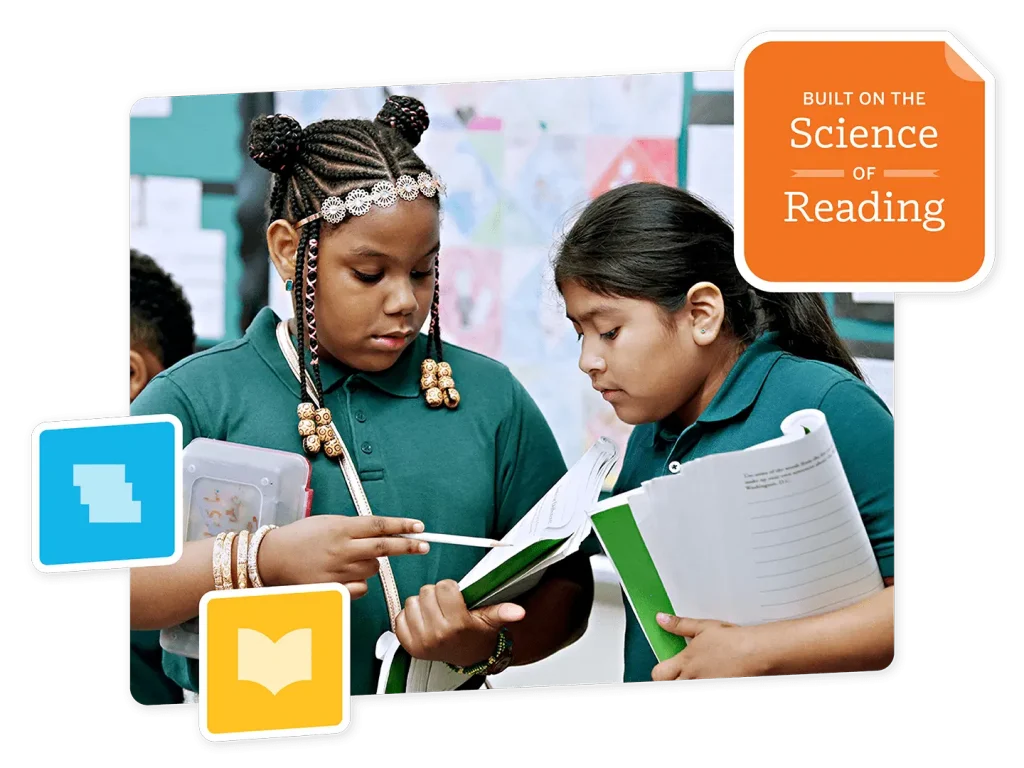
Automated Writing Evaluation: The Automated Writing Evaluation (AWE) tool has been developed in conjunction with Amplify’s regular writing activities, which ask students to use textual evidence to develop one focused idea or claim about the text and communicate that idea clearly and effectively to an audience. AWE is a tool designed to help teachers understand, track, and support student skill progress with these key foundational skills, which are a strong indicator of a student’s analytic writing proficiency. AWE provides auto scores for Focus and Conventions, allowing teachers to prioritize their assessment of a student’s progress with Use of Evidence, a skill that is relatively new for many middle-grade students.

7. Share

Establishing a supportive writing community in the classroom helps students develop their voices as writers. Each writing activity is coupled with a sharing session, where clear routines and student-facing feedback protocols support students as they share and respond to each other’s writing. Here, students try out their writing with an audience of their peers to figure out how to express their ideas in a clear and convincing way. In addition, these sharing sessions allow students to learn from the range of perspectives in the classroom.

Clear and consistent Response Starters ensure that students provide feedback that targets key skills and focuses on where a student is using a skill effectively, fostering an effective and supportive feedback environment.

8. Solos

Solos are an important part of the ELA curriculum, and are designed to be completed as homework—but not every student has a computer at home. However, most students DO have access to a mobile device. The new Mobile Solos give every student access to this part of the curriculum, protecting valuable classroom time for lessons and group activities.

Navigating the first unit

Dig into Unit A

It’s time to continue your journey by exploring the first unit!

  1. Choose a 6th-, 7th-, or 8th-grade Unit A.
  2. Find the Print Materials for your grade level’s Unit A and review the unit overview. (password: middle678school)
  3. Log in to the curriculum and navigate to your chosen unit.
  • Scroll down to the unit guide. Open each section and read it.
  • Read the background and context document in the Materials section.
  • Go to Sub-unit 3 and read the Sub-unit Overview.
  • Choose two lessons to explore further.
  • Open the first lesson and read the Lesson Overview. Be sure to open and read each section in the Lesson Overview.
    • Open each activity tab and read the teacher Instructional Guide. Familiarize yourself with the entire lesson and note where students are building reading and writing skills
    • Repeat with the second lesson.

Diving Deeper

Check out Amplify ELA’s professional learning website, featuring self-guided training modules and videos to help you with planning and pacing, navigation, and learning key curriculum features. 

You can log in using your Amplify credentials or the demo account and password provided by your sales rep.  

Additional support

As you continue to explore the curriculum, you may also want to take a look at the Amplify ELA Resources Website, which is full of additional information on the program. If you have any questions, please contact us through the Amplify Help section.

And you’ll find even more information by watching this session from our Literacy Symposium, in which Sarah Kitzmiller from the Niswonger Foundation and Teddy Redding from Amplify discuss some of the challenges of the 2020–21 school year. 

Amplify’s Literacy Symposium session: Focusing on the Fundamentals to Start the Year Right

You may choose to view other sessions from the Literacy Symposium as well, all accessible from the schedule menu in the top left corner. 
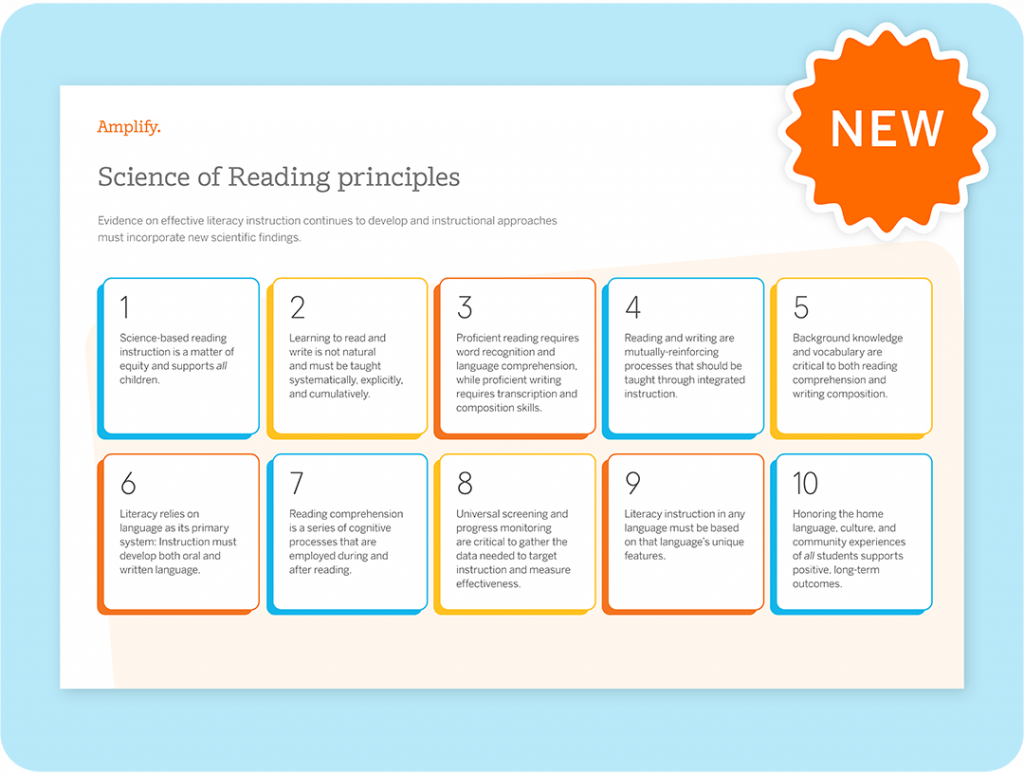
This webinar also offers valuable insight, with Baltimore City middle school ELA teacher Lucas Drerup describing his experiences with Amplify ELA and discussing how he brings middle school ELA to life, even in a remote teaching setting. 

How to bring middle school ELA to life: A teacher’s perspective

Support

The next chapter in the Science of Reading

Introducing Amplify CKLA 3rd Edition, a K–5 core literacy program within Amplify’s literacy suite. For more than a decade, Amplify CKLA has transformed classrooms nationwide with its intentional knowledge building and systematic skills instruction. Available for the 2025–2026 school year, the 3rd Edition builds on this successful foundation to better support all students in becoming confident readers, writers, and thinkers. Together, let’s write the next chapter in the Science of Reading.

An astronaut floats in space near the Moon, with a speech bubble displaying

Amplify CKLA serves

150,000+

Classrooms

4,000,000+

Students

50

U.S. States and D.C.

Our approach

Improve outcomes with a program built on a decade of research, and that meets the strongest ESSA Tier I criteria.

Diagram illustrating the Simple View of Reading model, depicting language comprehension and word recognition pathways converging into skilled reading, with processes becoming increasingly strategic and automatic—a foundational concept in literacy curriculum for elementary education.

Grounded in the Science of Reading

As the original Science of Reading program, Amplify CKLA puts research into action with explicit, systematic foundational skills instruction and a proven knowledge-building sequence. In collaboration with education experts and practitioners, we provide powerful resources that deliver real results.

Background knowledge drives results

Amplify CKLA follows the Core Knowledge Sequence, a content-specific, cumulative, and coherent approach to knowledge building. This approach improves reading scores and closes achievement gaps by establishing a robust knowledge base that strengthens comprehension.

In Amplify CKLA 3rd Edition, we’ve enriched our Knowledge Sequence with a wider range of perspectives and high-quality texts in new and enhanced units.

An infographic showing the steps to pronounce

Build foundational skills for long-term success.

Students progress from simple to complex skill development starting with phonological and phonemic awareness. Instruction in Grades K–2 explicitly teaches the 150 spellings for the 44 sounds of English, following an intentional progression to ensure student success.

In our 3rd Edition, we’ve added dedicated Grades 3–5 foundational skills instruction that can either support core lessons or function as an intervention, based on student needs.

Daily writing deepens learning.

Grounded in the Science of Writing—the research on how kids learn to write—instruction is explicit, daily, and woven into the curriculum’s rich content. It covers both transcription (handwriting and spelling) and composition (organizing ideas into narratives) with high-impact activities like sentence-level combining and expanding, and pre-writing exercises. Writing and reading instruction are integrated so students simultaneously strengthen their communication skills, comprehension, and confidence.

A child in a green shirt smiles while writing in a notebook at a classroom desk, engaged in their k–5 literacy curriculum, with another student visible in the background.
An open laptop displaying a children's story titled

High-quality, diverse texts

Amplify CKLA students are immersed in a variety of texts—complex read-alouds, decodable chapter books, trade books, and content-rich readers—that reflect varied experiences and connect to learning goals.

Readers are 100% decodable for Grades K–2, empowering students to directly apply what they’ve learned. Novel Study units for Grades 3–5 offer a mix of contemporary and classic literature, and Culminating Research Units in every grade include a set of authentic texts and trade books.

Reach all learners with differentiated support.

Scaffolds and challenges, developed in collaboration with education experts, make content available to every student—including multilingual and English learners. With strategies embedded right in the curriculum, teachers can deliver in-the-moment, individualized instruction to meet all student needs.

For a dedicated English language development program aligned to Amplify CKLA, explore Language Studio.

Children sit on the floor in a classroom, some raising their hands, smiling and engaged. The lively atmosphere reflects the effectiveness of the k–5 literacy curriculum being implemented.

What’s included

The comprehensive resources in Amplify CKLA 3rd Edition support effective literacy instruction in every classroom.

Image of a laptop displaying an assessment report, surrounded by books about astronomy, an illustration of the moon, and a
Various educational materials, including textbooks, workbooks, a picture book, documents, and a laptop displaying a slide titled

Easy-to-use teacher materials

Amplify CKLA teachers are empowered to deliver effective instruction with the following print and digital resources:

  • Teacher Guides (K–5)
  • Assessment Guides (K–5)
  • Authentic texts and trade books (K–5)
  • Knowledge Image Cards (K–2)
  • Knowledge Flip Books (K–2, digital)
  • Ready-made and customizable Presentation Screens (K–5, digital)
  • Remediation and intervention resources (K–5)
  • On-demand professional development (K–5, digital)

Immersive Amplify CKLA student resources

Amplify CKLA students stay engaged with the following print and digital resources:

  • Decodable readers (K–2)
  • Student Readers and novels (3–5)
  • Student Activity Books (K–5)
  • Poet’s Journal and Writer’s Journal (3–5)
  • eReaders (K–5, digital)
  • Sound Library featuring articulation videos and songs (K–2, digital)
  • Assignable Practice Games (K–5)
An open laptop displaying a poem and a person, alongside two educational booklets and a green butterfly, depicts the essence of a rich core knowledge language arts curriculum. The background includes simple graphic elements enhancing the scene.
A collection of six book covers including

Rich literary experiences

All of the high-quality, diverse texts in Amplify CKLA connect to the curriculum, fostering your students’ curiosity and helping them learn to read with confidence.

  • Trade Book Collections (K–5) inspire student research in each grade’s Culminating Research Unit.
  • Classic and contemporary literature (3–5) delight students in Novel Study Units.
  • Increasingly complex Student Readers (K–5) develop students’ literacy across grades.

Hands-on phonics materials

Multisensory phonics and foundational skills resources engage students with fun, varied approaches that promote mastery and build independence.

  • Chaining Folders and Small Letter Cards (K)
  • Read-Aloud Big Books (K–1)
  • Large Letter Cards (K–2)
  • Sound Cards (K–2)
  • Image Cards (K–3)
  • Blending Picture Cards (K)
  • Consonant and Vowel Code Posters and Spelling Cards (1–2)
  • Sound Library (K–2, digital)
Image includes various vowel sounds and combinations on flashcards and worksheets, along with a playful illustrated mammal, all part of a comprehensive literacy curriculum for elementary students.

All-in-one digital platform

Our comprehensive platform simplifies your day-to-day tasks and makes it easier to plan and deliver lessons.

  • Ready-made and customizable Presentation Screens
  • Auto-scored digital assessments
  • Standards-based reporting
  • Assignable Practice Games
  • Sound Library
  • eReaders

Professional Development

Move beyond traditional program training with Amplify’s digital PD Library, designed to fully support your shift to the Science of Reading and Amplify CKLA. Deepen your understanding with:

  • Program and planning resources
  • Model lesson videos from real classrooms
  • Guidance on using Amplify’s literacy suite to provide multi-tiered support
Two women are seated at a table with papers and a laptop. One woman is working on the literacy curriculum for elementary grades, while the other is smiling.

Ready to continue your learning journey?

We also offer live, tailored professional learning sessions by expert partners to expand your Science of Reading expertise, strengthen implementation, and improve student outcomes.

“Teachers love the ease of implementing the program, and students have fun while learning. Growth is evident in our data, and we have the support of Amplify experts who are available to answer questions and provide top-notch professional development.”

Bridget Vaughan, District K–8 Coordinator of ELA and Literacy

Quincy Public Schools, Massachusetts

A circular flow chart titled

A true Science of Reading early literacy suite for Grades K–5

Amplify has combined the critical elements of a Science of Reading system: assessment, core curriculum, personalized learning, and intervention. Based on 20 years of experience with the Science of Reading, this complete system saves you time and aligns your literacy practices.

  • Assess with mCLASS®: A universal and dyslexia screener, powered by DIBELS 8th Edition
  • Instruct with Amplify CKLA: Core curriculum to build foundational skills and knowledge
  • Practice with Boost Reading™: Personalized learning program to extend and reinforce core
  • Intervene with mCLASS Intervention: Staff-led Tier 2 and 3 intervention for intensive support
“There were other programs that claimed to be [based on the] Science of Reading, but no other vendor provided the suite of products together. We did not want to be picking from here, picking from there. [Amplify’s literacy suite] met our needs, because it aligned and provided us the best suite of products, hands down.”
Nicole Peterson, Principal, Midway Middle School

Sampson County Schools, North Carolina

Language Studio: Multilingual and English language learner support

Language Studio is Amplify CKLA’s dedicated K–5 program for multilingual and English language learners. Through daily 30-minute lessons, it strengthens reading, writing, speaking, and listening skills while reinforcing core instruction. This tailored support empowers students to confidently access grade-level content as they develop academic English.

A young girl immerses herself in the science of reading at a classroom desk, surrounded by peers and diverse educational materials.

Explore more programs in Amplify’s literacy and biliteracy suite.

All of the programs in our literacy suite and our biliteracy suite are designed to support and complement each other. Learn more about our related programs:
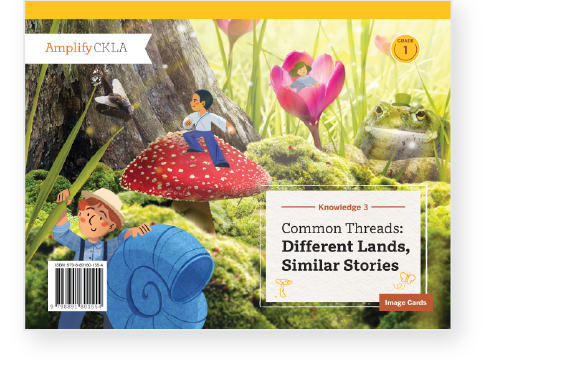
Top 10 Science of Reading podcasts to get you started

Since 2019, Science of Reading: The Podcast has delivered the latest insights from researchers and practitioners in early reading. Hosted by Amplify’s Chief Academic Officer Susan Lambert, each episode welcomes a renowned leader in the education and literacy community, explores a timely topic related to the Science of Reading, and offers instructional advice to educators implementing evidence-based practices in their schools.

New to the podcast? Here are 10 popular episodes to acquaint yourself with the Science of Reading. Listen, enjoy, and subscribe — we have new episodes every other Wednesday!

S1-E1: Natalie Wexler on “The Knowledge Gap”

Susan hosts Natalie Wexler for a deep dive into her latest book, The Knowledge Gap: The Hidden Cause of America’s Broken Education System—And How to Fix It, and a discussion of the lack of equity in reading education among students, the benefits of knowledge-rich curriculum inside and beyond the classroom, why it’s important to build background knowledge while teaching foundational skills, and why professional development doesn’t seem to be making a difference and how it can be improved.

S1-E3: Emily Hanford on reporting on education and the Science of Reading

Susan sits down with Emily Hanford, education reporter and host of the Education Post podcast, to examine the big takeaways from her experience reporting on dyslexia and the patterns that emerged in her investigation; why reading instruction isn’t more aligned with the Science of Reading; and the evolution of whole language, balanced literacy, and phonics instruction.

S1-E8: Tim Shanahan on evidence-based literacy practices

Reading expert Tim Shanahan discusses his view on teaching reading, including an explanation of the four crucial things you need to teach reading, and what it means to really do a “close read” in literature.

S3-E1: Dr. Jane Oakhill on Scarborough’s Reading Rope

Dive into the first episode of our Deconstructing the Rope series as Dr. Jane Oakhill, professor of experimental psychology at the University of Sussex, provides an overview of Scarborough’s Reading Rope. She also emphasizes the importance of inferencing in comprehension, why the Simple View of Reading is still relevant almost 40 years later, and how each element of the Rope comes together to deconstruct the complexity of reading.

S3-E3: Dr. Louisa Moats on decoding

Join Dr. Louisa Moats, President of Moats Associates Consulting, as she unwinds decoding, a strand of Scarborough’s Reading Rope. In the third episode of our Deconstructing the Rope series, Louisa highlights the significance of decoding in the Science of Reading and discusses the value of becoming students of our own language. She also explains the reciprocal relationship between decoding and encoding and why both are essential to provide effective phonics instruction to children in the classroom.

S2-E7: Sonia Cabell on research, comprehension, and content-rich literacy instruction

Join Sonia Cabell, Assistant Professor of Education at Florida State University, as she shares findings from her research trials on content-rich literacy curricula and whether activating students’ background knowledge alongside explicit phonics instruction is more effective than traditional approaches. She also explains what constitutes “compelling evidence” in the Science of Reading and why students need to interact with both written and spoken language while learning to read.

S3-E5: Dr. Bruce McCandliss on sight recognition

Join Dr. Bruce McCandliss, Professor at the Graduate School of Education of Stanford University, as he unwinds sight recognition, a strand of Scarborough’s Reading Rope. In the fifth episode of our series, Bruce explains the role of sight and word recognition in the Science of Reading and highlights the importance of the rapid integration of print, speech, and meaning. He also encourages listeners to be cognizant of the ever-changing technological learning environment while nurturing young readers and writers.

S2-E1: Dr. LaTonya Goffney on a district-wide SoR adoption

Join Dr. LaTonya Goffney, Superintendent of Schools for Aldine Independent School District in Texas, as she recounts her two-year journey with her team of district educators to adopt a new early literacy curriculum. Hear how they successfully challenged the traditional adoption process, studied the science of teaching reading, analyzed student data and experiences, and developed a district-wide set of beliefs and expectations.

S3-E7: Maria Murray on The Reading League’s Defining Movement

In this special episode, Dr. Maria Murray, President, and CEO of The Reading League analyze the intricacies of literacy instruction and shares common misconceptions that educators have about the Science of Reading. She also explains why the Science of Reading: A Defining Movement coalition was founded: the belief in a clear understanding of what the Science of Reading is and what it is not, in order to promote the proper use of instructional practices aligned with its findings.

Linguistic variation and dialects: difference, not error

Teachers need to know about the language variety that their students are speaking.

—Dr. Julie Washington

In this episode, Susan Lambert is joined by Dr. Julie Washington to discuss linguistic variety and dialects as difference, not error, and how to best support all students as they learn to read.

Dr. Washington—professor in the School of Education at the University of California, Irvine (UCI)and a speech-language pathologist—offers practical advice for educators teaching reading to children who don’t use general American English, and discusses how to do so in a way that respects students’ community languages and dialects. She reminds educators that students rise or fall to the expectations set for them, and encourages educators to remember that if they embrace language variety as something that needs to be understood and incorporated into developing successful readers, they will develop successful readers.

Invest in high-quality professional development

Amplify’s professional development provides a variety of learning experiences over multiple years to incrementally develop and apply the knowledge and skills needed for effective and self-sustaining implementation.

Gain insights into effective instructional techniques, and develop a deeper understanding of your Amplify program(s) by investing in professional development.

Two women sit at a table working on laptops, collaborating and reviewing documents, with icons on the left representing ideas, writing, computers, and achievement.
Collage showing a digital science simulation, a teacher demonstrating science materials on video, and a PDF icon for a K–5 Amplify Science lesson planning template.

The foundation for long-lasting and sustainable change

Partner with members of our professional learning team to plan long-lasting and sustainable change for your school or district. Change is more likely to stick and get results with deliberate planning. We can support your through this journey to drive your professional improvement, enrich your instructional practice, and increase student impact.

Professional learning journey

Every school and district is unique. That’s why we offer flexible delivery options to best meet your specific needs and objectives.

Our professional development programs come in packages or individual sessions, available both on-site and virtually, to help you get the most out of your Amplify program(s).

You can also customize your learning experience by adding extra sessions, such as Science of Reading, supporting multiliterate learners, and a problem-based approach to math, to build on your base package.

Screenshot of Amplify’s PD Library interface with a search bar, colorful resource cards, and highlighted sections: Amplify Caminos, Boost Biliteracy, and Amplify ELA.
Four circular icons in a row showing a lightbulb, pencil, whiteboard, and podium, connected by arrows in a cycle, representing stages of a process.

Prepare

Begin

Practice

Advance
Prepare learning experiences will help shift literacy and math instruction and deepen understanding of research-based practices to support new program implementation. Program-aligned packages will support those who are new to Amplify’s programs. You’ll build the foundational knowledge and skills necessary to begin teaching with your Amplify program(s).

Program-aligned packages will support those who have experience using Amplify’s programs. You’ll refine instructional skills, expand knowledge of your Amplify program(s), and explore more advanced instructional strategies.

Program-aligned offerings will support advanced implementation to deepen understanding of content and pedagogy and build-in house capacity to support a robust, sustainable implementation.

Multi-program, suite packages

Core program packages

Literacy

  • Amplify CKLA
  • Amplify Caminos
  • Amplify ELA

STEM

  • Amplify Math
  • Amplify Desmos Math (K–12)
  • Amplify Science


Intervention program sessions

  • Boost Reading
  • Boost Lectura
  • Boost Close Reading
  • Boost Math

Assessment program packages

  • mCLASS with DIBELS® 8th Edition
  • mCLASS Lectura
  • mCLASS Math

mCLASS Intervention K–6 program sessions


Empower teachers to continuously improve

Professional development helps teachers stay motivated and inspired to grow professionally. Demonstrate your commitment to your staff by empowering them with professional development packages that include on-site or virtual Launch, Strengthen, or Coach sessions, all of which will orient you and your team to the full features of Amplify programs.

You can also personalize your learning experience by adding enhancement sessions to base packages.

A woman with long dark hair smiles while sitting at a table with two others, papers and laptops in front of them. Three circular icons are displayed on the left side.
Three people work together at a computer in a classroom; one woman points at the monitor while the others watch attentively.

Launch

On-site and virtual Launch sessions introduce Amplify programs and support strong implementation. Self-paced, online courses are also available for select Amplify programs and include an on-demand subscription for 12-months.

After learning about the program’s foundational principles and key features, you’ll practice administering it within a collaborative environment.

Two people sit at a table reviewing documents together against a yellow background. An icon of a barbell is displayed in the top left corner.

Strengthen

On-site and virtual Strengthen sessions deepen understanding of the program. Session offerings are targeted and meant to take your practice—and your students’ learning—to the next level.

Offered as part of core packages, as well as enhancements, Strengthen sessions are intended to effectively address your students’ needs. Examples include:

  • A focus on data analysis.
  • Examining student writing.
  • Targeted intervention instruction.
Two women sit side by side at a table, each with a laptop. One woman points at the other’s screen as they focus on the display against a plain blue background.

Coach

On-site and virtual Coach sessions are tailored to elevate instructional practices and meet the unique needs of teachers and/or leaders.

Partner with an Amplify coach who will support you in planning customized sessions leveraging our menu of supports, which can include:

  • Lesson modeling by an Amplify facilitator.
  • Classroom observations and debriefs.
  • Grade-level planning.

Commit to sustainable change for long-term impact

Learning may ebb and flow between phases depending on your teachers’ and leaders’ needs, experiences, and professional goals. Amplify professional development aims to continually grow, develop, and refine instructional practices to support student learning and achievement.

A diagram shows categories about teaching, with “Grading and Assessment” highlighted and selected by a pointing hand cursor. Other categories include instruction, pedagogy, and remediation.
Three overlapping squares with rounded corners, each containing a large question mark, are arranged on a light peach rectangular background.

Frequently asked questions

We value your partnership and aim to provide you with the highest quality learning experiences. Check out our frequently asked PD questions below, along with responses.

Additional learning

Once you become an Amplify customer, you’ll have access to many opportunities to continue learning how to get the most out of your Amplify program(s).

To get a sense of our support, check out some of our free resources:

Two educational course cards: one showing a teacher helping a student, titled "Instructional Moves to Support Motivation in Math Class," and another titled "Data and Dyslexia" with alphabet tiles.
Two speech bubbles on a peach background, one saying "Hello!" in English and the other saying "¡Hola!" in Spanish.

Biliteracy supports

Facilitated in both English and Spanish, specialized biliteracy sessions should be scheduled for teachers using both curricula and/or assessments. Sessions are available to support the use of both Amplify CKLA and Amplify Caminos core programs or mCLASS DIBELS 8th Edition and Lectura assessment programs. Substitute a biliteracy session for the 6-hour initial training in your package, or add these sessions on to your package for your biliteracy teachers.

Speak to our team to learn more!

Order and payment support

If you’re ready to submit your price quote, purchase order, or payment, visit our Ordering Support site for more information.

Three documents labeled as purchase order form, invoice, and price quote, each displaying fields for product details, contact information, and amounts.
Two podcast covers: "Beyond My Years" with colorful graphics and "Science of Reading: The Podcast" with book and sun illustrations; a badge reads "7M+ downloads.

Community of collaboration

Connect with fellow Science of Reading or science advocates in one of our public Facebook groups. Join a community or tune into one of our podcasts today:

Amplify customers can join our exclusive, program-specific Facebook communities to ask pedagogical questions, share Amplify teaching hacks, and more!

Get in touch with a PD expert

Beyond prompts: How to teach writing for middle school student success

Writing is hard. Natalie Wexler, who co-wrote The Writing Revolution: A Guide to Advancing Thinking Through Writing in All Subjects and Grades, has described it as “the hardest thing we ask students to do.”

And writing is also hard to teach—perhaps especially to middle schoolers.

Writing education experts such as Steve Graham, Ph.D., say that, as important as writing is, it often gets less attention due to competing educational demands, like the need to teach subjects connected to high-stakes testing, the pressure to teach to a given test, and the siloing of writing as an independent skill untethered to content.

But writing is essential—not just as a means of expressing knowledge, but also as a means of building it. That’s why, when it comes to middle-school writing instruction, we need to go beyond just writing prompts. So how can teachers provide the strongest possible writing instruction for middle-school students? Keep reading.

Student writing: Why it matters

Learning to write makes you a better writer, but it also makes you a better reader—and a better learner.

In a meta-analysis of more than 100 studies, Steve Graham and Michael Hebert, Ph.D., found that writing about text improves comprehension and learning even more than reading alone, reading and rereading, or reading and discussing.

“Combining reading and writing is part of the Science of Reading,” writes literacy educator Tim Shanahan, Ph.D. “If you want better reading scores, the Science of Reading says do not neglect writing, nor dispatch it to someplace else in the curriculum. When you feel especially pressured to improve reading achievement, that is the time to embrace more tightly the combination of reading and writing.”

Shanahan also notes that readers who write and writers who read are best equipped to observe what authors do to convey meaning and what readers need in order to understand writing.

Current ELA standards recognize the interplay between reading and writing by articulating these goals: using writing to improve learning from text and using the reading of multiple texts to improve the writing of syntheses or reports.

Writing activities for middle school

Even with challenges and constraints, educators can find ways to engage students and transform their writing. When planning writing activities with your middle-school students, it’s important to keep them captivated, incorporate writing instruction throughout your lessons, and differentiate to meet the needs of all of your students. Here are some principles that will help:

  • Detach writing from getting it “right.” Seymour Papert theorized that students become better thinkers when they’re not attached to one outcome—not afraid to be “wrong.” Of course, sometimes there is a correct answer, but it’s the process of seeking it that counts. Offer writing assignments that encourage—and reward—risk-taking and creativity.
  • Integrate writing everywhere. Help students build both knowledge and writing skills by including writing exercises across subjects, including science.
  • Scaffold with sentence frames and modified prompts. Middle-school students often know what they want to say, but not how to say it, especially if they are multilingual learners. Sentence frames and modified prompts—such as “Tom convinces his friends to whitewash the fence by saying…”—can help with that. They reduce linguistic barriers, enabling students to produce writing and speech more complex than what they could have done on their own—and giving you a sense of their level of understanding.

Writing can be a powerful tool to help students deepen their comprehension of written text, expand their knowledge, and develop as communicators. Learn more about the best strategies and activities to use in your classroom. These will put you on the best path for helping your students thrive as writers, readers, communicators, and lifelong learners.

More to explore

Top professional development picks for the summer

First priority for your summer? A bit of a break, and maybe a beach read. But summer is also the perfect time to prepare for the year ahead, and to invest in your professional growth.

During summer PD, you can take your time exploring the research-backed strategies essential to effective literacy instruction. There are lots of opportunities out there to dive deeper into everything from foundational skills and evidence-based practices to instruction based on the Science of Reading. Investing this time in your professional growth will help you not only align your methods with the most current research, but also equip you with tools to meet the individual needs of your students and create supportive learning environments in the fall.

Summer school for you: Teacher professional development

That said, we know you’d probably rather spend your summer building sandcastles than digging around for the right PD. That’s why we asked Amplify Ambassadors—educators like you—to share their top teaching resources and professional development picks for the summer. Keep reading to hear their excellent recommendations!

Danielle Hawkins, former principal of Newfane Central School District in New York, shares the value of professional development opportunities offered by Amplify for educators.

“To support the teachers I coach and deepen my knowledge of the Science of Reading, I joined the beta test of Amplify’s Science of Reading: The Learning Lab courses to monopolize on the flexibility that summer provides.”
—Miracle Foster, Literacy Coach, Armada Area Schools, Michigan

“If you haven’t listened to the Sold a Story or Knowledge Matters podcasts, they are great places to start! I purchased The Knowledge Gap and The Writing Revolution books before the school year was even over! I have Shifting the Balance in my cart as well.”
—Stephanie Schuettpelz, Teacher, Marion School District, Wisconsin

If you have a chance to participate in curriculum development, it’s a wonderful way to dig deeper and get to know different features of each unit better.

—Kim Eich, Grade 6 Teacher, Anoka Hennepin ISD #11, Minnesota

“Any online PD from The Reading League or Cox Campus is good. There are a TON of great podcasts out there, including Amplify’s Science of Reading podcast, and also Shanahan on Literacy, Melissa and Lori Love Literacy, and All for Literacy. Some great books are the Shifting the Balance books, The Knowledge GapSpeech to Print, or Structured Literacy Interventions with Spear-Swerling.”
—Lori Gray, Program Coordinator, Office of Student Learning, Yelm Community Schools, Washington

“A book study.”
—Carla Cruse, Teacher, Rock Falls Middle School, Illinois

Back to school for teachers: Webinars to get you ready

Join our Amplify experts as they walk you through all of your program essentials and share their guidance on everything from getting started in the new school year to leveling up your implementation. These series are for everyone—whether this is your first or fourth year with Amplify, you’ll walk away having learned something new. There will be a webinar for each of the following Amplify programs:

  • Amplify Science
  • mCLASS® DIBELS® 8th Edition and mCLASS Lectura
  • Amplify CKLA and Caminos
  • Amplify ELA
  • Boost Reading and Boost Lectura

Welcome, Algebra 1 Reviewers!

We’re honored to introduce you to Amplify Desmos Math California. We’re confident you’ll find this comprehensive program to be a powerful tool for bringing the vision of the California Math Framework to life in classrooms across the state.

Please start with the video on the right to learn how to navigate the program and access key features referenced within our submission. Below you’ll find additional resources to support your review.

Your Review Samples

As a curriculum that incorporates both print and digital resources, it’s important that you explore both our physical materials (delivered to you in grade-specific tubs) and our digital materials (accessible through our platform). We invite you to explore both types of resources using the instructions and tips below.

Print Samples

Your print samples should have arrived in grade-specific tubs with a copy of your Reviewer Binder contained within the Algebra 1 shipping box. As you begin the process of organizing your materials, please refer to the inventory checklist found inside the tub as well as within your Reviewer Binder.

Digital Samples

In order to access your digital samples, you’ll need to log into our platform using your unique login credentials found on a Digital Access Flyer inside of your Reviewer Binder. Once you have located the flyer:

  • Click the orange button below to access the platform.
  • Click “Log in with Amplify.”
  • Enter the username and password provided on your Digital Access Flyer.

Navigation Tips

Below you will find helpful tips for navigating Amplify Desmos Math California. We recommend reading these pages alongside the program’s print materials and digital experience to gain a deeper understanding of the program. 

Click the links below to read about navigating program features including:

Built for California

The Amplify Desmos Math California program is designed around the vision articulated in the California Mathematics Framework to enable all California students to become powerful users of mathematics. Our program incorporates the latest research in student learning, meaning that we:

  • Focus on the Big Ideas: Amplify Desmos Math California’s courses, units, and lessons are centered around the Big Ideas. Big Ideas, like standards, are not considered in isolation. In addition to each unit and lesson’s focal Big Ideas, Amplify Desmos Math California also provides connections among the Big Ideas across units and lessons.
  • Center on open and engaging tasks: Amplify Desmos Math California is grounded in engaging tasks meant to address students’ often-asked question: “Why am I learning this?”  Students are invited into learning with low-floor, high-ceiling tasks that provide an entry point for all. Open tasks in Amplify Desmos Math California provide the space for students to try on multiple strategies and represent their thinking in different ways, and allow student explanation and discussion to serve as the center of the classroom. All lessons offer both print and digital representations of lessons.
  • Provide enhanced digital experiences: Amplify Desmos Math California includes digitally-enhanced lesson activities, incorporating interactive digital tools alongside print materials. These purposefully-placed resources allow students to visualize mathematical concepts, receive actionable feedback while practicing, encounter personalized learning support from an onscreen tutor, and engage in discussions about their thinking and approaches.
  • Treat core instruction and differentiation as integral partners: The Amplify Desmos Math California curriculum provides teachers with lessons, strategies, and resources to eliminate barriers and increase access to grade-level content without reducing the mathematical demand of tasks. Every activity has multiple entry points to ensure that all students are supported and challenged. Intervention and personalized learning activities are directly connected to lesson content and offer students the individualized support as they dive into the mathematics.

Category 1: Mathematics Content/Alignment with the Standards

Standards Map

Linked here is the Standards Map for Amplify Desmos Math California for Algebra 1.

Evaluation Criteria Map

Linked here is the Evaluation Criteria Map Algebra 1. Please note that you will need to be logged into the digital platform to access the links in the Evaluation Criteria Map.

Standards for Mathematical Practice

Linked here is the alignment of Amplify Desmos Math California to the Standards for Mathematical Practice at Algebra 1.

Drivers of Investigation and Content Connections

Amplify Desmos Math California incorporates the Drivers of Investigation (DIs) and Content Connection (CCs) throughout the program. Throughout the year, students engage with open and authentic tasks of varying durations — from lesson activities to unit-level Explore lessons and longer course-level Investigations. Every lesson and investigation opportunity is grounded around the why, how, and what of the learning experience, and helps teachers bring mathematical concepts to life.

A three-column chart details: Drivers of Investigation, Standards for Mathematical Practice, and Content Connections, each with their respective codes and brief descriptions.

California English Language Development Standards

Linked here is the alignment of Amplify Desmos Math California to the California English Language Development Standards for Algebra 1.

California Environmental Principles and Concepts

Select lessons, performance tasks, and investigations across grade levels in Amplify Desmos Math California are aligned to one or more of the California Environmental Principles and Concepts. Click this link to view how the California Environmental Principles and Concepts are represented in Amplify Desmos Math California Algebra 1.

Category 2: Program Organization

Amplify Desmos Math California thoughtfully combines conceptual understanding, procedural fluency, and application. Each lesson is designed to tell a story by posing problems that invite a variety of approaches before guiding students to synthesize their understanding of the learning goals.

Big Ideas

Amplify Desmos Math California’s courses, units, and lessons are centered around the Big Ideas. Big Ideas, like standards, are not considered in isolation. In addition to each unit and lesson’s focal Big Ideas, Amplify Desmos Math California also provides connections among the Big Ideas across units and lessons. Please refer to Keeping the Big Ideas at the Center, linked here, for the Amplify Desmos Math California Algebra 1 lesson design and alignment to the Big Ideas.

Program Structure

Amplify Desmos Math California combines the best of problem-based lessons, intervention, personalized practice, and assessments into a coherent and engaging experience for both students and teachers.

A diagram showing three stages: Core instruction, Integrated personalized learning, and Embedded intervention, under Screening and progress monitoring with daily tiered support.

Lessons and units in Amplify Desmos Math California are designed around a Proficiency Progression, a model that steps out problem-based learning by systematically building students’ curiosity into lasting grade-level understanding.

Five steps for learning: 1. Activate prior knowledge, 2. Collaborate, 3. Refine ideas, 4. Guide to understanding, 5. Practice and extend for lasting understanding.

In the Proficiency Progression, lessons begin by activating students’ natural curiosity and offering opportunities to generate new ideas through collaboration. Teachers are then able to refine ideas through intentional facilitation and guide students to grade-level understanding, while students retain the ability to use different strategies and methods to show their comprehension of the content. Students are provided ample opportunities to develop lasting understanding.

Scope and Sequence

Below you can view the scope and sequence for Amplify Desmos Math California Algebra 1. 

A chart showing Algebra 1 units across two volumes, detailing instructional days, assessment days, and optional days for each unit, totaling 180 days plus 40 optional days.

Lesson Design and Structure

A four-part diagram shows: Warm-Up, Activities with a graph of student ideas to grade-level understanding, Synthesis with notes, and Practice and differentiation with students building a structure.

Amplify Desmos Math California is designed with a structured approach to problem-based learning that systematically builds on students’ curiosity and allows students to grapple with the Big Ideas of the California Framework. Every lesson activity is organized into a Launch, Monitor, Connect format.

Launch: The launch is a short, whole-class conversation that creates a need or excitement, provides clarity, or helps students connect their prior knowledge or personal experience, which ensures that everyone has access to the upcoming work.  

Monitor: As students work individually, in pairs, or in groups, teachers explore student thinking, ask questions, and provide support to help move the conversations closer to the intended math learning goal. 

Connect: Teachers connect students’ ideas to the key learning goals of the lesson, facilitating class discussions that help synthesize and solidify the Big Ideas 

Each lesson within Amplify Desmos Math California follows the same structure. 

Warm-Up: Every Amplify Desmos Math California lesson begins with a whole class Warm-Up. Warm-Ups are an invitational Instructional Routine intended to provide a social moment at the start of the lesson in which every student has an opportunity to contribute. Warm-Ups may build fluency or highlight a strategy that may be helpful in the current lesson or act as an invitation into the math of the lesson.

Lesson Activities: Each lesson includes one or two activities. These activities are the heart of each lesson. Students notice, wonder, explore, calculate, predict, measure, explain their thinking, use math to settle disputes, create challenges for their classmates, and more. Guidance is provided to help teachers launch, monitor, and connect student thinking over the course of the activity.

Synthesis and Show What You Know: The Synthesis is an opportunity for the teacher and students to pull all the learning of the lesson together into a lesson takeaway. Students engage in a facilitated discussion to consolidate and refine their ideas about the learning goals, and the teacher synthesizes students’ learning. Show What You Know is a daily assessment opportunity for students to show what they know about the learning goals and what they are still learning.

Practice and Differentiation: Daily practice problems for the day’s lesson are included both online and in the print Student Edition, including fluency, test practice, and spiral review.

Flowchart showing classroom activity timing: Warm-Up (5 min), Lesson Activities (30 min), Synthesis and Show What You Know (10 min), Practice and Differentiation (time varies).

Routines

Amplify Desmos Math California features a variety of lesson routines. Instructional routines and Math Language Routines (MLRs) are used within lessons to highlight student-developed language and ideas, cultivate conversation, support mathematical sense-making, and promote meta-cognition. Both are called out at point-of-use within the Teacher Edition and Teacher Presentation Screens. Below are the types of routines used throughout the Amplify Desmos Math California curriculum:

  • MLR1: Stronger and Clearer Each Time
  • MLR2: Collect and Display
  • MLR3: Critique, Correct, Clarify
  • MLR5: Co-Craft Questions
  • MLR6: Three Reads
  • MLR7: Compare and Connect
  • MLR 8: Discussion Supports
  • Decide and Defend
  • Notice and Wonder
  • Number Talk
  • Tell a Story
  • Think-Pair-Share
  • Which One Doesn’t Belong?

Category 3: Assessments

A variety of performance data in Amplify Desmos Math California provides evidence of student learning, while helping students bolster their skills and understanding.

Unit-Level Assessment

Amplify Desmos Math California has embedded unit assessments that offer key insights into students’ conceptual understanding of math. These assessments provide regular, actionable information about how students are thinking about and processing math, with both auto-scoring and in-depth rubrics that help teachers anticipate and respond to students’ learning needs.

Pre-Unit Check: Each unit begins with a formative assessment designed to identify the student skills that will be particularly relevant to the upcoming unit. This check is agnostic to the standards covered in the following unit and serves not as a deficit-based acknowledgment of what students do not know, but rather as an affirmation of the knowledge and skills with which students come in.

End-of-Unit Assessment: Students engage with rigorous grade-level mathematics through a variety of formats and tasks in the summative End-of-Unit Assessment. A combination of auto-scored (when completed digitally) and rubric-scored items provides deep insights into student thinking. All Amplify Desmos Math California End-of-Unit Assessments include two forms.

Sub-Unit Quizzes: Sub-Unit Quizzes are formative assessments embedded regularly in Algebra 1. In these checks, students are assessed on a subset of conceptual understandings from the unit, with rubrics that help illuminate students’ current understanding and provide guidance for responding to student thinking.

Performance Tasks: At the end of each unit there is a summative assessment performance task provided to evaluate students’ proficiency with the concepts and skills addressed in the unit. 

Lesson-Level Assessments

Amplify Desmos Math California lessons include daily moments of assessment to provide valuable evidence of learning for both the teacher and student. Beyond formative, summative, and benchmark assessments, students also have opportunities for self-reflection with Watch Your Knowledge Grow. Students take ownership of their learning by reflecting and tracking their progress before and after each unit.

Show What You Know: Each lesson has a daily formative assessment focused on one of the key concepts in the lesson. Show What You Know moments are carefully designed to minimize completion time for students while maximizing daily teacher insights to attend to student needs during the following class. 

Responsive Feedback™: Teachers have the ability to see and provide in-the-moment feedback as students progress through a digital lesson. Responsive Feedback motivates students and engages them in the learning process.

Diagnostic Assessment

Every grade level features an asset-based diagnostic assessment designed to be administered at the beginning of the year.  Delivered digitally and to the whole class, our diagnostic assessment is uniquely designed to reveal underlying math thinking and identify what students know about grade-level math. With data beyond just right and wrong, teachers have the type of deeper level of insights need to take the right next step.

CAASPP-Aligned Assessment Preparation

Amplify Desmos Math is designed to support students’ mathematical development through problem-based learning, differentiation, and embedded assessments. The program’s emphasis on conceptual understanding, procedural fluency, and application aligns with the mathematical practices and content standards assessed by the CAASPP.

Amplify Desmos Math California includes a CAASPP-aligned Item Bank. This standards-aligned bank of questions allows teachers to filter and search by grade and standard to find items. Once assigned on the digital platform, students will experience CAASPP-like practice with the online digital tools.

Data and Reporting

Amplify Desmos Math California provides teachers and administrators with unified reporting and insights so that educators have visibility into what students know about grade-level math—and can plan instruction accordingly for the whole class, small groups, and individual students. Reporting functionality integrates unit assessments, lesson assessments, diagnostic data and progress monitoring for a comprehensive look at student learning. Program reports show proficiency and growth by domain, cluster, standard, and priority concept using performance data from unit assessments, then highlight areas of potential student need to allow teachers to modify their instruction and target differentiated support.

Administrator reporting provides a complete picture of student, class, and district performance, allowing administrators to implement instructional and intervention plans.

Category 4: Access and Equity

The Amplify Desmos Math California curriculum provides teachers with lessons, strategies, and resources to eliminate barriers and increase access to grade-level content without reducing the mathematical demand of tasks. Our lessons are developed using the Universal Design for Learning (UDL) framework to proactively ensure that all learners can access and participate in meaningful, challenging learning opportunities.

Every activity has multiple entry points to ensure that all students are supported and challenged. Intervention and personalized learning activities are directly connected to the day’s content and offer students the individualized supports they need to be successful.

Each lesson and unit contains guidance for teachers on how to identify students who may need support, students who need to keep strengthening their understanding, and students who may be ready to stretch their learning. In addition, teachers are provided with recommendations for resources to use with each group of students.

Universal Design for Learning

Each lesson in the program incorporates opportunities for engagement, representation, action, and expression based on the guidelines of Universal Design for Learning (UDL).

  • Multiple Means of Engagement: Students engage in both print and digital learning, and are regularly participating in discussions and hands-on activities. Students are invited to build their own challenge for other students to solve, which provides opportunities for choice and autonomy, as well as joy and play.
  • Multiple Means of Representation: Students are encouraged to demonstrate their learning using mathematical representations, both print and digital, and regularly engage with their peers in analyzing multiple possible solutions. Classes engage in open-ended discussions about what individual students notice and wonder about mathematical concepts.
  • Multiple Means of Action and Expression: Learners differ in how they navigate learning environments and express what they know. Students can communicate their ideas in multiple ways, including in print, sketching, uploading photos, or recording an audio response.

Accessibility

Every lesson includes at least one specific suggestion the teacher can use to increase access to the lesson without reducing the mathematical demand of the tasks. These suggestions address the following areas:

  • Conceptual Processing
  • Visual-Spatial Processing
  • Executive Functioning
  • Memory and Attention
  • Fine Motor Skills

Students have the ability to control accessibility tools so that each learning experience is customized to their individual needs. In many instances, these tools can be turned on or off at any point of instruction.

  • Text to speech: Reads text instructions to students in multiple languages
  • Enlarged font: Increases the size of all text on screen
  • Braille mode: Includes narration of digital interactions
  • Language selection: Toggles between languages

Differentiation: In-Lesson Teacher Moves

Within every lesson activity, teachers can use the suggestions in the Differentiation Teacher Moves table to provide in-the-moment instructional support while students are engaged in the work of the lesson. This table can help teachers anticipate the ways students may approach the activity, and provides prompts that they can use during the lesson to Support, Strengthen, and Stretch individual students in their thinking. Teachers are provided with clear student actions and understanding to look for, each matched with immediately usable suggestions for how to respond to the student thinking illustrated in each row of the table. In addition to using these suggestions in the moment as teachers monitor student work, teachers can review the Differentiation table in advance to help them anticipate how students are likely to approach the activity.

A chart outlines three differentiation strategies—Support, Strengthen, and Stretch—with specific actions for each. A Math Language Development box is shown at the bottom.

Differentiation: Beyond the Lesson

Teachers are provided with recommendations for resources to use with each group of students needing support, strengthening, and stretching after each lesson. Support, Strengthen, and Stretch resources include:

  • Mini-Lessons: 15-minute, small-group direct instruction lessons targeted to a specific concept or skill
  • Item Banks: Space for teachers to create practice and assessments by using filters and searching for standards, summative-style items, and more
  • Fluency Practice: Adaptive, personalized practice built out for basic operations and more
  • Extensions: Lesson-embedded Teacher Moves including possible stretch questions and activities for students
  • Lesson Practice: Additional practice problems support every lesson
  • Math Adventures: Strategy-based math games where students engage with math concepts and practice skills in a fun digital environment
  • Lesson Summary Support: Support for students and caregivers that provides efficient explanation of the learning goal with clear examples

Math Identity and Community

The Math Identity and Community feature supports teachers in helping students build confidence in their own mathematical thinking, develop skills to work with and learn from others when doing math, and learn how math is an interwoven part of their broader community. The embedded prompts throughout the lessons are designed to highlight what it means to be good at math, the value of sharing ideas, and the power of flexible and creating thinking. Here are some examples of the Math Identity and Community supports embedded in each lesson:

  • I can be all of me in math class. You will work with partners every day in math class. What do you want your partners to know about you? 
  • We are a math community. What does good listening look like and sound like in a math community? 
  • I am a doer of math. What math strengths did you use today?

Math Language Development

Every lesson in Amplify Desmos Math California includes opportunities for all students to develop mathematical language as they experience the content. Amplify Desmos Math California purposefully progresses language development from lesson to lesson and across units by supporting students in making their arguments and explanations stronger, clearer, and more precise. This systematic approach to the development of math language can be broken down into the following four categories of support:

  • Vocabulary: Units and lessons start by surfacing students’ language for new concepts, then building connections between their language and the new vocabulary for that unit. This honors the language assets that students bring into their learning.
  • Language Goals: Language goals attend to the mathematics students are learning, and are written through the lens of one or more of four language modalities: reading, writing, speaking, and listening.
  • Math Language Routines: Math Language Routines are used within lessons to highlight student-developed language and ideas, cultivate conversation, support mathematical sense-making, and promote meta-cognition.
  • Multilingual/English Learner Supports: Supports for multilingual/English learners (ML/ELs) are called out at intentional points within each lesson. These specific, targeted suggestions support ML/ELs with modifications that increase access to a task, or through development of contextual or mathematical language (both of which can be supportive of all learners). 

Multilingual and English Learner Supports

Amplify partnered with the English Learner Success Forum (ELSF), a national nonprofit organization that advocates for high-quality instructional materials that are inclusive of multilingual learners. ELSF reviewed Amplify Desmos Math California, and provided directional guidance and feedback to ensure that the program reflects their research-based instructional strategies for multilingual/English learners.

Our Math Language Development Resources book contains lesson-specific strategies and activities for all levels of English Learners (i.e., Emerging, Expanding, Bridging). With support for every lesson, teachers are empowered to help all students, regardless of their language skills, to participate fully, grasp the material, and excel in their mathematical journey.

Amplify Desmos Math California includes a digital glossary for languages other than Spanish. Translations will be provided for up to nine languages.

Amplify Desmos Math California will include Spanish student-facing materials beginning in the 2026–27 school year.

Category 5: Instructional Planning and Support

Amplify Desmos Math California includes a variety of embedded instructional supports to empower teachers to lead effectively and gain actionable insights into student growth and progress. Teachers are equipped with a comprehensive set of resources designed to fulfill the requirements of Category 5.

Within the Teacher Edition front matter:

  • Scope and sequence
  • Big Ideas, Drivers of Investigation, and Content Connections
  • Grade level standards
  • Standards for Mathematical Practice
  • English Language Development Standards
  • Environmental Principals and Concepts

Within each Unit and Sub-Unit Overview:

  • Big Ideas, Drivers of Investigation, and Content Connections
  • Math that Matters Most
  • Grade level standards
  • Standards for Mathematical Practice
  • English Language Development Standards
  • Environmental Principals and Concepts

Within each Lesson:

  • Big Ideas, Drivers of Investigation, and Content Connections
  • Grade level standards
  • Standards for Mathematical Practice
  • English Language Development Standards
  • Environmental Principals and Concepts

At the course level (within the Teacher Edition front matter):

  • Navigating the Program (both print and digital)
  • Facilitating Lesson Activities with Launch, Monitor and Connect
  • Overview of the Digital Facilitation Tools

At the lesson level:

  • Suggestions for timing
  • What materials to prep
  • How to organize and group students 
  • Key lesson takeaways with the Synthesis
  • Recommendations for Differentiation
  • Strategies for intervention and extensions (in the Intervention, Extensions, and Investigation Resources book)

At the activity level:

  • Differentiation recommendations
  • Accessibility tips
  • ML / EL tips
  • Teacher look-fors
  • Recommended Teacher Moves
  • Prompts for guiding student thinking 
  • Sample student responses

A variety of language development supports are provided within the Student and Teacher Editions and Math Language Development Resources book. 

At the lesson level:

  • Diagrams and visuals
  • Sentence frames and word banks
  • Graphic organizers, including Frayer models
  • Vocabulary routines
  • Embedded language supports aligned to the CA ELDs
  • Lesson-specific strategies for Emerging, Expanding, and Bridging

At the unit level: 

  • Words With Multiple Meanings
  • Contextual vocabulary

At the course level:

  • English/Spanish cognates
  • Multilingual Glossary 

Other Curriculum Guidance

  • Additional Practice Resources book
  • Assessment Resources book 
  • Assess and Respond guidance paired with each assessment opportunity
  • Show-What-You-Know activities
  • Answer keys and rubrics 
  • Performance tasks
A colorful collage featuring a globe, running sheep, ladybug, butterfly, and a princess against a grassy and book-themed background.

Amplify CKLA 3rd Edition Pilot Packs

Beginning-of-year pilot

We know it can be overwhelming to start a new curriculum, but we’re here to help every step of the way! Within this site, you’ll find resources to help you get started before your implementation training, including a materials checklist, unit and domain summaries, support videos, and more. These tools will support your core literacy instruction with Amplify CKLA during your pilot period. We hope this site is helpful in getting you started.

Beginning-of-year pilot
Get started

To get started with your new pilot of Amplify CKLA 3rd Edition, you’ll first want to review the following:

You may also find the resources below helpful as you begin your pilot:

Access key materials designed to support your review of Amplify CKLA 3rd Edition.

Amplify CKLA’s all-in-one digital platform offers essential tools that streamline instruction for teachers and engage students with meaningful content. Teachers can plan and deliver lessons efficiently, while students can access assignments, assessments, and fun practice games.

Presentation Screens
Deliver interactive lessons with ready-made, customizable slides for every lesson.

Auto-scored digital assessments
Assess vocabulary, comprehension, and knowledge development at the end of each K–2 Knowledge and 3–5 Integrated Unit.

Standards-based reports
Identify strengths and growth areas for individuals or your entire class. Interactive dashboards offer detailed results from assessments and activities.

Skill-building practice games
Engage students with interactive games that reinforce concepts and make learning fun. Powered by Boost Reading™, these games align with lessons and provide real-time feedback.

eReader
Students access texts, take notes, and use audio-enabled eReaders to enhance their reading experience.

Sound Library
Students watch articulation videos and listen to songs for each sound to support phonological awareness.

Two computer screens display educational assessment interfaces, with reports and questions on charting world geography and sentence usage.
Three book covers: "Stories" with animals, "Poetry" with butterflies, and "Knights" with a knight on horseback, linked by colorful lines and shapes.

Beginning-of-year Pilot Pack materials

Below are the components of your Amplify CKLA Pilot Pack, organized by grade level and teacher/student materials. Please click on your grade level to review the teacher and student materials listed and verify that all items have been received.

Amplify CKLA Kindergarten Skills 1 Teacher Guide cover with a large number 1, a cat, insects, a hat, a table, and speech sound symbols on a pink background.
Skills Unit 1 Teacher Guide
Book cover titled "Skills 2 Teacher Guide" with a large white number 2. Includes illustrations of a cat, insects, a hat, and phonetic symbols. Red background with "Amplify CKLA" label.
Skills Unit 2 Teacher Guide
Cover of "Skills 3" Teacher Guide by Amplify CKLA for Kindergarten featuring large number 3, phonetic symbols, a cat, insects, and a bowl on a pink background.
Skills Unit 3 Teacher Guide
Cover of "Skills 4" teacher guide with a large number 4, cat, insects, and speech sound symbols on a pink background. Top left shows "Amplify CKLA" and "Grade K.
Skills Unit 4 Teacher Guide
Cover of "Amplify CKLA Skills 5 Teacher Guide." Features a large number 5, a cat, a hat, a stand, insects, and speech balloons with phonetic symbols on a pink background.
Skills Unit 5 Teacher Guide
Illustration of three characters standing by a white fence. A man and two dressed animals observe chickens and chicks in the foreground, with a barn and tree in the background.
Skills Unit 4 Big Book
Illustrated book cover titled "Ox and Man" shows an ox and three children running through a colorful landscape with hills and trees under a blue sky with clouds.
Skills Unit 5 Big Book
Red educational card cover with "Small Letter Cards" for Grade K. Features illustrations of a cat, insects, table with an apple, and a hat. Speech bubbles showing phonetic sounds.
Small Letter Card Set
Red cover with illustrations of a cat, insects, fruit bowl, and hat. Label reads "Skills Large Letter Cards" for Grade K. Various phonetic symbols and patterns are scattered around.
Large Letter Card Set
Red educational poster with phonetic symbols. Includes illustrations of a cat, a table with an apple, and insects. Labeled "Amplify CKLA" and "Grade K" with "Skills Sound Posters" at the bottom.
Sound Posters Sample
Cover of Amplify CKLA Grade K Skills Sound Cards with a bowl, cat, hat, and insects on a pink background. ISBN and barcode displayed.
Sound Cards Sample
Cover of a book titled "Assessment Guide: Check-Point Assessments" with images of a cat, dragonfly, bugs, and a hat on a red background.
Skills Assessment Guide (Black Line Master)
Book cover for "Star Light, Star Bright: Nursery Rhymes and Fables, Teacher Guide." Features illustrations of animals, a house, and a garden. Amplify CKLA logo is visible.
Knowledge 1 Teacher Guide
Children and adults engaging in various outdoor activities, such as playing instruments and picnicking, in a park; cover of "See, Hear, Smell, Taste, Touch: The Five Senses" teacher guide.
Knowledge 2 Teacher Guide
Children's book cover depicting a boy playing a violin outdoors with animals and trees, titled "Underdogs and Heroes: Stories.
Knowledge 3 Teacher Guide
Book cover depicting a child sitting in a garden with trees and plants, picking flowers. The title reads "See How They Grow: Plants.
Knowledge 4 Teacher Guide
A whimsical book cover featuring a countryside cottage with a red door and vibrant garden. Illustrations of Mother Goose, a tortoise, a hare, and clouds are scattered around. Title: "Nursery Rhymes and Fables.
Knowledge 1 Image Cards
A diverse group of people enjoying a park, with children playing, a person playing guitar, others cooking on a barbecue, and a person petting a dog. A small ice cream stand is nearby.
Knowledge 2 Image Cards
Illustration of a child playing a violin in a forest clearing, surrounded by animals including chickens, a sheep, and a bear. A large pink boot-shaped house is in the background.
Knowledge 3 Image Cards
Children's book cover: a child in a hat tends a garden with trees, flowers, and a squirrel. Text reads "See How They Grow: Plants" for Grade K.
Knowledge 4 Image Cards
A screenshot of a cell phone.
Skills 1–5 Activity Book Sample
Red educational cover with illustrations of a cat, insects, a hat, and phonetic symbols. Text reads: "Amplify CKLA Skills Chaining Folder Sample For Review Purposes Only.

Student materials

Chaining Folder
Red book cover titled "Skills Picture Reader." Features illustrations of a cat, table, insects, dragonfly, and a hat with speech bubbles containing vowels. Designed for kindergarten.
Picture Reader Sample
Cover of Amplify CKLA Activity Book for Kindergarten, featuring a red design, a globe, sunflowers, and a list of topics including the five senses and geography.
Knowledge 1–4 Activity Book Sample
Cover of "Skills 1" teacher guide from Amplify CKLA. Features a large number one, knight, frog, coins, and phonetic symbols on a yellow background.

Teacher materials

Skills Unit 1 Teacher Guide
Yellow book cover titled "Skills 2: Teacher Guide" from Amplify CKLA. Features a large number "2," a frog, a knight, coins, phonetic symbols, and a moon.

Teacher materials

Skills Unit 2 Teacher Guide
Yellow book cover titled "Skills 3 Teacher Guide" with illustrations of coins, a knight, a grasshopper, and phonetic symbols. Amplify CKLA logo at top.

Teacher materials

Skills Unit 3 Teacher Guide
Illustration of two children posing with a bagpiper dressed in traditional Scottish attire; text below reads "Snap Shots.

Teacher materials

Skills Unit 1 Big Book
Illustration of a family hugging under a tree, with a house in the background. The word "Gran" is at the top of the image.

Teacher materials

Skills Unit 2 Big Book
Illustrated book cover titled "Fables" shows a fox sitting on a stump, reading aloud to a rabbit and a bird, surrounded by mushrooms and grass under tall trees.

Teacher materials

Skills Unit 3 Big Book
Screenshot of a language learning webpage focusing on English consonants, including sounds such as /g/, /ch/, /j/, /v/, /s/, and /f/, displayed with example words and visual cues.

Teacher materials

Code Poster Set
Cover of "Skills Spelling Cards" by Amplify CKLA, featuring a knight, frog, moon, and sound symbols on a yellow background.

Teacher materials

Spelling Card Set
Orange card with "Amplify CKLA Grade 1" and "Skills Large Letter Cards." Features a moon, knight, frog, coins, and phonetic symbols.

Teacher materials

Large Letter Card Set
Yellow book cover titled "Assessment Guide: Check-Point Assessments" with images of a knight, coins, a frog, and a planet. Text includes "Amplify CKLA" and "Skills.

Teacher materials

Skills Assessment Guide (Black Line Master)
Book cover with a spider web in the foreground. A red house, animals, and trees are in the background. Title reads "The Moral of the Story: Fables and Tales.

Teacher materials

Knowledge 1 Teacher Guide
Book cover titled "From Nose to Toes: How Your Body Works" featuring X-ray images of body parts.

Teacher materials

Knowledge 2 Teacher Guide
Cover of "Common Threads: Different Lands, Similar Stories" by Amplify CKLA. Features illustrations of children sitting on a red mushroom and standing near a large flower.

Teacher materials

Knowledge 3 Teacher Guide
Book cover titled "Reach for the Stars: Astronomy" featuring an astronaut, a spaceship, Earth, and Saturn in space. Part of the Amplify CKLA series, Grade 4, Unit 1, Teacher Guide.

Teacher materials

Knowledge 4 Teacher Guide
Illustration of a rural scene with a red house, cow, cat, woman, muddy path, and a spider on a web. The text reads: "The Moral of the Story: Fables and Tales, Grade 1.

Teacher materials

Knowledge 1 Image Cards
Educational book cover titled "From Nose to Toes: How Your Body Works" featuring X-ray images and illustrations of human anatomy.

Teacher materials

Knowledge 2 Image Cards
Children exploring a whimsical forest scene with oversized mushrooms and a snail shell. Text on the cover reads "Common Threads: Different Lands, Similar Stories, Grade 1, Image Cards.

Teacher materials

Knowledge 3 Image Cards
Illustrated cover of a Grade 1 astronomy book titled "Reach for the Stars," featuring a space scene with an astronaut, Earth, Saturn, and shooting stars.

Teacher materials

Knowledge 4 Image Cards
Cover of "Activity Book: Volume 1" featuring coins, a knight, and a grasshopper on a yellow background with phonetic symbols and a globe.

Student materials

Skills 1–3 Activity Book
Illustration of two children posing with a bagpiper. The background is filled with doodles, and "Snap Shots" is written at the bottom of the image.

Student materials

Skills Unit 1 Reader
Illustration of a family hugging under a tree, with a house in the background. The word "Gran" is at the top of the image.

Student materials

Skills Unit 2 Reader
Illustrated book cover titled "Fables" shows a fox sitting on a stump, reading aloud to a rabbit and a bird, surrounded by mushrooms and grass under tall trees.

Student materials

Skills Unit 3 Reader
Yellow cover of an activity book titled "Amplify CKLA Grade 1" featuring images of a map, a child with a hat, a shuttle, and a forest path. "Knowledge" sections listed on the cover.

Student materials

Knowledge 1-4 Activity Book Sample
Cover of "Skills 1" teacher guide from Amplify CKLA, featuring a large number 1, a crow, acorn, pencil, and glove clipart on a green background.

Teacher materials

Skills Unit 1 Teacher Guide
Green book cover titled "Skills 2" with illustrations of a bird, acorn, pencil, mittens, and speech symbols. Includes "Amplify CKLA" and "Grade 2 - Teacher Guide" text.

Teacher materials

Skills Unit 2 Teacher Guide
Green book cover titled "Skills 3" for Grade 2, featuring a large number 3, a crow, an acorn, a pencil, and a mitten.

Teacher materials

Skills Unit 3 Teacher Guide
Vowels chart displaying various vowel sounds with example words in boxes on a green and white background.

Teacher materials

Code Posters
Textbook cover titled "Skills Spelling Cards" with a green background, pencil, crow, acorn, mitten, and phonetic symbols. Banner reads "Amplify CKLA, Grade 2.

Teacher materials

Spelling Card Set
Green book cover titled "Assessment Guide: Check-Point Assessments" with images of a crow, acorn, and pencil. Grade 2 is noted in the corner.

Teacher materials

Skills Assessment Guide (Black Line Master)
Book cover titled "Fortunes and Feats: Fairy Tales and Tall Tales" shows a giant boot, train, waterfall, fisherman with a fish, and a person on a giant's hand.

Teacher materials

Knowledge 1 Teacher Guide
Textbook cover reads "Amplify CKLA, Knowledge 2: The Birthplace of Democracy: Ancient Greece, Teacher Guide." Illustration depicts an ancient Greek scene with a building and people in togas.

Teacher materials

Knowledge 2 Teacher Guide
Cover of "Legends and Heroes: Greek Myths" Teacher Guide, depicting classical Greek statues, ancient ruins, and mythological figures against a marble backdrop.

Teacher materials

Knowledge 3 Teacher Guide
A book cover titled "Our Planet: Cycles in Nature," featuring a pond scene with a frog, lily pads, fish, and plants, labeled "Knowledge 4" and "Teacher Guide," by Amplify CKLA.

Teacher materials

Knowledge 4 Teacher Guide
Illustration of ancient Greece with people under tents, classical buildings, columns, and a mountainous backdrop. Text on image reads: "The Birthplace of Democracy: Ancient Greece, Grade 2.

Teacher materials

Knowledge 2 Image Cards
Cover of a book titled "Legends and Heroes: Greek Myths" featuring an ancient Greek statue, ruins, amphora, and flying birds against a sunset landscape. Grade 2 indicated.

Teacher materials

Knowledge 3 Image Cards
Book cover for "Our Planet: Cycles in Nature" by Amplify CKLA, Grade 2. Features a pond with a frog, lily pads, and flowers. ISBN and barcode visible at the bottom.

Teacher materials

Knowledge 4 Image Cards
Cover of a book titled "Amplify CKLA, Units 2-3, Activity Book." The green background features a crow, acorn, pencil, gloves, and phonetic symbols.

Student materials

Skills 1–3 Activity Book Sample
Illustration of an anthropomorphic cat dressed as a cowboy, holding a bag of gold coins, standing beside a treasure chest. Text reads "The Cat Bandit.

Student materials

Skills Unit 1 Reader
Illustration of a bearded man sitting on a bed, reading to a boy and girl. The book cover reads "Bedtime Tales" with a colorful, patterned background.

Student materials

Skills Unit 2 Reader
Illustration of children engaging in outdoor sports activities, with text "Kids Excel" above them against a backdrop of trees and a bridge.

Student materials

Skills Unit 3 Reader
Green cover of an activity book titled "Amplify CKLA," featuring a hot air balloon and a medieval castle illustration. Text includes various learning topics.

Student materials

Knowledge 1-4 Activity Book Sample
Cover of a book titled "Classics Tales: Student Edition" from Amplify, featuring a cross-section of a tree with underground rooms and a scene above of a person walking.

Teacher materials

Unit 1 Teacher Guide
The image shows the cover of a book titled "Fur, Fins, and Feathers: Animal Classification." It features illustrations of various animals and a pond surrounded by lush greenery.

Teacher materials

Unit 2 Teacher Guide
Book cover of "Amplify CKLA Teacher Guide: Rhythm and Rhyme: Poetry Unit 3" featuring butterflies, lily pads, and flowers in a pond scene.

Teacher materials

Unit 3 Teacher Guide
Illustration of Ancient Rome with people in togas, Colosseum, aqueduct, hills, and buildings. Text reads "Amplify CKLA, Unit 4, Rise and Fall: Ancient Rome, Teacher Guide.

Teacher materials

Unit 4 Teacher Guide
Cover of Amplify CKLA Grade 3 unit titled "Timeless Tales: Classic Stories" showing a cross-section of underground animal homes and a rider on a horse above ground.

Teacher materials

Unit 1 Image Cards
Cover of a poetry image cards book titled "Rhythm and Rhyme: Poetry," featuring butterflies and lily pads on a pond with a landscape background.

Teacher materials

Unit 3 Image Cards
Cover image of a textbook titled "Rise and Fall: Ancient Rome" featuring the Colosseum and ancient Roman architecture with people in historical attire and distant hills.

Teacher materials

Unit 4 Image Cards
Blue cover with geometric patterns, labeled "Amplify CKLA" at the top and "Spelling Cards" at the bottom, featuring a "Grade 3" badge.

Teacher materials

Spelling Card Set
Cover of an Amplify CKLA Grade 3 Activity Book showing two units: "Classic Stories" with an underground scene, and "Animal Classification" with a pond scene.

Student materials

Unit 1–2 Activity Book
Book cover of "Rhythm and Rhyme: Poetry," Unit 3, Grade 3, featuring a scenic illustration with a turtle, butterflies, lily pads, and flowers by a pond.

Student materials

Unit 3 Poet’s Journal
Cover of "Amplify CKLA" Grade 3 Activity Book Unit 4, featuring an illustration of Ancient Rome, including the Colosseum and Roman structures against a painted sky background.

Student materials

Unit 4 Activity Book
Book cover titled "Classic Stories" from Amplify CKLA. Illustrations show a cross-section of animals in underground homes and a landscape above with a tree, cyclist, and bridge.

Student materials

Unit 1 Reader
Children's book cover titled "Unit 2: Rattenborough's Guide to Animals" featuring jungle scenery with various animals, including a monkey, jaguar, parrots, and a crocodile.

Student materials

Unit 2 Reader
Illustrated book cover titled "Stories of Ancient Rome" by Amplify CKLA, featuring Roman architecture and people in ancient attire with hills and aqueducts in the background.

Student materials

Unit 4 Reader
Blue book cover titled "Amplify CKLA Skills 1" featuring a large number 1, a deer, a slice of cake, a comb, and trophy icons.

Teacher materials

Skills Unit 1 Teacher Guide (supplemental)
Blue "Skills 2" book cover with number 2, a deer, a comb, cakes, trophies, and phonetic symbols. Labeled "Amplify CKLA Teacher Guide.

Teacher materials

Skills Unit 2 Teacher Guide (supplemental)
Blue "Skills Assessment Guide: Unit Assessments" book cover with geometric patterns, labeled "Amplify CKLA" Edition 3 in the top left corner.

Teacher materials

Skills Assessment Guide Black Line Master (supplemental)
Blue book cover titled "Skills Activity Book: Volume 1" with images of a comb, trophies, cake, and a deer. It includes the Amplify CKLA logo at the top left corner.

Student materials

Skills Activity Book: Unit 1–2 Black Line Master (supplemental)
Textbook cover titled "Personal Narratives" with spiral binding, featuring images of an accordion, bike, windmill, chocolate milkshake, and crayons. Angle of view shows part of a rotary phone.

Teacher materials

Unit 1 Teacher Guide
Book cover featuring two knights on horses with flags, in a medieval setting. Title: "Medieval Knights and Castle Life: Europe’s Middle Ages.” Grade 4, Unit 2.

Teacher materials

Unit 2 Teacher Guide
Amplify CKLA Grade 4 book cover titled "Meaning and Metaphor: Poetry" features an illustration of a bookshelf with colorful books, a tree, and mythical creatures.

Teacher materials

Unit 3 Teacher Guide
Cover of "Amplify CKLA: Eureka! Student Inventor, Teacher Guide" featuring illustrated presenters at podiums, with a colorful wheel displaying various icons.

Teacher materials

Unit 4 Teacher Guide
Cover of an activity book titled "Amplify CKLA," with images depicting "Personal Narratives" and "Europe's Middle Ages" against a meadow background. Grade 4 indicated at the top.

Student materials

Unit 1–2 Activity Book
Book cover for "Meaning and Metaphor: Poetry" showing a tree, a book, and a horse silhouette, with colorful elements like leaves and stars on a bookshelf. Grade 4, Unit 3, Amplify CKLA.

Student materials

Unit 3 Poet’s Journal
Cover of "Inventor's Notebook," Amplify CKLA, Grade 4, Unit 4. Features a green, spiral-bound notebook with a doodle on a colorful geometric background.

Student materials

Unit 4 Inventor’s Notebook
Textbook cover titled "Personal Narratives" with spiral binding, featuring images of an accordion, bike, windmill, chocolate milkshake, and crayons. Angle of view shows part of a rotary phone.

Student materials

Unit 1 Reader
Book cover featuring two knights on horses with flags, in a medieval setting. Title: "Medieval Knights and Castle Life: Europe’s Middle Ages.” Grade 4, Unit 2.

Student materials

Unit 2 Reader
A book cover titled "Grade 4 Unit 4: Eureka! Files, Reader" with pencils and colorful tabs.

Student materials

Unit 4 Reader
Cover of an educational book titled "In My Own Words: Personal Narratives" from Amplify CKLA. It features images of bicycles, a building in Washington D.C., and an old bus in Montgomery, AL.

Teacher materials

Unit 1 Teacher Guide
Book cover featuring illustrations of ancient structures, landscapes, and plants with the title "Early Americas: Maya, Aztec, and Inca" on top.

Teacher materials

Unit 2 Teacher Guide
Cover of "Amplify CKLA" Grade 5, Unit 3: Visions in Verse; Poetry. Features a colorful landscape with trees, birds, a pond, and flowers. Labeled as a Teacher Guide.

Teacher materials

Unit 3 Teacher Guide
Illustration of Don Quixote on a horse, pointing at windmills in a field. Cover text reads, "A Knight's Tale: Don Quixote, Teacher Guide, Unit 4, Amplify CKLA.

Teacher materials

Unit 4 Teacher Guide
Cover of the Amplify CKLA Grade 5 Activity Book featuring Unit 1, Personal Narratives, and Unit 2, Maya, Aztec, and Inca topics, against a blue background with marine imagery.

Student materials

Unit 1–2 Activity Book
Book cover titled "Visions in Verse: Poetry" with birds, a snake, and varied fruit near a pond.

Student materials

Poet’s Journal
Cover of "Don Quixote" activity book, featuring a circular illustration of Don Quixote tilting at windmills, with a blue background and marine-themed border.

Student materials

Unit 4 Activity Book
Cover of "Personal Narratives" reader for Grade 5, featuring images of a bicycle, postcards from Miami, Montgomery bus, U.S. Capitol, and a space shuttle. Colorful stationery surrounds the book.

Student materials

Unit 1 Reader
Textbook cover titled "Early Americas: Civilizations and Empires" with images of a pyramid, a landscape, and plants. Part of a Grade 5 curriculum by Amplify CKLA.

Student materials

Unit 2 Reader
Cover of "Adventures of Don Quixote" shows a man in armor on a horse facing a windmill. It's labeled as a Dover Children's Thrift Classic, with easy-to-read type and by Argentine Palacios.

Student materials

Unit 4 Reader

Access the Amplify CKLA all-in-one digital platform

Teachers and students piloting CKLA 3rd Edition will receive login information to access the digital platform.

If you have not received your login information please contact your administrative team. If you are in charge of licensing and enrollment for your school/district and have not received login information please reach out to your account representative or help@amplify.com.

Contact us

Contact your account executive to sign up for implementation training.

The one-stop solution for New Jersey’s literacy mandates

New Jersey now requires universal literacy screening and parent notifications. To meet these mandates, NJDOE’s Student Literacy Working Group fully recommends mCLASS DIBELS 8th Edition as the trusted solution to help schools.

Some of the requirements of the New Jersey Department of Education’s Senate Bill 2644 include: 

  • Mandatory screenings: Schools must conduct literacy screenings for all K–3 students at least twice annually to assess reading proficiency levels.
  • Parental notification: Within 30 days of the screening period’s end, schools are required to inform parents or guardians of the results, including comparisons to grade-level norms and available intervention supports.

mCLASS offers New Jersey all of the following, plus many more additional features to support students and teachers:

  • Universal screening
  • Dyslexia screening
  • Instant data analysis and reporting
  • Parental notification letter

Request a demo from your dedicated New Jersey team!

A simple line drawing of the state of New Jersey outline with the text "New Jersey" faintly in the background.

What is mCLASS?

mCLASS, the only digital provider of DIBELS 8th edition assessments, provides universal screening, dyslexia screening, and progress monitoring to assess your students’ reading proficiency levels and determine what skills they need to develop.

You’ll observe students as they form sounds or read words and text. Then, mCLASS instantly scores and analyzes student response patterns to provide you with diagnostic data and instructional focus for each student and group.

With mCLASS, you’ll have everything you need to support every type of learner in your classroom, including advanced learners, multilingual learners, and students with signs of dyslexia.

Learn more about mCLASS.

Table displaying student reading assessment data by skill area and benchmark status, based on universal screening, with percentages and student counts for each category across the year.

About the program

mCLASS offers teacher-administered assessment, intervention, and personalized instruction for grades K–6. Know exactly how to monitor and support every student in your classroom with features like:

  • Precise one-minute measures based on over three decades of predictive data.
  • Universal screening and dyslexia screening in one tool.
  • Instruction that highlights observed patterns and recommends activities.
  • Robust reports for teachers, specialists, administrators, and parents.

Learn more about mCLASS.

Support for your Spanish-speaking students.

By combining mCLASS Lectura and mCLASS® DIBELS 8th Edition, you’ll be able to understand where your Spanish-speaking students are in their English and Spanish literacy paths.

Learn more about mCLASS Lectura.

A laptop displays a table comparing English and Spanish reading assessment scores across categories, with benchmarks and below benchmark results highlighted.

NEW! mCLASS Math

Expect more from your assessments with mCLASS Math, a brand-new benchmarking and progress-monitoring assessment system.

Explore mCLASS® Math. 

A tablet screen displays a mCLASS Math dashboard showing kindergarten students’ names with colored status dots under BOY, MOY, and EOY columns.

Looking for high-quality instructional materials for literacy?

Amplify CKLA 3rd edition is built on a decade of research focusing on background knowledge, foundational skills, and writing. Pair CKLA with mCLASS to align for a powerful early literacy suite.

Learn more about CKLA 3rd edition.

An astronaut floats in space near the Moon, with a speech bubble displaying
mclass request a demo

Request a demo

If you’d like a demo, complete this form and your dedicated New Jersey team will be in touch.

Welcome, Salem-Keizer School District, to the next chapter in the Science of Reading, with Amplify CKLA 3rd Edition!

Amplify Core Knowledge Language Arts® (CKLA) is approved by the Oregon Department of Education. 

Truly built on the Science of Reading, Amplify CKLA helps Oregon teachers implement the Oregon English Language Arts and Literacy Standards by translating the science of reading into manageable, engaging, and effective classroom practices. For more than a decade, Amplify CKLA has transformed classrooms nationwide with its intentional knowledge building and systematic skills instruction.

Scroll down to learn how CKLA is uniquely designed to help all your students make learning leaps in literacy.

An astronaut floats in space near the Moon, with a speech bubble displaying

Our approach

Improve outcomes with a program that’s built on a decade of research and meets the strongest ESSA Tier I criteria.

Diagram illustrating the Simple View of Reading model, depicting language comprehension and word recognition pathways converging into skilled reading, with processes becoming increasingly strategic and automatic—a foundational concept in literacy curriculum for elementary education.

Grounded in the Science of Reading

As the original Science of Reading program, Amplify CKLA puts research into action with explicit, systematic foundational skills instruction and a proven knowledge-building sequence. In collaboration with education experts and practitioners, we provide powerful resources that deliver real results.

Background knowledge drives results

Amplify CKLA follows the Core Knowledge Sequence, a content-specific, cumulative, and coherent approach to knowledge building. This approach improves reading scores and closes achievement gaps by establishing a robust knowledge base that strengthens comprehension.

In Amplify CKLA 3rd Edition, we’ve enriched our Knowledge Sequence with a wider range of perspectives and high-quality texts in new and enhanced units.

An illustrated person in a yellow shirt looks at a colorful map of Puerto Rico. Above them are two educational posters about world geography and animals, integrating elements from the k–5 literacy curriculum to enhance learning experiences.
An infographic showing the steps to pronounce

Build foundational skills for long-term success.

Students progress from simple to complex skill development starting with phonological and phonemic awareness. Instruction in Grades K–2 explicitly teaches the 150 spellings for the 44 sounds of English, following an intentional progression to ensure student success.

In our 3rd Edition, we’ve added dedicated Grade 3 foundational skills instruction that can either support core lessons or function as an intervention, based on student needs.

Daily writing deepens learning.

Grounded in the Science of Writing—the research on how kids learn to write—instruction is explicit, daily, and woven into the curriculum’s rich content. It covers both transcription (handwriting and spelling) and composition (organizing ideas into narratives) with high-impact activities like sentence-level combining and expanding, and pre-writing exercises. Writing and reading instruction are integrated so students simultaneously strengthen their communication skills, comprehension, and confidence.

A child in a green shirt smiles while writing in a notebook at a classroom desk, engaged in their k–5 literacy curriculum, with another student visible in the background.
An open laptop displaying a children's story titled

High-quality, diverse texts

Amplify CKLA students are immersed in a variety of texts—complex read-alouds, decodable chapter books, trade books, and content-rich readers—that reflect varied experiences and connect to learning goals.

Readers are 100% decodable for Grades K–2, empowering students to directly apply what they’ve learned. Novel Study units for Grades 3–5 offer a mix of contemporary and classic literature, and Culminating Research Units in every grade include a set of authentic texts and trade books.

Reach all learners with differentiated support.

Scaffolds and challenges, developed in collaboration with education experts, make content accessible to every student—including multilingual and English learners. With strategies embedded right in the curriculum, teachers can deliver in-the-moment, individualized instruction to meet diverse student needs.

For a dedicated English language development program aligned to Amplify CKLA, explore Language Studio.

Children sit on the floor in a classroom, some raising their hands, smiling and engaged. The lively atmosphere reflects the effectiveness of the k–5 literacy curriculum being implemented.

What’s included with Amplify CKLA

The comprehensive resources in Amplify CKLA 3rd Edition support effective literacy instruction in every classroom.

Image of a laptop displaying an assessment report, surrounded by books about astronomy, an illustration of the moon, and a
Various educational materials, including textbooks, workbooks, a picture book, documents, and a laptop displaying a slide titled

Easy-to-use teacher materials

Amplify CKLA teachers are empowered to deliver effective instruction with the following print and digital resources:

  • Teacher Guides (K–5)
  • Assessment Guides (K–5)
  • Authentic texts and trade books (K–5)
  • Knowledge Image Cards (K–2)
  • Knowledge Flip Books (K–2, digital)
  • Ready-made and customizable Presentation Screens (K–5, digital)
  • Remediation and intervention resources (K–5)
  • On-demand professional development (K–5, digital)

Immersive Amplify CKLA student resources

Amplify CKLA students stay engaged with the following print and digital resources:

  • Decodable readers (K–2)
  • Student Readers and novels (3–5)
  • Student Activity Books (K–5)
  • Poet’s Journal (3–5)
  • eReaders (K–5, digital)
  • Sound Library featuring articulation videos and songs (K–2, digital)
  • Skill-building practice games (K–5)
An open laptop displaying a poem and a person, alongside two educational booklets and a green butterfly, depicts the essence of a rich core knowledge language arts curriculum. The background includes simple graphic elements enhancing the scene.
A collection of six book covers including

Rich literary experiences

All the high-quality, diverse texts in Amplify CKLA connect to the curriculum, fostering your students’ curiosity and helping them learn to read with confidence.

  • Trade Book Collections (K–5) inspire student research in each grade’s Culminating Research Unit.
  • Classic and contemporary literature (3–5) delight students in Novel Study Units.
  • Increasingly complex Student Readers (K–5) develop students’ literacy across grades.

Hands-on phonics materials

Multisensory phonics and foundational skills resources engage students with fun, varied approaches that promote mastery and build independence.

  • Chaining Folders and Small Letter Cards (K)
  • Read-Aloud Big Books (K–1)
  • Large Letter Cards (K–2)
  • Sound Cards (K–2)
  • Image Cards (K–3)
  • Blending Picture Cards (K)
  • Consonant and Vowel Code Posters and Spelling Cards (1–2)
  • Sound Library (K–2, digital)
Image includes various vowel sounds and combinations on flashcards and worksheets, along with a playful illustrated mammal, all part of a comprehensive literacy curriculum for elementary students.
A laptop displays a student screen showing a quiz question about word usage, part of a literacy curriculum for elementary students. Behind it, a computer monitor shows an assessment report interface. Abstract decorative elements are in the background.

All-in-one digital platform

Our comprehensive platform simplifies your day-to-day tasks and makes it easier to plan and deliver lessons.

  • Ready-made and customizable Presentation Screens
  • Auto-scored digital assessments
  • Standards-based reporting
  • Assignable skill-building games
  • Sound Library
  • eReaders

Professional development

Move beyond traditional program training with Amplify’s digital PD Library, designed to fully support your shift to the Science of Reading and Amplify CKLA. Deepen your understanding with:

  • Program and planning resources
  • Model lesson videos from real classrooms
  • Guidance on using Amplify’s literacy suite to provide multi-tiered support
Two women are seated at a table with papers and a laptop. One woman is working on the literacy curriculum for elementary grades, while the other is smiling.
“Teachers love the ease of implementing the program, and students have fun while learning. Growth is evident in our data, and we have the support of Amplify experts who are available to answer questions and provide top-notch professional development.”

Bridget Vaughan, District K–8 Coordinator of ELA and Literacy

Quincy Public Schools, Massachusetts

Language Studio: Multilingual and English language learner support

Language Studio is Amplify CKLA’s dedicated K–5 program for multilingual and English language learners. Through daily 30-minute lessons, it strengthens reading, writing, speaking, and listening skills while reinforcing core instruction. This tailored support empowers students to confidently access grade-level content as they develop academic English.

A young girl immerses herself in the science of reading at a classroom desk, surrounded by peers and diverse educational materials.

Amplify CKLA serves

150,000+

Classrooms

4,000,000+

Students

50

U.S. States and D.C.

Amplify Caminos program overview

¡El futuro es bilingüe! | The future is bilingual!

Amplify Caminos is a research-based core curriculum essential for Spanish literacy and grounded in the Science of Reading.

View our Caminos Program Guide to find our approach to foundational skills by year, skills practice with student readers and writing, and how Caminos supports teachers meeting the needs of all students with embedded differentiation.

Amplify Caminos offers a robust and authentic elementary Spanish language arts program for grades K–5 that promotes
biliteracy and helps teachers inspire students as they become confident readers, writers, and thinkers in Spanish.

Amplify Caminos offers a robust and authentic elementary Spanish language arts program for grades K–5 that promotes
biliteracy and helps teachers inspire students as they become confident readers, writers, and thinkers in Spanish.

Ilustración de un niño alegre participando en el programa de lectura de CKLA, jugando fútbol junto a un libro abierto, con una tortuga, un loro y un exuberante paisaje tropical rodeándolos. La palabra "

Using the program’s two strands, Caminos Conocimiento and Caminos Lectoescritura, teachers develop student
comprehension in Spanish through a program rich in background knowledge and foundational skills activities. The texts students encounter include authentic Spanish literature that honor Spanish language development and build diverse content knowledge in social studies, science, literature, and the arts.

Amplify Caminos is designed to support a variety of bilingual and dual language instructional models to meet your student’s biliteracy needs. Combined with its English language partner, Amplify Core Knowledge Language Arts (CKLA), Amplify Caminos provides a comprehensive biliteracy solution.

Illustration of the amplify caminos language comprehension model, featuring step-by-step progression from simple word recognition to skilled reading, with educational graphics and text excerpts.

Amplify Caminos delivers rich, authentic experiences.

With a robust digital experience and expanding library of online materials, Amplify Caminos provides everything needed to support, challenge, and engage your students. From digital Teacher Guides to lesson projectables, we provide all the tools needed to successfully deliver every lesson.

How Amplify Caminos works with Amplify CKLA

Through direct instruction, both Amplify Caminos and Amplify CKLA develop reading, writing, speaking, and listening skills in their respective languages. Together, the programs empower educators to effectively foster biliteracy with:

  • Intentional knowledge building that connects topics throughout the program.
  • Increased metalinguistic awareness from students exploring the similarities and differences in each language while strengthening their knowledge across both.
  • Equitable instruction using high-quality Spanish and English decodable readers that provide students with opportunities to apply skills learned, and foster each students’ growing competency in reading.
“There were other programs that claimed to be [based on the] Science of Reading, but no other vendor provided the suite of products together. We did not want to be picking from here, picking from there. [Amplify’s literacy suite] met our needs, because it aligned and provided us the best suite of products, hands down.”

Nicole Peterson, Principal, Midway Middle School

Sampson County Schools, North Carolina

Demo Access

Explore the CKLA Teacher Digital Resources

First, watch the quick navigation video to the right. Then, follow the directions below.

  • Go to: learning.amplify.com or click the Access CKLA Teacher Digital button below
  • Select Log in with Amplify.
  • Enter this username: t1.salem_keizer_3e_cam@demo.tryamplify.net
  • Enter this password: Amplify1-salem_keizer_3e_cam
  • Click the CKLA button
  • Select your desired grade level from the Program drop down

Follow the directions below to access the Student Resource Site:

  • Go to: learning.amplify.com or click the Access CKLA Student Digital button below
  • Select Log in with Amplify.
  • Enter this username: s1.salem_keizer_3e_cam@demo.tryamplify.net
  • Enter this password: Amplify1-salem_keizer_3e_cam
  • From the main page, click the backpack in the top right corner.
  • Click on the grade level to select your desired grade.

NJ CKLA

To view this protected page, enter the password below:


Beyond My Years

To view this protected page, enter the password below:


Amplify Desmos Math for the Archdiocese of Miami

Welcome Catholic school educators, 

Amplify Desmos Math thoughtfully combines conceptual understanding, procedural fluency, and application. Each math lesson is designed to tell a story by posing problems that invite a variety of approaches before guiding students to synthesize their understanding of the learning goals.

What is Amplify Desmos Math?

Amplify Desmos Math supports teachers in building students’ lifelong math proficiency. The program:

  • Supports social classrooms, invites mathematical creativity, and evokes wonder, creating a welcoming learning space where students are empowered to see themselves and their classmates as having brilliant mathematical ideas.
  • Provides teachers with clear, step-by-step moves to build systematically from students’ prior knowledge to grade-level learning.
  • Connects students to each other’s thinking and to an understanding that they can use math to make sense of the world.
  • Enables access to grade-level understanding for every student, every day.

A powerful suite of math resources

Amplify Desmos Math combines the best of problem-based lessons, intervention, personalized practice, and assessments into a coherent and engaging experience for both students and teachers.

Data informs instruction. Comprehensive student profiles provide full data on students’ assets and skills, empowering teachers to provide just-in-time scaffolds throughout core instruction and targeted intervention when needed.

Ready to Explore?

Ready to explore as a teacher? Follow these instructions:

Ready to explore as a student? Follow these instructions:

Educational software interface featuring a New York math problem about measuring platform heights using a 9-inch tube, illustrated with a playful, colorful design.

Experience Amplify Desmos Math

Click the links below to explore our interactive digital lessons, where you’ll also find print Teacher Edition and Student Edition pages for each lesson.

For helpful navigation tips and more program information, download our Grades K–5 and Grades 6–Algebra 1 program guides.

You can also watch a product expert walk through a lesson and the available program components with a lesson walkthrough video.

Personalized learning and support

Amplify Desmos Math includes digital, adaptive practice that provides the personalized support a student needs to access grade-level math every day. Personalized Learning activities target a skill or concept aligned to the day’s core lesson, with each student receiving personalized scaffolds based on what they already know. This technology complements daily learning and provides another layer of support to the in-lesson differentiation and instructional guidance provided to teachers. Click here to try a Boost Personalized Learning activity. More activities coming soon!

The Fluency Practice of Amplify Desmos Math uses an evidence-based approach to memory retention—spaced repetition—for the basic operations. Students around the world have answered more than 120 million multiplication questions within our application. Try it now! 

Educational software on a laptop screen showing a student activity to complete a bar graph by categorizing dragonflies, designed for the New York math curriculum.

Contact us

Support is always available. Our team is dedicated to helping you every step of the way. Contact your dedicated Florida representative here for program access, samples, and additional information.

A smiling man with short hair wears a green polo shirt against a plain background, exuding the kind of confidence that comes from teaching an inspiring math lesson.

Jeff Rutter

Field Manager
Miami-Dade and Monroe Counties
jrutter@amplify.com
(727) 407-5801

A smiling person with long blonde hair wears a textured blue top against a plain background, embodying the essence of personalized learning.

Amanda Shelley

Account Executive
Broward County Schools
ashelley@amplify.com
(321)-693-3518

A man with short, dark hair and a full beard smiles confidently. He is wearing a pink patterned shirt and a green jacket, reminiscent of an engaging math lesson. The light gray background subtly complements his dynamic style.

Tom Gantt

District Manager
Miami Resident
tgantt@amplify.com
(305)-546-2979

Hello, Colorado teachers and leaders!

We’re excited to continue to support Early Literacy Assessment Tool (ELAT) schools in Colorado.

Welcome to the 2026-2027 school year! Schools that participate in ELAT will receive the following mCLASS® tools and supports:

  • mCLASS DIBELS 8th Edition & mCLASS Lectura: CDE’s only approved interim assessment for ELAT
  • Additional Screening Measures to support students at risk for reading differences, including dyslexia 
  • 2025-26 mCLASS EOY checklist of ELAT Colorado teachers
  • Individualized and group instructional supports for teachers to use with students
  • Family and caregiver resources
  • Ongoing professional development and resources
A computer screen displays an educational dashboard with student names, assessment icons, and a detailed progress report for a student named Emma Ashley.

Important information

  • New mCLASS DIBELS 8th Edition professional development sessions are now available! Register now for available sessions.
  • Each participating district will receive mCLASS DIBELS 8th Edition Assessment kits. One kit per grade is provided; K–3 will be shipped. Materials can also be downloaded for free. Click the mCLASS DIBELS 8th Edition materials section below for directions on downloading materials.
A collage with two photos of teachers interacting with students and two graphic icons: an ear on blue and a speech bubble on yellow.

Please visit our Technical Onboarding website for information regarding enrollment and licensing.

Please note: you must include Student State IDs in all enrollment files.

Need help logging in? Visit our Teacher Central site for help and instructions on navigating the platform.

Beginning-of-Year (BOY) Benchmark:

  • Select a two-week window within the first 30 calendar days of your school year. 
  • Kindergarten consideration: Through a provision in HB15-1323, you may choose to use up to 60 calendar days for initial benchmarking. Completion of your BOY READ interim assessment within the first 60 days may be used to inform the literacy component of your kindergarten school readiness assessment.

Middle-of-Year (MOY) Benchmark:

  • Select a two-week window between November 30th and December 18th or January 4th and January 22nd. (Dates need to be before winter break or after winter break). 

End-of-Year (EOY) Benchmark:

  • Select a two-week window between April 19th and May 22nd.

Progress Monitoring:

  • Students scoring Well Below Benchmark must be progress monitored every 7–10 instructional days, and students scoring Below Benchmark must be progress monitored every 10–12 instructional days.

Access the mCLASS DIBELS 8th Edition materials here.

Access both mCLASS DIBELS 8th Edition and mCLASS Lectura materials by navigating to learning.amplify.com/pdlibrary. Note: Login required!

  1. Select Explore Programs, then mCLASS.
  2. Choose Assessment materials: mCLASS Lectura or mCLASS DIBELS 8th Edition.
A collage features two illustrated icons (a puzzle piece and an eye) and two candid photos of children in a classroom setting, one girl smiling and another girl working at a table.

Progress planning tools

Amplify Progress Planning Tool for mCLASS DIBELS 8th Edition

This tool utilizes data from mCLASS users across the nation to provide schools and districts with a meaningful comparative perspective for their progress during the school year.

Hands typing on a laptop with a video call on-screen showing a smiling woman teaching or presenting.

Amplify Tutoring in Colorado

Learn about how Amplify Tutoring meets the Colorado Department of Education (CDE) High-Impact Tutoring Program (HITP) Grant requirements.

To help schools and districts take advantage of CO HITP Grant funds, Amplify is hosting a series of informational sessions designed to provide an overview of Amplify Tutoring.

Go to Amplify Tutoring site 

Square graphic with "Science of Reading: The Podcast" text, an open book, geometric shapes, and the Amplify logo on a yellow and blue background.

Additional Resources

Check out Amplify for the most up-to-date information and resources provided by Amplify, such as:

A search bar and header reading u0022Amplify. Advice and answers from the Amplify Teamu0022 are displayed at the top of a webpage with blank article boxes below.

Amplify Help Library

When you have a question about Amplify curriculum, we suggest you check out our Help Library as your first stop. It’s packed with answers to FAQ and tips for navigating and using Amplify. The search tool there will help you find the answer you need quickly.

Learn more

Three elementary students in a classroom sit at desks, reading books and writing in notebooks. A graphic in the center reads, "Built on the Science of Teaching Reading.

Science of Reading

Discover how the Science of Reading is for everyone! All students—from multilingual/English learners to middle schoolers to your most confident young readers—benefit from the research-based, proven literacy instruction indicated by the Science of Reading.

Learn more

Meet the team.

Alexandra Ludtke

Director, Customer Success

ALUDTKE@amplify.com 

Kim Ballentyne

Professional Development Strategist

kballentyne@amplify.com 

CDE ELAT support

elat@cde.state.co.us 

Need more help?

Log in at learning.amplify.com, and click the gray chat button in the bottom right corner to chat live with our support team.

Our Help Center contains searchable articles and resources to answer many of your questions.

If you need additional support, please contact our support team.

Welcome, Tigard-Tualatin School District, to the next chapter in the Science of Reading, with Amplify CKLA 3rd Edition!

Amplify Core Knowledge Language Arts® (CKLA) is approved by the Oregon Department of Education. 

Truly built on the Science of Reading, Amplify CKLA helps Oregon teachers implement the Oregon English Language Arts and Literacy Standards by translating the science of reading into manageable, engaging, and effective classroom practices. For more than a decade, Amplify CKLA has transformed classrooms nationwide with its intentional knowledge building and systematic skills instruction.

Scroll down to learn how CKLA is uniquely designed to help all your students make learning leaps in literacy.

An astronaut floats in space near the Moon, with a speech bubble displaying

Our approach

Improve outcomes with a program that’s built on a decade of research and meets the strongest ESSA Tier I criteria.

Diagram illustrating the Simple View of Reading model, depicting language comprehension and word recognition pathways converging into skilled reading, with processes becoming increasingly strategic and automatic—a foundational concept in literacy curriculum for elementary education.

Grounded in the Science of Reading

As the original Science of Reading program, Amplify CKLA puts research into action with explicit, systematic foundational skills instruction and a proven knowledge-building sequence. In collaboration with education experts and practitioners, we provide powerful resources that deliver real results.

Background knowledge drives results

Amplify CKLA follows the Core Knowledge Sequence, a content-specific, cumulative, and coherent approach to knowledge building. This approach improves reading scores and closes achievement gaps by establishing a robust knowledge base that strengthens comprehension.

In Amplify CKLA 3rd Edition, we’ve enriched our Knowledge Sequence with a wider range of perspectives and high-quality texts in new and enhanced units.

An illustrated person in a yellow shirt looks at a colorful map of Puerto Rico. Above them are two educational posters about world geography and animals, integrating elements from the k–5 literacy curriculum to enhance learning experiences.
An infographic showing the steps to pronounce

Build foundational skills for long-term success.

Students progress from simple to complex skill development starting with phonological and phonemic awareness. Instruction in Grades K–2 explicitly teaches the 150 spellings for the 44 sounds of English, following an intentional progression to ensure student success.

In our 3rd Edition, we’ve added dedicated Grade 3 foundational skills instruction that can either support core lessons or function as an intervention, based on student needs.

Daily writing deepens learning.

Grounded in the Science of Writing—the research on how kids learn to write—instruction is explicit, daily, and woven into the curriculum’s rich content. It covers both transcription (handwriting and spelling) and composition (organizing ideas into narratives) with high-impact activities like sentence-level combining and expanding, and pre-writing exercises. Writing and reading instruction are integrated so students simultaneously strengthen their communication skills, comprehension, and confidence.

A child in a green shirt smiles while writing in a notebook at a classroom desk, engaged in their k–5 literacy curriculum, with another student visible in the background.
An open laptop displaying a children's story titled

High-quality, diverse texts

Amplify CKLA students are immersed in a variety of texts—complex read-alouds, decodable chapter books, trade books, and content-rich readers—that reflect varied experiences and connect to learning goals.

Readers are 100% decodable for Grades K–2, empowering students to directly apply what they’ve learned. Novel Study units for Grades 3–5 offer a mix of contemporary and classic literature, and Culminating Research Units in every grade include a set of authentic texts and trade books.

Reach all learners with differentiated support.

Scaffolds and challenges, developed in collaboration with education experts, make content accessible to every student—including multilingual and English learners. With strategies embedded right in the curriculum, teachers can deliver in-the-moment, individualized instruction to meet diverse student needs.

For a dedicated English language development program aligned to Amplify CKLA, explore Language Studio.

Children sit on the floor in a classroom, some raising their hands, smiling and engaged. The lively atmosphere reflects the effectiveness of the k–5 literacy curriculum being implemented.

What’s included with Amplify CKLA

The comprehensive resources in Amplify CKLA 3rd Edition support effective literacy instruction in every classroom.

Image of a laptop displaying an assessment report, surrounded by books about astronomy, an illustration of the moon, and a
Various educational materials, including textbooks, workbooks, a picture book, documents, and a laptop displaying a slide titled

Easy-to-use teacher materials

Amplify CKLA teachers are empowered to deliver effective instruction with the following print and digital resources:

  • Teacher Guides (K–5)
  • Assessment Guides (K–5)
  • Authentic texts and trade books (K–5)
  • Knowledge Image Cards (K–2)
  • Knowledge Flip Books (K–2, digital)
  • Ready-made and customizable Presentation Screens (K–5, digital)
  • Remediation and intervention resources (K–5)
  • On-demand professional development (K–5, digital)

Immersive Amplify CKLA student resources

Amplify CKLA students stay engaged with the following print and digital resources:

  • Decodable readers (K–2)
  • Student Readers and novels (3–5)
  • Student Activity Books (K–5)
  • Poet’s Journal (3–5)
  • eReaders (K–5, digital)
  • Sound Library featuring articulation videos and songs (K–2, digital)
  • Skill-building practice games (K–5)
An open laptop displaying a poem and a person, alongside two educational booklets and a green butterfly, depicts the essence of a rich core knowledge language arts curriculum. The background includes simple graphic elements enhancing the scene.
A collection of six book covers including

Rich literary experiences

All the high-quality, diverse texts in Amplify CKLA connect to the curriculum, fostering your students’ curiosity and helping them learn to read with confidence.

  • Trade Book Collections (K–5) inspire student research in each grade’s Culminating Research Unit.
  • Classic and contemporary literature (3–5) delight students in Novel Study Units.
  • Increasingly complex Student Readers (K–5) develop students’ literacy across grades.

Hands-on phonics materials

Multisensory phonics and foundational skills resources engage students with fun, varied approaches that promote mastery and build independence.

  • Chaining Folders and Small Letter Cards (K)
  • Read-Aloud Big Books (K–1)
  • Large Letter Cards (K–2)
  • Sound Cards (K–2)
  • Image Cards (K–3)
  • Blending Picture Cards (K)
  • Consonant and Vowel Code Posters and Spelling Cards (1–2)
  • Sound Library (K–2, digital)
Image includes various vowel sounds and combinations on flashcards and worksheets, along with a playful illustrated mammal, all part of a comprehensive literacy curriculum for elementary students.
A laptop displays a student screen showing a quiz question about word usage, part of a literacy curriculum for elementary students. Behind it, a computer monitor shows an assessment report interface. Abstract decorative elements are in the background.

All-in-one digital platform

Our comprehensive platform simplifies your day-to-day tasks and makes it easier to plan and deliver lessons.

  • Ready-made and customizable Presentation Screens
  • Auto-scored digital assessments
  • Standards-based reporting
  • Assignable skill-building games
  • Sound Library
  • eReaders

Professional development

Move beyond traditional program training with Amplify’s digital PD Library, designed to fully support your shift to the Science of Reading and Amplify CKLA. Deepen your understanding with:

  • Program and planning resources
  • Model lesson videos from real classrooms
  • Guidance on using Amplify’s literacy suite to provide multi-tiered support
Two women are seated at a table with papers and a laptop. One woman is working on the literacy curriculum for elementary grades, while the other is smiling.
“Teachers love the ease of implementing the program, and students have fun while learning. Growth is evident in our data, and we have the support of Amplify experts who are available to answer questions and provide top-notch professional development.”

Bridget Vaughan, District K–8 Coordinator of ELA and Literacy

Quincy Public Schools, Massachusetts

Language Studio: Multilingual and English language learner support

Language Studio is Amplify CKLA’s dedicated K–5 program for multilingual and English language learners. Through daily 30-minute lessons, it strengthens reading, writing, speaking, and listening skills while reinforcing core instruction. This tailored support empowers students to confidently access grade-level content as they develop academic English.

A young girl immerses herself in the science of reading at a classroom desk, surrounded by peers and diverse educational materials.

Amplify CKLA serves

150,000+

Classrooms

4,000,000+

Students

50

U.S. States and D.C.

Amplify Caminos program overview

¡El futuro es bilingüe! | The future is bilingual!

Amplify Caminos is a research-based core curriculum essential for Spanish literacy and grounded in the Science of Reading.

View our Caminos Program Guide to find our approach to foundational skills by year, skills practice with student readers and writing, and how Caminos supports teachers meeting the needs of all students with embedded differentiation.

Amplify Caminos offers a robust and authentic elementary Spanish language arts program for grades K–5 that promotes
biliteracy and helps teachers inspire students as they become confident readers, writers, and thinkers in Spanish.

Using the program’s two strands, Caminos Conocimiento and Caminos Lectoescritura, teachers develop student
comprehension in Spanish through a program rich in background knowledge and foundational skills activities. The texts students encounter include authentic Spanish literature that honor Spanish language development and build diverse content knowledge in social studies, science, literature, and the arts.

Amplify Caminos is designed to support a variety of bilingual and dual language instructional models to meet your student’s biliteracy needs. Combined with its English language partner, Amplify Core Knowledge Language Arts (CKLA), Amplify Caminos provides a comprehensive biliteracy solution.

Ilustración de un niño alegre participando en el programa de lectura de CKLA, jugando fútbol junto a un libro abierto, con una tortuga, un loro y un exuberante paisaje tropical rodeándolos. La palabra "
Illustration of the amplify caminos language comprehension model, featuring step-by-step progression from simple word recognition to skilled reading, with educational graphics and text excerpts.

Amplify Caminos delivers rich, authentic experiences.

With a robust digital experience and expanding library of online materials, Amplify Caminos provides everything needed to support, challenge, and engage your students. From digital Teacher Guides to lesson projectables, we provide all the tools needed to successfully deliver every lesson.

How Amplify Caminos works with Amplify CKLA

Through direct instruction, both Amplify Caminos and Amplify CKLA develop reading, writing, speaking, and listening skills in their respective languages. Together, the programs empower educators to effectively foster biliteracy with:

  • Intentional knowledge building that connects topics throughout the program.
  • Increased metalinguistic awareness from students exploring the similarities and differences in each language while strengthening their knowledge across both.
  • Equitable instruction using high-quality Spanish and English decodable readers that provide students with opportunities to apply skills learned, and foster each students’ growing competency in reading.
“There were other programs that claimed to be [based on the] Science of Reading, but no other vendor provided the suite of products together. We did not want to be picking from here, picking from there. [Amplify’s literacy suite] met our needs, because it aligned and provided us the best suite of products, hands down.”

Nicole Peterson, Principal, Midway Middle School

Sampson County Schools, North Carolina

Demo Access

Explore the CKLA Teacher Digital Resources

First, watch the quick navigation video to the right. Then, follow the directions below.

  • Go to: learning.amplify.com or click the Access CKLA Teacher Digital button below
  • Select Log in with Amplify.
  • Enter this username: t1.ttsd_ckla_caminos@demo.tryamplify.net
  • Enter this password: Amplify1-ttsd_ckla_caminos
  • Click the CKLA button
  • Select your desired grade level from the Program drop down

Follow the directions below to access the Student Resource Site:

  • Go to: learning.amplify.com or click the Access CKLA Student Digital button below
  • Select Log in with Amplify.
  • Enter this username: s1.ttsd_ckla_caminos@demo.tryamplify.net
  • Enter this password: Amplify1-ttsd_ckla_caminos
  • From the main page, click the backpack in the top right corner.
  • Click on the grade level to select your desired grade.

mCLASS® for NYC Schools

Dear NYC principals,

We’re thrilled you’re considering an mCLASS Pilot. We’re confident you’ll find this proven, valid, and reliable assessment system to be a powerful and efficient tool for supporting your teachers as they support students working on developing both their language and literacy in both English and Spanish.

With great respect for what you do,

Michael Kasloff
Regional Vice President

Young girl in a school uniform smiles while sitting at a desk with a book, speech bubbles saying "hello" in english and spanish above her.

mCLASS

mCLASS is a best-in-class assessment system with a suite of proven, research-based assessment measures and tools in English and Spanish that can be flexibly combined to meet the unique biliteracy needs of K–6 students working on developing both languages in parallel, including:

  • Universal screening
  • Diagnostic assessment
  • Dyslexia screening
  • Progress monitoring
  • Dual language reporting
  • Targeted teacher-led instruction with ready-to-use mini-lessons

mCLASS® with DIBELS® 8th Edition for English assessment

mCLASS with DIBELS 8th Edition is a gold-standard English literacy assessment system fully based on the Science of Reading.

As a comprehensive assessment system, it consists of screening, diagnostic, and progress monitoring measures that efficiently gauge student progress toward reading proficiency and help identify students who may be at risk of future reading difficulties, including dyslexia. In fact, Amplify’s partner, the University of Oregon’s Center for Teaching and Learning, fully revamped Dynamic Indicators of Basic Early Literacy Skills (DIBELS 8th Edition) to deepen validation for both universal and dyslexia screening, and for improved and increased instructional utility.

Not only is mCLASS with DIBELS 8th Edition a universal and dyslexia screener, diagnostic assessment, and progress-monitoring reading assessment tool for grades K–6, it’s a powerful platform with granular insights and instant reporting that make it possible to turn student literacy data into immediate instructional action.

Ready to learn more?

Watch the video to the right to get a sneak peek at our mCLASS with DIBELS 8th Edition. Then click the button below to visit our review site.

mCLASS® Lectura for Spanish assessment

mCLASS Lectura was co-developed in partnership with the University of Oregon’s Center for Teaching and Learning, and validated in partnership with Dr. Lillian Durán.

The mCLASS Lectura assessment was purposefully designed, developed, field tested, and evaluated to address the unique needs  that educators of Spanish-speaking students have demanded, but had not yet seen, in high-quality assessments.

Built specifically to address literacy development in Spanish, our mCLASS Lectura measures make it possible to deliver authentic and equitable universal and dyslexia screening, diagnostics, progress-monitoring assessments, and targeted instruction in the K–6 classroom. When mCLASS Lectura and DIBELS 8th Edition are used together, mCLASS is a powerful dual language solution that provides teachers a unique, asset-based approach to supporting both English Language Learners and Dual Language Learners.

Ready to learn more?

Watch the video to the right to a sneak peek at our mCLASS Lectura. Then click the button below to visit our review site.

mCLASS® for Colorado

Dear Colorado educators,

We’re pleased to share that mCLASS DIBELS 8th Edition and mCLASS Lectura are approved for the CDE’s READ Act assessment list in English and Spanish. We’re confident you’ll find this proven, valid, and reliable assessment system to be a powerful tool that makes your reading data work harder for your teachers and students.

With great respect for what you do,

Monty Lammers
Senior Account Executive

Vanessa Scott
Account Executive

Young girl in a school uniform smiles while sitting at a desk with a book, speech bubbles saying "hello" in english and spanish above her.

mCLASS

mCLASS is a best-in-class assessment system with a suite of proven, research-based assessment measures and tools that can be flexibly combined to meet the unique literacy needs of both teachers and students in Colorado across grades K–3, including:

  • Universal screening
  • Progress monitoring
  • Diagnostic assessment
  • Dual language reporting
  • Dyslexia screening
  • Targeted teacher-led instruction
Screenshot of a reading assessment dashboard showing student Gabriel Archuleta’s Spanish and English literacy scores and an overall skill rating of “Developing.”.

mCLASS® with DIBELS® 8th Edition for English assessment

mCLASS with DIBELS 8th Edition is a gold-standard English literacy assessment system fully based on the Science of Reading.
 
As an interim and diagnostic assessment system, it consists of screening and progress monitoring measures that efficiently gauge student progress toward reading proficiency and help identify students who may be at risk of future reading difficulties, including dyslexia. In fact, Amplify’s partner, the University of Oregon’s Center for Teaching and Learning, fully revamped Dynamic Indicators of Basic Early Literacy Skills (DIBELS 8th Edition) to deepen validation for both universal and dyslexia screening, and for improved and increased instructional utility.
 
Not only is mCLASS with DIBELS 8th Edition a universal and dyslexia screener, diagnostic assessment, and progress-monitoring reading assessment tool for grades K–3, it’s a powerful platform with granular insights and instant reporting that make it possible to turn student literacy data into immediate instructional action.

Ready to learn more?

Watch the video to the right to get a sneak peek at our mCLASS with DIBELS 8th Edition. Then click the button below to visit our review site.

mCLASS® Lectura for Spanish assessment

mCLASS Lectura was co-developed in partnership with the University of Oregon’s Center for Teaching and Learning, and validated in partnership with Dr. Lillian Durán.
 
The mCLASS Lectura assessment was purposefully designed, developed, field tested, and evaluated to address the unique needs  that educators of Spanish-speaking students have demanded, but had not yet seen, in high-quality assessments.
 
Built specifically to address literacy development in Spanish, our mCLASS Lectura measures make it possible to deliver authentic and equitable universal and dyslexia screening, diagnostics, progress-monitoring assessments, and targeted instruction in the K–3 classroom. When mCLASS Lectura and DIBELS 8th Edition are used together, mCLASS is a powerful dual language solution that provides teachers a unique, asset-based approach to supporting both English Language Learners and Dual Language Learners.

Ready to learn more?

Watch the video to the right to a sneak peek at our mCLASS Lectura. Then click the button below to visit our review site.

Contact us

Looking to speak directly with your Colorado representative? Get in touch with a team member by emailing HelloColorado@amplify.com or by calling us directly.

Man wearing a blue plaid shirt and blue blazer, smiling at the camera against a plain light background.

Monty Lammers

Senior Account Executive

Districts over 2,500 students

(719) 964-4501

mlammers@amplify.com

A woman with curly hair wearing glasses.

Vanessa Scott

Account Executive

Districts under 2,500 students

(602) 690-9216

vscott@amplify.com

Welcome, Oakland Steering Committee!

Thank you for considering Caminos Lectoescritura—our new authentic Spanish skills program for grades K–2.

Within this site, you’ll find:

  • Large-grain resources: Program overview, research basis, and scope and sequence
  • Medium-grain resources: Program components and digital supports.
  • Small-grain resources: Digital navigation support and demo account access.
A colorful illustration featuring a child playing guitar, a llama, an iguana, a parrot, and various mexican cultural elements like a cactus and papel picado, with the word "hola!" displayed.

Large-grain resources

Amplify Caminos is an authentic elementary Spanish language arts program, grounded in the Science of Reading and built from the ground up for the Spanish language.

The Lectoescritura strand of Amplify Caminos provides explicit, systematic foundational skills instruction that was distinctly developed with the Spanish language in mind.

A red circle with the Spanish letter "ñ" in white at the center, surrounded by white text fragments like //rr//, //ch//, //pa//, and //sa//.

Medium-grain resources

Amplify Caminos is not a direct translation of Amplify CKLA—the English language arts counterpart to Caminos.

Instead, it features an instructional pathway, scope and sequence, and set of components that address the unique ways in which students learn the Spanish language—whether in the classroom or learning from home.

Two students work on laptops in a classroom; next to them is an illustration of a cat on stage under a spotlight, and a speech bubble with the Spanish letter "ñ.

Small-grain resources

In addition to reviewing the printed resources shipped to the district, we’ve created a digital demo site for you to explore grade-level materials. Simply follow the steps below to get started.
 
Step 1: Watch this video >
This video provides a walkthrough of how to navigate our Teacher Resource site.

Demo access

Step 2: Explore the site

  • Click the orange button below to access the site.
  • Enter this username: t1.k5cklacaminos@demo.tryamplify.net
  • Enter this password: Amplify1-k5cklacaminos
  • When prompted, select your desired grade level.
  • Next, click the Daily Instruction link in the top right navigation bar.
  • Then, click the Español button above the navigation menu on the left side of the page.
  • Last, click on any Lectoescritura unit tile to explore the Teacher Guide, Student Activity Book, and Digital Materials for that unit.

Contact us

Support is always within reach. Our team is dedicated to supporting Oakland USD and can be reached at any time by emailing or calling us directly.

Lisa Marinovich

Senior Account Executive

(831) 461-4187

lmarinovich@amplify.com

A woman with long dark hair, wearing a black top and hoop earrings, smiles in front of a blurred purple and blue background.

Brycé Pesce

Biliteracy Specialist

(805) 345-6024

bpesce@amplify.com