Showing results for dividido debate debate
S4 – 03: LIVE from NCTM with Bethany and Dan
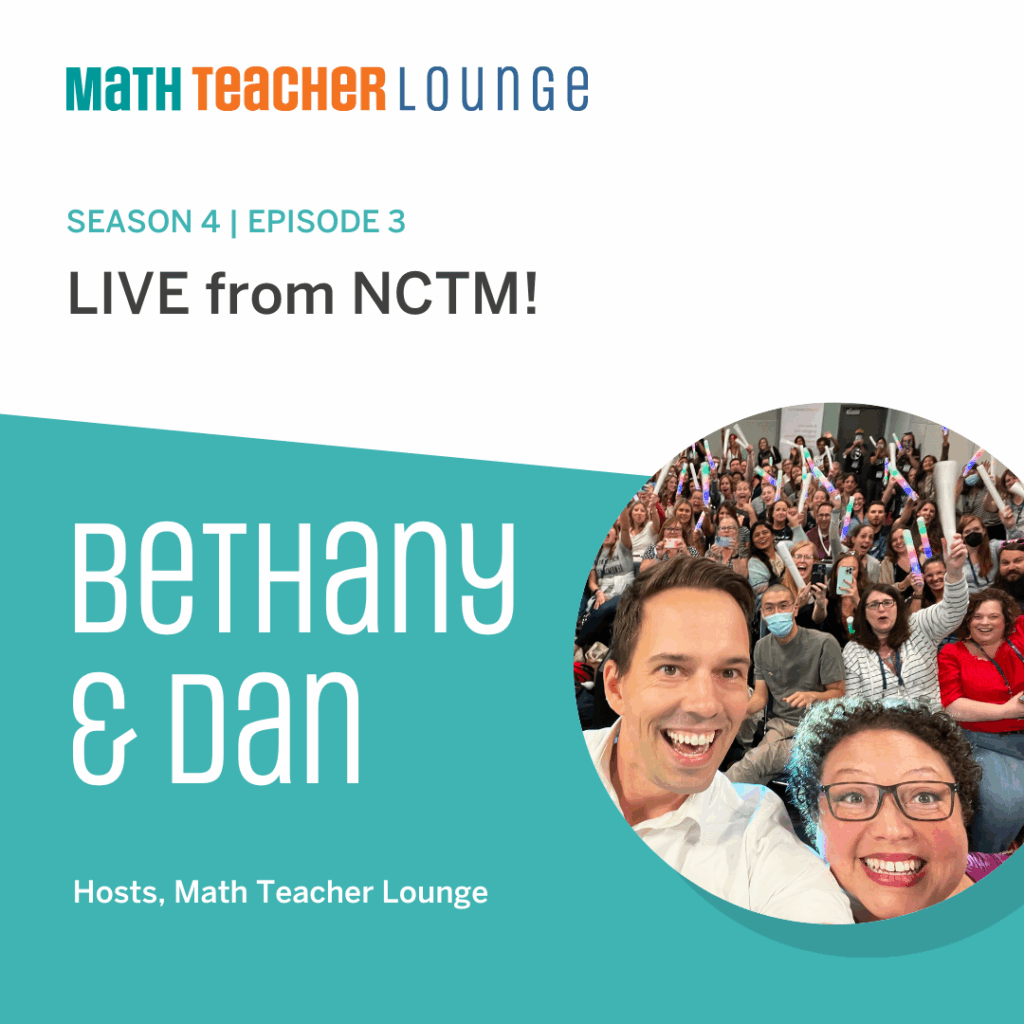
In this episode, co-hosts Bethany Lockhart Johnson and Dan Meyer are LIVE with more than one hundred Math Teacher Lounge listeners at the recent National Council of Teachers of Mathematics conference. Listen in as they answer the pressing question: Who is the best teacher in film or television?
Explore more from Math Teacher Lounge by visiting our main page.
Presenter (00:00):
Ladies and gentlemen, from Math Teacher Lounge, we have Bethany Lockhart Johnson and Dan Meyer! <cheering>
Bethany Lockhart Johnson (00:08):
Doesn’t go well that the door was locked. Like, I could not get in! <Laugh>
Dan Meyer (00:12):
Yeah. Gotcha. All right. We’re gonna sit a little bit. Let’s see how that works—
Bethany Lockhart Johnson (00:16):
Hi!
Dan Meyer (00:16):
Yeah. I think we’ll stand up? Or whaddaya think, sit…?
Bethany Lockhart Johnson (00:19):
Should we stand? Hi.
Dan Meyer (00:22):
Hello. Great to see you folks. Yeah, I can hear you.
Bethany Lockhart Johnson (00:25):
Can you hear me? That’s—I know YOU can me. Can you hear me OK? OK! We’re here. Hello. Thank you for like, lining up and coming out and being here. Thank you!
Dan Meyer (00:35):
Means so much to me that you could be here for me, on my show, with Bethany Lockhart Johnson, my co-host. <Audience laughs>
Bethany Lockhart Johnson (00:40):
The hour has just started.
Dan Meyer (00:42):
We’re just getting going. Yeah. If you folks have heard the podcast, you don’t know how much gets cut out. And it’s like, mostly me just having, you know, anxious nerves and saying something silly and then we cut it out and we can’t do that here today. So it should be real fun for all of us, I think. Yeah.
Bethany Lockhart Johnson (00:55):
It’s not true. It’s mostly dancing. “Bethany, can you stop talking? Bethany?” Cause it’s mostly—
Dan Meyer (00:59):
“It’s my turn. It’s my turn! Bethany <laugh>! I haven’t been heard for a while.”
Bethany Lockhart Johnson (01:02):
Dan. We’re at an in-person conference.
Dan Meyer (01:05):
In-person BIG conference, I would say. I’d say a big conference. Yeah.
Bethany Lockhart Johnson (01:08):
And have you been to the Amplify booth?
Dan Meyer (01:11):
I have! Have these people? There’s a claw machine with free socks.
Bethany Lockhart Johnson (01:16):
Yeah. You’re saving me socks, right? That’s what you’re saying. <Laugh> I mean, it’s exciting. How has your conference been so far?
Dan Meyer (01:21):
So far it’s been a blast. I feel fed. I feel like the community’s been awesome. How are you feeling about it?
Bethany Lockhart Johnson (01:29):
OK. Let’s talk about me for just a second.
Dan Meyer (01:31):
Yeah. Talk about you.
Bethany Lockhart Johnson (01:31):
Last night, Dan, was the very first night that I was away from my toddler. <Audience: Aw!>
Dan Meyer (01:38):
Big commitment being here. Thank you.
Bethany Lockhart Johnson (01:40):
I got super-emotional walking back to the hotel after dinner, and then I got in my room, <laugh> I put on pajamas, and I turned on music. I slept so good!
Dan Meyer (01:50):
Yeah. <Audience laughs> Give it up for no kids! <Audience laughs> Hey!
Bethany Lockhart Johnson (01:55):
I love him so much. But I slept all the way through the night. Oh, by the way, I ordered room service in the morning.
Dan Meyer (02:01):
On Amplify.
Bethany Lockhart Johnson (02:01):
That bill’s coming. But it’s been a great conference and I’m so delighted to be here in person and to get to share energy…and hopefully that’s all we’re sharing today. Y’all got your tests, right? Yep. Sharing energy and community today. Because we know it’s been hard. Hardness. Hard.
Dan Meyer (02:25):
Yeah.
Bethany Lockhart Johnson (02:26):
Years. Hard. And to be in person, I know conferences reinvigorate me and I go back into my educational spaces feeling revitalized with new connections and new ideas to try. So yeah, I’ve been excited to be here. And thank you all for being here.
Dan Meyer (02:40):
Yep. I don’t care if I get six different strains of Covid here. I’m just thrilled to be here. <Audience laughs> I don’t know if you’ve had the same feeling, though, Bethany, you folks…I’m a little bit confused to some degree about what we’re doing. I just wanna be really transparent. This is my sarcastic voice but I’m being sincere here. It kind of feels like we’re in a little bit of a time capsule. Like we all got in a time capsule in 2019 and, you know, you open it back up and it’s like, OK, so we’re still, you know, talking about X, Y, or Z protocol for establishing classroom routines or whatever. And I’m like, OK! Like, I loved that in 2019! But I do admit, I’m still trying to figure out a little bit like, what are we doing now? What’s our relationship to the world out there? Things are very different. I have had some great sessions that I’ve enjoyed. I’m also like, still waiting for a session to draw a little blood. Do you know what I mean? Like there’s been sessions…no? OK. You’ve been in these sessions where it’s like, “Oh, ow.” Like, and you look down and there’s and there’s blood there. It’s like, I thought I knew what we were up to. Like, I thought I knew what teaching was and how we relate to the world. I dunno, like in any Danny Martin session in 2019, “Take a Knee” was one, where I was like, “Oh, OK. Like, I’m not as hot as I think I am here. Like, I’m part of a system.” That kind of thing for me draws blood. And I haven’t been in one of those yet. Been some great sessions. I’m a little hopeful that today we draw a little blood and think about what we’re doing here, is my hope here, if that’s OK. So Bethany’s gonna moderate that impulse and she’ll be the fun one and I’ll be the blood-drawing one.
Bethany Lockhart Johnson (04:05):
No, I don’t…that metaphor doesn’t speak to me personally. But what I will say is, I get what you’re saying about really wanting to be in that room where there’s like this synergy happening. No promises about that today other than—
Dan Meyer (04:18):
I promise. <Audience laughs> Go on.
Bethany Lockhart Johnson (04:20):
Other than I get what you’re saying. I’ll find my own metaphor that does not involve bloodshed, but.
Dan Meyer (04:25):
Sure. There’s a lot of ways we we could go about this today. And the one that I’m excited about is, you know, we could like, you know, analyze some results from students, and talk about what went into that. Look at classroom video. Lots of possibilities. But here’s what we’re up to today. Hope you’re into it. Which is, we are here in the heart of the entertainment industry. You know, Tinseltown! Um, the Big Apple! Uh…
Bethany Lockhart Johnson (04:47):
No!
Dan Meyer (04:47):
Come on. What do you got here? Um…
Bethany Lockhart Johnson (04:51):
It was daytime at night. Like the lights were so bright.
Dan Meyer (04:54):
The City of Lights.
Bethany Lockhart Johnson (04:55):
There was a movie premiere outside my hotel room, which I was not invited to, unfortunately. But so what are we doing today?
Dan Meyer (05:01):
So here’s what we’re doing. We are gonna settle, once and for all, a question you have not asked yourself yet, perhaps, but will want to know the answer to in a moment. Which is: Who is the best teacher in all of film or television? OK? We’re gonna do that. It’ll be fun. But I hope that in debating this a little bit with a special guest we’ll bring up in a moment, that we will start to uncover some truths about what makes good teaching. How that’s different from teaching as we see it in movies and tv. Why middle-class America wants teachers to look a certain way in movies and tv. What all that means. And it’ll be awesome. I think. I’m hopeful it’ll be awesome. So what we did here is we’ve invited eight people. Eight folks you people may have known. You’ve been in their sessions today, in this conference, perhaps. And asked them: Who’s your fave? Like, we might have our favorites, but we wanted to democratize it a bit. So asked some cool people who you folks like, who are very smart and thoughtful about teaching: Who’s your favorite teacher?
Bethany Lockhart Johnson (05:58):
A few of whom are in this room. Thank you for your submission.
Dan Meyer (06:00):
Thank so much. Yeah. We’ll see what happens here. <laugh>
Bethany Lockhart Johnson (06:03):
As they shrink down.
Dan Meyer (06:03):
Yeah. Might draw some blood that I don’t mean to right now. We’ll see. OK.
Bethany Lockhart Johnson (06:06):
That metaphor, what IS that??
Dan Meyer (06:07):
Yeah. Yeah. I love it. I’m still going with it. <laugh> And you folks will be a huge part of this. THE part of this, really. So what will happen is I’ll share with you our first nominees. A few of us will make a case for our favorites, or least favorites, as the case may be sometimes. And then by applause, by acclamation, you folks will decide who wins and advances to the next round. Start with eight, move to four. You folks know math.You know where this goes. OK.
Bethany Lockhart Johnson (06:34):
No, keep going. Keep going.
Dan Meyer (06:36):
Two, then one.
Bethany Lockhart Johnson (06:36):
Yeah. Got it.
Dan Meyer (06:37):
Then a half of it. No?
Bethany Lockhart Johnson (06:38):
He had to school me on the making of brackets. But we got it. Yeah.
Dan Meyer (06:41):
How brackets work.
Bethany Lockhart Johnson (06:41):
But we got it. March Madness, what?
Dan Meyer (06:44):
Yeah, in order to do this right, we had to bring up—all the folks that you’ll see are also former Math Teacher Lounge guests, or like, just fan favorites. And we’re also bringing up a former Math Teacher Lounge guest to help us decide this and debate this in a respectful manner.
Bethany Lockhart Johnson (06:59):
New dad.
Dan Meyer (07:00):
New dad.
Bethany Lockhart Johnson (07:01):
You see where my brain’s still at? I miss him. <Laughs>
Dan Meyer (07:03):
Friend from San Diego. Really cool teacher.
Bethany Lockhart Johnson (07:06):
Incredible teacher.
Dan Meyer (07:06):
Works at Desmos and Amplify. And I just want you to welcome up your friend and mine. Chris Nho!
Bethany Lockhart Johnson (07:11):
Chris Nho!
Dan Meyer (07:13):
Come up, Chris. Let’s go, buddy. We didn’t talk about it, but did you want to do the cornball stuff too?
Chris Nho (07:22):
Wow. Would I love to do—
Bethany Lockhart Johnson (07:23):
And then the door could be locked! And then you have to wait and like, just—
Chris Nho (07:27):
Yeah, I’ll skip that part.
Bethany Lockhart Johnson (07:28):
Hi. Welcome. You’re here. We’re here in person.
Chris Nho (07:30):
Very glad to be here. Thank you all for having me.
Dan Meyer (07:33):
Tell me who you are.
Chris Nho (07:34):
My name is Chris Nho. I live in San Diego. I’m a new dad. A three month old, just had. Yeah, she’s actually here at the conference with us in the hotel room. And I promise you she is not by herself. She is with…come on. I was like, “Hey, just gimme one hour. I’ll be right back. I have to do very important work.” But yeah, I think I got invited here because I have opinions and I’m willing to draw…some…blood.
Dan Meyer (08:02):
There we go! Two outta three! We’re good on the metaphor now.
Bethany Lockhart Johnson (08:06):
We’re so glad you’re here. If you haven’t listened to the episode where Chris and Molly and some other public math folks share their ideas and ideas of how to take math out into the world, please listen, because we had a blast.
Dan Meyer (08:19):
Inspiring work. Really inspiring work. Very cool. Cool. OK. Right on. OK.
Bethany Lockhart Johnson (08:23):
Let’s do this!
Dan Meyer (08:24):
Let’s get started here. Yeah! <Audience cheers> Yeah. And we might ask you who your favorite teacher is, who’s missing from our list of eight? We might have forgotten some people. Anyway. All right. So here’s our first two. Our first two are nominated by way of, let’s see, um, Mandy Jansen is a professor at the University of Delaware. Got some awesome talks here this week, a Shadow Con talk last night. She’ll be nominating one. And also, um, Lani Horn is a professor at Vanderbilt, also extremely cool, prolific author and speaker, just all-around great human and friend of teachers everywhere. And she’ll nominate another in this bracket, which is the Northeastern Comedy bracket, Northeastern comedy bracket.
Bethany Lockhart Johnson (09:06):
It just worked out that way.
Dan Meyer (09:07):
Yeah. Here it is. Here is Tina Fey in Mean Girls.
Tina Fey in Mean Girls (09:12):
“OK. Everybody close your eyes. All right. I want you to raise your hand if you have ever had a girl say something bad about you behind your back. Open your eyes. Now close your eyes again. And this time I want you to raise your hand if you have ever said anything about a friend behind her back. Open up. It’s been some girl-on-girl crime here.”
Lani Horn (09:52):
I am nominating Sharon Norbury from Mean Girls as the best movie math teacher. She is an awesome teacher who is always there for her kids. She always sees the best in them. She shows that she can forgive even some pretty bad behavior, if she sees that kids are trying. She’s a strong feminist who makes sure that smart girls don’t dumb themselves down just to impress boys.
Tina Fey in Mean Girls (10:22):
“Katie, I know that having a boyfriend may seem like the most important thing in the world right now, but you don’t have to dumb yourself down to get guys to like you.”
Lani Horn (10:30):
She’s also super hard-working. She works three jobs. She’s always there for the kids. She plays piano in the talent show and takes them to Mathlete competitions. And she’s also socially aware. And when things go really badly among the girls, she does some pretty creative things to try to get them to be kinder to each other.
Dan Meyer (10:54):
OK. That’s one.
Bethany Lockhart Johnson (10:55):
Helen Case.
Dan Meyer (10:57):
All right. Settle down. Settle down. Settle down. All right.
Bethany Lockhart Johnson (10:59):
Piano too!
Dan Meyer (11:00):
Bethany’s already trying to bias people here. All right. Chill out. Hold on. So next one is Mandy Jansen with Jack Black from School of Rock. Uh-oh. Uh-oh.
Jack Black in School of Rock (11:09):
“What was your name?”
Kid in School of Rock (11:10):
“Katie.”
Jack Black in School of Rock (11:11):
“Katie. What was that thing you were playing today? The big thing.”
Kid in School of Rock (11:14):
“Cello.”
Jack Black in School of Rock (11:15):
“OK. This is a bass guitar and it’s the exact same thing, but instead of playing like this, you tip it on the side. Chellooooo! You’ve got a bass! <Laugh> Try it on.”
Mandy Jansen (11:25):
And I’m nominating for best teacher in a film Jack Black as Dewey Finn playing Mr. Ned Schneebly in the film School of Rock. So why this portrayal? First of all, playing a longterm sub. Those are so hard to find right now. <Audience laughs> Really hard. And then he teaches using class projects. That’s brilliant. Integrated learning. And then love this. He gives students roles and tasks that are differentiated and align to the specific strengths that each student has.
Kid 2 in School of Rock (12:05):
“I can also play clarinet, you know!”
Jack Black in School of Rock (12:06):
“I’ll find something for you when we get back from lunch. I’ll assign the rest of you killer positions.”
Mandy Jansen (12:13):
And the film culminates in a performance of a collaborative song that they all wrote and performed together. And the students experience that collaboration and teamwork and creating something beautiful is much more important than winning first place. And finally, one of the songs that the character sings in the film is “Math is a Wonderful Thing.” Can’t beat that.
Dan Meyer (12:40):
All right. That’s tough. That’s tough. So here’s the deal. What we have right now is just a quick minute—so Bethany, you ranked, we all ranked our own faves here outta the list of eight. And Bethany put Jack Black in School of Rock a bit higher than Tina Fey in Mean Girls.
Bethany Lockhart Johnson (12:54):
Missed the piano part though.
Dan Meyer (12:55):
And Chris, vice versa here. So Bethany, would you start us off and just make a quick case here for Jack Black versus Tina Fey?
Bethany Lockhart Johnson (13:01):
OK. So here’s what I’m thinking. There’s been rumor that maybe they’re putting less than credentialed people into classrooms to fill teaching gaps. I mean, just rumor. And so here’s this guy who is a rocker. He is not a substitute. He has no teaching training. And yet he goes in there and it turns out that he has the ability to see students’ potential and to recognize their unique abilities. And like Mandy said, he really tapped into, like, he saw them and said, “No, more is possible for you than what you think is possible.” And there’s like real sub anxiety. When you walk in, you can either be like, happy there’s a sub, but I was usually really nervous. Right? And he goes in and he makes that classroom into a home.
Dan Meyer (13:53):
Wow.
Chris Nho (13:54):
Wow.
Dan Meyer (13:56):
Chris, speak on it. Tina Fey needs you. Chris.
Chris Nho (13:59):
Tina Fey. Here we go. I’m gonna argue here that—when was that movie made?
Dan Meyer (14:03):
T is for terrific. I is for Interesting.
Chris Nho (14:06):
Decades ago. And I’m gonna argue that Tina Fey was very progressive for her time. OK, let’s talk about social emotional learning. Hello. <Audience laughs> Love that. Right? Stand up if, I mean, she’s getting people to talk about their emotions. And there’s a curriculum. But let’s just pause, because that’s not what’s really happening in the classroom right now. So social emotional learning, I think she’s, she’s got that a lot. And then number two, you know, if you remember the plot of Mean Girls a little bit, she gets her name written in that Burn Book. Like she sees what they say about her. Restorative justice. Let’s go. <Audience laughs>.
Dan Meyer (14:38):
Whom amongst us. Yes.
Chris Nho (14:40):
You write Mr. Nho in the Burn Book?? Well, your grade book is gonna look like a Burn Book! OK? <Audience laughs> Tina Fey, Tina Fey, she was like, “No, you know, know what? I’m actually gonna spend more time with you. You’re gonna become a mathlete.” And Lindsay Lohan discovers—she drops the most iconic line in all of math education. “The limit does not exist.” Thank you, Tina Fey, for that. For that gift.
Dan Meyer (15:04):
Bless. Bless you. Tina Fey. Wow.
Bethany Lockhart Johnson (15:05):
Oh, man. Wow.
Dan Meyer (15:09):
Let’s see what the people say here. I do wanna just add one quick thing about—it’s interesting to me how often in these movies—just kind of go in a little bit, zoom out just a minute—how often it’s a teacher who has no training as a teacher. <Bethany laughs> I am kind of curious why it is. Like, those are the movies that get hot, that get made. Again, these are all kind of a mirror of the taste of the moviegoing public. You know what I’m saying? Like, these, these are not movies—I wanna believe they are made for me and for us as teachers. But they are not. There’s not enough of us to justify, you know, Jack Black’s, you know, M&M budget or whatever he’s got going on in his trailer or whatever. That needs to be for everybody in middle-class America. So what is it about middle-class America that wants to see teaching as something that anybody can do? Just like, you know, just, just run up there in your van and make it happen.
Bethany Lockhart Johnson (15:54):
Magic magically manifests.
Dan Meyer (15:56):
Yeah. Manifest. Yeah. That’s just interesting to me. I just toss that out there as some red meat. Let’s see what the people say here. All right, OK, so you’re ready. Let’s get the bracket going here. The question is Tina Fey versus Jack Black. You had a moment here. Just whisper to someone real fast who you’re going for here real quick. What are you thinking here? <Crowd murmuring> All right. Crowd’s buzzing. Crowd’s buzzing. Would you folks…? All right. Bring it back. Go ahead and make some noise for Tina Fey. <Crowd cheers> OK. OK. Make some noise for Jack Black! <Crowd cheers> Judges say Tina Fey. Tina Fey moves on. All right. All right.
Chris Nho (16:44):
Stunned. I’m stunned. I’m speechless.
Bethany Lockhart Johnson (16:46):
Tina Fey moves on. Wow.
Dan Meyer (16:48):
This has exceeded my expectations in terms of having some fun, but also getting deep, getting deep and real about teaching. I’m into this right here. Yeah. What’s up?
Bethany Lockhart Johnson (16:54):
That’s the goal. That’s the goal. OK. You wanted blood? Oooh, this next matchup might just be where that blood comes forth! OK. Stretch. Warm up. Dan Meyer, who’s up next?
Dan Meyer (17:11):
We’ve got the animated/animatronic round here in the Southeast. And repping the two contestants here, who do we have? We have Allison Hintz, professor, author outta Washington, as one of the two nominators. And the other nominator is one of my heroes, though we’ll find out very wrong about this nomination, Jenna Laib, who’s in the crowd, and I’m trying not to make eye contact here. <Laugh> And here are the two nominations. A couple minutes each. And then we’ll chat about it. And one of us will probably die. But we’ll see how it goes.
Allison Hintz (17:50):
A long, long time ago, in a galaxy far, far away, MTL, we began learning from the Jedi Master of Teaching. With the Socratic and experiential approach. With unparalleled mindfulness, compassion, and humility. The best teacher in TV and film, Yoda is. <Audience laughs> Yoda lives the values we share as teachers and learners. He humbly comes alongside us as we construct new knowledge.
Yoda (18:29):
“You must unlearn what you have learned.”
Allison Hintz (18:32):
Yoda allows us to struggle and sees mistakes as critical to learning.
Yoda (18:39):
“The greatest teacher, failure is.”
Allison Hintz (18:43):
Yoda values curiosity and reminds us of the beauty and joy of teachers learning from children.
Yoda (18:52):
“Truly wonderful, the mind of a child is.”
Allison Hintz (18:59):
MTL! Join the Resistance! Let the force flow through you in declaring, the best teacher in TV and film, Yoda is.
Dan Meyer (19:18):
Give it up for Allison Hintz! All right! <Audience applauds>
Bethany Lockhart Johnson (19:20):
Alison! And to have that on hand too, which Is kind of perfect.
Bethany Lockhart Johnson (19:26):
Just to be clear, the helmet is not a part of a Zoom background.
Dan Meyer (19:29):
You may evaluate the quality of the nomination based on the costumes of the nominator. That is acceptable. That’s acceptable.
Bethany Lockhart Johnson (19:35):
That is a REAL HELMET.
Dan Meyer (19:35):
All right. The next nominator here, this one is from Jenna Laib, math coach, all-around stellar human. Here we go. This is Ms. Frizzle.
Ms. Frizzle (19:42):
“Single file, class. Our rotten field trip has only just begun.”
Jenna Laib (19:47):
And I think that the best teacher from TV or movies is Ms .Valerie Frizzle from The Magic School Bus. First and foremost, Ms. Frizzle believes in her students. She encourages them to take an active role in their learning, and also to advocate for change in their local community. For example, there’s an episode where there is a logger who’s gonna cut down a rotting log that would benefit the local ecosystem. And the students figure out a way to convince him to leave the log so that all of the animals and the plant life can benefit. She orchestrates really challenging situations for these students, and she allows them the space to ask questions and engage in problem-solving and puzzle their way out of these really, really difficult scenarios. Ms. Frizzle has unmatched pedagogy. She’s bold, she’s innovative, and she’s a major proponent of experiential learning. So these students are heading straight into a storm to learn about weather systems. <Audience laughs> These students are heading into the human body to learn about digestion and disease. They literally get baked into a cake to learn about some chemistry and reactions.
Children in The Magic School Bus (20:54):
“What’s happening?” <Audience laughs> “Why is it suddenly getting so hot?” “Maybe it’s because the floor is on fire!” <Audience laughs>
Jenna Laib (21:02):
This pedagogy is all led by her outstanding catchphrase, which is:
Ms. Frizzle (21:06):
“Take chances; make mistakes; get messy!”
Jenna Laib (21:14):
From her pedagogy to the classroom community that she creates, Ms. Frizzle is an inspiration, and that is why I think that she is the best teacher from TV or film. <Audience applauds>
Dan Meyer (21:25):
Right on! Give it up for Jenna. Give it up for Jenna. All right. I’m gonna take first pass at this. Chris knows my argument already, so I’m gonna take this here. I see some of you are feeling how I’m feeling on this one. OK, so I don’t have tons to say in favor of Yoda. I think it was all true what Allison said. I think the costume was banging. It was awesome. So there’s all that, but I have more to say against Ms. Frizzle than for Yoda.
Bethany Lockhart Johnson (21:48):
No, no, no. Wait a second!
Bethany Lockhart Johnson (21:49):
Let’s let it happen. Bethany, I’ve come prepared.
Dan Meyer (21:54):
I may have made a misstep here, I realize.
Bethany Lockhart Johnson (21:56):
I’ve come prepared.
Dan Meyer (21:56):
So I think Jenna is all correct. I think those clips spoke for themselves. I think that what they add up to, to me, is not “great teacher,” but more “someone who should be locked up.” <Audience laughs> Or at the very minimum, “someone who should be kept away from children.” <Audience laughs> Do not let that woman around children. I mean, check it out. Look, I don’t wanna throw down credentials. I’ve been to grad school, though. I know how this works. When your brain is stressed, you get these—all the cortisol happens. Your working memory shrinks up. You cannot learn when you’re stressed. And those kids, like whatever lesson Ms. Frizzle is teaching by sending them into an oven, I repeat, an oven <audience laughs>, like, they’re not gonna learn anything ’cause their brains are freaking out with stress and fear. OK?
Bethany Lockhart Johnson (22:41):
“What’s happening??”
Dan Meyer (22:43):
“What’s happening? Am I on fire? Well…I’m learning lots, though! Sure is magical!” <Audience laughs> It’s like, “No. Get that woman out of a classroom.” That’s my opening and closing argument. Right? There’s all it is.
Chris Nho (23:01):
All right. All right. All right.
Bethany Lockhart Johnson (23:02):
Chris knows.
Chris Nho (23:03):
I’ve got, I’ve got lots to say. First off, I think Dan was in charge of the editing of those video clips. So let’s let that be—you know, let the record stand. <Audience laughs>
Dan Meyer (23:11):
Where’s the lie though? Where’s the lie?
Chris Nho (23:14):
And, you know, second, I think, um—this is the guy up here saying, “I wanna see blood.” You know? And then he has a teacher who literally takes the students into a blood cell and, and you get a little scared! You get a little worried for the students, you know? So I just don’t get it, Dan. This or that. OK? I think Ms. Frizzle—so I actually went to a project-based learning school. I taught at a project-based learning school. And the best thing about it is like, your learning, it doesn’t just stay in this box of math lesson or writing lesson, history lesson. And I think with Ms. Frizzle, like you can’t help but learn things because you are getting baked in a cake. <Audience laughs> Yeah, it is a little scary. And I imagine there’s cortisol and things happening, but guess what? Probably the next episode, they go into their own brains and explore what’s happening. That kind of thing. You know?
Dan Meyer (24:07):
The kids that survived, just be clear. <Audience laughs>
Chris Nho (24:10):
Yeah. OK. Would I want Nora, my three-month-old, to be babysat by Ms. Frizzle? Maybe not. <Audience laughs> But what I have to say about Yoda is Yoda maybe wins the best tutor award. Give it up for Yoda’s Best Tutor Award.
Bethany Lockhart Johnson (24:24):
Oh, yeah…
Chris Nho (24:25):
That ratio’s looking really nice. I could teach the heck outta Luke Skywalker. OK? But 20 little Luke Skywalkers running around. I’m not sure. OK?
Dan Meyer (24:34):
Luke did survive the training, though. <Audience laughs> So that’s awfully nice to say about it. All right, Great words from Chris here. I’m still not convinced. We’ll see how you’re convinced here. Would you whisper to someone where you’re leaning here? Frizzle or Yoda? <Audience buzzing>
Chris Nho (24:47):
I tried. I tried.
Dan Meyer (24:53):
All right. That’s enough of that. Let’s hear it folks. Give it up for Yoda. <Audience cheers> Give it up. Give it up. You. Give. It. Up.
Chris Nho (25:05):
Hey, next. Next.
Dan Meyer (25:06):
All right. All right, all right. <Mutters> Give it up for Ms. Frizzle. <Audience cheers louder> I dunno, it’s pretty close. Call a tie. Maybe Yoda? Yoda by nose? <Audience laughs> All right. All right. Let’s…let me see who’s it. Let’s get the people advancing here. I’ll keep on moving here.
Chris Nho (25:26):
As you’re doing that. Um, Dan ranked Ms. Frizzle last in his personal ranking. And I ranked Ms. Frizzle very high, so we knew this one would be spicy,
Bethany Lockhart Johnson (25:36):
<laugh> Spicy it was. Are you having a good time so far? <Audience cheers> So while we love seeing these images and we love seeing these video clips, at the core, what are these things about how teachers are portrayed? And how accurate is that to our real lives? I mean, besides the cake part, right? That my chemistry class did often feel like I was on fire. I was so stressed in it. Um, we’re ready?
Dan Meyer (26:05):
Yep. Great. We’re ready, we’re up here. So the next two nominees are coming to you folks from Tracy Zager, who is the editor of my book, forthcoming in 2027 at the earliest and 2032 at the latest. And also your very own Zak Champagne from Florida, here in the room. Hey, Zak. Zak, let’s see who the nominations are. I’m gonna skip past that, didn’t work out so well for me. Here it is. This is Marshall Kane from the TV show Community.
Michael K. Williams in Community (26:32):
“You two complete your case to the class and let them decide your grades.”
Joel McHale in Community (26:37):
“Professor, thank you.”
Michael K. Williams in Community (26:40):
“It’s not a favor, Mr. Winger. Man’s gotta have a code.”
Joel McHale in Community (26:44):
“Awesome.”
Zak Champagne (26:46):
This is a pitch for an underdog. This teacher didn’t stand on desks or encourage his students to follow their musical passions. In fact, this teacher was seen only in a few episodes of my favorite TV show of all time, Community, Community has set at Greendale Community College in Colorado. And in season three, we get to meet Dr. Marshall Kane, a biology professor whose story is an inspiration to anyone who just takes the time to look and listen. Dr. Marshall Kane slowly earned his PhD while in prison, serving a sentence of 25 to life. In his classroom, he inspires students to love biology, question why LEGO has become so complicated, and randomly pairs his students for group projects to ensure no one feels left out. His greatest performance comes when a group of students believe their yam project was intentionally sabotaged. Dr. Kane took this as an opportunity for some trans-disciplinary real-world learning. So yes, at community college, he felt that a middle-school mock trial was the best way to determine who killed the yam. So let’s all pick the underdog and vote for Dr. Marshall Kane. After all, man’s gotta have a code. <Audience goes “oh!” and applauds>
Dan Meyer (27:53):
Thank you, Zak.
Bethany Lockhart Johnson (27:54):
I have a code.
Dan Meyer (27:56):
Next up is Tracy Zager, nominating an unusual nomination, not a single person, but an ensemble performance. A bunch of people from a movie called Searching for Bobby Fisher. Here we go.
Rapid-fire movie dialogue (28:11):
“What’s that?” “Schleimann attack.” “Schleimann attack? Where’d you learn that from, a book?” “No, my teacher taught me.” “Aw, your teacher. Well, forget it. Play like you used to, from the gut. Get your pawns rolling on the queen’s side.”
Tracy Zager (28:26):
Hey, Math Teacher Lounge. This is Tracy Zager. I’m excited to share my nominee for the best movie teacher. But I have to admit that when I first got the email, I thought, oh, who am I gonna nominate? Because most movies about teachers are highly problematic. They usually have like a saviorism thing, usually white saviors. And I just felt like I couldn’t suggest any of those. So rather than nominate a movie about a single teacher, I wanted to nominate a movie that taught me something about teaching. And that movie is a deep cut. It’s Searching for Bobby Fischer. It’s a movie about a chess prodigy. And what I love about it is that all of the different adults in the movie are in teacher roles in some way. And the student, Josh, the chess player, is a fully realized character, not an empty pail, who pulls from the strengths of each one of those adults while also dealing with their flaws and humanity. And there’s just beautiful synergy in the way he gets the best out of everybody, but also has to overcome some of the barriers that they put in front of him. So I feel like it’s a much more authentic and humbling, but also inspiring, movie about the power of teaching. So if you haven’t ever seen it, check it out. And I can’t wait to see who the other nominees are. Thanks so much.
Dan Meyer (29:53):
Right on. Thank you, Tracy. Wherever you are. <Applause> We’ll move a little quicker here. I’m curious, Bethany, you put Marshall Kane pretty high. I put Bobby Fischer pretty high. What do you have to say about Marshall Kane for us here?
Bethany Lockhart Johnson (30:04):
Well, I just wanna say two things. One is that, like Zak said, he has this code of conduct that he brings in. And he stays true to it no matter what happens. If you saw him in in Community, you know that he held himself up to such high esteem, but not just himself, his students as well. And he took accountability when he felt he had done wrong, even though, well, that’s controversy. But first—oh, the other thing, rest in peace, Michael K. Williams. Oh my gosh. The actor who plays Marshall K. And the thing that I wanna say most of all about it is that he brings his whole self to the classroom. He was in prison for decades. He brings his whole self and says, “This is who I was. This is who I am today. And this is how we can work together as a community.”
Dan Meyer (30:58):
That’s big. I love your comments about code of conduct too. It makes me wish that Ms. Frizzle had a code of conduct also.
Bethany Lockhart Johnson (31:05):
I knew that was coming back!
Chris Nho (31:06):
Two slides ago, Dan. That was two slides ago.
Dan Meyer (31:08):
Can’t let it go. So yeah, I love what you said there. I have no strong beef here either way. Bobby Fischer’s a movie I have loved dearly and can’t be objective about it. I love that the kid in that movie, more than any other movie here, the kid teaches the adults so much through his innocence and how he challenges them and how they’re treating him. Dig all that so much. Will not, will not begrudge anyone any vote either way here. I do begrudge many of you your vote in previous rounds. <Audience laughs> So let’s just, let’s hear. We’re not gonna ask you folks at all to chitchat. We’re gonna move on this one. So would you folks make some noise here for Marshall Kane in Community? OK. OK. And would you make some noise here for Bobby Fischer, the kid in Bobby Fischer, the ensemble? <Audience cheers, applauds>
Bethany Lockhart Johnson (31:56):
Marshall Kane.
Dan Meyer (31:57):
Marshall Kane takes it. All right. Good job, Marshall Kane! All right. Zak’s feeling good. Moving on to the final four here, Zak, right on. OK. Our last—the Northwest Division here is also the large urban district division here. We have a couple different teachers in sets of large urban schools. They’re nominated, they’re advanced by a couple people here. One is past president of NCTM, Robert Berry. And another is Fawn Nguyen, Southern California phenom. Great teacher and friend of lots of us. Um, let’s see who they nominated here. First from Robert Berry, let’s see, who is it here? Janine Teagues from Abbott Elementary.
Abbott Elementary dialogue (32:37):
“Hey, you know what? I’m probably probably gonna be Kenny’s second-grade teacher. Why don’t you just let him get a head start with me today?” “That’d be great.” “Yeah? OK. Hey, Kenny, would you like to be in my group today?” “Not really.” “That’s the spirit.”
Robert Berry (32:54):
My nomination is gonna be Quinta Brunson, the Emmy Award-winning Quinta Brunson from Abbott Elementary. Janine Teagues is the character. She exemplifies care not only from an affect way, but she also exemplifies care in the things that she does for her students. While the scenes in the show are entertaining, they do represent the challenges that teachers experience when they’re trying to meet the needs of her students. So she goes, goes all out for her students and finding resources. She accesses other people to get resources for her students. But the care shows up in the way that she is mindful of their needs. And so, for me, when I think about teachers and teaching, sometimes we can talk about pedagogy, but sometimes we also can talk about those kind of intangibles that makes a teacher a great teacher. It is apparent from her students that she cares about them, she supports them, and she goes all out 100% for her students. Janine Teagues, Quinta Brunson is, I think, is my choice of the best teacher on television because of the realism and the representation that she brings to this character of what teaching is about. <Applause>
Dan Meyer (34:28):
Right on. Right on. OK. OK. Next up, we’ve got, Fawn Nguyen is nominating Erin Gruwell from Freedom Writers. Here we go.
Hilary Swank in Freedom Writers movie (34:39):
“Look, you can either sit in your seats reading those workbooks or you can play a game. Either way, you’re in here till the bell rings. OK? This is called the Line Game. I’m gonna ask you a question. If that question applies to you, you step onto the line and then step back away for the next question. Easy, right? The first question. How many of you have the new Snoop Dog album? <kids move around> OK, back away. Next question. How many of you have seen Boys in the Hood?”
Fawn Nguyen (35:26):
We all learn about Miss G and her 150 students in the movie Freedom Writers starring Hilary Swank. All great teachers share a common set of traits. They care deeply about their students, have high expectations of them, and always believing wholeheartedly that they will succeed. Great teachers go above and beyond, not because they extraordinary—as Anne Gruwell would always refer to herself as an ordinary teacher—but because extraordinary things happen to people when we believe in them, give them hope, help them write their own story with a different ending. So what stood out for me with Miss G is the scope of her reach, the ever-expanding sphere of her humanity. The red tape she had placed on the classroom floor for the line game shows just how much we all have in common despite our differences. Her students didn’t just learn from her; they learned from one another. If you’d like to be part of this expanding sphere to give voice and hope, please check out Freedom Writers Foundation dot org.
Dan Meyer (36:38):
OK. This right here is a tough one for us. Thank you, Fawn. We collectively ranked—that’s our number one seed and number eight seed, which I hasten to say does not have to do with Erin Gruwell, a person, but the portrayal and the movie. So we don’t have like a whole lot of…there’s not a lot of defense we have to offer here of our eighth seed. And I heard like a kind of a little bit of a murmur over the crowd on Erin Gruwell. So I’m more interested than having a defense back and forth. I’d be curious what you, Bethany, think about what, like, what both movies have to say about like, what teaching is, especially teaching urban schools with black and brown kids and lower-class kids, for instance. They both have, I think, very different things to say about them. Do you have thoughts about that?
Bethany Lockhart Johnson (37:19):
Well, it’s interesting because there is some overlap in the sense that the arguments that both Fawn and Robert Berry put out, they both care deeply about their students, right? We’re not gonna argue that. They care deeply. And something that I would say about Miss Teagues is there’s something about the way that she sees not only her classroom, her students, but she sees all of the students in the school as her students. And her idea of resource generation is really helping the teachers to generate resources from their community themselves, and to also realize that the students see themselves reflected in the teachers. And I think that—you know, again, this is not about the real person—but the movie portrayal, and we often see kind of this, for Freedom Writers, we often see this like, Great Last Hope whisked in and her personal sacrifices are what makes these students, these brown and black students’ transformation possible. Because of her sacrifices. Including her marriage. Including, you know, three jobs. And it’s just portrayed in a way that I think really celebrates her sacrifices rather than what the students have already brought—they already come into the room bringing so much as they are, already, without her intervention.
Dan Meyer (38:38):
I love the portrayal of the teacher as part of a community of teachers. Versus in so many of these movies, it’s the teacher as the only person who gets it, you know, oftentimes coming from outside of the world of teaching and everyone’s against them and wants ’em just to fall in line and do the thing we always do, and they’re the outlier. But in Abbott Elementary, it’s like we all rise and we fall together. And teachers are investing in each other’s success, especially with Gregory the longterm sub. We’re all rooting for his, you know, his flourishing. I love that. And yeah. That’s bigtime.
Chris Nho (39:09):
Yeah, I think one interesting thing is that Freedom Writers, when it came out, I think it was like a commercial success.
Bethany Lockhart Johnson (39:17):
Oh, big time. Yeah. It was.
Chris Nho (39:18):
It probably influenced a lot of people to try teaching out. So I do wonder what it says about us, right? Like that we want teaching to fit this narrative, and we wanna be those people who could go into a classroom and <puts on “cool voice”> “Y’all listen to Snoop Dog?” and just have that question HIT. <laughter> And you know, I’ve taught in a large urban school district, and I’ve been that person and I’ve seen other people try and be that person. And I think stepping away from it a little bit, just—it’s a reflection of what people want out of teaching and what they think better education looks like.
Dan Meyer (39:57):
Yeah, yeah. This idea that, so I’m a middle-class person, let’s say, and like, there’s this idea, like, “I know what I would do if I was going into circumstances of impoverishment.” Like I have—
Bethany Lockhart Johnson (40:06):
“All they really need is…”
Dan Meyer (40:07):
…for me to give ’em some real talk and tell ’em, you know, pull their pants up or whatever, listen to Snoop Dog, that kind of thing. And that will be the key. And that’s not how it is in, you know, in Jack Black in School of Rock or Tina Fey school, which are, you know, coded as largely like upper-class or largely white schools. And in those movies, it’s interesting, like how it’s about students discovering themselves, oftentimes. And the central figures are often students. And the students need to reject an oppressive parent figure or something and find themselves. But no, in Freedom Writers, it’s like, “You need to become more like the middle-class teachers who are coming in here to give you this wisdom.” It’s just interesting. I do find it—a pet peeve of mine is when movies portray teachers as only successful if you endure, for instance, the failure of your marriage, or even in Stand and Deliver, for instance, like Jaime Escalante, they depict him having a heart attack. And, like, the job oughta be…easier. <Audience laughs>
Chris Nho (41:04):
Truth.
Bethany Lockhart Johnson (41:05):
That’s the barometer for how much….
Dan Meyer (41:09):
Like, no heart attacks and no divorces related to the job, that kind of thing. I do love how in Abbott—one last thing and we’ll vote and Abbott will win <audience laughs>—is like how, like there, there is a lot of degradation in Abbott, but it’s not a divorce or a heart attack—it’s the petty indignities of asking a student, “Do you wanna hang with me?” And a student says, “Nah, not really.” And that just spoke to me like how it’s not cinematic, but teaching, successful teaching, is like a collection of developing an immunity to students saying, “You’re not hot.” <Laugh> You know? And so I love that. I do wish that there was more depiction of students in Abbott Elementary. It’s a lot of adult stuff. Whatever. Give it up for Abbott, if you would, please. Let’s just get this done here. All right. That’s plenty. That’s plenty. Not gonna ask folks about Freedom Writers. OK, let’s move on to— all right, let’s hear it for Freedom Writers! Yeah. OK, cool. We go, yep.
Chris Nho (42:05):
Plot twist!
Bethany Lockhart Johnson (42:07):
OK, let’s see our final four. Cut and paste. Real time. Real time.
Audience member (42:12):
Where’s Dolores Umbridge?
Dan Meyer (42:14):
Oh….
Bethany Lockhart Johnson (42:16):
Hey, did you hear that? He said, “Where’s Dolores Umbridge?”
Dan Meyer (42:20):
All right. OK.
Bethany Lockhart Johnson (42:20):
See, we missed so many. We could…
Dan Meyer (42:21):
So coming up here, we’ve got in the Eastern Conference, Tina Fey and Ms. Frizzle. Y’all know how I feel about that one. Let’s just get this one done. OK, let’s give it up for Tina Fey. Let’s hear it. <Audience cheers> OK. All right. Yes! Let’s give it up for menace to children everywhere, the terror, the Ms. Frizzle. <Audience cheers> One more time for Tina Fey. Let’s hear it. <Audience cheers> One more time for Ms. Frizzle. Let’s hear it. <Audience cheers>
Bethany Lockhart Johnson (42:59):
Yeah. OK.
Dan Meyer (43:00):
It took ’em one round, but they made the right call in the end. <Laugh>
Chris Nho (43:04):
All it took was 10 minutes of constant Ms. Frizzle-bashing. <Laugh>
Dan Meyer (43:09):
Persevering and problem-solving, that’s my game. Yes. All right. So, do either of you want to influence the audience one way or the other?
Bethany Lockhart Johnson (43:16):
That’s not how I play, Dan.
Dan Meyer (43:18):
Oh, OK. Yeah, that’s true. That’s true. You’re good. On Abbott versus Marshall Kane, should we just let ’em have it? All right. All right. Give it up For Abbott Elementary. Not bad. And for Marshall Kane. OK. OK. I hear Zak and five other people. All right, cool. <laugh> Right on. All right. We got our, we got our finals,
Bethany Lockhart Johnson (43:45):
We did it. We made it to two. And we know: We left out a lot of people. Right? And honestly, I kind of wish we could poll like everyone. I mean, think you put it on Twitter, right? Like, who would you pick? But I would say we had a pretty solid eight there. I’m excited to see who… Look at the little crown he put, you guys. Come on.
Dan Meyer (44:05):
I worked hard for you. For you. <Laugh> Yeah. I liked that it was a good bunch that had a lot of different kinds of qualities…and lack of qualities in some cases. And it allowed us that—I shouldn’t knock her while she’s down, and she IS down, it’s true. <Laugh> And I appreciate the conversation we’ve had, what they have revealed overall about teaching and what the world wants teaching to be versus what it actually is or actually should be. I appreciate that. So let’s settle this here. Give it up, if you would, for Abbott Elementary. <Audience cheers> And give it up for Tina Fey in Mean Girls. <Audience cheers>
Bethany Lockhart Johnson (44:49):
Wow.
Dan Meyer (44:51):
That was close. I almost give that to Tina Fey.
Audience member (44:55):
Yeah, we do!
Dan Meyer (44:55):
I don’t know. That was a bracket-buster for me right there. Yeah. I lost money in the office pool off that right there. Maybe let’s just find out one more time here. One more time.
Bethany Lockhart Johnson (45:03):
Last time.
Dan Meyer (45:03):
Time to summon up all your conviction on one or the other here. No half-measures right now. All right.
Bethany Lockhart Johnson (45:07):
Emmy Award-winning Quinta Brunson.
Dan Meyer (45:09):
Yeah, you saw Robert Berry on that, right? He was like, “Oh, I got one more card to play. Emmy Award-winning.” That’s admissible. That’s admissible. We’ll take that. All right. So…give it up for Abbott Elementary, one last time. <Audience cheers> OK. All right. All right. And give it up for Tina Fey in Mean Girls. <Audience cheers>
Bethany Lockhart Johnson (45:30):
Drumroll, please!
Chris Nho (45:33):
Best teacher is….
Dan Meyer (45:34):
Tina Fey in Mean Girls! Yeah. Not a bad pick.
Bethany Lockhart Johnson (45:39):
I love it. And I think, too, I think we’re gonna have a little bit of a more reflective lens than we thought we did when we see depictions of teachers in film and television. And, you know, hopefully we’ll see some new tropes come in, right?
Dan Meyer (45:55):
Yep. Yeah. Every dollar we spend on movies with lousy teachers is just encouraging these people to make more lousy teacher movies, you know? Awesome. Thank you for being here for a live taping—
Bethany Lockhart Johnson (46:06):
Thank you for being here.
Dan Meyer (46:06):
—of our podcast, Math Teacher Lounge, in a hot room. Appreciate that. Yeah, it’s been fun for us to have you here. Um, super-important, super-important final remark: Bethany loves Oprah and Oprah occasionally, in the show—
Bethany Lockhart Johnson (46:18):
Is she coming?! Is she here?!
Dan Meyer (46:19):
Not here! Not here! Calm down. Calm down. Um, but we do have in Oprah fashion, not something—
Bethany Lockhart Johnson (46:24):
Oh. Oh, OK. Oh, that’s, that’s OK. Sorry. I got, had really excited for a second. As if the Amplify playing cards, The Amplify t-shirts being chucked at you at high speed—I did try to get a t-shirt cannon, and that was quickly ruled out <laugh>. They didn’t know about my rocket arm, right?
Dan Meyer (46:46):
Yeah, you got a cannon. <Laugh>
Bethany Lockhart Johnson (46:47):
Yeah. Oh, that’s a compliment. Oh, is that a compliment? Thank you, Dan. Thank you. Look under your seat because we have five winners. We wanna thank you for being here in person. We wanna thank the folks who are listening. We wanna thank Amplify. Oh my God. Somebody just pulled off the chair tag. You get to take that chair home with you.
Dan Meyer (47:08):
Does anybody have a prize?
Bethany Lockhart Johnson (47:10):
OK, stand up if you…stand up if you…Yes! Stand up if you have one!
Dan Meyer (47:16):
Free set of classroom dry-erase boards, right here. Congratulations.
Bethany Lockhart Johnson (47:22):
And for you who pulled off the chair tag, I don’t know. We gotta we gotta find something for you.
Dan Meyer (47:27):
Put that in your backpack.
Bethany Lockhart Johnson (47:30):
Thank you again for being here. Thank you. Amplify. Thank you, Desmos. Thank you. Dan Meyer.
Dan Meyer (47:36):
Thank you folks. Chris, thank you buddy.
Bethany Lockhart Johnson (47:38):
Chris! Chris Nho, everybody!
Dan Meyer (47:40):
We will be, we will be at—Bethany and I will be at the booth, if you wanna chit-chat and hang out, sign some stuff. Whatever. You wanna have Bethany sign you, she’ll do that. Um, come on down to the Amplify booth and we’ll—
Bethany Lockhart Johnson (47:50):
We’ll talk to you more about Ms. Frizzle.
Dan Meyer (47:52):
Fun and prizes. I will share with my real thoughts about Ms. Frizzle down there. I’d love to see you. Thanks for being here, folks.
Bethany Lockhart Johnson (47:57):
Thanks for listening. Bye.
Stay connected!
Join our community and get new episodes every other Tuesday!
We’ll also share new and exciting free resources for your classroom every month.


Meet the guests
Dan Meyer
Dan Meyer taught high school math to students who didn’t like high school math. He has advocated for better math instruction on CNN, Good Morning America, Everyday With Rachel Ray, and TED.com. He earned his doctorate from Stanford University in math education and is currently the Dean of Research at Desmos, where he explores the future of math, technology, and learning. Dan has worked with teachers internationally and in all 50 United States and was named one of Tech & Learning’s 30 Leaders of the Future.
Bethany Lockhart Johnson
Bethany Lockhart Johnson is an elementary school educator and author. Prior to serving as a multiple-subject teacher, she taught theater and dance and now loves incorporating movement and creative play into her classroom. Bethany is committed to helping students find joy in discovering their identities as mathematicians. In addition to her role as a full-time classroom teacher, Bethany is a Student Achievement Partners California Core Advocate and is active in national and local mathematics organizations. Bethany is a member of the Illustrative Mathematics Elementary Curriculum Steering Committee and serves as a consultant, creating materials to support families during distance learning.

About Math Teacher Lounge: The podcast
Math Teacher Lounge is a biweekly podcast created specifically for K–12 math educators. In each episode co-hosts Bethany Lockhart Johnson (@lockhartedu) and Dan Meyer (@ddmeyer) chat with guests, taking a deep dive into the math and educational topics you care about.
Join the Math Teacher Lounge Facebook group to continue the conversation, view exclusive content, interact with fellow educators, participate in giveaways, and more!
You might also like:



Fomente y exalte el razonamiento de los estudiantes aprovechando su curiosidad natural.
Amplify Desmos Math ayuda a los maestros a fomentar un aula con estudiantes entusiastas y cooperativos, partiendo de sus ideas y desarrollando diaria y firmemente los conocimientos del grado académico correspondiente de cada estudiante. For English version, please click here.

Amplify Classroom
Para los grados K a 12.º
Gratuito
Una plataforma de enseñanza y aprendizaje que ofrece una colección de lecciones digitales gratuitas y herramientas para diseñar lecciones.
- Los maestros pueden crear sus propias lecciones con la herramienta Activity Builder.
- También pueden explorar contenido creado por otros maestros, por ejemplo:
- Las lecciones que crean los usuarios y se almacenan en la biblioteca.
- Las lecciones de la Colección destacada que produce el equipo de Amplify Classroom.
Más información en classroom.amplify.com
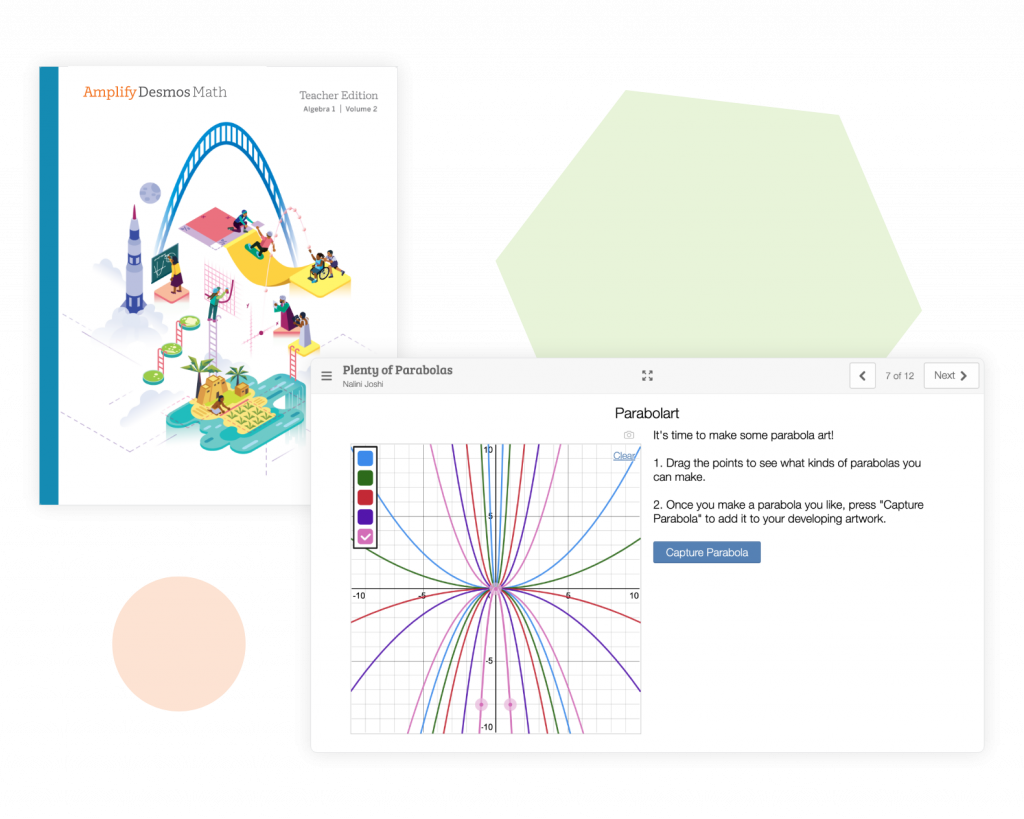
Amplify Desmos Math
Para los grados K a Álgebra 2
De Pago
Próximamente: Un nuevo programa básico de prekindergarten a 12.º grado de Amplify y Desmos Classroom.
- Un método basado en problemas que produce resultados mediante el desarrollo de una comprensión conceptual sólida, fluidez procedimental y ejemplos de uso.
- Tecnología que inspira conexiones en el aula, fomentando la colaboración, el diálogo y la perseverancia en la resolución de problemas.
- La curiosidad natural de los estudiantes propicia una comprensión cabal de las matemáticas y un aprendizaje que dura toda la vida.
- Disponible en inglés y español.
- Programma piloto para los grados K a A1 para el regreso a clases en el 2024.

Un nuevo programa básico para los grados preK al 12.º de Amplify y Desmos Classroom.
Amplify Desmos Math facilita tanto a los maestros como a los estudiantes la migración a un método basado en el planteamiento y la resolución de problemas, proporcionando actividades atractivas, eficaces herramientas de facilitación para el maestro y muchos apoyos para la diferenciación y la práctica.
Hemos combinado lecciones interactivas basadas en problemas con enseñanzas explícitas, refuerzos y prácticas para que los estudiantes dominen auténticamente las matemáticas. Las lecciones sientan una base sólida en cuanto a la fluidez en los procedimientos y cálculos, afianzan la comprensión de los conceptos y permiten a los estudiantes aplicar lo aprendido a situaciones del mundo real.
Amplify Desmos Math estará disponible a partir del curso escolar 2025–26. Los distritos interesados podrán probar la versión Beta a partir del otoño del 2024.
Más de lo que espera de un programa de matemáticas.
Integral
- Plan de estudios basado en Illustrative Mathematics® IM K-12™
- Diferenciación y práctica personalizadas
- Evaluaciones e informes exhaustivos
- Material didáctico en español


Cooperativo
- Apoyos y herramientas eficaces para la facilitación docente
- Los estudiantes analizan y aprenden de las ideas de los demás
- Cada lección cuenta con materiales impresos y digitales totalmente compatibles con un aula inclusiva
Fascinante
- Lecciones que promueven la curiosidad e inspiran a los estudiantes a resolver problemas del mundo real
- Tecnología de Desmos Classroom que proporciona información instantánea e interactiva para potenciar el razonamiento de los estudiantes
- Vistosas instrucciones gráficas para maestros y estudiantes
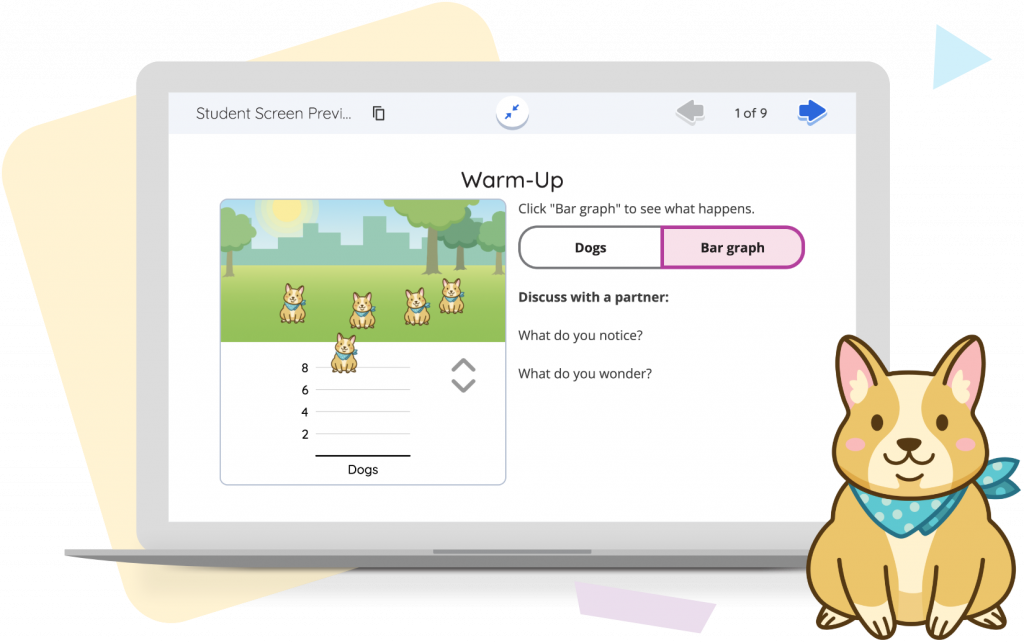
Qué incluye
Aprovechamos los alcances tecnológicos y las lecciones de Desmos y añadimos simples pero fascinantes componentes impresos y digitales para crear un programa sin precedentes que simplifica la enseñanza.
- Edición para estudiantes (varios volúmenes)
- Páginas de actividades interactivas para el estudiante
- Interacciones enriquecidas (más información en la página 5)
- Herramientas de colaboración
- Práctica personalizada
- Edición para maestros (varios volúmenes)
- Herramientas de facilitación y seguimiento del progreso
- Páginas de presentación
- Apoyos pedagógicos
- Evaluación
- Prácticas adicionales y material fotocopiable en blanco y negro para evaluaciones
Manténgase al día con las últimas novedades sobre Amplify Desmos Math y Desmos Classroom.
Las lecciones digitales deben potenciar el razonamiento de los estudiantes y generar debates interesantes y productivos. Regístrese para obtener más información sobre cómo Amplify Desmos Math y Desmos Classroom incitan a los estudiantes a interesarse por las matemáticas.
¡El Math Teacher Lounge está disponible!
Amplify presenta Math Teacher Lounge, un podcast con los presentadores Bethany Lockhart Johnson y Dan Meyer.

What’s included in our literacy curriculum for 6–8
Amplify ELA is a blended literacy curriculum designed specifically for grades 6–8. The heart of every lesson is the text. Our core English Language Arts curriculum enables teachers to teach skills through texts and develop their students’ muscles for building meaning through reading. With Amplify ELA, students learn to attack any complex text and make observations, grapple with interesting ideas, and find relevance for themselves.
Year at a glance
Each grade includes six core units centered on literary or informational texts, delivered in several forms of media. In addition to these main units, students will engage with targeted Grammar lessons and a dedicated Story Writing unit, plus two to three immersive learning experiences called Quests.
Grade 6 core units

Dahl & Narrative
1 assessment lesson
4 sub-units | 28 lessons | 4-6 weeks

Mysteries & Investigations
1 assessment lesson
5 sub-units | 32 lessons | 4-6 weeks

The Chocolate Collection
1 assessment lesson
5 sub-units | 25 lessons | 4-6 weeks
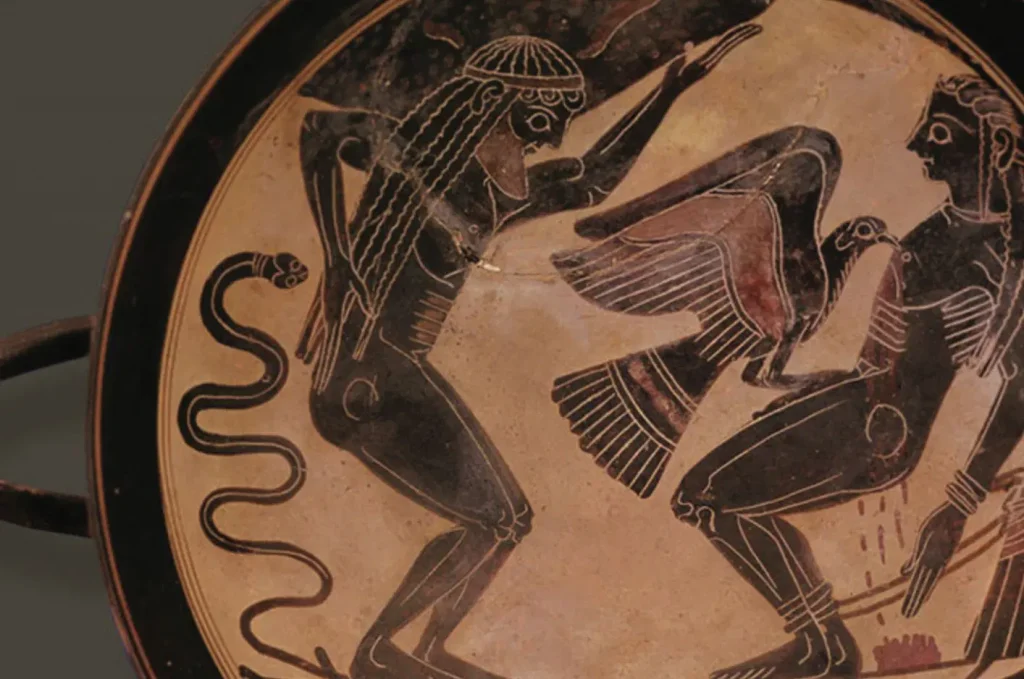
The Greeks
Myth World Quest
1 assessment lesson
4 sub-units | 25 lessons | 4-6 weeks

Summer of the Mariposas
1 assessment lesson
2 sub-units | 27 lessons | 4-6 weeks

The Titanic Collection
1 assessment lesson
5 sub-units | 25 lessons | 4-6 weeks
Grade 7 core units

Red Scarf Girl
1 assessment lesson
4 sub-units | 31 lessons | 4-6 weeks

Character & Conflict
1 assessment lesson
4 sub-units | 29 lessons | 4-6 weeks

Brain Science
Perception Academy Quest
1 assessment lesson
4 sub-units | 25 lessons | 4-6 weeks
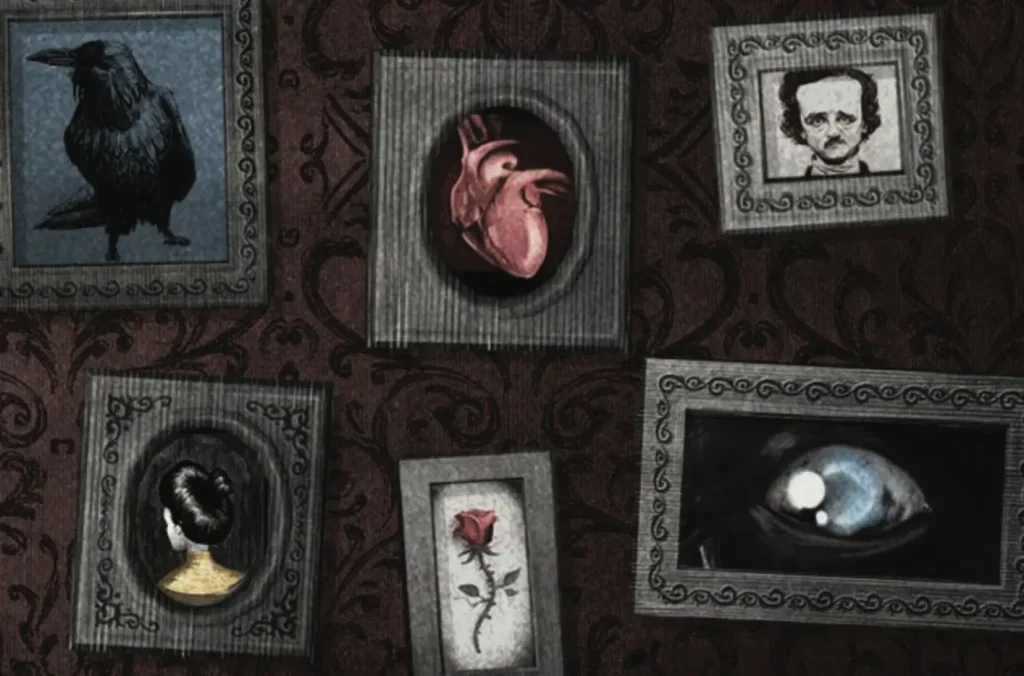
Poetry & Poe
The “Who Killed Edgar Allen Poe” Quest
1 assessment lesson
5 sub-units | 29 lessons | 4-6 weeks

The Frida & Diego Collection
1 assessment lesson
5 sub-units | 25 lessons | 4-6 weeks
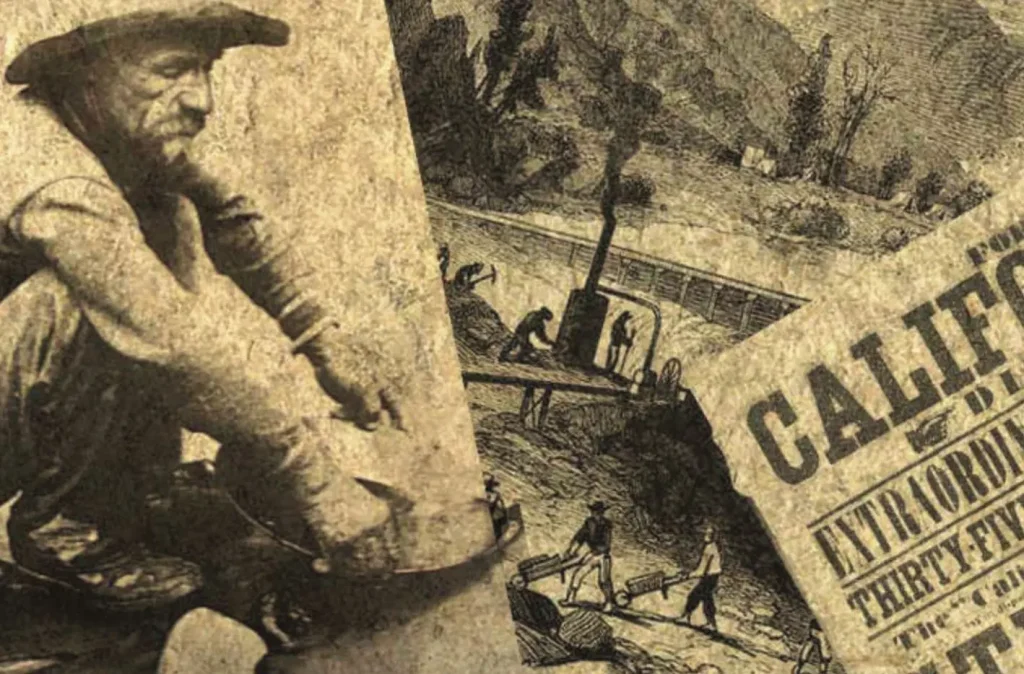
The Gold Rush Collection
1 assessment lesson
5 sub-units | 25 lessons | 4-6 weeks
Grade 8 core units

Perspectives & Narrative
1 assessment lesson
4 sub-units | 27 lessons | 4-6 weeks

Liberty & Equality
1 assessment lesson
6 sub-units | 38 lessons | 4-6 weeks
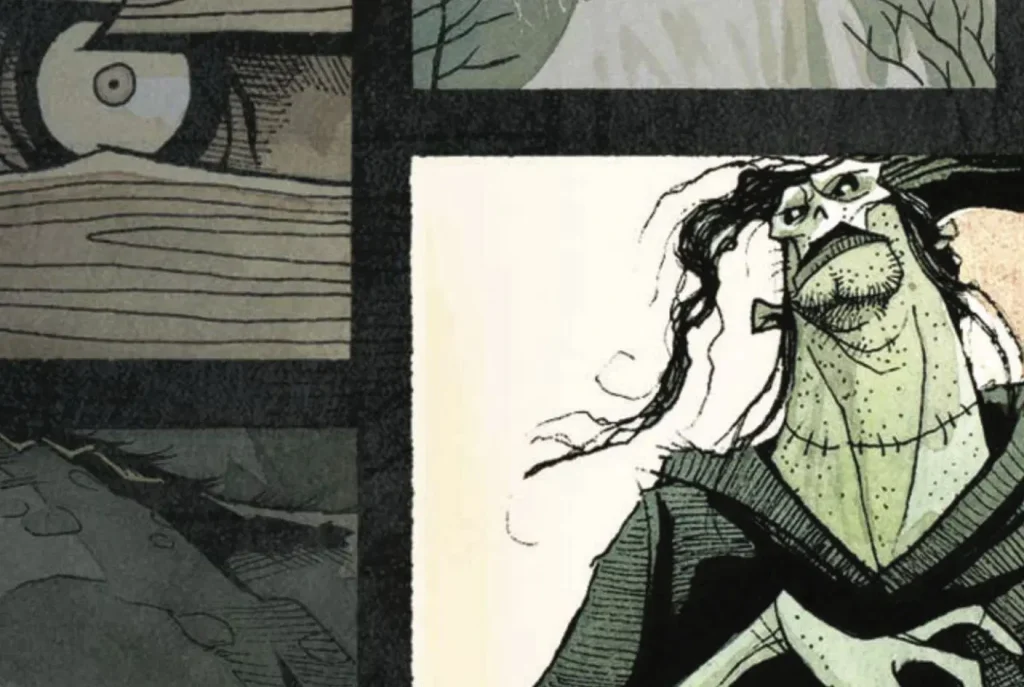
Science & Science Fiction
1 assessment lesson
3 sub-units | 29 lessons | 4-6 weeks
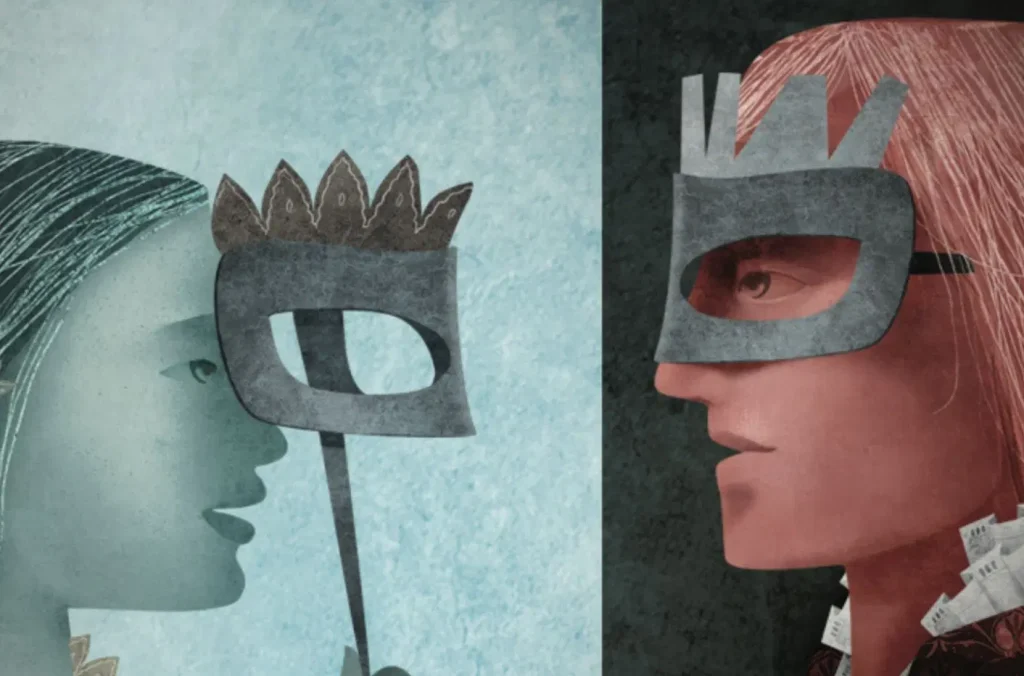
Shakespeare’s Romeo & Juliet
1 assessment lesson
2 sub-units | 22 lessons | 4-6 weeks

The Holocaust: Memory & Meeting
1 assessment lesson
6 sub-units | 21 lessons | 4-6 weeks

The Space Race Collection
1 assessment lesson
5 sub-units | 25 lessons | 4-6 weeks
Units at a glance
Amplify ELA lessons follow a structure both grounded in regular routines and flexible enough to allow for a variety of learning experiences. Lesson structures vary from day to day, ensuring that students are always engaged.
Learn more in the Amplify ELA Grade Overview.
Unit 6A
Dahl & Narrative
Students begin with narrative writing to develop foundational Focus skills and establish key classroom routines. Teachers use this work to create targeted feedback cycles and build a vibrant community centered on diverse experiences. Students then apply observational skills to Roald Dahl’s Boy: Tales of Childhood, learning to work closely with textual evidence.
Unit 6B
Mysteries & Investigations
Students read like an investigator to embark on a multi-genre study into the mesmerizing world of scientific and investigative sleuthing. The Secret of the Yellow Death: A True Story of Medical Sleuthing by Suzanne Jurmain, and Sir Arthur Conan Doyle’s Sherlock Holmes stories take place in the late 19th century, when medical diagnostics and criminal investigations were still evolving into scientific fields.
Unit 6C
The Chocolate Collection
Students explore primary documents and research the diverse cultural roles chocolate has played over 3,700 years, from its various uses in ancient Mexico to issues with modern production. Along the way, they build information literacy skills, craft research questions, and collaborate in Socratic seminars. Students also learn how to construct an evidence-based argument and use those skills to write pieces aimed at convincing readers about chocolate preferences, school lunch policies, and recommendations for local candy stores.
Unit 6D
The Greeks
Students closely explore and analyze three stories from Greek mythology: “Prometheus,” “Odysseus,” and “Arachne.” Drawing on the routines and skills established in previous units, these lessons ask students to move from considering the state of a single person to contemplating broader questions concerning the role people play in the world and the various communities they inhabit.
Unit 6E
Summer of the Mariposas
Students read Summer of the Mariposas by Guadalupe García McCall, a contemporary Latino retelling of The Odyssey. Following five sisters on their journey into Mexico and back, students explore this reimagining of the hero’s journey as they encounter Mexican folklore and Aztec legends along the way. Students analyze character development, compare the novel to Homer’s original, research Aztec mythology, explore symbolism, and engage in collaborative discussions before writing an essay about what makes the heroes successful.
Unit 6F
The Titanic Collection
Students explore primary documents and conduct research to understand the 1912 Titanic disaster, building information literacy skills by examining artifacts such as dining menus, ship photos, telegraph transcripts, and newspaper accounts. Each student is assigned a passenger from the manifest and writes a narrative account from that person’s perspective, considering different views. Students also participate in Socratic seminars to examine the complicated issues within the Titanic story.

Unit 7A
Red Scarf Girl & Narrative
Students begin with narrative writing to develop foundational Focus skills while teachers establish targeted feedback cycles and build a classroom community centered on diverse experiences. After exploring how they describe their own experiences and emotions, students apply the same close attention to analyzing details in Ji-li Jiang’s Red Scarf Girl: A Memoir of the Cultural Revolution.
Unit 7B
Character & Conflict
Students analyze characters’ responses to conflict and examine how authors use character interactions to develop theme and perspective. They read Carson McCullers’ “Sucker” and Lorraine Hansberry’s A Raisin in the Sun, both texts that explore how families facing hardships can support and harm one another. Students observe complex character growth and discuss issues of identity, family obligations, and differing notions of success.
Unit 7C
Brain Science
Students explore narrative nonfiction and informational texts about brain science to understand what it means to be human and how their developing brains impact daily experiences. They also build awareness of their cognitive strengths and analyze the structures of informational texts and scientific arguments. Key texts include Phineas Gage, Inventing Ourselves: The Secret Life of the Teenage Brain, and Oliver Sacks’ The Man Who Mistook His Wife for a Hat.
Unit 7D
Poetry & Poe
Students learn visualization techniques to read like a movie director, beginning with poems by D.H. Lawrence, Federico García Lorca, and Emily Dickinson to form mental images. They then read three Edgar Allan Poe texts, creating storyboards and analyzing narrative elements to learn about unreliable narrators. Students also participate in the murder-mystery Quest “Who Killed Edgar Allan Poe?” and write an essay arguing whether they can trust a narrator in the unit’s texts.
Unit 7E
The Frida & Diego Collection
Students explore primary source documents and research on Mexican artists Diego Rivera and Frida Kahlo, learning how they drew inspiration from Latin American folklore, politics, and customs. Along the way, students build information literacy by generating research questions and visual analysis skills through close reading of key paintings. They also compare the artists’ descriptive writing to Shakespeare’s and analyze figurative language. The unit culminates in a research project showcasing their interpretation of Frida and Diego’s work and legacy.
Unit 7F
The Gold Rush Collection
Students explore primary documents and conduct research on the California Gold Rush, building information literacy skills and constructing research questions. They also learn about the diverse people who participated, compare fictional and historical accounts, and participate in Socratic seminars. Students write narrative accounts from specific perspectives and complete a culminating research assignment combining essay and media project elements.
Unit 8A
Perspectives & Narrative
Students learn to read like writers, paying attention to craft and writing moves that shape reader experience and developing Focus and Showing skills as they build collaborative classroom routines. Students study three narrative texts, exploring themes of belonging and identity through close reading. They also practice alternating between analytic and narrative writing, and conclude with an essay arguing whether the mothers in Amy Tan’s “Fish Cheeks” are role models.
Unit 8B
Liberty & Equality
Students study Civil War-era writings that debate the meaning of “all men are created equal,” exploring various perspectives on American ideals. Key texts include Walt Whitman’s Leaves of Grass, Frederick Douglass’ Narrative, and Harriet Ann Jacobs’s Incidents in the Life of a Slave Girl. The unit culminates with an essay examining Douglass’s arguments and Lincoln’s Gettysburg Address to consider what America means by “all men are created equal.”
Unit 8C
Science & Science Fiction
Students read Gris Grimly’s Frankenstein, a graphic novel adaptation of Mary Shelley’s novel, exploring themes of creator responsibility, societal influence, and the risks of scientific inquiry. They trace Victor’s sympathy for his creation, rewrite scenes from the creature’s perspective, and debate whether Victor owes the creature a companion. The unit concludes with an essay determining whether the creature should be considered human.
Unit 8D
Shakespeare’s Romeo & Juliet
Students read five excerpts from Shakespeare’s Romeo and Juliet to learn key elements of Shakespearean English through close reading. They practice memorizing and reciting the famous “Prologue,” put on stage performances, translate Shakespeare’s language into contemporary terms, and study the Shakespearean sonnet form. The unit concludes with an essay arguing whether love or hate is responsible for Romeo’s death.
Unit 8E
Holocaust: Memory & Meaning
Students use close reading to explore memoirs and primary sources that address two key Holocaust questions: How do societies become participants in atrocity, and what are our responsibilities as witnesses? Students analyze multiple perspectives through texts, including Alexander Kimel’s “I Cannot Forget,” Irene Butter’s Shores Beyond Shores, 1936 Olympics propaganda, and excerpts from Maus and Night.
Unit 8F
The Space Race Collection
Students explore primary documents and conduct research on the Space Race. They build information literacy skills, construct research questions, and learn about diverse participants from Soviet cosmonauts to American heroes like Buzz Aldrin and Katherine Johnson. Each student researches an assigned cosmonaut or astronaut and writes space blog entries from their perspective. Students also complete a capstone research essay and media project.
Print & digital components
The program includes instructional guidance and student materials for a year of instruction, with lessons and activities that keep students engaged every day.

Teacher materials
Teacher Edition
Available digitally and in print, the Teacher’s Edition contains all the information teachers need to facilitate classroom instruction, including detailed lesson plans, video teacher tips, presentation slides, standards alignment, Exit Tickets, real-time differentiation strategies, and robust reporting.
Student materials
Student Edition
Available digitally and in print, student materials guide middle schoolers through complex texts and writing by engaging them with high-quality narrative and informational texts—providing videos, audio supports, and a digital experience that captures their attention. They also keep all of their writing in one place with a personal Writing Journal.

Explore more programs
Our programs are designed to support and complement one another. Learn more about our related programs.
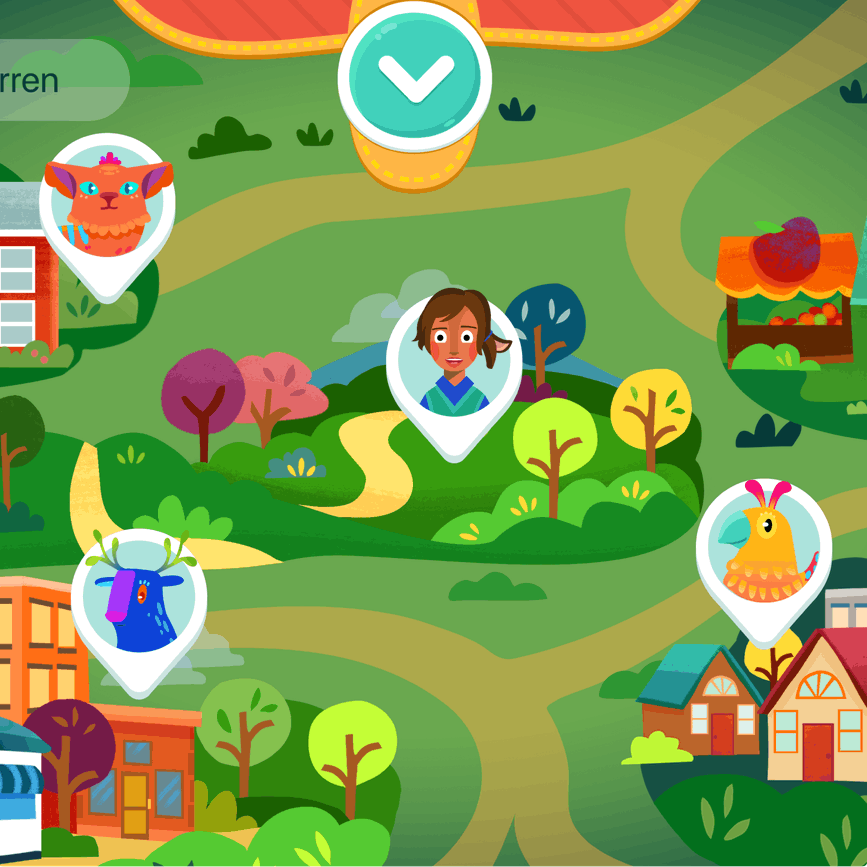

Familias y cuidadores, ¡les damos la bienvenida a Amplify Desmos Math New York para los grados K–5!
Esta es la versión inicial de Amplify Desmos Math Caregiver Hub de Amplify New York.
Les damos la bienvenida a Amplify Desmos Math Caregiver Hub de Amplify New York, para los grados de kindergarten a 5.º. ¡Nos entusiasma que la escuela de su estudiante haya elegido nuestro programa! Hemos diseñado este espacio para ayudarle a incentivar en su estudiante el aprendizaje de las matemáticas este año. El esfuerzo que usted realice cumple un rol fundamental en la experiencia que el estudiante tenga con las matemáticas.
Esperamos que el estudiante disfrute de explorar las matemáticas usando la tecnología a su disposición, tanto como colaborar con amigos para resolver problemas y aprender todo tipo de conceptos nuevos e interesantes. ¡Y esperamos que a usted le encante acompañarlo en esta experiencia!
Reciban un afectuoso saludo, con mucho entusiasmo por este aprendizaje conjunto.
—El equipo de Amplify Desmos Math
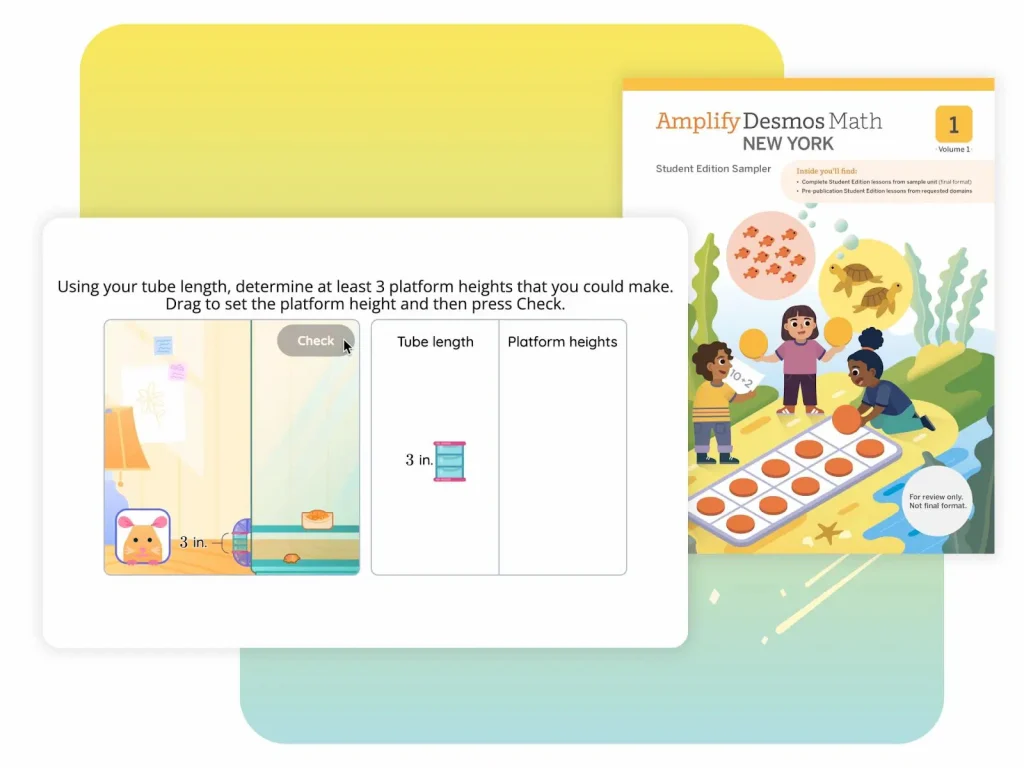
Presentación de Amplify Desmos Math
Amplify Desmos Math es un plan de estudios básico de matemáticas, diseñado para estudiantes de kindergarten a 5.º grado. Desarrollamos el programa con la idea de que todo método estructurado de aprendizaje que se centra en la resolución de problemas debe tomar como base la curiosidad de los estudiantes para poder desarrollar conocimientos perdurables al nivel que corresponde en cada grado. Cada lección ofrece oportunidades de desarrollar los conocimientos de los estudiantes, conectar sus ideas, mejorar su dominio de las destrezas y darles la autonomía de plantear preguntas, explorar y hacer descubrimientos.
Amplify Desmos Math utiliza un método de enseñanza centrado en el estudiante, el cual ha demostrado mejorar significativamente el aprendizaje de las matemáticas. Nuestra misión es que su estudiante aprenda matemáticas ¡y que le encante aprenderlas!
En cada lección, el plan de estudios de Amplify Desmos Math plantea problemas entretenidos y relevantes que solucionar, dando diariamente a los estudiantes oportunidades para pensar críticamente, colaborar y participar activamente en su propio aprendizaje.
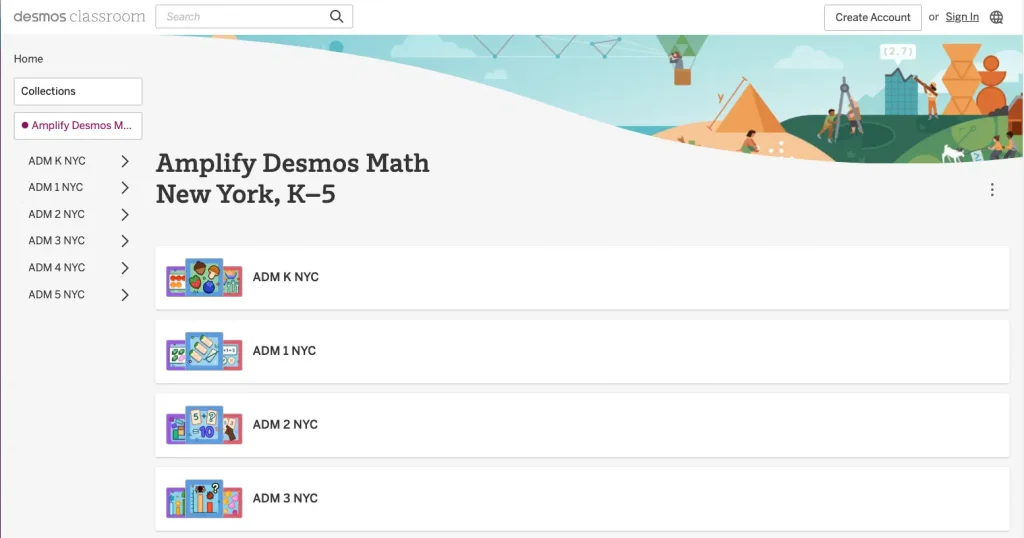
Sobre la enseñanza de las matemáticas centrada en el estudiante
La enseñanza centrada en el estudiante puede parecer distinta a las formas de aprender matemáticas del pasado y a la manera en que usted aprendió matemáticas. En lugar de memorizar fórmulas y trucos, el aprendizaje centrado en el estudiante se enfoca en ofrecer oportunidades para descubrir cómo funcionan las matemáticas. Las investigaciones revelan que tanto estudiantes como maestros prefieren este método, además de que los maestros informan que la enseñanza centrada en el estudiante ha ayudado a los suyos a aprender más matemáticas.

Esta forma de aprendizaje ayuda a los estudiantes a:
- Comprender cómo funcionan los conceptos matemáticos.
- Recordar lo que aprenden en clase y aplicar sus conocimientos a situaciones nuevas.
- Obtener mejores resultados en exámenes estandarizados y tener mejores calificaciones que los estudiantes que aprenden con otros métodos.
- Aprender a comunicarse tanto por escrito como verbalmente, comprender y replicar las opiniones de los demás y adquirir confianza para resolver nuevos problemas.
- Desarrollar habilidades clave para la vida, por ejemplo, aprovechar la tecnología, completar proyectos de forma individual y en grupo y perseverar ante problemas difíciles.
¿Qué materiales utilizan los estudiantes?
Amplify Desmos Math promueve el aprendizaje por medio de materiales impresos de apoyo combinados con experiencias digitales singulares. Todas las lecciones de Amplify Desmos Math K-5 están disponibles en un libro de Edición del estudiante que usan para escribir. Muchas de las lecciones están diseñadas para incluir actividades prácticas que incorporan materiales manipulables, y una cierta cantidad de lecciones se diseñó para que los estudiantes usen dispositivos digitales como computadoras portátiles o tabletas, en función de sus edades. Dichas lecciones incluyen experiencias digitales enriquecidas que se recomienda que los maestros asignen a sus estudiantes.

He aquí algunas características que puede esperar de Amplify Desmos Math para su estudiante:
- Lecciones que impulsan el debate en el aula para que los estudiantes puedan colaborar y así, lograr un aprendizaje conjunto y experimentar un sentido de comunidad.
- Feedback receptivo que interpreta las respuestas de los estudiantes en el contexto apropiado y fomenta la perseverancia y la rectificación.
- Planes de clase fáciles de seguir, probados en aulas de todo el país, con sugerencias y estrategias didácticas claras y rutinas de lenguaje matemático.
- Problemas de práctica para lograr dominio y ayudar a los estudiantes a repasar temas anteriores.
- Sugerencias de diferenciación para que los maestros puedan cubrir las necesidades de estudiantes diversos.
- Evaluaciones formativas que proporcionan información sobre la comprensión de cada estudiante y permiten hacer ajustes a la enseñanza para atender las necesidades de toda la clase.
- Evaluaciones sumativas que ayudan a los maestros a comprender qué saben los estudiantes sobre los contenidos matemáticos que han estudiado.
- Evaluaciones diarias en cada lección, con las cuales los maestros pueden verificar constantemente la comprensión. Un recurso para cuidadores en cada unidad, el cual incluye explicaciones de conceptos matemáticos clave y problemas para resolver con el estudiante.
Cuando los estudiantes utilizan dispositivos, los maestros pueden supervisar su trabajo en tiempo real para asegurarse de que cuentan con el apoyo que necesitan en cada sección de la lección, tanto dentro como fuera del aula. Aquí le presentamos un ejemplo de lo que un maestro ve en su panel de control para ayudarle a supervisar los razonamientos y estimular el aprendizaje de los estudiantes.

Los estudiantes también pueden acceder a su trabajo digital en casa. He aquí un artículo sobre cómo navegar por la página de inicio para estudiantes.
¿Cómo es una lección?
En una clase de Amplify Desmos Math, se puede ver (¡y oír!) a los estudiantes al hacer preguntas, debatir respuestas, justificar sus razonamientos, resolver problemas y trabajar juntos o de forma individual.

Esto es lo que normalmente incluye una lección de Amplify Desmos Math:
- Calentamiento: Un problema breve e interesante para que los estudiantes se sientan atraídos por la lección.
- Actividades: Una o dos actividades cortas que desafían las habilidades de los estudiantes para resolver problemas.
- Síntesis: Un debate que repasa y reúne los conceptos importantes de la lección.
- Demuestra lo que sabes y Reflexión: Preguntas para que los estudiantes demuestren lo que aprendieron en la lección. (Nota: La evaluación “Demuestra lo que sabes” se imparte a criterio del maestro en kindergarten y 1.er grado).
- Centros: Estaciones de actividades dirigidas por los estudiantes, las cuales refuerzan los conceptos matemáticos que se aprendieron durante las actividades de la lección a través de formatos interactivos, usualmente similares a juegos. En kindergarten y 1.er grado, el tiempo destinado a los Centros se incorpora a los últimos 15 minutos de cada lección.
Este es el material disponible al término de la lección para apoyar, consolidar y ampliar el aprendizaje de los estudiantes:
- Diferenciación: Minilecciones, Centros, actividades complementarias, aprendizaje personalizado y práctica de dominio.
- Práctica: Problemas adicionales que el maestro puede asignar como trabajo en clase o tareas para casa.
¿Cómo pueden los cuidadores incentivar el aprendizaje de las matemáticas en casa?
Utilice nuestros Recursos de apoyo de la unidad para cuidadores
Hemos agregado un recurso para cuidadores a cada unidad del programa, el cual proporciona un resumen de los conceptos clave, junto con un problema extraído del conjunto de ejercicios de práctica de la lección para que lo resuelva junto con el estudiante.
En cada uno de los enlaces de los grados académicos a continuación, encontrará un documento con los recursos para cuidadores correspondientes a cada unidad, tanto en inglés como en español.
1.er grado
Unidad 1: Sumar, restar y trabajar con datos
English
Spanish
3.er grado
Unidad 1: Introducción a la multiplicación
English
Spanish
5.º grado
Unidad 1: Volumen
English
Spanish
Repasen juntos los problemas de práctica
El maestro puede asignar problemas de práctica al final de cada lección, como trabajo en clase o como tarea. Si el estudiante ya ha completado los problemas de práctica de la lección, pídale que le explique cómo resolvió cada problema o que le hable sobre las partes que le resultaron más difíciles.
Haga preguntas de seguimiento al estudiante para fomentar el uso del vocabulario matemático al explicar sus razonamientos, por ejemplo, “¿cómo lo sabes?”, “¿cómo puedes mostrar tu razonamiento?” o “¿cómo describirías eso?”.
Si el estudiante no consigue avanzar, hágale preguntas de apoyo, por ejemplo, “¿qué información de aquí conoces?” o “¿cómo podrías representar este problema?”.
Recuerde que es válido bloquearse
Haga hincapié en que bloquearse forma parte del proceso de aprendizaje e incluso es fundamental. Muchos estudiantes (¡al igual que adultos!) temen equivocarse. Sin embargo, las investigaciones demuestran que cometer errores ayuda a que el cerebro se desarrolle mejor. Cuando el estudiante no logre avanzar en un problema, anímelo a probar distintas estrategias, aunque no tenga certeza de si son correctas.
Descubran las matemáticas en la vida cotidiana
Relacionen las matemáticas con las actividades cotidianas del hogar, ya sea al ir de compras, preparar una comida o planificar una visita a una tienda. El estudiante puede ayudarle a calcular cuántas manzanas más que naranjas hay en el carrito; puede mostrarle cómo dividir un sándwich en cuartos o calcular cuánto cambio recibirán de un billete de diez dólares. Anime al estudiante a mencionar de qué forma la familia utiliza las matemáticas en sus tareas diarias.
Lea el Cuento de la unidad con el estudiante
Cada unidad de Amplify Desmos Math K–5 comienza con un cuento leído en voz alta que captura el interés de los estudiantes y contextualiza los conceptos matemáticos de la unidad. Los elementos y personajes del Cuento de la unidad aparecen en las lecciones de toda la unidad.
- Cuento de la Unidad 2 de kindergarten
- Cuento de la Unidad 1 de 1.er grado
- Cuento de la Unidad 1 de 2.º grado
- Cuento de la Unidad 1 de 3.er grado
- Cuento de la Unidad 1 de 4.º grado
- Cuento de la Unidad 1 de 5.º grado
Acceda a nuestra colección de lecciones y actividades gratuitas para K–5
Explore nuestros contenidos gratuitos más recientes para estudiantes de kindergarten a 5.º grado en nuestra colección de destacados de Desmos Classroom. En nuestra colección gratuita, puede acceder a:
- Lecciones digitales: interesantes lecciones interactivas.
- Minilecciones: una mezcla de actividades impresas y digitales, diseñadas para la enseñanza a grupos pequeños.
- Rutinas matemáticas: actividades digitales breves para iniciar la enseñanza y fomentar los diálogos matemáticos.
- Momentos matemáticos manejables: actividades digitales de práctica que utilizan materiales manipulables virtuales de Polypad, que por su diseño, pueden usarse de forma flexible.
Haga clic aquí para acceder a la colección e inscribirse gratuitamente.
¿Cómo accede la familia al programa desde casa?
El estudiante tendrá acceso a los materiales de aprendizaje, práctica y evaluación a través de la plataforma de Amplify. El estudiante puede acceder al plan de estudios digital en la escuela y en casa siguiendo estas sencillas instrucciones.
- Haga clic en el botón de color naranja Login to Amplify Desmos Math a continuación.
- Seleccione Log in with Amplify.
- Introduzca el nombre de usuario y la contraseña del estudiante que el maestro proporcionó.
- Seleccione el grado del estudiante.
Families and caregivers, welcome to Amplify Desmos Math K–5!
Welcome to the Amplify Desmos Math K–5 Caregiver Hub. We hope your student enjoys exploring math, working with friends to solve problems, and learning new and interesting concepts. And we hope you enjoy the math journey with them! Below are some suggestions and resources for how you can support their learning at home.
Learn more about Amplify Desmos Math.
Para la versión en español, haga clic aquí.

Caregiver Unit Resources
For every unit of the program, we’ve created a Caregiver Resource that provides a summary of key concepts, plus a problem from the lesson practice set you can work through with your student. You’ll find a Caregiver Resource for each unit, in both English and Spanish.
Unit 1: Math in Our World
Unit 2: Numbers 1–10
Unit 3: Flat Shapes All Around Us
Unit 4: Understanding Addition and Subtraction
Unit 5: Make and Break Apart Numbers Within 10
Unit 6: Numbers 0–20
Unit 7: Solid Shapes All Around Us
Unit 1: Adding, Subtracting, and Working With Data
Unit 2: Addition and Subtraction Story Problems
Unit 3: Adding and Subtracting Within 20
Unit 4: Numbers to 99
Unit 5: Adding Within 100
Unit 6: Measuring Lengths of Up to 120 Length Units
Unit 7: Geometry and Time
Unit 1: Working With Data and Solving Comparison Problems
Unit 2: Adding and Subtracting Within 100
Unit 3: Measuring Length
Unit 4: Addition and Subtraction on the Number Line
Unit 5: Numbers to 1,000
Unit 6: Geometry and Time
Unit 7: Adding and Subtracting Within 1,000
Unit 8: Equal Groups
Unit 1: Introducing Multiplication
Unit 2: Area and Multiplication
Unit 3: Wrapping Up Addition and Subtraction Within 1,000
Unit 4: Relating Multiplication to Division
Unit 5: Fractions as Numbers
Unit 6: Measuring Length, Time, Liquid Volume, and Weight
Unit 7: Two-Dimensional Shapes and Perimeter
Unit 1: Factors and Multiples
Unit 2: Fraction Equivalence and Comparison
Unit 3: Extending Operations to Fractions
Unit 4: From Hundredths to Hundred Thousands
Unit 5: Multiplicative Comparison and Measurement
Unit 6: Multiplying and Dividing Multi-Digit Numbers
Unit 7: Angles and Properties of Shapes
Unit 1: Volume
Unit 2: Fractions as Quotients and Fraction Multiplication
Unit 3: Multiplying and Dividing Fractions
Unit 4: Multiplication and Division With Multi-Digit Whole Numbers
Unit 5: Place Value Patterns and Decimal Operations
Unit 6: More Decimal and Fraction Operations
Unit 7: Shapes on the Coordinate Plane
Unit refresh videos
Unit 1
- Sub-Unit 2 – Answering the Question “Are There Enough?”
- Sub-Unit 3 – Counting and Cardinality
Unit 2
- Sub-Unit 1 – Comparing 2 Groups Using the Terms More, Fewer, and Same
- Sub-Unit 2 – Counting Objects in Different Orders
- Sub-Unit 3 – Making Groups to Represent Numerals
- Sub-Unit 4 – Comparing Written Numbers
Unit 3
- Sub-Unit 1 – Identifying Circles and Triangles in Different Sizes and Orientations
- Sub-Unit 2 – Using Positional Words to Describe the Location of Shapes
Unit 4
- Sub-Unit 1 – Adding and Subtracting Within 10
- Sub-Unit 2 – Representing Addition and Subtraction Story Problems
- Sub-Unit 3 – Finding the Values of Expressions
Unit 5
- Sub-Unit 1 – Decomposing Numbers in More Than 1 Way
- Sub-Unit 2 – Solving for Both Parts
- Sub-Unit 3 – Breaking Apart 10
Unit 1
- Sub-Unit 1 – Organizing Data to Count How Many in Each Category
- Sub-Unit 2 – Counting on to Add and Counting Back to Subtract
- Sub-Unit 3 – Representing 2 Categories of Data With Addition Equations
Unit 2
- Sub-Unit 1 – Representing and Solving Add To, Change Unknown Story Problems
- Sub-Unit 2 – Using Addition or Subtraction to Find an Unknown Part of a Total Amount
- Sub-Unit 3 – Solving Compare, Difference Unknown Problems
- Sub-Unit 4 – Making Sense of Story Problems With Different Questions
Unit 3
- Sub-Unit 1 – Finding a Difference Using the Relationship Between Addition and Subtraction
- Sub-Unit 2 – Using the Structure of Teen Numbers to Find Missing Addends
- Sub-Unit 3 – Breaking Apart Addends to Make 10 When Adding
- Sub-Unit 4 – Subtracting From Teen Numbers in Parts to Get to 10
Unit 4
- Sub-Unit 1 – Adding a Ten To and Subtracting a Ten From Multiples of 10
- Sub-Unit 2 – Representing and Writing Two-Digit Numbers
- Sub-Unit 3 – Comparing Two-Digit Numbers
- Sub-Unit 4 – Representing the Same Two-Digit Number With Different Amounts of Tens and Ones
Unit 5
- Sub-Unit 1 – Adding a Number of Tens or Ones to a Two-Digit Number
- Sub-Unit 2 – Adding a Two-Digit Number and a One-Digit Number When Composing a Ten is Necessary
- Sub-Unit 3 – Adding a Two-Digit Number and a Two-Digit Number When Composing a Ten is Necessary
Unit 1
- Sub-Unit 1 – Choosing Strategies to Add Within 20
- Sub-Unit 2 – Representing Data in a Picture Graph and Bar Graph
- Sub-Unit 3 – Finding the Difference Between 2 Categories Shown on a Bar Graph
Unit 2
- Sub-Unit 1 – Strategies to Solve Story Problems Involving Money
- Sub-Unit 2 – Decomposing a Ten When Subtracting by Place
- Sub-Unit 3 – Making Sense of Story Problems About Comparing That Use the Word More
- Sub-Unit 4 – Making Sense of One- and Two-Step Story Problems
Unit 3
- Sub-Unit 1 – Measuring the Length of an Object in Centimeters Using a Ruler
- Sub-Unit 2 – Measuring Objects in Inches and Feet
- Sub-Unit 3 – Representing Measurement Data on a Line Plot
Unit 4
- Sub-Unit 1 – Locating Numbers on Number Lines
- Sub-Unit 2 – Representing Addition and Subtraction Strategies on a Number Line
Unit 5
- Sub-Unit 1 – Composing Hundreds to Represent Three-Digit Numbers
- Sub-Unit 2 – Comparing Three-Digit Numbers
Unit 1
- Sub-Unit 1 – Representing Equal-Groups Situations With Equal-Groups Drawings
- Sub-Unit 2 – Representing Arrays With Multiplication Equations
- Sub-Unit 3 – Representing Data Using Scaled Bar Graphs
Unit 2
- Sub-Unit 1 – Determining the Area of a Rectangle Using Counting and Skip Counting
- Sub-Unit 2 – Determining the Area of a Rectangle Using Multiplication
- Sub-Unit 3 – Decomposing to Determine the Area of Rectilinear Figures
Unit 3
- Sub-Unit 1 – Using the Expanded Form and Partial Sums Algorithms to Add
- Sub-Unit 2 – Using the Expanded Form Algorithm to Subtract
- Sub-Unit 3 – Rounding Numbers to the Nearest Hundred and Ten Using Number Lines
- Sub-Unit 4 – Representing and Solving Two-Step Story Problems Involving Multiplication
Unit 4
- Sub-Unit 1 – Representing Division Situations With Equal-Groups Drawings
- Sub-Unit 2 – Representing an Equal-Groups Problem With a Division and Multiplication Equation
- Sub-Unit 3 – Using the Distributive Property of Multiplication to Multiply a One-Digit Number by a Teen Number
- Sub-Unit 4 – Decomposing Dividends to Divide
Unit 5
- Sub-Unit 1 – Writing Unit and Non-Unit Fractions
- Sub-Unit 2 – Locating Non-Unit Fractions on the Number Line
- Sub-Unit 3 – Identifying Equivalent Fractions
- Sub-Unit 4 – Comparing Fractions With the Same Denominator or Same Numerator
Unit 1
- Sub-Unit 1 – Using Factor Pairs to Determine All the Possible Side Lengths of a Rectangle With a Given Area
- Sub-Unit 2 – Finding Multiples and Common Multiples
Unit 2
- Sub-Unit 1 – Locating Fractions with Different Denominators On the Same Number Line
- Sub-Unit 2 – Using Multiples or Factors to Determine Equivalent Fractions
- Sub-Unit 3 – Comparing Fractions Using Equivalent Fractions With Common Denominators
Unit 3
- Sub-Unit 1 – Adding and Subtracting Fractions with the Same Denominator
- Sub-Unit 2 – Multiplying Whole Numbers and Fractions
- Sub-Unit 3 – Adding Fractions with Denominators of 10 and 100
Unit 4
- Sub-Unit 1 – Writing Fractions With Denominators of 10 and 100 as Decimals
- Sub-Unit 2 – Relationships Between Place Values in Multi-Digit Whole Numbers
- Sub-Unit 3 – Comparing Multi-Digit Numbers
- Sub-Unit 4 – Using the Standard Algorithm to Subtract When Decomposing is Required
Unit 5
- Sub-Unit 1 – Representing Multiplicative Comparison Situations
- Sub-Unit 2 – Converting Measurements in the Metric System
- Sub-Unit 3 – Comparing Measurements
Unit 1
- Sub-Unit 1 – Using the Layered Structure of a Rectangular Prism to Determine the Volume
- Sub-Unit 2 – Determining the Volume of a Rectangular Prism
- Sub-Unit 3 – Determining the Volume of Figures Composed of Rectangular Prisms
Unit 2
- Sub-Unit 1 – Representing Equal-Sharing Story Problems with Fractional Quotients
- Sub-Unit 2 – Representing Fractions with Equivalent Multiplication and Division Expressions
- Sub-Unit 3 – Determining the Area of a Rectangle With a Fractional Side Length
Unit 3
- Sub-Unit 1 – Representing Multiplication of 2 Unit Fractions with Diagrams
- Sub-Unit 2 – Dividing Whole Numbers by Unit Fractions
Unit 4
- Sub-Unit 1 – Multiplying Multi-digit Whole Numbers Using the Partial Products and Standard Algorithms
- Sub-Unit 2 – Dividing Multi-Digit Whole Numbers Using Partial Quotients
- Sub-Unit 3 – Representing Multi-Step Story Problems with Equations
Unit 5
- Sub-Unit 1 – Comparing Decimals
- Sub-Unit 2 – Using the Standard Algorithms to Add and Subtract Decimals
- Sub-Unit 3 – Multiplying a Whole Number and a Decimal Using the Distributive Property
- Sub-Unit 4 – Dividing Whole Numbers by Decimals Less Than 1
Access Amplify Desmos Math at home.
In addition to a print Student Edition workbook, your student will have digital access to all learning, practice, and assessment materials through the Amplify platform. The digital curriculum can be accessed in school and at home by following these instructions:
- Click the Amplify Desmos Math button.
- Select Log in with Amplify.
- Enter your student’s username and password provided by your student’s teacher.
- Select the desired grade level.
Once logged in, caregivers can view student work by opening previous assignments.
Learn how to navigate the student home page.
Materials overview
Amplify Desmos Math supports blended learning with supporting print materials and a unique digital experience. All K–5 lessons are available in a write-in Student Edition book. Many of the lessons include hands-on activities with manipulatives, tools that help students understand abstract concepts by making them tangible. Your student will also work with digital devices for an age-appropriate number of lessons.
When students use devices, teachers can monitor their work in real time, making sure they get the exact support that they need at every part of the lesson, in and outside of class.
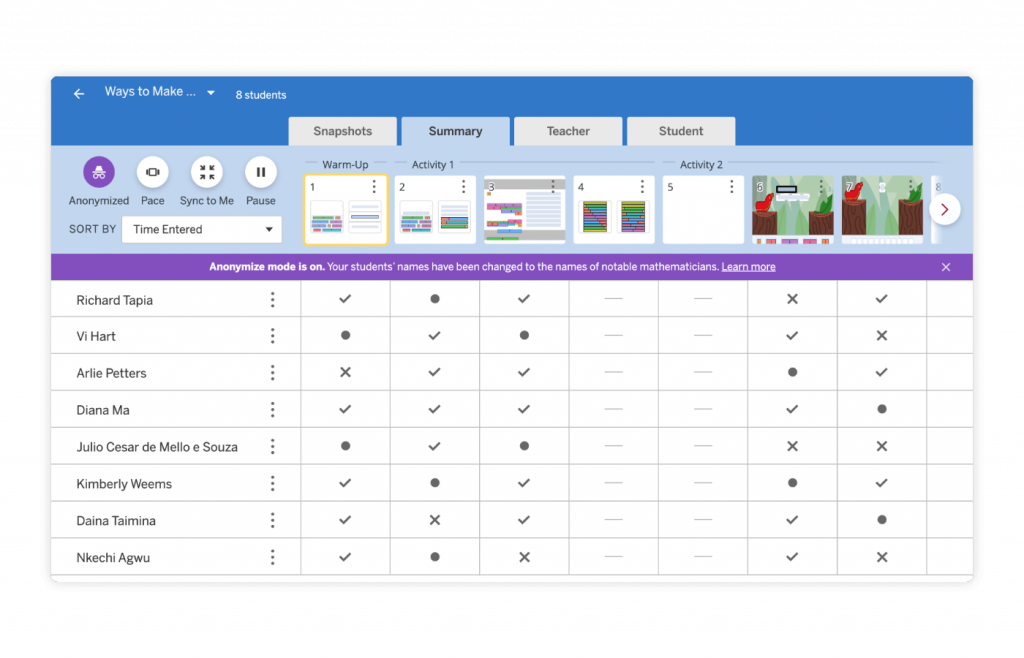
Components of a lesson
Students in an Amplify Desmos Math classroom can be seen (and heard!) asking questions, debating answers, justifying their thinking, grappling with problems, and working together and independently.
A typical Amplify Desmos Math lesson includes:
- Warm-up: A short, attention-getting problem to pique students’ interest in the lesson.
- Activities: One to two mini-activities that challenge students’ problem-solving skills.
- Synthesis: Discussion to review and bring together the important concepts from the lesson.
- Show What You Know and Reflection: Questions for students to show what they know from the lesson. (Note: The Show What You Know lesson assessment is optional for kindergarten and grade 1.)
- Centers: Student-led activity stations that reinforce the math learned during lesson activities through interactive and often game-like formats. In kindergarten and grade 1, time for Centers is built into the last 15 minutes of every lesson.
To support, strengthen, and stretch students’ learning after the lesson, Amplify Desmos Math offers options for:
- Differentiation: Mini-Lessons, Centers, Extensions, Boost Personalized Learning, and Fluency Practice.
- Practice: Additional problems your student’s teacher may assign for classwork or homework.
Support math learning at home.
You can support your student’s math learning outside of school in many ways:
Your student’s teacher may assign practice problems at the end of each lesson for classwork or homework. If your student has already completed the practice problems for the lesson, ask them to walk you through how they solved each problem, or talk about any parts that were challenging for them. Ask your student follow-up questions to encourage the use of math language as they explain their thinking, such as, “How do you know?,” “How can you show your thinking?,” or “How would you describe that?” If students are stuck, ask support questions, such as, “What information do you know here?” or “How could you represent this problem?”
Your student’s teacher may introduce a Center game with students in the lesson or beyond the lesson. These games are aligned to the math of the unit and can be played with students outside of class. Your student’s teacher may introduce a Center game to students during or after completing a lesson, or you may need to teach the game before you play by using easy-to-follow instructions. Sign up for a free account to explore Centers and additional K–5 content in our Featured Collections.
Each unit in Amplify Desmos Math begins with a read-aloud story to engage students and provide context for the math of the unit. Elements and characters from the Unit Story then appear in lessons throughout the unit.
Kindergarten
- Unit 1 Story: The First Day of School
- Unit 2 Story: What’s in a Restaurant?
- Unit 3 Story: A Great Shape Adventure
- Unit 4 Story: Casey’s Town
- Unit 5 Story: Where is Harry?
- Unit 6 Story: Winners
- Unit 7 Story: Everybody Needs Help Sometimes
Grade 1
- Unit 1 Story: Ying’s New Town
- Unit 2 Story: Let’s Grow!
- Unit 3 Story: Impossible
- Unit 4 Story: The Collectors
- Unit 5 Story: The Day of the Wazzle-Squash
- Unit 6 Story: Side by Side
- Unit 7 Story: A Potluck for Pia
Grade 2
- Unit 1 Story: A New Class Pet
- Unit 2 Story: The Heroes of Pineapple Street
- Unit 3 Story: What Orson Imagined
- Unit 4 Story: A Seed’s Journey
- Unit 5 Story: 302 Ricotta Drive
- Unit 6 Story: Arjun the Artist
- Unit 7 Story: Where Eli Went
- Unit 8 Story: On Clementine Court
Grade 3
- Unit 1 Story: My Name Is Harper
- Unit 2 Story: Cheri’s New Home
- Unit 3 Story: The View From Up Here
- Unit 4 Story: Home Cooking
- Unit 5 Story: Coen and Obita
- Unit 6 Story: Just Stick With It, Sasha
- Unit 7 Story: Through Piho’s Eyes
Grade 4
- Unit 1 Story: I Contain Multitudes
- Unit 2 Story: One Step at a Time
- Unit 3 Story: Finny
- Unit 4 Story: Myles and the Loggerheads
- Unit 5 Story: Just for Fun
- Unit 6 Story: Special Day, Special Lei
- Unit 7 Story: Captain Bogwart’s Treasure
Grade 5
Relate math to daily activities at home, whether grocery shopping, preparing a meal, or planning for a trip to the store. Your student can help you figure out how many more apples there are than oranges in the grocery cart, show how to split a sandwich into fourths, or figure out how much change you’ll receive in exchange for a $10 bill. Encourage your student to point out ways that you use math in your daily tasks.
Remind your student that getting stuck is part of the process and a necessary—beneficial, even!—part of learning. Many students (and adults) fear making mistakes. But research shows that making mistakes helps our brains grow. When your student gets stuck on a problem, encourage them to keep trying different strategies, even if they’re not sure if they are right.
Get more information.
Have a question about Amplify Desmos Math? Visit our help library to search for articles with answers to your program questions. For additional support, please contact your student’s teacher.
Phonological awareness games
In Cut It Out, students isolate individual phonemes by listening to a beginning, middle, or ending sound and choosing a picture of the word containing the sound in that position.
Skills
Phonological awareness
- Blending at the compound word, syllable, onset-rime, and phoneme level
Standards covered
- CCSS.ELA-LITERACY.RF.1.2.C — Isolate and pronounce initial, medial vowel, and final sounds (phonemes) in spoken single-syllable words.
- CCSS.ELA-LITERACY.RF.K.2.D — Isolate and pronounce the initial, medial vowel, and final sounds (phonemes) in three-phoneme (consonant-vowel-consonant, or CVC) words.1 (This does not include CVCs ending with /l/, /r/, or /x/.)
In Gem & Nye, students blend sounds into words, starting with compound words and syllables and then moving to beginning (onset) and ending (rime) sounds and finally individual phonemes, to identify the picture of the word the Soundbots say when blended together.
Skills
Phonological awareness
- Blending at the compound word, syllable, onset-rime, and phoneme level
Standards covered
- CCSS.ELA-LITERACY.RF.1.2.B — Orally produce single-syllable words by blending sounds (phonemes), including consonant blends.
- CCSS.ELA-LITERACY.RF.K.2.B — Count, pronounce, blend, and segment syllables in spoken words.
- CCSS.ELA-LITERACY.RF.K.2.C — Blend and segment onsets and rimes of single-syllable spoken words.
In Wordbots, students practice segmenting words into their onsets and rimes to determine which Startbots and Endbots form a stimulus word.
Skills
Phonological awareness
- Segment at the compound-word and onset-rime level
Standards covered
- CCSS.ELA-LITERACY.RF.K.2.C — Blend and segment onsets and rimes of single-syllable spoken words.
- CCSS.ELA-LITERACY.RF.K.2.B — Count, pronounce, blend, and segment syllables in spoken words.
In Zoom Boom, students practice rhyming by listening to a word and identifying the picture of the word that rhymes with it.
Skills
Phonological awareness
- Rhyming
Standards covered
- CCSS.ELA-LITERACY.RF.K.2.A — Recognize and produce rhyming words.
Phonics Games in Amplify Reading: K–2
In Curioso Crossing, students practice accurate and automatic word recognition by identifying the correct spoken word to guide their Curioso safely throughout the land.
Skills
Phonics – Early Decoding; Advanced Decoding
- Read high-frequency irregular words, regular words, words with inflected endings, two-syllable words, words with prefixes and suffixes, and multi-syllable words
Standards Covered
- CCSS.ELA-LITERACY.RF.K.3.B — Associate the long and short sounds with the common spellings (graphemes) for the five major vowels.
- CCSS.ELA-LITERACY.RF.1.3.B — Decode regularly spelled one-syllable words.
- CCSS.ELA-LITERACY.RF.1.3.C — Know final -e and common vowel team conventions for representing long vowel sounds.
- CCSS.ELA-LITERACY.RF.1.3.E — Decode two-syllable words following basic patterns by breaking the words into syllables.
- CCSS.ELA-LITERACY.RF.1.3.F — Read words with inflectional endings.
- CCSS.ELA-LITERACY.RF.2.3.A — Distinguish long and short vowels when reading regularly spelled one-syllable words.
- CCSS.ELA-LITERACY.RF.2.3.C — Decode regularly spelled two-syllable words with long vowels.
- CCSS.ELA-LITERACY.RF.2.3.D — Decode words with common prefixes and suffixes.
- CCSS.ELA-LITERACY.RF.2.3.F — Recognize and read grade-appropriate irregularly spelled words.
- CCSS.ELA-LITERACY.RF.K.3.C — Read common high-frequency words by sight (e.g., the, of, to, you, she, my, is, are, do, does).
- CCSS.ELA-LITERACY.RF.1.3.G — Recognize and read grade-appropriate irregularly spelled words.
In Food Truck, students practice “chopping” blends, ending sounds (rimes), and whole words into beginning sounds (onsets), ending sounds, and individual letters to create orders for their hungry goblin customers. The difficulty of words and segmenting tasks increases with each level as customers order more sophisticated “dishes.”
Skills
Phonics – Early Decoding
- Decode and spell words with common rime families
Standards Covered
- CCSS.ELA-LITERACY.RF.K.3.A — Demonstrate basic knowledge of one-to-one letter-sound correspondences by producing the primary sound or many of the most frequent sounds for each consonant.
- CCSS.ELA-LITERACY.RF.K.3.B — Associate the long and short sounds with the common spellings (graphemes) for the five major vowels.
- CCSS.ELA-LITERACY.RF.K.3.D — Distinguish between similarly spelled words by identifying the sounds of the letters that differ.
- CCSS.ELA-LITERACY.RF.K.2.E — Add or substitute individual sounds (phonemes) in simple, one-syllable words to make new words.
- CCSS.ELA-LITERACY.RF.1.3.B — Decode regularly spelled one-syllable words.
In Grumpy Goblins, students learn sound-spelling correspondences for consonant digraphs and vowel teams by listening to a sound from a goblin and feeding it the piece of toast with the corresponding letter or combination.
Skills
Phonics – Letter Combinations
- Sound-spelling correspondences for consonant digraphs and vowel teams
Standards Covered
- CCSS.ELA-LITERACY.RF.K.3.B — Associate the long and short sounds with the common spellings (graphemes) for the five major vowels.
- CCSS.ELA-LITERACY.RF.1.3.A — Know the spelling-sound correspondences for common consonant digraphs.
- CCSS.ELA-LITERACY.RF.2.3.B — Know spelling-sound correspondences for additional common vowel teams.
In Hangry Goblins, students practice letter-sound combinations by feeding individual letter sounds, consonant digraphs, blends, and vowel teams to goblins that become more and more “hangry” until they are given the letters that match their demands.
Skills
Phonics – Letter Sound Correspondence
- Sound-spelling correspondences for individual letters and letter combinations
Standards covered
- CCSS.ELA-LITERACY.RF.K.3.A — Demonstrate basic knowledge of one-to-one letter-sound correspondences by producing the primary sound or many of the most frequent sounds for each consonant.
- CCSS.ELA-LITERACY.RF.K.3.B — Associate the long and short sounds with the common spellings (graphemes) for the five major vowels.
- CCSS.ELA-LITERACY.RF.1.3.A — Know the spelling-sound correspondences for common consonant digraphs.
- CCSS.ELA-LITERACY.RF.2.3.B — Know spelling-sound correspondences for additional common vowel teams.
In Picky Goblins, students practice sound-spelling correspondences for individual letters by listening to a sound from a goblin and feeding it the piece of toast with the corresponding.
Skills
Phonics – Letter-Sound Correspondence
- Sound-Spelling Correspondences for single letters
Standards Covered
- CCSS.ELA-LITERACY.RF.K.3.A — Demonstrate basic knowledge of one-to-one letter-sound correspondences by producing the primary sound or many of the most frequent sounds for each consonant.
- CCSS.ELA-LITERACY.RF.K.3.B — Associate the long and short sounds with the common spellings (graphemes) for the five major vowels.
In Read All About It, students practice reading sentences with words that include the sound-spelling correspondences, word features (e.g., prefixes/suffixes), and phonics rules (e.g., vowel consonant long e, syllable patterns) they learned and practiced in other games.
Skills
Phonics – Early Decoding; Advanced Decoding
- Read grade level text accurately
Standards Covered
- CCSS.ELA-LITERACY.RF.K.3 — Know and apply grade-level phonics and word analysis skills in decoding words.
- CCSS.ELA-LITERACY.RF.K.4 — Read emergent-reader texts with purpose and understanding.
- CCSS.ELA-LITERACY.RF.1.3 — Know and apply grade-level phonics and word analysis skills in decoding words.
- CCSS.ELA-LITERACY.RF.1.4 — Read with sufficient accuracy and fluency to support comprehension.
- CCSS.ELA-LITERACY.RF.2.3 — Know and apply grade-level phonics and word analysis skills in decoding words.
- CCSS.ELA-LITERACY.RF.2.4 — Read with sufficient accuracy and fluency to support comprehension.
In Rhyme Time, students practice with different rime families (words that end with the same sounds and rhyme) and decode words in these families by swapping the first letter sounds of words while the ending sounds remain constant.
Skills
Phonics – Early Decoding
- Decode words with common rime families
Standards Covered
- CCSS.ELA-LITERACY.RF.K.3.A — Demonstrate basic knowledge of one-to-one letter-sound correspondences by producing the primary sound or many of the most frequent sounds for each consonant.
- CCSS.ELA-LITERACY.RF.K.3.B — Associate the long and short sounds with the common spellings (graphemes) for the five major vowels.
- CCSS.ELA-LITERACY.RF.K.3.D — Distinguish between similarly spelled words by identifying the sounds of the letters that differ.
- CCSS.ELA-LITERACY.RF.K.2.E — Add or substitute individual sounds (phonemes) in simple, one-syllable words to make new words.
- CCSS.ELA-LITERACY.RF.1.3.B — Decode regularly spelled one-syllable words.
In Tongue Twist, students practice with different rime families (words that end with the same sounds and rhyme) and build words by changing the ending sound (rime) while the beginning (onset) sounds, consonant blends, and consonant digraphs remain constant.
Skills
Phonics – Early Decoding
- Decode words with common rime families
Standards covered
- CCSS.ELA-LITERACY.RF.K.3.A — Demonstrate basic knowledge of one-to-one letter-sound correspondences by producing the primary sound or many of the most frequent sounds for each consonant.
- CCSS.ELA-LITERACY.RF.K.3.B — Associate the long and short sounds with the common spellings (graphemes) for the five major vowels.
- CCSS.ELA-LITERACY.RF.K.3.D — Distinguish between similarly spelled words by identifying the sounds of the letters that differ.
- CCSS.ELA-LITERACY.RF.K.2.E — Add or substitute individual sounds (phonemes) in simple, one-syllable words to make new words.
- CCSS.ELA-LITERACY.RF.1.3.B — Decode regularly spelled one-syllable words.
In Word City, students identify and manipulate beginning, middle, and ending letter sounds to assemble word chains that form buildings.
Skills
Phonics – Early Decoding
- Letter-sound correspondence
- Decoding and spelling regular words
Standards Covered
- CCSS.ELA-LITERACYRF.K.3.A — Demonstrate basic knowledge of one-to-one letter-sound correspondences by producing the primary sound or many of the most frequent sounds for each consonant.
- CCSS.ELA-LITERACYRF.1.3.A — Know the spelling-sound correspondences for common consonant digraphs.
- CCSS.ELA-LITERACYRF.1.3.B — Decode regularly spelled one-syllable words.
- CCSS.ELA-LITERACYRF.1.3.C — Know final -e and common vowel team conventions for representing long vowel sounds.
- CCSS.ELA-LITERACYRF.2.3.B — Know spelling-sound correspondences for additional common vowel teams.
Microcomprehension Games in Amplify Reading: K–2
In Because This, That, students learn how common text structures give clues to meaning by rearranging sentences to identify cause and effect or problem and solution.
Skills
Microcomprehension
- Text Structure: Organize sentences using sequence/chronological order
Standards covered
- CCSS.ELA-LITERACY.RI.1.3 — Describe the connection between two individuals, events, ideas, or pieces of information in a text.
- CCSS.ELA-LITERACY.RI.1.8 — Identify the reasons an author gives to support points in a text.
- CCSS.ELA-LITERACY.RI.2.3 — Describe the connection between a series of historical events, scientific ideas or concepts, or steps in technical procedures in a text.
- CCSS.ELA-LITERACY.RI.2.8 — Describe how reasons support specific points the author makes in a text.
In Connect It!, students practice using different types of conjunctions (temporal and causal, for example) to combine two clauses into a coherent sentence.
Skills
Microcomprehension
- Syntactic awareness – connectives
Standards covered
- CCSS.ELA-LITERACY.L.2.3 — Use knowledge of language and its conventions when writing, speaking, reading, or listening.
In Message in a Bottle, students build their awareness of syntax and the impact word order has on meaning by unscrambling scraps of lost messages to reconstruct sentences.
Skills
Microcomprehension
- Syntactic awareness
Standards covered
- CCSS.ELA-LITERACY.L.1.1 — Demonstrate command of the conventions of standard English grammar and usage when writing or speaking.
- CCSS.ELA-LITERACY.L.2.1 — Demonstrate command of the conventions of standard English grammar and usage when writing or speaking.
In Mind the Gap, comprehension levels are assessed through a modified cloze exercise in which students make selections to fill in the blanks of a text where approximately every seventh word has been omitted.
Skills
Microcomprehension
- Reading fluency
- Syntactic awareness
- Inference
- Comprehension monitoring
Standards covered
- CCSS.ELA-LITERACY.CCRA.R.1 — Read closely to determine what the text says explicitly and to make logical inferences from it; cite specific textual evidence when writing or speaking to support conclusions drawn from the text.
- CCSS.ELA-LITERACY.CCRA.R.10 — Read and comprehend complex literary and informational texts independently and proficiently.
In Show Off, students learn how common text structures give clues to meaning, using cues from illustrations to rearrange sentences in the correct sequential or chronological order.
Skills
Microcomprehension
- Text structure: Organize sentences using problem/solution and cause/effect
Standards covered
- CCSS.ELA-LITERACY.RI.1.3 — Describe the connection between two individuals, events, ideas, or pieces of information in a text.
- CCSS.ELA-LITERACY.RI.1.8 — Identify the reasons an author gives to support points in a text.
- CCSS.ELA-LITERACY.RI.2.3 — Describe the connection between a series of historical events, scientific ideas or concepts, or steps in technical procedures in a text.
- CCSS.ELA-LITERACY.RI.2.8 — Describe how reasons support specific points the author makes in a text.knowledge of one-to-one letter-sound correspondences by producing the primary sound or many of the most frequent sounds for each consonant.
In Sloppy Scrolls, students practice the art of comprehension monitoring, or ensuring that they continually build and check a mental model of what they read. In the game, students are introduced to a world of enchanted scrolls that have lost their magic: they contain inconsistencies, and no longer make sense. The students must attempt to identify the inconsistencies by tapping the sentences that don’t match the rest of the passage. To increase the challenge of the game, some of the passages are presented without errors.
Skills
Microcomprehension
- Comprehension Monitoring
Standards Covered
- CCSS.ELA-LITERACY.RL.2.10 — By the end of the year, read and comprehend literature, including stories and poetry, in the grades 2-3 text complexity band proficiently, with scaffolding as needed at the high end of the range.
In Storyboard, students practice making inferences by completing a storyboard that integrates relevant background knowledge missing from a given sentence.
Skills
Microcomprehension
- Inference
Standards covered
- CCSS.ELA-LITERACY.RL.K.1 — With prompting and support, ask and answer questions about key details in a text.
- CCSS.ELA-LITERACY.RI.K.1 — With prompting and support, ask and answer questions about key details in a text.
- CCSS.ELA-LITERACY.RL.1.1 — Ask and answer questions about key details in a text.
- CCSS.ELA-LITERACY.RI.1.1 — Ask and answer questions about key details in a text.
In Super Match, students work on developing cognitive flexibility, or the ability to track multiple elements simultaneously, by completing interactive puzzles that associate pictures and words across multiple dimensions (e.g., color and category, or starting sounds and category).
Skills
Microcomprehension
- Cognitive flexibility
Standards covered
- CCSS.ELA-LITERACY.L.1.5.A — Sort words into categories (e.g., colors, clothing) to gain a sense of the concepts the categories represent.
- CCSS.ELA-LITERACY.L.1.5.B — Define words by category and by one or more key attributes (e.g., a duck is a bird that swims; a tiger is a large cat with stripes).
- CCSS.ELA-LITERACY.RF.1.3 — Know and apply grade-level phonics and word analysis skills in decoding words.
In Unmask That, students build their understanding of anaphora, a tool authors use to avoid repetition, by linking pronouns to their antecedents in text.
Skills
Microcomprehension
- Syntactic awareness – anaphora
Standards covered
- CCSS.ELA-LITERACY.L.1.1 — Demonstrate command of the conventions of standard English grammar and usage when writing or speaking.
- CCSS.ELA-LITERACY.L.2.1 — Demonstrate command of the conventions of standard English grammar and usage when writing or speaking.
Comprehension Games in Amplify Reading: K–2
In Best Buddy, students examine character traits to determine which school club provides the best fit for their fictional friends.
Skills
Comprehension – Key Ideas and Details
- Character Traits
Standards Covered
- CCSS.ELA-LITERACY.RL.1.3 — Describe characters, settings, and major events in a story, using key details.
- CCSS.ELA-LITERACY.RL.2.3 — Describe how characters in a story respond to major events and challenges.
In Book Club, students compare and contrast two books on the same topic or theme to determine which book best meets the needs of a character in the game.
Skills
Comprehension – Integration of Knowledge and Ideas
- Compare and Contrast Texts
Standards covered
- CCSS.ELA-LITERACY.RI.1.9 — Identify basic similarities in and differences between two texts on the same topic (e.g., in illustrations, descriptions, or procedures).
- CCSS.ELA-LITERACY.Rl.2.9 — Compare and contrast the most important points presented by two texts on the same topic.
- CCSS.ELA-LITERACY.RL.2.9 — Compare and contrast two or more versions of the same story (e.g., Cinderella stories) by different authors or from different cultures.
In Debate-a-Ball, students practice identifying the best evidence to support a claim. Students pick an animal avatar to compete with an automated opponent in debates on familiar topics. To win, students must put forward the best evidence to support each claim more frequently than their opponents. They are taught to identify evidence that is factual and strongly related to the claim.
Skills
Comprehension – Integration of Knowledge and Ideas
- Evaluate evidence
Standards covered
- CSS.ELA-LITERACY.RI.2.8 — Describe how reasons support specific points the author makes in a text.
In Picture This, students complete the illustrations for a story by identifying words that describe its setting, characters, problems, and solutions.
Skills
Comprehension – Key Ideas and Details
- Story Elements/Plot
Standards covered
- CCSS.ELA-LITERACY.RL.1.1 — Ask and answer questions about key details in a text.
- CCSS.ELA-LITERACY.RL.1.3 — Describe characters, settings, and major events in a story, using key details.
- CCSS.ELA-LITERACY.RL.2.1 — Ask and answer such questions as who, what, where, when, why, and how to demonstrate understanding of key details in a text.
- CCSS.ELA-LITERACY.RL.2.3 — Describe how characters in a story respond to major events and challenges.
In Storybox, students choose settings, situations, and solutions to send characters on different adventures, using details and context to help them resolve problems and complete the story.
Skills
Comprehension – Key Ideas and Details
- Story Elements/Plot
Standards covered
- CCSS.ELA-LITERACY.RL.K.3 — With prompting and support, identify characters, settings, and major events in a story.
In Tube Tales, students learn the attributes of different genres and practice identifying them in brief texts.
Skills
Comprehension – Craft and Structure
- Text schema
Standards covered
- CCSS.ELA-LITERACY.RL.2.10 — By the end of the year, read and comprehend literature, including stories and poetry, in the grades 2-3 text complexity band proficiently, with scaffolding as needed at the high end of the range.
- CCSS.ELA-LITERACY.RI.2.5 — Know and use various text features (e.g., captions, bold print, subheadings, glossaries, indexes, electronic menus, icons) to locate key facts or information in a text efficiently.
- CCSS.ELA-LITERACY.RI.2.10 — By the end of year, read and comprehend informational texts, including history/social studies, science, and technical texts, in the grades 2-3 text complexity band proficiently, with scaffolding as needed at the high end of the range.
In What’s the Big Idea, students examine pictures, picture sequences, and short passages to practice differentiating the main idea from story details.
Skills
Comprehension – Key Ideas and Details
- Main idea
Standards covered
- CCSS.ELA-LITERACY.RI.K.2 — With prompting and support, identify the main topic and retell key details of a text.
- CCSS.ELA-LITERACY.RI.1.2 — Identify the main topic and retell key details of a text.
- CCSS.ELA-LITERACY.RI.2.2 — Identify the main topic of a multiparagraph text as well as the focus of specific paragraphs within the text.
Vocabulary Games in Amplify Reading: K–2
In Punchline!, students learn how words can have multiple meanings by channeling their inner comedian to crack homonym-based jokes.
Skills
Vocabulary
- Multiple-meaning words
Standards covered
- CCSS.ELA-LITERACY.L.2.4.A — Use sentence-level context as a clue to the meaning of a word or phrase.
In Shades of Meaning, students differentiate the nuances in similar words — first by ordering them from weakest to strongest, largest to smallest, or least to greatest; then by putting them into sentences that further clarify their meaning.
Skills
Vocabulary
- Shades of meaning
Standards covered
- CCSS.ELA-LITERACY.L.1.5.D — Distinguish shades of meaning among verbs differing in manner (e.g., look, peek, glance, stare, glare, scowl) and adjectives differing in intensity (e.g., large, gigantic) by defining or choosing them or by acting out the meanings.
- CCSS.ELA-LITERACY.L.2.5.B — Distinguish shades of meaning among closely related verbs (e.g., toss, throw, hurl) and closely related adjectives (e.g., thin, slender, skinny, scrawny).
Amplify Reading: K–2’s Integrated eReader
eReader Overview
Amplify Reading: K–2 has a new library of over 25 fiction and non-fiction ebooks and an adaptive algorithm that unlocks each book at the exact right point in a reader’s development. Moreover, they contain familiar interactions from the games so that students move seamlessly from text-embedded-in-games to games-embedded-in-text, maximizing their sense of growing competency.
The eReader also provides optional supports for its readers. From the settings icon on the title page of each book, students can turn on sentence numbering, read aloud functionality, and reveal words, as well as adjust the text size.
Student Experience
When students are ready for a text, it will appear as one of their quest steps.
When readers first unlock a new book, they read through it without interruption (with read-aloud support if appropriate).
In the second read, students discover embedded activities that repeat the familiar iconography of a game they previously mastered.
At the end of the book, additional activities evaluate students’ comprehension.
Achievements in books are part of the same overall reward system: helping your Curioso grow, just like achievement in skill-building games. Mastery of the content is reflected in the teacher dashboard within the given skill.
How teachers are using Amplify Reading
Independent study/rotation stations
Amplify Reading is a personalized, differentiated program designed to keep students engaged and on task in independent study. The program is most effective when used for a minimum of 45 minutes per week.
Other common uses
We designed the program to be flexible enough to fit any classroom model. Amplify Reading is browser-based, so it works on Chromebooks, iPads, laptops, desktops, and even iPhones. It can also be used at home to extend learning beyond the classroom.
Pseudoscience examples for critical thinking skills

MIRACLE HAIR GROWTH!
Quantum hair activation technology: This groundbreaking innovation goes beyond conventional science, delving into the realm of quantum energy to stimulate hair growth at the subatomic level. Blended with rare botanicals from ancient civilizations for luster and shine. Limited-time offer: Act now and receive a vial of stardust-infused hair serum!
Effective product…or pseudoscience? We’ll bet you guessed it. (Sorry, no stardust serum for you!)
While this hair product itself sounds like junk, reading about it can be a valuable experience for science students.
Teaching your students to identify pseudoscience in the world around them helps them learn to protect themselves from false claims that can be money-wasting at best, dangerous at worst.
And as they learn to discern, they also develop lifelong critical thinking skills!
We say knowledge is power but it’s not enough to know things, and there’s too much to know. Being able to think and not fall for someone’s bunk is my goal for my students.
—Melanie Trecek-King, biology professor and guest in Science Connections podcast Season 3, Episode 5: Thinking is power
Let’s explore how educators can use examples of pseudoscience to develop critical thinking skills—and incorporate NGSS (Next Generation Science Standards) science and engineering practices into their approach.
What’s the difference between science and pseudoscience?
Science is grounded in empirical evidence, rigorous testing, and the scientific method. Pseudoscience presents itself as scientific but lacks the fundamental elements of genuine scientific inquiry: evidence, peer review, and the capacity to generate accurate predictions.
Though pseudoscience may make vague claims, it has clear characteristics. When something is pseudoscience, it:
- Can’t be proven wrong: Makes claims that are unobservable or too vague.
- Professes “proof” without presenting actual evidence: Presents only anecdotal evidence, if any.
- Uses technobabble: See: “Quantum hair activation technology.”
For more characteristics of pseudoscience, check out Melanie Trecek-King’s episode of Science Connections!
To be sure, not all pseudoscience is harmful—pursuits and activities such as aromatherapy and astrology can be positive experiences in people’s lives—it just should not be defined as or considered science.
How addressing pseudoscience encourages critical thinking
When you teach students to identify pseudoscience, you are teaching them to use an evidence- and research-based approach when analyzing claims. Which is…science!
You are also:
- Teaching them to engage in thoughtful and educational argument/debate.
- Encouraging them to use their knowledge of science in the real world.
- Creating real-world impact.
When students learn to identify pseudoscience—faulty products, myths, and disprovable “discoveries”—they’ll be prepared and informed when making real-world decisions.
Critical thinking exercises inspired by pseudoscience
We’ve talked about “miracle” hair growth treatments, which are more commonly targeted to adults. Students may have more commonly encountered claims about or ads for alkaline water or detox diets, conspiracy theories and instances of science denial, astrology, and more. These examples offer great opportunities to discuss how to determine the difference between science and pseudoscience.
Suggested activities:
- Pseudoscience Sherlock: Ask students to find examples of pseudoscience in real life via social media, products sold in stores, or on the internet. Tell them to pay close attention to “articles” that are really ads.
- Pseudoscience lab: Prompt students to back up their claim that a given example represents pseudoscience with evidence: e.g., lack of empirical evidence, controlled experiments, or unbiased sample; absence of peer-reviewed research; reliance on anecdotes; hyperbolic and unprovable claims.
- Snake oil! Ask students to practice identifying pseudoscience by creating their own advertisements, commercials, or news segments for fake products or scientific “advancements.”
- Spread the word: Ask students to create flyers, PSAs, or articles on how to identify the characteristics of pseudoscience.
Other activities that incorporate the NGSS while also sniffing out pseudoscience:
- Asking questions: Encourage students to ask probing questions about pseudoscientific claims. How does this claim defy our current understanding of the natural world? What empirical evidence is missing?
- Developing and using models: Have students create models that illustrate the differences between a pseudoscientific claim and a well-established scientific concept. This visual representation supports understanding and critical analysis.
- Engaging in argument from evidence: Arrange debates where students argue for or against a pseudoscientific claim using evidence-based reasoning. This practice sharpens their ability to critically evaluate information.
- Obtaining, evaluating, and communicating information: Ask students to research the history and impact of a specific pseudoscientific belief. Have them present their findings, highlighting how critical thinking could have prevented widespread acceptance of the claim.
Using examples of pseudoscience in your science classroom can help students learn to not only think like scientists, but navigate the real world, too.
Bertha Vasquez, former teacher and current director of education at the Center for Inquiry, has used these approaches with her students. As she shared on Season 3, Episode 6 of Science Connections: “I guarantee you that those students, when they walked into a store with their parents and they saw a product [with] a money-back guarantee [that] cures way too many things, and it’s based on ‘ancient plant wisdom’ and has ‘scientific’ language on the box, they may go, ‘Mom, I think these people are trying to sell you some pseudoscience.’”
More to explore
- Science Connections
- Season 3, Episode 5: Thinking is power
- Season 3, Episode 6: Identifying and addressing pseudoscience
S2-06: Making time for science in the K–5 classroom

In this episode, Eric Cross sits down with TikTok star and podcast host Lauran Woolley about her experience teaching science content within her K–5 classroom. Lauran shares how she’s learned how to make time for science, and what most K–5 teachers experience when creating their own science curriculum. Lauran also talks about her rise in popularity on TikTok, her podcast, Teachers Off Duty, and establishing strong relationships with her 5th grade students. Explore more from Science Connections by visiting our main page.
Lauran Woolley (00:00):
I wanna make sure that they’re ready for the real world, and I wanna make sure that they’re able to apply these things that I’m teaching them in their life, not on a multiple choice test.
Eric Cross (00:11):
Welcome to Science Connections. I’m your host Eric Cross. My guest today is Lauren Woolley. Lauren is a full-time fifth grade teacher in Leetonia, Ohio, who has amassed a following of 5.5 million subscribers on TikTok and over 1 million followers on YouTube. She’s also co-host of the podcast, Teachers Off Duty. Lauren has combined her teaching vocation and her talent for entertaining to connect with her students and encourage teachers across the world using her own unique style of edutainment. My most vivid memory from our discussion was her sincerity and openness about her experiences. It quickly became obvious to me that her personal transparency was a characteristic that she has remained grounded in despite her social media success. And now, please enjoy my discussion with Lauren Woolley.
Eric Cross (00:53):
You’re currently teaching fifth grade?
Lauran Woolley (00:55):
Yes.
Eric Cross (00:55):
What is it like to teach all content areas? ‘Cause I’m a middle school science teacher.
Lauran Woolley (00:59):
I didn’t always teach all content areas. First I started in second grade, so I used to teach like primary. I taught that for about three years. And I only really got my 4-5 endorsement because it was told to me that it would make me more marketable as a teacher. So I got it <laugh>. I was like, I’m never gonna use that. And then, my second year teaching, my class had low numbers and they collapsed my second grade classroom, split up my students, and then moved me to fifth grade in January. I had to take over a fifth grade class with all content areas in the middle of a school year. And it was really hard. It was like probably one of the most challenging things I’ve ever had to do teaching. When I got my job at my current school, it was only language arts, social studies.
Lauran Woolley (01:46):
So we only have two fifth grade classes. My other teacher would teach math, science. I taught language arts, social studies, and then the timeframes weren’t matching up. Like, I didn’t have enough time in my schedule for all the things we had to do in our curriculum. And she had like a little bit too much time. We realized as a district that it would be better for our fifth grade classes to just be self-contained. And last year was the first year I taught all five subjects. And I liked the variety of teaching everything because when I taught just language arts, social studies, I just felt like I was repeating myself twice a day. <laugh>. It was kind of boring for me. So like, I like doing all of it. <laugh>.
Eric Cross (02:24):
Yeah. With all of your talents and like your background and what I’ve seen, I could totally see why having all the different content areas would like make sense. Are you using a set curriculum? How do you come up with what to teach? Do you do it with teams? Like who comes up with that?
Lauran Woolley (02:36):
Uh, me, myself and I.
Eric Cross (02:38):
Well done.
Lauran Woolley (02:39):
My school, for literacy we’re using literacy collaborative. Then for math, we just adopted bridges, which I love and it’s very hands-on, very like student-led. For science, we had nothing. And I am not a science, or was not a science teacher at the time when I took over. So I panicked a bit and I was like, “Hey, can we have some kind of science curriculum? ‘Cause I got nothing.” And it’s not hard to look at the state standards and figure out what you need to teach them, but having no resources to go off of is extremely difficult. And luckily I have an older brother, he’s like three years older than me and he’s also a teacher. He actually is a science teacher. ‘Cause that first year that I was teaching all subjects, I was like, “Hey Ryan, can you just like send me all of your Google Drive files for science <laugh>?
Lauran Woolley (03:33):
And he’s like, “Yeah, sure.” So he kind of was like a mentor for like the first year that I taught science. And this year being my second full year teaching science, I feel much more confident. I’m still using his resources. We don’t have a dedicated curriculum at my school. So that’s like one thing I’ve been fighting my school on. And not that they don’t wanna get us one, but like they were focused on getting the math curriculum last year. And then I was told, okay, this year will be science because in my state, fifth grade is a tested area for science and we have no curriculum.
Eric Cross (04:04):
Ryan, keep doing what you’re doing big bro. Second, thank you to every teacher who’s had a Google Drive folder full of curriculum that you graciously shared to a new teacher or someone else that they could have.
Lauran Woolley (04:18):
Can we just say like, can schools, like schools, please get your teacher’s science curriculums.
Eric Cross (04:24):
No, absolutely right. And there is this way of thinking that, especially as a science teacher, it’s something that is dear to my heart, but we do want to develop these math and English skills that’s important and we need that for science. But we’ve always taught so siloed for so long, but that’s not the way that we learn and that’s not the way life works. Something that intrigued me about what you said, and I think a lot of people can relate to it, and I know I can because that was me, is you created your own content or your science content. Like you’re kind of piecing that together from what Ryan had shared with you. How do you make time for that with all of the other things that you’re doing and pressures of state testing and things like that. Like how do you weave that into your teaching?
Lauran Woolley (05:02):
So we have like things that are non-negotiable in our schedules. Like we have to have so many minutes of this, so many minutes of that, so many minutes of whatever else. Well, the first year, I was self-contained. I was like, okay, my main goal, because science is a tested area, I wanna make sure that I get in science every single day, 90% of the time I’m able to get anywhere from 30 to 45 minutes of science every day. But this year it was my goal to make sure that I was getting science done and like we were doing meaningful lessons. And last year I didn’t do this, but this year I’m doing a Christmas center for STEM. So I got it off of Teachers Pay Teachers. I’m sorry, I can’t remember who it was made by, but it’s called Jingle All the Way and it’s like building Santa’s new sleigh. And so like the kids have an activity where they have popsicle sticks, straws, a plastic cup and then like tape. And they have to build a new sleigh for Santa and see how many pennies their sleigh can hold. Like talk about a sleigh being lightweight but also strong and like what would make it strong and different things like that. So I’ve been trying to incorporate a lot more STEM activities. And then something I really like to use for experiment days, I call them lab days, is Gizmo. Have you heard of Gizmo?
Eric Cross (06:15):
Yeah. The simulations.
Lauran Woolley (06:16):
Yeah. My brother showed me that too and he was using it in his class. I mean there’s so many different ones that they have that align with the standards and they have like student lab sheets that go with them and teacher guides and stuff. I’ve just been trying to like up my game a little bit more this year, because last year I was like struggling to get all of the standards in before state testing came around because, can we agree, state testing should not be as early as it is? Our state test happens in like March and we have two months of school left. So like, we better be done with standards by February so we could review, because otherwise we’re kind of outta luck because we run outta time.
Eric Cross (06:59):
Yes. That and there’s all kinds of other things that state testing brings with it that we could spend a lot of time probably critiquing and talking about like as far as what’s ideal for kids and what’s the best way to measure and assess learning. That is one question I wanna ask you though, because I know with your work on TikTok and Instagram and YouTube, you must be connected to a pretty vast teacher network and maybe you have like, kinda like more of an inner circle of people, but you must come across so many different perspectives and get into great discussions. Is there <laugh>, is there anything that kind of stands out to you as far as if you were in charge of what we’re doing? Because that’s kind of the system that we all live in and we kind of are trying to internally change it, but it’s been that way for a long time and we just kind of have to work within it until we can make changes. But if you were to, I dunno from an elementary school perspective, change or modify the way kids are learning, what would you do if you had Monarch ability?
Lauran Woolley (07:54):
Okay, I got three main things I’m thinking in my head. Okay, first things first, we got Maslow’s hierarchy of needs. Okay. If kids are coming to school hungry, if they’re coming to school and don’t have, you know, fresh clothing to put on, if they’re coming to school and they have issues at home that they are dealing with, that they are not okay with, the learning is not happening. That’s secondary. They don’t, it doesn’t matter to them. It doesn’t matter to me because what’s most important is that child as a human being and whether or not they’re okay. If I had unlimited resources, I would love to be able to build like a little mini village inside a school and have like a clothing store that kids could grab stuff from. Or like a, you know how I know how school have like closets and food pantries, but like a real place they could get some new clothes, not like hand-me-down clothes, like a store they could go and grab some food if they needed food for their homes or whatever. We have like an onsite counselor but not like a school counselor, like a therapist-type counselor for like mental health. Having some kind of like health clinic, not just like a school nurse because, let’s be real, our school nurses see everything <laugh> and they do not get enough credit, but like to have like a little like urgent care clinic, like basically a small town <laugh> inside a school that like kids would have all of the resources that they need met. Like that would be my number one thing that I would love to do. I have taught in, you know, I’ve only taught in two different schools, but like I’ve seen a lot of things and the number one thing that keeps coming back is just like home lives and mental health and having someone to talk to.
Lauran Woolley (09:41):
And I think our kids don’t have enough of that. Second of all, would be obviously state testing. Because I mean, it’s good to see like where our kids are at. I don’t think it should be used punitively and I don’t think that it should be putting as much pressure on teachers and students the way that it is. It’s not effective that way at all. Let teachers do their jobs without us having to, like, ’cause honestly, who’s not gonna say that they’re not trying to set their students up to do the best on that test. Our evaluation depends on it. I’m gonna make sure my students are prepared for it. I’m gonna teach all the standards, but like, I shouldn’t have to be teaching so that they could do well on a test. I wanna make sure that they’re ready for the real world and I wanna make sure that they’re able to apply these things that I’m teaching them in their life, not on a multiple choice test. Third of all, <laugh>.
Eric Cross (10:33):
This, this is great. And I think a lot of teachers will listen and be like, “That’s what I’m talking about right there.” Keep going. You’re on three.
Lauran Woolley (10:40):
That would be two teachers in every classroom. Either two teachers in each room or like a teacher and a paraprofessional in each room, because there’s not even an argument that teachers are more effective when they have help.
Eric Cross (10:54):
I would even carry the math on further and say that it’s a force multiplier, like exponentially, that it’s not just, it’s not just like a one plus one equals two teachers. It’s almost like you can almost have like three or four just because of the energy and the synergy that can be created between the two. And you can push off of each other, encourage one another and both support different types of students. So I agree a hundred percent. I think that if you had two teachers that were in sync and planning together and talking about kids all of the time, you would be able to go deeper with students. You’d be able to find out those things that you talked about in Maslow’s because sometimes we don’t find out about it until a parent-teacher conference or kids left our classroom. I wish I would’ve known that. The student was without these things in the very beginning.
Lauran Woolley (11:41):
Absolutely. Mm-hmm.
Eric Cross (11:42):
So when do you start in the school and do we go on LinkedIn to sign up and apply or is it like a lottery system? Like, ’cause you know, I was gonna get a lot of attention.
Lauran Woolley (11:52):
I would love to Oprah Winfrey this and like build my own school <laugh>.
Eric Cross (11:56):
We gotta get those followers up. We gotta build up the sponsorships. We gotta get you up to a hundred million.
Lauran Woolley (12:01):
Listen, if all of my followers across all my platforms donated like $2, we could have $12 million to build a school. <laugh>.
Eric Cross (12:10):
Think about like, DonorsChoose, right? People do that. And I know there’s mixed feelings about it because we need stuff in our classroom. I’m just gonna say that. All right. So, whether I have to ask for it on a website or whatever, but people want to give directly to kids, or people who need it. And I think when there’s opportunities like that, that are visible, people are more likely to want to.
Lauran Woolley (12:29):
In reality, should other people have to fund education in classrooms? No. That’s literally what your taxes are for. A government-funded classroom versus a teacher-funded classroom are two different things. And we know that. But if teachers are asking for things or asking for donations on Amazon or on DonorsChoose, just know in your heart that that teacher has probably already shelled out a lot of their own cash to do that. It’s not that they’re, you know, asking for handouts or anything like that. They’re trying to give their students the best that they can and that’s the thought process behind it. And until we get changes in our education system or changes in legislature that will allow us to do that or will allow classroom budgets, I mean, our hands are tied. Like there’s only so much teachers can do. I’m very fortunate to teach in a district that sees the value in spending money on their teachers and students. And, like my school, like I said, they just shelled out thousands of dollars on a new math curriculum. They bought school supplies. Literally every teacher made their school supply list this year. And then the district went in and paid for every single student’s school supplies in the entire district.
Eric Cross (13:49):
Can we get a shout out to your district real quick?
Lauran Woolley (13:51):
Uh, yeah. I mean, shout out Leetonia schools like, I mean, you guys are awesome and I’ll shout that from the rooftops. I love where I teach. Like I really do think that they value our students and they care about our students and our admin is great. We got a new superintendent a couple years ago. He’s been doing a phenomenal job and I really love it and I’m glad I teach there.
Eric Cross (14:12):
When you move out of the classroom, you know, in any position of leadership, you do have the microscope or magnifying glass on you and a lot of times it’s critical. And not unjustifiably so, I mean, there’s a lot of things that can be critiqued. However, what we don’t always hear is the success stories or where it’s working for teachers and why. And we need leaders to be able to talk to each other and find, “Hey, it’s working in your district? Oh, I just heard, I just heard this district get shot out. I’m gonna go reach out to those people. Hey, what are you doing?” Because we connect with each other, but I think when you go like a level up, that kind of getting up the top of the mountain, the, the connection sometimes can become more difficult for people. There’s not a lot of, I don’t know, maybe there are, but admin influencers.
Lauran Woolley (14:54):
Oh yeah, there definitely are. And I’ve met some really incredible ones. I’m on a committee at my school, it’s called NNPS, it’s the National Network of Partnership Schools. It was started out of Ohio State University. Essentially it is a committee in the school that’s dedicated to bringing together the community and businesses and partnering with people to make our school as strong as it can be. We started last year and we did a bear breakfast, ’cause our mascot is a bear. And we had Christmas things and we had the choir caroling, and we had pancake breakfast for everybody and it was completely free. It was just really nice to see everybody come together. And it feels like the culture changes when people work together and come together for the betterment of the school and for the students. And I think what’s challenging is that so many people have such a negative experience from their schooling that they’re hesitant to get involved in their kids’ schooling. I urge any parents out there, any guardians out there that are, you know, in that mindset where you’re like, I didn’t like my teachers in school, or I had this, this, this and happened to me at school. Give it a chance to know that things have changed and things are changing.
Eric Cross (16:11):
I definitely agree with you about parent engagement and getting involved and sometimes parents, they just don’t know that they should. But wow, your voice is so powerful, especially at board meetings and things like that. Getting stakeholders involved, creating community, which it sounds like your school did a great job or your district did a great job of. The last question I wanna ask you, and it’s kind of going back to who your influencer was, is you now are in a position where your impact exceeds more than, you know. You’re planting so many seeds you’re sharing, and you’ll hear maybe a few, or I’m sure you’ll hear the things that kind of come back to you, but that’s only a fraction. But I wanted to ask you, like, as you think back on your career as an educator or when you were in school K through five or K through 12, is there anyone who stands out to you or who was maybe your influencer or teacher who made a big difference that was memorable? And if so, who was it and what was it about them or what did they do?
Lauran Woolley (17:01):
So I had a lot of teachers that I really had good relationships with and I loved school growing up. But one always stood out in particular, and that was my ninth grade English teacher and her name is Andrea Reid. She was the first person who really told me that I was talented at something and that I could succeed in something because she was the English teacher. She was also a coach of the speech and debate team at my high school. Just one day after school. She was like, “Hey, like you should come to speech tryouts.” So I went to tryouts, like I did it not thinking like I cared if I made it or didn’t, and then I made the team. And honestly, I feel like speech was the starting point of all of it. I competed in speech and debate for four years of high school and she was my coach.
Lauran Woolley (17:49):
I always have horrible nervousness with public speaking, even though I do it a lot. And she would always give me like the best hype speeches and the best confidence boosters. And I feel like speech started my love of acting and started my love of like, you know, comedy and stuff like that. And so therefore TikTok happened and I don’t think any of this would’ve happened had it not been for her and her opening that door for me and telling me, “Hey, you would be good at this. You should try it.” We’re still friends to this day, 15 years later, and she is like an older sister to me and I love it.
Eric Cross (18:26):
That’s amazing. Andrea Reed, that’s her name.
Lauran Woolley (18:28):
Andrea, yep.
Eric Cross (18:29):
Andrea. Andrea Reid. Ms. Reid, thank you, for inspiring Lauran and <laugh> because of your impact, now it’s impacting so many others and as teachers, like, we don’t even, we don’t know, but it’s so humbling to know that like the words that we say to people have that impact and power. It’s so, it’s, it’s so inspiring to me. One of the things that resonate with you so much is your transparency. Like in your depth. Like even as just listening to you talk, you normalize and humanize so many things that we experience and I’m sure that’s what a lot of the people that watch you connect with. You show your life, your family, your house, all these things that are happening. And I was just looking through the comments and there’s just so many people that are warmed. Not just your students, but like so many teachers. So thank you for doing what you’re doing and I wish you tremendous success. Thank you for your time.
Lauran Woolley (19:17):
No, thank you so much for having me. This was awesome. I just wish everybody a great school year and I hope that we all make it through winter break. <laugh>.
Eric Cross (19:27):
Thanks so much for listening to this season of Science Connections. I love learning about science educators just like you. You can nominate educators that inspire you to become a future guest on Science Connections by emailing STEM@amplify.com. That’s S T E M at amplifycom.wpengine.com. Make sure to click subscribe wherever you listen to podcasts and tune in for a brand new season of Science Connections coming soon.
Stay connected!
Join our community and get new episodes every other Wednesday!
We’ll also share new and exciting free resources for your classroom every month!
Meet the guest
Lauran Woolley is a fifth grade teacher in Northeast Ohio. She has loved being able to combine her love of education and entertainment into one career. Her goal is not only to humanize educators to both families and students, but to create a safe space for her students on the internet. She has had the privilege of collaborating with educators around the world to shed a light on this amazing career. You can listen and watch the Teachers Off Duty podcast here!

About Science Connections
Welcome to Science Connections! Science is changing before our eyes, now more than ever. So…how do we help kids figure that out? We will bring on educators, scientists, and more to discuss the importance of high-quality science instruction. In this episode, hear from our host Eric Cross about his work engaging students as a K-8 science teacher.


The promise of Next Generation Science Standards
The Next Generation Science Standards (NGSS), and other state standards like them, represent more than just new expectations—they embody a transformative vision for science education. Instead of asking students to memorize isolated facts, NGSS calls for students to think like scientists and engineers while grappling with real-world phenomena that matter to them and their communities.
This shift from learning about to figuring out develops the critical-thinking skills and problem-solving mindset students need to tackle complex challenges throughout their lives.
Three-dimensional (3D) learning that engages and inspires
At the heart of NGSS lies three-dimensional learning, where Science and Engineering Practices (SEPs), Crosscutting Concepts (CCCs), and Disciplinary Core Ideas (DCIs) work together to create rich, meaningful learning experiences.
Science and Engineering Practices are the approaches and habits of real scientists and engineers: asking questions, developing models, planning investigations, and constructing evidence-based explanations and arguments. Working with these practices awakens student curiosity, drives student-centered learning, encourages deep and critical thinking, and creates opportunities for students to articulate their understanding in a variety of meaningful ways.
Crosscutting Concepts are the big-picture thinking tools that scientists use every day. When students use Crosscutting Concepts as a lens to examine common themes in science such as patterns, cause and effect, systems, and energy, they begin to identify and connect science ideas across disciplines.
Disciplinary Core Ideas represent the essential knowledge of science. Students figure out these science ideas through their investigation of real-world scientific phenomena, and consequently develop deep understandings of science ideas.
The student experience: from passive to passionate
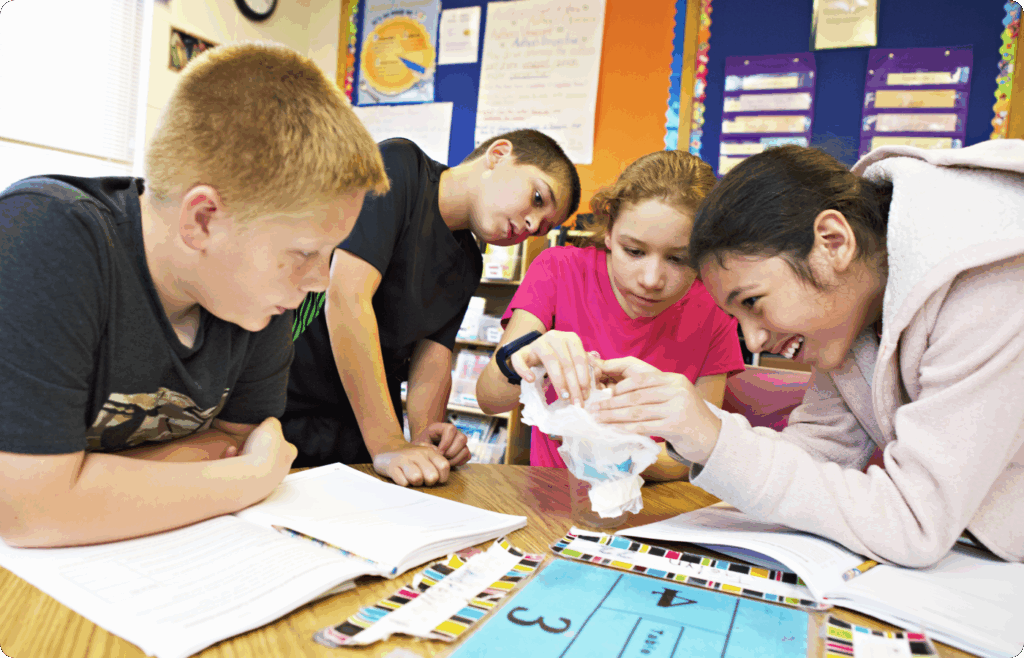
In three-dimensional science learning, students become active investigators, gathering evidence from multiple sources and constructing increasingly sophisticated scientific arguments and models about real-world phenomena. They engage in evidence-based debates, collaborate on engineering challenges, and make connections between their investigations and their own communities, as well as the world beyond. See it in action.

The literacy-rich nature of NGSS instruction means students read, write, speak, and listen like real scientists and engineers, actively questioning, analyzing, and communicating findings. This integrated approach develops both scientific understanding and communication skills—skills that transfer across all subjects and even beyond the classroom.
How Amplify Science delivers as an HQIM curriculum
Amplify Science was built from the ground up to fulfill the NGSS vision and is an HQIM (high-quality instructional materials) curriculum, characterized by the following:
- All green on EdReports. Amplify Science has been evaluated by EdReports, an independent K–12 curriculum review organization, and received the esteemed all-green rating (“meets expectations”) across all three of its gateways: Alignment to the NGSS, Coherence and Scope, and Usability. Learn more about our all-green rating.

- The real-world anchor phenomenon is deeply woven throughout each unit as the central thread. In Amplify Science, students assume the role of a real scientist or engineer to investigate a compelling phenomena in K–5 and grades 6–8. Over the course of the unit, they gather and make sense of a variety of evidence sources and develop increasingly sophisticated explanations and models as their understanding deepens. Whether investigating a mysterious fossil discovery as geologists or designing emergency supply delivery pods as mechanical engineers, students experience the kind of work done by real scientists and engineers.

- All three dimensions of the NGSS are intentionally and thoughtfully integrated throughout every unit and across all grades. As they built Amplify Science as an HQIM curriculum, the experts at UC Berkeley’s Lawrence Hall of Science deliberately crafted each unit, chapter, and lesson with the following guiding questions in mind:
- What do we want students to figure out (specifically, what Disciplinary Core Idea or part of a DCI)?
- How do we want them to figure it out (i.e., what Scientific and Engineering Practice will they engage in to reach understanding)?
- What Crosscutting Concept can scaffold students’ understanding and connect it to other ideas about the natural world that they have learned?
This systematic approach ensures that every learning experience is purposefully designed to engage students in authentic scientific thinking while building connections across concepts and grades.
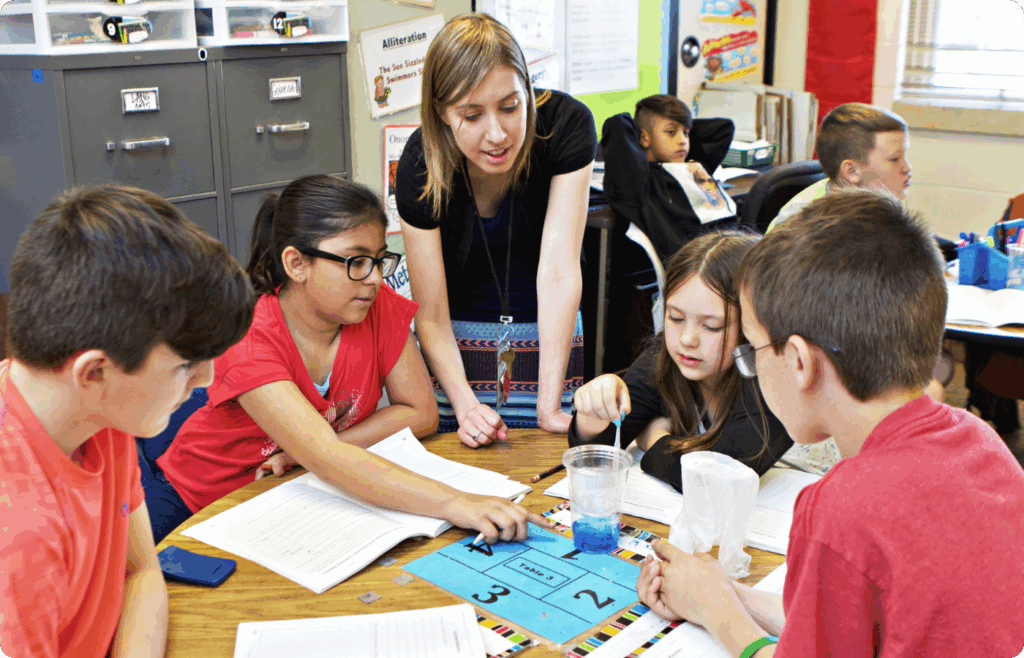
- Educators receive comprehensive implementation support. Through lesson-planning resources, science background materials, built-in assessments, and expert coaching—all provided directly through Amplify—teachers are able to confidently implement the program’s NGSS-aligned, high-quality instructional curriculum with greater ease and success.

- Multimodal learning experiences support all learners. Amplify Science ensures that everyone can access scientific concepts through the Do, Talk, Read, Write, Visualize multimodal approach that includes hands-on investigations, digital simulations, collaborative discussions, and literacy-rich activities.
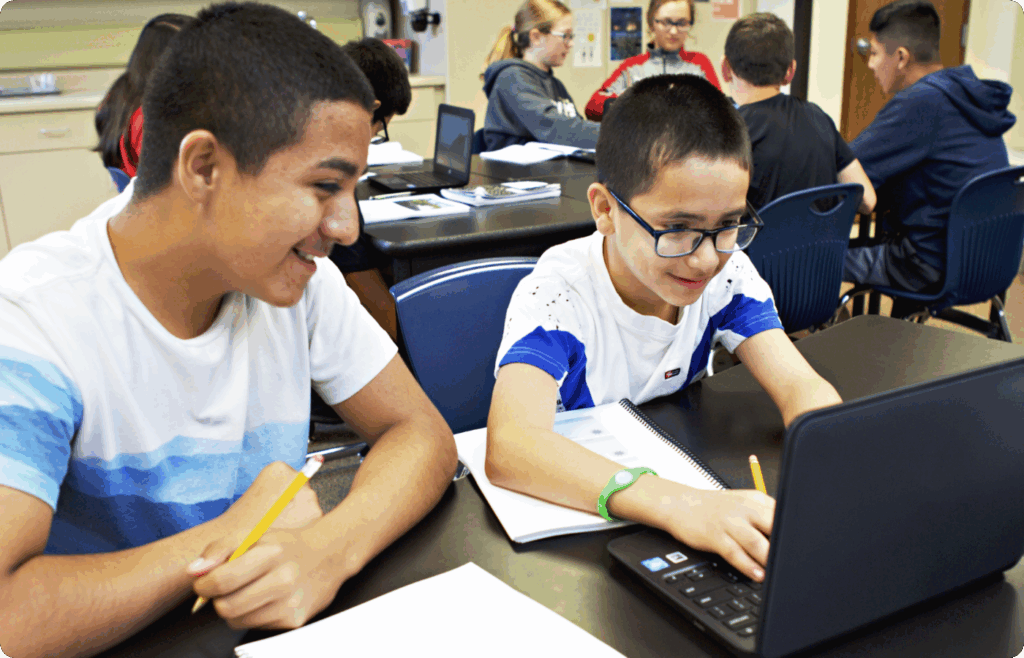
- Research-based and proven effective: Get the results that matter. Students who experience true three-dimensional learning with Amplify Science, an HQIM curriculum, show increased engagement and an improvement in science learning and vocabulary. They develop confidence as thinkers and problem-solvers while maintaining curiosity about the natural world.
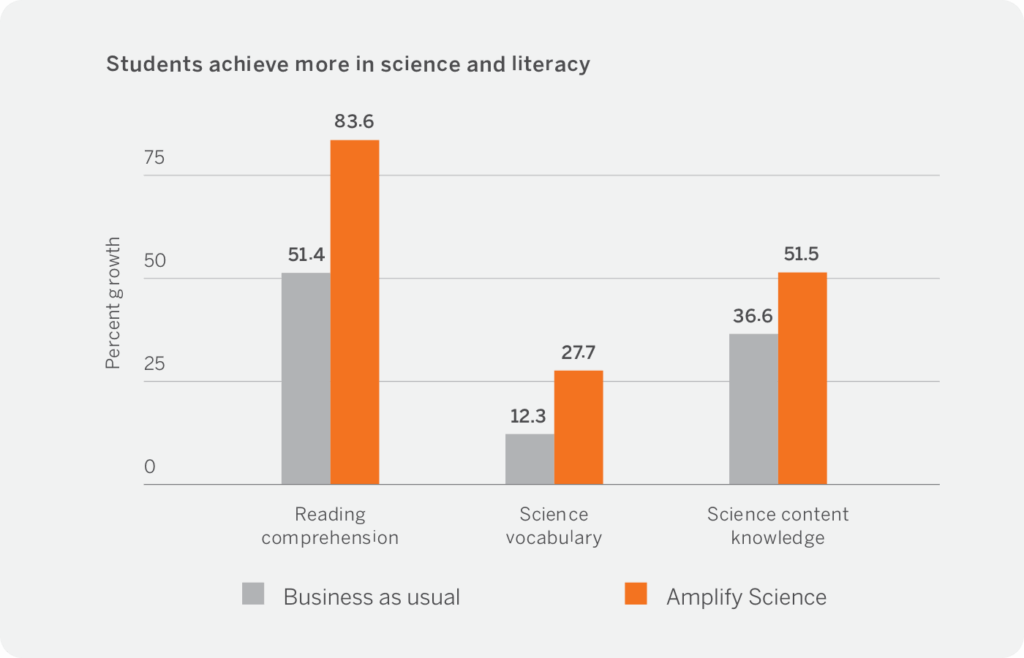
Ready to transform your science instruction with an HQIM curriculum?
Please contact your sales representative today, or download a sample unit to experience three-dimensional learning firsthand. Your future scientists, engineers, and citizens of the world are waiting!
Five fundamentals of high-quality materials in action
So what do we mean by high quality instructional materials, or HQIM? We can start with how EdReports.org, the leading third-party reviewer of curriculum, defines it:
- Materials that help educators teach to rigorous standards.
- Materials that are relatively easy to use.
Beyond these important starting points, what does high quality curriculum look like in action—in real classrooms? Here are five fundamentals of how we think about it at Amplify.
1. It looks like ALL students engaged and thinking.
Students at all levels are able to engage deeply with important questions, to think deeply, creatively, and for themselves.
There’s a commitment to fairness and a “low floors/high ceilings” approach: all students get the scaffolding they need to grapple with the things great minds in the subject area find important, beautiful, and true.

2. It looks like teachers using materials that work harder for them.
Teachers find the program easy and enjoyable to teach. The rich content inspires them to do some of their best teaching.
Teachers also have powerful tools and data that enable them to understand their students more deeply and give more precise feedback.

3. It looks like a vibrant classroom community.
The pedagogy of the program supports the formation of a classroom community where teachers and students wonder, share, debate, and learn together.
It looks like a model of civil society.

4. It looks like a culture of continuous learning for educators, districts, and publishers.
Professional development is not one and done. The district not only provides teachers with high-quality training upfront, but also ongoing ways for teachers to compare notes and share best practices in implementing a new program.
The publisher also collaborates with districts on the initial training as well as provides ongoing support to teachers with on-demand resources, customer support, and online communities. Both the publisher and district continuously respond to teacher feedback and data to keep improving the program and classroom-level implementation.
5. Finally and most importantly, it looks like improved learning outcomes for students.
The program has demonstrated the ability to raise student achievement. It may start with growth on benchmark assessments and then, over time, you can see it on state tests.
The district continues to track how well the program is helping to drive strong learning outcomes, and the publisher also continues to seek ever higher levels of efficacy through ongoing product improvement and measurement.
A closer look at grades 6–8 (domain)
Amplify Science California is based on the latest research on teaching and learning and helps teachers deliver rigorous and riveting lessons through hands-on investigations, literacy-rich activities, and interactive digital tools that empower students to think, read, write, and argue like real scientists.
In the 6–8 classroom, this looks like students:
- Collecting evidence from a variety of sources.
- Making sense of evidence in a variety of ways.
- Formulating convincing scientific arguments.
Is your school implementing the integrated model? Click here.
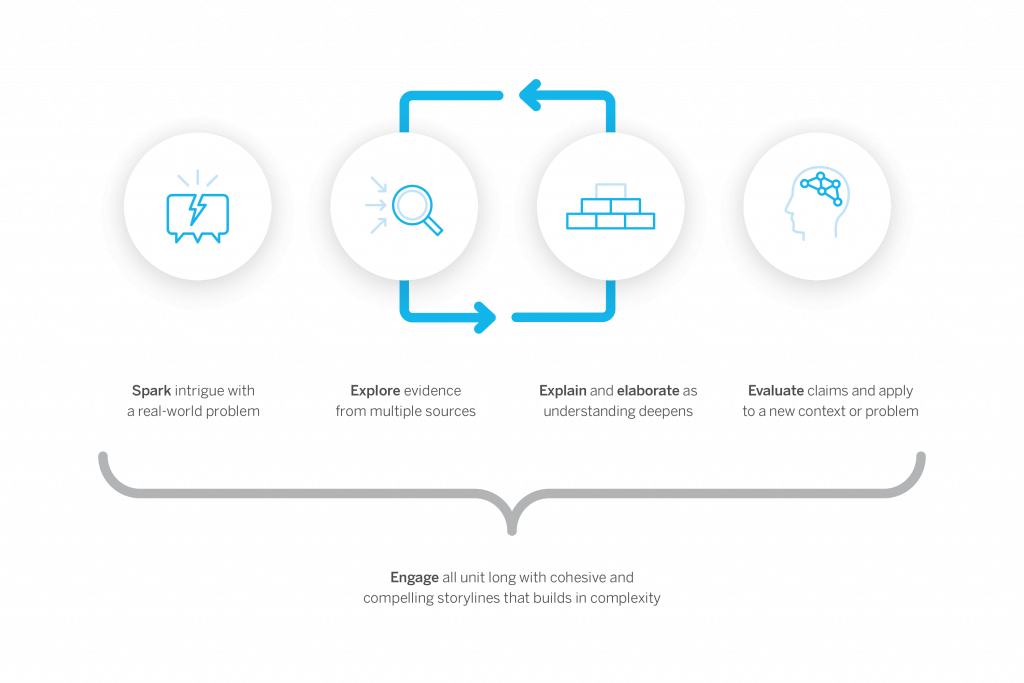
Program structure
Our cyclical lesson design ensures students receive multiple exposures to concepts through a variety of modalities. As they progress through the lessons within a unit, students build and deepen their understanding, increasing their ability to develop and refine complex explanations of the unit’s phenomenon.
It’s this proven program structure and lesson design that enables Amplify Science California to teach less, but achieve more. Rather than asking teachers to wade through unnecessary content, we designed our 6–8 program to address 100% of the California NGSS in fewer lessons than other programs.
Scope and sequence
Every year of our grades 6–8 sequence consists of 9 units, with each unit containing 10–19 lessons. Lessons are written to last a minimum of 45 minutes, though teachers can expand or contract the timing to meet their needs.
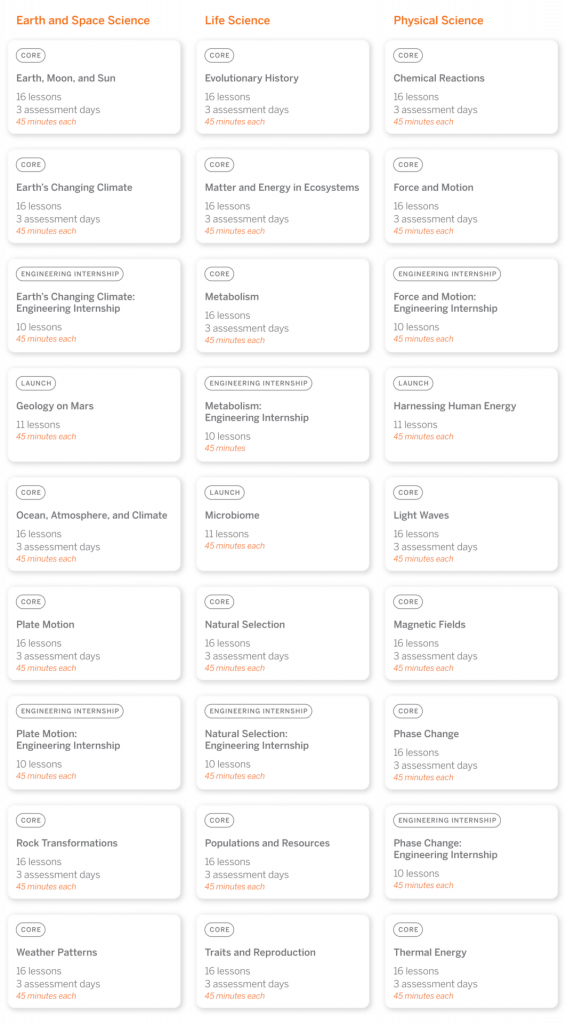
Unit types
Each unit delivers three-dimensional learning experiences and engages students in gathering evidence from a rich collection of sources, while also serving a unique purpose.
In grades 6–8, there are three types of units:
- One unit is a launch unit.
- Three units are core units.
- Two units are engineering internships.
Launch units
Launch units are the first units taught in each year of Amplify Science California. The goal of the Launch unit is to introduce students to norms, routines, and practices that will be built on throughout the year, including argumentation, active reading, and using the program’s technology. For example, rather than taking the time to explain the process of active reading in every unit in a given year, it is explained thoroughly in the Launch unit, thereby preparing students to actively read in all subsequent units.
Core units
Core units establish the context of the unit by introducing students to a real-world problem. As students move through lessons in a Core unit, they figure out the unit’s anchoring phenomenon, gain an understanding of the unit’s disciplinary core ideas and science and engineering practices, and make linkages across topics through the crosscutting concepts. Each Core unit culminates with a Science Seminar and final writing activity.
Engineering Internship units
Engineering Internship units invite students to design solutions for real-world problems as interns for a fictional company called Futura. Students figure out how to help those in need, from tsunami victims in Sri Lanka to premature babies, through the application of engineering practices. In the process, they apply and deepen their learning from Core units.
Units at a glance

Geology on Mars
Domain: Earth and Space Science
Unit type: Launch
Student role: Planetary geologists
Phenomenon: Analyzing data about landforms on Mars can provide evidence that Mars may have once been habitable.

Plate Motion
Domain: Earth and Space Science
Unit type: Core
Student role: Geologists
Phenomenon: Mesosaurus fossils have been found on continents separated by thousands of kilometers of ocean, even though the Mesosaurus species once lived all together.

Plate Motion Engineering Internship
Domain: Earth and Space Science
Unit type: Engineering internship
Student role: Mechanical engineering interns
Phenomenon: Patterns in earthquake data can be used to design an effective tsunami warning system.

Rock Transformations
Domain: Earth and Space Science
Unit type: Core
Student role: Geologists
Phenomenon: Rock samples from the Great Plains and from the Rocky Mountains — regions hundreds of miles apart — look very different, but have surprisingly similar mineral compositions.

Earth, Sun, and Moon
Domain: Earth and Space Science
Unit type: Core
Student role: Astronomers
Phenomenon: An astrophotographer can only take pictures of specific features on the Moon at certain times.

Ocean, Atmosphere, and Climate
Domain: Earth and Space Science
Unit type: Core
Student role: Climatologists
Phenomenon: During El Niño years, the air temperature in Christchurch, New Zealand is cooler than usual.

Weather Patterns
Domain: Earth and Space Science
Unit type: Core
Student role: Forensic meteorologists
Phenomenon: In recent years, rainstorms in Galetown have been unusually severe.

Earth’s Changing Climate
Domain: Earth and Space Science
Unit type: Core
Student role: Climatologists
Phenomenon: The ice on Earth’s surface is melting.

Earth’s Changing Climate Engineering Internship
Domain: Earth and Space Science
Unit type: Engineering internship
Student role: Civil engineers
Phenomenon: Designing rooftops with different modifications can reduce a city’s impact on climate change.

Microbiome
Domain: Life Science
Unit type: Launch
Student role: Microbiological researchers
Phenomenon: The presence of 100 trillion microorganisms living on and in the human body may keep the body healthy.

Metabolism
Domain: Life Science
Unit type: Core
Student role: Medical researchers
Phenomenon: Elisa, a young patient, feels tired all the time.

Metabolism Engineering Internship
Domain: Life Science
Unit type: Engineering internship
Student role: Food engineers
Phenomenon: Designing health bars with different molecular compositions can effectively meet the metabolic needs of patients or rescue workers.

Traits and Reproduction
Domain: Life Science
Unit type: Core
Student role: Biomedical students
Phenomenon: Darwin’s bark spider offspring have different silk flexibility traits, even though they have the same parents.
Populations and Resources
Domain: Life Science
Unit type: Core
Student role: Biologists
Phenomenon: The size of the moon jelly population in Glacier Sea has increased.
Matter and Energy in Ecosystems
Domain: Life Science
Unit type: Core
Student role: Ecologists
Phenomenon: What caused the mysterious crash of a biodome ecosystem?
Natural Selection
Domain: Life Science
Unit type: Core
Student role: Biologists
Phenomenon: The newt population in Oregon State Park has become more poisonous over time.

Natural Selection Engineering Internship
Domain: Life Science
Unit type: Engineering internship
Student role: Clinical engineers
Phenomenon: Designing malaria treatment plans that use different combinations of drugs can reduce drug resistance development while helping malaria patients.

Evolutionary History
Domain: Life Science
Unit type: Core
Student role: Paleontologists
Phenomenon: A mystery fossil at the Natural History Museum has similarities with both wolves and whales.

Harnessing Human Energy
Domain: Physical Science
Unit type: Launch
Student role: Energy scientists
Phenomenon: Rescue workers can use their own human kinetic energy to power the electrical devices they use during rescue missions.

Force and Motion
Domain: Physical Science
Unit type: Core
Student role: Physicists
Phenomenon: The asteroid sample-collecting pod failed to dock at the space station as planned.

Force and Motion Engineering Internship
Domain: Physical Science
Unit type: Engineering internship
Student role: Mechanical engineering interns
Phenomenon: Designing emergency supply delivery pods with different structures can maintain the integrity of the supply pods and their contents.

Magnetic Fields
Domain: Physical Science
Unit type: Core
Student role: Physicists
Phenomenon: During a test launch, a spacecraft traveled much faster than expected.

Thermal Energy
Domain: Physical Science
Unit type: Core
Student role: Thermal scientists
Phenomenon: One of two proposed heating systems for Riverdale School will best heat the school.

Phase Change
Domain: Physical Science
Unit type: Core
Student role: Chemists
Phenomenon: A methane lake on Titan no longer appears in images taken by a space probe two years apart.

Phase Change Engineering Internship
Domain: Physical Science
Unit type: Engineering internship
Student role: Chemical engineering interns
Phenomenon: Designing portable baby incubators with different combinations of phase change materials can keep babies at a healthy temperature.

Chemical Reactions
Domain: Physical Science
Unit type: Core
Student role: Forensic chemists
Phenomenon: A mysterious brown substance has been detected in the tap water of Westfield.

Light Waves
Domain: Physical Science
Unit type: Core
Student role: Spectroscopists
Phenomenon: The rate of skin cancer is higher in Australia than in other parts of the world.
Resources




Families and caregivers, welcome to Amplify Desmos Math California K–5!
Welcome to the Amplify Desmos Math California K–5 Caregiver Hub. We hope your student enjoys exploring math, working with friends to solve problems, and learning new and interesting concepts. And we hope you enjoy the math journey with them! Below are some suggestions and resources for how you can support their learning at home.
Learn more about Amplify Desmos Math California.
Para la versión en español, haga clic aquí.
Caregiver Unit Resources
For every unit of the program, we’ve created a Caregiver Resource that provides a summary of key concepts, plus a problem from the lesson practice set you can work through with your student. You’ll find a Caregiver Resource for each unit, in both English and Spanish.
Unit 1: Math in Our World
Unit 2: Numbers 1–10
Unit 3: Flat Shapes All Around Us
Unit 4: Understanding Addition and Subtraction
Unit 5: Make and Break Apart Numbers Within 10
Unit 6: Numbers 0–20
Unit 7: Solid Shapes All Around Us
Unit 1: Adding, Subtracting, and Working With Data
Unit 2: Addition and Subtraction Story Problems
Unit 3: Adding and Subtracting Within 20
Unit 4: Numbers to 99
Unit 5: Adding Within 100
Unit 6: Measuring Lengths of Up to 120 Length Units
Unit 7: Geometry and Time
Unit 1: Working With Data and Solving Comparison Problems
Unit 2: Adding and Subtracting Within 100
Unit 3: Measuring Length
Unit 4: Addition and Subtraction on the Number Line
Unit 5: Numbers to 1,000
Unit 6: Geometry and Time
Unit 7: Adding and Subtracting Within 1,000
Unit 8: Equal Groups
Unit 1: Introducing Multiplication
Unit 2: Area and Multiplication
Unit 3: Wrapping Up Addition and Subtraction Within 1,000
Unit 4: Relating Multiplication to Division
Unit 5: Fractions as Numbers
Unit 6: Measuring Length, Time, Liquid Volume, and Weight
Unit 7: Two-Dimensional Shapes and Perimeter
Unit 1: Factors and Multiples
Unit 2: Fraction Equivalence and Comparison
Unit 3: Extending Operations to Fractions
Unit 4: From Hundredths to Hundred Thousands
Unit 5: Multiplicative Comparison and Measurement
Unit 6: Multiplying and Dividing Multi-Digit Numbers
Unit 7: Angles and Properties of Shapes
Unit 1: Volume
Unit 2: Fractions as Quotients and Fraction Multiplication
Unit 3: Multiplying and Dividing Fractions
Unit 4: Multiplication and Division With Multi-Digit Whole Numbers
Unit 5: Place Value Patterns and Decimal Operations
Unit 6: More Decimal and Fraction Operations
Unit 7: Shapes on the Coordinate Plane
Unit refresh videos
Unit 1
- Sub-Unit 2 – Answering the Question “Are There Enough?”
- Sub-Unit 3 – Counting and Cardinality
Unit 2
- Sub-Unit 1 – Comparing 2 Groups Using the Terms More, Fewer, and Same
- Sub-Unit 2 – Counting Objects in Different Orders
- Sub-Unit 3 – Making Groups to Represent Numerals
- Sub-Unit 4 – Comparing Written Numbers
Unit 3
- Sub-Unit 1 – Identifying Circles and Triangles in Different Sizes and Orientations
- Sub-Unit 2 – Using Positional Words to Describe the Location of Shapes
Unit 4
- Sub-Unit 1 – Adding and Subtracting Within 10
- Sub-Unit 2 – Representing Addition and Subtraction Story Problems
- Sub-Unit 3 – Finding the Values of Expressions
Unit 5
- Sub-Unit 1 – Decomposing Numbers in More Than 1 Way
- Sub-Unit 2 – Solving for Both Parts
- Sub-Unit 3 – Breaking Apart 10
Unit 1
- Sub-Unit 1 – Organizing Data to Count How Many in Each Category
- Sub-Unit 2 – Counting on to Add and Counting Back to Subtract
- Sub-Unit 3 – Representing 2 Categories of Data With Addition Equations
Unit 2
- Sub-Unit 1 – Representing and Solving Add To, Change Unknown Story Problems
- Sub-Unit 2 – Using Addition or Subtraction to Find an Unknown Part of a Total Amount
- Sub-Unit 3 – Solving Compare, Difference Unknown Problems
- Sub-Unit 4 – Making Sense of Story Problems With Different Questions
Unit 3
- Sub-Unit 1 – Finding a Difference Using the Relationship Between Addition and Subtraction
- Sub-Unit 2 – Using the Structure of Teen Numbers to Find Missing Addends
- Sub-Unit 3 – Breaking Apart Addends to Make 10 When Adding
- Sub-Unit 4 – Subtracting From Teen Numbers in Parts to Get to 10
Unit 4
- Sub-Unit 1 – Adding a Ten To and Subtracting a Ten From Multiples of 10
- Sub-Unit 2 – Representing and Writing Two-Digit Numbers
- Sub-Unit 3 – Comparing Two-Digit Numbers
- Sub-Unit 4 – Representing the Same Two-Digit Number With Different Amounts of Tens and Ones
Unit 5
- Sub-Unit 1 – Adding a Number of Tens or Ones to a Two-Digit Number
- Sub-Unit 2 – Adding a Two-Digit Number and a One-Digit Number When Composing a Ten is Necessary
- Sub-Unit 3 – Adding a Two-Digit Number and a Two-Digit Number When Composing a Ten is Necessary
Unit 1
- Sub-Unit 1 – Choosing Strategies to Add Within 20
- Sub-Unit 2 – Representing Data in a Picture Graph and Bar Graph
- Sub-Unit 3 – Finding the Difference Between 2 Categories Shown on a Bar Graph
Unit 2
- Sub-Unit 1 – Strategies to Solve Story Problems Involving Money
- Sub-Unit 2 – Decomposing a Ten When Subtracting by Place
- Sub-Unit 3 – Making Sense of Story Problems About Comparing That Use the Word More
- Sub-Unit 4 – Making Sense of One- and Two-Step Story Problems
Unit 3
- Sub-Unit 1 – Measuring the Length of an Object in Centimeters Using a Ruler
- Sub-Unit 2 – Measuring Objects in Inches and Feet
- Sub-Unit 3 – Representing Measurement Data on a Line Plot
Unit 4
- Sub-Unit 1 – Locating Numbers on Number Lines
- Sub-Unit 2 – Representing Addition and Subtraction Strategies on a Number Line
Unit 5
- Sub-Unit 1 – Composing Hundreds to Represent Three-Digit Numbers
- Sub-Unit 2 – Comparing Three-Digit Numbers
Unit 1
- Sub-Unit 1 – Representing Equal-Groups Situations With Equal-Groups Drawings
- Sub-Unit 2 – Representing Arrays With Multiplication Equations
- Sub-Unit 3 – Representing Data Using Scaled Bar Graphs
Unit 2
- Sub-Unit 1 – Determining the Area of a Rectangle Using Counting and Skip Counting
- Sub-Unit 2 – Determining the Area of a Rectangle Using Multiplication
- Sub-Unit 3 – Decomposing to Determine the Area of Rectilinear Figures
Unit 3
- Sub-Unit 1 – Using the Expanded Form and Partial Sums Algorithms to Add
- Sub-Unit 2 – Using the Expanded Form Algorithm to Subtract
- Sub-Unit 3 – Rounding Numbers to the Nearest Hundred and Ten Using Number Lines
- Sub-Unit 4 – Representing and Solving Two-Step Story Problems Involving Multiplication
Unit 4
- Sub-Unit 1 – Representing Division Situations With Equal-Groups Drawings
- Sub-Unit 2 – Representing an Equal-Groups Problem With a Division and Multiplication Equation
- Sub-Unit 3 – Using the Distributive Property of Multiplication to Multiply a One-Digit Number by a Teen Number
- Sub-Unit 4 – Decomposing Dividends to Divide
Unit 5
- Sub-Unit 1 – Writing Unit and Non-Unit Fractions
- Sub-Unit 2 – Locating Non-Unit Fractions on the Number Line
- Sub-Unit 3 – Identifying Equivalent Fractions
- Sub-Unit 4 – Comparing Fractions With the Same Denominator or Same Numerator
Unit 1
- Sub-Unit 1 – Using Factor Pairs to Determine All the Possible Side Lengths of a Rectangle With a Given Area
- Sub-Unit 2 – Finding Multiples and Common Multiples
Unit 2
- Sub-Unit 1 – Locating Fractions with Different Denominators On the Same Number Line
- Sub-Unit 2 – Using Multiples or Factors to Determine Equivalent Fractions
- Sub-Unit 3 – Comparing Fractions Using Equivalent Fractions With Common Denominators
Unit 3
- Sub-Unit 1 – Adding and Subtracting Fractions with the Same Denominator
- Sub-Unit 2 – Multiplying Whole Numbers and Fractions
- Sub-Unit 3 – Adding Fractions with Denominators of 10 and 100
Unit 4
- Sub-Unit 1 – Writing Fractions With Denominators of 10 and 100 as Decimals
- Sub-Unit 2 – Relationships Between Place Values in Multi-Digit Whole Numbers
- Sub-Unit 3 – Comparing Multi-Digit Numbers
- Sub-Unit 4 – Using the Standard Algorithm to Subtract When Decomposing is Required
Unit 5
- Sub-Unit 1 – Representing Multiplicative Comparison Situations
- Sub-Unit 2 – Converting Measurements in the Metric System
- Sub-Unit 3 – Comparing Measurements
Unit 1
- Sub-Unit 1 – Using the Layered Structure of a Rectangular Prism to Determine the Volume
- Sub-Unit 2 – Determining the Volume of a Rectangular Prism
- Sub-Unit 3 – Determining the Volume of Figures Composed of Rectangular Prisms
Unit 2
- Sub-Unit 1 – Representing Equal-Sharing Story Problems with Fractional Quotients
- Sub-Unit 2 – Representing Fractions with Equivalent Multiplication and Division Expressions
- Sub-Unit 3 – Determining the Area of a Rectangle With a Fractional Side Length
Unit 3
- Sub-Unit 1 – Representing Multiplication of 2 Unit Fractions with Diagrams
- Sub-Unit 2 – Dividing Whole Numbers by Unit Fractions
Unit 4
- Sub-Unit 1 – Multiplying Multi-digit Whole Numbers Using the Partial Products and Standard Algorithms
- Sub-Unit 2 – Dividing Multi-Digit Whole Numbers Using Partial Quotients
- Sub-Unit 3 – Representing Multi-Step Story Problems with Equations
Unit 5
- Sub-Unit 1 – Comparing Decimals
- Sub-Unit 2 – Using the Standard Algorithms to Add and Subtract Decimals
- Sub-Unit 3 – Multiplying a Whole Number and a Decimal Using the Distributive Property
- Sub-Unit 4 – Dividing Whole Numbers by Decimals Less Than 1
Access Amplify Desmos Math California at home.
In addition to a print Student Edition workbook, your student will have digital access to all learning, practice, and assessment materials through the Amplify platform. The digital curriculum can be accessed in school and at home by following these instructions:
- Click the Amplify Desmos Math California button.
- Select Log in with Amplify.
- Enter your student’s username and password provided by your student’s teacher.
- Select the desired grade level.
Once logged in, caregivers can view student work by opening previous assignments.
Learn how to navigate the student home page.
Materials overview
Amplify Desmos Math California address blended learning with supporting print materials and a unique digital experience. All K–5 lessons are available in a write-in Student Edition book. Many of the lessons include hands-on activities with manipulatives, tools that help students understand abstract concepts by making them tangible. Your student will also work with digital devices for an age-appropriate number of lessons.
When students use devices, teachers can monitor their work in real time, making sure they get the exact support that they need at every part of the lesson, in and outside of class.
Components of a lesson
Students in an Amplify Desmos Math California classroom can be seen (and heard!) asking questions, debating answers, justifying their thinking, grappling with problems, and working together and independently.
A typical Amplify Desmos Math California lesson includes:
- Warm-up: A short, attention-getting problem to pique students’ interest in the lesson.
- Activities: One to two mini-activities that challenge students’ problem-solving skills.
- Synthesis: Discussion to review and bring together the important concepts from the lesson.
- Show What You Know and Reflection: Questions for students to show what they know from the lesson. (Note: The Show What You Know lesson assessment is optional for kindergarten and grade 1.)
- Centers: Student-led activity stations that reinforce the math learned during lesson activities through interactive and often game-like formats. In kindergarten and grade 1, time for Centers is built into the last 15 minutes of every lesson.
To support, strengthen, and stretch students’ learning after the lesson, Amplify Desmos Math California offers options for:
- Differentiation: Mini-Lessons, Centers, Extensions, Boost Personalized Learning, and Fluency Practice.
- Practice: Additional problems your student’s teacher may assign for classwork or homework.
Support math learning at home.
You can support your student’s math learning outside of school in many ways:
Your student’s teacher may assign practice problems at the end of each lesson for classwork or homework. If your student has already completed the practice problems for the lesson, ask them to walk you through how they solved each problem, or talk about any parts that were challenging for them. Ask your student follow-up questions to encourage the use of math language as they explain their thinking, such as, “How do you know?,” “How can you show your thinking?,” or “How would you describe that?” If students are stuck, ask support questions, such as, “What information do you know here?” or “How could you represent this problem?”
Your student’s teacher may introduce a Center game with students in the lesson or beyond the lesson. These games are aligned to the math of the unit and can be played with students outside of class. Your student’s teacher may introduce a Center game to students during or after completing a lesson, or you may need to teach the game before you play by using easy-to-follow instructions. Sign up for a free account to explore Centers and additional K–5 content in our Featured Collections.
Each unit in Amplify Desmos Math begins with a read-aloud story to engage students and provide context for the math of the unit. Elements and characters from the Unit Story then appear in lessons throughout the unit.
Kindergarten
- Unit 1 Story: The First Day of School
- Unit 2 Story: What’s in a Restaurant?
- Unit 3 Story: A Great Shape Adventure
- Unit 4 Story: Casey’s Town
- Unit 5 Story: Where is Harry?
- Unit 6 Story: Winners
- Unit 7 Story: Everybody Needs Help Sometimes
Grade 1
- Unit 1 Story: Ying’s New Town
- Unit 2 Story: Let’s Grow!
- Unit 3 Story: Impossible
- Unit 4 Story: The Collectors
- Unit 5 Story: The Day of the Wazzle-Squash
- Unit 6 Story: Side by Side
- Unit 7 Story: A Potluck for Pia
Grade 2
- Unit 1 Story: A New Class Pet
- Unit 2 Story: The Heroes of Pineapple Street
- Unit 3 Story: What Orson Imagined
- Unit 4 Story: A Seed’s Journey
- Unit 5 Story: 302 Ricotta Drive
- Unit 6 Story: Arjun the Artist
- Unit 7 Story: Where Eli Went
- Unit 8 Story: On Clementine Court
Grade 3
- Unit 1 Story: My Name Is Harper
- Unit 2 Story: Cheri’s New Home
- Unit 3 Story: The View From Up Here
- Unit 4 Story: Home Cooking
- Unit 5 Story: Coen and Obita
- Unit 6 Story: Just Stick With It, Sasha
- Unit 7 Story: Through Piho’s Eyes
Grade 4
- Unit 1 Story: I Contain Multitudes
- Unit 2 Story: One Step at a Time
- Unit 3 Story: Finny
- Unit 4 Story: Myles and the Loggerheads
- Unit 5 Story: Just for Fun
- Unit 6 Story: Special Day, Special Lei
- Unit 7 Story: Captain Bogwart’s Treasure
Grade 5
Relate math to daily activities at home, whether grocery shopping, preparing a meal, or planning for a trip to the store. Your student can help you figure out how many more apples there are than oranges in the grocery cart, show how to split a sandwich into fourths, or figure out how much change you’ll receive in exchange for a $10 bill. Encourage your student to point out ways that you use math in your daily tasks.
Remind your student that getting stuck is part of the process and a necessary—beneficial, even!—part of learning. Many students (and adults) fear making mistakes. But research shows that making mistakes helps our brains grow. When your student gets stuck on a problem, encourage them to keep trying different strategies, even if they’re not sure if they are right.
Get more information.
Have a question about Amplify Desmos Math California? Visit our help library to search for articles with answers to your program questions. For additional support, please contact your student’s teacher.
Winter Wrap-Up 02: Mathematizing Children’s Literature
While we’re hard at work producing the exciting fifth season of Math Teacher Lounge: The Podcast, we’re continuing to share some of our favorite conversations from our first four seasons. This time around, we’re revisiting our popular episode that connected literacy and math!
In this episode, we sit down with Allison Hintz and Antony Smith, authors of Mathematizing Children’s Literature, to talk about what would happen if we were to approach children’s literature, and life, through a math lens–and how we can apply those same techniques to classroom teaching!
Explore more from Math Teacher Lounge by visiting our main page.
Bethany Lockhart Johnson (00:02):
Hi, I’m Bethany Lockhart Johnson.
Dan Meyer (00:04):
Hi, I’m Dan Meyer.
Bethany Lockhart Johnson (00:05):
And we are so excited for another episode of Math Teacher Lounge. And as you know, podcast format; you’re listening now. I think one beautiful thing about the podcast format is that it gives us a little bit more time to have these rich conversations. And I promise I won’t do it, but I could talk to our guests for hours, hours! Authors Allison Hintz and Tony Smith have just released Mathematizing Children’s Literature: Sparking Connections, Joy, and Wonder Through Read-Alouds and Discussion. And today we get to talk to the authors. Allison, Tony, welcome. Welcome to the lounge.
Allison Hintz (00:53):
Thank you. We’re so grateful to be here.
Bethany Lockhart Johnson (00:55):
We’re so excited to have you here. And I wanna say that my very first—was it my first math conference? Maybe it was my first math conference—up in Seattle, the CGI conference, and I’m all like, you know, wide-eyed and just like, “Can this be a place for me, this math community?” Re-envisioning my relationship with math and thinking about myself as a math teacher, what? And I went to your session on mathematizing children’s literature, and I was just so fired up. I was so wowed by your ideas, your energy, and your passion for students’ thinking. And I feel like as I read this book, I felt like I was hanging out with you. Like you were just so encouraging all the way through. Of educators, of other folks working with young people, and really guiding us how to listen with joy and with an open curious mind.
Dan Meyer (02:03):
Yeah. I would love to hear a bit about the genesis of this book for you folks. Like, I’m coming at this from a secondary educator lens. I’ve got small kids, so that’s also part of my interest here. But I love any book, any idea that seeks to merge what seems like two disparate worlds. Like it’s often the case that we feel like, well, there’s approaches for ELA and approaches for math, and they’re kind of separate disciplines. And these poor elementary teachers have to learn all of them and be experts at all of them. And here you both come along and say, “Hey, what if they are the same kind of technique?” Can you just speak to how this came about?
Allison Hintz (02:38):
Definitely. Tony, do you wanna take a try? Do you want me to start us off?
Antony Smith (02:42):
I can start. We oftentimes present and talk together and so we kinda switch back and forth. So that’s just how we are. So probably about eight or nine years ago, Allison and I, our offices were next to each other on our small campus. We’re both professors and we just happened to have a few children’s books that we looked at together and we were just thumbing through the pages. We really liked children’s literature. And we noticed that I would stop at certain points wondering about character motive or plot or sequence of events or language use. And Allison would stop at very different points in the book and notice number and concepts or something about mathematics. And that’s when we started to wonder, what would it be like if we were sharing a children’s book with a group of children and we put our ideas together? Where would we stop? What would we talk about? What would we ask children about in terms of their thinking and what they notice?
Allison Hintz (03:42):
And so we started playing with these questions that we had and started approaching stories with multiple lenses to see what kinds of things would children notice and what kinds of things might they say. And we were also on our own journey in trying to understand how to plan for and facilitate lively discussions and classrooms that surface really complex mathematics. And it felt like stories were a place where that might be a fruitful context for hearing children’s thinking. We’ve worked with a lot of teachers and students in our region. We live in the Seattle area and we’ve applied for some funding over time that’s really helped us be in a lot of community-based organizations and educational contexts and libraries and pediatricians’ offices and classrooms, various classrooms, and see what’s interesting about this and what might teachers and children do with stories that would surface complex mathematics to think about together.
Antony Smith (04:41):
Over time, we came to the realization that if we wanted to hear children’s ideas, we had to stop bombarding them with questions. <laugh> Yeah. And at first it made it worse that we were asking them math and literacy questions at the same time. And so we realized that what we needed to do was to back off and to ask children what they noticed and wondered.
Bethany Lockhart Johnson (05:01):
Can you say more about that and how that kind of evolved into mathematizing children’s literature?
Antony Smith (05:07):
We did work with a number of very thoughtful, talented classroom teachers and children’s librarians in public library systems who were just so masterful at asking open-ended prompts and questions, rather than kind of like the de facto reading quiz, that a read-aloud can become, which I’ve always disliked as a literacy educator. And we realized in our observing these read-alouds or interactive read-alouds or shared reading experiences that given the opportunity in the space and an adult who was actually listening, that children came up with all of the ideas we would have asked them about and more. So we didn’t have to be bombarding them with questions. They were already much more thoughtful than what would’ve been sufficient to answer our questions.
Allison Hintz (05:58):
And much like mathematics, it was really an iterative process. You know, we had some clunky read-aloud discussions where we were trying to accomplish so much and toggling multiple chart papers and different colored pens and all sorts of “how do we capture these ideas” and “do we separate ’em? do we keep ’em together?” And so it’s really been over time that with partners, we’ve learned these ways of having multiple reads of the same story that allow us to hear what children notice and wonder, and then to delve more deeply into their questions and their ideas through multiple reads where we might spotlight literary ideas that they notice; we might spotlight mathematical ideas that they notice. We might make purposeful integrations between those. But we found it to be most productive—and Kristin Gray really help us think about this—to have an open Notice and Wonder, get everything out much like an open-strategy share. We welcome here, record all the ideas, and it goes all over everywhere. You know, it can be a really not math-y noticing! And those are amazing! So there’s a lot of, um, yes, there is a ladybug on this page! The grandma is wearing green triangle earrings! Oh, your grandma wears green earrings! I mean, it all comes out.
Bethany Lockhart Johnson (07:27):
Wait, have you been in my classroom? ‘Cause that’s exactly— <laugh>
Allison Hintz (07:29):
<laugh> And then, you know, we think of it a lot like if math teachers might use the 5 Practices for selecting and sequencing, or if you might move from an open-strategy share to a targeted share, how can we get out all the questions that children are asking and then step back from them, take some time to really think about what they’re telling us they’re curious about, and plan some purposeful, intentional subsequent discussions that can delve more deeply into their ideas.
Dan Meyer (08:02):
I’d love to go into that a little bit more if that’s all right. Um, I’m gonna speak from someone who doesn’t have an elementary background and I’m gonna voice some worries that I had, some anxiety. One anxiety I have like in a classroom or a curriculum is when there’s no room for student ideas. Right? When it’s like, oh, there’s just room for the curriculum author or the teacher here. That is a sadness. But I when I see an instructional environment like you’re describing here, where there is openness to all kinds of different student ideas, of different levels of formality, from different kinds of cultural fonts of knowledge or wherever, I also get a little bit nervous because that, like, increases the risk that a student might come to understand that “my ideas are not good enough,” whereas in the class with no room for their ideas from their home or their language or their hobbies, like, they’re not gonna internalize the message that, “that wasn’t good enough.” And so I’m really curious as you move from the open Notice and Wonder where kids share all of themselves with you, and then you move to a targeted focus on some sort of disciplinary objective, how do you navigate that tension and help students feel like their contributions are valuable, even though we aren’t taking them up per se?
Allison Hintz (09:18):
That’s such an important question. I mean, I think we’ve grappled with this broadly in math education. I think any time we’re thinking about which ideas we choose to take up to pursue to consider, we have a responsibility to think carefully about whose ideas are being taken up and heard and considered. And so one of the tensions I hear you naming, I think, Dan, is when we engage in lively discussion where children’s thinking’s at the center, how do we make sure to upend and interrupt kinda status norms that run the risk of being deepened? Um, and I think by paying attention to whose ideas are taken up as much as which ideas are taken up, and what’s the mathematics we wanna explore is one tension. Um, another tension I might hear you naming is, you know, the complications that teachers face with time and pressure and coverage, and which mathematics ends up getting worked on. And, um, you know, it’s something we’ve really had to struggle with in mathematics education, where we move to more discussion-oriented classrooms that are really centered in sense-making to know that it takes a lot of time to do this thoughtful, thoughtful work. Um, does that begin to get at some of the tensions you’re raising? Is there, is there more you’re thinking about?
Dan Meyer (10:53):
I think it’s really helpful that you kind of broadened the scope of the question beyond your book to “this is an issue that we are, you know, really challenged by and focused on broadly in math education.” And, um, I appreciate you bringing the element in of whose idea—not just which idea is taken up, but whose idea is taken up—is an opportunity where, let’s say, multiple people raise an idea that is towards an objective the teacher has, they have the opportunity to disrupt certain kinds of status, like ideas about status, in that moment. From your perspective, like, are there techniques to say, I don’t know, parking-lot certain kinds of questions and say like, “Hey, like these are awesome”? I don’t know. I just know that I see kids at like ninth grade. They are very reticent, often. They’ve internalized totally this sense of like, “I’m not gonna just, like, share about the pants the grandma’s wearing, you know; that will not be received well.” And so I’m just kinda wondering how that happens and like, what are the ways we can disrupt that? That process?
Antony Smith (11:54):
So thinking about that, Dan, from the teacher’s perspective, in those kinds of scenarios where you wanna honor each child’s contribution, a couple of things that come to mind: One is that by, you know, initially by modeling what I as a teacher, something that I notice or wonder about, helps kind of set the expectation for what kind of response would be encouraged. And it’s broad, but it gives an example. And then also we really try to record or to chart all of the ideas that are shared so that we can revisit and honor those together. And then either later or on another day, if we choose one or two of those to explore in some way within a more focused read, then another thing that we do is have the idea investigation afterward that continues that thought, but goes back to being as open-ended as possible, so that those students or children who maybe didn’t have their idea as the one that was focused on by the group could go back to that or explore some other idea of their own, so that the idea investigation isn’t a lockstep extension activity, which is why we don’t call it that. So they could again bring in their own perspective. But I have to say from the teacher’s point of view, there is that moment of potential panic <laugh> because there is that power transfer when you’re asking children to help steer where this is going. And if you really mean it, you have to let them steer a little bit. And that can be terrifying. And, um, I always think of one teacher, Ashley, we worked with who read an adorable book, Stack the Cats, by Susie Ghahremani. And in that book, there’s a point where there are eight cats and they’re kind of trying to be a tower of cats and they fall and they’re sort of in the air on that page. And she asked her first graders—she stopped, and she asked, “How, do you think, how will the cats land?” And for about a minute and a half, the entire <laugh> class, was silent. They had their little papers; they had chart paper; they had clipboards; they had everything they needed. But that unusual phenomenon of a group of six- and seven-year-olds actually just sitting and thinking and not being peppered with activities was really stressful, but amazing. And then, after about the 90 seconds, they started out into their exploration of how the eight cats might land. They just needed a minute to think. And it’s so rare that we’re able to let children have that.
Allison Hintz (14:40):
In that same moment, Ashley, who’s a learning partner to us, she turned to us kind of quietly, like, “Should I pose a different question?” And <laugh>, we’re like, “No, let’s stick with it. Let’s see what happens.” So I think it creates this space too, this thinking culture, right? And this culture of “what does that mean to really pose a rich task?That’s open-ended, where there’s multiple access points?” Those eight cats could land in so many different ways. And there was broad access, there was a wide range of all the cats landing, and one’s on their feet, ’cause cats always land on their feet <laugh>, and there was every combination. And so, um, I think what’s really interesting—and to me, this brings back to your wonder, Dan—is, you know, “What’s the risk in openness?” And there’s always risk in openness. Um, it’s scary as a teacher, right? If I’m not the authority of knowledge and I don’t have control over where we’re gonna go, it might get into places that I didn’t anticipate. Or I don’t really feel as solid in the math as I want to. Or I don’t know what it sounds like to stick with silence and wait time, to know if my students are really in productive struggle or if that question was a flop. And so, um, I think this is some practice space for young mathematicians and teachers of mathematics, and just teachers, to explore with that openness and kind of the risk of the openness required for complex thinking to emerge.
Bethany Lockhart Johnson (16:12):
You know, it feels like the way you’re both describing this, it really is a culture shift, right? I kept feeling like I was given permission to be a beginner as I read this book. Like I was really…I loved how you said, I believe it was you, Allison, when you were in the class, you had a couple index card that you kept on your clipboard and that as you walked around, you were like, “Hey, if I don’t know what to ask, I ask one of these questions.” You know? And just this idea that, that, like Dan was saying, there is that loss of control, but that’s also a way to create this culture where students ideas are valued and we are allowing students to really generate the questions, which I thought was such an important idea to explore.
Allison Hintz (17:00):
We started this work long ago, super-excited about math-y books. And we saw a lot of potential in them and we still do. But the limitation we saw is that math-y books, they, they put forth a certain mathematics to be curious about. In some ways they tell you what mathematics to think about. So we started asking ourselves what would happen if we considered any story a chance to engage as mathematical sense-makers. And we started playing with non-math-y books and we got to a place where we could consider every story an opportunity to engage in mathematical thinking. And so we started noticing things over times, oh, these books tend to be really math-y. We call those text-dependent. We’d have to pay attention to the mathematics to understand the story. Whereas this pile of stories, these, they’re not overtly math-y. You could really enjoy the story and not pay attention to mathematics and have an amazing conversation. But what would happen if we thought of about this story as mathematical sense-makers and how might it deepen our understanding of the story? And then this other teetering pile of books, these are books where, you know, children didn’t tend to engage as overtly as mathematicians in it, but there’s opportunities in this story to go back to something—to a moment, to an illustration, to a comment—and think as mathematicians. And those were more about illustration exploring. And so, as we notice these different kinds of books, we really broaden what we thought about. And I think one of the things we really wanna think about in community through this book is what happens if we approach any story, every story, as mathematical sense-makers, because stories are alive in children’s lives, in homes and communities and in schools. And it’s a broad opportunity that we wanna take up. I was thinking, as I stay in this strait for just a moment about book selection, before we move into that process, um, Bethany in a previous MTL, you talked about representation.
Bethany Lockhart Johnson (19:12):
Mm, yeah.
Allison Hintz (19:14):
And do you remember when you shared the image of hair braiding?
Bethany Lockhart Johnson (19:19):
Yes. Vividly, yes. <laugh>.
Allison Hintz (19:22):
Yeah. And can you say just what that meant to you? What that….
Bethany Lockhart Johnson (19:27):
Yeah. Well, it was from a conference; Sunil Singh had used it and was talking about the artistry in mathematics and beauty in hair braiding. And, um, particularly, he was showing this particular image of this Black woman with her hair braided in profile and looking at the angles and the symmetry. And I shared that, you know, I spent so many hours in the beauty shop with my aunties and my mom and my grandma and continue to, to this day, that it just, it struck me immediately as familiar. And it struck me immediately as seeing an image that was reflective of my lived reality, projected as valuable and worthwhile for consideration in the world of mathematics. Which is not what I felt as a student of mathematics as a young adult or child. So it was this beautiful moment of, for me, the power of when we see images and we allow opportunities for re-envisioning what may be a common practice for that student, or may be something that they see every day.
Allison Hintz (20:44):
And in that same way, that image that was put up, we wanna think really carefully about representation in the stories that we select. And when we think of stories as mirrors or windows, we really wanna be mindful in story selection of whose stories are told and whose stories are heard. And when you said that you would sit down to listen to a story and you felt at ease or that you saw an image and you saw yourself that can be and should be something we really think carefully about when we select the stories that we select.
Dan Meyer (21:21):
It’s a wider path for representation of different kinds of people in literature, because people’s stories seem so much more present and towards the surface of their lives, versus, say, the abstractions and numbers and shapes in mathematics. It feels like more of a struggle to find ways to show people, hey, like you’re here, this, this place belongs to you. So in all these reasons, I think it’s really great you folks are using literature, which has this history of humanities, literally humanities, as a vehicle for mathematics. That seems pretty special here.
Antony Smith (21:56):
We both go to libraries and bookstores and look through books as often as we can, but also our partner, a children’s librarian, Mie-Mie Wu, helped us go through—when we would meet, she would bring three or four hundred books at a time.
Bethany Lockhart Johnson (22:13):
When you described her wheeling in the cart, oh, I wish I been in that room! <Laugh>
Antony Smith (22:18):
And the cart was, you know, probably three or four times bigger than she was sometimes. And we would go through hundreds of books and look at them and listen to her thoughts as a skilled librarian sharing with families, diverse families, and what catches the attention of a three-year-old sitting with her grandfather. And that was really a valuable, helpful experience. And it’s a partnership that continues. So in Last Stop on Market Street—and this is in the book; we talk about this, this children’s book quite a bit—in this story, CJ with his Nana, his grandmother, are riding the bus to the last stop on Market Street in San Francisco, to go, as we will find out, to help serve in a soup kitchen to help the community. And the teacher, Susan Hadreas, had the children record their ideas. She charted them in an open Notice and Wonder read. And one of the ideas that a young boy noticed was that CJ on the bus…a man with a guitar starts playing the guitar on the bus and CJ closes his eyes and it says CJ’s chest grew full. And he was lost in the sound and the sound gave him the feeling of magic. So this boy said, “I wonder, what does that feel like if you’re feeling the magic? What’s that?” And that was one of many ideas in the open Notice and Wonder, and Allison will talk about the math lens read, but first Susan went back and read with them. She had that idea, she circled it on the chart paper, and another day that week, she said, let’s go back and visit this story we really liked. And remember, we wondered what feeling the magic was like. Let’s go back through and let’s keep track of all the feelings and emotions that CJ had across the journey to the soup kitchen in this book. And so they did another read of the story; they were very familiar with it, of course, but they noticed new things and they also, every few pages, stopped and she helped chart all of the emotions that CJ experienced from envy to excitement to sadness. There’s a huge range in this book. And it was fascinating.
Allison Hintz (24:36):
I think one of the things that the children noticed was that CJ’s feelings were shaped by community. And that he shaped and shaped…he was shaped by and helped shape his community. And so the ways that he felt across the story were impacted by the other characters that he comes across. The guitar man on the bus. The bus driver who can pull a coin out from behind someone’s ear. The lady with the butterflies in the jar. Nana helping him to see the rainbow. And the students started, you know, being curious about that. How do we shape and how are we shaped by community? What communities are we a part of? This class is one community. I’m in many communities across my life. And they started to quantify the number of people in the story. So Mrs. Hedreas went back for a math lens read, and she said, let’s just keep track of and pay attention to how many people are in CJ’s life in this day. Because I can hear you starting to think about quantity. This class at the same time in other areas of the day had been working on counting collections, how to keep track, so they got out their tools. Some people pulled out ten frames, some people pulled out clipboards. They had a wide range of things they could use to help them keep track. They developed their own strategy, keep track however you want. She did a quicker read through it, flipping the pages, and then they get into these debates: <laugh> “We already counted that person!” “But they took their hat off and put it down to collect money!
Antony Smith (26:10):
“What about the dog?”
Allison Hintz (26:11):
“That’s the same person!” “Yeah, there’s a dog pound in his community!” <laugh> “Do animals count in our community?”
Bethany Lockhart Johnson (26:17):
I love it!
Allison Hintz (26:17):
“Yes, they count!” Uh, and so we went through and quantified and there was really this understanding as you saw these people throughout the story that communities can be of different sizes, but community has impact. And you have responsibility in your community to show up and to lean in and to know that bringing your full, authentic, vulnerable self, you shape people and they shape you. And what communities are people a part of. And it turned into this really interesting discussion about quantity and helped us think more about quantity and community. I think a really important moment for us and for that class was the transition from being people who almost did mathematics to a story, like counted things on a page, um, count acorns on a page in an autumn book, to being mathematicians who thought within the story.
Antony Smith (27:17):
And then two idea investigations that came from that —not at the same time, of course, but with the same group of children—one was they identified an emotion of their own and wrote and drew about that. And also, who helped them address or get out of or acknowledge that emotion. And then the other idea investigation was that all of the children drew or kind of mapped out a community that they were part of. Whether it was their neighborhood or their classroom or their soccer team or whatever it was. And so then those investigations strengthened the connections of those concepts to the lives of those children.
Bethany Lockhart Johnson (28:05):
Well, I, actually wanted to ask you about idea investigations. Because I feel like that was such an important invitation in your book. And the way I understood the idea investigation is you’re really paying attention to what’s coming up in your other reads. Right? And then these are opportunities to extend the thinking, or like you said, to extend a particular aspect: What’s your community? Can we map your community? Or what’s a particular emotion? And it was in such contrast to what I think I have probably done in my classroom more than once, which was like, “Oh, we read this story about seals. So now my story problem is gonna be about seals, right? <laugh> Like in the story, you know, Jojo, the seal had five balls. <laugh> So if Jojo still had five balls and two of them bounced away…” You know, or whatever. Right? But that’s not what an idea investigation is. Right?
Allison Hintz (29:03):
Yeah. I think this is where we also had some stumbles and can totally relate to what you’re saying as previous classroom teachers as well. We have come to a place where we are pretty in favor of a super open-ended idea investigation that takes up the things that have surfaced in the multiple reads and making sure it’s a rich task with many, many ways children can engage with that. There’s many, many, many right answers or ways to engage. Less is more there. So we moved way away from, like, even a worksheet that might have an idea from it to blank paper and math tools and places to get into some productive struggle around some of the complex things that were raised.
Antony Smith (29:59):
A challenge with worksheets is that they put a frame around children’s ideas. So either there are only three lines to write on, or there’s only a small box to draw in. Whereas a blank page really opens up the possibility. Um, and so—is it Ann Jonas who wrote Splash!? sorry, I don’t have it in front of me—the book Splash!, about animals that end up in and out of the pond, including a cat that is not happy about ending up in the pond, an idea investigation after that for very young children was, with the list of the different creatures displayed at the front of the room: On blank paper, hey, draw your own pond and decide how many of which and each type of animal you want in your pond and then write about it. Just on blank paper. And so that allowed some children to draw, like, three giant goldfish. But other children drew 17 frogs and three cats. And, and just, it lets children follow—
Bethany Lockhart Johnson (31:02):
It was theirs, right? It was theirs.
Antony Smith (31:04):
Their idea. <laugh> And that comes partly from, I think, as Allison mentioned, we both were classroom teachers before moving into academia. And I remember giving children worksheets, particularly math worksheets, where they weren’t necessarily bad, but right at the bottom, it says like, explain your strategy. And it gives two lines.
Bethany Lockhart Johnson (31:23):
Right! <laugh>
Antony Smith (31:25):
The only thing a seven-year-old can write there is “I thought.” Or “I solved it.” <laugh> And that’s not where we need to go.
Dan Meyer (31:34):
Yeah. If I could just ask the indulgence of the primary crowd here, like, I’m trying to make sense of all this. And I just wanna like, offer my perspective. My summary statement of what’s going on here. I’m trying to—I love how you both came here—
Bethany Lockhart Johnson (31:45):
<laughs> How ya doin’, Dan? How ya doin’?
Dan Meyer (31:47):
<laughs> I’m, ah, A, I’m loving this a lot. Um, B, I came in here loving how you folks are broadening the work of primary education to kind of find commonalities between these sometimes seemingly disparate kinds of teaching in ELA and math. Love that, I wanna say. But I think you folks are describing, with all these teachers you observed and your own work, is the work of attaching meaning to what students might not realize yet has meaning. Or they might think it only has one kind of meaning. But you, the teacher, with their knowledge, realizes that there are many more dimensions of meaning that can be attached to those thoughts. And I’m hearing that from you folks, when you describe A, what math is and the power of a teacher to name a thing as mathematical. Like, “Oh, you didn’t think math was that, but math is noticing; math is wondering; math is asking questions,” for one. But also this work you’re describing of how, like, first the task has to invite lots of student thoughts and then to say like, “Oh, I see that there’s a similarity to these two.” And to raise those up for a conversation or to ask a question like to extend one person’s, one student’s question a little bit more. But it’s always…I’m just hearing you folks attaching more meaning than the student might have originally thought. I appreciate the conversation. That’s really interesting.
Bethany Lockhart Johnson (33:03):
Well, and now that the book is out, I think it’s gonna keep evolving, right? Now that it’s gonna be in the hands of teachers and librarians and educators and caregivers, it’s exciting to see kind of where it goes next. Which actually brings us to our MTL challenge. Dan Meyer, do you wanna share?
Dan Meyer (33:22):
Math Teacher Lounge, we have a challenge for the folks who listen and we’d love for them to hop into the Facebook group Math Teacher Lounge, or hit us up on Twitter at @MTLShow and just, like, kind of exercise beyond listening, exercise the ideas you folks are talking about, some kind of a challenge that can help us dive deeper into your ideas. So what would you folks suggest for our crowd, for our listeners?
Allison Hintz (33:42):
I would love to invite people to playfully experiment with a favorite story, with a story that’s new to you. I would love to invite listeners to sit with a story maybe on your own, and just ask yourself as a mathematician: What do you notice and wonder in this story? Don’t feel any pressure. Maybe sit with a child or some children and listen to what they notice and wonder. Like, really listen! Don’t ask questions! But hear their questions and place children at the center and consider multiple reads. Consider continuing to pursue their questions. And we have a planning template that might support people in kind of sketching out some ideas if you’re open to playing with that too.
Bethany Lockhart Johnson (34:34):
And we will post—
Dan Meyer (34:36):
That’s awesome.
Bethany Lockhart Johnson (34:36):
—a link for that planning template in our Facebook group and on Twitter as well. So thank you so much for that resource, because I think it’ll definitely help. It could help you, like you said, it could help you kind of organize your thoughts or help you think about this work in a new way. So thank you for that resource and thank you for the amazing resource that is Mathematizing Children’s Literature. I am so excited to continue to engage with you both and with listeners as they dive into this book. If folks want to engage with you more, where can they find you? How can they reach you?
Allison Hintz (35:12):
Well, we’re on Twitter.
Bethany Lockhart Johnson (35:14):
Great.
Dan Meyer (35:15):
What’s your home address? <laugh>
Bethany Lockhart Johnson (35:24):
Wait, let me try that again. <laugh> ‘Cause it does sound like I’m like, <fake ominous voice> “Where can they find you?”
Allison Hintz (35:29):
4-2-5…. <laughs>
Antony Smith (35:32):
At the bookstore!
Bethany Lockhart Johnson (35:34):
Y’all, if folks want to continue this conversation or share these ideas or the math challenge, how can they tag you? How can they, they reach you on the World Wide Web, besides the Math Teacher Lounge Facebook group?
Antony Smith (35:50):
Yeah. Well, we are both on Twitter, and we’ve been trying to promote the hashtag #MathematizingChildrensLiterature. It’s very long, but once you type it once, your phone or computer…
Bethany Lockhart Johnson (36:01):
Easy. Yeah, those click, right? Is that what it is now?
Antony Smith (36:03):
<laugh> The other is that we do for our project, we have an Instagram account that is @MathematizeChildren’sLiterature.
Allison Hintz (36:11):
We care really deeply about hearing from people. You know, we think our ideas are constantly evolving and that there’s such exciting room to grow. And we just felt compelled to share what we were learning now so that together we could learn and build vibrant experiences for young children and teachers and families through stories. So we want to hear from people! We wanna learn about stories that are important in your lives and what children say, and grow these ideas together.
Bethany Lockhart Johnson (36:42):
And credit to Dan, you told me you went and ordered a bunch of the books they have on the suggested read list.
Dan Meyer (36:48):
Oh my gosh.
Bethany Lockhart Johnson (36:49):
You read ’em to your son.
Dan Meyer (36:50):
I got such a side-eye from my significant others around here for what I dropped on Amazon in one night! <laugh> Uh, all these books I didn’t have. Some of them I did. We are not fully illiterate around here! We do love the written word at the Meyer household! But there were a bunch that that I grabbed. I’m morseling them out day by day.
Bethany Lockhart Johnson (37:09):
Wait, at bedtime I read my one-year-old One Is a Snail, Ten Is a Crab. <laugh> And let me tell you, he had vigorous pointing and “Da? Da da da da?”
Allison Hintz (37:22):
<laugh> Aww, da da!
Bethany Lockhart Johnson (37:22):
So hey, we’re on the road. <laugh> <music> Deeply grateful, not only for your work and your beautiful book and your work, but also for the invitation to dive into the world of children’s literature in a way that many of us have not before. And it’s fun! Thank you, Tony. And thank you, Allison. And thanks for hanging out in the lounge.
Allison Hintz (37:48):
Thanks for having the lounge!
Antony Smith (37:49):
It’s been fun!
Allison Hintz (37:52):
Thank you both.
Stay connected!
Join our community and get new episodes every other Tuesday!
We’ll also share new and exciting free resources for your classroom every month.
Meet the guest
Allison B. Hintz: Dr. Hintz’s research and teaching are in the area of mathematics education. Her focus on mathematics came about during her years as a fifth grade teacher – it was alongside her students that she developed her own positive identity as a mathematician! Today she studies teaching and learning, specifically facilitating engaging discussion. Her research and teaching happen in partnership with educators and children in formal and informal settings and focuses on beliefs and practices that support all children in lively mathematics learning. She is a co-author, with Elham Kazemi, of Intentional Talk: How to Structure and Lead Productive Mathematical Discussions.
Twitter: @allisonhintz124
Antony T. Smith: Antony T. Smith is an associate professor of literacy education at the University of Washington, Bothell. He works alongside teachers to create engaging literacy-mathematics learning experiences through exploring and discussing children’s literature. He is committed to the concepts of motivation, engagement, challenge, and creativity in literacy teaching and learning.
Twitter: @smithant Instagram: mathematizechildrensliterature

About Math Teacher Lounge: The podcast
Math Teacher Lounge is a biweekly podcast created specifically for K–12 math educators. In each episode co-hosts Bethany Lockhart Johnson (@lockhartedu) and Dan Meyer (@ddmeyer) chat with guests, taking a deep dive into the math and educational topics you care about.
Join the Math Teacher Lounge Facebook group to continue the conversation, view exclusive content, interact with fellow educators, participate in giveaways, and more!
You might also like:
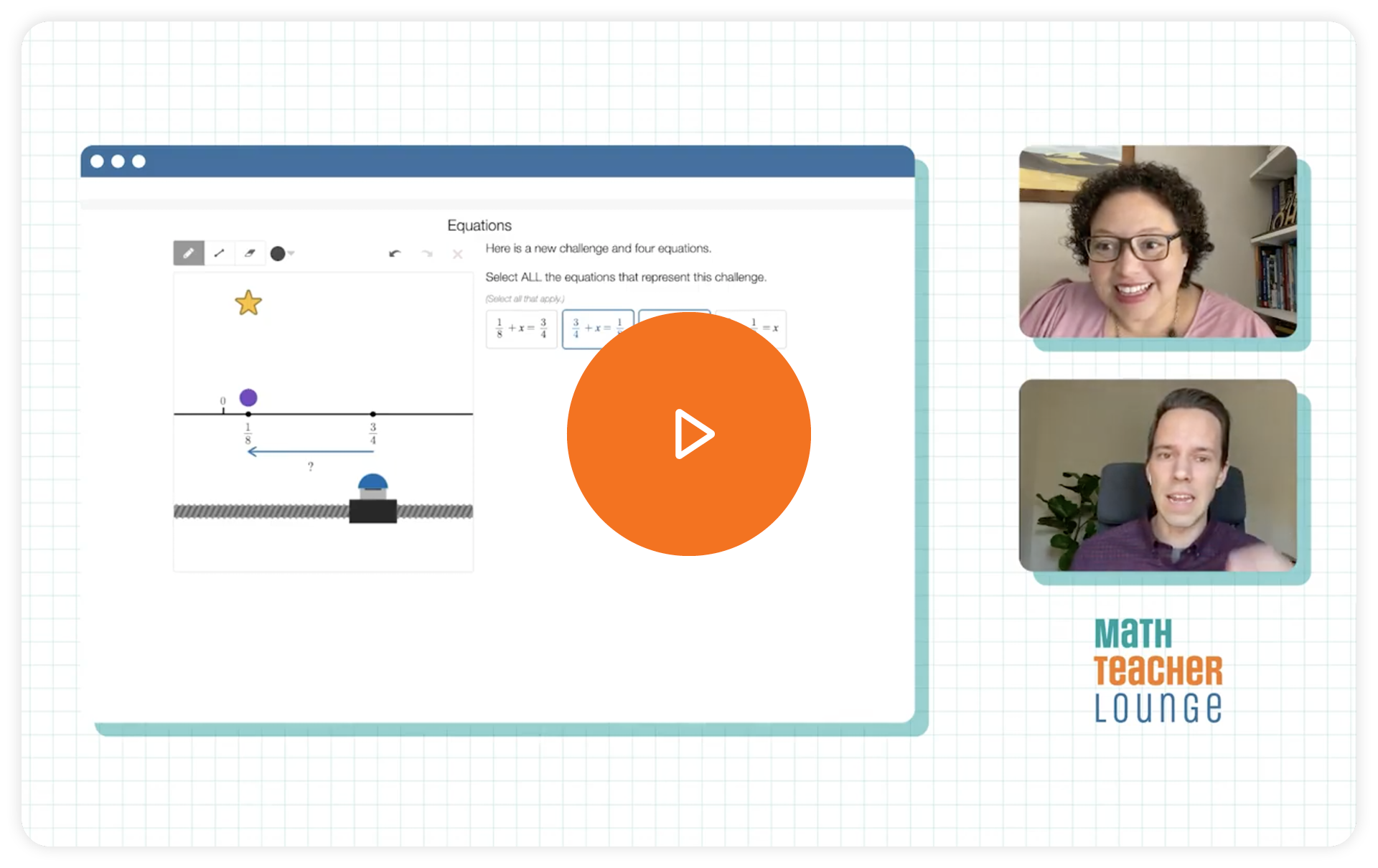

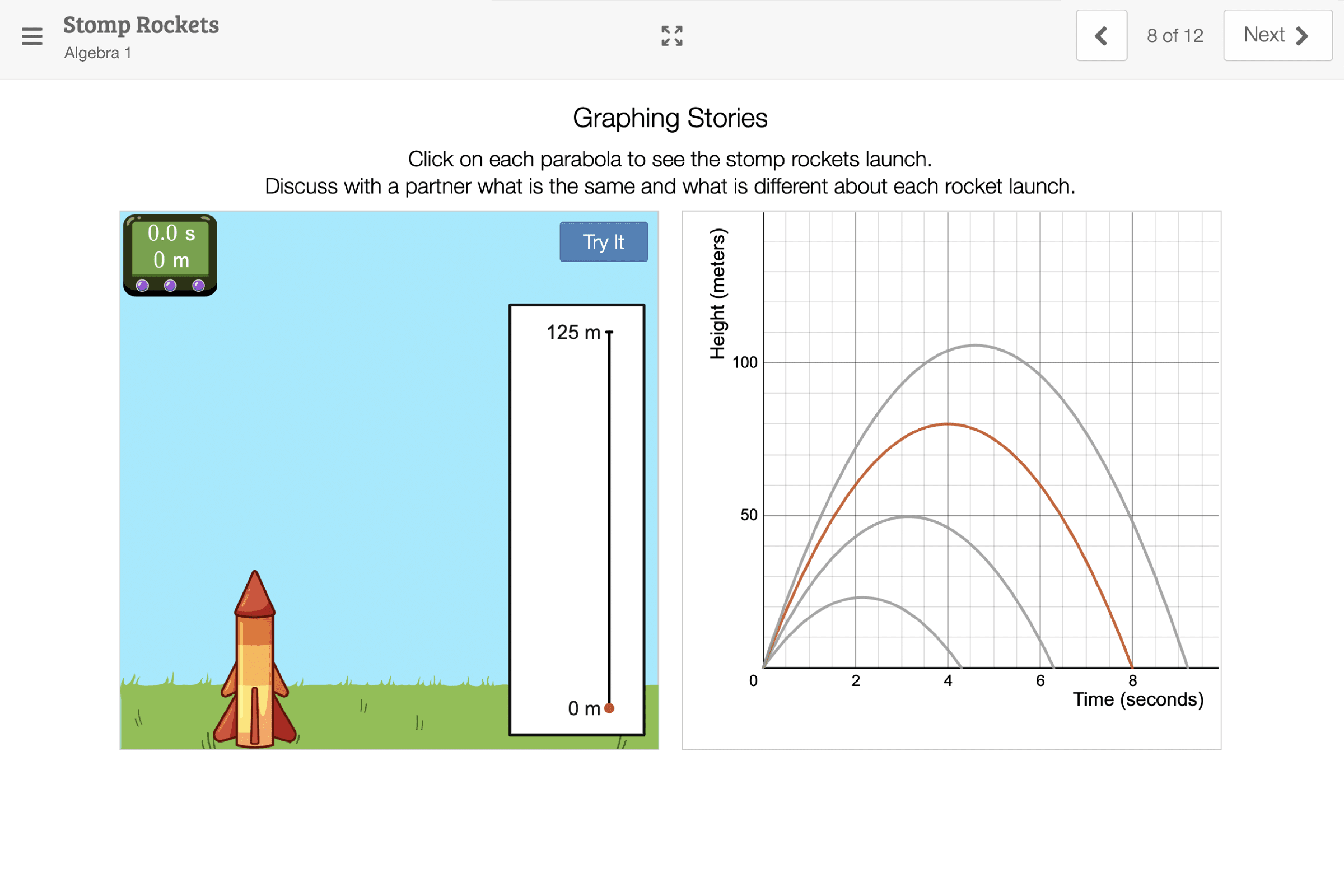
San Diego Caregivers — Welcome to Amplify Desmos Math!
Welcome to the Amplify Desmos Math Caregiver Hub for San Diego USD. We’re excited to partner with San Diego USD teachers, principals, and district leaders to provide your student with exceptional opportunities to learn math. We designed this hub to help you in supporting your student along their math journey this year.

Introducing Amplify Desmos Math
Amplify Desmos Math is a new core math curriculum built for grades 6, 7, 8. Designed to help students learn math in a way, Amplify Desmos Math uses a student-centered approach to instruction, which has been proven to significantly increase math learning.
In every lesson, Amplify Desmos Math poses engaging and relevant problems to solve, giving students daily opportunities to think critically, work collaboratively, and actively participate in their own learning.

Amplify Desmos Math was built upon the highly rated Illustrative Mathematics curricula: IM K-12 Math™️, which earned an all-green score on EdReports.
About student-centered math instruction
Student-centered instruction may look different from the way students have learned math for decades, and maybe even the way you learned math. Instead of memorizing formulas and tricks, student-centered learning focuses on giving student opportunities to figure out how math works. Plus, research shows that students and teachers alike prefer this method, and teachers report that student-centered instruction has helped their students learn more math.

This way of learning helps students:
- Understand how math concepts work.
- Remember what they learn in class and apply their knowledge to new situations.
- Perform better on standardized tests and have more growth in their grades than their peers who learn through other methods.
- Learn to communicate in writing and verbally, understand and challenge the opinions of others, and build confidence in solving new problems.
- Develop key skills for success in college and the workplace, like using technology, completing projects independently and with others, and persevering through difficult problems.
What materials do students use?
Amplify Desmos Math supports blended learning with supportive print materials and a unique digital experience. In addition to a consumable Student Edition, students are invited to use our interactive online platform to solve open-ended tasks and challenging problems.
Here are some key highlights of the digital platform:
- Digital activities that allow students to explore and make sense of math
- Digital calculator and virtual manipulatives that support students of all levels
- Immediate feedback that guides students in understanding challenging concepts
- Ability to access instructional materials in English or Spanish
With access to their own special online dashboard, teachers can monitor students’ work in real time, making sure they get the exact support that they need at every part of the lesson.
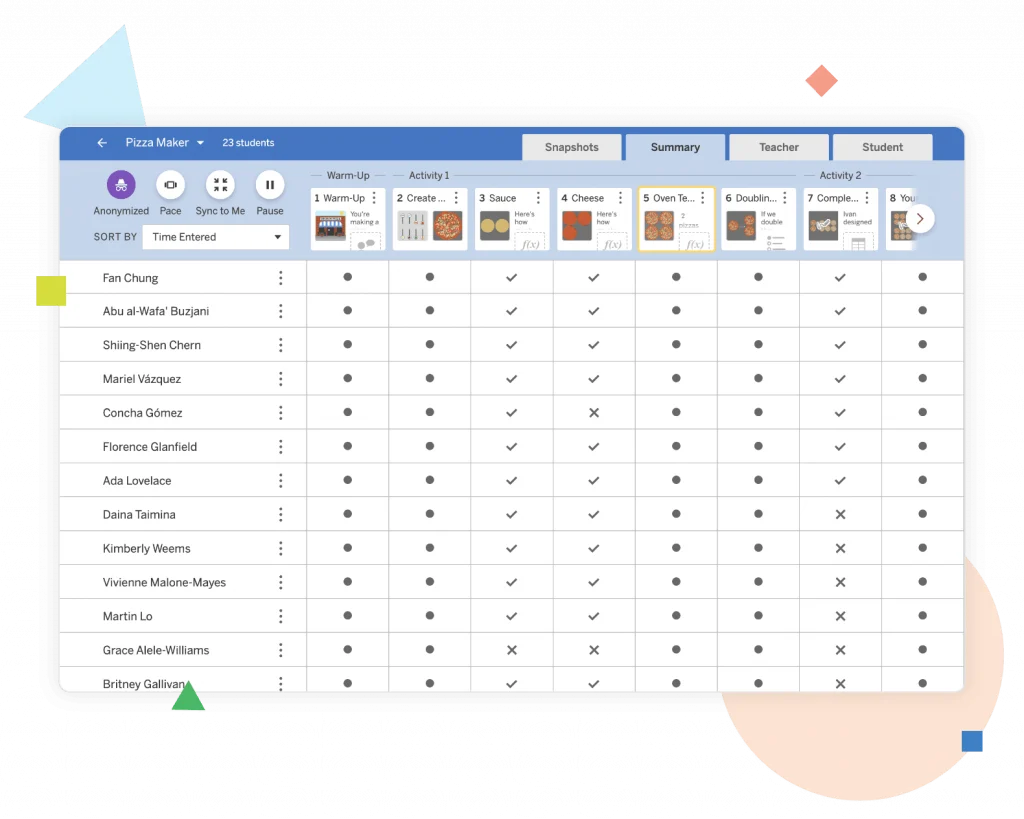
What does a lesson look like?
Students in an Amplify Desmos Math classroom can be seen (and heard!) — asking questions, debating answers, justifying their thinking, grappling with problems, and working together and independently.
In class, your student will spend their time working on challenging problems while the teacher acts as a guide, highlighting different strategies for solving problems and helping students to understand the reasoning behind the math they do in class. Your student will be pushed to think more deeply about the math in their class as the teacher and other students question them on why their ideas make sense. Research has proven that this method helps students become better problem solvers, critical thinkers, and have a stronger conceptual understanding of what they are learning.
Here’s what a typical Amplify Desmos Math lesson includes:
- Warm-up: A short, attention-getting problem to get students interested in the lesson
- Activities: 1-3 mini-activities that challenge students’ problem-solving skills
- Synthesis: Discussion to review and bring together the important concepts from the lesson
- Exit Ticket and Reflection: Questions for students to show what they know from the lesson
- Practice: Additional problems your student’s teacher may assign for classwork or homework
How can families support math learning at home?
Find the math in everyday life
Relate math to daily activities at home, whether it be baking, grocery shopping, or planning for a road trip. Your student can help you figure out the price of an item after a coupon, cut a recipe in half, or figure out how much gas you’ll need to make it to your destination. Encourage your student to point out ways that your family uses math in your daily tasks.
Review practice problems together
Your student’s teacher may assign practice problems at the end of each lesson for classwork or homework. Ask your student to walk you through how they solved each problem, or talk about any parts that were challenging for them.
Remember getting stuck is okay
Emphasize that getting stuck is part of the process and a necessary part of learning. Many students (and adults!) fear making mistakes, however, research shows that making mistakes helps your brain grow more. When your student gets stuck on a problem, encourage them to try different strategies, even if they are not sure if they are right.
Use our Unit Summaries for Families
We’ve created a Family Resource for every unit of the program that provides a summary of key concepts plus examples for how to work through problems.
Within each of the grade-level links below, you’ll find a Family Resource document for each unit, in both English and Spanish.
Unit 1: Area and Surface Area
Unit 2: Introducing Ratios
Unit 3: Rates and Percentages
Unit 4: Dividing Fractions
Unit 5: Arithmetic in Base Ten
Unit 6: Expressions and Equations
Unit 7: Rational Numbers
Unit 8: Data Sets and Distributions
Unit 1: Scale Drawings
Unit 2: Introducing Proportional Relationships
Unit 3: Measuring Circles
Unit 4: Percentages
Unit 5: Rational Number Arithmetic
Unit 6: Expressions, Equations, and Inequalities
Unit 7: Angles, Triangles, and Prisms
Unit 8: Probability and Sampling
Unit 1: Rigid Transformations and Congruence
Unit 2: Dilations and Similarity
Unit 3: Linear Relationships
Unit 4: Linear Equations and Systems of Linear Equations
Unit 5: Functions and Volume
Unit 6: Exponents and Scientific Notation
Unit 7: Irrationals and the Pythagorean Theorem
Unit 8: Associations in Data
Note: The below links are for our Volume 2 units, which most students are working in currently. Additional units will be coming soon!
Unit 1: Coming Soon!
Unit 2: Coming Soon!
Unit 3: Fractions and Decimals
- Student Guide: Accelerated 6, Unit 3, Part 1 (English)
- Student Guide: Accelerated 6, Unit 3, Part 2 (English)
- Spanish Coming Soon!
Unit 4: Expressions and Equations
- Student Guide: Accelerated 6, Unit 4 (English)
- Spanish Coming Soon!
Unit 5: Proportional Relationships
- Student Guide: Accelerated 6, Unit 5, Part 1 (English)
- Student Guide: Accelerated 6, Unit 5, Part 2 (English)
- Spanish Coming Soon!
Unit 6: Percentages
- Student Guide: Accelerated 6, Unit 6, Part 1 (English)
- Student Guide: Accelerated 6, Unit 6, Part 2 (English)
Unit 7: Positive and Negative Numbers
Unit 8: Describe Data
Note: The below links are for our Volume 2 units, which most students are working in currently. Additional units will be coming soon!
Unit 1: Coming Soon!
Unit 2: Coming Soon!
Unit 3: Coming Soon!
Unit 4: Linear Relationships and Systems of Linear Equations
- Student Guide: Accelerated 7, Unit 4, Part 1 (English)
- Student Guide: Accelerated 7, Unit 4, Part 2 (English)
- Spanish Coming Soon!
Unit 5: Functions
- Student Guide: Accelerated 7, Unit 5 (English)
- Spanish Coming Soon!
Unit 6: Associations in Data
- Student Guide: Accelerated 7, Unit 6 (English)
- Spanish Coming Soon!
Unit 7: Volume and Surface Area
Unit 8: Exponent and Scientific Notation
Unit 9: Pythagorean Theorem and Irrational Numbers
Listen to our podcast
Our Math Teacher Lounge is a biweekly podcast created specifically for K–12 math teachers. In each episode, co-hosts Bethany Lockhart Johnson (@lockhartedu) and Dan Meyer (@ddmeyer) chat with expert guests, taking a deep dive into the math and educational topics.
From time-to-time, the topic of an episode is perfect for families. For example, the episode below features Dr. Marjorie Schaeffer. She discusses what causes math anxiety, math hacks, and how the right math technology can make an incredible impact in children and family members who struggle with math anxiety.
Listen today and don’t forget to grab your MTL study guide to track your learning and make the most of this episode!
How do families access the program at home?
Your student will have access to all learning, practice, and assessment materials through the Amplify platform. Students can access the digital curriculum in school and at home by following these simple instructions.
- Click the Amplify Desmos Math button.
- Select Log in with Amplify.
- Enter this username and password provided by your student’s teacher.
- Select the desired grade level.
Families & Caregivers — Welcome to Amplify Desmos Math New York for grades K–5!
This is the initial version of the Caregiver Hub for Amplify Desmos Math New York. Para la versión en español, haga clic aquí.
Welcome to the Amplify Desmos Math New York K–5 Caregiver Hub for grades K–5. We’re so excited your student’s school has chosen our program! We designed this space to help you support your student in their math journey this year. Your hard work plays an essential role in your student’s math experience.
We hope your student enjoys using technology to explore math, working with friends to solve problems, and learning all sorts of new and interesting concepts. And we hope you love experiencing it with them!
Excited to learn together,
—The Amplify Desmos Math team
Introducing Amplify Desmos Math
Amplify Desmos Math is a core math curriculum built for kindergarten through grade 5. We developed the program around the idea that a structured approach to problem-based learning builds on students’ curiosity to develop lasting grade-level understandings for all students. Each lesson offers opportunities to develop students’ understanding; connect their ideas; grow their skill fluency; and empower them to ask questions, explore, and make discoveries.
Amplify Desmos Math uses a student-centered approach to instruction, which has been proven to significantly increase math learning. Our mission is for your students to learn math—and to love learning math!
In every lesson, the Amplify Desmos Math curriculum poses engaging and relevant problems to solve, giving students daily opportunities to think critically, work collaboratively, and actively participate in their own learning.
About student-centered math instruction
Student-centered instruction may look different from the way students have learned math in the past, and perhaps from the way you learned math. Instead of memorizing formulas and tricks, student-centered learning focuses on giving students opportunities to figure out how math works. Research shows that students and teachers alike prefer this method, and teachers report that student-centered instruction has helped their students learn more math.
This way of learning helps students:
- Understand how math concepts work.
- Remember what they learn in class and apply their knowledge to new situations.
- Perform better on standardized tests and have more growth in their grades than their peers who learn through other methods.
- Learn to communicate in writing and verbally, understand and challenge the opinions of others, and build confidence in solving new problems.
- Develop key skills for success in college and the workplace, like using technology, completing projects independently and with others, and persevering through difficult problems.
What materials do students use?
Amplify Desmos Math supports blended learning with supportive print materials and a unique digital experience. All Amplify Desmos Math K–5 lessons are available in a write-in Student Edition book. Many of the lessons are designed to include hands-on activities with manipulatives. An age-appropriate number of lessons are designed for students to use digital devices like laptops or tablets. These include enhanced digital experiences that teachers can assign to students.
Here’s what you can expect for your students from Amplify Desmos Math:
- Lessons that drive classroom discussions so students can work toward a shared understanding and sense of community.
- Responsive feedback that interprets student responses in context and encourages perseverance and revision.
- Easy-to-follow lesson plans tested in classrooms across the country, with clear teaching suggestions, strategies, and Math Language Routines.
- Practice problems to support fluency and help students review previous topics.
- Recommended differentiation suggestions for teachers so that they can meet the needs of diverse learners.
- Formative assessments that provide information on student understanding so that they can adjust their instruction to meet the needs of all students in their class.
- Summative assessments that help teachers understand what students know about the math content they have been learning.
- Daily lesson-level assessments so that teachers can frequently check for understanding.
- A caregiver resource for each unit that includes explanations of key math concepts and problems to try with your student.
When students use devices, teachers can monitor students’ work in real time, making sure they get the exact support that they need at every part of the lesson, in and outside of class. Here is a sample of what a teacher sees on their dashboard to help them monitor thinking and support student learning.
Students are also able to access their digital work at home. Here’s an article on how to navigate the student home page.
What does a lesson look like?
Students in an Amplify Desmos Math classroom can be seen (and heard!)—asking questions, debating answers, justifying their thinking, grappling with problems, and working together and independently.

Here’s what a typical Amplify Desmos Math lesson includes:
- Warm-up: A short, attention-getting problem to get students interested in the lesson.
- Activities: 1-2 mini-activities that challenge students’ problem-solving skills.
- Synthesis: Discussion to review and bring together the important concepts from the lesson.
- Show What You Know and Reflection: Questions for students to show what they know from the lesson. (Note: The “Show What You Know” lesson assessment is optional for the teacher to assign in kindergarten and grade 1)
- Centers: Student-led activity stations that reinforce the math learned during lesson activities through interactive and often game-like formats. In kindergarten and grade 1, time for Centers is built into the last 15 minutes of every lesson.
Here’s what is available after the lesson to support, strengthen, and stretch students’ learning:
- Differentiation: Mini-lessons, Centers, extensions, personalized learning, and fluency practice.
- Practice: Additional problems your student’s teacher may assign for classwork or homework.
How can caregivers support math learning at home?
Use our Unit Support for Caregivers
We’ve created a Caregiver Resource for every unit of the program that provides a summary of key concepts, plus a problem from the lesson practice set you can work through with your student. Within each of the grade-level links below, you’ll find a Caregiver Resource document for each unit, in both English and Spanish.
Grade 1
Unit 1: Adding, Subtracting, and Working With Data
English
Spanish
Grade 3
Unit 1: Introducing Multiplication
English
Spanish
Grade 5
Unit 1: Volume
English
Spanish
Review practice problems together
Your student’s teacher may assign practice problems at the end of each lesson for classwork or homework. If your student has already completed the practice problems for the lesson, ask your student to walk you through how they solved each problem, or talk about any parts that were challenging for them. Ask your students follow-up questions to encourage the use of math language as they explain their thinking, such as: “How do you know?,” “How can you show your thinking?,” or “How would you describe that?” If students are stuck, ask support questions such as, “What information do you know here?” or “How could you represent this problem?”
Getting stuck is okay!
Emphasize that getting stuck is part of the process and a necessary part of learning. Many students (and adults!) fear making mistakes. However, research shows that making mistakes helps your brain grow more. When your student gets stuck on a problem, encourage them to try different strategies, even if they are not sure if they are right.
Find the math in everyday life.
Relate math to daily activities at home, whether grocery shopping, preparing a meal, or planning for a trip to the store. Your student can help you figure out how many more apples there are than oranges in the grocery cart, show how to split a sandwich into fourths, or figure out how much change you’ll receive in exchange for a ten dollar bill. Encourage your student to point out ways that you use math in daily tasks.
Read the Unit Story with your student.
Each unit in Amplify Desmos Math K–5 begins with a read-aloud story to engage students and provide context for the math of the unit. Elements and characters from the Unit Story then appear in lessons throughout the rest of the unit.
- Grade K Unit 2 Story
- Grade 1 Unit 1 Story
- Grade 2 Unit 1 Story
- Grade 3 Unit 1 Story
- Grade 4 Unit 1 Story
- Grade 5 Unit 1 Story
Access our Featured Collection of free K–5 Lessons and Activities.
Explore our latest free K–5 content in our Desmos Classroom Featured Collection. With our free collection, you can access:
- Digital Lessons: Engaging interactive lessons
- Mini-Lessons: A mix of print and digital activities designed for small-group instruction
- Math Routines: Short digital activities to kick-start instruction and encourage math discussions
- Bite-Sized Math Moments: Digital practice activities that use Polypad virtual manipulatives, designed to be used flexibly
Click here to access the collection and sign up for a free account.
How do caregivers access the program at home?
Your student will have access to all learning, practice, and assessment materials through the Amplify platform. Students can access the digital curriculum in school and at home by following these simple instructions.
- Click the orange Login to Amplify Desmos Math button below.
- Select Log in with Amplify.
- Enter your student’s username and password provided by your student’s teacher.
- Select your student’s grade level.
Four ways to engage middle-school students in ELA
You know how engaged middle-school students are—in their own emotions, relationships, and TikToks. How do you engage them in your ELA classroom?
It’s tough! It’s not just about holding their attention while they’re in class. We need to provide the kind of real engagement that leads to real learning.
Research confirms (not surprisingly) that getting middle schoolers ready for college and career depends on it, and requires a truly engaging ELA curriculum.
The stakes are high. Sixth-grade students who fail a literacy course are more than 50% more likely to not graduate from high school.
Yet, on average, middle-school ELA students spend less than 20% of class time engaged with the text. In a 50-minute class period, that’s only 10 minutes of text.
At Amplify, we believe greater engagement with text is key not only for ELA success, but for all academics. That’s why we created these four actionable principles of middle-school ELA engagement.
Middle-school is a moment—one we must seize.
First, here’s why middle schoolers require an approach and curriculum designed just for them.
Young people at middle-school age are becoming increasingly independent, and increasingly self-conscious. They need to feel respected and safe when they participate, especially when they make mistakes. They’re super focused on their peers, but they still depend on guidance from you.
There’s a lot going on in their worlds, and there’s a lot going on in their brains. In fact, early adolescence is the second-biggest stage of rapid brain development.
The development is happening largely in the prefrontal cortex. It’s the area that brain researcher Maryanne Wolf calls “the cognitive workspace.” When it comes to middle-school ELA curriculum, we want to use strategies that engage students in using their cognitive workspaces.
The 4 principles of middle-school engagement
We believe these four principles are most essential to engaging middle-school students in developing their literacy skills—and becoming confident, active learners.
- Enable all students to work up. Provide multiple entry points and scaffolds so that every student can find their way into a text or activity. Here are some differentiation strategies:
- Incorporate multimedia. Often a video dramatization or audio recording can help students connect with a complex text.
- Scaffold with passage previews, read-alongs, and questions that make students want to re-read.
- Don’t forget vocab! Daily practice makes a huge difference, especially with assignments designed to challenge students at their level.
- Provide just right feedback. At this age, it’s important for students to see opportunity rather than failure.
- Quick over-the-shoulder notes feel actionable and encouraging.
- Training all students to offer helpful comments creates a positive vibe around feedback.
- Focusing on specifics helps students know how to proceed and improve.
- Engage multiple modalities, especially collaboration. Students comprehend text in all sorts of ways—hearing, speaking, writing, seeing, performing, and more. Try alternate modalities like dramatic readings or debates, which also give students the benefits of working together.
- Promote critical thinking. This one’s the biggest idea beneath all the others.
To be fully engaged, middle schoolers need to know that their work is relevant and recognized. A truly engaging curriculum supports a range of observations and interpretations. Some approaches:
- Be clear that the text, not the teacher, has the answers. Ask questions like “How did you get to that response?” Help students follow this rule: If you can justify it in the text, you can hold on to your interpretation.
- Guide students to develop theories rather than get it right. For example, ask questions like “Why does (or doesn’t) this make sense?”
- Try the Socratic style. Emphasizing inquiry and discussion brings home the power of open-ended questions. It also positions the teacher as facilitator, not deliverer of all knowledge.
These principles won’t just help your students get through middle-school—they’ll help you get through to your middle schoolers.
Learn more.
Read more about Amplify ELA, including an overview of the components of the curriculum in grades 6–8.
Centering students in math curriculum adaptations

Starting with a high-quality math program
In her research article, “Examining Key Concepts in Research on Teachers’ Use of Mathematics Curricula”, Janine Remillard described curriculum use as a dynamic and ongoing relationship between teachers and resources—a relationship shaped by both the teacher and characteristics of the resource.
I have found that while certain characteristics can make a math curriculum high-quality, it is only through its relationship with teachers that it creates truly meaningful math experiences for students.
In my own teaching experiences and now back in classrooms with teachers, I am convinced that no matter how well-constructed a lesson, it only gets better as teachers plan collaboratively and center their students.
Shaping lessons for the students in your classroom can be challenging because there is not one right way or time to adapt a lesson, and the reasons we adapt vary.
Sometimes we make relatively small tweaks to the wording of a prompt, a question the teacher should pose, or the timing of an activity.
Other times we make more substantial changes to the task or task structure in order to more clearly move toward the learning goal based on what we are seeing and hearing from students.
And then there are the times we realize in the midst of an activity we should have made an adaption in our planning.
I recently taught a 5th grade fractions lesson that provided a perfect example of the dynamic nature of the work.
Engaging in a math curriculum activity
This particular lesson falls at the end of the fraction addition and subtraction unit.
The Warm-Up of this lesson is a Number Talk, which made sense to the 5th grade teachers and I, given the unit focus.
We reviewed the mathematical concepts and problems in our planning session, anticipated that students might find common denominators, and agreed that the synthesis discussion around denominator choice aligned with the problems.

While we anticipated that students would successfully add, the number choices in the string led students to solve each one the same exact way, with the only difference being whether they stated their sum in simplest form or not.
Halfway through, we could see the majority of the students were getting bored and it was hard to infuse curiosity and excitement around denominator choice because students had already generalized a way of finding a common denominator—which at this point in the unit was great!
In the midst of the Number Talk, we paused and debated pivoting our focus to the problems in relation to one another rather than denominator choice. But we knew that doing that would add extra time to the lesson, when we needed the majority of the time for the activities that followed.
So we wrapped it up and moved on, knowing we had time to discuss our choice in an upcoming planning session.
Adapting in ways that center student ideas
After class, I couldn’t stop thinking about revisions I would make if we had the opportunity to plan it all over again. Because although the problems in the string supported mental calculation and aligned with the lesson activities, the students needed something different at this point in their learning.
After reflecting with colleagues, we decided the timing of that particular Number Talk for these students was too late in the unit and wondered if a different routine would have made it more engaging.
Using that Number Talk as a rough draft (shout out to Mandy Jansen), I played around with different number choices and routines we might use in a second take on that lesson.
If we wanted to stick with the same task structure, we could adjust the numbers to create a new Number Talk or True or False? routine that more explicitly encouraged relational reasoning and use of the properties.
For example, the following problem strings still attend to denominators when adding fractions but also open up the space for more interesting and engaging student discourse.
Number Talk

True or False?

If we wanted to use a different structure altogether, we could try the Which One Doesn’t Belong? routine to provide opportunities for students to notice other interesting aspects.
In this activity, students share reasons why one of four items—in this case, equations—doesn’t belong. There is no single right answer because each object could both belong and not belong, depending on the student’s criteria. (If you’ve never tried this routine, it’s a must!)

Because I couldn’t wait until this lesson next year to see what students would do with one of these ideas, I asked them to write about the Which One Doesn’t Belong? The variation among their ideas was exciting.
While I could still see attention to the denominators as in the original Warm-Up, students were now describing their ideas in much more unique ways. If this had been the original Warm-Up, it’s not hard to imagine how much more engaged students would have been—and how much more teachers would have learned about their thinking.


Learning from within the work of teaching
Curriculum materials have shaped my teaching and learning since the beginning of my time in the classroom. They then became the focus of my work at Illustrative Mathematics and now in my current work at Amplify.
I am a strong advocate for high-quality curriculum materials, and at the same time, I also believe that every curriculum can always be improved to better meet the needs of students and teachers.
I continually recognize and appreciate the time I get to spend planning, teaching, and reflecting with teachers about their dynamic and ongoing relationship with curriculum materials.
These opportunities to learn from within the work of teaching are invaluable inputs to our current work at Amplify, where we have the exciting opportunity to improve the characteristics of math resources currently in schools.
Want to learn more from Kristin Gray? Watch her webinar!
Accelerating learning in science with the Science of Reading

The Science of Reading: it’s not just for Language Arts.
As host Eric Cross and expert guest Susan Lambert discuss in this Science Connections webinar, the Science of Reading also provides a powerful foundation for science learning.
Here’s what they had to say about bringing evidence-based literacy strategies into the science classroom.
The role of literacy in science literacy
Strictly speaking, the Science of Reading refers to the vast body of research we now have—and put into practice—on the systematic, explicit, and cumulative instruction required for students to learn to read.
There is a misconception that when we’re talking about the Science of Reading, we’re just talking about reading.
—Susan Lambert, Amplify’s Chief Academic Officer for Elementary Humanities
In fact, we’re talking about comprehensive literacy, which encompasses all the essential—and interdependent—components of literacy, including background knowledge, vocabulary, and both comprehension and expression.
In other words, it’s the listening, speaking, reading, and writing that scientists do in the real world—and that students do to engage with and connect to science learning. As we discussed in this post, developing students’ literacy in science helps them develop scientific literacy. And science literacy allows students to become critical thinkers, problem solvers, and strategic questioners—in science and beyond.
Integrating science and literacy in the classroom
What do these literacy strategies look like in practice? Eric puts them to use regularly—and here’s how you can, too.
- Use phenomena to activate and gauge prior knowledge. The more you know, the better you comprehend text and the faster you learn—so exploring familiar observable events (frying eggs, seeing your breath on a cold day) can engage students and accelerate their comprehension from the jump.
- Provide multilingual resources. “Being intentional about providing access to resources in the languages our students speak is critical,” said Eric. “The data shows that the more proficient students become in their native language, the more proficient they become in a new one.”
- Get students writing (and speaking, and editing). Eric has his students document their experiments and observations in (digital) notebooks and online portfolios. They also share with and present to each other, he said, “so they’re seeing other students’ writing styles and syntax and what details they include, and they can go back and update their own.” And, since it’s a year-long process, “by the time they’re done, they have this beautiful website that showcases their work.” (Amplify Science’s Student Investigation Notebooks also fit the bill!)
- Work across subjects. The Common Core recommends that, by 4th grade, 50% of texts read should be non-fiction. That’s why Eric coordinates with ELA teachers to read one text about metabolism, for example, each examining it through different lenses. “When you’re able to work together with another content teacher, it’s like magic,” he said. (And in elementary school, you’re the other content teacher!)
- Run science seminars. Students use evidence to explain their thinking. “For students who need extra support, you can have pre-written sentence frames so that they’re able to participate,” Eric said. “Even when they’re listening to other students speaking, that’s helping them develop language skills. You watch them be able to listen, speak, engage in debate, and disagree without being disagreeable, which we know as adults is a valuable skill.”
For more of Eric’s strategies, watch the webinar: Science Connections: Accelerating Learning in Science with the Science of Reading.
Even more to explore
Webinars:
- Finding Connections to K–8 Science & Literacy Educator Roundtable
- K–8 Literacy & Science Instruction Integration
Curriculum: Amplify Science
Amplify blog:
Collaborative learning strategies in math

Why is collaborative learning important?
Just ask this third grader: “It is important to work together, because when you work together you can get smarter by other people’s ideas.”
That just about sums it up!
Let’s take a closer look at what math looks like in a collaborative classroom, why collaboration matters, and how teachers can build a culture of collaboration for their K–8 math students.
What is collaborative learning in mathematics education?
Kristin Gray, executive director of Amplify’s math suite, is a veteran math teacher. (The answer above came from one of her very astute third graders.) And according to her, collaboration in math is so much more than just kids chatting. Gray paints a picture of collaborative math learning in elementary math and beyond as kids who are:
- Grouped around a table, not isolated at separate desks.
- Engaging in animated conversation.
- Explaining their thinking and justifying their answers.
- Comparing their various approaches.
- Connecting math to their own lived experiences.
- Connecting their ideas to the ideas of others.
Taken together, collaboration supports connections—among experiences, math concepts, and others’ ideas and experiences.
Collaboration means making the time and space to take these widely varied things that each student brings uniquely to our math classroom and bring them out in a really safe and collaborative culture.
– Kristin Gray, executive director of Amplify’s math suite
Why is collaborative learning important in math?
Substantial research shows that collaborative learning promotes active learning, critical thinking, communication skills, social development, a positive learning environment, deeper understanding of concepts, and preparation for real-life situations.
Gray cites a few findings in particular:
- A 2014 NCTM study found that mathematical conversations and discourse among students—at all grade and ability levels—helps build a shared understanding of mathematical ideas.
- Hope A. Walter’s article “Beyond Turn and Talk: Creating discourse” (Teaching Children Mathematics, 2018) asserted that meaningful math discourse supports metacognition and teaches students how to discuss, debate, and reevaluate mathematical situations in a respectful manner .
- A 2018 NCTM study found that when students have the chance to analyze and compare each other’s approaches, any sense of hierarchy in the classroom is reduced and replaced with a classroom culture that values input from all students.
Hands-on math activities and more: Components of a collaborative classroom
What conditions best set up a math class for collaboration?
Above all, students need hands-on activities that truly engage—or, in Gray’s words, “tasks worth talking about.” Teachers should emphasize the importance of the process of getting to the answer, encouraging the sharing of “rough draft ideas” that students can develop together. Gray also recommends stopping the groups’ conversations before they’re done, so that they can reflect on what they’re doing rather than just report what they did.
Other resources:
Problem-based learning offers a powerful approach to collaborative learning in math. Our guide around making the shift to problem-based learning through Learning Labs will walk teachers through what problem-based learning is, why it’s critical to math instruction, and how to support the shift to this approach through Learning Labs. A tried-and-true STEM strategy that Gray has often used with teachers, Learning Labs break the typical mold of siloed professional development days by encouraging collaborative professional learning within the classroom!
Desmos Classroom activities let students share their thinking with each other. The teacher dashboard provides educators a window into this thinking in real time, as well as a powerful toolkit to turn those ideas into still more productive conversations and effective learning. Check out all the Featured Collections Desmos Classroom has to offer.
More to explore
Become an Amplify Tutor
Be the change in a student’s learning journey.
As an Amplify Tutor, you’ll facilitate a research-based curriculum for small groups of students to ensure they close academic gaps and build confidence.

What is Amplify Tutoring?
Amplify Tutoring is a full-service, high-impact virtual tutoring program that reaches students across the country. It ensures students receive high-quality live tutoring for a minimum of 30 minutes a day, 3 times per week.

Why be an Amplify Tutor?
As an Amplify Tutor, you will deliver our research-backed and evidenced-based intervention programs, virtually to a small group of students in 30 minute sessions, three times per week.
Flexibility: You will choose your desired number of hours and schedule that works best with your lifestyle. Your schedule will then be matched with available tutoring groups within your selected regions.
Support: Amplify will provide training to support your growth and impact. Amplify tutors report a 40 percent increase in confidence after engaging in Amplify’s tutor training course. You will also receive personalized coaching and support.
Student Impact: Amplify Tutoring works for students who need it most: students who scored below benchmark, and participated regularly in Amplify Tutoring, made above-average growth. Tutored students were more likely to make outsized growth compared to peers with a similar risk profile who did not receive tutoring at their school.
Compensation: Amplify pays you for the time you spend planning for your groups as well as delivering tutoring to your groups. Amplify also provides paid initial training and ongoing professional development.
What Actual Tutors Have to Say

Justine K
“And that’s a wrap on my first semester with Amplify! I find so much joy and fulfillment in working with these young learners. I am so proud of the growth each one has made. How I will miss these students but am so thankful for this company. The endless support, not only from leadership but from fellow tutors, is a rare find in today’s work culture. THANK YOU!”

Adam S.
“As a tutor, I love Amplify’s science of reading approach to literacy. The reading rope incorporates language comprehension along with word recognition to develop skilled reading for students. Watching the science of reading improve students’ literacy skills has been one of the most rewarding experiences I have had in any career.”

Britani H.
“Amplify Tutoring was a one of a kind experience as an educator where I was privileged to support students with their specific needs and goals. I always felt incredibly supported by all of the program managers and coaches because of their responsiveness and focused professional development throughout my journey as a tutor.”
Interested in tutoring math?

We are thrilled to announce the continued expansion of our math tutoring program for students in grades 3 through 5! Introduced in the 2025–2026 school year, this program was designed to meet the growing need for personalized, high-quality math support during these critical foundational years.
Grounded in evidence-based practices, Amplify Desmos Math mini-lessons are aligned with the most critical topics at each grade level. Mini-lessons reinforce the same topics and content students see in core instruction to give students a double dosage. Students can be seen (and heard!) asking questions, debating answers, justifying their thinking, grappling with problems, and working together and independently.
As our program continues to grow, we are actively looking for passionate, dedicated tutors to join our team and make a lasting difference in young learners’ lives.Whether you have experience teaching multiplication, fractions, or general elementary math, we’d love to hear from you. Be part of something new, impactful, and expanding — apply to join our math tutoring team today!
S3-01: Science as the underdog, and the research behind it

Get ready for season 3 of Science Connections: The Podcast!
In our first episode, we unpack the research around our season theme of science as the underdog with Horizon Research, Inc. Vice President Eric R. Banilower and Senior Researcher Courtney Plumley. Eric and Courtney dive into the research they’ve found and their experiences as former educators to show how science is often overlooked in K–12 classrooms. We discuss how the science classroom compares to other subjects in terms of time and resources, how schools are a reflection of society, and what’s needed to change science and its impact on a larger scale.
We hope you enjoy this episode and explore more from Science Connections by visiting our main page!
Courtney Plumley (00:00):
We asked teachers how much science, professional development, they’ve had in the last three years, and nearly half of elementary teachers said none.
Eric Cross (00:10):
Welcome to Science Connections. I’m your host, Eric Cross. I am super-excited to be kicking off the third season with the show. This entire season will be exploring the theme of science as the underdog. And we’re gonna make the case for science, by showing how and why it can be used more effectively. In the coming episodes, we’re gonna talk about how science can be better integrated into other content areas like literacy and math, and explore some of the benefits that you might not be thinking about good science instruction. But first, science as the underdog. I bet some of you out there feel like science is the underdog in your community at school. I know I have at times. To kick off this season, I’m gonna talk to two people who really studied this question by looking at the state of science instruction across the US. Eric Banilower is Vice President of Horizon Research and Courtney Plumley is Senior Researcher at Horizon Research. Eric was the principal investigator and Courtney an author of the latest in a series of studies called “The National Survey of Science and Mathematics Education.” We’re gonna dive into the findings of their most recent report to see what the data’s showing us. Please enjoy my discussion with Eric Banilower and Courtney Plumley. Courtney, hello. And thank you so much for joining us.
Courtney Plumley (01:25):
Hi Eric. It’s nice to be here.
Eric Cross (01:26):
And Eric, welcome.
Eric R. Banilower (01:27):
We’re thrilled to be here, so thank you for having us.
Eric Cross (01:30):
I was reading through the report. Four hundred…a very thorough report, 471 pages, I think, as I got it?
Eric R. Banilower (01:37):
And that’s only one of the many reports from that study.
Eric Cross (01:40):
Yeah. You all have done your work, so I’m really excited to to talk to you about this. And on this season of the show, we’re exploring the theme of science as the underdog. And I think a lot of our listeners, we feel like science is an underdog either in their school or in their district. But you’ve actually done some research on this, in a 2018 study, “The National Survey of Science and Mathematics Education.” So I wanna talk about this report. But first I was hoping you can kind of set the stage. How did you come to work on this report, and then, big picture, what were you hoping to find out?
Eric R. Banilower (02:10):
So the 2018 study that you just mentioned was actually the sixth iteration of a series of studies dating back to 1977. And we collect data every decade or so—you know, plus or minus a few years. And really, what we’re trying to do is get a snapshot of what the science and math education system looks like in in the nation. So my role grew. I started working at Horizon in about 1998, after teaching high school for five years in California. And then going to graduate school. And right about that time, the company was doing the 2000 iteration of the survey. And I worked on it with the team here at Horizon. And then we did it again in 2012. And I had a much more prominent role in that study, and became the kind of leader of the study. And in 2018, the most recent version, we just did it again. So the goal of this study is really to kind of examine key aspects of the K–12 STEM education system. And the main audience of the work has traditionally been policy makers, researchers, and practitioners who work at the federal, state, and district level.
Eric Cross (03:30):
So this study, you took kind of a sample size, but it’s reflective of trends that we tend to see across the nation as a whole. Would that be fair to say?
Eric R. Banilower (03:38):
Yes, definitely it is. It is a random sample of schools in the country. So we start with a list of all the public and private schools in the nation, and then do a random sample of those schools, and then work really, really hard to recruit schools to agree to be in the study. And that has gotten harder every time we’ve done the study, for many understandable reasons. And then once we have schools on board, we sample teachers within schools. So we don’t even survey every teacher in a school. It’s really a sub-sample. So that we can make inferences about the nation as a whole.
Eric Cross (04:14):
Makes sense. And so Courtney, what did you find out about the time spent on science instruction in US schools?
Courtney Plumley (04:22):
So, I’m gonna talk about elementary teachers to begin with.
Eric Cross (04:26):
Because that was your past life, right?
Courtney Plumley (04:28):
I am a former elementary teacher, yeah. So that’s kind of where my head is. And that’s relatable for me. Right? So we asked teachers, like, how many days of the week or weeks of the year that they teach elementary school. And fewer than 20% teach science every day of the school year. They kind of do one or two things, for the most part. They teach a couple days a week or they teach every day of the week, but only for, like, maybe six weeks, and then they swap with social studies and they kind of do that across the school year. Which is really different from, like, math, right? We also asked elementary teachers, how often do they teach math, and it’s every day of the year. Then we also asked them how many minutes they teach when they’re teaching, and we kind of did the math to figure out, all right, if they taught science every day of the school year, how many minutes would it be in a single day, so that we could make a more comparable comparison with math and ELA. If you were to work it out, how many minutes of science an elementary teacher teaches across the year, and break it down to per day, it’s like 18 minutes for the lower elementary grades, 27 for the upper elementary grades. Which is not a lot. But it’s pretty much an hour a day in math, and 80 plus minutes in ELA. So, a lot less. And then, you know, when I was teaching, the first thing to go was always science, right? If there was an assembly, if there was early release or whatever, that was the first thing to go. So those numbers might even be higher. Just because they aren’t factoring that kind of thing in, too.
Eric Cross (06:05):
So, now I’m curious. That is something that I’ve seen just anecdotally, science being the first thing to go. I feel like I’ve seen that almost…it’s almost become a meme, that I’ve heard that so often. Just in your experience, why do you think that is that huge disparity between the two?
Courtney Plumley (06:26):
Well, I mean, when I was teaching, I was teaching third grade. I had an end-of-grade test in math and ELA for my kids. I didn’t have one in science. So the administration said, “Hey, if you’re gonna drop something, drop something that’s not tested.”
Eric Cross (06:41):
Simple as that. And Eric, you, past life: physics teacher. High school. What did you see? ‘Cause our listeners run the gamut from elementary all the way up to high school. What did you see, as far as relative science instruction in the secondary level?
Eric R. Banilower (07:00):
Sure. You know, secondary is just a whole different situation than elementary. Rght? Because you have departmentalization. I taught science. I didn’t have to teach other subjects. And students had periods, and they still do, sorry, they still have periods, even though it’s been a long time since I taught. And you know, they rotate from one class to another. So all the classes were essentially the same length. So, you know, when I was teaching, it was about 50-minute periods. So in terms of minutes of a class or minutes on a subject, it’s not really different. But what is different is what students are required to take in order to graduate high school. One of the things we asked schools about in this study was how many years of a subject do students have to take in order to graduate? And what we saw was in mathematics, over half the schools in the nation require students to take four years of mathematics to graduate. OK? And the vast majority of the rest, about 44%, require three years in science. Most schools require three years. Very few require four years. And many, or a fair number, still only require two years to graduate. So the expectation of what students are taking is lower in science than it is in mathematics.
Eric Cross (08:20):
So you were seeing the same trend in secondary, essentially.
Eric R. Banilower (08:24):
Yes.
Eric Cross (08:24):
The amount of time devoted to the instruction of science…we’re kind of seeing it mirrored just across K–12 across the board.
Eric R. Banilower (08:33):
That’s correct.
Eric Cross (08:34):
And that’s across the country. ‘Cause the sample size represents teachers from Alaska, Hawaii, the South, SoCal, everywhere. So what’s been the reaction to that number? Like 18 to 20 minutes is…I mean, it’s, it’s half of my lunch at our school. What’s been the reaction to that number since this data has been published?
Eric R. Banilower (08:58):
I don’t know, Courtney, if you want to take that…
Courtney Plumley (09:00):
It’s a lot of what you just did. Like, what??? Like, how is it possible to teach all the things you need to teach in such a little amount of time?
Eric R. Banilower (09:08):
What’s really kind of surprising to me, though — though now that I’ve worked on three iterations of the study, it no longer surprises me, but it did at first — is that these numbers really aren’t changing since we’ve started doing this study. You know, people thought maybe with No Child Left Behind and the increase in accountability, time on science might actually go down, because there was more testing in math and English Language Arts. It didn’t happen. It was pretty much constant, that this has been kind of the state of science education for a long time.
Eric Cross (09:44):
So Eric, if I’m hearing you right: The past studies, we’re not seeing an increase or a decline. This has been this way for how many years, roughly, would you say? Since it’s been studied?
Eric R. Banilower (09:54):
You know, I’d have to go back to the 1977 report to get the numbers, but I’m gonna say since then, it has not changed much, if at all.
Eric Cross (10:03):
So this has kind of been entrenched. This has been the norm for almost for the career of a teacher, almost generationally. We’re looking at anyone who’s been in the highest levels of leadership to someone just entering the classroom, this has been the way it’s always been. This is kind of for many people what they’ve only known.
Eric R. Banilower (10:20):
Right.
Eric Cross (10:21):
Kind of become the norm.
Courtney Plumley (10:21):
We didn’t even have science when I was in elementary school. We had science on a cart that came by, you know, every other week.
Eric Cross (10:28):
Was that like a food truck, but like the science version of it? It shows up and does quick science and takes off?
Courtney Plumley (10:35):
And New York was, I mean — we always watched Voyage of the Mimi. I don’t know if you ever watched that. But that’s what we watched every single time the Science on the Cart came. So it’s like a marine biology show. Ben Affleck was on it when he was a kid.
Eric Cross (10:48):
<laugh> Really? For me it was, Mr. Wizard. For some of my students, even now, Bill Nye. You know, the Bill Nye show or something would come on. So what happens when you look at less wealthy districts? Is there a relationship between community resources and science instruction, or is it pretty much equal no matter what the district resources are, the school’s resources are? Did you see any data there?
Eric R. Banilower (11:12):
Yes. We actually did a lot of disaggregating the data by community type, student demographics in the schools, to look to see whether there were areas of inequities across the country. And, you know, one of the factors we looked at was kind of a measure of socioeconomic status. You know, wealth in the community. By looking at percentage of students eligible for free or reduced-price lunch. And interestingly, in terms of time on science instruction, there is actually not a relationship between income level and how much time is spent at the elementary level on science, which actually surprised us.
Eric Cross (11:54):
Because you might have expected it to be the other way now. And granted, it’s 18 to 20 minutes, there isn’t much more to shave off off of that. But were there other differences, like when you compared those communities? Maybe it wasn’t the amount of science instruction, but was there anything else, like teacher preparedness, resources? Were there anything else that you did see discrepancies in? Or was it equal across the board?
Eric R. Banilower (12:13):
No, unfortunately there, there have been, and still are, a number of areas where community resources are related to pretty substantial differences in educational opportunities that students have. So, you know, we’re talking about the high school science requirements. One of the things that we saw was that high schools in less wealthy communities tend to offer less rigorous science courses than high schools in better-off-financially communities. So they may not be AP courses or second year advanced courses to the same extent that there are in the wealthier communities. That’s one big difference that we saw. Another one was what you were just saying about, sort of, the teachers who teach in these communities. You know, I think that for many years people have had a feeling that the best teachers go to the better off schools because it’s easier to teach there. Well, we see that the schools with the most poverty, they tend to have the newer teachers, who are just starting their career. They tend to have teachers who are less well prepared to teach their subject. And there’s a host of other differences we found. And you know, you mentioned the report being 400 pages. This other report that looks at these differences is also quite long, and, you know, identified a number of areas where there are these disparities in the system.
Eric Cross (13:43):
Well, we appreciate you synthesizing this for us, because this is super-important. And you’ve fleshed out a lot of things. And the fact that it’s driven by data, we as science teachers, we as scientists, being objective, really, really value that. Because this is actually validating a lot of the things that our listeners and myself, we experience anecdotally. But you don’t have a lot of things to network you. And sometimes, when you see this, you wonder if it’s just you, or is are other people experiencing this? And so as you start talking about this data, realizing, oh wow, this is not something in isolation. This is systemic. This is something that’s impacted. And then Eric, what you said about schools that were lower-income, that were under-resourced, and didn’t offer those advanced classes, what are some of the impacts of that, maybe downstream, of doing that? Not having those AP classes? I just kind of wanted to put that out there and ask you.
Eric R. Banilower (14:31):
You know, this is a really…this is a current debate right now, about what the goals of schooling K–12 should be. You know, are all kids meant to go to college? Should there be alternative paths? And you know, I know when I was teaching, I would have students say, “Why do I need to know this? I’m not gonna go into science. I’m not gonna study physics. Why do I need to take this?” And, you know, the answer I used to give them was, “You never know where your life is gonna end up and what opportunities you’ll have. And by having these educational experiences, you have more opportunities available to you. Whether or not you choose to go down those paths, you have opportunities. And when you don’t take this kind of coursework, you know, even if you don’t want to go to college, you limit your potential careers. Because so many careers nowadays require some technical knowledge, some knowledge of science, even if it’s not explicitly a science job. It is embedded in our society now. We are a technological and science-based society.”
Eric Cross (15:37):
It reminds me of something that I’ve told my students, that if you become a scientist, that’s awesome. I love that. But if you don’t, and you want to be a dancer or an actor or a lawyer or anything that may not be directly related to STEM, I want you to choose it because it was a choice, and not a lack of options. So as long as you’re choosing not to go in STEM, and you don’t make that decision because you can’t, or because you weren’t given the opportunity. So that’s how I’ve always had this mindset as a teacher. And I’ve explained it to my students. So if you say, “Cross, you know what I want to do, I wanna be an awesome chef,” which, you know, low-key that’s science, right? <laugh> Molecular gastronomy, we know that. But like, you be the best chef. But as long as you’re being a chef because you choose that, and you’re like, “I love science, but I don’t wanna go that direction,” we’re good.
Eric R. Banilower (16:26):
Right. And if you think about, a lot of social justice issues with pollution and climate change, and you look at which communities are more affected by some of these larger environmental problems and challenges, it tends to be the lower socioeconomic communities, the more poverty-stricken communities have worse water, have worse air quality. And so if, if people from these communities are going to make informed decisions about who they’re gonna vote for, about what policies they’re gonna support, those are science topics that you have to have some understanding in order to make informed decisions in your life.
Eric Cross (17:09):
Courtney, you were one of the Swiss Army Knife teachers. This is how I perceive it for elementary. You had to teach everything. And shout out to all of my elementary school teachers that have to be mathematicians and grammar whizzes and scientists and PE instructors and social emotional, all of those different things. you also looked at teacher preparedness. How did teachers feel about teaching science compared to other subjects like language arts and math? Did you see anything there?
Courtney Plumley (17:39):
We did, we did. And I’m glad you said, “How did they feel about it?” Because one thing that, you know, in a survey you can’t really do is capture how someone actually…how good someone actually…the quality of someone’s instruction. But you can ask them how prepared they feel. And you can even ask them like stats, like, “What did you major in in college?” You know. But you really are going on based on what what they say. So we ask them how prepared they feel to teach all the core subjects. And two-thirds of elementary teachers felt very well prepared to teach reading. They felt very well prepared to teach math. But when it comes to science, it’s less than a third felt very well prepared. And you know, like you said, when you’re teaching elementary school, you’re teaching all the subjects. But also in science, there’s usually four main instructional units in a school year. And they’re all from different science disciplines. So not only are you going on, like, “Maybe in college took a lot of bio classes, but I didn’t take any physics classes, and now I have to teach physics to my kids and I have no experience there.” So, you know, we also ask them how well-prepared they felt in these different disciplines. And the numbers are even smaller, you know. Fewer than a quarter felt very well-prepared in life science. And like 13% felt very well-prepared in physical science. So there’s definitely a big difference between how much teachers feel prepared for ELA and math versus science.
Eric Cross (19:08):
And just from a human perspective, when we don’t feel prepared for something, we’re not really gonna probably lean into it as much as we are into our strengths. Like, that’s just kind of how we are across the board.
Courtney Plumley (19:18):
Yeah.
Eric Cross (19:18):
I’m even like that with my own chores in the house. Or when I have things I need to get done, and I might not be as good at doing those things—it’s gonna be a heavy cognitive load; I’m gonna have to do some background research—I tend to find other areas to excel in. Like, I’m gonna be productive in this other area. I’m gonna really crush it here. But this other thing gets put to the back burner.
Courtney Plumley (19:36):
Totally. And the same reason I might skip science today, <laugh> ’cause it’s scary.
Eric Cross (19:41):
Yeah, exactly. But I love this book. <Laugh> Or we could do this math, and let’s really, really dive deep into it. Now, did you also look at professional development and instructional resources that are being provided?
Courtney Plumley (19:53):
We did.
Eric Cross (19:54):
And on the whole, how was the amount—and I’m seeing a trend here, so I’m kind of feeling like I know where this might go—but I wanted to ask it, did the amount of professional development and resources for science, was there much of a difference between that and other subjects?
Eric R. Banilower (20:10):
Well, I’ll start on this, and Courtney, feel free to jump in. You know, one of the things that we asked was how much kind of discretionary funding do schools devote to science and how much to mathematics? So, for consumables or equipment and supplies or computer software for teachers to use in the classroom. And it’s hard to compare, I think, across subjects because the demands for this kind of supplies, et cetera, is very different, I think, in science than it is in mathematics. Right? We have a lot of, you know, equipment for doing investigations, consumable supplies in science. And those things need to be replenished on a regular basis. It turns out, when we look at the data for school discretionary spending on this kind of stuff, the median school spends less than $2 per student at the elementary level on science, compared to over $6 for mathematics. At the high school level, it’s kind of reversed. Schools spend more money on high school science than they do on high school math. but even still, at the high school, it’s less than $7 per student. Which is not a lot of money being devoted to thinking about all the materials, supplies, chemicals, et cetera, that you need to teach science well, at the high school level. More disturbing is the fact that, you know, we were talking about inequities before, schools that serve less well-off communities spend less than schools that serve wealthier communities, by quite a big amount.
Eric Cross (21:46):
So essentially the per-student thing just kind of popped out to me: So, like, an expensive Starbucks drink is what we’re spending on science per student.
Eric R. Banilower (21:57):
At the high school level. Yes.
Eric Cross (21:58):
At the high school level. And I get those catalogs in the mail, from all of those big science companies. You can’t get much for seven bucks. At least, nothing high-level. And I know I do a lot of 99-cent store science. I go down the street, go to the 99-cent store. Thankfully we could do a lot of awesome science with just, you know, cheap things. But a lot of the higher level experiences, they’re pricey. But the experiences are so rich! And $7 at the high school level is nothing. It’s not much at all.
Eric R. Banilower (22:28):
Yeah. It is definitely, you know, kind of shocking to think about what we’re investing in our children’s future.
Eric Cross (22:37):
Now, just to put you both on the spot, ’cause I feel like that we’ve identified some…we’re seeing a trend here, we’re seeing a pattern. We’re talking about, you know, being science teachers. There’s a pattern going on here. Do you think it’s fair to characterize science as the underdog?
Courtney Plumley (22:52):
I think in elementary school, it is a fair statement. Because, like we said before, I mean they’re gonna preference math and ELA almost all the time. I mean, the other thing you’d asked a little bit ago was about professional development, too. And we do have some data on that. And we ask teachers, you know, how much science professional development they’ve had in the last three years. And nearly half of elementary teachers said none. And I know I didn’t have any science professional development. If I was gonna pick from among the catalog, I was picking one that I needed more, like math. Math and ELA. I keep making that statement, but just over and over, it’s the truth.
Eric Cross (23:31):
And going back to what you said earlier, because that’s where the accountability was, right? And that kind of came top-down.
Courtney Plumley (23:38):
Yes.
Eric Cross (23:38):
And influenced everything else.
Eric R. Banilower (23:40):
Yeah. Now, really interesting thing that we did, a year or so ago, ’cause someone asked us, you know, “Hey, could you look at this?” is we compared elementary science instructional time among states where science counted towards accountability versus states where science doesn’t count towards accountability. And at the upper elementary grades, more time was spent on science in schools in states where they had science accountability. Now I’m not arguing for adding science to accountability systems. But that’s a pretty telling piece of data.
Eric Cross (24:19):
What gets measured gets done.
Eric R. Banilower (24:20):
Yeah.
Eric Cross (24:20):
Or what was getting evaluated was getting done. And that raises, that opens up a myriad of other questions about testing, and what that reveals, and all of those different things. But at the end of the day, what you’re finding is that the things that were getting tested were the things that were getting the priority.
Eric R. Banilower (24:36):
That’s right.
Eric Cross (24:37):
How did we get to this point? And Eric, you said it goes back at least to ’77, but we look at society and we’re…I wanna say we’re post-pandemic, but we’re we’re not. but we’re trying to, we’re trying to get past that. But we’re looking at…we had innovations in biology, we have innovations right now in green energy and electric cars and all of these things that are STEM-based. We know that these are things that have moved humanity forward. And we look at the pipeline of people who are in STEM and we, we see the disparities and things like that. Why was science given less of a priority? I’m just curious. Maybe, Courtney, we could start with you, if you have any ideas. Or Eric. Either one. But how did we get here?
Eric R. Banilower (25:22):
<laugh> I think Courtney wants me to take that one. I’m older so I’ve seen more <laugh>. So, you know, I have the gray hair. She doesn’t. I think it’s complicated. And I know this sounds cliche, but but schools are a reflection of society, right? And, and so science education, you know, if you think back when Sputnik was launched, there became this great demand in America to improve and produce more scientists and engineers in response to this Cold War threat. Right? And then in the ’80s there was rising, oh, the gathering storm was an economic argument that we needed to increase science and math, you know, education and people going into those fields in order to compete economically against the global competitors. And I think that America has always produced a fair number, a large number, of high-quality scientists and engineers, you know. And we still lead the world in many ways. But where we’ve identified as a problem is who has those opportunities to go into those fields. You know, it used to be a very select, a very male-dominated, white male-dominated field. Right? And other people didn’t have the opportunity, or they were shown the way out pretty early. And we, I think, have come to realize as a country that, you know, the, the greater the diversity of thought that we can get into these discussions, the more innovative we can be and the more productive as a society we can be. And so I think we’ve had this shift in the country to, instead of thinking about just the quality for the select few, but to be thinking about the quality for everyone. And so that makes it seem like some of these challenges are greater than they used to be. And I think they’re different challenges, right? We’ve evolved as a society and I think schools have evolved.
Eric Cross (27:40):
There is a conversation I was in on a plane with a person who was a materials manager for a company that made the adhesive for sandpaper. And we were flying…I was flying to Denmark and he was flying to some other Scandinavian country. And we were just talking about it. And he came from another industry, and somehow the conversation led to science. I don’t know how that happened. But somehow I just started talking about science and I asked him about, Eric, kind of what you said about the US kind of leading the way in science innovation versus the rest of the world. And I asked him why. And he said one of the reasons why is because the heterogeneous thought. The different groups of people that are coming to a problem actually create more innovative and novel solutions. Versus when it’s more homogeneous. And everyone’s either culturally or just for whatever reason, kind of thinks a certain way. While they might have a more efficient way, the variety of solutions are not as varied and not as novel. I was reminded of that story based on what you just said. So it’s really interesting. So it seems to be that it benefits if we have more heterogeneous groups, more folks who are contributing to STEM, because that’s gonna be solving the next problem more efficiently. Or I guess maybe in my head it seems like the next we need…we do really well when we have a dragon to slay. I mean, it seems like we come together when that’s the case, right? Like, I dunno.
Eric R. Banilower (29:06):
No, I think that’s…I think that’s accurate.
Eric Cross (29:09):
Later on the season of the podcast, we’re gonna explore ways to better integrate science with other subjects like literacy and math. Were you able to study at all any more integrated approaches to science instruction? Does any of your research support that approach?
Courtney Plumley (29:25):
Not on the national survey, we didn’t study that. And it’s something that we’ve talked about before, because it’s difficult to get teachers to…we were talking about instructional time. It’s hard for teachers to put a number on it when they’re integrating, because, you know, it’s not like I have my science block from 3 to 3:30 anymore. Now it’s kind of scattered about. But it’s something that has been in the ether. We’ve been looking at it in a couple of projects. So there’s some evidence that it can be effective, especially for getting more, you know…the idea is you can get more time for science if you are integrating with other subjects. But one thing to kind of caution is like, students need to have opportunities to learn each discipline when they’re doing integrated instruction. So you don’t wanna just have, like, math in your science. Kids already know to just, like, support it. Then it’s hard to take time from math to put it into science when they’re not actually learning anything new. That’s the easy thing to do, though, is say, “Oh, my kids already know how to measure. We did that in a previous unit. So now we’ll we’ll do it as part of our science instruction.” So it’s a lot of work to make it so they’re learning something new, mathematics and science, at the same time. And it’s not really something that we think that teachers should be having to do on their own, with all the other things that teachers have to do. The last thing they need to do is be creating their own, you know, curriculum. Something that’s already…you know, it’s not straightforward. So we’ve been talking about it, we think it’s really something that instructional materials maybe need to be focusing on instead of teachers having to do that on their own,
Eric Cross (31:01):
Teachers would implement it, but asking them to create it is a whole different thing, and it’s a huge ask.
Courtney Plumley (31:08):
Yes.
Eric Cross (31:08):
Yeah. And, did I hear you right? So the ideal situation would’ve been the students learning a newer math concept, but embedded in a science kind of context? Or was that the better way? Versus, “I’m gonna take a math concept they already know and then just put it into the science setting?”
Courtney Plumley (31:26):
Well, if the idea is that you can get more science time if you’re, you know, integrating things, so you can maybe take time away from a specific math block by putting it with science, or whatever, then if the math is something that the kids already know, now you’re just taking away. I think that that has to be new in both cases, in order to justify having more time.
Eric Cross (31:49):
Right. Eric, in the secondary level, any thoughts on that? On integrating these disciplines together?
Eric R. Banilower (31:56):
I think, you know, just like at the elementary level, it can be challenging to do it well. When I taught, I taught my last couple years in a kind of school-within-a-school kind of situation, where our goal was to try to integrate science, mathematics, and language arts. And it’s hard to do that in a meaningful way. And we did not have curriculum materials given to us to help us do this. We were trying to figure out how to do this on our own, while we were teaching 200 kids a day in our subjects. Right? And five preparations. And you know, it’s a big ask of any teacher. And there are teachers who thrive on this and are great at this. And, you know, that’s one thing I wanna, make clear: our data is about the system, and we are former teachers. Almost everyone who works at Horizon is a former teacher. We have the greatest respect for teachers and what they do. And what our data is showing is are kind of like areas where the system isn’t providing teachers and their students the opportunities to do great things. I think at the high school level, there has been this idea of project-based learning where students are bringing together different skills, different ideas from across disciplines. And I think there’s, again, a lot of potential in doing that. But trying to develop those experiences so that they are doing service to the different subjects, so students are learning what they’re supposed to learn in English Language Arts, that they’re learning, important mathematics, and that this is in a science context, where they are getting to do and understand what science is and how science, as a discipline, operates…that’s just a really hard thing to develop.
Eric Cross (33:53):
So what I’m hearing—and I really appreciate the nuance in this, because it’s not a simple “Yes. Integrated is better,”—I’m hearing “Yes. Quality control.” “Yes. It needs to be written not by teachers; they’re the practitioners.” It’s “Yes. And,” not just simply binary. Which…it’s so easy to wanna chunk things and say yes or no on things. But this one seems a much more nuanced approach. And in a future episode, you mentioned project-based learning, we’re gonna try and talk to people who have thoughts on this. And I really appreciate that you talked about project-based learning, because also, how do you evaluate that? How do you evaluate whether or not it is high quality? Is this is something I see? You know, high-quality standards, highest quality science teaching, highly qualified teachers. It’s something that I see often. Now, based on all your research, this is kind of the 30,000-foot view. What advice might you have for people who are thinking about changing the way science is taught in this country? Which hasn’t changed since 1977, at least since we’ve been measuring it. Any advice for people who do want to act? Another way to ask, it might be, if you were given a magic wand, <laugh>, you have all power, what might you do if you can control the entire vertical system?
Eric R. Banilower (35:07):
Yeah, so a clarification, I do think science instruction has changed. It has evolved. I think there’s a lot of really good things going on in different pockets of the country. One of the challenges is bringing those good ideas and good practices to scale. Right? There are approximately 1.2 million teachers of science K–12 in this country. That’s a lot of people. And about 80% of those are elementary teachers who are responsible for teaching other subjects as well. So my thinking is often about, “How do we take what we know and that we’ve learned through decades of research is effective, and impact a large number of teachers, and therefore a large number of students?” And you know, Courtney I think has hinted at this already. And you’ve mentioned it too, Eric, is that teaching is a profession, right? And it’s a craft. But in no other profession do practitioners have the expectation that they’re developing their own tools and methods for their work. I know when I was in my teacher preparation program, and it’s still extremely common, one of the assignments perspective teachers are given is to develop a unit and develop a lesson, right? You don’t have doctors being asked to develop new treatments and new tests to use. Their job is to get to know their patient, assess what’s going on, and then using research-based methods to develop a plan of action, right? And I think that analogy works really well in education and is a way that we could have a scalable approach for kind of raising the floor across the country for the quality of science education. Giving teachers research-based materials, high-quality instructional materials, that they can then use and adapt to meet the needs of their students, would allow them to focus on getting to know their students, seeing what their strengths are, seeing where they have room for growth, and using the materials they’re given to help those students progress. And I think that is definitely a way where we could have a big impact at a large scale.
Eric Cross (37:39):
Courtney, same question: Magic wand, all power. You can change systems from the elementary perspective. What would you do? I’m assuming part of it’s gonna be changing that 18 to 20 minute time. But even for that to happen, what would you do? What would you change?
Courtney Plumley (37:57):
Well, I don’t know. Like, for it to change, I don’t know the answer to that. But yes, increasing the time would be great. And like Eric was saying, giving teachers— ’cause again, I’m coming in, not enough probably background in science—and then, you know, when I was, when I was teaching, we had one set of textbooks for the entire grade. Six classes, right? Like, share them. But third graders aren’t gonna read textbooks anyway, right? So instead I’m going to the teacher store. I’m pulling things off the shelf. And like, “OK, yeah, sure, I’ll use this.” And nowadays, teachers are going to Teachers Pay Teachers or whatever. Because I didn’t have anything good to use. So like Eric is saying, if I had instructional materials that were good instructional materials that were gonna teach my kids, that they were gonna be engaged, that they weren’t sitting and listening to science, but they were doing science, you know, and I had professional development to actually help me do it? That’s what I think we need to have. And I mean, I know there are some people out there that are working on that, but it’s not a lot. I mean, if you look at Ed Reports, they rate how well-aligned science curriculum are to standards. And there are two right now that have Ed Reports green lights. There’s Amplify and there’s OpenSciEd. You know, so there’s not much out there for teachers to use. And, so it’s hard. It’s hard. Where am I gonna go and get this stuff if it doesn’t exist? And so I’m making it up by myself. Which we already said is not the best use of teachers’ time, when they’ve got so many other demands on their time.
Eric Cross (39:27):
Eric and Courtney, listening to both of your responses, it created a visual in my mind. And Eric, I loved your analogy of…I started thinking of a chef, a welder, and a farmer. And I thought about the chef saying like, “You’re a great chef! Now, can you go farm, and make your own food, so that you can cook it?” Or the welder who has to make his own welding tools and go smelting. You know, making the different rods. I’m not a welder. But you know, all those different parts. Or the farmer who has to build his own tractor and innovate all that stuff. You’re absolutely right, the way you articulated that. And then Courtney, you essentially said, “Give them the tools and then teach them how to use it so they can go and actually be effective with it, because you’re in front of kids doing so many different things.” There’s only so much time in the day, and teachers want to do these things; they want to, but you end up having to triage when you’re asked to. Going back to Eric’s analogy, if you’re in the ER, but you’re also creating the vaccines and you’re also doing the research on which types of vaccines are gonna be the most effective, that’s, that’s a lot to ask. And so, I appreciate both your responses on that. Now, last question, what are you both working on now? This report came out in 2018. What’s, what’s next on the horizon? Actually literally, that’s no pun intended. <laugh> What’s next? <laugh> What’s next for, for you both? What are you working on?
Eric R. Banilower (40:42):
Well, you know, we would love to do another national survey, in a few years. We have to get funding to do it. And you know, that’s always something that takes effort and isn’t a guarantee. We’ve written grants to do these studies in the past, and there’s also the dealing with the reality of the situation. I think a lot of schools, still coming off the tail end of dealing with Covid, are overwhelmed. And we’ve had a hard time, I mentioned before, recruiting schools, and it gets harder every time, just ’cause they have so much on their plate. And I couldn’t see going to a school now and saying, “Hey, one more thing. Do you mind?” So I think we have to kind of wait a little bit for things to settle down before we can do another one of these studies. It just doesn’t seem feasible right now. But we’d love to in the not-too-distant future. Other than that, Courtney and I actually work on some projects together and some projects not together. One of the things that we’re working on together is a study of a fifth grade science curriculum that was developed by Okhee Lee at NYU and her colleagues, that is both aligned with the NGSS and purposely designed to support multilingual learners in developing both their science knowledge and skills as well as their language skills. And we’ve been working with the crew at NYU to study this curriculum and try to figure out, how well it’s working and under what circumstances. So that’s been a really interesting project that’s going on right now.
Courtney Plumley (42:26):
I recently worked on a report with the Carnegie Corporation in New York that actually I think, compliments what we’ve been talking about a lot. It’s about the status of K–12 education in the US—or science education in the US! <Laugh>—and so as part of that report we interviewed like 50 science education experts across the country. We surveyed teachers, people in the university settings, researchers, and everything to kind of get a little bit more update of the state of science education right now. And so a lot of the things we’ve been talking about, we still are talking about with the people in this report four years later. So, work in progress. <Laugh>
Eric Cross (43:09):
And again, going back to 1977, based on what Eric was saying earlier, we’re looking at these large systems, these systemic changes don’t happen overnight.
Eric R. Banilower (43:20):
That’s right.
Eric Cross (43:21):
It’s very slow-moving.
Eric R. Banilower (43:22):
That’s right. I would say there is progress. I think we’ve learned a lot. We are getting better. Are we there yet? No, we’re not happy with where we are. But I think, you know, I think it’s important to be hopeful about the direction things are going in.
Eric Cross (43:37):
Well-said. I agree. Courtney. Eric, thank you so much for unpacking that report that speaks to, that validates what so many teachers across the country are experiencing. And thank you for your advocacy for high-quality science education and your passion for supporting teachers and being that voice from a data-driven perspective of what teachers experience and then advocating for solutions for them. It’s super-encouraging for me, and I know it’s gonna be really encouraging for a lot of our listeners. So thank you.
Eric R. Banilower (44:10):
Thank you for having us.
Courtney Plumley (44:12):
Yeah. Thank you, Eric.
Eric Cross (44:15):
Thanks so much for listening to my conversation with Eric Banilower, Vice President of Horizon Research, and Courtney Plumley, Senior Researcher at Horizon Research. For much more, check out the show notes for a link to the 2018 National Survey of Science and Mathematics Education. And please remember to subscribe to Science Connections wherever you get podcasts, so that you’re not missing any of the upcoming episodes in Season three. Next time on the show, we’re gonna start laying out the road map for using science more effectively. And we’ll start by looking at the how and the why of integrating literacy instruction.
Susan Gomez Zwiep (44:49):
When we look at Science First and build language development around it, the experience tends to be more authentic and organic.
Eric Cross (44:58):
That’s next time on Science Connections: The Podcast. Thanks so much for listening.
Stay connected!
Join our community and get new episodes every other Wednesday!
We’ll also share new and exciting free resources for your classroom every month!
Meet the guests
Eric R. Banilower is a Vice President at Horizon Research, Inc. (HRI), and has worked in education for over 30 years. Eric was previously a high school physics and physical science teacher before he joined HRI in 1997, where he has worked on a number of research and evaluation projects. Most recently, he has been the Principal Investigator of the 2012 and 2018 iterations of the National Survey of Science and Mathematics Education, a nationally representative survey focusing on the status of the K–12 STEM education system.

Courtney Plumley is a Senior Researcher at Horizon Research, Inc. She began her career in education as an elementary school teacher before starting at HRI in 2009. In her time at HRI she has worked on many K-12 STEM research and evaluation projects. Most recently, Ms. Plumley has worked with Carnegie Corporation of New York on mapping the landscape of K-12 science education in the US and is managing the field test for the OpenSciEd elementary materials.


About Science Connections
Welcome to Science Connections! Science is changing before our eyes, now more than ever. So…how do we help kids figure that out? We will bring on educators, scientists, and more to discuss the importance of high-quality science instruction. In this episode, hear from our host Eric Cross about his work engaging students as a K-8 science teacher.
You might also like:


Overview
With Amplify Science, students don’t just passively learn about science concepts. Instead, they take on the role of scientists and engineers to actively investigate and figure out real-world phenomena. They do this through a blend of cohesive and compelling storylines, hands-on investigations, collaborative discussions, literacy-rich activities, and interactive digital tools.
Watch the videos below to learn how our program empowers students to think, read, write, and argue like real scientists and engineers every day.

What Educators Say
The NGSS classroom
EdReports
Amplify Science for grades K–8 has been rated all-green by EdReports..

Program structure
Our cyclical lesson design ensures students receive multiple exposures to concepts through a variety of modalities. As they progress through the lessons within a unit, students build and deepen their understanding, increasing their ability to develop and refine complex explanations of the unit’s phenomenon.
It’s this proven program structure and lesson design that enables Amplify Science to teach less, but achieve more. We designed our program to address 100% of the NGSS in just 66 days for grades K–2 and 88 days for grades 3–5.
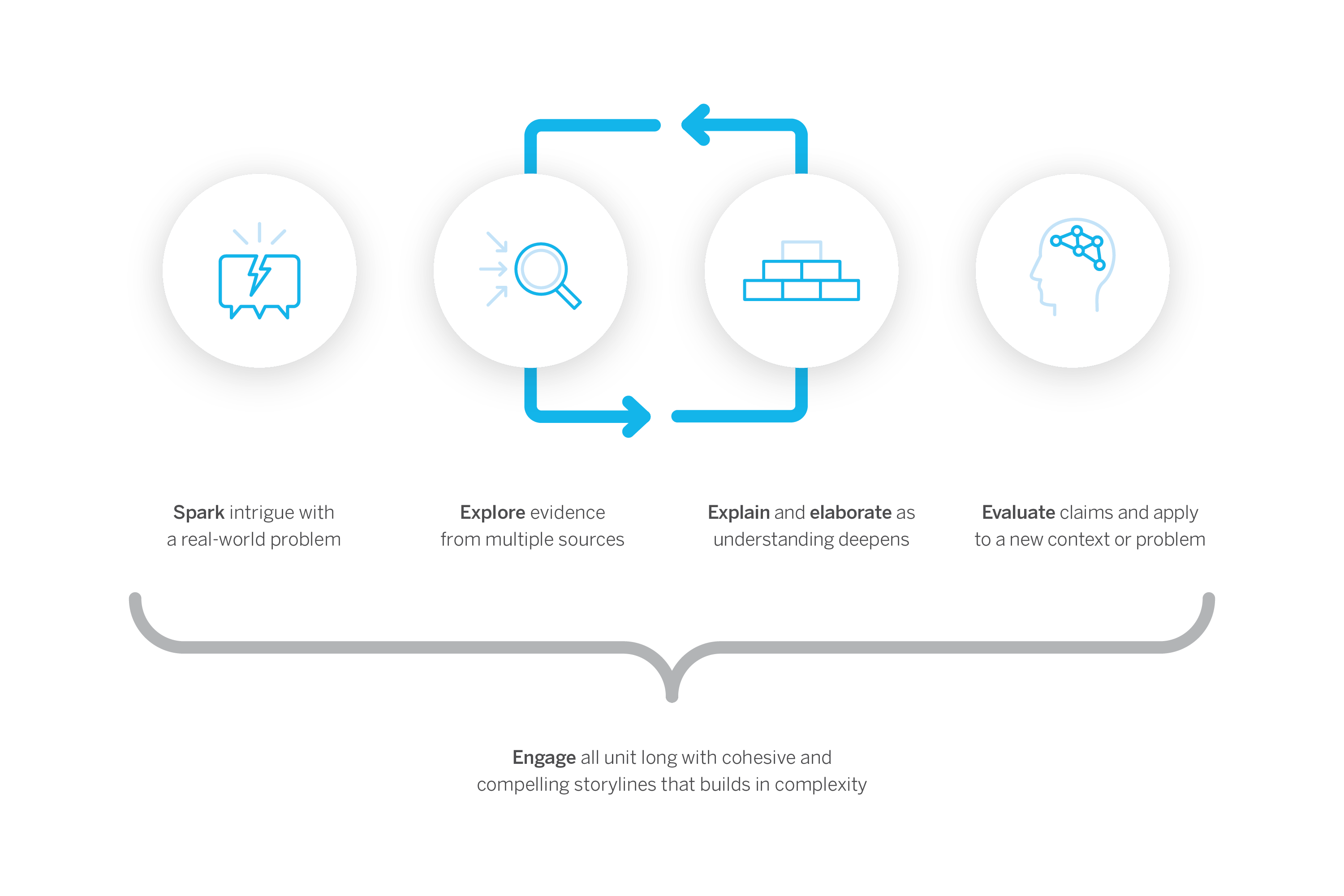
Unit sequence
Our lessons follow a structure that is grounded in regular routines while still being flexible enough to allow for a variety of learning experiences.
In fact, our multi-modal instruction offers more opportunities for students to construct meaning, and practice and apply concepts than any other program. What’s more, our modular design means our units can be flexibly arranged to support your instructional goals.


Needs of Plants and Animals
Domains: Life Science, Earth and Space Science, Engineering Design
Unit type: Investigation
Student role: Scientists
Phenomenon: There are no monarch caterpillars in the Mariposa Grove community garden since vegetables were planted.
Unit type: Investigation
Student role: Scientists
Phenomenon: There are no monarch caterpillars in the Mariposa Grove community garden since vegetables were planted.

Pushes and Pulls
Domains: Physical Science, Engineering Design
Unit type: Engineering design
Student role: Pinball engineers
Phenomenon: Pinball machines allow people to control the direction and strength of forces on a ball.
Unit type: Engineering design
Student role: Pinball engineers
Phenomenon: Pinball machines allow people to control the direction and strength of forces on a ball.

Sunlight and Weather
Domains: Earth and Space Science, Life Science, Engineering Design
Unit type: Modeling
Student role: Weather scientists
Phenomenon: Students at Carver Elementary School are too cold during morning recess, while students at Woodland Elementary School are too hot during afternoon recess.
Unit type: Modeling
Student role: Weather scientists
Phenomenon: Students at Carver Elementary School are too cold during morning recess, while students at Woodland Elementary School are too hot during afternoon recess.

Animal and Plant Defenses
Domain: Life Science
Unit type: Modeling
Student role: Marine scientists
Phenomenon: Spruce the Sea Turtle lives in an aquarium and will soon be released back into the ocean, where she will survive despite ocean predators.
Unit type: Modeling
Student role: Marine scientists
Phenomenon: Spruce the Sea Turtle lives in an aquarium and will soon be released back into the ocean, where she will survive despite ocean predators.

Light and Sound
Domains: Physical Science, Engineering Design
Unit type: Engineering design
Student role: Light and sound engineers
Phenomenon: A puppet show company uses light and sound to depict realistic scenes in puppet shows.
Unit type: Engineering design
Student role: Light and sound engineers
Phenomenon: A puppet show company uses light and sound to depict realistic scenes in puppet shows.

Spinning Earth
Domain: Earth and Space Science
Unit type: Investigation
Student role: Sky scientists
Phenomenon: The sky looks different to Sai and his grandma when they talk on the phone.
Unit type: Investigation
Student role: Sky scientists
Phenomenon: The sky looks different to Sai and his grandma when they talk on the phone.

Plant and Animal Relationships
Domains: Life Science, Engineering Design
Unit type: Investigation
Student role: Plant scientists
Phenomenon: No new chalta trees are growing in the fictional Bengal Tiger Reserve in India.
Unit type: Investigation
Student role: Plant scientists
Phenomenon: No new chalta trees are growing in the fictional Bengal Tiger Reserve in India.

Properties of Materials
Domains: Physical Science, Engineering Design
Unit type: Engineering design
Student role: Glue engineers
Phenomenon: Different glue recipes result in glues that have different properties.
Unit type: Engineering design
Student role: Glue engineers
Phenomenon: Different glue recipes result in glues that have different properties.

Changing Landforms
Domain: Earth and Space Science
Unit type: Modeling
Student role: Geologists
Phenomenon: The cliff that Oceanside Recreation Center is situated on appears to be receding over time.
Unit type: Modeling
Student role: Geologists
Phenomenon: The cliff that Oceanside Recreation Center is situated on appears to be receding over time.

Balancing Forces
Domain: Physical Science
Unit type: Modeling
Student role: Engineers
Phenomenon: The town of Faraday is getting a new train that floats above its tracks.
Unit type: Modeling
Student role: Engineers
Phenomenon: The town of Faraday is getting a new train that floats above its tracks.

Inheritance and Traits
strong>Domain: Life Science
Unit type: Investigation
Student role: Wildlife biologists
Phenomenon: An adopted wolf in Graystone National Park (Wolf 44) has some traits that appear similar to one wolf pack in the park and other traits that appear to be similar to a different wolf pack.
Unit type: Investigation
Student role: Wildlife biologists
Phenomenon: An adopted wolf in Graystone National Park (Wolf 44) has some traits that appear similar to one wolf pack in the park and other traits that appear to be similar to a different wolf pack.

Environments and Survival
Domains: Life Science, Engineering Design
Unit type: Engineering design
Student role: Biomimicry engineers
Phenomenon: Over the last 10 years, a population of grove snails has changed: The number of grove snails with yellow shells has decreased, while the number of snails with banded shells has increased.
Unit type: Engineering design
Student role: Biomimicry engineers
Phenomenon: Over the last 10 years, a population of grove snails has changed: The number of grove snails with yellow shells has decreased, while the number of snails with banded shells has increased.

Weather and Climate
Domains: Earth and Space Science, Engineering Design
Unit type: Argumentation
Student role: Meteorologists
Phenomenon: Three different islands, each a contender for becoming an Orangutan reserve, experience different weather patterns.
Unit type: Argumentation
Student role: Meteorologists
Phenomenon: Three different islands, each a contender for becoming an Orangutan reserve, experience different weather patterns.

Energy Conversions
Domains: Physical Science, Earth and Space Science, Engineering Design
Unit type: Engineering design
Student role: System engineers
Phenomenon: The fictional town of Ergstown experiences frequent blackouts.
Unit type: Engineering design
Student role: System engineers
Phenomenon: The fictional town of Ergstown experiences frequent blackouts.

Vision and Light
Domain: Physical Science, Life Science, Engineering Design
Unit type: Investigation
Student role: Conservation biologists
Phenomenon: The population of Tokay geckos in a rain forest in the Philippines has decreased since the installation of new highway lights.
Unit type: Investigation
Student role: Conservation biologists
Phenomenon: The population of Tokay geckos in a rain forest in the Philippines has decreased since the installation of new highway lights.

Earth's Features
Domain: Earth and Space Science
Unit type: Argumentation
Student role: Geologists
Phenomenon: A mysterious fossil is discovered in a canyon within the fictional Desert Rocks National Park.
Unit type: Argumentation
Student role: Geologists
Phenomenon: A mysterious fossil is discovered in a canyon within the fictional Desert Rocks National Park.

Waves, Energy, and Information
Domains: Physical Science, Life Science, Earth and Space Science, Engineering Design
Unit type: Modeling
Student role: Marine scientists
Phenomenon: Mother dolphins in the fictional Blue Bay National Park seem to be communicating with their calves when they are separated at a distance underwater.
Unit type: Modeling
Student role: Marine scientists
Phenomenon: Mother dolphins in the fictional Blue Bay National Park seem to be communicating with their calves when they are separated at a distance underwater.

Patterns of Earth and Sky
Domains: Physical Science, Earth and Space Science
Unit type: Investigation
Student role: Astronomers
Phenomenon: An ancient artifact depicts what we see in the sky at different times — the sun during the daytime and different stars during the nighttime — but it is missing a piece.
Unit type: Investigation
Student role: Astronomers
Phenomenon: An ancient artifact depicts what we see in the sky at different times — the sun during the daytime and different stars during the nighttime — but it is missing a piece.

Modeling Matter
Domain: Physical Science
Unit type: Modeling
Student role: Food scientists
Phenomenon: Chromatography is a process for separating mixtures. Some solids dissolve in a salad dressing while others do not. Oil and vinegar appear to separate when mixed in a salad dressing.
Unit type: Modeling
Student role: Food scientists
Phenomenon: Chromatography is a process for separating mixtures. Some solids dissolve in a salad dressing while others do not. Oil and vinegar appear to separate when mixed in a salad dressing.

The Earth System
Domains: Earth and Space Science, Physical Science, Engineering Design
Unit type: Engineering Design
Student role: Water resource engineers
Phenomenon: East Ferris, a city on one side of the fictional Ferris Island, is experiencing a water shortage, while West Ferris is not.
Unit type: Engineering Design
Student role: Water resource engineers
Phenomenon: East Ferris, a city on one side of the fictional Ferris Island, is experiencing a water shortage, while West Ferris is not.
Ecosystem Restoration
Domains:Physical Science, Life Science, Earth and Space Science, Engineering Design
Unit type: Argumentation
Student role: Ecologists
Phenomenon: The jaguars, sloths, and cecropia trees in a reforested section of a Costa Rican rain forest are not growing and thriving.
Unit type: Argumentation
Student role: Ecologists
Phenomenon: The jaguars, sloths, and cecropia trees in a reforested section of a Costa Rican rain forest are not growing and thriving.
Access program
Watch the video to the right showing you how to navigate our digital platform. When you’re ready, follow the instructions below to log into your live demo account.
- Click the orange button below to access the platform.
- Explore as a teacher with this username (t1.cartwrightsd@demo.tryamplify.net) and this password (Amplify1-cartwrightsd).
- Explore as a student with this username (s1.cartwrightsd@demo.tryamplify.net) and this password (Amplify1-cartwrightsd).
- Choose your grade level from the drop-down menu.
Resources






S3 – 06. Bethany and Dan take on Twitter!

In this episode, Bethany and Dan take a look at several tweets that caught the most fire on Twitter during the 2021-2022 school year. The pair answer questions about viral teaching methods, the best teaching advice you can give in three words, and if students should use pencils or pens in class. Join them as they take on those questions and several others in a fast-paced episode.
Explore more from Math Teacher Lounge by visiting our main page.
Dan Meyer (00:02):
Hey folks. Welcome back to the Math Teacher Lounge. I’m your co-host, Dan Meyer.
Bethany Lockhart Johnson (00:07):
And I am Bethany Lockhart Johnson. And I’m your co-host, Dan! Hi!
Dan Meyer (00:12):
We’re co-hosts! Hey! Great to see you.
Bethany Lockhart Johnson (00:13):
Dan, this is the last episode of Season 3. Three seasons!
Dan Meyer (00:19):
It’s gotta have a cliffhanger. What will the cliffhanger be? You know?
Bethany Lockhart Johnson (00:22):
The cliffhanger is that we love having guests! It’s one of our most favorite things, because selfishly, we love to talk to all of these amazing folks who are doing this interesting research and thinking about amazing things. But for this last episode, it’s just you and I, Dan. Cliffhanger!
Dan Meyer (00:40):
Yeah. I like this. I like this. So the cliffhanger was last episode, and people are all like, “So who’s the last guest gonna be of the season before we roll out into summer?” And yes, as Bethany said, we love all the fascinating guests we’ve had on throughout these last few seasons. And we realized…who is more fascinating to each other than both of us? You know, let’s talk to each other about things, right? <Laughs> You get that! You get that! Or am I alone here in this? We had this idea about what we should talk about here, and that’s this: I am on Twitter a lot. I’m @DDMeyer on Twitter; throw me a follow; might follow back; who knows? I don’t tweet much. Bethany, what’s your handle on Twitter? Let ’em know.
Bethany Lockhart Johnson (01:22):
I’m @LockhartEdu, and I was much more active pre-mamahood. But I’m still up in there. Go ahead.
Dan Meyer (01:30):
Yep. In there. Yeah, great. So I’ve been keeping track of the hottest conversations in math education Twitter, the conversations that the most people who kind of describe themselves as math teachers in their bios and whatnot have been replying to. We’ve got some little things working in the background, keeping track of this sort of thing. And so we are gonna bring you folks some of those extremely hot conversations, and even better than the questions—which we hope you’ll reply to and tag us in your replies—even more than those questions, we’ll bring you our answers—our answers!—to those questions. Can you believe that? We’ll fully settle these questions! Won’t we, Bethany? My gosh, won’t we?
Bethany Lockhart Johnson (02:15):
Jeez Louise! No! Dan Meyer, the point is not our final word on it! The point is this episode, we’re furthering the conversation. We wanna hear from listeners about what do you think?
Dan Meyer (02:25):
Right. You’re right. You all need someone in your life like Bethany who will help you become the best version of yourself. So here’s the deal. We have several questions in a few different categories. We’re gonna bust through some quick ones, pretty quick. And, uh, there’s some meaty ones as well. Let’s get into it! The first questions come to you all, and us, courtesy of MTL guest Howie Hua, who has a renowned knack for just creating math memes, but also conversation starters that really capture the curiosity and answers of of a grateful nation. So Howie’s first question, which I’ll pose to Bethany, is, “What’s your favorite number?” Bethany? And why is it your favorite number?
Bethany Lockhart Johnson (03:14):
Oh, I love it. OK. Well, the first thing that came to my mind is 12. ‘Cause It’s a highly divisible number. I mean, 2, 6, 3, 4—I love it. And it coincides with the day and month of my birth. Which, like, the double-digit…come on, 12, 12, 12, 12. I dunno, am I giving away, like, my bank security code <laugh> or anything by saying that?
Dan Meyer (03:41):
Yeah. What’s your favorite PIN?
Bethany Lockhart Johnson (03:43):
Let me change my PIN. Yeah, it’s just such a happy, happy number. Well, 12 is, you know, 10 and 2. Two more. Anyway. Love it. What about you, Dan? What’s your favorite number and why?
Dan Meyer (03:55):
I’m into it. I’m into it. I think I would choose 16. Because it’s the first number for me when it was like, “Oh, you can keep on making numbers forever!” Where I’m like, OK, 2times 2 is 4. Great. That’s kind of an elemental expression in mathematics. Four times 2 is 8. OK. But then, 8 times 2 is 16, and it’s like, “Oh, you can just keep doubling that thing over and over and over again!” And I can recall feeling pretty excited that numbers are just like, out there for the finding. For the taking. Cool stuff.
Bethany Lockhart Johnson (04:33):
I’m sorry. Wait, I have to interrupt. You went 2 times 4 is 8 and you didn’t go 4 times 4 is 16? You went 8 times 2 is 16? You wanted to keep the 2 the same?
Dan Meyer (04:49):
Yup. Yup. You can keep on doubling. You can keep on doubling numbers and it just keeps on going.
Bethany Lockhart Johnson (04:53):
More evidence that our brain works very differently.
Dan Meyer (04:56):
We learn more about each other…let me keep this rolling with Howie questions. OK? Howie says, “If you could co-teach with one teacher from Twitter, who would you choose?”
Bethany Lockhart Johnson (05:06):
Oh, oh, it has to be a teacher?
Dan Meyer (05:11):
Or anybody, I guess. I mean, like, I know you love Oprah.
Bethany Lockhart Johnson (05:15):
Can I co-teach with Oprah?
Dan Meyer (05:16):
Yup, yeah, so there we are. <Laugh> Yup. OK. Fair enough. We have to work Oprah into every single episode.
Bethany Lockhart Johnson (05:23):
I’d just love to sit and like, we’d read together, we’d read to the students, and then we’d talk…I mean, obviously it’d be Oprah. But if we’re thinking more of like MTBoS, like math Twitter blogosphere-land, I suppose the person I would wanna co-teach with honestly would probably be Allison Hintz. One of our former guests as well. Her book, Mathematizing Children’s Literature, with Antony Smith, that book—I just love the idea of sitting and doing a read-aloud and then diving into some juicy math that’s inspired by what comes out of that read-aloud. So yes, that’s who I pick. Allison! Let’s co-teach!
Dan Meyer (06:00):
<Laugh> Shout-out to Allison.
Bethany Lockhart Johnson (06:01):
What about you?
Dan Meyer (06:03):
I would choose MTL guest Idil Abdulkadir—because, and this relates to Allison and also Elham Kazemi—they talked about, in our episode about teacher time-outs. And I’m choosing someone who I think is—like I’ve never seen Idil teach, but I work with Idil at Desmos and think she’s fantastic. But what I really want in a co-teacher is someone that I can say, “Whoa, time out, do you see what’s going on here? This is really interesting. What should we do next about this?” And have a little strategy sesh in front of the kids and no one gets freaked out by that. And I think that that’d be a pile of fun. Idil seems like she’d be receptive to that kind of interaction, teacher to teacher. So that’s my vote right there.
Bethany Lockhart Johnson (06:48):
Opportunity for you to grow your own practice, Dan.
Dan Meyer (06:52):
Yeah, yeah, exactly. 100%.
Bethany Lockhart Johnson (06:56):
So Dan, I actually have a question for you from Howie. If we’re on the Howie tweet train, I have one from Howie too.
Dan Meyer (07:04):
Howie had some fire tweets, some fire tweets this current year. Yep.
Bethany Lockhart Johnson (07:08):
Dan, I wanna know: Do you prefer doing math in pen or pencil?
Dan Meyer (07:16):
Ooh, yeah. Oh, I see that Howie says, “I don’t mean to start any drama, BUT,” and then asks the question–
Bethany Lockhart Johnson (07:23):
But!
Dan Meyer (07:24):
I think that Howie lives for drama. I think he knows he’s messy. He lives for drama. He knows what he’s doing this with this question here. He knows.
Bethany Lockhart Johnson (07:32):
DRAAAAMAAAA!
Dan Meyer (07:32):
He knows what he’s doing. Yup. So I would just say it depends. Is that cheating? Like if I’m doing math to learn, or if we are learning in that process, then I want to use pen, actually. I wanna see the tracks of the thinking. And if we’re doing it for presentation, like if I’m presenting something, I wanna…I guess that’s an area where I’d be fine to not erase things. I don’t wanna prep it so it’s, you know…I guess you could use pen for presentation also. Just pen. Period. But I wanna see the tracks of the thinking if we’re doing some learning versus presentation. What about you?
Bethany Lockhart Johnson (08:09):
Well, I heard the voice in my head telling one of my kindergartners, “No, you cannot do that in sparkly pen. You need to do it in pencil.” And I was like, “Wait, whose voice is that?” It was one of my math teachers telling me I couldn’t do it in pen! Why couldn’t this kid do it in pen? Sure! Do it in a sparkly pen! So I wanna say do it in pen. And since usually pen is what I have around…I mean, I do crosswords in pen, Dan.
Dan Meyer (08:36):
Wow, wow. With a piece of paper and math, you have lots of room to re-revise and cross off…but those little, little boxes on the crossword, that says a lot about your commitment to pen.
Bethany Lockhart Johnson (08:46):
I got really good at making an A into an H or a P or whatever we need. So I would say, “Hey, if you’re in the room with your kiddos and you’re doing math, if somebody wants to do pen, let them do pen.” But I do know that I’ve seen teachers say you need to do pen so that I can see all of your thinking. So I think I hear what you’re saying. But do you think it should be like a classroom rule or something?
Dan Meyer (09:13):
Oh, no, no, no. I mean, I’m gonna ask you like, “How’d you get to this destination?” And I wanna know process somehow, and I think you’ll get tired of having to explain it verbally rather than just, like, showing. Just don’t erase stuff. Don’t scratch stuff off. Let’s let’s see how you’re getting there. That is what I’m into.
Bethany Lockhart Johnson (09:30):
Thanks, Howie, for that trio of thought-provoking tweets, because I genuinely wanted to know what Dan thought and what our listeners think. I mean, Dan, I gotta say: Howie, you say you don’t wanna cause drama, but I gotta say I’m with Dan on that—
Dan Meyer (09:50):
Got the gift. Got the gift for drama. We’re still friends though. So I’m happy about that. Our next section, I got a few more questions queued up here and these ones relate to advice for educators, advice for yourself. Good advice, bad advice, that kind of thing. So let’s jump in. I would love to know—this one’s from Pernille Ripp—I’m very curious, Bethany, what is the worst teaching advice you have gotten in your life, ever?
Bethany Lockhart Johnson (10:19):
<Laugh> Ooh. OK. Um, worst teaching advice was: “That’s OK, just move on anyway.” And that was in terms of pacing. It was like, students needed to do a deeper dive and the teacher who I was chatting with said, “No, no, it’s fine; it’s fine; just move on. Just move on to the next chapter.” That was probably the worst advice, because no, I don’t think that’s what I should have done at all! <Laugh>
Dan Meyer (10:48):
Right.
Bethany Lockhart Johnson (10:48):
But I was a first-year teacher and I was trying to figure it out. And I learned that that was not good advice. And I understand the pressure of pacing. But it was totally antithetical to the type of listening to my students that I want to do in my craft. And this teacher meant well, but that was not good advice, teacher! <Laugh> What about you, Dan? What is the worst teaching advice?
Dan Meyer (11:13):
I dig that. That feels similar to one of the replies to Pernille here. Frances Klein says, “Never let them know you’ve made a mistake” being particularly bad advice. You know, just this like idea of like moving along, covering your tracks, not backtracking or admitting mistakes, those all feel kind of a piece. The worst advice I think I’ve ever received, and I wasn’t given this often, but it’s echoed by a lot of the commenters here on this tweet, which is “Don’t smile until X, Y, or Z,” where X, Y, and Z are like Christmas, October, December, January. Just the idea that you’ve gotta develop—
Bethany Lockhart Johnson (11:54):
Wait, what?
Dan Meyer (11:55):
<Laugh> Did you never hear this from anybody? Don’t smile until Christmas? Perhaps this is more—
Bethany Lockhart Johnson (11:59):
I’m a kindergarten teacher! Can you imagine? If I don’t smile the second they walk in? The tears?! The parents’ tears?! The kids’ tears?! If I’m just like, stoic?
Dan Meyer (12:07):
Yeah. Well.
Bethany Lockhart Johnson (12:08):
So explain it to me.
Dan Meyer (12:10):
Well, the idea is, is that, you know, for older kids, they’re scoping you, they’re clocking you for weakness, they’re looking at you, they’re looking to take advantage. And so “don’t smile until Christmas” is like, hey, you can always relax. You can always relax your discipline, but you can’t UN-relax it if you start out, you know, Mr. Happy Pants Meyer. Which—
Bethany Lockhart Johnson (12:33):
Smile perceived as weakness.
Dan Meyer (12:36):
Yeah. Very obviously poor advice. Eventually you come to realize that like having a rapport and a relationship that is trusting and warm and demanding, that has high expectations, that’s the best kind of classroom management. Not some kind of persona built around intimidation or stoicism, that kinda thing. So, terrible, terrible advice!
Bethany Lockhart Johnson (13:01):
I feel like I did have a few of those math classes. Yeah.
Dan Meyer (13:04):
Yeah, exactly. <Laugh> You loved them, right? They were like your favorite math classes. It was a blast, right?
Bethany Lockhart Johnson (13:11):
<Laugh> So we have to ask the opposite. Thank you, Daniel Willingham, who said, “What’s the best advice you got?” But hold on, Dan, he didn’t just want the best advice. He wanted the best advice in three words.
Dan Meyer (13:26):
Oh yeah. He doesn’t, he doesn’t want a book or dissertation or even a blog post or even a tweet. He wants just three words.
Bethany Lockhart Johnson (13:32):
I think maybe that might have been to me. <Laugh>
Dan Meyer (13:34):
This is someone who’s doesn’t have much time for this advice, wants it distilled down. I’m just obviously stalling here as I try to think about this. I don’t know, there’s just like so much nuance lost here. I would say, listen to students, listen to students. I can’t say more that, I guess. I guess I’m done. I can’t say more than that there. But you’re in a bad place if you’re not listening carefully to students. How about you?
Bethany Lockhart Johnson (14:04):
- Mine is “Ask…lots…questions.”
Dan Meyer (14:11):
Nice. ‘Cause I filled in the word! I filled in the word! I was able to kinda infer that. I did that. I got that.
Bethany Lockhart Johnson (14:17):
Wait, wait, wait, wait! I could have said many! Wait, I could have said “Ask many questions.”
Dan Meyer (14:22):
Strong, strong.
Bethany Lockhart Johnson (14:25):
So yeah. You know, no isolation, like don’t put yourself in a bubble. Ask, not just, not just your students, but the teachers! Ask a lot of questions. You don’t have to have it all figured out.
Dan Meyer (14:34):
Into it. Very much into it.
Bethany Lockhart Johnson (14:37):
Thanks. Daniel. Thanks, Pernille.
Dan Meyer (14:40):
Yeah. Daniel and Pernille, Both great questions there about advice, best and worst. Another fire tweet popped up earlier this year from Dr. Khristopher Childs, which was “Name one thing every educator should stop doing.”
Bethany Lockhart Johnson (14:57):
Oh, I don’t know. This kind of ties into my best advice about asking questions.
Dan Meyer (15:03):
Stop not asking questions?
Bethany Lockhart Johnson (15:06):
<Laugh> Avoid the isolation. I really love this idea of when we can, popping into each others’ classrooms, co-teaching, building this collaborative nature. Elham Kazemi, in our interview, talked about this idea of, like you said, the teacher time-outs, learning from each other. So I feel like if we could stop isolating ourself…and I don’t mean at lunch—sometimes you need to not be in the teacher lounge at lunch. Like if you need a minute, take the minute! But in general, as a practice, how can we not be isolated and instead be learning with, and from, each other? How can we stop the isolation? That’s what I would hope every educator would stop doing. What about you, Dan?
Dan Meyer (15:54):
I think that educators should…this is gonna require a little bit of elaboration. I think educators should stop taking responsibility for things that are not in their zone of influence. I think that as a society we are asking teachers to do more and more, to become more and more of a central fixture holding together with chewing gum and twine all the various parts of a student’s life. From their health, their fitness, emotional health, that we feed students at school. It becomes very tempting, I think, there’s a lot of pressures to blame outcomes, disparate and unjust outcomes later on in life, on teachers. And teachers should just flatly refuse. And to yeah, understand what the job has been set up to do. What it’s good for. And do that with excellence and intent and a lot of effort. And then not take responsibility for the rest of it.
Bethany Lockhart Johnson (16:53):
If I asked five different people about the definition of what a teacher should be doing, I would get five different answers. So I think it’s really interesting that you say that because yeah, many, many hats, which I think, yes, can lead to burnout. Can lead to all sorts of things. We’re asking schools to be all things to all, all people. Interesting. I’m gonna think about that more. I need to hear folks’ response on that, Dan.
Dan Meyer (17:18):
Mm-Hmm. I’m curious too. I mean, yeah, there are definitely things that are in teachers’ responsibility and some that are not. That’s a tough one.
Bethany Lockhart Johnson (17:26):
OK, for help, name an example of each. And what’s something that you think every teacher should not and should be doing. ‘Cause I feel like my brain goes to some things like, you know, I had teachers who were saying, “Well, I don’t wanna have my kids have to have breakfast in my classroom in the morning. That shouldn’t be my responsibility to serve breakfast in the morning.” But I’m like, “But then your kids are eating and they’re gonna be able to learn and be more focused.” Should that be the teacher’s responsibility? I’m not saying it necessarily should, but I’m saying…I don’t know. It gets murky for me.
Dan Meyer (18:06):
Yeah, for sure. I mean, I think that we should, as a country, have a really generous social welfare net so that everyone has food at home. Where a school is not the place where some students have to go to in order to receive nutrition and nourishment. That seems sad to me. And uncommon in developed nations. I think that teachers should watch out for, should be responsible for, the mathematical development of the students they teach, up to a point, they should be responsible for learning math and creating relationships in their classes. I don’t think that teachers should accept responsibility for larger kinds of outcomes, like the health of a democracy or international competition, who goes to the moon first. That kind of thing has historically been placed at the feet of teachers. And it’s tempting when you’re a teacher, I think, to take on that responsibility because it kind of develops your social importance. And I just say, we should say no to that. And get compensation, not in terms of social importance, but rather like in spendable dollars and monies.
Bethany Lockhart Johnson (19:10):
I’m learning more about you, Dan. And you know, this is what I’ve gotten from that answer: If you’re gonna dream, dream big. Right?
Dan Meyer (19:17):
Is that what you got from that? I don’t know. I think I’m trying to dream realistically.
Bethany Lockhart Johnson (19:23):
No, like if we’re gonna say, “Maybe teachers shouldn’t be responsible for serving breakfast in the morning,” well, because we want every child to have access to nutritious and filling food at home and time to eat it in the morning, right? It’s bigger than just, “I don’t want the teacher to have to do this.” So we’re dreaming big. We’re saying this should be the LEAST that students have access to, right?
Dan Meyer (19:53):
Yeah. Yeah. I’m here now. I’m with you. I like that dream. Where we take care of folks in their lives outside of schools. So schools don’t have to be the one linchpin for every kind of social outcome. Like currently a lot of them run through a school ’cause we don’t do a good job of setting up other ways to meet those needs. And we should.
Bethany Lockhart Johnson (20:16):
And we’re also recording this in, what, two weeks, a week, after a tragedy where students and teachers were killed in the classroom. And I think both of us are taking some deep breaths and recognizing that there’s a lot of debate that is happening about what teacher’s role should be in preventing this in the future. And I don’t know if you’ve done drills in your classroom that are supposed to help mitigate disaster, but you know—collective deep breaths— <laugh> is where we’re at right now.
Dan Meyer (20:52):
Yep. The idea of “we should arm teachers” is another example of no, we should not do that. We should solve the tendency towards violence outside of the classroom so that teachers and students can teach and learn. That sounds awesome to me.
Bethany Lockhart Johnson (21:06):
Collective deep breath. Whew. OK. So what else you got for me, Dan?
Bethany Lockhart Johnson (21:33):
Ooh. So I feel like I’ve heard that in many teaching PDs. “I Do, you do, we do.” Actually I feel like I’ve seen like more “I do, we do, you do.” Like graduated release. I do it, then we’ll do it a little bit together, and then now you have permission to do it. And I feel like in directed draw, that’s a hundred percent true. Like I’m gonna show you this and then you draw it. And then you cut here and then you do it. If we’re trying to create this, like I’m teaching this new art technique. But in mathematics, I feel like that’s really not what I want my classroom to look like. I want to support my students and set them up for sense-making, and then I want them to try it out and I don’t want them to solve it the way it first comes to mind for me. I wanna see how they make sense of it and how they solve it. And then I want us to share it with each other so we can grow together. So I think time and place for “I do, you do, we do,” or “I do, we do, you do.” Or shoo-be-doo-be-doo-be. Yeah. You?
Dan Meyer (22:44):
I’ve got nothing. I have nothing to add. I thought that was just an excellent summary of a classroom I would love to be a part in, love to teach. I think it’s a certain tool in the toolbox that I think is overused. But it’s also a tool that can be useful in the case of certain kinds of operations. There are some operations that do benefit from “let me just show you how, like one way you might do this.” I don’t know. I’m like helping my kid whack a nail into a board and there’s a moment where it’s like, “Hey, actually, lemme just show you one way you can do this,” and do it, and then that’s helpful in some moments. But for so much of math, a lot of math does not relate to the operational kinds of fluency. And in those instances, it’s a little bit…it’s not a useful tool, I don’t think, for those kinds of skills and ideas.
Bethany Lockhart Johnson (23:34):
I’m thinking of tool talks in my classroom. So in kindergarten, many of the tools that we use in math and just in class in general, are new to the students. And if I tell them, this is exactly how you should use this tool, then I feel like I’m taking a lot of the sense-making away from them. But if I introduce the tool, show them how to use the tool safely, show them this is not a safe way to use the tool, chewing on this is not safe. That’s not how we use this tool. This is how we take care of it, et cetera. But then support different modes of using the tool that are gonna help them use it to solve problems and make sense, I think…but I guess—Dan, have you heard “I do, you do, we do,” or is it “I do, we do, you do”?
Dan Meyer (24:22):
I’m with you. And I think that it got clarified post-tweet. But yeah, it typically is “I do, we do, you do,” the gradual release of responsibility it’s often called. And I, I have heard people do what you described, which is…what is it? It’s “You do, we do, I do”? Like an inversion of that? Like have people do a thing that I can do that’s not too, too abstract for them, and then like “We all do something together, and then I’ll offer a summary of what we learned,” is one way that goes. I like that tool as well.
Bethany Lockhart Johnson (24:53):
I think particularly, at least I’ve seen in elementary classrooms, there’s sometimes this fear of letting students just try it out before I’ve really showed them, “but this is how it has to be.” And what I am most excited about is supporting students and creating a classroom environment where students don’t need my permission or need my direct “this is the only way to do it.” Instead, it’s like, yes, there’s lots of things we model. But there’s also like, “Hey, what do you think? How do you think this should be used?” And the joy of that exploration.
Dan Meyer (25:30):
Yeah. There’s a feeling of efficiency that comes from “I do, we do, you do,” for some kinds of math, but it’s undercut in my experience by what it cultivates in the students, which is “I’ve gotta wait until the teacher does before I can do anything.” So it pays off real diminishing returns over time. And it’s, just for me, an exhausting way to teach. Always being the bottleneck for new learning is a total drag.
Bethany Lockhart Johnson (25:55):
Ooh, what a great way to describe it. You do not wanna be the bottleneck. You want to be…what’s the other thing? The facilitator? What’s the opposite of a bottleneck? The flowing river? The…The…Help me!
Dan Meyer (26:10):
Hit us up in the replies. I dunno. The opposite of a bottleneck. That’s what you wanna…you wanna not be the opposite? No, you want, yeah. We got this here. We’ll figure it out. We’ll get back to you. <Laugh> OK. Well, folks, those were a few of this year’s fire tweets. It’s been fantastic chatting with you—
Bethany Lockhart Johnson (26:29):
Dan.
Dan Meyer (26:29):
—Bethany, About all those—
Bethany Lockhart Johnson (26:32):
Dan. You know, my favorite thing to do is interrupting you, Dan. I have to interrupt you because we can’t end fire tweets, Dan, without including a tweet from you.
Dan Meyer (26:43):
Oh, that’s true. I do have my moments. Yeah, we should. We really should. <Laugh> Do you have one in mind?
Bethany Lockhart Johnson (26:50):
No. Dan. Yes. I loved…you tweeted recently, “How many years have you been teaching?” Which, OK. “What Has been like the most influential? Like, what, OK, blah, blah, blah.” <blathering noises> You tweeted, “How many years have you been teaching? And at this point, what has most influenced how you teach?” And you gave some ideas: A methods course, PD sessions, curriculum, TV and movies, et cetera, et cetera. And I love that you put that out there because this episode is coming out as we’re wrapping up another school year. And it also got me thinking about summer and what teachers sometimes do during the summer, but what we might need to do this summer for self-care. But I’m really curious. I love that tweet. And I’m curious, Dan, what did folks say was the thing that had most influenced their teaching and what’s most influenced your teaching?
Dan Meyer (27:49):
Ooh, yeah. People’s responses to this one were really fantastic. I came into this, I was flying to the Association of Mathematics Teacher Educators conference. And I just found myself wondering, so, the pre-service year, the one year of, like, you’re learning how to teach, is how we did it in California. Like how much of that has still infused my practice? And in what ways? I don’t think I think about that stuff consciously, but I think that did like set me up with a lot of images that I would be unpacking for going on two decades now working in education. I think conversations with people, I think observing classes, I don’t think that like the one-day PDs, the one-day development days throughout the year, four times per year, I don’t think those stuck to me much. I think that this summer, I have learned so much, just an embarrassment of riches, from non-educational sources. From other disciplines. From storytelling, for instance. From how people have constructed movies I like. I am proud of the way…one of the aspects of my character that I’m proud of—it takes a lot to admit this, as I’m sure you understand, Bethany—but to integrate lots of wacky stuff and pick from it and use that to affect my practice and teaching has been really positive. So for this summer, I hope that people read a good beach book and just kinda let your teaching mind rest a little bit. And in doing so, create some openings for new ideas about education from other parts of the world. Kids! Having kids has been helpful. I don’t know! Just everything! It’s such a big job, education. Everything has so helpful. What about you? What’s an influence on your practice that might surprise me or other folks out there in MTL land?
Bethany Lockhart Johnson (29:52):
Well, I don’t know about surprise. I mean, I definitely feel similarly, like methods courses absolutely impacted my teaching. But I feel like opportunities where I was able to observe other teachers and where I was able to have conversations with folks about their practice, that has deeply impacted me. And books I’ve read. I mean, honestly, I’ve learned so much from sharing with other teachers. Like, for example, maybe I’ll bring student work and we’ll talk about it. And we kind of create this conversation together about how we wanna come back to the students based on the work we see. Those type of moments where we’re collaborating and we’re bringing multiple perspectives to the table, that I think, has really often shifted me out of my first initial reaction or what I thought I was going to do in the classroom the next day. So that continues to surprise and delight me. And thinking about this summer, I think there’s a lot of creativity and joy that can come out of the marination process, when you’re just kind of sitting back and healing yourself, whether through sleep or sunshine or time with friends and family or whatever that looks like for you. I think there’s a lot of creativity that can come from that place of fertile, you know, wellness. I never think of that as wasted time. I think of that as getting the soil ready for all that’s gonna come in the fall. And that being said, I also think it could be a fun time to dip your toes into something that you are excited to read, that you might not have a chance to read during the school year that could be teaching-related. So it’s like very low pressure, like, “Oh, I’ve really wanted to read more by this author. I’ve wanted to read this article. I’ve wanted to dip into this topic.” And not with a pressure, but just with a curiosity. And, yeah, I think so often we as teachers love learning, and to give yourself space to learn in whatever that looks like can be a real gift.
Dan Meyer (32:09):
Yes. And if you need book recommendations, hit the MTL back catalog of episodes. Loads of folks that we interviewed have real good books out.
Bethany Lockhart Johnson (32:16):
Yes!
Dan Meyer (32:16):
Think about it. Think about it.
Bethany Lockhart Johnson (32:22):
One quick recommendation: Again, gotta plug Antony Smith and Allison Hintz’s book. I read Mathematizing Children’s Literature before we did the interview, but this summer I wanna read all the children’s books that they mention. I just wanna go to the library and read all those children’s books. I wanna read them to my son. I wanna read ’em to myself. So, you know, diving into some good YA, children’s books, just, like, TLC. Dan, thank you for such a rich season and a chance to have so many interesting conversations. It is genuinely a joy to learn with and from you.
Dan Meyer (33:00):
Likewise. And always hope to see you folks on Twitter now and then. Let us know what you’re up to this summer at MTLShow on Twitter or in our Facebook group, Math Teacher Lounge. We’ll be there tuning in now and then. It’s been a treat interacting with you folks over this last season. Take care and until the new season, so long.
Stay connected!
Join our community and get new episodes every other Tuesday!
We’ll also share new and exciting free resources for your classroom every month.
Meet the guests
Dan Meyer
Dan Meyer taught high school math to students who didn’t like high school math. He has advocated for better math instruction on CNN, Good Morning America, Everyday With Rachel Ray, and TED.com. He earned his doctorate from Stanford University in math education and is currently the Dean of Research at Desmos, where he explores the future of math, technology, and learning. Dan has worked with teachers internationally and in all 50 United States and was named one of Tech & Learning’s 30 Leaders of the Future.
Bethany Lockhart Johnson
Bethany Lockhart Johnson is an elementary school educator and author. Prior to serving as a multiple-subject teacher, she taught theater and dance and now loves incorporating movement and creative play into her classroom. Bethany is committed to helping students find joy in discovering their identities as mathematicians. In addition to her role as a full-time classroom teacher, Bethany is a Student Achievement Partners California Core Advocate and is active in national and local mathematics organizations. Bethany is a member of the Illustrative Mathematics Elementary Curriculum Steering Committee and serves as a consultant, creating materials to support families during distance learning.
About Math Teacher Lounge: The podcast
Math Teacher Lounge is a biweekly podcast created specifically for K–12 math educators. In each episode co-hosts Bethany Lockhart Johnson (@lockhartedu) and Dan Meyer (@ddmeyer) chat with guests, taking a deep dive into the math and educational topics you care about.
Join the Math Teacher Lounge Facebook group to continue the conversation, view exclusive content, interact with fellow educators, participate in giveaways, and more!
You might also like:
A closer look at grades 6–8 (domain)
Amplify Science California is based on the latest research on teaching and learning and helps teachers deliver rigorous and riveting lessons through hands-on investigations, literacy-rich activities, and interactive digital tools that empower students to think, read, write, and argue like real scientists.
In the 6–8 classroom, this looks like students:
- Collecting evidence from a variety of sources.
- Making sense of evidence in a variety of ways.
- Formulating convincing scientific arguments.
Is your school implementing the integrated model? Click here.
Program structure
Our cyclical lesson design ensures students receive multiple exposures to concepts through a variety of modalities. As they progress through the lessons within a unit, students build and deepen their understanding, increasing their ability to develop and refine complex explanations of the unit’s phenomenon.
It’s this proven program structure and lesson design that enables Amplify Science California to teach less, but achieve more. Rather than asking teachers to wade through unnecessary content, we designed our 6–8 program to address 100% of the California NGSS in fewer lessons than other programs.
Scope and sequence
Every year of our grades 6–8 sequence consists of 9 units, with each unit containing 10–19 lessons. Lessons are written to last a minimum of 45 minutes, though teachers can expand or contract the timing to meet their needs.
Unit types
Each unit delivers three-dimensional learning experiences and engages students in gathering evidence from a rich collection of sources, while also serving a unique purpose.
In grades 6–8, there are three types of units:
- One unit is a launch unit.
- Three units are core units.
- Two units are engineering internships.
Launch units
Launch units are the first units taught in each year of Amplify Science California. The goal of the Launch unit is to introduce students to norms, routines, and practices that will be built on throughout the year, including argumentation, active reading, and using the program’s technology. For example, rather than taking the time to explain the process of active reading in every unit in a given year, it is explained thoroughly in the Launch unit, thereby preparing students to actively read in all subsequent units.
Core units
Core units establish the context of the unit by introducing students to a real-world problem. As students move through lessons in a Core unit, they figure out the unit’s anchoring phenomenon, gain an understanding of the unit’s disciplinary core ideas and science and engineering practices, and make linkages across topics through the crosscutting concepts. Each Core unit culminates with a Science Seminar and final writing activity.
Engineering Internship units
Engineering Internship units invite students to design solutions for real-world problems as interns for a fictional company called Futura. Students figure out how to help those in need, from tsunami victims in Sri Lanka to premature babies, through the application of engineering practices. In the process, they apply and deepen their learning from Core units.
Units at a glance
Geology on Mars
Domain: Earth and Space Science
Unit type: Launch
Student role: Planetary geologists
Phenomenon: Analyzing data about landforms on Mars can provide evidence that Mars may have once been habitable.
Plate Motion
Domain: Earth and Space Science
Unit type: Core
Student role: Geologists
Phenomenon: Mesosaurus fossils have been found on continents separated by thousands of kilometers of ocean, even though the Mesosaurus species once lived all together.
Plate Motion Engineering Internship
Domain: Earth and Space Science
Unit type: Engineering internship
Student role: Mechanical engineering interns
Phenomenon: Patterns in earthquake data can be used to design an effective tsunami warning system.
Rock Transformations
Domain: Earth and Space Science
Unit type: Core
Student role: Geologists
Phenomenon: Rock samples from the Great Plains and from the Rocky Mountains — regions hundreds of miles apart — look very different, but have surprisingly similar mineral compositions.
Earth, Sun, and Moon
Domain: Earth and Space Science
Unit type: Core
Student role: Astronomers
Phenomenon: An astrophotographer can only take pictures of specific features on the Moon at certain times.
Ocean, Atmosphere, and Climate
Domain: Earth and Space Science
Unit type: Core
Student role: Climatologists
Phenomenon: During El Niño years, the air temperature in Christchurch, New Zealand is cooler than usual.
Weather Patterns
Domain: Earth and Space Science
Unit type: Core
Student role: Forensic meteorologists
Phenomenon: In recent years, rainstorms in Galetown have been unusually severe.
Earth’s Changing Climate
Domain: Earth and Space Science
Unit type: Core
Student role: Climatologists
Phenomenon: The ice on Earth’s surface is melting.
Earth’s Changing Climate Engineering Internship
Domain: Earth and Space Science
Unit type: Engineering internship
Student role: Civil engineers
Phenomenon: Designing rooftops with different modifications can reduce a city’s impact on climate change.
Microbiome
Domain: Life Science
Unit type: Launch
Student role: Microbiological researchers
Phenomenon: The presence of 100 trillion microorganisms living on and in the human body may keep the body healthy.
Metabolism
Domain: Life Science
Unit type: Core
Student role: Medical researchers
Phenomenon: Elisa, a young patient, feels tired all the time.
Metabolism Engineering Internship
Domain: Life Science
Unit type: Engineering internship
Student role: Food engineers
Phenomenon: Designing health bars with different molecular compositions can effectively meet the metabolic needs of patients or rescue workers.
Traits and Reproduction
Domain: Life Science
Unit type: Core
Student role: Biomedical students
Phenomenon: Darwin’s bark spider offspring have different silk flexibility traits, even though they have the same parents.
Populations and Resources
Domain: Life Science
Unit type: Core
Student role: Biologists
Phenomenon: The size of the moon jelly population in Glacier Sea has increased.
Matter and Energy in Ecosystems
Domain: Life Science
Unit type: Core
Student role: Ecologists
Phenomenon: What caused the mysterious crash of a biodome ecosystem?
Natural Selection
Domain: Life Science
Unit type: Core
Student role: Biologists
Phenomenon: The newt population in Oregon State Park has become more poisonous over time.
Natural Selection Engineering Internship
Domain: Life Science
Unit type: Engineering internship
Student role: Clinical engineers
Phenomenon: Designing malaria treatment plans that use different combinations of drugs can reduce drug resistance development while helping malaria patients.
Evolutionary History
Domain: Life Science
Unit type: Core
Student role: Paleontologists
Phenomenon: A mystery fossil at the Natural History Museum has similarities with both wolves and whales.
Harnessing Human Energy
Domain: Physical Science
Unit type: Launch
Student role: Energy scientists
Phenomenon: Rescue workers can use their own human kinetic energy to power the electrical devices they use during rescue missions.
Force and Motion
Domain: Physical Science
Unit type: Core
Student role: Physicists
Phenomenon: The asteroid sample-collecting pod failed to dock at the space station as planned.
Force and Motion Engineering Internship
Domain: Physical Science
Unit type: Engineering internship
Student role: Mechanical engineering interns
Phenomenon: Designing emergency supply delivery pods with different structures can maintain the integrity of the supply pods and their contents.
Magnetic Fields
Domain: Physical Science
Unit type: Core
Student role: Physicists
Phenomenon: During a test launch, a spacecraft traveled much faster than expected.
Thermal Energy
Domain: Physical Science
Unit type: Core
Student role: Thermal scientists
Phenomenon: One of two proposed heating systems for Riverdale School will best heat the school.
Phase Change
Domain: Physical Science
Unit type: Core
Student role: Chemists
Phenomenon: A methane lake on Titan no longer appears in images taken by a space probe two years apart.
Phase Change Engineering Internship
Domain: Physical Science
Unit type: Engineering internship
Student role: Chemical engineering interns
Phenomenon: Designing portable baby incubators with different combinations of phase change materials can keep babies at a healthy temperature.
Chemical Reactions
Domain: Physical Science
Unit type: Core
Student role: Forensic chemists
Phenomenon: A mysterious brown substance has been detected in the tap water of Westfield.
Light Waves
Domain: Physical Science
Unit type: Core
Student role: Spectroscopists
Phenomenon: The rate of skin cancer is higher in Australia than in other parts of the world.
Resources
Families and caregivers, welcome to Amplify Desmos Math Texas K–5!
Welcome to the Amplify Desmos Math Texas K–5 Caregiver Hub. We’re here to support your student as they explore math, work with friends to solve problems, and learn new and interesting concepts—and to support you as you go on this math journey with them! Below are some suggestions and resources for how you can support their learning at home.
Learn more about Amplify Desmos Math Texas.
Para la versión en español, haga clic aquí.
Unit Caregiver Resources
For every unit of the program, we’ve created a Caregiver Resource that provides a summary of key concepts. You’ll find a Caregiver Resource for each unit, in both English and Spanish.
Unit 1: Beginning Number Concepts
Unit 2: Numbers 1–10
Unit 3: Shapes, Coins, and Financial Literacy
Unit 4: Understanding Addition and Subtraction
Unit 5: Make and Break Apart Numbers Within 10
Unit 6: Numbers 0–20
Unit 7: Solid Shapes All Around Us
Unit 1: Adding, Subtracting, and Working With Data
Unit 2: Story Problems Within 10
Unit 3: Adding and Subtracting Within 20
Unit 4: Numbers to 99 and Financial Literacy
Unit 5: Adding Within 120
Unit 6: Length Measurement Within 120 Units
Unit 7: Geometry and Time
Unit 1: Working With Data and Developing Financial Literacy
Unit 2: Adding and Subtracting Within 100
Unit 3: Measuring and Solving Problems Using Length
Unit 4: Numbers to 1,200
Unit 5: Geometry and Time
Unit 6: Adding and Subracting Within 1,000
Unit 7: Equal Groups and Area
Unit 1: Introducing Multiplication
Unit 2: Adding, Subtracting, and Rounding Larger Numbers
Unit 3: Relating Multiplication to Division
Unit 4: Fractions as Numbers
Unit 5: Measurement and Financial Literacy
Unit 6: Sorting and Classifying Shapes
Unit 1: Fraction Equivalence and Comparison
Unit 2: Extending Operations to Fractions
Unit 3: From Hundredths to One Billion
Unit 4: Mathematical Relationships and Financial Literacy
Unit 5: Multiplying and Dividing Multi-Digit Numbers
Unit 6: Angles and Properties of Shapes
Unit 1: Volume, Factors, and Expresssions
Unit 2: Multiplying and Dividing Fractions
Unit 3: Multi-Digit Multiplication and Division and Financial Literacy
Unit 4: Place Value Patterns and Decimal Operations
Unit 5: Measurement, Fraction Operations, and Data
Unit 6: Geometry and Algebraic Reasoning
Sub-Unit Summaries
- Unit 1 – Volume, Factors, and Expressions
- Unit 2 – Multiplying and Dividing Fractions
- Unit 3 – Multi-Digit Multiplication and Division and Financial Literacy
- Unit 4 – Place Value Patterns and Decimal Operations
- Unit 5 – Measurement, Fraction Operations, and Data
- Unit 6 – Geometry and Algebraic Reasoning
Access Amplify Desmos Math at home.
In addition to a print Student Edition workbook, your student will have digital access to all learning, practice, and assessment materials through the Amplify platform. The digital curriculum can be accessed in school and at home by following these instructions:
- Select the Amplify Desmos Math button.
- Select Log in with Amplify.
- Enter your student’s username and password provided by your student’s teacher.
- Select the desired grade level.
Once logged in, caregivers can view student work by opening previous assignments.
Learn how to navigate the student home page.
Materials overview
Amplify Desmos Math Texas supports blended learning with supporting print materials and a unique digital experience. All K–5 lessons are available in a write-in Student Edition book. Many of the lessons include hands-on activities with manipulatives, tools that help students understand abstract concepts by making them tangible. Your student will also work with digital devices for an age-appropriate number of lessons.
When students use devices, teachers can monitor their work in real time, making sure they get the exact support that they need at every part of the lesson, in and outside of class.
Components of a lesson
Students in an Amplify Desmos Math Texas classroom can be seen (and heard!) asking questions, debating answers, justifying their thinking, grappling with problems, and working together and independently.
A typical Amplify Desmos Math Texas lesson includes:
- Warm-up: A short, attention-getting problem to pique students’ interest in the lesson.
- Activities: One to two mini-activities that challenge students’ problem-solving skills.
- Synthesis: Discussion to review and bring together the important concepts from the lesson.
- Show What You Know and Reflection: Questions for students to show what they know from the lesson. (Note: The Show What You Know lesson assessment is optional for kindergarten and grade 1.)
- Centers: Student-led activity stations that reinforce the math learned during lesson activities through interactive and often game-like formats. In kindergarten and grade 1, time for Centers is built into the last 15 minutes of every lesson.
To support, strengthen, and stretch students’ learning after the lesson, Amplify Desmos Math Texas offers options for:
- Differentiation: Mini-Lessons, Centers, Extensions, Boost Personalized Learning, and Fluency Practice.
- Practice: Additional problems your student’s teacher may assign for classwork or homework.
Support math learning at home.
You can support your student’s math learning outside of school in many ways:
Your student’s teacher may assign practice problems at the end of each lesson for classwork or homework. If your student has already completed the practice problems for the lesson, ask them to walk you through how they solved each problem, or talk about any parts that were challenging for them. Ask your student follow-up questions to encourage the use of math language as they explain their thinking, such as, “How do you know?,” “How can you show your thinking?,” or “How would you describe that?” If students are stuck, ask support questions, such as, “What information do you know here?” or “How could you represent this problem?”
Your student’s teacher may introduce a Center game with students in the lesson or beyond the lesson. These games are aligned to the math of the unit and can be played with students outside of class. Your student’s teacher may introduce a Center game to students during or after completing a lesson, or you may need to teach the game before you play by using easy-to-follow instructions. Try out the following Center games with your student!
- Kindergarten
- Connecting Cubes: Build to Match
- Math Fingers: Show and Say
- Grade 1
- Find the Pair: Make 10
- Check It Off: Add or Subtract Within 10
- Grade 2
- Capture Squares: Add Within 10
- How Close? Add to 100
- Grade 3
- Capture Squares: Add Within 20
- Capture Squares: Multiply With 2, 5, and 10
- Grade 4
- Can You Draw It: Area and Perimeter
- Fraction Math: Beginner Fraction Models
- Grade 5
- Rectangle Rumble: Factors 1–5
- Compare: Divide Within 100
Each unit in Amplify Desmos Math begins with a Read-Aloud to engage students and provide context for the math of the unit. Elements and characters from the Unit Story then appear in lessons throughout the unit.
Kindergarten
- Unit 1 Story: The First Day of School
- Unit 2 Story: What’s in a Restaurant?
- Unit 3 Story: A Great Shape Adventure
- Unit 4 Story: Casey’s Town
- Unit 5 Story: Where is Harry?
- Unit 6 Story: Winners
- Unit 7 Story: Everybody Needs Help Sometimes
Grade 1
- Unit 1 Story: Ying’s New Town
- Unit 2 Story: Let’s Grow!
- Unit 3 Story: Impossible
- Unit 4 Story: The Collectors
- Unit 5 Story: The Day of the Wazzle-Squash
- Unit 6 Story: Side by Side
- Unit 7 Story: A Potluck for Pia
Grade 2
- Unit 1 Story: A New Class Pet
- Unit 2 Story: The Heroes of Pineapple Street
- Unit 3 Story: What Orson Imagined
- Unit 4 Story: 302 Ricotta Drive
- Unit 5 Story: Arjun the Artist
- Unit 6 Story: Where Eli Went
- Unit 7 Story: On Clementine Court
Grade 3
- Unit 1 Story: My Name Is Harper
- Unit 2 Story: The View From Up Here
- Unit 3 Story: Home Cooking
- Unit 4 Story: Coen and Obita
- Unit 5 Story: Just Stick With It, Sasha
- Unit 6 Story: Through Piho’s Eyes
Grade 4
- Unit 1 Story: One Step at a Time
- Unit 2 Story: Finny
- Unit 3 Story: Myles and the Loggerheads
- Unit 4 Story: Just for Fun
- Unit 5 Story: Special Day, Special Le
- Unit 6 Story: Captain Bogwart’s Treasure
Grade 5
- Unit 1 Story: Joyful Green
- Unit 2 Story: Princess Sweetsocks
- Unit 3 Story: Andrea
- Unit 4 Story: Market Day
- Unit 5 Story: The Monarchs
- Unit 6 Story: Hanan Pacha
Relate math to daily activities at home, whether grocery shopping, preparing a meal, or planning for a trip to the store. Your student can help you figure out how many more apples there are than oranges in the grocery cart, show how to split a sandwich into fourths, or figure out how much change you’ll receive in exchange for a $10 bill. Encourage your student to point out ways that you use math in your daily tasks.
Remind your student that getting stuck is part of the process—a necessary and beneficial part of learning. Many students (and adults) fear making mistakes, but research shows that mistakes help our brains grow! When your student gets stuck on a problem, encourage them to keep trying different strategies even if they’re not sure they’re right.
What’s included in our phenomena-based science curriculum
Amplify Science is a phenomena-based science curriculum for grades K-8. This program is designed to give students engaging, realistic experiences that mirror how scientists and engineers actually work. To do this, the Lawrence Hall of Science and Amplify created compelling print and digital resources that work seamlessly together to enable students’ investigations and explorations.
Year at a glance
Amplify Science is organized around units where students are introduced to compelling phenomena and real-world problems, develop and strengthen claims by collecting evidence and testing assumptions, and apply their learning in new contexts.
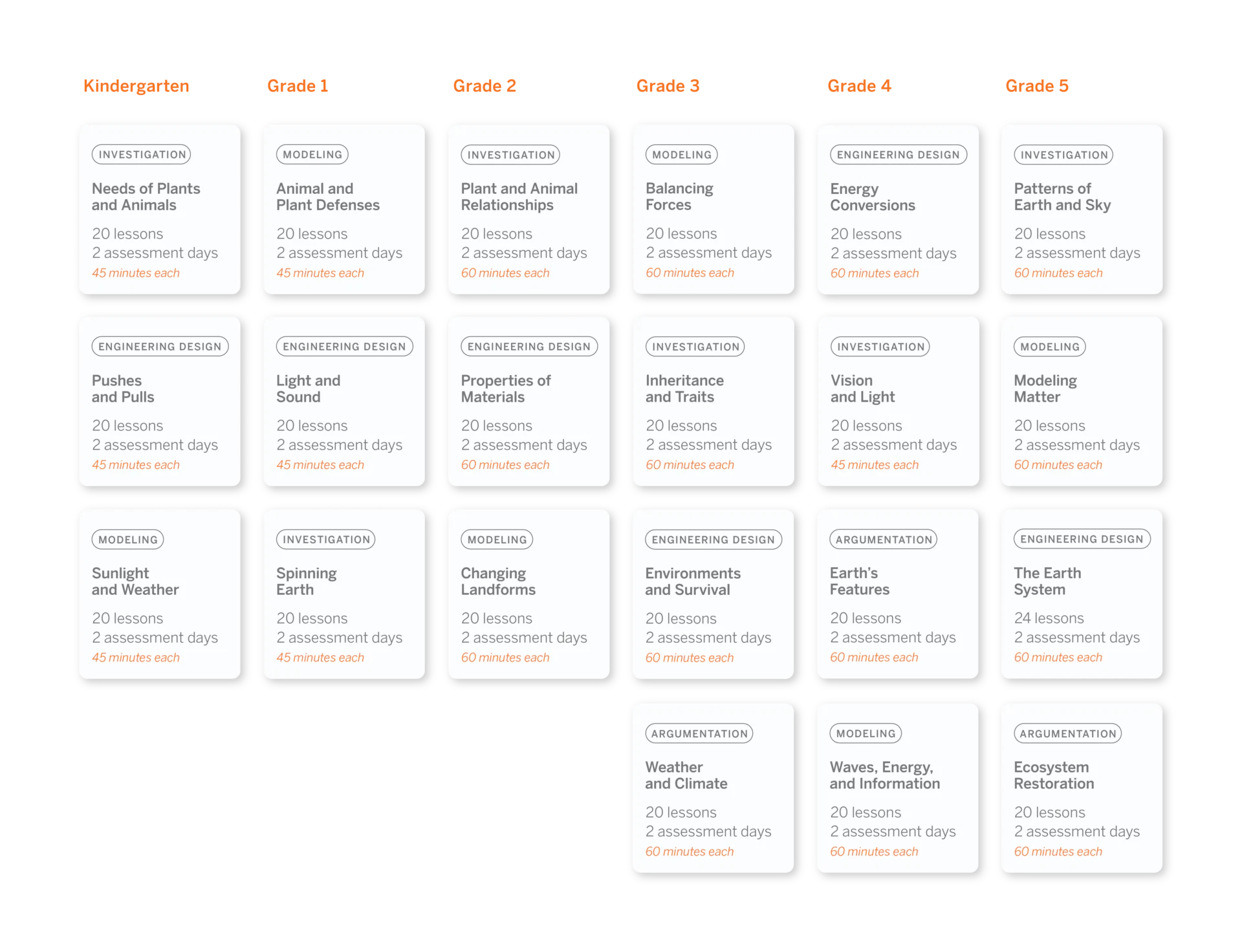
Units at a glance
In each Amplify Science unit, students are asked to inhabit the role of a scientist or engineer in order to investigate a real-world problem. These problems provide relevant, 21st-century contexts through which students investigate different scientific phenomena.

1
Needs of Plants and Animals
Students take on the role of scientists in order to figure out why there have been no monarch caterpillars in the community garden since vegetables were planted. They investigate how plants and animals get what they need to live and grow, and make a new plan for the community garden that provides for the needs of the monarch caterpillars in addition to producing vegetables for humans.

2
Pushes and Pulls
Students take on the role of pinball machine engineers as they investigate the effects of forces on the motion of an object. They conduct tests in their own prototypes (models) of a pinball machine and use what they learn to contribute to the design of a class pinball machine. Over the course of the unit, students construct a foundational understanding of why things move in different ways

3
Sunlight and Weather
The principals of Woodland Elementary and Carver Elementary need student weather scientists to help them explain why Woodland’s playground is warmer than Carver’s at recess. Students gather data from models of the sun and Earth’s surface and observe their own playgrounds to figure out how sunlight causes changes in the temperatures of different surfaces. Students then use models to figure out why Woodland’s playground sometimes floods.

1
Animal and Plant Defenses
Students play the role of marine scientists. In their role, students apply their understanding of plant and animal defense structures to explain to aquarium visitors how a sea turtle and her offspring can defend themselves from ocean predators when they are released into the wild.
2
Light and Sound
Students take on the role of light and sound engineers for a puppet show company as they investigate cause and effect relationships to learn about the nature of light and sound. They apply what they learn to design shadow scenery and sound effects for a puppet show.
3
Spinning Earth
As sky scientists, students explain why a boy living in a place near them sees different things in the sky than his grandma does when he talks to her on the phone. Students record, organize, and analyze observations of the sun and other sky objects as they look for patterns and make sense of the cycle of daytime and nighttime.

1
Plant and Animal Relationships
In their role as plant scientists, students work to figure out why there are no new chalta trees growing in the Bengal Tiger Reserve, which is part of a broadleaf forest. Students investigate what the chalta tree needs to survive, then collect and analyze qualitative and quantitative data to solve the mystery.

2
Properties of Materials
As glue engineers, students are challenged to create a glue for use at their school that meets a set of design goals. Students present an evidence-based argument for why their glue mixture will be good for their school to use.
3
Changing Landforms
The director of the Oceanside Recreation Center gets a scare when a nearby cliff collapses overnight. Research reveals that the distance between the Recreation Center’s flagpole and the edge of the cliff have changed over time. Students play the role of geologists and work to figure out why the cliff has changed over time. Based on what they learn about erosion, they advise on whether it is safe to keep the center open even though the cliff is changing.

1
Balancing Forces
People in Faraday are excited to hear that a new train service will be built for their city, but concerned when they hear that it will be a floating train. Students are challenged to figure out how a floating train works in order to explain it to the citizens of Faraday. They develop models of how the train rises, floats, and then falls back to the track, and then write an explanation of how the train works.
2
Inheritance and Traits
Students play the role of wildlife biologists working in Greystone National Park. They study two wolf packs and are challenged to figure out why an adopted wolf (“Wolf 44”) in one of the packs has certain traits. Students observe variation between and within different species, investigate inherited traits and those that result from the environment, and explain the origin of several of the adopted wolf’s traits.
3
Environments and Survival
In their role as biomimicry engineers, students work to figure out how the traits of grove snails affect their survival in different environments. They then explore how the traits of different organisms make them more likely or less likely to survive, collecting and interpreting data to understand how organisms’ traits affect their survival in different environments. Students then apply their understanding to a new challenge: designing effective solutions for the removal of invasive plants.

4
Weather and Climate
In their role as meteorologists, students gather evidence to decide where to build an orangutan reserve by analyzing patterns in weather data. After choosing the strongest evidence, students use data to make arguments about which of three fictional islands has weather most like that of orangutans’ existing habitats, Borneo and Sumatra. They then discern patterns in the locations of natural hazards in order to figure out which ones the Wildlife Protection Organization must prepare for.

1
Energy Conversions
Students take on the role of systems engineers for Ergstown, a fictional town that experiences frequent blackouts, and explore reasons why an electrical system can fail. Students apply what they learned as they choose new energy sources and energy converters for the town, then write arguments for why their design choices will make the town’s electrical system more reliable.

2
Vision and Light
As conservation biologists, students work to figure out why a population of Tokay geckos has decreased since the installation of new highway lights in the rainforest. Students use their understanding of vision, light, and information processing to figure out why an increase in light in the geckos’ habitat is affecting the population.

3
Earth’s Features
Playing the role of geologists, students help the director of Desert Rocks National Park explain how and when a particular fossil formed and how it came to be in its current location. Students figure out what the environment of the park was like in the past and why it has so many visible rock layers.

4
Waves, Energy, and Information
In their role as marine scientists, students work to figure out how mother dolphins communicate with their calves. They write a series of scientific explanations with diagrams to demonstrate their growing understanding of how sound waves travel. Then they apply what they’ve learned about waves, energy, and patterns in communication to figure out how to create patterns that can communicate information over distances.

1
Patterns of Earth and Sky
Playing the role of astronomers, students help a team of archaeologists figure out what the missing piece of a recently discovered artifact might have depicted. As they learn about the sun and other stars and the movement of Earth, students can explain what is shown on the artifact and what might be on the missing piece.

2
Modeling Matter
In their role as food scientists at a fictional company, students are introduced to the idea that all matter is made of particles too small to see, and that each different substance is made of particles (molecules) that are unique. They are then challenged to solve two problems: one requires them to separate a mixture, and the other requires them to make unmixable substances mix. Students are challenged to use the particulate model of matter to explain their work to the CEO of the company.

3
The Earth System
The cities of East Ferris and West Ferris are located on different sides of a mountain on the fictional Ferris Island. East Ferris is having a water shortage while West Ferris is not. As water resource engineers, students learn about the Earth system to help figure out what is causing the water shortage problem and design possible solutions, including freshwater collection systems and proposals for using chemical reactions to treat wastewater.
4
Ecosystem Restoration
As ecologists, students work to figure out why the organisms in a part of a Costa Rican rainforest ecosystem aren’t growing and thriving. As they solve this problem, students learn more generally how organisms in an ecosystem get the matter and energy they need to survive, and then write a series of restoration plans that include arguments about why the rainforest ecosystem is not thriving and recommend actions to restore its health.
Print & digital components
The program includes instructional guidance and student materials for a year of instruction, with lessons and activities that keep students engaged every day.
Component
Format
Teacher’s Guides
Available digitally and in print, the Teacher’s Guides contain all of the information teachers need to facilitate classroom instruction, including detailed lesson plans, high-level overview documentation, differentiation strategies, standards alignments, materials and preparation steps, teacher support strategies and in-context professional development, possible student responses, and more.
Print and digital

Hands-on materials kits
Hands-on learning is integrated into every unit of Amplify Science. Each hands-on activity is supported through clear instructions for the teacher, as well as easily accessible materials in unit-specific kits. Each kit contains hands-on materials, both consumable and nonconsumable, and various print materials (e.g., Vocabulary and Key Concept cards). With Amplify Science, students can actively participate in science: gathering evidence, thinking critically, making observations, and communicating their claims.
Kit

Component
Format
Student Investigation Notebooks
Available for every unit, the Student Investigation Notebooks contain instructions for activities and space for students to record data, reflect on ideas from texts and investigations, and construct explanations and arguments.
Print and digital
Student books
The age-appropriate Student Books in Amplify Science allow students to engage with content-rich text, obtain evidence, develop research and close reading skills, and construct arguments and explanations about the ideas they are learning in class.
Print and digital

Simulations and practice tools (grades 2+)
Developed exclusively for the Amplify Science program, these serve as venues for exploration and data collection, allowing students to explore scientific concepts that might otherwise be invisible or impossible to see with the naked eye.
Digital

Explore more programs
Our programs are designed to support and complement one another. Learn more about our related programs.


Amplify announces groundbreaking digital curriculum
(AUSTIN, Texas March 3, 2014) Today at SXSWedu, Amplify unveiled its groundbreaking digital curriculum for sixth-, seventh- and eighth-grade English Language Arts (ELA). The curriculum for each grade combines a year’s worth of Common Core-aligned lessons, written in collaboration with some of the world’s leading experts and intellectuals, with rich digital media from Academy Award-winning studios and stars of both stage and screen.
The curriculum will be available in classrooms at the start of the Fall 2014 school year at an introductory price of $45 per student per year. It includes an e-library stocked with more than 300 works of fiction and nonfiction. To help boost learning outside of class, the curriculum comes with more than 20 immersive, digital games from some of the world’s best independent game designers. The curriculum is built on top of an education-friendly analytics engine that is designed to help students read three times more and write three times more, as well as to help teachers provide students three times more meaningful feedback.
“Our goal was to design the most effective and engaging digital curriculum for the classroom that supports the kinds of rigorous learning goals that schools are ready for,” said Amplify Learning President Larry Berger. “I think we’ve done that.”
Today’s announcement is part of Amplify’s broader effort to produce K-12 curriculum for English, math and science. In addition to the digital ELA curriculum for sixth, seventh and eighth grades, the company will also offer a hybrid print and digital curriculum for K-5 ELA and supplemental digital curriculum in math and science in time for the start of the Fall 2014 school year.
About The Digital ELA Curriculum
Content
The curriculum contains academic lessons authored by world-class intellectuals like Benjamin Franklin biographer Walter Isaacson, Nobel Prize winner Eric Kandel and MacArthur Genius Grant winner Danielle Allen. We’ve paired their knowledge with Common Core experts to develop a full-year’s worth of scoped and sequenced curriculum for sixth-, seventh- and eighth-grade ELA, with lessons around personal narrative, fiction, informational texts, poetry and foundational documents. In addition to the books anchored in the lessons, each student has access to an e-library with more than 300 works of fiction and nonfiction.
Digital Media
Dramatic Readings: To help make difficult texts more interesting and accessible, Amplify has brought them to life with dramatic readings by stars of both stage and screen. Students can watch actors like Chadwick Boseman read from “Narrative of the Life of Frederick Douglass, an American Slave” or Elizabeth Olsen’s interpretation of “A Confederate Girl’s Diary.” School-based pilots have shown that when students watch a dramatic reading of the first chapter of a book, they’re more likely to go on and read the entire text.
Story Animations: Amplify has worked in collaboration with Academy Award-winning animators to produce visually rich, artistic renditions of some of the texts students encounter in the lessons. Captivating, high-quality depictions of “The Raven” and “The Cask of Amontillado” are tied to writing prompts and designed to help students grasp difficult literary concepts, perspectives and points of view, which are key to the Common Core.
Quests: These experiential lessons immerse students in a text through role-playing, close reading, evidence gathering, discussion and expressive writing. Students can solve Edgar Allan Poe’s murder, seek treasure as Tom Sawyer or debate signing the Declaration of Independence as a member of the Second Continental Congress, among other interactive experiences. These adventures engage students in active learning and help them develop essential Common Core skills such as critical thinking and the use of primary resources.
Vocabulary Program: Our approach to learning vocabulary is centered around hundreds of essential “reveal words” per grade. Students encounter these words in core texts and supplementary materials. Amplify’s Reveal Tool is designed to encourage students to learn a definition in context and then return to the text as seamlessly as possible. Amplify also provides ELL vocabulary activities, targeting key concrete nouns and verbs that are necessary for understanding the day’s lesson.
Teachers can use results from these diagnostic exercises to determine each student’s level of comprehension, and assign activities to meet a student where he or she is. Students can track their own progress using the analytical vocabulary tool, which tells them how many words they’ve mastered and how often they’ve used the words in their writing, empowering them to self-direct their learning goals.
Upon conclusion of Amplify’s complete ELA curriculum for middle school, students will have been exposed to 4,500 reveal words and completed more than 1,500 vocabulary practice activities.
About Amplify
Amplify is reimagining the way teachers teach and students learn through data-driven instruction, one-to-one learning and next-generation digital curriculum. Our products and services are designed for tomorrow’s promise and today’s realities.
At Amplify, we’re creating exciting new approaches to teaching and learning that are: as immersive as the best films; as compelling as the best video games; as social as the best networking applications; as personal as the best tutors; and as analytically sophisticated as the best search engines.
We’ve helped more than 200,000 educators and 3 million students in all 50 states begin their digital transition through mobile assessment solutions, adaptive curricula and tools that harness the power of data for classroom teachers. And we’re just getting started.
Headquartered in New York City and with more than 1,000 employees across the country, Amplify is led by a team of digital education experts and has provided industry-leading instructional tools, data analytics and assessment solutions to the K-12 market for more than a decade as Wireless Generation.