Education technology pioneer Amplify raises significant funding to help expand its K-12 portfolio
(BROOKLYN, NY – May 23, 2023) Amplify, a publisher of next-generation curriculum and assessment programs, announced today it has raised a Series C funding round led by Cox Enterprises, a family-owned, Atlanta-based company committed to connectivity, mobility, and sustainable innovation. Cox joins Amplify’s current investors, including Emerson Collective, Learn Capital, and A-Street Ventures.
The funding will support Amplify in continuing to expand the breadth and depth of its K-12 product portfolio, which distinctly combines high-quality, evidence-based instruction with digital-forward delivery to help teachers celebrate and extend their students’ thinking, knowledge, and skills. Already a market leader in literacy and science, Amplify is launching a suite of math programs that will reshape mathematics education by bringing together the leading open-source curriculum (IM K-12 Math™ authored by Illustrative Mathematics®) with the most-beloved teaching and learning platform in math education, Desmos Classroom. The goal is to help every student learn – and learn to love – mathematics.
“Amplify has experienced significant growth and is now proud to serve close to a third of U.S. K-8 students today with programs that uniquely blend the best K-12 content and pedagogy with digital tools that help teachers reach all students and drive measurable academic gains,” said Larry Berger, chief executive officer of Amplify. “This investment will help us grow while ensuring that we elevate K-12 instruction and have as much impact as we can.”
Amplify currently delivers its products and services to over half a million teachers in the United States. Its existing core programs have earned all-green scores on EdReports, a third-party curriculum evaluation site. Amplify’s digital supplemental program, Boost Reading, continues to help schools drive gains in early reading, as does its gold-standard early reading assessment, mCLASS®. By meeting the demand for evidence-based, digital-forward programs, Amplify’s bookings have grown at over a 50 percent compound annual growth rate over the last five years (2017-2022). Amplify also continues to see measurable gains in student achievement when districts and schools implement its programs with some measure of fidelity, e.g., recent studies on Amplify Science, Boost Reading, and Desmos Math 6-8.
“At Cox, we are committed to investing in companies that will reshape their industries over the next generation, bringing positive impact to communities across the country and around the world,” said Mark Lewis, vice president of strategy and investments at Cox Enterprises. “We are excited to help Amplify continue to scale its product offerings and footprint.”
About Amplify A pioneer in K–12 education since 2000, Amplify is leading the way in next-generation curriculum and assessment. Our captivating core and supplemental programs in literacy, math, and science engage all students in rigorous learning and inspire them to think deeply, creatively, and for themselves. Our formative assessment products turn data into practical instructional support to help all students build a strong foundation in early reading and math. All of our programs provide teachers with powerful tools that help them understand and respond to the needs of every student. Today, Amplify reaches more than 10 million students in all 50 states. To learn more, visit https://amplify.com.
About Cox Enterprises Cox Enterprises is dedicated to empowering people to build a better future for the next generation. Cox is a leader in the broadband, automotive and media industries, while strategically investing in emerging technologies driving the future of cleantech, health care, and public sector services. Its major operating subsidiaries are Cox Communications and Cox Automotive, which includes brands like Autotrader and Kelley Blue Book. Headquartered in Atlanta, Georgia, Cox is a global company with a proud 125-year history. To learn more about Cox and its commitment to its people, planet and communities, visit coxenterprises.com.
Media contact: Kristine Frech Vice President, Corporate Communications kfrech@amplify.com
More News
Amplify Desmos Math receives an all-green rating from EdReports
Amplify’s research-backed, curiosity-driven math program receives all-green scores across all three EdReport gateways
READ MORE
Slow but steady progress: new Amplify data show why middle-of-year literacy screening matters
Amplify Science is a new phenomena-based science curriculum for grades K–8.
Reading and literacy integration
Amplify Science units provide strategy-based literacy instruction that aims to develop students’ facility with reading, writing, and talking about science. Each unit provides many authentic opportunities for students to learn about and practice the ways of communicating and learning that characterize science as a discipline. The following are the Amplify Science Guiding Principles for Literacy:
Students acquire literacy expertise through the pursuit of science knowledge and by engaging in scientific and engineering practices.
Attention to discipline literacy instruction should begin as soon as students enter school and should continue throughout the grades.
Participation in a disciplinary community is key to acquiring disciplinary expertise and literacy.
Since the purpose of science is to better explain the natural world, argumentation and explanation are the central enterprises of science. Therefore, these practices are central foci of reading, writing, and talk in science.
Literacy instruction in the Amplify Science program utilizes a Gradual Release of Responsibility approach (Pearson and Gallagher 1983). In this approach, instruction begins with the teacher assuming primary responsibility for modeling strategy or skill and explicitly instruction how to use each strategy or skill. As instruction proceeds, the teacher offers as much support as needed so students can practice using the target strategy more independently. Over time, students take on more responsibility for using the strategy more independently. Depending on the goal, the path from teacher modeling to student independence will vary. Over the course of a unit, students may not achieve independence for every literacy goal, but they will move along the continuum toward flexible use of a wide range of reading, writing, and learning strategies that have been incorporated throughout the program.
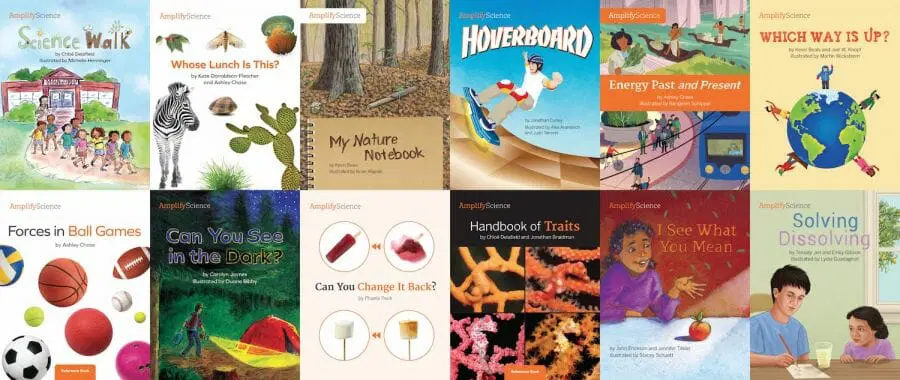
Each Amplify Science Elementary Unit includes five books that students use to build an understanding of science ideas, practices, and crosscutting concepts. While the program does not take on responsibility for providing all literacy instruction required for students’ reading development (e.g., skill-based or fluency-oriented literacy instruction), it is designed to support vocabulary, language, and reading comprehension development.
Amplify Science provides students with a series of content-rich nonfiction and informational texts that are read for a variety of purposes throughout the unit. The five books in each unit include one book for approximately every five days of instruction and one reference book that students draw upon throughout the 22-lesson units (20 instructional lessons & 2 assessment days for pre/post). Students are encouraged to read books as independently as possible so they can apply the comprehension strategies they are learning in order to understand what they read. In each Amplify Science reading session, comprehension is supported at three stages: before, during, and after reading. At each stage, students engage in planned tasks that build an understanding of the key concepts and themes in a book. The teacher’s role is to scaffold comprehension and provide opportunities for practicing the strategies and skills that are being taught. At each stage, these include:
Before-reading activities designed to help students activate their background knowledge, prepare to use particular comprehension strategies, and set a purpose for reading.
During-reading activities intended to help students monitor their comprehension, make connections, and read and understand important science vocabulary in context.
After reading activities intended to help students reflect on their learning and connect their reading to their firsthand science investigations.
Nonfiction and informational text. The Amplify Science program is designed to help students gain familiarity with the structures and functions of nonfiction and informational texts by extending students’ exposure to these texts in a rich learning environment. The program uses nonfiction and informational texts because it is an important component of content learning in school; it helps build knowledge of the natural and social world, and it provides students with a purposeful context for learning key concepts and vocabulary. Nonfiction and informational text are also engaging and motivating as it answers genuine questions and capitalizes on student interests and background knowledge. Reading a wide variety of texts have been shown to affect students’ interest in reading overall (Duke 2004). Nonfiction and informational genres are also the genres students are most likely to encounter when reading and writing inside and outside of school. For adults, nonfiction and informational texts are read more often than other genres (Duel 2004; Smith 2000). In order for students to become successful information gatherers as adults, we need to provide opportunities for them to engage with nonfiction and informational texts in school.
Reading comprehension. Reading instruction in Amplify Science is designed to promote students’ capacity to read for meaning. Guided instruction and a supportive classroom context help students learn to employ powerful comprehension strategies that are critical for gaining a better understanding of text and becoming skilled readers (Duke and Pearson 2002). Comprehension strategies included in the Amplify Science program include posing questions, making inferences, setting goals for reading, summarizing, synthesizing, and using text features. Across units, students are guided to use these strategies flexibly as they read and make sense of a wide range of nonfiction and informational texts. Students also gain critical experience with understanding texts and experiences in relation to one another as they make connections between the books they read and the science they do. These connections then extend their growing conceptual understanding. Reading instruction in Amplify Science also encourages students to reflect on the utility of comprehension strategies, including when, why, and how these strategies helped them. One important way students make connections is through sustained classroom discussion of text with their peers (Nystrand 1997). Students regularly discuss both content and comprehension use before, during, and after reading, learning more about both as they engage in discussions with their peers. The Amplify Science approach also draws on research that demonstrates the benefits of instructional coherence (connected reading, writing, listening, and talk), particularly in the content area of science (Romance and Vitale 2001; Cervetti et. al. 2007; The Directed Reading Model supports reading comprehension before, during, and after reading. Cervetti et. al. 2006). Reading comprehension is enhanced as students connect what they read to what they are investigating and learning in science. The Amplify Science student books provide many opportunities for students to practice their developing reading skills in context, engage in authentic discourse around text, make connections, and support their understandings with textual evidence.
Amplify Science
A new phenomena-based science curriculum for grades K–5.
A disciplinary literacy approach to learning science
Literacy is an integral part of science. Scientists read, write, listen, and speak in order to obtain, evaluate, and communicate information about the natural world. They explain their findings, conduct research, connect to the work of other scientists, and communicate ideas to a variety of audiences. In the Amplify Science program, students learn to read, write, and speak as scientists do as they acquire facility with the academic language and vocabulary of science. Through the seamless integration of science and literacy instruction, students also learn that reading, writing, and talking are essential practices of science, and that all scientists use these practices to gather information, communicate claims, leverage evidence, draw conclusions from data, and share their ideas through oral and written explanations and arguments.
Situating literacy instruction in a content area like science has several benefits. First, it helps students develop ways of thinking that are characteristic to the discipline. Second, building background knowledge in a discipline also helps students access complex content in texts that can be difficult to grasp. Finally, situating literacy in a content area like science provides an authentic reason for reading, writing, and talking — to better understand the science ideas under study. Reading, like science, can be an act of inquiry when there are genuine questions to be investigated.
The following are the guiding principles for disciplinary literacy in the Amplify Science program:
Students can acquire literacy expertise through the pursuit of science knowledge and by engaging in scientific and engineering practices.
Attention to disciplinary literacy instruction should begin as soon as students enter school and should continue throughout the grades.
Participation in a community is key to acquiring disciplinary expertise and literacy.
Argumentation and explanation are the central enterprises of science and, thus, these practices are the focus of reading, writing, and speaking in science.
Reading in Amplify Science
Amplify Science provides students with well-written, grade-level appropriate informational texts alongside explicit, embedded instruction on reading in science. Throughout the program, students are apprenticed into reading like scientists – that is, reading actively, curiously, and critically, with a focus on making meaning and using the text as a source of evidence. As students read science texts in conjunction with other multimodal experiences around a topic (doing, talking, visualizing, writing), they increase their skill in accessing these complex texts, as well as their understanding of the importance of text for finding information. Reading informational text is inexorably linked to students’ investigations in each unit. Firsthand investigations provide background knowledge and context for students’ reading, and, in turn, the text provides information, evidence, and support for investigations in progress. In addition, the program includes many books and articles that introduce diverse scientists currently working in the field to highlight science and engineering as a vibrant and viable career choice for students.
Reading in Amplify Science is approached from an inquiry stance – students ask questions, make connections, evaluate information, search for evidence, and clarify difficult concepts as they read. This approach focuses on the practices and processes by which experts in a field obtain, evaluate, and communicate information, including arguments, explanations, data, and visual representations used to explain scientific concepts. Across the program, the teacher models, and students practice, reading like scientists while using reading strategies and approaches that are appropriate to the task, purpose, and grade level. Along with explicit instruction, teachers model strategic reading by thinking aloud as they read, asking questions, and linking the information in the text to their class’s investigations. Students are then provided with multiple opportunities to read and discuss ideas with peers, using the text as a resource for information and evidence. Reading and discussing texts in these ways builds students’ capacity to read strategically while simultaneously building their understanding of science content. The scaffolded reading experiences at each grade level help students learn to approach complex texts in systematic ways and will aid them as they read other science texts throughout their school careers.
TEXT DESIGN AND ACCESSIBILITY Each Amplify Science unit includes custom-written informational texts. In K–5, there are five student books (four informational books and one reference book) per unit; in grades 6–8, there are multiple student articles per unit. These informational texts are designed to support students’ understanding of science ideas, practices, and crosscutting concepts, as well as to showcase the work of diverse scientists. An important goal of the Amplify Science program is to provide appropriately complex science texts for students that support, link to, and expand their firsthand science learning. To accomplish this goal, it is critical that the texts are accessible to as many students as possible. All Student Books, articles, and other student materials are reviewed for accessibility and readability using the three-dimensional model of text complexity (qualitative, quantitative, and reader-and-task considerations) set out by the Common Core State Standards for English Language Arts (CCSS-ELA).
The qualitative dimension of text complexity focuses on the purpose, structure, language conventions, and knowledge demands of a text. Books and articles were written, reviewed, and edited by members of the Lawrence Hall of Science team of professional educators and science writers during the development of each unit. They are tailored to address concepts students are learning in the unit, and use the same language and vocabulary throughout so students encounter consistent terminology across modalities of learning (reading, writing, doing investigations, discussing).
The texts also include carefully created or selected visual representations such as diagrams, photographs, and illustrations that support and/or provide additional information. The placement of each book or article within the instructional sequence is carefully designed and classroom-tested so that the text is supportive of student content learning in a variety of ways, and provides just-in-time information, reinforcing key ideas or introducing new ones within the unit.
On the quantitative dimension, each book and article was designed and reviewed using internally developed criteria for each grade. Each book or article was analyzed against a list of commonly used words, as well as criteria for calculating the difficulty of decodable words. The number of unique hard words in each text was controlled, with the percentage of hard words varying based on the grade level. At the same time, a small set of core science vocabulary words related to the science ideas students are learning was repeatedly used across a set of books or articles because repeated encounters with words in context is one way that students learn and internalize them. In addition to our internal approach to readability, each book or article in grades 1–8 was analyzed by MetaMetrics and assigned a Lexile Measure. This allowed us to ensure that books and articles fall within recommended Lexile Measures found in the updated Text Complexity Band in Supplemental Information for Appendix A of the Common Core State Standards for English Language Arts and Literacy: New Research on Text Complexity.
Reader and task considerations are related to whether a particular text is appropriate for particular students and particular tasks. The placement of books within the Amplify Science program of instruction was carefully considered as part of unit design. Books were strategically placed within the sequence of instruction to ensure they are appropriately tied to what students are learning and that students are adequately prepared to read them with appropriate support. Sometimes this means that students read a text before conducting a firsthand investigation because it serves the purpose of activating and enhancing students’ background knowledge about a topic and sparking an interest in a scientific idea. At other times, students read a book after they have had a chance to investigate and develop ideas about the phenomenon firsthand because reading will help them generate more evidence to support claims. We cannot know all the individual learning needs of every reader the program reaches; however, the design and placement of the books was also informed by survey data from field trial teachers. These teachers were asked to evaluate field trial versions of the books and accompanying lessons based on several criteria, and to comment on how well the instruction and respective text worked for different readers.
More information on reading in Amplify Science available through in-person professional learning and within the Program Guide included with purchase.
Amplify Science units provide strategy-based literacy instruction that aims to develop students’ facility with reading, writing, and talking about science. Each unit provides many authentic opportunities for students to learn about and practice the ways of communicating and learning that characterize science as a discipline. The following are the Amplify Science Guiding Principles for Literacy:
Students acquire literacy expertise through the pursuit of science knowledge and by engaging in scientific and engineering practices.
Attention to discipline literacy instruction should begin as soon as students enter school and should continue throughout the grades.
Participation in a disciplinary community is key to acquiring disciplinary expertise and literacy.
Since the purpose of science is to better explain the natural world, argumentation and explanation are the central enterprises of science. Therefore, these practices are central foci of reading, writing, and talk in science.
Literacy instruction in the Amplify Science program utilizes a Gradual Release of Responsibility approach (Pearson and Gallagher 1983). In this approach, instruction begins with the teacher assuming primary responsibility for modeling strategy or skill and explicitly instruction how to use each strategy or skill. As instruction proceeds, the teacher offers as much support as needed so students can practice using the target strategy more independently. Over time, students take on more responsibility for using the strategy more independently. Depending on the goal, the path from teacher modeling to student independence will vary. Over the course of a unit, students may not achieve independence for every literacy goal, but they will move along the continuum toward flexible use of a wide range of reading, writing, and learning strategies that have been incorporated throughout the program.
Each Amplify Science Elementary Unit includes five books that students use to build an understanding of science ideas, practices, and crosscutting concepts. While the program does not take on responsibility for providing all literacy instruction required for students’ reading development (e.g., skill-based or fluency-oriented literacy instruction), it is designed to support vocabulary, language, and reading comprehension development.
Amplify Science provides students with a series of content-rich nonfiction and informational texts that are read for a variety of purposes throughout the unit. The five books in each unit include one book for approximately every five days of instruction and one reference book that students draw upon throughout the 22-lesson units (20 instructional lessons & 2 assessment days for pre/post). Students are encouraged to read books as independently as possible so they can apply the comprehension strategies they are learning in order to understand what they read. In each Amplify Science reading session, comprehension is supported at three stages: before, during, and after reading. At each stage, students engage in planned tasks that build an understanding of the key concepts and themes in a book. The teacher’s role is to scaffold comprehension and provide opportunities for practicing the strategies and skills that are being taught. At each stage, these include:
Before-reading activities designed to help students activate their background knowledge, prepare to use particular comprehension strategies, and set a purpose for reading.
During-reading activities intended to help students monitor their comprehension, make connections, and read and understand important science vocabulary in context.
After reading activities intended to help students reflect on their learning and connect their reading to their firsthand science investigations.
Nonfiction and informational text. The Amplify Science program is designed to help students gain familiarity with the structures and functions of nonfiction and informational texts by extending students’ exposure to these texts in a rich learning environment. The program uses nonfiction and informational texts because it is an important component of content learning in school; it helps build knowledge of the natural and social world, and it provides students with a purposeful context for learning key concepts and vocabulary. Nonfiction and informational text are also engaging and motivating as it answers genuine questions and capitalizes on student interests and background knowledge. Reading a wide variety of texts have been shown to affect students’ interest in reading overall (Duke 2004). Nonfiction and informational genres are also the genres students are most likely to encounter when reading and writing inside and outside of school. For adults, nonfiction and informational texts are read more often than other genres (Duel 2004; Smith 2000). In order for students to become successful information gatherers as adults, we need to provide opportunities for them to engage with nonfiction and informational texts in school.
Reading comprehension. Reading instruction in Amplify Science is designed to promote students’ capacity to read for meaning. Guided instruction and a supportive classroom context help students learn to employ powerful comprehension strategies that are critical for gaining a better understanding of text and becoming skilled readers (Duke and Pearson 2002). Comprehension strategies included in the Amplify Science program include posing questions, making inferences, setting goals for reading, summarizing, synthesizing, and using text features. Across units, students are guided to use these strategies flexibly as they read and make sense of a wide range of nonfiction and informational texts. Students also gain critical experience with understanding texts and experiences in relation to one another as they make connections between the books they read and the science they do. These connections then extend their growing conceptual understanding. Reading instruction in Amplify Science also encourages students to reflect on the utility of comprehension strategies, including when, why, and how these strategies helped them. One important way students make connections is through sustained classroom discussion of text with their peers (Nystrand 1997). Students regularly discuss both content and comprehension use before, during, and after reading, learning more about both as they engage in discussions with their peers. The Amplify Science approach also draws on research that demonstrates the benefits of instructional coherence (connected reading, writing, listening, and talk), particularly in the content area of science (Romance and Vitale 2001; Cervetti et. al. 2007; The Directed Reading Model supports reading comprehension before, during, and after reading. Cervetti et. al. 2006). Reading comprehension is enhanced as students connect what they read to what they are investigating and learning in science. The Amplify Science student books provide many opportunities for students to practice their developing reading skills in context, engage in authentic discourse around text, make connections, and support their understandings with textual evidence.
Credible. Actionable. Timely. The assessment system for each Amplify Science unit is designed to provide teachers with actionable diagnostic information about student progress toward the learning goals for the unit. Assessment of unit learning goals is grounded in the Unit Progress Build (PB), which describes how student understanding is likely to develop and deepen through engagement with the unit’s learning experiences. The assessment system includes formal and informal opportunities for students to demonstrate understanding and for teachers to gather information throughout the unit – all while giving teachers flexibility in deciding what to score and what to simply review. Built largely around instructionally-embedded performances, these opportunities encompass a range of modalities that, as a system, attend to research on effective assessment strategies and the NRC Framework for K-12 Science Education.
The variety of assessment options for Amplify Science include:
Pre-Unit Assessment (formative): discussion, modeling, and written explanations to gauge students knowledge.
On-the-Fly Assessments (OtFA) (formative): each OtFA includes guidance on what to look for in student activity or work products, and offers suggestions on how to adjust instruction accordingly.
End-of-Chapter Problem Context Explanations (formative): Three-dimensional performance tasks to support students’ consolidation of ideas encountered in each chapter and provide insight into students’ developing understanding.
Self-Assessments (formative): One per chapter; brief opportunities for students to reflect on their own learning, ask questions, and reveal ongoing wonderings about unit content.
Critical Juncture Assessment (CJ) (formative): Occurring at the end of each chapter similar in format to the Pre-Unit and End-of-Unit assessments.
End-of-Unit Assessment (summative): discussion, modeling, and written explanations to gauge students’ knowledge and growth.
Hands-On and Print Materials (“Kits”)
There is a box of materials associate with every unit of Amplify Science, containing a variety of hands-on activities and print materials that are called for in the various lessons in the unit. Each box, commonly called a “kit,” is associated with a given unit, and each teacher should ideally have their own kit for each unit.
*One blackline master Student Investigation Notebook is included in each unit kit, grades 3–5.
Within the kit there are two types of materials:
Physical manipulatives
Printed materials
The physical manipulatives are the hands-on items used in various lessons in the unit. For example, the Balancing Forces kit contains balloons, batteries, magnets, fasteners, rubber balls, and various other materials.
There are two types of physical manipulatives: consumables and nonconsumables. Nonconsumables are durable and, if cared for properly, can be used over the course of several years. Consumables are used up with each use and must be replenished.
There are also print materials in the kits, including:
Key concepts: Teachers designate an area of the classroom wall to post “Key Concept” printed cards. These cards contain short sentences that explicitly identify an important idea or concept learned in the unit. By posting that card to the wall, the classroom has a visual anchor – a physical representation of “what we’ve learned so far.”
Vocabulary wall: Like the Key Concepts, Vocabulary cards are provided in your unit’s kit. These, too, are posted to a designated area of the classroom wall, and more and more vocabulary cards are added to the wall as we progress through the unit.
Unit and Chapter Questions: Printed cards with the unit question and individual chapter questions are also provided in the kit. These cards help students to remember exactly what we are investigating over the course of the chapter, and ultimately, over the course of the unit.
Card Sets: Printed cards, specific to a unit, are in each kit (though not all units have Card Sets). Often, students are sorting these cards on their desks, ranking them, ordering them, etc. For example, in the Metabolism unit, students take “Evidence Cards,” each with a piece of evidence, and then rank and arrange the evidence cards from strong-> weak->irrelevant, thereby providing a visualization of their thinking and reasoning.
Preview Amplify Science: NYC
Start your view by simply selecting “Preview the Curriculum” and then selecting either Teacher or Student access. We recommend selecting Teacher access as you will also be able to see the student resources.
Amplify Science units provide strategy-based literacy instruction that aims to develop students’ facility with reading, writing, and talking about science. Each unit provides many authentic opportunities for students to learn about and practice the ways of communicating and learning that characterize science as a discipline. The following are the Amplify Science Guiding Principles for Literacy:
Students acquire literacy expertise through the pursuit of science knowledge and by engaging in scientific and engineering practices.
Attention to discipline literacy instruction should begin as soon as students enter school and should continue throughout the grades.
Participation in a disciplinary community is key to acquiring disciplinary expertise and literacy.
Since the purpose of science is to better explain the natural world, argumentation and explanation are the central enterprises of science. Therefore, these practices are central foci of reading, writing, and talk in science.
Literacy instruction in the Amplify Science program utilizes a Gradual Release of Responsibility approach (Pearson and Gallagher 1983). In this approach, instruction begins with the teacher assuming primary responsibility for modeling strategy or skill and explicitly instruction how to use each strategy or skill. As instruction proceeds, the teacher offers as much support as needed so students can practice using the target strategy more independently. Over time, students take on more responsibility for using the strategy more independently. Depending on the goal, the path from teacher modeling to student independence will vary. Over the course of a unit, students may not achieve independence for every literacy goal, but they will move along the continuum toward flexible use of a wide range of reading, writing, and learning strategies that have been incorporated throughout the program.
Each Amplify Science Elementary Unit includes five books that students use to build an understanding of science ideas, practices, and crosscutting concepts. While the program does not take on responsibility for providing all literacy instruction required for students’ reading development (e.g., skill-based or fluency-oriented literacy instruction), it is designed to support vocabulary, language, and reading comprehension development.
Amplify Science provides students with a series of content-rich nonfiction and informational texts that are read for a variety of purposes throughout the unit. The five books in each unit include one book for approximately every five days of instruction and one reference book that students draw upon throughout the 22-lesson units (20 instructional lessons & 2 assessment days for pre/post). Students are encouraged to read books as independently as possible so they can apply the comprehension strategies they are learning in order to understand what they read. In each Amplify Science reading session, comprehension is supported at three stages: before, during, and after reading. At each stage, students engage in planned tasks that build an understanding of the key concepts and themes in a book. The teacher’s role is to scaffold comprehension and provide opportunities for practicing the strategies and skills that are being taught. At each stage, these include:
Before-reading activities designed to help students activate their background knowledge, prepare to use particular comprehension strategies, and set a purpose for reading.
During-reading activities intended to help students monitor their comprehension, make connections, and read and understand important science vocabulary in context.
After reading activities intended to help students reflect on their learning and connect their reading to their firsthand science investigations.
Nonfiction and informational text. The Amplify Science program is designed to help students gain familiarity with the structures and functions of nonfiction and informational texts by extending students’ exposure to these texts in a rich learning environment. The program uses nonfiction and informational texts because it is an important component of content learning in school; it helps build knowledge of the natural and social world, and it provides students with a purposeful context for learning key concepts and vocabulary. Nonfiction and informational text are also engaging and motivating as it answers genuine questions and capitalizes on student interests and background knowledge. Reading a wide variety of texts have been shown to affect students’ interest in reading overall (Duke 2004). Nonfiction and informational genres are also the genres students are most likely to encounter when reading and writing inside and outside of school. For adults, nonfiction and informational texts are read more often than other genres (Duel 2004; Smith 2000). In order for students to become successful information gatherers as adults, we need to provide opportunities for them to engage with nonfiction and informational texts in school.
Reading comprehension. Reading instruction in Amplify Science is designed to promote students’ capacity to read for meaning. Guided instruction and a supportive classroom context help students learn to employ powerful comprehension strategies that are critical for gaining a better understanding of text and becoming skilled readers (Duke and Pearson 2002). Comprehension strategies included in the Amplify Science program include posing questions, making inferences, setting goals for reading, summarizing, synthesizing, and using text features. Across units, students are guided to use these strategies flexibly as they read and make sense of a wide range of nonfiction and informational texts. Students also gain critical experience with understanding texts and experiences in relation to one another as they make connections between the books they read and the science they do. These connections then extend their growing conceptual understanding. Reading instruction in Amplify Science also encourages students to reflect on the utility of comprehension strategies, including when, why, and how these strategies helped them. One important way students make connections is through sustained classroom discussion of text with their peers (Nystrand 1997). Students regularly discuss both content and comprehension use before, during, and after reading, learning more about both as they engage in discussions with their peers. The Amplify Science approach also draws on research that demonstrates the benefits of instructional coherence (connected reading, writing, listening, and talk), particularly in the content area of science (Romance and Vitale 2001; Cervetti et. al. 2007; The Directed Reading Model supports reading comprehension before, during, and after reading. Cervetti et. al. 2006). Reading comprehension is enhanced as students connect what they read to what they are investigating and learning in science. The Amplify Science student books provide many opportunities for students to practice their developing reading skills in context, engage in authentic discourse around text, make connections, and support their understandings with textual evidence.
Digital Simulations
Digital Sims are digital tools that serve as venues of exploration and means for collecting data and evidence, and present students with opportunities to make observations and manipulate variables of key scientific processes and mechanism. Sims allow students to explore scientific concepts that might otherwise be invisible or impossible to see with the naked eye. Much like real scientists do, students of Amplify Science will use these computer simulations to gain insight into processes that occur on the microscopic scale, or alternatively, to speed up processes that might otherwise take thousands or millions of years to observe.
In grades 4–8, Amplify Science offers a unique sim which students will use throughout the unit. And each time a sim appears in a lesson, there are clear instructions for both teachers and students on its use.
Digital simulation from Ecosystem Restoration unit
Spanish Resources
Amplify Science is committed to providing support to meet the needs of all learners, including multiple access points for Spanish-speaking students. Developed in conjunction with Spanish-language experts and classroom teachers, multiple components are available in Spanish across the Amplify Science curriculum.
English language learners (ELLs) bring a lifetime of background knowledge and experiences to everything they do. As they work to acquire a new language and new academic knowledge simultaneously, they may need specific linguistic support. In the instruction, the Differentiation Brief points out activities that could pose linguistic challenges for English learners or reduce their access to science content, and suggests supports and modifications accordingly.
The Lawrence Hall of Science authorship team believes that it is essential for students to develop both a deep understanding of science concepts and facility with disciplinary practices that are essential to the work of scientists and engineers. It is also important to recognize that in a single classroom, students have an array of learning needs and preferences. In particular, English language learners can benefit from learning opportunities designed to meet their needs from additional support then needed as they tackle the language and content demands of science.Five principles helped the Lawrence Hall of Science curriculum developers design instructional sequences to meet the goals of bolstering students who develop understanding of science content, decreasing language demands without diluting science content, and allowing students to more fully engage in disciplinary literacy practices. The five principles are based on research on best practices in the field and have been reviewed by Amplify Science ELL advisors.
Leverage and build students’ informational background knowledge.
Capitalize on students’ knowledge of language.
Provide explicit instruction about the language of science.
Provide opportunities for scaffolded practice.
Provide multimodal means of accessing science content and expressing science knowledge.